エドガーで原本を確認する
UNITED STATES
SECURITIES AND EXCHANGE COMMISSION
WASHINGTON, D.C. 20549
FORM 10-K
(Mark One)
☒ |
ANNUAL REPORT PURSUANT TO SECTION 13 OR 15(d) OF THE SECURITIES EXCHANGE ACT OF 1934 |
For the fiscal year ended December 31, 2024
OR
☐ |
TRANSITION REPORT PURSUANT TO SECTION 13 OR 15(d) OF THE SECURITIES EXCHANGE ACT OF 1934 |
For the transition period from _______ to _______
Commission File Number 1-37816
ALCOA CORPORATION
(Exact name of registrant as specified in its charter)
|
Delaware (State or other jurisdiction of incorporation or organization) |
|
81-1789115 (I.R.S. Employer Identification No.) |
|
|
|
|
201 Isabella Street, Suite 500, Pittsburgh, Pennsylvania (Address of principal executive offices) |
|
15212-5858 (Zip Code) |
(Registrant’s telephone number, including area code): 412-315-2900
Securities registered pursuant to Section 12(b) of the Act:
Title of each class |
|
Trading Symbol(s) |
|
Name of each exchange on which registered |
Common Stock, par value $0.01 per share |
|
AA |
|
New York Stock Exchange |
Securities registered pursuant to Section 12(g) of the Act: None
Indicate by check mark if the registrant is a well-known seasoned issuer, as defined in Rule 405 of the Securities Act. Yes ☑ No ☐
Indicate by check mark if the registrant is not required to file reports pursuant to Section 13 or Section 15(d) of the Act. Yes ☐ No ☑
Indicate by check mark whether the registrant (1) has filed all reports required to be filed by Section 13 or 15(d) of the Securities Exchange Act of 1934 during the preceding 12 months (or for such shorter period that the registrant was required to file such reports), and (2) has been subject to such filing requirements for the past 90 days. Yes ☑ No ☐
Indicate by check mark whether the registrant has submitted electronically every Interactive Data File required to be submitted pursuant to Rule 405 of Regulation S-T (§ 232.405 of this chapter) during the preceding 12 months (or for such shorter period that the registrant was required to submit such files). Yes ☑ No ☐
Indicate by check mark whether the registrant is a large accelerated filer, an accelerated filer, a non-accelerated filer, a smaller reporting company, or an emerging growth company. See the definitions of “large accelerated filer,” “accelerated filer,” “smaller reporting company,” and “emerging growth company” in Rule 12b-2 of the Exchange Act.
Large accelerated filer |
☒ |
|
Accelerated filer |
☐ |
Non-accelerated filer |
☐ |
|
Smaller reporting company |
☐ |
Emerging growth company |
☐ |
|
|
|
If an emerging growth company, indicate by check mark if the registrant has elected not to use the extended transition period for complying with any new or revised financial accounting standards provided pursuant to Section 13(a) of the Exchange Act. ☐
Indicate by check mark whether the registrant has filed a report on and attestation to its management’s assessment of the effectiveness of its internal control over financial reporting under Section 404(b) of the Sarbanes-Oxley Act (15 U.S.C. 7262(b)) by the registered public accounting firm that prepared or issued its audit report. ☑
If securities are registered pursuant to Section 12(b) of the Act, indicate by check mark whether the financial statements of the registrant included in the filing reflect the correction of an error to previously issued financial statements. ☐
Indicate by check mark whether any of those error corrections are restatements that required a recovery analysis of incentive-based compensation received by any of the registrant’s executive officers during the relevant recovery period pursuant to §240.10D-1(b). ☐
Indicate by check mark whether the registrant is a shell company (as defined in Rule 12b-2 of the Act). Yes ☐ No ☑
The aggregate market value of the registrant’s voting stock held by non-affiliates at June 28, 2024 was approximately $7.1 billion, based on the closing price per share of Common Stock on June 28, 2024 of $39.78 as reported on the New York Stock Exchange.
Indicate the number of shares outstanding of each of the registrant’s classes of stock, as of the latest practicable date.
Title or Class |
|
Outstanding Shares as of February 14, 2025 |
Common Stock, par value $0.01 per share |
|
258,884,337 |
Series A Convertible Preferred Stock, par value $0.01 per share |
|
4,041,989 |
DOCUMENTS INCORPORATED BY REFERENCE
Part III of this Form 10-K incorporates by reference certain information from the registrant’s Definitive Proxy Statement for its 2025 Annual Meeting of Stockholders to be filed pursuant to Regulation 14A.
TABLE OF CONTENTS
|
|
|
Page |
|
|
|
|
Item 1. |
|
1 |
|
Item 1A. |
|
16 |
|
Item 1B. |
|
30 |
|
Item 1C. |
|
31 |
|
Item 2. |
|
32 |
|
Item 3. |
|
45 |
|
Item 4. |
|
46 |
|
|
|
|
|
Item 5. |
|
47 |
|
Item 6. |
|
48 |
|
Item 7. |
|
Management’s Discussion and Analysis of Financial Condition and Results of Operations |
49 |
Item 7A. |
|
71 |
|
Item 8. |
|
72 |
|
Item 9. |
|
Changes in and Disagreements With Accountants on Accounting and Financial Disclosure |
135 |
Item 9A. |
|
135 |
|
Item 9B. |
|
135 |
|
Item 9C. |
|
Disclosure Regarding Foreign Jurisdictions that Prevent Inspections |
135 |
|
|
|
|
Item 10. |
|
135 |
|
Item 11. |
|
136 |
|
Item 12. |
|
Security Ownership of Certain Beneficial Owners and Management and Related Stockholder Matters |
136 |
Item 13. |
|
Certain Relationships and Related Transactions, and Director Independence |
136 |
Item 14. |
|
136 |
|
|
|
|
|
Item 15. |
|
137 |
|
Item 16. |
|
140 |
|
|
|
141 |
Note on Incorporation by Reference
In this Form 10-K, selected items of information and data are incorporated by reference to portions of Alcoa Corporation’s Definitive Proxy Statement for its 2025 Annual Meeting of Stockholders (Proxy Statement), which will be filed with the Securities and Exchange Commission within 120 days after the end of Alcoa Corporation’s fiscal year ended December 31, 2024. Unless otherwise provided herein, any reference in this Form 10-K to disclosures in the Proxy Statement shall constitute incorporation by reference of only that specific disclosure into this Form 10-K.
PART I
Item 1. Business.
(dollars in millions, except per-share amounts, average realized prices, and average cost amounts)
The Company
Alcoa Corporation, a Delaware corporation (Alcoa or the Company), is active in all aspects of the upstream aluminum industry with bauxite mining, alumina refining, and aluminum smelting and casting. The Company has direct and indirect ownership of 26 operating locations across nine countries on six continents.
The Company’s operations are comprised of two reportable business segments: Alumina and Aluminum. The Alumina segment primarily consists of the Company’s bauxite mines and alumina refineries, which generally includes the mining of bauxite and other aluminous ores, as well as the refining, production, and sale of smelter grade and non-metallurgical alumina. The Aluminum segment consists of the Company’s aluminum smelting and casting operations along with most of the Company’s energy production assets.
On August 1, 2024, Alcoa completed the acquisition of Alumina Limited, which primarily consisted of the acquisition of Alumina Limited’s noncontrolling interest in the Alcoa World Alumina and Chemicals (AWAC) joint venture (described below). Prior to the acquisition, the Alumina segment primarily consisted of a series of affiliated operating entities held in AWAC. Upon completion of the acquisition by Alcoa, Alumina Limited and, as a result, the operations held by the AWAC joint venture, became wholly-owned by Alcoa Corporation.
Aluminum, as an element, is abundant in the earth’s crust, but a multi-step process is required to manufacture finished aluminum metal. Aluminum metal is produced by refining alumina oxide from bauxite into alumina, which is then smelted into aluminum and can be cast into many shapes and forms.
Alcoa smelts and casts aluminum in various shapes and sizes for global customers, including developing and creating various alloy combinations for specific applications.
Aluminum metal is a commodity traded on the London Metal Exchange (LME) and priced daily. Additionally, alumina is subject to market pricing through the Alumina Price Index (API), which is calculated by the Company based on the weighted average of a prior month’s daily spot prices published by the following three indices: CRU Metallurgical Grade Alumina Price, Platts Metals Daily Alumina PAX Price, and FastMarkets Metal Bulletin Non-Ferrous Metals Alumina Index. As a result, the prices of both aluminum and alumina are subject to significant volatility and, therefore, influence the operating results of Alcoa.
Alcoa Corporation became an independent, publicly traded company on November 1, 2016, following its separation (the Separation Transaction) from its former parent company, Alcoa Inc. References herein to “ParentCo” refer to Alcoa Inc. and its consolidated subsidiaries through October 31, 2016, at which time it was renamed Arconic Inc. and since has been subsequently renamed Howmet Aerospace Inc.
1
Business Strategy
Alcoa's business strategy is designed to create stockholder value while aligning with our purpose, vision, and values.
Over the past five years, the Company has made significant progress in reducing complexity and optimizing its portfolio of mining, refining, and smelting assets. In 2024, Alcoa safely curtailed the Kwinana alumina refinery in Australia, acquired Alumina Limited and subsequently benefited from the increased alumina exposure, and announced the sale of its 25.1% ownership in the Saudi Arabia joint venture. In the near term, Alcoa will focus on maintaining operational stability while strategically managing its portfolio to maximize profitability and value creation, including advancing Australia mine approvals, improving the long-term outlook for the San Ciprián operations (Spain), and completing the Alumar smelter (Brazil) restart while maintaining operational stability.
To strengthen our competitive position, Alcoa has identified priorities that address both immediate and long-term opportunities:
Achieving Safety Performance and Operational Excellence
Building a High-Performance Culture
Disciplined Capital Allocation
Targeted Growth
With an emphasis on safety, operational excellence, and continuous improvement, Alcoa’s portfolio of assets is well positioned to deliver stockholder value across business cycles. By following disciplined capital allocation and making pragmatic growth investments, the Company is prepared to adapt and thrive in an evolving industry landscape.
See Part II Item 7 of this Form 10-K in Management’s Discussion and Analysis of Financial Condition and Results of Operations under caption Business Update for more information.
2
Joint Ventures
Saudi Arabia Joint Venture
In December 2009, Alcoa entered into a joint venture with the Saudi Arabian Mining Company (Ma’aden), which was formed by the government of Saudi Arabia to develop its mineral resources and create a fully integrated aluminum complex in Saudi Arabia. Ma’aden is listed on the Saudi Stock Exchange (Tadawul). The joint venture complex includes a bauxite mine with estimated capacity of 5 million dry metric tons per year; an alumina refinery with a capacity of 1.8 million metric tons per year (mtpy); and an aluminum smelter with a capacity of 804,000 mtpy.
The joint venture is currently comprised of two entities: the Ma’aden Bauxite and Alumina Company (MBAC) and the Ma’aden Aluminium Company (MAC). Ma’aden owns a 74.9% interest in the joint venture. Alcoa owns a 25.1% interest in MAC, which holds the smelter; AWAC, which became wholly-owned by Alcoa upon its completion of the Alumina Limited acquisition, holds a 25.1% interest in MBAC, which holds the mine and refinery. The refinery and smelter are located within the Ras Al Khair industrial zone on the east coast of Saudi Arabia.
On September 15, 2024, Alcoa entered into a share purchase and subscription agreement with Ma’aden, pursuant to which Alcoa agreed to sell its full ownership interest of 25.1% in the Saudi Arabia joint venture, comprised of MBAC and MAC, to Ma’aden in exchange for issuance by Ma’aden of approximately 86 million shares and $150 in cash. The shares of Ma’aden will be subject to transfer and sale restrictions, including a restriction requiring Alcoa to hold its Ma’aden shares for a minimum of three years, with one-third of the shares becoming transferable after each of the third, fourth, and fifth anniversaries of closing of the transaction. The transaction is subject to regulatory approvals, approval by Ma’aden’s shareholders, and other customary closing conditions and is expected to close in the first half of 2025.
ELYSIS
ELYSISTM Limited Partnership (ELYSIS) is between wholly-owned subsidiaries of Alcoa (48.235%) and Rio Tinto Alcan Inc. (Rio Tinto) (48.235%), respectively, and Investissement Québec (3.53%), a company wholly-owned by the Government of Québec, Canada. The purpose of ELYSIS is to advance larger scale development and commercialization of its patent-protected technology that eliminates direct greenhouse gas emissions from the traditional aluminum smelting process and, instead, emits oxygen. Alcoa first developed the inert anode technology for the aluminum smelting process that served as the basis for the formation of ELYSIS in 2018. Development scale quantities of aluminum produced by ELYSIS have been sold for commercial purposes, including to Ball Corporation for its low-carbon aluminum cup launched at the World Economic Forum in Davos, Switzerland and to Nexans, producing the world’s first cable containing metal from this breakthrough technology. Further progress on ELYSIS technology was announced in 2024 with Rio Tinto’s plans to launch the first industrial-scale demonstration of the breakthrough technology, which includes 10 ELYSIS smelting pots operating at 100 kiloamperes (kA), a size similar to those operating at smaller-scale commercial smelters. Alcoa has the right to purchase up to 40 percent of the metal produced from the demonstration, allowing for Alcoa customers to benefit from ELYSIS’s carbon-free electrolytic process early in the technology development cycle. The target for first production is by 2027.
Alcoa World Alumina and Chemicals (AWAC)
On August 1, 2024, Alcoa completed the acquisition of all of the ordinary shares of Alumina Limited (Alumina Shares) through a wholly-owned subsidiary, AAC Investments Australia 2 Pty Ltd. At acquisition, Alumina Limited, a company previously listed on the Australian Securities Exchange, held a 40% ownership interest in the AWAC joint venture.
Under the Scheme Implementation Deed entered into in March 2024, as amended in May 2024, holders of Alumina Shares received 0.02854 Alcoa CHESS Depositary Interests (CDIs) for each Alumina Share (the Agreed Ratio), except that i) holders of Alumina Shares represented by American Depositary Shares, each of which represented 4 Alumina Shares, received 0.02854 shares of Alcoa common stock and ii) a certain shareholder received, for certain of their Alumina Shares, 0.02854 shares of Alcoa non-voting convertible preferred stock. The Alcoa CDIs are quoted on the Australian Stock Exchange.
At closing, Alumina Shares outstanding of 2,760,056,014 and 141,625,403 were exchanged for 78,772,422 and 4,041,989 shares of Alcoa common stock and Alcoa preferred stock, respectively. Based on Alcoa’s closing share price as of July 31, 2024, the Agreed Ratio implied a value of A$1.45 per Alumina Share and aggregate purchase consideration of approximately $2,700 for Alumina Limited.
3
The transaction consisted in substance of the acquisition of Alumina Limited’s noncontrolling interest in AWAC, the assumption of Alumina Limited’s indebtedness, the recognition of deferred tax assets primarily related to Alumina Limited’s prior net operating losses and the tax allocation of the fixed asset valuation to individual assets, and the acquisition of cash and other current liabilities. The transaction was accounted for as an equity transaction where net assets acquired and transaction costs were reflected as an increase to Additional capital.
Prior to Alcoa’s acquisition of Alumina Limited, Alcoa Corporation and Alumina Limited owned 60% and 40%, respectively, of AWAC, an unincorporated global joint venture consisting of a number of affiliated entities that own, operate, or have an interest in bauxite mines and alumina refineries, as well as an aluminum smelter, in seven countries. The scope of AWAC generally includes the mining of bauxite and other aluminous ores; the refining, production, and sale of smelter grade and non-metallurgical alumina; and the production of certain primary aluminum products. Upon completion of the acquisition on August 1, 2024, Alumina Limited and, as a result, the operations held by the AWAC joint venture, became wholly-owned by Alcoa Corporation.
AWAC Operations
In 2024, AWAC entities’ assets included the following interests:
Others
The Company is party to several other joint ventures and consortia. See additional details within each business segment discussion below.
The Aluminerie de Bécancour Inc. (ABI) smelter is a joint venture between Alcoa and Rio Tinto located in Bécancour, Québec. Alcoa owns 74.95% of the joint venture through its 50% equity investment in Pechiney Reynolds Quebec, Inc., which owns a 50.1% share of the smelter, and two wholly-owned Canadian subsidiaries, which own 49.9% of the smelter. Rio Tinto owns the remaining 25.05% interest in the joint venture through its 50% ownership in Pechiney Reynolds Quebec, Inc.
CBG is a joint venture between Boké Investment Company (51%) and the Government of Guinea (49%) for the operation of a bauxite mine in the Boké region of Guinea. Boké Investment Company is owned 100% by Halco (Mining) Inc.; Alcoa World Alumina LLC (AWA LLC) holds a 45% interest in Halco (Mining) Inc. AWA LLC is part of the AWAC group of companies, which became wholly-owned by Alcoa upon its completion of the Alumina Limited acquisition.
On April 30, 2022, Alcoa completed the sale of its investment in Mineração Rio Do Norte (MRN) for proceeds of $10. An additional $30 in cash could be paid to the Company in the future if certain post-closing conditions related to future MRN mine development are satisfied. Related to this transaction, the Company recorded an asset impairment of $58 in the first quarter of 2022 in Restructuring and other charges, net on the Statement of Consolidated Operations. In addition, the Company entered into several bauxite offtake agreements with South32 Minerals S.A. (South32) to provide bauxite supply for existing long-term supply contracts.
Alumar is an unincorporated joint venture for the operation of a refinery, smelter, and casthouse in Brazil. The refinery is owned by AWAB (39.96%), Rio Tinto (10%), Alcoa Alumínio (14.04%), and South32 (36%). AWAB is part of the AWAC group of companies, which became wholly-owned by Alcoa upon its completion of the Alumina Limited acquisition. With respect to Rio Tinto and South32, the named company or an affiliate thereof holds the interest. The smelter and casthouse are owned by Alcoa Alumínio (60%) and South32 (40%).
4
Strathcona calciner is a joint venture between affiliates of Alcoa and Rio Tinto located in Alberta, Canada. Calcined coke is used as a raw material in aluminum smelting. The calciner is owned by Alcoa (39%) and Rio Tinto (61%).
Hydropower
Machadinho Hydro Power Plant (HPP) is a consortium located on the Pelotas River in southern Brazil in which the Company has a 27.3% ownership interest through Alcoa Alumínio. The remaining ownership interests are held by unrelated third parties.
Barra Grande HPP is a joint venture located on the Pelotas River in southern Brazil in which the Company has a 42.2% ownership interest through Alcoa Alumínio. The remaining ownership interests are held by unrelated third parties.
Estreito HPP is a consortium between Alcoa Alumínio, through Estreito Energia S.A. (25.5%) and unrelated third parties located on the Tocantins River, northern Brazil.
Serra do Facão HPP is a joint venture between Alcoa Alumínio (35%) and unrelated third parties located on the Sao Marcos River, central Brazil.
Manicouagan Power Limited Partnership (Manicouagan) is a joint venture between affiliates of Alcoa and Hydro-Québec. Manicouagan owns and operates the 335 megawatt McCormick hydroelectric project, which is located on the Manicouagan River in the Province of Québec, Canada. Alcoa owns 40% of the joint venture.
Alumina
This segment consists of the Company’s worldwide refining system, including the mining of bauxite, which is then refined into alumina, a compound of aluminum and oxygen that is the raw material used by smelters to produce aluminum metal. Bauxite is the principal raw material used to produce alumina and contains various aluminum hydroxide minerals, the most important of which are gibbsite and boehmite. Bauxite is refined into alumina using the Bayer process. The Company obtains bauxite from its own resources as well as through long-term and short-term contracts and mining leases. Tons of bauxite are reported on a zero-moisture basis in millions of dry metric tons (mdmt) unless otherwise stated.
Alcoa’s alumina sales are made to customers globally and are typically priced by reference to published spot market prices. The Company produces smelter grade alumina and non-metallurgical grade alumina. The Company’s largest customer for smelter grade alumina is its own aluminum smelters, which in 2024 accounted for approximately 32 percent of its total alumina shipments. A small portion of the alumina (non-metallurgical grade) is sold to third-party customers who process it into industrial chemical products. This segment also includes Alcoa's 25.1% share of MBAC. In September 2024, Alcoa entered into a share purchase and subscription agreement with Ma’aden, pursuant to which Alcoa agreed to sell its full ownership interest of 25.1% in the Saudi Arabia joint venture. See Part II Item 7 of this Form 10-K in Management’s Discussion and Analysis of Financial Condition and Results of Operations under caption Business Update for more information.
In 2024, Alcoa-operated mines, mines operated by partnerships in which Alcoa has equity interests, and bauxite offtake agreements supplied 85 percent of bauxite volume to Alcoa refineries and the remaining 15 percent was sold to third-party customers. Alcoa-operated mines produced 33.7 mdmt of bauxite and mines operated by partnerships produced 4.6 mdmt of bauxite on a proportional equity basis, for a total Company bauxite production of 38.3 mdmt.
On April 30, 2022, Alcoa completed the sale of its investment in MRN. The Company entered into several bauxite offtake agreements with South32 to provide bauxite supply for existing long-term supply contracts.
Based on the terms of its bauxite supply contracts, the amount of bauxite Alcoa purchases from its minority-owned joint ventures, MRN (until its sale in April 2022) and CBG, differ from its proportional equity in those mines. Therefore, in 2024, Alcoa had access to 41.3 mdmt of production from its portfolio of bauxite interests and bauxite offtake and supply agreements and sold 6.4 mdmt of bauxite to third parties; 34.9 mdmt of bauxite was delivered to Alcoa refineries.
The Company primarily sells alumina through contracts containing two pricing components: (1) the API price basis and (2) a negotiated adjustment basis that takes into account various factors, including freight, quality, customer location, and market conditions, as well as through fixed price spot sales. In 2024, approximately 95 percent of the Company’s smelter grade alumina shipments to third parties were sold on an adjusted API price or fixed price spot basis.
Information regarding the Company’s bauxite mining properties and bauxite mineral resources and reserves is included in Part 1 Item 2 of this Form 10-K.
5
Alcoa’s alumina refining facilities and its worldwide alumina capacity stated in metric tons per year (mtpy) as of December 31, 2024 are shown in the following table:
Country |
|
Facility |
|
Nameplate |
|
|
Alcoa |
|
||
Australia (AofA) |
|
Kwinana |
|
|
2,190 |
|
|
|
2,190 |
|
|
|
Pinjarra |
|
|
4,700 |
|
|
|
4,700 |
|
|
|
Wagerup |
|
|
2,879 |
|
|
|
2,879 |
|
Brazil |
|
Poços de Caldas |
|
|
390 |
|
|
|
390 |
|
|
|
São Luís (Alumar) |
|
|
3,860 |
|
|
|
2,084 |
|
Spain |
|
San Ciprián |
|
|
1,600 |
|
|
|
1,600 |
|
TOTAL |
|
|
|
|
15,619 |
|
|
|
13,843 |
|
Equity Interests: |
|
|
|
|
|
|
|
|
||
Country |
|
Facility |
|
Nameplate |
|
|
Alcoa |
|
||
Saudi Arabia |
|
Ras Al Khair (MBAC) |
|
|
1,800 |
|
|
|
452 |
|
As of December 31, 2024, Alcoa had approximately 3,204,000 mtpy of idle capacity relative to total Alcoa consolidated capacity of 13,843,000 mtpy. The idle capacity includes: 2,190,000 mtpy at the Kwinana refinery, 800,000 mtpy at the San Ciprián refinery, and 214,000 mtpy at the Poços de Caldas facility.
In October 2024, the Company completed its five-year strategic portfolio review to improve cost positioning, or curtail, close, or divest 4 million metric tons of refining capacity. The Company exceeded its target for refining capacity with the decision to curtail the Kwinana refinery in January 2024. The Company continues to evaluate assets for opportunities for improvement to remain profitable throughout business cycles.
In June 2024, the Company completed the full curtailment of the Kwinana refinery, as planned, which was announced in January 2024. As of March 2024, the refinery had approximately 780 employees and this number was reduced to approximately 250 through the fourth quarter of 2024 to manage certain processes that are expected to continue until about the fourth quarter of 2025. At that time, the employee number will be further reduced to approximately 50. In addition to the employees separating as a result of the curtailment, approximately 290 employees have terminated through the productivity program announced in the third quarter of 2023 or redeployed to other Alcoa operations.
In 2022, production at the San Ciprián refinery was reduced to approximately 50 percent of the 1.6 million metric tons of annual capacity to mitigate the financial impact of high natural gas costs. In October 2024, Alcoa announced that it is progressing toward entering into a strategic partnership with IGNIS Equity Holdings, SL (IGNIS EQT), the majority shareholder in the IGNIS Group of Companies, a vertically integrated energy company based in Spain, to support the continued operation of the San Ciprián complex. Alcoa would continue as the managing operator of the San Ciprián operations, with IGNIS EQT holding 25 percent ownership. In January 2025, the Company, the Spanish national and Xunta regional governments, and IGNIS EQT signed a memorandum of understanding (MoU) that outlines a process for the parties to work cooperatively toward the common objective of improving the long-term outlook for the San Ciprián operations and focuses on the key areas of cooperation.
6
Aluminum
This segment currently consists of (i) the Company’s worldwide smelting and casthouse system and (ii) a portfolio of energy assets in Brazil, Canada, and the United States. The smelting operations produce molten primary aluminum, which is then formed by the casting operations into either common alloy ingot (e.g., t-bar, sow, standard ingot) or into value add ingot products (e.g., foundry, billet, rod, and slab). The energy assets supply power to external customers in Brazil and the United States, as well as internal customers in the Aluminum segment (Baie-Comeau (Canada) smelter and Warrick (Indiana) smelter) and, to a lesser extent, the Alumina segment (Brazilian refineries). This segment also includes Alcoa’s 25.1% share of MAC, the smelting joint venture company in Saudi Arabia. In September 2024, Alcoa entered into a share purchase and subscription agreement with Ma’aden, pursuant to which Alcoa agreed to sell its full ownership interest of 25.1% in the Saudi Arabia joint venture. See Part II Item 7 of this Form 10-K in Management’s Discussion and Analysis of Financial Condition and Results of Operations under caption Business Update for more information.
Smelting and Casting Operations
Contracts for primary aluminum vary widely in duration, from multi-year supply contracts to spot purchases. Pricing for primary aluminum products is typically comprised of three components: (i) the published LME aluminum price for commodity grade P1020 aluminum, (ii) the published regional premium applicable to the delivery locale, and (iii) a negotiated product premium that accounts for factors such as shape and alloy.
Alcoa’s primary aluminum facilities and its global smelting capacity stated in metric tons per year (mtpy) as of December 31, 2024 are shown in the following table:
Country |
|
Facility |
|
Nameplate |
|
|
Alcoa |
|
||
Australia |
|
Portland |
|
|
358 |
|
|
|
197 |
|
Brazil |
|
Poços de Caldas2 |
|
N/A |
|
|
N/A |
|
||
|
|
São Luís (Alumar) |
|
|
447 |
|
|
|
268 |
|
Canada |
|
Baie Comeau, Québec |
|
|
324 |
|
|
|
324 |
|
|
|
Bécancour, Québec |
|
|
467 |
|
|
|
350 |
|
|
|
Deschambault, Québec |
|
|
287 |
|
|
|
287 |
|
Iceland |
|
Fjarðaál |
|
|
351 |
|
|
|
351 |
|
Norway |
|
Lista |
|
|
95 |
|
|
|
95 |
|
|
|
Mosjøen |
|
|
200 |
|
|
|
200 |
|
Spain |
|
San Ciprián |
|
|
228 |
|
|
|
228 |
|
United States |
|
Massena West, NY |
|
|
130 |
|
|
|
130 |
|
|
|
Evansville, IN (Warrick) |
|
|
215 |
|
|
|
215 |
|
TOTAL |
|
|
|
|
3,102 |
|
|
|
2,645 |
|
Equity Interests: |
|
|
|
|
|
|
|
|
||
Country |
|
Facility |
|
Nameplate |
|
|
Alcoa |
|
||
Saudi Arabia |
|
Ras Al Khair (MAC) |
|
|
804 |
|
|
|
202 |
|
As of December 31, 2024, Alcoa had approximately 374,000 mtpy of idle smelting capacity relative to total Alcoa consolidated capacity of 2,645,000 mtpy. The idle capacity includes: 214,000 mtpy at the San Ciprián smelter, 54,000 mtpy at the Warrick smelter, 42,000 mtpy at the Alumar smelter, 33,000 mtpy at the Portland smelter, and 31,000 mtpy at the Lista smelter.
7
In October 2024, the Company completed its five-year strategic portfolio review to improve cost positioning, or curtail, close, or divest 1.5 million metric tons of smelting capacity. The Company reached approximately 93 percent of its target for smelting capacity with the decision to restart capacity at the Warrick smelter completed in the first quarter 2024. The Company continues to evaluate assets for opportunities for improvement to be profitable throughout business cycles.
During 2024, the Company maintained the controlled pace for the restart of the Alumar smelter in São Luís, Brazil and continued actions to improve the smelter's overall performance. The site was operating at approximately 84 percent of the site’s total annual capacity of 268,000 mtpy (Alcoa share) as of December 31, 2024.
In the fourth quarter of 2024, the Company completed the restart of 16,000 mtpy of previously curtailed capacity at the Portland smelter in Australia that began in the fourth quarter of 2023. The site was operating at approximately 83 percent of the site’s total annual capacity of 197,000 mtpy (Alcoa share) as of December 31, 2024.
In the first quarter of 2024, the Company completed the restart of 54,000 mtpy of capacity at the Warrick smelter (Indiana) that began in the fourth quarter of 2023.
The San Ciprián smelter was curtailed in January 2022, as a result of an agreement with the workers’ representatives in December 2021. In February 2023, under the terms of an amended viability agreement, Alcoa agreed to a phased restart of the smelter beginning in January 2024, to operate an initial complement of approximately 6 percent of total pots, to restart all pots by October 1, 2025 and to maintain 75 percent of the annual capacity of 228,000 mtpy from October 1, 2025 until the end of 2026. In March 2024, the Company completed the restart of approximately 6 percent of total pots at the San Ciprián smelter. In October 2024, Alcoa announced that it is progressing toward entering into a strategic partnership with IGNIS EQT to support the continued operation of the San Ciprián complex. Alcoa would continue as the managing operator of the San Ciprián operations, with IGNIS EQT holding 25 percent ownership. In January 2025, the Company, the Spanish national and Xunta regional governments, and IGNIS EQT signed an MoU that outlines a process for the parties to work cooperatively toward the common objective of improving the long-term outlook for the San Ciprián operations and focuses on the key areas of cooperation.
Energy Facilities and Sources
In 2024, energy comprised approximately 24 percent of the Company’s total alumina refining production costs and electric power comprised approximately 22 percent of the Company’s primary aluminum production costs.
Electricity markets are regional and are limited by physical and regulatory constraints, including the physical inability to transport electricity efficiently over long distances, the design of the electric grid, including interconnections, and the regulatory structure imposed by various federal and state entities.
Electricity contracts may be short-term (real-time or day ahead) or years in duration, and contracts can be executed for immediate delivery or years in advance. Pricing may be fixed, indexed to an underlying fuel source or other index such as LME, cost-based, or based on regional market pricing. In 2024, Alcoa generated approximately 10 percent of the power used at its smelters worldwide and generally purchased the remainder under long-term arrangements.
The following table sets forth the electricity generation capacity and 2024 generation of facilities in which Alcoa Corporation has an ownership interest. See also the Joint Ventures section above.
Country |
|
Facility |
|
Alcoa Corporation Consolidated |
|
|
2024 Generation |
|
||
Brazil |
|
Barra Grande |
|
|
150 |
|
|
|
1,315,259 |
|
|
|
Estreito |
|
|
155 |
|
|
|
1,360,074 |
|
|
|
Machadinho |
|
|
126 |
|
|
|
1,105,950 |
|
|
|
Serra do Facão |
|
|
60 |
|
|
|
525,600 |
|
Canada |
|
Manicouagan |
|
|
133 |
|
|
|
1,164,467 |
|
United States |
|
Warrick |
|
|
657 |
|
|
|
2,838,977 |
|
TOTAL |
|
|
|
|
1,281 |
|
|
|
8,310,327 |
|
The figures in this table are presented in megawatts (MW) and megawatt hours (MWh), respectively.
8
Each facility listed above generates hydroelectric power except the Warrick facility, which generates substantially all of the power used by the Warrick smelting facility from the co-located Warrick power plant using coal purchased from third parties at nearby coal reserves. In 2024, Alcoa ceased using coal from the Alcoa-owned Liberty Mine, which was operated by a third-party coal company. In 2024, approximately 31 percent of the generation from the Warrick power plant was sold into the market under its current operating permits. Alcoa Power Generating Inc., a subsidiary of the Company, also owns certain Federal Energy Regulatory Commission (FERC)-regulated transmission assets in Indiana, Tennessee, New York, and Washington.
The consolidated capacity of the Brazilian energy facilities shown above in MW is the assured energy, representing approximately 53 percent of hydropower plant nominal capacity. The Brazilian hydroelectric facilities produce energy which is transmitted across the national grid to Alcoa’s refineries in Brazil and the excess generation capacity is sold into the market.
Below is an overview of our external energy for our smelters and refineries.
|
External Energy Source |
|
Region |
Electricity |
Natural Gas |
North America |
Québec, Canada Alcoa’s smelter located in Baie-Comeau, Québec, purchases approximately 25 percent of its electricity needs from Manicouagan Power Limited Partnership under an agreement that expires in February 2036. Otherwise, all electricity consumed by the three smelters in Québec is purchased under contracts with Hydro-Québec that expire on December 31, 2029. The Baie-Comeau contract has an automatic renewal through February 2036.
Massena, New York (Massena West) The Massena West smelter in New York purchases power from the New York Power Authority (NYPA) pursuant to a contract between Alcoa and NYPA that expires in March 2026.
|
Alcoa generally procures natural gas on a competitive bid basis from a variety of sources, including natural gas producers and independent gas marketers. Contract pricing for gas is typically based on a published industry index such as the New York Mercantile Exchange (NYMEX). |
Australia |
Portland This smelter purchases power from the National Electricity Market (NEM) variable spot market in the state of Victoria and has fixed-for-floating swap contracts with AGL Hydro Partnership, Origin Energy Electricity Limited, and Alinta Energy CEA Trading Pty Ltd, for a combined 587 MW that expire on June 30, 2026.
In August 2023 and September 2024, the smelter entered into nine-year fixed-for-floating swap contracts with AGL Hydro Partnership for a combined 587 MW effective July 1, 2026.
Each of these swap contracts manage exposure to the variable energy rates from the NEM spot market under long-term power purchase agreements, which may include purchases of power from renewable energy sources.
|
Western Australia AofA uses gas to co-generate steam and electricity for its alumina refining processes at the Kwinana (see below), Pinjarra, and Wagerup refineries, and to fuel the calcination furnaces at each site.
The Kwinana refinery was fully curtailed in June 2024, and the Company is evaluating alternatives to resell, swap or redeploy the gas secured for the Kwinana refinery.
Prior to 2022, AofA secured a significant portion of gas supplies through 2032. On a combined basis, these gas supply arrangements are expected to cover approximately 90 percent of the Pinjarra and Wagerup refineries’ gas requirements through 2027, with decreasing percentages thereafter through 2032.
In 2024, AofA contracted for a portion of the additional gas supplies required starting in 2028 for a 10-year period.
|
9
|
External Energy Source |
|
Region |
Electricity |
Natural Gas |
Europe |
San Ciprián, Spain Since March 2024, when Alcoa completed the restart of approximately 6 percent of capacity, the San Ciprián smelter has been exposed to the electricity spot market.
In 2022, Alcoa entered into two long-term power purchase agreements (PPAs) with renewable energy providers that are expected to supply up to 50 percent of the smelter's power needs at its full capacity. The supply of energy will continue to depend on the permitting and development of the windfarms included in the PPAs.
In October 2024, Alcoa announced that it is progressing toward entering into a strategic partnership with IGNIS EQT to support the continued operation of the San Ciprián complex. Alcoa would continue as the managing operator of the San Ciprián operations, with IGNIS EQT holding 25 percent ownership. In January 2025, the Company, the Spanish national and Xunta regional governments, and IGNIS EQT signed an MoU that outlines a process for the parties to work cooperatively toward the common objective of improving the long-term outlook for the San Ciprián operations and focuses on the key areas of cooperation.
Mosjøen, Norway Alcoa has several long-term power purchase agreements securing approximately 80 percent of the necessary power for the smelter through 2035. The remaining power at the smelter is purchased at spot rates.
Lista, Norway Alcoa had several power purchase agreements securing approximately 90 percent of the necessary power for the smelter through 2024, and has a power purchase agreement securing approximately 80 percent of the necessary power for the smelter for 2025 through 2027. The remaining power at the smelter is purchased at spot rates.
Financial compensation of the indirect carbon emissions costs passed through in the electricity bill is received in accordance with European Union (EU) Commission Guidelines and the Norwegian compensation regime. Beginning in 2024, 40 percent of the compensation is conditional on decarbonization investment by Alcoa in Norway. Complying with the additional condition can be achieved over multiple years, but not later than 2034. Compensation received for approved decarbonization investment is expected to be recognized over the useful lives of the related assets.
Iceland Landsvirkjun, the Icelandic national power company, supplies competitively priced electricity from a hydroelectric facility to the smelter under a 40-year power contract, which expires in 2047 with a price renegotiation effective from 2028.
|
Spain The San Ciprián refinery has been operating at 50 percent of its capacity since the third quarter of 2022.
The San Ciprián refinery has access to an adequate supply at Spanish (PVB) spot gas rates.
|
10
|
External Energy Source |
|
Region |
Electricity |
Natural Gas |
South America |
Alumar The Alumar smelter was operating at 84 percent of the site’s total annual capacity of 268,000 mtpy (Alcoa share) as of December 31, 2024, following the restart that was announced in September 2021.
The Alumar smelter purchases power under several long-term power purchase agreements that expire in 2038. Long-term power secured is from renewable sources. |
|
Sources and Availability of Raw Materials
The Company believes that the raw materials necessary to its business are and will continue to be available and that the sources and availability of such raw materials are currently adequate. Generally, materials are purchased from third-party suppliers under competitively priced supply contracts or bidding arrangements. Substantially all of the raw materials required to manufacture our products are available from more than one supplier. Some sources of these raw materials are located in countries that may be subject to unstable political and economic conditions, which could disrupt supply or affect the price of these materials.
Certain raw materials, such as caustic soda and calcined petroleum coke, may be subject to significant price volatility which could impact our financial results.
Alcoa sources bauxite from its own resources and believes its present sources of bauxite on a global basis are sufficient to meet the forecasted requirements of its alumina refining operations for the foreseeable future.
Certain alumina refineries generate electricity through the digestor process that meets or exceeds their power needs, while others purchase electricity from third-party suppliers.
For each metric ton (mt) of alumina produced, Alcoa consumes the following amounts of the identified raw material inputs (approximate range across relevant facilities):
Raw Material |
|
Units |
|
Consumption per mt of Alumina |
Bauxite |
|
mt |
|
2.2 – 4.0 |
Caustic soda |
|
kg |
|
80 – 130 |
Electricity |
|
MWh |
|
0.17 to 0.30 total consumed |
Fuel oil and natural gas |
|
GJ |
|
6 – 10.5 |
Lime (CaO) |
|
kg |
|
6 – 50 |
For each metric ton of aluminum produced, Alcoa consumes the following amounts of the identified raw material inputs (approximate range across relevant facilities):
Raw Material |
|
Units |
|
Consumption per mt of Primary Aluminum |
Alumina |
|
mt |
|
1.91 – 1.94 |
Aluminum fluoride |
|
kg |
|
12.2 – 27.2 |
Calcined petroleum coke |
|
mt |
|
0.26 – 0.40 |
Cathode blocks |
|
mt |
|
0.003 – 0.007 |
Electricity |
|
MWh |
|
13.27 – 16.77 |
Liquid pitch |
|
mt |
|
0.08 – 0.12 |
Natural gas |
|
mcf |
|
2.1 – 4.9 |
Certain aluminum we produce includes alloying materials. Because of the number of different types of elements that can be used to produce various alloys, providing a range of such elements would not be meaningful. With the exception of a very small number of internally used products, Alcoa produces its aluminum alloys in adherence to an Aluminum Association (of which Alcoa is an active member) standard, which uses a specific designation system to identify alloy types. In general, each alloy type has a major alloying element other than aluminum but will also include lesser amounts of other constituents.
11
Competition
Alcoa is subject to highly competitive conditions in all aspects of the aluminum supply chain in which it competes. Our business segments operate in key markets globally, and we are able to meet customer demand in North America, South America, Europe, the Middle East, Australia, China, and other parts of Asia.
We compete with a variety of both U.S. and non-U.S. companies in all major markets across the aluminum supply chain. Competitors include bauxite miners who supply to the third-party bauxite market, alumina suppliers, commodity traders, aluminum producers, and producers of alternative materials such as steel, titanium, copper, carbon fiber, composites, plastic, and glass.
With the Sustana brand, including EcoDura aluminum (recycled content), EcoLum aluminum (low carbon), and EcoSource alumina (also low carbon), the Company is well positioned to compete with others.
Alumina
We are the largest alumina producer outside of China and the largest supplier of third-party alumina outside of China. The alumina market is global and highly competitive, with many active suppliers, producers, and commodity traders. The majority of our product is sold in the form of smelter grade alumina. Our main competitors in the third-party alumina market are Aluminum Corporation of China, South32, Hangzhou Jinjiang Group, Rio Tinto, and Norsk Hydro ASA. In recent years, there has been significant growth in alumina refining in China and Indonesia.
Key factors influencing competition in the alumina market include cost position, price, reliability of bauxite supply, quality, and proximity to customers and end markets. We had an average cost position in the first quartile of global alumina production in 2024, as determined by CRU independent commodity intelligence. Increased production costs in 2024 caused by lower bauxite grades in Australia could place Alumina in the second quartile until new mine regions are accessed. Our refineries are strategically located near low-cost bauxite mines, which provide a long-term supply of bauxite to our refineries. Our alumina refineries include sophisticated refining technology to maximize efficiency with the bauxite grades from these internal mines.
We are among the world’s largest bauxite miners. The majority of bauxite mined globally is converted to alumina for the production of aluminum. In 2024, Alcoa-operated mines, mines operated by partnerships, and bauxite offtake agreements supplied approximately 85 percent of bauxite volume to Alcoa refineries and approximately 15 percent of Alcoa’s bauxite shipments were sold to third-party customers.
Our principal competitors in the third-party bauxite market include Rio Tinto and multiple suppliers from Guinea, Australia, and Brazil, among other countries. We compete largely based on bauxite quality, price, and logistics, as well as strategically located long-term bauxite resources in Brazil and Guinea, which is home to the world’s largest reserves of high-quality metallurgical grade bauxite.
Aluminum
In our Aluminum segment, competition is dependent upon the type of product we are selling.
The market for primary aluminum is global, and demand for aluminum varies widely from region to region. We compete with commodity traders, such as Glencore, Trafigura, J. Aron and Gerald Group, and aluminum producers, such as Emirates Global Aluminum, Norsk Hydro ASA, Rio Tinto, Century Aluminum, and Vedanta Aluminum Ltd.
Several of the most critical competitive factors in our industry are product quality, production costs (including source, reliability of supply, and cost of energy), price, access and proximity to raw materials, customers and end markets, timeliness of delivery, customer service (including technical support), product innovation, and breadth of offerings. Where aluminum products compete with other materials, the characteristics of aluminum are also a significant factor, particularly its light weight, strength, and recyclability.
The strength of our position in the primary aluminum market is largely attributable to: our integrated supply chain and regional presence in key markets, primarily North America and Europe; long-term energy arrangements; the ability of our casthouses to provide customers with a diverse product portfolio in terms of shapes and alloys, while meeting high product quality standards; and low carbon footprint for the majority of our production, as approximately 87 percent of the aluminum smelting portfolio operated by the Company was powered by renewable (primarily hydropower) energy sources in 2024. Renewable energy is derived from natural processes that are replenished constantly, such as sunlight, wind, and hydropower. The Company intends to continue to focus on optimizing value add product capacity utilization.
12
Patents, Trade Secrets, and Trademarks
The Company believes that its domestic and international patent, trade secret, and trademark assets provide it with a competitive advantage. The Company’s rights under its intellectual property, as well as the technology and products made and sold under them, are important to the Company as a whole and, to varying degrees, important to each business segment. Alcoa’s business as a whole is not, however, materially dependent on any single patent, trade secret or trademark. As a result of product development and technological advancement, the Company continues to pursue patent protection in jurisdictions throughout the world. As of December 31, 2024, Alcoa’s worldwide patent portfolio consisted of approximately 360 granted patents and approximately 200 pending patent applications. The Company also has a number of domestic and international registered trademarks that have significant recognition within the markets that are served, including the name “Alcoa” and the Alcoa symbol. Patents may exist for 20 years from filing date, and trademarks may have an indefinite life based upon continued use.
Government Regulations and Environmental Matters
Alcoa’s global operations subject it to compliance with various types of government laws, regulations, permits, and other requirements which often provide discretion to government authorities and could be interpreted, applied, or modified in ways to make the Company’s operations or compliance activities more costly. These laws and regulations include those relating to safety and health, environmental protection and compliance, tailings management, data privacy and security, anti-corruption, human rights, competition, and trade, such as tariffs or other import or export restrictions that may increase the cost of raw material or cross-border shipments and impact our ability to do business with certain countries or individuals. Though we cannot predict the collective potential adverse impact of the expanding body of laws, regulations, and interpretations, we believe that we are in compliance with such laws and regulations in all material respects and do not expect that continued compliance with such regulations will have a material effect upon capital expenditures, earnings, or our competitive position. For a discussion of the risks associated with certain applicable laws and regulations, see Part I Item 1A of this Form 10-K.
Environmental
Alcoa is subject to extensive federal, state/provincial, and local environmental laws and regulations and other requirements in the U.S. and abroad, including those relating to the release or discharge of materials into the air, water, and soil; waste management, pollution prevention measures; the generation, storage, handling, use, transportation, and disposal of hazardous materials; and the exposure of persons to hazardous materials.
Alcoa is committed to the Global Industry Standard on Tailings Management (GISTM), an integrated approach to the management and operations of our tailings storage facilities to enhance the safety of these facilities. In August 2023, Alcoa’s impoundments with very high or extreme consequence classification were audited by an independent third party and assessed as in conformance with GISTM as required by the International Council on Mining and Metals Conformance Protocol. This represents the first phase of implementation with lower consequence impoundment conformance required by August 2025.
Additionally, we are and may become subject to various laws and regulations related to the disclosures of emissions, the impact of climate change to our business, and plans to reduce such emissions. Recent laws and regulations pertaining to climate change and greenhouse gas emissions have been implemented or are being considered. In addition, as regulators and investors increasingly focus on climate change and other sustainability issues, we are subject to new disclosure frameworks and regulations. For example, the EU adopted the European Sustainability Reporting Standards (ESRS) and the Corporate Sustainability Reporting Directive (CSRD) that will require disclosure of the risks and opportunities arising from social and environmental issues and the impact of companies’ activities on people and the environment. The CSRD applies not only to local operations in the EU, but under certain circumstances, to global companies with operations in the EU. The CSRD is applicable to Alcoa operations for 2025 with reporting in 2026. Further, in 2024 Australia passed legislation to mandate climate-related financial disclosures applicable to Alcoa effective for 2025 with reporting in 2026. We continue to monitor the development and implementation of such laws and regulations and continue to assess the extent of potential disclosures or other reporting requirements.
We maintain remediation and reclamation plans for various sites, and we manage environmental assessments and cleanups at approximately 60 locations, which include currently owned or operated facilities and adjoining properties, previously owned or operated facilities and adjoining properties, and waste sites, such as U.S. Superfund (Comprehensive Environmental Response, Compensation and Liability Act (CERCLA)) sites. In 2024, capital expenditures for new or expanded facilities for environmental control were $131 and approximately $170 is expected in 2025. See Part II Item 8 of this Form 10-K in Note S to the Consolidated Financial Statements under caption Contingencies for additional information.
13
Safety and Health
We are subject to a broad range of foreign, federal, state, and local laws and regulations relating to occupational health and safety, and our safety program includes measures required for compliance. We have incurred, and will continue to incur, capital expenditures to meet our health and safety compliance requirements, as well as to continually improve our safety systems.
For a discussion of the risks associated with certain applicable laws and regulations, see Part I Item 1A of this Form 10-K.
Human Capital Resources
Our core values – Act with Integrity, Operate with Excellence, Care for People, and Lead with Courage – guide us as a company, including our approach to human capital management. We believe that our people are our greatest asset. The success and growth of our business depend in large part on our ability to attract, develop, and retain talented, qualified, and highly skilled employees at all levels of our organization, including the individuals who comprise our global workforce, our executive officers, and other key personnel.
Alcoa's vision is to provide trusting workplaces that are safe, respectful, and inclusive and that reflect the communities in which we operate. Our aim is to build a more inclusive culture where employees feel valued, empowered, and respected. We continue to execute against our strategy, which is driven by our three pillars: (i) strengthen foundations; (ii) build awareness; and, (iii) drive accountability.
Our Company policies, including the Code of Conduct and Ethics, Harassment and Bullying Free Workplace Policy, and EHS Vision, Values, Mission, and Policy, support our mission to advance our Company culture and core values. Alcoa maintains a Human Rights Policy that applies globally to the Company, its partnerships, and other business associates, which incorporates international human rights principles encompassed in the Universal Declaration of Human Rights, the International Labor Organization’s Declaration on Fundamental Principles and Rights at Work, the United Nations Global Compact, and the United Nations Guiding Principles on Business and Human Rights.
The safety and health of our employees, contractors, temporary workers, and visitors are top priorities and key to our ability to attract and retain talent. We aspire to consistently work safely across our locations. We integrate our temporary workers, contractors, and visitors into our safety programs and data. We strive to foster a culture of hazard and risk awareness, speaking up and proactive incident reporting, and knowledge sharing.
Our safety programs and systems are designed to prevent loss of life and serious injury at our locations and include rigorous safety standards and controls, periodic risk-based audits, a formal and standardized process for investigating fatal and serious injury incidents (including potential incidents), management of critical risks and safety hazards, and efforts to eliminate hazards or implement controls to prevent and mitigate risks. We have operating standards based on human performance, which teach employees how to anticipate and recognize situations where errors are likely to occur, which help enable us to predict, reduce, manage, and prevent fatalities and injuries.
As of December 31, 2024, Alcoa had approximately 13,900 employees in 17 countries. As of December 31, 2024, women comprised approximately 20 percent of our global workforce. Approximately 10,300 of our global employees are covered by collective bargaining agreements with certain unions and varying expiration dates, including approximately 1,000 employees in the U.S., 1,900 employees in Europe, 1,400 employees in Canada, 3,500 employees in South America, and 2,500 employees in Australia.
The three collective bargaining agreements with le Syndicat des Métallos (FTQ) representing about 1,000 hourly employees at the Bécancour smelter in Québec, Canada expires on July 19, 2025. ABI is preparing to negotiate new collective bargaining agreements.
14
Available Information
The Company’s internet website address is https://www.alcoa.com. Alcoa makes available free of charge on or through its website its Annual Reports on Form 10-K, Quarterly Reports on Form 10-Q, Current Reports on Form 8-K, and amendments to those reports as soon as reasonably practicable after the Company electronically files such material with, or furnishes it to, the Securities and Exchange Commission (the SEC). These documents can be accessed on the investor relations portion of our website, https://www.alcoa.com/investors. This information can also be found on the SEC’s internet website, https://www.sec.gov. The information on the Company’s website is included as an inactive textual reference only and is not a part of, or incorporated by reference in, this Annual Report on Form 10-K.
Dissemination of Company Information
Alcoa Corporation intends to make future announcements regarding Company developments and financial performance through its website, https://www.alcoa.com, as well as through press releases, filings with the SEC, conference calls, media broadcasts, and webcasts.
Information about our Executive Officers
The names, ages, positions, and areas of responsibility of the executive officers of the Company as of February 14, 2025, are listed below.
William F. Oplinger, 58, has served as President and Chief Executive Officer of Alcoa Corporation since September 24, 2023. Mr. Oplinger served as Executive Vice President and Chief Operations Officer of the Company from February 2023 until his appointment as President and Chief Executive Officer. From November 2016 through January 2023, Mr. Oplinger was Executive Vice President and Chief Financial Officer of the Company. Prior to this, Mr. Oplinger served as Executive Vice President and Chief Financial Officer of ParentCo from April 1, 2013 to November 2016. Mr. Oplinger joined ParentCo in 2000, and through 2013 held key corporate positions in financial analysis and planning and also served as Director of Investor Relations. Mr. Oplinger also held principal positions in the ParentCo’s Global Primary Products division, including as Controller, Operational Excellence Director, Chief Financial Officer, and Chief Operating Officer.
Molly S. Beerman, 61, has served as Executive Vice President and Chief Financial Officer of Alcoa Corporation since February 1, 2023. Prior to this, Ms. Beerman was Senior Vice President and Controller of the Company from November 2019 through January 2023 and Vice President and Controller from December 2016 through October 2019. Ms. Beerman was Director, Global Shared Services Strategy and Solutions from November to December 2016. In 2016, Ms. Beerman held a consulting role with the Finance Department of ParentCo. From 2012 to 2015, Ms. Beerman served as Vice President, Finance and Administration for a non-profit organization focused on community issues. Prior to that, Ms. Beerman was employed by ParentCo from 2001 to 2012, having held several roles in the finance function and eventually becoming the director of global procurement center of excellence from 2008 to 2012. Ms. Beerman is a certified public accountant.
Renato Bacchi, 48, has served as Executive Vice President and Chief Commercial Officer of Alcoa Corporation since August 1, 2023. He leads the Company’s sales and trading, marketing, supply chain, commercial operations, and procurement and oversees the Company’s global energy assets and innovation and technology programs. Mr. Bacchi was Executive Vice President and Chief Strategy and Innovation Officer of Alcoa Corporation from February 2023 to August 2023. Previously, he was Executive Vice President and Chief Strategy Officer from February 2022 through January 2023, Senior Vice President and Treasurer from November 2019 through January 2022, and Vice President and Treasurer from November 2016 through October 2019. Prior to the Separation Transaction, Mr. Bacchi served as the Assistant Treasurer of ParentCo from October 2014 through October 2016 and the Director, Corporate Treasury from 2012 to 2014. Prior to this time, Mr. Bacchi held various roles of increasing responsibility in areas including finance, strategy, procurement, energy and sales. Mr. Bacchi joined ParentCo in Brazil in 1997.
Nicol A. Gagstetter, 46, has served as Executive Vice President and Chief External Affairs Officer of Alcoa Corporation since October 1, 2023. Ms. Gagstetter is responsible for global external affairs, communications, and sustainability, and she oversees the Alcoa Foundation. Ms. Gagstetter was the Global Head of Environment and Social, Copper Industrial Assets at Glencore International AG, a commodity trading and mining company, from August 2021 through September 2023. Ms. Gagstetter was a Senior Marketing Manager at Rio Tinto, a metals and mining company, from 2018 to 2021, and she previously held a variety of leadership roles and positions across external affairs, sustainability, and marketing in Rio Tinto’s Commercial, Minerals, and Copper groups from 2008 to 2018.
15
Andrew Hastings, 50, has served as Executive Vice President and General Counsel of Alcoa Corporation since September 1, 2023. Mr. Hastings has overall responsibility for the Company’s global legal, compliance, governance, and security matters. Prior to joining the Company, Mr. Hastings was Senior Vice President and General Counsel at Lundin Mining Corporation, a mine owner and operator, from February 2019 through August 2023. Previously, Mr. Hastings held progressive legal and commercial roles at Barrick Gold Corporation, a mining company, most recently as Vice President, Joint Venture Governance from May 2018 to February 2019.
Tammi A. Jones, 45, has served as Executive Vice President and Chief Human Resources Officer of Alcoa Corporation since April 1, 2020. Ms. Jones oversees all aspects of human resources management, including talent and recruitment, compensation and benefits, inclusion, training and development, and labor relations. Ms. Jones served as Vice President, Compensation and Benefits of Alcoa Corporation from January 2019 through March 2020 and was the Director, Organizational Effectiveness from April 2017 to December 2018. From April 2015 through March 2017, Ms. Jones served as Human Resources Director, Aluminum (at ParentCo until the Separation Transaction), and she served as Human Resources Director for ParentCo Wheels and Transportation Products from April 2013 to April 2015. Ms. Jones joined ParentCo in 2006 and held a variety of human resource positions at ParentCo, including Human Resources Director, Europe Building & Construction and Human Resources Director, UK and Ireland in ParentCo’s Building and Construction Systems division.
Matthew T. Reed, 52, has served as Executive Vice President and Chief Operations Officer of Alcoa Corporation since January 1, 2024. Mr. Reed is responsible for the daily operations of the Company’s global bauxite, alumina, aluminum, and transformation assets. Mr. Reed was previously Vice President Operations, Australia and President, Alcoa of Australia from June 2023, when he joined the Company, through December 2023. Prior to joining Alcoa, Mr. Reed was the Operations Executive (Chief Operations Officer) of OZ Minerals Limited, a mining company based in South Australia, from September 2021 through May 2023. He was General Manager, Projects at OZ Minerals Limited from January 2021 through August 2021. Previously, Mr. Reed was the Executive Managing Director (Chief Operating Officer) at SIMEC Mining, a mining company based in South Australia, from September 2017 through December 2020.
Item 1A. Risk Factors.
There are inherent risks associated with Alcoa’s business and industry. In addition to the factors discussed elsewhere in this report, the following risks and uncertainties could have a material adverse effect on our business, financial condition, or results of operations, including causing Alcoa’s actual results to differ materially from those projected in any forward-looking statements. Although the risks are organized by heading, and each risk is described separately, many of the risks are interrelated. While we believe we have identified and discussed below the key risk factors affecting our business, there may be additional risks and uncertainties that are not presently known to Alcoa or that Alcoa currently deems immaterial that also may materially adversely affect us in future periods. See Part II Item 7 of this Form 10-K in Management’s Discussion and Analysis of Financial Condition and Results of Operations under the caption Forward-Looking Statements.
Industry and Global Market Risks
The aluminum industry and aluminum end-use markets are highly cyclical and are influenced by several factors, including global economic conditions, the Chinese market, and overall consumer confidence.
The nature of the industries in which our customers operate causes demand for our products to be cyclical, creating potential uncertainty regarding future profitability. The demand for aluminum is sensitive to, and impacted by, demand for the finished goods manufactured by our customers in industries, such as the commercial construction, transportation, and automotive industries, which may change as a result of factors beyond our control. The demand for aluminum is also highly correlated to economic growth, and we could be adversely affected by large or sudden shifts in the global inventory of aluminum and the resulting market price impacts.
We believe the long-term prospects for aluminum and aluminum products are positive; however, we are unable to predict the future course of industry variables or the strength of the global economy and the effects of government intervention. Our business, financial condition, and results of operations may be materially affected by the conditions in the global economy generally, including inflationary and recessionary conditions, and in global capital markets, including in the end markets and geographic regions in which we and our customers operate. Many of the markets in which our customers participate are also cyclical in nature and experience significant fluctuations in demand for their products based on economic and geopolitical conditions, consumer demand, raw material and energy costs, foreign exchange rates, and government actions. Many of these factors are beyond our control.
16
The Chinese market is a significant source of global demand for, and supply of, commodities, including aluminum. Chinese production rates of aluminum, both from new construction and installed smelting capacity, can fluctuate based on Chinese government policy, such as the level of enforcement of production capacity limits and/or licenses and environmental policies. In addition, industry overcapacity, a sustained slowdown in Chinese aluminum demand, or a significant slowdown in other markets, that is not offset by decreases in supply of aluminum or increased aluminum demand in emerging economies, such as India, Brazil, and several Southeast Asian countries, could have an adverse effect on the global supply and demand for aluminum and aluminum prices. Also, changes in the aluminum market can cause changes in the alumina and bauxite markets, which could also materially affect our business, financial condition, or results of operations. As a result of these factors, our profitability is subject to significant fluctuation.
A decline in consumer and business confidence and spending, severe reductions in the availability and cost of credit, and volatility in the capital and credit markets could adversely affect the business and economic environment in which we operate and the profitability of our business. We are also exposed to risks associated with the creditworthiness of our suppliers and customers. If the availability of credit to fund or support the continuation and expansion of our customers’ business operations is curtailed or if the cost of that credit is increased, the resulting inability of our customers or of their customers to either access credit or absorb the increased cost of that credit could adversely affect our business by reducing our sales or by increasing our exposure to losses from uncollectible customer accounts. These conditions and a disruption of the credit markets could also result in financial instability of some of our suppliers and customers. The consequences of such adverse effects could include the interruption of production at the facilities of our customers, the reduction, delay or cancellation of customer orders, delays or interruptions of the supply of raw materials we purchase, and bankruptcy of customers, suppliers, or other creditors. Any of these events could adversely affect our business, financial condition, and results of operations.
We have in the past and could in the future be materially adversely affected by volatility and declines in aluminum and alumina demand and prices, including global, regional, and product-specific prices, or by significant changes in production costs which are linked to LME or other commodities.
The overall price of primary aluminum consists of several components: (i) the underlying base metal component, which is typically based on quoted prices from the LME; (ii) the regional premium, which comprises the incremental price over the base LME component that is associated with the physical delivery of metal to a particular region (e.g., the Midwest premium for metal sold in the United States); and (iii) the product premium, which represents the incremental price for receiving physical metal in a particular shape (e.g., foundry, billet, slab, rod, etc.) and/or alloy. Each of the above three components has its own drivers of variability.
The LME price volatility is typically driven by macroeconomic factors (including geopolitical instability), global supply and demand of aluminum (including expectations for growth, contraction, and the level of global inventories), and trading activity of financial investors. In 2024, LME cash prices reached a high of $2,695 per metric ton in May 2024 and a low of $2,110 per metric ton in January 2024.
While global inventories remained at historically low levels in 2024, high inventories could lead to a reduction in the price of aluminum and declines in the LME price have had a negative impact on our business, financial condition, and results of operations. Regional premiums tend to vary based on the supply of and demand for metal in a particular region, associated transportation costs, and import tariffs. Product premiums generally are a function of supply and demand for a given primary aluminum shape and alloy combination in a particular region. Periods of industry overcapacity may also result in a weak aluminum pricing environment.
A sustained weak LME aluminum pricing environment, deterioration in LME aluminum prices, or a decrease in regional premiums or product premiums could have a material adverse effect on our business, financial condition, or results of operations. Similarly, our operating results are affected by significant changes in key costs of production that are linked to LME or other commodities.
Most of our alumina contracts contain two pricing components: (1) the API price basis and (2) a negotiated adjustment basis that takes into account various factors, including freight, quality, customer location, and market conditions. Because the API component can exhibit significant volatility due to market exposure, revenues associated with our alumina operations are exposed to market pricing.
Market-driven balancing of global aluminum supply and demand may be disrupted by non-market forces.
In response to market-driven factors relating to the global supply and demand of aluminum and alumina, including energy prices and environmental policies, other industry producers have independently undertaken to reduce or increase production. Changes in production may be delayed or impaired by the ability to secure, or the terms of long-term contracts, to buy energy or raw materials.
17
The impact of non-market forces on global aluminum industry capacity, such as political instability or pressures or governmental policies in certain countries relating to employment, trade, the environment, or maintaining or further developing industry self-sufficiency, may affect overall supply and demand in the aluminum industry. For example, the ongoing conflict between Russia and Ukraine could adversely impact macroeconomic conditions and result in heightened economic sanctions from international communities in a manner that adversely affects our industry. The disruption of the market-driven balancing of the global supply and demand of aluminum, a resulting weak pricing environment, and margin compression may adversely affect our business, financial condition, and results of operations.
Our participation in increasingly competitive and complex global markets exposes us to risks, including legal and regulatory risks and changes in conditions beyond our control, that could adversely affect our business, financial condition, or results of operations.
We have operations or activities in numerous countries and regions outside the United States, including Australia, Brazil, Canada, Europe, Guinea, and Saudi Arabia. The risks associated with the Company’s global operations include:
We have experienced some of these events, and while the impact of any of the foregoing factors is difficult to predict, any one or more of them could adversely affect our business, financial condition, or results of operations. Existing insurance arrangements may not provide sufficient coverage or reimbursement for significant costs that may arise from such events.
Unexpected or uncontrollable events or circumstances in any of the foreign markets in which we operate, including actions by foreign governments such as changes in foreign policy or fiscal regimes, termination of our leases or agreements with such foreign governments, increased government regulation, or forced curtailment or continuation of operations, could materially and adversely affect our business, financial condition, or results of operations.
We have in the past been and may in the future be unable to obtain, maintain, or renew permits or approvals necessary for our mining operations, which could materially adversely affect our operations and profitability.
Our mining operations are subject to extensive permitting and approval requirements. These include permits and approvals issued by various government agencies and regulatory bodies at the federal, state, and local levels of governments in the countries in which we operate. The permitting and approval rules are complex, are often subject to interpretations by regulators, which may change over time, and may be impacted by heightened levels of regulatory oversight and stakeholder focus on addressing environmental and social impacts of mining activities.
Changing expectations and increased information required by regulators has in the past and could in the future make our ability to comply with the applicable requirements more difficult, inhibit or delay our ability to timely obtain the necessary approvals, if at all, result in approvals being conditioned in a manner that may restrict the Company’s ability to efficiently and economically conduct its mining activities, require us to adjust our mining plans, or preclude the continuation of certain ongoing operations and mining activities or the development of future mining operations. Failure to obtain, maintain, or renew permits or approvals, or permitting or approval delays, restrictions, or conditions has in the past and may in the future impact the quality of the bauxite we are able to mine and could increase our costs and affect our ability to efficiently and economically conduct our operations, potentially having a materially adverse impact on our results of operations and profitability.
18
In addition, the permitting processes, restrictions, and requirements imposed by conditional permits or approvals, and associated costs and liabilities, have in the past and may in the future be extensive, which can delay or prevent commencing or continuing exploration or production operations. This has in the past adversely affected and could in the future adversely affect the Company’s mining operations and production, as well as our refining and smelting operations, and has in the past and could in the future require us to curtail, close, or otherwise modify our production, operations, and sites. In addition, these processes, restrictions, and requirements have in the past resulted and could in the future result in the Company’s mining permits being rescinded or modified, or adjustment to our mining plans, to mitigate against adverse impacts to sites within or near our mining areas that have environmental, biodiversity, or cultural significance. Such actions have in the past had and could in the future have a material adverse impact on our results of operations and profitability. For example, the Company seeks annual approvals from the Western Australia government for rolling five-year mine plans to maintain operations at the Huntly and Willowdale bauxite mines. This statutory annual mine approvals process for the Company’s 2023-2027 Mining and Management Program (MMP) took longer than it had taken historically due to increased requirements and expectations from stakeholders with respect to certain environmental matters. As a result of the prolonged approval process, the Company began mining lower grade bauxite in April 2023, which impacted the Company’s refineries and cost structures by increasing the use of caustic, energy, and bauxite and decreasing alumina output. The Company’s 2023-2027 MMP and 2024-2028 MMP were approved, subject to certain conditions, which amongst other requirements, accelerates cash spend of approximately $40 during the period from 2024 through 2027 from asset retirement obligations already recorded.
Our operations and profitability have in the past and could in the future be impacted by rising energy costs and interruptions or uncertainty in energy supplies.
Our refineries and smelters consume substantial amounts of natural gas and electricity in the production of alumina and aluminum. The prices for and availability of energy have in the past and could in the future be impacted by volatile market conditions resulting from factors beyond our control such as weather, political, regulatory, and economic conditions. For example, the San Ciprián refinery and smelter incurred substantial losses in 2024 and in prior years as a result of a challenging economic environment, primarily due to the high cost of energy. In October 2024, Alcoa announced that it is progressing toward entering into a strategic partnership with IGNIS Equity Holdings, SL (IGNIS EQT), the majority shareholder in the IGNIS Group of Companies, a vertically integrated energy company based in Spain, to support the continued operation of the San Ciprián complex. Alcoa would continue as the managing operator of the San Ciprián operations, with IGNIS EQT holding 25 percent ownership. In January 2025, the Company, the Spanish national and Xunta regional governments, and IGNIS EQT signed a memorandum of understanding that outlines a process for the parties to work cooperatively toward the common objective of improving the long-term outlook for the San Ciprián operations and focuses on the key areas of cooperation.
Though we have ownership in certain hydroelectricity assets, we also rely on third parties for our supply of energy resources consumed in the manufacture of our products. Energy supply contracts for our operations vary in length and market exposure, and we have been and could be negatively impacted by:
Events, such as those listed above, have in the past and could in the future result in high energy costs, the disruption of an energy source, finding a replacement energy source at a higher cost, the requirement to repay all or a portion of the benefit we received under a power supply interruptibility regime or carbon dioxide compensation schemes, or the requirement to remedy any non-compliance of an energy framework to comply with applicable laws. These events have disrupted our operations and resulted in production curtailments that could have a material adverse effect on our business, financial condition, or results of operations.
19
Our operations and profitability have been and could continue to be adversely affected by unfavorable changes in the cost, quality, or availability of raw materials or other key inputs, or by disruptions in the supply chain.
Our business, financial condition, and results of operations have been and could continue to be negatively affected by unfavorable changes in the cost, quality, or availability of energy, raw materials, including carbon products, caustic soda, and other key inputs, such as bauxite, as well as freight costs associated with transportation of raw materials and key inputs to refining and smelting locations. We may not be able to fully offset the effects of higher raw material or energy costs through price increases, productivity improvements, cost reduction programs, or reductions or curtailments to production at our operations. A decrease in the quality of raw materials or key inputs has in the past and could continue to cause increased production costs, which also has in the past and could continue to result in lower production volumes. For example, the Company is currently mining and processing lower grade bauxite in Western Australia, which has caused increased production costs. Changes in the costs of bauxite, alumina, energy, and other inputs during a particular period may not be adequate to offset concurrent sharper decreases in the price of alumina or aluminum and could have a material adverse effect on our operating results.
In addition, due to global supply chain disruptions, we may not be able to obtain sufficient supply of our raw materials, energy, or other key inputs in a timely manner, including due to shortages, inflationary cost pressures, trade policies, or transportation delays, which could cause disruption in our operations or production curtailments. Though we have been able to source our raw materials and other key inputs in adequate amounts from other suppliers or our own stockpiles to date, there can be no guarantee that our operations or profitability will not be adversely affected in the future. Our suppliers, vendors, and customers could experience similar constraints that could impact our operations and profitability.
Global Operational and Regulatory Risks
Our global operations expose us to risks related to economic, political, and social conditions, including the impact of trade policies, tariffs, and adverse industry publicity, which may negatively impact our business and our ability to operate in certain locations.
We are subject to risks associated with doing business internationally, including foreign or domestic government fiscal and political crises, political and economic disputes and sanctions, social requirements and conditions, the imposition of tariffs and other actions taken by governments, and adverse industry publicity. These factors, among others, bring uncertainty to the markets in which we compete, and may adversely affect our business, financial condition, and results of operations.
In the United States, the U.S. government has taken actions with respect to the implementation of significant changes to certain trade policies, including import tariffs and quotas, modifications to international trade policy, the withdrawal from or renegotiation of certain trade agreements, and other changes that have affected U.S. trade relations with other countries, any of which may require us to significantly modify our current business practices or may otherwise materially and adversely affect our business or those of our customers. The U.S. government continues to review trade policies and negotiate new agreements with countries globally that could impact the Company. To the extent that further agreements are reached on a broader range of imports, or these tariffs and other trade actions result in a decrease in international demand for aluminum produced in or imported into the United States or otherwise negatively impact demand for our products, our business may be adversely impacted, and could further exacerbate aluminum and alumina price volatility and overall market uncertainty. While the U.S. government has recently established or threatened to establish new tariffs on imports of Mexican-, Canadian- and Chinese-origin and on certain raw materials of any country of origin, including aluminum, the status of any such tariffs is fluid and the ultimate impact on the Company will be based on a number of variables that are not known at this time. The impact on the Company will be based on the final tariffs imposed, which we are not able to predict at this time.
In addition, we operate in communities around the world, and social issues in the communities where we operate have affected and could continue to affect our operations; furthermore, incidents related to our industry have generated and could continue to generate negative publicity and impact the social acceptability of our operations in such locations, including by damaging our reputation, our relationships with stakeholders, and our competitive position. Growing expectations of hosting communities as well as increasing social activism pose additional challenges to our operations and our ability to expand our business. For example, community and stakeholder concerns in Juruti, Brazil have affected our ability to access certain mining areas at times. In certain jurisdictions, there are increasing regulatory developments to protect minority groups, such as Indigenous people in Australia. This could have an adverse effect on our ability to secure expansions to our operations at all or in the expected timeframe, could significantly increase our cost of doing business, and could disrupt our operations.
20
We may be exposed to significant legal proceedings, investigations, or changes in foreign and/or U.S. federal, state, or local laws, regulations, or policies.
Our results of operations or liquidity in a particular period could be affected by new or increasingly stringent laws, regulatory requirements or interpretations, or outcomes of significant legal proceedings or investigations adverse to the Company. We may become subject to unexpected or rising costs associated with business operations, compliance measures, or provision of health or welfare benefits to employees due to changes in laws, regulations, or policies. We are also subject to a variety of legal and compliance risks, including, among other things, potential claims relating to health and safety, environmental matters, intellectual property rights, governance, employment practices, employee and retiree benefit matters, product liability, data privacy, taxes and compliance with U.S. and foreign export, anti-bribery, and competition laws, and sales and trading practices. We could be subject to fines, penalties, interest, or damages (in certain cases, treble damages). In addition, if we violate the terms of our agreements with governmental authorities, we may face additional monetary sanctions, costs, clawbacks, and other impacts.
While we believe we have adopted appropriate risk management and compliance programs to address and reduce these risks, the global and diverse nature of our operations means that these risks continue to exist, and additional legal proceedings and contingencies may arise from time to time. In addition, various factors or developments can lead the Company to change current estimates of liabilities or make estimates for matters previously not susceptible of reasonable estimates, such as a significant judicial ruling, judgment, or settlement, or significant regulatory developments or changes in applicable law. A future adverse ruling or settlement or unfavorable changes in laws, regulations or policies, or other contingencies that the Company cannot predict with certainty could have a material adverse effect on our results of operations or cash flows in a particular period. See Part I Item 3 of this Form 10-K and Part II Item 8 of this Form 10-K in Note S to the Consolidated Financial Statements under caption Contingencies.
Changes in tax laws or exposure to additional tax liabilities could affect our future profitability.
We are subject to income taxes in both the United States and various non-U.S. jurisdictions. Changes in foreign and domestic tax laws, regulations, or policies, or their interpretation and application by regulatory bodies, or exposure to additional tax liabilities could affect our future profitability. For example, in October 2021, a new framework for international tax was agreed to by 137 member countries and jurisdictions of the Organisation for Economic Co-operation and Development (OECD), including the two-pillar solution for a global minimum level of taxation. While the future of Pillar One remains uncertain, the global minimum tax under Pillar Two is fully effective or is expected to be fully effective in 2025 in most of the countries in which we operate. The implementation of the Pillar Two Framework in these countries did not have a material impact during 2024, but they could in the future should the Company’s tax profile change. We continue to monitor any additional guidance released by the OECD, along with the pending and adopted legislation in the countries in which we operate.
Our domestic and international tax liabilities are dependent upon the distribution of profits among the different jurisdictions in which we operate. Our tax expense includes estimates of additional tax that may be incurred for tax exposures and reflects various estimates and assumptions. The assumptions include assessments of future earnings of the Company that could impact the valuation of our deferred tax assets. Our future results of operations could be adversely affected by changes in the effective tax rate as a result of a change in the mix of earnings in countries with differing statutory tax rates, changes in the overall profitability of the Company, changes in tax legislation and rates, changes in generally accepted accounting principles, and changes in the valuation of deferred tax assets and liabilities. Significant changes to tax laws or regulations and the positions of taxing authorities could have a substantial impact, positive or negative, on our effective tax rate, cash tax expenditures and cash flows, and deferred tax assets and liabilities. For example, in December 2023, the U.S. Treasury Department clarified that commercial grade aluminum can qualify for Section 45X of the Advanced Manufacturing Tax Credit, enacted as part of the Inflation Reduction Act (IRA). Section 45X provides a tax credit for certain costs incurred in the production of critical minerals, including aluminum. In the fourth quarter of 2023, the Company recorded a full year benefit of $36 related to its Massena West (New York) smelter and its Warrick smelter. On October 24, 2024, the U.S. Treasury finalized the Proposed Regulations under Section 45X with important modifications including the ability to include the cost of certain direct and indirect materials in the cost base of the credit. The Proposed Regulation on the definition of aluminum was not finalized; the U.S. Treasury has indicated it will finalize the definition at a later date. In 2024, the Company recorded benefits of $71 related to its Massena West smelter and its Warrick smelter, including $30 for the full year 2023 and 2024 benefit resulting from the October update.
We are subject to tax audits by various tax authorities in many jurisdictions, such as Australia, Brazil, Canada, and Norway. For example, in July 2020, AofA received Notices of Assessment from the Australian Taxation Office (ATO) related to the pricing of certain historic third-party alumina sales, and the ultimate resolution of this matter is uncertain at this time. We regularly assess the potential outcomes of examinations by tax authorities in determining the adequacy of our provision for income taxes. The results of tax audits and examinations of previously filed tax returns or related litigation and continuing assessments of our tax exposures could materially affect our financial results. See Part II Item 8 of this Form 10-K in Notes Q and S to the Consolidated Financial Statements under captions Unrecognized tax benefits and Contingencies, respectively.
21
Climate change, climate change legislation or regulations, and efforts to reduce greenhouse gases (GHG) and build operational resilience to extreme weather conditions may adversely impact our operations and markets.
Several governments or regulatory bodies in areas where we operate, such as in the United States, Australia, Brazil, Canada, and the EU, have introduced or are contemplating legislative and regulatory change in response to the potential impacts of climate change, which could result in changes to the margins of GHG intensive assets and energy-intensive assets. These regulatory mechanisms relating to carbon may be either voluntary or legislated and the inconsistency of associated regulations may impact our operations directly or indirectly through customers or our supply chain. Assessments of the potential impact of future climate change legislation, regulation, and international treaties and accords are uncertain, given the wide scope of potential regulatory change in countries in which we operate and the diversity in the scope and development of such regulations. For example, in 2021, the European Commission proposed a Carbon Border Adjustment Mechanism (CBAM) as a levy on carbon-intensive imports, which was provisionally approved in December 2022. In October 2023, the CBAM entered into application of its transitional phase, which applies to aluminum, with the first reporting period for importers ending January 31, 2024, and full implementation of CBAM will begin on January 1, 2026. We may realize increased capital expenditures, costs, or taxes resulting from required compliance with revised or new legislation or regulations, including costs to purchase or profits from sales of allowances or credits under a carbon credit/pricing or “cap and trade” system, increased insurance premiums and deductibles as new actuarial tables are developed to reshape coverage, a change in competitive position relative to industry peers, and changes to profit or loss arising from increased or decreased demand for goods produced by the Company and, indirectly, from changes in costs of goods sold.
Though we are investing in technology to reduce the production of GHG in the manufacture of our products, such as our ELYSIS partnership aluminum smelting technology and other technologies that are designed to limit the production of carbon in alumina refining, in certain aspects of our operations, our ability to reduce our GHG emissions is also dependent on the actions of third parties, especially energy providers, and our ability to make significant changes in our GHG emissions. As a result, we could face additional costs associated with any new regulation of GHG emissions, and our ability to modify our operations to avoid these costs may be limited in the near term.
We also have operations in jurisdictions that have implemented or are developing regulations covering a variety of environmental and social topics, including GHG emissions, such as the European Union’s Corporate Sustainability Reporting Directive, and similar regulations under consideration in U.S. states and other countries in which we operate, which contain new and extensive disclosure requirements that may require additional resources and costs associated with compliance. If we fail to comply with the various reporting frameworks, we could face scrutiny from stakeholders and regulators, incur monetary penalties and reputational harm, and could become subject to litigation or result in other material impacts to our business.
In addition, regulations to combat climate change could impact the competitiveness of the Company, including the attractiveness of the locations of some of the Company’s assets. The global focus on climate is raising awareness in all countries, such as the agreement at the 26th United Nations Climate Change Conference of the Parties (COP26) by many governments of countries where the Company operates to combat deforestation, which could adversely affect our ability to mine and operate in sensitive areas like the Jarrah Forest and the Amazon.
The potential physical impacts of climate change or extreme weather conditions on the Company’s operations are highly uncertain, could be significant, and will be particular to the geographic circumstances. These may include changes in rainfall patterns, wildfires, heat waves, shortages of water or other natural resources, changing sea levels, changing storm patterns, flooding, increased frequency and intensities of storms, and changing temperature levels. Any of these may disrupt our operations, hinder transportation of products to us or of our products to customers, interrupt energy supplies, prevent access to our facilities, negatively impact our suppliers’ or customers’ operations and their ability to fulfill contractual obligations to us, and/or cause damage to our facilities, all of which may increase our costs, reduce production, and adversely affect our business, financial condition, or results of operations. Measures to mitigate or adapt our assets, including current operations, closed or curtailed locations, and impoundment structures, to the potential physical climate-related risks may increase costs. In addition, we rely on our customers and suppliers to assess their own potential physical impacts of climate change and implement appropriate mitigation or adaptation actions. Thus, we may not be able to influence the resiliency of our suppliers or customers to potential physical impacts of climate change.
22
Our business, financial condition, and results of operations could be adversely affected by disruptions in the global economy caused by ongoing regional conflicts.
The global economy has been negatively impacted by ongoing regional conflicts, such as the conflict between Russia and Ukraine and the conflict in the Middle East. Such adverse and uncertain economic conditions have exacerbated supply chain disruptions and increased our costs for certain raw materials and energy, particularly in Spain which impacted the viability of the San Ciprián operations. Additionally, in 2022, in response to the conflict between Russia and Ukraine, we ceased purchasing raw materials from and selling our products to Russian businesses. Furthermore, governments in the U.S., United Kingdom, and European Union have each imposed export controls on certain products and financial and economic sanctions on certain industry sectors and parties in Russia. To date, these actions and other ongoing regional conflicts and responses have not had a material adverse impact on the Company’s business, but they could have material negative impacts if the conflicts continue and global sales of our products are affected.
Increased trade barriers or restrictions on global trade, or retaliatory measures taken in response, as well as the destabilizing effects of regional conflict, could also adversely affect our business, financial condition, and results of operations by limiting sales, restricting access to required raw materials, or raising costs thereof. Destabilizing effects that these ongoing regional conflicts may pose for the global oil and natural gas markets could also adversely impact our operations by further increasing our energy costs. In addition, further escalation of geopolitical tensions related to such conflicts could result in loss of property, cyber attacks, additional supply disruptions, an inability to obtain key supplies and materials, reduced production and sales, and/or operational curtailments, and adversely affect our business and our supply chain.
We are exposed to fluctuations in foreign currency exchange rates and interest rates, as well as inflation and other economic factors in the countries in which we operate.
Economic factors, including inflation and fluctuations in foreign currency exchange rates and interest rates, competitive factors in the countries in which we operate, and volatility or deterioration in the global economic and financial environment, have in the past and could in the future affect our business, financial condition, and results of operations. Changes in the valuation of the U.S. dollar against other currencies, particularly the Australian dollar, Brazilian real, Canadian dollar, euro, and Norwegian kroner, which are the currencies of certain countries in which we have operations, may affect our profitability, as some important inputs are purchased in other currencies, while our products are generally sold in U.S. dollars. As the U.S. dollar strengthens, the cost curve shifts down for smelters outside the United States, but costs for our U.S. smelting portfolio may not decline.
We face significant competition globally within and beyond the aluminum industry, which may have an adverse effect on profitability.
We compete with a variety of both U.S. and non-U.S. aluminum industry competitors as well as with producers of other materials, such as steel, titanium, plastics, composites, ceramics, and glass, among others. Use of such materials could reduce the demand for aluminum products, which may reduce our profitability and cash flow. Factors affecting our ability to compete include increased competition from overseas producers, our competitors’ pricing strategies, the introduction or advancement of new technologies, equipment by our competitors or our customers, government regulation or support of certain material production, changes in our customers’ strategy or material requirements, and our ability to maintain the cost-efficiency of our facilities. Certain competitors possess financial, technical, and management resources to develop and market products that may compete favorably against our products, and consolidation among our competitors may also allow them to compete more effectively. In addition, our competitive position depends, in part, on our ability to operate as an integrated aluminum value chain, leverage innovation expertise across businesses and key end markets, and access an economical power supply to sustain our operations in various countries. See Part I Item 1 of this Form 10-K under caption Competition.
We may not achieve our strategies or expectations relating to environmental, social, and governance considerations, which could expose us to potential liabilities, increased costs, reputational harm, and other adverse effects on our business.
We have established strategies and expectations relating to certain environmental, social, and governance considerations, including regarding reducing GHG emissions, reducing water usage, reducing waste, improving safety performance, and managing social risks across our operations. These strategies and expectations reflect our current plans and aspirations, and there is no guarantee that they will be achieved. Our ability to achieve any such strategies or expectations is subject to numerous factors and conditions, some of which are outside of our control. Examples of such factors include, but are not limited to, evolving legal, regulatory, and other standards, processes, and assumptions, the pace of scientific and technological developments, increased costs, the availability of requisite suppliers, energy sources, or financing, and changes in carbon markets. Failures or delays (whether actual or perceived) in achieving our strategies or expectations related to these matters could expose us to potential liabilities, increased costs, reputational harm, and other adverse effects on our business.
23
Furthermore, many governments, regulators, investors, employees, customers, media outlets, and other stakeholders are increasingly focused on environmental, social, and governance considerations relating to businesses, and in some cases have divergent views on these issues, including relating to climate change and GHG emissions, biodiversity, and human capital strategies and programs. Our business may face increased scrutiny from such stakeholders and if our strategies relating to environmental, social, and governance considerations do not meet stakeholder expectations and standards, which continue to evolve and may differ across jurisdictions in which we operate, our business, financial condition, results of operations, and reputation could be adversely impacted. Similarly, our failure or perceived failure to pursue or fulfill our strategies and manage expectations; comply with federal, state, regional, or international ethical, environmental, or other standards, regulations, or expectations; adhere to public statements; satisfy reporting standards; or meet evolving and varied stakeholder expectations within the timelines we announce, or at all, could have adverse operational, reputational, financial, and legal impacts.
We are subject to a broad range of health, safety, and environmental laws, regulations, and other requirements in the jurisdictions in which we operate that may expose us to substantial claims, costs, and liabilities.
Our operations worldwide are subject to numerous complex and increasingly stringent federal, state, local and foreign laws, regulations, policies, and permitting, licensing, and other requirements, including those related to health, safety, environmental, and waste management and disposal matters, which may expose us to substantial claims, costs, and liabilities. We may be subject to fines, penalties, and other damages, such as natural resource or community damages and the costs associated with the investigation and cleanup of soil, surface water, groundwater, and other media under laws such as CERCLA (commonly known as Superfund) or similar U.S. and foreign regulations. These laws, regulations, policies, and permitting, licensing, and other requirements could change or could be, and have been, applied or interpreted in ways that could (i) require us to enjoin, curtail, close, or otherwise modify our operations and sites, including the implementation of corrective measures, the installation of additional equipment or structures, or the undertaking of other remedial actions, or (ii) subject us to enforcement risk or impose on or require us to incur additional capital expenditures, compliance or other costs, fines, penalties, or damages, any of which could adversely affect our results of operations, cash flows and financial condition, and the trading price of our common stock.
The costs of complying with such laws, regulations, policies, and other requirements, including participation in assessments, remediation activities, and cleanups of sites, as well as internal voluntary programs, are significant and will continue to be so for the foreseeable future. Environmental laws may impose cleanup liability on owners and occupiers of contaminated property, including previously owned, non-operational, or divested properties, regardless of whether the owners and occupiers caused the contamination or whether the activity that caused the contamination was lawful at the time it was conducted. As a result, we may be subject to claims arising from current or former conditions at sites that we own or operate currently, as well as at sites that we owned or operated in the past, and at contaminated sites that have always been owned or operated by third parties, regardless of whether we caused the contamination or whether the activity that caused the contamination was lawful at the time it was conducted. Liability may be without regard to fault and may be joint and several, so that we may be held responsible for more than our share of the contamination or other damages, or even for the entire share.
In addition, because environmental laws, regulations, policies, and other requirements are constantly evolving, we will continue to incur costs to maintain compliance and such costs could increase materially and prove to be more limiting and costly than we anticipate. Evolving standards and expectations can result in increased litigation and/or increased costs, all of which can have a material and adverse effect on our business operations, earnings, and cash flows. Future compliance with environmental, health, and safety legislation and other regulatory requirements or expectations may prove to be more limiting and costly than we anticipate and may disrupt our business operations and require significant expenditures. Our business, financial condition, or results of operations in a particular period could be materially affected by certain health, safety, or environmental matters, including remediation costs and damages related to certain sites.
Our operations include impoundment structures, which could impact the environment or cause exposure to hazardous substances or other damage, which could result in material liabilities to us.
Some of our operations generate waste and other byproducts, which we contain in tailing facilities, residue storage areas, and other structural impoundments that are subject to extensive regulation and increasingly strict industry standards. Failure of storage areas caused by extreme weather events, erosion, or unanticipated structural failure of impoundments could result in severe, and in some cases catastrophic, damage to the environment, natural resources, or property, or personal injury and loss of life. The impact that our operations may have on the environment, as well as exposures to hazardous substances or wastes associated with our operations, could result in significant costs, civil or criminal damages, fines or penalties, and enforcement actions issued by regulatory or judicial authorities enjoining, curtailing, or closing operations or requiring corrective measures, any of which could have a material adverse effect on Alcoa.
24
The secondary listing of the Alcoa common stock on the Australian Stock Exchange (ASX) via CDIs could lead to price variations and other impacts on the price of Alcoa common stock.
Alcoa common stock is listed as CDIs on the ASX in addition to its existing primary listing on the New York Stock Exchange (NYSE).
Dual listing may result in price variations between Alcoa’s securities listed on the different exchanges due to a number of factors, including that Alcoa common stock listed on the NYSE is traded in U.S. dollars and CDIs listed on the ASX are traded in Australian dollars, inherently introducing exchange rate volatility, and differences between the trading schedules and time zones of the two exchanges, among other factors. A decrease in the price of Alcoa’s securities in one market may result in a decrease in the price of Alcoa’s securities in the other market. Dual listing also presents the Company with the opportunity to raise additional funds through the issuance of CDIs, which could cause dilution to stockholders.
We may not be able to obtain or maintain adequate insurance coverage.
We maintain various forms of insurance, including insurance covering claims related to our properties and risks associated with our operations. Our existing property and liability insurance coverages contain exclusions and limitations on coverage. In connection with renewals of insurance, we have experienced, or could experience in the future, additional exclusions and limitations on coverage, significantly increased self-insured retentions and deductibles, and significantly higher premiums. We may not be able to procure adequate insurance coverage for certain risks, if at all, and existing insurance arrangements may not provide sufficient coverage or reimbursement for significant costs that may arise. As a result, in the future our insurance coverage may not cover claims to the extent that it has in the past and the costs that we incur to procure insurance may increase significantly, either of which could have an adverse effect on our results of operations.
Business Strategy Risks
We have incurred, and may incur in the future, significant costs associated with our strategy to reduce complexity and optimize our portfolio of mining, refining, and smelting assets, and we may not be able to realize the anticipated benefits from announced plans, programs, initiatives relating to our portfolio, capital investments, and developing technologies.
We are executing a strategy to achieve safety performance and operational excellence, build a high performance culture, maintain a disciplined approach to capital allocation, and pursue targeted growth opportunities by implementing productivity and cost-reduction initiatives, optimizing our portfolio of assets, and investing in technology development. We have been taking decisive actions to reduce complexity and optimizing our portfolio of assets by safely curtailing the Kwinana (Australia) refinery, acquiring Alumina Limited, and announcing the sale of our 25.1% ownership in the Saudi Arabia joint venture.
We have taken actions and may continue to plan and execute other actions to grow or streamline our portfolio. There is no assurance that anticipated benefits of our strategic actions will be realized. With respect to portfolio optimization actions such as divestitures, curtailments, closures, and restarts, we may face barriers to exit from unprofitable businesses or operations, including high exit costs or objections from various stakeholders, the lack of availability of buyers willing to purchase such assets at prices acceptable to us, delays due to any regulatory approvals or government intervention, continuing environmental obligations, and third parties unwilling to release us from guarantees or other credit support provided in connection with the sale of assets. In addition, we may retain liabilities from such transactions, have ongoing indemnification obligations, and incur unforeseen liabilities for divested entities if a buyer fails to honor all commitments.
Our business operations are capital intensive, and portfolio optimization actions such as the curtailment or closure of operations or facilities may include significant costs and charges, including asset impairment or restructuring charges and other measures. There can be no assurance that such actions will be undertaken or completed in their entirety as planned at the anticipated cost or will result in being beneficial to the Company. The effect of closures, curtailments, and divestitures over time will reduce the Company’s cash flow and earnings capacity and result in a less diversified portfolio of businesses, and we will have a greater dependency on remaining businesses for our financial results. Additionally, curtailing certain existing facilities, whether temporarily or permanently, may require us to incur curtailment and carrying costs related to those facilities, as well as further increased costs should production be resumed at any curtailed facility, which could have an adverse effect on our business, financial results, and results of operations.
In October 2024, we completed our five-year strategic portfolio review to improve cost positioning, or curtail, close, or divest 1.5 million and 4 million metric tons of smelting and refining capacity, respectively. We reached approximately 93 percent of our target for smelting capacity with the decision to restart capacity at the Warrick smelter completed in the first quarter 2024, and exceeded our target for refining capacity with the decision to curtail the Kwinana refinery in January 2024. We continue to evaluate assets for opportunities for improvement to remain profitable throughout business cycles. Our announced technologies under development to support our long-term goal of being one of the lowest carbon-producing alumina refineries and aluminum smelters includes investments to develop, implement, and commercialize new technologies to reduce carbon emissions in the aluminum production process.
25
We may not be able to implement, fully or in a cost-effective or timely way, the actions necessary to achieve this strategy and goal, which actions could include capturing, maintaining and/or expanding margins from new products, continued product innovation investment in research and development projects and new technologies, successful deployment and commercialization of effective new technologies, and cost-effective long-term energy solutions. We may not achieve the expected results from technology innovation or other benefits, including certain emissions or environmental-related goals, or expected profitability associated with this strategy. In addition, even if we are able to cost effectively develop our technologies, alternatives to technologies may be more acceptable to the market. Executing these actions also diverts senior management time and resources from our regular business operations, each of which could adversely affect the Company’s business, financial condition, and results of operations.
Joint ventures, other strategic alliances, and strategic business transactions may not achieve intended results. We may experience operational challenges in integrating or segregating assets for such a venture or transaction, and such a venture or transaction could increase the number of our outstanding shares or amount of outstanding debt and affect our financial position.
We participate in joint ventures, including some instances where the Company is a minority owner and does not operate the assets, have formed strategic alliances, including some instances with governments, and may enter into other similar arrangements in the future. For example, Alcoa is minority owner of a joint venture with the Saudi Arabian Mining Company (Ma’aden). Although the Company has sought to protect our interests, joint ventures and strategic alliances inherently involve special risks and may not achieve the intended results. Whether or not the Company holds majority interests or maintains operational control in such arrangements, our joint venture and other business partners may take certain actions and positions, or experience difficulties that may negatively impact the Company and/or its reputation, such as:
We continuously evaluate and may in the future enter into additional strategic business transactions. For example, in October 2024, Alcoa announced that it is progressing toward entering into a strategic partnership with IGNIS EQT to support the continued operation of the San Ciprián complex. Any such transactions could happen at any time, could be material to our business, and could take any number of forms, including, for example, an acquisition, merger, sale or distribution of certain assets, refinancing, or other recapitalization or material strategic transaction. There can be no assurance that our joint ventures, strategic alliances, or additional strategic business transactions will be beneficial to us, whether due to the above-described risks, unfavorable global economic conditions, increases in costs, foreign currency fluctuations, political risks, government interventions, retained liabilities, indemnification obligations, or other factors. Evaluating potential transactions and integrating completed ones may divert the attention of our management from ordinary operating matters. In addition, to the extent we consummate an agreement for the sale and disposition of an asset or asset group we may experience operational difficulties segregating them from our retained assets and operations, which could impact the execution or timing of such dispositions and could result in disruptions to our operations and/or claims for damages, among other things.
If we engage in a strategic transaction, we may require additional financing that could result in an increase in the number of our outstanding shares of stock or the aggregate amount and/or cost of our debt, which may result in an adverse impact to our credit ratings or adversely impact our business, financial condition, or results of operations. The number of shares of our stock or the aggregate principal amount of our debt that we may issue in connection with such a transaction could be significant.
26
Available Capital and Credit-Related Risks
Our business and growth prospects may be negatively impacted by limits on our ability to fund capital expenditures.
We require substantial capital to invest in growth opportunities and to maintain and prolong the life and capacity of our existing facilities. Our ability to generate cash flows is affected by many factors, including market and pricing conditions. Insufficient cash generation or capital project overruns may negatively impact our ability to fund as planned our sustaining and return-seeking capital projects, and such postponement in funding capital expenditures or inadequate funding to complete projects could result in operational issues. For 2025, we project capital expenditures of $700, of which $625 is for sustaining capital projects and $75 is for return-seeking capital projects. If our technology research and development projects prove feasible with an acceptable expected rate of return, our capital expenditures for return-seeking projects would increase significantly over the next several years. To the extent our access to competitive financial, credit, capital, and/or banking markets becomes impaired, our operations, financial results, and cash flows could be adversely impacted. We may also need to address commercial, political, and social issues in relation to capital expenditures in certain of the jurisdictions in which we operate. If our interest in our joint ventures is diluted or we lose key concessions, our growth could be constrained. Any of the foregoing could have a material adverse effect on our business, results of operations, financial condition, and prospects.
Deterioration in our credit profile or increases in interest rates could increase our costs of borrowing money and limit our access to the capital markets and commercial credit.
The major credit rating agencies evaluate our creditworthiness and issue specified credit ratings. These ratings are based on a number of factors, including our financial strength and financial policies as well as our strategies, operations, and execution of announced actions. These credit ratings are limited in scope and do not address all material risks related to an investment in us, but rather reflect only the view of each rating agency at the time its rating is issued. Nonetheless, the credit ratings we receive impact our borrowing costs as well as our access to sources of capital on terms advantageous to our business. Failure to obtain or maintain sufficiently high credit ratings could adversely affect our interest rates in financings, our liquidity, or our competitive position, and could also restrict our access to capital markets. In addition, our credit ratings could be lowered or withdrawn entirely by a rating agency if, in its judgment, the circumstances warrant. If a rating agency were to downgrade our rating, our borrowing costs could increase, our funding sources could decrease, and we would need to rely on our cash flows from operations. As a result of these factors, a downgrade of our credit ratings could have a materially adverse impact on our future operations, cash flows, and financial position.
Our indebtedness impacts our current and future operations, which could adversely affect our ability to respond to changes in our business and manage our operations. Failure to comply with agreements related to our outstanding indebtedness, including events beyond our control, could result in an event of default that could materially and adversely affect our business, financial condition, results of operations, and/or cash flows.
Alcoa and Alcoa Nederland Holding B.V. (ANHBV), a wholly-owned subsidiary of Alcoa, are party to a revolving credit agreement with a syndicate of lenders and issuers named therein (as subsequently amended, the Amended Revolving Credit Facility). Alcoa and ANHBV are also party to a revolving credit agreement available to be drawn in Japanese yen (as subsequently amended, the Amended Japanese Yen Revolving Credit Facility). The terms of the Amended Revolving Credit Facility, Amended Japanese Yen Revolving Credit Facility, and the indentures governing our outstanding notes contain covenants that could impose significant operating and financial restrictions on us upon non-compliance, including our ability to, among other things:
The Amended Revolving Credit Facility required us to comply with financial covenants which includes maintaining an interest expense coverage ratio of not less than 3.00 to 1.00 for the 2024 fiscal year, and a debt to capitalization ratio not to exceed .60 to 1.00. As of January 1, 2025, the minimum interest coverage ratio requirement reverted to 4.00 to 1.00.
27
The results of the calculation of these ratios, when considering the Company’s existing debt obligations, affects and could restrict the amount of additional borrowing capacity under the Company’s Amended Revolving Credit Facility or other credit facilities, and ANHBV’s ability to make restricted payments, to make investments, and to incur indebtedness.
In addition, obligations under the Amended Revolving Credit Facility are secured by, subject to certain exceptions, a first priority security interest in substantially all assets of the Company, the Borrower, the material domestic wholly-owned subsidiaries of the Company, and the material foreign wholly-owned subsidiaries of the Company located in Australia, Brazil, Canada, Luxembourg, the Netherlands, Norway, and Switzerland including equity interests of certain subsidiaries that directly hold equity interests in AWAC entities.
The Amended Japanese Yen Revolving Credit Facility includes covenants that are substantially the same as those included in the Amended Revolving Credit Facility. In addition, obligations under the Amended Japanese Revolving Credit Facility are secured by, subject to certain exceptions, a first priority security interest in substantially all assets of the Company, the Borrower, the material domestic wholly-owned subsidiaries of the Company, and the material foreign wholly-owned subsidiaries of the Company located in Australia, Brazil, Canada, Luxembourg, the Netherlands, Norway, and Switzerland including equity interests of certain subsidiaries that directly hold equity interests in AWAC entities.
Our ability to comply with these agreements may be affected by events beyond our control, including prevailing economic, financial, and industry conditions. These covenants could have an adverse effect on our business by limiting our ability to take advantage of financing, merger and acquisition, or other opportunities. The breach of any of these covenants or restrictions could result in a default under the Amended Revolving Credit Facility, the Amended Japanese Yen Revolving Credit Facility, or the indentures governing our notes and other outstanding indebtedness, including such indebtedness for which the Company is a guarantor.
See Part II Item 7 of this Form 10-K in Management’s Discussion and Analysis of Financial Condition and Results of Operations under caption Liquidity and Capital Resources – Financing Activities and Part II Item 8 of this Form 10-K in Note M to the Consolidated Financial Statements for more information on the restrictive covenants in the Company’s revolving credit facilities.
If an event of default were to occur under any of the agreements relating to our outstanding indebtedness, including the Amended Revolving Credit Facility, the Amended Japanese Yen Revolving Credit Facility, and the indenture governing our notes, we may not be able to incur additional indebtedness under the Amended Revolving Credit Facility or the Amended Japanese Yen Revolving Credit Facility and the holders of the defaulted debt could cause all amounts outstanding with respect to that debt to be due and payable immediately. We cannot assure that our assets or cash flow would be sufficient to fully repay borrowings under our outstanding debt instruments if accelerated upon an event of default, which could have a material adverse effect on our ability to continue to operate as a going concern. Further, if we are unable to repay, refinance, or restructure our secured indebtedness, the holders of such indebtedness could proceed against the collateral securing that indebtedness. In addition, any event of default or declaration of acceleration under one debt instrument also could result in an event of default under one or more of our other debt instruments.
We cannot guarantee that we will continue to return capital to our stockholders through the payment of cash dividends and/or the repurchase of our common stock. The reduction or discontinuation of the payment of cash dividends to our stockholders or the repurchase of our shares of common stock could adversely affect the market price or liquidity of our shares.
In October 2021, the Company’s Board of Directors initiated a quarterly cash dividend program, at $0.10 per share and authorized a $500 common stock repurchase program, which was fully used with the completion of $150 in repurchases during the third quarter of 2022. In July 2022, the Board of Directors approved an additional common stock repurchase program under which the Company may purchase shares of its outstanding common stock up to an aggregate transactional value of $500, depending on the Company’s continuing analysis of market, financial, and other factors (the July 2022 authorization). This common stock repurchase authorization does not have a predetermined expiration date. As of December 31, 2024, $500 remained available for repurchase pursuant to this authorization. The Company is under no obligation to pay any cash dividends to stockholders or to repurchase our outstanding shares of common stock at any particular price or at all, and the payment of dividends and/or repurchases of stock may be limited, suspended, or discontinued at any time in our discretion and without notice. The Company set each of the current dividend and July 2022 authorizations at a level it believes is sustainable throughout the commodity cycle, based on our current financial position and reasonable expectations of cash flow. In addition, as described elsewhere in this “Risk Factors” section, the Company’s Amended Revolving Credit Facility and Amended Japanese Yen Revolving Credit Facility could inhibit the Company’s ability to make certain restricted payments, including the amount of dividends and payments to redeem, repurchase, or retire equity securities or other indebtedness, if the Company does not maintain certain financial ratios.
28
The Company intends to pay dividends on a quarterly basis. Dividends on Alcoa Corporation common stock and preferred stock are subject to authorization by the Company’s Board of Directors. The payment, amount, and timing of dividends, if any, depends upon matters deemed relevant by the Company’s Board of Directors, such as Alcoa Corporation’s financial position, results of operations, cash flows, capital requirements, business condition, future prospects, any limitations imposed by law, credit agreements or senior securities, and other factors deemed relevant and appropriate.
Declines in asset values or increases in liabilities, including liabilities associated with benefit plans or taxes, can reduce stockholders’ equity. A deficit in stockholders’ equity could limit our ability under Delaware law to pay dividends and repurchase shares in the future.
The reduction, suspension, or elimination of our cash dividend or our common stock repurchase program could adversely affect the market price of our stock and/or significantly increase its trading price volatility. The payment of any future dividends and the existence of a common stock repurchase program could cause our stock price to be higher than it would otherwise be and could potentially reduce the market liquidity for our stock. Additionally, any future payment of dividends or repurchases of our common stock could negatively impact our financial position and our ability to fund ordinary and existing operations, capital expenditures, the payment of taxes, and growth or other opportunities.
Cybersecurity Risks
Cyber attacks, security breaches, system failures, software or application vulnerabilities, or other cyber incidents may threaten the integrity of our information technology infrastructure and other sensitive business information, disrupt our operations and business processes, expose us to potential liability, and result in reputational harm and other negative consequences that could have a material adverse effect on our business, financial condition, and results of operations.
We depend on information and communications technology, networks, software, and related systems to operate our business, including production controls and operating systems at our facilities and systems for recording and processing transactions, interfacing with customers, financial reporting, and protecting the personal data of our employees and other confidential information. Our global operations require increased reliance on technology, which expose us to risks of theft of proprietary information, including trade secrets and other intellectual property that could have a material adverse effect on our business, financial condition, and results of operations. The protection of such information, as well as sensitive customer information, personal data of our employees, and other confidential information, is critical to us. We face global cybersecurity threats, which may range from uncoordinated individual attempts to sophisticated and targeted measures, known as advanced persistent threats, directed at the Company. In addition, a number of our employees work remotely, which has generally increased cybersecurity vulnerabilities and risk to our information technologies systems.
Cyber attacks and other cyber incidents are becoming more frequent and sophisticated, are constantly evolving, including through the use of artificial intelligence, and are being made by groups and individuals with significant resources that employ a wide range of expertise and motives. Such attacks are also increasing in complexity, which may make cyber attacks more difficult to detect, contain, and mitigate. Cyber attacks and security breaches may include, but are not limited to, unauthorized attempts to access information or digital infrastructure, efforts to direct payments to fictitious parties, viruses, ransomware, malicious codes, hacking, social engineering (such as phishing and SMSishing), denial of service, human error, and other electronic security breaches, any of which could have a material adverse effect on our business, financial condition, and results of operations. Certain techniques used in cyber attacks may not be immediately detectable, we may be unable to anticipate or detect these techniques, such as use of a zero-day exploit or unknown malware, immediately identify the scope and impact of an incident, contain the incident within our systems, or implement preventative or remediation measures, which may have a material adverse effect on our business, financial condition, and results of operations. In addition, we utilize third-party vendors for certain software applications, storage systems, and cloud computing services. Cyber attacks, security breaches, or other incidents on the information technology systems of our service providers or business partners could materially impact us. We have in the past experienced attempts and incidents by external parties to penetrate our and our service providers or business partners networks and systems. Such attempts and incidents to date have not had a material adverse effect on our business, financial condition, or results of operations.
We continue to assess potential cyber threats and invest in our technology infrastructure to address these threats, including by monitoring networks and systems, training employees on cyber threats, and enhancing security policies of the Company and its third-party providers. While the Company continually works to strengthen our systems and security measures, safeguard information, and mitigate potential risks, there is no assurance that such actions will be sufficient to prevent or timely detect cyber attacks or security breaches. Some intrusions could manipulate or improperly use our systems or networks, disclose, or compromise confidential or protected information, destroy, or corrupt data, or otherwise disrupt our operations, and because of any of these things could have a material adverse effect on our business, financial condition, and results of operations.
29
In addition, some cybersecurity incidents could negatively impact our reputation and competitive position, and could result in litigation with third parties, regulatory action, loss of business, theft of assets, and significant remediation costs, and because of any of these things, have a material adverse effect on our financial condition and results of operations. Such security breaches could also result in a violation of applicable U.S. and international privacy and other laws, and subject us to litigation and governmental investigations and proceedings, any of which could result in our exposure to material civil or criminal liability. For example, the European Union’s General Data Privacy Regulation (GDPR) subjects companies to a range of compliance obligations regarding the handling of personal data. In the event our operations are found to be in violation of the GDPR’s requirements, we may be subject to significant civil penalties, business disruption, and reputational harm, any of which could have a material adverse effect on our business, financial condition, or results of operations. Some cyber attacks or breaches could require significant management attention and resources and result in the diminution of the value of our investment in research and development, which could have a material adverse effect on our business, financial condition, or results of operations.
Though we have disaster recovery and business continuity plans in place, if our information technology systems, or those of our third-party providers, are damaged, breached, interrupted, or cease to function properly for any reason, and, if the disaster recovery and business continuity plans do not effectively resolve the incident on a timely basis, we may suffer interruptions in our ability to manage or conduct business and we may be exposed to reputational, competitive, and business harm as well as litigation and regulatory action, which may materially and adversely impact our business, financial condition, or results of operations.
Labor- and Pension-Related Risks
Union or workforce disputes or arrangements and other employee relations issues, as well as labor market conditions, could adversely affect our business, financial condition, or results of operations.
A significant portion of our employees are represented by labor unions or worker groups in a number of countries under various collective bargaining agreements or similar arrangements with varying durations and expiration dates.
We may not be able to satisfactorily renegotiate our agreements when they expire. In addition, existing arrangements may not prevent strikes, work stoppages, work slowdowns, union organizing campaigns, or lockouts at our facilities in the future. We may also be subject to general country strikes or work stoppages unrelated to our business or collective bargaining agreements. A labor dispute or work stoppage of employees could have a material adverse effect on production at and shipping from one or more of our facilities, and depending on the length of work stoppage, on our business, financial condition, or results of operations. Additionally, in the current competitive labor market, if we lose critical or a significant number of workers to attrition, it may be difficult or costly to find and recruit replacement employees, which could have a material adverse effect on our business, financial condition, and results of operations.
A decline in the liability discount rate, lower-than-expected investment return on pension assets, and other factors could affect our business, financial condition, results of operations, or amount of pension funding contributions in future periods.
Our results of operations may be negatively affected by the amount of expense we record for our pension and other postretirement benefit plans, reductions in the fair value of plan assets, and other factors. We calculate income or expense for our plans using actuarial valuations in accordance with accounting principles generally accepted in the United States of America (GAAP).
These valuations reflect assumptions about financial market and other economic conditions, which may change based on changes in key economic indicators. The most significant year-end assumptions used by the Company to estimate pension or other postretirement benefit income or expense for the following year are the discount rate applied to plan liabilities and the expected long-term rate of return on plan assets. In addition, the Company is required to make an annual measurement of plan assets and liabilities, which may result in a significant charge to stockholders’ equity. See Part II Item 7 of this Form 10-K in Management’s Discussion and Analysis of Financial Condition and Results of Operations under caption Critical Accounting Policies and Estimates—Pension and Other Postretirement Benefits and Part II Item 8 of this Form 10-K in Note O to the Consolidated Financial Statements. Although GAAP expense and pension funding contributions are impacted by different regulations and requirements, the key economic factors that affect GAAP expense would also likely affect the amount of cash or securities we would contribute to the pension plans.
Potential pension contributions include both mandatory amounts required under federal law and discretionary contributions to improve the plans’ funded status. While the Company took several actions in recent years to improve the funded status of its pension plans and adjust its asset allocation to reduce variance risk, declines in the discount rate or lower-than-expected investment returns on plan assets could have a material negative effect on our cash flows. Adverse capital market conditions could result in reductions in the fair value of plan assets and increase our liabilities related to such plans, adversely affecting our liquidity and results of operations.
Item 1B. Unresolved Staff Comments.
None.
30
Item 1C. Cybersecurity.
Risk Management and Strategy
The Company’s processes for assessing, identifying, and managing material risks from cybersecurity threats are integrated into our overall Enterprise Risk Management (ERM) process. As part of the ERM, the Company focuses on developing multi-layered, collaborative processes to identify, monitor, and manage risks from cybersecurity threats. Risks are grouped into categories that management can then assess, monitor, and prioritize based on the likelihood of an occurrence, level of impact, and mitigating factors.
Our various cybersecurity risk management processes apply to various functions, including but not limited to, third-party suppliers and vulnerability management. We employ processes and technologies to bring visibility to, and protect against, cybersecurity risk, to include real time monitoring of network traffic and email. The Company also has a comprehensive body of policies and standards for assessing, identifying, and managing material risks from cybersecurity threats, including an incident response plan, business continuity plan, crisis management plan, as well as disaster recovery mechanisms, which are tested and updated. Additionally, the Company employs staff that are specifically dedicated to raising cybersecurity awareness and training within the organization.
The Company engages third-party assessors, consultants, and auditors to assist in assessing, identifying, and managing risk from cybersecurity threats. Third parties assist the Company by (i) providing regular penetration testing and vulnerability assessments; (ii) assessing and maintaining our formal incident response policies, including the use of tabletop testing; and (iii) providing multiple sources of threat intelligence information that are fed directly into our technical security platforms and our awareness campaigns, including ongoing network monitoring. The Company also has a comprehensive third-party information security audit program in place.
Alcoa has implemented processes designed to identify and mitigate cybersecurity threats associated with our use of third-party service providers. Such providers are subject to a security risk assessment prior to engagement to determine if they meet defined levels of security capabilities. Our master services agreements with third-party service providers generally carry a number of security requirements, including audit rights for the Company. After engagement, third-party service providers are subject to audits in which contract owners within Information Technology Automation Solutions (ITAS) validate that any certifications a vendor had upon engagement are maintained throughout the life of the agreement.
We have in the past experienced attempts and incidents by external parties to penetrate our, our service providers’, and our business partners’ networks and systems. Such attempts and incidents to date have not had a material adverse effect on our business, financial condition, or results of operations. See Part I Item 1A of this Form 10-K for more information on risks.
Governance
The Alcoa Board of Directors (Board), in coordination with the Audit Committee, is responsible for the oversight of our cybersecurity risk management program, and specifically, reviews and oversees the Company’s risk management and strategy relating to cybersecurity, including cybersecurity developments and threats and the Company’s process for assessing, managing, and mitigating material cybersecurity risks and threats. The Audit Committee and the Board receive regular updates regarding the state of the Company’s cybersecurity program, cybersecurity developments, and emerging threats. The Chief Information Security Officer (CISO) and the Chief Information Officer (CIO) regularly update the Audit Committee and the Board regarding the Company’s strategy to mitigate cybersecurity risks, which includes regular vulnerability assessments and employee training on cybersecurity matters. Alcoa’s CISO is responsible for maintaining identified material cybersecurity risks within the Company’s ERM platform. On a quarterly basis, the CISO reviews and updates risks, as well as the control procedures in place. These risks are regularly reported to the Audit Committee and Board.
Alcoa’s CISO has thirty years of experience in information technology, including over fifteen years in cybersecurity, and prior to joining Alcoa, was the CISO of the U.S. business of a large global insurance and asset company and was responsible for the security of data, systems, and processes supporting customer assets. Alcoa’s CISO maintains professional certifications in information security, participates in intelligence sharing organizations, and has extensive cybersecurity risk management experience in manufacturing organizations and reports to the CIO. Alcoa’s CIO has almost thirty years of information technology experience, including a diverse knowledge in manufacturing and process control solutions, corporate applications, infrastructure, and service delivery operations. The CISO closely collaborates with the CIO and Chief Financial Officer (CFO) in managing material risks from cybersecurity threats. Alcoa also maintains an information security steering committee (ISSC), which oversees current and emerging cybersecurity risks and investments in the cybersecurity risk protections for the Company. The steering committee is comprised of a cross-functional team of leaders from across Alcoa’s business groups, including the CISO (the ISSC Chair) and CIO.
31
The Company has established comprehensive incident response plans that set forth the processes through which cybersecurity incidents are managed, including how management is informed of cybersecurity incidents. As part of these plans, incidents are evaluated, classified, and elevated to an executive team which includes the CISO and executives on the Crisis Response Team. Once elevated, these executives are ultimately responsible for the management, mitigation, and remediation of incidents.
Item 2. Properties.
Alcoa Corporation’s principal executive office, located at 201 Isabella Street, Pittsburgh, Pennsylvania 15212-5858, is leased. Alcoa also leases several office facilities and sites, both domestically and internationally. In addition, Alcoa owns or has an ownership interest in its production sites, both domestically and internationally. Alcoa owns active mines and operations classified under the Alumina and Aluminum segments of its business. These include facilities and assets around the world used for Alcoa’s bauxite mining and alumina refining, aluminum smelting and casting production, and energy generation. Capacity and utilization of these facilities varies by segment and the level of demand for each product. See Part I Item 1 of this Form 10-K for additional information, including the ownership, capacity, and utilization of these facilities, used in the Alumina and Aluminum segments. A discussion of our bauxite mining properties is below.
The following map shows the locations of our operations as of December 31, 2024:
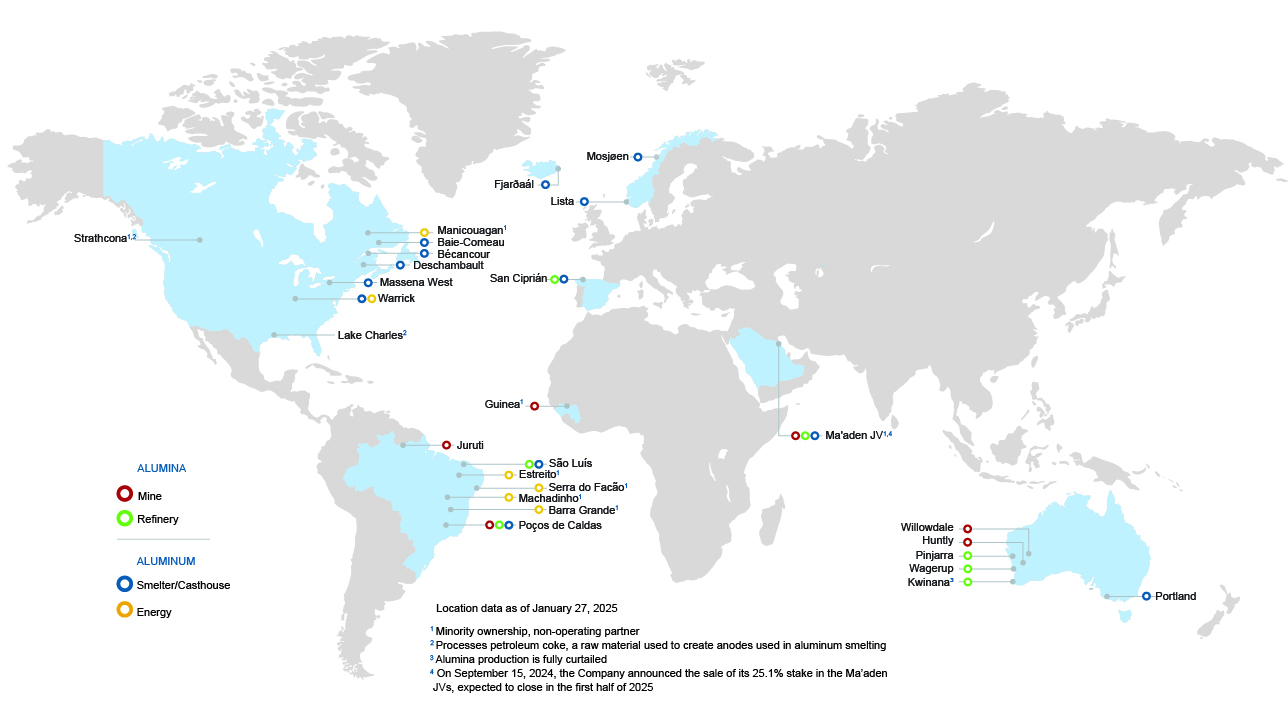
Alcoa Locations and Properties.
Although Alcoa’s facilities vary in terms of age and condition, management believes that its facilities are suitable and generally adequate to support the current and projected operations of the business. See Part II Item 8 of this Form 10-K in Notes B and K to the Consolidated Financial Statements for more information on properties, plants, and equipment.
Bauxite Mining Properties
Alcoa has access to large bauxite deposit areas with mining rights that extend, in the cases of Darling Range and Juruti, more than 15 years from the date of this Form 10-K. The Company obtains bauxite from its own resources located in the countries listed in the table below, as well as pursuant to both long-term and short-term contracts and mining leases. Tons of bauxite are reported on a zero-moisture basis in millions of dry metric tons (mdmt) unless otherwise stated.
32
As of December 31, 2024, the Company’s individually material mining properties, as determined in accordance with subpart 1300 of Regulation S-K, are our bauxite mining properties in the Darling Range of Western Australia (Darling Range) and Juruti, Brazil (Juruti).
As used in this Form 10-K, the terms “mineral resource,” “measured mineral resource,” “indicated mineral resource,” “inferred mineral resource,” “mineral reserve,” “proven mineral reserve” and “probable mineral reserve” are defined and used in accordance with subpart 1300 of Regulation S-K. Under subpart 1300 of Regulation S-K, mineral resources may not be classified as “mineral reserves” unless the determination has been made by a qualified person (as defined under subpart 1300 of Regulation S-K) that the mineral resources can be the basis of an economically viable project. Part or all of the mineral deposits (including any mineral resources) in these categories may never be converted into mineral reserves. Further, except for the portion of mineral resources classified as mineral reserves, mineral resources do not have demonstrated economic value. Estimates of inferred mineral resources have too high of a degree of uncertainty as to their existence and may not be converted to a mineral reserve. Therefore, it should not be assumed that all or any part of an inferred mineral resource exists, that it can be the basis of an economically viable project, or that it will ever be upgraded to a higher category. Likewise, it should not be assumed that all or any part of measured or indicated mineral resources will ever be converted to mineral reserves. Management relies on estimates of our recoverable mineral reserves, which estimation is complex due to geological characteristics of the properties and the number of assumptions made and variable factors, some of which are beyond our control.
The following table shows the AWAC and/or Alcoa share (proportion) of annual production tonnage at each of our bauxite mining properties and in the aggregate for each of the last three fiscal years. AWAC became wholly-owned by Alcoa upon its completion of the Alumina Limited acquisition on August 1, 2024.
Summary of Attributable Annual Bauxite Production (mdmt) for the years ended December 31, 2024, 2023, and 2022, respectively:
Country |
Property (Region) |
|
2024 |
|
|
2023 |
|
|
2022 |
|
|||
Australia |
Darling Range (Western Australia, WA) |
|
|
27.7 |
|
|
|
30.9 |
|
|
|
31.4 |
|
Brazil |
Juruti (Pará State) |
|
|
5.6 |
|
|
|
5.0 |
|
|
|
4.9 |
|
Brazil |
Trombetas (Pará State)(1) |
|
|
— |
|
|
|
— |
|
|
|
0.5 |
|
Brazil |
Poços de Caldas (Minas Gerais) |
|
|
0.4 |
|
|
|
0.4 |
|
|
|
0.4 |
|
Guinea |
Boké (Sangaredi) |
|
|
3.4 |
|
|
|
3.6 |
|
|
|
3.6 |
|
Saudi Arabia |
Al Ba’itha (Al Qassim) |
|
|
1.2 |
|
|
|
1.1 |
|
|
|
1.3 |
|
|
|
|
|
38.3 |
|
|
|
41.0 |
|
|
|
42.1 |
|
The following tables summarize certain information regarding our bauxite mining properties. The information that follows relating to Darling Range and Juruti is derived, for the most part, from the technical report summaries relating to such properties prepared in compliance with Item 601(b)(96) and subpart 1300 of Regulation S-K. Portions of the following information are based on assumptions, qualifications, and procedures that are not fully described herein. Reference should be made to the full text of the Technical Report Summary for Darling Range, Western Australia, dated February 20, 2025, with an effective date of December 31, 2024, filed as Exhibit 96.1 to this Form 10-K (the Darling Range TRS), and the Technical Report Summary for Juruti, Brazil, dated February 24, 2022, with an effective date of December 31, 2021, incorporated by reference as Exhibit 96.2 to this Form 10-K (the Juruti TRS), which are incorporated by reference herein.
33
Bauxite Interests and Operators:
Property |
Access/Transportation |
Operator |
Owners’ Mining Rights(1) |
Expiration Date of Mining Rights |
Titles, Rights, Leases or Options |
Area |
|
|
Darling Range(2) |
Accessed by road. Ore transported via long-distance conveyor and rail to refineries. |
AofA |
100% |
2045 |
Mining lease from the WA Government. ML1SA. |
|
702,261 |
|
Juruti(3) |
Accessed by road from Juruti town, by boat along the Amazon River, or by air from Juruti Airport. Ore transported from the mine to Juruti port by company-operated rail. |
AWAB |
100% |
2100(4) |
Mining licenses from the Government of Brazil and Pará. Mining rights do not have a legal expiration date. |
|
200,255 |
|
Poços de Caldas |
Accessed by road. Ore transported from the mine to the refinery by road. |
Alcoa Alumínio |
100% |
2031(4) |
Mining licenses from the Government of Brazil and Minas Gerais. Company claims and third-party leases. Operation licenses were renewed and unified and now expires in 2032. |
|
11,008 |
|
Boké |
Accessed by road from Sangaredi and public airports. Ore transported by company-operated rail to Kamsar port. |
CBG |
22.95% |
2038 |
Mining lease from Government of Guinea. The lease is renewable in 25-year increments. CBG’s rights are specified within the Basic Agreement and Amendment 1 to the Basic Agreement with the Government of Guinea. |
|
293,900 |
|
Al Ba’itha |
Accessed by road. Ore is transported to the refinery by rail and truck. |
MBAC |
25.1% |
2037 |
Mining lease granted to Ma’aden by Kingdom of Saudi Arabia Ministry of Petroleum and Mineral Resources, with a duration of 30 years. Exclusive rights to utilize bauxite and annexed minerals. |
|
14,776 |
|
34
Bauxite Mine Types and Facilities:
Property |
Development Stage |
Type of Mine |
Processing Plant |
Other Facilities |
Darling Range(1) |
Production/ Operating |
Open-cut mines. Bauxite is lateritic formed through weathering of Archean granites and gneisses |
N/A |
Administrative buildings and workshops, crushers, long-distance conveyors. Power supplied from natural gas. |
Juruti(2) |
Production/ Operating |
Open-cut mines. Bauxite is lateritic formed through weathering of Cretaceous Alter do Chao Formation sedimentary sequence. |
Fixed plant for ore crushing and washing. |
Mine: Administrative buildings and workshops, water supply pumps and pipeline from Juruti Grande, ore stockpiles, railroad, tailings thickening and settling ponds. |
Poços de Caldas |
Production/ Operating |
Open-cut mines. Bauxite derived from the weathering of nepheline syenite and phonolite. |
N/A |
Mining offices and services are located at the refinery. |
Boké |
Production/ Operating |
Open-cut mines: The bauxite deposits within the CBG lease are of two general types. |
N/A |
Mine: Administrative buildings, workshops, and water/power supply are in Sangaredi. |
Al Ba’itha |
Production/ Operating |
Open-cut mine. Bauxite occurs as a paleolaterite profile developed at an angular unconformity between underlying late Triassic to early Cretaceous sediments (parent rock sequence Biyadh Formation) and the overlying late Cretaceous Wasia Formation (overburden sequence). |
Fixed plant for ore crushing and train loading |
The mine includes fixed plants for crushing and train loading; workshops and ancillary services; power plant; and water supply. |
Bauxite Mineral Resources and Mineral Reserves
In accordance with subpart 1300 of Regulation S-K, management engaged SLR International Corporation as the qualified persons to prepare technical report summaries for the disclosure of mineral resources and reserves at Darling Range and Juruti. The tables shown below of resources and reserves by mining property were prepared using the results of the procedures performed by the qualified persons, which have no affiliation with or interest in Alcoa or our mining properties.
Summary of Attributable Bauxite Mineral Resources Exclusive of Mineral Reserves at December 31, 2024:
|
|
Measured |
|
|
Indicated |
|
|
Measured + Indicated |
|
|
Inferred |
|
||||||||||||||||||||||||||||
Property |
|
Tonnage |
|
Alumina |
|
Silica |
|
|
Tonnage |
|
Alumina |
|
Silica |
|
|
Tonnage |
|
Alumina |
|
Silica |
|
|
Tonnage |
|
Alumina |
|
Silica |
|
||||||||||||
Darling Range (WA)(2) |
|
|
139.6 |
|
|
30.4 |
|
|
1.8 |
|
|
|
48.7 |
|
|
30.3 |
|
|
1.4 |
|
|
|
188.4 |
|
|
30.4 |
|
|
1.7 |
|
|
|
101.4 |
|
|
32.4 |
|
|
1.2 |
|
Juruti (Pará State)(3) |
|
|
5.6 |
|
|
44.5 |
|
|
5.3 |
|
|
|
58.4 |
|
|
45.3 |
|
|
4.4 |
|
|
|
64.0 |
|
|
45.3 |
|
|
4.5 |
|
|
|
514.3 |
|
|
45.6 |
|
|
4.6 |
|
Poços de Caldas (Minas Gerais)(4) |
|
|
2.1 |
|
|
38.0 |
|
|
4.8 |
|
|
|
7.5 |
|
|
36.5 |
|
|
5.2 |
|
|
|
9.6 |
|
|
36.8 |
|
|
5.1 |
|
|
|
3.0 |
|
|
35.4 |
|
|
5.3 |
|
Boké (Sangaredi)(5) |
|
|
— |
|
|
— |
|
|
— |
|
|
|
1,357.2 |
|
|
46.6 |
|
|
2.3 |
|
|
|
1,357.2 |
|
|
46.6 |
|
|
2.3 |
|
|
|
173.5 |
|
|
45.8 |
|
|
2.4 |
|
Al Ba’itha (Al Qassim)(6) |
|
|
— |
|
|
— |
|
|
— |
|
|
|
— |
|
|
— |
|
|
— |
|
|
|
— |
|
|
— |
|
|
— |
|
|
|
0.7 |
|
|
48.3 |
|
|
11.7 |
|
35
The following table shows only the Alcoa share (proportion) of mineral reserves. These estimates are periodically updated to reflect past bauxite production, updated mine plans, new exploration information, and other geologic or mining data. Given the Company’s extensive bauxite resources, the abundant supply of bauxite globally, and the length of the Company’s rights to bauxite, it is not cost-effective to establish bauxite reserves that reflect the total size of the bauxite resources available to the Company. Certain totals may not sum due to rounding.
Summary of Attributable Bauxite Mineral Reserves at December 31, 2024:
|
|
Proven |
|
|
Probable |
|
|
Total |
|
|||||||||||||||||||||
Property (Region) |
|
Tonnage |
|
Alumina |
|
Silica |
|
|
Tonnage |
|
Alumina |
|
Silica |
|
|
Tonnage |
|
Alumina |
|
Silica |
|
|||||||||
Darling Range(2) |
|
|
26.1 |
|
|
29.2 |
|
|
1.6 |
|
|
|
397.6 |
|
|
30.8 |
|
|
1.6 |
|
|
|
423.7 |
|
|
30.7 |
|
|
1.6 |
|
Juruti (Pará State)(3) |
|
|
43.5 |
|
|
47.6 |
|
|
3.6 |
|
|
|
33.0 |
|
|
46.3 |
|
|
3.5 |
|
|
|
76.5 |
|
|
47.0 |
|
|
3.5 |
|
Poços de Caldas (Minas Gerais)(4) |
|
|
0.9 |
|
|
40.8 |
|
|
3.6 |
|
|
|
1.4 |
|
|
39.8 |
|
|
3.9 |
|
|
|
2.3 |
|
|
40.2 |
|
|
3.8 |
|
Boké (Sangaredi)(5) |
|
|
74.3 |
|
|
47.0 |
|
|
1.9 |
|
|
|
3.7 |
|
|
48.7 |
|
|
2.5 |
|
|
|
78.1 |
|
|
47.1 |
|
|
1.9 |
|
Al Ba’itha (Al Qassim)(6) |
|
|
14.0 |
|
|
50.2 |
|
|
8.0 |
|
|
|
31.8 |
|
|
45.5 |
|
|
11.1 |
|
|
|
45.7 |
|
|
46.9 |
|
|
10.1 |
|
Individual Property Disclosure—Darling Range
Property Location and Description
The Darling Range bauxite deposits comprise the mining centers of (i) Huntly, located approximately 80 kilometers (km) to the southeast of Perth and 30 km northeast of Pinjarra, Western Australia, Australia, and (ii) Willowdale, located approximately 100 km south-southeast of Perth and 20 km southeast of Waroona, Western Australia, Australia. The Huntly and Willowdale mining centers/regions are separate open pit, surface mines and are both located within Mining Lease ML1SA. Darling Range is owned and operated by Alcoa through AofA.
36
All spatial data used for mineral resource and reserve estimation are reported using a local grid based on Australian Map Grid 1984 system (Zone 50) and using the Australian Geodetic Datum 1984 coordinate set. The approximate coordinates of the mining areas are 410,000 m East and 6,390,000 m North (Huntly) and 410,000 m East and 6,365,000 m North (Willowdale).
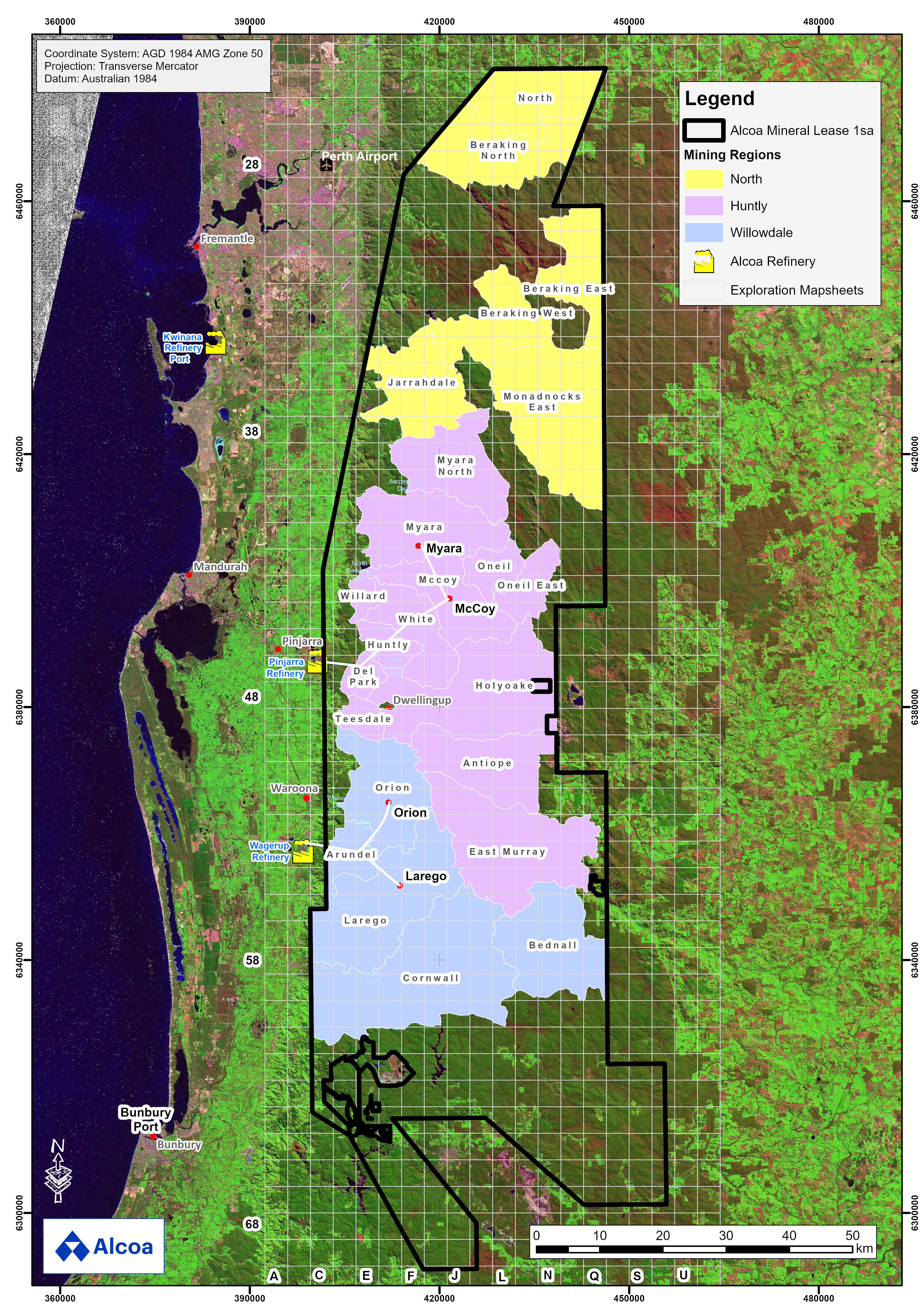
37
Darling Range Location, Lease Area, Mining Centers, and Mining Regions
Refer to the Darling Range TRS in Sections 2.0 through 5.0 for more information on the Darling Range mining centers – their history, location, accessibility, and other relevant details.
Infrastructure
The figure above illustrates the relative location of each of the individual mining areas within the Huntly and Willowdale centers. These areas include, but are not limited to, Myara, Larego, Orion, and Arundel.
Mining infrastructure in the Darling Range is generally concentrated in the Myara area in the northwest of the Huntly mining center, and at the Larego area (20 km southeast of the Wagerup refinery) in the center of the Willowdale mining center. Both infrastructure areas include:
Personnel are sourced from the area around Perth, Western Australia, which benefits from a skilled workforce due to the relatively large number of operating mines in the region.
Huntly is accessible from the South Western Highway via Del Park Road, which connects the town of North Dandalup in the north with Dwellingup in the south. From Del Park Road, a 3 km road following the route of the bauxite conveyor to the Pinjarra refinery provides access to the Huntly site administration offices. Willowdale is similarly accessible, 19 km from the South Western Highway via Willowdale Road, a road to the south of Waroona. There are several airstrips in the region, although the closest major airport is in Perth, approximately 70 km north of North Dandalup. The nearest commercial port is at the Kwinana refinery, approximately 40 km south of Perth.
While an extensive haul road network and overland conveyors transport crushed bauxite from the main mining hub to the Wagerup and Pinjarra refineries, bauxite was also transferred to the Kwinana refinery via the Kwinana freight railway system, using the Kwinana–Mundijong line prior to the full curtailment of the refinery in the second quarter of 2024.
Alcoa’s Darling Range mining operations do not produce mine waste in the same manner as conventional mining operations and waste dumps are not constructed.
Alcoa’s Darling Range facilities are in a well-maintained condition. Net book value of these facilities as of December 31, 2024 of $569 is included in Properties, plants, and equipment, net on the Consolidated Balance Sheet.
Refer to the Darling Range TRS in Sections 14.0 and 15.0 for more information on the surface infrastructure and facilities of the Darling Range.
Land Tenure and Permitting
Bauxite occurrences were first recorded in the Darling Range in 1902, with studies and exploration subsequently conducted by the Geological Survey of Western Australia until the 1950s. Commercial exploration took place from 1957 by Western Mining Corporation Ltd (later Western Australia NL, or WANL), across a large portion of southwest Western Australia within a Special Mineral Lease (ML1SA) granted in 1961. Commercial mining first took place within the Darling Range in 1963 at the former Jarrahdale mining center with WANL having joined with Alcoa. The Huntly and Willowdale mines commenced commercial production in 1972 and 1984, respectively. Huntly supplies bauxite to the Pinjarra refinery (approximately 17 Mtpa), while Willowdale supplies the Wagerup refinery (approximately 10 Mtpa). The Kwinana refinery was also supplied by Huntly until the completion of the full curtailment of the refinery in the second quarter of 2024.
38
The ML1SA lease allows for exploration and mining of bauxite within the tenement boundaries. ML1SA was granted in 1961, by the State Government of Western Australia under the Alumina Refinery Agreement Act, 1961 (the Act 1961), for four 21-year periods, and the current lease expires on September 24, 2045. The State Government concession agreement includes the provision for conditional renewal beyond 2045. Alcoa pays rent for each square mile of ML1SA in accordance with the Act 1961, providing exclusive rights to explore for and mine bauxite on all Crown Land within the ML1SA. The current lease covers an area of 702,261 hectares (ha).
There are certain annual requirements to maintain the existing permits and approvals associated with ML1SA, including:
The ML1SA area includes sub-lease arrangements made between Alcoa and the Worsley Alumina joint venture participants (the Worsley Participants). The agreements, made in August 2001 and September 2016, provide bauxite mining concessions to the Worsley Participants. No mineral resources or mineral reserves attributable to the Darling Range mining areas have been declared within these sub-lease areas.
Constraints on mining activities within the ML1SA concession are in place, among others, which prevent mining within: 200 m of the top water level margin of any water reservoirs; Serpentine Pipehead Dam Catchment; National Parks; Aboriginal Heritage Sites; Old Growth Forest; formal Conservation Areas; and 50 m of granite outcrop (greater than 1 ha), and Mining Avoidance Zones (MAZ) around the Western Australian forest towns of Dwellingup and Jarrahdale. Mineral resources and mineral reserves have not been defined in these restricted areas.
Additionally, the 2023-2027 MMP requires additional constraints including: a reduction in mining activities inside higher risk areas within drinking water catchments; no mining within 1 km of the top water level after June 30, 2024; no new pit clearing in areas with an average pit slope greater than 16 percent within any Reservoir Protection Zone (RPZ, 2 km from reservoir top water level); an acceleration of forest rehabilitation and a reduction in open mining areas; and a maximum annual clearing footprint of 800 ha. In October 2024, the 2023-2027 MMP approval was rolled over to cover the time period of 2024-2028 with the same conditions, noting some temporal conditions of the 2023-2027 MMP had expired and Alcoa had met certain other conditions prior to October 2024. The mineral resources and mineral reserves have been adjusted to reflect the conditions and will continue to change as new commitments are made or if future approvals require additional constraints.
Mining on a day-only basis is conducted in “noise zones” where noise from the mining operations will potentially exceed allowable levels. The operation actively seeks to maintain lower noise levels than those mandated, thus mining in these areas is undertaken by contract miners on day shifts only.
The Company has all environmental permits and operating licenses required for current mining activities. Outcomes of and compliance with the management and monitoring programs are tracked within Alcoa’s Environmental Management System and reported within the Annual Environmental Review report.
Refer to the Darling Range TRS in Section 3.0 for more information on Land Permitting and Tenure for the Darling Range.
Geology and Exploration
The Darling Range comprises a low incised plateau formed by uplift along the north-south trending Darling Fault, a major structural lineament that extends for over 250 km, from Bindoon in the north to Collie in the south. Bauxite deposits have been identified throughout the Darling Range and generally occur as erratically distributed alumina-rich lenses. Lateralization and subsequent periodic activity of the Darling Fault has resulted in the current landform of scarps and deeply incised valleys on the western edge of the Darling Range.
Systematic exploration for bauxite within the region commenced in the 1960s and is currently conducted on a continuous basis to maintain sufficient mineral resources and mineral reserves to meet refinery supply. Current mine plans include further exploration throughout all areas where Alcoa has mining permits to sustain future production.
Refer to the Darling Range TRS in Sections 6.0 through 11.0 for more information on the geology, mineralization, and exploration history of the Darling Range, including Quality Assurance / Quality Control (QA/QC) procedures and data used in the current mineral resource estimate.
39
Mining and Processing
The Huntly and Willowdale mines employ conventional open pit surface mining practices and equipment. Following definition of mineral reserve blocks, vegetation is cleared after which Alcoa operations commence stripping topsoil and secondary overburden removal using small excavators, scrapers, and trucks. Soil is stockpiled at the site, away from the proposed pit, for rehabilitation purposes. After completion of mining, overburden is progressively backfilled into adjacent exhausted pits, topsoiled, and rehabilitated by re-establishment of native vegetation, creating a stable post-mining landform that replicates the pre-existing environment.
The process plant for the Darling Range operations consists of two separate crushing facilities at the Huntly and Willowdale mines, respectively. Both facilities crush the ROM ore and convey the crushed ore to two separate refineries located at Pinjarra and Wagerup. The Pinjarra refinery is located adjacent to the east of the town of Pinjarra and is approximately 25 km southwest of the Huntly mining areas. The Wagerup refinery, supplied by Willowdale, is located immediately adjacent to the east of the South Western Highway, approximately 8 km south of Waroona and 20 km west of the Willowdale mining area. The Kwinana refinery was also supplied by Huntly until the completion of the full curtailment of the refinery in the second quarter of 2024. The Kwinana refinery is approximately 50 km northwest of Huntly in the city of Kwinana, approximately 40 km south of Perth.
The process plant is a dry crushing operation and therefore water is not required as a consumable for the plant. Alcoa’s Darling Range mining operations do not produce mine waste in the same manner as conventional mining operations and waste dumps are not constructed.
Refer to the Darling Range TRS in Sections 12.0 and 13.0 for a detailed description of the mineral reserves and mining methods used in the Darling Range.
Environmental and Social
Alcoa’s mine sites are monitored in accordance with the conditions of Government authorizations and its operational licenses at Huntly and Willowdale. Outcomes of and compliance with the management and monitoring programs are tracked within Alcoa’s Environmental Management System and reported within a Triennial Environmental Review report.
Alcoa works proactively with key regulatory agencies to address operational incidents and implement operational improvements to reduce releases to the environment.
In December 2023, the Western Australian government granted a section 6 exemption under the Environmental Protection Act 1986 that allows Alcoa to continue its mining operations while the Western Australian Environmental Protection Authority (WA EPA) assesses the environmental impact of parts of the MMP, following a third party’s referral of the Company’s future and existing mine plans in existing mine regions to the WA EPA in the first quarter of 2023. Compliance against the section 6 exemption is monitored on a weekly basis by an independent compliance monitor and reported monthly to the Department of Water and Environmental Regulation. In connection with the section 6 exemption, AofA committed to provide a bank guarantee which demonstrates Alcoa’s confidence that its operations will not impair drinking water supplies. In September 2024 and October 2024, AofA delivered bank guarantees totaling $62 (A$100). The requirement to provide financial assurance will expire upon the completion of the WA EPA’s assessment of the Company’s mine plans.
Alcoa is modernizing its environmental approvals framework for the Huntly bauxite mine and referred future mining plans to access Myara North and Holyoake to the WA EPA for assessment in 2020.
Refer to the Darling Range TRS in Section 17.0 for more information on the environmental, social, compliance, and permitting aspects of the Darling Range.
Mineral Resources and Mineral Reserves
In 2024, the economic cut-off for long term mine planning blocks at Darling Range was determined using an optimization that considers a base alumina price with deductions for costs associated with mining and processing the ore from each resource pit.
40
For information on Darling Range mineral resources and mineral reserves, refer to the tables above. For comparative purposes:
The decrease in measured and indicated mineral resources from December 31, 2023 to December 31, 2024 is reflected in the increase in reserves and is primarily due to changes in mine scheduling, partially offset by deferred mining of the RPZ and ongoing exploration activities. The decrease in inferred mineral resources from December 31, 2023 to December 31, 2024 is reflected in the increase in reserves and is primarily due to ongoing exploration activities. The mineral reserves increase from December 31, 2023 to December 31, 2024 is primarily attributable to pit optimization considering base alumina and caustic soda prices, changes in mine scheduling, ongoing exploration activities, and the conversion from mineral resources to mineral reserves, partially offset by deferred mining of the RPZ, constraints required under the 2023-2027 MMP, and mining depletion in 2024.
Additionally, refer to the Darling Range TRS Section 11.0 and 12.0 for more information on the mineral resources and mineral reserves of the Darling Range mines.
Individual Property Disclosure—Juruti
Property Location and Description
The Juruti bauxite mine is located in the west of Para State in northern Brazil. The mine is approximately 55 km south from the town of Juruti on the southern shore of the Amazon River. The mine is owned and operated by Alcoa through AWAB. The Juruti bauxite mine represents an established mining operation which commenced commercial production of bauxite in 2009.
All spatial data used for the mineral resource and mineral reserve estimation are reported using a local grid based on SIRGAS 2000 (21S). The approximate coordinates of the mining area for the Capiranga Central, Mauari, São Francisco, Mutum and Santarém plateaus are 618,879 m East and 9,721,768 m North, and for the Nhamundá plateau are 521,657 m East and 9,773,299 m North.
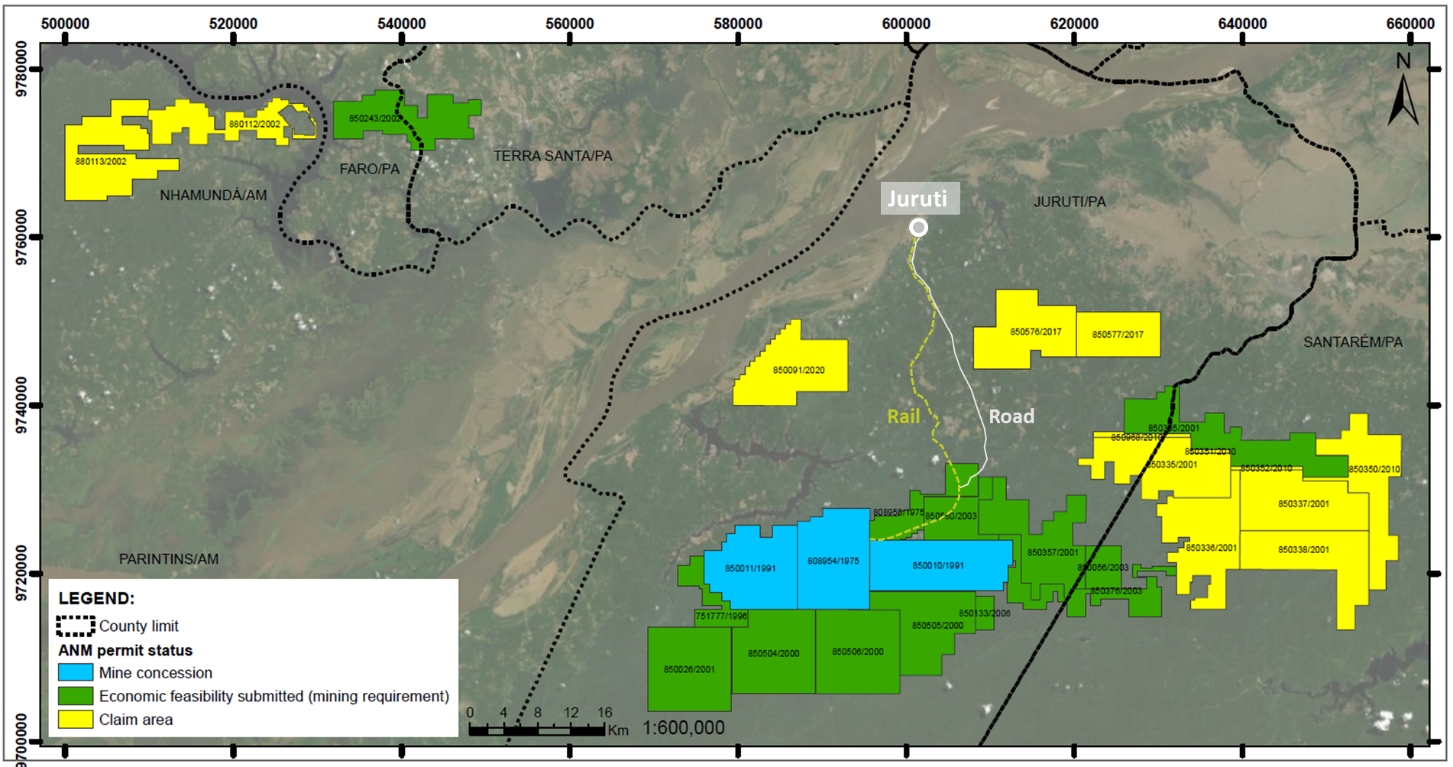
41
Juruti Location and Bauxite Mine Permit Areas
Refer to the Juruti TRS in Sections 2.0 through 5.0 for more information on the Juruti mine – history, location, accessibility, and other relevant details.
Infrastructure
Infrastructure required for bauxite mining operations is well-established and available, the majority of which is located within the area of the Juruti bauxite mine. The required infrastructure includes the following:
The Juruti mining area is connected to Juruti town and port facilities by a road that joins to the PA-257 road near the town, and a dedicated railway between the mining area and port. There are very few major roads across the region and the only major road in this area is the PA-257.
The nearest major city to Juruti is Santarem, approximately 160 km to the east and is only accessible by boat or by air from Juruti Airport (JRT) to Santarem-Maestro Wilson Fonseca Airport (STM). National roads connect Santarem to wider Para State including the port city of Belem on Brazil’s northern coast, approximately 1,400 km by road via the 230 and PA-151 roads.
Juruti began production in 2009 and the facilities are in a well-maintained condition. Net book value of these facilities as of December 31, 2024 of $392 is included in Properties, plants, and equipment, net on the Consolidated Balance Sheet.
Refer to the Juruti TRS in Sections 14.0 and 15.0 for more information on the surface infrastructure and facilities of the Juruti mine.
Land Tenure and Permitting
All exploration and mining activities are managed by the National Mining Agency, Agencia Nacional de Mineracao (ANM), under the Mining Code (1967). Permits are granted by the ANM and fall into two categories:
At Juruti there are three continuous mining concessions for an aggregated 29,410 ha, where current mineral reserves are determined. Brazilian mineral legislation does not limit the duration of mining concessions and instead the concession remains in force until the deposit is exhausted. These concessions may be extended later or expire earlier than estimated, based on the rate at which the deposits are exhausted and on obtaining any additional governmental approval, as necessary, such as operational licenses and environmental approvals.
42
In addition to the mining rights, there are thirteen requests for mining concessions, thirteen exploration permits, and two requests for exploration permits. The aggregated area for these permits is 170,845 ha.
The mining operations at Juruti take place on third-party land and, in accordance with the Mining Concession requirements, Alcoa currently has agreements in place with respective landowners. Agreements form a “mining easement,” which grants Alcoa access to the mining areas in exchange for compensation payments. As a result, there are no other titles, claims, leases, or options applicable to the exploration or mining permit areas which may limit Alcoa’s rights. Similarly, there are no liens or encumbrances.
The Company has all environmental permits and operating licenses required for current mining activities; there are no liens or encumbrances.
Refer to the Juruti TRS in Sections 3.0 and 17.0 for more information on Land Permitting and Tenure for the Juruti mine.
Geology and Exploration
The bauxite deposit of the Juruti bauxite mine consist of several lateritic bauxite plateaus which exist over a large lateral extent (several km) in comparison to the total thickness of the deposit (typically up to 20 m below surface).
Systematic exploration for bauxite within the region has persisted since Alcoa’s ownership and is currently conducted on a continuous basis to establish optimal mine plans to achieve a uniform quality of bauxite production. Current mine plans include further exploration throughout all areas where Alcoa has mining permits to sustain future production.
Refer to the Juruti TRS in Sections 6.0 through 11.0 for more information on the geology, mineralization, and exploration history of the Juruti mine, including QA/QC procedures and data used in the current mineral resource estimate.
Mining and Processing
Juruti is an active mining operation using surface strip mining methods over a total of eight plateaus whereby land clearance, topsoil removal, and overburden stripping is followed by bauxite deposit excavation and stockpiling. Waste is subsequently backfilled, and overburden and topsoil are re-instated for surface rehabilitation.
Juruti produces both a washed and unwashed bauxite product; however, all tonnage is presented on a zero-moisture basis. Bauxite processing takes place at a dedicated plant facility located at the Juruti mine site which has been operating since 2009 and comprises a simple comminution (crushing, screening) and washing circuit designed to remove fine particles from the ore.
Fine materials removed from ore are deposited in a thickening pond for settling and water reclamation, after which solid tailings are discarded into separate tailings ponds. There is currently one thickening pond and seven disposal ponds.
Refer to the Juruti TRS in Sections 12.0 and 13.0 for a detailed description of the mineral reserves and mining methods used in the Juruti mine.
Environmental and Social
Alcoa submits annual environmental reports in compliance with the Juruti operating licenses and approvals. Alcoa has shown that the Company works proactively with key regulatory agencies to address any operational non-compliances and implement operational improvements to reduce releases to the environment. No significant compliance issues were identified in the 2022/2023 and 2023/2024 annual environmental reports. Due to drought conditions, the mine applied for and received approval to move the water abstraction point in the Rio Juruti Grande water body in 2024. This new approval allows the abstraction of surface water at three points, to be used alternately. In 2024 the historically low water levels in the Amazon River required dredging to alleviate the impact on shipping operations. Closing the harbor affected community use, resulting in an increase in community complaints. Alcoa consulted the affected communities and have agreed upon compensation arrangements.
Refer to the Juruti TRS in Section 17.0 for more information on the environmental, social, compliance, and permitting aspects of the Juruti mine.
43
Mineral Resources and Mineral Reserves
For information on Juruti mineral resources and mineral reserves, refer to the tables above. For comparative purposes:
The decrease in mineral resources is attributable to changes in the application of mineral rights to the block models. The decrease in mineral reserves from December 31, 2023 reflects mining depletion during 2024. Refer to the Juruti TRS for more information on the mineral resources and mineral reserves of the Juruti mine.
Internal Controls
Alcoa has a long history of mining bauxite, with the majority of bauxite production having been used to supply Alcoa refineries.
Internal controls used by the Company are informed by internal reviews, representation on Technical Committees of Joint Venture operations, and by reviews, audits, and studies performed by third-party mining consultants. The controls include: surveying of drillhole collar locations, drill sample logging, collection and security, database verification and security, quality assurance/quality control (QA/QC) programs, internal and third-party qualified person statistical analysis, internal and third-party qualified person model validation, and reconciliation. Modelling and analysis of the Company’s resources is completed internally and reviewed by a qualified person, with the exception of Al Ba’itha where modelling and analysis is completed by a third-party consultant.
As the ore bodies are shallow and generally horizontal, two-dimensional seam modelling has been the standard practice; however, many operations are implementing more conventional 3D block modelling using geostatistical interpolation methods. Mineral resource estimation is validated internally through visual comparison of drillholes and model blocks as well as through the use of swath plots and statistical distributions. Mineral resource estimation is reviewed and adopted by a qualified person. Mineral reserve estimation is completed internally and reviewed by a qualified person, with the exception of Boké and Al Ba’itha where reserve estimation is completed by a third-party consultant.
Labelled samples from the drill site are securely transported for logging or temporary storage by the drilling contractor or Alcoa personnel. Additional transport to internal or external laboratories is controlled and completed, as necessary, by Alcoa personnel or by courier.
Drillhole databases are all site specific; most sites use industry standard drillhole database software, applications, and processes with security and backup protocols in place. Prior to modelling, secondary validation and cleansing of the modelling datasets is performed. Wherever possible, data collection is digital to allow direct loading into the database.
The Company has well-established QA/QC programs that are site specific. Although some programs are limited to laboratory protocols only covering analysis of duplicate pulps and standards, others involve, to varying degrees, the range of activities from twin hole drilling and collection of field duplicates, submission of blind duplicates and standards and submission of duplicate samples to umpire laboratories. Regardless of the level of QA/QC, all sites have well established and documented sampling and analysis regimes. QA/QC practices and available data are reviewed by a qualified person.
As discussed above, management relies on estimates for our mineral reserves and these estimates could change due to a number of factors, including future changes in: permitting requirements, geological conditions, ongoing mine planning, macroeconomic and industry conditions, and regulatory disclosure requirements. See Part I Item 1A of this Form 10-K for more information on risks.
44
Item 3. Legal Proceedings.
(dollars in millions)
In the ordinary course of its business, Alcoa is involved in a number of lawsuits and claims, both actual and potential. Proceedings that were previously disclosed may no longer be reported because, as a result of rulings in the case, settlements, changes in our business, or other developments, in our judgment, they are no longer material to Alcoa’s business, financial position or results of operations. See Part II Item 8 of this Form 10-K in Note S to the Consolidated Financial Statements for additional information regarding proceedings.
In addition to the matters discussed below, various other lawsuits, claims, and proceedings have been or may be instituted or asserted against Alcoa Corporation, including those pertaining to environmental, safety and health, commercial, tax, product liability, intellectual property infringement, governance, employment practices, employee and retiree benefit matters, and other actions and claims arising out of the normal course of business. While the amounts claimed in these other matters may be substantial, the ultimate liability is not readily determinable because of the considerable uncertainties that exist. Accordingly, it is possible that the Company’s liquidity or results of operations in a particular period could be materially affected by one or more of these other matters. However, based on facts currently available, management believes that the disposition of these other matters that are pending or asserted will not have a material adverse effect, individually or in the aggregate, on the financial position of the Company.
St. Croix Proceedings - Abednego and Abraham cases. In January 2010, ParentCo was served with a multi-plaintiff action complaint involving several thousand individual persons claiming to be residents of St. Croix alleging personal injury or property damage from Hurricane Georges or winds blowing material from the St. Croix Alumina, L.L.C. (SCA) facility on the island of St. Croix (U.S. Virgin Islands). This complaint, Abednego, et al. v. Alcoa, et al., which added the then current owners of the facility to a February 1999 action, was filed in the Superior Court of the Virgin Islands, St. Croix Division.
In 2012, ParentCo was served with a separate multi-plaintiff action alleging claims essentially identical to those set forth in the Abednego v. Alcoa complaint.
In 2015, the Superior Court dismissed all plaintiffs’ complaints without prejudice, permitting the plaintiffs to re-file the complaints individually. In 2017, the court issued an order that consolidated all timely complaints into the Red Dust Claims docket (Master Case No.: SX-15-CV-620). Following this order, a total of approximately 430 complaints were filed and accepted by the court, which included claims of approximately 1,360 individuals. In November 2018, the Red Dust Claims docket was transferred to the Complex Litigation Division within the Superior Court of the Virgin Islands. At such time, the Company was unable to reasonably predict an outcome or to estimate a range of reasonably possible loss, and thereafter the Red Dust Claims docket became inactive for several years. In March 2022, the Superior Court of the Virgin Islands issued an amended case management order dividing the complaints filed in the Red Dust docket into groups of 50 complaints, designated Groups A though I. The parties selected 10 complaints from Group A to proceed to trial as the Group A lead cases. In May 2024, the Court issued an amended case management order with regard to the Group A lead cases scheduling trials to begin in November 2024. The Court further ordered the parties to participate in mediation on or before August 31, 2024. Alcoa participated in the court-ordered mediation in August 2024 and reached a settlement agreement to resolve the matter in its entirety, which resulted in no further impact to Alcoa’s results of operations. The settlement was finalized in January 2025 upon receiving signed release agreements or final dismissals from every plaintiff. This matter is now closed.
Environmental Matters
SEC regulations require disclosure of certain environmental matters when a governmental authority is a party to the proceedings and such proceedings involve potential monetary sanctions that the Company reasonably believes will exceed a specified threshold. Pursuant to these regulations, the Company uses a threshold of $1 for purposes of determining whether disclosure of any such proceedings is required.
Alcoa is involved in proceedings under CERCLA and analogous state or other statutory or jurisdictional provisions regarding the usage, disposal, storage, or treatment of hazardous substances at a number of sites. The Company has committed to participate, or is engaged in negotiations with authorities relative to its alleged liability for participation, in clean-up efforts at several such sites. The most significant of these matters are discussed in Part II Item 8 of this Form 10-K in Note S to the Consolidated Financial Statements under the caption Contingencies.
Intalco (Washington) Notice of Violation—In May 2022, the Company received a Notice of Violation (NOV) from the U.S. Environmental Protection Agency (the EPA). The NOV alleges violations under the Clean Air Act at the Company’s Intalco smelter from when the smelter was operational. The EPA referred the matter to the U.S. Department of Justice, Environment and Natural Resources Division (the DOJ) in May 2022. The DOJ and the Company agreed to a stipulated settlement, which was filed with the United States District Court for the Western District of Washington at Seattle on July 18, 2024, requiring the Company to pay a civil fine of $5. On October 15, 2024, the Court approved the stipulated settlement of $5, and payment has been remitted by the Company. This matter is now closed.
45
Asbestos Litigation
Some of our subsidiaries as premises owners are defendants in active lawsuits filed in various jurisdictions on behalf of persons seeking damages for alleged personal injury as a result of occupational exposure to asbestos at various facilities. Our subsidiaries and acquired companies all have had numerous insurance policies over the years that provide coverage for asbestos based claims. Many of these policies provide layers of coverage for varying periods of time and for varying locations. We have significant insurance coverage and believe that our reserves are adequate for known asbestos exposure related liabilities. The costs of defense and settlement have not been and are not expected to be material to the results of operations, cash flows, and financial position of Alcoa Corporation.
Item 4. Mine Safety Disclosures.
Not applicable.
46
PART II
Item 5. Market for Registrant’s Common Equity, Related Stockholder Matters and Issuer Purchases of Equity Securities.
(dollars in millions, except share and per-share amounts)
Shares of the Company’s common stock are listed on the New York Stock Exchange, its principal market, and trade in U.S. dollars under the symbol “AA.” Alcoa Corporation CHESS Depositary Interests (CDIs), each representing one share of the Company’s common stock, are listed on the Australian Stock Exchange and trade in Australian dollars under the symbol “AAI.”
On October 14, 2021, Alcoa Corporation announced the initiation of a quarterly cash dividend program and the Board of Directors declared the first quarterly cash dividend of $0.10 per share of the Company’s common stock, which was paid during the fourth quarter of 2021. Alcoa Corporation paid quarterly cash dividends of $0.10 per share in 2022, 2023, and 2024. Dividends on Alcoa Corporation common stock and Series A preferred stock are subject to authorization by the Company’s Board of Directors. The Company intends to pay cash dividends on a quarterly basis; however, the payment, amount, and timing of dividends, if any, depends upon matters deemed relevant by the Company’s Board of Directors, such as Alcoa Corporation’s financial position, results of operations, cash flows, capital requirements, business condition, future prospects, any limitations imposed by law, credit agreements or senior securities, and other factors deemed relevant and appropriate. See Part II Item 7 of this Form 10-K in Management’s Discussion and Analysis of Financial Condition and Results of Operations under caption Liquidity and Capital Resources – Financing Activities for more information.
As of February 14, 2025, there were approximately 7,200 holders of record of shares of the Company’s common stock and approximately 39,800 holders of record of the Company’s CDIs. Because many of Alcoa Corporation’s shares and CDIs are held by brokers and other institutions on behalf of stockholders, the Company is unable to estimate the total number of stockholders represented by these holders.
Unregistered Sales of Equity Securities
Information required by Item 701 of Regulation S-K with respect to the Company’s issuance of Alcoa common stock (including common stock underlying CDIs) and Alcoa Series A convertible preferred stock is included in the Company’s Current Report on Form 8-K, filed with the SEC on August 1, 2024.
47
Stock Performance Graph
The following graph compares Alcoa Corporation’s cumulative total stockholder return (i.e., stock price change plus reinvestment of dividends) with the cumulative total stockholder returns of (1) the Standard and Poor’s (S&P) Metals & Mining Select Industry Index, and (2) the S&P MidCap 400® Index. This comparison was based on an initial investment of $100, including the reinvestment of any dividends, on December 31, 2019 through December 31, 2024.
The stock performance information included in this graph is based on historical results and is not necessarily indicative of future stock price performance.
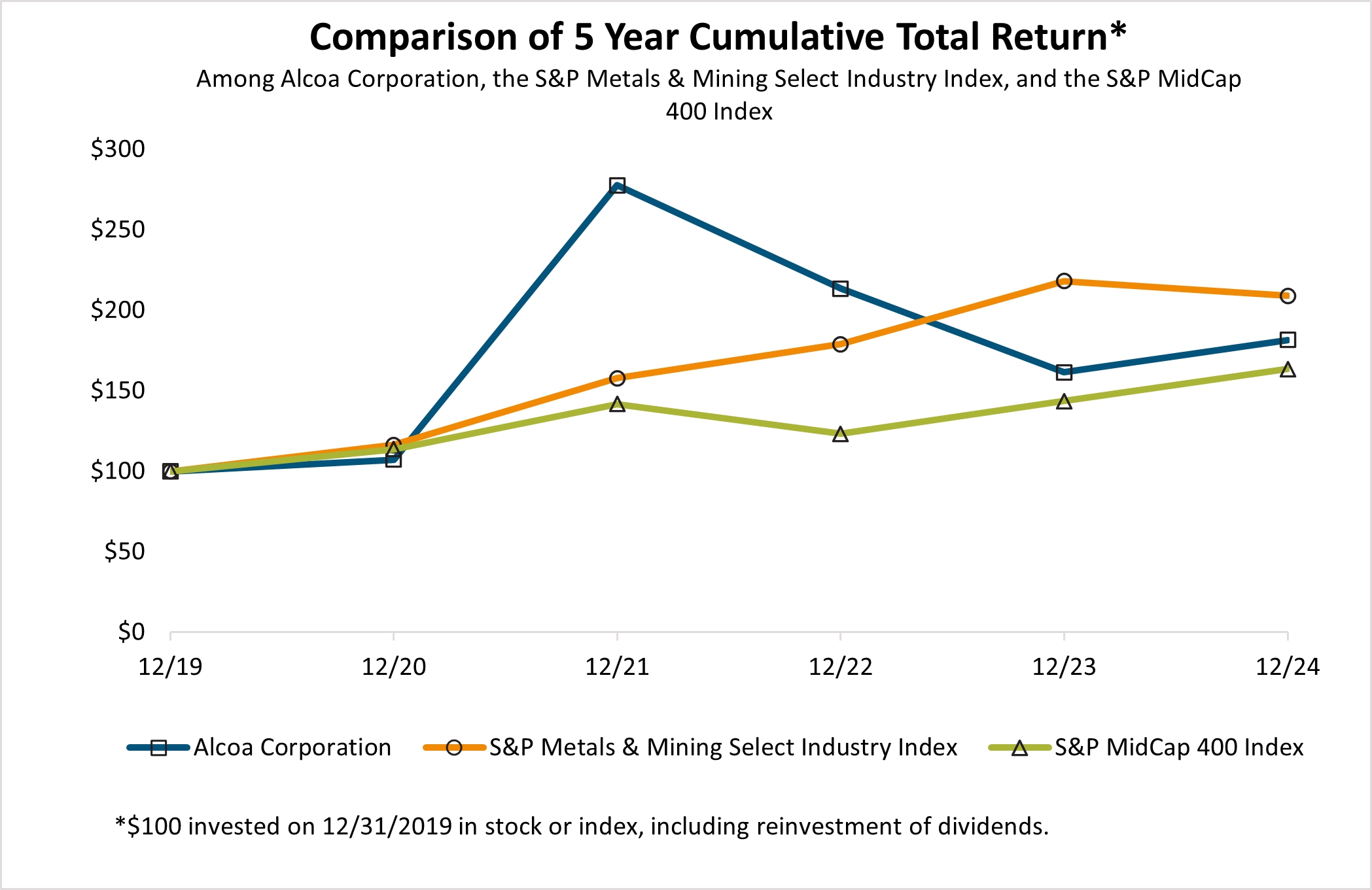
December 31, |
2019 |
|
2020 |
|
2021 |
|
2022 |
|
2023 |
|
2024 |
|
||||||||||||
Alcoa Corporation |
|
$ |
100 |
|
|
$ |
107 |
|
|
$ |
278 |
|
|
$ |
213 |
|
|
$ |
161 |
|
|
$ |
182 |
|
S&P Metals & Mining Select Industry Index |
|
|
100 |
|
|
|
116 |
|
|
|
158 |
|
|
|
179 |
|
|
|
218 |
|
|
|
209 |
|
S&P MidCap 400 Index |
|
|
100 |
|
|
|
114 |
|
|
|
142 |
|
|
|
123 |
|
|
|
144 |
|
|
|
164 |
|
Issuer Purchases of Equity Securities
Fourth Quarter 2024 |
|
Total Number of Shares Purchased |
|
|
Weighted Average Price Paid Per Share |
|
|
Total Number of Shares Purchased as Part of Publicly Announced Program |
|
|
Approximate Dollar Value of Shares that May Yet be Purchased Under the Program(1) |
|
||||
October 1 to October 31 |
|
|
— |
|
|
$ |
— |
|
|
|
— |
|
|
$ |
500 |
|
November 1 to November 30 |
|
|
— |
|
|
|
— |
|
|
|
— |
|
|
|
500 |
|
December 1 to December 31 |
|
|
— |
|
|
|
— |
|
|
|
— |
|
|
|
500 |
|
Total |
|
|
— |
|
|
|
— |
|
|
|
— |
|
|
|
|
|
As of the date of this report, the Company is currently authorized to repurchase up to a total of $500, in the aggregate, of its outstanding shares of common stock under the July 2022 authorization. Repurchases under this program may be made using a variety of methods, which may include open market purchases, privately negotiated transactions, or pursuant to a Rule 10b5-1 plan. This program may be suspended or discontinued at any time and does not have a predetermined expiration date. Alcoa Corporation intends to retire repurchased shares of common stock.
Item 6. [RESERVED]
48
Item 7. Management’s Discussion and Analysis of Financial Condition and Results of Operations.
(dollars in millions, except per-share amounts, average realized prices, and average cost amounts;
metric tons in thousands (kmt); dry metric tons in millions (mdmt))
Forward-Looking Statements
This report contains statements that relate to future events and expectations and as such constitute forward-looking statements within the meaning of the Private Securities Litigation Reform Act of 1995. Forward-looking statements include those containing such words as “aims,” “ambition,” “anticipates,” “believes,” “could,” “develop,” “endeavors,” “estimates,” “expects,” “forecasts,” “goal,” “intends,” “may,” “outlook,” “potential,” “plans,” “projects,” “reach,” “seeks,” “sees,” “should,” “strive,” “targets,” “will,” “working,” “would,” or other words of similar meaning. All statements by Alcoa Corporation that reflect expectations, assumptions or projections about the future, other than statements of historical fact, are forward-looking statements, including, without limitation, statements regarding forecasts concerning global demand growth for bauxite, alumina, and aluminum, and supply/demand balances; statements, projections or forecasts of future or targeted financial results, or operating performance (including our ability to execute on strategies related to environmental, social and governance matters); statements about strategies, outlook, and business and financial prospects; and statements about capital allocation and return of capital. These statements reflect beliefs and assumptions that are based on Alcoa Corporation’s perception of historical trends, current conditions, and expected future developments, as well as other factors that management believes are appropriate in the circumstances.
Forward-looking statements are not guarantees of future performance and are subject to known and unknown risks, uncertainties, and changes in circumstances that are difficult to predict. Although Alcoa Corporation believes that the expectations reflected in any forward-looking statements are based on reasonable assumptions, it can give no assurance that these expectations will be attained and it is possible that actual results may differ materially from those indicated by these forward-looking statements due to a variety of risks and uncertainties. Such risks and uncertainties include, but are not limited to: (a) the impact of global economic conditions on the aluminum industry and aluminum end-use markets; (b) volatility and declines in aluminum and alumina demand and pricing, including global, regional, and product-specific prices, or significant changes in production costs which are linked to LME or other commodities; (c) the disruption of market-driven balancing of global aluminum supply and demand by non-market forces; (d) competitive and complex conditions in global markets; (e) our ability to obtain, maintain, or renew permits or approvals necessary for our mining operations; (f) rising energy costs and interruptions or uncertainty in energy supplies; (g) unfavorable changes in the cost, quality, or availability of raw materials or other key inputs, or by disruptions in the supply chain; (h) economic, political, and social conditions, including the impact of trade policies, tariffs, and adverse industry publicity; (i) legal proceedings, investigations, or changes in foreign and/or U.S. federal, state, or local laws, regulations, or policies; (j) changes in tax laws or exposure to additional tax liabilities; (k) climate change, climate change legislation or regulations, and efforts to reduce emissions and build operational resilience to extreme weather conditions; (l) disruptions in the global economy caused by ongoing regional conflicts; (m) fluctuations in foreign currency exchange rates and interest rates, inflation and other economic factors in the countries in which we operate; (n) global competition within and beyond the aluminum industry; (o) our ability to achieve our strategies or expectations relating to environmental, social, and governance considerations; (p) claims, costs, and liabilities related to health, safety and environmental laws, regulations, and other requirements in the jurisdictions in which we operate; (q) liabilities resulting from impoundment structures, which could impact the environment or cause exposure to hazardous substances or other damage; (r) dilution of the ownership position of the Company’s stockholders, price volatility, and other impacts on the price of Alcoa common stock by the secondary listing of the Alcoa common stock on the Australian Securities Exchange; (s) our ability to obtain or maintain adequate insurance coverage; (t) our ability to execute on our strategy to reduce complexity and optimize our asset portfolio and to realize the anticipated benefits from announced plans, programs, initiatives relating to our portfolio, capital investments, and developing technologies; (u) our ability to integrate and achieve intended results from joint ventures, other strategic alliances, and strategic business transactions; (v) our ability to fund capital expenditures; (w) deterioration in our credit profile or increases in interest rates; (x) impacts on our current and future operations due to our indebtedness; (y) our ability to continue to return capital to our stockholders through the payment of cash dividends and/or the repurchase of our common stock; (z) cyber attacks, security breaches, system failures, software or application vulnerabilities, or other cyber incidents; (aa) labor market conditions, union disputes and other employee relations issues; (bb) a decline in the liability discount rate or lower-than-expected investment returns on pension assets; and (cc) the other risk factors discussed in Part 1 Item 1A of this Form 10-K and other reports filed by Alcoa Corporation with the SEC, including those described in this report.
We caution readers not to place undue reliance upon any such forward-looking statements, which speak only as of the date they are made. Alcoa Corporation disclaims any obligation to update publicly any forward-looking statements, whether in response to new information, future events or otherwise, except as required by applicable law. Market projections are subject to the risks described above and other risks in the market.
49
Overview
Our Business
Alcoa Corporation (Alcoa or the Company) is a vertically integrated aluminum company comprised of bauxite mining, alumina refining, aluminum production (smelting and casting), and energy generation. Aluminum is a commodity that is traded on the London Metal Exchange (LME) and priced daily. Additionally, alumina is subject to market pricing through the Alumina Price Index (API), which is calculated by the Company based on the weighted average of a prior month’s daily spot prices published by the following three indices: CRU Metallurgical Grade Alumina Price, Platts Metals Daily Alumina PAX Price, and FastMarkets Metal Bulletin Non-Ferrous Metals Alumina Index. As a result, the price of both aluminum and alumina is subject to significant volatility and, therefore, influences the operating results of Alcoa Corporation.
Through direct and indirect ownership, Alcoa Corporation has 26 operating locations in nine countries around the world, situated primarily in Australia, Brazil, Canada, Iceland, Norway, Spain, and the United States. Governmental policies, laws and regulations, and other economic factors, including inflation and fluctuations in foreign currency exchange rates and interest rates, affect the results of operations in these countries.
Business Update
During 2024, Alcoa experienced strength in alumina and aluminum pricing and made significant progress on its key operational, commercial, financial, and capital allocation objectives, delivering on strategic actions and operational improvements.
Average alumina and aluminum prices increased by 37% and 7%, respectively, with the alumina price reaching an all-time high in the fourth quarter of 2024 driven primarily by supply disruptions. The increase in alumina price outweighed the increase in aluminum price. The alumina and aluminum markets ended 2024 in a volume deficit or balanced, respectively. The cost for energy and raw materials, including carbon products, caustic soda, and other key inputs decreased.
Nine of the Company's eleven smelters increased annual production, while the Mosjøen (Norway) smelter, the Warrick (Indiana) smelter, and the Company’s smelters in Canada set annual production records. The Company’s mine operations successfully operated under new mine conditions in Western Australia, which included daily observation of its mining and rehabilitation practices by certain regulators.
Commercially, the Company expanded a number of important customer and supplier relationships and invested in growth capital expenditures to enhance value add products to meet its customer demand.
The Company delivered changes to improve the financial performance of its operating portfolio. The Alumar (Brazil) smelter steadily improved stability and increased operating capacity to approximately 84 percent at December 31, 2024.
The Company announced the curtailment of the Kwinana (Australia) refinery in January 2024 and completed the full curtailment in the second quarter of 2024.
Alcoa completed the acquisition of Alumina Limited on August 1, 2024. The acquisition enhances Alcoa’s position as a leading pure play, upstream aluminum company globally, while simplifying the Company’s corporate structure and governance, resulting in greater financial flexibility and strategic optionality.
In September 2024, Alcoa announced the sale of its 25.1% interest in the Saudi Arabia joint venture to Ma’aden. This decision aligns with the Company’s ongoing efforts to streamline its operations and is expected to provide Alcoa with enhanced financial flexibility.
In October 2024, Alcoa announced that it is progressing toward entering into a strategic partnership with IGNIS Equity Holdings, SL (IGNIS EQT), to support the continued operation of the San Ciprián complex. On January 21, 2025, the Company, the Spanish national and Xunta regional governments, and IGNIS EQT signed a memorandum of understanding that outlines a process for the parties to work cooperatively toward the common objective of improving the long-term outlook for the San Ciprián operations.
In November 2024, the Company began de-levering and repaid $385 drawn under the Alumina Limited Revolving Credit Facility, which was assumed in connection with acquisition.
50
Alumina Limited Acquisition
On August 1, 2024, Alcoa completed the acquisition of all of the ordinary shares of Alumina Limited (Alumina Shares) through a wholly-owned subsidiary, AAC Investments Australia 2 Pty Ltd. At acquisition, Alumina Limited held a 40% ownership interest in the AWAC joint venture.
Under the Scheme Implementation Deed (the Agreement) entered into in March 2024, as amended in May 2024, holders of Alumina Shares received 0.02854 Alcoa CHESS Depositary Interests (CDIs) for each Alumina Share (the Agreed Ratio), except that i) holders of Alumina Shares represented by American Depositary Shares, each of which represented 4 Alumina Shares, received 0.02854 shares of Alcoa common stock and ii) a certain shareholder received, for certain of their Alumina Shares, 0.02854 shares of Alcoa non-voting convertible preferred stock. The Alcoa CDIs are quoted on the Australian Stock Exchange.
At closing, Alumina Shares outstanding of 2,760,056,014 and 141,625,403 were exchanged for 78,772,422 and 4,041,989 shares of Alcoa common stock and Alcoa preferred stock, respectively. Based on Alcoa’s closing share price as of July 31, 2024, the Agreed Ratio implied a value of A$1.45 per Alumina Share and aggregate purchase consideration of approximately $2,700 for Alumina Limited.
For Alcoa stockholders, the transaction enhances Alcoa’s vertical integration along the value chain across bauxite mining, alumina refining, and aluminum smelting, increases Alcoa’s economic interest in its bauxite and alumina assets, simplifies governance, and reaffirms Alcoa’s commitment to Western Australia. In addition to the implied premium over prior share prices, Alumina Limited shareholders’ ownership is diversified to a large-scale, global upstream aluminum portfolio.
The transaction consisted in substance of the acquisition of Alumina Limited’s noncontrolling interest in AWAC ($1,472), the assumption of Alumina Limited’s indebtedness ($385), the recognition of deferred tax assets ($216) primarily related to Alumina Limited’s prior net operating losses and the tax allocation of the fixed asset valuation to individual assets, and the acquisition of cash ($9) and other current liabilities ($1). The transaction was accounted for as an equity transaction where net assets acquired ($1,311) and transaction costs ($32) were reflected as an increase to Additional capital. Net income attributable to noncontrolling interest was recognized through July 31, 2024. In November 2024, Alcoa repaid the full amount ($385) of Alumina Limited's indebtedness and cancelled the agreement.
Saudi Arabia Joint Venture
On September 15, 2024, Alcoa entered into a share purchase and subscription agreement with Ma’aden, pursuant to which Alcoa agreed to sell its full ownership interest of 25.1% in the Saudi Arabia joint venture, comprised of the Ma’aden Bauxite and Alumina Company and the Ma’aden Aluminium Company, to Ma’aden in exchange for issuance by Ma’aden of approximately 86 million shares and $150 in cash. The implied value of the shares was $950 as of September 12, 2024, based on the volume-weighted average share price of Ma’aden for the previous 30 calendar days. The shares of Ma’aden will be subject to transfer and sale restrictions, including a restriction requiring Alcoa to hold its Ma’aden shares for a minimum of three years, with one-third of the shares becoming transferable after each of the third, fourth, and fifth anniversaries of closing of the transaction (the holding period). During the holding period, Alcoa would be permitted to hedge and borrow against its Ma’aden shares. Under certain circumstances, such minimum holding period would be reduced. The transaction is subject to regulatory approvals, approval by Ma’aden’s shareholders, and other customary closing conditions and is expected to close in the first half of 2025. The carrying value of Alcoa’s investment was $544 as of December 31, 2024.
Australia Mine Plan Approvals
During 2024, the Company continued to advance mine approvals for the next major Australian mine regions (Myara North and Holyoake), which were referred for accredited assessment by the WA EPA under the Accredited Assessment. Alcoa began the process in 2020, is focused on receiving approval by the first quarter of 2026, and anticipates mining in new regions will commence no earlier than 2027. Until then, the Company expects bauxite quality will remain similar to recent grades.
During the third quarter of 2024, the WA EPA set an indicative timeline for the next key step in the approval process, the public comment period, for early 2025.
The Company continues work to seek annual endorsement from the Western Australian State Government for its rolling five-year mine plan. Separately, in 2023, a third party referred the Company’s current five-year mine plan to the WA EPA for assessment (Third-Party Referral). This Third-Party Referral remains under assessment, and the public comment period is expected to be in early 2025 in accordance with the WA EPA streamlined process.
The Company is committed to working collaboratively with the WA EPA and other stakeholders to achieve the indicative timelines set by the WA EPA.
Additionally, the Company is evaluating conditions recommended by the WA EPA in similar accredited assessment processes to address the majority of relevant published conditions in the Company’s Environmental Review Document, which Alcoa will submit as part of the Accredited Assessment prior to the upcoming public comment period.
51
Portfolio Actions
Portfolio Review
In October 2024, the Company completed its five-year strategic portfolio review to improve cost positioning, or curtail, close, or divest 1.5 million and 4 million metric tons of smelting and refining capacity, respectively. The Company reached approximately 93 percent of its target for smelting capacity with the decision to restart capacity at the Warrick smelter completed in the first quarter 2024, and exceeded its target for refining capacity with the decision to curtail the Kwinana refinery in January 2024. The Company continues to evaluate assets for opportunities for improvement to remain profitable throughout business cycles.
Kwinana Refinery
In June 2024, Alcoa completed the full curtailment of the Kwinana refinery, as planned, which was announced in January 2024. The Company’s decision to fully curtail the refinery was made based on a variety of factors, including the refinery’s age, scale, operating costs, and current bauxite grades, in addition to market conditions.
Prior to the curtailment, the refinery had been operating at approximately 80 percent of its annual nameplate capacity of 2.2 million metric tons since January 2023, when the Company reduced production in response to a domestic natural gas shortage in Western Australia due to production challenges experienced by key gas suppliers.
As of March 2024, the refinery had approximately 780 employees and this number was reduced to approximately 250 through the fourth quarter of 2024 to manage certain processes that are expected to continue until about the fourth quarter of 2025. At that time, the employee number will be further reduced to approximately 50.
San Ciprián Operations
On October 16, 2024, Alcoa announced that it is progressing toward entering into a strategic partnership with IGNIS EQT, the majority shareholder in the IGNIS Group of Companies, a vertically integrated energy company based in Spain, to support the continued operation of the San Ciprián complex.
The proposed agreement is conditional upon delivery of key areas of cooperation with San Ciprián’s stakeholders, including the Spanish national government, the Xunta regional government, and San Ciprián employees and workers’ representatives. Key areas include:
On January 21, 2025, the Company, the Spanish national and Xunta regional governments, and IGNIS EQT signed a memorandum of understanding that outlines a process for the parties to work cooperatively toward the common objective of improving the long-term outlook for the San Ciprián operations and focuses on the key areas of cooperation (see above).
Under the proposed agreement, Alcoa would contribute approximately $78 (€75), and IGNIS EQT would make an initial investment of approximately $26 (€25) to fund the operations. Alcoa would continue as the managing operator of the San Ciprián complex, with IGNIS EQT holding 25 percent ownership. Additionally, up to approximately $104 (€100) would be funded by Alcoa as needed for operations with a priority position in future cash returns. Further funding would require agreement by both partners and would be shared 75 percent by Alcoa and 25 percent by IGNIS EQT.
Alcoa has operated the San Ciprián complex for a number of years in a challenging economic environment, primarily due to the high cost of energy. In the first quarter of 2024, Alcoa launched a sale process while also working to identify solutions for the long-term viability of the operations.
Despite sharing information with 60 potential investors, no viable bid was made for 100 percent of the San Ciprián complex. The potential partnership with IGNIS EQT emerged as an alternative for San Ciprián in which Alcoa can leverage its expertise in managing global aluminum operations, combined with IGNIS EQT’s strong knowledge of energy markets, to create value via market access and energy management services.
The refinery and smelter incurred substantial losses in 2024 and in prior years. As of December 31, 2024, the Spanish entities that own these operations had approximately $25 of available funding with cash on hand (excluding restricted cash to be made available for capital improvements at the site and smelter restart costs). Although aluminum and alumina prices improved during 2024, the San Ciprián complex remains unviable based on current and forward market assumptions for delivered energy in Spain and sales prices. Based on economic conditions as of December 31, 2024, the San Ciprián operations are expected to incur losses in 2025 and barring finalizing a partnership agreement with IGNIS EQT, Alcoa anticipates that available funding will be exhausted near the end of the first quarter of 2025.
52
Warrick Operations
During the first quarter of 2024, the Company completed the restart of one potline (54 kmt) at the Warrick smelter in Indiana that began in October 2023, and incurred restart expenses of $3.
Other Matters
In February 2025, the U.S. government established a 25% tariff on a wide range of goods imported from Canada into the United States to take effect on March 4, 2025. Energy resources from Canada, which appears to include aluminum as it is listed as a critical mineral, will be subject to a lower 10% tariff. In addition, in February 2025, the U.S. government expanded tariffs existing under Section 232 of the Trade Expansion Act of 1962 (Section 232) by raising the aluminum tariffs from 10% to 25%, ending all country exemptions, phasing out specific product exclusions, and terminating all existing general approved exclusions. It is unclear if aluminum imported from Canada after March 12, 2025 will be subject to both the 10% tariffs on energy resources and the 25% Section 232 tariffs. Due to the uncertainty related to the application of the tariffs, Alcoa is unable to reasonably estimate the impact to the Company’s results of operations until clarification is provided by the U.S. government.
In March 2024, the Company completed an offering of $750 aggregate principal amount of 7.125 percent senior notes due in 2031. This was the Company’s first notes issuance under its Green Finance Framework, which prioritizes climate change mitigation expenditures related to circular or low carbon products, pollution prevention technologies, renewable energy, and water management. The Company is utilizing the net proceeds to finance and/or refinance, in whole or in part, new and/or existing qualifying projects on a two-year look back that meet certain eligibility criteria within its Green Finance Framework. The net proceeds also support the Company’s cash position and ongoing cash needs, including with respect to its previously announced portfolio actions. The Company does not expect to allocate part of the net proceeds to significant capital investments in breakthrough technologies as those are not expected to occur within the applicable time period.
During the first quarter of 2024, the Company initiated and fully deployed a productivity and competitiveness program across its global operations and functions. The program is part of the Company’s objective to improve overall competitiveness and profitability and includes a target to save approximately 5 percent of operating costs, exclusive of raw materials, energy and transportation costs, which are already under active management and cost control programs. Total savings are expected to approximate $100 on a run rate basis and to be achieved by the first quarter of 2025.
The Company paid a quarterly cash dividend of $0.10 per share of the Company’s common stock (including common stock underlying CDIs) and Series A convertible preferred stock during 2024, totaling $90.
See the below sections for additional details on the above-described actions.
Basis of Presentation
The Consolidated Financial Statements of Alcoa Corporation are prepared in conformity with accounting principles generally accepted in the United States of America (GAAP). In accordance with GAAP, certain situations require management to make estimates based on judgments and assumptions, which may affect the reported amounts of assets and liabilities and the disclosure of contingent assets and liabilities at the date of the financial statements. They also may affect the reported amounts of revenues and expenses during the reporting periods. Management uses historical experience and all available information to make these estimates. Management regularly evaluates the judgments and assumptions used in its estimates, and results could differ from those estimates upon future events and their effects or new information.
53
Results of Operations
The discussion that follows includes a comparison of our results of operations and liquidity and capital resources for the fiscal years ended December 31, 2024 and 2023. For a comparison of changes for the fiscal years ended December 31, 2023 and 2022, refer to Management’s Discussion and Analysis of Financial Condition and Results of Operation in Part II Item 7 of Alcoa Corporation’s Annual Report on Form 10-K for the year ended December 31, 2023 (filed February 21, 2024).
|
|
For the year ended December 31, |
|
|||||
Statement of Operations |
|
2024 |
|
|
2023 |
|
||
Sales |
|
$ |
11,895 |
|
|
$ |
10,551 |
|
Cost of goods sold (exclusive of expenses below) |
|
|
10,044 |
|
|
|
9,813 |
|
Selling, general administrative, and other expenses |
|
|
275 |
|
|
|
226 |
|
Research and development expenses |
|
|
57 |
|
|
|
39 |
|
Provision for depreciation, depletion, and amortization |
|
|
642 |
|
|
|
632 |
|
Restructuring and other charges, net |
|
|
341 |
|
|
|
184 |
|
Interest expense |
|
|
156 |
|
|
|
107 |
|
Other expenses, net |
|
|
91 |
|
|
|
134 |
|
Total costs and expenses |
|
|
11,606 |
|
|
|
11,135 |
|
Income (loss) before income taxes |
|
|
289 |
|
|
|
(584 |
) |
Provision for income taxes |
|
|
265 |
|
|
|
189 |
|
Net income (loss) |
|
|
24 |
|
|
|
(773 |
) |
Less: Net loss attributable to noncontrolling interest |
|
|
(36 |
) |
|
|
(122 |
) |
Net income (loss) attributable to Alcoa Corporation |
|
$ |
60 |
|
|
$ |
(651 |
) |
Selected Financial Metrics |
|
2024 |
|
|
2023 |
|
||
Diluted income (loss) per share attributable to Alcoa |
|
$ |
0.26 |
|
|
$ |
(3.65 |
) |
Third-party shipments of alumina (kmt) |
|
|
9,005 |
|
|
|
8,698 |
|
Third-party shipments of aluminum (kmt) |
|
|
2,590 |
|
|
|
2,491 |
|
Average realized price per metric ton of alumina |
|
$ |
472 |
|
|
$ |
358 |
|
Average realized price per metric ton of aluminum |
|
$ |
2,841 |
|
|
$ |
2,828 |
|
Average Alumina Price Index (API)(1) |
|
$ |
471 |
|
|
$ |
343 |
|
Average London Metal Exchange (LME) 15-day lag(2) |
|
$ |
2,409 |
|
|
$ |
2,249 |
|
Annual Comparison
Overview
Net income (loss) attributable to Alcoa Corporation increased $711 primarily as a result of:
Partially offset by:
54
Sales
Partially offset by:
Cost of goods sold
Cost of goods sold as a percentage of sales decreased 9% primarily as a result of:
Partially offset by:
Selling, general administrative, and other expenses
Selling, general administrative, and other expenses increased $49 primarily as a result of:
Provision for depreciation, depletion, and amortization
The Provision for depreciation, depletion, and amortization increased $10 primarily as a result of:
Partially offset by:
Interest expense
Interest expense increased $49 primarily as a result of:
Other expenses, net
Other expenses, net was $91 in 2024, compared with $134 in 2023. The favorable change of $43 was primarily a result of:
Partially offset by:
55
Restructuring and other charges, net
Partially offset by:
In 2023, Restructuring and other charges, net of $184 primarily related to:
Partially offset by:
Provision for income taxes
The Provision for income taxes in 2024 was $265 on income before taxes of $289 or 91.7%. In comparison, the 2023 Provision for income taxes was $189 on a loss before taxes of $(584) or (32.4)%.
The increase in tax expense of $76 is primarily attributable to higher income in the jurisdictions where taxes are paid. Additionally, tax expense in 2023 included a charge of $152 to record a full valuation allowance against the deferred tax assets of Alcoa World Alumina Brasil Ltda. (AWAB), partially offset by the full reversal of the valuation allowance of $58 recorded against the deferred tax assets of the Company’s subsidiaries in Iceland.
In December 2023, Alcoa recorded a valuation allowance of $154 against the net deferred tax assets of AWAB, of which $106 related to the balance as of December 31, 2022. The 2023 full valuation allowance was a result of AWAB’s three-year cumulative loss position for the period ended December 31, 2023. The majority of AWAB’s net deferred tax assets relate to prior net operating losses; the loss carryforwards are not subject to an expiration period. If AWAB continues to demonstrate sustained profitability management may conclude that AWAB’s deferred tax assets may be realized, resulting in a future reversal of the valuation allowance, generating a non-cash benefit in the period recorded. AWAB’s net deferred tax assets, excluding the valuation allowance, were $116 as of December 31, 2024.
The Company’s subsidiaries in Iceland had a full valuation allowance recorded against deferred tax assets, which was established in 2015 and 2017, as the Company believed it was more likely than not that these tax benefits would not be realized. During 2023, after considering all positive and negative evidence, including the expectation that the jurisdiction will remain in a three-year cumulative income position, the Company determined that it is more likely than not that the net deferred tax assets will be realized. Based on this conclusion, the Company reversed the valuation allowance totaling $58 during 2023, generating a non-cash benefit from income taxes.
Noncontrolling interest
Net loss attributable to noncontrolling interest was $(36) in 2024 compared with $(122) in 2023. These amounts are entirely related to Alumina Limited’s 40% ownership interest in several affiliated operating entities prior to Alcoa’s acquisition of Alumina Limited on August 1, 2024.
Net loss attributable to noncontrolling interest in 2024 was driven by restructuring costs partially offset by favorable average realized price of alumina. Net loss attributable to noncontrolling interest in 2023 reflects unfavorable production and raw material costs, unfavorable average realized price of alumina and equity losses from the Ma’aden bauxite and alumina joint venture.
56
Segment Information
Alcoa Corporation is a producer of bauxite, alumina, and aluminum products. The Company has two operating and reportable segments: (i) Alumina and (ii) Aluminum. The primary measure of performance is Adjusted EBITDA (Earnings before interest, taxes, depreciation, and amortization) for each segment.
The Company calculates Segment Adjusted EBITDA as Total sales (third-party and intersegment) minus the following items: Cost of goods sold; Selling, general administrative, and other expenses; and Research and development expenses. Alcoa Corporation’s Segment Adjusted EBITDA may not be comparable to similarly titled measures of other companies. The Chief Operating Decision Maker regularly reviews Segment Adjusted EBITDA to assess performance and allocate resources.
Segment Adjusted EBITDA totaled $2,065 in 2024 and $734 in 2023. The following information provides production, shipments, sales, Segment Adjusted EBITDA, and Adjusted operating costs data for each reportable segment, as well as certain realized price and average cost data, for each of the two years in the period ended December 31, 2024.
Alumina
|
|
2024 |
|
|
2023 |
|
||
Bauxite production (mdmt) |
|
|
38.3 |
|
|
|
41.0 |
|
Third-party bauxite shipments (mdmt) |
|
|
6.4 |
|
|
|
7.6 |
|
Alumina production (kmt) |
|
|
10,034 |
|
|
|
10,908 |
|
Third-party alumina shipments (kmt) |
|
|
9,005 |
|
|
|
8,698 |
|
Intersegment alumina shipments (kmt) |
|
|
4,194 |
|
|
|
4,125 |
|
Produced alumina shipments (kmt) |
|
|
10,050 |
|
|
|
11,072 |
|
|
|
|
|
|
|
|
||
Third-party bauxite sales |
|
$ |
381 |
|
|
$ |
484 |
|
Third-party alumina sales |
|
|
4,281 |
|
|
|
3,129 |
|
Total segment third-party sales |
|
$ |
4,662 |
|
|
$ |
3,613 |
|
Intersegment alumina sales |
|
|
2,263 |
|
|
|
1,648 |
|
Total sales |
|
$ |
6,925 |
|
|
$ |
5,261 |
|
Adjusted operating costs |
|
|
3,110 |
|
|
|
3,487 |
|
Other segment items |
|
|
2,407 |
|
|
|
1,501 |
|
Segment Adjusted EBITDA |
|
$ |
1,408 |
|
|
$ |
273 |
|
|
|
|
|
|
|
|
||
Average realized third-party price per metric ton of alumina |
|
$ |
472 |
|
|
$ |
358 |
|
Adjusted operating cost per metric ton of produced alumina shipped |
|
$ |
309 |
|
|
$ |
315 |
|
In the above table, total alumina shipments include metric tons that were not produced by the Alumina segment. Such alumina was purchased to satisfy certain customer commitments. The Alumina segment bears the risk of loss of the purchased alumina until control of the product has been transferred to this segment’s customers.
Adjusted operating costs include all production related costs for alumina produced and shipped: raw materials consumed; conversion costs, such as labor, materials, and utilities; and plant administrative expenses. Other segment items include costs associated with trading activity, the purchase of bauxite from offtake or other supply agreements, and commercial shipping services; other direct and non-production related charges; Selling, general administrative, and other expenses; and Research and development expenses.
57
Overview. This segment represents the Company’s global bauxite mining operations and worldwide refining system, which processes bauxite into alumina.
A portion of this segment’s bauxite production represents the offtake from an equity method investment in Guinea, as well as Alcoa’s share of bauxite production related to an equity investment in Saudi Arabia. Bauxite mined is primarily used internally within the Alumina segment; a portion of the bauxite is sold to external customers. Bauxite sales to third-parties are conducted on a contract basis.
The alumina produced by this segment is sold primarily to internal and external aluminum smelter customers; a portion of the alumina is sold to external customers who process it into industrial chemical products. Approximately two-thirds of the production of alumina is sold under supply contracts to third parties worldwide, while the remainder is used internally by the Aluminum segment. Alumina produced by this segment and used internally is transferred to the Aluminum segment at prevailing market prices. A portion of this segment’s third-party sales are completed through alumina traders.
Generally, this segment’s sales are transacted in U.S. dollars while costs and expenses are transacted in the local currency of the respective operations, which are the Australian dollar, the Brazilian real, and the euro. Most of the operations that comprise the Alumina segment are part of AWAC, which is now wholly-owned by Alcoa (see Noncontrolling Interest above).
This segment also includes Alcoa’s 25.1% ownership interest in the mining and refining joint venture company in Saudi Arabia. In the third quarter of 2024, Alcoa entered into a share purchase and subscription agreement with Ma’aden, pursuant to which Alcoa agreed to sell its full ownership interest of 25.1% in the Saudi Arabia joint venture to Ma’aden in exchange for issuance by Ma’aden of approximately 86 million shares and $150 in cash.
Business Update. The average API of $471 per metric ton trended favorably compared to 2023 reflecting a 37% year over year increase. The majority of third-party alumina sales are linked to the API and the favorable price trend has resulted in strong results for the segment.
During 2024, the Alumina segment experienced favorable raw material costs compared to 2023, partially offset by higher production costs primarily due to operating the Australian refineries with lower grade bauxite.
Alumina production decreased 8% in 2024 compared to 2023 primarily due to the full curtailment of the Kwinana refinery in the second quarter of 2024 and reduced production at the Australia refineries due to lower grade bauxite, partially offset by increased production at the Alumar refinery due to the absence of unplanned equipment maintenance and increased operating levels at the San Ciprián refinery in 2024.
Kwinana Refinery
In June 2024, Alcoa completed the full curtailment of the Kwinana refinery, as planned, which was announced in January 2024. As of March 2024, the refinery had approximately 780 employees and this number was reduced to approximately 250 through the fourth quarter of 2024 to manage certain processes that are expected to continue until about the fourth quarter of 2025. At that time, the employee number will be further reduced to approximately 50. In addition to the employees separating as a result of the curtailment, approximately 290 employees have terminated through the productivity program announced in the third quarter of 2023 or redeployed to other Alcoa operations.
In 2024, Alcoa recorded restructuring charges, net of $287 related to the curtailment of the refinery including $220 for water management costs, $41 for employee related costs, $12 for take-or-pay contracts, $9 for asset retirement obligations, and $5 for asset impairments. Related cash outlays of approximately $300 (which includes existing employee related liabilities and asset retirement obligations) are expected through 2025, with $146 spent in 2024.
Capacity. At December 31, 2024, the Alumina segment had a base refining capacity of 13,843 kmt with 3,204 kmt of curtailed capacity. In the second quarter of 2024, curtailed capacity increased 1,752 kmt due to the full curtailment of the Kwinana refinery (see above).
58
Annual Comparison
Production
Alumina production decreased 8% primarily as a result of:
Partially offset by:
Third-party sales
Third-party sales increased $1,049 primarily as a result of:
Partially offset by:
Intersegment sales
Intersegment sales increased $615 primarily as a result of:
Segment Adjusted EBITDA
Segment Adjusted EBITDA increased $1,135 primarily as a result of:
Partially offset by:
Forward Look.
The Alumina segment is expected to produce between 9.5 to 9.7 million metric tons of alumina in 2025, a decrease from 2024 due to the curtailment of the Kwinana refinery. In 2025, alumina shipments are expected to be between 13.1 and 13.3 million metric tons, consistent with 2024. The difference between production and shipments reflects trading volumes and externally sourced alumina to fulfill customer contracts due to the curtailment of the Kwinana refinery.
Further, in 2025, the Alumina segment expects higher raw material and energy costs to be partially offset by increased sales from bauxite offtake and supply agreements.
59
Aluminum
|
|
2024 |
|
|
2023 |
|
||
Aluminum production (kmt) |
|
|
2,215 |
|
|
|
2,114 |
|
Total aluminum shipments (kmt) |
|
|
2,590 |
|
|
|
2,491 |
|
Produced aluminum shipments (kmt) |
|
|
2,277 |
|
|
|
2,166 |
|
|
|
|
|
|
|
|
||
Third-party aluminum sales |
|
$ |
7,359 |
|
|
$ |
7,045 |
|
Other(1) |
|
|
(129 |
) |
|
|
(120 |
) |
Total segment third-party sales |
|
$ |
7,230 |
|
|
$ |
6,925 |
|
Intersegment sales |
|
|
16 |
|
|
|
15 |
|
Total sales |
|
$ |
7,246 |
|
|
$ |
6,940 |
|
Adjusted operating costs |
|
|
5,488 |
|
|
|
5,281 |
|
Other segment items |
|
|
1,101 |
|
|
|
1,198 |
|
Segment Adjusted EBITDA |
|
$ |
657 |
|
|
$ |
461 |
|
|
|
|
|
|
|
|
||
Average realized third-party price per metric ton of aluminum |
|
$ |
2,841 |
|
|
$ |
2,828 |
|
Adjusted operating cost per metric ton of produced aluminum shipped |
|
$ |
2,410 |
|
|
$ |
2,438 |
|
In the above table, total aluminum third-party shipments include metric tons that were not produced by the Aluminum segment. Such aluminum was purchased by this segment to satisfy certain customer commitments. The Aluminum segment bears the risk of loss of the purchased aluminum until control of the product has been transferred to this segment’s customer. Additionally, Total shipments include offtake from a joint venture supply agreement.
The average realized third-party price per metric ton of aluminum includes three elements: a) the underlying base metal component, based on quoted prices from the LME; b) the regional premium, which represents the incremental price over the base LME component that is associated with the physical delivery of metal to a particular region (e.g., the Midwest premium for metal sold in the United States); and c) the product premium, which represents the incremental price for receiving physical metal in a particular shape (e.g., billet, slab, rod, etc.) or alloy.
Adjusted operating costs include all production related costs for aluminum produced and shipped: raw materials consumed; conversion costs, such as labor, materials, and utilities; and plant administrative expenses. Other segment items include costs associated with trading activity and energy assets; other direct and non-production related charges; Selling, general administrative, and other expenses; and Research and development expenses.
Overview. This segment consists of the Company’s (i) worldwide smelting and casthouse system, which processes alumina into primary aluminum, and the (ii) portfolio of energy assets in Brazil, Canada, and the United States.
Aluminum’s combined smelting and casting operations produce primary aluminum products, virtually all of which are sold to external customers and traders. The smelting operations produce molten primary aluminum, which is then formed by the casting operations into either common alloy ingot (e.g., t-bar, sow, standard ingot) or into value add ingot products (e.g., foundry, billet, rod, and slab). A variety of external customers purchase the primary aluminum products for use in fabrication operations, which produce products primarily for the transportation, building and construction, packaging, wire, and other industrial markets. Results from the sale of aluminum powder and scrap are also included in this segment, as well as the impacts of embedded aluminum derivatives related to energy supply contracts.
The energy assets supply power to external customers in Brazil and, to a lesser extent, in the United States, as well as internal customers in the Aluminum (Canadian smelters and Warrick (Indiana) smelter) and Alumina segments (Brazilian refineries).
Generally, this segment’s aluminum sales are transacted in U.S. dollars while costs and expenses of this segment are transacted in the local currency of the respective operations, which are the U.S. dollar, the euro, the Norwegian krone, the Icelandic króna, the Canadian dollar, the Brazilian real, and the Australian dollar.
This segment also includes Alcoa Corporation’s 25.1% ownership interest in the smelting joint venture company in Saudi Arabia. In the third quarter of 2024, Alcoa entered into a share purchase and subscription agreement with Ma’aden, pursuant to which Alcoa agreed to sell its full ownership interest of 25.1% in the Saudi Arabia joint venture to Ma’aden in exchange for issuance by Ma’aden of approximately 86 million shares and $150 in cash.
60
Business Update. Aluminum prices increased 7 percent year over year with LME prices on a 15-day lag averaging $2,409 per metric ton in 2024.
During 2024, the Aluminum segment experienced favorable raw material costs for carbon materials that was more than offset by higher average alumina input costs.
During 2024, the Company maintained the controlled pace for the restart of the Alumar smelter and continued actions to improve the smelter’s overall performance. The restart resumed in the second quarter after the smelter experienced operational instability in the first quarter of 2024. The site was operating at approximately 84 percent of the site’s total annual capacity of 268 kmt (Alcoa share) as of December 31, 2024.
In the fourth quarter of 2024, the Company completed the restart of 16 kmt of previously curtailed capacity at the Portland smelter in Australia that began in the fourth quarter of 2023. The site was operating at approximately 83 percent of the site’s total annual capacity of 197 kmt (Alcoa share) as of December 31, 2024.
In October 2024, the U.S. Treasury Department issued final regulations on the Section 45X of the Advanced Manufacturing Tax Credit, enacted as part of the Inflation Reduction Act (IRA Section 45X), which further clarified that some direct and indirect material costs can qualify for the credit. In the fourth quarter of 2024, the Company recorded the full year 2023 and 2024 benefit of $30 for the Massena West and Warrick smelters in Cost of goods sold related to this clarification.
In March 2024, Alcoa completed the restart of approximately 54 kmt of capacity at the Warrick smelter in Indiana that began in October 2023. Alcoa incurred restart expenses of $3 during the first quarter of 2024.
San Ciprián Smelter
In March 2024, Alcoa completed the restart of approximately 6 percent of total pots at the San Ciprián smelter as required by the February 2023 updated viability agreement. The Company incurred restart expenses of $5 in 2024. In connection with the December 2021 agreement and the February 2023 updated viability agreement, the Company has restricted cash of $86 remaining at December 31, 2024, of which $10 was released in February 2025 for 2024 expenditures, and the remaining $76 is available for capital improvements at the site and smelter restart costs.
Capacity. At December 31, 2024, the Aluminum segment had 374 kmt of idle smelting capacity on a base capacity of 2,645 kmt, a decrease from 2023 of 91 kmt in idle capacity primarily due to the Alumar, Warrick, San Ciprián, and Portland smelter restarts (see above).
Annual Comparison
Production
Production increased 5% primarily as a result of:
Third-party sales
Third-party sales increased $305 primarily as a result of:
Partially offset by:
61
Segment Adjusted EBITDA
Partially offset by:
Forward Look. Alcoa expects aluminum production to range between 2.3 and 2.5 million metric tons and aluminum shipments to range between 2.6 and 2.8 million metric tons in 2025. The increase in production and shipments in 2025 is due to smelter restarts.
Additionally, the Company engages in trading activity when favorable market conditions allow. Availability of trading opportunities in 2025 may impact the Company’s shipment projection.
Further, in 2025, the Aluminum segment expects lower raw material costs will offset the absence of Ma’aden metal offtake, as expected with the announced sale of the Saudi Arabia joint venture, and certain lower product premiums. The segment also expects higher production costs with the absence of the IRA Section 45X benefit for 2023 recorded in 2024.
Reconciliations of Certain Segment Information
Reconciliation of Total Segment Third-Party Sales to Consolidated Sales
|
|
2024 |
|
|
2023 |
|
||
Alumina |
|
$ |
4,662 |
|
|
$ |
3,613 |
|
Aluminum |
|
|
7,230 |
|
|
|
6,925 |
|
Total segment third-party sales |
|
$ |
11,892 |
|
|
$ |
10,538 |
|
Other |
|
|
3 |
|
|
|
13 |
|
Consolidated sales |
|
$ |
11,895 |
|
|
$ |
10,551 |
|
Reconciliation of Total Segment Adjusted EBITDA to Consolidated Net Income (Loss) Attributable to Alcoa Corporation
|
|
2024 |
|
|
2023 |
|
||
Total Segment Adjusted EBITDA |
|
$ |
2,065 |
|
|
$ |
734 |
|
Unallocated amounts: |
|
|
|
|
|
|
||
Transformation(1) |
|
|
(62 |
) |
|
|
(80 |
) |
Intersegment eliminations |
|
|
(231 |
) |
|
|
7 |
|
Corporate expenses(2) |
|
|
(160 |
) |
|
|
(133 |
) |
Provision for depreciation, depletion, and amortization |
|
|
(642 |
) |
|
|
(632 |
) |
Restructuring and other charges, net |
|
|
(341 |
) |
|
|
(184 |
) |
Interest expense |
|
|
(156 |
) |
|
|
(107 |
) |
Other expenses, net |
|
|
(91 |
) |
|
|
(134 |
) |
Other(3) |
|
|
(93 |
) |
|
|
(55 |
) |
Consolidated income (loss) before income taxes |
|
|
289 |
|
|
|
(584 |
) |
Provision for income taxes |
|
|
(265 |
) |
|
|
(189 |
) |
Net loss attributable to noncontrolling interest |
|
|
36 |
|
|
|
122 |
|
Consolidated net income (loss) attributable to Alcoa Corporation |
|
$ |
60 |
|
|
$ |
(651 |
) |
62
Environmental Matters
See Part II Item 8 of this Form 10-K in Note S to the Consolidated Financial Statements under caption Contingencies—Environmental Matters.
Liquidity and Capital Resources
Alcoa Corporation’s primary future cash flows are centered on operating activities, particularly working capital, as well as capital expenditures and capital returns. Alcoa’s ability to fund its cash needs depends on the Company’s ongoing ability to generate and raise cash in the future.
In 2024, the Company generated higher profitability due to higher prices for alumina and aluminum and lower raw material and energy costs, partially offset by higher restructuring charges. The strong financial results allowed the Company to maintain a strong balance sheet, including a strong cash position. Additionally, the Company successfully completed the following actions:
Management believes that the Company’s cash on hand, projected cash flows, and liquidity options, combined with its strategic actions, will be adequate to fund its short-term (at least 12 months) and long-term operating and investing needs. Further, the Company has flexibility related to its use of cash; the Company has no significant debt maturities until 2027 and no significant cash contribution requirements related to its pension plan obligations (see Material Cash Requirements below for more information).
Although management believes that Alcoa’s projected cash flows and other liquidity options will provide adequate resources to fund operating and investing needs, the Company’s access to, and the availability of, financing on acceptable terms in the future will be affected by many factors, including: (i) Alcoa Corporation’s credit rating; (ii) the liquidity of the overall capital markets; (iii) the current state of the economy and commodity markets, and (iv) short- and long-term debt ratings. There can be no assurances that the Company will continue to have access to capital markets on terms acceptable to Alcoa Corporation.
Changes in market conditions caused by U.S., global, or macroeconomic events, such as ongoing regional conflicts, high inflation, and changing U.S. or global monetary policies could have adverse effects on Alcoa’s ability to obtain additional financing and cost of borrowing. Inability to generate sufficient earnings could impact the Company’s ability to meet the financial covenants in our outstanding debt and revolving credit facility agreements and limit our ability to access these sources of liquidity or refinance or renegotiate our outstanding debt or credit agreements on terms acceptable to the Company. Additionally, the impact on market conditions from such events could adversely affect the liquidity of Alcoa’s customers, suppliers, and joint venture partners and equity method investments, which could negatively impact the collectability of outstanding receivables and our cash flows.
At December 31, 2024, the Company’s cash and cash equivalents were $1,138, of which $948 was held outside the United States. Alcoa Corporation has a number of commitments and obligations related to the Company’s operations in various foreign jurisdictions, resulting in the need for cash outside the United States. Alcoa Corporation continuously evaluates its local and global cash needs for future business operations, which may influence future repatriation decisions. See Part II Item 8 of this Form 10-K in Note Q to the Consolidated Financial Statements for additional information related to undistributed net earnings.
Cash from Operations
Cash provided from operations was $622 in 2024 compared with $91 in 2023. Notable changes to the sources and (uses) of cash include:
63
In the third quarter of 2020, AofA paid approximately $74 (A$107) to the ATO related to the tax dispute described in Note S to the Consolidated Financial Statements in Part II Item 8 of this Form 10-K. Upon payment, AofA recorded a noncurrent prepaid tax asset, as the Company continues to believe it is more likely than not that AofA’s tax position will be sustained and therefore is not recognizing any tax expense in relation to this matter. In accordance with Australian tax laws, the initial interest assessment and additional interest are deductible against AofA’s taxable income. AofA applied this deduction beginning in the third quarter of 2020, reducing cash tax payments. Interest compounded in future years is also deductible against AofA’s income in future periods. If AofA is ultimately successful, the interest deduction would become taxable as income in the year the dispute is resolved. In addition, should the ATO decide in the interim to reduce any interest already assessed, the reduction would be taxable as income at that point in time. During 2024, AofA continued to record its tax provision and tax liability without effect of the ATO assessment, since it expects to prevail. The tax payable related to deductions of interest on the assessment will remain on AofA’s balance sheet as a noncurrent liability, increased by the tax effect of subsequent periods’ interest deductions, until dispute resolution. At December 31, 2024 and December 31, 2023, the noncurrent liability resulting from the cumulative interest deductions was approximately $206 (A$332) and $199 (A$293), respectively.
The Company utilizes a Receivables Purchase Agreement facility to sell up to $150 of certain receivables through a special purpose entity (SPE) to a financial institution on a revolving basis. Alcoa Corporation guarantees the performance obligations of the Company subsidiaries, and unsold customer receivables are pledged as collateral to the financial institution to secure the sold receivables. At December 31, 2024 and December 31, 2023, the SPE held unsold customer receivables of $247 and $104, respectively, pledged as collateral against the sold receivables.
The Company continues to service the customer receivables that were transferred to the financial institution. As Alcoa collects customer payments, the SPE transfers additional receivables to the financial institution rather than remitting cash. In 2024, the Company sold gross customer receivables of $1,186, and reinvested collections of $1,170 from previously sold receivables, resulting in net cash proceeds from the financial institution of $16. In 2023, the Company sold gross customer receivables of $591, and reinvested collections of $477 from previously sold receivables, resulting in net cash proceeds from the financial institution of $114.
Cash collections from previously sold receivables yet to be reinvested of $50 and $99 were included in Accounts payable, trade on the accompanying Consolidated Balance Sheet as of December 31, 2024 and 2023, respectively. Cash received from sold receivables under the agreement are presented within operating activities in the Statement of Consolidated Cash Flows. See Part II Item 8 of this Form 10-K in Note I to the Consolidated Financial Statements for additional information related to this facility.
Financing Activities
Cash provided from financing activities was $201 in 2024 compared with $57 in 2023.
The source of cash in 2024 was primarily $737 of net proceeds from the bond issuance (see below), partially offset by $385 for the repayment of the Alumina Limited debt (see below), and $90 of dividends paid on stock.
The source of cash in 2023 was primarily $158 of net contributions from Alumina Limited (see Noncontrolling interest above) and $55 primarily related to the net issuance of short-term borrowings (see below), partially offset by $72 of dividends paid, $52 in financial contributions primarily related to the sale of the Warrick Rolling Mill, and $34 for payments related to tax withholding on stock-based compensation awards.
Credit Facilities.
Revolving Credit Facility
The Company and Alcoa Nederland Holding B.V. (ANHBV), a wholly-owned subsidiary of Alcoa Corporation and the borrower, have a $1,250 revolving credit and letter of credit facility in place for working capital and/or other general corporate purposes (the Revolving Credit Facility). The Revolving Credit Facility, established in September 2016, most recently amended and restated in June 2022 and amended in January 2024, is scheduled to mature in June 2027. Subject to the terms and conditions under the Revolving Credit Facility, the Company or ANHBV may borrow funds or issue letters of credit. Further, the Revolving Credit Facility contains financial covenants and customary affirmative and negative covenants (applicable to Alcoa Corporation and certain subsidiaries described as restricted), that, subject to certain exceptions, include limitations on (among other things): indebtedness, liens, investments, sales of assets, restricted payments, entering into restrictive agreements, a covenant prohibiting reductions in the ownership of AWAC entities, and certain other specified restricted subsidiaries of Alcoa Corporation, below an agreed level. The Revolving Credit Facility also contains customary events of default, including failure to make payments under the Revolving Credit Facility, cross-default and cross-judgment default, and certain bankruptcy and insolvency events.
64
On January 17, 2024, Alcoa Corporation, ANHBV, and certain subsidiaries of the Company entered into Amendment No. 1 (Amendment No. 1) to the Revolving Credit Facility (Amended Revolving Credit Facility). The Amended Revolving Credit Facility provides additional flexibility to the Company and the Borrower by temporarily (i) reducing the minimum interest coverage ratio required thereunder from 4.00 to 1.00 to 3.00 to 1.00 and (ii) providing for a maximum addback for cash restructuring charges in Consolidated EBITDA (as defined in the Revolving Credit Facility) of $450, in each case for the 2024 fiscal year. As of January 1, 2025, the minimum interest coverage ratio requirement reverted to 4.00 to 1.00 and the maximum addback for cash restructuring charges in Consolidated EBITDA reverted to 15% of Consolidated EBITDA. The requirement that the Company maintain a debt to capitalization ratio not to exceed .60 to 1.00 was not changed by Amendment No. 1.
In connection with Amendment No. 1, the Company also agreed to provide collateral for its obligations under the Amended Revolving Credit Facility, which requires it to execute all security documents to re-secure collateral under the Amended Revolving Credit Facility by, subject to certain exceptions, a first priority security interest in substantially all assets of the Company, the Borrower, the material domestic wholly-owned subsidiaries of the Company, and the material foreign wholly-owned subsidiaries of the Company located in Australia, Brazil, Canada, Luxembourg, the Netherlands, Norway, and Switzerland including equity interests of certain subsidiaries that directly hold equity interests in AWAC entities.
After January 1, 2025, the Company may obtain a release of the collateral if the Company or the Borrower (as applicable) (i) has at least two of the following three designated ratings: (x) Baa3 from Moody’s Investor Service (Moody’s), (y) BBB- from Standard and Poor’s (S&P) Global Ratings and (z) BBB- from Fitch Ratings and (ii) does not have any designated rating lower than: (x) Ba1 from Moody’s, (y) BB+ from S&P Global Ratings and (z) BB+ from Fitch Ratings.
The Amended Revolving Credit Facility contains customary affirmative covenants, negative covenants, and events of default substantially comparable to the Revolving Credit Facility (other than those that are described above and other minor changes). The representations, warranties and covenants contained in the Amended Revolving Credit Facility were made only for purposes of Amendment No. 1 and as of specific dates and were solely for the benefit of the parties to the Amended Revolving Credit Facility.
As of December 31, 2024, the Company was in compliance with all financial covenants. The Company may access the entire amount of commitments under the Revolving Credit Facility. There were no borrowings outstanding at December 31, 2024 and 2023, and no amounts were borrowed during 2024 and 2023 under the Revolving Credit Facility.
Japanese Yen Revolving Credit Facility
In April 2023, the Company entered into a one-year unsecured revolving credit facility for $250 (available to be drawn in Japanese yen) (the Japanese Yen Revolving Credit Facility). Subject to the terms and conditions under the facility, the Company or ANHBV may borrow funds. The facility included covenants that are substantially the same as those included in the Revolving Credit Facility.
On January 17, 2024, Alcoa Corporation and ANHBV, entered into Amendment No. 1 to the Japanese Yen Revolving Credit Facility (Amended Japanese Yen Revolving Credit Facility) which contains changes that are substantially the same as those included in the Amended Revolving Credit Facility (as described above). Also in connection with this amendment, the Company agreed to provide collateral for its obligations with the same conditions as the Amended Revolving Credit Facility. On April 26, 2024, the Company entered into an amendment extending the maturity of the Japanese Revolving Credit Facility to April 2025.
As of December 31, 2024, the Company was in compliance with all financial covenants. The Company may access the entire amount of commitments under the facility. There were no borrowings outstanding at December 31, 2024 and 2023. During 2024, $201 (29,686 JPY) was borrowed and $196 (29,686 JPY) was repaid. During 2023, $10 (1,495 JPY) was borrowed and repaid.
Alumina Limited Revolving Credit Facility
In connection with the acquisition of Alumina Limited (see Note C), the Company assumed $385 of indebtedness as of August 1, 2024, representing the amount drawn on Alumina Limited's revolving credit facility.
At acquisition, the Alumina Limited revolving credit facility had tranches maturing in October 2025 ($100), January 2026 ($150), July 2026 ($150), and June 2027 ($100). In August 2024, Alcoa cancelled the undrawn portions of the revolving credit facility maturing in July 2026 ($15) and June 2027 ($100). In November 2024, pursuant to the terms of the Alumina Limited revolving credit facility, Alcoa voluntarily repaid all accrued and unpaid amounts outstanding under the revolving credit facility, totaling $385 and, as of the same date, cancelled the outstanding lender tranche commitments ($385). As a result of the repayment and cancellation of undrawn amounts, the Alumina Limited revolving credit facility agreement was effectively terminated. No early termination penalties or prepayment premiums were incurred by Alcoa in connection with the termination of the Alumina Limited revolving credit facility.
The Company may draw on the remaining facilities periodically to ensure working capital needs are met. See Part II Item 8 of this Form 10-K in Note M to the Consolidated Financial Statements for additional information related to these facilities.
65
Guarantees of Third Parties. As of December 31, 2024 and 2023, the Company had no outstanding potential future payments for guarantees issued on behalf of a third party.
Bank Guarantees and Letters of Credit. Alcoa Corporation and its subsidiaries have outstanding bank guarantees and letters of credit related to, among others, energy contracts, environmental obligations, legal and tax matters, leasing obligations, workers compensation, and customs duties. The total amount committed under these instruments, which automatically renew or expire at various dates between 2025 and 2026, was $316 (includes $87 issued under a standby letter of credit agreement —see below) at December 31, 2024. Additionally, ParentCo has outstanding bank guarantees and letters of credit related to the Company of $12 at December 31, 2024. In the event ParentCo would be required to perform under any of these instruments, ParentCo would be indemnified by Alcoa Corporation in accordance with the Separation and Distribution Agreement. Likewise, the Company has outstanding bank guarantees and letters of credit related to ParentCo of $6 at December 31, 2024. In the event Alcoa Corporation would be required to perform under any of these instruments, the Company would be indemnified by ParentCo in accordance with the Separation and Distribution Agreement.
In December 2023, AofA committed to provide a bank guarantee in connection with the approval of the Company’s five-year mine plans that were referred to the Western Australia Environmental Protection Agency (WA EPA), which demonstrates Alcoa’s confidence that its operations will not impair drinking water supplies. On September 30, 2024 and October 1, 2024, AofA delivered bank guarantees totaling $62 (A$100). After March 27, 2025, Alcoa may, with the Western Australian government’s consent, replace the bank guarantee with a parent company guarantee or a surety bond. The requirement to provide financial assurance will expire upon the completion of the WA EPA’s assessment of the Company’s five-year mine plans.
In August 2017, Alcoa Corporation entered into a standby letter of credit agreement with three financial institutions, which was most recently amended in May 2024 and expires on May 1, 2026. The agreement provides for a $200 facility used by the Company for matters in the ordinary course of business. Alcoa Corporation’s obligations under this facility are secured in the same manner as obligations under the Company’s revolving credit facility. Additionally, this facility contains similar representations and warranties and affirmative, negative, and financial covenants as the Company’s Revolving Credit Facility. See Part II Item 8 of this Form 10-K in Note M to the Consolidated Financial Statements for additional information related to the Company’s debt. As of December 31, 2024, letters of credit aggregating $87 were issued under this facility.
Surety Bonds. Alcoa Corporation has outstanding surety bonds primarily related to tax matters, contract performance, workers compensation, environmental-related matters, and customs duties. The total amount committed under these bonds, which automatically renew or expire at various dates between 2025 and 2029, was $245 at December 31, 2024. Additionally, ParentCo has outstanding surety bonds related to the Company of $7 at December 31, 2024. In the event ParentCo would be required to perform under any of these instruments, ParentCo would be indemnified by Alcoa Corporation in accordance with the Separation and Distribution Agreement. Likewise, the Company has outstanding surety bonds related to ParentCo of $7 at December 31, 2024. In the event Alcoa Corporation would be required to perform under any of these instruments, the Company would be indemnified by ParentCo in accordance with the Separation and Distribution Agreement.
Debt. As of December 31, 2024, Alcoa Corporation had four outstanding series of Notes maturing at varying times. A summary of the Notes and other long-term debt is shown below. See Part II Item 8 of this Form 10-K in Note M to the Consolidated Financial Statements for additional information related to the Company’s debt.
December 31, |
|
2024 |
|
|
2023 |
|
||
5.500% Notes, due 2027 |
|
$ |
750 |
|
|
$ |
750 |
|
6.125% Notes, due 2028 |
|
|
500 |
|
|
|
500 |
|
4.125% Notes, due 2029 |
|
|
500 |
|
|
|
500 |
|
7.125% Notes, due 2031 |
|
|
750 |
|
|
|
— |
|
Other |
|
|
76 |
|
|
|
82 |
|
Unamortized discounts and deferred financing costs |
|
|
(31 |
) |
|
|
(21 |
) |
Total |
|
|
2,545 |
|
|
|
1,811 |
|
Less: amount due within one year |
|
|
75 |
|
|
|
79 |
|
Long-term debt, less amount due within one year |
|
$ |
2,470 |
|
|
$ |
1,732 |
|
The Company entered into inventory repurchase agreements whereby the Company sold aluminum to a third party and agreed to subsequently repurchase substantially similar inventory. The Company did not record sales upon each shipment of inventory and the net cash received of $50 and $56 related to these agreements was recorded in Short-term borrowings within Other current liabilities on the Consolidated Balance Sheet as of December 31, 2024 and December 31, 2023, respectively.
66
In 2024, the Company recorded borrowings of $88 and repurchased $94 of inventory related to these agreements. In 2023, the Company recorded borrowings of $117 and repurchased $61 of inventory related to these agreements. The cash received and subsequently paid under the inventory repurchase agreements is included in Cash provided from financing activities on the Statement of Consolidated Cash Flows.
Ratings. Alcoa Corporation’s cost of borrowing and ability to access the capital markets are affected not only by market conditions but also by the short- and long-term debt ratings assigned to Alcoa Corporation’s debt by the major credit rating agencies.
On March 6, 2024, Moody’s Investor Service downgraded the rating of ANHBV’s long-term debt from Baa3 to Ba1 and revised the outlook from negative to stable.
On March 4, 2024, Fitch Ratings downgraded the rating for Alcoa Corporation and ANHBV’s long-term debt from BBB- to BB+ and revised the outlook from negative to stable.
On March 4, 2024, Standard and Poor’s Global Ratings downgraded the rating of Alcoa Corporation’s long-term debt from BB+ to BB and revised the outlook from positive to stable.
Ratings are not a recommendation to buy or hold any of Alcoa’s securities and they may be revised or revoked at any time at the sole discretion of the rating organization.
Dividend. In 2024, the Board of Directors declared and paid quarterly cash dividends of $0.10 per share of the Company’s common stock (including common stock underlying CDIs) and Series A convertible preferred stock, totaling $89 and $1, respectively, for the year.
The details of any future cash dividend declaration, including the amount of such dividend and the timing and establishment of the record and payment dates, will be determined by the Board of Directors. The decision of whether to pay future cash dividends and the amount of any such dividends will be based on the Company's financial position, results of operations, cash flows, capital requirements, business conditions, the requirements of applicable law, and any other factors the Board of Directors may deem relevant.
On February 20, 2025, the Board of Directors declared a quarterly cash dividend of $0.10 per share of the Company’s common stock (including common stock underlying CDIs) and Series A convertible preferred stock, to be paid on March 20, 2025 to stockholders of record as of the close of business on March 4, 2025.
Common Stock Repurchase Program. In October 2021, Alcoa Corporation’s Board of Directors approved a common stock repurchase program for the Company to purchase shares of its outstanding common stock up to an aggregate transactional value of $500, depending on cash availability, market conditions, and other factors.
On July 20, 2022, Alcoa Corporation announced that its Board of Directors approved an additional common stock repurchase program under which the Company may purchase shares of its outstanding common stock up to an aggregate transactional value of $500, depending on the Company’s continuing analysis of market, financial, and other factors (the July 2022 authorization). Prior to this authorization, $150 remained available for common stock repurchases at the end of the second quarter of 2022 from the prior authorization in October 2021 of $500 which was fully exhausted in 2022 with the Company’s repurchase activity (see below).
No shares were repurchased in 2024 or 2023.
In 2022, the Company repurchased 8,565,200 shares of its common stock for $500; the shares were immediately retired.
As of the date of this report, the Company is currently authorized to repurchase up to a total of $500, in the aggregate, of its outstanding shares of common stock under the July 2022 authorization. Repurchases under this program may be made using a variety of methods, which may include open market purchases, privately negotiated transactions, or pursuant to a Rule 10b5-1 plan. This program may be suspended or discontinued at any time and does not have a predetermined expiration date. Alcoa Corporation intends to retire repurchased shares of common stock.
67
Investing Activities
Cash used for investing activities was $608 in 2024 compared with $585 in 2023.
In 2024, the use of cash was primarily attributable to $580 related to capital expenditures and $37 of cash contributions to the ELYSISTM partnership.
In 2023, the use of cash was primarily attributable to $531 related to capital expenditures and $70 of cash contributions to the ELYSIS partnership.
In 2025, Alcoa expects capital expenditures of approximately $700 related to sustaining capital projects and return-seeking capital projects. The timing and amount of capital expenditures may fluctuate as a result of the Company’s normal operations.
Material Cash Requirements
As discussed above, the Company relies primarily on operating cash flows to fund its cash commitments and management believes its cash on hand, projected cash flows, and liquidity options combined with its strategic actions, will be adequate to fund its short-term (at least 12 months) and long-term operating and investing needs.
The Company has committed cash outflows related to pension and postretirement benefit obligations, asset retirement obligations, environmental remediation, and operating lease agreements. See Part II Item 8 of this Form 10-K in Notes O, R, S, and T, respectively, to the Consolidated Financial Statements for additional information. As of December 31, 2024, a summary of Alcoa Corporation’s outstanding material cash requirements are as follows:
|
|
Total |
|
|
2025 |
|
|
2026-2027 |
|
|
2028-2029 |
|
|
Thereafter |
|
|||||
Operating activities: |
|
|
|
|
|
|
|
|
|
|
|
|
|
|
|
|||||
Energy-related purchase obligations |
|
$ |
12,438 |
|
|
$ |
1,335 |
|
|
$ |
2,410 |
|
|
$ |
2,030 |
|
|
$ |
6,663 |
|
Raw material purchase obligations |
|
|
4,440 |
|
|
|
2,055 |
|
|
|
767 |
|
|
|
514 |
|
|
|
1,104 |
|
Other purchase obligations |
|
|
1,603 |
|
|
|
1,091 |
|
|
|
192 |
|
|
|
114 |
|
|
|
206 |
|
Interest related to debt |
|
|
675 |
|
|
|
150 |
|
|
|
292 |
|
|
|
153 |
|
|
|
80 |
|
Financing activities: |
|
|
|
|
|
|
|
|
|
|
|
|
|
|
|
|||||
Long-term debt and Short-term borrowings |
|
|
2,626 |
|
|
|
125 |
|
|
|
751 |
|
|
|
1,000 |
|
|
|
750 |
|
Totals |
|
$ |
21,782 |
|
|
$ |
4,756 |
|
|
$ |
4,412 |
|
|
$ |
3,811 |
|
|
$ |
8,803 |
|
Purchase obligations—Energy-related purchase obligations consist primarily of electricity and natural gas contracts with expiration dates ranging from less than 1 year to 23 years. Raw material obligations consist mostly of bauxite (relates to Alcoa's bauxite mine interests in Guinea and Brazil), caustic soda, lime, alumina, aluminum fluoride, calcined petroleum coke, anodes, and cathode blocks with expiration dates ranging from less than 1 year to 10 years. Other purchase obligations consist principally of freight for bauxite and alumina with expiration dates ranging from less than 1 to 12 years. Many of these purchase obligations contain variable pricing components, and, as a result, actual cash payments may differ from the estimates provided in the preceding table. In accordance with the terms of several of these supply contracts, obligations may be reduced as a result of an interruption to operations, such as a plant curtailment or a force majeure event.
Interest related to total debt—Interest is based on interest rates in effect as of December 31, 2024 and is calculated on debt with maturities that extend to 2031.
Long-term debt and Short-term borrowings—Total debt amounts in the preceding table represent the principal amounts of all outstanding long-term debt and Short-term borrowings, which have maturities that extend to 2031.
68
Critical Accounting Policies and Estimates
The preparation of the Company’s Consolidated Financial Statements in accordance with GAAP requires management to make certain estimates based on judgments and assumptions regarding uncertainties that affect the amounts reported in the Consolidated Financial Statements and disclosed in the Notes to the Consolidated Financial Statements. Areas that require such estimates include the review of properties, plants, and equipment and goodwill for impairment, and accounting for each of the following: asset retirement and environmental obligations; litigation matters; pension plans and other postretirement benefits obligations; derivatives and hedging activities; and income taxes.
Management uses historical experience and all available information to make these estimates; actual results may differ from those used to prepare the Company’s Consolidated Financial Statements at any given time. Despite these inherent limitations, management believes that the amounts recorded in the financial statements related to these items are based on its best estimates and judgments using all relevant information available at the time.
A summary of the Company’s significant accounting policies is included in Part II Item 8 of this Form 10-K in Note B to the Consolidated Financial Statements.
Properties, Plants, and Equipment. Properties, plants, and equipment are reviewed for impairment whenever events or changes in circumstances indicate that the carrying amount of such assets (asset group) may not be recoverable, including in the period when assets have met the criteria to be classified as held for sale. The model used to determine recoverability of an asset or asset group would leverage the model that management uses for planning and strategic review of the entire business, including related inputs and assumptions. Management’s impairment assessment process is described in Part II Item 8 of this Form 10-K in Note B to the Consolidated Financial Statements. See Part II Item 8 of this Form 10-K in Note K to the Consolidated Financial Statements for more information regarding properties, plants, and equipment.
Goodwill. Goodwill is reviewed for impairment annually (in the fourth quarter) or more frequently if indicators of impairment exist or if a decision is made to sell or exit a business. A significant amount of judgment is involved in determining if an indicator of impairment has occurred. Such indicators may include, among others, deterioration in general economic conditions, negative developments in equity and credit markets, adverse changes in the markets in which an entity operates, increases in input costs that have a negative effect on earnings and cash flows, or a trend of negative or declining cash flows over multiple periods. The fair value that could be realized in an actual transaction may differ from that used to evaluate goodwill for impairment.
Under the qualitative impairment test, management considers a number of factors in its assessment, such as: general economic conditions, equity and credit markets, industry and market conditions, and earnings and cash flow trends.
Under the quantitative impairment test, management uses a discounted cash flow (DCF) model to estimate the current fair value of its reporting units. A number of significant assumptions and estimates are involved in the application of the DCF model to forecast operating cash flows, including markets and market share, sales volumes and prices, production costs, production capability, tax rates, capital spending, discount rate, and working capital changes. The model used for the goodwill impairment test leverages the model, including related inputs and assumptions, that management uses for planning and strategic review of the entire business.
Management will test goodwill on a qualitative or quantitative basis. See Part II Item 8 of this Form 10-K in Note B to the Consolidated Financial Statements for more information regarding management’s impairment assessment process.
Management performed a quantitative assessment for the Alumina reporting unit in the fourth quarter of 2024. As a result of the assessment, the estimated fair value of the Alumina reporting unit was substantially in excess of its carrying value, resulting in no impairment.
The impact on the estimated fair value of an increase in the discount rate of 1% would not result in a change in the conclusions reached for the impairment assessment performed in 2024, the estimated fair value would remain in excess of carrying value.
Further, in all years presented, there have been no triggering events that necessitated an impairment test for the Alumina reporting unit, except for the 2023 segment change which resulted in no impairment. See Part II Item 8 of this Form 10-K in Note L to the Consolidated Financial Statements for more information regarding goodwill.
69
Asset Retirement and Environmental Obligations. Estimates are used to record environmental remediation and asset retirement obligation (ARO) reserves based on the best available information at the time of recognition. Several assumptions are used to estimate the costs required to demolish, environmentally remediate, reclaim, or restore the site, including:
As the site is demolished, remediated, reclaimed, or restored, the assumptions and estimates used to record the reserve may change to account for:
Changes to the estimates may result in material changes to the reserve that may require an increase to or a reversal of a previously recorded reserve. See Part II Item 8 of this Form 10-K in Note R and Note S to the Consolidated Financial Statements for more information regarding current reserves.
Litigation Matters. For asserted claims and assessments, liabilities are recorded when an unfavorable outcome of a matter is deemed to be probable and the loss is reasonably estimable. Management determines the likelihood of an unfavorable outcome based on many factors such as, among others, the nature of the matter, available defenses and case strategy, progress of the matter, views and opinions of legal counsel and other advisors, applicability and success of appeals processes, and the outcome of similar historical matters. Once an unfavorable outcome is deemed probable, management weighs the probability of estimated losses, and the most reasonable loss estimate is recorded. If an unfavorable outcome of a matter is deemed to be reasonably possible, then the matter is disclosed, and no liability is recorded. With respect to unasserted claims or assessments, management must first determine that the probability that an assertion will be made is likely, then, a determination as to the likelihood of an unfavorable outcome and the ability to reasonably estimate the potential loss is made. Legal matters are reviewed on a continuous basis to determine if there has been a change in management’s judgment regarding the likelihood of an unfavorable outcome or the estimate of a potential loss. See Part II Item 8 of this Form 10-K in Note B to the Consolidated Financial Statements for more information regarding management’s litigation matters policy.
Pension and Other Postretirement Benefits. Liabilities and expenses for pension and other postretirement benefits are determined using actuarial methodologies and incorporate significant assumptions, including the interest rate used to discount the future estimated liability, the expected long-term rate of return on plan assets, and several assumptions relating to the employee workforce (salary increases, health care cost trend rates, retirement age, and mortality).
The yield curve model used to develop the discount rate is based on high-quality corporate bonds, parallels the plans’ projected cash flows and has a weighted average duration of 10 years. If a deep market of high-quality corporate bonds does not exist in a country, then the yield on government bonds plus a corporate bond yield spread is used. The impact of a change in the weighted average discount rate of ¼ of 1% would be approximately $60 on combined pension and other postretirement liabilities and immaterial to pretax earnings in the following year.
The expected long-term rate of return on plan assets is generally applied to a five-year market-related value of plan assets (a four-year average or the fair value at the plan measurement date is used for certain non-U.S. plans). The process used by management to develop this assumption is one that relies on forward-looking investment returns by asset class. Management incorporates expected future investment returns on current and planned asset allocations using information from various external investment managers and consultants, as well as management’s own judgment. A change in the assumption for the weighted average expected long-term rate of return on plan assets of ¼ of 1% would impact pretax earnings by approximately $5 for 2025.
70
Mortality rate assumptions are based on mortality tables and future improvement scales published by third parties, such as the Society of Actuaries, and consider other available information including historical data as well as studies and publications from reputable sources.
See Part II Item 8 of this Form 10-K in Note O to the Consolidated Financial Statements for more information regarding pension and other postretirement benefits including accounting impacts of current year actions.
Derivatives and Hedging. To calculate the fair value of certain derivatives, management uses DCF and other simulation models that consider the following inputs and assumptions: quoted market prices (e.g., aluminum prices on the 10-year London Metal Exchange (LME) forward curve and energy prices), information concerning time premiums and volatilities for certain option type embedded derivatives and regional premiums for aluminum contracts, aluminum and energy prices beyond those quoted in the market, and the estimated credit spread between Alcoa and the counterparty. The quoted market prices used in the valuation models are dependent on market fundamentals, the relationship between supply and demand at any point in time, seasonal conditions, inventories, and interest rates. For periods beyond the term of quoted market prices, management estimates the price of aluminum by extrapolating the 10-year LME forward curve and estimates the Midwest premium based on recent transactions.
Changes in estimates can have a material impact on the derivative valuations. See Part II Item 8 of this Form 10-K in Note P to the Consolidated Financial Statements for more information regarding derivatives and hedging and related activity during the period.
Income Taxes. Valuation allowances are recorded to reduce deferred tax assets when it is more likely than not (greater than 50%) that a tax benefit will not be realized. In evaluating the need for a valuation allowance, management applies judgment in assessing all available positive and negative evidence and considers all potential sources of taxable income, including income available in carryback periods, future reversals of taxable temporary differences, projections of taxable income, and income from tax planning strategies. Positive evidence includes factors such as a history of profitable operations, projections of future profitability within the carryforward period, including from tax planning strategies, and Alcoa Corporation’s experience with similar operations. Existing favorable contracts and the ability to sell products into established markets are additional positive evidence. Negative evidence includes items such as cumulative losses, projections of future losses, or carryforward periods that are not long enough to allow for the utilization of a deferred tax asset based on existing projections of income. In certain jurisdictions, deferred tax assets related to cumulative losses may exist without a valuation allowance where in management’s judgment the weight of the positive evidence more than offsets the negative evidence of the cumulative losses. Upon changes in facts and circumstances, management may conclude that deferred tax assets for which no valuation allowance is currently recorded may not be realized, resulting in a future charge to establish a valuation allowance. Financial information utilized in this analysis leverages the same financial information, including related inputs and assumptions, that management uses for planning and strategic review of the entire business.
Tax benefits related to uncertain tax positions taken or expected to be taken on a tax return are recorded when such benefits meet a more likely than not threshold. Otherwise, these tax benefits are recorded when a tax position has been effectively settled, which means that the statute of limitations has expired, or the appropriate taxing authority has completed their examination even though the statute of limitations remains open.
Changes in estimates can have a material impact on the deferred taxes and uncertain tax positions. See Part II Item 8 of this Form 10-K in Note Q to the Consolidated Financial Statements for more information regarding income taxes and deferred tax assets and related activity during the period.
Related Party Transactions
Alcoa Corporation buys products from and sells products to various related companies, consisting of entities in which Alcoa Corporation retains a 50% or less equity interest, at negotiated prices between the two parties. These transactions were not material to the financial position or results of operations of Alcoa Corporation for all periods presented.
Recently Adopted Accounting Guidance
See Part II Item 8 of this Form 10-K in Note B to the Consolidated Financial Statements under caption Recently Adopted Accounting Guidance.
Recently Issued Accounting Guidance
See Part II Item 8 of this Form 10-K in Note B to the Consolidated Financial Statements under caption Recently Issued Accounting Guidance.
Item 7A. Quantitative and Qualitative Disclosures About Market Risk.
See Part II Item 8 of this Form 10-K in Note P to the Consolidated Financial Statements under caption Derivatives.
71
Item 8. Financial Statements and Supplementary Data.
Management’s Reports to Alcoa Corporation Stockholders
Management’s Report on Financial Statements and Practices
The accompanying Consolidated Financial Statements of Alcoa Corporation and its subsidiaries (the Company) were prepared by management, which is responsible for their integrity and objectivity, in accordance with accounting principles generally accepted in the United States of America (GAAP) and include amounts that are based on management’s best judgments and estimates. The other financial information included in the Company’s Annual Report on Form 10-K for the year ended December 31, 2024 is consistent with that in the Consolidated Financial Statements.
Management recognizes its responsibility for conducting the Company’s affairs according to the highest standards of personal and corporate conduct. This responsibility is characterized and reflected in key policy statements issued from time to time regarding, among other things, conduct of its business activities within the laws of the host countries in which the Company operates and potentially conflicting outside business interests of its employees. The Company maintains a systematic program to assess compliance with these policies.
Management’s Report on Internal Control over Financial Reporting
Management is responsible for establishing and maintaining adequate internal control over financial reporting, as defined in Rules 13a-15(f) and 15d-15(f) of the U.S. Securities Exchange Act of 1934 (as amended), for the Company. The Company’s internal control over financial reporting is a process designed to provide reasonable assurance regarding the reliability of financial reporting and the preparation of financial statements for external purposes in accordance with GAAP. The Company’s internal control over financial reporting includes those policies and procedures that (i) pertain to the maintenance of records that, in reasonable detail, accurately and fairly reflect the transactions and dispositions of the assets of the Company, (ii) provide reasonable assurance that transactions are recorded as necessary to permit preparation of financial statements in accordance with GAAP, and that receipts and expenditures of the Company are being made only in accordance with authorizations of management and directors of the Company, and (iii) provide reasonable assurance regarding prevention or timely detection of unauthorized acquisition, use, or disposition of the Company’s assets that could have a material effect on the financial statements.
Because of its inherent limitations, internal control over financial reporting may not prevent or detect misstatements. Also, projections of any evaluation of effectiveness to future periods are subject to the risk that controls may become inadequate because of changes in conditions, or that the degree of compliance with the policies or procedures may deteriorate.
Management conducted an assessment to evaluate the effectiveness of the Company’s internal control over financial reporting as of December 31, 2024 using the criteria in Internal Control—Integrated Framework (2013) issued by the Committee of Sponsoring Organizations of the Treadway Commission. Based on this assessment, management concluded that the Company maintained effective internal control over financial reporting as of December 31, 2024.
PricewaterhouseCoopers LLP, the independent registered public accounting firm that audited the Company’s financial statements included in this Annual Report on Form 10-K for the year ended December 31, 2024, has audited the Company’s internal control over financial reporting as of December 31, 2024 and has issued an attestation report, which is included herein.
|
/s/ William F. Oplinger |
|
William F. Oplinger President and Chief Executive Officer |
|
/s/ Molly S. Beerman |
|
Molly S. Beerman Executive Vice President and Chief Financial Officer |
February 20, 2025
72
Report of Independent Registered Public Accounting Firm
To the Board of Directors and Shareholders of Alcoa Corporation
Opinions on the Financial Statements and Internal Control over Financial Reporting
We have audited the accompanying consolidated balance sheets of Alcoa Corporation and its subsidiaries (the “Company”) as of December 31, 2024 and 2023, and the related consolidated statements of operations, comprehensive income, changes in equity and cash flows for each of the three years in the period ended December 31, 2024, including the related notes (collectively referred to as the “consolidated financial statements”). We also have audited the Company’s internal control over financial reporting as of December 31, 2024, based on criteria established in Internal Control—Integrated Framework (2013) issued by the Committee of Sponsoring Organizations of the Treadway Commission (COSO).
In our opinion, the consolidated financial statements referred to above present fairly, in all material respects, the financial position of the Company as of December 31, 2024 and 2023, and the results of its operations and its cash flows for each of the three years in the period ended December 31, 2024 in conformity with accounting principles generally accepted in the United States of America. Also in our opinion, the Company maintained, in all material respects, effective internal control over financial reporting as of December 31, 2024, based on criteria established in Internal Control—Integrated Framework (2013) issued by the COSO.
Basis for Opinions
The Company’s management is responsible for these consolidated financial statements, for maintaining effective internal control over financial reporting, and for its assessment of the effectiveness of internal control over financial reporting, included in the accompanying Management’s Report on Internal Control over Financial Reporting. Our responsibility is to express opinions on the Company’s consolidated financial statements and on the Company’s internal control over financial reporting based on our audits. We are a public accounting firm registered with the Public Company Accounting Oversight Board (United States) (PCAOB) and are required to be independent with respect to the Company in accordance with the U.S. federal securities laws and the applicable rules and regulations of the Securities and Exchange Commission and the PCAOB.
We conducted our audits in accordance with the standards of the PCAOB. Those standards require that we plan and perform the audits to obtain reasonable assurance about whether the consolidated financial statements are free of material misstatement, whether due to error or fraud, and whether effective internal control over financial reporting was maintained in all material respects.
Our audits of the consolidated financial statements included performing procedures to assess the risks of material misstatement of the consolidated financial statements, whether due to error or fraud, and performing procedures that respond to those risks. Such procedures included examining, on a test basis, evidence regarding the amounts and disclosures in the consolidated financial statements. Our audits also included evaluating the accounting principles used and significant estimates made by management, as well as evaluating the overall presentation of the consolidated financial statements. Our audit of internal control over financial reporting included obtaining an understanding of internal control over financial reporting, assessing the risk that a material weakness exists, and testing and evaluating the design and operating effectiveness of internal control based on the assessed risk. Our audits also included performing such other procedures as we considered necessary in the circumstances. We believe that our audits provide a reasonable basis for our opinions.
Definition and Limitations of Internal Control over Financial Reporting
A company’s internal control over financial reporting is a process designed to provide reasonable assurance regarding the reliability of financial reporting and the preparation of financial statements for external purposes in accordance with generally accepted accounting principles. A company’s internal control over financial reporting includes those policies and procedures that (i) pertain to the maintenance of records that, in reasonable detail, accurately and fairly reflect the transactions and dispositions of the assets of the company; (ii) provide reasonable assurance that transactions are recorded as necessary to permit preparation of financial statements in accordance with generally accepted accounting principles, and that receipts and expenditures of the company are being made only in accordance with authorizations of management and directors of the company; and (iii) provide reasonable assurance regarding prevention or timely detection of unauthorized acquisition, use, or disposition of the company’s assets that could have a material effect on the financial statements.
Because of its inherent limitations, internal control over financial reporting may not prevent or detect misstatements. Also, projections of any evaluation of effectiveness to future periods are subject to the risk that controls may become inadequate because of changes in conditions, or that the degree of compliance with the policies or procedures may deteriorate.
73
Critical Audit Matters
The critical audit matter communicated below is a matter arising from the current period audit of the consolidated financial statements that was communicated or required to be communicated to the audit committee and that (i) relates to accounts or disclosures that are material to the consolidated financial statements and (ii) involved our especially challenging, subjective, or complex judgments. The communication of critical audit matters does not alter in any way our opinion on the consolidated financial statements, taken as a whole, and we are not, by communicating the critical audit matter below, providing a separate opinion on the critical audit matter or on the accounts or disclosures to which it relates.
Asset Retirement Obligations – Mine Reclamation and Closure of Bauxite Residue Areas
As described in Notes B and R to the consolidated financial statements, the Company recognizes asset retirement obligations (AROs) related to legal obligations associated with the standard operation of bauxite mines, alumina refineries, and aluminum smelters. For the bauxite mines and alumina refineries, the AROs consist primarily of costs associated with mine reclamation and closure of bauxite residue areas, respectively. The fair values of the AROs are recorded on a discounted basis at the time the obligation is incurred and accreted over time for the change in present value; related accretion is recorded as a component of cost of goods sold. Additionally, the Company capitalizes asset retirement costs by increasing the carrying amount of the related long-lived assets and depreciating the assets over their remaining useful life. As disclosed by management, estimates are used to record AROs based on the best available information at the time of recognition. Several assumptions are used to estimate the cost required for reclamation and restoration of the site including: engineering designs for construction or closure, materials and services costs, regulatory requirements, and timing to complete construction or closure. As of December 31, 2024, the Company had $895 million in AROs, of which $321 million related to mine reclamation and $396 million related to the closure of bauxite residue areas. During 2024, the Company incurred liabilities related to mine reclamation and closure of bauxite residue areas, consisting of $87 million for new mining areas opened during the year and higher estimated mine reclamation costs, $24 million related to changes in closure estimates at the previously closed Suralco refinery, and $9 million related to water treatment due to the curtailment of the Kwinana refinery.
The principal considerations for our determination that performing procedures relating to the AROs for mine reclamation and closure of bauxite residue areas is a critical audit matter are (i) the significant judgment by management in developing the fair value estimate of the AROs; (ii) a high degree of auditor judgement, subjectivity, and effort in performing procedures and evaluating management’s significant assumptions related to the engineering designs for construction or closure, materials and services costs, regulatory requirements, and timing to complete construction or closure; (collectively “management’s assumptions”); and (iii) the audit effort involved the use of professionals with specialized skill and knowledge.
Addressing the matter involved performing procedures and evaluating audit evidence in connection with forming our overall opinion on the consolidated financial statements. These procedures included testing the effectiveness of controls relating to management’s accounting for AROs, including controls over management’s methodology, assumptions, and valuation of the AROs for mine reclamation and closure of bauxite residue areas. These procedures also included, among others, (i) testing management’s process for developing the fair value estimate of the AROs for mine reclamation and closure of bauxite residue areas; (ii) evaluating the appropriateness of the methodologies used by management, (iii) testing the completeness and accuracy of underlying data used in the methodologies, and (iv) evaluating the reasonableness of management’s assumptions described above. Evaluating management’s assumptions involved (i) evaluating the cost of rehabilitation and restoration of a site, including comparing the cost assumptions used, on a sample basis, to comparable data from external parties and internal source data; (ii) evaluating the consistency of management’s assumptions across mine and bauxite residue areas, as applicable; (iii) the identification of circumstances which may require a modification to a previous estimate; (iv) physically observing the progress of the mine reclamation; (vi) evaluating management’s application of and compliance with regulatory requirements; and (vii) evaluating whether the assumptions were consistent with evidence obtained in other areas of the audit. Professionals with specialized skill and knowledge were used to assist in (i) evaluating the appropriateness of the methodology used by management for closure of bauxite residue areas; (ii) evaluating the reasonableness of the application of and compliance with regulatory requirements for closure of bauxite residue areas; and (iii) evaluating the reasonableness of management’s estimate of AROs for closure of bauxite residue areas by developing an independent estimate of the costs included in AROs for a sample of bauxite residue areas, using independently determined assumptions, and comparing the independent estimate of the costs to management’s estimate.
/s/ PricewaterhouseCoopers LLP
|
|
Pittsburgh, Pennsylvania February 20, 2025 |
We have served as the Company’s auditor since 2015.
74
Alcoa Corporation and Subsidiaries
Statement of Consolidated Operations
(in millions, except per-share amounts)
For the year ended December 31, |
|
2024 |
|
|
2023 |
|
|
2022 |
|
|||
Sales (E) |
|
$ |
11,895 |
|
|
$ |
10,551 |
|
|
$ |
12,451 |
|
Cost of goods sold (exclusive of expenses below) |
|
|
10,044 |
|
|
|
9,813 |
|
|
|
10,212 |
|
Selling, general administrative, and other expenses |
|
|
275 |
|
|
|
226 |
|
|
|
204 |
|
Research and development expenses |
|
|
57 |
|
|
|
39 |
|
|
|
32 |
|
Provision for depreciation, depletion, and amortization |
|
|
642 |
|
|
|
632 |
|
|
|
617 |
|
Restructuring and other charges, net (D) |
|
|
341 |
|
|
|
184 |
|
|
|
696 |
|
Interest expense (U) |
|
|
156 |
|
|
|
107 |
|
|
|
106 |
|
Other expenses (income), net (U) |
|
|
91 |
|
|
|
134 |
|
|
|
(118 |
) |
Total costs and expenses |
|
|
11,606 |
|
|
|
11,135 |
|
|
|
11,749 |
|
Income (loss) before income taxes |
|
|
289 |
|
|
|
(584 |
) |
|
|
702 |
|
Provision for income taxes (Q) |
|
|
265 |
|
|
|
189 |
|
|
|
664 |
|
Net income (loss) |
|
|
24 |
|
|
|
(773 |
) |
|
|
38 |
|
Less: Net (loss) income attributable to noncontrolling interest |
|
|
(36 |
) |
|
|
(122 |
) |
|
|
161 |
|
Net income (loss) attributable to Alcoa Corporation |
|
|
60 |
|
|
|
(651 |
) |
|
|
(123 |
) |
Earnings per share attributable to Alcoa Corporation common |
|
|
|
|
|
|
|
|
|
|||
Basic |
|
$ |
0.26 |
|
|
$ |
(3.65 |
) |
|
$ |
(0.68 |
) |
Diluted |
|
$ |
0.26 |
|
|
$ |
(3.65 |
) |
|
$ |
(0.68 |
) |
The accompanying notes are an integral part of the consolidated financial statements.
75
Alcoa Corporation and Subsidiaries
Statement of Consolidated Comprehensive Income
(in millions)
|
|
Alcoa Corporation |
|
|
Noncontrolling interest |
|
|
Total |
|
|||||||||||||||||||||||||||
For the year ended December 31, |
|
2024 |
|
|
2023 |
|
|
2022 |
|
|
2024 |
|
|
2023 |
|
|
2022 |
|
|
2024 |
|
|
2023 |
|
|
2022 |
|
|||||||||
Net income (loss) |
|
$ |
60 |
|
|
$ |
(651 |
) |
|
$ |
(123 |
) |
|
$ |
(36 |
) |
|
$ |
(122 |
) |
|
$ |
161 |
|
|
$ |
24 |
|
|
$ |
(773 |
) |
|
$ |
38 |
|
Other comprehensive (loss) |
|
|
|
|
|
|
|
|
|
|
|
|
|
|
|
|
|
|
|
|
|
|
|
|
|
|
|
|||||||||
Change in unrecognized net |
|
|
— |
|
|
|
(62 |
) |
|
|
944 |
|
|
|
4 |
|
|
|
(10 |
) |
|
|
8 |
|
|
|
4 |
|
|
|
(72 |
) |
|
|
952 |
|
Foreign currency translation |
|
|
(513 |
) |
|
|
92 |
|
|
|
(71 |
) |
|
|
(105 |
) |
|
|
57 |
|
|
|
(103 |
) |
|
|
(618 |
) |
|
|
149 |
|
|
|
(174 |
) |
Net change in unrecognized |
|
|
147 |
|
|
|
(136 |
) |
|
|
180 |
|
|
|
— |
|
|
|
(1 |
) |
|
|
2 |
|
|
|
147 |
|
|
|
(137 |
) |
|
|
182 |
|
Total Other comprehensive |
|
|
(366 |
) |
|
|
(106 |
) |
|
|
1,053 |
|
|
|
(101 |
) |
|
|
46 |
|
|
|
(93 |
) |
|
|
(467 |
) |
|
|
(60 |
) |
|
|
960 |
|
Comprehensive (loss) income |
|
$ |
(306 |
) |
|
$ |
(757 |
) |
|
$ |
930 |
|
|
$ |
(137 |
) |
|
$ |
(76 |
) |
|
$ |
68 |
|
|
$ |
(443 |
) |
|
$ |
(833 |
) |
|
$ |
998 |
|
The accompanying notes are an integral part of the consolidated financial statements.
76
Alcoa Corporation and Subsidiaries
Consolidated Balance Sheet
(in millions)
December 31, |
|
2024 |
|
|
2023 |
|
||
Assets |
|
|
|
|
|
|
||
Current assets: |
|
|
|
|
|
|
||
Cash and cash equivalents (P) |
|
$ |
1,138 |
|
|
$ |
944 |
|
Receivables from customers (I) |
|
|
1,096 |
|
|
|
656 |
|
Other receivables |
|
|
143 |
|
|
|
152 |
|
Inventories (J) |
|
|
1,998 |
|
|
|
2,158 |
|
Fair value of derivative instruments (P) |
|
|
25 |
|
|
|
29 |
|
Prepaid expenses and other current assets |
|
|
514 |
|
|
|
466 |
|
Total current assets |
|
|
4,914 |
|
|
|
4,405 |
|
Properties, plants, and equipment, net (K) |
|
|
6,389 |
|
|
|
6,785 |
|
Investments (H) |
|
|
980 |
|
|
|
979 |
|
Deferred income taxes (Q) |
|
|
284 |
|
|
|
333 |
|
Fair value of derivative instruments (P) |
|
|
— |
|
|
|
3 |
|
Other noncurrent assets (U) |
|
|
1,497 |
|
|
|
1,650 |
|
Total Assets |
|
$ |
14,064 |
|
|
$ |
14,155 |
|
Liabilities |
|
|
|
|
|
|
||
Current liabilities: |
|
|
|
|
|
|
||
Accounts payable, trade |
|
$ |
1,805 |
|
|
$ |
1,714 |
|
Accrued compensation and retirement costs |
|
|
362 |
|
|
|
357 |
|
Taxes, including income taxes |
|
|
102 |
|
|
|
88 |
|
Fair value of derivative instruments (P) |
|
|
263 |
|
|
|
214 |
|
Other current liabilities |
|
|
788 |
|
|
|
578 |
|
Long-term debt due within one year (M & P) |
|
|
75 |
|
|
|
79 |
|
Total current liabilities |
|
|
3,395 |
|
|
|
3,030 |
|
Long-term debt, less amount due within one year (M & P) |
|
|
2,470 |
|
|
|
1,732 |
|
Accrued pension benefits (O) |
|
|
256 |
|
|
|
278 |
|
Accrued other postretirement benefits (O) |
|
|
412 |
|
|
|
443 |
|
Asset retirement obligations (R) |
|
|
691 |
|
|
|
772 |
|
Environmental remediation (S) |
|
|
182 |
|
|
|
202 |
|
Fair value of derivative instruments (P) |
|
|
836 |
|
|
|
1,092 |
|
Noncurrent income taxes (Q) |
|
|
9 |
|
|
|
193 |
|
Other noncurrent liabilities and deferred credits (U) |
|
|
656 |
|
|
|
568 |
|
Total liabilities |
|
|
8,907 |
|
|
|
8,310 |
|
Contingencies and commitments (S) |
|
|
|
|
|
|
||
Equity |
|
|
|
|
|
|
||
Alcoa Corporation shareholders’ equity: |
|
|
|
|
|
|
||
Preferred stock (N) |
|
|
— |
|
|
|
— |
|
Common stock (N) |
|
|
3 |
|
|
|
2 |
|
Additional capital |
|
|
11,587 |
|
|
|
9,187 |
|
Accumulated deficit |
|
|
(1,323 |
) |
|
|
(1,293 |
) |
Accumulated other comprehensive loss (G) |
|
|
(5,110 |
) |
|
|
(3,645 |
) |
Total Alcoa Corporation shareholders’ equity |
|
|
5,157 |
|
|
|
4,251 |
|
Noncontrolling interest (A) |
|
|
— |
|
|
|
1,594 |
|
Total equity |
|
|
5,157 |
|
|
|
5,845 |
|
Total Liabilities and Equity |
|
$ |
14,064 |
|
|
$ |
14,155 |
|
The accompanying notes are an integral part of the consolidated financial statements.
77
Alcoa Corporation and Subsidiaries
Statement of Consolidated Cash Flows
(in millions)
For the year ended December 31, |
|
2024 |
|
|
2023 |
|
|
2022 |
|
|||
Cash from Operations |
|
|
|
|
|
|
|
|
|
|||
Net income (loss) |
|
$ |
24 |
|
|
$ |
(773 |
) |
|
$ |
38 |
|
Adjustments to reconcile net income (loss) to cash from operations: |
|
|
|
|
|
|
|
|
|
|||
Depreciation, depletion, and amortization |
|
|
642 |
|
|
|
632 |
|
|
|
617 |
|
Deferred income taxes (Q) |
|
|
23 |
|
|
|
(22 |
) |
|
|
219 |
|
Equity (income) loss, net of dividends (H) |
|
|
(2 |
) |
|
|
201 |
|
|
|
4 |
|
Restructuring and other charges, net (D) |
|
|
341 |
|
|
|
184 |
|
|
|
696 |
|
Net loss from investing activities—asset sales (U) |
|
|
37 |
|
|
|
18 |
|
|
|
10 |
|
Net periodic pension benefit cost (O) |
|
|
10 |
|
|
|
6 |
|
|
|
54 |
|
Stock-based compensation (N) |
|
|
36 |
|
|
|
35 |
|
|
|
40 |
|
(Gain) loss on mark-to-market derivative financial contracts |
|
|
(8 |
) |
|
|
26 |
|
|
|
(44 |
) |
Other |
|
|
34 |
|
|
|
78 |
|
|
|
53 |
|
Changes in assets and liabilities, excluding effects of divestitures and |
|
|
|
|
|
|
|
|
|
|||
(Increase) decrease in receivables |
|
|
(493 |
) |
|
|
104 |
|
|
|
(59 |
) |
Decrease (increase) in inventories (J) |
|
|
51 |
|
|
|
243 |
|
|
|
(547 |
) |
(Increase) decrease in prepaid expenses and other current assets |
|
|
(68 |
) |
|
|
39 |
|
|
|
44 |
|
Increase (decrease) in accounts payable, trade |
|
|
190 |
|
|
|
(74 |
) |
|
|
189 |
|
Decrease in accrued expenses |
|
|
(108 |
) |
|
|
(133 |
) |
|
|
(173 |
) |
Increase (decrease) in taxes, including income taxes |
|
|
95 |
|
|
|
(146 |
) |
|
|
(152 |
) |
Pension contributions (O) |
|
|
(16 |
) |
|
|
(24 |
) |
|
|
(17 |
) |
Increase in noncurrent assets |
|
|
(4 |
) |
|
|
(210 |
) |
|
|
(87 |
) |
Decrease in noncurrent liabilities |
|
|
(162 |
) |
|
|
(93 |
) |
|
|
(63 |
) |
Cash provided from operations |
|
|
622 |
|
|
|
91 |
|
|
|
822 |
|
Financing Activities |
|
|
|
|
|
|
|
|
|
|||
Additions to debt (M) |
|
|
1,032 |
|
|
|
127 |
|
|
|
4 |
|
Payments on debt (M) |
|
|
(679 |
) |
|
|
(72 |
) |
|
|
(1 |
) |
Proceeds from the exercise of employee stock options (N) |
|
|
— |
|
|
|
1 |
|
|
|
22 |
|
Repurchase of common stock (N) |
|
|
— |
|
|
|
— |
|
|
|
(500 |
) |
Dividends paid on Alcoa preferred stock (N) |
|
|
(1 |
) |
|
|
— |
|
|
|
— |
|
Dividends paid on Alcoa common stock (N) |
|
|
(89 |
) |
|
|
(72 |
) |
|
|
(72 |
) |
Payments related to tax withholding on stock-based compensation awards |
|
|
(15 |
) |
|
|
(34 |
) |
|
|
(19 |
) |
Financial contributions for the divestiture of businesses (C) |
|
|
(35 |
) |
|
|
(52 |
) |
|
|
(33 |
) |
Contributions from noncontrolling interest (A) |
|
|
65 |
|
|
|
188 |
|
|
|
214 |
|
Distributions to noncontrolling interest (A) |
|
|
(49 |
) |
|
|
(30 |
) |
|
|
(379 |
) |
Acquisition of noncontrolling interest (C) |
|
|
(23 |
) |
|
|
— |
|
|
|
— |
|
Other |
|
|
(5 |
) |
|
|
1 |
|
|
|
(4 |
) |
Cash provided from (used for) financing activities |
|
|
201 |
|
|
|
57 |
|
|
|
(768 |
) |
Investing Activities |
|
|
|
|
|
|
|
|
|
|||
Capital expenditures |
|
|
(580 |
) |
|
|
(531 |
) |
|
|
(480 |
) |
Proceeds from the sale of assets and businesses (C) |
|
|
3 |
|
|
|
4 |
|
|
|
5 |
|
Additions to investments (H) |
|
|
(37 |
) |
|
|
(70 |
) |
|
|
(32 |
) |
Sale of investments (H) |
|
|
— |
|
|
|
— |
|
|
|
10 |
|
Other |
|
|
6 |
|
|
|
12 |
|
|
|
2 |
|
Cash used for investing activities |
|
|
(608 |
) |
|
|
(585 |
) |
|
|
(495 |
) |
Effect of exchange rate changes on cash and cash |
|
|
(28 |
) |
|
|
10 |
|
|
|
(9 |
) |
Net change in cash and cash equivalents and restricted cash |
|
|
187 |
|
|
|
(427 |
) |
|
|
(450 |
) |
Cash and cash equivalents and restricted cash at beginning of year |
|
|
1,047 |
|
|
|
1,474 |
|
|
|
1,924 |
|
Cash and cash equivalents and restricted cash at end of year |
|
$ |
1,234 |
|
|
$ |
1,047 |
|
|
$ |
1,474 |
|
The accompanying notes are an integral part of the consolidated financial statements.
78
Alcoa Corporation and Subsidiaries
Statement of Changes in Consolidated Equity
(in millions)
|
|
Alcoa Corporation shareholders |
|
|
|
|
|
|
|
|||||||||||||||||||
|
|
Preferred |
|
|
Common |
|
|
Additional |
|
|
Accumulated deficit |
|
|
Accumulated |
|
|
Noncontrolling |
|
|
Total |
|
|||||||
Balance at December 31, 2021 |
|
$ |
— |
|
|
$ |
2 |
|
|
$ |
9,577 |
|
|
$ |
(315 |
) |
|
$ |
(4,592 |
) |
|
$ |
1,612 |
|
|
$ |
6,284 |
|
Net (loss) income |
|
|
— |
|
|
|
— |
|
|
|
— |
|
|
|
(123 |
) |
|
|
— |
|
|
|
161 |
|
|
|
38 |
|
Other comprehensive income (loss) (G) |
|
|
— |
|
|
|
— |
|
|
|
— |
|
|
|
— |
|
|
|
1,053 |
|
|
|
(93 |
) |
|
|
960 |
|
Stock-based compensation (N) |
|
|
— |
|
|
|
— |
|
|
|
40 |
|
|
|
— |
|
|
|
— |
|
|
|
— |
|
|
|
40 |
|
Net effect of tax withholding for |
|
|
— |
|
|
|
— |
|
|
|
3 |
|
|
|
— |
|
|
|
— |
|
|
|
— |
|
|
|
3 |
|
Repurchase of common stock (N) |
|
|
— |
|
|
|
— |
|
|
|
(440 |
) |
|
|
(60 |
) |
|
|
— |
|
|
|
— |
|
|
|
(500 |
) |
Dividends paid on Alcoa |
|
|
— |
|
|
|
— |
|
|
|
— |
|
|
|
(72 |
) |
|
|
— |
|
|
|
— |
|
|
|
(72 |
) |
Contributions |
|
|
— |
|
|
|
— |
|
|
|
— |
|
|
|
— |
|
|
|
— |
|
|
|
214 |
|
|
|
214 |
|
Distributions |
|
|
— |
|
|
|
— |
|
|
|
— |
|
|
|
— |
|
|
|
— |
|
|
|
(379 |
) |
|
|
(379 |
) |
Other |
|
|
— |
|
|
|
— |
|
|
|
3 |
|
|
|
— |
|
|
|
— |
|
|
|
(2 |
) |
|
|
1 |
|
Balance at December 31, 2022 |
|
|
— |
|
|
|
2 |
|
|
|
9,183 |
|
|
|
(570 |
) |
|
|
(3,539 |
) |
|
|
1,513 |
|
|
|
6,589 |
|
Net loss |
|
|
— |
|
|
|
— |
|
|
|
— |
|
|
|
(651 |
) |
|
|
— |
|
|
|
(122 |
) |
|
|
(773 |
) |
Other comprehensive (loss) income (G) |
|
|
— |
|
|
|
— |
|
|
|
— |
|
|
|
— |
|
|
|
(106 |
) |
|
|
46 |
|
|
|
(60 |
) |
Stock-based compensation (N) |
|
|
— |
|
|
|
— |
|
|
|
35 |
|
|
|
— |
|
|
|
— |
|
|
|
— |
|
|
|
35 |
|
Net effect of tax withholding for |
|
|
— |
|
|
|
— |
|
|
|
(33 |
) |
|
|
— |
|
|
|
— |
|
|
|
— |
|
|
|
(33 |
) |
Dividends paid on Alcoa |
|
|
— |
|
|
|
— |
|
|
|
— |
|
|
|
(72 |
) |
|
|
— |
|
|
|
— |
|
|
|
(72 |
) |
Contributions |
|
|
— |
|
|
|
— |
|
|
|
— |
|
|
|
— |
|
|
|
— |
|
|
|
188 |
|
|
|
188 |
|
Distributions |
|
|
— |
|
|
|
— |
|
|
|
— |
|
|
|
— |
|
|
|
— |
|
|
|
(30 |
) |
|
|
(30 |
) |
Other |
|
|
— |
|
|
|
— |
|
|
|
2 |
|
|
|
— |
|
|
|
— |
|
|
|
(1 |
) |
|
|
1 |
|
Balance at December 31, 2023 |
|
|
— |
|
|
|
2 |
|
|
|
9,187 |
|
|
|
(1,293 |
) |
|
|
(3,645 |
) |
|
|
1,594 |
|
|
|
5,845 |
|
Net income (loss) |
|
|
— |
|
|
|
— |
|
|
|
— |
|
|
|
60 |
|
|
|
— |
|
|
|
(36 |
) |
|
|
24 |
|
Other comprehensive loss (G) |
|
|
— |
|
|
|
— |
|
|
|
— |
|
|
|
— |
|
|
|
(366 |
) |
|
|
(101 |
) |
|
|
(467 |
) |
Stock-based compensation (N) |
|
|
— |
|
|
|
— |
|
|
|
36 |
|
|
|
— |
|
|
|
— |
|
|
|
— |
|
|
|
36 |
|
Net effect of tax withholding for |
|
|
— |
|
|
|
— |
|
|
|
(15 |
) |
|
|
— |
|
|
|
— |
|
|
|
— |
|
|
|
(15 |
) |
Dividends paid on Alcoa |
|
|
— |
|
|
|
— |
|
|
|
— |
|
|
|
(1 |
) |
|
|
— |
|
|
|
— |
|
|
|
(1 |
) |
Dividends paid on Alcoa |
|
|
— |
|
|
|
— |
|
|
|
— |
|
|
|
(89 |
) |
|
|
— |
|
|
|
— |
|
|
|
(89 |
) |
Contributions |
|
|
— |
|
|
|
— |
|
|
|
— |
|
|
|
— |
|
|
|
— |
|
|
|
65 |
|
|
|
65 |
|
Distributions |
|
|
— |
|
|
|
— |
|
|
|
— |
|
|
|
— |
|
|
|
— |
|
|
|
(49 |
) |
|
|
(49 |
) |
Acquisition of noncontrolling interest (C) |
|
|
— |
|
|
|
1 |
|
|
|
2,377 |
|
|
|
— |
|
|
|
(1,099 |
) |
|
|
(1,472 |
) |
|
|
(193 |
) |
Other |
|
|
— |
|
|
|
— |
|
|
|
2 |
|
|
|
— |
|
|
|
— |
|
|
|
(1 |
) |
|
|
1 |
|
Balance at December 31, 2024 |
|
$ |
— |
|
|
$ |
3 |
|
|
$ |
11,587 |
|
|
$ |
(1,323 |
) |
|
$ |
(5,110 |
) |
|
$ |
— |
|
|
$ |
5,157 |
|
The accompanying notes are an integral part of the consolidated financial statements.
79
Alcoa Corporation and subsidiaries
Notes to the Consolidated Financial Statements
(dollars in millions, except per-share amounts; metric tons in thousands (kmt))
A. Basis of Presentation
Alcoa Corporation (Alcoa or the Company) is a vertically integrated aluminum company comprised of bauxite mining, alumina refining, aluminum production (smelting and casting), and energy generation. Through direct and indirect ownership, the Company has 26 operating locations in nine countries around the world, situated primarily in Australia, Brazil, Canada, Iceland, Norway, Spain, and the United States.
Alcoa Corporation became an independent, publicly traded company on November 1, 2016, following its separation (the Separation Transaction) from its former parent company, Alcoa Inc. References herein to “ParentCo” refer to Alcoa Inc. and its consolidated subsidiaries through October 31, 2016, at which time it was renamed Arconic Inc. and since has been subsequently renamed Howmet Aerospace Inc.
Basis of Presentation. The Consolidated Financial Statements of Alcoa Corporation are prepared in conformity with accounting principles generally accepted in the United States of America (GAAP). In accordance with GAAP, certain situations require management to make estimates based on judgments and assumptions, which may affect the reported amounts of assets and liabilities and the disclosure of contingent assets and liabilities at the date of the financial statements. They also may affect the reported amounts of revenues and expenses during the reporting periods. Management uses historical experience and all available information to make these estimates. Management regularly evaluates the judgments and assumptions used in its estimates, and results could differ from those estimates upon future events and their effects or new information.
Principles of Consolidation. The Consolidated Financial Statements of the Company include the accounts of Alcoa Corporation and companies in which Alcoa Corporation has a controlling interest. Intercompany transactions have been eliminated. The equity method of accounting is used for investments in affiliates and other joint ventures over which the Company has significant influence but does not have effective control. Investments in affiliates in which Alcoa Corporation cannot exercise significant influence are accounted at cost less any impairment, a measurement alternative in accordance with GAAP.
Prior to Alcoa’s acquisition of Alumina Limited on August 1, 2024 (see Note C), Alcoa consolidated its 60% ownership in the entities comprising the Alcoa World Alumina & Chemicals (AWAC) joint venture and Alumina Limited’s interest in the equity of such entities was reflected as Noncontrolling interest on the accompanying Consolidated Balance Sheet.
Management evaluates whether an Alcoa Corporation entity or interest is a variable interest entity and whether the Company is the primary beneficiary. Consolidation is required if both of these criteria are met. Alcoa Corporation does not have any variable interest entities requiring consolidation.
Related Party Transactions. Alcoa Corporation buys products from and sells products to various related companies, consisting of entities in which the Company retains a 50% or less equity interest, at negotiated prices between the two parties. These transactions were not material to the financial position or results of operations of Alcoa Corporation for all periods presented.
B. Summary of Significant Accounting Policies
Cash Equivalents. Cash equivalents are highly liquid investments purchased with an original maturity of three months or less.
Restricted Cash. Restricted cash is included with Cash and cash equivalents when reconciling the Cash and cash equivalents and restricted cash at beginning of year and Cash and cash equivalents and restricted cash at end of year on the accompanying Statement of Consolidated Cash Flows. Current restricted cash amounts are reported in Prepaid expenses and other current assets on the accompanying Consolidated Balance Sheet. Noncurrent restricted cash amounts are reported in Other noncurrent assets on the accompanying Consolidated Balance Sheet (see Note U for a reconciliation of Cash and cash equivalents and restricted cash).
Inventory Valuation. Inventories are carried at the lower of cost or net realizable value, with the cost of inventories principally determined under the average cost method.
80
Properties, Plants, and Equipment. Properties, plants, and equipment are recorded at cost. Interest related to the construction of qualifying assets is capitalized as part of the construction costs. Depreciation is recorded principally on the straight-line method over the estimated useful lives of the assets. Depreciation is recorded on temporarily idled facilities until such time management approves a permanent closure. The following table details the weighted average useful lives of structures and machinery and equipment by type of operation (numbers in years):
|
|
Structures |
|
|
Machinery |
|
||
Alumina |
|
|
24 |
|
|
|
25 |
|
Aluminum smelting and casting |
|
|
37 |
|
|
|
22 |
|
Energy generation |
|
|
33 |
|
|
|
24 |
|
Repairs and maintenance are charged to expense as incurred while costs for significant improvements that add productive capacity or that extend the useful life are capitalized. Gains or losses from the sale of assets are generally recorded in Other expenses (income), net.
Properties, plants, and equipment are reviewed for impairment whenever events or changes in circumstances indicate that the carrying amount of such assets (asset group) may not be recoverable. Recoverability of assets is determined by comparing the estimated undiscounted net cash flows of the operations related to the assets (asset group) to their carrying amount. An impairment loss would be recognized when the carrying amount of the assets (asset group) exceeds the fair value. The amount of the impairment loss to be recorded is calculated as the excess of the carrying value of the assets (asset group) over their fair value, with fair value determined using the best information available, which generally is a discounted cash flow (DCF) model. The determination of what constitutes an asset group, the associated estimated undiscounted net cash flows, and the estimated useful lives of assets also require significant judgments.
Leases. The Company determines whether an arrangement is a lease at the inception of the arrangement based on the terms and conditions in the contract. A contract contains a lease if there is an identified asset which the Company has the right to control. Lease right-of-use (ROU) assets are included in Properties, plants, and equipment, net with the corresponding operating lease liabilities included within Other current liabilities and Other noncurrent liabilities and deferred credits on the accompanying Consolidated Balance Sheet.
Operating lease ROU assets and liabilities are recognized at the lease commencement date based on the present value of lease payments over the lease term. The Company uses its incremental borrowing rate at the commencement date in determining the present value of lease payments unless a rate is implicit in the lease. Lease terms include options to extend the lease when it is reasonably certain that those options will be exercised. Leases with an initial term of 12 months or less, including anticipated renewals, are not recorded on the Consolidated Balance Sheet.
The Company made a policy election not to record any non-lease components of a lease agreement in the lease liability. Variable lease payments are not presented as part of the ROU asset or liability recorded at the inception of a contract. Lease expense for operating lease payments is recognized on a straight-line basis over the lease term.
Equity Investments. Alcoa invests in a number of privately-held companies, primarily through joint ventures and consortia, which are accounted for using the equity method. The equity method is applied in situations where the Company has the ability to exercise significant influence, but not control, over the investee. Management reviews equity investments for impairment whenever certain indicators are present suggesting that the carrying value of an investment is not recoverable.
Deferred Mining Costs. Alcoa incurs deferred mining costs during the development stage of a mine life cycle. Such costs include the construction of access and haul roads, detailed drilling and geological analysis to further define the grade and quality of the known bauxite, and overburden removal costs. These costs relate to sections of the related mines where the Company is currently extracting bauxite or preparing for production in the near term. These sections are outlined and planned incrementally and generally are mined over periods ranging from one to five years, depending on specific mine plans. The amount of geological drilling and testing necessary to determine the economic viability of the bauxite deposit being mined is such that the reserves are considered to be proven. Deferred mining costs are amortized on a units-of-production basis and included in Other noncurrent assets on the accompanying Consolidated Balance Sheet.
81
Goodwill and Other Intangible Assets. Goodwill is not amortized but is reviewed for impairment annually (in the fourth quarter) or more frequently if indicators of impairment exist or if a decision is made to sell or exit a business.
Goodwill is allocated among and evaluated for impairment at the reporting unit level, which is defined as an operating segment or one level below an operating segment. Beginning in January 2023, the Company changed its operating segments by combining the Bauxite and Alumina segments, and reported its financial results in the following two segments: (i) Alumina and (ii) Aluminum (see Note E).
The Company has three reporting units, of which two are included in the Aluminum segment (smelting/casting and energy generation). The remaining reporting unit is the Alumina segment. Of these three reporting units, only Alumina contains goodwill (see Note L).
Goodwill is tested for impairment by assessing qualitative factors to determine whether it is more likely than not (greater than 50%) that the fair value of the reporting unit is less than its carrying amount or performing a quantitative assessment using a DCF model. If the qualitative assessment indicates a possible impairment, then a quantitative assessment is performed to determine the fair value of the reporting unit using a DCF model. Otherwise, no further analysis is required.
Under the quantitative assessment, the estimated fair value of the reporting unit is compared to its carrying value, including goodwill. In the event the estimated fair value of a reporting unit is less than the carrying value, an impairment loss equal to the excess of the reporting unit’s carrying value over its fair value not to exceed the total amount of goodwill applicable to that reporting unit would be recognized.
Alcoa’s policy for its annual review of goodwill is to perform the quantitative assessment for its reporting unit containing goodwill at least once during every three-year period.
Intangible assets with finite useful lives are amortized generally on a straight-line basis over the periods benefited. The following table details the weighted average useful lives of software and other intangible assets by type of operation (numbers in years):
|
|
Software |
|
|
Other intangible |
|
||
Alumina |
|
|
4 |
|
|
|
25 |
|
Aluminum smelting and casting |
|
|
3 |
|
|
|
40 |
|
Energy generation |
|
|
3 |
|
|
|
29 |
|
Asset Retirement Obligations. Alcoa recognizes asset retirement obligations (AROs) related to legal obligations associated with the standard operation of bauxite mines, alumina refineries, and aluminum smelters. These AROs consist primarily of costs associated with mine reclamation, closure of bauxite residue areas, spent pot lining and regulated waste materials disposal, and landfill closure. Additionally, costs are recorded as AROs upon management’s decision to permanently close and demolish certain structures and for any significant lease restoration obligations. The fair values of these AROs are recorded on a discounted basis at the time the obligation is incurred and accreted over time for the change in present value; related accretion is recorded as a component of Cost of goods sold. Additionally, the Company capitalizes asset retirement costs by increasing the carrying amount of the related long-lived assets and depreciating these assets over their remaining useful life.
The fair values for AROs are determined using significant assumptions, including engineering designs for construction or closure, materials and services costs, regulatory requirements, volume of regulated material to be removed, disposition of demolition materials, and timing to complete construction or closure.
Subsequent adjustments to estimates of previously established AROs for current operations are capitalized by increasing the carrying amount of the related long-lived assets and depreciating these assets over their remaining useful life. Adjustments to estimates of AROs for closed locations are charged to Restructuring and other charges, net on the accompanying Statement of Consolidated Operations (see Note R).
Certain conditional asset retirement obligations related to alumina refineries, aluminum smelters, and energy generation facilities have not been recorded in the Consolidated Financial Statements due to uncertainties surrounding the ultimate settlement date. The fair value of these asset retirement obligations will be recorded when a reasonable estimate of the ultimate settlement date can be made.
82
Environmental Matters. Environmental related expenditures for current operations are expensed as a component of Cost of goods sold or capitalized, as appropriate. Expenditures relating to existing conditions caused by past operations, generally for closed locations which will not contribute to future revenues, are charged to Restructuring and other charges, net. Liabilities are recorded when remediation costs are probable and can be reasonably estimated. In instances where the Company has ongoing monitoring and maintenance responsibilities, it is Alcoa’s policy to maintain a reserve equal to five years of expected costs. The liability is continuously reviewed and adjusted to reflect current remediation progress, rate and pricing changes, actual volumes of material requiring management, changes to the original assumptions regarding how the site was to be remediated, and other factors that may be relevant, including changes in technology or regulations. The estimates may also include costs related to other potentially responsible parties to the extent that Alcoa has reason to believe such parties will not fully pay their proportionate share.
Litigation Matters. For asserted claims and assessments, liabilities are recorded when an unfavorable outcome of a matter is deemed to be probable and the loss is reasonably estimable. With respect to unasserted claims or assessments, liabilities are recorded when the probability that an assertion will be made is likely, an unfavorable outcome of the matter is deemed to be probable, and the loss is reasonably estimable. Legal matters are reviewed on a continuous basis to determine if there has been a change in management’s judgment regarding the likelihood of an unfavorable outcome or the estimate of a potential loss. Legal costs, which are primarily for general litigation, environmental compliance, tax disputes, and general corporate matters, are expensed as incurred.
Revenue Recognition. The Company recognizes revenue when it satisfies a performance obligation(s) in accordance with the provisions of a customer order or contract. This is achieved when control of the product has been transferred to the customer, which is generally determined when title, ownership, and risk of loss pass to the customer, all of which occurs upon shipment or delivery of the product. The shipping terms vary across all businesses and depend on the product, the country of origin, and the type of transportation. Accordingly, the sale of Alcoa’s products to its customers represent single performance obligations for which revenue is recognized at a point in time, except for the Company’s Energy product division in which the customer simultaneously receives and consumes electricity (see Note E). Revenue is based on the consideration the Company expects to receive in exchange for its products. Returns and other adjustments have not been material. Based on the foregoing, no significant judgment is required to determine when control of a product has been transferred to a customer.
The Company considers shipping and handling activities as costs to fulfill the promise to transfer the related products. As a result, customer payments of shipping and handling costs are recorded as a component of revenue. Taxes collected (e.g., sales, use, value added, excise) from its customers related to the sale of its products are remitted to governmental authorities and excluded from Sales.
Cost of Goods Sold. The Company includes the following in Cost of goods sold: operating costs of its two segments, excluding depreciation, depletion, and amortization, but including all production related costs: raw materials consumed; purchases of metal for consumption; conversion costs, such as labor, materials, and utilities; equity earnings of certain investments integral to the Company’s supply chain; and plant administrative expenses. Also included in Cost of goods sold are: costs related to the Transformation function, which focuses on the management of expenses and obligations of previously closed operations; purchases of bauxite from offtake or other supply agreements, alumina to satisfy customer commitments, and metal for trade; and other costs not included in the operating costs of the segments.
Selling, General Administrative, and Other Expenses. The Company includes the costs of corporate-wide functional support in Selling, general administrative, and other expenses. Such costs include: executive; sales; marketing; strategy; operations administration; finance; information technology; legal; human resources; and government affairs and communications.
Stock-Based Compensation. Compensation expense for employee equity grants is recognized using the non-substantive vesting period approach, in which the expense is recognized ratably over the requisite service period based on the grant date fair value. Forfeitures are accounted for as they occur. The fair value of performance stock units containing a market condition is valued using a Monte Carlo valuation model. Determining the fair value at the grant date requires judgment, including estimates for the average risk-free interest rate, and volatility. These assumptions may differ significantly between grant dates because of changes in the actual results of these inputs that occur over time. As of January 1, 2021, the Company no longer grants stock options.
See Note N for more information regarding stock-based compensation.
Pension and Other Postretirement Benefits. Alcoa sponsors several defined benefit pension plans and health care postretirement benefit plans. The Company recognizes on a plan-by-plan basis the net funded status of these pension and postretirement benefit plans as either an asset or a liability on its Consolidated Balance Sheet. The net funded status represents the difference between the fair value of each plan’s assets and the benefit obligation of the respective plan. The benefit obligation represents the present value of the estimated future benefits the Company currently expects to pay to plan participants based on past service. Unrecognized gains and losses related to the plans are deferred in Accumulated other comprehensive loss on the Consolidated Balance Sheet until amortized into earnings.
83
The plan assets and benefit obligations are measured at the end of each year or more frequently, upon the occurrence of certain events such as a significant plan amendment, settlement, or curtailment. For interim plan remeasurements, it is the Company’s policy to record the related accounting impacts within the same quarter as the triggering event.
Liabilities and expenses for pension and other postretirement benefits are determined using actuarial methodologies and incorporate significant assumptions, including the interest rate used to discount the future estimated liability, the expected long-term rate of return on plan assets, and several assumptions relating to the employee workforce (salary increases, health care cost trend rates, retirement age, and mortality).
The yield curve model used to develop the discount rate is based on high-quality corporate bonds, parallels the plans’ projected cash flows and has a weighted average duration of 10 years. If a deep market of high-quality corporate bonds does not exist in a country, then the yield on government bonds plus a corporate bond yield spread is used.
The expected long-term rate of return on plan assets is generally applied to a five-year market-related value of plan assets (a four-year average or the fair value at the plan measurement date is used for certain non-U.S. plans). The process used by management to develop this assumption is one that relies on forward-looking investment returns by asset class. Management incorporates expected future investment returns on current and planned asset allocations using information from various external investment managers and consultants, as well as management’s own judgment.
Mortality rate assumptions are based on mortality tables and future improvement scales published by third parties, such as the Society of Actuaries, and consider other available information including historical data as well as studies and publications from reputable sources.
A change in one or a combination of these assumptions, or the effects of actual results differing from assumptions, could have a material impact on Alcoa’s projected benefit obligation. These changes or differences are recorded in Accumulated other comprehensive loss and are amortized into earnings as a component of the net periodic benefit cost (income) over the average future working lifetime or average remaining life expectancy, as appropriate, of the plan’s participants.
One-time accounting impacts, such as curtailment and settlement losses (gains), are recognized immediately and are reclassified from Accumulated other comprehensive loss to Restructuring and other charges, net on the accompanying Statement of Consolidated Operations.
See Note O for more information regarding pension and other postretirement benefits including accounting impacts of current year actions.
Derivatives and Hedging. Derivatives are held for purposes other than trading and are part of a formally documented risk management program.
Alcoa accounts for hedges of firm customer commitments for aluminum as fair value hedges. The fair values of the derivatives and changes in the fair values of the underlying hedged items are reported as assets and liabilities in the Consolidated Balance Sheet. Changes in the fair values of these derivatives and underlying hedged items generally offset and are recorded each period in Sales, consistent with the underlying hedged item.
The Company accounts for certain hedges of foreign currency exposures and certain forecasted transactions as cash flow hedges. The fair values of the derivatives are recorded as assets and liabilities in the Consolidated Balance Sheet. The changes in the fair values of these derivatives are recorded in Accumulated other comprehensive loss and are reclassified to Sales, Cost of goods sold, or Other expenses (income), net in the period in which earnings are impacted by the hedged items or in the period that the transaction no longer qualifies as a cash flow hedge. These contracts cover the same periods as known or expected exposures, generally not exceeding five years.
If no hedging relationship is designated, the derivative is marked to market through Other expenses (income), net.
Cash flows from derivatives are recognized in the Statement of Consolidated Cash Flows in a manner consistent with the underlying transactions.
Income Taxes. The provision for income taxes is determined using the asset and liability approach of accounting for income taxes. Under this approach, the provision for income taxes represents income taxes paid or payable (or received or receivable) for the current year plus the change in deferred taxes during the year. Deferred taxes represent the future tax consequences expected to occur when the reported amounts of assets and liabilities are recovered or paid, resulting from differences between the financial and tax bases of Alcoa’s assets and liabilities, and are adjusted for changes in tax rates and tax laws when enacted.
84
Valuation allowances are recorded to reduce deferred tax assets when it is more likely than not (greater than 50%) that a tax benefit will not be realized. In evaluating the need for a valuation allowance, management applies judgment in assessing all available positive and negative evidence and considers all potential sources of taxable income. Deferred tax assets for which no valuation allowance is recorded may not be realized upon changes in facts and circumstances, resulting in a future charge to establish a valuation allowance. Existing valuation allowances are re-examined under the same standards of positive and negative evidence. If it is determined that it is more likely than not that a deferred tax asset will be realized, the appropriate amount of the valuation allowance, if any, is released. Deferred tax assets and liabilities are also re-measured to reflect changes in underlying tax rates due to law changes and the granting and lapse of tax holidays.
Tax benefits related to uncertain tax positions taken or expected to be taken on a tax return are recorded when such benefits meet a more likely than not threshold. Otherwise, these tax benefits are recorded when a tax position has been effectively settled, which means that the statute of limitations has expired or the appropriate taxing authority has completed their examination even though the statute of limitations remains open. Interest and penalties related to uncertain tax positions are recognized as part of the provision for income taxes and are accrued in the period that such interest and penalties would be applicable under relevant tax law until such time that the related tax benefits are recognized.
Foreign Currency. The local currency is the functional currency for Alcoa’s significant operations outside the United States, except for certain operations in Canada and Iceland, a holding and trading company in the Netherlands, and a holding company in Australia, where the U.S. dollar is used as the functional currency. The determination of the functional currency for Alcoa’s operations is made based on the appropriate economic and management indicators. Where local currency is the functional currency, assets and liabilities are translated into U.S. dollars using period end exchange rates and income and expenses are translated using the average exchange rates for the reporting period. Unrealized foreign currency translation gains and losses are deferred in Accumulated other comprehensive loss on the Consolidated Balance Sheet.
Recently Adopted Accounting Guidance. In November 2023, the Financial Accounting Standards Board (FASB) issued Accounting Standard Update (ASU) 2023-07 which requires disclosure of significant segment expenses regularly provided to the chief operating decision maker (CODM), other segment items (not included in significant segment expenses for each reportable segment), the title and position of the CODM, and an explanation of how the CODM uses the reported measure of segment profit or loss to assess segment performance and allocate resources. The Company adopted this guidance for the year ended December 31, 2024, which resulted in enhanced disclosures regarding reportable segments (see Note E) and did not have a material impact on the Company’s financial position or results of operations.
Recently Issued Accounting Guidance. In November 2024, the FASB issued ASU No. 2024-03 which requires detailed disclosures about the types of expenses (including purchases of inventory, employee compensation, depreciation, amortization, and depletion) included within commonly presented expense captions (including cost of goods sold; selling, general administrative, and other expense; and research and development expenses). The guidance is effective for annual periods beginning after December 15, 2026, and interim periods within fiscal years beginning after December 15, 2027. Early adoption is permitted. The adoption of this guidance will not have a material impact on the Company’s financial position or results of operations and will provide enhanced disclosures regarding expenses beginning in the Company’s Annual Report on Form 10-K for the year ended December 31, 2027.
In December 2023, the FASB issued ASU No. 2023-09 which includes changes to income tax disclosures, including greater disaggregation of information in the rate reconciliation and disclosure of taxes paid by jurisdiction. The guidance is effective for annual periods beginning after December 15, 2024. Early adoption is permitted. The adoption of this guidance will not have a material impact on the Company’s financial position or results of operations and will provide enhanced disclosures regarding income taxes beginning in the Company’s Annual Report on Form 10-K for the year ended December 31, 2025.
85
C. Acquisitions and Divestitures
Alumina Limited Acquisition
On August 1, 2024, Alcoa completed the acquisition of all of the ordinary shares of Alumina Limited (Alumina Shares) through a wholly-owned subsidiary, AAC Investments Australia 2 Pty Ltd. At acquisition, Alumina Limited held a 40% ownership interest in the AWAC joint venture, consisting of several affiliated operating entities, which own, have an interest in, or operate the bauxite mines and alumina refineries within Alcoa Corporation’s Alumina segment (except for the Poços de Caldas mine and refinery and portions of the São Luís refinery, all in Brazil) and a portion (55%) of the Portland smelter (Australia) within Alcoa Corporation’s Aluminum segment. Upon completion of the Alumina Limited acquisition, Alumina Limited and, as a result, the operations held by the AWAC joint venture, became wholly-owned subsidiaries of Alcoa Corporation. The acquisition enhances Alcoa’s position as a leading pure play, upstream aluminum company globally, while simplifying the Company’s corporate structure and governance, resulting in greater flexibility and strategic optionality.
Under the Scheme Implementation Deed (the Agreement) entered into in March 2024, as amended in May 2024, holders of Alumina Shares received 0.02854 Alcoa CHESS Depositary Interests (CDIs) for each Alumina Share (the Agreed Ratio), except that i) holders of Alumina Shares represented by American Depositary Shares, each of which represented 4 Alumina Shares, received 0.02854 shares of Alcoa common stock and ii) a certain shareholder received, for certain of their Alumina Shares, 0.02854 shares of Alcoa non-voting convertible preferred stock. The Alcoa CDIs are quoted on the Australian Stock Exchange.
At closing, Alumina Shares outstanding of 2,760,056,014 and 141,625,403 were exchanged for 78,772,422 and 4,041,989 shares of Alcoa common stock and Alcoa preferred stock, respectively. Based on Alcoa’s closing share price as of July 31, 2024, the Agreed Ratio implied a value of A$1.45 per Alumina Share and aggregate purchase consideration of approximately $2,700 for Alumina Limited.
The transaction consisted in substance of the acquisition of Alumina Limited’s noncontrolling interest in AWAC ($1,472), the assumption of Alumina Limited’s indebtedness ($385, see Note M), the recognition of deferred tax assets ($121, see Note Q), and the acquisition of cash ($9) and other current liabilities ($1). The transaction was accounted for as an equity transaction where net assets acquired ($1,216) and transaction costs ($32) were reflected as an increase to Additional capital. Amounts related to Accumulated other comprehensive loss previously attributable to and included within Noncontrolling interest ($1,099) were reclassified to Accumulated other comprehensive loss. In the fourth quarter of 2024, the Company recognized an additional deferred tax asset (and a corresponding increase to Additional capital) of $95 (see Note Q).
Net loss attributable to noncontrolling interest was recognized through July 31, 2024.
Saudi Arabia Joint Venture
On September 15, 2024, Alcoa entered into a share purchase and subscription agreement with Saudi Arabian Mining Company (Ma’aden), pursuant to which Alcoa agreed to sell its full ownership interest of 25.1% in the Saudi Arabia joint venture, comprised of the Ma’aden Bauxite and Alumina Company and the Ma’aden Aluminium Company, to Ma’aden in exchange for issuance by Ma’aden of 85,977,547 shares and $150 in cash. The implied value of the shares was $950 as of September 12, 2024, based on the volume-weighted average share price of Ma’aden for the previous 30 calendar days. The shares of Ma’aden will be subject to transfer and sale restrictions, including a restriction requiring Alcoa to hold its Ma’aden shares for a minimum of three years, with one-third of the shares becoming transferable after each of the third, fourth, and fifth anniversaries of closing of the transaction (the holding period). During the holding period, Alcoa would be permitted to hedge and borrow against its Ma’aden shares. Under certain circumstances, such minimum holding period would be reduced. The transaction is subject to regulatory approvals, approval by Ma’aden’s shareholders, and other customary closing conditions and is expected to close in the first half of 2025. The carrying value of Alcoa’s investment was $544 as of December 31, 2024.
Warrick Rolling Mill
In March 2021, Alcoa completed the sale of its rolling mill located at Warrick Operations (Warrick Rolling Mill), an integrated aluminum manufacturing site near Evansville, Indiana (Warrick Operations), to Kaiser Aluminum Corporation (Kaiser) and recorded estimated liabilities for site separation commitments.
In 2024, 2023, and 2022 the Company recorded charges of $32, $17, and $8, respectively, in Other expenses (income), net on the accompanying Statement of Consolidated Operations related to these commitments. During 2024, 2023, and 2022, the Company spent $35, $52, and $37, respectively, against the reserve.
The remaining balance of $8 at December 31, 2024 is expected to be spent in early 2025. The cash spent against the reserve is included in Cash provided from (used for) financing activities on the Statement of Consolidated Cash Flows.
86
D. Restructuring and Other Charges, Net
Restructuring and other charges, net were comprised of the following:
|
|
2024 |
|
|
2023 |
|
|
2022 |
|
|||
Other costs |
|
$ |
264 |
|
|
$ |
36 |
|
|
$ |
(7 |
) |
Severance and employee termination costs |
|
|
44 |
|
|
|
11 |
|
|
|
1 |
|
Asset retirement obligations (R) |
|
|
44 |
|
|
|
41 |
|
|
|
34 |
|
Environmental remediation (S) |
|
|
5 |
|
|
|
27 |
|
|
|
21 |
|
Asset impairments |
|
|
5 |
|
|
|
50 |
|
|
|
58 |
|
Settlements and/or curtailments related to retirement benefits (O) |
|
|
(1 |
) |
|
|
21 |
|
|
|
632 |
|
Reversals of previously recorded charges |
|
|
(20 |
) |
|
|
(2 |
) |
|
|
(122 |
) |
Loss on divestitures |
|
— |
|
|
— |
|
|
|
79 |
|
||
Restructuring and other charges, net |
|
$ |
341 |
|
|
$ |
184 |
|
|
$ |
696 |
|
Severance and employee termination costs were recorded based on approved detailed action plans submitted by the operating sites that specified positions to be eliminated, benefits to be paid under existing severance plans, union contracts or statutory requirements, and the expected timetable for completion of the plans.
2024 Actions. In 2024, Alcoa Corporation recorded Restructuring and other charges, net, of $341 which were primarily comprised of the following components:
In June 2024, Alcoa completed the full curtailment of the Kwinana refinery, as planned, which was announced in January 2024. As of March 2024, the refinery had approximately 780 employees and this number was reduced to approximately 250 through the fourth quarter of 2024 to manage certain processes that are expected to continue until about the fourth quarter of 2025. At that time, the employee number will be further reduced to approximately 50. In addition to the employees separating as a result of the curtailment, approximately 290 employees have terminated through the productivity program announced in the third quarter of 2023 or redeployed to other Alcoa operations. The Company recorded net charges of $287 in Restructuring and other charges, net on the Statement of Consolidated Operations comprised of other costs of $232 for water management costs ($220) and take-or-pay contracts ($12), severance and employee termination costs of $41, asset retirement obligations of $9 (see Note R), and asset impairments of $5. Payments related to other costs and severance and employee termination costs were $136 in 2024 (which included existing employee related liabilities). Additional cash outlays of approximately $140 are expected through 2025.
2023 Actions. In 2023, Alcoa Corporation recorded Restructuring and other charges, net, of $184 which were primarily comprised of the following components:
87
In December 2023, Alcoa began the closure of a line at its Warrick Operations site that had not operated since 2016 to allow for future capital investments to improve casting capabilities. The Company recorded a charge of $1 in Restructuring and other charges, net on the Statement of Consolidated Operations to establish reserves related to demolition obligations. Additionally, Alcoa recorded $1 in Cost of goods sold on the Statement of Consolidated Operations to write-off the remaining net book value of related inventory.
In September 2023, the Company initiated productivity programs across its operations in Australia to mitigate the financial impacts of lower grade bauxite and to optimize operating levels. In connection with this program, the Company recorded Restructuring and other charges, net of $6 for employee termination and severance costs for approximately 90 employees at the Kwinana refinery. This program was completed in September 2024.
In March 2023, Alcoa Corporation announced the closure of the Intalco aluminum smelter, which had been fully curtailed since 2020. The Company recorded charges of $117 related to the closure, including a charge of $16 in Cost of goods sold on the Statement of Consolidated Operations to write-down remaining inventories to net realizable value and a charge of $101 in Restructuring and other charges, net on the Statement of Consolidated Operations. The restructuring charges were comprised of asset impairments of $50, environmental remediation and demolition obligations of $50, and severance and employee termination costs of $1 for the separation of approximately 12 employees.
In February 2023, the Company reached an updated viability agreement with the workers’ representatives of the San Ciprián smelter to commence the restart process in phases beginning in January 2024. The smelter was curtailed in January 2022 as a result of an agreement reached with the workers’ representatives in December 2021. Under the terms of the updated viability agreement, the Company is responsible for certain employee obligations during 2023 through 2025 and made commitments for capital improvements of $78. The Company recorded charges of $53 in Restructuring and other charges, net on the Statement of Consolidated Operations to establish the related reserve for employee obligations in 2023. Cash outlays related to these obligations were $7 in 2023, $34 in 2024 and the remainder is expected in 2025. At December 31 2024, the Company has restricted cash of $86 to be made available for remaining capital improvement commitments and smelter restart costs, under the terms of the December 2021 and February 2023 viability agreements. Restricted cash is included in Prepaid expenses and other current assets and Other noncurrent assets on the Consolidated Balance Sheet (see Note U). Cash payments in 2023 also included $31 related to certain employee obligations under the December 2021 agreement; cash payments related to these obligations were complete as of December 31, 2023.
2022 Actions. In 2022 Alcoa Corporation recorded Restructuring and other charges, net, of $696 which were primarily comprised of the following components:
88
In July 2022, Alcoa made the decision to permanently close the previously curtailed magnesium smelter in Addy. The facility had been fully curtailed since 2001. The Company recorded a charge of $29 to establish reserves for environmental remediation and demolition obligations in Restructuring and other charges, net on the Statement of Consolidated Operations in the third quarter of 2022.
Alcoa Corporation does not include Restructuring and other charges, net in the results of its reportable segments. The impact of allocating such charges to segment results would have been as follows:
|
|
2024 |
|
|
2023 |
|
|
2022 |
|
|||
Alumina |
|
$ |
287 |
|
|
$ |
8 |
|
|
$ |
(27 |
) |
Aluminum |
|
|
— |
|
|
|
169 |
|
|
|
82 |
|
Segment total |
|
|
287 |
|
|
|
177 |
|
|
|
55 |
|
Corporate |
|
|
54 |
|
|
|
7 |
|
|
|
641 |
|
Total Restructuring and other charges, net |
|
$ |
341 |
|
|
$ |
184 |
|
|
$ |
696 |
|
Activity and reserve balances for restructuring charges were as follows:
|
|
Severance |
|
|
Other |
|
|
Total |
|
|||
Balances at December 31, 2021 |
|
$ |
3 |
|
|
$ |
90 |
|
|
$ |
93 |
|
Restructuring charges, net |
|
|
1 |
|
|
|
73 |
|
|
|
74 |
|
Cash payments |
|
|
(2 |
) |
|
|
(37 |
) |
|
|
(39 |
) |
Reversals and other |
|
|
(1 |
) |
|
|
(10 |
) |
|
|
(11 |
) |
Balances at December 31, 2022 |
|
|
1 |
|
|
|
116 |
|
|
|
117 |
|
Restructuring charges, net |
|
|
11 |
|
|
|
55 |
|
|
|
66 |
|
Cash payments |
|
|
(6 |
) |
|
|
(118 |
) |
|
|
(124 |
) |
Reversals and other |
|
|
— |
|
|
|
4 |
|
|
|
4 |
|
Balances at December 31, 2023 |
|
|
6 |
|
|
|
57 |
|
|
|
63 |
|
Restructuring charges, net |
|
|
44 |
|
|
|
264 |
|
|
|
308 |
|
Cash payments |
|
|
(38 |
) |
|
|
(145 |
) |
|
|
(183 |
) |
Reversals and other |
|
|
1 |
|
|
|
(8 |
) |
|
|
(7 |
) |
Balances at December 31, 2024 |
|
$ |
13 |
|
|
$ |
168 |
|
|
$ |
181 |
|
The activity and reserve balances include only Restructuring and other charges, net that impact the reserves for Severance and employee termination costs and Other costs. Restructuring and other charges, net that affected other accounts such as Investments (see Note H), Accrued pension benefits and Accrued other postretirement benefits (see Note O), Asset retirement obligations (see Note R), Environmental remediation (see Note S), and Other noncurrent assets (see Note U) are excluded from the above activity and balances. Reversals and other include reversals of previously recorded liabilities and foreign currency translation impacts.
The current portion of the reserve balance is reflected in Other current liabilities on the Consolidated Balance Sheet and the noncurrent portion of the reserve balance is reflected in Other noncurrent liabilities and deferred credits on the Consolidated Balance Sheet. The noncurrent portion of the reserve was $8 and $15 at December 31, 2024 and 2023, respectively.
E. Segment and Related Information
Segment Information
Alcoa Corporation is a producer of bauxite, alumina, and aluminum products. The Company has two operating and reportable segments: (i) Alumina and (ii) Aluminum. The primary measure of performance reported to Alcoa Corporation's President and Chief Executive Officer (identified as the Company's CODM) is Adjusted EBITDA (Earnings before interest, taxes, depreciation, and amortization) for each segment.
The Company calculates Segment Adjusted EBITDA as Total sales (third-party and intersegment) minus the following items: Cost of goods sold; Selling, general administrative, and other expenses; and Research and development expenses. Alcoa Corporation’s Segment Adjusted EBITDA may not be comparable to similarly titled measures of other companies. The CODM regularly reviews Segment Adjusted EBITDA to assess performance and allocate resources (including employees, property, and financial or capital resources) in the planning and strategic review process.
89
Segment assets include, among others, customer receivables (third-party and intersegment), inventories, properties, plants, and equipment, and equity investments. The accounting policies of the segments are the same as those described in the Summary of Significant Accounting Policies (see Note B). Transactions between segments are established based on negotiation between the parties. Differences between segment totals and Alcoa Corporation’s consolidated totals for line items not reconciled are in Corporate.
The following are detailed descriptions of Alcoa Corporation’s reportable segments:
Alumina. This segment represents the Company’s worldwide refining system, including the mining of bauxite, which is then refined into alumina.
A portion of this segment’s bauxite production represents the offtake from equity method investments in Brazil (prior to the MRN sale in April 2022) and Guinea, as well as Alcoa's share of bauxite production related to an equity investment in Saudi Arabia. Bauxite mined is primarily used internally within the Alumina segment; a portion of the bauxite is sold to external customers. Bauxite sales to third-parties are conducted on a contract basis.
The alumina produced by this segment is sold primarily to internal and external aluminum smelter customers; a portion of the alumina is sold to external customers who process it into industrial chemical products. Approximately two-thirds of Alumina’s production is sold under supply contracts to third parties worldwide, while the remainder is used internally by the Aluminum segment. Alumina produced by this segment and used internally is transferred to the Aluminum segment at prevailing market prices. A portion of this segment’s third-party sales are completed through alumina traders.
Generally, this segment’s sales are transacted in U.S. dollars while costs and expenses are transacted in the local currency of the respective operations, which are the Australian dollar, the Brazilian real, and the euro. Most of the operations that comprise the Alumina segment are part of AWAC, which is now wholly-owned by Alcoa (see Principles of Consolidation in Note A).
This segment also includes Alcoa's 25.1% ownership interest in a mining and refining joint venture company in Saudi Arabia (see Note H).
Aluminum. This segment consists of the Company’s (i) worldwide smelting and casthouse system, which processes alumina into primary aluminum, and (ii) portfolio of energy assets in Brazil, Canada, and the United States.
Aluminum’s combined smelting and casting operations produce primary aluminum products, nearly all of which are sold to external customers and traders. The smelting operations produce molten primary aluminum, which is then formed by the casting operations into either common alloy ingot (e.g., t-bar, sow, standard ingot) or into value-add ingot products (e.g., foundry, billet, rod, and slab). A variety of external customers purchase the primary aluminum products for use in fabrication operations, which produce products primarily for the transportation, building and construction, packaging, wire, and other industrial markets. Results from the sale of aluminum powder and scrap are also included in this segment, as well as the impacts of embedded aluminum derivatives (see Note P) related to energy supply contracts.
The energy assets supply power to external customers in Brazil and the United States, as well as internal customers in the Aluminum segment (Canadian smelters and Warrick (Indiana) smelter) and, to a lesser extent, the Alumina segment (Brazilian refineries).
Generally, this segment’s aluminum sales are transacted in U.S. dollars while costs and expenses of this segment are transacted in the local currency of the respective operations, which are the U.S. dollar, the euro, the Norwegian krone, the Icelandic króna, the Canadian dollar, the Brazilian real, and the Australian dollar.
This segment also includes Alcoa Corporation’s 25.1% ownership interest in a smelting joint venture company in Saudi Arabia (see Note H).
90
The operating results, capital expenditures, and assets of Alcoa Corporation’s reportable segments were as follows:
|
|
Alumina |
|
|
Aluminum |
|
|
Total |
|
|||
2024 |
|
|
|
|
|
|
|
|
|
|||
Sales: |
|
|
|
|
|
|
|
|
|
|||
Third-party sales |
|
$ |
4,662 |
|
|
$ |
7,230 |
|
|
$ |
11,892 |
|
Intersegment sales |
|
|
2,263 |
|
|
|
16 |
|
|
|
2,279 |
|
Total sales |
|
$ |
6,925 |
|
|
$ |
7,246 |
|
|
$ |
14,171 |
|
Adjusted operating costs(1) |
|
|
3,110 |
|
|
|
5,488 |
|
|
|
8,598 |
|
Other segment items(2) |
|
|
2,407 |
|
|
|
1,101 |
|
|
|
3,508 |
|
Segment Adjusted EBITDA |
|
$ |
1,408 |
|
|
$ |
657 |
|
|
$ |
2,065 |
|
Supplemental information: |
|
|
|
|
|
|
|
|
|
|||
Depreciation, depletion, and amortization |
|
$ |
348 |
|
|
$ |
272 |
|
|
$ |
620 |
|
Equity income (loss) |
|
|
22 |
|
|
|
(5 |
) |
|
|
17 |
|
Capital expenditures |
|
|
367 |
|
|
|
197 |
|
|
|
564 |
|
2023 |
|
|
|
|
|
|
|
|
|
|||
Sales: |
|
|
|
|
|
|
|
|
|
|||
Third-party sales |
|
$ |
3,613 |
|
|
$ |
6,925 |
|
|
$ |
10,538 |
|
Intersegment sales |
|
|
1,648 |
|
|
|
15 |
|
|
|
1,663 |
|
Total sales |
|
$ |
5,261 |
|
|
$ |
6,940 |
|
|
$ |
12,201 |
|
Adjusted operating costs(1) |
|
|
3,487 |
|
|
|
5,281 |
|
|
|
8,768 |
|
Other segment items(2) |
|
|
1,501 |
|
|
|
1,198 |
|
|
|
2,699 |
|
Segment Adjusted EBITDA |
|
$ |
273 |
|
|
$ |
461 |
|
|
$ |
734 |
|
Supplemental information: |
|
|
|
|
|
|
|
|
|
|||
Depreciation, depletion, and amortization |
|
$ |
333 |
|
|
$ |
277 |
|
|
$ |
610 |
|
Equity loss |
|
|
(48 |
) |
|
|
(106 |
) |
|
|
(154 |
) |
Capital expenditures |
|
|
323 |
|
|
|
198 |
|
|
|
521 |
|
2022 |
|
|
|
|
|
|
|
|
|
|||
Sales: |
|
|
|
|
|
|
|
|
|
|||
Third-party sales |
|
$ |
3,724 |
|
|
$ |
8,735 |
|
|
$ |
12,459 |
|
Intersegment sales |
|
|
1,708 |
|
|
|
27 |
|
|
|
1,735 |
|
Total sales |
|
$ |
5,432 |
|
|
$ |
8,762 |
|
|
$ |
14,194 |
|
Adjusted operating costs(1) |
|
|
3,745 |
|
|
|
5,603 |
|
|
|
9,348 |
|
Other segment items(2) |
|
|
899 |
|
|
|
1,667 |
|
|
|
2,566 |
|
Segment Adjusted EBITDA |
|
$ |
788 |
|
|
$ |
1,492 |
|
|
$ |
2,280 |
|
Supplemental information: |
|
|
|
|
|
|
|
|
|
|||
Depreciation, depletion, and amortization |
|
$ |
312 |
|
|
$ |
283 |
|
|
$ |
595 |
|
Equity (loss) income |
|
|
(39 |
) |
|
|
48 |
|
|
|
9 |
|
Capital expenditures |
|
|
320 |
|
|
|
153 |
|
|
|
473 |
|
|
|
|
|
|
|
|
|
|
|
|||
2024 |
|
|
|
|
|
|
|
|
|
|||
Assets: |
|
|
|
|
|
|
|
|
|
|||
Equity investments |
|
$ |
420 |
|
|
$ |
546 |
|
|
$ |
966 |
|
Total assets |
|
|
6,138 |
|
|
|
6,129 |
|
|
|
12,267 |
|
2023 |
|
|
|
|
|
|
|
|
|
|||
Assets: |
|
|
|
|
|
|
|
|
|
|||
Equity investments |
|
$ |
395 |
|
|
$ |
569 |
|
|
$ |
964 |
|
Total assets |
|
|
6,153 |
|
|
|
5,854 |
|
|
|
12,007 |
|
91
The following tables reconcile certain segment information to consolidated totals:
|
|
2024 |
|
|
2023 |
|
|
2022 |
|
|||
Sales: |
|
|
|
|
|
|
|
|
|
|||
Total segment sales |
|
$ |
14,171 |
|
|
$ |
12,201 |
|
|
$ |
14,194 |
|
Elimination of intersegment sales |
|
|
(2,279 |
) |
|
|
(1,663 |
) |
|
|
(1,735 |
) |
Other |
|
|
3 |
|
|
|
13 |
|
|
|
(8 |
) |
Consolidated sales |
|
$ |
11,895 |
|
|
$ |
10,551 |
|
|
$ |
12,451 |
|
|
|
2024 |
|
|
2023 |
|
|
2022 |
|
|||
Net income (loss) attributable to Alcoa Corporation: |
|
|
|
|
|
|
|
|
|
|||
Total Segment Adjusted EBITDA |
|
$ |
2,065 |
|
|
$ |
734 |
|
|
$ |
2,280 |
|
Unallocated amounts: |
|
|
|
|
|
|
|
|
|
|||
Transformation(1) |
|
|
(62 |
) |
|
|
(80 |
) |
|
|
(66 |
) |
Intersegment eliminations |
|
|
(231 |
) |
|
|
7 |
|
|
|
138 |
|
Corporate expenses(2) |
|
|
(160 |
) |
|
|
(133 |
) |
|
|
(128 |
) |
Provision for depreciation, depletion, and amortization |
|
|
(642 |
) |
|
|
(632 |
) |
|
|
(617 |
) |
Restructuring and other charges, net (D) |
|
|
(341 |
) |
|
|
(184 |
) |
|
|
(696 |
) |
Interest expense (U) |
|
|
(156 |
) |
|
|
(107 |
) |
|
|
(106 |
) |
Other (expenses) income, net (U) |
|
|
(91 |
) |
|
|
(134 |
) |
|
|
118 |
|
Other(3) |
|
|
(93 |
) |
|
|
(55 |
) |
|
|
(221 |
) |
Consolidated income (loss) before income taxes |
|
|
289 |
|
|
|
(584 |
) |
|
|
702 |
|
Provision for income taxes (Q) |
|
|
(265 |
) |
|
|
(189 |
) |
|
|
(664 |
) |
Net loss (income) attributable to noncontrolling interest |
|
|
36 |
|
|
|
122 |
|
|
|
(161 |
) |
Consolidated net income (loss) attributable to |
|
$ |
60 |
|
|
$ |
(651 |
) |
|
$ |
(123 |
) |
December 31, |
|
2024 |
|
|
2023 |
|
||
Assets: |
|
|
|
|
|
|
||
Total segment assets |
|
$ |
12,267 |
|
|
$ |
12,007 |
|
Elimination of intersegment receivables |
|
|
(364 |
) |
|
|
(159 |
) |
Unallocated amounts: |
|
|
|
|
|
|
||
Cash and cash equivalents |
|
|
1,138 |
|
|
|
944 |
|
Corporate fixed assets, net |
|
|
366 |
|
|
|
392 |
|
Corporate goodwill |
|
|
139 |
|
|
|
142 |
|
Deferred income taxes |
|
|
284 |
|
|
|
333 |
|
Pension assets |
|
|
128 |
|
|
|
125 |
|
Other |
|
|
106 |
|
|
|
371 |
|
Consolidated assets |
|
$ |
14,064 |
|
|
$ |
14,155 |
|
Product Information
Alcoa Corporation has four product divisions as follows:
Bauxite—Bauxite is a reddish clay rock that is mined from the surface of the earth’s terrain. This ore is the basic raw material used to produce alumina and is the primary source of aluminum.
Alumina—Alumina is an oxide that is extracted from bauxite and is the basic raw material used to produce primary aluminum. This product can also be consumed for non-metallurgical purposes, such as industrial chemical products.
Primary aluminum—Primary aluminum is metal in the form of a common alloy ingot or a value-add ingot (e.g., foundry, billet, rod, and slab). These products are sold primarily to customers that produce products for the transportation, building and construction, packaging, wire, and other industrial markets, and traders.
92
Energy—Energy is the generation of electricity, which is sold in the wholesale market to traders, large industrial consumers, distribution companies, and other generation companies.
The following table represents the general commercial profile of the Company’s Bauxite, Alumina, and Primary aluminum product divisions (see text below table for Energy):
Product division |
Pricing components |
Shipping terms(3) |
Payment terms(4) |
Bauxite |
Negotiated |
FOB/CIF |
LC Sight |
Alumina: |
|
|
|
Smelter grade |
API(1)/spot/fixed |
FOB/CIF |
LC Sight/CAD/Net 30 days |
Non-metallurgical |
Negotiated |
FOB/CIF |
Net 30 days |
Primary aluminum: |
|
|
|
Common alloy ingot |
LME + Regional premium(2) |
DAP/CIF/DDP |
Net 30 to 45 days |
Value add ingot |
LME + Regional premium + Product premium(2) |
DAP/CIF/DDP |
Net 30 to 45 days |
For the Company’s Energy product division, sales of electricity are based on current market prices. Electricity is provided to customers on demand through a national or regional power grid; the customer simultaneously receives and consumes the electricity. Payment terms are generally within 10 days related to the previous 30 days of electricity consumption.
The following table details Alcoa Corporation’s Sales by product division:
|
|
2024 |
|
|
2023 |
|
|
2022 |
|
|||
Sales: |
|
|
|
|
|
|
|
|
|
|||
Aluminum |
|
$ |
7,359 |
|
|
$ |
7,045 |
|
|
$ |
8,887 |
|
Alumina |
|
|
4,246 |
|
|
|
3,103 |
|
|
|
3,478 |
|
Bauxite |
|
|
376 |
|
|
|
466 |
|
|
|
168 |
|
Energy |
|
|
147 |
|
|
|
118 |
|
|
|
201 |
|
Other(1) |
|
|
(233 |
) |
|
|
(181 |
) |
|
|
(283 |
) |
|
|
$ |
11,895 |
|
|
$ |
10,551 |
|
|
$ |
12,451 |
|
93
Geographic Area Information
Geographic information for Third-party sales was as follows (based upon the country where the point of sale originated):
|
|
2024 |
|
|
2023 |
|
|
2022 |
|
|||
Sales: |
|
|
|
|
|
|
|
|
|
|||
United States(1) |
|
$ |
5,365 |
|
|
$ |
4,993 |
|
|
$ |
5,462 |
|
Australia |
|
|
3,128 |
|
|
|
2,240 |
|
|
|
2,742 |
|
Netherlands(2) |
|
|
2,193 |
|
|
|
2,261 |
|
|
|
3,031 |
|
Brazil |
|
|
878 |
|
|
|
735 |
|
|
|
527 |
|
Spain |
|
|
293 |
|
|
|
289 |
|
|
|
618 |
|
Other |
|
|
38 |
|
|
|
33 |
|
|
|
71 |
|
|
|
$ |
11,895 |
|
|
$ |
10,551 |
|
|
$ |
12,451 |
|
Geographic information for long-lived assets was as follows (based upon the physical location of the assets):
December 31, |
|
2024 |
|
|
2023 |
|
||
Long-lived assets: |
|
|
|
|
|
|
||
Australia |
|
$ |
1,947 |
|
|
$ |
2,046 |
|
Brazil |
|
|
1,354 |
|
|
|
1,550 |
|
Canada |
|
|
903 |
|
|
|
896 |
|
Iceland |
|
|
901 |
|
|
|
950 |
|
United States |
|
|
749 |
|
|
|
780 |
|
Norway |
|
|
288 |
|
|
|
310 |
|
Spain |
|
|
244 |
|
|
|
250 |
|
Other |
|
|
3 |
|
|
|
3 |
|
|
|
$ |
6,389 |
|
|
$ |
6,785 |
|
94
F. Earnings Per Share
Following the issuance of preferred stock on August 1, 2024 (see Note N), basic earnings per share (EPS) is calculated using the two-class method. Under the two-class method, earnings are allocated to Alcoa common stock and preferred stock based on the pro-rata share of each class outstanding. Diluted EPS assumes the issuance of common stock for all potentially dilutive share equivalents outstanding. Diluted EPS is calculated under both the two-class and if-converted methods, and the more dilutive amount is reported.
In 2024, dividends paid on preferred stock were $1 and undistributed earnings of $3 were allocated to preferred stock under the two-class method.
The share information used to compute basic and diluted EPS attributable to Alcoa Corporation common shareholders was as follows (shares in millions):
|
|
2024 |
|
|
2023 |
|
|
2022 |
|
|||
Average shares outstanding—basic |
|
|
212 |
|
|
|
178 |
|
|
|
181 |
|
Effect of dilutive securities: |
|
|
|
|
|
|
|
|
|
|||
Stock options |
|
|
— |
|
|
|
— |
|
|
|
— |
|
Stock units |
|
|
2 |
|
|
|
— |
|
|
|
— |
|
Average shares outstanding—diluted |
|
|
214 |
|
|
|
178 |
|
|
|
181 |
|
In 2023, basic average shares outstanding and diluted average shares outstanding were the same because the effect of potential shares of common stock was anti-dilutive. Had Alcoa generated net income in 2023, three million common share equivalents related to three million outstanding stock units and stock options combined would have been included in diluted average shares outstanding for the period.
In 2022, basic average shares outstanding and diluted average shares outstanding were the same because the effect of potential shares of common stock was anti-dilutive. Had Alcoa generated net income in 2022, three million common share equivalents related to five million outstanding stock units and stock options combined would have been included in diluted average shares outstanding for the period.
95
G. Accumulated Other Comprehensive Loss
The following table details the activity of the three components that comprise Accumulated other comprehensive loss for both Alcoa Corporation’s shareholders and Noncontrolling interest:
|
|
Alcoa Corporation |
|
|
Noncontrolling interest |
|
||||||||||||||||||
|
|
2024 |
|
|
2023 |
|
|
2022 |
|
|
2024 |
|
|
2023 |
|
|
2022 |
|
||||||
Pension and other postretirement benefits (O) |
|
|
|
|
|
|
|
|
|
|
|
|
|
|
|
|
|
|
||||||
Balance at beginning of period |
|
$ |
— |
|
|
$ |
62 |
|
|
$ |
(882 |
) |
|
$ |
(15 |
) |
|
$ |
(5 |
) |
|
$ |
(13 |
) |
Other comprehensive (loss) income: |
|
|
|
|
|
|
|
|
|
|
|
|
|
|
|
|
|
|
||||||
Unrecognized net actuarial gain/loss and prior |
|
|
(17 |
) |
|
|
(112 |
) |
|
|
263 |
|
|
|
5 |
|
|
|
(13 |
) |
|
|
7 |
|
Tax (expense) benefit(2) |
|
|
(4 |
) |
|
|
17 |
|
|
|
(42 |
) |
|
|
(2 |
) |
|
|
2 |
|
|
|
— |
|
Total Other comprehensive (loss) income |
|
|
(21 |
) |
|
|
(95 |
) |
|
|
221 |
|
|
|
3 |
|
|
|
(11 |
) |
|
|
7 |
|
Amortization of net actuarial gain/loss and prior |
|
|
21 |
|
|
|
39 |
|
|
|
723 |
|
|
|
1 |
|
|
|
1 |
|
|
|
1 |
|
Tax expense(2) |
|
|
— |
|
|
|
(6 |
) |
|
|
— |
|
|
|
— |
|
|
|
— |
|
|
|
— |
|
Total amount reclassified from Accumulated |
|
|
21 |
|
|
|
33 |
|
|
|
723 |
|
|
|
1 |
|
|
|
1 |
|
|
|
1 |
|
Total Other comprehensive (loss) income |
|
|
— |
|
|
|
(62 |
) |
|
|
944 |
|
|
|
4 |
|
|
|
(10 |
) |
|
|
8 |
|
Acquisition of noncontrolling interest (C) |
|
|
(11 |
) |
|
|
— |
|
|
|
— |
|
|
|
11 |
|
|
|
— |
|
|
|
— |
|
Balance at end of period |
|
$ |
(11 |
) |
|
$ |
— |
|
|
$ |
62 |
|
|
$ |
— |
|
|
$ |
(15 |
) |
|
$ |
(5 |
) |
|
|
|
|
|
|
|
|
|
|
|
|
|
|
|
|
|
|
|
||||||
Foreign currency translation |
|
|
|
|
|
|
|
|
|
|
|
|
|
|
|
|
|
|
||||||
Balance at beginning of period |
|
$ |
(2,593 |
) |
|
$ |
(2,685 |
) |
|
$ |
(2,614 |
) |
|
$ |
(983 |
) |
|
$ |
(1,040 |
) |
|
$ |
(937 |
) |
Other comprehensive (loss) income |
|
|
(513 |
) |
|
|
92 |
|
|
|
(71 |
) |
|
|
(105 |
) |
|
|
57 |
|
|
|
(103 |
) |
Acquisition of noncontrolling interest (C) |
|
|
(1,088 |
) |
|
|
— |
|
|
|
— |
|
|
|
1,088 |
|
|
|
— |
|
|
|
— |
|
Balance at end of period |
|
$ |
(4,194 |
) |
|
$ |
(2,593 |
) |
|
$ |
(2,685 |
) |
|
$ |
— |
|
|
$ |
(983 |
) |
|
$ |
(1,040 |
) |
|
|
|
|
|
|
|
|
|
|
|
|
|
|
|
|
|
|
|
||||||
Cash flow hedges (P) |
|
|
|
|
|
|
|
|
|
|
|
|
|
|
|
|
|
|
||||||
Balance at beginning of period |
|
$ |
(1,052 |
) |
|
$ |
(916 |
) |
|
$ |
(1,096 |
) |
|
$ |
— |
|
|
$ |
1 |
|
|
$ |
(1 |
) |
Other comprehensive (loss) income: |
|
|
|
|
|
|
|
|
|
|
|
|
|
|
|
|
|
|
||||||
Net change from periodic revaluations |
|
|
(93 |
) |
|
|
(295 |
) |
|
|
(119 |
) |
|
|
— |
|
|
|
— |
|
|
|
2 |
|
Tax benefit(2) |
|
|
7 |
|
|
|
70 |
|
|
|
43 |
|
|
|
— |
|
|
|
— |
|
|
|
— |
|
Total Other comprehensive (loss) income |
|
|
(86 |
) |
|
|
(225 |
) |
|
|
(76 |
) |
|
|
— |
|
|
|
— |
|
|
|
2 |
|
Net amount reclassified to earnings: |
|
|
|
|
|
|
|
|
|
|
|
|
|
|
|
|
|
|
||||||
Aluminum contracts(3) |
|
|
290 |
|
|
|
181 |
|
|
|
316 |
|
|
|
— |
|
|
|
— |
|
|
|
— |
|
Financial contracts(4) |
|
|
— |
|
|
|
(20 |
) |
|
|
— |
|
|
|
— |
|
|
|
— |
|
|
|
— |
|
Interest rate contracts(5) |
|
|
(1 |
) |
|
|
(5 |
) |
|
|
5 |
|
|
|
— |
|
|
|
(1 |
) |
|
|
— |
|
Foreign exchange contracts(6) |
|
|
(1 |
) |
|
|
(26 |
) |
|
|
(5 |
) |
|
|
— |
|
|
|
— |
|
|
|
— |
|
Sub-total |
|
|
288 |
|
|
|
130 |
|
|
|
316 |
|
|
|
— |
|
|
|
(1 |
) |
|
|
— |
|
Tax expense(2) |
|
|
(55 |
) |
|
|
(41 |
) |
|
|
(60 |
) |
|
|
— |
|
|
|
— |
|
|
|
— |
|
Total amount reclassified |
|
|
233 |
|
|
|
89 |
|
|
|
256 |
|
|
|
— |
|
|
|
(1 |
) |
|
|
— |
|
Total Other comprehensive income (loss) |
|
|
147 |
|
|
|
(136 |
) |
|
|
180 |
|
|
|
— |
|
|
|
(1 |
) |
|
|
2 |
|
Balance at end of period |
|
$ |
(905 |
) |
|
$ |
(1,052 |
) |
|
$ |
(916 |
) |
|
$ |
— |
|
|
$ |
— |
|
|
$ |
1 |
|
|
|
|
|
|
|
|
|
|
|
|
|
|
|
|
|
|
|
|
||||||
Total Accumulated other comprehensive loss |
|
$ |
(5,110 |
) |
|
$ |
(3,645 |
) |
|
$ |
(3,539 |
) |
|
$ |
— |
|
|
$ |
(998 |
) |
|
$ |
(1,044 |
) |
96
H. Investments
December 31, |
|
2024 |
|
|
2023 |
|
||
Equity investments |
|
$ |
970 |
|
|
$ |
969 |
|
Other investments |
|
|
10 |
|
|
|
10 |
|
|
|
$ |
980 |
|
|
$ |
979 |
|
Equity Investments. The following table summarizes information of Alcoa Corporation’s equity investments as of December 31, 2024 and 2023. In 2024, 2023, and 2022, Alcoa Corporation received $37, $51, and $127, respectively, in dividends from these equity investments. Each of the investees either owns the facility listed or has an ownership interest in an entity that owns the facility listed:
Investee |
|
Country |
|
Nature of investment |
|
Income Statement Location |
|
Ownership |
Ma’aden Aluminium Company |
|
Saudi Arabia |
|
Aluminum smelter and casthouse |
|
Other expenses (income), net |
|
25.1% |
Ma’aden Bauxite and Alumina Company |
|
Saudi Arabia |
|
Bauxite mine and alumina refinery |
|
Other expenses (income), net |
|
25.1% |
Halco Mining, Inc. |
|
Guinea |
|
Bauxite mine |
|
Cost of goods sold |
|
45% |
Energética Barra Grande S.A. |
|
Brazil |
|
Hydroelectric generation facility |
|
Cost of goods sold |
|
42.18% |
Pechiney Reynolds Quebec, Inc. |
|
Canada |
|
Aluminum smelter |
|
Cost of goods sold |
|
50% |
Serra do Facão Energia S/A |
|
Brazil |
|
Hydroelectric generation facility |
|
Cost of goods sold |
|
34.97% |
Manicouagan Power Limited Partnership |
|
Canada |
|
Hydroelectric generation facility |
|
Cost of goods sold |
|
40% |
ElysisTM Limited Partnership |
|
Canada |
|
Aluminum smelting technology |
|
Other expenses (income), net |
|
48.235% |
Saudi Arabia Joint Venture—Alcoa Corporation and Ma’aden have a 30-year (from December 2009) joint venture shareholders agreement (automatic extension for an additional 20 years, unless the parties agree otherwise or unless earlier terminated) setting forth the terms for the development, construction, ownership, and operation of an integrated aluminum complex in Saudi Arabia. The joint venture complex includes a bauxite mine from the Al Ba’itha bauxite deposit in the northern part of Saudi Arabia, an alumina refinery, and a primary aluminum smelter.
The joint venture is owned 74.9% by Ma’aden and 25.1% by Alcoa Corporation and is currently comprised of two entities: the bauxite mine and alumina refinery (Ma’aden Bauxite and Alumina Company; MBAC) and the smelter (Ma’aden Aluminium Company; MAC).
On September 15, 2024, Alcoa entered into a share purchase and subscription agreement with Ma’aden, pursuant to which Alcoa agreed to sell its full ownership interest of 25.1% in MBAC and MAC to Ma’aden in exchange for issuance by Ma’aden of 85,977,547 shares and $150 in cash (see Note C).
The results for the Saudi Arabia joint venture for the year ended December 31, 2022 include a charge related to a dispute with an industrial utility for periods in 2021 and 2022. Alcoa’s share of this charge was $21 which is included in Other expenses (income), net on the Statement of Consolidated Operations for the year ended December 31, 2022. The results for the Saudi Arabia joint venture for the year ended December 31, 2023 include an adjustment to the estimate for the settlement of this dispute. Alcoa’s share of this adjustment is $41 which is included in Other expenses (income), net on the Statement of Consolidated Operations for the year ended December 31, 2023. As of December 31, 2024 and 2023, the carrying value of Alcoa’s investment in this joint venture was $544 and $533, respectively.
ELYSIS Limited Partnership—In June 2018, Alcoa Corporation, Rio Tinto Alcan Inc. (Rio Tinto), and Investissement Québec, a company wholly-owned by the Government of Québec, Canada, launched the ELYSIS Limited Partnership (ELYSIS). The purpose of ELYSIS is to advance larger scale development and commercialization of its patent-protected technology that eliminates direct greenhouse gas emissions from the traditional aluminum smelting process and, instead, emits oxygen. Alcoa and Rio Tinto, as general partners, each own a 48.235% stake in ELYSIS, and Investissement Québec, as a limited partner, owns a 3.53% stake.
Through December 31, 2024, the Company has contributed $152 (C$202) toward its investment commitment in ELYSIS. The Company’s basis in the investment has been reduced to zero for its share of losses incurred to date. In addition to cash contributions, Alcoa is contributing approximately $3 annually to cover overhead expenses incurred by Alcoa and charged to the joint venture. As a result, the Company has $67 in unrecognized losses as of December 31, 2024 that will be recognized upon additional contributions into the partnership.
97
The following table summarizes the profit and loss data for the respective periods ended December 31, as it relates to Alcoa Corporation’s equity investments. Information shown for the Saudi Arabia Joint Venture for all periods presented includes the combined balances for MAC and MBAC. The investments are grouped based on the nature of the investment. The Mining investments are part of the Alumina segment, while the Energy and Other investments are primarily part of the Aluminum segment.
|
|
Saudi Arabia |
|
|
Mining |
|
|
Energy |
|
|
Other |
|
||||
2024 |
|
|
|
|
|
|
|
|
|
|
|
|
||||
Sales |
|
$ |
3,328 |
|
|
$ |
573 |
|
|
$ |
240 |
|
|
$ |
463 |
|
Cost of goods sold |
|
|
2,681 |
|
|
|
432 |
|
|
|
107 |
|
|
|
419 |
|
Net income (loss) |
|
|
134 |
|
|
|
26 |
|
|
|
112 |
|
|
|
(68 |
) |
Equity in net income (loss) of affiliated companies, before |
|
|
34 |
|
|
|
12 |
|
|
|
44 |
|
|
|
(32 |
) |
Other |
|
|
(21 |
) |
|
|
— |
|
|
|
(6 |
) |
|
|
9 |
|
Alcoa Corporation’s equity in net income (loss) of |
|
|
13 |
|
|
|
12 |
|
|
|
38 |
|
|
|
(23 |
) |
2023 |
|
|
|
|
|
|
|
|
|
|
|
|
||||
Sales |
|
$ |
2,726 |
|
|
$ |
670 |
|
|
$ |
236 |
|
|
$ |
464 |
|
Cost of goods sold |
|
|
2,550 |
|
|
|
446 |
|
|
|
118 |
|
|
|
425 |
|
Net (loss) income |
|
|
(457 |
) |
|
|
50 |
|
|
|
100 |
|
|
|
(97 |
) |
Equity in net (loss) income of affiliated companies, before |
|
|
(115 |
) |
|
|
23 |
|
|
|
39 |
|
|
|
(46 |
) |
Other |
|
|
(43 |
) |
|
|
— |
|
|
|
1 |
|
|
|
(9 |
) |
Alcoa Corporation’s equity in net (loss) income of |
|
|
(158 |
) |
|
|
23 |
|
|
|
40 |
|
|
|
(55 |
) |
2022 |
|
|
|
|
|
|
|
|
|
|
|
|
||||
Sales |
|
$ |
3,317 |
|
|
$ |
763 |
|
|
$ |
252 |
|
|
$ |
488 |
|
Cost of goods sold |
|
|
2,696 |
|
|
|
488 |
|
|
|
120 |
|
|
|
445 |
|
Net income (loss) |
|
|
42 |
|
|
|
110 |
|
|
|
109 |
|
|
|
(75 |
) |
Equity in net income (loss) of affiliated companies, before |
|
|
11 |
|
|
|
39 |
|
|
|
41 |
|
|
|
(36 |
) |
Other |
|
|
(7 |
) |
|
|
(2 |
) |
|
|
(3 |
) |
|
|
15 |
|
Alcoa Corporation’s equity in net income (loss) of |
|
|
4 |
|
|
|
37 |
|
|
|
38 |
|
|
|
(21 |
) |
The following table summarizes the balance sheet data for the respective periods ended December 31, as it relates to Alcoa Corporation’s equity investments.
|
|
Saudi Arabia |
|
|
Mining |
|
|
Energy |
|
|
Other |
|
||||
2024 |
|
|
|
|
|
|
|
|
|
|
|
|
||||
Current assets |
|
$ |
1,456 |
|
|
$ |
4 |
|
|
$ |
99 |
|
|
$ |
177 |
|
Noncurrent assets |
|
|
7,035 |
|
|
|
454 |
|
|
|
240 |
|
|
|
777 |
|
Current liabilities |
|
|
1,227 |
|
|
|
4 |
|
|
|
16 |
|
|
|
85 |
|
Noncurrent liabilities |
|
|
4,534 |
|
|
|
35 |
|
|
|
35 |
|
|
|
120 |
|
2023 |
|
|
|
|
|
|
|
|
|
|
|
|
||||
Current assets |
|
$ |
1,433 |
|
|
$ |
8 |
|
|
$ |
103 |
|
|
$ |
181 |
|
Noncurrent assets |
|
|
6,958 |
|
|
|
419 |
|
|
|
310 |
|
|
|
764 |
|
Current liabilities |
|
|
1,444 |
|
|
|
5 |
|
|
|
16 |
|
|
|
89 |
|
Noncurrent liabilities |
|
|
4,272 |
|
|
|
24 |
|
|
|
34 |
|
|
|
117 |
|
On February 15, 2022, the Company signed an agreement to sell its share of its investment in MRN in Brazil for $10 to South32 Minerals S.A. Related to this transaction, the Company recorded an asset impairment of $58 in the first quarter of 2022 in Restructuring and other charges, net on the Statement of Consolidated Operations. On April 30, 2022, Alcoa completed the sale of its investment in MRN. An additional $30 in cash could be paid to the Company in the future if certain post-closing conditions related to future MRN mine development are satisfied.
98
I. Receivables
In November 2024, a wholly-owned special purpose entity (SPE) of the Company amended an agreement with a financial institution to increase the amount of certain customer receivables that can be transferred without recourse on a revolving basis from $130 to $150 and to extend the maturity to November 14, 2025. The agreement was initially entered into in 2023. Company subsidiaries sell customer receivables to the SPE, which then transfers the receivables to the financial institution. The Company does not maintain effective control over the transferred receivables, and therefore accounts for the transfers as sales of receivables.
Alcoa Corporation guarantees the performance obligations of the Company subsidiaries, and unsold customer receivables are pledged as collateral to the financial institution to secure the sold receivables. The SPE held unsold customer receivables of $247 and $104 pledged as collateral against the sold receivables as of December 31, 2024 and 2023, respectively.
The Company continues to service the customer receivables that were transferred to the financial institution. As Alcoa collects customer payments, the SPE transfers additional receivables to the financial institution rather than remitting cash.
In 2024, the Company sold gross customer receivables of $1,186, and reinvested collections of $1,170 from previously sold receivables, resulting in net cash proceeds from the financial institution of $16.
In 2023, the Company sold gross customer receivables of $591, and reinvested collections of $477 from previously sold receivables, resulting in net cash proceeds from the financial institution of $114.
Cash collections from previously sold receivables yet to be reinvested of $50 and $99 were included in Accounts payable, trade on the accompanying Consolidated Balance Sheet as of December 31, 2024 and 2023, respectively. Cash received from sold receivables under the agreement are presented within operating activities in the Statement of Consolidated Cash Flows.
J. Inventories
December 31, |
|
2024 |
|
|
2023 |
|
||
Finished goods |
|
$ |
406 |
|
|
$ |
355 |
|
Work-in-process |
|
|
251 |
|
|
|
287 |
|
Bauxite and alumina |
|
|
551 |
|
|
|
586 |
|
Purchased raw materials |
|
|
546 |
|
|
|
700 |
|
Operating supplies |
|
|
244 |
|
|
|
230 |
|
|
|
$ |
1,998 |
|
|
$ |
2,158 |
|
K. Properties, Plants, and Equipment, Net
December 31, |
|
2024 |
|
|
2023 |
|
||
Land and land rights, including mines |
|
$ |
233 |
|
|
$ |
257 |
|
Structures (by type of operation): |
|
|
|
|
|
|
||
Bauxite mining and alumina refining |
|
|
3,736 |
|
|
|
4,085 |
|
Aluminum smelting and casting |
|
|
3,214 |
|
|
|
3,274 |
|
Energy generation |
|
|
334 |
|
|
|
380 |
|
Other |
|
|
344 |
|
|
|
357 |
|
|
|
|
7,628 |
|
|
|
8,096 |
|
Machinery and equipment (by type of operation): |
|
|
|
|
|
|
||
Bauxite mining and alumina refining |
|
|
4,218 |
|
|
|
4,352 |
|
Aluminum smelting and casting |
|
|
5,551 |
|
|
|
5,781 |
|
Energy generation |
|
|
855 |
|
|
|
869 |
|
Other |
|
|
453 |
|
|
|
457 |
|
|
|
|
11,077 |
|
|
|
11,459 |
|
|
|
|
18,938 |
|
|
|
19,812 |
|
Less: accumulated depreciation, depletion, and amortization |
|
|
13,161 |
|
|
|
13,596 |
|
|
|
|
5,777 |
|
|
|
6,216 |
|
Construction work-in-progress |
|
|
612 |
|
|
|
569 |
|
|
|
$ |
6,389 |
|
|
$ |
6,785 |
|
99
L. Goodwill and Other Intangible Assets
Goodwill, which is included in Other noncurrent assets on the accompanying Consolidated Balance Sheet, was as follows:
December 31, |
|
2024 |
|
|
2023 |
|
||
Alumina |
|
$ |
3 |
|
|
$ |
4 |
|
Aluminum |
|
|
— |
|
|
|
— |
|
Corporate(1) |
|
|
139 |
|
|
|
142 |
|
|
|
$ |
142 |
|
|
$ |
146 |
|
Management performed a quantitative assessment for the Alumina reporting unit in the fourth quarter 2024. The estimated fair value of the Alumina reporting unit was substantially in excess of its carrying value, resulting in no impairment.
Other intangible assets, which are included in Other noncurrent assets on the accompanying Consolidated Balance Sheet, were as follows:
|
|
2024 |
|
|
2023 |
|
||||||||||||||||||
December 31, |
|
Gross |
|
|
Accumulated |
|
|
Net |
|
|
Gross |
|
|
Accumulated |
|
|
Net |
|
||||||
Computer software |
|
$ |
203 |
|
|
$ |
(190 |
) |
|
$ |
13 |
|
|
$ |
207 |
|
|
$ |
(194 |
) |
|
$ |
13 |
|
Patents and licenses |
|
|
25 |
|
|
|
(11 |
) |
|
|
14 |
|
|
|
25 |
|
|
|
(10 |
) |
|
|
15 |
|
Other intangibles |
|
|
20 |
|
|
|
(11 |
) |
|
|
9 |
|
|
|
21 |
|
|
|
(12 |
) |
|
|
9 |
|
Total other intangible assets |
|
$ |
248 |
|
|
$ |
(212 |
) |
|
$ |
36 |
|
|
$ |
253 |
|
|
$ |
(216 |
) |
|
$ |
37 |
|
Computer software consists primarily of software costs associated with the enterprise business solution within Alcoa to drive common systems among all businesses.
Amortization expense related to the intangible assets in the table above for the years ended December 31, 2024, 2023, and 2022 was $5, $5, and $7, respectively, and is expected to be approximately $5 annually from 2025 to 2029.
M. Debt
Short-term Borrowings.
December 31, |
|
2024 |
|
|
2023 |
|
||
Short-term borrowings |
|
$ |
50 |
|
|
$ |
56 |
|
Short-term borrowings are reported in Other current liabilities on the accompanying Consolidated Balance Sheet.
Inventory Repurchase Agreements
The Company entered into inventory repurchase agreements whereby the Company sold aluminum to a third party and agreed to subsequently repurchase substantially similar inventory. The Company did not record sales upon each shipment of inventory and the net cash received of $50 and $56 related to these agreements was recorded in Short-term borrowings within Other current liabilities on the Consolidated Balance Sheet as of December 31, 2024 and December 31, 2023, respectively. The associated inventory sold was reflected in Prepaid expenses and other current assets on the Consolidated Balance Sheet as of December 31, 2024 and December 31, 2023, respectively.
100
For the year ended December 31, 2024, the Company recorded borrowings of $88 and repurchased $94 of inventory related to these agreements. For the year ended December 31, 2023, the Company recorded borrowings of $117 and repurchased $61 of inventory related to these agreements.
The cash received and subsequently paid under the inventory repurchase agreements is included in Cash provided from financing activities on the Statement of Consolidated Cash Flows for the year-ended December 31, 2024.
Long-term Debt.
December 31, |
|
2024 |
|
|
2023 |
|
||
5.500% Notes, due 2027 |
|
$ |
750 |
|
|
$ |
750 |
|
6.125% Notes, due 2028 |
|
|
500 |
|
|
|
500 |
|
4.125% Notes, due 2029 |
|
|
500 |
|
|
|
500 |
|
7.125% Notes, due 2031 |
|
|
750 |
|
|
|
— |
|
Other |
|
|
76 |
|
|
|
82 |
|
Unamortized discounts and deferred financing costs |
|
|
(31 |
) |
|
|
(21 |
) |
Total |
|
|
2,545 |
|
|
|
1,811 |
|
Less: amount due within one year |
|
|
75 |
|
|
|
79 |
|
Long-term debt, less amount due within one year |
|
$ |
2,470 |
|
|
$ |
1,732 |
|
The principal amount of long-term debt maturing in each of the next five years is: $75 in 2025, $1 in 2026, $750 in 2027, $500 in 2028, and $500 in 2029. At December 31, 2024, Other includes $74 related to a term loan that matures in May 2025.
144A Debt.
2031 Notes. In March 2024, Alcoa Nederland Holding B.V. (ANHBV), a wholly-owned subsidiary of Alcoa Corporation, completed a Rule 144A (U.S. Securities Act of 1933, as amended) debt issuance for $750 aggregate principal amount of 7.125% Senior Notes due 2031 (the 2031 Notes), which carry a green bond designation, with the following terms:
The Company is utilizing the net proceeds to finance and/or refinance, in whole or in part, new and/or existing qualifying projects on a two-year look back and three-year look forward that meet certain eligibility criteria within its Green Finance Framework. The net proceeds also support the Company's cash position and ongoing cash needs, including with respect to its previously announced portfolio actions.
2029 Notes. In March 2021, ANHBV, a wholly-owned subsidiary of Alcoa Corporation, completed a Rule 144A debt issuance for $500 aggregate principal amount of 4.125% Senior Notes due 2029 (the 2029 Notes) with the following terms:
101
2027 Notes. In July 2020, ANHBV completed a Rule 144A debt issuance for $750 aggregate principal amount of 5.500% Senior Notes due 2027 (the 2027 Notes) with the following terms:
The Company used the net proceeds of the 2027 Notes for general corporate purposes, including adding cash to its balance sheet.
2028 Notes. In May 2018, ANHBV completed a Rule 144A debt issuance for $500 aggregate principal amount of 6.125% Senior Notes due 2028 (the 2028 Notes) with the following terms:
The Company used the net proceeds of the 2028 Notes, together with cash on hand, to make discretionary contributions to certain U.S. defined benefit pension plans.
The indentures governing the 2027 Notes, the 2028 Notes, the 2029 Notes, and the 2031 Notes contain customary affirmative and negative covenants, such as limitations on liens, limitations on sale and leaseback transactions, and a prohibition on a reduction in the ownership of AWAC entities below an agreed level. The negative covenants in the indentures are less extensive than those in the Revolving Credit Facility (see below). For example, the indentures do not include a limitation on restricted payments, such as repurchases of common stock and dividends to stockholders.
The 2027 Notes, the 2028 Notes, the 2029 Notes, and the 2031 Notes are senior unsecured obligations of ANHBV and do not entitle the holders to any registration rights pursuant to a registration rights agreement. ANHBV does not intend to file a registration statement with respect to resales of or an exchange offer for the notes. The notes are guaranteed on a senior unsecured basis by Alcoa Corporation and its subsidiaries that are guarantors under the Revolving Credit Facility (the “subsidiary guarantors” and, together with Alcoa Corporation, the “guarantors”). Each of the subsidiary guarantors will be released from their guarantees upon the occurrence of certain events, including the release of such guarantor from its obligations as a guarantor under the Revolving Credit Facility.
The 2027 Notes, the 2028 Notes, the 2029 Notes, and the 2031 Notes rank equally in right of payment with each other and with all of ANHBV’S existing and future senior unsecured indebtedness; rank senior in right of payment to any future subordinated obligations of ANHBV; and are effectively subordinated to ANHBV’s existing and future secured indebtedness, including under the Revolving Credit Facility, to the extent of the value of property and assets securing such indebtedness. The guarantees of the notes rank equally in right of payment with each other and with all the guarantors’ existing and future senior unsecured indebtedness; rank senior in right of payment to any future subordinated obligations of the guarantors; and are effectively subordinated to the guarantors’ existing and future secured indebtedness, including under the Revolving Credit Facility, to the extent of the value of property and assets securing such indebtedness.
102
Credit Facilities.
Revolving Credit Facility
The Company and ANHBV, a wholly-owned subsidiary of Alcoa Corporation and the borrower, have a $1,250 revolving credit and letter of credit facility in place for working capital and/or other general corporate purposes (the Revolving Credit Facility). The Revolving Credit Facility, established in September 2016, most recently amended and restated in June 2022 and amended in January 2024, is scheduled to mature in June 2027. Subject to the terms and conditions under the Revolving Credit Facility, the Company or ANHBV may borrow funds or issue letters of credit. Further, the Revolving Credit Facility contains financial covenants and customary affirmative and negative covenants (applicable to Alcoa Corporation and certain subsidiaries described as restricted), that, subject to certain exceptions, include limitations on (among other things): indebtedness, liens, investments, sales of assets, restricted payments, entering into restrictive agreements, a covenant prohibiting reductions in the ownership of AWAC entities, and certain other specified restricted subsidiaries of Alcoa Corporation, below an agreed level. The Revolving Credit Facility also contains customary events of default, including failure to make payments under the Revolving Credit Facility, cross-default and cross-judgment default, and certain bankruptcy and insolvency events.
On January 17, 2024, Alcoa Corporation, ANHBV, and certain subsidiaries of the Company entered into Amendment No. 1 (Amendment No. 1) to the Revolving Credit Facility (Amended Revolving Credit Facility). The Amended Revolving Credit Facility provides additional flexibility to the Company and the Borrower by temporarily (i) reducing the minimum interest coverage ratio required thereunder from 4.00 to 1.00 to 3.00 to 1.00 and (ii) providing for a maximum addback for cash restructuring charges in Consolidated EBITDA (as defined in the Revolving Credit Facility) of $450, in each case for the 2024 fiscal year. As of January 1, 2025, the minimum interest coverage ratio requirement reverted to 4.00 to 1.00 and the maximum addback for cash restructuring charges in Consolidated EBITDA reverted to 15% of Consolidated EBITDA. The requirement that the Company maintain a debt to capitalization ratio not to exceed .60 to 1.00 was not changed by Amendment No. 1.
In connection with Amendment No. 1, the Company also agreed to provide collateral for its obligations under the Amended Revolving Credit Facility, which requires it to execute all security documents to re-secure collateral under the Amended Revolving Credit Facility by, subject to certain exceptions, a first priority security interest in substantially all assets of the Company, the Borrower, the material domestic wholly-owned subsidiaries of the Company, and the material foreign wholly-owned subsidiaries of the Company located in Australia, Brazil, Canada, Luxembourg, the Netherlands, Norway, and Switzerland including equity interests of certain subsidiaries that directly hold equity interests in AWAC entities.
After January 1, 2025, the Company may obtain a release of the collateral if the Company or the Borrower (as applicable) (i) has at least two of the following three designated ratings: (x) Baa3 from Moody’s Investor Service (Moody’s), (y) BBB- from Standard and Poor’s (S&P) Global Ratings and (z) BBB- from Fitch Ratings and (ii) does not have any designated rating lower than: (x) Ba1 from Moody’s, (y) BB+ from S&P Global Ratings and (z) BB+ from Fitch Ratings.
The Amended Revolving Credit Facility contains customary affirmative covenants, negative covenants, and events of default substantially comparable to the Revolving Credit Facility (other than those that are described above and other minor changes). The representations, warranties and covenants contained in the Amended Revolving Credit Facility were made only for purposes of Amendment No. 1 and as of specific dates and were solely for the benefit of the parties to the Amended Revolving Credit Facility.
As of December 31, 2024, the Company was in compliance with all financial covenants. The Company may access the entire amount of commitments under the Revolving Credit Facility. There were no borrowings outstanding at December 31, 2024 and 2023, and no amounts were borrowed during 2024 and 2023 under the Revolving Credit Facility.
Japanese Yen Revolving Credit Facility
In April 2023, the Company entered into a one-year unsecured revolving credit facility for $250 (available to be drawn in Japanese yen) (the Japanese Yen Revolving Credit Facility). Subject to the terms and conditions under the facility, the Company or ANHBV may borrow funds. The facility included covenants that are substantially the same as those included in the Revolving Credit Facility.
On January 17, 2024, Alcoa Corporation and ANHBV, entered into Amendment No. 1 to the Japanese Yen Revolving Credit Facility (Amended Japanese Yen Revolving Credit Facility) which contains changes that are substantially the same as those included in the Amended Revolving Credit Facility (as described above). Also in connection with this amendment, the Company agreed to provide collateral for its obligations with the same conditions as the Amended Revolving Credit Facility. On April 26, 2024, the Company entered into an amendment extending the maturity of the Japanese Revolving Credit Facility to April 2025.
As of December 31, 2024, the Company was in compliance with all financial covenants. The Company may access the entire amount of commitments under the facility. There were no borrowings outstanding at December 31, 2024 and 2023. During 2024, $201 (29,686 JPY) was borrowed and $196 (29,686 JPY) was repaid. During 2023, $10 (1,495 JPY) was borrowed and repaid.
103
Alumina Limited Revolving Credit Facility
In connection with the acquisition of Alumina Limited (see Note C), the Company assumed $385 of indebtedness as of August 1, 2024, representing the amount drawn on Alumina Limited's revolving credit facility.
At acquisition, the Alumina Limited revolving credit facility had tranches maturing in October 2025 ($100), January 2026 ($150), July 2026 ($150), and June 2027 ($100). In August 2024, Alcoa cancelled the undrawn portions of the revolving credit facility maturing in July 2026 ($15) and June 2027 ($100). In November 2024, pursuant to the terms of the Alumina Limited revolving credit facility, Alcoa voluntarily repaid all accrued and unpaid amounts outstanding under the revolving credit facility, totaling $385 and, as of the same date, cancelled the outstanding lender tranche commitments ($385). As a result of the repayment and cancellation of undrawn amounts, the Alumina Limited revolving credit facility agreement was effectively terminated. No early termination penalties or prepayment premiums were incurred by Alcoa in connection with the termination of the Alumina Limited revolving credit facility.
N. Preferred and Common Stock
Preferred Stock. Alcoa Corporation is authorized to issue 100,000,000 shares of preferred stock at a par value of $0.01 per share. In connection with the acquisition of Alumina Limited (see Note C), on July 31, 2024, the Company’s Board of Directors created and authorized 10,000,000 shares of non-voting preferred stock designated as “Series A convertible preferred stock” with a par value of $0.01 per share. At the transaction closing, Alumina Shares outstanding were exchanged for 4,041,989 shares of Alcoa Series A convertible preferred stock. As of December 31, 2024, the Company had 4,041,989 issued and outstanding shares of Series A convertible preferred stock. At December 31, 2023, the Company had no issued preferred stock.
Common Stock. Alcoa Corporation is authorized to issue 750,000,000 shares of common stock at a par value of $0.01 per share. In connection with the acquisition of Alumina Limited (see Note C), Alumina Shares outstanding were exchanged for 78,772,422 shares of Alcoa common stock. As of December 31, 2024 and 2023, Alcoa Corporation had 258,360,908 and 178,472,464, respectively, issued and outstanding shares of common stock.
Under its employee stock-based compensation plan, the Company issued shares of 1,116,022 in 2024, 1,503,373 in 2023, and 1,434,543 in 2022. The Company issues new shares to satisfy the exercise of stock options and the conversion of stock units. As of December 31, 2024, 19,409,409 shares of common stock were available for issuance.
Common Stock Repurchase Program
In October 2021, Alcoa Corporation’s Board of Directors approved a common stock repurchase program for the Company to purchase shares of its outstanding common stock up to an aggregate transactional value of $500, depending on cash availability, market conditions, and other factors.
In July 2022, Alcoa Corporation's Board of Directors approved an additional common stock repurchase program under which the Company may purchase shares of its outstanding common stock up to an aggregate transactional value of $500, depending on the Company’s continuing analysis of market, financial, and other factors (the July 2022 authorization). Prior to this authorization, $150 remained available for common stock repurchases at the end of the second quarter of 2022 from the prior authorization in October 2021 of $500 which was fully exhausted in 2022 with the Company’s repurchase activity (see below).
No shares were repurchased in 2024 or 2023.
In 2022, the Company repurchased 8,565,200 shares of its common stock for $500; the shares were immediately retired.
As of the date of this report, the Company is currently authorized to repurchase up to a total of $500, in the aggregate, of its outstanding shares of common stock under the July 2022 authorization. Repurchases under this program may be made using a variety of methods, which may include open market purchases, privately negotiated transactions, or pursuant to a Rule 10b5-1 plan. This program may be suspended or discontinued at any time and does not have a predetermined expiration date. Alcoa Corporation intends to retire repurchased shares of common stock.
Dividend
Dividends on common and preferred stock are subject to authorization by Alcoa Corporation’s Board of Directors.
Quarterly dividends paid on common stock were $0.10 per share in 2024, 2023, and 2022, totaling $89, $72, and $72, respectively. After the acquisition of Alumina Limited (see Note C), quarterly dividends of $0.10 per share were paid on Series A convertible preferred stock, totaling $1 in 2024.
104
The details of any future cash dividend declaration, including the amount of such dividend and the timing and establishment of the record and payment dates, will be determined by the Board of Directors. The decision of whether to pay future cash dividends and the amount of any such dividends will be based on the Company's financial position, results of operations, cash flows, capital requirements, business conditions, the requirements of applicable law, and any other factors the Board of Directors may deem relevant.
Stock-based Compensation
Restricted stock units are generally granted in January and/or February of each calendar year to eligible employees. The Company’s Board of Directors also receive certain stock units; however, these amounts are not material. Time-based restricted stock units (RSUs) either cliff vest on the third anniversary of the award grant date or vest incrementally over a three-year period (one third each year) on each anniversary of the award grant date. The Company also grants performance restricted stock units (PRSUs), which are subject to performance conditions and earned after the end of the three-year measurement period. As of January 1, 2021, the Company no longer grants stock options.
The final number of PRSUs earned is dependent on Alcoa Corporation’s achievement of certain targets over a three-year measurement period for grants. For PRSUs granted in 2022, the award will be earned after the end of the measurement period of January 1, 2022 through December 31, 2024 based on performance against three measures: (1) the Company’s total shareholder return measured against the ranked total shareholder return of the S&P Metals and Mining Select Industry Index components; (2) a pre-established average return-on-equity target; and (3) a reduction in carbon intensity in both refining (through reduced carbon dioxide emissions) and smelting (through increased production from renewable energy) operations. For PRSUs granted in 2023, the award will be earned after the end of the measurement period of January 1, 2023 through December 31, 2025 based on performance against three measures: (1) the Company’s total shareholder return measured against the ranked total shareholder return of the S&P Metals and Mining Select Industry Index components; (2) a pre-established average return-on-equity target; and (3) a reduction in carbon intensity in both refining (through reduced carbon dioxide emissions) and smelting (through increased production from renewable energy) operations. For PRSUs granted in 2024, the award will be earned after the end of the measurement period of January 1, 2024 through December 31, 2026 based on performance against three measures: (1) the Company’s total shareholder return measured against the ranked total shareholder return of the S&P Metals and Mining Select Industry Index components; (2) a pre-established average return-on-equity target; and (3) a reduction in carbon intensity in both refining (through reduced carbon dioxide emissions) and smelting (through increased production from renewable energy) operations.
In 2024, 2023, and 2022, Alcoa Corporation recognized stock-based compensation expense of $36, $35, and $40, respectively, of which approximately 100% was related to stock units in each period. There was no stock-based compensation expense capitalized in 2024, 2023, and 2022.
Stock-based compensation expense is based on the grant date fair value of the applicable equity grant. For both RSUs and PRSUs, the fair value was equivalent to the closing market price per share of Alcoa Corporation’s common stock on the date of grant in the respective periods. For stock units with a market condition, the fair value was estimated on the date of grant using a Monte Carlo simulation model, which generated a result of $40.27, $71.12, and $126.86 per unit in 2024, 2023, and 2022, respectively. The Monte Carlo simulation model uses certain assumptions to estimate the fair value of a market-based stock unit, including volatility and a risk-free interest rate, to estimate the probability of satisfying market conditions. Volatility (59.40%, 64.88%, and 65.25% in 2024, 2023, and 2022, respectively) was estimated using the historical volatility of the Company calculated from daily stock price returns. The risk-free interest rate (4.35%, 4.26%, and 1.71% in 2024, 2023, and 2022, respectively) was based on the U.S. Treasury yield curve at the time of the grant based on the remaining performance period.
The activity for stock units and stock options during 2024 was as follows:
|
|
Stock units |
|
|
Stock options |
|
||||||||||
|
|
Number of |
|
|
Weighted |
|
|
Number of |
|
|
Weighted |
|
||||
Outstanding, January 1, 2024 |
|
|
2,995,445 |
|
|
$ |
35.54 |
|
|
|
148,608 |
|
|
$ |
26.73 |
|
Granted |
|
|
1,598,055 |
|
|
|
31.43 |
|
|
|
— |
|
|
|
— |
|
Exercised |
|
|
— |
|
|
|
— |
|
|
|
(15,162 |
) |
|
|
18.56 |
|
Converted |
|
|
(1,573,718 |
) |
|
|
23.23 |
|
|
|
— |
|
|
|
— |
|
Expired or forfeited |
|
|
(79,161 |
) |
|
|
39.64 |
|
|
|
— |
|
|
|
— |
|
Performance share adjustment |
|
|
(28,400 |
) |
|
|
149.49 |
|
|
|
— |
|
|
|
— |
|
Outstanding, December 31, 2024 |
|
|
2,912,221 |
|
|
$ |
38.71 |
|
|
|
133,446 |
|
|
$ |
27.66 |
|
105
The number of Converted units includes 472,858 shares withheld to meet the Company’s statutory tax withholding requirements related to the income earned by the employees as a result of vesting in the units.
As of December 31, 2024, the 133,446 outstanding stock options were fully vested and exercisable, had a weighted average remaining contractual life of 3.07 years, a total intrinsic value of $2 and a weighted average exercise price of $27.66. Cash received from stock option exercises was immaterial in 2024 and 2023 and was $22 in 2022. The total intrinsic value of stock options exercised was immaterial during 2024 and 2023 and was $22 in 2022. The total fair value of stock units converted during 2024, 2023, and 2022 was $37, $35 and $32, respectively.
At December 31, 2024, there was $33 of combined unrecognized compensation expense (pretax) related to non-vested grants of stock units. This expense is expected to be recognized over a weighted average period of 1.53 years.
O. Pension and Other Postretirement Benefits
Defined Benefit Plans
Alcoa sponsors several defined benefit pension plans covering certain employees in the U.S. and foreign locations. Pension benefits generally depend on length of service, job grade, and remuneration. Substantially all benefits are paid through pension trusts that are sufficiently funded to ensure that all plans can pay benefits to retirees as they become due. Most salaried and non-bargaining hourly U.S. employees hired after March 1, 2006 and most bargaining hourly U.S. employees hired after January 1, 2020 participate in a defined contribution plan instead of a defined benefit plan.
The Company also maintains health care postretirement benefit plans covering certain eligible U.S. retired employees and certain retirees from foreign locations. Generally, the medical plans are unfunded and pay a percentage of medical expenses, reduced by deductibles and other coverage. The Company retains the right, subject to existing agreements, to change or eliminate these benefits. All salaried and certain non-bargaining hourly U.S. employees hired after January 1, 2002 and certain bargaining hourly U.S. employees hired after July 1, 2010 are not eligible for postretirement health care benefits.
As of January 1, 2024, the pension benefit plans and the other postretirement benefit plans covered an aggregate of approximately 16,000 and approximately 19,000 participants, respectively.
2024 Actions. In 2024, the following actions impacted certain pension plans:
Action #1 – In the first quarter of 2024, Alcoa announced the full curtailment of the Kwinana refinery. As a result, curtailment accounting was triggered within Alcoa’s Australian pension plan. The Company recorded a $1 decrease to Other noncurrent assets and recognized a curtailment loss of $1 ($0 after-tax) in Restructuring and other charges, net on the accompanying Statement of Consolidated Operations.
Action #2 – In the second quarter of 2024, settlement accounting and a related plan remeasurement was triggered within Alcoa's Australian pension plan as a result of participants electing lump sum settlements. Alcoa recorded a $19 increase to Other noncurrent assets and recognized a non-cash settlement gain of $1 ($0 after-tax) in Restructuring and other charges, net on the Statement of Consolidated Operations.
Action #3 – In the fourth quarter of 2024, settlement accounting was triggered within Alcoa's Australian pension plan as a result of participants electing lump sum settlements. Alcoa recognized a non-cash settlement gain of $1 ($1 after-tax) in Restructuring and other charges, net on the Statement of Consolidated Operations.
106
The following table presents certain information and the financial impacts of these actions on the accompanying Consolidated Financial Statements:
Action # |
|
Number of affected plan participants |
|
Weighted average |
|
Plan remeasurement date |
|
Weighted average discount rate as of plan remeasurement date |
|
(Decrease) increase to |
|
|
Curtailment |
|
|
Settlement gain(3) |
|
|||
1 |
|
~110 |
|
N/A |
|
N/A |
|
N/A |
|
$ |
(1 |
) |
|
$ |
1 |
|
|
$ |
— |
|
2 |
|
~10 |
|
4.81% |
|
June 30, 2024 |
|
5.23% |
|
|
19 |
|
|
|
— |
|
|
|
(1 |
) |
3 |
|
~140 |
|
N/A |
|
December 31, 2024 |
|
N/A |
|
|
— |
|
|
|
— |
|
|
|
(1 |
) |
|
|
|
|
|
|
|
|
|
|
$ |
18 |
|
|
$ |
1 |
|
|
$ |
(2 |
) |
2023 Actions. In 2023, the following actions impacted certain pension and other postretirement benefit plans:
Action #1 – In the second quarter of 2023, plan amendment accounting and related plan remeasurements were triggered within the Surinamese pension and other postretirement plans as a result of participants electing to prospectively convert their Surinamese dollar pension and Company-provided retiree medical to a United States dollar pension with no Company-provided retiree medical. As a result, Alcoa recorded a $15 increase to Accrued pension benefits and a $9 decrease to Accrued other postretirement benefits.
Action #2 – In the second quarter of 2023, settlement accounting and related plan remeasurements were triggered within certain Canadian pension plans as a result of the Company's purchase of group annuity contracts to transfer the obligation to pay the remaining retirement benefits of approximately 530 retirees and beneficiaries from its Canadian defined benefit pension plans. The transfer of approximately $235 in both plan obligations and plan assets was completed in April 2023. As a result, Alcoa recorded a $22 increase to Accrued pension benefits and a $5 decrease to Other noncurrent assets and recognized a non-cash settlement loss of $21 ($16 after-tax) in Restructuring and other charges, net on the accompanying Statement of Consolidated Operations.
Action #3 – In the third quarter of 2023, settlement accounting and a related plan remeasurement was triggered within Alcoa’s Australian pension plan as a result of participants electing lump sum payments. As a result, Alcoa recorded a $2 decrease to Other noncurrent assets.
The following table presents certain information and the financial impacts of these actions on the accompanying Consolidated Financial Statements:
Action # |
|
Number of affected plan participants |
|
Weighted average |
|
Plan remeasurement date |
|
Weighted average discount rate as of plan remeasurement date |
|
Increase to accrued pension benefits liability |
|
|
Decrease to other noncurrent assets |
|
|
Decrease to accrued other postretirement benefits liability |
|
|
Settlement loss(1) |
|
||||
1 |
|
~370 |
|
5.58% |
|
March 31, 2023 |
|
5.20% |
|
$ |
15 |
|
|
$ |
— |
|
|
$ |
(9 |
) |
|
$ |
— |
|
2 |
|
~530 |
|
5.20% |
|
April 30, 2023 |
|
4.80% |
|
|
22 |
|
|
|
(5 |
) |
|
|
— |
|
|
|
21 |
|
3 |
|
~50 |
|
5.08% |
|
September 30, 2023 |
|
5.03% |
|
|
— |
|
|
|
(2 |
) |
|
|
— |
|
|
|
— |
|
|
|
|
|
|
|
|
|
|
|
$ |
37 |
|
|
$ |
(7 |
) |
|
$ |
(9 |
) |
|
$ |
21 |
|
107
2022 Actions. In 2022, the following actions impacted certain pension and other postretirement benefit plans:
Action #1 – In the third quarter of 2022, settlement accounting and related plan remeasurements were triggered within Alcoa’s U.S. pension plans as a result of the Company’s purchase of group annuity contracts to transfer the obligation to pay the remaining retirement benefits of approximately 4,400 retirees and beneficiaries from its U.S. defined benefit pension plans. The transfer of approximately $1,000 in both plan obligations and plan assets was completed in August 2022. As a result, Alcoa recorded a $5 increase to Accrued pension benefits and a $27 increase to Other noncurrent assets and recognized a non-cash settlement loss of $617 (pre- and after-tax) in Restructuring and other charges, net on the Statement of Consolidated Operations.
Action #2 – In the third quarter of 2022, settlement accounting and related plan remeasurements were triggered within Alcoa’s U.S. pension plans as a result of participants electing lump sum payments. Alcoa recognized a non-cash settlement loss of $11 (pre- and after-tax) in Restructuring and other charges, net on the Statement of Consolidated Operations.
Action #3 – In the third quarter of 2022, settlement accounting and a related plan remeasurement was triggered within Alcoa’s U.S. salaried pension plan as a result of participants electing lump sum payments. Alcoa recorded a $23 increase to Accrued pension benefits and a $12 decrease to Other noncurrent assets and recognized a non-cash settlement loss of $1 (pre- and after-tax) in Restructuring and other charges, net on the Statement of Consolidated Operations.
Action #4 – In the third quarter of 2022, settlement accounting and a related plan remeasurement was triggered within Alcoa’s Australian pension plan as a result of participants electing lump sum payments. Alcoa recorded a $21 increase to Other noncurrent assets and recognized a non-cash settlement gain of $3 (pre- and after-tax) in Restructuring and other charges, net on the Statement of Consolidated Operations.
Action #5 – In the fourth quarter of 2022, settlement accounting was triggered within Alcoa’s U.S. pension plans as a result of participants electing lump sum payments. Alcoa recorded a $3 increase to Accrued pension benefits and recognized a non-cash settlement loss of $6 (pre- and after-tax) in Restructuring and other charges, net on the Statement of Consolidated Operations.
The following table presents certain information and the financial impacts of these actions on the accompanying Consolidated Financial Statements:
Action # |
|
Number of affected plan participants |
|
Weighted average |
|
Plan remeasurement date |
|
Weighted average discount rate as of plan remeasurement date |
|
Increase to accrued pension benefits liability(1) |
|
|
Increase (decrease) to other noncurrent assets(1) |
|
|
Settlement loss (gain)(2) |
|
|||
1 |
|
~4,400 |
|
2.90% |
|
July 31, 2022 |
|
4.63% |
|
$ |
5 |
|
|
$ |
27 |
|
|
$ |
617 |
|
2 |
|
~45 |
|
2.90% |
|
July 31, 2022 |
|
4.63% |
|
— |
|
|
— |
|
|
|
11 |
|
||
3 |
|
~5 |
|
4.57% |
|
September 30, 2022 |
|
5.71% |
|
|
23 |
|
|
|
(12 |
) |
|
|
1 |
|
4 |
|
~25 |
|
2.46% |
|
September 30, 2022 |
|
4.99% |
|
— |
|
|
|
21 |
|
|
|
(3 |
) |
|
5 |
|
~20 |
|
N/A |
|
December 31, 2022 |
|
N/A |
|
|
3 |
|
|
|
— |
|
|
|
6 |
|
|
|
|
|
|
|
|
|
|
|
$ |
31 |
|
|
$ |
36 |
|
|
$ |
632 |
|
108
Obligations and Funded Status
|
|
Pension benefits |
|
|
Other |
|
||||||||||
December 31, |
|
2024 |
|
|
2023 |
|
|
2024 |
|
|
2023 |
|
||||
Change in benefit obligation |
|
|
|
|
|
|
|
|
|
|
|
|
||||
Benefit obligation at beginning of year |
|
$ |
2,393 |
|
|
$ |
2,518 |
|
|
$ |
494 |
|
|
$ |
536 |
|
Service cost |
|
|
9 |
|
|
|
11 |
|
|
|
3 |
|
|
|
3 |
|
Interest cost |
|
|
113 |
|
|
|
119 |
|
|
|
24 |
|
|
|
26 |
|
Amendments |
|
|
— |
|
|
|
2 |
|
|
|
— |
|
|
|
— |
|
Actuarial (gains) losses |
|
|
(78 |
) |
|
|
117 |
|
|
|
(8 |
) |
|
|
(7 |
) |
Settlements |
|
|
(81 |
) |
|
|
(280 |
) |
|
|
— |
|
|
|
— |
|
Benefits paid, net of participants’ contributions |
|
|
(122 |
) |
|
|
(133 |
) |
|
|
(51 |
) |
|
|
(52 |
) |
Suriname resident election transfer |
|
|
— |
|
|
|
12 |
|
|
|
— |
|
|
|
(12 |
) |
Foreign currency translation impact |
|
|
(89 |
) |
|
|
27 |
|
|
|
— |
|
|
|
— |
|
Benefit obligation at end of year |
|
$ |
2,145 |
|
|
$ |
2,393 |
|
|
$ |
462 |
|
|
$ |
494 |
|
Change in plan assets |
|
|
|
|
|
|
|
|
|
|
|
|
||||
Fair value of plan assets at beginning of year |
|
$ |
2,219 |
|
|
$ |
2,434 |
|
|
$ |
— |
|
|
$ |
— |
|
Actual return on plan assets |
|
|
49 |
|
|
|
141 |
|
|
|
— |
|
|
|
— |
|
Employer contributions |
|
|
17 |
|
|
|
24 |
|
|
|
— |
|
|
|
— |
|
Participant contributions |
|
|
3 |
|
|
|
3 |
|
|
|
— |
|
|
|
— |
|
Benefits paid |
|
|
(115 |
) |
|
|
(125 |
) |
|
|
— |
|
|
|
— |
|
Administrative expenses |
|
|
(7 |
) |
|
|
(9 |
) |
|
|
— |
|
|
|
— |
|
Settlements |
|
|
(81 |
) |
|
|
(280 |
) |
|
|
— |
|
|
|
— |
|
Annuity purchase premium refund |
|
|
— |
|
|
|
7 |
|
|
|
— |
|
|
|
— |
|
Foreign currency translation impact |
|
|
(85 |
) |
|
|
24 |
|
|
|
— |
|
|
|
— |
|
Fair value of plan assets at end of year |
|
$ |
2,000 |
|
|
$ |
2,219 |
|
|
$ |
— |
|
|
$ |
— |
|
Funded status |
|
$ |
(145 |
) |
|
$ |
(174 |
) |
|
$ |
(462 |
) |
|
$ |
(494 |
) |
Less: Amounts attributed to joint venture partners |
|
|
(7 |
) |
|
|
(11 |
) |
|
|
— |
|
|
|
— |
|
Net funded status |
|
$ |
(138 |
) |
|
$ |
(163 |
) |
|
$ |
(462 |
) |
|
$ |
(494 |
) |
Amounts recognized in the Consolidated Balance |
|
|
|
|
|
|
|
|
|
|
|
|
||||
Noncurrent assets |
|
$ |
128 |
|
|
$ |
125 |
|
|
$ |
— |
|
|
$ |
— |
|
Current liabilities |
|
|
(10 |
) |
|
|
(10 |
) |
|
|
(50 |
) |
|
|
(51 |
) |
Noncurrent liabilities |
|
|
(256 |
) |
|
|
(278 |
) |
|
|
(412 |
) |
|
|
(443 |
) |
Net amount recognized |
|
$ |
(138 |
) |
|
$ |
(163 |
) |
|
$ |
(462 |
) |
|
$ |
(494 |
) |
Amounts recognized in Accumulated Other |
|
|
|
|
|
|
|
|
|
|
|
|
||||
Net actuarial loss |
|
$ |
1,076 |
|
|
$ |
1,098 |
|
|
$ |
75 |
|
|
$ |
88 |
|
Prior service cost (benefit) |
|
|
4 |
|
|
|
4 |
|
|
|
(83 |
) |
|
|
(97 |
) |
Total, before tax effect |
|
|
1,080 |
|
|
|
1,102 |
|
|
|
(8 |
) |
|
|
(9 |
) |
Less: Amounts attributed to joint venture partners |
|
|
29 |
|
|
|
33 |
|
|
|
— |
|
|
|
— |
|
Net amount recognized, before tax effect |
|
$ |
1,051 |
|
|
$ |
1,069 |
|
|
$ |
(8 |
) |
|
$ |
(9 |
) |
Other Changes in Plan Assets and Benefit Obligations |
|
|
|
|
|
|
|
|
|
|
|
|
||||
Net actuarial loss (gain) |
|
$ |
9 |
|
|
$ |
131 |
|
|
$ |
(8 |
) |
|
$ |
(2 |
) |
Amortization of accumulated net actuarial loss |
|
|
(31 |
) |
|
|
(49 |
) |
|
|
(5 |
) |
|
|
(5 |
) |
Prior service cost |
|
|
— |
|
|
|
2 |
|
|
|
— |
|
|
|
— |
|
Amortization of prior service benefit |
|
|
— |
|
|
|
— |
|
|
|
14 |
|
|
|
14 |
|
Total, before tax effect |
|
|
(22 |
) |
|
|
84 |
|
|
|
1 |
|
|
|
7 |
|
Less: Amounts attributed to joint venture partners |
|
|
(4 |
) |
|
|
6 |
|
|
|
— |
|
|
|
— |
|
Net amount recognized, before tax effect |
|
$ |
(18 |
) |
|
$ |
78 |
|
|
$ |
1 |
|
|
$ |
7 |
|
At December 31, 2024, the benefit obligation, fair value of plan assets, and funded status for U.S. pension plans were $1,056, $988, and ($68), respectively. At December 31, 2023, the benefit obligation, fair value of plan assets, and funded status for U.S. pension plans were $1,119, $1,054, and ($65), respectively.
109
Pension Plan Benefit Obligations
|
|
Pension benefits |
|
|||||
|
|
2024 |
|
|
2023 |
|
||
The aggregate projected benefit obligation and accumulated benefit obligation |
|
|
|
|
|
|
||
Projected benefit obligation |
|
$ |
2,145 |
|
|
$ |
2,393 |
|
Accumulated benefit obligation |
|
|
2,078 |
|
|
|
2,285 |
|
The aggregate projected benefit obligation and fair value of plan assets for |
|
|
|
|
|
|
||
Projected benefit obligation |
|
|
1,627 |
|
|
|
1,636 |
|
Fair value of plan assets |
|
|
1,351 |
|
|
|
1,336 |
|
The aggregate accumulated benefit obligation and fair value of plan assets for |
|
|
|
|
|
|
||
Accumulated benefit obligation |
|
|
1,432 |
|
|
|
1,425 |
|
Fair value of plan assets |
|
|
1,197 |
|
|
|
1,169 |
|
Components of Net Periodic Benefit Cost
|
|
Pension benefits(1) |
|
|
Other postretirement benefits |
|
||||||||||||||||||
|
|
2024 |
|
|
2023 |
|
|
2022 |
|
|
2024 |
|
|
2023 |
|
|
2022 |
|
||||||
Service cost |
|
$ |
9 |
|
|
$ |
10 |
|
|
$ |
13 |
|
|
$ |
3 |
|
|
$ |
3 |
|
|
$ |
4 |
|
Interest cost(2) |
|
|
108 |
|
|
|
114 |
|
|
|
104 |
|
|
|
24 |
|
|
|
26 |
|
|
|
15 |
|
Expected return on plan assets(2) |
|
|
(139 |
) |
|
|
(146 |
) |
|
|
(151 |
) |
|
|
— |
|
|
|
— |
|
|
|
— |
|
Amortization of accumulated net actuarial loss(2) |
|
|
32 |
|
|
|
28 |
|
|
|
88 |
|
|
|
5 |
|
|
|
5 |
|
|
|
18 |
|
Amortization of prior service benefit(2) |
|
|
— |
|
|
|
— |
|
|
|
— |
|
|
|
(14 |
) |
|
|
(14 |
) |
|
|
(14 |
) |
Settlements(3) |
|
|
(2 |
) |
|
|
21 |
|
|
|
632 |
|
|
|
— |
|
|
|
— |
|
|
|
— |
|
Curtailments(4) |
|
|
1 |
|
|
|
— |
|
|
|
— |
|
|
|
— |
|
|
|
— |
|
|
|
— |
|
Net periodic benefit cost(5) |
|
$ |
9 |
|
|
$ |
27 |
|
|
$ |
686 |
|
|
$ |
18 |
|
|
$ |
20 |
|
|
$ |
23 |
|
Assumptions. Liabilities and expenses for pension and other postretirement benefits are determined using actuarial methodologies and incorporate significant assumptions, including the interest rate used to discount the future estimated liability, the expected long-term rate of return on plan assets, and several assumptions relating to the employee workforce (salary increases, health care cost trend rates, retirement age, and mortality).
Weighted average assumptions used to determine benefit obligations for pension and other postretirement benefit plans were as follows:
December 31, |
|
2024 |
|
|
2023 |
|
||
Discount rate—pension plans |
|
|
5.30 |
% |
|
|
5.03 |
% |
Discount rate—other postretirement benefit plans |
|
|
5.53 |
|
|
|
5.19 |
|
Rate of compensation increase—pension plans |
|
|
3.20 |
|
|
|
3.77 |
|
The yield curve model used to develop the discount rate is based on high-quality corporate bonds, parallels the plans’ projected cash flows and has a weighted average duration of 10 years. If a deep market of high-quality corporate bonds does not exist in a country, then the yield on government bonds plus a corporate bond yield spread is used.
110
Weighted average assumptions used to determine net periodic benefit cost for pension and other postretirement benefit plans were as follows:
|
|
2024 |
|
|
2023 |
|
|
2022 |
|
|||
Discount rate—pension plans |
|
|
5.02 |
% |
|
|
5.34 |
% |
|
|
2.66 |
% |
Discount rate—other postretirement benefit plans |
|
|
5.17 |
|
|
|
5.45 |
|
|
|
2.46 |
|
Expected long-term rate of return on plan assets—pension plans |
|
|
6.13 |
|
|
|
6.21 |
|
|
|
4.94 |
|
Rate of compensation increase—pension plans |
|
|
3.77 |
|
|
|
3.21 |
|
|
|
3.11 |
|
For 2024, 2023, and 2022, the expected long-term rate of return used by management was based on the prevailing and planned strategic asset allocations, as well as estimates of future returns by asset class. For 2025, management anticipates that 5.78% will be the weighted average expected long-term rate of return.
Assumed health care cost trend rates for U.S. other postretirement benefit plans were as follows (non-U.S. plans are not material):
|
|
2024 |
|
|
2023 |
|
|
2022 |
|
|||
Health care cost trend rate assumed for next year |
|
|
7.0 |
% |
|
|
6.5 |
% |
|
|
7.0 |
% |
Rate to which the cost trend rate gradually declines |
|
|
5.0 |
% |
|
|
5.0 |
% |
|
|
5.0 |
% |
Year that the rate reaches the rate at which it is assumed to remain |
|
2034 |
|
|
2032 |
|
|
2028 |
|
|||
The assumed health care cost trend rate is used to measure the expected cost of gross eligible charges covered by the Company’s other postretirement benefit plans. For 2025, a 7.0% trend rate will be used, reflecting management’s best estimate of the change in future health care costs covered by the plans.
Plan Assets. Alcoa’s pension plan weighted average target and actual asset allocations at December 31, 2024 and 2023, by asset class, were as follows:
|
|
Target asset allocation |
|
|
Plan assets at |
|
||||||||||
Asset class |
|
2024 |
|
|
2023 |
|
|
2024 |
|
|
2023 |
|
||||
Equities |
|
|
20 |
% |
|
|
20 |
% |
|
|
21 |
% |
|
|
17 |
% |
Fixed income |
|
|
65 |
|
|
|
65 |
|
|
|
69 |
|
|
|
70 |
|
Other investments |
|
|
15 |
|
|
|
15 |
|
|
|
10 |
|
|
|
13 |
|
Total |
|
|
100 |
% |
|
|
100 |
% |
|
|
100 |
% |
|
|
100 |
% |
The principal objectives underlying the investment of the pension plan assets are to ensure that the Company can properly fund benefit obligations as they become due under a broad range of potential economic and financial scenarios, maximize the long-term investment return with an acceptable level of risk based on such obligations, and broadly diversify investments across and within various asset classes to protect asset values against adverse movements. Investment risk is controlled by rebalancing to target allocations on a periodic basis and ongoing monitoring of investment manager performance.
The portfolio includes an allocation to investments in long-duration corporate credit and government debt, public and private market equities, intermediate duration corporate credit and government debt, global-listed infrastructure, high-yield bonds and bank loans, real estate, and securitized credit.
Investment practices comply with the requirements of applicable laws and regulations in the respective jurisdictions, including the Employee Retirement Income Security Act of 1974 (ERISA) in the United States.
The following section describes the valuation methodologies used by the trustees to measure the fair value of pension plan assets. For plan assets measured at net asset value, this refers to the net asset value of the investment on a per share basis (or its equivalent) as a practical expedient. Otherwise, an indication of the level in the fair value hierarchy in which each type of asset is generally classified is provided (see Note P for the definition of fair value and a description of the fair value hierarchy).
Equities—These securities consist of: (i) direct investments in the stock of publicly traded U.S. and non-U.S. companies and are valued based on the closing price reported in an active market on which the individual securities are traded (generally classified in Level 1); (ii) the plans’ share of commingled funds that are invested in the stock of publicly traded companies and are valued at net asset value; and (iii) direct investments in long/short equity hedge funds and private equity (limited partnerships and venture capital partnerships) and are valued at net asset value.
111
Fixed income—These securities consist of: (i) U.S. government debt and are generally valued using quoted prices (included in Level 1); (ii) cash and cash equivalents invested in publicly-traded funds and are valued based on the closing price reported in an active market on which the individual securities are traded (generally classified in Level 1); (iii) publicly traded U.S. and non-U.S. fixed interest obligations (principally corporate bonds and debentures) and are valued through consultation and evaluation with brokers in the institutional market using quoted prices and other observable market data (included in Level 2); and (iv) cash and cash equivalents invested in institutional funds and are valued at net asset value.
Other investments—These investments include, among others: (i) real estate investment trusts valued based on the closing price reported in an active market on which the investments are traded (included in Level 1); (ii) the plans’ share of commingled funds that are invested in real estate partnerships and are valued at net asset value; (iii) direct investments in private real estate (includes limited partnerships) and are valued at net asset value; (iv) absolute return strategy funds and are valued at net asset value; and (v) indirect investments of discretionary and systematic macro hedge funds and are valued at net asset value.
The fair value methods described above may not be indicative of net realizable value or reflective of future fair values. Additionally, while Alcoa believes the valuation methods used by the plans’ trustees are appropriate and consistent with other market participants, the use of different methodologies or assumptions to determine the fair value of certain financial instruments could result in a different fair value measurement at the reporting date.
The following table presents the fair value of pension plan assets classified under either the appropriate level of the fair value hierarchy or net asset value:
December 31, 2024 |
|
Level 1 |
|
|
Level 2 |
|
|
Level 3 |
|
|
Net Asset |
|
|
Total |
|
|||||
Equities: |
|
|
|
|
|
|
|
|
|
|
|
|
|
|
|
|||||
Equity securities |
|
$ |
77 |
|
|
$ |
— |
|
|
$ |
— |
|
|
$ |
227 |
|
|
$ |
304 |
|
Private equity |
|
|
— |
|
|
|
— |
|
|
|
— |
|
|
|
109 |
|
|
|
109 |
|
|
|
$ |
77 |
|
|
$ |
— |
|
|
$ |
— |
|
|
$ |
336 |
|
|
$ |
413 |
|
Fixed income: |
|
|
|
|
|
|
|
|
|
|
|
|
|
|
|
|||||
Intermediate and long-duration government/credit |
|
$ |
374 |
|
|
$ |
470 |
|
|
$ |
— |
|
|
$ |
471 |
|
|
$ |
1,315 |
|
Cash and cash equivalent funds |
|
|
42 |
|
|
|
— |
|
|
|
— |
|
|
|
14 |
|
|
|
56 |
|
|
|
$ |
416 |
|
|
$ |
470 |
|
|
$ |
— |
|
|
$ |
485 |
|
|
$ |
1,371 |
|
Other investments: |
|
|
|
|
|
|
|
|
|
|
|
|
|
|
|
|||||
Real estate |
|
$ |
17 |
|
|
$ |
— |
|
|
$ |
— |
|
|
$ |
163 |
|
|
$ |
180 |
|
Discretionary and systematic macro hedge funds |
|
|
— |
|
|
|
— |
|
|
|
— |
|
|
|
11 |
|
|
|
11 |
|
Other |
|
|
— |
|
|
|
— |
|
|
|
— |
|
|
|
18 |
|
|
|
18 |
|
|
|
$ |
17 |
|
|
$ |
— |
|
|
$ |
— |
|
|
$ |
192 |
|
|
$ |
209 |
|
Total(1) |
|
$ |
510 |
|
|
$ |
470 |
|
|
$ |
— |
|
|
$ |
1,013 |
|
|
$ |
1,993 |
|
December 31, 2023 |
|
Level 1 |
|
|
Level 2 |
|
|
Level 3 |
|
|
Net Asset |
|
|
Total |
|
|||||
Equities: |
|
|
|
|
|
|
|
|
|
|
|
|
|
|
|
|||||
Equity securities |
|
$ |
108 |
|
|
$ |
— |
|
|
$ |
— |
|
|
$ |
134 |
|
|
$ |
242 |
|
Private equity |
|
|
— |
|
|
|
— |
|
|
|
— |
|
|
|
127 |
|
|
|
127 |
|
|
|
$ |
108 |
|
|
$ |
— |
|
|
$ |
— |
|
|
$ |
261 |
|
|
$ |
369 |
|
Fixed income: |
|
|
|
|
|
|
|
|
|
|
|
|
|
|
|
|||||
Intermediate and long-duration government/credit |
|
$ |
403 |
|
|
$ |
517 |
|
|
$ |
— |
|
|
$ |
496 |
|
|
$ |
1,416 |
|
Cash and cash equivalent funds |
|
|
14 |
|
|
|
— |
|
|
|
— |
|
|
|
114 |
|
|
|
128 |
|
|
|
$ |
417 |
|
|
$ |
517 |
|
|
$ |
— |
|
|
$ |
610 |
|
|
$ |
1,544 |
|
Other investments: |
|
|
|
|
|
|
|
|
|
|
|
|
|
|
|
|||||
Real estate |
|
$ |
21 |
|
|
$ |
— |
|
|
$ |
— |
|
|
$ |
253 |
|
|
$ |
274 |
|
Other |
|
|
— |
|
|
|
— |
|
|
|
— |
|
|
|
19 |
|
|
|
19 |
|
|
|
$ |
21 |
|
|
$ |
— |
|
|
$ |
— |
|
|
$ |
272 |
|
|
$ |
293 |
|
Total(2) |
|
$ |
546 |
|
|
$ |
517 |
|
|
$ |
— |
|
|
$ |
1,143 |
|
|
$ |
2,206 |
|
112
Funding and Cash Flows. It is Alcoa’s policy to fund amounts for defined benefit pension plans sufficient to meet the minimum requirements set forth in applicable country benefits laws and tax laws, including ERISA for U.S. plans. From time to time, the Company contributes additional amounts as deemed appropriate.
In 2024, 2023, and 2022, cash contributions to Alcoa’s defined benefit pension plans were $16, $24, and $17.
Alcoa’s minimum required contribution to defined benefit pension plans in 2025 is estimated to be $60, of which approximately $40 is for U.S. plans. Under ERISA regulations, a plan sponsor that establishes a pre-funding balance by making discretionary contributions to a U.S. defined benefit pension plan may elect to apply all or a portion of this balance toward its minimum required contribution obligations to the related plan in future years. In 2025, management intends to make such election related to the Company’s U.S. plans.
Benefit payments expected to be paid to pension and other postretirement benefit plan participants are as follows:
Year ending December 31, |
|
Pension |
|
|
Other |
|
||
2025 |
|
$ |
170 |
|
|
$ |
50 |
|
2026 |
|
|
165 |
|
|
|
50 |
|
2027 |
|
|
165 |
|
|
|
45 |
|
2028 |
|
|
165 |
|
|
|
45 |
|
2029 |
|
|
160 |
|
|
|
45 |
|
2030 through 2034 |
|
|
780 |
|
|
|
205 |
|
|
|
$ |
1,605 |
|
|
$ |
440 |
|
Defined Contribution Plans
The Company sponsors savings and investment plans in several countries. In the United States, employees may contribute a portion of their compensation to the plans, and Alcoa matches a specified percentage of these contributions in equivalent form of the investments elected by the employee. Also, the Company makes contributions to a retirement savings account based on a percentage of eligible compensation for certain U.S. employees that are not able to participate in Alcoa’s defined benefit pension plans. The Company’s expenses related to all defined contribution plans were $86 in 2024, $80 in 2023, and $71 in 2022.
Member-funded Pension Plans
The Company contributes to member-funded pension plans for the employees of Aluminerie de Bécancour Inc. and Aluminerie de Deschambault in Canada. Alcoa makes contributions to the plans based on a percentage of the employees’ eligible compensation. The Company’s expenses related to the member-funded pension plans were $16 in 2024, $16 in 2023, and $17 in 2022.
Target Benefit Plan
The Company contributes to a target benefit plan for the employees of Baie-Comeau in Canada. Alcoa makes contributions to the plan based on a percentage of the employees’ eligible compensation. The Company’s expenses related to the target benefit plan were $8 in 2024, $8 in 2023, and $9 in 2022.
113
P. Derivatives and Other Financial Instruments
Fair Value. The Company follows a fair value hierarchy to measure its assets and liabilities. As of December 31, 2024 and 2023, respectively, the assets and liabilities measured at fair value on a recurring basis were primarily derivative instruments. In addition, the Company measures its pension plan assets at fair value (see Note O). Fair value is defined as the price that would be received to sell an asset or paid to transfer a liability in an orderly transaction between market participants at the measurement date. The fair value hierarchy distinguishes between (i) market participant assumptions developed based on market data obtained from independent sources (observable inputs) and (ii) an entity’s own assumptions about market participant assumptions developed based on the best information available in the circumstances (unobservable inputs). The fair value hierarchy consists of three broad levels, which gives the highest priority to unadjusted quoted prices in active markets for identical assets or liabilities (Level 1) and the lowest priority to unobservable inputs (Level 3). The three levels of the fair value hierarchy are described below:
Derivatives. Alcoa Corporation is exposed to certain risks relating to its ongoing business operations, including the risks of changing commodity prices, foreign currency exchange rates, and interest rates. Alcoa Corporation’s commodity and derivative activities include aluminum, energy, foreign exchange, and interest rate contracts, which are held for purposes other than trading. They are used to mitigate uncertainty and volatility, and to cover underlying exposures. While Alcoa does not generally enter into derivative contracts to mitigate the risk associated with changes in aluminum price, the Company may do so in isolated cases to address discrete commercial or operational conditions. Alcoa is not involved in trading activities for energy, weather derivatives, or other nonexchange commodities.
Alcoa Corporation’s commodity and derivative activities are subject to the management, direction, and control of the Strategic Risk Management Committee (SRMC), which consists of at least three members, including the chief executive officer, the chief financial officer, and the chief commercial officer. The remaining member(s) are other officers and/or employees of the Company as the chief executive officer may designate from time to time. The SRMC meets on a periodic basis to review derivative positions and strategy and reports to the Audit Committee of Alcoa Corporation’s Board of Directors on the scope of its activities.
Alcoa Corporation’s aluminum and foreign exchange contracts are classified as Level 1 under the fair value hierarchy. All of the Level 1 contracts are designated as either fair value or cash flow hedging instruments. Alcoa Corporation also has several derivative instruments classified as Level 3 under the fair value hierarchy, which are either designated as cash flow hedges or undesignated. Alcoa included the changes in its equity method investee’s Level 2 derivatives in Accumulated other comprehensive loss through June 30, 2024, when the underlying contracts expired.
The following tables present the detail for Level 1 and 3 derivatives (see additional Level 3 information in further tables below):
|
|
2024 |
|
|
2023 |
|
||||||||||
Balance at December 31, |
|
Assets |
|
|
Liabilities |
|
|
Assets |
|
|
Liabilities |
|
||||
Level 1 derivative instruments |
|
$ |
1 |
|
|
$ |
20 |
|
|
$ |
16 |
|
|
$ |
9 |
|
Level 3 derivative instruments |
|
|
24 |
|
|
|
1,079 |
|
|
|
16 |
|
|
|
1,297 |
|
Total |
|
$ |
25 |
|
|
$ |
1,099 |
|
|
$ |
32 |
|
|
$ |
1,306 |
|
Less: Current |
|
|
25 |
|
|
|
263 |
|
|
|
29 |
|
|
|
214 |
|
Noncurrent |
|
$ |
— |
|
|
$ |
836 |
|
|
$ |
3 |
|
|
$ |
1,092 |
|
|
|
2024 |
|
|
2023 |
|
||||||||||
Year ended December 31, |
|
Unrealized loss recognized in Other comprehensive loss |
|
|
Realized gain (loss) reclassified from Other comprehensive loss to earnings |
|
|
Unrealized gain (loss) recognized in Other comprehensive loss |
|
|
Realized gain (loss) reclassified from Other comprehensive loss to earnings |
|
||||
Level 1 derivative instruments |
|
$ |
(23 |
) |
|
$ |
1 |
|
|
$ |
31 |
|
|
$ |
86 |
|
Level 3 derivative instruments |
|
|
(70 |
) |
|
|
(290 |
) |
|
|
(326 |
) |
|
|
(221 |
) |
Noncontrolling and equity interest (Level 2) |
|
|
— |
|
|
|
1 |
|
|
|
— |
|
|
|
5 |
|
Total |
|
$ |
(93 |
) |
|
$ |
(288 |
) |
|
$ |
(295 |
) |
|
$ |
(130 |
) |
114
The 2024 realized gain of $1 on Level 1 cash flow hedges was comprised of a $2 gain recognized in Sales and a $1 loss recognized in Cost of goods sold. The 2023 realized gain of $86 on Level 1 cash flow hedges was comprised of a $91 gain recognized in Sales and a $5 loss recognized in Cost of goods sold.
The following table presents the outstanding quantities of derivative instruments classified as Level 1:
|
Classification |
|
December 31, 2024 |
|
|
December 31, 2023 |
|
||
Aluminum (in kmt) |
Commodity buy forwards |
|
|
145 |
|
|
|
78 |
|
Aluminum (in kmt) |
Commodity sell forwards |
|
|
108 |
|
|
|
46 |
|
Foreign currency (in millions of euro) |
Foreign exchange buy forwards |
|
|
152 |
|
|
|
48 |
|
Foreign currency (in millions of euro) |
Foreign exchange sell forwards |
|
|
13 |
|
|
|
9 |
|
Foreign currency (in millions of Norwegian krone) |
Foreign exchange buy forwards |
|
|
54 |
|
|
|
138 |
|
Foreign currency (in millions of Brazilian real) |
Foreign exchange buy forwards |
|
|
280 |
|
|
|
467 |
|
Foreign currency (in millions of Australian dollars) |
Foreign exchange buy forwards |
|
|
43 |
|
|
|
— |
|
Foreign currency (in millions of Canadian dollar) |
Foreign exchange buy forwards |
|
|
5 |
|
|
|
31 |
|
Alcoa routinely uses Level 1 aluminum derivative instruments to manage exposures to changes in the fair value of firm commitments for the purchases or sales of aluminum. Additionally, Alcoa used Level 1 aluminum derivative instruments to manage LME exposures related to profitability improvement actions (expired December 2024), and the Alumar (Brazil) restart (expired December 2023). As a result of delays with the Alumar restart during 2023, it became probable that certain of the original forecasted transactions would not occur by the end of the originally specified time period and Alcoa dedesignated certain aluminum sell forwards. The Company reclassified the related unrealized gain of $11 included in Accumulated other comprehensive loss to Sales during the year ended 2023. In conjunction with the dedesignations, the Company entered into aluminum buy forwards for the same volume and periods which were also not designated. The unrealized and realized gains and losses on the aluminum buy and sell forwards that are not designated offset resulting in no impact to Alcoa’s earnings.
Alcoa Corporation uses Level 1 foreign exchange forward contracts to mitigate the risk of foreign exchange exposure related to euro power purchases in Norway (expires December 2027), U.S. dollar aluminum sales in Norway (expires June 2025), U.S. dollar alumina sales in Brazil (expires October 2026), U.S. dollar aluminum sales in Brazil (expired December 2023), U.S. dollar alumina sales in Australia (expires December 2026) and Canadian dollar expenses in Canada (expires March 2025).
Derivative instruments classified as Level 3 in the fair value hierarchy represent those in which management has used at least one significant unobservable input in the valuation model. Alcoa Corporation uses a discounted cash flow model to fair value all Level 3 derivative instruments. Inputs in the valuation models for Level 3 derivative instruments are composed of the following: (i) quoted market prices (e.g., aluminum prices on the 10-year LME forward curve and energy prices), (ii) significant other observable inputs (e.g., information concerning time premiums and volatilities for certain option type embedded derivatives and regional premiums for aluminum contracts), and (iii) unobservable inputs (e.g., aluminum and energy prices beyond those quoted in the market, and estimated credit spread between Alcoa and the counterparty). For periods beyond the term of quoted market prices for aluminum, Alcoa Corporation estimates the price of aluminum by extrapolating the 10-year LME forward curve. For periods beyond the term of quoted market prices for the Midwest premium, management estimates the Midwest premium based on recent transactions. Where appropriate, valuations are adjusted for various factors such as liquidity, bid/offer spreads, and credit considerations. Such adjustments are generally based on available market evidence (Level 2). In the absence of such evidence, management’s best estimate is used (Level 3). If a significant input that is unobservable in one period becomes observable in a subsequent period, the related asset or liability would be transferred to the appropriate classification (Level 1 or 2) in the period of such change (there were no such transfers in the periods presented). There were no sales or settlements of Level 3 derivative instruments in the periods presented.
115
Level 3 derivative instruments outstanding as of December 31, 2024 are described in the table below:
Description |
|
Designation |
|
Contract Termination |
|
Unobservable Inputs Impacting Valuation |
|
Sensitivity to Inputs |
Power contracts |
|
|
|
|
|
|
|
|
Embedded derivative that indexes the price of power to the LME price of aluminum plus the Midwest premium |
|
Cash flow hedge of forward sales of aluminum |
|
March 2026 |
|
LME price, Midwest premium and MWh per year |
|
Increase in LME price and/or the Midwest premium results in a higher cost of power and an increase to the derivative liability |
Embedded derivative that indexes the price of power to the LME price of aluminum |
|
Cash flow hedge of forward sales of aluminum |
|
September 2027 |
|
LME price and MWh per year |
|
Increase in LME price results in a higher cost of power and an increase to the derivative liability |
Embedded derivative that indexes the price of power to the credit spread between the Company and the counterparty |
|
Not designated |
|
October 2028 |
|
Estimated credit spread |
|
Wider credit spread results in a higher cost of power and increase in the derivative liability |
|
|
|
|
|
|
|
|
|
Financial contracts |
|
|
|
|
|
|
|
|
Hedge power prices |
|
Not designated |
|
June 2035 |
|
LME price and power price |
|
Lower prices in the power market or higher LME prices result in an increase in the derivative liability |
In December 2022, Alcoa entered into a financial contract with a counterparty to hedge power price exposure through March 31, 2023. The Financial contract was designated as a cash flow hedge of future sales of power. Unrealized gains and losses were recognized in Accumulated other comprehensive loss on the accompanying Consolidated Balance Sheet, and realized gains and losses were recognized in Cost of goods sold on the accompanying Statement of Consolidated Operations.
In August 2023 and September 2024, the Company entered into nine-year financial contracts (undesignated) that hedge the anticipated power requirements at one of its smelters effective July 1, 2026 when the current contracts (undesignated) end.
At December 31, 2024, the outstanding Level 3 instruments are associated with seven smelters. At December 31, 2024 and 2023, the power contracts with embedded derivatives designated as cash flow hedges hedge forecasted aluminum sales of 1,230 kmt and 1,456 kmt, respectively.
116
The following table presents quantitative information related to the significant unobservable inputs described above for Level 3 derivative instruments (megawatt hours in MWh):
|
|
December 31, 2024 |
|
|
Unobservable Input |
|
Unobservable Input Range |
||
Asset Derivatives |
|
|
|
|
|
|
|
|
|
Financial contract (undesignated) |
|
$ |
24 |
|
|
Interrelationship of forward energy price, LME forward price and the Consumer Price Index |
|
Electricity |
2025: $38.47 |
|
|
|
|
|
|
|
LME (per mt) |
2025: $2,536 |
|
|
|
|
|
|
|
|
|
2025: $2,558 |
|
Total Asset Derivatives |
|
$ |
24 |
|
|
|
|
|
|
Liability Derivatives |
|
|
|
|
|
|
|
|
|
Power contract |
|
$ |
148 |
|
|
MWh of energy needed to produce the forecasted mt of aluminum |
|
LME (per mt) |
2025: $2,536 |
|
|
|
|
|
|
|
Electricity |
Rate of 4 million MWh per year |
|
Power contracts |
|
|
927 |
|
|
MWh of energy needed to produce the forecasted mt of aluminum |
|
LME (per mt) |
2025: $2,536 |
|
|
|
|
|
|
|
Midwest premium |
2025: $0.2335 |
|
|
|
|
|
|
|
|
Electricity |
Rate of 18 million MWh per year |
|
Power contract |
|
|
2 |
|
|
MWh of energy needed to produce the forecasted mt of aluminum |
|
LME (per mt) |
2025: $2,536 |
|
|
|
|
|
|
|
Midwest premium |
2025: $0.2335 |
|
|
|
|
|
|
|
|
Electricity |
Rate of 2 million MWh per year |
|
Power contract (undesignated) |
|
|
2 |
|
|
Estimated spread between the 30-year debt yield of Alcoa and the counterparty |
|
Credit spread |
0.96%: 30-year debt yield spread |
Total Liability Derivatives |
|
$ |
1,079 |
|
|
|
|
|
|
The fair values of Level 3 derivative instruments recorded in the accompanying Consolidated Balance Sheet were as follows:
Asset Derivatives |
|
December 31, 2024 |
|
|
December 31, 2023 |
|
||
Derivatives not designated as hedging instruments: |
|
|
|
|
|
|
||
Current—financial contract |
|
$ |
24 |
|
|
$ |
16 |
|
Total derivatives not designated as hedging instruments |
|
$ |
24 |
|
|
$ |
16 |
|
Total Asset Derivatives |
|
$ |
24 |
|
|
$ |
16 |
|
Liability Derivatives |
|
|
|
|
|
|
||
Derivatives designated as hedging instruments: |
|
|
|
|
|
|
||
Current—power contracts |
|
$ |
251 |
|
|
$ |
210 |
|
Noncurrent—power contracts |
|
|
826 |
|
|
|
1,087 |
|
Total derivatives designated as hedging instruments |
|
$ |
1,077 |
|
|
$ |
1,297 |
|
Derivatives not designated as hedging instruments: |
|
|
|
|
|
|
||
Current—embedded credit derivative |
|
$ |
1 |
|
|
$ |
— |
|
Noncurrent—embedded credit derivative |
|
|
1 |
|
|
|
— |
|
Total derivatives not designated as hedging instruments |
|
$ |
2 |
|
|
$ |
— |
|
Total Liability Derivatives |
|
$ |
1,079 |
|
|
$ |
1,297 |
|
The following table shows the net fair values of the Level 3 derivative instruments at December 31, 2024 and the effect on these amounts of a hypothetical change (increase or decrease of 10%) in the market prices or rates that existed as of December 31, 2024:
|
|
Fair value |
|
|
Index change |
|
||
Power contracts |
|
$ |
(1,077 |
) |
|
$ |
253 |
|
Embedded credit derivative |
|
|
(2 |
) |
|
|
1 |
|
Financial contracts |
|
|
24 |
|
|
|
9 |
|
117
The following tables present a reconciliation of activity for Level 3 derivative instruments:
|
|
Assets |
|
|
2024 |
|
Financial contracts |
|
|
January 1, 2024 |
|
$ |
16 |
|
Total gains or losses included in: |
|
|
|
|
Other income, net (unrealized/realized) |
|
|
61 |
|
Settlements and other |
|
|
(53 |
) |
December 31, 2024 |
|
$ |
24 |
|
Change in unrealized gains or losses included in earnings |
|
|
|
|
Other income, net |
|
$ |
61 |
|
|
|
Liabilities |
|
|||||
2024 |
|
Power contracts |
|
|
Embedded credit derivative |
|
||
January 1, 2024 |
|
$ |
1,297 |
|
|
$ |
— |
|
Total gains or losses included in: |
|
|
|
|
|
|
||
Sales (realized) |
|
|
(290 |
) |
|
|
— |
|
Other expenses, net (unrealized/realized) |
|
|
— |
|
|
|
3 |
|
Other comprehensive income (unrealized) |
|
|
70 |
|
|
|
— |
|
Settlements and other |
|
|
— |
|
|
|
(1 |
) |
December 31, 2024 |
|
$ |
1,077 |
|
|
$ |
2 |
|
Change in unrealized gains or losses included in earnings |
|
|
|
|
|
|
||
Other expenses, net |
|
$ |
— |
|
|
$ |
3 |
|
|
|
Assets |
|
|||||
2023 |
|
Power contracts |
|
|
Financial contracts |
|
||
January 1, 2023 |
|
$ |
— |
|
|
$ |
52 |
|
Total gains or losses included in: |
|
|
|
|
|
|
||
Sales (realized) |
|
|
(4 |
) |
|
|
— |
|
Cost of goods sold (realized) |
|
|
— |
|
|
|
(20 |
) |
Other expenses, net (unrealized/realized) |
|
|
— |
|
|
|
(5 |
) |
Other comprehensive income (unrealized) |
|
|
4 |
|
|
|
— |
|
Settlements and other |
|
|
— |
|
|
|
(11 |
) |
December 31, 2023 |
|
$ |
— |
|
|
$ |
16 |
|
Change in unrealized gains or losses included in earnings |
|
|
|
|
|
|
||
Other expenses, net |
|
$ |
— |
|
|
$ |
(5 |
) |
|
|
Liabilities |
|
|
2023 |
|
Power contracts |
|
|
January 1, 2023 |
|
$ |
1,212 |
|
Total gains or losses included in: |
|
|
|
|
Sales (realized) |
|
|
(245 |
) |
Other comprehensive income (unrealized) |
|
|
330 |
|
December 31, 2023 |
|
$ |
1,297 |
|
118
Derivatives Designated As Hedging Instruments—Cash Flow Hedges
Assuming market rates remain constant with the rates at December 31, 2024, a realized loss of $251 related to power contracts is expected to be recognized in Sales over the next 12 months.
Material Limitations
The disclosures with respect to commodity prices and foreign currency exchange risk do not consider the underlying commitments or anticipated transactions. If the underlying items were included in the analysis, the gains or losses on the futures contracts may be offset. Actual results will be determined by several factors that are not under Alcoa Corporation’s control and could vary significantly from those factors disclosed.
Alcoa Corporation is exposed to credit loss in the event of nonperformance by counterparties on the above instruments, as well as credit or performance risk with respect to its hedged customers’ commitments. Alcoa Corporation does not anticipate nonperformance by any of these parties. Contracts are with creditworthy counterparties and are further supported by cash, treasury bills, or irrevocable letters of credit issued by carefully chosen banks. In addition, various master netting arrangements are in place with counterparties to facilitate settlement of gains and losses on these contracts.
Other Financial Instruments. The carrying values and fair values of Alcoa Corporation’s other financial instruments were as follows:
|
|
2024 |
|
|
2023 |
|
||||||||||
December 31, |
|
Carrying |
|
|
Fair |
|
|
Carrying |
|
|
Fair |
|
||||
Cash and cash equivalents |
|
$ |
1,138 |
|
|
$ |
1,138 |
|
|
$ |
944 |
|
|
$ |
944 |
|
Restricted cash |
|
|
96 |
|
|
|
96 |
|
|
|
103 |
|
|
|
103 |
|
Short-term borrowings |
|
|
50 |
|
|
|
50 |
|
|
|
56 |
|
|
|
56 |
|
Long-term debt due within one year |
|
|
75 |
|
|
|
75 |
|
|
|
79 |
|
|
|
79 |
|
Long-term debt, less amount due within one year |
|
|
2,470 |
|
|
|
2,499 |
|
|
|
1,732 |
|
|
|
1,702 |
|
Cash and cash equivalents and Restricted cash. The carrying amounts approximate fair value because of the short maturity of the instruments. The fair value amounts for Cash and cash equivalents and Restricted cash were classified in Level 1 of the fair value hierarchy.
Short-term borrowings and Long-term debt, including amounts due within one year. The fair value of Long-term debt, less amount due within one year was based on quoted market prices for public debt and on interest rates that are currently available to Alcoa Corporation for issuance of debt with similar terms and maturities for non-public debt. The fair value amounts for all Short-term borrowings and Long-term debt were classified in Level 2 of the fair value hierarchy.
119
Q. Income Taxes
Provision for income taxes. The components of Income (loss) before income taxes were as follows:
|
|
2024 |
|
|
2023 |
|
|
2022 |
|
|||
Domestic |
|
$ |
(351 |
) |
|
$ |
(277 |
) |
|
$ |
(652 |
) |
Foreign |
|
|
640 |
|
|
|
(307 |
) |
|
|
1,354 |
|
Total |
|
$ |
289 |
|
|
$ |
(584 |
) |
|
$ |
702 |
|
Provision for income taxes consisted of the following:
|
|
2024 |
|
|
2023 |
|
|
2022 |
|
|||
Current: |
|
|
|
|
|
|
|
|
|
|||
Federal |
|
$ |
— |
|
|
$ |
— |
|
|
$ |
— |
|
Foreign |
|
|
242 |
|
|
|
211 |
|
|
|
445 |
|
State and local |
|
|
— |
|
|
|
— |
|
|
|
— |
|
|
|
$ |
242 |
|
|
$ |
211 |
|
|
$ |
445 |
|
Deferred: |
|
|
|
|
|
|
|
|
|
|||
Federal |
|
|
— |
|
|
|
— |
|
|
|
(3 |
) |
Foreign |
|
|
23 |
|
|
|
(22 |
) |
|
|
222 |
|
State and local |
|
|
— |
|
|
|
— |
|
|
|
— |
|
|
|
$ |
23 |
|
|
$ |
(22 |
) |
|
$ |
219 |
|
Total |
|
$ |
265 |
|
|
$ |
189 |
|
|
$ |
664 |
|
Federal includes U.S. income taxes related to foreign income.
A reconciliation of the U.S. federal statutory rate to Alcoa’s effective tax rate was as follows:
|
|
2024 |
|
|
2023 |
|
|
2022 |
|
|||
U.S. federal statutory rate |
|
|
21.0 |
% |
|
|
21.0 |
% |
|
|
21.0 |
% |
Taxes on foreign operations—rate differential |
|
|
29.8 |
|
|
|
7.1 |
|
|
|
9.9 |
|
Impacts of the U.S. Tax Cuts and Jobs Act of 2017 |
|
|
27.8 |
|
|
|
— |
|
|
|
— |
|
Changes in valuation allowances |
|
|
15.5 |
|
|
|
(50.8 |
) |
|
|
76.7 |
|
Tax rate differential |
|
|
5.1 |
|
|
|
— |
|
|
|
— |
|
Other foreign tax effects |
|
|
4.5 |
|
|
|
(6.8 |
) |
|
|
1.7 |
|
Interest income/expense |
|
|
2.8 |
|
|
|
(0.2 |
) |
|
|
(0.1 |
) |
Noncontrolling interest |
|
|
1.3 |
|
|
|
0.2 |
|
|
|
0.8 |
|
Internal legal entity reorganizations |
|
|
0.1 |
|
|
|
0.2 |
|
|
|
(9.0 |
) |
Uncertain tax positions |
|
|
(0.2 |
) |
|
|
(0.1 |
) |
|
|
0.4 |
|
Equity loss |
|
|
(0.2 |
) |
|
|
(5.3 |
) |
|
|
(2.0 |
) |
Adjustment of prior year income taxes |
|
|
(1.5 |
) |
|
|
0.3 |
|
|
|
— |
|
Tax credits |
|
|
(7.7 |
) |
|
|
1.4 |
|
|
|
(0.2 |
) |
Tax holidays |
|
|
(9.6 |
) |
|
|
0.1 |
|
|
|
(5.2 |
) |
Other |
|
|
3.0 |
|
|
|
0.5 |
|
|
|
0.6 |
|
Effective tax rate |
|
|
91.7 |
% |
|
|
(32.4 |
%) |
|
|
94.6 |
% |
During 2020, the U.S. Treasury Department finalized regulations implementing GILTI (“Global Intangible Low-Tax Income”) provisions of the U.S. Tax Cuts and Jobs Act of 2017. Included in these regulations is an annual election for an exclusion from GILTI for income subject to a high rate of foreign tax (the “high tax exception”). Although affiliates may be located in jurisdictions with a high rate of foreign tax, due to differences between local tax rules used to determine the tax liability and the U.S. tax principles used to determine GILTI, affiliates may not meet the high tax exception each year and, as such, may not qualify for this exclusion. The Company plans to make the high tax exception election for the 2024 tax year in jurisdictions where the rules are met. The jurisdictions where the Company does not meet the high tax exception exclusion for the 2024 tax year resulted in a GILTI inclusion for the year ended December 31, 2024. The GILTI inclusion was fully offset by current losses and net operating losses subject to a full valuation allowance.
120
Certain income earned by Alcoa World Alumina Brasil Ltda. (AWAB) is eligible for a tax holiday, which decreases the tax rate on this income from 34% to 15.25%, which will result in future cash tax savings. The holiday related to production at the Alumar refinery was originally expected to end on December 31, 2027. During 2023, it was extended to December 31, 2032. The holiday related to the operation of the Juruti (Brazil) bauxite mine will end on December 31, 2026.
In 2021, it was determined that the deferred taxes associated with income subject to the tax holiday would be fully exhausted within the holiday period and the amounts were therefore maintained on the balance sheet at the holiday tax rate. In 2022, the Company’s projection of the reversal of deferred tax assets during the holiday tax period was lowered, and as a result, the remainder was revalued at the statutory rate of 34%, resulting in a discrete income tax benefit of $33, which is included in Tax holidays above. In 2023, the Company determined that it was no longer more likely than not that the deferred tax asset at AWAB would be realized and recorded a full valuation allowance against the deferred tax asset (see below). As a result, the amount reflected in Tax holidays above is zero with respect to AWAB as of December 31, 2023. In 2024, management’s position on the realizability of these deferred tax assets remains the same as 2023, and the amount reflected in Tax holidays above is zero with respect to AWAB.
In October 2022, Alcoa completed the liquidation of a wholly-owned subsidiary, Alcoa Saudi Rolling Inversiones S.L. This liquidation resulted in a deductible loss in the Netherlands and a tax benefit of $94 was recognized in 2022, however, this tax benefit was substantially offset by a valuation allowance.
In December 2022, Alcoa commenced an internal reorganization to reduce its number of legal entities in Norway from four to one to simplify accounting and treasury functions and reduce external costs. As a result of the simplification, the Company recorded a deferred tax expense of $30 in 2022.
Deferred income taxes. The components of deferred tax assets and liabilities based on the underlying attributes without regard to jurisdiction were as follows:
|
|
2024 |
|
|
2023 |
|
||||||||||
December 31, |
|
Deferred |
|
|
Deferred |
|
|
Deferred |
|
|
Deferred |
|
||||
Tax loss carryforwards |
|
$ |
2,218 |
|
|
$ |
— |
|
|
$ |
2,042 |
|
|
$ |
— |
|
Employee benefits |
|
|
312 |
|
|
|
— |
|
|
|
312 |
|
|
|
— |
|
Derivatives and hedging activities |
|
|
248 |
|
|
|
5 |
|
|
|
312 |
|
|
|
10 |
|
Loss provisions |
|
|
166 |
|
|
|
— |
|
|
|
161 |
|
|
|
— |
|
Interest |
|
|
142 |
|
|
|
5 |
|
|
|
142 |
|
|
|
6 |
|
Depreciation |
|
|
83 |
|
|
|
202 |
|
|
|
94 |
|
|
|
318 |
|
Lease assets and liabilities |
|
|
74 |
|
|
|
73 |
|
|
|
34 |
|
|
|
33 |
|
Investment basis differences |
|
|
73 |
|
|
|
— |
|
|
|
78 |
|
|
|
— |
|
Tax credit carryforwards |
|
|
23 |
|
|
|
— |
|
|
|
24 |
|
|
|
— |
|
Deferred income/expense |
|
|
15 |
|
|
|
119 |
|
|
|
16 |
|
|
|
131 |
|
Other |
|
|
69 |
|
|
|
1 |
|
|
|
25 |
|
|
|
— |
|
|
|
$ |
3,423 |
|
|
$ |
405 |
|
|
$ |
3,240 |
|
|
$ |
498 |
|
Valuation allowance |
|
|
(2,734 |
) |
|
|
— |
|
|
|
(2,595 |
) |
|
|
— |
|
Total |
|
$ |
689 |
|
|
$ |
405 |
|
|
$ |
645 |
|
|
$ |
498 |
|
The following table details the expiration periods of the deferred tax assets presented above:
December 31, 2024 |
|
Expires |
|
|
Expires |
|
|
No |
|
|
Other |
|
|
Total |
|
|||||
Tax loss carryforwards |
|
$ |
164 |
|
|
$ |
369 |
|
|
$ |
1,685 |
|
|
$ |
— |
|
|
$ |
2,218 |
|
Tax credit carryforwards |
|
|
23 |
|
|
|
— |
|
|
|
— |
|
|
|
— |
|
|
|
23 |
|
Other |
|
|
— |
|
|
|
— |
|
|
|
136 |
|
|
|
1,046 |
|
|
|
1,182 |
|
Valuation allowance |
|
|
(187 |
) |
|
|
(330 |
) |
|
|
(1,760 |
) |
|
|
(457 |
) |
|
|
(2,734 |
) |
Total |
|
$ |
— |
|
|
$ |
39 |
|
|
$ |
61 |
|
|
$ |
589 |
|
|
$ |
689 |
|
Deferred tax assets with no expiration may still have annual limitations on utilization. Other represents deferred tax assets whose expiration is dependent upon the reversal of the underlying temporary difference.
121
The total deferred tax asset (net of valuation allowance) is supported by projections of future taxable income exclusive of reversing temporary differences and taxable temporary differences that reverse within the carryforward period. The composition of Alcoa’s net deferred tax asset by jurisdiction as of December 31, 2024 was as follows:
|
|
Domestic |
|
|
Foreign |
|
|
Total |
|
|||
Deferred tax assets |
|
$ |
1,090 |
|
|
$ |
2,333 |
|
|
$ |
3,423 |
|
Valuation allowance |
|
|
(1,022 |
) |
|
|
(1,712 |
) |
|
|
(2,734 |
) |
Deferred tax liabilities |
|
|
(68 |
) |
|
|
(337 |
) |
|
|
(405 |
) |
Total |
|
$ |
— |
|
|
$ |
284 |
|
|
$ |
284 |
|
Alcoa Australia Holdings Pty Ltd (AAH), a wholly-owned indirect subsidiary of Alcoa, made an election prior to July 31, 2024 that resulted in Alcoa’s other wholly-owned Australian subsidiaries joining AAH’s tax consolidated group (the AAH Tax Consolidated Group). As a result of the acquisition of Alumina Limited, Alumina Limited and all of its Australian subsidiaries, as well as Alcoa of Australia Limited (AofA) and all of its subsidiaries, joined the AAH Tax Consolidated Group on August 1, 2024. Upon acquisition, Alcoa recognized a deferred tax asset (and a corresponding increase to Additional capital) of $121 primarily related to the portion of Alumina Limited’s Australian net operating loss carryforwards that the Company has determined are more likely than not to be realized as a result of the consolidated return election. In the fourth quarter of 2024, the Company recognized an additional deferred tax asset (and a corresponding increase to Additional capital) of $95 primarily due to the tax allocation of the fixed asset valuation to individual assets. Additionally, the Company recorded a deferred tax asset of $265 related to capital loss carryforwards, which was fully offset with a valuation allowance due to uncertain recoverability.
The Company has several income tax filers in various foreign countries. Of the $284 net deferred tax asset included under the Foreign column in the table above, approximately 100% relates to five of Alcoa’s income tax filers (the Foreign Filers) as follows: a $113 net deferred tax asset for Alcoa Canada Company in Canada; a $83 net deferred tax asset for Alcoa-Lauralco Management Company in Canada; a $33 net deferred tax asset for Alcoa Wolinbec Company in Canada; a $19 net deferred tax asset for Alcoa Islandi and a $27 net deferred tax asset for Fjarðaál, both in Iceland; and a $9 net deferred tax asset for AofA in Australia.
The future realization of the net deferred tax asset for each of the Foreign Filers was based on projections of the respective future taxable income (defined as the sum of pretax income, other comprehensive income, and permanent tax differences), exclusive of reversing temporary differences and carryforwards. The realization of the net deferred tax assets of the Foreign Filers is not dependent on any future tax planning strategies.
Accordingly, management concluded that the net deferred tax assets of the Foreign Filers referenced above will more likely than not be realized in future periods, resulting in no need for a partial or full valuation allowance as of December 31, 2024.
In December 2023, Alcoa recorded a valuation allowance of $154 against the net deferred tax assets of AWAB, of which $106 related to the balance as of December 31, 2022. The 2023 full valuation allowance for AWAB was a result of AWAB’s three-year cumulative loss position for the period ended December 31, 2023. The majority of AWAB’s net deferred tax assets relate to prior net operating losses; the loss carryforwards are not subject to an expiration period. If AWAB continues to demonstrate sustained profitability, management may conclude that AWAB’s deferred tax assets may be realized, resulting in a future reversal of the valuation allowance, generating a non-cash benefit in the period recorded. AWAB’s net deferred tax assets, excluding the valuation allowance, were $116 as of December 31, 2024.
The Company’s subsidiaries in Iceland had a full valuation allowance recorded against deferred tax assets, which was established in 2015 and 2017, as the Company believed it was more likely than not that these tax benefits would not be realized. During 2023, after considering all positive and negative evidence, including the expectation that the jurisdiction will remain in a three-year cumulative income position, the Company determined that it is more likely than not that the net deferred tax assets will be realized. Based on this conclusion, the Company reversed the valuation allowance totaling $58 during 2023, generating a non-cash benefit from income taxes.
In December 2022, Alcoa recorded a valuation allowance of $217 against the net deferred tax assets of Alcoa Alumínio (Alumínio), of which $150 related to the balance as of December 31, 2021. The 2022 full valuation allowance for Alumínio was a result of Alumínio’s three-year cumulative loss position for the period ended December 31, 2022. Although the Company entered into aluminum contracts to manage exposures associated with the Alumar smelter restart, these contracts were held by another legal entity, and the associated realized gains are not available to Alumínio to offset the restart losses. While management believes Alumínio will return to profitability in the future with the restart of the Alumar smelter, Alumínio’s recent history, including operational instability during the restart and the impact of the recent increased alumina input costs, does not provide a reliable basis for concluding that it is more likely than not that Alumínio’s net deferred tax assets, which consist primarily of tax loss carryforwards with indefinite life, will be realized. Alumar smelter profitability in future periods could prompt the Company to evaluate the realizability of the deferred tax assets and assess the possibility of a reversal of the valuation allowance, which could generate a non-cash benefit in the period the valuation allowance is reversed.
122
The following table details the changes in the valuation allowance:
December 31, |
|
2024 |
|
|
2023 |
|
|
2022 |
|
|||
Balance at beginning of year |
|
$ |
(2,595 |
) |
|
$ |
(2,333 |
) |
|
$ |
(2,062 |
) |
Establishment of new allowances(1) |
|
|
(266 |
) |
|
|
(106 |
) |
|
|
(150 |
) |
Net change to existing allowances(2) |
|
|
(21 |
) |
|
|
(113 |
) |
|
|
(151 |
) |
Foreign currency translation |
|
|
148 |
|
|
|
(43 |
) |
|
|
30 |
|
Balance at end of year |
|
$ |
(2,734 |
) |
|
$ |
(2,595 |
) |
|
$ |
(2,333 |
) |
Undistributed net earnings. Certain earnings of Alcoa’s foreign subsidiaries are deemed to be permanently reinvested outside the United States. The cumulative amount of Alcoa’s foreign undistributed net earnings deemed to be permanently reinvested was approximately $2,857 as of December 31, 2024. Alcoa Corporation has several commitments and obligations related to the Company’s operations in various foreign jurisdictions; therefore, management has no plans to distribute such earnings in the foreseeable future. Alcoa Corporation continuously evaluates its local and global cash needs for future business operations and anticipated debt facilities, which may influence future repatriation decisions. If these earnings were distributed in the form of dividends or otherwise, Alcoa could be subject to foreign income or withholding taxes and state income taxes. Due to the uncertainty of the manner in which the undistributed earnings would be brought back to the United States and the tax laws in effect at that time, it is not practicable to estimate the tax liability that might be incurred if such earnings were remitted to the U.S.
Unrecognized tax benefits. Alcoa and its subsidiaries file income tax returns in the U.S. federal jurisdiction and various foreign and U.S. state jurisdictions. With few exceptions, the Company is not subject to income tax examinations by tax authorities for years prior to 2014. The U.S. federal income tax filings of the Company’s U.S. consolidated tax group have been examined through the 2018 tax year, and an examination of the 2021 tax year is ongoing. Foreign jurisdiction tax authorities are in the process of examining income tax returns of several of Alcoa’s subsidiaries for various tax years. Excluding the Australia tax matter discussed in Note S, the period under foreign examination includes the income tax years from 2014 through 2022. For U.S. state income tax purposes, the Company and its subsidiaries remain subject to income tax examinations for the 2017 tax year and forward.
In the third quarter of 2020, AofA paid approximately $74 (A$107) to the ATO related to the tax dispute described in Note S. Upon payment, AofA recorded a noncurrent prepaid tax asset, as the Company continues to believe it is more likely than not that AofA’s tax position will be sustained and therefore is not recognizing any tax expense in relation to this matter. In accordance with Australian tax laws, the initial interest assessment and additional interest are deductible against AofA’s taxable income. AofA applied this deduction beginning in the third quarter of 2020, reducing cash tax payments. Interest compounded in future years is also deductible against AofA’s income in future periods. If AofA is ultimately successful, the interest deduction would become taxable as income in the year the dispute is resolved. In addition, should the ATO decide in the interim to reduce any interest already assessed, the reduction would be taxable as income at that point in time. During 2023, AofA continued to record its tax provision and tax liability without effect of the ATO assessment, since it expects to prevail. The tax payable related to deductions of interest on the assessment will remain on AofA’s balance sheet as a noncurrent liability, increased by the tax effect of subsequent periods’ interest deductions, until dispute resolution. At December 31, 2024 and December 31, 2023, the noncurrent liability resulting from the cumulative interest deductions was approximately $206 (A$332) and $199 (A$293), respectively.
The reserve balance for unrecognized tax benefits is included in Noncurrent income taxes on the Consolidated Balance Sheet. A reconciliation of the beginning and ending amount of unrecognized tax benefits (excluding interest and penalties) was as follows:
December 31, |
|
2024 |
|
|
2023 |
|
|
2022 |
|
|||
Balance at beginning of year |
|
$ |
5 |
|
|
$ |
5 |
|
|
$ |
4 |
|
Additions for tax positions of prior years |
|
|
— |
|
|
|
— |
|
|
|
2 |
|
Reductions for tax positions of prior years |
|
|
(1 |
) |
|
|
— |
|
|
|
— |
|
Expiration of the statute of limitations |
|
|
— |
|
|
|
— |
|
|
|
(1 |
) |
Balance at end of year |
|
$ |
4 |
|
|
$ |
5 |
|
|
$ |
5 |
|
123
For all periods presented, a portion of the balance at end of year pertains to state tax liabilities, which are presented before any offset for federal tax benefits. The effect of unrecognized tax benefits, if recorded, that would impact the annual effective tax rate for 2024, 2023, and 2022 would be 2%, 1%, and 1%, respectively, of Income (loss) before income taxes. Alcoa does not anticipate that changes in its unrecognized tax benefits will have a material impact on the Statement of Consolidated Operations during 2025.
It is the Company’s policy to recognize interest and penalties related to income taxes as a component of the Provision for income taxes on the accompanying Statement of Consolidated Operations. In 2024, 2023, and 2022 Alcoa recognized $0, $1, and $1, in interest and penalties, respectively. Due to the expiration of the statute of limitations, settlements with tax authorities, and refunded overpayments, the Company also recognized interest income of $1, $1, and $1 in 2024, 2023, and 2022, respectively. As of December 31, 2024 and 2023, the amount accrued for the payment of interest and penalties was $3 and $4, respectively.
Other Matters. On August 16, 2022, the U.S. enacted the Inflation Reduction Act of 2022 (IRA), which includes a 15% minimum tax on book income of certain large corporations, a 1% excise tax on net stock repurchases after December 31, 2022, and several tax incentives to promote clean energy. As a result of the provisions of the IRA, the Company will incur an excise tax of 1% for certain common stock repurchases made subsequent to December 31, 2022, which will be reflected in the cost of purchasing the underlying shares. The minimum corporate tax did not have an impact on the Company for 2024, 2023, or 2022 and will not have an impact on the Company for 2025.
The IRA contains a number of tax credits and other incentives for investments in renewable energy production, carbon capture, and other climate-related actions, as well as the production of critical minerals. In December 2023, the U.S. Treasury issued guidance on Section 45X of the Advanced Manufacturing Tax Credit. The Notice of Proposed Rulemaking (the Proposed Regulations) clarified that commercial grade aluminum is included in the definition of aluminum eligible for the credit, which was designed to incentivize domestic production of critical materials important for the transition to clean energy. On October 24, 2024, the U.S. Treasury finalized the Proposed Regulations under Section 45X with important modifications including the ability to include the cost of certain direct and indirect materials in the cost base of the credit. The Proposed Regulation on the definition of aluminum was not finalized; however, management believes that commercial grade aluminum continues to qualify for the Section 45X credit. In the Preamble to the Final Regulations, the U.S. Treasury indicated it will finalize the definition at a later date.
In 2024 and 2023, the Company recorded benefits of $71 and $36 in Cost of goods sold, respectively, related to its Massena West smelter (New York) and its Warrick smelter (Indiana). As of December 31, 2024, benefits of $36 were included in Other receivables and $71 were included in Other noncurrent assets on the Consolidated Balance Sheet. As of December 31, 2023, benefits of $36 were included in Other receivables on the Consolidated Balance Sheet.
R. Asset Retirement Obligations
The following table details the carrying value of recorded AROs by major category, of which $204 and $217 was classified as a current liability as of December 31, 2024 and 2023, respectively:
December 31, |
|
2024 |
|
|
2023 |
|
||
Closure of bauxite residue areas |
|
$ |
396 |
|
|
$ |
437 |
|
Mine reclamation |
|
|
321 |
|
|
|
328 |
|
Spent pot lining disposal |
|
|
103 |
|
|
|
124 |
|
Demolition |
|
|
50 |
|
|
|
76 |
|
Landfill closure |
|
|
25 |
|
|
|
24 |
|
Balance at end of year |
|
$ |
895 |
|
|
$ |
989 |
|
The following table details the changes in the total carrying value of recorded AROs:
December 31, |
|
2024 |
|
|
2023 |
|
||
Balance at beginning of year |
|
$ |
989 |
|
|
$ |
828 |
|
Accretion expense |
|
|
38 |
|
|
|
33 |
|
Liabilities incurred |
|
|
160 |
|
|
|
254 |
|
Payments |
|
|
(196 |
) |
|
|
(148 |
) |
Reversals of previously recorded liabilities |
|
|
(10 |
) |
|
|
(8 |
) |
Foreign currency translation and other |
|
|
(86 |
) |
|
|
30 |
|
Balance at end of year |
|
$ |
895 |
|
|
$ |
989 |
|
124
Liabilities incurred in 2024 include:
The liabilities incurred were recorded with corresponding capitalized asset retirement costs, except for $6 related to non-operating bauxite residue areas and spent pot lining transportation and disposal, which was recorded to Cost of goods sold; and a net charge of $35 related to changes in closure estimates at previously closed sites and the curtailment of the Kwinana refinery which were recorded to Restructuring and other charges, net (see Note D) on the accompanying Statement of Consolidated Operations.
In 2024, reversals of previously recorded liabilities primarily related to the completion of spent pot lining transportation and disposal at the previously closed Intalco smelter.
Liabilities incurred in 2023 include:
The additional accruals were recorded with corresponding capitalized asset retirement costs except for $15 related to non-operating bauxite residue areas at the Alumar refinery, spent pot lining and treatment, and mine reclamation which was recorded to Cost of goods sold; and $41 related to the closure of the Intalco smelter, updated estimates for spent pot lining treatment and disposal at a previously closed site, and demolition accruals for the closure of a potline at Warrick Operations, which was recorded to Restructuring and other charges, net (see Note D) on the accompanying Statement of Consolidated Operations.
In 2023, reversals of previously recorded liabilities primarily related to changes in estimates at various sites and to the completion of a site demolition project, of which $2 was recorded to Restructuring and other charges, net (see Note D) on the accompanying Statement of Consolidated Operations.
The estimated timing of cash outflows for recorded AROs at December 31, 2024 was as follows:
2025 |
$ |
204 |
|
2026 – 2029 |
|
522 |
|
Thereafter |
|
169 |
|
Total |
$ |
895 |
|
Changes to the estimates may result in material changes to the recorded AROs that may require an increase to or a reversal of previously recorded liabilities, as well as changes in the timing of cash outflows.
125
S. Contingencies and Commitments
Contingencies
Environmental Matters
Alcoa Corporation participates in environmental assessments and cleanups at several locations. These include currently or previously owned or operated facilities and adjoining properties, and waste sites, including Superfund (Comprehensive Environmental Response, Compensation and Liability Act (CERCLA)) sites.
Alcoa Corporation’s environmental remediation reserve balance reflects the most probable costs to remediate identified environmental conditions for which costs can be reasonably estimated. The following table details the changes in the carrying value of recorded environmental remediation reserves:
Balance at December 31, 2021 |
$ |
309 |
|
Liabilities incurred |
|
32 |
|
Cash payments |
|
(26 |
) |
Reversals of previously recorded liabilities |
|
(30 |
) |
Foreign currency translation and other |
|
(1 |
) |
Balance at December 31, 2022 |
|
284 |
|
Liabilities incurred |
|
39 |
|
Cash payments |
|
(55 |
) |
Reversals of previously recorded liabilities |
|
(1 |
) |
Foreign currency translation and other |
|
1 |
|
Balance at December 31, 2023 |
|
268 |
|
Liabilities incurred |
|
25 |
|
Cash payments |
|
(49 |
) |
Reversals of previously recorded liabilities |
|
(12 |
) |
Foreign currency translation and other |
|
(12 |
) |
Balance at December 31, 2024 |
$ |
220 |
|
At December 31, 2024 and 2023, the current portion of the remediation reserve balance was $38 and $66, respectively.
In 2024, the Company incurred liabilities of $25 and recorded a reversal of $12. The impacts to the Statement of Consolidated Operations were primarily:
In 2023, the Company incurred liabilities of $39 and recorded a reversal of $1. The impacts to the Statement of Consolidated Operations were primarily:
126
In 2022, the Company incurred liabilities of $32 and recorded reversals of $30. The impacts to the Statement of Consolidated Operations were primarily:
Cash payments include mandated expenditures as well as those not required by any regulatory authority or third party. The estimated timing of cash outflows from the environmental remediation reserve at December 31, 2024 was as follows:
2025 |
$ |
38 |
|
2026 – 2029 |
|
77 |
|
Thereafter |
|
105 |
|
Total |
$ |
220 |
|
Reserve balances at December 31, 2024 and 2023, associated with significant sites with active remediation underway or for future remediation were $154 and $211, respectively. In management’s judgment, the Company’s reserves are sufficient to satisfy the provisions of the respective action plans. Upon changes in facts or circumstances, a change to the reserve may be required. The Company’s significant sites include:
Suriname—The reserve associated with the 2017 closure of the Suralco refinery and bauxite mine is for treatment and disposal of refinery waste and soil remediation. The work began in 2017 and is expected to be completed at the end of 2027.
Hurricane Creek, Arkansas—The reserve associated with the 1990 closure of two mining areas and refineries near Hurricane Creek, Arkansas is for ongoing monitoring and maintenance for water quality surrounding the mine areas and residue disposal areas.
Massena, New York—The reserve associated with the 2015 closure of the Massena East smelter by the Company’s subsidiary, Reynolds Metals Company, is for subsurface soil remediation to be performed after demolition of the structures. Remediation work commenced in 2021 and will take up to eight years to complete.
Point Comfort, Texas—The reserve associated with the 2019 closure of the Point Comfort alumina refinery is for disposal of industrial wastes contained at the site, subsurface remediation, and post-closure monitoring and maintenance. The final remediation plan is currently being developed, which may result in a change to the existing reserve.
Addy, Washington—The reserve associated with the 2022 closure of the Addy magnesium smelter facility is for site-wide remediation and investigation and post-closure monitoring and maintenance. Remediation work is not expected to begin until 2027 and will take three to five years to complete. The final remediation plan is currently being developed, which may result in a change to the existing reserve.
Ferndale, Washington—The reserve associated with the 2023 closure of the Intalco aluminum smelter in Ferndale, Washington is for below grade site remediation and five years of post-closure maintenance and monitoring. The final remediation plan is under review.
In May 2022, the Company received a Notice of Violation (NOV) from the U.S. Environmental Protection Agency (the EPA). The NOV alleged violations under the Clean Air Act at the Intalco smelter from when the smelter was operational. The EPA referred the matter to the U.S. Department of Justice, Environment and Natural Resources Division (the DOJ) in May 2022. The DOJ and the Company agreed to a stipulated settlement, which was filed with the United States District Court for the Western District of Washington at Seattle on July 18, 2024, requiring the Company to pay a civil fine of $5. On October 15, 2024, the Court approved the stipulated settlement of $5, and payment was remitted by the Company.
Other Sites—The Company is in the process of decommissioning various other plants and remediating sites in several countries for potential redevelopment or to return the land to a natural state. In aggregate, there are remediation projects at 31 other sites that are planned or underway. These activities will be completed at various times in the future over the next two to four years, after which ongoing monitoring and other activities may be required. At December 31, 2024 and 2023, the reserve balance associated with these activities was $66 and $57, respectively.
127
Tax
Brazil (AWAB)— Under Brazilian law, taxpayers who generate non-cumulative federal value added tax credits related to exempt exports may either request a refund in cash (monetization) or offset them against other federal taxes owed. In 2012, AWAB requested monetization of $136 (R$273) from the Brazilian Federal Revenue Office (RFB) and received $68 (R$136) that year. In March 2013, AWAB was notified by the RFB that approximately $110 (R$220) of value added tax credits previously claimed were being disallowed and a penalty of 50% was assessed. $41 (R$82) of the cash received in 2012 related to the disallowed amount. The value added tax credits were claimed by AWAB for both fixed assets and export sales related to the Juruti bauxite mine and Alumar refinery expansion for tax years 2009 through 2011. The RFB has disallowed credits they allege belong to the consortium in which AWAB owns an interest and should not have been claimed by AWAB. Credits have also been disallowed as a result of challenges to apportionment methods used, questions about the use of the credits, and an alleged lack of documented proof. AWAB presented defense of its claim to the RFB on April 8, 2013.
In February 2022, the RFB notified AWAB that it had inspected the value added tax credits claimed for 2012 and disallowed $4 (R$19). In its decision, the RFB allowed credits of $14 (R$65) that were similar to those previously disallowed for 2009 through 2011. In July 2022, the RFB notified AWAB that it had inspected the value added tax credits claimed for 2013 and disallowed $13 (R$66). In its decision, the RFB allowed credits of $10 (R$53) that were similar to those previously disallowed for 2009 through 2011. In September 2024, the RFB notified AWAB that it had further inspected the value added tax credits claimed for 2013 and issued a first administrative decision allowing additional credits of $1 (R$5) that were similar to those previously disallowed for 2009 through 2011. AWAB received the 2012 allowed credits with interest of $9 (R$44) in March 2022, the 2013 allowed credits with interest of $6 (R$31) in August 2022, and the additional 2013 allowed credits with interest of $1 (R$6) in December 2024. The decisions on the 2012 and 2013 credits provide positive evidence to support management’s opinion that there is no basis for these credits to be disallowed. AWAB will continue to dispute the credits that were disallowed for 2012 and 2013. If AWAB is successful in this administrative process, the RFB would have no further recourse. If unsuccessful in this process, AWAB has the option to litigate at a judicial level. Separately from AWAB’s administrative appeal, in June 2015, a new tax law was enacted repealing the provisions in the tax code that were the basis for the RFB assessing a 50% penalty in this matter. As such, the estimated range of reasonably possible loss for these matters is $0 to $48 (R$300). It is management’s opinion that the allegations have no basis; however, at this time, the Company is unable to reasonably predict an outcome for this matter.
Australia (AofA)— In December 2019, AofA received a statement of audit position (SOAP) from the Australian Taxation Office (ATO) related to the pricing of certain historic third-party alumina sales. The SOAP proposed adjustments that would result in additional income tax payable by AofA. During 2020, the SOAP was the subject of an independent review process within the ATO. At the conclusion of this process, the ATO determined to continue with the proposed adjustments and issued Notices of Assessment (the Notices) that were received by AofA on July 7, 2020. The Notices asserted claims for income tax payable by AofA of approximately $132 (A$214). The Notices also included claims for compounded interest on the tax amount totaling approximately $438 (A$707).
On September 17, 2020, the ATO issued a position paper with its preliminary view on the imposition of administrative penalties related to the tax assessment issued to AofA. This paper proposed penalties of approximately $79 (A$128).
AofA disagreed with the Notices and with the ATO’s proposed position on penalties. During 2020, AofA lodged formal objections to the Notices, provided a submission on the ATO’s imposition of interest and submitted a response to the ATO’s position paper on penalties. After the ATO completes its review of AofA’s response to the penalties position paper, the ATO could issue a penalty assessment.
To date, AofA has not received a response to its submission on the ATO’s imposition of interest or its response to the ATO’s position paper on penalties.
Through February 1, 2022, AofA did not receive a response from the ATO on AofA’s formal objections to the Notices and, on that date, AofA submitted statutory notices to the ATO requiring the ATO to make decisions on AofA’s objections within a 60-day period. On April 1, 2022, the ATO issued its decision disallowing the Company’s objections related to the income tax assessment, while the position on penalties and interest remains outstanding.
On April 29, 2022, AofA filed proceedings in the Australian Administrative Appeals Tribunal (AAT) against the ATO to contest the Notices. The AAT held the first directions hearing on July 25, 2022 ordering AofA to file its evidence and related materials by November 4, 2022, ATO to file its materials by April 14, 2023 and AofA to file reply materials by May 26, 2023. AofA filed its evidence and related materials on November 4, 2022. The ATO did not file its materials by April 14, 2023. At a directions hearing on May 17, 2023, the ATO was granted an extension to file its materials by August 18, 2023. At a directions hearing on September 26, 2023, the ATO was granted an additional extension to file its materials by November 3, 2023. The ATO filed its materials on November 13, 2023. At a directions hearing on November 22, 2023, AofA was ordered to file any reply materials by March 15, 2024. AofA filed its reply materials on March 15, 2024. The substantive hearing was completed in June 2024, and AofA is awaiting the AAT's decision.
128
The Company maintains that the sales subject to the ATO’s review, which were ultimately sold to Aluminium Bahrain B.S.C., were the result of arm’s length transactions by AofA over two decades and were made at arm’s length prices consistent with the prices paid by other third-party alumina customers.
In accordance with the ATO’s dispute resolution practices, AofA paid 50% of the assessed income tax amount exclusive of interest and any penalties, or approximately $74 (A$107), during the third quarter 2020, and the ATO is not expected to seek further payment prior to final resolution of the matter. If AofA is ultimately successful, any amounts paid to the ATO as part of the 50% payment would be refunded. AofA funded the payment with cash on hand and recorded the payment within Other noncurrent assets as a noncurrent prepaid tax asset; at December 31, 2024 the related balance was $66 (A$107).
Interest on the unpaid tax continues to accrue during the dispute, which, along with the initial interest assessment, is deductible against taxable income by AofA. Beginning in the third quarter of 2020, AofA applied this deduction and total reductions in cash tax payments of $206 (A$332) and $199 (A$293) are reflected within Other noncurrent liabilities and deferred credits as a noncurrent accrued tax liability at December 31, 2024 and December 31, 2023, respectively. If AofA is ultimately successful, the interest would be taxable as income in the year the dispute is resolved, and accrued cash taxes would be paid to the ATO ($206 (A$332) accrued as of December 31, 2024).
The Company continues to believe it is more likely than not that AofA’s tax position will be sustained and therefore is not recognizing any tax expense in relation to this matter. However, because the ultimate resolution of this matter is uncertain at this time, the Company cannot predict the potential loss or range of loss associated with the outcome, which may materially affect its results of operations and financial condition. References to any assessed U.S. dollar amounts presented in connection with this matter have been converted into U.S. dollars from Australian dollars based on the exchange rate in the respective period.
Other
Spain— In July 2019, the Company completed the divestiture of the Avilés and La Coruña (Spain) aluminum facilities to PARTER Capital Group AG (PARTER) in a sale process endorsed by the Spanish government and supported by the workers’ representatives following a collective dismissal process. In connection with the divestiture, Alcoa committed to make financial contributions to the divested entities of up to $95; a total of $78 was paid through December 31, 2021.
In early 2020, PARTER sold a majority stake in the facilities to an unrelated party. Alcoa had no knowledge of the subsequent transaction prior to its announcement and on August 28, 2020, Alcoa filed a lawsuit with the Court of First Instance in Madrid, Spain asserting that the sale was in breach of the sale agreement between Alcoa and PARTER. In June 2023, the Court of First Instance in Madrid issued a declaratory judgment in Alcoa’s favor ruling that the transaction between PARTER and the unrelated party was a breach of the sale agreement. There was no financial compensation to the Company as a result of this ruling.
Related to this subsequent sale transaction, certain proceedings and investigations were initiated by or at the request of the employees of the facilities against their current employers, the new owners of the current employers, and Alcoa, alleging that certain agreements from the 2019 collective dismissal process remain in force and that, under such agreements, Alcoa remains liable for certain related employment benefits.
During 2022, Alcoa reached a Global Settlement Agreement (GSA) with the workers of the divested Avilés and La Coruña facilities to settle various legal disputes related to the 2019 divestiture, and Alcoa recorded a charge of $79 in Restructuring and other charges, net to reflect its estimated liability for the GSA. In July 2023, the Supreme Court of Spain ratified the GSA. Upon completion of the remaining administrative and judicial approvals, the Company made cash payments of $76 to the former employees of the facilities in 2023 in accordance with the GSA. The remaining payments were made in 2024.
St. Croix Proceedings—Prior to 2012, Alcoa Inc., the Company’s former parent company, was served with two multi-plaintiff actions alleging personal injury or property damage from Hurricane Georges or winds blowing material from the Company’s former St. Croix alumina facility. These actions were subsequently consolidated into the Red Dust Claims docket in 2017.
In March 2022, the Superior Court of the Virgin Islands issued an amended case management order dividing complaints filed in the Red Dust docket into groups of 50 complaints, designated Groups A through I. The parties selected 10 complaints from Group A to proceed to trial as the Group A lead cases. In May 2024, the Court issued an amended case management order with regard to the Group A lead cases scheduling trials to begin in November 2024. The Court further ordered the parties to participate in mediation on or before August 31, 2024. After completing its case analysis in the second quarter of 2024, the Company recorded a reserve for its estimate of probable loss and a related receivable for insurance proceeds with no material impact to the results of operations. Alcoa participated in the court-ordered mediation in August 2024 and reached a settlement agreement to resolve the matter in its entirety, which resulted in no further impact to Alcoa’s results of operations. The settlement was finalized and funds were released in January 2025 upon receiving signed release agreements or final dismissals from every plaintiff. This matter is now closed.
129
General
In addition to the matters discussed above, various other lawsuits, claims, and proceedings have been or may be instituted or asserted against Alcoa Corporation, including those pertaining to environmental, safety and health, commercial, tax, product liability, intellectual property infringement, governance, employment, and employee and retiree benefit matters, and other actions and claims arising out of the normal course of business. While the amounts claimed in these other matters may be substantial, the ultimate liability is not readily determinable because of the considerable uncertainties that exist. Accordingly, it is possible that the Company’s liquidity or results of operations in a particular period could be materially affected by one or more of these other matters. However, based on facts currently available, management believes that the disposition of these other matters that are pending or asserted will not have a material adverse effect, individually or in the aggregate, on the financial position of the Company.
Commitments
Purchase Obligations. Alcoa Corporation is party to unconditional purchase obligations for energy that expire between 2040 and 2041. Commitments related to these contracts total $50 in 2025, $53 in 2026, $55 in 2027, $57 in 2028, $59 in 2029, and $740 thereafter. Expenditures under these contracts totaled $50 in 2024, $53 in 2023, and $58 in 2022. Additionally, the Company has entered into other purchase commitments for energy, raw materials, and other goods and services, which total $4,431 in 2025, $1,764 in 2026, $1,497 in 2027, $1,275 in 2028, $1,267 in 2029, and $7,233 thereafter.
AofA has a gas supply agreement to power its three alumina refineries in Western Australia which began in July 2020 for a 12-year period. The terms of this agreement required AofA to make a prepayment of $500 prior to 2017. At December 31, 2024, prepayments of $35 and $225 were included in Prepaid expenses and other current assets and Other noncurrent assets (see Note U), respectively, on the accompanying Consolidated Balance Sheet. At December 31, 2023, prepayments of $37 and $283 were included in Prepaid expenses and other current assets and Other noncurrent assets (see Note U), respectively, on the accompanying Consolidated Balance Sheet.
Guarantees of Third Parties. As of December 31, 2024 and 2023, the Company had no outstanding potential future payments for guarantees issued on behalf of a third party.
Bank Guarantees and Letters of Credit. Alcoa Corporation and its subsidiaries have outstanding bank guarantees and letters of credit related to, among others, energy contracts, environmental obligations, legal and tax matters, leasing obligations, workers compensation, and customs duties. The total amount committed under these instruments, which automatically renew or expire at various dates between 2025 and 2026, was $316 (includes $87 issued under a standby letter of credit agreement —see below) at December 31, 2024. Additionally, ParentCo has outstanding bank guarantees and letters of credit related to the Company of $12 at December 31, 2024. In the event ParentCo would be required to perform under any of these instruments, ParentCo would be indemnified by Alcoa Corporation in accordance with the Separation and Distribution Agreement. Likewise, the Company has outstanding bank guarantees and letters of credit related to ParentCo of $6 at December 31, 2024. In the event Alcoa Corporation would be required to perform under any of these instruments, the Company would be indemnified by ParentCo in accordance with the Separation and Distribution Agreement.
In December 2023, AofA committed to provide a bank guarantee in connection with the approval of the Company’s five-year mine plans that were referred to the Western Australia Environmental Protection Agency (WA EPA), which demonstrates Alcoa’s confidence that its operations will not impair drinking water supplies. On September 30, 2024 and October 1, 2024, AofA delivered bank guarantees totaling $62 (A$100). After March 27, 2025, Alcoa may, with the Western Australian government’s consent, replace the bank guarantee with a parent company guarantee or a surety bond. The requirement to provide financial assurance will expire upon the completion of the WA EPA’s assessment of the Company’s five-year mine plans.
In August 2017, Alcoa Corporation entered into a standby letter of credit agreement with three financial institutions, which was most recently amended in May 2024 and expires on May 1, 2026. The agreement provides for a $200 facility used by the Company for matters in the ordinary course of business. Alcoa Corporation’s obligations under this facility are secured in the same manner as obligations under the Company’s revolving credit facility. Additionally, this facility contains similar representations and warranties and affirmative, negative, and financial covenants as the Company’s Revolving Credit Facility (see Note M). As of December 31, 2024, letters of credit aggregating $87 were issued under this facility.
130
Surety Bonds. Alcoa Corporation has outstanding surety bonds primarily related to tax matters, contract performance, workers compensation, environmental-related matters, and customs duties. The total amount committed under these bonds, which automatically renew or expire at various dates between 2025 and 2029, was $245 at December 31, 2024. Additionally, ParentCo has outstanding surety bonds related to the Company of $7 at December 31, 2024. In the event ParentCo would be required to perform under any of these instruments, ParentCo would be indemnified by Alcoa Corporation in accordance with the Separation and Distribution Agreement. Likewise, the Company has outstanding surety bonds related to ParentCo of $7 at December 31, 2024. In the event Alcoa Corporation would be required to perform under any of these instruments, the Company would be indemnified by ParentCo in accordance with the Separation and Distribution Agreement.
T. Leasing
The Company records a right-of-use asset and lease liability for several types of operating leases, including land and buildings, plant equipment, vehicles, maritime vessels, and computer equipment. These amounts are equivalent to the aggregate future lease payments on a discounted basis. The leases have remaining terms of less than one to 58 years. The discount rate applied in determining the present value of lease payments is the Company’s incremental borrowing rate at the lease commencement date, unless there is a rate implicit in the lease agreement. The Company does not have material financing leases.
Lease expense and operating cash flows include:
|
|
2024 |
|
|
2023 |
|
||
Costs from operating leases |
|
$ |
54 |
|
|
$ |
53 |
|
Variable lease payments |
|
$ |
42 |
|
|
$ |
25 |
|
Short-term rental expense |
|
$ |
7 |
|
|
$ |
11 |
|
The weighted average lease term and weighted average discount rate were as follows:
December 31, |
|
2024 |
|
|
2023 |
|
||
Weighted average lease term for operating leases (years) |
|
10.7 |
|
|
12.9 |
|
||
Weighted average discount rate for operating leases |
|
|
6.8 |
% |
|
|
6.7 |
% |
The following represents the aggregate right-of-use assets and related lease obligations recognized in the Consolidated Balance Sheet:
December 31, |
|
2024 |
|
|
2023 |
|
||
Properties, plants, and equipment, net |
|
$ |
259 |
|
|
$ |
135 |
|
|
|
|
|
|
|
|
||
Other current liabilities |
|
$ |
38 |
|
|
$ |
31 |
|
Other noncurrent liabilities and deferred credits |
|
|
223 |
|
|
|
104 |
|
Total operating lease liabilities |
|
$ |
261 |
|
|
$ |
135 |
|
New leases of $163 and $76 were added during the years ended December 31, 2024 and 2023, respectively.
The future cash flows related to the operating lease obligations as of December 31, 2024 were as follows:
Year Ending December 31, |
|
|
|
|
2025 |
|
$ |
55 |
|
2026 |
|
|
48 |
|
2027 |
|
|
42 |
|
2028 |
|
|
37 |
|
2029 |
|
|
32 |
|
Thereafter |
|
|
170 |
|
Total lease payments (undiscounted) |
|
|
384 |
|
Less: discount to net present value |
|
|
(123 |
) |
Total |
|
$ |
261 |
|
131
U. Other Financial Information
Interest Cost Components
|
|
2024 |
|
|
2023 |
|
|
2022 |
|
|||
Amount charged to expense |
|
$ |
156 |
|
|
$ |
107 |
|
|
$ |
106 |
|
Amount capitalized |
|
|
8 |
|
|
|
4 |
|
|
|
3 |
|
|
|
$ |
164 |
|
|
$ |
111 |
|
|
$ |
109 |
|
Other Expenses (Income), Net
|
|
2024 |
|
|
2023 |
|
|
2022 |
|
|||
Equity loss |
|
$ |
24 |
|
|
$ |
228 |
|
|
$ |
27 |
|
Foreign currency losses (gains), net |
|
|
126 |
|
|
|
(64 |
) |
|
|
9 |
|
Net loss from asset sales |
|
|
37 |
|
|
|
14 |
|
|
|
10 |
|
Net (gain) loss on mark-to-market derivative instruments (P) |
|
|
(58 |
) |
|
|
5 |
|
|
|
(174 |
) |
Non-service costs – pension and other postretirement benefits (O) |
|
|
16 |
|
|
|
13 |
|
|
|
60 |
|
Other, net |
|
|
(54 |
) |
|
|
(62 |
) |
|
|
(50 |
) |
|
|
$ |
91 |
|
|
$ |
134 |
|
|
$ |
(118 |
) |
In 2024 and 2023, Other, net of $54 and $62, respectively, was primarily related to interest income on interest bearing accounts.
In 2022, Other, net of $50 was primarily related to interest income for the Brazil value added tax credits (see Note S).
Other Noncurrent Assets
December 31, |
|
2024 |
|
|
2023 |
|
||
Prepaid gas transmission contract |
|
$ |
278 |
|
|
$ |
297 |
|
Gas supply prepayment (S) |
|
|
225 |
|
|
|
283 |
|
Value added tax credits |
|
|
213 |
|
|
|
336 |
|
Deferred mining costs, net |
|
|
184 |
|
|
|
187 |
|
Goodwill (L) |
|
|
142 |
|
|
|
146 |
|
Prepaid pension benefit (O) |
|
|
128 |
|
|
|
125 |
|
IRA Section 45X credit (Q) |
|
|
71 |
|
|
|
— |
|
Noncurrent prepaid tax asset (S) |
|
|
66 |
|
|
|
73 |
|
Noncurrent restricted cash (see below) |
|
|
53 |
|
|
|
71 |
|
Intangibles, net (L) |
|
|
36 |
|
|
|
37 |
|
Other |
|
|
101 |
|
|
|
95 |
|
|
|
$ |
1,497 |
|
|
$ |
1,650 |
|
Prepaid gas transmission contract—As part of a previous sale transaction of an equity investment, Alcoa maintained access to approximately 30% of the Dampier to Bunbury Natural Gas Pipeline transmission capacity in Western Australia for gas supply to three alumina refineries. At December 31, 2024 and 2023, AofA had an asset of $278 and $297, respectively, representing prepayments made under the agreement for future gas transmission services.
Value added tax credits—The Value added tax (VAT) credits (federal and state) relate to two of the Company’s subsidiaries in Brazil, AWAB, and Alumínio, concerning the Alumar smelter and refinery and the Juruti mine. The mine, refinery and smelter pay VAT on the purchase of goods and services used in the mining, alumina, and production process. The credits generally can be utilized to offset the VAT charged on domestic sales of bauxite, alumina, and aluminum.
In the fourth quarter of 2018, after an assessment of the future realizability of Brazil state VAT credits recorded, the Company established an allowance on the accumulated state VAT credit balances and stopped recording any future credit benefits. With the restart of the Alumar smelter and its first metal sales in June 2022, the Company had the ability to monetize these credits. In June 2022, the Company reversed the allowance with a credit of $83 to Restructuring and other charges, net and reversed the subsequent additions to the valuation allowance with a credit to Cost of goods sold of $46 (same accounts as when incurred).
132
Other Noncurrent Liabilities and Deferred Credits
December 31, |
|
2024 |
|
|
2023 |
|
||
Operating lease obligations (T) |
|
$ |
223 |
|
|
$ |
104 |
|
Noncurrent accrued tax liability (S) |
|
|
206 |
|
|
|
199 |
|
Accrued compensation and retirement costs |
|
|
95 |
|
|
|
94 |
|
Deferred energy credits |
|
|
36 |
|
|
|
42 |
|
Value added tax credits payable to Arconic Corporation |
|
|
26 |
|
|
|
58 |
|
Deferred alumina sales revenue |
|
|
12 |
|
|
|
20 |
|
Noncurrent restructuring reserve (D) |
|
|
8 |
|
|
|
15 |
|
Other |
|
|
50 |
|
|
|
36 |
|
|
|
$ |
656 |
|
|
$ |
568 |
|
Deferred energy credits—Deferred energy credits relate to cash received for 2022 and 2021 carbon dioxide emissions related to the San Ciprián smelter and refinery during the years ended December 31, 2024 and 2023, respectively, from a governmental agency in Spain. The terms of the credits require the Company to comply with certain conditions for a period of three years. These deferred credits will be recognized as a reduction to Cost of goods sold once it is determined to be probable the Company will satisfy all conditions. Should the Company not meet all conditions during the three-year period, the credits will be repaid to the governmental agency.
Cash and Cash Equivalents and Restricted Cash
December 31, |
|
2024 |
|
|
2023 |
|
||
Cash and cash equivalents |
|
$ |
1,138 |
|
|
$ |
944 |
|
Current restricted cash |
|
|
43 |
|
|
|
32 |
|
Noncurrent restricted cash |
|
|
53 |
|
|
|
71 |
|
|
|
$ |
1,234 |
|
|
$ |
1,047 |
|
Restricted cash primarily relates to commitments made for the December 2021 and February 2023 viability agreements for the San Ciprián restart (see Note D).
The Company incurred $9 of capital investment expenditures and $5 of smelter restart expenditures against the commitments during 2024, of which $5 was released from restricted cash. At December 31, 2024, the Company had restricted cash of $86, of which $10 was released in February 2025 for 2024 expenditures, and the remaining $76 is available for capital improvements at the site and smelter restart costs.
Cash Flow Information
Cash paid for interest and income taxes was as follows:
|
|
2024 |
|
|
2023 |
|
|
2022 |
|
|||
Interest, net of amount capitalized |
|
$ |
132 |
|
|
$ |
100 |
|
|
$ |
100 |
|
Income taxes, net of amount refunded |
|
|
157 |
|
|
|
319 |
|
|
|
504 |
|
133
V. Supplier Finance Programs
The Company has various supplier finance programs with third-party financial institutions that are made available to suppliers to facilitate payment term negotiations. Under the terms of these agreements, participating suppliers receive payment in advance of the payment date from third-party financial institutions for qualifying invoices. Alcoa’s obligations to its suppliers, including amounts due and payment terms, are not impacted by its suppliers’ participation in these programs. The Company does not pledge any assets as security or provide any guarantees beyond payment of outstanding invoices at maturity under these arrangements. The Company does not pay fees to the financial institutions under these arrangements. At December 31, 2024 and December 31, 2023, qualifying supplier invoices outstanding under these programs were $94 and $104, respectively, and have payment terms ranging from 50 to 110 days. These obligations are included in Accounts payable, trade on the accompanying Consolidated Balance Sheet.
The rollforward of Alcoa’s outstanding obligations confirmed as valid under its supplier finance program for the years ended December 31, 2024 is as follows:
December 31, |
|
2024 |
|
|
Confirmed obligations outstanding at the beginning of the year |
|
$ |
104 |
|
Invoices confirmed during the year |
|
|
446 |
|
Confirmed invoices paid during the year |
|
|
(452 |
) |
Foreign currency translation and other |
|
|
(4 |
) |
Confirmed obligations outstanding at the end of the year |
|
$ |
94 |
|
W. Subsequent Events
On February 20, 2025, the Board of Directors declared a quarterly cash dividend of $0.10 per share of the Company’s common stock (including common stock underlying CDIs) and Series A convertible preferred stock, to be paid on March 20, 2025 to stockholders of record as of the close of business on March 4, 2025. Dividends on Alcoa’s common and preferred stock are paid in U.S. dollars. Dividends on common stock underlying CDIs paid in a currency other than the U.S. dollar will be determined using foreign currency exchange rates as of March 14, 2025.
134
Item 9. Changes in and Disagreements with Accountants on Accounting and Financial Disclosure.
None.
Item 9A. Controls and Procedures.
(a) Evaluation of Disclosure Controls and Procedures
Alcoa Corporation’s Chief Executive Officer and Chief Financial Officer have evaluated the Company’s disclosure controls and procedures, as defined in Rules 13a-15(e) and 15d-15(e) of the U.S. Securities Exchange Act of 1934, as amended, as of the end of the period covered by this report, and they have concluded that these controls and procedures were effective as of December 31, 2024.
(b) Management’s Annual Report on Internal Control over Financial Reporting
Management’s Report on Internal Control over Financial Reporting is included in Part II Item 8 of this Form 10-K.
(c) Attestation Report of the Registered Public Accounting Firm
The effectiveness of Alcoa Corporation’s internal control over financial reporting as of December 31, 2024 has been audited by PricewaterhouseCoopers LLP (PCAOB ID No. 238), an independent registered public accounting firm, as stated in their report, which is included in Part II Item 8 of this Form 10-K.
(d) Changes in Internal Control over Financial Reporting
There have been no changes in internal control over financial reporting during the fourth quarter of 2024 that have materially affected, or are reasonably likely to materially affect, the Company’s internal control over financial reporting.
Item 9B. Other Information.
None of the Company’s directors or “officers,” as defined in Rule 16a-1(f) of the Exchange Act of 1934, as amended, adopted, modified, or terminated a “Rule 10b5-1 trading arrangement” or a “non-Rule 10b5-1 trading arrangement,” as each term is defined in Item 408 of Regulation S-K, during the Company’s fiscal quarter ended December 31, 2024.
Item 9C. Disclosure Regarding Foreign Jurisdictions that Prevent Inspections.
Not applicable.
PART III
Item 10. Directors, Executive Officers and Corporate Governance.
The information required by Item 401 of Regulation S-K regarding executive officers is set forth in Part I Item 1 of this Form 10-K under the caption “Information about our Executive Officers.” The information required by Item 401 of Regulation S-K regarding directors is contained under the caption “Board and Governance Matters—Board of Directors—Director Nominees” of Alcoa Corporation’s Definitive Proxy Statement for the 2025 Annual Meeting of Stockholders (Proxy Statement), which will be filed with the SEC within 120 days of the end of Alcoa Corporation’s fiscal year ended December 31, 2024 (Proxy Statement) and is incorporated herein by reference.
The Company’s Code of Conduct and Ethics (Code of Conduct), which incorporates a code of ethics that applies to our principal executive officer, principal financial officer, principal accounting officer or controller, is publicly available on the Company’s website at www.alcoa.com under the section “Investors—Governance—Governance Documents—Code of Conduct.” Alcoa Corporation will post any amendments to, or waivers of, its Code of Conduct that apply to its principal executive officer, principal financial officer, principal accounting officer or controller on its website at https://www.alcoa.com.
With respect to Item 408(b) of Regulation S-K, the Company has adopted an insider trading policy and procedures that govern the purchase, sale, and other dispositions of the Company’s securities by directors, officers, and employees, as well as by the Company itself. The Company believes that its insider trading policy and procedures are reasonably designed to promote compliance with insider trading laws, rules and regulations, and applicable listing standards. A copy of the Company’s insider trading policy is filed as Exhibit 19.1 to this Form 10-K.
135
The information required by Items 407(c)(3), if applicable, (d)(4) and (d)(5) of Regulation S-K is included under the captions “Information Relating to the 2026 Annual Meeting” and “Board and Governance Matters—Corporate Governance—Board Structure and Operations—Committees of the Board” of the Proxy Statement and is incorporated herein by reference.
Item 11. Executive Compensation.
The information required by Item 402 and Item 407(e)(4) and (e)(5) of Regulation S-K is contained under the captions “Non-Employee Director Compensation Program,” “Executive Compensation” (other than the information contained under the heading "Pay Versus Performance"), “Board and Governance Matters—Corporate Governance— Board Structure and Operations—Committees of the Board,” “Board and Governance Matters—Corporate Governance—Board Oversight Responsibilities—Risk Oversight” and “Board and Governance Matters—Corporate Governance—Board Structure and Operations—Compensation Committee Interlocks and Insider Participation” of the Proxy Statement. Such information (other than the Compensation Committee Report, which shall not be deemed to be filed) is incorporated herein by reference.
Item 12. Security Ownership of Certain Beneficial Owners and Management and Related Stockholder Matters.
The information required by Item 201(d) of Regulation S-K is contained under the caption “Beneficial Ownership—Equity Compensation Plan Information” of the Proxy Statement and is incorporated herein by reference.
The information required by Item 403 of Regulation S-K is contained under the caption “Beneficial Ownership” of the Proxy Statement and is incorporated herein by reference.
The information required by Item 404 of Regulation S-K is contained under the caption “Board and Governance Matters—Corporate Governance—Other Governance Policies and Practices—Related Person Transactions” of the Proxy Statement and is incorporated herein by reference.
The information required by Item 407(a) of Regulation S-K is contained under the caption “Board and Governance Matters—Board of Directors—Process for Identification and Evaluation of Director Candidates—Director Independence” of the Proxy Statement and is incorporated herein by reference.
Item 14. Principal Accountant Fees and Services.
The information required by Item 9(e) of Schedule 14A is contained under the caption “Proposal 2 Ratification of the Appointment of PricewaterhouseCoopers LLP as the Company’s Independent Auditor for 2025” and “Audit Matters—Audit Committee Pre-Approval Policy” and “Audit Matters—Auditor Fees” of the Proxy Statement and is incorporated herein by reference.
136
PART IV
Item 15. Exhibits and Financial Statement Schedules.
(a) The consolidated financial statements and exhibits listed below are filed as part of this report.
(1) The Company’s consolidated financial statements, the notes thereto and the report of the Independent Registered Public Accounting Firm are included in Part II Item 8 of this report.
(2) Financial statement schedules have been omitted because they are not applicable, not required, or the required information is included in the consolidated financial statements or notes thereto.
(3) Exhibits.
Exhibit No. |
|
Description of Exhibit |
|
|
|
2.1 |
|
|
|
|
|
3.1 |
|
|
|
|
|
3.2 |
|
|
|
|
|
3.3 |
|
|
|
|
|
4.1 |
|
|
|
|
|
4.2 |
|
|
|
|
|
4.3 |
|
|
|
|
|
4.4 |
|
|
|
|
|
4.5 |
|
|
|
|
|
4.6 |
|
|
|
|
|
10.1 |
|
|
|
|
|
10.2 |
|
|
|
|
|
137
Exhibit No. |
|
Description of Exhibit |
|
|
|
10.3 |
|
|
|
|
|
10.4 |
|
|
|
|
|
10.5 |
|
|
|
|
|
10.6 |
|
|
|
|
|
10.7 |
|
|
|
|
|
10.8 |
|
|
|
|
|
10.9 |
|
|
|
|
|
10.10 |
|
|
|
|
|
10.11 |
|
|
|
|
|
10.12 |
|
|
|
|
|
10.13 |
|
|
|
|
|
10.14 |
|
|
|
|
|
10.15 |
|
|
|
|
|
10.16 |
|
|
|
|
|
10.17 |
|
|
|
|
|
138
Exhibit No. |
|
Description of Exhibit |
|
|
|
10.18 |
|
|
|
|
|
10.19 |
|
|
|
|
|
10.20 |
|
|
|
|
|
10.21 |
|
|
|
|
|
10.22 |
|
|
|
|
|
10.23 |
|
|
|
|
|
10.24 |
|
|
|
|
|
10.25 |
|
|
|
|
|
10.26 |
|
|
|
|
|
10.27 |
|
|
|
|
|
10.28 |
|
|
|
|
|
10.29 |
|
|
|
|
|
10.30 |
|
|
|
|
|
10.31 |
|
|
|
|
|
10.32 |
|
|
|
|
|
10.33 |
|
|
|
|
|
10.34 |
|
139
Exhibit No. |
|
Description of Exhibit |
|
|
|
10.35 |
|
|
|
|
|
10.36 |
|
|
|
|
|
10.37 |
|
|
|
|
|
19.1 |
|
|
|
|
|
21.1 |
|
|
|
|
|
23.1 |
|
|
|
|
|
23.2 |
|
|
|
|
|
31.1 |
|
|
|
|
|
31.2 |
|
|
|
|
|
32.1 |
|
|
|
|
|
32.2 |
|
|
|
|
|
96.1 |
|
Technical Report Summary for Darling Range, Western Australia (filed herewith) |
|
|
|
96.2 |
|
|
|
|
|
97 |
|
|
|
|
|
99.1 |
|
|
|
|
|
101.INS |
|
Inline XBRL Instance Document |
|
|
|
101.SCH |
|
Inline XBRL Taxonomy Extension Schema with Embedded Linkbases Document |
|
|
|
104 |
|
Cover Page Interactive Data File (formatted as Inline XBRL and contained in Exhibit 101) |
* Denotes management contracts or compensatory plans or arrangements required to be filed as Exhibits to this Form 10-K.
Certain schedules exhibits, and appendices have been omitted in accordance with to Item 601(a)(5) of Regulation S-K. The Company hereby undertakes to furnish copies of any omitted schedule, exhibit, or appendix to the Commission upon request.
Item 16. Form 10-K Summary.
Not applicable.
140
SIGNATURES
Pursuant to the requirements of Section 13 or 15(d) of the Securities Exchange Act of 1934, the registrant has duly caused this report to be signed on its behalf by the undersigned, thereunto duly authorized.
|
|
|
|
|
|
|
ALCOA CORPORATION |
||
|
|
|||
|
|
By: |
|
/s/ Renee R. Henry |
|
|
|
|
Renee R. Henry Senior Vice President and Controller |
|
|
|
|
|
February 20, 2025
Pursuant to the requirements of the Securities Exchange Act of 1934, this report has been signed below by the following persons on behalf of the registrant and in the capacities indicated and on February 20, 2025.
|
|
|
/s/ William F. Oplinger |
|
/s/ Molly S. Beerman |
|
William F. Oplinger President, Chief Executive Officer and Director (Principal Executive Officer and Director) |
|
Molly S. Beerman Executive Vice President and Chief Financial Officer (Principal Financial Officer) |
|
|
|
/s/ Renee R. Henry |
|
|
|
Renee R. Henry Senior Vice President and Controller (Principal Accounting Officer) |
|
|
|
|
|
|
/s/ Steven W. Williams Steven W. Williams Director, Chairman of the Board of Directors |
|
/s/ John A. Bevan John A. Bevan Director |
/s/ Mary Anne Citrino |
|
/s/ Alistair Field |
Mary Anne Citrino |
|
Alistair Field |
Director |
|
Director |
|
|
|
|
/s/ Pasquale Fiore Pasquale Fiore Director |
|
/s/ Thomas J. Gorman Thomas J. Gorman Director |
|
|
|
|
/s/ James A. Hughes James A. Hughes Director |
|
/s/ Roberto O. Marques Roberto O. Marques Director |
|
|
|
|
/s/ Carol L. Roberts Carol L. Roberts Director |
|
/s/ Jackson P. Roberts Jackson P. Roberts Director |
|
|
|
|
/s/ Ernesto Zedillo Ernesto Zedillo Director |
|
|
141
Exhibit 4.6
DESCRIPTION OF THE REGISTRANT’S CAPITAL STOCK
Following is a brief description of the common stock, par value $0.01 per share (the “Common Stock”) and the Series A Convertible Preferred Stock, par value $0.01 per share (the “Series A Convertible Stock”) of Alcoa Corporation (“Alcoa” or “the Company”). The Common Stock is the only security of the Company registered under Section 12 of the Securities Exchange Act of 1934, as amended.
The following descriptions of the Common Stock and Series A Convertible Preferred Stock are not, and do not purport to be, complete. The descriptions are subject to, and qualified in their entirety by reference to, the Company’s Amended and Restated Certificate of Incorporation (the “Certificate of Incorporation”), the Amended and Restated Bylaws (the “Bylaws”) and the Certificate of Designation of Series A Convertible Preferred Stock (the “Certificate of Designation”), as applicable, each of which is incorporated by reference as an exhibit to the Annual Report on Form 10-K of which this exhibit is also a part. Please review the Company’s Certificate of Incorporation, Bylaws and the Certificate of Designation and the applicable provisions of the Delaware General Corporation Law (the “DGCL”) for additional information.
Authorized Capital Stock
The Company’s authorized capital stock consists of 750,000,000 shares of Common Stock and 100,000,000 shares of preferred stock, par value $0.01 per share (“Preferred Stock”).
Common Stock
Dividend Rights
The Company’s Board of Directors (the “Board”) may from time to time declare, and Alcoa may pay, dividends on its outstanding shares in the manner and upon the terms and conditions provided by law and the Certificate of Incorporation.
Voting Rights
Except as otherwise provided by law or pursuant to the rights of holders of Preferred Stock, holders of Common Stock are entitled to one vote per share on all matters, including the election of directors. Except as otherwise provided by law, the Certificate of Incorporation or the Bylaws, if a quorum is present, matters will be decided by the affirmative vote of a majority of shares present in person or represented by proxy and entitled to vote on the matter. Subject to the rights of holders of Preferred Stock, each director is elected by the vote of the majority of the votes cast with respect to that director’s election; provided, however, that if the number of persons nominated to serve as directors exceeds the number of directors to be elected, then each director shall be elected by a plurality of the votes cast.
The Common Stock does not have cumulative voting rights.
Liquidation Rights
Upon any voluntary or involuntary liquidation, dissolution or winding up of Alcoa, after payments to holders of Preferred Stock of amounts determined by the Board, plus any accrued dividends, the Company’s remaining assets will be divided among holders of the Common Stock.
1
Preemptive or Other Subscription Rights
Holders of Common Stock do not have any preemptive or other subscription rights to any securities of the Company.
Conversion and Other Rights
No conversion, redemption or sinking fund provisions apply to the Common Stock, and Common Stock is not liable to further call or assessment by the Company or subject to any restriction on alienability, except as required by law.
Preferred Stock
The rights of holders of Common Stock may be materially limited or qualified by the rights of holders of Preferred Stock that has been issued or may be issued in the future.
Under the terms of the Certificate of Incorporation, the Board is authorized to issue up to 100,000,000 shares of Preferred Stock in one or more series without further action by the holders of Common Stock. The Board has the discretion, subject to limitations prescribed by Delaware law and by the Certificate of Incorporation, to determine the rights, preferences, privileges and restrictions, including voting, dividend, dissolution, conversion, exchange, and redemption rights, as well as the terms and amount of any sinking fund provided for the purchase or redemption of shares, of each series of Preferred Stock.
Series A Convertible Preferred Stock
Ranking
The liquidation preference of the Class A Convertible Preferred Stock is equal to $0.0001 per share. The Class A Convertible Preferred Stock ranks senior to the Common Stock in the event of a distribution of assets upon dissolution, liquidation or winding up of the Company to the extent of its liquidation preference. Otherwise, the Class A Convertible Preferred Stock will rank, as to the payment of dividends and distribution of assets upon dissolution, liquidation or winding up of the Company (i) senior to any class or series of capital stock of the Company thereafter created specifically ranking by its terms junior to any shares of Series A Convertible Preferred Stock, (ii) pari passu with the Common Stock and any class or series of capital stock of the Company created (x) specifically ranking by its terms on parity with the Class A Convertible Preferred Stock or (y) that does not by its terms rank junior or senior to the Class A Convertible Preferred Stock and (iii) junior to any class or series of capital stock of the Company thereafter created specifically ranking by its terms senior to any shares of the Class A Convertible Preferred Stock.
Cash Dividend/Distribution Rights
Holders of the Class A Convertible Preferred Stock participate in cash dividends or distributions (subject to certain exceptions for distributions in kind) alongside the Common Stock on an as-converted basis.
Voting Rights
Class A Convertible Preferred Stock has no voting rights, except as may be required by applicable law and except that the consent of the holders of a majority of the outstanding Class A Convertible Preferred Stock is required to amend the terms of the Class A Convertible Preferred Stock.
2
Mergers; Reorganizations
In the event of a merger, reorganization, sale of substantially all assets of the Company or similar event where the Common Stock is exchanged for securities and cash (a “Reorganization Event”), the Class A Convertible Preferred Stock will be automatically converted into the types and amounts of securities and cash that is or was receivable in such Reorganization Event by a holder of the number of shares of Common Stock into which such share of Class A Convertible Preferred Stock was convertible immediately prior to such Reorganization Event in exchange for such shares of Common Stock; however, if after giving effect to such conversion, Bestbuy Overseas Co. Ltd. and its affiliates (“CITIC”) would collectively hold more than 4.9% of any class of voting securities of another entity that it is impermissible to hold under the Bank Holding Company Act of 1956 (the “BHCA”), then, at the Company’s election, the Company may redeem the portion of Class A Convertible Preferred Stock that would cause CITIC and its affiliates to collectively hold more than 4.9% of any class of voting securities of another entity that is impermissible for CITIC to hold under the BHCA at a cash price per share of Class A Convertible Preferred Stock equal to the product of the Applicable Conversion Rate (as defined below) and the “fair market value” of the Common Stock.
Conversion
In the event of a Convertible Transfer (as defined below) to certain non-affiliates of a holder of Class A Convertible Preferred Stock, each share of such holder’s Class A Convertible Preferred Stock will convert into shares of Common Stock at a rate of one share of Class A Convertible Preferred Stock to one share of Common Stock (the “Applicable Conversion Rate”) no later than the second business day after the Company receives a valid notice of Convertible Transfer and conversion from the holder.
A “Convertible Transfer” is a transfer by the holder of New Alcoa Preferred Stock: (i) to the Company; (ii) in a widely distributed public offering the Common Stock issuable upon conversion of the Class A Convertible Preferred Stock; (iii) in a transaction or series of related transactions in which no one transferee (or group of associated transferees) acquires 2% or more of any class of the Company’s then outstanding voting securities; or (vi) to a transferee that controls more than 50% of every class of the Company’s then outstanding voting securities without giving effect to such transfer.
Subject to certain limitations, CITIC will have the right to elect to convert its shares of Class A Convertible Preferred Stock into shares of Common Stock at the Applicable Conversion Rate if an action by the Company (e.g. a new stock issuance) has the effect of reducing CITIC’s voting percentage in Common Stock.
3
Anti-Takeover Provisions
Certain Effects of Authorized but Unissued Stock
The Company may issue additional shares of Common Stock or Preferred Stock without stockholder approval, subject to applicable rules of the New York Stock Exchange and Delaware law, for a variety of corporate purposes, including future public or private offerings to raise additional capital, corporate acquisitions, and for employee benefit plans and equity grants, all of which may result in additional dilution to existing holders. The existence of unissued and unreserved Common Stock and Preferred Stock may enable the Company to issue shares that could discourage an attempt to obtain control of the Company by means of a proxy contest, tender offer, merger or otherwise.
Undesignated Preferred Stock
The Company’s Certificate of Incorporation authorizes the Board to issue shares of Preferred Stock and set the voting powers, designations, preferences, and other rights related to that Preferred Stock without stockholder approval.
Stockholder Action by Written Consent
Subject to the rights of holders of Preferred Stock, the Certificate of Incorporation and Bylaws provide that stockholders may not act by written consent unless such written consent is unanimous.
Size of Board; Vacancies; Removal
Subject to the rights of holders of Preferred Stock to elect directors, the Bylaws provide that the number of directors on the Board is fixed exclusively by the Board. Generally, vacancies created on the Board resulting from any increase in the authorized number of directors or the death, resignation, retirement, disqualification, removal from office or other cause will be filled by the affirmative vote of a majority of the Board then in office, even if less than a quorum is present, or by a sole remaining director. Any director appointed to fill a vacancy on the Board will be appointed for a term expiring at the next annual meeting of stockholders and will serve until his or her successor has been elected and qualified.
Subject to the rights of holders of Preferred Stock, any director or the entire Board may be removed from office, with or without cause, by the affirmative vote of stockholders holding at least a majority of the then-outstanding “voting stock” (as defined in the Bylaws) voting as a class.
Advance Notice for Stockholder Proposals and Nominations
The Bylaws contain advance notice procedures with respect to stockholder proposals and the nomination of candidates for election as directors (other than nominations made by or at the direction of the Board or pursuant to the proxy access procedures included therein).
Special Meetings of Stockholders
Subject to the rights of holders of Preferred Stock, the Certificate of Incorporation and Bylaws provide that the chairman of the Board, the chief executive officer, the Board pursuant to a resolution adopted by a majority of the entire Board, or the secretary at the request of stockholders owning at least 25% of the outstanding shares for at least one year, may call a special meeting of stockholders.
4
Section 203 of the DGCL (Business Combinations with Interested Stockholders)
Section 203 of the DGCL prohibits a Delaware corporation from engaging in a business combination with an “interested stockholder” for a period of three years after the date of the transaction in which the person became an interested stockholder. The term “business combination” is broadly defined to include mergers, consolidations, sales and other dispositions of assets having an aggregate market value equal to 10% or more of the consolidated assets of the corporation, and other specified transactions resulting in financial benefits to the interested stockholder. Under Section 203, an “interested stockholder” generally is defined as a person who, together with affiliates and associates, owns (or within the three prior years did own) 15% or more of the corporation’s outstanding voting stock.
This prohibition is effective unless:
These restrictions generally prohibit or delay the accomplishment of mergers or other takeover or change-in-control attempts that are not approved by a company’s board of directors. A corporation can elect to have Section 203 of the DGCL not apply to it by expressly providing so in its certificate of incorporation or bylaws; the Company has not made such an election.
5
EXHIBIT 10.20
Corporate Officer Agreement (Form - Australia)
AMENDED AND RESTATED EXECUTIVE SEVERANCE AGREEMENT
By this Amended and Restated Executive Severance Agreement dated and effective as of July 30, 2019 (the “Agreement ”), Alcoa Corporation (the “ Company ”), and [NAME], who has been designated as an officer of the Company by the Company’s Board of Directors (the “Board”) (“ Executive ”), intending to be legally bound, and for good and valuable consideration, agree as follows:
I. Termination of Executive’s Employment by the Company.
The Company may terminate your employment at any time, with or without Cause, with the results described below. In such case, the Company shall determine the effective date of your termination, which termination shall constitute a “separation from service” for purposes of Section 409A of the Internal Revenue Code of 1986, as amended (“409A”) (the “ Involuntary Termination Date ”).
A. Involuntary Termination With Cause. If the Company terminates your employment due to Cause, you will receive no severance payment under this Agreement or any other severance plan, policy or arrangement of the Company or any of its affiliates. For purposes of this Agreement, “ Cause ” means: (i) your willful and continued failure to substantially perform your duties that has not been cured within thirty days after a written demand for substantial performance is delivered to you, which demand specifically identifies the manner in which the Company believes that you have not substantially performed your duties, or (ii) your willful engagement in conduct which is demonstrably and materially injurious to the Company, monetarily or otherwise. For purposes of clauses (i) and (ii) of this definition, (x) no act, or failure to act, on your part shall be deemed “willful” unless done, or omitted to be done, by you not in good faith and without reasonable belief that your act, or failure to act, was in the best interest of the Company, and (y) in the event of a dispute concerning the application of this provision, no claim by the Company that Cause exists shall be given effect unless the Company’s Board of Directors (the “Board ”) determines that there is clear and convincing evidence that Cause exists and the Board finding to that effect is adopted by the affirmative vote of not less than three quarters of the entire membership of the Board (after reasonable notice to you and an opportunity for you, together with your counsel, to be heard by the Board).
B. Involuntary Termination Without Cause . If the Company terminates your employment for reasons other than Cause, and you fulfill your obligations as set forth in this Agreement, you shall be paid the greater of the value of (i) any minimum statutory entitlements plus amounts due to you under the severance benefit plans and policies of the Company or its subsidiaries that are applicable to you based on your business or location or (ii) the amounts set forth in this Section I.B; provided, however, that any amounts paid must first be applied to minimum statutory entitlements. If applicable, minimum statutory entitlements shall be paid at the time required by law. Any other amounts shall be paid as soon as practicable after the Involuntary Termination Date but in no event later than 60 days after the Involuntary Termination Date; provided, that if you are, as of the Involuntary Termination Date, a “specified employee” within the meaning of 409A as determined in accordance with the methodology duly adopted by the Company as in effect on the Involuntary Termination Date, then such amounts shall instead be paid on the first business day following the date which is six months after the Involuntary Termination Date (the “ Six-Month Delay Date ”) (or if sooner, upon your death); and further provided that the amount payable under Section I.B(ii) will be paid in the fiscal year following the fiscal year in which the Involuntary Termination Date occurs, if later than as otherwise specified herein. Payment of the amounts set forth in Section I.B are conditioned upon and subject to the requirement that, on or after the Involuntary Termination Date, and at least 10 days prior to the Six-Month Delay Date or, if applicable, at least 10 days prior to the last day of the aforementioned 60 day period, (i) you execute and return to the Company, to the extent permitted by law, the release agreement in the form attached hereto as Exhibit A (the “ Release Agreement ”) (or any equivalent form in accordance with local law of your location) and (ii) any period within which you may revoke the Release Agreement (or any equivalent form in accordance with local law of your location) pursuant to the terms thereof has expired without you having revoked the Release Agreement:
(i) a lump sum amount equivalent to your annual base salary as of the Involuntary Termination Date; and
(ii) a pro-rated annual bonus for the fiscal year in which the Involuntary Termination Date occurs, which lump sum amount shall be determined based on, for such fiscal year, the level of achievement of the applicable performance goals under the Company’s Incentive Plan(s), the bonus-eligible percentage of your annual base pay in effect and the amount of base pay actually paid to you prior to the Involuntary Termination Date; and (iii) access to reasonable outplacement services suitable to the Executive’s position for a period of 12 months or, if earlier, until the first acceptance by the Executive of an offer of employment (to the extent of reimbursement for such outplacement services, such reimbursement shall occur prior to the last day of the 15th month following the Involuntary Termination Date); and
(iv)(A) if, on the Involuntary Termination Date, you are an active participant who is accruing benefits under any tax-qualified, supplemental or excess defined benefit pension plan maintained by the Company or any of its affiliates (a “DB Pension Plan ”), pursuant to the DB Pension Plan terms, you will receive additional pension service through the earlier of (i) the one year anniversary of your Involuntary Termination Date, and (ii) the date upon which benefit accruals for active employees cease under the terms of the DB Pension Plan; or
(B) if, on the Involuntary Termination Date, you are not an active participant who is accruing benefits under a DB Pension Plan, but are eligible to receive either Employer Retirement Income Contributions (ERIC) under an Alcoa Savings Plan (a “U.S. DC Plan”), or comparable employer contributions under a non-U.S. defined contribution plan maintained by the Company or any of its affiliates which is designed to provide you with retirement benefits (a “Non-U.S. DC Plan”), a lump sum amount, in cash, equal to the U.S. DC Plan or Non-U.S. DC Plan contribution percent in effect on the Involuntary Termination Date multiplied by the sum of your annual base salary as of your Involuntary Termination Date plus your target annual variable compensation; or
(C) if, on the Involuntary Termination Date, you are not an active participant who is accruing benefits under a DB Pension Plan, but are eligible to participate in the Global Pension Plan, you will receive a lump sum amount, in cash, equal to the Global Pension Plan annual percentage contribution in effect on the Involuntary Termination Date, multiplied by the sum of your annual base salary as of your Involuntary Termination Date plus your target annual variable compensation.
In addition, for a period of one year after the Involuntary Termination Date the Company shall arrange to provide you, and anyone entitled under the terms of the applicable plan to claim through you, health (including medical, behavioral, prescription drug, dental and vision) benefits substantially similar to those provided to active employees as long as you pay the active employee contribution for the coverage. Coverage provided under this Agreement will run concurrently with the coverage to which you are entitled under the Consolidated Omnibus Budget Reconciliation Act of 1985. In order to comply with 409A, the following shall apply to the health care benefits provided pursuant to this paragraph, the costs of which are not fully paid by you (the “Health Benefits ”). Any and all reimbursements of eligible expenses made pursuant to the Health Benefits shall be made no later than the end of the calendar year next following the calendar year in which the expenses were incurred. The amount of expenses that are eligible for reimbursement or of in-kind benefits that are provided pursuant to the Health Benefits in any given calendar year shall not affect the expenses that are eligible for reimbursement or benefits to be provided pursuant to the Health Benefits in any other calendar year, except as specifically permitted by Treasury Regulation Section 1.409A-3(i)(1)(iv)(B). Your right to the Health Benefits may not be liquidated or exchanged for any other benefit.
If your employment with the Company terminates pursuant to this Section I, upon and following the Involuntary Termination Date, your other compensation and benefits continue to be governed by the terms of the plans in which you participate; provided however, that payments and benefits under this Section I are in lieu of any other involuntary separation benefits or severance payments which you may be eligible to receive from the Company; and if you receive severance pay and benefits under the Company’s Change in Control Severance Plan, no payments will be made, or benefits provided, under this Agreement.
In the event that, as of the Involuntary Termination Date, you are not a “specified employee” (as described above), and the 60 day period following your Involuntary Termination Date specified herein for payment of any of the amounts due to you under this Section I.B. spans two calendar years, any such payment will be made in the second calendar year.
Restrictive Covenants
You acknowledge that to the extent that you are a party to any noncompetition, nonsolicitation or other restrictive covenants or confidentiality agreements with the Company (collectively, “Restrictive Covenants”), the terms of such Restrictive Covenants, shall remain in full force and effect.
2
Tax Withholding
You shall be solely responsible for all taxes owed with respect to all payments and benefits provided hereunder. You must pay all applicable foreign, federal and state income and employment withholding taxes when due. The Company shall be entitled to withhold from amounts to be paid to you hereunder any federal, state or local withholding or other taxes or charges (or foreign equivalents of such taxes or charges) which it is from time to time required to withhold.
Application of 409A Provisions
If you provide a written, unqualified opinion from your tax advisor to the Company stating that you are a non-resident alien not subject to 409A at the time of your termination of employment, or that 409A otherwise does not apply to you at that time, unless the Company has reason to believe that such opinion is more likely than not incorrect, the Company shall cooperate with you to amend this Agreement in a mutually satisfactory manner to cause any severance payments payable hereunder to be paid as soon as practicable following your termination of employment, and to otherwise remove references to Section 409A from this Agreement; provided that in no event shall such payments be made unless and until you have returned an executed Release Agreement (signed by you on or following your termination date) (or any equivalent form in accordance with local law of your location) and any period within which you may revoke the Release Agreement pursuant to the terms thereof has expired without you having revoked the Release Agreement (or any equivalent form in accordance with local law of your location). The Company shall have no responsibility for any taxes or penalties you may incur on account of any such amendments, whether pursuant to 409A or otherwise.
Governing Law; Jurisdiction
This Agreement shall be governed and interpreted in accordance with the laws of the State of Delaware without reference to its choice of law principles. Any action arising out of or related to this Agreement shall be brought in the state or Federal courts located in Pittsburgh, Pennsylvania, and you and the Company consent to the jurisdiction and venue of such courts.
Amendment; Waiver
No provision of this Agreement may be modified, waived, or discharged unless such waiver, modification or discharge is in writing and signed by the Chief Executive Officer of the Company as authorized by the Board or the Compensation and Benefits Committee of the Board (or successor committee). Any failure by you or the Company to enforce any of the provisions of this Agreement shall not be construed to be a waiver of such provisions or any right to enforce each and every provision in the future. A waiver of any breach of this Agreement shall not be construed as a waiver of any other or subsequent breach.
Successors; Binding Agreement
The Company shall have the right to assign its rights and obligations under this Agreement to any entity that acquires all or substantially all of the assets of the Company and continues the Company’s business. The rights and obligations of the Company under this Agreement shall inure to the benefit and shall be binding upon the successors and assigns of the Company.
Severability
In the event that any one or more of the provisions of this Agreement shall be held to be invalid, illegal or unenforceable, the validity, legality and enforceability of the remainder of this Agreement shall not in way be affected or impaired thereby.
3
Entire Agreement
You acknowledge that you have not relied upon any representations (whether oral or written) from the Company, other than as set forth in this Agreement. This Agreement sets forth the entire agreement and understanding between you and the Company and merges and supersedes any and all prior discussions, agreements, arrangements and understandings with regard to the subject matter hereof, except as provided in Section I.B, and may not be modified, amended, discharged or supplemented in any respect, except by a subsequent writing signed by you and the Company. In the event that any payments under this Agreement in the aggregate are more than 2.99 times of your base salary and bonus, the payments which you will be eligible to receive under this Agreement will be reduced accordingly. Except for involuntary separation benefits or other similar severance payments, this Agreement does not supersede the terms of any other compensation plans, stock option programs, welfare benefit plans, or other such plans or programs in which you are eligible to participate, or may become eligible to participate.
If you agree to the terms of this Agreement, please sign on the line provided below and return two signed copies to the Secretary. A fully executed copy will be returned to you for your files after it is signed by the Company.
Termination of Officer Status and Agreement
You hereby acknowledge and agree that, in the event you cease to be an “officer” of the Company, as designated and determined in the sole discretion of the Board (or a committee thereof), this Agreement shall immediately terminate and become null and void upon such Board determination date and you shall not have any right to payments or benefits provided hereunder.
IN WITNESS WHEREOF, the Executive and the Company, by its duly authorized representative, have executed this Agreement on the dates stated below, effective as of the date first set forth above.
|
|
|
|
|
|
|
COMPANY: |
|
|
|
ALCOA CORPORATION |
||
|
|
|
|
|||
|
|
|
|
By: |
|
|
|
|
|
|
Title: |
|
|
|
|
|
|
Date: |
|
|
|
|
|
||||
EXECUTIVE: |
|
|
|
[Name] |
||
|
|
|
|
|||
|
|
|
|
By: |
|
|
|
|
|
|
Title: |
|
|
|
|
|
|
Date: |
|
|
4
EXHIBIT 19.1
INSIDER TRADING POLICY
Policy Highlights
You may not trade in securities while in possession of material information
about a company’s securities that has not been publicly disclosed.
You may not share material, nonpublic information with family members, friends, or others
who do not need to know the information as part of their work for Alcoa.
Directors, officers, and certain other identified Alcoa employees and individuals are
“blacked out” from trading in Alcoa Securities prior to the quarterly earnings release.
The consequences of violating the insider trading laws and this Policy can be severe.
BACKGROUND:
This Insider Trading Policy (the “Policy”) provides guidelines with respect to transactions in the securities of Alcoa Corporation (“Alcoa”), as well as the handling of confidential information about Alcoa and the entities with which Alcoa does business, including each domestic and foreign subsidiary, partnership, venture or other business association that is effectively controlled by Alcoa, either directly or indirectly (collectively, the “Company”). This Policy is designed to prevent insider “trading” (as defined below under “Definitions”) or allegations of insider trading, and to protect the Company’s reputation for integrity and ethical conduct. It is your obligation to review, understand and comply with this Policy. Should you have any questions regarding this Policy, please see the “Contacts for Questions” section of this Policy.
PERSONS SUBJECT TO THE POLICY:
This Policy applies to the Company and all “Company Persons” (defined as directors, officers, employees, temporary employees, independent consultants and contractors of the Company, at all levels and with any relationship to the Company). This Policy also applies to (1) anyone who resides with or lives in a Company Person’s household, and any family members who do not live in a Company Person’s household but whose transactions in “Alcoa Securities” (as defined below under “Definitions”) are directed by, or are subject to, the influence or control of a Company Person, such as parents or children (collectively, “Family Members”), and (2) entities influenced or controlled by a Company Person (“Related Entities”). It is each Company Person’s obligation to ensure that Family Members and Related Entities are aware of, and understand and comply with, the provisions and obligations of this Policy.
The Company, Company Persons, Family Members and Related Entities must act in a manner that does not misuse “material” (as defined below under “Definitions”) financial or other information about the Company that has not been publicly disclosed. Failure to do so could damage the Company’s reputation. Additionally, in some countries, including the United States, insider trading violates laws that impose strict penalties, including fines and imprisonment, upon both companies and individuals.
PURPOSE OF THE POLICY:
Maintaining the confidence of stockholders and the public markets is important. The principle underlying this Policy is fairness in dealings with other persons, which requires that Company Persons, Family
©Alcoa Corporation
Page 1 of 12
(Effective August 1, 2023)
Members and Related Entities not take personal advantage of undisclosed information to the detriment of others who do not have such information.
It is important that each Company Person understand the breadth of activities that constitute illegal insider trading and their consequences, which can be severe. Both the U.S. Securities and Exchange Commission (“SEC”) and the New York Stock Exchange investigate and are very effective at detecting insider trading. The SEC, together with the U.S. Department of Justice, pursue insider trading violations vigorously, from both a criminal and civil perspective. Cases have been successfully prosecuted against individuals as a result of trading (1) by employees through foreign accounts, (2) by Family Members and friends, and (3) involving only a small number of shares. There are no exceptions for small or “immaterial” transactions.
SEC Rule 10b-5 prohibits trading on the basis of material “nonpublic information” (as defined below under “Definitions”). Under the federal securities laws, individuals who engage in insider trading or tipping can be liable for substantial criminal and civil penalties, imprisonment and/or private party damages. In addition to criminal and civil penalties and damage to reputation, violation of this Policy may result in termination of employment.
THE POLICY:
NO TRADING ON OR TIPPING OF MATERIAL NONPUBLIC INFORMATION
1. Neither the Company nor any Company Person, Family Member or Related Entity may buy, sell or otherwise engage in any transactions, directly or indirectly through third parties, in Alcoa Securities if the Company or such person or entity, as applicable, is in possession of material nonpublic information.
2. No Company Person may, directly or indirectly, disclose material nonpublic information either (a) to persons within the Company whose jobs do not require them to have that information, or (b) to persons outside the Company including, but not limited to, Family Members, Related Entities, friends, business associates, investors, and consulting firms, in each case unless any such disclosure is authorized by the Company and made in a manner to protect such information from unauthorized disclosure.
Company Persons, Family Members and Related Entities may be liable for trading by any person (a “tippee”) to whom they have disclosed (“tipped”) material nonpublic information. Tippees inherit an insider’s duties and may be liable for trading on material nonpublic information tipped to them by an insider. Tipping may also result in the same penalties to the tipper as if he or she did actually trade. Just as tippers may be liable for the insider trading of their tippees, tippees who further pass along the material nonpublic information to other persons who trade may be similarly liable.
3. No Company Person, Family Member or Related Entity may make recommendations or express opinions about trading in Alcoa Securities if such person is in possession of material nonpublic information.
4. No Company Person, Family Member or Related Entity may buy, sell or otherwise engage in any transactions, directly or indirectly through third parties, in securities of any other firm (including, without limitation, a current or prospective Company customer, supplier, joint venture participant, partner, or party to a potential corporate transaction) if they are in possession of any material nonpublic information about that firm that they obtained in the course of their employment, or other services performed on behalf of, the Company, or any other relationship with the Company, including through a Company Person. Examples include information about a major contract or potential merger. Note that even if information is immaterial to the Company, it may nevertheless be material to the other firm.
OTHER PROHIBITED TRANSACTIONS
©Alcoa Corporation
Page 2 of 12
(Effective August 1, 2023)
1. Company Persons, Family Members and Related Entities may not trade, directly or indirectly through other persons or entities, in aluminum futures or options if they are in possession of material nonpublic information about the Company’s trading activities in aluminum futures markets.
2. The Company and Company Persons, Family Members and Related Entities may not execute short sales (a sale of securities that are not currently owned by the seller) or take short positions in Alcoa Securities or engage in derivative or speculative transactions in Alcoa Securities, including puts and calls.
3. Company Persons, Family Members and Related Entities are not permitted to purchase or use, directly or indirectly through other persons or entities, financial instruments (including prepaid variable forward contracts, equity swaps, collars, and exchange funds), or otherwise engage in transactions, that hedge or offset, or are designed to hedge or offset, any decrease in the market value of Alcoa Securities, and are prohibited from holding Alcoa Securities in margin accounts and pledging, hypothecating or otherwise using Alcoa Securities as collateral for a loan or other form of indebtedness.
4. Directors and Section 16 Officers (as defined below under “Section 16 Reports”) are prohibited from maintaining an automatic rebalance feature in 401(k) savings plans, deferred compensation or deferred fee plans.
BLACKOUT PERIODS
Certain designated persons are prohibited from trading in Alcoa Securities during certain time periods, known as blackout periods. The Company has established four routine quarterly blackout periods (the “Quarterly Blackout Periods”). Each Quarterly Blackout Period begins on the 15th day of the third month of the quarter and generally ends one full business day after the Company’s quarterly earnings are released. In some instances, the Company may choose to extend the Quarterly Blackout Period until one full trading day has elapsed following the filing of its Form 10-Q or Form 10-K, as applicable, reporting earnings results.
The Company and the following Company Persons are subject to the Quarterly Blackout Periods:
Directors, officers and assistant officers of Alcoa.
Members of Alcoa’s Executive Team.
Members of Alcoa’s legal department as determined by the General Counsel.
All individuals reporting directly to the Chief Financial Officer of Alcoa.
Employees in the Controller’s group who are involved in the preparation of financial statements (to be determined by the Controller).
Employees with knowledge of, or access to, consolidated financial results or performance forecasts.
Designated Investor Relations professionals.
Designated Corporate Communications professionals.
Employees in job band 70 or above
Anyone who has access to, or is in possession of, material nonpublic information in connection with working for any of the foregoing persons, departments or offices (including executive assistants).
Other Company Persons designated by a member of Alcoa’s Executive Team, with notice to the Corporate Secretary’s Office.
Anyone in possession of material nonpublic information.
Family Members and Related Entities of any of the above.
©Alcoa Corporation
Page 3 of 12
(Effective August 1, 2023)
Examples of transactions that are prohibited during a blackout period are as follows:
Open market purchase or sale of Alcoa Securities.
Purchase or sale of Alcoa Securities through a broker.
Exercise of stock options where all or a portion of the acquired stock is sold during the blackout period.
Switching existing balances into or out of the Alcoa stock fund in a 401(k) savings plan, deferred compensation or deferred fee plan or other benefit plans.
New cash investments in any dividend reinvestment plan offered by the Company.
Gifts of Alcoa Securities.
Examples of transactions that are permitted during a blackout period are as follows:
Exercise of stock options where no Alcoa Securities are sold in the market.
Tax withholding transactions where no Alcoa Securities are sold in the market.
Regular and matching contributions to the Alcoa stock fund in a benefit plan and certain transactions pursuant to deferred compensation or deferred fee plans as provided herein.
Regular reinvestment in the dividend reinvestment plan, if any.
Transactions that comply with pre-arranged written plans pursuant to SEC Rule 10b5-1, subject to the conditions described below.
In addition to the regular Quarterly Blackout Periods, the Company may, from time to time, impose special blackout periods upon notice to those Company Persons who are affected.
Note: Company Persons not otherwise subject to the Quarterly Blackout Periods are encouraged to refrain from trading Alcoa Securities during the Quarterly Blackout Periods to avoid the appearance of improper trading.
The Quarterly Blackout Periods apply, whether or not a reminder notice of the blackout is sent. You are responsible for compliance with this Policy.
PRE-CLEARANCE OF ALCOA SECURITIES TRANSACTIONS
In addition to complying with the prohibition on trading during Quarterly Blackout Periods, the following Company Persons must first obtain written pre-clearance before engaging in any transaction in Alcoa Securities, including for transactions occurring outside a Quarterly Blackout Period:
Directors, officers and assistant officers of Alcoa.
Members of Alcoa’s Executive Team.
Designated Investor Relations and Corporate Communications professionals.
Designated Finance- External Reporting professionals.
Regional Vice Presidents of Operations
Employees in job band 70 or above.
Family Members and Related Entities of the foregoing persons.
Transactions requiring pre-clearance include all transactions noted above as being prohibited or permitted during a blackout period, including gifts of Alcoa Securities and any stock option exercise.
In addition, other employees are encouraged to discuss with the General Counsel or the Chief Securities/Governance Counsel as noted below any transaction involving Alcoa Securities to make sure there is no pending material event that could create an appearance of improper trading.
©Alcoa Corporation
Page 4 of 12
(Effective August 1, 2023)
Who authorizes the pre-clearance?
General Counsel;
Chief Securities/Governance Counsel; or
Other attorneys as may be designated from time to time by the General Counsel.
A request for pre-clearance to trade in Alcoa Securities should be submitted in writing to the General Counsel or the Chief Securities/Governance Counsel (or other designated attorneys) at least one business day in advance of the proposed transaction. When a request for pre-clearance is made, the requestor should confirm in the request that he or she (1) has reviewed this Policy and (2) is not aware of any material nonpublic information about the Company. The General Counsel, the Chief Securities/Governance Counsel, and his or her designees will review the circumstances of the proposed trade, taking into consideration any pending material events or other material information regarding the Company that has not yet been publicly disclosed, including with respect to any anticipated or currently-operative Company repurchase programs for Alcoa Securities. The General Counsel, the Chief Securities/Governance Counsel, and his or her designees are under no obligation to approve any trade. If a request for pre-clearance does not receive a response, the request will be deemed to have been denied. If a proposed transaction receives pre-clearance, the pre-cleared trade must be effected within two business days of receipt of pre-clearance, unless an exception is granted or the person becomes aware of material nonpublic information before the trade is executed, in which case the preclearance is void and the trade must not be completed. If transactions are not effected within the time limit, pre-clearance must be requested and approved in writing again. If a person seeks pre-clearance and permission to engage in the transaction is denied, then he or she must refrain from initiating any transaction in Alcoa Securities, and should not inform any other person of the restriction.
INDIVIDUAL RESPONSIBILITY
Company Persons, Family Members and Related Entities subject to this Policy have ethical and legal obligations to maintain the confidentiality of information about the Company and not to trade in Alcoa Securities (or the securities of another firm) while in possession of material nonpublic information. In all cases, the ultimate responsibility for adhering to this Policy and avoiding improper trading rests with such person, and any action on the part of the Company, the General Counsel, the Chief Securities/Governance Counsel, or any other employee or director pursuant to this Policy (or otherwise) does not in any way constitute legal advice or insulate an individual from liability under applicable securities laws. If you violate this Policy, the Company may take disciplinary action, including dismissal for cause. You may also be subject to severe legal penalties under applicable securities laws.
Transactions that may be necessary or justifiable for independent reasons (such as the need to raise money for an emergency expenditure) or small transactions are not exempted from this Policy. The securities laws do not recognize any mitigating circumstances. If your transactions become the subject of scrutiny, they will be viewed after-the-fact with the benefit of hindsight; that is, regulators will have the benefit of knowing how the stock price was affected once the material nonpublic information became public. As a result, before engaging in any transaction, you should carefully consider how your transaction may be viewed in hindsight. Even the appearance of an improper transaction must be avoided to preserve the Company’s reputation for integrity and ethical conduct.
In the event you receive any inquiry or request for information (particularly financial results and/or projections, including to affirm or deny information about the Company) from any person or entity outside the Company, such as a stock analyst, and it is not part of your regular corporate duties to respond to such inquiry or request, the inquiry should be referred to Investor Relations, which will determine whether such inquiry should also be forwarded to the Corporate Secretary’s Office.
©Alcoa Corporation
Page 5 of 12
(Effective August 1, 2023)
This Policy applies even after termination of employment or service with the Company. If a Company Person is in possession of material nonpublic information when his or her employment or service terminates, that person, Family Members and Related Entities may not trade in Alcoa Securities (or another company’s or entities’ securities, as described in this Policy) until such information has become public or is no longer material. In certain circumstances, Company Persons may be required to continue to seek pre-clearance from the Company before trading in Alcoa Securities for a period of time following their termination of employment or service with the Company.
ADDITIONAL GUIDANCE:
STANDING AND LIMIT ORDERS
Due to the general lack of control over the timing of the transaction and the potential for execution at a time when you are in possession of material nonpublic information, standing and limit orders (except standing and limit orders under approved 10b5-1 plans, as described below) create heightened risks for insider trading violations and should be used only for a brief period of time and otherwise in compliance with this Policy.
TRANSACTIONS COVERED
Trading includes purchases and sales of Alcoa Securities. Trading also includes certain transactions under Company plans, as follows:
Stock Option Exercises. This Policy’s trading restrictions generally do not apply to the exercise of an employee stock option (i.e., merely the conversion of the option into shares). The trading restrictions do apply, however, to any market sale of the underlying stock or any sale of shares as part of a broker-assisted cashless exercise of an option, or any other market sale for the purpose of generating the cash needed to cover the costs of exercising the option.
Restricted Stock and Restricted Stock Unit Awards. This Policy does not apply to the vesting and settlement of restricted stock and restricted stock units, or the withholding or sale of stock back to the Company to satisfy tax withholding obligations upon the vesting of any restricted stock or restricted stock units. The Policy does apply, however, to any market sale of stock after vesting.
401(k) Plan. This Policy’s trading restrictions do not apply to purchases of Alcoa stock in the 401(k) plan resulting from a periodic contribution of money to the plan pursuant to a Company Person’s payroll deduction election. The trading restrictions do apply, however, to elections to participate in the Alcoa stock fund of the 401(k) plan and certain elections a Company Person may make under the 401(k) plan to (a) increase or decrease the percentage of a Company Person’s periodic contributions that will be allocated to the Alcoa stock fund; (b) make an intra-plan transfer of an existing account balance into or out of Alcoa stock fund; (c) borrow money against a 401(k) plan account if the loan will result in a liquidation of some or all of a Company Person’s Alcoa stock fund balance; and (d) pre-pay a plan loan if the pre-payment will result in allocation of loan proceeds to the Alcoa stock fund.
Deferred Compensation and Deferred Fee Plans. This Policy’s trading restrictions generally do not apply to acquisitions of Alcoa Securities (or their equivalent) in your deferred compensation or deferred fee account resulting from periodic deferrals of compensation pursuant to the deferral methods allowed under the applicable deferred compensation or deferred fee plan and your advance, irrevocable deferral election. The trading restrictions do apply, however, to an election to participate in the Alcoa stock fund of a deferred compensation or deferred fee plan and an election to (a) increase or decrease the percentage of periodic contributions that will be allocated to, or terminate investing in, the Alcoa stock fund of the deferred compensation or deferred fee plan; and (b) make an intra-plan transfer of an existing account balance into or out of the Alcoa stock fund.
©Alcoa Corporation
Page 6 of 12
(Effective August 1, 2023)
Dividend Reinvestment Plan. This Policy’s trading restrictions do not apply to purchases of Alcoa Securities under any dividend reinvestment plan offered by the Company, if such purchases result from a Company Person’s reinvestment of dividends paid on Alcoa Securities. The trading restrictions do apply, however, to voluntary purchases of Alcoa Securities resulting from additional contributions a Company Person chooses to make to any such dividend reinvestment plan and to an election to participate in the plan or to increase the level of participation in the plan. This Policy also applies to a Company Person’s sale of any Alcoa Securities purchased pursuant to any such plan.
TRANSACTIONS BY FAMILY MEMBERS AND RELATED ENTITIES
As stated above, the Policy applies with equal force to Family Members and Related Entities. All Company Persons are responsible for ensuring that Family Members and Related Entities do not engage in the activities restricted or prohibited under this Policy. As such, Company Persons should ensure that all Family Members and Related Entities are aware of the need to confer with such Company Person before the Family Member or Related Entity trades in Alcoa Securities. Company Persons should treat all such transactions for the purposes of this Policy and applicable securities laws as if the transactions were for your own account.
Note that this Policy does not, however, apply to transactions in Alcoa Securities where the purchase or sale decision is made by a third party that is not controlled by, influenced by, or related to the Company Person, Family Member or Related Entity (such as a third party managed mutual fund account).
SECTION 16 REPORTS
Certain Company Persons are required to file reports with the SEC (including Forms 3, 4, and 5) that publicly disclose such Company Person’s trading and other transactions relating to Alcoa Securities (“Section 16 Reports”).
Who is obligated to file Section 16 Reports?
Alcoa directors.
Alcoa officers designated as “executive officers” for SEC reporting purposes by the Board of Directors (referred to as “Section 16 Officers”).
Certain stockholders.
Section 16 Reports are publicly available upon filing. The Corporate Secretary’s Office will assist Alcoa directors and Section 16 Officers in preparing and filing the required Section 16 Reports; however, such reporting persons retain responsibility for the Section 16 Reports. To ensure compliance with all reporting requirements, a director or Section 16 Officer must, on the date of any trade, provide the Corporate Secretary’s Office with all information relating to the trade that is necessary to properly prepare a Form 4 or other Section 16 Report. A director or Section 16 Officer must also execute a Form 4 or other Section 16 Report (either individually or through a duly-authorized power of attorney) within a sufficient amount of time to allow the Corporate Secretary’s Office to electronically file the Form 4 with the SEC via EDGAR before the end of the second business day following the trade.
FORM 144 REPORTS
Certain Company Persons (i.e., all Alcoa directors and certain Alcoa officers designated by the Board of Directors) are required to file a Form 144 with the SEC before making an open market sale of Alcoa Securities. A Form 144 notifies the SEC of the Company Person’s intent to sell Alcoa Securities and is publicly available upon filing. This form is generally prepared and filed by the Company Person’s broker and is separate from, and in addition, to the Section 16 Reports filed on the Company Person’s behalf by the Corporate Secretary’s Office.
©Alcoa Corporation
Page 7 of 12
(Effective August 1, 2023)
RULE 10b5-1 PLANS AND OTHER TRADING PLANS FOR COMPANY PERSONS
SEC Rule 10b5-1 provides an affirmative defense from insider trading liability under SEC Rule 10b-5. To be eligible to rely on this defense, a Company Person must enter into a “10b5-1 plan” for trading in Alcoa Securities that meets the requirements of Rule 10b5-1 and Alcoa’s Rule 10b5-1 Trading Plan Guidelines (attached as Appendix A to this Policy). Alcoa Securities may be purchased or sold pursuant to a 10b5-1 plan without regard to certain insider trading restrictions. To comply with this Policy and Alcoa’s Rule 10b5-1 Trading Plan Guidelines, a Company Person’s 10b5-1 plan must be pre-approved by the General Counsel and the Chief Securities/Governance Counsel.
Any Company Person who wishes to enter into a 10b5-1 plan or other trading plan must submit the trading plan in writing to the General Counsel and the Chief Securities/Governance Counsel for written pre-approval at least five business days prior to the entry into the plan. Subsequent modifications or terminations to any 10b5-1 plan or trading plan must also be pre-approved by the General Counsel and the Chief Securities/Governance Counsel. Whether or not pre-approval will be granted will depend on all the facts and circumstances at the time.
DEFINITIONS:
Alcoa Securities include common stock, options to purchase common stock, stock appreciation rights, restricted stock and restricted stock units, preferred stock, warrants, derivative securities such as put and call options, convertible debentures and debt securities (debentures, bonds and notes) and any other securities the Company may issue from time to time.
trading, trade or traded includes purchases and sales of Alcoa Securities, as well as writing options or transferring to or from the Alcoa stock fund under the savings plan, deferred compensation or deferred fee plans or other benefit plans.
material. In general, information is considered “material” if there is a reasonable likelihood that an investor would consider such information important in a decision to buy, sell or hold securities. Any information that could be expected to affect the price of the securities, whether positive or negative, may be considered material. There is no bright-line standard for assessing materiality.
It is not possible to define all categories of material information, as the ultimate determination of materiality by enforcement authorities will be based on an assessment of all relevant facts and circumstances. Information that is material at one point in time may cease to be material at another point in time, and vice versa.
While it may be difficult under this standard to determine whether particular information is material, there are various categories of information that are particularly sensitive and, as a general rule, should always be considered material.
Examples of material information include: financial results; financial guidance; changes to previously announced earnings guidance; significant changes in management; proposed major mergers, acquisitions, restructurings or divestitures; changes in dividends or dividend policy; the establishment, amendment, or termination of a Company repurchase program for Alcoa Securities; significant financial liquidity problems; financing transactions not in the ordinary course of business; an extraordinary item for accounting purposes; important business developments, such as major raw material shortages or discoveries, and significant disruptions in operations or loss; material breach or unauthorized access to property or assets, including relating to a cybersecurity incident or attack; or a major pending or threatened litigation or government investigation. The information may be positive or negative.
The public, the media, and the courts may use hindsight in judging what information is material.
©Alcoa Corporation
Page 8 of 12
(Effective August 1, 2023)
nonpublic information means information that has not yet been disclosed broadly to the marketplace (for example, included in a press release or a filing with the SEC) and for which the investing public has not had time to absorb and evaluate the information. Release of information to the media does not immediately free insiders to trade. If the information has been widely disseminated, it is recommended to wait at least one full business day after publication.
CONTACTS FOR QUESTIONS:
If you have any questions about this Policy, please contact the General Counsel or the Chief Securities/ Governance Counsel.
©Alcoa Corporation
Page 9 of 12
(Effective August 1, 2023)
Appendix A
Alcoa Corporation
Rule 10b5-1 Trading Plan Guidelines
These guidelines are designed to facilitate the review of pre-arranged trading plans under Rule 10b5-1 (“Rule 10b5-1”) of the Securities Exchange Act of 1934 (as amended, the “Exchange Act”) submitted to the General Counsel and the Chief Securities/Governance Counsel of Alcoa Corporation (the “Company”) for review and pre-approval pursuant to the Company’s Insider Trading Policy (the “Policy”). Capitalized terms used in these guidelines without definition are as defined in the Policy. The General Counsel has been authorized by the Board of Directors of the Company to amend these guidelines at any time for the purpose of conforming these guidelines with applicable law, in accordance with legal advice, or the rules and regulations of the Securities and Exchange Commission.
Pre-Arranged Plan Provisions—Each pre-arranged trading plan will be reviewed and pre-approved by the General Counsel and the Chief Securities/Governance Counsel. The General Counsel and the Chief Securities/Governance Counsel will determine whether the proposed pre-arranged trading plan contains the following mandatory terms, unless the General Counsel and the Chief Securities/Governance Counsel recognize there is an exception in a particular case.
The plan must affirm an intent to comply with Rule 10b5-1.
If the person entering into (or modifying) the plan is an “officer” (as defined in Rule 16a-1(f) of the Exchange Act, an “Officer”) of the Company or a member of the Board of Directors of the Company (a “Director”), the plan must include a certification by such person that, on the date of adoption (or modification) of the plan, such person is not in possession of material nonpublic information about the Company or its securities.
If the person entering into (or modifying) the plan is an Officer or a Director, the plan must include a certification by the person that, on the date of adoption (or modification) of the plan, the person is adopting (or modifying) the plan in good faith and not as part of a plan or scheme to evade the prohibitions of Section 10(b) and Rule 10b-5 under the Exchange Act.
The plan must specify the nature of the transactions (e.g., purchase or sale).
The plan must not permit the exercise of any subsequent influence over how, when or whether to effect purchases or sales; provided, in addition, that any other person who, pursuant to the plan, did exercise such influence must not have been aware of material nonpublic information when doing so.
The plan must specify the terms of all transactions (identify the amounts, prices, and dates of proposed transactions).
If the person entering into (or modifying) the plan is an Officer or a Director, the plan must provide for a cooling-off period of at least the later of (1) 90 days after the adoption (or modification) of the plan and (2) two business days following the disclosure of the Company’s financial results in a Form 10-Q or Form 10-K for the completed fiscal quarter in which the plan was adopted (or modified) (but not to exceed 120 days following plan adoption (or modification)), before execution of the first transaction (or next transaction, in the case of a modification) under the plan.
If the person entering into (or modifying) the plan is not an Officer or Director, the plan must provide for a cooling-off period of at least 30 days after adoption (or modification) of the plan before execution of the first transaction (or next transaction, in the case of a modification) under the plan.
©Alcoa Corporation
Page 10 of 12
(Effective August 1, 2023)
The plan must specify a termination date that is at least six months following the effective date of the plan.
If the person entering into (or modifying) the plan is an Officer or Director, the plan must include reporting compliance provisions, instructing parties effecting transactions to provide timely notification of such transactions to the General Counsel and the Chief Securities/Governance Counsel for purposes of assuring compliance with applicable reporting requirements, such as those arising under Rule 144 of the Securities Act of 1933 and Section 16 under the Exchange Act.
Additional Requirements/Considerations—The following requirements and considerations apply in connection with any pre-arranged trading plan, unless the General Counsel recognizes there is an exception in a particular case.
A plan must be entered into (or modified) in good faith and not as part of a plan or scheme to evade the prohibitions of Section 10(b) and Rule 10b-5 under the Exchange Act.
Once a plan has been entered into (or modified), the person entering into the plan must act in good faith with respect to such plan throughout the duration of the plan.
Any modification or change to the amount, price or timing of the purchase or sale of securities underlying a plan will generally be considered a termination of such plan and the adoption of a new plan.
The plan may not be entered into, modified, or terminated during a blackout period.
The plan must be entered into, modified or terminated while the person entering into, modifying, or terminating the plan is not aware of any material nonpublic information regarding the Company and its securities.
The plan may not be modified or terminated without the prior approval of the General Counsel and the Chief Securities/Governance Counsel, which approval may require a waiting period, as appropriate.
The person entering into (or modifying) the plan may generally only have one pre-arranged trading plan in effect and active at any time. However, a person may maintain two separate plans at the same time so long as trading pursuant to the later-commencing plan is not authorized to begin until after all trades under an earlier-commencing plan are completed or have expired without execution (if an individual otherwise terminates the earlier-commencing plan, the later-commencing plan would be subject to a new cooling-off period, as described above).
If the plan is designed to effect the open-market purchase or sale of the total amount of securities subject to such plan as a single transaction (a “single-trade plan”), the person entering into (or modifying) the plan must not have entered into (or modified) another single-trade plan in the prior 12-month period that also qualified for the affirmative defense under Rule 10b5-1.
In the case of Officers and Directors, the adoption, modification, or termination of a plan, the material terms of a plan (other than price), and transactions pursuant to a plan will be publicly disclosed in accordance with the applicable laws, rules, and regulations of the Securities and Exchange Commission.
©Alcoa Corporation
Page 11 of 12
(Effective August 1, 2023)
In connection with the entry into (or modification of) a plan, an Officer or Director should consider, in consultation with the General Counsel, Section 16(b) of the Exchange Act. Most transactions under Rule 10b5-1 trading plans are likely to involve open-market sales or purchases that could be matched with opposite-way transactions within less than six months to produce profits recoverable by the Company under Section 16(b). An Officer or Director establishing a plan should determine whether there are any potentially matchable transactions in the past, or in the future, that could cause profits from plan transactions to be recovered by the Company under Section 16(b).
©Alcoa Corporation
Page 12 of 12
(Effective August 1, 2023)
Exhibit 21.1
SUBSIDIARIES OF THE REGISTRANT
|
|
|
Name |
|
State or Country of Organization |
AAC Investments Australia PTY Ltd |
|
Australia |
AAC Investments Australia 1 PTY Ltd |
|
Australia |
AAC Investments Australia 2 PTY Ltd |
|
Australia |
Alcoa Alumínio S.A. |
|
Brazil |
Alcoa Australian Holdings Pty Ltd |
|
Australia |
Alcoa Holland B.V. |
|
Netherlands |
Alcoa Nederland Holding B.V. |
|
Netherlands |
Alcoa of Australia Limited |
|
Australia |
Alcoa USA Corp. |
|
Delaware |
Alcoa USA Holding Company |
|
Delaware |
Alcoa-Lauralco Management Company |
|
Canada |
Alumina Pty Ltd |
|
Australia |
Aluminerie Lauralco B.V. |
|
Netherlands |
Reynolds Metals Company, LLC |
|
Delaware |
The names of particular subsidiaries have been omitted because, considered in the aggregate as a single subsidiary, they would not constitute, as of the end of the year covered by this report, a “significant subsidiary” as defined in Regulation S-X under the Securities Exchange Act of 1934, as amended.
Exhibit 23.1
CONSENT OF INDEPENDENT REGISTERED PUBLIC ACCOUNTING FIRM
We hereby consent to the incorporation by reference in the Registration Statements on Form S-8 (Nos. 333-214420, 333-214423, 333-218038, and 333-228258) of Alcoa Corporation of our report dated February 20, 2025 relating to the financial statements and the effectiveness of internal control over financial reporting, which appears in this Form 10-K.
/s/ PricewaterhouseCoopers LLP
Pittsburgh, Pennsylvania
February 20, 2025
SLR Consulting Limited |
|
|
Exhibit 23.2
20 February 2025
CONSENT OF QUALIFIED PERSON
Re: Form 10-K of Alcoa Corporation (the “Company”)
SLR Consulting Limited (“SLR”), in connection with the Company’s Annual Report on Form 10-K for the year ended December 31, 2024 (the “Form 10-K”), consents to:
SLR is responsible for authoring, and this consent pertains to, the Technical Report Summaries. SLR certifies that it has read the Form 10-K and that it fairly and accurately represents the information in the Technical Report Summaries for which it is responsible.
SLR Consulting Limited
|
Per:
|
|
|
John R. Walker FGS, FIMMM, QMR Technical Director – Mining Advisory Europe
|
|
|
Registered Office: 1 Bartholomew Lane, London EC2N 2AX |
SLR Consulting Limited |
|
3rd Floor, Summit House, 12 Red Lion Square, London, WC1R 4QH |
|||
|
Registered No:SLR Consulting Limited 3880506 Incorporated in England and Wales |
Tel: +44 3300 886631 |
www.slrconsulting.com |
|
Exhibit 31.1
CERTIFICATIONS
I, William F. Oplinger, certify that:
|
1. |
I have reviewed this annual report on Form 10-K of Alcoa Corporation; |
|
2. |
Based on my knowledge, this report does not contain any untrue statement of a material fact or omit to state a material fact necessary to make the statements made, in light of the circumstances under which such statements were made, not misleading with respect to the period covered by this report; |
|
3. |
Based on my knowledge, the financial statements, and other financial information included in this report, fairly present in all material respects the financial condition, results of operations and cash flows of the registrant as of, and for, the periods presented in this report; |
|
4. |
The registrant’s other certifying officer and I are responsible for establishing and maintaining disclosure controls and procedures (as defined in Exchange Act Rules 13a-15(e) and 15d-15(e)) and internal control over financial reporting (as defined in Exchange Act Rules 13a-15(f) and 15d-15(f)) for the registrant and have: |
|
(a) |
Designed such disclosure controls and procedures, or caused such disclosure controls and procedures to be designed under our supervision, to ensure that material information relating to the registrant, including its consolidated subsidiaries, is made known to us by others within those entities, particularly during the period in which this report is being prepared; |
|
(b) |
Designed such internal control over financial reporting, or caused such internal control over financial reporting to be designed under our supervision, to provide reasonable assurance regarding the reliability of financial reporting and the preparation of financial statements for external purposes in accordance with generally accepted accounting principles; |
|
(c) |
Evaluated the effectiveness of the registrant’s disclosure controls and procedures and presented in this report our conclusions about the effectiveness of the disclosure controls and procedures, as of the end of the period covered by this report based on such evaluation; and |
|
(d) |
Disclosed in this report any change in the registrant’s internal control over financial reporting that occurred during the registrant’s most recent fiscal quarter (the registrant’s fourth fiscal quarter in the case of an annual report) that has materially affected, or is reasonably likely to materially affect, the registrant’s internal control over financial reporting; and |
|
5. |
The registrant’s other certifying officer and I have disclosed, based on our most recent evaluation of internal control over financial reporting, to the registrant’s auditors and the audit committee of the registrant’s board of directors (or persons performing the equivalent functions): |
|
(a) |
All significant deficiencies and material weaknesses in the design or operation of internal control over financial reporting which are reasonably likely to adversely affect the registrant’s ability to record, process, summarize and report financial information; and |
|
(b) |
Any fraud, whether or not material, that involves management or other employees who have a significant role in the registrant’s internal control over financial reporting. |
|
|
|
|
|
|
|
Date: February 20, 2025 |
|
|
|
|
|
|
|
|
|
||||
|
|
|
|
/s/ William F. Oplinger |
||
|
|
|
|
Name: |
|
William F. Oplinger |
|
|
|
|
Title: |
|
President and Chief Executive Officer |
Exhibit 31.2
CERTIFICATIONS
I, Molly S. Beerman, certify that:
|
1. |
I have reviewed this annual report on Form 10-K of Alcoa Corporation; |
|
2. |
Based on my knowledge, this report does not contain any untrue statement of a material fact or omit to state a material fact necessary to make the statements made, in light of the circumstances under which such statements were made, not misleading with respect to the period covered by this report; |
|
3. |
Based on my knowledge, the financial statements, and other financial information included in this report, fairly present in all material respects the financial condition, results of operations and cash flows of the registrant as of, and for, the periods presented in this report; |
|
4. |
The registrant’s other certifying officer and I are responsible for establishing and maintaining disclosure controls and procedures (as defined in Exchange Act Rules 13a-15(e) and 15d-15(e)) and internal control over financial reporting (as defined in Exchange Act Rules 13a-15(f) and 15d-15(f)) for the registrant and have: |
|
(a) |
Designed such disclosure controls and procedures, or caused such disclosure controls and procedures to be designed under our supervision, to ensure that material information relating to the registrant, including its consolidated subsidiaries, is made known to us by others within those entities, particularly during the period in which this report is being prepared; |
|
(b) |
Designed such internal control over financial reporting, or caused such internal control over financial reporting to be designed under our supervision, to provide reasonable assurance regarding the reliability of financial reporting and the preparation of financial statements for external purposes in accordance with generally accepted accounting principles; |
|
(c) |
Evaluated the effectiveness of the registrant’s disclosure controls and procedures and presented in this report our conclusions about the effectiveness of the disclosure controls and procedures, as of the end of the period covered by this report based on such evaluation; and |
|
(d) |
Disclosed in this report any change in the registrant’s internal control over financial reporting that occurred during the registrant’s most recent fiscal quarter (the registrant’s fourth fiscal quarter in the case of an annual report) that has materially affected, or is reasonably likely to materially affect, the registrant’s internal control over financial reporting; and |
|
5. |
The registrant’s other certifying officer and I have disclosed, based on our most recent evaluation of internal control over financial reporting, to the registrant’s auditors and the audit committee of the registrant’s board of directors (or persons performing the equivalent functions): |
|
(a) |
All significant deficiencies and material weaknesses in the design or operation of internal control over financial reporting which are reasonably likely to adversely affect the registrant’s ability to record, process, summarize and report financial information; and |
|
(b) |
Any fraud, whether or not material, that involves management or other employees who have a significant role in the registrant’s internal control over financial reporting. |
|
|
|
|
|
|
|
Date: February 20, 2025 |
|
|
|
|
|
|
|
|
|
||||
|
|
|
|
/s/ Molly S. Beerman |
||
|
|
|
|
Name: |
|
Molly S. Beerman |
|
|
|
|
Title: |
|
Executive Vice President and Chief Financial Officer |
Exhibit 32.1
CERTIFICATION PURSUANT TO
18 U.S.C. SECTION 1350
AS ADOPTED PURSUANT TO
SECTION 906 OF THE SARBANES-OXLEY ACT OF 2002
In connection with the Annual Report of Alcoa Corporation (the “Company”) on Form 10-K for the period ended December 31, 2024 as filed with the Securities and Exchange Commission on the date hereof (the “Report”), the undersigned, in the capacity and on the date indicated below, hereby certifies pursuant to 18 U.S.C. Section 1350, as adopted pursuant to Section 906 of the Sarbanes-Oxley Act of 2002, that to his knowledge:
|
1. |
The Report fully complies with the requirements of Section 13(a) or 15(d) of the Securities Exchange Act of 1934; and |
|
2. |
The information contained in the Report fairly presents, in all material respects, the financial condition and results of operations of the Company. |
|
|
|
|
|
Date: February 20, 2025 |
|
/s/ William F. Oplinger |
||
|
|
|
|
William F. Oplinger |
|
|
|
|
President and Chief Executive Officer |
A signed original of this written statement required by Section 906, or other document authenticating, acknowledging, or otherwise adopting the signature that appears in typed form within the electronic version of this written statement required by Section 906, has been provided to the Company and will be retained by the Company and furnished to the Securities and Exchange Commission or its staff upon request.
The foregoing certification is being furnished solely pursuant to 18 U.S.C. Section 1350 and is not being filed as part of this report.
Exhibit 32.2
CERTIFICATION PURSUANT TO
18 U.S.C. SECTION 1350
AS ADOPTED PURSUANT TO
SECTION 906 OF THE SARBANES-OXLEY ACT OF 2002
In connection with the Annual Report of Alcoa Corporation (the “Company”) on Form 10-K for the period ended December 31, 2024 as filed with the Securities and Exchange Commission on the date hereof (the “Report”), the undersigned, in the capacity and on the date indicated below, hereby certifies pursuant to 18 U.S.C. Section 1350, as adopted pursuant to Section 906 of the Sarbanes-Oxley Act of 2002, that to her knowledge:
|
1. |
The Report fully complies with the requirements of Section 13(a) or 15(d) of the Securities Exchange Act of 1934; and |
|
2. |
The information contained in the Report fairly presents, in all material respects, the financial condition and results of operations of the Company. |
|
|
|
|
|
Date: February 20, 2025 |
|
/s/ Molly S. Beerman |
||
|
|
|
|
Molly S. Beerman |
|
|
|
|
Executive Vice President and Chief Financial Officer |
A signed original of this written statement required by Section 906, or other document authenticating, acknowledging, or otherwise adopting the signature that appears in typed form within the electronic version of this written statement required by Section 906, has been provided to the Company and will be retained by the Company and furnished to the Securities and Exchange Commission or its staff upon request.
The foregoing certification is being furnished solely pursuant to 18 U.S.C. Section 1350 and is not being filed as part of this report.
Exhibit 96.1
S-K 1300 Report
Technical Report Summary on the Darling Range, Western Australia
Alcoa Corporation
201 Isabella Street
Pittsburgh, Pennsylvania
15212-5858
Prepared by:
SLR International Corporation
22118 20th Ave SE, Suite G202, Bothell, WA 98021 USA
SLR Project No.: 123.020514.00001
Effective Date: 31 December 2024
Signature Date: 20 February 2025
Revision: 02
|
Alcoa Corporation S-K 1300 Report |
Signature Date: 20 February 2025 SLR Project No.: 123.020514.00001 |
Table of Contents
1.0 |
Executive Summary |
1 |
1.1 |
Summary |
1 |
1.2 |
Economic Analysis |
8 |
1.3 |
Technical Summary |
9 |
2.0 |
Introduction |
22 |
2.1 |
Site Visits |
22 |
2.2 |
Sources of Information |
23 |
2.3 |
List of Abbreviations |
24 |
3.0 |
Property Description |
30 |
3.1 |
Location |
30 |
3.2 |
Land Tenure |
30 |
3.3 |
Naming Conventions |
35 |
3.4 |
Encumbrances |
36 |
3.5 |
Royalties |
37 |
3.6 |
Required Permits and Status |
37 |
3.7 |
Other Significant Factors and Risks |
40 |
4.0 |
Accessibility, Climate, Local Resources, Infrastructure and Physiography |
41 |
4.1 |
Accessibility |
41 |
4.2 |
Climate |
41 |
4.3 |
Local Resources |
42 |
4.4 |
Infrastructure |
42 |
4.5 |
Physiography |
43 |
5.0 |
History |
44 |
5.1 |
Prior Ownership |
44 |
5.2 |
Exploration and Development History |
44 |
6.0 |
Geological Setting, Mineralization, and Deposit |
46 |
6.1 |
Bauxite Deposits |
46 |
6.2 |
Regional Geology |
46 |
6.3 |
Local Geology |
49 |
6.4 |
Mineralization |
49 |
6.5 |
Property Geology |
50 |
7.0 |
Exploration |
53 |
7.1 |
Exploration |
53 |
7.2 |
Resource Definition Drilling |
53 |
|
i |
|
|
Alcoa Corporation S-K 1300 Report |
Signature Date: 20 February 2025 SLR Project No.: 123.020514.00001 |
7.3 |
Drilling Methods |
56 |
7.4 |
Drill Sampling |
59 |
7.5 |
Topography |
62 |
7.6 |
Surveying |
64 |
7.7 |
Sampling Conclusions |
66 |
7.8 |
Hydrogeology Data |
66 |
7.9 |
Geotechnical Data |
67 |
8.0 |
Sample Preparation, Analyses, and Security |
70 |
8.1 |
Sample Security |
70 |
8.2 |
Sample Preparation |
70 |
8.3 |
Assaying |
73 |
8.4 |
Quality Assurance and Quality Control |
78 |
8.5 |
Conclusions |
96 |
9.0 |
Data Verification |
97 |
9.1 |
Data Structures |
97 |
9.2 |
Data Verification Measures |
98 |
9.3 |
QP Opinion |
99 |
10.0 |
Mineral Processing and Metallurgical Testing |
100 |
10.1 |
QP Opinion |
102 |
11.0 |
Mineral Resource Estimates |
103 |
11.1 |
Summary |
103 |
11.2 |
Comparison with Previous Estimate |
105 |
11.3 |
Resource Database |
108 |
11.4 |
Geological Interpretation |
115 |
11.5 |
Resource Assay |
120 |
11.6 |
Treatment of High-Grade Assays |
123 |
11.7 |
Compositing |
123 |
11.8 |
Trend–Analysis - Variography |
123 |
11.9 |
Bulk Density |
125 |
11.10 |
Resource Models |
127 |
11.11 |
Block Model Validation |
130 |
11.12 |
Cut-off Grade and Mining Constraints |
140 |
11.13 |
Reconciliation |
141 |
11.14 |
Mineral Resource Estimation Risk |
143 |
11.15 |
Classification |
145 |
11.16 |
Mineral Resource Reporting |
147 |
11.17 |
QP Opinion |
148 |
|
ii |
|
|
Alcoa Corporation S-K 1300 Report |
Signature Date: 20 February 2025 SLR Project No.: 123.020514.00001 |
12.0 |
Mineral Reserve Estimates |
150 |
12.1 |
Summary |
150 |
12.2 |
Comparison with Previous Estimate |
151 |
12.3 |
Modifying Factors |
152 |
12.4 |
Basis of Estimate |
154 |
12.5 |
Dilution and Ore Loss |
154 |
12.6 |
Extraction and Mine Planning |
155 |
12.7 |
Economic Cut-off Grade |
161 |
12.8 |
Metallurgical Factors |
161 |
12.9 |
QP Opinion |
163 |
13.0 |
Mining Methods |
164 |
13.1 |
General Description of Operations |
164 |
13.2 |
Haul Roads and Infrastructure |
167 |
13.3 |
Geotechnical and Hydrogeology Considerations |
170 |
13.4 |
Mine Equipment |
174 |
13.5 |
Personnel |
176 |
14.0 |
Processing and Recovery Methods |
178 |
14.1 |
Process Description |
178 |
14.2 |
Primary Equipment List |
180 |
14.3 |
Consumables and Power |
182 |
14.4 |
QP Opinion |
182 |
15.0 |
Infrastructure |
183 |
15.1 |
Access Roads |
185 |
15.2 |
Power |
185 |
15.3 |
Water |
185 |
15.4 |
Accommodation Camp |
186 |
15.5 |
Mine Waste Management |
186 |
16.0 |
Market Studies |
187 |
16.1 |
Overview |
187 |
16.2 |
Market: Darling Range |
188 |
16.3 |
Contracts |
189 |
17.0 |
Environmental Studies, Permitting, and Plans, Negotiations, or Agreements with Local Individuals or Groups |
190 |
17.1 |
Environmental Studies |
190 |
17.2 |
Waste and Tailings Disposal, Site Monitoring, and Water Management |
194 |
17.3 |
Project Permitting |
199 |
17.4 |
Social or Community Requirements |
200 |
|
iii |
|
|
Alcoa Corporation S-K 1300 Report |
Signature Date: 20 February 2025 SLR Project No.: 123.020514.00001 |
17.5 |
Mine Closure Requirements |
201 |
17.6 |
Local Procurement and Hiring |
202 |
18.0 |
Capital and Operating Costs |
203 |
18.1 |
Capital Costs |
203 |
18.2 |
Operating Costs |
203 |
19.0 |
Economic Analysis |
205 |
19.1 |
Economic Criteria |
205 |
19.2 |
Cash Flow Analysis |
206 |
19.3 |
Sensitivity Analysis |
207 |
20.0 |
Adjacent Properties |
209 |
21.0 |
Other Relevant Data and Information |
210 |
22.0 |
Interpretation and Conclusions |
211 |
22.1 |
Geology and Mineral Resources |
211 |
22.2 |
Mining and Mineral Reserves |
211 |
22.3 |
Mineral Processing |
212 |
22.4 |
Infrastructure |
212 |
22.5 |
Environment |
214 |
23.0 |
Recommendations |
216 |
23.1 |
Geology and Mineral Resources |
216 |
23.2 |
Mining and Mineral Reserves |
217 |
23.3 |
Mineral Processing |
217 |
23.4 |
Infrastructure |
217 |
23.5 |
Environment |
218 |
24.0 |
References |
219 |
25.0 |
Reliance on Information Provided by the Registrant |
222 |
26.0 |
Date and Signature Page |
223 |
|
iv |
|
|
Alcoa Corporation S-K 1300 Report |
Signature Date: 20 February 2025 SLR Project No.: 123.020514.00001 |
Tables in Text
Table 1‑1: |
LOM Technical-Economic Assumptions |
8 |
Table 1‑2: |
LOM Indicative Economic Results |
9 |
Table 1‑3: |
Nine Year LOM Sustaining Capital Costs by Area |
20 |
Table 1‑4: |
LOM On-site Mine Operating Costs by Category* |
21 |
Table 2‑1: |
Site Visit Summary |
23 |
Table 2‑2: |
List of Alcoa staff who had input into discussions with SLR QPs |
23 |
Table 3‑1: |
ML1SA License Details |
31 |
Table 4‑1: |
Historical Climate Data |
41 |
Table 6‑1: |
Alcoa’s Darling Range Deposit Typical Stratigraphic Column |
50 |
Table 6‑2: |
Summary of Typical (Modal) Stratigraphic Horizons Within Each Area |
50 |
Table 7‑1: |
Drill Quantities by Year and Location |
54 |
Table 7‑2: |
Logging Codes for Material Type |
61 |
Table 7‑3: |
Generalized subsurface profile |
68 |
Table 8‑1: |
Assaying Methodologies for Resource Estimation Samples |
75 |
Table 8‑2: |
Standards Used for Drilling and REF Monitoring (IRMs) |
80 |
Table 8‑3: |
Performance of IRM Samples used in the 2023 - 2024 QA/QC Programs. |
81 |
Table 9‑1: |
Count of Records by Database Table for Two Database Extracts |
98 |
Table 10‑1: |
Product Grades of Darling Range Operation (Willowdale–Wagerup refinery feed) |
100 |
Table 10‑2: |
Product Grades of Darling Range Operations (Huntly–Pinjarra refinery feed) |
101 |
Table 10‑3: |
Product Grades of Darling Range Operations (Huntly–Kwinana refinery feed) |
101 |
Table 11‑1: |
Summary of Darling Range Mineral Resources exclusive of Mineral Reserves – 31 December 2024 |
105 |
Table 11‑2: |
Comparison with Previous Mineral Resource Estimates |
107 |
Table 11‑3: |
Variables in the assay table |
109 |
Table 11‑4: |
Descriptive Statistics for the Main Variables |
121 |
Table 11‑5: |
Top-Cuts Used for the M23 and H12 Areas |
123 |
Table 11‑6: |
Variogram parameters for the M23 area (MineSight ZXY rotation) |
124 |
Table 11‑7: |
Variogram parameters for the H12 area (MineSight ZXY rotation) |
124 |
Table 11‑8: |
Summary of Density Test Data (t/m³) from 1980 to 1992 (Senini, 1993) |
126 |
Table 11‑9: |
Ordinary Kriging Search Parameters (MineSight ZXY rotation). |
129 |
Table 11‑10: |
Tonnage and Grade Information Between the Original Resource Model and the 3D Block Model |
130 |
Table 11‑11: |
Composites, OK, ID2, and NN statistics for the M23 area |
133 |
Table 11‑12: |
Composites, OK, ID2, and NN statistics for the H12 area |
135 |
|
v |
|
|
Alcoa Corporation S-K 1300 Report |
Signature Date: 20 February 2025 SLR Project No.: 123.020514.00001 |
Table 11‑13: |
Darling Range Mineral Resources exclusive of Mineral Reserves by Mining Region – 31 December 2024 |
148 |
Table 12‑1: |
Summary of Darling Range Mineral Reserves – Effective 31 December 2024 |
150 |
Table 12‑2: |
Comparison with Previous Mineral Reserve Estimates |
152 |
Table 12‑3: |
Highlighted Cut Off Grade Variables |
161 |
Table 13‑1: |
Alcoa Recommended Pit Design Constraints |
171 |
Table 13‑2: |
Darling Range Operations Equipment List |
174 |
Table 13‑3: |
Darling Range Personnel |
177 |
Table 14‑1: |
Primary Equipment List (Willowdale) |
180 |
Table 14‑2: |
Primary Equipment List (Huntly) |
181 |
Table 15‑1: |
Water Abstraction License Volumes |
186 |
Table 18‑1: |
Nine Year LOM Sustaining Capital Costs by Area |
203 |
Table 18‑2: |
LOM Mine Operating Costs by Category* |
204 |
Table 18‑3: |
Workforce Summary |
204 |
Table 19‑1: |
Technical-Economic Assumptions |
205 |
Table 19‑2: |
LOM Production Summary |
205 |
Table 19‑3: |
LOM Indicative Economic Results |
207 |
Figures in Text
Figure 3‑1: |
ML1SA Lease Extents (Alcoa, 2024) |
32 |
Figure 3‑2: |
Map of Mining Reporting Centers, Mining Regions, and Production Sheets (Alcoa, 2024) |
33 |
Figure 3‑3: |
Map of Current Mineral Resource and Mineral Reserve Extents (Alcoa, 2024) |
34 |
Figure 3‑4: |
Exploration Sheet, Production Sheet, and Map Sheet Conventions (SRK, 2021) |
36 |
Figure 5‑1: |
Bauxite Exploration in the Southwest of Western Australia 1961 (adapted from Hickman, 1992) |
45 |
Figure 6‑1: |
Regional Geology (adapted from SRK, 2021) |
47 |
Figure 6‑2: |
Surface Geology Showing Laterite Over Granite (Alcoa, 2015) |
48 |
Figure 6‑3: |
Bauxite Deposit Formation Schematic – Relief Exaggerated (Alcoa, 2021) |
49 |
Figure 6‑4: |
Typical Alcoa Darling Range Mineralogy Profile (Hickman et al, 1992) |
51 |
Figure 6‑5: |
Typical Alcoa Darling Range Grade Profile (Alcoa, 2015) |
51 |
Figure 6‑6: |
Typical Alcoa Darling Range Mining Sequence and Vertical Profile (SLR, 2021) |
52 |
Figure 7‑1: |
Chart of Resource Drill Holes by Year |
56 |
|
vi |
|
|
Alcoa Corporation S-K 1300 Report |
Signature Date: 20 February 2025 SLR Project No.: 123.020514.00001 |
Figure 7‑2: |
Resource Drilling Tractor Accessing the Forest (SLR, 2021) |
57 |
Figure 7‑3: |
Drill Bits, Reverse Circulation Drill String and Particle Size of the Sample Residue (SLR, 2021) |
58 |
Figure 7‑4: |
Sample Catching and Riffle Splitting Practices (SLR, 2021) |
60 |
Figure 7‑5: |
Barcode Reader and Digital Recorder Mounted on the Drill Rig (SLR, 2021) |
61 |
Figure 7‑6: |
Topographic Data Coverage of the 2015, 2016 and 2018 LiDAR Surveys (Alcoa, 2022) |
63 |
Figure 7‑7: |
Error in Actual Collar Location from the Nominal (planned) Position is Monitored for the Three Drill Rig Types (Alcoa, 2021) |
65 |
Figure 7‑8: |
Possible Lateral and Vertical Sample Location Error on 15° Sloping Ground (SLR, 2021) |
66 |
Figure 8‑1: |
The Bella Robotic Sample Preparation using Rocklabs Ring Mills (SLR, 2021) |
71 |
Figure 8‑2: |
The Pulverized Sample is Stored in a Barcoded Dedicated Receptacle for Assay (SLR, 2021) |
72 |
Figure 8‑3: |
The Pulverized Sample is Tracked Digitally Through the Bella Preparation and Assaying (SLR, 2021) |
72 |
Figure 8‑4: |
Sample Preparation Monitoring: Grind Sizes for the Robotic Sample Preparation Unit Tested by Bella and by KWI |
73 |
Figure 8‑5: |
The Robotic FTIR Assaying Equipment (RHS shows the sampling scoop arm and pulp dish with the lid elevated) (SLR, 2021) |
74 |
Figure 8‑6: |
Digestion and Assay Equipment used for REF Samples at the KWI Clockwise from top left: BD, MD, TICTOC, ICP, XRF, GC (SLR, 2021) |
77 |
Figure 8‑7: |
KH20 control chart of AL, SI, and FE |
82 |
Figure 8‑8: |
KH20 control chart of AL, SI, and FE: Q2 2024 and Q3 2024 |
83 |
Figure 8‑9: |
KH20 control chart of AL, SI, and FE: Q3 2024 and Q4 2024 |
85 |
Figure 8‑10: |
Scatter Plot, Quantile-Quantile Plot and Statistics of AL Umpire Laboratory Checks – Bella and Bureau Veritas |
87 |
Figure 8‑11: |
Scatter Plot, Quantile-Quantile Plot and Statistics of SI Umpire Laboratory Checks – Bella and Bureau Veritas |
87 |
Figure 8‑12: |
Scatter Plot, Quantile-Quantile Plot and Statistics of FE Umpire Laboratory Checks – Bella and Bureau Veritas |
88 |
Figure 8‑13: |
Quantile-Quantile Plot (On the left) and Scatter Plots (on the right) of Parent and Individual Daughters’ Analysis of AL,SI and FE |
90 |
Figure 8‑14: |
Quantile-Quantile Plot (on the left) and Scatter Plots (on the right) of Parent and Average of Daughters’ Analysis of AL, SI and FE |
92 |
Figure 8‑15: |
Scatter Plot, Quantile-Quantile Plot and Statistics of AL Historic and Holyoake Results. |
94 |
Figure 8‑16: |
Scatter Plot, Quantile-Quantile Plot and Statistics of SI Historic and Holyoake Results. |
95 |
Figure 9‑1: |
Visual Display of Hole Status (logged and assayed) for Hole G39150224 in Serpentine (Alcoa, 2021) |
97 |
|
vii |
|
|
Alcoa Corporation S-K 1300 Report |
Signature Date: 20 February 2025 SLR Project No.: 123.020514.00001 |
Figure 11‑1: |
Circle Charts Showing the Tonnage in Mt (external circle) and Number of Models (internal Circle) and Bar Charts Showing the Tonnage by Mineral Resource Categories |
103 |
Figure 11‑2: |
M23 and H12 area delimitation and drilling. The different colours represent the assay method used for each drilling phase |
112 |
Figure 11‑3: |
Location of the M23 Resource Model Area (MYN-M23) |
113 |
Figure 11‑4: |
Location of the H12 Resource Model Area (HLY-H12) |
114 |
Figure 11‑5: |
Plan View of Polygonal Approach (Pass = red, pass open = green, marginal = yellow, fail = blue) (Alcoa, 2022) |
117 |
Figure 11‑6: |
Section Showing Domain (DOMAF) and the Main Wireframed Surfaces for the M23 (top) and H12 (bottom) areas– vertical scale 5x |
119 |
Figure 11‑7: |
Plan View of Bauxite Zone and Drill Holes Flagged as Laterite and Dykes |
120 |
Figure 11‑8: |
Histograms for AL, SI, FE and Length in the bauxite domain (M23 and H12 areas) |
121 |
Figure 11‑9: |
Ternary Charts of Lithologies for M23 and H12 Areas |
122 |
Figure 11‑10: |
Example Section showing Bauxite Zone and Mining Solid |
129 |
Figure 11‑11: |
Resource Comparison Scatterplots for Huntly (Tonnage, AL, SI, OX) (SLR, 2021) |
131 |
Figure 11‑12: |
Visual validation of Blocks and Composites for AL |
137 |
Figure 11‑13: |
Visual validation of Blocks and Composites for SI |
137 |
Figure 11‑14: |
Visual validation of Blocks and Composites for FE |
138 |
Figure 11‑15: |
Swath Plots in X direction for AL, SI and FE for the M23 and H12 areas – bauxite layer |
139 |
Figure 11‑16: |
Mineral Resource Pits for the M23 (top) and H12 (bottom) areas. Vertical exaggeration 3x |
141 |
Figure 11‑17: |
Resource versus Sample Plant Reconciliation – Huntly (SLR, 2024) |
143 |
Figure 11‑18: |
Resource versus Sample Plant Reconciliation – Willowdale (SLR, 2024) |
143 |
Figure 11‑19: |
Minimum distance histograms showing the resource classification by the distance of the closest sample |
146 |
Figure 11‑20: |
Plan View of M23 and H12 Resource Classification. Block within the Mineral Resource Pit |
147 |
Figure 12‑1: |
Undulating Hanging Wall Hardcap Surface; and Footwall (white clay, lower right in the floor) (Left: Pearman, 2015 & Right: SLR, 2021) |
155 |
Figure 12‑2: |
Willowdale LTMP Resource Confidence (drill hole spacing in meters shown in brackets) (Alcoa, 2024) |
156 |
Figure 12‑3: |
Huntly LTMP Resource Confidence (drill hole spacing in meters shown in brackets) (Alcoa, 2024) |
157 |
Figure 12‑4: |
Example of Reconciliation Between Mineral Resource and Grade Control Models for Tonnage, Al, Si, and OX (Alcoa, 2022) |
159 |
Figure 12‑5: |
LTMP: Huntly |
162 |
Figure 12‑6: |
LTMP: Willowdale |
162 |
|
viii |
|
|
Alcoa Corporation S-K 1300 Report |
Signature Date: 20 February 2025 SLR Project No.: 123.020514.00001 |
Figure 13‑1: |
SOBR (SLR, 2022) |
165 |
Figure 13‑2: |
Topsoil Removal (Background), Blasting of Hardcap and Marking of Ore (foreground) (SLR, 2021) |
166 |
Figure 13‑3: |
Contour Mining (SLR, 2021) |
167 |
Figure 13‑4: |
Truck on Haul Road (SLR, 2021) |
168 |
Figure 13‑5: |
Haul Roads with Berms (SLR, 2021) |
168 |
Figure 13‑6: |
Covered Conveyor (SLR, 2021) |
170 |
Figure 13‑7: |
Contour Mining (SLR, 2021) |
172 |
Figure 13‑8: |
Soil Being Returned for Backfilling and Landscaping the Pit (Alcoa, 2018) |
172 |
Figure 13‑9: |
Landscaped Mining Area, Prior to Replanting of Forest (SLR, 2021) |
173 |
Figure 13‑10: |
Rehabilitated Pit Through Re-plantation of Native Vegetation (SLR, 2021) |
173 |
Figure 13‑11: |
Ore Mining at Darling Range (SLR, 2021) |
174 |
Figure 13‑12: |
Blasthole Drill Working on Hardcap (SLR, 2021) |
176 |
Figure 14‑1: |
Simplified Block Flow Diagram of the Willowdale Operation |
178 |
Figure 14‑2: |
Simplified Block Flow Diagram of the Huntly Operation |
180 |
Figure 15‑1: |
Infrastructure Layout (Alcoa, 2022) |
184 |
Figure 19‑1: |
Sensitivity Analysis (NPV) |
207 |
|
ix |
|
|
Alcoa Corporation S-K 1300 Report |
Signature Date: 20 February 2025 SLR Project No.: 123.020514.00001 |
SLR International Corporation (SLR or the QP) was appointed by Alcoa Corporation (Alcoa) to prepare an independent Technical Report Summary (TRS) on the Darling Range bauxite mines, located in Western Australia. The purpose of this report is to support the Mineral Resource and Mineral Reserve estimates for the mines as of December 31, 2024. This TRS conforms to the United States Securities and Exchange Commission’s (SEC) Modernized Property Disclosure Requirements for Mining Registrants as described in Subpart 1300 of Regulation S-K, Disclosure by Registrants Engaged in Mining Operations (S-K 1300), and Item 601(b)(96) of Regulation S-K, Technical Report Summary.
|
1 |
|
|
Alcoa Corporation S-K 1300 Report |
Signature Date: 20 February 2025 SLR Project No.: 123.020514.00001 |
|
2 |
|
|
Alcoa Corporation S-K 1300 Report |
Signature Date: 20 February 2025 SLR Project No.: 123.020514.00001 |
|
3 |
|
|
Alcoa Corporation S-K 1300 Report |
Signature Date: 20 February 2025 SLR Project No.: 123.020514.00001 |
|
4 |
|
|
Alcoa Corporation S-K 1300 Report |
Signature Date: 20 February 2025 SLR Project No.: 123.020514.00001 |
It is apparent to the QP that the long history of exploration, development and mining of Alcoa’s Darling Range bauxite tenements have established sound knowledge and understanding of the geology and mineral endowment. The QP has not identified any fatal flaws in the current practices of mapping (based on the ArcGIS system), drill sampling (based on progressive continuous improvement), assaying (based on calibrated and
|
5 |
|
|
Alcoa Corporation S-K 1300 Report |
Signature Date: 20 February 2025 SLR Project No.: 123.020514.00001 |
validated FTIR, with reasonable quality control), estimation (3D Block Model - 3DBM), database management (using acQuire), the application of mining criteria that assure RPEE, and the application of constraints establishing forestry, heritage and noise limits to the Mineral Resource definition. The following recommendations are offered as suggestions for further improvement, aligned with Alcoa’s comprehensive approach to research and development (seen for example in the evolution of their drilling, sampling and assaying technologies). These recommendations are prioritized in terms of their perceived value to the overall operation, but are not expected to add cost:
|
6 |
|
|
Alcoa Corporation S-K 1300 Report |
Signature Date: 20 February 2025 SLR Project No.: 123.020514.00001 |
The historical operational data for the Darling Range demonstrates that ore consistently met refinery specifications.
The Darling Range mining operations have well established infrastructure, with mining hubs that are periodically moved to reduce transportation distances between mining operations and the hubs. The QP makes no recommendations regarding infrastructure.
Alcoa has established systems to facilitate adherence to environmental commitments and has made progress with modernizing environmental approvals and permits for Huntly, Willowdale and the future mining areas at Holyoake and Myara North. The QP recommends that the following action is taken:
|
7 |
|
|
Alcoa Corporation S-K 1300 Report |
Signature Date: 20 February 2025 SLR Project No.: 123.020514.00001 |
A technical-economic model was prepared on an after-tax discounted cash flow (DCF) basis, the results of which are presented in this subsection.
Annual estimates of mine production with associated cash flows are provided for years 2025 to 2033 inclusive, based on Proven and Probable Reserves only.
Key criteria used in the analysis are discussed elsewhere throughout this TRS. General assumptions used are summarized in Table 1‑1. All values are presented in United States Dollars ($) unless otherwise stated.
Table 1‑1: LOM Technical-Economic Assumptions
Description |
Value |
Start Date |
January 1, 2025 |
Mine Life based on Mineral Reserves |
9 years |
Average LOM Price Assumption |
$23.19 |
Total Operating Costs |
$4,045.2 million |
Capital over nine years |
$1,174.6 million |
Income tax |
$226.0 million |
Discount Rate |
9.5% |
Discounting Basis |
End of Period |
Corporate Income Tax Rate |
30% |
Model Basis |
Nominal |
The economic analysis presented herein complies with S-K 1300 requirements and is based on a reserve-based discounted cashflow analysis using only Proven and Probable Mineral Reserves for the 9-year mine planning window.
Using the defined 9-year detailed mine plan period, at a 9.5% discount rate and average bauxite price of $23.19/t, the operation generates an after-tax NPV of $54.7 million.
|
8 |
|
|
Alcoa Corporation S-K 1300 Report |
Signature Date: 20 February 2025 SLR Project No.: 123.020514.00001 |
This figure reflects substantial sustaining capital requirements (major mine moves, conveyor replacements, haul roads, and other sustaining operations) during the period. This valuation is presented on a 100% attributable basis using nominal cash flows which allow for annual price inflation of 3% and cost escalation primarily ranging between 2 and 3%.
Table 1‑2: LOM Indicative Economic Results
Description |
Units |
Total LOM |
LOM |
Years |
9 |
LOM Bauxite Production (wet) |
Mt |
298.5 |
Average LOM Price |
$/t |
23.19 |
Gross Revenue |
$ million |
6,920.5 |
Labor |
$ million |
1,233.1 |
Services |
$ million |
345.4 |
Other Indirect |
$ million |
899.2 |
PAE – Corporate Chargebacks |
$ million |
239.5 |
Energy |
$ million |
28.4 |
Fuel |
$ million |
230.2 |
Supplies |
$ million |
275.6 |
Maintenance |
$ million |
569.6 |
On-site Mine Operating Costs |
$ million |
3,821.0 |
Off-site Mine Operating Costs |
$ million |
224.2 |
Corporate Income Tax |
$ million |
333.7 |
Net Income after Taxes |
$ million |
778.7 |
Depreciation Tax Savings |
$ million |
1,763.0 |
Sustaining Capital (2025 to 2033 inclusive) |
$ million |
1,174.6 |
Closure Costs |
$ million |
Included in ARO under operating costs |
Free Cash Flow |
$ million |
342.3 |
NPV @ 9.5% |
$ million |
54.7 |
Project risks can be identified in both economic and non-economic terms. Key economic risks were examined by running cash flow sensitivities. The operation is nominally most sensitive to market prices (revenues) followed by operating costs.
The Mineral Resource and Reserve estimates declared in this Report were derived for bauxite deposits located within the Darling Range in the southwest of Western Australia. The mining center of Huntly is located approximately 80 km to the southeast of Perth, and approximately 30 km northeast of the township of Pinjarra. Willowdale is located 100 km south-southeast of Perth, and approximately 20 km southeast of the township of Waroona.
|
9 |
|
|
Alcoa Corporation S-K 1300 Report |
Signature Date: 20 February 2025 SLR Project No.: 123.020514.00001 |
The Pinjarra refinery is located adjacent to the east of the town of Pinjarra and is approximately 25 km southwest of the Huntly mining areas. The Wagerup refinery, supplied by Willowdale, is located immediately adjacent to the east of the South Western Highway, approximately 8 km south of Waroona and 20 km west of the Willowdale mining area. The Kwinana refinery, previously supplied by Huntly, was curtailed in 2024, and lies approximately 50 km northwest of Huntly in the city of Kwinana, a suburb approximately 40 km south of Perth.
The bauxite deposits are all located within ML1SA. The Agreement permits the exploration and mining of bauxite within the tenement boundaries. ML1SA was granted on 24 September 1961, for four 21-year periods, and the current lease expires on 24 September 2045, with provision for renewal extending beyond 2045. The current lease covers an area of 7,022.61 km², and extends from just north of Perth, to Collie in the south. The legislation under which Alcoa operates is overseen by the Mining and Management Program Liaison Group, which comprises representatives from several State Government departments. The current concession of ML1SA covers an area of 7,022.61 km², extending from the north of Perth on the eastern side to the town of Collie in the south.
Alcoa has the exclusive right to explore for and mine bauxite on all Crown Land within the ML1SA, however a number of environmental and statutory constraints exist within the area, and Alcoa is not permitted to access bauxite from the areas covered under these constraints. For example, the 2023-2027 MMP requires:
Mineral Resources have not been defined in the constrained areas.
In August 2001, Alcoa entered a sub-lease arrangement with a consortium referred to as the Worsley Participants. This arrangement permits the Worsley Participants to mine and process bauxites within the sub-lease area. Alcoa has not declared Mineral Resources within the sub-lease area.
The mining rights and assets involved with bauxite mining and alumina refining in Australia are 100% owned by Alcoa of Australia Limited (AofA), an affiliate of Alcoa owned by Alcoa World Alumina and Chemicals (AWAC). Prior to Alcoa’s acquisition of Alumina Limited, Alcoa Corporation and Alumina Limited owned 60% and 40%, respectively, of AWAC, an unincorporated global joint venture consisting of a number of affiliated entities that own, operate, or have an interest in bauxite mines and alumina refineries, as well as an aluminum smelter, in seven countries. In August 2024 Alcoa completed the acquisition of Alumina Limited, putting the AWAC joint venture under full control and ownership of Alcoa. As a result, Alcoa owns 100% of AofA and, indirectly, 100% of the mining rights and assets involved with bauxite mining and alumina refining in Australia.
|
10 |
|
|
Alcoa Corporation S-K 1300 Report |
Signature Date: 20 February 2025 SLR Project No.: 123.020514.00001 |
Bauxite occurrences were first recorded in the Darling Range in 1902. Bauxite was detected as a result of analyzing laterite from Wongan Hills, and subsequently through examination of lateritic road gravels from several localities in the Darling Range. The Geological Survey of Western Australia (Geological Survey) produced studies and publications, driving the bauxite exploration, though most attention was focused on localities in the Darling Range close either to Perth or to railway lines servicing towns such as Toodyay and York. By 1938 bauxite deposits were known to be common throughout the Darling Range over an area of 560 km long by 40 km to 80 km wide. The Geological Survey maintained interest in Darling Range laterite as an economic source of aluminum until the 1950s. However, by the late 1950s exploration had been taken over by mining companies. The earliest non-government exploration for bauxite was carried out in 1918 by the Electrolytic Zinc Co. of Australia Pty Ltd, deeming the deposits to be generally low grade and not of commercial value, though like earlier explorers, did not focus upon the underlying friable units.
No further private exploration took place until 1957 when Western Mining Corporation Ltd (WMC) began to explore for bauxite in the Darling Range. Following a regional reconnaissance, a joint venture company, Western Aluminum NL (WANL), formed by WMC with North Broken Hill Ltd and Broken Hill South Ltd, explored temporary reserves over a large portion of the southwest. These areas were part of a Special Mineral Lease (ML1SA) granted to WANL in 1961.
By 1961, WANL had delineated 37 Mt of bauxite at an average grade of 33% AL. Also in 1961, WANL joined with the Aluminum Company of America Ltd (Alcoa US), allowing additional systematic exploration of lease ML1SA. Commercial mining was finally started in 1963 at Jarrahdale and continued until 1998, supplying bauxite to the Kwinana refinery.
In 1977 WANL became Alcoa. As of December 2024, the Huntly and Willowdale mining operations remain active. Huntly supplies bauxite to the Pinjarra refinery (approximately 17 million tonnes per annum, Mtpa) while Willowdale supplies the Wagerup refinery (approximately 10 Mtpa).
The Mineral Resource estimates declared in this Technical Report Summary were derived for bauxite deposits located within the Darling Range in the southwest of Western Australia. The Darling Range comprises a low incised plateau formed by uplift along the north-south trending Darling Fault, which is a major structural lineament that separates the Pinjarra Orogen to the west, from the Yilgarn Craton to the east. The range extends for over 250 km, from Bindoon in the north to Collie in the south.
Bauxite deposits have been identified throughout the Darling Range and generally occur as erratically distributed alumina-rich lenses within the eroded laterites that mantle the granites to the east of the scarp line. The bauxites are thought to have formed from the lateritization of the peneplained surface of the Western Gneiss Terrane rocks. Lateritization is thought to have commenced during the Cretaceous and continued through to the Eocene, with the subsequent periodic activity of the Darling Fault resulting in the current landform of scarps and deeply incised valleys on the western edge of the Darling Range.
Most of the bauxites display a typical profile comprising the following sequence, from the top down:
|
11 |
|
|
Alcoa Corporation S-K 1300 Report |
Signature Date: 20 February 2025 SLR Project No.: 123.020514.00001 |
The Hardcap and Friable Zone are targeted as the ore horizon. Selective mining practices are applied to minimize the inclusion of Overburden, because of its elevated organic carbon levels, and Basal Clay because of its elevated SI concentrations. Within the Hardcap and Friable Zone, the dominant minerals, in order of abundance, are gibbsite, quartz, goethite, kaolinite, and hematite, with lesser amounts of anatase and muscovite.
Systematic exploration for bauxite within the region commenced in the 1960s and is conducted on a continuous basis to maintain sufficient Resources and Reserves to meet refinery supply. Alcoa systematically drills the laterite areas on a regular grid spacing of 60 × 60 m, followed by successive infill programs in selected areas that reduce the spacing to 30 × 30 m, and finally to 15 × 15 m. The 2024 Mineral Resource estimates were derived from data acquired from a total of 420,789 holes, drilled between 1981 and 2024, with approximately 83% of the holes drilled after 2009.
The planned drill hole collar locations are pegged by Alcoa surveying staff using real time kinematic differential global positioning system (RTK DGPS). Prior to mid-2015, theodolite/ total stations and DGPS were used to position the 60 m spaced holes, and the 30 m and 15 m grids were positioned by taping and optical square sighting between the 60 m pegs. If the drill rig cannot be setup within 2 m of the peg, the offset distance is measured and marked on the driller’s log. Alcoa has recently introduced the practice of resurveying all drill hole locations after drilling. However, the planned coordinates are used for subsequent modelling activities.
All holes are assumed to be vertical. However, the drill rigs have limited levelling capability, and most holes are orthogonal to the local surface gradient, resulting in deviations of several degrees from vertical.
A digital elevation model representing the natural surface was prepared from a combination of collar survey data, LiDAR data, and satellite imagery.
The drilling is conducted using a fleet of tractor-mounted vacuum rigs, which have been modified to operate in forested areas with minimal clearing or ground preparation. In 2015, Alcoa added aircore drilling rigs to the fleet. These rigs are also tractor-mounted and are fitted with a similar sample collection system to that used on the vacuum rigs. The rigs are fitted with hollow-bladed bits that have a nominal cutting diameter of 45 mm and an internal retrieval tube diameter of 22–25 mm.
All samples are collected on 0.5 m intervals, with the material extracted via the hollow drill stem into a collector flask attached to the cyclone underflow. Each sample, which weighs approximately 1.5 kg, is repeatedly passed through a riffle splitter to yield a retained split weighing approximately 200 g. This material is placed into barcode-labelled sample packets for dispatch to the test laboratory. The remaining material is discarded.
For each hole, the drillers prepare a log sheet that contains survey, drilling, geological logging, and sample submission information.
|
12 |
|
|
Alcoa Corporation S-K 1300 Report |
Signature Date: 20 February 2025 SLR Project No.: 123.020514.00001 |
The long production history of Alcoa’s ML1SA operations has resulted in the development of an integrated approach for data collection, bauxite delineation, and production planning, aimed at providing feedstock that meets the technical specification requirements of the local refineries. In the past few years, Alcoa recognized that some of its procedures required optimization and updating to be more consistent with best practice approaches within the industry. They commenced a process of investigation and revision of many of these procedures but recognized that this must be implemented in a staged manner to ensure that the Mineral Resources and Mineral Reserves delineation procedures remain consistent with, and do not result in significant disruption to, current mining practices. In 2019, they began introduction 3D block modelling techniques to replace the polygon and gridded seam modelling resource estimation procedures. Approximately 61% of the tonnages that contribute to the current Mineral Resource (exclusives Mineral Reserves) have been prepared using the new 3D block modelling procedures.
The majority of the estimates that make up the current Mineral Resource inventory were prepared using techniques that Alcoa has developed since the commencement of mining in 1963. Over the period, Alcoa developed an integrated approach to data collection, resource definition, and mining that has proven effective in meeting the refineries’ feedstock requirements.
The development of the resource estimation procedures largely predates the wider industry move to block modelling and geostatistical estimation techniques that occurred in the 1990s. Although there have been numerous changes and refinements to Alcoa’s procedures, these systems are essentially a semi-automated implementation of the traditional 2D polygonal estimation techniques.
A legacy of the development history of the resource estimation system is that different procedures were used to delineate Mineral Resources using the 30 m and 60 m spaced data, termed the ResTag procedures, compared to those defined using the 15 m spaced data, termed the Gridded Seam Model (GSM) procedures.
The estimates defined using the 15 m spaced data are limited to the material that is planned to be mined. The parameters used by Alcoa meant that the resultant estimates were essentially nearest neighbor polygonal estimates.
In essence, all techniques largely rely upon the definition of a resource floor based on AL and SI cut-off grade criteria applied to both individual and accumulated sample grades (for the traditional approaches) or individual and accumulated model grades (for the 3DBM approach). Minimum thickness criteria are also considered. For the models defined using the 15 m spaced data, practical mining constraints are also included in floor definition, including stripping ratios, and the floor heights in surrounding holes. The sample grades in each drill hole or column of model cells are composited over the interval between the base of overburden and the resource floor.
The lateral constraints are initially defined using AL and SI grade thresholds, and then modified to include minimum area, minimum composite numbers, and maximum internal waste criteria. Additional constraints are applied for the resources defined using 15 m spaced data. These include maintaining equipment transit corridors and including minimum buffer distances around environmental exclusion zones and bedrock outcrop.
The resource outlines are divided into resource blocks that delineate sub-regions containing material with similar grade characteristics, and contain tonnages that can be used for long-term, medium-term, and short-term scheduling activities (80 kt to 100 kt for 60 m spacing, down to 20 kt to 40 kt for 15 m spacing). For the 30 m and 60 m areas, the resource blocks are assigned the length-weighted average grades of the enclosed composites.
|
13 |
|
|
Alcoa Corporation S-K 1300 Report |
Signature Date: 20 February 2025 SLR Project No.: 123.020514.00001 |
The model contains estimates for a range of constituents that are of prime importance for Bayer processing including AL, SI, oxalate, sulphate, boehmite, and iron. Validation included visual and statistical checks between the input data and resource block estimates, comparisons of the estimates derived from different data spacings, and comparisons of the estimates with production data.
The annual reconciliation data for the past 10 years indicate the presence of grade and tonnage biases which, although some show long-term trends, appear to be relatively consistent and predictable on a year-to-year basis. The As Mined tonnage estimates are consistently biased high by approximately 5%. The As Mined AL is biased low but has shown a gradual improvement from 5% to 1%, relative over the past decade. Reactive silica is the most variable element, showing lower differences for Huntly in previous years but reaching 20% in 2024, and displaying a higher variability pattern for Willowdale, usually above 10%.
The Mineral Resource classifications have been applied to the resource estimates based on consideration of the confidence in the geological interpretation, the quality and quantity of the input data, the confidence in the estimation technique, and the likely economic viability of the material.
There are limited quality assurance data to enable a thorough assessment of the reliability of the estimation datasets, and nowadays the minority of the Mineral Resource estimates (inclusive Mineral Reserves) have been prepared using traditional 2D estimation techniques which have known limitations when used to prepare local estimates. However, the long production history and significant amount of reconciliation data indicate that past estimates prepared using these techniques have been relatively reliable and predictable.
Based on the above considerations, the main controlling factors for Mineral Resource classification are deemed to be sample spacing, geological modelling and block model criteria, and data quality.
A Mineral Reserve has been estimated for Alcoa’s Darling Range bauxite mining operations in accordance SEC S–K 1300 which are consistent with the guidelines of the Australasian Code for Reporting of Exploration Results, Mineral Resources and Mineral Reserves (the JORC 2012 Code).
The QP inspected the Alcoa Huntly and Willowdale operations and site Mine Planning Department between October 8th and 9th 2024 and visited Alcoa’s Mine Planning offices in Booragoon on October 10th and 11th 2024, interviewing relevant personnel on these dates and on other occasions. The QP has prior knowledge of the asset being involved in the previous Mineral Reserve Statement in the preceding years (2021, 2022, and 2023).
The Mineral Reserve is classified with reference to the classification of the underlying Mineral Resource and with reference to confidence in the informing Modifying Factors. The QP considers the Proven and Probable classification to be appropriate to the deposit and associated mining operations.
The reference point for the Mineral Reserve is prior to the processing plant at the refinery.
The Proven Mineral Reserve is a subset of Measured Resources only. The Proven Mineral Reserve is included in the Long Term Mine Plan (LTMP) and is approved for mining.
The Probable Mineral Reserve is estimated from that part of the Mineral Resource that has been classified as Indicated or from Measured resources that are not yet approved for mining.
Variable cut-off grades are applied in estimation of the Mineral Reserve, and these are related to operating cost and the nature of the Mineral Resource in relation to blending
|
14 |
|
|
Alcoa Corporation S-K 1300 Report |
Signature Date: 20 February 2025 SLR Project No.: 123.020514.00001 |
requirements. The Mineral Reserve estimate is expressed in relation to available aluminum oxide (AL) and reactive silica (SI), this being the critical contaminant in relation to the Refinery.
The Huntly and Willowdale mines employ conventional open pit mining practices and equipment. The fleet is mixed between contract and owner-operator, depending on the nature of the task at hand. Owner operator equipment is used for mining the bulk of the Mineral Reserve, operating in areas away from those subject to environmental restrictions. Contract mining operates smaller equipment, day shift only, in environmentally (noise) sensitive areas and at the perimeter of the mining area.
Following definition of Mineral Reserve blocks, vegetation is cleared ahead of mining by the Western Australian State Forest Products Commission (FPC), saleable timber being harvested for use. On receipt of clearance to proceed from the FPC, Alcoa operations commence stripping topsoil and secondary overburden removal (SOBR) using small excavators, scrapers, and trucks. Soil is stockpiled at the site, away from the proposed pit, for rehabilitation purposes.
Mining progresses on 4 m benches, utilizing a contour-mining sequence, cutting benches across the topography, working from top to bottom, maintaining the flattest floor obtainable to a maximum overall gradient of 1:10. This is most pronounced in steep areas. Most of the mineralization lies beneath a gently undulating topography and contour mining is minimal.
After completion of mining, overburden is progressively backfilled into adjacent exhausted pits, topsoiled and rehabilitated by re-establishment of native vegetation, creating a stable post-mining landform that replicates the pre-existing environment.
The QP notes in accordance with the mine planning reviewed, total (T.SiO2) and SI contents, on an annual average basis, remains on the target for refineries for the next nine years. This means, there are no evidence of any deleterious element’s presence in the Darling Range ore within the next nine years of production.
The process plant for the Darling Range operations consists of two separate crushing facilities at the Huntly and Willowdale mines. Both facilities crush the Run-of-Mine (ROM) and currently convey the crushed ore to two separate refineries located at Pinjarra and Wagerup.
The power consumption of the Huntly operation is approximately 5,500 MWh to 6,500 MWh per month. The Willowdale power consumption is approximately 2,000 MWh per month.
The process plant is a dry crushing operation and therefore water is only required for dust suppression and is included as part of mine water consumption. Water is not required as a consumable for the plant.
The infrastructure for the mining operations is established and operational. During 2021, the infrastructure hub for Willowdale was relocated 16 km southwards from Orion (after having been based there for 21 years) to the Larego Hub which is located about 20 km north-east of the town of Harvey. The hub hosts new administrative offices, as well as crushing facilities and maintenance facilities. The Orion Hub site has been decommissioned.
Extensive haul road networks, rail, and overland conveyors transport crushed bauxite from the Hubs to the refineries (namely Kwinana, Wagerup and Pinjarra). Bauxite is transferred from each mine to the refineries primarily via long distance conveyor belt, apart from the
|
15 |
|
|
Alcoa Corporation S-K 1300 Report |
Signature Date: 20 February 2025 SLR Project No.: 123.020514.00001 |
Kwinana refinery which receives bauxite via railway. The Alumina produced by the refineries is then currently shipped to external and internal smelter customers through the Kwinana and Bunbury ports.
As intended, the Kwinana refinery ceased production in the second quarter of 2024 following phased curtailment announced in January 2024. The updated mine plans have been revised accordingly. The Darling Range’s Pinjarra refinery receives power from the South West Interconnected System (SWIS). The refinery also has internal generation capacity of 100 MW from four steam driven turbine alternators, with steam produced by gas fired boilers and a gas turbine Heat Recovery Steam Generator (HRSG). The refinery supplies power to the Huntly Mine by three different power supply lines (a single 33 kV and two 13.8 kV). Willowdale Mine has a single 22 kV power supply fed from the Wagerup refinery. The Wagerup refinery is a net exporter of power to the SWIS, with internal generation capacity of 108 MW from three steam driven turbine alternators and one gas turbine. The steam is produced by gas fired boilers.
The WA mines are licensed by the Department of Water and Environmental Regulation (DWER) to draw surface water from five locations to meet their water supply requirements. The Huntly mine draws water from Banksiadale Dam and Boronia Waterhole. Huntly mine also holds a license to draw water from Pig Swamp and Marrinup, however these resources are retained as a backup water supply and have not been utilized in recent years. Huntly mine is also permitted to draw water from South Dandalup Dam under an agreement with the Water Corporation. A pumpback facility from South Dandalup Dam to Banksiadale Dam is used to raise levels in Banksiadale Dam during periods of low rainfall runoff. Willowdale Mine draws water from Samson Dam.
There are no Alcoa accommodation facilities within the Darling Range. As described above, the Huntly and Willowdale mining areas are within proximity to established population centers including Pinjarra approximately 30 km to the southwest of Huntly and Waroona approximately 20 km northwest of Willowdale. Onsite facilities include offices, ablutions, crib-rooms and workshops, all of which were observed to be in excellent condition.
No tailings are generated within the boundaries of the mining operations. The management of tailings generated downstream at the refineries is beyond the boundaries of the Darling Range mining operations and are therefore not considered in this TRS. Alcoa’s Darling Range mining operations do not produce mine waste or “mullock” in the same manner as conventional mining operations and waste dumps are not constructed.
Alcoa Corporation is a vertically integrated aluminum company comprising bauxite mining, alumina refining, aluminum production (smelting and casting), and energy generation.
Through direct and indirect ownership, during 2024 Alcoa Corporation had 27 locations in nine countries around the world, situated primarily in Australia, Brazil, Canada, Iceland, Norway, Spain, and the United States. Governmental policies, laws and regulations, and other economic factors, including inflation and fluctuations in foreign currency exchange rates and interest rates, affect the results of operations in these countries.
There are three commodities in the vertically integrated system: bauxite, alumina, and aluminum, with each having their own market and related price and impacted by their own market fundamentals. Bauxite, which contains various aluminum hydroxide minerals, is the principal raw material used to produce alumina. Bauxite is refined using the Bayer process to produce alumina, a compound of aluminum and oxygen, which in turn is the raw material used by smelters to produce aluminum metal.
Alcoa obtains bauxite from its own resources and processes over 80% of its combined bauxite production into alumina.
|
16 |
|
|
Alcoa Corporation S-K 1300 Report |
Signature Date: 20 February 2025 SLR Project No.: 123.020514.00001 |
China is the largest third-party seaborne bauxite market and accounts for more than 90% of all bauxite traded. Bauxite is sourced primarily from Australia, Guinea, and Indonesia on the third-party market. In the long run, China is expected to continue to be the largest consumer of third-party bauxite with Guinea expected to be the majority supplier. Further, third-party traded bauxite is expected to be in surplus over the next decade, with most new mining projects announced recently being located in Guinea.
Bauxite characteristics and variations in quality heavily impact the selection of refining technology and refinery operating cost. Bauxite with high impurities could limit the customer volume an existing refinery could use, resulting in a discount applied to the value-in-use price basis.
Besides quality and geography, market fundamentals, including macroeconomic trends – the prices of raw materials, like caustic soda and energy, the prices of Alumina and Aluminum, and the cost of freight – will also play a role in bauxite prices.
In 2016, Darling Range entered into a 5-year third-party sales contract with a major alumina producer in China. Following the expiration of the third-party sales contract at the end of 2021, all bauxite production from Huntly and Willowdale was consumed internally by the Darling Range.
Alcoa determines economic cut-off grade by deducting operational costs (mining, refining etc) from a base alumina price of USD 400 per tonne. This approach is described in more detail in Section 12.7.
As per previous disclosures, the bauxite price utilized in the mine cashflow is represented by an intercompany price, indicative of mine sales to the refinery, inflated by 3% YoY. The weighted average of this price is $23.19/t over the detailed mine plan period of nine years.
Alcoa has established practices and processes for enabling conformance to environmental requirements. Sensitive areas are identified and managed ahead of disturbance. Environmental factors are considered prior to infill drilling; hence, mining blocks carrying environmental risks do not feature in the Mineral Reserves (for example, areas around granite outcrops and water courses have a buffer applied and are essentially no-go areas from a mining perspective). Mining in some areas became more constrained in 2023 as a result of internal and external factors, which continued into 2024.
The Final 2023-2027 MMP was developed by Alcoa and approved by the Minister for State Development in December 2023. The MMP describes the way in which Alcoa mines within Mining Lease ML1SA at Huntly and Willowdale. For example, Alcoa undertakes surveys to inform the mine plan development, facilitate characterization of ore quality and volumes, assess geotechnical conditions, identify constraints and protect or manage important environmental, cultural heritage and social values.
As was reported in the previous TRS:
|
17 |
|
|
Alcoa Corporation S-K 1300 Report |
Signature Date: 20 February 2025 SLR Project No.: 123.020514.00001 |
Alcoa is modernizing its environmental approvals framework for the Huntly Bauxite Mine by referring future mining plans beyond the scope of the 2023-2027 MMP for assessment under Part IV of the Western Australian Environmental Protection Act 1986 (EP) and the Australian Environment Protection and Biodiversity Conservation Act 1999 (EPBC Act). The future mining plans that have currently been referred to both state and federal departments propose to transition the Huntly Mine into the proposed Myara North and Holyoake mine regions within Alcoa’s Mining Lease ML1SA.
The resulting Environmental Impact Assessments (EIAs) under State and Federal legislation will inform stakeholders on long-term mine plans and environmental management requirements and facilitate the setting of approval conditions.
Importantly, on 14 December 2023 the State Government announced the Alcoa Transitional Approvals Framework which will enable Alcoa to continue mining as defined in the 2023-2027 MMP while the formal Western Australian Environmental Protection Authority (EPA) EIA is in progress. In most circumstances, activities under assessment must cease during the EPA’s process. Note, that the State Government reserves the right to, with reasonable notice, withdraw or amend the exemption at any point. In October 2024 the Premier rolled over the 2023-2027 approval to cover 2024-2028 with the same conditions.
Importantly, based on reports provided under Clause 10 of the 2023 Exemption Order for January to June of 2024, Alcoa has been able to comply with increased regulatory requirements while the EPA formally assesses the 2022-2026 and 2023-2027 MMPs.
As reported in the TRS for 2022, numerous baseline studies have been completed to support approvals for future extensions to the mining footprint to the Myara North and Holyoake regions. Baseline studies are guided by the requirements of the EPA and guidelines under the EPBC Act and are well understood.
Construction for Myara North will be commenced pursuant to the requirements of the Ministerial Decision, which will be issued upon completion of the EPA assessment process indicatively forecast for the first quarter of 2026, as opposed to approximately mid-2025 as reported in the TRS for 2023. The timeframe to approval of Myara North and Holyoake under the EP Act and EPBC Act can be estimated, but not predicted with certainty; further delays are possible.
There is no requirement for the monitoring of any tailings or mine waste dumps associated within the mining operations as:
Alcoa’s mine sites are monitored in accordance with the conditions of Government authorizations and its operational licenses at Huntly (L6210/1991/10) and Willowdale (L6465/1989/10). Outcomes of and compliance with the management and monitoring programs are tracked within Alcoa’s Environmental Management System and reported within the Annual Environmental Review report:
|
18 |
|
|
Alcoa Corporation S-K 1300 Report |
Signature Date: 20 February 2025 SLR Project No.: 123.020514.00001 |
Alcoa has established systems and processes for maintaining its social license to operate and was admitted to the International Council on Mining and Metals (ICMM) in 2019, aligning to its social performance requirements. Related to the requirements of the BSEC, Alcoa’s actions include an annual 5-year consultation process aligned with the 5 Year Mine Plan. The consultation process involves engaging with affected landowners. Alcoa’s consultation extends to shires, as well as state and local government.
Alcoa has established systems and processes to support maintenance of its social license to operate and conducts an extensive program of community relations activities to ensure that the public is aware and informed regarding its operations.
Alcoa strives to align its social performance and community engagement to global leading practice and was admitted to ICMM in 2019. In addition, Alcoa’s Western Australian operations are certified under the Aluminum Stewardship Initiative, valid until 16 January 2026.
Alcoa has formally consulted and engaged survey work from the relevant Traditional Owners across its operational footprint. Following a joint review of the Draft Cultural Heritage Management Plan late in 2024, Alcoa and Gnaala Karla Boodja have agreed that further work is required to finalise the document. In view of Gnaala Karla Boodja Aboriginal Corporation’s capacity constraints, it is likely that finalization of the Cultural Heritage Management Plan will require a minimum of a further six months. A formal request for an extension of time to facilitate this has been submitted to the relevant Government regulator.
Alcoa’s Social Performance Management System (SPMS), SP360, is in place across its global operations. The SPMS supports locations to undertake effective engagement with communities, manage their social risks, and maintain Alcoa’s Social License to Operate.
Alcoa’s Closure Planning and Execution staff for Darling Range are located across multiple teams. The closure staff within the Global Planning Team are primarily responsible for developing the Long-Term Mine Closure Plans (LTMCPs) and life of asset planning of Alcoa’s WA Mining Operations (Huntly and Willowdale). Short to Medium terms closure planning and execution is developed across organizational divisions and includes multidisciplinary inputs such as from Operations, Mid- and Short-term Planning, Finance, Centre for Excellence, Environment and Asset Management (both Fixed and Mobile Plant). The agreed closure requirements for Darling Range centers around the return of Jarrah Forest across the site.
The Alcoa procurement system defines “local” as the localities of Dwellingup, Harvey, Pinjarra, Waroona, Coolup, North Dandalup, Jarrahdale and Yarloop. Within Alcoa’s guidelines of safe, ethical, and competitive business practices, they state they will:
Alcoa also endeavors to add value to Traditional Owners and the local economy through the use of businesses owned by Traditional Owners, businesses that employ and work with Traditional Owners and locally owned businesses.
Alcoa forecasts its capital and operating costs estimates based on annual budgets and historical capital and operating costs over the long life of the current operation.
|
19 |
|
|
Alcoa Corporation S-K 1300 Report |
Signature Date: 20 February 2025 SLR Project No.: 123.020514.00001 |
The operation is well-established, and the LOM plan outlines capital expenditures aligned with scheduled production rates throughout the mine's life. This includes future capital expenditures for major mine relocations to meet anticipated refinery production while sustaining ongoing operations.
Projected mine capital expenditure over the next nine years of mine life is estimated to total $1,175 million, although this will include capital outlay required to extend the mine life much beyond the nine-year period covered by the valuation. Of this total, it is understood that $182 million is associated with completing the mine move to the Myara North site. Capital for the Holyoake move is estimated to be $471 million.
A breakdown of the major expenditure areas and total expenditure over the Mine Plan is shown in Table 1‑3.
Table 1‑3: Nine Year LOM Sustaining Capital Costs by Area
Project |
Cost |
Percentage of Total |
Mine Moves |
787 |
67.0% |
Conveyor Belt Replacements |
53 |
4.5% |
Haul Road Improvements |
136 |
11.6% |
Other Sustaining capital |
199 |
16.9% |
Total |
1,175 |
100% |
Other capital costs are for replacement of conveyors, haul road improvements and other sustaining capital needed to continue the operations.
Alcoa’s sustaining capital estimates for Darling Range are derived from annual budgets and historical actuals over the long life of the current operation. According to the American Association of Cost Engineers (AACE) International, these estimates would generally be classified as Class 1 or Class 2 with an expected accuracy range of -3% to -10% to +3% to +15%.
The main production mining operations are primarily Owner-operated using Alcoa equipment and employees. Contractors are also used for certain activities on site.
Operating costs for the current LOM of nine years are based on the 2024 long-term plan.
No items have been identified that would significantly impact operating costs either positively or negatively over the life of mine. Minor year-to-year variations should be expected based upon maintenance outages and production schedules. It should be noted that the current mine plans and operational cost projections reviewed by the QP now accommodate the Kwinana refinery curtailment (which was completed in June 2024).
Forecast costs for 2025 and average mine operating costs for the nine-year LOM are shown below in Table 1‑4.
|
20 |
|
|
Alcoa Corporation S-K 1300 Report |
Signature Date: 20 February 2025 SLR Project No.: 123.020514.00001 |
Table 1‑4: LOM On-site Mine Operating Costs by Category*
Cost Centre |
2025 ($/wmt) |
Average LOM |
Percentage of Operating Cost |
Direct Labor |
$3.70 |
$4.13 |
32% |
Services |
$1.83 |
$1.16 |
9% |
Other |
$1.48 |
$3.01 |
24% |
Corporate Chargebacks for support services |
$1.08 |
$0.80 |
6% |
Energy |
$0.23 |
$0.10 |
1% |
Fuel |
$0.67 |
$0.77 |
6% |
Operating Supplies and Spare Parts |
$0.79 |
$0.92 |
7% |
Maintenance (fixed plant and mobile fleet) |
$1.17 |
$1.91 |
15% |
Mine Operating Cash Cost ($/wmt) |
$10.95 |
$12.80 |
100% |
|
|
|
|
Off-site Costs |
|
|
|
G & A, selling and other expenses |
$0.85 |
$0.57 |
|
R & D Corporate Chargebacks |
$0.13 |
$0.06 |
|
Other COGS |
$0.15 |
$0.12 |
|
Total Cash Operating Costs |
$12.08 |
$13.55 |
|
*Due to rounding, numbers presented may not add up precisely to the totals provided.
Services costs include contractor costs for certain mining activities such as in noise sensitive areas and for haul road construction services, in select areas of pit development, and during landscaping activities for rehabilitation after mining.
As of December 2024, the Huntly and Willowdale operations together employ 981 employees consisting of 36 technical, 122 management and 823 operations employees. Additionally, 171 employees are centrally employed on the combined operations.
|
21 |
|
|
Alcoa Corporation S-K 1300 Report |
Signature Date: 20 February 2025 SLR Project No.: 123.020514.00001 |
SLR International Corporation (SLR) was appointed by Alcoa Corporation (Alcoa) to prepare an independent Technical Report Summary (TRS) on the Darling Range bauxite mines, located in Western Australia. The purpose of this report is to support the Mineral Resource and Mineral Reserve estimates for the mines as of December 31, 2024. This TRS conforms to the United States Securities and Exchange Commission’s (SEC) Modernized Property Disclosure Requirements for Mining Registrants as described in Subpart 1300 of Regulation S-K, Disclosure by Registrants Engaged in Mining Operations (S-K 1300), and Item 601(b)(96) of Regulation S-K. This Technical Report Summary updates the TRS titled “Technical Report Summary for Darling Range, Western Australia,” with an effective date of December 31, 2023, that was prepared in accordance with S-K 1300 and Item 601(b)(96) by SLR for Alcoa.
Alcoa is one of the world’s largest aluminum producers and is a publicly traded company on the New York Stock Exchange (NYSE). The company owns and operates integrated bauxite mining, alumina refining and aluminum smelting operations at numerous assets globally across nine countries. Alcoa is also a Joint Venture partner for several other integrated operations in Brazil, Canada, Guinea, and Saudi Arabia. Regarding the latter, in September 2024 Alcoa announced an agreement to sell its 25.1% stake in the Ma’aden Joint Venture to Ma’aden.
The Darling Range, located south of Perth in Western Australia, comprises two active bauxite mining areas – the Huntly and Willowdale mines – owned and operated by Alcoa Corporation (Alcoa). The Huntly and Willowdale operations collectively represent one of the world’s largest bauxite mines which currently supplies Alcoa’s alumina refineries Pinjarra and Wagerup. On the basis that both mining areas supply ore to the same local refineries which are also operated by Alcoa, and that both mining areas are located within the same mining lease boundary, SLR considers the mines a single property for the purposes of this report.
Alcoa has a long history of mining in the Darling Range with Huntly and Willowdale commencing commercial production in 1972 and 1984 respectively. These mining areas were preceded by the Jarrahdale bauxite mine which was operational between 1963 and 1998. The Huntly mine currently supplies bauxite to the Pinjarra refinery, while the Willowdale mine supplies the Wagerup refinery. The mines collectively supply approximately 27 Mtpa of bauxite, with approximately 17 Mtpa from Huntly and 10 Mtpa from Willowdale. For the purposes of this report, available alumina (A.Al2O3) is abbreviated to AL, and reactive silica (R.SiO2) is abbreviated to SI.
SLR Qualified Persons (QPs) for Geology/Resources and Mining/Reserves visited the sites between 07 October to 11 October, 2024. The SLR Geologist and SLR Mining Engineer were accompanied by various Alcoa personnel to undertake site visits, inspections of various aspects of the Huntly and Willowdale mining areas. Further discussions on reconciliation, geological modeling, long term mine planning, and permitting were undertaken at the Booragoon office. Table 2‑1 below provides a summary of the site visit. Alcoa provided permission to document the site visit with video, photos, and audio which were shared with the other SLR team members. Further, an SLR Environmental practitioner attended some of the corporate meetings regarding Surveys/Approvals/Reconciliation/Regional Environmental to inquire about pertinent items such as the site constraints and other aspects of rehabilitation (as part of the broader Modifying Factor review).
|
22 |
|
|
Alcoa Corporation S-K 1300 Report |
Signature Date: 20 February 2025 SLR Project No.: 123.020514.00001 |
Table 2‑1: Site Visit Summary
Date |
Day |
Tasks / Areas of Investigation |
Comments |
07-Oct |
Mon |
Modelling update |
- |
08-Oct |
Tues |
Willowdale Mine tour |
Inspect pre-mining process and mining operation |
Capital Plan/Environmental Operations/WDL MTP |
Capital Plan, Environmental, and MTP discussions at Pinjarra Hub |
||
09-Oct |
Wed |
Mine tour for Huntly Mine Myara |
Inspection of rehabilitation planning & process, and rehab operations |
Economics, Financial modelling/GIS for Environmental reporting and constraint management |
Finance and GIS discussions at Pinjarra Hub |
||
10-Oct |
Thurs |
Long and Medium Term Mine Plans |
LTMP for Huntly and Willowdale, MTP for Huntly |
Surveys/Approvals/Reconciliation/Regional Environmental discussions |
Heritage process/MMP and Part IV Approvals/Reconciliation |
||
11-Oct |
Fri |
Reporting approach/Review feedback, plus Contingency and Follow Up |
Meet with Global Planning Team |
During the preparation of this Technical Report Summary, discussions were held with personnel from Alcoa Corporation and the Huntly and Willowdale Mines, as below:
Table 2‑2: List of Alcoa staff who had input into discussions with SLR QPs
Name |
Position |
Department |
Area of responsibility |
Alex Hatch |
Principal Geologist |
Global Planning |
Geology - Review Coordinator |
Wayne Baird |
Pre-mining co-ordinator |
Willowdale |
Operational Planning |
Bowen Zhang |
Mine Planning Engineer |
WA Mining |
Medium Term Planning - Willowdale |
William Ong |
Rehabilitation Planning Engineer |
Huntly Mine |
Operational planning |
Peter Ladyman |
Rehabilitation Superintendent |
Huntly Mine |
Operations |
Deborah May |
WA Mining Controller |
WA Mining |
Finance |
Luke Gossage |
Environment Manager |
WA Mining |
Environmental Operations |
Rishi Kumar |
Senior Mining Engineer |
Mining CoE |
Mining Improvement Projects - Reconciliation |
Francois Vorster |
Project Director |
Major Projects |
Myara North/Holyoake/O'neil |
Matt George |
Regional Spatial Manager |
Global Planning |
GIS |
Neylor Aguiar |
Principal Mining Engineer |
Global Planning |
Long Term Mine Planning - Darling Range |
|
23 |
|
|
Alcoa Corporation S-K 1300 Report |
Signature Date: 20 February 2025 SLR Project No.: 123.020514.00001 |
John Un |
Senior Mine Planning Engineer |
Global Planning |
Long Term Mine Planning - Darling Range (Ex MTP Huntly) |
Lucas Tuckwell |
Senior Resource Geologist |
Global Planning |
Geology - Resource/Reserve Modelling |
Kane Moyle |
Director of Regulatory Approvals |
Regulatory Approvals |
Regulatory Approvals - MMP and transition |
Ashley Bird |
Regulatory Approvals Manager |
Regulatory Approvals |
Regulatory Approvals - Part 4/5/EPBC |
Angela Murphy |
Cultural Heritage Lead |
Sustainability |
Indigenous engagement/Cultural Heritage |
Jennifer Longstaff |
Director Environment Australia |
Environmental CoE |
Regional Environmental |
Karthik Sampath |
Global Planning Director |
Global Planning |
Planning |
Alex Greaves |
Global Mine Planning Manager |
Global Planning |
Mine Planning |
The documentation reviewed, and other sources of information, are listed at the end of this report in Section 24.0.
Units of measurement used in this report conform to the metric system. All currency in this report is United States dollars (US$), unless otherwise noted.
Abbreviation |
Description |
$ |
United States Dollars |
°C |
degree Celsius |
°F |
degree Fahrenheit |
2D |
2-dimensional |
3D |
3-dimensional |
3DBM |
3D Block Model |
a |
Annum |
A |
Ampere |
A.Al₂O₃ or AL |
available alumina |
AACE |
American Association of Cost Engineers |
AFFF |
Aqueous Film Forming Foams |
AGD |
Australian Geodetic Datum |
Alcoa |
Alcoa Corporation |
Alcoa US |
Aluminum Company of America Ltd |
AMG |
Australian Map Grid |
AMPD |
Absolute Mean Percentage Difference |
AMSL |
above mean sea level |
AMWU |
Australian Metal Workers Union |
|
24 |
|
|
Alcoa Corporation S-K 1300 Report |
Signature Date: 20 February 2025 SLR Project No.: 123.020514.00001 |
AofA |
Alcoa of Australia Ltd |
API |
Alumina Price Index |
ARO |
Asset Retirement Obligations |
AWAC |
Alcoa World Alumina and Chemicals |
AWU |
Australian Workers Union |
B&P |
Bias and Precision |
bbl |
barrels |
BD |
Bomb digest |
BD-GC |
bomb digest gas chromatography |
BD-ICP |
bomb digest inductively coupled plasma |
BD-NDIR |
bomb digest non-dispersive infrared |
Bella |
Bella Analytical Systems |
BSEC |
Bauxite Strategic Executive Committee Bauxite |
Btu |
British thermal units |
BV |
Bureau Veritas |
C$ |
Canadian dollars |
cal |
calorie |
CalVal |
calibration and validation for FTIR |
cfm |
cubic feet per minute |
CIM |
CIM (2014) |
cm |
centimeter |
cm² |
square centimeter |
CV |
Coefficient of Variation |
d |
Day |
DBCA |
Department of Biodiversity, Conservation and Attractions |
DCF |
Discounted Cash Flow |
DEM |
Digital Terrain Model |
DG |
Discrete Gaussian |
DGPS |
(Differential) Global Positioning System |
dia |
Diameter |
DIBD |
dry in situ bulk density (t/m3) |
DJTSI |
Department of Jobs, Tourism, Science and Innovation |
DMIRS |
Department of Mines Industry Regulation and Safety |
dmt |
dry metric tonne |
DWER |
Department of Water and Environment Regulation |
dwt |
dead-weight ton |
EMS |
Environmental Management System |
ETU |
Electrical Trades Union |
|
25 |
|
|
Alcoa Corporation S-K 1300 Report |
Signature Date: 20 February 2025 SLR Project No.: 123.020514.00001 |
EWR |
Ecological water requirements |
FEL |
Front End Loading |
FMS |
Fleet Management System |
FPC |
Forest Products Commission |
FS |
Feasibility Study |
ft |
foot |
ft/s |
foot per second |
ft² |
square foot |
ft³ |
cubic foot |
FTIR |
fourier transform infrared spectrometry |
g |
gram |
G |
giga (billion) |
g/L |
gram per liter |
g/t |
gram per tonne |
Gal |
Imperial gallon |
GC |
gas chromatography |
Geological Survey |
Geological Survey of Western Australia |
GIS |
Geographical Information System |
Gpm |
Imperial gallons per minute |
gr/ft³ |
grain per cubic foot |
gr/m³ |
grain per cubic meter |
GSM |
gridded seam model |
ha |
hectare |
HARD |
Half Absolute Relative Difference |
hp |
horsepower |
hr |
hour |
HRSG |
Heat Recovery Steam Generator |
Hz |
Hertz |
ICP-OES |
inductively coupled plasma optical emission spectrometry |
IDW |
inverse distance weighting |
ID2 |
inverse distance squared |
in. |
inch |
in² |
square inch |
IRM |
internal reference material |
IRR |
Internal Rate of Return |
ISO |
International Standardization Organization |
J |
Joule |
JORC |
JORC Code (2012) |
|
26 |
|
|
Alcoa Corporation S-K 1300 Report |
Signature Date: 20 February 2025 SLR Project No.: 123.020514.00001 |
k |
kilo (thousand) |
kcal |
kilocalorie |
kg |
kilogram |
km |
kilometer |
km/h |
kilometer per hour |
km² |
square kilometer |
kPa |
kilopascal |
kV |
kilovolt |
kVA |
kilovolt-amperes |
kW |
kilowatt |
kWh |
kilowatt-hour |
KWI |
Kwinana Mining Laboratory |
L |
liter |
L/s |
liters per second |
lb |
pound |
LiDAR |
Light Detecting and Ranging |
LIMS |
laboratory information management system |
LME |
London Metal Exchange |
LOM |
Life of Mine |
LTMCPs |
Long-Term Mine Closure Plans |
LTMP |
Long Term Mine Plan |
m |
micron |
m |
meter |
M |
mega (million); molar |
m² |
square meter |
m³ |
cubic meter |
m³/h |
cubic meters per hour |
Ma |
Million years ago |
MALSI |
microwave available alumina (AL) and reactive silica (SI) |
MASL |
meters above sea level |
MD |
microwave digest |
MD-ICP |
microwave digest inductively coupled plasma optical emission spectrometry |
mg |
microgram |
mi |
mile |
min |
minute |
mL |
milliliters |
ML |
Mineral Lease |
mm |
millimeter |
|
27 |
|
|
Alcoa Corporation S-K 1300 Report |
Signature Date: 20 February 2025 SLR Project No.: 123.020514.00001 |
MMPLG |
Mining and Management Program Liaison Group |
MMPs |
Mining and Management Programs |
mph |
miles per hour |
MS |
Ministerial Statement or Magnetic Susceptibility |
MTP |
Medium Term Plan |
Mtpa |
Million tonnes per annum |
MVA |
megavolt-amperes |
MW |
megawatt |
MWh |
megawatt-hour |
NATA |
Australian National Association of Testing Authorities |
NI 43-101 |
National Instrument 43-101 (2014) |
NN |
Nearest Neighbor |
NPC |
Net Present Cost |
NPV |
Net Present Value |
NTU |
Nephelometric Turbidity Units |
NYSE |
New York Stock Exchange |
OK |
ordinary kriging |
oz |
Troy ounce (31.1035g) |
oz/st, opt |
ounce per short ton |
PFAS |
per- and polyfluoroalkyl substances |
ppb |
part per billion |
ppm |
part per million |
psia |
pound per square inch absolute |
psig |
pound per square inch gauge |
QA |
Quality Assurance |
QA/QC |
Quality Assurance / Quality Control |
QC |
Quality Control |
QP(s) |
Qualified Person(s) |
R.SiO₂ or SI |
reactive silica |
RC |
Reverse Circulation |
REF |
reference method |
ResTag |
mineral resource estimation system |
RL |
relative elevation |
ROM |
Run of Mine |
RPEE |
Reasonable Prospects for Economic Extraction |
RTK |
real time kinematic |
s |
second |
SEC |
Securities and Exchange Commission |
|
28 |
|
|
Alcoa Corporation S-K 1300 Report |
Signature Date: 20 February 2025 SLR Project No.: 123.020514.00001 |
S-K 1300 |
Subpart 1300 of Regulation S-K |
SLR |
SLR International Corporation |
SMU |
Single Mining Unit |
Snowden |
Snowden Mining Consultants |
SOBR |
stripping topsoil and secondary overburden removal |
SPU |
sample presentation unit |
SRK |
SRK Consulting (Australasia) Pty Ltd |
st |
short ton |
STE |
sample to extinction |
stpa |
short ton per year |
stpd |
short ton per day |
SWIS |
South West Interconnected System |
t |
metric tonne |
T.Al₂O₃ |
Total Alumina |
T.SiO₂ |
Total silica |
TICTOC |
Total Inorganic Carbon and Extractable Organic Carbon |
tpa |
metric tonne per year |
tpd |
metric tonne per day |
TRS |
Technical Report Summary |
US$ |
United States dollar |
Usg |
United States gallon |
Usgpm |
United States gallon per minute |
V |
volt |
W |
watt |
WA |
Western Australia |
WANL |
Western Aluminum NL |
WMC |
Western Mining Corporation Ltd |
wmt |
wet metric tonne |
wt% |
weight percent |
XRD |
x-ray diffraction |
XRF |
x-ray fluorescence |
Xstract |
Xstract Resources |
yd³ |
cubic yard |
yr |
Year |
|
29 |
|
|
Alcoa Corporation S-K 1300 Report |
Signature Date: 20 February 2025 SLR Project No.: 123.020514.00001 |
The Darling Range is located in the southwest of Western Australia and comprises an extensive uplifted plateau of bauxite deposits which is host to several mining operations including the Huntly and Willowdale mining areas, approximately 80 km and 100 km southeast of Perth, respectively. The nearest towns to the mining centers are North Dandalup (approximately 15 km west of Huntly) and Waroona (approximately 20 km northwest of Willowdale). Both towns are within the Peel Region of southwest Western Australia and are on the route of the South Western Highway, a major national road connecting Perth with the south coast.
All spatial data used for Mineral Resource estimation are reported using a local grid based on Australian Map Grid 1984 (AMG84) system (Zone 50) and using Australian Geodetic Datum 1984 (AGD84) coordinate set. The approximate coordinates of the mining areas are 410000 m East and 6390000 m North (Huntly) and 410000 m East and 6365000 m North (Willowdale). The Huntly and Willowdale mining areas are separated by approximately 35 km (Figure 3‑1).
The Pinjarra refinery is located adjacent to the east of the town of Pinjarra and is approximately 25 km southwest of the Huntly mining areas. The Wagerup refinery, supplied by Willowdale, is located immediately adjacent to the east of the South Western Highway, approximately 8 km south of Waroona and 20 km west of the Willowdale mining area. The Kwinana refinery, previously supplied by Huntly, was curtailed in 2024, and lies approximately 50 km northwest of Huntly in the city of Kwinana, a suburb approximately 40 km south of Perth.
The Huntly and Willowdale bauxite mines are covered by a single mineral concession referred to as Mineral Lease (ML) 1SA. The concession was originally granted on September 25, 1961, by the State Government of Western Australia under the Alumina Refinery Agreement Act, 1961, permitting the exploration and extraction of bauxite. ML1SA was granted for a period of four, 21-year periods, the fourth period of which is due to expire on September 24, 2045. The State Government concession agreement includes the potential for conditional renewal beyond 2045. This will require negotiation between Alcoa and the State Government prior to this date to agree on an extension of the agreement and is therefore not guaranteed.
Conditions which must be fulfilled by Alcoa to retain ML1SA include annual reporting requirements under several State Agreement Acts, Ministerial Statements, and Environmental Protection Acts. These are described in Section 3.6 below.
The current concession of ML1SA covers an area of 7,022.61 km², extending from the north of Perth on the eastern side to the town of Collie in the south (Table 3‑1). Alcoa has the exclusive right to explore for and mine bauxite on all Crown Land within the ML1SA; however, a number of environmental and statutory constraints exist within the area, and Alcoa is not permitted to access bauxite from the areas covered under these constraints. For example, the 2023-2027 MMP requires:
|
30 |
|
|
Alcoa Corporation S-K 1300 Report |
Signature Date: 20 February 2025 SLR Project No.: 123.020514.00001 |
The ML1SA area includes sub-lease arrangements made between Alcoa and the Worsley Alumina joint venture participants which include South32, Japan Alumina Associates (Australia) Pty Ltd and Sojitz Alumina Pty Ltd (Worsley Participants). The agreements, made in August 2001 and September 2016, provide bauxite mining concessions to the Worsley Participants. No Mineral Resources or Mineral Reserves attributable to the Darling Range mining areas have been declared within these sub-lease areas.
Table 3‑1: ML1SA License Details
Concession Name |
Title Holder |
Expiry Date |
Area (km²) |
ML1SA |
Alcoa of Australia |
24/09/2045 |
7,022.61 |
Alcoa pays rental for each square mile of ML1SA in accordance with the Alumina Refinery Agreement Act 1961 (WA). In 2024, this amounted to A$13,560.
The boundary of the ML1SA concession area, including the limit of the Worsley Participants’ area, is illustrated in Figure 3‑1. The contained Mining Regions are shown in Figure 3‑4, while the extents of the mined areas and Mineral Resources and Mineral Reserves are shown in Figure 3‑3.
The mining rights and assets involved with bauxite mining and alumina refining in Australia are 100% owned by Alcoa of Australia Limited (AofA), an affiliate of Alcoa owned by Alcoa World Alumina and Chemicals (AWAC). Prior to Alcoa’s acquisition of Alumina Limited, Alcoa Corporation and Alumina Limited owned 60% and 40%, respectively, of AWAC, an unincorporated global joint venture consisting of a number of affiliated entities that own, operate, or have an interest in bauxite mines and alumina refineries, as well as an aluminum smelter, in seven countries. In August 2024 Alcoa completed the acquisition of Alumina Limited, putting the AWAC joint venture under full control and ownership of Alcoa. As a result, Alcoa owns 100% of AofA and, indirectly, 100% of the mining rights and assets involved with bauxite mining and alumina refining in Australia.
|
31 |
|
|
Alcoa Corporation S-K 1300 Report |
Signature Date: 20 February 2025 SLR Project No.: 123.020514.00001 |
Figure 3‑1: ML1SA Lease Extents (Alcoa, 2024)

|
32 |
|
|
Alcoa Corporation S-K 1300 Report |
Signature Date: 20 February 2025 SLR Project No.: 123.020514.00001 |
Figure 3‑2: Map of Mining Reporting Centers, Mining Regions, and Production Sheets (Alcoa, 2024)
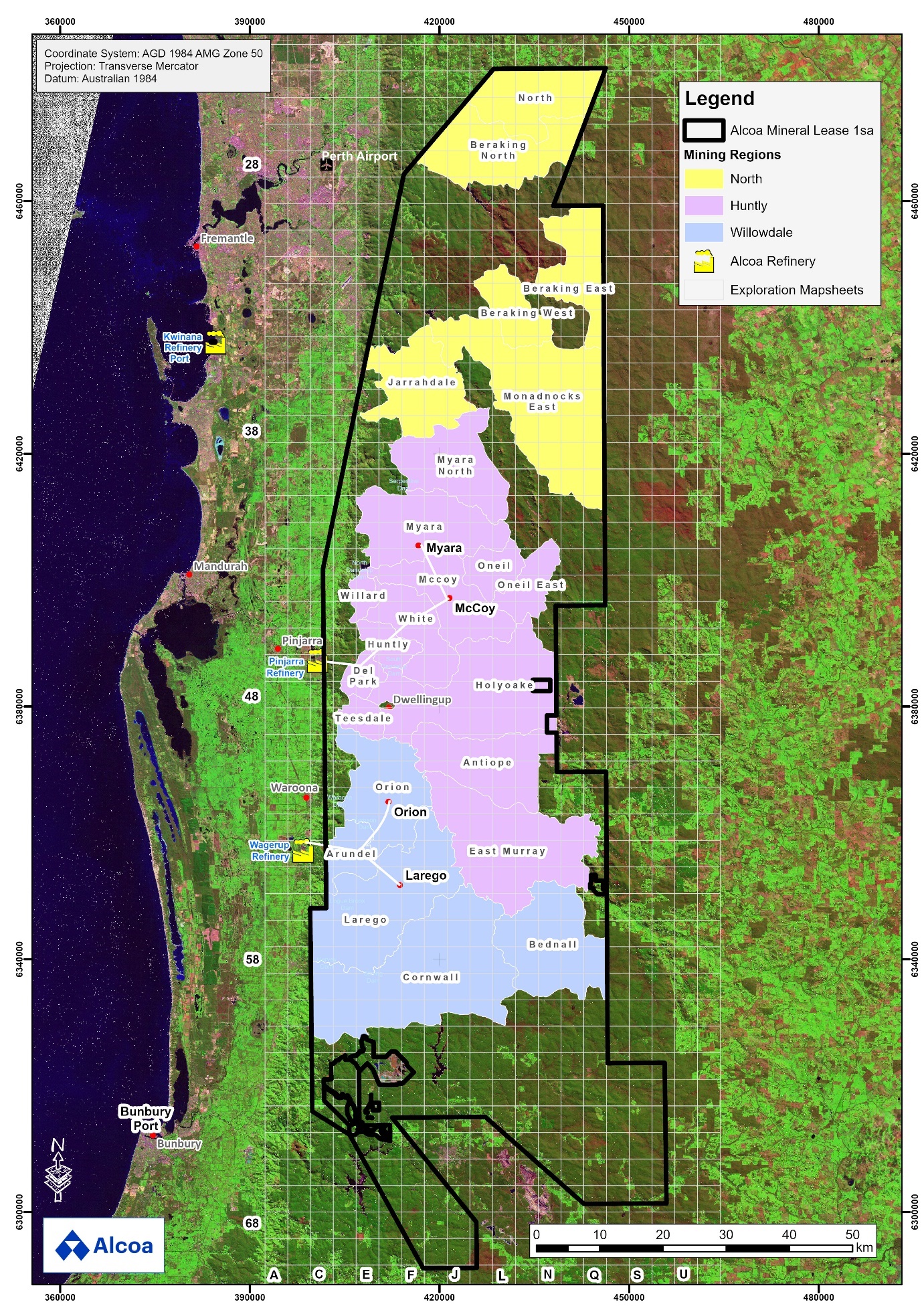
|
33 |
|
|
Alcoa Corporation S-K 1300 Report |
Signature Date: 20 February 2025 SLR Project No.: 123.020514.00001 |
Figure 3‑3: Map of Current Mineral Resource and Mineral Reserve Extents (Alcoa, 2024)
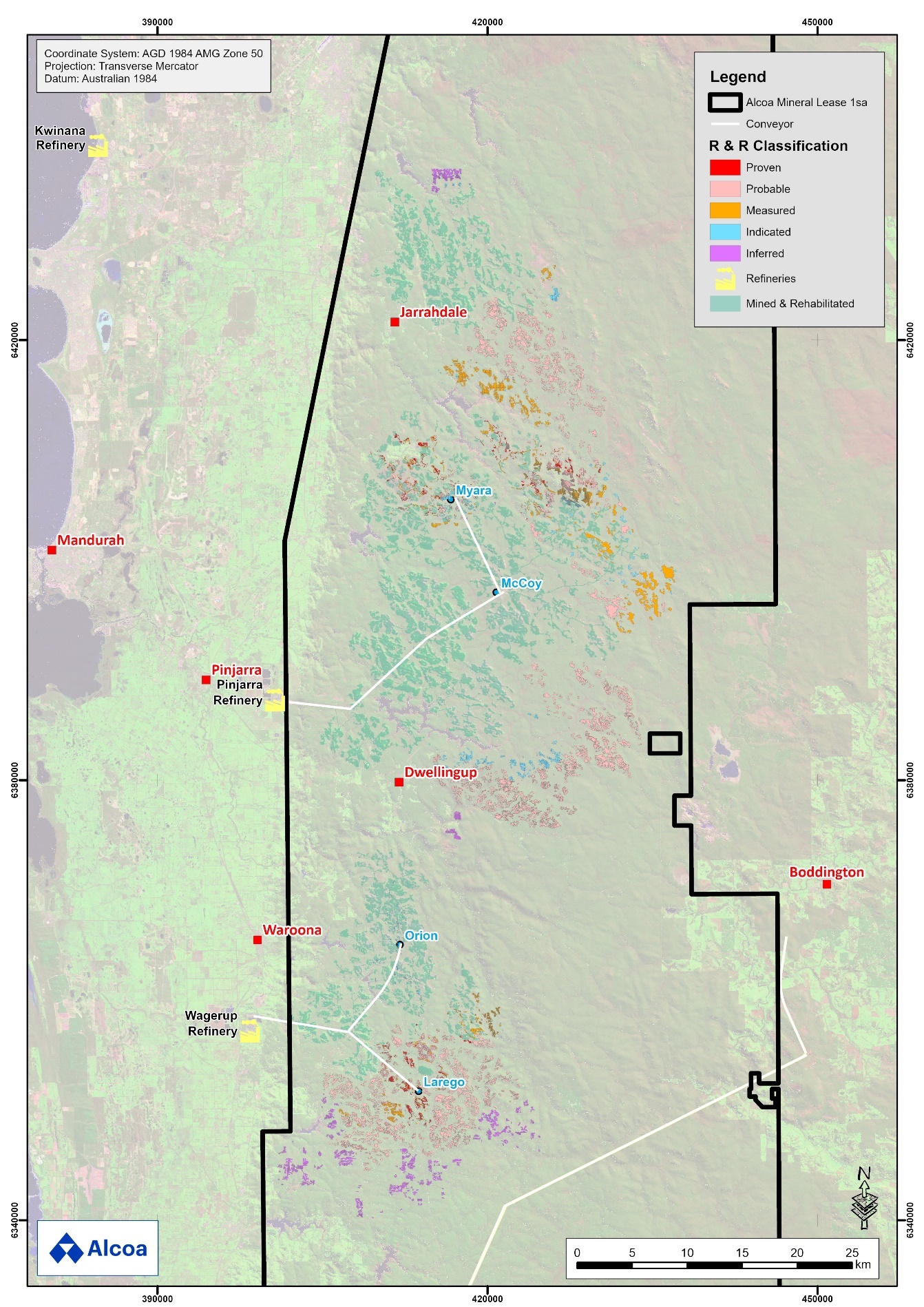
|
34 |
|
|
Alcoa Corporation S-K 1300 Report |
Signature Date: 20 February 2025 SLR Project No.: 123.020514.00001 |
Alcoa has developed a terminology to refer to various parts of the Mineral Lease. There are three major Mining Reporting Centers in ML1SA: North (previously Jarrahdale), Huntly in the central area, and Willowdale in the south. The boundaries are nominal and may change to match the planned ore destination. The southernmost region of the North mining center was reallocated to Huntly in 2017 and named Myara North.
Mining Regions are subdivisions of the Reporting Centers that cover several years of mining activities, focused on a specific crusher location. The boundaries are named after forestry blocks. A total of 11 Mining Regions are represented in the current resource estimate: one in North, seven in Huntly, and three in Willowdale.
Mining Pits are named based on their sequence along haul roads. These names are used by the mining fleet when referring to local short-term production. The map reference system outlined below is used for drilling, estimation, and long-term planning.
The Mineral Lease is divided into a grid of Exploration Sheets being rectangles 4.2 km (north) by 3.6 km (east). Each 15.12 km² Exploration Sheet is assigned a name and coded using letters A to V (west to east), and numbers 10 to 80 (north to south), e.g., G45.
Each Exploration Sheet is divided into 28 Production Sheets 900 m (east) by 600 m (north), an area of 0.54 km². The Production Sheets are assigned a number (1 to 28), sequentially 4 across (towards the east) and 7 down (towards the south), e.g., G4520.
Each Production Sheet is divided using a 15 m by 15 m grid resulting in 2,400 grid cells (40 north by 60 east). Each of these is regarded as a point and assigned a numeric code 1 to 40 towards the south and 1 to 60 towards the east. These are appended to the Production Sheet name to provide a grid point label, e.g., G4520 1430 and used on 1:1000 Map Sheets to define drill hole locations.
The Exploration Sheet, Production Sheet, and Map Sheet conventions are shown in Figure 3‑4:
|
35 |
|
|
Alcoa Corporation S-K 1300 Report |
Signature Date: 20 February 2025 SLR Project No.: 123.020514.00001 |
Figure 3‑4: Exploration Sheet, Production Sheet, and Map Sheet Conventions (SRK, 2021)

Baseline constraints on mining activities within the ML1SA concession are in place which prevent bauxite mining in these areas including (but not limited to):
Mineral Resources and Mineral Reserves have not been defined in these restricted areas. Operating rights are obtained by Alcoa through annual submission and approval of the Mining and Management Programs (MMPs) which include mining schedules and the authorizations provided by the Bauxite Strategic Executive Committee Bauxite (BSEC; previously the Mining and Management Program Liaison Group (MMPLG)).
Mining on a day-only basis is conducted in “noise zones” where noise from the mining operations will potentially exceed allowable levels. The operation actively seeks to maintain
|
36 |
|
|
Alcoa Corporation S-K 1300 Report |
Signature Date: 20 February 2025 SLR Project No.: 123.020514.00001 |
lower noise levels than those mandated, thus mining in these areas is undertaken by contract miners on day shifts only.
Alcoa is the holder of ML1SA. For bauxite that is mined and processed in Alcoa’s Western Australian alumina refineries, Alcoa pays royalties on the alumina produced in accordance with the Alumina Refinery Agreement Act 1961 (WA).
Alcoa operates under several State Agreement Acts as well as Ministerial Statements and environmental operating licenses issued under the Environmental Protection Act 1986 (WA) (EP) including:
The MMPLG was first established in 1978 and is chaired by the Department of Jobs, Tourism, Science and Innovation (JTSI). It is now referred to as BSEC. Along with JTSI it is comprised of the following State Government agencies:
The MMPLG is recognized by the Minster for Environment in Ministerial Statements (95, 390, 564, 728, 897 and 1069) regarding expansion of Alcoa operations. The management and oversight of all Darling Range operations by the BSEC/MMPLG involves:
|
37 |
|
|
Alcoa Corporation S-K 1300 Report |
Signature Date: 20 February 2025 SLR Project No.: 123.020514.00001 |
The permitting and approval processes, as provided by Alcoa, are summarized below:
Alcoa reports that all licenses and permissions for the current mining operations are valid, monthly and annual compliance reports submitted for review by SLR support this. On 28 February 2023, the Western Australian Forest Alliance Inc (WAFA) made two third-party referrals to the EPA under s. 38 of the EP Act. The referrals referenced Alcoa’s Mining and Management Programs (MMPs) and its bauxite mining operations on the Darling Range in
|
38 |
|
|
Alcoa Corporation S-K 1300 Report |
Signature Date: 20 February 2025 SLR Project No.: 123.020514.00001 |
the southwest of WA for the years 2022 to 2026 and 2023 to 2027. Following receipt of the referrals, the EPA sought further advice from Alcoa including detail on the scope of its planned/completed activities between 2022 to 2026 and 2023 to 2027. On 7 August 2023, EPA conducted a 7-day public comment on whether or not it should assess the proposals and, if so, what level of assessment is considered appropriate.
Section 38B of the EP Act provides that a proposal cannot be referred to the EPA more than once. In considering these referrals, the EPA undertook detailed investigations and enquiries to identify whether the proposals have been previously referred to the EPA.
Importantly, on 14 December 2023, the State Government announced the Alcoa Transitional Approvals Framework which enabled Alcoa to continue mining as defined in the 2023-2027 MMP (this approval was rolled over to 2024-28 in October 2024, with all conditions consistent with the 2023-27 approval) while the formal EPA EIA is in progress. In most circumstances, activities under assessment must cease during the EPA’s process, however, the State Government granted Alcoa an exemption under section 6 of the EP Act to continue operating subject to a series of conditions. Note, that the State Government reserves the right to, with reasonable notice, withdraw or amend the exemption at any point. The Premier rolled over the 2023-2027 approval to cover 2024-2028 with the same conditions in October 2024.
On 18 December 2023, the EPA published its public advice in relation to the third-party referrals. The EPA concluded that five mine areas at Huntly (Myara North, Holyoake, White Road and portions of McCoy and Myara), and two at Willowdale (Mt William/Arundel/part Larego and Willowdale North/part Orion) have been previously referred. The remaining mine areas, the subject of the referrals, were found to be validly referred and that the likely environmental effects are significant warranting formal assessment at the level of public environmental review (10 weeks), the EPA’s assessment numbers for the 2022-2026 MMP and 2023-2027 MMP are 2384 and 2385, respectively.
The EPA prepared a single Environmental Scoping Document (ESD) for both assessments across the first half of 2024, in consultation with Alcoa. The final ESD was published on 29 August 2024. The ESD outlines the basis on which the EPA will assess the MMPs for 2022-2026, and 2023-2027. The ESD acknowledges the short term duration of the Proposals, whereby authorisation to clear and implement the Proposals is sought for a time period not exceeding the years 2026 and 2027 (respectively).
In addition, as reported for 2022 and 2023, Alcoa is seeking formal environmental impact assessment and approval from the State and Federal Government to transition mining from the current Huntly mine area to Myara North and Holyoake, and to increase production at the Pinjarra refinery by 5%. The proposed transition in mining area and production increase has been determined by the EPA to be a significant amendment to an approved proposal. The proposed changes to Ministerial Statement 646 (MS 646) for the Pinjarra Refinery Efficiency Upgrade (PREU), approved in 2004 will be considered by the EPA in accordance with section 40AA of the EP Act; the PREU assessment is EPA’s assessment number 2253.
The EPA acknowledges the unique relationships between assessments 2253, 2384 and 2385. 2384 and 2385 cover a shorter period of time and therefore focus on the avoidance of impacts in the execution of the MMPs up to 2027, whereas assessment 2253 is able to consider longer term mitigations across a wider area. Alcoa reports that all Environmental Review Documents for the three assessments are well progressed, and it is targeting publication in the first half of 2025.
|
39 |
|
|
Alcoa Corporation S-K 1300 Report |
Signature Date: 20 February 2025 SLR Project No.: 123.020514.00001 |
SLR is not aware of any environmental liabilities on the property. Alcoa has all the required permits to conduct the proposed work on the property. SLR is not aware of any other significant factors and risks that may affect access, title, or the right or ability to perform the proposed work program on the property.
|
40 |
|
|
Alcoa Corporation S-K 1300 Report |
Signature Date: 20 February 2025 SLR Project No.: 123.020514.00001 |
As described in previous sections, the Darling Range Huntly and Willowdale operations are located approximately 150 km south of Perth. The Darling Range is readily accessible via road from Perth and surrounding areas. The mines are near the towns of Pinjarra and Waroona. Both towns are easily accessible via the national South Western Highway, a sealed single carriageway road, which starts on the southern side of Perth and continues for almost 400 km to the southwest corner of Western Australia.
Huntly is accessible from the South Western Highway via Del Park Road, a sealed single carriageway road which connects the town of North Dandalup in the north with Dwellingup in the south. From Del Park Road, a 3km sealed road following the route of the bauxite conveyor to the Pinjarra refinery provides access to the Huntly site administration offices.
Willowdale is similarly accessible 19 km from the South Western Highway via Willowdale Road, a sealed single carriageway road to the south of Waroona.
There are several airstrips in the region, although the closest major airport is in Perth, approximately 70 km north of North Dandalup. The nearest commercial port is at the curtailed Kwinana refinery, approximately 40 km south of Perth (as illustrated on Figure 15‑1).
An extensive haul road network and overland conveyors transport crushed bauxite from the main mining hub to the Wagerup and Pinjarra refineries. Rail transport of bauxite to the curtailed Kwinana refinery (via the Kwinana freight railway system, using the Kwinana–Mundijong line) is also possible.
The southwest region of Western Australia exhibits a temperate climate, with very hot and dry summers (December to February) and mild winters (June to August). Rainfall is generally low and variable, ranging from an average rainfall of 25 mm during the three summer months and exceeding 200 mm during the three winter months (Australian Government, Bureau of Meteorology). Local climate conditions generally do not interrupt the mining schedule, which continues throughout the year. Occasionally however, significant rainfall inhibits access and can impact mining activities.
Table 4‑1: Historical Climate Data
|
Jan |
Feb |
Mar |
Apr |
May |
Jun |
Jul |
Aug |
Sep |
Oct |
Nov |
Dec |
°C Mean Max |
29.8 |
29.8 |
27.1 |
22.6 |
18.6 |
16.1 |
15.1 |
15.8 |
17.4 |
20.2 |
23.9 |
27.5 |
°C Mean Min |
14.3 |
14.6 |
13.1 |
10.4 |
7.8 |
6.5 |
5.6 |
5.5 |
6.5 |
8.1 |
10.5 |
12.7 |
mm Mean Rainfall |
16.4 |
21.4 |
26.7 |
65.5 |
155.0 |
231.0 |
234.0 |
192.0 |
129.0 |
78.1 |
45.2 |
20.2 |
Notes:
|
41 |
|
|
Alcoa Corporation S-K 1300 Report |
Signature Date: 20 February 2025 SLR Project No.: 123.020514.00001 |
The Darling Range is located in an easily accessible region of southwest Western Australia with the Huntly and Willowdale mining areas both within 15 km of well-established towns which act as residential and commercial centers. Several other towns and smaller settlements are positioned along the South Western Highway which acts as a major connection for the Darling Range to the city of Perth where a far greater range of general services is available.
The following section refers to several named mining areas within the Huntly and Willowdale mining centers, including Myara, Larego, Orion, and Arundel, each of which is illustrated in
Figure 3‑2 above.
Mining infrastructure in the Darling Range is generally concentrated in the Myara site in the northwest of the Huntly mining center, and at the Larego site in the center of the Willowdale mining area (20 km southeast of Wagerup). Both operations include various ancillary facilities that are not listed exhaustively here, however both infrastructure areas include:
Personnel are sourced from the area around Perth, Western Australia, which benefits from a skilled workforce due to the relatively large number of operating mines in the region. Personnel typically have private accommodation in the nearby city of Mandurah (60 km from the mine) and towns (Waroona, Hamel, Yarloop, Harvey, and Wagerup).
Huntly Mine has three power supplies fed from the Pinjarra refinery. A single 33 kilovolt (KV) supply and two 13.8 kV supplies. The Pinjarra refinery is a net importer of power from the South West Interconnected System (SWIS), with internal generation capacity of 100 Megawatt (MW) from 4 steam driven turbine alternators. The steam is produced by gas fired boilers and a non-Alcoa gas turbine Heat Recovery Steam Generator (HRSG).
Willowdale Mine has a single 22 kV power supply fed from the Wagerup refinery. The Wagerup refinery is a net exporter of power to the SWIS, with internal generation capacity of 108 MW from three steam driven turbine alternators and one gas turbine. The steam is produced by gas fired boilers.
|
42 |
|
|
Alcoa Corporation S-K 1300 Report |
Signature Date: 20 February 2025 SLR Project No.: 123.020514.00001 |
The western edge of the Darling Range is characterized by scarps and incised valleys, landforms which are attributed to tectonic activity along the Darling Fault, the dominant structural feature in the region which acts as the western boundary of the deposits. This feature is observable in regional topographical survey information and satellite imagery to roughly follow the coastline of southwest Western Australia and is approximately demarcated by the extent of Jarrah Forest, a recognized bioregion.
The topography of the ML1SA concession generally comprises wide valleys and undulating hills separated by minor surface water drainage channels and streams. Vegetation across the ML1SA is dominated by several areas of State Forest including Dwellingup, Lane Poole, and Youraling. These include distinct areas of old growth forest within which mining is prohibited.
The typical elevation ranges from 300 m to 400 m in the mining areas, however the highest points of the region (outside of the mining areas) are approximately 550 m.
Topography data was acquired from:
|
43 |
|
|
Alcoa Corporation S-K 1300 Report |
Signature Date: 20 February 2025 SLR Project No.: 123.020514.00001 |
Prior to 1961, there were no records of ownership of the Darling Range mines. A Special Mineral Lease (ML1SA) was granted to Western Aluminum NL (WANL) in 1961. In the same year WANL joined Aluminum Company of America Ltd (Alcoa US). In 1977 WANL became Alcoa.
The following text is sourced and modified from Hickman, et al., 1992.
Bauxite occurrences were first recorded in the Darling Range in 1902. Bauxite was detected as a result of analyzing laterite from Wongan Hills, and subsequently through examination of lateritic road gravels from several localities in the Darling Range. The Geological Survey of Western Australia (Geological Survey) produced studies and publications, driving the bauxite exploration, though most attention was focused on localities in the Darling Range close either to Perth or to railway lines servicing towns such as Toodyay and York. The Geological Survey mapped the extent of laterite in the Darling Range (close to Perth) to determine whether it contained commercial deposits of iron or aluminum ore.
The earliest non-government exploration for bauxite was carried out in 1918 by the Electrolytic Zinc Co. of Australia Pty Ltd, deeming the deposits to be generally low grade and not of commercial value, though like earlier explorers, did not focus upon the underlying friable units.
Of 46 early samples of laterite analyzed in 1919, 26 contained 35% or more available alumina. It was then assumed that bauxite in the Darling Range was confined to the duricrust part of the profile, and not considered in the underlying friable units. By 1938 bauxite deposits were known to be common throughout the Darling Range over an area of 560 km long by 40 km to 80 km wide.
The Geological Survey maintained an interest in Darling Range laterite as an economic source of aluminum until the 1950s. However, by the late 1950s exploration had been taken over by mining companies.
No further private exploration took place until 1957 when Western Mining Corporation Ltd (WMC) began to explore for bauxite in the Darling Range. Following a regional reconnaissance, a joint venture company, WANL, formed by WMC with North Broken Hill Ltd and Broken Hill South Ltd, explored temporary reserves over a large portion of the southwest. Profiles were sampled from road cuttings, with samples collected at 400 m intervals along main roads. Selected lateritic ridges and plateaus were sampled at 90 m intervals. These areas were part of a Special Mineral Lease (ML1SA) granted to WANL in 1961.
By 1961, WANL had delineated 37 Mt of bauxite at an average grade of 33% AL. Also in 1961, WANL joined with the Alcoa US, allowing additional systematic exploration of lease ML1SA (Figure 5‑1). Holes were drilled initially on 370 m by 185 m centers. Progressive in-fill drilling down to a spacing of 45 m by 45 m blocked out the ore at Jarrahdale and was followed by grade-control drilling. Commercial mining was finally started in 1963 at the former Jarrahdale mining center and continued until 1998, supplying bauxite to the Kwinana refinery.
In 1977 WANL became Alcoa. As of December 2024, the Huntly and Willowdale mining operations remain active. Huntly supplies bauxite to the Pinjarra refinery (approximately 17 million tonnes per annum, Mtpa) while Willowdale supplies the Wagerup refinery (approximately 10 Mtpa).
|
44 |
|
|
Alcoa Corporation S-K 1300 Report |
Signature Date: 20 February 2025 SLR Project No.: 123.020514.00001 |
Figure 5‑1: Bauxite Exploration in the Southwest of Western Australia 1961 (adapted from Hickman, 1992)
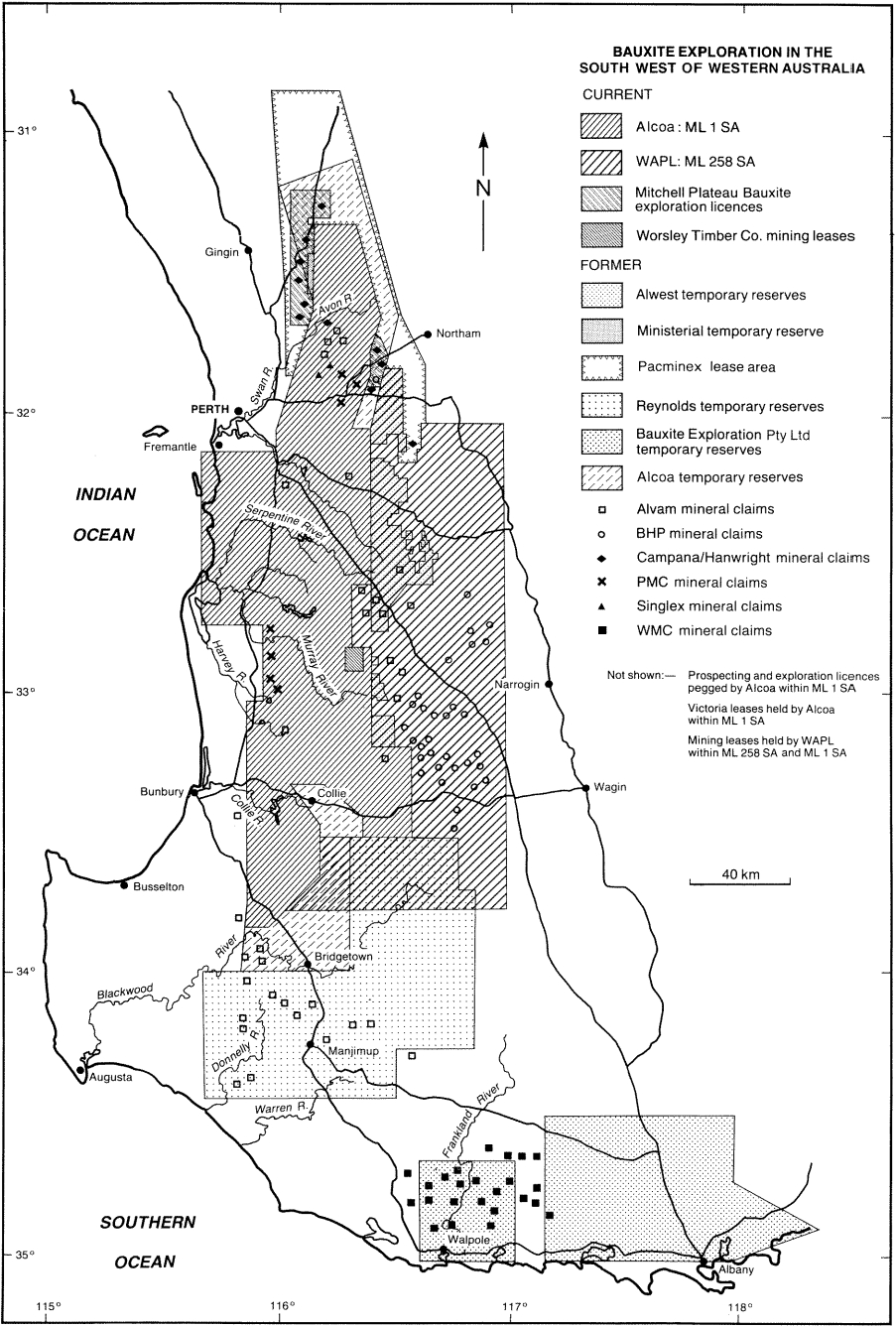
|
45 |
|
|
Alcoa Corporation S-K 1300 Report |
Signature Date: 20 February 2025 SLR Project No.: 123.020514.00001 |
Bauxite deposits, economic concentrations of aluminum oxide, represent the world’s major source of aluminum and consist primarily of the minerals gibbsite, boehmite, and diaspore. These are commonly found alongside iron oxide minerals including goethite and hematite, kaolinite clay minerals, and minor accessory minerals.
Lateritic bauxite deposits such as those in the Darling Range of WA generally formed in tropical (hot and humid) environments through chemical weathering. As a result, lateritic bauxite deposits are known to exist across Central and South America, West Africa, Central Asia, and Australia.
With its large available resources, access to a stable workforce, infrastructure (comprising conveyors, rail, road, and port access), and three captive (mine-to-mill) dedicated alumina refineries, Alcoa’s Darling Range Bauxite operations near Perth WA, has been one of the world’s leading alumina producing regions for at least 30 years (Hickman et al, 1992), or approximately 60 years as of 2024.
The bauxite deposits of the Huntly and Willowdale operations are located in the Darling Range region of southwest Western Australia. The predominant topographic feature of the region is the Darling Range Fault, a north-south trending scarp which extends approximately 220 km from Bindoon (70 km north-northeast of Perth) to Collie (160 km south-southeast of Perth).
The Darling Range Fault is the structural boundary between two geological terranes: the Pinjarra Orogen to the west, now the sedimentary Swan Coastal Plain, and the Yilgarn Craton to the east, a gneissic granite complex with greenstones. To the east of the Darling Range Fault intense weathering and erosion of exposed Archean basement rocks of the Western Gneiss Terrane, the western portion of the Yilgarn Craton, formed widespread lateritic bauxite deposits by the intense weathering, accumulation and leaching of the aluminosilicate rich material of the bedrock granites (Hickman et al, 1992).
Alcoa’s current bauxite mining areas of Huntly and Willowdale are on the eastern side of the Darling Range Fault, as low-lying plateaus separated by valleys in which alluvial deposits have accumulated. Figure 6‑1 shows the regional geology of the southwest region of Western Australia and Alcoa’s ML1SA lease boundary in relation to Perth, while Figure 6‑2 shows the distribution of surficial deposits across the region.
The Jarrahdale, Del Park, Huntly and Willowdale areas that have been mined by Alcoa are on laterite within the Western Gneiss Terrane (Figure 6‑2), formed over granites that have been intruded by numerous north trending tholeiitic, quartz dolerite dykes, of early to late Proterozoic age, with thicknesses ranging from 1 m to 200 m.
Lateritic bauxite developed from the Late Cretaceous (65 million years ago, Ma) to the Eocene (40 Ma), with several periods of erosion and intense weathering of the basement granites and dolerites. Subsequent reactivation of the Darling Fault combined with periods of erosion led to the establishment of plateaus and incised valleys, trending to wider valleys and low hills to the east which now characterize the physiography of the region.
|
46 |
|
|
Alcoa Corporation S-K 1300 Report |
Signature Date: 20 February 2025 SLR Project No.: 123.020514.00001 |
Figure 6‑1: Regional Geology (adapted from SRK, 2021)
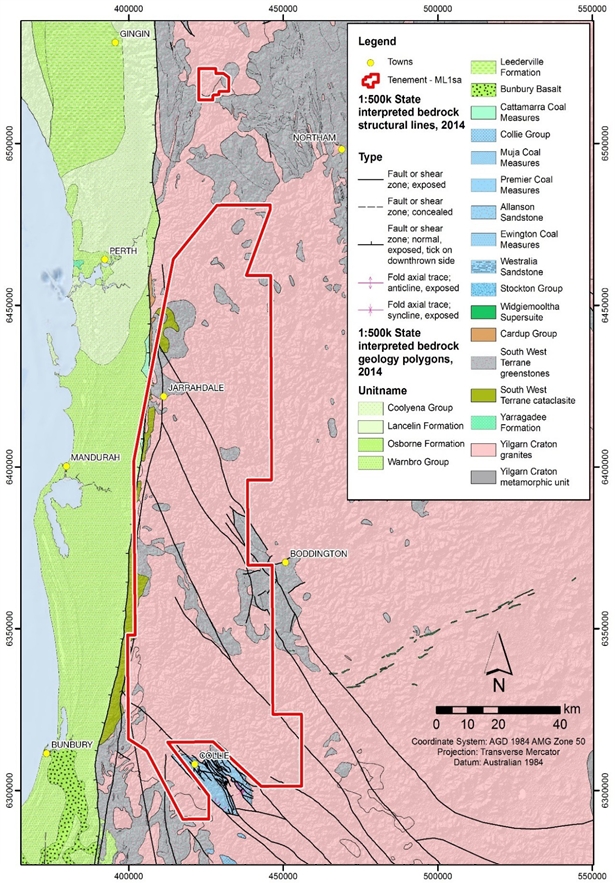
|
47 |
|
|
Alcoa Corporation S-K 1300 Report |
Signature Date: 20 February 2025 SLR Project No.: 123.020514.00001 |
Figure 6‑2: Surface Geology Showing Laterite Over Granite (Alcoa, 2015)
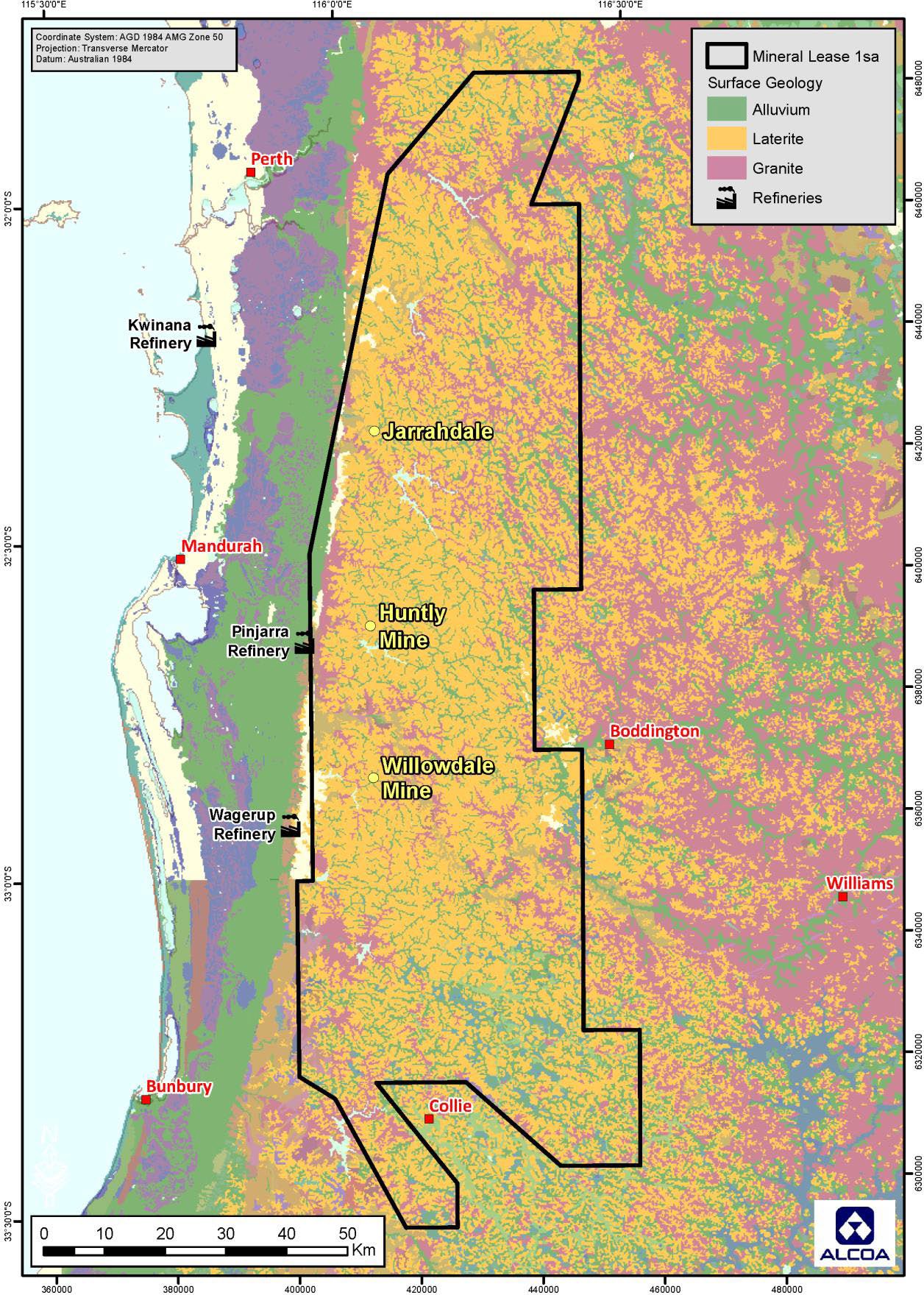
|
48 |
|
|
Alcoa Corporation S-K 1300 Report |
Signature Date: 20 February 2025 SLR Project No.: 123.020514.00001 |
Laterite remnants are thickest and most extensive over a 150 km long region between the Avon and Harris Rivers, and within about 50 km of the Darling Scarp. The laterite occupies gently sloping (3° to horizontal) upland areas with an average elevation of 280 to 300 meters above sea level (MASL), and high annual rainfall. Steeper slopes may have a thin cover of partly transported laterite with bedrock near the surface. Above 340 m the laterite is penetrated by bedrock which rises above the general topographic level. Below 200 m drainage has removed pre-existing laterite. Blocks of laterite, released by headward erosion of streams, decay to lateritic gravels on the lower slopes of valleys, which pass laterally into alluvial sands and silt in the valley floors (Hickman et al, 1992).
Bauxite deposits typically occur as irregularly shaped lenses on the flanks of plateaus. Critical to this is the laterite position on the slopes (Figure 6‑3): erosion generally dominates on steeper slopes which prevent accumulation and effective bauxite formation, whereas flat areas lack the necessary sub-surface water flows which drive the removal of clays and the enrichment of soluble silicate minerals.
Figure 6‑3: Bauxite Deposit Formation Schematic – Relief Exaggerated (Alcoa, 2021)

Weathering, alteration and leaching of the granite bedrock has developed the bauxite mineralization which principally occurs as 65% microcrystalline gibbsite Al(OH)₃ with minor to rare boehmite AlO(OH), and accessory minerals of 18% goethite FeO(OH), 7% hematite Fe₂O₃, 9% quartz SiO₂, 1% kaolinite/halloysite Al₂Si₂O₅(OH)₄, and 0.5% anatase/rutile TiO₂.
Other minerals within the bauxite that may influence the alumina refinery performance include:
|
49 |
|
|
Alcoa Corporation S-K 1300 Report |
Signature Date: 20 February 2025 SLR Project No.: 123.020514.00001 |
Table 6‑1 provides a summary of the typical stratigraphy defined by Alcoa across their Darling Range deposits. The Hardcap and Friable Zones represent the primary horizons of economic interest due to their concentrations of alumina. A generalized mineralogical profile through these horizons is provided in Figure 6‑4 and a typical grade profile in Figure 6‑5 showing the alumina and iron-rich Hardcap, with increasing silica and decreasing alumina through the Friable Zone.
Table 6‑1: Alcoa’s Darling Range Deposit Typical Stratigraphic Column
Stratigraphic Horizon |
Typical Thickness Range (m) |
Description |
Overburden |
0 to 0.5 |
Mixed soils and clays, high in organic matter, generally forming a thin layer which can penetrate deeper if the underlying Hardcap surface is variable. |
Hardcap |
1 to 3 |
Ferricrete formed by the remobilization of iron into a layer comprising iron and alumina-rich nodules which can exhibit the highest alumina concentrations across the deposit. Highly variable in thickness but generally 1 m to 3 m with a sharp contact against the underlying Friable Zone. |
Friable Zone |
3 to 5 |
Leached horizon resulting in the accumulation and enrichment of bauxite minerals. The Friable Zone comprises a mixture of the overlying Hardcap, clasts, Al and Fe rich nodules, and clays. Upper contact with the Hardcap is variable, found as a sharp or transitional boundary in places. AL typically reduces with depth as SI increases, defining the lower boundary with the Basal Clay. |
Basal Clay |
- |
Kaolinitic clay horizon which transitions into a saprolitic zone above unweathered basement. This horizon is typically used as a marker indicating the full bauxite zone has been intersected and where drilling is often stopped. |
Alcoa’s bauxite deposits across the Darling Range show high variability in both the thickness and relative proportion of each horizon. Table 6‑2 provides an extract from the acQuire database for the Mining Centres of Huntly (in the north) and Willowdale (more southerly) showing the most common (modal) Depth To Top and Thickness of the four stratigraphic horizons, based on logged drill holes from 2016 to 2020.
Table 6‑2: Summary of Typical (Modal) Stratigraphic Horizons Within Each Area
Area |
Description (m) |
Overburden |
Hardcap |
Friable Zone |
Basal Clay |
Huntly |
Depth to top |
- |
0.64 |
1.51 |
4.54 |
Thickness |
0.64 |
0.87 |
3.04 |
- |
|
Willowdale |
Depth to top |
- |
0.58 |
1.51 |
4.91 |
Thickness |
0.58 |
0.93 |
3.40 |
- |
|
North |
Depth to top |
- |
0.64 |
1.78 |
4.45 |
Thickness |
0.64 |
1.14 |
2.67 |
- |
|
50 |
|
|
Alcoa Corporation S-K 1300 Report |
Signature Date: 20 February 2025 SLR Project No.: 123.020514.00001 |
Figure 6‑4: Typical Alcoa Darling Range Mineralogy Profile (Hickman et al, 1992)

Figure 6‑5: Typical Alcoa Darling Range Grade Profile (Alcoa, 2015)
|
|
Typical photos of the bauxite profile in current mining areas observed on 14 October 2021 are provided in Figure 6‑6.
|
51 |
|
|
Alcoa Corporation S-K 1300 Report |
Signature Date: 20 February 2025 SLR Project No.: 123.020514.00001 |
Figure 6‑6: Typical Alcoa Darling Range Mining Sequence and Vertical Profile (SLR, 2021)
|
|
Vegetation cleared prior to mining |
Top soil and oxalate removed leaving Hardcap |
|
|
Blastholes on Hardcap after sheeting with low grade |
Hardcap (hard brown) Friable (soft yellow), relict fresh remnant Dolerite dyke boulder |
|
|
Sandy topsoil, Hardcap (hard brown), Friable (soft yellow), Basal Clay (white clay, lower right in the floor). |
|
|
52 |
|
|
Alcoa Corporation S-K 1300 Report |
Signature Date: 20 February 2025 SLR Project No.: 123.020514.00001 |
WANL, which became Alcoa (in 1977), carried out exploration over much of the ML1SA lease area in the 1960s as mentioned in Section 5.2. Samples were assayed for Total Al₂O₃ only and the data, referred to as the Imperial Drilling, is still retained comprising approximately 104,400 holes and approximately 670,000 samples.
The Imperial Drilling has not been used to prepare the current Mineral Resource estimate because the sample collection, preparation, and assaying techniques were not consistent with current practices and can no longer be validated.
Resource definition drilling is initially done on a nominal regular grid spacing of 60 by 60 m. Infill drilling programs are then scheduled as required to reduce the drill spacing to 30 by 30 m, and then 15 by 15 m.
The planned drill hole collars are assigned a hole identifier (Hole ID) using the code of the 15 by 15 m grid point on the 1:1,000 Map Sheets (Section 3.3).
A total of 420,789 holes were used for the resource estimate, and these holes were drilled between 1981 to 2024, with approximately 83% drilled after 2009.
A tabulation of the drill quantities by year and location is presented in Table 7‑1, and a graphical summary is shown in Figure 7‑1.
|
53 |
|
|
Alcoa Corporation S-K 1300 Report |
Signature Date: 20 February 2025 SLR Project No.: 123.020514.00001 |
Table 7‑1: Drill Quantities by Year and Location
Year |
Holes |
Meters |
Assay |
|||||||||
Huntly |
North |
Willowdale |
Total |
Huntly |
North |
Willowdale |
Total |
Huntly |
North |
Willowdale |
Total |
|
1981 |
656 |
--- |
--- |
656 |
5,574 |
--- |
--- |
5,574 |
10,415 |
--- |
--- |
10,415 |
1983 |
199 |
--- |
--- |
199 |
1,090 |
--- |
--- |
1,090 |
1,899 |
--- |
--- |
1,899 |
1984 |
995 |
--- |
--- |
995 |
7,083 |
--- |
--- |
7,083 |
12,119 |
--- |
--- |
12,119 |
1985 |
393 |
--- |
--- |
393 |
2,815 |
--- |
--- |
2,815 |
4,971 |
--- |
--- |
4,971 |
1990 |
13 |
--- |
--- |
13 |
58 |
--- |
--- |
58 |
101 |
--- |
--- |
101 |
1991 |
3,123 |
0 |
1,017 |
4,140 |
17,405 |
0 |
7,726 |
25,130 |
30,133 |
0 |
13,909 |
44,042 |
1992 |
6,669 |
0 |
1,153 |
7,822 |
37,561 |
0 |
8,399 |
45,960 |
65,048 |
0 |
15,234 |
80,282 |
1993 |
2,672 |
0 |
518 |
3,190 |
15,339 |
0 |
3,331 |
18,670 |
26,413 |
0 |
6,117 |
32,530 |
1994 |
7,380 |
632 |
1,168 |
9,180 |
41,092 |
4,019 |
6,453 |
51,563 |
69,785 |
7,103 |
11,224 |
88,112 |
1995 |
5,355 |
79 |
1,839 |
7,273 |
32,111 |
477 |
10,524 |
43,112 |
55,222 |
871 |
18,989 |
75,082 |
1996 |
6,777 |
336 |
634 |
7,747 |
37,195 |
1,522 |
3,998 |
42,715 |
63,627 |
2,667 |
7,256 |
73,550 |
1997 |
583 |
0 |
2,730 |
3,313 |
3,620 |
0 |
17,199 |
20,820 |
6,406 |
0 |
30,917 |
37,323 |
1998 |
12 |
0 |
830 |
842 |
162 |
0 |
5,119 |
5,281 |
307 |
0 |
9,289 |
9,596 |
1999 |
18 |
0 |
842 |
860 |
137 |
0 |
4,082 |
4,219 |
239 |
0 |
7,198 |
7,437 |
2000 |
22 |
0 |
174 |
196 |
187 |
0 |
1,022 |
1,210 |
344 |
0 |
1,852 |
2,196 |
2001 |
633 |
0 |
385 |
1,018 |
5,844 |
0 |
2,693 |
8,536 |
10,817 |
0 |
4,955 |
15,772 |
2002 |
1,818 |
0 |
247 |
2,065 |
16,135 |
0 |
1,417 |
17,552 |
29,624 |
0 |
2,515 |
32,139 |
2003 |
418 |
0 |
1,516 |
1,934 |
2,605 |
0 |
9,855 |
12,459 |
4,662 |
0 |
18,023 |
22,685 |
2004 |
0 |
0 |
389 |
389 |
0 |
0 |
2,000 |
2,000 |
0 |
0 |
3,603 |
3,603 |
2005 |
1,391 |
0 |
2,186 |
3,577 |
8,887 |
0 |
12,442 |
21,329 |
15,930 |
0 |
22,418 |
38,348 |
2006 |
1,652 |
0 |
736 |
2,388 |
11,809 |
0 |
4,561 |
16,370 |
21,749 |
0 |
8,396 |
30,145 |
2007 |
5,229 |
0 |
2,840 |
8,069 |
35,800 |
0 |
19,002 |
54,802 |
65,477 |
0 |
34,677 |
100,154 |
|
54 |
|
|
Alcoa Corporation S-K 1300 Report |
Signature Date: 20 February 2025 SLR Project No.: 123.020514.00001 |
2008 |
4,371 |
0 |
739 |
5,110 |
25,955 |
0 |
4,524 |
30,478 |
45,654 |
0 |
8,101 |
53,755 |
2009 |
6,491 |
0 |
299 |
6,790 |
38,025 |
0 |
1,744 |
39,769 |
66,797 |
0 |
3,159 |
69,956 |
2010 |
9,776 |
0 |
1,220 |
10,996 |
57,679 |
0 |
8,540 |
66,219 |
100,163 |
0 |
15,718 |
115,881 |
2011 |
10,799 |
0 |
691 |
11,490 |
58,535 |
0 |
4,963 |
63,497 |
101,566 |
0 |
9,095 |
110,661 |
2012 |
11,270 |
0 |
1,127 |
12,397 |
62,056 |
0 |
8,767 |
70,824 |
107,576 |
0 |
16,251 |
123,827 |
2013 |
7,971 |
0 |
2,375 |
10,346 |
48,026 |
0 |
19,297 |
67,322 |
83,988 |
0 |
35,787 |
119,775 |
2014 |
6,297 |
0 |
11,429 |
17,726 |
33,616 |
0 |
80,252 |
113,869 |
58,175 |
0 |
147,213 |
205,388 |
2015 |
9,243 |
0 |
10,789 |
20,032 |
51,370 |
0 |
66,228 |
117,598 |
89,750 |
0 |
120,696 |
210,446 |
2016 |
16,512 |
0 |
443 |
16,955 |
96,102 |
0 |
2,373 |
98,474 |
168,325 |
0 |
4,268 |
172,593 |
2017 |
8,265 |
0 |
6,363 |
14,628 |
44,296 |
0 |
37,777 |
82,073 |
76,690 |
0 |
67,290 |
143,980 |
2018 |
9,476 |
0 |
10,768 |
20,244 |
52,689 |
0 |
56,673 |
109,362 |
92,887 |
0 |
99,811 |
192,698 |
2019 |
15,923 |
0 |
10,138 |
26,061 |
91,912 |
0 |
67,348 |
159,259 |
162,134 |
0 |
121,383 |
283,517 |
2020 |
23,570 |
0 |
14,292 |
37,862 |
124,981 |
0 |
91,537 |
216,518 |
217,667 |
0 |
165,080 |
382,747 |
2021 |
21,347 |
0 |
15,002 |
36,349 |
131,600 |
0 |
114,280 |
245,880 |
231,155 |
0 |
207,367 |
438,522 |
2022 |
29,231 |
0 |
12,165 |
41,396 |
179,487 |
0 |
88,487 |
267,974 |
318,537 |
0 |
160,277 |
478,814 |
2023 |
30,494 |
0 |
16,230 |
46,724 |
183,141 |
0 |
119,708 |
302,848 |
318,665 |
0 |
220,275 |
538,940 |
2024* |
13,419 |
0 |
6,005 |
19,424 |
84,457 |
0 |
45,311 |
129,768 |
147,413 |
0 |
83,504 |
230,917 |
Total |
280,463 |
1,047 |
139,279 |
420,789 |
1,646,435 |
6,018 |
937,628 |
2,590,081 |
2,882,430 |
10,641 |
1,701,847 |
4,594,917 |
* Drill holes completed until June 30, 2024.
|
55 |
|
|
Alcoa Corporation S-K 1300 Report |
Signature Date: 20 February 2025 SLR Project No.: 123.020514.00001 |
Figure 7‑1: Chart of Resource Drill Holes by Year
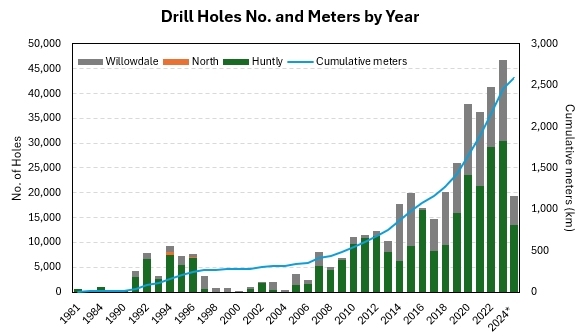
The Darling Range deposits contain more than three million drillholes distributed across a lease of over 7,000 km², making it unfeasible to show a plan view of the property with the locations of all drill holes and other samples. Figure 3‑3, however, shows the lateral extent of Alcoa’s mined areas and Mineral Resources and Mineral Reserves within the ML1SA lease.
The Darling Range bauxite project is considered to be in the process of sustaining Mineral Reserve from already defined mineralization, rather than in Exploration mode, looking for new, broader targets. Resource Definition drilling is planned to continue throughout all areas where Alcoa has mining permits as described, to sustain the Mineral Reserves and future production.
The methods currently used for drill sampling in the Darling Range by Alcoa have been consistently used since the 1980s. Drilling is done using dedicated drills mounted on a fleet of tractors which can be driven off tracks into the forest, causing minimal damage or disturbance and obviating the need to clear drilling pads. Planned hole positions are located by the driller using Global Positioning System (GPS). The articulated tractors are highly maneuverable and there is only minor disruption to groundcover vegetation and saplings which may be eased out of the way (Figure 7‑2).
|
56 |
|
|
Alcoa Corporation S-K 1300 Report |
Signature Date: 20 February 2025 SLR Project No.: 123.020514.00001 |
Figure 7‑2: Resource Drilling Tractor Accessing the Forest (SLR, 2021)
|
|
Drilling is completed by Alcoa using vacuum drill rigs, by contractor Wallis Drilling using their patented reverse circulation (RC) aircore rigs, and by contractor JSW using a similar RC method. Wallis and JSW holes are both referred to as aircore drilling.
In recent years the drilling period has been extended from 9 to 10 months. More wet ground is now encountered and, where required, vacuum drilling is either deferred until the ground conditions improve, or is re-assigned for aircore drilling.
Drilling is rapid with holes typically completed every 15 minutes from locating the collar position to completing the drilling, cleaning the sampling equipment and readying the samples for dispatch. While 12 rigs are currently used, the procedure is consistent across all rigs and virtually unchanged since the early 1990s at Jarrahdale. Minor modifications to the drilling procedures that have occurred include (in order of importance for their impact on the resource database):
|
57 |
|
|
Alcoa Corporation S-K 1300 Report |
Signature Date: 20 February 2025 SLR Project No.: 123.020514.00001 |
Samples used for Mineral Resource estimation are only acquired using vacuum drilling or aircore reverse circulation. Both methods generally drill dry holes in that water is not added. Water ingress into vacuum holes destroys the sample circulation and wet holes are abandoned. Alcoa commenced aircore drilling in 2015, with the initial plan being to phase out vacuum drilling. The prime advantage of aircore over vacuum is sample recovery when holes do encounter groundwater.
In vacuum drilling the sample is finely ground and sucked up from the bottom of the hole by a top-mounted vacuum pump. In aircore drilling, compressed air is blown down the annulus between the inner and outer drill string tubes, pushed out through ports on the face of the bit and then blows the sample through the center of the bit and up the drill string.
In both methods, the sample material is extracted from inside the bit, avoiding sample delineation error (contamination), and carried up the center of the drill string into the sampling container, avoiding sample extraction error (sample material left down the hole or lost as dust).
The aircore drilling uses a blade bit with a nominal cutting diameter of 45 mm and an internal retrieval tube diameter of 22 mm (Figure 7‑3). Alcoa increased the internal diameter to 25 mm in 2018 to reduce blockages. The particle size of drilled material is sufficiently small (less than 10 mm) to promote good sample splitting in dry conditions.
Figure 7‑3: Drill Bits, Reverse Circulation Drill String and Particle Size of the Sample Residue (SLR, 2021)
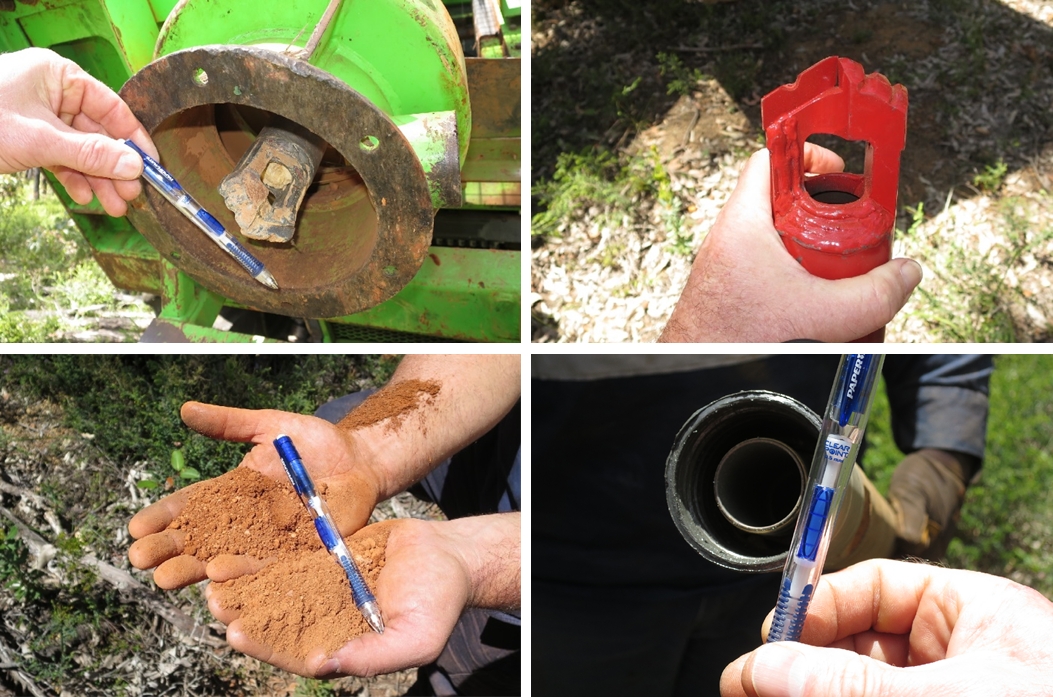
Scale pen diameter 13 mm
|
58 |
|
|
Alcoa Corporation S-K 1300 Report |
Signature Date: 20 February 2025 SLR Project No.: 123.020514.00001 |
The sample catching, splitting, and logging procedures are the same for both vacuum and aircore drilling (Figure 7‑4).
The drilling and logging are controlled by the driller with minimal supervision by geologists. This has been observed and is deemed reasonable by the QP due to the combination of very simple logging, experienced personnel, employment continuity and continual review by geologists.
Sampling begins at the base of the overburden and continues until the driller considers that the basal clays have been penetrated for at least 1 m or for infill holes at a 15 m spacing to the depth defined on the drill hole plan from surrounding data. The depth of basal clays to be penetrated was increased to 2m in 2019 for 60m spaced holes and in 2021 for 30m spaced holes. Alcoa estimates that, most recently, less than 5% of the limited depth holes terminate in bauxite.
Samples are collected at 0.5 m intervals, measured using a laser gauge mounted on the rig. At the end of each 0.5 m interval, the drilling is paused and the sample passes from the cyclone (for aircore) into the collection flask. For vacuum drilling the collection flask is at the end of the vacuum system.
The sample, nominally 1.5 kg, is poured from the flask into a feed tray, distributed evenly, then on the vacuum rigs the tray is pivoted to feed a small 12-vane riffle splitter (the rotating tray is excellent but not yet fitted to the aircore rigs). Where (usually) required, the splitting is repeated to give a retained split of 150 to 200 g, small enough to be collected into a 120 mL measuring cup with minimal spillage. The riffle split subsample is poured into a barcoded Kraft packet and boxed for dispatch to the assay laboratory. The sample retrieval and splitting systems are cleaned with compressed air after each hole.
During the site inspection, the JSW RC sampling procedures were observed closely. It was found that the principles of correct sampling were understood by all personnel at the rig and the equipment and practices were observed to be satisfactory.
Over the period 2015 to 2021 the drill sampling procedures have been externally reviewed (Snowden, 2015; Holmes, 2018; and others) and various improvements have been made such as using riffle splitters with more vanes, using a pivoting tray to consistently feed the splitter, training in the correct splitting and retention of all the subsample, digital recording of logging, monitoring of accuracy with Standards, and monitoring of precision with duplicates.
SLR opinion on the drilling, sampling, and recovery factors are discussed in Sections 8.5 and 11.17.
|
59 |
|
|
Alcoa Corporation S-K 1300 Report |
Signature Date: 20 February 2025 SLR Project No.: 123.020514.00001 |
Figure 7‑4: Sample Catching and Riffle Splitting Practices (SLR, 2021)
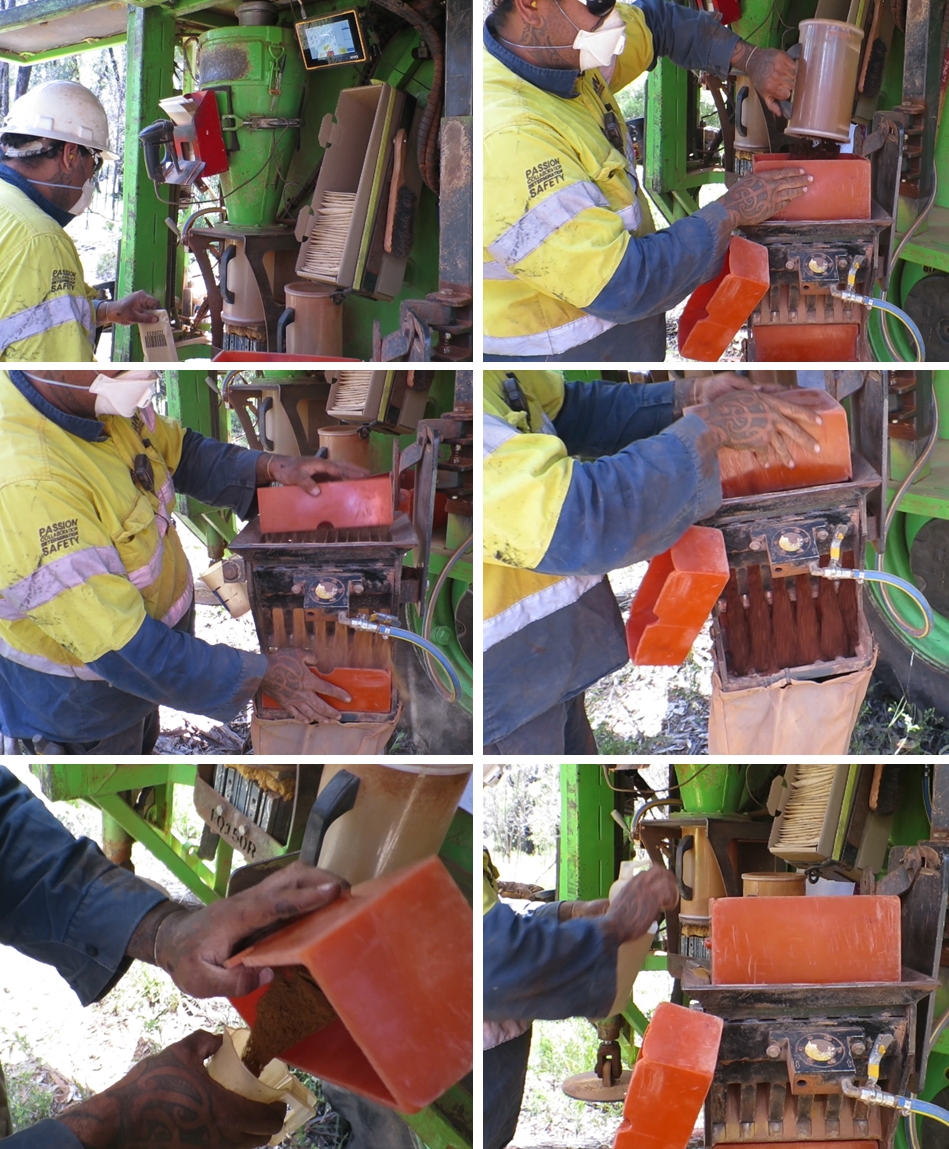
The drill hole and sample information are recorded digitally onto a tablet at the rig during drilling (Figure 7‑5). The data is automatically loaded into an acQuire database. In previous years the same information was all recorded in a ticket book and manually transferred to the database.
|
60 |
|
|
Alcoa Corporation S-K 1300 Report |
Signature Date: 20 February 2025 SLR Project No.: 123.020514.00001 |
This approach remains as a backup method when needed. Data recorded includes hole number, drill rig number, driller name, offsider name, depth of overburden, depth of Caprock, map reference, material type code, and comments on the reason for ending the hole, e.g. if bedrock or water was encountered.
Figure 7‑5: Barcode Reader and Digital Recorder Mounted on the Drill Rig (SLR, 2021)
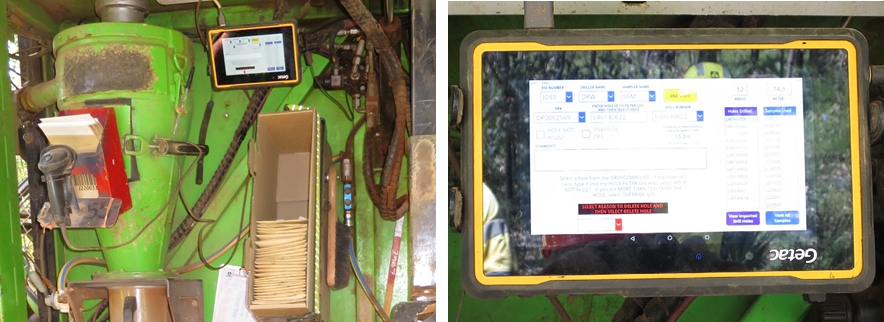
The geology of the Darling Range bauxite is well understood. The Material Type codes have been simplified to meet the production needs of the operation and the drill crew has been trained in their identification, which is primarily based on color and hardness.
This results in logging of a reasonably consistent regolith profile formed by surface weathering of the few bedrock types (granite or dolerite). A comprehensive geological log is not produced but the Material Type codes can be ratified by the assay results. The Material Type codes are provided in Table 7‑2.
Table 7‑2: Logging Codes for Material Type
Material Type |
Description |
Comment |
HB |
Hard brown |
Hardcap and Friable Zone |
HSB |
Hard / soft brown |
|
SB |
Soft brown |
|
SY |
Soft yellow |
|
CLB |
Clayish brown |
|
CLY |
Clayish yellow |
Basal Clay Zone |
BC |
Brown clay |
|
YC |
Yellow clay |
|
WC |
White clay |
|
DOL |
Dolerite |
Intrusion |
GR |
Granite |
|
WET |
Wet |
Other |
ROD |
Broken rod |
|
61 |
|
|
Alcoa Corporation S-K 1300 Report |
Signature Date: 20 February 2025 SLR Project No.: 123.020514.00001 |
Topography data was acquired from:
A digital elevation model representing the natural surface was prepared by combining (in order of priority) the collar survey data, the LiDAR data, and the satellite data.
|
62 |
|
|
Alcoa Corporation S-K 1300 Report |
Signature Date: 20 February 2025 SLR Project No.: 123.020514.00001 |
Figure 7‑6: Topographic Data Coverage of the 2015, 2016 and 2018 LiDAR Surveys (Alcoa, 2022)
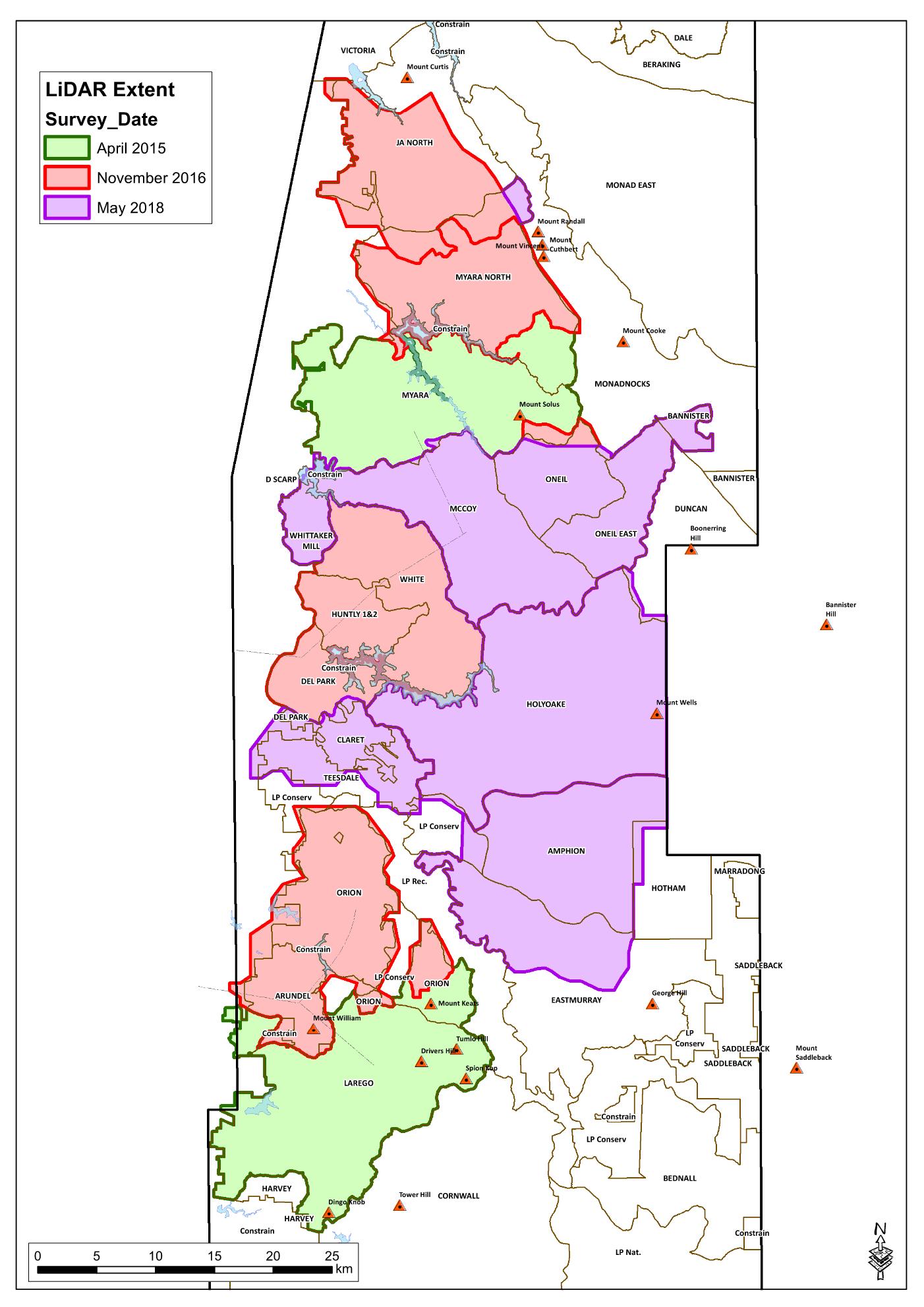
|
63 |
|
|
Alcoa Corporation S-K 1300 Report |
Signature Date: 20 February 2025 SLR Project No.: 123.020514.00001 |
Alcoa has consistently drilled the Darling Range bauxite deposit on a 60 by 60 m grid (with infills to 30 by 30 m and 15 by 15 m) since the 1970s. Initially collar peg positions were surveyed using either a theodolite or Total Station. The 30 m and 15 m pegs were positioned between the 60 m pegs using tape and an optical square. Alcoa commenced using GPS survey control (RTK DGPS) in mid-2015.
Drilling is conducted before any forest clearing activities, which are only carried out for mine development. Positioning the drill rigs is thus imperfect. If the actual coordinates are within 2 m of the planned coordinates, the hole is considered to be correctly located, and the planned coordinates are used in all subsequent processing. Holes that are collared more than 2 m away from the planned location are flagged accordingly in the database, but the planned coordinates are still used in preference to the actual locations. In 2015, Alcoa commenced check surveying of collar positions after drilling. Most of the holes drilled in 2016 and 2017 were check surveyed. Major discrepancies, such as large differences between the actual coordinates and the coordinates defined by the hole identifier, are investigated and corrected in the database.
The planned coordinates at the 15 by 15 m grid points on Map Sheets (see Section 3.3) were used in preference to the actual coordinates. This choice stems from the fact that the original resource delineation systems (Polygonal and GSM, see Section 11.4) were based on the use of regularly gridded data. However, the current 3DBM methodology prioritizes the use of actual coordinates. The use of planned instead of actual coordinates does introduce some uncertainty in the local sample position and consequently the local estimates. However, it is noted that:
|
64 |
|
|
Alcoa Corporation S-K 1300 Report |
Signature Date: 20 February 2025 SLR Project No.: 123.020514.00001 |
Figure 7‑7: Error in Actual Collar Location from the Nominal (planned) Position is Monitored for the Three Drill Rig Types (Alcoa, 2021)
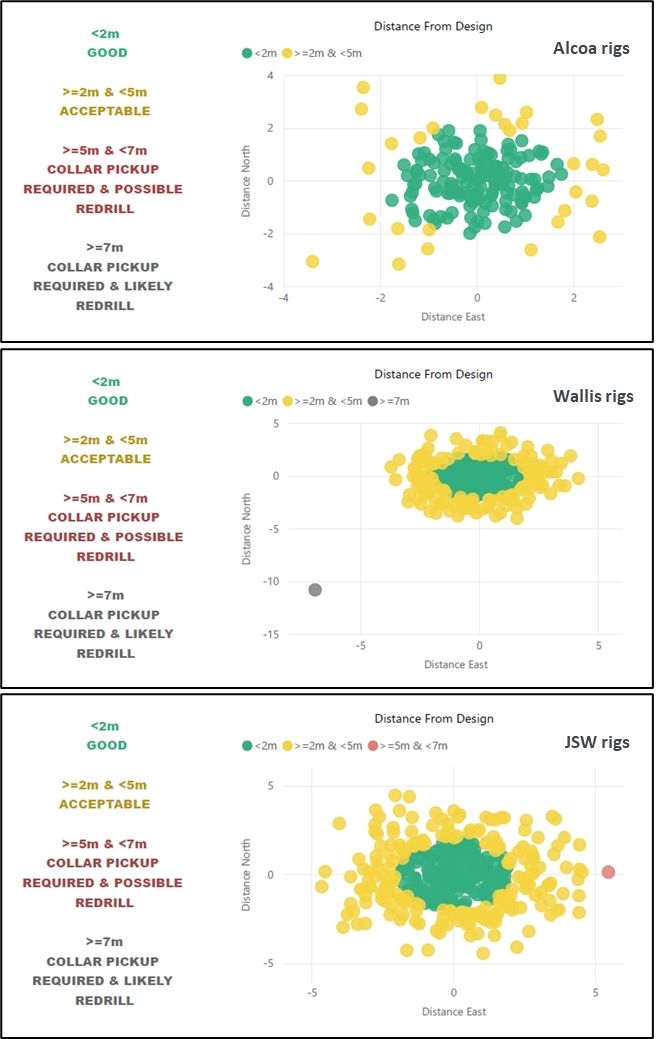
Downhole surveys are not performed in drill holes because of their generally shallow depth and narrow diameter, so all holes are assumed to be vertical.
|
65 |
|
|
Alcoa Corporation S-K 1300 Report |
Signature Date: 20 February 2025 SLR Project No.: 123.020514.00001 |
The drill rigs have limited capacity to be levelled and cannot drill angled holes, so in some circumstances the holes may be drilled perpendicular to the natural surface. The rigs are designed to safely operate on gradients of up to 15°, so holes could be drilled up to 15° off the vertical. For a 6 m hole drilled at the planned collar position, the offset may be up to 1.55 m horizontally and 0.2 m vertically (Figure 7‑8).
Figure 7‑8: Possible Lateral and Vertical Sample Location Error on 15° Sloping Ground (SLR, 2021)
The impact of differences between the actual locations of samples in 3D space compared to their nominal location on the mine plan is considered to not materially impact the Mineral Resource because the errors in the spatial controls on mining are likely to be of the same magnitude as the spatial errors in mining (±2 m laterally and ±0.3 m vertically). Mining is locally controlled by DGPS on mining equipment to meet short-term plans and visually for indications of the base of ore (e.g., WC white clay).
In the QP’s opinion, the drill sampling and sample control procedures at Alcoa’s Darling Range Bauxite Operations are adequate and appropriate for use in the estimation of Mineral Resources. The defined volumes and grades of mineralization are not expected to be systematically impacted (biased) by errors in either the collar location or the 3D sample location.
Historically, no site-specific hydrogeological data was available on the basis that no hydrogeological considerations are required for the definition of mining plans in Alcoa’s Darling Range operations. However, extension of mining activities into the proposed Myara North and Holyoake development envelopes was recently considered to potentially pose a risk to the multiple uses of groundwater in the area including drinking water production, timber harvesting, pine plantation and recreation.
Alcoa has collected groundwater level and groundwater quality data within the Myara North mine region since the 1970s, with available groundwater data typically concentrated within the eastern areas of the mine region. In contrast, only limited water level and water quality data had
|
66 |
|
|
Alcoa Corporation S-K 1300 Report |
Signature Date: 20 February 2025 SLR Project No.: 123.020514.00001 |
been obtained within the Holyoake mine area. As part of the 2020 to 2021 baseline monitoring program, the monitoring network and program was expanded to include:
In consideration of the data obtained from the expanded monitoring network, several hydrogeologic and hydrologic investigations were undertaken by GHD Pty Ltd (GHD) throughout 2021 and into 2022, including:
The results of these investigations will be assessed as part of the Pinjarra Alumina Refinery Revised Proposal (Assessment No. 2253), which includes the Huntly Bauxite Mine transition to Myara North and Holyoake (See Section 17.1.2).
The work completed by GHD has been incorporated into Alcoa’s Catchment Risk Assessment (CRA). The CRA considers potential hazards to PDWSAs and other factors to evaluate mining related catchment risk. This is an iterative process that will allow refining of the model to ensure it is more accurate on the completion of each subsequent iteration. Iteration 1 was produced in 2022; it will be revised in consultation with DWER, DBCA and other relevant regulators. While the CRA is designed to inform mining risk (and lack of risk) the data and predictions can be applied to exploration. Ultimately, the CRA will help Alcoa understand in more detail the hydrological and hydrogeological risk down to a subcatchment level, supporting the development of future mining areas. The CRA is an integral part of the approved 2023-2027 MMP, and the roll-over approval of 2024-2028.
As the slopes are so shallow, no geotechnical considerations are required for the definition of mining plans in Alcoa’s Darling Range operations.
Some limited material characterization is available within the historic reports carried out for the ROM and bauxite crushing facility and seven other mine infrastructure locations. The crusher site is situated south of Willowdale though the geology is considered similar across the sites. Testing includes cone penetration (CPT), basic laboratory classification, some limited consolidated undrained (Cu) triaxials and point load testing (PLT). Some historical data is available for strength testing within the caprock unit including unconfined compressive strength (UCS), young’s modulus (E), tensile strength and abrasion. A factual laboratory report is
|
67 |
|
|
Alcoa Corporation S-K 1300 Report |
Signature Date: 20 February 2025 SLR Project No.: 123.020514.00001 |
available from Wirtgen group based off six rock samples (post drilled from cobbles) taken at Huntly with testing including UCS, tensile strength and Cerchar abrasivity. Details for the testing protocols/standards for the Wirtgen tests are not available. As such, it is considered that there is limited information available in terms of material characterization, strength testing, or pit wall design for the mine site.
Recent factual and interpretive results of a geotechnical investigation carried out by Tetra Tech Coffey Pty Ltd (TTC) in July 2023 for the Kisler Stage 1 area are available. Laboratory testing was carried under TTC direction by STATS Australia, a National Association of Testing Authorities (NATA) accredited laboratory located in Canning Vale WA, in accordance with the general requirements of Australian Standard AS1289. A NATA accreditation is to the ISO/IEC 17025 standard, which demonstrates that the laboratory operates competently and generates valid results. TTC states that the geotechnical laboratory assessment was conducted on representative soil and rock samples recovered from test pits and boreholes, with laboratory test certificates available. The investigations were carried out primarily within the footprint of the proposed Kisler facility, located approximately 10 km south-east of the Serpentine Main Dam. The generalized subsurface profile of the site is presented in Table 7‑3, with the assumption that the actual interface between materials may be far more gradual or abrupt than those made based on the facts obtained. An additional assumption is made in that the site conditions as revealed through selective point sampling are indicative of actual conditions throughout an area.
Groundwater was not encountered at any of the test pit locations, to the maximum depth of investigation (i.e. 3.3m BGL). Groundwater was not observable at the borehole locations due to the use of drilling fluid. However, all boreholes have been converted to monitoring bores for future groundwater monitoring purposes.
Based on the results of geotechnical investigation and AS 1170.4 – 2007 Structural Design Actions (Part 4: Earthquake actions in Australia), a sub-soil classification of “Class Ce – Shallow soil” is considered appropriate for the Kisler Stage 1 site at the time of investigation by TTC.
Table 7‑3: Generalized subsurface profile
Layer/Unit |
Typical Depth to Top of Layer (m) |
Typical Layer Thickness (m) |
Description/Remarks |
Sandy Silt / Silty Sand / Sandy Clay / Clayey Sand |
0.2 – 3.0 |
1.2 – To maximum depth of investigation |
Low to medium plasticity, yellow-brown to brown, sand, fine grained, sub-angular, with some gravel. Predominantly encountered at most test locations throughout the course of investigation. |
Clay |
0.00 – 11.0 |
3.0 – 5.4 |
Medium to high plasticity, brown, yellow-brown, grey-brown, with some sand and gravel. |
Silty Gravel / Clayey Gravel |
0.0 – 9.0 |
3.0 – 5.0 |
Fine to coarse grained, sub-rounded and sub- angular, grey-brown and brown, clay, low to medium plasticity, with some sand, trace non-plastic fine. |
Granite / Dolerite |
5.60 – 20.00 |
To maximum depth of investigation |
Medium to coarse grained, pale grey to grey, red- brown, generally very high to extremely high strength. Some boreholes showed very low to medium strength. |
|
68 |
|
|
Alcoa Corporation S-K 1300 Report |
Signature Date: 20 February 2025 SLR Project No.: 123.020514.00001 |
|
|
|
Granite was encountered at most borehole locations. Generally high to extremely high strength. Dolerite was encountered at 1 location. Extremely high strength. |
|
69 |
|
|
Alcoa Corporation S-K 1300 Report |
Signature Date: 20 February 2025 SLR Project No.: 123.020514.00001 |
Sample preparation is performed by Bella Analytical Systems (Bella). Although the laboratory is located within Alcoa’s curtailed Kwinana Refinery complex and only processes Alcoa material, it is independently owned and operated by Bella. A link exists between the Bella and Alcoa Laboratory Information Management System (LIMS) for the two-way exchange of data. Bella does not have Australian National Association of Testing Authorities (NATA) accreditation.
All assays produced by Bella are monitored and controlled by Alcoa at the Kwinana Mining Laboratory (KWI), which, although it has a QA/QC system based on ISO 9001 protocols, only has one section of the laboratory certified to ISO 9001 for the purpose of certification of shipment assays of alumina.
A robotic processing system is used to prepare each sample for Fourier Transform Infrared Spectrometry (FTIR) and Reference Method (REF) testing. This entails pulverizing each sample in a flow-through ring mill to a nominal grind size of 85% passing 180 µm, and then splitting off sufficient material to fill a barcoded scanning flask (20 mm high with an 80 mm diameter). The material from the ring mill is discharged through a rotary splitter, with approximately 80–100 g of material retained for geochemical testing, and the remainder discarded. A duplicate sample is collected from 1% of the samples via a rotary splitter fitted with twin select chutes. These samples are used for Reference Methods testing.
Subsamples are collected by the drillers, sealed into Kraft packets with barcodes and submitted for assay. Cardboard boxes holding 50 packets are delivered at the end of each shift, by the drilling crew, to secure sample storage facilities. Unfilled boxes are stored in the drill support vehicle and completed in the next shift.
The filled sample boxes are stacked onto pallets in batches of 40 (i.e., 2,000 samples), wrapped with plastic and dispatched by courier to the Bella assay facility at the curtailed Kwinana Refinery.
Upon receipt by Bella, the sample barcodes are scanned and checked against the submission data in the Bella LIMS. Each sample packet is then split open at the top, placed in a cardboard drying tray and oven-dried at 100°C for 10 hours. The packets are transferred to a customized holder in batches of about 60, with a control between each batch, and automatically fed to a bank of 10 Rocklabs flow-through ring mills (Figure 8‑1), each of which have three concentric milling rings. The barcode is read, the sample is pulverized, a subsample is rotary split, captured in a single-use plastic Petri dish with the barcode printed on the lid, then sent to the spectral analyzer for assay. The ring mills are air flushed and vacuumed between samples.
Each sample is pulverized to a nominal grind size of 85% passing 180 µm. The ring mill discharges through a chute and rotary splitter, retaining 80 to 100 g and discarding the rest. One of the ring mills is set up to take two splits and these are used for pulp duplicate assays and to generate the Reference (REF) samples. These are sent to the KWI for wet chemical assay checking of the spectral assay. Pulverized samples are stored in a barcoded dedicated receptacle for assay (Figure 8‑2).
|
70 |
|
|
Alcoa Corporation S-K 1300 Report |
Signature Date: 20 February 2025 SLR Project No.: 123.020514.00001 |
The robotic system can run 24 hours a day handling approximately 3,000 samples per day. Only the Mineral Resource estimation samples are processed at Bella with all other stockpile and processing control samples processed using the same methods as the REF samples.
Figure 8‑1: The Bella Robotic Sample Preparation using Rocklabs Ring Mills (SLR, 2021)
|
71 |
|
|
Alcoa Corporation S-K 1300 Report |
Signature Date: 20 February 2025 SLR Project No.: 123.020514.00001 |
Figure 8‑2: The Pulverized Sample is Stored in a Barcoded Dedicated Receptacle for Assay (SLR, 2021)
A LIMS system controls the progress of the sample packet through the whole of the sample preparation and assay procedure enabling digital tracking of all stages (Figure 8‑3). This ensures inter alia that the sample is valid, not previously assayed, and the assay looks like one for a bauxite sample. It also generates pulp duplicates at a frequency of 1 in 100 which are also the REF samples.
Figure 8‑3: The Pulverized Sample is Tracked Digitally Through the Bella Preparation and Assaying (SLR, 2021)
Grind size monitoring is carried out with the advantage of the robotic sample preparation being consistent grind size. A risk with all such systems is the possibility of contamination between samples. This is usually avoided by inserting blank samples of zero grade into the sample processing stream. The difficulty is that the blank samples may themselves contaminate the next sample being assayed.
Quality control (QC) procedures were developed and implemented to monitor the Bella robotic sample preparation system (Franklin, 2019) and they include:
|
72 |
|
|
Alcoa Corporation S-K 1300 Report |
Signature Date: 20 February 2025 SLR Project No.: 123.020514.00001 |
Figure 8‑4: Sample Preparation Monitoring: Grind Sizes for the Robotic Sample Preparation Unit Tested by Bella and by KWI
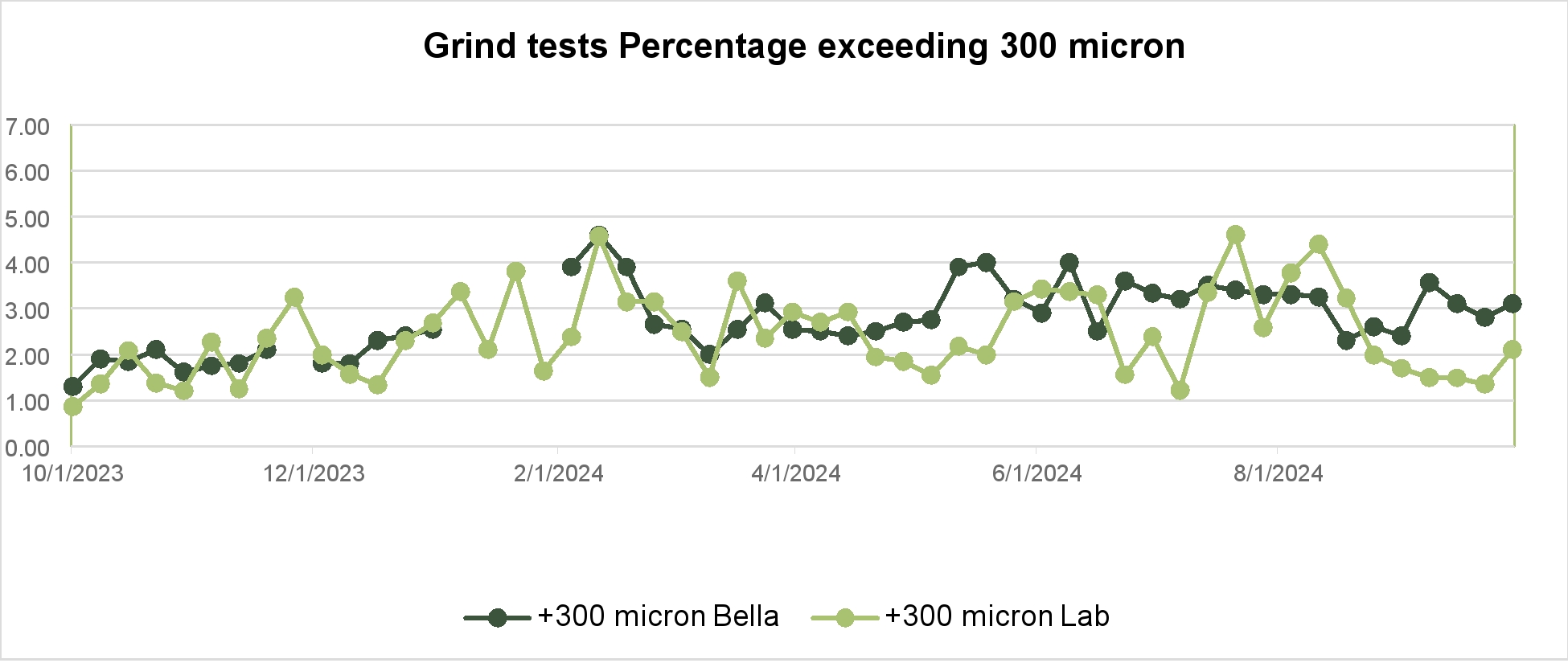
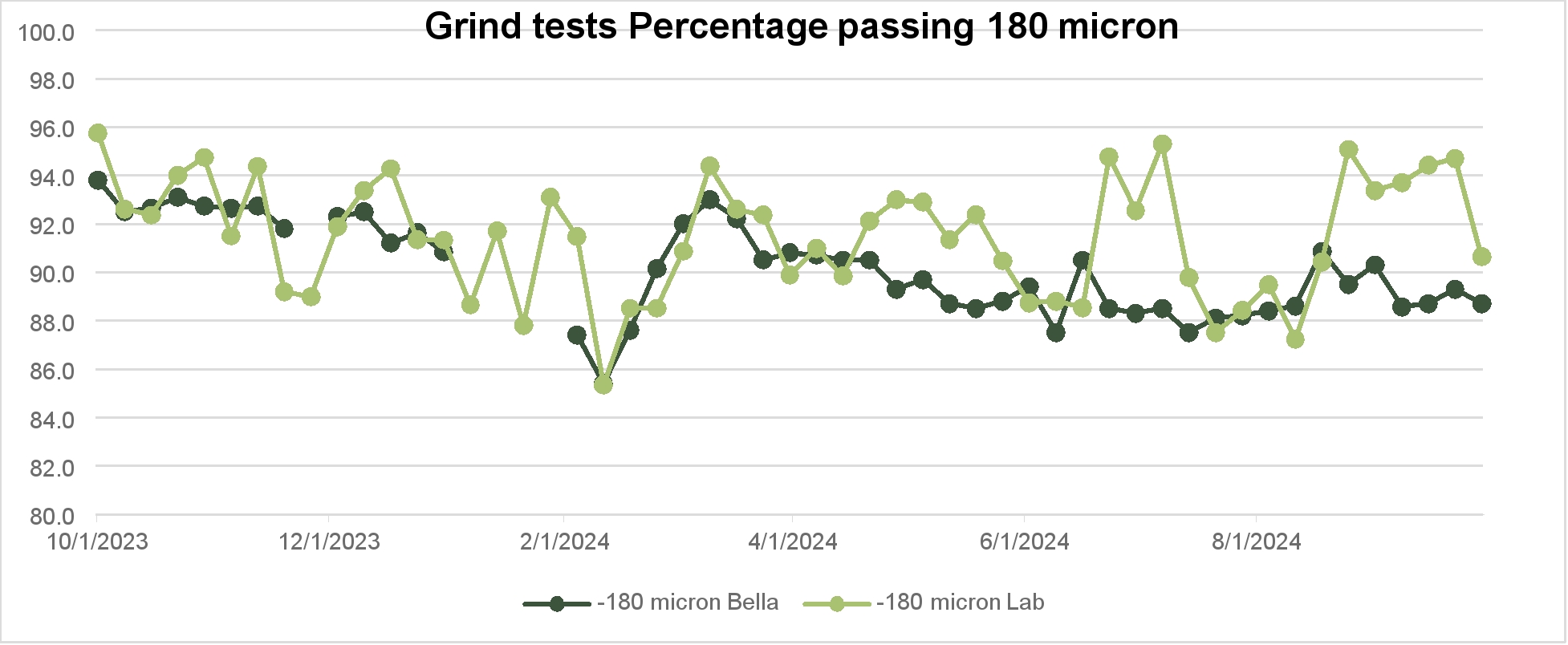
Assaying of the drill samples is based on a spectral method, using a Nicolet 6700 FTIR Spectrometer with a robotic feeder (Figure 8‑5). FTIR obtains an infrared absorption spectrum from the sample. The FTIR spectrometer simultaneously collects high-resolution spectral data over a wide spectral range. A mathematical process (Fourier transformation) converts the raw data into the actual spectrum for subsequent determination of the component analytes.
|
73 |
|
|
Alcoa Corporation S-K 1300 Report |
Signature Date: 20 February 2025 SLR Project No.: 123.020514.00001 |
All drill samples are currently assayed using a customized, bespoke FTIR method, with the final corrected results used for Mineral Resource estimation. Calibration and monitoring of the FTIR results are done using the Reference Method assay results.
Bella generates the raw FTIR spectral dataset for each sample, which is transferred to the Alcoa LIMS system for post-processing. Alcoa performs all the Reference Method analyses at KWI.
The FTIR spectra are determined using a robotic scoop arm that collects an approximately 5 g aliquot of the pulp from the Petri dish and presents it to a platinum crucible. The material in the crucible is pressed flat to ensure an even surface for scanning. The crucible is then rotated several times through the spectrometer and 20 scans are conducted on the aliquot. The scans are processed and validated by the Bella system and when accepted, they are then transferred to the Alcoa LIMS system for post-processing and further validation.
Figure 8‑5: The Robotic FTIR Assaying Equipment (RHS shows the sampling scoop arm and pulp dish with the lid elevated) (SLR, 2021)
The FTIR Method for bauxite assay uses infrared absorption spectra to characterize the presented sample for multiple analytes as element, compound, or mineral percentages. The approach has been developed using an extensive calibration and validation (CalVal) dataset, constant monitoring of Reference samples and Standards, and periodic revision of the prediction algorithms.
In 1990, an initial set of approximately 2,300 CalVal samples was collected covering the Darling Range tenement. A subset of approximately 700 samples was used to develop the initial FTIR prediction model. Extra CalVal samples have been added to help predictions in areas of low Reactive Silica (less than 0.5% Si) and high Total Iron (greater than 50% Fe). The CalVal samples are run randomly through the FTIR equipment in triplicate, under differing conditions (time of day, season, operator, order, etc.) to test for external factors. The FTIR results based on the prediction model algorithm are monitored using the REF assays (Franklin, 2019).
Initially some FTIR analytes (Available Alumina, Total Iron, Carbonate, Sulphate, Total Silica, Total Phosphorus and Magnetic Susceptibility) were all determined using a ‘common’ algorithm, whereas Reactive Silica, Oxalate, Extractable Organic Carbon, Total Alumina and Boehmite each used a specific algorithm. Since 2017 specific algorithms have been used for all analytes. The algorithms are periodically updated, typically if there has been a change in equipment or Reference Method. Retaining all FTIR spectra now means additional analytes can be
|
74 |
|
|
Alcoa Corporation S-K 1300 Report |
Signature Date: 20 February 2025 SLR Project No.: 123.020514.00001 |
determined using specific algorithms, with three new analytes being added to Method Set MIC#00005 in 2021 (Potassium, Titanium and Gallium).
The REF assaying is done by Alcoa in the KWI to validate and calibrate the FTIR assays. This is a suite of assays and tests that are carried out by wet chemical and other means and has included:
There are differences in the nature of these tests. Both XRF and ICP methods are instrument-based methods designed to replicate wet chemical analysis results, either total or partial assays depending on the digestion. Both XRD and MS methods are used to investigate mineralogy contents so they are regarded as proxies for assays. Bomb digest (BD) methods have been developed by the alumina refining industry to determine the expected yield of bauxite ore during processing. They are the basis for ‘metallurgical assays’ that are designed to replicate the physicochemical reactions in the refinery and accordingly may be customized for a particular ore type or process plant. At Alcoa some BD assaying has been replaced with a microwave digest (MD) method.
A summary of the assaying used for the REF samples, which are used to calibrate and validate the FTIR Method, is provided in Table 8‑1.
Table 8‑1: Assaying Methodologies for Resource Estimation Samples
Name |
Analyte |
Code |
Units |
Reference Method |
Available Alumina |
A.Al2O3 |
AL |
% |
MD – ICP (MALSI) |
Reactive Silica |
R.SiO2 |
SI |
% |
MD – ICP (MALSI) |
Total Iron |
Fe₂O₃ |
FE |
% |
XRF and FTIR |
Oxalate |
NaC₂O₄ |
OX |
kg/t |
BD – GC |
Carbonate |
Na₂CO₃ |
CO |
kg/t |
BD – NDIR (TICTOC) |
Extractable Organic Carbon |
C |
EO |
kg/t |
BD – NDIR (TICTOC) |
Total Phosphorous |
P₂O₅ |
PT |
% |
XRF |
Sulphate |
Na₂SO₄ |
SU |
kg/t |
XRF |
|
75 |
|
|
Alcoa Corporation S-K 1300 Report |
Signature Date: 20 February 2025 SLR Project No.: 123.020514.00001 |
Total Silica |
SiO₂ |
ST |
% |
XRF |
Magnetic Susceptibility |
MagSus |
MS |
None |
MS (CGS system) |
Total Alumina |
Al₂O₃ |
AT |
% |
XRF |
Boehmite |
AlO(OH) |
BO |
% |
XRD |
The bomb digest (BD) method involves adding a measured amount of carbonate free 52% caustic soda to the sample aliquot (1 g), sealing it in a small 10 mL pressure vessel and then cooking it at 145°C. After cooling, the solution is assayed by titration or other methods to determine the alumina and silica contents. As the digestion of these elements by the hot caustic solution is determined by the physical conditions during digestion (mainly temperature and pressure) the results provide a proxy for the expected performance of ore of that nature in the alumina refinery plant. The resulting assays are termed available alumina (AL) and reactive silica (SI), measured as percentages.
The MD method was introduced in 1996 to supplant the BD methods for assaying of the Mineral Resource drill samples. Atmospheric digestion is done in a microwave oven using a 13% caustic solution. The advantage of this is that it is faster, more repeatable and uses a bigger aliquot (0.5 g). The MD assays are collectively named ‘microwave available alumina and reactive silica’ (MALSI). The BD methods are still used for the refinery monitoring samples including those taken from the sampling towers prior to the feed stockpiles of crushed ore.
Following digestion using either MD, BD, or wet chemical methods, the analytes are assayed (Table 8‑1) using the following methods (Figure 8‑6):
|
76 |
|
|
Alcoa Corporation S-K 1300 Report |
Signature Date: 20 February 2025 SLR Project No.: 123.020514.00001 |
Figure 8‑6: Digestion and Assay Equipment used for REF Samples at the KWI
Clockwise from top left: BD, MD, TICTOC, ICP, XRF, GC (SLR, 2021)
Details on the assaying method used for the final (Best) assay value for every sample interval are carried in the acQuire database.
|
77 |
|
|
Alcoa Corporation S-K 1300 Report |
Signature Date: 20 February 2025 SLR Project No.: 123.020514.00001 |
For resource estimation, the Reference Method results are used to monitor the performance of the FTIR assaying, and to calibrate (adjust) the FTIR results on a batch-by-batch basis. The Reference Method is also used for all monitoring of the refinery performance including the grades of ore presented to the sampling towers at Pinjarra and Wagerup prior to stockpiling and reclaiming of the ore feed.
A consistent approach to sample collection, preparation and assaying for Mineral Resource estimation has been used since 1980. Refinements to the assaying methods have comprised:
The impact of these changes and validation of the results were investigated by Alcoa personnel and independently by SRK (2021a). It was concluded that the assaying precision (i.e. repeatability) and accuracy (lack of bias, as demonstrated by quantile-quantile plots) did not show significant differences between the pre-2018 and post-2018 data sets.
Since completion of the 2023 Mineral Resource inventory, an additional 70,253 vacuum and aircore holes have been drilled and approximately 710,870 routine FTIR analyses performed. These represent holes drilled between September 2023 and June 30, 2024.
Quality assurance (QA) consists of evidence that the assay data has been prepared to a degree of precision and accuracy within generally accepted limits for the sampling and analytical method(s) to support its use in a Mineral Resource estimate. Quality control (QC) consists of procedures used to ensure that an adequate level of quality is maintained in the process of collecting, preparing, and assaying the drilling samples.
The following QA/QC protocols are implemented and managed by Alcoa’s team, and QA/QC samples are not blind to the laboratory, with the exception of Sample To Extinction (STE). Batches of samples are submitted to the Bella laboratory daily. Internal standards created from the stockpile of the Darling Range bauxite are introduced by the Bella Laboratory every 50 samples during the FTIR analysis to check the chain of process. All standard sample insertions and batches maintain consecutive numerical order. Calibration is done at first to generate the reference mean of the standard as well as the acceptable minimum and maximum values totaling three standard deviations.
|
78 |
|
|
Alcoa Corporation S-K 1300 Report |
Signature Date: 20 February 2025 SLR Project No.: 123.020514.00001 |
After the boxes of drill samples are received at Bella, packets of Reference Method samples (REF) are split out by the robotic sample preparation, based on a random selection by Alcoa LIMS, at a frequency of 1 in 100 (1%). These are submitted to the KWI in batches of 19 for REF assaying to calibrate and validate the quality of the FTIR Bella assays. As the FTIR assays are adjusted to match the REF assays (using a ‘broken stick’ curve adjustment to remove bias and maintain precision) it is expected that there should be minimal bias between REF and FTIR corrected results (FTIR_corr). However, the repeatability between the two methods is an important attribute of the quality of the assay results used for Mineral Resource estimation. Each batch of REF samples includes 1 Blank and 1 Standard. The REF samples are considered to serve the same purpose as pulp repeats in defining the repeatability of the assays. Alcoa also sends checks of REF samples assayed at Bella and KWI to an independent laboratory, Bureau Veritas (BV).
Alcoa introduced in 2018 an alternative procedure to field duplicates, termed Sample To Extinction (STE). This involves taking the normal 0.5 m drill sample (referred to as the Parent) and collecting all the residue from that drilled interval (i.e. the riffle split reject, and previously any material left in the sampling cup). This residue is collected once per shift from each rig under supervision by the geologist. The residue is pulverized and homogenized, then two equal splits (referred to as the Daughters) are assayed.
Following receipt of results from the laboratories, Alcoa geologists review the values, and sample batches identified as anomalous are repeated by the laboratory. Monthly and quarterly QA/QC reports are produced to detect and address potential temporal trends or issues in their results.
The following are the existing written QA/QC procedures available to all staff:
QP reviewed QA/QC information compiled in the previous report (SLR, 2023) and analyzed the new QA/QC data compiled by Alcoa between November 2023 and September 2024. The findings of this analysis are presented in the subsequent sub-sections.
Blanks are not routinely introduced in FTIR submission batches into the robotic mills at Bella and there is no check on cross-contamination during sample preparation. Given the style of mineralization, the ore grades being assayed, and the volume of material milled compared to the final aliquot assayed, the absence of sample preparation blanks is not considered material. There is also no available blank sample on the market that would not introduce contamination of the mills by very low-grade samples at Bella. KWI laboratory submits blanks with a frequency of 1 to 19 in the REF samples sets compiled and dispatched regularly by Bella, however that information was not available for review.
|
79 |
|
|
Alcoa Corporation S-K 1300 Report |
Signature Date: 20 February 2025 SLR Project No.: 123.020514.00001 |
Standards evaluate accuracy of the assaying by detecting the differences between a result and an expected value, also known as a bias. Alcoa has used a series of specially prepared Internal Reference Material (IRM) samples derived from Darling Range bauxite, pulverized and homogenized by Gannet Holdings, labelled KH09 to KH20. Between 2021 and 2024, only IRM KH14 and KH20 have been used at the Bella Laboratory and KH10 at the mining laboratory. Monitoring using these IRM samples provides arguably better assurance of assaying accuracy than commercial Certified Reference Material samples. The IRMs have generally been sourced from stockpile material and used in both coarse-crushed and pulp form. The IRMs have not been externally certified. A summary of the IRMs used is provided in Table 8‑2.
Table 8‑2: Standards Used for Drilling and REF Monitoring (IRMs)
Standard |
Date |
Comment |
KH09 |
May 1999 to present |
Boehmite analysis, FTIR, MD-ICP, and XRF analysis Mining reference analysis (IRM) |
KH10 |
May 2012 to present |
Mining reference analysis (IRM) |
KH11 |
July 2008 to March 2015 |
FTIR analysis (IRM) |
KH12 |
July 2008 to April 2014 |
Grind size control (IRM) |
KH13 |
April 2014 to present |
Grind size control (IRM) |
KH14 |
March 2015 to October 2021 |
FTIR analysis (IRM) |
KH15 |
October 2015 to September 2017 |
Preparation and analytical control – introduced at the drill rig (IRM) |
KH16 |
September 2017 to December 2018 |
Preparation and analytical control – introduced at the drill rig (IRM) |
KH17 |
September 2017 to December 2018 |
Preparation and analytical control – introduced at the drill rig (IRM) |
KH18 |
September 2017 to December 2018 |
Preparation and analytical control – introduced at the drill rig (IRM) |
KH20 |
October 2021 to present |
FTIR analysis (IRM) |
Control of the accuracy of FTIR samples is currently monitored at the Bella laboratory using IRM KH20. The IRMs are inserted every 50 FTIR samples. FTIR batches totaling 48,855 samples of KH20 analyzed primarily between November 2023 to September 2024 and using Priority Codes P202 to P212, BV002 to BV004, and INT001 grouped by quarters, were sent to SLR for review. Priority Codes represent batches assayed by the FTIR Method using the same batch correction factors.
The QP reviewed all batches from either KH10 or KH20, adhering to the failure limits set by Alcoa, which are three standard deviations (SD) from the expected value. The QP evaluated the available alumina (AL), reactive silica (SI), and iron (FE) through extended timeline series to identify potential bias trends or systematic outliers.
In general, IRMs exhibited robust accuracy biases, ranging from -0.03% to 3.4% for the elements AL, FE, and SI as summarized in Table 8‑3. These results were obtained with a controlled number of failures across all three grade IRM categories: low-grade, intermediate-grade, and high-grade.
|
80 |
|
|
Alcoa Corporation S-K 1300 Report |
Signature Date: 20 February 2025 SLR Project No.: 123.020514.00001 |
Table 8‑3: Performance of IRM Samples used in the 2023 - 2024 QA/QC Programs.
IRM |
Element |
Unit |
Year Quarter |
N Samples |
Mean |
EV |
SD |
N Outliers |
Bias (%) |
Outliers (%) |
Upper Limit |
Lower Limit |
KH20_BV002 |
AL |
% |
2023Q4 |
1010 |
31.52 |
31.53 |
1.4 |
2 |
-0.02 |
0.2 |
35.63 |
27.43 |
FE |
% |
1010 |
16.39 |
16.38 |
1.23 |
3 |
0.04 |
0.3 |
20.04 |
12.72 |
||
SI |
% |
1010 |
1.03 |
1.03 |
0.11 |
6 |
0.02 |
0.59 |
1.35 |
0.71 |
||
KH20_BV004 |
AL |
% |
2023Q4 |
339 |
34.55 |
34.55 |
0.91 |
3 |
0 |
0.88 |
37.28 |
31.82 |
FE |
% |
339 |
16.51 |
16.51 |
0.8 |
0 |
-0.02 |
0 |
18.92 |
14.1 |
||
SI |
% |
339 |
0.86 |
0.86 |
0.02 |
0 |
0.09 |
0 |
0.92 |
0.8 |
||
KH20_P202 |
AL |
% |
2023Q4 |
1417 |
33.44 |
33.24 |
0.54 |
21 |
0.61 |
1.48 |
34.56 |
31.92 |
FE |
% |
1417 |
15.87 |
16.12 |
0.6 |
34 |
-1.54 |
2.4 |
17.45 |
14.79 |
||
SI |
% |
1417 |
1 |
1.03 |
0.04 |
170 |
-3.42 |
12 |
1.12 |
0.94 |
||
|
KH20_P203_P204_ P205_P206 |
AL |
% |
2023Q4 - 2024Q1 |
5333 |
33.15 |
33.3 |
0.6 |
178 |
-0.44 |
3.34 |
34.62 |
31.98 |
FE |
% |
5333 |
15.84 |
16.01 |
0.58 |
125 |
-1.06 |
2.34 |
17.34 |
14.68 |
||
SI |
% |
5333 |
0.99 |
0.99 |
0.04 |
153 |
-0.1 |
2.87 |
1.08 |
0.9 |
||
KH20_INT001 |
AL |
% |
2024Q2 |
460 |
33.35 |
33.36 |
0.89 |
0 |
-0.01 |
0 |
38.72 |
27.99 |
FE |
% |
460 |
16.54 |
16.54 |
0.66 |
0 |
-0.02 |
0 |
19.58 |
13.5 |
||
SI |
% |
460 |
1.06 |
1.06 |
0.05 |
0 |
-0.45 |
0 |
1.27 |
0.84 |
||
|
KH20_P207_P209_ P210_P208 |
AL |
% |
2024Q2 |
5000 |
32.99 |
32.95 |
0.54 |
66 |
0.13 |
1.32 |
34.27 |
31.63 |
FE |
% |
5000 |
15.85 |
15.82 |
0.58 |
96 |
0.21 |
1.92 |
17.14 |
14.49 |
||
SI |
% |
5000 |
0.98 |
0.98 |
0.04 |
68 |
-0.03 |
1.36 |
1.07 |
0.89 |
||
KH10 |
AL |
% |
2024Q3 |
549 |
35.09 |
35.13 |
0.63 |
1 |
-0.13 |
0.18 |
36.93 |
33.34 |
FE |
% |
518 |
15.55 |
15.52 |
0.1 |
0 |
0.18 |
0 |
15.9 |
15.13 |
||
SI |
% |
549 |
1.01 |
1.01 |
0.03 |
14 |
0.16 |
2.55 |
1.08 |
0.94 |
||
KH20_BV003 |
AL |
% |
2024Q3 |
328 |
31.94 |
31.95 |
1.12 |
0 |
-0.03 |
0 |
35.32 |
28.58 |
FE |
% |
328 |
16.74 |
16.74 |
0.92 |
1 |
0 |
0.3 |
19.49 |
13.98 |
||
SI |
% |
328 |
1.15 |
1.15 |
0.1 |
1 |
-0.42 |
0.3 |
1.46 |
0.84 |
||
KH20_P211_P212 |
AL |
% |
2024Q3 |
2398 |
32.95 |
33.03 |
0.55 |
39 |
-0.26 |
1.63 |
34.34 |
31.71 |
FE |
% |
2398 |
15.84 |
15.85 |
0.57 |
38 |
-0.04 |
1.58 |
17.18 |
14.52 |
||
SI |
% |
2398 |
0.98 |
0.99 |
0.04 |
58 |
-0.58 |
2.42 |
1.08 |
0.9 |
SLR selected three IRMs KH20 series for in-depth analysis, based on the number of samples utilized over the entire timeline from the fourth quarter of 2023 to the third quarter of 2024. This selection includes samples from batches P202 to P212.
The results from the IRM KH20, analyzed by the laboratory between Q4 2023 and Q1 2024, as shown in Figure 8‑7, include batches P203, P204, P205, and P206. These batches exhibit a slight negative bias of -0.4% for available alumina (AL), particularly in batches P205 and P206, with 146 instances falling below the -3SD threshold. Although this bias remains below the ±5% threshold, its negative trend makes it worthwhile to investigate the cause and implement corrections to avoid future issues. Conversely, reactive silica (SI) maintains a bias of -0.1%, with 2.8% of outliers, and iron (FE) shows a bias of -1%, with few failures falling below the lower limit.
|
81 |
|
|
Alcoa Corporation S-K 1300 Report |
Signature Date: 20 February 2025 SLR Project No.: 123.020514.00001 |
Figure 8‑7: KH20 control chart of AL, SI, and FE
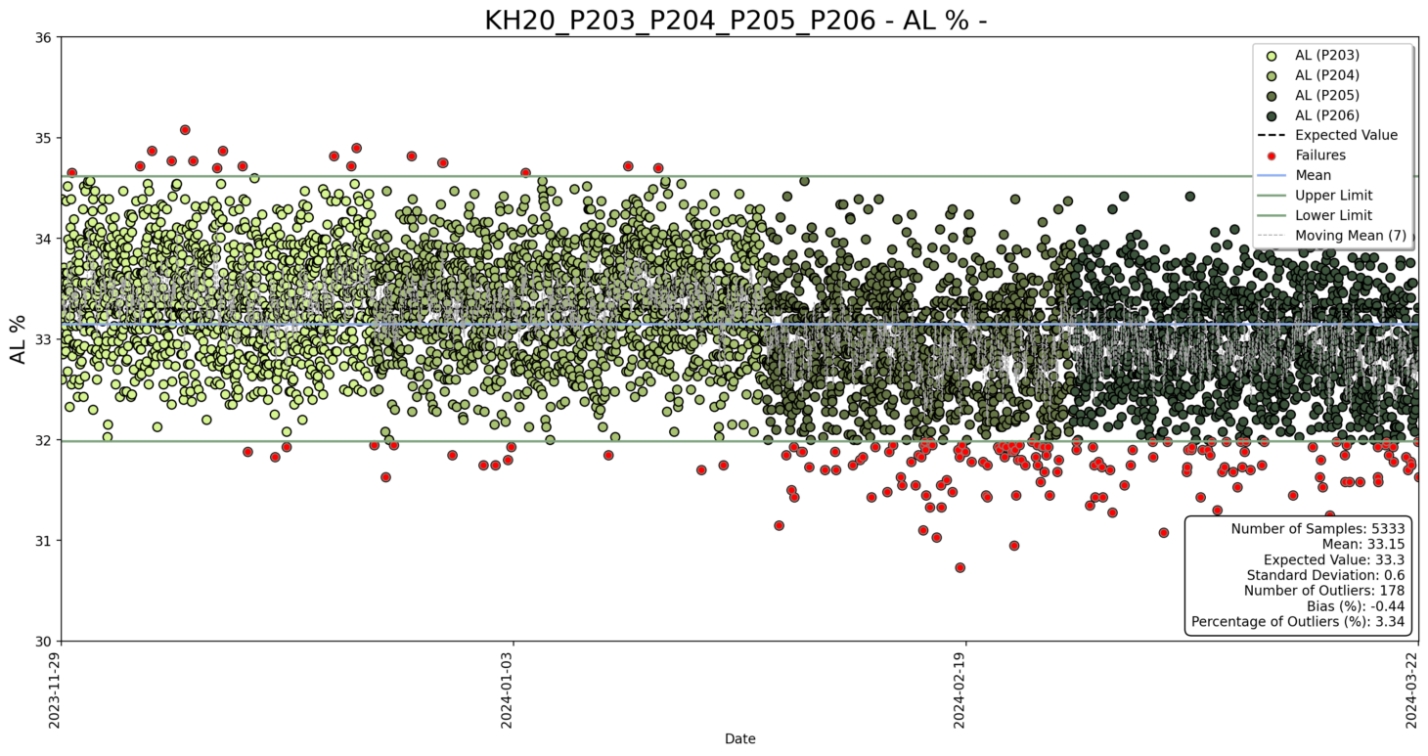
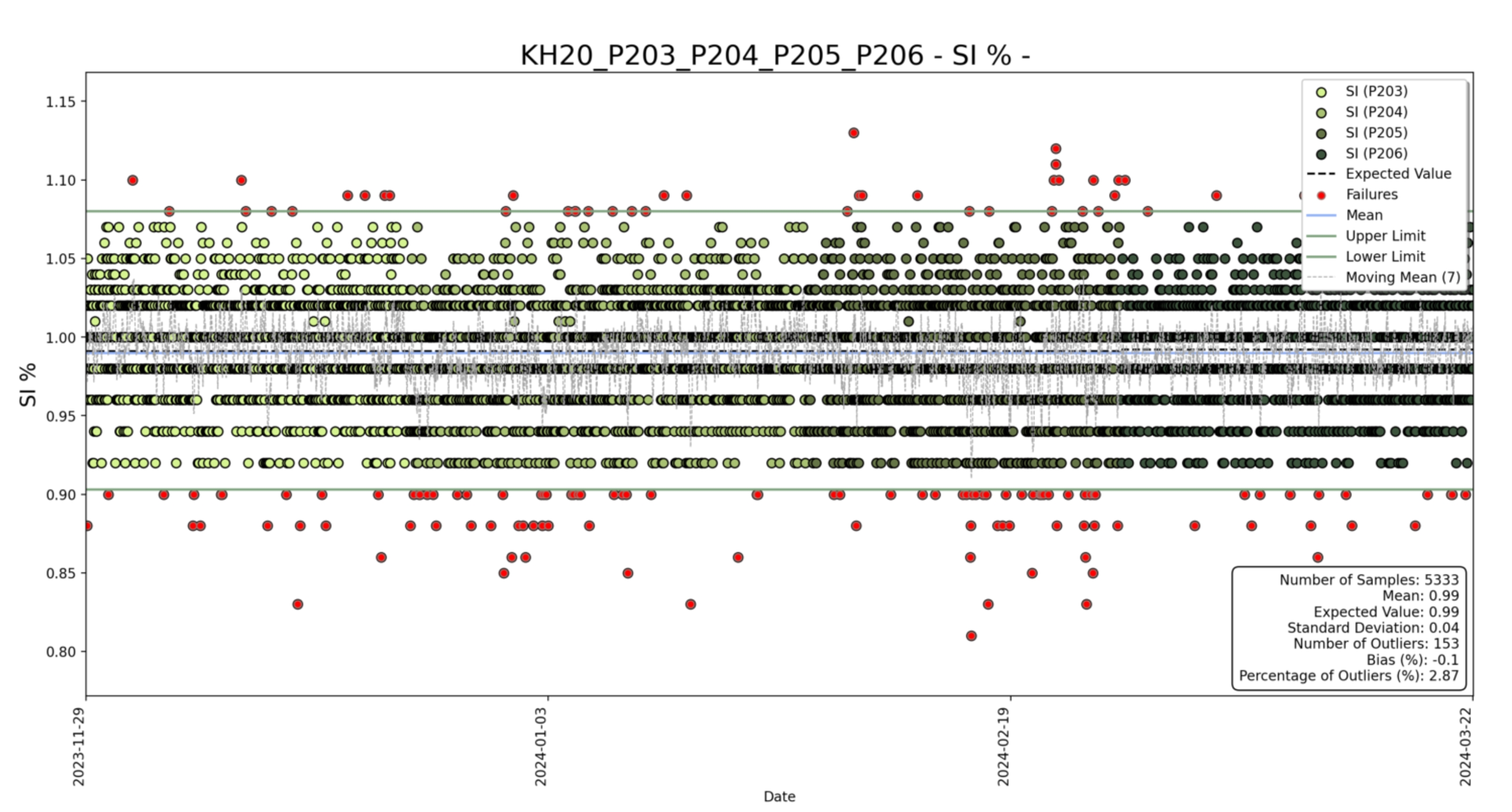
|
82 |
|
|
Alcoa Corporation S-K 1300 Report |
Signature Date: 20 February 2025 SLR Project No.: 123.020514.00001 |
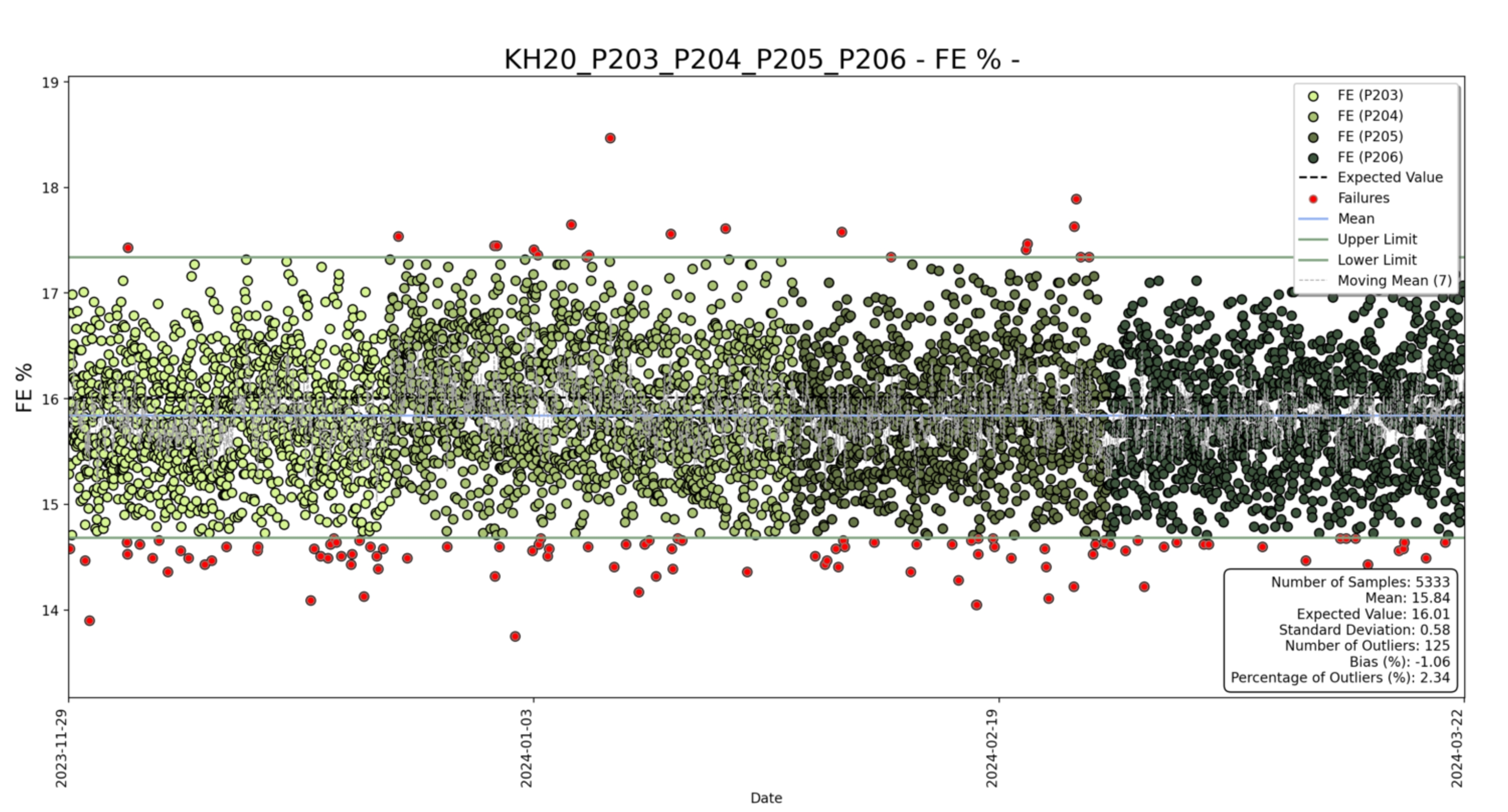
The IRM KH20 including batches P207 to P210, visualized in Figure 8‑8, analyzed between Q2 and part of Q4 2024, shows more stable results with a minimal bias of 0.1% for AL, -0.03% for SI, and 0.21% for FE, and a controlled number of failures. This confirms an improved performance compared to batches P203 to P206. Similarly, batches P211 and P212, analyzed during the third quarter of 2024, display most results within threshold limits and low biases ranging from -0.04% to -0.58% for AL, SI, and FE, as observed in Figure 8‑9.
Figure 8‑8: KH20 control chart of AL, SI, and FE: Q2 2024 and Q3 2024
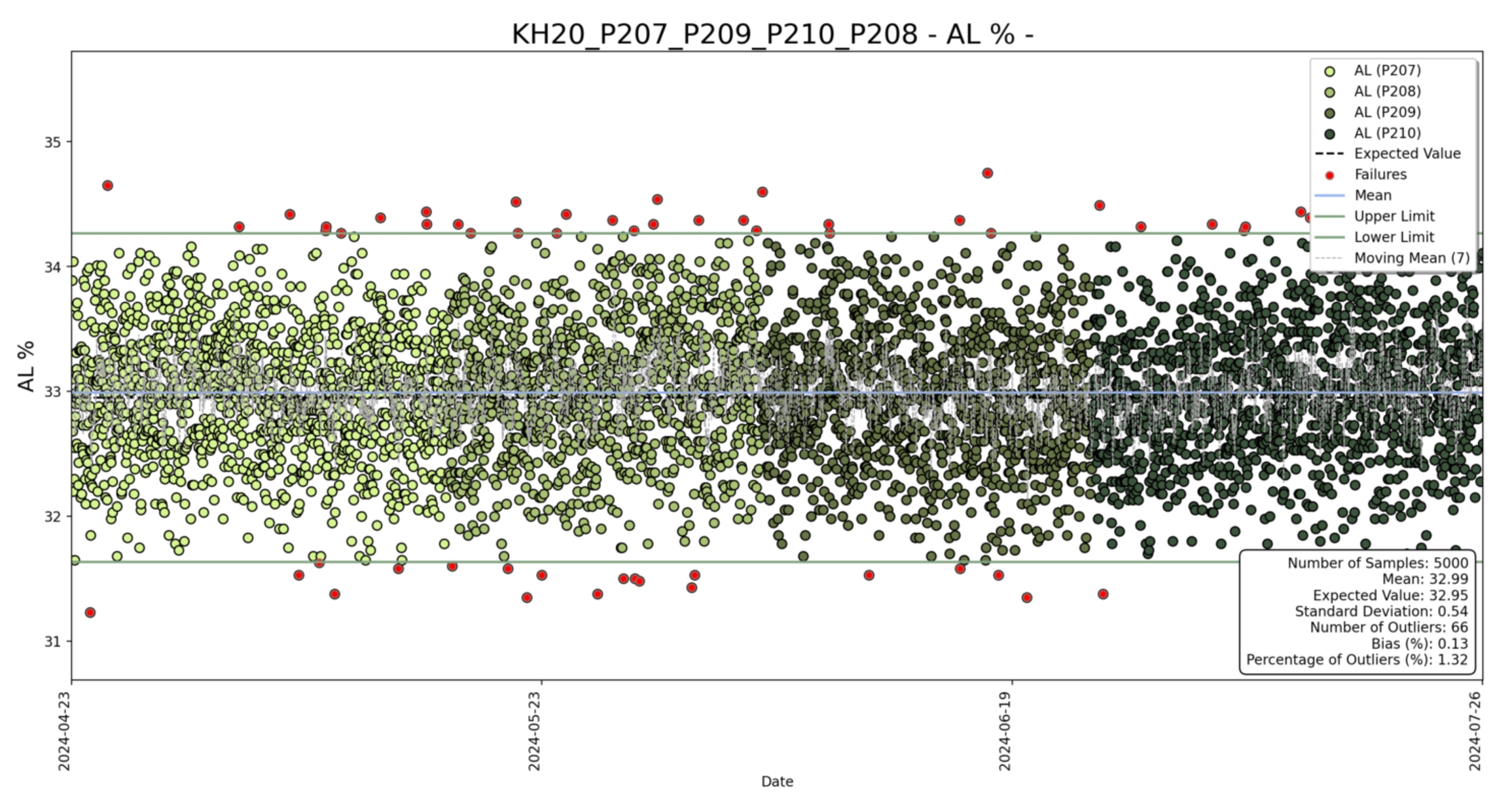
|
83 |
|
|
Alcoa Corporation S-K 1300 Report |
Signature Date: 20 February 2025 SLR Project No.: 123.020514.00001 |
|
84 |
|
|
Alcoa Corporation S-K 1300 Report |
Signature Date: 20 February 2025 SLR Project No.: 123.020514.00001 |
Figure 8‑9: KH20 control chart of AL, SI, and FE: Q3 2024 and Q4 2024
|
85 |
|
|
Alcoa Corporation S-K 1300 Report |
Signature Date: 20 February 2025 SLR Project No.: 123.020514.00001 |
Duplicate samples help monitor preparation, assay precision, and grade variability as a function of sample homogeneity and laboratory error. The field duplicates are used to evaluate the natural variability of the original core sample, as well as detect errors at all levels of preparation and analysis including core splitting, sample size reduction in the preparation laboratory, subsampling of the pulverized sample, and analytical error. Coarse reject and pulp duplicates provide a measure of the sample homogeneity at different stages of the preparation process (crushing and pulverizing).
In January 2018, Alcoa discontinued the routine collection of field duplicates due to the limited benefits and issues with the sample splitting procedure (SLR, 2022). Consequently, no further data is available for review regarding field duplicates. This process has been replaced by the Sample to Extinction method, detailed in Section 8.4.4.4.
Alcoa sends checks of REF samples assayed at Bella Lab to an independent laboratory, Bureau Veritas Minerals (BV), in Canning Vale, Western Australia for an impartial review. BV holds NATA accreditation No.626 and it is accredited for compliance with ISO/IEC 17025 – Testing. SLR was handed out a spreadsheet to examine, with a total of 5,366 samples that covered the original Bella and REF values as well as the results from the analytes re-assay by FTIR at BV. Results from the REF comparison with BV can be visualized in the form of scatter plots and quantile-quantile plots in Figure 8‑10 to Figure 8‑12 for AL, SI, and FE.
Results for AL show an acceptable difference of 0.1% between means and a very strong correlation of 0.977 for 5,336 pairs. The quantile-quantile plot suggests there does not seem to be any systematic bias in the measurements; since the data points follow the trend line closely and are consistent across the range of values. The analysis of SI showed a difference between
|
86 |
|
|
Alcoa Corporation S-K 1300 Report |
Signature Date: 20 February 2025 SLR Project No.: 123.020514.00001 |
pairs of -1.9%. Bureau Veritas is reporting marginally lower values from 0% to 1%, slightly higher values between 1-6%, and exhibits a low to moderate bias above 6%. However, the correlation of 0.982 is considered good for 5,265 pairs and it may be worth noting that both populations are statistically similar. Similarly, the results of FE demonstrated a good correlation, with a coefficient of 0.985 and a low difference between means of 0.6%.
Figure 8‑10: Scatter Plot, Quantile-Quantile Plot and Statistics of AL Umpire Laboratory Checks – Bella and Bureau Veritas
|
|
Figure 8‑11: Scatter Plot, Quantile-Quantile Plot and Statistics of SI Umpire Laboratory Checks – Bella and Bureau Veritas
|
|
|
87 |
|
|
Alcoa Corporation S-K 1300 Report |
Signature Date: 20 February 2025 SLR Project No.: 123.020514.00001 |
Figure 8‑12: Scatter Plot, Quantile-Quantile Plot and Statistics of FE Umpire Laboratory Checks – Bella and Bureau Veritas
|
|
Since the last report (SLR, 2023), the twin hole studies campaign has been suspended because of its limited value and therefore, no additional data is available for an updated analysis.
Following several reviews of the data sets from 2018 to 2021 by independent consultants, biases and poor repeatability were identified. The investigation suggested that the splitting process at the drill rig might have been flawed. It highlighted the sampling principle that pulverizing (reducing particle size) before splitting can significantly reduce errors. Based on these studies and external reviews, modifications were made to the splitting procedure at the rig.
Since 2020, Alcoa has refined the STE sampling procedure to collect one sample per shift from each drill rig and assay three Daughters after pulverizing and splitting. The 2023-2024 STE clean dataset, reviewed by SLR, included results for 380 pairs. SLR utilized this dataset to generate bivariate statistics, scatter plots, and quantile-quantile plots.
Comparisons were carried out for the analytes AL, SI, and FE between:
The evaluation of Parent-Daughter samples demonstrated reliable repeatability for the residue pulp repeats, indicating consistent test results across multiple trials. While the correlation between the tests was strong, the precision of the match was not perfect, with correlation coefficients ranging from 0.912 to 0.956. The Daughters (D1, D2, and D3) closely matched the original Parent sample, suggesting that the sample preparation and division methods were executed correctly.
|
88 |
|
|
Alcoa Corporation S-K 1300 Report |
Signature Date: 20 February 2025 SLR Project No.: 123.020514.00001 |
The available alumina (AL) results demonstrate overall good reproducibility, with a correlation coefficient of 0.91 when comparing parent samples to D1, D2, and D3. A slight shift in bias from positive to negative is observed at approximately 25%, even though the minimal difference of 0.8% between the means confirms the reproducibility. Conversely, reactive silica (SI) results exhibit some fluctuation along the 45-degree line, particularly at grades of 5% and above, but maintain a good correlation of 0.94 and a mean difference of -1.5% for D2. In contrast, iron (FE) results show a strong correlation coefficient of 0.96 and excellent reproducibility across all grade ranges. Examples are provided in Figure 8‑13 for AL, SI, and FE.
Regarding Average Daughter samples compared to Parent results, the data indicates good repeatability, as anticipated. This suggests that the split taken at the drill rig (parent sample, reduced to 150 g) provides a representative measure of the drill interval grade. This method is as effective as collecting the entire residue followed by pulverizing, homogenization, and splitting, as visualized in Figure 8‑14.
|
89 |
|
|
Alcoa Corporation S-K 1300 Report |
Signature Date: 20 February 2025 SLR Project No.: 123.020514.00001 |
Figure 8‑13: Quantile-Quantile Plot (On the left) and Scatter Plots (on the right) of Parent and Individual Daughters’ Analysis of AL,SI and FE
|
90 |
|
|
Alcoa Corporation S-K 1300 Report |
Signature Date: 20 February 2025 SLR Project No.: 123.020514.00001 |
|
91 |
|
|
Alcoa Corporation S-K 1300 Report |
Signature Date: 20 February 2025 SLR Project No.: 123.020514.00001 |
Figure 8‑14: Quantile-Quantile Plot (on the left) and Scatter Plots (on the right) of Parent and Average of Daughters’ Analysis of AL, SI and FE
|
92 |
|
|
Alcoa Corporation S-K 1300 Report |
Signature Date: 20 February 2025 SLR Project No.: 123.020514.00001 |
In 2022, SLR undertook a comprehensive re-evaluation of historic assays to monitor the quality of historical data and guide daily production. A total of 33,224 historic and recent assays were provided, which were refined to produce 15,412 perfectly matched pairs. The QP conducted an analysis comparing the original historic FTIR available alumina (AL) and reactive silica (SI) assays with recent Holyoake duplicate assay results. Alcoa implemented the Holyoake check assay in 2021.
The analysis revealed that recent AL values are significantly higher above the 10% grade, indicating a clear high bias. Conversely, values below 10% showed a low bias, often exceeding an acceptable 20% difference limit. Similarly, SI values exhibited a low bias between grades of
|
93 |
|
|
Alcoa Corporation S-K 1300 Report |
Signature Date: 20 February 2025 SLR Project No.: 123.020514.00001 |
0 and 5%, and a strong high bias for values above 5%. The percent differences between the means were notably high for both analytes, at 5.3% for AL and 13.5% for SI. These trends are illustrated in Figure 8‑15, and Figure 8‑16.
These discrepancies likely result from improvements in analytical methods and procedures since 2005, reflecting a better geochemical understanding of the deposit. SLR recommended addressing these biases by limiting the use of historic data where possible and continuing the re-assay program for assays collected before 2005.
Figure 8‑15: Scatter Plot, Quantile-Quantile Plot and Statistics of AL Historic and Holyoake Results.
Scatter Plot – AL |
Quantile-Quantile Plot – AL |
|
|
|
|
|
94 |
|
|
Alcoa Corporation S-K 1300 Report |
Signature Date: 20 February 2025 SLR Project No.: 123.020514.00001 |
Figure 8‑16: Scatter Plot, Quantile-Quantile Plot and Statistics of SI Historic and Holyoake Results.
Scatter Plot – SI |
Quantile-Quantile Plot – SI |
|
|
|
|
Refinery feed grade is monitored at Huntly and Willowdale using material collected at the Pinjarra and Wagerup sample plants. At each operation, the sample plants are located at the refinery end of the overland conveyors, just prior to the stockpile stackers.
The stockpile area at the Pinjarra refinery is fed by two conveyor belts (SP-171 and SP-271) that derive their ore from the same crusher (currently at Myara). Prior to the ore being combined from the belts and fed to the stockpile area, it passes through a sampling tower that alternatively takes a primary cut from each belt, dries, crushes, subsamples and combines them into two parallel samples for 12-hour shifts.
A comparison of these paired samples (SLR, 2022) found no material issues and no new data was presented for this review.
|
95 |
|
|
Alcoa Corporation S-K 1300 Report |
Signature Date: 20 February 2025 SLR Project No.: 123.020514.00001 |
The SLR QP is of the opinion that the data reviewed from November 2023 to September 2024, along with the protocols in place for ensuring accuracy and precision, provide sufficient confidence in the reliability of the data used for resource estimation. Sample and data security protocols adhere to the best industry standards.
In particular:
It is the opinion of the QP that the sample preparation, security, and analytical procedures used for the Alcoa Mineral Resource meet conventional industry practice and are adequate to allow provision of data included in this Mineral Resource estimate. FTIR is not widely used yet in the bauxite industry but is becoming more widely accepted and applied at more operations. At Alcoa, the method has been consistently applied successfully for a decade and is routinely validated by industry standard XRF and wet chemical procedures as discussed in Sections 8.3 and 8.4.
It is the opinion of the SLR QP that, from the studies on FTIR repeatability discussed above, the overall precision and accuracy of the FTIR assaying is acceptable and adequate for use in a Mineral Resource estimate.
|
96 |
|
|
Alcoa Corporation S-K 1300 Report |
Signature Date: 20 February 2025 SLR Project No.: 123.020514.00001 |
Wherever possible the transfer of geological, sampling and assaying data is now carried out digitally.
The use of rugged field tablets was introduced after an external review (Snowden, 2015). The data recorded at the drill rig is uploaded daily via WiFi for validation prior to importing into the acQuire database. This allows the data to be captured, checked, approved, and then loaded without any further manual keystroke entry.
The sample preparation and assaying data are all recorded at the Bella facility (see Figure 8‑3) allowing all aspects of the sample preparation to be tracked and transferred to KWI through direct connection to their Laboratory Information Management System (LIMS). After calibration, validation and checking of the FTIR and REF assays they are transferred digitally to the acQuire database.
Within the database, scripts are run to prioritize the results and to define the BEST value for each analyte (e.g. AL_BEST, SI_BEST, etc.). The downhole accumulations of all grades are calculated, and the base of mineralization is determined. Other values are also calculated such as the Density using a regression equation (see Section 11.9.5).
An events table is used to change the status of each hole at all stages as it progresses through the validation process from designed, to drilled, to dispatched, to lab pending, to validated.
The various downhole geological features (LithCode, Seam, Geol Floor, etc.) are all verified spatially, validated by geologists using the vertical position and assays (e.g. Figure 7‑6), and where appropriate metadata (e.g. Status Flag) is added to record the basis of the interpretation.
The required modelling files are exported from the acQuire database by the geostatisticians using queries. The final Mineral Resource models are then imported into the over-arching ArcMap environment for mine planning, and integration with the environmental and other planning protocols.
Figure 9‑1: Visual Display of Hole Status (logged and assayed) for Hole G39150224 in Serpentine (Alcoa, 2021)
|
97 |
|
|
Alcoa Corporation S-K 1300 Report |
Signature Date: 20 February 2025 SLR Project No.: 123.020514.00001 |
The QP interrogated the data extracted from the acQuire database for two areas (Serpentine and Millars). For these two areas, the count of records in each table is summarized in Table 9‑1.
Table 9‑1: Count of Records by Database Table for Two Database Extracts
Data Type |
Table |
Serpentine |
Millars |
Collars |
tblass |
6,362 |
8,298 |
Surveys |
tblsur |
6,362 |
8,298 |
Assays |
tblass |
59,622 |
70,905 |
REF Assays |
tblassrefs |
611 |
711 |
Lithology |
tblgeoLithology |
69,564 |
82,762 |
Geology Floor |
tblgeoGeolFloor |
69,561 |
82,761 |
Seam |
tblgeoSeam |
69,564 |
82,762 |
Extensive checks were run to validate the integrity. These included searching for duplicate records, downhole gaps¸ interval overlaps, missing collar or survey records, etc.
The following observations were made:
Some calculation and range checks were run that highlighted gaps or anomalies in the scripts used to validate that data before resource estimation:
|
98 |
|
|
Alcoa Corporation S-K 1300 Report |
Signature Date: 20 February 2025 SLR Project No.: 123.020514.00001 |
The database extracts that were provided proved very robust to scrutiny, except for a small number of anomalies noted, none of which are considered material in view of the vast number of drill holes, assays, and other records.
The QP is of the opinion that the database is adequate, and the data is appropriate for the purpose of Mineral Resource estimation.
|
99 |
|
|
Alcoa Corporation S-K 1300 Report |
Signature Date: 20 February 2025 SLR Project No.: 123.020514.00001 |
Mineral processing and metallurgical test work samples representing the entirety of the Darling Range operations are not available. However, as an operating mine the resource classification is upgraded to measured well before extraction, with samples and test work conducted as part of these operations to confirm process suitability and compliance defining Reserves. SLR has reviewed the available resource data to confirm that this operating data aligns with the LOM schedule for material to be mined over the next nine years. This material is sourced from four mining regions, representing the various types and styles of mineralization within the Darling Range operations.
It is important to note that there is no upgrading involved in the processing and therefore the processing recovery can be considered above 99% allowing for any losses in production.
The operating data between 2010 to September 2024 for the Willowdale operation and 2010 to September 2024 for the Huntly operations0 indicates that the product from the Darling Range operations consisted of an average AL grade of 33% and average Total SiO₂ grade of 20%. It is important to note that higher grades of SI are potentially deleterious (in that they would increase the refinery cost) but that it has remained below 1.31% throughout the 14 years of operation with the recent increase associated with the reduction in available bauxite stocks in the current mining regions. SLR understands that according to the long term mine plan on an annual basis the Total SiO₂ content marginally increases towards 23% over the next three years, and then for the remainder returns to averages of 22.5%. The SI, on the same basis, remains at or below 1.8% (for the combined mine output) both in the short term and over the remaining period of the next nine years. This means there is no evidence of any problematic deleterious elements present in the Darling Range ore within the next nine years of production.
A summary of the product grades from the Darling Range operations are shown in Table 10‑1, Table 10‑2, and Table 10‑3.
Table 10‑1: Product Grades of Darling Range Operation (Willowdale–Wagerup refinery feed)
Year |
Moisture (%) |
LOI (%) |
Total Al₂O₃ (%) |
Total SiO₂ (%) |
Fe₂O₃ (%) |
TiO₂ (%) |
AL (%) |
SI (%) |
2010 |
8.0 |
22.3 |
38.1 |
21.8 |
17.5 |
1.43 |
32.8 |
1.13 |
2011 |
7.9 |
20.9 |
40.6 |
22.3 |
17.6 |
1.47 |
32.8 |
1.14 |
2012 |
8.0 |
21.0 |
38.1 |
21.1 |
18.1 |
1.58 |
33.0 |
1.16 |
2013 |
7.7 |
21.2 |
36.8 |
18.6 |
19.5 |
1.61 |
32.7 |
1.21 |
2014 |
7.9 |
21.2 |
37.2 |
18.1 |
19.3 |
1.62 |
33.1 |
1.17 |
2015 |
7.5 |
21.5 |
37.0 |
18.0 |
19.0 |
1.72 |
33.2 |
1.11 |
2016 |
7.8 |
21.6 |
37.6 |
16.7 |
20.6 |
1.75 |
33.1 |
1.14 |
2017 |
7.8 |
21.8 |
37.9 |
16.0 |
21.4 |
1.83 |
33.0 |
1.10 |
2018 |
8.0 |
21.6 |
38.3 |
15.9 |
21.3 |
1.88 |
33.0 |
1.13 |
2019 |
7.6 |
21.3 |
37.3 |
16.8 |
21.3 |
1.85 |
32.3 |
1.15 |
2020 |
7.8 |
21.5 |
37.4 |
14.1 |
23.3 |
2.10 |
32.5 |
1.07 |
2021 |
8.3 |
21.5 |
37.5 |
18.0 |
21.0 |
1.73 |
32.4 |
1.06 |
|
100 |
|
|
Alcoa Corporation S-K 1300 Report |
Signature Date: 20 February 2025 SLR Project No.: 123.020514.00001 |
2022 |
7.8 |
21.1 |
37.5 |
17.9 |
21.3 |
1.85 |
32.3 |
1.02 |
2023 |
7.8 |
20.6 |
36.8 |
18.8 |
21.5 |
1.80 |
31.6 |
1.04 |
2024* |
8.0 |
19.1 |
34.0 |
23.2 |
21.1 |
1.81 |
28.4 |
2.00 |
* Data available to 30 September 2024
Table 10‑2: Product Grades of Darling Range Operations (Huntly–Pinjarra refinery feed)
Year |
Moisture (%) |
LOI (%) |
Total Al₂O₃ (%) |
Total SiO₂ (%) |
Fe₂O₃ (%) |
TiO₂ (%) |
AL (%) |
SI (%) |
2010 |
7.4 |
20.8 |
38.6 |
20.8 |
17.4 |
1.34 |
33.1 |
1.05 |
2011 |
7.8 |
21.0 |
38.8 |
20.0 |
18.0 |
1.41 |
33.0 |
1.04 |
2012 |
8.2 |
21.4 |
39.4 |
20.2 |
17.1 |
1.37 |
33.6 |
1.13 |
2013 |
8.1 |
21.5 |
39.8 |
19.5 |
17.1 |
1.35 |
33.9 |
1.12 |
2014 |
8.2 |
21.5 |
39.6 |
18.6 |
17.7 |
1.45 |
33.8 |
1.16 |
2015 |
8.0 |
21.6 |
39.3 |
19.5 |
17.3 |
1.41 |
33.8 |
1.08 |
2016 |
8.2 |
21.4 |
39.2 |
20.3 |
17.0 |
1.38 |
33.8 |
1.13 |
2017 |
8.3 |
21.3 |
39.3 |
19.6 |
17.5 |
1.42 |
33.9 |
1.11 |
2018 |
8.3 |
21.4 |
39.1 |
19.5 |
17.6 |
1.42 |
33.7 |
1.07 |
2019 |
8.1 |
21.3 |
38.9 |
20.1 |
17.2 |
1.38 |
33.5 |
1.12 |
2020 |
8.4 |
21.4 |
39.1 |
18.4 |
18.6 |
1.52 |
33.5 |
1.20 |
2021 |
8.9 |
21.1 |
38.8 |
19.7 |
18.3 |
1.48 |
33.0 |
1.24 |
2022 |
8.5 |
20.8 |
37.9 |
19.3 |
19.9 |
1.62 |
31.9 |
1.31 |
2023 |
9.1 |
19.7 |
35.6 |
20.0 |
21.9 |
1.84 |
29.6 |
1.64 |
2024* |
9.3 |
18.9 |
33.9 |
22.9 |
20.5 |
1.78 |
28.5 |
2.19 |
* Data available to 30 September 2024
Table 10‑3: Product Grades of Darling Range Operations (Huntly–Kwinana refinery feed)
Year |
Moisture (%) |
LOI (%) |
Total Al₂O₃ (%) |
Total SiO₂ (%) |
Fe₂O₃ (%) |
TiO₂ (%) |
AL (%) |
SI (%) |
2006 |
7.8 |
21.7 |
39.3 |
18.7 |
18.0 |
1.37 |
33.9 |
1.10 |
2007 |
8.0 |
21.6 |
39.2 |
19.5 |
17.6 |
1.33 |
33.7 |
1.11 |
2008 |
7.9 |
21.3 |
39.1 |
20.1 |
17.3 |
1.34 |
33.8 |
1.09 |
2009 |
7.8 |
21.3 |
39.0 |
20.7 |
17.3 |
1.29 |
33.5 |
1.02 |
2010 |
7.5 |
21.4 |
38.6 |
20.8 |
17.4 |
1.26 |
33.1 |
1.04 |
2011 |
7.6 |
21.3 |
38.7 |
20.1 |
18.2 |
1.30 |
32.8 |
1.03 |
2012 |
8.2 |
21.5 |
39.4 |
20.3 |
17.0 |
1.25 |
33.5 |
1.13 |
2013 |
8.1 |
21.8 |
39.8 |
19.5 |
17.1 |
1.26 |
33.9 |
1.11 |
2014 |
8.2 |
22.0 |
39.6 |
18.8 |
17.7 |
1.37 |
33.7 |
1.17 |
2015 |
8.0 |
22.0 |
39.4 |
19.7 |
17.2 |
1.31 |
33.8 |
1.08 |
|
101 |
|
|
Alcoa Corporation S-K 1300 Report |
Signature Date: 20 February 2025 SLR Project No.: 123.020514.00001 |
2016 |
8.2 |
21.7 |
39.1 |
21.3 |
16.1 |
1.32 |
33.8 |
1.03 |
2017 |
8.3 |
22.2 |
38.9 |
20.6 |
16.5 |
1.34 |
33.8 |
1.03 |
2018 |
8.3 |
22.1 |
38.6 |
20.8 |
16.7 |
1.33 |
33.9 |
1.05 |
2019 |
8.0 |
21.8 |
38.9 |
21.2 |
16.4 |
1.32 |
33.5 |
1.12 |
2020 |
8.4 |
21.7 |
39.1 |
19.8 |
17.6 |
1.44 |
33.5 |
1.16 |
2021 |
8.9 |
21.0 |
38.7 |
20.9 |
17.6 |
1.39 |
33.0 |
1.20 |
2022 |
8.5 |
20.8 |
37.6 |
20.7 |
18.6 |
1.50 |
31.9 |
1.26 |
2023 |
9.1 |
20.0 |
35.8 |
21.2 |
20.6 |
1.76 |
29.6 |
1.61 |
2024* |
8.0 |
19.0 |
34.6 |
24.5 |
19.6 |
1.70 |
28.1 |
2.33 |
* Data available to 30 April 2024
SLR is of the opinion that the Darling Range operation demonstrates that ore can be effectively crushed and supplied to a refinery for further upgrading to produce Alumina. The historical operational data confirms that the ore consistently meets refinery specifications without any deleterious elements. Based on this, and the additional information about the mine plan provided by Alcoa, it is reasonable to assume that the ore from Darling Range can be economically processed for the next nine years.
|
102 |
|
|
Alcoa Corporation S-K 1300 Report |
Signature Date: 20 February 2025 SLR Project No.: 123.020514.00001 |
The Darling Range resource comprises over 20,000 resource blocks, with a combined area of approximately 10,250 ha, averaging 30 kt of Mineral Resource per block. The lateritic bauxites occur as surficial coverings of limited thickness, typically between 4 m to 8 m, but with significant lateral extent. Historically, resource estimation was by 2D plan-polygonal methods (Polygonal) referred to by Alcoa informally as the ResTag procedure. More recently, resource estimation by Alcoa has evolved to include gridded seam (GSM) and 3D block (3DBM) models using geostatistical techniques. Mineral Resource estimates based on GSM and 3DBM models (and some Polygonal models) consider practical mining constraints.
The delineation of Mineral Resources using 3D methods has focused on well drilled areas that fall within the nine-year mine plan. Approximately 82% of the total tonnage, including Mineral Resources and Mineral Reserves (MRMR), of the Darling Range project is already in 3D block models. GSM models were typically constructed in areas with 15 m spaced drilling, which comprises 10 models. Approximately 34% of the Mineral Resources are based on Polygonal (ResTag) estimates which are mostly located in areas of wider-spaced (30 m and 60 m) drilling and are of lower confidence. All new resource updates employ the 3DBM methods irrespective of drill hole spacing.
Figure 11‑1 illustrates the tonnages and number of models for each model type that are being discussed in this section.
Figure 11‑1: Circle Charts Showing the Tonnage in Mt (external circle) and Number of Models (internal Circle) and Bar Charts Showing the Tonnage by Mineral Resource Categories
|
|
|
103 |
|
|
Alcoa Corporation S-K 1300 Report |
Signature Date: 20 February 2025 SLR Project No.: 123.020514.00001 |
|
|
Charts on the top refer to all the tonnage of the Darling Range project, and on the bottom to the exclusive Mineral Resources
Mineral Resource estimation was carried out by Alcoa and resources are defined for 92 sheets in 70 mining regions. There are 13,467 discrete zones of mineralization that comprise the resource, each split vertically into 4 domains for which 11 elements were estimated. SLR carried out audits on representative models selected in conjunction with Alcoa and comprising:
The models audited were:
The audit process by SLR comprised examination of the procedures used by Alcoa, independent review, discussion with staff, and normal validation checks (e.g., global statistics, swath plots, visual examination, and change of support analysis). M23 and H12 were the focus of the 2023 work, while R25 and R22 were reviewed in detail in the previous years.
The process used by Alcoa involves an integrated approach to data collection, bauxite delineation, and production planning aimed at the provision of feedstock that meets the requirements of the local alumina refineries.
For all 3 estimation methods drill holes were flagged with geological units using multi-pass geochemical scripts that included thickness constraints. The GSM flagging process incorporated some additional mining constraints. Geological interpretations in both 2D and 3D were constructed with the flagged drill hole composite data, which constrain the spatial estimation of bauxite mineralization. Subsequent to block grade estimation, mining constraints are applied to the 3DBM models to restrict Mineral Resources to areas of potentially economic bauxite mineralization.
|
104 |
|
|
Alcoa Corporation S-K 1300 Report |
Signature Date: 20 February 2025 SLR Project No.: 123.020514.00001 |
AL, SI, FE, ST, PT, OX, EO, CO, and SU are estimated for all models, but only AL and SI are reported for the Mineral Resource. GSM uses inverse distance weighting methods to assign grades to the bauxite profile, and 3DBMs rely on ordinary kriging block grade estimates. Validation methods differ slightly for the different model types, but all models are reported by Alcoa to validate well against the input drill hole data.
Mineral Resources have been classified in accordance with the definitions for Mineral Resources in S-K 1300, which are consistent with Australasian JORC Code (2012) and Canadian Institute of Mining Metallurgy and Petroleum (CIM) (2014) definitions in NI 43-101 and are determined primarily on drill hole spacing. Models constructed primarily with pre-2010 drill holes are downgraded as this information is considered to be of lower confidence.
Mineral Resource estimates exclusive of Mineral Reserves Darling Range deposit are shown in Table 11‑1, and include a 5% reduction factor in tonnage, based on the results of annual reconciliations (see discussion on density in Section 11.14).
Table 11‑1: Summary of Darling Range Mineral Resources exclusive of Mineral Reserves – 31 December 2024
Category |
Tonnage (Mt) |
AL (%) |
SI (%) |
Measured |
139.6 |
30.4 |
1.77 |
Indicated |
48.7 |
30.3 |
1.42 |
Measured + Indicated |
188.4 |
30.4 |
1.68 |
Inferred |
101.4 |
32.4 |
1.20 |
Notes:
A comparison of the current Alcoa Mineral Resource estimate, exclusive of Mineral Reserves, to the previous 2023 Mineral Resource estimate is presented in Table 11‑2.
Overall, the Measured and Indicated resources decreased 10.1 Mt (-5%), from 198.4 to 188.4 Mt, while the Inferred resource decreased 5.5 Mt (-5%), from 106.9 to 101.4 Mt.
The decreases are primarily due to the following changes:
|
105 |
|
|
Alcoa Corporation S-K 1300 Report |
Signature Date: 20 February 2025 SLR Project No.: 123.020514.00001 |
Partially offset by:
|
106 |
|
|
Alcoa Corporation S-K 1300 Report |
Signature Date: 20 February 2025 SLR Project No.: 123.020514.00001 |
Table 11‑2: Comparison with Previous Mineral Resource Estimates
Category |
Mine |
2024 Mineral Resource |
2023 Mineral Resource |
Difference (%) |
||||||
Tonnage (Mt) |
AL (%) |
SI (%) |
Tonnage (Mt) |
AL (%) |
SI (%) |
Tonnage |
AL |
SI |
||
Measured |
Huntly |
106.1 |
30.4 |
1.89 |
51.5 |
30.5 |
1.62 |
106% |
0% |
17% |
North |
0.0 |
0.0 |
0.00 |
0.0 |
0.0 |
0.00 |
--- |
--- |
--- |
|
Willowdale |
33.5 |
30.4 |
1.39 |
41.5 |
30.4 |
1.39 |
-19% |
0% |
0% |
|
Sub-total |
139.6 |
30.4 |
1.8 |
93.0 |
30.4 |
1.52 |
50% |
0% |
17% |
|
Indicated |
Huntly |
40.7 |
30.3 |
1.46 |
66.3 |
31.0 |
1.50 |
-39% |
-2% |
-2% |
North |
0.8 |
32.3 |
1.38 |
0.8 |
32.3 |
1.38 |
0% |
0% |
0% |
|
Willowdale |
7.2 |
29.9 |
1.16 |
38.3 |
30.4 |
1.05 |
-81% |
-2% |
10% |
|
Sub-total |
48.7 |
30.3 |
1.42 |
105.4 |
30.8 |
1.34 |
-54% |
-1% |
6% |
|
Measured + Indicated |
Huntly |
146.9 |
30.4 |
1.8 |
117.7 |
30.8 |
1.55 |
25% |
-1% |
14% |
North |
0.8 |
32.3 |
1.38 |
0.8 |
32.3 |
1.38 |
0% |
0% |
0% |
|
Willowdale |
40.7 |
30.3 |
1.35 |
79.8 |
30.4 |
1.23 |
-49% |
0% |
10% |
|
Sub-total |
188.4 |
30.4 |
1.68 |
198.4 |
30.6 |
1.42 |
-5% |
-1% |
18% |
|
Inferred |
Huntly |
9.0 |
35.7 |
1.25 |
11.2 |
34.4 |
1.35 |
-19% |
4% |
-8% |
North |
15.1 |
31.6 |
1.00 |
15.1 |
31.6 |
1.00 |
0% |
0% |
0% |
|
Willowdale |
77.3 |
32.2 |
1.24 |
80.6 |
32.2 |
1.24 |
-4% |
0% |
0% |
|
Sub-total |
101.4 |
32.4 |
1.2 |
106.9 |
32.3 |
1.22 |
-5% |
0% |
-1% |
|
|
107 |
|
|
Alcoa Corporation S-K 1300 Report |
Signature Date: 20 February 2025 SLR Project No.: 123.020514.00001 |
Drill hole collar, survey, and assay data are exported from the acQuire database for resource estimation.
Data exports from acQuire currently utilize Python scripts and the Spyder open-source plugin for validation and initial processing, including:
The output is a set of CSV files for collar, survey, assay, and geology. The assay file contains a series of variables, including grades, cumulative grades, and historical domaining fields that are no longer used for the current geological modelling methodology. Table 11‑3 shows the variables available in the assay output file.
|
108 |
|
|
Alcoa Corporation S-K 1300 Report |
Signature Date: 20 February 2025 SLR Project No.: 123.020514.00001 |
Table 11‑3: Variables in the assay table
Variable |
Description |
Variable |
Description |
Hole ID |
Drill hole identification |
Cumulatives Date |
Date Cumulatives script was run |
Project |
Mining region |
BO_BEST |
Final bohemite AlO(OH) assay - based on DB priority, generally REF first then FTIR |
Sample ID |
Sample identification |
AL_BEST |
Final available alumina (AL) assay |
From |
Beginning of the sample |
EO_BEST |
Final extractable organic carbon (C) assay |
To |
End of the sample |
FE_BEST |
Final Fe2O3 assay |
Seam |
Profile unit - derived from logging. CAP from logged Cap depth then FRI derived from set of rules that determine the first clay sample beneath it |
MS_BEST |
Final magnetic susceptibility assay |
Storage Status |
Information of the sample's storage |
OX_BEST |
Final oxalate (NaC2O4) assay |
Cumulative Density |
Downhole cumulative density calculated in DB from top of CAP |
CO_BEST |
Final carbonate assay |
Cumul_AL |
Downhole cumulative AL calculated in DB from top of CAP |
SU_BEST |
Final sulphate (Na2SO4) assay |
Cumul_AT |
Downhole cumulative AT calculated in DB from top of CAP |
PT_BEST |
Final total phosphorus (P2O5) assay |
Cumul_BO |
Downhole cumulative BO calculated in DB from top of CAP |
SI_BEST |
Final reactive silica (SI) assay |
Cumul_CO |
Downhole cumulative CO calculated in DB from top of CAP |
ST_BEST |
Final total silica (SiO2) assay |
Cumul_EO |
Downhole cumulative EO calculated in DB from top of CAP |
AT_BEST |
Final total alumina (Al2O3) assay |
Cumul_FE |
Downhole cumulative FE calculated in DB from top of CAP |
Density |
Density - calculated and stored as an assay - FE based algorithm for CAP otherwise 2. but are consistent with the values used other than for OVB and CLY |
|
109 |
|
|
Alcoa Corporation S-K 1300 Report |
Signature Date: 20 February 2025 SLR Project No.: 123.020514.00001 |
Cumul_MS |
Downhole cumulative MS calculated in DB from top of CAP |
DOM1 |
Levels of domain coding - Historical fields no longer used |
Cumul_OX |
Downhole cumulative OX calculated in DB from top of CAP |
DOM2 |
|
Cumul_PT |
Downhole cumulative PT calculated in DB from top of CAP |
DOM3 |
|
Cumul_SI |
Downhole cumulative SI calculated in DB from top of CAP |
DOM4 |
|
Cumul_ST |
Downhole cumulative ST calculated in DB from top of CAP |
DOM5 |
|
Cumul_SU |
Downhole cumulative SU calculated in DB from top of CAP |
DOM6 |
|
Cumulatives By |
Whoever ran the script to calculate Cumulatives |
|
|
|
110 |
|
|
Alcoa Corporation S-K 1300 Report |
Signature Date: 20 February 2025 SLR Project No.: 123.020514.00001 |
The validation checks have been implemented progressively over time as drill hole data for some project areas includes some samples where AL exceeds AT and SI exceeds ST.
Other than collar elevation adjustments, no further data transformations are applied prior to resource estimation.
A summary of the drillhole database is outlined in Figure 7‑1.
Due to the large lateral extension of the project, SLR randomly selected two areas to be illustrated and detailed in the report, these being MYN-M23 (M23) and HLY-H12 (H12). Figure 11‑2 illustrates the drilling in the M23 and H12 areas; Figure 11‑3 and Figure 11‑4 location of the M23 and H12 areas, respectively.
|
111 |
|
|
Alcoa Corporation S-K 1300 Report |
Signature Date: 20 February 2025 SLR Project No.: 123.020514.00001 |
Figure 11‑2: M23 and H12 area delimitation and drilling. The different colours represent the assay method used for each drilling phase
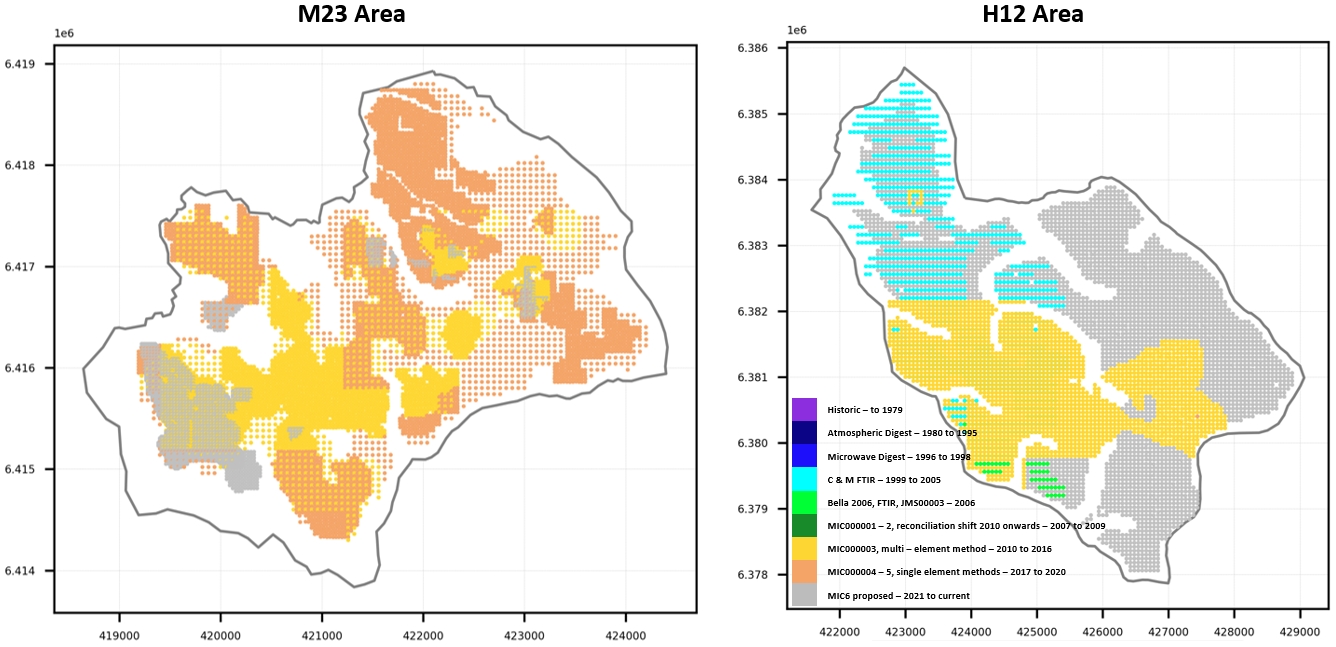
|
112 |
|
|
Alcoa Corporation S-K 1300 Report |
Signature Date: 20 February 2025 SLR Project No.: 123.020514.00001 |
Figure 11‑3: Location of the M23 Resource Model Area (MYN-M23)
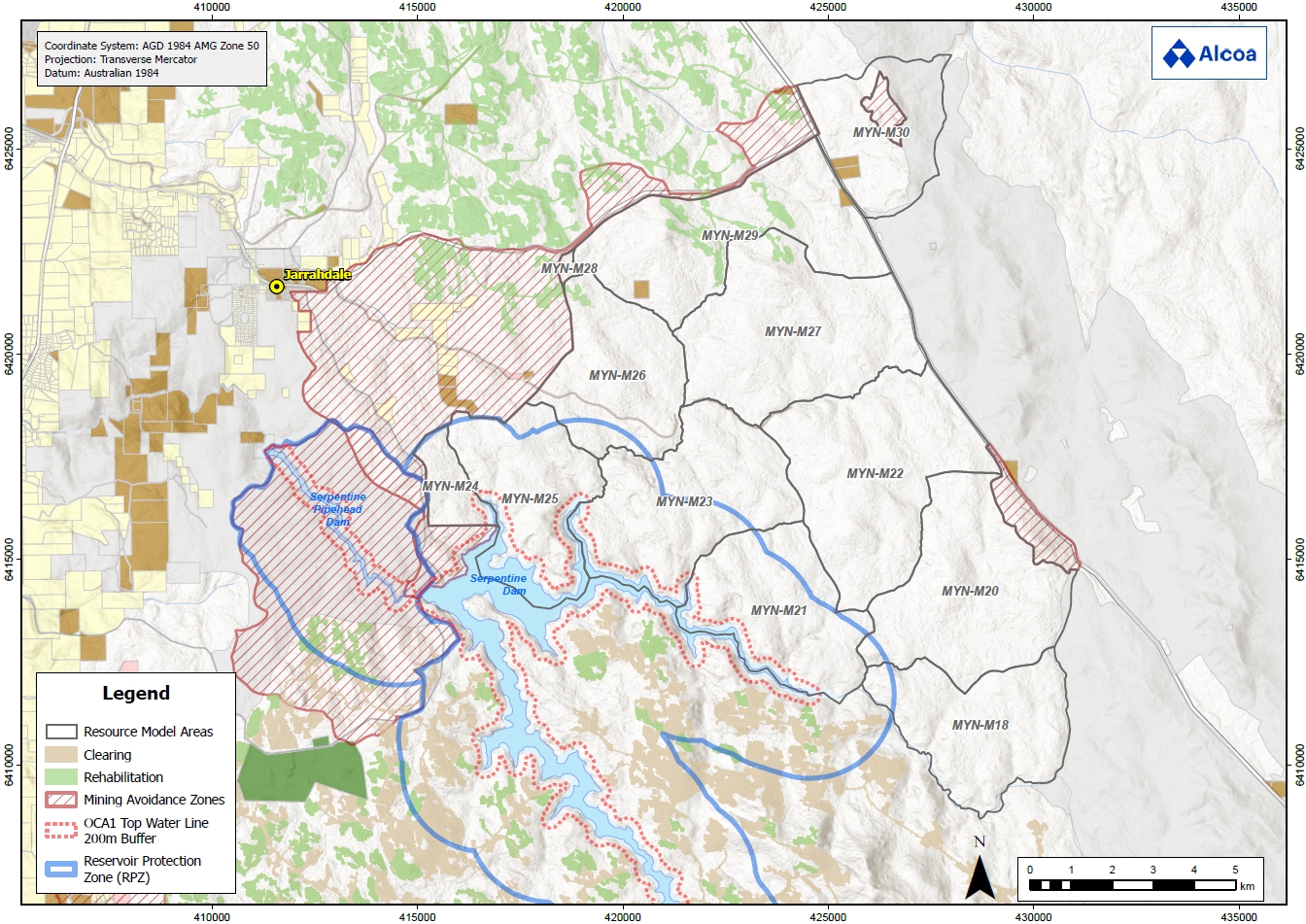
|
113 |
|
|
Alcoa Corporation S-K 1300 Report |
Signature Date: 20 February 2025 SLR Project No.: 123.020514.00001 |
Figure 11‑4: Location of the H12 Resource Model Area (HLY-H12)
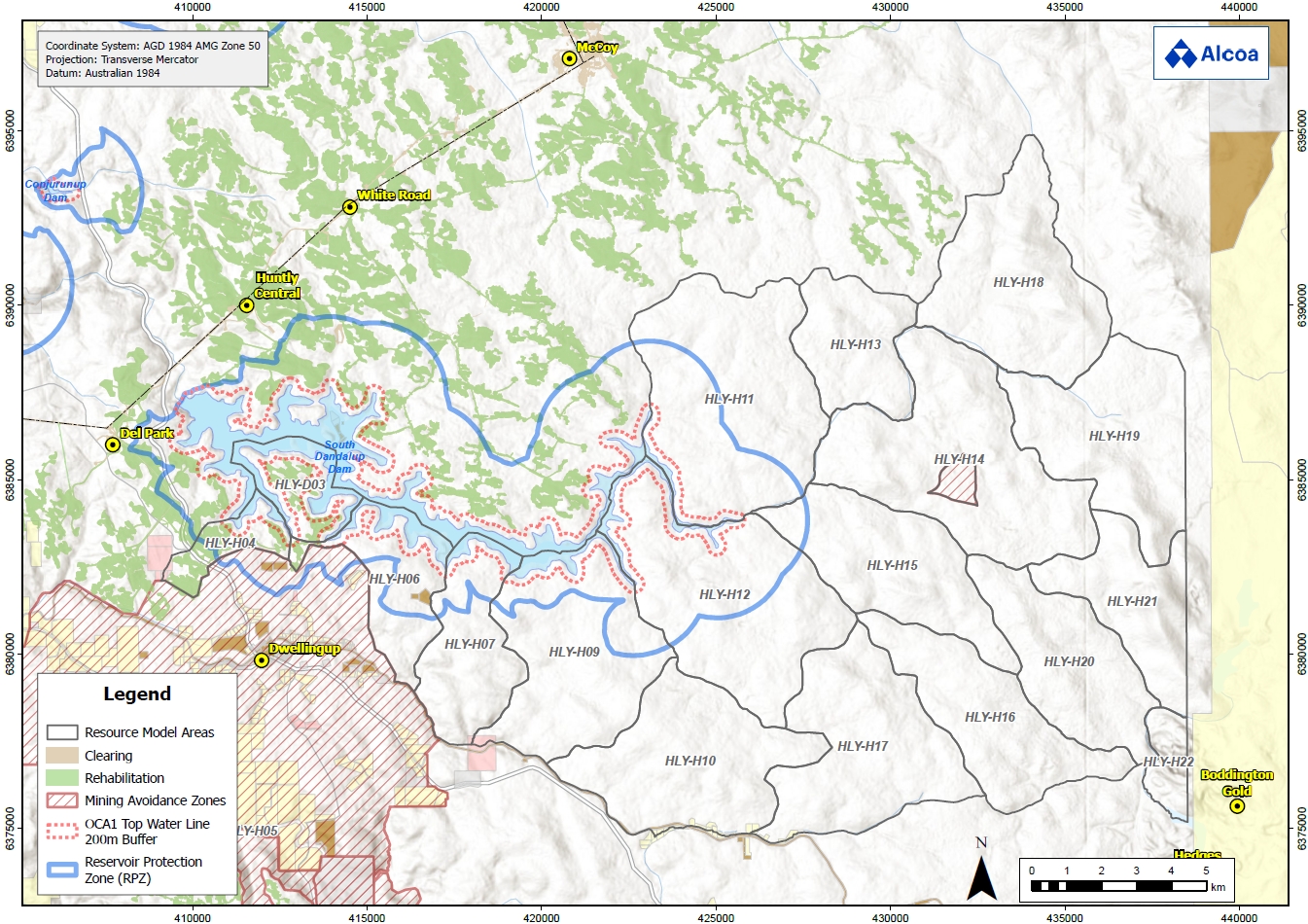
|
114 |
|
|
Alcoa Corporation S-K 1300 Report |
Signature Date: 20 February 2025 SLR Project No.: 123.020514.00001 |
Digital elevations models (DEMs) were generated from (in order of priority) drill collar survey data, LiDAR survey data, and Landgate satellite data. A 7.5 m by 7.5 m mesh is used for the DEMs. Drill hole collar elevations were registered to the DEM for resource estimation.
For Polygonal resource estimates, grade-based ‘geological’ codes are assigned to drill hole intervals. These codes are used to define the top and bottom of the ‘bauxite’ horizon in each hole, which is then used to estimate the bauxite volumes and average grades within polygons.
The top of the bauxite usually coincides with the base of the overburden, as defined in the drillers’ logs. The base of the Bauxite Zone (termed the geological floor) is defined within the acQuire database using a multi-pass script that applies the following hierarchical set of rules to the sample grades:
Pass 1:
Pass 2:
|
115 |
|
|
Alcoa Corporation S-K 1300 Report |
Signature Date: 20 February 2025 SLR Project No.: 123.020514.00001 |
Pass 3:
Pass 4:
The application of these rules assigns a geological floor depth to each hole, along with a Pass, Pass-Open, Marginal, or Fail flag. Holes flagged as Marginal or Fail are inspected by Alcoa staff members, with manual adjustments applied if warranted. For areas infilled to 15 m spaced holes, the geological floor model is replaced by a mining floor model, which is discussed in the following section.
Results of geological floor flagging are used to subjectively define the lateral extents of the Mineral Resource. Outlines are manually interpreted by Alcoa geologists in ArcGIS or MineSight, and are guided by consistency in thickness, depth, and grade, minimum limits on the number of enclosed samples and the enclosed area, and local geomorphology. The polygons delineate separate areas that typically range in size from 10 ha to 100 ha, with most being around 30 ha. An example plan view is shown below in Figure 11‑5.
|
116 |
|
|
Alcoa Corporation S-K 1300 Report |
Signature Date: 20 February 2025 SLR Project No.: 123.020514.00001 |
Figure 11‑5: Plan View of Polygonal Approach (Pass = red, pass open = green, marginal = yellow, fail = blue) (Alcoa, 2022)
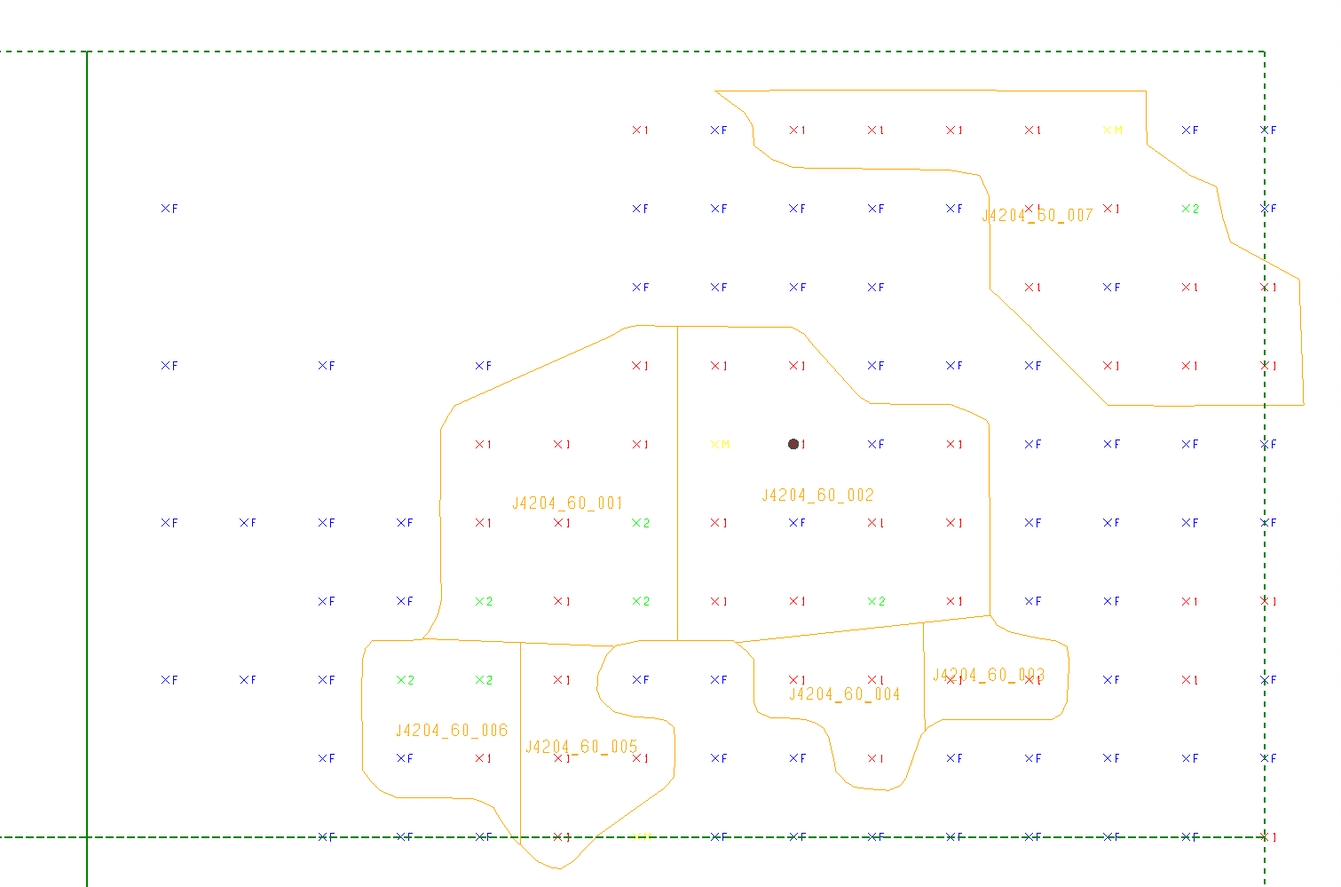
GSM models are located in areas of 15 m spaced infill drilling and include practical mining constraints as part of the ‘geological’ interpretation used for resource models.
The base of overburden and the base of caprock is identified in each drill hole as 3D points and wireframed as surfaces. The geological bauxite zone floor, which is defined for the wider drill spacings used for Polygonal estimates, is replaced by a mining floor for GSMs. The mining floor is interpreted directly from the drill hole data presented on the 15 m spaced east-west cross sections, digitized in MineSight as strings, then linked to form wireframe surfaces.
The interpretation of the mining floor is a manual process performed by the site geologist, with the objective of achieving acceptable grades and practical mining outlines. The mining floors are defined using a set of guidelines instead of prescribed rules, including:
|
117 |
|
|
Alcoa Corporation S-K 1300 Report |
Signature Date: 20 February 2025 SLR Project No.: 123.020514.00001 |
The base of overburden and mining floor surfaces are used to flag the drill hole samples. For each drill hole, the samples located below the base of the overburden and above the mining floor are composited into a single interval, with composite grades length- and density-weighted. Additional drill hole composites are generated for second and third pass mining floors.
The composite data are examined in plan view, and polygons are digitized around the interpreted lateral extents of the mining zones using the following guidelines:
The resulting polygons are divided into typically smaller ‘mining’ blocks that each contain approximately 20 kt to 40 kt of Mineral Resource.
Similar to the Polygon and GSM interpretation approaches, a set of rules written in Python scripts are used to assign initial domain codes to individual samples. These domain codes are then modified in several subsequent passes that take into account the grades and coding of other intervals in the hole.
The initial script is used to assign a domain code to each interval based on various combinations of major analyte threshold grades. A total of six main material type domains (DOMAF) are defined:
Figure 11‑6 illustrates an example of those domains in the M23 and H12 areas. Each of these material types (apart from overburden) is divided into up to five grade-based sub-domains. Three subsequent coding passes are conducted that iteratively adjust the codes to combine the sub-domain into the six main domains while ensuring that strict stratigraphic ordering is maintained. A further two passes are coded to assign domain codes that denote whether the material is derived from granite or dolerite.
|
118 |
|
|
Alcoa Corporation S-K 1300 Report |
Signature Date: 20 February 2025 SLR Project No.: 123.020514.00001 |
Figure 11‑6: Section Showing Domain (DOMAF) and the Main Wireframed Surfaces for the M23 (top) and H12 (bottom) areas– vertical scale 5x
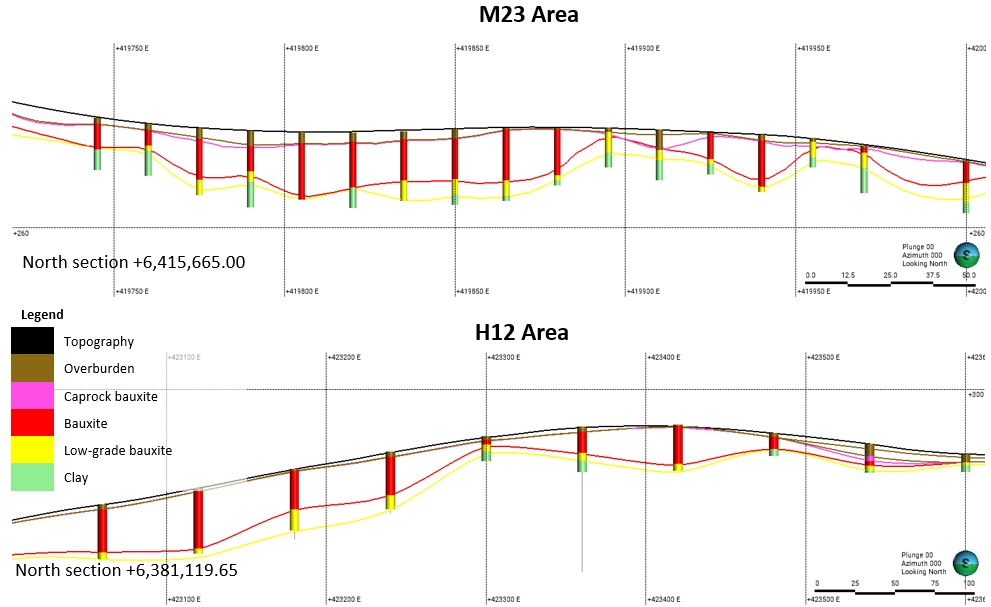
Source: SLR, 2023
The base of each Domain is generated on a 7.5 m by 7.5 m grid using an automated modelling process. To ensure a better fit of the wireframes, the elevation of some collars was adjusted to match the topography surface. Where drill holes do not penetrate the full bauxite profile or the domain contact is not properly defined due to missing assays, a conditional simulation algorithm is used to estimate the domain thickness from adjacent drill holes. The simulation algorithm employs a general variogram and selects the average of 10 simulations for the missing data point. The grid mesh is then wireframed in MineSight to provide 3D surfaces. The base of domain 50 (clay) is set at 10 m below the top of that domain.
Potential dolerite dyke intervals are flagged for samples where FE exceeds 25% and ST is below 10%, and the entire hole is flagged as potential dyke if 3 or more samples are flagged in this manner. The interpretation of dykes is carried out manually using local orientation trends and may be based on one or more holes. They are assumed to be vertical, are extended laterally half-way between drill holes, and can represent up to 15% of material in some areas but unweathered material can generally be screened out in the pit or prior to crushing as oversize boulders. The dykes tend to be well defined only when drill hole spacings are reduced to 15 m by 15 m, as shown in Figure 11‑7.
|
119 |
|
|
Alcoa Corporation S-K 1300 Report |
Signature Date: 20 February 2025 SLR Project No.: 123.020514.00001 |
Figure 11‑7: Plan View of Bauxite Zone and Drill Holes Flagged as Laterite and Dykes
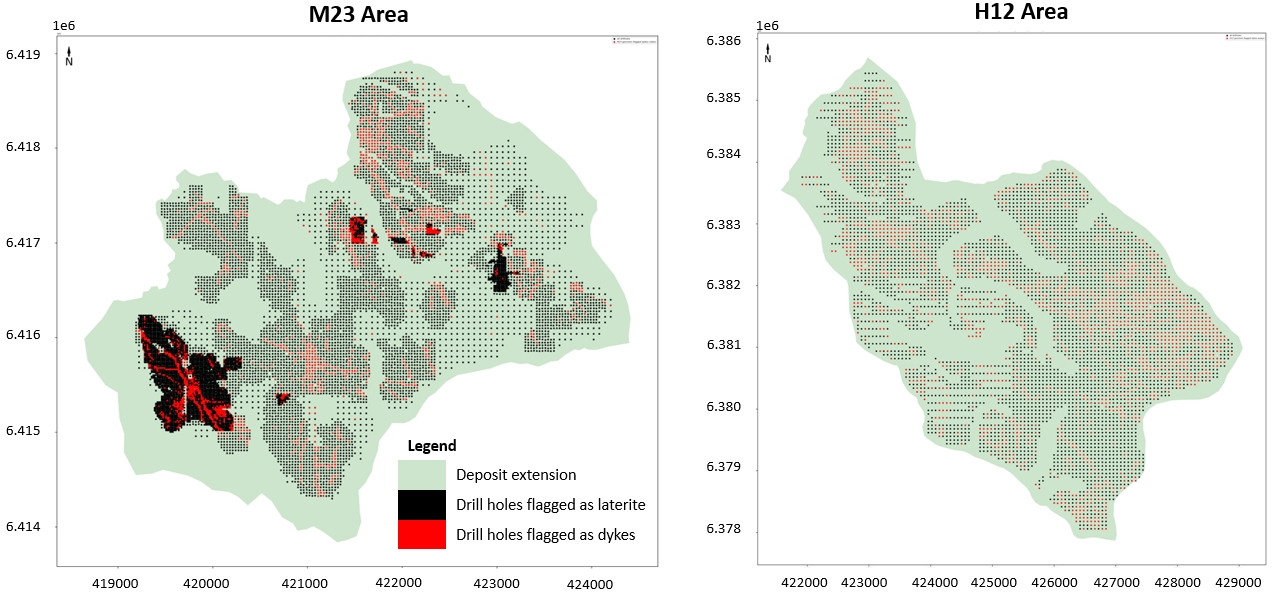
Source: SLR, 2023
The dolerite dykes are delineated and flagged in the block models. A lateral boundary is interpreted to constrain the resource model, and the 3D surfaces are extended where required. The lateral boundary, domain surfaces, and dolerite dyke interpretations are converted to wireframe solids. All the constraints where mining is not allowed (federal reserves, indigenous heritage sites, and rivers and protection buffers associated) are delimitated and removed after the geological modelling step. This way all the mineable reminiscent area is included in the final orebody perimeters.
The statistical data analysis procedures are carried out in DeepLime and Supervisor. Usually, the statistical analysis is performed using the univariate approach, however, FTIR and ICP scatter plots are also analyzed.
Global statistics by lithology and histograms are created for the statistical population assessment, validation after compositing and for checks against the resulting resource models. For the purposes of this report, a more detailed focus will be given for the caprock bauxite, bauxite and low-grade bauxite layers, as well as the main variables; AL, AT, FE, SI and ST.
Histograms show that AL analytes have distributions that are close to normal, while SI and FE are moderately to strongly positively skewed, as shown in Figure 11‑8.
|
120 |
|
|
Alcoa Corporation S-K 1300 Report |
Signature Date: 20 February 2025 SLR Project No.: 123.020514.00001 |
Figure 11‑8: Histograms for AL, SI, FE and Length in the bauxite domain (M23 and H12 areas)
|
|
|
|
The descriptive statistics from the histograms of Figure 11‑8 for the bauxite layer, as well as for the caprock bauxite and low-grade bauxite are shown in Table 11‑4.
Table 11‑4: Descriptive Statistics for the Main Variables
Lithology |
Variable |
Count |
Length |
Mean |
SD |
Variance |
Minimum |
Q25 |
Q50 |
Q75 |
Maximum |
M23 Area |
|||||||||||
Caprock Bauxite |
AL (%) |
5,226 |
2,613.0 |
26.83 |
3.96 |
15.72 |
7.75 |
24.57 |
26.47 |
29.25 |
54.73 |
AT (%) |
5,226 |
2,613.0 |
35.35 |
4.32 |
18.65 |
15.30 |
32.55 |
35.34 |
38.05 |
61.36 |
|
FE (%) |
5,226 |
2,613.0 |
33.13 |
7.85 |
61.69 |
0.25 |
30.46 |
33.73 |
37.68 |
59.65 |
|
SI (%) |
5,226 |
2,613.0 |
1.66 |
1.76 |
3.09 |
0.10 |
0.56 |
1.02 |
2.06 |
19.45 |
|
ST (%) |
5,226 |
2,613.0 |
9.32 |
8.13 |
66.04 |
0.25 |
3.96 |
7.07 |
11.61 |
64.66 |
|
Length (m) |
5,226 |
2,613.0 |
0.50 |
0.00 |
0.00 |
0.50 |
0.50 |
0.50 |
0.50 |
0.50 |
|
Bauxite |
AL (%) |
44,460 |
22,230.0 |
34.87 |
6.13 |
37.53 |
0.10 |
30.39 |
34.56 |
39.00 |
55.00 |
AT (%) |
44,460 |
22,230.0 |
39.78 |
5.95 |
35.38 |
11.65 |
35.75 |
40.03 |
43.89 |
64.90 |
|
FE (%) |
44,460 |
22,230.0 |
12.50 |
7.89 |
62.24 |
0.25 |
6.39 |
10.49 |
17.12 |
57.66 |
|
SI (%) |
44,460 |
22,230.0 |
1.30 |
0.96 |
0.93 |
0.10 |
0.64 |
1.03 |
1.70 |
20.10 |
|
ST (%) |
44,460 |
22,230.0 |
24.57 |
12.67 |
160.41 |
0.25 |
14.86 |
22.43 |
33.82 |
80.17 |
|
Length (m) |
44,460 |
22,230.0 |
0.50 |
0.00 |
0.00 |
0.50 |
0.50 |
0.50 |
0.50 |
0.50 |
|
Low-grade Bauxite |
AL (%) |
21,007 |
10,503.5 |
24.59 |
4.89 |
23.89 |
0.10 |
21.71 |
24.29 |
26.69 |
53.94 |
AT (%) |
21,007 |
10,503.5 |
31.63 |
5.89 |
34.64 |
6.09 |
27.54 |
30.90 |
35.37 |
62.25 |
|
FE (%) |
21,007 |
10,503.5 |
12.44 |
10.73 |
115.05 |
0.25 |
4.60 |
7.94 |
17.87 |
75.58 |
|
SI (%) |
21,007 |
10,503.5 |
4.11 |
2.98 |
8.88 |
0.10 |
2.06 |
3.57 |
5.26 |
35.71 |
|
|
121 |
|
|
Alcoa Corporation S-K 1300 Report |
Signature Date: 20 February 2025 SLR Project No.: 123.020514.00001 |
|
ST (%) |
21,007 |
10,503.5 |
37.35 |
16.81 |
282.48 |
0.25 |
24.50 |
42.05 |
50.74 |
82.62 |
Length (m) |
21,007 |
10,503.5 |
0.50 |
0.00 |
0.00 |
0.50 |
0.50 |
0.50 |
0.50 |
0.50 |
|
H12 Area |
|||||||||||
Caprock Bauxite |
AL (%) |
2,734 |
1,367.0 |
26.92 |
4.22 |
17.82 |
10.63 |
24.46 |
26.54 |
29.43 |
41.38 |
AT (%) |
2,306 |
1,153.0 |
34.79 |
4.12 |
16.95 |
19.41 |
32.20 |
34.85 |
37.34 |
50.27 |
|
FE (%) |
2,734 |
1,367.0 |
33.78 |
7.82 |
61.10 |
1.52 |
30.73 |
34.18 |
38.20 |
64.01 |
|
SI (%) |
2,734 |
1,367.0 |
1.61 |
1.77 |
3.14 |
0.10 |
0.54 |
0.94 |
1.92 |
16.28 |
|
ST (%) |
2,734 |
1,367.0 |
9.07 |
8.40 |
70.56 |
0.25 |
3.77 |
6.29 |
10.99 |
57.78 |
|
Length (m) |
2,981 |
1,490.5 |
0.50 |
0.00 |
0.00 |
0.50 |
0.50 |
0.50 |
0.50 |
0.50 |
|
Bauxite |
AL (%) |
12,287 |
6,143.2 |
33.76 |
5.78 |
33.43 |
2.03 |
29.61 |
33.19 |
37.51 |
55.00 |
AT (%) |
10,651 |
5,325.2 |
38.22 |
5.54 |
30.73 |
15.54 |
34.53 |
38.23 |
42.00 |
67.96 |
|
FE (%) |
12,287 |
6,143.2 |
13.19 |
8.62 |
74.23 |
0.25 |
6.41 |
10.69 |
18.58 |
55.79 |
|
SI (%) |
12,287 |
6,143.2 |
1.30 |
0.99 |
0.97 |
0.10 |
0.61 |
1.02 |
1.70 |
14.71 |
|
ST (%) |
12,287 |
6,143.2 |
25.85 |
13.04 |
170.08 |
0.25 |
16.08 |
25.25 |
35.72 |
70.09 |
|
Length (m) |
14,275 |
7,137.2 |
0.50 |
0.00 |
0.00 |
0.20 |
0.50 |
0.50 |
0.50 |
0.50 |
|
Low-grade Bauxite |
AL (%) |
8,489 |
4,244.5 |
24.40 |
4.95 |
24.54 |
0.10 |
21.50 |
24.23 |
26.79 |
48.61 |
AT (%) |
7,562 |
3,781.0 |
31.77 |
5.68 |
32.29 |
3.28 |
27.82 |
31.27 |
35.44 |
57.73 |
|
FE (%) |
8,489 |
4,244.5 |
14.11 |
11.25 |
126.51 |
0.25 |
5.16 |
9.72 |
22.13 |
64.77 |
|
SI (%) |
8,489 |
4,244.5 |
4.28 |
3.42 |
11.69 |
0.10 |
1.92 |
3.50 |
5.49 |
28.69 |
|
ST (%) |
8,489 |
4,244.5 |
34.83 |
17.14 |
293.95 |
0.25 |
19.83 |
38.84 |
48.83 |
79.03 |
|
Length (m) |
9,600 |
4,800.0 |
0.50 |
0.00 |
0.00 |
0.50 |
0.50 |
0.50 |
0.50 |
0.50 |
|
Clear grade trends at depth exist for most analytes and are consistent with the mineralization style. They have been adequately accounted for by the geological interpretation and the use of unfolding methods during block grade estimation.
Figure 11‑9 illustrates the compositions of the different layers according to AL, SI and FE proportions.
Figure 11‑9: Ternary Charts of Lithologies for M23 and H12 Areas
|
|
Missing values, that are mostly result of the validation routines, are kept as null in the database, as well as results below the detection limit are changed to values that are half of the detection limit.
|
122 |
|
|
Alcoa Corporation S-K 1300 Report |
Signature Date: 20 February 2025 SLR Project No.: 123.020514.00001 |
High-grade caps for all analytes were applied to individual composites by Alcoa on a domain-by-domain basis following inspection of the data distribution, and no high-grade spatial restrictions were used by Alcoa in the resource estimation process. SLR QP notes that the top-cuts of areas M23 and H12, are in the upper break of the probability plots. Table 11‑5 shows the top-cuts used for the M23 and H12 areas.
Table 11‑5: Top-Cuts Used for the M23 and H12 Areas
Area |
Lithology |
AL |
AT |
FE |
SI |
ST |
BO |
EO |
OX |
PT |
CO |
SU |
M23 |
Caprock Bauxite |
48.44 |
70 |
80 |
12.86 |
56.98 |
8.89 |
9.89 |
15 |
0.248 |
11.9 |
15 |
Bauxite |
55 |
70 |
80 |
13.39 |
69.35 |
9.02 |
8.84 |
9.29 |
0.351 |
10.17 |
7.94 |
|
Low-Grade Bauxite |
55 |
70 |
63.21 |
24.82 |
95 |
6.18 |
9.97 |
8.32 |
1 |
9.6 |
15 |
|
H12 |
Caprock Bauxite |
55 |
70 |
80 |
49.063 |
95.26 |
15 |
15 |
15 |
1 |
34 |
15 |
Bauxite |
55 |
70 |
80 |
49.063 |
95.26 |
15 |
15 |
15 |
1 |
34 |
15 |
|
Low-Grade Bauxite |
55 |
70 |
80 |
49.063 |
95.26 |
15 |
15 |
15 |
1 |
34 |
15 |
Drill holes were sampled at 0.5 m intervals in the bauxite zone below the base of the overburden, with residual intervals sometimes present at domain contacts. The Polygon and GSM estimation approaches used the original drill hole data intervals. Prior to the interpretation of geological surfaces, holes used in the 3DBM resource estimates were composited to 0.5 m, and with residual intervals of maximum 50% the composite length, the total length ranges between 0.25 m and 0.75 m.
Following the interpretation of geological surfaces, drill holes used for Polygonal and GSM resource models were composited to:
All grade compositing for drill holes employs length-weighted linear averages.
Only some variogram analysis was carried out for Polygonal and GSM models as variogram parameters were not required to generate the resource models.
For the 3DBMs, variogram analysis is routine. Experimental variograms are calculated in unfolded space, with bauxite domains 20, 30 and 40 unfolded to the 10/20 domain contact and the clay domain (50) unfolded to the 40/50 domain contact.
Variograms are calculated for AL, SI, ST, and FE for the bauxite zone, standardized to a sill of one, and modelled with 3-structure spherical models, as described in Table 11‑6 and Table 11‑7. A single variogram model that provides the best fit to these four variables was selected.
|
123 |
|
|
Alcoa Corporation S-K 1300 Report |
Signature Date: 20 February 2025 SLR Project No.: 123.020514.00001 |
Table 11‑6: Variogram parameters for the M23 area (MineSight ZXY rotation)
Parameter |
M23 |
||||
Domain |
Domain 20,30,40 |
||||
Domain Name |
Caprock Bauxite, Bauxite, and Low-Grade Bauxite |
||||
Element |
AL |
SI |
FE |
ST |
Combined Variogram |
Nugget C0 |
0.07 |
0.04 |
0.03 |
0.01 |
0.04 |
First Structure C1 |
0.64 |
0.51 |
0.5 |
0.64 |
0.6 |
Structure Type |
Spherical |
Spherical |
Spherical |
Spherical |
Spherical |
Range 1 |
35 |
60 |
45 |
45 |
45 |
Range 2 |
20 |
50 |
40 |
40 |
40 |
Range 3 |
3 |
3 |
6 |
6 |
5 |
Second Structure C2 |
0.14 |
0.15 |
0.23 |
0.21 |
0.16 |
Structure Type |
Spherical |
Spherical |
Spherical |
Spherical |
Spherical |
Range 1 |
55 |
100 |
120 |
105 |
85 |
Range 2 |
40 |
80 |
115 |
100 |
75 |
Range 3 |
4 |
6 |
7 |
7 |
6 |
Third Structure C3 |
0.15 |
0.3 |
0.24 |
0.14 |
0.2 |
Structure Type |
Spherical |
Spherical |
Spherical |
Spherical |
Spherical |
Range 1 |
120 |
250 |
285 |
315 |
200 |
Range 2 |
95 |
185 |
155 |
190 |
150 |
Range 3 |
5 |
7 |
10 |
8 |
7 |
Rotation Strike (o)(1) |
140 |
140 |
140 |
140 |
140 |
Rotation Plunge (o)(2) |
0 |
0 |
0 |
0 |
0 |
Rotation Dip (o)(3) |
0 |
0 |
0 |
0 |
0 |
Table 11‑7: Variogram parameters for the H12 area (MineSight ZXY rotation)
Parameter |
H12 |
||||
Domain |
Domain 20,30,40 |
||||
Domain Name |
Caprock Bauxite, Bauxite, and Low-Grade Bauxite |
||||
Element |
AL |
SI |
FE |
ST |
Combined Variogram |
Nugget C0 |
0.1 |
0.09 |
0.1 |
0.04 |
0.1 |
First Structure C1 |
0.52 |
0.54 |
0.59 |
0.61 |
0.56 |
Structure Type |
Spherical |
Spherical |
Spherical |
Spherical |
Spherical |
Range 1 |
90 |
95 |
80 |
100 |
90 |
Range 2 |
70 |
80 |
80 |
90 |
80 |
Range 3 |
4 |
4 |
4 |
4 |
4 |
Second Structure C2 |
0.34 |
0.12 |
0.05 |
0.15 |
0.15 |
Structure Type |
Spherical |
Spherical |
Spherical |
Spherical |
Spherical |
Range 1 |
200 |
230 |
200 |
250 |
220 |
|
124 |
|
|
Alcoa Corporation S-K 1300 Report |
Signature Date: 20 February 2025 SLR Project No.: 123.020514.00001 |
Range 2 |
150 |
150 |
150 |
220 |
170 |
Range 3 |
5 |
5 |
6 |
6 |
6 |
Third Structure C3 |
0.04 |
0.25 |
0.26 |
0.2 |
0.19 |
Structure Type |
Spherical |
Spherical |
Spherical |
Spherical |
Spherical |
Range 1 |
500 |
500 |
600 |
800 |
550 |
Range 2 |
400 |
500 |
400 |
700 |
500 |
Range 3 |
6 |
6 |
7 |
7 |
7 |
Rotation Strike (o)(1) |
120 |
130 |
130 |
120 |
125 |
Rotation Plunge (o)(2) |
0 |
0 |
0 |
0 |
0 |
Rotation Dip (o)(3) |
0 |
0 |
0 |
0 |
0 |
Variogram models display nugget values of less than 10% and total ranges of several hundred meters, but 80% of the sill is generally reached within 100 m laterally. As expected, horizontal to vertical anisotropy ratios are high (typically exceeding 50:1), but there is minor lateral anisotropy. This good definition of continuity compared to the 15 m drill spacing is considered by SLR to be a benefit of the unfolding approach.
Independent variogram models for each bauxite domain and analyte are not used for grade estimation to enable correlations between analytes to be maintained during the change in support from drill hole samples to blocks, which is important for mine planning considerations.
For Mineral Resource estimation purposes, density can be regarded as another analyte, and tests can be evaluated for repeatability (precision) and accuracy (bias). The determination of the metal content of a specified volume of ore is as sensitive for density as it is for grade. For bulk commodities, like bauxite, there is usually much more emphasis on grade since product tonnages are measured by a weightometer.
Alcoa does not routinely collect density data but relies on production records to define averages. This is due to the broad geological consistency of the ore zones and the local chemical and physical nature of the lateritized ore. Porosity and permeability in particular show high lateral and vertical variability, rendering repeatability of density test work meaningless. Even if large numbers of data points were available (for example by developing a density algorithm from the FTIR assaying of every drill sample, and then modelling it), the resulting model would still need to be factored by the actual mining results for local porosity.
For 3DBM resource estimation, each drill hole bauxite composite is assigned a dry in situ bulk density (DIBD) value based on the logged material type and the FTIR iron grade using the regression equation defined below in Section 11.9.5.
The available density test work data is summarized as follows.
Senini (1993) collated and reviewed all previous bauxite density data, including that by Sadleir done in 1986, and modified Sadleir’s algorithm used for computation of density from individual 0.5 m sample assays of Fe2O3. Results are summarized in Table 11‑8.
|
125 |
|
|
Alcoa Corporation S-K 1300 Report |
Signature Date: 20 February 2025 SLR Project No.: 123.020514.00001 |
Table 11‑8: Summary of Density Test Data (t/m³) from 1980 to 1992 (Senini, 1993)
Year |
Source |
Material |
Count |
Mean |
Min |
Max |
Fe Mean |
Regression On Fe₂O₃ |
|
Slope |
Intercept |
||||||||
1980 |
DOSCO |
Hardcap |
18 |
2.200 |
1.98 |
2.52 |
19.35 |
0.0089 |
2.032 |
1986 |
Sadleir |
Hardcap |
14 |
2.364 |
2.08 |
2.75 |
20.88 |
0.0092 |
2.172 |
1992 |
Senini |
Hardcap |
67 |
2.409 |
1.81 |
3.10 |
21.00 |
0.0103 |
2.192 |
1986 |
Sadleir |
Friable |
11 |
1.846 |
1.64 |
2.12 |
8.80 |
0.0015 |
1.830 |
1992 |
Senini |
Friable |
27 |
2.225 |
1.88 |
2.79 |
14.30 |
0.0045 |
2.–89 |
1980 - 1992 |
reported above |
Granitic |
67 |
2.327 |
1.81 |
3.10 |
16.7– |
|
|
1980 - 1992 |
reported above |
Doleritic |
32 |
2.444 |
2.07 |
2.96 |
28.96 |
|
|
While the approach used has merit, there are some obvious challenges:
The differences between hardcap (caprock) and friable (other material) and between granitic or doleritic derivation are however clear.
Senini (1993) concluded that the dry in situ bulk density (DIBD) should be estimated using a regression equation which is still used.
Various further test programs have been attempted including collection of all material from drill samples (assuming the drill hole volume is constant) and then taking wet and dry weights and assaying for iron. There were 51 samples from 8 holes at Huntly and 93 samples from 24 holes at Willowdale. Scatter plots produced by SRK 2021a showed significant scatter of all available data for both Hardcap and Friable (other) material.
Alcoa collected 2 kg to 5 kg grab samples from 16 Huntly pits (76 samples) and 10 Willowdale pits (41 samples). Water immersion density testing was done by Bureau Veritas. The average of 2.01 t/m³ is significantly lower than that from the 2015 study of 2.23 t/m³. The drill samples did not account for porosity and voids and were not adequately sealed.
FTIR assays for Fe₂O₃ were compared to sealed and unsealed density estimates and it was found that Senini’s regression equation better predicted the unsealed densities. Thus, it appears that the current regression equation based on Fe₂O₃ assays overestimates the in situ dry tonnage.
In December 2018 Alcoa contracted downhole geophysical measurements in 54 aircore holes drilled in the Larego area. The data from this study is still being evaluated and is not used for Mineral Resource estimation.
|
126 |
|
|
Alcoa Corporation S-K 1300 Report |
Signature Date: 20 February 2025 SLR Project No.: 123.020514.00001 |
Ore grades range from 28 to 38% AL for paired belt sample data (see Section 8.4.4.6) whereas test work densities range from 1.5 t/m³ to 3.2 t/m³, but the data is sparse and unreliable.
For resource estimation, each 0.5 m drill hole sample is assigned a dry in situ bulk density (DIBD) value based on the logged material type and the FTIR iron grade, using Senini’s 1993 regression equation:
Hardcap (caprock) = 2.19 + 0.0103*Fe
Friable (other) = 2.00 (used for all non-Hardcap material)
If the sample is logged as comprising a mix of Hardcap and Friable, the assigned value for that 0.5 m interval represents a volume-weighted average. There is no differentiation between granitic and dolerite derived bauxite, due to the relatively small proportion of the latter (less than 15%).
In resource estimates prior to 2017 a moisture content of 9% was assumed and used to estimate wet tonnes. Since the implementation of 3D block modelling in 2018, densities are assigned after grade estimation, based on the regression equation and Fe grade of Hardcap, and using 2.0 t/m³ for all other material, weighted by the proportion of Hardcap or other material.
Alcoa uses comparisons between the As Mined tonnages and the sampling tower weightometers to apply adjustment factors to mine design estimates, scheduling and stockpile planning. Such adjustments are not applied directly to the Mineral Resource estimate as they vary locally.
Reconciliation of Huntly and Willowdale mined production (see discussion on density in Section 11.14) indicates that the density estimates are biased, with the long-term average As Mined tonnages being approximately 5% higher than the actual production measured on calibrated weightometers.
The density data is limited in coverage and there is significant uncertainty regarding the methodology used for some sampling programs. A simple regression algorithm is used to estimate the DIBD for Hardcap from the FTIR assays of Fe₂O₃. This does not account for voids or porosity, nor does it differentiate between Hardcap derived from granitic or doleritic material. All other material is assigned a density of 2.0 t/m³. A constant moisture content of 9% is assumed for wet tonnages.
The SLR QP is of the opinion that the dry bulk density data is less well controlled than other analytes, however, the long history of mining production and stockpile reconciliation means that the assumed values are adequate for resource estimation.
For each drill hole contained within a polygon, the samples located below the base of the overburden and above the geological floor are composited into a single interval. The following numbers are assigned to each polygon:
|
127 |
|
|
Alcoa Corporation S-K 1300 Report |
Signature Date: 20 February 2025 SLR Project No.: 123.020514.00001 |
GSM employs 15 m by 15 m cells centered on the nominal drill hole locations. Separate seams are created for the overburden, and for the interpreted Bauxite Zone (BXZ) between the overburden and the mining floor. BXZ is subdivided into separate seams where second and third mining cuts have been interpreted. Interpreted wireframe surfaces are used to assign a seam thickness to each cell, effectively the seam thickness of drill hole at the cell centroid.
Cell grade estimation used inverse distance weighting (IDW) techniques as follows:
Where drill holes are located at the centroid of cells the resulting cell grade estimates are essentially nearest neighbor estimates. In other words, the GSM outcomes are equivalent to 2D polygon estimates, with the usual constraint of that method, specifically that the block variances are not smaller than the composite variances.
The GSM is constrained to the interpreted lateral extents of the mining zones. For each mining zone the following attributes are determined:
In 2019, Alcoa commenced preparing Mineral Resource estimates using 3DBM techniques, with the aim to progressively replace all Polygonal and GSM models. To date, Alcoa has prepared a total of 89 3DBM representing around 76% of the Mineral Resource and Mineral Reserves (MRMR) tonnage.
This section describes the current 3DBM procedures, which have evolved over time, with some parts now automated or semi-automated. Changes in the 3DBM procedures have generally been minor and are not considered material to the resulting resource models.
Block models are initially generated using the ML1SA lease area grid, and with an origin that ensures that the majority of the drill holes are located closer to the block corners rather than
|
128 |
|
|
Alcoa Corporation S-K 1300 Report |
Signature Date: 20 February 2025 SLR Project No.: 123.020514.00001 |
the centroids. The parent block size is 15 m by 15 m by 0.5 m and a sub-block size of 3 m by 3 m by 0.25 m (XYZ), respectively.
The block grade estimation includes the interpolation by ordinary kriging (OK) of AL, SI, ST, FE, EO, PT, CO, SU, OX, BO, and AT, using the same unfolding surfaces as used in the variogram analysis. Hard boundaries between the bauxite domains (DOMAF 20, 30 and 40) started to be implemented in 2022, where the previous block models were estimated using soft boundaries between these domains. A 3-pass search strategy is used for the bauxite domains and only one pass for the clay zone (DOMAF 50). A list of the search parameters is presented in Table 11‑9. It is important to note that the major and semi-major orientations are in the unfolded horizontal plane, and that a maximum of 3 samples are used from any one drill hole. Thus, a minimum of four holes is required for pass one, two holes for pass two, and one hole for pass 3.
Table 11‑9: Ordinary Kriging Search Parameters (MineSight ZXY rotation).
Domain |
Pass |
Bearing (Z) |
Search Distance (m) |
Number of Samples |
||||
Major |
Semi-major |
Minor |
Min |
Max |
Max Per Hole |
|||
20, 30, 40 |
3 |
140° |
300 |
300 |
50 |
3 |
27 |
3 |
2 |
100 |
100 |
20 |
4 |
27 |
3 |
||
1 |
55 |
55 |
20 |
12 |
27 |
3 |
||
50 |
1 |
130° |
300 |
300 |
50 |
4 |
27 |
3 |
The DIBD (density) is not estimated into individual parent and sub blocks but is a post-estimation calculation based on the block domain compositions (see 11.8.5).
The OK estimation approach is designed to maintain correlations between analytes and assist in ensuring that estimation totals are consistent with the input drill hole data.
A set of wireframe solids representing the mining outlines are generated using a similar grade accumulation and threshold approach to those used for the GSM model, as shown in the example of Figure 11‑10. The sub-block model is then regularized to the parent block size (15 m by 15 m by 0.5 m), with blocks located within the mining solids flagged for reporting Mineral Resources. Block tonnages are factored to reflect the proportion of the block contained below the topographic surface and within the mining solid.
Figure 11‑10: Example Section showing Bauxite Zone and Mining Solid

Notes:
The QP summarized the information of 10 block models, shown in Table 11‑10, where there is available data for a comparison between a soft and hard boundary estimation of the bauxite layer. In overall, the AL grades increased by 7% and SI grades decreased by 23%, and the tonnage is higher in most of the cases, reflecting the additional drilling.
|
129 |
|
|
Alcoa Corporation S-K 1300 Report |
Signature Date: 20 February 2025 SLR Project No.: 123.020514.00001 |
Table 11‑10: Tonnage and Grade Information Between the Original Resource Model and the 3D Block Model
Model |
Original Resource Model |
3DBM - Resource Model |
Difference |
||||||
Tonnage (000 t) |
AL (%) |
SI (%) |
Tonnage (000 t) |
AL (%) |
SI (%) |
Tonnage (000 t) |
AL (%) |
SI (%) |
|
Holyoake Central |
25,211 |
31.97 |
1.94 |
25,919 |
34.12 |
1.23 |
3% |
7% |
-36% |
Windsor |
8,935 |
32.82 |
2.67 |
8,798 |
33.69 |
2.38 |
-2% |
3% |
-11% |
Cooke |
15,421 |
30.85 |
2.22 |
18,976 |
31.99 |
1.95 |
23% |
4% |
-12% |
Serpentine |
16,444 |
32.00 |
1.96 |
20,299 |
32.75 |
1.72 |
23% |
2% |
-12% |
Gleneagle |
26,333 |
31.58 |
1.67 |
35,144 |
34.69 |
1.14 |
33% |
10% |
-32% |
Buckley |
17,998 |
33.74 |
1.68 |
27,435 |
35.39 |
1.27 |
52% |
5% |
-24% |
Cobiac |
23,498 |
31.15 |
1.70 |
30,865 |
34.81 |
1.18 |
31% |
12% |
-31% |
Frollett |
12,556 |
30.07 |
1.68 |
18,587 |
33.59 |
1.31 |
48% |
12% |
-22% |
Yarri |
10,044 |
30.90 |
2.04 |
30,362 |
32.51 |
1.62 |
202% |
5% |
-20% |
Millars |
26,156 |
30.64 |
2.21 |
24,987 |
32.32 |
1.88 |
-4% |
5% |
-15% |
Total |
182,596 |
31.55 |
1.93 |
241,372 |
33.71 |
1.48 |
32% |
7% |
-23% |
Alcoa uses a similar general approach to validate both the Polygonal and GSM resource models which includes:
Estimated cell grades were compared visually to the drill hole composite grades to ensure that the cell grade estimates appeared consistent with the drill hole seam composite data.
As GSMs were effectively nearest neighbor estimates, checks by SRK (2021a) on several GSM models indicated excellent global and local correlation between the estimated cell grades and the input seam composite grades.
The QP undertook some independent checks on datasets and GSMs for the F54 and F55 blocks to confirm that the modelling procedures had performed as intended. Results were consistent with those observed by previous consultants and no material issues were noted.
Polygonal resource models were updated by Alcoa when drill hole data is infilled from 60 m and 30 m spacings, and then GSM models were previously produced by Alcoa after 15 m infill drilling (3DBM models are now produced routinely at this stage). Changes in tonnages and average grades (AL, SI, OX) are presented as scatterplots in Figure 11‑11 for map sheets at Huntly where such infill drilling has occurred. It is noted that:
|
130 |
|
|
Alcoa Corporation S-K 1300 Report |
Signature Date: 20 February 2025 SLR Project No.: 123.020514.00001 |
Applying a global correction factor to Polygonal resource model tonnages generated from 30 m and 60 m spaced drill hole datasets is not considered appropriate as local differences are highly variable and not considered to be predictable, as shown by the red dots in the top left-hand plot in Figure 11‑11.
Figure 11‑11: Resource Comparison Scatterplots for Huntly (Tonnage, AL, SI, OX) (SLR, 2021)
|
|
|
|
Source: SLR, 2021. |
|
|
131 |
|
|
Alcoa Corporation S-K 1300 Report |
Signature Date: 20 February 2025 SLR Project No.: 123.020514.00001 |
Alcoa staff performs the block model validation for the individual areas through the volume checks between the geological interpretation solids and sub-block model, visual validation of block model coding and estimated grades versus composite data, comparison between composite and block model global statistics, and swath plots comparing block grades against composite grades.
SLR evaluated the information provided in the block model summary files provided by Alcoa, and also undertook independent checks on datasets and block models for M23 and H12 areas, obtaining results that were consistent with those provided by Alcoa. The SLR QP ran individual inverse distance squared (ID2) and nearest neighborhood (NN) estimations to assist in the block model validation.
Visual validations, global statistical comparison, and swath plots were built comparing the main variables estimated by Alcoa and the parallel estimation made by SLR. The results of these comparisons for the M23 and H12 areas are provided in the following subsections.
Statistics of the blocks estimated by OK were compared against the composited and capped samples, ID2 and NN estimates. Table 11‑11 and Table 11‑12 present the statistical comparison for the M23 and H12 areas.
In overall, smaller differences are observed for the AL estimation of the bauxite and low-grade bauxite for the M23 area, and more significant differences are observed for the SI estimation of both areas. These differences may be related to either potential differences in the estimation parameters used by the independent estimation made by SLR, and/or small discrepancies in the sample selection used for the estimation due to the parallel workflow used by SLR. The impact of these differences can be minimized once the composites and OK means show a good correlation.
Despite the differences mentioned previously, the SLR QP is of the opinion that the statistical comparisons are reasonable.
|
132 |
|
|
Alcoa Corporation S-K 1300 Report |
Signature Date: 20 February 2025 SLR Project No.: 123.020514.00001 |
Table 11‑11: Composites, OK, ID2, and NN statistics for the M23 area
M23 |
||||||||||||||
Variable |
Statistical Parameter |
Caprock Bauxite |
Bauxite |
Low-Grade Bauxite |
||||||||||
Samples |
OK |
ID2 |
NN |
Samples |
OK |
ID2 |
NN |
Samples |
OK |
ID2 |
NN |
|||
AL |
Number |
5,226 |
19,988 |
19,988 |
19,988 |
44,460 |
157,444 |
157,444 |
157,444 |
21,007 |
101,770 |
101,770 |
101,770 |
|
Mean |
26.83 |
26.54 |
26.19 |
26.27 |
34.87 |
34.81 |
31.92 |
31.58 |
24.59 |
24.99 |
22.80 |
21.62 |
||
SD |
3.95 |
1.96 |
4.02 |
6.81 |
6.13 |
3.66 |
4.93 |
8.70 |
4.89 |
2.46 |
4.02 |
8.36 |
||
Variance |
15.61 |
3.85 |
16.16 |
46.32 |
37.53 |
13.40 |
24.33 |
75.62 |
23.89 |
6.04 |
16.15 |
69.83 |
||
Minimum |
7.75 |
15.96 |
3.75 |
0.10 |
0.10 |
14.26 |
6.37 |
0.10 |
0.10 |
9.85 |
2.21 |
0.10 |
||
Q25 |
24.57 |
25.32 |
24.14 |
23.34 |
30.39 |
32.36 |
28.75 |
26.54 |
21.71 |
23.44 |
20.71 |
17.71 |
||
Q50 |
26.47 |
26.18 |
26.16 |
26.71 |
34.56 |
34.40 |
32.00 |
32.21 |
24.29 |
24.72 |
22.90 |
22.55 |
||
Q75 |
29.25 |
27.49 |
28.34 |
30.12 |
39.00 |
37.00 |
35.29 |
37.56 |
26.69 |
26.31 |
24.95 |
26.36 |
||
Maximum |
48.44 |
44.72 |
46.46 |
51.45 |
55.00 |
52.67 |
51.84 |
55.00 |
53.94 |
44.67 |
49.55 |
55.00 |
||
SI |
Number |
5,226 |
19,988 |
19,988 |
19,988 |
44,460 |
157,444 |
157,444 |
157,444 |
21,007 |
101,770 |
101,770 |
101,770 |
|
Mean |
1.66 |
1.87 |
2.77 |
2.90 |
1.30 |
1.46 |
2.23 |
2.29 |
4.10 |
4.60 |
5.55 |
5.99 |
||
SD |
1.74 |
1.15 |
2.46 |
3.87 |
0.95 |
0.68 |
1.55 |
2.84 |
2.96 |
1.76 |
2.60 |
4.76 |
||
Variance |
3.02 |
1.32 |
6.05 |
14.97 |
0.90 |
0.46 |
2.42 |
8.06 |
8.76 |
3.10 |
6.77 |
22.64 |
||
Minimum |
0.10 |
0.10 |
0.12 |
0.10 |
0.10 |
0.12 |
0.22 |
0.10 |
0.10 |
0.10 |
0.42 |
0.10 |
||
Q25 |
0.56 |
1.00 |
1.19 |
0.74 |
0.64 |
0.91 |
1.20 |
0.76 |
2.06 |
3.45 |
3.72 |
2.65 |
||
Q50 |
1.02 |
1.67 |
2.18 |
1.48 |
1.03 |
1.40 |
1.85 |
1.37 |
3.57 |
4.51 |
5.09 |
4.58 |
||
Q75 |
2.06 |
2.43 |
3.57 |
3.35 |
1.70 |
1.98 |
2.77 |
2.57 |
5.26 |
5.52 |
7.02 |
7.82 |
||
Maximum |
12.86 |
8.94 |
31.19 |
40.20 |
13.39 |
9.13 |
24.21 |
38.90 |
24.82 |
20.93 |
32.32 |
40.18 |
||
FE |
Number |
5,226 |
19,988 |
19,988 |
19,988 |
44,460 |
157,444 |
157,444 |
157,444 |
21,007 |
101,770 |
101,770 |
101,770 |
|
Mean |
33.13 |
32.70 |
31.04 |
30.33 |
12.50 |
12.77 |
12.72 |
12.28 |
12.44 |
11.49 |
11.07 |
10.83 |
||
SD |
7.85 |
5.31 |
7.13 |
10.55 |
7.89 |
5.30 |
5.74 |
9.04 |
10.72 |
6.31 |
6.90 |
9.88 |
||
|
133 |
|
|
Alcoa Corporation S-K 1300 Report |
Signature Date: 20 February 2025 SLR Project No.: 123.020514.00001 |
|
Variance |
61.69 |
28.24 |
50.84 |
111.37 |
62.24 |
28.10 |
32.93 |
81.81 |
114.97 |
39.77 |
47.55 |
97.62 |
Minimum |
0.25 |
3.72 |
2.53 |
0.25 |
0.25 |
0.95 |
1.70 |
0.25 |
0.25 |
0.25 |
0.42 |
0.25 |
|
Q25 |
30.46 |
30.88 |
28.08 |
25.78 |
6.39 |
8.74 |
8.32 |
5.44 |
4.60 |
6.81 |
5.97 |
4.05 |
|
Q50 |
33.73 |
33.23 |
32.46 |
32.58 |
10.49 |
12.45 |
11.53 |
9.47 |
7.94 |
9.96 |
8.99 |
6.92 |
|
Q75 |
37.68 |
35.79 |
35.48 |
37.75 |
17.12 |
15.86 |
16.01 |
16.92 |
17.87 |
14.56 |
14.11 |
13.93 |
|
Maximum |
59.65 |
54.35 |
54.97 |
71.06 |
57.66 |
42.37 |
43.65 |
80.00 |
63.21 |
48.80 |
51.35 |
63.21 |
|
134 |
|
|
Alcoa Corporation S-K 1300 Report |
Signature Date: 20 February 2025 SLR Project No.: 123.020514.00001 |
Table 11‑12: Composites, OK, ID2, and NN statistics for the H12 area
H12 |
|||||||||||||
Variable |
Statistical Parameter |
Caprock Bauxite |
Bauxite |
Low-Grade Bauxite |
|||||||||
Samples |
OK |
ID2 |
NN |
Samples |
OK |
ID2 |
NN |
Samples |
OK |
ID2 |
NN |
||
AL |
Number |
2,981 |
64,964 |
64,964 |
64,964 |
14,275 |
297,393 |
297,393 |
297,393 |
9,600 |
205,206 |
205,206 |
205,206 |
Mean |
26.87 |
26.94 |
26.67 |
26.29 |
33.66 |
33.57 |
31.76 |
30.85 |
24.40 |
24.49 |
23.70 |
23.36 |
|
SD |
4.17 |
2.35 |
3.52 |
6.44 |
5.76 |
3.72 |
4.15 |
7.85 |
4.92 |
2.62 |
3.22 |
6.66 |
|
Variance |
17.41 |
5.52 |
12.40 |
41.45 |
33.23 |
13.81 |
17.25 |
61.56 |
24.23 |
6.86 |
10.38 |
44.40 |
|
Minimum |
10.63 |
16.63 |
0.22 |
0.10 |
2.03 |
9.80 |
1.87 |
0.10 |
0.10 |
7.53 |
0.93 |
0.10 |
|
Q25 |
24.45 |
25.48 |
24.88 |
23.34 |
29.55 |
30.91 |
29.10 |
26.92 |
21.52 |
22.96 |
21.91 |
20.34 |
|
Q50 |
26.49 |
26.60 |
26.52 |
26.39 |
33.11 |
33.18 |
31.54 |
31.01 |
24.23 |
24.27 |
23.51 |
23.70 |
|
Q75 |
29.41 |
28.27 |
28.68 |
29.72 |
37.39 |
35.81 |
34.22 |
35.79 |
26.77 |
25.78 |
25.28 |
27.08 |
|
Maximum |
41.38 |
38.01 |
44.45 |
48.30 |
55.00 |
53.74 |
53.92 |
55.00 |
48.61 |
42.03 |
43.18 |
49.51 |
|
SI |
Number |
2,981 |
64,964 |
64,964 |
64,964 |
14,275 |
297,393 |
297,393 |
297,393 |
9,600 |
205,206 |
205,206 |
205,206 |
Mean |
1.59 |
1.50 |
2.02 |
2.48 |
1.29 |
1.31 |
1.82 |
2.10 |
4.22 |
4.29 |
4.78 |
5.03 |
|
SD |
1.73 |
1.04 |
2.13 |
3.48 |
0.97 |
0.65 |
1.21 |
2.69 |
3.36 |
2.16 |
2.52 |
4.20 |
|
Variance |
2.99 |
1.09 |
4.54 |
12.13 |
0.94 |
0.42 |
1.46 |
7.22 |
11.32 |
4.67 |
6.35 |
17.66 |
|
Minimum |
0.10 |
0.12 |
0.13 |
0.10 |
0.10 |
0.10 |
0.12 |
0.10 |
0.10 |
0.10 |
0.13 |
0.10 |
|
Q25 |
0.54 |
0.73 |
0.78 |
0.54 |
0.61 |
0.81 |
1.02 |
0.69 |
1.85 |
2.82 |
3.02 |
2.07 |
|
Q50 |
0.94 |
1.22 |
1.33 |
1.12 |
0.99 |
1.22 |
1.54 |
1.26 |
3.45 |
4.01 |
4.40 |
3.87 |
|
Q75 |
1.89 |
1.94 |
2.47 |
3.00 |
1.68 |
1.72 |
2.27 |
2.31 |
5.47 |
5.28 |
5.97 |
6.49 |
|
Maximum |
12.08 |
9.48 |
30.96 |
32.19 |
9.69 |
8.81 |
24.69 |
31.65 |
23.16 |
19.91 |
26.87 |
34.39 |
|
FE |
Number |
2,981 |
64,964 |
64,964 |
64,964 |
14,275 |
297,393 |
297,393 |
297,393 |
9,600 |
205,206 |
205,206 |
205,206 |
Mean |
33.64 |
33.30 |
33.21 |
32.11 |
12.94 |
13.70 |
13.82 |
13.91 |
13.93 |
13.76 |
13.29 |
13.21 |
|
SD |
7.90 |
5.17 |
6.02 |
9.13 |
8.48 |
5.97 |
6.21 |
9.67 |
11.16 |
7.51 |
7.81 |
10.76 |
|
Variance |
62.44 |
26.69 |
36.23 |
83.31 |
71.96 |
35.62 |
38.62 |
93.54 |
124.59 |
56.47 |
60.92 |
115.88 |
|
|
135 |
|
|
Alcoa Corporation S-K 1300 Report |
Signature Date: 20 February 2025 SLR Project No.: 123.020514.00001 |
|
Minimum |
1.52 |
3.09 |
0.66 |
0.25 |
0.25 |
1.16 |
1.54 |
0.25 |
0.25 |
0.25 |
0.36 |
0.25 |
Q25 |
30.63 |
30.66 |
30.70 |
28.01 |
6.32 |
9.08 |
9.06 |
6.31 |
5.11 |
7.89 |
7.28 |
4.94 |
|
Q50 |
34.06 |
33.65 |
33.79 |
32.88 |
10.48 |
12.88 |
12.64 |
10.99 |
9.48 |
12.48 |
11.22 |
8.88 |
|
Q75 |
38.12 |
36.47 |
36.95 |
37.37 |
18.14 |
17.59 |
17.41 |
19.55 |
21.67 |
18.15 |
17.62 |
20.83 |
|
Maximum |
64.43 |
54.00 |
59.79 |
64.43 |
55.79 |
46.11 |
49.60 |
64.01 |
58.53 |
50.54 |
53.11 |
58.53 |
|
136 |
|
|
Alcoa Corporation S-K 1300 Report |
Signature Date: 20 February 2025 SLR Project No.: 123.020514.00001 |
For the visual validation, several cross sections in multiple orientations were created aiming to assess the grade distribution over the blocks and related to the composites. No major discrepancies were identified, being observed in most of the cases a good adherence of the grades estimated in the blocks with the samples around, and also the grade continuity with the topography.
Figure 11‑12, Figure 11‑13, and Figure 11‑14 illustrate the cross sections in the block models comparing the AL, SI, and FE OK estimation and the composites.
Figure 11‑12: Visual validation of Blocks and Composites for AL
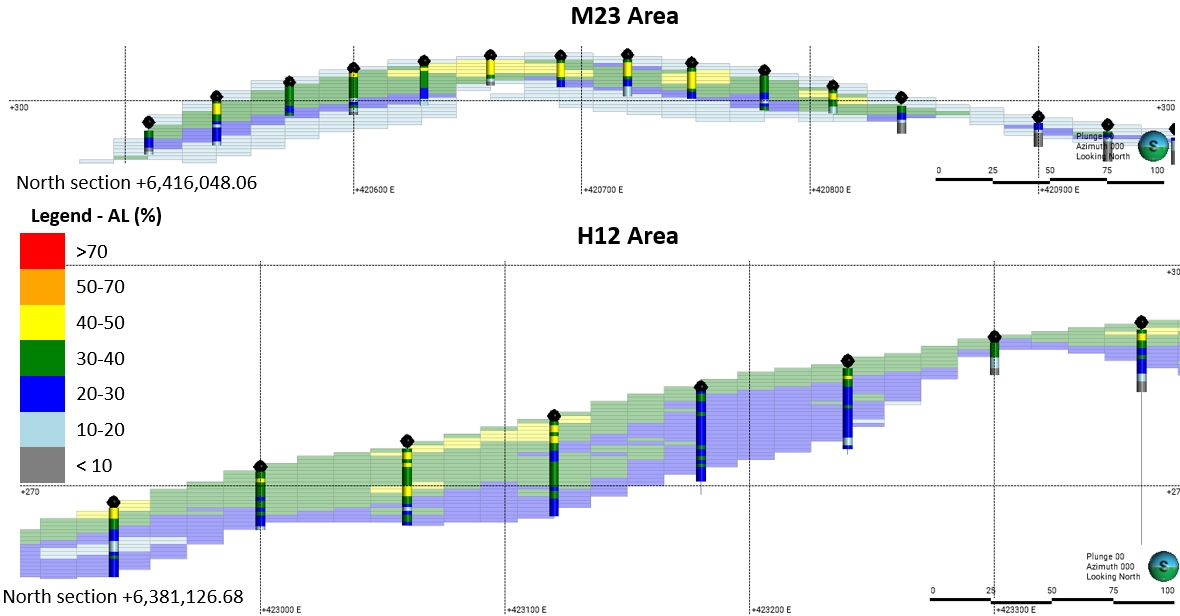
Figure 11‑13: Visual validation of Blocks and Composites for SI
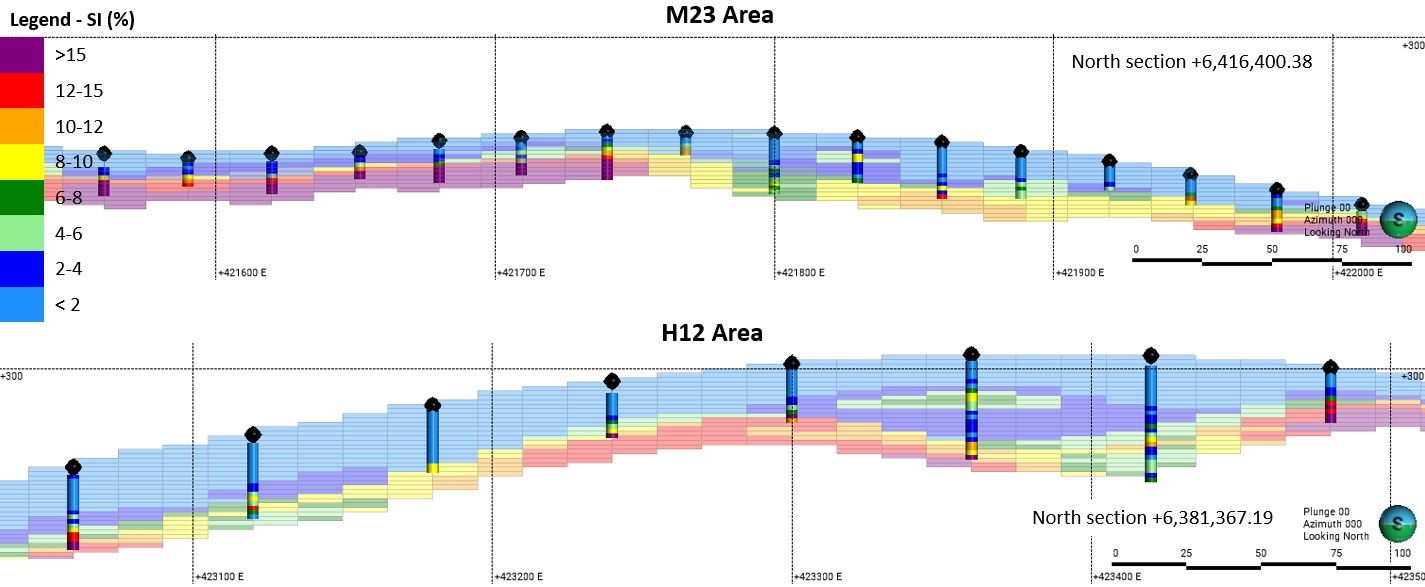
|
137 |
|
|
Alcoa Corporation S-K 1300 Report |
Signature Date: 20 February 2025 SLR Project No.: 123.020514.00001 |
Figure 11‑14: Visual validation of Blocks and Composites for FE

Swath plots were built comparing the OK, ID2 and NN estimations on the X, Y and Z directions.
AL and SI exhibit opposite behaviors, showing higher values for AL and lower values for SI when compared with ID2 and NN for the bauxite layer. These differences are around +8% and – 5%, respectively, and are also identified in the statistical validation. Additionally, the ID2 and NN estimates show a more variable average grade locally, while the OK behavior is more constant, which indicates a potential over smoothing of the estimation for these variables. FE shows a similar local and global trend between the different estimation methods.
As mentioned before, although some variation is expected due to the differences in the estimation workflows, SLR recommends that additional estimation validation procedures be incorporated to the current validation workflow, such as the comparison with ID2 and NN, and a smoothing degree evaluation.
Figure 11‑15 illustrates the AL, SI, and FE swath plots in the X direction for the bauxite domain of both areas. Sections of 5 and 10 meters were used for the M23 and H12 areas respectively.
|
138 |
|
|
Alcoa Corporation S-K 1300 Report |
Signature Date: 20 February 2025 SLR Project No.: 123.020514.00001 |
Figure 11‑15: Swath Plots in X direction for AL, SI and FE for the M23 and H12 areas – bauxite layer
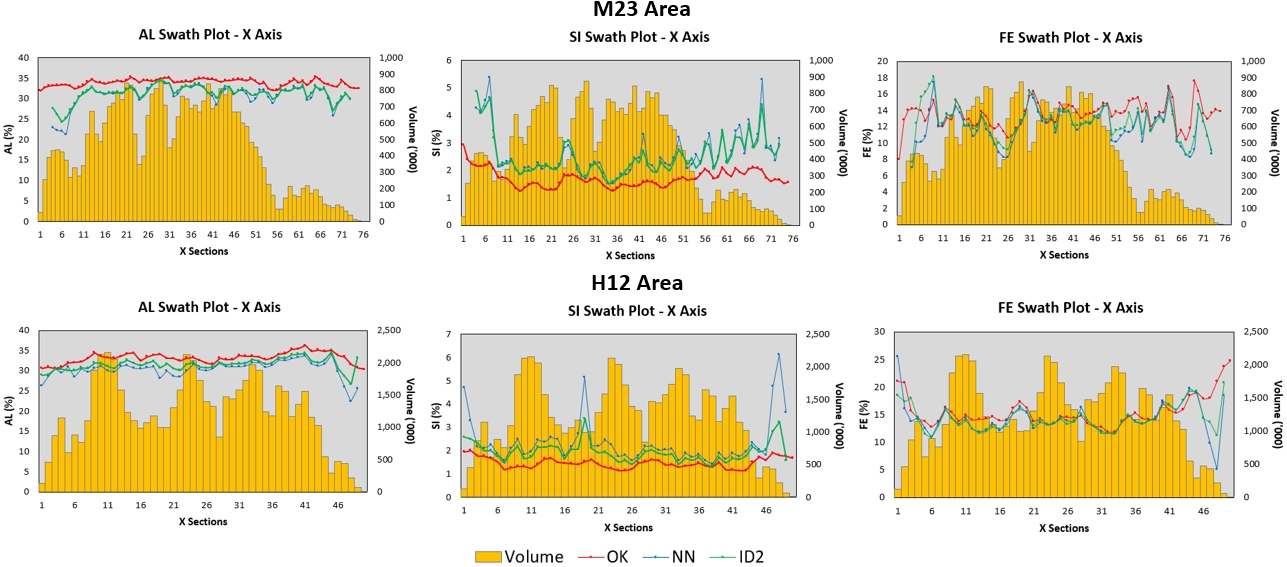
|
139 |
|
|
Alcoa Corporation S-K 1300 Report |
Signature Date: 20 February 2025 SLR Project No.: 123.020514.00001 |
Darling Range uses a historically accepted economic Mineral Resource cut-off grade of ≥27.5% AL, ≤3.5% SI, and ≤4kg/t OX, that is implicit in the delineation of the bauxite layer in the geological modelling stage. A minimum thickness of 2 m is also used to improve the Mineral Resource definition.
In addition to the geological modelling cut-offs criteria, the constraints described below are applied to the GSM and 3DBM Mineral Resource definition:
Bauxite resources can include material outside the geological modelling grade cut-offs that may also be considered as mineable, and a cut-off depth basis is used when AL grade is lower to define whether or not a block is economic.
Mineral Resources have been estimated using a LOM price of $500/t for alumina and $300/t for caustic soda, respectively. These prices were determined based on historical market trends. The $500/t alumina price corresponds to the maximum API average price over a six-month period in the past ten years, while the $300/t caustic soda price reflects the minimum caustic price over the same time frame, adjusted for delivery costs to relevant refinery locations.
The time frame used to estimate these commodity prices aligns with the long-term strategic planning window (2025–2033), which considers average pricing trends for mine scheduling. These prices are in accordance with the criteria of reasonable prospects for economic extraction (RPEE). The selected values are reviewed periodically and will be updated if material changes occur.
The optimized Mineral Resource pits are shown in Figure 11‑16.
|
140 |
|
|
Alcoa Corporation S-K 1300 Report |
Signature Date: 20 February 2025 SLR Project No.: 123.020514.00001 |
Figure 11‑16: Mineral Resource Pits for the M23 (top) and H12 (bottom) areas. Vertical exaggeration 3x
|
|
Source: SLR, 2023. |
The grade cut-off criteria to report the Mineral Resources is a common approach for the bauxite mines, and the QP is of the opinion that to improve the recoverable resources reporting, a re-blocked block model to a minimum practical mining scale or single mining unit should be considered. Economical parameters considering more flexible costs and bauxite prices related to the Mineral Reserves can also be implemented in the Mineral Resources workflow, aiming to optimize the bauxite mineable portion including potential marginal grades.
Alcoa’s staff is working on an integrated reconciliation process for all operating mines, aimed at standardizing reconciliation terminology, metrics, and standards. The workflow began development in 2023 and entered the testing phase for Darling Range in 2024 to calibrate the inputs and outputs.
The following sections describe the current reconciliation methodology and results.
|
141 |
|
|
Alcoa Corporation S-K 1300 Report |
Signature Date: 20 February 2025 SLR Project No.: 123.020514.00001 |
Refinery feed grade is monitored for the Huntly and Willowdale mining regions using material collected prior the arrival of the stockpile stackers at the Pinjarra and Wagerup sampling towers.
Alcoa mine planning personnel rely upon historical comparisons between the As Mined estimates, which means the tonnage and grade based on the block model using a mined-out perimeter or surface, and the sampling tower data to apply adjustment factors to mine design estimates, to assist with scheduling and stockpile planning activities. The adjustments are not applied to the global reported Mineral Resource estimates as they are considered to be local factors.
Sampling tower performance was discussed in SLR, 2022.
Alcoa reconciles the resource (mine design) estimates with the sampling tower estimates once mining is completed for each mining zone. It is important to note that the majority of the Mineral Resources are prepared using 30 m or 60 m spaced data, whereas As Mined to sampling tower reconciliation is based on mine planning models constructed from 15 m spaced data that include additional mining constraints.
Figure 11‑17 and Figure 11‑18 show the annual relative grade differences for both Huntly and Willowdale respectively. These plots indicate:
The sources of the reconciliation differences shown in Figure 11‑17 and Figure 11‑18 are not known, but the following factors could contribute:
Incremental reconciliation improvements appear to have started around 2010, which may reflect an improvement in data quality (drilling and assaying procedures) around this time. Consequently, Mineral Resources using data collected prior to approximately 2010 are considered to be of lower confidence and the classification of resource models constructed from this data has been downgraded accordingly.
|
142 |
|
|
Alcoa Corporation S-K 1300 Report |
Signature Date: 20 February 2025 SLR Project No.: 123.020514.00001 |
Reconciliation data in recent years falls within acceptable limits on an annual basis to support the classifications used for reporting of Alcoa’s Darling Range Mineral Resource.
Figure 11‑17: Resource versus Sample Plant Reconciliation – Huntly (SLR, 2024)
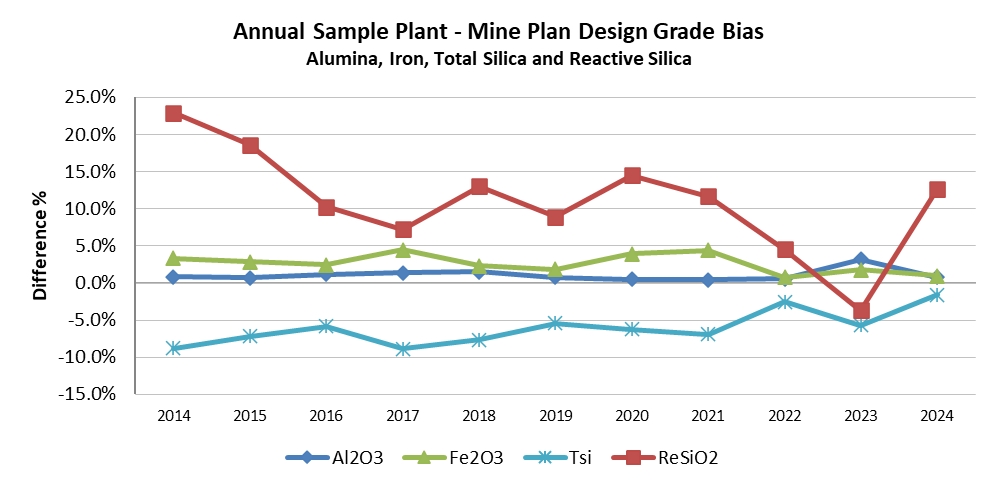
Figure 11‑18: Resource versus Sample Plant Reconciliation – Willowdale (SLR, 2024)
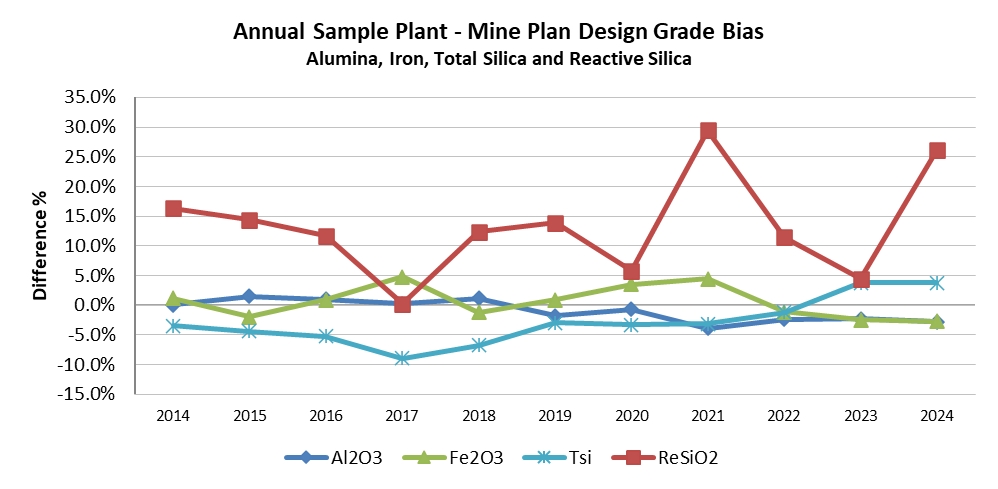
The estimation of Mineral Resources for any commodity, including bauxite, is subject to significant risks, including those described below and elsewhere in the discussion of risks associated with mining and processing of bauxite to produce alumina (see Section 12.9). An investor should carefully consider these risks. If any of the described risks occur, the Darling Range bauxite mining and processing business, financial position and operational results could be materially affected adversely.
The purpose of Technical Report Summaries issued under S-K 1300 and other similarly purposed International Codes (JORC, 2012; NI 43-101, 2014) is to ensure that known risks are disclosed by the QP subject to expectations of Transparency, Materiality and Competency. This Technical Report Summary addresses the technical risks associated with
|
143 |
|
|
Alcoa Corporation S-K 1300 Report |
Signature Date: 20 February 2025 SLR Project No.: 123.020514.00001 |
the Geology, Sampling, Assaying, Data Management in Sections 6.0 to 9.0 and Mineral Resource Estimation in Section 11.0. The QP considers that no material technical risks are identified in those Sections.
The risks described below are not comprehensive and there may be additional risks and uncertainties not presently known, for example due to market or technology changes, that are currently deemed immaterial but may also affect the business. The QP considers that the following risks specifically pertain to the Mineral Resources declared for Alcoa’s Darling Rang operations.
|
144 |
|
|
Alcoa Corporation S-K 1300 Report |
Signature Date: 20 February 2025 SLR Project No.: 123.020514.00001 |
The current drill sampling methods have been improved over time, based on independent review, and the requirements for minimum impact on the Darling Range. The assaying methods, including the use of FTIR, have been comprehensively reviewed and validated. The geostatistical estimates of in situ dry tonnages and grades are reasonable and validated by comprehensive reconciliation. The SLR QP considers that these methods are appropriate to produce the declared Mineral Resources and Mineral Reserves.
To ameliorate such risks the Mineral Reserves declaration is limited to material for which extraction is currently planned within the LTMP. The Mineral Resources excluding Mineral Reserves indicate the likely potential beyond that time frame, given all the limitations on future knowledge outlined above.
Definitions for resource categories used in this report are those defined by the SEC in S-K 1300. Mineral Resources are classified into Measured, Indicated, and Inferred categories.
The Mineral Resource estimate for Darling Range is produced by aggregating many different models, produced using data of different qualities at different drilling densities, and modelled using different estimation procedures. The Mineral Resource classification has been applied to the various resource models based on consideration of the quality and quantity of the input data, confidence in the geological interpretation, and confidence in the outcomes from
|
145 |
|
|
Alcoa Corporation S-K 1300 Report |
Signature Date: 20 February 2025 SLR Project No.: 123.020514.00001 |
the various estimation methods. The main factors that drive the Mineral Resource classification are the drill hole spacing, the quality of data collected, and the resource modelling technique. These elements will be explored in greater detail in the following paragraphs.
A drill hole spacing study (SRK, 2019a) aimed at quantifying the differences in the reliability of local estimates with different drill spacings was undertaken in 2019 using a similar approach to Alcoa’s 3DBM procedures. The study concluded that drill spacings of 30 m by 30 m and 60 m by 60 m were adequate to support the delineation of Measured and Indicated Resources respectively.
Due to the different block model types, the following adjustments in the classification were done aiming to best reflect the uncertainty for each one:
The Mineral Resource material has mining constraints applied, as detailed in the Cut-off Grade and Mining Constraints section, effectively ensuring that reasonable prospects for economic extraction are assured.
Resource classification criteria are applied in the horizontal plane and are consistent for the entire laterite vertical profile. Thus, interpretation of the roof and floor of the Bauxite Zone are implicitly assumed to be of similar confidence. In some areas, the geological floor may be erratic for Polygonal models and of lower confidence than the roof, but these areas are typically excluded when mining constraints are applied to the GSM and 3DBM resource models.
Figure 11‑19 shows histograms of the resource classification and the distance of the closest sample for the M23 and H12 areas.
Figure 11‑19: Minimum distance histograms showing the resource classification by the distance of the closest sample
|
|
A visual example of the final Mineral Resource classification within the Mineral Resource pit is shown in Figure 11‑20 for the M23 and H12 areas. The great majority of the blocks within the Mineral Resource pit in the M23 area are Measured due to the 15x15 and 30x30 m drill
|
146 |
|
|
Alcoa Corporation S-K 1300 Report |
Signature Date: 20 February 2025 SLR Project No.: 123.020514.00001 |
hole spacing, and for the H12 area the great majority is Indicated, due to the 60x60 m drill hole spacing. The final classification polygons can include small areas where the gaps between drill holes are at the next spacing increment, and they are used to assign resource classification for the full vertical profile of the laterite profile.
Figure 11‑20: Plan View of M23 and H12 Resource Classification. Block within the Mineral Resource Pit
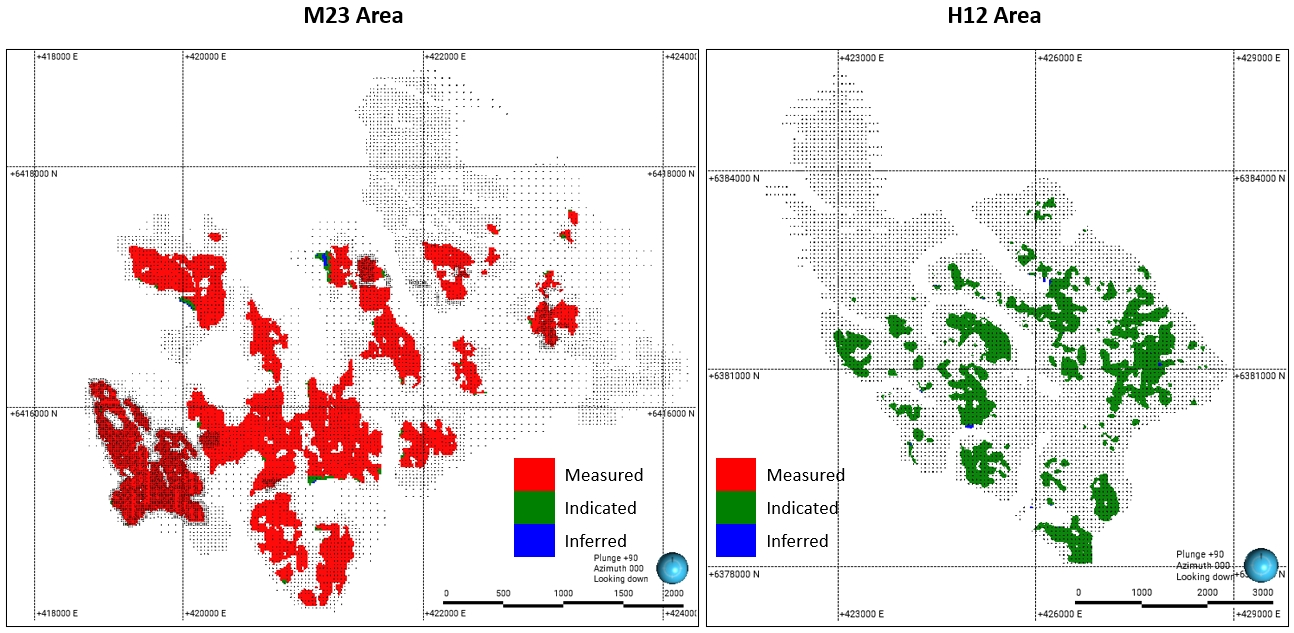
Source: SLR, 2023.
Key refinery target grade requirements for AL, SI, and OX along with practical mining considerations have been taken into account when defining resource blocks using GSM and 3DBM modelling methods. Polygonal resource models do not account for mining constraints other than a 1.5 m minimum thickness.
ML1SA contains some sub-regions for which mining permission has not been granted, due to forestry, environmental, social or other constraints, and Mineral Resources have not been defined in these areas by constraining the Mineral Resource model using ArcGIS software.
For Mineral Resource reporting, the block tonnage estimates have all been reduced by 5% on the basis that:
A summary of the Mineral Resource estimates, exclusive of Mineral Reserves, for the three ML1SA mining regions is shown below.
|
147 |
|
|
Alcoa Corporation S-K 1300 Report |
Signature Date: 20 February 2025 SLR Project No.: 123.020514.00001 |
Table 11‑13: Darling Range Mineral Resources exclusive of Mineral Reserves by Mining Region – 31 December 2024
Category |
Mine |
Tonnage (Mt) |
AL (%) |
SI (%) |
Measured |
Huntly |
106.1 |
30.4 |
1.89 |
North |
0.0 |
0.00 |
0.00 |
|
Willowdale |
33.5 |
30.4 |
1.39 |
|
Sub-total |
139.6 |
30.4 |
1.77 |
|
Indicated |
Huntly |
40.7 |
30.3 |
1.46 |
North |
0.8 |
32.3 |
1.38 |
|
Willowdale |
7.1 |
29.9 |
1.16 |
|
Sub-total |
48.7 |
30.3 |
1.42 |
|
Measured + Indicated |
Huntly |
146.8 |
30.4 |
1.77 |
North |
0.8 |
32.3 |
1.38 |
|
Willowdale |
40.7 |
30.3 |
1.35 |
|
Sub-total |
188.4 |
30.4 |
1.68 |
|
Inferred |
Huntly |
9.0 |
35.7 |
1.25 |
North |
15.1 |
31.6 |
1.00 |
|
Willowdale |
77.3 |
32.2 |
1.24 |
|
Sub-total |
101.4 |
32.4 |
1.20 |
Notes:
The SLR QP is of the opinion that Alcoa’s Mineral Resource classification scheme is considered appropriate for delineating the expected relative confidence of the Mineral Resource, in accordance with the S-K 1300 definitions as follows:
|
148 |
|
|
Alcoa Corporation S-K 1300 Report |
Signature Date: 20 February 2025 SLR Project No.: 123.020514.00001 |
The SLR QP is of the opinion that the modelling work completed to date is deemed suitable for its intended purpose. Upon evaluation of diverse technical and economic factors, it has concluded that the conditions stipulated under the Reasonable Prospects For Economic Extraction are met. This includes the effective constraint of the Mineral Resource model using the ArcGIS system, by ensuring that the model defines key parameters for the refinery, and by sound reconciliation practices reincorporating feedback into the geological model.
|
149 |
|
|
Alcoa Corporation S-K 1300 Report |
Signature Date: 20 February 2025 SLR Project No.: 123.020514.00001 |
A Mineral Reserve has been estimated for Alcoa’s Darling Range bauxite mining operations in accordance SEC S-K 1300 definitions which are consistent with the guidelines of the Australasian Code for Reporting of Exploration Results, Mineral Resources and Mineral Reserves (The JORC 2012 Code).
The QP inspected Alcoa’s Willowdale operations on 08 October 2024 and Huntly on 09 October 2024. Alcoa’s Mine Planning department was visited 10 & 11 October 2024 to review the LTMP, Medium Term Plan (MTP) and to interview relevant personnel on these dates. This supports prior review and discussions and on other occasions (2021 to 2023). A full account of the site visit to the mines, offices, and the refineries is provided in Section 2.1.
The Mineral Reserve is classified with reference to the classification of the underlying Mineral Resource and with reference to confidence in the informing Modifying Factors. The QP considers the Proven and Probable classification to be appropriate to the deposit and associated mining operations.
The reference point for the Mineral Reserve is prior to the processing plant at the refinery.
The Proven Mineral Reserve is a subset of Measured Resources only. The Proven Mineral Reserve is included in the Long Term Mine Plan (LTMP) and is approved for mining.
The Probable Mineral Reserve is estimated from that part of the Mineral Resource that has been classified as Indicated or from Measured Resources that are included in the LTMP but not yet approved for mining.
Variable cut-off grades are applied in estimation of the Mineral Reserves, and these are related to operating cost and the nature of the Mineral Resource in relation to blending requirements. The Mineral Reserve estimate is expressed in relation to available aluminum oxide (AL) and reactive silica (SI), this being the critical contaminant in relation to the Refinery.
Table 12‑1: Summary of Darling Range Mineral Reserves – Effective 31 December 2024
Region |
Class |
Tonnage (Mt) |
AL (%) |
SI (%) |
Huntly |
Proven |
12.4 |
28.3 |
1.87 |
Probable |
254.3 |
30.6 |
1.77 |
|
Total |
266.7 |
30.5 |
1.77 |
|
Willowdale |
Proven |
13.7 |
30.0 |
1.38 |
Probable |
143.3 |
31.2 |
1.19 |
|
Total |
157.0 |
31.1 |
1.21 |
|
Total |
Proven |
26.1 |
29.2 |
1.61 |
Probable |
397.6 |
30.8 |
1.56 |
|
Total |
423.7 |
30.7 |
1.56 |
Notes:
|
150 |
|
|
Alcoa Corporation S-K 1300 Report |
Signature Date: 20 February 2025 SLR Project No.: 123.020514.00001 |
The QP is not aware of any risk factors associated with, or changes to, any aspects of the Modifying Factors such as mining, metallurgical, infrastructure, permitting, or other relevant factors that could materially affect the current Mineral Reserve estimate.
The LTMP requires that permitting for operational dependencies is achieved timeously. The LTMP also requires two crusher moves (which are costed for). Longer haul distances 25km (+10km pre 2024) will be utilized over short periods at Huntly and the deliverable tonnage to the refinery will be 18Mtpa until 2032.
The QP considers that the accuracy and confidence in the Mineral Reserve estimate to be appropriate for the classification applied, which is supported by both the conservative operational processes and the long operational history.
The Modifying Factors are summarized as follows:
A comparison of the current Alcoa Mineral Reserve estimate, to the previous 2023 Mineral Reserve estimate, is presented in Table 12‑2. Overall, the Proven and Probable Reserves increased by 79.6 Mt (23.1%), from 344.1 Mt to 423.7. The AL grades have decreased by 2.5% and SI has increased by 18% respectively over the same period.
The increase in reserves is primarily due to the following changes:
Partially offset by:
|
151 |
|
|
Alcoa Corporation S-K 1300 Report |
Signature Date: 20 February 2025 SLR Project No.: 123.020514.00001 |
Table 12‑2: Comparison with Previous Mineral Reserve Estimates
Category |
Mine |
2024 Mineral Reserve |
2023 Mineral Reserve |
Difference (%) |
||||||
Tonnage dmt (Mt) |
AL |
SI |
Tonnage dmt (Mt) |
AL |
SI |
Tonnage (Mt) |
AL |
SI |
||
Proven |
Huntly |
12.4 |
28.3 |
1.87 |
26.2 |
27.81 |
1.87 |
-52.67 |
1.76 |
0.00 |
Willowdale |
13.7 |
30.6 |
1.77 |
21.8 |
30.75 |
1.38 |
-37.16 |
-0.49 |
28.26 |
|
Sub-total |
26.1 |
29.2 |
1.61 |
48.0 |
29.14 |
1.65 |
-45.63 |
0.21 |
-2.42 |
|
Probable |
Huntly |
254.3 |
30.6 |
1.77 |
210.4 |
31.66 |
1.36 |
20.87 |
-3.35 |
30.15 |
Willowdale |
143.3 |
31.2 |
1.19 |
85.6 |
32.43 |
1.04 |
67.39 |
-3.79 |
14.42 |
|
Sub-total |
397.6 |
30.8 |
1.56 |
296.0 |
31.88 |
1.27 |
34.34 |
-3.39 |
22.83 |
|
Proven & Probable |
Huntly |
266.7 |
30.5 |
1.77 |
236.6 |
31.23 |
1.42 |
12.73 |
-2.34 |
24.65 |
Willowdale |
157 |
31.1 |
1.21 |
107.4 |
32.09 |
1.11 |
46.15 |
-3.09 |
9.01 |
|
Sub-total |
423.7 |
30.7 |
1.56 |
344.1 |
31.50 |
1.32 |
23.15 |
-2.54 |
18.18 |
|
A Mineral Reserve is the economically mineable part of a Measured and/or Indicated Mineral Resource. It includes diluting materials and allowances for losses, which may occur when the material is mined or extracted and is defined by application of Modifying Factors that demonstrate that, at the time of reporting, extraction could reasonably be justified.
|
152 |
|
|
Alcoa Corporation S-K 1300 Report |
Signature Date: 20 February 2025 SLR Project No.: 123.020514.00001 |
|
153 |
|
|
Alcoa Corporation S-K 1300 Report |
Signature Date: 20 February 2025 SLR Project No.: 123.020514.00001 |
Historically, Alcoa did not report material in the Measured Mineral Resource category, reporting mineralization in areas of 15 m by 15 m spaced drilling as Mineral Reserves reported to the prior SEC standard. Alcoa has subsequently incorporated S-K 1300 and JORC Modifying Factor considerations into its mine planning processes and this was observed and confirmed on site.
The QP has used the December 31, 2024 Mineral Resource estimate as the basis for its Mineral Reserve estimate. The bauxite operations are operating mining projects with a long history of production for which establishment capital has been repaid and for which sustaining capital and supported operating costs have been observed to be applied in economic analysis. Consequently, the QP considers that support by a Feasibility Study is demonstrated by the demonstrable history of profitable operation and the level of technical support for the Modifying Factors and Front-End Loading (FEL 2), or pre-project planning study, for the recent major Myara capital crusher move. Additional capital costs for the forward mines moves to McCoy have also been reviewed. The QP has reviewed the operating and planning procedures and parameters for the operations and considers that the work completed is sufficient to allow definition of Mineral Reserves.
Proven Mineral Reserves are derived from scheduled Measured Mineral Resources which are included in the Long Term Mine Plan (LTMP) and approved for mining. Probable Mineral Reserves are derived from scheduled Measured Mineral Resources which are not yet approved for mining, or from scheduled Indicated Mineral Resources. The Mineral Resource estimate reported in this document (Section 11.0) is exclusive of the Mineral Reserve.
Consequently, Modifying Factors that relate to community and environmental considerations are formally assessed. The QP considers that as a result there is low risk to not establishing Proven Reserves relating to the project.
The QP has formed an independent view of the Modifying Factors applied in the estimation of the Mineral Reserve. This view is supported by examination and verification of mine planning data and procedures and historic reconciliation information. The QP has interviewed technical staff responsible for Alcoa’s operations and reviewed the operating, planning and forecast reports for the operations supplied by Alcoa.
The mine planning process excludes mineralization that is not considered recoverable due to various constraints, defining no Mineral Resource or Mineral Reserve within these zones. Such constrained zones include Aboriginal heritage sites and old-growth forest; however, these are proactively and dynamically updated by Alcoa through engagement with stakeholders, such as the community, and in response to government requests.
Dilution and ore loss are not reported separately to the Mineral Reserve. Internal and edge dilution is modelled at the mine planning stage through the application of 15 m by 15 m mining blocks to the Mineral Resource model. These regularized blocks contain proportional estimates of ore and contaminants and are optimized through the application of a Lerchs-Grossman algorithm developed specifically for the operation. This variation of the conventional Lerchs-Grossman algorithm is applied vertically, given that the shallow nature of the mineralization precludes geotechnical considerations. Blocks that do not satisfy grade and contaminant parameters against revenue are thus excluded from the mine plan.
Mining dilution is controlled by excavation of dilution at the top of the mineralization (a source of oxalate or organic contamination) and the pit floor (SI contamination). The upper contact is a sharp geological contact on an undulating surface. GPS-controlled machinery is used to locate these intersections.
|
154 |
|
|
Alcoa Corporation S-K 1300 Report |
Signature Date: 20 February 2025 SLR Project No.: 123.020514.00001 |
Figure 12‑1: Undulating Hanging Wall Hardcap Surface; and Footwall (white clay, lower right in the floor) (Left: Pearman, 2015 & Right: SLR, 2021)
|
|
Organic material reacts with sodium hydroxide in the refinery to form oxalate, which is considered to be a contaminant. Alcoa has developed a process known as Secondary Overburden Removal (SOBR) whereby the soil and clay on top of the hardcap that covers the mineralization and contains this organic material is removed by either scraper, surface miner or small excavator. This removes as much carbonaceous material overlying the undulating hardcap layer as possible. Further description of SOBR is given in Section 13.1.
A surface miner is employed as required at the Huntly mine to cut highly contaminated overburden to the hardcap contact. Historically, this results in a 2.9% ore loss, which is considered in the Mineral Reserve estimation.
The lower mineralization contact is gradational, and dilution is minimal on contaminants other than SI. This contact is defined through drilling and chemical analysis and excavation is controlled by GPS to modelled surfaces.
The Grade Control process checks the accuracy of excavation and assesses adherence to excavation of the target floor.
Alcoa prepares an LTMP annually. The first five years of this plan is submitted to the statutory BSEC (previously MMPLG) for approval of mining areas. The LTMP includes a mine production schedule that demonstrates scheduling of mineralization classified as Mineral Resources for estimation as Mineral Reserves. This schedule contemplates higher confidence Mineral Resources during the early production periods, with lower confidence mineralization planned in subsequent periods (Figure 12‑2 and Figure 12‑3).
The schedule has several operational parameters in addition to statutory limitations (refer to Section 12.3 above):
|
155 |
|
|
Alcoa Corporation S-K 1300 Report |
Signature Date: 20 February 2025 SLR Project No.: 123.020514.00001 |
Confidence in the Mineral Reserves is predicated on confidence in the underlying Mineral Resources in the mining schedule. Continuous Mineral Resource definition drilling maintains an inventory of sufficient confidence to maintain Mineral Reserves.
Figure 12‑2: Willowdale LTMP Resource Confidence (drill hole spacing in meters shown in brackets) (Alcoa, 2024)
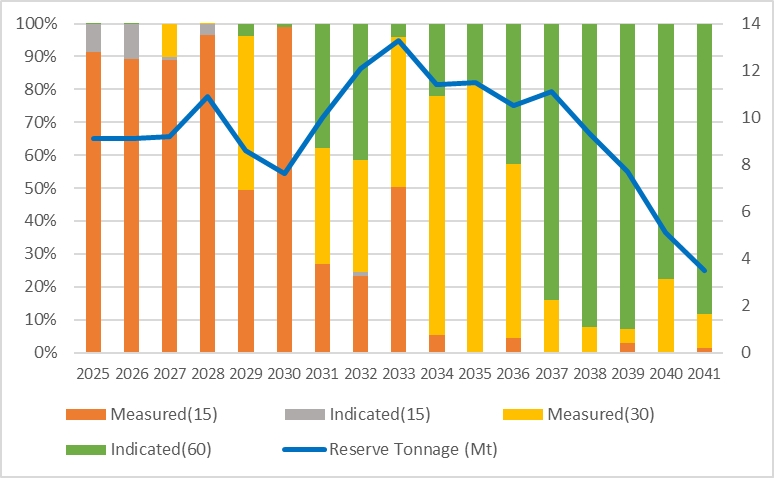
|
156 |
|
|
Alcoa Corporation S-K 1300 Report |
Signature Date: 20 February 2025 SLR Project No.: 123.020514.00001 |
Figure 12‑3: Huntly LTMP Resource Confidence (drill hole spacing in meters shown in brackets) (Alcoa, 2024)
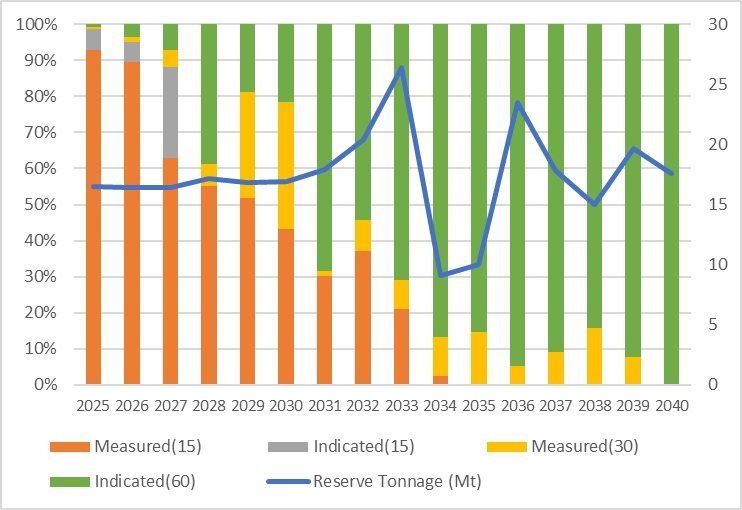
Alcoa has been actively refining the mine planning process in such a way that the Mineral Resource and Mineral Reserve Models are updated continuously using various scripts and rationalizing of computer software. This process is mostly complete, the QP observed its progress both on the mine sites and at the Booragoon mine planning office.
The mine planning process commences with receipt by the mine planning department of the regularized and classified electronic Mineral Resource model from the geologists. The regularization process sees the Mineral Resource blocks agglomerated into blocks of 15 m by 15 m by 0.5 m vertically. Grade, bulk density and contaminant parameters are estimated into the model, which is expressed as a percentage model. This model is then manually checked and validated.
Electronic files are centrally stored, and the master versions are copied by relevant personnel for manipulation.
Optimization of the pits is undertaken using a bespoke variant of the Lerchs-Grossman algorithm designed to operate vertically. The algorithm accumulates blocks vertically on 0.5 m increments, commencing at a minimum thickness of 2m, to find the pit floor.
The optimization is driven by Net Present Cost (NPC), rather than the conventional Net Present Value (NPV). The optimization considers a number of cost and consumption inputs which include caustic, lime, electricity, and gas power to be deducted from the base alumina price of USD 400/tonne.
Geotechnical constraints are not relevant, given that the pits are generally around 4 m in depth and placed on gently undulating country (Section 7.9). Contour mining is applied in areas of greater topographic relief, whereby mining progresses across the contour, maintaining as consistent a pit floor as possible.
|
157 |
|
|
Alcoa Corporation S-K 1300 Report |
Signature Date: 20 February 2025 SLR Project No.: 123.020514.00001 |
Optimization parameters are calculated for each block, including costs associated with drilling, blasting and ripping and haulage cost, which is estimated from major haulage roads and minor pit access roads against gradient. Electronic surface models are prepared to constrain the optimization; these are informed by LiDAR radar surveys and model the topography, the base of overburden and the base of mineralization, derived from chemical analysis of resource definition drilling samples. Caprock requires drilling and blasting, and modelled surfaces are contoured for thickness, which is derived from examination of drill logs and high-Fe assays.
Pit shells are visually assessed for practicality and minimum mining widths and any impractical pit shells are removed. Minimum mining widths vary according to topography and material type.
Individual areas are optimized separately, and the resultant pit shells are combined to provide grade and contaminant specifications for Life of Mine (LOM) scheduling. Haul roads are divided into 50 m segments with appropriate cost increments applied to each segment using commercial haul road optimization software. This process electronically tags each block with haulage cost information as a function of distance of the relevant node (haul road) from the nearest crusher. The software then normalizes the data by calculating the equivalent flat haul distance, maintaining a gradient of less than 8% for all nodes.
The model is then depleted for mined material and blocks that have been otherwise committed for development or have been mined out and also for environmental constraints.
Environmental constraints include proximity to streams, designated heritage areas (both Aboriginal and European) and the water catchment offset. GIS software is used to continuously generate electronic shape files that are converted daily to string files for import into the mine design software. These are then used to deplete the model in relation to environmental constraints.
Mineralization that has been identified as being under infrastructure is scheduled for mining only after that infrastructure has been removed in the LOM plan.
Noise zones are those where noise from the mining operations will potentially exceed allowable levels and the operation actively seeks to maintain lower noise levels than those mandated. Mining in these areas is undertaken by contract miners on day shift only and attracts higher costs than conventional owner-operator mining, which is applied to most of the operation.
The regularized model is then coded for the above parameters and checked. All the above processes are logged, checked, and validated both electronically and visually. Electronic scripts are then run in the mine planning software, resulting in the reporting of Mineral Reserves.
The Value in Use (VIU) revenue for mined ore is defined from an in-house optimization and integrated mine planning process. This VIU is calculated by subtracting the costs associated with mining and refining activities from the base alumina price. The costs considered in this calculation include various consumable inputs such as caustic, lime, electricity, and gas power, all of which are deducted from the base alumina price of USD 400 per tonne.
A discount rate of 12.00% is mandated by the Finance Department and applied to the NPV scheduler during the mine planning process.
The QP notes that costs and revenues used in this process demonstrate reasonable variations consistent with market trends over time and that revenue has remained constant over the past year.
In practice, the Grade Control Model is used to direct mining at the bench scale, because it has more up-to-date drilling data than the Mineral Resource Model. Reconciliation is undertaken between the Mineral Resource, Mineral Reserve and Grade Control Models, with
|
158 |
|
|
Alcoa Corporation S-K 1300 Report |
Signature Date: 20 February 2025 SLR Project No.: 123.020514.00001 |
the QP observing the reconciliations between Mineral Resource and Grade Control Models to be within acceptable parameters. Reconciliation of the Mineral Reserve model has not been regularly undertaken in the past and this process was observed to be in development.
Figure 12‑4 shows an example of the reconciliation between Resource and Grade Control models undertaken regularly by Alcoa.
Figure 12‑4: Example of Reconciliation Between Mineral Resource and Grade Control Models for Tonnage, Al, Si, and OX (Alcoa, 2022)
|
|
|
|
|
|
159 |
|
|
Alcoa Corporation S-K 1300 Report |
Signature Date: 20 February 2025 SLR Project No.: 123.020514.00001 |
|
|
|
The resultant pit shells are scheduled using specialist automated mine scheduling software. A text file containing the model and its parameters is exported to the scheduling software, which is programmed with current wait times and the current mining capacity of 26.5 Mtpa (Huntly) & 11 Mtpa (Willowdale). The software calculates and defers, as much as possible, capital haul road development costs for each block and identifies an optimal schedule.
Sustaining capital is calculated and added for haul road maintenance and equipment replacement. Not all machinery is capitalized, some being leased, and this is included in the operating cost. Review of ownership costs against leasing is constant and appropriate factors applied to the model.
The resultant model is coded for grade and contaminants and blocks are flagged with the appropriate mining sequence. Mineral Reserve blocks are contained within the LTMP schedule. The model is then re-exported as a text file to the mine planning software and distributed to the relevant mine planning departments and mine closure engineers for detailed planning.
Some planned mining areas that are included in the schedule are unable to be totally mined for a variety of operational reasons. These reasons usually relate to issues with rock outcrops, hard ground, contamination and access difficulties that are encountered when developing a new mining area. This process drives the continuous development of new mining areas to maintain production capacity.
|
160 |
|
|
Alcoa Corporation S-K 1300 Report |
Signature Date: 20 February 2025 SLR Project No.: 123.020514.00001 |
Alcoa’s recorded average abandoned mineralization between 2016 to 2019 (inclusive) is estimated at an average of 4.4% of Huntly (being 1.5% abandoned + 2.9% scalped using surface miner) and 2.0% of Willowdale planned production but can vary materially. These factors are applied to forecast production in the Mineral Reserve estimation process.
An economic cut-off grade has been used for mine production planning. The process is based on mine optimization to define economic boundaries of minable bauxite in measured or indicated classification from the resource model. The economic cut-off grade is dependent on various operating costs deducted against a base alumina price. The base alumina price has been estimated as a 9 year average (2025 to 2033). Mining cost estimations are also based over 9 years as related to the LTMP. The deductions and basis are shown in Table 12‑3. This benefit has been updated for the 2024 LTMP by Alcoa’s Mine Planning Department and was reviewed by the QP during the 2024 site visit to the mine planning department. It is the view of the QP that the economic cut-off grade reflects a reasonable market expectation for the sales of bauxite from the Darling Range based on alumina price movements and associated trend over the previous ten years. SLR have reviewed the various detailed inputs and are satisfied that the economic parameters applied to the cut-off grade definition are appropriate. Mining and refinery costs form part of the LTMP (2025-2033), with some key variables summarised in the table below.
Table 12‑3: Highlighted Cut Off Grade Variables
Plan Input Assumption |
Units |
Value |
Base Alumina Price |
USD/t |
400 |
Caustic Price (delivered) |
USD/t |
500 |
Recovery |
% |
93 |
Exchange Rate |
$A/USD |
0.7 |
Moisture Factor |
- |
0.91 |
The economic cut-off is determined by subtracting all incurred costs from the base alumina price. Operating costs are primarily influenced by haulage distance and the reliance on contract mining. Contract mining is used in areas where operations are limited to day shifts due to environmental restrictions. Haulage costs increase as the distance between the mined ore and the crusher station increases, which depends on the mine layout.
The current economic cut-off process described presents grades generally above 25.5% for AL and below 3.5% for SI. As previously reported an optimization process is followed that considers the costs associated with mining and processing the ore from each resource pit. Each resource area block model has its cut-off calculated before pit optimization is performed. Commodity pricing is described previously in Section 12.6.2.
The Huntly and Willowdale Darling Range mining operations currently feed the Wagerup and Pinjarra refineries. The Huntly mine provides feed for the Pinjarra refinery and the Willowdale mine provides feed for the Wagerup refinery. As announced in January 2024, the Kwinana refinery ceased production in the second quarter of 2024 following phased curtailment. The LTMP allows for a potential restart of Kwinana within the next ten years. Ore is transported via conveyor belt from the relevant crushers, and the battery limit for the mining process is the refinery gate. All three refineries are established, mature and use the conventional low-temperature Bayer refining processes.
|
161 |
|
|
Alcoa Corporation S-K 1300 Report |
Signature Date: 20 February 2025 SLR Project No.: 123.020514.00001 |
The refineries are designed to accommodate long-term average bauxite and impurity grades from the mines. Internal Alcoa specification contracts are established between the refineries and each of the mining operations and these contracts are updated annually and contemplate a five-year mine plan. These contracts set impurity targets, the key impurities being SI, oxalate, and iron. It is noted that short term (i.e. up to 2027) supply AL grades will be at lower acceptance limits and SI will be at towards upper acceptance limits. Mineral processing testing is discussed in Section 10.0, and processing and recovery in Section 14.0.
The internal LOM (nominally 2045) specification for bauxite is based on a 27.5% AL cut-over acceptance grade, which is supported by the MTP, LTMP and extensive operating history at the refineries. The Figures below show the LTMP for Al schedule for both Huntly (Figure 12‑5) and Willowdale (Figure 12‑6).
Figure 12‑5: LTMP: Huntly
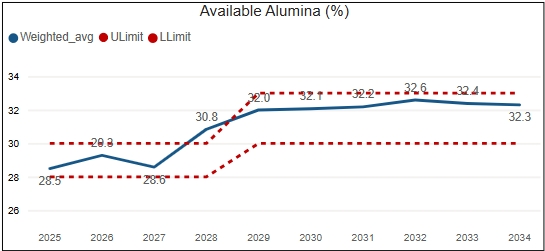
Figure 12‑6: LTMP: Willowdale
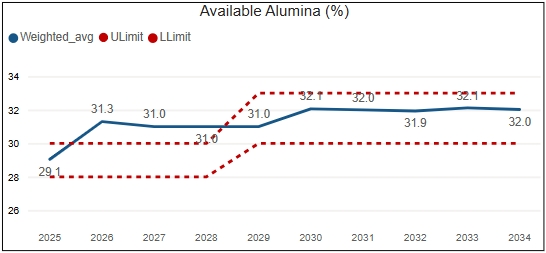
Deleterious elements are managed within contracted limits by blending at each mine, with the aim of minimizing variation. The refineries conduct metallurgical test work to ensure that any potential effects of variance caused by new mining areas are understood.
|
162 |
|
|
Alcoa Corporation S-K 1300 Report |
Signature Date: 20 February 2025 SLR Project No.: 123.020514.00001 |
Geometallurgical analysis is conducted on drill hole samples using FTIR analysis as a primary method. A subset of the samples is assayed using conventional analytical procedures, with the results used for FTIR batch calibration and quality assurance purposes. The Mineral Resource model is coded for geometallurgical grades for available alumina and reactive silica. This information is reported in the Mineral Resource estimate as well as the Mineral Reserve estimate.
The Mineral Reserve is based on geometallurgical criteria that have been set by the refineries as suitable for producing alumina to agreed product marketing specifications.
The QP considers that, because of the integrated process by which Measured and Indicated Mineral Resources translate to Mineral Reserves for Alcoa’s Darling Range operation, there are no foreseeable risks associated with Modifying Factors (mining, processing, metallurgical, infrastructure, economic, marketing, legal, environment, social, or government) that materially affect the Mineral Reserve estimate at 31 December 2024.
The operations are sensitive to the economics related to the actual grade mined, as such lower alumina or higher reactive silica grades or a combination of both remain the main risk to the overall economics. Alcoa has demonstrated through its grade control program an effective control to minimizing the dilution and mining at its forecast grades. Grade control is particularly important along ore-waste boundaries to maintaining expected mined grades, Alcoa demonstrates processes to handle and define boundaries to mitigate these risks.
Haul distance is considered a major cost driver due to the hauling cost making up a significant portion of the mining cost. Hauling directly links to fuel cost and maintenance, the combination of an increased hauling distance as well as an increase in fuel cost and maintenance would result in a significant impact on the operational costs. Haul distances to Reserve blocks typically increase over time until such time there is a plant relocation and so there is an expected increase in hauling distance in the medium term. It is noted because of permitting challenges that there are some significant increases during the MTP schedule in haulage distances. Alcoa has previously managed such risks by defining when the major plant needs to be relocated, however permitting challenges in the short term need to be overcome with some longer than normal average haulage distances.
Alcoa may be unable to obtain or retain necessary permits, which could adversely affect its operations. The Darling Range operation is subject to extensive permitting requirements. The requirements to obtain and/or achieve or maintain full compliance with such permits can be costly and involve extended timelines and possible delays. Alcoa strives to obtain and comply with all required permits but there can be no assurance that all such permits can be obtained and/or always achieve or maintain full compliance with such permits.
|
163 |
|
|
Alcoa Corporation S-K 1300 Report |
Signature Date: 20 February 2025 SLR Project No.: 123.020514.00001 |
The Huntly and Willowdale mines employ conventional open pit mining practices and equipment. The fleet is mixed between contract and owner-operator, depending on the nature of the task at hand. Owner operator equipment is used for mining the bulk of the Mineral Reserve, operating in areas away from those subject to environmental restrictions. Contract mining operates smaller equipment, day shift only, in environmentally (noise) sensitive areas and at the perimeter of the mining area.
The Huntly mine currently operates at a nominal mining capacity in order to supply about 17 Mtpa to the Pinjarra refinery. The Willowdale mine further supplies 10 Mtpa to Wagerup refinery.
The Darling Range operations currently have a nominal expected LOM until 2045 (when ML1SA expires), although provision exists for Alcoa to apply for a further mineral lease (Section 3.2). As an annual rolling process, a Long Term Mine Plan (9-10 years) for the estimation of Mineral Reserves (Section 12.6.1) is developed from Measured & Indicated classified Mineral Resources. Appropriate modifying factors are applied to facilitate the conversion of the Resources to Reserves. The Reserves currently extend beyond the mine schedule (LTMP) that forms the basis of the 9-year LOM plan (see also Section 19.0). Mining units of 15 m by 15 m by 0.5 m vertically are in use at the operations (Section 12.6.2).
Dilution and ore loss are not reported separately to the Mineral Reserve (Section 12.5). Internal and edge dilution is modelled at the mine planning stage through the application of 15 m by 15 m mining blocks to the Mineral Resource model. These regularized blocks contain proportional estimates of ore and contaminants and are optimized through the application of an algorithm of a similar nature to Lerchs-Grossman developed specifically for the operation. This variation of the conventional Lerchs-Grossman algorithm is applied vertically, given that the shallow nature of the mineralization precludes geotechnical considerations. Blocks that do not satisfy grade and contaminant parameters against revenue are thus excluded from the mine plan.
Mining recovery from Huntly and Willowdale are estimated to be 95.6% and 98%, respectively.
Figure 3‑3 shows the outlines of mined areas, Mineral Resources, and Mineral Reserves, which are collectively taken as representing the final pit outline, as currently understood. This does not account for any required extensions or additional licenses and assumes that all Mineral Resources and Mineral Reserves are ultimately mined.
Following definition of Mineral Reserve blocks, vegetation is cleared ahead of mining by an Alcoa managed contractor on behalf of the Western Australian State Forest Products Commission (FPC), saleable timber being harvested for use. Clearing approval is sought ahead of mining allowing time for harvesting of saleable timber before vegetation clearing.
After vegetation clearing and harvesting of saleable timber, Alcoa operations commence stripping topsoil and Secondary Overburden Removal (SOBR) using small excavators, scrapers, and trucks. Soil is stockpiled at the site, away from the proposed pit, for rehabilitation purposes. Soil is stockpiled in windrows in such a manner that it maintains its organic viability.
|
164 |
|
|
Alcoa Corporation S-K 1300 Report |
Signature Date: 20 February 2025 SLR Project No.: 123.020514.00001 |
The dieback fungus (Phytopthora spp.) is endemic in parts of the mining areas, which are flagged by Alcoa and precautions are taken to contain the fungus, which is lethal to the eucalyptus forest. The QP observed these precautions, which include separation of machinery fleets in areas where dieback is present and washing of machinery before entry into different areas. This represents a minor short-term scheduling challenge, though it is well managed.
The SOBR process is specialized and aims to remove as much overburden and organic material from the top of the mineralization as possible. This organic material reacts with NaOH in the refinery to produce oxalates, which are deleterious to the process. After scrapers have removed the topsoil and overburden, small (60t class) excavators equipped with swivel buckets are used to scrape clay containing organic material from the undulating surface of the hardcap that sits on top of the mineralization. This is later used to backfill mined out areas.
Figure 13‑1: SOBR (SLR, 2022)
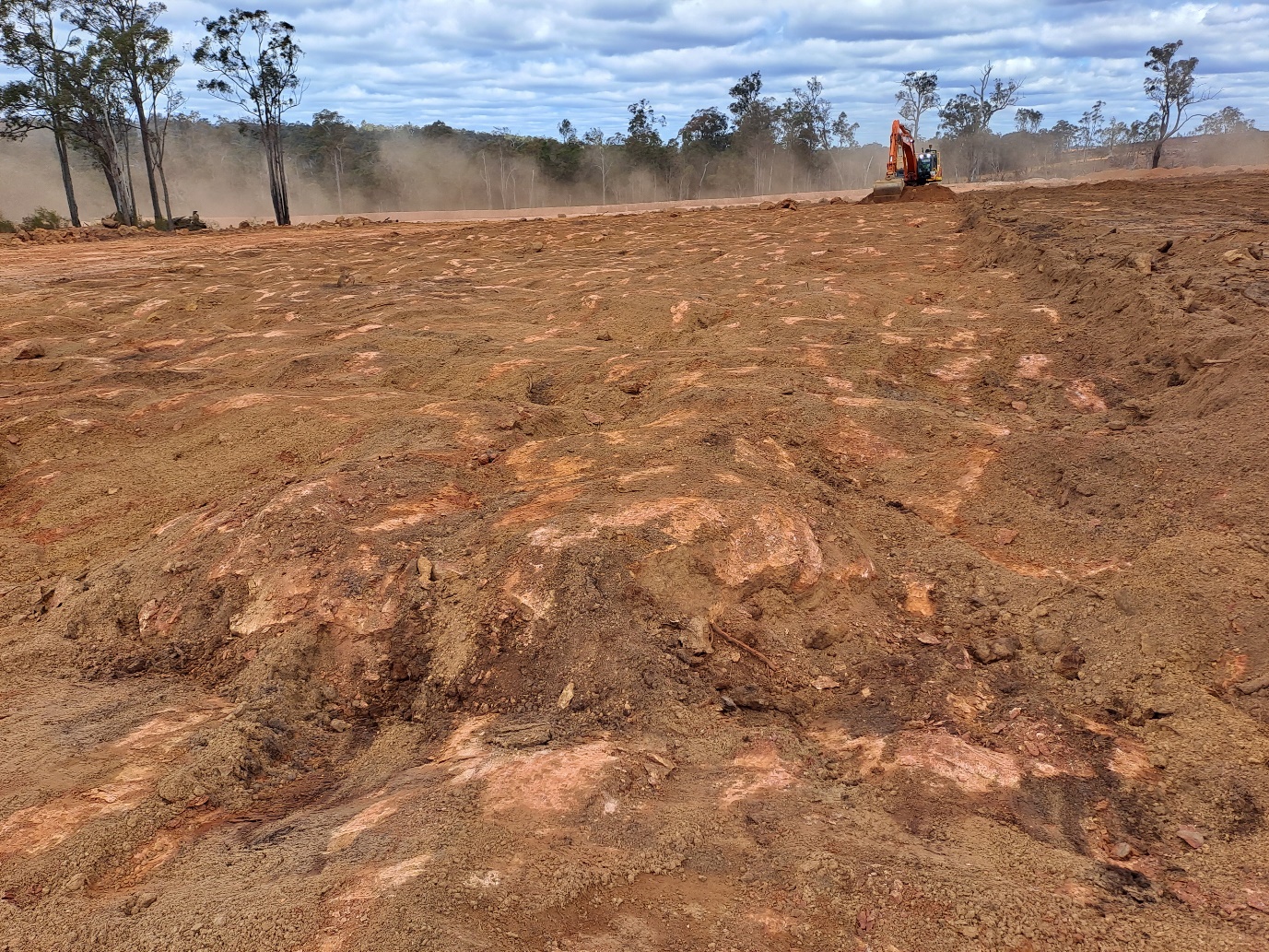
The SOBR process is applied to those areas where hardcap has been identified by Resource definition drilling, using the drillers’ logs. The hardcap is drilled and blasted before mining with the rest of the bauxite sequence.
In areas without hardcap, wheel tractor-scrapers of 24 m³ capacity remove soil overburden, scraping directly to the top of the mineralization model surface, being controlled by GPS. This material is similarly stockpiled for rehabilitation or used as backfill in exhausted mining areas.
|
165 |
|
|
Alcoa Corporation S-K 1300 Report |
Signature Date: 20 February 2025 SLR Project No.: 123.020514.00001 |
Figure 13‑2: Topsoil Removal (Background), Blasting of Hardcap and Marking of Ore (foreground) (SLR, 2021)
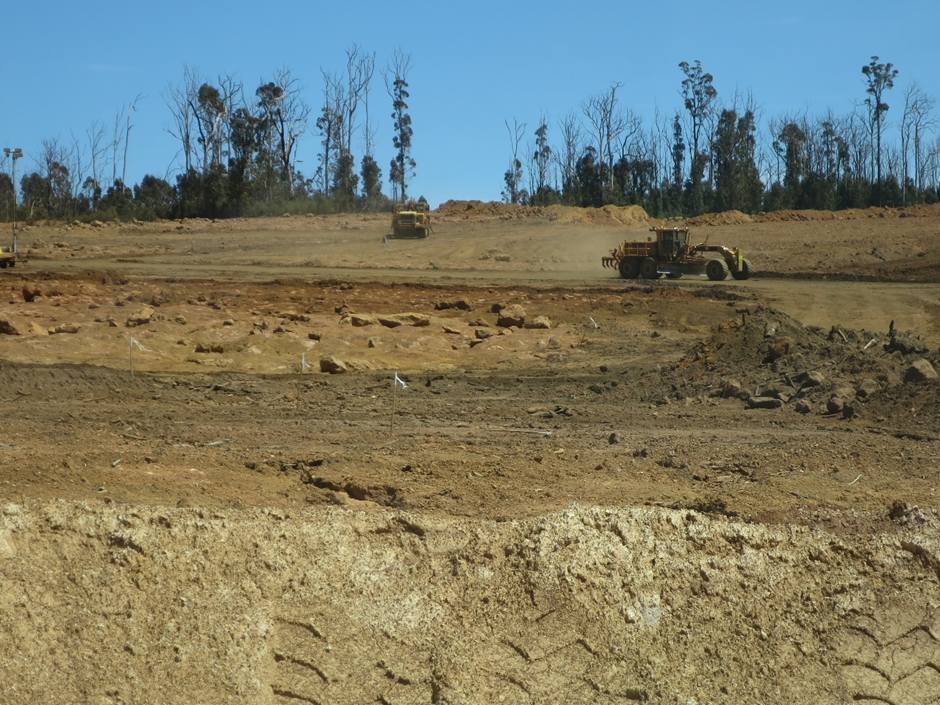
When required a surface miner is employed in limited areas of hardcap in the vicinity of blasting-sensitive infrastructure such as power lines. The surface mining may also be employed in lieu of SOBR where appropriate, for example, where there are high levels of contaminants in the hardcap. During both the 2023 and 2024 visits it was noted that as there were no operations of sensitivity around infrastructure the surface miner was not required.
Mining progresses on 4 m benches, utilizing a contour-mining sequence, cutting benches across the topography, working from top to bottom, maintaining the flattest floor obtainable to a maximum gradient of 1:7. Most of the mineralization lies beneath a gently undulating topography and contour mining is minimal.
|
166 |
|
|
Alcoa Corporation S-K 1300 Report |
Signature Date: 20 February 2025 SLR Project No.: 123.020514.00001 |
Figure 13‑3: Contour Mining (SLR, 2021)
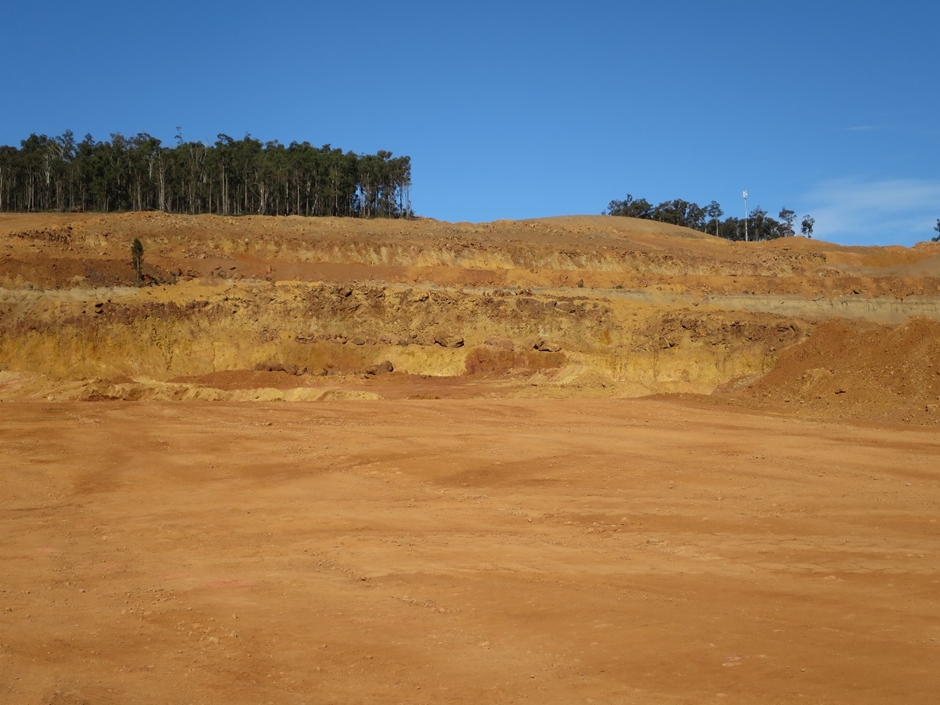
On completion of overburden removal, the exposed surfaces are sheeted with 0.25 m of suitable mineralized material taken from the dozed second cut in adjacent pits. Where hardcap is present, a drill rig is mobilized, and the hardcap drilled and blasted on an appropriate pattern to fragment the hardcap.
Trucks haul the mined ore to fixed crushers, which crush the material to varying sizes (refer to Section 14.0) before conveying down the escarpment to the refinery where it is stockpiled to give surge capacity.
No visual grade control is applied, the ore contacts being gradational. Grade control is achieved by mining to electronic ore surfaces derived from drill assays, control being achieved using GPS equipped equipment, the GPS being regularly calibrated.
Blending takes place at the pit face before which the crushed ore from different pits is assessed using specialist short-term mine planning software and pit production is scheduled to achieve the desired blend.
The QP is of the opinion that considering the style of mineralization, the average depth of the deposit, and the material characteristics of the overburden material whereby it is amenable to ripping / excavation using conventional earth-moving equipment, the open pit mining method adopted at Darling Range is the most appropriate method for the Mineral Reserves.
Haul roads are the limiting factor to the mining operations. Major haul roads are established to each mining area, honoring the topography at the least possible gradient. Roads are unsealed and formed by conventional bulldozer and grader and sheeted with appropriate material. Once established, haul road maintenance was observed to be continuous and forms part of the operating cost for each mining area. Haul roads are observed by the QP to be treated as sustaining capital in an appropriate manner.
|
167 |
|
|
Alcoa Corporation S-K 1300 Report |
Signature Date: 20 February 2025 SLR Project No.: 123.020514.00001 |
Figure 13‑4: Truck on Haul Road (SLR, 2021)
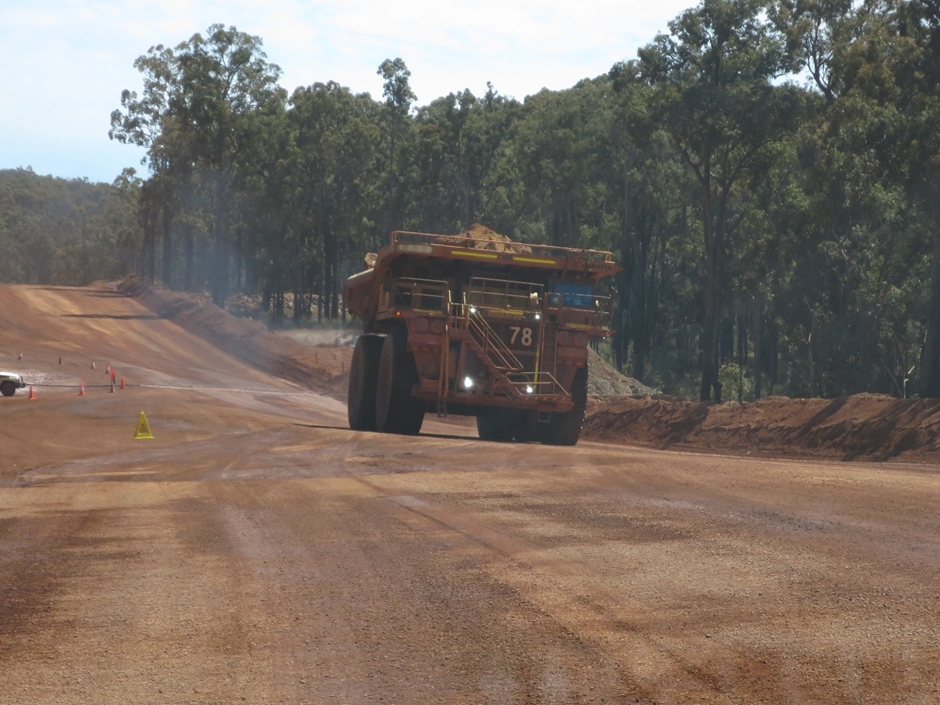
Figure 13‑5: Haul Roads with Berms (SLR, 2021)
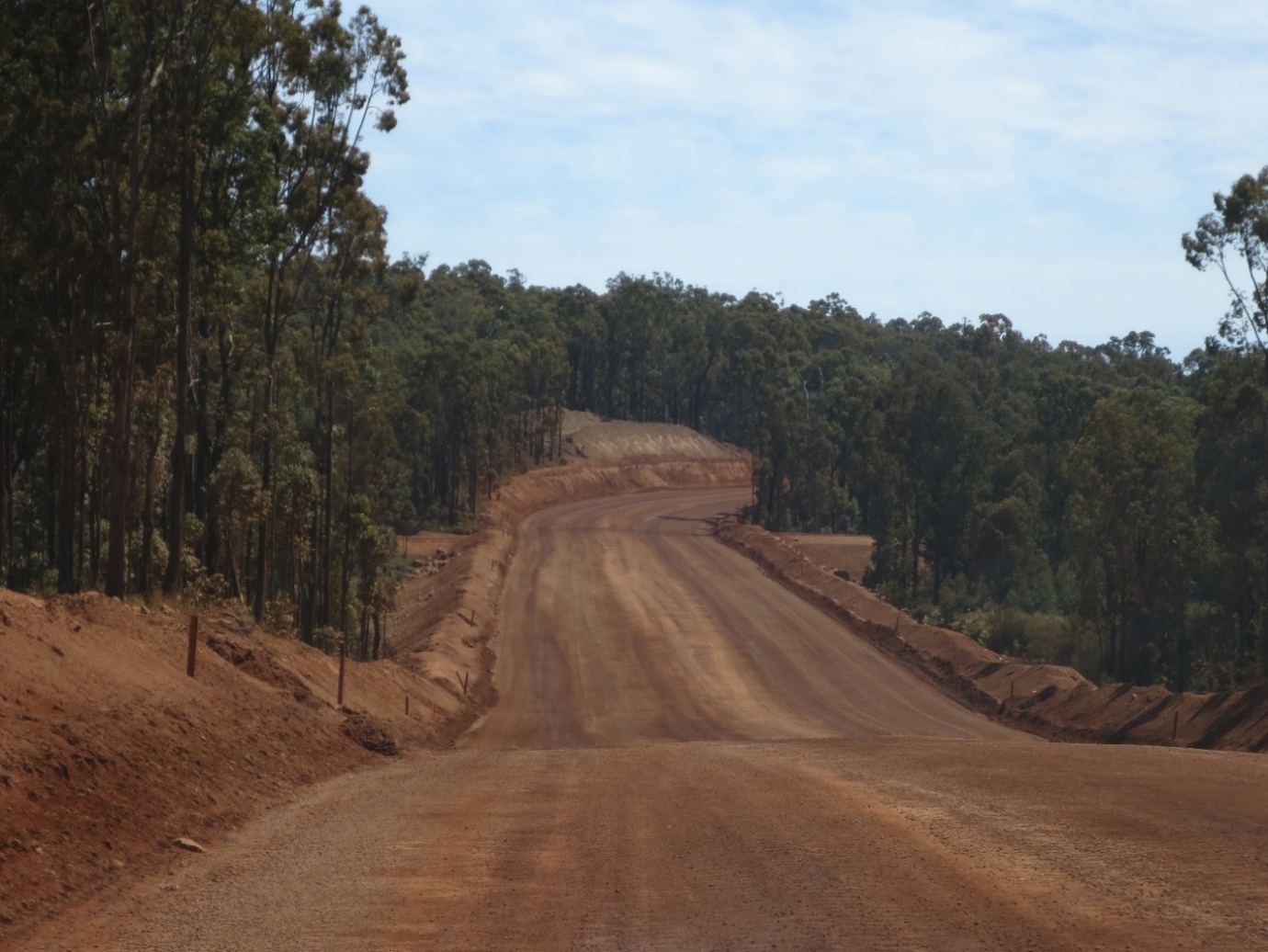
Secondary haul roads to individual mining areas are formed in the same manner, with provision for rehabilitation once mining is complete.
The Darling Range climate is subject to wet winter months and trafficability of haul roads during these months is included in mine planning. Redundancy during wet months is planned for, allowing well drained areas to be mined in the wet.
|
168 |
|
|
Alcoa Corporation S-K 1300 Report |
Signature Date: 20 February 2025 SLR Project No.: 123.020514.00001 |
There are some restrictions to the establishment and operation of haul roads, and these are incorporated into the road design and operation:
The QP has observed that Alcoa’s Darling Range operations have a well-established system for haul road design, construction, maintenance and regulation and that this does not present a major impediment to mining efficiency.
The main elements of infrastructure at Alcoa’s Darling Range mining operations are the location of crushers and conveyors to the refineries. These crushers form hubs for the mining operations, connected by the primary haul roads and are scheduled to be moved every ten years or so, in accordance with the requirements of the mining schedule and the location of ore as the mines progress. This crusher movement is planned well in advance and is treated as sustaining capital expenditure.
The crushers would be regarded as on relatively light duty for a mining operation and are well maintained. Similarly, the conveyors, which operate all year round and are covered, negating any potential effect of weather.
|
169 |
|
|
Alcoa Corporation S-K 1300 Report |
Signature Date: 20 February 2025 SLR Project No.: 123.020514.00001 |
Figure 13‑6: Covered Conveyor (SLR, 2021)
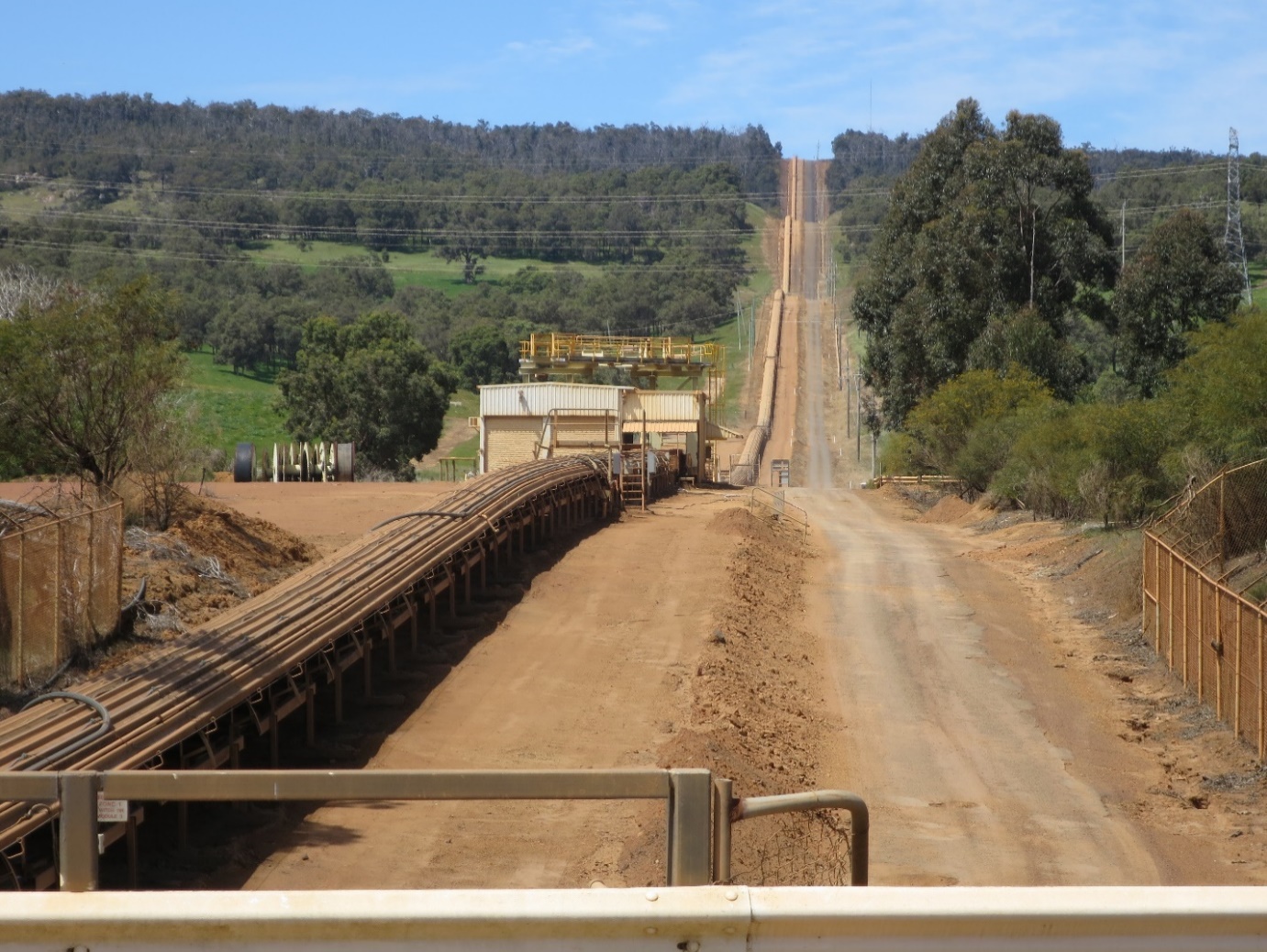
Both the crushers and conveyors were observed to be in excellent condition and subject to scheduled maintenance, including replacement of conveyor belts.
Alcoa plans additional stockpiling compared to the historical direct feed mine to crusher operation as part of the LTMP 2025. In this change stockpiling and reclaim will be utilized to smooth feed grade to the crushers from the variable grades to be mined. Whilst adding a marginal operating cost for the rehandle it is envisaged this provides a cost benefit in completely mining out pits rather than having to return periodically as grade dictated previously.
Other ancillary equipment includes offices, ablutions, crib-rooms, and workshops, all of which were observed to be in excellent condition.
Based on their long operating history, Alcoa’s approach to mine stability has largely been based on strong pit performance. Mining at Alcoa’s Darling Range operations is very shallow, pits being an average of 4 m deep. Consequently, geotechnical considerations are negligible other than immaterial localized batter failures. Similarly, the mining areas are elevated and well drained and groundwater and surface water hydrology is not material in these areas other than the catchment, impoundment, and decantation of runoff during the wet winter months. No drainage diversion occurs or is necessary because the mineralization sits between the stream beds and the bauxite occurs above the groundwater table. Deeper bauxite may be seasonally affected by the water table and is scheduled to be mined in summer. Backfilling of these places occurs before the rain raises the water table.
Contour mining (Figure 13‑7) is practiced in areas of relatively steep topography, maintaining access ramps at less than 1:8 gradient and mining across the contour and downwards, creating a flat working floor. Hydrological considerations in these areas include management of runoff during the wet winter months and trafficability.
Mine overburden is progressively backfilled into adjacent exhausted pits (Figure 13‑8), topsoiled, landscaped (Figure 13‑9), and rehabilitated by re-establishment of native
|
170 |
|
|
Alcoa Corporation S-K 1300 Report |
Signature Date: 20 February 2025 SLR Project No.: 123.020514.00001 |
vegetation (Figure 13‑10), creating a stable post-mining landform that replicates the pre-existing environment. Recommended pit design constraints are shown in Table 13‑1.
Table 13‑1: Alcoa Recommended Pit Design Constraints
Feature |
Constraint |
Pit total void Crest/Toe offset |
0.15m |
Maximum floor cut for a digger |
4m. Recommended 3.5m |
Maximum floor cut for a loader (depending on loader size) |
7m. Recommended 6m (depending on loader size) |
Dozer Push |
Recommended 50m but can be dependent on the pit and extraction |
Minimum Cut depth (non terrace) |
Huntly 2m, WDL 1.5m |
Maximum Cut depth before a berm |
8m cut, then a 7.5m berm is required |
Offset to Non blasted ground |
7.5m |
WSP-Golder were engaged by Alcoa to undertake a desktop study and gap analyses in February 2023 as part of broader scope to develop a ground control management plan for their Huntly and Willowdale operations. As part of the study, critical geotechnical hazards were identified with any associated failure mechanisms. These include rock fall, excavator stability whilst loading, dump / stockpile stability and land slips / rotational failure of batters. Surface water and groundwater are closely interlinked and are considered a major trigger for initiating all of these events. A geotechnical training package has been developed in order to provide training to mine operating staff. Ideally, all employees should be able to identify warning signals and are responsible for making the mine a safe place to work. All hazards are site specific related to Huntly and Willowdale operations. Recommendations for controls have been provided and can be applied as part of standard work procedures.
Alcoa mines areas of both flatter and steeper terrain, adopting higher walls and multi batter slopes where gradients are higher. It is recommended material strength characterization and stability analyses are continually investigated in particular for areas with planned high walls. A forward work plan with more detailed recommendations is available.
|
171 |
|
|
Alcoa Corporation S-K 1300 Report |
Signature Date: 20 February 2025 SLR Project No.: 123.020514.00001 |
Figure 13‑7: Contour Mining (SLR, 2021)
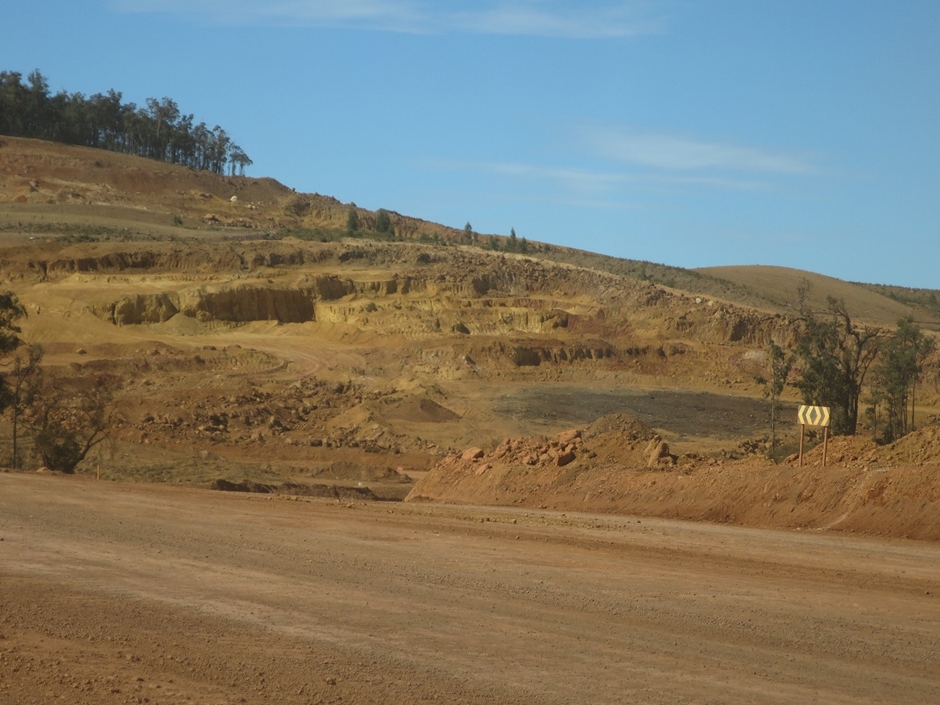
Figure 13‑8: Soil Being Returned for Backfilling and Landscaping the Pit (Alcoa, 2018)
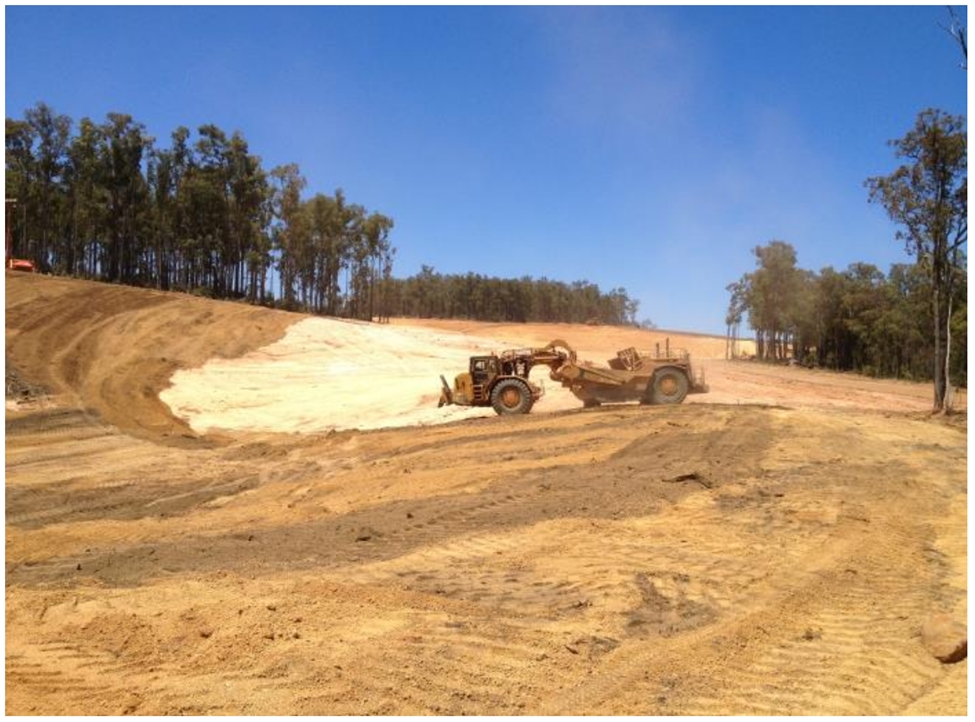
|
172 |
|
|
Alcoa Corporation S-K 1300 Report |
Signature Date: 20 February 2025 SLR Project No.: 123.020514.00001 |
Figure 13‑9: Landscaped Mining Area, Prior to Replanting of Forest (SLR, 2021)
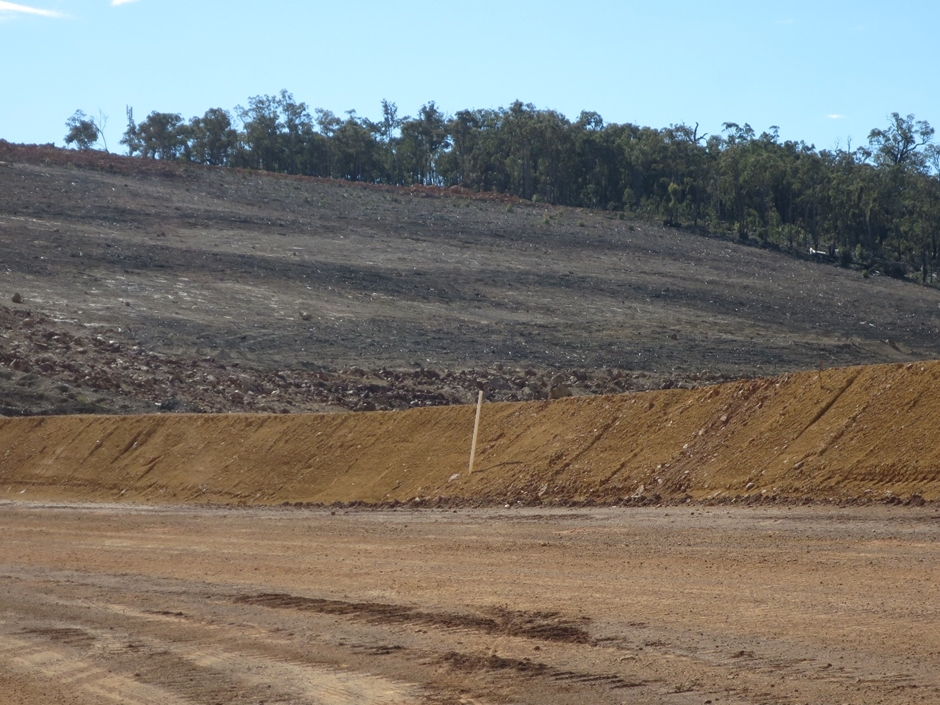
Figure 13‑10: Rehabilitated Pit Through Re-plantation of Native Vegetation (SLR, 2021)
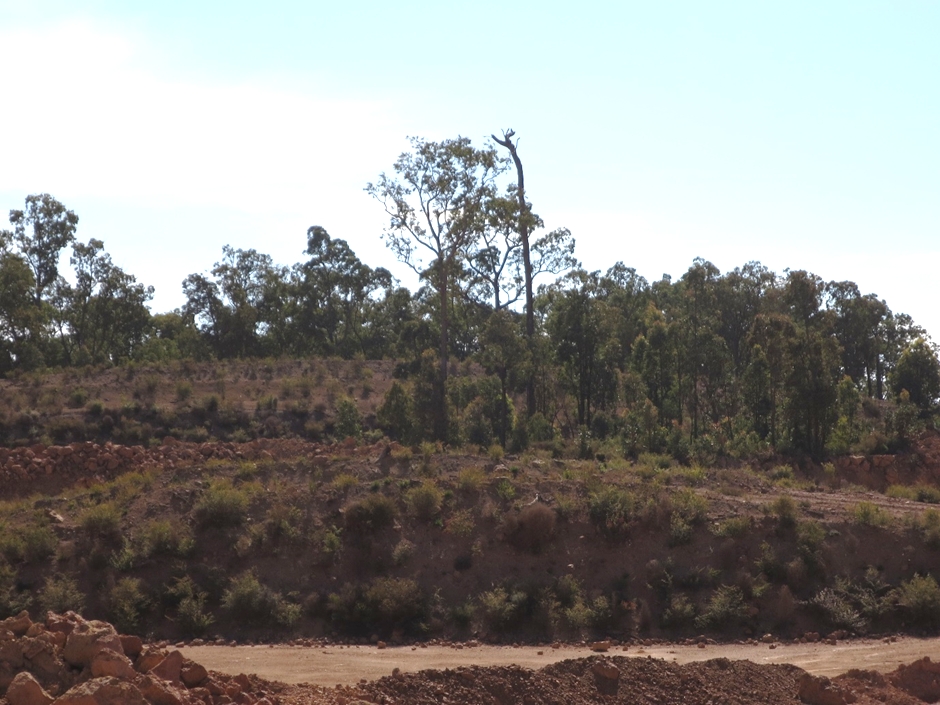
|
173 |
|
|
Alcoa Corporation S-K 1300 Report |
Signature Date: 20 February 2025 SLR Project No.: 123.020514.00001 |
Mining is undertaken by 250 t and 200 t-class excavators top-loading 140 t and 190 t capacity rigid-bodied mining trucks (Figure 13‑11). This fleet was observed by the QP at Huntly to be aged. The equipment has undergone relatively light duties for a mining fleet, which prolongs its life. Sustaining capital is being invested in equipment replacement and modernization at Willowdale, progressively working toward Huntly. New equipment includes 250 t-class excavators and 140 t-class trucks.
A full list of equipment at Darling Range is provided in Table 13‑2.
Figure 13‑11: Ore Mining at Darling Range (SLR, 2021)
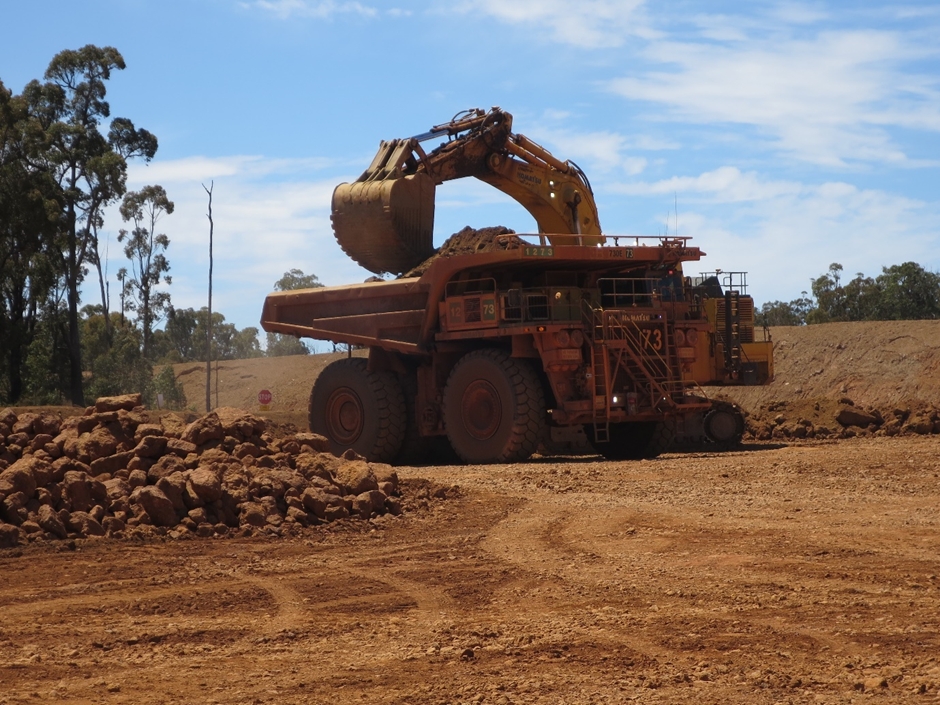
Table 13‑2: Darling Range Operations Equipment List
Location |
Classification |
Type |
No. Units |
Huntly |
Primary |
Excavator |
6x CAT 336D 2x Komatsu PC3000 3x Komatsu PC2000 4x Hitachi 2600-7 |
Haul truck 1 |
8x CAT 789C (190T) 9x CAT 789D (190T) 4x Komatsu HD 1500 |
|
174 |
|
|
Alcoa Corporation S-K 1300 Report |
Signature Date: 20 February 2025 SLR Project No.: 123.020514.00001 |
|
Ancillary |
Bulldozer / Loader |
3x CAT D11R 3x Komatsu 475 2x Komatsu 375 1x CAT 992K 2x CAT 993K 2x CAT 980 Loaders |
Grader |
2x CAT 16M 1x CAT 24M |
||
Scrapers |
5x CAT 637G |
||
Low Loaders |
1x CAT 785D (220T) 1x CAT 793 (450T) 1x CAT 785C (175T) |
||
Water truck |
3x CAT 785C |
||
Drills |
3x Epiroc D50 (Blast) 5x WB93 (Exploration) |
||
Willowdale |
Primary |
Excavator |
2x Hitachi ZX360 2x CAT 336D 1x Komatsu PC2000 2x Komatsu PC3400 |
Haul truck 1 |
6x Komatsu 730E (190T) |
||
Ancillary |
Bulldozer / Loader |
3x CAT D11T 1x Komatsu 475 2x CAT 993K 2x Komatsu WA320 |
|
Grader |
1x CAT 16H 1x CAT 18M |
||
Scrapers |
3x CAT 637K 1x CAT 637G |
||
Low Loaders |
1x CAT 793 (450T) |
||
Water truck |
2x CAT 777F 2x Komatsu 730E |
||
Drills |
3x Epiroc D50 (Blast) |
Alcoa’s practice in noise sensitive areas such as the perimeter of the operation near residents is to engage contractors. These areas operate on day shift only and attract higher operating costs than the main production areas. The flexibility required in these areas precludes the use of the primary owner-operator fleet and equipment is dry or wet hired or mining takes place under conventional schedule of rates contracts.
Alcoa also engages contractors for aspects of haul road construction services, in select areas of pit development, and during landscaping activities for rehabilitation after mining.
This practice has led to the establishment of a secondary contracting industry around the Darling Range operations. Contractors are overseen by Alcoa personnel.
|
175 |
|
|
Alcoa Corporation S-K 1300 Report |
Signature Date: 20 February 2025 SLR Project No.: 123.020514.00001 |
Ancillary equipment at Alcoa’s Darling Range operations includes a fleet of bulldozers, graders and loaders that are primarily used for haul road formation, pit development (for the removal of overburden and blasted caprock) and ground preparation for digging, landscaping, clean-up, and road maintenance.
The SOBR process requires small excavators, articulated trucks, scrapers, and specialist skills to grub organic-containing clay from the top of the mineralization.
Figure 13‑12: Blasthole Drill Working on Hardcap (SLR, 2021)
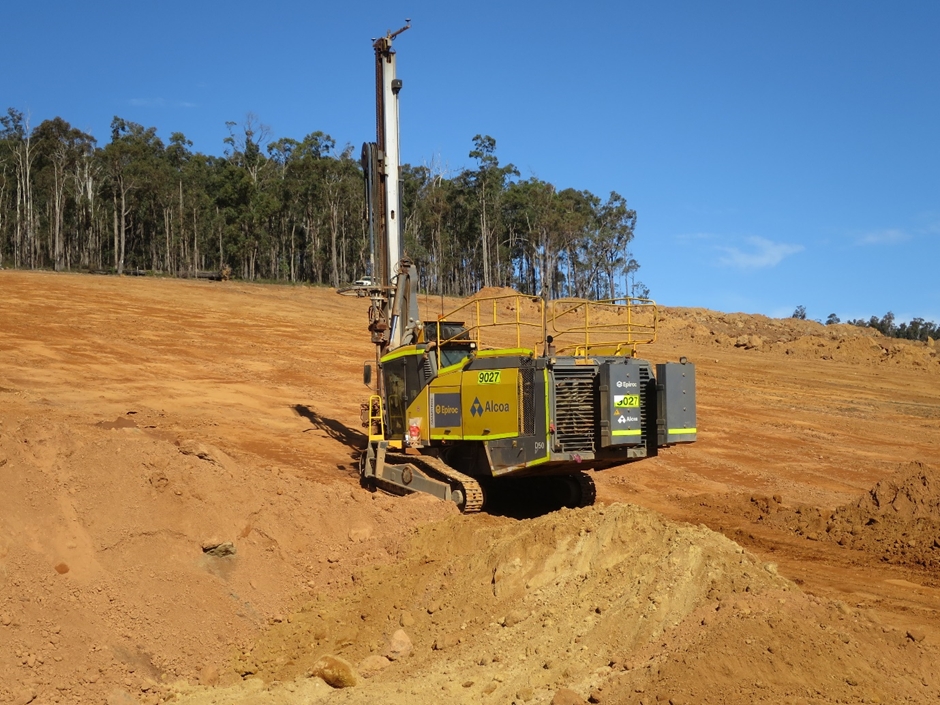
All ancillary equipment was observed to be in good and well-maintained conditions, the conditions being relatively light duty in comparison to other Western Australian mining operations. The current mining areas are shown in Figure 13‑2.
The main production mining operations are primarily Owner-operated using Alcoa equipment and employees. Contractors are also used for certain activities on site.
Three unions are recognized at the operations:
Lost time during strikes is generally uncommon. The Enterprise Agreements (EA) have varied timing for expiration. The AMWU Agreement, negotiated in early 2023, will expire in
|
176 |
|
|
Alcoa Corporation S-K 1300 Report |
Signature Date: 20 February 2025 SLR Project No.: 123.020514.00001 |
April 2027. The ETU EA was negotiated at the end of 2021, with a 4 year term and the AWU Agreement was negotiated in the fourth quarter of 2023, with a 2.5 year term.
Alcoa’s Darling Range operations were observed to have a stable workforce, drawn from the surrounding areas. The location is highly desirable in the Western Australian mining context and skilled personnel are readily attracted to the operations. Primary haul roads are named after personnel with greater than forty years’ service and there are many of these.
Employee turnover is below industry standard, as the drive in, drive out nature of the work attracts many to work at Alcoa.
As of December 2024, the Huntly and Willowdale operations together employ 981 employees consisting of 36 technical, 122 management and 823 operations employees. Additionally, 171 employees are centrally employed on the combined operations.
A breakdown is shown in Table 13‑3 (current vacancies not accounted for).
Table 13‑3: Darling Range Personnel
Location |
Classification |
No Personnel |
Huntly |
Technical |
24 |
Management |
71 |
|
Operations |
566 |
|
Willowdale |
Technical |
12 |
Management |
51 |
|
Operations |
257 |
|
Central |
Technical |
46 |
Management |
21 |
|
Operations |
104 |
|
Total |
1152 |
|
|
177 |
|
|
Alcoa Corporation S-K 1300 Report |
Signature Date: 20 February 2025 SLR Project No.: 123.020514.00001 |
The process plant for the Darling Range operations consists of two separate crushing facilities at the Huntly and Willowdale mines. Both facilities crush the ROM and convey the crushed ore to two separate refineries.
The Willowdale operation consists of a single stage crushing flowsheet and includes a series of conveyors to transport the crushed ore at an annual throughput of 10 Mtpa. The ROM is discharged from trucks on a dump hopper. An apron feeder transfers the ore from the dump hopper to a vibrating grizzly with an aperture of 180 mm. The grizzly oversize is discharged into a single toggle jaw crusher which crushes the ore to a top size of 180 mm. A hydraulic rock breaker is installed at the crusher to break the larger rocks that do not pass through the crusher opening. The crushed product and the grizzly undersize are discharged on to a discharge conveyor and subsequently discharged on to an overland conveyor. The discharge conveyor is fitted with a tramp magnet to remove any metal that is present along with the crushed ore product. The overland conveyor, which is 9.4 km long, transports the crushed ore to an intermediate transfer station. The ore is then transported by a second overland conveyor, 8.8 km long, to the transfer station located at Wagerup. An apron feeder is used to transfer the crushed ore from the Wagerup transfer station on to a stockpile conveyor and subsequently discharge on a stacker conveyor. The stacker conveyor discharges the ore into two separate stockpiles. The crushed ore is then reclaimed from there for processing in the Wagerup refinery. The total capacity of the stockpiles is approximately 0.7 Mt and sufficient for three weeks of feed to the refinery.
A simplified block flow diagram of the Willowdale operation is shown in Figure 14‑1.
Figure 14‑1: Simplified Block Flow Diagram of the Willowdale Operation
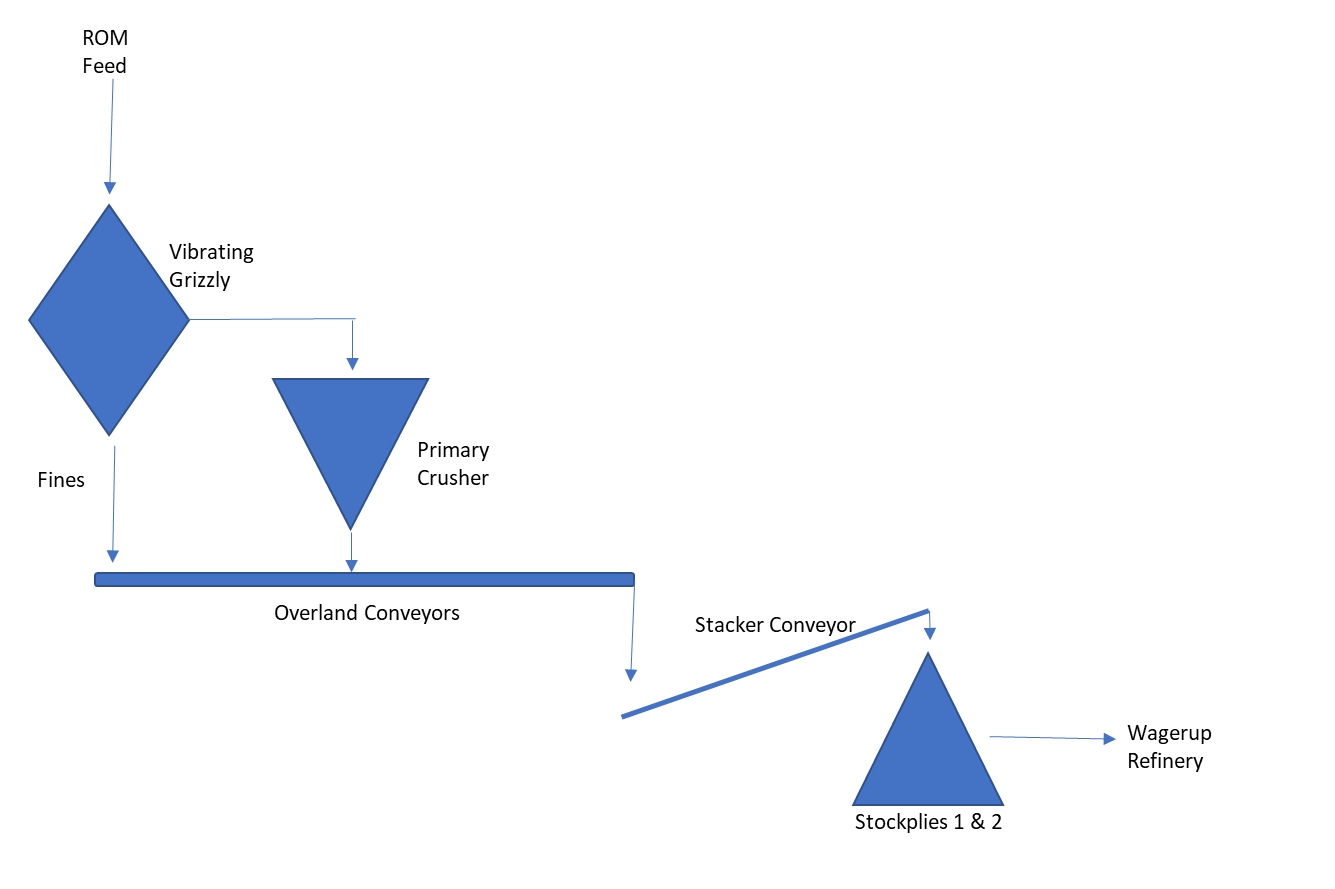
The Huntly operation consists of multiple stages of crushing and includes a series of conveyors to transport the crushed ore to the refinery at an annual throughput of 17 Mtpa. The primary crushing is achieved by two similar crushing circuits operating in a parallel
|
178 |
|
|
Alcoa Corporation S-K 1300 Report |
Signature Date: 20 February 2025 SLR Project No.: 123.020514.00001 |
configuration. The ROM is discharged from trucks on dump hoppers. Apron feeders transfer the ore from the dump hopper to vibrating grizzlies with an aperture of 180 mm. The grizzly oversize fractions are fed to jaw crushers which crush the ore to a top size of 200 mm. The crushed product and the grizzly undersize are discharged on to discharge conveyors and transferred to the secondary crushers (sizers). The discharge conveyors are each fitted with a tramp magnet to remove any metal that is present in the crushed ore. Secondary crushing is achieved in sizers with the objective of reducing the ore particle size to a top size of 100 mm. The secondary crusher product is transported by three overland conveyors (operating in series with two intermediate transfer stations in between) to a transfer station and randomly split into two by a splitter bin.
One fraction from the splitter bin is transferred by another overland conveyor and discharged into a stockpile conveyor via an apron feeder. The stockpile conveyor transfers the ore and subsequently discharges onto a stacker conveyor. The stacker conveyor discharges the ore into two separate stockpiles identified as Stockpile 1 and Stockpile 2. The crushed ore is then reclaimed from there for processing in the Pinjarra refinery. The second fraction of the ore is transported by an overland conveyor to an apron feeder, to a transfer conveyor and then to an adjustable splitter chute located at a separate transfer station. One of the splits from the splitter chute previously led to the Kwinana refinery, prior to curtailment in Q2 2024. Currently the whole stream is destined for Pinjarra refinery.
The fraction for the Pinjarra refinery is transported by stockpile conveyor and subsequently discharged on to two sperate stockpiles (identified as Stockpile 3 and Stockpile 4) via a stacker conveyor. The ore is then reclaimed from the stockpiles for processing in Pinjarra refinery along with the ore from Stockpile 1 and Stockpile 2.
The split for Kwinana refinery was transported by a conveyor and processed by a tertiary crushing circuit consisting of two roller crushers operating in parallel configuration. The tertiary crusher product with a top size of 25 mm was transferred by a stockpile conveyor and discharged into two separate stockpiles identified as Stockpile 5 and Stockpile 6 via a stacker conveyor. The crushed ore from Stockpiles 5 and Stockpile 6 was then reclaimed and transferred by a reclaim conveyor to a surge bin for subsequent loading and transport to the refinery by train. This section (System 4) was put into care and maintenance following the curtailment of Kwinana. A simplified block flow diagram of the full Huntly operation, prior to Kwinana curtailment, is shown in Figure 14‑2.
|
179 |
|
|
Alcoa Corporation S-K 1300 Report |
Signature Date: 20 February 2025 SLR Project No.: 123.020514.00001 |
Figure 14‑2: Simplified Block Flow Diagram of the Huntly Operation
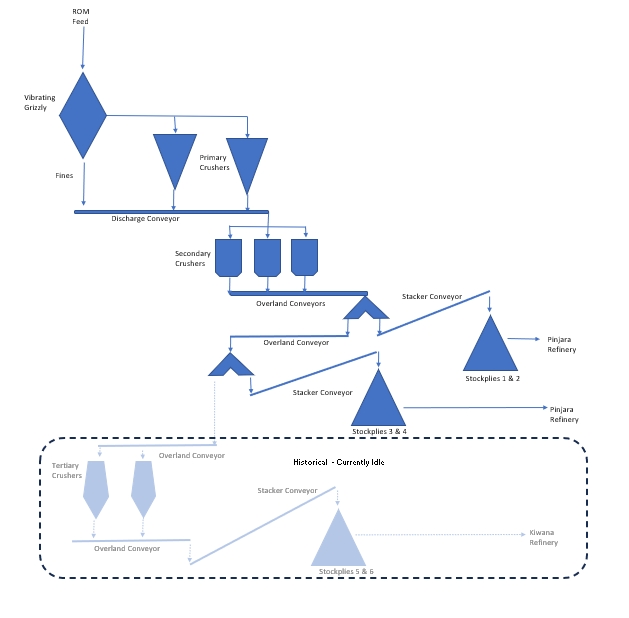
* System 4 of the flowsheet above is currently on care and maintenance following curtailment of the Kwinana refinery. The supply to Pinjarra remains as previous.
The primary equipment lists of the full Willowdale and Huntly operations are shown in Table 14‑1 and Table 14‑2.
Table 14‑1: Primary Equipment List (Willowdale)
Equipment |
Quantity |
Installed Power (kW) |
Apron feeder |
1 |
264 |
Vibrating grizzly |
1 |
75 |
Primary Crusher |
1 |
355 |
Discharge conveyor |
1 |
132 |
Overland conveyor |
1 |
2500 |
|
180 |
|
|
Alcoa Corporation S-K 1300 Report |
Signature Date: 20 February 2025 SLR Project No.: 123.020514.00001 |
Overland conveyor |
1 |
1800 |
Apron feeder |
1 |
75 |
Stockpile conveyor |
1 |
300 |
Stacker boom conveyor |
1 |
110 |
Table 14‑2: Primary Equipment List (Huntly)
Equipment |
Quantity |
Installed Power (kW) |
Apron feeder |
1 |
260 |
Vibrating grizzly |
1 |
55 |
Primary Crusher |
1 |
250 |
Discharge conveyor |
1 |
140 |
Secondary crusher |
1 |
1000 |
Apron feeder |
1 |
260 |
Vibrating grizzly |
1 |
75 |
Primary Crusher |
1 |
250 |
Discharge conveyor |
1 |
140 |
Secondary crusher |
1 |
1000 |
Overland conveyor |
1 |
7500 |
Overland conveyor |
1 |
5000 |
Overland conveyor |
1 |
6100 |
Apron feeder |
1 |
75 |
Overland conveyor |
1 |
1500 |
Apron feeder |
1 |
55 |
Apron feeder |
1 |
75 |
Overland conveyor |
1 |
1350 |
Apron feeder |
1 |
110 |
Stockpile conveyor |
1 |
225 |
Stacker boom conveyor |
1 |
110 |
Yard conveyor* |
1 |
250 |
Stockpile conveyor* |
1 |
150 |
Stacker boom conveyor* |
1 |
110 |
Conveyor* |
1 |
250 |
Apron feeder* |
1 |
75 |
Tertiary crusher* |
1 |
370 |
Apron feeder* |
1 |
75 |
Tertiary crusher* |
1 |
370 |
Stockpile conveyor* |
1 |
300 |
Stockpile boom conveyor* |
1 |
110 |
Bucket wheel reclaimer* |
1 |
264 |
|
181 |
|
|
Alcoa Corporation S-K 1300 Report |
Signature Date: 20 February 2025 SLR Project No.: 123.020514.00001 |
Reclaim bridge conveyor* |
1 |
110 |
Transfer conveyor* |
1 |
280 |
Reclaim conveyor* |
1 |
280 |
Reclaim conveyor* |
1 |
900 |
* These items are associated with System 4, which is currently on care and maintenance following curtailment of the Kwinana refinery.
The power consumption of the Huntly operation is approximately 5,500 MWh to 6,500 MWh per month. The Willowdale power consumption is approximately 2,000 MWh per month.
The process plant is a dry crushing operation and therefore water is only required for dust suppression and is included as part of mine water consumption. Water is not required as a consumable for the plant.
Other consumables of the process plant include crusher liners, screen panels and spares for feeders and conveyors. These are kept on site and replaced as part of the routine maintenance schedule according to manufacturer’s guidelines.
Personnel requirements for the operation and maintenance of the plant as described are included in Table 13‑3.
The QP is of the opinion that the selected processing method and the flowsheet are suitable for Darling Range operations. It is important to note that the ore head grades meet the refinery specifications for processing in terms of Al₂O₃ grades and SiO₂ grades, this means the ore can be directly shipped to the refineries for further processing without any upgrading in the mineral processing plant. The crushing circuit reduces the particle size suitable for conveying as well as to meet particle size specified by the refineries.
|
182 |
|
|
Alcoa Corporation S-K 1300 Report |
Signature Date: 20 February 2025 SLR Project No.: 123.020514.00001 |
The infrastructure for the mining operations is established and operational. In 2021, the infrastructure hub for Willowdale was relocated 16 km southwards from Orion (after having been based there for 21 years) to the Larego Hub which is located about 20 km north-east of the town of Harvey. The hub hosts administrative offices, as well as crushing facilities and maintenance facilities. The Orion Hub site is currently being rehabilitated with planning for infrastructure decommissioning commencing in 2025.
The mining hubs are relocated periodically as production moves away from the hub and thus transportation costs increase. Alcoa plans for the Larego Hub to be in place for approximately 20 years, though this is the fourth relocation since the mines opened in the 1970s/80s (approximately 13 years on average). The mining hub relocations are well-understood with planning and associated budgeting occurring well in advance of relocations; production restarted seven days after the most recent shutdown.
An extensive haul road network, rail, and overland conveyors are able to transport crushed bauxite from the Hub to the refineries on the coast (namely Kwinana, Wagerup and Pinjarra). As announced in January 2024, the Kwinana refinery ceased production in the second quarter of 2024 following phased curtailment; with the associated mine plans being revised accordingly.
Bauxite is transferred from each mine to Wagerup and Pinjarra primarily via long distance conveyor belt. Rail transport of bauxite to the curtailed Kwinana refinery is also possible. The Alumina produced by the refineries is then shipped to external and internal smelter customers through the Kwinana and Bunbury ports.
The infrastructure layout for the Darling Range operations is shown below (Figure 15‑1).
|
183 |
|
|
Alcoa Corporation S-K 1300 Report |
Signature Date: 20 February 2025 SLR Project No.: 123.020514.00001 |
Figure 15‑1: Infrastructure Layout (Alcoa, 2022)
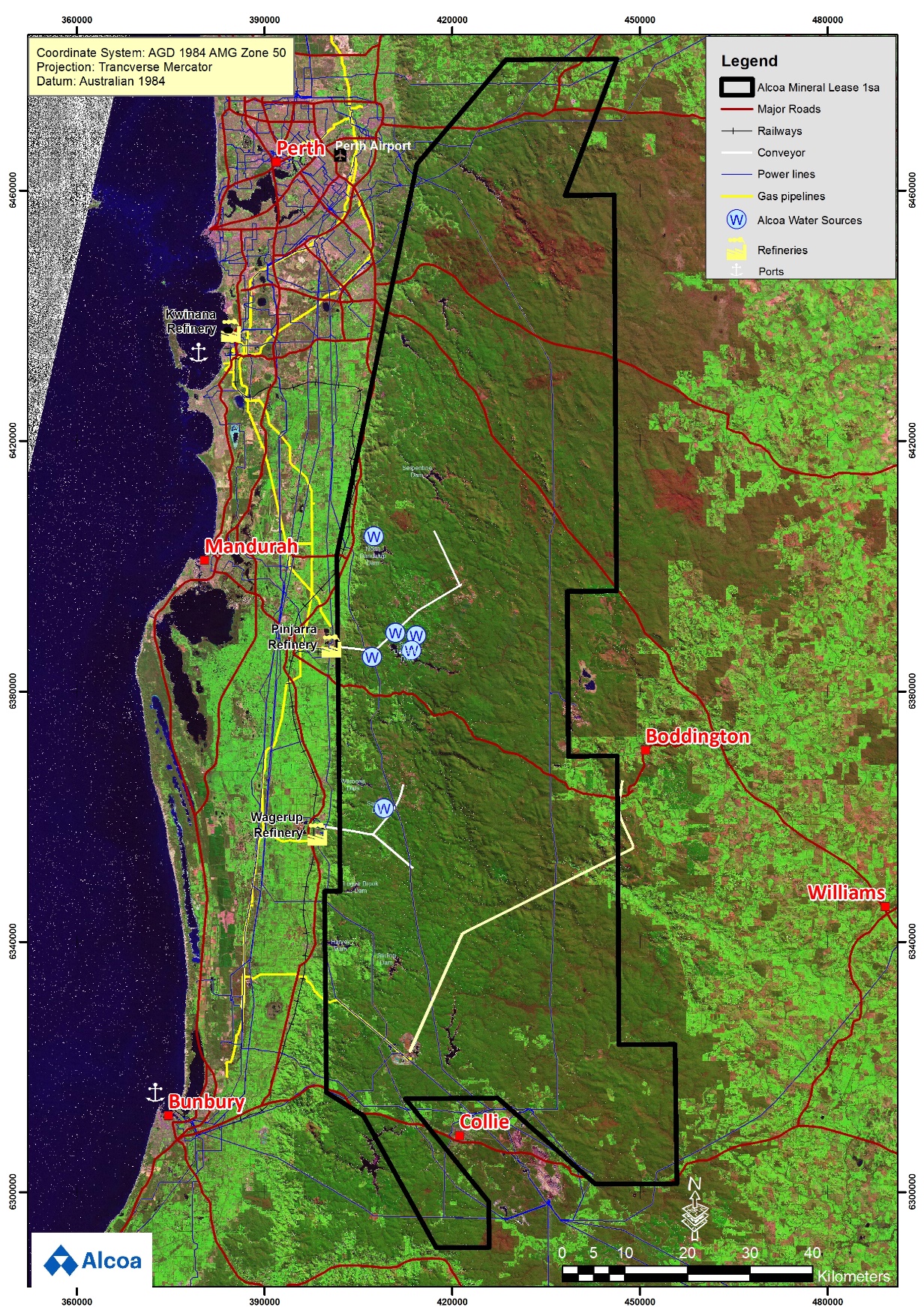
|
184 |
|
|
Alcoa Corporation S-K 1300 Report |
Signature Date: 20 February 2025 SLR Project No.: 123.020514.00001 |
The Darling Range is readily accessible via road from Perth and surrounding areas. The mines are near the towns of Pinjarra and Waroona. Both towns are easily accessible via the national South Western Highway, a sealed single carriageway road, which starts on the southern side of Perth and continues for almost 400 km to the southwest corner of Western Australia.
The Huntly mining area is accessible from the South Western Highway via Del Park Road, a sealed single carriageway road which connects the town of North Dandalup in the north with Dwellingup in the south. From Del Park Road, a further sealed road which follows the route of the bauxite conveyor to the Pinjarra refinery provides access to the Huntly site.
The Willowdale mining area is similarly accessible from the South Western Highway via Willowdale Road, a sealed single carriageway road to the south of Waroona.
Major haul roads have been established to each mining area. Roads are unsealed and require continuous ongoing maintenance which was observed during the site visit. Secondary haul roads, also unsealed, cross-cut each individual mining plateau.
The Darling Range’s Pinjarra refinery receives power from the South West Interconnected System (SWIS). The refinery also has internal generation capacity of 100 MW from 4 steam driven turbine alternators, with steam produced by gas fired boilers and a gas turbine Heat Recovery Steam Generator (HRSG). The refinery supplies power to the Huntly Mine by three different power supply lines (a single 33 kV and two 13.8 kV).
Willowdale Mine has a single 22 kV power supply fed from the Wagerup refinery. The Wagerup refinery is a net exporter of power to the SWIS, with internal generation capacity of 108 MW from three steam driven turbine alternators and one gas turbine. The steam is produced by gas fired boilers.
The power consumption of the Huntly operation is approximately 5,500 MWh to 6,500 MWh per month. The Willowdale power consumption is approximately 2,000 MWh per month.
Water is used on the mines for dust suppression, dieback washdown, vehicle washdown, workshops, conveyor belt wash, construction, and domestic purposes. The water supplies for mining consist of licensed surface water sources supplemented with treated wastewater from vehicle washdowns, stormwater runoff and maintenance workshops.
The WA mines are licensed by the Department of Water and Environmental Regulation (DWER) to draw surface water from five locations to meet their water supply requirements. The Huntly mine draws water from Banksiadale Dam and Boronia Waterhole. Huntly mine also holds a license to draw water from Pig Swamp and Marrinup, however these resources are retained as a backup water supply and have not been utilized in recent years. Huntly mine is also permitted to draw water from South Dandalup Dam under an agreement with the Water Corporation. A pumpback facility from South Dandalup Dam to Banksiadale Dam is used to raise levels in Banksiadale Dam during periods of low rainfall runoff. Willowdale Mine draws water from Samson Dam.
Table 15‑1 summarizes the license allocation for water usage. In 2023, water abstraction comprised approximately:
|
185 |
|
|
Alcoa Corporation S-K 1300 Report |
Signature Date: 20 February 2025 SLR Project No.: 123.020514.00001 |
An additional 126,306 kL was also abstracted from South Dandalup Dam under the agreement with Water Corporation.
Table 15‑1: Water Abstraction License Volumes
Site |
Water Source |
Surface Water License |
Annual Water Entitlement |
Huntly |
South Dandalup Dam |
N/A |
N/A |
Huntly |
Banksiadale Dam |
SWL63409 |
500,000 |
Huntly |
Pig Swamp Waterhole |
SWL153635 |
30,000 |
Huntly |
Boronia Waterholeon Marrinup Brook |
SWL83356 |
70,000 |
Marrinup Nursery |
Lot 908 on Marrinup Brook |
SWL68893 |
45,000 |
Willowdale |
Samson Dam |
SWL61024 |
450,000 |
There are no Alcoa accommodation facilities within the Darling Range. As described above, the Huntly and Willowdale mining areas are within proximity to established population centers including Pinjarra approximately 30 km to the southwest of Huntly and Waroona approximately 20 km northwest of Willowdale.
On site facilities includes offices, ablutions, crib-rooms, and workshops, all of which were observed to be in excellent condition.
No tailings are generated within the boundaries of the mining operations. The management of tailings generated downstream at the refineries is beyond the boundaries of the Darling Range mining operations and are therefore not considered in this TRS.
Alcoa’s Darling Range mining operations do not produce mine waste or “mullock” in the same manner as conventional mining operations and waste dumps are not constructed.
Topsoil and overburden from Darling Range ore blocks is carefully segregated for later rehabilitation of adjacent, completed mining operations. Overburden is used to backfill these shallow, completed pits and the topsoil spread on top and contoured. Maximum slopes (angle and length) are defined in the Completion Criteria. If topsoil has been harvested and stored for up to three months prior to use as a rehabilitation input it is considered ‘direct-return’ and seeding may not be undertaken. If it is older than 3 months, it is considered ‘fallow’ and requires seeding. Nursery-raised seedlings are also used in rehabilitated areas.
To date, some 20,000 ha of mined areas have been backfilled and reforested, which represents around 75% of the area mined since 1966, including areas reserved for long-term infrastructure. Rehabilitation standards are described in Alcoa’s 2016 statutory Bauxite Mine Rehabilitation Completion Criteria. These completion criteria have been progressively revised since inception in the 1990s.
|
186 |
|
|
Alcoa Corporation S-K 1300 Report |
Signature Date: 20 February 2025 SLR Project No.: 123.020514.00001 |
Alcoa Corporation is a vertically integrated aluminum company comprising bauxite mining, alumina refining, aluminum production (smelting and casting), and energy generation.
Through direct and indirect ownership, Alcoa Corporation has 27 locations in nine countries around the world, situated primarily in Australia, Brazil, Canada, Iceland, Norway, Spain, and the United States. Governmental policies, laws and regulations, and other economic factors, including inflation and fluctuations in foreign currency exchange rates and interest rates, affect the results of operations in these countries.
There are three commodities in the vertically integrated system: bauxite, alumina, and aluminum, with each having their own market and related price and impacted by their own market fundamentals. Bauxite, which contains various aluminum hydroxide minerals, is the principal raw material used to produce alumina. Bauxite is refined using the Bayer process to produce alumina, a compound of aluminum and oxygen, which in turn is the raw material used by smelters to produce aluminum metal.
Alcoa obtains bauxite from its own resources and processes over 80% of its combined bauxite production into alumina. The remainder is sold to the third-party market.
Aluminum is a commodity that is traded freely on the London Metal Exchange (LME) and priced daily. Pricing for primary aluminum products is typically composed of three components:
Further, alumina is subject to market pricing through the Alumina Price Index (API), which is calculated by the Company based on the weighted average of a prior month’s daily spot prices published by the following three indices: CRU Metallurgical Grade Alumina Price; Platts Metals Daily Alumina PAX Price; and Metal Bulletin Non-Ferrous Metals Alumina Index. As a result, the price of both aluminum and alumina is subject to significant volatility and, therefore, influences the operating results of Alcoa Corporation.
Unlike alumina and aluminum, bauxite is not a standard commodity traded on an index. Bauxite’s grades and characteristics vary significantly by deposit location and the value of bauxite deposits for each downstream refinery could be different, based upon:
As such, there is no widely accepted index for bauxite. Most bauxite traded on the third-party market is priced using a value-in-use methodology. The key assumption for the value-in-use methodology is that both the (1) offered bauxite and the (2) comparative bauxite being used in the target refinery will generate the same refining cost. As such, using the known price for the comparative bauxite used in the target refinery, the offered bauxite price will then be derived by considering the bauxite characteristics and quality differences between the offered and comparative bauxite.
Bauxite is the principal ore of alumina (Al₂O₃), which is used to produce aluminum. Bauxite mining and alumina refining are the upstream operations of primary aluminum production.
|
187 |
|
|
Alcoa Corporation S-K 1300 Report |
Signature Date: 20 February 2025 SLR Project No.: 123.020514.00001 |
China is the largest third-party seaborne bauxite market and accounts for more than 90% of all bauxite traded. Bauxite is sourced primarily from Guinea and Australia on the third-party market. In the long run, China is expected to continue to be the largest consumer of third-party bauxite with Guinea expected to be the majority supplier. Further, third-party traded bauxite is expected to be tight over the next decade, driven by China demand together with new supplies coming from Guinea.
Bauxite characteristics and variations in quality heavily impact the selection of refining technology and refinery operating cost. A market bauxite with high impurities could limit the customer volume an existing refinery could use, resulting in a discount applied to the value-in-use price basis.
Besides quality and geography, market fundamentals, including macroeconomic trends – the prices of raw materials, like caustic soda and energy, the prices of Alumina and Aluminum, and the cost of freight – will also play a role in bauxite prices.
The Darling Range mines are part of an integrated operation of two mines, three refineries and two ports. Subsequent to 2021, production from the Darling Range mines (Huntly and Willowdale) was used exclusively for consumption by the integrated refineries.
Bauxite is transferred from each mine to the refineries primarily via long distance conveyor belt, apart from the Kwinana refinery, which receives bauxite via railway. The Alumina produced by the three refineries is then shipped to external and internal smelter customers through two ports, based in Kwinana and Bunbury.
As intended, the Kwinana refinery ceased production in the second quarter of 2024 following phased curtailment. The updated mine plans have been revised accordingly.
In 2016, Darling Range entered into a 5-year third-party sales contract with a major alumina producer in China. Following the expiration of the third-party sales contract at the end of 2021, all bauxite production from Huntly and Willowdale was consumed internally by Alcoa refineries.
The pricing mechanism of the third-party sales contract was based on a value-in-use methodology (as described in Section 16.1) that was anchored to the customer’s other bauxite sources at the time of execution, with a market adjustment factor linked to the alumina price.
Alcoa determines economic cut-off grade by deducting operational costs (mining, refining etc) from a base alumina price of USD 400 per tonne. This approach is described in more detail in Section 12.7.
As per previous disclosures, the bauxite price utilized in the mine cashflow is represented by an intercompany price, indicative of mine sales to the refinery, inflated by 3% YoY. The weighted average of this price is $23.19/t over the detailed mine plan period of nine years.
|
188 |
|
|
Alcoa Corporation S-K 1300 Report |
Signature Date: 20 February 2025 SLR Project No.: 123.020514.00001 |
All Darling Range production is shipped via conveyor to one of the Alcoa’s Pinjarra and Wagerup refineries.
Material operational contracts that are in place include:
These types of contracts are typical of other similar mining operations.
|
189 |
|
|
Alcoa Corporation S-K 1300 Report |
Signature Date: 20 February 2025 SLR Project No.: 123.020514.00001 |
Alcoa has established practices and processes for enabling conformance to environmental requirements. Sensitive areas are identified and managed ahead of disturbance. Environmental factors are considered prior to infill drilling; hence, mining blocks carrying environmental risks do not feature in the Mineral Reserves (for example, areas around granite outcrops and water courses have a buffer applied and are considered no-go areas from a mining perspective). Mining in some areas became more constrained in 2023 as a result of internal and external factors; these constraints continued through 2024 and are associated with:
The Final 2023-2027 MMP was developed by Alcoa and approved by the Minister for State Development in December 2023. It excludes an environmental assessment of mine development activities associated with the Myara North and Holyoake mining regions currently under consideration by the EPA and DCCEEW (section 17.1.2). The MMP describes Alcoa’s proposed mining operations for the Huntly and Willowdale mines within ML1SA from 1 January 2023 to 31 December 2027. For example, Alcoa undertakes surveys to inform the mine plan development, characterization of ore quality and volumes, assess geotechnical conditions, identify constraints and protect or manage important environmental, cultural heritage and social values. Surveys include:
|
190 |
|
|
Alcoa Corporation S-K 1300 Report |
Signature Date: 20 February 2025 SLR Project No.: 123.020514.00001 |
As reported in the 2023 TRS, the current restrictions on mining while the EPA assesses the 2023-2027 MMP and Alcoa continues to operate under the Exemption Order include but are not limited to:
These changes have resulted in a presumed temporary decrease in operability and associated decrease in Reserve estimation, future operating conditions may be different once the EPA assessment is complete for the 2022-2026 and 2023-2027 MMPs, and conditions on the subsequent Ministerial Statement are known. The MMP ESD states the EPA is aiming to complete its Assessment reports for the 2022-2026 MMP (assessment 2384) and 2023-2027 MMP (assessment 2385) in the third quarter of 2025. This timing is dependent on some factors that are within Alcoa’s ability to influence, and some factors that are beyond Alcoa’s ability to influence. The Ministerial Statement would follow from the EPA Report.
As reported in previous years, the threat of bushfires is the only significant naturally occurring risk identified to the Reserve estimation for existing operations.
Bushfire mitigation and firefighting activities within state forest are managed by the Department of Biodiversity Conservation and Attractions (DBCA). Alcoa maintains fire access tracks as required by the working arrangement with DBCA and complies with requirements of the Bushfires Act including seeking exemptions for certain activities during Total Fire Bans. Asset protection zones are not mandated although Alcoa does maintain them around infrastructure as per internal standards to mitigate risk. Alcoa owned private property is maintained to local government requirements as per the requirements of the Bushfire Act.
Bushfires have occurred in the past, but to date have not had a material impact on production.
Overall SLR is of the opinion that the current plans and well understood processes that are in train with the EPA (specifically EPA assessments 2384 and 2385) are considered adequate to address issues related environmental, social, and permitting risks. However, the timing of the EPA assessments is not wholly within Alcoa’s control.
Alcoa is modernizing its environmental approvals framework for its Huntly Bauxite Mine and Pinjarra Alumina Refinery, by self-referring future mining plans for assessment under Part IV of the Western Australian Environmental Protection Act 1986 (EP) and the Australian Environment Protection and Biodiversity Conservation Act 1999 (EPBC Act). The future mining plans that have currently been referred to both State and Federal departments
|
191 |
|
|
Alcoa Corporation S-K 1300 Report |
Signature Date: 20 February 2025 SLR Project No.: 123.020514.00001 |
propose to transition the Huntly Mine into the proposed Myara North and Holyoake mine regions within Alcoa’s Mining Lease ML1SA.
The Western Australian Environmental Protection Authority (State) has determined that the Pinjarra Alumina Refinery Revised Proposal (Assessment No. 2253), which includes the Huntly Bauxite Mine, will be assessed via a Public Environmental Review (PER).
Alcoa referred two separate Proposed Actions under the EPBC Act (Federal) for the following components:
The referred actions have been determined as Controlled Actions under the EPBC Act, and as such, require formal assessment.
In 2023, Alcoa proposed changes to the proposal while it was under assessment:
The EPA has recognized:
The EPA has enabled the altered proposal to be assessed as part of assessment 2253 already in progress. DCCEEW made a complementary decision and the assessment under the EPBC Act also continues.
The resulting Environmental Impact Assessments (EIAs) under State and Federal legislation will inform stakeholders on long-term mine plans and environmental management requirements and facilitate the setting of approval conditions.
As reported in the TRS for 2022 and 2023, numerous baseline studies have been completed to support approvals for future extensions to the mining footprint to the Myara North and Holyoake regions. Baseline studies are guided by the requirements of the Western Australian Environmental Protection Authority (EPA) and guidelines under the EPBC Act which are well understood. Studies have been undertaken to define the environmental values and constraints associated with:
|
192 |
|
|
Alcoa Corporation S-K 1300 Report |
Signature Date: 20 February 2025 SLR Project No.: 123.020514.00001 |
Construction for Myara North will be commenced pursuant to the requirements of the Ministerial Decision, which will be issued upon completion of the EPA assessment process indicatively forecast for the first quarter of 2026, as opposed to approximately mid-2025 as reported in the TRS for 2023. Alcoa plans to commence construction, to facilitate the transition to Holyoake Central, from approximately 2028 and commence operation from approximately 2030, as reported in the MMP dated 10 November 2023. The timeframe to approval of Myara North and Holyoake under the EP and EPBC Act can be estimated, but not predicted with certainty; further delays are possible.
Supporting both the existing and future mining operations, additional environmental studies were further progressed in 2023 to identify regional environmental risks associated with low levels of PFAS in surface water catchments around the current and future Huntly and Willowdale operations. As is the case at most (if not all) mining operations in Western Australia, Per- and Poly-Fluoroalkyl Substances (PFAS) containing aqueous film-forming foams (AFFF) were used at Huntly and Willowdale Mines in vehicle fire suppression systems from approximately 2014 to 2021. Discharge of AFFF has occurred within the Operational Areas due to both testing and maintenance of fire suppression systems (at workshops) and activation (within Operational Areas) in response to vehicle fires or equipment malfunction. Alcoa reported areas around workshops at the Orion, Arundel, McCoy and Myara Operational Areas to the Department of Water and Environmental Regulation (DWER) under the obligations of the Contaminated Sites Act (2003) as possibly contaminated. These areas have subsequently been classified as possibly contaminated – investigation required. Stage 1 and 2 investigations have been endorsed by the DWER-appointed Contaminated Sites Auditor, a Stage 3 Detailed Site Investigation has been completed and submitted to the Auditor. Auditor comments are anticipated to be closed out and the report submitted to DWER in the first quarter of 2025. It is not unusual for these processes to take multiple years to complete alongside ongoing operations.
|
193 |
|
|
Alcoa Corporation S-K 1300 Report |
Signature Date: 20 February 2025 SLR Project No.: 123.020514.00001 |
No tailings are generated within the boundaries of the mining operations as bauxite processing is undertaken at the refineries. Similarly, Alcoa’s Darling Range mining operations do not produce mine waste or “mullock” in the same manner as conventional mining operations and as such waste dumps are not constructed.
Overburden from Darling Range ore blocks is carefully segregated for later contouring and rehabilitation of adjacent, completed mining operations. Caprock and other non-viable rock is used to backfill these shallow, completed pits and the viable topsoil is spread on top, contoured, and revegetated.
As such, there is no requirement for the monitoring of any tailings or mine waste dumps associated within the mining operations.
Alcoa’s mine sites are monitored in accordance with conditions of Government authorizations and its operational licenses at Huntly (L6210/1991/10, last updated 09/02/21) and Willowdale (L6465/1989/10, last updated 20/02/24). The 2024 update at Willowdale was to enable:
Monitoring and reporting is also required under the approved 2023-2027 Mining and Management Program (2023-2027 MMP) and the Environmental Protection (Darling Range Bauxite Mining Proposals) Exemption Order 2023.
Environmental management and monitoring commitments exist for the following environmental aspects which have been assessed as being significant and therefore require operational controls as a minimum. The significant environmental aspects for which monitoring and/or management undertaken are:
|
194 |
|
|
Alcoa Corporation S-K 1300 Report |
Signature Date: 20 February 2025 SLR Project No.: 123.020514.00001 |
Outcomes of and compliance with the management and monitoring programs are tracked within Alcoa’s Environmental Management System and reported in monthly and annual reports to regulators including the BSEC (previously MMPLG) and DWER (at least annually, according to MMPLG requirements and Part V Licence requirements), the Minister for State Development (in accordance with the Exemption Order).
Review of the most recent report to JTSI – the Annual Environmental Review 2021-2023 (dated April 2024), largely reported compliance with environmental commitments and success of operational controls to managed environmental objectives. The following incidents were noted:
1 These three restrictions do not apply to:
|
195 |
|
|
Alcoa Corporation S-K 1300 Report |
Signature Date: 20 February 2025 SLR Project No.: 123.020514.00001 |
2 A drainage event is defined under the approved 2023 – 2027 Mining and Management Program (MMP) as runoff from the mining disturbance footprint to the surrounding environment except where turbidity is measured below 25 nephelometric turbidity units (NTU).
|
196 |
|
|
Alcoa Corporation S-K 1300 Report |
Signature Date: 20 February 2025 SLR Project No.: 123.020514.00001 |
Alcoa is proactively working with relevant regulatory agencies to address operational incidents and implement operational improvements to reduce releases to the environment.
In addition, Alcoa provided the monthly reports for January to June 2024 required under Clause 10 of the 2023 Exemption Order, and verbally confirmed during meetings to inform this TRS, that no non-compliances had occurred. While not directly related to 2023 activities, the results are considered of interest given the importance of compliance with the Exemption Order to Alcoa’s ongoing ability to operate while the EPA assesses the 2022-2026 and 2023-2027 MMPs.
|
197 |
|
|
Alcoa Corporation S-K 1300 Report |
Signature Date: 20 February 2025 SLR Project No.: 123.020514.00001 |
Alcoa implements a comprehensive water management and monitoring program in accordance with the requirements of its surface water and operational licenses, and also acts with a view of continuous improvement, particularly in relation to water which is a key operational and environmental consideration for the Darling Range. For example:
Key components of Alcoa’s water management and monitoring program include:
|
198 |
|
|
Alcoa Corporation S-K 1300 Report |
Signature Date: 20 February 2025 SLR Project No.: 123.020514.00001 |
Baseline water quality monitoring has been undertaken at Myara North and Holyoake as part of the Part IV approvals process for these mining areas. It is anticipated that groundwater monitoring will be required as part of the operational license for these deposits.
The environmental approvals and reviews / reporting form part of the BSEC/MMPLG approvals process outlined in Section 3.6. Compliance with the MMP will be demonstrated through an annual Compliance Assessment Report submitted to the Department of Jobs, Tourism, Science and Innovation.
From 14 December 2023, Alcoa is also required to comply with the requirements of the section 6 exemption. A section 6 exemption under the Environmental Protection Act 1986 (EP) allow continued operations whilst the Environmental Protection Authority undertakes an assessment of the mining activities which were not previously referred. Compliance against the section 6 exemption is monitored on a weekly basis by an independent compliance monitor and reported monthly to the Department of Water and Environmental Regulation.
Operational matters at the Willowdale and Huntly mines are licensed by the Department of Water and Environmental Regulation via instruments L6465/1989/10 and L6210/1991/10, respectively. These licenses condition the processing of ore and reporting is required annually to DWER describing the total volume of bauxite crushed and any non-compliance. The latest available reporting at the time of writing is for the calendar year 2023.
Compliance with the Alcoa ISO14001 accredited EMS was audited in December 2021, with recertification issued in May 2022. This recertification is valid until May 2025.
|
199 |
|
|
Alcoa Corporation S-K 1300 Report |
Signature Date: 20 February 2025 SLR Project No.: 123.020514.00001 |
The only known requirement to post performance or reclamation bonds is a $100M AUD bank guarantee to help fund the Western Australian Government's response in the unlikely event of an impact to Perth's drinking water dams which is not rectified within the relevant time periods, announced as part of the Alcoa Transitional Approvals Framework (ATAF) on 14 December 2023. In September 2024 and October 2024, AofA delivered bank guarantees totalling $69M (A$100M) demonstrating confidence that operations will not impair drinking water supplies. The requirement to provide financial assurance will expire upon the completion of the WA EPA’s assessment of the Company’s mine plans.
Alcoa has established systems and processes to support maintenance of its social license to operate and conducts an extensive program of community relations activities to ensure that the public is aware and informed regarding its operations.
Alcoa strives to align its social performance and community engagement to global leading practice and was admitted to ICMM in 2019. In addition, Alcoa’s Western Australian operations are certified under the Aluminum Stewardship Initiative, valid until 16 January 2026.
Related to the requirements of the BSEC/MMPLG, Alcoa’s actions include an annual 5-year consultation process aligned with the 5 Year Mine Plan. The consultation process involves engaging with affected landowners.
Alcoa’s consultation extends to state and local government and Gnaala Karla Booja Aboriginal Corporation representing the Traditional Owners of the area.
Where appropriate, the mine plan accommodates community requirements, in particular, concerns related to noise, dust, etc., and allows for buffer zones and modified working hours.
Community consultation (both in-bound (e.g. noise complaints) and out-bound (e.g. Alcoa-initiated engagement with stakeholder groups)) is recorded in the Community Consultation System (CCS). CCS allocates and tracks follow-up actions.
Alcoa’s move towards formal, publicly scrutinized environmental impact assessment and approval under the State and Federal acts (Section 3.6) for the extraction of future resources will provide greater transparency around Alcoa’s future operations that should go some way to addressing the challenges it faces with some parts of the wider community.
Alcoa has formally consulted and engaged survey work from the relevant Traditional Owners across its operational footprint. Following a joint review of the Draft Cultural Heritage Management Plan late in 2024, Alcoa and Gnaala Karla Boodja have agreed that further work is required to finalise the document. In view of Gnaala Karla Boodja Aboriginal Corporation’s capacity constraints, it is likely that finalization of the Cultural Heritage Management Plan will require a minimum of a further six months. A formal request for an extension of time to facilitate this has been submitted to the relevant Government regulator.
Alcoa seeks to add value to the communities where it operates and beyond. Through a drive for sustainable development and desire to support reputable non-profit and community-based organizations, community investment supports partnerships and initiatives that look to deliver long-term community benefits.
Each year Alcoa and its global charity, the Alcoa Foundation, invests in a wide variety of programs at the local, state, and national level. In 2023 Alcoa invested $5.2 million in community partnerships across the Australian regions where it operates its business.
|
200 |
|
|
Alcoa Corporation S-K 1300 Report |
Signature Date: 20 February 2025 SLR Project No.: 123.020514.00001 |
In addition to community partnerships, employees are encouraged to participate each year in Alcoa Volunteers (volunteering as teams during work time) and employee giving programs. The Alcoa Community Together In Our Neighborhood (ACTION) program encourages employees to make a positive difference by volunteering in their communities with at least eight work-mates, Alcoa then matches these volunteering efforts with a $3,000 grant for nominated organizations.
Alcoa’s Social Performance Management System (SPMS), SP360, is in place across its global operations. The SPMS supports locations to undertake effective engagement with communities, manage their social risks, and maintain Alcoa’s Social License to Operate.
SP360 includes the following management standards which guide social performance management:
Each location maintains a Social Performance Plan which details the activities Alcoa undertakes to support their understanding and management of social impacts and risks, including:
Alcoa’s Closure Planning group for Darling Range (located within the Global Planning Team) is responsible for developing the closure planning process as well as the subsequent Long-Term Mine Closure Plans (LTMCPs) of Alcoa’s WA Mining Operations (Huntly and Willowdale). Closure Strategies, Schedules and Cost Estimates are being developed across organizational divisions and includes multidisciplinary inputs from Operations, Mid- and Short-term Planning, Finance, Centre for Excellence, Environment and Asset Management (both Fixed and Mobile Plant).
As described in Section 15.5.2, overburden is used to backfill adjacent, completed mining operations and the topsoil spread on top and contoured.
Current rehabilitation practices and closure planning have evolved positively since the 1990s.
The agreed closure requirements for Darling Range centers around the return of Jarrah Forest across the site. End land uses are required to comply with the State’s Forest Management Plan and include water catchment protection, timber production and biodiversity conservation. Completion Criteria were revised in 2015 by the MMPLG for rehabilitation works commencing in and after 2016. These criteria do not apply to areas which commenced rehabilitation prior to 2015 and represent a ‘step forward’ in rehabilitation practices at Darling Range.
|
201 |
|
|
Alcoa Corporation S-K 1300 Report |
Signature Date: 20 February 2025 SLR Project No.: 123.020514.00001 |
The 2023-2027 MMP (and roll-over approval of 2024-28), and EIA process being applied to Myara North and Holyoake represent another step forward in rehabilitation planning. Appropriate mine planning and closure implementation mitigates environmental risks to ecological, hydrological, social and physical receptors. In addition, the current Completion Criteria will be revised in consultation with DBCA by 31 December 2024.
The 2023-2027 MMP (and roll-over approval of 2024-28) aims to establish, and return to the State, a self-sustaining Jarrah Forest ecosystem, that meets the agreed forest values that will support similar management practices as that employed in the surrounding Northern Jarrah Forest.
Mine closure costs are considered as part of Asset Retirement Obligations (ARO) described in Section 18.0.
Alcoa’s Local Community Supplier Policy defines “local” as the localities of Dwellingup, Harvey, Pinjarra, Waroona, Coolup, North Dandalup, Jarrahdale and Yarloop. Within Alcoa’s guidelines of safe, ethical, and competitive business practices, Alcoa’s Local Community Supplier Policy states it will:
Whilst the Policy does not specifically address local hiring, most of the mine’s workforce are based within the close vicinity.
Alcoa also endeavors to add value to Traditional Owners and the local economy through the use of businesses owned by Traditional Owners, businesses that employ and work with Traditional Owners and locally owned businesses. Alcoa will help Traditional Owner businesses and local businesses to do business with Alcoa and encourage the employment of Traditional Owner and local labor. Alcoa have made a policy commitment to:
|
202 |
|
|
Alcoa Corporation S-K 1300 Report |
Signature Date: 20 February 2025 SLR Project No.: 123.020514.00001 |
Alcoa forecasts its capital and operating costs estimates based on annual budgets and historical actuals over the long life of the current operation. All values are presented in United States Dollars ($) unless otherwise stated.
The operation is well-established, and the LOM plan outlines capital expenditures aligned with scheduled production rates throughout the mine's life. This includes future capital expenditures for major mine relocations to meet anticipated refinery production while sustaining ongoing operations.
Projected mine capital expenditure over the next nine years of mine life is estimated to total $1,175 million, although this will include capital outlay required to extend the mine life much beyond the nine-year period covered by the valuation. Of this total, it is understood that $183 million is associated with completing the mine move to the Myara North site. Capital for the Holyoake move is estimated to be $471 million.
A breakdown of the major expenditure areas and other sustaining capital expenditure over the next nine years of mine life (2025 – 2033) is shown below.
Table 18‑1: Nine Year LOM Sustaining Capital Costs by Area
Project |
Cost |
Percentage of Total |
Mine Moves |
787 |
67.0% |
Conveyor Belt Replacements |
53 |
4.5% |
Haul Road Improvements |
136 |
11.6% |
Other Sustaining capital |
199 |
16.9% |
Total |
1,175 |
100% |
Other capital costs are for replacement of conveyors, haul road improvements and other sustaining capital needed to continue the operations.
Alcoa’s sustaining capital estimates for Darling Range are derived from annual budgets and historical actuals over the long life of the current operation, as well as detailed feasibility studies where required (such as for the mine moves) that include costs and associated contingencies. These are noted to be less than 10% of the total capital costs. According to the American Association of Cost Engineers (AACE) International, these estimates would generally be classified as Class 1 or Class 2 with an expected accuracy range of -3% to -10% to +3% to +15%. The SLR QP is satisfied that the costs meet these accuracy requirements.
The main production mining operations are primarily Owner-operated using Alcoa equipment and employees, with contractors engaged for specific supporting activities.
Operating costs are derived from historical site cost data and, in the QPs opinion, achieve an accuracy range of -10% to +15%, which is appropriate for this level of study.
No material factors have been identified that would significantly impact operating costs over the life of mine. Year-to-year variations are expected due to routine maintenance outages and production schedule fluctuations. Table 18-2 presents both the forecast costs for 2025 and average operating costs over the nine-year LOM. As intended, the Kwinana refinery
|
203 |
|
|
Alcoa Corporation S-K 1300 Report |
Signature Date: 20 February 2025 SLR Project No.: 123.020514.00001 |
ceased production in the second quarter of 2024 following phased curtailment. The updated mine plans and operational cost projections have been revised accordingly.
Table 18‑2: LOM Mine Operating Costs by Category*
Cost Centre |
2025 ($/wmt) |
Average LOM |
Percentage of Operating Cost |
Direct Labor |
$3.70 |
$4.13 |
32% |
Services |
$1.83 |
$1.16 |
9% |
Other |
$1.48 |
$3.01 |
24% |
Corporate Chargebacks for support services |
$1.08 |
$0.80 |
6% |
Energy |
$0.23 |
$0.10 |
1% |
Fuel |
$0.67 |
$0.77 |
6% |
Operating Supplies and Spare Parts |
$0.79 |
$0.92 |
7% |
Maintenance (fixed plant and mobile fleet) |
$1.17 |
$1.91 |
15% |
Mine Operating Cash Cost ($/wmt) |
$10.95 |
$12.80 |
100% |
|
|
|
|
Off-site Costs |
|
|
|
G & A, selling and other expenses |
$0.85 |
$0.57 |
|
R & D Corporate Chargebacks |
$0.13 |
$0.06 |
|
Other COGS |
$0.15 |
$0.12 |
|
Total Cash Operating Costs |
$12.08 |
$13.55 |
|
* Due to rounding, numbers presented may not add up precisely to the totals provided
Services costs include contractor costs for certain mining activities such as in noise sensitive areas and for haul road construction services, in select areas of pit development, and during landscaping activities for rehabilitation after mining.
As of December 2024, the Huntly and Willowdale operations together employ 981 employees consisting of 36 technical, 122 management and 823 operations employees. Additionally, 171 employees are centrally employed on the combined operations.
Table 18‑3 summarizes the current workforce for the operations.
Table 18‑3: Workforce Summary
Category |
Technical |
Management |
Operations |
Total |
Huntly |
24 |
71 |
566 |
661 |
Willowdale |
12 |
51 |
257 |
320 |
Central |
46 |
21 |
104 |
171 |
Total |
82 |
143 |
927 |
1152 |
As regards mine closure, compensation for vegetation clearing is paid in advance and rehabilitation is an ongoing process that is incorporated into the mining cost (as part of Asset Retirement Obligations (ARO)).
|
204 |
|
|
Alcoa Corporation S-K 1300 Report |
Signature Date: 20 February 2025 SLR Project No.: 123.020514.00001 |
Alcoa prepares a rolling operational LTMP for the purposes of long-term mine and business planning.
The assumptions used in the analysis are current as of 31 December 2024.
A technical-economic model was prepared on an after-tax discounted cash flow (DCF) basis, the results of which are presented in this subsection.
The cashflow is presented on a 100% attributable basis. Alcoa has applied a 9.5% discount rate for DCF analysis. The QP is of the opinion that a 9.5% discount/hurdle rate for after-tax cash flow discounting of such large-scale bauxite mining projects in Western Australia with a demonstrable operating track record is reasonable and appropriate, considering both project-specific factors and sovereign risk profile.
Key criteria used in the analysis are discussed elsewhere throughout this TRS. General assumptions used are summarized in Table 19‑1. All values are presented in United States Dollars ($) unless otherwise stated.
Table 19‑1: Technical-Economic Assumptions
Description |
Value |
Start Date |
January 1, 2025 |
Mine Life based on Mineral Reserves |
9 years |
Average LOM Price Assumption |
$23.19 |
Total Operating Costs |
$4,045.2 million |
Capital over nine years |
$1,174.6 million |
Income tax |
$226.0 million |
Discount Rate |
9.5% |
Discounting Basis |
End of Period |
Corporate Income Tax Rate |
30% |
Model Basis |
Nominal |
Table 19‑2 provides a summary of the estimated mine production over the nine-year model life.
Table 19‑2: LOM Production Summary
Description |
Units |
Value |
Total ROM Ore |
Mt |
326.0 |
Waste Mined |
Mt |
65.6 |
Total Material Moved |
Mt |
393.4 |
Annual Average Ore Mining Rate |
Mtpa |
33.2 |
|
205 |
|
|
Alcoa Corporation S-K 1300 Report |
Signature Date: 20 February 2025 SLR Project No.: 123.020514.00001 |
The economic analysis presented herein complies with S-K 1300 requirements and is based on a reserve-based analysis using only Proven and Probable Mineral Reserves for the current 9-year mine planning window.
The economic analysis, consistent with previous submissions, considers only the Proven and Probable Mineral Reserves, supporting a nine-year mine life (2025-2033) with production averaging 33.2 Mtpa (wet tonnes). Production volumes are determined by refinery requirements rather than mining constraints, with annual throughput varying from 27.4 Mtpa (2025) to 37.2 Mtpa (2029). The QP confirms that sufficient Proven and Probable Reserves exist to support this production profile.
Using the defined 9-year detailed mine plan period, at a 9.5% discount rate and average bauxite price of $23.19/t, the operation generates an after-tax NPV of $54.7 million. The bauxite price used in the cashflow is defined by an intercompany price inflated by 3% YoY, equivalent to the $23.19/t average over the detailed mine plan period of nine years.
This figure reflects substantial sustaining capital requirements during the period. This valuation is presented on a 100% attributable basis using nominal cash flows which allow for annual price inflation of 3% and cost escalation ranging primarily between 2 and 3%.
The QP notes several factors supporting potential operation beyond 2033, including demonstrated success in annual Resource to Reserve conversion through infill drilling, extensive operational history, scale of existing deposits, and consistent historical Reserve replacement rate.
Table 19‑3 summarizes the key project economic results and estimated cash flows provided for the period 2025 to 2033. The economic analysis, conducted using the technical inputs and cost estimates presented in this Technical Report Summary, confirms positive cash flows that supports the statement of Mineral Reserves.
|
206 |
|
|
Alcoa Corporation S-K 1300 Report |
Signature Date: 20 February 2025 SLR Project No.: 123.020514.00001 |
Table 19‑3: LOM Indicative Economic Results
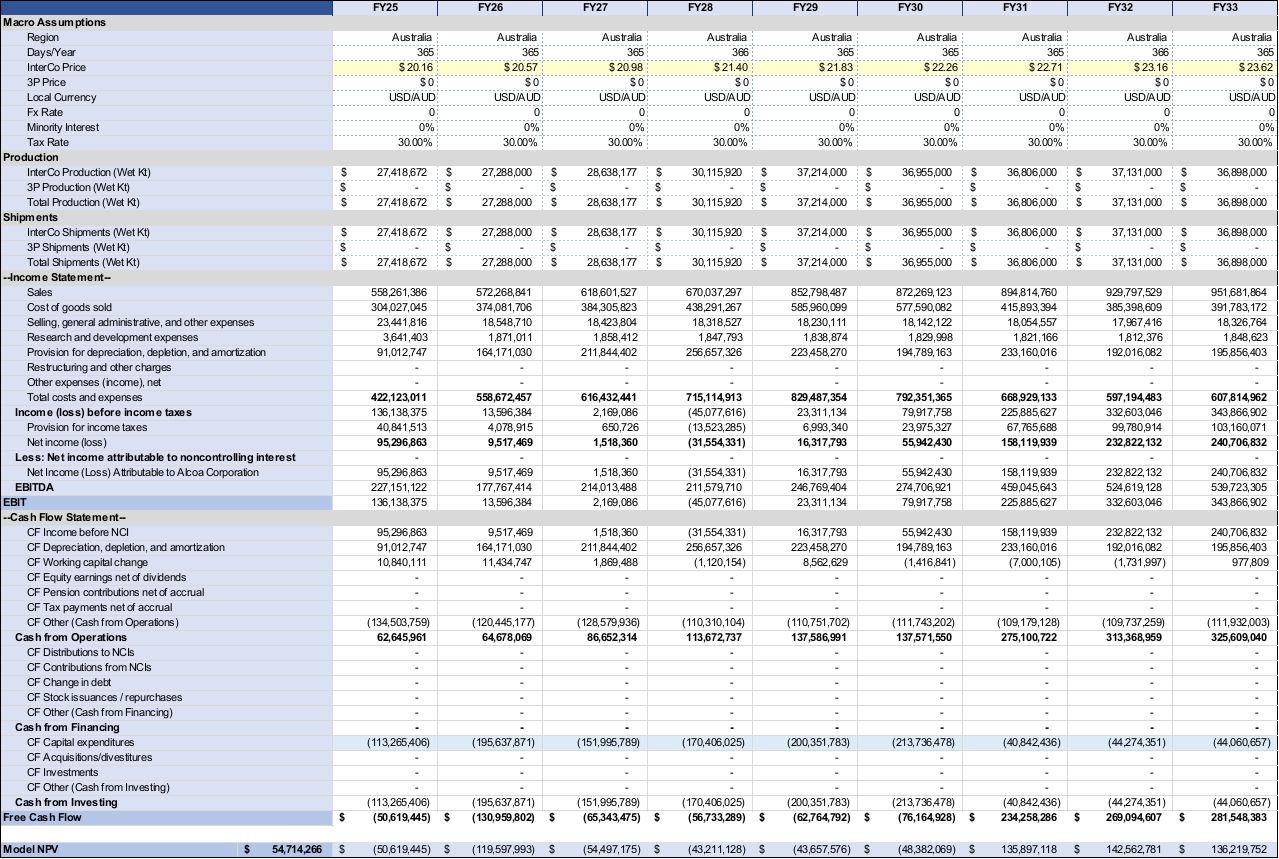
Project risks can be identified in both economic and non-economic terms. Key economic risks were examined by running cash flow sensitivities. The operation is nominally most sensitive to market prices (revenues) followed by operating costs.
|
207 |
|
|
Alcoa Corporation S-K 1300 Report |
Signature Date: 20 February 2025 SLR Project No.: 123.020514.00001 |
Figure 19‑1: Sensitivity Analysis (NPV)
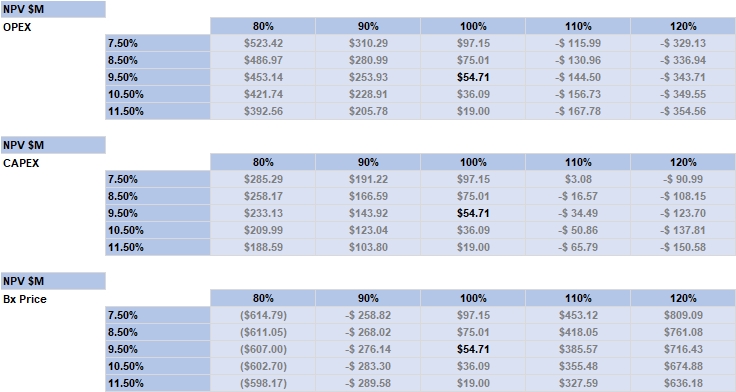
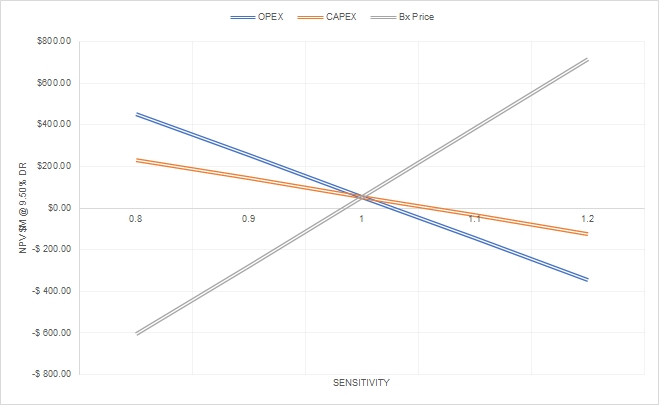
|
208 |
|
|
Alcoa Corporation S-K 1300 Report |
Signature Date: 20 February 2025 SLR Project No.: 123.020514.00001 |
The Darling Range has no material adjacent properties.
|
209 |
|
|
Alcoa Corporation S-K 1300 Report |
Signature Date: 20 February 2025 SLR Project No.: 123.020514.00001 |
No additional information or explanation is necessary to make this Technical Report Summary understandable and not misleading.
|
210 |
|
|
Alcoa Corporation S-K 1300 Report |
Signature Date: 20 February 2025 SLR Project No.: 123.020514.00001 |
|
211 |
|
|
Alcoa Corporation S-K 1300 Report |
Signature Date: 20 February 2025 SLR Project No.: 123.020514.00001 |
|
212 |
|
|
Alcoa Corporation S-K 1300 Report |
Signature Date: 20 February 2025 SLR Project No.: 123.020514.00001 |
|
213 |
|
|
Alcoa Corporation S-K 1300 Report |
Signature Date: 20 February 2025 SLR Project No.: 123.020514.00001 |
|
214 |
|
|
Alcoa Corporation S-K 1300 Report |
Signature Date: 20 February 2025 SLR Project No.: 123.020514.00001 |
|
215 |
|
|
Alcoa Corporation S-K 1300 Report |
Signature Date: 20 February 2025 SLR Project No.: 123.020514.00001 |
It is apparent to the QP that the long history of exploration, development and mining of Alcoa’s Darling Range bauxite tenements have established sound knowledge and understanding of the geology and mineral endowment. The QP has not identified any fatal flaws in the current practices of mapping (based on the ArcGIS system), drill sampling (based on progressive continuous improvement), assaying (based on calibrated and validated FTIR, with reasonable quality control), estimation (3D Block Model - 3DBM), database management (using acQuire), the application of mining criteria that assure RPEE, and the application of constraints establishing forestry, heritage and noise limits to the Mineral Resource definition. The following recommendations are offered as suggestions for further improvement, aligned with Alcoa’s comprehensive approach to research and development (seen for example in the evolution of their drilling, sampling and assaying technologies). These recommendations are prioritized in terms of their perceived value to the overall operation, but are not expected to add cost:
|
216 |
|
|
Alcoa Corporation S-K 1300 Report |
Signature Date: 20 February 2025 SLR Project No.: 123.020514.00001 |
The historical operational data for the Darling Range demonstrates that ore consistently met refinery specifications.
The Darling Range mining operations have well established infrastructure, with mining hubs that are periodically moved to reduce transportation distances between mining operations and the hubs. The QP makes no recommendations regarding infrastructure.
|
217 |
|
|
Alcoa Corporation S-K 1300 Report |
Signature Date: 20 February 2025 SLR Project No.: 123.020514.00001 |
Alcoa has established systems to facilitate adherence to environmental commitments and has made progress with modernizing environmental approvals and permits for Huntly, Willowdale and the future mining areas at Holyoake and Myara North. The QP recommends that the following action is taken:
|
218 |
|
|
Alcoa Corporation S-K 1300 Report |
Signature Date: 20 February 2025 SLR Project No.: 123.020514.00001 |
Abzalov, 2016. Applied Mining Geology. Springer International, 448 pp.
Alcoa of Australia Limited, 2024. JTSI Annual Environmental Review 2023 – Alcoa WA Mining Operations.
Alcoa of Australia Limited, 2024. 2023 Annual DWER Licence Report, Willowdale Mine, Licence No L6465/1989/10.
Alcoa of Australia Limited, 2024. 2023 Annual DWER Licence Report, Huntly Mine, Licence No L6210/1991/10.
Alcoa of Australia Limited, 1993. Bauxite Density. Internal memorandum prepared by Alcoa, dated 10 August 1993.
Barnes, L., 2015. 1m composite twin hole report. 1m sample intervals at the primary exploration stage (60x60m). Internal report by Alcoa Australia Limited, March.
Barnes, L., 2016. Procedure for sampling till extinction. Trial for 0.5m sample homogeneity, testing the representation of a ½ cup measure of 0.5m sample intervals. Internal draft report by Alcoa Australia Limited, March.
Barnes, L., 2018a. Segregation study. Internal draft report by Alcoa Australia Limited, February.
Barnes, L., 2018b. Sample to Extinction (STE) programme report 2017-2018. Internal draft report by Alcoa Australia Limited, July.
BSI, 2022. Certificate of Registration – Environmental Management System – ISO 14001:2015. Certificate EMS 729424.
Canadian Institute of Mining, Metallurgy and Petroleum (CIM), 2014, CIM Definition Standards for Mineral Resources and Mineral Reserves, adopted by the CIM Council on May 10, 2014.
CIM, 2014. Canadian Institute of Mining, Metallurgy and Petroleum (CIM) Definition Standards for Mineral Resources and Mineral Reserves. Prepared by the CIM Standing Committee on Reserve Definitions. Adopted by CIM Council on May 10, 2014
Crockford, L., 2011. 2nd split drill sample testwork in the Larego area. Internal memorandum by Alcoa Australia Limited, 26 October.
Crockford, L., 2012. 1st and 2nd split drill sample testwork in the Myara area. Internal memorandum by Alcoa Australia Limited, 10 April.
Firman, J. B., 2006, Ancient weathering zones, pedocretes and palaeosols on the Australian Precambian shield and in adjoining sedimentary basins: a review, Journal of the Royal Society of Western Australia, 89 (2), 57 – 82, 2006
Franklin, S., 2019. Mining Laboratory FTIR Process Description (KWI). Internal Alcoa of Australia Limited document AUACDS-2047-781, reviewed 15 February.
GHD, 2021. Alcoa Huntly Mine – Holyoake Region Groundwater Modelling Report. Prepared for Alcoa of Australia Limited, 22 December 2021.
Grigg, C., 2016. Summer vacation programme report 2015/2016. Internal report by Alcoa Australia Limited, February
Gy, P. M., 1984. Comments on bauxite sampling, Report to Alcoa No PG/3276, 27 July.
|
219 |
|
|
Alcoa Corporation S-K 1300 Report |
Signature Date: 20 February 2025 SLR Project No.: 123.020514.00001 |
Hickman, A. H., Smurthwaite, A. J., Brown, I. M., and Davy, R., 1992, Bauxite Mineralization in the Darling Range, Western Australia, Geological Survey of Western Australia, Report 33
Hodgson, S., 2015. Ore development QAQC Processes. Vacation student – summer work program 2014/15. Internal report by Alcoa Australia Limited, February.
Holmes, R. J., 2018. Assessment of Alcoa’s sampling and sample preparation equipment and procedures. Report EP182329 prepared for Alcoa of Australia Limited by CSIRO Mineral Resources, March.
Ipsos, 2022. Reputation Measurement and Management Wave 2 Report, Alcoa of Australia – Western Australia Operation, February.
JORC Code, 2012. Australasian Code for Reporting of Exploration Results, Mineral Resources and Ore Reserves (The JORC Code 2012 Edition). Prepared by the Joint Ore Reserves Committee of the Australasian Institute of Mining and Metallurgy, Australian Institute of Geoscientists and Minerals Council of Australia (JORC), effective 20 December 2012.
Knight., S., Tuckwell, L. and O’Brien, S., 2016. Huntly 2016 sample plant monitoring. Report by Alcoa Australia Limited (PowerPoint file).
Lyman, G. J., 2017. Investigation into Pinjarra and Wagerup sample plants. Report by Downer no 15382‐19‐02‐04‐001, 18 May.
NI 43-101, 2014. Canadian National Instrument 43-101, ‘Standards of Disclosure for Mineral Projects’, Form 43-101F1 and Companion Policy 43-101CP, May.
Rennick, W., Riley, G. and Baker, G., 1992. The constitution heterogeneity of Huntly ore and the resulting fundamental sampling errors using the Pinjarra sample station. Internal Alcoa Report, July.
Ramboll, 2021. Pinjarra Aluimina Refinery Revised Proposal – Health Risk Screening Assessment. Prepared for Alcoa of Australia Limited, June 2021.
Senini, P., 1993. Bauxite density. Internal report and memorandum by Alcoa Australia Limited, August 10.
Shaw, W. 1997. Validation of Sampling and Assaying Quality for Bankable Feasibility Studies. The Resource Database Towards 2000. Wollongong, New South Wales, Australia. 16 May. AusIMM, Melbourne. 41-49.
S-K 1300, 2018. US Securities and Exchange Commission Regulation S-K, Subpart 229.1300, Item 1300 Disclosure by Registrants Engaged in Mining Operations and Item 601 (b)(96) Technical Report Summary.
SLR, 2022. Technical Report Summary for Darling Range, Western Australia, S-K 1300 Report. Report prepared for Alcoa International Corporation by SLR International Corporation, dated February 24, 2022, with an effective date of December 31, 2021
Snowden, 2015. Willowdale and Huntly Bauxite Operations Resource Estimation. Report prepared for Alcoa of Australia Limited by Snowden Mining Industry Consultants Pty Ltd, project number AAU5035 Resource Estimation Review, August.
SRK, 2017. Mineral Resource Estimates for the Alcoa Darling Range Bauxite Operations – December 2016. Report prepared for Alcoa of Australia Limited by SRK Consulting (Australasia) Pty Ltd, project number AOA002, May.
SRK, 2018. Mineral Resource Estimates for the Alcoa Darling Range Bauxite Operations – December 2017. Report prepared for Alcoa of Australia Limited by SRK Consulting (Australasia) Pty Ltd, project number AOA004, March.
|
220 |
|
|
Alcoa Corporation S-K 1300 Report |
Signature Date: 20 February 2025 SLR Project No.: 123.020514.00001 |
SRK, 2019a. Drillhole spacing study for the Alcoa Darling Range Bauxite Operations. Report prepared for Alcoa of Australia Limited by SRK Consulting (Australasia) Pty Ltd, project number AOA005, April.
SRK, 2019b. Mineral Resource Estimates for the Alcoa Darling Range Bauxite Operations – December 2018. Report prepared for Alcoa of Australia Limited by SRK Consulting (Australasia) Pty Ltd, project number AOA006, October.
SRK, 2021a. Mineral Resource Estimates for the Alcoa Darling Range Bauxite Operations – December 2020. Report prepared for Alcoa of Australia Limited by SRK Consulting (Australasia) Pty Ltd, project number AOA007, April.
SRK, 2021b. Ore Reserve estimates for the Alcoa Darling Range bauxite operations – December 2020. Report prepared for Alcoa of Australia Limited by SRK Consulting (Australasia) Pty Ltd, project number AOA007, April.
US Securities and Exchange Commission, 2018: Regulation S-K, Subpart 229.1300, Item 1300 Disclosure by Registrants Engaged in Mining Operations and Item 601 (b)(96) Technical Report Summary.
Xstract, 2016. Mineral Resource and Ore Reserve audit, Huntly and Willowdale Operations. Report prepared for Alcoa of Australia Limited by Xstract Mining Consultants Pty Ltd, project number P2173, May.
|
221 |
|
|
Alcoa Corporation S-K 1300 Report |
Signature Date: 20 February 2025 SLR Project No.: 123.020514.00001 |
This report has been prepared by SLR for Alcoa. The information, conclusions, opinions, and estimates contained herein are based on:
For the purpose of this report (namely Section 1.3.3), SLR has relied on ownership information provided by Alcoa in a legal opinion by Paul Volich, Managing Counsel – Australia, dated 22 January 2025, entitled Technical Report Summary on the Darling Range, Western Australia S-K 1300 Report for Alcoa Corporation – that ML1SA in good standing. SLR has not researched property title or mineral rights for the Darling Range as we consider it reasonable to rely on Alcoa’s legal counsel who is responsible for maintaining this information.
SLR has relied on Alcoa for guidance on applicable taxes, royalties, and other government levies or interests, applicable to revenue or income from Darling Range in the Executive Summary and Sections 18.0 and 19.0. As Darling Range has been in operation for over ten years, Alcoa has considerable experience in this area.
The Qualified Persons have taken all appropriate steps, in their professional opinion, to ensure that the above information from Alcoa is sound.
Except for the purposes legislated under applicable securities laws, any use of this report by any third party is at that party’s sole risk.
|
222 |
|
|
Alcoa Corporation S-K 1300 Report |
Signature Date: 20 February 2025 SLR Project No.: 123.020514.00001 |
This report titled “Technical Report Summary on the Darling Range, Western Australia, S-K 1300 Report” with an effective date of December 31, 2024 was prepared and signed by:
SLR International Corporation
|
|
John R. Walker FGS, FIMMM, QMR Technical Director, Mining Advisory Europe |
Dated in UK
Signature Date: 20 February 2025
|
223 |
|