Document
|
|
|
|
|
|
|
NEWS RELEASE |
| WESCO International, Inc. / 225 West Station Square Drive, Suite 700 / Pittsburgh, PA 15219 |
Wesco International Reports First Quarter 2025 Results
•First quarter reported net sales down 0.1% YOY
–Organic sales up 5.6% after M&A effects, Fx differences, and one less workday
–Data center sales up 70%
•First quarter diluted EPS of $2.10, up 7.7% YOY; adjusted diluted EPS of $2.21
•Gross margin of 21.1%, down 10 basis points sequentially and 20 basis points YOY
•Operating cash flow of $28 million in the first quarter
•Preferred stock will be redeemed in June, using proceeds of financing completed during the first quarter
•Full year 2025 outlook reaffirmed based on positive momentum from the first four months of the year
PITTSBURGH, May 1, 2025 /PR Newswire/ -- Wesco International (NYSE: WCC), a leading provider of business-to-business distribution, logistics services and supply chain solutions, announces its results for the first quarter of 2025.
“After returning to growth in the fourth quarter of 2024, we are pleased to build on our positive sales momentum to start the year with 6% organic growth in the first quarter. This performance was sparked by 70% growth in total data center sales and high single digit growth in both our Broadband and OEM businesses. Consistent with the fourth quarter, our first quarter sales growth was partially offset by continued weakness in our utility business, as expected. With that said, our positive momentum is building to start the second quarter with preliminary April sales per workday up 7% versus prior year. Our opportunity pipeline continues at a record level, bid activity levels remain very strong, and backlog is growing. Gross margin was relatively stable on a sequential basis versus the fourth quarter, and we've begun to see an initial improvement in Communication and Security Solutions as expected,” said John Engel, Chairman, President, and CEO.
Mr. Engel continued, “With our continued focus on effective working capital management, free cash flow generation was better than expected in the first quarter. Our increased inventory will help manage the potential supply chain impact of global tariffs on our customers. We also issued $800 million of notes to redeem our preferred stock in June. This will strengthen our balance sheet and improve both our cash flow and earnings per share run-rates. Following this redemption, we have no significant debt maturities until 2028 and have strong liquidity to execute our capital allocation priorities. As we outlined in our last Investor Day, over 75% of our free cash flow generation provides optionality and is focused on our capital allocation priorities of stock buybacks, debt reduction and acquisitions.”
Mr. Engel concluded, “We are maintaining our full year outlook based upon our current positive momentum to start 2025. Against a backdrop of increased uncertainty and volatility, we remain sharply focused on what we can control – our cross-selling activities, our enterprise-wide margin improvement program, and operational improvements resulting from our tech-enabled business transformation. We recognize that current economic uncertainty is impacting our customers and are committed to providing the products, services, and solutions that they need for their operations and supply chains. I remain confident that Wesco will outperform our markets this year as the secular growth trends of AI-driven data centers, increased power generation, electrification, automation, and reshoring endure.”
Key Financial Highlights
|
|
|
|
|
|
|
|
|
|
|
|
|
|
|
|
|
Three Months Ended March 31 |
| ($ in millions except per share data) |
|
|
|
2025 Reported |
2024 Reported |
Change vs prior year |
| GAAP Results |
| Net sales |
|
|
|
$5,343.7 |
$5,350.0 |
(0.1)% |
| Selling general, and administrative expenses |
|
|
|
$836.3 |
$829.4 |
0.8% |
| Net income attributable to common stockholders |
|
|
|
$104.0 |
$101.4 |
2.6% |
| Earnings per diluted share |
|
|
|
$2.10 |
$1.95 |
7.7% |
| Operating cash flow |
|
|
|
$28.0 |
$746.3 |
(96.2)% |
| Effective tax rate |
|
|
|
23.4% |
21.0% |
240 basis points |
|
|
|
|
|
|
|
| ($ in millions except per share data) |
|
|
|
2025 Adjusted |
2024 Adjusted |
Change vs prior year |
| Non-GAAP Results |
| Organic sales growth (decline) |
|
|
|
5.6% |
(3.2)% |
N/A |
| Gross profit |
|
|
|
$1,125.6 |
$1,137.9 |
(1.1)% |
| Gross margin |
|
|
|
21.1% |
21.3% |
(20) basis points |
| Adjusted selling, general, and administrative expenses |
|
|
|
$829.0 |
$810.5 |
2.3% |
Adjusted EBITDA |
|
|
|
$310.7 |
$340.4 |
(8.7)% |
| Adjusted net income attributable to common stockholders |
|
|
|
$109.6 |
$119.2 |
(8.1)% |
| Adjusted earnings per diluted share |
|
|
|
$2.21 |
$2.30 |
(3.9)% |
| Free cash flow |
|
|
|
$9.4 |
$731.4 |
(98.7)% |
Net Sales
•On an organic basis, which removes the impact of the Wesco Integrated Supply (“WIS”) divestiture and Ascent, LLC (“Ascent”) acquisition, differences in foreign exchange rates, and the impact from the number of workdays, sales for the first quarter of 2025 grew by 5.6%. The increase in organic sales reflects volume growth in the CSS segment, partially offset by a volume decline in the UBS segment, and also reflects price inflation in the EES segment.
Gross Profit
•The slight decrease in gross margin for the first quarter of 2025 primarily reflects a decrease in CSS and EES gross margins, partially offset by the impact of the divestiture of the WIS business.
Selling, General, and Administrative (“SG&A”) Expenses
•The increase in SG&A expenses for the first quarter of 2025 is driven by higher costs to operate our facilities and higher transportation costs, partially offset by lower commissions, incentives, and benefits. SG&A expenses for the first quarter of 2025 include $7.3 million of digital transformation and restructuring costs. SG&A expenses for the first quarter of 2024 include $14.1 million of digital transformation and restructuring costs, and $4.8 million of excise taxes on excess pension plan assets. Adjusted for these costs, SG&A expenses were 15.5% and 15.1% of net sales for the first quarter of 2025 and 2024, respectively.
Adjusted EBITDA
•The decrease in Adjusted EBITDA primarily reflects a $6.9 million increase in SG&A expenses primarily driven by higher facilities and transportation costs partially offset by lower payroll expense, a $6.3 million decrease in net sales, and a $6.0 million increase in cost of goods sold related to increased large project sales to customers.
Effective Tax Rate
•The higher effective tax rate for the first quarter of 2025 is due to lower discrete income tax benefits resulting from the exercise and vesting of stock-based awards as compared to the prior year period.
Adjusted Earnings Per Diluted Share
•The decrease in adjusted earnings per diluted share primarily reflects the decline in gross profit and increase in SG&A expenses discussed above, partially offset by an $8.1 million decrease in interest expense primarily due to lower borrowings and lower interest rates and a $16.2 million decrease in adjusted other expense primarily due to the impact of fluctuations in the U.S. dollar against certain foreign currencies in the first quarter of 2024 compared to an immaterial impact in the first quarter of 2025. Additionally, there was a positive impact from the reduction in outstanding shares during the first quarter of 2025 as compared to the first quarter of 2024.
Operating Cash Flow
•The net cash inflow in the first quarter of 2025 was primarily driven by net income of $118.3 million. This inflow was partially offset by changes in working capital consisting of an increase in inventories resulting in a use of cash of $227.4 million, and an increase in trade accounts receivable of $188.7 million primarily due to the timing of receipts from customers, partially offset by changes in accounts payable resulting in a cash inflow of $343.8 million, primarily due to the timing of payments to suppliers as well as inventory purchases. The inflow from net income was also partially offset by a $77.1 million outflow from accrued payroll and benefits costs, primarily due to the payment of management incentive compensation earned in 2024, and a decrease in accrued sales incentives.
Webcast and Teleconference Access
Wesco will conduct a webcast and teleconference to discuss the first quarter of 2025 earnings as described in this News Release on Thursday, May 1, 2025, at 9:00 a.m. E.T. The call will be broadcast live over the internet and can be accessed from the Investor Relations page of the Company's website at https://investors.wesco.com. The call will be archived on this internet site for seven days.
Wesco International (NYSE: WCC) builds, connects, powers and protects the world. Headquartered in Pittsburgh, Pennsylvania, Wesco is a FORTUNE 500® company with approximately $22 billion in annual sales in 2024 and a leading provider of business-to-business distribution, logistics services and supply chain solutions. Wesco offers a best-in-class product and services portfolio of Electrical and Electronic Solutions, Communications and Security Solutions, and Utility and Broadband Solutions. The Company employs approximately 20,000 people, partners with the industry’s premier suppliers, and serves thousands of customers around the world. With millions of products, end-to-end supply chain services, and leading digital capabilities, Wesco provides innovative solutions to meet customer needs across commercial and industrial businesses, contractors, educational institutions, government agencies, technology companies, telecommunications providers, and utilities. Wesco operates more than 700 sites, including distribution centers, fulfillment centers, and sales offices in approximately 50 countries, providing a local presence for customers and a global network to serve multi-location businesses and global corporations.
Forward-Looking Statements
All statements made herein that are not historical facts should be considered as "forward-looking statements" within the meaning of the Private Securities Litigation Reform Act of 1995. Such statements involve known and unknown risks, uncertainties and other factors that may cause actual results to differ materially. These statements include, but are not limited to, statements regarding business strategy, growth strategy, competitive strengths, productivity and profitability enhancement, competition, new product and service introductions, and liquidity and capital resources. Such statements can generally be identified by the use of words such as "anticipate," "plan," "believe," "estimate," "intend," "expect," "project," and similar words, phrases or expressions or future or conditional verbs such as "could," "may," "should," "will," and "would," although not all forward-looking statements contain such words. These forward-looking statements are based on current expectations and beliefs of Wesco's management, as well as assumptions made by, and information currently available to, Wesco's management, current market trends and market conditions and involve risks and uncertainties, many of which are outside of Wesco's and Wesco's management's control, and which may cause actual results to differ materially from those contained in forward-looking statements. Accordingly, you should not place undue reliance on such statements.
Important factors that could cause actual results or events to differ materially from those presented or implied in the forward-looking statements include, among others, the failure to achieve the anticipated benefits of, and other risks associated with, acquisitions, joint ventures, divestitures and other corporate transactions; the inability to successfully integrate acquired businesses; the impact of increased interest rates or borrowing costs; fluctuations in currency exchange rates; evolving impacts from tariffs or other trade tensions between the U.S. and other countries (including implementation of new tariffs and retaliatory measures); failure to adequately protect Wesco's intellectual property or successfully defend against infringement claims; the inability to successfully deploy new technologies, digital products and information systems or to otherwise adapt to emerging technologies in the marketplace, such as those incorporating artificial intelligence; failure to execute on our efforts and programs related to environmental, social and governance (ESG) matters; unanticipated expenditures or other adverse developments related to compliance with new or stricter government policies, laws or regulations, including those relating to data privacy, sustainability and environmental protection; the inability to successfully develop, manage or implement new technology initiatives or business strategies, including with respect to the expansion of e-commerce capabilities and other digital solutions and digitalization initiatives; disruption of information technology systems or operations; natural disasters (including as a result of climate change), health epidemics, pandemics and other outbreaks; supply chain disruptions; geopolitical issues, including the impact of the evolving conflicts in the Middle East and Russia/Ukraine; the impact of sanctions imposed on, or other actions taken by the U.S. or other countries against, Russia or China; the failure to manage the increased risks and impacts of cyber incidents or data breaches; and exacerbation of key materials shortages, inflationary cost pressures, material cost increases, demand volatility, and logistics and capacity constraints, any of which may have a material adverse effect on the Company's business, results of operations and financial condition. All such factors are difficult to predict and are beyond the Company's control. Additional factors that could cause results to differ materially from those described above can be found in Wesco's most recent Annual Report on Form 10-K and other periodic reports filed with the U.S. Securities and Exchange Commission.
|
|
|
|
|
|
| Contact Information |
| Investor Relations |
Corporate Communications |
Will Ruthrauff
Director, Investor Relations
484-885-5648 |
Jennifer Sniderman
Vice President, Corporate Communications
717-579-6603
|
http://www.wesco.com
WESCO INTERNATIONAL, INC.
CONDENSED CONSOLIDATED STATEMENTS OF INCOME
(in millions, except per share amounts)
(Unaudited)
|
|
|
|
|
|
|
|
|
|
|
|
|
|
|
|
|
|
|
Three Months Ended |
|
|
March 31, 2025 |
|
|
March 31, 2024 |
|
| Net sales |
$ |
5,343.7 |
|
|
|
$ |
5,350.0 |
|
|
| Cost of goods sold (excluding depreciation and amortization) |
4,218.1 |
|
78.9 |
% |
|
4,212.1 |
|
78.7 |
% |
| Selling, general and administrative expenses |
836.3 |
|
15.7 |
% |
|
829.4 |
|
15.5 |
% |
| Depreciation and amortization |
48.4 |
|
|
|
45.5 |
|
|
| Income from operations |
240.9 |
|
4.5 |
% |
|
263.0 |
|
4.9 |
% |
| Interest expense, net |
86.3 |
|
|
|
94.4 |
|
|
| Other expense, net |
0.2 |
|
|
|
21.6 |
|
|
| Income before income taxes |
154.4 |
|
2.9 |
% |
|
147.0 |
|
2.7 |
% |
| Provision for income taxes |
36.1 |
|
|
|
30.9 |
|
|
| Net income |
118.3 |
|
2.2 |
% |
|
116.1 |
|
2.2 |
% |
| Net (loss) income attributable to noncontrolling interests |
(0.1) |
|
|
|
0.3 |
|
|
| Net income attributable to WESCO International, Inc. |
118.4 |
|
2.2 |
% |
|
115.8 |
|
2.2 |
% |
| Preferred stock dividends |
14.4 |
|
|
|
14.4 |
|
|
| Net income attributable to common stockholders |
$ |
104.0 |
|
1.9 |
% |
|
$ |
101.4 |
|
1.9 |
% |
|
|
|
|
|
|
| Earnings per diluted share attributable to common stockholders |
$ |
2.10 |
|
|
|
$ |
1.95 |
|
|
| Weighted-average common shares outstanding and common share equivalents used in computing earnings per diluted common share |
49.6 |
|
|
|
51.9 |
|
|
WESCO INTERNATIONAL, INC.
CONDENSED CONSOLIDATED BALANCE SHEETS
(dollar amounts in millions)
(Unaudited)
|
|
|
|
|
|
|
|
|
|
|
|
|
As of |
|
March 31,
2025 |
|
December 31,
2024 |
| Assets |
|
|
|
| Current Assets |
|
|
|
| Cash and cash equivalents |
$ |
681.6 |
|
|
$ |
702.6 |
|
| Trade accounts receivable, net |
3,641.3 |
|
|
3,454.4 |
|
| Inventories |
3,740.2 |
|
|
3,501.7 |
|
| Other current assets |
623.7 |
|
|
692.7 |
|
| Total current assets |
8,686.8 |
|
|
8,351.4 |
|
|
|
|
|
| Goodwill and intangible assets |
5,128.9 |
|
|
5,116.0 |
|
| Other assets |
1,699.4 |
|
|
1,594.0 |
|
| Total assets |
$ |
15,515.1 |
|
|
$ |
15,061.4 |
|
|
|
|
|
|
|
|
|
| Liabilities and Stockholders' Equity |
|
|
|
| Current Liabilities |
|
|
|
| Accounts payable |
$ |
3,025.8 |
|
|
$ |
2,670.6 |
|
| Short-term debt and current portion of long-term debt, net |
21.0 |
|
|
19.5 |
|
| Other current liabilities |
988.7 |
|
|
1,113.9 |
|
| Total current liabilities |
4,035.5 |
|
|
3,804.0 |
|
|
|
|
|
| Long-term debt, net |
5,136.6 |
|
|
5,045.5 |
|
| Other noncurrent liabilities |
1,312.9 |
|
|
1,246.4 |
|
| Total liabilities |
10,485.0 |
|
|
10,095.9 |
|
|
|
|
|
| Stockholders' Equity |
|
|
|
| Total stockholders' equity |
5,030.1 |
|
|
4,965.5 |
|
| Total liabilities and stockholders' equity |
$ |
15,515.1 |
|
|
$ |
15,061.4 |
|
WESCO INTERNATIONAL, INC.
CONDENSED CONSOLIDATED STATEMENTS OF CASH FLOWS
(dollar amounts in millions)
(Unaudited)
|
|
|
|
|
|
|
|
|
|
|
|
|
Three Months Ended |
|
March 31,
2025 |
|
March 31,
2024 |
| Operating Activities: |
|
|
|
| Net income |
$ |
118.3 |
|
|
$ |
116.1 |
|
| Add back (deduct): |
|
|
|
| Depreciation and amortization |
48.4 |
|
|
45.5 |
|
|
|
|
|
| Change in trade receivables, net |
(188.7) |
|
|
(116.1) |
|
| Change in inventories |
(227.4) |
|
|
5.5 |
|
| Change in accounts payable |
343.8 |
|
|
620.9 |
|
| Other, net |
(66.4) |
|
|
74.4 |
|
| Net cash provided by operating activities |
28.0 |
|
|
746.3 |
|
|
|
|
|
| Investing Activities: |
|
|
|
| Capital expenditures |
(20.4) |
|
|
(20.4) |
|
Acquisition payments, net of cash acquired |
(35.2) |
|
|
— |
|
| Other, net |
1.2 |
|
|
3.9 |
|
| Net cash used in investing activities |
(54.4) |
|
|
(16.5) |
|
|
|
|
|
| Financing Activities: |
|
|
|
Debt borrowings (repayments), net(1) |
99.7 |
|
|
(115.1) |
|
| Payments for taxes related to net-share settlement of equity awards |
(18.0) |
|
|
(25.2) |
|
| Repurchases of common stock |
(25.0) |
|
|
(50.0) |
|
| Payment of common stock dividends |
(22.1) |
|
|
(20.9) |
|
| Payment of preferred stock dividends |
(14.4) |
|
|
(14.4) |
|
| Other, net |
(17.9) |
|
|
(28.9) |
|
| Net cash provided by (used in) financing activities |
2.3 |
|
|
(254.5) |
|
|
|
|
|
| Effect of exchange rate changes on cash and cash equivalents |
3.1 |
|
|
(13.9) |
|
|
|
|
|
| Net change in cash and cash equivalents |
(21.0) |
|
|
461.4 |
|
| Cash and cash equivalents at the beginning of the period |
702.6 |
|
|
524.1 |
|
| Cash and cash equivalents at the end of the period |
$ |
681.6 |
|
|
$ |
985.5 |
|
(1) The three months ended March 31, 2025 includes the issuance of the Company's $800 million aggregate principal amount of 6.375% Senior Notes due 2033 (the “2033 Notes”). The Company intends to use the net proceeds from the issuance of the 2033 Notes to redeem all of the Company’s outstanding 10.625% Series A Fixed-Rate Reset Cumulative Perpetual Preferred Stock (the “Series A Preferred Stock”) and all of the related depositary shares representing fractional interests in the Series A Preferred Stock in June 2025, and repay a portion of the amounts outstanding under the Revolving Credit Facility. Prior to redeeming the Series A Preferred Stock, the Company used the net proceeds temporarily to repay all of the outstanding borrowings under its Revolving Credit Facility and to repay a portion of the amounts outstanding under its Receivables Facility. The Company intends to subsequently redraw under the Receivables Facility and/or the Revolving Credit Facility in an aggregate amount sufficient to redeem the Series A Preferred Stock. The three months ended March 31, 2024 includes the issuance of the Company's $900 million aggregate principal amount of 6.375% senior notes due 2029 and $850 million aggregate principal amount of 6.625% senior notes due 2032.
NON-GAAP FINANCIAL MEASURES
In addition to the results provided in accordance with U.S. Generally Accepted Accounting Principles (“U.S. GAAP”) above, this earnings release includes certain non-GAAP financial measures. These financial measures include organic sales growth, gross profit, gross margin, earnings before interest, taxes, depreciation and amortization (EBITDA), adjusted EBITDA, adjusted EBITDA margin, financial leverage, free cash flow, adjusted selling, general and administrative expenses, adjusted income from operations, adjusted operating margin, adjusted other non-operating expense (income), adjusted provision for income taxes, adjusted income before income taxes, adjusted net income, adjusted net income attributable to WESCO International, Inc., adjusted net income attributable to common stockholders, and adjusted earnings per diluted share. The Company believes that these non-GAAP measures are useful to investors as they provide a better understanding of our financial condition and results of operations on a comparable basis. Additionally, certain non-GAAP measures either focus on or exclude items impacting comparability of results such as merger-related and integration costs, digital transformation costs, restructuring costs, cloud computing arrangement amortization, pension settlement cost and excise taxes on excess pension plan assets related to the final settlement of the Anixter Inc. Pension Plan, loss on abandonment of assets, the gain recognized on the divestiture of the WIS business, the loss on termination of business arrangement, and the related income tax effects, allowing investors to more easily compare the Company's financial performance from period to period. Management does not use these non-GAAP financial measures for any purpose other than the reasons stated above.
WESCO INTERNATIONAL, INC.
RECONCILIATION OF NON-GAAP FINANCIAL MEASURES
(in millions, except per share amounts)
(Unaudited)
|
|
|
|
|
|
|
|
|
|
|
|
|
|
|
|
|
|
|
|
|
|
|
|
|
|
|
|
|
|
|
|
|
|
|
|
|
|
|
|
|
|
| Organic Sales Growth by Segment - Three Months Ended: |
|
|
|
|
|
|
|
|
|
|
|
|
|
|
|
|
|
|
|
|
|
Three Months Ended |
|
Growth/(Decline) |
|
March 31, 2025 |
|
March 31, 2024 |
|
Reported |
|
Acquisitions/Divestiture |
|
Foreign Exchange |
|
Workday |
|
Organic Sales |
|
|
|
|
|
|
|
|
|
|
|
|
|
|
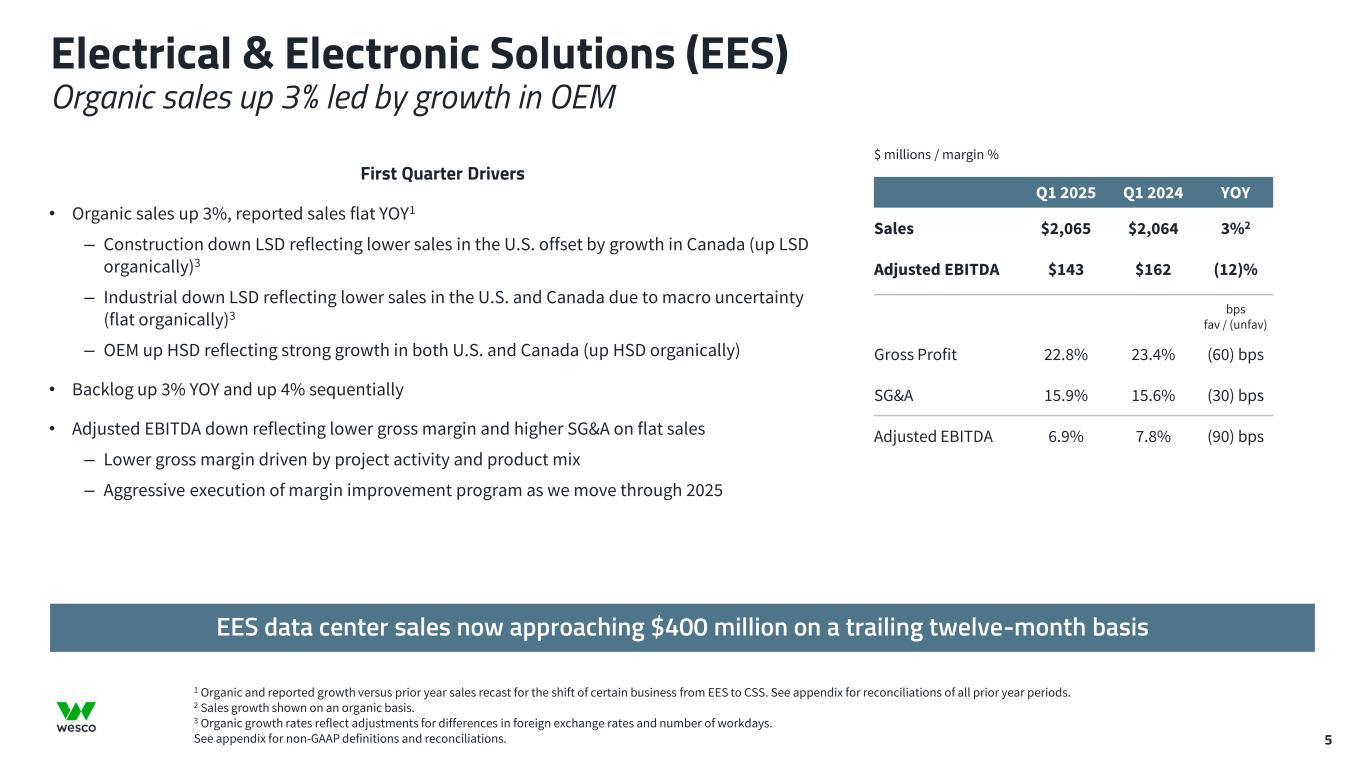
EES(1) |
$ |
2,065.3 |
|
|
$ |
2,064.3 |
|
|
— |
% |
|
— |
% |
|
(1.8) |
% |
|
(1.6) |
% |
|
3.4 |
% |
CSS(1) |
2,000.3 |
|
|
1,704.8 |
|
|
17.3 |
% |
|
2.3 |
% |
|
(1.5) |
% |
|
(1.6) |
% |
|
18.1 |
% |
| UBS |
1,278.1 |
|
|
1,580.9 |
|
|
(19.2) |
% |
|
(12.2) |
% |
|
(0.5) |
% |
|
(1.6) |
% |
|
(4.9) |
% |
| Total net sales |
$ |
5,343.7 |
|
|
$ |
5,350.0 |
|
|
(0.1) |
% |
|
(2.8) |
% |
|
(1.3) |
% |
|
(1.6) |
% |
|
5.6 |
% |
(1) In the first quarter of 2025, a portion of the EES reportable segment was moved to the CSS reportable segment as a result of operational realignment. As a result, the reportable segment financial information for the three months ended March 31, 2024 has been recast to conform to the current year presentation. The recast does not impact previously reported condensed consolidated results. |
|
|
|
|
|
|
|
|
|
|
|
|
|
|
|
|
|
|
|
|
|
|
|
|
|
|
|
|
|
|
|
|
|
|
|
|
|
|
|
|
|
|
|
|
|
|
|
|
|
|
|
|
|
|
|
|
|
|
|
|
|
|
|
|
|
|
|
|
|
|
|
|
|
|
|
|
|
|
|
|
|
|
|
|
|
|
|
|
|
|
|
|
|
|
|
|
|
|
|
|
|
|
|
|
|
|
|
|
|
|
|
|
|
|
|
|
|
|
|
|
|
|
|
|
|
|
|
|
|
|
|
|
|
|
|
|
|
|
|
|
|
|
|
|
|
|
|
|
|
|
|
|
|
|
|
|
|
|
|
|
|
|
|
|
|
|
|
|
|
|
|
|
|
|
|
|
|
|
|
|
|
|
|
|
|
|
|
|
|
|
|
|
|
|
|
|
|
|
|
|
|
|
|
|
|
|
|
|
|
|
|
|
|
|
|
|
|
|
|
|
|
|
|
|
|
|
|
|
|
|
|
|
|
|
|
|
|
|
|
|
|
|
|
|
|
|
|
|
|
|
Note: Organic sales growth is a non-GAAP financial measure of sales performance. Organic sales growth is calculated by deducting the percentage impact from acquisitions and divestitures for one year following the respective transaction, fluctuations in foreign exchange rates and number of workdays from the reported percentage change in consolidated net sales. Workday impact represents the change in the number of operating days period-over-period after adjusting for weekends and public holidays in the United States. The first quarter of 2025 had one less workday compared to the first quarter of 2024.
|
|
|
|
|
|
|
|
|
|
|
|
|
|
|
|
|
Three Months Ended |
|
|
| Gross Profit: |
March 31, 2025 |
|
March 31, 2024 |
|
|
|
|
|
|
|
|
|
|
|
|
| Net sales |
$ |
5,343.7 |
|
$ |
5,350.0 |
|
|
|
|
| Cost of goods sold (excluding depreciation and amortization) |
4,218.1 |
|
4,212.1 |
|
|
|
|
| Gross profit |
$ |
1,125.6 |
|
$ |
1,137.9 |
|
|
|
|
|
|
|
|
|
|
|
|
| Gross margin |
21.1 |
% |
|
21.3 |
% |
|
|
|
|
|
|
|
|
|
|
|
|
|
|
|
|
|
|
|
|
|
|
|
|
|
|
|
Three Months Ended |
| Gross Profit: |
|
|
|
|
December 31, 2024 |
|
|
|
|
|
|
| Net sales |
|
|
|
|
$ |
5,499.7 |
|
| Cost of goods sold (excluding depreciation and amortization) |
|
|
|
|
4,335.7 |
|
| Gross profit |
|
|
|
|
$ |
1,164.0 |
|
|
|
|
|
|
|
| Gross margin |
|
|
|
|
21.2 |
% |
|
|
|
|
|
|
Note: Gross profit is a financial measure commonly used in the distribution industry. Gross profit is calculated by deducting cost of goods sold, excluding depreciation and amortization, from net sales. Gross margin is calculated by dividing gross profit by net sales.
WESCO INTERNATIONAL, INC.
RECONCILIATION OF NON-GAAP FINANCIAL MEASURES
(in millions, except per share amounts)
(Unaudited)
|
|
|
|
|
|
|
|
|
|
|
|
|
|
|
|
|
Three Months Ended |
|
|
|
March 31, 2025 |
|
March 31, 2024 |
|
|
|
|
| Adjusted SG&A Expenses: |
|
|
|
|
|
|
|
| Selling, general and administrative expenses |
$ |
836.3 |
|
$ |
829.4 |
|
|
|
|
Digital transformation costs(1) |
(6.2) |
|
(6.1) |
|
|
|
|
Restructuring costs(2) |
(1.1) |
|
(8.0) |
|
|
|
|
Excise taxes on excess pension plan assets(3) |
— |
|
(4.8) |
|
|
|
|
| Adjusted selling, general and administrative expenses |
$ |
829.0 |
|
$ |
810.5 |
|
|
|
|
| Percentage of net sales |
15.5 |
% |
|
15.1 |
% |
|
|
|
|
|
|
|
|
|
|
|
|
| Adjusted Income from Operations: |
|
|
|
|
|
|
|
| Income from operations |
$ |
240.9 |
|
$ |
263.0 |
|
|
|
|
Digital transformation costs(1) |
6.2 |
|
6.1 |
|
|
|
|
Restructuring costs(2) |
1.1 |
|
8.0 |
|
|
|
|
Excise taxes on excess pension plan assets(3) |
— |
|
4.8 |
|
|
|
|
| Adjusted income from operations |
$ |
248.2 |
|
$ |
281.9 |
|
|
|
|
| Adjusted income from operations margin % |
4.6 |
% |
|
5.3 |
% |
|
|
|
|
|
|
|
|
|
|
|
|
| Adjusted Other (Income) Expense, net: |
|
|
|
|
|
|
|
| Other expense, net |
$ |
0.2 |
|
$ |
21.6 |
|
|
|
|
Loss on termination of business arrangement(4) |
(0.3) |
|
— |
|
|
|
|
Pension settlement cost(5) |
— |
|
(5.5) |
|
|
|
|
| Adjusted other (income) expense, net |
$ |
(0.1) |
|
$ |
16.1 |
|
|
|
|
|
|
|
|
|
|
|
|
| Adjusted Provision for Income Taxes: |
|
|
|
|
|
|
|
| Provision for income taxes |
$ |
36.1 |
|
$ |
30.9 |
|
|
|
|
Income tax effect of adjustments to income from operations and other (income) expense, net(6) |
2.0 |
|
6.6 |
|
|
|
|
| Adjusted provision for income taxes |
$ |
38.1 |
|
$ |
37.5 |
|
|
|
|
(1) Digital transformation costs include costs associated with certain digital transformation initiatives.
(2) Restructuring costs include severance costs incurred pursuant to an ongoing restructuring plan.
(3) Excise taxes on excess pension plan assets represent the excise taxes applicable to the excess pension plan assets following the final settlement of the Company's U.S. pension plan.
(4) Loss on termination of business arrangement represents the loss recognized as a result of management's decision to terminate a business arrangement with a third party.
(5) Pension settlement cost represents expense related to the final settlement of the Company's U.S. pension plan.
(6) The adjustments to income from operations and other (income) expense, net have been tax effected at rates of 26.4% and 27.0% for the three months ended March 31, 2025 and 2024, respectively.
WESCO INTERNATIONAL, INC.
RECONCILIATION OF NON-GAAP FINANCIAL MEASURES
(in millions, except per share amounts)
(Unaudited)
|
|
|
|
|
|
|
|
|
|
|
|
|
|
|
|
|
Three Months Ended |
|
|
| Adjusted Earnings per Diluted Share: |
March 31, 2025 |
|
March 31, 2024 |
|
|
|
|
|
|
|
|
|
|
|
|
| Adjusted income from operations |
$ |
248.2 |
|
|
$ |
281.9 |
|
|
|
|
|
| Interest expense, net |
86.3 |
|
|
94.4 |
|
|
|
|
|
| Adjusted other (income) expense, net |
(0.1) |
|
|
16.1 |
|
|
|
|
|
| Adjusted income before income taxes |
162.0 |
|
|
171.4 |
|
|
|
|
|
| Adjusted provision for income taxes |
38.1 |
|
|
37.5 |
|
|
|
|
|
| Adjusted net income |
123.9 |
|
|
133.9 |
|
|
|
|
|
| Net (loss) income attributable to noncontrolling interests |
(0.1) |
|
|
0.3 |
|
|
|
|
|
| Adjusted net income attributable to WESCO International, Inc. |
124.0 |
|
|
133.6 |
|
|
|
|
|
| Preferred stock dividends |
14.4 |
|
|
14.4 |
|
|
|
|
|
| Adjusted net income attributable to common stockholders |
$ |
109.6 |
|
|
$ |
119.2 |
|
|
|
|
|
|
|
|
|
|
|
|
|
| Diluted shares |
49.6 |
|
|
51.9 |
|
|
|
|
|
| Adjusted earnings per diluted share |
$ |
2.21 |
|
|
$ |
2.30 |
|
|
|
|
|
Note: For the three months ended March 31, 2025, SG&A expenses, income from operations, other non-operating (income) expense, the provision for income taxes and earnings per diluted share have been adjusted to exclude digital transformation costs, restructuring costs, the loss on termination of business arrangement, and the related income tax effects. For the three months ended March 31, 2024, SG&A expenses, income from operations, other non-operating expense, the provision for income taxes and earnings per diluted share have been adjusted to exclude digital transformation costs, restructuring costs, pension settlement cost and excise taxes on excess pension plan assets related to the final settlement of the Anixter Inc. Pension Plan, and the related income tax effects. These non-GAAP financial measures provide a better understanding of our financial results on a comparable basis.
WESCO INTERNATIONAL, INC.
RECONCILIATION OF NON-GAAP FINANCIAL MEASURES
(in millions, except per share amounts)
(Unaudited)
|
|
|
|
|
|
|
|
|
|
|
|
|
|
|
|
|
|
|
|
|
|
|
|
|
|
|
|
|
|
|
|
|
|
|
Three Months Ended March 31, 2025 |
| EBITDA and Adjusted EBITDA by Segment: |
|
EES |
|
CSS |
|
UBS |
|
Corporate |
|
Total |
|
|
|
|
|
|
|
|
|
|
|
| Net income attributable to common stockholders |
|
$ |
125.1 |
|
$ |
127.2 |
|
$ |
130.3 |
|
$ |
(278.6) |
|
$ |
104.0 |
| Net (loss) income attributable to noncontrolling interests |
|
(0.1) |
|
0.1 |
|
— |
|
(0.1) |
|
(0.1) |
| Preferred stock dividends |
|
— |
|
— |
|
— |
|
14.4 |
|
14.4 |
Provision for income taxes(1) |
|
— |
|
— |
|
— |
|
36.1 |
|
36.1 |
Interest expense, net(1) |
|
— |
|
— |
|
— |
|
86.3 |
|
86.3 |
| Depreciation and amortization |
|
12.2 |
|
19.0 |
|
7.8 |
|
9.4 |
|
48.4 |
| EBITDA |
|
$ |
137.2 |
|
$ |
146.3 |
|
$ |
138.1 |
|
$ |
(132.5) |
|
$ |
289.1 |
| Other expense (income), net |
|
4.4 |
|
10.9 |
|
(0.2) |
|
(14.9) |
|
0.2 |
| Stock-based compensation expense |
|
1.0 |
|
1.3 |
|
0.4 |
|
7.5 |
|
10.2 |
Digital transformation costs(2) |
|
— |
|
— |
|
— |
|
6.2 |
|
6.2 |
Cloud computing arrangement amortization(3) |
|
— |
|
— |
|
— |
|
3.9 |
|
3.9 |
Restructuring costs(4) |
|
— |
|
— |
|
— |
|
1.1 |
|
1.1 |
| Adjusted EBITDA |
|
$ |
142.6 |
|
$ |
158.5 |
|
$ |
138.3 |
|
$ |
(128.7) |
|
$ |
310.7 |
| Adjusted EBITDA margin % |
|
6.9 |
% |
|
7.9 |
% |
|
10.8 |
% |
|
|
|
5.8 |
% |
(1) The reportable segments do not incur income taxes and interest expense as these costs are centrally controlled through the Corporate tax and treasury functions. |
(2) Digital transformation costs include costs associated with certain digital transformation initiatives. |
(3) Cloud computing arrangement amortization consists of expense recognized in selling, general and administrative expenses for capitalized implementation costs for cloud computing arrangements to support our digital transformation initiatives. |
(4) Restructuring costs include severance costs incurred pursuant to an ongoing restructuring plan. |
|
|
|
|
|
|
|
|
|
|
|
|
|
Three Months Ended March 31, 2024 |
| EBITDA and Adjusted EBITDA by Segment: |
|
EES(1) |
|
CSS(1) |
|
UBS |
|
Corporate |
|
Total |
|
|
|
|
|
|
|
|
|
|
|
| Net income attributable to common stockholders |
|
$ |
144.9 |
|
$ |
91.7 |
|
$ |
160.8 |
|
$ |
(296.0) |
|
$ |
101.4 |
| Net (loss) income attributable to noncontrolling interests |
|
(0.4) |
|
0.4 |
|
— |
|
0.3 |
|
0.3 |
| Preferred stock dividends |
|
— |
|
— |
|
— |
|
14.4 |
|
14.4 |
Provision for income taxes(2) |
|
— |
|
— |
|
— |
|
30.9 |
|
30.9 |
Interest expense, net(2) |
|
— |
|
— |
|
— |
|
94.4 |
|
94.4 |
| Depreciation and amortization |
|
11.1 |
|
18.1 |
|
7.0 |
|
9.3 |
|
45.5 |
| EBITDA |
|
$ |
155.6 |
|
$ |
110.2 |
|
$ |
167.8 |
|
$ |
(146.7) |
|
$ |
286.9 |
| Other expense (income), net |
|
5.1 |
|
19.4 |
|
0.8 |
|
(3.7) |
|
21.6 |
| Stock-based compensation expense |
|
1.1 |
|
1.6 |
|
0.8 |
|
6.6 |
|
10.1 |
Restructuring costs(3) |
|
— |
|
— |
|
— |
|
8.0 |
|
8.0 |
Digital transformation costs(4) |
|
— |
|
— |
|
— |
|
6.1 |
|
6.1 |
Excise taxes on excess pension plan assets(5) |
|
— |
|
— |
|
— |
|
4.8 |
|
4.8 |
Cloud computing arrangement amortization(6) |
|
— |
|
— |
|
— |
|
2.9 |
|
2.9 |
| Adjusted EBITDA |
|
$ |
161.8 |
|
$ |
131.2 |
|
$ |
169.4 |
|
$ |
(122.0) |
|
$ |
340.4 |
| Adjusted EBITDA margin % |
|
7.8 |
% |
|
7.7 |
% |
|
10.7 |
% |
|
|
|
6.4 |
% |
(1) In the first quarter of 2025, a portion of the EES reportable segment was moved to the CSS reportable segment as a result of operational realignment. As a result, the reportable segment financial information for the three months ended March 31, 2024 has been recast to conform to the current year presentation. The recast does not impact previously reported condensed consolidated results. |
(2) The reportable segments do not incur income taxes and interest expense as these costs are centrally controlled through the Corporate tax and treasury functions. |
(3) Restructuring costs include severance costs incurred pursuant to an ongoing restructuring plan. |
(4) Digital transformation costs include costs associated with certain digital transformation initiatives. |
(5) Excise taxes on excess pension plan assets represent the excise taxes applicable to the excess pension plan assets following the final settlement of the Company's U.S. pension plan. |
(6) Cloud computing arrangement amortization consists of expense recognized in selling, general and administrative expenses for capitalized implementation costs for cloud computing arrangements to support our digital transformation initiatives. |
WESCO INTERNATIONAL, INC.
RECONCILIATION OF NON-GAAP FINANCIAL MEASURES
(in millions, except per share amounts)
(Unaudited)
|
|
|
|
|
|
|
|
|
|
|
|
|
|
|
|
|
|
|
|
|
|
|
|
|
|
|
|
|
|
|
|
|
|
|
Three Months Ended December 31, 2024 |
| EBITDA and Adjusted EBITDA by Segment: |
|
EES(1) |
|
CSS(1) |
|
UBS |
|
Corporate |
|
Total |
|
|
|
|
|
|
|
|
|
|
|
| Net income attributable to common stockholders |
|
$ |
157.9 |
|
$ |
130.9 |
|
$ |
135.3 |
|
$ |
(273.1) |
|
$ |
151.0 |
| Net income attributable to noncontrolling interests |
|
0.2 |
|
0.4 |
|
— |
|
(0.1) |
|
0.5 |
| Preferred stock dividends |
|
— |
|
— |
|
— |
|
14.4 |
|
14.4 |
Provision for income taxes(2) |
|
— |
|
— |
|
— |
|
43.5 |
|
43.5 |
Interest expense, net(2) |
|
— |
|
— |
|
— |
|
85.1 |
|
85.1 |
| Depreciation and amortization |
|
11.8 |
|
17.7 |
|
7.2 |
|
8.9 |
|
45.6 |
| EBITDA |
|
$ |
169.9 |
|
$ |
149.0 |
|
$ |
142.5 |
|
$ |
(121.3) |
|
$ |
340.1 |
| Other (income) expense, net |
|
(4.6) |
|
21.2 |
|
0.8 |
|
(10.8) |
|
6.6 |
| Stock-based compensation expense |
|
1.1 |
|
1.6 |
|
0.8 |
|
5.8 |
|
9.3 |
Digital transformation costs(3) |
|
— |
|
— |
|
— |
|
7.4 |
|
7.4 |
Cloud computing arrangement amortization(4) |
|
— |
|
— |
|
— |
|
4.4 |
|
4.4 |
Restructuring costs(5) |
|
— |
|
— |
|
— |
|
2.6 |
|
2.6 |
Excise taxes on pension plan assets(6) |
|
— |
|
— |
|
— |
|
0.1 |
|
0.1 |
| Adjusted EBITDA |
|
$ |
166.4 |
|
$ |
171.8 |
|
$ |
144.1 |
|
$ |
(111.8) |
|
$ |
370.5 |
| Adjusted EBITDA margin % |
|
8.0 |
% |
|
8.2 |
% |
|
10.8 |
% |
|
|
|
6.7 |
% |
(1) In the first quarter of 2025, a portion of the EES reportable segment was moved to the CSS reportable segment as a result of operational realignment. As a result, the reportable segment financial information for the three months ended December 31, 2024 has been recast to conform to the current year presentation. The recast does not impact previously reported condensed consolidated results. |
(2) The reportable segments do not incur income taxes and interest expense as these costs are centrally controlled through the Corporate tax and treasury functions. |
(3) Digital transformation costs include costs associated with certain digital transformation initiatives. |
(4) Cloud computing arrangement amortization consists of expense recognized in selling, general and administrative expenses for capitalized implementation costs for cloud computing arrangements to support our digital transformation initiatives. |
(5) Restructuring costs include severance costs incurred pursuant to an ongoing restructuring plan. |
(6) Excise taxes on excess pension plan assets represent the excise taxes applicable to the excess pension plan assets following the final settlement of the Company's U.S. pension plan. |
Note: EBITDA, Adjusted EBITDA and Adjusted EBITDA margin % are non-GAAP financial measures that provide indicators of the Company's performance and its ability to meet debt service requirements. For the three months ended March 31, 2025, Adjusted EBITDA is defined as earnings before interest, taxes, depreciation and amortization before other non-operating expenses (income), non-cash stock-based compensation expense, digital transformation costs, cloud computing arrangement amortization, and restructuring costs. For the three months ended March 31, 2024, Adjusted EBITDA is defined as earnings before interest, taxes, depreciation and amortization before other non-operating expenses (income), non-cash stock-based compensation expense, restructuring costs, digital transformation costs, excise taxes on excess pension plan assets related to the final settlement of the Anixter Inc. Pension Plan, and cloud computing arrangement amortization. For the three months ended December 31, 2024, Adjusted EBITDA is defined as earnings before interest, taxes, depreciation and amortization before other non-operating expenses (income), non-cash stock-based compensation expense, digital transformation costs, cloud computing arrangement amortization, restructuring costs and excise taxes on excess pension plan assets related to the final settlement of the Anixter Inc. Pension Plan. Adjusted EBITDA margin % is calculated by dividing Adjusted EBITDA by net sales.
WESCO INTERNATIONAL, INC.
RECONCILIATION OF NON-GAAP FINANCIAL MEASURES
(in millions, except per share amounts)
(Unaudited)
|
|
|
|
|
|
|
|
|
|
|
|
|
Twelve Months Ended |
| Financial Leverage: |
March 31,
2025 |
|
December 31,
2024 |
|
|
|
|
| Net income attributable to common stockholders |
$ |
662.8 |
|
|
$ |
660.2 |
|
| Net income attributable to noncontrolling interests |
1.4 |
|
|
1.8 |
|
| Preferred stock dividends |
57.4 |
|
|
57.4 |
|
| Provision for income taxes |
236.7 |
|
|
231.6 |
|
| Interest expense, net |
356.9 |
|
|
364.9 |
|
| Depreciation and amortization |
186.1 |
|
|
183.2 |
|
| EBITDA |
$ |
1,501.3 |
|
|
$ |
1,499.1 |
|
| Other income, net |
(114.0) |
|
|
(92.7) |
|
| Stock-based compensation expense |
29.0 |
|
|
28.9 |
|
Digital transformation costs(1) |
25.0 |
|
|
24.9 |
|
Restructuring costs(2) |
5.1 |
|
|
12.1 |
|
Cloud computing arrangement amortization(3) |
15.2 |
|
|
14.1 |
|
Loss on abandonment of assets(4) |
17.8 |
|
|
17.8 |
|
Excise taxes on excess pension plan assets(5) |
0.1 |
|
|
4.9 |
|
| Adjusted EBITDA |
$ |
1,479.5 |
|
|
$ |
1,509.1 |
|
|
|
|
|
|
As of |
|
March 31,
2025 |
|
December 31,
2024 |
| Short-term debt and current portion of long-term debt, net |
$ |
21.0 |
|
|
$ |
19.5 |
|
| Long-term debt, net |
5,136.6 |
|
|
5,045.5 |
|
Debt issuance costs and debt discount(6) |
57.9 |
|
|
47.2 |
|
Fair value adjustments to the Anixter Senior Notes(6) |
— |
|
|
(0.1) |
|
| Total debt |
5,215.5 |
|
|
5,112.1 |
|
| Less: Cash and cash equivalents |
681.6 |
|
|
702.6 |
|
| Total debt, net of cash |
$ |
4,533.9 |
|
|
$ |
4,409.5 |
|
|
|
|
|
| Financial leverage ratio |
3.1 |
|
|
2.9 |
(1)Digital transformation costs include costs associated with certain digital transformation initiatives.
(2)Restructuring costs include severance costs incurred pursuant to an ongoing restructuring plan.
(3)Cloud computing arrangement amortization consists of expense recognized in selling, general and administrative expenses for capitalized implementation costs for cloud computing arrangements to support our digital transformation initiatives.
(4)Loss on abandonment of assets represents the write-off of certain capitalized cloud computing arrangement implementation costs relating to a third-party developed operations management software product in favor of an application with functionality that better suits the Company’s operations.
(5)Excise taxes on excess pension plan assets represent the excise taxes applicable to the excess pension plan assets following the final settlement of the Company's U.S. pension plan.
(6)Debt is presented in the condensed consolidated balance sheets net of debt issuance and debt discount costs, and includes adjustments to record the long-term debt assumed in the merger with Anixter at its acquisition date fair value.
Note: Financial leverage ratio is a non-GAAP measure of the use of debt. Financial leverage ratio is calculated by dividing total debt, excluding debt issuance costs, debt discount and fair value adjustments, net of cash, by adjusted EBITDA. EBITDA is defined as the trailing twelve months earnings before interest, taxes, depreciation and amortization. Adjusted EBITDA is defined as the trailing twelve months EBITDA before other non-operating expenses (income), non-cash stock-based compensation expense, digital transformation costs, restructuring costs, cloud computing arrangement amortization, loss on abandonment of assets, and excise taxes on excess pension plan assets related to the final settlement of the Anixter Inc. Pension Plan.
WESCO INTERNATIONAL, INC.
RECONCILIATION OF NON-GAAP FINANCIAL MEASURES
(in millions, except per share amounts)
(Unaudited)
|
|
|
|
|
|
|
|
|
|
|
|
|
|
|
|
|
Three Months Ended |
|
|
| Free Cash Flow: |
March 31, 2025 |
|
March 31, 2024 |
|
|
|
|
|
|
|
|
|
|
|
|
Cash flow provided by operations |
$ |
28.0 |
|
$ |
746.3 |
|
|
|
|
| Less: Capital expenditures |
(20.4) |
|
(20.4) |
|
|
|
|
| Add: Other adjustments |
1.8 |
|
5.5 |
|
|
|
|
| Free cash flow |
$ |
9.4 |
|
$ |
731.4 |
|
|
|
|
| Percentage of adjusted net income |
7.6 |
% |
|
546.2 |
% |
|
|
|
|
Note: Free cash flow is a non-GAAP financial measure of liquidity. Capital expenditures are deducted from operating cash flow to determine free cash flow. Free cash flow is available to fund investing and financing activities. For the three months ended March 31, 2025 and 2024, the Company paid for certain costs related to digital transformation and restructuring. Such expenditures have been added back to operating cash flow to determine free cash flow for such periods. Our calculation of free cash flow may not be comparable to similar measures used by other companies.
 エドガーで原本を確認する