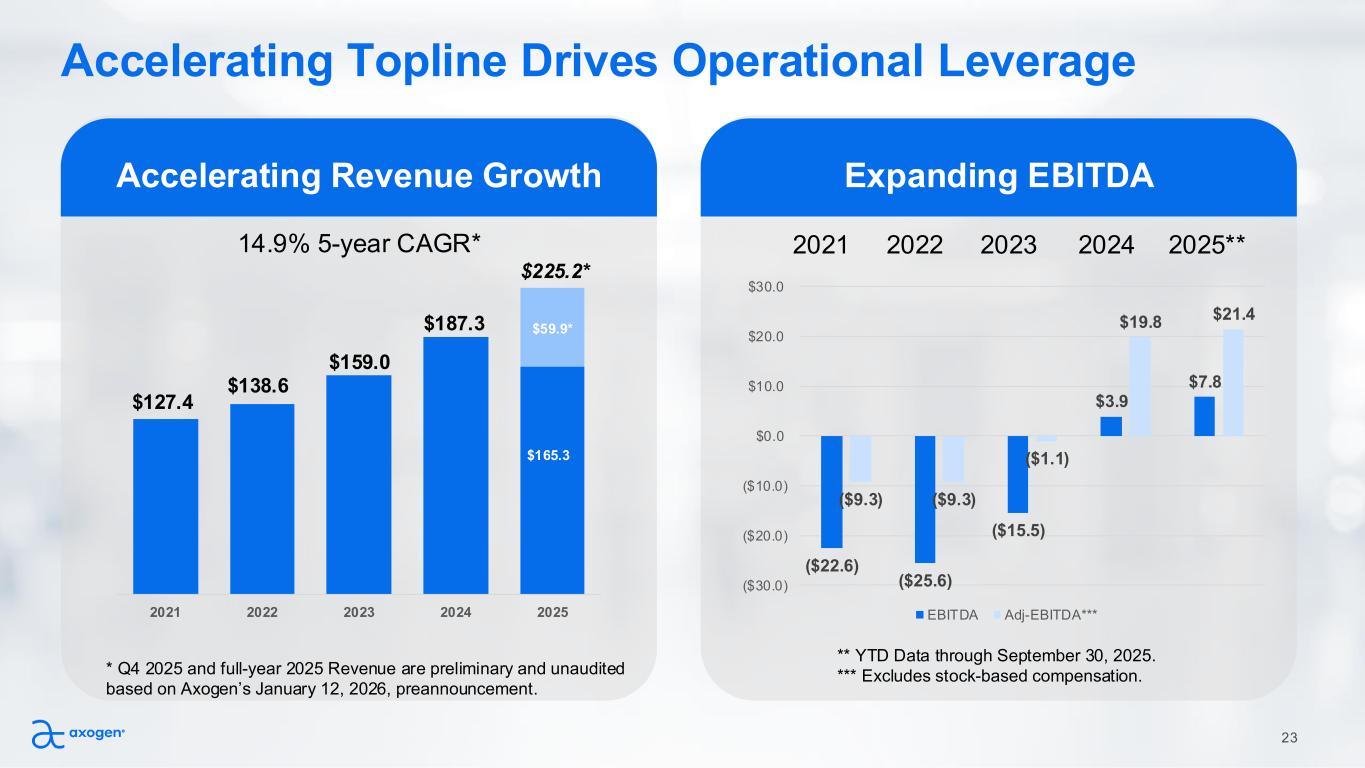
Forward-looking statements This presentation contains “forward-looking” statements as defined in the Private Securities Litigation Reform Act of 1995. These statements are based on management's current expectations or predictions of future conditions, events, or results based on various assumptions and management's estimates of trends and economic factors in the markets in which we are active, as well as our business plans. Words such as “expects,” “anticipates,” “priorities,” “objectives,” “intends,” “plans,” “believes,” “seeks,” “estimates,” “projects,” “forecasts,” “continue,” “may,” “should,” “will,” “goals,” and variations of such words and similar expressions are intended to identify such forward-looking statements. Forward-looking statements include, but are not limited to, statements regarding financial guidance, including revenue range, cash and gross margins; reimbursement expectations; anticipated regulatory approvals; international expansion; educational initiatives; patient activation strategies; and clinical trial plans, as well as market development opportunities and priorities for peripheral nerve products; TAM estimates; estimates of potential patients who may benefit from our products; strategic plan priorities, including projected multi-year revenue, revenue growth, CAGR, margins, market and growth drivers; strategic initiatives; expectations regarding commercial performance of our products; market opportunities for use with prostatectomy; innovation, including new products and indications; clinical evidence generation and its impact on adoption and societal support; Axogen Processing Center capabilities for manufacturing Avance®; and our expectation that Avance® will be designated as the reference product for any biosimilar nerve allograft product and provide market exclusivity. Actual results or events could differ materially from those described in any forward-looking statements as a result of various factors, including, without limitation, global supply chain issues, inflation, hospital staffing issues, product development timelines, product potential, expected clinical enrollment timing and outcomes, regulatory process and approvals, financial performance, sales growth, surgeon and product adoption, market awareness of our products, data validation, our visibility at and sponsorship of conferences and educational events, recent geopolitical conflicts, reimbursement trends, potential impact of recent government actions and policies, including the One Big Beautiful Bill Act on our business, tax position, and regulatory processes, as well as those risk factors described under Part I, Item 1A., “Risk Factors,” of our Annual Report on Form 10-K for the most recently ended fiscal year. Forward-looking statements are not a guarantee of future performance, and actual results may differ materially from those projected. The forward-looking statements are representative only as of the date they are made and, except as required by applicable law, we assume no responsibility to publicly update or revise any forward-looking statements. About Non-GAAP Financial Measures To supplement our condensed consolidated financial statements, we use the non-GAAP financial measures of EBITDA, which measures earnings before interest, income taxes, depreciation and amortization, and Adjusted EBITDA which further excludes non-cash stock compensation expense. We also use the non-GAAP financial measures of Adjusted Net Income or Loss and Adjusted Net Income or Loss Per Common Share - basic and diluted which excludes non-cash stock compensation expense from Net Income or Loss and Net Income or Loss Per Common Share - basic and diluted, respectively. We also use the Operational Cashflow metric, which corresponds to Net increase (decrease) in cash, cash equivalents, restricted cash, and investments, less cashflow from issuance or repayment of long-term debt. These non-GAAP measures are not based on any comprehensive set of accounting rules or principles and should not be considered a substitute for, or superior to, financial measures calculated in accordance with GAAP and may be different from non-GAAP measures used by other companies. In addition, these non-GAAP measures should be read in conjunction with our financial statements prepared in accordance with GAAP. The reconciliations of the non-GAAP measures to the most directly comparable financial measures calculated and presented in accordance with GAAP should be carefully evaluated. We use these non-GAAP financial measures for financial and operational decision-making and as a means to evaluate period-to-period comparisons. We believe that these non-GAAP financial measures provide meaningful supplemental information regarding our performance and that both management and investors benefit from referring to these non-GAAP financial measures in assessing our performance and when planning, forecasting, and analyzing future periods. We believe these non-GAAP financial measures are useful to investors because (1) they allow for greater transparency with respect to key metrics used by management in its financial and operational decision-making and (2) they are used by our institutional investors and the analyst community to help them analyze the performance of our business, the Company’s cash available for operations, and the Company’s ability to meet future capital expenditure and working capital requirements. 2
 エドガーで原本を確認する







 株探プレミアムに申し込む(初回無料体験付き)
プレミアム会員の方はこちらからログイン
株探プレミアムに申し込む(初回無料体験付き)
プレミアム会員の方はこちらからログイン