FALSE0000353278FY2025truexbrli:sharesiso4217:DKKiso4217:DKKxbrli:sharesxbrli:pureiso4217:USDnvo:wholesalernvo:segmentnvo:employeenvo:sitenvo:multi-districtLitigationnvo:voteiso4217:DKKiso4217:USDiso4217:DKKiso4217:CNYiso4217:DKKiso4217:CADiso4217:EURnvo:trancheutr:Mnvo:business00003532782025-01-012025-12-310000353278dei:BusinessContactMember2025-01-012025-12-310000353278nvo:BShareCapitalMember2025-01-012025-12-310000353278nvo:AmericanDepositaryReceiptsMember2025-01-012025-12-310000353278nvo:AShareCapitalMember2025-12-310000353278nvo:BShareCapitalMember2025-12-3100003532782024-01-012024-12-3100003532782023-01-012023-12-3100003532782024-12-3100003532782023-12-3100003532782022-12-3100003532782025-12-310000353278ifrs-full:IssuedCapitalMember2024-12-310000353278ifrs-full:TreasurySharesMember2024-12-310000353278ifrs-full:RetainedEarningsMember2024-12-310000353278ifrs-full:OtherReservesMember2024-12-310000353278ifrs-full:IssuedCapitalMember2023-12-310000353278ifrs-full:TreasurySharesMember2023-12-310000353278ifrs-full:RetainedEarningsMember2023-12-310000353278ifrs-full:OtherReservesMember2023-12-310000353278ifrs-full:IssuedCapitalMember2022-12-310000353278ifrs-full:TreasurySharesMember2022-12-310000353278ifrs-full:RetainedEarningsMember2022-12-310000353278ifrs-full:OtherReservesMember2022-12-310000353278ifrs-full:RetainedEarningsMember2025-01-012025-12-310000353278ifrs-full:RetainedEarningsMember2024-01-012024-12-310000353278ifrs-full:RetainedEarningsMember2023-01-012023-12-310000353278ifrs-full:OtherReservesMember2025-01-012025-12-310000353278ifrs-full:OtherReservesMember2024-01-012024-12-310000353278ifrs-full:OtherReservesMember2023-01-012023-12-310000353278ifrs-full:TreasurySharesMember2024-01-012024-12-310000353278ifrs-full:TreasurySharesMember2023-01-012023-12-310000353278ifrs-full:IssuedCapitalMember2024-01-012024-12-310000353278ifrs-full:IssuedCapitalMember2023-01-012023-12-310000353278ifrs-full:IssuedCapitalMember2025-12-310000353278ifrs-full:TreasurySharesMember2025-12-310000353278ifrs-full:RetainedEarningsMember2025-12-310000353278ifrs-full:OtherReservesMember2025-12-310000353278nvo:USManagedCareAndMedicareMembercountry:US2025-01-012025-12-310000353278nvo:USManagedCareAndMedicareMembercountry:US2024-01-012024-12-310000353278nvo:USManagedCareAndMedicareMembercountry:US2023-01-012023-12-310000353278nvo:USWholesalerMembercountry:US2025-01-012025-12-310000353278nvo:USWholesalerMembercountry:US2024-01-012024-12-310000353278nvo:USWholesalerMembercountry:US2023-01-012023-12-310000353278nvo:USMedicaidMembercountry:US2025-01-012025-12-310000353278nvo:USMedicaidMembercountry:US2024-01-012024-12-310000353278nvo:USMedicaidMembercountry:US2023-01-012023-12-310000353278nvo:OtherCustomersMembercountry:US2025-01-012025-12-310000353278nvo:OtherCustomersMembercountry:US2024-01-012024-12-310000353278nvo:OtherCustomersMembercountry:US2023-01-012023-12-310000353278nvo:OtherCustomersMembernvo:NonNorthAmericaMember2025-01-012025-12-310000353278nvo:OtherCustomersMembernvo:NonNorthAmericaMember2024-01-012024-12-310000353278nvo:OtherCustomersMembernvo:NonNorthAmericaMember2023-01-012023-12-310000353278nvo:ProvisionForSalesDeductionsMember2024-12-310000353278nvo:ProvisionForSalesDeductionsMember2023-12-310000353278nvo:ProvisionForSalesDeductionsMember2022-12-310000353278nvo:ProvisionForSalesDeductionsMember2025-01-012025-12-310000353278nvo:ProvisionForSalesDeductionsMember2024-01-012024-12-310000353278nvo:ProvisionForSalesDeductionsMember2023-01-012023-12-310000353278nvo:ProvisionForSalesDeductionsMember2025-12-310000353278srt:NorthAmericaMember2025-01-012025-12-310000353278srt:NorthAmericaMember2024-01-012024-12-310000353278srt:NorthAmericaMember2023-01-012023-12-310000353278nvo:USWholesalerMembercountry:USifrs-full:NongovernmentCustomersMember2025-01-012025-12-310000353278nvo:A240BStatutoryDiscountsMember2025-01-012025-12-310000353278nvo:A240BStatutoryDiscountsMember2025-12-310000353278nvo:USMedicaidMembercountry:USifrs-full:GovernmentCustomersMember2025-01-012025-12-310000353278nvo:WholesalerOneMember2025-01-012025-12-310000353278nvo:WholesalerTwoMember2025-01-012025-12-310000353278nvo:WholesalerThreeMember2025-01-012025-12-310000353278nvo:WholesalerOneMember2024-01-012024-12-310000353278nvo:WholesalerTwoMember2024-01-012024-12-310000353278nvo:WholesalerThreeMember2024-01-012024-12-310000353278nvo:WholesalerOneMember2023-01-012023-12-310000353278nvo:WholesalerTwoMember2023-01-012023-12-310000353278nvo:WholesalerThreeMember2023-01-012023-12-310000353278nvo:ReversalOfProvisionForLegalUncertaintyMember2026-01-012026-02-040000353278nvo:EstimatedSalesRebatesDiscountsAndChargeBacksMember2025-12-310000353278nvo:EstimatedSalesRebatesDiscountsAndChargeBacksMember2024-12-310000353278nvo:EstimatedSalesRebatesDiscountsAndChargeBacksMember2023-12-310000353278nvo:ExpectedProductReturnsMember2025-12-310000353278nvo:ExpectedProductReturnsMember2024-12-310000353278nvo:ExpectedProductReturnsMember2023-12-310000353278nvo:ConfirmedSalesRebatesMember2025-12-310000353278nvo:ConfirmedSalesRebatesMember2024-12-310000353278nvo:ConfirmedSalesRebatesMember2023-12-310000353278nvo:ObesityAndDiabetesCareMemberifrs-full:OperatingSegmentsMember2025-01-012025-12-310000353278nvo:ObesityAndDiabetesCareMemberifrs-full:OperatingSegmentsMember2024-01-012024-12-310000353278nvo:ObesityAndDiabetesCareMemberifrs-full:OperatingSegmentsMember2023-01-012023-12-310000353278nvo:RareDiseaseMemberifrs-full:OperatingSegmentsMember2025-01-012025-12-310000353278nvo:RareDiseaseMemberifrs-full:OperatingSegmentsMember2024-01-012024-12-310000353278nvo:RareDiseaseMemberifrs-full:OperatingSegmentsMember2023-01-012023-12-310000353278country:US2025-01-012025-12-310000353278country:US2024-01-012024-12-310000353278ifrs-full:ForeignCountriesMember2025-01-012025-12-310000353278ifrs-full:ForeignCountriesMember2024-01-012024-12-310000353278ifrs-full:CountryOfDomicileMember2025-12-310000353278ifrs-full:CountryOfDomicileMember2024-12-310000353278country:US2025-12-310000353278country:US2024-12-310000353278country:USnvo:ObesityAndDiabetesCareMembernvo:OzempicMember2025-01-012025-12-310000353278country:USnvo:ObesityAndDiabetesCareMembernvo:OzempicMember2024-01-012024-12-310000353278country:USnvo:ObesityAndDiabetesCareMembernvo:OzempicMember2023-01-012023-12-310000353278nvo:InternationalOperationsMembernvo:ObesityAndDiabetesCareMembernvo:OzempicMember2025-01-012025-12-310000353278nvo:InternationalOperationsMembernvo:ObesityAndDiabetesCareMembernvo:OzempicMember2024-01-012024-12-310000353278nvo:InternationalOperationsMembernvo:ObesityAndDiabetesCareMembernvo:OzempicMember2023-01-012023-12-310000353278nvo:EUCANMembernvo:ObesityAndDiabetesCareMembernvo:OzempicMember2025-01-012025-12-310000353278nvo:EUCANMembernvo:ObesityAndDiabetesCareMembernvo:OzempicMember2024-01-012024-12-310000353278nvo:EUCANMembernvo:ObesityAndDiabetesCareMembernvo:OzempicMember2023-01-012023-12-310000353278nvo:EmergingMarketsMembernvo:ObesityAndDiabetesCareMembernvo:OzempicMember2025-01-012025-12-310000353278nvo:EmergingMarketsMembernvo:ObesityAndDiabetesCareMembernvo:OzempicMember2024-01-012024-12-310000353278nvo:EmergingMarketsMembernvo:ObesityAndDiabetesCareMembernvo:OzempicMember2023-01-012023-12-310000353278nvo:APACMembernvo:ObesityAndDiabetesCareMembernvo:OzempicMember2025-01-012025-12-310000353278nvo:APACMembernvo:ObesityAndDiabetesCareMembernvo:OzempicMember2024-01-012024-12-310000353278nvo:APACMembernvo:ObesityAndDiabetesCareMembernvo:OzempicMember2023-01-012023-12-310000353278country:CNnvo:ObesityAndDiabetesCareMembernvo:OzempicMember2025-01-012025-12-310000353278country:CNnvo:ObesityAndDiabetesCareMembernvo:OzempicMember2024-01-012024-12-310000353278country:CNnvo:ObesityAndDiabetesCareMembernvo:OzempicMember2023-01-012023-12-310000353278nvo:ObesityAndDiabetesCareMembernvo:OzempicMember2025-01-012025-12-310000353278nvo:ObesityAndDiabetesCareMembernvo:OzempicMember2024-01-012024-12-310000353278nvo:ObesityAndDiabetesCareMembernvo:OzempicMember2023-01-012023-12-310000353278country:USnvo:ObesityAndDiabetesCareMembernvo:RybelsusMember2025-01-012025-12-310000353278country:USnvo:ObesityAndDiabetesCareMembernvo:RybelsusMember2024-01-012024-12-310000353278country:USnvo:ObesityAndDiabetesCareMembernvo:RybelsusMember2023-01-012023-12-310000353278nvo:InternationalOperationsMembernvo:ObesityAndDiabetesCareMembernvo:RybelsusMember2025-01-012025-12-310000353278nvo:InternationalOperationsMembernvo:ObesityAndDiabetesCareMembernvo:RybelsusMember2024-01-012024-12-310000353278nvo:InternationalOperationsMembernvo:ObesityAndDiabetesCareMembernvo:RybelsusMember2023-01-012023-12-310000353278nvo:EUCANMembernvo:ObesityAndDiabetesCareMembernvo:RybelsusMember2025-01-012025-12-310000353278nvo:EUCANMembernvo:ObesityAndDiabetesCareMembernvo:RybelsusMember2024-01-012024-12-310000353278nvo:EUCANMembernvo:ObesityAndDiabetesCareMembernvo:RybelsusMember2023-01-012023-12-310000353278nvo:EmergingMarketsMembernvo:ObesityAndDiabetesCareMembernvo:RybelsusMember2025-01-012025-12-310000353278nvo:EmergingMarketsMembernvo:ObesityAndDiabetesCareMembernvo:RybelsusMember2024-01-012024-12-310000353278nvo:EmergingMarketsMembernvo:ObesityAndDiabetesCareMembernvo:RybelsusMember2023-01-012023-12-310000353278nvo:APACMembernvo:ObesityAndDiabetesCareMembernvo:RybelsusMember2025-01-012025-12-310000353278nvo:APACMembernvo:ObesityAndDiabetesCareMembernvo:RybelsusMember2024-01-012024-12-310000353278nvo:APACMembernvo:ObesityAndDiabetesCareMembernvo:RybelsusMember2023-01-012023-12-310000353278country:CNnvo:ObesityAndDiabetesCareMembernvo:RybelsusMember2025-01-012025-12-310000353278country:CNnvo:ObesityAndDiabetesCareMembernvo:RybelsusMember2024-01-012024-12-310000353278country:CNnvo:ObesityAndDiabetesCareMembernvo:RybelsusMember2023-01-012023-12-310000353278nvo:ObesityAndDiabetesCareMembernvo:RybelsusMember2025-01-012025-12-310000353278nvo:ObesityAndDiabetesCareMembernvo:RybelsusMember2024-01-012024-12-310000353278nvo:ObesityAndDiabetesCareMembernvo:RybelsusMember2023-01-012023-12-310000353278country:USnvo:ObesityAndDiabetesCareMembernvo:VictozaMember2025-01-012025-12-310000353278country:USnvo:ObesityAndDiabetesCareMembernvo:VictozaMember2024-01-012024-12-310000353278country:USnvo:ObesityAndDiabetesCareMembernvo:VictozaMember2023-01-012023-12-310000353278nvo:InternationalOperationsMembernvo:ObesityAndDiabetesCareMembernvo:VictozaMember2025-01-012025-12-310000353278nvo:InternationalOperationsMembernvo:ObesityAndDiabetesCareMembernvo:VictozaMember2024-01-012024-12-310000353278nvo:InternationalOperationsMembernvo:ObesityAndDiabetesCareMembernvo:VictozaMember2023-01-012023-12-310000353278nvo:EUCANMembernvo:ObesityAndDiabetesCareMembernvo:VictozaMember2025-01-012025-12-310000353278nvo:EUCANMembernvo:ObesityAndDiabetesCareMembernvo:VictozaMember2024-01-012024-12-310000353278nvo:EUCANMembernvo:ObesityAndDiabetesCareMembernvo:VictozaMember2023-01-012023-12-310000353278nvo:EmergingMarketsMembernvo:ObesityAndDiabetesCareMembernvo:VictozaMember2025-01-012025-12-310000353278nvo:EmergingMarketsMembernvo:ObesityAndDiabetesCareMembernvo:VictozaMember2024-01-012024-12-310000353278nvo:EmergingMarketsMembernvo:ObesityAndDiabetesCareMembernvo:VictozaMember2023-01-012023-12-310000353278nvo:APACMembernvo:ObesityAndDiabetesCareMembernvo:VictozaMember2025-01-012025-12-310000353278nvo:APACMembernvo:ObesityAndDiabetesCareMembernvo:VictozaMember2024-01-012024-12-310000353278nvo:APACMembernvo:ObesityAndDiabetesCareMembernvo:VictozaMember2023-01-012023-12-310000353278country:CNnvo:ObesityAndDiabetesCareMembernvo:VictozaMember2025-01-012025-12-310000353278country:CNnvo:ObesityAndDiabetesCareMembernvo:VictozaMember2024-01-012024-12-310000353278country:CNnvo:ObesityAndDiabetesCareMembernvo:VictozaMember2023-01-012023-12-310000353278nvo:ObesityAndDiabetesCareMembernvo:VictozaMember2025-01-012025-12-310000353278nvo:ObesityAndDiabetesCareMembernvo:VictozaMember2024-01-012024-12-310000353278nvo:ObesityAndDiabetesCareMembernvo:VictozaMember2023-01-012023-12-310000353278country:USnvo:ObesityAndDiabetesCareMembernvo:TotalGLP1Member2025-01-012025-12-310000353278country:USnvo:ObesityAndDiabetesCareMembernvo:TotalGLP1Member2024-01-012024-12-310000353278country:USnvo:ObesityAndDiabetesCareMembernvo:TotalGLP1Member2023-01-012023-12-310000353278nvo:InternationalOperationsMembernvo:ObesityAndDiabetesCareMembernvo:TotalGLP1Member2025-01-012025-12-310000353278nvo:InternationalOperationsMembernvo:ObesityAndDiabetesCareMembernvo:TotalGLP1Member2024-01-012024-12-310000353278nvo:InternationalOperationsMembernvo:ObesityAndDiabetesCareMembernvo:TotalGLP1Member2023-01-012023-12-310000353278nvo:EUCANMembernvo:ObesityAndDiabetesCareMembernvo:TotalGLP1Member2025-01-012025-12-310000353278nvo:EUCANMembernvo:ObesityAndDiabetesCareMembernvo:TotalGLP1Member2024-01-012024-12-310000353278nvo:EUCANMembernvo:ObesityAndDiabetesCareMembernvo:TotalGLP1Member2023-01-012023-12-310000353278nvo:EmergingMarketsMembernvo:ObesityAndDiabetesCareMembernvo:TotalGLP1Member2025-01-012025-12-310000353278nvo:EmergingMarketsMembernvo:ObesityAndDiabetesCareMembernvo:TotalGLP1Member2024-01-012024-12-310000353278nvo:EmergingMarketsMembernvo:ObesityAndDiabetesCareMembernvo:TotalGLP1Member2023-01-012023-12-310000353278nvo:APACMembernvo:ObesityAndDiabetesCareMembernvo:TotalGLP1Member2025-01-012025-12-310000353278nvo:APACMembernvo:ObesityAndDiabetesCareMembernvo:TotalGLP1Member2024-01-012024-12-310000353278nvo:APACMembernvo:ObesityAndDiabetesCareMembernvo:TotalGLP1Member2023-01-012023-12-310000353278country:CNnvo:ObesityAndDiabetesCareMembernvo:TotalGLP1Member2025-01-012025-12-310000353278country:CNnvo:ObesityAndDiabetesCareMembernvo:TotalGLP1Member2024-01-012024-12-310000353278country:CNnvo:ObesityAndDiabetesCareMembernvo:TotalGLP1Member2023-01-012023-12-310000353278nvo:ObesityAndDiabetesCareMembernvo:TotalGLP1Member2025-01-012025-12-310000353278nvo:ObesityAndDiabetesCareMembernvo:TotalGLP1Member2024-01-012024-12-310000353278nvo:ObesityAndDiabetesCareMembernvo:TotalGLP1Member2023-01-012023-12-310000353278country:USnvo:ObesityAndDiabetesCareMembernvo:LongActingInsulinMember2025-01-012025-12-310000353278country:USnvo:ObesityAndDiabetesCareMembernvo:LongActingInsulinMember2024-01-012024-12-310000353278country:USnvo:ObesityAndDiabetesCareMembernvo:LongActingInsulinMember2023-01-012023-12-310000353278nvo:InternationalOperationsMembernvo:ObesityAndDiabetesCareMembernvo:LongActingInsulinMember2025-01-012025-12-310000353278nvo:InternationalOperationsMembernvo:ObesityAndDiabetesCareMembernvo:LongActingInsulinMember2024-01-012024-12-310000353278nvo:InternationalOperationsMembernvo:ObesityAndDiabetesCareMembernvo:LongActingInsulinMember2023-01-012023-12-310000353278nvo:EUCANMembernvo:ObesityAndDiabetesCareMembernvo:LongActingInsulinMember2025-01-012025-12-310000353278nvo:EUCANMembernvo:ObesityAndDiabetesCareMembernvo:LongActingInsulinMember2024-01-012024-12-310000353278nvo:EUCANMembernvo:ObesityAndDiabetesCareMembernvo:LongActingInsulinMember2023-01-012023-12-310000353278nvo:EmergingMarketsMembernvo:ObesityAndDiabetesCareMembernvo:LongActingInsulinMember2025-01-012025-12-310000353278nvo:EmergingMarketsMembernvo:ObesityAndDiabetesCareMembernvo:LongActingInsulinMember2024-01-012024-12-310000353278nvo:EmergingMarketsMembernvo:ObesityAndDiabetesCareMembernvo:LongActingInsulinMember2023-01-012023-12-310000353278nvo:APACMembernvo:ObesityAndDiabetesCareMembernvo:LongActingInsulinMember2025-01-012025-12-310000353278nvo:APACMembernvo:ObesityAndDiabetesCareMembernvo:LongActingInsulinMember2024-01-012024-12-310000353278nvo:APACMembernvo:ObesityAndDiabetesCareMembernvo:LongActingInsulinMember2023-01-012023-12-310000353278country:CNnvo:ObesityAndDiabetesCareMembernvo:LongActingInsulinMember2025-01-012025-12-310000353278country:CNnvo:ObesityAndDiabetesCareMembernvo:LongActingInsulinMember2024-01-012024-12-310000353278country:CNnvo:ObesityAndDiabetesCareMembernvo:LongActingInsulinMember2023-01-012023-12-310000353278nvo:ObesityAndDiabetesCareMembernvo:LongActingInsulinMember2025-01-012025-12-310000353278nvo:ObesityAndDiabetesCareMembernvo:LongActingInsulinMember2024-01-012024-12-310000353278nvo:ObesityAndDiabetesCareMembernvo:LongActingInsulinMember2023-01-012023-12-310000353278country:USnvo:ObesityAndDiabetesCareMembernvo:AwigliMember2025-01-012025-12-310000353278country:USnvo:ObesityAndDiabetesCareMembernvo:AwigliMember2024-01-012024-12-310000353278country:USnvo:ObesityAndDiabetesCareMembernvo:AwigliMember2023-01-012023-12-310000353278nvo:InternationalOperationsMembernvo:ObesityAndDiabetesCareMembernvo:AwigliMember2025-01-012025-12-310000353278nvo:InternationalOperationsMembernvo:ObesityAndDiabetesCareMembernvo:AwigliMember2024-01-012024-12-310000353278nvo:InternationalOperationsMembernvo:ObesityAndDiabetesCareMembernvo:AwigliMember2023-01-012023-12-310000353278nvo:EUCANMembernvo:ObesityAndDiabetesCareMembernvo:AwigliMember2025-01-012025-12-310000353278nvo:EUCANMembernvo:ObesityAndDiabetesCareMembernvo:AwigliMember2024-01-012024-12-310000353278nvo:EUCANMembernvo:ObesityAndDiabetesCareMembernvo:AwigliMember2023-01-012023-12-310000353278nvo:EmergingMarketsMembernvo:ObesityAndDiabetesCareMembernvo:AwigliMember2025-01-012025-12-310000353278nvo:EmergingMarketsMembernvo:ObesityAndDiabetesCareMembernvo:AwigliMember2024-01-012024-12-310000353278nvo:EmergingMarketsMembernvo:ObesityAndDiabetesCareMembernvo:AwigliMember2023-01-012023-12-310000353278nvo:APACMembernvo:ObesityAndDiabetesCareMembernvo:AwigliMember2025-01-012025-12-310000353278nvo:APACMembernvo:ObesityAndDiabetesCareMembernvo:AwigliMember2024-01-012024-12-310000353278nvo:APACMembernvo:ObesityAndDiabetesCareMembernvo:AwigliMember2023-01-012023-12-310000353278country:CNnvo:ObesityAndDiabetesCareMembernvo:AwigliMember2025-01-012025-12-310000353278country:CNnvo:ObesityAndDiabetesCareMembernvo:AwigliMember2024-01-012024-12-310000353278country:CNnvo:ObesityAndDiabetesCareMembernvo:AwigliMember2023-01-012023-12-310000353278nvo:ObesityAndDiabetesCareMembernvo:AwigliMember2025-01-012025-12-310000353278nvo:ObesityAndDiabetesCareMembernvo:AwigliMember2024-01-012024-12-310000353278nvo:ObesityAndDiabetesCareMembernvo:AwigliMember2023-01-012023-12-310000353278country:USnvo:ObesityAndDiabetesCareMembernvo:TresibaMember2025-01-012025-12-310000353278country:USnvo:ObesityAndDiabetesCareMembernvo:TresibaMember2024-01-012024-12-310000353278country:USnvo:ObesityAndDiabetesCareMembernvo:TresibaMember2023-01-012023-12-310000353278nvo:InternationalOperationsMembernvo:ObesityAndDiabetesCareMembernvo:TresibaMember2025-01-012025-12-310000353278nvo:InternationalOperationsMembernvo:ObesityAndDiabetesCareMembernvo:TresibaMember2024-01-012024-12-310000353278nvo:InternationalOperationsMembernvo:ObesityAndDiabetesCareMembernvo:TresibaMember2023-01-012023-12-310000353278nvo:EUCANMembernvo:ObesityAndDiabetesCareMembernvo:TresibaMember2025-01-012025-12-310000353278nvo:EUCANMembernvo:ObesityAndDiabetesCareMembernvo:TresibaMember2024-01-012024-12-310000353278nvo:EUCANMembernvo:ObesityAndDiabetesCareMembernvo:TresibaMember2023-01-012023-12-310000353278nvo:EmergingMarketsMembernvo:ObesityAndDiabetesCareMembernvo:TresibaMember2025-01-012025-12-310000353278nvo:EmergingMarketsMembernvo:ObesityAndDiabetesCareMembernvo:TresibaMember2024-01-012024-12-310000353278nvo:EmergingMarketsMembernvo:ObesityAndDiabetesCareMembernvo:TresibaMember2023-01-012023-12-310000353278nvo:APACMembernvo:ObesityAndDiabetesCareMembernvo:TresibaMember2025-01-012025-12-310000353278nvo:APACMembernvo:ObesityAndDiabetesCareMembernvo:TresibaMember2024-01-012024-12-310000353278nvo:APACMembernvo:ObesityAndDiabetesCareMembernvo:TresibaMember2023-01-012023-12-310000353278country:CNnvo:ObesityAndDiabetesCareMembernvo:TresibaMember2025-01-012025-12-310000353278country:CNnvo:ObesityAndDiabetesCareMembernvo:TresibaMember2024-01-012024-12-310000353278country:CNnvo:ObesityAndDiabetesCareMembernvo:TresibaMember2023-01-012023-12-310000353278nvo:ObesityAndDiabetesCareMembernvo:TresibaMember2025-01-012025-12-310000353278nvo:ObesityAndDiabetesCareMembernvo:TresibaMember2024-01-012024-12-310000353278nvo:ObesityAndDiabetesCareMembernvo:TresibaMember2023-01-012023-12-310000353278country:USnvo:ObesityAndDiabetesCareMembernvo:XultophyMember2025-01-012025-12-310000353278country:USnvo:ObesityAndDiabetesCareMembernvo:XultophyMember2024-01-012024-12-310000353278country:USnvo:ObesityAndDiabetesCareMembernvo:XultophyMember2023-01-012023-12-310000353278nvo:InternationalOperationsMembernvo:ObesityAndDiabetesCareMembernvo:XultophyMember2025-01-012025-12-310000353278nvo:InternationalOperationsMembernvo:ObesityAndDiabetesCareMembernvo:XultophyMember2024-01-012024-12-310000353278nvo:InternationalOperationsMembernvo:ObesityAndDiabetesCareMembernvo:XultophyMember2023-01-012023-12-310000353278nvo:EUCANMembernvo:ObesityAndDiabetesCareMembernvo:XultophyMember2025-01-012025-12-310000353278nvo:EUCANMembernvo:ObesityAndDiabetesCareMembernvo:XultophyMember2024-01-012024-12-310000353278nvo:EUCANMembernvo:ObesityAndDiabetesCareMembernvo:XultophyMember2023-01-012023-12-310000353278nvo:EmergingMarketsMembernvo:ObesityAndDiabetesCareMembernvo:XultophyMember2025-01-012025-12-310000353278nvo:EmergingMarketsMembernvo:ObesityAndDiabetesCareMembernvo:XultophyMember2024-01-012024-12-310000353278nvo:EmergingMarketsMembernvo:ObesityAndDiabetesCareMembernvo:XultophyMember2023-01-012023-12-310000353278nvo:APACMembernvo:ObesityAndDiabetesCareMembernvo:XultophyMember2025-01-012025-12-310000353278nvo:APACMembernvo:ObesityAndDiabetesCareMembernvo:XultophyMember2024-01-012024-12-310000353278nvo:APACMembernvo:ObesityAndDiabetesCareMembernvo:XultophyMember2023-01-012023-12-310000353278country:CNnvo:ObesityAndDiabetesCareMembernvo:XultophyMember2025-01-012025-12-310000353278country:CNnvo:ObesityAndDiabetesCareMembernvo:XultophyMember2024-01-012024-12-310000353278country:CNnvo:ObesityAndDiabetesCareMembernvo:XultophyMember2023-01-012023-12-310000353278nvo:ObesityAndDiabetesCareMembernvo:XultophyMember2025-01-012025-12-310000353278nvo:ObesityAndDiabetesCareMembernvo:XultophyMember2024-01-012024-12-310000353278nvo:ObesityAndDiabetesCareMembernvo:XultophyMember2023-01-012023-12-310000353278country:USnvo:ObesityAndDiabetesCareMembernvo:LevemirMember2025-01-012025-12-310000353278country:USnvo:ObesityAndDiabetesCareMembernvo:LevemirMember2024-01-012024-12-310000353278country:USnvo:ObesityAndDiabetesCareMembernvo:LevemirMember2023-01-012023-12-310000353278nvo:InternationalOperationsMembernvo:ObesityAndDiabetesCareMembernvo:LevemirMember2025-01-012025-12-310000353278nvo:InternationalOperationsMembernvo:ObesityAndDiabetesCareMembernvo:LevemirMember2024-01-012024-12-310000353278nvo:InternationalOperationsMembernvo:ObesityAndDiabetesCareMembernvo:LevemirMember2023-01-012023-12-310000353278nvo:EUCANMembernvo:ObesityAndDiabetesCareMembernvo:LevemirMember2025-01-012025-12-310000353278nvo:EUCANMembernvo:ObesityAndDiabetesCareMembernvo:LevemirMember2024-01-012024-12-310000353278nvo:EUCANMembernvo:ObesityAndDiabetesCareMembernvo:LevemirMember2023-01-012023-12-310000353278nvo:EmergingMarketsMembernvo:ObesityAndDiabetesCareMembernvo:LevemirMember2025-01-012025-12-310000353278nvo:EmergingMarketsMembernvo:ObesityAndDiabetesCareMembernvo:LevemirMember2024-01-012024-12-310000353278nvo:EmergingMarketsMembernvo:ObesityAndDiabetesCareMembernvo:LevemirMember2023-01-012023-12-310000353278nvo:APACMembernvo:ObesityAndDiabetesCareMembernvo:LevemirMember2025-01-012025-12-310000353278nvo:APACMembernvo:ObesityAndDiabetesCareMembernvo:LevemirMember2024-01-012024-12-310000353278nvo:APACMembernvo:ObesityAndDiabetesCareMembernvo:LevemirMember2023-01-012023-12-310000353278country:CNnvo:ObesityAndDiabetesCareMembernvo:LevemirMember2025-01-012025-12-310000353278country:CNnvo:ObesityAndDiabetesCareMembernvo:LevemirMember2024-01-012024-12-310000353278country:CNnvo:ObesityAndDiabetesCareMembernvo:LevemirMember2023-01-012023-12-310000353278nvo:ObesityAndDiabetesCareMembernvo:LevemirMember2025-01-012025-12-310000353278nvo:ObesityAndDiabetesCareMembernvo:LevemirMember2024-01-012024-12-310000353278nvo:ObesityAndDiabetesCareMembernvo:LevemirMember2023-01-012023-12-310000353278country:USnvo:ObesityAndDiabetesCareMembernvo:PremixInsulinMember2025-01-012025-12-310000353278country:USnvo:ObesityAndDiabetesCareMembernvo:PremixInsulinMember2024-01-012024-12-310000353278country:USnvo:ObesityAndDiabetesCareMembernvo:PremixInsulinMember2023-01-012023-12-310000353278nvo:InternationalOperationsMembernvo:ObesityAndDiabetesCareMembernvo:PremixInsulinMember2025-01-012025-12-310000353278nvo:InternationalOperationsMembernvo:ObesityAndDiabetesCareMembernvo:PremixInsulinMember2024-01-012024-12-310000353278nvo:InternationalOperationsMembernvo:ObesityAndDiabetesCareMembernvo:PremixInsulinMember2023-01-012023-12-310000353278nvo:EUCANMembernvo:ObesityAndDiabetesCareMembernvo:PremixInsulinMember2025-01-012025-12-310000353278nvo:EUCANMembernvo:ObesityAndDiabetesCareMembernvo:PremixInsulinMember2024-01-012024-12-310000353278nvo:EUCANMembernvo:ObesityAndDiabetesCareMembernvo:PremixInsulinMember2023-01-012023-12-310000353278nvo:EmergingMarketsMembernvo:ObesityAndDiabetesCareMembernvo:PremixInsulinMember2025-01-012025-12-310000353278nvo:EmergingMarketsMembernvo:ObesityAndDiabetesCareMembernvo:PremixInsulinMember2024-01-012024-12-310000353278nvo:EmergingMarketsMembernvo:ObesityAndDiabetesCareMembernvo:PremixInsulinMember2023-01-012023-12-310000353278nvo:APACMembernvo:ObesityAndDiabetesCareMembernvo:PremixInsulinMember2025-01-012025-12-310000353278nvo:APACMembernvo:ObesityAndDiabetesCareMembernvo:PremixInsulinMember2024-01-012024-12-310000353278nvo:APACMembernvo:ObesityAndDiabetesCareMembernvo:PremixInsulinMember2023-01-012023-12-310000353278country:CNnvo:ObesityAndDiabetesCareMembernvo:PremixInsulinMember2025-01-012025-12-310000353278country:CNnvo:ObesityAndDiabetesCareMembernvo:PremixInsulinMember2024-01-012024-12-310000353278country:CNnvo:ObesityAndDiabetesCareMembernvo:PremixInsulinMember2023-01-012023-12-310000353278nvo:ObesityAndDiabetesCareMembernvo:PremixInsulinMember2025-01-012025-12-310000353278nvo:ObesityAndDiabetesCareMembernvo:PremixInsulinMember2024-01-012024-12-310000353278nvo:ObesityAndDiabetesCareMembernvo:PremixInsulinMember2023-01-012023-12-310000353278country:USnvo:ObesityAndDiabetesCareMembernvo:RyzodegMember2025-01-012025-12-310000353278country:USnvo:ObesityAndDiabetesCareMembernvo:RyzodegMember2024-01-012024-12-310000353278country:USnvo:ObesityAndDiabetesCareMembernvo:RyzodegMember2023-01-012023-12-310000353278nvo:InternationalOperationsMembernvo:ObesityAndDiabetesCareMembernvo:RyzodegMember2025-01-012025-12-310000353278nvo:InternationalOperationsMembernvo:ObesityAndDiabetesCareMembernvo:RyzodegMember2024-01-012024-12-310000353278nvo:InternationalOperationsMembernvo:ObesityAndDiabetesCareMembernvo:RyzodegMember2023-01-012023-12-310000353278nvo:EUCANMembernvo:ObesityAndDiabetesCareMembernvo:RyzodegMember2025-01-012025-12-310000353278nvo:EUCANMembernvo:ObesityAndDiabetesCareMembernvo:RyzodegMember2024-01-012024-12-310000353278nvo:EUCANMembernvo:ObesityAndDiabetesCareMembernvo:RyzodegMember2023-01-012023-12-310000353278nvo:EmergingMarketsMembernvo:ObesityAndDiabetesCareMembernvo:RyzodegMember2025-01-012025-12-310000353278nvo:EmergingMarketsMembernvo:ObesityAndDiabetesCareMembernvo:RyzodegMember2024-01-012024-12-310000353278nvo:EmergingMarketsMembernvo:ObesityAndDiabetesCareMembernvo:RyzodegMember2023-01-012023-12-310000353278nvo:APACMembernvo:ObesityAndDiabetesCareMembernvo:RyzodegMember2025-01-012025-12-310000353278nvo:APACMembernvo:ObesityAndDiabetesCareMembernvo:RyzodegMember2024-01-012024-12-310000353278nvo:APACMembernvo:ObesityAndDiabetesCareMembernvo:RyzodegMember2023-01-012023-12-310000353278country:CNnvo:ObesityAndDiabetesCareMembernvo:RyzodegMember2025-01-012025-12-310000353278country:CNnvo:ObesityAndDiabetesCareMembernvo:RyzodegMember2024-01-012024-12-310000353278country:CNnvo:ObesityAndDiabetesCareMembernvo:RyzodegMember2023-01-012023-12-310000353278nvo:ObesityAndDiabetesCareMembernvo:RyzodegMember2025-01-012025-12-310000353278nvo:ObesityAndDiabetesCareMembernvo:RyzodegMember2024-01-012024-12-310000353278nvo:ObesityAndDiabetesCareMembernvo:RyzodegMember2023-01-012023-12-310000353278country:USnvo:ObesityAndDiabetesCareMembernvo:NovoMixAndNovoLogMixMember2025-01-012025-12-310000353278country:USnvo:ObesityAndDiabetesCareMembernvo:NovoMixAndNovoLogMixMember2024-01-012024-12-310000353278country:USnvo:ObesityAndDiabetesCareMembernvo:NovoMixAndNovoLogMixMember2023-01-012023-12-310000353278nvo:InternationalOperationsMembernvo:ObesityAndDiabetesCareMembernvo:NovoMixAndNovoLogMixMember2025-01-012025-12-310000353278nvo:InternationalOperationsMembernvo:ObesityAndDiabetesCareMembernvo:NovoMixAndNovoLogMixMember2024-01-012024-12-310000353278nvo:InternationalOperationsMembernvo:ObesityAndDiabetesCareMembernvo:NovoMixAndNovoLogMixMember2023-01-012023-12-310000353278nvo:EUCANMembernvo:ObesityAndDiabetesCareMembernvo:NovoMixAndNovoLogMixMember2025-01-012025-12-310000353278nvo:EUCANMembernvo:ObesityAndDiabetesCareMembernvo:NovoMixAndNovoLogMixMember2024-01-012024-12-310000353278nvo:EUCANMembernvo:ObesityAndDiabetesCareMembernvo:NovoMixAndNovoLogMixMember2023-01-012023-12-310000353278nvo:EmergingMarketsMembernvo:ObesityAndDiabetesCareMembernvo:NovoMixAndNovoLogMixMember2025-01-012025-12-310000353278nvo:EmergingMarketsMembernvo:ObesityAndDiabetesCareMembernvo:NovoMixAndNovoLogMixMember2024-01-012024-12-310000353278nvo:EmergingMarketsMembernvo:ObesityAndDiabetesCareMembernvo:NovoMixAndNovoLogMixMember2023-01-012023-12-310000353278nvo:APACMembernvo:ObesityAndDiabetesCareMembernvo:NovoMixAndNovoLogMixMember2025-01-012025-12-310000353278nvo:APACMembernvo:ObesityAndDiabetesCareMembernvo:NovoMixAndNovoLogMixMember2024-01-012024-12-310000353278nvo:APACMembernvo:ObesityAndDiabetesCareMembernvo:NovoMixAndNovoLogMixMember2023-01-012023-12-310000353278country:CNnvo:ObesityAndDiabetesCareMembernvo:NovoMixAndNovoLogMixMember2025-01-012025-12-310000353278country:CNnvo:ObesityAndDiabetesCareMembernvo:NovoMixAndNovoLogMixMember2024-01-012024-12-310000353278country:CNnvo:ObesityAndDiabetesCareMembernvo:NovoMixAndNovoLogMixMember2023-01-012023-12-310000353278nvo:ObesityAndDiabetesCareMembernvo:NovoMixAndNovoLogMixMember2025-01-012025-12-310000353278nvo:ObesityAndDiabetesCareMembernvo:NovoMixAndNovoLogMixMember2024-01-012024-12-310000353278nvo:ObesityAndDiabetesCareMembernvo:NovoMixAndNovoLogMixMember2023-01-012023-12-310000353278country:USnvo:ObesityAndDiabetesCareMembernvo:FastActingInsulinMember2025-01-012025-12-310000353278country:USnvo:ObesityAndDiabetesCareMembernvo:FastActingInsulinMember2024-01-012024-12-310000353278country:USnvo:ObesityAndDiabetesCareMembernvo:FastActingInsulinMember2023-01-012023-12-310000353278nvo:InternationalOperationsMembernvo:ObesityAndDiabetesCareMembernvo:FastActingInsulinMember2025-01-012025-12-310000353278nvo:InternationalOperationsMembernvo:ObesityAndDiabetesCareMembernvo:FastActingInsulinMember2024-01-012024-12-310000353278nvo:InternationalOperationsMembernvo:ObesityAndDiabetesCareMembernvo:FastActingInsulinMember2023-01-012023-12-310000353278nvo:EUCANMembernvo:ObesityAndDiabetesCareMembernvo:FastActingInsulinMember2025-01-012025-12-310000353278nvo:EUCANMembernvo:ObesityAndDiabetesCareMembernvo:FastActingInsulinMember2024-01-012024-12-310000353278nvo:EUCANMembernvo:ObesityAndDiabetesCareMembernvo:FastActingInsulinMember2023-01-012023-12-310000353278nvo:EmergingMarketsMembernvo:ObesityAndDiabetesCareMembernvo:FastActingInsulinMember2025-01-012025-12-310000353278nvo:EmergingMarketsMembernvo:ObesityAndDiabetesCareMembernvo:FastActingInsulinMember2024-01-012024-12-310000353278nvo:EmergingMarketsMembernvo:ObesityAndDiabetesCareMembernvo:FastActingInsulinMember2023-01-012023-12-310000353278nvo:APACMembernvo:ObesityAndDiabetesCareMembernvo:FastActingInsulinMember2025-01-012025-12-310000353278nvo:APACMembernvo:ObesityAndDiabetesCareMembernvo:FastActingInsulinMember2024-01-012024-12-310000353278nvo:APACMembernvo:ObesityAndDiabetesCareMembernvo:FastActingInsulinMember2023-01-012023-12-310000353278country:CNnvo:ObesityAndDiabetesCareMembernvo:FastActingInsulinMember2025-01-012025-12-310000353278country:CNnvo:ObesityAndDiabetesCareMembernvo:FastActingInsulinMember2024-01-012024-12-310000353278country:CNnvo:ObesityAndDiabetesCareMembernvo:FastActingInsulinMember2023-01-012023-12-310000353278nvo:ObesityAndDiabetesCareMembernvo:FastActingInsulinMember2025-01-012025-12-310000353278nvo:ObesityAndDiabetesCareMembernvo:FastActingInsulinMember2024-01-012024-12-310000353278nvo:ObesityAndDiabetesCareMembernvo:FastActingInsulinMember2023-01-012023-12-310000353278country:USnvo:ObesityAndDiabetesCareMembernvo:FiaspMember2025-01-012025-12-310000353278country:USnvo:ObesityAndDiabetesCareMembernvo:FiaspMember2024-01-012024-12-310000353278country:USnvo:ObesityAndDiabetesCareMembernvo:FiaspMember2023-01-012023-12-310000353278nvo:InternationalOperationsMembernvo:ObesityAndDiabetesCareMembernvo:FiaspMember2025-01-012025-12-310000353278nvo:InternationalOperationsMembernvo:ObesityAndDiabetesCareMembernvo:FiaspMember2024-01-012024-12-310000353278nvo:InternationalOperationsMembernvo:ObesityAndDiabetesCareMembernvo:FiaspMember2023-01-012023-12-310000353278nvo:EUCANMembernvo:ObesityAndDiabetesCareMembernvo:FiaspMember2025-01-012025-12-310000353278nvo:EUCANMembernvo:ObesityAndDiabetesCareMembernvo:FiaspMember2024-01-012024-12-310000353278nvo:EUCANMembernvo:ObesityAndDiabetesCareMembernvo:FiaspMember2023-01-012023-12-310000353278nvo:EmergingMarketsMembernvo:ObesityAndDiabetesCareMembernvo:FiaspMember2025-01-012025-12-310000353278nvo:EmergingMarketsMembernvo:ObesityAndDiabetesCareMembernvo:FiaspMember2024-01-012024-12-310000353278nvo:EmergingMarketsMembernvo:ObesityAndDiabetesCareMembernvo:FiaspMember2023-01-012023-12-310000353278nvo:APACMembernvo:ObesityAndDiabetesCareMembernvo:FiaspMember2025-01-012025-12-310000353278nvo:APACMembernvo:ObesityAndDiabetesCareMembernvo:FiaspMember2024-01-012024-12-310000353278nvo:APACMembernvo:ObesityAndDiabetesCareMembernvo:FiaspMember2023-01-012023-12-310000353278country:CNnvo:ObesityAndDiabetesCareMembernvo:FiaspMember2025-01-012025-12-310000353278country:CNnvo:ObesityAndDiabetesCareMembernvo:FiaspMember2024-01-012024-12-310000353278country:CNnvo:ObesityAndDiabetesCareMembernvo:FiaspMember2023-01-012023-12-310000353278nvo:ObesityAndDiabetesCareMembernvo:FiaspMember2025-01-012025-12-310000353278nvo:ObesityAndDiabetesCareMembernvo:FiaspMember2024-01-012024-12-310000353278nvo:ObesityAndDiabetesCareMembernvo:FiaspMember2023-01-012023-12-310000353278country:USnvo:ObesityAndDiabetesCareMembernvo:NovoRapidAndNovoLogMember2025-01-012025-12-310000353278country:USnvo:ObesityAndDiabetesCareMembernvo:NovoRapidAndNovoLogMember2024-01-012024-12-310000353278country:USnvo:ObesityAndDiabetesCareMembernvo:NovoRapidAndNovoLogMember2023-01-012023-12-310000353278nvo:InternationalOperationsMembernvo:ObesityAndDiabetesCareMembernvo:NovoRapidAndNovoLogMember2025-01-012025-12-310000353278nvo:InternationalOperationsMembernvo:ObesityAndDiabetesCareMembernvo:NovoRapidAndNovoLogMember2024-01-012024-12-310000353278nvo:InternationalOperationsMembernvo:ObesityAndDiabetesCareMembernvo:NovoRapidAndNovoLogMember2023-01-012023-12-310000353278nvo:EUCANMembernvo:ObesityAndDiabetesCareMembernvo:NovoRapidAndNovoLogMember2025-01-012025-12-310000353278nvo:EUCANMembernvo:ObesityAndDiabetesCareMembernvo:NovoRapidAndNovoLogMember2024-01-012024-12-310000353278nvo:EUCANMembernvo:ObesityAndDiabetesCareMembernvo:NovoRapidAndNovoLogMember2023-01-012023-12-310000353278nvo:EmergingMarketsMembernvo:ObesityAndDiabetesCareMembernvo:NovoRapidAndNovoLogMember2025-01-012025-12-310000353278nvo:EmergingMarketsMembernvo:ObesityAndDiabetesCareMembernvo:NovoRapidAndNovoLogMember2024-01-012024-12-310000353278nvo:EmergingMarketsMembernvo:ObesityAndDiabetesCareMembernvo:NovoRapidAndNovoLogMember2023-01-012023-12-310000353278nvo:APACMembernvo:ObesityAndDiabetesCareMembernvo:NovoRapidAndNovoLogMember2025-01-012025-12-310000353278nvo:APACMembernvo:ObesityAndDiabetesCareMembernvo:NovoRapidAndNovoLogMember2024-01-012024-12-310000353278nvo:APACMembernvo:ObesityAndDiabetesCareMembernvo:NovoRapidAndNovoLogMember2023-01-012023-12-310000353278country:CNnvo:ObesityAndDiabetesCareMembernvo:NovoRapidAndNovoLogMember2025-01-012025-12-310000353278country:CNnvo:ObesityAndDiabetesCareMembernvo:NovoRapidAndNovoLogMember2024-01-012024-12-310000353278country:CNnvo:ObesityAndDiabetesCareMembernvo:NovoRapidAndNovoLogMember2023-01-012023-12-310000353278nvo:ObesityAndDiabetesCareMembernvo:NovoRapidAndNovoLogMember2025-01-012025-12-310000353278nvo:ObesityAndDiabetesCareMembernvo:NovoRapidAndNovoLogMember2024-01-012024-12-310000353278nvo:ObesityAndDiabetesCareMembernvo:NovoRapidAndNovoLogMember2023-01-012023-12-310000353278country:USnvo:ObesityAndDiabetesCareMembernvo:HumanInsulinMember2025-01-012025-12-310000353278country:USnvo:ObesityAndDiabetesCareMembernvo:HumanInsulinMember2024-01-012024-12-310000353278country:USnvo:ObesityAndDiabetesCareMembernvo:HumanInsulinMember2023-01-012023-12-310000353278nvo:InternationalOperationsMembernvo:ObesityAndDiabetesCareMembernvo:HumanInsulinMember2025-01-012025-12-310000353278nvo:InternationalOperationsMembernvo:ObesityAndDiabetesCareMembernvo:HumanInsulinMember2024-01-012024-12-310000353278nvo:InternationalOperationsMembernvo:ObesityAndDiabetesCareMembernvo:HumanInsulinMember2023-01-012023-12-310000353278nvo:EUCANMembernvo:ObesityAndDiabetesCareMembernvo:HumanInsulinMember2025-01-012025-12-310000353278nvo:EUCANMembernvo:ObesityAndDiabetesCareMembernvo:HumanInsulinMember2024-01-012024-12-310000353278nvo:EUCANMembernvo:ObesityAndDiabetesCareMembernvo:HumanInsulinMember2023-01-012023-12-310000353278nvo:EmergingMarketsMembernvo:ObesityAndDiabetesCareMembernvo:HumanInsulinMember2025-01-012025-12-310000353278nvo:EmergingMarketsMembernvo:ObesityAndDiabetesCareMembernvo:HumanInsulinMember2024-01-012024-12-310000353278nvo:EmergingMarketsMembernvo:ObesityAndDiabetesCareMembernvo:HumanInsulinMember2023-01-012023-12-310000353278nvo:APACMembernvo:ObesityAndDiabetesCareMembernvo:HumanInsulinMember2025-01-012025-12-310000353278nvo:APACMembernvo:ObesityAndDiabetesCareMembernvo:HumanInsulinMember2024-01-012024-12-310000353278nvo:APACMembernvo:ObesityAndDiabetesCareMembernvo:HumanInsulinMember2023-01-012023-12-310000353278country:CNnvo:ObesityAndDiabetesCareMembernvo:HumanInsulinMember2025-01-012025-12-310000353278country:CNnvo:ObesityAndDiabetesCareMembernvo:HumanInsulinMember2024-01-012024-12-310000353278country:CNnvo:ObesityAndDiabetesCareMembernvo:HumanInsulinMember2023-01-012023-12-310000353278nvo:ObesityAndDiabetesCareMembernvo:HumanInsulinMember2025-01-012025-12-310000353278nvo:ObesityAndDiabetesCareMembernvo:HumanInsulinMember2024-01-012024-12-310000353278nvo:ObesityAndDiabetesCareMembernvo:HumanInsulinMember2023-01-012023-12-310000353278country:USnvo:ObesityAndDiabetesCareMembernvo:TotalInsulinMember2025-01-012025-12-310000353278country:USnvo:ObesityAndDiabetesCareMembernvo:TotalInsulinMember2024-01-012024-12-310000353278country:USnvo:ObesityAndDiabetesCareMembernvo:TotalInsulinMember2023-01-012023-12-310000353278nvo:InternationalOperationsMembernvo:ObesityAndDiabetesCareMembernvo:TotalInsulinMember2025-01-012025-12-310000353278nvo:InternationalOperationsMembernvo:ObesityAndDiabetesCareMembernvo:TotalInsulinMember2024-01-012024-12-310000353278nvo:InternationalOperationsMembernvo:ObesityAndDiabetesCareMembernvo:TotalInsulinMember2023-01-012023-12-310000353278nvo:EUCANMembernvo:ObesityAndDiabetesCareMembernvo:TotalInsulinMember2025-01-012025-12-310000353278nvo:EUCANMembernvo:ObesityAndDiabetesCareMembernvo:TotalInsulinMember2024-01-012024-12-310000353278nvo:EUCANMembernvo:ObesityAndDiabetesCareMembernvo:TotalInsulinMember2023-01-012023-12-310000353278nvo:EmergingMarketsMembernvo:ObesityAndDiabetesCareMembernvo:TotalInsulinMember2025-01-012025-12-310000353278nvo:EmergingMarketsMembernvo:ObesityAndDiabetesCareMembernvo:TotalInsulinMember2024-01-012024-12-310000353278nvo:EmergingMarketsMembernvo:ObesityAndDiabetesCareMembernvo:TotalInsulinMember2023-01-012023-12-310000353278nvo:APACMembernvo:ObesityAndDiabetesCareMembernvo:TotalInsulinMember2025-01-012025-12-310000353278nvo:APACMembernvo:ObesityAndDiabetesCareMembernvo:TotalInsulinMember2024-01-012024-12-310000353278nvo:APACMembernvo:ObesityAndDiabetesCareMembernvo:TotalInsulinMember2023-01-012023-12-310000353278country:CNnvo:ObesityAndDiabetesCareMembernvo:TotalInsulinMember2025-01-012025-12-310000353278country:CNnvo:ObesityAndDiabetesCareMembernvo:TotalInsulinMember2024-01-012024-12-310000353278country:CNnvo:ObesityAndDiabetesCareMembernvo:TotalInsulinMember2023-01-012023-12-310000353278nvo:ObesityAndDiabetesCareMembernvo:TotalInsulinMember2025-01-012025-12-310000353278nvo:ObesityAndDiabetesCareMembernvo:TotalInsulinMember2024-01-012024-12-310000353278nvo:ObesityAndDiabetesCareMembernvo:TotalInsulinMember2023-01-012023-12-310000353278country:USnvo:ObesityAndDiabetesCareMembernvo:OtherDiabetesCareMember2025-01-012025-12-310000353278country:USnvo:ObesityAndDiabetesCareMembernvo:OtherDiabetesCareMember2024-01-012024-12-310000353278country:USnvo:ObesityAndDiabetesCareMembernvo:OtherDiabetesCareMember2023-01-012023-12-310000353278nvo:InternationalOperationsMembernvo:ObesityAndDiabetesCareMembernvo:OtherDiabetesCareMember2025-01-012025-12-310000353278nvo:InternationalOperationsMembernvo:ObesityAndDiabetesCareMembernvo:OtherDiabetesCareMember2024-01-012024-12-310000353278nvo:InternationalOperationsMembernvo:ObesityAndDiabetesCareMembernvo:OtherDiabetesCareMember2023-01-012023-12-310000353278nvo:EUCANMembernvo:ObesityAndDiabetesCareMembernvo:OtherDiabetesCareMember2025-01-012025-12-310000353278nvo:EUCANMembernvo:ObesityAndDiabetesCareMembernvo:OtherDiabetesCareMember2024-01-012024-12-310000353278nvo:EUCANMembernvo:ObesityAndDiabetesCareMembernvo:OtherDiabetesCareMember2023-01-012023-12-310000353278nvo:EmergingMarketsMembernvo:ObesityAndDiabetesCareMembernvo:OtherDiabetesCareMember2025-01-012025-12-310000353278nvo:EmergingMarketsMembernvo:ObesityAndDiabetesCareMembernvo:OtherDiabetesCareMember2024-01-012024-12-310000353278nvo:EmergingMarketsMembernvo:ObesityAndDiabetesCareMembernvo:OtherDiabetesCareMember2023-01-012023-12-310000353278nvo:APACMembernvo:ObesityAndDiabetesCareMembernvo:OtherDiabetesCareMember2025-01-012025-12-310000353278nvo:APACMembernvo:ObesityAndDiabetesCareMembernvo:OtherDiabetesCareMember2024-01-012024-12-310000353278nvo:APACMembernvo:ObesityAndDiabetesCareMembernvo:OtherDiabetesCareMember2023-01-012023-12-310000353278country:CNnvo:ObesityAndDiabetesCareMembernvo:OtherDiabetesCareMember2025-01-012025-12-310000353278country:CNnvo:ObesityAndDiabetesCareMembernvo:OtherDiabetesCareMember2024-01-012024-12-310000353278country:CNnvo:ObesityAndDiabetesCareMembernvo:OtherDiabetesCareMember2023-01-012023-12-310000353278nvo:ObesityAndDiabetesCareMembernvo:OtherDiabetesCareMember2025-01-012025-12-310000353278nvo:ObesityAndDiabetesCareMembernvo:OtherDiabetesCareMember2024-01-012024-12-310000353278nvo:ObesityAndDiabetesCareMembernvo:OtherDiabetesCareMember2023-01-012023-12-310000353278country:USnvo:ObesityAndDiabetesCareMembernvo:TotalDiabetesCareMember2025-01-012025-12-310000353278country:USnvo:ObesityAndDiabetesCareMembernvo:TotalDiabetesCareMember2024-01-012024-12-310000353278country:USnvo:ObesityAndDiabetesCareMembernvo:TotalDiabetesCareMember2023-01-012023-12-310000353278nvo:InternationalOperationsMembernvo:ObesityAndDiabetesCareMembernvo:TotalDiabetesCareMember2025-01-012025-12-310000353278nvo:InternationalOperationsMembernvo:ObesityAndDiabetesCareMembernvo:TotalDiabetesCareMember2024-01-012024-12-310000353278nvo:InternationalOperationsMembernvo:ObesityAndDiabetesCareMembernvo:TotalDiabetesCareMember2023-01-012023-12-310000353278nvo:EUCANMembernvo:ObesityAndDiabetesCareMembernvo:TotalDiabetesCareMember2025-01-012025-12-310000353278nvo:EUCANMembernvo:ObesityAndDiabetesCareMembernvo:TotalDiabetesCareMember2024-01-012024-12-310000353278nvo:EUCANMembernvo:ObesityAndDiabetesCareMembernvo:TotalDiabetesCareMember2023-01-012023-12-310000353278nvo:EmergingMarketsMembernvo:ObesityAndDiabetesCareMembernvo:TotalDiabetesCareMember2025-01-012025-12-310000353278nvo:EmergingMarketsMembernvo:ObesityAndDiabetesCareMembernvo:TotalDiabetesCareMember2024-01-012024-12-310000353278nvo:EmergingMarketsMembernvo:ObesityAndDiabetesCareMembernvo:TotalDiabetesCareMember2023-01-012023-12-310000353278nvo:APACMembernvo:ObesityAndDiabetesCareMembernvo:TotalDiabetesCareMember2025-01-012025-12-310000353278nvo:APACMembernvo:ObesityAndDiabetesCareMembernvo:TotalDiabetesCareMember2024-01-012024-12-310000353278nvo:APACMembernvo:ObesityAndDiabetesCareMembernvo:TotalDiabetesCareMember2023-01-012023-12-310000353278country:CNnvo:ObesityAndDiabetesCareMembernvo:TotalDiabetesCareMember2025-01-012025-12-310000353278country:CNnvo:ObesityAndDiabetesCareMembernvo:TotalDiabetesCareMember2024-01-012024-12-310000353278country:CNnvo:ObesityAndDiabetesCareMembernvo:TotalDiabetesCareMember2023-01-012023-12-310000353278nvo:ObesityAndDiabetesCareMembernvo:TotalDiabetesCareMember2025-01-012025-12-310000353278nvo:ObesityAndDiabetesCareMembernvo:TotalDiabetesCareMember2024-01-012024-12-310000353278nvo:ObesityAndDiabetesCareMembernvo:TotalDiabetesCareMember2023-01-012023-12-310000353278country:USnvo:ObesityAndDiabetesCareMembernvo:WegovyMember2025-01-012025-12-310000353278country:USnvo:ObesityAndDiabetesCareMembernvo:WegovyMember2024-01-012024-12-310000353278country:USnvo:ObesityAndDiabetesCareMembernvo:WegovyMember2023-01-012023-12-310000353278nvo:InternationalOperationsMembernvo:ObesityAndDiabetesCareMembernvo:WegovyMember2025-01-012025-12-310000353278nvo:InternationalOperationsMembernvo:ObesityAndDiabetesCareMembernvo:WegovyMember2024-01-012024-12-310000353278nvo:InternationalOperationsMembernvo:ObesityAndDiabetesCareMembernvo:WegovyMember2023-01-012023-12-310000353278nvo:EUCANMembernvo:ObesityAndDiabetesCareMembernvo:WegovyMember2025-01-012025-12-310000353278nvo:EUCANMembernvo:ObesityAndDiabetesCareMembernvo:WegovyMember2024-01-012024-12-310000353278nvo:EUCANMembernvo:ObesityAndDiabetesCareMembernvo:WegovyMember2023-01-012023-12-310000353278nvo:EmergingMarketsMembernvo:ObesityAndDiabetesCareMembernvo:WegovyMember2025-01-012025-12-310000353278nvo:EmergingMarketsMembernvo:ObesityAndDiabetesCareMembernvo:WegovyMember2024-01-012024-12-310000353278nvo:EmergingMarketsMembernvo:ObesityAndDiabetesCareMembernvo:WegovyMember2023-01-012023-12-310000353278nvo:APACMembernvo:ObesityAndDiabetesCareMembernvo:WegovyMember2025-01-012025-12-310000353278nvo:APACMembernvo:ObesityAndDiabetesCareMembernvo:WegovyMember2024-01-012024-12-310000353278nvo:APACMembernvo:ObesityAndDiabetesCareMembernvo:WegovyMember2023-01-012023-12-310000353278country:CNnvo:ObesityAndDiabetesCareMembernvo:WegovyMember2025-01-012025-12-310000353278country:CNnvo:ObesityAndDiabetesCareMembernvo:WegovyMember2024-01-012024-12-310000353278country:CNnvo:ObesityAndDiabetesCareMembernvo:WegovyMember2023-01-012023-12-310000353278nvo:ObesityAndDiabetesCareMembernvo:WegovyMember2025-01-012025-12-310000353278nvo:ObesityAndDiabetesCareMembernvo:WegovyMember2024-01-012024-12-310000353278nvo:ObesityAndDiabetesCareMembernvo:WegovyMember2023-01-012023-12-310000353278country:USnvo:ObesityAndDiabetesCareMembernvo:SaxendaMember2025-01-012025-12-310000353278country:USnvo:ObesityAndDiabetesCareMembernvo:SaxendaMember2024-01-012024-12-310000353278country:USnvo:ObesityAndDiabetesCareMembernvo:SaxendaMember2023-01-012023-12-310000353278nvo:InternationalOperationsMembernvo:ObesityAndDiabetesCareMembernvo:SaxendaMember2025-01-012025-12-310000353278nvo:InternationalOperationsMembernvo:ObesityAndDiabetesCareMembernvo:SaxendaMember2024-01-012024-12-310000353278nvo:InternationalOperationsMembernvo:ObesityAndDiabetesCareMembernvo:SaxendaMember2023-01-012023-12-310000353278nvo:EUCANMembernvo:ObesityAndDiabetesCareMembernvo:SaxendaMember2025-01-012025-12-310000353278nvo:EUCANMembernvo:ObesityAndDiabetesCareMembernvo:SaxendaMember2024-01-012024-12-310000353278nvo:EUCANMembernvo:ObesityAndDiabetesCareMembernvo:SaxendaMember2023-01-012023-12-310000353278nvo:EmergingMarketsMembernvo:ObesityAndDiabetesCareMembernvo:SaxendaMember2025-01-012025-12-310000353278nvo:EmergingMarketsMembernvo:ObesityAndDiabetesCareMembernvo:SaxendaMember2024-01-012024-12-310000353278nvo:EmergingMarketsMembernvo:ObesityAndDiabetesCareMembernvo:SaxendaMember2023-01-012023-12-310000353278nvo:APACMembernvo:ObesityAndDiabetesCareMembernvo:SaxendaMember2025-01-012025-12-310000353278nvo:APACMembernvo:ObesityAndDiabetesCareMembernvo:SaxendaMember2024-01-012024-12-310000353278nvo:APACMembernvo:ObesityAndDiabetesCareMembernvo:SaxendaMember2023-01-012023-12-310000353278country:CNnvo:ObesityAndDiabetesCareMembernvo:SaxendaMember2025-01-012025-12-310000353278country:CNnvo:ObesityAndDiabetesCareMembernvo:SaxendaMember2024-01-012024-12-310000353278country:CNnvo:ObesityAndDiabetesCareMembernvo:SaxendaMember2023-01-012023-12-310000353278nvo:ObesityAndDiabetesCareMembernvo:SaxendaMember2025-01-012025-12-310000353278nvo:ObesityAndDiabetesCareMembernvo:SaxendaMember2024-01-012024-12-310000353278nvo:ObesityAndDiabetesCareMembernvo:SaxendaMember2023-01-012023-12-310000353278country:USnvo:ObesityAndDiabetesCareMembernvo:TotalObesityCareMember2025-01-012025-12-310000353278country:USnvo:ObesityAndDiabetesCareMembernvo:TotalObesityCareMember2024-01-012024-12-310000353278country:USnvo:ObesityAndDiabetesCareMembernvo:TotalObesityCareMember2023-01-012023-12-310000353278nvo:InternationalOperationsMembernvo:ObesityAndDiabetesCareMembernvo:TotalObesityCareMember2025-01-012025-12-310000353278nvo:InternationalOperationsMembernvo:ObesityAndDiabetesCareMembernvo:TotalObesityCareMember2024-01-012024-12-310000353278nvo:InternationalOperationsMembernvo:ObesityAndDiabetesCareMembernvo:TotalObesityCareMember2023-01-012023-12-310000353278nvo:EUCANMembernvo:ObesityAndDiabetesCareMembernvo:TotalObesityCareMember2025-01-012025-12-310000353278nvo:EUCANMembernvo:ObesityAndDiabetesCareMembernvo:TotalObesityCareMember2024-01-012024-12-310000353278nvo:EUCANMembernvo:ObesityAndDiabetesCareMembernvo:TotalObesityCareMember2023-01-012023-12-310000353278nvo:EmergingMarketsMembernvo:ObesityAndDiabetesCareMembernvo:TotalObesityCareMember2025-01-012025-12-310000353278nvo:EmergingMarketsMembernvo:ObesityAndDiabetesCareMembernvo:TotalObesityCareMember2024-01-012024-12-310000353278nvo:EmergingMarketsMembernvo:ObesityAndDiabetesCareMembernvo:TotalObesityCareMember2023-01-012023-12-310000353278nvo:APACMembernvo:ObesityAndDiabetesCareMembernvo:TotalObesityCareMember2025-01-012025-12-310000353278nvo:APACMembernvo:ObesityAndDiabetesCareMembernvo:TotalObesityCareMember2024-01-012024-12-310000353278nvo:APACMembernvo:ObesityAndDiabetesCareMembernvo:TotalObesityCareMember2023-01-012023-12-310000353278country:CNnvo:ObesityAndDiabetesCareMembernvo:TotalObesityCareMember2025-01-012025-12-310000353278country:CNnvo:ObesityAndDiabetesCareMembernvo:TotalObesityCareMember2024-01-012024-12-310000353278country:CNnvo:ObesityAndDiabetesCareMembernvo:TotalObesityCareMember2023-01-012023-12-310000353278nvo:ObesityAndDiabetesCareMembernvo:TotalObesityCareMember2025-01-012025-12-310000353278nvo:ObesityAndDiabetesCareMembernvo:TotalObesityCareMember2024-01-012024-12-310000353278nvo:ObesityAndDiabetesCareMembernvo:TotalObesityCareMember2023-01-012023-12-310000353278nvo:ObesityAndDiabetesCareMembercountry:US2025-01-012025-12-310000353278nvo:ObesityAndDiabetesCareMembercountry:US2024-01-012024-12-310000353278nvo:ObesityAndDiabetesCareMembercountry:US2023-01-012023-12-310000353278nvo:ObesityAndDiabetesCareMembernvo:InternationalOperationsMember2025-01-012025-12-310000353278nvo:ObesityAndDiabetesCareMembernvo:InternationalOperationsMember2024-01-012024-12-310000353278nvo:ObesityAndDiabetesCareMembernvo:InternationalOperationsMember2023-01-012023-12-310000353278nvo:ObesityAndDiabetesCareMembernvo:EUCANMember2025-01-012025-12-310000353278nvo:ObesityAndDiabetesCareMembernvo:EUCANMember2024-01-012024-12-310000353278nvo:ObesityAndDiabetesCareMembernvo:EUCANMember2023-01-012023-12-310000353278nvo:ObesityAndDiabetesCareMembernvo:EmergingMarketsMember2025-01-012025-12-310000353278nvo:ObesityAndDiabetesCareMembernvo:EmergingMarketsMember2024-01-012024-12-310000353278nvo:ObesityAndDiabetesCareMembernvo:EmergingMarketsMember2023-01-012023-12-310000353278nvo:ObesityAndDiabetesCareMembernvo:APACMember2025-01-012025-12-310000353278nvo:ObesityAndDiabetesCareMembernvo:APACMember2024-01-012024-12-310000353278nvo:ObesityAndDiabetesCareMembernvo:APACMember2023-01-012023-12-310000353278nvo:ObesityAndDiabetesCareMembercountry:CN2025-01-012025-12-310000353278nvo:ObesityAndDiabetesCareMembercountry:CN2024-01-012024-12-310000353278nvo:ObesityAndDiabetesCareMembercountry:CN2023-01-012023-12-310000353278nvo:ObesityAndDiabetesCareMember2025-01-012025-12-310000353278nvo:ObesityAndDiabetesCareMember2024-01-012024-12-310000353278nvo:ObesityAndDiabetesCareMember2023-01-012023-12-310000353278country:USnvo:RareDiseaseMembernvo:RareBloodDisordersMember2025-01-012025-12-310000353278country:USnvo:RareDiseaseMembernvo:RareBloodDisordersMember2024-01-012024-12-310000353278country:USnvo:RareDiseaseMembernvo:RareBloodDisordersMember2023-01-012023-12-310000353278nvo:InternationalOperationsMembernvo:RareDiseaseMembernvo:RareBloodDisordersMember2025-01-012025-12-310000353278nvo:InternationalOperationsMembernvo:RareDiseaseMembernvo:RareBloodDisordersMember2024-01-012024-12-310000353278nvo:InternationalOperationsMembernvo:RareDiseaseMembernvo:RareBloodDisordersMember2023-01-012023-12-310000353278nvo:EUCANMembernvo:RareDiseaseMembernvo:RareBloodDisordersMember2025-01-012025-12-310000353278nvo:EUCANMembernvo:RareDiseaseMembernvo:RareBloodDisordersMember2024-01-012024-12-310000353278nvo:EUCANMembernvo:RareDiseaseMembernvo:RareBloodDisordersMember2023-01-012023-12-310000353278nvo:EmergingMarketsMembernvo:RareDiseaseMembernvo:RareBloodDisordersMember2025-01-012025-12-310000353278nvo:EmergingMarketsMembernvo:RareDiseaseMembernvo:RareBloodDisordersMember2024-01-012024-12-310000353278nvo:EmergingMarketsMembernvo:RareDiseaseMembernvo:RareBloodDisordersMember2023-01-012023-12-310000353278nvo:APACMembernvo:RareDiseaseMembernvo:RareBloodDisordersMember2025-01-012025-12-310000353278nvo:APACMembernvo:RareDiseaseMembernvo:RareBloodDisordersMember2024-01-012024-12-310000353278nvo:APACMembernvo:RareDiseaseMembernvo:RareBloodDisordersMember2023-01-012023-12-310000353278country:CNnvo:RareDiseaseMembernvo:RareBloodDisordersMember2025-01-012025-12-310000353278country:CNnvo:RareDiseaseMembernvo:RareBloodDisordersMember2024-01-012024-12-310000353278country:CNnvo:RareDiseaseMembernvo:RareBloodDisordersMember2023-01-012023-12-310000353278nvo:RareDiseaseMembernvo:RareBloodDisordersMember2025-01-012025-12-310000353278nvo:RareDiseaseMembernvo:RareBloodDisordersMember2024-01-012024-12-310000353278nvo:RareDiseaseMembernvo:RareBloodDisordersMember2023-01-012023-12-310000353278country:USnvo:RareDiseaseMembernvo:HaemophiliaAMember2025-01-012025-12-310000353278country:USnvo:RareDiseaseMembernvo:HaemophiliaAMember2024-01-012024-12-310000353278country:USnvo:RareDiseaseMembernvo:HaemophiliaAMember2023-01-012023-12-310000353278nvo:InternationalOperationsMembernvo:RareDiseaseMembernvo:HaemophiliaAMember2025-01-012025-12-310000353278nvo:InternationalOperationsMembernvo:RareDiseaseMembernvo:HaemophiliaAMember2024-01-012024-12-310000353278nvo:InternationalOperationsMembernvo:RareDiseaseMembernvo:HaemophiliaAMember2023-01-012023-12-310000353278nvo:EUCANMembernvo:RareDiseaseMembernvo:HaemophiliaAMember2025-01-012025-12-310000353278nvo:EUCANMembernvo:RareDiseaseMembernvo:HaemophiliaAMember2024-01-012024-12-310000353278nvo:EUCANMembernvo:RareDiseaseMembernvo:HaemophiliaAMember2023-01-012023-12-310000353278nvo:EmergingMarketsMembernvo:RareDiseaseMembernvo:HaemophiliaAMember2025-01-012025-12-310000353278nvo:EmergingMarketsMembernvo:RareDiseaseMembernvo:HaemophiliaAMember2024-01-012024-12-310000353278nvo:EmergingMarketsMembernvo:RareDiseaseMembernvo:HaemophiliaAMember2023-01-012023-12-310000353278nvo:APACMembernvo:RareDiseaseMembernvo:HaemophiliaAMember2025-01-012025-12-310000353278nvo:APACMembernvo:RareDiseaseMembernvo:HaemophiliaAMember2024-01-012024-12-310000353278nvo:APACMembernvo:RareDiseaseMembernvo:HaemophiliaAMember2023-01-012023-12-310000353278country:CNnvo:RareDiseaseMembernvo:HaemophiliaAMember2025-01-012025-12-310000353278country:CNnvo:RareDiseaseMembernvo:HaemophiliaAMember2024-01-012024-12-310000353278country:CNnvo:RareDiseaseMembernvo:HaemophiliaAMember2023-01-012023-12-310000353278nvo:RareDiseaseMembernvo:HaemophiliaAMember2025-01-012025-12-310000353278nvo:RareDiseaseMembernvo:HaemophiliaAMember2024-01-012024-12-310000353278nvo:RareDiseaseMembernvo:HaemophiliaAMember2023-01-012023-12-310000353278country:USnvo:RareDiseaseMembernvo:HaemophiliaBMember2025-01-012025-12-310000353278country:USnvo:RareDiseaseMembernvo:HaemophiliaBMember2024-01-012024-12-310000353278country:USnvo:RareDiseaseMembernvo:HaemophiliaBMember2023-01-012023-12-310000353278nvo:InternationalOperationsMembernvo:RareDiseaseMembernvo:HaemophiliaBMember2025-01-012025-12-310000353278nvo:InternationalOperationsMembernvo:RareDiseaseMembernvo:HaemophiliaBMember2024-01-012024-12-310000353278nvo:InternationalOperationsMembernvo:RareDiseaseMembernvo:HaemophiliaBMember2023-01-012023-12-310000353278nvo:EUCANMembernvo:RareDiseaseMembernvo:HaemophiliaBMember2025-01-012025-12-310000353278nvo:EUCANMembernvo:RareDiseaseMembernvo:HaemophiliaBMember2024-01-012024-12-310000353278nvo:EUCANMembernvo:RareDiseaseMembernvo:HaemophiliaBMember2023-01-012023-12-310000353278nvo:EmergingMarketsMembernvo:RareDiseaseMembernvo:HaemophiliaBMember2025-01-012025-12-310000353278nvo:EmergingMarketsMembernvo:RareDiseaseMembernvo:HaemophiliaBMember2024-01-012024-12-310000353278nvo:EmergingMarketsMembernvo:RareDiseaseMembernvo:HaemophiliaBMember2023-01-012023-12-310000353278nvo:APACMembernvo:RareDiseaseMembernvo:HaemophiliaBMember2025-01-012025-12-310000353278nvo:APACMembernvo:RareDiseaseMembernvo:HaemophiliaBMember2024-01-012024-12-310000353278nvo:APACMembernvo:RareDiseaseMembernvo:HaemophiliaBMember2023-01-012023-12-310000353278country:CNnvo:RareDiseaseMembernvo:HaemophiliaBMember2025-01-012025-12-310000353278country:CNnvo:RareDiseaseMembernvo:HaemophiliaBMember2024-01-012024-12-310000353278country:CNnvo:RareDiseaseMembernvo:HaemophiliaBMember2023-01-012023-12-310000353278nvo:RareDiseaseMembernvo:HaemophiliaBMember2025-01-012025-12-310000353278nvo:RareDiseaseMembernvo:HaemophiliaBMember2024-01-012024-12-310000353278nvo:RareDiseaseMembernvo:HaemophiliaBMember2023-01-012023-12-310000353278country:USnvo:RareDiseaseMembernvo:NovoSevenMember2025-01-012025-12-310000353278country:USnvo:RareDiseaseMembernvo:NovoSevenMember2024-01-012024-12-310000353278country:USnvo:RareDiseaseMembernvo:NovoSevenMember2023-01-012023-12-310000353278nvo:InternationalOperationsMembernvo:RareDiseaseMembernvo:NovoSevenMember2025-01-012025-12-310000353278nvo:InternationalOperationsMembernvo:RareDiseaseMembernvo:NovoSevenMember2024-01-012024-12-310000353278nvo:InternationalOperationsMembernvo:RareDiseaseMembernvo:NovoSevenMember2023-01-012023-12-310000353278nvo:EUCANMembernvo:RareDiseaseMembernvo:NovoSevenMember2025-01-012025-12-310000353278nvo:EUCANMembernvo:RareDiseaseMembernvo:NovoSevenMember2024-01-012024-12-310000353278nvo:EUCANMembernvo:RareDiseaseMembernvo:NovoSevenMember2023-01-012023-12-310000353278nvo:EmergingMarketsMembernvo:RareDiseaseMembernvo:NovoSevenMember2025-01-012025-12-310000353278nvo:EmergingMarketsMembernvo:RareDiseaseMembernvo:NovoSevenMember2024-01-012024-12-310000353278nvo:EmergingMarketsMembernvo:RareDiseaseMembernvo:NovoSevenMember2023-01-012023-12-310000353278nvo:APACMembernvo:RareDiseaseMembernvo:NovoSevenMember2025-01-012025-12-310000353278nvo:APACMembernvo:RareDiseaseMembernvo:NovoSevenMember2024-01-012024-12-310000353278nvo:APACMembernvo:RareDiseaseMembernvo:NovoSevenMember2023-01-012023-12-310000353278country:CNnvo:RareDiseaseMembernvo:NovoSevenMember2025-01-012025-12-310000353278country:CNnvo:RareDiseaseMembernvo:NovoSevenMember2024-01-012024-12-310000353278country:CNnvo:RareDiseaseMembernvo:NovoSevenMember2023-01-012023-12-310000353278nvo:RareDiseaseMembernvo:NovoSevenMember2025-01-012025-12-310000353278nvo:RareDiseaseMembernvo:NovoSevenMember2024-01-012024-12-310000353278nvo:RareDiseaseMembernvo:NovoSevenMember2023-01-012023-12-310000353278country:USnvo:RareDiseaseMembernvo:RareEndocrineDisordersMember2025-01-012025-12-310000353278country:USnvo:RareDiseaseMembernvo:RareEndocrineDisordersMember2024-01-012024-12-310000353278country:USnvo:RareDiseaseMembernvo:RareEndocrineDisordersMember2023-01-012023-12-310000353278nvo:InternationalOperationsMembernvo:RareDiseaseMembernvo:RareEndocrineDisordersMember2025-01-012025-12-310000353278nvo:InternationalOperationsMembernvo:RareDiseaseMembernvo:RareEndocrineDisordersMember2024-01-012024-12-310000353278nvo:InternationalOperationsMembernvo:RareDiseaseMembernvo:RareEndocrineDisordersMember2023-01-012023-12-310000353278nvo:EUCANMembernvo:RareDiseaseMembernvo:RareEndocrineDisordersMember2025-01-012025-12-310000353278nvo:EUCANMembernvo:RareDiseaseMembernvo:RareEndocrineDisordersMember2024-01-012024-12-310000353278nvo:EUCANMembernvo:RareDiseaseMembernvo:RareEndocrineDisordersMember2023-01-012023-12-310000353278nvo:EmergingMarketsMembernvo:RareDiseaseMembernvo:RareEndocrineDisordersMember2025-01-012025-12-310000353278nvo:EmergingMarketsMembernvo:RareDiseaseMembernvo:RareEndocrineDisordersMember2024-01-012024-12-310000353278nvo:EmergingMarketsMembernvo:RareDiseaseMembernvo:RareEndocrineDisordersMember2023-01-012023-12-310000353278nvo:APACMembernvo:RareDiseaseMembernvo:RareEndocrineDisordersMember2025-01-012025-12-310000353278nvo:APACMembernvo:RareDiseaseMembernvo:RareEndocrineDisordersMember2024-01-012024-12-310000353278nvo:APACMembernvo:RareDiseaseMembernvo:RareEndocrineDisordersMember2023-01-012023-12-310000353278country:CNnvo:RareDiseaseMembernvo:RareEndocrineDisordersMember2025-01-012025-12-310000353278country:CNnvo:RareDiseaseMembernvo:RareEndocrineDisordersMember2024-01-012024-12-310000353278country:CNnvo:RareDiseaseMembernvo:RareEndocrineDisordersMember2023-01-012023-12-310000353278nvo:RareDiseaseMembernvo:RareEndocrineDisordersMember2025-01-012025-12-310000353278nvo:RareDiseaseMembernvo:RareEndocrineDisordersMember2024-01-012024-12-310000353278nvo:RareDiseaseMembernvo:RareEndocrineDisordersMember2023-01-012023-12-310000353278country:USnvo:RareDiseaseMembernvo:OtherBiopharmProductsMember2025-01-012025-12-310000353278country:USnvo:RareDiseaseMembernvo:OtherBiopharmProductsMember2024-01-012024-12-310000353278country:USnvo:RareDiseaseMembernvo:OtherBiopharmProductsMember2023-01-012023-12-310000353278nvo:InternationalOperationsMembernvo:RareDiseaseMembernvo:OtherBiopharmProductsMember2025-01-012025-12-310000353278nvo:InternationalOperationsMembernvo:RareDiseaseMembernvo:OtherBiopharmProductsMember2024-01-012024-12-310000353278nvo:InternationalOperationsMembernvo:RareDiseaseMembernvo:OtherBiopharmProductsMember2023-01-012023-12-310000353278nvo:EUCANMembernvo:RareDiseaseMembernvo:OtherBiopharmProductsMember2025-01-012025-12-310000353278nvo:EUCANMembernvo:RareDiseaseMembernvo:OtherBiopharmProductsMember2024-01-012024-12-310000353278nvo:EUCANMembernvo:RareDiseaseMembernvo:OtherBiopharmProductsMember2023-01-012023-12-310000353278nvo:EmergingMarketsMembernvo:RareDiseaseMembernvo:OtherBiopharmProductsMember2025-01-012025-12-310000353278nvo:EmergingMarketsMembernvo:RareDiseaseMembernvo:OtherBiopharmProductsMember2024-01-012024-12-310000353278nvo:EmergingMarketsMembernvo:RareDiseaseMembernvo:OtherBiopharmProductsMember2023-01-012023-12-310000353278nvo:APACMembernvo:RareDiseaseMembernvo:OtherBiopharmProductsMember2025-01-012025-12-310000353278nvo:APACMembernvo:RareDiseaseMembernvo:OtherBiopharmProductsMember2024-01-012024-12-310000353278nvo:APACMembernvo:RareDiseaseMembernvo:OtherBiopharmProductsMember2023-01-012023-12-310000353278country:CNnvo:RareDiseaseMembernvo:OtherBiopharmProductsMember2025-01-012025-12-310000353278country:CNnvo:RareDiseaseMembernvo:OtherBiopharmProductsMember2024-01-012024-12-310000353278country:CNnvo:RareDiseaseMembernvo:OtherBiopharmProductsMember2023-01-012023-12-310000353278nvo:RareDiseaseMembernvo:OtherBiopharmProductsMember2025-01-012025-12-310000353278nvo:RareDiseaseMembernvo:OtherBiopharmProductsMember2024-01-012024-12-310000353278nvo:RareDiseaseMembernvo:OtherBiopharmProductsMember2023-01-012023-12-310000353278nvo:RareDiseaseMembercountry:US2025-01-012025-12-310000353278nvo:RareDiseaseMembercountry:US2024-01-012024-12-310000353278nvo:RareDiseaseMembercountry:US2023-01-012023-12-310000353278nvo:RareDiseaseMembernvo:InternationalOperationsMember2025-01-012025-12-310000353278nvo:RareDiseaseMembernvo:InternationalOperationsMember2024-01-012024-12-310000353278nvo:RareDiseaseMembernvo:InternationalOperationsMember2023-01-012023-12-310000353278nvo:RareDiseaseMembernvo:EUCANMember2025-01-012025-12-310000353278nvo:RareDiseaseMembernvo:EUCANMember2024-01-012024-12-310000353278nvo:RareDiseaseMembernvo:EUCANMember2023-01-012023-12-310000353278nvo:RareDiseaseMembernvo:EmergingMarketsMember2025-01-012025-12-310000353278nvo:RareDiseaseMembernvo:EmergingMarketsMember2024-01-012024-12-310000353278nvo:RareDiseaseMembernvo:EmergingMarketsMember2023-01-012023-12-310000353278nvo:RareDiseaseMembernvo:APACMember2025-01-012025-12-310000353278nvo:RareDiseaseMembernvo:APACMember2024-01-012024-12-310000353278nvo:RareDiseaseMembernvo:APACMember2023-01-012023-12-310000353278nvo:RareDiseaseMembercountry:CN2025-01-012025-12-310000353278nvo:RareDiseaseMembercountry:CN2024-01-012024-12-310000353278nvo:RareDiseaseMembercountry:CN2023-01-012023-12-310000353278nvo:RareDiseaseMember2025-01-012025-12-310000353278nvo:RareDiseaseMember2024-01-012024-12-310000353278nvo:RareDiseaseMember2023-01-012023-12-310000353278country:US2023-01-012023-12-310000353278nvo:InternationalOperationsMember2025-01-012025-12-310000353278nvo:InternationalOperationsMember2024-01-012024-12-310000353278nvo:InternationalOperationsMember2023-01-012023-12-310000353278nvo:EUCANMember2025-01-012025-12-310000353278nvo:EUCANMember2024-01-012024-12-310000353278nvo:EUCANMember2023-01-012023-12-310000353278nvo:EmergingMarketsMember2025-01-012025-12-310000353278nvo:EmergingMarketsMember2024-01-012024-12-310000353278nvo:EmergingMarketsMember2023-01-012023-12-310000353278nvo:APACMember2025-01-012025-12-310000353278nvo:APACMember2024-01-012024-12-310000353278nvo:APACMember2023-01-012023-12-310000353278country:CN2025-01-012025-12-310000353278country:CN2024-01-012024-12-310000353278country:CN2023-01-012023-12-310000353278nvo:ResearchAndDevelopmentExpense1Member2025-01-012025-12-310000353278nvo:ResearchAndDevelopmentExpense1Member2024-01-012024-12-310000353278nvo:ResearchAndDevelopmentExpense1Member2023-01-012023-12-310000353278ifrs-full:CostOfSalesMember2025-01-012025-12-310000353278ifrs-full:CostOfSalesMember2024-01-012024-12-310000353278ifrs-full:CostOfSalesMember2023-01-012023-12-310000353278nvo:SalesAndDistributionCostsMember2025-01-012025-12-310000353278nvo:SalesAndDistributionCostsMember2024-01-012024-12-310000353278nvo:SalesAndDistributionCostsMember2023-01-012023-12-310000353278nvo:AdministrativeCostsMember2025-01-012025-12-310000353278nvo:AdministrativeCostsMember2024-01-012024-12-310000353278nvo:AdministrativeCostsMember2023-01-012023-12-310000353278nvo:OtherOperatingIncomeAndExpensesMember2025-01-012025-12-310000353278nvo:OtherOperatingIncomeAndExpensesMember2024-01-012024-12-310000353278nvo:OtherOperatingIncomeAndExpensesMember2023-01-012023-12-310000353278nvo:BeforeOffsetAmountMembernvo:PropertyPlantAndEquipmentRelatedTemporaryDifferencesMember2024-12-310000353278nvo:BeforeOffsetAmountMembernvo:IntangibleAssetRelatedTemporaryDifferencesMember2024-12-310000353278nvo:BeforeOffsetAmountMembernvo:InventoryRelatedTemporaryDifferencesMember2024-12-310000353278nvo:BeforeOffsetAmountMembernvo:ProvisionsAndOtherLiabilitiesRelatedTemporaryDifferencesMember2024-12-310000353278nvo:BeforeOffsetAmountMembernvo:OtherTemporaryDifferencesAndUnusedTaxLossesMember2024-12-310000353278nvo:OffsetAmountMember2024-12-310000353278nvo:BeforeOffsetAmountMembernvo:PropertyPlantAndEquipmentRelatedTemporaryDifferencesMember2025-01-012025-12-310000353278nvo:BeforeOffsetAmountMembernvo:IntangibleAssetRelatedTemporaryDifferencesMember2025-01-012025-12-310000353278nvo:BeforeOffsetAmountMembernvo:InventoryRelatedTemporaryDifferencesMember2025-01-012025-12-310000353278nvo:BeforeOffsetAmountMembernvo:ProvisionsAndOtherLiabilitiesRelatedTemporaryDifferencesMember2025-01-012025-12-310000353278nvo:BeforeOffsetAmountMembernvo:OtherTemporaryDifferencesAndUnusedTaxLossesMember2025-01-012025-12-310000353278nvo:BeforeOffsetAmountMembernvo:PropertyPlantAndEquipmentRelatedTemporaryDifferencesMember2025-12-310000353278nvo:BeforeOffsetAmountMembernvo:IntangibleAssetRelatedTemporaryDifferencesMember2025-12-310000353278nvo:BeforeOffsetAmountMembernvo:InventoryRelatedTemporaryDifferencesMember2025-12-310000353278nvo:BeforeOffsetAmountMembernvo:ProvisionsAndOtherLiabilitiesRelatedTemporaryDifferencesMember2025-12-310000353278nvo:BeforeOffsetAmountMembernvo:OtherTemporaryDifferencesAndUnusedTaxLossesMember2025-12-310000353278nvo:OffsetAmountMember2025-12-310000353278nvo:BeforeOffsetAmountMembernvo:PropertyPlantAndEquipmentRelatedTemporaryDifferencesMember2023-12-310000353278nvo:BeforeOffsetAmountMembernvo:IntangibleAssetRelatedTemporaryDifferencesMember2023-12-310000353278nvo:BeforeOffsetAmountMembernvo:InventoryRelatedTemporaryDifferencesMember2023-12-310000353278nvo:BeforeOffsetAmountMembernvo:ProvisionsAndOtherLiabilitiesRelatedTemporaryDifferencesMember2023-12-310000353278nvo:BeforeOffsetAmountMembernvo:OtherTemporaryDifferencesAndUnusedTaxLossesMember2023-12-310000353278nvo:OffsetAmountMember2023-12-310000353278nvo:BeforeOffsetAmountMembernvo:PropertyPlantAndEquipmentRelatedTemporaryDifferencesMember2024-01-012024-12-310000353278nvo:BeforeOffsetAmountMembernvo:IntangibleAssetRelatedTemporaryDifferencesMember2024-01-012024-12-310000353278nvo:BeforeOffsetAmountMembernvo:InventoryRelatedTemporaryDifferencesMember2024-01-012024-12-310000353278nvo:BeforeOffsetAmountMembernvo:ProvisionsAndOtherLiabilitiesRelatedTemporaryDifferencesMember2024-01-012024-12-310000353278nvo:BeforeOffsetAmountMembernvo:OtherTemporaryDifferencesAndUnusedTaxLossesMember2024-01-012024-12-310000353278nvo:SellingExpenseAndDistributionCostsMember2025-01-012025-12-310000353278nvo:SellingExpenseAndDistributionCostsMember2024-01-012024-12-310000353278nvo:SellingExpenseAndDistributionCostsMember2023-01-012023-12-310000353278nvo:AdministrativeExpenseMember2025-01-012025-12-310000353278nvo:AdministrativeExpenseMember2024-01-012024-12-310000353278nvo:AdministrativeExpenseMember2023-01-012023-12-310000353278nvo:OtherOperatingIncomeExpense1Member2025-01-012025-12-310000353278nvo:OtherOperatingIncomeExpense1Member2024-01-012024-12-310000353278nvo:OtherOperatingIncomeExpense1Member2023-01-012023-12-310000353278ifrs-full:GrossCarryingAmountMembernvo:IntellectualPropertyRightsMember2024-12-310000353278ifrs-full:GrossCarryingAmountMembernvo:SoftwareAndOtherIntangiblesMember2024-12-310000353278ifrs-full:GrossCarryingAmountMember2024-12-310000353278ifrs-full:GrossCarryingAmountMembernvo:IntellectualPropertyRightsMember2025-01-012025-12-310000353278ifrs-full:GrossCarryingAmountMembernvo:SoftwareAndOtherIntangiblesMember2025-01-012025-12-310000353278ifrs-full:GrossCarryingAmountMember2025-01-012025-12-310000353278ifrs-full:GrossCarryingAmountMembernvo:IntellectualPropertyRightsMember2025-12-310000353278ifrs-full:GrossCarryingAmountMembernvo:SoftwareAndOtherIntangiblesMember2025-12-310000353278ifrs-full:GrossCarryingAmountMember2025-12-310000353278ifrs-full:AccumulatedDepreciationAmortisationAndImpairmentMembernvo:IntellectualPropertyRightsMember2024-12-310000353278ifrs-full:AccumulatedDepreciationAmortisationAndImpairmentMembernvo:SoftwareAndOtherIntangiblesMember2024-12-310000353278ifrs-full:AccumulatedDepreciationAmortisationAndImpairmentMember2024-12-310000353278ifrs-full:AccumulatedDepreciationAmortisationAndImpairmentMembernvo:IntellectualPropertyRightsMember2025-01-012025-12-310000353278ifrs-full:AccumulatedDepreciationAmortisationAndImpairmentMembernvo:SoftwareAndOtherIntangiblesMember2025-01-012025-12-310000353278ifrs-full:AccumulatedDepreciationAmortisationAndImpairmentMember2025-01-012025-12-310000353278ifrs-full:AccumulatedDepreciationAmortisationAndImpairmentMembernvo:IntellectualPropertyRightsMember2025-01-012025-12-310000353278ifrs-full:AccumulatedDepreciationAmortisationAndImpairmentMembernvo:IntellectualPropertyRightsMember2025-12-310000353278ifrs-full:AccumulatedDepreciationAmortisationAndImpairmentMembernvo:SoftwareAndOtherIntangiblesMember2025-12-310000353278ifrs-full:AccumulatedDepreciationAmortisationAndImpairmentMember2025-12-310000353278nvo:IntellectualPropertyRightsMember2025-12-310000353278nvo:SoftwareAndOtherIntangiblesMember2025-12-310000353278ifrs-full:GrossCarryingAmountMembernvo:IntellectualPropertyRightsMember2023-12-310000353278ifrs-full:GrossCarryingAmountMembernvo:SoftwareAndOtherIntangiblesMember2023-12-310000353278ifrs-full:GrossCarryingAmountMember2023-12-310000353278ifrs-full:GrossCarryingAmountMemberifrs-full:BusinessCombinationsMembernvo:IntellectualPropertyRightsMember2024-01-012024-12-310000353278ifrs-full:GrossCarryingAmountMemberifrs-full:BusinessCombinationsMembernvo:SoftwareAndOtherIntangiblesMember2024-01-012024-12-310000353278ifrs-full:BusinessCombinationsMemberifrs-full:GrossCarryingAmountMember2024-01-012024-12-310000353278ifrs-full:GrossCarryingAmountMembernvo:IntellectualPropertyRightsMember2024-01-012024-12-310000353278ifrs-full:GrossCarryingAmountMembernvo:SoftwareAndOtherIntangiblesMember2024-01-012024-12-310000353278ifrs-full:GrossCarryingAmountMember2024-01-012024-12-310000353278ifrs-full:AccumulatedDepreciationAmortisationAndImpairmentMembernvo:IntellectualPropertyRightsMember2023-12-310000353278ifrs-full:AccumulatedDepreciationAmortisationAndImpairmentMembernvo:SoftwareAndOtherIntangiblesMember2023-12-310000353278ifrs-full:AccumulatedDepreciationAmortisationAndImpairmentMember2023-12-310000353278ifrs-full:AccumulatedDepreciationAmortisationAndImpairmentMembernvo:IntellectualPropertyRightsMember2024-01-012024-12-310000353278ifrs-full:AccumulatedDepreciationAmortisationAndImpairmentMembernvo:SoftwareAndOtherIntangiblesMember2024-01-012024-12-310000353278ifrs-full:AccumulatedDepreciationAmortisationAndImpairmentMember2024-01-012024-12-310000353278ifrs-full:AccumulatedDepreciationAmortisationAndImpairmentMembernvo:IntellectualPropertyRightsMember2024-01-012024-12-310000353278nvo:IntellectualPropertyRightsMember2024-12-310000353278nvo:SoftwareAndOtherIntangiblesMember2024-12-310000353278nvo:IntellectualPropertyRightsMember2025-12-310000353278nvo:IntellectualPropertyRightsMember2024-12-310000353278nvo:TechnicalKnowHowMember2025-12-310000353278nvo:TechnicalKnowHowMember2024-12-310000353278nvo:TechnicalKnowHowMember2025-01-012025-12-310000353278nvo:TechnicalKnowHowMember2024-01-012024-12-310000353278nvo:CatalentIncMember2024-12-310000353278nvo:ProductsAndTechnologiesInDevelopmentEfruxiferminMember2025-12-310000353278nvo:IntellectualPropertyLicensesMember2025-12-310000353278nvo:IntellectualPropertyLicensesMember2024-12-310000353278nvo:IntellectualPropertyLicensesMember2025-01-012025-12-310000353278nvo:IntellectualPropertyLicensesMember2024-01-012024-12-310000353278nvo:RNAiTechnologyPlatformMember2025-12-310000353278nvo:RNAiTechnologyPlatformMember2024-12-310000353278nvo:RNAiTechnologyPlatformMember2025-01-012025-12-310000353278nvo:RNAiTechnologyPlatformMember2024-01-012024-12-310000353278ifrs-full:AccumulatedDepreciationAmortisationAndImpairmentMembernvo:OcedurenoneMember2025-01-012025-12-310000353278nvo:IntellectualPropertyRightsMemberifrs-full:TopOfRangeMember2025-01-012025-12-310000353278nvo:TechnicalKnowHowMemberifrs-full:TopOfRangeMember2025-01-012025-12-310000353278nvo:SoftwareAndOtherIntangiblesMemberifrs-full:BottomOfRangeMember2025-01-012025-12-310000353278nvo:SoftwareAndOtherIntangiblesMemberifrs-full:TopOfRangeMember2025-01-012025-12-310000353278ifrs-full:BusinessCombinationsMemberifrs-full:GrossCarryingAmountMember2025-01-012025-12-310000353278nvo:ObesityAndDiabetesCareMember2025-12-310000353278nvo:ObesityAndDiabetesCareMember2024-12-310000353278nvo:RareDiseaseMember2025-12-310000353278nvo:RareDiseaseMember2024-12-310000353278ifrs-full:RightofuseAssetsMember2025-01-012025-12-310000353278ifrs-full:RightofuseAssetsMember2024-01-012024-12-310000353278ifrs-full:RightofuseAssetsMember2023-01-012023-12-310000353278ifrs-full:LandAndBuildingsMemberifrs-full:GrossCarryingAmountMember2024-12-310000353278ifrs-full:MachineryMemberifrs-full:GrossCarryingAmountMember2024-12-310000353278ifrs-full:OtherPropertyPlantAndEquipmentMemberifrs-full:GrossCarryingAmountMember2024-12-310000353278ifrs-full:ConstructionInProgressMemberifrs-full:GrossCarryingAmountMember2024-12-310000353278ifrs-full:LandAndBuildingsMemberifrs-full:GrossCarryingAmountMember2025-01-012025-12-310000353278ifrs-full:MachineryMemberifrs-full:GrossCarryingAmountMember2025-01-012025-12-310000353278ifrs-full:OtherPropertyPlantAndEquipmentMemberifrs-full:GrossCarryingAmountMember2025-01-012025-12-310000353278ifrs-full:ConstructionInProgressMemberifrs-full:GrossCarryingAmountMember2025-01-012025-12-310000353278ifrs-full:LandAndBuildingsMemberifrs-full:GrossCarryingAmountMember2025-12-310000353278ifrs-full:MachineryMemberifrs-full:GrossCarryingAmountMember2025-12-310000353278ifrs-full:OtherPropertyPlantAndEquipmentMemberifrs-full:GrossCarryingAmountMember2025-12-310000353278ifrs-full:ConstructionInProgressMemberifrs-full:GrossCarryingAmountMember2025-12-310000353278ifrs-full:LandAndBuildingsMemberifrs-full:AccumulatedDepreciationAmortisationAndImpairmentMember2024-12-310000353278ifrs-full:MachineryMemberifrs-full:AccumulatedDepreciationAmortisationAndImpairmentMember2024-12-310000353278ifrs-full:OtherPropertyPlantAndEquipmentMemberifrs-full:AccumulatedDepreciationAmortisationAndImpairmentMember2024-12-310000353278ifrs-full:ConstructionInProgressMemberifrs-full:AccumulatedDepreciationAmortisationAndImpairmentMember2024-12-310000353278ifrs-full:LandAndBuildingsMemberifrs-full:AccumulatedDepreciationAmortisationAndImpairmentMember2025-01-012025-12-310000353278ifrs-full:MachineryMemberifrs-full:AccumulatedDepreciationAmortisationAndImpairmentMember2025-01-012025-12-310000353278ifrs-full:OtherPropertyPlantAndEquipmentMemberifrs-full:AccumulatedDepreciationAmortisationAndImpairmentMember2025-01-012025-12-310000353278ifrs-full:ConstructionInProgressMemberifrs-full:AccumulatedDepreciationAmortisationAndImpairmentMember2025-01-012025-12-310000353278ifrs-full:LandAndBuildingsMemberifrs-full:AccumulatedDepreciationAmortisationAndImpairmentMember2025-12-310000353278ifrs-full:MachineryMemberifrs-full:AccumulatedDepreciationAmortisationAndImpairmentMember2025-12-310000353278ifrs-full:OtherPropertyPlantAndEquipmentMemberifrs-full:AccumulatedDepreciationAmortisationAndImpairmentMember2025-12-310000353278ifrs-full:ConstructionInProgressMemberifrs-full:AccumulatedDepreciationAmortisationAndImpairmentMember2025-12-310000353278ifrs-full:LandAndBuildingsMember2025-12-310000353278ifrs-full:MachineryMember2025-12-310000353278ifrs-full:OtherPropertyPlantAndEquipmentMember2025-12-310000353278ifrs-full:ConstructionInProgressMember2025-12-310000353278ifrs-full:LandAndBuildingsMemberifrs-full:GrossCarryingAmountMember2023-12-310000353278ifrs-full:MachineryMemberifrs-full:GrossCarryingAmountMember2023-12-310000353278ifrs-full:OtherPropertyPlantAndEquipmentMemberifrs-full:GrossCarryingAmountMember2023-12-310000353278ifrs-full:ConstructionInProgressMemberifrs-full:GrossCarryingAmountMember2023-12-310000353278ifrs-full:LandAndBuildingsMemberifrs-full:GrossCarryingAmountMember2024-01-012024-12-310000353278ifrs-full:MachineryMemberifrs-full:GrossCarryingAmountMember2024-01-012024-12-310000353278ifrs-full:OtherPropertyPlantAndEquipmentMemberifrs-full:GrossCarryingAmountMember2024-01-012024-12-310000353278ifrs-full:ConstructionInProgressMemberifrs-full:GrossCarryingAmountMember2024-01-012024-12-310000353278ifrs-full:LandAndBuildingsMemberifrs-full:AccumulatedDepreciationAmortisationAndImpairmentMember2023-12-310000353278ifrs-full:MachineryMemberifrs-full:AccumulatedDepreciationAmortisationAndImpairmentMember2023-12-310000353278ifrs-full:OtherPropertyPlantAndEquipmentMemberifrs-full:AccumulatedDepreciationAmortisationAndImpairmentMember2023-12-310000353278ifrs-full:ConstructionInProgressMemberifrs-full:AccumulatedDepreciationAmortisationAndImpairmentMember2023-12-310000353278ifrs-full:LandAndBuildingsMemberifrs-full:AccumulatedDepreciationAmortisationAndImpairmentMember2024-01-012024-12-310000353278ifrs-full:MachineryMemberifrs-full:AccumulatedDepreciationAmortisationAndImpairmentMember2024-01-012024-12-310000353278ifrs-full:OtherPropertyPlantAndEquipmentMemberifrs-full:AccumulatedDepreciationAmortisationAndImpairmentMember2024-01-012024-12-310000353278ifrs-full:ConstructionInProgressMemberifrs-full:AccumulatedDepreciationAmortisationAndImpairmentMember2024-01-012024-12-310000353278ifrs-full:LandAndBuildingsMember2024-12-310000353278ifrs-full:MachineryMember2024-12-310000353278ifrs-full:OtherPropertyPlantAndEquipmentMember2024-12-310000353278ifrs-full:ConstructionInProgressMember2024-12-310000353278ifrs-full:BuildingsMemberifrs-full:BottomOfRangeMember2025-01-012025-12-310000353278ifrs-full:BuildingsMemberifrs-full:TopOfRangeMember2025-01-012025-12-310000353278ifrs-full:MachineryMemberifrs-full:BottomOfRangeMember2025-01-012025-12-310000353278ifrs-full:MachineryMemberifrs-full:TopOfRangeMember2025-01-012025-12-310000353278ifrs-full:OtherPropertyPlantAndEquipmentMemberifrs-full:BottomOfRangeMember2025-01-012025-12-310000353278ifrs-full:OtherPropertyPlantAndEquipmentMemberifrs-full:TopOfRangeMember2025-01-012025-12-310000353278ifrs-full:AccumulatedImpairmentMember2025-12-310000353278ifrs-full:AccumulatedImpairmentMember2024-12-310000353278ifrs-full:AccumulatedImpairmentMember2023-12-310000353278ifrs-full:GrossCarryingAmountMemberifrs-full:CurrentMemberifrs-full:TradeReceivablesMember2025-12-310000353278ifrs-full:AccumulatedImpairmentMemberifrs-full:CurrentMemberifrs-full:TradeReceivablesMember2025-12-310000353278ifrs-full:TradeReceivablesMemberifrs-full:CurrentMember2025-12-310000353278ifrs-full:GrossCarryingAmountMembernvo:LaterthanonedayandnotlaterthanthreemonthsMemberifrs-full:TradeReceivablesMember2025-12-310000353278ifrs-full:AccumulatedImpairmentMembernvo:LaterthanonedayandnotlaterthanthreemonthsMemberifrs-full:TradeReceivablesMember2025-12-310000353278ifrs-full:TradeReceivablesMembernvo:LaterthanonedayandnotlaterthanthreemonthsMember2025-12-310000353278ifrs-full:GrossCarryingAmountMemberifrs-full:LaterThanThreeMonthsAndNotLaterThanSixMonthsMemberifrs-full:TradeReceivablesMember2025-12-310000353278ifrs-full:AccumulatedImpairmentMemberifrs-full:LaterThanThreeMonthsAndNotLaterThanSixMonthsMemberifrs-full:TradeReceivablesMember2025-12-310000353278ifrs-full:TradeReceivablesMemberifrs-full:LaterThanThreeMonthsAndNotLaterThanSixMonthsMember2025-12-310000353278ifrs-full:GrossCarryingAmountMembernvo:LaterthansixmonthsandnotlaterthanninemonthsMemberifrs-full:TradeReceivablesMember2025-12-310000353278ifrs-full:AccumulatedImpairmentMembernvo:LaterthansixmonthsandnotlaterthanninemonthsMemberifrs-full:TradeReceivablesMember2025-12-310000353278ifrs-full:TradeReceivablesMembernvo:LaterthansixmonthsandnotlaterthanninemonthsMember2025-12-310000353278ifrs-full:GrossCarryingAmountMembernvo:LaterthanninemonthsandnotlaterthanoneyearMemberifrs-full:TradeReceivablesMember2025-12-310000353278ifrs-full:AccumulatedImpairmentMembernvo:LaterthanninemonthsandnotlaterthanoneyearMemberifrs-full:TradeReceivablesMember2025-12-310000353278ifrs-full:TradeReceivablesMembernvo:LaterthanninemonthsandnotlaterthanoneyearMember2025-12-310000353278ifrs-full:GrossCarryingAmountMemberifrs-full:LaterThanOneYearMemberifrs-full:TradeReceivablesMember2025-12-310000353278ifrs-full:AccumulatedImpairmentMemberifrs-full:LaterThanOneYearMemberifrs-full:TradeReceivablesMember2025-12-310000353278ifrs-full:TradeReceivablesMemberifrs-full:LaterThanOneYearMember2025-12-310000353278ifrs-full:TradeReceivablesMemberifrs-full:GrossCarryingAmountMember2025-12-310000353278ifrs-full:TradeReceivablesMemberifrs-full:AccumulatedImpairmentMember2025-12-310000353278ifrs-full:TradeReceivablesMember2025-12-310000353278ifrs-full:GrossCarryingAmountMemberifrs-full:CurrentMemberifrs-full:TradeReceivablesMember2024-12-310000353278ifrs-full:AccumulatedImpairmentMemberifrs-full:CurrentMemberifrs-full:TradeReceivablesMember2024-12-310000353278ifrs-full:TradeReceivablesMemberifrs-full:CurrentMember2024-12-310000353278ifrs-full:GrossCarryingAmountMembernvo:LaterthanonedayandnotlaterthanthreemonthsMemberifrs-full:TradeReceivablesMember2024-12-310000353278ifrs-full:AccumulatedImpairmentMembernvo:LaterthanonedayandnotlaterthanthreemonthsMemberifrs-full:TradeReceivablesMember2024-12-310000353278ifrs-full:TradeReceivablesMembernvo:LaterthanonedayandnotlaterthanthreemonthsMember2024-12-310000353278ifrs-full:GrossCarryingAmountMemberifrs-full:LaterThanThreeMonthsAndNotLaterThanSixMonthsMemberifrs-full:TradeReceivablesMember2024-12-310000353278ifrs-full:AccumulatedImpairmentMemberifrs-full:LaterThanThreeMonthsAndNotLaterThanSixMonthsMemberifrs-full:TradeReceivablesMember2024-12-310000353278ifrs-full:TradeReceivablesMemberifrs-full:LaterThanThreeMonthsAndNotLaterThanSixMonthsMember2024-12-310000353278ifrs-full:GrossCarryingAmountMembernvo:LaterthansixmonthsandnotlaterthanninemonthsMemberifrs-full:TradeReceivablesMember2024-12-310000353278ifrs-full:AccumulatedImpairmentMembernvo:LaterthansixmonthsandnotlaterthanninemonthsMemberifrs-full:TradeReceivablesMember2024-12-310000353278ifrs-full:TradeReceivablesMembernvo:LaterthansixmonthsandnotlaterthanninemonthsMember2024-12-310000353278ifrs-full:GrossCarryingAmountMembernvo:LaterthanninemonthsandnotlaterthanoneyearMemberifrs-full:TradeReceivablesMember2024-12-310000353278ifrs-full:AccumulatedImpairmentMembernvo:LaterthanninemonthsandnotlaterthanoneyearMemberifrs-full:TradeReceivablesMember2024-12-310000353278ifrs-full:TradeReceivablesMembernvo:LaterthanninemonthsandnotlaterthanoneyearMember2024-12-310000353278ifrs-full:GrossCarryingAmountMemberifrs-full:LaterThanOneYearMemberifrs-full:TradeReceivablesMember2024-12-310000353278ifrs-full:AccumulatedImpairmentMemberifrs-full:LaterThanOneYearMemberifrs-full:TradeReceivablesMember2024-12-310000353278ifrs-full:TradeReceivablesMemberifrs-full:LaterThanOneYearMember2024-12-310000353278ifrs-full:TradeReceivablesMemberifrs-full:GrossCarryingAmountMember2024-12-310000353278ifrs-full:TradeReceivablesMemberifrs-full:AccumulatedImpairmentMember2024-12-310000353278ifrs-full:TradeReceivablesMember2024-12-310000353278ifrs-full:TradeReceivablesMemberifrs-full:AccumulatedImpairmentMember2023-12-310000353278ifrs-full:TradeReceivablesMemberifrs-full:AccumulatedImpairmentMember2025-01-012025-12-310000353278ifrs-full:TradeReceivablesMemberifrs-full:AccumulatedImpairmentMember2024-01-012024-12-310000353278ifrs-full:LegalProceedingsProvisionMember2024-12-310000353278ifrs-full:MiscellaneousOtherProvisionsMember2024-12-310000353278ifrs-full:LegalProceedingsProvisionMember2023-12-310000353278ifrs-full:MiscellaneousOtherProvisionsMember2023-12-310000353278ifrs-full:LegalProceedingsProvisionMember2025-01-012025-12-310000353278ifrs-full:MiscellaneousOtherProvisionsMember2025-01-012025-12-310000353278ifrs-full:LegalProceedingsProvisionMember2024-01-012024-12-310000353278ifrs-full:MiscellaneousOtherProvisionsMember2024-01-012024-12-310000353278ifrs-full:LegalProceedingsProvisionMember2025-12-310000353278ifrs-full:MiscellaneousOtherProvisionsMember2025-12-310000353278nvo:ReversalOfProvisionForLegalUncertaintyMembernvo:A240BStatutoryDiscountsMember2026-01-012026-02-0400003532782021-12-3100003532782024-09-130000353278nvo:BShareCapitalMemberifrs-full:IssuedCapitalMember2023-09-120000353278nvo:BShareCapitalMemberifrs-full:IssuedCapitalMember2023-09-130000353278nvo:AShareCapitalMember2023-12-310000353278nvo:BShareCapitalMember2023-12-310000353278ifrs-full:IssuedCapitalMember2023-12-310000353278ifrs-full:TreasurySharesMember2023-12-310000353278nvo:AShareCapitalMember2024-01-012024-12-310000353278nvo:BShareCapitalMember2024-01-012024-12-310000353278ifrs-full:IssuedCapitalMember2024-01-012024-12-310000353278ifrs-full:TreasurySharesMember2024-01-012024-12-310000353278nvo:AShareCapitalMember2024-12-310000353278nvo:BShareCapitalMember2024-12-310000353278ifrs-full:IssuedCapitalMember2024-12-310000353278ifrs-full:TreasurySharesMember2024-12-310000353278nvo:AShareCapitalMember2025-01-012025-12-310000353278ifrs-full:IssuedCapitalMember2025-01-012025-12-310000353278ifrs-full:TreasurySharesMember2025-01-012025-12-310000353278ifrs-full:IssuedCapitalMember2025-12-310000353278ifrs-full:TreasurySharesMember2025-12-310000353278nvo:AShareCapitalMemberifrs-full:IssuedCapitalMember2024-12-310000353278nvo:AShareCapitalMemberifrs-full:IssuedCapitalMember2025-12-310000353278nvo:AShareCapitalMemberifrs-full:IssuedCapitalMember2024-01-012024-12-310000353278nvo:BShareCapitalMemberifrs-full:IssuedCapitalMember2024-12-310000353278nvo:BShareCapitalMemberifrs-full:IssuedCapitalMember2025-12-310000353278nvo:TreasurySharesMarketValueMember2025-12-310000353278nvo:TreasurySharesMarketValueMember2024-12-310000353278nvo:ShareRepurchaseProgrammeOfNovoNordiskBSharesMember2025-12-310000353278nvo:ShareRepurchaseProgrammeOfNovoNordiskBSharesMember2024-12-310000353278ifrs-full:OtherReservesMemberifrs-full:ReserveOfExchangeDifferencesOnTranslationMember2022-12-310000353278ifrs-full:OtherReservesMemberifrs-full:ReserveOfCashFlowHedgesMember2022-12-310000353278ifrs-full:OtherReservesMemberifrs-full:MiscellaneousOtherReservesMember2022-12-310000353278ifrs-full:OtherReservesMemberifrs-full:ReserveOfExchangeDifferencesOnTranslationMember2023-01-012023-12-310000353278ifrs-full:OtherReservesMemberifrs-full:ReserveOfCashFlowHedgesMember2023-01-012023-12-310000353278ifrs-full:OtherReservesMemberifrs-full:MiscellaneousOtherReservesMember2023-01-012023-12-310000353278ifrs-full:OtherReservesMemberifrs-full:ReserveOfExchangeDifferencesOnTranslationMember2023-12-310000353278ifrs-full:OtherReservesMemberifrs-full:ReserveOfCashFlowHedgesMember2023-12-310000353278ifrs-full:OtherReservesMemberifrs-full:MiscellaneousOtherReservesMember2023-12-310000353278ifrs-full:OtherReservesMemberifrs-full:ReserveOfExchangeDifferencesOnTranslationMember2024-01-012024-12-310000353278ifrs-full:OtherReservesMemberifrs-full:ReserveOfCashFlowHedgesMember2024-01-012024-12-310000353278ifrs-full:OtherReservesMemberifrs-full:MiscellaneousOtherReservesMember2024-01-012024-12-310000353278ifrs-full:OtherReservesMemberifrs-full:ReserveOfExchangeDifferencesOnTranslationMember2024-12-310000353278ifrs-full:OtherReservesMemberifrs-full:ReserveOfCashFlowHedgesMember2024-12-310000353278ifrs-full:OtherReservesMemberifrs-full:MiscellaneousOtherReservesMember2024-12-310000353278ifrs-full:OtherReservesMemberifrs-full:ReserveOfExchangeDifferencesOnTranslationMember2025-01-012025-12-310000353278ifrs-full:OtherReservesMemberifrs-full:ReserveOfCashFlowHedgesMember2025-01-012025-12-310000353278ifrs-full:OtherReservesMemberifrs-full:MiscellaneousOtherReservesMember2025-01-012025-12-310000353278ifrs-full:OtherReservesMemberifrs-full:ReserveOfExchangeDifferencesOnTranslationMember2025-12-310000353278ifrs-full:OtherReservesMemberifrs-full:ReserveOfCashFlowHedgesMember2025-12-310000353278ifrs-full:OtherReservesMemberifrs-full:MiscellaneousOtherReservesMember2025-12-310000353278ifrs-full:TopOfRangeMember2025-01-012025-12-310000353278ifrs-full:CurrencyRiskMembercurrency:USD2025-01-012025-12-310000353278ifrs-full:CurrencyRiskMembercurrency:CNY2025-01-012025-12-310000353278ifrs-full:CurrencyRiskMembercurrency:JPY2025-01-012025-12-310000353278ifrs-full:CurrencyRiskMembercurrency:USD2024-01-012024-12-310000353278ifrs-full:CurrencyRiskMembercurrency:CNY2024-01-012024-12-310000353278ifrs-full:CurrencyRiskMembercurrency:JPY2024-01-012024-12-310000353278ifrs-full:CurrencyRiskMembercurrency:USD2023-01-012023-12-310000353278ifrs-full:CurrencyRiskMembercurrency:CNY2023-01-012023-12-310000353278ifrs-full:CurrencyRiskMembercurrency:JPY2023-01-012023-12-310000353278ifrs-full:CurrencyRiskMembercurrency:USD2025-12-310000353278ifrs-full:CurrencyRiskMembercurrency:CNY2025-12-310000353278ifrs-full:CurrencyRiskMembercurrency:JPY2025-12-310000353278ifrs-full:CurrencyRiskMembercurrency:USD2024-12-310000353278ifrs-full:CurrencyRiskMembercurrency:CNY2024-12-310000353278ifrs-full:CurrencyRiskMembercurrency:JPY2024-12-310000353278ifrs-full:CurrencyRiskMembercurrency:USD2023-12-310000353278ifrs-full:CurrencyRiskMembercurrency:CNY2023-12-310000353278ifrs-full:CurrencyRiskMembercurrency:JPY2023-12-310000353278ifrs-full:CurrencyRiskMembernvo:EffectOf5IncreaseInAllOtherCurrenciesMember2025-01-012025-12-310000353278ifrs-full:CurrencyRiskMembernvo:EffectOf5IncreaseInAllOtherCurrenciesMember2024-01-012024-12-310000353278ifrs-full:CurrencyRiskMembernvo:EffectOf5IncreaseInUSDMember2025-01-012025-12-310000353278ifrs-full:CurrencyRiskMembernvo:EffectOf5IncreaseInUSDMember2024-01-012024-12-310000353278ifrs-full:CurrencyRiskMember2025-01-012025-12-310000353278currency:USD2025-01-012025-12-310000353278currency:CNY2025-01-012025-12-310000353278currency:JPY2025-01-012025-12-310000353278currency:USD2024-01-012024-12-310000353278currency:CNY2024-01-012024-12-310000353278currency:JPY2024-01-012024-12-310000353278currency:USDifrs-full:ForwardContractMemberifrs-full:CashFlowHedgesMember2025-12-310000353278currency:USDifrs-full:ForwardContractMemberifrs-full:CashFlowHedgesMember2024-12-310000353278nvo:StandardPoorsMoodysAndFitchAAARangeMembernvo:CashAtBankMemberifrs-full:CreditRiskMember2025-12-310000353278nvo:StandardPoorsMoodysAndFitchAAARangeMemberifrs-full:FinancialAssetsAvailableforsaleCategoryMemberifrs-full:CreditRiskMember2025-12-310000353278nvo:StandardPoorsMoodysAndFitchAAARangeMemberifrs-full:DerivativesMemberifrs-full:CreditRiskMember2025-12-310000353278nvo:StandardPoorsMoodysAndFitchAAARangeMemberifrs-full:CreditRiskMember2025-12-310000353278nvo:StandardPoorsMoodysAndFitchAARangeMembernvo:CashAtBankMemberifrs-full:CreditRiskMember2025-12-310000353278nvo:StandardPoorsMoodysAndFitchAARangeMemberifrs-full:FinancialAssetsAvailableforsaleCategoryMemberifrs-full:CreditRiskMember2025-12-310000353278nvo:StandardPoorsMoodysAndFitchAARangeMemberifrs-full:DerivativesMemberifrs-full:CreditRiskMember2025-12-310000353278nvo:StandardPoorsMoodysAndFitchAARangeMemberifrs-full:CreditRiskMember2025-12-310000353278nvo:StandardPoorsMoodysAndFitchARangeMembernvo:CashAtBankMemberifrs-full:CreditRiskMember2025-12-310000353278nvo:StandardPoorsMoodysAndFitchARangeMemberifrs-full:FinancialAssetsAvailableforsaleCategoryMemberifrs-full:CreditRiskMember2025-12-310000353278nvo:StandardPoorsMoodysAndFitchARangeMemberifrs-full:DerivativesMemberifrs-full:CreditRiskMember2025-12-310000353278nvo:StandardPoorsMoodysAndFitchARangeMemberifrs-full:CreditRiskMember2025-12-310000353278nvo:StandardPoorsMoodysAndFitchBBBRangeMembernvo:CashAtBankMemberifrs-full:CreditRiskMember2025-12-310000353278nvo:StandardPoorsMoodysAndFitchBBBRangeMemberifrs-full:FinancialAssetsAvailableforsaleCategoryMemberifrs-full:CreditRiskMember2025-12-310000353278nvo:StandardPoorsMoodysAndFitchBBBRangeMemberifrs-full:DerivativesMemberifrs-full:CreditRiskMember2025-12-310000353278nvo:StandardPoorsMoodysAndFitchBBBRangeMemberifrs-full:CreditRiskMember2025-12-310000353278nvo:StandardPoorsMoodysAndFitchNotRatedOrBelowBBBRangeMembernvo:CashAtBankMemberifrs-full:CreditRiskMember2025-12-310000353278nvo:StandardPoorsMoodysAndFitchNotRatedOrBelowBBBRangeMemberifrs-full:FinancialAssetsAvailableforsaleCategoryMemberifrs-full:CreditRiskMember2025-12-310000353278nvo:StandardPoorsMoodysAndFitchNotRatedOrBelowBBBRangeMemberifrs-full:DerivativesMemberifrs-full:CreditRiskMember2025-12-310000353278nvo:StandardPoorsMoodysAndFitchNotRatedOrBelowBBBRangeMemberifrs-full:CreditRiskMember2025-12-310000353278ifrs-full:CreditRiskMembernvo:CashAtBankMember2025-12-310000353278ifrs-full:CreditRiskMemberifrs-full:FinancialAssetsAvailableforsaleCategoryMember2025-12-310000353278ifrs-full:CreditRiskMemberifrs-full:DerivativesMember2025-12-310000353278ifrs-full:CreditRiskMember2025-12-310000353278nvo:StandardPoorsMoodysAndFitchAAARangeMembernvo:CashAtBankMemberifrs-full:CreditRiskMember2024-12-310000353278nvo:StandardPoorsMoodysAndFitchAAARangeMemberifrs-full:FinancialAssetsAvailableforsaleCategoryMemberifrs-full:CreditRiskMember2024-12-310000353278nvo:StandardPoorsMoodysAndFitchAAARangeMemberifrs-full:DerivativesMemberifrs-full:CreditRiskMember2024-12-310000353278nvo:StandardPoorsMoodysAndFitchAAARangeMemberifrs-full:CreditRiskMember2024-12-310000353278nvo:StandardPoorsMoodysAndFitchAARangeMembernvo:CashAtBankMemberifrs-full:CreditRiskMember2024-12-310000353278nvo:StandardPoorsMoodysAndFitchAARangeMemberifrs-full:FinancialAssetsAvailableforsaleCategoryMemberifrs-full:CreditRiskMember2024-12-310000353278nvo:StandardPoorsMoodysAndFitchAARangeMemberifrs-full:DerivativesMemberifrs-full:CreditRiskMember2024-12-310000353278nvo:StandardPoorsMoodysAndFitchAARangeMemberifrs-full:CreditRiskMember2024-12-310000353278nvo:StandardPoorsMoodysAndFitchARangeMembernvo:CashAtBankMemberifrs-full:CreditRiskMember2024-12-310000353278nvo:StandardPoorsMoodysAndFitchARangeMemberifrs-full:FinancialAssetsAvailableforsaleCategoryMemberifrs-full:CreditRiskMember2024-12-310000353278nvo:StandardPoorsMoodysAndFitchARangeMemberifrs-full:DerivativesMemberifrs-full:CreditRiskMember2024-12-310000353278nvo:StandardPoorsMoodysAndFitchARangeMemberifrs-full:CreditRiskMember2024-12-310000353278nvo:StandardPoorsMoodysAndFitchBBBRangeMembernvo:CashAtBankMemberifrs-full:CreditRiskMember2024-12-310000353278nvo:StandardPoorsMoodysAndFitchBBBRangeMemberifrs-full:FinancialAssetsAvailableforsaleCategoryMemberifrs-full:CreditRiskMember2024-12-310000353278nvo:StandardPoorsMoodysAndFitchBBBRangeMemberifrs-full:DerivativesMemberifrs-full:CreditRiskMember2024-12-310000353278nvo:StandardPoorsMoodysAndFitchBBBRangeMemberifrs-full:CreditRiskMember2024-12-310000353278nvo:StandardPoorsMoodysAndFitchNotRatedOrBelowBBBRangeMembernvo:CashAtBankMemberifrs-full:CreditRiskMember2024-12-310000353278nvo:StandardPoorsMoodysAndFitchNotRatedOrBelowBBBRangeMemberifrs-full:FinancialAssetsAvailableforsaleCategoryMemberifrs-full:CreditRiskMember2024-12-310000353278nvo:StandardPoorsMoodysAndFitchNotRatedOrBelowBBBRangeMemberifrs-full:DerivativesMemberifrs-full:CreditRiskMember2024-12-310000353278nvo:StandardPoorsMoodysAndFitchNotRatedOrBelowBBBRangeMemberifrs-full:CreditRiskMember2024-12-310000353278ifrs-full:CreditRiskMembernvo:CashAtBankMember2024-12-310000353278ifrs-full:CreditRiskMemberifrs-full:FinancialAssetsAvailableforsaleCategoryMember2024-12-310000353278ifrs-full:CreditRiskMemberifrs-full:DerivativesMember2024-12-310000353278ifrs-full:CreditRiskMember2024-12-310000353278nvo:FinancialCounterpartiesMemberifrs-full:CreditRiskMember2025-12-310000353278nvo:FinancialCounterpartiesMemberifrs-full:CreditRiskMember2024-12-310000353278nvo:TradeReceivablesOtherReceivablesLessPrepaymentsAndVATAndOtherFinancialAssetsMemberifrs-full:CreditRiskMember2025-12-310000353278nvo:TradeReceivablesOtherReceivablesLessPrepaymentsAndVATAndOtherFinancialAssetsMemberifrs-full:CreditRiskMember2024-12-310000353278country:USifrs-full:FactoringOfReceivablesMemberifrs-full:LaterThanOneYearMember2025-12-310000353278country:USifrs-full:FactoringOfReceivablesMemberifrs-full:LaterThanOneYearMember2024-12-310000353278country:USifrs-full:FactoringOfReceivablesMemberifrs-full:LaterThanOneYearMember2023-12-310000353278country:JPifrs-full:FactoringOfReceivablesMemberifrs-full:LaterThanOneYearMember2025-12-310000353278country:JPifrs-full:FactoringOfReceivablesMemberifrs-full:LaterThanOneYearMember2024-12-310000353278country:JPifrs-full:FactoringOfReceivablesMemberifrs-full:LaterThanOneYearMember2023-12-310000353278nvo:EURUndrawnCommittedCreditFacilityMember2025-12-310000353278nvo:EURUndrawnCommittedCreditFacilityMember2024-12-310000353278nvo:EURUndrawnCommittedCreditFacilityMember2023-12-310000353278nvo:CNHAndJPYMemberifrs-full:ForwardContractMemberifrs-full:CashFlowHedgesMember2025-12-310000353278nvo:CNHAndJPYMemberifrs-full:ForwardContractMemberifrs-full:CashFlowHedgesMember2024-12-310000353278ifrs-full:ForwardContractMemberifrs-full:CashFlowHedgesMember2025-12-310000353278ifrs-full:ForwardContractMemberifrs-full:CashFlowHedgesMember2024-12-310000353278currency:USDifrs-full:ForwardContractMemberifrs-full:FairValueHedgesMember2025-12-310000353278currency:USDifrs-full:ForwardContractMemberifrs-full:FairValueHedgesMember2024-12-310000353278currency:EURifrs-full:ForwardContractMemberifrs-full:FairValueHedgesMember2025-12-310000353278currency:EURifrs-full:ForwardContractMemberifrs-full:FairValueHedgesMember2024-12-310000353278nvo:CHNJPYAndOthersMemberifrs-full:ForwardContractMemberifrs-full:FairValueHedgesMember2025-12-310000353278nvo:CHNJPYAndOthersMemberifrs-full:ForwardContractMemberifrs-full:FairValueHedgesMember2024-12-310000353278ifrs-full:ForwardContractMemberifrs-full:FairValueHedgesMember2025-12-310000353278ifrs-full:ForwardContractMemberifrs-full:FairValueHedgesMember2024-12-310000353278ifrs-full:OtherIntangibleAssetsMemberifrs-full:CashFlowHedgesMember2025-01-012025-12-310000353278ifrs-full:OtherIntangibleAssetsMemberifrs-full:CashFlowHedgesMember2024-01-012024-12-310000353278ifrs-full:LeaseLiabilitiesMember2024-12-310000353278ifrs-full:LeaseLiabilitiesMember2025-01-012025-12-310000353278ifrs-full:LeaseLiabilitiesMember2025-12-310000353278nvo:IssuedBondsMember2024-12-310000353278nvo:IssuedBondsMember2025-01-012025-12-310000353278nvo:IssuedBondsMember2025-12-310000353278nvo:Loans1Member2024-12-310000353278nvo:Loans1Member2025-01-012025-12-310000353278nvo:Loans1Member2025-12-310000353278nvo:CommercialPapersMember2024-12-310000353278nvo:CommercialPapersMember2025-01-012025-12-310000353278nvo:CommercialPapersMember2025-12-310000353278nvo:BankOverdrafts1Member2024-12-310000353278nvo:BankOverdrafts1Member2025-01-012025-12-310000353278nvo:BankOverdrafts1Member2025-12-310000353278ifrs-full:LeaseLiabilitiesMember2023-12-310000353278ifrs-full:LeaseLiabilitiesMember2024-01-012024-12-310000353278nvo:IssuedBondsMember2023-12-310000353278nvo:IssuedBondsMember2024-01-012024-12-310000353278nvo:Loans1Member2023-12-310000353278nvo:Loans1Member2024-01-012024-12-310000353278nvo:CommercialPapersMember2023-12-310000353278nvo:CommercialPapersMember2024-01-012024-12-310000353278nvo:BankOverdrafts1Member2023-12-310000353278nvo:BankOverdrafts1Member2024-01-012024-12-310000353278nvo:Eurobond3.375FixedMaturingMay2026Member2025-12-310000353278nvo:A3MEuribor30BPMaturingMay2027Member2025-12-310000353278nvo:Eurobond1.125FixedMaturingSep2027Member2025-12-310000353278nvo:A3MEuribor20BPMaturingNov2027Member2025-12-310000353278nvo:Eurobond2.375FixedMaturingMay2028Member2025-12-310000353278nvo:Eurobond0.125FixedMaturingJun2028Member2025-12-310000353278nvo:Eurobond3.125FixedMaturingJan2029Member2025-12-310000353278nvo:Eurobond2.500FixedMaturingFeb2029Member2025-12-310000353278nvo:Eurobond1.375FixedMaturingMar2030Member2025-12-310000353278nvo:Eurobond2.875FixedMaturingAug2030Member2025-12-310000353278nvo:Eurobond3.250FixedMaturingJan2031Member2025-12-310000353278nvo:Eurobond3.000FixedMaturingFeb2032Member2025-12-310000353278nvo:Eurobond3.125FixedMaturingMay2033Member2025-12-310000353278nvo:Eurobond3.375FixedMaturingMay2034Member2025-12-310000353278nvo:Eurobond3.375FixedMaturingFeb2035Member2025-12-310000353278nvo:Eurobond3.625FixedMaturingMay2037Member2025-12-310000353278nvo:Eurobond3.625FixedMaturingFeb2038Member2025-12-310000353278nvo:Eurobond4.000FixedMaturingNov2045Member2025-12-310000353278nvo:CatalentIncMember2024-12-180000353278ifrs-full:NotLaterThanOneYearMember2025-12-310000353278nvo:Loans1Memberifrs-full:NotLaterThanOneYearMember2025-12-310000353278nvo:CommercialPapersMemberifrs-full:NotLaterThanOneYearMember2025-12-310000353278nvo:BankOverdrafts1Memberifrs-full:NotLaterThanOneYearMember2025-12-310000353278ifrs-full:LaterThanOneYearAndNotLaterThanThreeYearsMember2025-12-310000353278nvo:Loans1Memberifrs-full:LaterThanOneYearAndNotLaterThanThreeYearsMember2025-12-310000353278nvo:CommercialPapersMemberifrs-full:LaterThanOneYearAndNotLaterThanThreeYearsMember2025-12-310000353278nvo:BankOverdrafts1Memberifrs-full:LaterThanOneYearAndNotLaterThanThreeYearsMember2025-12-310000353278ifrs-full:LaterThanThreeYearsAndNotLaterThanFiveYearsMember2025-12-310000353278nvo:Loans1Memberifrs-full:LaterThanThreeYearsAndNotLaterThanFiveYearsMember2025-12-310000353278nvo:CommercialPapersMemberifrs-full:LaterThanThreeYearsAndNotLaterThanFiveYearsMember2025-12-310000353278nvo:BankOverdrafts1Memberifrs-full:LaterThanThreeYearsAndNotLaterThanFiveYearsMember2025-12-310000353278ifrs-full:LaterThanFiveYearsMember2025-12-310000353278nvo:Loans1Memberifrs-full:LaterThanFiveYearsMember2025-12-310000353278nvo:CommercialPapersMemberifrs-full:LaterThanFiveYearsMember2025-12-310000353278nvo:BankOverdrafts1Memberifrs-full:LaterThanFiveYearsMember2025-12-310000353278nvo:Loans1Member2025-12-310000353278nvo:CommercialPapersMember2025-12-310000353278nvo:BankOverdrafts1Member2025-12-310000353278ifrs-full:NotLaterThanOneYearMember2024-12-310000353278nvo:Loans1Memberifrs-full:NotLaterThanOneYearMember2024-12-310000353278nvo:CommercialPapersMemberifrs-full:NotLaterThanOneYearMember2024-12-310000353278nvo:BankOverdrafts1Memberifrs-full:NotLaterThanOneYearMember2024-12-310000353278ifrs-full:LaterThanOneYearAndNotLaterThanThreeYearsMember2024-12-310000353278nvo:Loans1Memberifrs-full:LaterThanOneYearAndNotLaterThanThreeYearsMember2024-12-310000353278nvo:CommercialPapersMemberifrs-full:LaterThanOneYearAndNotLaterThanThreeYearsMember2024-12-310000353278nvo:BankOverdrafts1Memberifrs-full:LaterThanOneYearAndNotLaterThanThreeYearsMember2024-12-310000353278ifrs-full:LaterThanThreeYearsAndNotLaterThanFiveYearsMember2024-12-310000353278nvo:Loans1Memberifrs-full:LaterThanThreeYearsAndNotLaterThanFiveYearsMember2024-12-310000353278nvo:CommercialPapersMemberifrs-full:LaterThanThreeYearsAndNotLaterThanFiveYearsMember2024-12-310000353278nvo:BankOverdrafts1Memberifrs-full:LaterThanThreeYearsAndNotLaterThanFiveYearsMember2024-12-310000353278ifrs-full:LaterThanFiveYearsMember2024-12-310000353278nvo:Loans1Memberifrs-full:LaterThanFiveYearsMember2024-12-310000353278nvo:CommercialPapersMemberifrs-full:LaterThanFiveYearsMember2024-12-310000353278nvo:BankOverdrafts1Memberifrs-full:LaterThanFiveYearsMember2024-12-310000353278nvo:Loans1Member2024-12-310000353278nvo:CommercialPapersMember2024-12-310000353278nvo:BankOverdrafts1Member2024-12-310000353278ifrs-full:FinancialAssetsAtAmortisedCostCategoryMembernvo:OtherReceivablesAndPrepaymentsMember2025-12-310000353278nvo:OtherReceivablesAndPrepaymentsMember2025-12-310000353278ifrs-full:FinancialAssetsAtAmortisedCostCategoryMembernvo:OtherReceivablesAndPrepaymentsMember2024-12-310000353278ifrs-full:FinancialAssetsAtFairValueThroughProfitOrLossCategoryMembernvo:OtherReceivablesAndPrepaymentsMember2024-12-310000353278nvo:OtherReceivablesAndPrepaymentsMember2024-12-310000353278ifrs-full:FinancialAssetsAtAmortisedCostCategoryMembernvo:OtherFinancialAssetsMember2025-12-310000353278ifrs-full:FinancialAssetsAtFairValueThroughProfitOrLossCategoryMembernvo:OtherFinancialAssetsMember2025-12-310000353278nvo:OtherFinancialAssetsMember2025-12-310000353278ifrs-full:FinancialAssetsAtAmortisedCostCategoryMembernvo:OtherFinancialAssetsMember2024-12-310000353278ifrs-full:FinancialAssetsAtFairValueThroughProfitOrLossCategoryMembernvo:OtherFinancialAssetsMember2024-12-310000353278nvo:OtherFinancialAssetsMember2024-12-310000353278ifrs-full:FinancialAssetsAtAmortisedCostCategoryMemberifrs-full:TradeReceivablesMember2025-12-310000353278ifrs-full:FinancialAssetsAtFairValueThroughOtherComprehensiveIncomeCategoryMemberifrs-full:TradeReceivablesMember2025-12-310000353278ifrs-full:TradeReceivablesMember2025-12-310000353278ifrs-full:FinancialAssetsAtAmortisedCostCategoryMemberifrs-full:TradeReceivablesMember2024-12-310000353278ifrs-full:FinancialAssetsAtFairValueThroughOtherComprehensiveIncomeCategoryMemberifrs-full:TradeReceivablesMember2024-12-310000353278ifrs-full:TradeReceivablesMember2024-12-310000353278ifrs-full:FinancialAssetsAtFairValueThroughProfitOrLossCategoryMemberifrs-full:FinancialAssetsAvailableforsaleCategoryMember2025-12-310000353278ifrs-full:FinancialAssetsAvailableforsaleCategoryMember2025-12-310000353278ifrs-full:FinancialAssetsAtFairValueThroughProfitOrLossCategoryMemberifrs-full:FinancialAssetsAvailableforsaleCategoryMember2024-12-310000353278ifrs-full:FinancialAssetsAvailableforsaleCategoryMember2024-12-310000353278ifrs-full:FinancialAssetsAtFairValueThroughProfitOrLossCategoryMemberifrs-full:DerivativesMember2025-12-310000353278ifrs-full:DerivativesMember2025-12-310000353278ifrs-full:FinancialAssetsAtFairValueThroughProfitOrLossCategoryMemberifrs-full:DerivativesMember2024-12-310000353278ifrs-full:DerivativesMember2024-12-310000353278ifrs-full:FinancialAssetsAtAmortisedCostCategoryMembernvo:CashAtBankMember2025-12-310000353278nvo:CashAtBankMember2025-12-310000353278ifrs-full:FinancialAssetsAtAmortisedCostCategoryMembernvo:CashAtBankMember2024-12-310000353278nvo:CashAtBankMember2024-12-310000353278ifrs-full:FinancialAssetsAtAmortisedCostCategoryMember2025-12-310000353278ifrs-full:FinancialAssetsAtFairValueThroughProfitOrLossCategoryMember2025-12-310000353278ifrs-full:FinancialAssetsAtFairValueThroughOtherComprehensiveIncomeCategoryMember2025-12-310000353278ifrs-full:FinancialAssetsAtFairValueThroughProfitOrLossCategoryMembernvo:DerivativesHedgingInstrumentsMember2025-12-310000353278ifrs-full:FinancialAssetsAtAmortisedCostCategoryMember2024-12-310000353278ifrs-full:FinancialAssetsAtFairValueThroughProfitOrLossCategoryMember2024-12-310000353278ifrs-full:FinancialAssetsAtFairValueThroughOtherComprehensiveIncomeCategoryMember2024-12-310000353278ifrs-full:FinancialAssetsAtFairValueThroughProfitOrLossCategoryMembernvo:DerivativesHedgingInstrumentsMember2024-12-310000353278ifrs-full:FinancialLiabilitiesAtAmortisedCostCategoryMembernvo:Borrowings1Member2025-12-310000353278nvo:Borrowings1Member2025-12-310000353278ifrs-full:FinancialLiabilitiesAtAmortisedCostCategoryMembernvo:Borrowings1Member2024-12-310000353278nvo:Borrowings1Member2024-12-310000353278ifrs-full:FinancialLiabilitiesAtAmortisedCostCategoryMembernvo:OtherLiabilities1Member2025-12-310000353278nvo:OtherLiabilities1Member2025-12-310000353278ifrs-full:FinancialLiabilitiesAtAmortisedCostCategoryMembernvo:OtherLiabilities1Member2024-12-310000353278nvo:OtherLiabilities1Member2024-12-310000353278ifrs-full:FinancialLiabilitiesAtAmortisedCostCategoryMembernvo:TradePayablesMember2025-12-310000353278nvo:TradePayablesMember2025-12-310000353278ifrs-full:FinancialLiabilitiesAtAmortisedCostCategoryMembernvo:TradePayablesMember2024-12-310000353278nvo:TradePayablesMember2024-12-310000353278ifrs-full:FinancialLiabilitiesAtAmortisedCostCategoryMembernvo:SalesDeductionsAndProductReturnsMember2025-12-310000353278nvo:SalesDeductionsAndProductReturnsMember2025-12-310000353278ifrs-full:FinancialLiabilitiesAtAmortisedCostCategoryMembernvo:SalesDeductionsAndProductReturnsMember2024-12-310000353278nvo:SalesDeductionsAndProductReturnsMember2024-12-310000353278ifrs-full:FinancialLiabilitiesAtFairValueThroughProfitOrLossCategoryMemberifrs-full:DerivativesMember2025-12-310000353278ifrs-full:DerivativesMember2025-12-310000353278ifrs-full:FinancialLiabilitiesAtFairValueThroughProfitOrLossCategoryMemberifrs-full:DerivativesMember2024-12-310000353278ifrs-full:DerivativesMember2024-12-310000353278ifrs-full:FinancialLiabilitiesAtAmortisedCostCategoryMember2025-12-310000353278ifrs-full:FinancialLiabilitiesAtFairValueThroughProfitOrLossCategoryMembernvo:DerivativesHedgingInstrumentsMember2025-12-310000353278ifrs-full:FinancialLiabilitiesAtAmortisedCostCategoryMember2024-12-310000353278ifrs-full:FinancialLiabilitiesAtFairValueThroughProfitOrLossCategoryMembernvo:DerivativesHedgingInstrumentsMember2024-12-310000353278ifrs-full:FinancialAssetsAtAmortisedCostCategoryMembernvo:PrepaymentsAndVATReceivablesMember2025-12-310000353278ifrs-full:FinancialAssetsAtAmortisedCostCategoryMembernvo:PrepaymentsAndVATReceivablesMember2024-12-310000353278ifrs-full:FinancialLiabilitiesAtAmortisedCostCategoryMembernvo:VATAndDutiesPayableMember2025-12-310000353278ifrs-full:FinancialLiabilitiesAtAmortisedCostCategoryMembernvo:VATAndDutiesPayableMember2024-12-310000353278ifrs-full:Level1OfFairValueHierarchyMember2025-12-310000353278ifrs-full:Level1OfFairValueHierarchyMember2024-12-310000353278ifrs-full:Level2OfFairValueHierarchyMember2025-12-310000353278ifrs-full:Level2OfFairValueHierarchyMember2024-12-310000353278ifrs-full:Level3OfFairValueHierarchyMember2025-12-310000353278ifrs-full:Level3OfFairValueHierarchyMember2024-12-310000353278nvo:MarketableSecuritiesMember2025-01-012025-12-310000353278nvo:MarketableSecuritiesMember2024-01-012024-12-310000353278nvo:MarketableSecuritiesMember2023-01-012023-12-310000353278nvo:RestrictedStockUnitsToEmployeesMember2025-01-012025-12-310000353278nvo:RestrictedStockUnitsToEmployeesMember2024-01-012024-12-310000353278nvo:RestrictedStockUnitsToEmployeesMember2023-01-012023-12-310000353278nvo:LongTermShareBasedIncentiveProgrammeManagementBoardMember2025-01-012025-12-310000353278nvo:LongTermShareBasedIncentiveProgrammeManagementBoardMember2024-01-012024-12-310000353278nvo:LongTermShareBasedIncentiveProgrammeManagementBoardMember2023-01-012023-12-310000353278nvo:LongTermShareBasedIncentiveProgrammeManagementGroupBelowManagementBoardMember2025-01-012025-12-310000353278nvo:LongTermShareBasedIncentiveProgrammeManagementGroupBelowManagementBoardMember2024-01-012024-12-310000353278nvo:LongTermShareBasedIncentiveProgrammeManagementGroupBelowManagementBoardMember2023-01-012023-12-310000353278nvo:SharesAllocatedtoIndividualEmployeesMember2025-01-012025-12-310000353278nvo:SharesAllocatedtoIndividualEmployeesMember2024-01-012024-12-310000353278nvo:SharesAllocatedtoIndividualEmployeesMember2023-01-012023-12-310000353278nvo:RestrictedStockUnitsToEmployeesMembernvo:AwardDatePeriodFiveMember2023-01-012023-12-310000353278nvo:LongTermShareBasedIncentiveProgrammeManagementBoardMembernvo:AwardDatePeriodSevenMember2025-01-012025-12-310000353278nvo:LongTermShareBasedIncentiveProgrammeManagementBoardMembernvo:AwardDatePeriodSixMember2024-01-012024-12-310000353278nvo:LongTermShareBasedIncentiveProgrammeManagementBoardMembernvo:AwardDatePeriodFiveMember2023-01-012023-12-310000353278nvo:LongTermShareBasedIncentiveProgrammeManagementGroupBelowManagementBoardMembernvo:AwardDatePeriodSevenMember2025-01-012025-12-310000353278nvo:LongTermShareBasedIncentiveProgrammeManagementGroupBelowManagementBoardMembernvo:AwardDatePeriodSixMember2024-01-012024-12-310000353278nvo:LongTermShareBasedIncentiveProgrammeManagementGroupBelowManagementBoardMembernvo:AwardDatePeriodFiveMember2023-01-012023-12-310000353278nvo:SharesAllocatedtoIndividualEmployeesMembernvo:AwardDatePeriodSevenMember2025-01-012025-12-310000353278nvo:SharesAllocatedtoIndividualEmployeesMembernvo:AwardDatePeriodSixMember2024-01-012024-12-310000353278nvo:SharesAllocatedtoIndividualEmployeesMembernvo:AwardDatePeriodFiveMember2023-01-012023-12-310000353278nvo:SharesAllocatedtoIndividualEmployeesMembernvo:AwardDatePeriodSevenMemberifrs-full:BottomOfRangeMember2025-01-012025-12-310000353278nvo:SharesAllocatedtoIndividualEmployeesMembernvo:AwardDatePeriodSevenMemberifrs-full:TopOfRangeMember2025-01-012025-12-310000353278nvo:SharesAllocatedtoIndividualEmployeesMembernvo:AwardDatePeriodSixMemberifrs-full:BottomOfRangeMember2024-01-012024-12-310000353278nvo:SharesAllocatedtoIndividualEmployeesMembernvo:AwardDatePeriodSixMemberifrs-full:TopOfRangeMember2024-01-012024-12-310000353278nvo:SharesAllocatedtoIndividualEmployeesMembernvo:AwardDatePeriodFiveMemberifrs-full:BottomOfRangeMember2023-01-012023-12-310000353278nvo:SharesAllocatedtoIndividualEmployeesMembernvo:AwardDatePeriodFiveMemberifrs-full:TopOfRangeMember2023-01-012023-12-310000353278nvo:RestrictedStockUnitsToEmployeesMember2023-02-010000353278nvo:CEOMember2025-01-012025-12-310000353278srt:ExecutiveVicePresidentMember2025-01-012025-12-310000353278nvo:SeniorVicePresidentMember2025-01-012025-12-310000353278nvo:LongTermShareBasedIncentiveProgrammeManagementBoardMembernvo:ExecutiveManagementMember2025-01-012025-12-310000353278nvo:LongTermShareBasedIncentiveProgrammeManagementBoardMembernvo:ManagementBoardMember2025-01-012025-12-310000353278ifrs-full:LaterThanOneYearMember2025-12-310000353278ifrs-full:LaterThanOneYearMember2024-12-310000353278nvo:BusinessCombinationProvisionalMembernvo:CatalentMember2024-12-310000353278nvo:BusinessCombinationFinalMembernvo:CatalentMember2024-12-310000353278nvo:OtherAcquisitionsMember2024-12-310000353278nvo:TotalBusinessCombinationsMember2024-12-310000353278nvo:CatalentIncMember2024-12-192025-12-310000353278nvo:CatalentMember2024-12-310000353278nvo:OtherAcquisitionsMember2025-12-310000353278nvo:NovoHoldingsASMemberifrs-full:ParentMember2025-01-012025-12-310000353278nvo:NovoHoldingsASMemberifrs-full:ParentMember2024-01-012024-12-310000353278nvo:NovoHoldingsASMemberifrs-full:ParentMember2023-01-012023-12-310000353278nvo:CatalentGroupMemberifrs-full:AssociatesMember2025-01-012025-12-310000353278nvo:CatalentGroupMemberifrs-full:AssociatesMember2024-01-012024-12-310000353278nvo:CatalentGroupMemberifrs-full:AssociatesMember2023-01-012023-12-310000353278nvo:NovonesisGroupMemberifrs-full:AssociatesMember2025-01-012025-12-310000353278nvo:NovonesisGroupMemberifrs-full:AssociatesMember2024-01-012024-12-310000353278nvo:NovonesisGroupMemberifrs-full:AssociatesMember2023-01-012023-12-310000353278nvo:AltasciencesGroupMemberifrs-full:AssociatesMember2025-01-012025-12-310000353278nvo:AltasciencesGroupMemberifrs-full:AssociatesMember2024-01-012024-12-310000353278nvo:AltasciencesGroupMemberifrs-full:AssociatesMember2023-01-012023-12-310000353278nvo:OtherSubsidiariesMemberifrs-full:AssociatesMember2025-01-012025-12-310000353278nvo:OtherSubsidiariesMemberifrs-full:AssociatesMember2024-01-012024-12-310000353278nvo:OtherSubsidiariesMemberifrs-full:AssociatesMember2023-01-012023-12-310000353278nvo:NNITGroupMemberifrs-full:AssociatesMember2025-01-012025-12-310000353278nvo:NNITGroupMemberifrs-full:AssociatesMember2024-01-012024-12-310000353278nvo:NNITGroupMemberifrs-full:AssociatesMember2023-01-012023-12-310000353278nvo:ExecutiveManagementMember2025-01-012025-12-310000353278nvo:ExecutiveManagementMember2024-01-012024-12-310000353278nvo:ExecutiveManagementMember2023-01-012023-12-310000353278nvo:BoardOfDirectorsMember2025-01-012025-12-310000353278nvo:BoardOfDirectorsMember2024-01-012024-12-310000353278nvo:BoardOfDirectorsMember2023-01-012023-12-310000353278nvo:RegisteredExecutiveManagementMember2025-01-012025-12-310000353278nvo:RegisteredExecutiveManagementMember2024-01-012024-12-310000353278nvo:RegisteredExecutiveManagementMember2023-01-012023-12-310000353278nvo:NovoNordiskIncUSMembernvo:USOperationsMember2025-01-012025-12-310000353278nvo:NovoNordiskPharmaceuticalIndustriesLPUSMembernvo:USOperationsMember2025-01-012025-12-310000353278nvo:NovoNordiskPharmatechUSInc.USMembernvo:USOperationsMember2025-01-012025-12-310000353278nvo:NovoNordiskPharmaInc.USMembernvo:USOperationsMember2025-01-012025-12-310000353278nvo:NovoNordiskCorporateDevelopmentUSInc.USMembernvo:USOperationsMember2025-01-012025-12-310000353278nvo:NovoNordiskResearchDevelopmentUSInc.USMembernvo:USOperationsMember2025-01-012025-12-310000353278nvo:NovoNordiskUSBioProductionInc.USMembernvo:USOperationsMember2025-01-012025-12-310000353278nvo:NovoNordiskUSHoldingsInc.USMembernvo:USOperationsMember2025-01-012025-12-310000353278nvo:AkeroTherapeuticsInc.USMembernvo:USOperationsMember2025-01-012025-12-310000353278nvo:CatalentIndianaLLCUSMembernvo:USOperationsMember2025-01-012025-12-310000353278nvo:DicernaPharmaceuticalsInc.USMembernvo:USOperationsMember2025-01-012025-12-310000353278nvo:EmisphereTechnologiesInc.USMembernvo:USOperationsMember2025-01-012025-12-310000353278nvo:FormaTherapeuticsIncUSMembernvo:USOperationsMember2025-01-012025-12-310000353278nvo:AldaphSpAAlgeriaMembernvo:InternationalOperationsMember2025-01-012025-12-310000353278nvo:NovoNordiskPharmaArgentinaS.A.ArgentinaMembernvo:InternationalOperationsMember2025-01-012025-12-310000353278nvo:NovoNordiskPharmaceuticalsPty.Ltd.AustraliaMembernvo:InternationalOperationsMember2025-01-012025-12-310000353278nvo:NovoNordiskPharmaGmbHAustriaMembernvo:InternationalOperationsMember2025-01-012025-12-310000353278nvo:NovoNordiskAzerbaijanLLCAzerbaijanMembernvo:InternationalOperationsMember2025-01-012025-12-310000353278nvo:NovoNordiskPharmaPrivateLimitedBangladeshMembernvo:InternationalOperationsMember2025-01-012025-12-310000353278nvo:NovoNordiskProductionN.V.BelgiumMembernvo:InternationalOperationsMember2025-01-012025-12-310000353278nvo:S.A.NovoNordiskPharmaN.V.BelgiumMembernvo:InternationalOperationsMember2025-01-012025-12-310000353278nvo:NovoNordiskPharmaD.o.o.BosniaAndHerzegovinaMembernvo:InternationalOperationsMember2025-01-012025-12-310000353278nvo:NovoNordiskFarmaceuticaDoBrasilLtda.BrazilMembernvo:InternationalOperationsMember2025-01-012025-12-310000353278nvo:NovoNordiskProducaoFarmaceuticaDoBrasilLtda.BrazilMembernvo:InternationalOperationsMember2025-01-012025-12-310000353278nvo:NovoNordiskPharmaEADBulgariaMembernvo:InternationalOperationsMember2025-01-012025-12-310000353278nvo:InversagoPharmaIncCanadaMembernvo:InternationalOperationsMember2025-01-012025-12-310000353278nvo:NovoNordiskCanadaInc.CanadaMembernvo:InternationalOperationsMember2025-01-012025-12-310000353278nvo:NovoNordiskFarmaceuticaLimitadaChileMembernvo:InternationalOperationsMember2025-01-012025-12-310000353278nvo:BeijingNovoNordiskPharmaceuticalsScienceTechnologyCo.Ltd.ChinaMembernvo:InternationalOperationsMember2025-01-012025-12-310000353278nvo:NovoNordiskChinaPharmaceuticalsCo.Ltd.ChinaMembernvo:InternationalOperationsMember2025-01-012025-12-310000353278nvo:NovoNordiskRegionChinaASDenmarkMembernvo:InternationalOperationsMember2025-01-012025-12-310000353278nvo:NovoNordiskShanghaiPharmaTradingCo.Ltd.ChinaMembernvo:InternationalOperationsMember2025-01-012025-12-310000353278nvo:NovoNordiskColombiaSASColombiaMembernvo:InternationalOperationsMember2025-01-012025-12-310000353278nvo:NovoNordiskHrvatskaD.o.o.CroatiaMembernvo:InternationalOperationsMember2025-01-012025-12-310000353278nvo:NovoNordiskProductionCzechS.r.oCzechRepublicMembernvo:InternationalOperationsMember2025-01-012025-12-310000353278nvo:NovoNordiskS.r.o.CzechRepublicMembernvo:InternationalOperationsMember2025-01-012025-12-310000353278nvo:NovoNordiskDenmarkASDenmarkMembernvo:InternationalOperationsMember2025-01-012025-12-310000353278nvo:NovoNordiskNorthAmericaOperationsASDenmarkMembernvo:InternationalOperationsMember2025-01-012025-12-310000353278nvo:NovoNordiskPharmaceuticalsASDenmarkMembernvo:InternationalOperationsMember2025-01-012025-12-310000353278nvo:NovoNordiskPharmaOperationsASDenmarkMembernvo:InternationalOperationsMember2025-01-012025-12-310000353278nvo:NovoNordiskRegionAAMEOAndLATAMASDenmarkMembernvo:InternationalOperationsMember2025-01-012025-12-310000353278nvo:NovoNordiskRegionEuropeASDenmarkMembernvo:InternationalOperationsMember2025-01-012025-12-310000353278nvo:NovoNordiskRegionJapanKoreaASDenmarkMembernvo:InternationalOperationsMember2025-01-012025-12-310000353278nvo:NovoNordiskPharmatechASDenmarkMembernvo:InternationalOperationsMember2025-01-012025-12-310000353278nvo:NovoNordiskEgyptLLCEgyptMembernvo:InternationalOperationsMember2025-01-012025-12-310000353278nvo:NovoNordiskEgyptPharmaceuticalsLtdEgyptMembernvo:InternationalOperationsMember2025-01-012025-12-310000353278nvo:NovoNordiskEstoniaOUEstoniaMembernvo:InternationalOperationsMember2025-01-012025-12-310000353278nvo:NovoNordiskFarmaOYFinlandMembernvo:InternationalOperationsMember2025-01-012025-12-310000353278nvo:BiocorpProductionSAFranceMembernvo:InternationalOperationsMember2025-01-012025-12-310000353278nvo:NovoNordiskProductionSASFranceMembernvo:InternationalOperationsMember2025-01-012025-12-310000353278nvo:NovoNordiskFranceMembernvo:InternationalOperationsMember2025-01-012025-12-310000353278nvo:CardiorPharmaceuticalsGmbHGermanyMembernvo:InternationalOperationsMember2025-01-012025-12-310000353278nvo:NovoNordiskPharmaGmbHGermanyMembernvo:InternationalOperationsMember2025-01-012025-12-310000353278nvo:NovoNordiskHellasEpe.GreeceMembernvo:InternationalOperationsMember2025-01-012025-12-310000353278nvo:NovoNordiskHongKongLimitedHongKongMembernvo:InternationalOperationsMember2025-01-012025-12-310000353278nvo:NovoNordiskHungariaKft.HungaryMembernvo:InternationalOperationsMember2025-01-012025-12-310000353278nvo:NovoNordiskIndiaPrivateLimitedIndiaMembernvo:InternationalOperationsMember2025-01-012025-12-310000353278nvo:NovoNordiskServiceCentreIndiaPvt.Ltd.IndiaMembernvo:InternationalOperationsMember2025-01-012025-12-310000353278nvo:PT.NovoNordiskIndonesiaIndonesiaMembernvo:InternationalOperationsMember2025-01-012025-12-310000353278nvo:NovoNordiskParsCo.PJSIranMembernvo:InternationalOperationsMember2025-01-012025-12-310000353278nvo:NovoNordiskLimitedIrelandMembernvo:InternationalOperationsMember2025-01-012025-12-310000353278nvo:NovoNordiskProductionIrelandLtd.IrelandMembernvo:InternationalOperationsMember2025-01-012025-12-310000353278nvo:NovoNordiskLtdIsraelMembernvo:InternationalOperationsMember2025-01-012025-12-310000353278nvo:CatalentAnagniS.R.LItalyMembernvo:InternationalOperationsMember2025-01-012025-12-310000353278nvo:NovoNordiskS.P.A.ItalyMembernvo:InternationalOperationsMember2025-01-012025-12-310000353278nvo:NovoNordiskPharmaLtd.JapanMembernvo:InternationalOperationsMember2025-01-012025-12-310000353278nvo:NovoNordiskKazakhstanLLPKazakhstanMembernvo:InternationalOperationsMember2025-01-012025-12-310000353278nvo:NovoNordiskKenyaLtd.KenyaMembernvo:InternationalOperationsMember2025-01-012025-12-310000353278nvo:NovoNordiskLatviaSIALatviaMembernvo:InternationalOperationsMember2025-01-012025-12-310000353278nvo:NovoNordiskPharmaSARLLebanonMembernvo:InternationalOperationsMember2025-01-012025-12-310000353278nvo:UABNovoNordiskPharmaLithuaniaMembernvo:InternationalOperationsMember2025-01-012025-12-310000353278nvo:NovoNordiskPharmaMalaysiaSdnBhdMalaysiaMembernvo:InternationalOperationsMember2025-01-012025-12-310000353278nvo:NovoNordiskPharmaOperationsBusinessAreaSdnMalaysiaMembernvo:InternationalOperationsMember2025-01-012025-12-310000353278nvo:NovoNordiskMexicoS.A.DeC.V.MexicoMembernvo:InternationalOperationsMember2025-01-012025-12-310000353278nvo:NovoNordiskServiceCentreMexicoS.A.MexicoMembernvo:InternationalOperationsMember2025-01-012025-12-310000353278nvo:NovoNordiskPharmaSASMoroccoMembernvo:InternationalOperationsMember2025-01-012025-12-310000353278nvo:NovoNordiskB.V.NetherlandsMembernvo:InternationalOperationsMember2025-01-012025-12-310000353278nvo:NovoNordiskFinanceNetherlandsB.V.NetherlandsMembernvo:InternationalOperationsMember2025-01-012025-12-310000353278nvo:NovoNordiskPharmaceuticalsLtd.NewZealandMembernvo:InternationalOperationsMember2025-01-012025-12-310000353278nvo:NovoNordiskPharmaLimitedNigeriaMembernvo:InternationalOperationsMember2025-01-012025-12-310000353278nvo:NovoNordiskFarmaDooelNorthMacedoniaMembernvo:InternationalOperationsMember2025-01-012025-12-310000353278nvo:NovoNordiskNorwayASNorwayMembernvo:InternationalOperationsMember2025-01-012025-12-310000353278nvo:NovoNordiskPharmaPrivateLimitedPakistanMembernvo:InternationalOperationsMember2025-01-012025-12-310000353278nvo:NovoNordiskPanamaS.A.PanamaMembernvo:InternationalOperationsMember2025-01-012025-12-310000353278nvo:NovoNordiskPeruS.A.C.PeruMembernvo:InternationalOperationsMember2025-01-012025-12-310000353278nvo:NovoNordiskPharmaceuticalsPhilippinesInc.PhilippinesMembernvo:InternationalOperationsMember2025-01-012025-12-310000353278nvo:NovoNordiskPharmaSpzooPolandMembernvo:InternationalOperationsMember2025-01-012025-12-310000353278nvo:NovoNordiskPharmaceuticalServicesSp.Z.o.o.PolandMembernvo:InternationalOperationsMember2025-01-012025-12-310000353278nvo:NovoNordiskPortugalLda.PortugalMembernvo:InternationalOperationsMember2025-01-012025-12-310000353278nvo:NovoNordiskFarmaS.R.L.RomaniaMembernvo:InternationalOperationsMember2025-01-012025-12-310000353278nvo:NovoNordiskLimitedLiabilityCompanyRussiaMembernvo:InternationalOperationsMember2025-01-012025-12-310000353278nvo:NovoNordiskProductionSupportLLCRussiaMembernvo:InternationalOperationsMember2025-01-012025-12-310000353278nvo:NovoNordiskSaudiForTradingSaudiArabiaMembernvo:InternationalOperationsMember2025-01-012025-12-310000353278nvo:NovoNordiskRegionalHeadquartersCompanySaudiArabiaMembernvo:InternationalOperationsMember2025-01-012025-12-310000353278nvo:NovoNordiskPharmaD.o.o.BelgradeSerbiaSerbiaMembernvo:InternationalOperationsMember2025-01-012025-12-310000353278nvo:NovoNordiskPharmaSingaporePteLtd.SingaporeMembernvo:InternationalOperationsMember2025-01-012025-12-310000353278nvo:NovoNordiskSlovakiaS.r.o.SlovakiaMembernvo:InternationalOperationsMember2025-01-012025-12-310000353278nvo:NovoNordiskd.o.o.SloveniaMembernvo:InternationalOperationsMember2025-01-012025-12-310000353278nvo:NovoNordiskPtyLimitedSouthAfricaMembernvo:InternationalOperationsMember2025-01-012025-12-310000353278nvo:NovoNordiskPharmaKoreaLtd.SouthKoreaMembernvo:InternationalOperationsMember2025-01-012025-12-310000353278nvo:NovoNordiskPharmaS.A.SpainMembernvo:InternationalOperationsMember2025-01-012025-12-310000353278nvo:NovoNordiskLankaPVTLtdSriLankaMembernvo:InternationalOperationsMember2025-01-012025-12-310000353278nvo:NovoNordiskScandinaviaABSwedenMembernvo:InternationalOperationsMember2025-01-012025-12-310000353278nvo:NovoNordiskHealthCareAGSwitzerlandMembernvo:InternationalOperationsMember2025-01-012025-12-310000353278nvo:NovoNordiskPharmaAGSwitzerlandMembernvo:InternationalOperationsMember2025-01-012025-12-310000353278nvo:NovoNordiskPharmaTaiwanLtd.TaiwanMembernvo:InternationalOperationsMember2025-01-012025-12-310000353278nvo:NovoNordiskPharmaThailandLtd.ThailandMembernvo:InternationalOperationsMember2025-01-012025-12-310000353278nvo:NovoNordiskTunisieSARLTunisiaMembernvo:InternationalOperationsMember2025-01-012025-12-310000353278nvo:NovoNordiskSaglikUrunleriTic.Ltd.Sti.TurkeyMembernvo:InternationalOperationsMember2025-01-012025-12-310000353278nvo:NovoNordiskUkraineLLCUkraineMembernvo:InternationalOperationsMember2025-01-012025-12-310000353278nvo:NovoNordiskPharmaGulfFZEUnitedArabEmiratesMembernvo:InternationalOperationsMember2025-01-012025-12-310000353278nvo:NovoNordiskLimitedUKMembernvo:InternationalOperationsMember2025-01-012025-12-310000353278nvo:NovoNordiskResearchCentreOxfordLimitedUKMembernvo:InternationalOperationsMember2025-01-012025-12-310000353278nvo:NovoNordiskVietnamLtdVietnamMembernvo:InternationalOperationsMember2025-01-012025-12-310000353278nvo:NNEASDenmarkMembernvo:OtherSubsidiariesAndAssociatedCompaniesMember2025-01-012025-12-310000353278nvo:NNITASDenmarkMembernvo:OtherSubsidiariesAndAssociatedCompaniesMember2025-01-012025-12-310000353278nvo:ChurchillStatesideSolarFundXIVLLCMembernvo:OtherSubsidiariesAndAssociatedCompaniesMember2025-01-012025-12-31
UNITED STATES SECURITIES AND EXCHANGE COMMISSION
Washington, D.C. 20549
FORM 20-F
(Mark One)
|
|
|
|
|
|
|
|
|
| o |
|
REGISTRATION STATEMENT PURSUANT TO SECTION 12(b) OR (g) OF THE SECURITIES EXCHANGE ACT OF 1934 |
|
|
OR |
| x |
|
ANNUAL REPORT PURSUANT TO SECTION 13 OR 15(d) OF THE SECURITIES EXCHANGE ACT OF 1934 |
|
|
For the fiscal year ended December 31, 2025 |
|
|
OR |
| o |
|
TRANSITION REPORT PURSUANT TO SECTION 13 OR 15(d) OF THE SECURITIES EXCHANGE ACT OF 1934 |
|
|
OR |
| o |
|
SHELL COMPANY REPORT PURSUANT TO SECTION 13 OR 15(d) OF THE SECURITIES EXCHANGE ACT OF 1934 |
Commission File Number: 333-82318
NOVO NORDISK A/S
(Exact name of Registrant as specified in its charter)
|
|
|
|
|
|
| Not applicable |
The Kingdom of Denmark |
| (Translation of Registrant’s name into English) |
(Jurisdiction of incorporation or organization) |
Novo Alle 1
DK-2880 Bagsværd
Denmark
(Address of principal executive offices)
Karsten Munk Knudsen
Executive vice president and chief financial officer
Tel: +45 4444 8888
E-mail: kmkn@novonordisk.com
Novo Alle 1, DK-2880 Bagsværd, Denmark
(Name, Telephone, E-mail and Address of Company Contact Person)
|
|
|
|
|
|
|
|
|
|
|
|
| Securities registered or to be registered pursuant to Section 12(b) of the Act: |
|
| Title of each class: |
Trading Symbol(s): |
Name of each exchange on which registered: |
|
B shares, nominal value DKK 0.10 each |
|
New York Stock Exchange* |
|
| American Depositary Receipts, each representing one B Share |
NVO |
New York Stock Exchange |
|
| * Not for trading, but only in connection with the registration of American Depositary Receipts, pursuant to the requirements of the Securities and Exchange Commission. |
Securities registered or to be registered pursuant to Section 12(g) of the Act: None
Securities for which there is a reporting obligation pursuant to Section 15(d) of the Act: None
Indicate the number of outstanding shares of each of the issuer’s classes of capital or common stock as of the close of the period covered by the Annual Report:
|
|
|
|
|
|
A shares, nominal value DKK 0.10 each: |
1,074,872,000 |
|
| B shares, nominal value DKK 0.10 each: |
3,390,128,000 |
|
Indicate by check mark if the registrant is a well-known seasoned issuer, as defined in Rule 405 of the Securities Act.
Yes x No o
If this report is an annual or transition report, indicate by check mark if the registrant is not required to file reports to Section 13 or 15(d) of the Securities Exchange Act of 1934.
Yes o No x
Indicate by check mark whether the Registrant (1) has filed all reports required to be filed by Section 13 or 15(d) of the Securities Exchange Act of 1934 during the preceding 12 months (or for such shorter period that the Registrant was required to file such reports), and (2) has been subject to such filing requirements for the past 90 days.
Yes x No o
Indicate by check mark whether the registrant has submitted electronically every Interactive Data File required to be submitted pursuant to Rule 405 of Regulation S-T (§232.405 of this chapter) during the preceding 12 months (or for such shorter period that the registrant was required to submit such files).
Yes x No o
Indicate by check mark whether the registrant is a large accelerated filer, an accelerated filer, a non-accelerated filer, or an emerging growth company. See definition of “large accelerated filer”, “accelerated filer”, and “emerging growth company” in Rule 12b-2 of the Exchange Act.
Large accelerated filer x Accelerated filer o Non-accelerated filer o Emerging growth company o
If an emerging growth company that prepares its financial statements in accordance with U.S. GAAP, indicate by check mark if the registrant has elected not to use the extended transition period for complying with any new or revised financial accounting standards provided pursuant to Section 13(a) of the Exchange Act. o
The term “new or revised financial accounting standard” refers to any update issued by the Financial Accounting Standards Board to its Accounting Standards Codification after April 5, 2012.
Indicate by check mark whether the registrant has filed a report on and attestation to its management's assessment of the effectiveness of its internal control over financial reporting under Section 404(b) of the Sarbanes-Oxley Act (15 U.S.C. 7262(b)) by the registered public accounting firm that prepared or issued its audit report.x
If securities are registered pursuant to Section 12(b) of the Act, indicate by check mark whether the financial statements of the registrant included in the filing reflect the correction of an error to previously issued financial statements. x
Indicate by check mark whether any of those error corrections are restatements that required a recovery analysis of incentive based compensation received by any of the registrant’s executive officers during the relevant recovery period pursuant to §240.10D-1(b). o
Indicate by check mark which basis of accounting the registrant has used to prepare the financial statements included in this filling:
U.S. GAAP o International Financial Reporting Standards as issued by the International Accounting Standards Board x Other o
If “Other” has been checked in response to the previous question, indicate by check mark which financial statement item the registrant has elected to follow:
Item 17 o Item 18 o
If this is an annual report, indicate by check mark whether the registrant is a shell company (as defined in Rule 12b-2 of the Exchange Act).
Yes o No x
TABLE OF CONTENTS
1
|
|
|
|
|
|
|
Novo Nordisk Form 20-F 2025 |
INTRODUCTION
In this Form 20-F the terms ‘the Company’, ‘Novo Nordisk’ and ‘the Group’ refer to the parent company Novo Nordisk A/S together with its consolidated subsidiaries. The term ‘Novo Nordisk A/S’ is used when addressing matters specifically related to this legal entity.
Pursuant to Rule 12b-23(a) of the Securities Exchange Act of 1934, as amended, certain information for the 2025 Form 20-F of Novo Nordisk A/S set out herein is being incorporated by reference from the Company's statutory Annual Report 2025, including the consolidated financial statements of Novo Nordisk A/S (hereafter the “Annual Report 2025”) and the Company’s Remuneration Report 2025 as specified elsewhere in this Form 20-F (with the exception of the items and pages so specified, the Annual Report 2025 and Remuneration Report 2025 are not deemed to be filed as part of this Form 20-F). Therefore, the information in this Form 20-F should be read in conjunction with the Annual Report 2025 and the Remuneration Report 2025 (see Exhibits 15.1 and 15.3, respectively)
Forward-looking statements
The information set forth in this Form 20-F and in the items and pages so specified as incorporated herein by reference to Novo Nordisk's statutory Annual Report 2025, contains certain forward-looking statements as the term is defined in the US Private Securities Litigation Reform Act of 1995.
Forward-looking statements can be identified by the fact that they do not relate to historical or current facts and include guidance. Words such as ‘believe’, ‘expect’, ‘may’, ‘will’, ‘plan’, ‘strategy’, 'transition plan', ‘prospect’, ‘foresee’, ‘estimate’, ‘project’, ‘anticipate’, ‘can’, ‘intend’, ‘target’ and other words and terms of similar meaning in connection with any discussion of future operating, financial or sustainability performance identify forward-looking statements. Examples of such forward-looking statements include, but are not limited to:
•Statements of targets, future guidance, (transition) plans, objectives or goals for future operations, including those related to operating, financial and sustainability matters, Novo Nordisk’s products, product research, product development, product introductions and product approvals as well as cooperation in relation thereto;
•Statements containing projections of or targets for revenues, costs, income (or loss), earnings per share, capital expenditures, dividends, capital structure, net financials and other financial measures;
•Statements regarding future economic performance, future actions and outcome of contingencies such as legal proceedings; and
•Statements regarding the assumptions underlying or relating to such statements.
These statements are based on current plans, estimates, opinions, views and projections. Although Novo Nordisk believes that the expectation reflected in such forward-looking statements are reasonable, there can be no assurance that such expectation will prove to be correct. By their very nature, forward-looking statements involve risks, uncertainties, and assumptions, both general and specific, and actual results may differ materially from those contemplated, expressed or implied by any forward-looking statement.
Factors that may affect future results include, but are not limited to, global as well as local political, economic and environmental conditions, such as interest rate and currency exchange rate fluctuations or climate change, delay or failure of projects related to research and/or development, unplanned loss of patents, interruptions of supplies and production, including as a result of interruptions or delays affecting supply chains on which Novo Nordisk relies, shortages of supplies, including energy supplies, product recalls, unexpected contract breaches or terminations, government-mandated or market-driven price decreases for Novo Nordisk’s products, introduction of competing products and compounding, reliance on information technology including the risk of cybersecurity breaches, Novo Nordisk’s ability to successfully market current and new products, exposure to product liability and legal proceedings and investigations, changes in governmental laws and related interpretation thereof, including on reimbursement, intellectual property protection and regulatory controls on testing, approval, manufacturing and marketing, and taxation changes, including changes in tariffs and duties, perceived or actual failure to adhere to ethical marketing practices, investments in and divestitures of domestic and foreign companies, unexpected growth in costs and expenses, strikes and other labour market disputes, failure to recruit and retain the right employees, failure to maintain a culture of compliance, epidemics, pandemics or other public health crises, effects of domestic or international crises, civil unrest, war or other conflict, and factors related to the foregoing matters and other factors not specifically identified herein.
For an overview of some, but not all, of the risks that could adversely affect Novo Nordisk's results or the accuracy of forward-looking statements in this document, reference is made to the overview of risk factors in "Risk management" on pages 41-42 of our Annual Report 2025.
Unless required by law, Novo Nordisk has no duty and undertakes no obligation to update or revise any forward-looking statement, whether as a result of new information, future events or otherwise.
Enforceability of civil liabilities
The Company is a Danish corporation and a majority of its directors and officers, as well as certain experts named herein, are non-residents of the United States. A substantial portion of the assets of Novo Nordisk A/S, its subsidiaries and such persons are located outside the United States. As a result, it may be difficult for shareholders of the Company to effect service within the United States upon directors, officers and experts who are not residents of the United States or to enforce judgments in the United States. In addition, there can be no assurance as to the enforceability in Denmark against the Company or its respective directors, officers and experts who are not residents of the United States, or in actions for enforcement of judgments of United States courts, of liabilities predicated solely upon the federal securities laws of the United States.
2
|
|
|
|
|
|
|
Novo Nordisk Form 20-F 2025 |
|
|
|
| ITEM 1 IDENTITY OF DIRECTORS, SENIOR MANAGEMENT AND ADVISORS |
PART I
ITEM 1 IDENTITY OF DIRECTORS, SENIOR MANAGEMENT AND ADVISERS
Not applicable.
ITEM 2 OFFER STATISTICS AND EXPECTED TIMETABLE
Not applicable.
ITEM 3 KEY INFORMATION
A. [RESERVED]
B. CAPITALISATION AND INDEBTEDNESS
Not applicable.
C. REASONS FOR THE OFFER AND USE OF PROCEEDS
Not applicable.
D. RISK FACTORS
For information on risk factors, reference is made to ‘Risk management’ on pages 41-42 of our Annual Report 2025, excluding the section ‘Mitigating actions’ on page 42. Outlined in greater detail below, we are subject to cybersecurity risks and the risk related to climate change.
The potential risk on our business as a result of cybersecurity breaches
We rely on our IT systems to protect our intellectual property, business confidential information, and personal data. Therefore, disruption as a result of cybersecurity breaches could negatively impact the Company’s business and operations or financial results.
IT systems act as the foundation of our operations. They support processes in research & development, manufacturing, sales and supply, and business administration. As we are a global company, the size and complexity of our IT systems are significant, and our IT infrastructure and networks are spread across the geographic regions in which we operate. The dedicated cybersecurity teams who operate our global IT security infrastructure may be unable to respond sufficiently to the threats facing us or may fail to prevent service interruptions or security breaches resulting from attacks by malicious third parties. Many of these cyber threats have the potential to cause significant downtime of critical IT systems or the unintended disclosure of confidential information and personal data. Although we have not previously experienced material losses as a result of such incidents, we cannot guarantee that we will be able to prevent similar incidents from occurring or adversely affecting our business in the future.
We are subject to data privacy regulation in the EU (including the General Data Protection Regulation) and to privacy laws in many other jurisdictions where we do business that impose obligations and restrictions on the collection and use of personal data. In the ordinary course of the Company’s business, it collects and stores personal data (including sensitive personal data) of patients, health care professionals, employees and other third parties.
Many third-party vendors provide support services in relation to our business processes and require access to sensitive information (including personal data) in the course of their work. Such vendors could themselves be susceptible to cybersecurity or personal data breaches. Any unauthorised access, disclosure, or other loss of personal data could result in legal claims or proceedings, liability under laws that protect the privacy of personal information, and significant regulatory penalties, disrupt the Company’s operations and damage the Company’s reputation.
The potential risk on our business as a result of failure to meet regulatory or ethical expectations on environmental impact, including climate change
At Novo Nordisk, material environmental risks, including material risks related to climate and water are identified and assessed through our enterprise risk management process. For climate, short- and medium-term climate risks are assessed across business areas, while long-term risks are assessed as part of our company-wide strategic risk identification process. The risk assessment includes an annual natural hazards risk rating of production sites, as well as for the majority of our suppliers for whom we have determined the location. Risk ratings are assessed related to parameters like natural events, including flooding, earthquakes, high-
3
|
|
|
|
|
|
|
Novo Nordisk Form 20-F 2025 |
speed winds, tornados, hailstorms, and lightning. The risk assessment serves to provide input for risk mitigation and consequently prioritise actions to prevent or minimise the impact of supply disruptions on manufacturing.
Novo Nordisk’s main production facilities are in Denmark and the United States. In Denmark the risk of natural events is assessed lower, whereas our production facilities in North Carolina, United States are exposed to extreme weather conditions such as tornadoes and hurricanes, and our production site in Indiana, United States is exposed to a higher risk of tornadoes and subsequent rainfall and lightening. The Company also has other production facilities in countries that are at greater risk of natural disasters. For example, our production facility in Koriyama, Japan is exposed to a higher risk of earthquakes, and our production facility in Tianjin, China is located in an area prone to storm surges due to rising sea levels.
Climate related transition risks were evaluated in 2024 using an Integrated Assessment Model (IAM). The IAM captures sector- and region-specific macroeconomic shifts, energy supply, raw materials pricing, labour costs and revenue changes. In 2025, there have been no significant changes to the conclusion from 2024.
Despite our commitment to identifying and mitigating climate-related risks, and our commitment to climate target-setting, achieving our targets depends in part on the availability of lower carbon technologies and materials that meet our quality standards as part of the general transition to a lower-carbon economy. Novo Nordisk continuously recalibrates priority areas and levers within the climate roadmap. However, many of our scope 3 decarbonisation levers have a delayed effect that will not fully materialise for several years. To reduce scope 3 emissions, Novo Nordisk is focused on our suppliers' transition to renewable electricity. Our actions are focused on the following high-impact categories:
•Direct spend: Procurement of low-carbon feedstocks for key raw materials, such as e-methanol, low-carbon ammonia and glucose from regenerative agriculture;
•Indirect spend: Procurement of low-carbon goods and services;
•Investments: Converting to low-carbon construction materials.
The availability of high-quality water is essential for the production of diabetes and biopharmaceutical products, and hence for the company’s operations. We withdraw a substantial amount of water from water stressed regions, defined as regions that do not have enough water to meet the needs of all users and the local environment. Through our enterprise risk management processes, we have identified that there is a risk of future scarcity of water supply impacting our production´s ability to withdraw water.
Factors that may inhibit our ability to reach these climate targets or water ambitions, or a failure to maximise our environmental sustainability credentials could expose us to increased regulatory risk or reputational risk related to growing emissions. This could result in a material adverse effect on our business, financial condition, results of operations and prospects and lead to reputational damage.
ITEM 4 INFORMATION ON THE COMPANY
A. HISTORY AND DEVELOPMENT OF THE COMPANY
Novo Nordisk A/S was formed in 1989 by a merger of two Danish companies, Nordisk Gentofte A/S and Novo Industri A/S. Novo Industri A/S was the continuing company and its name was changed to Novo Nordisk A/S. The business activities of Nordisk Gentofte were established in 1923 by August Krogh, H. C. Hagedorn and A. Kongsted, and the business activities of Novo Industri A/S were established in 1925 by Harald and Thorvald Pedersen. From the beginning, the business of both companies was the production and sale of insulin for the treatment of diabetes.
Novo Nordisk’s B shares are listed on Nasdaq Copenhagen (NOVO-B). Its ADRs are listed on the New York Stock Exchange (NVO).
|
|
|
|
|
|
|
|
|
| Legal name: |
|
Novo Nordisk A/S |
| Commercial name: |
|
Novo Nordisk |
| Date of incorporation: |
|
28 November 1931 |
| Legal form of the Company: |
|
A Danish public limited liability company |
| Legislation under which the Company operates: |
|
Danish law |
| Country of incorporation: |
|
Denmark |
Reference is made to ‘More information', on page 131 of our Annual Report 2025 for information on domicile.
4
|
|
|
|
|
|
|
Novo Nordisk Form 20-F 2025 |
|
|
|
| ITEM 4 INFORMATION ON THE COMPANY |
Important events in 2025
Reference is made to ‘Introducing Novo Nordisk’, pages 3-11 and ‘2025 performance and 2026 outlook’, pages 14-17 of our Annual Report 2025 for a description of important events in 2025.
Capital expenditure in 2025, 2024 and 2023
For capital expenditure in 2025, 2024 and 2023, reference is made to the section entitled ‘Cash flow and capital allocation’ on page 16 of our Annual Report 2025. No significant divestments took place in the period from 2023–2025.
For capital expenditures expected in 2026, reference is made to pages 16-18 in the subsection ‘2026 outlook’ in our Annual Report 2025. Such expenditures are expected to be financed with cash flow from operating activities.
Public takeover offers in respect of the Company’s shares
No such offers occurred during 2025 or 2026 to date.
B. BUSINESS OVERVIEW
Reference is made to the sections '2025 at a glance' on page 7, 'Purpose, strategy and culture' on page 9 and ‘Strategic Aspirations’ on pages 12-34 of our Annual Report 2025.
Novo Nordisk is a global healthcare company and a world leader in Obesity and Diabetes care. The Company manufactures and markets pharmaceutical products and services that make a significant difference to patients, the medical profession and society. Headquartered in Denmark, Novo Nordisk employs more than 69,500 employees in around 80 countries, and markets its products in approximately 170 countries.
The Company has a broad product portfolio across Obesity and Diabetes care and Rare disease, including a portfolio of glucagon-like-peptide-1 (GLP-1) receptor agonists for the treatment of obesity and diabetes, and modern and human insulins for the treatment of diabetes. During 2025, there has been continued growth across all therapy areas and in many of the geographic areas in which Novo Nordisk operates. However, due to increased competition in both US and ex-US markets, Novo Nordisk has lost volume market share in the GLP-1 market places for both obesity and diabetes.
During 2025, there have been periodic supply constraints for certain products in some markets, including the leading product by sales, Ozempic® for the treatment of type 2 diabetes1. However, the supply situation across products has improved throughout 2025 due to continued scaling of manufacturing capabilities. The Company markets three drugs - Saxenda® and Wegovy®, which is offered in injectable formats and Wegovy® Pill that has recently launched in the first quarter of 2026 - for the treatment of obesity. In its fifth year after launch, revenue for the GLP-1 product Wegovy®, grew 36%, to DKK 79 billion. Further, Novo Nordisk has a Rare disease portfolio consisting mainly of growth hormone and haemophilia products.
On 7 August 2025, Maziar Mike Doustdar succeeded Lars Fruergaard Jørgensen as president and chief executive officer of Novo Nordisk. Mike has been with Novo Nordisk since 1992, and has been a part of executive management since 2015, heading up Novo Nordisk's International Operations.
On 10 September 2025, Novo Nordisk initiated a company-wide transformation to simplify its organisation, improve the speed of decision-making, and reallocate resources towards the company’s growth opportunities in obesity and diabetes. As part of the transformation around 9,000 employees were let go globally. The transformation was largely completed by the end of 2025.
On 21 October 2025, Novo Nordisk announced that the Board of Directors had decided to convene an Extraordinary General Meeting to elect new members of the Board of Directors of Novo Nordisk. This Extraordinary General Meeting was held on 14 November 2025, and led to the election of Lars Rebien Sørensen to serve as Chair of the Board of Directors for a period until the next Annual General Meeting in 2026. Cees de Jong was elected as Vice Chair of the Board of Directors, and Britt Meelby Jensen and Stephan Engels were elected as members of the Board of Directors.
On 9 December 2025, Novo Nordisk acquired Akero Therapeutics Inc. (“Akero”), a clinical-stage company developing transformational treatments for patients with serious metabolic diseases, including metabolic dysfunction-associated steatohepatitis (MASH). Akero’s lead product candidate, efruxifermin (EFX), is currently being evaluated in three ongoing Phase 3 clinical studies. The acquisition is aligned with Novo Nordisk’s strategy of focusing on patients living with obesity and diabetes, and related comorbidities such as MASH. Novo Nordisk has acquired all outstanding shares of common stock and common stock equivalents of Akero for 54 USD per share in
1 Product indications described in this Form 20-F are composite summaries of the major indications approved in the product’s principal markets. Not all indications are necessarily available in each of the markets in which the products are approved. The summaries presented herein for the purpose of financial reporting do not substitute for careful consideration of the full labelling approved in each market.
5
|
|
|
|
|
|
|
Novo Nordisk Form 20-F 2025 |
|
|
|
| ITEM 4 INFORMATION ON THE COMPANY |
cash (or aggregated value of 4.7 billion USD) and a non-transferable Contingent Value Right (“CVR”). Each CVR entitles its holder to an additional payment of 6 USD per share in cash (or aggregated value of 0.5 billion USD) upon US regulatory approval of Akero’s lead candidate, EFX, for the treatment of compensated cirrhosis due to MASH.
Segment information
Novo Nordisk is engaged in the discovery, development, manufacturing and marketing of pharmaceutical products and has two business segments: (i) Obesity and Diabetes care and (ii) Rare disease. Effective 1 January 2025, Novo Nordisk reorganised its geographical areas. Reference is made to Note 2.2 ‘Segment information’ in the consolidated financial statements in our Annual Report 2025.
Seasonality
Sales of individual products in individual markets may be subject to fluctuations from quarter to quarter. However, the Company’s consolidated operating results have not been subject to significant seasonality.
Raw materials
The impact on the overall profitability of Novo Nordisk from variations in raw material prices is unlikely to be significant. Currently, there is no raw material supply shortage that is expected to significantly impact the Company’s ability to supply any significant market.
Market and competition
Novo Nordisk’s pharmaceutical products are marketed and distributed through subsidiaries, distributors and independent agents each responsible for specific geographic areas. The Company’s financial reporting is divided into two operation units, US Operations (covering the United States) and International Operations. International Operations cover the following Regions: EUCAN (covering Europe and Canada), Emerging Markets (covering mainly Latin America, Middle East, and Africa), APAC (covering Japan, Korea, Oceania and Southeast Asia) and Region China (covering Mainland China, Hong Kong and Taiwan). For 2025, the Company's most important markets in terms of sales were the United States, China, Canada, Japan, and the major European countries.
Due to the increasing number of people with diabetes, the global pharmaceutical market for treatment of diabetes continues to grow. Several of the major international pharmaceutical companies have entered the diabetes market, specifically in the area of oral products for the treatment of type 2 diabetes. In the global diabetes market, Novo Nordisk and Eli Lilly are the most significant companies measured by market share.
The market for anti-obesity medications, primarily GLP-1s, continues to grow and expand, driven by innovative treatments coming to the market and the significant unmet medical need for safe and efficacious treatment options. Novo Nordisk and Eli Lilly are the most significant companies measured by market share, but several major international pharmaceutical companies and smaller biotech companies have anti-obesity medications under development. In the US, the once-weekly GLP-1 product, Wegovy®, has been the leading anti-obesity medication for years measured by total weekly prescriptions, but this position was overtaken by a competing GLP-1 based product in the beginning of 2025.
The use of GLP-1 as a treatment option for people with type 2 diabetes has continued to increase resulting in significant growth of the GLP-1 market. Novo Nordisk and Eli Lilly are the most significant companies in the global GLP-1 market measured by market share.
In February 2018, Novo Nordisk launched the once-weekly GLP-1 product, Ozempic®, for the treatment of adults with type 2 diabetes in the United States and Canada. Since then, Ozempic® has become a market leading product and the Company's best performing product by sales, with global sales of more than DKK 127 billion in 2025. In the US, Ozempic® has been the leading GLP-1 for type 2 diabetes for years measured by total weekly prescriptions, but this position was overtaken by a competing GLP-1 based product during 2025.
The global branded obesity market doubled by volume in 2025. Wegovy® has been launched in the United States and more than 50 other countries outside the United States.
Over the course of 2024 and 2025, driven by drug shortage notifications on the US market, compounding pharmacies have introduced unapproved copies of Novo Nordisk’s anti-obesity GLP-1 products. Compounding of a drug experiencing drug shortage is permitted in the US. However, following the resolution of the GLP-1 shortage, compounding has illicitly continued. Novo Nordisk strongly opposes this, and is working to prevent the compounding of its GLP-1 products.
Market conditions within the pharmaceutical industry continue to change, including efforts by both private and governmental entities to reduce or control costs generally and in specific therapeutic areas. Most of the countries in which Novo Nordisk sells insulin and GLP-1 subsidise or control pricing. In most markets insulin and GLP-1 products are prescription drugs.
6
|
|
|
|
|
|
|
Novo Nordisk Form 20-F 2025 |
|
|
|
| ITEM 4 INFORMATION ON THE COMPANY |
In recent years, there has been a general trend in the United States of pharmacy benefit managers managing the cost of obesity and diabetes care to exert pressure on the price of Novo Nordisk’s and competitors' products. Furthermore, 2025 saw the finalisation of the second round of negotiations with the US administration on Medicare Part D drug prices under the Inflation Reduction Act. Included in these negotiations were semaglutide based products Ozempic®, Rybelsus® and Wegovy® from Novo Nordisk. The negotiated price for the products in Medicare Part D will go into effect in 2027.
During 2025, Novo Nordisk announced an agreement with the U.S. Administration to expand access to GLP-1s to more Americans at a lower cost. Under the "Most favoured nations" agreement, semaglutide medicines, including Wegovy® and Ozempic®, will see expanded patient access and improved affordability in 2026 through U.S. Medicare Part D and Medicaid and in the direct-to-patient self-pay channel. Medicare Part D coverage for obesity medicines is expected to be enabled through a pilot programme designed to cover a majority of Part D beneficiaries, with implementation expected to begin around mid-2026.
Patents
To maintain and expand competitiveness, Novo Nordisk strives for the strongest possible protection for those inventions that are created during the development of new products. Novo Nordisk anticipates that the expiration of certain patents could impact sales starting in 2026. However, through continued investments in research and development, Novo Nordisk strives to bring novel and innovative products to the market and thereby sustain strong patent protection in the future, as new generations of products replace currently marketed products.
For patent information on all Novo Nordisk’s marketed products, reference is made to the section ‘Patent status for products with marketing authorisation' on page 25 in our Annual Report 2025.
For key products with recent patent expiration or with patent expiration occurring within the coming years, geographic sales splits are provided and factors that may influence the potential impact of competitive product launches are discussed.
Sales of key products with recent or upcoming patent expiration:
|
|
|
|
|
|
|
|
|
|
|
|
|
|
|
|
|
|
|
|
|
|
|
|
|
|
|
|
|
|
|
|
|
|
|
|
|
|
|
|
|
|
|
|
|
|
|
Total sales in 2025 (in DKK
million) |
|
US Operations |
|
International
Operations |
|
Hereof |
| Product |
|
|
|
|
EUCAN |
|
Emerging Markets |
|
APAC |
|
Region China |
|
|
|
|
|
|
|
|
|
|
|
|
|
|
|
|
|
|
|
|
|
|
|
|
|
|
|
|
|
|
|
|
|
|
|
|
|
|
|
|
|
|
|
|
|
Victoza®
|
|
3,020 |
|
|
471 |
|
|
2,549 |
|
|
694 |
|
|
1,050 |
|
|
204 |
|
|
601 |
|
Saxenda®
|
|
3,241 |
|
|
268 |
|
|
2,973 |
|
|
1,444 |
|
|
1,238 |
|
|
263 |
|
|
28 |
|
Wegovy®
|
|
79,106 |
|
|
51,015 |
|
|
28,091 |
|
|
15,383 |
|
|
6,100 |
|
|
5,812 |
|
|
796 |
|
Ozympic®
|
|
127,089 |
|
|
88,467 |
|
|
38,622 |
|
|
22,774 |
|
|
7,235 |
|
|
3,214 |
|
|
5,399 |
|
Rybelsus®
|
|
22,093 |
|
|
8,833 |
|
|
13,260 |
|
|
7,065 |
|
|
2,061 |
|
|
3,514 |
|
|
620 |
|
Patent situation of key Obesity and Diabetes care products
Today, biosimilar and/or interchangeable versions of insulin can be approved in the United States via the 351(k) pathway. In the EU, a biosimilar pathway and guidelines are available for insulins, and the guideline for biosimilar products issued in Japan is also relevant for insulin. A biosimilar to NovoRapid®/NovoLog® produced by a competitor was launched in 2020. An interchangeable biosimilar for NovoRapid®/NovoLog® produced by a competitor was approved in July 2021. Furthermore, biosimilar insulins are being developed in China by local competitors.
The total sales of Victoza® were DKK 3,020 million in 2025 (DKK 5,482 million in 2024). The compound patent for Victoza® has expired. In Japan, the drug compound patent expired in 2022; in the US and Germany, the drug compound patent expired in 2023. The drug compound patent expired in China in 2017 and in 2023 a biosimilar version of Victoza® was approved in China.
Novo Nordisk has received notifications from several manufacturers that they have filed Abbreviated New Drug Applications (ANDAs) for generic versions of Victoza®, Saxenda®, Ozempic®, Wegovy®, and Rybelsus®, respectively. The ANDAs contain Paragraph IV certifications to obtain approval to engage in the commercial manufacture, use or sale of such products before the expiration of some or all of the patents currently listed for those products in the Orange Book. Novo Nordisk filed complaints for patent infringement against these manufacturers.
Novo Nordisk has entered into settlement agreements with several manufacturers that have filed ANDAs for Victoza®. Consequently, these manufacturers were licensed to launch a generic version of Victoza® as of June 22, 2024. Teva launched an authorised generic
7
|
|
|
|
|
|
|
Novo Nordisk Form 20-F 2025 |
|
|
|
| ITEM 4 INFORMATION ON THE COMPANY |
version of Victoza® in June 2024, and Hikma Pharmaceuticals PLC launched its generic liraglutide product in December 2024. Moreover, Novo Nordisk has entered into settlement agreements regarding the US patent litigation matters for Saxenda®. Novo Nordisk has now also entered into settlement agreements with Alvogen Inc. (Alvogen), Rio Biopharmaceuticals Inc. (Rio), Sun Pharmaceutical Industries Limited (Sun), Dr. Reddy’s Laboratories, Ltd. (DRL), Mylan Pharmaceuticals Inc. (Mylan), Zydus Pharmaceuticals Inc. (Zydus) and Apotex Inc. (Apotex) regarding the US patent litigation for Ozempic®. All terms of the agreements are confidential. All agreements are subject to review by the US Federal Trade Commission and the US Department of Justice.
In March 2023, Mylan filed an IPR challenging the validity of a patent which claims a method of treating type 2 diabetes using 1 mg of semaglutide, and the Patent Trial and Appeal Board instituted an IPR proceeding. After the institution decision, Sun, DRL, and Apotex moved to join the IPR and those motions were granted. In October 2024, Novo Nordisk settled with Mylan, Sun, DRL, and Apotex prior to the IPR hearing. All terms of the agreements are confidential. All agreements are subject to review by the US Federal Trade Commission and the US Department of Justice.
In China, Novo Nordisk´s semaglutide compound patent was subject to invalidation actions and was upheld by the Beijing IP Court in November 2023. This decision was appealed to the Supreme People's Court where the patent was upheld in December 2025, thereby recognising the validity of Novo Nordisk´s semaglutide compound patent.
Novo Nordisk will continue to defend its intellectual property associated with liraglutide and semaglutide, including through litigation.
The total sales of obesity care products (Saxenda® and Wegovy®) were DKK 82,347 million in 2025 (DKK 65,146 million in 2024), of which the majority of the sales comes from Wegovy®. The drug compound patent for Saxenda® (liraglutide) has expired in all countries.
Compound patent expiry in the US for the semaglutide branded products - Ozempic®, Rybelsus®, and Wegovy® - is 2032. For additional information, reference is made to the section 'Patent status for products with marketing authorisation' on page 25 of our Annual Report 2025.
Impact of regulation
As a pharmaceutical company, Novo Nordisk depends on government approvals related to production, development, marketing and reimbursement of its products. Important regulatory bodies include the US Food and Drug Administration, the European Medicines Agency, China's National Medical Products Administration and the Japanese Ministry of Health, Labour and Welfare. Treatment guidelines from non-governmental organisations such as the European Association for the Study of Diabetes and the American Diabetes Association may also impact the Company.
Disclosure pursuant to Section 219 of the Iran Threat Reduction and Syria Human Rights Act of 2012
Pursuant to Section 13(r) of the Securities Exchange Act of 1934 "("Section 13("r)"), Novo Nordisk is obliged to disclose if, during 2025, it or any of its affiliates engaged in certain Iran-related activities or transactions with persons designated under Executive Order 13224 or Executive Order 13382, or dealt with the Government of Iran (“GOI”). Novo Nordisk conducts limited business relating to pharmaceutical products and devices pertaining to chronic and rare disease care in Iran, which is permitted under the US sanctions against Iran. Set forth below is a description of the activities and transactions by Novo Nordisk’s subsidiaries that are required to be disclosed pursuant to Section 13(r). Novo Nordisk’s US subsidiaries and US person employees are not involved in any of Novo Nordisk’s activities in Iran. However, the United States maintains broad exceptions that permit the commercial sale and export of medicine and medical devices to Iran or the Government of Iran. Similar exceptions, like those encompassed in section 11 of Executive Order 13902, are also in place for the manufacturing of medicine and medical devices for use in Iran.
Novo Nordisk Pars (“NN Pars”), a wholly-owned subsidiary of Novo Nordisk A/S located in Iran, contracts with a number of companies that may be owned or controlled by the GOI to distribute its products. NN Pars also sponsors educational programmes and congresses organised by GOI-controlled medical universities, and hosts and/or engages as scientific delegates or lecturers/speakers health care professionals employed by these medical universities at similar programmes in Iran and other locations. Additionally, NN Pars makes donations to GOI-controlled public health organisations focusing on diabetes awareness and policy. NN Pars receives payments from, and makes payments to, Iranian banks (some of which may be GOI-owned or controlled) relating to the sales of pharmaceutical products and devices. NN Pars makes payments incidental to its ordinary business activities to Iranian government entities and entities that are or may be GOI-owned or controlled, such as taxes, customs fees, insurance, product registration fees and telecommunications services expenses.
8
|
|
|
|
|
|
|
Novo Nordisk Form 20-F 2025 |
|
|
|
| ITEM 4 INFORMATION ON THE COMPANY |
In 2016, NN Pars purchased land from a GOI-owned or controlled holding company in order to construct a manufacturing facility in Iran. The facility opened and officially started production in August 2020 and is being used for assembly and packaging of medical pens for use in Iran. NN Pars purchases utility services from a GOI-owned or controlled entity.
Novo Nordisk’s gross revenue related to transactions with GOI-owned or controlled entities in 2025 was not in excess of 1% of Group sales. Novo Nordisk does not allocate its net profit on a country-by-country or activity-by-activity basis, other than as set forth in Novo Nordisk’s consolidated financial statements prepared in accordance with IFRS® Accounting Standards as issued by the International Accounting Standards Board (IASB); however, Novo Nordisk estimates that its net profit attributable to the transactions with the GOI discussed above would not exceed a de minimis percentage of the Group’s total net profit in 2025.
The purpose of Novo Nordisk’s Iran-related activities is to provide access to important and essential pharmaceutical products to patients suffering from chronic diseases and haemophilia, and to improve the healthcare of the Iranian people in accordance with Novo Nordisk’s access to care strategy. For that purpose, and because Novo Nordisk has determined that its activities comply with all applicable laws, Novo Nordisk intends to continue these activities (including local production of these products in Iran).
C. ORGANISATIONAL STRUCTURE
For information regarding the organisational structure and securities exchange listings of Novo Nordisk A/S, the controlling shareholder Novo Holdings A/S and the Novo Nordisk Foundation and the ownership structure of Novo Nordisk A/S, reference is made to the sections ‘Corporate Governance’ on pages 39-40 and ‘Shares and capital structure’ on pages 18-19 of our Annual Report 2025.
Companies in the Novo Nordisk Group are listed in the section ‘Companies in the Novo Nordisk Group’ on page 113 of our Annual Report 2025.
D. PROPERTY, PLANTS AND EQUIPMENT
The Company has its headquarters in Bagsværd, Denmark.
The supply capacity has gradually increased, including the capacity for meeting growing demand in the future. Our main products are; Awiqli®, Fiasp®, Levemir®, Norditropin® NovoLog®/ NovoRapid®, NovoLog Mix®/ NovoMix®, NovoSeven®, Ozempic®, Rybelsus®, Ryzodeg®, Saxenda®, Tresiba®, Victoza®, Wegovy® and Xultophy®. Reference is made to the sections ‘Capital expenditures in 2025, 2024 and 2023’ under Item 4 for more information about the current expansion programmes. For the nature of the Company’s property, plant and equipment, as of 31 December 2025 and 2024, reference is made to Note 3.3 ‘Property, plant and equipment’ in the consolidated financial statements in our Annual Report 2025.
The major production facilities owned by the Company are located at a number of sites in Denmark, and internationally in the United States, France, China and Brazil. There are no material encumbrances on the properties; however, the facilities in Tianjin, China are constructed on land where the remaining term of the leases is 28 and 32 years.
Active pharmaceutical ingredient (API) production is located in Denmark, primarily in Kalundborg and with secondary locations in Hillerød and Gentofte, both in Denmark, as well as in New Hampshire and North Carolina, United States, respectively.
The following table sets forth certain information regarding our major production sites.
|
|
|
|
|
|
|
|
|
|
|
|
|
|
|
| MAJOR PRODUCTION FACILITIES |
|
Size of production area
(square metres) |
|
Major Production Activities |
| Kalundborg, Denmark |
|
168,300 |
|
Active pharmaceutical ingredients for obesity and diabetes as well as products for Diabetes care |
|
|
|
|
Active pharmaceutical ingredients for haemophilia |
|
|
|
|
Products for Rare disease |
|
|
|
|
|
| Hillerød, Denmark |
|
156,900 |
|
Durable devices and components for disposable devices |
|
|
|
|
Products for obesity and diabetes |
|
|
|
|
Active pharmaceutical ingredients for haemophilia |
|
|
|
|
|
| Bagsværd, Denmark |
|
111,200 |
|
Products for obesity and diabetes |
|
|
|
|
|
| Clayton, North Carolina, United States |
|
89,000 |
|
Active pharmaceutical ingredients for obesity and diabetes (purification) |
|
|
|
|
Products for obesity and diabetes |
|
|
|
|
|
| Gentofte, Denmark |
|
62,900 |
|
Active pharmaceutical ingredients for glucagon and growth hormone therapy |
|
|
|
|
Products for growth hormone therapy, glucagon and haemophilia |
|
|
|
|
|
9
|
|
|
|
|
|
|
Novo Nordisk Form 20-F 2025 |
|
|
|
| ITEM 4 INFORMATION ON THE COMPANY |
|
|
|
|
|
|
|
|
|
|
|
|
|
|
|
| Tianjin, China |
|
67,200 |
|
Products for diabetes |
|
|
|
|
Production of durable devices |
|
|
|
|
|
| Måløv, Denmark |
|
60,900 |
|
Products for hormone replacement therapy |
|
|
|
|
Products for oral antidiabetic treatment |
|
|
|
|
Products for oral diabetes treatment |
|
|
|
|
|
| Chartres, France |
|
60,200 |
|
Products for diabetes |
|
|
|
|
|
| Montes Claros, Brazil |
|
56,200 |
|
Products for diabetes |
|
|
|
|
Gel production for active pharmaceutical ingredients |
|
|
|
|
|
| Bloomington, Indiana, United States |
|
28,200 |
|
Products for obesity and diabetes |
|
|
|
|
Contract manufacturing organisation (CMO) related activities |
|
|
|
|
|
| Anagni, Italy |
|
22,400 |
|
Products for obesity and diabetes |
|
|
|
|
CMO related activities |
|
|
|
|
|
| Brussels, Belgium |
|
18,000 |
|
Products for obesity and diabetes |
|
|
|
|
CMO related activities |
|
|
|
|
|
In December 2021, the Company announced the investment in construction of a new purification facility and a new recovery facility as well as rebuilding of one existing fermentation facility at the production site in Kalundborg, Denmark. The investment will establish additional capacity for manufacturing active pharmaceutical ingredients. The facilities are expected to increase the production area with approximately 59,900 square metres. The facilities are expected to be operational during 2027 and the expected amount of expenditures is DKK 22.3 billion with realised spend of DKK 20.3 billion as of 31 December 2025. The facilities will be financed by cash flow from operating activities.
In June 2022, the Company announced its investment in an expansion of an existing facility at the production site in Hjørring, Denmark. The investment will increase the capacity for production of NovoFine® Plus needles and is expected to increase the production area by 5,900 square metres. The expansion is expected to be finalised during 2026. The expected amount of expenditures is approximately DKK 550 million with realised spend of DKK 525 million as of 31 December 2025. The expansion will be financed by cash flow from operating activities.
In November 2022, the Company announced its investment in the expansion of its clinical manufacturing facilities in Bagsværd, Denmark. The investment will establish additional capacity in R&D for the manufacturing of active pharmaceutical ingredients to supply the Company’s global clinical trials. The expansion is expected to increase the production area with 7,000 square metres and it is expected to be finalised in 2026. The expected amount of expenditures is DKK 9.2 billion with realised spend of DKK 8.2 billion as of 31 December 2025. The expansion will be financed by cash flow from operating activities.
In June 2023, the Company announced its investment in expanding an existing API production facility in Hillerød, Denmark. The facility is expected to be operational during 2028 and its production area expected to be increased by 65,000 square metres. The expected amount of expenditures for this facility is approximately DKK 15.9 billion with realised spend of DKK 10.7 billion as of 31 December 2025. The facility will be financed by cash flow from operating activities.
In November 2023, the Company announced its investment in the expansion of its API production facility in Kalundborg, Denmark. The facility is expected to be fully operational during 2029 and its production area expected to be 170,000 square metres. The expected amount of expenditures for this facility is approximately DKK 49.6 billion with realised spend of DKK 23.1 billion as of 31 December 2025. The facility will be financed by cash flow from operating activities.
In November 2023, the Company announced the investment in an expansion of an existing facility at the production site in Chartres, France. The investment will significantly increase the capacity of the manufacturing site, adding aseptic production and finished production processes and an extension of the current Quality Control Laboratory. The facility is expected to be gradually finalised from 2026 to 2028 and its production area expected to be 51,100 square metres. The expected amount of expenditures for this facility is approximately DKK 16.9 billion with realised spend of DKK 6.8 billion as of 31 December 2025. The facility will be financed by cash flow from operating activities.
In March 2024, the Company announced the investment in an expansion of an existing facility at the production site in Tianjin, China. The investment will significantly increase the capacity of the manufacturing site, adding aseptic production. The facility is expected to be fully operational during 2028 and its production area expected to be 25,000 square metres. The expected amount of expenditures for this facility is approximately DKK 4.1 billion with realised spend of DKK 2.1 billion as of 31 December 2025. The facility will be financed by cash flow from operating activities.
10
|
|
|
|
|
|
|
Novo Nordisk Form 20-F 2025 |
|
|
|
| ITEM 4 INFORMATION ON THE COMPANY |
In June 2024, the Company announced the investment in an expansion of an existing facility at the production site in the US in Clayton, North Carolina. The investment will significantly increase the capacity of the manufacturing site, adding aseptic production and finished production processes. The facility is expected to be fully operational during 2029 and its production area is expected to be 130,000 square metres. The expected amount of expenditures for this facility is approximately DKK 27.0 billion with realised spend of DKK 13.4 billion as of 31 December 2025. The facility will be financed by cash flow from operating activities.
In November 2024, the Company announced the investment in an expansion of an existing facility at the production site in Hillerød, Denmark. The investment will significantly increase the capacity of QC facilities. The facility is expected to be fully operational during 2027 and its production area is expected to be 53,000 square metres. The expected amount of expenditures for this facility is approximately DKK 2.9 billion with realised spend of DKK 0.7 billion as of 31 December 2025. The facility will be financed by cash flow from operating activities.
In December 2024, the Company announced the investment of a newly established facility in Odense, Denmark. The investment will significantly increase the capacity of the manufacturing site, adding aseptic production and finished production processes. The facility is expected to be fully operational during 2027 and its production area is expected to be 40,000 square metres. The expected amount of expenditures for this facility is approximately DKK 8.5 billion with realised spend of DKK 3.6 billion as of 31 December 2025. The facility will be financed by cash flow from operating activities.
ITEM 4A UNRESOLVED STAFF COMMENTS
None.
ITEM 5 OPERATING AND FINANCIAL REVIEW AND PROSPECTS
New accounting pronouncements
Reference is made to Note 1.2 ‘Changes in accounting policies and disclosures’ in the consolidated financial statements in our Annual Report 2025.
A. OPERATING RESULTS
Reference is made to the section ‘Forward-looking statements’ on page 17-18 of our Annual Report 2025 and the discussion under the caption ‘Risk factors’ under Item 3 of this Form 20-F. Further reference is made to ‘Risk management’ on pages 41-42 of our Annual Report 2025.
The information in this section is based on our Annual Report 2025 and should be read in conjunction with such report. The analysis and discussion included in such report is primarily based on the Company's consolidated financial statements which are prepared in accordance with IFRS Accounting Standards as issued by the International Accounting Standards Board.
2025 compared with 2024
The following portions of our Annual Report 2025 constitute the Board of Directors’ and Executive Management’s discussion and analysis of results of operations (incorporated herein by reference): ‘Introducing Novo Nordisk’ (pages 3-11) and ‘2025 performance and 2026 outlook’ (pages 14-17).
2024 compared with 2023
For a discussion of our results of operations for 2024 compared with 2023, see ‘Item 5.A. Operating Results, 2024 Compared with 2023‘ included in our 2024 Annual Report on Form 20-F (File No. 333-82318) filed with the SEC on 5 February 2025 (hereafter "Annual Report 2024").
Segment information
Effective 1 January 2025, Novo Nordisk reorganised its geographical areas. Reference is made to Note 2.2 ‘Segment information’ in the consolidated financial statements in our Annual Report 2025 for details on segmented results.
Sales in Russia and Ukraine constituted less than 1% of Novo Nordisk's global sales in 2025. Novo Nordisk's factory in Russia is still operating to supply insulin to patients in Russia only. While Novo Nordisk maintains supply of medicine in Russia to ensure that more than 700,000 patients can continue their treatment with essential medication, Novo Nordisk has ceased the launch of new medications and has suspended further clinical investments in Russia. Novo Nordisk has, to the extent possible, continued supply of medicines in Ukraine and Novo Nordisk medicines are currently available in more than 90% of Ukraine.
11
|
|
|
|
|
|
|
Novo Nordisk Form 20-F 2025 |
|
|
|
| ITEM 5 OPERATING AND FINANCIAL REVIEW AND PROSPECTS |
Foreign currencies
Reference is made to Note 4.4 ‘Financial risks’ in the consolidated financial statements in our Annual Report 2025 and for further description of foreign currency exposure and hedging activities, reference is made to the description of financial instruments in Note 4.5 ‘Derivative financial instruments’ in the consolidated financial statements in our Annual Report 2025.
Governmental policies
Please refer to pages 12-34 ‘Strategic Aspirations’ of our Annual Report 2025 and Item 4 hereof.
Off-balance sheet arrangements
Reference is made to Note 4.4 ‘Financial risks’ in the consolidated financial statements and Note 5.2 ‘Commitments’ in the consolidated financial statements in our Annual Report 2025.
B. LIQUIDITY AND CAPITAL RESOURCES
Novo Nordisk maintains a centralised approach to the management of the Group’s financial risks. The overall objectives and policies for Novo Nordisk’s financial risk management are outlined in the Novo Nordisk Treasury Policy, which is approved by the Board of Directors. The Treasury Policy governs the Group’s use of financial instruments. For further information, reference is made to Item 11.
Financial resources
Reference is made to ‘Cash flow statement’ on page 84 and ‘Balance sheet’ on page 85 of our Annual Report 2025. In addition, Novo Nordisk has obtained a credit rating from two independent external rating agencies.
Novo Nordisk believes its financial resources are sufficient to meet its requirements for at least the next 12 months.
Cash flow in 2025, 2024 and 2023
Reference is made to ’Cash flow statement' on page 84 of our Annual Report 2025.
The most significant source of cash flow from operating activities is sales of Obesity and Diabetes care and Rare disease products. Generally, other factors that affect operating earnings, such as pricing, volume, product mix, costs and exchange rates, also have an impact on realised cash flow from operating activities. Except as disclosed in Note 4.8 'Financial assets and liabilities' in the consolidated financial statements in our Annual Report 2025, there are no material restrictions on the ability of subsidiaries with material cash amounts to transfer funds to the parent company, Novo Nordisk A/S.
Trade receivable programme
Trade receivable programme, as of 31 December 2025, 2024 and 2023, respectively, are shown in Note 4.4 ‘Financial risks’ in the consolidated financial statements in our Annual Report 2025.
Debt financing
Reference is made to ‘Balance sheet’ on page 85 and to Note 4.6 ‘Borrowings’ in the consolidated financial statements in our Annual Report 2025 for information on Current and Non-current debt.
Derivative financial instruments
Novo Nordisk only hedges commercial exposures, including selected business development activities (mergers and acquisitions), and consequently does not enter into derivative transactions for trading or speculative purposes. Currency hedging is done with foreign exchange forwards and foreign exchange options. Reference is made to Note 4.4 ‘Financial risks’ and Note 4.5 ‘Derivative financial instruments’ in the consolidated financial statements in our Annual Report 2025 for further information on financial instruments including currency exposure.
Commitments for capital expenditure etc.
Contractual obligations for capital expenditure and other contingent liabilities as of 31 December 2025 and 2024, respectively, are shown in Note 5.2 ‘Commitments’ in the consolidated financial statements in our Annual Report 2025.
The Executive Management of the Group believes that the obligations are covered by the Group’s financial resources as well as expected future cash flows from operating activities.
12
|
|
|
|
|
|
|
Novo Nordisk Form 20-F 2025 |
|
|
|
| ITEM 5 OPERATING AND FINANCIAL REVIEW AND PROSPECTS |
C. RESEARCH AND DEVELOPMENT, PATENTS AND LICENSES, ETC.
Novo Nordisk research and development is mainly focused on:
–Insulins, GLP-1s and other therapeutic compounds for diabetes treatment
–GLP-1s, combinations and other modes of action for obesity care
–Blood-clotting factors and other modes of action for treatment of haemophilia and other rare blood disorders
–Human growth hormone and other modes of action for treatment of growth disorders and other rare endocrine disorders
–New indications with existing assets and other modes of action for treatment of cardiovascular diseases, MASH and other serious chronic diseases related to Diabetes or Obesity
–Research technology platforms including RNAi for treatment of diseases within Obesity and Diabetes and their related comorbidities and within Rare Disease
The research activities mainly utilise biotechnological methods based on advanced protein chemistry and protein engineering. These methods have played a key role in the development of the production technology used to manufacture insulin, GLP-1, recombinant blood-clotting factors and human growth hormone. Research activities further utilise technology platforms including RNAi therapies and small molecules. Research and development activities are carried out by Novo Nordisk's research and development centres, mainly in Denmark, the United States, the United Kingdom and China. Clinical trials are carried out globally.
Novo Nordisk also enters into partnerships and licence agreements. Reference is made to Note 2.3 ‘Research and development costs’ in the consolidated financial statements in our Annual Report 2025 for research and development costs in 2025, 2024 and 2023, respectively. Novo Nordisk’s research and development organisation is comprising more than 10,000 employees as of 31 December 2025.
Research costs comprise the early stages of the drug development cycle from the initial drug discovery until the drug is ready for administration to humans. The activities initially focus on identifying a single drug candidate with a profile that will support a decision to initiate development activities. Before selection of the final drug candidate, it is tested in animals to gather efficacy, toxicity and pharmacokinetic information. Development costs are incurred from the start of phase 1, when the drug is administered to humans for the first time; these are the projects captured in the ’Pipeline overview’ (page 30 of our Annual Report 2025). The final product is developed, and subsequent clinical trials (phases 2 and 3) are conducted to further test the drug in humans, using the results from these trials to obtain marketing authorisation, permitting Novo Nordisk to market and sell the developed products. Historically, Novo Nordisk has spent approximately 70-80% of total research and development expenditures on clinical development activities, and approximately 20-30% on research activities. The split between research and development will fluctuate in individual years depending on the composition of the clinical development portfolio.
In general, Novo Nordisk expects that growth in research and development spending will follow a trend in line with or slightly above sales growth indicating that the research and development cost to sales ratio is expected to gradually increase in the foreseeable future. Thus, Novo Nordisk currently expects to modestly expand upon the current expenditure level of around 15-17% of sales in research and development activities going forward. Increased early and late-stage clinical trial activities across all therapy areas as well as increased business development activities are driving costs.
Novo Nordisk has multiple phase 3 programmes currently in progress, see the below table for the full list.
The following Novo Nordisk compounds are currently in phase 3 development or have recently been filed for regulatory approval:
|
|
|
|
|
|
|
|
|
| COMPOUND / BRAND NAME / INDICATION |
Year entered into phase 3 or filed with the regulatory authorities |
Patent expiration |
|
|
|
|
|
|
| Concizumab (NN7415) / Haemophilia A and B with or without inhibitors |
Approved for some indications (Under the brand name Alhemo®)
Regulatory submission for some indications ongoing
|
20341
|
|
|
|
|
|
|
| Insulin Icodec (NN1436) / Once-weekly basal insulin analogue |
Approved by EU and others (Under brand name Awiqli®)
Regulatory submission to US in 2025
|
20372
|
|
|
|
Semaglutide (oral) 25 mg and 50 mg / Obesity |
Approved in the US (Under the brand name Wegovy® Pill). Regulatory submission to EU and others in 2025 |
2032 |
|
|
|
| Semaglutide 7.2 mg / Obesity |
Regulatory submission in 2025 |
2032 |
|
|
|
| Cagrisema (NN9388)/ Diabetes |
Phase 3 initiated in 2023 |
2037 |
|
|
|
Cagrisema (NN9838)/ Obesity |
Regulatory submission in 2025 |
2037 |
13
|
|
|
|
|
|
|
Novo Nordisk Form 20-F 2025 |
|
|
|
| ITEM 5 OPERATING AND FINANCIAL REVIEW AND PROSPECTS |
|
|
|
|
|
|
|
|
|
|
|
|
| Cagrilintide / Obesity |
Phase 3 initiated in 2025 |
2037 |
|
|
|
| IcoSema (NN1535) / A combination of GLP-1 semaglutide and insulin icodec |
Regulatory submission in 2024 |
20372
|
|
|
|
| Etavopivat (NN7535) / Second generation selective, small molecule PKR-activator intended for once-daily oral administration in sickle cell disease |
Phase 3 initiated in 2022 |
20393
|
|
|
|
| Mim8 (NN7769) |
Regulatory submission in 2025 |
20404
|
|
|
|
| Efruxifermin / FGF-21 treatment in MASH |
Phase 3 initiated in 2024 |
20295
|
|
|
|
| Ziltivekimab (NN6018) / Cardiovascular |
Phase 3 initiated in 2021 |
20356
|
| Ziltivekimab (NN6018) / Cardiovascular disease |
|
|
Coramitug (NN6019) /
Transthyretin amyloidosis Cardiomyopathy treatment
|
Phase 3 initiated in 2025 |
2041 |
|
|
|
|
|
|
1 Current estimate United States. Key EU markets estimate 2035, Japan expiry 2034
2 Current estimate of regulatory data protection in the United States. Key EU markets and Japan estimate 2034
3 Current estimate, United States. Key EU markets and Japan estimated in 2038
4 Current estimate, United States. Key EU markets estimate 2041 and Japan estimated in 2044
5 Current estimate, United States. Key EU markets estimate 2030 and Japan estimated in 2030. Further, up to 5 years of patent term extension is available in these markets. In addition to patents, the product is eligible for Regulatory Data Protection, i.e. 10 years from market authorisation in the EU and 12 years from market authorisation in the US
6 Current estimate, United States. Key EU markets and Japan estimate 2032. In addition to patents, the product is eligible for Regulatory Data Protection, i.e. 10 years from market authorisation in the EU and 12 years from market authorisation in the US.
In determining whether or not any project or group of related projects is significant, we consider the following qualitative and quantitative criteria:
•Assessment of the unmet medical need targeted with the specific project;
•The inherent project risk including the risk of safety issues, unsatisfactory tolerability profile, limitations on the efficacy of the compound;
•Timeline for completing the clinical testing and submitting an application for approval to regulatory authorities;
•Regulatory authorities’ position towards approval and drug label;
•Changes in competitive landscape during the development and approval cycle including competing drugs being developed by others;
•Changes in medical practice during the development period;
•Position of payers, the medical society and patients towards treatment with the drug and price of the drug;
•Expected uptake in market following launch; and
•Expected net present value of the project.
In assessing the criteria listed above, we refer to ‘Risk Management’ on pages 41-42 in our Annual Report 2025. It is important to note that due to the risks and uncertainties involved in progressing through pre-clinical development and clinical trials, and the time and cost involved in obtaining regulatory approvals, we cannot reasonably estimate the nature, timing, completion dates and costs of the efforts necessary to complete the development. The nature of Novo Nordisk’s development activities is such that a compound must first be proven to work by means of multiple clinical trials, which may require treatment of thousands of patients and could take years to complete. Even if initial results of preclinical studies or clinical trial results are promising, the Company may obtain different results that fail to show the desired levels of safety and efficacy, or Novo Nordisk may not obtain applicable regulatory approval for a variety of other reasons. The compound must be approved by either the US Food and Drug Administration, the European Medicines Agency or by similar agencies around the world, each of which may have differing requirements. During each stage, there is a substantial risk that Novo Nordisk will encounter serious obstacles which will further delay us, or that the Company will not achieve its goals and, accordingly, may abandon a product in which it has invested substantial resources. Furthermore, the commercial potential of a project is dependent on the label granted by the regulatory authority upon approval. The label specifies for which indications a product is approved for, major and minor safety concerns associated with drug treatment, as well as if the drug is approved for use in combination with other types of medication. Thus a label can restrict usage substantially. Reference is made to the caption ‘Risk factors’ contained under Item 3 hereof.
Given the uncertainties related to the process of product development, during the periods presented in our 2025 Form 20-F no single project in product development was material to total R&D spend nor significant based on the qualitative and quantitative criteria.
14
|
|
|
|
|
|
|
Novo Nordisk Form 20-F 2025 |
|
|
|
| ITEM 5 OPERATING AND FINANCIAL REVIEW AND PROSPECTS |
However, during the periods presented, two groups of projects were considered significant; the Obesity and Diabetes care group and the Rare disease group.
Information related to selected research and development projects can be found under ‘Research and development progress’ on page 31 of our Annual Report 2025.
D. TREND INFORMATION
For more information on commercial dynamics across Novo Nordisk therapy areas, we refer to ‘Commercial execution’ on pages 20-25 of our Annual Report 2025.
The key drivers behind Novo Nordisk’s performance continue to be the changes in demographics globally reflecting a continuous growth in the proportion of people who live in cities (urbanisation), an increasing proportion of elderly people and a growing prevalence of obesity. These trends have contributed to the significant increase in the number of people with obesity and diabetes worldwide. According to the International Diabetes Federation, the number of people with diabetes is projected to increase from 589 million today (2025) to more than 780 million in 2045. Additionally, there are currently more than 800 million people living with obesity. This is also expected to grow in the coming decades.
Obesity and Diabetes care is Novo Nordisk’s largest segment comprising more than 90% of sales. The growth in the number of people with obesity and diabetes and the increasing use of the GLP-1 drug category is driving Novo Nordisk’s growth within the Obesity and Diabetes care segment.
US payers continue to leverage their size and control to demand higher rebates, particularly in the insulin segment, but increasingly in the GLP-1 category, as well. As a result, average prices after rebates for the Novo Nordisk portfolio in 2025 in the United States declined. Ultimately, pricing pressure is expected to continue in the future, driven by: increasing rebates in the commercial segment, the effect of payer consolidation, increasing exposure to high rebate channels such as Medicare and Medicaid, increasing sales in direct-to-patient cash channel as well as increasing competition.
Since January 2021, Novo Nordisk Inc. (“NNI”) has made a number of changes to its policy in the US related to facilitating delivery of its discounted medicines to commercial pharmacies that contract with covered entities participating in the 340B Drug Pricing Program. Novo Nordisk’s 340B policy has been the subject of legal challenges. As a result, Novo Nordisk has only recognised revenue related to the 340B Drug Pricing Program to the extent that in Management’s assessment it is highly probable that its inclusion will not result in a significant revenue reversal in the future. Management’s assessment considers interpretations of applicable laws, and legal and administrative rulings, as well as attrition and experience from historical claims. As of 31 December 2025, provisions for 340B statutory discounts included in the 'sales deductions and product returns' amounted to USD 4.2 billion. On 30 January 2023, the US Court of Appeals for the Third Circuit issued a ruling holding that Novo Nordisk’s drug distribution policy was consistent with the 340B statute. On 21 May 2024, the US Court of Appeals for the DC Circuit issued a ruling in a different case involving the drug distribution policies of other pharmaceutical manufacturers that similarly held that their drug distribution policies were consistent with the 340B statute. However, an appeal in another case involving the drug distribution policy of another pharmaceutical manufacturer is still pending before the US Court of Appeals for the Seventh Circuit, and as such these cases may be subject to further discretionary appellate review before the US Supreme Court. Subsequent to the ruling by the US Court of Appeals for the Third Circuit, covered entities filed Administrative Dispute Resolution (“ADR”) petitions against the Company before the Health Resources and Services Administration (“HRSA”) to recover alleged overcharges related to the 340B Drug Pricing Program. On 4 December 2025, HRSA dismissed an ADR petition filed by two covered entities, the University of Washington Medical Center (“UW”) and Harborview Medical Center (“Harborview”), stating that Novo Nordisk’s 340B policy did not result in overcharges to either covered entity, citing the ruling of the US Court of Appeals for the Third Circuit. This decision, rendered by the ADR Panel even in the absence of a ruling from the Seventh Circuit, is evidence that HRSA is applying the Third Circuit ruling as the law governing overcharge claims alleged by covered entities relating to Novo Nordisk's 340B policy. Neither UW nor Harborview timely sought reconsideration of the decision, which became final and effective on 20 January 2026 after the expiration of the reconsideration deadline. As a result, Novo Nordisk has determined that, as of 20 January 2026, it is highly probable that the inclusion of revenue relating to the 340B Drug Pricing Program claims that was previously constrained will not result in a significant reversal in the future. As such, the Company will in the first quarter of 2026 recognise revenue of USD 4.2 billion comprising the entire amount of provisions for 340B statutory discounts included in 'sales deductions and product returns'. Reference is made to Note 2.1 ' Net sales and rebates' and 3.6 'Provisions and contingent liabilities' in the consolidated financial statements in our Annual Report 2025.
In August 2022 the Inflation Reduction Act of 2022 was passed into law, and included several healthcare reforms. Against this backdrop, Novo Nordisk negotiated prices with the US government for some products in both 2024 and in 2025. Reference is made to Note 2.1 'Net sales and rebates' in the consolidated financial statements in our Annual Report 2025 for information on the Company's sales and rebates.
15
|
|
|
|
|
|
|
Novo Nordisk Form 20-F 2025 |
|
|
|
| ITEM 5 OPERATING AND FINANCIAL REVIEW AND PROSPECTS |
For 2026, continued pricing pressure within Obesity and Diabetes Care is expected.
For further information on trends, reference is made to the section ‘Financial performance’ on pages 14-19 of our Annual Report 2025. Information about expectations for the financial year 2026 can be found on pages 16-18 in the subsection ‘2026 outlook’.
E. CRITICAL ACCOUNTING ESTIMATES
Reference is made to Note 1.1 ‘Material accounting policies and key accounting estimates and judgements’ in the consolidated financial statements in our Annual Report 2025.
ITEM 6 DIRECTORS, SENIOR MANAGEMENT AND EMPLOYEES
A. DIRECTORS AND SENIOR MANAGEMENT
Reference is made to pages 37-39 of our Annual Report 2025 for name, position and period of service as director for members of the Board of Directors as of the date hereof.
The following individuals were members of the Board of Directors during 2025, but are no longer members of the Board of Directors:
|
|
|
|
Helge Lund
Chair
Born October 1962. Member of the Board of Directors since 2017, stepped down 14 November 2025. Mr. Lund was also a member of the Board of Directors for a one-year term from 2014-2015.
Chair of the People & Governance Committee and the Chair Committee.
Mr. Lund has held and performed the following positions and management duties outside the company: Chair of the board of directors and chair of the people, culture and governance committee of BP p.l.c. (stepped down in 2025). Chair of the board of directors of Inkerman AS. Chair of the board of directors of Stiftelsen Værekraft. Member of the board of directors and member of the remuneration committee of Belron SA. Member of the board of directors of P/F Tjaldur. Member of the board of trustees of the International Crisis Group. Operating advisor to Clayton Dubilier & Rice.
|
Henrik Poulsen
Vice chair
Born September 1967. Member of the Board of Directors since 2021, stepped down 14 November 2025.
Chair of the Remuneration Committee and member of the Audit Committee and the Chair Committee.
Mr. Poulsen has held and performed the following positions and management duties outside the company: Chair of the supervisory board, chair of the people & culture committee and member of the remuneration committee of Carlsberg A/S. Chair of the board of directors and chair of the nomination & remuneration committee of Faerch A/S. Member of the board of directors of Novo Holdings A/S (stepped down in November 2025). Member of the supervisory board of Bertelsmann SE & Co. KGaA. Senior advisor to A.P. Møller Holding A/S.
|
Laurence Debroux
Born July 1969. Member of the Board of Directors since 2019, stepped down 14 November 2025.
Chair of the Audit Committee and member of the Remuneration Committee.
Ms Debroux has held and performed the following positions and management duties outside the company: Member of the board of directors, chair of the audit committee and member of the ESG committee of Exor N.V. Member of the supervisory board and chair of the audit committee of Randstad N.V. Member of the board of directors of Institut Mérieux, HEC Paris Business School and Kite Insights Limited (the Climate School) (stepped down in June 2025).
|
Andreas Fibig
Born February 1962. Member of the Board of Directors since 2018, stepped down 14 November 2025.
Member of the Research & Development Committee.
Mr. Fibig has held and performed the following positions and management duties outside the company: Member of the board of directors of Indigo Agriculture Inc., Evodiabio ApS and ExlService Holdings, Inc. Honorary director of the German American Chamber of Commerce. Chair of the board of directors of Simtra BioPharma Solutions.
|
Sylvie Grégoire
Born November 1961. Member of the Board of Directors since 2015, stepped down 14 November 2025.
Member of the Audit Committee, the Research & Development Committee and the People and Governance Committee.
Ms Grégoire has held and performed the following positions and management duties outside the company: Co-founder and member of the board of directors of CervoMed, Inc. Chair of the board of directors of Abivax SA. Member of the board of directors of F2G Ltd. Advisor to the Soffinova Telethon Fund.
|
16
|
|
|
|
|
|
|
Novo Nordisk Form 20-F 2025 |
|
|
|
| ITEM 6 DIRECTORS, EXECUTIVE MANAGEMENT AND EMPLOYEES |
|
|
|
Christina Law
Born January 1967. Member of the Board of Directors since 2022, stepped down 14 November 2025.
Member of the Audit Committee.
Ms Law has held and performed the following positions and management duties outside the company: Group CEO of Raintree Group of Companies. Member of the board of directors of Raintree Group Limited, Raintree Investment Pte Ltd. and Air Liquide S.A. Member of the board of directors of La Fondation des Champions. Member of the board of directors and chair of the development committee of National Gallery Singapore.
|
Martin Mackay
Born April 1956. Member of the Board of Directors since 2018, stepped down 14 November 2025.
Chair of the Research & Development Committee and member of the Remuneration Committee.
Mr. Mackay has held and performed the following positions and management duties outside the company: Co-founder and non-executive chair of the board of directors of Rallybio LLC. Member of the board of directors and member of the science and technology committee and the responsible animal use committee of Charles River Laboratories International, Inc. Member of the board of directors and member of the compensation committee and research and development committee of SpringWorks Therapeutics, Inc. Scientific advisor at Pivotal BioVenture Partners. Member of the external advisory board of Boston Children’s Hospital. Member of the board of directors of Sail Biomedicines.
|
Thomas Rantzau
Born March 1972. Member of the Board of Directors since 2018, stepped down 31 January 2026. Employee representative.
Member of the People and Governance Committee.
Mr. Rantzau has held the following position with Novo Nordisk A/S: Lead auditor, Internal Audits.
|
Reference is made to page 36 of our Annual Report 2025 for name, position, age and other management duties for members of Executive Management as of the date hereof. Business experience, year of appointment and year of joining Novo Nordisk for each member of Executive Management are included below:
|
|
|
|
Maziar Mike Doustdar
President and chief executive officer (CEO)
Mr Doustdar joined Novo Nordisk in 1992 as an office clerk in Vienna, Austria. From 1993 through 2007 he took up various positions in finance, IT, logistics, operations and marketing, within various parts of Novo Nordisk’s emerging markets, first in Vienna and subsequently in Athens and Zurich before he was appointed general manager of Novo Nordisk Near East, based in Turkey, in 2007. In 2010 Mr Doustdar was promoted to vice president of Business Area Near East and in 2012 he re-located to Malaysia to head the Business Area Oceania South East Asia. In 2013 he was promoted to senior vice president of Novo Nordisk’s International Operations, and in April 2015 Mr Doustdar was promoted to executive vice president, continuing his responsibility for Novo Nordisk’s International Operations. In September 2016 Mike Doustdar assumed additional geographical responsibilities and was promoted to executive vice president for an expanded International Operations, leading all commercial units globally, except for the US and Canada. Effective January 1, 2025, Canada was integrated into International Operations.
Effective 7 August 2025, Mr Doustdar was appointed as president and chief executive officer.
|
|
Thilde Hummel Bøgebjerg
Executive vice president, Enterprise IT and Quality
Ms Bøgebjerg joined Novo Nordisk in 2007 as a project coordinator and cLEAN partner in our Chemistry, Manufacturing & Control (CMC) Supply function. She held numerous management positions of increasing seniority and complexity between 2010 and 2018, becoming corporate vice president of Sourcing Operations, Device & Supply chain, in 2019. In 2022, she was appointed corporate vice president of Oral Finished Products, and was promoted the following year to senior vice president of Emerging Technologies, where she oversaw the rapid upscaling of a Small Molecules organisation and business unit – including extensive M&A activities. In 2025, Ms Bøgebjerg was promoted to executive vice president of Quality, IT & Environmental Affairs. Later in 2025, environmental affairs moved out of Ms Bøgebjerg's area of responsibility.
|
|
Ludovic Helfgott
Executive vice president, Product & Portfolio Strategy until 15 February 2026
Mr Helfgott joined Novo Nordisk in April 2019 as executive vice president for Rare disease. In 2025, Mr Helfgott assumed further responsibilities as his area was expanded to cover Product & Portfolio Strategy, which incorporates Global Medical Affairs and Business Development as well as the commercial teams across all therapy areas.
Effective 3 April 2025, Mr Helfgott assumed the responsibility for Product & Portfolio Strategy, including commercial strategy, medical affairs and business development across all therapy areas.
Mr Helfgott joined Novo Nordisk from AstraZeneca, UK, where he was global vice president in charge of the company's cardiovascular, metabolism and renal global franchise. He joined AstraZeneca in 2005 in an international sales effectiveness role and has since held operational leadership roles with increasing responsibilities in Italy, Spain and at corporate headquarters. Prior to this, Mr Helfgott was with McKinsey & Company in Paris, Moscow and Brussels from 1998 to 2005.
|
17
|
|
|
|
|
|
|
Novo Nordisk Form 20-F 2025 |
|
|
|
| ITEM 6 DIRECTORS, EXECUTIVE MANAGEMENT AND EMPLOYEES |
|
|
|
|
Karsten Munk Knudsen
Executive vice president and chief financial officer (CFO)
Mr Knudsen joined Novo Nordisk in 1999 as a business analyst in NNIT A/S, previously a subsidiary of Novo Nordisk, and has since held finance positions of growing size and complexity throughout the Novo Nordisk value chain. From 2010 to 2014 Mr Knudsen was corporate vice president for Finance & IT at Novo Nordisk Inc. in the US and in 2014 he was appointed senior vice president of Corporate Finance in Novo Nordisk. In February 2018 Mr Knudsen was promoted to executive vice president and chief financial officer. In 2019 Mr Knudsen assumed further responsibilities as his area was expanded to cover Finance, Legal & Procurement, followed by a further expansion in 2022 where he assumed responsibility for Global Solutions.
|
|
Martin Holst Lange
Executive vice president, R&D and chief scientific officer (CSO)
Dr Lange joined Novo Nordisk in 2002, as first operationally and subsequently medically responsible for several projects within Global Development. From 2006 to 2008 Dr Lange worked in Novo Nordisk Inc., US, in the Medical Department as senior medical director. In 2008, he moved back to Denmark and became vice president, Medical & Science liraglutide, transferring in 2010 to insulin degludec in a similar position. From 2013 to 2017, he served as corporate project vice president for Insulin & Diabetes Outcomes and subsequently Insulin & Devices. In January 2018, he was appointed senior vice president for Global Development. In March 2021, Dr Lange was appointed executive vice president for Development, and in August 2025 Dr Lange took over responsibility of the newly consolidated R&D EVP area, when the two EVP areas Research & Early Development and Development were merged and also appointed chief scientific officer (CSO).
From 1997 to 2002, Dr Lange did clinical work as well as clinical research of which the latter, three years at the Department of Endocrinology, National University Hospital, Denmark. Dr Lange has served on the board of directors of Beta Bionics Inc., US.
|
|
|
Kasper Bødker Mejlvang
Executive vice president, CMC & Product Supply
Mr Mejlvang joined Novo Nordisk in 2002 and has since held more than 10 different positions across R&D, manufacturing and commercial operations. From 2004 to 2019, he served in various leadership roles across CMC & Product Supply, including assignments in France. In 2019, Mr Mejlvang transitioned to senior leadership roles in Global Operations, where he served as General Manager for Denmark & Iceland. In 2022, he was appointed General Manager and President of Novo Nordisk Pharma Ltd. in Japan.
Effective 1 January 2026, Mr Mejlvang was promoted executive vice president of CMC & Product Supply.
|
|
Tania Sabroe
Executive vice president, People, Organisation & Corporate Affairs
Ms Sabroe joined Novo Nordisk in 2007 as a project manager in Media Relations. Based out of Switzerland she held several positions in Novo Nordisk’s International Operations from 2013 to 2021. In January 2022, Ms Sabroe was promoted to senior vice president of Centre of Excellence & Services in Global People & Organisation. In March 2023, she was appointed executive vice president of Global People & Organisation. In 2025, Ms Sabroe assumed further responsibilities as her area was expanded to cover Corporate Affairs.
Prior to joining Novo Nordisk in 2007, Ms Sabroe held a position as a communications manager at NHS National Services Scotland, UK.
|
Emil Kongshøj Larsen
Executive vice president, International Operations
Mr Larsen joined Novo Nordisk in 2007 and has held various leadership roles across multiple geographies and organisational levels. His experience includes functional responsibility for Commercial Affairs and Strategy in International Operations and leading operations in numerous African countries, the Middle and Near East, as well as the Commonwealth of Independent States. In 2022, Mr Larsen was promoted to senior vice president for the North West Europe region, spanning 15 countries. In 2024, during a corporate restructure, he was appointed senior vice president for the Europe and Canada region, leading a diverse portfolio of 40 countries. In August 2025, Mr Larsen was promoted to executive vice president of International Operations, based in Zürich, overseeing all global commercial units, excluding the US.
Prior to joining Novo Nordisk, Mr Larsen worked as a policy adviser in the Danish and European Parliaments, with a focus on economic policy, healthcare, and tax reforms.
|
|
David Moore
Executive vice president, US Operations until 5 February 2026
Mr Moore first joined Novo Nordisk in 2017 as senior vice president of Marketing and later senior vice president of Commercial, both at Novo Nordisk in the US, until leaving the company in 2019. Mr Moore re-joined Novo Nordisk in September 2022 as senior vice president for Corporate Development and in March 2023 he was promoted to executive vice president for Corporate Development. Effective January 1 2025, Mr Moore was appointed president of Novo Nordisk Inc., and executive vice president of US Operations. Mr Moore represents Novo Nordisk Inc. on the board of directors of the trade association PhRMA.
Prior to joining Novo Nordisk in 2017, Mr Moore held various commercial and executive roles with Johnson & Johnson, Tranzyme Pharma, Ocera Therapeutics and Cempra Pharmaceuticals. From 2019 to 2022 Mr Moore first served as CEO of the infectious disease business at Roivant Sciences, followed by being investment partner with Gurnet Point Capital.
|
Hong Chow
Executive vice president, Product & Portfolio Strategy effective 15 February 2026
Born July 1971.
Ms Chow joins Novo Nordisk in February 2026 as executive vice president of Product & Portfolio Strategy. Ms Chow joins Novo Nordisk from Merck KGaA in Germany. As member of the Merck Healthcare Executive Committee Ms Chow held the role of executive vice president and head of China and International, overseeing the healthcare business outside of North America. She also served as global head of the Cardiovascular, Metabolism, and Endocrinology portfolio, which included therapies for diabetes, cardiovascular, thyroid, and growth disorders. In addition, Ms Chow was responsible for Global Health and Health Equity. Previously, Ms Chow has held leadership roles of increasing global, regional and country responsibility in the pharmaceutical industry, including leadership position at Roche, where she led the pharmaceutical business in China, and at Bayer Healthcare in versatile roles. Before joining the pharmaceutical industry in 1997 Ms Chow started her career as a business analyst for Deloitte Consulting in London.
Ms Chow is a non-executive director of the Supervisory Board of Beiersdorf AG, Germany.
|
18
|
|
|
|
|
|
|
Novo Nordisk Form 20-F 2025 |
|
|
|
| ITEM 6 DIRECTORS, EXECUTIVE MANAGEMENT AND EMPLOYEES |
|
|
|
Jamey Millar
Executive vice president, US Operations effective 5 February 2026
Born June 1968.
Mr Millar joins Novo Nordisk in February 2026 as executive vice president of US Operations and president of Novo Nordisk Inc. Mr Millar brings over 30 years of leadership and industry experience, including leading several launches in large chronic diseases, such as asthma, COPD, and Major Depressive Disorder, as well as targeted therapies in oncology, blood disorders, and speciality therapeutics, and integrating Direct-to-Consumer (DTC) strategies. Mr Millar is a recognised expert in US commercial launches, Gross-to-Net/Payer strategies, R&D and Commercial planning, and product life-cycle management.
Before joining Novo Nordisk, Mr Millar worked for UnitedHealth Group as CEO of Optum Speciality Holdings. During his tenure with UnitedHealth, he also led Industry Relations, with responsibility for formulary management, manufacturer contracts, wholesaler agreements, network pharmacy agreements, and Optum Life Sciences. Mr Millar had a distinguished 20-year career at GlaxoSmithKline PLC, including roles as Senior Vice President of Managed Markets and Government Affairs, and Vice President/General Manager of the US Oncology Business Unit. Mr Millar began his career with Procter & Gamble Pharmaceuticals, working in the US and the UK.
Mr Millar holds no other management positions.
|
Elin Jäger
Senior vice president, chief of staff to CEO; Corporate Strategy & Sustainability
Ms Jäger has been with Novo Nordisk since 2012, starting as a Business Process Graduate and advancing through various marketing and strategic roles across Novo Nordisk both in HQ and affiliates. For the past eight years, she has served as the executive assistant and most recently corporate vice president for Corporate Affairs to the executive vice president of International Operations. As of 1 September 2025, Ms Jäger was promoted to senior vice president and chief of staff to the CEO of Novo Nordisk. As part of her role, she also heads up the corporate strategy responsibility in addition to her global sustainability efforts.
|
John F. Kuckelman
Senior vice president, Group General Counsel, Global Legal, IP and Security
Mr. Kuckelman joined Novo Nordisk in 2024 as Group General Counsel, responsible for Global Legal, Intellectual Property & Security.
Before joining Novo Nordisk, Mr. Kuckelman was General Counsel of Novartis Pharmaceuticals and General Counsel for Novartis Innovative Medicines International, based in Basel, Switzerland. During his tenure at Novartis, Mr. Kuckelman also served as General Counsel of Novartis Gene Therapies, in Chicago, Illinois, and as Head of Legal for Novartis in the Asia Pacific, Middle East and Africa region, based in Singapore. Mr. Kuckelman also held various leadership roles at Eli Lilly and Company during a ten-year period with the Indianapolis-based company, including serving as General Counsel of Elanco, Lilly’s animal health company, General Counsel of Lilly Asia Operations, based in Hong Kong, and as Lilly’s first global anti-corruption counsel. Before joining Lilly, Mr. Kuckelman was a partner at Shook, Hardy & Bacon, where he focused on product liability and complex litigation, litigating in jurisdictions throughout the United States.
|
The following individuals were part of the Executive Management during 2025, but are no longer members of the Executive Management:
|
|
|
|
Lars Fruergaard Jørgensen
President and chief executive officer (CEO)
Born November 1966.
Mr Jørgensen joined Novo Nordisk in 1991 as an economist in Health Care, Economy & Planning and has over the years completed overseas postings in the Netherlands, the US and Japan. In 2004 he was appointed senior vice president for IT & Corporate Development. In January 2013 he was appointed executive vice president and chief information officer assuming responsibility for IT, Quality & Corporate Development. In November 2014 he took over the responsibilities for Corporate People & Organisation and Business Assurance and became chief of staff. Mr Jørgensen was appointed president and chief executive officer in January 2017.
Other positions and management duties: President of the European Federation of Pharmaceutical Industries and Associations (EFPIA) (presidency ended in June 2025), member of the board of directors at Danmarks Nationalbank (the Danish central bank).
Effective 6 August 2025, Mr Jørgensen stepped down from his role as CEO of Novo Nordisk.
|
|
Camilla Sylvest
Executive vice president, Commercial Strategy & Corporate Affairs
Born November 1972.
Ms Sylvest joined Novo Nordisk in 1996 as a trainee. From 1997 to 2008 Ms Sylvest had roles in headquarters and regions within pricing, health economics, marketing and sales effectiveness. In 2003, she was appointed vice president of sales and marketing effectiveness in Region Europe. From 2008 to 2015 Ms Sylvest headed up subsidiaries and business areas of growing size and complexity in Europe and Asia and in 2013 she was also appointed corporate vice president. In August 2015 Ms Sylvest was appointed senior vice president and general manager of Novo Nordisk’s Region China. In October 2017, Ms Sylvest was promoted to executive vice president for Commercial Strategy & Corporate Affairs.
Other positions and management duties: Former member of the board of directors of Danish Crown A/S. Member of the board of directors of Argenx SE.
Effective 3 April 2025, Ms Sylvest stepped aside from her role as executive vice president of Commercial Strategy & Corporate Affairs.
|
19
|
|
|
|
|
|
|
Novo Nordisk Form 20-F 2025 |
|
|
|
| ITEM 6 DIRECTORS, EXECUTIVE MANAGEMENT AND EMPLOYEES |
|
|
|
|
Marcus Schindler
Executive vice president, Research & Early Development and chief scientific officer (CSO)
Born September 1966.
Mr Schindler joined Novo Nordisk in January 2018 as senior vice president for External Innovation and Strategy. From March 2018 to 2021 he was senior vice president for Global Drug Discovery and in March 2021, Mr Schindler was appointed executive vice president for Research & Early Development and chief scientific officer.
Prior to joining Novo Nordisk Mr Schindler was vice president, head of cardiovascular and metabolic diseases innovative medicines at AstraZeneca, Sweden. From 2009 to 2012, he was head of research at (OSI) Prosidion, Oxford, UK. From 2000 to 2008, he worked in various leadership roles at Boehringer Ingelheim, Germany after having started his career with Glaxo Wellcome/GSK, UK in 1997.
Other positions and management duties: Adjunct Professor of Pharmacology at the University of Gothenburg.
Effective 7 August 2025, Mr Schindler stepped aside from his role as executive vice president of Research & Early Development and chief scientific officer (CSO) .
|
|
Henrik Wulff
Executive vice president, CMC & Product Supply
Born November 1970.
Mr Wulff joined Novo Nordisk in 1998 in the logistic and planning function. From 2001 to 2008 he held different managerial roles within Novo Nordisk’s manufacturing organisation, Product Supply, before being appointed senior vice president of Diabetes API in Product Supply, Denmark. In 2012, Mr Wulff was appointed senior vice president of the worldwide division Diabetes Finished Products. In 2013, he was promoted senior vice president of Product Supply globally. In April 2015, Mr Wulff was promoted executive vice president and in 2019 his area of responsibility expanded to also cover Quality Assurance, Digital Data & IT.
Other positions and management duties: Member of the board of directors of Grundfos Holding A/S.
Effective 31 December 2025, Mr Wulff stepped aside from his role as executive vice president of CMC & Product Supply.
|
As Executive Management has become a global team, all executives based in Denmark apart from the CEO and CFO were deregistered from the Danish Business Authority as members of Executive Management, or registered managers, within the meaning of the Danish Companies Act, effective December 31, 2023, to align the registration practice and to treat all team members equally, regardless of where they are based.
Novo Nordisk has a two-tier management structure consisting of the Board of Directors and Executive Management. The Board of Directors and Executive Management are separate bodies and have no overlapping members.
The Board of Directors is responsible for the overall strategic management and supervision of Novo Nordisk’s affairs and supervises the work of Executive Management. Executive Management is responsible for the day-to-day management of the Company, development and implementation of strategies and policies, the Company’s operations and organisation and timely reporting to the Board of Directors and Novo Nordisk’s stakeholders.
The key roles of members of the Board of Directors and members of Executive Management outside the Company are included in our Annual Report 2025 under the section ‘Governance’ on pages 36-39.
There are no family relationships between the Board of Directors, Executive Management or between any of the members of the Board of Directors and any member of Executive Management. No director or member of Executive Management has been elected according to an arrangement or understanding with shareholders, customers, suppliers or others. As required by the Danish Companies Act, members of the Board of Directors are elected by the general meeting by a simple majority vote. Members of the Board of Directors elected by the general meeting are elected for a term of one year until the next annual general meeting and may be re-elected. In addition, four employee representatives are elected for a statutory four-year term by the employees of Novo Nordisk A/S.
B. COMPENSATION
For compensation data in respect of the members of the Company’s Board of Directors, reference is made to section 2.1 'Highlights 2025', section 2.2 'Remuneration composition', section 2.4 'Board and committee fee levels 2025' and section 2.5 'Board remuneration 2025' in our Remuneration Report 2025.
For compensation data in respect of the members of the Company’s Executive Management, reference is made to section 3.1 'Highlights 2025', section 3.2 'Remuneration composition', section 3.4 'Executive remuneration in 2025’, section 3.5 'Short-term incentive programme 2025', section 3.6 'Long-term incentive programme design', section 3.7 'Long-term incentive programme 2023' and section 3.8 'Long-term incentive programmes 2024 and 2025' in our Remuneration Report 2025 and Note 5.1 'Share-based payment schemes' in the consolidated financial statements in our Annual Report 2025.
20
|
|
|
|
|
|
|
Novo Nordisk Form 20-F 2025 |
|
|
|
| ITEM 6 DIRECTORS, EXECUTIVE MANAGEMENT AND EMPLOYEES |
C. BOARD PRACTICES
The year of election and term for each member of the Board of Directors is included on pages 37-38 of our Annual Report 2025. The year of appointment for each member of Executive Management is included in Item 6A.
The Audit Committee
The Audit Committee mainly assists the Board of Directors with the oversight of: external auditors; the internal audit function; handling complaints reported through the Compliance Hotline (the Company's whistleblower complaint system); financial and sustainability reporting (environmental, social and governance); enterprise risk management system and the operational risk profile of the Company; financial counterpart exposure; internal controls over financial and ESG reporting; business ethics compliance; information security; insurance coverage and special theme reviews.
Under Danish law, the statutory external auditor is elected by the general meeting. All shareholders as well as the Board of Directors have the right to propose external auditor candidates for election. The Audit Committee recommends to the Board of Directors the statutory external auditor to be nominated by the Board of Directors and elected by the shareholders at the annual general meeting.
As part of its oversight of external reporting, the Audit Committee perform assessments of the risk exposure of Novo Nordisk, including the impact on the financial and sustainability processes and accounting for material legal and tax issues. The Audit Committee has quarterly discussions with the chief financial officer, chief compliance officer, the general counsel, head of group internal audit and the external auditor. The chief financial officer is charged with responsibility for the tax strategy and policy, which is approved by the Board of Directors.
The Audit Committee consists of three members elected by and from the Board of Directors. One member of the Audit Committee is designated as chair and one member is an employee-elected member of the Board of Directors.
In November 2025, the Board of Directors elected the following members to the Audit Committee: Stephan Engels (chair and member since 2025, independent), Cees de Jong (member since 2025, independent), Mette Bøjer Jensen (re-elected, member since 2022, employee-elected member of the Board of Directors, not independent but relies on an exemption, reference is made to item 16D in this Form 20-F).
The Remuneration Committee
The Remuneration Committee assists the Board of Directors with the preparation and/or oversight of: the Remuneration Policy for the members of the Board of Directors and Executive Management; the remuneration of the members of the Board of Directors and its committees; the remuneration and employment terms of Executive Management; the Remuneration Report and other reporting.
The Remuneration Committee has four members elected by and from the Board of Directors. One member of the Remuneration Committee is designated as chair and one member is an employee-elected member of the Board of Directors.
In November 2025, the Board of Directors elected the following members to the Remuneration Committee: Cees de Jong (chair and member since 2025, independent), Elisabeth Dahl Christensen (re-elected, member since 2022, employee-elected member of the Board of Directors, not independent), Stephan Engels (member since 2025, independent) and Britt Meelby Jensen (member since 2025, not independent).
Directors’ service contracts
Reference is made to the section ‘Corporate Governance’, pages 39-40 of our Annual Report 2025 for the description of the termination payments for Executive Management.
D. EMPLOYEES
Reference is made to Note 2.4 'Employee costs' in the consolidated financial statements in our Annual Report 2025 regarding the total number of full-time employees in Novo Nordisk at year-end for the years 2025–2023. Employees outside Denmark as a percentage of the total number of employees for 2025 was 57% (2024: 54% and 2023: 55%).
Novo Nordisk underwent a company-wide transformation in 2025 as described in Item 4, reducing the number of employees to 69,505 by year-end equal to 10% reduction when comparing to year-end 2024.
Executive Management believes that the Company has a good relationship with its employees in general and with the labour unions of the Novo Nordisk employees.
E. SHARE OWNERSHIP
21
|
|
|
|
|
|
|
Novo Nordisk Form 20-F 2025 |
|
|
|
| ITEM 6 DIRECTORS, EXECUTIVE MANAGEMENT AND EMPLOYEES |
For information on the Board of Directors and Executive Management members' individual holdings of shares and restricted stock units, including shares and restricted stock units granted in the year ended 31 December 2025 and trading in shares by the Board of Directors and Executive Management in the same period, reference is made to section 2.6 'Shareholdings of Board Members' and section 3.9 'Shareholdings of executives' in our Remuneration Report 2025 and Note 5.1 'Share-based payment schemes' in the consolidated financial statements in our Annual Report 2025. As of February 3, 2026, the members of the Board of Directors and executives held 1,173,813 B shares, representing in the aggregate less than 1% of the beneficial ownership of the Company.
In the period from 1 January 2026 until 3 February 2026, no B shares were sold or purchased by the members of the Board of Directors or executives. The internal rules on trading in Novo Nordisk securities by members of the Board of Directors and Executive Management only permit trading in the 15 calendar day period following each quarterly earnings announcement. For information on vested shares for Executive Management on 4 February 2026, reference is made to section 3.7 'Long-term incentive programme 2023’ in our Remuneration Report 2025.
For further information, reference is made to Note 5.1 'Share-based payment schemes' in the consolidated financial statements in our Annual Report 2025.
F. DISCLOSURE OF A REGISTRANT’S ACTION TO RECOVER ERRONEOUSLY AWARDED COMPENSATION
None.
ITEM 7 MAJOR SHAREHOLDERS AND RELATED PARTY TRANSACTIONS
A. MAJOR SHAREHOLDERS
For information on major shareholders reference is made to ‘Shares and capital structure’ on pages 18-19 of our Annual Report 2025.
The Novo Nordisk Foundation (the 'Foundation') owns its shares in Novo Nordisk A/S through Novo Holdings A/S. The purpose of Novo Holdings A/S is to administer the Foundation's portfolio of securities and minority capital interests and to administer and vote on their A shares and B shares in Novo Nordisk A/S, thereby securing a satisfactory financial return for Novo Holdings A/S' sole shareholder, the Foundation.
Under the Foundation’s statutes, the Foundation is governed by a board of directors, which must be comprised of six to twelve members (of whom at least two members must have a medical or scientific background, and at least one of these two members must have a medical background). Members of the Foundation’s board of directors are typically nominated by the Foundation’s nomination committee and elected by a two-thirds vote of the board members who have themselves been previously elected pursuant to the Foundation’s statutes. Any board member can be removed as provided for in the Danish Act on Foundations (‘lov om erhvervsdrivende fonde’). In addition, employee-elected board members are elected for a statutory four-year term by the employees of the Foundation and of the subsidiaries of the Foundation. No person or entity exercises any kind of formal influence over the Foundation’s board. The Foundation’s board currently consists of ten persons.
Under Novo Holdings A/S’ statutes, Novo Holdings A/S is governed by a board of directors, which must be comprised of three to nine members elected annually by the shareholders. According to the Foundation’s statutes, its board can and shall provide for members of its own board of directors to be elected to Novo Holdings A/S’ board of directors. Novo Holdings A/S’ board of directors is currently comprised of nine members, two of whom are also members of the Foundation’s board of directors (Steen Risgaard and Lars Green) and one of whom is also member of the board of directors of Novo Nordisk A/S (Britt Meelby Jensen). Moreover, the chief executive officer of Novo Holdings A/S (Kasim Kutay) is also a member of the Board of Directors of Novo Nordisk A/S. The chair of the Foundation’s board of directors (Lars Rebien Sørensen) serves as the chair of Novo Nordisk A/S’ board of directors.
The A shares in Novo Nordisk A/S held by Novo Holdings A/S cannot be sold or be subject to any disposition so long as the Foundation exists. The dissolution of the Foundation or any change in its objectives requires a unanimous vote of the Foundation’s board of directors. Other changes in the Foundation’s statutes require approval of two-thirds of the Foundation’s board members and approval by the Danish foundation authorities. According to its statutes, the Foundation is required to maintain material influence over Novo Nordisk A/S and its majority vote in Novo Holdings A/S.
For further information reference is made to ‘Shares and capital structure’ on pages 18-19 of our Annual Report 2025.
The B shares of Novo Nordisk A/S are registered with Euronext Securities (legal name: VP Securities A/S (‘Euronext‘) and are not represented by certificates. Generally, Euronext does not provide the Company with information with respect to registration. However, set forth below is information as of 3 February 2026 with respect to (a) any shareholder who is known to the Company to be the owner
22
|
|
|
|
|
|
|
Novo Nordisk Form 20-F 2025 |
|
|
|
| ITEM 8 FINANCIAL INFORMATION |
of more than 5% of any class of Novo Nordisk A/S' securities and (b) the total amount of any class owned by Novo Nordisk A/S and its subsidiaries (treasury shares) and by the Board of Directors and executives as a group:
|
|
|
|
|
|
|
|
|
|
|
|
|
|
|
|
|
|
|
|
|
|
|
|
|
|
|
| Title of class |
|
Identity of person or group |
|
Shares owned |
|
Percent of class |
|
Percent of total
votes |
|
|
|
|
|
|
|
|
|
| A shares |
|
Novo Holdings A/S |
|
1,074,872,000 |
|
|
100.00 |
|
|
76.02 |
|
| B shares |
|
Novo Holdings A/S |
|
177,560,500 |
|
|
5.24 |
|
|
1.26 |
|
| B shares |
|
Novo Nordisk A/S and subsidiaries (treasury shares) |
|
21,375,280 |
|
* |
0.63 |
|
|
0.15 |
|
| B shares |
|
Board of Directors and executives |
|
1,173,813 |
|
|
0.03 |
|
|
0.01 |
|
*) Treasury shares are included, however, voting rights of treasury shares cannot be exercised.
For information on share repurchases under the Company's share repurchase programme reference is made to Note 4.2 ‘Distribution to shareholders’ in the consolidated financial statements in our Annual Report 2025.
There is no complete record of all shareholders, nor of US shareholders, and therefore it is not possible to give an accurate breakdown of geographical distribution of share capital nor of the number of B shareholders by country of residence. Additionally, certain of our B shares are held by brokers or other nominees and, as a result, the number of holders of record is not representative of the number of beneficial holders or of the residence of such beneficial holders.
However, based on available sources of information, as of 31 December 2025 it is estimated that share capital (including A and B share capital) was geographically distributed in the following manner: 39% Denmark, 25% North America, 5% UK, and 31% Other.
Furthermore, JPMorgan Chase Bank, N.A., our ADR Depositary, has informed us that as of 31 December 2025 the total number of ADRs outstanding was 488,654,572 representing approximately 15.31% of the issued B share capital outstanding (excluding treasury shares and shares held by Novo Holdings A/S) as at that date. All of the Company’s ADRs are held of record by the Depositary. For more information regarding our ADRs, see Item 12D below.
B. RELATED PARTY TRANSACTIONS
Related parties include the Novo Nordisk Foundation, Novo Holdings A/S, Novonesis A/S, Catalent Group, Innate Pharma SA, Xellia Pharmaceuticals ApS, Altasciences Group, Single Use Support Group, Ellab Group, Sonion A/S (due to shared controlling shareholder, Novo Holdings A/S) and NNIT A/S being an associated company with shared controlled shareholding between Novo Holdings A/S and Novo Nordisk A/S.
In 2024, Novo Nordisk acquired three fill-finish sites from Novo Holdings A/S in connection with a transaction where Novo Holding A/S acquired Catalent, Inc. The purchase price of the three sites totalled USD 11.7 billion, which was mainly debt-financed. In 2025, a closing mechanism adjustment was made to the purchase price. At the end of 2025, closing mechanism considerations were still to be finally confirmed with Novo Holdings A/S.
Other Related party transactions in 2025, 2024 and 2023 were primarily payments for services provided between the Novo Nordisk Group and the Novonesis Group, Catalent Group, Altasciences Group, Single Use Support Group, Ellab group and transactions with associated companies. The overall financial impact of these related party transactions is limited.
Being an associated company of Novo Nordisk A/S, Churchill Stateside Solar Fund XIV, LLC ('CS Solar Fund XIV') is considered a related party.
Novo Nordisk A/S has access to certain assets of and can purchase certain services from Novo Holdings A/S and Novonesis A/S and vice versa. All agreements relating to such assets and services are based on the list prices used for sales to third parties where such list prices exist, or the price has been set at what is regarded as market price. The material terms of these agreements are renegotiated on a regular basis.
Since 31 December 2025, there have been no further significant transactions with related parties out of the ordinary course of business. For further information reference is made to Note 5.4 ‘Related party transactions’ in the consolidated financial statements in our Annual Report 2025.
C. INTERESTS OF EXPERTS AND COUNSEL
Not applicable.
23
|
|
|
|
|
|
|
Novo Nordisk Form 20-F 2025 |
|
|
|
| ITEM 9 THE OFFER AND LISTING |
ITEM 8 FINANCIAL INFORMATION
A. CONSOLIDATED STATEMENTS AND OTHER FINANCIAL INFORMATION
The financial statements required by this item accompany this annual report in the form of our Annual Report 2025 (filed as Exhibit 15.1 to this Form 20-F).
Legal proceedings
Reference is made to Note 3.6 ‘Provisions and contingent liabilities’ in the consolidated financial statements in our Annual Report 2025.
Dividends
Reference is made to ‘Shares and capital structure’, on pages 18-19 of our Annual Report 2025.
B. SIGNIFICANT CHANGES
No significant events have occurred since the date of 31 December 2025, other than those disclosed in the annual financial statements, reference is made to Note 2.1 'Net sales and rebates' and note 3.6 'Provisions and contingent liabilities' in the consolidated financial statements in our Annual Report 2025. For description of important events and achievements in 2025, reference is made to ‘Introducing Novo Nordisk’ on pages 3-11 and ‘2025 performance and 2026 outlook’ on pages 14-18 of our Annual Report 2025.
ITEM 9 THE OFFER AND LISTING
A. OFFER AND LISTING DETAILS
The Company's B shares are listed in Denmark on Nasdaq Copenhagen, and traded under the symbol "NOVO-B". The Company's ADRs are traded on the New York Stock Exchange (the "NYSE") under the symbol "NVO". See Exhibit 2.2 to this Form 20-F for a description of the B Shares.
B. PLAN OF DISTRIBUTION
Not applicable.
C. MARKETS
Reference is made to ‘Shares and capital structure’, on pages 18-19 of our Annual Report 2025.
D. SELLING SHAREHOLDERS
Not applicable.
E. DILUTION
Not applicable.
F. EXPENSES OF THE ISSUE
Not applicable.
ITEM 10 ADDITIONAL INFORMATION
A. SHARE CAPITAL
Not applicable.
B. MEMORANDUM AND ARTICLES OF ASSOCIATION
See Exhibit 2.2. to this Form 20-F for a summary of certain material provisions of Novo Nordisk A/S’ Articles of Association, certain other constitutive documents and relevant Danish corporate law. See Exhibit 1.1 to this Form 20-F for a translation into English language of the Articles of Association.
C. MATERIAL CONTRACTS
There have been no material contracts outside the ordinary course of business.
D. EXCHANGE CONTROLS
Other than the Danish rules on screening of certain foreign direct investments ("FDI"), etc. in Denmark (the "Danish FDI Rules") and applicable international trade and financial sanctions as outlined below, (i) there are no governmental laws, decrees, or regulations in
24
|
|
|
|
|
|
|
Novo Nordisk Form 20-F 2025 |
|
|
|
| ITEM 10 ADDITIONAL INFORMATION |
Denmark (including, but not limited to, foreign exchange controls) that restrict the export or import of capital, or that affect the remittance of dividends, interest or other payments to non-resident holders of the B shares or the ADRs, and (ii) there are no limitations on the right of non-resident or foreign owners to hold or vote the B shares or the ADRs imposed by the laws of Denmark or the Articles of Association of the Company or any other of its constitutional documents.
Under the Danish FDI Rules, a screening mechanism applies to foreign direct investments in certain sensitive sectors, if the foreign investor obtains at least 10% ownership or voting rights, or equivalent control by other means. Among such sensitive sectors are companies and entities within critical infrastructure in Denmark that are necessary to maintain or restore the production, registration, distribution, and monitoring of prescription drugs. If a contemplated foreign direct investment in Novo Nordisk A/S is considered to fall within the scope of the mandatory screening mechanism, the foreign investor is required to apply for prior authorisation with the Danish Business Authority. FDI filings, notifications or approvals may under certain circumstances also be required in non-Danish jurisdictions.
If a foreign investor fails to comply with the Danish FDI Rules, the Danish Business Authority may impose restrictions, inter alia, ordering to reverse the investment or to suspend the foreign investor's voting rights.
International trade and financial sanctions are continually evolving. If applicable, such international trade and financial sanctions may under certain circumstances prevent the possibility of export and import of capital, and affect the remittance of dividends, interests and other payments to the non-resident holders of the B shares or the ADRs. In addition, international trade and financial sanctions may also restrict the right to acquire, transfer, hold or vote the B shares and ADRs. Failure to comply with international trade and financial sanctions can lead to criminal and civil liability.
E. TAXATION
Danish Taxation
The following summary outlines certain Danish tax consequences to US Holders (as defined below):
Withholding Tax
Generally, Danish withholding tax is deducted from dividend payments to US Holders at a 27% rate, the rate generally applicable to non-residents in Denmark without regard to eligibility for a reduced treaty rate. Under the current Convention between the Government of the United States of America and the Government of the Kingdom of Denmark for the Avoidance of Double Taxation and the Prevention of Fiscal Evasion with respect to Taxes on Income (the ‘Current Convention’), the maximum rate of Danish tax that may be imposed on a dividend paid to a US. Holder that does not have a ‘permanent establishment’ (as defined therein) in Denmark is generally 15% and, for certain pension funds, 0% (each, the ‘Treaty Rate’). US Holders eligible for the Treaty Rate may apply to the Danish tax authorities to obtain a refund to the extent that the amount withheld reflects a rate in excess of the Treaty Rate (any such amount, the ‘Excess Withholding Tax’).
Any US Holders of ADRs wishing to apply for a refund of Excess Withholding Tax will have to provide a Danish Claim for Refund of Danish Dividend Tax, a properly completed US Internal Revenue Service Form 6166 and additional documentation including: proof of dividend received; proof of ownership of the ADR and eligibility for the dividend received and proof that the dividend received was reduced by an amount corresponding to the Danish withholding tax. These documentation requirements may be expanded and may be subject to change. Refund claims must be filed within the three-year period following the date in which the dividend was paid in Denmark.
Information on tax reclaims, how they should be filed and the requisite tax forms may be obtained from:
JPMorgan Chase Bank, N.A.
c/o Globe Tax Services, Inc.
1 New York Plaza, 34th Floor
New York, New York 10004 USA
Phone: +1 (212) 747 9100
In late 2025, the Danish National Tax Tribunal (in Danish: Landsskatteretten) issued a ruling which raises uncertainty regarding whether US Holders should be considered “shareholders” in the Company for Danish tax purposes, and consequently, whether such holders are entitled to apply for the refund of Excess Withholding Tax.
US Holders should consult their tax advisers regarding dividend withholding tax refunds.
25
|
|
|
|
|
|
|
Novo Nordisk Form 20-F 2025 |
|
|
|
| ITEM 10 ADDITIONAL INFORMATION |
Sale or Exchange of ADRs or B Shares
Any gain or loss realised on the sale or other disposition of ADRs or B shares by a US Holder that is not either a resident of Denmark or a corporation that is doing business in Denmark is not subject to Danish taxation. In addition, any non-resident of Denmark may remove from Denmark any convertible currency representing the proceeds of the sales of ADRs or B shares in Denmark.
US Taxation
The following summary outlines certain US federal income tax consequences for US Holders (defined below) of owning and disposing of ADRs or B shares. A ‘US Holder’ is a person that, for US federal income tax purposes, is a beneficial owner of ADRs or B shares that is eligible for the benefits of the Current Convention and is (i) a citizen or individual resident of the United States, (ii) a corporation, or other entity taxable as a corporation, created or organised in or under the laws of the United States or any state therein or the District of Columbia, or (iii) an estate or trust the income of which is subject to US federal income taxation regardless of its source. This discussion applies only to a US Holder that holds ADRs or B shares as capital assets for US tax purposes and does not apply to persons that own or are deemed to own ADRs or common shares representing 10% or more of the voting power or value of Novo Nordisk. In addition, this discussion does not describe all of the tax consequences or potentially different tax consequences that may be relevant in light of the US Holder’s particular circumstances, including tax consequences applicable to US Holders subject to special rules, such as certain financial institutions, entities classified as partnerships for US federal income tax purposes, persons subject to the provisions of the US Internal Revenue Code and Treasury regulations thereunder commonly known as the Medicare contribution tax, persons subject to any minimum tax, or persons holding ADRs or B shares in connection with a trade or business conducted outside of the United States. This discussion is based, in part, on certain representations by the Depositary and assumes that each obligation under the deposit agreement will be performed in accordance with its terms. This discussion assumes that the Company is not, and will not become, a passive foreign investment company for US federal income tax purposes.
For US federal income tax purposes, the holders of ADRs will be treated as the beneficial owners of the underlying B shares. Accordingly, no gain or loss for US federal income tax purposes will be recognised if a US Holder exchanges ADRs for the underlying B shares represented by those ADRs or B shares for ADRs.
Taxation of Distributions
For US federal income tax purposes, the gross amount of distributions on ADRs or B shares received by US Holders, before reduction for any Danish tax withheld, generally will be included in the US Holder’s income as foreign-source dividend income and will not be eligible for the dividends-received deduction generally available to US corporations. The amount of any dividend income paid in Danish kroner will be the US dollar amount calculated by reference to the exchange rate in effect on the date of the US Holder’s, or, in the case of ADRs, the Depositary’s receipt of the dividend regardless of whether the payment is in fact converted into US dollars at that time. If the dividend is converted into US dollars on the date of receipt, a US Holder should not be required to recognise foreign currency gain or loss in respect of the dividend income. A US Holder may have foreign currency gain or loss if the dividend is converted into US dollars after the date of receipt. US Holders that receive a refund of Danish withholding tax after the dividend is received, as discussed above under the section ‘Danish Taxation Withholding Tax,’ may be required to recognise foreign currency gain or loss with respect to the amount of the refund. US Holders should consult their tax advisers regarding whether any foreign currency gain or loss should be recognised in connection with distributions on ADRs or B shares.
Subject to applicable limitations and conditions under US federal income tax law, dividends paid to certain non-corporate US Holders may be taxable at favourable rates. In order to be eligible for the favourable rates, a non-corporate US Holder must fulfil certain holding period and other requirements.
Subject to applicable limitations under US federal income tax law, a US Holder generally will be eligible to credit against its US federal income tax liability Danish taxes on dividends on ADRs or B shares to the extent withheld at a rate not exceeding the applicable rate under the Current Convention (any reduced rate on dividends under the Current Convention, if applicable to a US Holder, is referred to herein as the "treaty rate"). The rules governing foreign tax credits are complex and, therefore, US Holders should consult their tax advisers regarding the availability of foreign tax credits (or in lieu thereof, the deductibility of all non-US taxes paid or accrued in the taxable year) generally and in their particular circumstances. As discussed above under the section ’Danish Taxation - Withholding Tax’, there is currently uncertainty regarding ADR holders´ability to claim a refund from the Danish tax authorities with respect to Danish taxes withheld from dividends in excess of the treaty rate. A US Holder of ADRs that is entitled to taxation at the treaty rate on dividends may not be able to credit against its US federal income tax liability the portion of Danish taxes withheld in excess of that rate. A US Holder of ADRs that is entitled to taxation at the treaty rate on dividends but is denied a refund of Danish taxes withheld in excess of that rate should consult its tax adviser regarding any proceedings that may need to be invoked in order to pursue such refund from the Danish tax authorities.
Sale or Exchange of ADRs or B Shares
26
|
|
|
|
|
|
|
Novo Nordisk Form 20-F 2025 |
|
|
|
| ITEM 10 ADDITIONAL INFORMATION |
A US Holder will recognise capital gain or loss for US federal income tax purposes on a sale or other disposition of ADRs or B shares, which will be long-term capital gain or loss if the US Holder held the ADRs or B shares for more than one year. The amount of the gain or loss will equal the difference between the US Holder’s tax basis in the ADRs or B shares disposed of and the amount realised on the disposition, in each case as determined in US dollars. Such gain or loss will generally be US source gain or loss for foreign tax credit purposes.
Information Reporting and Backup Withholding
Payments of dividends and sales proceeds that are made within the United States or through certain US related financial intermediaries may be subject to information reporting and backup withholding, unless (i) the US Holder is a corporation or other exempt recipient or (ii) in the case of backup withholding, the US Holder provides a correct taxpayer identification number and certifies that it is not subject to backup withholding.
The amount of any backup withholding from a payment to a US Holder will be allowed as a credit against the holder’s US federal income tax liability and may entitle it to a refund, provided that the required information is timely furnished to the Internal Revenue Service.
Certain US Holders who are individuals (and certain specified entities) may be required to report information relating to securities issued by a non-US person or non-US accounts through which such securities are held, subject to certain exceptions (including an exception for securities held in accounts maintained by US financial institutions). US Holders should consult their tax advisers regarding their possible reporting obligations with respect to the ADRs or B shares.
The foregoing sections offer a general description and US Holders should consult their tax advisers to determine the US federal, state, local and non-US tax consequences of owning and disposing of ADRs or B shares in their particular circumstances.
F. DIVIDENDS AND PAYING AGENTS
Not applicable.
G. STATEMENTS BY EXPERTS
Not applicable.
H. DOCUMENTS ON DISPLAY
Documents referred to and filed with the SEC together with this Form 20-F can be read and copied at the SEC’s public reference room located at 100 F Street, NE, Washington, DC 20549. Please call the United States Securities and Exchange Commission at 1-800-SEC-0330 for further information on the public reference rooms.
Copies of this Form 20-F as well as our Annual Report 2025, Annual Report 2024 and Remuneration Report 2025 can be downloaded from the investors page at novonordisk.com. The contents of this website are not incorporated by reference into this Form 20-F. This Form 20-F is also filed and can be viewed via EDGAR on www.sec.gov.
I. SUBSIDIARY INFORMATION
Not applicable.
ITEM 11 QUALITATIVE AND QUANTITATIVE DISCLOSURES ABOUT MARKET RISK
Financial exposure and financial risk management
For a description and discussion of the Company’s foreign exchange risk management, interest rate risk management, liquidity risk management and credit risk management, reference is made to Note 4.4 ‘Financial risks’ in the consolidated financial statements and the section ‘Risk management’ on pages 41-42 of our Annual Report 2025.
Sensitivity analysis
When conducting a sensitivity analysis, the Group assesses the change in fair value on the market-sensitive instruments following hypothetical changes in market rates and prices. The rates used to mark-to-market the instruments are market data as of 31 December 2025.
Interest rate sensitivity analysis
For information on Interest rate sensitivity analysis in the financial year of 2025, reference is made to Note 4.4 ‘Financial risks’ in the consolidated financial statements in our Annual Report 2025.
27
|
|
|
|
|
|
|
Novo Nordisk Form 20-F 2025 |
|
|
|
| ITEM 12 DESCRIPTION OF SECURITIES OTHER THAN EQUITY SECURITIES |
Foreign exchange sensitivity analysis
For information on Foreign exchange sensitivity analysis in the financial year of 2025, reference is made to Note 4.4 ‘Financial risks’ in the consolidated financial statements and the section ‘Risk management’ on pages 41-42 of our Annual Report 2025.
ITEM 12 DESCRIPTION OF SECURITIES OTHER THAN EQUITY SECURITIES
A. DEBT SECURITIES
Not applicable.
B. WARRANTS AND RIGHTS
Not applicable.
C. OTHER SECURITIES
Not applicable.
D. AMERICAN DEPOSITARY SHARES
Novo Nordisk’s ADR programme is administered by J.P. Morgan Depositary Receipts Group as Depositary, JPMorgan Chase Bank, N.A., 383 Madison Avenue, Floor 11, New York, United States. The ADRs are traded under the symbol "NVO" on the New York Stock Exchange and the underlying security is the Novo Nordisk B share, NOVO-B on Nasdaq Copenhagen. Each ADR represents one deposited Novo Nordisk B share. One ADR carries the same voting rights as one Novo Nordisk B share.
The Depositary distributes relevant notices, reports and proxy materials to the holders of the ADRs. When dividends are paid to shareholders, the Depositary converts the amounts into US dollars and distributes the dividends to the holders of the ADRs. See Exhibit 2.1 to this Form 20-F for a description of the rights of holders of the ADRs.
The holder of an ADR may have to pay the following fees and charges related to services in connection with the ownership of the ADR up to the amounts set forth in the table below.
|
|
|
|
|
|
|
|
|
| Service |
|
Fee |
| Issuance or delivery of an ADR, surrendering of an ADR for delivery of a Novo Nordisk B share, cancellation of an ADR, including issuance, delivery, surrendering or cancellation in connection with share distributions, stock splits, rights and mergers |
|
A maximum of USD 5.00 for each 100 ADRs (or portion thereof), to be paid to the Depositary |
|
|
|
| Distribution of dividend to the holder of the ADR |
|
A maximum of USD 0.05 per ADR (or portion thereof), to be paid to the Depositary |
|
|
|
| Transfer of the Novo Nordisk B shares from the Danish custodian bank to the holder of the ADR’s account in Denmark |
|
USD 20.00 cabling fee per transfer, to be paid to the Depositary |
|
|
|
| Taxes and other governmental charges the holder of the ADR has to pay on any ADR or share underlying the ADR |
|
As necessary |
For the calendar year 2025, Novo Nordisk received a payment of USD 16,593,599 under the terms of its revenue sharing arrangement with JPMorgan Chase Bank, N.A.
28
|
|
|
|
|
|
|
Novo Nordisk Form 20-F 2025 |
|
|
|
| ITEM 13 DEFAULTS, DIVIDEND ARREARAGES AND DELINQUENCIES |
PART II
ITEM 13 DEFAULTS, DIVIDEND ARREARAGES AND DELINQUENCIES
None.
ITEM 14 MATERIAL MODIFICATIONS TO THE RIGHTS OF SECURITY HOLDERS AND USE OF PROCEEDS
None
ITEM 15 CONTROLS AND PROCEDURES
Evaluation of disclosure controls and procedures
Novo Nordisk maintains disclosure controls and procedures that are designed to ensure that information required to be disclosed in reports that Novo Nordisk files or submits under the Securities Exchange Act of 1934, as amended, is recorded, processed, summarised and reported, within the time periods specified in the rules and forms of the United States Securities and Exchange Commission (the "SEC"), and that such information is accumulated and communicated to Management of the Company, including the chief executive officer and chief financial officer, as appropriate to allow timely decisions regarding required disclosure.
Novo Nordisk Management, including the chief executive officer and chief financial officer, evaluated the Company’s disclosure controls and procedures as of 31 December 2025. Based on this evaluation, the Company’s chief executive officer and chief financial officer concluded that as of 31 December 2025, the Company’s disclosure controls and procedures were effective at the reasonable assurance level.
In designing and evaluating the disclosure controls and procedures, Management recognised that any controls and procedures, no matter how well designed and operated, can provide only reasonable assurance of achieving the desired control objectives.
Report of Novo Nordisk Management on Internal Control over Financial Reporting
Novo Nordisk’s Management is responsible for establishing and maintaining adequate internal control over financial reporting. Internal control over financial reporting is a process designed by, or under the supervision of, the chief executive officer and chief financial officer, and effected by the Company’s Board of Directors, Management and other personnel to provide reasonable assurance regarding the reliability of financial reporting and the preparation of financial statements for external purposes in accordance with IFRS Accounting Standards as issued by the International Accounting Standards Board.
Because of its inherent limitations, internal control over financial reporting may not prevent or detect misstatements. Also, projections of any evaluation of effectiveness to future periods are subject to the risk that controls may become inadequate because of changes in conditions, or that the degree of compliance with the policies or procedures may deteriorate.
Novo Nordisk Management, including the chief executive officer and chief financial officer, assessed the effectiveness of the Company’s internal control over financial reporting as of 31 December 2025, using the criteria established in the Internal Control – Integrated Framework (2013) issued by the Committee of Sponsoring Organizations of the Treadway Commission (‘COSO’). Based on this assessment, Novo Nordisk Management, including the chief executive officer and chief financial officer, concluded that, as of 31 December 2025, the Novo Nordisk Group’s internal control over financial reporting was effective based on criteria stated in Internal Control – Integrated Framework (2013) issued by the COSO.
The Company’s 2025 acquisition of Akero Therapeutics, Inc. has been excluded from the scope of management’s assessment and conclusion on internal control over financial reporting as of 31 December 2025, as the acquisition was completed on 9 December 2025. The acquisition is included in the 2025 consolidated financial statements in our Annual Report 2025 and in the aggregate represents 5% of total assets as of 31 December 2025, and less than 1% of net profit for the year ended 31 December 2025.
The effectiveness of the Company’s internal control over financial reporting as of 31 December 2025 has been audited by Deloitte, Statsautoriseret Revisionspartnerselskab, Denmark, an independent registered public accounting firm, as stated in their report which appears on pages 37-38 of this Form 20-F.
29
|
|
|
|
|
|
|
Novo Nordisk Form 20-F 2025 |
|
|
|
| ITEM 16A AUDIT COMMITTEE FINANCIAL EXPERTS |
Changes in internal controls over financial reporting
There were no changes in the Company’s internal control over financial reporting that occurred during the year ended 31 December 2025 that have materially affected, or are reasonably likely to materially affect, the Company’s internal control over financial reporting.
ITEM 16A AUDIT COMMITTEE FINANCIAL EXPERT
The Audit Committee is comprised of three members elected by the Board of Directors. Audit Committee member Stephan Engels is designated as both Audit Committee chair, and as Audit Committee financial expert as defined by the SEC.
Two members qualify as independent as defined by the SEC and one member relies on an exemption. See item 16D below. The chair, Stephan Engels is independent as defined by the SEC.
Reference is made to pages 37-39 of our Annual Report 2025 for the name, position and experience for the members of the Audit Committee.
ITEM 16B CODE OF ETHICS
Novo Nordisk has a vision and a set of essentials named the Novo Nordisk Way. The Novo Nordisk Way describes who Novo Nordisk as a company is, where Novo Nordisk wants to go and how its employees work. The Novo Nordisk Way is principle-based and describes corporate essentials and the required values and mindset of employees on business conduct and ethics including a number of the topics required by the Sarbanes–Oxley Act and the NYSE Listed Company Manual. In addition to the Novo Nordisk Way, a number of guidelines are in place including OneCode, which serves as a single resource for the principles that guide how Novo Nordisk operates, including business ethics. The Novo Nordisk Way and OneCode apply to all employees of Novo Nordisk including the chief executive officer and chief financial officer, as well as the Board of Directors.
The Novo Nordisk Way and OneCode may be found on our website at novonordisk.com (the contents of the website are not incorporated by reference into this Form 20-F).
ITEM 16C PRINCIPAL ACCOUNTANT FEES AND SERVICES
Reference is made to Note 5.5 ‘Fees to statutory auditors’ in the consolidated financial statements in our Annual Report 2025 regarding fees paid to our statutory auditors.
The audit opinion of Deloitte Statsautoriseret Revisionspartnerselskab (PCAOB no. 1294) is included in Item 18.
Statutory Audit Fees
Statutory audit fees consist of fees incurred for the annual audit of the Company’s Annual Report, the financial statements of the Parent Company, Novo Nordisk A/S, and financial statements of wholly-owned subsidiaries including audit of internal controls over financial reporting (Sarbanes–Oxley Act, Section 404).
Audit-Related Fees
Fees for audit-related services consist of fees incurred for assurance and related services provided by the independent auditor but not restricted to those that can only be provided by the auditor signing the audit report. This includes, amongst others, the assurance provided on the Company’s Sustainability statement included in the Annual Report 2025 and also includes work concerning review of interim financial information and interpretation of financial accounting reporting standards.
Tax Fees
Fees for tax advisory services include fees incurred for tax compliance services, tax due diligence relating to potential acquisitions, tax consultations and assistance in connection with tax audits and transfer pricing.
Other Fees
Fees for other services includes consultancy services pertaining to digital initiatives within Novo Nordisk’s Research & Development function, Human Resources due diligence services relating to potential acquisitions and other permissible services not included in the categories above.
30
|
|
|
|
|
|
|
Novo Nordisk Form 20-F 2025 |
|
|
|
| ITEM 16D EXEMPTIONS FROM THE LISTING STANDARDS FOR AUDIT COMMITTEES |
Pre-approval policies
The Audit Committee assesses and pre-approves all audit and non-audit services provided by the statutory auditors. The pre-approval includes the type of service and a fee budget. Furthermore, the Audit Committee receives a quarterly update on actual services provided and fees realised.
ITEM 16D EXEMPTIONS FROM THE LISTING STANDARDS FOR AUDIT COMMITTEES
Novo Nordisk’s ADRs are listed on the New York Stock Exchange, the corporate governance rules of which require a foreign private issuer such as Novo Nordisk to have an Audit Committee that satisfies the requirements of Rule 10A-3 under the US Securities Exchange Act of 1934, as amended. These requirements include a requirement that the Audit Committee be composed of members that are “independent” of the issuer, as defined in the Rule, subject to certain exemptions.
Of the current three members of Novo Nordisk’s Audit Committee, two are considered independent, including the chair Stephan Engels, and one member relies on an exemption.
Mette Bøjer Jensen is a current employee of Novo Nordisk A/S who has been elected to the Board of Directors by the employees pursuant to the Danish Companies Act (in Danish: "Selskabsloven"). The Danish Companies Act requires any limited liability company with more than 35 employees on average over a three-year period to organise a vote in which the employees are entitled to decide whether they would like employee representation on the Board of Directors. Mette Bøjer Jensen is not an executive officer of Novo Nordisk. Accordingly, her service on the Audit Committee is permissible pursuant to the exemption from the independence requirements provided for by paragraph (b)(1)(iv)(C) of Rule 10A-3.
Novo Nordisk does not believe the reliance on such exemptions would materially adversely affect the ability of the Audit Committee to act independently and to satisfy the other requirements of the Rule 10A-3.
ITEM 16E PURCHASES OF EQUITY SECURITIES BY THE ISSUER AND AFFILIATED PURCHASERS
|
|
|
|
|
|
|
|
|
|
|
|
|
|
|
|
|
|
|
|
|
|
|
|
|
|
|
|
|
Total Number
of Shares
Purchased
(a)* |
|
Average Price
Paid per Share
in DKK (b) |
|
Total Number
of Shares Purchased
as Part of Publicly
Announced Plans or
Programmes
(c) |
|
Maximum Approximate
Value of Shares that may yet be purchased under the Plans or Programmes in DKK (d) |
| 2024 repurchase programme |
|
|
|
|
|
|
|
20,000,000,000 |
|
| Status year end 2024** |
|
22,514,974 |
|
|
826.66 |
|
|
22,514,974 |
|
|
1,387,874,200 |
|
| 1-31 January 2025 |
|
2,187,164 |
|
|
607.07 |
|
|
24,702,138 |
|
|
60,112,045 |
|
| 3 February 2025 |
|
100,455 |
|
|
598.38 |
|
|
24,802,593 |
|
|
2,050 |
|
| Total*** |
|
24,802,593
|
|
|
806.37
|
|
|
24,802,593
|
|
|
2,050 |
|
*) All shares purchased through a publicly announced programme.
**) Shares purchased under 2024 repurchase programme during 2024.
***) As of 3 February 2025, Novo Nordisk had since February 1, 2024, repurchased a total of 24,802,593 B shares equal to a transaction value of DKK 20 billion thereby concluding the 2024 repurchase programme.
Note to column (a) and (d)
The Board of Directors has been authorised by the annual general meeting to have the Company acquire up to 10% of the share capital at the price quoted at the time of the purchase with a deviation of up to 10%. This authorisation is renewed annually at the annual general meeting. If the limit of 10% is reached, a number of shares would have to be cancelled before further purchases can be made. The cancellation of shares must be approved by the shareholders.
Under this authorisation, a share repurchase programme for 2024 of DKK 20 billion initiated in February 2024, was completed in February 2025. Column (a) shows shares Novo Nordisk purchased as part of this share repurchase programme. The shares have been purchased through a bank directly in the market or directly from Novo Holding A/S. No new repurchase programme was initiated in 2025.
ITEM 16F CHANGE IN REGISTRANT'S CERTIFYING ACCOUNTANT
Not applicable.
31
|
|
|
|
|
|
|
Novo Nordisk Form 20-F 2025 |
|
|
|
| ITEM 16G CORPORATE GOVERNANCE |
ITEM 16G CORPORATE GOVERNANCE
Novo Nordisk A/S is a public limited company incorporated under the laws of Denmark. Novo Nordisk’s B-shares are admitted to trading and listing on Nasdaq Copenhagen A/S. Novo Nordisk A/S is therefore subject to the Danish Corporate Governance Recommendations issued by the Danish Committee on Corporate Governance in December 2020, which are implemented by Nasdaq Copenhagen A/S in the Nordic Main Market Rulebook for Issuer of Shares.
Further, Novo Nordisk A/S has ADRs listed on NYSE and is therefore required to comply with certain US securities laws and regulations, including the Sarbanes-Oxley Act, and the NYSE Corporate Governance Standards (the “NYSE Standards”) applicable to listed companies as described in the NYSE Listed Company Manual’s Section 303A. As a Foreign Private Issuer ("FPI"), Novo Nordisk A/S is permitted to follow the corporate governance practice of its home country in lieu of certain provisions of the NYSE Standards.
Novo Nordisk A/S complies with the requirements of the SEC and NYSE except that Novo Nordisk, pursuant to section 303A.00 of the NYSE Listed Company Manual, is not obliged to comply with Sections 303A.01 (majority independent directors), 303A.04 (nominating/corporate governance committee) and 303A.05 (compensation committee) of the NYSE Listed Company Manual because Novo Nordisk A/S is a “controlled company” (a listed company of which more than 50% of the voting power for the election of directors is held by an individual, a group or another company).
Moreover, Novo Nordisk A/S as a foreign private issuer is permitted to follow home country practice in lieu of sections 303A.02 (independence tests), 303A.03 (executive sessions), 303A.07 (audit committee), 303A.08 (shareholder approval of equity compensation plans), 303A.09 (corporate governance guidelines), 303A.10 (code of business conduct and ethics) and 303A.12 (a) (certification requirements).
Below is a list of practices followed by Novo Nordisk A/S as a foreign private issuer that differ from certain corporate governance requirements under the NYSE Standards:
Independence requirements
Under the NYSE Standards, listed companies must have at least a majority of independent directors and no director qualifies as “independent” unless the Board of Directors affirmatively determines that the director has no material relationship with the listed company (either directly or as a partner, shareholder or officer of an organisation that has a relationship with the Company).
Under the Danish Corporate Governance Recommendations, at least half of the shareholder-elected members of the Board of Directors, i.e. excluding any employee-elected members of the Board of Directors, should be independent. Employees are entitled to be represented by half of the total number of the shareholder-elected members of the Board of Directors.
In accordance with the NYSE Standards, a director is not deemed independent if the director is, or has been within the last three years, an employee of the listed company, or an immediate family member is, or has been within the last three years, an executive officer, of the listed company. For the purposes of the independence standards, Section 303A.02 defines ‘listed company’ as including ‘any parent or subsidiary in a consolidated group with the listed company or such other company as is relevant to any determination under the independence standards set forth in this Section 303A.02(b)’.
In accordance with the requirements of the Danish Companies Act, four employees have been elected as members of the Board of Directors by the employees of Novo Nordisk A/S. In addition, one member of the Board of Directors serves as chief executive officer of Novo Holdings A/S. No other member of the Board of Directors or their immediate family members have within the last three years been an employee or executive of Novo Nordisk A/S or any parent or subsidiary in a consolidated group with Novo Nordisk A/S.
As permitted by the NYSE standards applicable to FPIs and in accordance with Danish law and practice, the Board of Directors generally determines whether its members qualify as independent under the Danish Corporate Governance Recommendations. The Board of Directors has also determined whether each member of the Audit Committee qualifies as independent under Rule 10A-3 in the Securities Exchange Act. Such determination is disclosed in the Annual Report 2025. Further, the Annual Report 2025 provides detailed and individual information regarding the members of the Board of Directors, but it does not explicitly identify which Board members the Board of Directors considers independent under the NYSE Standards.
The Audit Committee
Under Section 303A.06 of the NYSE Standards, the Audit Committee of a listed company must be composed entirely of independent directors as set out in Section 303A.02 and, in the absence of an applicable exemption, Rule 10A-3(b)(1). The members of the Audit Committee are appointed at a Board meeting held immediately following the annual general meeting. In 2025, the current Audit
32
|
|
|
|
|
|
|
Novo Nordisk Form 20-F 2025 |
|
|
|
| ITEM 16G CORPORATE GOVERNANCE |
Committee was appointed at a Board meeting following an Extraordinary General Meeting on 14 November 2025. The Audit Committee has three members, two of whom are considered independent under Rule 10A-3.
One Audit Committee member is an employee-elected member of the Board of Directors and is exempt from the independence requirements provided for by paragraph (b)(1)(iv)(C) of Rule 10A-3. See Item 16D above for further details.
Further, the Audit Committee is, among other things, responsible for oversight of and reporting to the Board of Directors on the matters specified under the NYSE Standards, including those matters set out in paragraphs (b) (2), (3), (4) and (5) of Rule 10A-3, except that with respect to legal and regulatory requirements the Audit Committee’s oversight responsibility only includes oversight of compliance as such requirements relate to business ethics compliance, financial and sustainability reporting.
The Remuneration Committee
Under the NYSE Standards listed companies must have a compensation committee composed entirely of independent directors. Compensation committee members must satisfy the additional independence requirements specific to compensation committee membership set forth in section 303A.02(a)(ii). The NYSE Standards state that in affirmatively determining the independence of any director who will serve on the compensation committee of the listed company’s Board of Directors, the Board of Directors must consider all factors specifically relevant to determining whether a director has a relationship to the listed company which is material to that director’s ability to be independent from management in connection with the duties of a compensation committee member.
As a controlled company, Novo Nordisk A/S is exempt from the requirement to establish a compensation committee. The Board of Directors has, however, established a Remuneration Committee. The members of the Remuneration Committee are appointed at a Board meeting held immediately following the annual general meeting, and additionally during 2025 after the Extraordinary General Meeting held on 14 November 2025. When appointing the members, the Board of Directors considers relevant factors to determine whether any member of the Remuneration Committee has a relationship to Novo Nordisk that would materially affect the member’s ability to exercise judgment independent from management. The Danish Corporate Governance Recommendations recommend that a majority of the members of a board committee should qualify as independent. Under the Danish Corporate Governance Recommendations, half of the members of the Remuneration Committee are considered independent, as opposed to the majority as recommended. This is to allow for representation from both employee-elected member of the Board of Directors and members of the Board of Directors representing the controlling shareholder, while maintaining an operational structure comprising relatively few members. The composition of the Remuneration Committee thus deviates from the Danish Corporate Governance Recommendations with respect to the recommendation on independence in board committees. However, as Novo Nordisk A/S explains its chosen approach, Novo Nordisk A/S is considered as in compliance with the recommendation by the Danish Corporate Governance Recommendations.
The People & Governance Committee
Under the NYSE Standards listed companies must have a nominating/corporate governance committee composed entirely of independent directors. As a controlled company, Novo Nordisk A/S is exempt from the requirement. The Board of Directors has, however, established a People & Governance Committee and the members of the People & Governance Committee are appointed at a Board meeting held immediately following the annual general meeting and additionally during 2025 after the Extraordinary General Meeting held on 14 November 2025. The Danish Corporate Governance Recommendations recommend that a majority of the members of a board committee should qualify as independent. Under the Danish Corporate Governance Recommendations, less than half of the members of the People & Governance Committee are considered independent, as opposed to the majority as recommended. This is to allow for representation from both employee-elected members of the Board of Directors and members of the Board of Directors representing the controlling shareholder, while maintaining an operational structure comprising relatively few members. The composition of the People & Governance Committee thus deviates from the Danish Corporate Governance Recommendations with respect to the recommendation on independence in board committees. However, as Novo Nordisk A/S explains its chosen approach, Novo Nordisk A/S is considered as in compliance with the recommendation by the Danish Corporate Governance Recommendations.
Equity-compensation plans
Under Section 303A.08 of the NYSE Standards, shareholders must be given the opportunity to vote on all equity compensation plans and material revisions thereto, with certain limited exceptions. The Remuneration Policy adopted by the annual general meeting describes remuneration of the members of the Board of Directors and Executive Management. Adjustments to the policy were most recently adopted by the annual general meeting in March 2024 to adjust the remuneration of the Board of the Directors. The Remuneration Policy applies to Board of Directors’ and Executive Management’s remuneration in relation to the calendar year 2024 onwards. All incentive programmes offered to the members of Board of Directors and/or Executive Management shall comply with the framework set out in the Remuneration Policy. However, under Danish law, the practice of voting on equity compensation plans is not
33
|
|
|
|
|
|
|
Novo Nordisk Form 20-F 2025 |
|
|
|
| ITEM 16H MINE SAFETY DISCLOSURE |
contemplated and accordingly, equity compensation plans are only subject to shareholder approval if they result in the issuance of new shares (and not if treasury shares are used).
Code of business conduct and ethics
Under Section 303A.10 of the NYSE Standards, listed companies must adopt and disclose a code of business conduct and ethics for directors, officers and employees, and promptly disclose any waivers of the code for directors or executive officers. As permitted by the NYSE standards applicable to FPIs and in accordance with Danish law and practice, maintains a framework of rules and guidelines, including but not limited to the Novo Nordisk Way and OneCode, which serve as the principles guiding how the company and individual employees act, and the supporting Ethics Navigator, which describe corporate values and Novo Nordisk’s expectations for the standard of business conduct and ethics expected of its directors, officers, employees and business partners acting on behalf of Novo Nordisk as Third Party Representatives. Every topic mentioned in the NYSE Listed Company Manual is either specifically addressed in this framework of rules and guidelines, or routinely included in Novo Nordisk’s employment contracts. See Item 16B. While certain topics mentioned in the NYSE Listed Company Manual are addressed in this framework of rules and guidelines, others are not specifically addressed.
CEO certification
Under Section 303A.12(a) of the NYSE Standards, each listed company's chief executive officer must certify to the NYSE each year that he or she is not aware of any violation by the listed company of NYSE Standards, qualifying the certification to the extent necessary. As permitted by the NYSE standards applicable to FPIs and in accordance with Danish law and practice (which do not contemplate such certifications), Novo Nordisk does not submit such certifications.
ITEM 16H MINE SAFETY DISCLOSURE
Not applicable.
ITEM 16I DISCLOSURES REGARDING FOREIGN JURISDICTIONS THAT PREVENT INSPECTIONS
Not applicable.
ITEM 16J INSIDER TRADING POLICIES
Novo Nordisk has adopted insider trading policies and procedures governing the purchase, sale, and other dispositions of our securities by directors, senior management and covered employees designed to promote compliance with applicable insider trading laws, rules and regulations, and any listing standards applicable to Novo Nordisk. The key policies and procedures, which are filed as Exhibit 11.1 to this Form 20-F., are comprised of the following:
•Internal Rules on Insiders' Trading in Shares and Bonds (Insider Rules)
•Internal Rules on Notification of Trading in Shares Made by Board Members and Executives (PDMR notification rules)
•Internal Rules Trading in Own Shares and Bonds
•Terms and Definitions regarding Material News and Insiders’ Trading
Novo Nordisk monitors inside information as defined under the EU Market Abuse Regulation 2014/596 (“MAR”) as part of our compliance with MAR and as part of our disclosure controls and procedures, and imposes restrictions on trading in our own securities when we have undisclosed inside information. Novo Nordisk also refrains from trading in our own securities during our regular closed periods.
ITEM 16K CYBERSECURITY
Cybersecurity risk management, strategy and governance
The cybersecurity governance and programme are defined in a charter approved by executive management, which is anchored in a risk-based approach based on industry standards to balance the level of cybersecurity against the risks to Novo Nordisk.
At Novo Nordisk, cybersecurity risk management is an integral part of our enterprise risk management framework defined in our information security framework. The framework aligns with industry best practice covering IT infrastructure, IT systems, and third-party service providers, and includes steps for identifying and assessing the severity of a cybersecurity threat, evaluating the potential business impact, implementing countermeasures and mitigation strategies, and informing executive management of material cybersecurity threats and incidents. Risks are consolidated across business areas and integrated into the enterprise risk management framework, where the likelihood and impact of cybersecurity risk scenarios are evaluated for risk treatment by executive management and reported to the Board of Directors. The cybersecurity risk management programme is validated through peer-benchmarked
34
|
|
|
|
|
|
|
Novo Nordisk Form 20-F 2025 |
|
|
|
| ITEM 16I DISCLOSURES REGARDING FOREIGN JURISDICTIONS THAT PREVENT INSPECTIONS |
maturity assessments, external technical assessments of the core infrastructure, key applications and operational processes, as well as group internal audit evaluations of the cross-organisational controls implementation.
The Board of Directors has overall oversight responsibility for our risk management, and is charged with oversight of our threat landscape, posture, performance, and strategy related to cybersecurity. The Audit Committee is charged with overseeing the cybersecurity incident trends and potentially significant incidents that have been handled. Executive management is responsible for identifying, considering and assessing material cybersecurity risks on an ongoing basis, establishing processes to ensure that such potential cybersecurity risk exposures are monitored, putting in place appropriate mitigation measures and maintaining cybersecurity programmes.
Novo Nordisk cybersecurity programmes and teams are under the direction of our Chief Information Security Officer (CISO) in alignment with the strategic direction set by executive management. Novo Nordisk CISO is a senior IT executive with extensive experience in IT infrastructure and IT operations, and relevant experience in information security. Our teams are comprised of certified and experienced information systems security professionals and information security managers.
Novo Nordisk cybersecurity teams monitor, detect, contain, respond to and report upon cybersecurity threats, events, and incidents in collaboration with specialised third-party service providers. This covers processes for handling major cybersecurity incidents, which is integrated into the corporate crisis management framework for management of large-scale cyber events. Management, including the CISO and our cybersecurity teams, regularly reports on cybersecurity to various organisational levels including submitting regular reports to the Audit Committee and Board of Directors.
In 2025, we did not identify any cybersecurity threats that have materially affected or are reasonably likely to materially affect our business strategy, results of operations, or financial condition. However, despite our efforts, we cannot eliminate all risks from cybersecurity threats, or provide assurances that we have not experienced an undetected cybersecurity incident. For more information about these risks, please see 'Risk Factors—The potential risk on our business as a result of cybersecurity breaches' under Item 3.D.
35
|
|
|
|
|
|
|
Novo Nordisk Form 20-F 2025 |
|
|
|
| ITEM 17 FINANCIAL STATEMENTS |
PART III
ITEM 17 FINANCIAL STATEMENTS
See response to Item 18.
ITEM 18 FINANCIAL STATEMENTS
The financial statements required by this item accompany this annual report in the form of our Annual Report 2025 (see Item 19).
Reconciliation of non-IFRS financial measures
In the Financial statements, Novo Nordisk discloses certain financial measures of the Group’s financial performance, financial position and cash flows that reflect adjustments to the most directly comparable measures calculated and presented in accordance with IFRS Accounting Standards as issued by the International Accounting Standards Board. The inclusion of non-IFRS measures has been expressly permitted by the Danish Business Authority and thereby exempted from the prohibition in Item 10(e)(1)(ii)(C) of Regulation S-K. However, these non-IFRS financial measures may not be defined and calculated by other companies in the same manner and may thus not be comparable with such measures.
The non-IFRS financial measures presented in our Annual Report 2025 are:
•Net sales and operating profit in constant exchange rates;
•EBITDA and EBITDA growth at constant exchange rates;
•Adjusted net profit and Adjusted diluted earnings per share ("Adjusted diluted EPS")
•Free cash flow;
•Cash to earnings;
•Net debt and Net debt/EBITDA; and
•Return on invested capital (ROIC).
Reference is made to the section ‘Non-IFRS financial measures’ on pages 115-118 in our Annual Report 2025.
36
|
|
|
|
|
|
|
Novo Nordisk Form 20-F 2025 |
|
|
|
| ITEM 18 FINANCIAL STATEMENTS |
REPORT OF INDEPENDENT REGISTERED PUBLIC ACCOUNTING FIRM
To the shareholders and the Board of Directors of Novo Nordisk A/S
Opinions on the Financial Statements and Internal Control over Financial Reporting
We have audited the accompanying consolidated balance sheets of Novo Nordisk A/S and its subsidiaries (the "Company" or “Novo Nordisk”) as of December 31, 2025 and 2024, the related consolidated income statements, statements of comprehensive income, equity statements and cash flow statements for each of the three years in the period ended December 31, 2025, and the related notes (collectively referred to as the "financial statements"). We also have audited the Company’s internal control over financial reporting as of December 31, 2025, based on criteria established in Internal Control — Integrated Framework (2013) issued by the Committee of Sponsoring Organizations of the Treadway Commission (COSO).
In our opinion, the financial statements referred to above present fairly, in all material respects, the financial position of the Company as of December 31, 2025 and 2024, and the results of its operations and its cash flows for each of the three years in the period ended December 31, 2025 in conformity with IFRS Accounting Standards as issued by the International Accounting Standards Board. Also, in our opinion, the Company maintained, in all material respects, effective internal control over financial reporting as of December 31, 2025, based on criteria established in Internal Control — Integrated Framework (2013) issued by COSO.
As described in the Report of Novo Nordisk Management on Internal Control over Financial Reporting, management excluded from its assessment the internal control over financial reporting at Akero Therapeutics, Inc., which was acquired on December 9, 2025, and which total assets represent 5% and total net profit represents less than 1% of the consolidated financial statement amounts of the Company as of and for the year ended December 31, 2025. Accordingly, our audit did not include the internal control over financial reporting at Akero Therapeutics, Inc.
Basis for Opinions
The Company’s management is responsible for these financial statements, for maintaining effective internal control over financial reporting, and for its assessment of the effectiveness of internal control over financial reporting, included in the Report of Novo Nordisk Management on Internal Control over Financial Reporting appearing under Item 15. Our responsibility is to express an opinion on these financial statements and an opinion on the Company’s internal control over financial reporting based on our audits. We are a public accounting firm registered with the Public Company Accounting Oversight Board (United States) (PCAOB) and are required to be independent with respect to the Company in accordance with the U.S. federal securities laws and the applicable rules and regulations of the Securities and Exchange Commission and the PCAOB.
We conducted our audits in accordance with the standards of the PCAOB. Those standards require that we plan and perform the audits to obtain reasonable assurance about whether the financial statements are free of material misstatement, whether due to error or fraud, and whether effective internal control over financial reporting was maintained in all material respects.
Our audits of the financial statements included performing procedures to assess the risks of material misstatement of the financial statements, whether due to error or fraud, and performing procedures to respond to those risks. Such procedures included examining, on a test basis, evidence regarding the amounts and disclosures in the financial statements. Our audits also included evaluating the accounting principles used and significant estimates made by management, as well as evaluating the overall presentation of the financial statements. Our audit of internal control over financial reporting included obtaining an understanding of internal control over financial reporting, assessing the risk that a material weakness exists, and testing and evaluating the design and operating effectiveness of internal control based on the assessed risk. Our audits also included performing such other procedures as we considered necessary in the circumstances. We believe that our audits provide a reasonable basis for our opinions.
Definition and Limitations of Internal Control over Financial Reporting
A company’s internal control over financial reporting is a process designed to provide reasonable assurance regarding the reliability of financial reporting and the preparation of financial statements for external purposes in accordance with generally accepted accounting principles. A company’s internal control over financial reporting includes those policies and procedures that (1) pertain to the maintenance of records that, in reasonable detail, accurately and fairly reflect the transactions and dispositions of the assets of the company; (2) provide reasonable assurance that transactions are recorded as necessary to permit preparation of financial statements in accordance with generally accepted accounting principles, and that receipts and expenditures of the company are being made only in accordance with authorizations of management and directors of the company; and (3) provide reasonable assurance regarding prevention or timely detection of unauthorized acquisition, use, or disposition of the company’s assets that could have a material effect on the financial statements.
37
|
|
|
|
|
|
|
Novo Nordisk Form 20-F 2025 |
|
|
|
| ITEM 18 FINANCIAL STATEMENTS |
Because of its inherent limitations, internal control over financial reporting may not prevent or detect misstatements. Also, projections of any evaluation of effectiveness to future periods are subject to the risk that controls may become inadequate because of changes in conditions, or that the degree of compliance with the policies or procedures may deteriorate.
Critical Audit Matter
The critical audit matter communicated below is a matter arising from the current period audit of the financial statements that was communicated or required to be communicated to the audit committee and that (1) relates to accounts or disclosures that are material to the financial statements and (2) involved our especially challenging, subjective, or complex judgments. The communication of critical audit matters does not alter in any way our opinion on the financial statements, taken as a whole, and we are not, by communicating the critical audit matter below, providing a separate opinion on the critical audit matter or on the accounts or disclosures to which it relates.
US sales rebates – Refer to notes 2.1 and 3.6 to the financial statements
Critical Audit Matter Description
In the U.S., sales rebates are paid in connection with public healthcare insurance programs, namely Medicare and Medicaid, as well as rebates to pharmacy benefit managers and managed healthcare plans. In January 2021, the Company changed its policy in the US related to the 340B Drug Pricing Program, whereby Novo Nordisk no longer provides 340B statutory discounts to certain pharmacies that contract with covered entities participating in the 340B Drug Pricing Program. Novo Nordisk has only recognized revenue related to the 340B Drug Pricing Program to the extent that it is highly probable that its inclusion will not result in a significant revenue reversal in the future. When sales are recognized, Novo Nordisk also records provisions for the expected value of the sales deductions (variable consideration) at the time the related sales are recorded.
We identified the US sales rebates, including provisions related to the 340B Drug Pricing Program, as a critical audit matter due to the significant measurement uncertainty involved in developing these provisions, as the provisions are based on legal interpretations of applicable laws and regulations, historical claims experience, payer channel mix, current contract prices, unbilled claims, claims submission time lags and inventory levels in the distribution channel. In addition, significant judgment was required to determine whether, at December 31, 2025, it was deemed highly probable that a significant reversal of revenue would not occur. This led to a high degree of auditor judgment and an increased extent of effort in applying procedures relating to these provisions.
How the Critical Audit Matter Was Addressed in the Audit
Our audit procedures related to US sales rebates included the following, among others:
•We evaluated the appropriateness of the Company’s methodology used to develop their sales rebates provisions, including provisions related to the 340B Drug Pricing Program, by involving audit professionals with industry and quantitative analytics experience to assist us in performing our auditing procedures.
•We tested the effectiveness of controls relating to sales rebates, including controls over the assumptions and data used to estimate these rebates.
•We tested rebate claims processed by the Company, including evaluating those claims for consistency with the conditions and terms of the Company’s rebate arrangements.
•We tested the overall reasonableness of the accruals recorded at period end by developing an expectation for comparison to actual recorded balances.
•We evaluated the Company’s ability to estimate sales rebates accurately by considering the historical accuracy of the Company’s estimates in prior year.
•We evaluated the accounting for subsequent events related to the 340B Drug Pricing Program, including consulting with our accounting specialists related to the Company’s conclusions.
/s/ Deloitte Statsautoriseret Revisionspartnerselskab
Copenhagen, Denmark
February 4, 2026
We have served as the Company’s auditor since 2021.
38
|
|
|
|
|
|
|
Novo Nordisk Form 20-F 2025 |
ITEM 19 EXHIBITS
A. ANNUAL REPORT
The following pages from our Annual Report 2025 (see Exhibit 15.1) are incorporated by reference into this Form 20-F. The content of websites, scientific articles and other sources referenced on these pages are not incorporated by reference into this Form 20-F.
|
|
|
|
|
|
|
|
|
|
Page(s) in our Annual Report |
| Management Discussion and Analysis |
|
| Introducing Novo Nordisk |
3-11 |
| Strategic Aspirations |
12-34 |
| 2025 performance and 2026 outlook |
14-18 |
| Shares and capital structure |
18-19 |
| Executive Management |
36 |
| Board of Directors |
37-39 |
| Corporate governance |
39-40 |
| Risk management |
41-42 |
| More information |
131 |
|
|
| Consolidated Financial Statements |
|
| Consolidated Income statement and Statement of comprehensive income for the years ended 31 December 2025, 2024 and 2023 |
83 |
| Consolidated Cash flow statement for the years ended 31 December 2025, 2024 and 2023 |
84 |
| Consolidated Balance sheet at 31 December 2025 and 2024 |
85 |
| Consolidated Equity statement at 31 December 2025, 2024 and 2023 |
86 |
| Notes to the Consolidated financial statements |
87-112 |
| Companies in the Novo Nordisk Group |
113 |
| Non-IFRS financial measures |
115-118 |
B. REMUNERATION REPORT
The following pages from our Remuneration Report 2025 (see Exhibit 15.3) are incorporated by reference into this Form 20-F. The content of websites, scientific articles and other sources referenced on these pages are not incorporated by reference into this Form 20-F.
|
|
|
|
|
|
|
|
|
|
Page(s) in the Remuneration Report |
| 2.1 Highlights 2025 |
4 |
| 2.2 Remuneration composition |
4-5 |
| 2.4 Board and committee fee levels 2025 |
6 |
| 2.5 Board remuneration 2025 |
7 |
| 2.6 Shareholdings of Board Members |
7 |
| 3.1 Highlights 2025 |
8 |
| 3.2 Remuneration composition |
8-10 |
| 3.4 Executive remuneration in 2025 |
12 |
| 3.5 Short-term incentive programme 2025 |
13-16 |
| 3.6 Long-term incentive programme design |
16 |
| 3.7 Long-term incentive programme 2023 |
17-18 |
| 3.8 Long-term incentive programmes 2024 and 2025 |
18-19 |
| 3.9 Shareholdings of executives |
20 |
39
|
|
|
|
|
|
|
Novo Nordisk Form 20-F 2025 |
C. EXHIBITS
List of exhibits:
|
|
|
|
|
|
|
|
|
|
|
|
|
|
|
| Exhibit No. |
|
Description |
|
Method of filing |
|
|
|
|
|
|
|
Articles of Association of Novo Nordisk A/S |
|
Filed together with this Form 20-F 2025. |
|
|
|
|
|
|
|
Description of the rights of American Depositary Shares registered under Section 12 of the Securities Exchange Act of 1934 |
|
Filed together with this Form 20-F 2025. |
|
|
|
|
|
|
|
Description of the rights of B Shares registered under Section 12 of the Securities Exchange Act of 1934 |
|
Filed together with this Form 20-F 2025. |
|
|
|
|
|
|
|
Companies in the Novo Nordisk Group |
|
Incorporated by reference to page 127 of the Annual Report 2025, filed as Exhibit 15.1 to this Form 20-F 2025.
|
|
|
|
|
|
|
|
Insider Trading Policies |
|
Filed together with this Form 20-F 2025. |
|
|
|
|
|
|
|
Certification of Maziar Mike Doustdar, president and chief executive officer of Novo Nordisk, pursuant to Section 302 of the Sarbanes–Oxley Act of 2002. |
|
Filed together with this Form 20-F 2025. |
|
|
|
|
|
|
|
Certification of Karsten Munk Knudsen, executive vice president and chief financial officer of Novo Nordisk, pursuant to Section 302 of the Sarbanes–Oxley Act of 2002. |
|
Filed together with this Form 20-F 2025. |
|
|
|
|
|
|
|
Certification pursuant to 18 U.S.C. Section 1350, as adopted pursuant to Section 906 of the Sarbanes–Oxley Act of 2002. |
|
Filed together with this Form 20-F 2025. |
|
|
|
|
|
|
|
The Registrant's Annual Report for the fiscal year ended 31 December 2025. |
|
Filed together with this Form 20-F 2025. Certain of the information included within Exhibit 15.1, which is provided pursuant to Rule 12b-23(a)(3) of the Securities Exchange Act of 1934, as amended, is incorporated by reference in this Form 20-F, as specified elsewhere in this Form 20-F. With the exception of the items and pages so specified, Exhibit 15.1 is not deemed to be filed as part of this Form 20-F. |
|
|
|
|
|
|
|
Consent of independent registered public accounting firm. |
|
Filed together with this Form 20-F 2025. |
|
|
|
|
|
|
|
The Registrant's Remuneration Report for the fiscal year ended 31 December 2025. |
|
Incorporated by reference to the portions of the Registrant’s Report furnished to the SEC on Form 6-K on 4 February, 2026 identified in Item 19.B of this Form 20-F. |
|
|
|
|
|
|
|
Compensation Recovery Policy |
|
Filed together with this Form 20-F 2025. |
|
|
|
|
|
| EX-101.SCH |
|
XBRL Taxonomy Extension Schema Document |
|
Filed together with this Form 20-F 2025. |
|
|
|
|
|
| EX-101.CAL |
|
XBRL Taxonomy Extension Calculation Linkbase Document |
|
Filed together with this Form 20-F 2025. |
|
|
|
|
|
| EX-101.DEF |
|
XBRL Taxonomy Extension Definition Linkbase Document |
|
Filed together with this Form 20-F 2025. |
|
|
|
|
|
| EX-101.LAB |
|
XBRL Taxonomy Extension Labels Linkbase Document |
|
Filed together with this Form 20-F 2025. |
|
|
|
|
|
| EX-101.PRE |
|
XBRL Taxonomy Extension Presentation Linkbase Document |
|
Filed together with this Form 20-F 2025. |
|
|
|
|
|
40
|
|
|
|
|
|
|
Novo Nordisk Form 20-F 2025 |
SIGNATURES
The Registrant hereby certifies that it meets all of the requirements for filing on Form 20-F and that it has duly caused and authorised the undersigned to sign this Annual Report on its behalf.
NOVO NORDISK A/S
|
|
|
|
|
|
|
|
|
|
|
|
|
|
|
| /s/ Maziar Mike Doustdar |
|
/s/ Karsten Munk Knudsen |
| Name: |
Maziar Mike Doustdar |
|
Name: |
Karsten Munk Knudsen |
| Title: |
President and chief executive officer |
|
Title: |
Executive vice president and chief financial officer
|
Bagsværd, Denmark
Dated: 4 February 2026
41
|
|
|
|
|
|
|
Novo Nordisk Form 20-F 2025 |
EX-1.1
2
exhibit11articlesofassoc.htm
EX-1.1
exhibit11articlesofassoc

A Novo Nordisk employee receiving a tour of our active construction project at our site in Kalundborg, Denmark. This project is part of our investment of more than DKK 80 billion in new active pharmaceutical ingredient facilities. These significant expansions aim to scale up production of life-changing treatments, including GLP-1-based medicines, to benefit many more people living with serious chronic diseases. ARTICLES OF ASSOCIATION OF NOVO NORDISK A/S Novo Nordisk A/S – Novo Alle 1, 2880 Bagsværd, Denmark – CVR no. 24256790

Contents 1. Name 3 2. Objects 3 3. Share capital 3 4. Shares and register of owners 3 5. Increase of the share capital 4 6. Location, time and convening of general meetings 4 7. Agenda, chair and minutes of general meetings 5 8. Right of attendance and voting rights at general meetings 5 9. Resolutions at general meetings, majority of votes and quorum 6 10. Board of Directors 6 11. Management 7 12. Language 7 13. Powers to bind the company 7 14. Electronic Communication 7 15. Auditing 7 16. Financial year and Annual Report 7 17. Distribution of dividend 7 18. Dissolution 8 Articles of Association 2025 Novo Nordisk 2

Articles of Association of Novo Nordisk A/S 1. Name 1.1 The Company’s name is Novo Nordisk A/S. 1.2 The Company also carries on business under the secondary names: • Novo Industri A/S • Novo Terapeutisk Laboratorium A/S • Nordisk Gentofte A/S • Nordisk Insulinlaboratorium A/S 2. Objects 2.1 The Company’s objects are to carry out research and development and to manufacture and commercialise pharmaceutical, medical and technical products and services as well as any other activity related thereto as determined by the Board of Directors. The Company strives to conduct its activities in a financially, environmentally, and socially responsible way. 3. Share capital 3.1 The Company’s share capital amounts to DKK 446,500,000 divided into A share capital of DKK 107,487,200 and B share capital of DKK 339,012,800. 3.2 The share capital is divided into shares of DKK 0.01 or multiples thereof. 3.3 The share capital has been fully paid up. 4. Shares and register of owners 4.1 The A shares and the B shares shall be issued in the name of the holder and shall be entered in the holders name in the Company’s Register of Owners. Share certificates may be issued for the A shares. The B shares shall be issued through a central securities depository. 4.2 The A shares shall be non-negotiable instruments. The B shares shall be negotiable instruments. 4.3 In addition, the Articles of Association contain special rules as to the pre-emptive subscription rights of holders of A shares and B shares in connection with an increase of the share capital (Articles 5.1 and 5.2), as to the transferability of A shares (Articles 4.4–4.7), as to the voting rights carried by A shares and B shares (Articles 8.3 and 8.4), as to the dividend rights of A shares and B shares (Article 17) and as to the preferential rights of B shares to be covered in case of winding up (Article 18.2). In other respects, no shares shall carry special rights. 4.4 Where a shareholder wants to sell one or more A shares, such shares shall be offered to the Board of Directors on behalf of the other holders of A shares at a price not lower than the average of the buying price quoted for the B shares on Nasdaq Copenhagen A/S during the last three months prior to the submission of such offer. The offer shall be accompanied by a certificate issued by a bank proving the stated average price. Where no price has been quoted for the B shares during the last three months prior to the submission of such offer, the A shares intended to be sold shall be offered at a price not lower than the value assessed for the B shares by a bank selected by the Board of Directors. Such assessment shall be the average of the prices estimated by such bank for each of the last three months prior to the submission of such offer. Within 30 days of receipt of such offer, the Board of Directors shall inform the shareholder whether other holders of A shares wish to acquire the shareholding in question. The purchase price shall be paid no later than two months after it has been fixed. 4.5 If the other holders of A shares do not exercise or do not fully exercise their preferential right to acquire the A shares offered, then the shareholder intending to sell shall be entitled - within a period of three months - to sell any shares that have not been acquired by the other shareholders to any third party on the same terms and conditions as those contained in the offer submitted to the Board of Directors according to Article 4.4 above. 4.6 Articles 4.4 and 4.5 shall not apply to any transfer of shares by inheritance or to a shareholder’s transfer of shares during his lifetime to his spouse, issue, or to family foundations. Articles of Association 2025 Novo Nordisk 3

4.7 Articles 4.4 and 4.5 shall moreover apply to compulsory sales in connection with administration of estates and to proceedings or any other action taken by creditors. 4.8 No restrictions shall apply to the transferability of B shares. 4.9 No shareholder shall be obliged to have his or her shares redeemed in whole or in part. 4.10 Shares which have not been issued through a central securities depository and coupon sheets pertaining to such shares may be cancelled by the Board of Directors without any order of the court pursuant to the rules on cancellation contained in applicable law in force from time to time. 5. Increase of the share capital 5.1 In case the share capital is increased by issuance of A shares as well as B shares, the existing ratio between the two classes of shares must not be changed. In case of such an increase, holders of A shares shall have a pre- emptive right to subscribe for new A shares, and holders of B shares shall have a pre-emptive right to subscribe for new B shares. 5.2 Where the share capital is increased by either A shares or B shares, the holders of both classes of shares shall have proportionate pre-emptive subscription rights for the new A shares or the new B shares respectively. 5.3 (a) Until 1 April 2027, the Board of Directors shall be authorised to increase the share capital in one or more stages with pre-emptive rights for the existing shareholders by up to a total nominal amount of DKK 44,650,000. The capital increase may take place by payment in cash. The capital increase may take place at a subscription price lower than the market price, provided that the capital increase takes place proportionately between A shares and B shares. The holders of A shares shall in such case have a pre-emptive right to subscribe for new A shares, and holders of B shares shall have a pre-emptive right to subscribe for new B shares. If the capital increase takes place at market price, the capital increase may take place by proportionate issuance of A shares and B shares or by issuance of B shares only. In case of issuance of A shares as well as B shares, the holders of A shares shall have a pre-emptive right to subscribe for new A shares, and holders of B shares shall have a pre-emptive right to subscribe for new B shares. In case of issuance of B shares only, the holders of both classes of shares shall have proportionate pre-emptive subscription rights for the new B shares. (b) Until 1 April 2027, the Board of Directors is authorised to increase the share capital in one or more stages without pre-emptive rights for the existing shareholders by issuing B shares for up to a total nominal amount of DKK 44,650,000. The capital increase shall take place at market price and may take place either by payment in cash or by contribution of assets other than cash. (c) The authority given to the Board of Directors under Articles 5.3(a)-(b) above can in the aggregate only be exercised to increase the share capital by a maximum nominal amount of DKK 44,650,000. 5.4 The following shall apply to any increase of the share capital pursuant to Article 5.3: (i) A shares and B shares shall be registered in the name of the holder, (ii) A shares shall be non-negotiable instruments whereas B shares shall be negotiable instruments and (iii) the provisions of the Articles of Association relating to A shares and/or B shares, respectively, hereunder regarding the preferential rights in Articles 4.4 – 4.7 and the pre-emptive subscription rights in 5.1 – 5.2, shall be applicable to the new shares. 6. Location, time and convening of general meetings 6.1 The General Meeting shall, subject to Danish law and the limitations set out in these Articles of Association, exercise the ultimate authority over the Company. 6.2 General Meetings shall be held at a venue in the Capital Region of Denmark. 6.3 The Board of Directors is authorised to resolve, when it considers it appropriate, that the General Meeting is held as a partially electronic or a fully electronic General Meeting provided that the General Meeting can be properly conducted and that the other statutory requirements applicable to a partially electronic or a fully electronic General Meeting, respectively, are met. Shareholders will be able to attend, express their opinion and vote by electronic means. Shareholders participating in a General Meeting shall pay their own expenses associated with participation. Detailed information on Articles of Association 2025 Novo Nordisk 4
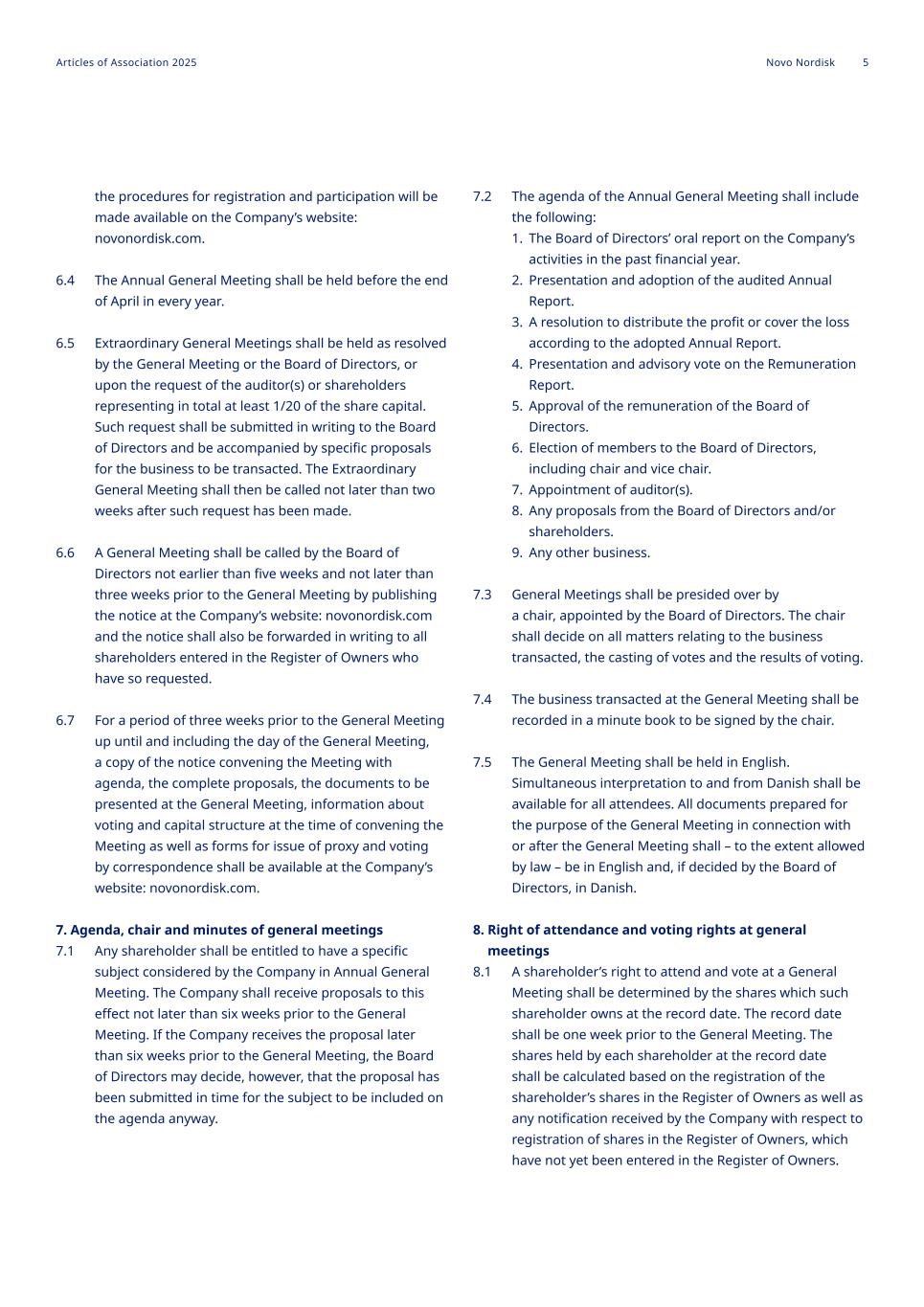
the procedures for registration and participation will be made available on the Company’s website: novonordisk.com. 6.4 The Annual General Meeting shall be held before the end of April in every year. 6.5 Extraordinary General Meetings shall be held as resolved by the General Meeting or the Board of Directors, or upon the request of the auditor(s) or shareholders representing in total at least 1/20 of the share capital. Such request shall be submitted in writing to the Board of Directors and be accompanied by specific proposals for the business to be transacted. The Extraordinary General Meeting shall then be called not later than two weeks after such request has been made. 6.6 A General Meeting shall be called by the Board of Directors not earlier than five weeks and not later than three weeks prior to the General Meeting by publishing the notice at the Company’s website: novonordisk.com and the notice shall also be forwarded in writing to all shareholders entered in the Register of Owners who have so requested. 6.7 For a period of three weeks prior to the General Meeting up until and including the day of the General Meeting, a copy of the notice convening the Meeting with agenda, the complete proposals, the documents to be presented at the General Meeting, information about voting and capital structure at the time of convening the Meeting as well as forms for issue of proxy and voting by correspondence shall be available at the Company’s website: novonordisk.com. 7. Agenda, chair and minutes of general meetings 7.1 Any shareholder shall be entitled to have a specific subject considered by the Company in Annual General Meeting. The Company shall receive proposals to this effect not later than six weeks prior to the General Meeting. If the Company receives the proposal later than six weeks prior to the General Meeting, the Board of Directors may decide, however, that the proposal has been submitted in time for the subject to be included on the agenda anyway. 7.2 The agenda of the Annual General Meeting shall include the following: 1. The Board of Directors’ oral report on the Company’s activities in the past financial year. 2. Presentation and adoption of the audited Annual Report. 3. A resolution to distribute the profit or cover the loss according to the adopted Annual Report. 4. Presentation and advisory vote on the Remuneration Report. 5. Approval of the remuneration of the Board of Directors. 6. Election of members to the Board of Directors, including chair and vice chair. 7. Appointment of auditor(s). 8. Any proposals from the Board of Directors and/or shareholders. 9. Any other business. 7.3 General Meetings shall be presided over by a chair, appointed by the Board of Directors. The chair shall decide on all matters relating to the business transacted, the casting of votes and the results of voting. 7.4 The business transacted at the General Meeting shall be recorded in a minute book to be signed by the chair. 7.5 The General Meeting shall be held in English. Simultaneous interpretation to and from Danish shall be available for all attendees. All documents prepared for the purpose of the General Meeting in connection with or after the General Meeting shall – to the extent allowed by law – be in English and, if decided by the Board of Directors, in Danish. 8. Right of attendance and voting rights at general meetings 8.1 A shareholder’s right to attend and vote at a General Meeting shall be determined by the shares which such shareholder owns at the record date. The record date shall be one week prior to the General Meeting. The shares held by each shareholder at the record date shall be calculated based on the registration of the shareholder’s shares in the Register of Owners as well as any notification received by the Company with respect to registration of shares in the Register of Owners, which have not yet been entered in the Register of Owners. Articles of Association 2025 Novo Nordisk 5
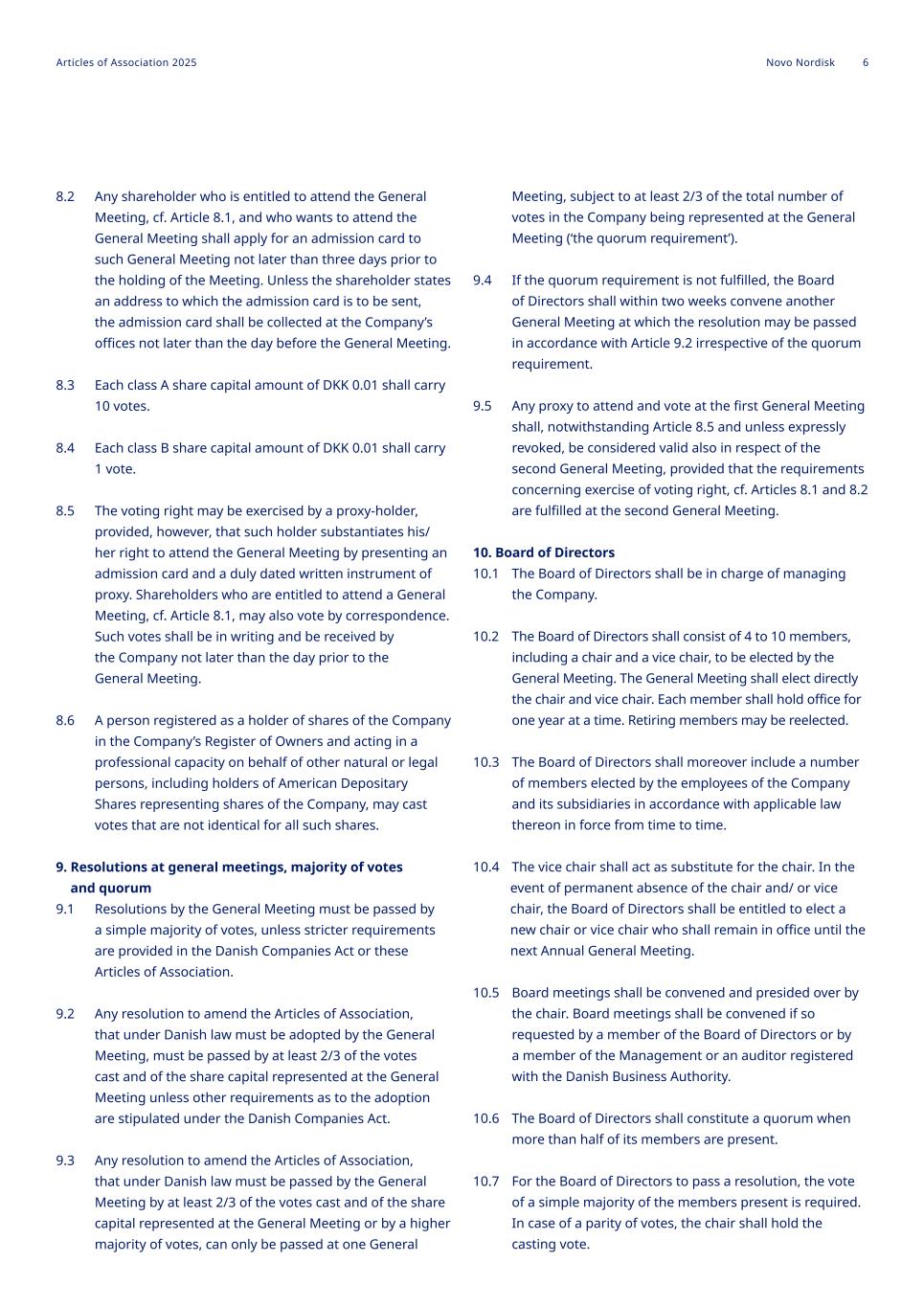
8.2 Any shareholder who is entitled to attend the General Meeting, cf. Article 8.1, and who wants to attend the General Meeting shall apply for an admission card to such General Meeting not later than three days prior to the holding of the Meeting. Unless the shareholder states an address to which the admission card is to be sent, the admission card shall be collected at the Company’s offices not later than the day before the General Meeting. 8.3 Each class A share capital amount of DKK 0.01 shall carry 10 votes. 8.4 Each class B share capital amount of DKK 0.01 shall carry 1 vote. 8.5 The voting right may be exercised by a proxy-holder, provided, however, that such holder substantiates his/ her right to attend the General Meeting by presenting an admission card and a duly dated written instrument of proxy. Shareholders who are entitled to attend a General Meeting, cf. Article 8.1, may also vote by correspondence. Such votes shall be in writing and be received by the Company not later than the day prior to the General Meeting. 8.6 A person registered as a holder of shares of the Company in the Company’s Register of Owners and acting in a professional capacity on behalf of other natural or legal persons, including holders of American Depositary Shares representing shares of the Company, may cast votes that are not identical for all such shares. 9. Resolutions at general meetings, majority of votes and quorum 9.1 Resolutions by the General Meeting must be passed by a simple majority of votes, unless stricter requirements are provided in the Danish Companies Act or these Articles of Association. 9.2 Any resolution to amend the Articles of Association, that under Danish law must be adopted by the General Meeting, must be passed by at least 2/3 of the votes cast and of the share capital represented at the General Meeting unless other requirements as to the adoption are stipulated under the Danish Companies Act. 9.3 Any resolution to amend the Articles of Association, that under Danish law must be passed by the General Meeting by at least 2/3 of the votes cast and of the share capital represented at the General Meeting or by a higher majority of votes, can only be passed at one General Meeting, subject to at least 2/3 of the total number of votes in the Company being represented at the General Meeting (‘the quorum requirement’). 9.4 If the quorum requirement is not fulfilled, the Board of Directors shall within two weeks convene another General Meeting at which the resolution may be passed in accordance with Article 9.2 irrespective of the quorum requirement. 9.5 Any proxy to attend and vote at the first General Meeting shall, notwithstanding Article 8.5 and unless expressly revoked, be considered valid also in respect of the second General Meeting, provided that the requirements concerning exercise of voting right, cf. Articles 8.1 and 8.2 are fulfilled at the second General Meeting. 10. Board of Directors 10.1 The Board of Directors shall be in charge of managing the Company. 10.2 The Board of Directors shall consist of 4 to 10 members, including a chair and a vice chair, to be elected by the General Meeting. The General Meeting shall elect directly the chair and vice chair. Each member shall hold office for one year at a time. Retiring members may be reelected. 10.3 The Board of Directors shall moreover include a number of members elected by the employees of the Company and its subsidiaries in accordance with applicable law thereon in force from time to time. 10.4 The vice chair shall act as substitute for the chair. In the event of permanent absence of the chair and/ or vice chair, the Board of Directors shall be entitled to elect a new chair or vice chair who shall remain in office until the next Annual General Meeting. 10.5 Board meetings shall be convened and presided over by the chair. Board meetings shall be convened if so requested by a member of the Board of Directors or by a member of the Management or an auditor registered with the Danish Business Authority. 10.6 The Board of Directors shall constitute a quorum when more than half of its members are present. 10.7 For the Board of Directors to pass a resolution, the vote of a simple majority of the members present is required. In case of a parity of votes, the chair shall hold the casting vote. Articles of Association 2025 Novo Nordisk 6
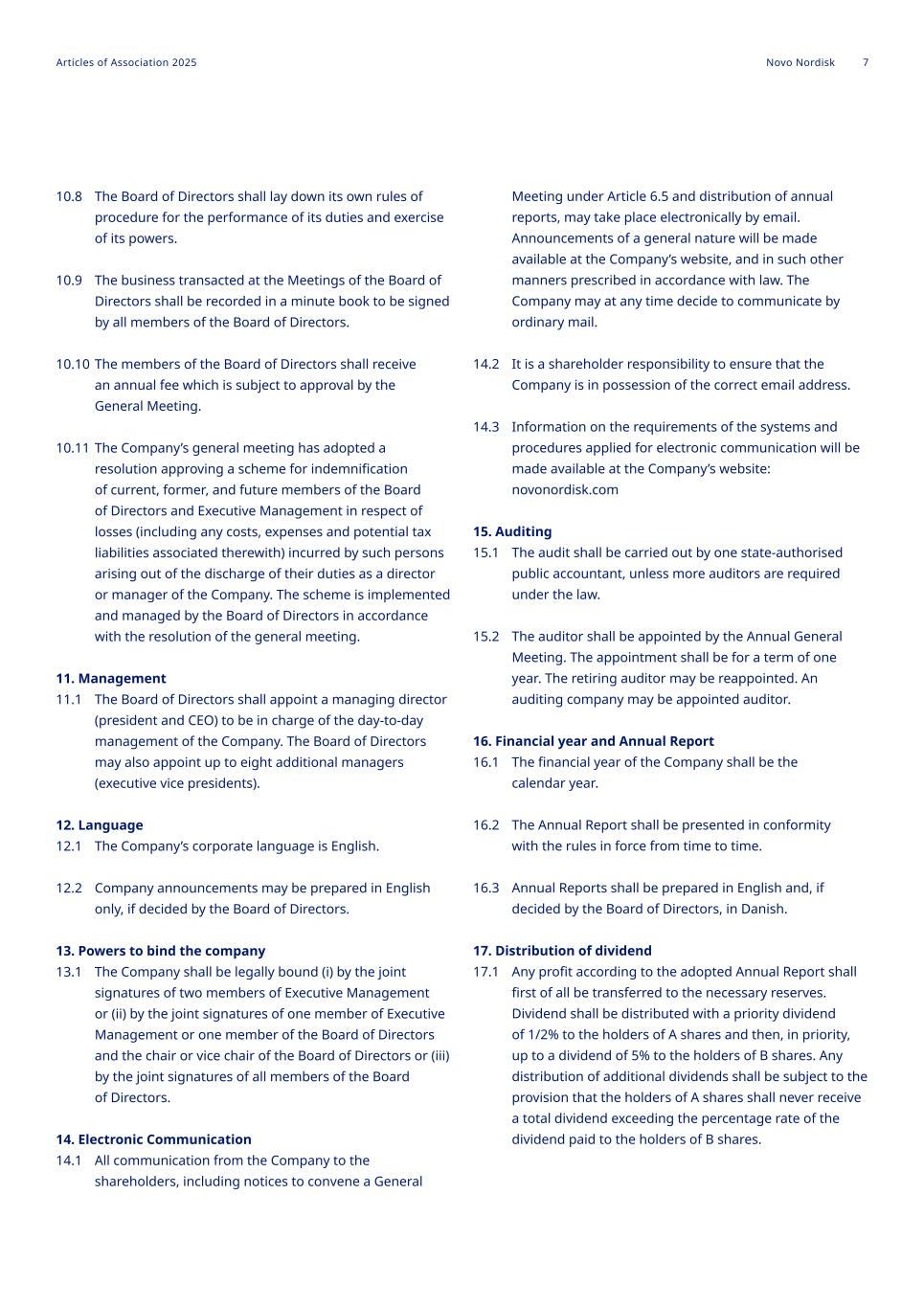
10.8 The Board of Directors shall lay down its own rules of procedure for the performance of its duties and exercise of its powers. 10.9 The business transacted at the Meetings of the Board of Directors shall be recorded in a minute book to be signed by all members of the Board of Directors. 10.10 The members of the Board of Directors shall receive an annual fee which is subject to approval by the General Meeting. 10.11 The Company’s general meeting has adopted a resolution approving a scheme for indemnification of current, former, and future members of the Board of Directors and Executive Management in respect of losses (including any costs, expenses and potential tax liabilities associated therewith) incurred by such persons arising out of the discharge of their duties as a director or manager of the Company. The scheme is implemented and managed by the Board of Directors in accordance with the resolution of the general meeting. 11. Management 11.1 The Board of Directors shall appoint a managing director (president and CEO) to be in charge of the day-to-day management of the Company. The Board of Directors may also appoint up to eight additional managers (executive vice presidents). 12. Language 12.1 The Company’s corporate language is English. 12.2 Company announcements may be prepared in English only, if decided by the Board of Directors. 13. Powers to bind the company 13.1 The Company shall be legally bound (i) by the joint signatures of two members of Executive Management or (ii) by the joint signatures of one member of Executive Management or one member of the Board of Directors and the chair or vice chair of the Board of Directors or (iii) by the joint signatures of all members of the Board of Directors. 14. Electronic Communication 14.1 All communication from the Company to the shareholders, including notices to convene a General Meeting under Article 6.5 and distribution of annual reports, may take place electronically by email. Announcements of a general nature will be made available at the Company’s website, and in such other manners prescribed in accordance with law. The Company may at any time decide to communicate by ordinary mail. 14.2 It is a shareholder responsibility to ensure that the Company is in possession of the correct email address. 14.3 Information on the requirements of the systems and procedures applied for electronic communication will be made available at the Company’s website: novonordisk.com 15. Auditing 15.1 The audit shall be carried out by one state-authorised public accountant, unless more auditors are required under the law. 15.2 The auditor shall be appointed by the Annual General Meeting. The appointment shall be for a term of one year. The retiring auditor may be reappointed. An auditing company may be appointed auditor. 16. Financial year and Annual Report 16.1 The financial year of the Company shall be the calendar year. 16.2 The Annual Report shall be presented in conformity with the rules in force from time to time. 16.3 Annual Reports shall be prepared in English and, if decided by the Board of Directors, in Danish. 17. Distribution of dividend 17.1 Any profit according to the adopted Annual Report shall first of all be transferred to the necessary reserves. Dividend shall be distributed with a priority dividend of 1/2% to the holders of A shares and then, in priority, up to a dividend of 5% to the holders of B shares. Any distribution of additional dividends shall be subject to the provision that the holders of A shares shall never receive a total dividend exceeding the percentage rate of the dividend paid to the holders of B shares. Articles of Association 2025 Novo Nordisk 7

17.2 Dividends on A shares shall be remitted to the shareholders at the addresses entered in the Company’s Register of Owners as at the date of the Annual General Meeting. Dividends on B shares shall be paid with fully discharging effect for the Company through a central securities depository and an account-holding bank to shareholders registered by the central securities depository at the time of payment. 17.3 The Board of Directors is authorised to distribute extraordinary dividends. 18. Dissolution 18.1 Unless otherwise provided by Danish law, any resolution for the dissolution of the Company must be passed by the General Meeting in accordance with the provisions on the amendment of the Articles of Association (Articles 9.2-9.4). Where a resolution to dissolve the Company is passed, such dissolution shall be effected by voluntary winding up proceedings. 18.2 When distributing the proceeds of the winding up proceedings, the B share capital shall be covered in priority at its nominal value, following which the A share capital shall be covered in the same manner. The holders of A and B shares shall subsequently rank equally in proportion to their nominal holdings in respect of further distributions. As amended on 27 March 2025 in accordance with the resolution made on the Annual General Meeting on 27 March 2025. This is a translation of the original Danish Articles of Association. In the event of any discrepancies the wording of the Danish language version shall prevail. Articles of Association 2025 Novo Nordisk 8
EX-2.1
3
exhibit21descriptionofther.htm
EX-2.1
Document
Exhibit 2.1
Description of the rights of ADRs registered under Section 12 of the Securities Exchange Act of 1934
B Shares
A. OFFER AND LISTING DETAILS
Novo Nordisk A/S (the “Company”) is a limited liability company organized under the laws of Denmark and registered with the Danish Business Authority under CVR number 24256790.
The Company has a total share capital of DKK 446,500,000, divided into an A share capital of nominally DKK 107,487,200 and a B share capital of nominally DKK 339,012,800. Each A share of DKK 0.10 carries 100 votes and each B share of DKK 0.10 carries 10 votes at General Meetings of the Company.
The Company’s B shares are listed in Denmark on Nasdaq Copenhagen, and traded under the symbol "NOVO-B" and on the New York Stock Exchange (“NYSE”) as American Depository Receipts (“ADRs”), traded under the symbol "NVO". Each of the Company’s A shares and B shares has been fully paid up and is registered, in the case of the A shares, on the Company's Register of Shareholders and, in the case of the B shares, by VP Securities, a central securities depositary in Denmark.
The A shares and the B shares have the rights, preferences and restrictions described below in “Memorandum and Articles of Association.”
B. MEMORANDUM AND ARTICLES OF ASSOCIATION
The following section summarizes certain material provisions of the Company’s Articles of Association, certain other constitutive documents and relevant Danish corporate law. For further information, see Exhibit 1.1 to this Form 20-F for a translation into the English language of the Articles of Association.
General
The Company’s objectives are to carry out research and development and to manufacture and commercialize pharmaceutical, medical and technical products and services as well as any other activity related thereto as determined by its Board of Directors. It strives to conduct its activities in a financially, environmentally and socially responsible way. The Company's objectives are set out in Article 2 of its Articles of Association.
Powers of the Board of Directors
All members of the Board of Directors have equal voting rights, and all resolutions are passed by a simple majority of votes. However, in the event of a tie, the Chair shall have the casting vote. The Board of Directors forms a quorum when at least a majority of its members is present.
According to the Danish Companies Act, no member of the Board of Directors or the Executive Management may take part in the consideration of any business involving agreements between any member of the Group and himself, legal actions brought against the individual, or any business involving agreements between any member of the Group and any third party or legal actions brought against any third party, if the individual has a major interest therein that might conflict with the Company’s interests. The Danish Companies Act also includes restrictions on the Company’s ability to grant loans or provide security to any member of the Board of Directors or anyone particularly close to such a member of the Board of Directors. The Company's ability to grant loans or provide security is subject to a number of conditions including shareholder approval or delegation of authorization to the Board of Directors by the General Meeting.
The remuneration of the Board of Directors must be approved by the Company’s shareholders at the Annual General Meeting.
Rights, restrictions and preferences attaching to the shares
If the shareholders at an Annual General Meeting approve a recommendation by the Board of Directors to pay dividends, dividends shall be distributed as follows: a priority dividend of 0.5% to the holders of A shares and then up to a dividend of 5% to the holders of B shares. Any distribution of additional dividends shall be subject to the provision that the holders of A shares shall never receive a total dividend exceeding the percentage rate of the dividend paid to the holders of B shares. A shares take priority for dividends below 0.5%. B shares take priority for dividends between 0.5% and 5%. However, in practice, A shares and B shares receive the same amount of dividends per share of DKK 0.01. Dividends on A shares shall be remitted to the shareholders at the addresses entered in the Company's Register of Shareholders as at the date of the Annual General Meeting. Dividends on B shares shall be paid with fully discharging effect for the Company through a central securities depository and an account-holding bank to shareholders registered by VP Securities at the time of payment.
The Board of Directors has been granted authority to distribute extraordinary dividends. This authority is included in the Articles of Association of the Company. Hence the Board of Directors has been granted authority to pay interim dividends without obtaining specific approval from the Annual General Meeting. Any Board resolution to pay extraordinary dividends must be accompanied by a balance sheet showing that sufficient funds are available for distribution. An authorized auditor must review the balance sheet.
1
|
|
|
|
|
|
|
Exhibit 2.1 2025 - Novo Nordisk |
Subject to the preference mechanism described above, the A shares and the B shares rank as equal in the event of a return on capital by the Company. Upon a winding-up, liquidation or otherwise, the B shares rank ahead of the A shares with regard to payment of each share’s nominal amount. All shares rank as equal in respect of further distributions from a winding-up.
Each A share of DKK 0.10 carries 100 votes and each B share of DKK 0.10 carries 10 votes at General Meetings. A shares are non-negotiable instruments whereas B shares are negotiable instruments.
The holders of A shares have a pro-rata right of first refusal with regard to any A shares sold by another shareholder. However, currently all A-shares are owned by Novo Holdings A/S and cannot be divested.
The share capital has been fully paid up and shareholders are not liable to further capital calls by the Company. No shareholder shall be obliged to have his shares redeemed in whole or in part. There is no sinking fund provision in the Articles of Association. There is no provision in the Articles of Association discriminating against any existing or prospective holder of such securities as a result of such shareholder owning a substantial number of shares. The members of the Board of Directors do not stand for reelection at staggered intervals and there is no cumulative voting arrangement.
Changes in shareholders’ rights
Changes in the rights of holders of A shares or B shares require an amendment of the Articles of Association. Unless stricter requirements are made under the Danish Companies Act for any such resolution to be passed, (i) at least 2/3 of the total number of votes in the Company shall be represented at the General Meeting, and (ii) at least 2/3 of the votes cast and of the voting share capital shall vote in favor of such a resolution. If the quorum requirement in (i) is not fulfilled, the Board of Directors shall within two weeks convene another General Meeting at which the resolution may be passed irrespective of the number of votes represented.
General Meetings
The Company’s General Meetings shall be held at a venue in the Capital Region of Denmark. Provided that certain conditions are met, as described in the Articles of Association and in the Danish companies act, the Board of Directors is authorized to resolve, when it considers it appropriate, that the General Meeting is held as a partially electronic or a fully electronic General Meeting. The Annual General Meeting shall be held before the end of April in every year. Extraordinary General Meetings shall be held as resolved by the General Meeting or the Board of Directors, or upon the request of the auditors or shareholders representing in total at least 5% of the share capital. The Extraordinary General Meeting shall then be called not later than two weeks after receipt of such request.
General Meetings shall be called by the Board of Directors not earlier than five weeks and not later than three weeks prior to the General Meeting. The notice calling such General Meeting, stating the agenda for the meeting, shall be published on the Company’s website: novonordisk.com (the contents of this website are not incorporated by reference into this Form 20-F). The notice convening the meeting shall also be forwarded by mail or email to all shareholders entered in the Register of Owners who have so requested.
A shareholder’s right to attend and vote at a General Meeting shall be determined by the shares or ADRs which such shareholder owns at the applicable record date. The Danish record date is one week prior to the General Meeting. Any shareholder who is entitled to attend the General Meeting is required to apply for an admission card to such General Meeting no later than three days prior to the date of such General Meeting. ADR holders who wish to attend the General Meeting in Denmark should contact Investor Relations, via e-mail to IRofficer@novonordisk.com.
The shares held by each shareholder at the Danish record date shall be calculated based on the registration of the shareholder’s shares in the Register of Owners as well as any notification received by the Company with respect to registration of shares in the Register of Owners, which have not yet been entered in the Register of Owners.
Ownership restrictions
Other than the Danish rules on screening of certain foreign direct investments ("FDI"), etc. in Denmark (the "Danish FDI Rules") and applicable international trade and financial sanctions as outlined below, (i) there are no governmental laws, decrees, or regulations in Denmark (including, but not limited to, foreign exchange controls) that restrict the export or import of capital, or that affect the remittance of dividends, interest or other payments to non-resident holders of the B shares or the ADRs, and (ii) there are no limitations on the right of non-resident or foreign owners to hold or vote the B shares or the ADRs imposed by the laws of Denmark or the Articles of Association of the Company or any other of its constituent documents.
Under the Danish FDI Rules, a screening mechanism applies to foreign direct investments in certain sensitive sectors, if the foreign investor obtains at least 10% ownership or voting rights, or equivalent control by other means. Among such sensitive sectors are companies and entities within critical infrastructure in Denmark that are necessary to maintain or restore the production, registration, distribution, and monitoring of prescription drugs. If a contemplated foreign direct investment in Novo Nordisk A/S is considered to fall within the scope of the mandatory screening mechanism, the foreign investor is required to apply for prior authorization with the Danish Business Authority. FDI filings, notifications or approvals may under certain circumstances also be required in non-Danish jurisdictions.
If a foreign investor fails to comply with the Danish FDI Rules, the Danish Business Authority may impose restrictions, inter alia, ordering a reversal of the investment or suspending the foreign investor's voting rights.
International trade and financial sanctions are continually evolving. If applicable, such international trade and financial sanctions may under certain circumstances prevent the possibility of export and import of capital, and affect the remittance of dividends, interest and other payments to the non-resident holders of the B shares or the ADRs. In addition, international trade and financial sanctions may also restrict the rights to acquire, transfer, hold or vote the B shares and ADRs. Failure to comply with international trade and financial sanctions can lead to criminal and civil liability.
2
|
|
|
|
|
|
|
Exhibit 2.1 2025 - Novo Nordisk |
Change of control
There is no provision in the Articles of Association, nor any other constituent document, that would have an effect of delaying, deferring or preventing a change in control of the Company and that would operate only with respect to a merger, acquisition or corporate restructuring involving the Company (or any of its subsidiaries). However, based on the current shareholder structure, the voting rights held by holders of A shares outlined above afford the Novo Nordisk Foundation, acting through its wholly-owned subsidiary Novo Holdings A/S, to have veto power against any change of control.
Ownership disclosure
According to the Danish Capital Markets Act and the Danish Companies Act, shareholders of the Company must notify the Danish Financial Supervisory Authority and the Company of their ownership if they own 5% or more of the voting rights or share capital. Also, shareholders must notify changes in holdings if thresholds of 5%, 10%, 15%, 20%, 25%, 50%, 90% or 100% and 1/3 and 2/3 of the voting rights or share capital are crossed.
Changes in capital
The Company’s Articles of Association do not contain conditions governing changes in the capital more stringent than those contained in the Danish Companies Act.
American Depositary Shares
The Company’s American Depositary Receipts (“ADR”) program is administered by J.P. Morgan Depositary Receipts Group, JPMorgan Chase Bank, N.A., 383 Madison Avenue, Floor 11, New York, NY 10179, United States (the “Depositary”). ADRs evidence American Depositary Shares (“ADSs”) issuable by the Depositary pursuant to the terms of the Amended and Restated Deposit Agreement (the “Deposit Agreement”), the form of which is attached as an exhibit to the registration statement on Form F-6 filed by the Company with the U.S. Securities and Exchange Commission (the “SEC”) on March 2, 2017 (File No. 333-192740). Each ADS currently represents one deposited Novo Nordisk B share. The ADS to share ratio is subject to amendment as provided in the form of ADR (which may give rise to fees contemplated by the form of ADR, which is attached to the Deposit Agreement). In the future, each ADS will also represent any securities, cash or other property deposited with the Depositary but which has not been distributed directly to ADS holders (together with any deposited shares, the “Deposited Securities”).
For the purposes of the following description, “Holders” refers to the registered ADS holders. ADSs may be held either directly or indirectly through a broker or other financial institution. If an ADS holder holds their ADSs directly, they will be a registered ADS holder. If an ADS is held indirectly, the relevant holder must rely on the procedures of their broker or other financial institution to assert the rights of ADS holders described below. Such holders should consult with their broker or financial institution to find out what those procedures are.
A. SHARE DIVIDENDS AND OTHER DISTRIBUTIONS
The Company may make various types of distributions with respect to its securities. To the extent practicable, the Depositary will deliver such distributions to each Holder entitled thereto, in proportion to their interests, on the record date set by the Depositary, in the following manner:
•Cash. The Depositary will distribute any U.S. dollars available to it resulting from a cash dividend or other cash distribution or the net proceeds of sales of any other distribution or portion thereof on an averaged or other practicable basis, subject to (i) appropriate adjustments for taxes withheld, (ii) such distribution being impermissible or impracticable with respect to certain Holders, and (iii) deduction of the Depositary's and/or its agents' fees and expenses in (1) converting any foreign currency to U.S. dollars by sale or in such other manner as the Depositary may determine to the extent that it determines that such conversion may be made on a reasonable basis, (2) transferring foreign currency or U.S. dollars to the United States by such means as the Depositary may determine to the extent that it determines that such transfer may be made on a reasonable basis, (3) obtaining any approval or license of any governmental authority required for such conversion or transfer, which is obtainable at a reasonable cost and within a reasonable time and (4) making any sale by public or private means in any commercially reasonable manner.
•Shares. In the case of a distribution in shares, the Depositary will issue the number of ADSs representing such shares. Only whole ADSs will be issued. Any shares which would result in fractional ADSs will be sold and the net proceeds will be distributed in the same manner as cash to the ADR holders entitled thereto.
•Rights. The Depositary will distribute warrants or other instruments in the discretion of the Depositary representing rights to acquire additional ADRs in respect of any rights to subscribe for additional shares or rights of any nature available to the Depositary as a result of a distribution on Deposited Securities, to the extent that the Company timely furnishes to the Depositary evidence satisfactory to the Depositary that the Depositary may lawfully distribute the same (the Company has no obligation to so furnish such evidence). However, to the extent the Company does not timely furnish such evidence, the Depositary may:
i. sell such rights if practicable and distribute the net proceeds from the sale of such rights in the same manner as cash; or
ii. if it is not practicable to sell the rights by reason of the non-transferability of such rights, limited markets therefor, their short duration or otherwise, do nothing (and allow such rights to lapse).
•Other Distributions. In the case of a distribution of securities or property other than those described above, the Depositary may either (i) distribute such securities or property in any manner it deems equitable and practicable or (ii) to the extent the Depositary deems distribution of such securities or property not to be equitable and practicable, sell such securities or property and distribute the net proceeds in the same way it distributes cash.
3
|
|
|
|
|
|
|
Exhibit 2.1 2025 - Novo Nordisk |
To the extent that any of the Deposited Securities is not or shall not be entitled, by reason of its date of issuance, or otherwise, to receive the full amount of any cash dividend, distribution, or net proceeds of sales as contemplated by clause (a) of the prior paragraph, the Depositary shall make appropriate adjustments in the amounts distributed to the Holders issued in respect of such Deposited Securities. To the extent the Company or the Depositary shall be required to withhold and does withhold from any cash dividend, distribution or net proceeds from sales in respect of any Deposited Securities an amount on account of taxes, the amount distributed on the ADSs issued in respect of such Deposited Securities shall be reduced accordingly.
To the extent the Depositary determines in its discretion that it would not be permitted by applicable law, rule or regulation, or it would not otherwise be practicable, to convert foreign currency into U.S. dollars and/or distribute such U.S. dollars to any or all of the Holders entitled thereto, the Depositary may in its discretion distribute some or all of the foreign currency received by the Depositary as it deems permissible and practicable to, or retain and hold such foreign currency uninvested and without liability for interest thereon for the respective accounts of, the Holders entitled to receive the same.
To the extent that the Depositary determines in its discretion that any distribution pursuant to the above would not be permissible by applicable law, rule or regulation, or is not otherwise practicable with respect to any or all Holders, the Depositary may in its discretion make such distribution as it so deems permissible and practicable, including the distribution of some or all of any cash, foreign currency, securities or other property (or appropriate documents evidencing the right to receive some or all of any such cash, foreign currency, securities or other property), and/or the Depositary may retain and hold some or all of such cash, foreign currency, securities or other property as Deposited Securities with respect to the applicable Holders’ ADRs (without liability for interest thereon or the investment thereof).
To the extent the Depositary retains and holds any cash, foreign currency, securities or other property, any and all fees, charges and expenses related to, or arising from, the holding thereof (including, but not limited to those provided in any ADR) shall be paid from such cash, foreign currency, securities or other property, or the net proceeds from the sale thereof, thereby reducing the amount so held.
The Depositary is not responsible if it fails to determine that any distribution or action is lawful or reasonably practicable.
There can be no assurance that the Depositary will be able to convert any currency at a specified exchange rate or sell any property, rights, shares or other securities at a specified price, nor that any of such transactions can be completed within a specified time period.
The Depositary reserves the right to utilize a division, branch or affiliate of the Depositary to direct, manage and/or execute any public and/or private sale of securities and/or property under the Deposit Agreement. Such division, branch and/or affiliate may charge the Depositary a fee in connection with such sales, which fee is considered an expense of the Depositary. All purchases and sales of securities will be handled by the Depositary in accordance with its then current policies, which are currently set forth on the “Disclosures” page (or successor page) of ADR.com, the location and contents of which the Depositary shall be solely responsible for.
B. ISSUANCE, WITHDRAWAL AND CANCELLATION
Upon each deposit of shares or evidence of rights to receive shares, receipt of related delivery documentation and compliance with the other provisions of the Deposit Agreement, including the payment of the fees and charges of the Depositary and any taxes or other fees or charges owing, the Depositary will issue an ADR or ADRs in the name or upon the order of the person entitled thereto evidencing the number of ADSs to which such person is entitled. Shares deposited must be accompanied by certain delivery documentation and shall, at the time of such deposit, be registered in the name of JPMorgan Chase Bank, N.A., as depositary for the benefit of holders of ADRs or in such other name as the Depositary shall direct. All of the ADSs issued will, unless specifically requested to the contrary, be part of the Depositary's direct registration system, and a registered holder will receive periodic statements from the Depositary which will show the number of ADSs registered in such holder's name. An ADR holder can request that the ADSs not be held through the Depositary's direct registration system and that a certificated ADR be issued.
In its capacity as Depositary, the Depositary shall not lend shares or ADSs.
Upon surrender for cancellation of (i) a certificated ADR in form satisfactory to the Depositary at the Depositary’s office or (ii) proper instructions and documentation in the case of a direct registration ADR, the Depositary will, upon payment of certain applicable fees, charges and taxes, deliver the underlying shares to the Holder or upon the Holder’s written order. Delivery of deposited securities in certificated form will be made at the custodian's office. At the Holder’s risk, expense and request, the Depositary may deliver deposited securities at such other place as the Holder may request.
C. TRANSFER
ADRs are transferable on the ADR register and may be split into other ADRs or combined with other ADRs into one ADR, evidencing the aggregate number of ADSs surrendered for split-up or combination, by the Holder thereof or by duly authorized attorney upon surrender of the relevant ADR upon delivery to the Depositary of proper instruments of transfer and duly stamped as may be required by applicable law; provided that the Depositary may close the ADR register at any time or from time to time when deemed expedient by it or, in the case of the issuance book portion of the ADR register, when reasonably requested by the Company solely in order to enable the Company to comply with applicable law. At the request of a Holder, the Depositary shall, for the purpose of substituting a certificated ADR with a direct registration ADR, or vice versa, execute and deliver a certificated ADR or a direct registration ADR, as the case may be, for any authorized number of ADSs requested, evidencing the same aggregate number of ADSs as those evidenced by the certificated ADR or direct registration ADR, as the case may be, substituted.
D. RECORD DATES
The Depositary may fix a record date (which, to the extent applicable, shall be as near as practicable to any corresponding record dates set by the Company) for the determination of the Holders who shall be entitled or obligated:
4
|
|
|
|
|
|
|
Exhibit 2.1 2025 - Novo Nordisk |
•to receive any distribution on or in respect of Deposited Securities;
•to give instructions for the exercise of any voting rights;
•to pay the fee assessed by the Depositary for administration of the ADR program and for any expenses as provided for in the ADR;
•to receive any notice or to act in respect of other matters, all subject to the provisions of the Deposit Agreement.
E. VOTING RIGHTS
As soon as practicable after receipt of notice of any meeting at which the holders of Shares are entitled to vote, or of solicitation of consents or proxies from holders of shares or Deposited Securities, the Depositary shall fix the ADS record date provided that if the Depositary receives a written request from the Company in a timely manner and at least thirty (30 days) prior to the date of such vote or meeting, the Depositary shall, at the Company’s expense, distribute to Holders a notice stating (i) such information as contained in such notice and any solicitation materials, (ii) that each Holder on the record date set by the Depositary will, subject to any applicable provisions of the laws of Denmark, be entitled to instruct the Depositary as to the exercise of the voting rights, if any, pertaining to the Deposited Securities represented by the ADSs evidenced by such Holder's ADRs and (iii) the manner in which such instructions may be given or deemed as provided below, including instructions for giving a discretionary proxy to a person designated by the Company.
Each Holder shall be solely responsible for the forwarding of Voting Notices to the beneficial owners of ADSs registered in such Holder’s name. Following actual receipt by the ADR department responsible for proxies and voting of Holders’ instructions (including, without limitation, instructions of any entity or entities acting on behalf of the nominee for DTC), the Depositary shall, in the manner and on or before the date established by the Depositary for such purpose, endeavor to vote or cause to be voted the Deposited Securities represented by the ADSs evidenced by such Holders' ADRs in accordance with such instructions. The Depositary will not itself exercise any voting discretion in respect of any Deposited Securities. If the Depositary timely receives voting instructions from a Holder which fail to specify the manner in which the Depositary is to vote the Deposited Securities represented by such Holder's ADSs, the Depositary will deem such Holder (unless otherwise specified in the notice distributed to Holders) to have instructed the Depositary to vote in favor of the items set forth in such voting instructions. Deposited Securities represented by ADSs for which no timely voting instructions are received by the Depositary from the Holder shall not be voted.
There is no guarantee that Holders generally or any Holder in particular will receive the notice described above with sufficient time to enable such Holder to return any voting instructions to the Depositary in a timely manner.
Notwithstanding anything contained in the Deposit Agreement or any ADR, the Depositary may, to the extent not prohibited by law or regulations, or by the requirement of the stock exchange on which the ADSs are listed, in lieu of distribution of the materials provided to the Depositary in connection with any meeting of, or solicitation of consents or proxies from, Holders, distribute to the Holders a notice that provides Holders with, or otherwise publicizes to Holders, instructions on how to retrieve such materials or receive such materials upon request (i.e., by reference to a website containing the materials for retrieval or a contact for requesting copies of the materials). Holders are strongly encouraged to forward their voting instructions as soon as possible. Voting instructions will not be deemed received until such time as the ADR department responsible for proxies and voting has received such instructions, notwithstanding that such instructions may have been physically received by the Depositary prior to such time.
F. REPORTS AND OTHER COMMUNICATIONS
The Depositary will make available for inspection by Holders at the offices of the Depositary and of the custodian the Deposit Agreement, the provisions of or governing Deposited Securities, and any written communications from the Company, which are both received by the custodian or its nominee as a holder of Deposited Securities and made generally available to the holders of Deposited Securities.
Additionally, the Depositary will distribute copies of such communications (or English translations or summaries thereof) to Holders when furnished by the Company.
G. FEES AND EXPENSES
The Depositary may charge, and collect from, (i) each person to whom ADSs are issued, including, without limitation, issuances against deposits of shares, issuances in respect of share distributions, rights and other distributions, issuances pursuant to a stock dividend or stock split declared by the Company or issuances pursuant to a merger, exchange of securities or any other transaction or event affecting the ADSs or Deposited Securities, and (ii) each person surrendering ADSs for withdrawal of Deposited Securities or whose ADSs are cancelled or reduced for any other reason, a fee of up to U.S. $5.00 for each 100 ADSs (or portion thereof) issued, delivered, reduced, cancelled or surrendered, or upon which a share distribution or elective distribution is made or offered (as the case may be). The Depositary may sell (by public or private sale) sufficient securities and property received in respect of a share distribution, rights and/or other distribution prior to such deposit to pay such charge.
The following additional fees, charges and expenses shall also be incurred by the Holders, the beneficial owners, by any party depositing or withdrawing shares or by any party surrendering ADSs and/or to whom ADSs are issued (including, without limitation, issuances pursuant to a stock dividend or stock split declared by the Company or an exchange of stock regarding the ADSs or the Deposited Securities or a distribution of ADSs), whichever is applicable:
•a fee of U.S. $0.05 or less per ADS for any cash distribution made, or for any elective cash/stock dividend offered, pursuant to the Deposit Agreement;
•a fee of up to U.S.$0.05 per ADS held for the direct or indirect distribution of securities (other than ADSs or rights to purchase additional ADSs or the net cash proceeds from the public or private sale of any such securities, regardless of whether any such distribution and/or sale is made by, for, or received from, or (in each case) on behalf of, the Depositary,
5
|
|
|
|
|
|
|
Exhibit 2.1 2025 - Novo Nordisk |
the Company and/or any third party (which fee may be assessed against Holders as of a record date set by the Depositary),
•an aggregate fee of up to U.S. $0.05 per ADS per calendar year (or portion thereof) for services performed by the Depositary in administering the ADRs (which fee may be charged on a periodic basis during each calendar year and shall be assessed against Holders as of the record date or record dates set by the Depositary during each calendar year and shall be payable at the sole discretion of the Depositary by billing such Holders or by deducting such charge from one or more cash dividends or other cash distributions;
•an amount for the reimbursement of such charges and expenses as are incurred by the Depositary and/or any of its agents (including, without limitation, the custodian as well as charges and expenses incurred on behalf of Holders in connection with compliance with foreign exchange control regulations or any law or regulation relating to foreign investment) in connection with the servicing of the shares or other Deposited Securities, the sale of securities (including, without limitation, deposited securities), the delivery of Deposited Securities or otherwise in connection with the Depositary's or its custodian's compliance with applicable law, rule or regulation (which charges and expenses may be assessed on a proportionate basis against Holders as of the record date or dates set by the Depositary and shall be payable at the sole discretion of the Depositary by billing such Holders or by deducting such charge or expense from one or more cash dividends or other cash distributions); and
•a fee for the distribution of securities or the sale of securities in connection with a distribution, such fee being in an amount equal to the fee for the execution and delivery of ADSs which would have been charged as a result of the deposit of such securities (treating all such securities as if they were shares) but which securities or the net cash proceeds from the sale thereof are instead distributed by the Depositary to those Holders entitled thereto;
The Company will pay all other fees, charges and expenses of the Depositary and any agent of the Depositary (except the custodian) pursuant to agreements from time to time between the Company and the Depositary, except:
•stock transfer or other taxes and other governmental charges (which are payable by Holders or persons depositing shares);
•a transaction fee per cancellation request (including any cancellation request made through SWIFT, facsimile transmission or any other method of communication) as disclosed on the "Disclosures" page (or successor page) of www.adr.com (as updated by the Depositary from time to time, "ADR.com") and any applicable delivery expenses (which are payable by such persons or Holders); and
•transfer or registration expenses for the registration of transfer of Deposited Securities on any applicable register in connection with the deposit or withdrawal of Deposited Securities (which are payable by persons depositing shares or Holders withdrawing Deposited Securities).
To facilitate the administration of various depositary receipt transactions, including disbursement of dividends or other cash distributions and other corporate actions, the Depositary may engage the foreign exchange desk within JPMorgan Chase Bank, N.A. (the “Bank”) and/or its affiliates in order to enter into spot foreign exchange transactions to convert foreign currency into U.S. dollars (“FX Transactions”). For certain currencies, FX Transactions are entered into with the Bank or an affiliate, as the case may be, acting in a principal capacity. For other currencies, FX Transactions are routed directly to and managed by an unaffiliated local custodian (or other third-party local liquidity provider), and neither the Bank nor any of its affiliates is a party to such FX Transactions.
The foreign exchange rate applied to an FX Transaction will be either (i) a published benchmark rate, or (ii) a rate determined by a third-party local liquidity provider, in each case plus or minus a spread, as applicable. The Depositary will disclose which foreign exchange rate and spread, if any, apply to such currency on the "Disclosures" page (or successor page) of ADR.com. Such applicable foreign exchange rate and spread may (and neither the Depositary, the Bank nor any of their affiliates is under any obligation to ensure that such rate does not) differ from rates and spreads at which comparable transactions are entered into with other customers or the range of foreign exchange rates and spreads at which the Bank or any of its affiliates enters into foreign exchange transactions in the relevant currency pair on the date of the FX Transaction. Additionally, the timing of execution of an FX Transaction varies according to local market dynamics, which may include regulatory requirements, market hours and liquidity in the foreign exchange market or other factors. Furthermore, the Bank and its affiliates may manage the associated risks of their position in the market in a manner they deem appropriate without regard to the impact of such activities on the Company, the Depositary, Holders or beneficial owners. The spread applied does not reflect any gains or losses that may be earned or incurred by the Bank and its affiliates as a result of risk management or other hedging related activity.
Notwithstanding the foregoing, to the extent the Company provides U.S. dollars to the Depositary, neither the Bank nor any of its affiliates will execute an FX Transaction as set forth herein. In such case, the Depositary will distribute the U.S. dollars received from the Company. Further details relating to the applicable foreign exchange rate, the applicable spread and the execution of FX Transactions will be provided by the Depositary on ADR.com. The Company, Holders and beneficial owners each acknowledge and agree that the terms applicable to FX Transactions disclosed from time to time on ADR.com will apply to any FX Transaction executed pursuant to the Deposit Agreement.
The right of the Depositary to charge and receive payment of fees, charges and expenses survives the termination of the Deposit Agreement, and shall extend for those fees, charges and expenses incurred prior to the effectiveness of any resignation or removal of the Depositary.
The Depositary anticipates reimbursing the Company for certain expenses incurred by the Company that are related to the establishment and maintenance of the ADR program upon such terms and conditions as the Company and the Depositary may agree from time to time. The Depositary may make available to the Company a set amount or a portion of the depositary fees charged in respect of the ADR program or otherwise upon such terms and conditions as the Company and the Depositary may agree from time to time. The Depositary may agree to reduce or waive certain fees, charges and expenses, including, without
6
|
|
|
|
|
|
|
Exhibit 2.1 2025 - Novo Nordisk |
limitation, those described herein that would normally be charged on ADSs issued to or at the direction of, or otherwise held by, the Company and/or certain Holders and beneficial owners and holders and beneficial owners of shares of the Company.
H. TAXES
Holders must pay any tax or other governmental charge payable by the custodian or the Depositary on any ADS or ADR, Deposited Security or distribution. If any tax or other governmental charges (including any penalties and/or interest) shall become payable by or on behalf of the custodian or the Depositary with respect to any ADR, any Deposited Securities represented by the ADSs evidenced thereby or any distribution thereon, such tax or other governmental charge shall be paid by the Holder hereof to the Depositary and by holding, or having held, an ADR the Holder and all prior Holders thereof jointly and severally agree to indemnify, defend and save harmless each of the Depositary and its agents in respect thereof. The Depositary may also refuse to effect any registration, registration of transfer, split-up or combination of any ADR, or any withdrawal of Deposited Securities, until such payment is made.
If the Depositary determines that any distribution in property other than cash (including shares or rights) on Deposited Securities is subject to any tax that the Depositary or the custodian is obligated to withhold, the Depositary may dispose of all or a portion of such property in such amounts and in such manner as the Depositary deems necessary and practicable to pay such taxes, by public or private sale, and the Depositary shall distribute the net proceeds of any such sale or the balance of any such property after deduction of such taxes to the Holders entitled thereto.
Holders of any ADR or any interest therein, agree to indemnify the Company, the Depositary, the custodian and any of their respective directors, employees, agents and affiliates against, and hold each of them harmless from, any claims by any governmental authority with respect to taxes, additions to tax, penalties or interest arising out of any refund of taxes, reduced rate of withholding at source or other tax benefit obtained.
I. RECLASSIFICATIONS, RECAPITALIZATIONS AND MERGERS
In the event of changes affecting the Deposited Securities, including (i) any change in par value, split-up, consolidation, cancellation or other reclassification of Deposited Securities, (ii) any distributions of shares or other property not made to Holders or (iii) any recapitalization, reorganization, merger, consolidation, liquidation, receivership, bankruptcy or sale of all or substantially all the assets of the Company, then the Depositary may in its discretion:
•amend the form of ADR;
•distribute additional or amended ADRs;
•distribute cash, securities or other property received by it in connection with such actions;
•sell any securities or property received and distribute the proceed as cash; or
•choose to do none of the above.
If the depositary chooses not to take any of the above actions, any of the cash, securities or other property it receives will constitute a part of the Deposited Securities and each ADS will then represent a proportionate interest in such property.
J. AMENDMENT AND TERMINATION
The ADRs and the Deposit Agreement may be amended by the Company and the Depositary, provided that any amendment that imposes or increases any fees, charges or expenses (other than stock transfer or other taxes and other governmental charges, transfer or registration fees, the transaction fee per cancellation request (including any cancellation request made through SWIFT, facsimile transmission, or any other method of communication, applicable delivery expenses, or other such fees, charges or expenses,) or that shall otherwise prejudice any substantial existing right of Holders or beneficial owners, shall become effective thirty (30) days after notice of such amendment shall have been given to the Holders. If an ADR holder continues to hold an ADR or ADRs after being so notified, such ADR holder shall be deemed, by continuing to hold such ADR, to consent and agree to such amendment and to be bound by the Deposit Agreement as amended thereby. In no event shall any amendment impair the right of any ADR holder to surrender such ADR and receive the Deposited Securities represented thereby, except in order to comply with mandatory provisions of applicable law.
Any amendments or supplements which (i) are reasonably necessary (as agreed by the Company and the Depositary) in order for (a) the ADSs to be registered on Form F-6 under the Securities Act of 1933 or (b) the ADSs or shares to be traded solely in electronic book-entry form and (ii) do not in either such case impose or increase any fees or charges to be borne by Holders, shall be deemed not to prejudice any substantial rights of Holders. Notwithstanding the foregoing, if any governmental body or regulatory body should adopt new laws, rules or regulations which would require amendment or supplement of the Deposit Agreement or the form of ADR to ensure compliance therewith, we and the Depositary may amend or supplement the Deposit Agreement and the ADR at any time in accordance with such changed laws, rules or regulations. Such amendment or supplement to the Deposit Agreement in such circumstances may become effective before a notice of such amendment or supplement is given to Holders or within any other period of time as required for compliance.
Notice of any amendment to the Deposit Agreement or form of ADRs shall not need to describe in detail the specific amendments effectuated thereby, and failure to describe the specific amendments in any such notice shall not render such notice invalid, provided, however, that, in each such case, the notice given to the Holders identifies a means for Holders to retrieve or receive the text of such amendment (i.e., upon retrieval from the SEC's website or upon request from the Depositary).
The Depositary may, and shall at the Company’s written direction, terminate the Deposit Agreement and the ADRs by mailing notice of such termination to the Holders at least 30 days prior to the date fixed in such notice for such termination; provided, however, if the Depositary shall have (i) resigned as depositary under the Deposit Agreement, notice of such termination by the
7
|
|
|
|
|
|
|
Exhibit 2.1 2025 - Novo Nordisk |
Depositary shall not be provided to Holders unless a successor depositary shall not be operating under the Deposit Agreement within 45 days of the date of such resignation, and (ii) been removed as depositary under the Deposit Agreement, notice of such termination by the Depositary shall not be provided to Holders unless a successor depositary shall not be operating under the Deposit Agreement on the 90th day after the Company’s notice of removal was first provided to the Depositary. Notwithstanding anything to the contrary herein, the Depositary may terminate the Deposit Agreement (a) without notice to the Company, but subject to giving 30 days' notice to the Holders, under the following circumstances: (w) in the event of the Company's bankruptcy or insolvency, (x) if the Shares cease to be listed on an internationally recognized stock exchange, (y) if the Company effects (or will effect) a redemption of all or substantially all of the Deposited Securities, or a cash or share distribution representing a return of all or substantially all of the value of the Deposited Securities, or (z) there occurs a merger, consolidation, sale of assets or other transaction as a result of which securities or other property are delivered in exchange for or in lieu of Deposited Securities, and (b) immediately without prior notice to the Company, any Holder or beneficial owner or any other person if required by any law, rule or regulation or any governmental authority or body, or the Depositary would be subject to liability under or pursuant to any law, rule or regulation, or by any governmental authority or body, in each case as determined by the Depositary in its reasonable discretion.
After the date so fixed for termination, the Depositary and its agents will perform no further acts under the Deposit Agreement or the ADRs, except to receive and hold (or sell) distributions on Deposited Securities and deliver Deposited Securities being withdrawn. As soon as practicable after the expiration of six months from the date so fixed for termination, the Depositary shall sell the Deposited Securities and shall thereafter (as long as it may lawfully do so) hold in a segregated account the net proceeds of such sales, together with any other cash then held by it under the Deposit Agreement, without liability for interest, in trust for the pro rata benefit of the Holders not theretofore surrendered. After making such sales, the Depositary shall be discharged from all obligations in respect of the Deposit Agreement and the ADRs, except to account for such net proceeds and other cash.
K. LIMITATIONS ON OBLIGATIONS AND LIABILITY
Prior to the issue, registration, registration of transfer, split-up, combination, or cancellation of any ADR, the delivery of any distribution in respect thereof, or the withdrawal of any Deposited Securities, and from time to time in the case of the production of proofs as described below, the Company, the Depositary or the custodian may require:
•payment with respect thereto of (i) any stock transfer or other tax or other governmental charge, (ii) any stock transfer or registration fees in effect for the registration of transfers of shares or other Deposited Securities upon any applicable register and (iii) any applicable fees and expenses described in the Deposit Agreement;
•the production of proof satisfactory to it of (i) the identity of any signatory and genuineness of any signature and (ii) such other information, including without limitation, information as to citizenship, residence, exchange control approval, beneficial ownership of any securities, compliance with applicable law, regulations, provisions of or governing Deposited Securities and terms of the Deposit Agreement and the ADRs, as it may deem necessary or proper; and
•compliance with such regulations as the Depositary may establish consistent with the Deposit Agreement.
The issuance of ADRs, the acceptance of deposits of shares, the registration, registration of transfer, split-up or combination of ADRs or the withdrawal of Deposited Securities may be suspended, generally or in particular instances, when the ADR register or any register for Deposited Securities is closed or when any such action is deemed advisable by the Depositary.
The Deposit Agreement expressly limits the obligations and liability of the Depositary, the Company and their respective agents, provided, however, that no disclaimer of liability under the Securities Act of 1933 is intended by any of the limitations of liabilities provisions of the Deposit Agreement. The Deposit Agreement provides that the Depositary, the Company and each of their respective directors, officers, employees, agents and affiliates will:
•incur or assume no liability (including, without limitation, to Holders or beneficial owners) (A) if any present or future law, rule, regulation, fiat, order or decree of Denmark, the United States or any other country or jurisdiction, or of any governmental or regulatory authority or any securities exchange or market or automated quotation system, the provisions of or governing any Deposited Securities, any present or future provision of the Company’s Articles of Association, any act of God, war, terrorism, epidemic, pandemic, nationalization, expropriation, currency restrictions, extraordinary market conditions, work stoppage, strike, civil unrest, revolutions, rebellions, explosions, cyber, ransomware or malware attack, computer failure or circumstance beyond the Company’s, the Depositary's or their respective agents' direct and immediate control shall prevent or delay, or shall cause any of them to be subject to any civil or criminal penalty in connection with, any act which the Deposit Agreement or the ADRs provide shall be done or performed by the Company, the Depositary or their respective agents (including, without limitation, voting), or (B) by reason of any non-performance or delay, caused as aforesaid, in the performance of any act or things which by the terms of the Deposit Agreement it is provided shall or may be done or performed or any exercise or failure to exercise any discretion given it in the Deposit Agreement or the ADRs (including, without limitation, any failure to determine that any distribution or action may be lawful or reasonably practicable);
•incur or assume no liability (including, without limitation, to Holders or beneficial owners) except to perform its obligations to the extent they are specifically set forth in the Deposit Agreement and the ADRs without gross negligence or willful misconduct and the Depositary shall not be a fiduciary or have any fiduciary duty to Holders or beneficial owners;
•in the case of the Depositary and its agents, be under no obligation to appear in, prosecute or defend any action, suit or other proceeding in respect of any Deposited Securities, the ADSs or the ADRs;
•In the case of the Company and its agents, be under no obligation to appear in, prosecute or defend any action, suit or other proceeding in respect of any Deposited Securities, the ADSs or the ADRs, which in the Company’s or its agent’s opinion, as the case may be, may involve it in expense or liability, unless indemnity satisfactory to it against all expense (including fees and disbursements of counsel) and liability be furnished as often as may be required; and
8
|
|
|
|
|
|
|
Exhibit 2.1 2025 - Novo Nordisk |
•not be liable (including, without limitation, to Holders or beneficial owners) for any action or inaction by it in reliance upon the advice of or information from any legal counsel, any accountants, any person presenting shares for deposit, any Holder, or any other person believed by it to be competent to give such advice or information and/or, in the case of the Depositary, the Company.
Furthermore, the Depositary shall not be responsible for, and shall incur no liability in connection with or arising from, the insolvency of any custodian that is not a branch or affiliate of the Depositary. Notwithstanding anything to the contrary contained in the Deposit Agreement or any ADRs, the Depositary shall not be responsible for, and shall incur no liability in connection with or arising from, any act or omission to act on the part of the custodian except to the extent that any Holder has incurred liability directly as a result of the custodian having (i) committed fraud or willful misconduct in the provision of custodial services to the Depositary or (ii) failed to use reasonable care in the provision of custodial services to the Depositary as determined in accordance with the standards prevailing in the jurisdiction in which the custodian is located. The Depositary shall not be liable for the acts or omissions made by, or the insolvency of, any securities depository, clearing agency or settlement system. The Depositary, its agents and the Company may rely and shall be protected in acting upon any written notice, request, direction, instruction or document believed by them to be genuine and to have been signed, presented or given by the proper party or parties. The Depositary shall be under no obligation to inform Holders or beneficial owners about the requirements of the laws, rules or regulations or any changes therein or thereto of Denmark, the United States or any other country or jurisdiction or of any governmental or regulatory authority or any securities exchange or market or automated quotation system. Neither the Depositary nor its agents will be responsible for any failure to carry out any instructions to vote any of the Deposited Securities, for the manner in which voting instructions are given or deemed to be given, including instructions to give a discretionary proxy to a person designated by the Company, for the manner in which any vote is cast, including, without limitation, any vote cast by a person to whom the Depositary is instructed to grant a discretionary proxy or deemed to have been instructed to grant a discretionary proxy or for the effect of any such vote. The Depositary shall endeavor to effect any sale of securities or other property and any conversion of currency, securities or other property, in accordance with the Depositary's normal practices and procedures under the circumstances applicable to such sale or conversion, but shall have no liability (in the absence of its own willful default or gross negligence or that of its agents, officers, directors or employees) with respect to the terms of any such sale or conversion, including the price at which such sale or conversion is effected, or if such sale or conversion shall not be practicable, or shall not be believed, deemed or determined to be practicable by the Depositary. Specifically, the Depositary shall not have any liability for the price received in connection with any public or private sale of securities (including, without limitation, for any sale made at a nominal price), the timing thereof or any delay in action or omission to act nor shall it be responsible for any error or delay in action, omission to act, default or negligence on the part of the party so retained in connection with any such sale or proposed sale.
The Depositary shall not incur any liability in connection with or arising from any failure, inability or refusal by the Company or any other party, including any share registrar, transfer agent or other agent appointed by the Company, the Depositary or any other party, to process any transfer, delivery or distribution of cash, shares, other securities or other property, including without limitation upon the termination of the Deposit Agreement, or otherwise to comply with any provisions of the Deposit Agreement that are applicable to it.
The Depositary may rely upon instructions from the Company or its counsel in respect of any approval or license required for any currency conversion, transfer or distribution. The Depositary and its agents may own and deal in any class of securities of the Company and its affiliates and in ADRs. Notwithstanding anything to the contrary set forth in the Deposit Agreement or any ADR, the Depositary and its agents may fully respond to any and all demands or requests for information maintained by or on its behalf in connection with the Deposit Agreement, any Holder or any ADRs to the extent such information is requested or required by or pursuant to any lawful authority, including without limitation laws, rules, regulations, administrative or judicial process, banking, securities or other regulators.
None of the Depositary, the custodian or the Company, or any of their respective directors, officers, employees, agents or affiliates shall be liable for the failure by any Holder or beneficial owner to obtain the benefits of credits or refunds of non-U.S. tax paid against such Holder’s or beneficial owner’s income tax liability. The Depositary is under no obligation to provide the Holders and beneficial owners, or any of them, with any information about the tax status of the Company. None of the Depositary, the custodian or the Company, or any of their respective directors, officers, employees, agents and affiliates, shall incur any liability for any tax or tax consequences that may be incurred by Holders or beneficial owners on account of their ownership of the ADRs or ADSs.
The Depositary shall not incur any liability for the content of any information submitted to it by or on behalf of the Company for distribution to the Holders or for any inaccuracy of any translation thereof, for any investment risk associated with acquiring an interest in the Deposited Securities, for the validity or worth of the Deposited Securities, for the creditworthiness of any third party, for allowing any rights to lapse upon the terms of the Deposit Agreement or for the failure or timeliness of any notice from the Company.
Notwithstanding anything herein or in the Deposit Agreement to the contrary, the Depositary and the custodian(s) may use third-party delivery services and providers of information regarding matters such as, but not limited to, pricing, proxy voting, corporate actions, class action litigation and other services in connection herewith and the Deposit Agreement, and use local agents to provide services such as, but not limited to, attendance at any meetings of security holders of issuers. Although the Depositary and the custodian will use reasonable care (and cause their agents to use reasonable care) in the selection and retention of such third-party providers and local agents, they will not be responsible for any errors or omissions made by them in providing the relevant information or services.
The Depositary shall not be liable for any acts or omissions made by a successor depositary whether in connection with a previous act or omission of the Depositary or in connection with any matter arising wholly after the removal or resignation of the Depositary.
Notwithstanding any other provision of the Deposit Agreement or the ADR to the contrary, neither the Company nor the Depositary, nor any of their agents, shall be liable to the other for any indirect, special, punitive or consequential damages (collectively "Special Damages") except (i) to the extent such Special Damages arise from the gross negligence or willful misconduct of the party from whom indemnification is sought or (ii) to the extent Special Damages arise from or out of a claim brought by a
9
|
|
|
|
|
|
|
Exhibit 2.1 2025 - Novo Nordisk |
third party (including, without limitation, Holders) against the Depositary or its agents, except to the extent such Special Damages arise out of the gross negligence or willful misconduct of the party seeking indemnification.
No provision of the Deposit Agreement or the ADR is intended to constitute a waiver or limitation of any rights which Holders or beneficial owners may have under the Securities Act of 1933 or the Securities Exchange Act of 1934, to the extent applicable.
I. DISCLOSURE OF INTEREST IN ADSs
To the extent that the provisions of or governing any Deposited Securities may require disclosure of or impose limits on beneficial or other ownership of Deposited Securities, other shares and other securities and may provide for blocking transfer, voting or other rights to enforce such disclosure or limits, Holders and all persons holding ADRs agree to comply with all such disclosure requirements and ownership limitations and to comply with any reasonable instructions the Company may provide in respect thereof. The Company reserves the right to instruct Holders to deliver their ADSs for cancellation and withdrawal of the Deposited Securities so as to permit the Company to deal with the Holder directly as a holder of shares and Holders agree to comply with such instructions. The Depositary agrees to cooperate with the Company in its efforts to inform Holders of the Company's exercise of its rights under this paragraph and agrees to consult with, and provide reasonable assistance without risk, liability or expense on the part of the Depositary, to the Company on the manner or manners in which it may enforce such rights with respect to any Holder. The Company may from time to time request Holders or beneficial owners of an interest in ADRs to provide information as to the capacity in which such Holders own or owned ADRs and regarding the identity of any other persons then or previously having a beneficial interest in such ADRs and the nature of such interest and various other matters. Each Holder agrees to provide any information requested by the Company or the Depositary pursuant to the Deposit Agreement.
M. BOOKS OF DEPOSITARY
The Depositary or its agent will keep a register for the registration, registration of transfer, combination and split-up of ADRs, which register shall include the Depositary’s direct registration system. Registered holders of ADRs may inspect such records at the Depositary’s office at all reasonable times, but solely for the purpose of communicating with Holders in the interest of the Company or a matter relating to the Deposit Agreement.
The Depositary will maintain facilities for the delivery and receipt of ADRs.
N. APPOINTMENT
Each Holder and each beneficial owner, upon acceptance of any ADSs or ADRs (or any interest in any of them) issued in accordance with the terms and conditions of the Deposit Agreement shall be deemed for all purposes to
•be a party to and bound by the terms of the Deposit Agreement and the applicable ADR(s),
•appoint the Depositary its attorney-in-fact, with full power to delegate, to act on its behalf and to take any and all actions contemplated in the Deposit Agreement and the applicable ADR(s), to adopt any and all procedures necessary to comply with applicable law and to take such action as the Depositary in its sole discretion may deem necessary or appropriate to carry out the purposes of the Deposit Agreement and the applicable ADR(s), the taking of such actions to be the conclusive determinant of the necessity and appropriateness thereof, and
•acknowledge and agree that (i) nothing in the Deposit Agreement or any ADR shall give rise to a partnership or joint venture among the parties thereto, nor establish a fiduciary or similar relationship among such parties, (ii) the Depositary, its divisions, branches and affiliates, and their respective agents, may from time to time be in the possession of non-public information about the Company, Holders, beneficial owners and/or their respective affiliates, (iii) the Depositary and its divisions, branches and affiliates may at any time have multiple banking relationships with the Company, Holders, beneficial owners and/or the affiliates of any of them, (iv) the Depositary and its divisions, branches and affiliates may, from time to time, be engaged in transactions in which parties adverse to the Company or the Holders or beneficial owners and/or their respective affiliates may have interests, (v) nothing contained in the Deposit Agreement or any ADR(s) shall (A) preclude the Depositary or any of its divisions, branches or affiliates from engaging in any such transactions or establishing or maintaining any such relationships, or (B) obligate the Depositary or any of its divisions, branches or affiliates to disclose any such transactions or relationships or to account for any profit made or payment received in any such transactions or relationships, (vi) the Depositary shall not be deemed to have knowledge of any information held by any branch, division or affiliate of the Depositary and (vii) notice to a Holder shall be deemed, for all purposes of the Deposit Agreement and this ADR, to constitute notice to any and all beneficial owners of the ADSs evidenced by such Holder's ADRs.
For all purposes under the Deposit Agreement and this ADR, the Holder hereof shall be deemed to have all requisite authority to act on behalf of any and all beneficial owners of the ADSs evidenced by this ADR.
O. GOVERNING LAW
The Deposit Agreement and this ADR shall be governed by and construed in accordance with the laws of the State of New York.
By holding an ADR or ADS or an interest therein, Holders and beneficial owners each irrevocably agree that any legal suit, action or proceeding against or involving Holders or beneficial owners brought by the Company or the Depositary, arising out of or based upon the Deposit Agreement, the ADSs, the ADRs or the transactions contemplated therein, may only be instituted in a state or federal court in New York, New York, and by holding or owning an ADR or ADS or an interest therein each irrevocably waives any objection that or owning an ADR or it may now or hereafter have to the laying of venue of any such proceeding, and irrevocably submits to the non-exclusive jurisdiction of such courts in any such suit, action or proceeding.
By holding or owning an ADR or ADS or an interest therein, Holders and beneficial owners each also irrevocably agree that any legal suit, action or proceeding against or involving the Depositary and/or the Company brought by Holders or beneficial owners, arising out of or based upon the Deposit Agreement, the ADSs, the ADRs or the transactions contemplated therein, including, without limitation, claims under the Securities Act of 1933, may be instituted only in the United States District Court for the
10
|
|
|
|
|
|
|
Exhibit 2.1 2025 - Novo Nordisk |
Southern District of New York (or in the state courts of New York County in New York if either (i) the United States District Court for the Southern District of New York lacks subject matter jurisdiction over a particular dispute or (ii) the designation of the United States District Court for the Southern District of New York as the exclusive forum for any particular dispute is, or becomes, invalid, illegal or unenforceable).
P. JURY TRIAL WAIVER
EACH PARTY TO THE DEPOSIT AGREEMENT (INCLUDING, FOR THE AVOIDANCE OF DOUBT, EACH HOLDER AND BENEFICIAL OWNER OF, AND/OR HOLDER OF INTERESTS IN ADSS OR ADRS) IRREVOCABLY WAIVES, TO THE FULLEST EXTENT PERMITTED BY APPLICABLE LAW, ANY RIGHT IT MAY HAVE TO A TRIAL BY JURY IN ANY SUIT, ACTION OR PROCEEDING AGAINST THE DEPOSITARY AND/OR THE COMPANY DIRECTLY OR INDIRECTLY ARISING OUT OF, BASED ON OR RELATING IN ANY WAY TO THE SHARES OR OTHER DEPOSITED SECURITIES, THE ADSS OR THE ADRS, THE DEPOSIT AGREEMENT OR ANY TRANSACTION CONTEMPLATED THEREIN, OR THE BREACH THEREOF (WHETHER BASED ON CONTRACT, TORT, COMMON LAW OR ANY OTHER THEORY), INCLUDING, WITHOUT LIMITATION, ANY SUIT, ACTION, CLAIM OR PROCEEDING UNDER THE UNITED STATES FEDERAL SECURITIES LAWS. No provision of this Deposit Agreement or any ADR is intended to constitute a waiver or limitation of any rights that a Holder or any beneficial owner may have under the Securities Act of 1933 or the Securities Exchange Act of 1934, to the extent applicable.
11
|
|
|
|
|
|
|
Exhibit 2.1 2025 - Novo Nordisk |
EX-2.2
4
exhibit22descriptionofther.htm
EX-2.2
Document
Exhibit 2.2
Description of the rights of B shares registered under Section 12 of the Securities Exchange Act of 1934
A. OFFER AND LISTING DETAILS
Novo Nordisk A/S (the “Company”) is a limited liability company organized under the laws of Denmark and registered with the Danish Business Authority under CVR number 24256790.
The Company has a total share capital of DKK 446,500,000, divided into an A share capital of nominally DKK 107,487,200 and a B share capital of nominally DKK 339,012,800. Each A share of DKK 0.10 carries 100 votes and each B share of DKK 0.10 carries 10 votes at General Meetings of the Company.
The Company’s B shares are listed in Denmark on Nasdaq Copenhagen, and traded under the symbol "NOVO-B" and on the New York Stock Exchange (NYSE) as American Depository Receipts ("ADRs"), traded under the symbol "NVO". Each of the Company’s A shares and B shares has been fully paid up and is registered, in the case of the A shares, on the Company's Register of Shareholders and, in the case of the B shares, by VP Securities, a central securities depositary in Denmark.
The A shares and the B shares have the rights, preferences and restrictions described below in “Memorandum and Articles of Association.”
Novo Nordisk conducted a stock split whereby the trading unit of the Novo Nordisk B shares listed on NASDAQ Copenhagen was changed from DKK 0.20 to DKK 0.10 as of September 13, 2023. The American Depositary Receipts (ADRs) listed on the New York Stock Exchange (NYSE) were similarly split as of September 20, 2023 to ensure that the ratio of B shares to ADRs remains 1:1.
B. MEMORANDUM AND ARTICLES OF ASSOCIATION
The following section summarizes certain material provisions of the Company’s Articles of Association, certain other constitutive documents and relevant Danish corporate law. For further information, see Exhibit 1.1 to this Form 20-F for a translation into the English language of the Articles of Association.
General
The Company’s objectives are to carry out research and development and to manufacture and commercialize pharmaceutical, medical and technical products and services as well as any other activity related thereto as determined by its Board of Directors. The Company strives to conduct its activities in a financially, environmentally and socially responsible way. The Company's objectives are set out in Article 2 of its Articles of Association.
Powers of the Board of Directors
All members of the Board of Directors have equal voting rights, and all resolutions are passed by a simple majority of votes. However, in the event of a tie, the Chair shall have the casting vote. The Board of Directors forms a quorum when at least a majority of its members is present.
According to the Danish Companies Act, no member of the Board of Directors or the Executive Management may take part in the consideration of any business involving agreements between any member of the Group and himself, legal actions brought against the individual, or any business involving agreements between any member of the Group and any third party or legal actions brought against any third party, if the individual has a major interest therein that might conflict with the Company’s interests. The Danish Companies Act also includes restrictions on the Company’s ability to grant loans or provide security to any member of the Board of Directors or anyone particularly close to such a member of the Board of Directors. The Company's ability to grant loans or provide security is subject to a number of conditions including shareholder approval or delegation of authorization to the Board of Directors by the General Meeting.
The remuneration of the Board of Directors must be approved by the Company’s shareholders at the Annual General Meeting.
Rights, restrictions and preferences attaching to the shares
If the shareholders at an Annual General Meeting approve a recommendation by the Board of Directors to pay dividends, dividends shall be distributed as follows: a priority dividend of 0.5% to the holders of A shares and then up to a dividend of 5% to the holders of B shares. Any distribution of additional dividends shall be subject to the provision that the holders of A shares shall never receive a total dividend exceeding the percentage rate of the dividend paid to the holders of B shares. A shares take priority for dividends below 0.5%. B shares take priority for dividends between 0.5% and 5%. However, in practice, A shares and B shares receive the same amount of dividends per share of DKK 0.01. Dividends on A shares shall be remitted to the shareholders at the addresses entered in the Company's Register of Shareholders as at the date of the Annual General Meeting. Dividends on B shares shall be paid with fully discharging effect for the Company through a central securities depository and an account-holding bank to shareholders registered by VP Securities at the time of payment.
The Board of Directors has been granted authority to distribute extraordinary dividends. This authority is included in the Articles of Association of the Company. Hence the Board of Directors has been granted authority to pay interim dividends without obtaining specific approval from the Annual General Meeting. Any Board resolution to pay extraordinary dividends must be accompanied by a balance sheet showing that sufficient funds are available for distribution. An authorized auditor must review the balance sheet.
1
|
|
|
|
|
|
|
Exhibit 2.2 2025 - Novo Nordisk |
Subject to the preference mechanism described above, the A shares and the B shares rank as equal in the event of a return on capital by the Company. Upon a winding-up, liquidation or otherwise, the B shares rank ahead of the A shares with regard to payment of each share’s nominal amount. All shares rank as equal in respect of further distributions from a winding-up.
Each A share of DKK 0.10 carries 100 votes and each B share of DKK 0.10 carries 10 votes at General Meetings. A shares are non-negotiable instruments whereas B shares are negotiable instruments.
The holders of A shares have a pro-rata right of first refusal with regard to any A shares sold by another shareholder. However, currently all A-shares are owned by Novo Holdings A/S and cannot be divested.
The share capital has been fully paid up and shareholders are not liable to further capital calls by the Company. No shareholder shall be obliged to have his shares redeemed in whole or in part. There is no sinking fund provision in the Articles of Association. There is no provision in the Articles of Association discriminating against any existing or prospective holder of such securities as a result of such shareholder owning a substantial number of shares. The members of the Board of Directors do not stand for reelection at staggered intervals and there is no cumulative voting arrangement.
Changes in shareholders’ rights
Changes in the rights of holders of A shares or B shares require an amendment of the Articles of Association. Unless stricter requirements are made under the Danish Companies Act for any such resolution to be passed, (i) at least 2/3 of the total number of votes in the Company shall be represented at the General Meeting, and (ii) at least 2/3 of the votes cast and of the voting share capital shall vote in favor of such a resolution. If the quorum requirement in (i) is not fulfilled, the Board of Directors shall within two weeks convene another General Meeting at which the resolution may be passed irrespective of the number of votes represented.
General Meetings
The Company’s General Meetings shall be held at a venue in the Capital Region of Denmark. Provided that certain conditions are
met, as described in the Articles of Association and in the Danish companies act, the Board of Directors is authorized to resolve,
when it considers it appropriate, that the General Meeting is held as a partially electronic or a fully electronic General Meeting. The Annual General Meeting shall be held before the end of April in every year. Extraordinary General Meetings shall be held as resolved by the General Meeting or the Board of Directors, or upon the request of the auditors or shareholders representing in total at least 5% of the share capital. The Extraordinary General Meeting shall then be called not later than two weeks after receipt of such request.
General Meetings shall be called by the Board of Directors not earlier than five weeks and not later than three weeks prior to the General Meeting. The notice calling such General Meeting, stating the agenda for the meeting, shall be published on the Company’s website: novonordisk.com (the contents of this website are not incorporated by reference into this Form 20-F). The notice convening the meeting shall also be forwarded by mail or email to all shareholders entered in the Register of Owners who have so requested.
A shareholder’s right to attend and vote at a General Meeting shall be determined by the shares or ADRs which such shareholder owns at the applicable record date. The Danish record date is one week prior to the General Meeting. Any shareholder who is entitled to attend the General Meeting is required to apply for an admission card to such General Meeting no later than three days prior to the date of such General Meeting. ADR holders who wish to attend the General Meeting in Denmark should contact Investor Relations, via e-mail to IRofficer@novonordisk.com.
The shares held by each shareholder at the Danish record date shall be calculated based on the registration of the shareholder’s shares in the Register of Owners as well as any notification received by the Company with respect to registration of shares in the Register of Owners, which have not yet been entered in the Register of Owners.
Ownership restrictions
Other than the Danish rules on screening of certain foreign direct investments ("FDI"), etc. in Denmark (the "Danish FDI Rules") and applicable international trade and financial sanctions as outlined below, (i) there are no governmental laws, decrees, or regulations in Denmark (including, but not limited to, foreign exchange controls) that restrict the export or import of capital, or that affect the remittance of dividends, interest or other payments to non-resident holders of the B shares or the ADRs, and (ii) there are no limitations on the right of non-resident or foreign owners to hold or vote the B shares or the ADRs imposed by the laws of Denmark or the Articles of Association of the Company or any other of its constituent documents.
Under the Danish FDI Rules, a screening mechanism applies to foreign direct investments in certain sensitive sectors, if the foreign investor obtains at least 10% ownership or voting rights, or equivalent control by other means. Among such sensitive sectors are companies and entities within critical infrastructure in Denmark that are necessary to maintain or restore the production, registration, distribution and monitoring of prescription drugs. If a contemplated foreign direct investment in Novo Nordisk A/S is considered to fall within the scope of the mandatory screening mechanism, the foreign investor is required to apply for prior authorization with the Danish Business Authority. FDI filings, notifications or approvals may under certain circumstances also be required in non-Danish jurisdictions.
If a foreign investor fails to comply with the Danish FDI Rules, the Danish Business Authority may impose restrictions, inter alia, ordering a reversal of the investment or suspending the foreign investor‘s voting rights.
International trade and financial sanctions are continually evolving. If applicable, such international trade and financial sanctions may under certain circumstances prevent the possibility of export and import of capital, and affect the remittance of dividends, interest and other payments to the non-resident holders of the B shares or the ADRs. In addition, international trade and financial sanctions may also restrict the rights to acquire, transfer, hold or vote the B shares and ADRs. Failure to comply with international trade and financial sanctions can lead to criminal and civil liability.
2
|
|
|
|
|
|
|
Exhibit 2.2 2025 - Novo Nordisk |
Change of control
There is no provision in the Articles of Association, nor any other constituent document, that would have an effect of delaying, deferring or preventing a change in control of the Company and that would operate only with respect to a merger, acquisition or corporate restructuring involving the Company (or any of its subsidiaries). However, based on the current shareholder structure, the voting rights held by holders of A shares outlined above afford the Novo Nordisk Foundation, acting through its wholly-owned subsidiary Novo Holdings A/S, to have veto power against any change of control.
Ownership disclosure
According to the Danish Capital Markets Act and the Danish Companies Act, shareholders of the Company must notify the Danish Financial Supervisory Authority and the Company of their ownership if they own 5% or more of the voting rights or share capital. Also, shareholders must notify changes in holdings if thresholds of 5%, 10%, 15%, 20%, 25%, 50%, 90% or 100% and 1/3 and 2/3 of the voting rights or share capital are crossed.
Changes in capital
The Company’s Articles of Association do not contain conditions governing changes in the capital more stringent than those contained in the Danish Companies Act.
3
|
|
|
|
|
|
|
Exhibit 2.2 2025 - Novo Nordisk |
EX-11.1
5
exhibit111insidertradingpo.htm
EX-11.1
Document
Internal Rules on Insiders' Trading in Share and Bonds (Insider Rules)
1.Introduction
1.1Novo Nordisk’s B shares are listed on Nasdaq Copenhagen and its ADRs are listed on NYSE, while its Bonds are listed on Euronext Dublin.
1.2The purpose of these internal rules is inter alia to ensure that no insider trading, Market Manipulation or speculation takes place.
1.3The rules apply to General Insiders and Ad Hoc Insiders (“Insiders”).
1.4Additionally, the Board of Directors and the Executive Management of Novo Nordisk (and their respective Associated Persons) are subject to a special disclosure obligation regarding transactions conducted for their own account relating to Shares and Bonds.This disclosure obligation is regulated in a separate set of internal rules.1
1.5Definitions used in these internal rules are set out in Schedule I. Examples of Material News are set out in Schedule II.
2.Prohibition against insider trading
2.1Purchase, sale or recommendation to buy or sell Shares or Bonds - for its own account or for the account of a third party, directly or indirectly - to which that information relates may not be performed by any person in possession of Material News.
2.2The prohibition against insider trading does not apply to buying or selling of Shares or Bonds where the transaction is carried out in the discharge of an obligation that has become due in good faith and not to circumvent the prohibition against insider dealing and (a) that obligation results from an order placed or an agreement concluded before the person concerned possessed Material News or (b) the transaction is carried out to satisfy a legal or regulatory obligation that arose, before the person concerned possessed Material News.
2.3In addition, the members of the Board of Directors and Executive Management may not trade in Shares during a black-out period (e.g. when changing pension provider) under US pension plans established by Novo Nordisk for its Employees (e.g. US 401k pension plan).
3.Prohibition against Market Manipulation and speculation
3.1Market Manipulation or attempts at such manipulation is in general prohibited and Insiders are also prohibited from engaging in speculative transactions involving Shares or Bonds.
4.Trading Window
4.1Insiders may only buy, sell and subscribe for Shares or Bonds for their own or any third party’s account in an open Trading Window.
4.2Regardless of whether the Trading Window is open in accordance with section 4.1, or whether permission has been granted pursuant to section 4.3, the general prohibition against insider trading applies if the person in question is in possession of Material News.
4.3Buying, selling and subscribing for Shares or Bonds may not take place outside an open Trading Window, unless the Chairman of the Disclosure Committee approves the transaction in advance and in writing. Permission will only be granted if special circumstances exist and will as a main rule only be granted in situations where a right is exercisable within a time limit on which the holder of the right has no influence, for example (i) the subscription for employee shares, (ii) exercise or sale of subscription rights, (iii) exercise of warrants, share options etc., (iv) acceptance of acquisition offers, (v) exercise of pre-emption rights or obligations, or (vi) similar special cases.
5.Prohibition on trading in shares in companies outside the Novo Nordisk Group
5.1Insiders who have information not known to the general public, obtained through their work in the Novo Nordisk Group and which, if it was made public, would be likely to have a significant effect on the price of the shares in companies outside the Novo Nordisk Group, or other confidential information, are prohibited from using such information to trade, or recommend or induce other persons to trade, shares in companies outside the Novo Nordisk Group for their own or a third party’s account.
5.2The prohibition on trading in shares in companies outside the Novo Nordisk Group applies irrespective of whether the Trading Window is open in accordance with section 4.
1 Internal Rules on Notification of Trading in Shares made by Board Members and Executives.
1
|
|
|
|
|
|
|
Exhibit 11.1 2025 - Novo Nordisk |
6.Sanctions
6.1A violation of the prohibitions set out above may be punishable by a fine or – depending on the circumstances – imprisonment.
6.2A violation of the provisions in these rules may furthermore have employment consequences in the form of a warning and, in aggravated cases, dismissal without notice, and Novo Nordisk may have to report such violation to the DFSA and/or report the Employee or member of Management to the police.
6.3In addition, a violation can result in sanctions against Novo Nordisk.
7.Schedule
7.1The ‘Terms and Definitions re Material News and Insiders’ Trading’ dated 26 October 2023 is deemed to be an integral part of these Rules. The Terms and Definitions include
•Schedule I – Terms and definitions
•Schedule II – Material News
•Schedule III – Specific disclosure requirements
•Schedule IV – Trading details to be provided by PDMRs
8.Governing Law
8.1These Rules shall be governed by and be construed in accordance with the laws of Denmark. Any dispute arising in connection with these Rules shall be submitted to the exclusive jurisdiction of the competent court in Denmark.
---o0o---
These rules have been adopted by the Disclosure Committee on 26 October 2023 with effect from 30 October 2023.
Internal Rules on Notification of Trading in Shares made by Board Members and Executives (PDMR notification rules)
1.Introduction
1.1Novo Nordisk’s B shares are listed on Nasdaq Copenhagen and its ADRs are listed on NYSE, while its Bonds are listed on Euronext Dublin.
1.2The purpose of these internal rules is to ensure that members of the Board of Directors and the Executive Management of Novo Nordisk and their Associated Persons disclose trading in Shares to the Danish Financial Supervisory Authority (“DFSA”).
1.3Board members and executives are obliged to ensure that their spouse/cohabitant and other related persons are informed about the existence of these rules and their significance as well as applicable disclosure requirements.
1.4Definitions used in these internal rules are set out in Schedule I.
2.Background
2.1Board members and executives and their Associated Persons must electronically notify the DFSA and Novo Nordisk of trading in Shares conducted for their own account. The notification must be made immediately and if special circumstances apply no later than two business days after the transaction.
2.2Board members and executives are obliged to ensure that their Associated Persons are familiar with the fact that they shall notify the DFSA and the relevant board member/executive of trading conducted for their own account relating to Shares immediately and if special circumstances apply no later than two business days after each such trading.
2.3All trades in Shares must be reported, including:
a.purchases, sales, and share loans,
b.advancements on inheritance and gifts,
c.transfers for security purposes (e.g. pledges),
d.grants, allotments or delivery of Shares or share options to executives, including Shares delivered to executives upon vesting of any such instruments, and
2
|
|
|
|
|
|
|
Exhibit 11.1 2025 - Novo Nordisk |
e.exercise of a previously allotted share option, regardless of whether this option is exercised by purchasing Shares or by balance settlement.
3.Notification procedures
3.1Novo Nordisk will arrange for notification to the DFSA on behalf of the board member/executive and their Associated Persons. Accordingly, the board member/executive must notify Novo Nordisk about trading, including trading by Associated Persons, immediately after the trading. The notification shall, to the extent possible, be received by Novo Nordisk the same day as the relevant transaction has been conducted, and if special circumstances apply in sufficient time to enable Novo Nordisk to file with the DFSA on behalf of the board member/executive and their Associated Persons within the deadline of two business days after the trading. The notification to Novo Nordisk must contain the trading details set out in Schedule IV and be directed to the mailbox “Tradereport”.
3.2By notifying Novo Nordisk of trading subject to notification to the DFSA, the board member/executive and their Associated Persons authorises Novo Nordisk to file the trading with the DFSA on behalf of the board member/executive and their Associated Persons. Each individual transaction carried out by the board member/executive and their Associated Persons must be reported to Novo Nordisk.
3.3Board members and executives and their Associated Persons shall each sign a power of attorney prepared by Corporate Legal at the first ordinary board meeting following the annual general meeting, or in connection with the first time a board member/executive gives notification to Novo Nordisk of trading, if earlier.
4.Publication of trading in Shares
4.1Notifications of trading received by Novo Nordisk from a board member/executive, including trading by Associated Persons, will be published by Novo Nordisk via Nasdaq Copenhagen as soon as possible following the receipt of the notification and simultaneously with the communication to be made to the DFSA.
5.Other reporting obligation
5.1A board member/executive shall upon election and appointment inform Novo Nordisk of the size of the board member’s/executive’s direct and indirect holding(s) of Shares. Any subsequent transactions in respect of Shares shall be reported in accordance with the provisions herein.
6.Bonds
6.1The principles referred to above shall also apply with the necessary modifications (mutatis mutandis) to trading in Bonds. If Bonds are issued by a subsidiary of Novo Nordisk, the above shall also apply with the necessary modifications (mutatis mutandis) to trading in Bonds by the management of the subsidiary.
7.Sanctions
7.1Any violation of the rules on notification and disclosure of relevant information regarding trading in Shares made by a board member/ executive and their Associated Persons is punishable by fine pursuant to MAR.
8.Schedule
8.1The ‘Terms and Definitions re Material News and Insiders’ Trading’ dated 26 October 2023 is deemed to be an integral part of these Rules. The Terms and Definitions include
•Schedule I – Terms and definitions
•Schedule II – Material News
•Schedule III – Specific disclosure requirements
•Schedule IV – Trading details to be provided by PDMRs
9.Governing Law
9.1These Rules shall be governed by and be construed in accordance with the laws of Denmark. Any dispute arising in connection with these Rules shall be submitted to the exclusive jurisdiction of the competent court in Denmark.
---o0o---
These rules have been adopted by the Disclosure Committee on 26 October 2023 with effect from 30 October 2023.
3
|
|
|
|
|
|
|
Exhibit 11.1 2025 - Novo Nordisk |
Internal Rules on Trading in Own Share and Bonds
1.Introduction
1.1Novo Nordisk’s B shares are listed on Nasdaq Copenhagen and its ADRs are listed on NYSE, while its Bonds are listed on Euronext Dublin.
1.2The purpose of these internal rules is to ensure that no insider trading and Market Manipulation by Novo Nordisk take place and to ensure that Novo Nordisk fulfils its disclosure requirements in relation to trading in its Shares and the Bonds, respectively.
1.3These internal rules shall apply to all companies in the Novo Nordisk Group.
1.4Definitions used in these internal rules are set out in Schedule I. Examples of Material News are set out in Schedule II.
2.Prohibition against insider trading and Market Manipulation
2.1Novo Nordisk is prohibited from trading in Shares and the Bonds, respectively, if the Novo Nordisk Group is in possession of Material News.
2.2The prohibition against insider trading does not apply to buying and selling Shares and the Bonds, respectively, conducted in the discharge of an obligation, provided that the obligation has become due at the time of the transaction, and where that said obligation results from an agreement concluded before the person concerned came into possession of Material News.
2.3Trading in treasury shares under buy-back programmes or trading in Shares and the Bonds, respectively, as part of the stabilisation of the price of a Share carried out in accordance with the Safe Harbour Rules is not subject to the prohibition against insider trading or Market Manipulation.
2.4Market Manipulation or attempts at such manipulation must not take place.
3.Ban on trading in Shares
3.1Regardless of whether a company within the Novo Nordisk Group would otherwise be entitled to purchase or sell Shares, such company shall not for its own or a third party’s account trade in Shares during the 15 trading days prior to publication of the Company’s interim report or announcement of annual results.
3.2The Disclosure Committee may decide to derogate from the provisions of sections 3.1 and 4.2, (i) in special cases where this may be necessary in order to avoid significant or threatening damage to the Company; (ii) in connection with general share buy-back programmes if the buy-back is not based on Material News of which disclosure has been postponed; (iii) in connection with the exercise of options programmes; or (iv) in similar cases where the time of purchase or sale has been fixed in advance. However, trading in Novo Nordisk’s Shares may never take place immediately prior to publication of Novo Nordisk’s interim reports or announcement of annual results.
3.3Despite the ban on trading in own shares, Novo Nordisk may continue a buy-back programme, if the programme complies with the Safe Harbour Rules.
4.Procedure in connection with trading in own shares
4.1Trading in own shares by the Company and its subsidiaries shall only be effected if prior consent has been given by the Disclosure Committee and the trading is not based on Material News of which disclosure has been postponed. This shall apply if Novo Nordisk for example wants to
1.Initiate a general buy-back programme.
2.Continue a general buy-back programme after ordinary suspension.
3.Continue a general buy-back programme after extraordinary suspension.
4.Grant share options.
5.Execute an employee Share programme.
6.Purchase Shares from an identified seller.
4.2A general buy-back programme, handled by one or more investment bankers, shall as far as possible only be established in the period from the publication of the preliminary announcement of the annual results and the interim reports up to and including the 15th calendar day after publication, and in any event only if the Disclosure Committee has stated that the buy-back programme is not based on Material News of which disclosure has been postponed.
5.Disclosure requirements in connection with purchase and sale of own shares
5.1If Novo Nordisk acquires or sells own shares, whereby Novo Nordisk’s holding of own shares reaches, exceeds or falls to less than 5%, 10%, 15%, 20%, 25%, 1/3, 50%, 2/3 or 90% of the voting rights or the share capital in the Company, the Company shall immediately publish an announcement describing the transaction and holdings after the transaction.
4
|
|
|
|
|
|
|
Exhibit 11.1 2025 - Novo Nordisk |
5.2When calculating Novo Nordisk’s holding of own shares, Shares that are owned by Novo Nordisk’s subsidiaries shall also be included. Acquisitions and sales include acquisitions and sales transacted by Novo Nordisk itself as well as acquisitions and sales that other persons transact in their own name but for the account of Novo Nordisk.
5.3In addition to disclosing the holding, Novo Nordisk is obliged to simultaneously notify the Danish Financial Supervisory Authority (“DFSA”) pursuant to the rules for filing of major shareholder notifications.
5.4If the purchase of own shares takes place under the Safe Harbour Rules, Novo Nordisk shall in addition give notification pursuant to such rules. Moreover, Novo Nordisk must adhere to the publication requirements issued by the US SEC.
6.Trading in Bonds
6.1In case it is contemplated to trade in Bonds, the Disclosure Committee shall sign off to ensure that it is carried out in a compliant manner.
7.Sanctions
7.1A violation of the prohibitions against insider trading and Price Manipulation as described above may be punishable by a fine or – depending on the circumstances – imprisonment.
7.2A violation of the provisions in these rules may furthermore have employment consequences in the form of a warning and, in aggravated cases, dismissal without notice, and Novo Nordisk may have to report such violation to the DFSA and/or report the Employee or member of Management to the police.
7.3In addition, a violation can result in sanctions against Novo Nordisk.
8.Schedule
8.1The ‘Terms and Definitions re Material News and Insiders’ Trading’ dated 26 October 2023 is deemed to be an integral part of these Rules. The Terms and Definitions include
•Schedule I – Terms and definitions
•Schedule II – Material News
•Schedule III – Specific disclosure requirements
•Schedule IV – Trading details to be provided by PDMRs
9.Governing Law
9.1These Rules shall be governed by and be construed in accordance with the laws of Denmark. Any dispute arising in connection with these Rules shall be submitted to the exclusive jurisdiction of the competent court in Denmark.
---o0o---
These rules have been adopted by the Disclosure Committee on 26 October 2023 with effect from 30 October 2023.
Terms and definitions re Material News and Insiders' Trading
1.Introduction
1.1Novo Nordisk’s B shares are listed on Nasdaq Copenhagen and its ADRs are listed on NYSE, while its Bonds are listed on Euronext Dublin.
1.2The purpose of this document is to have a uniform set of schedules across the internal rules relating to Material News and Insiders’ trading.
1.3Terms and Definitions are set out in Schedule I.
1.4Examples of Material News are set out in Schedule II.
5
|
|
|
|
|
|
|
Exhibit 11.1 2025 - Novo Nordisk |
1.5A non-exhaustive list of specific disclosure obligations is set out in Schedule III.
1.6Trading details to be provided by PDMRs are set out in Schedule IV.
2.Governing Law
2.1This document shall be governed by and be construed in accordance with the laws of Denmark. Any dispute arising in connection with this document shall be submitted to the exclusive jurisdiction of the competent court in Denmark.
---o0o---
This document has been adopted by the Disclosure Committee on 26 October 2023 with effect from 30 October 2023.
6
|
|
|
|
|
|
|
Exhibit 11.1 2025 - Novo Nordisk |
Schedule I - Terms and definitions
|
|
|
|
|
|
| Term |
Definition |
| ADRs (American Depository Receipts) |
Securities representing Novo Nordisk Shares listed on the New York Stock Exchange. |
| Ad Hoc Insiders |
Employees who have access to Material News on an occasional basis and are listed on Ad Hoc Insider Lists. |
| Ad Hoc Insider Lists |
Separate lists on for example a specific development project or M&A project comprising Ad Hoc Insiders who have access to Material News on the specific project. |
| Articles of Association |
Articles of Association of Novo Nordisk as in force from time to time. |
| Associated Person(s) |
Means the following persons associated with a member of the Board of Directors or Executive Management:
a.Spouse or cohabitant;
b.Children under the age of 18 years, where the relevant person is the parent holding custody;
c.Other relatives (including but not limited to brothers, sisters, parents, grandparents, children, grandchildren, cousins etc.) who have shared the same household with the relevant person for a period of at least one year on the date of the given transaction; and
d.Legal persons, trust, or partnership, the managerial responsibilities of which are discharged by a person discharging managerial responsibilities or by a person referred to in items (a), (b) or (c) above, which
i.Directly or indirectly hold the control or
ii.Hold the daily managerial responsibilities or
iii.Are set up for his/her benefit or the economic interests of the legal person are substantially equivalent to the Board member or member of the Executive Management or natural associated person.
|
| Board of Directors |
The Board of Directors of Novo Nordisk |
| Bonds |
Listed as well as non-listed debt instruments of the Novo Nordisk Group, including bonds and derivatives or other financial instruments linked there to. |
| CEO |
The Chief Executive Officer of Novo Nordisk. |
| CFO |
The Chief Financial Officer of Novo Nordisk. |
| Company |
Novo Nordisk A/S, company registration no. (CVR) 24256790, Novo Alle 1, 2880 Bagsværd, Denmark. |
| Core Team regarding Form 20-F |
The core team responsible for the due and timely submission of the Form 20-F. |
| Corporate Communications |
The corporate communication department of Novo Nordisk. |
| Corporate Legal |
The corporate legal department of Novo Nordisk. |
| Danish Companies Act |
The Danish Companies Act in force from time to time. |
| DFSA |
The Danish Financial Supervisory Authority. |
| Disclosure Committee |
A committee established by Executive Management and chaired by the CFO. The Disclosure Committee has amongst other things responsibility for considering the materiality of information and determining disclosure obligations. |
| Editorial Board |
The editorial board in respect of the annual report of Novo Nordisk. |
| Executive Management |
The executive management of Novo Nordisk. |
| Employee(s) |
Any Employee of the Novo Nordisk Group. |
| Euronext Dublin |
Euronext Dublin, Ireland |
| Form 20-F |
A form issued by the US Securities and Exchange Commission for the submission of annual reports by foreign companies with equity listed in the United States. |
| General Insiders |
Permanent Insiders and other employees with regular access to Material News who by the Disclosure Committee have been categorised as General Insiders. |
| Insiders |
General Insiders and Ad Hoc Insiders. |
| Insider Register |
IT platform comprising a list of General Insiders and Ad Hoc Insiders. |
| Investor Relations |
The investor relations department of Novo Nordisk. |
| Management |
The Board of Directors and Executive Management. |
| MAR |
Market Abuse Regulation as amended from time to time. |
7
|
|
|
|
|
|
|
Exhibit 11.1 2025 - Novo Nordisk |
|
|
|
|
|
|
| Term |
Definition |
| Market Manipulation |
Market Manipulation is defined in MAR Article 12 and may include, but is not limited to:
a.entering into a transaction, placing an order to trade in the Shares and the Bonds, respectively, of Novo Nordisk or any other behaviour which
i.gives or is likely to give, false or misleading signals as to the supply of, demand for, or price of Shares and the Bonds, respectively, of Novo Nordisk or
ii.secures, or is likely to secure, the price of one or several Shares and the Bonds, respectively, at an abnormal or artificial level unless carried out for legitimate reasons and conform with accepted market practice in accordance with MAR Article 13;
b.entering into a transaction, placing an order to trade in the Shares and the Bonds, respectively, of Novo Nordisk or any other activity or behaviour which affects or is likely to affect the price of Shares and the Bonds, respectively, of Novo Nordisk which employs a fictitious device or any other form of deception or contrivance;
c.disseminating information through the media, including the internet, or by any other means, which gives, or is likely to give, false or misleading signals as to the supply of, the demand for, or price of, Shares and the Bonds, respectively, of Novo Nordisk, or is likely to secure, the price of the Shares and the Bonds, respectively, of Novo Nordisk, at an abnormal or artificial level, including the dissemination of rumours, where the person who made the dissemination knew, or ought to have known, that the information was false or misleading; or
d.transmitting false or misleading information or providing false or misleading inputs in relation to a benchmark where the person who made the transmission or provided the input knew or ought to have known that it was false or misleading, or any other behaviours which manipulates the calculation of a benchmark.
The following behaviour shall, inter alia, be considered as market manipulation:
a.conduct by a person, or persons acting in collaboration, to secure a dominant position over the supply of or demand for Shares and the Bonds, respectively, of Novo Nordisk which has or I likely to have the effect of fixing, directly or indirectly, purchase or sale prices of the Shares and the Bonds, respectively, at an abnormal or artificial level or creating other unfair trading conditions for the transaction;
b.the buying or selling of Shares and the Bonds, respectively, of Novo Nordisk at the opening or close of the market which has or is likely to have the effect of misleading investors acting on the basis of the prices displayed, including the opening or closing price;
c.the placing of orders to a trading venue, including any cancellation or modification thereof, by any available means of trading, including by electronic means, such as algorithmic or high-frequency trading strategies, and which has one of the effects referred to above under a) or b) by; (i) disrupting or delaying the functioning of the trading system of the trading venue or being likely to do so, (ii) making it more difficult for other persons to identify genuine orders on the trading system of the trading venue or being likely to do so, including by entering orders which in the overloading or destabilisation of the order book, or (iii) creating or being likely to create a false or misleading signal about the supply of, or demand for or price of Shares and the Bonds, respectively, in particular by entering orders to initiate or exacerbate a trend; or
d.the taking advantage of occasional or regular access to the traditional or electronic media by voicing an opinion about the Shares and the Bonds, respectively, of Novo Nordisk while having previously taken positions on that Shares and the Bonds, respectively, and profiting subsequently from the impact of the opinions voiced on the price of the Shares and the Bonds, respectively, without having simultaneously disclosed the conflict of interest to the public in a proper and effective way.
|
8
|
|
|
|
|
|
|
Exhibit 11.1 2025 - Novo Nordisk |
|
|
|
|
|
|
| Term |
Definition |
| Material News |
News that constitute or may constitute inside information as defined in MAR.
MAR Article 7(1) defines inside information as:
information of a precise nature which has not been made public, relating, directly or indirectly, to one or more issuers or to one or more financial instruments, and which, if it were made public, would be likely to have a significant effect on the prices of those financial instruments or on the price of related derivative financial instruments.
Information of a “precise nature” shall mean information which indicates a set of circumstances which exists or may reasonably be expected to come into existence or an event which has occurred or may reasonably be expected to occur where it is specific enough to enable a conclusion to be drawn as to the possible effect of that set of circumstances or event on the prices of the financial instruments or related derivative financial instruments.
In the case of a protracted process that is intended to bring about, or that results in, particular circumstances or a particular event, those future circumstances or that future event, and also the intermediate steps of that process which are connected with bringing about or resulting in those future circumstances or that future event, may be deemed to be precise information.
An intermediate step in a protracted process shall be deemed to be Inside Information if, by itself, it satisfies the criteria of Inside Information.
Information which, if it were made public, would be likely to have a significant effect on the prices of financial instruments, derivative financial instruments etc. shall mean information which a reasonable investor would be likely to use as part of the basis of investment decisions.
Examples of information which may constitute Material News are set out in Schedule II.
|
| Nasdaq Copenhagen |
Nasdaq Copenhagen A/S, Denmark. |
| Non-Insiders |
Employees not comprised by the Internal Rules on Insiders’ Trading in Shares, i.e. Employees who are not General Insiders or Ad Hoc Insiders. |
| Novo Nordisk |
Novo Nordisk A/S, company registration no. (CVR) 24 25 67 90, Novo Alle 1, 2880 Bagsværd, Denmark. |
| Novo Nordisk Group |
Novo Nordisk and its subsidiaries from time to time. |
| NYSE |
New York Stock Exchange, The United States. |
| Permanent Insiders |
Employees with access to all Material News at all times (as determined by the Disclosure Committee and listed by Corporate Legal). |
| Project Vice President |
A person responsible for important global project(s) with high business impact for Novo Nordisk. |
| Rules for Issuers |
Rules for issuers of shares on Nasdaq Copenhagen. |
| Safe Harbour Rules |
The rules issued pursuant to MAR’s Article 5. |
| Shares |
Listed as well as non-listed Novo Nordisk equity related securities including shares, ADRs, share related securities such as futures, options, warrants and convertible bonds and other debt instruments with similar economic effect, derivatives or other financial instruments linked there to. Listing includes listing on any stock exchange in the world. |
| Stock Exchanges |
Nasdaq Copenhagen, the New York Stock Exchange and Euronext Dublin. |
| Trading Window |
Period of 15 calendar days calculated from the day of the announcement of the annual results or publication of an interim report in which trading with Shares by Insiders may take place. |
|
|
|
|
9
|
|
|
|
|
|
|
Exhibit 11.1 2025 - Novo Nordisk |
EX-12.1
6
exhibit121certificationmaz.htm
EX-12.1
Document
Exhibit 12.1
CERTIFICATION ON THE EFFECTIVENESS OF DISCLOSURE CONTROLS AND PROCEDURES IN FORM 20-F FOR 2025
I, Maziar Mike Doustdar, certify that:
1.I have reviewed this annual report on Form 20-F of Novo Nordisk A/S;
2.Based on my knowledge, this report does not contain any untrue statement of a material fact or omit to state a material fact necessary to make the statements made, in light of the circumstances under which such statements were made, not misleading with respect to the period covered by this report;
3.Based on my knowledge, the financial statements, and other financial information included in this report, fairly present in all material respects the financial condition, results of operations and cash flows of the company as of, and for, the periods presented in this report;
4.The company’s other certifying officer(s) and I are responsible for establishing and maintaining disclosure controls and procedures (as defined in Exchange Act Rules 13a-15(e) and 15d-15(e)) and internal control over financial reporting (as defined in Exchange Act Rules 13a-15(f) and 15d-15(f)) for the company and have:
(a) Designed such disclosure controls and procedures, or caused such disclosure controls and procedures to be designed under our supervision, to ensure that material information relating to the company, including its consolidated subsidiaries, is made known to us by others within those entities, particularly during the period in which this report is being prepared;
(b) Designed such internal control over financial reporting, or caused such internal control over financial reporting to be designed under our supervision, to provide reasonable assurance regarding the reliability of financial reporting and the preparation of financial statements for external purposes in accordance with generally accepted accounting principles;
(c) Evaluated the effectiveness of the company’s disclosure controls and procedures and presented in this report our conclusions about the effectiveness of the disclosure controls and procedures, as of the end of the period covered by this report based on such evaluation; and
(d) Disclosed in this report any change in the company’s internal control over financial reporting that occurred during the period covered by the annual report that has materially affected, or is reasonably likely to materially affect, the company’s internal control over financial reporting; and
5.The company’s other certifying officer(s) and I have disclosed, based on our most recent evaluation of internal control over financial reporting, to the company’s auditors and the audit committee of the company’s board of directors (or persons performing the equivalent functions):
(a) All significant deficiencies and material weaknesses in the design or operation of internal control over financial reporting which are reasonably likely to adversely affect the company’s ability to record, process, summarize and report financial information; and
(b) Any fraud, whether or not material, that involves management or other employees who have a significant role in the company’s internal control over financial reporting.
Date: February 4, 2026
|
|
|
|
|
|
| /s/ Maziar Mike Doustdar |
|
Maziar Mike Doustdar
President and chief executive officer
|
|
EX-12.2
7
exhibit122certificationkmk.htm
EX-12.2
Document
Exhibit 12.2
CERTIFICATION ON THE EFFECTIVENESS OF DISCLOSURE CONTROLS AND PROCEDURES IN FORM 20-F FOR 2025
I, Karsten Munk Knudsen, certify that:
1.I have reviewed this annual report on Form 20-F of Novo Nordisk A/S;
2.Based on my knowledge, this report does not contain any untrue statement of a material fact or omit to state a material fact necessary to make the statements made, in light of the circumstances under which such statements were made, not misleading with respect to the period covered by this report;
3.Based on my knowledge, the financial statements, and other financial information included in this report, fairly present in all material respects the financial condition, results of operations and cash flows of the company as of, and for, the periods presented in this report;
4.The company’s other certifying officer(s) and I are responsible for establishing and maintaining disclosure controls and procedures (as defined in Exchange Act Rules 13a-15(e) and 15d-15(e)) and internal control over financial reporting (as defined in Exchange Act Rules 13a-15(f) and 15d-15(f)) for the company and have:
(a) Designed such disclosure controls and procedures, or caused such disclosure controls and procedures to be designed under our supervision, to ensure that material information relating to the company, including its consolidated subsidiaries, is made known to us by others within those entities, particularly during the period in which this report is being prepared;
(b) Designed such internal control over financial reporting, or caused such internal control over financial reporting to be designed under our supervision, to provide reasonable assurance regarding the reliability of financial reporting and the preparation of financial statements for external purposes in accordance with generally accepted accounting principles;
(c) Evaluated the effectiveness of the company’s disclosure controls and procedures and presented in this report our conclusions about the effectiveness of the disclosure controls and procedures, as of the end of the period covered by this report based on such evaluation; and
(d) Disclosed in this report any change in the company’s internal control over financial reporting that occurred during the period covered by the annual report that has materially affected, or is reasonably likely to materially affect, the company’s internal control over financial reporting; and
5.The company’s other certifying officer(s) and I have disclosed, based on our most recent evaluation of internal control over financial reporting, to the company’s auditors and the audit committee of the company’s board of directors (or persons performing the equivalent functions):
(a) All significant deficiencies and material weaknesses in the design or operation of internal control over financial reporting which are reasonably likely to adversely affect the company’s ability to record, process, summarize and report financial information; and
(b) Any fraud, whether or not material, that involves management or other employees who have a significant role in the company’s internal control over financial reporting.
Date: February 4, 2026
|
|
|
|
|
|
| /s/ Karsten Munk Knudsen |
|
Karsten Munk Knudsen
Executive vice president and
chief financial officer
|
|
EX-13.1
8
exhibit131906certification.htm
EX-13.1
Document
Exhibit 13.1
CERTIFICATION OF MAZIAR MIKE DOUSTDAR, CHIEF EXECUTIVE OFFICER OF NOVO NORDISK A/S, AND KARSTEN MUNK KNUDSEN, CHIEF FINANCIAL OFFICER OF NOVO NORDISK A/S, PURSUANT TO SECTION 18 U.S.C. SECTION 1350, AS ADOPTED PURSUANT TO SECTION 906 OF THE SARBANES-OXLEY ACT OF 2002
In connection with the Annual Report of Novo Nordisk A/S (the "Company") on Form 20-F for the period ending December 31, 2025, as filed with the Securities and Exchange Commission on the date hereof (the "Report"), the undersigned hereby certify that to the best of our knowledge:
1.The Report fully complies with the requirements of Section 13(a) or 15(d) of the Securities Exchange Act of 1934; and
2.The information contained in the Report fairly presents, in all material respects, the financial condition and results of operations of the Company.
Date: February 4, 2026
|
|
|
|
|
|
|
|
|
| /s/ Maziar Mike Doustdar |
|
/s/ Karsten Munk Knudsen |
Maziar Mike Doustdar
President and chief executive officer
|
|
Karsten Munk Knudsen
Executive vice president and
chief financial officer
|
UNITED STATES
SECURITIES AND EXCHANGE COMMISSION
Washington, D.C. 20549
_________________________
FORM 6-K
________________________
REPORT OF FOREIGN PRIVATE ISSUER
Pursuant to rule 13a-16 or 15d-16
of the Securities Exchange Act of 1934
February 4, 2026
_________________________
NOVO NORDISK A/S
(Exact name of Registrant as specified in its charter)
_________________________
Novo Allé
DK-2880 Bagsværd
Denmark
(Address of principal executive offices)
Indicate by check mark whether the registrant files or will file annual
reports under cover of Form 20-F or Form 40-F
Form 20-F x Form 40-F o
Indicate by check mark whether the registrant by furnishing the
information contained in this Form is also thereby furnishing the
information to the Commission pursuant to Rule 12g3-2(b) under the
Securities Exchange Act of 1934.
Yes o No x
If “Yes” is marked, indicate below the file number assigned to the
registrant in connection with Rule 12g-32(b):82-_______
|
|
|
|
|
|
|
|
|
|
|
|
|
|
|
|
|
|
|
|
|
|
|
|
|
|
|
|
|
|
|
|
|
|
|
|
|
|
|
|
|
|
|
|
|
|
|
|
|
|
|
|
|
|
|
|
|
|
|
|
|
|
|
|
|
|
|
|
|
|
|
Financial statements and
additional information
|
|
|
|
|
|
|
|
|
|
|
|
|
|
|
|
|
|
|
|
|
|
|
|
|
|
|
|
|
|
|
|
|
|
|
|
|
|
|
|
|
|
|
|
|
|
|
|
|
|
|
|
|
|
|
|
|
|
|
|
|
|
|
|
|
|
|
|
|
|
|
|
|
|
|
|
|
|
|
|
|
|
|
|
|
|
|
|
|
|
|
|
|
|
|
|
|
|
|
|
|
|
|
|
|
|
|
|
|
Sharpening our focus
for a new era
|
|
|
|
|
|
|
|
|
As we reflect on 2025 and look towards the future, we write at a pivotal
moment in Novo Nordisk’s journey. The past year has been one of profound
transformation; testing our resilience, sharpening our focus and positioning
us for sustainable success in an increasingly dynamic healthcare landscape.
|
|
|
|
|
|
|
|
For decades, Novo Nordisk flourished in the diabetes market, building expertise patient by patient,
innovation by innovation. Our entry into obesity treatment – a field we pioneered and shaped – thrust
us into an era of unprecedented growth that, frankly, surprised even us. This huge demand changed
everything: people with obesity actively seeking our medicines, self-paying consumers seeking faster
access and a global spotlight on our every move.
This extraordinary period taught us important lessons about serving consumer-driven markets. We
discovered that people living with obesity face completely different challenges than those living with
diabetes. Instead of fear, they often feel shame or stigmatisation. Instead of conventional clinical support,
they want discretion. This realisation demanded different approaches than our traditional physician-
focused model, forcing us to rethink our traditional approaches to patient care and market access.
The competitive landscape has evolved just as dramatically. Where we once enjoyed clear market
leadership in obesity treatment, virtually every major pharmaceutical company now recognises this as
an attractive market. This competition, whilst challenging, validates the therapeutic area we pioneered
and drives continued innovation for patients. We are not intimidated by this new reality; after all, our
century-long experience in diabetes has taught us how to compete successfully in crowded markets.
What sets us apart remains compelling: unmatched global reach, extensive manufacturing investments
and an unparalleled understanding of metabolic diseases. We have also seen encouraging recognition
from the World Health Organization, which has acknowledged the multiple health benefits of GLP-1
treatments and has committed to exploring ways to expand access globally. This growing institutional
support opens exciting new pathways to bring our life-changing treatments to more people with obesity
and diabetes, wherever they are.
|
|
|
|
|
Chair of the Board of
Directors Lars Rebien
Sørensen (left) and
President and CEO
Maziar Mike Doustdar
(right).
|
|
|
|
|
|
|
|
|
|
|
|
|
|
|
|
In response to these market shifts, we have made decisive changes to remain the leader in obesity and
diabetes care. We have refocused our strategy on these core therapeutic areas – not as a limitation, but
as recognition that serving the two billion people living with obesity, overweight or diabetes provides
massive opportunities for growth and impact. This sharpened focus reflects our DNA: throughout our
history, we have always succeeded when concentrating our efforts where we make the greatest
difference.
Operationally, we have merged our research and development functions to accelerate innovation
without compromise, creating seamless progression from early research through clinical development.
We have also simplified governance structures to increase our operational speed whilst maintaining our
commitment to ethics and compliance.
The most challenging decision of 2025 was the reduction of our workforce – the largest in our company’s
history. After scaling up rapidly during a period of hyper-growth, we recognised staffing levels had
become unsustainable as market dynamics shifted, requiring difficult but necessary action to ensure
financial discipline. We approached this with deep respect for those colleagues affected, conducting
the process swiftly and with dignity, consistent with the Novo Nordisk Way. These actions preserved
our ability to redirect resources towards obesity and diabetes growth opportunities essential to serving
patients and driving our future success.
Furthermore, changes to the composition of our Board reflect our commitment to having the right
competencies for this new business reality. Following dialogue between Novo Nordisk’s Board and the
board of the Novo Nordisk Foundation, different visions for the pace and extent of board renewal made
an extraordinary general meeting necessary to provide clarity on governance. Our reconfigured Board
stands ready to support management in responding rapidly to market conditions in this dynamic
environment. Moving forward, we are committed to constructive engagement with shareholders,
ensuring that their perspectives help shape the road ahead.
Our path forward centres on expanding access whilst accelerating innovation. We will develop products
for different patient needs, price points and preferences. Just as we serve people living with diabetes with
multiple insulin formulations, we will build a comprehensive obesity portfolio offering diverse treatment
options. This means developing therapies that address the full spectrum of patient circumstances – from
those seeking the highest efficacy outcomes to those who need different delivery methods, dosing
frequencies or treatment profiles that better suit their individual needs.
A significant milestone has been the record-breaking launch of the Wegovy® pill – the world’s first and
only once-daily oral GLP-1 therapy approved for weight management. This breakthrough addresses
patient preferences whilst leveraging the proven efficacy and safety profile of semaglutide, positioning
us uniquely in an increasingly competitive field.
|
|
With our expanding treatment options, we view the upcoming loss of exclusivity for semaglutide in
certain markets as an opportunity, not a threat. When you have multiple ways to serve patients, patent
cliffs become stepping stones to broader access. Generic competition will expand access to obesity
treatments, creating a stronger foundation for next-generation innovations whilst our oral formulation,
higher-strength versions and novel mechanisms will serve diverse patient needs.
As our transformation continues, so does our long-standing commitment to sustainable business
practices. The triple bottom line – balancing financial performance with social responsibility and
environmental stewardship – remains fundamental to our identity. Long-term value creation requires
attention to these broader impacts, and we continue to invest in sustainable practices whilst setting
realistic, achievable targets that we can deliver upon.
Throughout this evolution, we remain anchored by the same patient-first obsession that has guided
us for more than a century. Every decision and every innovation must ultimately serve the health and
wellbeing of the more than 45.6 million patients who depend on us today, and the hundreds of millions
more we aim to serve in future. This patient-centric approach extends across our entire value chain:
from researchers designing molecules with real-world patient needs in mind, to pricing strategies
reflecting diverse affordability requirements, to commercial approaches that meet people where and
how they want to access care.
As we look to 2026 and beyond, we are not promising a rapid return to the extraordinary growth rates
of recent years. Market conditions have evolved, competition has intensified and expanding access to
our life-changing medicines means finding new ways to reach more patients whilst continuing to invest
in the breakthrough treatments of tomorrow. In response, we are building a stronger, more focused
organisation that can deliver sustainable value whilst fulfilling our mission to defeat obesity, diabetes
and related comorbidities.
The year ahead will test our resolve and capabilities. We face it with confidence, knowing that our
renewed focus, strengthened competencies and uncompromising commitment to people with serious
chronic diseases position us well for the challenges and opportunities ahead.
Thank you for your continued trust and support as we write Novo Nordisk’s next chapter.
|
|
|
|
|
|
|
|
|
|
|
|
|
|
|
|
|
|
Lars Rebien Sørensen
Chair of the Board of Directors
|
|
Maziar Mike Doustdar
President and CEO
|
|
|
|
|
|
|
|
|
|
|
|
|
|
|
|
|
|
|
Q&A WITH THE CEO
Leading through change
|
|
|
|
The soaring demand for obesity treatment has also highlighted critical patient safety issues with unapproved
compounded products that do not undergo rigorous review for safety, effectiveness and quality. This reinforces
why authentic, thoroughly tested medicines matter. Our responsibility extends beyond serving people with obesity
to actively seeking to protect them from the safety and efficacy risks posed by unapproved compounded products.
How does Novo Nordisk’s portfolio strategy address these diverse patient needs?
Reaching millions more people means we need a portfolio that works for everyone – from affordable options to
cutting-edge treatments. In obesity, we are building a strong pipeline with higher-dose and oral formulations of
Wegovy® and exciting next-generation therapies like zenagamtide (amycretin) and CagriSema. But that is just
part of the story. We are also focused on diabetes with the continued rollout of Awiqli® and the EU approval of
Kyinsu® (IcoSema), plus we are preparing for the launch of denecimig (Mim8) for people living with haemophilia A.
Different patients have different motivations and preferences. Some need treatment to address serious
underlying health risks, others to improve their quality of life. Some prefer oral medications whilst others
are comfortable with injections. Our portfolio must reflect this segmentation.
The impending loss of exclusivity for semaglutide actually strengthens this approach. Generic competition will
help establish an affordable foundation whilst we build differentiated innovations on top of that. We will not shy
away from business development activities that complement our focused strategy, ensuring we serve people
with serious chronic diseases with as many treatment options as needed.
What should stakeholders expect as Novo Nordisk moves forward?
As we enter 2026, I want to set realistic expectations. As you can see in our financial outlook for the year ahead,
we are projecting a sales decline in 2026 and are not promising a rapid return to the extraordinary growth rates
of recent years. We are focused on sustainable, long-term value creation by expanding our reach and advancing
our pipeline. This means providing access to many more people while building the foundation for future growth.
We are pursuing impact growth, measured by how many additional people gain access to life-changing
treatments, rather than revenue growth for its own sake. This means building sustainable competitive
advantages through breakthrough science, strategic partnerships and access programmes that serve people
with serious chronic diseases regardless of their economic circumstances.
What gives you confidence in Novo Nordisk’s future?
When you reflect on the history of Novo Nordisk, you can see that it has never been one smooth ride. Innovation
is never a straight line – what has made us successful over the past 102 years is our ability to show resilience and
create new innovations time and again. That same spirit drives us today.
The hundreds of millions of people we are yet to reach represent an enormous opportunity. We have the right
people, guided by the right values, to meet that challenge whilst living up to our triple bottom line principle.
Most importantly, I see colleagues who genuinely care about the patients we serve. That focus on putting
patients’ health and wellbeing first remains our greatest strength. This combination of proven resilience and
untapped potential is why our best years are still ahead of us.
|
|
|
|
|
|
|
|
|
|
|
|
In his first Annual Report as CEO, Maziar Mike Doustdar
reflects on a challenging year, the strength of Novo
Nordisk's foundations and his vision for sustainable
growth through innovation and expanded access.
|
|
|
|
|
|
|
|
|
This has been a difficult year for Novo Nordisk. How do you reflect on your first six months as CEO?
It has been a difficult year for our employees and our shareholders. We said goodbye to many good
colleagues and we were not able to meet our growth expectations, which has been tough on our colleagues
and shareholders alike. Our hyper-growth period led to unsustainable increases in staffing and costs that
required difficult but necessary corrections to ensure we could redirect resources towards obesity and
diabetes growth opportunities – the areas that will ultimately serve patients. But I have no doubt that the
foundations of this company are as strong as ever. We serve millions of people across obesity, diabetes and
rare diseases, with so many more yet to reach.
During my first six months as CEO, I have interacted with colleagues from across the value chain, and I
am more persuaded each time that we have an incredibly talented workforce. What strikes me most is the
sense of purpose that guides us: an unwavering commitment to innovation and a genuine obsession to
serve patients that has defined our 102-year journey, always guided by the Novo Nordisk Way.
How do you view the competitive landscape in obesity treatment?
We have pioneered an area of unmet need that has created robust competition, and competition has
always served innovation and the needs of patients. What motivates me is that the obesity market contains
hundreds of millions of people with diverse needs; this is not a constraint, it is an enormous opportunity for
a company with our capabilities.
The competitive environment has also taught us valuable lessons about truly understanding our patients.
For example, we have learned that some people living with obesity prefer accessing treatment through
online providers from the privacy of their homes rather than in traditional clinical settings. Understanding
these real patient preferences is crucial to our success.
|
|
|
|
|
|
|
|
|
|
|
|
|
|
|
|
|
|
|
|
|
2025 at
a glance
Novo Nordisk is a leading global
healthcare company, founded in
1923 and headquartered in Denmark.
|
|
|
45.6
million people living with
obesity and diabetes reached
(45.2 million in 2024)
|
6.4%
sales growth as reported
(25% in 2024)
|
|
|
|
52
countries with Wegovy® available
(17 in 2024)
|
11.70
dividend per share
(DKK 11.40 in 2024)
|
|
673
submissions and approvals
of new products
(593 in 2024)
|
69,505
employees worldwide
(77,349 in 2024)
|
|
|
|
|
|
|
|
|
|
|
|
|
|
|
|
|
|
|
|
|
|
|
|
|
|
|
|
|
|
|
|
|
|
|
|
|
|
|
|
|
|
|
|
|
|
|
|
|
|
Acquisitions and licencing to
enhance portfolio of treatments.
Included the acquisition of Akero
Therapeutics, Inc. and its phase 3
asset (MASH) and licence
agreements with The United
Laboratories (triple receptor
agonist) and Septerna, Inc. (small
molecules).
|
|
Maziar Mike Doustdar
appointed as president
and chief executive officer
of Novo Nordisk.
Maziar Mike Doustdar, formerly
executive vice president of
International Operations,
succeeded Lars Fruergaard
Jørgensen in the role.
|
|
Wegovy® approved in the US
for the treatment of MASH.
The Food and Drug
Administration (FDA)
approval positioned Wegovy®
as the first and only GLP-1
treatment approved for MASH,
complementing proven weight
loss and cardiovascular benefits.
|
|
Company-wide
transformation plan to
streamline operations and
reinvest for growth.
Included a global workforce
reduction of around 9,000
positions with annualised
savings of DKK 8 billion from
2026 and onwards redirected
to obesity and diabetes
growth opportunities.
|
|
Expanded affordability
options to bring our
GLP-1s to more Americans.
Expanding access and
affordability for our
semaglutide medicines on
top of existing initiatives
such as lower self-pay prices
and collaborations with select
telehealth providers.
|
|
Advanced pipeline
programmes and submitted
new medicines for approval.
Key progress included
advancing zenagamtide
(amycretin) to initiate phase 3
trials in 2026, and filing weight
management medicine
CagriSema to the FDA.
|
|
FDA approval and launch
of Wegovy® pill in the US.
First and only approved once-
daily oral GLP-1 medicine for
weight management. With
efficacy on par with injectable
semaglutide and more
optionality, this advancement
opens new possibilities for the
more than 100 million people
living with obesity in the US.
|
|
|
|
|
|
|
|
|
|
|
|
|
|
|
|
|
|
|
|
|
|
|
|
|
|
|
|
|
|
|
|
|
|
|
|
|
|
|
|
|
|
|
|
|
|
|
|
|
|
|
|
|
|
|
|
|
|
|
|
|
|
|
|
|
|
|
|
|
|
|
|
Sales growth in constant exchange rates1
|
|
|
|
|
|
|
|
|
|
|
|
|
|
|
|
Operating profit growth as reported |
|
|
|
|
|
|
|
Operating profit growth in constant exchange rates1
|
|
|
|
|
|
|
|
Depreciation, amortisation and impairment losses |
|
|
|
|
|
|
|
|
|
|
|
|
|
|
|
EBITDA growth as reported1, 2
|
|
|
|
|
|
|
|
EBITDA growth in constant exchange rates1, 2
|
|
|
|
|
|
|
|
|
|
|
|
|
|
|
|
Profit before income taxes |
|
|
|
|
|
|
|
|
|
|
|
|
|
|
|
|
|
|
|
|
|
|
|
|
|
|
|
|
|
|
|
Purchase of property, plant and equipment |
|
|
|
|
|
|
|
Purchase of intangible assets |
|
|
|
|
|
|
|
Cash used for acquisition of businesses |
|
|
|
|
|
|
|
|
|
|
|
|
|
|
|
|
|
|
|
|
|
|
|
|
|
|
|
|
|
|
|
|
|
|
|
|
|
|
|
1. See Non-IFRS financial measures. 2. EBITDA is defined as ’net profit’, adjusted for 'income taxes', 'financial items', 'depreciation and amortisation'
and 'impairment losses and reversals'. 3. See Financial definitions and ratios. 4. Total dividend for the year including interim dividend of DKK 3.75
per share, corresponding to DKK 16,663 million, which was paid in August 2025. The remaining DKK 7.95 per share, corresponding to
DKK 35,312 million, will be paid subject to approval at the Annual General Meeting in March 2026. 5. Total number of patients reached by obesity
and diabetes products. 6. GHG: Greenhouse Gas.
|
|
|
|
|
|
|
|
|
|
|
|
|
|
|
|
|
|
|
|
|
|
|
|
|
|
|
|
|
|
|
|
|
|
|
|
|
|
|
|
|
Sales and distribution costs in percentage of sales |
|
|
|
|
|
|
|
Research and development costs in percentage of sales |
|
|
|
|
|
|
|
|
|
|
|
|
|
|
|
|
|
|
|
|
|
|
|
|
|
|
|
|
|
|
|
Return on invested capital1
|
|
|
|
|
|
|
|
Share performance and capital allocation |
|
|
|
|
|
|
|
Basic earnings per share/ADR in DKK3
|
|
|
|
|
|
|
|
Diluted earnings per share/ADR in DKK3
|
|
|
|
|
|
|
|
Adjusted diluted earnings per share/ADR in DKK1
|
|
|
|
|
|
|
|
Total number of shares (million), end of year |
|
|
|
|
|
|
|
Dividend per share in DKK4
|
|
|
|
|
|
|
|
Total dividend (DKK million)4
|
|
|
|
|
|
|
|
|
|
|
|
|
|
|
|
Share repurchases (DKK million) |
|
|
|
|
|
|
|
Closing share price (DKK) |
|
|
|
|
|
|
|
Sustainability performance |
|
|
|
|
|
|
|
Total number of patients reached (in millions)5
|
|
|
|
|
|
|
|
Total number of employees (headcount) |
|
|
|
|
|
|
|
Total GHG6 emissions – market-based (1,000 tonnes CO2e)
|
|
|
|
|
|
|
|
Plastic footprint per patient (kg/patient) |
|
|
|
|
|
|
|
|
|
|
|
|
|
|
|
Purpose, strategy and culture |
|
|
|
|
|
|
|
PURPOSE
At Novo Nordisk, our purpose remains clear: driving change to defeat serious chronic diseases. Alongside our purpose,
balancing our triple bottom line of financial, social and environmental responsibility remains fundamental to our identity.
|
|
CULTURE
The Novo Nordisk Way Essentials
1 We create value by having a patient-centred
business approach.
2 We set ambitious goals and are empowered to
achieve them.
3 We are accountable for our financial, environmental
and social performance.
4 We are curious and innovate for the benefit of
patients and society at large.
5 We build and maintain good relations with
our stakeholders.
6 We value diversity and treat everyone with respect.
7 We focus on performance and personal development.
8 We have a healthy and engaging working environment.
9 We strive for agility and simplicity in everything we do.
10 We never compromise on quality and ethics.
|
|
|
STRATEGY
Our strategy focuses on leading in Obesity, Diabetes
& related comorbidities, through patient centricity,
innovation and affordable access. In Obesity, we
will lead by addressing patients’ diverse needs and
supporting them throughout their care journey.
In Diabetes, we will strengthen leadership with a
cardiorenal focus. In addition, we will continue to
strengthen Rare Disease leadership in rare blood
and rare endocrine disorders.
Significant unmet need persists with almost
1 billion people living with obesity and around
600 million living with diabetes. This represents a
major opportunity and obligation to serve many
more patients.
The updated strategy marks a shift from expansion
into new, dedicated therapy areas as standalone
(CVD, CKD, MASH) towards going deeper into our core
areas, Obesity and Diabetes.
|
|
|
|
|
|
1. Chronic kidney disease. 2. Cardiovascular disease. 3. Metabolic
dysfunction-associated steatohepatitis.
|
|
|
|
|
|
|
|
|
|
|
|
|
|
|
We focus on creating lasting value for society and our business with a strong commitment to our triple bottom line.
Following the Novo Nordisk Way, we are dedicated to delivering long-term value for people with serious chronic
diseases, our employees, partners, shareholders and society. Our value chain covers every stage from identifying
new treatments through R&D, manufacturing, supplier partnerships and distribution to the people we serve.
|
|
|
|
|
|
|
|
|
|
|
|
|
|
|
|
|
|
The molecule that changed everything:
Inside the discovery
of semaglutide
|
|
|
The breakthrough came through clever chemistry: attaching a fatty acid to semaglutide. This allowed
the drug to bind with albumin, a natural blood protein, creating a protective shield that prevented
breakdown by the kidneys and kept it circulating in the body for longer. What surprised them most was
semaglutide’s superior efficacy. The engineering for once-weekly dosing had also created a more potent
GLP-1 receptor agonist than ever before.
“We set out to create a weekly GLP-1 therapy – that was the task,” Jesper reflects. “But we had also created
something much more potent, with unique properties leading to significantly greater effects on both blood
sugar and appetite regulation.” Today, their molecule has evolved beyond its original injectable form.
Novo Nordisk has successfully developed oral semaglutide – first as Rybelsus® for diabetes, and more
recently as the Wegovy® pill, the first and only FDA-approved oral GLP-1 therapy for weight management.
Semaglutide now represents the vast majority of our revenue. Clinical trials continue confirming its
unforeseen potential in cardiovascular, kidney and liver diseases – research that reinforces Thomas’s
evolving perspective: “I used to be sceptical about treating obesity with medicine, but I’m now convinced
that it’s both meaningful and necessary,” he says. “It lowers the risk of various comorbidities, and it saves
society money in the long run.”
Although their names are on the patent, the pair are quick to credit colleagues across Novo Nordisk
who have also played key roles in bringing their invention to life. “Successful drug development is always
a team effort,” Jesper adds. “It’s fantastic knowing you’ve been part of creating something with such a
profound impact on human health.” The journey so far, born from a reluctant chemist’s leap into the
unknown, has already changed millions of lives – and the story continues.
|
|
|
|
|
|
|
A chance encounter with peptide chemistry
led a team of Novo Nordisk scientists on a
seven-year journey to create one of modern
medicine’s most transformative treatments.
|
|
|
|
Jesper Lau (left) and Thomas Kruse (right). |
|
|
|
Thomas Kruse still remembers the moment he was asked to park his expertise in organic chemistry and
move into peptides. It was spring 2002, and the Danish researcher had spent nearly a decade crafting small
molecules in Novo Nordisk’s laboratories. But his boss, then-Chief Scientific Officer Mads Krogsgaard Thomsen,
had a different vision – one that would ultimately reshape how the world treats obesity and diabetes.
“I sometimes describe myself as one of Mads Krogsgaard’s guinea pigs,” Thomas jokes. The transition to
peptide engineering wasn’t easy, but this reluctant shift would become the foundation for the creation of
semaglutide, a medicine now changing millions of lives worldwide.
By late 2002, Thomas had been joined by Jesper Lau, another chemist who shared the daunting task
of establishing Novo Nordisk’s new protein and peptide engineering department. Together with laboratory
technician Paw Bloch (who is now enjoying his retirement) and a team of “repurposed” small molecule
scientists, they embarked on a seemingly impossible task: creating a once-weekly injectable GLP-1
receptor agonist.
The scientific challenge was formidable. Natural GLP-1 – which stimulates insulin production and regulates
appetite – has a half-life of just minutes; far too short for therapeutic use. The team needed to extend
this dramatically whilst maintaining potency. Years of painstaking work followed. The team synthesised
compound after compound. Semaglutide was compound number 217 – meaning 216 previous attempts
had fallen short.
“The real challenge was solving several difficult technical problems at once,” Jesper explains. “It was about
half-life, optimal potency and physical stability.”
|
|
|
|
|
Unlocking the value of semaglutide
Broader adoption of semaglutide can relieve pressure
on health systems by reducing obesity- and diabetes-
related complications, hospitalisations and productivity
losses. According to a detailed UK analysis from 2023,
GLP-1 medicines can reduce hospitalisations and bed
days by almost 10%, potentially saving approximately
GBP 1.68 billion vs glucose‑only care by 2040. With
global healthcare costs related to chronic diseases
projected to surge 56% – from USD 10.2 trillion today
to an estimated USD 15.9 trillion worldwide by 2050 –
scaling access to semaglutide offers a unique path to a
healthier society and more sustainable public finances.
Source: Novo Nordisk. Unlocking the full value of GLP‑1 for
people, health systems and society. 2025. Available at: https://
www.novonordisk.com/content/dam/nncorp/global/en/media/
pdfs/novo-nordisk-unlocking-the-power-of-glp-1.pdf (The
contents of the company's website do not form a part of this
Form 6-K)
|
|
UK modelling shows expanded
GLP-1 use could deliver...
8%
fewer CV events
7%
fewer hospitalisations
7%
fewer bed days
– than a glucose
management approach
|
|
GBP
~1.68
billion
in UK cost savings
by 2040
|
|
|
|
|
|
|
|
|
|
|
|
|
|
|
|
|
|
|
|
|
|
|
Strategic
Aspirations
2025
|
|
|
|
|
|
Strategic Aspirations 2025 |
|
|
|
|
|
|
|
|
Deliver solid sales and operating profit growth |
|
•Sales growth of 10% (CER)
•Operating profit growth of 6% (CER), impacted by one-off restructuring costs related to a company-
wide transformation as well as acquisition of three former Catalent sites
•Had Novo Nordisk not incurred such restructuring costs, of around DKK 8 billion, operating profit
would have increased by 13% (CER)
|
|
|
|
|
Drive operational efficiencies |
|
•Operational leverage reflecting sales growth when adjusting for restructuring costs
|
|
|
|
|
Enable attractive capital allocation to shareholders |
|
•Free cash flow of DKK 28.3 billion
•DKK 52 billion returned to shareholders
|
|
The 2025 Strategic Aspirations were introduced in 2019 and are set to
conclude this year:
• Sales have more than doubled, reaching DKK 309 billion in 2025
with a compound annual growth rate (CAGR) of 17%.
• Operating profit has more than doubled, reaching DKK 128 billion in
2025 with a CAGR of 16%.
• Obesity care sales have increased from DKK 6 billion in 2019 to DKK
82 billion in 2025.
• Rare Disease positioned for sustained growth with late-stage
pipeline of denecimig (Mim8) and etavopivat.
• DKK 306 billion has been returned to shareholders from 2020 to
2025.
• Treatment provided to 46 million people living with obesity and
diabetes, an increase of ~16 million patients since 2019.
Novo Nordisk expects to introduce new Strategic Aspirations as part
of Capital Markets Day on 21 September 2026. Until that time,
reporting and tracking of progress will continue across key
dimensions of the Novo Nordisk business.
|
|
|
|
Innovation and
therapeutic
focus
|
|
Develop superior treatment solutions for Obesity |
|
•In-license agreements of a triple agonist and two oral molecules
•Novo Nordisk to advance subcutaneous and oral zenagamtide (amycretin) for weight management
into phase 3
•Semaglutide 2.4 mg approved in the US for the treatment of MASH
•Phase 3 programme with cagrilintide initiated
•Closing of Akero acquisition and its phase 3 FGF21 analogue in MASH
•Semaglutide 7.2 mg submitted in the EU and in the US
•Wegovy® pill for weight management approved in the US and submitted in the EU
•Phase 1a/2b trial initiated with UBT251, a triple agonist
•CagriSema submitted for regulatory approval in the US
|
|
|
|
Further raise innovation bar for
Diabetes treatment
|
|
•Ozempic® approved by EMA for the treatment of peripheral arterial disease in the EU
•Resubmission of Awiqli® in the US for treatment of type 2 diabetes
•Phase 3 trial with coramitug initiated in people living with Amyloid Transthyretin (ATTR)
cardiomyopathy
•IcoSema (Kyinsu®) approved in the EU for the treatment of type 2 diabetes in adults
•Evoke phase 3 trials did not demonstrate a statistically significant reduction in Alzheimer's disease
progression
•Phase 3 trial with CagriSema, REIMAGINE 2 and 3, in diabetes successfully completed
•Phase 2 trial successfully completed with subcutaneous and oral zenagamtide (amycretin)
|
|
|
|
|
Strengthen and progress Rare disease pipeline |
|
•Alhemo® approved in the US for the treatment of haemophilia A and B without inhibitors
•Sogroya® non-replacement indications submitted in the US and Japan
•Denecimig (Mim8) submitted for regulatory approval in the EU and in the US
•Closing of the acqusition of clinical-stage MASP-3 inhibitor zaltenibart
•Sogroya® approved in China
|
|
|
|
|
|
|
Strengthen Diabetes leadership to more than one-third |
|
•Diabetes value market share declined by 3.6 percentage points to 30.1% (MAT)
|
|
|
|
More than DKK 25 billion in Obesity care sales by 2025 |
|
•Obesity care sales increased by 31% (CER) to DKK 82.3 billion
|
|
|
|
Secure a sustained growth outlook for Rare disease |
|
•Rare disease sales increased by 9% (CER) to DKK 19.6 billion
|
|
|
|
|
Purpose and
sustainability
|
|
Progress towards zero environmental impact |
|
•Overall CO2e emissions (scope 1, 2 and full scope 3) increased by 19% compared to 2024
|
|
|
|
Adding value to society and being recognised as a
sustainable employer
|
|
•Medical treatment provided to 42.0 million people living with diabetes and 3.6 million people
living with obesity
|
|
|
|
|
|
|
|
|
|
2025 performance
Financial performance
Sales increased by 6% measured in Danish kroner and by 10% at CER to DKK 309,064 million in 2025. Novo
Nordisk’s 2025 sales and operating profit performance measured at CER were within the ranges provided
in November 2025. The effective tax rate, capital expenditure, free cash flow as well as depreciation,
amortisation and impairment losses were all in line with the guidance.
Geographic sales development
Sales in US Operations increased by 3% measured in Danish kroner and by 8% at CER.
Sales in International Operations increased by 10% measured in Danish kroner and by 14% at CER. Sales in
EUCAN increased by 15% measured in Danish kroner and by 16% at CER. Sales in Emerging Markets increased
by 3% measured in Danish kroner and by 8% at CER. Sales in APAC increased by 19% measured in Danish
kroner and by 25% at CER. Sales in Region China increased by 1% measured in Danish kroner and by 5% at CER.
Sales development across therapeutic areas
Sales of Obesity care products increased by 26% measured in Danish kroner and by 31% at CER. Sales in
Diabetes care remained unchanged in Danish kroner and increased by 4% at CER. Rare disease sales
increased by 5% measured in Danish kroner and by 9% at CER.
In the following sections, unless otherwise noted, market data are based on moving annual total (MAT) from
November 2024 and November 2025 provided by the independent data provider IQVIA. EUCAN covers Europe
and Canada, Emerging Markets covers mainly Latin America, the Middle East and Africa. APAC covers Japan,
Korea, Oceania, and Southeast Asia. Region China covers Mainland China, Hong Kong and Taiwan.
|
|
|
|
|
|
|
|
|
|
|
|
|
|
|
|
|
|
|
|
|
Obesity care
Sales of Obesity care products increased by 26% measured in Danish kroner and by 31% at CER to DKK
82,347 million. Sales growth was driven by both US Operations and International Operations. The volume
growth of the global branded GLP-1 obesity market was 104%. Novo Nordisk is the global market leader with
a branded volume market share of 59.6%. In International Operations, tirzepatide is categorised under GLP-1
diabetes only in IQVIA data, despite having indications for diabetes and obesity in most launched countries.
Diabetes care
Sales in Diabetes care remained unchanged in Danish kroner and increased by 4% at CER to DKK 207,109
million, mainly driven by growth of GLP-1-based products. Novo Nordisk's global diabetes value market
share decreased by 3.6 percentage points over the last 12 months to 30.1%. The market share
development was driven by market share losses in US Operations and International Operations.
GLP-1-based therapies for type 2 diabetes
Sales of GLP-1-based products for type 2 diabetes increased by 2% measured in Danish kroner and by 6%
at CER to DKK 152,202 million. The estimated global GLP-1 share of total diabetes prescriptions increased
to 8.1% compared with 6.7% 12 months ago. It is possible for a patient to have a prescription for more
than one diabetes treatment. Novo Nordisk has a value market share of 45.8%.
•Ozempic® sales increased by 6% measured in Danish kroner and by 10% at CER to DKK 127,089 million.
Sales growth was driven by both US Operations and International Operations. US sales were positively
impacted by gross-to-net sales adjustments.
•Rybelsus® sales decreased by 5% measured in Danish kroner and by 2% at CER to DKK 22,093 million.
Sales growth was driven by International Operations, offset by decreasing sales in US Operations. Sales
in US and International operations are negatively impacted by a reprioritisation of activities towards
other GLP-1 treatments.
•Victoza® sales decreased by 45% measured in Danish kroner and by 43% at CER to DKK 3,020 million.
The decline was driven by the GLP-1 diabetes market moving towards once-weekly treatments and in
line with portfolio priorities in both US Operations and International Operations.
Insulin sales
Sales of insulin decreased by 4% measured in Danish kroner and by 1% at CER to DKK 53,137 million.
Rare disease
Rare disease sales increased by 5% measured in Danish kroner and by 9% at CER to DKK 19,608 million.
Rare endocrine disorders
Sales of rare endocrine disorder products increased by 19% measured in Danish kroner and by 24% at
CER to DKK 5,959 million.
Rare blood disorders
Sales of rare blood disorder products decreased by 2% measured in Danish kroner and increased by 2%
at CER to DKK 11,955 million.
|
|
Development in costs and operating profit
The cost of goods sold increased by 32% measured in Danish kroner and by 31% at CER to DKK 58,788
million, resulting in a gross margin of 81.0%, measured in Danish kroner, compared with 84.7% in 2024. The
decline in gross margin is impacted by amortisations and depreciations related to the three former Catalent
manufacturing sites as well as one-off restructuring costs related to the company-wide transformation. In
addition, costs are related to ongoing capacity expansions and negative currency impacts, partially
countered by a positive product mix, driven by increased sales of GLP-1-based treatments.
Sales and distribution costs increased by 4% measured in Danish kroner and by 7% at CER to DKK 64,310
million. The increase in costs is driven by both US Operations and International Operations. In US
Operations, the cost increase is mainly driven by promotional activities related to Wegovy®. In International
Operations, the increase is primarily related to the Wegovy® launches and promotional activities. Sales and
distribution costs amount to 20.8% as a percentage of sales, including impact from one-off restructuring
costs related to the company-wide transformation.
Research and development costs increased by 8% measured in Danish kroner and by 10% at CER to DKK
52,039 million, driven by investments within Obesity care, reflecting increased late-stage clinical trial activity,
increased early research activities, and increased development investments related to the cardiovascular
portfolio. This is partially countered by the impairment loss related to ocedurenone of DKK 5.7 billion and
other impairments of intangible assets in 2024. Research and development costs amounted to 16.8% as a
percentage of sales, including one-off restructuring costs related to the company-wide transformation.
|
|
|
|
|
|
|
|
|
|
Administration costs increased by 13% measured in
Danish kroner and by 16% at CER to DKK 5,969
million, or 1.9% of sales. Administration costs are
impacted by severance costs related to previously
announced changes in Executive Management and
one-off restructuring costs related to the company-
wide transformation.
Other operating income and expenses (net) showed a
loss of DKK 300 million compared to a loss of DKK
2,103 million in 2024. Other operating income in 2024
was impacted by impairments related to a partnership
agreement of a company and transaction costs
related to the Catalent transaction.
Operating profit decreased by 1% measured in Danish
kroner and increased by 6% at CER to DKK 127,658
million, mainly impacted by one-off restructuring
costs related to the company-wide transformation
during the third quarter of around DKK 8 billion and
by impacts
|
|
|
|
|
|
|
|
|
|
|
related to the acquisition of the three former Catalent manufacturing sites. This is partially countered by
the impairment loss related to ocedurenone in 2024.
Had Novo Nordisk not incurred such restructuring cost amounting to around DKK 8 billion, operating
profit would have increased by 6% in Danish kroner and 13% at CER.
Financial items (net) and tax
Financial items (net) showed a net gain of DKK 2,882 million, compared with a net loss of DKK 1,148
million in 2024. This primarily reflects gains from hedging the US dollar, which is partly offset by
financing costs related to the funding of the Catalent transaction.
In line with Novo Nordisk’s treasury policy, the most significant foreign exchange risks for Novo Nordisk
have been hedged, primarily through foreign exchange forward contracts. The foreign exchange result
was a net gain of DKK 6,007 million compared with a net loss of DKK 1,023 million in 2024. At the end of
December 2025, a positive market value of financial contracts of DKK 4,339 million had been deferred
for recognition in 2026.
The effective tax rate was 21.5% in 2025, compared with an effective tax rate of 20.6% in 2024.
Net profit increased by 1% to DKK 102,434 million and diluted earnings per share increased
by 2% to DKK 23.03.
|
|
2026 outlook
Novo Nordisk will from 2026 present outlook for sales and operating profit using new non-IFRS measures of
adjusted sales growth and adjusted operating profit growth. For further details, please see Company
Announcement No 4 / 2026.
|
|
|
|
|
Full-year expectations 3 February 2026 |
|
|
|
|
|
|
|
|
|
|
|
|
|
as reported in Danish kroner |
Around 3 percentage points lower than at CER |
|
|
|
Adjusted operating profit growth |
|
|
|
|
|
|
|
|
|
as reported in Danish kroner |
Around 5 percentage points lower than at CER |
|
|
|
1. On a non-adjusted basis, the mid-point of sales and operating profit growth guidance for 2026, both at CER, would be -1% and 11%, respectively |
|
|
Key modelling considerations |
|
|
|
|
|
|
|
|
|
|
|
|
|
|
Capital expenditure (PP&E) |
|
|
|
|
|
|
|
|
|
Note: Expectations are as reported in Danish kroner, if not otherwise stated
Note: Free cash flow defined as net cash generated from operating activities, less purchase of property, plant and equipment
|
|
|
Cash flow and capital allocation
Free cash flow in 2025 was DKK 28.3 billion
compared to DKK (14.7) billion in 2024. The
increase in free cash flow compared to last year
is mainly due to the USD 11.7 billion acquisition
of the three former Catalent manufacturing
sites in 2024, partially countered by increased
capital expenditures.
Capital expenditure for property, plant and
equipment was DKK 60.1 billion compared with DKK
47.2 billion in 2024, primarily reflecting investments
in additional capacity for active pharmaceutical
ingredient (API) production and fill-finish capacity
for both current and future injectable and oral
products. Capital expenditure related to intangible
assets was DKK 30.0 billion in 2025 compared with
DKK 4.1 billion in 2024, reflecting business
development activities, mainly related to the
acquisition of Akero Therapeutics, Inc.
|
1. Expectations for 2026.
|
|
Adjusted sales growth is expected to be -5% to -13% at CER, with fluctuations in growth rates expected across
quarters. Given the current exchange rates versus the Danish krone, adjusted sales growth reported in Danish
kroner is expected to be 3 percentage points lower than at CER, primarily due to depreciation of the USD/DKK
exchange rate. The outlook reflects expectations for sales growth within International Operations and
expectations for a sales decline within US Operations. In 2026, the global GLP-1 market expansion is assumed
to continue, enabling Novo Nordisk to increase patient reach and expand volumes. This is countered by lower
realised prices, including the MFN ("Most Favoured Nations") agreement in the US and the loss of exclusivity
for the semaglutide molecule in certain markets in International Operations. Lastly, positive impacts related to
US gross-to-net sales adjustments during 2025 are not anticipated to reoccur.
In International Operations, the outlook is based on current growth trends, including continued volume
penetration from GLP-1 treatments and market expansion, mainly within obesity, as well as intensifying
competition and negative impacts from the compound patent expiry of the semaglutide molecule in certain
markets. Novo Nordisk continues to roll-out Wegovy® in more markets during 2026 and expects to introduce
the 7.2 mg dose in a number of countries. In US Operations, the outlook is based on current prescription
trends for the injectable GLP-1 portfolio, intensifying competition as well as negative impact from reduced
obesity medication coverage in Medicaid. Further, lower realised prices linked to investments in market
access, amplified by the MFN agreement with the US Administration to bring GLP-1s to more Americans at a
lower cost is assumed.
|
|
|
|
|
|
|
|
Novo Nordisk further focuses on expanding access to Wegovy®, particularly in the self-pay channel
through NovoCare® Pharmacy and collaborations with telehealth organisations. Uptake related to the
launch of Wegovy® pill in January 2026 is reflected in the outlook, based on a range of assumptions
related hereto such as market penetration, potential negative impact on the growth of the injectable
obesity medication category as well as channel mix.
Adjusted operating profit growth is expected to be -5% to -13% at CER. Adjusted operating profit growth
reported in Danish kroner is expected to be 5 percentage points lower than at CER. The expectation for
adjusted operating profit growth primarily reflects the sales outlook, combined with targeted
investments in current and future growth opportunities within R&D and Commercial, partly funded by re-
investment of savings from the company-wide transformation in 2025 as well as further optimisation
initiatives. Within R&D, investments are related to the continued expansion and progression of the early
and late-stage pipeline mainly within Obesity and Diabetes, and includes impact related to acquisition of
Akero Therapeutics, Inc. Commercial investments are mainly related to the GLP-1 portfolio within Obesity
and Diabetes.
Key modelling considerations
Novo Nordisk expects financial items (net) for 2026 to amount to a gain of around DKK 2.3 billion. This is
driven by gains on hedged currencies, mainly the US dollar, partially countered by increased interest
expenses related to net debt. The effective tax rate for 2026 is expected to be in the range of 21-23%.
Capital expenditure is expected to be around DKK 55 billion in 2026 compared to DKK 60 billion in 2025,
reflecting the expansion of the global supply chain. The investments will create additional capacity and
flexibility across the supply chain, including the manufacturing of active pharmaceutical ingredients (API),
additional aseptic production and finished production processes as well as packaging capacity. In the
coming years, the capital expenditure investments are expected to decline. To better reflect the
underlying cash generation, Novo Nordisk, as of 2026, defines free cash flow as net cash generated from
operating activities, less purchase of property, plant and equipment. The free cash flow is expected to be
DKK 35-45 billion, reflecting the lower sales, primarily within US Operations, and related cash flow
implications amplified by the US gross-to-net system, combined with CAPEX expenditure.
All of the above expectations are based on assumptions that the global or regional macroeconomic and
political environment will not significantly change business conditions for Novo Nordisk during 2026,
including energy and supply chain disruptions, the potential implications from major healthcare reforms
and legislative changes, taxation changes, including changes in tariffs, duties and pricing policies, (incl Most
Favoured Nations in the US), as well as outcome of legal cases, and that the currency exchange rates,
especially the US dollar, will remain at the current level versus the Danish krone. The guidance is also based
on assumptions in relation to the estimation of gross-to-net developments in the US. Finally, the guidance
does not include the financial implications of any new significant business development transactions.
Novo Nordisk has hedged expected net cash flows in a number of invoicing currencies, and, all other
things being equal, movements in key invoicing currencies will impact Novo Nordisk’s operating profit as
outlined in note 4.4 on Financial risks.
|
|
Forward-looking statements
Novo Nordisk’s statutory Annual Report 2025, Form 20-F, any quarterly financial reports, and written
information released, shown, or oral statements made, to the public in the future by or on behalf of
Novo Nordisk, may contain certain forward-looking statements relating to the operating, financial
and sustainability performance and results of Novo Nordisk and/or the industry in which it operates.
Forward-looking statements can be identified by the fact that they do not relate to historical or current
facts and include guidance. Words such as ‘believe’, ‘expect’, ‘may’, ‘will’, ‘plan’, ‘strategy’, ‘transition plan’,
‘prospect’, ‘foresee’, ‘estimate’, ‘project’, ‘anticipate’, ‘can’, ‘intend’, ‘target’ and other words and terms
of similar meaning in connection with any discussion of future operating, financial or sustainability
performance identify forward-looking statements. Examples of such forward-looking statements include,
but are not limited to:
•Statements of targets, future guidance, (transition) plans, objectives or goals for future operations,
including those related to operating, financial and sustainability matters, Novo Nordisk’s products,
product research, product development, product introductions and product approvals as well as
cooperation in relation thereto;
•Statements containing projections of or targets for revenues, costs, income (or loss), earnings per
share, capital expenditures, dividends, capital structure, net financials and other financial measures;
•Statements regarding future economic performance, future actions and outcome of contingencies,
such as legal proceedings; and
•Statements regarding the assumptions underlying or relating to such statements.
These statements are based on current plans, estimates, opinions, views and projections. Although Novo
Nordisk believes that the expectation reflected in such forward-looking statements are reasonable, there
can be no assurance that such expectation will prove to be correct. By their very nature, forward-looking
statements involve risks, uncertainties and assumptions, both general and specific, and actual results
may differ materially from those contemplated, expressed or implied by any forward-looking statement.
Factors that may affect future results include, but are not limited to, global as well as local political,
economic and environmental conditions, such as interest rate and currency exchange rate fluctuations
or climate change, delay or failure of projects related to research and/or development, unplanned loss
of patents, interruptions of supplies and production, including as a result of interruptions or delays
affecting supply chains on which Novo Nordisk relies, shortages of supplies, including energy supplies,
product recalls, unexpected contract breaches or terminations, government-mandated or market-
driven price decreases for Novo Nordisk’s products, introduction of competing products, reliance on
information technology including the risk of cybersecurity breaches, Novo Nordisk’s ability to successfully
market current and new products, exposure to product liability and legal proceedings and investigations,
changes in governmental laws and related interpretation thereof, including on reimbursement,
intellectual property protection and regulatory controls on testing, approval, manufacturing and
marketing, and taxation changes, including changes in tariffs and duties, perceived or actual failure to
|
|
|
|
|
|
|
|
|
|
|
|
|
|
|
adhere to ethical marketing practices, investments in and divestitures of domestic and foreign companies,
unexpected growth in costs and expenses, strikes and other labour market disputes, failure to recruit and
retain the right employees, failure to maintain a culture of compliance, epidemics, pandemics or other
public health crises, effects of domestic or international crises, civil unrest, war or other conflict and
factors related to the foregoing matters and other factors not specifically identified herein.
For an overview of some, but not all, of the risks that could adversely affect Novo Nordisk’s results or the
accuracy of forward-looking statements in the Annual Report 2025, reference is made to the overview of
risk factors in ‘Risk management’ of the Annual Report 2025. None of Novo Nordisk or its subsidiaries or
any such person's officers, or employees accept any responsibility for the future accuracy of the opinions
expressed in the Annual Report 2025, Form 20-F, any quarterly financial reports, and written information
released, shown, or oral statements made, to the public in the future by or on behalf of Novo Nordisk or
the actual occurrence of the forecasted developments.
Unless required by law, Novo Nordisk has no duty and undertakes no obligation to update or revise any
forward-looking statement, whether as a result of new information, future events, or otherwise.
Shares and capital structure
Through open and proactive communication, Novo Nordisk aims to provide the basis for fair and
efficient pricing of our shares.
|
|
The company’s A shares are not listed and are held by Novo Holdings A/S3, a Danish public limited liability
company wholly owned by the Novo Nordisk Foundation. According to the Articles of Association of the
Foundation, the A shares cannot be divested.
Special rights attached to A shares include pre-emptive subscription rights in the event of an increase in
the A share capital and pre-emptive purchase rights in the event of a sale of A shares, while B shares take
priority for liquidation proceedings. A shares take priority for dividends below 0.5%, and B shares take
priority for dividends between 0.5 and 5%. However, in practice, A and B shares receive the same amount
of dividend per share.
As of 31 December 2025, Novo Holdings A/S held a B share capital of a nominal value of DKK 17,756,050.
Together with the A shares, Novo Holdings A/S’s total ownership amounted to a nominal value of DKK
125,243,250. Novo Holdings A/S ownership is reflected in the ‘Ownership structure’ chart.
|
|
|
|
|
|
|
Share capital and ownership
Novo Nordisk’s share capital of DKK 446.5 million is divided
into A and B share capital. The A and B shares are calculated
in units of DKK 0.10, amounting to 4.5 billion shares. The A
share capital, consisting of 1,075 million shares, has a
nominal value of DKK 107,487,200 and the B share capital,
consisting of 3,390 million shares, has a nominal value of
DKK 339,012,800. Each A share of a nominal value of DKK
0.10 carries 100 votes and each B share of a nominal value
of DKK 0.10 carries 10 votes. Novo Nordisk’s B shares are
listed on Nasdaq Copenhagen and on the New York Stock
Exchange (NYSE) as American Depository Receipts (ADRs).
The general meeting has authorised the Board of Directors
to distribute extraordinary dividends, issue new shares in
accordance with the Articles of Association and repurchase
shares in accordance with authorisations granted.
|
|
|
|
|
1. Split of shareholders is denoted according to the location of legal deposit-owners. 2. Treasury shares are included; however, voting rights of treasury shares cannot be exercised. 3. Novo Holdings A/S’s registered address is Tuborg Havnevej 19, DK-2900 Hellerup, Denmark. |
|
|
|
|
|
|
|
|
|
|
There is no complete record of all shareholders; however, based on available sources of information,
as of 31 December 2025 it is estimated that shares were geographically distributed as shown in the
‘Geographical split of shareholders’ chart.
As of 31 December 2025, the free float of listed B shares was 94.13% (of which approximately 15.31% are
listed as ADRs), excluding Novo Holdings A/S and Novo Nordisk’s holding of shares. As of 31 December
2025, Novo Holdings A/S and Novo Nordisk’s holding of B shares equaled 198,935,780 shares and had a
nominal value of DKK 19,893,578. For details about the share capital, see note 4.3 to the consolidated
financial statements.
Capital structure
Novo Nordisk’s Board of Directors and Executive Management consider that the current capital and
share structure of Novo Nordisk serves the interests of the shareholders and the company well. Novo
Nordisk’s capital structure strategy offers a balance between long-term shareholder value creation and
competitive shareholder return in the short-term.
In 2025, Novo Nordisk issued Eurobonds totaling EUR 10 billion. The total outstanding Eurobonds as of
the end of 2025 amounted to EUR 16.3 billion. For details on issuance of Eurobonds, refer to note 4.6 in
the Consolidated financial statements.
Dividend policy
The company’s dividend policy, which applies a pharmaceutical industry benchmark to ensure a
competitive payout ratio for dividend payments, may be complemented by share repurchase programmes.
The final dividend for 2024 paid in 2025 after the AGM in March was equal to DKK 7.90 per A and B share of
DKK 0.10, as well as for ADRs. The total dividend for 2024 was DKK 11.40 per A and B share of DKK 0.10,
corresponding to a payout ratio of 50.2%. The 2024 pharma peer group average was 58.9%.
In August 2025, an interim dividend was paid equaling DKK 3.75 per A and B share of DKK 0.10, as well
as for ADRs. For 2025, the Board of Directors will propose a final dividend of DKK 7.95 to be paid in March
2026, equivalent to a total dividend for 2025 of DKK 11.70 and a payout ratio of 50.7%. The company expects
to distribute an interim dividend in August 2026. Further information regarding this interim dividend will be
announced in connection with the financial report for the first six months of 2026. Dividends are paid from
distributable reserves. Novo Nordisk does not pay a dividend on its holding of treasury shares.
Share repurchase programme for 2026
For the next 12 months, Novo Nordisk has decided to implement a new share repurchase programme.
The expected total repurchase cash value of B shares, for the 12 months beginning 2026, is up to DKK 15
billion. The total programme may be reduced in size if significant business development opportunities
arise during 2026. Novo Nordisk expects to conduct the new share repurchase programme according to
the safe harbour rules under the EU Market Abuse Regulation (MAR).
|
|
Share price development
Between the end of December 2024 and end of December 2025, Novo Nordisk’s share price
decreased from DKK 624 to DKK 325, a decrease of -48%. The total market value of Novo Nordisk’s B
shares, excluding treasury shares and Novo Holdings A/S shares, was DKK 1,037,935,269,555 as of
30 December 2025.
|
|
|
|
|
|
|
|
|
Share price performance 2025
Novo Nordisk share price and indexed peers4 (%)
|
|
|
|
|
|
|
|
Annual General Meeting 2026 |
|
|
|
|
|
|
|
|
|
|
|
|
|
|
Record date, B shares and ADRs |
|
|
|
|
|
|
|
|
|
|
|
|
|
|
Financial statement for the first three months of 2026 |
|
|
|
|
Financial statement for the first six months of 2026 |
|
|
|
|
|
|
|
|
|
|
|
|
|
|
Record date, B shares and ADRs |
|
|
|
|
|
|
|
|
|
|
|
|
|
|
|
|
|
|
|
Financial statement for the first nine months of 2026 |
|
|
|
|
|
Financial statement for 2026 and Annual Report 2026 |
|
|
|
|
|
|
|
|
|
|
4. OMXC25 and pharmaceutical industry development have been rebased to Novo Nordisk share price in January 2025. 5. AstraZeneca, Bristol-Meyers, Eli Lilly, GlaxoSmithKline, Lundbeck, Merck, Novartis, Pfizer, Roche and Sanofi. |
|
|
|
|
|
|
|
|
|
|
We are not standing still. Our commercial strategy is built for real‑world impact: expanding access,
protecting patient safety and competing where it counts. Guided by our purpose of driving change to
defeat serious chronic diseases, we bring scale, speed and responsibility to the challenge, reaching
45.6 million people living with obesity and diabetes in 2025.
Central to this approach is defending and expanding our leadership in the increasingly competitive market
for GLP-1 therapies, where we hold close to 43% market share of global volumes. Powered by semaglutide,
these game-changing medicines address two of the world’s most pressing health challenges: obesity,
impacting over 1 billion people worldwide, and diabetes, affecting around 600 million. Semaglutide is the
only molecule that demonstrates cardiovascular protection in both diseases. Our portfolio spans injectable
and oral options with FDA‑approved indications to reduce risk of heart attack, stroke or cardiovascular (CV)
death – giving us unmatched therapeutic breadth.
We are acting urgently to strengthen our portfolio through targeted investment in next‑generation
therapies and business development. Our pipeline across obesity, type 2 diabetes and related comorbidities
continues to advance, whilst we enhance optionality by tailoring solutions to individual needs. Building this
market taught us that what works for diabetes does not necessarily work for obesity – people with obesity
have different concerns, different needs and often prefer more discreet ways to access treatment.
Executing this strategy demands market-specific approaches deployed at speed.
“We are acting urgently to strengthen our portfolio through targeted investment
in next‑generation therapies and business development”
The US remains our biggest market and demands our boldest moves. We are transforming our position
through multiple direct-to-consumer pathways by rapidly expanding our NovoCare® direct-to-patient
platform to simplify access and reduce costs, forging new telehealth collaborations and securing retail
pharmacy agreements including CVS to improve continuity of care. From 2026, our new agreement with the
US Administration – once finalised – will lower prices across Medicare Part D and Medicaid programmes whilst
piloting broader obesity coverage – significantly expanding Wegovy® access. We are also pursuing legal action
against unlawful sales and marketing of mass compounded drugs, working with regulators, law enforcement
and healthcare professionals to protect patients, the US drug approval framework and market integrity.
Outside the US, we are turning challenges into opportunities. As semaglutide nears loss of exclusivity
in certain key markets, we are acting decisively, launching second brands in lower‑priced segments,
fast‑tracking differentiated devices and sharpening our channel strategies, while reinforcing quality
and pharmacovigilance as generics enter the market.
We are playing to win. Backed by robust evidence and patient‑centred execution, we are not just competing
in an increasingly challenging landscape – we are reshaping it. Every decision, every initiative and every
innovation is driven by our unwavering commitment to get our life-changing medicines to the people who
need them – faster than ever before.
|
|
|
|
|
|
|
|
|
|
|
|
|
|
|
|
|
|
|
|
|
|
|
OBESITY& RELATED COMORBIDITIES
|
|
|
|
|
Expanding the global reach
and impact of Wegovy®
|
|
Obesity is one of the defining health challenges of our time, impacting almost 1 billion people worldwide.
Our goal is to translate scientific leadership into choice, access and evidence – bringing new options to
patients and meeting needs across related comorbidities. In 2025, our obesity portfolio delivered 31%
sales growth at constant exchange rates (CER), reaching 3.6 million people worldwide.
We have recently expanded the Wegovy® brand with two new offerings: higher‑dose Wegovy®
(semaglutide 7.2 mg), which demonstrated 20.7% weight loss in phase 3 studies, and the Wegovy® pill,
offering 16.6% weight loss and the convenience of once-daily oral dosing. The latter is the world’s first
and only oral GLP‑1‑based medicine to be approved for chronic weight management and is now being
produced domestically in the US, with API manufactured at our Clayton, North Carolina site and tablets
made and packed at our Durham, North Carolina site.
Momentum continued across launches and label expansions. By the end of 2025, Wegovy® had almost
doubled its global footprint to reach 52 countries – with further roll‑outs planned in 2026, subject to local
regulatory approvals. In the US, the label was expanded to include treatment of adults with metabolic
dysfunction-associated steatohepatitis (MASH) with moderate to advanced liver fibrosis – an important
milestone given the high overlap between obesity and metabolic liver disease.
“By the end of 2025, Wegovy® had almost doubled its global footprint to
reach 52 countries”
New clinical and real‑world evidence further strengthened the profile of Wegovy® in obesity care.
Real‑world data from STEER show a 57% lower risk of heart attack, stroke or death associated with
Wegovy® compared with tirzepatide. STEER was conducted among adults with overweight or obesity
and established cardiovascular disease, without type 2 diabetes, during periods of continuous treatment
(no treatment gaps longer than 30 days). While observational by design and subject to the usual
limitations of real‑world data, these findings add to growing evidence that Wegovy® delivers proven
cardiovascular protection in addition to meaningful weight loss benefits for appropriate patients.
Beyond clinical endpoints, we are also advancing understanding of how obesity treatments affect
everyday life. INFORM, a survey‑based real‑world evidence study, suggested that people taking
Wegovy® experienced reduced food noise – persistent, intrusive and unwanted thoughts about food
– and improved mental wellbeing. These insights are important for sustained behaviour change and
long‑term outcomes, reinforcing the role of GLP‑1 therapy alongside lifestyle support.
|
|
|
|
|
|
|
|
|
|
|
|
|
|
|
OBESITY& RELATED COMORBIDITIES
|
|
|
|
|
Breaking down obesity
care barriers in the US
|
|
Obesity care in the US is at an inflection point. Demand for GLP‑1 medicines is surging, while access
remains limited by uneven insurance coverage, affordability barriers and administrative hurdles. In
parallel, the spread of unapproved compounded products poses quality and safety risks and can disrupt
continuity of care. We are acting across the system – providing near‑term relief for self‑pay patients,
partnering to broaden coverage and safeguarding patient safety – so more people can access
authorised, FDA‑approved medicines through trusted pathways.
To provide immediate relief for self-paying patients, in November 2025, we introduced an introductory
self‑pay offer of USD 199 per month for the first two doses (0.25 mg and 0.5 mg) of Wegovy® or
Ozempic® for new self‑pay patients through 31 March 2026, and lowered the standard monthly self‑pay
price to USD 349 thereafter. These offers are available across more than 70,000 pharmacies nationwide,
with home delivery through NovoCare® Pharmacy and telehealth partners, and are designed to help
patients afford authentic, FDA‑approved semaglutide medicines and reduce the lure of unapproved,
compounded alternatives.
“We introduced an introductory self‑pay offer of USD 199 per month for the first
two doses (0.25 mg and 0.5 mg) of Wegovy® or Ozempic®”
Patient safety underpins everything we do. With the expiry of all FDA grace periods for shortage‑based
semaglutide compounding in May 2025, it is now illegal under US compounding laws to make or sell
compounded semaglutide drugs, with rare exceptions. Since then, we have stepped up action – pursuing
legal remedies against unlawful marketing and sales, and working with regulators, law enforcement,
healthcare professionals, patient and provider groups and other stakeholders to protect patients and
uphold the integrity of the FDA drug approval framework. We are raising awareness among healthcare
professionals and consumers about the safety and efficacy risks of unapproved compounded products,
while expanding access to FDA‑approved medicines through trusted pathways, including NovoCare®
Pharmacy and telehealth partners.
In addition, we have agreed to a framework with the US Administration to lower semaglutide prices
across Medicare Part D (government insurance for seniors), Medicaid (government insurance for
low-income Americans) and direct‑to‑patient channels from 2026 onwards, and to broaden coverage
through a Medicare pilot programme for Part D beneficiaries with qualifying comorbidities. This
agreement is a significant step toward expanding access to authentic, FDA-approved obesity and
diabetes medicines for millions of people living in the US. We are finalising details and remain
committed to constructive dialogue.
|
|
|
|
|
|
|
|
|
|
|
|
|
|
|
|
|
|
|
|
DIABETES& RELATED COMORBIDITIES
|
|
|
|
|
|
|
|
|
|
|
Additional Ozempic® benefits drive
strengthened diabetes leadership
|
|
|
Simplifying insulin treatment
with once-weekly options
|
|
|
|
The global burden of diabetes and related complications is
vast. By developing products that meet the complex needs
of people living with diabetes, our innovations create long-
term value for health systems and society. In 2025, we
reached 42 million people with our diabetes portfolio,
delivering 4% sales growth at CER.
Against this backdrop, the clinical profile of semaglutide
– our flagship GLP-1 innovation – continued to strengthen.
Regulatory authorities in Europe and the US now recognise
its cardiovascular benefits, with the FDA approving
Rybelsus® (oral semaglutide) to reduce the risk of major
adverse cardiovascular events in adults with type 2 diabetes
at high risk. Rybelsus® is the only oral GLP‑1 therapy shown
to lower blood glucose and body weight with a confirmed
cardiovascular benefit, highlighting the comprehensive
benefits of semaglutide.
Meanwhile, Ozempic® – the injectable form of semaglutide
approved for the treatment of type 2 diabetes – is proving its
worth in new areas. The phase 3b STRIDE study showed that
Ozempic® helped people with peripheral arterial disease
walk further without pain, leading European regulators to
update the medicine's label to reflect these mobility and
quality-of-life improvements. In the US, the FDA approved
Ozempic® – based on results from the FLOW trial – to reduce
the risk of kidney disease progression, kidney failure and
cardiovascular death in adults with type 2 diabetes and
chronic kidney disease (CKD), making Ozempic® the only
medicine in its class with a CKD indication.
|
|
|
|
For many adults with diabetes, basal insulin is essential yet
burdensome: daily injections, complex titration and busy
schedules can hinder adherence. Awiqli® – the world’s first
and only once‑weekly basal insulin – reduces the treatment
burden, helping both people with diabetes and healthcare
professionals stay focused on achieving and maintaining
individual glycaemic targets. As a once‑weekly option, it
reduces the weekly injection burden from seven to one.
Awiqli® is approved in the EU and 12 other countries,
with launches progressing across markets. In the US, we
resubmitted the Biologics License Application to the FDA
in September 2025, following a 2024 action letter. Further
reviews are underway in other markets and additional
approvals are expected in 2026.
This rollout is underpinned by evidence from ONWARDS
– five phase 3a trials in about 4,000 adults with type 2
diabetes – where change in HbA1c was the primary
endpoint, supporting clinical decision‑making.
Alongside Awiqli®, our once‑weekly portfolio advanced with
the European Commission’s approval of Kyinsu® (IcoSema),
a once‑weekly combination of basal insulin icodec and the
GLP‑1 RA semaglutide. The decision, based on the COMBINE
phase 3a programme where all three trials met primary
endpoints, confirms a well‑tolerated safety profile and
expands options for adults insufficiently controlled on
basal insulin or GLP‑1 RAs.
|
|
|
|
|
|
|
|
|
|
|
|
|
|
|
|
Nathalia de Souza Santos lives with type 1
diabetes in Brazil.
|
|
|
|
|
|
|
|
|
|
|
|
|
|
|
|
|
|
|
|
|
|
|
|
|
|
|
|
|
|
|
|
|
|
|
|
|
|
|
|
|
|
|
|
|
|
|
Expanding therapeutic impact in rare
bleeding and growth disorders
|
|
|
Strategic investments to
expand manufacturing capacity
|
|
|
|
Novo Nordisk has a rich legacy and an enduring commitment
to people living with rare diseases. Our portfolio is focused
on innovative medicines that combine strong efficacy profiles
with simple administration to ease the treatment burden.
In 2025, our rare disease portfolio delivered 9% sales growth
at CER, with Sogroya® leading in the long‑acting growth
hormone segment across launch markets and Alhemo®
expanding its presence in haemophilia prophylaxis.
Sogroya®, our long-acting growth hormone treatment,
gained significant momentum in 2025 as new international
consensus guidance standardised the approach to paediatric
growth hormone deficiency. This clinical framework –
covering diagnosis, dosing and weekly monitoring
regimens – is helping clinicians deliver more consistent
care and expanding access to treatment. Building on this
foundation, we maintained Sogroya®’s leadership across
its first five launch markets whilst expanding into France,
Argentina and Canada, with further entries planned for 2026.
In rare bleeding disorders, the FDA and EMA approved
expanded use of Alhemo® for people aged 12 or older with
haemophilia A or B without inhibitors, broadening access
and sustaining our momentum in this therapy area while
addressing the remaining unmet needs in haemophilia B.
|
|
|
|
|
In February 2025, the FDA declared the shortage of
semaglutide injectables resolved, confirming that supply
meets or exceeds current and projected US demand. To
ensure consistent, sustainable access to authentic,
FDA‑approved medicines, we are continuing to expand US
manufacturing capacity and to strengthen our supply chain.
Patient safety and uninterrupted care remain our top
priorities. Following the FDA’s declaration, we continue to
work closely with regulators and supply partners to ensure
consistent availability and reduce the risk of interruptions
as demand continues to evolve.
We strive to operate our US production facilities around the
clock and have accelerated capital expenditure, including
approximately USD 2 billion in US manufacturing in 2025
and plans to invest a further USD 5.6 billion towards 2028.
These investments will add new lines, increase fill‑finish and
packaging capacity, and significantly expand multiple US
sites to address national supply needs.
This complements ongoing work to scale production across
our global manufacturing network, with major expansions
underway in Denmark, France, Brazil and China. Following
our 2024 acquisition of three fill‑finish sites formerly
operated by Catalent Inc., these facilities are now being
transitioned into our network. Once fully integrated, they
will enhance flexibility and optionality across the supply
chain and complement our significant internal expansions.
|
|
|
|
|
|
|
|
|
|
|
|
|
|
|
|
|
|
Expansion at our Clayton, North Carolina site
in the US.
|
|
|
|
|
|
|
|
|
|
|
|
|
|
“Our portfolio is focused
on innovative medicines
that combine strong
efficacy profiles with simple
administration to ease the
treatment burden”
|
|
|
|
“Patient safety and
uninterrupted care remain
our top priorities”
|
|
|
|
|
|
|
|
|
|
|
|
|
|
|
|
|
|
|
|
|
|
|
|
|
|
|
|
|
|
|
|
|
|
|
|
|
|
|
|
|
|
|
|
|
|
|
|
|
|
|
|
|
|
|
|
|
Patent status for products with
marketing authorisation
|
|
|
|
|
|
|
|
|
|
|
|
|
|
|
|
|
|
|
|
|
|
|
|
|
|
|
|
|
|
|
|
|
|
|
|
|
|
|
|
|
|
GLP-1
•Saxenda®, liraglutide 3.0 mg
•Wegovy®, semaglutide 2.4 mg
•Wegovy® pill, semaglutide 25 mg
Obesity delivery systems
•Saxenda®, FlexTouch®
•Wegovy®, Single Dose Device and
FlexTouch®
|
|
GLP-1
•Victoza®, liraglutide
•Ozempic®, semaglutide
•Rybelsus®, oral semaglutide
Pre-filled delivery systems
•FlexTouch®, U100, U200, U700
•FlexPen®
•InnoLet®
•Ozempic®, FlexTouch®
Durable delivery systems
•NovoPen® 6
•NovoPen® 5
•NovoPen® 4
•NovoPen Echo® Plus
•NovoPen Echo®
Other delivery systems
•PumpCart®, NovoRapid® and Fiasp®
cartridge to be used in pump
•Penfill® cartridge
Oral antidiabetic agents
•NovoNorm®, repaglinide
Glucagon
•GlucaGen®, glucagon (vial and
Hypokit®)
•Zegalogue®, dasiglucagon
Needles
•NovoFine® Plus
•NovoFine®
•NovoTwist®
•NovoFine® AutoCover®
|
|
Rare blood disorders
•NovoSeven®4, eptacog alfa
•NovoEight®5, turoctocog alfa
•Esperoct®, turoctocog alfa pegol, N8-GP
•Alhemo®, concizumab
•Refixia®6, nonacog beta pegol, N9-GP
•NovoThirteen®7, catridecacog
Rare haemato-renal disorders
•Rivfloza™, nedosiran
Rare endocrine disorders
•Norditropin®, somatropin
•Sogroya®, somapacitan
Pre-filled human growth hormone
delivery systems
•FlexPro®
Other delivery systems
•PenMate®, automatic needle inserter
for FlexPro®
Hormone replacement therapies
•Vagifem®8, estradiol hemihydrate
•Activelle®, estradiol/norethisterone acetate
•Eviana®, estradiol/norethisterone acetate
•Kliogest®, estradiol/norethisterone acetate
•Novofem®, estradiol/norethisterone acetate
•Trisequens®, estradiol/norethisterone acetate
•Estrofem®, estradiol
|
|
|
The patent expiry dates for products with marketing authorisation1 are shown in the tables below. The dates
provided are for expiry in the US, China, Japan and Europe of patents on the active ingredient, unless otherwise
indicated, and include actual and estimated extensions of patent term, when applicable. For several products,
in addition to the active ingredient patent, Novo Nordisk holds other patents on manufacturing processes,
formulations or uses that may be relevant for exclusivity beyond the expiration of the active ingredient patent.
Furthermore, regulatory data protection and/or orphan exclusivity may apply.
|
|
|
|
|
|
|
|
|
|
|
|
|
|
|
|
|
|
|
|
|
|
|
|
|
|
|
|
|
|
|
|
|
|
|
|
|
|
|
|
|
|
|
|
|
|
|
|
|
|
|
|
|
|
|
|
|
|
|
|
|
|
|
Once-weekly insulin
•Awiqli®, insulin icodec
New generation insulin and
combinations
•Tresiba®, insulin degludec
•Ryzodeg®, insulin degludec/insulin
aspart
•Fiasp®, fast-acting insulin aspart
•Xultophy®2, insulin degludec/
liraglutide
Modern insulin
•Levemir®, insulin detemir
•NovoRapid®3, insulin aspart
•NovoMix® 30, biphasic insulin aspart
•NovoMix® 50, biphasic insulin aspart
Human insulin
•Insulatard® isophane (NPH) insulin
•Actrapid®, regular human insulin
•Mixtard® 30, biphasic human insulin
•Mixtard® 50, biphasic human insulin
|
|
|
|
|
|
|
|
|
|
|
|
|
|
|
|
|
|
|
|
|
|
|
|
|
|
|
|
|
|
|
|
|
|
|
|
|
|
|
|
|
|
|
|
|
|
|
|
|
|
|
|
|
|
|
|
|
|
|
|
|
|
|
|
|
|
|
|
|
|
|
|
|
|
|
|
|
|
|
|
|
|
|
|
|
|
|
|
|
|
|
|
|
|
|
|
|
|
|
|
|
|
|
|
|
|
|
|
|
|
|
|
|
|
|
|
|
|
|
|
|
|
|
|
|
|
|
|
|
|
|
|
|
|
|
|
|
|
|
|
|
|
|
|
|
|
|
|
|
|
|
|
|
|
|
|
|
|
|
|
Human insulin and Modern insulins3
|
|
|
|
|
|
|
|
|
|
|
|
|
|
|
|
|
|
|
|
|
|
|
|
|
|
|
|
|
|
|
|
|
|
|
|
|
|
|
|
|
|
|
|
|
|
|
|
|
|
|
|
|
|
|
|
|
|
|
|
|
|
|
|
|
|
|
|
|
|
|
|
1. Products listed may not be available or approved in all markets. 2. In the US approved under the brand name Xultophy® 100/3.6.
3. In the US approved as NovoLog®. 4. In the US approved as NovoSeven® RT. 5. In the US approved as Novoeight®. 6. In the US approved
under the name of REBINYN®. 7. In the US approved under the name tretten®. 8. In the UK also approved as gina®.
|
|
|
1. This overview excludes products that account for less than 1% of Novo Nordisk’s total sales. 2. Patent status varies from country to country. The
figures in the table are based on Germany. 3. Modern insulins are NovoRapid® (NovoLog®), NovoMix® 30 (NovoLog® Mix 70/30), NovoMix® 50,
NovoMix® 70 and Levemir®.
|
|
|
|
|
|
|
|
|
|
|
|
|
|
|
|
|
|
|
|
|
|
|
|
|
|
|
|
|
|
|
|
|
Building on Novo Nordisk’s long-standing expertise in obesity and diabetes, our Research & Development
(R&D) organisation is developing multi‑target medicines addressing weight, blood glucose, cardiovascular
risk and other related comorbidities together.
Our innovation engine builds on decades of leadership in incretin biology, exemplified by semaglutide,
and is now advancing dual and triple agonists to deliver stronger, more comprehensive outcomes tailored
to different patient needs.
Key assets include CagriSema, a once-weekly combination therapy in phase 3 trials, and zenagamtide, a
novel unimolecular GLP-1 and amylin receptor agonist in phase 3 development for obesity and diabetes.
These assets target clinically meaningful weight reduction and improved glycaemic control, alongside
favourable effects on blood pressure and other comorbidities. Aligned with our updated corporate strategy,
we prioritise programmes with the greatest potential to improve outcomes in obesity and diabetes.
Our pipeline continues to deliver breakthrough results, with recent approvals for higher‑dose Wegovy®
(semaglutide 7.2 mg) and the Wegovy® pill, reinforcing our focused approach to incretin biology.
Semaglutide 7.2 mg achieved 20.7% mean weight loss if all trial participants adhered to treatment,
among the highest observed in clinical studies to date. Meanwhile, oral semaglutide 25 mg became
the first and only once-daily oral GLP‑1 medicine approved for chronic weight management, delivering
16.6% weight loss if all study participants adhered to treatment – on par with injectable Wegovy®
(semaglutide 2.4 mg).
“Our pipeline continues to deliver breakthrough results, with recent approvals for
higher‑dose Wegovy® (semaglutide 7.2 mg) and the Wegovy® pill”
In parallel, recent phase 2 results in type 2 diabetes with zenagamtide further underscore the clinical
impact of our R&D, with HbA1c reductions enabling up to 89% of participants to achieve target levels
below 7% and with significant weight loss of up to 14.5% after just 36 weeks. The goal is clear: translate
breakthrough science into therapies that work in real‑world care.
To sustain momentum from discovery to delivery, we have created a more seamless, end-to-end engine
with the 2025 reconfiguration of our R&D organisation. This integrated approach, enhanced by AI and
digital technologies, accelerates our pipeline and decision-making, while bringing manufacturability and
supply considerations into drug development earlier to enhance speed and efficiency.
Across R&D, we remain focused on meeting the rising unmet need in obesity and diabetes with therapies
that deliver durable, meaningful improvements in health and quality of life – as quickly and responsibly
as possible.
|
|
|
|
|
|
|
|
|
|
|
|
|
|
|
|
|
|
|
|
|
|
|
OBESITY& RELATED COMORBIDITIES
|
|
|
|
|
Next-generation
obesity treatments
move closer to market
|
|
Almost 1 billion people worldwide live with obesity, often alongside type 2 diabetes and other
cardiometabolic conditions. Addressing this complex disease requires a range of treatment options that
can achieve sustained weight loss, are tolerable for long‑term use and can be tailored to diverse individual
needs and preferences. Unlike traditional clinical pathways, obesity care demands approaches that
recognise people’s need for discretion and personalised support – insights that have fundamentally
reshaped our treatment philosophy.
Because appetite, satiety and glucose regulation are governed by peptide hormones – including GLP‑1, GIP,
amylin and glucagon – and their protein receptors, our approach harnesses protein and peptide science
alongside complementary mechanisms, rigorous clinical development and targeted partnerships to create
multiple pathways for personalised care.
CagriSema, a unique fixed‑dose combination of the amylin analogue cagrilintide and semaglutide, brings
together two peptide‑based mechanisms that act on complementary protein receptors, offering patients a
dual‑action approach. CagriSema has now completed two pivotal phase 3a trials with clinically meaningful
results. In REDEFINE 1, CagriSema delivered weight loss of 22.7% vs 2.3% with placebo at 68 weeks if all trial
participants adhered to treatment – with more than 40% of patients achieving weight loss of 25% or more.
The REDEFINE 2 trial in adults with obesity or overweight and type 2 diabetes, showed average weight loss
of 15.7% vs 3.1% with placebo when all participants adhered to treatment. We filed for the first regulatory
approval for CagriSema in the US in December 2025.
“CagriSema delivered weight loss of 22.7% vs 2.3% with placebo at 68 weeks if all
trial participants adhered to treatment – with more than 40% of patients achieving
weight loss of 25% or more”
For patients who may benefit from a different therapeutic approach, cagrilintide is being advanced as a
monotherapy. A sub‑analysis of the phase 3 REDEFINE 1 trial showed that once‑weekly cagrilintide 2.4 mg
produced an average 11.8% body‑weight reduction vs 2.3% with placebo after 68 weeks, if all adhered to
treatment. More than 30% of participants achieved at least 15% weight loss compared with less than 5%
on placebo. Based on these results, cagrilintide has entered the RENEW phase 3 programme.
We are also initiating phase 3 development of zenagamtide (formerly known as amycretin) – a unimolecular,
long‑acting GLP‑1 and amylin receptor agonist – available in both subcutaneous and oral formulations to
address diverse patient preferences. This single‑molecule peptide engages two complementary protein
receptors, leveraging the additive effects of two key biologies. Following end‑of‑phase 2 regulatory
interactions and completed clinical studies, phase 3 for weight management is underway in the first quarter
of 2026. The goal is to provide robust efficacy with flexible delivery options, reflecting our understanding that
obesity care must move beyond traditional physician-focused models to embrace individualised approaches.
|
|
Robert Williams
lives with obesity
in Brazil.
|
|
|
|
|
|
|
|
|
|
|
|
|
|
|
|
|
|
OBESITY& RELATED COMORBIDITIES
|
|
|
|
|
DIABETES& RELATED COMORBIDITIES |
|
|
|
|
|
Expanding opportunities through
strategic partnerships
|
|
|
Improving lives through safer and
smarter diabetes solutions
|
|
|
|
Strategic partnerships and alliances are enhancing the
breadth of our biology and modality portfolio in obesity,
expanding our toolkit of potential treatment options. This
approach allows us to explore novel biological pathways,
exemplified by our exclusive licence for UBT251, a GLP-1/GIP/
glucagon triple receptor agonist that targets yet another
mechanism for tackling obesity’s complex biology.
Beyond injectables, we are also advancing oral treatment
options through targeted collaborations. Our exclusive
Septerna partnership targets GLP-1, GIP and glucagon
receptors across four programmes, whilst we have licensed
LX9851 from Lexicon Pharmaceuticals, a first-in-class oral
ACSL5 inhibitor. Preclinical data demonstrate that when
combined with semaglutide, LX9851 enhanced weight
reduction, limited weight regain and showed positive
steatosis effects after discontinuation – addressing the
critical challenge of weight maintenance.
Our partnership strategy extends to related metabolic
conditions, particularly metabolic dysfunction-associated
steatohepatitis (MASH). Following FDA approval of Wegovy®
for noncirrhotic MASH with moderate to advanced fibrosis, we
acquired Akero Therapeutics and efruxifermin (EFX), a once-
weekly FGF21 analogue now in phase 3 development and the
only investigational drug ever to have demonstrated reversal
of fibrosis in patients with cirrhosis due to MASH. This
acquisition supports people across the disease spectrum,
with potential for EFX as a standalone therapy or combined
with Wegovy® to tackle this rapidly growing metabolic burden.
|
|
|
|
|
For the nearly 600 million people living with diabetes,
progress is measured in everyday moments: more time‑
in‑range, fewer hypoglycaemic episodes and weight that
stays off. Our pipeline aspires to deliver those outcomes.
CagriSema leads this approach – a once‑weekly fixed‑
dose combination of amylin analogue, cagrilintide and
semaglutide in phase 3 development for type 2 diabetes.
The landmark REIMAGINE 2 trial demonstrated 1.91%‑point
HbA1c reduction and 14.2% weight loss after 68 weeks,
with 43% of participants achieving ≥15% weight loss. These
outcomes demonstrate superiority over semaglutide alone –
validating our innovative dual‑target approach. Zenagamtide
reinforces this strategy, delivering compelling phase 2
results by targeting both GLP-1 and amylin receptors.
Subcutaneous zenagamtide achieved HbA1c reductions of up
to 1.8%, with 89% of participants reaching target levels below
7%. The oral formulation demonstrated improvements of up
to 1.5%, with 78% reaching target. With phase 3 initiation
planned for 2026, we are closer to offering treatment options
that align with patient preferences and everyday routines.
Beyond type 2 diabetes, our commitment to type 1 diabetes
remains unwavering. Following the closure of our in-house
cell therapy unit, an expanded partnership with Aspect
Biosystems seeks to advance cellular medicines that could
restore natural blood sugar control – pursuing the ultimate
ambition of a cure. Separately, we continue exploring
GLP‑1‑based medicines in people at risk of developing
type 1 diabetes to delay disease onset.
|
|
|
|
|
|
|
|
|
|
|
|
|
|
|
|
Juan Pablo Villaseñor lives with obesity and
cardiovascular disease in Mexico.
|
|
|
|
Gulshan Lal Suchdev lives with type 2 diabetes in
Spain. Pictured here with his granddaughter Luna.
|
|
|
|
|
|
|
|
|
|
|
|
|
|
|
|
|
|
|
|
|
|
|
|
|
|
|
|
|
|
|
|
|
|
|
|
|
|
|
DIABETES& RELATED COMORBIDITIES
|
|
|
|
|
|
|
|
|
|
|
Tackling diabetes comorbidities
with targeted therapies
|
|
|
Building on rare disease leadership
with next-generation therapies
|
|
|
|
People living with diabetes face interconnected health
challenges that extend far beyond blood glucose
management. Comorbidities such as cardiovascular disease
and chronic kidney disease frequently accompany type 2
diabetes, sharing the same biological roots of metabolic
dysfunction and chronic inflammation. Our approach
recognises these connections, developing treatments that
address the broader cardiometabolic spectrum affecting
people living with diabetes.
Ziltivekimab, our monoclonal antibody targeting
interleukin-6, represents this integrated strategy in
cardiovascular medicine. By addressing cardiovascular
inflammation – a key driver of complications in people with
diabetes – phase 3 trials are testing whether targeted anti-
inflammatory therapy can transform care from symptom
management to disease modification. With readouts
expected between 2026 and 2027 across three clinical
settings, ziltivekimab could offer people with diabetes crucial
protection against cardiovascular complications.
Meanwhile, the evoke programme explored whether
semaglutide’s benefits could extend to neurodegeneration,
specifically early Alzheimer’s disease. Building on growing
evidence linking diabetes and cognitive decline, we
evaluated semaglutide in two of the largest early-stage
Alzheimer’s trials ever conducted. While results showed no
meaningful reduction in disease progression vs placebo,
this research advanced scientific understanding within the
field of neurodegeneration.
|
|
|
|
|
For people living with rare diseases, each innovation can be
life-changing. Our focus is to reduce the care burden with
therapies that are effective, tolerable and easier to use.
Denecimig (Mim8), a Factor VIIIa mimetic bispecific antibody
now under FDA and EMA review, significantly reduced
treated bleeds with once‑monthly, fortnightly or once-weekly
subcutaneous injections in clinical studies, offering the
potential for both strong efficacy and less frequent dosing.
Etavopivat, an investigational oral therapy for sickle cell
disease, reduced pain crises and improved haemoglobin
in phase 2, pointing to a treatment that could help support
daily management and patient outcomes.
We have also strengthened our portfolio with an asset
purchase and global licence agreement for zaltenibart
from Omeros Corporation. This antibody blocks MASP‑3,
a key switch in the alternative complement pathway – part
of the immune system that can become overactive and
damage healthy cells. By calming that response without
compromising core defences, zaltenibart has best‑in‑class
potential across multiple rare blood and kidney disorders.
Together, these programmes reflect our patient‑centred
approach: advancing life-changing options to change the
course of disease while lowering treatment burden and
improving overall quality of life.
|
|
|
|
|
|
|
|
|
|
|
|
|
|
|
|
Lazaro Montantes lives with type 2 diabetes
and cardiovascular disease in Mexico.
|
|
|
|
Emil Grullón lives with haemophilia A in the
Dominican Republic.
|
|
|
|
|
|
|
|
|
|
|
|
|
|
|
|
|
|
|
|
|
|
|
|
|
|
|
|
|
|
|
Pipeline overview
We remain committed to bringing innovative therapies to patients. In 2025, two assets entered phase 1, one was acquired in late-stage phase 2 and
one advanced in phase 2, two progressed to phase 3 and two assets initiated submissions for regulatory approval in key markets.
|
|
|
|
|
|
|
|
|
|
|
|
|
|
|
|
|
|
|
|
|
|
|
|
|
|
|
|
|
|
|
|
|
|
|
|
|
|
|
|
|
|
|
|
|
|
|
|
|
|
|
|
|
|
|
C-type natriuretic peptide |
|
|
|
|
Haemophilia A
w/wo
inhibitors
|
FVIIIa9 mimetic bispecific
antibody fragment
|
|
|
* Compared to 2024 1. MASH: Metabolic dysfunction-associated steatohepatitis. 2. siRNA: Small interfering RNA. 3. GSI: Glucose-sensitive insulin. 4. T1D: Type 1 diabetes. 5. T2D: Type 2 diabetes. 6. NLRP3i: NOD-like receptor protein 3 inhibitor. 7. CVD: Cardiovascular disease. 8. HF: Heart failure.
9. FVIIIa: Activated factor VIII (FVIIIa). 10. CB-1: Cannabinoid receptor-1. 11. GLP-1: Glucagon-like peptide-1. 12. GIP: Gastric inhibitory polypeptide. 13. PKR: Pyruvate kinase-R. 14. PNH: Paroxysmal Nocturnal Haemoglobinuria. 15. CKD: Chronic kidney disease.
16. ASCVD: Atherosclerotic cardiovascular disease. 17. AMI: Acute myocardial infarction. 18. HFpEF: Heart failure with preserved ejection fraction.
|
|
|
|
|
|
|
|
|
|
|
|
|
|
|
|
|
|
|
|
CB-110 receptor inverse
agonist
|
|
|
|
Zenagamtide
(amycretin)
NN9487
|
|
Unimolecular GLP-111
and amylin receptor
agonist
|
|
|
|
|
|
|
|
|
|
|
|
|
|
|
|
|
|
Oligonucleotide inhibitor |
|
|
|
Zenagamtide
(amycretin)
NN9490
|
|
Unimolecular GLP-1 and
amylin receptor agonist
|
|
|
|
|
|
|
|
|
|
|
|
Combination of decitabine
and tetrahydrouridine in
collaboration with
EpiDestiny
|
|
|
|
|
|
|
|
|
|
|
|
|
|
|
|
|
|
|
|
|
|
|
|
|
|
|
|
|
|
|
Long-acting amylin
receptor agonist in
combination with a long-
acting GLP-1 analogue
|
|
|
|
|
|
|
|
|
|
|
|
|
|
|
|
|
|
Long-acting amylin
receptor agonist in
combination with a long-
acting GLP-1 analogue
|
|
|
|
|
CKD15
ASCVD16
AMI17
HFpEF18
|
|
|
|
|
|
|
|
|
|
|
|
|
|
|
|
|
|
|
|
|
|
|
Obesity& Diabetes& Rare Disease
|
Submission and/or approval |
|
|
|
|
|
|
|
|
|
|
|
|
|
|
Semaglutide 7.2 mg
NN9536
|
|
|
|
|
|
|
|
Long-acting amylin
receptor agonist in
combination with a long-
acting GLP-1 receptor
agonist
|
|
|
|
|
|
|
|
|
|
|
|
Semaglutide and basal
insulin
|
|
|
|
|
|
|
|
|
|
|
Haemophilia A
w/wo
inhibitors
|
FVIIIa mimetic bispecific
antibody
|
|
|
|
|
|
|
|
|
|
|
|
|
Research and development progress |
|
|
|
|
|
|
|
|
|
|
|
|
|
|
|
|
|
|
|
|
|
|
Regulatory events
•Wegovy® received accelerated approval by the Food and Drug Administration
(FDA) for the treatment of metabolic dysfunction-associated steatohepatitis
(MASH) and data were submitted to European Medicines Agency (EMA),
Pharmaceuticals and Medical Devices Agency (PMDA) and Centre for Drug
Evaluation (CDE).
•CagriSema new drug application was submitted to the FDA for initial marketing
authorisation for weight management.
•Wegovy® pill, oral semaglutide (25 mg), was approved by the FDA for weight
management and reduction of major adverse cardiovascular events and data were
submitted to the EMA.
•Wegovy® label update was approved by the FDA to reflect reduction in
hospitalisations for heart failure or urgent heart failure visits in people with
overweight or obesity and atherosclerotic cardiovascular disease based on SELECT
data.
•Wegovy®, subcutaneous (sc.) semaglutide 7.2 mg, received a positive opinion by
EMA for weight management and was submitted to the FDA for marketing
authorisation.
Clinical progress
•Phase 3a trial REDEFINE 2, investigating CagriSema (cagrilintide 2.4 mg in
combination with semaglutide 2.4 mg) to evaluate efficacy and safety in people
with overweight/obesity and type 2 diabetes (T2D), was completed.
•Phase 3a trials RENEW 1 and RENEW 2, investigating cagrilintide in people with
obesity, with and without T2D, were initiated.
•Acquisition of Akero Therapeutics, Inc., with lead compound efruxifermin (EFX) in
Phase 3 for the treatment of MASH, was completed.
•Phase 3b trials REDEFINE 8 and REDEFINE 11, investigating CagriSema for long-
term weight loss and its full weight-loss potential, were initiated.
•In-licensing of lead asset UBT-251 and an early-stage glucagon for the treatment
of obesity, T2D, and other diseases from The United Bio-Technology (Hengqin) Co.,
Ltd. (United Biotechnology) was completed.
•Phase 2 trial investigating once-weekly GIP–GLP-1 was completed.
•Phase 1b/2 trial investigating Triple in people with obesity was initiated.
•Phase 1 trial investigating SLC25A5 in MASH was initiated.
•Phase 1 trial investigating oral zenagamtide (amycretin) was completed.
|
|
Regulatory events
•Kyinsu® (IcoSema) was approved by the EMA for the treatment of T2D in adults
insufficiently controlled by basal insulin or GLP-1 receptor agonists.
•Kyinsu® was submitted to the PMDA and the CDE for initial marketing
authorisation for the treatment of T2D.
•Awiqli® Biologics License Application (BLA) was resubmitted to the FDA for the
treatment of people with T2D.
•Ozempic® label expansion was approved by the FDA to reflect the reduction in
kidney disease related events in people with T2D based on FLOW results.
•Rybelsus® label expansion was approved by the FDA and EMA to reflect the risk
reduction of major cardiovascular events in people with T2D based on SOUL results.
•Ozempic® label expansion was approved by the EMA to reflect the improvements
of functional outcomes in people with T2D and peripheral artery disease (PAD)
based on STRIDE results.
Clinical progress
•Phase 3a trials REIMAGINE 2 and 3, investigating CagriSema in people with T2D,
were completed.
•Phase 3a trial CLEOPATRA, investigating Coramitug in people living with
transthyretin amyloidosis (ATTR) cardiomyopathy, was initiated.
•Phase 3a trials evoke and evoke+, investigating semaglutide in Alzheimer’s
disease, completed interim readouts and the programme was terminated.
•Phase 3b trial REMODEL, a mechanistic study investigating semaglutide in patients
with T2D and chronic kidney disease, was completed.
•Phase 2 trial investigating sc. and oral zenagamtide in people with T2D was
completed.
•Phase 2 trial investigating once-weekly GIP–GLP-1 in people with T2D was
completed.
•Phase 2 trial investigating Coramitug in people living with ATTR cardiomyopathy
was completed.
•Phase 1 trial investigating GalXC GYS2 was initiated.
•Early-stage projects STAT3 (oncology/acromegaly), PD‑L1 (oncology) and XDH
GalXC‑lipid (gout) were terminated.
•Phase 1 trial investigating Ventus NLRP3i was completed.
•Alternative routes were pursued for early-stage projects within stem cell therapy.
|
|
Regulatory events
•Denecimig (Mim8) BLA was submitted to the FDA and Marketing authorization
application (MAA) to the EMA for initial marketing authorization for treatment of
haemophilia A in people with and without inhibitors.
•Sogroya® label label extension for the treatment of non-replacement indications
was submitted to FDA, EMA, CDE and PMDA.
•Alhemo® (concizumab) was approved by FDA and EMA for the expanded treatment
of haemophilia A or B in people without inhibitors.
Clinical progress
•Phase 3a trial HIBISCUS 2, investigating etavopivat in people with sickle cell disease
(SCD), was initiated.
•Phase 3a FRONTIER 2 and Frontier3 trials, investigating denecimig in adults/
adolescents and children with haemophilia A, were completed.
•Phase 2 part, of the HIBISCUS phase 2/3 trial, investigating etavopivat in people with
SCD, was completed.
•Phase 2 trial ASCENT1, investigating NDec in people with SCD, was completed.
•Acquisition of MASP‑3 inhibitor zaltenibart from Omeros Corporation for the
treatment of rare blood and kidney disease, of which the phase 2 trial was
completed.
|
|
|
|
|
|
|
|
|
|
|
|
|
|
|
|
|
In 2025, our medicines reached 45.6 million people worldwide – a testament to our expanding therapeutic
footprint. Alongside this broad reach, our diabetes access programmes supported 7.1 million vulnerable
patients; a decline from 2024 levels primarily driven by lower insulin tender sales due to portfolio
consolidation. This underscores the complex balance we must strike between sustainable growth and
ensuring continuity of care for those who need us most – a challenge that has prompted renewed efforts
to restore and strengthen our reach.
Central to this mission is strengthening access where millions lack essential treatments. Prevention and
early access set the course for a healthier life, but as serious chronic diseases rise worldwide, strained
healthcare systems face increasing pressure. Our response combines targeted partnerships with systematic
affordability initiatives. In the US, we provide assistance for people with or without insurance and have
reduced monthly costs for self‑pay patients. In other parts of the world, our Changing Diabetes® in Children
programme supports children under 25 with type 1 diabetes in low- and middle-income countries, while our
Access to Insulin Commitment guarantees low-priced human insulin for the least developed countries and
humanitarian settings.
Recognising that treatment alone will not bend the obesity curve, we go beyond medicine, addressing the
root causes of this chronic disease. By focusing on reaching people where they live, learn and play, our Cities
for Better Health programme – now active in 54 cities worldwide – partners with communities to reduce risk
of obesity and type 2 diabetes through targeted interventions addressing the social determinants of health.
“We go beyond medicine, addressing the root causes of this chronic disease”
Sustaining our growth and impact requires both expanded reach and financial discipline. We simplified
our organisation in 2025 to address complexities that emerged during hyper-growth while reducing costs
to ensure long-term sustainability. To enable faster decisions, sharper execution and improved efficiency,
we made the difficult decision to reduce approximately 9,000 positions globally. From 2026, these changes
will deliver around DKK 8 billion in annualised savings, which we will reinvest in obesity and diabetes
growth opportunities.
Our commitment to sustainable growth extends beyond organisational efficiency to environmental
accountability. Our environmental performance demands urgent action. While scaling production to
serve unprecedented patient demand, our emissions have increased – a trajectory that challenges our
sustainability ambitions. We are working to implement initiatives across emissions, nature and plastics
to reverse this trend through partnerships and systematic transformation.
Building on this foundation of access, prevention and environmental responsibility, we will align our
organisation to deliver health impact at scale whilst confronting environmental challenges with urgency.
We will strengthen partnerships with health systems, expand programmes to reach those who need our
medicines the most and build supply chains that serve people and the planet – ensuring our innovations
deliver lasting value for the communities we serve and the world we share.
|
|
|
|
|
|
|
|
|
|
|
|
|
|
|
|
|
|
|
|
|
|
|
|
|
|
|
|
Strengthening global access
and affordability programmes
|
|
Reaching vulnerable people with diabetes involves addressing coverage, affordability and supply
challenges in different ways across different markets. Despite this reach declining in 2025 due to
portfolio consolidation affecting insulin tenders, we strengthened access through practical, locally
tailored solutions that make quality treatment attainable.
In the US, we are expanding practical pathways to treatment across multiple channels. Through
NovoCare® – our patient assistance programme – patients can check coverage, access savings and,
where eligible, receive assistance. In late 2025, we introduced time‑limited introductory pricing for new
self‑pay patients for Wegovy® and Ozempic®, followed by a lower standard monthly self‑pay price for
most doses, helping reduce costs and discouraging the use of illicit compounded products.
“In the US, we are expanding practical pathways to treatment across multiple
channels. Through NovoCare® – our patient assistance programme – patients
can check coverage, access savings and, where eligible, receive assistance”
Our global programmes focus on people facing the greatest barriers to care. Changing Diabetes®
in Children (CDiC) supports children under 25 living with type 1 diabetes in low‑ and middle‑income
countries; since 2009, we have reached almost 82,000 children with life‑saving care delivered through
a holistic model.
In Sub‑Saharan Africa, our iCARE approach – integrating capacity, affordability, reach and empowerment
across 49 countries – strengthens healthcare infrastructure, supports workforce development and
improves product affordability through tiered pricing in collaboration with local partners.
Our Access to Insulin Commitment, established in 2001, continues to guarantee a low price for human
insulin for least‑developed and other low‑income countries, and for organisations providing relief in
humanitarian settings, helping to ensure continuity of care where health systems are under strain.
We are also aligning efforts across the broader Novo Nordisk family to maximise impact, with our
humanitarian focus prioritising product donations while the Novo Nordisk Foundation and World
Diabetes Foundation lean in on complementary elements of care and prevention.
|
|
Olivia Aka lives with
type 1 diabetes in
Ivory Coast and is
supported by the
CDiC programme.
Pictured here with
her grandmother.
|
|
|
|
|
|
|
|
|
|
|
|
|
|
|
|
|
|
|
|
|
|
|
|
|
|
|
|
|
Partnering for prevention |
|
|
Scaling responsibly on the road to Net Zero |
|
|
|
Preventing serious chronic diseases starts with healthier
environments. We invest in primary prevention to help
children, families and communities reduce risk before illness
takes hold, aligning policy, data and local action to create
lasting change, bringing partners together across sectors
and government levels.
Through Cities for Better Health (CBH), we work with local
authorities, schools and community organisations to make
healthy choices easier in 54 cities worldwide. CBH supports
practical, evidence‑based measures – such as healthier school
meals, daily activity programmes and safer streets and parks
– co‑designed with local communities and replicated across
participating cities.
The CBH Childhood Obesity Prevention Initiative breaks new
ground with a five-year, DKK 250 million investment spanning
six countries across six continents. Using a rigorous trial-like
design developed with partners including Oxford University,
the initiative pilots community-based interventions for children
aged 6-13 – from school-day activity and nutrition programmes
to safe routes for walking and cycling – building robust evidence
for policy change and national scale-up.
Since 2019, we have partnered with UNICEF to advance
childhood obesity prevention, combining policy advocacy,
robust data and implementation support to create healthier
environments for children and adolescents. From 2024 to 2025,
more than 468,000 young people benefited directly via local
programmatic activities.
|
|
|
|
|
We remain committed to delivering on our environmental targets
for 2033 and 2045. As with any major transition, meaningful
results do not materialise overnight, requiring sustained effort
to achieve the fundamental changes needed.
Our rapid production scale-up to meet growing demand for
life-saving medicines has driven year-on-year increases in our
environmental metrics – presenting a clear challenge to our
sustainability ambitions. Getting back on track will require
substantial time, effort and investment, but our ambition
remains unwavering. We continue reporting transparently on
both progress and setbacks as we work to reverse this trend.
Supplier collaboration forms one of the cornerstones of our Net
Zero strategy. More than 3,000 suppliers have committed to
renewable electricity sourcing, accounting for 54% of our total
CO2e emissions. In our own production, we began sourcing bio-
ammonia in 2025, with potential to reduce GHG emissions by
around 80% compared to conventional ammonia.
Beyond energy, we are working to reduce the plastic footprint per
patient by changing to reusable devices and therapies requiring less
frequent dosing. We source e-methanol from Europe’s first large-
scale e-methanol facility in Kassø, Denmark, together with the LEGO
Group and Maersk, allowing us to explore alternative ways to make
lower carbon plastic for our injection pens. Our ReMedTM programme,
meanwhile, facilitates pen returns across seven countries.
Even our raw materials reflect this commitment. We are exploring
regenerative production methods for glucose – a key raw material
in our medicine manufacturing – to improve soil health and
biodiversity while securing supply of the natural resources our
therapies depend upon.
|
|
Environmental targets
and ambitions1
Climate
•Reduce scope 3 emissions
by 33% by 20332
•Reach Net Zero in 2045
Plastic
•Reduce plastic footprint per
patient by 30% by 2033
Nature
•Halt the loss of nature by 2033
•Become nature positive by 2045
|
|
|
|
|
|
|
|
|
|
|
|
Children in Madrid, Spain, one of the cities
of our Childhood Obesity Prevention
Initiative.
|
|
|
|
|
|
|
|
|
% of GHG emissions from
suppliers who have committed
to sourcing renewable electricity
54%
41% in 2024
|
|
|
|
|
|
1. Find more information on targets and
ambitions, incl. progress, on p. 63–67.
2. vs 2024 baseline, covering ~67% of
scope 3 emissions.
|
|
|
|
|
|
|
|
|
|
|
|
|
|
|
|
|
|
|
|
|
|
|
|
|
|
|
|
|
|
|
|
|
|
|
|
|
|
|
|
|
|
|
|
|
|
|
|
|
|
|
|
|
|
|
|
|
|
|
|
|
|
|
|
|
|
|
|
|
|
|
|
|
|
|
|
|
|
|
|
|
|
|
|
|
President and Chief Executive Officer (CEO).
Born in August 1970. Male.
Other positions and management duties
Member of the board of directors of
Orion Corporation.
|
|
Executive Vice President. Chief Financial
Officer (CFO). Born in December 1971. Male.
Other positions and management duties
Member of the board of directors of
Hempel A/S. Member of the board of
directors of 3Shape Holding A/S.
Chair of NNE board of directors.
|
Executive Vice President. Enterprise IT
and Quality. Born in March 1982. Female.
Other positions and management duties
No other management positions.
|
|
|
Executive Vice President. Product &
Portfolio Strategy. Born in July 1974. Male.
Other positions and management duties
President of the Novo Nordisk
Haemophilia & Haemaglobinopathies
Foundation Council.
|
|
Executive Vice President. Research &
Development and Chief Scientific Officer
(CSO). Born in October 1970. Male.
Other positions and management duties
Member of the board of directors of
Pharmacosmos A/S.
|
|
Executive Vice President. International
Operations. Born in September 1975. Male.
Other positions and management duties
Member of the board of the European
Federation of Pharmaceutical Industries
and Associations (EFPIA).
|
|
|
|
|
|
|
|
|
|
|
|
|
|
|
|
|
|
|
|
|
|
|
|
|
|
|
|
|
|
|
|
|
|
|
|
|
|
|
|
|
|
|
|
|
|
|
|
Executive Vice President. Chemistry,
Manufacturing & Control (CMC) & Product
Supply. Born in August 1977. Male.
Other positions and management duties
No other management positions.
|
|
Executive Vice President. US Operations.
Born in January 1974. Male.
Other positions and management duties
Member of the board of directors of
Novasenta Inc.
|
|
Executive Vice President. People,
Organisation & Corporate Affairs.
Born in July 1977. Female.
Other positions and management duties
Member of the Danish Life Science
Council.
|
|
|
Senior Vice President. Chief of Staff to
CEO; Corporate Strategy & Sustainability.
Born in September 1986. Female.
Other positions and management duties
Vice chair of the World Diabetes
Foundation.
|
|
Senior Vice President. Group General
Counsel, Global Legal, IP and Security.
Born in February 1972. Male.
Other positions and management duties
No other management positions.
|
|
|
|
|
|
|
|
|
|
|
|
1. Maziar Mike Doustdar and Karsten Munk Knudsen are registered as executives with the Danish Business Authority. The other members of Executive Management are not registered as executives with the Danish Business Authority.
2. Kasper Bødker Mejlvang, previously SVP of Region Japan, was promoted to executive vice president of CMC & Product Supply with effect from 1 January 2026.
|
|
|
|
|
|
|
|
|
|
|
|
|
|
|
|
|
|
|
|
|
|
|
|
|
|
|
|
|
|
|
|
|
|
|
|
|
|
|
|
|
|
|
|
|
|
|
|
|
|
|
|
Lars Rebien Sørensen
Chair
|
|
|
|
Elisabeth Dahl Christensen |
|
|
|
|
|
|
|
Danish. Born in October 1954. Male. Member
since 2025. Term 2026. Chair of the Board
and Chair of the People & Governance
Committee.
Positions and management duties
Chair of the board of directors of Novo
Nordisk Foundation. Vice chair of the board
of directors of Ferring Pharmaceuticals.
Member of the board of directors of
Jungbunzlauer Suisse AG. Adjunct professor
at the University of Copenhagen’s School of
Life Sciences. Adjunct professor at Center for
Corporate Governance at Copenhagen
Business School.
Competences
Global corporate leadership; healthcare &
pharma industry; business development,
M&A and external innovation sourcing;
medicine & science; human capital
management; environmental, social &
governance (ESG).
|
|
Dutch. Born in May 1961. Male. Member since
2025. Term 2026. Vice Chair of the Board and
Chair of the Remuneration Committee and
member of the Audit Committee.
Positions and management duties
Chair of the board of directors of Novonesis
A/S. Chair of the Nomination and
Remuneration Committee of Novonesis A/S.
Member of the Audit Committee of
Novonesis A/S. Chair of the board of directors
of Meatable. Member of the board of Oterra.
Venture Partner, Forbion BioEconomy Fund I.
Competences
Global corporate leadership; finance &
accounting; business development, M&A and
external innovation sourcing; environmental,
social & governance (ESG); human capital
management.
|
|
Danish. Born in November 1965. Female.
Member since 2022. Term 2026. Employee
representative. Member of the Remuneration
Committee.
Positions and management duties
Full-time union representative at
Novo Nordisk A/S.
Competences
Not mapped for employee representatives.
|
|
German. Born in March 1962. Male. Member
since 2025. Term 2026. Chair of the Audit
Committee and member of the Remuneration
Committee and member of the People &
Governance Committee.
Positions and management duties
Member of the board of directors of SimCorp
A/S. Chair of the Audit and Risk Committee of
SimCorp A/S. Member of the Remuneration
and Nomination Committee of SimCorp A/S.
Competences
Global corporate leadership; finance &
accounting; human capital management;
business development, M&A and external
innovation sourcing.
|
|
Danish. Born in January 1966. Female.
Member since 2022. Term 2026. Employee
representative. Member of the Research &
Development Committee.
Positions and management duties
Associate vice president, external innovation,
scientific partnership and integration, Novo
Nordisk A/S. Member of the board of
directors of TriSalus Life Sciences.
Competences
Not mapped for employee representatives.
|
|
|
|
|
|
|
|
|
|
|
|
|
|
|
|
|
|
|
|
|
|
|
|
|
|
|
|
|
|
|
Board of Directors (continued) |
|
|
|
|
|
|
|
|
|
|
|
|
|
|
|
|
|
|
|
|
|
|
|
|
|
|
|
|
|
|
|
|
|
|
|
|
|
|
|
|
|
|
|
|
|
|
Danish. Born in December 1975. Female.
Member since 2018. Term 2026. Employee
representative. Member of the Audit
Committee. Member of the People &
Governance Committee.
Positions and management duties
Wash & Sterilisation specialist in Product
Supply, Novo Nordisk A/S.
Competences
Not mapped for employee representatives.
|
|
Danish. Born in June 1973. Female. Member
since 2025. Term 2026. Member of the
Remuneration Committee and member of
the Research & Development Committee.
Positions and management duties
CEO of Ambu A/S. Vice chair of the board of
directors of Novo Holdings A/S. Member of
the board of directors of Hempel A/S.
Competences
Global corporate leadership; healthcare
& pharma industry; human capital
management; technology, data & digital;
business development, M&A and external
innovation sourcing.
|
|
British. Born in May 1965. Male. Member
since 2017. Term 2026. Member of the People
& Governance Committee and the Research &
Development Committee.
Positions and management duties
CEO of Novo Holdings A/S. Member of
the board of directors and member of the
nomination and remuneration committee
of Novonesis A/S.
Competences
Global corporate leadership; healthcare
and pharma industry; finance and
accounting; business development, M&A
and external innovation sourcing; human
capital management.
|
|
Danish. Born in June 1980. Member since
2026. Term 2026. Employee representative.
Positions and management duties
Associate Project Director, Clinical Supplies,
CMC & Product Supply. Member of the board
of directors of PFA Pension. Member of the
Audit Committee of PFA Pension. Member of
the board of directors of PFA Holdings. Vice
chair of the board of directors of
Pharmadanmark. Vice chair of the board of
directors of Life Science Danmark ApS.
Member of PAF advisory board to PFA
Pension (pharmacists). Chair of the
Negotiation Committee of Pharmadanmark.
Member of the Strategic Advisory Board of
Nordic Cell Therapy Group ApS.
Competences
Not mapped for employee representatives.
|
|
|
|
|
|
|
|
|
|
|
|
|
|
|
|
|
|
|
|
|
|
|
|
|
|
|
|
|
|
|
|
|
|
|
|
|
|
|
|
|
|
|
Board of Directors (continued) |
|
|
|
|
|
|
|
Independence and meeting attendance overview |
|
Governance structure
The shareholders of Novo Nordisk exercise their rights at the general meeting, which is the supreme
governing body of the company. General meetings may be held annually and extraordinarily. While
the Annual General Meeting, inter alia, adopts the company’s Articles of Association, approves the
Annual Report and elects the Board of Directors, an Extraordinary General Meeting serves a specific
purpose. On 14 November 2025, Novo Nordisk held an Extraordinary General Meeting to elect new
members to the Board of Directors. At the Extraordinary General Meeting, seven members of the then
Board of Directors stepped down, whilst four new members were elected to the Board of Directors.
Following the election at the Extraordinary General Meeting, less than half of the shareholder-elected
Board members (two of five) are considered independent. It is the intention of the Board to increase
the number of independent Board members to at least four at the Annual General Meeting in March
2026 at which point more than half of the shareholder-elected Board members will accordingly be
considered independent.
Any shareholder has the right to raise questions at general meetings. Resolutions can generally be
passed by a simple majority. However, resolutions to amend the Articles of Association require two-
thirds of the votes cast and capital represented, unless other adoption requirements are imposed by
the Danish Companies Act.
Novo Nordisk has a two-tier management structure consisting of the Board of Directors and Executive
Management. The governance structure and rules of Novo Nordisk are further described in our Articles
of Association and our Corporate Governance Report, both available at: https://www.novonordisk.com/
about/corporate-governance.html (The contents of the company's website do not form a part of this
Form 6-K)
Foundation ownership
Novo Holdings A/S, a Danish company wholly owned by the Novo Nordisk Foundation, holds the
majority of votes at Novo Nordisk A/S’ general meetings. The combination of foundation ownership
and stock listing enables Novo Nordisk to embark on long-term sustainable strategies while maintaining
short-term transparency on performance. Our foundation ownership supports the overarching
imperative to be both commercially successful and responsive to the wider needs of society.
The Novo Nordisk Foundation has four objectives: to provide a stable basis for the commercial and
research activities of Novo Nordisk, Novonesis and additional companies in Novo Holdings’ investment
portfolio; to support physicological, endocrinological, metabolic and other medical research; to support
research hospital activities within diabetes in Denmark; and to support scientific, humanitarian and
social purposes. Please refer to the section on value creation on page 10. For more information about
the ownership structure of Novo Nordisk, see page 18.
|
|
|
|
|
Meeting attendance in 20251
|
|
|
|
|
|
|
|
|
|
People &
Governance
Committee
|
|
|
|
|
|
|
|
|
|
|
|
|
|
|
|
|
|
|
|
|
|
|
|
|
|
|
|
|
|
|
Elisabeth Dahl Christensen8
|
|
|
|
|
|
|
|
|
|
|
|
|
|
|
|
|
|
|
|
|
|
|
|
|
|
|
|
|
|
|
|
|
|
|
|
|
|
|
|
|
|
|
|
|
|
|
|
|
|
|
|
|
|
|
|
|
|
|
|
Mette Bøjer Jensen5, 8, 10
|
|
|
|
|
|
|
|
|
|
|
|
|
|
|
|
|
|
|
|
|
|
|
|
|
|
|
|
|
|
|
|
|
|
|
|
|
|
|
|
|
|
|
|
|
|
|
|
|
|
|
|
|
|
|
|
|
|
|
|
|
|
|
|
|
|
|
|
|
|
|
|
|
|
|
|
|
|
|
|
|
|
|
|
|
|
|
|
|
|
|
|
|
|
|
|
Stephan Engels6, 7, 10, 11
|
|
|
|
|
|
|
|
|
|
|
|
|
|
|
|
|
|
|
|
|
|
|
|
1. Number of meetings attended by each Board member out of the total number of meetings within the member’s term. 2. As of 31 December
2025, 40% of shareholder-elected board members and 22% of all board members, including employee representatives, are considered
independent. 3. Helge Lund was also a member of the Board of Directors for a one-year term from 2014-2015. 4. Member of the board of
directors or executive management of Novo Holdings A/S. 5. Pursuant to the US Securities Exchange Act, Laurence Debroux, Sylvie Grégoire
and Christina Law qualified as independent Audit Committee members, while Mette Bøjer Jensen and Henrik Poulsen relied on an exemption
from the independence requirements. 6. Laurence Debroux, Henrik Poulsen and Stephan Engels possess the qualifications within accounting
and auditing required under part 8 of the Danish Act on Approved Auditors and Audit Firms. 7. Designated as financial experts as defined by
the US Securities and Exchange Commission (SEC). 8. Elected by employees of Novo Nordisk. 9. Liselotte Hyveled was also an employee-elected
member of the Board of Directors for one four-year term from 2014-2018. 10. Under the US Securities Exchange Act on Audit Committee
requirements, Stephan Engels and Cees de Jong qualify as independent, while Mette Bøjer Jensen relies on an exemption to the independence
requirements. 11. Was elected to the Board of Directors at the Extraordinary General Meeting on 14 November 2025. 12. Collectively, the
members have relevant industry expertise.
|
|
|
|
|
|
|
|
|
|
|
|
|
|
|
|
|
|
|
|
|
|
|
|
|
|
|
Corporate governance reporting
Novo Nordisk reports in accordance with the Danish Corporate Governance Recommendations, which are
implemented by Nasdaq Copenhagen in the Nordic Main Market Rulebook for Issuer of Shares, as well as the
Corporate Governance Standards of the New York Stock Exchange applicable to foreign private issuers.
Novo Nordisk complies with the Danish Corporate Governance Recommendations because we account for which
recommendations we comply with or deviate from and explain our chosen approach. Find further information about
our corporate governance practices and a statement on our approach to each of the Danish Corporate Governance
Recommendations as well as the Corporate Governance Standards of the New York Stock Exchange in our Corporate
Governance Report, are available at: https://www.novonordisk.com/about/corporate-governance.html (The contents
of the company's website do not form a part of this Form 6-K)
Remuneration
Executive remuneration is linked to financial performance as well as non-financial performance (e.g., innovation
and sustainability). Both short- and long-term incentive programmes include sustainability metrics, aligning
executive pay with our sustainability objectives. Novo Nordisk has prepared a separate Remuneration Report
describing the remuneration awarded or due during 2025 to the Board of Directors and Executive Management
members registered with the Danish Business Authority. The Remuneration Report is submitted to the Annual
General Meeting for an advisory vote. The Remuneration Policy and the Remuneration Report are available at:
https://www.novonordisk.com/about/corporate-governance.html (The contents of the company's website do not
form a part of this Form 6-K)
Disclosure regarding change of control provisions
It is disclosed that Novo Nordisk does not have any material contracts that take effect, alter or terminate upon a
change of control of Novo Nordisk following implementation of a takeover bid. In the event of termination – whether
by Novo Nordisk or by the individual – due to a merger, acquisition or takeover of Novo Nordisk, members of
Executive Management registered with the Danish Business Authority are, in addition to the notice period, entitled
to a severance payment of 24 months’ base salary plus pension contribution.
Ethics and compliance
In Novo Nordisk, we have an ethics and compliance programme comprised of a code of conduct (OneCode),
requirements (The Ethics Navigator), processes and awareness and capability building as stipulated in the seven
elements of an effective compliance programme. Data privacy is a key component in our ethical principles,
ensuring guardrails are in place to manage and mitigate risks, thus safeguarding our patients and society at large.
We have also adopted set of principles for data and artificial intelligence (AI) ethics to support ethical decision-
making. Our global AI Ethics compliance framework sets out principles, requirements and operational guidelines,
while also cataloguing all deployed AI systems across the organisation. The framework standardises risk assessment
processes and strengthens organisational capabilities through AI literacy training. Find more information about these
principles, in accordance with the Danish Financial Statements Act Section 99d, at: https://www.novonordisk.com/
data-privacy-and-user-rights/data-ethics.html (The contents of the company's website do not form a part of this Form
6-K)
|
|
Sustainability governance
The Board of Directors oversees sustainability, including material impacts, risks and opportunities (IROs),
culture and business conduct. These matters are addressed through dedicated reviews and regular updates
from Executive Management and the Audit Committee. The Board is supported by its committees: the Audit
Committee oversees financial and sustainability reporting, due diligence outcomes and risk management;
the Remuneration Committee integrates sustainability metrics into executive incentives; and the People &
Governance Committee ensures board competencies align with business conduct and sustainability needs.
These responsibilities are formalised in the Committee charters. While Executive Management sets and monitors
the progress of the sustainability targets and strategy, the operational responsibility is anchored in Corporate
Sustainability within the CEO Office. Corporate Sustainability works with business units to integrate environmental
and social considerations into strategy, risk management and the product lifecycle. The Board ensures it has
access to the skills and expertise needed to oversee sustainability matters and address Novo Nordisk’s material
sustainability IROs during the reporting period.
|
|
|
|
|
|
|
|
|
|
|
|
|
|
|
|
|
|
|
Risk-taking is integral to our business, and we are exposed to both risks that are inherent to the pharmaceutical industry
and specific to our business. 2025 has been an exceptional year, exposing Novo Nordisk to unprecedented geopolitical,
macroeconomic and competitive pressures. Through systematic risk management, we have maintained a risk profile
proportionate to our innovation ambitions and long-term commitments. While we do not compromise on product
quality, business ethics, and safety of our patients and employees, we recognise that there are other risks that cannot be
fully mitigated and must be accepted to enable business successes that make a difference and maximise societal value.
As part of our integrated approach to risk management, we identify, assess and mitigate risks across short and long
horizons. This enables us to address risks to our short- and medium-term plans and risks that could hinder the long-
term realisation of our corporate strategy. Executive Management and the Board of Directors review Novo Nordisk’s
enterprise-wide risk profile quarterly, which focuses on the most significant risks based on likelihood and impact,
including potential financial loss or reputational damage. Complementing this, sustainability risks from the double
materiality assessment in the Sustainability statement are also considered.
The key risk themes below outline our broad areas of exposure, followed by key risks and mitigations, which detail
specific risks, potential impacts and mitigation actions.
Key risks themes
Innovation and competition
Novo Nordisk is exposed to portfolio dependency with multiple brands relying on semaglutide as the active
pharmaceutical ingredient. To remain competitive in the long-term and thereby mitigate the innovation risk, we
invest in internal and external pipeline opportunities, as well as effectively attracting talent to continue providing
patients with innovative treatments.
Geopolitical uncertainty
Conflicts, geopolitical tensions and social unrest represent a volatile landscape, leading to risks of trade restrictions.
Most notably, the US administration continues to assess a range of trade actions affecting US imports, including tariffs
and reference pricing measures which may continue targeting pharmaceuticals, with potential spillover effects to
other countries. We navigate this uncertainty by monitoring developments, engaging in policy making and diversifying
our supply chain.
Healthcare reform
Some governments are adopting changes to their pharmaceutical frameworks, increasing system complexity and
regulatory uncertainty. This may increase price pressure and affect profitability. We continuously educate healthcare
providers about the value and benefits of our products and engage with policymakers and stakeholders, to
communicate potential consequences of healthcare reform to the innovative life science environment.
|
Commercialisation
Complex market dynamics and intensified competition from branded and generic competitors and compounders
lead to risks of price pressure, lowered sales volumes and supply rebalancing. We address this by generating
robust clinical and real world evidence to substantiate product value and negotiating with payers to secure access
and reimbursement. In parallel, a more consumer driven market introduces risks related to direct to consumer
marketing, new capability requirements and brand reputation. We manage these risks by investing in consumer
engagement, telehealth channels and partnerships, building necessary competencies and actively monitoring
consumer trends.
Production capacity and supply chain risks
Demand fluctuations, resource shortages, geopolitical instability, trade disputes and local manufacturing
requirements strain global supply chains. Furthermore, expanding production capacity is complex and associated
with long lead times. We continuously evaluate and manage investments in our production capacity and supply chain
to mitigate this risk.
Access and affordability
Access to affordable care is a global issue as healthcare systems struggle to provide quality care at a sustainable cost,
while the burden of chronic diseases keeps rising. Ensuring access and affordability is a risk and responsibility Novo
Nordisk shares with all stakeholders involved in healthcare. We continue to scale capacity to meet patient demand,
broaden access to medicines and meet our social responsibilities.
Digital disruption
New digital technologies offer opportunities to deliver greater value and improve patient outcomes but also risk
disruption by intensifying competition through accelerated and enhanced drug discovery and development. To
remain competitive, we continuously innovate and integrate these technologies into our processes.
Ethics and compliance
Our commitment to ethics and compliance remains central to our operations. This is essential to navigate a rapidly
evolving regulatory landscape, which may affect product approvals, market access, pricing and product liability. Our
values, encapsulated in the Novo Nordisk Way and our code of conduct, guide every decision we make and enable
us to maintain integrity, adhere to ethics and compliance standards and fulfil our purpose effectively.
Environmental impact
Novo Nordisk’s expansion efforts significantly increase our greenhouse gas emissions. We address this challenge
through our Circular for Zero strategy. This includes an increased focus on our global emissions, encompassing
scope 3 emissions, as well as assessing, monitoring and mitigating environmental risks across the value chain.
|
|
|
|
|
|
|
|
|
|
|
|
|
|
|
Risk management (continued) |
|
|
|
Key risks and mitigations |
|
|
|
|
|
|
|
|
|
|
|
|
|
|
|
|
|
|
|
Research and
clinical pipeline
risks
|
Findings in clinical activities, regulatory
processes or misjudging of commercial
potential, leading to delays or failure of
products in the pipeline.
|
•Patients would not have access to innovative treatment options.
•Could adversely impact sales, profits and market position.
|
•Pre-clinical and clinical activities to demonstrate safety
and efficacy.
•Consultations with regulators to review pre-clinical
and clinical findings and obtain guidance on
development path.
•Rigorous market assessment to validate potential and
inform development decisions.
|
|
|
|
|
|
Product supply,
quality and
safety risks
|
Higher-than-expected demand or
disruption of product supply due to, e.g.,
geopolitical instability or quality issues,
may compromise product availability,
ultimately impacting patients and
representing a lost commercial
opportunity. In addition, there could be
risks related to safety and product liability.
|
•Product shortages could have potential implications for patients.
•Could jeopardise reputation and licence to operate if regulatory
compliance is not ensured.
•Compromised patient safety and exposure to product liability legal
proceedings.
•Could diminish trust in Novo Nordisk, impacting our reputation.
•Could have an adverse impact on sales, profits and market position.
|
•Optimising global production and safety stock to
reduce supply risk.
•Planning and management of supply chain.
•Regular quality audits of internal units and suppliers
to document Good Manufacturing Practice (GMP)
compliance.
•Identification and correction of root causes when issues
are identified. If necessary, products are recalled.
|
|
|
|
|
|
Commercial-
isation risks
|
Competitive pressures and market
dynamics (e.g., generics and
compounding), as well as geopolitical,
macroeconomic or healthcare crises,
reduce payer ability and willingness to pay
and ultimately lower prices and volumes.
|
•Market dynamics could impact price levels and patient access.
•Could adversely impact sales, profits and market position.
|
•Innovation of novel products, clinical trial data and
real-world evidence demonstrate added value of
new products.
•Payer negotiations to ensure improved patient access.
•Increased and new access and affordability initiatives.
|
|
|
|
|
|
|
Disruption to IT systems, such as cyber-
attacks or infrastructure failure, resulting
in business disruption or breach of data
confidentiality.
|
•Could limit our ability to produce and safeguard product quality.
•Could compromise patients’ or other individuals’ privacy.
•Could limit our ability to maintain operations or limit future
business opportunities if proprietary information is lost.
•Could have an adverse impact on sales, profits and market position.
|
•Proactive company-wide information security
awareness initiatives.
•Continuity plans for non-availability of IT systems.
•Company-wide internal audit of IT security controls.
•Detection and protection mechanisms in IT systems and
business processes.
|
|
|
|
|
|
|
Exchange rate fluctuations (mainly in USD,
CNY and JPY), geopolitical risks (e.g.,
tariffs), disputes with tax authorities and
changes to tax legislation and
interpretation.
|
•Could lead to tax adjustments, fines and higher-than-expected
tax level.
•Could adversely impact sales and profits.
•Geopolitical developments could lead to an increase in corporate
taxes and duties.
|
•Hedging for selected currencies.
•Integrated treasury management.
•Applicable taxes paid in jurisdictions where business
activity generates profits and multi-year Advance
Pricing Agreements with tax authorities.
|
|
|
|
|
|
Legal, patents
and compliance
risks
|
Breach of legislation, industry codes or
company policies. Competitors asserting
patents against Novo Nordisk or
challenging patents critical for protection
of commercial product and pipeline
candidates.
|
•Potential exposure to investigations, criminal and civil sanctions
and other penalties.
•Could compromise our reputation and the rights and integrity of
individuals involved.
•Could lead to unexpected loss of exclusivity for, or injunctions
against, existing and pipeline products.
•Could have an adverse impact on sales, profits and market position.
|
•Code of Conduct integrated in our business.
•Compliance Hotline in place.
•Legal review of key activities and internal audit of
compliance with business ethics standards.
•Internal controls to minimise vulnerability to patent
infringement and invalidity actions.
|
|
|
|
|
|
|
|
|
|
|
|
|
|
|
|
|
|
|
|
|
Sustainability statement contents |
|
|
|
|
|
|
|
|
|
|
|
|
|
|
|
Sustainability statement reading guide
Our Sustainability statement is structured into three chapters: ‘General information’, ‘Prioritised topics’
and ‘Other material topics’ plus 'Additional Sustainability statement information' as an appendix.
The majority of ESRS disclosures can be found in these sections with additional ESRS 2 disclosures
addressed in the Annual review, Corporate Governance Report and Remuneration Report through
incorporation by reference (see Table 4 in the Additional Sustainability statement information, p. 134).
Novo Nordisk has updated the Double Materiality Assessment (DMA) in 2025 taking the point of
departure in the ESRS standards across Social, Environment and Governance (see illustration below).
The DMA resulted in four ’Prioritised topics’, which are those that 1) are double-material, 2) have
scored the highest in our DMA and 3) are linked to our Strategic Aspirations (see p. 13). This is where
we focus our sustainability efforts and where we can make the greatest difference for our patients,
employees, the environment and our business. Moreover, we have 'Other material topics', which are
those that are double-material (E3 and G1) or single-material (E4, E2 and S2) related to sustainability
commitments beyond our strategic topics, where we take targeted action to enable a resilient,
responsible and sustainable business. More information on how we work with sustainability in Novo
Nordisk is provided on the following page.
The Sustainability statement has been structured with the ‘Prioritised topics’ presented first followed
by ‘Other material topics’. This sequencing is intended to guide readers to the most decision-relevant
topics quickly and to improve clarity for readers who prioritise strategic sustainability topics.
|
|
|
|
|
|
|
|
|
|
|
|
|
|
|
|
|
|
|
|
|
|
|
|
|
|
|
|
|
|
|
|
|
|
|
|
|
|
|
|
|
|
|
|
|
|
|
|
|
|
|
|
|
|
|
|
|
|
|
|
|
|
|
|
|
|
|
|
|
|
|
|
|
|
|
|
|
|
|
|
|
|
|
|
|
|
|
|
|
|
|
|
|
|
|
|
|
|
|
|
|
|
|
|
|
|
|
|
|
|
|
|
|
|
|
|
|
|
|
|
|
|
|
|
|
|
|
|
|
|
|
|
|
|
|
|
|
|
|
|
|
|
|
|
|
|
|
|
|
|
|
|
|
|
|
|
|
|
|
|
|
|
|
|
|
|
|
|
1. General information
1.1 Sustainability strategy and highlights
At Novo Nordisk, we focus on creating lasting value for society and our business with a strong
commitment to our triple bottom line: our financial, social and environmental responsibility.
Building on the results of our double materiality assessment (DMA), the Sustainability statement
outlines prioritised topics and other material topics to demonstrate this commitment.
We aim to support patients, society and vulnerable populations1 by enhancing quality of life.
In 2025, we reached an all-time high of 45.6 million people with obesity and diabetes care
products. The number of vulnerable patients reached with our diabetes products decreased by
15% compared to 2024, due to reducing insulin tender sales caused by portfolio consolidation. We
remain committed to improve access and affordability via targeted programmes and innovations,
while ensuring patient protection. In the US, we increased our efforts through NovoCare®, direct-
to-patient offerings and telehealth partnerships. For prevention, we advanced early intervention
for childhood overweight and obesity in urban areas with UNICEF’s programmatic activities
benefitting more than 468,000 children.
We continued our focus on being a sustainable employer in a year where Novo Nordisk launched
a company-wide transformation to simplify the organisation, speed up decision-making, reduce
cost and redirect resources towards obesity and diabetes growth opportunities. We maintained
a focus on diversity and inclusion and launched a new strategy to leverage employee differences
and foster an engaged workforce. We monitored the gender distribution across leadership levels
and observed that the transformation process had minimal effect. We remain committed to
protecting the health and safety of our employees and maintained a stable performance in
2025. Targeted awareness training and new construction safety standards for expansion
and construction sites were implemented to safeguard employees and further enhance
our performance.
We remain committed to reducing our plastic footprint and our overall environmental footprint,
with targets to reach zero scope 1 and 2 emissions by 2030, and a 33% reduction of scope 3
emissions by 2033. We aim to reach net zero GHG emissions by 2045. In 2025, scope 1, 2 and 3
emissions increased by 19% as expected due to planned expansions and increased energy use
at new and growing production sites. We are continuing the advancement of key decarbonisation
levers to stay on track towards our committed targets. We also made tangible progress by
sourcing more than 10% of our glucose from regenerative agriculture, one of our levers to
help us reduce scope 3 emissions in the future.
1. See definition of vulnerable patients reached with diabetes care products in the accounting policy on p. 56
Performance on prioritised topics
1.2 Basis for preparation of the Sustainability statement
General reporting standards and principles
Our Sustainability statement is prepared in accordance with the European Sustainability
Reporting Standards (ESRS) as required by the Danish Financial Statement Act. Information
derived from other EU legislation is listed in the 'Additional Sustainability statement information
section', p. 133, Table 2.
Certain disclosures have been prepared with reference to other sustainability reporting standards,
such as the Taskforce on Climate-related Financial Disclosures (TCFD), Global Reporting Initiative
(GRI) Standards and Sections 99d and 107d of the Danish Financial Statements Act. We also align
with other guidance frameworks such as the Greenhouse Gas (GHG) Protocol, Science Based
Targets initiative (SBTi) and the Science Based Targets Network (SBTN). As an early adopter of the
Taskforce on Nature-related Financial Disclosures (TNFD), we align with the material TNFD core
global disclosure indicators. While quantitative indicators on global spatial footprint, land-use
change and the state of nature are material to our roadmaps, limited data availability currently
prevents disclosure. We are improving data quality to enable future reporting on these indicators.
ISSB IFRS S1 and IFRS S2 have been considered in the preparation of this statement.
In July 2025, the European Commission adopted a Delegated Regulation (EU) 2025/4812 extending
ESRS phase-in provisions for wave 1 undertakings, which we applied. We also apply transitional
provisions for selected value chain information; see the relevant topical sections for further
details. We have not opted to omit any information related to intellectual property, know-how,
innovation outcomes, impending developments, or ongoing negotiations. Table 3 in the
Additional Sustainability statement Information (see p. 134) lists all ESRS requirements with
which we comply. The time horizons applied in preparing the Sustainability statement follow
ESRS guidance: up to one year (short-term), one to five years (medium-term), and more than
five years (long-term). Unless indicated in the action tables, the action is not linked to a target.
We continuously assess and secure the financial and non-financial resources needed to deliver
our sustainability actions and meet targets across sustainability topics. EU Taxonomy disclosures
are prepared in accordance with the EU Taxonomy Regulation and the amended Disclosures
Delegated Act (EU) 2026/73.
Sources of estimation and outcome uncertainty
Metrics for our own operations are mainly based on primary data, while value chain metrics
rely more on estimates and therefore carry greater uncertainty. Assumptions, uncertainties
and estimates are described in the relevant accounting policies. Forward-looking information,
including targets, is inherently uncertain; see the forward-looking statements on p. 17 for details.
Changes in preparation and presentation of sustainability information
Historical data are restated when prior-period errors or changes in accounting policies exceed the
materiality threshold. Restatements mainly reflect methodological improvements or new evidence
that enhances reporting accuracy. In 2025, the following metrics were restated due to improved
calculation methods, correction of prior-period errors, or alignment with the
new segment split used for financial reporting purposes: 1) split of number of employees (headcount)
in geographical areas, 2) gender pay gap, 3) total energy consumption from renewable sources and
its sub categories, 4) base and target year values for our scope 3 target, 5) SVHCs leaving facilities and
6) base and target year values for our plastic target. For more information, see sections 3.1 'Working
conditions', 3.3 'Equal treatment and opportunities for all', 4.1 'Climate mitigation, adaptation and
energy', 5.1 ' Resource inflow, outflow and waste' and 8.1 'Substances of very high concern'. We
continuously work on improving our metrics.
Comparative figures
Comparative figures for 2023 are provided only where metric definitions and scope align with
ESRS requirements. We have replaced the metric “membership fees paid to trade associations,”
first reported last year in section 9 Business conduct, with the data point “Amount disclosed in
the EU Transparency Register” (see section 9.4 Political influence and lobbying activities, p. 77)
to reflect information that is already publicly available.
Risk management and internal controls over sustainability reporting
Sustainability reporting risks and controls are assessed annually. Data owners evaluate risks
related to sustainability data, while a global function maintains the overall risk assessment and
determines the required level of internal controls based on the nature of the risk and severity.
The risk assessment covers risks of incomplete or inconsistent sustainability reporting, including
data accuracy issues and manual errors during consolidation. A centralised online repository is
used to document financial and sustainability risks and controls, applying a risk-based approach
prioritising controls for higher-risk data points. Executive Management is responsible for the
overall internal controls. The Disclosure Committee, established by Executive Management,
reviews sustainability reporting changes in the Company Announcement quarterly. The Audit
Committee oversees financial and sustainability reporting and is informed quarterly of actions
and progress on key sustainability metrics and targets. Novo Nordisk Group Internal Audit
conducts independent audits to evaluate the design and operating effectiveness of risk and
control processes related to reporting.
Statement on sustainability due diligence
The table outlines our sustainability due diligence processes and the location in the statement.
|
|
|
Core elements of environmental and social due diligence |
|
|
Embedding due diligence in governance, strategy and business model |
|
|
Engaging with affected stakeholders in key steps of due diligence |
48, 52, 55, 57, 71, 75-77, 134 |
|
Identifying and assessing adverse impacts |
48-51, 57, 63, 68, 71-72, 74,
75
|
|
Taking actions to address those adverse impacts |
52-56, 58-60, 64-65, 68-69,
71, 73, 74, 77
|
|
Tracking effectiveness of these efforts and communicating |
52-54, 56, 58-61, 64-66,
69-71, 73, 74, 76-78
|
|
|
|
|
|
|
|
Updated reporting structure
The reporting structure for 2025 has
changed compared to 2024. Whilst
acknowledging the prescribed
structure in the ESRS (see visualisation
on p. 44), the Sustainability statement
now presents the prioritised topics
first, followed by other material topics
to guide readers to the most material,
decision-relevant topics first.
Basic information and references
within the Sustainability statement
Scope of consolidation and
organisational boundaries
•Scope is the same as the
Consolidated Financial Statements.
•For GHG emissions and pollution
the operational scope is defined
based on financial control.
•NNE is excluded from 'Own
workforce' policies, actions and
targets as it operates under a
different business model and
thereby follows own processes.
Value chain inclusion
•Material IROs across our own
operations and the up- and
downstream value chain are
addressed.
•The inclusion of our value chain
in policies, actions and targets is
determined by our double
materiality assessment.
•A visualisation of our value chain
is provided in the section 'Value
creation' on p. 10.
Incorporation by reference
•See Table 4 in 'Additional
Sustainability statement
information' on p. 134.
|
|
|
|
|
1.3 Interests and views of stakeholders
Novo Nordisk strives to understand and reflect the interests of key internal and external
stakeholders in order to create lasting value for society and our business. As a global company,
we depend on numerous stakeholder groups, which we have divided into six categories, to
ensure that we deliver on our Strategic Aspirations with due consideration of our impact. We
ensure that the interests and views of our stakeholders are taken into account through relevant
due diligence processes and regular interactions as part of our business activities.
|
|
|
|
|
Purpose and engagement channels
|
Examples of how outcomes are taken into account |
|
Patient organisations, healthcare
professionals and healthcare
organisations
|
We take a patient-centred business approach to improve prevention, detection, treatment
and access to quality care for people living with serious chronic diseases. We deliver on
these efforts through for example research collaborations, clinical trials, conferences and
scientific and medical communications.
|
•Development of new treatments and product improvements,
see section '2.1 Innovation' p. 52
•Protecting the quality and safety of our products and product
communication, see '2.3 Patient protection' on p. 55
|
|
|
We strive to continuously improve the health and safety of our employees, as well as provide
equitable opportunities and competitive working conditions, in order to attract and retain
talent. Interests and views are obtained via our annual employee survey, individual career
development, workers’ councils, Novo Nordisk Way facilitations, the Ombudsman function, etc.
|
•Foster a culture of safety with attention to increasing employee health
and total wellbeing, including new measures to address symptoms of
stress, see '3.2 Health and safety' p. 59
•Update of our Global strategy on Diversity, Equity, Inclusion and
Belonging to leverage our differences and further drive innovation,
see '3.3. Equal treatment and opportunities for all' p. 60
|
|
Suppliers and third-party
representatives
|
We depend on suppliers and third-party representatives, for example when purchasing
goods and services to manufacture or distribute products and and when partnering on
activities such as filling or assembling final products or performing clinical trials. Our
Responsible Sourcing Programme, supplier audits and established contracting processes
drive our engagement.
|
•Integration of responsible sourcing principles into contracts with our
business partners, see 'Workers in the value chain' p. 71
•Partnering with suppliers on low-carbon materials and feedstocks, see
actions in section 4 'Climate change' p. 65
|
|
Governments, public officials
and regulators
|
We advance public health issues and ensure early awareness of regulatory developments and
standards by organising and sponsoring events, engaging with industry associations and
driving bilateral dialogues with local, national and international agencies and authorities.
|
•Advocacy on issues related to therapy areas that can help address
global health challenges, see '9.4 Political influence and lobbying
activities' p. 77
|
|
|
We seek perspectives from partners and peers to advance our commitments, with the aim of
having long-term impacts and improving the resiliency of systems and communities that we
are a part of. We take a multi-level approach to partnerships and collaborate with different
actors such as NGOs, academia and other industry partnerships across our social and
environmental efforts.
|
•Prevent childhood obesity through UNICEF partnership and reduce
risk of lifetime cardiometabolic diseases through the Childhood
Obesity Prevention Initiative with partners such as cities and academic
institutions, see '2.2 Social responsibility: prevention and access', p. 53.
•Advance our environmental commitments, for example through
partnerships on lower carbon plastics, see 'Resource use and circular
economy' p. 68
|
|
|
We strive to provide timely, accurate and transparent information to our investors through
engagements such as Capital Markets Day, the Annual General Meeting, ESG rating providers
and recurring engagement in response to investor queries.
|
•Improved sustainability disclosure transparency through investor
feedback.
•Learnings from engagement with ESG rating providers to improve ESG
performance, see latest performance in margin to the right.
|
The interests and views of stakeholders inform anything from daily business activities to
our review of the corporate and sustainability strategy as set by Executive Management
and the Board of Directors.
|
|
|
|
|
|
|
Performance of ESG ratings and rankings
Novo Nordisk’s sustainability performance
is recognised by multiple global ESG rating
agencies. Below are the latest 2025
recognitions on our prioritised ESG ratings:
CDP
B (Climate Change) B (Water Security)
On a scale from A-D
MSCI ESG ratings
A
On a scale from AAA-CCC
Corporate Knights Global 100
51
Among 100 most sustainable companies
Access to Medicine Index
12
Out of 20 largest pharma companies
Sustainalytics
Low risk
On a scale from negligible to severe risk
|
|
|
|
|
1.4 Double materiality assessment
Outcomes of the 2025 double materiality assessment
The double materiality assessment (DMA) determines the scope of the Sustainability statement,
ensuring the focus is on the impacts, risks and opportunities (IROs) that are material to Novo Nordisk
and our stakeholders. An overview of the material IROs is shown on p. 50.
Our 2025 DMA resulted in four prioritised topics: patient protection and quality of life (S4),
own workforce (S1), climate change (E1) and resource use and circular economy (E5). These
topics are 1) double-material, 2) have scored the highest in our DMA and 3) are linked to our
Strategic Aspirations. Our core social responsibility is to help improve quality of life and provide
healthcare for people around the world. Our efforts involve ensuring access to life-saving
medicines without compromising safety or quality for patients and vulnerable populations. We
acknowledge that the manufacturing of our medicines generates certain environmental impacts
across our own operations and our upstream supply chain, particularly GHG emissions, energy
use and the use of plastics and other resources. We are working to reduce our material impacts,
including in raw material sourcing, production processes and packaging, while continuing to
identify opportunities to improve circularity and resource efficiency throughout our downstream
distribution and product-use phases.
The DMA resulted in five other material topics that are essential for how we produce our
medicines safely, reliably and with the highest ethical standard: workers in the value chain
(S2), nature incl. water and biodiversity (E3 and E4), pollution (E2) and business conduct (G1).
Our dependencies on an extensive global supply chain, chemical inputs and nature-based
resources reinforce the materiality of these topics and our obligation for transparent disclosure
of our impacts. Strong ethical conduct and governance are fundamental to maintaining trust
with our regulators, partners and society, and sustains our licence to operate.
Only minor refinements have been made since the 2024 Sustainability statement, mainly to
clarify and reclassify certain IROs. As part of this update, the following sub-topics have been
descoped for 2025: substances of concern (E2), severe human-rights-related impacts (S1) and
equal-opportunities-related topics (S2). For the new IROs added in 2025, see the IRO table-
overview, and for non-material topics for 2025 see footnote on p. 50.
Interaction with company strategy and business model
To assess strategic resilience, sustainability is considered as part of our strategy review. Executive
Management and the Board of Directors annually review strategic risks and opportunities within
and beyond a five-year horizon, ensuring our strategy continues to meet society’s needs (see
section 'Risk management' on p. 41 for further details). These resilience discussions draw on
cross-organisational input and focus on sustainability matters that influence our long-term
direction, such as reaching underserved populations and reducing environmental impacts.
Sustainability considerations are embedded in the relevant strategies and discussed on an
ongoing basis with Executive Management.
Processes to identify and assess material impacts, risks and opportunities
In 2025, we updated our double materiality assessment to identify Novo Nordisk’s material
impacts, risks and opportunities across the value chain, in line with ESRS 2 IRO-1. The DMA covers
both impact materiality, i.e. how our activities affect people and the environment, and financial
materiality, i.e. assessing how sustainability-related risks and opportunities influence Novo
Nordisk’s development, performance and position. The process is reviewed annually as part
of disclosure preparations.
The process started with the AR16 sustainability matters list and entity-specific topics were identified
through screening tools, utilising sources such as public reports, regulatory development, as well as
voluntary standards. Stakeholder perspectives informed the assessment. These inputs were drawn
by proxy from internal subject-matter experts who engage with stakeholders as part of their daily
areas of responsibility, complemented by external value-chain insights gathered in 2024.
In 2025, subject- matter expert workshops were used to pressure-test and refine the list of impacts,
risks and opportunities, considering geographic, operational and due-diligence factors as well as
business developments. The process combined bottom-up insights with top-down leadership
calibration and concluded with an Audit Committee review. Control procedures included
documentation of reviews, validation by subject-matter experts and cross-functional governance
to ensure consistency and quality of judgments.
Materiality judgements were based on a structured five-point scoring framework in line with ESRS 1.
Severity, likelihood (of potential impacts) and financial effect were assessed. For human rights
matters, severity outweighs likelihood. Interdependencies across impacts, risks and opportunities
were evaluated jointly with internal experts. Scoring was conducted at the most granular level and
aggregated for reporting.
Impact materiality was assessed using scale (magnitude), scope (reach) and irremediability,
supported by quantitative indicators for environmental matters. Financial materiality aligned with
Novo Nordisk’s Enterprise Risk Management (ERM) approach but applied longer time horizons and
assessed risks on a gross basis. Financial effects were evaluated using qualitative and quantitative
scales across monetary, reputational, ethical and quality dimensions.
Thresholds were applied to determine materiality. For impact materiality, topics rated critical,
significant or important and deemed to be current were considered material. Financial
materiality applied the same approach, but impact materiality intentionally applied lower
thresholds than financial materiality (significant and above), ensuring that a broader range
of impacts on people and the environment were captured. For potential impacts, risks and
opportunities, a heatmap was used to determine materiality. Borderline cases were discussed
with management. We continuously assess how sustainability is considered in our overall risk
profile to strengthen integration.
|
|
|
|
|
|
|
|
|
|
|
|
|
|
|
Patient protection
and quality of life
|
|
|
|
|
|
|
|
|
|
|
|
Resource use and
circular economy
|
|
|
|
|
|
|
|
|
|
|
|
|
|
|
|
|
Workers in the value chain |
|
|
|
|
|
|
|
|
|
|
|
|
|
|
|
|
Material impacts, risks and opportunities
The illustration provides an overview of the identified material IROs, categorised into prioritised topics
and other material topics. Each IRO has a number, and the illustration below indicates the IROs’ position
in Novo Nordisk’s value chain, along with the associated time horizon (one year, five years or more than
five years). The illustration also highlights where to find further details about our IROs in the topical
sections of the Sustainability statement.
|
|
|
|
|
|
|
|
|
|
|
Patient protection
and quality of life
|
|
|
|
|
|
|
|
|
|
|
|
|
|
|
Resource use and
circular economy
|
|
|
|
|
|
|
|
|
|
|
|
|
|
Ambition
Being respected for adding value
to society
Policy
https://www.novonordisk.com/
content/dam/nncorp/global/en/
sustainable-business/pdfs/esg-portal/
Cover_Code_of_conduct.pdf (The
contents of the company's website do
not form a part of this Form 6-K)
https://www.novonordisk.com/
content/dam/nncorp/global/en/
sustainable-business/pdfs/esg-portal/
novo-nordisk-human-rights-
commitment-2022.pdf (The contents
of the company's website do not form
a part of this Form 6-K)
Performance
Patient reach for obesity and diabetes
products remained at a similar level
to 2024
Sub-topics
Patient protection and quality of life is
addressed in three sub-topics:
•Innovation
•Social responsibility
•Patient protection
|
|
|
|
|
|
|
|
2. Patient protection and quality of life
|
|
|
|
|
|
|
|
|
|
|
Improving quality of life |
|
|
|
|
Potential new discoveries |
|
•Own operations
•Downstream
|
|
Health promotion and prevention |
|
•Social
responsibility:
prevention
and access
|
|
|
Health equity in clinical trials and for
vulnerable patients
|
|
•Own operations
•Downstream
|
|
Potential reputational risks related to
access efforts
|
|
|
|
Product quality and safety, including
clinical trials
|
|
|
•Own operations
•Downstream
|
|
Protection of patient safety against
illicit trade of our medicines
|
|
|
|
Protection of clinical trial and patient
information
|
|
•Own operations
•Downstream
|
|
Potential regulatory and reputational
risks linked to patient protection and
clinical trial participants
|
|
•Own operations
•Downstream
|
|
Material impacts, risks and opportunities
As a pharmaceutical company, our end-users not only include the people we serve and our
patients, but also clinical trial participants, healthcare- providers and systems. While the
following chapter primarily refers to patients, the IROs should be understood in the broader
context of all our end-users. To address our patient-related sustainability matters, we have split
the chapter into three connected sections, each addressing specific IROs. We take the point of
departure in how we develop innovative treatments (Innovation) to support long-term health.
Social responsibility: prevention and access covers the initiatives and programmes enabling those
treatments to reach the patients who need them. Patient protection is the guiding principle
throughout our operations, ensuring that safety and quality standards govern every stage
from discovery to delivery.
.
Innovation
Novo Nordisk adds value to society and creates material positive impacts for people through
discovering and developing innovative products to address unmet medical needs. As we
continuously strive to set new standards for innovation through AI-supported R&D and digital
technologies, we strengthen our ability to innovate, discover and create opportunities to
improve the lives of patients.
Social responsibility: prevention and access
Novo Nordisk takes a comprehensive approach to social responsibility, combining prevention
efforts with actions to improve the access to and affordability of our products. Defeating chronic
diseases depends on tackling root causes, which is why we focus on prevention. With a focus on
children and vulnerable populations, our initiatives have the potential to positively impact society
and patients by improving health and wellbeing, and addressing shared risk factors across
cardiometabolic diseases.
We remain committed to creating positive impact by expanding access to our products,
improving affordability as well as supporting vulnerable populations and children with serious
chronic diseases in low- and middle-income countries. Access is also central to our clinical trials,
enabling our clinical programmes to adequately represent the patient population affected by
the diseases we study and treat. We recognise that persistent health inequities pose material
reputational risks, and we continue to collaborate with relevant stakeholders, such as
policymakers and health authorities, to expand access to affordable care.
Patient protection
Safeguarding patient safety and product quality is our highest priority. We strive to mitigate any
negative health impacts associated with clinical trial participation or marketed products. This
includes our continuous fight against illicit trade to protect patients from serious health risks of
counterfeit, diverted or illicitly compounded medicines.
Protecting patients from information-related impacts, such as data privacy and adequate product
information, is central to our business. As we rely on health data in research and increasingly
adopt AI in our operations, we remain committed to safeguarding personal data. We aim to
provide transparent and responsible information on our products and clinical trials to support
optimal treatment choices. Any failure to protect patients would represent both a material
negative impact and a risk to Novo Nordisk’s business and reputation. For this reason, we never
compromise on safeguarding patients from adverse impacts.
2.1 Innovation
Policies and approach
Building on more than a century of scientific knowledge, we are committed to promoting long-term
health by developing treatments across the spectrum of cardiometabolic health as well as within
rare diseases. Our innovation in GLP-1 medicines delivers benefits beyond glycaemic control –
including weight loss and lower risks of cardiovascular events, improving outcomes for the people
we serve and for society. Beyond GLP-1 medicines and across R&D programmes, our goal is to
meet the unmet need in obesity and diabetes with therapies that deliver durable, meaningful
improvements in health and quality of life. These efforts are guided by our OneCode policy, which
reflects our patient-centred commitment and sets requirements for how we act across policies and
procedures. OneCode is continuously monitored and updated to reflect the evolving regulatory
landscape and safeguard our licence to operate.
As a testament to our purpose, we respect the human rights of our patients as outlined in our
Human Rights Commitment (see section 6 'Workers in the value chain', p. 71). In cases where
we cause or contribute to human rights impacts, we commit to providing remedy. For more
information on our Compliance Hotline see section 9.2 on p. 76. Guided by our Patient Voice
Strategy, we take a patient-centric approach, collaborating with patients and their legitimate
representatives throughout the product life cycle, adapting engagement based on development
stage and therapy area. We use various channels, including advisory boards, workshops and
surveys to gather insights from respondents at frequencies based on need. This engagement
process, overseen by two chief patient officers, ensures that insights from patients and care
partners are embedded in decision-making to drive ongoing improvements, enhance disease
understanding, meet real-world needs and deliver better outcomes.
The adoption of AI in our R&D processes aims to accelerate discovery and development of new
treatments, shortening time to market and expanding access to care. Safeguards for data
protection in relation to AI are detailed in section 2.3 'Patient protection' p. 55.
Actions
We invest strategically across our R&D value chain and through business development.
Building on decades of leadership in incretin biology, our R&D pipeline includes key assets such
as CagriSema, a once-weekly combination therapy in phase 3 trials, and continues to deliver
breakthrough results, most recently demonstrated by the FDA approval of the oral semaglutide
25 mg ('the Wegovy® pill'). Opportunities to accelerate innovation within our therapy areas are
further outlined in 'Innovation and therapeutic focus', see p. 26-31.
While we are strengthening our pipeline to improve outcomes for people with obesity, diabetes
and related comorbidities, we are adapting our commercial strategy to better serve patient
needs and expand access (see graph 2.1.1 to the right). Our commercial execution is adapting to
reflect those evolving needs by integrating digital pathways, expanding pharmacy and telehealth
partnerships, while promoting appropriate use to ensure safe, accessible and effective care.
For more details on how we translate our discoveries into real-world outcomes through
commercial delivery, read our chapter on 'Commercial execution' on p. 20-25.
We consider sustainability in our product development process by estimating and informing on
the social and environmental profile of each project throughout the product lifecycle. We aim to
improve how we use sustainability information as part of product development and decision-
making processes.
Performance
Patients reached is a key performance indicator for tracking progress and impact for our actions.
The number of patients treated with Novo Nordisk’s obesity and diabetes care products is
monitored to estimate our global positive impact of improving quality of life through medicine.
The total number of patients reached in 2025 remained at a similar level to 2024. The number of
patients reached with diabetes care products decreased by 2% due to lower sales of human
insulin products. However, we increased the number of patients reached with diabetes GLP-1
products and new-generation insulin by 10% in 2025 compared to 2024.
The number of patients treated with obesity care products increased significantly by 64%, mainly
driven by Wegovy® expanding reach in existing markets and launched in 35 new markets in 2025.
Patient reach is calculated based on annual usage dose per patient. Therefore, this method does
not count the actual number of individuals on Wegovy®, since treatment duration may be shorter
than a full year.
|
|
2.1.1 Patients reached with obesity
and diabetes care products
(Number in millions)
|
2.2 Social responsibility: prevention and access
Policies and approach
As part of social responsibility, we invest in evidence-based health promotion and primary
prevention of serious chronic diseases targeting vulnerable populations. We have a specific
focus on the prevention of the shared risk factors across cardiometabolic diseases including
overweight, obesity and type 2 diabetes. While we have no formal prevention policy, these
activities are integrated into our therapy areas’ strategies and local affiliates’ priorities.
Novo Nordisk has publicly available position papers on https://www.novonordisk.com/content/
dam/nncorp/global/en/sustainable-business/pdfs/esg-portal/sustainability-statement/2025/
Position_on_access_to_diabetes_care.pdf (The contents of the company's website do not form a
part of this Form 6-K) and https://www.novonordisk.com/content/dam/nncorp/global/en/
sustainable-business/pdfs/esg-portal/sustainability-statement/2025/
Position_on_medicine_pricing_in_the_pharmaceutical_industry.pdf (The contents of the
company's website do not form a part of this Form 6-K). We advocate equal rights to healthcare
for all1 and are committed to overcoming barriers to effective diabetes care in low- and middle-
income countries. Our position on medicine pricing states that prices should reflect products’
value to patients, society and the healthcare system, including factors such as the medical need
met for clinicians and patients, improvement of short- and long-term health outcomes and
quality of life. Other factors include the contracting, pricing and reimbursement system of a given
country. We acknowledge global affordability challenges, including in high-income countries, and
collaborate with policymakers and health authorities to find solutions to ensure affordable access
for all patients. In line with our OneCode policy, we also advance access and representation in
clinical research. Internal procedures ensure that we plan, design and execute trials
representative of the diseases we study to build confidence in the safety and efficacy of our
products.
Actions
Our social responsibility programmes and initiatives focus on advancing prevention, access and
affordability for vulnerable populations and children. The impact of our work is measured across
initiatives and performance indicators, with increasing efforts to evaluate the health-economic
impact and social return on investment. Funding for our initiatives is anchored in our Social
Responsibility team, with investments assessed through financial planning. Additional value is
delivered via grants to non-profits organisations in the US through our internal Communities for
Better Health programme as well as to health, sustainability and the life science ecosystem via the
Novo Nordisk Foundation, our majority shareholder, through Novo Holdings A/S.
Health promotion and prevention
We drive action through public-private and multi-sector partnerships at individual, community
and national levels, with a specific focus on urban environments. Together with global and local
partners, including governments, NGOs and academic institutions, we address societal issues such
as nutrition, physical activity, mental health and education through evidence-based interventions,
documenting the shorter- and longer-term health-economic societal impact. As part of our in-house
for-profit work, we are partnering with companies in biotech and digital health to develop
technologies that identify individuals on a disease trajectory using risk predication insights.
1. The position on access to diabetes care is aligned with the UN Universal Declaration of Human Rights
Besides these ongoing actions, we have expanded our Cities for Better Health programme (see
box to the right) and also implemented the following key actions in 2025:
|
|
|
|
|
Partnership with UNICEF
•Prevent childhood overweight and obesity by fostering healthy environments through
policy change, advocacy and innovation in food and urban systems.
•Countries with direct programmatic activities: Brazil, Columbia, Mexico and Indonesia.
•From June 2024 - June 2025, more than 468,000 children under the age of 19 benefited
from UNICEF’s local programmatic activities.
|
Communities for Better Health
•Prevent chronic diseases in vulnerable populations in the US by funding partners across 27
US states and Washington D.C., supporting initiatives that address food-related social
determinants of health.
•From August 2024 - September 2025, we invested over USD 20 millions in 29 projects, and
our partners served up to 280,000 community members.
|
Access to care
We collaborate with external partners to strengthen supply chains, expand access and build
healthcare capacity. For vulnerable patient populations, we provide low- or no-cost programmes,
alongside donations and contributions to access-related causes (see table 2.2.2 on the next page).
Under our Access to Insulin Commitment, we have a ceiling price of USD 3 per vial in low- and middle-
income countries (LMICs) and USD 2 per vial for humanitarian organisations, covering 77 countries
(45 least developed countries2 and 32 LMICs3). In rare disease, we partner with the Sickle Cell
Disease community to improve access to continuous, affordable care. In sub-Saharan Africa, we
collaborate with the Consortium on Newborn Screening in Africa (CONSA) and Reach52 to build
capacity and capabilities, improve disease management and patient outcomes.
In the US, we continue to support accessible routes to our medicines by offering rebates and
discounts for insurers and other payers. We are strengthening direct-to-consumer pathways by
expanding NovoCare®, partnering with telehealth providers to broaden access and collaborating
with retail pharmacies such as CVS to ensure continuity of care. In 2025, we reduced prices for self-
pay patients and we are currently in discussion with the US Administration to further expand access
to FDA-approved obesity and diabetes medicines for millions of Americans. Information on our
patient-assistance programmes is available at our NovoCare® website. Besides these ongoing
actions, we have also implemented the following key actions in 2025 (see next page):
2. Categorisation of the least developed as defined by the United Nations. 3. Categorisation of low- and middle-income
countries as defined by the World Bank.
|
|
|
|
|
Changing Diabetes® in Children
•Provide diabetes care to children and youth with type 1 diabetes living in LMICs. This can
include life-saving medicine, blood glucose monitoring equipment and medical supplies.
•Target: 100,000 children by 2030.
•Metric: 2.2.1
|
iCARE Integrated Business Model
•Improve access to cardiometabolic care for vulnerable populations by embedding social
responsibility into commercial objectives of affiliates guided by four pillars: capacity,
affordability, reach and empowerment.
•It includes 49 countries in sub-Saharan Africa and Indonesia.
•2024 Action on Access Innovation Incubator has been integrated into the iCARE model
•In 2025, Indonesia implemented the iCARE model, which is now evolving into a holistic,
cross-therapy approach in existing markets.
•Metric: 2.2.3
|
Human Insulin Thermal Solutions (HITS)
•Develop new flexible storage options for two human insulin products: Actrapid® and
Insulatard®, to provide access to care for people with diabetes in settings where
refrigeration is a challenge.
•In 2025, the accumulated number of label updates for Actrapid® and Insulatard® reached
more than 40 countries, informing users of the new storage options. The ambition is to
reach more than 50 countries, where the products are launched.
•Metric: 2.2.3
|
Clinical trials
We implement trial and therapy area specific measures to advance representativeness in clinical
research, including identifying and addressing potential enrolment and retention barriers.
Through the IHI READI public-private partnership, we collaborate with key stakeholders with the
aim of creating an inclusive clinical study ecosystem for underrepresented populations. We are
expanding decentralised clinical trial elements to improve access, for example by enabling
assessments to be conducted at the participants’ preferred locations.
Targets and performance
In 2025, the number of vulnerable patients treated with our diabetes care products decreased
by 15% (see graph 2.2.3 to the right) driven primarily by lower insulin tender sales caused by
portfolio consolidation. Even though the overall number of vulnerable patients reached has
decreased, the number of vulnerable patients reached with diabetes GLP-1 products has
increased in 2025 compared to 2024. Looking ahead, we remain committed to our social
responsibility and to develop solutions that meet diverse needs across geographies and
health systems.
We are aiming to reach 100,000 children with type 1 diabetes by 2030, building on our Changing
Diabetes® in Children (CDiC) programme launched in 2009. The programme spans 30 partner
countries, with the target based on International Diabetes Federation (IDF) estimates of children
with type 1 diabetes in LMICs. Local partners set milestones to improve diabetes care, while Novo
Nordisk tracks progress quarterly through reports received by the local implementing partners.
By the end of 2025, 81,946 children had been reached in total. The addition of 17,203 children
during 2025 was due to new enrolments in primarily China, Morocco, Ethiopia and Pakistan which
ensures we are on track to reaching our target.
2.2.1 Children reached through the Changing Diabetes® programme
(Number since 2009)
Novo Nordisk pays out donations and other contributions to a variety of organisations and
foundations, among others the World Diabetes Foundation (WDF) and NNHF. In accordance with
our agreement, the contribution to WDF was DKK 121 million, an increase of 1% compared to
2024. Moreover, total donations paid out to NNHF increased by 12% to support ongoing projects.
|
|
|
|
2.2.2 Donations and other contributions |
|
|
|
|
|
|
|
World Diabetes Foundation (WDF) |
|
|
|
Novo Nordisk Haemophilia & Haemoglobinopathies Foundation
(NNHF)1
|
|
|
|
Total donations and other contributions |
|
|
|
1. Previously reported as Novo Nordisk Haemophilia Foundation (NNHF). |
|
|
2.2.3 Vulnerable patients reached with
diabetes care products
(Number in millions)
|
2.3 Patient protection
Policies and approach
Product quality and safety
People depend daily on the quality and safety of our products. Our quality management system
ensures that we work in compliance with Good Practices (GxP) regulations and integrates quality
into all processes. Our global pharmacovigilance system monitors and manages the safety profile
throughout the products’ lifecycle in line with regulatory requirements. These systems manage
the information reported through our publicly available portals including product complaints,
side effects or falsified products. For information on illicit trade, see margin to the right.
Guided by national laws, international conventions4 and our public position on https://
www.novonordisk.com/content/dam/nncorp/global/en/sustainable-business/pdfs/esg-portal/
sustainability-statement/2025/Clinical_trials_ethics.pdf (The contents of the company's website do
not form a part of this Form 6-K), patient safety is central to our clinical trials and research. A
cross-functional safety committee oversees safety data from the outset of our studies, providing
assessments of safety data throughout the product or device’s lifecycle. Special consideration is
given to vulnerable patient populations, including children and the elderly. If clinical research
involves vulnerable patients, we evaluate whether the study should have an external Data Safety
Monitoring Board to ensure independent safety review of the study.
Information-related impacts
We rely on patients and clinical trial participant health data for clinical research. Data protection
is embedded in our global governance framework, guided by our public data ethics standards,
processing principles and global compliance framework with strengthened safeguards for
patient and clinical trial data. We have also adopted a https://www.novonordisk.com/content/
dam/nncorp/global/en/sustainable-business/pdfs/esg-portal/sustainability-statement/2025/Data-
ethics.pdf (The contents of the company's website do not form a part of this Form 6-K), which
is similarly embedded in our ethics and compliance framework to ensure ethical decision-making
and risk management.
Sharing clinical trial knowledge accelerates scientific progress and advances public health. Outlined
in our disclosure and reporting instructions, we ensure that results from studies sponsored by Novo
Nordisk are disclosed in public registers. Plain Language Summarises (PLS) of phase 3 publications
are developed to improve accessibility of findings by translating complex scientific information into
easy-to understand formats, in line with our standard operating procedures. Following trial
completion, we work with local health authorities to ensure informative and accurate product
labelling to guide patients’ use. Processes for safeguarding labelling quality in the markets in
which Novo Nordisk operates are outlined in standard operating procedures.
We only promote and communicate responsibly about our products for uses that have been
approved by regulatory authorities in a manner that is truthful, accurate, non-misleading,
balanced and consistent with the approved product label. Off-label promotion is prohibited
as outlined in our OneCode policy.
4. Including The Declaration of Helsinki, the International Conference on Harmonisation Guideline for Good Clinical Practice,
Good Pharmacoepidemiology Practices, the Nuremberg Code, the UN Guiding Principles on Business and Human Rights,
the Belmont Report and UNESCO’s Universal Declaration on Bioethics and Human Rights.
Actions
Protecting our patients from adverse impact underpins our licence to operate, with action plans
implemented through organisation-wide programmes and activities.
Product quality and safety
Our Customer Complaints- and Global Safety Department records, investigates and responds to
safety data from clinical trials, side-effect reports and quality complaints concerning the quality,
labelling, durability, reliability, effectiveness, safety, performance or malfunction of our products.
This enables us to take timely and appropriate action and fulfil our reporting obligations to
health authorities. Outcomes are monitored and addressed in our risk management system
and a risk management plan is prepared. Effectiveness of our safety procedures is tracked
through recalls and inspections (see table 2.3.1 on the next page).
To protect the paediatric population in our clinical trials, we design these to minimise disruption
to families’ daily lives. Paediatric plans are developed with guidance from our internal,
multidisciplinary Paediatric Expert Group to ensure the safety and efficacy of our products
for the paediatric populations.
Information-related impacts
We act across the organisation to prevent and mitigate any information-related risks and impacts
for patients and clinical trial participants while adhering to all relevant regulations. Management
of AI-related risks to patients is continuously strengthened through AI Literacy and awareness
building to develop competences across the company. In line with the EU AI Act and corporate
requirements, all AI systems are assessed from an ethical standpoint to phase out unacceptable
use cases. We completed an update of our Patient Information and Informed Consent (PIIC)
forms to enhance general transparency with respect to engaging in our clinical trials and
ensuring protection of our patients data and privacy.
To ensure responsible communication, all promotional product materials undergo legal,
medical and regulatory review. Our internal guidelines are continuously strengthened to
ensure healthcare professionals receive accurate product information and clinical data for
quality patient care.
Besides these ongoing actions, we have also implemented the following key actions in 2025
(see next page):
|
|
|
|
|
|
|
Illicit trade
•Illicit trade encompasses a range of
criminal activities including:
•Counterfeiting
•Illicit diversion
•Illicit compounding
•These practices pose serious
threats to patient safety, public
health and business integrity.
Policies and approach
•Management of illicit trade is
anchored in our OneCode policy
and covered in our standard
operating procedures and quality
management system.
•Our Prevent, Detect and Respond
strategy outlines how we address
potential adverse impacts of illicit
trade e.g., educating global
communities, driving efforts to
reinforce regulations, maintaining
supply chain integrity, detecting
illegal products via patient/HCP
complaints, field and online
monitoring and responding to cases
by reporting these to authorities
and taking legal action, when
relevant.
•Our positions on https://
www.novonordisk.com/content/
dam/nncorp/global/en/sustainable-
business/pdfs/esg-portal/
sustainability-statement/2025/
Position_on_falsified_medicines.pdf
(The contents of the company's
website do not form a part of this
Form 6-K) and https://
www.novonordisk.com/content/
dam/nncorp/global/en/sustainable-
business/pdfs/esg-portal/
sustainability-statement/2025/
Our_position_on_illicit_compoundin
g_of_semaglutide.pdf (The contents
of the company's website do not
form a part of this Form 6-K)
provides further details on our
principles.
Actions
•We have increased detection and
takedowns of fraudulent online
offers by expanding the scope of
our proactive monitoring to address
illicit trade risks. As a member of
the Pharmaceutical Security
Institute, Novo Nordisk also
contributes to joint industry action.
|
|
|
|
|
|
|
|
|
Capability building for combatting illicit trade
•We delivered targeted awareness sessions in most affected markets, training more than
1,500 law enforcement and customs officials.
•Internally, over 2,000 employees responsible for incidents response were trained to report
to authorities and ensure proactive engagement with regulators.
•As a measure of effectiveness, an increase in law enforcement vigilance and information
sharing was observed.
|
|
Patient data protection and AI
•Enhance data ethics risk management across our processes, supplier interactions and use
of AI technologies. The scope is global for relevant suppliers, systems and processes.
•New AI clauses in contract templates were implemented, and the Data Protection Impact
Assessment was refined across projects to 1) identify patient data protection risks and 2)
implement actionable measures to mitigate these.
|
Patient-centric lay language documents
•Obtain and implement patient insights on our communication in lay language to enhance
the comprehension and accessibility of clinical trial information.
•Lay language documents in clinical reporting were in scope for feedback from the
established Innovation Patient Advisory Board. Based on the insights, relevant template
updates will be rolled out in 2026.
|
e-labelling
•Develop e-labelling to provide an additional channel for accessing labelling information
and allowing for faster access to labelling updates (e.g., safety information updates) for
end-users. e-labelling is applied in mandated or accepted markets.
•In 2025, a global process for e-labelling was implemented.
|
Performance
To manage product safety and quality risks, Novo Nordisk tracks product recalls. In 2025, four
product recalls occurred; cracked cartridges of Ozempic® in Canada, out-of-specification (OOS)
dissolution results for Vagifem® 10 micrograms in Canada and the Netherlands, errors in shipping
documents sent to clinical trials in Italy and Greece, and the risk of biological particulate matter in
Semaglutide (Wegovy®) filling batches in the US. None of the recalls occurred at patient level or led
to any health consequences.
We monitor inspections to ensure regulatory compliance. In 2025, 171 inspections were conducted,
of which 130 inspections were passed, 40 were in-progress, as final inspection reports had not
yet been received, or the final authority’s acceptance was pending. Follow-up on in-progress
inspections will continue in 2026. In 2025, a US FDA inspection at the Bloomington site, recently
acquired from Catalent, received an 'Official Action Indicated' (OAI) status and subsequent warning
letter. We are working closely with US FDA to resolve the issues raised in this inspection and
warning letter.
|
|
|
|
2.3.1 Product recalls and failed inspections |
|
|
|
|
|
|
|
|
|
|
|
|
|
|
|
ACCOUNTING POLICIES
Patients reached with Novo Nordisk’s obesity and diabetes care products
Estimated by dividing Novo Nordisk’s net sales, samples and donations volume by the annual
usage dose per patient for each product class, as defined by the WHO (for diabetes) or in
accordance with the dose strength of the product (for obesity). Devices are excluded.
Vulnerable patients reached with Novo Nordisk’s diabetes care products
Vulnerable patients are estimated by using two methods: firstly, reach of one vulnerable patient
is defined as sales volumes in low-, lower middle- or upper middle- income countries (LMICs)
corresponding to an annual drug usage dose per patient as defined by WHO through public tender
sales, products sold under affordability thresholds (based on World Bank data and local healthcare
expenditures), humanitarian donations and for vulnerable patients reached in the US through products
supplied in select programmes. Secondly, for US access and affordability programmes, reaching one
vulnerable patient is defined at the time of enrolment based on patient programme reports. Due to
different methodologies applied, vulnerable patients reached with diabetes care products are not fully
to be considered a portion of overall patients reached.
Children reached through the Changing Diabetes® in Children programme are estimated as the total
accumulated number of children and youth enrolled since the initiation of the partnership in 2009.
Children participating for multiple years are only included once in the year of enrolment. Children
and youth are defined as 0-25 years old and living in poverty as defined by the World Bank.
Donations and other contributions
The monetary donations from Novo Nordisk to the World Diabetes Foundation (WDF) and the Novo
Nordisk Haemophilia & Haemoglobinopathies Foundation (NNHF) are recognised when the donation
or contribution is paid out.
Product recalls
Number of times Novo Nordisk has instituted a recall of a product from the market due to patient safety
reasons, including recalls in connection with clinical trials. A recall may affect multiple countries.
Failed inspections
Inspections where FDA warning letters or European Medicines Agency non-compliance letters related to
Good Medical Practice inspections are received, Good Medical Practice/ISO certificates for strategic sites
are lost, pre-approval inspections result in a complete response letter, study conclusions are changed
due to Good Clinical Practice/Good Laboratory Practice inspection issues, or marketing or import
authorisations are withdrawn due to inspection issues. Strategic sites are defined as the manufacturing
sites in Brazil, China, Denmark, France and the US. Inspections at acquired companies run by Novo
Nordisk are reported as Novo Nordisk inspections. Inspections of acquired companies run by the
acquired company are excluded.
|
|
|
|
|
|
|
|
|
|
|
Patient protection
and quality of life
|
|
|
|
|
|
|
|
|
|
|
|
|
|
|
Resource use and
circular economy
|
|
|
|
|
|
|
|
|
|
|
|
|
|
Ambition
Being recognised as a
sustainable employer
Policy
https://www.novonordisk.com/
content/dam/nncorp/global/en/
sustainable-business/pdfs/esg-
portal/labour-code-of-conduct.pdf
(The contents of the company's
website do not form a part of this
Form 6-K)
https://www.novonordisk.com/
content/dam/nncorp/global/en/
sustainable-business/pdfs/esg-
portal/sustainability-
statement/2025/
Health_and_safety.pdf (The
contents of the company's website
do not form a part of this Form 6-
K)
https://www.novonordisk.com/
content/dam/nncorp/global/en/
sustainable-business/pdfs/esg-
portal/sustainability-
statement/2025/
Diversity_and_inclusion_policy.pdf
(The contents of the company's
website do not form a part of this
Form 6-K)
Performance
•Gender distribution in Senior
Leadership was 56:44 (men/women)
•The LTIR remained on par with the
2024 level
Sub-topics:
Own workforce is addressed in
the following three sub-topics:
•Working conditions
•Health and safety
•Equal treatment and opportunities
For more information on our
Compliance Hotline, see section 9.2
on p. 76
|
|
|
|
|
|
3. Own workforce
|
|
|
|
|
|
|
|
|
|
|
|
|
|
|
|
Protection of health and safety |
|
|
|
|
Ensure equal treatment and
opportunities
|
|
•Equal treatment
and opportunities
|
|
|
Potential talent attraction risks |
|
•Working
conditions
•Equal treatment
and opportunities
|
|
|
Material impacts, risks and opportunities
Novo Nordisk depends on a skilled and diverse workforce across production sites, laboratories,
commercial functions and administrative roles to deliver innovative treatments for people living
with serious chronic diseases. Fair labour rights and employee benefits are a fundamental part
of our workforce approach, supporting stable and attractive working conditions globally and
safeguarding against negative impacts. Central to building an inclusive, diverse and resilient
organisation, is protecting our employees health and safety and ensuring equal treatment and
opportunities. Strong workforce practices and inclusive cultures help safeguard risks such as
not attracting or retaining critical talent, particularly in R&D and specialised roles, which could
undermine innovation and competitiveness.
Transformation
In 2025, Novo Nordisk announced a company-wide transformation to simplify the organisation,
speed up decision-making and redirect resources towards obesity and diabetes growth
opportunities. The plan is designed to sharpen commercial execution, ensuring we remain
competitive while upholding high standards of ethics and compliance. As part of this
transformation, we have reduced around 9,000 positions globally of which 5,000 in Denmark.
We recognise that organisational changes of this scale may affect fair labour rights and
employee benefits. Maintaining a close dialogue with labour-market representatives and
ensuring compliance with applicable labour regulations have therefore been key priorities
throughout the transition. The process has been conducted in accordance with local labour-
market requirements, with clear and timely communication to affected employees.
We also acknowledges the importance of safeguarding health and safety during periods of
change, ensuring that workforce considerations remain integral to our strategy. We take
responsibility for ensuring that our actions do not cause harm, embedding the protection
of employee rights, health and well-being into our policies and ways of working.
3.1 Working conditions
Policies and approach
Our Labour Code of Conduct1 sets minimum labour standards safeguarding employee rights
and ensuring consistent working conditions across global operations. We continuously assess
the effectiveness of our Labour Code of Conduct. A global due diligence review covering a 5-year
period was completed in 2025. It confirmed that our working condition standards are upheld and
that a strong speak-up culture has been established, supported by multiple channels for
reporting concerns.
Employee compensation at Novo Nordisk exceeds local living wage standards (covering basic
needs plus discretionary income) and is reviewed regularly to reflect changes in cost of living
and economic conditions. Employees can apply for flexible work arrangements, such as career
breaks, compressed work weeks, or reduced hours, with corresponding adjustments to pay and
benefits. All employees are covered by social protection through public or company-provided
benefits. Parental leave for non-birthing parents has been extended globally to 14 weeks paid
leave. In Denmark and EU, working hours are monitored to support work–life balance, in
accordance with EU legislation. In markets where no laws or collective agreements apply, we
aim to keep working hours under 48 hours per week.
Novo Nordisk maintains policies to help ensure a workplace free from discrimination and
harassment, based on both legal requirements and broader commitments to inclusion. The
global Anti-Harassment Framework sets minimum process standards, implemented by local
People & Organisation and Ethics & Compliance teams. In the US, these are supplemented by
local frameworks.
We ensure that workforce engagement takes place through direct dialogue and formal structures,
such as our annual employee engagement survey Evolve. Employees have the right to organise
and bargain collectively. Where legislation restricts these rights, we protect and support alternative
representation and grievance mechanisms. In Denmark, five collective agreements are in place
with elected employee representatives, and management meets union representatives quarterly.
In Denmark and other EU countries, employees are represented through works councils or
equivalent bodies. The European Works Council engages regularly, including an annual meeting
of all representatives. These engagements support our assessment and continuous improvement
of workforce practices, including target setting, implemented through local HR teams.
1. The Labour Code of Conduct is aligned with the UN Guiding Principles on Business and Human Rights, the International
Bill of Human Rights, the International Labour Organisations Declaration on Fundamental Principles and Rights at work and
the Global Compact Ten Principles
Actions
The Novo Nordisk Way guided our actions throughout the transformation process, ensuring
assistance for colleagues affected by the organisational changes e.g., by offering mental
wellbeing resources and professional outplacement. Severance pay and other terms met
local legal and market benchmarks, and a fair, transparent termination process across
countries was prioritised. Employee representatives were engaged where required, and
the European Works Council was informed and consulted during the process.
Performance
Novo Nordisk underwent a company-wide transformation in 2025, reducing the number of
employees to 69,505 by year-end equal to 10% reduction when comparing to year-end 2024
including Catalent. The reorganisation in 2025 also impacted the number of leavers, increasing
the employee turnover rate to 18.4%.
|
|
|
|
3.1.1 Characteristics of Novo Nordisk’s employees1
|
|
|
|
|
|
|
|
Total number of employees (FTEs)2
|
|
|
|
Total number of employees (headcount)2
|
|
|
|
|
|
|
|
|
|
|
|
|
|
|
|
|
|
|
|
•EUCAN (Europe and Canada)
|
|
|
|
|
|
|
|
|
|
|
|
•APAC (Japan, Korea, Oceania and Southeast Asia)
|
|
|
|
•Region China (Mainland China, Hong Kong and Taiwan)
|
|
|
|
•Emerging Markets (Latin America, the Middle East and Africa)
|
|
|
|
|
|
|
|
|
|
|
|
1. All 2024 employee related metrics exclude Catalent. 2. 2024 figures: FTE and headcount are excluding Catalent.
Including Catalent, FTE is 76,302 and headcount is 77,349. 3. Geographical split has been reorganised to align with the
geographical regions applied throughout the Annual report. Hence 2024 and 2023 figures have been restated.
|
Novo Nordisk’s HR systems currently provide employees the option to select their self-identified
gender. Efforts are being made to raise awareness of this self-identification feature for future
reporting, including other/not reported categories.
By end of 2025, Novo Nordisk employed 64,974 permanent and 4,531 temporary employees,
similar to the 2024 split (68,669 permanent and 5,487 temporary). No employees in Novo
Nordisk’s own workforce are hired on non-guaranteed hours contracts.
Through the Evolve survey we track overall engagement, the 2025 index score remained broadly
stable year on year, with only a 1-point decline in favourable responses. Engagement remains
high when benchmarked against external organisations. As the survey preceded the September
2025 reorganisation, any impact of this may be reflected in 2026 results.
|
|
|
|
3.1.2 Enterprise Evolve score |
|
|
|
|
|
|
|
|
|
|
|
We have continued to advance our speak-up culture and anti-harassment framework as part of
our company-wide campaigns to ensure awareness of speak-up channels, while recognising that
some cases may not be reported to the Compliance Hotline. In 2025, the number of
substantiated people-related cases increased by 5% compared to 2024. None of the cases were
deemed as severe cases of human rights incidents. For substantiated cases, Novo Nordisk follows
prescribed procedures to provide remediation. For more information about our grievance
mechanism and non-retaliation policy, see section 9.2 on page 76.
|
|
|
|
3.1.3 Incidents and complaints |
|
|
|
|
|
|
Substantiated people-related cases |
|
|
|
•Hereof substantiated cases of harassment, including
discrimination
|
|
|
|
Amount of material fines, penalties and compensation related
to the above-mentioned incidents (mDKK)
|
|
|
|
3.2 Health and safety
Policies and approach
We prioritise the health, safety and wellbeing of our workforce to ensure safe and reliable
delivery of medicines. Our Global Health and Safety policy covers physical and psychological
safety, occupational health and health promotion, with a strong focus on prevention, continuous
improvement and regulatory compliance. The policy is implemented globally through a Health
and Safety Management System, which addresses chemical and biological exposure, ergonomic
hazards, noise, machine safety and psychosocial wellbeing. All production facilities are ISO 45001
certified with acquired sites being certified within a three year period and subject to regular
internal and external audits. Leaders and employees are accountable, and safety is never
compromised for cost or productivity. Health and safety principles are also embedded in
expansion projects and construction sites, ensuring safe conditions throughout the value chain.
Actions
Health and safety actions are implemented in close collaboration with all business areas. Each
area maintains a local plan addressing strategic risks and legal requirements, supported by
global resources for remediation. An annual bottom-up review evaluates the effectiveness of the
management system. In 2025, we sharpened our focus on preventing high-risk incidents,
specifically those with Potential Serious Injuries and Fatalities (PSIF) and Serious Injuries and
Fatalities (SIF). We are prioritising the identification, investigation and systematic prevention of
PSIF/SIF, introducing a target to ensure that over 80% of PSIF/SIF incidents undergo systematic
root cause analysis, in alignment with our Health & Safety policy. Formal performance monitoring
against the new target will be initiated in 2026. To raise awareness and strengthen capabilities,
we conducted intensive, targeted awareness training for key personnel and shared incident
examples on a monthly basis. Integration of Health and Safety standards into acquired sites is
ongoing, with full integration expected by 2027. One new site underwent internal health and
safety audit, with remaining new sites scheduled for 2026–2027. Besides these ongoing actions,
we have also implemented the following key actions in 2025:
|
|
|
|
|
Protecting psychological safety
•An enterprise-wide psychological safety concept was developed for all employees globally,
with tools, frameworks, processes and awareness training in place.
•In 2025, external vendors offering classes and workshops to support the psychological
safety journey of employees were identified.
•Metric: 3.2.1 (see table to the right)
|
Executing safely on construction and expansion projects
•Introduced a construction safety standard for high-risk activities identified in 2024
mapping, rolled out across major construction projects.
•A 2025 gap analysis, supported by independent consultants, guided site improvements.
•Metric: 3.2.1 (see table to the right)
|
Targets and performance
We have determined that our stable rate of LTIR is satisfactory following a benchmark against
peers. As a result, we discontinued the year-on-year 10% improvement target for Lost Time Injury
Rate (LTIR) in 2025. Instead, we have refocused our target on high-risk incident prevention to
reduce incident frequency in the future. We will however continue to monitor LTIR. In 2025, the
LTIR remained stable at 1.2 lost time injuries per million hours worked (ppm), even though the
number of recordable work-related lost time injuries increased by 5%. The reason for the LTIR
remaining stable is that the number of work-related lost time injuries was counteracted by
average FTE also increasing in 2025 compared to 2024. The increase in number of work-related
injuries reflects the continued production expansion and workforce growth prior to the
transformation in September. Immediate corrective actions were launched following each injury.
Stress symptoms and symptoms of physical pain are measured through our annual Evolve
survey, which shows performance at a point in time. As the survey preceded the September 2025
reorganisation, any impact of this may be reflected in 2026 results. Evolve survey insights inform
annual targets, with outcomes monitored continuously and reported annually.
Stress symptoms were reported by 14.0% of employees, missing the 10% improvement target
since 2024. Business areas with a high reporting of stress symptoms received customised
interventions from internal organisational psychologists, leading to a 20% reduction in reported
stress symptoms for these specific areas between 2024 and 2025. Work-related physical pain has
declined, continuing last year’s downward trend. However, the 5% reduction target was not fully
achieved. 'Pain Awareness Workshops' in high-risk areas contributed to the improvement, though
additional measures may be needed to meet future targets.
|
|
|
|
3.2.1 Health and safety (own employees) |
|
|
|
|
|
|
|
Recordable work-related lost time injuries
|
|
|
|
Lost time injury rate (LTIR) (ppm) |
|
|
|
Fatalities as result of work-related lost time injuries, incl. other
workers working on Novo Nordisk sites
|
|
|
|
Employees reporting symptoms of stress |
|
|
|
Employees reporting symptoms of work-related physical pain |
|
|
|
Workforce (headcount) covered by health and safety
management system
|
|
|
|
|
|
3.2.2 Lost time injury rate
Lost time injuries per million hours worked
(ppm)
|
3.3 Equal treatment and opportunities for all
Policies and approach
Novo Nordisk strives to build a diverse and inclusive workplace that leverages differences,
fosters learning and growth and drives innovation. We recognise that diversity is any dimension
that differentiates our people and enables diverse thinking, for example gender, ethnicity, race,
nationality, disability and sexual orientation. Our Diversity and Inclusion policy supports our
organisation as reflective of our patients and customers and society at large. We focus on
mitigating bias by creating inclusive workplaces and ensuring leaders act as role models. Equality
is applied to all stages of employment, including recruitment, remuneration and promotion in
line with all local laws and regulations in the jurisdictions in which we operate. Input from
employees, leadership and peers ensures that our Diversity, Equity, Inclusion and Belonging
efforts reflect workforce needs and societal expectations.
To foster a workplace where everyone can meaningfully participate, perform their best and
to build a strong talent pipeline, we cultivate belonging by leveraging the diverse skill sets,
knowledge and experience of our employees. Promoting equal opportunities also means
creating a strong learning culture. Personal and professional growth is ensured through
ongoing development dialogues and documented development plans. These plans focus
on both short-term goals and long-term career aspirations and are structured to focus on
both learning experiences and formal training. While we have no standalone training policy,
we apply compliance-driven and job-specific training procedures.
Actions
A new Global Diversity, Equity, Inclusion and Belonging strategy has been launched to leverage
differences, adapt to changes and foster an engaged workforce that drives innovation for
patients. We continue to assess how to improve learning and career advancement opportunities
for our employees. At a minimum, we provide access to self-directed learning content,
opportunities for internal mentors and coaches and advertise short-term developmental job
rotations for all employees. In response to the transformation, we paused all global talent,
leadership and learning programmes in Q4 2025 to evaluate and realign them with our strategic
priorities. Our updated learning and development portfolio will be launched in Q1 2026 to deliver
the capabilities needed for the future.
We perform equal pay reviews to ensure that individuals with similar roles and responsibilities
are compensated equitably, regardless of background, gender, or ethnicity to safeguard equal
and fair pay. This process covers global operations, excluding US and Canada, which follows
its own processes. Alongside the equal pay review process, Novo Nordisk has enhanced
transparency of reward elements, including salary ranges, short-term incentives, benefits,
and long-term incentives. Employees can now access their own salary positioning. These
measures aim to minimise bias and support fair and equal pay.
2. The previously stated minimum 45% gender split is no longer a target but an aspirational objective.
Performance
In 2021, we defined two global aspirations2: one for balanced gender representation at all
managerial levels, and one aiming for at least 45% women and 45% men in senior leadership
(VP+) by the end of 2025. The aspirations, covering Novo Nordisk A/S, excluding the US, was
benchmarked against peers, leading Danish companies, industry standards and academic
research. They were developed with executive input, approved by the Board and have been
transparently monitored. In 2025, women occupied 47% of all leadership positions and men
occupied 53%, consistent with 2024 figures and thereby meeting our aspiration for balanced
gender distribution across all managerial levels (see table 3.3.3 on the following page). At the
senior leadership level, 44% of roles were held by women and 56% were held by men at the end
of 2025 (see graph 3.3.2 to the right). Despite the 2% point change since 2024, the aspiration for
senior leadership was not met by the December 2025 deadline. We will continue to monitor the
gender distribution across senior leadership levels. Across all of our efforts, we monitor our
global inclusion index, which is part of our annual employee engagement survey, Evolve. It
indicates how our employees rate the state of inclusion at Novo Nordisk, and it resulted in 80% of
our employees rating the inclusion statements favourably in 2025.
As of 31 December 2025, the Board of Directors (BoD) had equal gender representation with four
women and five men (as of 31 January 2026, the BoD consists of five women and four men).
Excluding employee representatives, shareholder-elected members included one woman and
four men, not meeting the Danish Gender Balance Act. Novo Nordisk remains committed to
achieving balanced gender representation on the BoD in line with applicable legislation. For
details on how this will be ensured and how diversity is considered during candidate evaluation,
see the section on 'Gender Balance Act' on page 61 and the Corporate Governance Report.
In 2025 we have refined our methodology on the gender pay gap to present the weighted
gender pay gap across all job levels and countries. The weighted gender pay gap considers
geographical differences, but it does not take into account job level variances. This adjustment is
intended to further enhance transparency around our compensation practices. In 2025, the
gender pay gap is 1.2% in favour of women.
The remuneration ratio was impacted by a lower payout on the short-term incentive programme
for 2025, and a lower performance on the long-term incentive programme for 2025.
|
|
|
|
3.3.1 Remuneration metrics |
|
|
|
|
|
|
|
Annual total remuneration ratio2
|
|
|
|
1. 2024 figure for Gender pay gap has been restated from (3)% due to a methodological change. 2. Based on present CEO
as highest paid employee. If calculated based on former CEO's remuneration, the ratio would be 148 due to severance
payment in 2025.
|
|
|
3.3.2 Gender in senior leadership positions
(CEO, EVP, SVP, CVP, and VP)
(% men:women)
|
|
|
|
|
|
|
|
|
3.3.3 Diversity metrics – Management levels
|
|
|
|
|
|
|
|
|
|
|
|
|
|
|
|
Number of employees (headcount) at senior leadership – CEO, EVP, SVP, GVP and VP1
|
|
|
|
|
|
|
|
Percentage of employees (headcount) at senior leadership – CEO, EVP, SVP, GVP and VP |
|
|
|
|
|
|
|
Number of employees (headcount) at other leadership levels – Director, manager, team leader |
|
|
|
|
|
|
|
Percentage of employees (headcount) at other leadership levels – Director, manager, team leader |
|
|
|
|
|
|
|
Gender in leadership positions (overall) |
|
|
|
|
|
|
|
Gender on the Board of Directors |
|
|
|
|
|
|
|
Gender on the Board of Directors without employee representatives |
|
|
|
|
|
|
|
1. Historical data for Number of employees (headcount) at senior leadership level has been merged into one row instead of two in last year’s reporting. This has not impacted the reported number (headcount) at senior leadership level. |
|
|
|
|
|
|
|
|
|
|
|
Gender Balance Act - Applicable for Novo Nordisk A/S only
Novo Nordisk A/S, as resident in Denmark, is subject to the Danish Gender Balance Act and obliged
to disclose information on gender diversity in the Board of Directors and other management levels
for employees employed in Novo Nordisk A/S. Other management levels are defined as two levels of
management under the Board of Directors: (i) Executive Management (EVPs employed by Novo
Nordisk A/S), and (ii) individuals with personnel responsibility who report directly to the first
management level1. Hence, Other management levels are not equal to senior leadership levels.
Measures taken to achieve gender balance
When evaluating candidates for election and re-election for the shareholder-elected Board
members, the People & Governance Committee and the Board considers the Competency
Profile of the Board of Directors of Novo Nordisk A/S which includes diversity in terms of e.g.,
gender and other relevant criteria. In regards to employee representatives, Novo Nordisk A/S
has employee representation in its Board of Directors and promotes the election to all eligible
employees regardless of backgrounds.
For selecting employees at Other management levels, Novo Nordisk A/S ensures a strong
leadership pipeline of diverse talents through its commitment to promoting equality of
opportunities within Novo Nordisk A/S.
Status on achieving gender balance
Novo Nordisk A/S has achieved gender balance as defined in the Danish Gender Balance Act
for employee representatives in the Board of Directors and in Other management levels,
however, it has not achieved gender balance for Board of Directors elected by shareholders.
|
|
|
|
|
|
|
|
|
|
|
|
|
|
|
|
|
|
|
|
|
|
|
|
|
|
1. For other management levels, the reporting only regards employees of Novo Nordisk A/S.
2. Ratio as of 31 December 2025. As of 31 January 2026, all employee representatives are women.
|
|
|
ACCOUNTING POLICIES
Enterprise Evolve score
Measures the average percentage of favourable answers to the 18 engagement items shared in Novo
Nordisk’s annual employee survey. Favourable answers are defined as 'Agree' and 'Strongly agree' to
positively framed questions. The survey is performed once per year in the spring administered by an
external vendor.
Employees (headcount)
Measured as the headcount of all employees at year-end, excluding externals, employees on unpaid
leave, interns, Bachelor’s and Master’s thesis employees and substitutes. Employee data are based on
registrations in Novo Nordisk’s HR systems. Employees are attributed to geographical regions according
to their primary workplace.
Number of leavers
The number of employees (headcount), excluding temporary employees, who left the Novo Nordisk
Group during the year.
Employee turnover
Measured as the number of leavers during the financial year, divided by the average number of
employees (headcount), excluding temporary employees.
Substantiated people-related cases
Cases that, through a formal process, have been reported to or filed with the Compliance Hotline and
have been substantiated or partially substantiated based on an investigation during the year (partially
substantiated: an allegation encompasses several aspects, but only a subset of them can be confirmed).
Cases are within the overarching categories of the global anti-harassment framework, the Novo Nordisk
Way and Ombudsman, as well as other potential human rights breaches for internal employees,
consultants and other externally hired individual workers.
Substantiated cases of harassment, including discrimination
Cases that have been closed as substantiated or partially substantiated based on an investigation under
the Novo Nordisk Way and the global anti-harassment framework for our own workforce (partially
substantiated: an allegation encompasses several aspects, but only a subset of them can be confirmed).
Amount of material fines, penalties and compensation related to the above-mentioned incidents
Damages resulting from violations of social or human rights laws, including discrimination and severe
human rights incidents, where a Novo Nordisk legal entity (parent or affiliate) has been found in violation
by a court of law and been condemned to pay material fines, penalties or compensation.
Recordable work-related lost time injuries
Total number of work-related incidents causing absence for one full day or more, in addition to the day
of incident. Absence is considered as calendar days.
Lost time injury rate (LTIR)
Rate of recordable work-related injuries for our own workforce, measured in work-related injuries per
million hours worked, also referred to as the lost-time accident frequency (LTAF). Contractors, visitors,
employees on unpaid leave, interns and Bachelor’s and Master’s thesis students are not included. The
number of hours worked is based on 2,000 working hours annually per full-time equivalent and the
monthly records of number of employees converted into full-time equivalents to calculate FTE average
for the year.
Fatalities as a result of work-related lost time injuries
Work-related injuries resulting in the death of an employee or other workers working on a Novo Nordisk
site. All employees (headcount), permanent, temporary and non-guaranteed hours, have been included
in this metric.
Percentages of employees reporting symptoms of stress/work-related physical pain
Reported via the annual employee survey Evolve. In 2025, the scope of the survey was extended to a
few Catalent entities acquired in late 2024. In the survey, stress is defined as a situation where the
employee feels tense, restless, nervous or troubled, or unable to sleep at night due to thoughts about
their problems. Regarding symptoms of physical pain, the survey asks if an employee’s work generally
causes them physical pain. The two relative targets of improving mental and physical wellbeing are
measured as the percentage of employees responding 'Quite much' or 'Very much' for mental wellbeing
or 'Unfavourable' to the statement related to physical pain.
Workforce covered by health and safety management system (headcount)
The percentage of employees in Novo Nordisk’s own workforce who are covered by our health and
safety management system based on legal requirements and/or recognised standards or guidelines
is defined as the number of employees covered by health and safety management systems (headcount)
divided by all employees (headcount).
Gender pay gap
Calculated as the difference between the weighted average annualised salary for men and women
divided by the weighted average annualised salary of men and expressed as the percentage of the
average annualised salary of men. All employees at all job levels and in all countries have been included
in this metric.
Annual total remuneration ratio
Calculated as the ratio between the annual remuneration of the highest paid individual (the present CEO)
and the average annual remuneration for all employees excluding registered executives. Payments
include salary, incentive schemes and severance payments if applicable.
Gender in leadership and senior leadership positions
Reported as the percentage of gender in leadership and senior leadership positions. Senior leadership
positions are defined as employees in the global job levels chief executive officer (CEO), executive vice
president (EVP), senior vice president (SVP), group vice president (GVP) and vice president (VP). These
are the top management positions in the Novo Nordisk Group. Other leadership levels are defined as
employees in the global job levels of director, manager and team leader. Leadership positions overall
are defined as directors, managers, team leaders and senior leadership positions. Diversity on the Board
of Directors is reported as the percentage split by gender among all members, including employee
elected members.
|
|
|
|
|
|
|
|
|
|
|
Patient protection
and quality of life
|
|
|
|
|
|
|
|
|
|
|
|
|
|
|
Resource use and
circular economy
|
|
|
|
|
|
|
|
|
|
|
|
|
|
Ambition
We aim to build a climate-resilient
business by assessing and adapting to
climate risks, reducing GHG emissions
in line with a well-below 2°C pathway,
and transparently reporting across our
value chain under the GHG Protocol.
Policy
https://www.novonordisk.com/
content/dam/nncorp/global/en/
sustainable-business/pdfs/esg-portal/
sustainability-statement/2025/
Environmental_policy.pdf (The
contents of the company's website do
not form a part of this Form 6-K)
Performance
•Scope 1, 2 and 3 emissions
increased 19% since 2024
Suppliers for Zero Programme
•In 2025, we launched the Suppliers
for Zero programme to align
suppliers with our climate, nature
and plastics goals.
•All Tier 1 suppliers must source
100% renewable electricity by 2033.
•Suppliers must also meet our
Responsible Sourcing Standards
•Additional initiatives will be defined
by Novo Nordisk in individual
engagements.
|
|
|
|
|
|
|
|
4. Climate change
|
|
|
|
|
|
|
|
|
|
|
CO2e emissions contributing to
climate change
|
|
|
•Upstream
•Own operations
•Downstream
|
|
Potential reputational risks linked to
CO2e emissions and speed of
mitigation efforts
|
|
|
•Upstream
•Own operations
•Downstream
|
|
Potential risks of climate-related
disruptions in operations or supply
chain
|
|
|
•Upstream
•Own operations
•Downstream
|
|
Material impacts, risks and opportunities
As a global pharmaceutical company, we recognise that our activities, from sourcing raw
materials to manufacturing and distribution, have a material climate impact. As we expand,
so does the impact unless we take deliberate action to change it. The majority of our GHG
emissions (93%) arise upstream and downstream in our value chain.This includes emissions from
sourcing of raw materials and services (direct), other goods and services (indirect) for medicine
production, the construction of new manufacturing facilities (investments) and the distribution
of raw materials and finished products. Direct operational emissions (scope 1 and 2) represent
only 7%. We acknowledge that until we fully decouple business growth from emissions, our
operations will continue to generate negative environmental impacts and expose us to transition
and reputational risks. We are actively advancing decarbonisation and adaptation plans to
strengthen resilience and progress our climate roadmap.
4.1 Climate mitigation, adaptation and energy
Policies and approach
The Novo Nordisk Environmental policy affirms our commitment to providing life-changing
treatments for people with serious chronic diseases while minimising environmental impact.
Pharmaceutical production, from producing APIs and excipients to manufacturing, packaging,
cold-chain distribution and end-of-life handling, has a material climate footprint.
We are committed to achieving our CO₂e emission reduction targets through energy efficiency,
renewable energy, process optimisation and other decarbonisation levers (see illustration 4.1.2),
while systematically assessing and adapting to climate-related risks. The policy covers all our
activities globally and is embedded across the pharmaceutical value chain.
Implementation is led by management teams and supported by on-site environmental partners
at all production facilities, ensuring compliance and continuous improvement. Production sites
are ISO 14001 certified for environmental management (excluding all new acquisitions and
construction projects) and our Kalundborg site is also certified according to ISO 50001, energy
management. Our ISO 14001 is linked to our Circular for Zero Factory Model, which assists
manufacturing sites to identify strategic maturity level in line with Novo Nordisk’s environmental
roadmaps: climate, nature and plastics, while also driving actions throughout
our Environmental Management System.
Transition- and physical climate risks assessment
We assess transition and physical climate risks through our Enterprise Risk Management (ERM)
framework across our production, including the sourcing of APIs, excipients, packaging and
logistics. In 2024, we conducted a forward looking climate resilience analysis using 1.5 °C (RCP
2.6) and 4 °C (RCP 8.5) scenarios from the IPCC towards 2030 and 2050, which assume economic
constraints arising from moderate population and GDP growth. These scenarios were selected
to reflect both 'business as usual' as well as rapid decarbonisation pathways and their impact on
our activities. Short-, medium- and long-term risks were evaluated and scenario outcomes are
used to inform strategic decisions on site resilience, supply chain planning and our
decarbonisation roadmap.
The physical risk assessment focused on site exposure and critical raw materials. Physical climate
risks are screened annually at production sites (excluding warehouses) and in parts of the supply
chain. For production sites, we assess risks based on geographic location, while for supply chain
assessments we consider supplier countries. The transition risks assessment was evaluated using
an Integrated Assessment Model (IAM) to capture sector- and region-specific macroeconomic
shifts, energy supply, raw materials pricing, labour costs and revenue changes. We assess and
adjust mitigation measures, where feasible based on parameters such as evolving national
policies, availability of low carbon technologies, energy supply conditions, thereby increasing
business resilience to climate risks. No aspects of our business were identified as incompatible
with a transition to climate-neutral economy.
|
|
|
|
|
|
|
4.1.1 Scope 1, 2 and 3 GHG emissions targets |
|
|
|
|
|
|
|
|
|
|
|
|
Scope 1 and 2 GHG emissions - market-based |
|
|
|
|
|
|
Scope 3 GHG emissions2 (SBTi)
|
|
|
|
|
|
|
Scope 3 GHG emissions (excluded from SBTi target) |
|
|
|
|
|
|
1. Base year 2. Following the target validation by SBTi in 2025, we revised base-year emissions from 1,493 to 1,448.
3. Net emissions with residual emissions after the decarbonisation levers (150 thousand tCO2e) to be neutralized
through carbon removals.
|
|
|
4.1.2 Main decarbonisation levers for our 2033 scope 3 target and 2045 net-zero target
(1,000 tonnes CO2e)
|
Climate targets and transition plan
Novo Nordisk has three targets for climate as outlined in the margin to the right and summarised
in table 4.1.1: 2030 target for scope 1 and 2, 2033 target for scope 3 (2033) and a 2045 net-zero
target for scope 1, 2 and 3.
Our transition plan and decarbonisation levers
Our transition plan is aligned with our climate targets and our strategic priorities, and is based on
projected growth in production volumes and expansion projects. It takes into account several
uncertainties and assumptions, such as business growth projections to reflect the increased
resource use in the coming years and the reduction potential of available technologies. The plan
addresses both transition pathways for our direct operations (scope 1 and 2) and our value chain
(scope 3). Emissions reduction efforts in our own operations are focused on switching to
renewable energy, increased energy efficiency and transition to electric vehicles (EV). For scope 3
emissions, our transition plan relies on a portfolio of low-carbon value chain initiatives, and we
will further focus on our suppliers’ transition to renewable electricity as well as process
optimisation to reduce overall demand for materials and services and optimise our processes
even further.
Our main decarbonisation levers are (as outlined in 4.1.2):
•Direct spend: Procurement of low-carbon feedstocks for key raw materials, such as
e-methanol for plastic devices, low-carbon ammonia and glucose from regenerative
agriculture;
•Indirect spend: Procurement of low-carbon goods and services;
•Investments: Converting to low-carbon construction materials;
•Distribution: Converting product distribution from air freight to sea- and road freight, while
sourcing Sustainable Aviation (SAF) and Marine Fuels (SMF) and converting to electric trucks;
Assumptions and uncertainties
We recalibrate priority areas continuously. Although some scope 3 decarbonisation levers
are already implemented to mitigate projected emission increase, many of our levers have a
delayed effect and will not materialise until 2030. Overall emissions are therefore expected to
keep increasing before reductions take effect towards 2033. This reflects planned expansion
and the timing of decarbonisation measures, not a deviation from our transition pathway.
Progress against targets is monitored through interim milestones to ensure alignment with
our transition plan. We acknowledge that going forward we will need to explore other initiatives
to address unallocated opportunities.
Beyond 2033, we will continue to work with our value chain initiatives and we plan to neutralise
up to 10% of baseline emissions through carbon removals to meet our 2045 net-zero target, in
line with SBTi and IPCC guidance. We are exploring both nature-based and technology-based
removal solutions. Read more about our restoration efforts in section 7 'Nature' p. 72.
|
|
|
|
|
|
|
Targets within transition plan
•2030: Zero scope 1 and 2 emissions.
•Ambition: 1.5°C aligned
•2033: 33% reduction in scope 31
emissions compared with 2024 baseline.
•Ambition: Well-below 2°C,
not 1.5°C aligned
•2045: Net-zero emissions,
•Ambition: Aligned with the
Corporate Net-Zero Standard
|
|
|
1. Our 2033 scope 3 target covers ~67% of
emissions, excluding categories 3, 5, 7, 12 and
parts of 1, 2 and 6, in line with SBTi provisions for
high-uncertainty categories. The target follows a
sectoral decarbonisation pathway. The 2045 net-
zero target includes all scope 1, 2 and 3
emissions. The targets and the transition plan
have been approved by our Board of Directors
and Executive Management.
|
|
Actions
Many of our 2025 actions addressed our aim to decarbonise own operations. We have worked
with initiatives to reduce energy consumption through optimising sites and processes and we
started to develop site-specific conversion plans for fossil-based heat and steam systems. To
reduce emissions across our value chain we increased the number of suppliers committed to
renewable electricity (see margin to the right) and we successfully implemented initiatives with
several of our key suppliers in the highest-impact sourcing categories.
Besides these ongoing actions, we have also implemented the following key actions in 2025:
|
|
|
|
|
|
|
Scope 1 and 2: Energy efficiency and optimisation, ongoing to 2030.
•Advanced district cooling and heating ring in Kalundborg (completion 2026, ~20,000 MWh/yearly
savings) and new heat pump in Hillerød completed in 2025 (~3,300 MWh/yearly savings).
•Target: Zero scope 1 and 2 by 2030, Metric: 4.1.4
|
Scope 1 and 2: Converting to renewable heat and steam, ongoing to 2030.
•Investigating heat and steam decarbonisation levers across production sites to
enable cost-efficient implementation. Specific roadmap to be finalized in 2026.
•Target: Zero scope 1 and 2 by 2030, Metric: 4.1.4
|
Scope 1 and 2: Reducing emissions from fossil-based vehicles, ongoing to 2030.
•Expanding EV transition in alignment with local infrastructure across operational countries.
•Target: Zero scope 1 and 2 by 2030, Metric: 4.1.4
|
Scope 3: Reducing emissions from purchased good and services, until 2033 and beyond.
•Partnering with suppliers on low-carbon materials and feedstocks: first large-scale e-methanol
project in Kassø for e-POM production.
•In 2025, over 10% of the glucose we procured was from regenerative agriculture and a large
share of purchased ammonia was low-carbon.
•Converting to low-carbon (e.g., steel, concrete) and recycled materials at site Clayton.
•Target: Reduce scope 3 by 33% by 2033, Metric: 4.1.4
|
Scope 3: Reducing emissions from air and sea distribution, to 2033 and beyond.
•Securing sustainable aviation fuel (SAF) and marine fuel (SMF) agreements
with logistics partners.
•Target: Reduce scope 3 by 33% by 2033, Metric: 4.1.4
|
|
Climate adaptation to address physical climate risks, until 2033 and beyond
•In 2025, natural hazard exposure reassessed for all production sites and critical suppliers,
with detailed climate and nature risk evaluations for key commodities. The analysis indicated
5 key commodities that could potentially be impacted by climate change.
|
Performance
Total energy consumption increased by 23% compared to 2024, mainly due to the integration of
electricity and natural gas consumption at acquired production sites. These acquisitions
accounted for over 80% of the energy consumption increase at production sites, while our
construction and expansion activities played only a minor role in the overall increase.
In 2025, we refined our reporting methodology to better distinguish between renewable and
non-renewable steam and heat, and we now include contractual biomass-derived sources in
Kalundborg, Denmark, under renewable energy (both for 2024 and 2025). Otherwise, we
continue to adopt a conservative approach with only including energy as renewable, if suppliers
have contractual agreements in place. In 2024, renewables, mainly electricity, biogas and
biomass-based heat and steam, accounted for 66% of total energy use, but declined to 57% in
2025 due to the increase in fossil energy consumption in our recent acquisitions. Specifically, the
share of renewable electricity for production sites dropped from 100% in 2024 to 86% in 2025,
driven by the acquisition of new sites without renewable electricity setup. We have also started
to measure and report on self-generated renewable electricity in 2025.
In 2025, the total amount of energy savings achieved through our energy saving initiatives
increased from 13.7GWh in 2024 to 29.8 GWh. Yet, this reduction could not offset the overall
growth in energy consumption.
|
|
|
|
4.1.3 Energy consumption and mix
|
|
|
|
|
|
|
Total energy consumption related to own operations |
|
|
|
Total energy consumption from fossil sources |
|
|
|
•Fuel consumption from crude oil and petroleum products
|
|
|
|
•Fuel consumption from natural gas
|
|
|
|
•Consumption of purchased or acquired electricity, heat, steam,
and cooling2
|
|
|
|
Total energy consumption from renewable sources |
|
|
|
•Fuel consumption from renewable sources
|
|
|
|
•Consumption of purchased or acquired electricity, heat, steam
and cooling from renewable sources2
|
|
|
|
•Total self-generated non-fuel renewable energy
|
|
|
|
Percentage of fossil sources in total energy consumption |
|
|
|
Percentage of renewable sources in total energy consumption1
|
|
|
|
Energy intensity (total energy consumption per net revenue2)
(MWh/mDKK)
|
|
|
|
1. Contractual biomass-derived heat and steam is included under renewable sources in 2025 and the 2024 values were
restated from 54% to 66%, 46% to 34%. Accordingly, the values for consumption of fossil-based electricity heat and steam
was restated from 264 GWh to 92 GWh in 2024 and consumption of renewable electricity, heat and steam was restated from
599, GWh to 770 GWh. 2. Please see note 2.1 'Net sales and rebates' on page 88 in the Consolidated financial statements.
|
|
|
|
|
|
|
|
Suppliers for Zero Program
To reach our scope 3 targets, we need our
suppliers and CMOs to implement specific
decarbonisation levers and support us to
improve data foundations to measure
impacts and potentials.
We provide support to our suppliers
through collaborative partnerships and
free training
% of GHG emissions from suppliers who
have committed to sourcing renewable
electricity1
54%
41% in 2024
|
|
|
1. Commitments cover electricity consumption
from suppliers to Novo Nordisk within scope 3
category 1 and 2.
|
|
|
|
|
|
|
4.1.4 Scope 1, 2 and 3 GHG emissions |
|
|
|
|
|
|
|
|
|
|
Scope 2 GHG emissions - market-based |
|
|
|
|
Scope 2 GHG emissions - location-based |
|
|
|
|
Scope 1 and 2 GHG emissions - market-based |
|
|
|
|
|
|
|
|
|
•Category 1: Purchased goods and Services
|
|
|
|
|
•Category 2: Capital goods
|
|
|
|
|
•Category 3: Fuel- and energy-related activities
|
|
|
|
|
•Category 4: Upstream transportation and distribution
|
|
|
|
|
•Category 5: Waste generated in operations
|
|
|
|
|
•Category 6: Business travel
|
|
|
|
|
•Category 7: Employee commuting
|
|
|
|
|
•Category 9: Downstream transportation and
distribution
|
|
|
|
|
•Category 12: End-of-life treatment of sold products
|
|
|
|
|
Total GHG emissions - market-based |
|
|
|
|
Total GHG emissions - location-based |
|
|
|
|
GHG emissions intensity, market-based (total GHG
emissions per net revenue1) (tCO2e/mDKK)
|
|
|
|
|
|
|
|
|
|
GHG emissions outside of scope 1 and 2 (1,000 tCO2)
|
|
|
|
|
•Biogenic emissions (scope 1)
|
|
|
|
|
•Biogenic emissions (scope 2)
|
|
|
|
|
1. Please see note 2.1 'Net sales and rebates' on p. 88 in the Consolidated financial statements. |
Performance
Scope 1, 2 and 3 GHG emissions increased, as anticipated (see graph 4.1.5 to the right).
Therefore we did not achieve any emission reductions in 2025.
Scope 1 emissions (see table 4.1.4 to the left) increased by 41% from 2024 to 2025 primarily due
to an overall increased use of fossil natural gas. The five acquired sites accounted for the majority
of the increase in scope 1 emissions. Even though total scope 1 emissions increased, scope 1
emissions related to the consumption of diesel as well as gasoline declined in 2025, in line with
our aim to reduce emissions from fossil-based vehicles.
Scope 2 (market-based) emissions increased by 294% from 2024 to 2025, driven by
non-renewable electricity use at three of the acquired production sites. Our ambition is
to transition to long-term renewable solutions that add new renewable capacity to the grid,
rather than relying on standalone certificates. This means acquisitions may have an adverse
effect on the renewable share before long-term solutions are implemented. Besides the growth
in non-renewable electricity consumption at the acquired sites, non-renewable steam
consumption at our site expansion in China was also another contributing factor to the increase
in scope 2 emissions.
Scope 3 emissions increased by 16% from 2024 to 2025, driven by both procurement of goods
and services (category 1) and higher CapEx for property, plant and equipment (category 2).
Categories 1 and 2 made up nearly 80% of total scope 3.
Purchased goods and services (category 1) continue to be the largest scope 3 emissions source.
In 2025, the biggest increase in category 1 came from service-related activities, followed by
overall increase in the procurement of production materials and services. To address this
challenge, we have in 2025 started to source low-carbon materials and increased the share
of our suppliers sourcing renewable electricity (see margin on preceding page).
As anticipated, the fastest growth in scope 3 emissions was reported in category 2, where our
construction and expansion activities were the single largest driver of the total growth.
To address this challenge, we focused our efforts in 2025 to foster circularity in the construction
of new sites, by setting new thresholds for building design and material choice, and
implementing a new standard to design sites for deconstruction and adaptability. For details, see
the Action table in section 5.1 'Resource use and circular economy').
Decarbonisation efforts in category 4 (Distribution) were challenged by company growth
and increased by 15% compared to 2024. Supply chain optimisation as well as procurement of
sustainable aviation fuel (SAF) and sustainable marine fuel (SMF) were not able to fully offset
this growth. Category 6 (Business travel), on the other hand, remained stable compared to 2024,
reflecting the reduction in employee travel in the second half of the year following the business
transformation. Other scope 3 categories remained similar to the 2024 levels.
|
|
4.1.5 Scope 1, 2 and 3 emissions
(1,000 tCO2e)
|
ACCOUNTING POLICIES
Total energy consumption from fossil sources under Novo Nordisk control
Primary energy consumption from coal, crude oil, petroleum products and natural gas, as well as
consumption of externally purchased secondary non-renewable energy such as electricity, heat, steam
and cooling. Energy consumption is based on meter readings and/or invoices.
Total energy consumption from renewable sources
Primary energy consumption from renewable fuels (wood, biogas, bioethanol and biodiesel); as well as
externally purchased and self-generated renewable electricity and biomass-derived heat and steam, as
defined in the contractual agreements. Consumption is based on meter readings and/or invoices and
complemented with contractual agreements.
Energy intensity/GHG intensity
Total energy consumption/total GHG emissions per net revenue. For energy intensity this corresponds to
energy intensity from activities in high climate impact sectors. It is assumed that all activities of the Novo
Nordisk Group are in a high climate impact sector (NACE code C21). Net revenue refers to total net sales
generated by Novo Nordisk.
The reporting of GHG emissions follows the ESRS and GHG Protocol. All impact is measured in tonnes of
CO2e; using the Global Warming Potential (GWP) values published by the IPCC based on a 100-year time
horizon and includes emissions of CO2, CH4, N2O, HFCs, PFCs, SF6 and NF3.
Scope 1 GHG emissions
Scope 1 includes CO2e emissions from fuels used in stationary installations on site and mobile
installations, as well as fugitive emissions of refrigerants. Emission factors for the respective energy
types are based on the UK Government GHG Conversion Factors for Company Reporting. N2O and CH4
emissions from the consumption of biofuels are included in scope 1 and 2, while bio-based CO₂ emission
are assumed to be zero and are not included but disclosed separately under biogenic emissions. GHG
removals, carbon credits and avoided emissions are not included.
Scope 2 emissions
Indirect GHG emissions from electricity, heat and steam, purchased and consumed by Novo Nordisk.
Location-based emissions are calculated using grid average emission factors on local/regional/national
level. Market-based scope 2 emissions are calculated taking into account contractual instruments such as
Energy Attribute Certificates, Power Purchase Agreements and Guarantees of Origin from sources such
as wind, hydro, solar and biomass. For sites without such contractual agreements, residual mix emission
factors are applied when available, alternatively the grid average emission factor. For steam and district
heating, the market-based scope 2 emissions are calculated using supplier specific emission factors. In
general, sources of emission factors for scope 2 emission calculations include IEA, AIB, Green-e and
supplier specific factors.
Biogenic emissions refer to out of scope emissions of CO2 from the combustion of biomass-based primary
fuels (scope 1) and biomass-derived electricity, steam and district heating (scope 2). Biogenic emissions
from our fermentation process are not included due to high calculation uncertainty.
Scope 3 emissions
Indirect GHG emissions that originate from our value chain. Novo Nordisk has identified nine categories
of scope 3 emissions out of the fifteen defined by the GHG Protocol as significant. The remaining six
categories are not reported on separately, as they are not applicable to Novo Nordisk. Accounting
policies are detailed only for the two most material categories of scope 3 – category 1 and 2.
Our calculation methods for remaining categories 3, 4, 5, 6, 7, 9 and 12 are in line with the GHG Protocol
and include the supplier-specific method, distance-based approach, average-activity method, average
spend-based method and other hybrid methods.
In general, major sources of emission factors include EPA, DEFRA, EXIOBASE, GaBi and other industry
databases and standards. We continuously strengthen scope 3 reporting to improve accuracy, track
action levers and reflect progress as low-carbon materials are introduced. Our goal is to use supplier-
specific emission factors for much of scope 3 reporting. Given limited data availability and evolving
science, future restatements remain plausible.
Category 1: Purchased goods and services
Purchased goods and services include purchased raw materials, packaging materials and consumables,
as well as services such as marketing, IT and facility services. If available, direct spend is converted into
CO2e emissions using the average activity data method where material weights are matched with CO2e
factors. A spend-based factor is applied for other direct spend data where no weight can be obtained.
Indirect spend is converted into CO2e using a spend-based method.
Category 2: Capital goods
Capital goods include emissions related to all indirect investment spend from external suppliers, mainly
production utilities and equipment. Indirect spend is converted into CO2e emissions via the average
spend-based method using emission factors.
|
|
|
|
|
|
|
|
|
|
|
Patient protection
and quality of life
|
|
|
|
|
|
|
|
|
|
|
|
|
|
|
Resource use and
circular economy
|
|
|
|
|
|
|
|
|
|
|
|
|
|
Ambition
We aim to reduce our plastic
footprint by extending the life
of materials beyond patient use
and minimising plastic through
smarter design, reusable solutions,
optimised processes and sustainable
alternatives.
Policy
https://www.novonordisk.com/
content/dam/nncorp/global/en/
sustainable-business/pdfs/esg-
portal/sustainability-
statement/2025/
Environmental_policy.pdf (The
contents of the company's website
do not form a part of this Form 6-K)
Performance
•Plastic footprint per patient
decreased 5% since 2024
Plastic roadmap
1.Reduce by converting to reusable
devices and less frequent dosing
2.Change by transitioning to non-
virgin-fossil plastic
3.Avoid by expanding the ReMedTM
take-back programme
|
|
|
|
|
|
|
|
5. Resource use and circular economy
|
|
|
|
|
|
|
|
|
|
|
Resource use associated with
manufacturing and capacity
expansions
|
|
|
•Upstream
•Own operations
|
|
End-of-life waste from products |
|
|
•Own operations
•Downstream
|
|
Resource waste associated with
manufacturing
|
|
|
•Own operations
•Downstream
|
|
Potential reputational risks
associated with resource use
|
|
•Resource inflow
•Resource outflow
•Waste
|
•Upstream
•Own operations
•Downstream
|
|
Material impacts, risks and opportunities
At the core of our Circular for Zero strategy is a commitment to decouple resource use and waste
from our ability to serve growing number of patients. Novo Nordisk depends on resource inflows
such as plastics, glucose, solvents and packaging to produce medicines and devices, and
construction materials to expand manufacturing. Environmental impacts occur across our
operations and value chain, such as at product end-of-life, where limited recycling options for
pharmaceuticals lead to incineration or landfill, e.g., plastic device waste. Production waste is
another key impact, where most waste is sent for recycling and landfill is minimised.
We also recognise reputational risks tied to resource consumption that arise mainly in connection
with the production of our devices.
5.1 Resource inflow, outflow and waste
Policies and approach
Circularity is anchored in our Environmental policy, which states our commitment to designing
out waste and pollution and keeping materials in loops. Our Environmental policy outlines our
commitment to promoting low impact products and processes, when possible, for example by
finding ways to use waste from one process as a resource in another process. We also strive to
source reused, recycled and renewable materials, while always considering patient safety and the
stringent regulatory requirements applicable to the pharmaceutical sector. The processes to
assess impacts and risks involves annual environmental assessments at our production sites and
within product development processes.
We systematically use third-party-validated LCA’s (Life Cycle Assessments) to understand and
reduce product impacts. We prioritise waste avoidance and reduction over waste treatment and
address all levels of the waste hierarchy, from prevention and reuse to recycling, energy recovery
and disposal. For details on chemical and water management, see section 8 'Pollution' and
section 7 'Nature'.
Actions
We focus on plastics and production waste, guided by our target to reduce the plastic footprint
per patient with 30% by 2033 compared to 2024. Ongoing actions include initiatives such as
recycling of ethanol in our production, applying Circular Design Guidelines and innovating
treatment methods that reduce the plastic footprint (e.g., with Awiqli®). To further address waste
from our own products, we have a take-back and recycling scheme called ReMedTM. As of the end
of 2025, the scheme is scaled up to the national level in Denmark and the UK, while in other
countries (Brazil, France, Italy, Japan and Germany) it is currently available in selected geographic
areas. We also work to enhance packaging circularity for the future.
To address waste associated with production, we continuously work to eliminate landfill waste
from our production sites globally by diverting waste to incineration with energy recovery, other
recovery operations or recycling.
Besides these ongoing actions, we have also implemented the following key actions in 2025
(see next page):
|
|
|
|
|
Convert to lower-carbon plastics (non-virgin-fossil alternatives with a lower carbon footprint)
in our medical devices globally by 2033.
•In 2025, first large-scale e-methanol project in Kassø (DK) inaugurated for e-POM
production.
•Target: Reduce scope 3 CO2e emissions by 33% by 2033, Metric: 4.1.4
|
Fostering circularity in construction of new sites towards 2033.
•In 2025, new LCA thresholds launched to drive sustainable building design and material
choices.
•In 2025, new standard introduced for designing sites for deconstruction and adaptability,
promoting long-term reuse and procurement of more sustainable or recycled materials.
•For our expansion at site Clayton (USA), approximately 46% of civil, architectural and
structural (CSA) materials procured are classified as more sustainable (bio-based, FSC-
certified wood, or recycled content); the target for circularity in expansions is to reach 50%..
•Target: Reduce scope 3 CO2e emissions by 33% by 2033, Metric: 4.1.4
|
|
Converting to reusable devices by 2033 to treat more patients with reusable devices.
•In 2025, we worked on preparing a cost-efficient reusable injection pen for launch.
•Target: Reduce our plastic footprint per patient by 30% by 2033.
•Metric: 5.1.3 Plastic footprint per patient (kg/patient).
|
Innovating treatment methods by 2033
•Awiqli® - the world's first once-weekly basal insulin; going from daily to weekly injection
reduces the need for injection pens, thereby reducing the plastic footprint of treatment by
approximately two thirds compared to once daily treatment.
•In 2025, Awiqli® was launched in two additional markets: Italy and Japan.
•Target: Reduce our plastic footprint per patient by 30% by 2033.
•Metric: 5.1.3 Plastic footprint per patient (kg/patient).
|
Targets and performance
In 2024, we set a voluntary global target to reduce our plastic footprint per patient by 30% by
2033 compared to base year 2024. The scope of the target includes plastic in devices and primary
packaging for obesity and diabetes products. Internal and external experts were involved in
setting the target. In 2024, we did not include primary packaging for needles for which we have
made a restatement for our 2024 base year for both absolute- and relative plastic footprint, as
well as our 2033 target value.
The target addresses both resource inflows and outflows, including the minimisation of primary
raw materials, converting to reusable devices and innovating treatment methods. Achieving this
target requires treating patients with fewer devices and/or delivery solutions with lower plastic
footprints, which addresses both resource inflows and outflows and relates to the waste
prevention layer of the waste hierarchy. In 2025, we achieved a 5% reduction from 0.38 kg/
patient in 2024 to 0.36 kg/patient mainly driven by an increase in once-weekly treatments
combined with a reduction of once-daily treatments (see graph 5.1.3 in the margin).
Resource outflows leaving Novo Nordisk include medicines, injection devices, packaging
materials and waste. Key products aligned with circularity principles are our reusable devices.
A conservative estimate of recyclable content in our products' packaging is 29%, reflecting the
lowest share of recyclable content across they key geographies (Europe, US and Japan) according
to our product lifecycle assessments (LCAs). Some products in certain geographies have a
recyclable content in packaging of 29%, while in other geographies or for other products the
recyclable content can be as high as 92%.
|
|
|
|
|
|
|
|
Plastic footprint (absolute) (tonnes)1
|
|
|
|
Plastic footprint per patient (kg/patient)2
|
|
|
|
Recyclable content in products packaging |
|
|
|
1. Plastic footprint (absolute) restated from 15,654 to 17,128 tonnes in 2024 due to the inclusion of primary packaging for
needles. 2. Relative plastic footprint restated from 0.35 to 0.38 in 2024.
|
With business growth, the total weight of technical and biological materials used in
manufacturing of our medicines increased by 15%. As in 2024, about two-thirds were technical
materials and one-third was biological components. In 2025, we took the first steps to source
glucose from regenerative agriculture, enabling us for the first time to report a share of
sustainably sourced biological materials of 11%.
|
|
|
|
|
|
|
|
|
|
|
|
Overall total weight of technical and biological materials used |
|
|
|
Percentage of biological materials (and biofuels used for non-
energy purposes) that are sustainably sourced
|
|
|
|
To address our waste impact, we have a global target of zero landfill from production sites by
2030. In 2025, we refined the methodology to allow up to 0.05% of waste to landfill, e.g., due to
local infrastructure or national regulation.
In 2025, out of a total of 174 tonnes waste directed to landfill, 154 tonnes were generated in
production, corresponding to 0.06% of our total production waste. This represents a 64%
increase compared to production-related waste directed to landfill in 2024 (94 tonnes). This
increase was entirely attributable to recent acquisitions. The acquired sites accounted for over
80% of all waste sent to landfill during 2025.
|
|
5.1.3 Plastic footprint
(Plastic footprint per patient, kg/patient/year)
|
At Novo Nordisk, the major waste streams include non-hazardous organic waste (e.g., yeast
slurry), water waste (hazardous) and ethanol waste (hazardous). Total waste increased by 18%
from 2024 to 2025, driven primarily by a rise in production waste. The increase in production
waste was mainly caused by a temporary shift in the handling of yeast slurry, where it in 2025
was disposed of a higher water content, thereby resulting in a larger volume of production waste.
In 2025, we managed to reduce our hazardous waste by 9% to 48,282 tonnes. The decline was
largely due to lower ethanol and water waste volumes. The share of hazardous waste in total
waste therefore declined.
|
|
|
|
|
5.1.4 Resource outflows - Waste |
|
|
|
|
|
|
|
|
|
|
|
|
|
Percentage of non-recycled waste |
|
|
|
|
|
|
|
|
Waste diverted from disposal |
|
|
|
|
|
|
|
|
|
|
|
• Other recovery operations |
|
|
|
Waste directed to disposal |
|
|
|
|
|
|
|
|
|
|
|
• Other disposal operations |
|
|
|
|
Total non-hazardous waste |
|
|
|
Waste diverted from disposal |
|
|
|
|
|
|
|
|
|
|
|
• Other recovery operations |
|
|
|
Waste directed to disposal |
|
|
|
|
|
|
|
|
|
|
|
• Other disposal operations |
|
|
|
ACCOUNTING POLICIES
Overall total weight of technical and biological products and materials
Total amount of materials used in our operations. Technical materials cannot be processed by the
biological cycle, while biological materials can. Total weight includes all raw materials, associated process
materials and semi-manufactured goods or parts sourced into production. Approximately 2% of the total
cannot be categorised into biological or technical material but is still included in the total. No material
was included in both categories to avoid double-counting.
Sustainably sourced biological materials are biological materials grown in a way that preserves the eco-
system without degrading it further but might fall short of being regeneratively produced. Biological
materials sourced from regenerative agriculture or eco-labelled with e.g., FSC or PEFC are included.
Recyclable content in packaging
Novo Nordisk’s definition of recyclable content reflects practical recyclability in line with the Ellen
McArthur Foundation’s definition and the EU Packaging and Packaging Waste Regulation. For recyclable
content in product packaging, data on total packaging weights by geography have not been available
and the metric shows the lower end of the range of recyclable content across markets and
not the weighted average.
Plastic footprint
Absolute plastic footprint is defined as the total amount of plastic placed on the market by Novo Nordisk
in connection with obesity and diabetes products, including plastic from Novo Nordisk devices (pens and
needles) and primary packaging (e.g., cartridges, vials, blister packs and tablet bottles). The metric does
not capture additional plastic used in the process. Plastic footprint per patient refers to the absolute
volume divided by patients reached.
Total waste generated by Novo Nordisk
Waste handled by a certified waste management company, measured by weight receipts or other data
from the waste management company, including all waste fractions and disposal methods. Waste data
for offices and affiliates outside Denmark are extrapolated based on headcount data available for their
Danish counterparts. All waste subcategories are split between hazardous and non-hazardous waste
according to the EU’s Waste Framework Directive. Construction waste is not included.
Non-recycled waste refers to all waste (hazardous and non-hazardous) directed to disposal by
incineration, both with and without energy recovery, by landfill at designated landfill sites and by
other disposal operations.
|
|
|
|
|
|
|
|
|
|
|
|
Workers in the value chain
|
|
|
|
|
|
|
|
|
|
|
|
|
|
|
|
|
|
|
|
|
|
|
|
|
|
|
|
|
|
Ambition
Safeguarding human rights,
protecting labour and social rights
Ensuring safe, secure and healthy
working conditions and preserving the
environment and climate.
Policy
https://www.novonordisk.com/
content/dam/nncorp/global/en/
contact/pdfs/2024-responsible-
sourcing-standards.pdf (The contents
of the company's website do not form
a part of this Form 6-K)
https://www.novonordisk.com/
content/dam/nncorp/global/en/
sustainable-business/pdfs/esg-portal/
novo-nordisk-human-rights-
commitment-2022.pdf (The contents
of the company's website do not form
a part of this Form 6-K)
https://www.novonordisk.com/
content/dam/nncorp/global/en/
sustainable-business/pdfs/esg-portal/
novo-nordisk-modern-slavery-
statement-2024.pdf (The contents of
the company's website do not form a
part of this Form 6-K)
Performance
•19 Responsible Sourcing Audits
performed in 2025
For more information on supplier
engagement and our Compliance
Hotline, see section 9.2 on page 76
|
|
|
|
|
|
|
|
|
6. Workers in the value chain
|
|
|
|
|
|
|
|
|
|
|
Protect labour rights and health
and safety
|
|
|
|
|
Potential human rights violations |
|
•Other work-
related rights
|
|
|
Material impacts, risks and opportunities
Novo Nordisk depends on a global value chain that spans more than 150 countries and includes
over 54,000 suppliers delivering goods and services. Supplier representation is highest in
Denmark, China and India. Value chain workers include contractors on expansion projects,
manufacturing staff for sourced materials and logistics and warehouse partners. We have
identified higher-risk areas among our direct suppliers related to device components, medical
consumables, primary packaging, construction, warehousing and logistics in specific
geographies. Despite our efforts to minimise negative impacts on value chain workers and
their labour rights, we recognise the risks that exist where suppliers fail to meet our standards.
Past impacts have been linked to health and safety incidents and suppliers’ deficiencies of
supplier due diligence and management systems.
6.1 Working conditions and other work-related rights
Policies and approach
The Novo Nordisk Responsible Sourcing Standards¹ (RSS) set minimum requirements to our
suppliers on responsible business conduct. The RSS covers protection of human, labour and
social rights; prevention of bribery and corruption; environmental protection; and promotion of
good governance, including protection of worker data and privacy. It is aligned with our Human
Rights Commitment2 that prohibits forced labour, child labour and human trafficking, requiring
suppliers to prevent such practices.
With several global capacity expansion projects underway, we have implemented a new global
minimum construction safety standard, that emphasises safety policies, providing protective
equipment and training of workers.
1.Aligned with UN Guiding Principles, OECD Guidelines, ILO Conventions and the Corporate Sustainability Due Diligence
Directive (CSDDD). 2. Includes the International Bill of Human Rights, ILO Declaration on Fundamental Principles and Rights
at Work and the Convention on the Rights of the Child.
Annually, we provide training to our procurement organisation to reinforce their expertise and
ensure the RSS is consistently incorporated into contracts. To ensure supplier adherence to the
RSS, we conduct risk-based human rights and environmental due diligence to prevent, identify
and address potential negative impacts. When impacts are identified, we develop and implement
preventive measures in collaboration with our suppliers. In cases where Novo Nordisk causes or
contributes to human rights impacts specifically, we commit to providing remedy. We conduct
responsible sourcing audits for selected suppliers at risk-based frequencies. Audits assess
implementation of our RSS through review of documentation, on-site visits and worker
interviews. Besides these efforts, our procurement organisation and local RS Experts maintain
regular engagement with suppliers and their representatives.
Concerns, including human rights grievances, can be reported via our Compliance Hotline.
For more information on the Hotline, see section 9.2 on p. 76. Suppliers are required to
establish anonymous grievance mechanisms to ensure employees can raise issues without
fear of retaliation.
Actions
We continuously strengthen our human rights and environmental due diligence processes using
our due diligence tool. Full implementation of the tool is targeted by 2028. Throughout 2025, we
continued our phased-in approach to ensure the RSS were included in all new and renegotiated
contracts. We conducted 19 responsible sourcing audits (see accounting policy in section 9
'Business Conduct' p. 79). Where policy breaches were identified, we issued corrective action
plans and monitored timely resolution and remediation.
Besides these ongoing actions, we have also implemented the following key action in 2025:
|
|
|
|
|
Implementation of supplier due diligence tool
•The tool enables automated risk screenings, covering areas such as human rights,
environmental impacts and governance. The aim is to further strengthen responsible
sourcing across our supply chain in compliance with evolving regulation.
•In 2025, we have initiated configuration of the tool with the future scope being active
suppliers with spend recorded in the latest 12 months.
•We will continue configurations and implementation of the supplier due diligence
tool in 2026.
|
|
|
|
|
|
|
|
|
|
|
|
|
Workers in the value chain |
|
|
|
|
|
|
|
|
|
|
|
|
|
|
|
|
|
|
|
|
|
|
|
|
|
|
|
|
|
Ambition
We aim to halt the loss of nature
by 2033 and become nature positive
by 2045 as guided by the Nature
Roadmap.
Policy
https://www.novonordisk.com/
content/dam/nncorp/global/en/
sustainable-business/pdfs/esg-portal/
sustainability-statement/2025/
Environmental_policy.pdf (The
contents of the company's website do
not form a part of this Form 6-K)
Performance
•Water withdrawal increased 15%
since 2024
Nature roadmap
Approved in 2024, implementation
will run from 2025–2045 and cover
our entire value chain.
Five broad ambitions
•Avoid degradation of land
•Reduce our relative impact on
water at priority sites
•Restore biodiversity at
priority sites
•Initiate restoration projects
•Reduce and replace glucose
|
|
|
|
|
|
|
|
|
7. Nature
|
|
|
|
|
|
|
|
|
|
|
Reliance on water resources
and quality
|
|
•Water withdrawal
•Water discharge
|
•Upstream
•Own operations
•Downstream
|
|
Potential water scarcity risks |
|
|
•Upstream
•Own operations
|
|
Reliance on natural resources
and ecosystems
|
|
•Direct impact
drivers
•Impacts on the
condition of
ecosystems
•Impacts and
dependencies on
ecosystem
services
|
•Upstream
•Own operations
•Downstream
|
|
Dependency on vulnerable species
for safety testing
|
|
•Impact on the
state of species
|
•Upstream
•Own operations
|
|
Material impacts, risks and opportunities
As illustrated in 7.1.3 on the following page, our nature impacts occur through sourcing of raw
materials of agricultural and forestry origin, where freshwater use, land-use change, deforestation
and pollution (e.g., pesticides) can degrade ecosystems and lead to loss of natural habitats. We rely
on natural resources, in particular agricultural inputs (such as glucose), forestry products (like paper),
fossil-based materials (plastic) and other materials (such as glass) that can create dependencies that
expose Novo Nordisk to short-, medium- and long-term risks that impact nature within areas such as
water, biodiversity and land.
The processes used to assess nature-related impacts are aligned with Science Based Targets
Network (SBTN) and are based on primary activity data, lifecycle assessment databases and
data on the state of nature in our value chain. Physical and transition risks were assessed
through the World Wildlife Fund Biodiversity Risk Filter and through a qualitative scenario
analysis, while dependencies on nature were assessed using the ENCORE (Exploring Natural
Capital Opportunities, Risks and Exposure) tool. Water-related risks were assessed through
production site screenings using the World Resources Institute’s Aqueduct 4.0 tool and local
water risk assessments. In 2025, we submitted our SBTN step 1 and 2 assessment (impacts
and priorities) for validation by the Accountability Accelerator.
Water is a critical resource for manufacturing Novo Nordisk’s products and for sourcing key
commodities in our supply chain. For Novo Nordisk, risks related to water include potential water
scarcity at production sites and in our supply chain and stricter water quality regulations in
pharmaceutical production.
Novo Nordisk also depends on certain species, notably horseshoe crabs, whose blood is used for
endotoxin testing to ensure the safety of our products (see also section 9.5 'Bioethics and animal
welfare', p. 78). To reduce our negative impact, we no longer use products from endangered
horseshoe crab species (Tachypleus sp./TAL) and are working to phase out the use of products
from vulnerable horseshoe crab species (Limulus sp./LAL).
7.1 Water withdrawal and discharge, and biodiversity
Policies and approach
Guided by our nature roadmap, our Environmental policy addresses key drivers of biodiversity
loss such as water- and land use, over-exploitation, pollution and climate change to mitigate
material impacts. We adhere to our nature roadmap aimed at contributing to a nature positive
future in alignment with the Global Biodiversity Framework. We commit to protecting and
restoring nature by managing impacts, dependencies and risks, collaborating with suppliers
on sustainable land, forest and water management.
The Environmental policy applies to all owned, leased, or managed operations, including those
near biodiversity-sensitive areas, and covers water withdrawal for production sites and suppliers
operating in areas of water stress. We aim to design water-efficient processes by reusing and
recycling water, and ensuring production-related wastewater is treated according to regulations.
While we do not yet have a formal deforestation policy, our nature roadmap sets an ambition for
a deforestation- and conversion-free (DCF) value chain. We collaborate with our suppliers on raw
material traceability.
Transition and physical nature risks assessment
To inform the development of our nature roadmap, we conducted a high-level resilience analysis
of the exposure of our current business model to ecosystem-related risks. The analysis assumed
two scenarios - one where we meet our nature ambitions and one where we do not with
continuous nature degradation towards 2030 and 2050. The scope included upstream value
chain of strategic raw materials in selected geographies, water withdrawal in our own operations
and chemicals in water discharge. The results indicated that implementation of the roadmap
could decrease our exposure to nature-related risks linked to raw material shortage and
emerging deforestation regulation and highlighted the need for continued focus on water
management. Novo Nordisk has therefore identified resource optimisation and reducing and
replacing glucose as nature-related opportunities.
Actions
Through our nature roadmap, we have identified priority sites for action on biodiversity
and water (see table 7.1.1). Priority sites (for water; and water and biodiversity) account for
approximately 70% of the total water withdrawal. In 2025, we have mapped potential water
savings at Kalundborg and Hillerød and will continue with the process for other priority sites
setting savings targets for 2028.
|
|
|
|
|
Chartres (FR), Tianjin (CN) |
|
Kalundborg (DK), Hillerød (DK), Montes Claros (BR), Clayton (US) |
|
Durham (US), New Hampshire (US), Tietgenbyen (DK), Bagsværd (DK), Køge (DK) |
Priority sites for biodiversity action were identified based on impact and proximity to natural
habitats or protected areas. With our ongoing actions we aim to reduce biodiversity impact and
to enhance water conditions near production sites including replenishment, to ensure positive
impacts by 2033. We initiated nature restoration projects near our priority sites, incorporating local
knowledge, currently in China, with further projects planned in Brazil and USA.
|
|
|
|
|
|
Engaging priority suppliers water stewardship programme towards 2033
•Screened and prioritised suppliers for engagement on water stewardship based on their
water risks and maturity on the topic.
|
Saving water and increasing wastewater treatment
•Phasing out surface water withdrawal from Lake Tissø through industrial collaboration in
Kalundborg (DK). Completion expected in 2026, with projected annual savings of 400,000 m3
•Expansion of on-site wastewater treatment operated by Novonesis, increasing the industrial
wastewater and biomass treatment capacity. Completion expected in 2026.
•Metric: 7.1.2 Water.
|
|
Avoiding degradation of land in supply chain by sourcing glucose from regenerative
agriculture. Programme running until 2033.
•Supplier engagement to transition our glucose to regenerative sources to restore soils and
reduce nature and carbon impacts.
•In 2025, more than 10% of the glucose we sourced was from regenerative sources.
•Metric: 4.1.4
|
|
Nature restoration near priority sites
•In 2025, we entered into a partnership with Conservation International to restore 170
hectares of forest in the same water basin as our production site in Tianjin (China).
•We made a landmark investment in a carbon removal initiative with Re.green to restore 500
hectares of Amazon rainforest in Brazil and capture over 87,000 tonnes of CO2 over the
project’s lifetime across 20 years.
|
The majority of pressure on nature occurs through our sourcing of raw materials (see 7.1.3),
particularly paper, cardboard and glucose. As part of our nature roadmap, to avoid the degradation
of land, we are taking key actions, for example engaging with suppliers to source glucose from
regenerative agriculture. We have also initiated the groundwork internally to ensure that our supply
chain is in compliance with upcoming regulations such as the EU Deforestation Regulation 2026.
We are continuously working on minimising and phasing out the use of biological products from
vulnerable and endangered species, including LAL from the horseshoe crab, with most testing
expected to end by 2027 (pending regulatory approval), and full discontinuation targeted for
2025–2035, both related to the internal Novo Nordisk processes.
Performance
In 2025, water withdrawals increased 15% primarily due to acquisitions of five production sites.
Our savings programme delivered 112,000 m3 in savings, with additional 408,000 m3 estimated as
water reused or recycled at our production facilities. We have not defined external water targets;
however, as a part of our 2024 nature roadmap, we aim to reduce relative water impact at priority
sites, with savings plans and targets in place by 2028.
|
|
|
|
|
|
|
|
|
|
|
|
|
|
|
|
|
|
|
|
Total water recycled and reused |
|
|
|
ACCOUNTING POLICIES
Total water withdrawal
Includes all types of water such as drinking water, industrial water, steam water, water from remediation
wells and rainwater. Data are based on meter readings and invoices (primary data). Data for offices and
affiliates outside Denmark are extrapolated based on data available for their Danish counterparts
(approximately 97% of the total is based on primary data).
Total water discharge
Includes discharge of process and sanitary water and discharge from storm water to outside Novo Nordisk’s
boundaries, and water discharge used for irrigation. For sites where metered discharge data are not
available, it has been assumed that water discharge equals water withdrawal.
Total water recycled and reused
Total quantity of water and water discharge (treated or untreated) that has been used more than once
at the production sites before being discharged. The volume is estimated based on key indicators for
specific water treatment equipment and technologies available at the sites. This includes steam
condensate returned to steam generator, reverse osmosis water treatment and water discharge used
for irrigation. The metric is estimated with a conservative approach.
|
|
7.1.3 Impact on Nature1
(%)
|
1. Nature Baseline Assessment for Novo Nordisk
conducted in 2025. Nature impact represents the
average contribution (%) of each category to the
impact from seven distinct nature pressures.
2. Raw material used in the production of tablets
|
|
|
|
|
|
|
|
|
|
|
|
|
Workers in the value chain |
|
|
|
|
|
|
|
|
|
|
|
|
|
|
|
|
|
|
|
|
|
|
|
|
|
|
|
|
|
Ambition
Our ambition is to take ownership to
reduce the use of toxic chemicals and
minimise pharmaceuticals in the
environment.
Policy overview
https://www.novonordisk.com/
content/dam/nncorp/global/en/
sustainable-business/pdfs/esg-portal/
sustainability-statement/2025/
Environmental_policy.pdf (The
contents of the company's website do
not form a part of this Form 6-K)
Performance
•Substances of very high concern
declined overall since 2024
Our chemical roadmap
Approved in 2025, implementation will
run from 2026–2033 and cover our
entire value chain.
Four focus areas to reduce SVHCs:
•Design products
•Design processes
•Optimise and scale production
•Develop data tools and enablers
|
|
|
|
|
|
|
|
|
8. Pollution
|
|
|
|
|
|
|
|
|
|
|
Use of chemicals to produce
medicines, devices and packaging
|
|
•Substances of very
high concern
|
•Upstream
•Own operations
•Downstream
|
|
Material impacts, risks and opportunities
Novo Nordisk relies on biological processes and chemicals to produce medicines, devices and
packaging. Our material impact is primarily linked to active pharmaceutical ingredient (API)
production, which uses substances of very high concern (SVHCs) and other substances with
same inherent properties1, such as solvents. These can harm health and ecosystems if not
handled safely. Almost all SVHCs and similar substances are subsequently collected as waste
during production processes. Very small concentrations leave as emissions to air and water or
in our products, primarily in devices or as preservatives for medicines.
8.1 Substances of very high concern
Policies and approach
Our Environmental policy commits us to responsible chemical management and to proactively
eliminating SVHCs, similar substances and pollution. We strive to avoid the use of SVHCs
and similar substances, when developing or designing new products and processes, whether
own operations or outsourced, and to minimise or substitute their use for existing treatments.
We reuse chemicals where feasible and ensure compliance with production site-specific
environmental permits. We conduct annual environmental assessments at all production sites,
covering waste, noise, water use/discharge, air, soil and groundwater. Breaches of regulatory
terms are registered as a non-conformity, investigated and corrective actions implemented.
Actions
In 2025, we developed a new chemical roadmap to steer our efforts for the coming years
based on two priorities: reducing SVHCs and similar substances and minimising the release of
pharmaceuticals in the environment. We track the use of chemicals through various internal
KPIs and environmental assessments. We work with innovation projects across in-house and
outsourced production to reduce product impacts. During the product development process we
screen for SVHCs and similar substances. Most medicines in our current portfolio and pipeline
(e.g., CagriSema, Cagrilintide, IcoSema, Amycretin) are expected to be readily biodegradable and
assessed to have no significant impact on the environment2.
1. SVHCs are chemicals that have serious irreversible effects on human health or the environment, in accordance with
REACH. Other substances with similar inherent properties, but currently not classified as SVHCs are referred to as ‘similar
substances’ in the remainder of this chapter 2. The assessment has been performed according to the European Medicines
Agency’s Environmental Risk Assessment guideline.
Besides these ongoing actions, we have also implemented the following key actions in 2025:
|
|
|
|
|
Reducing SVHCs and similar substances in production of medicines
•Scope includes own production, contract manufacturers and suppliers.
•In 2025, we optimised the manufacturing processes for Ozempic® and Wegovy®, oral
GLP-1 products for obesity and diabetes and reduced the use of SVHCs in the process.
•Metric: 8.1.1
|
Performance
In 2025, procurement of SVHCs for our production decreased by 19%. We plan to further reduce
their use through substitution or by purifying materials for reuse, which is part of our chemical
roadmap. SVHCs leaving Novo Nordisk as emissions remained on par with 2024. In 2025, we
identified a new SVHC in our devices and updated our 2024 data accordingly. This SVHC will be
fully decommissioned by 2026, a culmination of one of our internal innovation projects, which
is a development already seen in the 2025 performance of the metric.
|
|
|
|
8.1.1 Substances of very high concern |
|
|
|
|
|
|
|
Total amount of substances of very high concern that are procured |
|
|
|
Total amount of substances of very high concern leaving facilities as
emissions, as products, or as part of products
|
|
|
|
• Substances leaving facilities as emissions1
|
|
|
|
• Substances leaving facilities as products, or part of products2
|
|
|
|
1. 2024 value was overestimated and had to be restated from 1 to 0.3 tonnes. 2. 2024 value was restated from 0.003 to 1.2
tonnes due to a new SVHC identified in our devices.
|
ACCOUNTING POLICIES
Disclosures in Table 8.1.1 are manually calculated and carry a high degree of uncertainty. Substance weights
are based on known concentrations; where this information is missing, we assume a concentration of 100%,
which may lead to overestimation. The list of materials may not be fully complete. Hazard class categorisation
is not applicable to substances of very high concern.
Total amount of substances of very high concern (SVHCs) that are procured comprise the total weight of
substances procured into production. Data sources include receipts of materials and purchase orders
mapped against a chemical database.
Total amount of SVHCs that leave facilities as emissions to air or water are based on available data for Denmark
for our API production, Chemistry, Manufacturing and Control processes and Aseptic Manufacturing.
Total amount of SVHCs that leave Novo Nordisk as products or part of products are defined as SVHCs identified
either in excipients or devices. Data sources include production data (with final product quantities), bills of
materials and purchase orders mapped against a chemical database.
|
|
|
|
|
|
|
|
|
|
|
|
Workers in the value chain |
|
|
|
|
|
|
|
|
|
|
|
|
|
|
|
|
|
|
|
|
|
|
|
|
|
|
|
|
|
|
Ambition
We define good ethics as conducting
every interaction in a way that
protects trust, prevents harm and
promotes fairness, ensuring that our
values are consistently embedded in
daily practice and rooted in the
practices of our founders.
Policy
https://www.novonordisk.com/
content/dam/nncorp/global/en/
sustainable-business/pdfs/esg-portal/
Cover_Code_of_conduct.pdf (The
contents of the company's website do
not form a part of this Form 6-K)
https://www.novonordisk.com/
content/dam/nncorp/global/en/
sustainable-business/pdfs/esg-portal/
labour-code-of-conduct.pdf (The
contents of the company's website do
not form a part of this Form 6-K)
https://www.novonordisk.com/
content/dam/nncorp/global/en/
contact/pdfs/2024-responsible-
sourcing-standards.pdf (The contents
of the company's website do not form
a part of this Form 6-K)
https://www.novonordisk.com/
content/dam/nncorp/global/en/
sustainable-business/pdfs/esg-portal/
sustainability-statement/2025/
Bioethics.pdf (The contents of the
company's website do not form a part
of this Form 6-K)
Performance
Total supplier audits decreased by 6%
since 2024
Animals purchased for research
decreased 5% since 2024
|
|
|
|
|
|
|
|
|
9. Business conduct
|
|
|
|
|
|
|
|
|
|
|
Promoting Novo Nordisk Way |
|
|
|
|
Treating stakeholders in line with
ethical standards
|
|
•Protection of
whistleblowers
•Corruption and
bribery
•Management of
relationships with
suppliers
•Political influence
and lobbying
|
•Upstream
•Own operations
•Downstream
|
|
Potential risks associated with breach
of anti-corruption legislation
|
|
|
•Upstream
•Own operations
•Downstream
|
|
|
|
•Political
engagement and
lobbying
|
|
|
|
|
|
|
|
Reliance on animals
in research
|
|
|
•Upstream
•Own operations
|
|
Material impacts, risks and opportunities
The impacts and risks we have identified underpin our business model and strategy. We uphold
ethics through integrity, anti-corruption, fair competition and protection of whistleblowers,
safeguarding patient trust and market access. A strong corporate culture is promoted through
the Novo Nordisk Way (NNWay), reinforcing ethical behaviour, accountability and compliance.
Transparent advocacy and responsible political engagement and lobbying support healthcare
resilience. Clear supplier expectations and responsible supplier management promote
transparency and sustainability, reducing ethical, social and environmental risks.
Stakeholder interests, including patients, healthcare professionals, suppliers and regulators, are
integrated through structured engagement, supported by robust frameworks to prevent
corruption, bribery and undue influence.
High bioethical standards are central to protecting patients, research participants and society.
Reliance on animals in research remains material to ensuring the safety, efficacy and quality of
medicines, and we are committed to animal welfare and the continued pursuit of alternatives.
Across these areas, we embed governance, training, due diligence and stakeholder consultation
to reinforce resilience, preserve trust and align responsibility with long-term business growth.
9.1 Corporate culture
Policies and approach
Our corporate culture is embedded in the Novo Nordisk Way and its 10 essentials (see right-side
margin on the following page), which establishes expectations for how we act. Guided by the
Board of Directors and Executive Management, our culture ensures that ethical principles are
consistently acted on, shaping behaviours across the organisation and aligning business growth
with integrity. Our OneCode policy translates these principles into practice, guiding all employees
and third parties working on Novo Nordisk’s behalf in areas such as ethical decision making,
workplace standards and our speak-up culture.
We implement ongoing actions through our compliance framework, including annual Novo
Nordisk Way facilitations, training, awareness programmes, supplier audits and whistleblowing
procedures, which are embedded in our day-to-day governance and operations. We monitor
adherence through reputational scores, engagement surveys and hotline reporting. We initiate
follow-up action plans across all affiliates and sites on an ongoing basis with yearly cycles, with
corrective measures implemented where gaps are identified and progress tracked.
Performance
A team of facilitators evaluates the adherence to the Novo Nordisk Way on selected units based
on rotation every year. The units facilitated in 2025 represent 18,000 employees with interviews
of ~3,000 employees and 800 close collaborators. One unit was found to be not operating in line
with the NNWay and two units were assessed as borderline in their NNWay compliance.
Immediate actions have been initiated, which if not taken would have lead to breaches of the
Novo Nordisk Way. All other units were found in compliance, requiring no immediate actions.
Key improvement opportunities reflected the increasingly volatile and competitive market
environment in which Novo Nordisk operates in.
|
|
|
|
9.1.1 Facilitations of the Novo Nordisk Way |
|
|
|
|
|
|
|
Facilitations of the Novo Nordisk Way |
|
|
|
9.2 Anti-corruption and anti-bribery
Policies and approach
Our commitment to integrity is reflected in the OneCode policy, which prohibits any form of
bribery and corruption in our operations and the value chain. Novo Nordisk integrates these
into daily practice.
Ethics and compliance training is mandatory for all employees globally. Annual e-learning and
testing ensure awareness of anti-corruption and anti-bribery obligations, with completion rates
monitored and followed up. Both shareholder-elected members and employee representatives of
the Board of Directors receive annual training in our OneCode policy. Novo Nordisk has not
formally defined functions at risk, but our policy applies to all employees and third parties acting
on our behalf.
Procedures are in place to prevent, detect and address allegations or incidents of corruption and
bribery across all operations. Group Internal Audit conduct regular reviews and operate
independently of management when investigating cases. Outcomes and trends from significant
investigations are reported to the Audit Committee and Executive Management on a quarterly
basis. Sanctions are guided globally by intent and frequency, applied consistently and in line with
local laws and agreements.
Employees and stakeholders can report ethical or legal concerns via our Compliance Hotline, which
offers multiple formats and guarantees confidentiality, anonymity and protection from retaliation.
Reports may address ethics breaches, financial misconduct, fraud, bribery, corruption, antitrust or
data privacy violations, quality- or environmental issues, deviations from the Novo Nordisk Way,
other serious offences such as espionage, sabotage, or information security breaches and animal
use concerns (see section 9.5 'Bioethics and animal welfare, on page 78) and human rights
considerations. Reports are investigated promptly, independently and objectively, and outcomes are
monitored to ensure accountability and continuous improvement. The Compliance Hotline is
regularly reviewed and independently assessed to ensure trust.
We have zero tolerance for retaliation or discrimination against whistleblowers, good-faith reporters,
supporting parties, or investigation participants as outlined in our anti-retaliation policy.
Any retaliation against employees reporting misconduct will result in disciplinary action, including
possible termination. The reporting channel 'Compliance Hotline' is described in detail both internally,
on the intranet and externally, on the Novo Nordisk website. The mandatory annual compliance
training courses also cover how to report suspected misconduct in a secure and confidential manner
through the Compliance Hotline. Protections comply with the EU Whistleblowing Directive
(2019/1937), with adherence to local laws during investigations outside Europe.
Performance
We continue to have almost full coverage of our global mandatory ethics and compliance
training. Measures such as the annual Ethics Days support awareness, and we will continue to
assess such initiatives in the future to strengthen performance. The amount of fines for violation
of anti-corruption and anti-bribery laws was zero in 2025. In 2025, 261 substantiated cases were
reported via the Compliance Hotline relating to accounting fraud and business ethics, which is
an 8% increase compared to 2024. For substantiated cases, Novo Nordisk follows prescribed
procedures to provide remedy.
|
|
|
|
9.2.1 Anti-corruption and anti-bribery |
|
|
|
|
|
|
|
Employees trained in ethics and compliance |
|
|
|
Convictions for violation of anti-corruption and anti-bribery laws |
|
|
|
Substantiated cases reported within accounting issues, fraud
and business ethics matters via the Compliance Hotline
|
|
|
|
9.3 Management of relationships with suppliers
Policy and approach
Our Global Procurement policy governs contracting from qualification and tendering to invoicing
and spend management. It applies to indirect spend, while goods and services used in
manufacturing are covered by dedicated internal standard operating procedures. We aim to
promote transparency, fair treatment and sustainability through our engagement, while
monitoring and mitigating ethical, social and environmental risks across the supply chain in line
with the UN Guiding Principles on Business and Human Rights (see section 6 on 'Workers in the
value chain', p. 71).
We perform two types of supplier audits: quality audits and responsible sourcing audits. Quality
audits qualify new suppliers and monitor performance through regular audits with risk-based
frequencies, while audit requirements depend on usage categories and are governed through
our manufacturing setup. Responsible sourcing audits cover factors such as country of operation
and supplier spend. Procurement decisions are guided by our Responsible Sourcing Standards.
We screen and evaluate suppliers and promote partnerships with preferred suppliers who
demonstrate continuous improvement, innovation and reliable delivery. E-sourcing and
e-auction tools ensure fast, fair and transparent negotiations.
Performance
The number of supplier audits have been reduced from 429 in 2024 to 403 in 2025, which is
within the normal fluctuation associated with routine audits and requests for qualification audits.
We continue to focus on conducting supplier audits as a key tool for identifying potential
deviations from Novo Nordisk’s policies. No critical findings related to responsible sourcing or
quality audits were issued during 2025.
Our standard payment term is 60 days, for SMEs this is 30 days to ensure timely payments. In
2025, the overall average time to pay invoices increased by 5% mainly due to longer clearing time
after processing and due to a general extension of payment terms. Percentage of payments
aligned with standard payment terms defined in our Payment Guideline has increased by 2%
points overall since 2024. We remain firmly committed to preventing late payments, particularly
for small enterprises, and had no outstanding legal proceedings related to late payments in 2025.
|
|
|
|
|
|
|
|
|
|
|
|
Average number of days to pay invoice |
|
|
|
|
|
|
|
|
|
|
|
Percentage of payments aligned with standard
payment terms
|
|
|
|
|
|
|
|
|
|
|
|
Outstanding legal proceedings for late payments (Number)
|
|
|
|
9.4 Political influence and lobbying activities
Policies and approach
Our OneCode policy sets out clear commitments for ethical political engagement. We stand by the
objectives of having patients’ interests as our priority, acting with professionalism and integrity.
We apply a zero-tolerance policy on offering any undue influence, gifts, or favours to public officials
or decision-makers, including zero-tolerance with regards to in-kind political contributions. No
member of our Board of Directors has held a comparable position in public administration in the
two years preceding their appointment. Our lobbying activities primarily focus on public health
policy and access to medicines and are intended to support the material positive impact identified
in the DMA related to promoting public health.
We participate in national and international industry associations to advance broad policy issues.
Memberships are regularly assessed for alignment with Novo Nordisk’s objectives and advocacy
priorities. We support industry-wide initiatives and regulations that promote: evidence-based
chronic disease prevention, patient care and healthcare resilience through innovation, sustainable
pharma practices and optimal conditions for discovery. We ensure transparent disclosure of
advocacy priorities and provide global staff guidance. Lobbying in the EU and US is reported
annually, reviewed, corrected when needed and tracked through yearly activity and expenditure
reports. We are registered in the EU Transparency Register (REG no. 29570313329-11).
Actions
Through our engagement with various stakeholders, such as industry and trade associations,
we have taken actions for the implementation of our objectives.
Besides these ongoing actions, we have also implemented the following key actions in 2025:
|
|
|
|
|
Advocacy via EFPIA
•Advocacy via the EFPIA Obesity Policy Platform to advance care for people living with
obesity, recognise it as a relapsing chronic disease and highlight its economic burden.
•Ongoing collaboration with the EFPIA Health Systems Working Group to tackle key
challenges to health system resilience.
|
Advocacy via European Diabetes Forum
•Advocacy through the European Diabetes Forum for policy change that enables healthcare
systems to better manage diabetes care.
|
|
|
|
|
Approach to suppliers and
sustainability
We engage suppliers through a risk-
based approach, guided by global
standards (UNGP, OECD, CSDDD),
with audits, corrective actions and
continuous improvement
requirements.
Our supplier selection and
management embed sustainability
criteria, ensuring labour rights
including health and safety, human
rights, and environmental
stewardship are central to every
partnership.
We hold suppliers accountable
through due diligence, requiring
documentation, risk assessments
and enforcing consequences for
non-compliance.
RSS applies globally but we emphasise
proportionate support for SMEs,
enabling inclusion of smaller and local
suppliers in our supply chain.
|
|
|
|
|
|
|
Performance
In 2025, a new metric on financial political contributions was introduced, namely 'Amount
disclosed in the EU Transparency Register'. The metric replaced the previously reported metric
'Trade association membership fees' to ensure greater consistency with peers and use already
publicly available data. The financial contributions are paid to target EU pharmaceutical-related
policy, as well as broader health, environmental and business-related policy. In accordance with
our zero-tolerance policy, we did not make any in-kind political contributions in 2025.
|
|
|
|
9.4.1 Financial and in-kind political contributions made |
|
|
|
|
|
|
Amount disclosed in the EU Transparency Register |
|
|
|
In-kind political contributions made |
|
|
|
9.5 Bioethics and animal welfare
Policies and approach
Our Bioethics policy sets operational guidelines for R&D to uphold high global ethical standards
in research involving people, animals, human materials and gene technology. These extend to
partners, Contract Research Organizations (CROs) and suppliers with performance monitored
through oversight processes. Our commitments are detailed in publicly available position
statements on clinical trials, human biosamples, animal ethics, gene therapy and technology.
We uphold high standards of animal welfare, fully aligning with EU Directive 2010/63/EU and
the Marseille Declaration, and collaborating with regulators, NGOs, researchers and welfare
organisations1 to advance ethics and transparency. Our Bioethics policy embeds these strict
welfare requirements for all animals purchased for research, whether conducted in-house or
by contractors. It follows the 3R principles (Replace, Reduce, Refine) and sets clear standards
for animal housing, care, transport and health monitoring, ensuring every precaution has been
considered. As mentioned under section 7 'Nature', we continuously work on minimising the use
of products from vulnerable and endangered species such as the horseshoe crab. Use of non-
human primates is approached with care and consideration, and is limited to cases only where
necessary, i.e. where homology to the human genome is essential when testing potential new
therapies. Oversight mechanisms include veterinarians, animal unit managers and our Ethical
Review Council, which reviews all studies involving living and sentient animals performed at, or
on behalf of, Novo Nordisk.
1. These include the Danish Animal Welfare Society, the UK’s Royal Society for the Prevention of Cruelty to Animals, the
Danish Association of the Pharmaceutical Industry and the Universities Federation for Animal Welfare.
Performance
The number of animals purchased for research in 2025 has decreased by 5% compared to 2024,
due to our continuous efforts to reduce the number of animals used in research. In 2025, 96% of
the animals were rodents. The increased use of dogs and non-human primates in 2025 are driven
by an increased number of late-stage research projects in the portfolio (pre-clinical development),
resulting in a higher demand for regulatory-required studies. It also reflects the nature and
maturity of the research projects, where species qualification determines the number needed
for testing in dogs and non-human primates.
|
|
|
|
9.5.1 Animals purchased for research |
|
|
|
|
|
|
|
Mice, rats and other rodents |
|
|
|
|
|
|
|
|
|
|
|
|
|
|
|
|
|
|
|
|
|
|
|
|
|
|
|
|
|
|
|
ACCOUNTING POLICIES
Facilitations of the Novo Nordisk Way
A facilitation is an internal process for assessing adherence to the Novo Nordisk Way. The number of
facilitations is measured as the number of facilitations completed. The assessments are based on a review of
documentation and feedback from stakeholders, followed by an on-site visit during which randomly selected
employees and management are interviewed. Identified gaps and improvement opportunities related to the
Novo Nordisk Way are presented to, and discussed with, Executive Management. The facilitators and
Executive Management agree on an action plan to address any gaps and improvement opportunities.
Employees trained in ethics and compliance
The mandatory ethics and compliance training for employees working at Novo Nordisk comprises globally
applicable e-learning. The percentage of employees trained is calculated as the number of employees that
have completed the training divided by the total number of employees (invited to the training) at year-end.
We exclude employees on long-term leave, externals as well as student assistants
Number and amount of convictions for violation of anti-corruption and anti-bribery laws
Anti-corruption and anti-bribery instances where any reported undertaking including parent or affiliated
entities has been found in violation by a court of law. Disclosures include incidents involving actors in our
value chain only where Novo Nordisk or its employees are directly involved.
Substantiated cases of accounting, fraud and business ethics reported via the Compliance Hotline
Number of cases reported to the Compliance Hotline, where reported allegations of suspected
misconduct have been substantiated or partially substantiated (partially substantiated is defined as an
allegation which encompasses several aspects, but only a subset of them can be confirmed). When a case
has been substantiated or partially substantiated, corrective actions are initiated.
Average number of days to pay invoice
Average number of days it takes Novo Nordisk to settle an invoice from the invoice date (when
contractual or statutory term of payment starts to be calculated) until the invoice has been cleared.
The three fill-finish Catalent sites acquired in 2024 are not included in this metric for 2025. SME invoices
are measured against a 30-day standard, i.e. the proportion of SME invoices paid within 30 days of issue.
For non-SME invoices, performance is measured against the actual due date stated on the invoice, in line
with the contractually agreed payment terms (most commonly 60 days, but other terms may apply).
Percentage of payments aligned with standard payment terms
Includes all transactions where the invoice cycle time is equal to or less than the specified payment
terms, divided by the total number of transactions. Small suppliers (with less than DKK 1 million in
spend over the last twelve months) are measured based on 30-day payment terms, other suppliers
are assessed using payment terms from the invoice document recorded in our internal systems. The
three fill-finish Catalent sites acquired in 2024 are not included in this metric for 2025.
Number of outstanding legal proceedings for late payments
Number of all outstanding legal proceedings (litigation or arbitration) for late payment.
Supplier audits
Total number of supplier audits, concluded by Novo Nordisk’s Corporate Quality and Inspections
function, consisting of the number of responsible sourcing audits and quality audits conducted at
suppliers, selected using various risk parameters. Audits for responsible sourcing are conducted
according to Novo Nordisk’s Responsible Sourcing Standard to ensure compliance. In addition, suppliers
of goods and services used in the manufacture of Novo Nordisk pharmaceuticals are subject to extensive
quality audits in accordance with different quality standards, including third-party audits. The three fill-
finish Catalent sites acquired in 2024 are not included in this metric for 2025.
Amount disclosed in the EU Transparency Register
Novo Nordisk discloses the annual costs in DKK related to activities (lobbying and advocacy activities)
covered by the EU Transparency Register for the reporting year.
In-kind political contributions
In-kind contributions can include advertising, use of facilities, design and printing, donation of
equipment, provision of board membership, employment or consultancy work for elected politicians
or candidates for office.
Animals purchased for research
Number of animals purchased for all research undertaken by Novo Nordisk, either in-house or by
external contractors. It is based on internal registration of purchased animals and yearly reports from
external contractors.
10. EU Taxonomy
On 04 July 2025, the European Commission introduced simplification measures for the EU
Taxonomy under a new Delegated Act, effective 1 January 2026 and applicable to the 2025
financial year. We have chosen to adopt the new rules already for financial year 2025.
Taxonomy-eligibility- and alignment
To identify potentially eligible economic activities, we have screened all the activities listed in our
financial statement and cross-referenced them with the EU Taxonomy’s list of eligible activities.
In performing the screening, we have only considered activities that were contributing to at least
10% cumulatively of the relevant KPI. For non-material economic activities, please refer to the
'Additional Sustainability statement information' p. 135. The eligibility screening resulted in the
following activities being identified as relevant to Novo Nordisk:
•7.1 Construction of new buildings (environmental objective 'Climate change mitigation'):
Relevant for CapEx (eligibility and alignment)
•7.2 Renovation of existing buildings (environmental objective 'Climate change mitigation'):
Relevant for CapEx (eligibility)
•1.2 Manufacture of medicinal products (environmental objective 'Pollution prevention and
control'): Relevant for the Turnover and CapEx KPIs (eligibility)
|
|
|
|
|
|
|
Novo Nordisk adjusted EU Taxonomy overview1
|
|
|
|
|
|
|
|
|
|
|
|
|
|
|
|
|
|
|
|
|
|
|
Not assessed activities considered non-material |
|
|
|
|
|
|
Taxonomy-non-eligible activities |
|
|
|
|
|
|
Climate change mitigation |
7.1 Construction of new buildings |
|
|
|
|
|
|
7.2 Renovation of existing buildings |
|
|
|
|
|
Pollution prevention and control |
1.2 Manufacture of medicinal products |
|
|
|
|
|
|
|
|
|
|
|
|
|
7.1 Construction of new buildings |
|
|
|
|
|
1. See mandatory reporting templates Tables 5a, 5b and 5c in 'Additional Sustainability statement information' on p. 135 and 136
|
Performance
Novo Nordisk has assessed the technical screening criteria for eligible economic activities
deemed material. The summary for 2025 can be seen below:
•7.1: 6% of our CapEx investments in 2025 related to new building constructions are Taxonomy-
aligned. In addition to the two major ongoing construction projects that we began aligning to
Taxonomy requirements last year, three more construction projects meet the criteria for
Taxonomy-alignment. While certain criteria have yet to be fulfilled due to the relevant
construction phases not being reached, we are confident in their fulfilment based on pre-
calculations from the design phases and the implementation of appropriate controls
throughout the entire construction process. With regard to our assumptions from the previous
year, there are no changes.
•7.2: We were not able to claim alignment for this activity in 2025, and we do not currently have
any plans to pursue alignment in the future.
•1.2: In continuation of our assessment of alignment criteria focused on our Danish
manufacturing sites for Ozempic® and Wegovy®, we have explored opportunities to close
gaps where feasible. We still face challenges in securing evidence for, or addressing the
practical aspects of certain criteria. In light of the review of the existing EU Taxonomy
screening criteria related to the EU Omnibus package, we have decided to await the revised
and updated requirements before proceeding further.
|
|
|
|
|
|
|
EU Taxonomy
The EU Taxonomy is a classification
system with a shared definition of
economic activities identified as
environmentally sustainable, in
accordance with established technical
criteria.
Contextual information about
the KPIs
•We consider all Novo Nordisk’s
turnover Taxonomy-eligible under
economic activity 1.2 'Manufacture
of medicinal products'.
•Taxonomy-eligible CapEx includes
only CapEx directly associated with
the manufacturing process or
related to construction or renovation
of buildings; intangible assets are
included (excluding goodwill).
•Eligible CapEx mainly relates to
equipment for manufacture of
medicinal products and additions to
property, plant and equipment, as
per note 3.3 'Property, plant and
equipment' on p. 96 in the
Consolidated financial statement
For a description of our Taxonomy
disclosure process, incl. substantial
contribution and 'do no significant
harm' (DNSH), accounting policies and
the mandatory reporting templates,
please refer to the 'Additional
Sustainability statement information',
p. 135.
|
|
|
|
|
|
|
|
|
|
|
|
|
|
|
|
Consolidated financial statements |
|
|
|
|
|
|
|
|
|
|
|
|
|
|
|
|
|
|
|
|
|
|
|
|
|
|
|
|
|
|
|
|
|
|
|
|
|
|
|
|
|
|
|
|
|
|
|
|
|
|
|
|
|
|
|
|
|
|
|
|
|
|
|
|
|
|
|
|
|
|
|
|
|
|
|
|
|
|
|
|
|
|
|
|
|
|
|
|
|
|
|
|
|
|
|
|
|
|
|
|
|
|
|
|
|
|
|
|
|
|
|
|
|
|
|
|
|
|
|
|
|
|
|
|
|
|
|
|
|
|
|
|
|
|
|
|
|
|
|
|
|
|
|
|
|
|
|
|
|
|
|
|
|
|
|
|
|
|
|
|
|
|
|
|
|
|
|
|
|
|
|
|
|
|
|
|
|
|
|
|
|
|
|
|
|
|
|
|
|
|
|
|
|
|
|
|
|
|
|
|
|
|
|
|
|
|
Companies in the Novo Nordisk Group |
|
|
|
|
|
|
|
|
|
|
|
|
|
|
|
|
|
|
|
|
|
|
|
|
|
|
|
|
|
|
|
|
|
|
|
|
|
|
|
|
|
|
|
|
|
|
|
|
|
|
|
|
|
|
|
|
|
|
|
|
|
|
|
|
|
|
|
|
|
|
|
|
|
|
|
|
|
|
|
|
|
|
|
|
|
|
|
|
Income statement and Statement of comprehensive income
for the year ended 31 December
|
|
|
|
|
|
|
|
|
|
|
|
|
|
|
|
|
|
|
|
|
|
|
|
|
|
|
|
|
|
|
|
|
|
|
|
|
|
|
|
|
|
Sales and distribution costs |
|
|
|
|
|
|
Research and development costs |
|
|
|
|
|
|
|
|
|
|
|
|
|
Other operating income and expenses |
|
|
|
|
|
|
|
|
|
|
|
|
|
|
|
|
|
|
|
|
|
|
|
|
|
|
|
Profit before income taxes |
|
|
|
|
|
|
|
|
|
|
|
|
|
|
|
|
|
|
|
|
|
|
|
|
|
|
|
|
|
|
|
|
|
|
Basic earnings per share (DKK) |
|
|
|
|
|
|
Diluted earnings per share (DKK) |
|
|
|
|
|
|
|
|
|
|
|
|
|
|
|
|
|
|
|
|
Statement of comprehensive income |
|
|
|
|
|
|
|
|
|
|
|
|
|
|
|
|
|
|
|
|
Other comprehensive income: |
|
|
|
|
|
|
Exchange rate adjustments of investments in subsidiaries |
|
|
|
|
|
|
|
|
|
|
|
|
|
Realisation of previously deferred (gains)/losses |
|
|
|
|
|
|
Deferred gains/(losses) related to acquisition of businesses |
|
|
|
|
|
|
Deferred gains/(losses) on hedges open at year-end |
|
|
|
|
|
|
|
|
|
|
|
|
|
Items that will be reclassified subsequently to the income statement |
|
|
|
|
|
|
|
|
|
|
|
|
|
Remeasurements of retirement benefit obligations |
|
|
|
|
|
|
Items that will not be reclassified subsequently to the income statement |
|
|
|
|
|
|
|
|
|
|
|
|
|
Other comprehensive income |
|
|
|
|
|
|
Total comprehensive income |
|
|
|
|
|
|
Cash flow statement
for the year ended 31 December
|
|
|
|
|
|
|
|
|
|
|
|
|
|
|
|
|
|
|
|
|
|
|
|
|
|
|
|
Adjustment of non-cash items: |
|
|
|
|
|
|
Income taxes in the income statement |
|
|
|
|
|
|
Depreciation, amortisation and impairment losses |
|
|
|
|
|
|
|
|
|
|
|
|
|
Changes in working capital1
|
|
|
|
|
|
|
|
|
|
|
|
|
|
|
|
|
|
|
|
|
|
|
|
|
|
|
|
Net cash flows from operating activities |
|
|
|
|
|
|
Purchase of intangible assets |
|
|
|
|
|
|
Purchase of property, plant and equipment |
|
|
|
|
|
|
Cash used for acquisition of businesses |
|
|
|
|
|
|
Settlement for prior year's acquisition of businesses |
|
|
|
|
|
|
Proceeds from other financial assets |
|
|
|
|
|
|
Purchase of other financial assets |
|
|
|
|
|
|
Purchase of marketable securities |
|
|
|
|
|
|
Sale of marketable securities |
|
|
|
|
|
|
Net cash flows from investing activities |
|
|
|
|
|
|
1. Effective 1 January 2025, 'Sales deductions and product returns' are presented as a separate line item on the balance sheet to enhance clarity of
presentation and disclosures. In prior years, a portion of these balances was included within 'Provisions' and has therefore been reclassified from 'Other
non-cash items', which captures movements in provisions, to 'Changes in working capital'. Refer to note 4.7 for further information.
|
|
|
|
|
|
|
|
|
|
|
|
|
|
|
Purchase of treasury shares |
|
|
|
|
|
|
|
|
|
|
|
|
|
|
|
|
|
|
|
|
|
|
|
|
|
|
|
Net cash flows from financing activities |
|
|
|
|
|
|
|
|
|
|
|
|
|
Net cash generated from activities |
|
|
|
|
|
|
Cash and cash equivalents at the beginning of the year |
|
|
|
|
|
|
Exchange gains/(losses) on cash and cash equivalents |
|
|
|
|
|
|
Cash and cash equivalents at the end of the year |
|
|
|
|
|
|
Balance sheet
at 31 December
|
|
|
|
|
|
|
|
|
|
|
|
|
|
|
|
|
|
|
|
|
|
|
|
|
|
|
|
|
|
Property, plant and equipment |
|
|
|
|
|
Investments in associated companies |
|
|
|
|
|
Deferred income tax assets |
|
|
|
|
|
Other receivables and prepayments |
|
|
|
|
|
|
|
|
|
|
|
|
|
|
|
|
|
|
|
|
|
|
|
|
|
|
|
|
|
|
|
|
|
|
|
|
|
|
|
|
|
Other receivables and prepayments |
|
|
|
|
|
|
|
|
|
|
|
Derivative financial instruments |
|
|
|
|
|
|
|
|
|
|
|
|
|
|
|
|
|
|
|
|
|
|
|
|
|
|
|
|
|
1. Effective 1 January 2025, 'goodwill' is presented as a separate line item to enhance clarity of presentation and disclosures. In prior years, goodwill was
included in the line item 'intangible assets' and has therefore been reclassified to the new line item.
2. Effective 1 January 2025, 'sales deductions and product returns' are presented as a separate line item to enhance clarity of presentation and disclosures.
In prior years, these amounts were included in the line items 'provisions', 'other liabilities', and 'trade payables' and have therefore been reclassified to the
new line item. Refer to note 2.1 for further information.
|
|
|
|
|
|
|
|
|
|
|
|
|
|
|
|
|
|
|
|
|
|
|
|
|
|
|
|
|
|
|
|
|
|
|
|
|
|
|
|
|
|
|
|
|
|
|
|
|
|
|
|
|
|
|
|
|
|
|
|
Deferred income tax liabilities |
|
|
|
|
|
Retirement benefit obligations |
|
|
|
|
|
|
|
|
|
|
|
Sales deductions and product returns2
|
|
|
|
|
|
Total non-current liabilities |
|
|
|
|
|
|
|
|
|
|
|
|
|
|
|
|
|
|
|
|
|
|
|
|
|
|
|
|
|
|
|
|
|
|
|
Derivative financial instruments |
|
|
|
|
|
|
|
|
|
|
|
Sales deductions and product returns2
|
|
|
|
|
|
Total current liabilities |
|
|
|
|
|
|
|
|
|
|
|
|
|
|
|
|
|
Total equity and liabilities |
|
|
|
|
|
Equity statement
at 31 December
|
|
|
|
|
|
|
|
|
|
|
|
|
|
|
|
|
|
|
|
|
|
|
|
|
|
|
|
|
|
|
|
|
|
|
|
|
|
|
|
|
|
|
|
|
|
|
|
Balance at the beginning of the year |
|
|
|
|
|
|
|
|
|
|
|
|
|
|
|
|
|
|
|
|
|
|
|
|
|
|
|
|
|
|
|
|
|
|
|
|
|
|
|
|
|
|
|
|
|
|
|
|
|
|
|
|
|
|
|
|
|
|
|
|
|
|
Other comprehensive income |
|
|
|
|
|
|
|
|
|
|
|
|
|
|
|
|
|
|
|
|
Total comprehensive income |
|
|
|
|
|
|
|
|
|
|
|
|
|
|
|
|
|
|
|
|
Transfer of cash flow hedge reserve to intangible assets (note 4.3)
|
|
|
|
|
|
|
|
|
|
|
|
|
|
|
|
|
|
|
|
|
|
|
|
|
|
|
|
|
|
|
|
|
|
|
|
|
|
|
|
|
|
Transactions with owners: |
|
|
|
|
|
|
|
|
|
|
|
|
|
|
|
|
|
|
|
|
|
|
|
|
|
|
|
|
|
|
|
|
|
|
|
|
|
|
|
|
|
Share-based payments (note 5.1)
|
|
|
|
|
|
|
|
|
|
|
|
|
|
|
|
|
|
|
|
|
Purchase of treasury shares (note 4.2)
|
|
|
|
|
|
|
|
|
|
|
|
|
|
|
|
|
|
|
|
|
Reduction of the B share capital (note 4.3)
|
|
|
|
|
|
|
|
|
|
|
|
|
|
|
|
|
|
|
|
|
Tax related to transactions with owners |
|
|
|
|
|
|
|
|
|
|
|
|
|
|
|
|
|
|
|
|
Balance at the end of the year |
|
|
|
|
|
|
|
|
|
|
|
|
|
|
|
|
|
|
|
|
Refer to note 4.3 for details of movements in Other reserves.
Notes to the Consolidated financial statements
Section 1
Basis of preparation
1.1 Material accounting policies and key accounting
estimates and judgements
The Consolidated financial statements included in this Annual Report have been
prepared in accordance with IFRS® Accounting Standards as issued by the
International Accounting Standards Board (IASB) and in accordance with IFRS
Accounting Standards as endorsed by the EU and further requirements in the
Danish Financial Statements Act.
Measurement basis
The Consolidated financial statements have been prepared on the historical cost basis
except for derivative financial instruments, equity investments, marketable securities
and trade receivables in a factoring portfolio, which are measured at fair value.
Material accounting policies
Novo Nordisk’s material accounting policies are described in each of the individual notes
to the Consolidated financial statements. The accounting policies have been applied
consistently in the preparation of the Consolidated financial statements for
all the years presented.
Functional and presentation currency
The Consolidated financial statements are presented in Danish kroner (DKK), which
is also the functional and presentation currency of the parent company.
Key accounting estimates
The use of reasonable estimates is an essential part of the preparation of the Consolidated
financial statements. Given the uncertainties inherent in Novo Nordisk’s business
activities, Management must make certain estimates regarding valuation and make
judgements on the reported amounts of assets, liabilities, net sales, expenses and
related disclosures.
The key accounting estimates identified are those that have a significant risk of resulting
in a material adjustment to the carrying amount of assets and liabilities in the following
reporting period. An example being the estimation of US sales deductions and provisions
for sales rebates.
When determining estimates and assumptions, Management has assessed the qualitative
and quantitative impact of climate-related matters, geopolitical risks including US tariffs
and reference pricing, and other uncertainties. It is Management’s assessment that,
based on the current facts, these uncertainties do not significantly impact estimates
and assumptions.
Estimates are based on historical experience and various other assumptions that are held
to be reasonable under the circumstances. The estimates and underlying assumptions are
reviewed on an ongoing basis. If necessary, changes are recognised in the period in which
the estimate is revised. Management considers the key accounting estimates to be
reasonable and appropriate based on currently available information. The actual amounts
may differ from the amounts estimated as more detailed information becomes available.
In addition, Management has made certain judgements in the process of applying the
accounting policies, for example in assessing events relevant to recognising revenue
related to the 340B Drug Pricing Program, including events after the reporting date, and
in determining the implications for the financial statements.
Management regards those listed below as the key accounting estimates and judgements
applied in the preparation of the Consolidated financial statements. Refer to the specific
notes for further information on the key accounting estimates and judgements, as well as
assumptions applied.
Applying materiality
The Consolidated financial statements are a result of processing large numbers of
transactions and aggregating those transactions into classes according to their nature or
function. The transactions are presented in classes of similar items in the Consolidated
financial statements. If a line item is not individually material, it is aggregated with other
items of a similar nature in the Consolidated financial statements or in the notes.
Management provides the specific disclosures required by IFRS Accounting Standards
unless the information is not applicable or is considered immaterial to the decision-
making of the primary users of these financial statements.
|
|
|
|
|
|
|
Key accounting estimates and judgements |
|
|
Estimate and judgement related to US sales
deductions and liabilities for sales deductions
|
|
|
Estimate in determining the fair values of assets
acquired in prior year's business combinations
|
|
|
Estimate in determining the fair values of intangible
assets in impairment reviews
|
|
|
Estimate regarding deferred income tax assets
and provision for uncertain tax positions
|
|
|
Estimate of ongoing legal disputes, litigation
and investigations
|
|
|
1.2 Changes in accounting policies and disclosures
Management has assessed that new or amended IFRS Accounting Standards
and interpretations issued by the IASB and endorsed by the EU effective on or
after 1 January 2025 have not had a significant effect on the Consolidated
financial statements. New or amended IFRS Accounting Standards and interpretations
issued by the IASB that have not yet become effective are generally not adopted until
they become effective and endorsed by the EU. Management does not anticipate any
significant impact on the Consolidated financial statements in the period of initial
application from the adoption of these new standards and amendments, apart from
IFRS 18 which replaces IAS 1 effective from 1 January 2027.
IFRS 18 implementation
IFRS 18 will revise the presentation of Novo Nordisk’s Income statement, mainly due
to the classification of 'financial income' and 'financial expenses' into three new line
items: 'operating financial income and expenses', 'investment income' and 'interest
expenses'. This reclassification will result in a difference between the IAS 1 operating
profit reported in prior periods and the new IFRS 18-defined operating profit, mainly
due to the inclusion of operating foreign exchange differences from intragroup
balances and related hedging activities. Reported net results remain unaffected.
Further, IFRS 18 is expected to introduce a new note with 'management-defined
performance measures' in the audited section of the financial statements, as well
as introduce additional disclosures. 'Goodwill' is presented as a separate line item
in the balance sheet with effect from 2025 in line with IFRS 18 requirements.
Section 2
Results for the year
2.1 Net sales and rebates
|
|
|
|
|
|
Gross-to-net sales reconciliation |
|
|
|
|
|
|
|
|
|
|
|
|
US Managed Care and Medicare |
|
|
|
|
|
US wholesaler charge-backs |
|
|
|
|
|
|
|
|
|
|
|
Other US discounts and sales returns |
|
|
|
|
|
US rebates, discounts and sales returns |
|
|
|
|
|
Non-US rebates, discounts and sales returns |
|
|
|
|
|
Total gross-to-net sales adjustments |
|
|
|
|
|
|
|
|
|
|
|
|
|
|
|
|
|
Liabilities for sales deductions and product returns |
|
|
|
|
|
|
Sales deductions at beginning of the year |
|
|
|
|
|
Additions, including increases to existing
liabilities
|
|
|
|
|
|
Amount paid during the year |
|
|
|
|
|
Adjustments regarding prior years, including
unused amounts reversed during the year
|
|
|
|
|
|
Effect of exchange rate adjustment |
|
|
|
|
|
Sales deductions at end of the year |
|
|
|
|
|
Liabilities for product returns |
|
|
|
|
|
Sales deductions and product returns |
|
|
|
|
|
Sales discounts and sales rebates are predominantly issued in the US. As such, total US
rebates, discounts and sales returns amount to DKK 394,631 million, corresponding to
70% of gross sales in the US (69% in 2024 and 74% in 2023). Liabilities for sales rebates
include US Managed Care, Medicare, Medicaid, 340B Drug Pricing Program and other
US rebate types, as well as rebates in a number of European countries and Canada.
Pricing mechanisms in the US market
In the US, sales rebates are paid in connection with public healthcare insurance
programmes, including Medicare and Medicaid, as well as rebates to pharmacy
benefit managers (PBMs) and managed healthcare plans. Key customers in the US
include private payers, PBMs and government payers. PBMs and managed healthcare
plans play a role in negotiating price concessions with drug manufacturers for both
the commercial and government channels, and determine which drugs are covered
on their formularies (or 'preferred drug lists').
US Managed Care and Medicare
For Managed Care and Medicare, rebates are offered to a number of PBMs and
managed healthcare plans. These rebate programmes allow the customer to receive a
rebate after attaining certain performance parameters relating to formulary status or
pre-established market share thresholds. Rebate liabilities are estimated according to
the specific terms in each agreement, historical experience, anticipated channel mix,
growth rates and market share information. Novo Nordisk adjusts the liabilities
periodically to reflect actual sales performance. Managed Care and Medicare rebates
are generally settled around 100 days from the transaction date.
US wholesaler charge-backs
Wholesaler charge-backs relate to contractual arrangements between Novo Nordisk and
indirect customers in the US whereby products are sold at contract prices lower than the
list price originally charged to wholesalers. Estimates of expected charge-backs are made
using a combination of factors such as historical experience, current wholesaler inventory
levels, contract terms and the value of claims received but not yet processed. Wholesaler
charge-backs are generally settled within 30 days after receipt of claim.
In January 2021, Novo Nordisk changed its policy in the US related to the 340B Drug
Pricing Program, whereby Novo Nordisk no longer provides 340B statutory discounts
to certain pharmacies that contract with covered entities participating in the 340B Drug
Pricing Program. Novo Nordisk’s 340B policy has been the subject of legal challenges.
As a result, Novo Nordisk has only recognised revenue related to the 340B Drug Pricing
Program to the extent that in Management’s assessment it is highly probable that its
inclusion will not result in a significant revenue reversal in the future. Management’s
assessment considers interpretations of applicable laws, and legal and administrative
rulings, as well as attrition and experience from historical claims. Given the passage
of time and the current legal and regulatory landscape relating to enforcement of
the 340B program, the provision for 340B statutory discounts was reduced
by USD 0.4 billion during 2025 to USD 4.2 billion at 31 December 2025, reflecting
an assessment of applicable laws, and legal and administrative rulings as well as
attrition and experience from historical claims. Refer to note 3.6 for further details.
US Medicaid rebates
Medicaid is a government insurance programme. Medicaid rebates have been
estimated using a combination of historical experience, product and population
growth, price changes and the impact of contracting strategies. The calculation also
involves interpretation of relevant regulations that are subject to changes in
interpretative guidance from government authorities. Novo Nordisk adjusts the
liabilities periodically to reflect actual sales performance. Medicaid rebates
are generally settled around 150 days from the transaction date.
Other US and non-US discounts and sales returns
Other discounts are provided to distributors, wholesalers, hospitals, pharmacies, etc.
Further, discounts are provided to patients through different programmes. They are
usually linked to sales volume or provided as cash discounts. Discounts are calculated
based on historical data and recorded as a reduction in gross sales at the time the
related sales are recorded. Sales returns relate to damaged or expired products.
Other net sales disclosures
In 2025, Novo Nordisk had 3 major wholesalers distributing products in the US,
representing 23%, 18% and 14% respectively of global net sales (23%, 17% and 17% in
2024 and 22%, 17% and 15% in 2023). Sales to these 3 wholesalers are within both
Obesity and Diabetes care and Rare disease.
Net sales to be recognised from existing customer contracts containing fixed or
minimum sales volumes, with an original term greater than 12 months, are expected
to be DKK 4,139 million within 12 months (DKK 3,753 million in 2024) and DKK 3,193
million thereafter (DKK 5,822 million in 2024).
KEY ACCOUNTING ESTIMATE AND JUDGEMENT RELATED TO SALES DEDUCTIONS
AND LIABILITIES FOR SALES REBATES
Sales deductions are estimated at the time the related sales are recorded. These
estimates of unsettled rebates and discounts are considered a key accounting
estimate as not all conditions are known at the time of sale, for example total sales
volume to a given customer. The estimates are based on analyses of existing
contractual obligations and historical experience. Liabilities are calculated on the basis
of a percentage of sales for each product as defined by the contracts with the various
customer groups. Liabilities for sales rebates are adjusted to actual amounts as
rebates, discounts and returns are processed. Revenue related to the 340B Drug
Pricing Program can only be recognised to the extent that it is highly probable that a
significant reversal of the recognised revenue will not occur. As discussed below in this
note 2.1 and in note 3.6, Management determined that it was appropriate to record a
provision for 340B statutory discounts of USD 4.2 billion at 31 December 2025.
Following a favourable Administrative Dispute Resolution (“ADR”) ruling on a 340B
petition filed against Novo Nordisk, that became final and effective on 20 January 2026
after the expiration of a reconsideration deadline, Management concluded that the
legal uncertainty relating to the 340B program was resolved only after the balance
sheet date. Consequently, it was concluded that it was not highly probable at 31
December 2025 that a significant revenue reversal after that date would not occur.
On that basis, Management considered all pertinent factors and applied judgement
determining that the event was a non-adjusting event after the 31 December 2025,
and that estimates made in respect of variable consideration constraints at 31
December 2025 are unaffected by the expiration of the reconsideration deadline on 20
January 2026. As such, the Company will in the first quarter of 2026 recognise revenue
of USD 4.2 billion comprising the entire amount of provisions for 340B statutory
discounts included in ‘sales deductions and product returns’. Refer to note 3.6 for
further details.
Novo Nordisk considers the liabilities established for sales rebates to be reasonable
and appropriate based on the information currently available. However, the actual
amount of rebates and discounts may differ from the amounts estimated by
Management as more detailed information becomes available.
ACCOUNTING POLICIES
Revenue from sale of goods is recognised when Novo Nordisk has transferred
control of products sold to the buyer. Control of the products is transferred at a point
in time, typically on delivery. Where contracts contain customer acceptance criteria,
Novo Nordisk recognises sales when the acceptance criteria are satisfied. The amount
of sales to be recognised is based on the consideration Novo Nordisk expects to
receive in exchange for goods. When sales are recognised, Novo Nordisk also records
estimates for a variety of sales deductions including product returns as well as rebates
and discounts to government agencies, wholesalers, health insurance companies,
managed healthcare organisations and retail customers. Sales deductions are
recognised as a reduction of gross sales to arrive at net sales, by assessing the
expected value of the sales deductions (variable consideration).
Effective 1 January 2025, 'sales deductions and product returns' are presented as a
separate balance sheet line for greater clarity. Amounts related to ‘Estimated rebates,
discounts and charge-backs’ and ‘Expected products returns’ were previously included
in ‘provisions’ and ‘Other liabilities’. Furthermore, amounts related to ‘Confirmed sales
rebates’ previously included in ‘trade payables’, have been restated to ‘Sales
deductions and product returns’. Wholesaler charge-backs remain netted against
trade receivable balances.
|
|
|
|
|
Reconciliation of new line item 'sales deductions and product returns' |
|
|
|
|
|
Estimated sales rebates, discounts and charge-backs |
|
|
|
|
|
|
|
|
|
Sales deductions and product returns
(non-current)
|
|
|
|
|
Estimated sales rebates, discounts and charge-backs |
|
|
|
|
|
|
|
|
|
|
|
|
|
|
Sales deductions and product returns (current) |
|
|
|
|
Total sales deductions and product returns |
|
|
|
|
Novo Nordisk issues credit notes for expired goods as a part of the normal business.
In some markets, Novo Nordisk sells products on a sale-or-return basis. Where there
is historical experience or a reasonably accurate estimate of future returns, estimated
product returns are recorded as a reduction in sales and as a provision for estimated
product returns. The provision is measured at net sales value. Expected product
returns are recorded in the balance sheet as 'sales deductions and product returns'.
2.2 Segment information
Operating segments
Novo Nordisk operates in two segments based on therapies: Obesity and Diabetes
care and Rare disease, representing the entirety of the Group's operations. The
activities of the segments include research, development, manufacturing and
marketing of products within the following areas:
•Obesity and Diabetes care: obesity, diabetes, cardiovascular and emerging therapy areas
•Rare disease: rare blood disorders, rare endocrine disorders and hormone
replacement therapy.
Segment performance is evaluated on the basis of operating profit, consistent with the
Consolidated financial statements. Financial income and expenses and income taxes
are managed at Group level and are not allocated to segments. There are no sales or
other transactions between the segments. Costs have generally been split between
segments according to a specific allocation. Certain corporate overhead costs are
|
|
|
|
|
|
|
|
|
|
|
|
|
|
|
|
Operating segments – Key figures |
|
|
|
|
|
|
|
|
|
|
|
|
|
|
|
|
Obesity and Diabetes care |
|
|
|
|
|
|
|
|
|
|
|
|
|
|
|
|
|
|
|
|
|
|
|
|
|
|
|
|
|
|
|
|
|
|
|
|
|
|
|
|
|
|
|
|
|
|
|
|
|
Sales and distribution costs |
|
|
|
|
|
|
|
|
|
|
|
|
|
|
Research and development costs |
|
|
|
|
|
|
|
|
|
|
|
|
|
|
|
|
|
|
|
|
|
|
|
|
|
|
|
|
|
Other operating income and expenses |
|
|
|
|
|
|
|
|
|
|
|
|
|
|
|
|
|
|
|
|
|
|
|
|
|
|
|
|
|
|
|
|
|
|
|
|
|
|
|
|
|
|
|
|
Depreciation and amortisation expenses |
|
|
|
|
|
|
|
|
|
|
|
|
|
|
Impairment losses and reversals |
|
|
|
|
|
|
|
|
|
|
|
|
|
|
Total depreciation, amortisation, impairment
losses and reversals
|
|
|
|
|
|
|
|
|
|
|
|
|
|
|
|
allocated between segments based on overall allocation keys. Other operating income
and expenses have been allocated to the two segments based on the same principle.
ACCOUNTING POLICIES
Operating segments are reported in a manner consistent with the internal reporting
provided to Executive Management and the Board of Directors. We consider Executive
Management to be the operating decision-making body.
Geographical areas
International Operations cover the following Regions:
•EUCAN (covering Europe and Canada),
•Emerging Markets (covering mainly Latin America, the Middle East, and Africa),
•APAC (covering Japan, Korea, Oceania and Southeast Asia), and
•Region China (covering Mainland China, Hong Kong and Taiwan).
Effective 1 January 2025, North America Operations and International Operations were
reorganised into US Operations and International Operations. Of the total net sales of
DKK 309,064 million, DKK 173,166 million was generated from external customers in
the US (DKK 167,402 million in 2024). The country of domicile is Denmark (part of
EUCAN). Denmark is immaterial to Novo Nordisk's activities in terms of sales as 99.1%
of total net sales are realised outside Denmark (99.2 % in 2024). Sales are attributed to
geographical areas according to the location of the customer.
Property, plant and equipment and intangible assets excluding goodwill amount to
DKK 318,586 million (DKK 252,484 million in 2024). DKK 194,790 million is located in
Denmark (DKK 164,744 million in 2024) and DKK 77,394 million is located in the US
(DKK 49,305 million in 2024). Comparatives were restated to reflect changes in the
provisional purchase price allocation from business combination in 2024 (note 5.3).
|
|
|
|
|
|
|
|
|
|
|
|
|
|
|
|
|
|
|
|
|
|
Net sales – Segments and geographical areas |
|
|
|
Total Novo Nordisk
net sales
|
|
|
|
|
|
|
|
|
|
|
|
|
|
|
|
|
|
|
|
|
|
|
|
|
|
|
|
|
|
Obesity and Diabetes care segment:
|
|
|
|
|
|
|
|
|
|
|
|
|
|
|
|
|
|
|
|
|
|
|
|
|
|
|
|
|
|
|
|
|
|
|
|
|
|
|
|
|
|
|
|
|
|
|
|
|
|
|
|
|
|
|
|
|
|
|
|
|
|
|
|
|
|
|
|
|
|
|
|
|
|
|
|
|
|
|
|
|
|
|
|
|
|
|
|
|
|
|
|
|
|
|
|
|
|
|
|
|
|
|
|
|
|
|
|
|
|
|
|
|
|
|
|
|
|
|
|
|
|
|
|
|
|
|
|
|
|
|
|
|
|
|
|
|
|
|
|
|
|
|
|
|
|
|
|
|
|
|
|
|
|
|
|
|
|
|
|
|
|
|
|
|
|
|
|
|
|
|
|
|
|
|
|
|
|
|
|
|
|
|
|
|
|
|
|
|
|
|
|
|
|
|
|
|
|
|
|
|
|
|
|
|
|
|
|
|
|
|
|
|
|
|
|
|
|
|
|
|
|
|
|
|
|
|
|
|
|
|
|
|
|
|
|
|
|
|
|
|
|
|
|
|
|
|
|
|
|
|
|
|
|
|
|
|
|
|
|
|
|
|
|
|
|
|
|
|
|
|
|
|
|
|
|
|
|
|
|
|
|
|
|
|
|
|
|
|
|
|
|
|
|
|
|
|
|
|
|
|
|
|
|
|
|
|
|
|
|
|
|
|
|
|
|
|
|
|
|
|
|
|
|
|
|
|
|
|
|
|
|
|
|
|
|
|
|
|
|
|
|
|
|
|
|
|
|
|
|
|
|
|
|
|
|
|
|
|
|
|
|
|
|
|
|
|
|
|
|
|
|
|
|
|
|
|
|
|
|
|
|
|
|
|
|
|
|
|
|
|
|
|
|
|
|
|
|
|
|
|
|
|
|
|
|
|
|
|
|
|
|
|
|
|
|
|
|
|
|
|
|
|
|
|
|
|
|
|
|
|
|
|
|
|
|
|
|
|
|
|
|
|
|
|
|
|
|
|
|
|
|
|
|
|
|
|
|
|
|
|
|
|
|
|
|
|
|
|
|
|
|
|
|
|
|
|
|
|
|
|
|
|
|
|
|
|
|
|
|
|
|
|
|
|
|
|
|
|
|
|
|
|
|
|
|
Obesity and Diabetes care total
|
|
|
|
|
|
|
|
|
|
|
|
|
|
|
|
|
|
|
|
|
|
|
|
|
|
|
|
|
|
|
|
|
|
|
|
|
|
|
|
|
|
|
|
|
|
|
|
|
|
|
|
|
|
|
|
|
|
|
|
|
|
|
|
|
|
|
|
|
|
|
|
|
|
|
|
|
|
|
|
|
|
|
|
|
|
|
|
|
|
|
|
|
|
|
|
|
|
|
|
|
|
|
|
|
|
|
|
|
|
|
|
|
|
|
|
|
|
|
|
|
|
|
|
|
|
|
|
|
|
|
|
|
|
|
|
|
|
|
|
|
|
|
|
|
|
|
|
|
|
|
|
|
|
|
|
|
|
|
|
|
|
|
|
|
|
|
|
|
|
|
|
|
|
|
|
|
|
|
|
|
|
|
|
|
|
|
|
|
|
|
|
|
|
|
|
|
|
Total sales by geographical area |
|
|
|
|
|
|
|
|
|
|
|
|
|
|
|
|
|
|
|
|
|
Total sales growth as reported |
|
|
|
|
|
|
|
|
|
|
|
|
|
|
|
|
|
|
|
|
|
1. Comparative information has been restated to reflect the new geographical structure. |
2.3 Research and development costs
|
|
|
|
|
|
|
|
|
|
|
|
Employee costs (note 2.4)
|
|
|
|
|
|
Amortisation, intangible assets (note 3.1)
|
|
|
|
|
|
Impairment losses and reversals,
intangible assets (note 3.1)
|
|
|
|
|
|
Depreciation, property, plant and
equipment (note 3.3)
|
|
|
|
|
|
Impairment losses, property, plant and
equipment (note 3.3)
|
|
|
|
|
|
|
|
|
|
|
|
Other research and development costs |
|
|
|
|
|
Total research and development costs |
|
|
|
|
|
As percentage of net sales |
|
|
|
|
|
Novo Nordisk's research and development is mainly focused on:
•GLP-1s and combinations for obesity treatment
•Insulins, GLP-1s and other therapeutic compounds for diabetes treatment
•Novel targets for obesity and diabetes treatment and their related comorbidities;
Such as cardiovascular disease, chronic kidney disease and MASH
•New indications with existing assets within MASH, cardiovascular disease and
chronic kidney disease
•Blood-clotting factors and new modes of action for treatment of haemophilia
and other rare blood disorders
•Human growth hormone and new modes of action for treatment of
growth disorders
•Research technology platforms including RNAi for treatment of cardiovascular
disease, chronic kidney disease and MASH
The research activities mainly utilise biotechnological methods based on advanced
protein chemistry and protein engineering. These methods have played a key role in
the development of the production technology used to manufacture insulin, GLP-1,
recombinant blood-clotting factors and human growth hormone. Research activities
further utilise digital scientific methodologies and other technology platforms,
including RNAi therapies and small molecules.
Research and development activities are mainly carried out by Novo Nordisk's
research and development centres in Denmark, the US, the UK and China. Clinical
trials are carried out all over the world. Novo Nordisk also enters into partnerships
and licence agreements to execute R&D activities.
Other research and development costs mainly comprise external consulting
fees, IT services, facilities, consumables and other operational costs.
ACCOUNTING POLICIES
Novo Nordisk expenses all research costs. Due to significant regulatory uncertainties
and other uncertainties inherent in the development of new products, internal and
subcontracted development costs are also expensed as they are incurred, in line with
industry practice. This means that they do not qualify for capitalisation as intangible
assets until marketing approval by a regulatory authority is obtained or considered
highly probable. Costs for post-approval activities that are required by authorities
as a condition for obtaining regulatory approval are recognised as research and
development costs.
Research and development costs primarily comprise employee costs as well as
internal and external costs related to execution of studies, including manufacturing
costs and facility costs of the research centres. The costs also comprise amortisation,
depreciation and impairment losses related to intellectual property rights and
property, plant and equipment used in the research and development activities.
Amortisations of intellectual property rights related to marketed products are
recognised in cost of goods sold. Royalty expenses paid to partners after regulatory
approval are also expensed as cost of goods sold.
Contractual research and development obligations to be paid in the future are
disclosed separately as commitments in note 5.2.
2.4 Employee costs
|
|
|
|
|
|
|
|
|
|
|
|
|
|
|
Share-based payment costs (note 5.1)
|
|
|
|
|
Pensions – defined contribution plans |
|
|
|
|
Pensions – defined benefit plans |
|
|
|
|
Other social security contributions |
|
|
|
|
|
|
|
|
|
Total employee costs for the year |
|
|
|
|
Employee costs capitalised as intangible
assets and property, plant and equipment
|
|
|
|
|
Change in employee costs capitalised
as inventories
|
|
|
|
|
Total employee costs
in the income statement
|
|
|
|
|
Included in the income statement: |
|
|
|
|
|
|
|
|
|
Sales and distribution costs |
|
|
|
|
Research and development costs |
|
|
|
|
|
|
|
|
|
Other operating income and expenses |
|
|
|
|
Total employee costs in the
income statement
|
|
|
|
|
Number of employees
|
|
|
|
|
|
|
|
|
|
|
|
Average number of full-time employees |
|
|
|
|
|
Year-end number of full-time employees |
|
|
|
|
|
Year-end employees (total) |
|
|
|
|
|
ACCOUNTING POLICIES
Wages, salaries, social security contributions, annual leave and sick leave, bonuses
and non-monetary benefits are recognised in the year in which the associated services
are rendered by employees of Novo Nordisk. Where Novo Nordisk provides long-term
employee benefits, the costs are accrued to match the rendering of the services by the
employees concerned.
2.5 Other operating income and expenses
Other operating income and expenses comprises items secondary to Novo Nordisk's
main activities. This primarily includes income from non-core manufacturing contracts
with external customers and related expenses. Further, it covers the following items
•Licence income, as well as amortisation and impairment losses, from assets which
are secondary to Novo Nordisk's main activities
•Operating profit from wholly owned subsidiaries not related to core activities, and
•transaction costs associated with acquisition of businesses (see note 5.3 for details).
2.6 Income taxes and deferred income taxes
|
|
|
|
|
|
|
|
|
|
|
Current tax on profit for the year |
|
|
|
|
Deferred tax on profit for the year |
|
|
|
|
Tax on profit for the year |
|
|
|
|
Current tax adjustments recognised
for prior years
|
|
|
|
|
Deferred tax adjustments recognised
for prior years
|
|
|
|
|
Income taxes in the income statement |
|
|
|
|
Tax on other comprehensive income
for the year, (income)/expense
|
|
|
|
|
|
|
|
|
|
|
|
Computation of effective tax rate |
|
|
|
|
|
|
|
Statutory corporate income tax
rate in Denmark
|
|
|
|
|
|
|
Deviation in foreign subsidiaries'
tax rates compared to the Danish
tax rate (net)
|
|
|
|
|
|
|
Non-taxable income less non-tax-
deductible expenses (net)
|
|
|
|
|
|
|
|
|
|
|
|
|
|
|
|
|
|
|
|
|
|
|
|
|
|
|
|
|
|
|
|
|
|
Income taxes paid in Denmark |
|
|
|
|
|
Income taxes paid outside Denmark |
|
|
|
|
|
|
|
|
|
|
|
The deviation in foreign subsidiaries' tax rates from the Danish tax rate is mainly
driven by Swiss and US business activities. Other adjustments consist of tax related
to prior years.
From 1 January 2024 Novo Nordisk is subject to Global Minimum Tax (OECD BEPS Pillar 2
rules). The rules did not have a material impact on the tax position of Novo Nordisk in 2025
and 2024.
KEY ACCOUNTING ESTIMATES REGARDING DEFERRED INCOME TAX ASSETS AND
PROVISIONS FOR UNCERTAIN TAX POSITIONS
Management has considered future taxable income and has estimated the amount
of deferred income tax assets that should be recognised. The estimate is based on an
assessment of whether sufficient taxable income will be available in the future, against
which the temporary differences and unused tax losses can be utilised. The total tax
value of unrecognised tax loss carry-forwards amounts to DKK 1,383 million in 2025
(DKK 602 million in 2024).
In the course of conducting business globally, tax and transfer pricing disputes with
tax authorities may occur. Management has estimated the expected outcome of the
disputes by using the ‘most likely outcome’ method to determine the provisions for
uncertain tax positions. Management considers the provisions made to be adequate.
However, the actual obligation may deviate and depends on the result of litigation
and settlements with the relevant tax authorities.
ACCOUNTING POLICIES
The tax expense for the period comprises current and deferred tax. It also includes
adjustments to previous years and changes in provisions for uncertain tax positions.
Tax is recognised in the income statement except to the extent that it relates to items
recognised in equity or other comprehensive income. Provisions for ongoing tax
disputes are included as part of deferred tax assets, tax receivables and tax payables.
Deferred income taxes arise from temporary differences between the accounting
and tax values of the individual consolidated companies and from realisable tax loss
carry-forwards.
In general, the Danish tax rules related to dividends from group companies provide
exemption from tax for most repatriated profits. In some countries withholding tax
will be applied to dividends paid to Denmark. A provision for withholding tax is only
recognised if a concrete distribution of dividends is planned. The unrecognised
potential withholding tax amounts to DKK 1,261 million (DKK 1,228 million in 2024).
The value of future tax deductions in relation to share programmes is recognised
as a deferred tax asset until the shares are paid out to the employees. Any estimated
excess tax deduction compared to the costs realised in the income statement is
charged to equity.
|
|
|
|
|
|
|
|
|
|
Development in deferred income tax assets and liabilities |
Property,
plant and
equipment
|
|
|
|
|
|
|
|
|
|
|
|
|
|
|
|
|
|
|
|
|
|
Net deferred tax asset/(liability) at the beginning of the year |
|
|
|
|
|
|
|
|
|
Income/(charge) to the income statement |
|
|
|
|
|
|
|
|
|
Income/(charge) to other comprehensive income |
|
|
|
|
|
|
|
|
|
Income/(charge) to equity |
|
|
|
|
|
|
|
|
|
Additions from acquisitions |
|
|
|
|
|
|
|
|
|
Effect of exchange rate adjustment |
|
|
|
|
|
|
|
|
|
Net deferred tax asset/(liability) at the end of the year |
|
|
|
|
|
|
|
|
|
|
|
|
|
|
|
|
|
|
|
Deferred tax asset at the end of the year |
|
|
|
|
|
|
|
|
|
Deferred tax liability at the end of the year |
|
|
|
|
|
|
|
|
|
|
|
|
|
|
|
|
|
|
|
Net deferred tax asset/(liability) at the beginning of the year |
|
|
|
|
|
|
|
|
|
Income/(charge) to the income statement |
|
|
|
|
|
|
|
|
|
Income/(charge) to other comprehensive income |
|
|
|
|
|
|
|
|
|
Income/(charge) to equity |
|
|
|
|
|
|
|
|
|
Additions from acquisitions1
|
|
|
|
|
|
|
|
|
|
Effect of exchange rate adjustment |
|
|
|
|
|
|
|
|
|
Net deferred tax asset/(liability) at the end of the year |
|
|
|
|
|
|
|
|
|
|
|
|
|
|
|
|
|
|
|
Deferred tax asset at the end of the year1
|
|
|
|
|
|
|
|
|
|
Deferred tax liability at the end of the year1
|
|
|
|
|
|
|
|
|
|
1. Comparatives were restated to reflect changes in the provisional purchase price allocation from business combination in 2024. Reference is made to note 5.3. |
|
|
Section 3
Operating assets and
liabilities
3.1 Intangible assets
|
|
|
|
|
|
|
|
|
|
|
|
|
|
|
|
|
|
|
|
Sales and distribution costs |
|
|
|
|
|
Research and development costs |
|
|
|
|
|
|
|
|
|
|
|
Other operating income and expenses |
|
|
|
|
|
|
|
|
|
|
|
|
|
|
|
|
|
Impairment losses and reversals |
|
|
|
|
|
|
|
|
|
|
|
|
|
Research and development costs |
|
|
|
|
|
Other operating income and expenses |
|
|
|
|
|
Total impairment losses and reversals |
|
|
|
|
|
|
|
|
|
|
|
|
|
|
|
|
|
|
|
|
Intellectual
property
rights and
know-how
|
Software
and other
intangibles
|
|
|
|
|
|
|
|
|
|
|
Cost at the beginning of the year |
|
|
|
|
|
|
Additions during the year |
|
|
|
|
|
|
Disposals during the year |
|
|
|
|
|
|
Effect of exchange rate adjustment |
|
|
|
|
|
|
Cost at the end of the year |
|
|
|
|
|
|
Amortisation and impairment losses at the beginning of the year |
|
|
|
|
|
|
Amortisation for the year |
|
|
|
|
|
|
Impairment losses for the year |
|
|
|
|
|
|
Amortisation and impairment losses reversed on disposals during the year |
|
|
|
|
|
|
Effect of exchange rate adjustment |
|
|
|
|
|
|
Amortisation and impairment losses at the end of the year |
|
|
|
|
|
|
Carrying amount at the end of the year |
|
|
|
|
|
|
|
|
|
|
|
|
|
Cost at the beginning of the year |
|
|
|
|
|
|
Additions from acquisition of businesses (note 5.3)1
|
|
|
|
|
|
|
Additions during the year |
|
|
|
|
|
|
Disposals during the year |
|
|
|
|
|
|
Effect of exchange rate adjustment |
|
|
|
|
|
|
Cost at the end of the year |
|
|
|
|
|
|
Amortisation and impairment losses at the beginning of the year |
|
|
|
|
|
|
Amortisation for the year |
|
|
|
|
|
|
Impairment losses for the year |
|
|
|
|
|
|
Amortisation and impairment losses reversed on disposals during the year |
|
|
|
|
|
|
Effect of exchange rate adjustment1
|
|
|
|
|
|
|
Amortisation and impairment losses at the end of the year |
|
|
|
|
|
|
Carrying amount at the end of the year |
|
|
|
|
|
|
1. Comparatives were restated to reflect changes in the provisional purchase price allocation from business combination in 2024. |
|
Intellectual property rights and know-how
Intellectual property rights and know-how with a carrying value of DKK 106,225 million
(DKK 86,836 million in 2024), comprise intellectual property and licenses related mainly
to marketed products, know-how attributable to manufacturing, products and
technologies in development as well as technologies used in the research and
development phase. Intangible assets not yet available for use amount to
DKK 47,079 million (DKK 23,893 million in 2024) and relate to intellectual property
rights, software and other intangibles.
Know-how with a carrying value of DKK 36,834 million (DKK 40,944 million in 2024),
and a remaining useful life of 9 years (10 years in 2024), is recognised in the
acquisition of three fill-finish sites in 2024 and is primarily attributable to the
documented processes and systems for efficient and large-scale production of GLP-1
products as well as know-how to expand capacity in an efficient way. Products and
technologies in development include efruxifermin, a clinical stage drug candidate for
the treatment of compensated cirrhosis due to MASH, with a carrying value of
DKK 23,478 million. Intellectual property and licenses related to marketed products
include Rybelsus® with a carrying value of DKK 4,887 million (DKK 5,453 million in
2024) and a remaining useful life of 9 years (10 years in 2024). Technologies used in
the research and development phase include a RNAi technology platform with a
carrying value of DKK 9,172 million (DKK 9,530 million in 2024), with a remaining
estimated useful life of 19 years (20 years in 2024).
Impairment losses on intellectual property rights
Impairment losses on intellectual property rights amounted to DKK 2,708 million in
2025 (DKK 9,441 million in 2024). There were no individually material impairment
losses recognised in 2025. The single-largest impairment loss recognised in 2024
amounted to DKK 5,650 million arising from the impairment of ocedurenone. The
impairment loss in 2024 is linked to the termination of a phase 3 trial with
ocedurenone which failed to meet its primary endpoints, hence the recoverable
amount was estimated to nil. The impairment loss is recognised in research and
development costs in the segment Obesity and Diabetes care.
KEY ACCOUNTING ESTIMATES IN DETERMINING FAIR VALUES OF INTANGIBLE
ASSETS IN IMPAIRMENT REVIEWS
Intangible assets not yet available for use are tested for impairment at least annually
or when indicators of impairment are identified. Assets that are subject to
amortisation are reviewed for impairment whenever events or changes in
circumstances indicate that the carrying amount may not be recoverable. Factors
considered material that could trigger an impairment test include the following:
•Development of a competing drug
•Realised sales trending below predicted sales
•Changes or anticipated changes in participation rates or reimbursement policies
•Inconsistent or unfavourable clinical readouts
•Changes in the legal framework covering patents, rights and licences
•Advances in medicine and/or technology that affect the medical treatments
•Adverse impact on reputation and/or brand names
•Changes in the economic lives of similar assets
•Relationship to other intangible assets or property, plant and equipment
Impairment tests are based on Management’s projections and anticipated net present
value of estimated future cash flows. The discount rate used is based on the Group
WACC, adjusted where appropriate, to reflect the risk of the specific asset tested. Fair
value is determined using largely unobservable inputs. Accordingly, the valuation
technique and inputs used to measure fair value are classified as level 3 in the fair
value hierarchy. An impairment loss is recognised when the carrying amount of
intangible assets exceeds the recoverable amount. Impairments on intangible assets
are reviewed at each reporting date for possible reversal.
ACCOUNTING POLICIES
Research and development projects
Internal and subcontracted research costs are fully charged to the consolidated
income statement in the period in which they are incurred. Consistent with industry
practice, development costs are expensed until regulatory approval is obtained
or is probable; refer to note 2.3.
Payments to third parties under collaboration and licence agreements are assessed
for the substance of their nature. Payments which represent subcontracted research
and development work are expensed as the services are received. Payments which
represent transfer of rights of intellectual property are capitalised.
For acquired research and development projects, and intellectual property rights,
the likelihood of obtaining future commercial sales is reflected in the cost of the asset,
and thus the probability recognition criteria is always considered to be satisfied. As the
cost of acquired research and development projects can often be measured reliably,
these projects fulfil the capitalisation criteria as intangible assets on acquisition.
Subsequent milestone payments payable on achievement of a contingent event (e.g.,
commencement of phase 3 trials) are accrued and capitalised into the cost of the
intangible asset when the achievement of the event is probable. Development costs
incurred subsequent to acquisition are treated consistently with internal project
development costs.
Recognition and measurement
Intangible assets acquired separately are initially measured at cost and are
subsequently measured at cost less any accumulated amortisation and any
impairment loss. Identifiable intangible assets acquired in a business combination
are initially measured at fair value.
Amortisation of intellectual property rights is based on the straight-line method over
the estimated useful life. This corresponds to the legal duration or the economic
useful life depending on which is shorter, and not exceeding 25 years in either case.
The amortisation of intellectual property rights commences after regulatory approval
has been obtained or when assets are put in use.
Amortisation of know-how, which arises from business combinations, is based on
the straight-line method over the estimated useful life of 10 years corresponding
to the period in which economic benefits are expected to be realised.
Amortisation of software is based on the straight-line method over the estimated
useful life of 3-15 years. The amortisation commences when the asset is in the
location and condition necessary for it to be capable of operating in the manner
intended by Management.
3.2 Goodwill
|
|
|
|
|
|
|
|
|
|
Cost at the beginning of the year |
|
|
|
|
Additions during the year1
|
|
|
|
|
Effect of exchange rate adjustment |
|
|
|
|
Cost at the end of the year |
|
|
|
|
Carrying amount at the end of the year |
|
|
|
|
1. Comparatives were restated to reflect changes in the provisional purchase price allocation
from business combination in 2024. Reference is made to note 5.3.
|
Impairment review of goodwill
Goodwill is allocated to the segments Obesity and Diabetes care by DKK 19,373 million
(DKK 19,545 million in 2024) and to Rare Disease by DKK 472 million (DKK 472 million
in 2024). The annual impairment review showed that the recoverable amount
significantly exceeds the carrying amount of the cash-generating
units to which goodwill was allocated.
Goodwill is monitored for impairment at the operating segment level, which is the lowest
level CGU to which consolidated goodwill is allocated and monitored by Management.
CGUs are therefore defined as Novo Nordisk's operating segments, Obesity and Diabetes
care and Rare disease. Goodwill is allocated to operating segments based on expected
future cash flow from products utilising the synergies. The recoverable amount is
estimated based on fair value, with fair value being estimated at net present value using
an income-approach. The applied post-tax discount rates are 7.0% (Pre-tax discount rate
of 8.3%). Cash flow projections are based on budgets approved by Management and
cover a five-year forecast period, supplemented by a terminal value to reflect cash flows
beyond this period.
The key estimations relate to volume of market share, growth rates, pricing,
development of new markets and the success rate for introducing new products and
treatments. Assumptions are affected by external factors such as market and generic
competition, and price regulation. Key assumptions reflect past experience adjusted
for market specific risks or expected changes. Fair value is determined using largely
unobservable inputs.
3.3 Property, plant and equipment
|
|
|
|
|
|
|
|
|
|
|
|
|
|
|
|
|
|
|
Sales and distribution costs |
|
|
|
|
|
Research and development costs |
|
|
|
|
|
|
|
|
|
|
|
Other operating income and expenses |
|
|
|
|
|
|
|
|
|
|
|
Of which related to leased assets |
|
|
|
|
|
|
|
|
|
|
|
Impairment losses and reversals |
|
|
|
|
|
|
|
|
|
|
|
|
|
Sales and distribution costs |
|
|
|
|
|
Research and development costs |
|
|
|
|
|
Other operating income and expenses |
|
|
|
|
|
Total impairment losses and reversals |
|
|
|
|
|
Of which related to leased assets |
|
|
|
|
|
|
|
|
|
|
|
|
|
|
|
|
|
|
Assets
under
construction
|
|
Property,
plant and
equipment
|
|
|
|
|
|
|
|
|
Cost at the beginning of the year |
|
|
|
|
|
|
|
Additions during the year |
|
|
|
|
|
|
|
Disposals during the year |
|
|
|
|
|
|
|
Transfer and reclassifications |
|
|
|
|
|
|
|
Effect of exchange rate adjustment |
|
|
|
|
|
|
|
Cost at the end of the year |
|
|
|
|
|
|
|
Depreciation and impairment losses at the beginning of the year |
|
|
|
|
|
|
|
Depreciation for the year |
|
|
|
|
|
|
|
Impairment losses for the year |
|
|
|
|
|
|
|
Depreciation and impairment losses reversed on disposals during the year |
|
|
|
|
|
|
|
Effect of exchange rate adjustment |
|
|
|
|
|
|
|
Depreciation and impairment losses at the end of the year |
|
|
|
|
|
|
|
Carrying amount at the end of the year |
|
|
|
|
|
|
|
|
|
|
|
|
|
|
|
Cost at the beginning of the year |
|
|
|
|
|
|
|
Additions from acquisition of businesses (note 5.3)1
|
|
|
|
|
|
|
|
Additions during the year |
|
|
|
|
|
|
|
Disposals during the year |
|
|
|
|
|
|
|
Transfer and reclassifications |
|
|
|
|
|
|
|
Effect of exchange rate adjustment |
|
|
|
|
|
|
|
Cost at the end of the year |
|
|
|
|
|
|
|
Depreciation and impairment losses at the beginning of the year |
|
|
|
|
|
|
|
Depreciation for the year |
|
|
|
|
|
|
|
Impairment losses for the year |
|
|
|
|
|
|
|
Depreciation and impairment losses reversed on disposals during the year |
|
|
|
|
|
|
|
Effect of exchange rate adjustment |
|
|
|
|
|
|
|
Depreciation and impairment losses at the end of the year |
|
|
|
|
|
|
|
Carrying amount at the end of the year |
|
|
|
|
|
|
|
1. Comparatives were restated to reflect changes in the provisional purchase price allocation from business combination in 2024. |
Novo Nordisk mainly leases office buildings, warehouses, laboratories and vehicles.
The right-of-use asset is presented in property, plant and equipment and the lease
liability in borrowings.
|
|
|
|
Leased property, plant and equipment |
|
|
|
|
|
|
|
|
|
|
|
|
|
|
|
|
The total cash outflow for leases amounted to DKK 2,447 million (DKK 2,211 million
in 2024 and DKK 2,022 million in 2023). Refer to note 4.6 for a maturity analysis of
lease payments and 5.2 for commitments not recognised in the balance sheet
related to leases.
ACCOUNTING POLICIES
Property, plant and equipment is measured at historical cost less accumulated
depreciations and any impairment losses. The cost of self-constructed assets includes
costs directly attributable to the construction of the assets. Any subsequent cost is
included in the asset’s carrying amount or recognised as a separate asset only when
it is probable that future economic benefits associated with the item will flow to Novo
Nordisk, and the cost of the item can be measured reliably. Depreciation is based on
the straight-line method over the estimated useful life of the assets (buildings: 10-50
years, plant and machinery: 5-25 years and other equipment: 3-10 years. Land is not
depreciated), unless another depreciation method better reflects how future economic
benefits are expected to be consumed. Climate-related matters, including the
commitment to reach net zero emissions, were considered when estimating the
useful lives of property, plant and equipment.
Depreciation commences when the asset is available for use, i.e. when it is in the location
and condition necessary for it to be capable of operating in the manner intended by
Management. The asset's residual value and useful life is reviewed and adjusted, if
appropriate, at the end of each reporting period. If an asset’s carrying amount is higher
than its estimated recoverable amount, it is written down to the recoverable amount.
Plant and equipment with no alternative use developed as part of a research and
development project are expensed. However, plant and equipment with an alternative
use or used for general research and development purposes are capitalised and
depreciated over the estimated useful life as research and development costs.
For contracts which are, or contain, a lease, a right-of-use asset and a lease liability is
recognised. Right-of-use assets are initially measured at cost, being the initial amount
of the lease liability. Right-of-use assets are subsequently depreciated using the
straight-line method over the lease term. The lease term comprises the non-
cancellable period of a lease, together with periods covered by extension options
if these are reasonably certain to be exercised.
3.4 Inventories
|
|
|
|
|
|
|
|
|
|
|
|
|
|
|
|
|
|
|
|
|
|
|
|
|
Total inventories (gross) |
|
|
|
|
|
|
|
|
|
|
|
|
|
|
Indirect production costs included in work in
progress and finished goods
|
|
|
|
|
Share of total inventories (net) |
|
|
|
|
Movements in inventory write-downs: |
|
|
|
|
Write-downs at the beginning of the year |
|
|
|
|
Write-downs during the year |
|
|
|
|
Utilisation of write-downs |
|
|
|
|
|
|
|
|
|
Write-downs at the end of the year |
|
|
|
|
All write-downs in both 2025 and 2024 relate to fully impaired inventory.
ACCOUNTING POLICIES
Inventories are stated at cost or net realisable value, whichever is lower. Cost is
determined using the first-in, first-out method. Cost comprises direct production
costs such as raw materials, consumables and labour. Production costs for work in
progress and finished goods include indirect production costs such as employee costs,
depreciation, maintenance, etc. If the expected sales price less completion costs to
execute sales (net realisable value) is lower than the carrying amount, a write-down is
recognised for the amount by which the carrying amount exceeds its net realisable value.
Inventory manufactured prior to regulatory approval (prelaunch inventory) is
capitalised but immediately written down, until there is a high probability of regulatory
approval for the product. The cost is recognised in the income statement as research
and development costs. Once there is a high probability of regulatory approval being
obtained, the write-down is reversed, up to no more than the original cost.
3.5 Trade receivables
|
|
|
|
|
|
|
|
|
|
|
|
|
|
|
|
|
|
|
|
|
|
|
|
|
|
|
|
|
|
|
|
|
|
|
|
|
|
|
|
|
|
|
|
|
|
|
|
More than 360 days past due |
|
|
|
|
|
|
|
|
|
|
|
|
|
|
|
|
|
|
|
|
|
|
|
|
|
|
|
|
|
|
|
|
|
|
|
|
|
|
|
|
|
|
|
|
|
|
|
More than 360 days past due |
|
|
|
|
|
|
|
|
|
|
|
|
|
|
|
|
Allowance for doubtful trade receivables
|
|
|
|
|
Carrying amount at the beginning of the year |
|
|
|
Reversal of allowance on realised losses |
|
|
|
Net movement recognised in income statement |
|
|
|
Effect of exchange rate adjustment |
|
|
|
Allowance at the end of the year |
|
|
|
Novo Nordisk’s customer base is comprised of government agencies, wholesalers,
retail pharmacies and other customers. Novo Nordisk closely monitors the current
economic conditions of countries impacted by currency fluctuations, high inflation
and an unstable political climate. These indicators, as well as payment history, are
taken into account in the valuation of trade receivables.
No loss allowance has been recognised on trade receivables in trade receivable
programmes in 2025 and 2024. Refer to note 4.4 for more information on credit
exposures and trade receivable programmes.
ACCOUNTING POLICIES
Trade receivables are initially recognised at transaction price. Subsequently, trade
receivables eligible for factoring are measured at fair value with changes recognised in
other comprehensive income, while the remainder of trade receivables is measured at
amortised cost. The allowance for doubtful receivables is deducted from the carrying
amount of trade receivables, with changes recognised in sales and distribution costs.
Management measures allowance for doubtful trade receivables based on the
simplified approach to provide for expected credit losses, which requires the use
of the lifetime expected loss provision for all trade receivables. The allowance is an
estimate based on shared credit risk characteristics and the days past due. Generally,
invoices are due for payment within 90 days from shipment of goods. Loss allowance
is calculated using an ageing factor, geographical risk and specific customer
knowledge. The allowance is based on individual customer assessments, a provision
matrix based on days past due and a forward looking element relating to
incorporation of external country risk ratings.
Refer to note 4.4 for a general description of credit risk.
3.6 Provisions and contingent liabilities
|
|
|
|
|
|
|
|
|
|
|
|
|
Provisions
for legal
disputes
|
|
|
|
|
|
Provisions
for legal
disputes
|
|
|
|
|
At the beginning of the year |
|
|
|
|
|
|
|
|
|
|
|
Additional provisions, including increases to existing provisions |
|
|
|
|
|
|
|
|
|
|
|
Additional provisions from acquisition of businesses (note 5.3) 1
|
|
|
|
|
|
|
|
|
|
|
|
Amount used during the year |
|
|
|
|
|
|
|
|
|
|
|
Adjustments regarding prior years, including unused amounts reversed during the year |
|
|
|
|
|
|
|
|
|
|
|
Effect of exchange rate adjustment |
|
|
|
|
|
|
|
|
|
|
|
|
|
|
|
|
|
|
|
|
|
|
|
|
|
|
|
|
|
|
|
|
|
|
|
|
|
|
|
|
|
|
|
|
|
|
|
1. Comparatives were restated to reflect changes in the provisional purchase price allocation from business combination in 2024. 2. Other provisions consist of various types of provisions, including contingent payments
arising from business combinations and obligations in relation to employee benefits such as jubilee benefits. 3. For non-current liabilities related to legal disputes, the timing of settlement cannot be determined.
|
Contingent liabilities
Novo Nordisk is currently involved in pending litigations, arbitrations, claims and
investigations arising out of the normal conduct of its business. While provisions that
Management deems to be reasonable and appropriate have been made for probable
losses, there are inherent uncertainties connected with these estimates.
Since January 2021, Novo Nordisk Inc. (“NNI”) has made a number of changes to its
policy in the US related to facilitating delivery of its discounted medicines to
commercial pharmacies that contract with covered entities participating in the 340B
Drug Pricing Program. Novo Nordisk’s 340B policy has been the subject of legal
challenges. As a result, Novo Nordisk has only recognised revenue related to the 340B
Drug Pricing Program to the extent that in Management’s assessment it is highly
probable that its inclusion will not result in a significant revenue reversal in the future.
Management’s assessment considers interpretations of applicable laws, and legal and
administrative rulings, as well as attrition and experience from historical claims. As of
31 December 2025, provisions for 340B statutory discounts included in the ‘sales
deductions and product returns’ amounted to USD 4.2 billion.
On 30 January 2023, the US Court of Appeals for the Third Circuit issued a ruling
holding that Novo Nordisk’s drug distribution policy was consistent with the 340B
statute. On 21 May 2024, the US Court of Appeals for the DC Circuit issued a ruling in a
different case involving the drug distribution policies of other pharmaceutical
manufacturers that similarly held that their drug distribution policies were consistent
with the 340B statute. However, an appeal in another case involving the drug
distribution policy of another pharmaceutical manufacturer is still pending before the
US Court of Appeals for the Seventh Circuit, and as such these cases may be subject to
further discretionary appellate review before the US Supreme Court. Subsequent to
the ruling by the US Court of Appeals for the Third Circuit, covered entities filed ADR
petitions against the Company before the Health Resources and Services
Administration (“HRSA”) to recover alleged overcharges related to the 340B Drug
Pricing Program. On 4 December 2025, HRSA dismissed an ADR petition filed by two
covered entities, the University of Washington Medical Center (“UW”) and Harborview
Medical Center (“Harborview”), stating that Novo Nordisk’s 340B policy did not result in
overcharges to either covered entity, citing the ruling of the US Court of Appeals for
the Third Circuit. This decision, rendered by the ADR Panel even in the absence of a
ruling from the Seventh Circuit, is evidence that HRSA is applying the Third Circuit
ruling as the law governing overcharge claims alleged by covered entities relating to
Novo Nordisk’s 340B policy. Neither UW nor Harborview timely sought reconsideration
of the decision, which became final and effective on 20 January 2026 after the
expiration of the reconsideration deadline. As a result, Novo Nordisk has determined
that, as of 20 January 2026, it is highly probable that the inclusion of revenue relating
to the 340B Drug Pricing Program claims that was previously constrained will not
result in a significant reversal in the future. As such, the Company will in the first
quarter of 2026 recognise revenue of USD 4.2 billion comprising the entire amount of
provisions for 340B statutory discounts included in ‘sales deductions and product
returns’.
Pending litigation against Novo Nordisk
Mosaic Health Inc. and Central Virginia Health Services, Inc. (both 340B covered
entities) filed a putative class action lawsuit in Federal Court in New York against NNI,
Eli Lilly and Company, Sanofi and AstraZeneca alleging a conspiracy among the
manufacturers to artificially fix prices of diabetes medications through changes to
their policies relating to the distribution of 340B drugs. The lawsuit was subsequently
dismissed by the District Court on 2 September 2022, yet this ruling was reversed and
remanded back the District Court by the United States Court of Appeals for the Second
Circuit. Novo Nordisk does not expect this matter to have a material impact on Novo
Nordisk’s financial position, operating profit or cash flow.
Novo Nordisk is currently defending numerous lawsuits, including putative class
actions, relating to the pricing of diabetes medicines in the US. The first lawsuit was
filed in 2017 and in August 2023 a multi-district litigation was created in the United
States District court for the District of New Jersey. Nearly all pending matters also
name Eli Lilly and Company and Sanofi as defendants, while certain matters also name
Pharmacy Benefit Managers ("PBMs") and related entities. Plaintiffs generally allege that
the manufacturers and PBMs colluded to artificially inflate list prices paid by consumers
for diabetes products, while offering reduced prices to PBMs through rebates used to
secure formulary access. Novo Nordisk does not expect these matters to have a material
impact on Novo Nordisk’s financial position, operating profit or cash flow.
In 2015, a former Novo Nordisk employee (the “Relator”) filed a qui tam lawsuit
alleging Novo Nordisk provided kickbacks to patient and physicians and caused the
submission of false claims to Medicare, Medicaid, Federal Employees Health Benefits
Program and private insurers in California relating to NovoSeven®. After the US
Department of Justice (”DOJ”) declined to intervene in that lawsuit, the Relator and the
Washington State Attorney General (“WAG”) proceeded with the lawsuit. A jury trial
was conducted in this matter, which resulted in a defense verdict in favor of Novo
Nordisk in November 2025. Relator and WAG have filed an appeal to the US Court of
Appeals for the Ninth Circuit. Novo Nordisk does not expect this matter to have a
material impact on Novo Nordisk’s financial position, operating profit or cash flow.
In 2021, two former Novo Nordisk employees (the “Relators”) filed a qui tam lawsuit in
the United States District Court for the District of Columbia alleging Novo Nordisk
provided kickbacks to physicians and caused the submission of false claims to federal
healthcare programs relating to the promotion of Ozempic® and Rybelsus® and that
the Relators’ employment was wrongfully terminated. Novo Nordisk does not expect
this matter to have a material impact on Novo Nordisk’s financial position, operating
profit or cash flow.
Novo Nordisk, along with Eli Lilly, are defendants in numerous product liability
lawsuits (mainly in in the US) related to the use of GLP-1-based medicines. Plaintiffs
have alleged that the use of these medicines, including Victoza®, Ozempic®,
Wegovy® and Rybelsus®, have caused various gastrointestinal and other injuries.
The US lawsuits are pending in various federal and state courts, with many matters
having been consolidated in two multi-district litigations in the United States District
Court for the Eastern District of Pennsylvania. Novo Nordisk does not expect these
matters to have a material impact on Novo Nordisk’s financial position, operating
profit or cash flow.
On 13 September 2024, five former employees filed a putative class action against
NNI, the NNI Board of Directors, and the NNI Retirement Committee alleging claims
for breach of fiduciary duty in connection with the management of the NNI Retirement
Plan. The complaint alleges that, from September 2018 to the present, certain conduct
violated the Employee Retirement Income Security Act of 1974. Novo Nordisk does not
expect this matter to have a material impact on Novo Nordisk’s financial position,
operating profit or cash flow.
On 24 January 2025, a class-action lawsuit was filed against Novo Nordisk A/S,
former Chief Executive Officer Lars Fruergaard Jørgensen and Executive Vice
President, R&D and Chief Scientific Officer Martin Holst Lange in the United States
District Court for the District of New Jersey by a proposed class of purchasers of Novo
Nordisk ADRs between 2 November 2022 and 19 December 2024. The lawsuit relates
to REDEFINE-1 and alleges that the company failed to disclose or otherwise misled
investors as to the nature of the dosages provided to patients in the study and that the
company misleadingly exhibited confidence in its expected 25% average weight loss
outcome. Novo Nordisk does not expect the litigation to have a material impact on
Novo Nordisk’s financial position, operating profit or cash flow.
On 1 August 2025, a class-action lawsuit was filed against Novo Nordisk A/S, former
Chief Executive Officer Lars Fruergaard Jørgensen, Chief Executive Officer Maziar Mike
Doustdar, Chief Financial Officer Karsten Munk Knudsen and Executive Vice President
Dave S. Moore in the United States District Court for the District of New Jersey by
proposed class of purchasers of Novo Nordisk ADRs between 7 May 2025 and 28 July
2025. The lawsuit alleges that the company misled investors as to its potential to
capitalise on the compounded market for GLP-1 medicines, understated the potential
impact of the personalised exception for compounding of GLP-1 medicines and
overstated the company’s ability to penetrate the GLP-1 market to achieve continued
growth. Novo Nordisk does not expect the litigation to have a material impact on Novo
Nordisk’s financial position, operating profit or cash flow.
Other provisions and contingent liabilities
In February 2023, a class action lawsuit was filed by the City of Warwick Retirement
System (”City of Warwick”) against Catalent, Inc. (”Catalent”) and co-defendants in the
United States District Court for the District of New Jersey. The lawsuit alleges that the
defendants artificially inflated Catalent’s revenue and made misleading statements
and omissions concerning Catalent’s quality control issues; compliance with the US
Generally Accepted Accounting Principles; and the general demand for non-vaccine
products. In December 2024, Novo Nordisk acquired three Catalent fill-finish sites
from Novo Holding A/S, including a portion of any potential financial liability
associated with the City of Warwick lawsuit. In November 2025, Catalent settled this
lawsuit for an amount fully covered through Catalent insurance policies. Final court
approval of the settlement is anticipated in mid-2026.
In addition to the above, Novo Nordisk is engaged in certain litigation proceedings
and various ongoing audits and investigations. In the opinion of Management, neither
settlement nor continuation of such proceedings, nor such pending audits and
investigations, are expected to have a material effect on Novo Nordisk’s financial
position, operating profit or cash flow.
KEY ACCOUNTING ESTIMATES REGARDING ONGOING LEGAL DISPUTES,
LITIGATION AND INVESTIGATIONS
Provisions for legal disputes consist of various types of provisions linked to ongoing
legal disputes. Management makes estimates regarding provisions and contingencies,
including the probability of pending and potential future litigation outcomes. These
are by nature dependent on inherently uncertain future events. When determining
likely outcomes of litigation, etc., Management considers the input of external counsel
on each case, as well as known outcomes in case law. Although Management believes
that the total provisions for legal proceedings are adequate based on currently
available information, there can be no assurance that there will not be any changes in
facts or matters, or that any future lawsuits, claims, proceedings or investigations will
not be material.
ACCOUNTING POLICIES
Provisions for legal disputes are recognised where a legal or constructive obligation
has been incurred as a result of past events and it is probable that there will be an
outflow of resources that can be reliably estimated. In this case, Novo Nordisk arrives
at an estimate based on an evaluation of the most likely outcome. Disputes for which
no reliable estimate can be made are disclosed as contingent liabilities.
Provisions are measured at the present value of the anticipated expenditure for
settlement. This is calculated using a pre-tax discount rate that reflects current market
assessments of the time value of money and the risks specific to the obligation.
Section 4
Capital structure and
financial items
4.1 Earnings per share
|
|
|
|
|
|
|
|
|
|
|
|
|
|
|
|
|
|
|
|
|
Average number of shares
outstanding1
|
|
|
|
|
|
|
Average dilutive effect of
restricted stock units
|
|
|
|
|
|
|
Average number of shares
outstanding, including
dilutive effect
|
|
|
|
|
|
|
|
|
|
|
|
|
|
Diluted earnings per share |
|
|
|
|
|
|
1. Excluding treasury shares. |
The trading unit of the Novo Nordisk B shares listed on NASDAQ Copenhagen was
changed from DKK 0.20 to DKK 0.10 as of 13 September 2023. The ADRs listed on
the New York Stock Exchange (NYSE) were similarly split as of 20 September 2023.
4.2 Distribution to shareholders
|
|
|
|
|
|
|
|
|
|
Interim dividend for the year |
|
|
|
|
|
|
|
|
|
Dividend payout in the year |
|
|
|
|
Share repurchases for the year |
|
|
|
|
Total distribution for the year |
|
|
|
|
Novo Nordisk's dividend pay-outs in the year were complemented by a share
repurchase programme ending on 3 February 2025. Novo Nordisk's guiding principle
is that any excess capital after the funding of organic growth opportunities and
potential acquisitions should be returned to investors. No dividend is declared on
treasury shares.
|
|
|
|
|
|
|
|
|
|
|
|
|
|
|
|
|
|
|
|
|
|
|
|
|
1. Interim dividend was paid in August 2025. 2. Final dividend for 2025 is expected to be
distributed pending approval at the Annual General Meeting in March 2026. Final dividend for
2024 was approved in March 2025 and paid in March 2025 (final dividend on A shares) and April
2025 (final dividend on B shares).
|
4.3 Share capital, Treasury shares and Other reserves
Development in number of shares
|
|
|
|
|
|
|
|
Number of shares (million) |
|
|
|
|
|
|
|
|
|
|
|
|
|
|
|
|
|
|
|
|
|
|
|
Released allocated shares
to employees
|
|
|
|
|
|
|
|
|
|
|
|
|
|
|
|
Number of shares end
of 2024
|
|
|
|
|
|
|
|
Released allocated shares
to employees
|
|
|
|
|
|
|
|
|
|
|
|
|
|
|
|
Number of shares end
of 2025
|
|
|
|
|
|
|
|
The A share capital and number of A shares of DKK 0.10 was unchanged in 2025 and 2024.
In 2024, the B share capital decreased by DKK 4.5 million (equal to cancellation of 45
million shares of DKK 0.10).
Each A share of DKK 0.10 per share carries 100 votes and each B share of DKK 0.10 per
share carries 10 votes.
At the end of 2025, the holding of treasury shares amounted to 0.5% of the total
outstanding shares (0.5% of the outstanding shares in 2024). Treasury shares are
primarily acquired to reduce the company's share capital. In addition, a limited part is
used to finance Novo Nordisk's long-term share-based incentive programme and
restricted stock units to employees. Treasury shares are deducted from the share
capital on cancellation at their nominal value of DKK 0.10 per share. Differences
between this amount and the amount paid to acquire or received for disposing of
treasury shares are deducted directly in retained earnings.
The purchase of treasury shares during the year relates to the remaining part of the
DKK 20 billion Novo Nordisk B share repurchase programme for 2024/2025. The
programme ended on 3 February 2025.
|
|
|
|
|
|
Specification of Other reserves |
|
Exchange
rate
adjustments
|
|
|
|
|
Reserve at 1 January 2023
|
|
|
|
|
|
Other comprehensive
income, net
|
|
|
|
|
|
Reserve at 31 December 2023
|
|
|
|
|
|
Other comprehensive
income, net
|
|
|
|
|
|
Transferred to
intangible assets2
|
|
|
|
|
|
Reserve at 31 December 2024
|
|
|
|
|
|
Other comprehensive
income, net
|
|
|
|
|
|
Reserve at 31 December 2025
|
|
|
|
|
|
1. Refer to note 4.5 for information on cash flow hedges. 2. A gain from cash flow hedges related to
acquisition of businesses of DKK 1,154 million was transferred directly from the cash flow hedge
reserve on an after-tax basis to the initial cost of net assets acquired leading to a net hedging effect
of DKK 900 million.
|
According to Danish corporate law, reserves available for distribution as dividends
are based on the financial statements of the parent company, Novo Nordisk A/S.
Dividends are declared and paid from distributable reserves. As of 31 December
2025, distributable reserves total DKK 141,045 million (DKK 121,931 million in 2024),
corresponding to the parent company's retained earnings and Reserve for cash flow
hedges and exchange rate adjustments.
4.4 Financial risks
Management has assessed the following key financial risks:
Novo Nordisk has centralised management of the Group's financial risks. The overall
objectives and policies for the company's financial risk management are outlined in
the internal Treasury Policy, which is approved by the Board of Directors. The Treasury
Policy consists of the Foreign Exchange Policy, the Investment Policy, the Financing
Policy and the Policy regarding Credit Risk on Financial Counterparts, and includes a
description of permitted use of financial instruments and risk limits.
Novo Nordisk only hedges commercial exposures and consequently does not enter
into derivative transactions for trading or speculative purposes. Novo Nordisk uses a
fully integrated treasury management system to manage all financial positions, and
all positions are marked-to-market.
Novo Nordisk's rating is AA and Aa3 from S&P and Moody's, respectively.
Foreign exchange risk
Foreign exchange risk is the largest financial risk for Novo Nordisk and can have a
significant impact on the income statement, statement of comprehensive income,
balance sheet and cash flow statement. The majority of Novo Nordisk's foreign
exchange exposure is in USD, EUR, CNY, and JPY combined. The foreign exchange risk
is most significant in USD. The exchange rate risk from EUR is regarded as low because
of Denmark's fixed exchange rate policy towards EUR. The overall objective of foreign
exchange risk management is to reduce the short-term negative impact of exchange
rate fluctuations on earnings and cash flow, thereby contributing to the predictability
of the financial results. In selected currencies, Novo Nordisk hedges assets and
liabilities as well as future expected cash flows up to a maximum of 24 months.
Hedge accounting is applied to match the impact of the hedged item and the hedging
instrument in the consolidated income statement. The currency hedging strategy
balances risk reduction and cost of hedging by use of foreign exchange forwards and
foreign exchange options matching the due dates of the hedged items. The approach
is dynamic as expected cash flows and hedging hereof are continually assessed using
historical inflows, budgets and monthly sales forecasts. Hedge effectiveness is
assessed on a regular basis.
|
|
|
|
Exchange rates applied for hedged currencies1
|
|
|
|
|
Average exchange rate applied (DKK per 100) |
|
|
|
|
|
|
|
|
|
|
|
|
Year-end exchange rate applied (DKK per 100) |
|
|
|
|
|
|
|
|
|
|
|
|
1. Exchange rates applied for EUR are not included because the exchange rate risk exposure in EUR
is regarded as low.
|
|
|
|
|
Sensitivity on financial instruments of an immediate 5% decrease in currency
rates on 31 December vs DKK2
|
|
|
|
|
Sensitivity of all currencies |
|
|
|
Impact on profit before tax |
|
|
|
|
|
|
|
|
|
|
|
Of which sensitivity to USD |
|
|
|
Impact on profit before tax |
|
|
|
|
|
|
|
|
|
|
|
2. An immediate 5% increase would have the opposite impact to the above.
|
The foreign exchange sensitivity analysis comprises effects from the Group's financial
instruments, including cash, trade receivables and trade payables, current loans,
current and non-current financial investments, lease liabilities and foreign exchange
forwards. Anticipated currency transactions, investments in foreign subsidiaries and
non-current assets are not included. The main impact is driven by forward contracts
used for hedging activities.
|
|
|
|
Financial contracts coverage at year end |
|
|
|
|
|
|
|
|
|
|
|
|
3. Chinese yuan traded offshore (CNH) is used to hedge Novo Nordisk's CNY currency exposure. |
The table above shows hedge coverage horizon existing at year-end to cover the
expected future cash flow for the disclosed number of months. Average hedge rate
for USD cash flow hedges is 653 at the end of 2025 (676 at the end of 2024).
Credit risk
Credit risk arises from the possibility that transactional counterparties may default
on their obligations towards the Group.
|
|
|
|
|
|
|
|
Credit exposure for cash at bank, marketable securities and
derivative financial instruments (fair value)
|
|
|
|
|
Derivative
financial
instruments
|
|
|
|
|
|
|
|
|
|
|
|
|
|
|
|
|
|
|
|
|
|
|
|
|
|
|
|
|
|
|
|
|
|
|
|
|
|
|
|
|
|
|
Not rated or below
BBB range
|
|
|
|
|
|
|
|
|
|
|
|
|
|
|
|
|
|
|
|
|
|
|
|
|
|
|
|
|
|
|
|
|
|
|
|
|
|
|
|
|
|
|
|
|
|
|
|
|
|
|
|
|
|
|
|
Not rated or below
BBB range
|
|
|
|
|
|
|
|
|
|
|
|
|
|
|
|
Credit risk exposure to financial counterparties
Novo Nordisk considers its maximum credit exposure to financial counterparties
to be DKK 33,644 million (DKK 32,634 million in 2024).
To manage credit risk regarding financial counterparties, Novo Nordisk only enters
into derivative financial contracts and money market deposits with financial
counterparties possessing a satisfactory long-term credit rating from at least two
of the three selected rating agencies: Standard and Poor's, Moody's and Fitch.
Furthermore, maximum credit lines defined for each counterparty diversify the
overall counterparty risk. The credit risk on marketable securities is low, as
investments are made in highly liquid bonds with AAA credit ratings.
Credit risk exposure to non-financial counterparties
Novo Nordisk considers its maximum credit exposure to trade receivables, other
receivables (less prepayments and VAT receivables) and other financial assets to be
DKK 75,834 million (DKK 78,463 million in 2024). Refer to note 4.8 for details of the
Group's total financial assets.
Outside the US, Novo Nordisk has no significant concentration of credit risk related
to trade receivables or other receivables and prepayments, because the exposure in
general is spread over a large number of counterparties and customers. In the US, the
three major wholesalers account for a large proportion of total net sales, see note 2.1.
However, US wholesaler credit ratings are monitored, and part of the trade receivables
are sold on full non-recourse terms; see below for details.
Novo Nordisk closely monitors the current economic conditions of countries impacted
by currency fluctuations, high inflation and an unstable political climate. These
indicators, as well as payment history are taken into account in the valuation of
trade receivables.
Trade receivable programmes
Novo Nordisk's subsidiaries in the US and Japan employ trade receivable programmes
in which trade receivables are sold on full non-recourse terms to optimise working
capital. At year-end, the Group had derecognised receivables without recourse having
due dates after 31 December amounting to:
Interest rate risk
Novo Nordisk's exposure to interest rate risk is deemed low, because the company's
interest-bearing liabilities consist primarily of fixed rate bonds and, to a lesser extent,
floating rate bonds. Refer to note 4.6 for details on borrowings. The risk associated
with variable interest-bearing liabilities is offset by variable interest-bearing assets.
These assets consist of cash, cash equivalents, and marketable securities with a low
portfolio duration. Taking into account these balancing factors, the overall interest
rate risk is assessed to be low.
Liquidity risk
Novo Nordisk´s liquidity risk is considered to be low. The availability of the required
liquidity is ensured through a combination of cash pools for cash centralisation, highly
liquid investment portfolios and both uncommitted and committed credit facilities. In
combination these factors mitigate short-term liquidity risk.
|
|
|
|
|
|
|
|
|
|
|
|
|
|
|
|
|
|
|
|
|
|
|
|
|
Undrawn committed credit facility4
|
|
|
|
|
|
|
|
|
|
|
|
|
|
|
|
|
|
|
|
|
|
|
|
4. The undrawn committed credit facility comprises a facility of EUR 3,267 million in 2025 (EUR
3,000 million in 2024 and EUR 1,550 million in 2023) committed by a portfolio of international banks.
The facility matures in 2030.
|
Financial reserves comprise sources of liquidity, as shown in the table above, less
borrowings that are contractually obliged to be repaid within 12 months. Borrowings,
which reduce the financial reserves, consist of current borrowings (DKK 12,017 million)
excluding leasing (DKK 1,336 million).
4.5 Derivative financial instruments
|
|
|
|
|
|
|
|
|
|
|
|
|
|
|
|
Contract
amount
at year-end
|
Positive
fair value
at year-end
|
Negative
fair value
at year-end
|
|
|
Contract
amount
at year-end
|
Positive
fair value
at year-end
|
Negative
fair value
at year-end
|
|
|
|
|
|
|
|
|
|
|
|
|
|
|
|
|
|
|
|
|
Forward contracts CNH and JPY |
|
|
|
|
|
|
|
|
|
Forward contracts recognised in other comprehensive income |
|
|
|
|
|
|
|
|
|
|
|
|
|
|
|
|
|
|
|
|
|
|
|
|
|
|
|
|
|
|
|
|
|
|
|
|
|
|
|
Forward contracts CNH, JPY and others |
|
|
|
|
|
|
|
|
|
Forward contracts recognised in the income statement |
|
|
|
|
|
|
|
|
|
Total derivative financial instruments |
|
|
|
|
|
|
|
|
|
1.The EUR forward contracts hedge the Eurobonds, see note 4.6. Despite the foreign exchange risk from EUR being considered low, the Eurobonds are hedged due to the size of the outstanding balance.
|
Deferred gains of DKK 4,339 million from cash flow hedges open at year-end were
recorded in Other Comprehensive Income. The corresponding amount of deferred
losses in 2024 was DKK 5,763 million.
Forward contracts are expected to impact the income statement within the next 12
months through financial income or expenses. There is no ineffectiveness recognised
at 31 December 2025.
ACCOUNTING POLICIES
On initiation of the contract, Novo Nordisk designates each derivative financial
contract that qualifies for hedge accounting as one of:
•hedges of the fair value of a recognised asset or liability (fair value hedge)
•hedges of a forecast financial transaction (cash flow hedge).
All contracts are initially recognised at fair value and subsequently remeasured
at fair value at the end of the reporting period.
Fair value hedges
Value adjustments of fair value hedges are recognised in the income statement, along
with any value adjustments of the hedged asset or liability that are attributable to the
hedged risk.
Cash flow hedges
Value adjustments of the effective part of cash flow hedges are recognised in other
comprehensive income. The cumulative value adjustment of these contracts is
transferred to the income statement when the hedged transaction is recognised in the
income statement.
For cash flow hedges of foreign currency risk on highly probable non-financial asset
purchases, the cumulative value adjustments are transferred directly from the cash
flow hedge reserve to the initial cost of the asset when recognised.
Discontinuance of cash flow hedging
When a hedging instrument expires or is sold, or when a hedge no longer meets the
criteria for hedge accounting, any cumulative gain or loss existing in equity at that
time remains in equity and is transferred when the forecasted transaction is ultimately
recognised in the income statement. When a forecasted transaction is no longer
expected to occur, the cumulative gain
or loss that was reported in equity is immediately transferred to the income statement
under financial income or financial expenses.
For additional disclosures on accounting policies for financial instruments refer to
note 4.8.
4.6 Borrowings
|
|
|
|
|
|
|
|
|
|
Liabilities arising from financing activities |
|
|
|
|
|
|
|
|
|
|
|
|
|
|
|
|
|
|
|
|
|
|
|
|
|
|
|
|
|
|
|
|
|
|
|
|
|
|
|
|
|
|
|
|
|
|
|
|
|
|
|
|
|
|
|
|
|
|
|
|
|
|
|
|
|
|
|
|
|
|
|
|
|
|
|
|
|
|
|
|
|
|
|
|
|
|
|
|
|
|
|
|
|
|
|
|
|
|
|
|
|
|
|
|
|
|
|
|
|
|
|
|
|
|
|
|
|
|
|
|
|
|
|
|
|
|
|
|
|
|
|
|
|
|
|
|
|
|
|
|
|
|
|
|
|
|
|
|
|
|
|
1. Non-cash additions in 2024 include additions from acquisitions of businesses. |
|
|
|
|
|
|
Nominal value in millions |
|
|
|
|
|
|
|
|
|
|
|
|
|
|
|
|
|
|
|
|
|
|
|
|
|
|
|
|
|
|
|
|
|
|
|
|
|
|
|
|
|
|
|
|
|
|
|
|
|
|
|
|
|
|
|
|
|
|
|
|
|
|
|
|
|
|
|
|
|
|
|
|
|
|
|
|
|
|
|
|
|
|
|
|
|
|
|
|
|
|
|
|
|
|
|
Eurobonds
In 2025, eleven tranches of Eurobonds with an aggregate nominal amount of EUR 10
billion, corresponding to DKK 74.7 billion, were issued under the Novo Nordisk’s
European Medium Term Note (EMTN) programme. The fair value of Eurobonds
approximates the carrying value. Net proceeds were used in 2025 partly to repay the
temporary funding of three fill-finish sites acquired from Novo Holdings A/S in 2024 in
connection with a transaction where Novo Holdings A/S acquired Catalent, Inc. (note
5.3), and partly for the financing of the acquisition of Akero Therapeutics Inc.
Loans
Loans comprise bank loans which carry a combination of fixed and variable interest
rates. The fair value of the loans approximates their carrying value.
Commercial papers
Commercial papers comprise short-term, unsecured promissory notes, which carry
fixed interest rates. The fair value of the commercial papers approximates their
carrying value.
ACCOUNTING POLICIES
Issued bonds, loans, commercial papers and bank overdrafts are initially recognised
at the fair value of the proceeds received less transaction costs. In subsequent periods
these are measured at amortised cost using the effective interest method. The
difference between the proceeds received and the nominal value is recognised in
financial income or financial expenses over the term of the loan. For fair value
determination refer to note 4.8.
Lease liabilities are related to right-of-use assets primarily premises and company
cars and include the present value of future lease payments during the lease term.
Lease liabilities are initially measured at the present value of the lease payments
outstanding at the commencement date, discounted using the incremental borrowing
rate. Lease liabilities are measured using the effective interest method. Lease liabilities
are subsequently remeasured to reflect changes in future lease payments, e.g.,
changes in lease terms.
|
|
|
|
|
|
|
Contractual undiscounted cash flows |
|
|
|
|
|
|
|
|
|
|
|
|
|
|
|
|
|
|
|
|
|
|
|
|
|
|
|
|
|
|
|
|
|
|
|
|
|
|
|
|
|
|
|
|
|
|
|
|
|
|
Carrying amount end of the year |
|
|
|
|
|
|
|
|
|
|
|
|
|
|
|
|
|
|
|
|
|
|
|
|
|
|
|
|
|
|
|
|
|
|
|
|
|
|
|
|
|
|
|
|
|
|
|
|
|
|
|
|
|
|
|
|
|
|
|
|
|
|
Carrying amount end of the year |
|
|
|
|
|
|
|
|
|
|
|
|
|
|
|
|
|
|
|
|
4.7 Cash flow statement specifications
|
|
|
|
|
|
|
|
|
|
|
|
|
|
|
|
|
|
|
|
|
|
|
|
Interest income and interest expenses, net
(note 4.9)
|
|
|
|
|
|
Capital gain/(loss) on investments, net
(note 4.9)
|
|
|
|
|
|
Results of associated companies (note 4.9)
|
|
|
|
|
|
Share-based payment costs (note 5.1)
|
|
|
|
|
|
Increase/(decrease) in provisions and
retirement benefit obligations1
|
|
|
|
|
|
Exchange rate effects on provisions and
retirement benefit obligations1
|
|
|
|
|
|
Adjustment for remeasurements of
retirement benefit obligations
|
|
|
|
|
|
Adjustment of provisions and retirement
benefit obligations related to acquisition
of businesses
|
|
|
|
|
|
Unrealised gain/(loss) on fair value hedge
through profit or loss (note 4.9)
|
|
|
|
|
|
Unrealised gain/(loss) from foreign exchange |
|
|
|
|
|
|
|
|
|
|
|
Total other non-cash items1
|
|
|
|
|
|
1. Amounts relating to the reclassification from 'provisions' to 'sales deductions and product
returns' in 2024 and 2023 have been reclassified from 'Other non-cash items' to 'Changes in working
capital'.
|
|
|
|
|
|
|
Change in working capital |
|
|
|
|
|
|
|
|
|
|
|
|
|
|
|
|
|
|
|
|
|
|
|
Other current receivables and prepayments |
|
|
|
|
|
Sales deductions and product returns1 2
|
|
|
|
|
|
|
|
|
|
|
|
|
|
|
|
|
|
Other non-current receivables
and prepayments
|
|
|
|
|
|
Adjustment for payables related to
non-current assets
|
|
|
|
|
|
Adjustment related to acquisition (note 5.3)
of businesses
|
|
|
|
|
|
Adjustment related to settlement for prior
year's acquisition of businesses (note 5.3)
|
|
|
|
|
|
Change in working capital including
exchange rate adjustments
|
|
|
|
|
|
Exchange rate adjustments1
|
|
|
|
|
|
Cash flow change in working capital1
|
|
|
|
|
|
1. Amounts relating to the reclassification from 'provisions' to 'sales deductions and product returns
relating to 2024 and 2023 have been reclassified from 'Other non-cash items' to 'Changes in
working capital'. 2. Amounts included in 'sales deductions and product returns relating to 2024 and
2023 have been reclassified from 'trade payables' and 'other liabilities'.
|
4.8 Financial assets and liabilities
|
|
|
|
|
|
|
|
|
|
|
|
|
Financial instruments by measurement category |
|
|
|
|
|
Fair value
through the
income
statement
|
Fair value
through other
comprehensive
income
|
Derivatives
used as
hedging
instruments
|
|
|
Fair value
through the
income
statement4
|
Fair value
through other
comprehensive
income
|
Derivatives
used as
hedging
instruments
|
|
Other receivables and
prepayments1
|
|
|
|
|
|
|
|
|
|
|
|
|
|
|
|
|
|
|
|
|
|
|
|
|
|
Trade receivables (note 3.5) |
|
|
|
|
|
|
|
|
|
|
|
|
|
|
|
|
|
|
|
|
|
|
|
|
|
Derivative financial
instruments (note 4.5)
|
|
|
|
|
|
|
|
|
|
|
|
|
|
|
|
|
|
|
|
|
|
|
|
|
|
Financial assets at the end
of the year
|
|
|
|
|
|
|
|
|
|
|
|
|
|
|
|
|
|
|
|
|
|
|
|
|
|
|
|
|
|
|
|
|
|
|
|
|
|
|
|
|
|
|
|
|
|
|
|
|
|
|
|
Sales deductions and
product returns (note 2.1)3
|
|
|
|
|
|
|
|
|
|
|
|
|
Derivative financial
instruments (note 4.5)
|
|
|
|
|
|
|
|
|
|
|
|
|
Financial liabilities at the
end of the year
|
|
|
|
|
|
|
|
|
|
|
|
|
1. The balance sheet item 'other receivables and prepayments' includes prepayments and VAT receivables amounting to DKK 16,509 million (DKK 13,282 million in 2024) that are not financial instruments.
2. The balance sheet item 'other liabilities' includes VAT and duties payable amounting to DKK 917 million (DKK 960 million in 2024) that are not financial instruments.
3. Comparatives were restated to reflect the new balance sheet item 'sales deductions and product returns' and the reclassification of confirmed sales rebates from 'trade payables' and 'other liabilities' to 'sales
deductions and product returns'. Reference is made to note 2.1.
4. Comparatives for 'other receivables and prepayments' were restated to reflect changes in the provisional purchase price allocation from business combination in 2024. Reference is made to note 5.3.
|
|
|
|
|
|
Fair value measurement hierarchy |
|
|
|
|
|
|
|
|
|
Active market data (level 1) |
|
|
|
|
Directly or indirectly observable market data (level 2) |
|
|
|
|
Not based on observable market data (level 3)1
|
|
|
|
|
Total financial assets at fair value |
|
|
|
|
Directly or indirectly observable market data (level 2) |
|
|
|
|
Total financial liabilities at fair value |
|
|
|
|
1. Comparatives were restated to reflect changes in the provisional purchase price allocation from
business combination in 2024. Reference is made to note 5.3.
|
Financial assets and liabilities measured at fair value can be categorised using the fair
value measurement hierarchy. There were no material transfers between the 'Active
market data' and 'Directly or indirectly observable market data' categories during 2025
or 2024.
Cash at bank at 31 December 2025 includes DKK 897 million that is restricted (DKK 867
million in 2024). The restricted cash balance relates to subsidiaries in which availability
of currency for remittance of funds is temporarily scarce.
ACCOUNTING POLICIES
Depending on purpose, Novo Nordisk classifies financial instruments into the
following categories:
•Financial assets at amortised cost
•Financial assets at fair value through the income statement
•Financial assets at fair value through other comprehensive income
•Financial liabilities at amortised cost
•Derivatives used as hedging instruments
Recognition and measurement
Financial assets measured at fair value through the income statement consist of other
financial assets, which are comprised of equity investments, and marketable
securities. These financial instruments are initially recognised at fair value. Net gains
and losses arising from changes in the fair value of equity instruments and marketable
securities are recognised in the income statement as financial income or expenses.
For a description of accounting policies on derivative financial instruments used as
hedging instruments, refer to note 4.5.
Financial assets at amortised cost are cash at bank and non-derivative financial assets
solely with payments of principal and interest. Novo Nordisk normally 'holds-to-collect'
the financial assets to attain the contractual cash flows. These are initially measured at
fair value less transaction costs, except for trade receivables that are initially measured
at the transaction price. Subsequently, they are measured at amortised cost using the
effective interest method less impairment. For a description of accounting policies on
trade receivables, refer to note 3.5.
Financial assets at fair value through other comprehensive income are trade
receivables that are held to collect or to sell in factoring agreements.
Financial liabilities at amortised cost consist of borrowings (issued Eurobonds, bank
overdrafts and lease liabilities), trade payables, liabilities for sales deductions and
product returns as well as other liabilities (primarily accruals for promotional and
distribution activities, accrued employee-related costs and accrued payables related
to assets under construction). These are initially recognised at the fair value less
transaction costs. Subsequently, they are measured at amortised cost using the
effective interest method. For initial recognition of lease liabilities refer to note 4.6.
Fair value measurement
If an active market exists, the fair value of a financial instrument is based on the
most recently observed market price at the end of the reporting period. If a financial
instrument is quoted in a market that is not active, Novo Nordisk bases its valuation
on the most recent transaction price. Adjustment is made for subsequent changes
in market conditions, for instance by including transactions in similar financial
instruments assumed to be motivated by normal business considerations. The fair
values of quoted investments are based on current bid prices at the end of the
reporting period.
Financial assets for which no active market exists are carried at fair value based on a
valuation methodology. The fair value of such financial instruments is determined
on the basis of quoted market prices of financial instruments traded in active markets.
The fair value of standard and simple financial instruments, such as foreign exchange
forward contracts, interest rate swaps, currency swaps and unlisted bonds, is
measured according to generally accepted valuation techniques. Market-based input
is used to measure the fair value.
The fair value of trade receivables held to collect or sell in factoring agreements is
calculated based on the net invoice amount (invoice amount less charge-backs) less
the fee payable to the factoring entity. The factoring fee is insignificant due to the
short period between the time of sale to the factoring entity and the invoice due date
and the rate applicable. Inputs into the estimate of US wholesaler charge-backs are
described in note 2.1.
4.9 Financial income and expenses
|
|
|
|
|
|
|
|
|
|
|
|
|
|
|
|
|
|
|
|
|
|
|
|
Foreign exchange gain (net) |
|
|
|
|
|
Financial gain from forward
contracts (net)
|
|
|
|
|
|
Capital gain on investments |
|
|
|
|
|
Capital gain on marketable securities |
|
|
|
|
|
Result of associated companies |
|
|
|
|
|
|
|
|
|
|
|
|
|
|
|
|
|
Interest expenses on debts and
borrowings
|
|
|
|
|
|
Foreign exchange loss (net) |
|
|
|
|
|
Financial loss from forward
contracts (net)
|
|
|
|
|
|
Capital loss on investments |
|
|
|
|
|
Capital loss on marketable securities |
|
|
|
|
|
Result of associated companies |
|
|
|
|
|
|
|
|
|
|
|
|
|
|
|
|
|
1. Interest income include DKK 57 million from marketable securities at fair value through the
income statement (2024: DKK 399 million; 2023: DKK 370 million) while the remaining interest
income is derived from financial assets at amortised cost.
|
|
|
|
|
|
|
Financial impact from forward contracts, specified |
|
|
|
|
|
|
Income/(loss) transferred from other
comprehensive income
|
|
|
|
|
|
Realised fair value adjustment of
transferred contracts
|
|
|
|
|
|
Unrealised fair value adjustments of
forward contracts2
|
|
|
|
|
|
Realised foreign exchange gain/(loss) on
forward contracts
|
|
|
|
|
|
Financial income/(expense) from
forward contracts
|
|
|
|
|
|
2. Refer to note 4.5 for information on open fair value hedge contracts at 31 December. |
ACCOUNTING POLICIES
Management has chosen to classify the result of hedging activities as part of financial
items in the income statement, except for foreign currency-risk cash flow hedges on
highly probable non-financial asset purchases, where the cumulative value
adjustments are transferred directly from the cash flow hedge reserve to the initial
cost of the asset when recognised.
Section 5
Other disclosures
5.1 Share-based payment schemes
|
|
|
|
|
Share-based payment expensed in the income statement |
|
|
|
|
|
Restricted stock units to employees |
|
|
|
|
Long-term share-based incentive programme
(Management Board)
|
|
|
|
|
Long-term share-based incentive programme
(Management group below Management Board)
|
|
|
|
|
Restricted stock units to individual employees |
|
|
|
|
Share-based payment expensed in the
income statement
|
|
|
|
|
|
|
|
|
|
|
|
|
|
|
|
|
|
|
|
|
|
|
General terms and conditions of 2025-2023 programmes
|
|
|
|
|
|
|
|
|
|
|
|
|
|
|
|
|
|
|
100 year
anniversary
programme
|
|
|
|
|
Management group below
Management Board
|
|
|
|
|
|
|
|
|
|
|
|
|
|
|
|
|
|
|
|
|
Preliminary number of shares outstanding1 (million)
|
|
|
|
|
|
|
|
|
|
|
|
|
|
|
|
|
|
Fair value per restricted stock unit at grant date (DKK) |
|
|
|
|
|
|
|
|
|
|
|
|
|
|
|
|
|
Performance and vesting period |
|
|
|
|
|
|
|
|
|
|
|
|
|
|
|
|
|
|
|
|
|
|
|
|
|
|
|
|
|
|
|
|
|
|
|
|
|
|
|
|
|
|
|
|
|
|
|
|
|
|
|
|
|
1. The number of shares to be allocated at target under the LTIPs to Management Board and management group below Management Board, respectively, may potentially be reduced or increased depending on whether Novo Nordisk's performance during the 3-year performance period is higher or lower compared
to targets determined by the Board of Directors. The maximum number is capped.
|
Restricted stock units to employees
In connection with Novo Nordisk's 100 year anniversary and in appreciation of the
efforts of employees during recent years, as of 1 February 2023, all eligible employees
in the company were offered 74 restricted stock units. Each restricted stock unit gives
the holder the right to receive one Novo Nordisk B share free of charge in August
2026, subject to continued employment. The cost of the programme is DKK 1,533
million and is amortised over the vesting period.
Long-term share-based incentive programme (LTIP)
Management Board
The LTIPs commenced in 2023, 2024 and 2025 have a three-year performance
period, subject to continued employment, and a subsequent two-year holding
period. Targets are set at the beginning of the performance period and include
determination of threshold, on-target level of performance and level of performance
to achieve maximum allocation of shares. The maximum share allocation at grant
cannot exceed 30 months' base salary for the CEO, 24 months' base salary for executive
vice presidents and up to 15.6 months' base salary for senior vice presidents. Hence the
LTIP is capped at a number of shares at the time of grant. For 2024 onward, the Board
sets both financial and non-financial targets for a three-year period which are linked to
three-year average growth in sales, operating profit and non-financial performance.
All targets are aligned to Novo Nordisk's Strategic Aspirations 2025: Purpose and
sustainability, Innovation and therapeutic focus, Commercial execution and Financials.
Target achievement is assessed by the Board of Directors.
The grant date of the 2025-programme was 5 February 2025, and the share price
used for the determining the grant date fair value of the award (DKK 545) was the
average share price for Novo Nordisk B shares on Nasdaq Copenhagen in the
period 5 February 2025 to 19 February 2025, adjusted for the expected dividend.
Based on the split of participants at the grant date, 50% of the shares are allocated
to Executives and 50% to other members of the Management Board.
All restricted stock units and shares allocated to Management are settled by transfers
of treasury shares at the time of vesting.
Management group below the Management Board
The Management group below the Management Board has a share-based
incentive programme with similar performance criteria to the Management Board.
For 2024 onward, the Board sets both financial and non-financial targets for a
three-year period.
On 31 December 2025, a total of 8.8 million shares (13.3 million in 2024 and 18.9
million in 2023) were expected to vest, including all ongoing programmes.
ACCOUNTING POLICIES
Novo Nordisk operates equity-settled, share-based compensation plans.
The fair value of the employee services received in exchange for the grant of
shares is recognised as an expense and allocated over the vesting period.
The total amount to be expensed over the performance and vesting period is
determined by reference to the fair value of the shares granted, excluding the
impact of any non-market vesting conditions. The fair value is fixed at the grant
date, and adjusted for expected dividends during the vesting period. Non-market
vesting conditions are included in assumptions about the number of shares that
are expected to vest. At the end of each reporting period, Novo Nordisk revises its
estimates of the number of shares expected to vest. Novo Nordisk recognises the
impact of the revision of the original estimates, if any, in the income statement and in
a corresponding adjustment to equity (change in proceeds) over the remaining vesting
period. Adjustments relating to previous years are included in the income statement
in the year of adjustment.
5.2 Commitments
|
|
|
|
|
|
Contractual obligations not recognised in the balance sheet |
DKK million (undiscounted) |
|
|
|
|
|
|
|
|
|
|
|
|
|
|
|
|
|
Research and development obligations |
|
|
|
|
|
Research and development – potential
milestone payments2
|
|
|
|
|
|
Commercial product launch – potential
milestone payments2
|
|
|
|
|
|
Purchase obligations relating to investments
in property, plant and equipment
|
|
|
|
|
|
Purchase obligations relating to contract
manufacturers
|
|
|
|
|
|
Other purchase obligations |
|
|
|
|
|
Total obligations not recognised
in the balance sheet
|
|
|
|
|
|
|
|
|
|
|
|
|
|
|
|
|
|
Research and development obligations |
|
|
|
|
|
Research and development – potential
milestone payments2
|
|
|
|
|
|
Commercial product launch – potential
milestone payments2
|
|
|
|
|
|
Purchase obligations relating to investments
in property, plant and equipment
|
|
|
|
|
|
Purchase obligations relating to contract
manufacturers
|
|
|
|
|
|
Other purchase obligations |
|
|
|
|
|
Total obligations not recognised
in the balance sheet
|
|
|
|
|
|
1. Predominantly relates to estimated variable property taxes, leases committed but not yet
commenced and low value leases. 2. Potential milestone payments are associated with uncertainty
because they are linked to successful achievements in research activities.
Contractual obligations
Research and development obligations include commitments relating to external
research and development agreements, mainly related to costs for clinical trials.
Potential milestone payments tied to external research and development are
contingent upon successful progress in research and development activities.
Commercial product launch milestones include contingent payments solely related
to achievement of a commercial product launch following regulatory approval.
Commercial milestones, royalties and other payments based on a percentage of
sales generated from sale of goods following marketing approval are excluded from
the contractual commitments analysis because of their contingent nature, related
to future sales.
Potential milestone payments entail uncertainties in relation to the period in
which payments are due because a proportion of the obligations are dependent on
milestone achievements. Exercise fees and subsequent milestone payments under in-
licensing option agreements are excluded, because Novo Nordisk is not contractually
obligated to make such payments. The increase in research and development
obligation is driven by the general increase in business activities.
Purchase obligations relating to investments in property, plant and equipment
primarily relates to production capacity expansion projects. Novo Nordisk expects
to fund these commitments with existing cash and cash flow from operations.
Purchase obligations related to contract manufacturers relate to commitments
entered to secure future manufacturing capacity.
Other purchase obligations mainly consist of commitments related to promotional and
media activities, professional and consulting activities and strategic sourcing contracts.
The contractual obligations not recognised in the balance sheet are not discounted
and are not risk-adjusted.
Other guarantees
Other guarantees amount to DKK 3,053 million (DKK 2,380 million in 2024) and
primarily relate to performance guarantees issued by Novo Nordisk.
5.3 Acquisition of businesses
Business combinations in 2025
In 2025, no business combinations were completed. The purchase price allocation for
the former Catalent fill-finish sites remained provisional at the end of 2024 and was
finalised in 2025. Refer to below section.
Business combinations in 2024
Three fill-finish sites (Catalent)
On 18 December 2024, Novo Nordisk acquired three fill-finish sites from Novo
Holdings A/S in connection with a transaction where Novo Holdings A/S acquired
Catalent, Inc. (“Catalent”), a global contract development and manufacturing
organisation. Total cash consideration transferred in 2024 amounted to USD
11,723 million (DKK 82,146 million including hedging effects). The final purchase
price allocation is shown in the table below.
|
|
|
|
|
Fair value recognised at date of acquisition (final) |
|
|
|
|
|
|
|
|
|
|
|
|
|
|
|
|
|
|
|
Intellectual property rights and
other intangible assets
|
|
|
|
|
Property, plant and equipment |
|
|
|
|
Deferred tax assets (liabilities), net |
|
|
|
|
|
|
|
|
|
|
|
|
|
|
Net identifiable assets acquired |
|
|
|
|
|
|
|
|
|
|
|
|
|
|
Settlement from closing
mechanism (receivable)
|
|
|
|
|
Settlement of pre-existing
relationships
|
|
|
|
|
Cash consideration transferred |
|
|
|
|
|
|
|
|
|
Cash used for acquisition of
businesses; net of cash acquired
|
|
|
|
|
The finalisation of the purchase price allocation in 2025 resulted in a retrospective
restatement of the net assets recognised. Primary changes to the provisional
purchase price allocation included a decrease in fair value of 'Property, plant and
equipment' (DKK 805 million) and 'Intellectual property rights and other intangible
assets' (DKK 221 million), as well as related tax effects.
Further, the acquisition of the three fill-finish sites from Novo Holdings A/S included
closing mechanisms. During the measurement period, confirmed amounts from these
closing mechanisms amounted to DKK 1,004 million and were recognised as a
receivable at the combination date. Potential future adjustments from these closing
mechanisms are yet to be confirmed with Novo Holdings A/S and will be recognised
outside the measurement period (in profit or loss). Material transactions with Novo
Holdings A/S in 2025 are disclosed in note 5.4.
As a result of the adjustments made in the measurement period, goodwill decreased
by DKK 48 million. Goodwill primarily reflects the value of a highly-skilled assembled
workforce in place at the three fill-finish sites and expected synergies from Novo
Nordisk’s existing know-how and production capabilities. Goodwill is fully allocated to
the Obesity and Diabetes care segment.
The fair value of know-how remained unchanged from the provisional purchase price
allocation. Know-how is primarily comprised of the documented processes and
systems for efficient and large-scale production of GLP-1 products as well as know-
how to expand capacity in an efficient way. The fair value of both property, plant and
equipment and know-how incorporate a significant value of accelerated access to
capacity as a reflection of the current shortage of fill-finish capacity and high demand
for GLP-1 products in the market.
All changes made to provisional amounts recognised at 31 December 2024 were restated.
Other acquisitions
Other acquisitions of businesses in 2024 comprise the acquisition of a production
site in Ireland for a total purchase price of DKK 681 million. The provisional purchase
price allocation was finalised in 2025 without any adjustments.
KEY ACCOUNTING ESTIMATES IN DETERMINING THE FAIR VALUE OF
ASSETS ACQUIRED IN PRIOR YEAR'S BUSINESS COMBINATIONS
The application of the acquisition method of accounting involves the use of significant
estimates because the identifiable net assets of the acquiree are recognised at their
fair value for which observable market prices are typically not available. This is
particularly relevant for assets which require use of valuation techniques typically
based on estimates of present value of future cash flows.
The fair value is based on assumptions made by market participants, which in case of
the Catalent transaction is assessed to be a company with similar needs and capacity
to acquire assets of the same nature and size as those of the acquired business.
The valuation of know-how identified in the acquisition of the three fill-finish sites is
based on the multi-period excess earnings method, which is used to value unique
assets that generate earnings. The economic benefit of the know-how is comprised by
net cash flows attributable to the asset which also includes the benefit of accelerated
access to production capacity compared to a greenfield construction scenario without
the know-how required for commercial production at scale. The net present value of
future estimated cash flows is based on projections of sales volumes and prices,
valuation period and royalty rates.
The valuation of property, plant and equipment identified in the acquisition of the
three fill-finish sites is mainly based on the depreciated replacement cost method in
combination with the present value of accelerated access to production facilities. The
depreciated replacement cost method reflects adjustments for physical deterioration
as well as functional and economic obsolescence. Land has been valued using the
market approach based on comparable transactions.
ACCOUNTING POLICIES
The acquisition method of accounting is used to account for all business combinations.
The purchase price for a business comprises the fair value of the assets transferred,
liabilities incurred to the former owners including warrant holders of the acquired
business and the fair value of any asset or liability resulting from a contingent
consideration arrangement. Any amount of the purchase price which effectively
comprises a settlement of a pre-existing relationship is not part of the exchange for
the acquiree and is therefore not included in the consideration for the purpose of
applying the acquisition method. Settlements of pre-existing relationships are
accounted for as separate transactions in accordance with the relevant IFRS
Accounting Standards.
Identifiable assets and liabilities and contingent liabilities assumed are measured
at fair value at the date of acquisition by applying relevant valuation methods.
Acquisition-related costs are expensed as incurred. Goodwill is recognised as the
excess of purchase price over the fair value of net identifiable assets acquired and
liabilities assumed.
5.4 Related party transactions
|
|
|
|
|
Material transactions with related parties |
|
|
|
|
|
|
|
|
|
|
Purchase of Novo Nordisk B shares |
|
|
|
|
Acquisition of fill-finish sites (note 5.3) |
|
|
|
|
Settlement for prior year's acquisition of
fill-finish sites (note 5.3)
|
|
|
|
|
Dividend payment to Novo Holdings A/S |
|
|
|
|
Services provided by Novo Nordisk |
|
|
|
|
|
|
|
|
|
Subsidiaries of Novo Holding A/S |
|
|
|
|
|
|
|
|
|
Services provided by Catalent |
|
|
|
|
|
|
|
|
|
|
|
|
|
|
Services provided by Novo Nordisk |
|
|
|
|
Services provided by Novonesis |
|
|
|
|
Assets purchased from Novonesis |
|
|
|
|
|
|
|
|
|
|
|
|
|
|
Services provided by Altasciences |
|
|
|
|
|
|
|
|
|
|
|
|
|
|
Services provided to Novo Nordisk |
|
|
|
|
|
|
|
|
|
|
|
|
|
|
Services provided by NNIT |
|
|
|
|
Novo Nordisk A/S is controlled by Novo Holdings A/S (incorporated in Denmark), which
owns 28.1% of the share capital in Novo Nordisk A/S, representing 77.3% of the total
number of votes. The remaining shares are widely held. The ultimate parent of the
Group is the Novo Nordisk Foundation (incorporated in Denmark). Both entities are
considered related parties.
Novonesis Group, Catalent Group, Altasciences Company Inc., and other subsidiaries
of Novo Holdings A/S are considered related parties to Novo Nordisk A/S. As an
associated company of Novo Nordisk A/S, NNIT Group is also considered a related
party.
In 2025, Novo Nordisk A/S and Novonesis entered into a joint liability agreement with
a local utilities provider for a shared project. Novo Nordisk A/S has guaranteed
Novonesis’ obligations under the agreement.
In 2025, Novo Nordisk A/S did not acquire B shares from Novo Holdings A/S as part of
the DKK 20,000 million share repurchase programme.
|
|
|
|
|
|
Remuneration to Executives and Board of Directors |
|
|
|
|
|
|
Salary and short-term incentive |
|
|
|
|
|
|
|
|
|
|
|
|
|
|
|
|
|
|
|
|
|
|
|
|
|
|
|
|
|
|
|
|
|
|
|
Fees to Board of Directors5
|
|
|
|
|
|
|
|
|
|
|
|
1. Refer to note 5.1 for further information on share-based payment schemes.
2. Includes recruitment-related payments for all years which for 2025 amounted to DKK 6 million.
3. Total remuneration for persons registered as members of Executive Management with the
Danish Business Authority amounts to DKK 46 million (DKK 88 million in 2024 and DKK 195 million in
2023).
4. Executive Management comprises the Chief Executive Officer, Executive Vice Presidents and two
Senior Vice Presidents. The remuneration disclosed includes only the Executives, meaning the Chief
Executive Officer and Executive Vice Presidents.
5. All members of the Board of Directors are registered with the Danish Business Authority. Fees
paid to observers in Novo Nordisk's board meetings amounted to DKK 0.9 million and are not
included in the table above (no payments to observers in 2024 and 2023).
|
There were no transactions with Executives or the Board of Directors besides
remuneration.
There were no material unsettled balances with related parties at the end of the year.
5.5 Fees to statutory auditors
|
|
|
|
|
|
|
|
|
|
|
|
|
|
|
|
|
|
|
|
|
|
|
|
|
|
|
|
|
|
|
|
|
|
|
|
Total fees to statutory auditors |
|
|
|
|
|
1. Statutory audit fees in 2024 include DKK 5 million of additional fees mainly related to business
acquisitions.
|
Fees for services other than statutory audit of the financial statements amount to
DKK 22 million (DKK 27 million in 2024 and DKK 29 million in 2023).
In 2025, Deloitte Statsautoriseret Revisionspartnerselskab provided other services
than statutory audit in the amount of DKK 10 million (DKK 6 million in 2024 and
DKK 18 million in 2023) which primarily relate to ESG assurance, tax and financial due
diligence relating to acquisitions, and other tax and accounting compliance services.
5.6 Companies in the Novo Nordisk Group
|
|
|
|
|
|
|
|
|
|
|
|
|
|
|
|
Novo Nordisk A/S, Denmark |
|
|
|
|
|
|
|
|
|
|
|
|
Subsidiaries by geographical area |
|
|
|
|
|
|
|
|
|
|
|
|
|
Percentage of shares owned |
|
|
|
|
|
|
|
|
Novo Nordisk Pharmaceutical Industries LP, US |
|
|
|
|
|
Novo Nordisk Pharmatech US, Inc., US |
|
|
|
|
|
Novo Nordisk Pharma, Inc., US |
|
|
|
|
|
Novo Nordisk Corporate Development US, Inc., US |
|
|
|
|
|
Novo Nordisk Research & Development US, Inc., US |
|
|
|
|
|
Novo Nordisk US Bio Production, Inc., US |
|
|
|
|
|
Novo Nordisk US Holdings Inc., US |
|
|
|
|
|
Akero Therapeutics Inc., US |
|
|
|
|
|
|
|
|
|
|
|
Dicerna Pharmaceuticals, Inc., US |
|
|
|
|
|
Emisphere Technologies, Inc., US |
|
|
|
|
|
Forma Therapeutics, Inc., US |
|
|
|
|
|
|
|
|
|
|
|
|
|
|
|
|
|
|
|
Novo Nordisk Pharma Argentina S.A., Argentina |
|
|
|
|
|
Novo Nordisk Pharmaceuticals Pty. Ltd., Australia |
|
|
|
|
|
Novo Nordisk Pharma GmbH, Austria |
|
|
|
|
|
Novo Nordisk Azerbaijan LLC, Azerbaijan |
|
|
|
|
|
Novo Nordisk Pharma (Private) Limited, Bangladesh |
|
|
|
|
|
Novo Nordisk Production Belgium S.A, Belgium |
|
|
|
|
|
S.A. Novo Nordisk Pharma N.V., Belgium |
|
|
|
|
|
Novo Nordisk Pharma d.o.o., Bosnia and Herzegovina |
|
|
|
|
|
Novo Nordisk Farmacêutica do Brasil Ltda., Brazil |
|
|
|
|
|
Novo Nordisk Produção Farmacêutica do Brasil Ltda., Brazil |
|
|
|
|
|
Novo Nordisk Pharma EAD, Bulgaria |
|
|
|
|
|
Inversago Pharma Inc., Canada |
|
|
|
|
|
Novo Nordisk Canada Inc., Canada |
|
|
|
|
|
Novo Nordisk Farmacéutica Limitada, Chile |
|
|
|
|
|
Beijing Novo Nordisk Pharmaceuticals Science & Technology
Co., Ltd., China
|
|
|
|
|
|
Novo Nordisk (China) Pharmaceuticals Co. Ltd., China |
|
|
|
|
|
Novo Nordisk Region China A/S, Denmark |
|
|
|
|
|
Novo Nordisk (Shanghai) Pharma Trading Co., Ltd., China |
|
|
|
|
|
Novo Nordisk Colombia SAS, Colombia |
|
|
|
|
|
|
|
|
|
|
|
|
|
Percentage of shares owned |
|
Novo Nordisk Hrvatska d.o.o., Croatia |
|
|
|
|
|
Novo Nordisk Production Czech s.r.o, Czech Republic |
|
|
|
|
|
Novo Nordisk s.r.o., Czech Republic |
|
|
|
|
|
Novo Nordisk Denmark A/S, Denmark |
|
|
|
|
|
Novo Nordisk North America Operations A/S, Denmark |
|
|
|
|
|
Novo Nordisk Pharmaceuticals A/S, Denmark |
|
|
|
|
|
Novo Nordisk Pharma Operations A/S, Denmark |
|
|
|
|
|
Novo Nordisk Region AAMEO and LATAM A/S, Denmark |
|
|
|
|
|
Novo Nordisk Region Europe A/S, Denmark |
|
|
|
|
|
Novo Nordisk Region Japan & Korea A/S, Denmark |
|
|
|
|
|
Novo Nordisk Pharmatech A/S, Denmark |
|
|
|
|
|
Novo Nordisk Egypt LLC, Egypt |
|
|
|
|
|
Novo Nordisk Egypt Pharmaceuticals Ltd., Egypt |
|
|
|
|
|
Novo Nordisk Estonia OÜ, Estonia |
|
|
|
|
|
Novo Nordisk Farma OY, Finland |
|
|
|
|
|
Biocorp Production S.A., France |
|
|
|
|
|
Novo Nordisk Production SAS, France |
|
|
|
|
|
|
|
|
|
|
|
Cardior Pharmaceuticals GmbH, Germany |
|
|
|
|
|
Novo Nordisk Pharma GmbH, Germany |
|
|
|
|
|
Novo Nordisk Hellas Epe., Greece |
|
|
|
|
|
Novo Nordisk Hong Kong Limited, Hong Kong |
|
|
|
|
|
Novo Nordisk Hungária Kft., Hungary |
|
|
|
|
|
Novo Nordisk India Private Limited, India |
|
|
|
|
|
Novo Nordisk Service Centre (India) Pvt. Ltd., India |
|
|
|
|
|
PT. Novo Nordisk Indonesia, Indonesia |
|
|
|
|
|
Novo Nordisk Pars Co. (PJS), Iran |
|
|
|
|
|
Novo Nordisk Limited, Ireland |
|
|
|
|
|
Novo Nordisk Production Ireland Ltd., Ireland |
|
|
|
|
|
|
|
|
|
|
|
Catalent Anagni S.R.L, Italy |
|
|
|
|
|
Novo Nordisk S.P.A., Italy |
|
|
|
|
|
Novo Nordisk Pharma Ltd., Japan |
|
|
|
|
|
Novo Nordisk Kazakhstan LLP, Kazakhstan |
|
|
|
|
|
Novo Nordisk Kenya Ltd., Kenya |
|
|
|
|
|
Novo Nordisk Latvia SIA, Latvia |
|
|
|
|
|
Novo Nordisk Pharma SARL, Lebanon |
|
|
|
|
|
UAB Novo Nordisk Pharma, Lithuania |
|
|
|
|
|
Novo Nordisk Pharma (Malaysia) Sdn Bhd, Malaysia |
|
|
|
|
|
Novo Nordisk Pharma Operations (Business Area) Sdn,
Malaysia
|
|
|
|
|
|
Novo Nordisk Mexico S.A. de C.V., Mexico |
|
|
|
|
|
Novo Nordisk Service Centre Mexico, S.A., Mexico |
|
|
|
|
|
Novo Nordisk Pharma SAS, Morocco |
|
|
|
|
|
Novo Nordisk B.V., Netherlands |
|
|
|
|
|
|
|
|
|
|
|
|
|
Percentage of shares owned |
|
Novo Nordisk Finance (Netherlands) B.V., Netherlands |
|
|
|
|
|
Novo Nordisk Pharmaceuticals Ltd., New Zealand |
|
|
|
|
|
Novo Nordisk Pharma Limited, Nigeria |
|
|
|
|
|
Novo Nordisk Farma dooel, North Macedonia |
|
|
|
|
|
Novo Nordisk Norway AS, Norway |
|
|
|
|
|
Novo Nordisk Pharma (Private) Limited, Pakistan |
|
|
|
|
|
Novo Nordisk Panama S.A., Panama |
|
|
|
|
|
Novo Nordisk Peru S.A.C., Peru |
|
|
|
|
|
Novo Nordisk Pharmaceuticals (Philippines) Inc., Philippines |
|
|
|
|
|
Novo Nordisk Pharma Sp.z.o.o., Poland |
|
|
|
|
|
Novo Nordisk Pharmaceutical Services Sp. z.o.o., Poland |
|
|
|
|
|
Novo Nordisk Portugal, Lda., Portugal |
|
|
|
|
|
Novo Nordisk Farma S.R.L., Romania |
|
|
|
|
|
Novo Nordisk Limited Liability Company, Russia |
|
|
|
|
|
Novo Nordisk Production Support LLC, Russia |
|
|
|
|
|
Novo Nordisk Saudi for Trading, Saudi Arabia |
|
|
|
|
|
Novo Nordisk Regional Headquarters Company, Saudi Arabia |
|
|
|
|
|
Novo Nordisk Pharma d.o.o. Belgrade (Serbia), Serbia |
|
|
|
|
|
Novo Nordisk Pharma (Singapore) Pte Ltd., Singapore |
|
|
|
|
|
Novo Nordisk Slovakia s.r.o., Slovakia |
|
|
|
|
|
Novo Nordisk, d.o.o., Slovenia |
|
|
|
|
|
Novo Nordisk (Pty) Limited, South Africa |
|
|
|
|
|
Novo Nordisk Pharma Korea Ltd., South Korea |
|
|
|
|
|
Novo Nordisk Pharma S.A., Spain |
|
|
|
|
|
Novo Nordisk Lanka (PVT) Ltd, Sri Lanka |
|
|
|
|
|
Novo Nordisk Scandinavia AB, Sweden |
|
|
|
|
|
Novo Nordisk Health Care AG, Switzerland |
|
|
|
|
|
Novo Nordisk Pharma AG, Switzerland |
|
|
|
|
|
Novo Nordisk Pharma (Taiwan) Ltd., Taiwan |
|
|
|
|
|
Novo Nordisk Pharma (Thailand) Ltd., Thailand |
|
|
|
|
|
Novo Nordisk Tunisie SARL, Tunisia |
|
|
|
|
|
Novo Nordisk Saglik Ürünleri Tic. Ltd. Sti., Turkey |
|
|
|
|
|
Novo Nordisk Ukraine, LLC, Ukraine |
|
|
|
|
|
Novo Nordisk Pharma Gulf FZE, United Arab Emirates |
|
|
|
|
|
|
|
|
|
|
|
Novo Nordisk Research Centre Oxford Limited, UK |
|
|
|
|
|
Novo Nordisk Vietnam Ltd., Vietnam |
|
|
|
|
|
Other subsidiaries and associated companies |
|
|
|
|
|
|
|
|
|
|
|
|
|
|
|
|
|
CS Solar Fund XIV, LLC, US |
|
|
|
|
|
Companies without significant activities are not included in the list.
NNE A/S subsidiaries are not included in the list.
|
|
|
|
|
Part of the Annual review – not audited |
|
Definitions of key figures and ratios
(part of the Annual review – not audited)
Key figures and financial ratios have been calculated in accordance with the guidelines
from the Danish Society of Financial Analysts, and supplemented by certain key ratios
for Novo Nordisk. Financial ratios are described below and in the section 'Non-IFRS
financial measures'.
KEY FIGURES AND FINANCIAL DEFINITIONS
ADR
An American Depository Receipt (ADR) represents ownership of shares in a non-US
company and trades in US financial markets.
EBITDA
EBITDA is defined as ’net profit’, adjusted for 'income taxes', 'financial items',
'depreciation and amortisation' and 'impairment losses and reversals'.
Number of shares outstanding
The total number of shares, excluding the holding of treasury shares.
Shares
The share capital of Novo Nordisk comprises of A shares and B shares, with B shares
listed on Nasdaq Copenhagen in trading units of nominal value DKK 0.10 and ADRs,
that equal B shares of nominal value DKK 0.10, being listed on New York Stock
Exchange (NYSE). Key ratios per share, including number of outstanding shares, are
aligned with trading units of nominal value DKK 0.10.
Working capital
Working capital is the net of operating assets and operating liabilities.
FINANCIAL RATIOS
Basic earnings per share (EPS)
Net profit divided by the average number of shares outstanding.
Diluted earnings per share
Net profit divided by average number of shares outstanding, including the dilutive
effect of the outstanding restricted stock units.
Dividend payout ratio
Total dividends for the year as a percentage of net profit. Total dividends for the year
comprise interim dividends paid during the year and proposed ordinary dividend for
the year.
Effective tax rate
Income taxes as a percentage of profit before income taxes.
Gross margin
Gross profit as a percentage of net sales.
Operating margin
Operating profit as a percentage of net sales.
Net profit margin
Net profit as a percentage of net sales.
|
|
|
|
|
Part of the Annual review – not audited |
|
Non-IFRS financial measures
(part of the Annual review – not audited)
In the Annual review, Novo Nordisk discloses certain financial measures of the
Group’s financial performance, financial position and cash flows that reflect
adjustments to the most directly comparable measures calculated and presented
in accordance with IFRS Accounting Standards. These non-IFRS financial measures
may not be defined and calculated by other companies in the same manner, and
may therefore not be comparable.
The non-IFRS financial measures presented in the Annual review are:
•Net sales and operating profit growth in constant exchange rates (CER)
•EBITDA and EBITDA at CER
•Adjusted net profit and Adjusted diluted earnings per share (”Adjusted diluted EPS”)
•Free cash flow
•Return on invested capital (ROIC)
•Cash to earnings
•Net debt and Net debt/EBITDA
In addition, the 2026 outlook is provided for growth in Adjusted sales and growth in
Adjusted operating profit. These additional measures will be presented as non-IFRS
financial measures from the first quarter of 2026.
IFRS refers to an IFRS financial measure.
Net sales and operating profit in constant exchange rates
'Growth at CER’ means that the effect of changes in exchange rates is excluded. It is
defined as the relevant measure for the period calculated using the average exchange
rates for the same period prior year compared with the same measure for the same
period prior year. Price adjustments within hyperinflation countries, as defined in IAS
29 ‘Financial reporting in hyperinflation economies’, are excluded from the calculation
to avoid growth at CER being artificially inflated.
Growth at CER is considered to be relevant information for investors in order to
understand the underlying development in net sales and operating profit by adjusting
for the impact of currency fluctuations.
|
|
|
|
|
|
Net sales in constant exchange rates |
|
|
|
|
|
|
|
|
|
|
|
|
|
|
|
|
|
|
Net sales in constant exchange rates |
|
|
|
|
|
|
|
|
|
|
% increase/(decrease) in reported
currencies
|
|
|
|
|
|
% increase/(decrease) in constant
exchange rates
|
|
|
|
|
|
|
|
|
|
|
|
Operating profit in constant exchange rates |
|
|
|
|
|
|
|
|
|
|
|
|
|
|
|
|
|
|
Operating profit in constant
exchange rates
|
|
|
|
|
|
Operating profit previous year |
|
|
|
|
|
% increase/(decrease) in reported
currencies
|
|
|
|
|
|
% increase/(decrease) in constant
exchange rates
|
|
|
|
|
|
EBITDA and EBITDA growth at constant exchange rates
Novo Nordisk defines EBITDA as ’Net profit’ adjusted for 'income taxes', 'financial
items', 'depreciation and amortisation' and 'impairment losses and reversals'. EBITDA
is a measure that is widely used by investors and analysts as it helps analyse operating
results from core business operations without including the effects of capital
structure, tax rates and depreciation and amortisation and impairment losses.
These factors can vary substantially between companies.
|
|
|
|
|
|
EBITDA and EBITDA growth at constant exchange rates |
|
|
|
|
|
|
|
|
|
|
|
|
|
|
|
|
|
|
|
|
|
|
|
|
|
|
|
|
|
|
Operating profit (EBIT) IFRS
|
|
|
|
|
|
Depreciation and amortisations IFRS
|
|
|
|
|
|
Impairment losses and reversals IFRS
|
|
|
|
|
|
|
|
|
|
|
|
|
|
|
|
|
|
EBITDA in constant exchange rates |
|
|
|
|
|
|
|
|
|
|
|
% increase/(decrease) in reported
currencies
|
|
|
|
|
|
% increase/(decrease) in constant
exchange rates
|
|
|
|
|
|
|
|
|
|
|
Part of the Annual review – not audited |
|
Adjusted net profit and Adjusted diluted earnings per share (”EPS”)
Novo Nordisk defines Adjusted net profit as ‘Net profit’ excluding the following items
and related tax effects:
•Impairment losses and reversals on intangible assets
•Amortisations on intangible assets
•Major restructuring costs
Adjusted net profit is considered to be relevant information for investors as it helps
analyse financial performance from core business operations from period to period
and enhances comparability against peer companies. Adjusted EPS is calculated as
Adjusted net profit divided by average number of shares outstanding, including the
dilutive effect of the outstanding restricted stock units.
Major restructuring costs
Major restructuring costs refer to costs incurred in connection with substantial
restructuring plans where the accumulated costs exceed DKK 1,000 million. Costs
included under ‘Major restructuring costs’ are considered exceptional and non-
recurring, as they arise from strategic restructurings that are not reflective of the
Group’s ongoing operating activities. Such costs include costs of severance and
termination benefits, impairments of tangible assets and committed expenses for
contract or projects terminated as part of substantial restructuring plans. Impairments
of intangible assets are included in the line ‘Impairment losses and reversals on
intangible assets’ even if related to substantial restructuring plans.
The company-wide transformation plan announced on 10 September 2025 is an
example of such substantial restructuring plan. As part of the restructuring, the global
workforce was being reduced by approximately 9,000 positions. No other major
restructuring plans have been undertaken within the past two years.
|
|
|
|
|
|
Adjusted net profit and Adjusted diluted EPS |
|
|
|
|
|
|
|
|
|
|
|
|
Impairment losses and reversals on
intangible assets1 IFRS
|
|
|
|
|
|
Amortisations on intangible assets IFRS
|
|
|
|
|
|
Major restructuring costs |
|
|
|
|
|
Tax effects of adjustments |
|
|
|
|
|
|
|
|
|
|
|
Average number of shares outstanding,
including dilutive effect (million)
|
|
|
|
|
|
|
|
|
|
|
|
1. In 2025, impairment losses on intangible assets (DKK 2,760 million) include impairments related
to substantial restructuring plans (DKK 1,352 million). These are detailed in the table 'Specification of
major restructuring costs'
|
|
|
|
|
|
|
Specification of major restructuring costs |
|
|
Sales and
distributi
on costs
|
Research
and
develop
ment
costs
|
|
|
Severance and termination
benefits
|
|
|
|
|
|
Committed expenses for
contracts or projects
terminated
|
|
|
|
|
|
Impairment losses on
property, plant and
equipment
|
|
|
|
|
|
Major restructuring costs
excluded from
Adjusted net profit
|
|
|
|
|
|
|
|
|
|
|
|
Impairment losses on
intangible assets
|
|
|
|
|
|
Total major restructuring
costs
|
|
|
|
|
|
Free Cash Flow
Free cash flow is a measure of the amount of cash generated in the period which is
available for the Board of Directors to allocate between Novo Nordisk's capital
providers, through measures such as dividends, share repurchases and repayment of
debt (excluding lease liabilities) or for retaining within the business to fund future
growth.
The following table shows a reconciliation of Free cash flow with net cash generated
from operating activities, the most directly comparable IFRS financial measure:
|
|
|
|
|
|
|
|
|
|
|
|
|
Net cash generated from operating
activities IFRS
|
|
|
|
|
|
Purchase of property,plant and
equipment IFRS
|
|
|
|
|
|
Purchase of intangible assets IFRS
|
|
|
|
|
|
Cash used for acquisition of
businesses IFRS
|
|
|
|
|
|
Settlement for prior year's acquisition of
businesses IFRS
|
|
|
|
|
|
Proceeds from other financial assets IFRS
|
|
|
|
|
|
Purchase of other financial assets IFRS
|
|
|
|
|
|
Repayment of lease liabilities IFRS
|
|
|
|
|
|
|
|
|
|
|
|
|
|
|
|
|
Part of the Annual review – not audited |
|
Cash to earnings
Cash to earnings is defined as 'free cash flow as a percentage of net profit'.
Management believes that cash to earnings is an important performance metric
because it measures the Group’s ability to turn earnings into cash. Since Management
wants this measure to capture the ability of the Group’s operations to generate cash,
free cash flow is used as the numerator instead of net cash flow.
The following table shows the reconciliation of cash to earnings to the most directly
comparable IFRS financial measure:
Net debt and Net debt/EBITDA
Net debt comprises of current and non-current ‘Borrowings’, excluding lease liabilities,
less ‘Cash at bank’ and ‘Marketable securities’. Net Debt and Net debt/EBITDA is
considered relevant information for investors as it provides a clear indicator of Novo
Nordisk’s leverage position.
The following table shows a reconciliation of Net debt with the balance sheet items,
the most directly comparable IFRS financial measures:
|
|
|
|
|
|
Net debt and Net debt/EBITDA |
|
|
|
|
|
|
|
|
|
|
|
Borrowings, non-current IFRS
|
|
|
|
|
|
|
|
|
|
|
|
Add-back of lease liabilities IFRS
|
|
|
|
|
|
|
|
|
|
|
|
Marketable securities IFRS
|
|
|
|
|
|
|
|
|
|
|
|
|
|
|
|
|
|
|
|
|
|
|
|
Return on invested capital (ROIC)
ROIC is defined as 'operating profit after tax' (using the effective tax rate) as a
percentage of average inventories, receivables, property, plant and equipment,
intangible assets and deferred tax assets, less non-interest-bearing liabilities including
provisions and deferred tax liabilities (where the average is the sum of the above
assets and liabilities at the beginning of the year and at year-end divided by two).
Management believes ROIC is a useful measure for providing investors and
Management with information regarding the Group's performance. The calculation
of this financial target is a widely accepted measure of earnings efficiency in relation
to total capital employed.
The following tables show the reconciliation of ROIC with reconciliation to the most
directly comparable IFRS financial measure:
|
|
|
|
|
|
|
|
|
|
|
|
|
Operating profit after tax |
|
|
|
|
|
/ Average net operating assets |
|
|
|
|
|
|
|
|
|
|
|
Reconciliation of net operating assets to equity IFRS
|
|
|
|
|
|
|
|
|
|
|
|
|
|
|
|
|
|
Investment in associated companies |
|
|
|
|
|
|
|
|
|
|
|
|
|
|
|
|
|
Derivative financial instruments |
|
|
|
|
|
|
|
|
|
|
|
|
|
|
|
|
|
|
|
|
|
|
|
Derivative financial instruments |
|
|
|
|
|
|
|
|
|
|
|
ROIC numerator
Reconciliation of operating profit to operating profit after tax
|
|
|
|
|
|
|
|
|
|
|
|
|
|
|
|
|
|
Tax on operating profit (using effective
tax rate)
|
|
|
|
|
|
Operating profit after tax |
|
|
|
|
|
ROIC denominator
|
|
|
|
|
|
|
|
|
|
|
|
|
|
|
|
|
|
|
|
|
|
|
|
Property, plant and equipment |
|
|
|
|
|
Deferred income tax assets |
|
|
|
|
|
Other receivables and prepayments (non-
current)
|
|
|
|
|
|
|
|
|
|
|
|
|
|
|
|
|
|
|
|
|
|
|
|
Other receivables and prepayments
(current)
|
|
|
|
|
|
Deferred income tax liabilities |
|
|
|
|
|
Retirement benefit obligations |
|
|
|
|
|
|
|
|
|
|
|
Sales deductions and product returns
(non-current)
|
|
|
|
|
|
|
|
|
|
|
|
|
|
|
|
|
|
Other liabilities (current) |
|
|
|
|
|
|
|
|
|
|
|
Sales deductions and product returns
(current)
|
|
|
|
|
|
|
|
|
|
|
|
Average net operating assets |
|
|
|
|
|
|
|
|
|
|
Part of the Annual review – not audited |
|
New non-IFRS measures effective from 2026
To enhance transparency and comparability of underlying performance, Novo Nordisk
will, with effect from the financial year 2026, present outlook and expectations for
sales growth and operating profit growth using new non-IFRS measures that better
reflect underlying developments by excluding certain exceptional and non-recurring
effects, primarily of non-cash nature.
Definitions of the new non-IFRS measures are presented below. From the first quarter
of 2026, management will present a reconciliation of these adjusted measures to the
most directly comparable IFRS measure.
Adjusted sales as reported and at constant exchange rates
The introduction of Adjusted sales as reported and at constant exchange rates (”CER”)
is driven by the impact of reversing a provision for sales rebates of USD 4.2 billion in
the first quarter of 2026 related to the 340B Drug Pricing Program in the US, that was
previously constrained. The effect is considered exceptional and non‑recurring and is
not reflective of the Group’s normal course operating activities. Adjusted sales growth
as reported and at CER will exclude this specific effect to provide a clearer view of
underlying operating performance.
Adjusted operating profit as reported and at constant exchange rates
Adjusted operating profit as reported and at constant exchange rates (”CER”) will
likewise exclude the impact of reversing the provision for sales rebates of USD 4.2
billion in the first quarter of 2026 related to the 340B Drug Pricing Program in the US,
that was previously constrained, as well as other exceptional and non-recurring items
related to effects from major legal matters and major impairment losses.
Major legal matters
Major legal matters refers to legal matters (such as legal or administrative disputes,
litigations, investigations or settlements) where any such matter, or series of related
matters, has an impact (net of insurance recoveries) in excess of DKK 1,000 million on
Novo Nordisk in any given year. Expenses incurred for Novo Nordisk’s legal counsel
and consultants in advising, defending, litigating or negotiating settlements are not
excluded. Major legal matters are considered exceptional and non‑recurring and not
reflective of the Group’s normal course operating activities.
Major impairments
Major impairments refers to impairment losses on intangible assets and property,
plant and equipment in excess of DKK 1,000 million. Major impairments are
considered exceptional and non‑recurring and not reflective of the Group’s normal
course operating activities.
Free cash flow
With effect from 2026, Novo Nordisk defines Free cash flow as ’net cash generated
from operating activities’, less ‘Purchase of property, plant and equipment’. The
change has been made to align with guidance metric and improve peer comparability.
Adjusted net profit
With effect from 2026, adjusted net profit will further adjust for the impact of
reversing the provision for sales rebates of USD 4.2 billion in the first quarter of 2026
related to the 340B Drug Pricing Program in the US, that was previously constrained,
'Major legal matters' and 'Major impairments on property, plant and equipment'. This
change is made to align with new guidance metrics, i.e. Adjusted operating profit. The
additional adjustments, which are implemented in 2026, are primarily of non-cash
nature.
|
|
|
|
|
Part of the Annual review – not audited |
|
Sustainable tax approach
Our overall guiding principle within taxation is to have a sustainable tax approach,
emphasising our business-anchored approach to managing the impact of taxes while
remaining true to the Novo Nordisk values of operating our business in a responsible
and transparent manner. Our legal structures are based on business-anchored
considerations and substance.
Consequently, we pay tax where value is generated and always respect international
and domestic tax rules. As a global business, we conduct cross-border trading, which
is subject to transfer pricing regulations.
We apply a ‘Principal structure’ in line with OECD principles, meaning all legal entities,
except for the principals, perform their functions under contract on behalf of the
principals. As a result, entities contracted by the principals are allocated an activity-
based profit according to a benchmarked profit margin. The tax outcome of this
operational model is reflected in the overview below, which shows our corporate
income taxes and paid taxes by region.
To ensure alignment between tax authorities regarding the allocation of profit
between our entities, we aim to have Advance Pricing Agreements and similar tax
rulings in place for geographies representing around 70% of our revenue worldwide.
Our tax policy has been approved by the Board of Directors. Read more about this at:
https://www.novonordisk.com/sustainable-business/esg-portal/principles-positions-
and-policies/tax-policy.html (The contents of the company's website do not form a part
of this Form 6-K)
|
|
|
|
|
|
TAXES BY REGION (THREE-YEAR AVERAGE 2023-2025) |
|
|
Intellectual
property
rights1
|
|
|
Corporate
income
taxes
(DKK billion)
|
|
|
|
|
|
|
|
|
|
|
|
|
|
|
|
|
|
|
|
|
|
|
|
|
|
|
|
|
|
|
|
|
|
|
|
|
|
|
|
|
|
|
|
|
|
|
|
|
|
|
|
1: Intellectual property rights based on sales from where intellectual property rights are located. 2: Production
based on number of production employees in the region. 3: Sales based on location of the customer.
|
Statement by the Board of Directors and Executive Management
The Board of Directors and Executive Management have today considered
and approved the Annual Report of Novo Nordisk A/S for the financial year
1 January 2025 – 31 December 2025.
The Consolidated financial statements are prepared in accordance with IFRS
Accounting Standards as adopted by the EU and disclosure requirements for listed
companies in Denmark. The parent financial statements are presented in accordance
with the Danish Financial Statements Act. Furthermore, the Annual Report is prepared
in accordance with disclosure requirements for listed companies.
In our opinion, the Consolidated financial statements and the parent financial
statements give a true and fair view of the Group’s and the Parent's financial position
at 31 December 2025 as well as of the results of their operations and the Group's
cash flows for the financial year 1 January 2025 – 31 December 2025.
In our opinion, the Management report is prepared in accordance with relevant laws
and regulations and contains a fair review of the development of the Group's and the
In our opinion, the Management report is prepared in accordance with relevant laws
and regulations and contains a fair review of the development of the Group's and the
Parent’s business and financial matters, the results for the year and of the Parent’s
financial position and the financial position as a whole of the entities included in the
Consolidated financial statements, together with a description of the principal risks
and uncertainties that the Group and the Parent face.
The Sustainability statement is prepared in accordance with the European
Sustainability Reporting Standards (ESRS) as required by the Danish Financial
Statements Act, as well as article 8 in the EU Taxonomy regulation.
Furthermore, in our opinion, the Annual Report of Novo Nordisk A/S for the financial
year 1 January 2025 – 31 December 2025, with the file name NOVO-2025-12-31-1-en, is
prepared, in all material respects, in accordance with the ESEF Regulation.
We recommend the Annual Report for adoption at the Annual General Meeting.
Bagsværd, 4 February 2026
|
|
|
|
|
|
|
|
|
|
|
Registered Executive Management |
|
|
|
|
|
|
|
|
|
|
|
|
|
|
Maziar Mike Doustdar
President and Chief Executive
Officer (CEO)
|
|
Karsten Munk Knudsen
Chief Financial Officer (CFO)
|
|
Lars Rebien Sørensen
Chair
|
|
|
|
Elisabeth Dahl Christensen |
|
|
|
|
|
|
|
|
|
|
|
|
|
|
|
|
|
|
|
|
|
|
|
|
This page is intentionally left blank
This page is intentionally left blank
This page is intentionally left blank
This page is intentionally left blank
Financial statements of the parent company
The following pages comprise the financial statements of the parent company, the legal entity Novo Nordisk A/S. Apart from ownership of the subsidiaries in the
Novo Nordisk Group, activities of the parent company mainly comprises sales, research and development, production, corporate activities and support functions.
Income statement
For the year ended 31 December
|
|
|
|
|
|
|
|
|
|
|
|
|
|
|
|
|
|
|
|
|
|
|
|
|
|
|
|
|
|
Sales and distribution costs |
|
|
|
|
|
Research and development costs |
|
|
|
|
|
|
|
|
|
|
|
Other operating income and expenses |
|
|
|
|
|
|
|
|
|
|
|
Profit in subsidiaries, net of tax |
|
|
|
|
|
|
|
|
|
|
|
|
|
|
|
|
|
Profit before income taxes |
|
|
|
|
|
|
|
|
|
|
|
|
|
|
|
|
|
Balance sheet
At 31 December
|
|
|
|
|
|
|
|
|
|
|
|
|
|
|
|
|
|
|
|
|
|
|
|
Property, plant and equipment |
|
|
|
|
|
|
|
|
|
|
|
Other receivables and prepayments |
|
|
|
|
|
|
|
|
|
|
|
|
|
|
|
|
|
|
|
|
|
|
|
|
|
|
|
|
|
|
|
|
|
|
|
|
|
|
|
|
|
Amounts owed by affiliated companies |
|
|
|
|
|
|
|
|
|
|
|
Other receivables and prepayments |
|
|
|
|
|
|
|
|
|
|
|
|
|
|
|
|
|
Derivative financial instruments |
|
|
|
|
|
|
|
|
|
|
|
|
|
|
|
|
|
|
|
|
|
|
|
|
|
|
|
|
|
|
|
|
|
|
|
|
|
|
|
|
|
|
|
|
|
|
|
|
|
|
|
|
|
Development costs reserve |
|
|
|
|
|
Reserve for cash flow hedges and
exchange rate adjustments
|
|
|
|
|
|
|
|
|
|
|
|
|
|
|
|
|
|
|
|
|
|
|
|
|
|
|
|
|
|
Deferred income tax liabilities |
|
|
|
|
|
|
|
|
|
|
|
Total non-current liabilities |
|
|
|
|
|
|
|
|
|
|
|
Derivative financial instruments |
|
|
|
|
|
|
|
|
|
|
|
Amounts owed to affiliated companies |
|
|
|
|
|
|
|
|
|
|
|
|
|
|
|
|
|
Total current liabilities |
|
|
|
|
|
|
|
|
|
|
|
Total equity and liabilities |
|
|
|
|
|
Equity statement
|
|
|
|
|
|
|
|
|
|
|
|
|
|
|
|
|
|
|
|
Development
costs reserve
|
Reserve for
cash flow
hedges and
exchange rate
adjustments
|
|
|
|
|
|
|
|
|
|
|
|
|
Balance at the beginning of the year |
|
|
|
|
|
|
|
|
|
|
|
|
|
|
|
|
|
|
|
|
|
|
|
|
|
|
|
|
|
|
|
|
|
|
|
|
|
|
|
|
|
|
|
|
|
|
|
|
|
|
Dividend received from subsidiaries |
|
|
|
|
|
|
|
|
|
|
|
|
|
|
|
|
Exchange rate adjustments |
|
|
|
|
|
|
|
|
|
|
|
|
|
|
|
|
|
|
|
|
|
|
|
|
|
|
|
|
|
|
|
|
|
Realisation of previously deferred (gains)/losses on cash flow hedges |
|
|
|
|
|
|
|
|
|
|
|
|
|
|
|
|
Deferred gains/(losses) on cash flow hedges open at year-end |
|
|
|
|
|
|
|
|
|
|
|
|
|
|
|
|
|
|
|
|
|
|
|
|
|
|
|
|
|
|
|
|
|
Transactions with owners: |
|
|
|
|
|
|
|
|
|
|
|
|
|
|
|
|
Reduction of the B share capital |
|
|
|
|
|
|
|
|
|
|
|
|
|
|
|
|
Dividends paid during the period |
|
|
|
|
|
|
|
|
|
|
|
|
|
|
|
|
Purchase of treasury shares |
|
|
|
|
|
|
|
|
|
|
|
|
|
|
|
|
|
|
|
|
|
|
|
|
|
|
|
|
|
|
|
|
|
|
|
|
|
|
|
|
|
|
|
|
|
|
|
|
|
|
|
|
|
|
|
|
|
|
|
|
|
|
|
|
|
|
|
|
|
|
|
|
|
|
|
|
|
|
|
|
|
|
|
|
Balance at the end of the year |
|
|
|
|
|
|
|
|
|
|
|
|
|
|
|
|
|
|
|
|
|
|
|
|
|
|
|
|
|
|
|
|
|
Refer to note 4.3 in the Consolidated financial statements for details on the number of shares, treasury shares and total number of A and B shares in Novo Nordisk A/S.
|
|
|
|
|
|
|
Refer to note 4.2 in the Consolidated financial statements for details on the dividends paid and shares repurchased in Novo Nordisk A/S. |
|
|
|
|
|
|
Notes
1 Accounting policies
The financial statements of the parent company have been prepared in accordance
with the Danish Financial Statements Act (Class D) and other accounting regulations
for companies listed on Nasdaq Copenhagen.
The accounting policies for the financial statements of the parent company are
unchanged from the previous financial year. The accounting policies are the same as
for the Consolidated financial statements with the differences described below. For a
description of the accounting policies of the Group, refer to the Consolidated
financial statements.
No separate statement of cash flows has been prepared for the parent company;
refer to the statement of cash flows for the Group.
Supplementary accounting policies for the parent company
In the Parent Financial Statements the acquisition of three fill-finish sites from Novo
Holdings A/S during 2024 is accounted for as acquisition of shares in subsidiaries and
intangible assets (access to capacity).
Intangible assets (access to capacity)
Access to capacity asset represents a right that Novo Nordisk A/S has acquired to
access and control the production capacity of three fill-finish sites acquired by
subsidiaries of Novo Nordisk A/S in 2024. Access to capacity asset is amortised
over 10 years.
Financial assets
In the financial statements of the parent company, investments in subsidiaries and
associated companies are recorded under the equity method, using the respective
share of the net asset values in subsidiaries and associated companies. The equity
method is used as a measurement method rather than a consolidation method.
The net profit of subsidiaries and associated companies less unrealised intra-group profits
and amortisation of goodwill is recorded in the income statement of the parent company.
To the extent that net profit exceeds declared dividends from such companies, the net
revaluation of investments in subsidiaries and associated companies is transferred to net
revaluation reserve under equity according to the equity method.
Goodwill recognised in subsidiaries is amortised over 3-23 years, which reflects
the useful life of the underlying assets and activities generating the goodwill.
Amounts owed by affiliates, where settlement is neither planned nor likely within
the foreseeable future, are treated as part of net-investments in subsidiaries, with
exchange rate adjustments recognised directly in equity through reserve for cash
flow hedges and exchange rate adjustments.
Tax
For Danish tax purposes, the parent company is assessed jointly with its Danish
subsidiaries. The Danish jointly taxed companies are included in a Danish on-account
tax payment scheme for Danish corporate income tax. All current taxes under the
scheme are recorded in the individual companies. Novo Nordisk A/S and its jointly
taxed subsidiaries are included in the joint taxation of the parent company,
Novo Holdings A/S.
2 Net sales
|
|
|
|
|
|
|
|
|
|
|
|
|
|
|
Obesity and Diabetes care
|
|
|
|
|
|
|
|
|
|
|
|
|
|
|
Net sales by geographical segment |
|
|
|
|
|
|
|
|
|
International Operations: |
|
|
|
|
|
|
|
|
|
|
|
|
|
|
|
|
|
|
|
|
|
|
|
|
|
|
|
|
|
Net sales are attributed to a geographical segment based on location of the customer.
For definitions of segments, refer to note 2.2 in the Consolidated financial statements.
3 Employee costs
|
|
|
|
|
|
|
|
|
|
|
|
|
|
|
Share-based payment costs |
|
|
|
|
|
|
|
|
|
Other social security contributions |
|
|
|
|
|
|
|
|
|
|
|
|
|
|
Average number of full-time employees |
|
|
|
|
Year-end number of full-time employees |
|
|
|
|
For information regarding remuneration to the Board of Directors and Executive
Management, refer to note 5.4 in the Consolidated financial statements.
4 Financial income and financial expenses
|
|
|
|
|
|
|
|
|
|
Interest income relating to subsidiaries |
|
|
|
|
Interest income relating to external counterparties |
|
|
|
|
Foreign exchange gain (net) |
|
|
|
|
Financial gain from forward contracts (net) |
|
|
|
|
Capital gain from marketable securities (net) |
|
|
|
|
|
|
|
|
|
|
|
|
|
|
Interest expenses relating to subsidiaries |
|
|
|
|
Interest expense relating to external counterparties |
|
|
|
|
Result of associated company |
|
|
|
|
Foreign exchange loss (net) |
|
|
|
|
Financial loss from forward contracts (net) |
|
|
|
|
Capital loss from marketable securities (net) |
|
|
|
|
|
|
|
|
|
|
|
|
|
|
5 Deferred income tax assets/(liabilities)
|
|
|
|
|
|
|
|
|
|
Net deferred tax asset/(liability) at the beginning
of the year
|
|
|
|
|
Income/(charge) to the income statement |
|
|
|
|
Additions from acquisitions |
|
|
|
|
Income/(charge) to equity |
|
|
|
|
Net deferred tax asset/(liability)
at the end of the year
|
|
|
|
|
The Danish corporate tax rate is 22% in 2025 (22% in 2024), which is used for the
calculation of the deferred tax liability.
6 Intangible assets
|
|
|
|
|
|
|
|
|
|
|
|
|
|
|
|
Intellectual
property rights
and similar
rights
|
Software and
other
intangibles
|
|
|
|
|
|
|
|
|
|
|
Cost at the beginning of the year |
|
|
|
|
|
|
|
|
|
|
|
|
|
Additions during the year |
|
|
|
|
|
|
|
|
|
|
|
|
|
Disposals during the year |
|
|
|
|
|
|
|
|
|
|
|
|
|
Cost at the end of the year |
|
|
|
|
|
|
|
|
|
|
|
|
|
Amortisation and impairment losses at the beginning of the year |
|
|
|
|
|
|
|
|
|
|
|
|
|
Amortisation during the year |
|
|
|
|
|
|
|
|
|
|
|
|
|
Impairment losses for the year |
|
|
|
|
|
|
|
|
|
|
|
|
|
Amortisation and impairment losses reversed on disposals during the year |
|
|
|
|
|
|
|
|
|
|
|
|
|
Amortisation and impairment losses at the end of the year |
|
|
|
|
|
|
|
|
|
|
|
|
|
Carrying amount at the end of the year |
|
|
|
|
|
|
|
|
|
|
|
|
|
Intangible assets primarily relate to intellectual property rights and similar rights, which includes access to capacity asset (acquired in 2024) amounting to DKK 50,665 million
(DKK 57,496 million in 2024), and software and other intangibles, which mainly consists of internally developed software and costs related to major IT projects. Intangible assets
which are not yet available for use amount to DKK 15,854 million (DKK 17,610 million in 2024). For further information on impairments, refer to note 3.1 in the Consolidated
financial statements.
|
|
|
|
|
|
|
7 Property, plant and equipment
|
|
|
|
|
|
|
|
|
|
|
|
|
Assets
under
construction
|
|
|
|
|
Cost at the beginning of the year |
|
|
|
|
|
|
|
|
Additions during the year |
|
|
|
|
|
|
|
|
Disposals during the year |
|
|
|
|
|
|
|
|
Transfer from/(to) other items |
|
|
|
|
|
|
|
|
Cost at the end of the year |
|
|
|
|
|
|
|
|
Depreciation and impairment losses at the beginning of the year |
|
|
|
|
|
|
|
|
Depreciation for the year |
|
|
|
|
|
|
|
|
Impairment losses for the year |
|
|
|
|
|
|
|
|
Depreciation reversed on disposals during the year |
|
|
|
|
|
|
|
|
Depreciation and impairment losses at the end of the year |
|
|
|
|
|
|
|
|
Carrying amount at the end of the year |
|
|
|
|
|
|
|
|
Of which related to leased property, plant and equipment |
|
|
|
|
|
|
|
|
Leased property, plant and equipment primarily relates to lease of office buildings, warehouses, laboratories and vehicles. |
8 Financial assets
|
|
|
|
|
|
|
|
|
|
Investments
in subsidiaries
|
Amounts
owed by
affiliated
companies
|
Investment in
associated
company
|
Other
securities and
investments
|
|
|
|
Cost at the beginning of the year |
|
|
|
|
|
|
|
|
Investments during the year |
|
|
|
|
|
|
|
|
Divestments and repayments during the year |
|
|
|
|
|
|
|
|
Cost at the end of the year |
|
|
|
|
|
|
|
|
Value adjustments at the beginning of the year |
|
|
|
|
|
|
|
|
|
|
|
|
|
|
|
|
|
|
|
|
|
|
|
|
|
|
Divestments during the year |
|
|
|
|
|
|
|
|
Effect of exchange rate adjustment charged to the income statement |
|
|
|
|
|
|
|
|
Effect of exchange rate adjustment charged to equity |
|
|
|
|
|
|
|
|
|
|
|
|
|
|
|
|
|
|
|
|
|
|
|
|
|
|
Value adjustments at the end of the year |
|
|
|
|
|
|
|
|
Carrying amount at the end of the year |
|
|
|
|
|
|
|
|
The presentation of Financial assets was updated to enhance clarity and readability by grouping items into broader categories of a similar nature. Comparative figures impacted
were restated accordingly without impact on net book values.
|
For a list of companies in the Novo Nordisk Group, refer to note 5.6 in the Consolidated financial statements.
|
|
|
|
|
|
|
|
|
|
|
|
|
|
|
|
|
|
|
|
|
|
|
|
|
|
|
|
|
|
|
|
|
|
|
|
|
9 Other receivables and prepayments
Other receivables and prepayments includes prepayments of DKK 10,134 million
(DKK 7,571 million in 2024), primarily related to prepaid contract manufacturing
and R&D activities
10 Share capital
For information on share capital, refer to note 4.3 in the Consolidated financial
statements.
11 Derivatives
For information on derivative financial instruments, refer to note 4.5 in the
Consolidated financial statements. All derivatives in the group are entered into
with Novo Nordisk A/S as the counterpart.
12 Borrowings
Borrowings mainly consist of loans from Novo Nordisk Finance (Netherlands) B.V.
related to issuance of Eurobonds to fund the acquisition of subsidiaries and intangible
assets. For further information on borrowings, refer to note 4.6 in the Consolidated
financial statements.
13 Related party transactions
The parent company's transactions and obligations with related parties correspond to
those reported in note 5.4 to the Consolidated financial statements, except for those
listed below where the parent company's share is reported.
|
|
|
|
Parent company's share of transactions with related parties |
|
|
|
|
|
|
|
|
Services provided by Catalent |
|
|
|
|
|
|
|
Services provided by Novo Nordisk |
|
|
|
Services provided by Novonesis |
|
|
|
Other subsidiaries of Novo Holding A/S |
|
|
|
Services provided to Novo Nordisk |
|
|
|
|
|
|
|
Services provided by NNIT |
|
|
|
Novo Nordisk A/S is included in the Consolidated financial statements of the Novo
Nordisk Foundation.
14 Fee to statutory auditors
|
|
|
|
|
|
|
|
|
|
|
|
|
|
|
|
|
|
|
|
|
|
|
|
|
|
|
|
|
|
Total fee to statutory auditors |
|
|
|
|
1. 2024 statutory audit fee includes DKK 5 million of additional fees mainly related to business
acquisitions.
|
15 Commitments and contingencies
|
|
|
|
|
|
|
|
|
|
|
|
|
|
|
|
|
|
|
|
Research and development obligations |
|
|
|
|
Research and development - potential milestones2
|
|
|
|
|
Commercial product launch - potential milestones2
|
|
|
|
|
Purchase obligations relating to investments in
property plant and equipment
|
|
|
|
|
Purchase obligation relating to contract manufacturers |
|
|
|
|
Other purchase obligations4
|
|
|
|
|
Guarantees given for subsidiaries3
|
|
|
|
|
|
|
|
|
|
1. Lease commitments predominantly relate to lease agreements executed but not commenced
and estimated variable property taxes and low value assets. 2. Potential milestone payments are
associated with uncertainty because they are linked to successful achievements in research
activities; refer to note 5.2 in the Consolidated financial statements. 3. Guarantees given for
subsidiaries mainly relate to guarantees towards Novo Nordisk Finance (Netherlands) B.V. related to
issuance of Eurobonds. 4. Committed service costs have been reclassified from ‘Leases’ to ‘Other
purchase obligations’ to better reflect the nature of these commitments. Comparative figures have
been restated accordingly.
|
Novo Nordisk A/S and its Danish subsidiaries are jointly taxed with the Danish
companies in Novo Holdings A/S. The joint taxation also covers withholding taxes
in the form of dividend tax, royalty tax and interest tax. The Danish companies are
jointly and severally liable for the joint taxation. Any subsequent adjustments to
income taxes and withholding taxes may lead to a larger liability. The tax for the
individual companies is allocated in full on the basis of the expected taxable income.
For information on Purchase obligations related to contract manufacturers, refer to
note 5.2 in the Consolidated financial statements. For information on pending
litigation and other contingencies, refer to notes 3.6 and 5.2 in the Consolidated
financial statements.
|
|
|
|
|
|
|
|
More information
Additional reporting
Novo Nordisk provides additional disclosure to satisfy legal requirements and stakeholder interests.
Supplementary reports can be downloaded at: https://www.novonordisk.com/investors/annual-report.html (The
contents of the company's website do not form a part of this Form 6-K), while additional information can be found
at: https://www.novonordisk.com/ (The contents of the company's website do not form a part of this Form 6-K).
Annual Report
This Annual Report is Novo Nordisk’s full statutory Annual Report pursuant to Section 149(1) of the Danish
Financial Statements Act. The statutory Annual Report will be presented and adopted at the Annual General
Meeting on 26 March 2026 and will subsequently be submitted to and be available at the Danish Business
Authority. The consolidated financial statements included in this Annual Report have been prepared in
accordance with IFRS Accounting Standards (IFRS) as issued by the International Accounting Standards Board
(IASB) and in accordance with IFRS Accounting Standards endorsed by the EU and further requirements in the
Danish Financial Statements Act.
The Sustainability statement included in this Annual Report has been prepared in accordance with the European
Sustainability Reporting Standards (ESRS) as required by the Danish Financial Statement Act, as well as article 8
in the EU Taxonomy regulation.
Form 20-F
The Form 20-F is filed using a standardised reporting form so that investors can evaluate the company alongside
US domestic equities. It is an annual reporting requirement of the US Securities and Exchange Commission (SEC)
for foreign private issuers with equity shares listed on exchanges in the United States.
Corporate Governance Report
The Corporate Governance Report discloses Novo Nordisk’s compliance with corporate governance to
meet the requirements of the Danish Financial Statements Act.
Remuneration Report
The Remuneration Report describes the remuneration awarded or due during 2025 to members of the Board
and Executive Management registered with the Danish Business Authority in accordance with section 139b of
the Danish Companies Act. The Remuneration Report is submitted to the Annual General Meeting for an
advisory vote.
Disclaimer
The patients, employees and relatives portrayed in this Annual Report and ancillary reports have participated
of their own accord and solely to express their own personal opinions on topics referred to, which do not
necessarily reflect the views and opinions of Novo Nordisk. Use of the pictures as illustrations is in no way
intended to associate the patients, employees or relatives with the promotion of any Novo Nordisk products.
|
|
|
|
|
|
|
|
|
|
|
|
|
|
|
|
|
|
|
|
|
|
|
|
|
|
|
|
|
Additional Sustainability statement information
(part of Sustainability statement)
Table 1 - Sustainability statement policy overview
|
|
|
|
|
|
|
|
|
|
|
|
|
|
|
|
|
|
|
|
Internationally recognised instruments |
|
|
|
|
|
|
|
UN Guiding Principles on Business and Human Rights |
https://
www.novonordisk.co
m/content/dam/
nncorp/global/en/
sustainable-business/
pdfs/esg-portal/
Cover_Code_of_condu
ct.pdf (The contents of
the company's
website do not form a
part of this Form 6-K)
|
|
|
|
|
|
|
ILO's Declaration on Fundamental Principles and Rights at Work |
https://
www.novonordisk.co
m/content/dam/
nncorp/global/en/
sustainable-business/
pdfs/esg-portal/
labour-code-of-
conduct.pdf (The
contents of the
company's website do
not form a part of this
Form 6-K)
|
|
|
|
|
|
|
|
https://
www.novonordisk.co
m/content/dam/
nncorp/global/en/
sustainable-business/
pdfs/esg-portal/
sustainability-
statement/2025/
Health_and_safety.pdf
(The contents of the
company's website do
not form a part of this
Form 6-K)
|
|
|
|
|
|
|
|
https://
www.novonordisk.co
m/content/dam/
nncorp/global/en/
sustainable-business/
pdfs/esg-portal/
sustainability-
statement/2025/
Diversity_and_inclusio
n_policy.pdf (The
contents of the
company's website do
not form a part of this
Form 6-K)
|
|
|
|
Responsible Sourcing Standards |
Senior VP of Global Solutions |
|
UN Guiding Principles on Business and Human Rights
OECD Guidelines for Multinational Enterprises on Responsible
Business Conduct
Eight ILO Conventions
International Bill of Human Rights
|
https://
www.novonordisk.co
m/content/dam/
nncorp/global/en/
contact/pdfs/2024-
responsible-sourcing-
standards.pdf (The
contents of the
company's website do
not form a part of this
Form 6-K)
|
|
|
|
|
|
|
International Bill of Human Rights
ILO Declaration on Fundamental Principles and Rights at Work
The Convention on the Rights of the Child
|
https://
www.novonordisk.co
m/content/dam/
nncorp/global/en/
sustainable-business/
pdfs/esg-portal/novo-
nordisk-human-rights-
commitment-2022.pdf
(The contents of the
company's website do
not form a part of this
Form 6-K)
|
|
|
|
|
|
|
|
https://
www.novonordisk.co
m/content/dam/
nncorp/global/en/
sustainable-business/
pdfs/esg-portal/
sustainability-
statement/2025/
Environmental_policy.
pdf (The contents of
the company's
website do not form a
part of this Form 6-K)
|
|
|
|
|
|
|
|
https://
www.novonordisk.co
m/content/dam/
nncorp/global/en/
sustainable-business/
pdfs/esg-portal/
sustainability-
statement/2025/
Report_suspected_mis
conduct.pdf (The
contents of the
company's website do
not form a part of this
Form 6-K)
|
|
|
|
|
Corporate VP of Corporate Procurement |
All Sourced Goods and Services |
|
|
|
|
|
|
|
|
Declaration of Helsinki
ICH Good Clinical Practice
Nuremberg Code
Belmont Report
UN Guiding Principles on Business and Human Rights
UNESCO’s Universal Declaration on Bioethics and Human Right
|
https://
www.novonordisk.co
m/content/dam/
nncorp/global/en/
sustainable-business/
pdfs/esg-portal/
sustainability-
statement/2025/
Bioethics.pdf (The
contents of the
company's website do
not form a part of this
Form 6-K)
|
|
|
|
*Policies related to 'Own workforce' excludes NNE, as the subsidiary has its own process in place. |
|
|
|
|
|
|
|
|
|
|
|
|
Tables in accordance with ESRS 2 General Disclosures and the EU Taxonomy Regulation:
Table 2 – Other legislation
The table below includes all of the data points that derive from other EU legislation as listed in ESRS 2 appendix B,
indicating where the data points can be found in our report and which data points are assessed as not applicable to
Novo Nordisk.
|
|
|
|
|
|
|
|
|
|
|
Benchmark
regulation
reference
|
|
|
|
|
|
|
|
|
|
|
|
|
|
|
|
|
|
|
|
|
|
|
|
|
|
|
|
|
|
|
|
|
|
|
|
|
|
|
|
|
|
|
|
|
|
|
|
|
|
|
|
|
|
|
|
|
|
|
|
|
|
|
|
|
|
|
|
|
|
|
|
|
|
|
|
|
|
|
|
|
|
|
|
|
|
|
|
|
|
|
|
|
|
|
|
|
|
|
|
|
|
|
|
|
|
|
|
|
|
|
|
|
|
|
|
|
|
|
|
|
|
|
|
|
|
|
|
|
|
|
|
|
|
|
|
|
|
|
|
|
|
|
|
|
|
|
|
|
|
|
|
|
|
|
|
|
|
|
|
|
|
|
|
|
|
|
|
|
|
|
|
|
|
|
|
|
|
|
|
|
|
|
|
|
|
|
|
|
|
|
|
|
|
|
|
|
|
|
|
|
|
|
|
|
|
|
|
|
|
|
|
|
|
|
|
|
|
|
|
|
|
|
|
|
|
|
|
|
|
|
|
|
|
|
|
|
|
Benchmark
regulation
reference
|
|
|
|
|
|
|
|
|
|
|
|
|
|
|
|
|
|
|
|
|
|
|
|
|
|
|
|
|
|
|
|
|
|
|
|
|
|
|
|
|
|
|
|
|
|
|
|
|
|
|
|
|
|
|
|
|
|
|
|
|
|
|
|
|
|
|
|
|
|
|
|
|
|
|
|
|
|
|
|
|
|
|
|
|
|
|
|
|
|
|
|
|
|
|
|
|
|
|
|
|
|
|
|
|
|
|
|
|
|
|
|
|
|
|
|
|
|
|
|
|
|
|
|
|
|
|
|
|
|
|
|
|
|
|
|
|
|
|
|
|
|
|
|
|
|
|
|
|
|
|
|
|
|
|
|
|
|
|
|
|
|
|
|
|
|
|
|
|
|
|
|
|
|
|
|
|
|
|
|
|
|
|
|
|
|
|
|
|
|
|
|
|
|
|
|
|
|
|
|
|
|
|
|
|
|
|
|
|
|
|
|
|
|
|
|
|
|
|
|
|
|
|
|
|
|
|
|
|
|
|
|
|
|
|
Table 3 – Disclosure requirements in ESRS covered by the Sustainability statement |
|
Table 4 – List of incorporations by reference
|
ESRS 2 – General disclosures |
|
|
|
ESRS E5 – Resource use and
circular economy
|
|
ESRS S2 – Workers in the
value chain
|
|
ESRS disclosure requirement |
|
Incorporation by reference |
|
|
|
|
|
|
|
|
ESRS 2 GOV-1 (21 a-e, 22a-d, 23 a, b); G1
GOV-1 (5 a, b): Roles and responsibilities
of the Board of Directors and Executive
Management
|
|
See Annual review, section 'Governance' pages 35-40 (incl. Sustainability
statement: table 3.3.3 'Diversity metrics – Management levels' on page 61).
For additional details on Board competences, see Corporate Governance
Report p. 4, section 'Board competences and composition'
|
BP-1: Basis for preparation |
|
|
|
|
|
|
|
|
|
|
|
|
BP-2: Specific circumstances |
|
|
|
|
|
|
|
|
ESRS 2 SBM 2: Stakeholders |
|
|
|
|
|
|
|
|
|
|
|
|
|
|
|
ESRS 2 GOV-2 (26 a-c): Overseeing
sustainability matters and sustainability
matters discussed; ESRS 2 GOV-5 (36e):
Periodic reporting of risks
|
|
See Corporate Governance Report, page 4-7, sub-section ‘4. Board of
Directors' and '5. Board Committees', Annual review, section 'Governance'
pages 35-40, 'Sustainability commitment' pages 32-34, and 'Risk
management' section pages 41-42
|
|
|
|
|
|
|
|
|
|
|
|
|
|
GOV-3: Incentives schemes |
|
|
|
|
|
|
|
|
|
|
|
|
|
|
|
|
|
|
|
|
|
|
|
|
ESRS 2 GOV-3 (29 a-e): Incentive schemes
dependent on sustainability-related targets
and performance metrics
|
|
See Remuneration Report, pages 13-15, 3.5 ‘Short-term incentive programme
2025’ and pages 16-19, 3.6-3.8 ‘Long-term incentive programmes 2023, 2024
and 2025– programme design’, page 5, table 1, rows: Short-term cash-based
incentive programme and Long-term share-based incentive programme for
the Board of Directors, and page 9, table 7, rows: Short-term incentive
programme (STIP) and Long-term incentive programme (LTIP) for
Executive Management
|
|
|
|
|
|
|
|
|
|
|
|
|
|
|
|
|
|
|
|
|
|
|
|
|
|
|
|
|
|
ESRS E3 – Water and
marine resources
|
|
|
|
|
|
|
|
|
|
|
|
|
|
|
ESRS S4 – Patient protection and
quality of life
|
|
|
|
|
|
|
|
|
|
|
|
|
ESRS E1, 13 (related to ESRS 2 GOV-3):
Portion of total expensed remuneration to
registered executives dependent on
performance against climate related
targets; ESRS 2 GOV-3 (29 d): Portion of
total expensed variable remuneration to
registered executives dependent on
performance against ESG related targets
|
See Remuneration Report, pages 13-15, 3.5 ‘Short-term incentive programme
2025’, pages 16-19, 3.6-3.8 ‘Long-term incentive programmes 2023, 2024 and
2025– programme design’, and page 20, table 24
|
|
|
|
|
|
|
ESRS 2 SBM 2: Stakeholders |
|
|
|
|
|
|
|
|
|
|
|
|
|
|
ESRS 2 SBM 2: Stakeholders |
|
|
|
|
|
|
|
|
|
|
|
|
|
|
|
|
|
|
|
|
|
|
|
|
|
|
|
|
|
|
|
|
|
|
|
|
|
|
|
|
|
|
|
|
|
|
|
|
|
|
|
|
|
ESRS 2 SBM-1 (40 a i, ii, e-f): Sustainability-
related goals and significant products
|
|
See Annual review, section 'Product overview' on p. 25 for product overview,
'Sustainability commitment' pages 32-34, and 'Commercial execution' p. 20-25
for key markets (and as additional reference within the Sustainability
statement: see p. 58, table 3.1.1 'Employees and employee turnover')
|
|
|
|
|
|
|
|
|
|
|
|
|
|
|
|
|
ESRS E4 – Biodiversity
and ecosystems
|
|
|
|
|
|
|
|
|
|
|
|
|
|
|
|
|
|
|
ESRS 2 BP-2 (12): Forward-looking information |
|
See Annual review, page 17, section ‘Financial performance’, sub-chapter
'Forward-looking statements'
|
|
|
|
|
|
|
S1-8: Bargaining coverage |
|
|
ESRS G1 – Business conduct |
|
|
|
|
|
|
|
|
|
|
|
|
|
|
ESRS 2 SBM-1 (40g; 42, b-c): Business model
and value chain
|
|
See Annual review, section 'Purpose, strategy and culture' p. 9 and p. 10 on
'Value creation' showcasing the stages from resources to patients, and
Strategic Aspirations on p. 13
|
|
|
|
|
|
|
|
|
|
|
|
|
|
|
|
|
ESRS 2 - IRO 1: Processes |
|
|
|
|
|
|
|
|
|
|
|
|
|
|
|
|
|
|
|
|
|
ESRS S4-4 MDR-A (33b): Overview of what
action is planned or underway to pursue
material opportunities for the undertaking
in relation to consumers and/or end-users
|
|
See Annual review, section 'Innovation and therapeutic focus', p. 27-32,
for an overview of opportunities to accelerate healthcare innovation
across obesity, diabetes and rare diseases
|
E1-8: Internal carbon pricing |
|
|
|
|
|
|
|
|
|
|
|
|
|
|
|
|
|
|
|
|
|
|
|
|
|
|
|
|
|
|
|
|
|
|
|
|
|
|
|
|
|
|
|
|
|
|
|
|
|
G1-5: Political influence |
|
|
|
|
|
|
|
|
|
|
|
|
|
|
|
|
|
|
|
|
|
|
|
|
|
|
|
|
|
|
|
|
|
|
|
1. In addition, a detailed description of the material IROs is given in the topical sections of this Sustainability statement. |
|
|
|
|
|
EU Taxonomy – Contextual information, accounting policies and templates
Taxonomy-related disclosure process
The Taxonomy disclosure process follows three main steps: screening, assessment and eligibility
and alignment reporting. Potentially eligible economic activities are identified in line with the
technical annexes of the Climate Delegated Act (Annex I on the climate change mitigation and
Annex II on climate change adaptation) and the Environmental Delegated Act (Annexes I–IV). In
line with the amended Annex I of the Disclosures Delegated Act, and following changes in our
reporting scope, heating and cooling (4.15), wastewater (5.3), passenger vehicles (6.5), and land
acquisition (7.7) have been reviewed at a high level and deemed non-assessed and non-material
for the reporting period, and are therefore excluded from further EU Taxonomy assessment.
Taxonomy-alignment – Minimum safeguards
Novo Nordisk upholds responsible business practices in line with minimum safeguards.
•We are committed to respecting human rights across our value chain, with due diligence aligned
to the Guiding Principles on Business and Human Rights and OECD Guidelines for Multinational
Enterprises on Responsible Business Conduct (see section 6 'Workers in the Value Chain', p. 71)
•We strictly prohibit bribery and corruption and comply with all relevant laws and industry codes.
Our anti-corruption programme includes audits, training and third-party due diligence (see
section 9 'Business conduct' on p. 75).
•We act responsibly and transparently in all tax matters, in full compliance with applicable tax
regulations and the spirit of the law.
•We value fair competition and comply with laws governing our relationships with suppliers,
customers, and competitors. Employees are trained to uphold these standards.
|
|
|
|
|
|
|
|
|
|
|
|
|
|
|
|
Table 5a – Proportion of turnover and CapEx from products or services associated with Taxonomy-eligible
or Taxonomy-aligned economic activities – disclosure covering year 2025
|
|
|
|
|
|
Proportion of
Taxonomy-
eligible
activities
(3)
|
Taxonomy-
aligned
activities
(4)
|
Proportion of
Taxonomy-
aligned
activities
(5)
|
Breakdown by environmental objectives of Taxonomy-aligned activities |
Proportion of
enabling
activities
(12)
|
Proportion of
transitional
activities
(13)
|
Not assessed
activities
considered
non-material
(14)
|
Taxonomy-
aligned
activities in
previous
financial year
(N-1)
(15)
|
Proportion of
Taxonomy-
aligned activities
in previous
financial year
(N-1)
(16)
|
Climate
change
mitigation
(6)
|
Climate
change
adaptation
(7)
|
|
|
|
|
|
|
|
|
|
|
|
|
|
|
|
|
|
|
|
|
|
|
|
|
|
|
|
|
|
|
|
|
|
|
|
|
|
|
|
|
|
|
|
|
|
|
|
|
|
|
|
|
Contextual information
On 04 July 2025, the European Commission introduced simplification measures for the EU Taxonomy
under a new Delegated Act, effective 1 January 2026 and applicable to the 2025 financial year. We have
chosen to adopt the new rules already, for financial year 2025.
In 2025, the reporting scope and data collection process remained unchanged. The Taxonomy
KPIs include all fully consolidated companies of the Novo Nordisk Group. As no activities
contribute to multiple environmental objectives, KPI disaggregation is not applicable. For
Turnover and CapEx allocation, we identify relevant income, purchases, and measures, linking
them to primary economic activities in the Climate and Environmental Delegated Acts to avoid
double counting. No restatements of 2024 figures.
ACCOUNTING POLICIES
Total Turnover
Total revenue from sale of goods, as defined under IFRS Accounting Standards (see note 2.1 'Net sales
and rebates' on p. 88 in the Consolidated financial statements). The turnover KPI is defined as
Taxonomy-eligible turnover divided by total turnover.
Capital expenditures (CapEx)
Additions to fixed assets (including finance leases) and intangible assets. Additions resulting from
business combinations are also included. Goodwill is not included in CapEx because it is not defined as
an intangible asset in accordance with IAS 38. The eligible CapEx KPI is defined as Taxonomy-eligible
CapEx divided by total CapEx (see notes 3.1 'Intangible assets' on p. 94 and 3.2 'Property, plant and
equipment' on page 96 in the Consolidated financial statements). The aligned CapEx KPI is defined as
Taxonomy-aligned CapEx divided by total CapEx.
|
|
|
|
|
|
|
OpEx immateriality
•In accordance with the new
Delegated Act, we have opted to
not report on OpEx eligibility due
to immateriality.
•Eligible OpEx only includes R&D
costs directly related to the
manufacturing process.
•We allocate only a small part of
R&D related to CMC (Chemistry,
Manufacturing and Control
Development and Scaling), and
the remaining R&D is related to
patents etc.).
•For this reason, OpEx is
immaterial.
•Total OpEx: 49,308 mDKK
|
|
|
|
|
Table 5b – Proportion of turnover from products or services associated with Taxonomy-eligible
or Taxonomy-aligned economic activities – disclosure covering year 2025
|
|
|
|
|
|
|
|
|
|
|
|
|
|
|
|
|
|
|
|
|
Proportion of
Taxonomy
eligible
Turnover
(3)
|
Taxonomy-
aligned KPI
(4)
|
Taxonomy-
aligned KPI
(5)
|
Environmental objective of Taxonomy-aligned activities |
|
Transitional
activity
(13)
|
Proportion of
Taxonomy-
aligned in
Taxonomy-
eligible
(14)
|
Climate change
mitigation
(6)
|
Climate change
adaptation
(7)
|
|
|
|
|
|
|
|
|
|
|
|
|
|
|
|
|
|
|
Manufacture of medical products |
|
|
|
|
|
|
|
|
|
|
|
|
|
Sum of aligned per objective |
|
|
|
|
|
|
|
|
|
|
|
|
|
|
|
|
|
|
|
|
|
|
|
|
|
|
|
Table 5c – Proportion of CapEx from products or services associated with Taxonomy-eligible
or Taxonomy-aligned economic activities – disclosure covering year 2025
|
|
|
|
|
|
|
|
|
|
|
|
|
|
|
|
|
|
|
|
|
Proportion of
Taxonomy-
eligible CapEx
(3)
|
Taxonomy-
aligned KPI
(4)
|
Taxonomy-
aligned KPI
(5)
|
Environmental objective of Taxonomy-aligned activities |
|
Transitional
activity
(13)
|
Proportion of
Taxonomy-
aligned in
Taxonomy-
eligible
(14)
|
Climate change
mitigation
(6)
|
Climate change
adaptation
(7)
|
|
|
|
|
|
|
|
|
|
|
|
|
|
|
|
|
|
|
Manufacture of medical products |
|
|
|
|
|
|
|
|
|
|
|
|
|
Construction of new buildings |
|
|
|
|
|
|
|
|
|
|
|
|
|
Renovation of existing buildings |
|
|
|
|
|
|
|
|
|
|
|
|
|
Sum of aligned per objective |
|
|
|
|
|
|
|
|
|
|
|
|
|
|
|
|
|
|
|
|
|
|
|
|
|
|
|
Novo Nordisk A/S – Novo Alle 1, 2880 Bagsværd, Denmark – CVR no. 24256790,
+45 4444 8888 (switchboard), novonordisk.com
SIGNATURES
Pursuant to the requirements of the Securities Exchange Act of 1934, the
Registrant has duly caused this report to be signed on its behalf of the
undersigned, thereunto duly authorized.
Date: February 4, 2026
Novo Nordisk A/S
Maziar Mike Doustdar
Chief Executive Officer
EX-15.2
10
exhibit152consentofindepen.htm
EX-15.2
Document
Exhibit 15.2
CONSENT OF INDEPENDENT REGISTERED PUBLIC ACCOUNTING FIRM
We consent to the incorporation by reference in Registration Statement Nos. 333-221244, 333-222923, and 333-263809 on Form S-8 of our report dated February 4, 2026, relating to the financial statements of Novo Nordisk A/S and the effectiveness of Novo Nordisk A/S’ internal control over financial reporting appearing in this Annual Report on Form 20-F for the year ended December 31, 2025.
/s/ Deloitte Statsautoriseret Revisionspartnerselskab
Copenhagen, Denmark
February 4, 2026
EX-97
11
exhibit97compensationrecov.htm
EX-97
Document
Exhibit 97
Appendix – Dodd Frank Recoupment Policy
NOVO NORDISK A/S
Dodd Frank Recoupment Policy
1. Purpose.
The Board of Directors (“Board”) of Novo Nordisk A/S (the “Company”), based upon the recommendation of its Remuneration Committee (the “Committee”), has adopted this Dodd Frank Recoupment Policy (this “Policy”) applicable to the Novo Nordisk Group in order to implement a mandatory clawback policy in the event of a Restatement in compliance with the Applicable Rules. Any capitalized terms used, but not immediately defined, in this Policy have the meanings set forth in Section 9.
2. Administration.
This Policy shall be administered by the Committee, which shall make all determinations with respect to this Policy in its sole discretion; provided that this Policy shall be interpreted in a manner consistent with the requirements of the Applicable Rules. Notwithstanding the foregoing, subject to the Applicable Rules, the Board may assume any or all powers and authority of the Committee with respect to this Policy, in which case references to the Committee shall be deemed to include the Board, as applicable.
3. Recovery on a Restatement.
In the event that the Company is required to prepare a Restatement, the Company (potentially through one or more of its subsidiaries) shall reasonably promptly recover from an Executive Officer the amount of any erroneously awarded Incentive-Based Compensation that is Received by such Executive Officer during the Recovery Period. The amount of erroneously Received Incentive-Based Compensation will be the excess of the Incentive-Based Compensation Received by the Executive Officer (whether in cash or shares) based on the erroneous data in the original financial statements over the Incentive-Based Compensation (whether in cash or in shares) that would have been Received by the Executive Officer had such Incentive-Based Compensation been based on the restated results, without respect to any tax liabilities incurred or paid by the Executive Officer.
Without limiting the foregoing, for Incentive-Based Compensation based on the Company’s stock price or total shareholder return, where the amount of erroneously awarded compensation is not subject to mathematical recalculation directly from the information in the Restatement, (i) the amount shall be based on the Company’s reasonable estimate of the effect of the Restatement on the stock price or total shareholder return upon which the Incentive-Based Compensation was Received and (ii) the Company shall maintain documentation of the determination of that reasonable estimate and provide such estimate to NYSE.
4. Coverage and Application.
This Policy covers all persons who are Executive Officers at any time during the Recovery Period for which Incentive-Based Compensation is Received. Incentive-Based Compensation shall not be recovered under this Policy to the extent Received by any person before the date the person served as an Executive Officer. Subsequent changes in an Executive Officer’s employment status, including retirement or termination of employment, do not affect the Company’s or a subsidiary’s right to recover Incentive-Based Compensation pursuant to this Policy.
This Policy shall apply to Incentive-Based Compensation that is Received by any Executive Officer on or after the Effective Date and that results from attainment of a Financial Reporting Measure based on or derived from financial information for any fiscal period ending on or after the Effective Date.
5. Exceptions to Policy.
No recovery of Incentive-Based Compensation shall be required if any of the following conditions are met and the Committee determines that, on such basis, recovery would be impracticable:
a.the direct expense paid to a third party to assist in enforcing this Policy would exceed the amount to be recovered; provided that prior to making a determination that it would be impracticable to recover any Incentive-Based Compensation based on the expense of enforcement, the Company or an applicable subsidiary shall (i) have made a reasonable attempt to recover the Incentive-Based Compensation, (ii) have documented such reasonable attempts to recover, and (iii) provide the documentation to NYSE;
b.recovery would violate Danish law or such other jurisdiction(s) as may govern the actual Incentive Based Compensation where that law was adopted prior to 28 November 2022; or
c.recovery would likely cause an otherwise tax-qualified retirement plan, under which benefits are broadly available to employees, to fail to meet the requirements of Section 401(a)(13) or Section 411(a) of the Internal Revenue Code of 1986, as amended (the “Code”), and U.S. Treasury regulations promulgated thereunder.
1
|
|
|
|
|
|
|
Exhibit 97 2025 - Novo Nordisk |
6. Methods of Recovery.
In the event of a Clawback Event, subject to applicable law, the Committee may take any such actions as it deems necessary or appropriate, including, without limitation:
a.the reduction or cancellation of any Incentive-Based Compensation in the form of vested or unvested equity or equity-based awards that have not been distributed or otherwise settled prior to the date of determination;
b.the recovery of any Incentive-Based Compensation that was previously paid to the Executive Officer;
c.the recovery of any gain realized on the vesting, exercise, settlement, sale, transfer, or other disposition of any Incentive-Based Compensation in the form of equity or equity-based awards;
d.the offset, withholding, or elimination of any amount that could be paid or awarded to the Executive Officer after the date of determination;
e.the recoupment of any amount in respect of Incentive-Based Compensation contributed to a plan that takes into account Incentive-Based Compensation (excluding certain tax-qualified plans, but including long-term disability, life insurance, supplemental executive retirement plans and deferred compensation plans, in each case to the extent permitted by applicable law, including Section 409A of the Code) and any earnings accrued to date on any such amount; and
f.the taking any other remedial and recovery action permitted by law, as determined by the Committee.
In addition, the Committee may authorize other actions vis-à-vis an Executive Officer as the Company (or any of its subsidiaries) may be entitled to take and the Committee deems appropriate.
7. Other Employees
The Committee may decide that this Policy is applicable to incentives received by Other Employees of the Company and its subsidiaries. If so, this Policy would become an integral part of a specific incentive scheme for such Other Employees. The Committee may decide when enforcing the policy to deviate from the Policy to the advantage of the Other Employees, including rescinding claw back and/or refraining from making public disclosures in relation to Other Employees unless required by law.
8. Miscellaneous.
a. Effective Date. This Policy shall be effective as of 1 December 2023 (“Effective Date”).
b. Public Disclosure. The Company shall make all required disclosures and filings with the Regulators with respect to this Policy in accordance with the requirements of the Applicable Rules, and any other requirements applicable to the Company, including any disclosures required in connection with SEC filings.
c. No Indemnification. The Company or any subsidiary shall not indemnify any current or former Executive Officer against the loss of erroneously awarded compensation and shall not pay or reimburse any Executive Officer for premiums incurred or paid for any insurance policy to fund such Executive Officer’s potential recovery obligations.
d. No Substitution of Rights; Non-Exhaustive Rights. Any right of recoupment under this Policy is in addition to, and not in lieu of, any other remedies or rights of recoupment that may be available to the Company or any subsidiary pursuant to (i) any equity or equity-based incentive compensation plan or any successor plan thereto, or any other incentive plan of the Company or any of its subsidiaries or affiliates or (ii) the terms of any similar policy or provision in any employment agreement, compensation agreement or arrangement, or similar agreement and any other legal remedies available to the Company or any subsidiary. In addition to recovery of compensation as provided for in this Policy, the Company or any subsidiary may take any and all other actions as it deems necessary, appropriate and in the Company’s or a subsidiary’s best interest in connection with a Clawback Event and nothing in this Policy limits the Company’s or a subsidiary’s rights to take any such or other appropriate actions.
e. Amendment; Termination; Sunset. The Board, based upon the recommendation of the Committee, may amend this Policy at any time for any reason, subject to any limitations under the Applicable Rules. Unless otherwise required by applicable law, this Policy shall no longer be effective from and after the date that the Company no longer has a class of securities publicly listed on a U.S. national securities exchange or is otherwise not subject to the Applicable Rules.
9. Defined Terms.
For the purposes of this Policy, the following terms shall have the meanings set forth below:
a.“Applicable Rules” means Section 10D of the Exchange Act and Rule 10D-1 promulgated thereunder, Section 303A.14 of the Listed Company Manual of the New York Stock Ex-change LLC, and any other national stock exchange rules that the Company is or may become subject to.
b.“Clawback Event” means a required recoupment of Incentive-Based Compensation in the event of a Restatement under the Applicable Rules.
c.“Exchange Act” means the Securities Exchange Act of 1934, as amended.
d.“Executive Officer” means any officer who is required to be covered by this Policy pursuant to Section 10D of the Exchange Act.
2
|
|
|
|
|
|
|
Exhibit 97 2025 - Novo Nordisk |
e.“Financial Reporting Measures” means (i) measures that are determined and presented in accordance with the accounting principles used in preparing the Company’s financial statements, and any measures that are derived wholly or in part from such measures,
(ii) the Company’s stock price, and (iii) total shareholder return in respect of the Company. A “Financial Reporting
Measure” need not be presented within the financial statements or included in a filing with the SEC.
f.“Incentive-Based Compensation” means any compensation that is granted, earned, or vested, based wholly or in part upon the attainment of a Financial Reporting Measure. Incentive-Based Compensation does not include, among other forms of compensation, equity awards that vest exclusively upon completion of a specified employment period, without any performance condition, and bonus awards that are discretionary or based on subjective goals or goals unrelated to Financial Reporting Measures.
g.“Novo Nordisk Group” means Novo Nordisk A/S and its subsidiaries.
h.“NYSE” means the New York Stock Exchange.
i.“Other Employees” mean any other employees of the Company and its subsidiaries identified by the Committee from time to time.
j.“Received” means Incentive-Based Compensation is deemed “Received” for the purposes of this Policy in the Company’s fiscal period during which the Financial Reporting Measure applicable to the Incentive-Based Compensation award is attained, even if the payment or grant of the Incentive-Based Compensation occurs after the end of that period.
k.“Recovery Period” means the three completed fiscal years immediately preceding the date on which the Company is required to prepare a Restatement, which date is the earlier of (i) the date the Board, a committee of the Board, or the officer or officers of the Company authorized to take such action if Board action is not required, concludes, or reasonably should have concluded, that the Company is required to prepare a Restatement or (ii) a date that a court, regulator, or other legally authorized body directs the Company to prepare a Restatement.
l.“Regulators” means, as applicable, the SEC and the NYSE.
m.“Restatement” means that the Company is required under U.S. federal securities laws to prepare an accounting restatement due to a material noncompliance of the Company with any financial reporting requirement under the securities laws, including any required accounting restatement to correct an error in previously issued financial statements (i) that is material to the previously issued financial statements, or (ii) that would result in a material misstatement if the error were corrected in the current period or left uncorrected in the current period.
n.“SEC” means the U.S. Securities and Exchange Commission.
This Dodd Frank Recoupment Policy was adopted by the Board of Directors on November 1, 2023.
3
|
|
|
|
|
|
|
Exhibit 97 2025 - Novo Nordisk |
 エドガーで原本を確認する