Large Accelerated Filer00002775092024FYFALSETRUEhttp://fasb.org/us-gaap/2023#PropertyPlantAndEquipmentNethttp://fasb.org/us-gaap/2023#PropertyPlantAndEquipmentNethttp://fasb.org/us-gaap/2023#LongTermDebtAndCapitalLeaseObligationsCurrenthttp://fasb.org/us-gaap/2023#LongTermDebtAndCapitalLeaseObligationsCurrenthttp://fasb.org/us-gaap/2023#LongTermDebtAndCapitalLeaseObligationshttp://fasb.org/us-gaap/2023#LongTermDebtAndCapitalLeaseObligationsP8YP3Yhttp://fasb.org/us-gaap/2023#UsefulLifeShorterOfTermOfLeaseOrAssetUtilityMemberhttp://fasb.org/us-gaap/2023#PropertyPlantAndEquipmentNethttp://fasb.org/us-gaap/2023#PropertyPlantAndEquipmentNethttp://fasb.org/us-gaap/2023#LongTermDebtAndCapitalLeaseObligationsCurrenthttp://fasb.org/us-gaap/2023#LongTermDebtAndCapitalLeaseObligationsCurrenthttp://fasb.org/us-gaap/2023#LongTermDebtAndCapitalLeaseObligationshttp://fasb.org/us-gaap/2023#LongTermDebtAndCapitalLeaseObligationshttp://fasb.org/us-gaap/2023#PropertyPlantAndEquipmentNethttp://fasb.org/us-gaap/2023#PropertyPlantAndEquipmentNethttp://fasb.org/us-gaap/2023#LongTermDebtAndCapitalLeaseObligationshttp://fasb.org/us-gaap/2023#LongTermDebtAndCapitalLeaseObligationsP1Yhttp://www.federalsignal.com/20241231#Acquisitionandintegrationrelatedexpenseshttp://www.federalsignal.com/20241231#Acquisitionandintegrationrelatedexpensesiso4217:USDxbrli:sharesxbrli:pureiso4217:USDxbrli:sharesfss:Segmentiso4217:CADfss:claimant00002775092024-01-012024-12-3100002775092024-06-3000002775092025-01-310000277509srt:MinimumMember2024-12-3100002775092023-01-012023-12-3100002775092022-01-012022-12-3100002775092024-12-3100002775092023-12-3100002775092022-12-3100002775092021-12-310000277509us-gaap:CommonStockMember2021-12-310000277509us-gaap:AdditionalPaidInCapitalMember2021-12-310000277509us-gaap:RetainedEarningsMember2021-12-310000277509us-gaap:TreasuryStockCommonMember2021-12-310000277509us-gaap:AccumulatedOtherComprehensiveIncomeMember2021-12-310000277509us-gaap:RetainedEarningsMember2022-01-012022-12-310000277509us-gaap:AccumulatedOtherComprehensiveIncomeMember2022-01-012022-12-310000277509us-gaap:AdditionalPaidInCapitalMember2022-01-012022-12-310000277509us-gaap:CommonStockMember2022-01-012022-12-310000277509us-gaap:TreasuryStockCommonMember2022-01-012022-12-310000277509us-gaap:CommonStockMember2022-12-310000277509us-gaap:AdditionalPaidInCapitalMember2022-12-310000277509us-gaap:RetainedEarningsMember2022-12-310000277509us-gaap:TreasuryStockCommonMember2022-12-310000277509us-gaap:AccumulatedOtherComprehensiveIncomeMember2022-12-310000277509us-gaap:RetainedEarningsMember2023-01-012023-12-310000277509us-gaap:AccumulatedOtherComprehensiveIncomeMember2023-01-012023-12-310000277509us-gaap:AdditionalPaidInCapitalMember2023-01-012023-12-310000277509us-gaap:CommonStockMember2023-01-012023-12-310000277509us-gaap:TreasuryStockCommonMember2023-01-012023-12-310000277509us-gaap:CommonStockMember2023-12-310000277509us-gaap:AdditionalPaidInCapitalMember2023-12-310000277509us-gaap:RetainedEarningsMember2023-12-310000277509us-gaap:TreasuryStockCommonMember2023-12-310000277509us-gaap:AccumulatedOtherComprehensiveIncomeMember2023-12-310000277509us-gaap:RetainedEarningsMember2024-01-012024-12-310000277509us-gaap:AccumulatedOtherComprehensiveIncomeMember2024-01-012024-12-310000277509us-gaap:AdditionalPaidInCapitalMember2024-01-012024-12-310000277509us-gaap:CommonStockMember2024-01-012024-12-310000277509us-gaap:TreasuryStockCommonMember2024-01-012024-12-310000277509us-gaap:CommonStockMember2024-12-310000277509us-gaap:AdditionalPaidInCapitalMember2024-12-310000277509us-gaap:RetainedEarningsMember2024-12-310000277509us-gaap:TreasuryStockCommonMember2024-12-310000277509us-gaap:AccumulatedOtherComprehensiveIncomeMember2024-12-310000277509srt:MinimumMemberus-gaap:BuildingMember2024-12-310000277509srt:MaximumMemberus-gaap:BuildingMember2024-12-310000277509srt:MinimumMemberus-gaap:MachineryAndEquipmentMember2024-12-310000277509srt:MaximumMemberus-gaap:MachineryAndEquipmentMember2024-12-310000277509us-gaap:LeaseholdImprovementsMember2024-12-310000277509srt:MaximumMember2024-12-310000277509us-gaap:SellingGeneralAndAdministrativeExpensesMember2024-01-012024-12-310000277509us-gaap:SellingGeneralAndAdministrativeExpensesMember2023-01-012023-12-310000277509us-gaap:SellingGeneralAndAdministrativeExpensesMember2022-01-012022-12-310000277509fss:StandardEquipmentMember2024-01-012024-12-310000277509fss:StandardEquipmentMember2024-10-042024-10-040000277509fss:StandardEquipmentMember2024-10-040000277509us-gaap:CustomerRelatedIntangibleAssetsMemberfss:StandardEquipmentMember2024-10-040000277509fss:TracklessMember2023-04-032023-04-030000277509fss:TracklessMember2023-04-030000277509fss:TracklessMember2024-12-310000277509fss:TracklessMember2024-01-012024-12-310000277509fss:TracklessMember2023-12-310000277509us-gaap:CustomerRelatedIntangibleAssetsMemberfss:TracklessMember2023-04-030000277509fss:BlastersMember2023-01-032023-01-030000277509fss:BlastersMember2023-01-030000277509fss:BlastersMember2024-01-012024-12-310000277509us-gaap:CustomerRelatedIntangibleAssetsMemberfss:BlastersMember2023-01-030000277509fss:TowHaulMember2022-10-032022-10-030000277509fss:TowHaulMember2024-01-012024-12-310000277509fss:TowHaulMember2022-10-030000277509us-gaap:CustomerRelationshipsMemberfss:TowHaulCorporationMember2022-10-030000277509fss:EnvironmentalSolutionsMemberfss:VehiclesandequipmentMember2024-01-012024-12-310000277509fss:EnvironmentalSolutionsMemberfss:VehiclesandequipmentMember2023-01-012023-12-310000277509fss:EnvironmentalSolutionsMemberfss:VehiclesandequipmentMember2022-01-012022-12-310000277509fss:EnvironmentalSolutionsMemberfss:PartsMember2024-01-012024-12-310000277509fss:EnvironmentalSolutionsMemberfss:PartsMember2023-01-012023-12-310000277509fss:EnvironmentalSolutionsMemberfss:PartsMember2022-01-012022-12-310000277509fss:EnvironmentalSolutionsMemberfss:RentalincomeMember2024-01-012024-12-310000277509fss:EnvironmentalSolutionsMemberfss:RentalincomeMember2023-01-012023-12-310000277509fss:EnvironmentalSolutionsMemberfss:RentalincomeMember2022-01-012022-12-310000277509fss:EnvironmentalSolutionsMemberfss:OtherMember2024-01-012024-12-310000277509fss:EnvironmentalSolutionsMemberfss:OtherMember2023-01-012023-12-310000277509fss:EnvironmentalSolutionsMemberfss:OtherMember2022-01-012022-12-310000277509fss:EnvironmentalSolutionsMember2024-01-012024-12-310000277509fss:EnvironmentalSolutionsMember2023-01-012023-12-310000277509fss:EnvironmentalSolutionsMember2022-01-012022-12-310000277509fss:SafetyAndSecuritySystemsMemberfss:PublicsafetyandsecurityequipmentMember2024-01-012024-12-310000277509fss:SafetyAndSecuritySystemsMemberfss:PublicsafetyandsecurityequipmentMember2023-01-012023-12-310000277509fss:SafetyAndSecuritySystemsMemberfss:PublicsafetyandsecurityequipmentMember2022-01-012022-12-310000277509fss:SafetyAndSecuritySystemsMemberfss:IndustrialsignalingequipmentMember2024-01-012024-12-310000277509fss:SafetyAndSecuritySystemsMemberfss:IndustrialsignalingequipmentMember2023-01-012023-12-310000277509fss:SafetyAndSecuritySystemsMemberfss:IndustrialsignalingequipmentMember2022-01-012022-12-310000277509fss:SafetyAndSecuritySystemsMemberfss:WarningsystemsMember2024-01-012024-12-310000277509fss:SafetyAndSecuritySystemsMemberfss:WarningsystemsMember2023-01-012023-12-310000277509fss:SafetyAndSecuritySystemsMemberfss:WarningsystemsMember2022-01-012022-12-310000277509fss:SafetyAndSecuritySystemsMember2024-01-012024-12-310000277509fss:SafetyAndSecuritySystemsMember2023-01-012023-12-310000277509fss:SafetyAndSecuritySystemsMember2022-01-012022-12-310000277509srt:AffiliatedEntityMember2024-01-012024-12-310000277509srt:AffiliatedEntityMember2023-01-012023-12-310000277509srt:AffiliatedEntityMember2022-01-012022-12-310000277509srt:AffiliatedEntityMember2024-12-310000277509srt:AffiliatedEntityMember2023-12-310000277509fss:GroundForceMember2024-12-310000277509fss:RentalincomeMember2024-01-012024-12-310000277509fss:RentalincomeMember2023-01-012023-12-310000277509fss:RentalincomeMember2022-01-012022-12-310000277509fss:EnvironmentalSolutionsMember2022-12-310000277509fss:SafetyAndSecuritySystemsMember2022-12-310000277509fss:EnvironmentalSolutionsMember2023-12-310000277509fss:SafetyAndSecuritySystemsMember2023-12-310000277509fss:EnvironmentalSolutionsMember2024-12-310000277509fss:SafetyAndSecuritySystemsMember2024-12-310000277509us-gaap:CustomerRelationshipsMember2024-12-310000277509us-gaap:CustomerRelationshipsMember2023-12-310000277509us-gaap:OtherIntangibleAssetsMember2024-12-310000277509us-gaap:OtherIntangibleAssetsMember2023-12-310000277509us-gaap:TradeNamesMember2024-12-310000277509us-gaap:TradeNamesMember2023-12-310000277509us-gaap:DistributionRightsMember2024-12-310000277509us-gaap:DistributionRightsMember2023-12-310000277509us-gaap:CustomerRelationshipsMemberfss:TBEIMember2024-12-310000277509fss:A2022CreditAgreementMember2024-12-310000277509fss:A2022CreditAgreementMember2023-12-310000277509us-gaap:CarryingReportedAmountFairValueDisclosureMember2024-12-310000277509us-gaap:EstimateOfFairValueFairValueDisclosureMember2024-12-310000277509us-gaap:CarryingReportedAmountFairValueDisclosureMember2023-12-310000277509us-gaap:EstimateOfFairValueFairValueDisclosureMember2023-12-310000277509us-gaap:LineOfCreditMemberfss:A2022CreditAgreementMember2022-10-210000277509us-gaap:RevolvingCreditFacilityMemberfss:A2022CreditAgreementMemberus-gaap:LineOfCreditMember2022-10-210000277509us-gaap:SecuredDebtMemberfss:A2022CreditAgreementMemberus-gaap:LineOfCreditMember2022-10-210000277509us-gaap:LetterOfCreditMemberfss:A2022CreditAgreementMemberus-gaap:LineOfCreditMember2022-10-210000277509us-gaap:LineOfCreditMemberfss:A2022CreditAgreementMember2022-10-212022-10-210000277509srt:MinimumMemberfss:A2022CreditAgreementMemberus-gaap:BaseRateMemberus-gaap:LineOfCreditMember2022-10-212022-10-210000277509srt:MaximumMemberfss:A2022CreditAgreementMemberus-gaap:BaseRateMemberus-gaap:LineOfCreditMember2022-10-212022-10-210000277509srt:MinimumMemberfss:A2022CreditAgreementMemberus-gaap:SecuredOvernightFinancingRateSofrOvernightIndexSwapRateMemberus-gaap:LineOfCreditMember2022-10-212022-10-210000277509srt:MaximumMemberfss:A2022CreditAgreementMemberus-gaap:SecuredOvernightFinancingRateSofrOvernightIndexSwapRateMemberus-gaap:LineOfCreditMember2022-10-212022-10-210000277509srt:MinimumMemberfss:A2022CreditAgreementMemberus-gaap:LineOfCreditMember2022-10-212022-10-210000277509srt:MaximumMemberfss:A2022CreditAgreementMemberus-gaap:LineOfCreditMember2022-10-212022-10-210000277509us-gaap:RevolvingCreditFacilityMemberfss:A2022CreditAgreementMember2024-12-310000277509fss:TermLoanCreditFacilityMemberfss:A2022CreditAgreementMember2024-12-310000277509us-gaap:LetterOfCreditMemberfss:A2022CreditAgreementMember2024-12-310000277509fss:A2022SwapMember2022-10-210000277509fss:InterestRateSwap2023Member2023-07-110000277509us-gaap:InterestRateSwapMember2022-10-022022-10-020000277509us-gaap:InterestRateSwapMember2024-01-012024-12-310000277509us-gaap:InterestRateSwapMember2023-01-012023-12-310000277509us-gaap:InterestRateSwapMember2022-01-012022-12-310000277509us-gaap:InternalRevenueServiceIRSMember2022-01-012022-12-310000277509us-gaap:ForeignCountryMember2024-01-012024-12-310000277509country:US2024-01-012024-12-310000277509country:US2023-01-012023-12-310000277509country:US2022-01-012022-12-310000277509us-gaap:ForeignPlanMember2024-01-012024-12-310000277509us-gaap:ForeignPlanMember2023-01-012023-12-310000277509us-gaap:ForeignPlanMember2022-01-012022-12-310000277509country:US2023-12-310000277509country:US2022-12-310000277509us-gaap:ForeignPlanMember2023-12-310000277509us-gaap:ForeignPlanMember2022-12-310000277509country:US2024-12-310000277509us-gaap:ForeignPlanMember2024-12-310000277509country:USus-gaap:CashAndCashEquivalentsMemberus-gaap:FairValueInputsLevel1Member2024-12-310000277509country:USus-gaap:CashAndCashEquivalentsMemberus-gaap:FairValueInputsLevel2Member2024-12-310000277509country:USus-gaap:CashAndCashEquivalentsMemberus-gaap:FairValueInputsLevel3Member2024-12-310000277509country:USus-gaap:CashAndCashEquivalentsMemberus-gaap:EstimateOfFairValueFairValueDisclosureMember2024-12-310000277509country:USus-gaap:CashAndCashEquivalentsMemberus-gaap:FairValueInputsLevel1Member2023-12-310000277509country:USus-gaap:CashAndCashEquivalentsMemberus-gaap:FairValueInputsLevel2Member2023-12-310000277509country:USus-gaap:CashAndCashEquivalentsMemberus-gaap:FairValueInputsLevel3Member2023-12-310000277509country:USus-gaap:CashAndCashEquivalentsMemberus-gaap:EstimateOfFairValueFairValueDisclosureMember2023-12-310000277509country:USfss:UnitedStatesLargeCapEquitySecuritiesMemberus-gaap:FairValueInputsLevel1Member2024-12-310000277509country:USfss:UnitedStatesLargeCapEquitySecuritiesMemberus-gaap:FairValueInputsLevel2Member2024-12-310000277509country:USfss:UnitedStatesLargeCapEquitySecuritiesMemberus-gaap:FairValueInputsLevel3Member2024-12-310000277509country:USfss:UnitedStatesLargeCapEquitySecuritiesMemberus-gaap:EstimateOfFairValueFairValueDisclosureMember2024-12-310000277509country:USfss:UnitedStatesLargeCapEquitySecuritiesMemberus-gaap:FairValueInputsLevel1Member2023-12-310000277509country:USfss:UnitedStatesLargeCapEquitySecuritiesMemberus-gaap:FairValueInputsLevel2Member2023-12-310000277509country:USfss:UnitedStatesLargeCapEquitySecuritiesMemberus-gaap:FairValueInputsLevel3Member2023-12-310000277509country:USfss:UnitedStatesLargeCapEquitySecuritiesMemberus-gaap:EstimateOfFairValueFairValueDisclosureMember2023-12-310000277509country:USfss:UnitedStatesSmallMidCapEquitySecuritiesMemberus-gaap:FairValueInputsLevel1Member2024-12-310000277509country:USfss:UnitedStatesSmallMidCapEquitySecuritiesMemberus-gaap:FairValueInputsLevel2Member2024-12-310000277509country:USfss:UnitedStatesSmallMidCapEquitySecuritiesMemberus-gaap:FairValueInputsLevel3Member2024-12-310000277509country:USfss:UnitedStatesSmallMidCapEquitySecuritiesMemberus-gaap:EstimateOfFairValueFairValueDisclosureMember2024-12-310000277509country:USfss:UnitedStatesSmallMidCapEquitySecuritiesMemberus-gaap:FairValueInputsLevel1Member2023-12-310000277509country:USfss:UnitedStatesSmallMidCapEquitySecuritiesMemberus-gaap:FairValueInputsLevel2Member2023-12-310000277509country:USfss:UnitedStatesSmallMidCapEquitySecuritiesMemberus-gaap:FairValueInputsLevel3Member2023-12-310000277509country:USfss:UnitedStatesSmallMidCapEquitySecuritiesMemberus-gaap:EstimateOfFairValueFairValueDisclosureMember2023-12-310000277509country:USfss:ForeignEquitySecuritiesMemberus-gaap:FairValueInputsLevel1Member2024-12-310000277509country:USfss:ForeignEquitySecuritiesMemberus-gaap:FairValueInputsLevel2Member2024-12-310000277509country:USfss:ForeignEquitySecuritiesMemberus-gaap:FairValueInputsLevel3Member2024-12-310000277509country:USfss:ForeignEquitySecuritiesMemberus-gaap:EstimateOfFairValueFairValueDisclosureMember2024-12-310000277509country:USfss:ForeignEquitySecuritiesMemberus-gaap:FairValueInputsLevel1Member2023-12-310000277509country:USfss:ForeignEquitySecuritiesMemberus-gaap:FairValueInputsLevel2Member2023-12-310000277509country:USfss:ForeignEquitySecuritiesMemberus-gaap:FairValueInputsLevel3Member2023-12-310000277509country:USfss:ForeignEquitySecuritiesMemberus-gaap:EstimateOfFairValueFairValueDisclosureMember2023-12-310000277509country:USfss:EquitySecuritiesEmergingMarketsMemberus-gaap:FairValueInputsLevel1Member2024-12-310000277509country:USfss:EquitySecuritiesEmergingMarketsMemberus-gaap:FairValueInputsLevel2Member2024-12-310000277509country:USfss:EquitySecuritiesEmergingMarketsMemberus-gaap:FairValueInputsLevel3Member2024-12-310000277509country:USfss:EquitySecuritiesEmergingMarketsMemberus-gaap:EstimateOfFairValueFairValueDisclosureMember2024-12-310000277509country:USfss:EquitySecuritiesEmergingMarketsMemberus-gaap:FairValueInputsLevel1Member2023-12-310000277509country:USfss:EquitySecuritiesEmergingMarketsMemberus-gaap:FairValueInputsLevel2Member2023-12-310000277509country:USfss:EquitySecuritiesEmergingMarketsMemberus-gaap:FairValueInputsLevel3Member2023-12-310000277509country:USfss:EquitySecuritiesEmergingMarketsMemberus-gaap:EstimateOfFairValueFairValueDisclosureMember2023-12-310000277509country:USus-gaap:USGovernmentDebtSecuritiesMemberus-gaap:FairValueInputsLevel1Memberus-gaap:FixedIncomeSecuritiesMember2024-12-310000277509country:USus-gaap:USGovernmentDebtSecuritiesMemberus-gaap:FairValueInputsLevel2Memberus-gaap:FixedIncomeSecuritiesMember2024-12-310000277509country:USus-gaap:USGovernmentDebtSecuritiesMemberus-gaap:FairValueInputsLevel3Memberus-gaap:FixedIncomeSecuritiesMember2024-12-310000277509country:USus-gaap:USGovernmentDebtSecuritiesMemberus-gaap:EstimateOfFairValueFairValueDisclosureMemberus-gaap:FixedIncomeSecuritiesMember2024-12-310000277509country:USus-gaap:USGovernmentDebtSecuritiesMemberus-gaap:FairValueInputsLevel1Memberus-gaap:FixedIncomeSecuritiesMember2023-12-310000277509country:USus-gaap:USGovernmentDebtSecuritiesMemberus-gaap:FairValueInputsLevel2Memberus-gaap:FixedIncomeSecuritiesMember2023-12-310000277509country:USus-gaap:USGovernmentDebtSecuritiesMemberus-gaap:FairValueInputsLevel3Memberus-gaap:FixedIncomeSecuritiesMember2023-12-310000277509country:USus-gaap:USGovernmentDebtSecuritiesMemberus-gaap:EstimateOfFairValueFairValueDisclosureMemberus-gaap:FixedIncomeSecuritiesMember2023-12-310000277509country:USus-gaap:AssetBackedSecuritiesMemberus-gaap:FairValueInputsLevel1Memberus-gaap:FixedIncomeSecuritiesMember2024-12-310000277509country:USus-gaap:AssetBackedSecuritiesMemberus-gaap:FairValueInputsLevel2Memberus-gaap:FixedIncomeSecuritiesMember2024-12-310000277509country:USus-gaap:AssetBackedSecuritiesMemberus-gaap:FairValueInputsLevel3Memberus-gaap:FixedIncomeSecuritiesMember2024-12-310000277509country:USus-gaap:AssetBackedSecuritiesMemberus-gaap:EstimateOfFairValueFairValueDisclosureMemberus-gaap:FixedIncomeSecuritiesMember2024-12-310000277509country:USus-gaap:AssetBackedSecuritiesMemberus-gaap:FairValueInputsLevel1Memberus-gaap:FixedIncomeSecuritiesMember2023-12-310000277509country:USus-gaap:AssetBackedSecuritiesMemberus-gaap:FairValueInputsLevel2Memberus-gaap:FixedIncomeSecuritiesMember2023-12-310000277509country:USus-gaap:AssetBackedSecuritiesMemberus-gaap:FairValueInputsLevel3Memberus-gaap:FixedIncomeSecuritiesMember2023-12-310000277509country:USus-gaap:AssetBackedSecuritiesMemberus-gaap:EstimateOfFairValueFairValueDisclosureMemberus-gaap:FixedIncomeSecuritiesMember2023-12-310000277509country:USus-gaap:CorporateBondSecuritiesMemberus-gaap:FairValueInputsLevel1Memberus-gaap:FixedIncomeSecuritiesMember2024-12-310000277509country:USus-gaap:CorporateBondSecuritiesMemberus-gaap:FairValueInputsLevel2Memberus-gaap:FixedIncomeSecuritiesMember2024-12-310000277509country:USus-gaap:CorporateBondSecuritiesMemberus-gaap:FairValueInputsLevel3Memberus-gaap:FixedIncomeSecuritiesMember2024-12-310000277509country:USus-gaap:CorporateBondSecuritiesMemberus-gaap:EstimateOfFairValueFairValueDisclosureMemberus-gaap:FixedIncomeSecuritiesMember2024-12-310000277509country:USus-gaap:CorporateBondSecuritiesMemberus-gaap:FairValueInputsLevel1Memberus-gaap:FixedIncomeSecuritiesMember2023-12-310000277509country:USus-gaap:CorporateBondSecuritiesMemberus-gaap:FairValueInputsLevel2Memberus-gaap:FixedIncomeSecuritiesMember2023-12-310000277509country:USus-gaap:CorporateBondSecuritiesMemberus-gaap:FairValueInputsLevel3Memberus-gaap:FixedIncomeSecuritiesMember2023-12-310000277509country:USus-gaap:CorporateBondSecuritiesMemberus-gaap:EstimateOfFairValueFairValueDisclosureMemberus-gaap:FixedIncomeSecuritiesMember2023-12-310000277509country:USus-gaap:FairValueInputsLevel1Member2024-12-310000277509country:USus-gaap:FairValueInputsLevel2Member2024-12-310000277509country:USus-gaap:FairValueInputsLevel3Member2024-12-310000277509us-gaap:EstimateOfFairValueFairValueDisclosureMembercountry:US2024-12-310000277509country:USus-gaap:FairValueInputsLevel1Member2023-12-310000277509country:USus-gaap:FairValueInputsLevel2Member2023-12-310000277509country:USus-gaap:FairValueInputsLevel3Member2023-12-310000277509us-gaap:EstimateOfFairValueFairValueDisclosureMembercountry:US2023-12-310000277509us-gaap:ForeignPlanMemberus-gaap:CashAndCashEquivalentsMemberus-gaap:FairValueInputsLevel1Member2024-12-310000277509us-gaap:ForeignPlanMemberus-gaap:CashAndCashEquivalentsMemberus-gaap:FairValueInputsLevel2Member2024-12-310000277509us-gaap:ForeignPlanMemberus-gaap:CashAndCashEquivalentsMemberus-gaap:FairValueInputsLevel3Member2024-12-310000277509us-gaap:ForeignPlanMemberus-gaap:CashAndCashEquivalentsMemberus-gaap:EstimateOfFairValueFairValueDisclosureMember2024-12-310000277509us-gaap:ForeignPlanMemberus-gaap:CashAndCashEquivalentsMemberus-gaap:FairValueInputsLevel1Member2023-12-310000277509us-gaap:ForeignPlanMemberus-gaap:CashAndCashEquivalentsMemberus-gaap:FairValueInputsLevel2Member2023-12-310000277509us-gaap:ForeignPlanMemberus-gaap:CashAndCashEquivalentsMemberus-gaap:FairValueInputsLevel3Member2023-12-310000277509us-gaap:ForeignPlanMemberus-gaap:CashAndCashEquivalentsMemberus-gaap:EstimateOfFairValueFairValueDisclosureMember2023-12-310000277509us-gaap:ForeignPlanMemberus-gaap:MutualFundMemberus-gaap:FairValueInputsLevel1Member2024-12-310000277509us-gaap:ForeignPlanMemberus-gaap:MutualFundMemberus-gaap:FairValueInputsLevel2Member2024-12-310000277509us-gaap:ForeignPlanMemberus-gaap:MutualFundMemberus-gaap:FairValueInputsLevel3Member2024-12-310000277509us-gaap:ForeignPlanMemberus-gaap:MutualFundMemberus-gaap:EstimateOfFairValueFairValueDisclosureMember2024-12-310000277509us-gaap:ForeignPlanMemberus-gaap:MutualFundMemberus-gaap:FairValueInputsLevel1Member2023-12-310000277509us-gaap:ForeignPlanMemberus-gaap:MutualFundMemberus-gaap:FairValueInputsLevel2Member2023-12-310000277509us-gaap:ForeignPlanMemberus-gaap:MutualFundMemberus-gaap:FairValueInputsLevel3Member2023-12-310000277509us-gaap:ForeignPlanMemberus-gaap:MutualFundMemberus-gaap:EstimateOfFairValueFairValueDisclosureMember2023-12-310000277509us-gaap:ForeignPlanMemberus-gaap:ForeignGovernmentDebtSecuritiesMemberus-gaap:FairValueInputsLevel1Member2024-12-310000277509us-gaap:ForeignPlanMemberus-gaap:ForeignGovernmentDebtSecuritiesMemberus-gaap:FairValueInputsLevel2Member2024-12-310000277509us-gaap:ForeignPlanMemberus-gaap:ForeignGovernmentDebtSecuritiesMemberus-gaap:FairValueInputsLevel3Member2024-12-310000277509us-gaap:ForeignPlanMemberus-gaap:ForeignGovernmentDebtSecuritiesMemberus-gaap:EstimateOfFairValueFairValueDisclosureMember2024-12-310000277509us-gaap:ForeignPlanMemberus-gaap:ForeignGovernmentDebtSecuritiesMemberus-gaap:FairValueInputsLevel1Member2023-12-310000277509us-gaap:ForeignPlanMemberus-gaap:ForeignGovernmentDebtSecuritiesMemberus-gaap:FairValueInputsLevel2Member2023-12-310000277509us-gaap:ForeignPlanMemberus-gaap:ForeignGovernmentDebtSecuritiesMemberus-gaap:FairValueInputsLevel3Member2023-12-310000277509us-gaap:ForeignPlanMemberus-gaap:ForeignGovernmentDebtSecuritiesMemberus-gaap:EstimateOfFairValueFairValueDisclosureMember2023-12-310000277509us-gaap:ForeignPlanMemberus-gaap:CorporateDebtSecuritiesMemberus-gaap:FairValueInputsLevel1Member2024-12-310000277509us-gaap:ForeignPlanMemberus-gaap:CorporateDebtSecuritiesMemberus-gaap:FairValueInputsLevel2Member2024-12-310000277509us-gaap:ForeignPlanMemberus-gaap:CorporateDebtSecuritiesMemberus-gaap:FairValueInputsLevel3Member2024-12-310000277509us-gaap:ForeignPlanMemberus-gaap:CorporateDebtSecuritiesMemberus-gaap:EstimateOfFairValueFairValueDisclosureMember2024-12-310000277509us-gaap:ForeignPlanMemberus-gaap:CorporateDebtSecuritiesMemberus-gaap:FairValueInputsLevel1Member2023-12-310000277509us-gaap:ForeignPlanMemberus-gaap:CorporateDebtSecuritiesMemberus-gaap:FairValueInputsLevel2Member2023-12-310000277509us-gaap:ForeignPlanMemberus-gaap:CorporateDebtSecuritiesMemberus-gaap:FairValueInputsLevel3Member2023-12-310000277509us-gaap:ForeignPlanMemberus-gaap:CorporateDebtSecuritiesMemberus-gaap:EstimateOfFairValueFairValueDisclosureMember2023-12-310000277509us-gaap:ForeignPlanMemberfss:InsuranceLinkedSecuritiesMemberus-gaap:FairValueInputsLevel1Member2024-12-310000277509us-gaap:ForeignPlanMemberfss:InsuranceLinkedSecuritiesMemberus-gaap:FairValueInputsLevel2Member2024-12-310000277509us-gaap:ForeignPlanMemberfss:InsuranceLinkedSecuritiesMemberus-gaap:FairValueInputsLevel3Member2024-12-310000277509us-gaap:ForeignPlanMemberfss:InsuranceLinkedSecuritiesMemberus-gaap:EstimateOfFairValueFairValueDisclosureMember2024-12-310000277509us-gaap:ForeignPlanMemberfss:InsuranceLinkedSecuritiesMemberus-gaap:FairValueInputsLevel1Member2023-12-310000277509us-gaap:ForeignPlanMemberfss:InsuranceLinkedSecuritiesMemberus-gaap:FairValueInputsLevel2Member2023-12-310000277509us-gaap:ForeignPlanMemberfss:InsuranceLinkedSecuritiesMemberus-gaap:FairValueInputsLevel3Member2023-12-310000277509us-gaap:ForeignPlanMemberfss:InsuranceLinkedSecuritiesMemberus-gaap:EstimateOfFairValueFairValueDisclosureMember2023-12-310000277509us-gaap:ForeignPlanMemberus-gaap:FairValueInputsLevel1Member2024-12-310000277509us-gaap:ForeignPlanMemberus-gaap:FairValueInputsLevel2Member2024-12-310000277509us-gaap:ForeignPlanMemberus-gaap:FairValueInputsLevel3Member2024-12-310000277509us-gaap:EstimateOfFairValueFairValueDisclosureMemberus-gaap:ForeignPlanMember2024-12-310000277509us-gaap:ForeignPlanMemberus-gaap:FairValueInputsLevel1Member2023-12-310000277509us-gaap:ForeignPlanMemberus-gaap:FairValueInputsLevel2Member2023-12-310000277509us-gaap:ForeignPlanMemberus-gaap:FairValueInputsLevel3Member2023-12-310000277509us-gaap:EstimateOfFairValueFairValueDisclosureMemberus-gaap:ForeignPlanMember2023-12-310000277509country:USus-gaap:FixedIncomeSecuritiesMembersrt:MinimumMember2024-12-310000277509country:USus-gaap:FixedIncomeSecuritiesMembersrt:MaximumMember2024-12-310000277509country:USus-gaap:EquitySecuritiesMembersrt:MinimumMember2024-12-310000277509country:USus-gaap:EquitySecuritiesMembersrt:MaximumMember2024-12-310000277509country:USus-gaap:CashAndCashEquivalentsMembersrt:MinimumMember2024-12-310000277509country:USus-gaap:CashAndCashEquivalentsMembersrt:MaximumMember2024-12-310000277509us-gaap:ForeignPlanMemberus-gaap:DebtSecuritiesMember2024-12-310000277509us-gaap:ForeignPlanMemberus-gaap:EquitySecuritiesMember2024-12-310000277509srt:AffiliatedEntityMemberus-gaap:PropertyLeaseGuaranteeMember2024-12-310000277509srt:MinimumMember2024-01-012024-12-310000277509srt:MaximumMember2024-01-012024-12-3100002775092019-11-042019-11-040000277509us-gaap:EmployeeStockOptionMember2024-01-012024-12-310000277509us-gaap:EmployeeStockOptionMember2023-01-012023-12-310000277509us-gaap:EmployeeStockOptionMember2022-01-012022-12-310000277509us-gaap:StockOptionMember2024-01-012024-12-310000277509fss:ExercisePricesRangeOneMember2024-01-012024-12-310000277509fss:ExercisePricesRangeOneMember2024-12-310000277509fss:ExercisePricesRangeTwoMember2024-01-012024-12-310000277509fss:ExercisePricesRangeTwoMember2024-12-310000277509fss:ExercisePricesRangeThreeMember2024-01-012024-12-310000277509fss:ExercisePricesRangeThreeMember2024-12-310000277509fss:ExercisePricesRangeFourMember2024-01-012024-12-310000277509fss:ExercisePricesRangeFourMember2024-12-310000277509fss:ExercisePricesRangeFiveMember2024-01-012024-12-310000277509fss:ExercisePricesRangeFiveMember2024-12-310000277509fss:ExercisePricesRangeSixMember2024-01-012024-12-310000277509fss:ExercisePricesRangeSixMember2024-12-310000277509fss:ExercisePricesRangeSevenMember2024-01-012024-12-310000277509fss:ExercisePricesRangeSevenMember2024-12-310000277509fss:ExercisePricesRangeEightMember2024-01-012024-12-310000277509fss:ExercisePricesRangeEightMember2024-12-310000277509us-gaap:StockOptionMember2023-01-012023-12-310000277509us-gaap:StockOptionMember2022-01-012022-12-310000277509us-gaap:EmployeeStockOptionMember2024-12-310000277509us-gaap:RestrictedStockMember2021-12-310000277509us-gaap:RestrictedStockMember2022-01-012022-12-310000277509us-gaap:RestrictedStockMember2022-12-310000277509us-gaap:RestrictedStockMember2023-01-012023-12-310000277509us-gaap:RestrictedStockMember2023-12-310000277509us-gaap:RestrictedStockMember2024-01-012024-12-310000277509us-gaap:RestrictedStockMember2024-12-310000277509us-gaap:PerformanceSharesMemberfss:PerformanceBasedRestrictedStockUnits2020GrantsMember2024-01-012024-12-310000277509srt:MaximumMemberus-gaap:PerformanceSharesMember2024-01-012024-12-310000277509fss:PerformanceSharesWithTSRMemberfss:PerformanceBasedRestrictedStockUnits2020GrantsMember2024-01-012024-12-310000277509us-gaap:PerformanceSharesMemberfss:PerformanceBasedRestrictedStockUnits2021GrantsMember2024-01-012024-12-310000277509us-gaap:PerformanceSharesMemberfss:PerformanceBasedRestrictedStockUnits2022GrantsMember2024-01-012024-12-310000277509us-gaap:PerformanceSharesMember2024-01-012024-12-310000277509us-gaap:PerformanceSharesMember2023-01-012023-12-310000277509us-gaap:PerformanceSharesMember2022-01-012022-12-310000277509us-gaap:PerformanceSharesMember2024-12-310000277509us-gaap:PerformanceSharesMember2021-12-310000277509us-gaap:PerformanceSharesMember2022-12-310000277509us-gaap:PerformanceSharesMember2023-12-310000277509us-gaap:PerformanceSharesMemberfss:PerformanceBasedRestrictedStockUnits2020GrantsMember2022-01-012022-12-310000277509us-gaap:PerformanceSharesMemberfss:PerformanceBasedRestrictedStockUnits2020GrantsMember2023-01-012023-12-310000277509us-gaap:SubsequentEventMember2025-01-012025-03-310000277509fss:March2020RepurchaseProgramMember2020-03-310000277509us-gaap:AccumulatedDefinedBenefitPlansAdjustmentMember2023-12-310000277509us-gaap:AccumulatedDefinedBenefitPlansAdjustmentNetPriorServiceCostCreditMember2023-12-310000277509us-gaap:AccumulatedTranslationAdjustmentMember2023-12-310000277509us-gaap:AccumulatedNetGainLossFromDesignatedOrQualifyingCashFlowHedgesMember2023-12-310000277509us-gaap:AccumulatedDefinedBenefitPlansAdjustmentMember2024-01-012024-12-310000277509us-gaap:AccumulatedDefinedBenefitPlansAdjustmentNetPriorServiceCostCreditMember2024-01-012024-12-310000277509us-gaap:AccumulatedTranslationAdjustmentMember2024-01-012024-12-310000277509us-gaap:AccumulatedNetGainLossFromDesignatedOrQualifyingCashFlowHedgesMember2024-01-012024-12-310000277509us-gaap:AccumulatedDefinedBenefitPlansAdjustmentMember2024-12-310000277509us-gaap:AccumulatedDefinedBenefitPlansAdjustmentNetPriorServiceCostCreditMember2024-12-310000277509us-gaap:AccumulatedTranslationAdjustmentMember2024-12-310000277509us-gaap:AccumulatedNetGainLossFromDesignatedOrQualifyingCashFlowHedgesMember2024-12-310000277509us-gaap:AccumulatedDefinedBenefitPlansAdjustmentMember2022-12-310000277509us-gaap:AccumulatedDefinedBenefitPlansAdjustmentNetPriorServiceCostCreditMember2022-12-310000277509us-gaap:AccumulatedTranslationAdjustmentMember2022-12-310000277509us-gaap:AccumulatedNetGainLossFromDesignatedOrQualifyingCashFlowHedgesMember2022-12-310000277509us-gaap:AccumulatedDefinedBenefitPlansAdjustmentMember2023-01-012023-12-310000277509us-gaap:AccumulatedDefinedBenefitPlansAdjustmentNetPriorServiceCostCreditMember2023-01-012023-12-310000277509us-gaap:AccumulatedTranslationAdjustmentMember2023-01-012023-12-310000277509us-gaap:AccumulatedNetGainLossFromDesignatedOrQualifyingCashFlowHedgesMember2023-01-012023-12-310000277509us-gaap:OperatingSegmentsMember2024-01-012024-12-310000277509us-gaap:CorporateMember2024-01-012024-12-310000277509us-gaap:OperatingSegmentsMember2023-01-012023-12-310000277509us-gaap:CorporateMember2023-01-012023-12-310000277509us-gaap:OperatingSegmentsMember2022-01-012022-12-310000277509us-gaap:CorporateMember2022-01-012022-12-310000277509us-gaap:OperatingSegmentsMember2024-12-310000277509us-gaap:OperatingSegmentsMember2023-12-310000277509us-gaap:OperatingSegmentsMember2022-12-310000277509us-gaap:CorporateMember2024-12-310000277509us-gaap:CorporateMember2023-12-310000277509us-gaap:CorporateMember2022-12-310000277509country:US2024-01-012024-12-310000277509country:US2023-01-012023-12-310000277509country:US2022-01-012022-12-310000277509country:CA2024-01-012024-12-310000277509country:CA2023-01-012023-12-310000277509country:CA2022-01-012022-12-310000277509fss:EuropeOtherMember2024-01-012024-12-310000277509fss:EuropeOtherMember2023-01-012023-12-310000277509fss:EuropeOtherMember2022-01-012022-12-310000277509fss:ExportsFromUSToOtherRegionsMember2024-01-012024-12-310000277509fss:ExportsFromUSToOtherRegionsMember2023-01-012023-12-310000277509fss:ExportsFromUSToOtherRegionsMember2022-01-012022-12-310000277509country:US2024-12-310000277509country:US2023-12-310000277509country:US2022-12-310000277509country:CA2024-12-310000277509country:CA2023-12-310000277509country:CA2022-12-310000277509fss:EuropeOtherMember2024-12-310000277509fss:EuropeOtherMember2023-12-310000277509fss:EuropeOtherMember2022-12-310000277509fss:BlastersMember2024-12-310000277509fss:DeistIndustriesMember2021-12-300000277509us-gaap:FairValueMeasurementsRecurringMemberus-gaap:FairValueInputsLevel1Member2024-12-310000277509us-gaap:FairValueMeasurementsRecurringMemberus-gaap:FairValueInputsLevel2Member2024-12-310000277509us-gaap:FairValueMeasurementsRecurringMemberus-gaap:FairValueInputsLevel3Member2024-12-310000277509us-gaap:FairValueMeasurementsRecurringMember2024-12-310000277509us-gaap:FairValueMeasurementsRecurringMemberus-gaap:FairValueInputsLevel1Member2023-12-310000277509us-gaap:FairValueMeasurementsRecurringMemberus-gaap:FairValueInputsLevel2Member2023-12-310000277509us-gaap:FairValueMeasurementsRecurringMemberus-gaap:FairValueInputsLevel3Member2023-12-310000277509us-gaap:FairValueMeasurementsRecurringMember2023-12-310000277509us-gaap:SubsequentEventMemberfss:WaterblastingLLCMember2025-02-122025-02-120000277509us-gaap:SubsequentEventMemberfss:WaterblastingLLCMember2025-02-120000277509us-gaap:SubsequentEventMemberfss:WaterblastingLLCMember2025-02-142025-02-14
.
UNITED STATES
SECURITIES AND EXCHANGE COMMISSION
Washington, D.C. 20549
___________________________________
FORM 10-K
(Mark One)
|
|
|
|
|
|
| ☑ |
ANNUAL REPORT PURSUANT TO SECTION 13 OR 15(d) OF THE SECURITIES EXCHANGE ACT OF 1934 |
For the fiscal year ended December 31, 2024
OR
|
|
|
|
|
|
| ☐ |
TRANSITION REPORT PURSUANT TO SECTION 13 OR 15(d) OF THE SECURITIES EXCHANGE ACT OF 1934 |
For the transition period from to
Commission File Number 1-6003
FEDERAL SIGNAL CORPORATION
(Exact name of registrant as specified in its charter)
|
|
|
|
|
|
|
|
|
| Delaware |
|
36-1063330 |
| (State or other jurisdiction of incorporation or organization) |
|
(I.R.S. Employer Identification No.) |
1333 Butterfield Road, Downers Grove, Illinois
(Address of principal executive offices)
60515
(Zip Code)
(630) 954-2000
(Registrant’s telephone number, including area code)
Securities registered pursuant to Section 12(b) of the Act:
|
|
|
|
|
|
|
|
|
| Title of each class |
Trading Symbol(s) |
Name of each exchange on which registered |
| Common Stock, par value $1.00 per share |
FSS |
New York Stock Exchange |
Securities registered pursuant to Section 12(g) of the Act: None
Indicate by check mark if the registrant is a well-known seasoned issuer, as defined in Rule 405 of the Securities Act. Yes ☑ No ☐
Indicate by check mark if the registrant is not required to file reports pursuant to Section 13 or Section 15(d) of the Act. Yes ☐ No ☑
Indicate by check mark whether the registrant (1) has filed all reports required to be filed by Section 13 or 15(d) of the Securities Exchange Act of 1934 during the preceding 12 months (or for such shorter period that the registrant was required to file such reports), and (2) has been subject to such filing requirements for the past 90 days. Yes ☑ No ☐
Indicate by check mark whether the registrant has submitted electronically every Interactive Data File required to be submitted pursuant to Rule 405 of Regulation S-T (§ 232.405 of this chapter) during the preceding 12 months (or shorter period that the registrant was required to submit such files). Yes ☑ No ☐
Indicate by check mark whether the registrant is a large accelerated filer, an accelerated filer, a non-accelerated filer, a smaller reporting company, or an emerging growth company. See the definitions of “large accelerated filer,” “accelerated filer,” “smaller reporting company,” and “emerging growth company” in Rule 12b-2 of the Exchange Act.
|
|
|
|
|
|
|
|
|
|
|
|
|
|
|
|
|
|
| Large accelerated filer |
☑ |
|
Accelerated filer |
☐ |
|
| Non-accelerated filer |
☐ |
|
Smaller reporting company |
☐ |
|
| Emerging growth company |
☐ |
|
|
|
|
If an emerging growth company, indicate by check mark if the registrant has elected not to use the extended transition period for complying with any new or revised financial accounting standards provided pursuant to Section 13(a) of the Exchange Act. ☐ |
Indicate by check mark whether the registrant has filed a report on and attestation to its management’s assessment of the effectiveness of its internal control over financial reporting under Section 404(b) of the Sarbanes-Oxley Act (15 U.S.C. 7262(b)) by the registered public accounting firm that prepared or issued its audit report. ☑
If securities are registered pursuant to Section 12(b) of the Act, indicate by check mark whether the financial statements of the registrant included in the filing reflect the correction of an error to previously issued financial statements. ☐
Indicate by check mark whether any of those error corrections are restatements that required a recovery analysis of incentive-based compensation received by any of the registrant’s executive officers during the relevant recovery period pursuant to §240.10D-1(b). ☐
Indicate by check mark whether the registrant is a shell company (as defined in Rule 12b-2 of the Act). Yes ☐ No ☑
As of June 30, 2024, the aggregate market value of voting stock held by non-affiliates was $4,992,306,848. For purposes of the foregoing calculation only, executive officers and directors of the registrant have been deemed to be affiliates.
As of January 31, 2025, the number of shares outstanding of the registrant’s common stock was 61,097,074.
Documents Incorporated By Reference
Portions of the registrant’s definitive proxy statement for the 2025 Annual Meeting of Stockholders are incorporated by reference in Part III.
FEDERAL SIGNAL CORPORATION
TABLE OF CONTENTS
|
|
|
|
|
|
|
|
|
| PART I |
Page |
| Item 1. |
|
|
| Item 1A. |
|
|
| Item 1B. |
|
|
| Item 1C. |
|
|
| Item 2. |
|
|
| Item 3. |
|
|
| Item 4. |
|
|
| PART II |
|
| Item 5. |
|
|
|
|
|
| Item 6. |
|
|
| Item 7. |
|
|
| Item 7A. |
|
|
| Item 8. |
|
|
| Item 9. |
|
|
| Item 9A. |
|
|
| Item 9B. |
|
|
| Item 9C. |
|
|
| PART III |
|
| Item 10. |
|
|
| Item 11. |
|
|
| Item 12. |
|
|
| Item 13. |
|
|
| Item 14. |
|
|
| PART IV |
|
| Item 15. |
|
|
| Item 16. |
|
|
|
|
|
|
FORWARD-LOOKING STATEMENTS
This Annual Report on Form 10-K (“Form 10-K”) is being filed by Federal Signal Corporation and its subsidiaries (referred to collectively as the “Company,” “we,” “our” or “us” herein, unless the context otherwise indicates) with the United States (“U.S.”) Securities and Exchange Commission (the “SEC”), and includes comments made by management that may contain words such as “may,” “will,” “believe,” “expect,” “anticipate,” “intend,” “plan,” “project,” “estimate,” and “objective” or similar terminology, or the negative thereof, concerning the Company’s future financial performance, business strategy, plans, goals, and objectives. These expressions are intended to identify forward-looking statements within the meaning of Section 27A of the Securities Act of 1933, as amended (the “Securities Act”), Section 21E of the Securities Exchange Act of 1934, as amended (the “Exchange Act”), and the Private Securities Litigation Reform Act of 1995. Forward-looking statements include information concerning the Company’s possible or assumed future performance or results of operations and are not guarantees. While these statements are based on assumptions and judgments that management has made in light of industry experience as well as perceptions of historical trends, current conditions, expected future developments, and other factors believed to be appropriate under the circumstances, they are subject to risks, uncertainties, and other factors that may cause the Company’s actual results, performance, or achievements to be materially different.
These risks and uncertainties, some of which are beyond the Company’s control, include, but are not limited to, the risk factors described under Item 1A, Risk Factors as set forth in Part I, as well as those discussed elsewhere in this Form 10-K and in our subsequently filed documents, as applicable. These factors may not constitute all factors that could cause actual results to differ materially from those discussed in any forward-looking statement. The Company operates in a continually changing business environment and new factors emerge from time to time. The Company cannot predict such factors, nor can it assess the impact, if any, of such factors on its results of operations, financial condition, or cash flow. Accordingly, forward-looking statements should not be relied upon as a predictor of actual results. The Company disclaims any responsibility to update any forward-looking statement provided in this Form 10-K.
ADDITIONAL INFORMATION
The Company is subject to the reporting and information requirements of the Exchange Act and, as a result, is obligated to file Annual Reports on Form 10-K, Quarterly Reports on Form 10-Q, Current Reports on Form 8-K, and other reports and information with the SEC, as well as amendments to those reports. The Company makes these filings available free of charge through our website at www.federalsignal.com as soon as reasonably practicable after such materials are filed with, or furnished to, the SEC. We also use our website as a means of disclosing material non-public information and to comply with our disclosure requirements under Regulation FD. Information on our website does not constitute part of this Form 10-K. In addition, the SEC maintains a website at www.sec.gov that contains reports, proxy and information statements, and other information regarding issuers that file electronically.
PART I
Item 1. Business.
Federal Signal Corporation, founded in 1901, was reincorporated as a Delaware corporation in 1969. The Company designs, manufactures, and supplies a suite of products and integrated solutions for municipal, governmental, industrial, and commercial customers. The Company’s portfolio of products that it manufactures includes (i) vehicles and equipment for maintenance and infrastructure end-markets, including sewer cleaners, industrial vacuum loaders, vacuum- and hydro-excavation trucks (collectively, “safe-digging trucks”), street sweepers, waterblasting equipment, road-marking and line-removal equipment, dump truck bodies, trailers, metal extraction support equipment, and multi-purpose maintenance vehicles, and (ii) public safety equipment, such as vehicle lightbars and sirens, industrial signaling equipment, public warning systems, and general alarm/public address systems. In addition, the Company engages in the sale of parts, service and repair, equipment rentals, and training as part of a comprehensive aftermarket offering to its customers. The Company operates 23 principal manufacturing facilities in five countries and provides products and integrated solutions to customers in all regions of the world.
Narrative Description of Business
Products manufactured and supplied, and services rendered, by the Company are divided into two reportable segments: the Environmental Solutions Group and the Safety and Security Systems Group. The individual operating businesses are organized as such because they share certain characteristics, including technology, marketing, distribution, and product application, which create long-term synergies. Corporate contains those items that are not included in the Company’s reportable segments.
Financial information concerning the Company’s two reportable segments for each of the three years in the period ended December 31, 2024, is included in Note 17 – Segment Information in Item 8, Financial Statements and Supplementary Data, and is incorporated herein by reference.
In 2024, the Company completed the acquisition of substantially all the assets and operations of Standard Equipment Company (“Standard”), which is included in the Environmental Solutions reportable segment. See Note 2 - Acquisitions in Item 8, Financial Statements and Supplementary Data, for additional information.
Environmental Solutions Group
The Company’s Environmental Solutions Group is a leading manufacturer and supplier of a full range of street sweepers, sewer cleaners, industrial vacuum loaders, safe-digging trucks, high-performance waterblasting equipment, road-marking and line-removal equipment, dump truck bodies, trailers, metal extraction support equipment, and multi-purpose maintenance vehicles. The Environmental Solutions Group manufactures vehicles and equipment in the U.S. and Canada that are sold under the Elgin®, Vactor®, Guzzler®, TRUVAC®, WestechTM, Jetstream®, Blasters, Mark Rite Lines, Trackless, Ox Bodies®, Crysteel®, J-Craft®, Duraclass®, Rugby®, Travis®, OSW, NTE, WTB, Ground Force, TowHaul®, Bucks®, and Switch-N-Go® brand names. The Environmental Solutions Group’s product offerings also include certain products manufactured by other companies, such as refuse and recycling collection vehicles. Products are sold to both municipal and industrial customers either through a dealer network or direct sales to service customers generally depending on the type and geographic location of the customer. In addition to vehicle and equipment sales, the Environmental Solutions Group also engages in the sale of parts, service and repair, equipment rentals, and training as part of a comprehensive aftermarket offering to its current and potential customers through its service centers, which are located across North America.
Under the Elgin brand name, the Company sells a leading U.S. brand of street sweepers that are primarily designed for large-scale cleaning of curbed streets, parking lots, and other paved surfaces and that utilize mechanical sweeping, vacuum, and recirculating air technology. Vactor is a leading manufacturer of equipment solutions for cleaning and maintaining sewers and catch basins. Under the TRUVAC brand name, the Company manufactures a range of premium vacuum- and hydro-excavation trucks designed to satisfy the safe-digging requirements of businesses or organizations that locate and verify underground utility lines and pipes. Guzzler is a leader in industrial vacuum loaders used to manage industrial waste or recover and recycle valuable raw materials. Westech is a manufacturer of high-quality, rugged vacuum-excavation trucks. Jetstream manufactures high-pressure waterblasting equipment and accessories for commercial and industrial cleaning and maintenance operations. Blasters is a leading U.S. manufacturer of truck-mounted waterblasting equipment. Mark Rite Lines Equipment Company, Inc. (“MRL”), is a U.S. manufacturer of truck-mounted and ride-on road-marking and line-removal equipment. Trackless is a leading Canadian manufacturer of off-road, multi-purpose maintenance vehicles and attachments. Ground Force and TowHaul are leading manufacturers of specialty vehicles that support the extraction of metals. Truck Bodies & Equipment International (“TBEI”) manufactures and sells dump truck bodies and trailers under the Ox Bodies, Crysteel, J-Craft, Duraclass, Rugby, Travis, OSW, NTE, and WTB brand names, as well as a range of interchangeable truck body systems and waste-hauling products under the Bucks and Switch-N-Go brand names.
Safety and Security Systems Group
The Company’s Safety and Security Systems Group is a leading manufacturer and supplier of comprehensive systems and products that law enforcement, fire rescue, emergency medical services, campuses, military facilities, and industrial sites use to protect people and property. Offerings include systems for community alerting, emergency vehicles, first responder interoperable communications, and industrial communications. Specific products include public safety equipment, such as vehicle lightbars and sirens, industrial signaling equipment, public warning systems, and general alarm/public address systems. Products are sold under the Federal SignalTM, Federal Signal VAMA®, and Victor® brand names. The Safety and Security Systems Group operates manufacturing facilities in the U.S., Spain, the United Kingdom (“U.K.”), and South Africa.
Marketing and Distribution
Depending primarily on the type and geographic location of the end-customer, the Environmental Solutions Group uses either a dealer network or direct sales to serve customers. The dealer network serves both municipal and industrial end-markets. Within municipal markets, the majority of the Company’s dealers operate exclusively in their assigned territory. In conjunction with selling vehicles to end-customers, dealer representatives demonstrate vehicle functionality and capability and provide vehicle service. In addition to selling products manufactured by the Company, certain of our businesses distribute and re-sell products manufactured by other companies. The Company believes its regional, national, and global dealer networks for vehicles is a distinguishing factor from its competitors. The Company has an ownership interest in certain dealers.
The Environmental Solutions Group’s direct sales channel concentrates primarily on the industrial, utility, and construction market segments. To support current and potential customers in these market segments, the Environmental Solutions Group also engages in the sale of parts, service and repair, equipment rentals, and training through its service centers located across North America.
The Safety and Security Systems Group sells to industrial customers through wholesalers and distributors who are supported by Company sales personnel or independent manufacturer representatives. Products are also sold to municipal and governmental customers through active independent distributors as well as through original equipment manufacturers and the direct sales force. The Company sells comprehensive integrated warning and interoperable communications through a combination of the direct sales force and independent distributors. International sales are made through independent foreign distributors or on a direct basis.
Customers and Backlog
No single customer accounted for 10% or more of the Company’s net sales in any year within the three-year period ended December 31, 2024.
The Company’s backlog totaled $997.1 million at December 31, 2024, compared to $1.03 billion at December 31, 2023. Backlogs vary by group due to the nature of the Company’s products and the buying patterns of its customers. The Environmental Solutions Group typically experiences an average backlog of approximately three to six months of shipments. The Safety and Security Systems Group typically experiences an average backlog of approximately two months of shipments. While customer demand has contributed to longer lead times for certain products, production of the Company’s December 31, 2024 backlog is expected to be substantially completed during 2025.
Suppliers
The Company purchases a wide variety of raw materials from around the world for use in the manufacture of its products, although the majority of its purchases are currently from North American sources. To minimize risks relating to availability, price, and quality of key products and components, the Company is party to numerous strategic supplier arrangements. Although certain materials are obtained from either a single-source supplier or a limited number of suppliers, the Company has generally identified alternative sources to minimize the interruption of its business in the event of supply disruptions. However, a transition to a new supplier may cause the Company to incur supply disruptions and unanticipated costs.
Components critical to the production of the Company’s vehicles, such as engines, are purchased from a select number of suppliers. The Company also purchases raw and fabricated steel, as well as commercial chassis, from multiple sources. In addition, we may incorporate chassis provided directly by our customers in our production process. In those situations, the Company’s production processes rely upon the customer providing the chassis on a timely basis. Certain of the Company’s businesses also rely on the availability of inventory supplied by others to meet customer demand.
The Company actively manages material supply sourcing and employs various methods to limit risk associated with commodity cost fluctuations and availability. Although supply chain conditions improved in 2023 and 2024 as compared to prior years, certain of our businesses continue to experience sporadic supply challenges and extended lead times for some components and raw materials, including certain classes of chassis that are important to its manufacturing processes. The Company has designed and implemented plans to partially mitigate the impact of these challenges by using alternate suppliers, re-engineering products, expanding its supply base globally, leveraging overall purchasing volumes to obtain favorable pricing and quantities, and developing a closer working relationship with key suppliers. However, the Company can provide no assurance that those efforts will be successful. For more information on the Company’s supply-related risks, see Item 1A, Risk Factors, in this Form 10-K.
Competition
Within the Environmental Solutions Group, Elgin is recognized as a market leader among domestic sweeper competitors and differentiates itself primarily on product performance. The Vactor, TRUVAC, and Guzzler brands each maintain a leading domestic position in their respective marketplaces by enhancing product performance with leading technology and application flexibility. Jetstream is a market leader in the in-plant cleaning segment of the U.S. waterblast industry, competing on product performance, rapid delivery, and solutions services. Joe Johnson Equipment, Inc., along with Joe Johnson Equipment (USA), Inc., (collectively, “JJE”), is a leading Canadian-based distributor of maintenance equipment for municipal and industrial markets. Standard is a leading distributor of specialty maintenance and infrastructure equipment for municipal and industrial markets in parts of Illinois and Indiana. Blasters is a leading U.S. manufacturer of truck-mounted waterblasting equipment. MRL is a U.S. manufacturer of truck-mounted and ride-on road-marking and line-removal equipment. Trackless is a leading Canadian manufacturer of off-road, multi-purpose maintenance vehicles and attachments. Ground Force and TowHaul are leading manufacturers of specialty vehicles that support the extraction of metals. TBEI includes a portfolio of regional dump truck body and trailer brands with market leadership positions in distinct geographies and product categories, differentiating itself with its broad regional distribution network, focus on customer responsiveness, and operational expertise.
Within specific product categories and domestic markets, the businesses within the Safety and Security Systems Group are among the market leaders. This Group’s international market position varies from leader to ancillary participant depending on the geographic region and product line. Generally, competition is intense within all of this Group’s product lines and purchase decisions are made based on price, features, reputation, performance, and service, often within competitive bidding situations.
Patents and Trademarks
The Company owns a number of patents and possesses rights under others to which it attaches importance, but it does not believe that its business as a whole is materially dependent upon any such patents or rights. The Company also owns a number of trademarks, including those listed within the “Narrative Description of Business” section above. We believe these trademarks are important in connection with the identification of our products and associated goodwill with customers, but no material part of the Company’s business is dependent on our trademarks.
Human Capital Management
The Company believes its employees are a vital asset, and it strives to provide a safe and high-performing culture where its employees can thrive. As of December 31, 2024, the Company employed approximately 4,700 people in its businesses, which are located in five countries, with the Company’s U.S. hourly employees accounting for approximately 55% of its total workforce. As of December 31, 2024, approximately 10% of the Company’s U.S. hourly workers were represented by unions.
The Company believes that its employees are key to its ability to deliver exceptional products and services to its customers. The Company applies a holistic total rewards strategy, designed to recruit, motivate, and retain talented employees at all levels of the organization and offer competitive, market-based compensation programs and attractive benefit packages.
Human Rights
The Company is committed to respecting and upholding the internationally recognized human rights principles of the United Nations’ Guiding Principles on Business and Human Rights and the Universal Declaration of Human Rights. In every state and country where the Company operates, it upholds standards that meet or exceed those established by local, state, and national legal frameworks, and the Company expects its partners, suppliers, vendors, and contractors to do the same. The Company has published a human rights policy, setting forth its commitment to nondiscrimination, the elimination of all forms of forced or compulsory labor, the effective abolition of childhood labor, workers’ rights to freedom of association and unionization, and the protection of employees’ ability to confidentially report policy violations.
Cultural Philosophy
The Company is committed to attracting and retaining highly-qualified employees through its ongoing focus on meritocracy, autonomy, and accountability. The Company’s cultural philosophy is further evidenced by its policies related to various aspects of employment, including, but not limited to, recruiting, selecting, hiring, employment placement, job assignment, compensation, access to benefits, selection for training, use of facilities, and participation in Company-sponsored employee activities.
Employee Recruitment, Training and Development
The Company believes that identifying and developing the next generation of business leaders is important to its long-term success and is proud to support its employees in furthering their education with tuition reimbursement programs and training.
The Company’s recruitment program follows a defined process to attract and hire top talent, including a college internship program designed to identify and cultivate an early-in-career pipeline of talent, and employee referral bonus programs. The Company additionally engages external professional recruiting firms to supplement its internal recruiting efforts, as needed.
The Company provides extensive training to employees within its facilities on topics such as workplace safety, anti-fraud, and advanced instruction in lean manufacturing principles and inside sales training programs.
Through its Tuition Assistance Program, the Company aims to assist and encourage employees to expand their knowledge, skills, and job effectiveness by continuing their education at local accredited institutions of higher learning. Certain of the Company’s businesses also partner with nearby universities, from time to time, to offer courses and programs directly related to employees’ growth in the business.
The Company maintains a robust annual performance management process across the organization. Employees start the process by working with their supervisors to set individual performance goals. Progress against those objectives is tracked throughout the year, culminating in the year-end performance review process, which involves the completion of an employee self-assessment and a discussion between the employee and their supervisor on goal accomplishment and defined core competencies. In addition, the Company’s annual talent and succession management processes are designed to identify and develop next-level successors through a variety of assignments and experiential learning.
The Company actively seeks opportunities for regular engagement and communication between its CEO and other senior executive leaders and its broader employee population. In addition, many of the Company’s businesses perform employee engagement surveys that provide valuable feedback to the management teams.
The Company is committed to the communities in which it operates and to developing a strong pipeline from which it can recruit new talent. Many of the Company’s businesses support their local high schools with cooperative learning extension programs at their manufacturing plants, hosting in-person or virtual tours of our facilities, and providing scholarships and “signing-day” offers to high school seniors. The Company’s employees raise funds and donate time to a variety of community engagement initiatives.
The Company’s employees also donate time and expertise through volunteering and mentorship programs, and work with local colleges on training programs to teach valuable technical skills that can be applied in the workplace. Many of the Company’s businesses also recruit summer interns from regional universities, providing hands-on experience in a manufacturing setting and building a pipeline for future engineers, information technology (“IT”) specialists and financial analysts. These programs attempt to help the Company’s next generation, and others, understand what career paths may be available to them and to explore future job opportunities with the Company.
Safety
The Company considers the safety of its employees a significant focus and strives to have zero workplace injuries. The Company has established an enterprise-wide Safety Council, which includes representatives from several of our manufacturing facilities. The Safety Council meets regularly to collaborate and implement safety improvement measures, including workplace hazard reduction programs and awards focusing on continuous improvement initiatives and the reduction of incident frequency.
Governmental Regulation of the Environment
The Company endeavors to establish environmentally-friendly policies and objectives, and believes that these actions are also consistent with cost-effective operating practices. With the application of these policies, the Company believes it complies with federal, state, and local provisions that have been enacted or adopted regulating the discharge of materials into the environment, or otherwise relating to the protection of the environment. Capital expenditures in 2024 attributable to compliance with such laws were not material. The Company also believes that the overall impact of compliance with environmental regulations will not have a material adverse effect on our financial position, results of operations or cash flow.
Seasonality
Certain of the Company’s businesses are susceptible to the influences of seasonal factors, including buying patterns, delivery patterns, and productivity influences from holiday periods and weather. In general, the Company tends to have lower equipment sales in the first calendar quarter of each year compared to other quarters as a result of these factors. In addition, rental income and parts sales are generally higher in the second and third quarters of the year, because many of the Company’s products are used for maintenance activities in North America, where usage is typically lower during periods of harsher weather conditions.
Executive Officers of the Registrant
The following is a list of the Company’s executive officers, including their ages, business experience and positions as of February 1, 2025:
Jennifer L. Sherman, age 60, was appointed President and CEO effective January 1, 2016. Ms. Sherman was also appointed to the Board of Directors (the “Board”) effective January 1, 2016. Since joining the Company in 1994, Ms. Sherman has served in various roles of increasing responsibility, most recently as Senior Vice President and Chief Operating Officer from April 2014 to December 31, 2015. Ms. Sherman also previously served as Senior Vice President, Chief Administrative Officer, General Counsel and Secretary from 2010 to April 2014, Senior Vice President, Human Resources, General Counsel and Secretary from 2008 to 2010, and Vice President, General Counsel and Secretary from 2004 to 2008.
Felix M. Boeschen, age 30, was appointed Vice President, Corporate Strategy and Investor Relations in September 2023. Prior to joining the Company, Mr. Boeschen served as a Vice President, Equity Research at Raymond James, where he covered companies in the machinery space, with a primary focus on the truck equipment and specialty vehicle industries.
Diane I. Bonina, age 61, was appointed Vice President, General Counsel and Secretary in April 2022. Prior to joining the Company in March 2022, Ms. Bonina worked at AT&T Inc. (“AT&T”), where she served as Assistant Vice President – Senior Legal Counsel. At AT&T, Ms. Bonina held a broad range of roles of increasing legal and management responsibilities since 1996, both for AT&T and its predecessor companies. Prior to that role, Ms. Bonina worked as an attorney with Jenner & Block in its litigation department from 1990 to 1996, and also served as a law clerk for the Honorable Cornelia G. Kennedy of the U.S. Court of Appeals for the Sixth Circuit in Detroit, Michigan.
Ian A. Hudson, age 48, was appointed Senior Vice President and Chief Financial Officer in October 2017. Mr. Hudson joined the Company in August 2013 as Vice President and Corporate Controller. Prior to joining the Company, Mr. Hudson served as Director of Accounting – Latin America and Asia Pacific at Groupon, Inc. from June 2012 to August 2013. Prior to that role, Mr. Hudson worked at Ernst & Young, LLP from 1998 to 2012, most recently as Senior Audit Manager.
Mark D. Weber, age 67, was appointed Senior Vice President and Chief Operating Officer in January 2018, upon rejoining the Company after four years at Supreme Industries, Inc. (“Supreme”). Mr. Weber joined Supreme in May 2013 as President and Chief Executive Officer, serving in that capacity up to the sale of Supreme to Wabash National Corporation, which was completed in September 2017. Prior to joining Supreme, Mr. Weber worked for 17 years as an executive within the Company’s Environmental Solutions Group, including a decade as Group President.
These officers hold office until the next annual meeting of the Board following their election and until their successors have been elected and qualified.
There are no family relationships among any of the foregoing executive officers.
Item 1A. Risk Factors.
We may occasionally make forward-looking statements and estimates such as forecasts and projections of our future performance or statements of our plans and objectives. These forward-looking statements may be contained in, but are not limited to, filings with the SEC, including this Form 10-K, press releases made by us, and oral statements made by our officers. Actual results could differ materially from those contained in such forward-looking statements. Important factors that could cause our actual results to differ from those contained in such forward-looking statements include, but are not limited to, the risks described below.
Macroeconomic and Industry Risks
Our financial results are subject to U.S. economic uncertainty and compliance with laws and regulations.
In 2024, we generated approximately 79% of our net sales in the U.S. Our ability to be profitable depends heavily on varying conditions in the U.S. governmental and municipal markets, as well as the overall U.S. economy. The industrial markets in which we compete are subject to considerable cyclicality and move in response to cycles in the overall business environment. Many of our customers are municipal government agencies; therefore, we are dependent on municipal government spending. Spending by our municipal customers can be affected by federal, state, and local political circumstances, budgetary constraints, changing priorities, actual or potential government shutdowns, and other factors. In January 2025, President Trump established an advisory commission, the “Department of Government Efficiency,” to reform federal government processes and reduce expenditures, and enacted certain spending freezes, which may adversely affect our municipal customers. There is uncertainty regarding federal agency structure and future budget decisions and priorities of the U.S. presidential administration. The U.S. government and municipalities depend heavily on tax revenues as a source of spending, and accordingly, there is a historical correlation that suggests a lag of one to two years between the condition of the U.S. economy and our sales to the U.S. government and municipalities. Therefore, downturns in the U.S. economy are likely to result in decreases in demand for our products. During previous economic downturns, we experienced decreases in sales and profitability, and we expect our business to remain subject to similar economic fluctuations in the future. In addition, the extent of any potential changes to policies, tax laws, and regulations, and how any such changes may impact the Company’s financial results and operations, is currently uncertain. For example, the Organization for Economic Co-operation and Development issued Pillar Two model rules introducing a new global minimum corporate tax of 15%, which became effective in certain countries in 2024. While the U.S. has not yet adopted the Pillar Two rules, various non-U.S. governments have enacted or may in the future enact legislation. Pillar Two does apply to our worldwide operations; however, we do not have material operations in jurisdictions with tax rates lower than the Pillar Two minimum and therefore have not experienced material increases in our global tax costs. We continue to monitor U.S. and global legislative action related to Pillar Two for potential impacts.
Government administrations and agencies, political figures, the investment community, employees, and other stakeholders have previously had an increased focus on sustainability issues and initiatives. Changes in laws and regulations in response to such matters could require material efforts and costs by us, and our suppliers, to comply with such changes. The costs of compliance with the various laws, regulations, and policies applicable to us could be significant and penalties for non-compliance could significantly impact our business.
We have international operations that are subject to compliance with domestic and foreign laws and regulations and can be impacted by economic and political uncertainties and conflicts and foreign currency rate fluctuations.
Our business is subject to fluctuations in demand and changes in international economic, legal, and political conditions that are beyond our control. In 2024, approximately 21% of our net sales were to customers outside the U.S., and we expect a significant portion of our net sales to come from international sales in the foreseeable future. Operating in the international marketplace exposes us to a number of risks, including the need to comply with U.S. and foreign laws and regulations applicable to our foreign operations, such as the Foreign Corrupt Practices Act, the United Kingdom (“U.K.”) Bribery Act, and their counterparts in the other foreign jurisdictions in which we operate, restrictive domestic and international trade regulations, and changes in these laws, regulations, and policies by the U.S. and foreign governments. In addition, we may be exposed to risks and adverse economic effects associated with changes in tax laws, escalation of geopolitical conflicts, actual or threatened imposition of tariffs or trade barriers on our products or materials incorporated into our products, actual or threatened trade disputes, including so-called “trade wars,” political and economic instability in the jurisdictions in which we operate, foreign accounts receivable collection risk, and local labor market conditions. Further, President Trump has indicated that his administration is likely to impose significant tariffs on imported goods. The imposition of such tariffs may strain international trade relations or impact costs of raw materials.
To the extent that our international operations are affected by adverse foreign economic or political conditions, we may experience disruptions and losses that could have a material impact on our financial position, results of operations, or cash flow. To mitigate the risk of foreign accounts receivable collections, we may obtain letters of credit from international customers to satisfy concerns regarding the collectability of amounts billed to customers.
Some of our contracts are denominated in foreign currencies, which may expose us to risks of fluctuating currency values and exchange rates, hard currency shortages, and controls on currency exchange. Changes in the value of foreign currencies over the long term could increase our U.S. dollar costs for, or reduce our U.S. dollar revenues from, our foreign operations. Any increased costs or reduced revenues as a result of foreign currency fluctuations could adversely affect our results of operations.
Inflation in the U.S. and elsewhere could adversely affect our business.
We are exposed to inflation effects, which could negatively affect our business, financial condition, and results of operation. The U.S. and other jurisdictions have experienced high levels of inflation in recent years. If the inflation rate increases, it will likely affect our expenses, including, but not limited to, employee compensation and labor expenses and increased costs for supplies, and we may not be successful in offsetting such cost increases through pricing actions.
The execution of our growth strategy is dependent upon the continued availability of credit and third-party financing arrangements for our customers.
Economic downturns result in tighter credit markets, which could adversely affect our customers’ ability to secure financing or to secure financing at favorable terms or interest rates necessary to proceed or continue with purchases of our products and services. Further, certain government agencies, including the U.S. Treasury, have previously implemented policies that have resulted and may continue to result in significantly increased interest rates and borrowing costs. Although the Federal Reserve Board of Governors (“FRB”) cut certain benchmark interest rates twice in the second half of 2024, it is uncertain if the FRB will raise or lower interest rates in the future and, if so, to what level and for how long. Our customers’ or potential customers’ inability to secure financing for projects could result in the delay, cancellation, or downsizing of new purchases or the suspension of purchases already under contract, which could cause a decline in the demand for our products and services and negatively impact our financial position, results of operations, or cash flow.
We operate in highly competitive markets.
The markets in which we operate are highly competitive. Many of our competitors have significantly greater financial resources than we do. The intensity of this competition, which is expected to continue, can result in price discounting and margin pressures throughout the industry and may adversely affect our ability to increase or maintain prices for our products. In addition, certain of our competitors may have lower overall labor or material costs. In some cases, our contracts with municipal and other governmental customers are awarded and renewed through competitive bidding. We may not be successful in obtaining or renewing these contracts, which could have an adverse effect on our financial condition, results of operations, or cash flow.
Significant consolidation of our larger customers or suppliers could further increase competition in our markets and result in pricing and market pressures. Concentration of our customers may enable our customers to have increased buying influence, which could negatively impact our pricing strategy and make us more vulnerable to changes in demand. Additionally, concentrations of our suppliers could lead to reduced or limited resources of material or increased costs. This consolidation could have an adverse impact on our margins and results of operations.
Strategic and Operational Risks
The inability to obtain raw materials, component parts, and/or finished goods in a timely and cost-effective manner could adversely affect our ability to manufacture and market our products.
We purchase raw materials, component parts, and finished goods from suppliers to be used in the manufacturing and sale of our products. In addition, we may incorporate vehicle chassis provided directly by our customers in our production process. Although the vast majority of our raw materials and component parts are sourced domestically, certain of our suppliers are based overseas, and certain of our domestic suppliers may source subcomponents from overseas. Global markets for various products and goods have suffered, and could continue to suffer, material disruptions to certain supply chains, in part due to geopolitical conflicts, including the war between Russia and Ukraine and the ongoing conflicts in the Middle East. Additionally, the war in Ukraine has led to economic sanctions imposed against Russia by the U.S. and certain European nations, including a prohibition on doing business with certain Russian companies which may lead to retaliatory trade restrictions from Russia. Such sanctions may impact companies in many sectors and lead to disruption and volatility in the U.S. and global markets. For example, the U.S. indicated it intends to impose additional tariffs on imports from Canada, Mexico, and China.
The imposition of these tariffs and any response from other countries is still evolving, and there is a possibility that such sanctions, tariffs, or trade restrictions may be expanded, or new sanctions, tariffs, or trade restrictions may be imposed by the U.S., Russia, Canada, Mexico, China, or other countries, which could further disrupt supply chains and increase volatility of pricing. Changes in our relationships with suppliers, shortages in availability of materials, production delays, regulatory restrictions, public health crises, labor stoppages, or other supply chain disruptions, whether due to our suppliers or customers, could have a material adverse effect on our ability to timely manufacture and deliver products to our customers. In addition, our profit margins could decrease if prices of purchased raw materials, component parts, and/or finished goods increase and we are unable to pass on those increases to our customers.
Challenges within global logistics networks, including shortages in trucking and chassis and in labor availability, have contributed to, and could continue to contribute to, delays in receiving key manufacturing components, increases in order backlogs, and higher transportation costs. Such logistical disruption may cause us to incur higher freight costs to expedite the receipt of components from our suppliers or the delivery of products to our customers and may also result in longer lead times for our customers.
Although supply chain conditions improved in 2023 and 2024 as compared to prior years, certain of our businesses continue to experience supply challenges and extended lead times for some components and raw materials, including certain classes of chassis that are important to our manufacturing processes, especially in light of geopolitical conflicts discussed elsewhere. When facing supply-related challenges, we may increase our inventory levels and purchase commitments to shorten lead times and to help maintain adequate inventory levels to meet customer expectations. While we actively monitor and take steps in an effort to mitigate supply chain risk, there can be no assurance that our ongoing mitigation plans will prevent disruptions that may arise from shortages of materials that we use in the production of our products.
Global supply chain disruptions may continue to adversely affect our business and our outlook. If we are unable to recover a substantial portion of the increase in material and transportation costs from our customers through price adjustments and/or surcharges, our business or results of operations could be adversely affected. We may also experience an increase in order cancellations if any such pricing actions are not accepted by our customers.
Failure to keep pace with technological developments may adversely affect our operations.
We are engaged in an industry that will be affected by future technological developments. The introduction of products or processes utilizing new technologies, including those resulting from any new environmental, safety, or other regulations, artificial intelligence, and machine learning, could require us and our suppliers to make significant changes to existing products or processes in order for them to remain marketable and competitive. Our success will depend upon our ability to source, develop, and introduce, on a timely and cost-effective basis, new products, applications, and processes that keep pace with technological developments and applicable regulations and address increasingly sophisticated customer requirements. We may not be successful in identifying, sourcing, developing, and marketing new products, applications, and processes and product or process enhancements. These technologies present unique business opportunities along with rapidly changing legal and regulatory risks, and if we implement emerging technologies such as generative artificial intelligence and machine learning into our products and services, we may not be able to anticipate vulnerabilities, flaws, or security threats resulting from the use of such technology and develop adequate protection measures. We may experience difficulties that could delay or prevent the successful development, introduction, and marketing of product or process enhancements or new products, applications, or processes. Our products, applications, or processes may not adequately meet the requirements of the marketplace and achieve market acceptance. Our financial condition, results of operations, or cash flow could be materially and adversely affected if we or our suppliers were to incur delays in developing new products, applications, or processes or product or process enhancements, or if our products do not gain market acceptance.
Our efforts to develop new products and services or enhance existing products and services involve substantial research, development, and marketing expenses, and the resulting new or enhanced products or services may not generate sufficient revenues to justify the expense.
We place a high priority on developing new products and services as well as enhancing our existing products and services. As a result of these efforts, we may be required to expend substantial research, development, and marketing resources, and the time and expense required to develop a new product or service or enhance an existing product or service are difficult to predict. We may not succeed in developing, introducing, or marketing new products or services or product or service enhancements. In addition, we cannot be certain that any new or enhanced product or service will generate sufficient revenue to justify the expense and resources devoted to the related product diversification effort.
Disruptions within our dealer network or the inability of our dealers to secure adequate access to capital could adversely affect our business.
We rely on national and global dealer networks to market certain of our products and services. As a result, our business with respect to these products and services is influenced by our ability to manage new and existing relationships with dealers. While we have relatively low turnover of dealers, from time to time, we or a dealer may choose to terminate the relationship as a result of difficulties that our dealers experience in operating their businesses due to economic conditions or other factors. While we do not believe our business is dependent on any single dealer, a disruption in our dealer network, or with a significant dealer, or within a specific market, could have an adverse impact on our business within the affected market. For example, any significant consolidation within our dealer network could increase competition for access to distributors or increase the influence of dealers over our pricing strategy. In addition, our dealers require adequate liquidity to finance their operations, including purchases of our products. Dealers are subject to numerous risks and uncertainties that could unfavorably affect their liquidity positions, including, among other things, continued access to adequate financing sources on a timely basis on reasonable terms. These sources of financing are vital to our ability to sell products through our dealer network. Significant or sustained increases in interest rates, including those experienced in 2023, and any future deterioration in the liquidity or credit worthiness of our dealers could have a significant adverse effect on our business. From time to time, we may provide financing assistance to dealers or consider taking ownership positions. The loss or termination of a significant dealer, or a significant number of dealers, could cause difficulties in marketing and distributing our products and have an adverse effect on our business, financial condition, results of operations, or cash flow.
We may be unsuccessful in our future acquisitions, if any, which may have an adverse effect on our business.
Our long-term strategy includes exploring acquisitions of companies or businesses to facilitate our growth, enhance our global market position, and broaden our product offerings. Such acquisitions may help us expand into adjacent markets, add complementary products and services, or allow us to leverage our distribution channels. In connection with this strategy, we could face certain risks and uncertainties in addition to those we face in the day-to-day operations of our business. We also may be unable to identify suitable targets for acquisition or to make acquisitions at favorable prices. If we identify a suitable acquisition candidate, our ability to successfully implement the acquisition would depend on a variety of factors, including our ability to obtain financing on acceptable terms, especially with interest rates at comparatively high levels. In addition, our acquisition activities could be disrupted by overtures from competitors for the targeted companies, governmental regulation, and rapid developments in our industry that decrease the value of a potential target’s products or services.
Acquisitions involve risks, including those associated with the following:
•integrating the operations, financial reporting, disparate systems and processes, and personnel of acquired companies;
•managing geographically dispersed operations;
•diverting management’s attention from other business concerns;
•changing the competitive landscape, including disrupting existing sales channels or markets;
•entering markets or lines of business in which we have either limited or no direct experience; and
•losing key employees, customers, and strategic partners of acquired companies.
We also may not achieve anticipated revenue and cost benefits associated with our acquisitions. Acquisitions may not be accretive to our earnings and may negatively impact our results of operations as a result of, among other things, the incurrence of debt, acquisition costs, impairment of goodwill, and amortization of other intangible assets. In addition, future acquisitions could result in dilutive issuances of equity securities.
Businesses acquired by us may have liabilities that are not known to us.
We may assume liabilities in connection with the acquisition of businesses. There may be liabilities that we fail or are unable to discover in the course of performing due diligence investigations on the acquired businesses, or that may be more material than we expected. In these circumstances, we cannot assure that our rights to indemnification will be sufficient in amount, scope, or duration to fully offset the possible liabilities associated with the businesses or property acquired. Further, these liabilities could result in unexpected legal or regulatory exposure, unexpected increases in taxes, or other adverse effects on our business. Any such liabilities, individually or in the aggregate, could have a material adverse effect on our financial condition, results of operations, or cash flow.
We could incur restructuring and impairment charges as we continue to evaluate opportunities to restructure our business and rationalize our manufacturing operations in an effort to optimize our cost structure.
We continue to evaluate opportunities to restructure our business and rationalize our manufacturing operations in an effort to optimize our cost structure. These actions could result in significant charges that could adversely affect our financial condition and results of operations.
Future actions could result in restructuring and related charges, including, but not limited to, impairments, employee termination costs, and charges for pension and other postretirement contractual benefits and pension curtailments that could be significant and could have an adverse effect on our financial condition, results of operations, or cash flow.
Indebtedness Risk
We are subject to a number of restrictive debt covenants.
Our credit facility contains certain restrictive debt covenants and customary events of default. Our ability to comply with these restrictive covenants may be affected by the other factors described in this “Risk Factors” section, as well as other factors outside of our control. Failure to comply with one or more of these restrictive covenants may result in an event of default that, if not cured by us or waived by our lenders, allows our lenders to declare all amounts outstanding as due and payable. Such an acceleration of the maturity of our indebtedness may cause us to incur substantial costs and may prevent or limit us from engaging in transactions that benefit us, including responding to changing business and economic conditions and taking advantage of attractive business opportunities.
Human Capital and Labor Risks
Our ability to operate effectively could be impaired if we fail to attract and retain key personnel.
Our ability to operate our businesses and implement our strategies depends in part on the efforts of our executive officers and other key employees. In addition, our future success will depend on, among other factors, our ability to attract and retain qualified personnel. The loss of the services of any key employee or the failure to attract or retain other qualified personnel could have a material adverse effect on our business or business prospects.
Additionally, availability of labor in the markets in which we operate has declined in recent years and competition for such labor has increased. A significant increase in wages paid by competitors for employees similar to our work force could result in insufficient availability of workers and/or increase our labor costs. In the event prevailing wage rates continue to increase in the markets in which we operate, we may be required to concurrently increase the wages paid to our employees to maintain the quality of our work force and customer service. If the supply of skilled labor is constrained or our costs of attracting and maintaining a workforce increase, our profit margins could decrease and our ability to maximize production and meet customer demand could be negatively impacted.
Our business may be adversely impacted by work stoppages and other labor relations matters.
As a portion of our workforce is unionized, we are subject to risk of work stoppages and other labor relations matters. As of December 31, 2024, approximately 10% of our U.S. hourly workers were represented by labor unions and were covered by collective bargaining agreements with various unions. Any strikes, threats of strikes, or other organized disruptions in connection with the negotiation of new labor agreements or other negotiations could materially adversely affect our business as well as impair our ability to implement further measures to reduce costs and improve production efficiencies. In addition, the stoppage of work for a prolonged period of time at one, or several, of our principal manufacturing facilities, due to public health concerns, or any other reason, could materially adversely affect our business.
Our pension funding requirements and expenses are affected by certain factors outside of our control, including the performance of plan assets, the discount rate used to value liabilities, actuarial assumptions and experience, and legal and regulatory changes.
Our funding obligations and pension expense for our defined benefit pension plans are driven by the performance of assets set aside in trusts for these plans, the discount rate used to value the plans’ liabilities, actuarial assumptions and experience, and legal and regulatory funding requirements. Changes in these factors could have an adverse impact on our financial condition, results of operations, or cash flow. In addition, a portion of our pension plan assets are invested in equity securities, which can experience significant declines if financial markets weaken. The level of the funding of our defined benefit pension plan liabilities was approximately 93% as of December 31, 2024. Funding of the Company’s U.S. defined benefit pension plan is determined in accordance with guidelines set forth in the Employee Retirement Income Security Act. Our future pension expenses and funding requirements could increase significantly due to the effect of adverse changes in the discount rate, asset values, or the estimated expected return on plan assets. In addition, we could become legally required to make increased cash contributions to the pension plans, and these contributions could be material and negatively affect our cash flow.
Data Security and Intellectual Property Risks
Increased IT security threats, including more sophisticated cybersecurity attacks, pose a risk to our systems, networks, products, and operations, and related changes in laws, regulations, policies, and contractual obligations could adversely affect our business.
We rely upon IT systems and networks, some of which are managed by third parties, to support a variety of business processes and activities, and to comply with regulatory, legal, and tax requirements. Additionally, in the ordinary course of business, we collect and store sensitive information relating to our businesses, customers, suppliers, and employees. Sensitive information may also be stored by our vendors and on the platforms and networks of third-party providers. Further, third-party providers may incorporate generative artificial intelligence or other emerging technologies into their operations, and these tools may not meet existing or rapidly evolving regulatory or industry standards with respect to privacy and data protection. The secure operation of these IT systems and networks and processing and maintenance of this information is critical to the Company’s business operations and strategy.
These IT systems and networks may be susceptible to damage, disruptions, or shutdowns due to hardware failures, computer viruses, cybersecurity attacks, telecommunication failures, user errors, catastrophic events, or other factors. Further, IT security threats are growing in frequency and sophistication. Accordingly, we have implemented and continue to implement measures to address cybersecurity incidents and mitigate potential risks to our systems from these IT-related disruptions. Despite the information security measures we have taken, our systems and networks remain potentially vulnerable to cybersecurity incidents, as do those of our vendors and third-party providers. Cybersecurity incidents with respect to the Company, our vendors, or our third-party providers could potentially result in the compromising of confidential information, misuse of our systems and networks, manipulation and destruction of data, misappropriation of assets or production stoppages, and supply shortages, which in turn could adversely affect our reputation, financial condition, results of operations, or cash flow.
Additionally, the legal and regulatory environment surrounding information security and privacy in the U.S. and international jurisdictions is constantly evolving. Violation or non-compliance with any of these laws or regulations could have a material adverse effect on our business, reputation, and financial condition, as well as subject us to significant fines, third party damages, and other liability.
Although we have not suffered any significant cybersecurity incidents that have had a material business impact, we and our vendors have been the target of malicious cybersecurity threats and attacks. While various procedures and controls have been and are being utilized to mitigate IT risks, there can be no guarantee that the actions and controls that we and our third-party providers have implemented will be sufficient to protect our systems, information, or other property.
See Item 1C, Cybersecurity, of this Form 10-K for more information on our cybersecurity risk management and governance.
Infringement of, or an inability to protect, our intellectual property rights could adversely affect our business.
We rely on a combination of patents, trademarks, copyrights, nondisclosure agreements, IT security systems, physical security, and other measures to protect our proprietary intellectual property and the intellectual property of certain customers and suppliers. However, we cannot be certain that our efforts to protect these intellectual property rights will be sufficient. Intellectual property protection is subject to applicable laws in various jurisdictions where interpretations and protections differ or can be unpredictable and costly to enforce. Further, our ability to protect our intellectual property rights may be limited in certain foreign jurisdictions that do not have, or do not enforce, strong intellectual property rights. Any failure to protect or enforce our intellectual property rights could have a material adverse effect on our competitive position, financial condition, results of operations, or cash flow.
Legal and Financial Risks
We may incur material losses and costs as a result of lawsuits or claims that may be brought against us that are related to product liability, warranty, product recalls, intellectual property, client service interruptions, or other matters.
We are exposed to product liability and warranty claims in the normal course of business in the event that our products actually or allegedly fail to perform as expected, or the use of our products results, or is alleged to result, in bodily injury and/or property damage. For example, we have been sued by firefighters seeking damages claiming that exposure to our sirens has impaired their hearing and that the sirens are, therefore, defective. In addition, we are subject to other claims and litigation from time to time, as further described in the accompanying notes to our consolidated financial statements. We could experience material product liability or warranty costs in the future and incur significant costs to defend ourselves against these claims. While we carry insurance and maintain reserves for product liability claims, our insurance coverage may be inadequate if such claims do arise, and any defense costs and liability not covered by insurance could have a material adverse impact on our financial condition, results of operations, or cash flow. A future claim could involve the imposition of punitive damages, the award of which, pursuant to state laws, may not be covered by insurance. In addition, warranty and certain other claims are not typically covered by insurance.
Any product liability or warranty issues may adversely impact our reputation as a manufacturer of high-quality, safe products and may have a material adverse effect on our business.
The costs associated with complying with environmental, safety, and other regulations could lower our margins.
We, like other manufacturers, continue to face significant governmental regulation of our products, especially in the areas of the environment and employee health and safety. Several significant administrative law cases decided by the U.S. Supreme Court in 2024 may result in additional legal challenges to regulations and guidance issued by federal regulatory agencies. Successful challenges of certain regulations, any increased regulatory uncertainty, or delay or other impacts to the federal agency rulemaking process could adversely impact our business and operations. Increased public awareness and concern regarding climate change and other related matters at numerous levels of government in various jurisdictions may lead to additional international, national, regional, and local legislative and regulatory responses, and compliance with any new rules could be difficult and costly. These regulations could include environmental requirements applicable to manufacturing and vehicle emissions and regulations impacting our supply chain both nationally and internationally. Complying with environmental, safety, and other regulations has added and will continue to add to the cost of our products, could increase the capital required to support our business, and could affect the products and services that we offer. While we believe that we are in compliance in all material respects with these laws and regulations, we may be adversely impacted by costs, liabilities, or claims with respect to our operations under existing laws or those that may be adopted. These requirements are complex, change frequently, and have tended to become more stringent over time. Therefore, we could incur substantial costs, including cleanup costs, fines, and civil or criminal sanctions as a result of violation of, or liabilities under, environmental laws and safety regulations. Further, climate change regulations at the federal, state, or local level or in international jurisdictions could require us to limit emissions, change our manufacturing processes or product offerings, or undertake other activities which may require us to incur additional expense. For example, on March 6, 2024, the SEC adopted final rules that would require new climate-related disclosure in SEC filings, including certain climate-related metrics, greenhouse gas emissions, and information about climate-related targets and goals. The SEC stayed the final rules pending outcome of legal challenges in the Eighth Circuit Court of Appeals. If implemented, these requirements may increase the cost of our products, which may diminish demand for those products. Additionally, uneven application of environmental, safety, and other regulations could place our products at a cost or features disadvantage, which could reduce our revenues and profitability.
An impairment in the carrying value of goodwill, intangible assets, or long-lived assets could negatively affect our financial position and results of operations.
As of December 31, 2024, goodwill and intangible assets represented 27% and 11% of total consolidated assets, respectively. Rental equipment and properties and equipment are long-lived assets, which also collectively represented 22% of our total consolidated assets as of December 31, 2024. Goodwill and indefinite-lived intangible assets are tested for impairment annually, or more frequently if indicators of impairment exist. Definite-lived intangible assets and long-lived assets are reviewed for impairment whenever events or changes in circumstances indicate that the carrying amount may not be recoverable. In evaluating the potential for impairment of goodwill, intangible assets, and long-lived assets, we make assumptions regarding future operating performance, business trends, competition, and market and general economic conditions. Such analyses further require us to make certain assumptions about our net sales, operating margins, growth rates, and discount rates. There are inherent uncertainties related to these factors. An impairment charge may result from, among other things, a significant decline in operating results, adverse market conditions, unfavorable changes in applicable laws or regulations, or a variety of other factors. Our total consolidated assets and results of operations for the applicable period could be materially adversely affected if any such charge is recorded.
Item 1B. Unresolved Staff Comments.
None.
Item 1C. Cybersecurity
The Company does not believe that there are currently any known risks from cybersecurity threats that have materially affected or are reasonably likely to materially affect the Company’s business strategy, results of operations, or financial condition. However, the Company could face risks from cybersecurity threats in the future that could have a material adverse effect on its business strategy, results of operations, or financial condition. For more information on the Company’s cybersecurity-related risks, see Item 1A, Risk Factors, of this Form 10-K.
Risk Management and Strategy
The Company’s processes for identifying, assessing, and managing material cybersecurity risks are incorporated into its overall Enterprise Risk Management process. The Company maintains a comprehensive cybersecurity risk management program, overseen by the Chief Information Officer (“CIO”) and Chief Information Security Officer (“CISO”), to support the security, confidentiality, integrity, and availability of its critical IT systems and information.
The Company conducts internal risk assessments, with the assistance of independent third parties, against standards including the National Institute of Standards and Technology Cybersecurity Framework. The assessment results are used to develop responsive cybersecurity controls and risk mitigation strategies. The Company’s cybersecurity risk management program provides the structure for managing the respective risks through the use of a combination of automated tools, technologies, and third-party monitoring, as well as ongoing employee education via cybersecurity training and security awareness communications.
The Company’s cybersecurity risk management program includes an incident response plan, which provides a documented framework to support the timely and effective resolution of actual or attempted cybersecurity incidents. Cybersecurity incidents across the Company, and relevant third-party service providers, are tracked and significant incidents, as applicable, are promptly escalated to a cross-functional cybersecurity task force so that decisions regarding public disclosure can be made in a timely manner by management and the Board.
The Company’s Internal Audit function performs audits to evaluate and report on compliance with cybersecurity policies and procedures, reviews internal control certifications from relevant third-party service providers, and tests IT system and network controls as part of its annual assessment of the effectiveness of the Company’s internal controls. Additionally, the Company engages third-party specialists to conduct periodic tests, incident simulations, and assessments to verify and continuously enhance its cybersecurity risk management program.
Governance
The Board has overall responsibility for the oversight of risk management and has delegated oversight of cybersecurity risk management to the Audit Committee. The Company’s CIO and CISO regularly report to the Audit Committee on cybersecurity risks, updates on key initiatives, and progress toward the Company’s objectives. In addition, the CIO provides updates to the Board, at least annually, on the Company’s broader IT strategy and key initiatives.
The CIO and CISO have primary responsibility over the Company’s cybersecurity risk management program. Quarterly updates are provided to the Company’s IT Council, which is comprised of executive, business unit, and IT leaders from across the organization, regarding IT initiatives and risk management processes.
Item 2. Properties.
As of December 31, 2024, the Company utilized 17 principal manufacturing plants located throughout the U.S., as well as two in Europe, three in Canada, and one in South Africa. The Company also leases facilities within the U.S., Europe, and Canada from which we provide sales, service, and/or equipment rentals. As of December 31, 2024, the Company devoted approximately 2.4 million square feet to manufacturing and 1.2 million square feet to sales, service, warehousing, and office space. Of the total square footage, approximately 83% is devoted to the Environmental Solutions Group and 17% to the Safety and Security Systems Group. Approximately 67% of the total square footage is owned by the Company with the remaining 33% being leased. Owned facilities are subject to liens under the Company’s Third Amended and Restated Credit Agreement dated October 21, 2022 (the “2022 Credit Agreement”).
The Company believes its properties, and related machinery and equipment, are well-maintained, suitable, and adequate for their intended purposes. In the aggregate, these facilities are of sufficient capacity for the Company’s current business needs. However, the Company may make additional investments in certain facilities in the future in response to increased demand for the Company’s products.
Item 3. Legal Proceedings.
The information concerning the Company’s legal proceedings is included in Note 13 – Legal Proceedings in Item 8, Financial Statements and Supplementary Data, in Part II of this Form 10-K.
Item 4. Mine Safety Disclosures.
Not applicable.
PART II
Item 5. Market for Registrant’s Common Equity, Related Stockholder Matters and Issuer Purchases of Equity Securities.
Market Information
The Company’s common stock is listed and traded on the New York Stock Exchange under the symbol “FSS.”
Holders
As of January 31, 2025, there were 1,387 holders of record of the Company’s common stock.
Securities Authorized for Issuance under Equity Compensation
Information concerning the Company’s equity compensation plans is included in Item 12, Security Ownership of Certain Beneficial Owners and Management and Related Stockholder Matters, of Part III of this Form 10-K.
Recent Sales of Unregistered Securities
There were no sales of unregistered securities by the Company during the year ended December 31, 2024.
Dividends
See Financial Condition, Liquidity and Capital Resources in Item 7, Management’s Discussion and Analysis of Financial Condition and Results of Operations, for a discussion of cash dividends declared on our common stock.
Purchases of Equity Securities
The following table provides a summary of the Company’s repurchase activity for its common stock during the three months ended December 31, 2024:
|
|
|
|
|
|
|
|
|
|
|
|
|
|
|
|
|
|
|
|
|
|
|
|
|
|
|
| Period |
|
Total Number of Shares Purchased |
|
Average Price Paid Per Share |
|
Total Number of Shares Purchased as Part of Publicly Announced Plans or Programs |
|
Maximum Dollar Value of Shares That May Yet Be Purchased Under the Plans or Programs (a) |
| October 2024 (9/29/24 - 11/2/24) |
|
13,500 |
|
|
$ |
83.8526 |
|
|
13,500 |
|
|
$ |
47,879,121 |
|
| November 2024 (11/3/24 - 11/30/24) |
|
12,500 |
|
|
82.2113 |
|
|
12,500 |
|
|
46,851,480 |
|
| December 2024 (12/1/24 - 12/31/24) |
|
— |
|
|
— |
|
|
— |
|
|
46,851,480 |
|
(a) In March 2020, the Board authorized a stock repurchase program of up to $75.0 million of the Company’s common stock, with the remaining
authorization under our previously described repurchase program adopted in 2014 being subject to the March 2020 program.
Performance Graph
The following graph compares the cumulative five-year total return to stockholders of the Company’s common stock relative to the cumulative total returns of the Russell 2000 index, the S&P Midcap 400 index, the S&P 500 Industrials index, and the S&P 600 Capital Goods index. The graph assumes that the value of the investment in the Company’s common stock, and in each index, was $100 on December 31, 2019 and assumes reinvestment of all dividends through December 31, 2024.
Copyright© 2025 Russell Investment Group. All rights reserved.
Copyright© 2025 Standard & Poor’s, a division of S&P Global. All rights reserved.
|
|
|
|
|
|
|
|
|
|
|
|
|
|
|
|
|
|
|
|
|
|
|
|
|
|
|
|
|
|
|
|
|
|
|
|
|
As of December 31, |
|
2019 |
|
2020 |
|
2021 |
|
2022 |
|
2023 |
|
2024 |
| Federal Signal Corporation |
$ |
100.00 |
|
|
$ |
103.98 |
|
|
$ |
137.06 |
|
|
$ |
148.32 |
|
|
$ |
246.58 |
|
|
$ |
298.52 |
|
| Russell 2000 |
100.00 |
|
|
119.96 |
|
|
137.74 |
|
|
109.59 |
|
|
128.14 |
|
|
142.93 |
|
| S&P Midcap 400 |
100.00 |
|
|
113.66 |
|
|
141.80 |
|
|
123.28 |
|
|
143.54 |
|
|
163.54 |
|
| S&P 500 Industrials |
100.00 |
|
|
111.06 |
|
|
134.52 |
|
|
127.15 |
|
|
150.20 |
|
|
176.44 |
|
| S&P 600 Capital Goods |
100.00 |
|
|
115.68 |
|
|
145.03 |
|
|
138.76 |
|
|
191.84 |
|
|
225.84 |
|
The stock price performance included in this graph is not necessarily indicative of future stock price performance. Notwithstanding anything set forth in any of our previous filings under the Securities Act or the Exchange Act, which might be incorporated into future filings in whole or part, including this Form 10-K, the preceding performance graph shall not be deemed incorporated by reference into any such filings.
Item 6. [Reserved].
Not applicable.
Item 7. Management’s Discussion and Analysis of Financial Condition and Results of Operations.
Objective
Management’s Discussion and Analysis of Financial Condition and Results of Operations (“MD&A”) is designed to provide information that is supplemental to, and shall be read together with, the consolidated financial statements and the accompanying notes included in Item 8, Financial Statements and Supplementary Data, in this Form 10-K. Information in MD&A is intended to provide an analysis of our financial condition and results of operations from management’s perspective and assist the reader in obtaining an understanding of (i) the consolidated financial statements, (ii) the Company’s business segments and how the results of those segments impact the Company’s results of operations and financial condition as a whole, and (iii) how certain accounting principles affect the Company’s consolidated financial statements, and to provide discussion of material events and uncertainties known to management that are reasonably likely to cause reported financial information not to be indicative of future operating results or future financial condition.
See below for discussion and analysis of our financial condition and results of operations for the year ended December 31, 2024 compared to the year ended December 31, 2023. See Item 7, Management’s Discussion and Analysis of Financial Condition and Results of Operations, in our Annual Report on Form 10-K for the year ended December 31, 2023, filed with the SEC on February 27, 2024, for a detailed discussion of our financial condition and results of operations for the year ended December 31, 2023 compared to the year ended December 31, 2022.
Executive Summary
The Company is a leading global manufacturer and supplier of (i) vehicles and equipment for maintenance and infrastructure end-markets, including sewer cleaners, industrial vacuum loaders, safe-digging trucks, street sweepers, waterblasting equipment, road-marking and line-removal equipment, dump truck bodies, trailers, metal extraction support equipment, and multi-purpose maintenance vehicles, and (ii) public safety equipment, such as vehicle lightbars and sirens, industrial signaling equipment, public warning systems, and general alarm/public address systems. In addition, we engage in the sale of parts, service and repair, equipment rentals, and training as part of a comprehensive aftermarket offering to our customer base. We operate 23 manufacturing facilities in five countries and provide products and integrated solutions to municipal, governmental, industrial, and commercial customers in all regions of the world.
As described in Note 17 – Segment Information in Item 8, Financial Statements and Supplementary Data, in this Form 10-K the Company’s business units are organized in two reportable segments: the Environmental Solutions Group and the Safety and Security Systems Group.
Operating and Financial Performance in 2024
Conditions in our end markets remained strong throughout 2024, with robust demand for our products and services. We continued to execute against our organic growth initiatives, and with contributions from our recent value-added acquisitions and additional efficiency gains resulting from the application of our eighty-twenty initiatives, we were able to sustain a high level of financial performance. As the year progressed, we saw improvement in supply chain conditions, which facilitated increased production levels at several of our facilities, and despite some supply chain-related operational inefficiencies early in the year, we were able to deliver record financial results for our stockholders, with 8% net sales growth, double-digit earnings improvement, expansion of margins, and significant improvement in cash flow generation.
Included among the Company’s highlights in 2024 were the following:
•Net sales for the year ended December 31, 2024 were $1.86 billion, the highest level in our history, and an increase of $139 million, or 8% from last year.
•Operating income for the year ended December 31, 2024 was $281.4 million, an increase of $56.9 million, or 25%, from last year.
•Operating margin for the year ended December 31, 2024 was 15.1%, compared to 13.0% in the prior year.
•Net income for the year ended December 31, 2024 was $216.3 million, an increase of $58.9 million, or 37%, from last year.
•Adjusted EBITDA* for the year ended December 31, 2024 was $350.6 million, an increase of $64.6 million, or 23%, from last year.
•Adjusted EBITDA margin* for the year ended December 31, 2024 was 18.8%, up from 16.6% last year.
•Orders for the year were $1.85 billion, the second highest annual orders reported in the Company’s history, contributing to a backlog of $997 million at December 31, 2024.
•Net cash provided by operating activities for the year ended December 31, 2024 was $231 million, an increase of $37 million, or 19%, from last year.
•With our strong balance sheet, positive operating cash flow, and capacity under our credit facility, we are well positioned to continue to invest in internal growth initiatives, pursue strategic acquisitions, and consider ways to return value to stockholders, as we did during 2024:
◦Our capital expenditures in 2024 were approximately $41 million and included a number of strategic investments in new machinery and equipment aimed at gaining operating efficiencies and expanding capacity at certain production facilities.
◦We continue to invest in new product development and anticipate that these efforts will provide additional opportunities to further diversify our customer base, penetrate new end-markets, and/or gain access to new geographic regions.
◦We continued to execute on our disciplined M&A strategy with the acquisition of Standard. We have now completed 12 acquisitions since 2016.
◦We demonstrated our commitment to returning value to our stockholders by paying cash dividends of $29.3 million and spending $6.7 million to repurchase shares of our common stock under our authorized repurchase program.
*The Company uses adjusted earnings before interest, tax, depreciation, and amortization (“adjusted EBITDA”) and the ratio of adjusted EBITDA to net sales (“adjusted EBITDA margin”) as additional measures to assist it in comparing its performance on a consistent basis for purposes of business decision making by removing the impact of certain items that management believes are not representative of its underlying performance and to improve the comparability of results across reporting periods. Refer to the Results of Operations section for further discussion regarding these non-GAAP metrics and a reconciliation of each to the most comparable GAAP measure for each of the periods presented.
Results of Operations
The following table summarizes our Consolidated Statements of Operations as of, and for the years ended December 31, 2024 and December 31, 2023, and illustrates the key financial indicators used to assess our consolidated financial results:
|
|
|
|
|
|
|
|
|
|
|
|
|
|
|
|
|
|
|
|
|
|
|
For the Years Ended December 31, |
|
Change |
|
|
| (in millions of dollars, except per share data) |
2024 |
|
2023 |
|
|
|
2024 vs. 2023 |
|
|
| Net sales |
$ |
1,861.5 |
|
|
$ |
1,722.7 |
|
|
|
|
$ |
138.8 |
|
|
|
| Cost of sales |
1,328.5 |
|
|
1,272.5 |
|
|
|
|
56.0 |
|
|
|
| Gross profit |
533.0 |
|
|
450.2 |
|
|
|
|
82.8 |
|
|
|
| Selling, engineering, general and administrative expenses |
234.0 |
|
|
210.1 |
|
|
|
|
23.9 |
|
|
|
| Amortization expense |
15.0 |
|
|
15.2 |
|
|
|
|
(0.2) |
|
|
|
| Acquisition and integration-related expenses, net |
2.6 |
|
|
0.4 |
|
|
|
|
2.2 |
|
|
|
|
|
|
|
|
|
|
|
|
|
| Operating income |
281.4 |
|
|
224.5 |
|
|
|
|
56.9 |
|
|
|
| Interest expense, net |
12.5 |
|
|
19.7 |
|
|
|
|
(7.2) |
|
|
|
|
|
|
|
|
|
|
|
|
|
| Pension settlement charges |
3.8 |
|
|
— |
|
|
|
|
3.8 |
|
|
|
| Other expense, net |
1.2 |
|
|
1.8 |
|
|
|
|
(0.6) |
|
|
|
| Income before income taxes |
263.9 |
|
|
203.0 |
|
|
|
|
60.9 |
|
|
|
| Income tax expense |
47.6 |
|
|
45.6 |
|
|
|
|
2.0 |
|
|
|
|
|
|
|
|
|
|
|
|
|
|
|
|
|
|
|
|
|
|
|
| Net income |
$ |
216.3 |
|
|
$ |
157.4 |
|
|
|
|
$ |
58.9 |
|
|
|
| Other data: |
|
|
|
|
|
|
|
|
|
| Operating margin |
15.1 |
% |
|
13.0 |
% |
|
|
|
2.1 |
% |
|
|
Adjusted EBITDA (a) |
$ |
350.6 |
|
|
$ |
286.0 |
|
|
|
|
$ |
64.6 |
|
|
|
Adjusted EBITDA margin (a) |
18.8 |
% |
|
16.6 |
% |
|
|
|
2.2 |
% |
|
|
| Diluted earnings per share |
$ |
3.50 |
|
|
$ |
2.56 |
|
|
|
|
$ |
0.94 |
|
|
|
| Total orders |
1,847.8 |
|
|
1,870.1 |
|
|
|
|
(22.3) |
|
|
|
| Backlog |
997.1 |
|
|
1,025.1 |
|
|
|
|
(28.0) |
|
|
|
| Depreciation and amortization |
65.3 |
|
|
60.4 |
|
|
|
|
4.9 |
|
|
|
(a)The Company uses adjusted EBITDA and adjusted EBITDA margin as additional measures to assist it in comparing its performance on a consistent basis for purposes of business decision making by removing the impact of certain items that management believes are not representative of its underlying performance and to improve the comparability of results across reporting periods. The Company believes that investors use versions of these metrics in a similar manner. For these reasons, the Company believes that adjusted EBITDA and adjusted EBITDA margin are meaningful metrics to investors in evaluating the Company’s underlying financial performance. Adjusted EBITDA is a non-GAAP measure that represents the total of net income, interest expense, net, pension settlement charges, acquisition and integration-related expenses, net, purchase accounting effects, other expense, net, income tax expense, and depreciation and amortization expense, where applicable. Adjusted EBITDA margin is a non-GAAP measure that represents the total of net income, interest expense, net, pension settlement charges, acquisition and integration-related expenses, net, purchase accounting effects, other expense, net, income tax expense, and depreciation and amortization expense, where applicable, divided by net sales for the applicable period(s). Other companies may use different methods to calculate adjusted EBITDA and adjusted EBITDA margin.
Year ended December 31, 2024 vs. year ended December 31, 2023
Net sales
Net sales for the year ended December 31, 2024 increased by $138.8 million, or 8%, compared to the prior year, primarily due to higher sales volumes, inclusive of the effects of acquisitions, and pricing actions, partially offset by a $11.6 million reduction in chassis sales. The Environmental Solutions Group reported a net sales increase of $119.2 million, or 8%, primarily due to a $18.9 million improvement in aftermarket revenues and increases in sales of dump truck bodies of $36.5 million, sewer cleaners of $23.1 million, road-marking and line-removal equipment of $14.1 million, street sweepers of $13.1 million, industrial vacuum loaders of $10.5 million, refuse trucks of $7.2 million, multi-purpose maintenance vehicles of $6.8 million, metal extraction support equipment of $4.3 million, and hoists of $2.7 million. Partially offsetting these improvements were reductions in sales of trailers of $13.4 million and safe-digging trucks of $9.1 million, as well as a $3.3 million unfavorable foreign currency translation impact. Within the Safety and Security Systems Group, net sales increased by $19.6 million, or 7%, primarily due to improvements in sales of public safety equipment of $19.5 million and warning systems of $2.6 million, partially offset by a $2.6 million reduction in sales of industrial signaling equipment.
Cost of sales
For the year ended December 31, 2024, cost of sales increased by $56.0 million, or 4%, compared to the prior year, largely due to an increase of $53.4 million, or 5%, within the Environmental Solutions Group, primarily related to increased sales volumes, inclusive of the effects of acquisitions, and a $4.6 million increase in depreciation expense, partially offset by a $3.6 million favorable foreign currency translation impact and reduced chassis costs of $10.7 million. Within the Safety and Security Systems Group, cost of sales increased by $2.6 million, or 1%, primarily related to higher sales volumes, partially offset by favorable product mix and lower material costs.
Gross profit
For the year ended December 31, 2024, gross profit increased by $82.8 million, or 18%, compared to the prior year, primarily due to a $65.8 million improvement within the Environmental Solutions Group and a $17.0 million increase within the Safety and Security Systems Group. Gross profit as a percentage of net sales (“gross profit margin”) for the year ended December 31, 2024 was 28.6%, compared to 26.1% in the prior year, primarily driven by a 240 basis point improvement within the Environmental Solutions Group and a 310 basis point improvement within the Safety and Security Systems Group.
Selling, engineering, general and administrative (“SEG&A”) expenses
For the year ended December 31, 2024, SEG&A expenses increased by $23.9 million, or 11%, compared to the prior year, primarily due to increases of $13.9 million in the Environmental Solutions Group, $7.4 million in the Safety and Security Systems Group, and $2.6 million in Corporate. As a percentage of net sales, SEG&A expenses were 12.6% in the current year, compared to 12.2% in the prior year.
Operating income
Operating income for the year ended December 31, 2024 increased by $56.9 million, or 25%, compared to the prior year, largely due to the $82.8 million improvement in gross profit and a $0.2 million reduction in amortization expense, partially offset by the $23.9 million increase in SEG&A expenses and a $2.2 million increase in acquisition and integration-related costs. Consolidated operating margin for the year ended December 31, 2024 was 15.1%, compared to 13.0% in the prior year.
Interest expense, net
Interest expense, net for the year ended December 31, 2024 decreased by $7.2 million, or 37%, compared to the prior year, largely due to reductions in average debt levels.
Pension settlement charges
During the year ended December 31, 2024, the Company announced a limited-time voluntary lump-sum pension offering to
eligible participants of its U.S. defined benefit plan. In 2024, the Company paid a total of $6.8 million in lump-sum benefit payments, using assets of the plan. As total settlement payments during the year ended December 31, 2024 exceeded the sum of the service and interest cost, the Company was required to remeasure the liabilities of the benefit plans and recognized a pension settlement charge of $3.8 million. For further discussion, see Note 11 – Pension and Other Post-Retirement Plans in Item 8, Financial Statements and Supplementary Data.
Other expense, net
For the year ended December 31, 2024, Other expense, net, decreased by $0.6 million compared to the prior year, primarily due to the non-recurrence of an $0.8 million environmental remediation charge recorded in the prior-year period associated with a business discontinued in 2009, partially offset by higher net periodic pension expense.
Income tax expense
During the year ended December 31, 2023, the Company filed amended U.S. federal income tax returns for the 2015 through 2018 tax years to claim a worthless stock deduction. As of December 31, 2023, the amended tax returns were under examination by the applicable tax authorities and recovery of the refund claim was not considered more-likely-than-not. Accordingly, the aggregate refund claim of $13.6 million, including interest of $1.8 million, was recorded as an income tax receivable as of December 31, 2023, fully offset by a corresponding liability for unrecognized tax benefits.
During the year ended December 31, 2024, the tax authorities notified the Company that the amended tax returns had been approved, at which point receipt of the refund claim was considered more-likely-than-not. As a result, the Company released the associated liability for unrecognized tax benefits and recognized a $13.0 million discrete tax benefit for the refund claim, net of taxes on the associated interest, during the year ended December 31, 2024.
Following the receipt of the U.S. federal income tax refund during the second quarter of 2024, the Company began amending applicable state tax returns to reflect the worthless stock deduction, resulting in the recognition of additional discrete state tax benefits aggregating to $2.9 million during the year ended December 31, 2024.
The Company recognized income tax expense of $47.6 million for the year ended December 31, 2024, compared to $45.6 million for the year ended December 31, 2023. The increase in income tax expense in 2024 was primarily due to higher earnings, partially offset by the aforementioned discrete tax benefits, which aggregated to $15.9 million, and the recognition of $5.1 million in excess tax benefits associated with stock-based compensation activity. Including these items, the Company’s effective tax rate for the year ended December 31, 2024 was 18.0%, compared to 22.5% in 2023. The Company’s income tax expense and effective tax rate for the year ended December 31, 2023 also included the effects of the recognition of $3.9 million in excess tax benefits associated with stock-based compensation activity. For further discussion, see Note 10 – Income Taxes in Item 8, Financial Statements and Supplementary Data.
Net income
Net income for the year ended December 31, 2024 increased by $58.9 million, or 37%, compared to the prior year, largely due to the increased operating income and the reductions in interest expense, net, and other expense, net, partially offset by the $3.8 million pension settlement charge and a $2.0 million increase in income tax expense.
Adjusted EBITDA
Adjusted EBITDA for the year ended December 31, 2024 was $350.6 million, compared to $286.0 million in the prior year. Adjusted EBITDA margin for the year ended December 31, 2024 was 18.8%, compared to 16.6% in the prior year.
The following table summarizes the Company’s adjusted EBITDA and adjusted EBITDA margin and reconciles net income to adjusted EBITDA for the years ended December 31, 2024 and December 31, 2023:
|
|
|
|
|
|
|
|
|
|
|
|
|
|
|
For the Years Ended December 31, |
| (in millions of dollars) |
2024 |
|
2023 |
|
|
| Net income |
$ |
216.3 |
|
|
$ |
157.4 |
|
|
|
| Add: |
|
|
|
|
|
| Interest expense, net |
12.5 |
|
|
19.7 |
|
|
|
| Pension settlement charges |
3.8 |
|
|
— |
|
|
|
|
|
|
|
|
|
| Acquisition and integration-related expenses, net |
2.8 |
|
|
0.4 |
|
|
|
|
|
|
|
|
|
|
|
|
|
|
|
|
|
|
|
|
|
Purchase accounting effects (a) |
1.1 |
|
|
0.7 |
|
|
|
| Other expense, net |
1.2 |
|
|
1.8 |
|
|
|
| Income tax expense |
47.6 |
|
|
45.6 |
|
|
|
| Depreciation and amortization |
65.3 |
|
|
60.4 |
|
|
|
|
|
|
|
|
|
| Adjusted EBITDA |
$ |
350.6 |
|
|
$ |
286.0 |
|
|
|
|
|
|
|
|
|
| Net sales |
$ |
1,861.5 |
|
|
$ |
1,722.7 |
|
|
|
|
|
|
|
|
|
| Adjusted EBITDA margin |
18.8 |
% |
|
16.6 |
% |
|
|
(a)Purchase accounting effects represent the step-up in the valuation of equipment acquired in recent business combinations that was sold during the periods presented. Excludes purchase accounting expense effects included within depreciation and amortization of $0.2 million for the year ended December 31, 2024.
Environmental Solutions
The following table summarizes the Environmental Solutions Group’s operating results as of, and for the years ended, December 31, 2024 and December 31, 2023:
|
|
|
|
|
|
|
|
|
|
|
|
|
|
|
|
|
|
|
|
|
|
|
For the Years Ended December 31, |
|
Change |
|
|
| (in millions of dollars) |
2024 |
|
2023 |
|
|
|
2024 vs. 2023 |
|
|
| Net sales |
$ |
1,557.1 |
|
|
$ |
1,437.9 |
|
|
|
|
$ |
119.2 |
|
|
|
| Operating income |
261.2 |
|
|
209.2 |
|
|
|
|
52.0 |
|
|
|
| Other data: |
|
|
|
|
|
|
|
|
|
| Operating margin |
16.8 |
% |
|
14.5 |
% |
|
|
|
2.3 |
% |
|
|
| Total orders |
$ |
1,541.6 |
|
|
$ |
1,578.0 |
|
|
|
|
$ |
(36.4) |
|
|
|
| Backlog |
939.7 |
|
|
966.5 |
|
|
|
|
(26.8) |
|
|
|
| Depreciation and amortization |
60.9 |
|
|
56.0 |
|
|
|
|
4.9 |
|
|
|
Year ended December 31, 2024 vs. year ended December 31, 2023
Total orders decreased by $36.4 million, or 2%, for the year ended December 31, 2024, including the effects of lower chassis orders of $23.5 million. U.S. orders decreased by $60.2 million, or 5%, primarily due to reductions in orders for street sweepers of $81.4 million, safe-digging trucks of $39.1 million, sewer cleaners of $23.2 million, multi-purpose maintenance vehicles of $5.0 million, and metal extraction support equipment of $2.7 million. Partially offsetting these reductions were improvements in orders of dump truck bodies of $48.3 million, aftermarket offerings of $11.8 million, road-marking and line-removal equipment of $7.7 million, waterblasting equipment of $4.5 million, trailers of $3.1 million, and industrial vacuum loaders of $2.7 million. Non-U.S. orders increased by $23.8 million, or 8%, primarily due to improvements in orders for refuse trucks of $17.0 million, street sweepers of $5.5 million, multi-purpose maintenance vehicles of $5.0 million, dump truck bodies of $2.8 million, and metal extraction support equipment of $2.7 million. Additionally, non-U.S. aftermarket orders increased by $7.6 million. Partially offsetting these improvements were reductions in orders for sewer cleaners of $8.8 million, safe-digging trucks of $4.8 million, industrial vacuum loaders of $1.7 million, and waterblasting equipment of $1.1 million, as well as a $3.3 million unfavorable foreign currency translation impact.
Net sales increased by $119.2 million, or 8%, for the year ended December 31, 2024, primarily due to higher sales volumes, inclusive of the effects of acquisitions and pricing actions, partially offset by lower chassis sales of $11.6 million. U.S. sales increased by $102.7 million, or 9%, largely due to a $12.9 million increase in aftermarket revenues and increases in sales of dump truck bodies of $31.9 million, sewer cleaners of $21.3 million, street sweepers of $12.0 million, industrial vacuum loaders of $10.5 million, road-marking and line-removal equipment of $10.1 million, refuse trucks of $8.0 million, metal extraction support equipment of $3.1 million, and hoists of $2.8 million. Partially offsetting these improvements were reductions in shipments of trailers of $13.4 million and safe-digging trucks of $7.7 million. Non-U.S. sales increased by $16.5 million, or 6%, largely due to a $6.0 million improvement in aftermarket revenues and increases in sales of multi-purpose maintenance vehicles of $4.9 million, dump truck bodies of $4.6 million, road-marking and line removal equipment of $4.0 million, sewer cleaners of $1.8 million, and metal extraction support equipment of $1.2 million. Partially offsetting these improvements were reductions in shipments of waterblasting equipment of $2.0 million and safe-digging trucks of $1.4 million, as well as a $3.3 million unfavorable foreign currency translation impact.
Cost of sales increased by $53.4 million, or 5%, for the year ended December 31, 2024, primarily related to increased sales volumes, inclusive of the effects of acquisitions, and a $4.6 million increase in depreciation expense, partially offset by a $3.6 million favorable foreign currency translation impact and reduced chassis costs of $10.7 million. Including these factors, gross profit margin for the year ended December 31, 2024 was 26.0%, compared to 23.6% in the prior year, with the improvement primarily attributable to improved operating leverage from higher sales volumes, benefits from pricing actions, and a reduction in lower margin chassis sales.
SEG&A expenses increased by $13.9 million, or 12%, for the year ended December 31, 2024, primarily due to additional costs from acquired businesses, as well as increases in sales commissions and incentive-based compensation expense. As a percentage of net sales, SEG&A expenses were 8.2% in the current year, compared to 7.9% in the prior year.
Operating income increased by $52.0 million, or 25%, for the year ended December 31, 2024, largely due to a $65.8 million increase in gross profit and a $0.2 million reduction in amortization expense, partially offset by the $13.9 million increase in SEG&A expenses and a $0.1 million increase in acquisition-related costs.
Backlog was $940 million at December 31, 2024, compared to $967 million at December 31, 2023.
Safety and Security Systems
The following table summarizes the Safety and Security Systems Group’s operating results as of, and for the years ended, December 31, 2024 and December 31, 2023:
|
|
|
|
|
|
|
|
|
|
|
|
|
|
|
|
|
|
|
|
|
|
|
For the Years Ended December 31, |
|
Change |
|
|
| (in millions of dollars) |
2024 |
|
2023 |
|
|
|
2024 vs. 2023 |
|
|
| Net sales |
$ |
304.4 |
|
|
$ |
284.8 |
|
|
|
|
$ |
19.6 |
|
|
|
| Operating income |
64.4 |
|
|
54.8 |
|
|
|
|
9.6 |
|
|
|
| Other data: |
|
|
|
|
|
|
|
|
|
| Operating margin |
21.2 |
% |
|
19.2 |
% |
|
|
|
2.0 |
% |
|
|
| Total orders |
$ |
306.2 |
|
|
$ |
292.1 |
|
|
|
|
$ |
14.1 |
|
|
|
| Backlog |
57.4 |
|
|
58.6 |
|
|
|
|
(1.2) |
|
|
|
| Depreciation and amortization |
3.9 |
|
|
4.2 |
|
|
|
|
(0.3) |
|
|
|
Year ended December 31, 2024 vs. year ended December 31, 2023
Total orders increased by $14.1 million, or 5%, for the year ended December 31, 2024. U.S. orders increased by $28.3 million, or 16%, compared to the prior year, driven by improvements in orders for public safety equipment of $22.9 million and industrial signaling equipment of $5.9 million, partially offset by a $0.5 million reduction in orders of warning systems. Non-U.S. orders decreased by $14.2 million, or 12%, primarily due to a $16.6 million reduction in orders for public safety equipment in comparison to the prior-year period, which included large fleet orders from customers in Mexico and Europe, as well as a $2.5 million reduction in orders for industrial signaling equipment. Partially offsetting these reductions was a $4.9 million improvement in orders for warning systems.
Net sales increased by $19.6 million, or 7%, for the year ended December 31, 2024, inclusive of the effects of higher sales volumes and pricing actions. U.S. sales increased by $28.9 million, or 16%, driven by improvements in sales of public safety equipment of $24.4 million, industrial signaling equipment of $2.4 million, and warning systems of $2.1 million. Non-U.S. sales decreased by $9.3 million, or 8%, largely due to reductions in industrial signaling equipment of $5.0 million and public safety equipment of $4.9 million, partially offset by a $0.5 million improvement in sales of warning systems.
Cost of sales increased by $2.6 million, or 1%, for the year ended December 31, 2024, primarily related to higher sales volumes, partially offset by favorable product mix and lower material costs. Gross profit margin for the year ended December 31, 2024 was 42.0%, compared to 38.9% in the prior year, with the increase primarily attributable to improved operating leverage from higher sales volumes, favorable sales mix, lower material costs, and benefits from pricing actions.
SEG&A expenses increased by $7.4 million for the year ended December 31, 2024, primarily due to higher sales commissions and incentive-based compensation expense. As a percentage of net sales, SEG&A expenses were 20.9% in the current year, compared with 19.7% in the prior year.
Operating income increased by $9.6 million, or 18%, for the year ended December 31, 2024, primarily due to a $17.0 million increase in gross profit, partially offset by the $7.4 million increase in SEG&A expenses.
Backlog was $57 million at December 31, 2024, compared to $59 million at December 31, 2023.
Corporate Expense
Corporate operating expenses were $44.2 million in 2024 and $39.5 million in 2023.
For the year ended December 31, 2024, corporate operating expenses increased by $4.7 million compared to the prior year, primarily due to a $2.1 million increase in acquisition-related expenses, including the impact of the non-recurrence of a $2.1 million benefit recognized in 2023 associated with a reduction in the estimated fair value of contingent consideration, as well as higher stock compensation, incentive-based compensation, and information technology costs in the current year. Partially offsetting these increases were lower post-retirement expenses and the recognition of a $1.8 million gain associated with an insurance recovery in 2024.
The Company’s hearing loss litigation has historically been managed by the Company’s legal staff resident at the corporate office and not by management at either segment. In accordance with Accounting Standards Codification (“ASC”) 280, Segment Reporting, which provides that segment reporting should follow the management of the item and that certain expenses may be corporate expenses, these legal expenses (which are not part of the normal operating activities of any of our reportable segments) are reported and managed as corporate expenses.
Financial Condition, Liquidity and Capital Resources
The Company uses its cash flow from operations to fund growth and to make capital investments that sustain its operations, reduce costs, or both. Beyond these uses, remaining cash is used to pay down debt, repurchase shares, fund dividend payments, and make pension contributions. The Company may also choose to invest in the acquisition of businesses. In the absence of significant unanticipated cash demands, we believe that the Company’s existing cash balances, cash flow from operations, and borrowings available under the 2022 Credit Agreement will provide funds sufficient for these purposes. The net cash flows associated with the Company’s rental equipment transactions are included in cash flows from operating activities.
The Company’s cash and cash equivalents totaled $91.1 million as of December 31, 2024 and $61.0 million as of December 31, 2023. As of December 31, 2024, $22.6 million of cash and cash equivalents was held by foreign subsidiaries. Cash and cash equivalents held by subsidiaries outside the U.S. typically are held in the currency of the country in which it is located. The Company uses this cash to fund the operating activities of its foreign subsidiaries and for further investment in foreign operations. Generally, the Company has considered such cash to be indefinitely reinvested in its foreign operations and the Company’s current plans do not demonstrate a need to repatriate such cash to fund U.S. operations. However, in the event that these funds were needed to fund U.S. operations or to satisfy U.S. obligations, they generally could be repatriated. The repatriation of these funds may cause the Company to incur additional U.S. income tax expense and withholding taxes, as applicable, dependent on income tax laws and other circumstances at the time any such amounts were repatriated.
Net cash provided by operating activities totaled $231.3 million in 2024 and $194.4 million in 2023. The increase in cash generated by operating activities in 2024 compared to the prior year was primarily due to working capital improvements and higher net income, partially offset by increased rental fleet investments to support demand for rentals and used equipment and higher income tax payments, incentive-based compensation payments, and pension contributions.
Net cash used for investing activities totaled $78.9 million in 2024 and $83.7 million in 2023. In both years, cash was used to fund the purchase of properties and equipment, with capital expenditures of $40.6 million in 2024 and $30.3 million in 2023. During 2024, the Company completed the acquisition of Standard for initial consideration of $39.7 million. During 2023, the Company made payments of $41.9 million to acquire Trackless Vehicles Limited, Trackless Vehicles Asset Corp, and the wholly-owned subsidiary Work Equipment Ltd. (collectively, “Trackless”) and $13.0 million to acquire Blasters, Inc. and Blasters Technologies, LLC (collectively, “Blasters”) .
Net cash used for financing activities was $121.0 million in 2024 and $97.9 million in 2023. In 2024, the Company paid down $76.5 million of borrowings under its revolving credit facility and $3.9 million under its term loan facility, funded cash dividends of $29.3 million and share repurchases of $6.7 million, and redeemed $6.1 million of common stock in order to remit funds to tax authorities to satisfy employees’ tax withholdings following the vesting of stock-based compensation and the exercise of stock options. The Company also received $2.0 million from stock option exercises in 2024. In 2023, the Company paid down $64.1 million of borrowings under its revolving credit facility and $0.8 million under its term loan facility, funded cash dividends of $23.8 million and share repurchases of $5.5 million, and redeemed $7.0 million of common stock in order to remit funds to tax authorities to satisfy employees’ tax withholdings following the vesting of stock-based compensation and the exercise of stock options. The Company also received $3.9 million from stock option exercises in 2023.
On October 21, 2022, the Company entered into the 2022 Credit Agreement, by and among the Company and certain of its foreign subsidiaries (collectively, the “Borrowers”), Wells Fargo Bank, National Association, as administrative agent, swingline lender, and issuing lender, PNC Bank, National Association and Truist Bank as syndication agents, and the other lenders and parties signatory thereto.
On May 16, 2024, the Company entered into the First Amendment to the 2022 Credit Agreement. The amendment was largely administrative in nature, including certain language to address ongoing reference rate reform. There were no changes to the term or the Company’s borrowing capacity under the 2022 Credit Agreement.
The 2022 Credit Agreement is a senior secured credit facility which provides the Borrowers access to an aggregate original principal amount of up to $800 million, consisting of (i) a revolving credit facility in an amount up to $675 million (the “Revolver”) and (ii) a term loan facility in an original amount of up to $125 million. The Revolver provides for borrowings in the form of loans or letters of credit up to the aggregate availability under the facility, with a sub-limit of $100 million for letters of credit. Borrowings can be made in denominations of U.S. dollars, Canadian dollars, euros, or British pounds (with borrowings in non-U.S. currencies subject to a sublimit of $300 million). In addition, the Company may expand its borrowing capacity under the 2022 Credit Agreement by up to the greater of (i) $400 million and (ii) 100% of Consolidated EBITDA for the applicable four-quarter period preceding such expansion notice, subject to the approval of the applicable lenders providing such additional borrowings in the form of increases to their revolving facility commitment, or funding of incremental term loans.
Borrowings under the 2022 Credit Agreement may be used for working capital and general corporate purposes, including acquisitions. The 2022 Credit Agreement matures on October 21, 2027.
The Company’s material domestic subsidiaries provide guarantees for all obligations of the Borrowers under the 2022 Credit Agreement, which is secured by a first priority security interest in (i) all existing or hereafter acquired domestic property and assets of the Company and material domestic subsidiaries, (ii) the stock or other equity interests in each of the material domestic subsidiaries, and (iii) 65% of outstanding voting capital stock of certain first-tier foreign subsidiaries, subject to certain exclusions.
Borrowings under the 2022 Credit Agreement bear interest, at the Company’s option, at a base rate or an Adjusted Eurocurrency Rate (as defined in the 2022 Credit Agreement) in the case of borrowings in euros or an adjusted RFR (as defined in the 2022 Credit Agreement) in the case of borrowings in U.S. dollars, Canadian dollars, and British pound sterling, plus, in each case, an applicable margin. The applicable margin ranges from zero to 0.75% for base rate borrowings and 1.00% to 1.75% for Adjusted Eurocurrency Rate and RFR borrowings. The Company must also pay a commitment fee to the lenders ranging between 0.10% to 0.25% per annum on the unused portion of the Revolver along with other standard fees. Applicable margin, issuance fees, and other customary expenses are payable on outstanding letters of credit.
The Company is subject to certain net leverage ratio and interest coverage ratio financial covenants under the 2022 Credit Agreement that are to be measured at each fiscal quarter-end. The Company was in compliance with all such covenants as of December 31, 2024. The 2022 Credit Agreement also includes certain “covenant holiday” periods, which allow for the temporary increase of the minimum net leverage ratio following the completion of a permitted acquisition, or a series of acquisitions, when the aggregate consideration over a period of twelve months exceeds $75 million. In addition, the 2022 Credit Agreement includes customary negative covenants, subject to certain exceptions, restricting or limiting the Company’s and its subsidiaries’ ability to, among other things: (i) make non-ordinary course dispositions of assets; (ii) make certain fundamental business changes, such as mergers, consolidations, or any similar combination; (iii) make restricted payments, including dividends and stock repurchases; (iv) incur indebtedness; (v) make certain loans and investments; (vi) create liens; (vii) transact with affiliates; (viii) enter into certain sale/leaseback transactions; (ix) make negative pledges; and (x) modify subordinated debt documents.
Under the 2022 Credit Agreement, restricted payments, including dividends and stock repurchases, shall be permitted if (i) the Company’s leverage ratio is less than or equal to 3.25x; (ii) the Company is in compliance with all other financial covenants; and (iii) there are no existing defaults under the 2022 Credit Agreement. If its leverage ratio is more than 3.25x, the Company is still permitted to fund (1) up to $35 million of dividend payments and stock repurchases annually; and (2) additional incremental other cash payments up to the greater of $65 million or 5% of consolidated total assets for the term of the 2022 Credit Agreement.
The 2022 Credit Agreement contains customary events of default. If an event of default occurs and is continuing, the Borrowers may be required immediately to repay all amounts outstanding under the 2022 Credit Agreement and the commitments from the lenders may be terminated.
The 2022 Credit Agreement amended and restated the Second Amended and Restated Credit Agreement (as amended, the “2019 Credit Agreement”), which provided the Company with a $500 million revolving credit facility.
As of December 31, 2024, there was $90.6 million of cash drawn on the Revolver, $120.3 million outstanding under the term loan facility, and $10.1 million of undrawn letters of credit under the 2022 Credit Agreement, with $574.3 million of net availability for borrowings.
The following table summarizes the gross borrowings and gross payments under the Company’s revolving credit facilities:
|
|
|
|
|
|
|
|
|
|
|
|
|
|
|
For the Years Ended December 31, |
| (in millions of dollars) |
2024 |
|
2023 |
|
|
| Gross borrowings |
$ |
18.0 |
|
|
$ |
134.3 |
|
|
|
| Gross payments |
94.5 |
|
|
198.4 |
|
|
|
Aggregate maturities of long-term borrowings and finance lease obligations are $19.4 million in 2025, $10.5 million in 2026, and $193.8 million in 2027, and $0.1 million in 2028. The weighted average interest rate on long-term borrowings was 5.3% at December 31, 2024.
The Company paid interest of $15.3 million in 2024, $22.8 million in 2023, and $9.4 million in 2022.
The Company paid income taxes of $62.4 million in 2024, $46.2 million in 2023, and $26.9 million in 2022.
The Company paid cash dividends to stockholders of $29.3 million in 2024, $23.8 million in 2023, and $21.8 million in 2022. Additionally, on February 21, 2025, the Board declared a quarterly cash dividend of $0.14 per common share payable on March 27, 2025 to stockholders of record at the close of business on March 14, 2025. The declaration of dividends is subject to the discretion of the Board and depends on various factors that our Board deems relevant to its analysis and decision making, including our net income, financial condition, and cash requirements.
The Company anticipates that capital expenditures for 2025 will be in the range of $40 million to $50 million. The Company believes that its financial resources and major sources of liquidity, including cash flow from operations and borrowing capacity, will be adequate to meet its operating needs, capital needs, and financial commitments.
Contractual Obligations and Off-Balance Sheet Arrangements
The following table summarizes the Company’s contractual obligations and payments due by period as of December 31, 2024:
|
|
|
|
|
|
|
|
|
|
|
|
|
|
|
|
|
|
|
|
|
|
|
|
|
|
|
|
|
|
| |
Payments Due by Period |
| (in millions of dollars) |
Total |
|
Less than
1 Year |
|
2-3 Years |
|
4-5 Years |
|
More than
5 Years |
| Long-term debt |
$ |
210.9 |
|
|
$ |
7.0 |
|
|
$ |
203.9 |
|
|
$ |
— |
|
|
$ |
— |
|
Interest payments on long-term debt (a) |
29.9 |
|
|
11.0 |
|
|
18.9 |
|
|
— |
|
|
— |
|
Operating lease obligations (b) |
31.9 |
|
|
8.2 |
|
|
12.2 |
|
|
7.8 |
|
|
3.7 |
|
| Finance lease obligations |
12.9 |
|
|
12.4 |
|
|
0.4 |
|
|
0.1 |
|
|
— |
|
Purchase obligations (c) |
353.2 |
|
|
336.5 |
|
|
14.5 |
|
|
2.2 |
|
|
— |
|
Pension contributions (d) |
3.6 |
|
|
3.6 |
|
|
— |
|
|
— |
|
|
— |
|
Contingent earn-out payments (e) |
4.8 |
|
|
4.2 |
|
|
0.6 |
|
|
— |
|
|
— |
|
Total contractual obligations (f) |
$ |
647.2 |
|
|
$ |
382.9 |
|
|
$ |
250.5 |
|
|
$ |
10.1 |
|
|
$ |
3.7 |
|
(a) Amounts represent estimated contractual interest payments on outstanding long-term debt.
(b) Amounts include contractual obligations associated with lease arrangements with an initial term of twelve months or less, which are not recorded on the Consolidated Balance Sheets. For further discussion, see Note 4 – Leases in Item 8, Financial Statements and Supplementary Data.
(c) Purchase obligations primarily relate to commercial chassis and other contracts in the ordinary course of business.
(d) The Company expects to contribute up to $3.6 million to the U.S. defined benefit pension plan in 2025. Contributions to the non-U.S. defined benefit pension plan in 2025 are expected to be insignificant. Future contributions to the plans will be based on such factors as (i) annual service cost, (ii) the financial return on plan assets, (iii) interest rate movements that affect discount rates applied to plan liabilities, and (iv) the value of benefit payments made. Due to the high degree of uncertainty regarding the potential future cash outflows associated with these plans, the Company is unable to provide a reasonably reliable estimate of the amounts and periods in which any additional liabilities might be paid beyond 2025.
(e) Represents the fair value of the contingent earn-out payments associated with acquisitions. For further discussion, see Note 2 – Acquisitions and Note 18 - Fair Value Measurements in Item 8, Financial Statements and Supplementary Data.
(f) As of December 31, 2024, the Company had a liability of approximately $1.2 million for unrecognized tax benefits, including penalties and interest. For further discussion, see Note 10 – Income Taxes in Item 8, Financial Statements and Supplementary Data. Due to the uncertainties related to these tax matters, the Company generally cannot make a reasonably reliable estimate of the period of cash settlement for this liability. As such, the potential future cash outflows are not included in the table above.
The following table summarizes the Company’s off-balance sheet arrangements and the notional amount by expiration period as of December 31, 2024:
|
|
|
|
|
|
|
|
|
|
|
|
|
|
|
|
|
|
|
|
|
|
|
|
| |
Notional Amount by Expiration Period |
| (in millions of dollars) |
Total |
|
Less than
1 Year |
|
2-3 Years |
|
4-5 Years |
Financial standby letters of credit (a) |
$ |
10.1 |
|
|
$ |
10.1 |
|
|
$ |
— |
|
|
$ |
— |
|
|
|
|
|
|
|
|
|
Performance and bid bonds (b) |
15.5 |
|
|
15.4 |
|
|
0.1 |
|
|
— |
|
Repurchase obligations (c) |
2.2 |
|
|
0.6 |
|
|
0.2 |
|
|
1.4 |
|
| Total off-balance sheet arrangements |
$ |
27.8 |
|
|
$ |
26.1 |
|
|
$ |
0.3 |
|
|
$ |
1.4 |
|
(a) Financial standby letters of credit largely relate to casualty insurance policies for the Company’s workers’ compensation, automobile, general liability and product liability policies.
(b) Performance and bid bonds primarily relate to guarantees of performance of certain subsidiaries that engage in transactions with domestic and foreign customers.
(c) Relates to certain transactions that the Company has entered into involving the sale of equipment to certain of its customers which included (i) guarantees to repurchase the equipment for a fixed price at a future date and (ii) guarantees to repurchase the equipment from the third-party lender in the event of default by the customer. For further discussion, see Note 12 – Commitments and Contingencies in Item 8, Financial Statements and Supplementary Data.
Critical Accounting Policies and Estimates
The preparation of consolidated financial statements in conformity with U.S. generally accepted accounting principles (“GAAP”) requires management to make estimates and assumptions that affect (i) the reported amounts of assets and liabilities, (ii) disclosure of contingent assets and liabilities at the date of the consolidated financial statements, and (iii) the reported amounts of revenues and expenses during the reporting period. Actual results could differ from those estimates. The Company considers the following policies to be the most critical in understanding the judgments that are involved in the preparation of the Company’s consolidated financial statements and the uncertainties that could impact the Company’s financial condition, results of operations, or cash flow.
Goodwill
Goodwill represents the excess of the cost of an acquired business over the amounts assigned to its net assets. Goodwill is not amortized but is tested for impairment at a reporting unit level on an annual basis or more frequently if indicators of impairment exist. The Company performed its annual goodwill impairment test as of October 31, 2024.
In testing the goodwill of its reporting units for potential impairment, the Company applies either a qualitative or quantitative test, in accordance with ASC 350, Intangibles – Goodwill and Other.
A qualitative approach may be applied when the Company concludes that it is not “more likely than not” that the fair value of a reporting unit is less than its carrying value. In conducting a qualitative assessment, the Company analyzes a variety of events or factors that may influence the fair value of the reporting unit, including, but not limited to: the results of prior quantitative assessments performed; changes in the carrying amount; actual and projected financial performance; relevant market data for both the Company and its guideline comparable companies; industry outlook; and macroeconomic conditions. Significant judgment is used to evaluate the totality of these events and factors to make the determination of whether it is more likely than not that the fair value of the reporting unit is less than its carrying value. In this situation, the Company would not be required to perform the quantitative impairment test described below.
A quantitative approach is performed by comparing the fair value of a reporting unit with its carrying amount. If the fair value of a reporting unit exceeds its carrying amount, goodwill of the reporting unit is not impaired, and no impairment charge is required. If the carrying amount of a reporting unit exceeds its fair value, this difference is recorded as an impairment charge not to exceed the carrying amount of goodwill. The Company generally determines the fair value of its reporting units using both the income and market approaches.
Under the income approach, the key assumptions include projected sales and earnings before interest, income taxes, depreciation, and amortization (“EBITDA”). These assumptions are determined by management utilizing our internal operating plan, including growth rates for revenues and margin assumptions. An additional key assumption under this approach is the discount rate, which is determined by reviewing current risk-free rates of capital and current market interest rates and by evaluating the risk premium relevant to the reporting unit. If the Company’s assumptions relative to growth rates were to change, the fair value calculation may change, which could result in impairment.
Under the market approach, the Company estimates fair value using marketplace fair value data from within a comparable industry grouping of publicly traded companies and from pricing multiples implied from sales of companies similar to the Company’s reporting units. The Company’s selection of comparable guideline companies is a key assumption underlying the market approach. Similar to the income approach discussed above, sales, cost of sales, operating expenses, EBITDA and their respective growth rates are also key assumptions utilized. The market prices of the Company’s common stock and other guideline companies are additional key inputs. If these market prices increase, the estimated market value would increase. Conversely, if market prices decrease, the estimated market value would decrease.
The results of these two methods are weighted based upon management’s evaluation of the relevance of the two approaches.
Although the Company believes its estimates of fair value are reasonable, actual financial results could differ from estimated financial results due to the inherent uncertainty involved in making such estimates. Changes in assumptions concerning future financial results or other underlying assumptions could have a significant impact on either the fair value of the reporting units, the amount of any goodwill impairment charge, or both. The Company also compares the sum of the estimated fair values of its reporting units to the overall fair value of the Company implied by its market capitalization. This comparison provides an indication that, in total, assumptions and estimates are reasonable. Future declines in the overall market value of the Company may also result in a conclusion that the fair value of one or more reporting units has declined below its carrying value.
In 2024, the Company performed a combination of qualitative and quantitative impairment tests to assess the goodwill of its reporting units for potential impairment. For one reporting unit, a quantitative impairment test was performed, using a combination of the income and market approaches to determine the fair value of its reporting unit. The valuation was prepared by a third-party valuation specialist.
One measure of the sensitivity of assumptions used in the impairment analysis is the amount by which the reporting unit “passed” (fair value exceeds the carrying value). The fair value of the reporting unit exceeded its carrying value by more than 30%. Therefore, no impairment was recognized. For its other reporting units, the Company applied the qualitative approach and concluded that it was not “more likely than not” that the fair value of the reporting units was less than their carrying values. Accordingly, further quantitative testing was not required to be performed.
The Company had no goodwill impairments in 2024, 2023, or 2022. For all reporting units, a 10% decrease in the estimated fair value would have had no effect on the carrying value of goodwill at the annual measurement date in 2024. However, adverse changes to the Company’s business environment and future cash flow could cause us to record impairment charges in future periods, which could be material.
See Note 8 – Goodwill and Other Intangible Assets in Item 8, Financial Statements and Supplementary Data, for a summary of the Company’s goodwill by segment.
Indefinite-lived Intangible Assets
An intangible asset determined to have an indefinite useful life is not amortized. Indefinite-lived intangible assets are tested for impairment on an annual basis at October 31, or more frequently if an event occurs or circumstances change that indicate the fair value of an indefinite-lived intangible asset could be below its carrying amount. The Company’s indefinite-lived intangible assets include trade names associated with acquisitions.
In testing the indefinite-lived intangibles assets for potential impairment, the Company applies either a qualitative test, or a quantitative test, in accordance with ASC 350, Intangibles — Goodwill and Other. A qualitative approach may be applied when the Company concludes that it is not “more likely than not” that the fair value of the indefinite-lived intangible assets is less than their carrying value. A quantitative impairment test consists of comparing the fair value of the indefinite-lived intangible asset with its carrying amount. An impairment loss would be recognized for the carrying amount in excess of its fair value.
Significant judgment is applied when evaluating whether an intangible asset has an indefinite useful life and in testing for impairment. The Company primarily uses the relief from royalty model to estimate the fair value of the indefinite-lived intangible assets. The relief from royalty model requires management to make a number of business and valuation assumptions including future revenue growth and royalty rates.
In 2024, the Company performed a combination of qualitative and quantitative impairment tests over its indefinite-lived intangible assets. The fair value of the indefinite-lived intangible asset that was quantitatively tested for impairment exceeded its carrying value by approximately 45%, and, therefore, no impairment was recognized. This valuation was prepared by a third-party valuation specialist. Further, the Company concluded that it was not “more likely than not” that the fair value of indefinite-lived intangible assets that were qualitatively tested for impairment were less than the carrying amounts. Accordingly, further quantitative testing was not required to be performed.
The Company had no indefinite-lived intangible asset impairments in 2024, 2023, or 2022. Although the Company believes its estimates of fair value are reasonable, actual financial results could differ from estimated financial results due to the inherent uncertainty involved in making such estimates. The use of alternative estimates and assumptions could increase or decrease the estimated fair value of the assets and potentially result in different impacts to the Company’s results of operations. Actual results may differ from the Company’s estimates.
See Note 8 – Goodwill and Other Intangible Assets in Item 8, Financial Statements and Supplementary Data, for a summary of the Company’s indefinite-lived intangible assets.
Item 7A. Quantitative and Qualitative Disclosures about Market Risk.
The Company is subject to market risk associated with changes in interest rates and foreign currency exchange rates. To mitigate this risk, the Company may utilize derivative financial instruments, including interest rate swaps and foreign currency forward contracts. The Company does not hold or issue derivative financial instruments for trading or speculative purposes and is not party to leveraged derivatives contracts.
Interest Rate Risk
The Company has certain debt instruments which subject it to market risk associated with movements in interest rates. The fair value of the Company’s total debt obligations held at December 31, 2024 was $223.8 million. From time to time, the Company may enter into interest rate swaps as a means of fixing the floating interest rate component on its variable-rate debt. At December 31, 2024, the Company had two interest rate swaps outstanding. The swaps had an aggregate notional amount of $150.0 million and fixed the floating interest rate component on $150.0 million of the Company’s variable-rate debt. See Note 9 – Debt in Item 8, Financial Statements and Supplementary Data, for a description of the Company’s debt agreements and interest rate swaps that were in place during 2024. A hypothetical 1% increase or decrease in variable interest rates on the Company’s total debt obligations as of December 31, 2024 would increase or decrease annual interest expense by approximately $0.7 million.
Foreign Exchange Rate Risk
Although the majority of the Company’s sales, expenses, and cash flow are transacted in U.S. dollars, the Company has exposure to changes in foreign currency exchange rates, primarily the Canadian dollar, euro, and British pound. The impact of currency movements on the Company’s financial results is largely mitigated by natural hedges in its operations. The Canadian operations of JJE and Trackless primarily conduct business in Canadian dollars. Almost all other sales of product from the U.S. to other parts of the world are denominated in U.S. dollars. Sales from and within other currency zones are predominantly transacted in the currency of the country sourcing the product or service. Approximately 79% of the Company’s net sales are conducted within the U.S. and are transacted in U.S. dollars. The Company estimates that a 10% appreciation of the U.S. dollar against other currencies would reduce full-year net sales by approximately 2% and operating income by approximately 1%.
The Company may also have foreign currency exposures related to buying and selling in currencies other than the local currency in which it operates and to certain balance sheet positions. If such transactional or balance sheet exposures are material, the Company may enter into matching foreign currency forward contracts from time to time to protect against variability in exchange rates.
Item 8. Financial Statements and Supplementary Data.
FEDERAL SIGNAL CORPORATION
INDEX TO CONSOLIDATED FINANCIAL STATEMENTS
Report of Independent Registered Public Accounting Firm
To the Board of Directors and Stockholders of Federal Signal Corporation
Downers Grove, Illinois
Opinion on the Financial Statements
We have audited the accompanying consolidated balance sheets of Federal Signal Corporation and subsidiaries (the “Company”) as of December 31, 2024 and 2023, the related consolidated statements of operations, comprehensive income, stockholders’ equity, and cash flows, for each of the three years in the period ended December 31, 2024, and the related notes (collectively referred to as the “financial statements”). In our opinion, the financial statements present fairly, in all material respects, the financial position of the Company as of December 31, 2024 and 2023, and the results of its operations and its cash flows for each of the three years in the period ended December 31, 2024, in conformity with accounting principles generally accepted in the United States of America.
We have also audited, in accordance with the standards of the Public Company Accounting Oversight Board (United States) (PCAOB), the Company’s internal control over financial reporting as of December 31, 2024, based on criteria established in Internal Control - Integrated Framework (2013) issued by the Committee of Sponsoring Organizations of the Treadway Commission and our report dated February 26, 2025, expressed an unqualified opinion on the Company's internal control over financial reporting.
Basis for Opinion
These financial statements are the responsibility of the Company’s management. Our responsibility is to express an opinion on the Company’s financial statements based on our audits. We are a public accounting firm registered with the PCAOB and are required to be independent with respect to the Company in accordance with the U.S. federal securities laws and the applicable rules and regulations of the Securities and Exchange Commission and the PCAOB.
We conducted our audits in accordance with the standards of the PCAOB. Those standards require that we plan and perform the audit to obtain reasonable assurance about whether the financial statements are free of material misstatement, whether due to error or fraud. Our audits included performing procedures to assess the risks of material misstatement of the financial statements, whether due to error or fraud, and performing procedures that respond to those risks. Such procedures included examining, on a test basis, evidence regarding the amounts and disclosures in the financial statements. Our audits also included evaluating the accounting principles used and significant estimates made by management, as well as evaluating the overall presentation of the financial statements. We believe that our audits provide a reasonable basis for our opinion.
Critical Audit Matter
The critical audit matter communicated below is a matter arising from the current-period audit of the financial statements that was communicated or required to be communicated to the audit committee and that (1) relates to accounts or disclosures that are material to the financial statements and (2) involved our especially challenging, subjective, or complex judgments. The communication of critical audit matters does not alter in any way our opinion on the financial statements, taken as a whole, and we are not, by communicating the critical audit matter below, providing a separate opinion on the critical audit matter or on the accounts or disclosures to which it relates.
Goodwill - Refer to Notes 1 and 8 to the financial statements
Critical Audit Matter Description
In testing the goodwill of its reporting units for potential impairment, the Company applies either a qualitative or quantitative test, in accordance with ASC 350, Intangibles – Goodwill and Other. A qualitative approach may be applied when the Company concludes that it is not “more likely than not” that the fair value of a reporting unit is less than its carrying value.
A quantitative approach is performed by comparing the fair value of a reporting unit with its carrying amount (“quantitative assessment”).
For reporting units tested for impairment using the quantitative assessment, the Company determines the fair value of each reporting unit using both the income and market approaches. The income approach requires management to make a number of business and valuation assumptions for each reporting unit including annual assumptions of projected sales, cost of sales, operating expenses, earnings before interest, income taxes, depreciation, and amortization (“EBITDA”), and discount rates. The market approach requires management to estimate fair value using marketplace fair value data derived from a comparable industry grouping of publicly traded companies and from pricing multiples implied from sales of companies similar to the Company’s reporting units (“market multiples”). No impairment was recognized in 2024.
We identified the valuation of goodwill for one of the Company’s reporting units as a critical audit matter due to the reporting unit’s historical performance as compared to projections and because the determination of reporting unit fair value was based on significant assumptions that are sensitive to changes and are affected by expected future market and economic conditions. Auditing management’s judgments used in the quantitative assessment regarding significant assumptions related to projected sales and EBITDA (“forecasts”) as well as the selection of market multiples applied to management’s projected sales and EBITDA estimates for this reporting unit required a high degree of auditor judgment and an increased extent of effort, including the need to involve our fair value specialists.
How the Critical Audit Matter Was Addressed in the Audit
Our audit procedures related to the Company’s forecasts and the selection of market multiples for this reporting unit included the following, among others:
•We tested the design and operating effectiveness of controls over the annual goodwill impairment assessment, including those over the forecasts and the market multiples.
•We evaluated management’s ability to accurately forecast projected sales and EBITDA by comparing actual results to management’s historical forecasts.
•We evaluated the reasonableness of management’s forecasts by comparing the forecasts to:
◦Internal communications to management and the Board of Directors.
◦Historical results, third-party economic research, industry performance, and peer company performance.
◦Actual results from the October 31, 2024 annual measurement date to December 31, 2024.
•We performed sensitivity analyses to evaluate the risk of impairment if key assumptions are changed.
•With the assistance of our fair value specialists, we evaluated the reasonableness of the (1) valuation methodology and (2) market multiples by performing certain procedures, that included:
◦Evaluating whether the fair value models being used are appropriate considering the Company’s circumstances and valuation premise identified.
◦Evaluating the market multiples by considering (1) the selected comparable industry grouping of publicly traded companies, (2) the selected sales of companies similar to the Company’s reporting units, and (3) the adjustments made for differences in growth prospects and risk profiles between the reporting unit and the comparable industry grouping of publicly traded companies.
◦Testing the underlying source information and mathematical accuracy of the calculations.
/s/ Deloitte & Touche LLP
Chicago, Illinois
February 26, 2025
We have served as the Company’s auditor since 2013.
Report of Independent Registered Public Accounting Firm
To the Board of Directors and Stockholders of Federal Signal Corporation
Downers Grove, Illinois
Opinion on Internal Control over Financial Reporting
We have audited the internal control over financial reporting of Federal Signal Corporation and subsidiaries (the “Company”) as of December 31, 2024, based on criteria established in Internal Control — Integrated Framework (2013) issued by the Committee of Sponsoring Organizations of the Treadway Commission (COSO). In our opinion, the Company maintained, in all material respects, effective internal control over financial reporting as of December 31, 2024, based on criteria established in Internal Control — Integrated Framework (2013) issued by COSO.
We have also audited, in accordance with the standards of the Public Company Accounting Oversight Board (United States) (PCAOB), the consolidated financial statements as of and for the year ended December 31, 2024, of the Company and our report dated February 26, 2025, expressed an unqualified opinion on those financial statements.
As described in Management's Annual Report on Internal Control over Financial Reporting, management excluded from its assessment, the internal control over financial reporting at Standard Equipment Company, which was acquired on October 4, 2024, and whose financial statements constitute approximately 1% of total assets and 1% of net sales of the consolidated financial statement amounts (excluding goodwill, intangible assets, and operating lease right-of-use assets, which were integrated into the Company’s control environment) for the year ended December 31, 2024. Accordingly, our assessment did not include the internal control over financial reporting at Standard Equipment Company.
Basis for Opinion
The Company’s management is responsible for maintaining effective internal control over financial reporting and for its assessment of the effectiveness of internal control over financial reporting, included in the accompanying Management’s Annual Report on Internal Control over Financial Reporting. Our responsibility is to express an opinion on the Company’s internal control over financial reporting based on our audit. We are a public accounting firm registered with the PCAOB and are required to be independent with respect to the Company in accordance with the U.S. federal securities laws and the applicable rules and regulations of the Securities and Exchange Commission and the PCAOB.
We conducted our audit in accordance with the standards of the PCAOB. Those standards require that we plan and perform the audit to obtain reasonable assurance about whether effective internal control over financial reporting was maintained in all material respects. Our audit included obtaining an understanding of internal control over financial reporting, assessing the risk that a material weakness exists, testing and evaluating the design and operating effectiveness of internal control based on the assessed risk, and performing such other procedures as we considered necessary in the circumstances. We believe that our audit provides a reasonable basis for our opinion.
Definition and Limitations of Internal Control over Financial Reporting
A company’s internal control over financial reporting is a process designed to provide reasonable assurance regarding the reliability of financial reporting and the preparation of financial statements for external purposes in accordance with generally accepted accounting principles. A company’s internal control over financial reporting includes those policies and procedures that (1) pertain to the maintenance of records that, in reasonable detail, accurately and fairly reflect the transactions and dispositions of the assets of the company; (2) provide reasonable assurance that transactions are recorded as necessary to permit preparation of financial statements in accordance with generally accepted accounting principles, and that receipts and expenditures of the company are being made only in accordance with authorizations of management and directors of the company; and (3) provide reasonable assurance regarding prevention or timely detection of unauthorized acquisition, use, or disposition of the company’s assets that could have a material effect on the financial statements.
Because of its inherent limitations, internal control over financial reporting may not prevent or detect misstatements. Also, projections of any evaluation of effectiveness to future periods are subject to the risk that controls may become inadequate because of changes in conditions, or that the degree of compliance with the policies or procedures may deteriorate.
/s/ Deloitte & Touche LLP
Chicago, Illinois
February 26, 2025
FEDERAL SIGNAL CORPORATION AND SUBSIDIARIES
CONSOLIDATED STATEMENTS OF OPERATIONS
|
|
|
|
|
|
|
|
|
|
|
|
|
|
|
|
|
|
| |
For the Years Ended December 31, |
| (in millions of dollars, except per share data) |
2024 |
|
2023 |
|
2022 |
| Net sales |
$ |
1,861.5 |
|
|
$ |
1,722.7 |
|
|
$ |
1,434.8 |
|
| Cost of sales |
1,328.5 |
|
|
1,272.5 |
|
|
1,089.9 |
|
| Gross profit |
533.0 |
|
|
450.2 |
|
|
344.9 |
|
| Selling, engineering, general and administrative expenses |
234.0 |
|
|
210.1 |
|
|
171.7 |
|
| Amortization expense |
15.0 |
|
|
15.2 |
|
|
12.9 |
|
| Acquisition and integration-related expenses (benefits), net |
2.6 |
|
|
0.4 |
|
|
(0.5) |
|
|
|
|
|
|
|
| Operating income |
281.4 |
|
|
224.5 |
|
|
160.8 |
|
| Interest expense, net |
12.5 |
|
|
19.7 |
|
|
10.3 |
|
|
|
|
|
|
|
| Pension settlement charges |
3.8 |
|
|
— |
|
|
— |
|
| Other expense (income), net |
1.2 |
|
|
1.8 |
|
|
(0.4) |
|
| Income before income taxes |
263.9 |
|
|
203.0 |
|
|
150.9 |
|
| Income tax expense |
47.6 |
|
|
45.6 |
|
|
30.5 |
|
|
|
|
|
|
|
|
|
|
|
|
|
| Net income |
$ |
216.3 |
|
|
$ |
157.4 |
|
|
$ |
120.4 |
|
| Earnings per share: |
|
|
|
|
|
| Basic |
$ |
3.55 |
|
|
$ |
2.59 |
|
|
$ |
1.99 |
|
| Diluted |
$ |
3.50 |
|
|
$ |
2.56 |
|
|
$ |
1.97 |
|
|
|
|
|
|
|
|
|
|
|
|
|
|
|
|
|
|
|
|
|
|
|
|
|
|
|
|
|
|
|
|
|
|
|
|
|
|
|
|
|
|
|
|
|
|
|
|
|
| Weighted average shares outstanding: |
|
|
|
|
|
| Basic |
60.9 |
|
|
60.7 |
|
|
60.5 |
|
| Diluted |
61.7 |
|
|
61.5 |
|
|
61.2 |
|
|
|
|
|
|
|
See notes to consolidated financial statements.
FEDERAL SIGNAL CORPORATION AND SUBSIDIARIES
CONSOLIDATED STATEMENTS OF COMPREHENSIVE INCOME
|
|
|
|
|
|
|
|
|
|
|
|
|
|
|
|
|
|
| |
For the Years Ended December 31, |
| (in millions of dollars) |
2024 |
|
2023 |
|
2022 |
| Net income |
$ |
216.3 |
|
|
$ |
157.4 |
|
|
$ |
120.4 |
|
| Other comprehensive income (loss): |
|
|
|
|
|
| Change in foreign currency translation adjustment |
(14.4) |
|
|
5.9 |
|
|
(12.6) |
|
Change in unrecognized net actuarial loss and prior service cost related to pension benefit plans, net of income tax expense (benefit) of $2.5, $(0.4), and $(0.1), respectively |
7.4 |
|
|
(1.1) |
|
|
(0.3) |
|
Change in unrealized gain or loss on interest rate swaps, net of income tax (benefit) expense of $(0.2), $(0.7), and $1.1, respectively |
(0.7) |
|
|
(2.1) |
|
|
3.1 |
|
| Total other comprehensive (loss) income |
(7.7) |
|
|
2.7 |
|
|
(9.8) |
|
| Comprehensive income |
$ |
208.6 |
|
|
$ |
160.1 |
|
|
$ |
110.6 |
|
See notes to consolidated financial statements.
FEDERAL SIGNAL CORPORATION AND SUBSIDIARIES
CONSOLIDATED BALANCE SHEETS
|
|
|
|
|
|
|
|
|
|
|
|
| |
As of December 31, |
| (in millions of dollars, except per share data) |
2024 |
|
2023 |
| ASSETS |
|
|
|
| Current assets: |
|
|
|
| Cash and cash equivalents |
$ |
91.1 |
|
|
$ |
61.0 |
|
|
|
|
|
Accounts receivable, net of allowances for doubtful accounts of $2.6 and $2.5, respectively |
196.4 |
|
|
186.2 |
|
| Inventories |
331.0 |
|
|
303.4 |
|
| Prepaid expenses and other current assets |
24.0 |
|
|
19.6 |
|
|
|
|
|
|
|
|
|
|
|
|
|
| Total current assets |
642.5 |
|
|
570.2 |
|
| Properties and equipment, net |
218.9 |
|
|
190.8 |
|
| Rental equipment, net |
173.2 |
|
|
134.8 |
|
| Operating lease right-of-use assets |
27.8 |
|
|
21.0 |
|
| Goodwill |
477.7 |
|
|
472.7 |
|
| Intangible assets, net |
199.7 |
|
|
207.5 |
|
| Deferred tax assets |
9.4 |
|
|
12.0 |
|
| Deferred charges and other long-term assets |
16.0 |
|
|
11.5 |
|
|
|
|
|
| Total assets |
$ |
1,765.2 |
|
|
$ |
1,620.5 |
|
| LIABILITIES AND STOCKHOLDERS’ EQUITY |
|
|
|
| Current liabilities: |
|
|
|
|
|
|
|
| Current portion of long-term borrowings and finance lease obligations |
$ |
19.4 |
|
|
$ |
4.7 |
|
| Accounts payable |
79.0 |
|
|
66.7 |
|
| Customer deposits |
35.0 |
|
|
27.1 |
|
|
|
|
|
|
|
|
|
| Accrued liabilities: |
|
|
|
| Compensation and withholding taxes |
45.6 |
|
|
42.3 |
|
| Current operating lease liabilities |
6.8 |
|
|
6.8 |
|
| Other current liabilities |
56.0 |
|
|
48.2 |
|
|
|
|
|
| Total current liabilities |
241.8 |
|
|
195.8 |
|
| Long-term borrowings and finance lease obligations |
204.4 |
|
|
294.3 |
|
| Long-term operating lease liabilities |
21.8 |
|
|
14.9 |
|
| Long-term pension and other post-retirement benefit liabilities |
41.7 |
|
|
44.2 |
|
|
|
|
|
| Deferred tax liabilities |
58.0 |
|
|
53.2 |
|
| Other long-term liabilities |
11.4 |
|
|
16.2 |
|
|
|
|
|
| Total liabilities |
579.1 |
|
|
618.6 |
|
| Stockholders’ equity: |
|
|
|
Common stock, $1 par value per share, 90.0 shares authorized, 70.3 and 70.0 shares issued, respectively |
70.3 |
|
|
70.0 |
|
| Capital in excess of par value |
309.8 |
|
|
291.1 |
|
| Retained earnings |
1,102.8 |
|
|
915.8 |
|
Treasury stock, at cost, 9.2 and 9.0 shares, respectively |
(207.8) |
|
|
(193.7) |
|
| Accumulated other comprehensive loss |
(89.0) |
|
|
(81.3) |
|
| Total stockholders’ equity |
1,186.1 |
|
|
1,001.9 |
|
| Total liabilities and stockholders’ equity |
$ |
1,765.2 |
|
|
$ |
1,620.5 |
|
See notes to consolidated financial statements.
FEDERAL SIGNAL CORPORATION AND SUBSIDIARIES
CONSOLIDATED STATEMENTS OF CASH FLOWS
|
|
|
|
|
|
|
|
|
|
|
|
|
|
|
|
|
|
| |
For the Years Ended December 31, |
| (in millions of dollars) |
2024 |
|
2023 |
|
2022 |
| Operating activities: |
|
|
|
|
|
| Net income |
$ |
216.3 |
|
|
$ |
157.4 |
|
|
$ |
120.4 |
|
| Adjustments to reconcile net income to net cash provided by operating activities: |
|
|
|
|
|
|
|
|
|
|
|
| Depreciation and amortization |
65.3 |
|
|
60.4 |
|
|
54.7 |
|
| Deferred financing costs |
0.5 |
|
|
0.5 |
|
|
0.4 |
|
|
|
|
|
|
|
| Stock-based compensation expense |
15.6 |
|
|
13.1 |
|
|
10.2 |
|
|
|
|
|
|
|
| Pension settlement charges |
3.8 |
|
|
— |
|
|
— |
|
| Pension-related expense, net of funding |
(3.8) |
|
|
(1.8) |
|
|
(1.4) |
|
| Changes in fair value of contingent consideration |
(0.2) |
|
|
(2.1) |
|
|
— |
|
| Amortization of interest rate swap settlement gain |
(1.4) |
|
|
(2.4) |
|
|
— |
|
|
|
|
|
|
|
|
|
|
|
|
|
| Deferred income taxes, including change in valuation allowance |
4.9 |
|
|
(0.3) |
|
|
(4.2) |
|
| Changes in operating assets and liabilities: |
|
|
|
|
|
| Accounts receivable |
(9.0) |
|
|
(6.1) |
|
|
(38.0) |
|
| Inventories |
(24.1) |
|
|
9.8 |
|
|
(61.0) |
|
| Prepaid expenses and other current assets |
(1.2) |
|
|
(1.7) |
|
|
(0.5) |
|
| Rental equipment |
(60.3) |
|
|
(44.8) |
|
|
(26.0) |
|
| Accounts payable |
12.6 |
|
|
(8.5) |
|
|
8.3 |
|
| Customer deposits |
7.2 |
|
|
1.1 |
|
|
1.3 |
|
| Accrued liabilities |
6.8 |
|
|
15.8 |
|
|
1.1 |
|
| Income taxes |
(5.4) |
|
|
(0.5) |
|
|
8.0 |
|
| Other |
3.7 |
|
|
4.5 |
|
|
(1.5) |
|
|
|
|
|
|
|
|
|
|
|
|
|
| Net cash provided by operating activities |
231.3 |
|
|
194.4 |
|
|
71.8 |
|
| Investing activities: |
|
|
|
|
|
| Purchases of properties and equipment |
(40.6) |
|
|
(30.3) |
|
|
(53.0) |
|
| Payments for acquisition-related activity, net of cash acquired |
(39.7) |
|
|
(55.0) |
|
|
(49.8) |
|
|
|
|
|
|
|
|
|
|
|
|
|
| Other, net |
1.4 |
|
|
1.6 |
|
|
3.1 |
|
|
|
|
|
|
|
|
|
|
|
|
|
| Net cash used for investing activities |
(78.9) |
|
|
(83.7) |
|
|
(99.7) |
|
| Financing activities: |
|
|
|
|
|
| (Decrease) increase in revolving lines of credit, net |
(76.5) |
|
|
(64.1) |
|
|
81.2 |
|
|
|
|
|
|
|
|
|
|
|
|
|
| Payments on long-term borrowings |
(3.9) |
|
|
(0.8) |
|
|
— |
|
| Payments of debt financing fees |
— |
|
|
— |
|
|
(1.9) |
|
| Purchases of treasury stock |
(6.7) |
|
|
(5.5) |
|
|
(16.1) |
|
| Redemptions of common stock to satisfy withholding taxes related to stock-based compensation |
(6.1) |
|
|
(7.0) |
|
|
(6.2) |
|
| Payments for acquisition-related activity |
— |
|
|
(0.5) |
|
|
— |
|
| Cash dividends paid to stockholders |
(29.3) |
|
|
(23.8) |
|
|
(21.8) |
|
| Proceeds from stock compensation activity |
2.0 |
|
|
3.9 |
|
|
0.2 |
|
|
|
|
|
|
|
| Other, net |
(0.5) |
|
|
(0.1) |
|
|
0.1 |
|
|
|
|
|
|
|
|
|
|
|
|
|
| Net cash (used for) provided by financing activities |
(121.0) |
|
|
(97.9) |
|
|
35.5 |
|
| Effects of foreign exchange rate changes on cash and cash equivalents |
(1.3) |
|
|
0.7 |
|
|
(0.6) |
|
| Increase in cash and cash equivalents |
30.1 |
|
|
13.5 |
|
|
7.0 |
|
| Cash and cash equivalents at beginning of year |
61.0 |
|
|
47.5 |
|
|
40.5 |
|
| Cash and cash equivalents at end of year |
$ |
91.1 |
|
|
$ |
61.0 |
|
|
$ |
47.5 |
|
|
|
|
|
|
|
|
|
|
|
|
|
See notes to consolidated financial statements.
FEDERAL SIGNAL CORPORATION AND SUBSIDIARIES
CONSOLIDATED STATEMENTS OF STOCKHOLDERS’ EQUITY
|
|
|
|
|
|
|
|
|
|
|
|
|
|
|
|
|
|
|
|
|
|
|
|
|
|
|
|
|
|
|
|
|
|
|
|
| (in millions of dollars, except per share data) |
Common
Stock Par
Value |
|
Capital in
Excess of
Par Value |
|
Retained
Earnings |
|
Treasury
Stock |
|
Accumulated
Other
Comprehensive
Loss |
|
Total |
| Balance at January 1, 2022 |
$ |
68.9 |
|
|
$ |
256.7 |
|
|
$ |
683.6 |
|
|
$ |
(151.0) |
|
|
$ |
(74.2) |
|
|
$ |
784.0 |
|
| Net income |
|
|
|
|
120.4 |
|
|
|
|
|
|
120.4 |
|
| Total other comprehensive loss |
|
|
|
|
|
|
|
|
(9.8) |
|
|
(9.8) |
|
Cash dividends declared ($0.36 per share) |
|
|
|
|
(21.8) |
|
|
|
|
|
|
(21.8) |
|
|
|
|
|
|
|
|
|
|
|
|
|
| Stock-based payments: |
|
|
|
|
|
|
|
|
|
|
|
| Stock-based compensation |
|
|
9.5 |
|
|
|
|
|
|
|
|
9.5 |
|
| Stock option exercises and other |
0.5 |
|
|
5.7 |
|
|
|
|
(10.2) |
|
|
|
|
(4.0) |
|
| Performance share unit transactions |
0.1 |
|
|
(0.1) |
|
|
|
|
(1.3) |
|
|
|
|
(1.3) |
|
|
|
|
|
|
|
|
|
|
|
|
|
| Stock repurchase program |
|
|
|
|
|
|
(16.1) |
|
|
|
|
(16.1) |
|
| Balance at December 31, 2022 |
69.5 |
|
|
271.8 |
|
|
782.2 |
|
|
(178.6) |
|
|
(84.0) |
|
|
860.9 |
|
| Net income |
|
|
|
|
157.4 |
|
|
|
|
|
|
157.4 |
|
| Total other comprehensive income |
|
|
|
|
|
|
|
|
2.7 |
|
|
2.7 |
|
Cash dividends declared ($0.39 per share) |
|
|
|
|
(23.8) |
|
|
|
|
|
|
(23.8) |
|
|
|
|
|
|
|
|
|
|
|
|
|
| Stock-based payments: |
|
|
|
|
|
|
|
|
|
|
|
| Stock-based compensation |
|
|
12.4 |
|
|
|
|
|
|
|
|
12.4 |
|
| Stock option exercises and other |
0.4 |
|
|
7.0 |
|
|
|
|
(6.3) |
|
|
|
|
1.1 |
|
| Performance share unit transactions |
0.1 |
|
|
(0.1) |
|
|
|
|
(3.3) |
|
|
|
|
(3.3) |
|
|
|
|
|
|
|
|
|
|
|
|
|
| Stock repurchase program |
|
|
|
|
|
|
(5.5) |
|
|
|
|
(5.5) |
|
| Balance at December 31, 2023 |
70.0 |
|
|
291.1 |
|
|
915.8 |
|
|
(193.7) |
|
|
(81.3) |
|
|
1,001.9 |
|
| Net income |
|
|
|
|
216.3 |
|
|
|
|
|
|
216.3 |
|
| Total other comprehensive loss |
|
|
|
|
|
|
|
|
(7.7) |
|
|
(7.7) |
|
Cash dividends declared ($0.48 per share) |
|
|
|
|
(29.3) |
|
|
|
|
|
|
(29.3) |
|
|
|
|
|
|
|
|
|
|
|
|
|
| Stock-based payments: |
|
|
|
|
|
|
|
|
|
|
|
| Stock-based compensation |
|
|
14.7 |
|
|
|
|
|
|
|
|
14.7 |
|
| Stock option exercises and other |
0.2 |
|
|
4.1 |
|
|
|
|
(3.8) |
|
|
|
|
0.5 |
|
| Performance share unit transactions |
0.1 |
|
|
(0.1) |
|
|
|
|
(3.6) |
|
|
|
|
(3.6) |
|
|
|
|
|
|
|
|
|
|
|
|
|
| Stock repurchase program |
|
|
|
|
|
|
(6.7) |
|
|
|
|
(6.7) |
|
| Balance at December 31, 2024 |
$ |
70.3 |
|
|
$ |
309.8 |
|
|
$ |
1,102.8 |
|
|
$ |
(207.8) |
|
|
$ |
(89.0) |
|
|
$ |
1,186.1 |
|
See notes to consolidated financial statements.
FEDERAL SIGNAL CORPORATION AND SUBSIDIARIES
NOTES TO CONSOLIDATED FINANCIAL STATEMENTS
NOTE 1 — SUMMARY OF SIGNIFICANT ACCOUNTING POLICIES
Organization and Description of the Business
Federal Signal Corporation was founded in 1901 and was reincorporated as a Delaware corporation in 1969. References herein to the “Company,” “we,” “our,” or “us” refer collectively to Federal Signal Corporation and its subsidiaries.
Products manufactured and services rendered by the Company are divided into two reportable segments: Environmental Solutions Group (“Environmental Solutions”) and Safety and Security Systems Group (“Safety and Security Systems”). The individual operating businesses are organized as such because they share certain characteristics, including technology, marketing, distribution, and product application, which create long-term synergies.
The Company’s fiscal year ends on December 31. All references to 2024, 2023, and 2022 relate to the fiscal year unless otherwise indicated.
Basis of Presentation and Consolidation
The accompanying consolidated financial statements represent the consolidation of Federal Signal Corporation and its subsidiaries and have been prepared by the Company pursuant to the rules and regulations of the Securities and Exchange Commission (“SEC”) and in accordance with United States (“U.S.”) generally accepted accounting principles (“GAAP”).
Intercompany balances and transactions have been eliminated in consolidation.
New Accounting Standards Adopted in 2024
In November 2023, the Financial Accounting Standards Board (“FASB”) issued Accounting Standards Update (“ASU”) 2023-07, Segment Reporting (Topic 280): Improvements to Reportable Segment Disclosures, which expands annual and interim disclosure requirements for reportable segments, including enhanced disclosures regarding significant segment expenses. ASU 2023-07 is effective for fiscal years beginning after December 15, 2023, and for interim periods within fiscal years beginning after December 15, 2024, with early adoption permitted. The Company adopted this ASU effective for the fiscal year ended December 31, 2024, and has included the required disclosures for all periods presented in Note 17 – Segment Information.
New Accounting Pronouncements Not Yet Adopted
In December 2023, the FASB issued ASU 2023-09, Income Taxes (Topics 740): Improvements to Income Tax Disclosures, which expands the disclosure requirements for income taxes. ASU 2023-09 is effective prospectively for annual periods beginning after December 15, 2024, with early adoption and retrospective application permitted. The Company is currently evaluating the impact of adopting this guidance on its financial statement disclosures.
In November 2024, the FASB issued ASU 2024-03, Income Statement - Reporting Comprehensive Income-Expense Disaggregation Disclosures (Subtopic 220-40), which requires entities to disclose, on an annual and interim basis, disaggregated information about certain income statement expense line items. ASU 2024-03 is effective prospectively for annual periods beginning after December 15, 2026, and for interim periods within fiscal years beginning after December 15, 2027, with early adoption and retrospective adoption permitted. The Company is currently evaluating the impact of adopting this guidance on its financial statement disclosures.
Non-U.S. Operations
Assets and liabilities of non-U.S. subsidiaries, other than those whose functional currency is the U.S. dollar, are translated at current foreign currency exchange rates with the related translation adjustments reported in stockholders’ equity as a component of Accumulated other comprehensive loss. Accounts within the Consolidated Statements of Operations are translated at the average exchange rate during the period. Non-monetary assets and liabilities are translated at historical exchange rates.
FEDERAL SIGNAL CORPORATION AND SUBSIDIARIES
NOTES TO CONSOLIDATED FINANCIAL STATEMENTS — (CONTINUED)
The Company incurs foreign currency transaction gains or losses, related to transactions that are denominated in a currency other than the functional currency, which are recognized in the Consolidated Statements of Operations as a component of Other expense (income), net. The Company realized foreign currency transaction losses of $0.9 million for the year ended December 31, 2024, $0.6 million for the year ended December 31, 2023, and $0.2 million for the year ended December 31, 2022.
Use of Estimates
The preparation of consolidated financial statements in conformity with U.S. GAAP requires management to make estimates and assumptions that affect (i) the reported amounts of assets and liabilities, (ii) the disclosure of contingent assets and liabilities at the date of the consolidated financial statements, and (iii) the reported amounts of revenues and expenses during the reporting period. Actual results could differ from those estimates.
Cash and Cash Equivalents
The Company considers all highly liquid investments with a maturity of three months or less, when purchased, to be cash equivalents. The carrying amount of cash and cash equivalents approximates fair value because of the short-term maturity and highly liquid nature of these instruments.
Accounts Receivable
The Company carries accounts receivable at the face amount less an allowance for doubtful accounts for estimated losses as a result of a customer’s inability to make required payments. Management evaluates the aging of the accounts receivable balances, the financial condition of its customers, historical trends, and the time outstanding of specific balances to estimate the amount of accounts receivables that may not be collected in the future and records the appropriate provision.
Inventories
The Company’s inventories are valued at the lower of cost and net realizable value. Cost is determined using the first-in, first-out method. Included in the cost of inventories are raw materials, direct wages, and associated production costs.
Properties and Equipment
Properties and equipment are stated at cost, net of accumulated depreciation. Depreciation is recorded using the straight-line method over the estimated useful lives of the assets. Useful lives generally range from eight to 40 years for buildings and three to 15 years for machinery and equipment. Leasehold improvements are depreciated over the shorter of the remaining life of the lease or the useful life of the improvement. Depreciation expense is primarily included as a component of Cost of sales on the Consolidated Statements of Operations, with depreciation expense associated with certain assets used for administrative purposes being presented within Selling, engineering, general and administrative (“SEG&A”) expenses. Depreciation expense, which includes depreciation on rental equipment, was $50.3 million in 2024, $45.2 million in 2023, and $41.8 million in 2022.
Properties and equipment are reviewed for impairment whenever events or changes in circumstances indicate that the carrying amount may not be recoverable.
Rental Equipment
The Company enters into lease agreements with customers related to the rental of certain equipment. All of these leasing agreements are classified as operating leases and are for periods generally not to exceed five years. In accounting for these leases, the cost of the equipment purchased or manufactured by the Company is recorded as an asset and is depreciated over its estimated useful life. Rental income is recognized ratably over the term of the underlying leases.
Rental equipment is depreciated to an estimated residual value on a straight-line basis over the estimated useful lives of the assets and is reviewed for potential impairment whenever an event occurs or circumstances change that indicate the carrying amount of an asset may not be recoverable. If circumstances require a long-lived asset or asset group to be tested for possible impairment, the Company first compares non-discounted cash flows expected to be generated by that asset group to its carrying amount. If the carrying amount of the long-lived asset or asset group is not recoverable on a non-discounted cash flow basis, an impairment is recognized to the extent that the carrying amount exceeds fair value. Fair value is determined through various valuation techniques including discounted cash flow models, quoted market values, and third-party independent appraisals, as considered necessary.
FEDERAL SIGNAL CORPORATION AND SUBSIDIARIES
NOTES TO CONSOLIDATED FINANCIAL STATEMENTS — (CONTINUED)
Rental equipment includes certain equipment that is manufactured by the Company and subsequently transferred to the rental fleet, as well as equipment purchased from third-party manufacturers, for the purpose of renting to end-customers. The related cash flow activity associated with these transactions is reflected within operating activities on the Consolidated Statements of Cash Flows.
Goodwill
Goodwill represents the excess of the cost of an acquired business over the amounts assigned to its net assets. Goodwill is not amortized but is tested for impairment at a reporting unit level on an annual basis or more frequently if indicators of impairment exist. The Company performed its annual goodwill impairment test as of October 31, 2024.
In testing the goodwill of its reporting units for potential impairment, the Company applies either a qualitative or quantitative test, in accordance with Accounting Standards Codification (“ASC”) 350, Intangibles – Goodwill and Other.
A qualitative approach may be applied when the Company concludes that it is not “more likely than not” that the fair value of a reporting unit is less than its carrying value. In this situation, the Company would not be required to perform the quantitative impairment test described below.
A quantitative approach is performed by comparing the fair value of a reporting unit with its carrying amount. If the fair value of a reporting unit exceeds its carrying amount, goodwill of the reporting unit is not impaired, and no impairment charge is required. If the carrying amount of a reporting unit exceeds its fair value, this difference is recorded as an impairment charge not to exceed the carrying amount of goodwill. The Company generally determines the fair value of its reporting units using both the income and market approaches.
Under the income approach, the key assumptions include projected sales, earnings before interest, income taxes, depreciation, and amortization (“EBITDA”), and the discount rate. Under the market approach, the Company estimates fair value using marketplace fair value data from within a comparable industry grouping. The results of these two methods are weighted based upon management’s evaluation of the relevance of the two approaches.
In 2024, the Company performed a combination of qualitative and quantitative impairment tests to assess the goodwill of its reporting units for potential impairment. For one reporting unit, a quantitative impairment test was performed, using a combination of the income and market approaches to determine the fair value of its reporting unit. The valuation was prepared by a third-party valuation specialist. One measure of the sensitivity of assumptions used in the impairment analysis is the amount by which the reporting unit “passed” (fair value exceeds the carrying value). The fair value of the reporting unit exceeded its carrying value by more than 30% and, therefore, no impairment was recognized. For its other reporting units, the Company applied the qualitative approach and concluded that it was not “more likely than not” that the fair value of the reporting units was less than their carrying values. Accordingly, further quantitative testing was not required to be performed.
The Company had no goodwill impairments in 2024, 2023, or 2022. See Note 8 – Goodwill and Other Intangible Assets for a summary of the Company’s goodwill by segment.
Intangible Assets
Definite-lived intangible assets are amortized on a straight-line basis over the estimated useful lives and are tested for impairment if indicators exist in a manner similar to that described above for Rental Equipment.
Indefinite-lived intangible assets are tested for impairment on an annual basis at October 31, or more frequently if an event occurs or circumstances change that indicate the fair value of an indefinite-lived intangible asset could be below its carrying amount. In testing the indefinite-lived intangibles assets for potential impairment, the Company applies either a qualitative test, or a quantitative test, in accordance with ASC 350. A qualitative approach may be applied when the Company concludes that it is not “more likely than not” that the fair value of the indefinite-lived intangible assets is less than their carrying value. A quantitative impairment test consists of comparing the fair value of the indefinite-lived intangible asset with its carrying amount. An impairment loss would be recognized for the carrying amount in excess of its fair value.
In 2024, the Company performed a combination of qualitative and quantitative impairment tests over its indefinite-lived intangible assets. The fair value of the indefinite-lived intangible asset that was quantitatively tested for impairment exceeded its carrying value by approximately 45%, and, therefore, no impairment was recognized. Further, the Company concluded that it was not “more likely than not” that the fair value of indefinite-lived intangible assets that were qualitatively tested for impairment were less than the carrying amounts. Accordingly, further quantitative testing was not required to be performed.
FEDERAL SIGNAL CORPORATION AND SUBSIDIARIES
NOTES TO CONSOLIDATED FINANCIAL STATEMENTS — (CONTINUED)
The Company had no indefinite-lived intangible asset impairments in 2024, 2023, or 2022. See Note 8 – Goodwill and Other Intangible Assets for a summary of the Company’s intangible assets.
Warranties
Warranties are classified as either assurance-type or service-type warranties. A warranty is considered an assurance-type warranty if it provides the customer with assurance that the product will function as intended. A warranty that goes above and beyond ensuring basic functionality is considered a service-type warranty. The Company offers certain limited warranties that are assurance-type warranties and extended service arrangements that are service-type warranties. Assurance-type warranties are not accounted for as separate performance obligations under the revenue model. If a service-type warranty is sold with a product or separately, revenue is recognized over the life of the warranty.
Sales of many of the Company’s products include assurance-type warranties based on terms that are generally accepted in the Company’s marketplaces. The Company records provisions for estimated warranty costs, which are included within Cost of sales, at the time of sale based on historical experience. The Company periodically adjusts these provisions to reflect actual experience. Infrequently, a material warranty issue can arise that is beyond the scope of the Company’s historical experience. The Company records costs related to these issues as they become probable and estimable.
The Company also sells optional service-type warranty contracts that extend coverage beyond the initial term of the express warranty period. At the time of sale, revenue related to the service-type warranty contract is deferred and typically recognized as revenue on a straight-line basis over the life of the contract. Deferred revenue associated with service-type warranty contracts was $4.8 million as of December 31, 2024, and $4.3 million as of December 31, 2023, and was included within Other current liabilities and Other long-term liabilities on the Consolidated Balance Sheets. Costs under service-type warranty contracts are expensed as incurred.
Workers’ Compensation and Product Liability Reserves
Due to the nature of the Company’s manufacturing and products, the Company is subject to claims for workers’ compensation and product liability in the normal course of business. The Company is self-funded for a portion of these claims. The Company establishes a reserve using a third-party actuary for any known outstanding matters, including a reserve for claims incurred but not yet reported. The amount and timing of cash payments relating to these claims are considered to be reliably determinable given the nature of the claims and historical claim volumes to support the actuarial assumptions and judgments used to derive the expected loss payment patterns. As such, the reserves recorded are discounted using a risk-free rate that matches the average duration of the claims.
The Company has not established a reserve for potential losses resulting from the firefighter hearing loss litigation, with the exception of certain estimated losses that have been recognized related to settlement discussions (see Note 13 – Legal Proceedings). If the Company is not successful in its defense after exhausting all appellate options, it would record a charge for such claims, to the extent they exceed insurance recoveries, when the related losses become probable and estimable.
Pensions
The Company sponsors domestic and foreign defined benefit pension plans. Key assumptions used in the accounting for these employee benefit plans include the discount rate, expected long-term rate of return on plan assets, and estimates of future mortality of plan participants.
The weighted-average discount rate used to measure pension liabilities and costs is selected using a hypothetical portfolio of high-quality bonds that would provide the necessary cash flow to match the projected benefit payments of the plans. The discount rate represents the rate at which our benefit obligations could effectively be settled as of the year-end measurement date. The weighted-average discount rate used to measure pension liabilities increased from 2023 to 2024. See Note 11 – Pension and Other Post-Employment Plans for further discussion.
The expected long-term rate of return on plan assets is based on historical and expected returns for the asset classes in which the plans are invested. The Company references published mortality tables and scales in determining its estimate of future mortality.
Revenue Recognition
See Note 3 – Revenue Recognition for discussion regarding the Company’s revenue recognition accounting policies.
FEDERAL SIGNAL CORPORATION AND SUBSIDIARIES
NOTES TO CONSOLIDATED FINANCIAL STATEMENTS — (CONTINUED)
Product Shipping Costs
Product shipping costs are expensed as incurred and are included within Cost of sales in the Consolidated Statements of Operations.
Research and Development
The Company invests in research to support development of new products and the enhancement of existing products and services. Expenditures for research and development by the Company were $12.4 million in 2024, $12.4 million in 2023, and $11.5 million in 2022, and are included within SEG&A expenses in the Consolidated Statements of Operations.
Stock-Based Compensation Plans
The Company has various stock-based compensation plans, described more fully in Note 15 – Stock-Based Compensation. Stock-based compensation expense is recorded net of estimated forfeitures in the Company’s Consolidated Statements of Operations. The Company estimates the forfeiture rate based on historical forfeitures of equity awards and adjusts the rate to reflect changes in facts and circumstances, if any. The Company revises its estimated forfeiture rate if actual forfeitures differ from its initial estimates.
Income Taxes
The Company accounts for income taxes under the asset and liability method. Deferred tax assets and liabilities are recognized for the future tax consequences attributable to temporary differences between the financial statement carrying amounts of existing assets and liabilities and their respective tax bases and tax benefit carryforwards. Deferred tax assets and liabilities at the end of each period are determined using enacted tax rates expected to apply to taxable income in the period in which the deferred tax liability or asset is expected to be settled or realized. A valuation allowance is established or maintained when, based on currently available information and other factors, it is more likely than not that all or a portion of a deferred tax asset will not be realized.
The Company files a consolidated U.S. federal income tax return for Federal Signal Corporation and its eligible domestic subsidiaries. The Company’s non-U.S. subsidiaries file income tax returns in their respective local jurisdictions. The Company accounts for taxes on Global Intangible Low-Taxed Income (“GILTI”) as a period expense in the year in which it is incurred.
Accounting standards on accounting for uncertainty in income taxes address the determination of whether tax benefits claimed or expected to be claimed on a tax return should be recorded in the consolidated financial statements. Under the guidance on accounting for uncertainty in income taxes, the Company may recognize the tax benefit from an uncertain tax position only if it is more likely than not that the tax position will be sustained on examination by taxing authorities, based on the technical merits of the position. The tax benefits recognized in the consolidated financial statements from such a position are measured based on the largest benefit that has a greater than 50% likelihood of being realized upon ultimate settlement. The Company presents interest and penalties related to income tax matters as a component of Income tax expense on the Consolidated Statements of Operations.
Litigation Contingencies
The Company is subject to various claims, including pending and possible legal actions for product liability and other damages, and other matters arising in the ordinary course of the Company’s business. The Company believes, based on current knowledge and after consultation with counsel, that the outcome of such claims and actions in the aggregate will not have an adverse effect on the Company’s financial position, results of operations, or cash flows. However, in the event of unexpected future developments, it is possible that the ultimate resolution of such matters, if unfavorable, could have a material adverse effect on the Company’s results of operations. Professional legal fees are expensed when incurred. The Company accrues for contingent losses when such losses are probable and reasonably estimable. In the event that estimates or assumptions of contingent losses are different from actual results, adjustments are made in subsequent periods to reflect more current information.
NOTE 2 – ACQUISITIONS
The Company’s acquisitions are accounted for in accordance with ASC 805, Business Combinations. The acquisitions completed in the periods presented, as described in further detail within, were accounted for as business combinations in accordance with ASC 805. In accordance with this guidance, the fair value of consideration transferred is allocated to assets acquired and liabilities assumed based on their estimated fair values as of the completion of the acquisition, with the remaining amount recognized as goodwill.
FEDERAL SIGNAL CORPORATION AND SUBSIDIARIES
NOTES TO CONSOLIDATED FINANCIAL STATEMENTS — (CONTINUED)
A single estimate of fair value results from a complex series of judgments about future events and uncertainties and relies heavily on estimates and assumptions. The Company’s judgments used to determine the estimated fair value assigned to each class of assets acquired and liabilities assumed, as well as asset lives, can materially impact the Company’s results of operations.
Under ASC 805-10, acquisition-related costs (e.g., advisory, legal, valuation and other professional fees) are not included as a component of consideration transferred, but are accounted for as expenses in the periods in which the costs are incurred. Acquisition-related costs are included as a component of Acquisition and integration-related expenses (benefits), net on the Consolidated Statements of Operations.
Acquisitions Completed in 2024
Acquisition of Standard Equipment
On October 4, 2024, the Company completed the acquisition of substantially all the assets and operations of Standard Equipment Company (“Standard”). Standard is a leading distributor of specialty maintenance and infrastructure equipment for municipal and industrial markets in parts of Illinois and Indiana. The Company expects that the acquisition of Standard will further build upon its aftermarket growth strategy by adding additional scale and capabilities to its parts, services, rental, and used equipment operations.
As the acquisition closed on October 4, 2024, the assets and liabilities of Standard have been consolidated into the Company’s Consolidated Balance Sheet as of December 31, 2024, while the post-acquisition results of operations have been included in the Consolidated Statement of Operations, within the Environmental Solutions Group. The acquisition generated net sales of $15.6 million and operating income of $1.0 million during the year ended December 31, 2024.
The initial cash consideration paid by the Company to acquire Standard was approximately $39.7 million, inclusive of certain preliminary closing adjustments. Any additional closing adjustments are expected to be finalized in the first half of 2025. In addition, there is a contingent earn-out payment of up to $4.8 million that is based on the achievement of certain financial targets over a specified performance period.
As of December 31, 2024, the Company’s purchase price allocation reflects various provisional estimates that were based on the information that was available as of the acquisition date and the filing date of this Form 10-K. The Company believes that information provides a reasonable basis for estimating the fair values of assets acquired and liabilities assumed; however, the determination of those fair values, including the third-party valuation of acquired intangible assets, is not yet finalized. Thus, the preliminary measurements of fair value set forth in the table below are subject to change during the measurement period as valuations are finalized. The Company expects to finalize the valuation and complete the purchase price allocation as soon as practicable, but not more than one year from the acquisition date.
FEDERAL SIGNAL CORPORATION AND SUBSIDIARIES
NOTES TO CONSOLIDATED FINANCIAL STATEMENTS — (CONTINUED)
The following table summarizes the preliminary fair values of assets acquired and liabilities assumed as of the acquisition date:
|
|
|
|
|
|
| (in millions of dollars) |
|
Purchase price, inclusive of preliminary adjustment for working capital and other post-closing items (a) |
$ |
39.7 |
|
Estimated fair value of additional consideration (b) |
0.6 |
|
| Total consideration |
40.3 |
|
|
|
|
|
| Accounts receivable |
4.1 |
|
| Inventories |
9.0 |
|
| Prepaid expenses and other current assets |
0.1 |
|
| Rental equipment |
11.5 |
|
| Properties and equipment |
0.6 |
|
|
|
| Operating lease right-of-use assets |
2.7 |
|
|
|
Customer relationships (c) |
4.4 |
|
Trade names (d) |
3.1 |
|
| Other intangible assets |
0.3 |
|
| Accounts payable |
(0.7) |
|
| Accrued liabilities |
(0.5) |
|
| Customer deposits |
(0.9) |
|
| Operating lease liabilities |
(2.7) |
|
|
|
| Net assets acquired |
31.0 |
|
|
Goodwill (e) |
$ |
9.3 |
|
(a) The initial purchase price, which is subject to certain post-closing adjustments, including working capital, was funded through existing cash on hand.
(b) Represents the preliminary estimate of the fair value of the contingent earn-out payment as of the acquisition date, which is included in Other long-term liabilities on the Consolidated Balance Sheets. See Note 18 – Fair Value Measurements for discussion of the methodology used to determine the fair value of the contingent earn-out payment.
(c) Represents the preliminary fair value assigned to customer relationships, which are considered to be definite-lived intangible assets, with a preliminary estimated useful life of approximately 9 years.
(d) Represents the preliminary fair value assigned to trade names, which are considered to be indefinite-lived intangible assets.
(e) Goodwill, which is primarily tax-deductible, has been allocated to the Environmental Solutions Group on the basis that the synergies identified will primarily benefit this segment.
The acquisition was not, and would not have been, material to the Company’s net sales or results of operations during any period presented. Accordingly, the Company’s consolidated results from operations do not differ materially from historical performance as a result of the acquisition, and therefore, unaudited pro-forma results are not presented.
Acquisitions Completed in 2023
Acquisition of Trackless
On April 3, 2023, the Company completed the acquisition of substantially all the assets and operations of Trackless Vehicles Limited and Trackless Vehicles Asset Corp, including the wholly-owned subsidiary Work Equipment Ltd. (collectively, “Trackless”), a leading Canadian manufacturer of off-road, multi-purpose maintenance vehicles and attachments. The Trackless acquisition bolstered the Company’s position as an industry leading diversified industrial manufacturer of specialized vehicles for maintenance and infrastructure markets with leading brands of premium, value-adding products, and a strong supporting aftermarket platform.
The initial cash consideration paid by the Company to acquire Trackless was C$56.3 million (approximately $41.9 million as of the acquisition date), inclusive of certain closing adjustments. In addition, there is a contingent earn-out payment of up to C$6.0 million (approximately $4.5 million as of the acquisition date), based upon the achievement of certain financial targets over a specified performance period. The purchase price was funded through existing cash and borrowings under the Company’s credit agreement.
During the year ended December 31, 2024, the Company finalized the Trackless purchase price allocation and recognized measurement period adjustments, which primarily resulted from obtaining third-party valuations of contingent consideration and acquired intangible assets, that reduced the estimated fair value of contingent consideration by $0.2 million and increased the carrying value of acquired intangible assets by $1.1 million, resulting in a corresponding $1.3 million decrease to the carrying value of Goodwill, from the $8.0 million previously recognized as of December 31, 2023.
FEDERAL SIGNAL CORPORATION AND SUBSIDIARIES
NOTES TO CONSOLIDATED FINANCIAL STATEMENTS — (CONTINUED)
The measurement period adjustments did not have a material impact on the Company’s Consolidated Statements of Operations for the year ended December 31, 2024.
The following table summarizes the fair value of assets acquired and liabilities assumed as of the acquisition date:
|
|
|
|
|
|
| (in millions of dollars) |
|
| Purchase price, inclusive of closing adjustments |
$ |
41.9 |
|
Estimated fair value of additional consideration (a) |
4.3 |
|
| Total consideration |
46.2 |
|
|
|
|
|
| Accounts receivable |
4.7 |
|
| Inventories |
15.0 |
|
| Prepaid expenses and other current assets |
0.1 |
|
| Rental equipment |
1.6 |
|
| Properties and equipment |
4.4 |
|
|
|
|
|
|
|
Customer relationships (b) |
11.1 |
|
Trade names (c) |
4.6 |
|
|
|
| Accounts payable |
(1.5) |
|
| Accrued liabilities |
(0.5) |
|
|
|
|
|
|
|
| Net assets acquired |
39.5 |
|
|
Goodwill (d) |
$ |
6.7 |
|
(a) Represents the estimated fair value of the contingent earn-out payment as of the acquisition date, which is included in Other long-term liabilities on the Consolidated Balance Sheets. See Note 18 – Fair Value Measurements for discussion of the methodology used to determine the fair value of the contingent earn-out payment.
(b) Represents the fair value assigned to customer relationships, which are considered to be definite-lived intangible assets, with an estimated useful life of approximately 12 years.
(c) Represents the fair value assigned to trade names, which are considered to be indefinite-lived intangible assets.
(d) Goodwill, which is primarily tax-deductible, has been allocated to the Environmental Solutions Group on the basis that the synergies identified will primarily benefit this segment.
Acquisition of Blasters
On January 3, 2023, the Company completed the acquisition of substantially all the assets and operations of Blasters, Inc. and Blasters Technologies, LLC (collectively, “Blasters”), a leading U.S. manufacturer of truck-mounted waterblasting equipment. The Blasters acquisition bolstered the Company’s position as an industry leading diversified industrial manufacturer of specialized vehicles for maintenance and infrastructure markets with leading brands of premium, value-adding products, and a strong supporting aftermarket platform.
The initial cash consideration paid by the Company to acquire Blasters was $13.0 million. In addition, there is a contingent earn-out payment of up to $8.0 million, based upon the achievement of certain financial targets over a specified performance period. The purchase price was funded through existing cash and borrowings under the Company’s credit agreement.
As of December 31, 2023, the Company’s purchase price allocation for the Blasters acquisition was considered to be final.
FEDERAL SIGNAL CORPORATION AND SUBSIDIARIES
NOTES TO CONSOLIDATED FINANCIAL STATEMENTS — (CONTINUED)
The following table summarizes the fair value of assets acquired and liabilities assumed as of the acquisition date:
|
|
|
|
|
|
| (in millions of dollars) |
|
| Purchase price, inclusive of closing adjustments |
$ |
13.0 |
|
Estimated fair value of additional consideration (a) |
0.3 |
|
| Total consideration |
13.3 |
|
|
|
|
|
| Accounts receivable |
0.7 |
|
| Inventories |
4.6 |
|
| Prepaid expenses and other current assets |
0.1 |
|
|
|
| Properties and equipment |
0.9 |
|
|
|
Operating lease right-of-use assets (b) |
1.1 |
|
|
|
Customer relationships (c) |
4.4 |
|
Trade names (d) |
2.3 |
|
|
|
| Accounts payable |
(0.9) |
|
| Accrued liabilities |
(0.5) |
|
| Customer deposits |
(0.5) |
|
Operating lease liabilities (b) |
(1.1) |
|
| Finance lease obligations |
(0.1) |
|
| Net assets acquired |
11.0 |
|
|
Goodwill (e) |
$ |
2.3 |
|
(a) Represents the estimated fair value of the contingent earn-out payment as of the acquisition date, included in Other long-term liabilities on the Consolidated Balance Sheets. See Note 18 – Fair Value Measurements for discussion of the methodology used to determine the fair value of the contingent earn-out payment.
(b) In connection with the acquisition, the Company entered into a lease agreement for the Blasters facility, which is owned by affiliates of the sellers. The related-party lease contains a market-based annual rent of $0.2 million, an initial lease term of five years, and options to renew.
(c) Represents the fair value assigned to customer relationships, which are considered to be definite-lived intangible assets, with an estimated useful life of approximately 10 years.
(d) Represents the fair value assigned to trade names, which are considered to be indefinite-lived intangible assets.
(e) Goodwill, which is tax-deductible, has been allocated to the Environmental Solutions Group on the basis that the synergies identified will primarily benefit this segment.
The 2023 acquisitions of Trackless and Blasters were not, and would not have been, material to the Company’s net sales or results of operations during any period presented, either individually or in the aggregate. Accordingly, the Company’s consolidated results do not differ materially from historical performance as a result of the acquisitions, and therefore, unaudited pro-forma results are not presented.
Acquisitions Completed in 2022
Acquisition of TowHaul
On October 3, 2022, the Company completed the acquisition of substantially all the assets and operations of TowHaul Corporation (“TowHaul”). TowHaul is a leading manufacturer of off-road towing and hauling equipment. The TowHaul acquisition bolstered the Company’s position as an industry leading diversified industrial manufacturer of specialized vehicles for maintenance and infrastructure markets with leading brands of premium, value-adding products, and a strong supporting aftermarket platform.
The cash consideration paid by the Company to acquire TowHaul was $43.3 million, which was funded through existing cash and borrowings under the Company’s revolving credit facility. As of December 31, 2023, the Company’s purchase price allocation for the TowHaul acquisition was considered to be final.
FEDERAL SIGNAL CORPORATION AND SUBSIDIARIES
NOTES TO CONSOLIDATED FINANCIAL STATEMENTS — (CONTINUED)
The following table summarizes the fair value of assets acquired and liabilities assumed as of the acquisition date:
|
|
|
|
|
|
| (in millions of dollars) |
|
| Purchase price, inclusive of closing adjustments |
$ |
43.3 |
|
| Total consideration |
43.3 |
|
|
|
|
|
| Accounts receivable |
1.5 |
|
| Inventories |
4.7 |
|
|
|
| Properties and equipment |
6.1 |
|
|
|
|
|
Customer relationships (a) |
6.9 |
|
Trade names (b) |
5.7 |
|
| Other intangible assets |
1.0 |
|
|
|
| Accounts payable |
(0.1) |
|
| Accrued liabilities |
(0.5) |
|
| Customer deposits |
(2.4) |
|
|
|
| Net assets acquired |
22.9 |
|
|
|
Goodwill (c) |
$ |
20.4 |
|
(a) Represents the fair value assigned to customer relationships, which are considered to be definite-lived intangible assets, with an estimated useful life of 6 years.
(b) Represents the fair value assigned to trade names, which are considered to be indefinite-lived intangible assets.
(c) Goodwill, which is tax-deductible, has been allocated to the Environmental Solutions Group on the basis that the synergies identified will primarily benefit this segment.
The acquisition was not, and would not have been, material to the Company’s net sales or results of operations during any period presented. Accordingly, the Company’s consolidated results from operations do not differ materially from historical performance as a result of the acquisition, and therefore, unaudited pro-forma results are not presented.
NOTE 3 – REVENUE RECOGNITION
Revenue is recognized when performance obligations under the terms of a contract with the customer are satisfied; generally this occurs at a point in time, with the transfer of control of the Company’s products or services to customers. For most of the Company’s product sales, these criteria are met at the time the product is shipped; however, occasionally control passes later or earlier than shipment due to customer contract or letter of credit terms. In circumstances where credit is extended, payment terms generally range from 30 to 120 days and customer deposits may be required.
Revenue is measured as the amount of consideration the Company expects to be entitled to in exchange for transferring products or providing services. Expected returns and allowances are estimated and recognized based primarily on an analysis of historical experience, with Net sales presented net of such returns and allowances.
Net sales include sales of products and billed freight related to product sales. Freight has not historically comprised a material component of Net sales. The Company has elected to account for such shipping and handling activities as a fulfillment cost and not as a separate performance obligation. Taxes collected from customers and remitted to governmental authorities are recorded on a net basis and are excluded from Net sales.
FEDERAL SIGNAL CORPORATION AND SUBSIDIARIES
NOTES TO CONSOLIDATED FINANCIAL STATEMENTS — (CONTINUED)
Information relating to the disaggregation of Net sales by geographic region, based on the location of the end-customer, is included in Note 17 – Segment Information. The following table presents the Company’s Net sales disaggregated by major product line:
|
|
|
|
|
|
|
|
|
|
|
|
|
|
|
|
|
|
|
For the Years Ended December 31, |
| (in millions of dollars) |
2024 |
|
2023 |
|
2022 |
| Environmental Solutions |
|
|
|
|
|
Vehicles and equipment (a) |
$ |
1,213.8 |
|
|
$ |
1,120.9 |
|
|
$ |
927.9 |
|
| Parts |
232.2 |
|
|
217.0 |
|
|
173.7 |
|
Rental income (b) |
61.7 |
|
|
55.2 |
|
|
53.1 |
|
Other (c) |
49.4 |
|
|
44.8 |
|
|
35.9 |
|
| Total net sales |
1,557.1 |
|
|
1,437.9 |
|
|
1,190.6 |
|
Safety and Security Systems |
|
|
|
|
|
| Public safety and security equipment |
192.6 |
|
|
173.2 |
|
|
149.1 |
|
| Industrial signaling equipment |
69.4 |
|
|
71.9 |
|
|
62.1 |
|
| Warning systems |
42.4 |
|
|
39.7 |
|
|
33.0 |
|
|
|
|
|
|
|
| Total net sales |
304.4 |
|
|
284.8 |
|
|
244.2 |
|
| Total net sales |
$ |
1,861.5 |
|
|
$ |
1,722.7 |
|
|
$ |
1,434.8 |
|
(a) Includes net sales from the sale of new and used vehicles and equipment, including sales of rental equipment.
(b) Represents revenues from vehicle and equipment lease arrangements with customers, recognized in accordance with Topic 842.
(c) Primarily includes revenues from services such as maintenance and repair work and the sale of extended warranty contracts.
Contract Balances
The Company recognizes contract liabilities when cash payments, such as customer deposits, are received in advance of the Company’s satisfaction of the related performance obligations. Contract liabilities are recognized as Net sales when the related performance obligations are satisfied, which generally occurs within three to six months of the cash receipt. Contract liability balances are not materially impacted by any other factors. The Company’s contract liabilities were $38.8 million as of December 31, 2024 and $30.9 million as of December 31, 2023. Contract assets, such as unbilled receivables, were not significant as of any of the periods presented herein.
Practical Expedients
As the Company’s standard payment terms are less than a year, the Company has elected the practical expedient under ASC 606-10-32-18 to not assess whether a contract has a significant financing component.
The Company has also elected the practical expedient under ASC 340-40-25-4 and recognizes the incremental costs of obtaining a contract, such as sales commissions, as expense when incurred as the amortization period of the asset that otherwise would have been recognized is one year or less.
Further, as permitted by ASC 606-10-50-14, the Company does not disclose the value of its remaining performance obligations for contracts with an original expected duration of one year or less.
NOTE 4 – LEASES
The Company leases certain facilities within the U.S., Europe, and Canada from which the Company manufactures vehicles and equipment and provides sales, service, and/or equipment rentals. Some of the Company’s lease agreements contain options to renew. The Company also leases vehicles and various other equipment. The Company’s lease agreements may contain lease and non-lease components, which are accounted for separately. Leases with an initial term of twelve months or less are not recorded on the Consolidated Balance Sheets.
In connection with acquisitions completed in recent years, the Company has entered into certain lease agreements for facilities owned by affiliates of the sellers. All lease agreements contain an annual rent that is considered to be market-based. Total rent paid under these arrangements was $2.0 million in 2024, $2.3 million in 2023, and $2.8 million in 2022. The Company’s total lease liabilities under these agreements were $16.2 million as of December 31, 2024 and $4.2 million as of December 31, 2023.
FEDERAL SIGNAL CORPORATION AND SUBSIDIARIES
NOTES TO CONSOLIDATED FINANCIAL STATEMENTS — (CONTINUED)
The increase in these lease liabilities is primarily due to the exercise of a purchase option included in the lease agreement of one of our U.S. manufacturing facilities, as discussed in the Other Finance Lease Consideration section below.
The Company determines if an arrangement is a lease at inception. Operating lease right-of-use assets represent the Company’s right to use an underlying asset for the lease term and operating lease liabilities represent the Company’s obligation to make lease payments arising from the lease. Operating lease right-of-use assets and liabilities are recognized at the lease commencement date based on the present value of lease payments over the lease term. As most of the Company’s leases do not provide an implicit rate, the Company uses its incremental collateralized borrowing rate based on the information available at the commencement date in determining the present value of lease payments. Implicit rates are used when readily determinable. The Company’s lease terms may include options to extend or terminate the lease when it is reasonably certain that the Company will exercise that option. Lease expense for operating lease payments is recognized on a straight-line basis over the respective lease term.
The following table summarizes the Company’s total operating lease costs and supplemental cash flow information arising from operating lease transactions:
|
|
|
|
|
|
|
|
|
|
|
|
|
|
|
|
|
|
| (in millions of dollars) |
For the Years Ended December 31, |
|
2024 |
|
2023 |
|
2022 |
Total operating lease costs (a) |
$ |
12.9 |
|
|
$ |
12.7 |
|
|
$ |
11.7 |
|
|
|
|
|
|
|
| Cash paid for amounts included in the measurement of lease liabilities: |
|
|
|
|
|
| Operating cash flows from operating leases |
8.5 |
|
|
8.4 |
|
|
7.7 |
|
(a) Includes short-term leases and variable lease costs.
The following table summarizes the components of lease right-of-use assets and liabilities:
|
|
|
|
|
|
|
|
|
|
|
|
|
|
|
|
|
|
| (in millions of dollars) |
2024 |
|
2023 |
|
Affected Line Item in Consolidated Balance Sheets |
| Assets |
|
|
|
|
|
Operating lease right-of-use assets (a) |
$ |
27.8 |
|
|
$ |
21.0 |
|
|
Operating lease right-of-use assets |
Finance lease right-of-use assets (b) |
12.9 |
|
|
1.6 |
|
|
Properties and equipment, net |
| Total lease right-of-use assets |
$ |
40.7 |
|
|
$ |
22.6 |
|
|
|
|
|
|
|
|
|
| Liabilities |
|
|
|
|
|
| Current: |
|
|
|
|
|
| Operating leases |
$ |
6.8 |
|
|
$ |
6.8 |
|
|
Current operating lease liabilities |
| Finance leases |
12.4 |
|
|
0.8 |
|
|
Current portion of long-term borrowings and finance lease obligations |
| Noncurrent: |
|
|
|
|
|
| Operating leases |
21.8 |
|
|
14.9 |
|
|
Long-term operating lease liabilities |
| Finance leases |
0.5 |
|
|
0.8 |
|
|
Long-term borrowings and finance lease obligations |
| Total lease liabilities |
$ |
41.5 |
|
|
$ |
23.3 |
|
|
|
(a) Right-of-use assets obtained in exchange for new operating lease liabilities was $16.9 million for the year ended December 31, 2024.
(b) Right-of-use assets obtained in exchange for new finance lease liabilities was $11.5 million for the year ended December 31, 2024.
The weighted-average remaining lease terms and discount rates of the Company’s operating leases were as follows:
|
|
|
|
|
|
|
|
|
|
|
|
|
2024 |
|
2023 |
| Weighted-average remaining lease term of operating leases |
5.0 years |
|
4.3 years |
| Weighted-average discount rate of operating leases |
3.9 |
% |
|
3.0 |
% |
FEDERAL SIGNAL CORPORATION AND SUBSIDIARIES
NOTES TO CONSOLIDATED FINANCIAL STATEMENTS — (CONTINUED)
Maturities of lease liabilities as of December 31, 2024 were as follows:
|
|
|
|
|
|
|
|
|
|
|
|
| (in millions of dollars) |
Operating Leases |
|
Finance
Leases |
| 2025 |
$ |
7.8 |
|
|
$ |
12.4 |
|
| 2026 |
6.7 |
|
|
0.3 |
|
| 2027 |
5.5 |
|
|
0.1 |
|
| 2028 |
4.5 |
|
|
0.1 |
|
| 2029 |
3.3 |
|
|
— |
|
| Thereafter |
3.7 |
|
|
— |
|
| Total lease payments |
31.5 |
|
|
12.9 |
|
| Less: Imputed interest |
2.9 |
|
|
— |
|
| Present value of lease liabilities |
$ |
28.6 |
|
|
$ |
12.9 |
|
Other Finance Lease Considerations
In the fourth quarter of 2024, the Company provided notice to the lessor of one of its leased U.S. manufacturing facilities of its intent to exercise the $11.5 million purchase option included in the lease agreement. The Company remeasured the corresponding lease liability, adjusted the right-of-use asset, and reassessed the lease classification, resulting in a change in classification from an operating lease to a finance lease. As of December 31, 2024, the related finance lease right-of-use asset was $11.3 million and the finance lease liability was $11.5 million. The associated impact on the Company’s Consolidated Statement of Operations for the year ended December 31, 2024 was insignificant. The weighted average discount rate was 4.9%. The purchase was completed on February 10, 2025.
NOTE 5 — INVENTORIES
The following table summarizes the components of Inventories:
|
|
|
|
|
|
|
|
|
|
|
|
| (in millions of dollars) |
2024 |
|
2023 |
| Finished goods |
$ |
129.4 |
|
|
$ |
116.1 |
|
| Raw materials |
171.9 |
|
|
154.6 |
|
| Work in process |
29.7 |
|
|
32.7 |
|
Total inventories (a) |
$ |
331.0 |
|
|
$ |
303.4 |
|
(a) Amounts at December 31, 2024 include inventories acquired in the acquisition of Standard - see Note 2 - Acquisitions.
NOTE 6 — PROPERTIES AND EQUIPMENT, NET
The following table summarizes the components of Properties and equipment, net:
|
|
|
|
|
|
|
|
|
|
|
|
| (in millions of dollars) |
2024 |
|
2023 |
| Land |
$ |
18.9 |
|
|
$ |
16.8 |
|
| Buildings and improvements |
148.4 |
|
|
125.4 |
|
| Machinery and equipment |
239.0 |
|
|
221.9 |
|
| Total property and equipment, at cost |
406.3 |
|
|
364.1 |
|
| Less: Accumulated depreciation |
187.4 |
|
|
173.3 |
|
| Properties and equipment, net |
$ |
218.9 |
|
|
$ |
190.8 |
|
FEDERAL SIGNAL CORPORATION AND SUBSIDIARIES
NOTES TO CONSOLIDATED FINANCIAL STATEMENTS — (CONTINUED)
NOTE 7 — RENTAL EQUIPMENT, NET
The following table summarizes the components of Rental equipment, net:
|
|
|
|
|
|
|
|
|
|
|
|
| (in millions of dollars) |
2024 |
|
2023 |
| Rental equipment |
$ |
226.5 |
|
|
$ |
182.3 |
|
| Less: Accumulated depreciation |
53.3 |
|
|
47.5 |
|
Rental equipment, net (a) |
$ |
173.2 |
|
|
$ |
134.8 |
|
(a) Amounts at December 31, 2024 include rental equipment acquired in the acquisition of Standard - see Note 2 - Acquisitions.
Rental income associated with the Company’s equipment rental activity, which is included as a component of Net sales on the Consolidated Statements of Operations, totaled $61.7 million in 2024, $55.2 million in 2023, and $53.1 million in 2022.
NOTE 8 — GOODWILL AND OTHER INTANGIBLE ASSETS
The following table summarizes the carrying amount of goodwill and changes in the carrying amount of goodwill, by segment:
|
|
|
|
|
|
|
|
|
|
|
|
|
|
|
|
|
|
| (in millions of dollars) |
Environmental
Solutions |
|
Safety & Security
Systems |
|
Total |
| Balance at December 31, 2022 |
$ |
343.8 |
|
|
$ |
109.6 |
|
|
$ |
453.4 |
|
| Acquisitions, including measurement period adjustments |
17.8 |
|
|
— |
|
|
17.8 |
|
| Translation adjustments |
0.3 |
|
|
1.2 |
|
|
1.5 |
|
| Balance at December 31, 2023 |
361.9 |
|
|
110.8 |
|
|
472.7 |
|
| Acquisitions, including measurement period adjustments |
8.0 |
|
|
— |
|
|
8.0 |
|
| Translation adjustments |
(1.1) |
|
|
(1.9) |
|
|
(3.0) |
|
| Balance at December 31, 2024 |
$ |
368.8 |
|
|
$ |
108.9 |
|
|
$ |
477.7 |
|
The following table summarizes the gross carrying amount and accumulated amortization of intangible assets for each major class of intangible assets:
|
|
|
|
|
|
|
|
|
|
|
|
|
|
|
|
|
|
|
|
|
|
|
|
|
|
|
|
|
|
|
|
|
|
|
|
| |
2024 |
|
2023 |
| (in millions of dollars) |
Gross Carrying Value |
|
Accumulated Amortization |
|
Net Carrying Value |
|
Gross Carrying Value |
|
Accumulated Amortization |
|
Net Carrying Value |
| Definite-lived intangible assets: |
|
|
|
|
|
|
|
|
|
|
|
Customer relationships (a) |
$ |
165.7 |
|
|
$ |
(80.7) |
|
|
$ |
85.0 |
|
|
$ |
161.6 |
|
|
$ |
(66.3) |
|
|
$ |
95.3 |
|
Other (a) |
7.2 |
|
|
(4.9) |
|
|
2.3 |
|
|
8.1 |
|
|
(4.4) |
|
|
3.7 |
|
| Total definite-lived intangible assets |
172.9 |
|
|
(85.6) |
|
|
87.3 |
|
|
169.7 |
|
|
(70.7) |
|
|
99.0 |
|
| Indefinite-lived intangible assets: |
|
|
|
|
|
|
|
|
|
|
|
| Trade names |
108.1 |
|
|
— |
|
|
108.1 |
|
|
104.2 |
|
|
— |
|
|
104.2 |
|
| Other |
4.3 |
|
|
— |
|
|
4.3 |
|
|
4.3 |
|
|
— |
|
|
4.3 |
|
| Total indefinite-lived intangible assets |
112.4 |
|
|
— |
|
|
112.4 |
|
|
108.5 |
|
|
— |
|
|
108.5 |
|
| Total intangible assets |
$ |
285.3 |
|
|
$ |
(85.6) |
|
|
$ |
199.7 |
|
|
$ |
278.2 |
|
|
$ |
(70.7) |
|
|
$ |
207.5 |
|
(a) Average useful life of customer relationships and other definite-lived intangible assets are estimated to be approximately 11 years and 6 years, respectively. The average useful life across all definite-lived intangible assets is estimated to be approximately 11 years.
The Company currently estimates that aggregate amortization expense will be approximately $15.9 million in 2025, $15.6 million in 2026, $14.7 million in 2027, $14.2 million in 2028, $8.8 million in 2029, and $18.1 million thereafter. Actual amounts of amortization may differ from estimated amounts due to additional intangible asset acquisitions, changes in foreign currency rates, measurement period adjustments for recent acquisitions, impairment of intangible assets, and other events.
FEDERAL SIGNAL CORPORATION AND SUBSIDIARIES
NOTES TO CONSOLIDATED FINANCIAL STATEMENTS — (CONTINUED)
NOTE 9 — DEBT
The following table summarizes the components of Long-term borrowings and finance lease obligations:
|
|
|
|
|
|
|
|
|
|
|
|
| (in millions of dollars) |
2024 |
|
2023 |
|
|
|
|
| 2022 Credit Agreement |
$ |
210.9 |
|
|
$ |
297.4 |
|
| Finance lease obligations |
12.9 |
|
|
1.6 |
|
| Total long-term borrowings and finance lease obligations, including current portion |
223.8 |
|
|
299.0 |
|
| Less: Current maturities |
7.0 |
|
|
3.9 |
|
| Less: Current finance lease obligations |
12.4 |
|
|
0.8 |
|
| Total long-term borrowings and finance lease obligations |
$ |
204.4 |
|
|
$ |
294.3 |
|
As more fully described within Note 18 – Fair Value Measurements, the Company uses a three-level fair value hierarchy that prioritizes the inputs used to measure fair value. The fair value of long-term debt is based on interest rates that we believe are currently available to us for issuance of debt with similar terms and remaining maturities (Level 2 input).
The following table summarizes the carrying amounts and fair values of the Company’s financial instruments:
|
|
|
|
|
|
|
|
|
|
|
|
|
|
|
|
|
|
|
|
|
|
|
|
| |
2024 |
|
2023 |
| (in millions of dollars) |
Notional
Amount |
|
Fair
Value |
|
Notional
Amount |
|
Fair
Value |
|
|
|
|
|
|
|
|
Long-term borrowings and finance lease obligations (a) |
$ |
223.8 |
|
|
$ |
223.8 |
|
|
$ |
299.0 |
|
|
$ |
299.0 |
|
(a) Includes current portions of long-term borrowings and finance lease obligations aggregating to $19.4 million and $4.7 million as of December 31, 2024 and 2023, respectively.
On October 21, 2022, the Company entered into the Third Amended and Restated Credit Agreement (the “2022 Credit Agreement”), by and among the Company and certain of its foreign subsidiaries (collectively, the “Borrowers”), Wells Fargo Bank, National Association, as administrative agent, swingline lender, and issuing lender, PNC Bank, National Association and Truist Bank as syndication agents, and the other lenders and parties signatory thereto.
On May 16, 2024, the Company entered into the First Amendment to the 2022 Credit Agreement. The amendment was largely administrative in nature, including certain language to address ongoing reference rate reform. There were no changes to the term or the Company’s borrowing capacity under the 2022 Credit Agreement.
The 2022 Credit Agreement is a senior secured credit facility which provides the Borrowers access to an aggregate original principal amount of up to $800 million, consisting of (i) a revolving credit facility in an amount up to $675 million (the “Revolver”) and (ii) a term loan facility in an original amount of up to $125 million. The Revolver provides for borrowings in the form of loans or letters of credit up to the aggregate availability under the facility, with a sub-limit of $100 million for letters of credit. Borrowings can be made in denominations of U.S. dollars, Canadian dollars, euros, or British pounds (with borrowings in non-U.S. currencies subject to a sublimit of $300 million). In addition, the Company may expand its borrowing capacity under the 2022 Credit Agreement by up to the greater of (i) $400 million and (ii) 100% of Consolidated EBITDA for the applicable four-quarter period preceding such expansion notice, subject to the approval of the applicable lenders providing such additional borrowings in the form of increases to their revolving facility commitment, or funding of incremental term loans. Borrowings under the 2022 Credit Agreement may be used for working capital and general corporate purposes, including acquisitions. The 2022 Credit Agreement matures on October 21, 2027.
The Company’s material domestic subsidiaries provide guarantees for all obligations of the Borrowers under the 2022 Credit Agreement, which is secured by a first priority security interest in (i) all existing or hereafter acquired domestic property and assets of the Company and material domestic subsidiaries, (ii) the stock or other equity interests in each of the material domestic subsidiaries, and (iii) 65% of outstanding voting capital stock of certain first-tier foreign subsidiaries, subject to certain exclusions.
Borrowings under the 2022 Credit Agreement bear interest, at the Company’s option, at a base rate or an Adjusted Eurocurrency Rate (as defined in the 2022 Credit Agreement) in the case of borrowings in euros or an adjusted RFR (as defined in the 2022 Credit Agreement) in the case of borrowings in U.S. dollars, Canadian dollars, and British pound sterling, plus, in each case, an applicable margin. The applicable margin ranges from zero to 0.75% for base rate borrowings and 1.00% to 1.75% for Adjusted Eurocurrency Rate and RFR borrowings. The Company must also pay a commitment fee to the lenders ranging between 0.10% to 0.25% per annum on the unused portion of the Revolver along with other standard fees.
FEDERAL SIGNAL CORPORATION AND SUBSIDIARIES
NOTES TO CONSOLIDATED FINANCIAL STATEMENTS — (CONTINUED)
Applicable margin, issuance fees, and other customary expenses are payable on outstanding letters of credit.
The Company is subject to certain net leverage ratio and interest coverage ratio financial covenants under the 2022 Credit Agreement that are to be measured at each fiscal quarter-end. The Company was in compliance with all such covenants as of December 31, 2024. The 2022 Credit Agreement also includes certain “covenant holiday” periods, which allow for the temporary increase of the minimum net leverage ratio following the completion of a permitted acquisition, or a series of acquisitions, when the aggregate consideration over a period of twelve months exceeds $75 million. In addition, the 2022 Credit Agreement includes customary negative covenants, subject to certain exceptions, restricting or limiting the Company’s and its subsidiaries’ ability to, among other things: (i) make non-ordinary course dispositions of assets; (ii) make certain fundamental business changes, such as mergers, consolidations, or any similar combination; (iii) make restricted payments, including dividends and stock repurchases; (iv) incur indebtedness; (v) make certain loans and investments; (vi) create liens; (vii) transact with affiliates; (viii) enter into certain sale/leaseback transactions; (ix) make negative pledges; and (x) modify subordinated debt documents.
Under the 2022 Credit Agreement, restricted payments, including dividends and stock repurchases, shall be permitted if (i) the Company’s leverage ratio is less than or equal to 3.25x; (ii) the Company is in compliance with all other financial covenants; and (iii) there are no existing defaults under the 2022 Credit Agreement. If its leverage ratio is more than 3.25x, the Company is still permitted to fund (1) up to $35 million of dividend payments and stock repurchases annually; and (2) additional incremental other cash payments up to the greater of $65 million or 5% of consolidated total assets for the term of the 2022 Credit Agreement.
The 2022 Credit Agreement contains customary events of default. If an event of default occurs and is continuing, the Borrowers may be required immediately to repay all amounts outstanding under the 2022 Credit Agreement and the commitments from the lenders may be terminated.
The 2022 Credit Agreement amended and restated the Second Amended and Restated Credit Agreement (as amended, the
“2019 Credit Agreement”), which provided the Company with a $500 million revolving credit facility.
In connection with entering into the 2022 Credit Agreement during the year ended December 31, 2022, the Company wrote off $0.1 million of unamortized deferred financing fees associated with the 2019 Credit Agreement, and incurred $1.9 million of new debt issuance costs. The new fees have been deferred and are being amortized over the five-year term as a component of Interest expense, net on the Consolidated Statements of Operations.
As of December 31, 2024, there was $90.6 million of cash drawn on the Revolver, $120.3 million outstanding under the term loan facility, and $10.1 million of undrawn letters of credit under the 2022 Credit Agreement, with $574.3 million of net availability for borrowings.
The following table summarizes the gross borrowings and gross payments under the Company’s revolving credit facilities:
|
|
|
|
|
|
|
|
|
|
|
|
|
|
|
|
|
|
|
For the Years Ended December 31, |
| (in millions of dollars) |
2024 |
|
2023 |
|
2022 |
| Gross borrowings |
$ |
18.0 |
|
|
$ |
134.3 |
|
|
$ |
137.0 |
|
| Gross payments |
94.5 |
|
|
198.4 |
|
|
55.8 |
|
Aggregate maturities of long-term borrowings and finance lease obligations are $19.4 million in 2025, $10.5 million in 2026, $193.8 million in 2027, and $0.1 million in 2028. The weighted average interest rate on long-term borrowings was 5.3% at December 31, 2024.
The Company paid interest of $15.3 million in 2024, $22.8 million in 2023, and $9.4 million in 2022.
Interest Rate Swap
On October 21, 2022, the Company entered into an interest rate swap (the “2022 Swap”) with a notional amount of $75.0 million, as a means of fixing the floating interest rate component on $75.0 million of its variable-rate debt. The 2022 Swap is designated as a cash flow hedge, with an original maturity date of October 31, 2025.
On July 11, 2023, the Company entered into an additional interest rate swap (the “2023 Swap”) with a notional amount of $75.0 million, as a means of fixing the floating interest rate component on $75.0 million of its variable-rate debt. The 2023 Swap is designated as a cash flow hedge, with an original maturity date of August 1, 2025.
FEDERAL SIGNAL CORPORATION AND SUBSIDIARIES
NOTES TO CONSOLIDATED FINANCIAL STATEMENTS — (CONTINUED)
As a result of the application of hedge accounting treatment, all unrealized gains and losses related to the derivative instruments are recorded in Accumulated other comprehensive loss and are reclassified into operations in the same period in which the hedged transaction affects earnings. Hedge effectiveness is assessed quarterly. The Company does not use derivative instruments for trading or speculative purposes.
The fair value of the Company’s interest rate swaps is derived from a discounted cash flow analysis based on the terms of the contract and the interest rate curve (Level 2 inputs) and measured on a recurring basis in our Consolidated Balance Sheets.
As of December 31, 2024, the fair value of the Company’s interest rate swaps was a liability of $0.3 million, which was included in Other current liabilities on the Consolidated Balance Sheet. As of December 31, 2023, the fair value of the Company’s interest rate swaps was a liability of $0.7 million, which was included in Other long-term liabilities on the Consolidated Balance Sheet. Unrealized pre-tax gains and losses on the interest rate swaps, recorded in Accumulated other comprehensive loss, included a pre-tax gain of $0.5 million during the year ended December 31, 2024, a pre-tax loss of $0.4 million during the year ended December 31, 2023, and a pre-tax gain of $4.1 million during the year ended December 31, 2022. No ineffectiveness was recorded in any of the periods presented.
In connection with entering into the 2022 Credit Agreement in October 2022, the Company terminated an interest rate swap initially entered into in 2019, receiving proceeds of $4.3 million upon settlement. The settlement gain was recorded in Accumulated other comprehensive loss and was amortized into earnings ratably through the original maturity date of July 30, 2024 as a component of Interest expense, net on the Consolidated Statements of Operations. The Company recognized non-cash settlement gains as a component of Interest expense, net on the Consolidated Statements of Operations of $1.4 million for the year ended December 31, 2024, $2.4 million for the year ended December 31, 2023, and $0.5 million for the year ended December 31, 2022. There were no remaining unrealized settlement gains as of December 31, 2024. As of December 31, 2023, unrealized settlement gains of $1.4 million were included in Accumulated other comprehensive loss on the Consolidated Balance Sheet.
NOTE 10 — INCOME TAXES
The following table summarizes the components of Income tax expense:
|
|
|
|
|
|
|
|
|
|
|
|
|
|
|
|
|
|
|
For the Years Ended December 31, |
| (in millions of dollars) |
2024 |
|
2023 |
|
2022 |
| Current tax expense: |
|
|
|
|
|
| Federal |
$ |
30.7 |
|
|
$ |
33.7 |
|
|
$ |
24.0 |
|
| Foreign |
5.2 |
|
|
3.1 |
|
|
4.1 |
|
| State and local |
6.8 |
|
|
9.1 |
|
|
6.6 |
|
| Total current tax expense |
42.7 |
|
|
45.9 |
|
|
34.7 |
|
| Deferred tax expense (benefit): |
|
|
|
|
|
| Federal |
0.8 |
|
|
— |
|
|
(3.5) |
|
| Foreign |
2.5 |
|
|
(0.5) |
|
|
(0.1) |
|
| State and local |
1.6 |
|
|
0.2 |
|
|
(0.6) |
|
| Total deferred tax expense (benefit) |
4.9 |
|
|
(0.3) |
|
|
(4.2) |
|
| Total income tax expense |
$ |
47.6 |
|
|
$ |
45.6 |
|
|
$ |
30.5 |
|
FEDERAL SIGNAL CORPORATION AND SUBSIDIARIES
NOTES TO CONSOLIDATED FINANCIAL STATEMENTS — (CONTINUED)
The following table summarizes the differences between the statutory federal income tax rate and the effective income tax rate:
|
|
|
|
|
|
|
|
|
|
|
|
|
|
|
|
|
|
|
For the Years Ended December 31, |
|
2024 |
|
2023 |
|
2022 |
| Statutory federal income tax rate |
21.0 |
% |
|
21.0 |
% |
|
21.0 |
% |
| State income taxes, net of federal tax benefit |
4.0 |
|
|
3.8 |
|
|
4.0 |
|
|
|
|
|
|
|
| Valuation allowance |
(0.2) |
|
|
(0.1) |
|
|
(2.3) |
|
| Worthless stock deduction benefits |
(6.0) |
|
|
— |
|
|
— |
|
|
|
|
|
|
|
|
|
|
|
|
|
| Remeasurement of deferred taxes |
0.1 |
|
|
(0.1) |
|
|
(0.6) |
|
|
|
|
|
|
|
| Foreign-derived intangible income |
(1.0) |
|
|
(1.7) |
|
|
(0.9) |
|
|
|
|
|
|
|
| Executive compensation limitation |
1.5 |
|
|
1.5 |
|
|
0.7 |
|
| Foreign tax rate effects |
0.6 |
|
|
0.7 |
|
|
0.6 |
|
| Excess tax benefits from stock compensation activity |
(1.9) |
|
|
(1.9) |
|
|
(1.6) |
|
| Other, net |
(0.1) |
|
|
(0.7) |
|
|
(0.7) |
|
| Effective income tax rate |
18.0 |
% |
|
22.5 |
% |
|
20.2 |
% |
The following table summarizes Income before income taxes:
|
|
|
|
|
|
|
|
|
|
|
|
|
|
|
|
|
|
|
For the Years Ended December 31, |
| (in millions of dollars) |
2024 |
|
2023 |
|
2022 |
| U.S. |
$ |
234.5 |
|
|
$ |
176.6 |
|
|
$ |
132.1 |
|
| Non-U.S. |
29.4 |
|
|
26.4 |
|
|
18.8 |
|
| Income before income taxes |
$ |
263.9 |
|
|
$ |
203.0 |
|
|
$ |
150.9 |
|
Summary
During the year ended December 31, 2023, the Company filed amended U.S. federal income tax returns for the 2015 through 2018 tax years to claim a worthless stock deduction. As of December 31, 2023, the amended tax returns were under examination by the applicable tax authorities and recovery of the refund claim was not considered more-likely-than-not. Accordingly, the aggregate refund claim of $13.6 million, including interest of $1.8 million, was recorded as an income tax receivable as of December 31, 2023, fully offset by a corresponding liability for unrecognized tax benefits.
In the first quarter of 2024, the tax authorities notified the Company that the amended tax returns had been approved, at which point receipt of the refund claim was considered more-likely-than-not. As a result, the Company released the associated liability for unrecognized tax benefits and recognized a $13.0 million discrete tax benefit for the refund claim, net of taxes on the associated interest, for the year ended December 31, 2024. Following the receipt of the U.S. federal income tax refund during the second quarter of 2024, the Company began amending applicable state tax returns to reflect the worthless stock deduction, which resulted in the recognition of additional discrete state tax benefits aggregating to $2.9 million, net of federal tax effects, for the year ended December 31, 2024.
The Company recognized income tax expense of $47.6 million for the year ended December 31, 2024, compared to $45.6 million for the year ended December 31, 2023. The increase in income tax expense in 2024 was primarily due to higher earnings, partially offset by the aforementioned discrete tax benefits, which aggregated to $15.9 million, and the recognition of $5.1 million in excess tax benefits associated with stock-based compensation activity. Including these items, the Company’s effective tax rate for the year ended December 31, 2024 was 18.0%, compared to 22.5% in 2023. The Company’s income tax expense and effective tax rate for the year ended December 31, 2023 also included the effects of the recognition of $3.9 million in excess tax benefits associated with stock-based compensation activity.
The Company recognized income tax expense of $45.6 million for the year ended December 31, 2023, compared to $30.5 million for the year ended December 31, 2022. The increase in income tax expense in 2023 was primarily due to higher earnings and the non-recurrence of certain discrete tax benefits recognized in 2022 associated with the release of valuation allowances, partially offset by a $1.5 million increase in the amount of excess tax benefits from stock compensation activity compared to 2022. In the year ended December 31, 2022, the Company recognized a $2.6 million tax benefit from the release of a valuation allowance that had previously been recorded against deferred tax assets associated with foreign tax credits in the U.S., primarily due to tax planning. The Company also recognized a $1.1 million tax benefit during the year ended December 31, 2022 associated with the release of a valuation allowance in the U.K., as the associated deferred tax assets were considered more-likely-than-not to be realized primarily due to increased projections of future taxable income.
FEDERAL SIGNAL CORPORATION AND SUBSIDIARIES
NOTES TO CONSOLIDATED FINANCIAL STATEMENTS — (CONTINUED)
Including these items, the Company’s effective tax rate for the year ended December 31, 2023 was 22.5%, compared to 20.2% in 2022.
The Company paid income taxes of $62.4 million in 2024, $46.2 million in 2023, and $26.9 million in 2022.
Deferred Taxes
The following table summarizes the Company’s deferred tax assets and liabilities:
|
|
|
|
|
|
|
|
|
|
|
|
| (in millions of dollars) |
2024 |
|
2023 |
| Deferred tax assets: |
|
|
|
| Properties and equipment |
$ |
3.2 |
|
|
$ |
3.5 |
|
| Accrued expenses |
40.1 |
|
|
34.8 |
|
| Stock-based compensation |
3.5 |
|
|
3.3 |
|
| Net operating loss and tax credit carryforwards |
11.0 |
|
|
14.0 |
|
| Goodwill and intangibles |
4.9 |
|
|
4.8 |
|
| Pension benefits |
14.5 |
|
|
15.6 |
|
|
|
|
|
|
|
|
|
| Gross deferred tax assets |
77.2 |
|
|
76.0 |
|
| Valuation allowance |
(0.1) |
|
|
(0.5) |
|
| Total deferred tax assets |
77.1 |
|
|
75.5 |
|
| Deferred tax liabilities: |
|
|
|
| Properties and equipment |
(48.6) |
|
|
(40.6) |
|
|
|
|
|
| Pension benefits |
(12.8) |
|
|
(11.9) |
|
| Goodwill and intangibles |
(62.4) |
|
|
(62.4) |
|
| Other |
(1.9) |
|
|
(1.8) |
|
| Gross deferred tax liabilities |
(125.7) |
|
|
(116.7) |
|
| Net deferred tax liabilities |
$ |
(48.6) |
|
|
$ |
(41.2) |
|
The deferred tax asset for net operating loss and tax credit carryforwards at December 31, 2024 includes state net operating loss carryforwards of $2.8 million, which will begin to expire in 2026, and foreign net operating loss carryforwards of $8.2 million, which have an indefinite carryforward period.
The deferred tax asset for tax loss and tax credit carryforwards at December 31, 2023, included state net operating loss carryforwards of $4.5 million and foreign net operating loss carryforwards of $9.5 million.
The $77.1 million of deferred tax assets at December 31, 2024 is anticipated to be realized through future taxable income or the future reversal of existing taxable temporary differences recorded as deferred tax liabilities at December 31, 2024. Should the Company determine that it is not more-likely-than-not to be able to realize its remaining deferred tax assets in the future, an adjustment to the valuation allowance would be recorded in the period such determination is made.
Generally, the Company has considered cash and cash equivalents held by subsidiaries outside the U.S. to be indefinitely reinvested in its foreign operations and the Company’s current plans do not demonstrate a need to repatriate such cash to fund U.S. operations. As of December 31, 2024, the Company continues to assert that its undistributed earnings of certain foreign subsidiaries are indefinitely reinvested. It is not practicable to determine the income tax liability that would be payable if such earnings were not permanently reinvested.
Valuation Allowances
ASC 740, Income Taxes, requires that the future realization of deferred tax assets depends on the existence of sufficient taxable income in future periods. Possible sources of taxable income include taxable income in carryback periods, the future reversal of existing taxable temporary differences recorded as a deferred tax liability, tax-planning strategies that generate future income or gains in excess of anticipated losses in the carryforward period, and projected future taxable income. If, based upon all available evidence, both positive and negative, it is more likely than not such deferred tax assets will not be realized, a valuation allowance is recorded. Significant weight is given to positive and negative evidence that is objectively verifiable.
FEDERAL SIGNAL CORPORATION AND SUBSIDIARIES
NOTES TO CONSOLIDATED FINANCIAL STATEMENTS — (CONTINUED)
A company’s three-year cumulative loss position is significant negative evidence in considering whether deferred tax assets are realizable and the accounting guidance restricts the amount of reliance the Company can place on projected taxable income to support the recovery of the deferred tax assets.
We continually evaluate the need to maintain a valuation allowance for deferred tax assets based on our assessment of whether it is more likely than not that deferred tax benefits will be realized through the generation of future taxable income. Appropriate consideration is given to all available evidence, both positive and negative, in assessing the need for a valuation allowance.
As of December 31, 2024, the Company’s valuation allowance was $0.1 million, which represents the estimated amount of state net operating loss carryforwards that are not more-likely-than not to be realized prior to expiration. During the year ended December 31, 2024, the Company’s valuation allowance decreased by $0.4 million, primarily due to increased projections of future taxable income associated with these state net operating loss carryforwards.
Unrecognized Tax Benefits
The following table summarizes the activity related to the Company’s unrecognized tax benefits:
|
|
|
|
|
|
|
|
|
|
|
|
|
|
|
|
|
|
| (in millions of dollars) |
2024 |
|
2023 |
|
2022 |
| Balance at January 1 |
$ |
12.5 |
|
|
$ |
1.2 |
|
|
$ |
1.2 |
|
| Increases as a result of tax positions taken in the current year |
— |
|
|
11.8 |
|
|
— |
|
|
|
|
|
|
|
|
|
|
|
|
|
| Decreases from prior period positions |
(11.8) |
|
|
(0.5) |
|
|
— |
|
|
|
|
|
|
|
|
|
|
|
|
|
| Balance at December 31 |
$ |
0.7 |
|
|
$ |
12.5 |
|
|
$ |
1.2 |
|
During the year ended December 31, 2023, the Company filed amended U.S. federal income tax returns for the 2015 through 2018 tax years to claim a worthless stock deduction. As of December 31, 2023, the aggregate refund claim associated with the worthless stock deduction was $13.6 million, including interest of $1.8 million, which was not included in the table above. As recovery of the refund claim was not considered more-likely-than-not as of December 31, 2023, the Company recognized an offsetting increase to its liability for unrecognized tax benefits. In accordance with ASC 740, as of December 31, 2023, the Company had recorded a receivable for the full amount of the refund claim, including interest, and an offsetting liability for unrecognized tax benefits for the same amount. As of December 31, 2023, the receivable and offsetting liability were presented net on the Consolidated Balance Sheet and, as the refund claim was fully reserved, the recognition of the uncertain tax position had no impact on the Consolidated Statements of Operations during the year ended December 31, 2023.
During the year ended December 31, 2024, the tax authorities notified the Company that the amended tax returns had been approved, at which point receipt of the refund claim was considered more-likely-than-not. As a result, the Company released the associated liability for unrecognized tax benefits and recognized a $13.0 million discrete tax benefit for the refund claim, net of taxes on the associated interest, for the year ended December 31, 2024.
The Company’s accounting policy is to recognize interest and penalties related to income tax matters in income tax expense. At both December 31, 2024 and 2023, accruals for interest and penalties amounting to $0.4 million were included in the Consolidated Balance Sheets, but are not included in the table above. Liabilities for unrecognized tax benefits, including interest and penalties, were $1.2 million as of December 31, 2024 and $1.1 million as of December 31, 2023, and were included within Other long-term liabilities on the Consolidated Balance Sheets. These liabilities would impact the Company’s effective tax rate, if recognized. The Company does not expect any significant change to its unrecognized tax benefits as a result of potential expiration of statute of limitations or settlements with the tax authorities within the next twelve months.
Status of Tax Returns
We file U.S., state, and foreign income tax returns in jurisdictions with varying statutes of limitations. The 2021 through 2023 tax years generally remain subject to examination by federal tax authorities, whereas the 2020 through 2023 tax years generally remain subject to examination by most state tax authorities. In significant foreign jurisdictions, the tax years from 2019 through 2022 generally remain subject to examination by their respective tax authorities.
FEDERAL SIGNAL CORPORATION AND SUBSIDIARIES
NOTES TO CONSOLIDATED FINANCIAL STATEMENTS — (CONTINUED)
NOTE 11 — PENSION AND OTHER POST-EMPLOYMENT PLANS
Defined Benefit Pension Plans
The Company and its subsidiaries sponsor two defined benefit pension plans covering certain salaried and hourly employees. These plans have been closed to new participants for a number of years. Benefits under these plans are primarily based on final average compensation and years of service as defined within the provisions of the individual plans. As a result of plan amendments, the latest of which was in 2008, the only new benefits that were being accrued through the end of 2016 were salary increases for a limited group of participants. Those benefits ceased at the end of 2016, at which point all existing plans became fully frozen.
In October 2024, the Company executed an amendment to its U.S. defined benefit pension plan, which enabled the Company to announce a limited-time voluntary lump-sum pension offering to eligible plan participants. In connection with the offering, 141 individuals elected to receive a lump-sum settlement payment. In the aggregate, the Company paid a total of $6.8 million in lump-sum benefit payments during the year ended December 31, 2024, using assets of the plan. As total settlement payments during the year ended December 31, 2024 exceeded the sum of the service and interest cost, the Company was required to remeasure the liabilities of the benefit plans and recognized a settlement charge of $3.8 million, in accordance with ASC 715, Compensation - Retirement Benefits.
The following table summarizes net periodic pension expense (benefit) for the U.S. and non-U.S. benefit plans:
|
|
|
|
|
|
|
|
|
|
|
|
|
|
|
|
|
|
|
|
|
|
|
|
|
|
|
|
|
|
|
|
|
|
|
|
| |
U.S. Benefit Plan |
|
Non-U.S. Benefit Plan |
|
For the Years Ended December 31, |
|
For the Years Ended December 31, |
| (in millions of dollars) |
2024 |
|
2023 |
|
2022 |
|
2024 |
|
2023 |
|
2022 |
| Company-sponsored plans: |
|
|
|
|
|
|
|
|
|
|
|
| Service cost |
$ |
— |
|
|
$ |
— |
|
|
$ |
— |
|
|
$ |
0.2 |
|
|
$ |
0.1 |
|
|
$ |
0.1 |
|
| Interest cost |
5.8 |
|
|
6.1 |
|
|
4.4 |
|
|
1.4 |
|
|
1.5 |
|
|
0.9 |
|
| Expected return on plan assets |
(7.2) |
|
|
(7.5) |
|
|
(6.9) |
|
|
(2.2) |
|
|
(2.1) |
|
|
(2.0) |
|
| Amortization of prior service costs |
— |
|
|
— |
|
|
— |
|
|
0.1 |
|
|
0.1 |
|
|
0.1 |
|
| Amortization of actuarial losses |
2.1 |
|
|
1.3 |
|
|
2.3 |
|
|
0.9 |
|
|
1.0 |
|
|
0.6 |
|
| Settlement charges |
3.8 |
|
|
— |
|
|
— |
|
|
— |
|
|
— |
|
|
— |
|
| Net periodic pension expense (benefit) |
$ |
4.5 |
|
|
$ |
(0.1) |
|
|
$ |
(0.2) |
|
|
$ |
0.4 |
|
|
$ |
0.6 |
|
|
$ |
(0.3) |
|
The items that comprise Net periodic pension expense (benefit), other than service cost and settlement charges, are included as a component of Other expense (income), net on the Consolidated Statements of Operations.
The following table summarizes the weighted-average assumptions used in determining pension costs:
|
|
|
|
|
|
|
|
|
|
|
|
|
|
|
|
|
|
|
|
|
|
|
|
|
|
|
|
|
|
|
|
|
|
|
|
| |
U.S. Benefit Plan |
|
Non-U.S. Benefit Plan |
|
For the Years Ended December 31, |
|
For the Years Ended December 31, |
| |
2024 |
|
2023 |
|
2022 |
|
2024 |
|
2023 |
|
2022 |
| Discount rate |
5.4 |
% |
|
5.7 |
% |
|
3.1 |
% |
|
4.5 |
% |
|
4.8 |
% |
|
1.8 |
% |
|
|
|
|
|
|
|
|
|
|
|
|
| Expected long-term rate of return on plan assets |
7.6 |
% |
|
7.2 |
% |
|
6.1 |
% |
|
6.0 |
% |
|
6.1 |
% |
|
4.0 |
% |
FEDERAL SIGNAL CORPORATION AND SUBSIDIARIES
NOTES TO CONSOLIDATED FINANCIAL STATEMENTS — (CONTINUED)
The following table summarizes the changes in the projected benefit obligation and plan assets:
|
|
|
|
|
|
|
|
|
|
|
|
|
|
|
|
|
|
|
|
|
|
|
|
| |
U.S. Benefit Plan |
|
Non-U.S. Benefit Plan |
| (in millions of dollars) |
2024 |
|
2023 |
|
2024 |
|
2023 |
| Benefit obligation, beginning of year |
$ |
111.5 |
|
|
$ |
109.0 |
|
|
$ |
33.5 |
|
|
$ |
32.4 |
|
| Service cost |
— |
|
|
— |
|
|
0.2 |
|
|
0.1 |
|
| Interest cost |
5.8 |
|
|
6.1 |
|
|
1.4 |
|
|
1.5 |
|
| Actuarial (gain) loss |
(2.0) |
|
|
4.5 |
|
|
(4.9) |
|
|
0.3 |
|
| Benefits and expenses paid |
(8.1) |
|
|
(8.1) |
|
|
(2.6) |
|
|
(2.5) |
|
| Settlement payments |
(6.8) |
|
|
— |
|
|
— |
|
|
— |
|
|
|
|
|
|
|
|
|
| Foreign currency translation |
— |
|
|
— |
|
|
(0.5) |
|
|
1.7 |
|
| Benefit obligation, end of year |
$ |
100.4 |
|
|
$ |
111.5 |
|
|
$ |
27.1 |
|
|
$ |
33.5 |
|
| Accumulated benefit obligation, end of year |
$ |
100.4 |
|
|
$ |
111.5 |
|
|
$ |
27.1 |
|
|
$ |
33.5 |
|
The following table summarizes the weighted-average assumptions used in determining benefit obligations:
|
|
|
|
|
|
|
|
|
|
|
|
|
|
|
|
|
|
|
|
|
|
|
|
| |
U.S. Benefit Plan |
|
Non-U.S. Benefit Plan |
| |
2024 |
|
2023 |
|
2024 |
|
2023 |
| Discount rate |
5.8 |
% |
|
5.4 |
% |
|
5.4 |
% |
|
4.5 |
% |
|
|
|
|
|
|
|
|
The following summarizes the changes in the fair value of plan assets:
|
|
|
|
|
|
|
|
|
|
|
|
|
|
|
|
|
|
|
|
|
|
|
|
| |
U.S. Benefit Plan |
|
Non-U.S. Benefit Plan |
| (in millions of dollars) |
2024 |
|
2023 |
|
2024 |
|
2023 |
| Fair value of plan assets, beginning of year |
$ |
88.5 |
|
|
$ |
87.0 |
|
|
$ |
38.6 |
|
|
$ |
34.8 |
|
Actual return on plan assets (a) |
3.5 |
|
|
8.2 |
|
|
1.8 |
|
|
3.5 |
|
| Company contribution |
4.6 |
|
|
1.4 |
|
|
0.3 |
|
|
0.9 |
|
| Benefits and expenses paid |
(8.1) |
|
|
(8.1) |
|
|
(2.6) |
|
|
(2.5) |
|
| Settlement payments |
(6.8) |
|
|
— |
|
|
— |
|
|
— |
|
| Foreign currency translation |
— |
|
|
— |
|
|
(0.7) |
|
|
1.9 |
|
| Fair value of plan assets, end of year |
$ |
81.7 |
|
|
$ |
88.5 |
|
|
$ |
37.4 |
|
|
$ |
38.6 |
|
(a) Actual return on plan assets of the U.S. benefit plan was net of fees, commissions, and other expenses paid from plan assets of $1.6 million for the year ended December 31, 2024 and $1.4 million for the year ended December 31, 2023.
As more fully described within Note 18 – Fair Value Measurements, the Company uses a three-level fair value hierarchy that prioritizes the inputs used to measure fair value.
Following is a description of the valuation methodologies used for assets measured at fair value for the U.S. benefit plan:
•Cash and cash equivalents are comprised of cash on deposit and a money market fund, that invests principally in short-term instruments. The money-market fund is valued at the net asset value (“NAV”) of the shares in the fund.
•Equity investments represent domestic and foreign securities, including common stock, which are publicly traded on active exchanges and are valued based on quoted market prices. Certain equity securities, which are valued using a model that takes the underlying security’s “best” price, divides it by the applicable exchange rate and multiplies the result by a depository receipt factor, are categorized within Level 2 of the fair value hierarchy.
•Fixed income investments include corporate bonds, asset-backed securities, and treasury bonds. Corporate bonds are valued using pricing models that include bids provided by brokers or dealers, benchmark yields, base spreads, and reported trades. Asset-backed securities are valued using models with readily observable data as inputs. Treasury bonds are valued based on quoted market prices in active markets.
Following is a description of the valuation methodologies used for assets measured at fair value for the non-U.S. benefit plan:
•Cash and cash equivalents are comprised of cash on deposit and a money market fund, that invests principally in short-term instruments. The money-market fund is valued at the NAV of the shares in the fund.
•Diversified investment funds and insurance-linked securities are valued based on a daily NAV per share measured by the fund sponsor and used as the basis for current transactions.
FEDERAL SIGNAL CORPORATION AND SUBSIDIARIES
NOTES TO CONSOLIDATED FINANCIAL STATEMENTS — (CONTINUED)
•Fixed income investments include corporate bonds and asset-backed securities. Corporate bonds are valued based on quoted market prices in active markets or other readily observable market data. Asset-backed securities are valued using models with readily observable data as inputs.
The methods described may produce a fair value calculation that may not be indicative of net realizable value or reflective of future fair values. Furthermore, while the Company believes its valuation methods are appropriate and consistent with other market participants, the use of different methodologies or assumptions to determine the fair value of certain financial instruments could result in a different fair value measurement at the reporting date.
The following summarizes the Company’s pension assets in a three-tier fair value hierarchy for its benefit plans:
|
|
|
|
|
|
|
|
|
|
|
|
|
|
|
|
|
|
|
|
|
|
|
|
|
|
|
|
|
|
|
|
|
|
|
|
|
|
|
|
|
|
|
|
|
|
|
|
| |
U. S. Benefit Plan |
| |
2024 |
|
2023 |
| (in millions of dollars) |
Level 1 |
|
Level 2 |
|
Level 3 |
|
Total |
|
Level 1 |
|
Level 2 |
|
Level 3 |
|
Total |
| Cash and cash equivalents |
$ |
1.9 |
|
|
$ |
— |
|
|
$ |
— |
|
|
$ |
1.9 |
|
|
$ |
1.6 |
|
|
$ |
— |
|
|
$ |
— |
|
|
$ |
1.6 |
|
| Equity investments: |
|
|
|
|
|
|
|
|
|
|
|
|
|
|
|
| U.S. Large Cap |
10.7 |
|
|
— |
|
|
— |
|
|
10.7 |
|
|
12.0 |
|
|
0.1 |
|
|
— |
|
|
12.1 |
|
| U.S. Small and Mid Cap |
15.1 |
|
|
— |
|
|
— |
|
|
15.1 |
|
|
13.4 |
|
|
— |
|
|
— |
|
|
13.4 |
|
| Developed international |
2.6 |
|
|
0.2 |
|
|
— |
|
|
2.8 |
|
|
5.2 |
|
|
0.3 |
|
|
— |
|
|
5.5 |
|
| Emerging markets |
3.2 |
|
|
1.1 |
|
|
— |
|
|
4.3 |
|
|
2.3 |
|
|
0.7 |
|
|
— |
|
|
3.0 |
|
| Fixed income investments: |
|
|
|
|
|
|
|
|
|
|
|
|
|
|
|
| Government securities |
— |
|
|
— |
|
|
— |
|
|
— |
|
|
1.7 |
|
|
— |
|
|
— |
|
|
1.7 |
|
| Asset-backed securities |
— |
|
|
0.1 |
|
|
— |
|
|
0.1 |
|
|
— |
|
|
0.2 |
|
|
— |
|
|
0.2 |
|
| Corporate bonds |
— |
|
|
46.3 |
|
|
— |
|
|
46.3 |
|
|
— |
|
|
50.2 |
|
|
— |
|
|
50.2 |
|
|
|
|
|
|
|
|
|
|
|
|
|
|
|
|
|
|
|
|
|
|
|
|
|
|
|
|
|
|
|
|
|
|
|
|
|
|
|
|
|
|
|
|
|
|
|
|
|
|
|
|
|
|
|
|
|
|
|
|
|
|
|
|
|
Total assets at fair value (a) |
$ |
33.5 |
|
|
$ |
47.7 |
|
|
$ |
— |
|
|
$ |
81.2 |
|
|
$ |
36.2 |
|
|
$ |
51.5 |
|
|
$ |
— |
|
|
$ |
87.7 |
|
(a) Total assets at fair value in the table above exclude a net receivable of $0.5 million at December 31, 2024 and $0.8 million at December 31, 2023.
|
|
|
|
|
|
|
|
|
|
|
|
|
|
|
|
|
|
|
|
|
|
|
|
|
|
|
|
|
|
|
|
|
|
|
|
|
|
|
|
|
|
|
|
|
|
|
|
| |
Non-U. S. Benefit Plan |
| |
2024 |
|
2023 |
| (in millions of dollars) |
Level 1 |
|
Level 2 |
|
Level 3 |
|
Total |
|
Level 1 |
|
Level 2 |
|
Level 3 |
|
Total |
| Cash and cash equivalents |
$ |
0.5 |
|
|
$ |
20.9 |
|
|
$ |
— |
|
|
$ |
21.4 |
|
|
$ |
0.8 |
|
|
$ |
7.7 |
|
|
$ |
— |
|
|
$ |
8.5 |
|
Diversified investment funds (a) |
— |
|
|
10.9 |
|
|
— |
|
|
10.9 |
|
|
— |
|
|
18.9 |
|
|
— |
|
|
18.9 |
|
| Fixed income investments: |
|
|
|
|
|
|
|
|
|
|
|
|
|
|
|
| Asset-backed securities |
— |
|
|
— |
|
|
— |
|
|
— |
|
|
— |
|
|
4.4 |
|
|
— |
|
|
4.4 |
|
| Corporate bonds |
— |
|
|
5.1 |
|
|
— |
|
|
5.1 |
|
|
— |
|
|
3.7 |
|
|
— |
|
|
3.7 |
|
| Other investments: |
|
|
|
|
|
|
|
|
|
|
|
|
|
|
|
| Insurance-linked securities |
— |
|
|
— |
|
|
— |
|
|
— |
|
|
— |
|
|
— |
|
|
3.1 |
|
|
3.1 |
|
| Total assets at fair value |
$ |
0.5 |
|
|
$ |
36.9 |
|
|
$ |
— |
|
|
$ |
37.4 |
|
|
$ |
0.8 |
|
|
$ |
34.7 |
|
|
$ |
3.1 |
|
|
$ |
38.6 |
|
(a) These funds primarily invest in a diversified portfolio of equity securities and fixed income securities.
The Company maintains a structured investment strategy for its U.S. and non-U.S. benefit plans, which are designed to achieve certain target asset allocations depending on the plans’ relative funded status.
As of December 31, 2024, the target asset allocations for the U.S. benefit plan are (i) between 38% and 58% in fixed-income investments, (ii) between 40% and 60% in equity investments and (iii) between 0% and 20% in cash and cash equivalents.
As of December 31, 2024, the target asset allocations for the non-U.S. benefit plan assets are broadly characterized as a mix of approximately 85% in fixed-income investments and approximately 15% in equity investments.
FEDERAL SIGNAL CORPORATION AND SUBSIDIARIES
NOTES TO CONSOLIDATED FINANCIAL STATEMENTS — (CONTINUED)
The following summarizes the funded status of the Company’s benefit plans:
|
|
|
|
|
|
|
|
|
|
|
|
|
|
|
|
|
|
|
|
|
|
|
|
| |
U.S. Benefit Plan |
|
Non-U.S. Benefit Plan |
| (in millions of dollars) |
2024 |
|
2023 |
|
2024 |
|
2023 |
| Fair value of plan assets, end of year |
$ |
81.7 |
|
|
$ |
88.5 |
|
|
$ |
37.4 |
|
|
$ |
38.6 |
|
| Benefit obligation, end of year |
100.4 |
|
|
111.5 |
|
|
27.1 |
|
|
33.5 |
|
| Funded status, end of year |
$ |
(18.7) |
|
|
$ |
(23.0) |
|
|
$ |
10.3 |
|
|
$ |
5.1 |
|
The following summarizes the amounts recognized within the Company’s Consolidated Balance Sheets:
|
|
|
|
|
|
|
|
|
|
|
|
|
|
|
|
|
|
|
|
|
|
|
|
| |
U.S. Benefit Plan |
|
Non-U.S. Benefit Plan |
| (in millions of dollars) |
2024 |
|
2023 |
|
2024 |
|
2023 |
| Amounts recognized in our Consolidated Balance Sheets include: |
|
|
|
|
|
|
|
| Deferred charges and other long-term assets |
$ |
— |
|
|
$ |
— |
|
|
$ |
10.3 |
|
|
$ |
5.1 |
|
| Long-term pension and other post-retirement benefit liabilities |
(18.7) |
|
|
(23.0) |
|
|
— |
|
|
— |
|
| Net (liability) asset recorded |
$ |
(18.7) |
|
|
$ |
(23.0) |
|
|
$ |
10.3 |
|
|
$ |
5.1 |
|
| Amounts recognized in Accumulated other comprehensive loss include: |
|
|
|
|
|
|
|
| Actuarial losses |
$ |
56.4 |
|
|
$ |
60.7 |
|
|
$ |
10.6 |
|
|
$ |
16.1 |
|
| Prior service costs |
— |
|
|
— |
|
|
1.8 |
|
|
2.0 |
|
| Net amount recognized, pre-tax |
$ |
56.4 |
|
|
$ |
60.7 |
|
|
$ |
12.4 |
|
|
$ |
18.1 |
|
As the Company’s benefit plans are fully frozen, all plan participants are now considered to be inactive. As a result, the associated actuarial losses and prior service costs that are included in Accumulated other comprehensive loss are being amortized into net periodic benefit cost over the remaining average life expectancy of plan participants. The Company expects $2.9 million of the actuarial losses and $0.1 million of the prior service costs to be amortized from Accumulated other comprehensive loss into net periodic benefit cost in 2025.
The Company currently expects to contribute up to $3.6 million to the U.S. benefit plan in 2025. Contributions to the non-U.S. benefit plan in 2025 are expected to be insignificant. Future contributions to the plans will be based on such factors as annual service cost, the financial return on plan assets, interest rate movements that affect discount rates applied to plan liabilities, and the value of benefit payments made.
The following summarizes the benefits expected to be paid under the Company’s benefit plans in each of the next five years, and in aggregate for the five years thereafter:
|
|
|
|
|
|
|
|
|
|
|
|
| (in millions of dollars) |
U.S. Benefit Plan |
|
Non-U.S. Benefit Plan |
| 2025 |
$ |
8.6 |
|
|
$ |
2.7 |
|
| 2026 |
8.6 |
|
|
2.3 |
|
| 2027 |
8.6 |
|
|
2.3 |
|
| 2028 |
8.5 |
|
|
2.3 |
|
| 2029 |
8.4 |
|
|
2.2 |
|
| 2030-2034 |
39.9 |
|
|
9.9 |
|
Defined Contribution Retirement Plan
The Company also sponsors a defined contribution retirement plan (the “401(k) plan”) covering a majority of its employees. Participation is via automatic enrollment and employees may elect to opt out of the 401(k) plan. Company contributions to the 401(k) plan are based on an employee’s years of service, as well as the percentage of employee contributions. The Company’s cost of the 401(k) plan was $13.0 million in 2024, $11.4 million in 2023, and $9.9 million in 2022.
Deferred Compensation Plan
The Company also provides a deferred compensation plan to certain employees. The deferred compensation plan is a non-qualified, unfunded defined contribution plan, which provides participants with benefits that would have been provided under the 401(k) plan, but could not be provided due to compensation limits for qualified plans under the Internal Revenue Code. Deferred compensation liabilities were $23.6 million as of December 31, 2024 and $19.9 million as of December 31, 2023, and were included on the Consolidated Balance Sheets, primarily within Long-term pension and other post-retirement benefit liabilities.
FEDERAL SIGNAL CORPORATION AND SUBSIDIARIES
NOTES TO CONSOLIDATED FINANCIAL STATEMENTS — (CONTINUED)
NOTE 12 — COMMITMENTS AND CONTINGENCIES
Financial Commitments
The Company provides indemnifications and other guarantees in the ordinary course of business, the terms of which range in duration and often are not explicitly defined. Specifically, the Company is occasionally required to provide letters of credit and bid and performance bonds to various customers, principally to act as security for retention levels related to casualty insurance policies and to guarantee the performance of subsidiaries that engage in export and domestic transactions. At December 31, 2024, the Company had outstanding performance and financial standby letters of credit, as well as outstanding bid and performance bonds, aggregating to $25.6 million. If any such letters of credit or bonds are called, the Company would be obligated to reimburse the issuer of the letter of credit or bond. The Company believes the likelihood of any currently outstanding letter of credit or bond being called is remote.
The Company has transactions involving the sale of equipment to certain of its customers that include (i) guarantees to repurchase the equipment for a fixed price at a future date and (ii) guarantees to repurchase the equipment from the third-party lender in the event of default by the customer. As of December 31, 2024, both the single year and maximum potential cash payments the Company could be required to make to repurchase equipment under these agreements amounted to $2.2 million. The Company’s risk under these repurchase arrangements would be partially mitigated by the value of the products repurchased as part of the transaction. Historical cash requirements and losses associated with these obligations have not been significant, but could increase if customer defaults exceed current expectations.
The Company has certain lease agreements for facilities owned by affiliates which include provisions requiring the Company to guarantee any remaining lease payments in the event of default. As of December 31, 2024, the total amount of future payments guaranteed under these agreements was approximately $0.5 million. The Company believes the likelihood of defaulting on these leases is remote.
Product Warranties
The Company issues product performance warranties to customers with the sale of its products. The specific terms and conditions of these warranties vary depending upon the product sold and country in which the Company does business, with warranty periods generally ranging from one to five years. The Company estimates the costs that may be incurred under its basic limited warranty and records a liability in the amount of such costs at the time the sale of the related product is recognized. Factors that affect the Company’s warranty liability include (i) the number of units under warranty, (ii) historical and anticipated rates of warranty claims, and (iii) costs per claim. The Company periodically assesses the adequacy of its recorded warranty liabilities and adjusts the amounts as necessary.
The following table summarizes the changes in the Company’s warranty liabilities:
|
|
|
|
|
|
|
|
|
|
|
|
| (in millions of dollars) |
2024 |
|
2023 |
| Balance at January 1 |
$ |
9.6 |
|
|
$ |
9.3 |
|
| Provisions to expense |
8.4 |
|
|
7.9 |
|
| Acquisitions |
— |
|
|
0.1 |
|
| Payments |
(8.2) |
|
|
(7.7) |
|
| Balance at December 31 |
$ |
9.8 |
|
|
$ |
9.6 |
|
NOTE 13 — LEGAL PROCEEDINGS
The Company is subject to various claims, including pending and possible legal actions for product liability and other damages, and other matters arising in the ordinary course of the Company’s business. On a quarterly basis, the Company reviews uninsured material legal claims against the Company and accrues for the costs of such claims as appropriate in the exercise of management’s best judgment and experience. However, due to a lack of factual information available to the Company about a claim, or the procedural stage of a claim, it may not be possible for the Company to reasonably assess either the probability of a favorable or unfavorable outcome of the claim or to reasonably estimate the amount of loss should there be an unfavorable outcome. Therefore, for many claims, the Company cannot reasonably estimate a range of loss.
FEDERAL SIGNAL CORPORATION AND SUBSIDIARIES
NOTES TO CONSOLIDATED FINANCIAL STATEMENTS — (CONTINUED)
The Company believes, based on current knowledge and after consultation with counsel, that the outcome of such claims and actions will not have a material adverse effect on the Company’s results of operations or financial condition. However, in the event of unexpected future developments, it is possible that the ultimate resolution of such matters, if unfavorable, could have a material adverse effect on the Company’s results of operations, financial condition, or cash flow.
Hearing Loss Litigation
Between 1999 and 2017, the Company was sued for monetary damages by multiple firefighters claiming that exposure to the Company’s sirens impaired their hearing and that the sirens were therefore defective. The Company has vigorously defended itself against these claims, obtaining many jury verdicts in its favor and settling some for nominal amounts. In 2018, counsel for the remaining plaintiffs requested that the Company consider settlement, and on November 4, 2019, the parties executed a global settlement agreement pursuant to which the Company would pay $700 to each firefighter who filed a lawsuit and is eligible to be part of the settlement, and $300 to each firefighter who has not yet filed a case and is eligible to be part of the settlement. The settlement agreement requires plaintiffs’ attorneys to withdraw from representing firefighters who elect not to participate in the settlement and does not include the payment of any attorney fees by the Company. To be eligible for settlement, among other things, firefighters must provide proof that they have high frequency noise-induced hearing loss. As of December 31, 2024, the Company has recognized an estimated liability for the potential settlement amount. While it is reasonably possible that the ultimate resolution of this matter may result in a loss in excess of the amount accrued, the incremental loss is not expected to be material.
NOTE 14 — EARNINGS PER SHARE
The Company computes earnings per share (“EPS”) in accordance with ASC 260, Earnings per Share, which requires that non-vested restricted stock containing non-forfeitable dividend rights should be treated as participating securities pursuant to the two-class method. Under the two-class method, net income is reduced by the amount of dividends declared in the period for common stock and participating securities. The remaining undistributed earnings are then allocated to common stock and participating securities as if all of the net income for the period had been distributed. The amounts of distributed and undistributed earnings allocated to participating securities for the years ended December 31, 2024, 2023, and 2022 were insignificant and did not materially impact the calculation of basic or diluted EPS.
Basic EPS is computed by dividing income or loss available to common stockholders by the weighted average number of shares of common stock outstanding for the year.
Diluted EPS is computed using the weighted average number of shares of common stock and non-vested restricted stock awards outstanding for the year, plus the effect of dilutive potential common shares outstanding during the year. The dilutive effect of common stock equivalents is determined using the more dilutive of the two-class method or alternative methods. We use the treasury stock method to determine the potentially dilutive impact of our employee stock options and restricted stock units, and the contingently issuable method for our performance-based restricted stock unit awards.
For the years ended December 31, 2024, 2023, and 2022, options to purchase 0.1 million, 0.1 million, and 0.3 million shares of the Company’s common stock, respectively, had an anti-dilutive effect on EPS, and accordingly, are excluded from the calculation of diluted EPS.
The following table reconciles net income to basic and diluted EPS:
|
|
|
|
|
|
|
|
|
|
|
|
|
|
|
|
|
|
|
For the Years Ended December 31, |
| (in millions, except per share data) |
2024 |
|
2023 |
|
2022 |
|
|
|
|
|
|
|
|
|
|
|
|
| Net income |
$ |
216.3 |
|
|
$ |
157.4 |
|
|
$ |
120.4 |
|
|
|
|
|
|
|
| Weighted average shares outstanding — Basic |
60.9 |
|
|
60.7 |
|
|
60.5 |
|
| Dilutive effect of common stock equivalents |
0.8 |
|
|
0.8 |
|
|
0.7 |
|
| Weighted average shares outstanding — Diluted |
61.7 |
|
|
61.5 |
|
|
61.2 |
|
|
|
|
|
|
|
| Earnings per share: |
|
|
|
|
|
| Basic |
$ |
3.55 |
|
|
$ |
2.59 |
|
|
$ |
1.99 |
|
| Diluted |
3.50 |
|
|
2.56 |
|
|
1.97 |
|
|
|
|
|
|
|
|
|
|
|
|
|
|
|
|
|
|
|
|
|
|
|
|
|
|
|
|
|
|
|
FEDERAL SIGNAL CORPORATION AND SUBSIDIARIES
NOTES TO CONSOLIDATED FINANCIAL STATEMENTS — (CONTINUED)
NOTE 15 — STOCK-BASED COMPENSATION
The Company’s stock compensation plan, approved by the Company’s stockholders and administered by the Compensation and Benefits Committee of the Board of Directors of the Company (the “CBC”), provides for the grant of incentive stock options, restricted stock, and other stock-based awards or units to key employees and directors. The plan, as amended, authorizes the grant of up to 11.0 million shares or units through April 2030. At December 31, 2024, approximately 4.2 million shares were available for future issuance under the plan.
The total compensation expense related to all grants awarded under the plan was $15.6 million in 2024, $13.1 million in 2023, and $10.2 million in 2022. The related income tax benefits recognized in earnings were $2.3 million in 2024, $2.0 million in 2023, and $1.9 million in 2022.
Stock Options
Stock options vest ratably (i.e. one-third annually) over the three years from the date of the grant. The cost of stock options, based on their fair value at the date of grant, is charged to expense over the respective vesting periods. Stock options normally become exercisable at a rate of one-third annually and in full on the third anniversary date. Under the plan, all options and rights must be exercised within ten years from date of grant. At the Company’s discretion, vested stock option holders are permitted to elect an alternative settlement method in lieu of purchasing common stock at the option price. The alternative settlement method permits the employee to receive, without payment to the Company, cash, shares of common stock or a combination thereof equal to the excess of market value of common stock over the option purchase price. The Company has historically settled all such options in common stock and intends to continue to do so. Stock options do not have voting or dividend rights until such time that the options are exercised and shares have been issued.
The weighted average fair value of options granted during the year was $29.34 in 2024, $17.44 in 2023, and $12.64 in 2022.
The fair value of each option grant was estimated using the Black-Scholes option pricing model with the following weighted average assumptions:
|
|
|
|
|
|
|
|
|
|
|
|
|
|
|
|
|
|
|
2024 |
|
2023 |
|
2022 |
| Expected dividend yield |
0.6 |
% |
|
0.8 |
% |
|
1.0 |
% |
| Expected volatility |
31.6 |
% |
|
32.7 |
% |
|
32.7 |
% |
| Risk-free interest rate |
4.6 |
% |
|
3.3 |
% |
|
3.0 |
% |
| Expected option life in years |
5.4 |
|
5.6 |
|
6.9 |
Dividend yields are based on historical dividend payments. Expected volatility is based on historical volatility of the Company’s common stock. The risk-free interest rate is based on the U.S. Treasury yield curve in effect at the time of the grant for periods corresponding with the expected life of the options. The expected life of options represents the weighted average period of time that options granted are expected to be outstanding giving consideration to vesting schedules and the Company’s historical exercise patterns.
The following summarizes stock option activity:
|
|
|
|
|
|
|
|
|
|
|
|
|
|
|
|
|
|
|
|
|
|
|
|
|
|
|
|
|
|
|
|
|
|
|
|
| |
Option Shares |
|
Weighted Average Exercise Price |
| (in millions, except per share data) |
2024 |
|
2023 |
|
2022 |
|
2024 |
|
2023 |
|
2022 |
| Outstanding, at beginning of year |
1.0 |
|
|
1.2 |
|
|
1.4 |
|
|
$ |
31.65 |
|
|
$ |
27.40 |
|
|
$ |
23.58 |
|
| Granted |
0.1 |
|
|
0.1 |
|
|
0.2 |
|
|
82.58 |
|
|
51.81 |
|
|
35.80 |
|
| Exercised |
(0.1) |
|
|
(0.3) |
|
|
(0.4) |
|
|
29.10 |
|
|
23.70 |
|
|
16.09 |
|
| Canceled or expired |
— |
|
|
— |
|
|
— |
|
|
48.29 |
|
|
41.45 |
|
|
33.89 |
|
| Outstanding, at end of year |
1.0 |
|
|
1.0 |
|
|
1.2 |
|
|
$ |
36.58 |
|
|
$ |
31.65 |
|
|
$ |
27.40 |
|
| Exercisable, at end of year |
0.8 |
|
|
0.7 |
|
|
0.8 |
|
|
$ |
29.21 |
|
|
$ |
26.35 |
|
|
$ |
23.60 |
|
At December 31, 2024, options that have vested and are expected to vest totaled 1.0 million shares, with a weighted average exercise price of $36.49, and represent the sum of 0.8 million vested (or exercisable) options and 0.2 million options that are expected to vest. Options that are expected to vest are derived by applying the pre-vesting forfeiture rate assumption against outstanding, unvested options as of December 31, 2024.
FEDERAL SIGNAL CORPORATION AND SUBSIDIARIES
NOTES TO CONSOLIDATED FINANCIAL STATEMENTS — (CONTINUED)
The following table summarizes information for stock options outstanding as of December 31, 2024 under all plans:
|
|
|
|
|
|
|
|
|
|
|
|
|
|
|
|
|
|
|
|
|
|
|
|
|
|
|
|
|
|
| |
Options Outstanding |
|
Options Exercisable |
| Range of Exercise Prices |
Shares |
|
Weighted Average
Remaining Life |
|
Weighted Average
Exercise Price |
|
Shares |
|
Weighted Average
Exercise Price |
| |
(in millions) |
|
(in years) |
|
|
|
(in millions) |
|
|
$10.01 — 15.00 |
0.1 |
|
|
1.3 |
|
$ |
12.66 |
|
|
0.1 |
|
|
$ |
12.66 |
|
15.01 — 20.00 |
0.1 |
|
|
2.0 |
|
16.87 |
|
|
0.1 |
|
|
16.87 |
|
20.01 — 25.00 |
0.1 |
|
|
3.4 |
|
23.14 |
|
|
0.1 |
|
|
23.14 |
|
25.01 — 30.00 |
0.2 |
|
|
4.8 |
|
27.59 |
|
|
0.2 |
|
|
27.59 |
|
35.01 — 40.00 |
0.2 |
|
|
7.3 |
|
35.80 |
|
|
0.1 |
|
|
35.80 |
|
40.01 — 45.00 |
0.1 |
|
|
6.2 |
|
42.86 |
|
|
0.1 |
|
|
42.86 |
|
50.01 — 55.00 |
0.1 |
|
|
8.3 |
|
51.81 |
|
|
0.1 |
|
|
51.81 |
|
80.01 — 85.00 |
0.1 |
|
|
9.3 |
|
82.31 |
|
|
— |
|
|
— |
|
|
1.0 |
|
|
5.6 |
|
$ |
36.58 |
|
|
0.8 |
|
|
$ |
29.21 |
|
The aggregate intrinsic value of stock options outstanding and exercisable at December 31, 2024 was $56.7 million and $49.1 million, respectively. The total intrinsic value of stock options exercised was $6.5 million, $9.9 million, and $9.7 million for the years ended December 31, 2024, 2023, and 2022, respectively. The related tax benefits were $1.6 million, $2.4 million and $2.5 million for the years ended December 31, 2024, 2023 and 2022, respectively. Cash received from the exercise of stock options was $2.0 million, $3.9 million, and $0.2 million for the years ended December 31, 2024, 2023, and 2022, respectively.
The total compensation expense related to all stock option compensation plans was $2.3 million, $2.2 million, and $2.1 million for the years ended December 31, 2024, 2023, and 2022, respectively. As of December 31, 2024, there was $3.4 million of total unrecognized compensation cost related to stock options that is expected to be recognized over the weighted-average period of approximately 1.9 years.
Restricted Stock
Restricted stock awards and restricted stock units primarily cliff vest at the third anniversary from the date of grant, provided the recipient is still employed by the Company on the vesting date. The cost of restricted stock, based on the fair market value of the underlying shares determined using the closing market price on the date of grant, is charged to expense over the respective vesting periods. Shares associated with non-vested restricted stock awards have the same voting rights as the Company’s common stock and have non-forfeitable rights to dividends. Shares associated with non-vested restricted stock units do not have voting or dividend rights.
The following table summarizes restricted stock activity in each of the three years in the period ended December 31, 2024:
|
|
|
|
|
|
|
|
|
|
|
|
|
Number of
Restricted Shares |
|
Weighted Average
Price per Share |
| |
(in millions) |
|
|
| Outstanding and non-vested, at December 31, 2021 |
0.2 |
|
|
$ |
32.15 |
|
| Granted |
0.2 |
|
|
35.60 |
|
| Vested |
(0.1) |
|
|
28.35 |
|
| Forfeited |
— |
|
|
34.99 |
|
| Outstanding and non-vested, at December 31, 2022 |
0.3 |
|
|
$ |
34.93 |
|
| Granted |
— |
|
|
52.76 |
|
| Vested |
(0.1) |
|
|
30.44 |
|
| Forfeited |
— |
|
|
39.23 |
|
| Outstanding and non-vested, at December 31, 2023 |
0.2 |
|
|
$ |
43.03 |
|
| Granted |
0.1 |
|
|
83.69 |
|
| Vested |
(0.1) |
|
|
43.83 |
|
| Forfeited |
— |
|
|
44.68 |
|
| Outstanding and non-vested, at December 31, 2024 |
0.2 |
|
|
$ |
53.18 |
|
FEDERAL SIGNAL CORPORATION AND SUBSIDIARIES
NOTES TO CONSOLIDATED FINANCIAL STATEMENTS — (CONTINUED)
The total grant-date fair value of restricted stock that vested in the years ended December 31, 2024, 2023, and 2022 was $2.4 million, $3.5 million, and $2.1 million, respectively.
The total compensation expense related to all restricted stock compensation plans was $3.9 million, $4.3 million, and $3.8 million for the years ended December 31, 2024, 2023, and 2022, respectively. As of December 31, 2024, there was $4.0 million of total unrecognized compensation cost related to restricted stock that is expected to be recognized over the weighted-average period of approximately 1.8 years.
Performance Awards
In each of the three years in the period ended December 31, 2024, the Company granted performance-based restricted stock unit awards (“PSUs”) to certain executives and other non-executive officers. Performance targets associated with PSUs are set annually and approved by the CBC. At the Company’s discretion, actual payment of the awards earned shall be in cash or in common stock of the Company, or in a combination of both. The Company intends to settle all such awards by issuing shares of its common stock. Shares associated with non-vested PSUs do not have voting or dividend rights until issuance. The Company assesses the probability of vesting, based on expected achievement against these performance targets, on a quarterly basis.
The PSUs granted in 2024 have a three-year performance period ending December 31, 2026, in which the Company must achieve a certain cumulative EPS and a certain average return on invested capital (“ROIC”), which are performance conditions per ASC 718, Compensation — Stock Compensation (“ASC 718”). The percentage of shares earned under these two performance conditions may be subject to a further 20% modifier, for a maximum potential payout of 240% of target, determined by comparing the Company’s total stockholder return (“TSR”) over a multi-year performance period, relative to that of the S&P 600 Capital Goods Index. The TSR modifier, which is a market condition under ASC 718, will only apply if the Company’s TSR performance over the performance period is in the top or bottom quartile of the S&P 600 Capital Goods Index. If earned, these shares would vest on December 31, 2026.
The PSUs granted in 2023 have a three-year performance period ending December 31, 2025, in which the Company must achieve a certain cumulative EPS and a certain average ROIC, which are performance conditions per ASC 718. The percentage of shares earned under these two performance conditions may be subject to a further 20% modifier, for a maximum potential payout of 240% of target, determined by comparing the Company’s TSR over a multi-year performance period, relative to that of the S&P 600 Capital Goods Index. The TSR modifier, which is a market condition under ASC 718, will only apply if the Company’s TSR performance over the performance period is in the top or bottom quartile of the S&P 600 Capital Goods Index. If earned, these shares would vest on December 31, 2025.
The PSUs granted in 2022 had a three-year performance period ending December 31, 2024, in which the Company had to achieve a certain cumulative EPS and a certain average ROIC, which are performance conditions per ASC 718. The percentage of shares earned under these two performance conditions were subject to a further 20% modifier, for a maximum potential payout of 240% of target, determined by comparing the Company’s TSR over a multi-year performance period, relative to that of the constituent companies of the S&P 600 Capital Goods Index. The PSUs granted in 2022 became fully vested on December 31, 2024. Based on the achievement against targets over the three-year performance period, 190% of shares were earned under the two performance conditions. As the Company’s TSR performance over the performance period was in the top quartile of the S&P 600 Capital Goods Index, the TSR modifier was applied and the amount of shares earned was increased by a factor of 20%, resulting in 228% of the overall target shares being earned. The underlying shares will be issued to participants in the first quarter of 2025.
The cost of PSUs, based on their fair value, is charged to expense over the respective vesting periods, which is the three-year period ended December 31, 2024 for the 2022 grants, the three-year period ended December 31, 2025 for the 2023 grants, and the three-year period ended December 31, 2026 for the 2024 grants. As the PSUs granted in 2024, 2023, and 2022 contain a market condition, the Company utilized a Monte Carlo simulation model to determine the respective grant date fair values, using the following assumptions:
|
|
|
|
|
|
|
|
|
|
|
|
|
|
|
|
|
|
|
|
|
|
|
|
| PSUs granted in 2024 |
Annual Expected Stock Price Volatility |
|
Annual Expected Dividend Yield |
|
Risk-Free Interest Rate |
|
Correlation Between TSR for Federal Signal Corporation and the Applicable S&P Index |
| Federal Signal Corporation |
26.9 |
% |
|
0.6 |
% |
|
4.8 |
% |
|
40.9 |
% |
| Peer Group within S&P 600 Capital Goods Index |
40.3 |
% |
|
n/a |
|
4.8 |
% |
|
n/a |
FEDERAL SIGNAL CORPORATION AND SUBSIDIARIES
NOTES TO CONSOLIDATED FINANCIAL STATEMENTS — (CONTINUED)
|
|
|
|
|
|
|
|
|
|
|
|
|
|
|
|
|
|
|
|
|
|
|
|
| PSUs granted in 2023 |
Annual Expected Stock Price Volatility |
|
Annual Expected Dividend Yield |
|
Risk-Free Interest Rate |
|
Correlation Between TSR for Federal Signal Corporation and the Applicable S&P Index |
| Federal Signal Corporation |
29.8 |
% |
|
0.8 |
% |
|
3.6 |
% |
|
48.0 |
% |
| Peer Group within S&P 600 Capital Goods Index |
44.4 |
% |
|
n/a |
|
3.6 |
% |
|
n/a |
|
|
|
|
|
|
|
|
|
|
|
|
|
|
|
|
|
|
|
|
|
|
|
|
| PSUs granted in 2022 |
Annual Expected Stock Price Volatility |
|
Annual Expected Dividend Yield |
|
Risk-Free Interest Rate |
|
Correlation Between TSR for Federal Signal Corporation and the Applicable S&P Index |
| Federal Signal Corporation |
34.4 |
% |
|
1.0 |
% |
|
2.8 |
% |
|
52.3 |
% |
| Peer Group within S&P 600 Capital Goods Index |
50.5 |
% |
|
n/a |
|
2.8 |
% |
|
n/a |
The total grant-date fair value of PSUs that vested in the years ended December 31, 2024, 2023, and 2022 was $8.7 million, $4.6 million, and $4.0 million, respectively.
Compensation expense included in the Consolidated Statements of Operations for the PSUs in the years ended December 31, 2024, 2023, and 2022 was $9.4 million, $6.6 million, and $4.3 million, respectively. As of December 31, 2024, there was $6.7 million of total unrecognized compensation cost related to PSUs that is expected to be recognized over the weighted-average period of approximately 1.5 years.
The following table summarizes PSU activity in each of the three years in the period ended December 31, 2024:
|
|
|
|
|
|
|
|
|
|
|
|
|
Number of PSUs |
|
Weighted Average Price per Share |
|
(in millions) |
|
|
| Outstanding and non-vested, at December 31, 2021 |
0.2 |
|
|
$ |
34.87 |
|
Granted (a) |
0.1 |
|
|
35.82 |
|
| Vested |
(0.1) |
|
|
28.04 |
|
| Forfeited |
— |
|
|
37.97 |
|
| Outstanding and non-vested, at December 31, 2022 |
0.2 |
|
|
$ |
39.83 |
|
Granted (b) |
0.1 |
|
|
51.31 |
|
| Vested |
(0.1) |
|
|
42.85 |
|
| Forfeited |
— |
|
|
42.19 |
|
| Outstanding and non-vested, at December 31, 2023 |
0.2 |
|
|
$ |
44.23 |
|
Granted (c) |
0.2 |
|
|
51.33 |
|
| Vested |
(0.3) |
|
|
36.29 |
|
| Forfeited |
— |
|
|
49.42 |
|
| Outstanding and non-vested, at December 31, 2024 |
0.1 |
|
|
$ |
65.57 |
|
(a) Includes the effect of the PSUs granted in 2020 being earned at 125% of target.
(b) Includes the effect of the PSUs granted in 2021 being earned at 132% of target.
(c) Includes the effect of the PSUs granted in 2022 being earned at 228% of target.
NOTE 16 — STOCKHOLDERS’ EQUITY
The Company’s Board of Directors (the “Board”) has the authority to issue 90.0 million shares of common stock at a par value of $1 per share. The holders of common stock (i) may receive dividends subject to all of the rights of the holders of preference stock, (ii) shall be entitled to share ratably upon any liquidation of the Company in the assets of the Company, if any, remaining after payment in full to the holders of preference stock and (iii) receive one vote for each common share held and shall vote together share for share with the holders of voting shares of preference stock as one class for the election of directors and for all other purposes. The Company had 70.3 million and 70.0 million common shares issued as of December 31, 2024 and 2023, respectively. Of those amounts, 61.1 million and 61.0 million common shares were outstanding as of December 31, 2024 and 2023, respectively.
FEDERAL SIGNAL CORPORATION AND SUBSIDIARIES
NOTES TO CONSOLIDATED FINANCIAL STATEMENTS — (CONTINUED)
The Board is also authorized to provide for the issuance of 0.8 million shares of preference stock at a par value of $1 per share. The authority of the Board includes, but is not limited to, the determination of the dividend rate, voting rights, conversion, and redemption features and liquidation preferences. The Company has not designated or issued any preference stock as of December 31, 2024.
Dividends
The Company declared and paid dividends totaling $29.3 million in 2024, $23.8 million in 2023, and $21.8 million in 2022.
On February 21, 2025, the Board declared a quarterly cash dividend of $0.14 per common share payable on March 27, 2025 to stockholders of record at the close of business on March 14, 2025.
Stock Repurchase Program
In March 2020, the Board authorized a stock repurchase program of up to $75.0 million of the Company’s common stock, with the remaining authorization under our previously described repurchase program adopted in November 2014 being subject to the March 2020 program. As of December 31, 2024, the Company had remaining authorization under the share repurchase program of approximately $46.9 million.
The stock repurchase program is intended primarily to facilitate opportunistic purchases of Company stock as a means to provide cash returns to stockholders, enhance stockholder returns, and manage the Company’s capital structure. Under its stock repurchase program, the Company is authorized to repurchase, from time to time, shares of its outstanding common stock in the open market or through privately negotiated transactions. Stock repurchases by the Company are subject to market conditions and other factors and may be commenced, suspended, or discontinued at any time.
During the year ended December 31, 2024, the Company repurchased 80,100 shares for a total of $6.7 million under the stock repurchase program. During the year ended December 31, 2023, the Company repurchased 93,551 shares for a total of $5.5 million under the stock repurchase program. During the year ended December 31, 2022, the Company repurchased 472,381 shares for a total of $16.1 million under the stock repurchase program.
Accumulated Other Comprehensive Loss
The following tables summarize the changes in each component of Accumulated other comprehensive loss, net of tax:
|
|
|
|
|
|
|
|
|
|
|
|
|
|
|
|
|
|
|
|
|
|
|
|
|
|
|
|
|
|
| (in millions of dollars) |
Actuarial Losses |
|
Prior Service Costs |
|
Foreign
Currency Translation |
|
Interest Rate Swaps |
|
Total |
Balance at January 1, 2024 (a) |
$ |
(69.7) |
|
|
$ |
(2.0) |
|
|
$ |
(10.1) |
|
|
$ |
0.5 |
|
|
$ |
(81.3) |
|
| Other comprehensive income (loss) before reclassifications |
2.2 |
|
|
0.1 |
|
|
(14.4) |
|
|
1.1 |
|
|
(11.0) |
|
| Amounts reclassified from accumulated other comprehensive loss |
5.0 |
|
|
0.1 |
|
|
— |
|
|
(1.8) |
|
|
3.3 |
|
| Net current-period other comprehensive income (loss) |
7.2 |
|
|
0.2 |
|
|
(14.4) |
|
|
(0.7) |
|
|
(7.7) |
|
Balance at December 31, 2024 (a) |
$ |
(62.5) |
|
|
$ |
(1.8) |
|
|
$ |
(24.5) |
|
|
$ |
(0.2) |
|
|
$ |
(89.0) |
|
(a) Amounts in parentheses indicate losses.
|
|
|
|
|
|
|
|
|
|
|
|
|
|
|
|
|
|
|
|
|
|
|
|
|
|
|
|
|
|
(in millions of dollars) (a) |
Actuarial Losses |
|
Prior Service Costs |
|
Foreign
Currency Translation |
|
Interest Rate Swaps |
|
Total |
Balance at January 1, 2023 (a) |
$ |
(68.6) |
|
|
$ |
(2.0) |
|
|
$ |
(16.0) |
|
|
$ |
2.6 |
|
|
$ |
(84.0) |
|
| Other comprehensive (loss) income before reclassifications |
(2.8) |
|
|
(0.1) |
|
|
5.9 |
|
|
0.3 |
|
|
3.3 |
|
| Amounts reclassified from accumulated other comprehensive loss |
1.7 |
|
|
0.1 |
|
|
— |
|
|
(2.4) |
|
|
(0.6) |
|
| Net current-period other comprehensive (loss) income |
(1.1) |
|
|
— |
|
|
5.9 |
|
|
(2.1) |
|
|
2.7 |
|
Balance at December 31, 2023 (a) |
$ |
(69.7) |
|
|
$ |
(2.0) |
|
|
$ |
(10.1) |
|
|
$ |
0.5 |
|
|
$ |
(81.3) |
|
(a) Amounts in parentheses indicate losses.
FEDERAL SIGNAL CORPORATION AND SUBSIDIARIES
NOTES TO CONSOLIDATED FINANCIAL STATEMENTS — (CONTINUED)
The following table summarizes the amounts reclassified from Accumulated other comprehensive loss, net of tax, and the affected line item in the Consolidated Statements of Operations:
|
|
|
|
|
|
|
|
|
|
|
|
|
|
|
|
|
|
|
|
|
| Details about Accumulated Other Comprehensive Loss Components |
|
Amount Reclassified from Accumulated Other Comprehensive Loss |
|
Affected Line Item in Consolidated Statements of Operations |
|
For the Years Ended December 31, |
|
|
2024 |
|
2023 |
|
|
|
(in millions of dollars) (a) |
|
|
| Amortization of actuarial losses of defined benefit pension plans |
|
$ |
(3.0) |
|
|
$ |
(2.3) |
|
|
Other expense (income), net |
| Amortization of prior service costs of defined benefit pension plans |
|
(0.1) |
|
|
(0.1) |
|
|
Other expense (income), net |
| Recognition of actuarial losses associated with pension settlement |
|
(3.8) |
|
|
— |
|
|
Pension settlement charges |
| Interest rate swaps |
|
2.4 |
|
|
3.2 |
|
|
Interest expense, net |
| Total before tax |
|
(4.5) |
|
|
0.8 |
|
|
|
| Income tax benefit (expense) |
|
1.2 |
|
|
(0.2) |
|
|
Income tax expense |
| Total reclassifications for the period, net of tax |
|
$ |
(3.3) |
|
|
$ |
0.6 |
|
|
|
(a) Amount in parentheses indicate expenses on the Consolidated Statements of Operations.
NOTE 17 — SEGMENT INFORMATION
The Company has two reportable segments. Business units are organized under each reportable segment because they share certain characteristics, such as technology, marketing, distribution, and product application, which are expected to create long-term synergies. The principal activities of the Company’s reportable segments are as follows:
Environmental Solutions — Our Environmental Solutions Group is a leading manufacturer and supplier of a full range of street sweepers, sewer cleaners, industrial vacuum loaders, safe-digging trucks, high-performance waterblasting equipment, road-marking and line-removal equipment, dump truck bodies, trailers, metal extraction support equipment, and multi-purpose maintenance vehicles. The Group manufactures vehicles and equipment in the U.S. and Canada that are sold under the Elgin®, Vactor®, Guzzler®, TRUVAC®, WestechTM, Jetstream®, Blasters, Mark Rite Lines, Trackless, Ox Bodies®, Crysteel®, J-Craft®, Duraclass®, Rugby®, Travis®, OSW, NTE, WTB, Ground Force, TowHaul®, Bucks®, and Switch-N-Go® brand names. Product offerings also include certain products manufactured by other companies, such as refuse and recycling collection vehicles. Products are sold to both municipal and industrial customers either through a dealer network or direct sales to service customers generally depending on the type and geographic location of the customer. In addition to vehicle and equipment sales, the Environmental Solutions Group also engages in the sale of parts, service and repair, equipment rentals, and training as part of a comprehensive aftermarket offering to its current and potential customers through its service centers located across North America. Our Environmental Solutions Group includes the aggregated results of two operating segments, including TBEI.
In addition, as discussed in Note 2 – Acquisitions, the Company completed the acquisitions of substantially all of the assets and operations of Standard during the year ended December 31, 2024. The assets and liabilities of Standard have been consolidated into the Consolidated Balance Sheet as of December 31, 2024, while the post-acquisition results of operations of Standard have been included in the Consolidated Statements of Operations subsequent to its closing date, within the Environmental Solutions Group reportable segment.
Safety and Security Systems — Our Safety and Security Systems Group is a leading manufacturer and supplier of comprehensive systems and products that law enforcement, fire rescue, emergency medical services, campuses, military facilities, and industrial sites use to protect people and property. Offerings include systems for community alerting, emergency vehicles, first responder interoperable communications, and industrial communications. Specific products include public safety equipment, such as vehicle lightbars and sirens, industrial signaling equipment, public warning systems, and general alarm/public address systems. Products are sold under the Federal SignalTM, Federal Signal VAMA®, and Victor® brand names. The Safety and Security Systems Group operates manufacturing facilities in the U.S., Spain, the U.K., and South Africa.
Our chief operating decision maker (“CODM”) is our President and CEO. The CODM evaluates segment performance using each segments’ operating income. Annually, the CODM uses segment operating income during the budgeting process to allocate resources, including capital and personnel, for the upcoming fiscal year to each segment. Monthly, the CODM compares actual segment operating income results to forecasts and refines, as necessary, resource allocations for the remainder of the year. The CODM also uses segment operating income as a factor in determining the compensation of certain employees.
FEDERAL SIGNAL CORPORATION AND SUBSIDIARIES
NOTES TO CONSOLIDATED FINANCIAL STATEMENTS — (CONTINUED)
Segment operating income includes all revenues, costs, and expenses directly related to the segment and does not include corporate expenses or interest expenses.
The CODM also regularly reviews net sales by reportable segment. Net sales by reportable segment reflect sales of products and services to external customers, as reported in the Company’s Consolidated Statements of Operations. Intersegment sales are not significant. Additionally, the CODM reviews depreciation and amortization expense, total assets, and capital expenditures by reportable segment. Assets not associated with a reportable segment consist principally of cash and cash equivalents, deferred tax assets, and fixed assets related to Corporate. The accounting policies of each reportable segment are the same as those described in Note 1 – Summary of Significant Accounting Policies.
The following tables summarize the Company’s financial performance by reportable segment and include reconciliations of segment operating income to consolidated income before income taxes:
|
|
|
|
|
|
|
|
|
|
|
|
|
|
|
|
|
|
|
For the Year Ended December 31, 2024 |
| (in millions of dollars) |
Environmental Solutions |
|
Safety and Security Systems |
|
Total |
Net sales (a) |
$ |
1,557.1 |
|
|
$ |
304.4 |
|
|
$ |
1,861.5 |
|
| Less: Cost of sales |
1,152.0 |
|
|
176.5 |
|
|
1,328.5 |
|
| Gross profit |
405.1 |
|
|
127.9 |
|
|
533.0 |
|
| Less: |
|
|
|
|
|
| Selling, engineering, general, and administrative expenses |
127.5 |
|
|
63.5 |
|
|
191.0 |
|
Other segment items (b) |
16.4 |
|
|
— |
|
|
16.4 |
|
| Segment operating income |
261.2 |
|
|
64.4 |
|
|
325.6 |
|
| Reconciliation to income before income taxes: |
|
|
|
|
|
All other (income) loss (c) |
|
|
|
|
44.2 |
|
| Interest expense, net |
|
|
|
|
12.5 |
|
| Other expense, net |
|
|
|
|
5.0 |
|
| Income before income taxes |
|
|
|
|
$ |
263.9 |
|
(a) Represents net sales from external customers. Intersegment net sales are not significant. Total of segment net sales agrees to Net sales on the Consolidated Statement of Operations.
(b) Other segment items includes amortization expense and acquisition and integration-related expenses, net, within the Environmental Solutions Group.
(c) Represents general corporate expenses.
|
|
|
|
|
|
|
|
|
|
|
|
|
|
|
|
|
|
|
For the Year Ended December 31, 2023 |
| (in millions of dollars) |
Environmental Solutions |
|
Safety and Security Systems |
|
Total |
Net sales (a) |
$ |
1,437.9 |
|
|
$ |
284.8 |
|
|
$ |
1,722.7 |
|
| Less: Cost of sales |
1,098.6 |
|
|
173.9 |
|
|
1,272.5 |
|
| Gross profit |
339.3 |
|
|
110.9 |
|
|
450.2 |
|
| Less: |
|
|
|
|
|
| Selling, engineering, general, and administrative expenses |
113.6 |
|
|
56.1 |
|
|
169.7 |
|
Other segment items (b) |
16.5 |
|
|
— |
|
|
16.5 |
|
| Segment operating income |
209.2 |
|
|
54.8 |
|
|
264.0 |
|
| Reconciliation to income before income taxes: |
|
|
|
|
|
All other (income) loss (c) |
|
|
|
|
39.5 |
|
| Interest expense, net |
|
|
|
|
19.7 |
|
| Other expense, net |
|
|
|
|
1.8 |
|
| Income before income taxes |
|
|
|
|
$ |
203.0 |
|
(a) Represents net sales from external customers. Intersegment net sales are not significant. Total of segment net sales agrees to Net sales on the Consolidated Statement of Operations.
(b) Other segment items includes amortization expense and acquisition and integration-related expenses, net, within the Environmental Solutions Group.
(c) Represents general corporate expenses.
FEDERAL SIGNAL CORPORATION AND SUBSIDIARIES
NOTES TO CONSOLIDATED FINANCIAL STATEMENTS — (CONTINUED)
|
|
|
|
|
|
|
|
|
|
|
|
|
|
|
|
|
|
|
For the Year Ended December 31, 2022 |
| (in millions of dollars) |
Environmental Solutions |
|
Safety and Security Systems |
|
Total |
Net sales (a) |
$ |
1,190.6 |
|
|
$ |
244.2 |
|
|
$ |
1,434.8 |
|
| Less: Cost of sales |
936.3 |
|
|
153.6 |
|
|
1,089.9 |
|
| Gross profit |
254.3 |
|
|
90.6 |
|
|
344.9 |
|
| Less: |
|
|
|
|
|
| Selling, engineering, general, and administrative expenses |
96.8 |
|
|
49.8 |
|
|
146.6 |
|
Other segment items (b) |
13.0 |
|
|
— |
|
|
13.0 |
|
| Segment operating income |
144.5 |
|
|
40.8 |
|
|
185.3 |
|
| Reconciliation to income before income taxes: |
|
|
|
|
|
All other (income) loss (c) |
|
|
|
|
24.5 |
|
| Interest expense, net |
|
|
|
|
10.3 |
|
| Other income, net |
|
|
|
|
(0.4) |
|
| Income before income taxes |
|
|
|
|
$ |
150.9 |
|
|
|
|
|
|
|
(a) Represents net sales from external customers. Intersegment net sales are not significant. Total of segment net sales agrees to Net sales on the Consolidated Statement of Operations.
(b) Other segment items includes amortization expense and acquisition and integration-related expenses, net, within the Environmental Solutions Group.
(c) Represents general corporate expenses.
The following table summarizes the Company’s total depreciation and amortization by reportable segment and includes a reconciliation of total segment depreciation and amortization to total depreciation and amortization:
|
|
|
|
|
|
|
|
|
|
|
|
|
|
|
|
|
|
|
For the Years Ended December 31, |
| (in millions of dollars) |
2024 |
|
2023 |
|
2022 |
| Depreciation and amortization: |
|
|
|
|
|
Environmental Solutions (a) |
$ |
60.9 |
|
|
$ |
56.0 |
|
|
$ |
50.3 |
|
Safety and Security Systems (a) |
3.9 |
|
|
4.2 |
|
|
4.2 |
|
| Total segment depreciation and amortization |
64.8 |
|
|
60.2 |
|
|
54.5 |
|
| Corporate |
0.5 |
|
|
0.2 |
|
|
0.2 |
|
| Total depreciation and amortization |
$ |
65.3 |
|
|
$ |
60.4 |
|
|
$ |
54.7 |
|
(a) The amounts of depreciation and amortization disclosed by reportable segment are included within cost of sales; selling, engineering, general, and administrative expenses; and other segment items in the tables above.
The following table summarizes the Company’s total assets by reportable segment and includes a reconciliation of total segment assets to total assets:
|
|
|
|
|
|
|
|
|
|
|
|
|
|
|
|
|
|
|
For the Years Ended December 31, |
| (in millions of dollars) |
2024 |
|
2023 |
|
2022 |
| Total assets: |
|
|
|
|
|
| Environmental Solutions |
$ |
1,424.7 |
|
|
$ |
1,290.9 |
|
|
$ |
1,206.4 |
|
| Safety and Security Systems |
279.5 |
|
|
288.1 |
|
|
279.3 |
|
| Total segment assets |
1,704.2 |
|
|
1,579.0 |
|
|
1,485.7 |
|
| Corporate and eliminations |
61.0 |
|
|
41.5 |
|
|
38.6 |
|
| Total assets |
$ |
1,765.2 |
|
|
$ |
1,620.5 |
|
|
$ |
1,524.3 |
|
FEDERAL SIGNAL CORPORATION AND SUBSIDIARIES
NOTES TO CONSOLIDATED FINANCIAL STATEMENTS — (CONTINUED)
The following table summarizes the Company’s total capital expenditures by reportable segment and includes a reconciliation of total segment capital expenditures to total capital expenditures:
|
|
|
|
|
|
|
|
|
|
|
|
|
|
|
|
|
|
|
For the Years Ended December 31, |
| (in millions of dollars) |
2024 |
|
2023 |
|
2022 |
| Capital expenditures |
|
|
|
|
|
| Environmental Solutions |
$ |
31.6 |
|
|
$ |
23.0 |
|
|
$ |
19.4 |
|
| Safety and Security Systems |
6.1 |
|
|
5.2 |
|
|
32.4 |
|
| Total segment capital expenditures |
37.7 |
|
|
28.2 |
|
|
51.8 |
|
| Corporate |
2.9 |
|
|
2.1 |
|
|
1.2 |
|
| Total capital expenditures |
$ |
40.6 |
|
|
$ |
30.3 |
|
|
$ |
53.0 |
|
Geographic Financial Information:
The following table summarizes net sales by geographic region based on the location of the end-customer:
|
|
|
|
|
|
|
|
|
|
|
|
|
|
|
|
|
|
|
For the Years Ended December 31, |
| (in millions of dollars) |
2024 |
|
2023 |
|
2022 |
| Net sales: |
|
|
|
|
|
| U.S. |
$ |
1,469.1 |
|
|
$ |
1,337.4 |
|
|
$ |
1,149.8 |
|
| Canada |
257.4 |
|
|
237.8 |
|
|
175.3 |
|
| Europe/Other |
135.0 |
|
|
147.5 |
|
|
109.7 |
|
| Total net sales |
$ |
1,861.5 |
|
|
$ |
1,722.7 |
|
|
$ |
1,434.8 |
|
Net sales exported from the U.S. aggregated to $131.4 million in 2024, $136.0 million in 2023, and $88.8 million in 2022.
The following table summarizes long-lived assets by geographic region based on the location of the Company’s subsidiaries:
|
|
|
|
|
|
|
|
|
|
|
|
|
|
|
|
|
|
|
For the Years Ended December 31, |
| (in millions of dollars) |
2024 |
|
2023 |
|
2022 |
Long-lived assets (a): |
|
|
|
|
|
| U.S. |
$ |
318.1 |
|
|
$ |
261.6 |
|
|
$ |
249.4 |
|
| Canada |
97.4 |
|
|
80.7 |
|
|
59.1 |
|
| Europe/Other |
4.4 |
|
|
4.3 |
|
|
4.6 |
|
| Total long-lived assets |
$ |
419.9 |
|
|
$ |
346.6 |
|
|
$ |
313.1 |
|
(a) Long-lived assets are comprised of properties and equipment, net, rental equipment, net, and operating lease right-of-use assets.
Concentration of Risk:
No single customer accounted for 10% or more of the Company’s net sales in any year within the three-year period ended December 31, 2024.
NOTE 18 — FAIR VALUE MEASUREMENTS
The Company uses a three-level fair value hierarchy that prioritizes the inputs used to measure fair value. This hierarchy maximizes the use of observable inputs and minimizes the use of unobservable inputs. Observable inputs are developed based on market data obtained from independent sources, while unobservable inputs reflect the Company’s assumptions about valuation based on the best information available in the circumstances. The three levels of inputs are classified as follows:
•Level 1 — quoted prices in active markets for identical assets or liabilities;
•Level 2 — observable inputs, other than quoted prices included in Level 1, such as quoted prices for markets that are not active, or other inputs that are observable or can be corroborated by observable market data; and
•Level 3 — unobservable inputs that are supported by little or no market activity and that are significant to the fair value of the assets or liabilities, including certain pricing models, discounted cash flow methodologies and similar techniques that use significant unobservable inputs.
In determining fair value, the Company uses various valuation approaches within the fair value measurement framework. The valuation methodologies used for the Company’s assets and liabilities measured at fair value and their classification in the valuation hierarchy are summarized below:
FEDERAL SIGNAL CORPORATION AND SUBSIDIARIES
NOTES TO CONSOLIDATED FINANCIAL STATEMENTS — (CONTINUED)
Cash Equivalents
Cash equivalents primarily consist of time-based deposits and interest-bearing instruments with maturities of three months or less. The Company classified cash equivalents as Level 1 due to the short-term nature of these instruments and measured the fair value based on quoted prices in active markets for identical assets.
Interest Rate Swaps
As described in Note 9 – Debt, the Company may, from time to time, execute interest rate swaps as a means of fixing the floating interest rate component on a portion of its floating-rate debt. The Company classifies its interest rate swaps as Level 2 due to the use of a discounted cash flow model based on the terms of the contract and the interest rate curve (Level 2 inputs) to calculate the fair value of the swaps.
Contingent Consideration
As of December 31, 2024, the Company had contingent obligations to transfer up to $6.2 million, C$6.0 million (approximately $4.2 million), and $4.8 million to the former owners of Blasters, Trackless, and Standard, respectively, if specified financial results are met over future reporting periods (i.e., an earn-out). The Blasters, Trackless, and Standard acquisitions were completed on January 3, 2023, April 3, 2023, and October 4, 2024, respectively. The Blasters contingent earn-out payments, if earned, would be due to be paid annually, in each of the three years following the anniversary of the closing date. There was no contingent earn-out payable for the first annual measurement period. The second annual measurement period ended on January 3, 2025, and the applicable contingent earn-out payment, if any, is expected to be finalized in the first half of 2025. The Trackless contingent earn-out payment, if earned, would be due to be paid following the second anniversary of the closing date. The Standard contingent earn-out payment, if earned, would be due to be paid following the end of the performance period, which concludes on January 1, 2027. The Company also had a contingent obligation to transfer up to $7.5 million to the former owners of Deist Industries, Inc., Bucks Fabricating, LLC, Roll-Off Parts, LLC, and Switch-N-Go LLC (collectively, “Deist”). The earn-out period for Deist ended on December 30, 2024, the third anniversary of the closing date, and the associated earn-out payment, if any, is expected to be finalized in the first half of 2025. During the year ended December 31, 2023, the Company paid $0.5 million to settle the contingent consideration obligation due to the former owners of Mark Rite Lines Equipment Company, Inc. (“MRL”), which was acquired on July 1, 2019.
Liabilities for contingent consideration are measured at fair value each reporting period, with the acquisition-date fair value included as part of the consideration transferred. Subsequent changes in fair value are included as a component of Acquisition and integration-related expenses (benefits), net on the Consolidated Statements of Operations.
The Company uses an income approach to value the contingent consideration obligation based on the present value of risk-adjusted future cash flows under either a scenario-based or option-pricing method, as appropriate. Due to the lack of relevant observable market data over fair value inputs, such as prospective financial information or probabilities of future events as of December 31, 2024, the Company has classified the contingent consideration liability within Level 3 of the fair value hierarchy outlined in ASC 820, Fair Value Measurements. As further described in Note 2 – Acquisitions, the Company has recognized a preliminary estimate of the fair value of the Standard contingent consideration liability as of the applicable acquisition date. This preliminary estimate is subject to change during the measurement period as the applicable third-party valuation is finalized.
FEDERAL SIGNAL CORPORATION AND SUBSIDIARIES
NOTES TO CONSOLIDATED FINANCIAL STATEMENTS — (CONTINUED)
The following tables summarize the Company’s assets and liabilities that are measured at fair value on a recurring basis as of December 31, 2024 and 2023:
|
|
|
|
|
|
|
|
|
|
|
|
|
|
|
|
|
|
|
|
|
|
|
|
|
Fair Value Measurement at December 31, 2024 Using |
| (in millions of dollars) |
Level 1 |
|
Level 2 |
|
Level 3 |
|
Total |
| Assets: |
|
|
|
|
|
|
|
| Cash equivalents |
$ |
30.3 |
|
|
$ |
— |
|
|
$ |
— |
|
|
$ |
30.3 |
|
|
|
|
|
|
|
|
|
| Liabilities: |
|
|
|
|
|
|
|
| Contingent consideration |
— |
|
|
— |
|
|
4.8 |
|
|
4.8 |
|
| Interest rate swaps |
— |
|
|
0.3 |
|
|
— |
|
|
0.3 |
|
|
|
|
|
|
|
|
|
|
|
|
|
|
|
|
|
|
|
|
|
|
|
|
|
|
Fair Value Measurement at December 31, 2023 Using |
| (in millions of dollars) |
Level 1 |
|
Level 2 |
|
Level 3 |
|
Total |
| Assets: |
|
|
|
|
|
|
|
| Cash equivalents |
$ |
20.5 |
|
|
$ |
— |
|
|
$ |
— |
|
|
$ |
20.5 |
|
|
|
|
|
|
|
|
|
| Liabilities: |
|
|
|
|
|
|
|
| Contingent consideration |
— |
|
|
— |
|
|
4.9 |
|
|
4.9 |
|
| Interest rate swaps |
— |
|
|
0.7 |
|
|
— |
|
|
0.7 |
|
The following table provides a roll-forward of the fair value of recurring Level 3 fair value measurements for the years ended December 31, 2024 and 2023:
|
|
|
|
|
|
|
|
|
|
|
|
| (in millions of dollars) |
2024 |
|
2023 |
| Contingent consideration liability, at January 1 |
$ |
4.9 |
|
|
$ |
2.7 |
|
| Acquisitions, including measurement period adjustments |
0.4 |
|
|
4.8 |
|
| Settlements of contingent consideration liabilities |
— |
|
|
(0.5) |
|
| Foreign currency translation |
(0.3) |
|
|
— |
|
Total net benefit included in earnings (a) |
(0.2) |
|
|
(2.1) |
|
| Contingent consideration liability, at December 31 |
$ |
4.8 |
|
|
$ |
4.9 |
|
(a) Included as a component of Acquisition and integration-related expenses (benefits), net on the Consolidated Statements of Operations.
NOTE 19 — SUBSEQUENT EVENTS
Acquisition of Waterblasting LLC
On February 12, 2025, the Company completed the acquisition of substantially all the assets and operations of Waterblasting, LLC, owner of Hog Technologies, and Waterblasting Eurasia, s.r.o. (collectively, “Hog”), for an initial purchase price of $78.1 million, subject to certain closing adjustments. The initial purchase price was funded through existing cash on hand and borrowings under the Revolver. In addition, there is a contingent earn-out payment of up to $15.0 million that is based on the achievement of certain financial targets during 2025. On February 14, 2025, the Company acquired Hog’s manufacturing facility in Florida for $14.5 million.
Hog is a leading U.S. manufacturer of truck-mounted road-marking, line-removal, and waterblasting equipment, serving infrastructure, municipal, and airport markets. The Company expects the acquisition of Hog will strengthen its position as an industry leading diversified industrial manufacturer of specialty vehicles by expanding its product offerings, market presence, and aftermarket platform.
The preliminary purchase price allocation has not been completed as of the date of this Form 10-K due to the proximity of the date of acquisition to the date of issuance of the consolidated financial statements. The post-acquisition operating results of Hog are expected to be included within the Environmental Solutions Group.
Item 9. Changes in and Disagreements with Accountants on Accounting and Financial Disclosure.
None.
Item 9A. Controls and Procedures.
(a)Evaluation of Disclosure Controls and Procedures
The Company carried out an evaluation, under the supervision and with the participation of its management, including the Chief Executive Officer and Chief Financial Officer, of the effectiveness of the design and operation of the Company’s “disclosure controls and procedures” (as defined in the Exchange Act Rule 13a-15(e)) as of December 31, 2024.
Based on that evaluation, the Company’s Chief Executive Officer and Chief Financial Officer concluded that the Company’s disclosure controls and procedures were effective as of December 31, 2024.
(b)Management’s Annual Report on Internal Control over Financial Reporting and Attestation Report of the Registered Public Accounting Firm
The Company’s management is responsible for establishing and maintaining an adequate system of internal control over financial reporting, as defined in Exchange Act Rule 13a-15(f). Management conducted an assessment of the Company’s internal control over financial reporting based on the framework established by the Committee of Sponsoring Organizations of the Treadway Commission in Internal Control — Integrated Framework (2013). Based on the assessment, management concluded that, as of December 31, 2024, the Company’s internal control over financial reporting is effective.
During the year ended December 31, 2024, the Company completed the acquisition of substantially all the assets and operations of Standard, as discussed in Note 2 – Acquisitions in Item 8, Financial Statements and Supplementary Data. Management has excluded Standard from its assessment of the Company’s internal controls over financial reporting as of December 31, 2024. Standard’s net sales and total assets (excluding goodwill, intangible assets, and operating lease right-of-use assets, which were integrated into the Company’s control environment) represent approximately 1% and 1%, respectively, of the consolidated financial statement amounts as of, and for the year ended, December 31, 2024.
Deloitte & Touche LLP, an independent registered public accounting firm, has audited the consolidated financial statements included in this Annual Report on Form 10-K and, as part of their audit, has issued its report, included herein, on the effectiveness of the Company’s internal control over financial reporting. See “Report of Independent Registered Public Accounting Firm” under Item 8 of Part II of this Form 10-K.
(c)Changes in Internal Control over Financial Reporting
From time to time, the Company may make changes aimed at enhancing the effectiveness of the controls and to ensure that the systems evolve with the business. There were no changes in the Company’s internal control over financial reporting that occurred during the Company’s most recently completed fiscal quarter that have materially affected, or are reasonably likely to materially affect, the Company’s internal control over financial reporting.
Item 9B. Other Information.
On February 26, 2025, the Company issued a press release announcing its financial results for the three months and year ended December 31, 2024. The presentation slides for the 2024 fourth quarter earnings call were also posted on the Company’s website at that time. The full text of the press release is included at Exhibit 99.1 and the earnings presentation is included at Exhibit 99.2 to this Form 10-K.
Item 9C. Disclosure Regarding Foreign Jurisdictions that Prevent Inspections.
Not applicable.
PART III
Item 10. Directors, Executive Officers and Corporate Governance.
A list of our executive officers and biographical information appears in Item 1 of Part I of this Form 10-K. Information regarding directors and nominees for directors is set forth in the Company’s definitive proxy statement for its 2025 Annual Meeting of Stockholders and is incorporated herein by reference.
Information regarding the (i) Audit Committee, (ii) Governance and Sustainability Committee, and (iii) Compensation and Benefits Committee of the Company’s Board of Directors is set forth in the Company’s 2025 definitive proxy statement under the caption “Information Concerning the Board” and is incorporated herein by reference.
The Company has adopted a code of ethics that applies to its principal executive officer, principal financial officer, and principal accounting officer. This code of ethics and the Company’s corporate governance policies are posted on the Company’s website at www.federalsignal.com. The Company intends to satisfy its disclosure requirements regarding amendments to or waivers from its code of ethics by posting such information on this website. The charters of the (i) Audit Committee, (ii) Governance and Sustainability Committee, and (iii) Compensation and Benefits Committee of the Company’s Board of Directors are available on the Company’s website and are also available in print free of charge.
The Company has adopted an Insider Trading Policy governing the purchase, sale, and other dispositions of its securities by its directors, officers, employees, and other individuals that is reasonably designed to promote compliance with insider trading laws, rules, and regulations and the New York Stock Exchange listing standards. The Insider Trading Policy is published on our website at www.federalsignal.com, and is filed as Exhibit 19 to this Form 10-K.
Item 11. Executive Compensation.
The information contained under the captions “Information Concerning the Board,” “Compensation Committee Interlocks and Insider Participation,” “Compensation Discussion and Analysis,” “Compensation and Benefits Committee Report,” and “Executive Compensation” of the Company’s 2025 definitive proxy statement is incorporated herein by reference.
Item 12. Security Ownership of Certain Beneficial Owners and Management and Related Stockholder Matters.
Information regarding security ownership of (i) certain beneficial owners, (ii) all directors and nominees, (iii) named executive officers, and (iv) directors and executive officers as a group is set forth in the Company’s 2025 definitive proxy statement under the caption “Ownership of Our Common Stock” and is incorporated herein by reference. Information regarding our equity compensation plans is set forth in the Company’s 2025 definitive proxy statement under the caption “Equity Compensation Plan Information” and is incorporated herein by reference.
Item 13. Certain Relationships and Related Transactions, and Director Independence.
Information regarding certain relationships is hereby incorporated by reference from the Company’s 2025 definitive proxy statement under the headings “Information Concerning the Board” and “Certain Relationships and Related Party Transactions.”
Item 14. Principal Accountant Fees and Services.
Information regarding principal accountant fees and services is incorporated by reference from the Company’s 2025 definitive proxy statement under the heading “Independent Registered Public Accounting Firm Fees and Services.”
PART IV
Item 15. Exhibits and Financial Statement Schedules.
1.Financial Statements
The following consolidated financial statements of the Company and the “Report of the Independent Registered Public Accounting Firm” contained under Item 8 of Part II this Form 10-K are incorporated herein by reference:
(a)Consolidated Statements of Operations for the Years Ended December 31, 2024, 2023, and 2022;
(b)Consolidated Statements of Comprehensive Income for the Years Ended December 31, 2024, 2023, and 2022;
(c)Consolidated Balance Sheets as of December 31, 2024 and 2023;
(d)Consolidated Statements of Cash Flows for the Years Ended December 31, 2024, 2023, and 2022;
(e)Consolidated Statements of Stockholders’ Equity for the Years Ended December 31, 2024, 2023, and 2022; and
(f)Notes to Consolidated Financial Statements.
2.Financial Statement Schedules
All schedules for which provision is made in the applicable accounting regulations of the Securities and Exchange Commission are not required under the related instructions or are inapplicable, and therefore, have been omitted.
3.Exhibits
See Exhibit Index.
Item 16. Form 10-K Summary.
None.
EXHIBIT INDEX
The following exhibits, other than those incorporated by reference, have been included in the Company’s Form 10-K filed with the Securities and Exchange Commission.
|
|
|
|
|
|
|
|
|
| Exhibit Number |
Description |
| 3. |
a. |
|
|
b. |
|
| 4. |
a. |
|
10.
|
a. * |
|
|
b. * |
|
|
c. * |
|
|
d. * |
|
|
e. * |
|
|
f. * |
|
|
g. * |
|
|
h. * |
|
|
i. * |
|
|
j. * |
|
|
k. * |
|
|
l. * |
|
|
m. * |
|
|
n. * |
|
|
o. * |
|
|
p. * |
|
|
q. * |
|
|
|
|
|
|
|
|
|
|
|
|
|
|
r. * |
|
|
s. * |
|
|
|
|
|
|
|
|
t. * |
|
|
u. * |
|
|
|
|
|
|
|
|
|
|
|
|
|
|
|
|
|
v. * |
|
|
w. * |
|
|
x. * |
|
|
y. * |
|
|
|
|
|
z.* |
|
|
aa.* |
|
|
bb.* |
|
|
cc.* |
|
|
dd.* |
|
|
ee.* |
|
|
ff.* |
|
|
gg.* |
|
|
hh.* |
|
|
ii.* |
|
|
jj.* |
|
|
|
|
|
|
|
|
kk.* |
|
|
ll.* |
|
|
mm.* |
|
|
|
|
|
nn.* |
|
|
oo.* |
|
|
pp.* |
|
|
|
|
|
|
|
|
|
|
|
qq. |
Third Amended and Restated Credit Agreement as of October 21, 2022, by and among the Company and certain of its foreign subsidiaries, as Borrowers, the Lenders referred to therein, as Lenders, Wells Fargo Bank, National Association, as Administrative Agent, Swingline Lender and Issuing Lender, PNC Bank, National Association and Truist Bank as Syndication Agents, JPMorgan Chase Bank, N.A. and The Toronto Dominion Bank, New York Branch as Documentation Agents, and Wells Fargo Securities, LLC, PNC Capital Markets LLC and Truist Securities, Inc. as Joint Lead Arrangers and Joint Bookrunners. Incorporated by reference to Exhibit 10.2 to the Company’s Form 10-Q for the period ended September 30, 2022. |
|
rr.* |
|
|
ss.* |
|
|
tt. * |
|
|
uu. * |
|
|
vv. * |
|
|
ww. * |
First Amendment to Third Amended and Restated Credit Agreement, dated as of May 16, 2024, by and among the Company, and certain of its foreign subsidiaries, as Borrowers, the Lenders referred to therein, as Lenders, and Wells Fargo Bank, National Association, as Administrative Agent. Incorporated by reference to Exhibit 10.1 to the Company Form 10-Q for the period ended June 30, 2024. |
| 14. |
|
|
| 19. |
|
|
| 21. |
|
|
| 23. |
|
|
| 31.1 |
|
|
| 31.2 |
|
|
| 32.1 |
|
|
| 32.2 |
|
|
| 97. |
|
|
| 99.1 |
|
|
| 99.2 |
|
|
| 101.INS |
|
XBRL Instance Document (the instance document does not appear in the Interactive Data File because its XBRL tags are embedded within the Inline XBRL document). |
| 101.SCH |
|
Inline XBRL Taxonomy Extension Schema Document. |
| 101.CAL |
|
Inline XBRL Taxonomy Calculation Linkbase Document. |
| 101.DEF |
|
Inline XBRL Taxonomy Extension Definition Linkbase Document. |
| 101.LAB |
|
Inline XBRL Taxonomy Label Linkbase Document. |
| 101.PRE |
|
Inline XBRL Taxonomy Presentation Linkbase Document. |
| 104 |
|
Cover Page Interactive Data File (formatted as inline XBRL and contained in Exhibit 101). |
* Management contract or compensatory plan or arrangement required to be filed as an exhibit pursuant to Item 15(a)(3) of Form 10-K.
Signatures
Pursuant to the requirements of Section 13 or 15 (d) of the Securities Exchange Act of 1934, the registrant has duly caused this report to be signed on its behalf by the undersigned, thereunto duly authorized.
|
|
|
|
|
|
| FEDERAL SIGNAL CORPORATION |
|
|
| By: |
/s/ Jennifer L. Sherman |
|
Jennifer L. Sherman |
|
President and Chief Executive Officer
(Principal Executive Officer) |
Date: February 26, 2025
Pursuant to the requirements of the Securities Exchange Act of 1934, this report has been signed below by the following persons on behalf of the Company and in the capacities indicated, as of February 26, 2025.
|
|
|
|
|
|
|
|
|
| /s/ Jennifer L. Sherman |
|
President, Chief Executive
Officer and Director
(Principal Executive Officer) |
| Jennifer L. Sherman |
|
|
|
|
| /s/ Ian A. Hudson |
|
Senior Vice President, Chief Financial Officer
(Principal Financial and Accounting Officer) |
| Ian A. Hudson |
|
|
|
|
|
|
|
|
|
|
|
|
| /s/ Dennis J. Martin |
|
Chairman and Director |
| Dennis J. Martin |
|
|
|
|
|
| /s/ Katrina L. Helmkamp |
|
Director |
| Katrina L. Helmkamp |
|
|
|
|
|
| /s/ Eugene J. Lowe, III |
|
Director |
| Eugene J. Lowe, III |
|
|
|
|
|
| /s/ Bill Owens |
|
Director |
| Bill Owens |
|
|
|
|
|
| /s/ Shashank Patel |
|
Director |
| Shashank Patel |
|
|
|
|
|
| /s/ Brenda L. Reichelderfer |
|
Director |
| Brenda L. Reichelderfer |
|
|
|
|
|
| /s/ John L. Workman |
|
Director |
| John L. Workman |
|
|
EX-19
2
spp614insidertradingpoli.htm
INSIDER TRADING POLICY
spp614insidertradingpoli

Effective 07/27/2023 S.P.P. No. 6.1.4 INSIDER TRADING POLICY I. PURPOSE AND STATEMENT OF POLICY The Board of Directors of Federal Signal Corporation, on behalf of Federal Signal Corporation and its foreign and domestic subsidiaries (collectively, the “Company”), has adopted this Insider Trading Policy (this “Policy”) for the Company’s directors, officers, employees, and consultants. It applies to trading of the Company’s Securities (see definition in Section II.B. below) as well as the securities of other publicly traded companies with whom the Company has a business relationship. This Policy supersedes and replaces the prior insider trading policies, including the Insider Trading Policy adopted by the Board in 2004 and prior SPP No. 6.1.4. The Company is committed to continuing to maintain a robust program designed to educate Company directors, officers, and employees about the dangers of insider trading, establish mandatory rules, and prevent insider trading and claims or the appearance of the same. Federal and state securities laws prohibit insider trading – the purchase or sale of a company’s securities by persons who are aware of material information about that company that is not generally known or available to the public. Likewise, these laws prohibit persons who are aware of such material non-public information (see definition in Section IV below) from disclosing this information to others for the purpose of trading in the stock of a company with inside information. Companies and their controlling persons are also subject to liability if they fail to take reasonable steps to prevent insider trading by Company personnel. The penalties for violation of these laws can be severe. • Civil and Criminal Penalties upon Individuals: Individuals who trade on material non-public information or “tip” such information to others may be imprisoned for several years and subjected to significant criminal fines. They also may be sued in private actions, subjected to an injunction, and forced to disgorge any trading profits gained or losses avoided. Additional civil penalties, up to three (3) times the trading profits gained or losses avoided, may also be imposed on such persons. If a person or entity relies on a recommendation (a “tip”) made in violation of this Policy, or uses material non-public information disclosed in violation of this Policy to engage in a transaction involving company securities, the director, officer, employee, or consultant who violated this Policy will be legally responsible for the consequences of the transaction as if they engaged in the transaction for their own account. • Company Liability: If the Company fails to take appropriate steps to prevent illegal insider trading, the Company may have “controlling person” liability, with significant civil and criminal penalties. Federal Signal Corporation Standard Policies and Practices
Effective 07/27/2023 2 Accordingly, it is the policy of the Company that all directors, officers, employees, and consultants comply with federal and state securities laws governing insider trading and disclosure of material non-public information. The Company prohibits: (a) the unauthorized disclosure of material non-public information to any person or entity who is not authorized by the Company to have access to such information; and (b) the use of such information for one’s own personal or economic benefit or the personal or economic benefit of a third party. In addition, because certain people have regular access to material non-public information, the Company has adopted additional rules and prohibitions as to when they may trade in Company Securities. These individuals, who are defined within Section VI of this Policy as “Insiders,” are prohibited by this Policy from trading during Company designated “Blackout Periods.” Likewise, given the complexity of securities laws and the fact-specific nature of the applicable legal analyses, additional trading restrictions and requirements apply to Insiders and are set forth in Section VII of this Policy. This Policy is designed to prevent insider trading (or allegations of insider trading) and other specified conduct to protect the Company’s reputation and to promote ethical conduct. It is the obligation of each of the Company’s directors, officers, employees, and consultants to understand and comply with this Policy and the securities laws. The ultimate responsibility for adhering to this Policy and securities laws rests with the individual. Failure to comply with this Policy may subject you to Company-imposed discipline, including dismissal, whether or not your failure to comply with this Policy results in a violation of law. Should you have any questions regarding this Policy, please contact the Company’s General Counsel, Diane Bonina, who is the Company’s Chief Compliance Officer for Insider Trading (“Compliance Officer”), at (630) 954-2009 or dbonina@federalsignal.com. II. SCOPE A. This Policy applies to all of the following (each, a “Covered Person” and collectively, “Covered Persons”): 1. Members of the Company’s Board of Directors; 2. Officers and employees of the Company; 3. Contractors and consultants of the Company (“Consultants”); 4. Immediate family members (e.g., spouses, parents, children, and siblings, whether by blood, marriage, or adoption) whose transactions in Company Securities are directed by or subject to the influence or control of directors, officers, employees, or Consultants (“Family Members”); 5. People living in the same residence as any director, officer, employee, or Consultant, regardless of relationship (“Co-Habitants”); and 6. Persons or entities controlled by a director, officer, employee, or Consultant, including corporations, partnerships and trusts (“Controlled Parties”). Directors, officers, employees, and Consultants are responsible for their own violations of this Policy. They are also responsible for Policy violations by their
Effective 07/27/2023 3 Family Members, Co-Habitants, and Controlled Parties and for ensuring such persons are aware of, and comply with, the provisions of this Policy. B. This Policy covers all transactions in “Company Securities” including but not limited to common stock, stock options, restricted stock, restricted stock units, derivative securities such as put and call options, convertible debentures and convertible preferred stock (including derivative securities not issued by the Company, such as exchange-traded funds or exchange-traded put or call options or swaps relating to the Company’s stock), and debt securities (debentures, bonds, and notes). For the avoidance of doubt, this Policy applies to Company Securities granted as part of compensation or otherwise held, directly or indirectly, by individuals subject to this Policy. C. The only exceptions to the prohibitions set forth in this Policy are those specifically described in Section VIII, entitled “Policy Exceptions.” III. PROHIBITION ON INSIDER TRADING No Covered Person who is aware of material non-public information may, directly or indirectly: 1. Engage in transactions in Company Securities (e.g., purchase, sell, or offer to purchase or sell any Company Securities, in either a privately negotiated or open market transaction), even though (a) they may have planned to make the purchase or sale before learning of the material non-public information; (b) failure to execute the purchase or sale may result in an economic loss to, or the non-realization of anticipated profit by, the individual; or (c) publicly disclosed information about the Company might, even aside from the material non-public information, provide a sufficient basis for the transaction; 2. Recommend that another person or entity engage in transactions in Company Securities (sometimes referred to as “tipping”); 3. Disclose material non-public information to anyone who is not specifically authorized by the Company to have access to such information, including but not limited to posting such information to internet message boards, chat rooms, or otherwise on social media; or 4. Assist anyone in the above activities. In addition, no individual who becomes aware of material non-public information about another company, including customers and suppliers and firms with which the Company may be negotiating major transactions, may engage in any of the above activities with respect to the securities of such other company. All Covered Persons must treat material non-public information about third parties with the same care required with respect to information directly related to the Company. IV. MATERIAL NON-PUBLIC INFORMATION A. It is not possible to define all categories of material non-public information concerning the Company. However, information should be treated as material non-public information if: 1. There is a reasonable likelihood that the information would be considered important to a reasonable investor in making an investment decision to purchase or sell Company Securities or the information could be expected to affect the Company’s stock price, whether positively or

Effective 07/27/2023 4 negatively; and 2. The information has not been previously disclosed by the Company to the general public. B. In all cases where a Covered Person is not certain if the information is material non-public information, they should exercise caution and treat the information as if it is material non-public information. While it is not possible to define all categories of material non-public information, below are examples of information that may be found to be material in particular situations: • Financial condition or results; • Projections of future financial condition or results; • Receipt of or delay in receiving any key regulatory approvals; • Significant new research and development or product announcements; • Significant product defects or modifications; • Pending or proposed acquisitions, mergers, divestitures, joint ventures, partnerships, spin-offs, or tender offers; • Pending or proposed acquisitions or dispositions of a significant assets; • Company restructuring; • Significant related party transactions; • Impending defaults on indebtedness, bankruptcy, or other financial liquidity problem; • Gains or losses of substantial customers or orders; • Major changes in senior management; • A change in dividend policy, the declaration of a stock spilt, an offering of additional securities or plans to repurchase Company securities; • Significant changes in the Company’s pricing or cost structure; • Significant changes in sources or availability of supply; • Planned construction or acquisition of major facilities; • Planned introduction of significant new products or product lines; • Strikes and material events in labor relations; • Significant marketing plans or changes in such plans; • Significant capital investment plans or changes in such plans; • Major financings or borrowings; • A change in auditors or notification that the auditor reports may no longer be relied upon; • Changes in accounting methods and write-offs; • Significant data breaches or similar matters; • Developments in significant litigation, administrative actions, or governmental investigations concerning the Company or any of its officers or directors; • Any substantial change in industry circumstances or competitive conditions that could significantly affect the Company’s future; and • Any nonpublic information relating to the Company’s actual or contemplated entry into, or amendment or termination of, a share repurchase plan or program. C. This Policy applies when information that is material is non-public. To be “public”, the information must have been widely disseminated in a manner designed to reach investors generally and the investing public has had time to absorb the information. The circulation of rumors, even if accurate and reported in the media, does not constitute effective public dissemination. Generally, Covered Persons should not engage in any transaction involving Company Securities until
Effective 07/27/2023 5 at least two (2) full trading days after material non-public information has been released to the public. For purposes of this Policy, the term “trading day” means a day on which national stock exchanges are open for trading. Even with the disclosure of information to the public as contemplated above, the pre-clearance requirements set forth in Section VII of this Policy continue to apply. D. All material non-public information relating to the Company constitutes confidential information and is the property of the Company, and the Company has the sole and exclusive right to determine how and when to disclose such information to the public. Toward this end: 1. Only the Company’s Chief Executive Officer (“CEO”), Chief Financial Officer (“CFO”), or the Compliance Officer may authorize the release of material non-public information to the public. 2. All requests from the press for interviews of Company personnel concerning material non-public information should be referred to the CEO, CFO, and Compliance Officer for review prior to granting such requests. Any two of the CEO, CFO, and Compliance Officer may grant such requests. 3. All inquiries (including requests for plant visits) from investors, stock exchanges, security analysts, lenders, rating agencies and stockbrokers must be referred to the CEO, CFO, and Compliance Officer for review. Any two of the CEO, CFO, and Compliance Officer may approve the response to the inquiry. E. Inadvertent or intentional disclosures of material non-public information must be brought immediately to the attention of the Compliance Officer. F. Questions about whether information constitutes material non-public information should be directed to the Compliance Officer. V. PROHIBITION ON HEDGING AND PLEDGING TRANSACTIONS The Company has determined that certain speculative transactions may present perverse incentives, heightened legal risks, and the potential for the appearance of improper conduct. Therefore, no Covered Person may engage in the following types of transactions at any time: 1. Hedging or monetization transactions or similar arrangements with respect to Company Securities (e.g., prepaid variable forwards, equity swaps, collars, and exchange funds). Hedging transactions will not include investment in any registered investment fund (i.e., a mutual fund) or exchange traded fund (ETF) that invests generally in derivative instruments, including short positions, across a broad variety of corporate stocks or securities. 2. Selling Company Securities short. 3. Holding Company Securities in a margin account or pledging Company Securities as collateral for a loan. 4. Buying or selling puts or calls or other derivative securities on the Companies Securities. 5. Entering into standing and limit orders which are not of limited duration and do not otherwise comply with the requirements of this Policy.
Effective 07/27/2023 6 VI. BLACKOUT PERIODS A. Because of their position with the Company, certain individuals designated as “Insiders” (defined below) are automatically deemed, for purposes of this Policy, to possess material non-public information from time to time throughout the year and are prohibited from trading in Company Securities during these time periods, known as “Blackout Periods.” During Blackout Periods, unless specifically authorized by the Compliance Officer, Insiders, and their Family Members, Co-Habitants, and Controlled Parties, are not permitted to trade in Company Securities. For the avoidance of any doubt, Insiders, and their Family Members, Co-Habitants, and Controlled Parties, may not trade in Company Securities outside of Blackout Periods if they possess material non-public information at such time. Trading in Company Securities outside of Blackout Periods should not be considered a “safe harbor.” B. The following persons are designated as “Insiders” for purposes of this Policy: 1. Any member of the Company’s Board of Directors; 2. Any member of the Company’s Enterprise Leadership Team; 3. All employees working in the Company’s Corporate office; and 4. Any other employees or group of employees designated from time to time by the Compliance Officer. C. The Company has established four routine quarterly Blackout Periods. Each quarterly Blackout Period begins two (2) weeks (i.e., ten trading days) prior the end of the quarter and ends two (2) full trading days after the release of the Company’s quarterly (or annual) financial results. D. In connection with other significant events (such as a pending acquisition), the Company may determine that it is appropriate to impose additional Blackout Periods, or to extend the quarterly Blackout Periods with respect to some or all of the individuals designated as Insiders. Such additional Blackout Periods require the approval of any two of the CEO, CFO, and Compliance Officer. Prior to the beginning of any non-quarterly or extended quarterly Blackout Period, Insiders who are restricted during such period will be notified via email of the expected duration of the Blackout Period. The Company will attempt to provide Insiders with advance notice of the beginning of any Blackout Period. However, it may be necessary to impose or extend a Blackout Period on very short notice and the Company reserves the right to do so at any time. The existence of a non-quarterly or extended quarterly Blackout Period should be treated as confidential information of the Company and should not be disclosed. E. If you have questions about Blackout Periods, please contact the Compliance Officer. VII. ADDITIONAL RESTRICTIONS ON INSIDERS A. Section 16 Obligations: Many additional limitations and requirements are imposed by law and this Policy on directors and Company officers who are required to file Forms 3, 4 or 5 pursuant to Section 16 of the Securities Exchange Act of 1934, as amended (“Exchange Act”). These individuals are referred to herein as “Section 16 Officers.” The requirements imposed on directors and
Effective 07/27/2023 7 Section 16 Officers include but are not limited to trading disclosure obligations and restrictions on “short swing” transactions. For more information with regard to the Section 16 filing obligations and the short swing profit rules, please contact the Compliance Officer. B. Pre-Clearance Rule: In addition to all other restrictions set forth in this Policy, no Insider (or any Family Members, Co-Habitants, and Controlled Parties of Insiders) may engage in any transaction involving Company Securities without first obtaining pre-clearance from the Compliance Officer unless such transaction is pursuant to a pre-approved Trading Plan (See Section VIII.E). Pre-clearance is required for all transactions, including but not limited to changes in 401(k) participation levels and other discretionary transactions thereunder and stock option exercises involving Company Securities. Requests for pre-clearance should be submitted to the Compliance Officer by email at least two (2) business days in advance of the proposed transaction. Each proposed transaction will be evaluated to determine if it raises insider trading concerns or other concerns under federal and state securities laws. The Compliance Officer will promptly consider any such request but is under no obligation to approve a transaction. If a request for pre-clearance is denied, the requesting party may not initiate the transaction. If pre-clearance is approved, the requesting party may proceed with the transaction after receiving such approval and must complete the transaction within two (2) trading days after receiving approval unless an exception is granted or the requesting party becomes aware of material non-public information before the trade is executed in which case the pre-clearance is void and the trade must not be completed. If the transaction order is not completed within this window, pre-clearance of the transaction must be re-requested. The Company may find it necessary, from time to time and in its discretion, to require compliance with the pre-clearance process from additional employees and Consultants. VIII. POLICY EXCEPTIONS Subject to the satisfaction of applicable pre-clearance requirements set forth in Section VII of this Policy, the trading restrictions of this Policy do not apply to the following general exceptions: A. Exercises of stock options where the individual pays cash for the cost of the exercise (“Cash Exercises”), and/or the surrender of shares to the Company in payment of the stock option exercise price or in satisfaction of any tax withholding obligations related to the exercise (“Net Exercises”), are not subject to this Policy, provided that any Company Securities acquired pursuant to such exercise are not sold while the acquirer is in possession of material non-public information or during a Blackout Period. An individual’s decision to sell shares acquired by exercising stock options is a separate trading decision from the stock option exercise and remains subject to the other restrictions set forth in this Policy, meaning the sale of such acquired shares may not occur while the individual is in possession of material non-public information or subject to a Blackout Period. For the avoidance of doubt, broker-assisted “Cashless Exercises” are not exempted from the Blackout restrictions set forth in this Policy. Such exercises involve the contemporaneous sale of shares into the open market, are not intra-
Effective 07/27/2023 8 company, and may not be implemented while the individual is in possession of material non-public information or while they are subject to a Blackout Period. B. The vesting of any equity awards, or the exercise of a tax withholding right pursuant to which an individual elects (or the Company elects on the individual’s behalf) to have the Company withhold shares of stock to satisfy tax withholding requirements upon the vesting or settlement of any restricted stock or restricted stock unit award. C. Purchases of Company Securities in the Company’s 401(k) Plan resulting from periodic contributions of money pursuant to a payroll deduction notice. Blackout Period restrictions and pre-clearance requirements do apply, however, to certain elections made under the Company’s 401(k) Plan, including: (a) an election to increase or decrease the percentage of periodic contributions that will be allocated to the Company stock fund; (b) an election to make an intra-plan transfer of an existing account balance into or out of the Company stock fund; (c) an election to borrow money against a 401(k) Plan account if the loan will result in a liquidation of some or all of the Company stock fund balance; and (d) an election to pre-pay a plan loan if the pre-payment will result in allocation of loan proceeds to the Company stock fund. D. Gifts of Company Securities provided that: (i) the donor does not have reason to believe that the recipient intends to sell the Company Securities while the donor is aware of material non-public information; or (ii) the recipient is subject to this Policy. Additionally, donors of Company securities may be subject to certain Section 16 reporting obligations. E. Rule 10b5-1 of the Exchange Act provides an affirmative defense against insider trading liability for individuals who have entered into a pre-existing written plan, contract, instruction, or arrangement that meets certain requirements (a “Trading Plan”). Generally, a Trading Plan is a binding contract to purchase or sell securities that must: (a) have been entered into in good faith at a time when the Covered Person was not aware of any material non-public information (and, if a Covered Person is an Insider, during a non-Blackout Period); (b) have been reviewed and approved (as described below) at least thirty (30) days in advance of any trades thereunder; (c) include a cooling-off period before trades can commence thereunder equal to at least (i) for officers and directors, the later of (x) ninety (90) days after the adoption of such Trading Plan and (y) two (2) business days after the disclosure of the Company’s financial results for the fiscal quarter in which the Trading Plan was adopted or modified, and (ii) for all other Covered Persons, thirty (30) days after the adoption of such Trading Plan (as applicable, a “Cooling-off Period”); (d) for officers and directors, include a representation certifying that, at the time of adoption or modification of such Trading Plan, such officer or director (i) is not aware of any material nonpublic information about the Company or its securities, and (ii) is adopting such Trading Plan in good faith and not as part of a scheme to evade the prohibitions of Rule 10b5-1 under the Exchange Act; (e) either (i) explicitly specify the Company security or securities to be purchased or sold, the number of shares, the prices and/or dates of transactions, or other formula(s) describing such transactions; or (ii) delegate discretion of these matters to an independent third party, so long as such third party does not possess any material nonpublic information

Effective 07/27/2023 9 about the Company; and (f) be the only outstanding Trading Plan entered into by the Covered Person (subject to the exceptions set forth in Rule 10b5-1(c)(ii)(D) of the Exchange Act). 1. Any modification to a Trading Plan that changes the amount, price, or timing of trades, including a change to the formula that affects these inputs, will initiate a new Cooling-off Period. Any Covered Person who wishes to enter into, modify, or terminate a Trading Plan, is required to submit the Trading Plan (or amendment, modification, or termination) to the Compliance Officer for approval. While the Company will review a Trading Plan for compliance with this Policy, approval of such Trading Plan does not constitute legal advice and does not relieve the requesting Covered Person from ensuring that any transactions entered into under the Trading Plan fully comply with any and all securities laws. 2. Frequent amendment or entry into and then terminating Trading Plans is discouraged, as it can be perceived as a method to circumvent the restrictions of this Policy and the securities laws. Instead, amendment to or termination of Trading Plans should be done to address the Covered Person’s legitimate liquidity and other financial needs. 3. Trades under a Trading Plan remain subject to Section 16 reporting obligations. XI. POST-TERMINATION TRANSACTIONS Certain portions of this Policy continue to apply even after an individual’s employment or service relationship to the Company ends. If an individual is aware of material non-public information when their employment or service relationship ends, they remain subject to this Policy. For example, such individuals may not trade in Company securities or disclose or tip such information until the information has become public or is no longer material. Additionally, for example, former Section 16 Officers and directors continue to have Section 16 reporting obligations with respect to certain transactions following termination of service with the Company and may have liability under the “Short Swing” profit rules for a period of time following termination of service. XII. REPORTING VIOLATIONS Any person violating this Policy, or and federal or state securities law, or who knows of any such violation by anyone else, must report the violation immediately to the Compliance Officer. Violations may also be reported through the Company’s Compliance Hotline. XIII. COMPANY ASSISTANCE/ COMPLIANCE OFFICER As stated, the Company’s General Counsel, Diane Bonina, is the Company’s Compliance Officer. She may be contacted by phone at (630) 954-2009 or email at dbonina@federalsignal.com. If you have questions about this Policy or its application to any proposed application or disclosure, you may obtain guidance from the Compliance Officer or her designee.
Effective 07/27/2023 10 INSIDER ACKNOWLEDGEMENT AND CERTIFICATION By signing this Acknowledgement and Certification, I acknowledge my receipt of the Company’s Insider Trading Policy (S.P.P. 6.1.4) (the “Policy”). I further certify that I have read and understand the Policy and that I agree to be governed by and comply with the Policy. I further acknowledge that I understand that I am an Insider for purposes of the Policy, that violation of insider trading or tipping laws or regulations may subject me to severe civil and/or criminal penalties, and that violation of these laws or regulations or this Policy may subject me to discipline by the Company, up to and including termination of my employment. Printed Name Signature Date
EX-21
3
fss-20241231x10kexhx21.htm
SUBSIDIARIES OF THE REGISTRANT
Document
Exhibit 21
FEDERAL SIGNAL CORPORATION AND SUBSIDIARIES
______________________________
SUBSIDIARIES OF THE REGISTRANT AS OF DECEMBER 31, 2024
|
|
|
|
|
|
|
|
|
NAME OF SUBSIDIARY |
|
JURISDICTION OF INCORPORATION |
| Crysteel Manufacturing, Inc. |
|
Minnesota |
| Deist Industries, LLC |
|
Delaware |
| Elgin Sweeper Company |
|
Delaware |
| Federal Signal of Texas Corp. |
|
Texas |
| Federal Signal UK Holdings Limited |
|
United Kingdom |
| Federal Signal VAMA, S.A. |
|
Spain |
| FS Depot, LLC |
|
Wisconsin |
| FST Canada Inc. |
|
Canada |
| FST of Tennessee, Inc. |
|
Tennessee |
| GenNx/TBEI Intermediate Co. |
|
Delaware |
| Ground Force Manufacturing LLC |
|
Delaware |
| Guzzler Manufacturing, Inc. |
|
Alabama |
| HighMark Traffic Services, Inc. |
|
Montana |
| Jetstream of Houston, Inc. |
|
Delaware |
| Jetstream of Houston LLP |
|
Texas |
| Joe Johnson Equipment LLC |
|
Delaware |
| Mark Rite Lines Equipment Company, Inc. |
|
Delaware |
| Northend Truck Equipment, LLC |
|
Washington |
| OSW Equipment & Repair, LLC |
|
Washington |
| Ox Bodies, Inc. |
|
Alabama |
| Rugby Manufacturing Company |
|
Oregon |
| Tishomingo Acquisition, LLC |
|
Delaware |
| Travis Acquisition LLC |
|
Delaware |
| Travis Body and Trailer, Inc. |
|
Texas |
| Travis Leasing, LLC |
|
Delaware |
| Truck Bodies & Equipment International, Inc. |
|
Delaware |
| Vactor Manufacturing, LLC |
|
Illinois |
| Victor Industrial Equipment (PTY) Limited |
|
South Africa |
| Victor Products Holdings Ltd. |
|
United Kingdom |
| Victor Products Ltd. |
|
United Kingdom |
| Victor Products USA, Incorporated |
|
Delaware |
| Western Truck Body Mfg. ULC |
|
Canada |
| Work Equipment Ltd. |
|
Canada |
Subsidiaries, including inactive subsidiaries, are not shown by name in the above listing, if considered in the aggregate as a single subsidiary, would not constitute a significant subsidiary.
EX-23
4
fss-20241231x10kexhx23.htm
CONSENT OF INDEPENDENT REGISTERED PUBLIC ACCOUNTING FIRM
Document
Exhibit 23
CONSENT OF INDEPENDENT REGISTERED PUBLIC ACCOUNTING FIRM
We consent to the incorporation by reference in Registration Statement Nos. 333-255748, 333-228197, 333-204189, 333-190977, 333-190976, and 333-168501 on Form S-8 of our reports dated February 26, 2025, relating to the consolidated financial statements of Federal Signal Corporation and subsidiaries (the “Company”), and the effectiveness of the Company’s internal control over financial reporting, appearing in this Annual Report on Form 10-K of Federal Signal Corporation for the year ended December 31, 2024.
/s/ Deloitte & Touche LLP
Chicago, Illinois
February 26, 2025
EX-31.1
5
fss-20241231x10kexhx311.htm
CEO CERTIFICATION UNDER SECTION 302 OF SARBANES -OXLEY ACT
Document
Exhibit 31.1
CEO Certification Under Section 302 of the Sarbanes-Oxley Act
I, Jennifer L. Sherman, certify that:
1.I have reviewed this annual report on Form 10-K of Federal Signal Corporation;
2.Based on my knowledge, this report does not contain any untrue statement of a material fact or omit to state a material fact necessary to make the statements made, in light of the circumstances under which such statements were made, not misleading with respect to the period covered by this report;
3.Based on my knowledge, the financial statements and other financial information included in this report, fairly present in all material respects the financial condition, results of operations and cash flows of the registrant as of, and for, the periods presented in this report;
4.The registrant’s other certifying officer(s) and I are responsible for establishing and maintaining disclosure controls and procedures (as defined in Exchange Act Rules 13a-15(e) and 15d-15(e)) and internal control over financial reporting (as defined in Exchange Act Rules 13a-15(f) and 15d-15(f)) for the registrant and have:
(a)Designed such disclosure controls and procedures, or caused such disclosure controls and procedures to be designed under our supervision, to ensure that material information relating to the registrant, including its consolidated subsidiaries, is made known to us by others within those entities, particularly during the period in which this report is being prepared;
(b)Designed such internal control over financial reporting, or caused such internal control over financial reporting to be designed under our supervision, to provide reasonable assurance regarding the reliability of financial reporting and the preparation of financial statements for external purposes in accordance with generally accepted accounting principles;
(c)Evaluated the effectiveness of the registrant’s disclosure controls and procedures and presented in this report our conclusions about the effectiveness of the disclosure controls and procedures, as of the end of the period covered by this report based on such evaluation; and
(d)Disclosed in this report any change in the registrant’s internal control over financial reporting that occurred during the registrant’s most recent fiscal quarter (the registrant’s fourth fiscal quarter in the case of an annual report) that has materially affected, or is reasonably likely to materially affect, the registrant’s internal control over financial reporting; and
5.The registrant’s other certifying officer(s) and I have disclosed, based on our most recent evaluation of internal control over financial reporting, to the registrant’s auditors and the audit committee of the registrant’s board of directors (or persons performing the equivalent functions):
(a)All significant deficiencies and material weaknesses in the design or operation of internal control over financial reporting which are reasonably likely to adversely affect the registrant’s ability to record, process, summarize and report financial information; and
(b)Any fraud, whether or not material, that involves management or other employees who have a significant role in the registrant’s internal control over financial reporting.
Date: February 26, 2025
|
|
|
|
|
|
|
/s/ Jennifer L. Sherman |
|
Jennifer L. Sherman |
|
President and Chief Executive Officer |
|
(Principal Executive Officer) |
EX-31.2
6
fss-20241231x10kexhx312.htm
CFO CERTIFICATION UNDER SECTION 302 OF SARBANES-OXLEY ACT
Document
Exhibit 31.2
CFO Certification under Section 302 of the Sarbanes-Oxley Act
I, Ian A. Hudson, certify that:
1.I have reviewed this annual report on Form 10-K of Federal Signal Corporation;
2.Based on my knowledge, this report does not contain any untrue statement of a material fact or omit to state a material fact necessary to make the statements made, in light of the circumstances under which such statements were made, not misleading with respect to the period covered by this report;
3.Based on my knowledge, the financial statements and other financial information included in this report, fairly present in all material respects the financial condition, results of operations and cash flows of the registrant as of, and for, the periods presented in this report;
4.The registrant’s other certifying officer(s) and I are responsible for establishing and maintaining disclosure controls and procedures (as defined in Exchange Act Rules 13a-15(e) and 15d-15(e)) and internal control over financial reporting (as defined in Exchange Act Rules 13a-15(f) and 15d-15(f)) for the registrant and have:
(a)Designed such disclosure controls and procedures, or caused such disclosure controls and procedures to be designed under our supervision, to ensure that material information relating to the registrant, including its consolidated subsidiaries, is made known to us by others within those entities, particularly during the period in which this report is being prepared;
(b)Designed such internal control over financial reporting, or caused such internal control over financial reporting to be designed under our supervision, to provide reasonable assurance regarding the reliability of financial reporting and the preparation of financial statements for external purposes in accordance with generally accepted accounting principles;
(c)Evaluated the effectiveness of the registrant’s disclosure controls and procedures and presented in this report our conclusions about the effectiveness of the disclosure controls and procedures, as of the end of the period covered by this report based on such evaluation; and
(d)Disclosed in this report any change in the registrant’s internal control over financial reporting that occurred during the registrant’s most recent fiscal quarter (the registrant’s fourth fiscal quarter in the case of an annual report) that has materially affected, or is reasonably likely to materially affect, the registrant’s internal control over financial reporting; and
5.The registrant’s other certifying officer(s) and I have disclosed, based on our most recent evaluation of internal control over financial reporting, to the registrant’s auditors and the audit committee of the registrant’s board of directors (or persons performing the equivalent functions):
(a)All significant deficiencies and material weaknesses in the design or operation of internal control over financial reporting which are reasonably likely to adversely affect the registrant’s ability to record, process, summarize and report financial information; and
(b)Any fraud, whether or not material, that involves management or other employees who have a significant role in the registrant’s internal control over financial reporting.
Date: February 26, 2025
|
|
|
|
|
|
|
/s/ Ian A. Hudson |
|
Ian A. Hudson |
|
Senior Vice President and Chief Financial Officer |
|
(Principal Financial Officer) |
EX-32.1
7
fss-20241231x10kexx321.htm
CEO CERTIFICATION OF PERIODIC REPORT UNDER SECTION 906 OF SARBANES-OXLEY ACT
Document
Exhibit 32.1
CERTIFICATION PURSUANT TO
SECTION 906 OF THE SARBANES-OXLEY ACT OF 2002
(18 U.S.C. SECTION 1350)
In connection with the Annual Report of Federal Signal Corporation (the “Company”) on Form 10-K for the period ended December 31, 2024 as filed with the Securities and Exchange Commission on the date hereof (the “Report”), I, Jennifer L. Sherman, President and Chief Executive Officer of the Company, certify, pursuant to Section 906 of the Sarbanes-Oxley Act of 2002, 18 U.S.C. Section 1350, that:
(1) The Report fully complies with the requirements of section 13(a) or 15(d) of the Securities Exchange Act of 1934, as amended (15 U.S.C. 78m or 78o (d)); and
(2) The information contained in the Report fairly presents, in all material respects, the financial condition and results of operations of the Company.
Date: February 26, 2025
|
|
|
|
|
|
|
/s/ Jennifer L. Sherman |
|
Jennifer L. Sherman |
|
President and Chief Executive Officer |
|
(Principal Executive Officer) |
This certification accompanies the Report pursuant to Section 906 of the Sarbanes-Oxley Act of 2002 and shall not be deemed filed by the Company for purposes of Section 18 of the Securities Exchange Act of 1934, as amended, or otherwise subject to the liability of that section. This certification shall also not be deemed to be incorporated by reference into any filing under the Securities Act of 1933, as amended, or the Securities Exchange act of 1934, as amended, except to the extent that the Company specifically incorporates it by reference.
EX-32.2
8
fss-20241231x10kexhx322.htm
CFO CERTIFICATION OF PERIODIC REPORT UNDER SECTION 906 OF SARBANES-OXLEY ACT
Document
Exhibit 32.2
CERTIFICATION PURSUANT TO
SECTION 906 OF THE SARBANES-OXLEY ACT OF 2002
(18 U.S.C. SECTION 1350)
In connection with the Annual Report of Federal Signal Corporation (the “Company”) on Form 10-K for the period ended December 31, 2024, as filed with the Securities and Exchange Commission on the date hereof (the “Report”), I, Ian A. Hudson, Senior Vice President and Chief Financial Officer of the Company, certify, pursuant to Section 906 of the Sarbanes-Oxley Act of 2002, 18 U.S.C. Section 1350, that:
(1)The Report fully complies with the requirements of Section 13(a) or 15(d) of the Securities Exchange Act of 1934, as amended (15 U.S.C. 78m or 78o(d)); and
(2)The information contained in the Report fairly presents, in all material respects, the financial condition and results of operations of the Company.
Date: February 26, 2025
|
|
|
|
|
|
|
/s/ Ian A. Hudson |
|
Ian A. Hudson |
|
Senior Vice President and Chief Financial Officer |
|
(Principal Financial Officer) |
This certification accompanies the Report pursuant to Section 906 of the Sarbanes-Oxley Act of 2002 and shall not be deemed filed by the Company for purposes of Section 18 of the Securities Exchange Act of 1934, as amended, or otherwise subject to the liability of that section. This certification shall also not be deemed to be incorporated by reference into any filing under the Securities Act of 1933, as amended, or the Securities Exchange Act of 1934, as amended, except to the extent that the Company specifically incorporates it by reference.
EX-97
9
fsc-clawbackpolicyeffect.htm
CLAWBACK POLICY
fsc-clawbackpolicyeffect
31169963.3 FEDERAL SIGNAL CORPORATION CLAWBACK POLICY Effective: December 1, 2023 Introduction The Board of Directors (the “Board”) of Federal Signal Corporation, a Delaware corporation (the “Company”), believes that it is in the best interests of the Company and its stockholders to create and maintain a culture that emphasizes integrity and accountability and that reinforces the Company’s pay-for-performance compensation philosophy. The Board has therefore adopted this policy (the “Policy”) to provide for the recoupment of certain executive compensation in the event of an accounting restatement resulting from material noncompliance with financial reporting requirements under the federal securities laws, including any required accounting restatement to correct an error in previously issued financial statements that is material to the previously issued financial statements, or that would result in a material misstatement if the error were corrected in the current period or left uncorrected in the current period (“Accounting Restatement”). For the avoidance of doubt, this Policy constitutes “clawback provisions” for purposes of the Federal Signal Corporation 2015 Executive Incentive Compensation Plan, as amended, restated, modified or supplemented from time to time (the “Incentive Plan”), and the awards issued pursuant thereto. This Policy is designed to comply with Section 10D of the Securities Exchange Act of 1934, as amended (the “Exchange Act”), and the listing standards of New York Stock Exchange LLC and its affiliates (collectively, the “NYSE”) or any other national securities exchange on which the Company’s securities are listed. Administration This Policy shall be administered by the Board or, if so designated by the Board, the Compensation & Benefits Committee (the “Committee”) of the Board, in which case references herein to the Board shall be deemed references to the Committee. Any determinations made by the Board shall be final and binding on all affected individuals. Covered Executives This Policy applies to the Company’s current and former executive officers (as determined by the Board in accordance with Section 10D of the Exchange Act, Rule 10D-1 thereunder and the listing standards of the NYSE or any other national securities exchange on which the Company’s securities are listed) and such other senior executives and employees who may from time to time be deemed subject to this Policy by the Board (each, a “Covered Executive” and collectively, “Covered Executives”). Recoupment; Accounting Restatement In the event the Company is required to prepare an Accounting Restatement, the Board will require reasonably prompt reimbursement or forfeiture of any excess Incentive-Based Compensation (as defined below) Received (as defined below) by any Covered Executive during the three (3) completed fiscal years immediately preceding the date on which the Company is

required to prepare an Accounting Restatement, in addition to any transition period (that results from any change in the Company’s fiscal year) within or immediately following such three (3) completed fiscal years (the “Recoupment Amount”). The Recoupment Amount shall be computed without regard to any taxes paid by the Covered Executive with respect to such Incentive-Based Compensation. Incentive-Based Compensation is deemed “Received” in the Company’s fiscal period during which the Financial Reporting Measure (as defined below) specified in the Incentive-Based Compensation award is attained, even if the payment or grant of the Incentive- Based Compensation occurs after the end of that period. Incentive-Based Compensation For purposes of this Policy, “Incentive-Based Compensation” means any of the following; provided that such compensation is granted, earned, or vested based wholly or in part upon the attainment of a “Financial Reporting Measure” (as defined below): • Annual bonuses and other short- and long-term cash incentives; • Stock options; • Stock appreciation rights; • Restricted stock; • Restricted stock units; • Performance shares; • Performance share units; • Stock bonus awards; • Dividend equivalents; and • Performance compensation awards. Financial reporting measures mean (i) measures that are determined and presented in accordance with the accounting principles used in preparing the Company’s financial statements, and any measures that are derived wholly or in part from such measures (whether or not such measures are presented within the Company’s financial statements or included in a filing made with the U.S. Securities and Exchange Commission), (ii) stock price and (iii) total shareholder return. Financial reporting measures include, but are not limited to: • Earnings measures such as earnings per share; • Revenues; • Net income; • Earnings before interest, taxes, depreciation, and amortization (“EBITDA”); • EBITDA margin or growth; • Funds from operations; • Liquidity measures such as working capital or operating cash flow; • Return measures such as return on invested capital or return on assets; and
• Such other financial performance criteria as defined and set forth in the Incentive Plan or any successor plan. Excess Incentive-Based Compensation: Amount Subject to Recovery The Recoupment Amount shall be equal to the excess of the Incentive-Based Compensation Received by the Covered Executive over the Incentive-Based Compensation that would have been paid to the Covered Executive had it been based on the restated results, as determined by the Board. For Incentive-Based Compensation based on total shareholder return or Company stock price, where the Recoupment Amount is not subject to mathematical recalculation directly from the information in an Accounting Restatement, the Recoupment Amount will be based on a reasonable estimate by the Committee of the effect of the Accounting Restatement on the stock price or total shareholder return upon which the Incentive-Based Compensation was Received. The Company will maintain documentation of the determination of that reasonable estimate and provide such documentation to NYSE as required. Method of Recoupment The Board will determine, in its sole discretion, the method for recouping Incentive-Based Compensation hereunder which may include, without limitation: • requiring reimbursement of cash Incentive-Based Compensation previously paid; • seeking recovery of any gain realized on the vesting, exercise, settlement, sale, transfer, or other disposition of any equity-based awards; • offsetting the recouped amount from any compensation otherwise owed by the Company to the Covered Executive (to the extent permitted by applicable law); • cancelling outstanding vested or unvested equity awards; and/or • taking any other remedial and recovery action permitted by law, as determined by the Board. Determinations Final Any determination by the Board (or by any officer of the Company to whom enforcement authority has been delegated) with respect to this Policy shall be final, conclusive and binding on all interested parties. No Indemnification The Company shall not indemnify any Covered Executive against the loss of any incorrectly awarded Incentive-Based Compensation and shall not pay or reimburse any Covered Executive for the purchase of a third-party insurance policy to fund potential recovery obligations. Interpretation The Board is authorized to interpret and construe this Policy and to make all determinations necessary, appropriate, or advisable for the administration of this Policy. It is intended that this Policy be interpreted in a manner that is consistent with the requirements of Section 10D of the
Exchange Act and any applicable rules or standards adopted by the Securities and Exchange Commission, NYSE or any other national securities exchange on which the Company’s securities are listed (collectively, the “Applicable Rules”). Effective Date This Policy shall be effective as of the date first set forth above (the “Effective Date”) and shall apply to any Incentive-Based Compensation Received on or after October 2, 2023, that is or has been approved, awarded or granted to Covered Executives, whether prior to, on or after the Effective Date. Amendment; Termination; Applicable Rules The Board may amend or terminate this Policy from time to time in its discretion. This Policy shall be interpreted in a manner that is consistent with any Applicable Rule and shall otherwise be interpreted (including in the determination of amounts recoverable) in the business judgment of the Board. To the extent the Applicable Rules require recovery of Incentive-Based Compensation in additional circumstances beyond those specified in this Policy, nothing in this Policy shall be deemed to limit or restrict the right or obligation of the Company to recover Incentive-Based Compensation to the fullest extent required by the Applicable Rules. Other Recoupment Rights The Board may require that any employment agreement, equity award agreement, restricted stock award agreement, performance share unit award agreement, performance-based restricted stock unit award agreement, restricted stock unit award agreement or other similar agreement entered into on or after the Effective Date shall, as a condition to the grant of any benefit thereunder, require a Covered Executive to agree to abide by the terms of this Policy. Any right of recoupment under this Policy is in addition to, and not in lieu of, any other remedies or rights of recoupment that may be available to the Company pursuant to the terms of any similar policy in any compensation plan or policy, employment agreement, equity award agreement, restricted stock award agreement, performance share unit award agreement, performance-based restricted stock unit award agreement, restricted stock unit award agreement or other similar agreement or instrument, and any other legal remedies available to the Company. Impracticability Notwithstanding anything contained herein to the contrary, the Board shall recover excess Incentive-Based Compensation in accordance with this Policy unless such recovery would be impracticable, as determined by the Board in accordance with the Applicable Rules. Successors This Policy shall be binding and enforceable against all Covered Executives and their beneficiaries, heirs, executors, administrators or other legal representatives.
EX-99.1
10
fss-20241231x10kexhx991.htm
FINANCIAL RESULTS PRESS RELEASE
Document
EXHIBIT 99.1
FOR IMMEDIATE RELEASE
Federal Signal Completes Record Year with Fourth Quarter Results including 5% Net Sales Growth, 11% Operating Income Increase, and Strong Cash Generation; Issues 2025 Outlook
Downers Grove, Illinois, February 26, 2025 — Federal Signal Corporation (NYSE:FSS), a leader in environmental and safety solutions, today reported financial results for the fourth quarter and year ended December 31, 2024.
Fourth Quarter Highlights
•Net sales of $472 million, up $24 million, or 5%, from last year
•Operating income of $70.1 million, up $7.0 million, or 11%, from last year
•Operating cash flow of $91 million
•GAAP Diluted EPS of $0.81, up $0.06, or 8%, from last year
•Adjusted EPS of $0.87, up $0.13, or 18%, from last year
Full-Year Highlights
•Net sales of $1.86 billion, up $139 million, or 8%, from last year
•Operating income of $281.4 million, up $56.9 million, or 25%, from last year
•Operating cash flow of $231 million, up $37 million, or 19%, from last year
•GAAP Diluted EPS of $3.50, up $0.94, or 37%, from last year
•Adjusted EPS of $3.34, up $0.76, or 29%, from last year
2025 Outlook
•Adjusted EPS* of $3.60 to $3.90
•Net sales of $2.02 billion to $2.10 billion
•Capital expenditures of $40 million to $50 million
Consolidated net sales for the fourth quarter were $472 million, an increase of $24 million, or 5%, compared to the prior-year quarter. Net income for the fourth quarter was $50.0 million, or $0.81 per diluted share, compared to $46.4 million, or $0.75 per diluted share, in the prior-year quarter. The Company also reported adjusted net income for the fourth quarter of $53.8 million, or $0.87 per diluted share, compared to $45.7 million, or $0.74 per diluted share, in the prior-year quarter. The Company is reporting adjusted results to facilitate comparisons of underlying performance on a year-over-year basis. A reconciliation of these and other non-GAAP measures is provided at the conclusion of this news release.
Consolidated net sales for the year ended December 31, 2024 were $1.86 billion, an increase of $139 million, or 8%, compared to the prior year. Net income for the year ended December 31, 2024 was $216.3 million, or $3.50 per diluted share, compared to $157.4 million, or $2.56 per diluted share, in the prior year. Adjusted net income for the year ended December 31, 2024 was $206.3 million, or $3.34 per diluted share, compared to $158.8 million, or $2.58 per diluted share, in the prior year.
Strong Fourth Quarter Performance Wraps up Record Year
“Our record-setting fourth quarter performance represented a strong finish to a year in which we delivered the highest net sales and adjusted EPS in our history,” commented Jennifer L. Sherman, President and Chief Executive Officer. “Our results included fourth quarter records across consolidated net sales, adjusted EPS, and adjusted EBITDA margin, thanks to outstanding contributions from both of our groups. Within our Environmental Solutions Group, increased sales volumes, contributions from recent acquisitions, and strong price realization contributed to a 6% year-over-year net sales increase and a 130 basis point improvement in adjusted EBITDA margin. Our Safety and Security Systems Group also delivered impressive results, with top-line growth and a 40 basis point improvement in adjusted EBITDA margin.”
In the Environmental Solutions Group, net sales for the fourth quarter were $396 million, up $23 million, or 6%, compared to the prior-year quarter. In the Safety and Security Systems Group, net sales for the fourth quarter were $76 million, up $1 million, or 1%, compared to the prior-year quarter.
Consolidated operating income for the fourth quarter was $70.1 million, up $7.0 million, or 11%, compared to the prior-year quarter. Consolidated operating margin for the fourth quarter was 14.9%, up from 14.1% in the prior-year quarter.
Consolidated adjusted earnings before interest, tax, depreciation and amortization (“adjusted EBITDA”) for the fourth quarter was $89.3 million, up $11.8 million, or 15%, compared to the prior-year quarter, and consolidated adjusted EBITDA margin for the fourth quarter was 18.9%, up from 17.3% last year.
In the Environmental Solutions Group, adjusted EBITDA for the fourth quarter was $82.9 million, up $9.6 million, or 13%, compared to the prior-year quarter, and its adjusted EBITDA margin for the fourth quarter was 20.9%, up from 19.6% last year. In the Safety and Security Systems Group, adjusted EBITDA for the fourth quarter was $16.4 million, up $0.4 million, or 3%, compared to the prior-year quarter, and its adjusted EBITDA margin for the fourth quarter was 21.6%, up from 21.2% last year.
Consolidated orders for the fourth quarter were $446 million, compared to $465 million in the prior-year quarter. Consolidated backlog at December 31, 2024 was $1.00 billion, compared to $1.03 billion last year.
Operating Cash Flow Further Strengthens Financial Position, Providing Flexibility to Fund Additional M&A, Organic Growth Opportunities, and Cash Returns to Stockholders
Net cash provided by operating activities during the fourth quarter was $91 million, compared to $103 million in the prior-year quarter. Net cash provided by operating activities for the full year totaled $231 million, an increase of $37 million, or 19%, compared to the prior year.
At December 31, 2024, total debt was $224 million, total cash and cash equivalents were $91 million, and the Company had $574 million of availability for borrowings under its credit facility.
In February 2025, the Company acquired substantially all the assets and operations of Hog Technologies, a leading U.S. manufacturer of truck-mounted road-marking, line-removal, and waterblasting equipment, serving infrastructure, municipal, and airport markets.
“Our operating cash flow generation this quarter was outstanding, bringing the total amount of cash generated from operations in 2024 to $231 million, an increase of 19% compared to last year,” said Sherman. “The increased cash generation further strengthens our financial position, and provides significant flexibility to invest in organic growth initiatives and pursue additional strategic acquisitions, like Hog Technologies. As demonstrated with the recent increase in our dividend and our share repurchases during the quarter, we also remain committed to returning cash to stockholders.”
The Company funded dividends of $7.3 million during the fourth quarter, reflecting a dividend of $0.12 per share, and as recently announced, the Board of Directors increased the dividend that will be payable in the first quarter of 2025 to $0.14 per share, a 17% increase from the prior dividend.
The Company also funded stock repurchases of $2.2 million during the fourth quarter.
Outlook
“Conditions in our end markets remain strong overall, with notable demand for dump truck bodies, road-marking and line-removal products, public safety equipment, and our aftermarket offerings. Although we have seen some recent declines in the year-over-year comparisons of orders for new sewer cleaners and street sweepers, driven in part by extended lead times, our current backlogs for these product lines provide excellent visibility well into the first half of 2026. With the ongoing execution against our strategic initiatives, we are confident that we will have another record year in 2025,” noted Sherman. “We are anticipating full-year net sales of between $2.02 billion and $2.10 billion, double-digit improvement in pre-tax earnings, and EBITDA margin performance in the upper half of our target range. For the full-year, we currently expect to report adjusted EPS* of between $3.60 and $3.90 per share, which at the midpoint would represent another year of double-digit growth, and the highest adjusted EPS level in the Company’s history. With an active M&A pipeline, ongoing investment in new product development, available manufacturing capacity, good access to skilled labor, and strong demand for our products and aftermarket offerings, our businesses are well positioned for long-term, sustainable growth.”
CONFERENCE CALL
Federal Signal will host its fourth quarter earnings conference call on Wednesday, February 26, 2025 at 10:00 a.m. Eastern Time. The call will last approximately one hour. The call may be accessed over the internet through Federal Signal’s website at https://www.federalsignal.com or by dialing phone number 1-877-704-4453 and entering the pin number 13751729.
An archived replay will be available on Federal Signal’s website shortly after the call.
About Federal Signal
Federal Signal Corporation (NYSE: FSS) builds and delivers equipment of unmatched quality that moves material, cleans infrastructure, and protects the communities where we work and live. Founded in 1901, Federal Signal is a leading global designer, manufacturer and supplier of products and total solutions that serve municipal, governmental, industrial, and commercial customers. Headquartered in Downers Grove, Ill., with manufacturing facilities worldwide, the Company operates two groups: Environmental Solutions and Safety and Security Systems. For more information on Federal Signal, visit: https://www.federalsignal.com.
“Safe Harbor” Statement under the Private Securities Litigation Reform Act of 1995
This release contains unaudited financial information and various forward-looking statements as of the date hereof and we undertake no obligation to update these forward-looking statements regardless of new developments or otherwise. Statements in this release that are not historical are forward-looking statements. Forward looking statements should not be relied upon as a predictor of actual results. Such statements are subject to various risks and uncertainties that could cause actual results to vary materially from those stated. Such risks and uncertainties include but are not limited to: economic and political uncertainty, risks and adverse economic effects associated with geopolitical conflicts, legal and regulatory developments, foreign currency exchange rate changes, inflationary pressures, product and price competition, supply chain disruptions, availability and pricing of raw materials, interest rate changes, risks associated with acquisitions such as integration of operations and achieving anticipated revenue and cost benefits, work stoppages, increases in pension funding requirements, cybersecurity risks, increased legal expenses and litigation results and other risks and uncertainties described in filings with the Securities and Exchange Commission.
Contact: Ian Hudson, Chief Financial Officer, +1-630-954-2000, ihudson@federalsignal.com
* Adjusted earnings per share (“EPS”) is a non-GAAP measure, which includes certain adjustments to reported GAAP net income and diluted EPS. In 2024, we made adjustments to exclude the impact of acquisition and integration-related expenses (benefits), net, pension-related charges, purchase accounting effects, and certain special tax items. In prior years, we have also made adjustments to exclude the impact of environmental remediation costs of a discontinued operation and certain other unusual or non-recurring items. Should any similar items occur in 2025, we would expect to exclude them from the determination of adjusted EPS. However, because of the underlying uncertainty in quantifying amounts which may not yet be known, a reconciliation of our Adjusted EPS outlook to the most applicable GAAP measure is excluded based on the unreasonable efforts exception in Item 10(e)(1)(i)(B).
FEDERAL SIGNAL CORPORATION AND SUBSIDIARIES
CONSOLIDATED STATEMENTS OF OPERATIONS
|
|
|
|
|
|
|
|
|
|
|
|
|
|
|
|
|
|
|
|
|
|
|
|
| |
Three Months Ended December 31, |
|
Twelve Months Ended December 31, |
| (in millions of dollars, except per share data and percentages) |
2024 |
|
2023 |
|
2024 |
|
2023 |
| Net sales |
$ |
472.0 |
|
|
$ |
448.4 |
|
|
$ |
1,861.5 |
|
|
$ |
1,722.7 |
|
| Cost of sales |
339.4 |
|
|
329.0 |
|
|
1,328.5 |
|
|
1,272.5 |
|
| Gross profit |
132.6 |
|
|
119.4 |
|
|
533.0 |
|
|
450.2 |
|
| Selling, engineering, general and administrative expenses |
58.4 |
|
|
54.1 |
|
|
234.0 |
|
|
210.1 |
|
| Amortization expense |
3.8 |
|
|
3.8 |
|
|
15.0 |
|
|
15.2 |
|
| Acquisition and integration related expenses (benefits), net |
0.3 |
|
|
(1.6) |
|
|
2.6 |
|
|
0.4 |
|
|
|
|
|
|
|
|
|
|
|
|
|
|
|
|
|
| Operating income |
70.1 |
|
|
63.1 |
|
|
281.4 |
|
|
224.5 |
|
| Interest expense, net |
3.1 |
|
|
4.3 |
|
|
12.5 |
|
|
19.7 |
|
|
|
|
|
|
|
|
|
| Pension settlement charges |
3.8 |
|
|
— |
|
|
3.8 |
|
|
— |
|
| Other expense, net |
0.3 |
|
|
0.3 |
|
|
1.2 |
|
|
1.8 |
|
| Income before income taxes |
62.9 |
|
|
58.5 |
|
|
263.9 |
|
|
203.0 |
|
| Income tax expense |
12.9 |
|
|
12.1 |
|
|
47.6 |
|
|
45.6 |
|
|
|
|
|
|
|
|
|
|
|
|
|
|
|
|
|
| Net income |
$ |
50.0 |
|
|
$ |
46.4 |
|
|
$ |
216.3 |
|
|
$ |
157.4 |
|
| Earnings per share: |
|
|
|
|
|
|
|
| Basic |
$ |
0.82 |
|
|
$ |
0.76 |
|
|
$ |
3.55 |
|
|
$ |
2.59 |
|
| Diluted |
$ |
0.81 |
|
|
$ |
0.75 |
|
|
$ |
3.50 |
|
|
$ |
2.56 |
|
| Weighted average common shares outstanding: |
|
|
|
|
|
|
|
| Basic |
61.0 |
|
|
60.8 |
|
|
60.9 |
|
|
60.7 |
|
| Diluted |
61.9 |
|
|
61.6 |
|
|
61.7 |
|
|
61.5 |
|
| Cash dividends declared per common share |
$ |
0.12 |
|
|
$ |
0.10 |
|
|
$ |
0.48 |
|
|
$ |
0.39 |
|
|
|
|
|
|
|
|
|
| Operating data: |
|
|
|
|
|
|
|
| Operating margin |
14.9 |
% |
|
14.1 |
% |
|
15.1 |
% |
|
13.0 |
% |
| Adjusted EBITDA |
$ |
89.3 |
|
|
$ |
77.5 |
|
|
$ |
350.6 |
|
|
$ |
286.0 |
|
| Adjusted EBITDA margin |
18.9 |
% |
|
17.3 |
% |
|
18.8 |
% |
|
16.6 |
% |
| Total orders |
$ |
446.2 |
|
|
$ |
465.0 |
|
|
$ |
1,847.8 |
|
|
$ |
1,870.1 |
|
| Backlog |
997.1 |
|
|
1,025.1 |
|
|
997.1 |
|
|
1,025.1 |
|
| Depreciation and amortization |
17.6 |
|
|
15.3 |
|
|
65.3 |
|
|
60.4 |
|
FEDERAL SIGNAL CORPORATION AND SUBSIDIARIES
CONSOLIDATED BALANCE SHEETS
|
|
|
|
|
|
|
|
|
|
|
|
| |
As of December 31, |
| (in millions of dollars, except per share data) |
2024 |
|
2023 |
| ASSETS |
|
|
|
| Current assets: |
|
|
|
| Cash and cash equivalents |
$ |
91.1 |
|
|
$ |
61.0 |
|
|
|
|
|
| Accounts receivable, net of allowances for doubtful accounts of $2.6 and $2.5, respectively |
196.4 |
|
|
186.2 |
|
| Inventories |
331.0 |
|
|
303.4 |
|
| Prepaid expenses and other current assets |
24.0 |
|
|
19.6 |
|
|
|
|
|
|
|
|
|
|
|
|
|
| Total current assets |
642.5 |
|
|
570.2 |
|
| Properties and equipment, net of accumulated depreciation of $187.4 and $173.3, respectively |
218.9 |
|
|
190.8 |
|
| Rental equipment, net of accumulated depreciation of $53.3 and $47.5, respectively |
173.2 |
|
|
134.8 |
|
| Operating lease right-of-use assets |
27.8 |
|
|
21.0 |
|
| Goodwill |
477.7 |
|
|
472.7 |
|
| Intangible assets, net of accumulated amortization of $85.6 and $70.7, respectively |
199.7 |
|
|
207.5 |
|
| Deferred tax assets |
9.4 |
|
|
12.0 |
|
| Deferred charges and other long-term assets |
16.0 |
|
|
11.5 |
|
|
|
|
|
| Total assets |
$ |
1,765.2 |
|
|
$ |
1,620.5 |
|
| LIABILITIES AND STOCKHOLDERS’ EQUITY |
|
|
|
| Current liabilities: |
|
|
|
|
|
|
|
| Current portion of long-term borrowings and finance lease obligations |
$ |
19.4 |
|
|
$ |
4.7 |
|
| Accounts payable |
79.0 |
|
|
66.7 |
|
| Customer deposits |
35.0 |
|
|
27.1 |
|
|
|
|
|
|
|
|
|
| Accrued liabilities: |
|
|
|
| Compensation and withholding taxes |
45.6 |
|
|
42.3 |
|
| Current operating lease liabilities |
6.8 |
|
|
6.8 |
|
| Other current liabilities |
56.0 |
|
|
48.2 |
|
|
|
|
|
| Total current liabilities |
241.8 |
|
|
195.8 |
|
| Long-term borrowings and finance lease obligations |
204.4 |
|
|
294.3 |
|
| Long-term operating lease liabilities |
21.8 |
|
|
14.9 |
|
| Long-term pension and other post-retirement benefit liabilities |
41.7 |
|
|
44.2 |
|
|
|
|
|
| Deferred tax liabilities |
58.0 |
|
|
53.2 |
|
| Other long-term liabilities |
11.4 |
|
|
16.2 |
|
|
|
|
|
| Total liabilities |
579.1 |
|
|
618.6 |
|
| Stockholders’ equity: |
|
|
|
| Common stock, $1 par value per share, 90.0 shares authorized, 70.3 and 70.0 shares issued, respectively |
70.3 |
|
|
70.0 |
|
| Capital in excess of par value |
309.8 |
|
|
291.1 |
|
| Retained earnings |
1,102.8 |
|
|
915.8 |
|
| Treasury stock, at cost, 9.2 and 9.0 shares, respectively |
(207.8) |
|
|
(193.7) |
|
| Accumulated other comprehensive loss |
(89.0) |
|
|
(81.3) |
|
| Total stockholders’ equity |
1,186.1 |
|
|
1,001.9 |
|
| Total liabilities and stockholders’ equity |
$ |
1,765.2 |
|
|
$ |
1,620.5 |
|
FEDERAL SIGNAL CORPORATION AND SUBSIDIARIES
CONSOLIDATED STATEMENTS OF CASH FLOWS
|
|
|
|
|
|
|
|
|
|
|
|
|
|
| |
For the Years Ended December 31, |
| (in millions of dollars) |
2024 |
|
2023 |
|
|
| Operating activities: |
|
|
|
|
|
| Net income |
$ |
216.3 |
|
|
$ |
157.4 |
|
|
|
| Adjustments to reconcile net income to net cash provided by operating activities: |
|
|
|
|
|
|
|
|
|
|
|
| Depreciation and amortization |
65.3 |
|
|
60.4 |
|
|
|
| Deferred financing costs |
0.5 |
|
|
0.5 |
|
|
|
|
|
|
|
|
|
| Stock-based compensation expense |
15.6 |
|
|
13.1 |
|
|
|
|
|
|
|
|
|
| Pension settlement charges |
3.8 |
|
|
— |
|
|
|
| Pension-related expense, net of funding |
(3.8) |
|
|
(1.8) |
|
|
|
| Changes in fair value of contingent consideration |
(0.2) |
|
|
(2.1) |
|
|
|
| Amortization of interest rate swap settlement gain |
(1.4) |
|
|
(2.4) |
|
|
|
|
|
|
|
|
|
|
|
|
|
|
|
| Deferred income taxes, including change in valuation allowance |
4.9 |
|
|
(0.3) |
|
|
|
|
|
|
|
|
|
| Changes in operating assets and liabilities: |
|
|
|
|
|
| Accounts receivable |
(9.0) |
|
|
(6.1) |
|
|
|
| Inventories |
(24.1) |
|
|
9.8 |
|
|
|
| Prepaid expenses and other current assets |
(1.2) |
|
|
(1.7) |
|
|
|
| Rental equipment |
(60.3) |
|
|
(44.8) |
|
|
|
| Accounts payable |
12.6 |
|
|
(8.5) |
|
|
|
| Customer deposits |
7.2 |
|
|
1.1 |
|
|
|
| Accrued liabilities |
6.8 |
|
|
15.8 |
|
|
|
| Income taxes |
(5.4) |
|
|
(0.5) |
|
|
|
| Other |
3.7 |
|
|
4.5 |
|
|
|
|
|
|
|
|
|
|
|
|
|
|
|
| Net cash provided by operating activities |
231.3 |
|
|
194.4 |
|
|
|
| Investing activities: |
|
|
|
|
|
| Purchases of properties and equipment |
(40.6) |
|
|
(30.3) |
|
|
|
| Payments for acquisition-related activity, net of cash acquired |
(39.7) |
|
|
(55.0) |
|
|
|
|
|
|
|
|
|
|
|
|
|
|
|
|
|
|
|
|
|
| Other, net |
1.4 |
|
|
1.6 |
|
|
|
|
|
|
|
|
|
|
|
|
|
|
|
| Net cash used for investing activities |
(78.9) |
|
|
(83.7) |
|
|
|
| Financing activities: |
|
|
|
|
|
| Decrease in revolving lines of credit, net |
(76.5) |
|
|
(64.1) |
|
|
|
|
|
|
|
|
|
|
|
|
|
|
|
| Payments on long-term borrowings |
(3.9) |
|
|
(0.8) |
|
|
|
|
|
|
|
|
|
| Purchases of treasury stock |
(6.7) |
|
|
(5.5) |
|
|
|
| Redemptions of common stock to satisfy withholding taxes related to stock-based compensation |
(6.1) |
|
|
(7.0) |
|
|
|
| Payments for acquisition-related activity |
— |
|
|
(0.5) |
|
|
|
| Cash dividends paid to stockholders |
(29.3) |
|
|
(23.8) |
|
|
|
| Proceeds from stock compensation activity |
2.0 |
|
|
3.9 |
|
|
|
|
|
|
|
|
|
| Other, net |
(0.5) |
|
|
(0.1) |
|
|
|
|
|
|
|
|
|
|
|
|
|
|
|
| Net cash used for financing activities |
(121.0) |
|
|
(97.9) |
|
|
|
| Effects of foreign exchange rate changes on cash and cash equivalents |
(1.3) |
|
|
0.7 |
|
|
|
| Increase in cash and cash equivalents |
30.1 |
|
|
13.5 |
|
|
|
| Cash and cash equivalents at beginning of year |
61.0 |
|
|
47.5 |
|
|
|
| Cash and cash equivalents at end of year |
$ |
91.1 |
|
|
$ |
61.0 |
|
|
|
|
|
|
|
|
|
|
|
|
|
|
|
FEDERAL SIGNAL CORPORATION AND SUBSIDIARIES
GROUP RESULTS
The following tables summarize group operating results as of and for the three and twelve months ended December 31, 2024 and 2023:
Environmental Solutions Group
|
|
|
|
|
|
|
|
|
|
|
|
|
|
|
|
|
|
|
|
|
|
|
|
|
|
|
|
|
|
|
|
|
|
|
|
| |
Three Months Ended December 31, |
|
Twelve Months Ended December 31, |
| (in millions of dollars, except percentages) |
2024 |
|
2023 |
|
Change |
|
2024 |
|
2023 |
|
Change |
| Net sales |
$ |
396.1 |
|
|
$ |
373.1 |
|
|
$ |
23.0 |
|
|
$ |
1,557.1 |
|
|
$ |
1,437.9 |
|
|
$ |
119.2 |
|
| Operating income |
65.1 |
|
|
58.2 |
|
|
6.9 |
|
|
261.2 |
|
|
209.2 |
|
|
52.0 |
|
| Adjusted EBITDA |
82.9 |
|
|
73.3 |
|
|
9.6 |
|
|
324.8 |
|
|
267.2 |
|
|
57.6 |
|
| Operating data: |
|
|
|
|
|
|
|
|
|
|
|
| Operating margin |
16.4 |
% |
|
15.6 |
% |
|
0.8 |
% |
|
16.8 |
% |
|
14.5 |
% |
|
2.3 |
% |
| Adjusted EBITDA margin |
20.9 |
% |
|
19.6 |
% |
|
1.3 |
% |
|
20.9 |
% |
|
18.6 |
% |
|
2.3 |
% |
| Total orders |
$ |
365.0 |
|
|
$ |
398.8 |
|
|
$ |
(33.8) |
|
|
$ |
1,541.6 |
|
|
$ |
1,578.0 |
|
|
$ |
(36.4) |
|
| Backlog |
939.7 |
|
|
966.5 |
|
|
(26.8) |
|
|
939.7 |
|
|
966.5 |
|
|
(26.8) |
|
| Depreciation and amortization |
16.5 |
|
|
14.2 |
|
|
2.3 |
|
|
60.9 |
|
|
56.0 |
|
|
4.9 |
|
Safety and Security Systems Group
|
|
|
|
|
|
|
|
|
|
|
|
|
|
|
|
|
|
|
|
|
|
|
|
|
|
|
|
|
|
|
|
|
|
|
|
| |
Three Months Ended December 31, |
|
Twelve Months Ended December 31, |
| (in millions of dollars, except percentages) |
2024 |
|
2023 |
|
Change |
|
2024 |
|
2023 |
|
Change |
| Net sales |
$ |
75.9 |
|
|
$ |
75.3 |
|
|
$ |
0.6 |
|
|
$ |
304.4 |
|
|
$ |
284.8 |
|
|
$ |
19.6 |
|
| Operating income |
15.5 |
|
|
14.9 |
|
|
0.6 |
|
|
64.4 |
|
|
54.8 |
|
|
9.6 |
|
| Adjusted EBITDA |
16.4 |
|
|
16.0 |
|
|
0.4 |
|
|
68.3 |
|
|
59.0 |
|
|
9.3 |
|
| Operating data: |
|
|
|
|
|
|
|
|
|
|
|
| Operating margin |
20.4 |
% |
|
19.8 |
% |
|
0.6 |
% |
|
21.2 |
% |
|
19.2 |
% |
|
2.0 |
% |
| Adjusted EBITDA margin |
21.6 |
% |
|
21.2 |
% |
|
0.4 |
% |
|
22.4 |
% |
|
20.7 |
% |
|
1.7 |
% |
| Total orders |
$ |
81.2 |
|
|
$ |
66.2 |
|
|
$ |
15.0 |
|
|
$ |
306.2 |
|
|
$ |
292.1 |
|
|
$ |
14.1 |
|
| Backlog |
57.4 |
|
|
58.6 |
|
|
(1.2) |
|
|
57.4 |
|
|
58.6 |
|
|
(1.2) |
|
| Depreciation and amortization |
0.9 |
|
|
1.1 |
|
|
(0.2) |
|
|
3.9 |
|
|
4.2 |
|
|
(0.3) |
|
Corporate Expenses
Corporate operating expenses were $10.5 million and $10.0 million for the three months ended December 31, 2024 and 2023, respectively.
Corporate operating expenses were $44.2 million and $39.5 million for the years ended December 31, 2024 and 2023, respectively.
SEC REGULATION G NON-GAAP RECONCILIATION
The financial measures presented below are unaudited and are not in accordance with U.S. generally accepted accounting principles (“GAAP”). The non-GAAP financial information presented herein should be considered supplemental to, and not a substitute for, or superior to, financial measures calculated in accordance with GAAP. The Company has provided this supplemental information to investors, analysts, and other interested parties to enable them to perform additional analyses of operating results, to illustrate the results of operations giving effect to the non-GAAP adjustments shown in the reconciliations below, and to provide an additional measure of performance which management considers in operating the business.
Adjusted Net Income and Earnings Per Share (“EPS”):
The Company believes that modifying its 2024 and 2023 net income and diluted EPS provides additional measures to assist it in comparing its performance on a consistent basis for purposes of business decision making by removing the impact of certain items that management believes are not representative of its underlying performance and to improve the comparability of results across reporting periods. Adjusted net income and Adjusted EPS are both non-GAAP measures. During the three and twelve months ended December 31, 2024 and 2023, adjustments were made to reported GAAP net income and diluted EPS to exclude the impact of acquisition and integration-related expenses (benefits), net, pension-related charges, environmental remediation costs of a discontinued operation, purchase accounting effects, and certain special tax items, where applicable.
|
|
|
|
|
|
|
|
|
|
|
|
|
|
|
|
|
|
|
|
|
|
|
|
| |
Three Months Ended December 31, |
|
Twelve Months Ended December 31, |
| (in millions of dollars) |
2024 |
|
2023 |
|
2024 |
|
2023 |
| Net income |
$ |
50.0 |
|
|
$ |
46.4 |
|
|
$ |
216.3 |
|
|
$ |
157.4 |
|
| Add: |
|
|
|
|
|
|
|
| Income tax expense |
12.9 |
|
|
12.1 |
|
|
47.6 |
|
|
45.6 |
|
| Income before income taxes |
62.9 |
|
|
58.5 |
|
|
263.9 |
|
|
203.0 |
|
| Add (less): |
|
|
|
|
|
|
|
| Acquisition and integration-related expenses (benefits), net |
0.5 |
|
|
(1.6) |
|
|
2.8 |
|
|
0.4 |
|
Pension-related charges (a) |
3.8 |
|
|
— |
|
|
3.8 |
|
|
— |
|
|
|
|
|
|
|
|
|
|
|
|
|
|
|
|
|
Environmental remediation costs of a discontinued operation (b) |
— |
|
|
— |
|
|
— |
|
|
0.8 |
|
|
|
|
|
|
|
|
|
Purchase accounting effects (c) |
1.3 |
|
|
0.7 |
|
|
1.3 |
|
|
0.7 |
|
| Adjusted income before income taxes |
$ |
68.5 |
|
|
$ |
57.6 |
|
|
$ |
271.8 |
|
|
$ |
204.9 |
|
Adjusted income tax expense (d) (e) |
(14.7) |
|
|
(11.9) |
|
|
(65.5) |
|
|
(46.1) |
|
| Adjusted net income |
$ |
53.8 |
|
|
$ |
45.7 |
|
|
$ |
206.3 |
|
|
$ |
158.8 |
|
|
|
|
|
|
|
|
|
| |
Three Months Ended December 31, |
|
Twelve Months Ended December 31, |
| (in dollars per diluted share) |
2024 |
|
2023 |
|
2024 |
|
2023 |
| EPS, as reported |
$ |
0.81 |
|
|
$ |
0.75 |
|
|
$ |
3.50 |
|
|
$ |
2.56 |
|
| Add: |
|
|
|
|
|
|
|
| Income tax expense |
0.21 |
|
|
0.20 |
|
|
0.77 |
|
|
0.74 |
|
| Income before income taxes |
1.02 |
|
|
0.95 |
|
|
4.27 |
|
|
3.30 |
|
| Add (less): |
|
|
|
|
|
|
|
| Acquisition and integration-related expenses (benefits), net |
0.01 |
|
|
(0.03) |
|
|
0.05 |
|
|
0.01 |
|
Pension-related charges (a) |
0.06 |
|
|
— |
|
|
0.06 |
|
|
— |
|
|
|
|
|
|
|
|
|
|
|
|
|
|
|
|
|
Environmental remediation costs of a discontinued operation (b) |
— |
|
|
— |
|
|
— |
|
|
0.01 |
|
|
|
|
|
|
|
|
|
Purchase accounting effects (c) |
0.02 |
|
|
0.01 |
|
|
0.02 |
|
|
0.01 |
|
| Adjusted income before income taxes |
$ |
1.11 |
|
|
$ |
0.93 |
|
|
$ |
4.40 |
|
|
$ |
3.33 |
|
Adjusted income tax expense (d) (e) |
(0.24) |
|
|
(0.19) |
|
|
(1.06) |
|
|
(0.75) |
|
| Adjusted EPS |
$ |
0.87 |
|
|
$ |
0.74 |
|
|
$ |
3.34 |
|
|
$ |
2.58 |
|
(a) Pension-related charges in the three and twelve months ended December 31, 2024 include $3.8 million of pension settlement charges incurred in connection with a limited-time voluntary lump-sum pension offering.
(b) Environmental remediation costs of a discontinued operation in the twelve months ended December 31, 2023 relate to estimated environmental clean up costs at a facility associated with a business that was discontinued in 2009. Such charges are included as a component of Other expense, net on the Consolidated Statements of Operations.
(c) Purchase accounting effects in the three and twelve months ended December 31, 2024 and 2023 relate to adjustments to exclude the step-up in the valuation of inventory acquired in connection with acquisitions that was sold subsequent to the acquisition date and the depreciation of the step-up in the valuation of rental equipment acquired in the Standard Equipment Company transaction, where applicable. Such costs are included as a component of Cost of sales on the Consolidated Statements of Operations.
(d) Adjusted income tax expense for the three and twelve months ended December 31, 2024 was recomputed after excluding the tax effects of acquisition and integration-related expenses (benefits), net, pension-related charges, and purchase accounting effects, where applicable. Adjusted income tax expense for the three and twelve months ended December 31, 2024 also excludes discrete tax benefits of $0.3 million and $15.9 million, respectively, that were recognized in connection with the amendment of certain federal and state tax returns to claim a worthless stock deduction.
(e) Adjusted income tax expense for the three and twelve months ended December 31, 2023 was recomputed after excluding the impact of acquisition and integration-related expenses (benefits), net, environmental remediation costs of a discontinued operation, and purchase accounting effects, where applicable.
Adjusted EBITDA and Adjusted EBITDA Margin:
The Company uses adjusted EBITDA and the ratio of adjusted EBITDA to net sales (“adjusted EBITDA margin”), at both the consolidated and segment level, as additional measures to assist in comparing its performance on a consistent basis for purposes of business decision making by removing the impact of certain items that management believes are not representative of its underlying performance and to improve the comparability of results across reporting periods. We believe that investors use versions of these metrics in a similar manner. For these reasons, the Company believes that adjusted EBITDA and adjusted EBITDA margin, at both the consolidated and segment level, are meaningful metrics to investors in evaluating the Company’s underlying financial performance.
Consolidated adjusted EBITDA is a non-GAAP measure that represents the total of net income, interest expense, net, pension settlement charges, acquisition and integration-related expenses (benefits), net, purchase accounting effects, other expense, net, income tax expense, and depreciation and amortization expense, as applicable. Consolidated adjusted EBITDA margin is a non-GAAP measure that represents the total of net income, interest expense, net, pension settlement charges, acquisition and integration-related expenses (benefits), net, purchase accounting effects, other expense, net, income tax expense, and depreciation and amortization expense, as applicable, divided by net sales for the applicable period(s).
Segment adjusted EBITDA is a non-GAAP measure that represents the total of segment operating income, acquisition and integration-related expenses, net, purchase accounting effects, and depreciation and amortization expense, as applicable. Segment adjusted EBITDA margin is a non-GAAP measure that represents the total of segment operating income, acquisition and integration-related expenses, net, purchase accounting effects, and depreciation and amortization expense, as applicable, divided by segment net sales for the applicable period(s). Segment operating income includes all revenues, costs and expenses directly related to the segment involved. In determining segment operating income, neither corporate nor interest expenses are included. Segment depreciation and amortization expense relates to those assets, both tangible and intangible, that are utilized by the respective segment.
Other companies may use different methods to calculate adjusted EBITDA and adjusted EBITDA margin.
Consolidated
The following table summarizes the Company’s consolidated adjusted EBITDA and adjusted EBITDA margin and reconciles net income to consolidated adjusted EBITDA for the three and twelve months ended December 31, 2024 and 2023:
|
|
|
|
|
|
|
|
|
|
|
|
|
|
|
|
|
|
|
|
|
|
|
|
| |
Three Months Ended December 31, |
|
Twelve Months Ended December 31, |
| (in millions of dollars, except percentages) |
2024 |
|
2023 |
|
2024 |
|
2023 |
| Net income |
$ |
50.0 |
|
|
$ |
46.4 |
|
|
$ |
216.3 |
|
|
$ |
157.4 |
|
| Add (less): |
|
|
|
|
|
|
|
| Interest expense, net |
3.1 |
|
|
4.3 |
|
|
12.5 |
|
|
19.7 |
|
| Pension settlement charges |
3.8 |
|
|
— |
|
|
3.8 |
|
|
— |
|
|
|
|
|
|
|
|
|
|
|
|
|
|
|
|
|
| Acquisition and integration-related expenses (benefits), net |
0.5 |
|
|
(1.6) |
|
|
2.8 |
|
|
0.4 |
|
|
|
|
|
|
|
|
|
|
|
|
|
|
|
|
|
|
|
|
|
|
|
|
|
Purchase accounting effects * |
1.1 |
|
|
0.7 |
|
|
1.1 |
|
|
0.7 |
|
| Other expense, net |
0.3 |
|
|
0.3 |
|
|
1.2 |
|
|
1.8 |
|
| Income tax expense |
12.9 |
|
|
12.1 |
|
|
47.6 |
|
|
45.6 |
|
| Depreciation and amortization |
17.6 |
|
|
15.3 |
|
|
65.3 |
|
|
60.4 |
|
| Consolidated adjusted EBITDA |
$ |
89.3 |
|
|
$ |
77.5 |
|
|
$ |
350.6 |
|
|
$ |
286.0 |
|
|
|
|
|
|
|
|
|
| Net sales |
$ |
472.0 |
|
|
$ |
448.4 |
|
|
$ |
1,861.5 |
|
|
$ |
1,722.7 |
|
|
|
|
|
|
|
|
|
| Consolidated adjusted EBITDA margin |
18.9 |
% |
|
17.3 |
% |
|
18.8 |
% |
|
16.6 |
% |
* Excludes purchase accounting expense effects included within depreciation and amortization of $0.2 million and $0.2 million for the three and twelve months ended December 31, 2024, respectively
Environmental Solutions Group
The following table summarizes the Environmental Solutions Group’s adjusted EBITDA and adjusted EBITDA margin and reconciles operating income to adjusted EBITDA for the three and twelve months ended December 31, 2024 and 2023:
|
|
|
|
|
|
|
|
|
|
|
|
|
|
|
|
|
|
|
|
|
|
|
|
| |
Three Months Ended December 31, |
|
Twelve Months Ended December 31, |
| (in millions of dollars, except percentages) |
2024 |
|
2023 |
|
2024 |
|
2023 |
| Operating income |
$ |
65.1 |
|
|
$ |
58.2 |
|
|
$ |
261.2 |
|
|
$ |
209.2 |
|
| Add: |
|
|
|
|
|
|
|
| Acquisition and integration-related expenses |
0.2 |
|
|
0.2 |
|
|
1.6 |
|
|
1.3 |
|
|
|
|
|
|
|
|
|
|
|
|
|
|
|
|
|
Purchase accounting effects * |
1.1 |
|
|
0.7 |
|
|
1.1 |
|
|
0.7 |
|
| Depreciation and amortization |
16.5 |
|
|
14.2 |
|
|
60.9 |
|
|
56.0 |
|
| Adjusted EBITDA |
$ |
82.9 |
|
|
$ |
73.3 |
|
|
$ |
324.8 |
|
|
$ |
267.2 |
|
|
|
|
|
|
|
|
|
| Net sales |
$ |
396.1 |
|
|
$ |
373.1 |
|
|
$ |
1,557.1 |
|
|
$ |
1,437.9 |
|
|
|
|
|
|
|
|
|
| Adjusted EBITDA margin |
20.9 |
% |
|
19.6 |
% |
|
20.9 |
% |
|
18.6 |
% |
* Excludes purchase accounting expense effects included within depreciation and amortization of $0.2 million and $0.2 million for the three and twelve months ended December 31, 2024, respectively
Safety and Security Systems Group
The following table summarizes the Safety and Security Systems Group’s adjusted EBITDA and adjusted EBITDA margin and reconciles operating income to adjusted EBITDA for the three and twelve months ended December 31, 2024 and 2023:
|
|
|
|
|
|
|
|
|
|
|
|
|
|
|
|
|
|
|
|
|
|
|
|
| |
Three Months Ended December 31, |
|
Twelve Months Ended December 31, |
| (in millions of dollars, except percentages) |
2024 |
|
2023 |
|
2024 |
|
2023 |
| Operating income |
$ |
15.5 |
|
|
$ |
14.9 |
|
|
$ |
64.4 |
|
|
$ |
54.8 |
|
| Add: |
|
|
|
|
|
|
|
|
|
|
|
|
|
|
|
|
|
|
|
|
|
|
|
| Depreciation and amortization |
0.9 |
|
|
1.1 |
|
|
3.9 |
|
|
4.2 |
|
| Adjusted EBITDA |
$ |
16.4 |
|
|
$ |
16.0 |
|
|
$ |
68.3 |
|
|
$ |
59.0 |
|
|
|
|
|
|
|
|
|
| Net sales |
$ |
75.9 |
|
|
$ |
75.3 |
|
|
$ |
304.4 |
|
|
$ |
284.8 |
|
|
|
|
|
|
|
|
|
| Adjusted EBITDA margin |
21.6 |
% |
|
21.2 |
% |
|
22.4 |
% |
|
20.7 |
% |
EX-99.2
11
federalsignalq42024earni.htm
FOURTH QUARTER EARNINGS CALL PRESENTATION SLIDES
federalsignalq42024earni

Federal Signal Q4 2024 Earnings Call February 26, 2025 Jennifer Sherman, President & Chief Executive Officer Ian Hudson, SVP, Chief Financial Officer Felix Boeschen, VP, Corporate Strategy & Investor Relations
Safe Harbor This presentation contains unaudited financial information and various forward-looking statements as of the date hereof and we undertake no obligation to update these forward- looking statements regardless of new developments or otherwise. Statements in this presentation that are not historical are forward-looking statements. Forward-looking statements should not be relied upon as a predictor of actual results. Such statements are subject to various risks and uncertainties that could cause actual results to vary materially from those stated. Such risks and uncertainties include but are not limited to: economic and political uncertainty, risks and adverse economic effects associated with geopolitical conflicts, legal and regulatory developments, foreign currency exchange rate changes, inflationary pressures, product and price competition, supply chain disruptions, availability and pricing of raw materials, interest rate changes, risks associated with acquisitions such as integration of operations and achieving anticipated revenue and cost benefits, work stoppages, increases in pension funding requirements, cybersecurity risks, increased legal expenses and litigation results, and other risks and uncertainties described in filings with the Securities and Exchange Commission (SEC). This presentation also contains references to certain non-GAAP financial information. Such items are reconciled herein, in our earnings news release provided as of the date of this presentation or in other investor materials filed with the SEC. 2
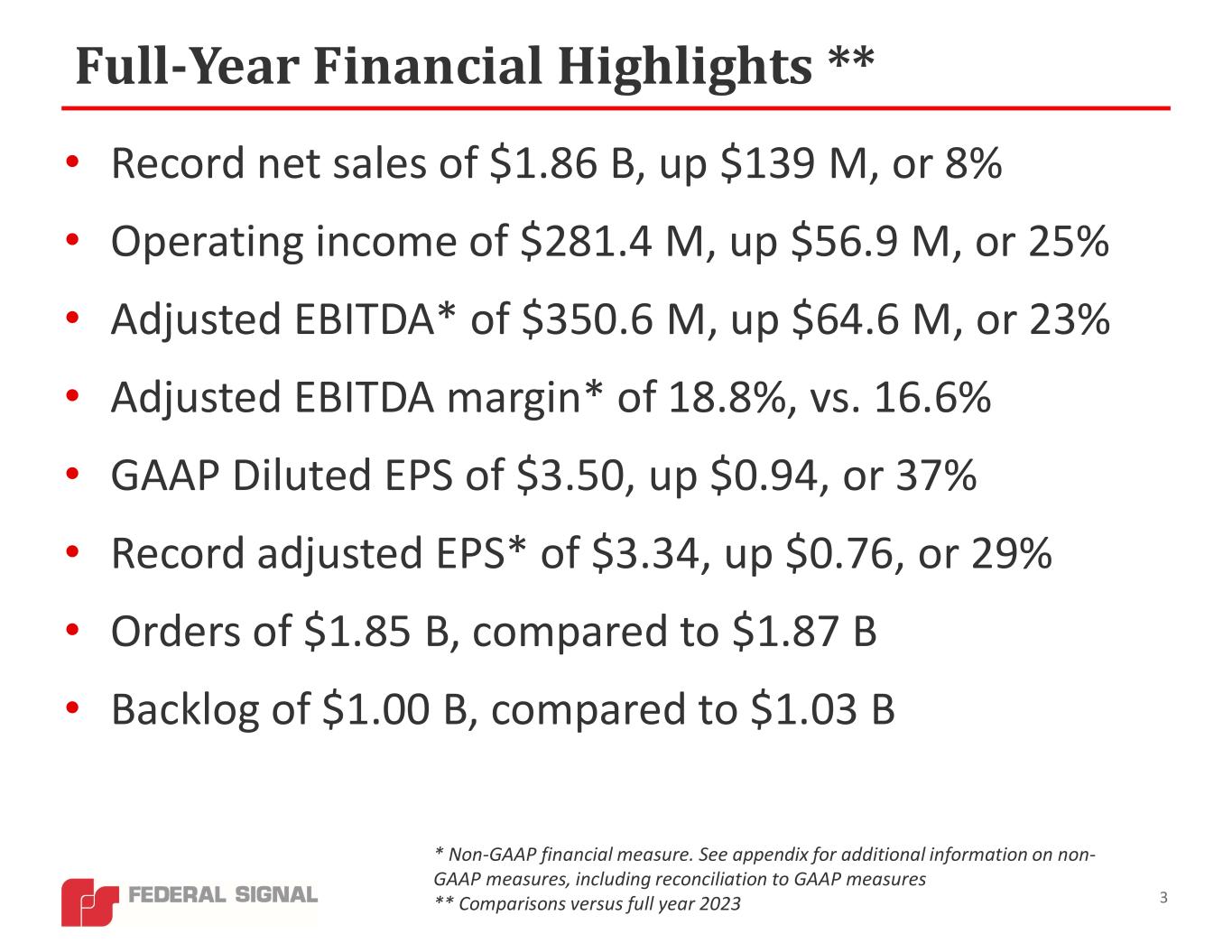
Full-Year Financial Highlights ** 3 * Non-GAAP financial measure. See appendix for additional information on non- GAAP measures, including reconciliation to GAAP measures ** Comparisons versus full year 2023 • Record net sales of $1.86 B, up $139 M, or 8% • Operating income of $281.4 M, up $56.9 M, or 25% • Adjusted EBITDA* of $350.6 M, up $64.6 M, or 23% • Adjusted EBITDA margin* of 18.8%, vs. 16.6% • GAAP Diluted EPS of $3.50, up $0.94, or 37% • Record adjusted EPS* of $3.34, up $0.76, or 29% • Orders of $1.85 B, compared to $1.87 B • Backlog of $1.00 B, compared to $1.03 B

Q4 Highlights ** 4 • Net sales of $472 M, up $24 M, or 5% • Operating income of $70.1 M, up $7.0 M, or 11% • Adjusted EBITDA* of $89.3 M, up $11.8 M, or 15% • Adjusted EBITDA margin* of 18.9%, vs. 17.3% • GAAP Diluted EPS of $0.81, up $0.06, or 8% • Adjusted EPS* of $0.87, up $0.13, or 18% • Orders of $446 M, compared to $465 M * Non-GAAP financial measure. See appendix for additional information on non- GAAP measures, including reconciliation to GAAP measures ** Comparisons versus Q4 of 2023
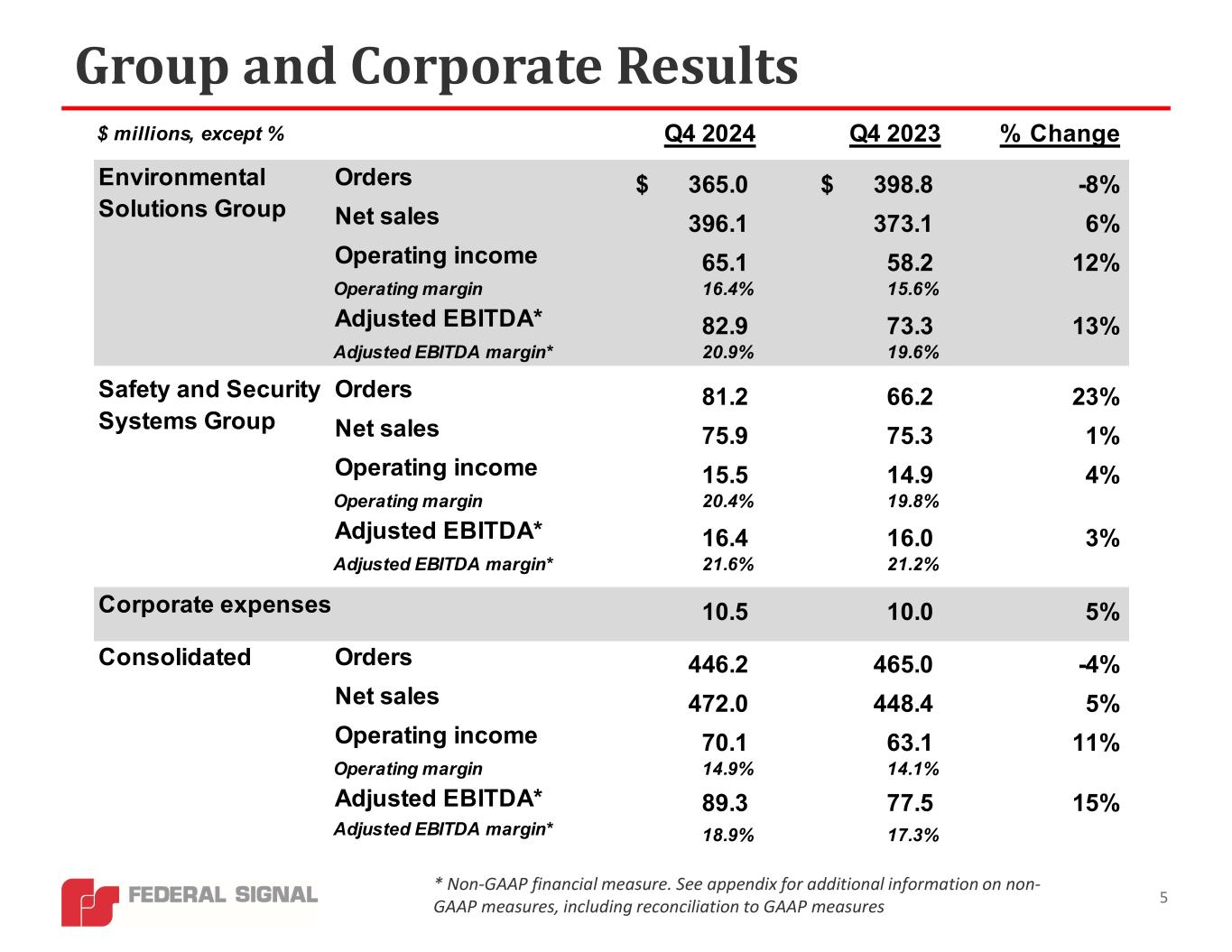
5 Group and Corporate Results $ millions, except % Q4 2024 Q4 2023 % Change Orders 365.0$ 398.8$ -8% Net sales 396.1 373.1 6% Operating income 65.1 58.2 12% Operating margin 16.4% 15.6% Adjusted EBITDA* 82.9 73.3 13% Adjusted EBITDA margin* 20.9% 19.6% Orders 81.2 66.2 23% Net sales 75.9 75.3 1% Operating income 15.5 14.9 4% Operating margin 20.4% 19.8% Adjusted EBITDA* 16.4 16.0 3% Adjusted EBITDA margin* 21.6% 21.2% Corporate expenses 10.5 10.0 5% Consolidated Orders 446.2 465.0 -4% Net sales 472.0 448.4 5% Operating income 70.1 63.1 11% Operating margin 14.9% 14.1% Adjusted EBITDA* 89.3 77.5 15% Adjusted EBITDA margin* 18.9% 17.3% Environmental Solutions Group Safety and Security Systems Group * Non-GAAP financial measure. See appendix for additional information on non- GAAP measures, including reconciliation to GAAP measures
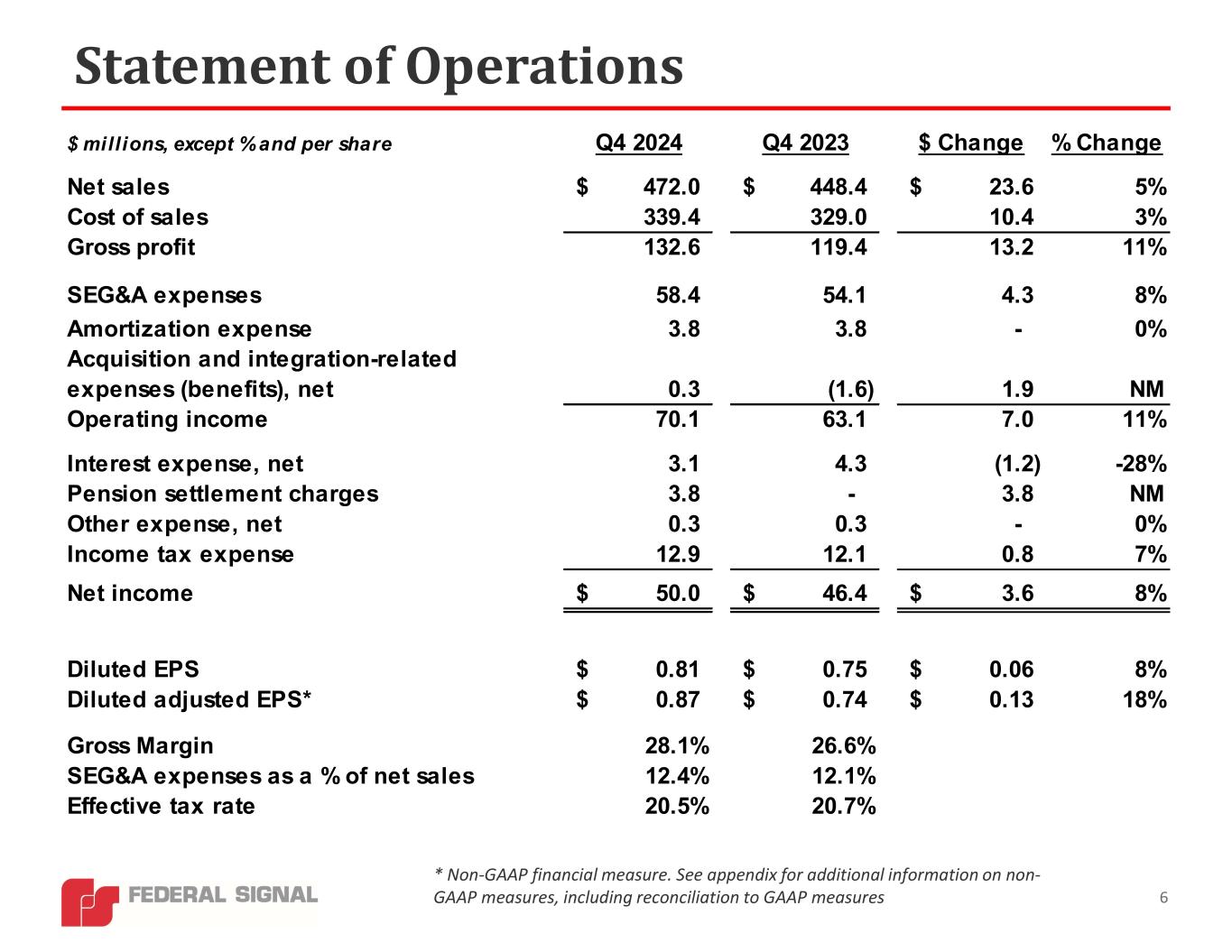
Statement of Operations 6 $ millions, except % and per share Q4 2024 Q4 2023 $ Change % Change Net sales 472.0$ 448.4$ 23.6$ 5% Cost of sales 339.4 329.0 10.4 3% Gross profit 132.6 119.4 13.2 11% SEG&A expenses 58.4 54.1 4.3 8% Amortization expense 3.8 3.8 - 0% Acquisition and integration-related expenses (benefits), net 0.3 (1.6) 1.9 NM Operating income 70.1 63.1 7.0 11% Interest expense, net 3.1 4.3 (1.2) -28% Pension settlement charges 3.8 - 3.8 NM Other expense, net 0.3 0.3 - 0% Income tax expense 12.9 12.1 0.8 7% Net income 50.0$ 46.4$ 3.6$ 8% Diluted EPS 0.81$ 0.75$ 0.06$ 8% Diluted adjusted EPS* 0.87$ 0.74$ 0.13$ 18% Gross Margin 28.1% 26.6% SEG&A expenses as a % of net sales 12.4% 12.1% Effective tax rate 20.5% 20.7% * Non-GAAP financial measure. See appendix for additional information on non- GAAP measures, including reconciliation to GAAP measures
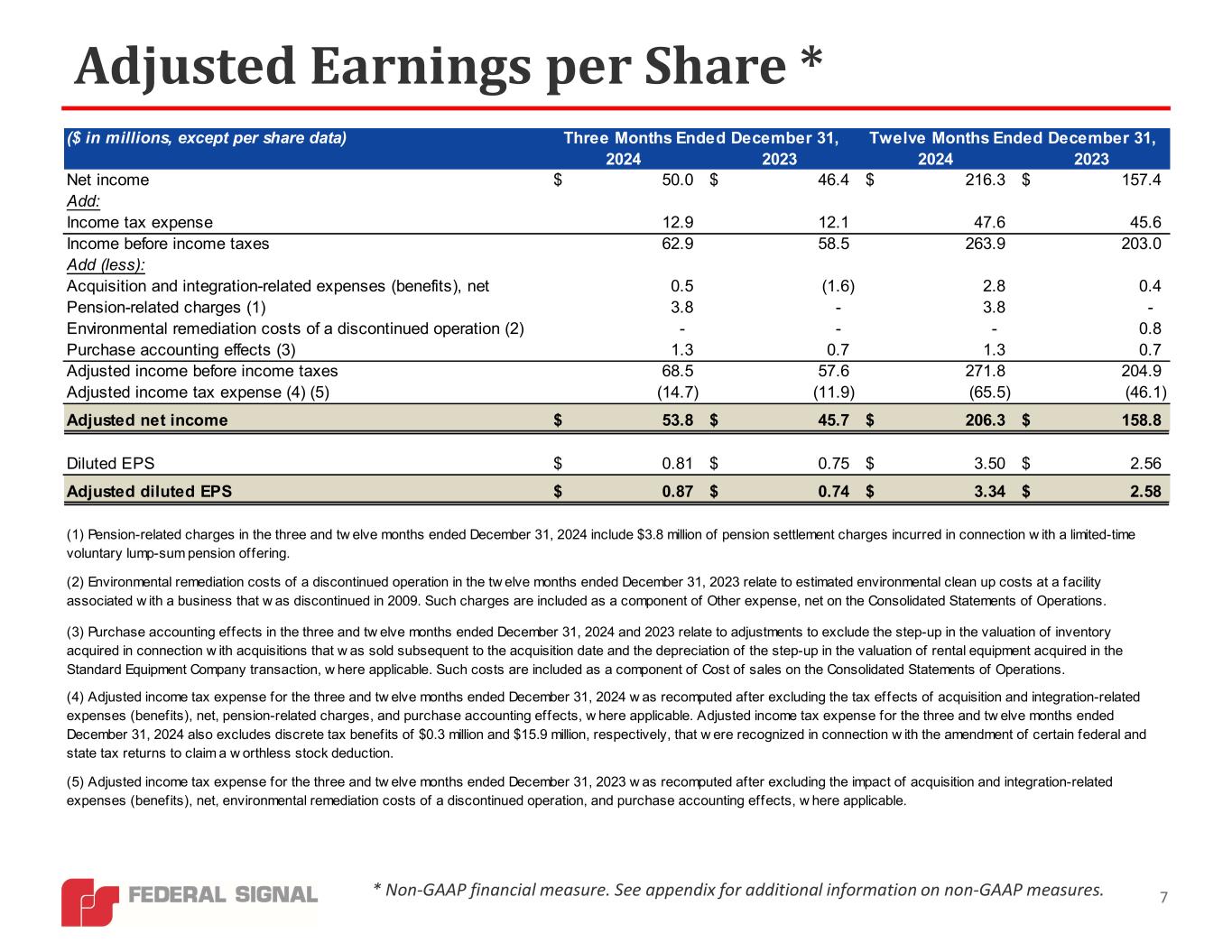
7 Adjusted Earnings per Share * ($ in millions, except per share data) 2024 2023 2024 2023 Net income 50.0$ 46.4$ 216.3$ 157.4$ Add: Income tax expense 12.9 12.1 47.6 45.6 Income before income taxes 62.9 58.5 263.9 203.0 Add (less): Acquisition and integration-related expenses (benefits), net 0.5 (1.6) 2.8 0.4 Pension-related charges (1) 3.8 - 3.8 - Environmental remediation costs of a discontinued operation (2) - - - 0.8 Purchase accounting effects (3) 1.3 0.7 1.3 0.7 Adjusted income before income taxes 68.5 57.6 271.8 204.9 Adjusted income tax expense (4) (5) (14.7) (11.9) (65.5) (46.1) Adjusted net income 53.8$ 45.7$ 206.3$ 158.8$ Diluted EPS 0.81$ 0.75$ 3.50$ 2.56$ Adjusted diluted EPS 0.87$ 0.74$ 3.34$ 2.58$ (5) Adjusted income tax expense for the three and tw elve months ended December 31, 2023 w as recomputed after excluding the impact of acquisition and integration-related expenses (benefits), net, environmental remediation costs of a discontinued operation, and purchase accounting effects, w here applicable. (4) Adjusted income tax expense for the three and tw elve months ended December 31, 2024 w as recomputed after excluding the tax effects of acquisition and integration-related expenses (benefits), net, pension-related charges, and purchase accounting effects, w here applicable. Adjusted income tax expense for the three and tw elve months ended December 31, 2024 also excludes discrete tax benefits of $0.3 million and $15.9 million, respectively, that w ere recognized in connection w ith the amendment of certain federal and state tax returns to claim a w orthless stock deduction. Three Months Ended December 31, Twelve Months Ended December 31, (1) Pension-related charges in the three and tw elve months ended December 31, 2024 include $3.8 million of pension settlement charges incurred in connection w ith a limited-time voluntary lump-sum pension offering. (3) Purchase accounting effects in the three and tw elve months ended December 31, 2024 and 2023 relate to adjustments to exclude the step-up in the valuation of inventory acquired in connection w ith acquisitions that w as sold subsequent to the acquisition date and the depreciation of the step-up in the valuation of rental equipment acquired in the Standard Equipment Company transaction, w here applicable. Such costs are included as a component of Cost of sales on the Consolidated Statements of Operations. (2) Environmental remediation costs of a discontinued operation in the tw elve months ended December 31, 2023 relate to estimated environmental clean up costs at a facility associated w ith a business that w as discontinued in 2009. Such charges are included as a component of Other expense, net on the Consolidated Statements of Operations. * Non-GAAP financial measure. See appendix for additional information on non-GAAP measures.
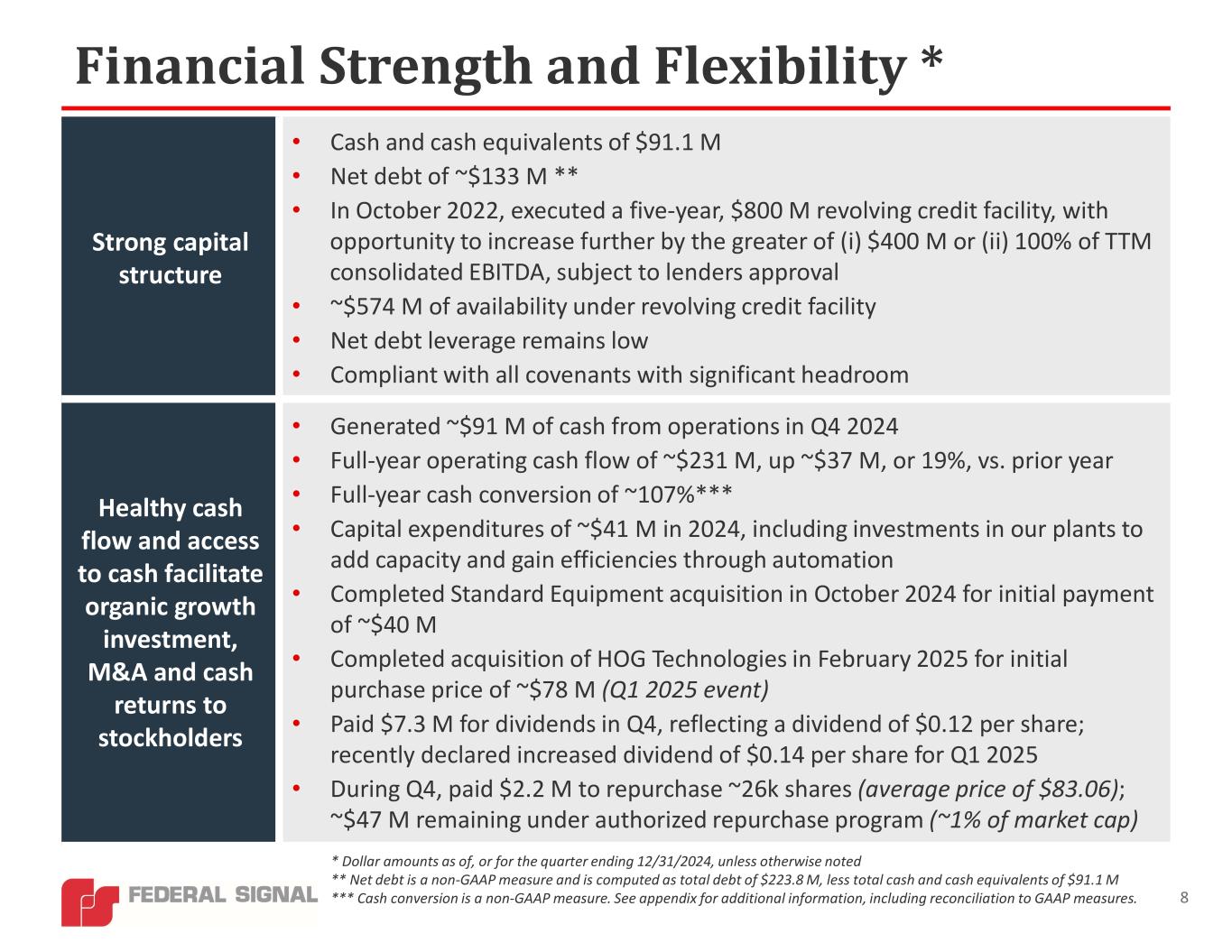
8 Financial Strength and Flexibility * * Dollar amounts as of, or for the quarter ending 12/31/2024, unless otherwise noted ** Net debt is a non-GAAP measure and is computed as total debt of $223.8 M, less total cash and cash equivalents of $91.1 M *** Cash conversion is a non-GAAP measure. See appendix for additional information, including reconciliation to GAAP measures. • Cash and cash equivalents of $91.1 M • Net debt of ~$133 M ** • In October 2022, executed a five-year, $800 M revolving credit facility, with opportunity to increase further by the greater of (i) $400 M or (ii) 100% of TTM consolidated EBITDA, subject to lenders approval • ~$574 M of availability under revolving credit facility • Net debt leverage remains low • Compliant with all covenants with significant headroom Strong capital structure • Generated ~$91 M of cash from operations in Q4 2024 • Full-year operating cash flow of ~$231 M, up ~$37 M, or 19%, vs. prior year • Full-year cash conversion of ~107%*** • Capital expenditures of ~$41 M in 2024, including investments in our plants to add capacity and gain efficiencies through automation • Completed Standard Equipment acquisition in October 2024 for initial payment of ~$40 M • Completed acquisition of HOG Technologies in February 2025 for initial purchase price of ~$78 M (Q1 2025 event) • Paid $7.3 M for dividends in Q4, reflecting a dividend of $0.12 per share; recently declared increased dividend of $0.14 per share for Q1 2025 • During Q4, paid $2.2 M to repurchase ~26k shares (average price of $83.06); ~$47 M remaining under authorized repurchase program (~1% of market cap) Healthy cash flow and access to cash facilitate organic growth investment, M&A and cash returns to stockholders
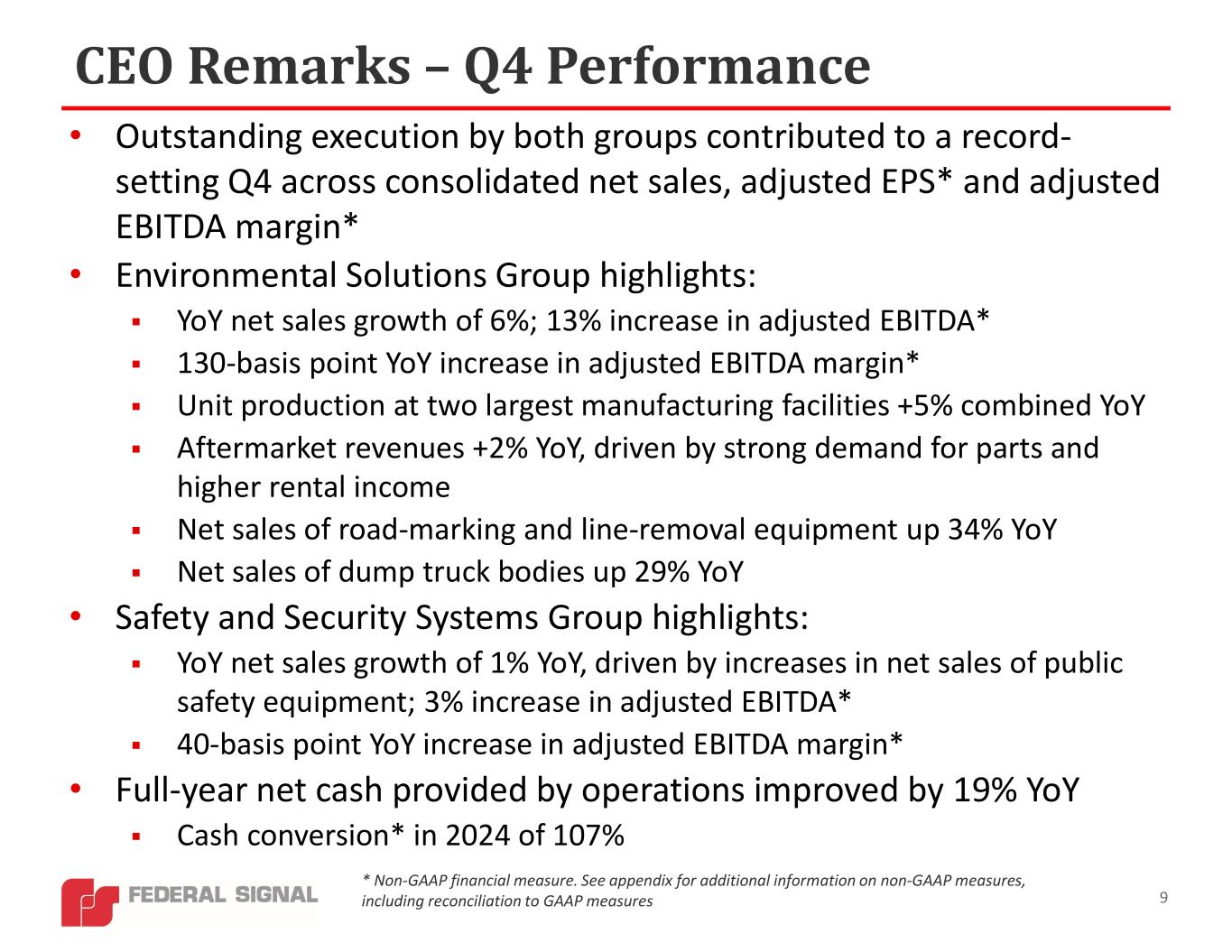
CEO Remarks – Q4 Performance 9 * Non-GAAP financial measure. See appendix for additional information on non-GAAP measures, including reconciliation to GAAP measures • Outstanding execution by both groups contributed to a record- setting Q4 across consolidated net sales, adjusted EPS* and adjusted EBITDA margin* • Environmental Solutions Group highlights: YoY net sales growth of 6%; 13% increase in adjusted EBITDA* 130-basis point YoY increase in adjusted EBITDA margin* Unit production at two largest manufacturing facilities +5% combined YoY Aftermarket revenues +2% YoY, driven by strong demand for parts and higher rental income Net sales of road-marking and line-removal equipment up 34% YoY Net sales of dump truck bodies up 29% YoY • Safety and Security Systems Group highlights: YoY net sales growth of 1% YoY, driven by increases in net sales of public safety equipment; 3% increase in adjusted EBITDA* 40-basis point YoY increase in adjusted EBITDA margin* • Full-year net cash provided by operations improved by 19% YoY Cash conversion* in 2024 of 107%
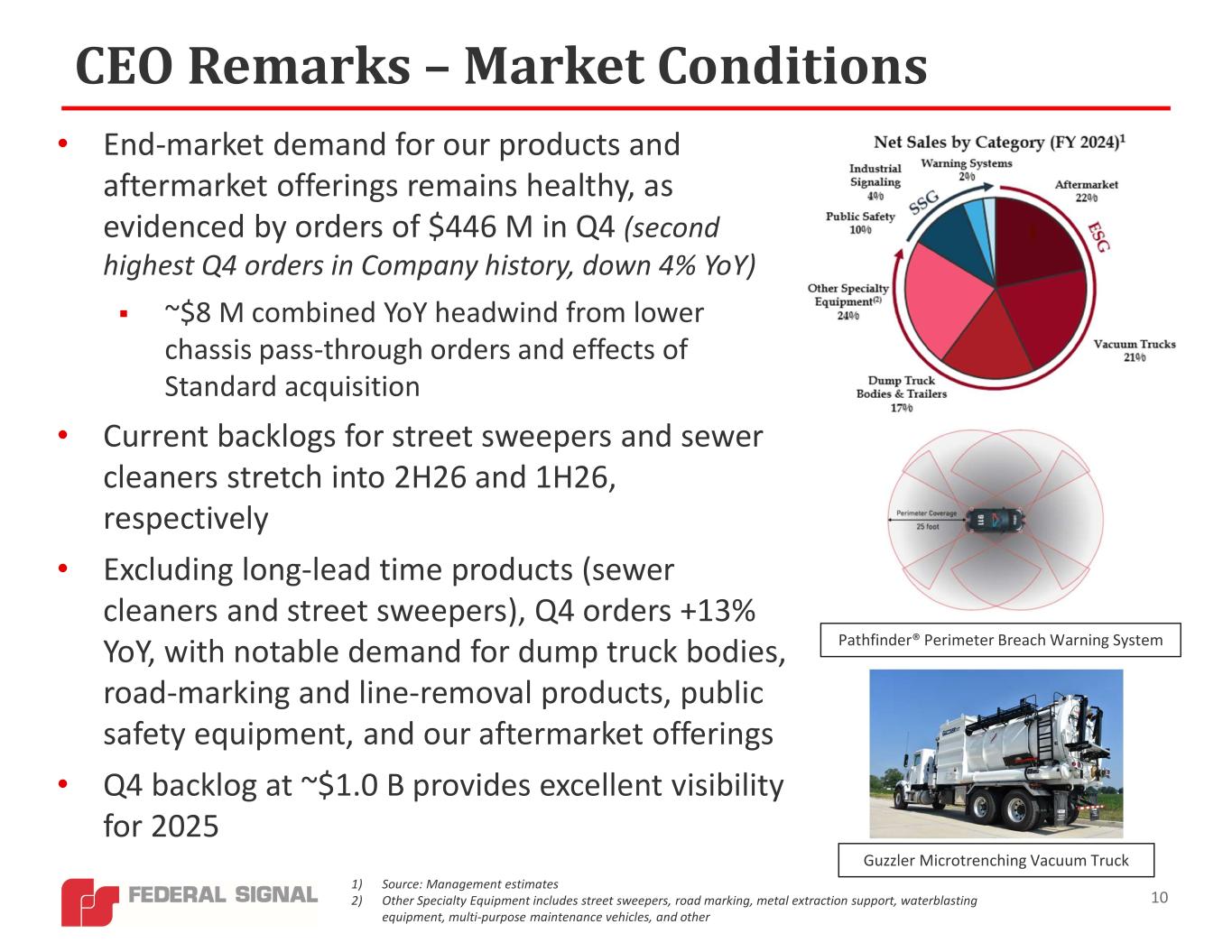
CEO Remarks – Market Conditions 10 • End-market demand for our products and aftermarket offerings remains healthy, as evidenced by orders of $446 M in Q4 (second highest Q4 orders in Company history, down 4% YoY) ~$8 M combined YoY headwind from lower chassis pass-through orders and effects of Standard acquisition • Current backlogs for street sweepers and sewer cleaners stretch into 2H26 and 1H26, respectively • Excluding long-lead time products (sewer cleaners and street sweepers), Q4 orders +13% YoY, with notable demand for dump truck bodies, road-marking and line-removal products, public safety equipment, and our aftermarket offerings • Q4 backlog at ~$1.0 B provides excellent visibility for 2025 1) Source: Management estimates 2) Other Specialty Equipment includes street sweepers, road marking, metal extraction support, waterblasting equipment, multi-purpose maintenance vehicles, and other Pathfinder® Perimeter Breach Warning System Guzzler Microtrenching Vacuum Truck
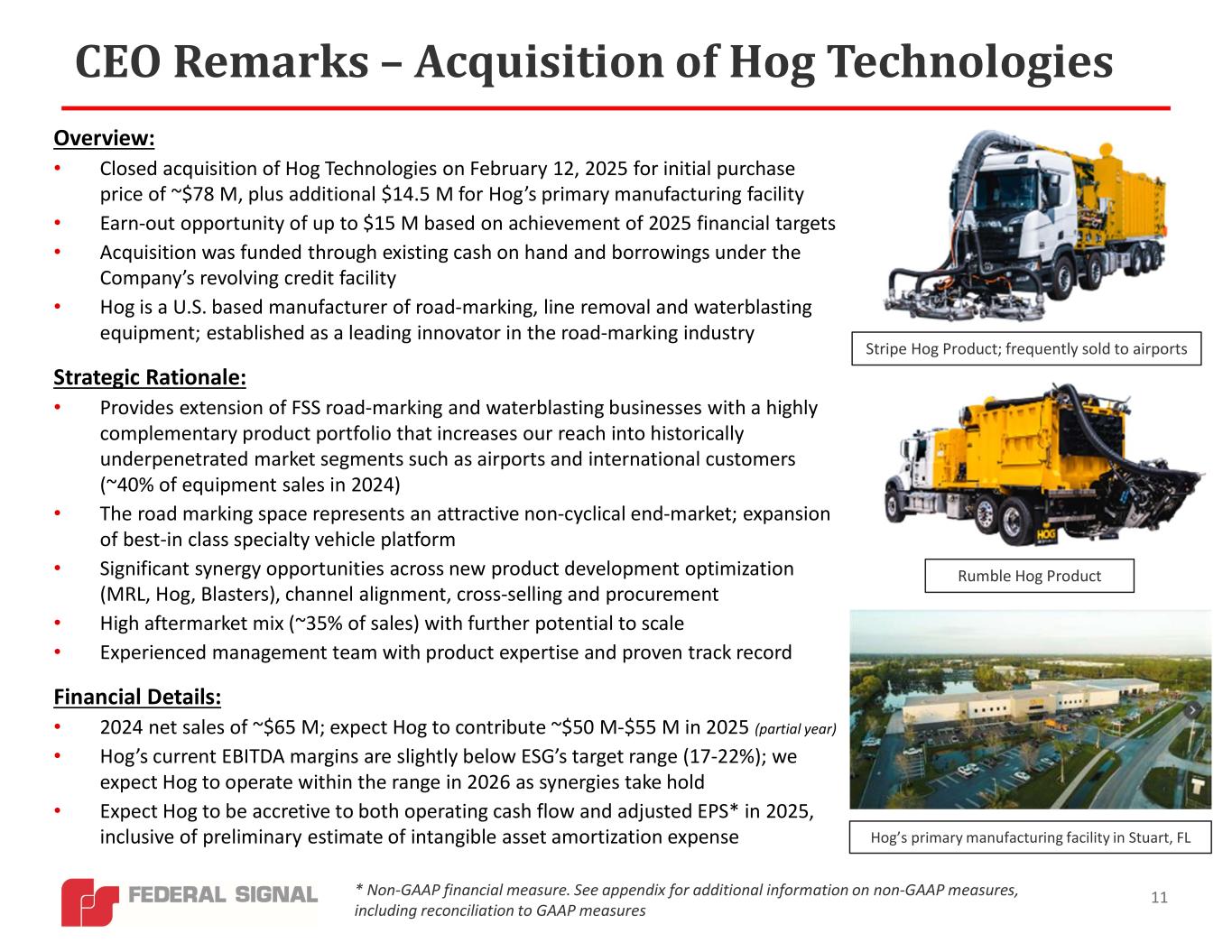
CEO Remarks – Acquisition of Hog Technologies 11 Overview: • Closed acquisition of Hog Technologies on February 12, 2025 for initial purchase price of ~$78 M, plus additional $14.5 M for Hog’s primary manufacturing facility • Earn-out opportunity of up to $15 M based on achievement of 2025 financial targets • Acquisition was funded through existing cash on hand and borrowings under the Company’s revolving credit facility • Hog is a U.S. based manufacturer of road-marking, line removal and waterblasting equipment; established as a leading innovator in the road-marking industry Strategic Rationale: • Provides extension of FSS road-marking and waterblasting businesses with a highly complementary product portfolio that increases our reach into historically underpenetrated market segments such as airports and international customers (~40% of equipment sales in 2024) • The road marking space represents an attractive non-cyclical end-market; expansion of best-in class specialty vehicle platform • Significant synergy opportunities across new product development optimization (MRL, Hog, Blasters), channel alignment, cross-selling and procurement • High aftermarket mix (~35% of sales) with further potential to scale • Experienced management team with product expertise and proven track record Financial Details: • 2024 net sales of ~$65 M; expect Hog to contribute ~$50 M-$55 M in 2025 (partial year) • Hog’s current EBITDA margins are slightly below ESG’s target range (17-22%); we expect Hog to operate within the range in 2026 as synergies take hold • Expect Hog to be accretive to both operating cash flow and adjusted EPS* in 2025, inclusive of preliminary estimate of intangible asset amortization expense Stripe Hog Product; frequently sold to airports Rumble Hog Product Hog’s primary manufacturing facility in Stuart, FL * Non-GAAP financial measure. See appendix for additional information on non-GAAP measures, including reconciliation to GAAP measures
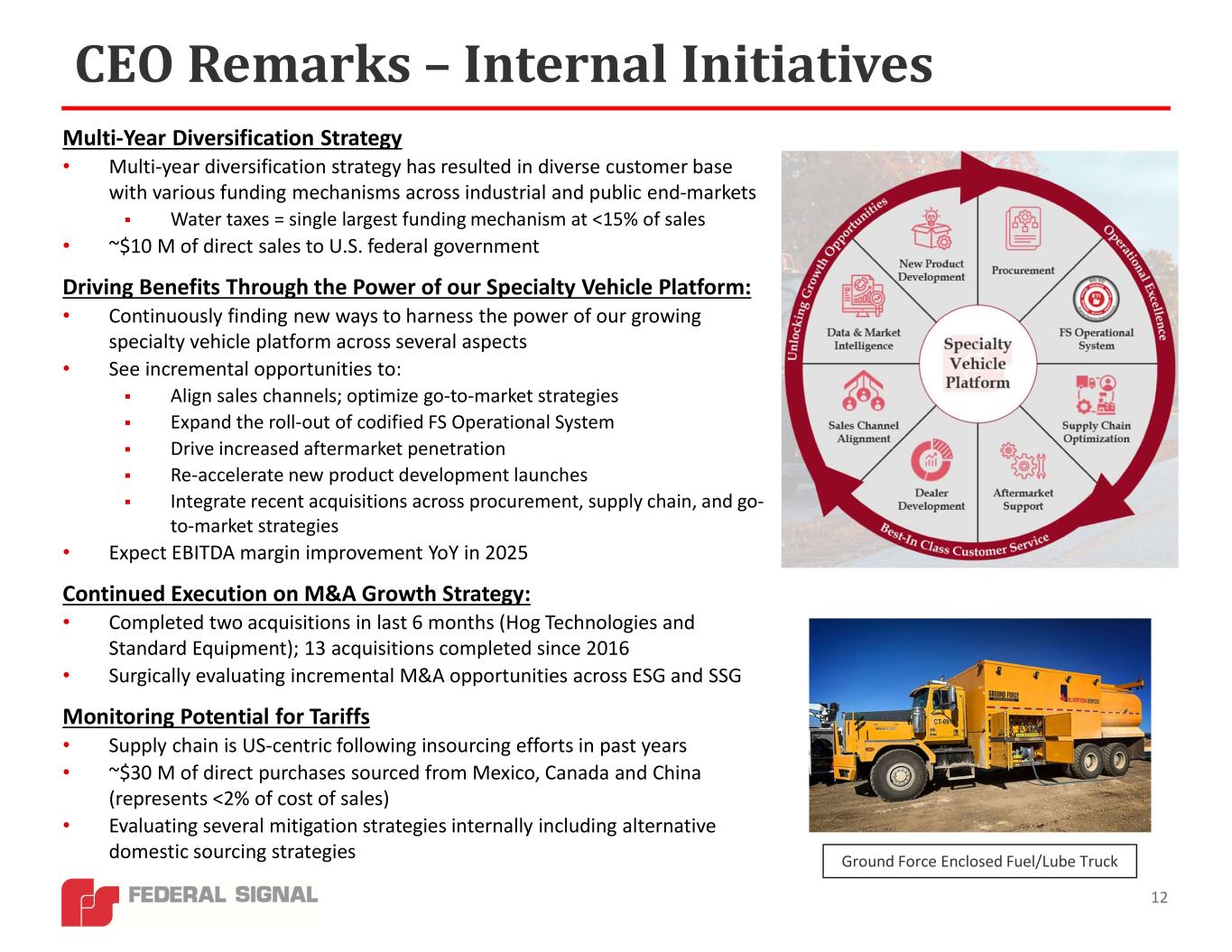
CEO Remarks – Internal Initiatives 12 Multi-Year Diversification Strategy • Multi-year diversification strategy has resulted in diverse customer base with various funding mechanisms across industrial and public end-markets Water taxes = single largest funding mechanism at <15% of sales • ~$10 M of direct sales to U.S. federal government Driving Benefits Through the Power of our Specialty Vehicle Platform: • Continuously finding new ways to harness the power of our growing specialty vehicle platform across several aspects • See incremental opportunities to: Align sales channels; optimize go-to-market strategies Expand the roll-out of codified FS Operational System Drive increased aftermarket penetration Re-accelerate new product development launches Integrate recent acquisitions across procurement, supply chain, and go- to-market strategies • Expect EBITDA margin improvement YoY in 2025 Continued Execution on M&A Growth Strategy: • Completed two acquisitions in last 6 months (Hog Technologies and Standard Equipment); 13 acquisitions completed since 2016 • Surgically evaluating incremental M&A opportunities across ESG and SSG Monitoring Potential for Tariffs • Supply chain is US-centric following insourcing efforts in past years • ~$30 M of direct purchases sourced from Mexico, Canada and China (represents <2% of cost of sales) • Evaluating several mitigation strategies internally including alternative domestic sourcing strategies Ground Force Enclosed Fuel/Lube Truck

2025 Financial Outlook 13 Issuing 2025 Guidance • Full-Year Adjusted EPS1 Outlook of $3.60 to $3.90 • At the midpoint, would represent another year of double- digit growth, and the highest EPS level in our history • Full-year net sales of $2.02 B to $2.10 B • Would represent YoY growth of 9% - 13% • Double-digit improvement in pre-tax earnings • Capital expenditures of $40 M to $50 M Assumptions • Expect Q1’25 Adjusted EPS1 to represent between 19%-20% of our full-year earnings • Interest expense of ~$13 M - $14 M, without additional M&A • Other expense up ~$1.5 M YoY, due to higher non-operating pension costs • Effective tax rate of ~26%, excluding discrete items • ~62 M weighted average shares outstanding • Depreciation and amortization expense of ~$74 M - $77 M • Outlook includes contribution from Hog Technologies • No significant increase in current input costs • No significant impact from potential tariffs 1. Adjusted earnings per share (“EPS”) is a non-GAAP measure, which includes certain adjustments to reported GAAP net income and diluted EPS. In the three and twelve months ended December 31, 2024 and 2023, we made adjustments to exclude the impact of acquisition and integration-related expenses (benefits), net, purchase accounting effects, pension settlement charges, and certain special income tax items, where applicable. In prior years, we have also made adjustments to exclude the impact of environmental remediation costs of a discontinued operation and certain other unusual or non-recurring items. Should any similar items occur in 2025, we would expect to exclude them from the determination of adjusted EPS. However, because of the underlying uncertainty in quantifying amounts which may not yet be known, a reconciliation of our Adjusted EPS outlook to the most applicable GAAP measure is excluded based on the unreasonable efforts exception in Item 10(e)(1)(i)(B).
Federal Signal Q4 2024 Earnings Call 14 Q&A February 26, 2025 Jennifer Sherman, President & Chief Executive Officer Ian Hudson, SVP, Chief Financial Officer Felix Boeschen, VP, Corporate Strategy & Investor Relations

Investor Information Stock Ticker - NYSE:FSS Company website: federalsignal.com/investors HEADQUARTERS 1333 Butterfield Road, Suite 500 Downers Grove, IL 60515 INVESTOR RELATIONS CONTACTS 630-954-2000 Felix Boeschen VP, Corporate Strategy and Investor Relations fboeschen@federalsignal.com 15
Federal Signal Q4 2024 Earnings Call 16 Appendix
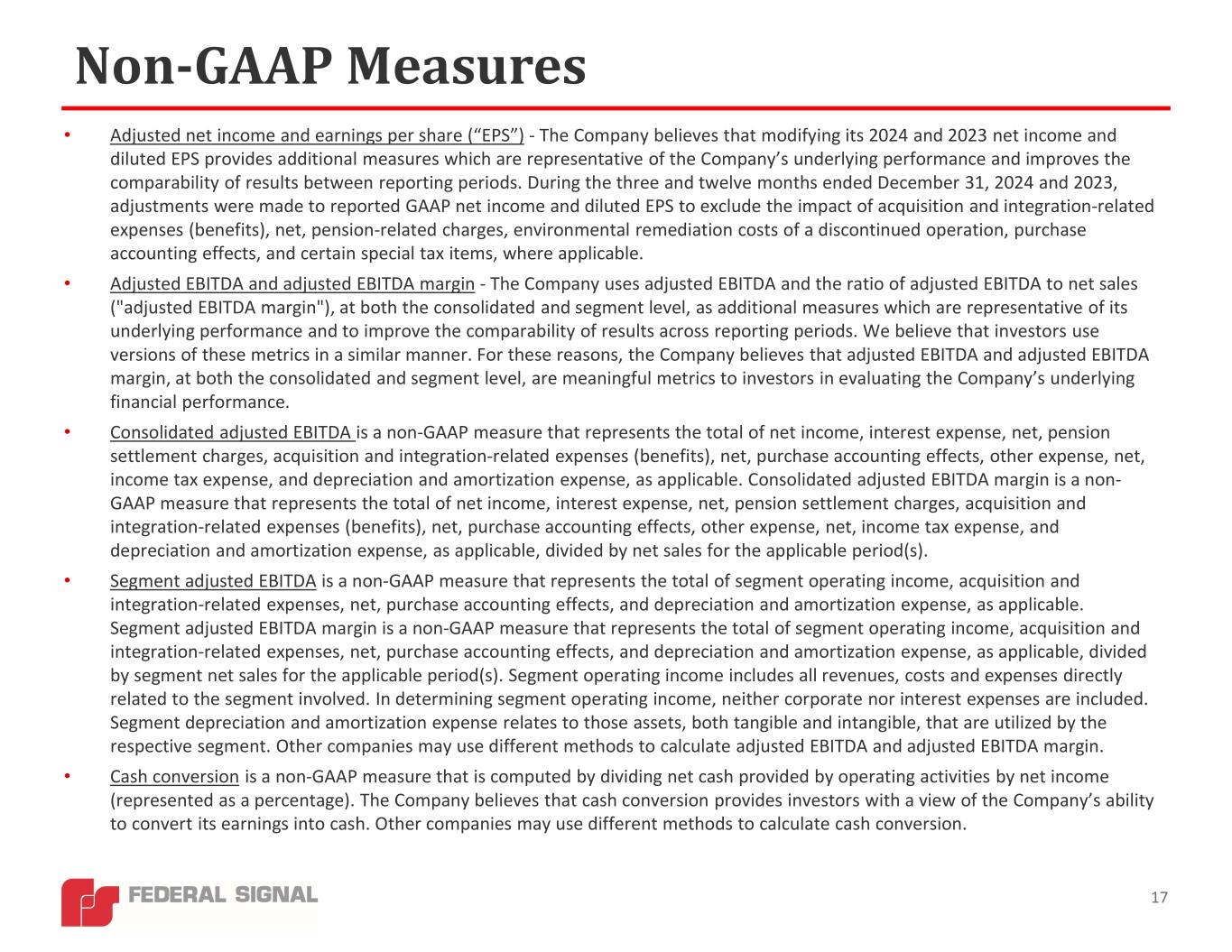
Non-GAAP Measures 17 • Adjusted net income and earnings per share (“EPS”) - The Company believes that modifying its 2024 and 2023 net income and diluted EPS provides additional measures which are representative of the Company’s underlying performance and improves the comparability of results between reporting periods. During the three and twelve months ended December 31, 2024 and 2023, adjustments were made to reported GAAP net income and diluted EPS to exclude the impact of acquisition and integration-related expenses (benefits), net, pension-related charges, environmental remediation costs of a discontinued operation, purchase accounting effects, and certain special tax items, where applicable. • Adjusted EBITDA and adjusted EBITDA margin - The Company uses adjusted EBITDA and the ratio of adjusted EBITDA to net sales ("adjusted EBITDA margin"), at both the consolidated and segment level, as additional measures which are representative of its underlying performance and to improve the comparability of results across reporting periods. We believe that investors use versions of these metrics in a similar manner. For these reasons, the Company believes that adjusted EBITDA and adjusted EBITDA margin, at both the consolidated and segment level, are meaningful metrics to investors in evaluating the Company’s underlying financial performance. • Consolidated adjusted EBITDA is a non-GAAP measure that represents the total of net income, interest expense, net, pension settlement charges, acquisition and integration-related expenses (benefits), net, purchase accounting effects, other expense, net, income tax expense, and depreciation and amortization expense, as applicable. Consolidated adjusted EBITDA margin is a non- GAAP measure that represents the total of net income, interest expense, net, pension settlement charges, acquisition and integration-related expenses (benefits), net, purchase accounting effects, other expense, net, income tax expense, and depreciation and amortization expense, as applicable, divided by net sales for the applicable period(s). • Segment adjusted EBITDA is a non-GAAP measure that represents the total of segment operating income, acquisition and integration-related expenses, net, purchase accounting effects, and depreciation and amortization expense, as applicable. Segment adjusted EBITDA margin is a non-GAAP measure that represents the total of segment operating income, acquisition and integration-related expenses, net, purchase accounting effects, and depreciation and amortization expense, as applicable, divided by segment net sales for the applicable period(s). Segment operating income includes all revenues, costs and expenses directly related to the segment involved. In determining segment operating income, neither corporate nor interest expenses are included. Segment depreciation and amortization expense relates to those assets, both tangible and intangible, that are utilized by the respective segment. Other companies may use different methods to calculate adjusted EBITDA and adjusted EBITDA margin. • Cash conversion is a non-GAAP measure that is computed by dividing net cash provided by operating activities by net income (represented as a percentage). The Company believes that cash conversion provides investors with a view of the Company’s ability to convert its earnings into cash. Other companies may use different methods to calculate cash conversion.
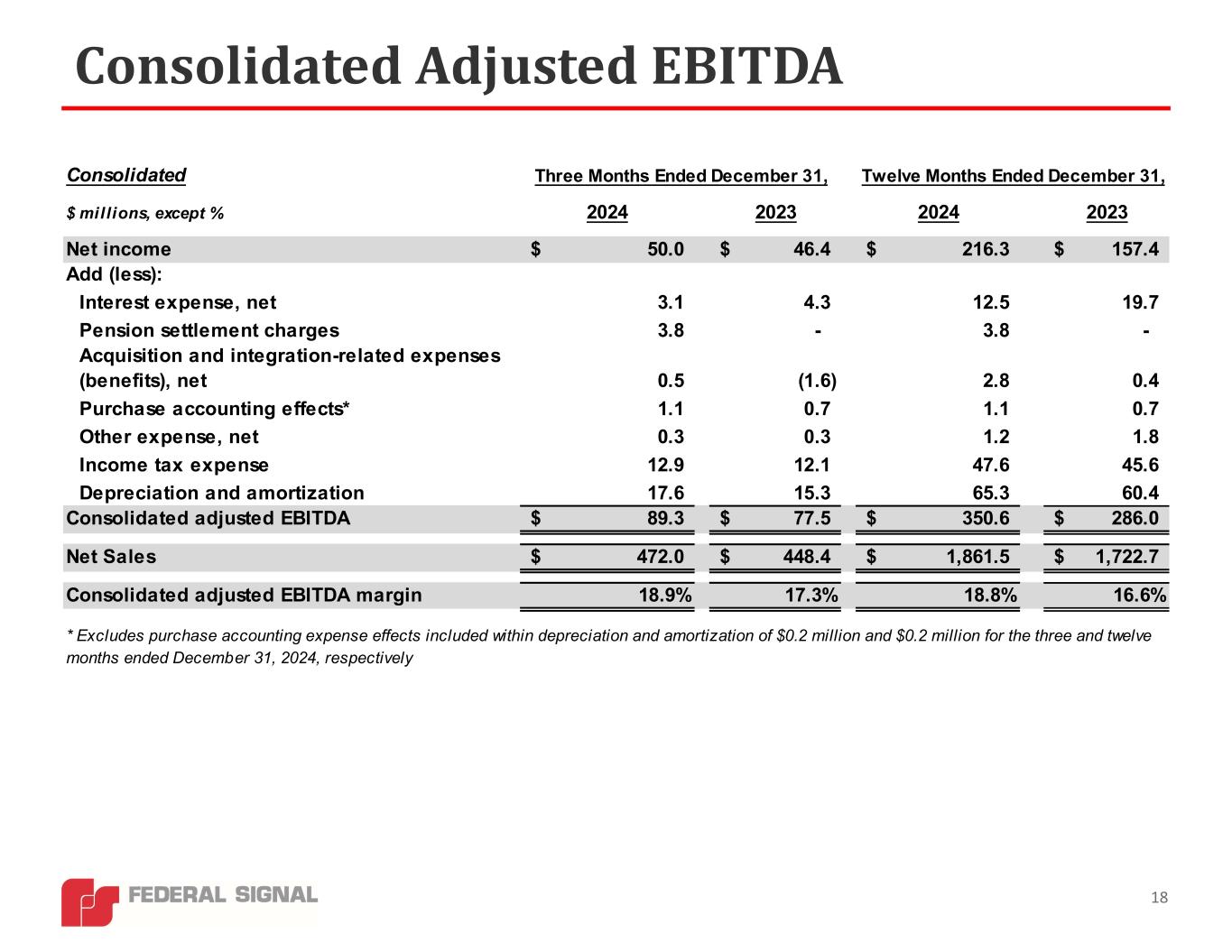
Consolidated Adjusted EBITDA 18 Consolidated $ millions, except % 2024 2023 2024 2023 Net income 50.0$ 46.4$ 216.3$ 157.4$ Add (less): Interest expense, net 3.1 4.3 12.5 19.7 Pension settlement charges 3.8 - 3.8 - Acquisition and integration-related expenses (benefits), net 0.5 (1.6) 2.8 0.4 Purchase accounting effects* 1.1 0.7 1.1 0.7 Other expense, net 0.3 0.3 1.2 1.8 Income tax expense 12.9 12.1 47.6 45.6 Depreciation and amortization 17.6 15.3 65.3 60.4 Consolidated adjusted EBITDA 89.3$ 77.5$ 350.6$ 286.0$ Net Sales 472.0$ 448.4$ 1,861.5$ 1,722.7$ Consolidated adjusted EBITDA margin 18.9% 17.3% 18.8% 16.6% Three Months Ended December 31, Twelve Months Ended December 31, * Excludes purchase accounting expense effects included within depreciation and amortization of $0.2 million and $0.2 million for the three and twelve months ended December 31, 2024, respectively
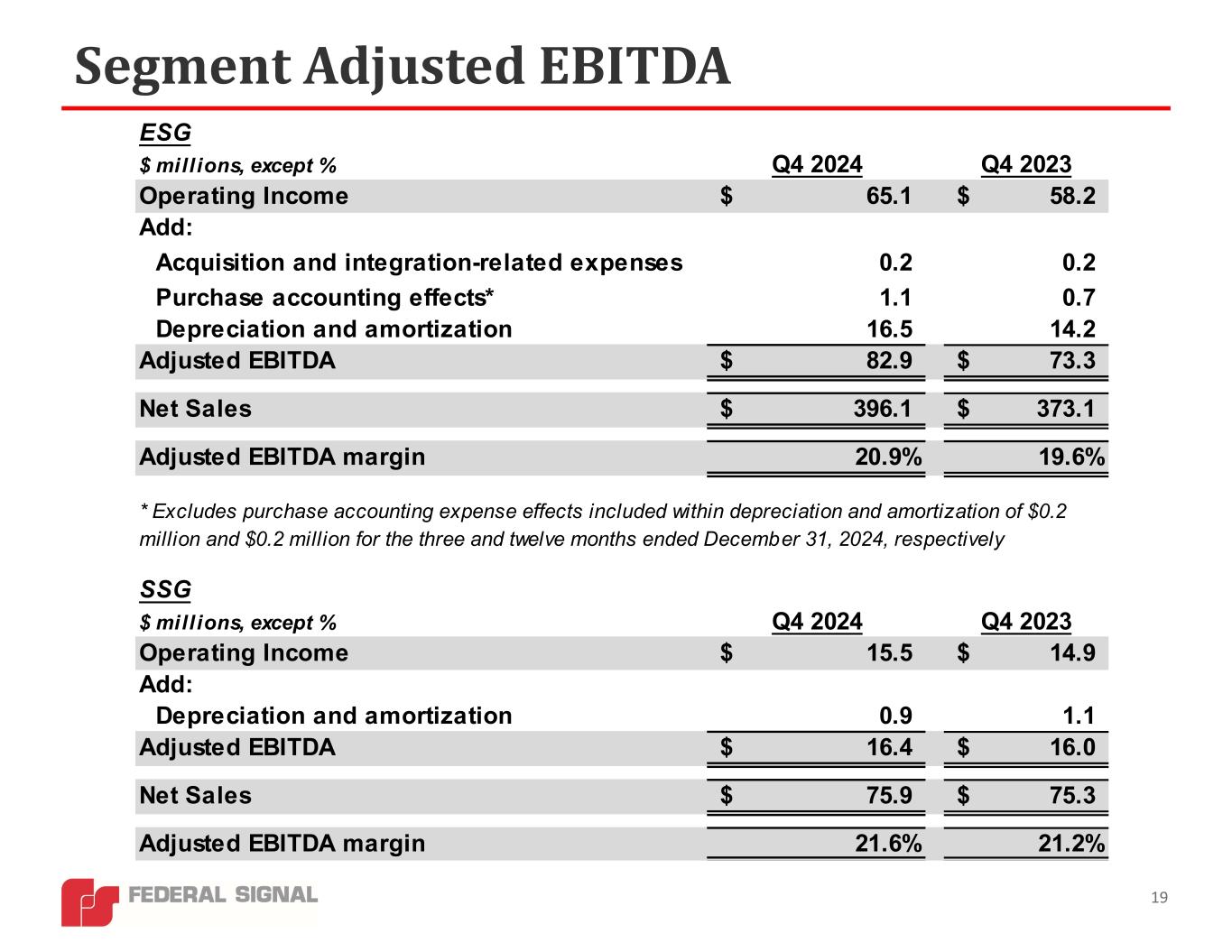
Segment Adjusted EBITDA 19 ESG $ mill ions, except % Q4 2024 Q4 2023 Operating Income 65.1$ 58.2$ Add: Acquisition and integration-related expenses 0.2 0.2 Purchase accounting effects* 1.1 0.7 Depreciation and amortization 16.5 14.2 Adjusted EBITDA 82.9$ 73.3$ Net Sales 396.1$ 373.1$ Adjusted EBITDA margin 20.9% 19.6% SSG $ mill ions, except % Q4 2024 Q4 2023 Operating Income 15.5$ 14.9$ Add: Depreciation and amortization 0.9 1.1 Adjusted EBITDA 16.4$ 16.0$ Net Sales 75.9$ 75.3$ Adjusted EBITDA margin 21.6% 21.2% * Excludes purchase accounting expense effects included within depreciation and amortization of $0.2 million and $0.2 million for the three and twelve months ended December 31, 2024, respectively

Cash Conversion 20 $ in millions, except % Net Cash Provided by Operating Activities - Year Ended December 31, 2024 (A) 231.3$ Net Income - Year Ended December 31, 2024 (B) 216.3$ Cash Conversion (A/B) 107%
 エドガーで原本を確認する