falseFY20250000109177http://fasb.org/us-gaap/2025#CostOfRevenuehttp://fasb.org/us-gaap/2025#CostOfRevenuehttp://fasb.org/us-gaap/2025#CostOfRevenuehttp://fasb.org/us-gaap/2025#SellingGeneralAndAdministrativeExpensehttp://fasb.org/us-gaap/2025#SellingGeneralAndAdministrativeExpensehttp://fasb.org/us-gaap/2025#SellingGeneralAndAdministrativeExpense0.0082060.0082298http://fasb.org/us-gaap/2025#LongTermDebtCurrenthttp://fasb.org/us-gaap/2025#LongTermDebtCurrenthttp://fasb.org/us-gaap/2025#LongTermDebtNoncurrenthttp://fasb.org/us-gaap/2025#LongTermDebtNoncurrenthttp://fasb.org/us-gaap/2025#DeferredCosts http://fasb.org/us-gaap/2025#OtherReceivablesNetCurrenthttp://fasb.org/us-gaap/2025#DeferredCosts http://fasb.org/us-gaap/2025#OtherReceivablesNetCurrenthttp://fasb.org/us-gaap/2025#AccountsPayableCurrent http://fasb.org/us-gaap/2025#OtherLiabilitiesNoncurrenthttp://fasb.org/us-gaap/2025#AccountsPayableCurrent http://fasb.org/us-gaap/2025#OtherLiabilitiesNoncurrenthttp://fasb.org/us-gaap/2025#AccountsPayableCurrenthttp://fasb.org/us-gaap/2025#AccountsPayableCurrenthttp://fasb.org/us-gaap/2025#PensionPlansDefinedBenefitMemberhttp://fasb.org/us-gaap/2025#InterestExpenseNonoperatinghttp://fasb.org/us-gaap/2025#InterestExpenseNonoperatinghttp://fasb.org/us-gaap/2025#InterestExpenseNonoperatinghttp://fasb.org/us-gaap/2025#InterestExpenseNonoperatinghttp://fasb.org/us-gaap/2025#OtherNonoperatingIncomeExpensehttp://fasb.org/us-gaap/2025#OtherNonoperatingIncomeExpensehttp://fasb.org/us-gaap/2025#OtherNonoperatingIncomeExpensehttp://fasb.org/us-gaap/2025#OtherNonoperatingIncomeExpensehttp://fasb.org/us-gaap/2025#OtherNonoperatingIncomeExpensehttp://fasb.org/us-gaap/2025#OtherNonoperatingIncomeExpensehttp://fasb.org/us-gaap/2025#OtherLiabilitiesCurrenthttp://fasb.org/us-gaap/2025#OtherLiabilitiesCurrenthttp://fasb.org/us-gaap/2025#OtherLiabilitiesNoncurrenthttp://fasb.org/us-gaap/2025#OtherLiabilitiesNoncurrentiso4217:USDxbrli:sharesiso4217:USDxbrli:sharesspb:segmentxbrli:purespb:propertyspb:dayiso4217:EUR00001091772024-10-012025-09-3000001091772025-03-3000001091772025-11-1100001091772025-06-302025-09-3000001091772025-09-3000001091772024-09-3000001091772023-10-012024-09-3000001091772022-10-012023-09-300000109177us-gaap:SegmentContinuingOperationsMember2024-10-012025-09-300000109177us-gaap:SegmentContinuingOperationsMember2023-10-012024-09-300000109177us-gaap:SegmentContinuingOperationsMember2022-10-012023-09-300000109177us-gaap:SegmentDiscontinuedOperationsMember2024-10-012025-09-300000109177us-gaap:SegmentDiscontinuedOperationsMember2023-10-012024-09-300000109177us-gaap:SegmentDiscontinuedOperationsMember2022-10-012023-09-300000109177us-gaap:CommonStockMember2022-09-300000109177us-gaap:AdditionalPaidInCapitalMember2022-09-300000109177us-gaap:RetainedEarningsMember2022-09-300000109177us-gaap:AccumulatedOtherComprehensiveIncomeMember2022-09-300000109177us-gaap:TreasuryStockCommonMember2022-09-300000109177us-gaap:ParentMember2022-09-300000109177us-gaap:NoncontrollingInterestMember2022-09-3000001091772022-09-300000109177us-gaap:RetainedEarningsMember2022-10-012023-09-300000109177us-gaap:ParentMember2022-10-012023-09-300000109177us-gaap:NoncontrollingInterestMember2022-10-012023-09-300000109177us-gaap:AccumulatedOtherComprehensiveIncomeMember2022-10-012023-09-300000109177spb:OpenMarketPurchasesAndPrivatePurchasesMemberus-gaap:CommonStockMember2022-10-012023-09-300000109177spb:OpenMarketPurchasesAndPrivatePurchasesMemberus-gaap:TreasuryStockCommonMember2022-10-012023-09-300000109177spb:OpenMarketPurchasesAndPrivatePurchasesMemberus-gaap:ParentMember2022-10-012023-09-300000109177spb:OpenMarketPurchasesAndPrivatePurchasesMember2022-10-012023-09-300000109177spb:AcceleratedShareRepurchaseMemberus-gaap:CommonStockMember2022-10-012023-09-300000109177spb:AcceleratedShareRepurchaseMemberus-gaap:AdditionalPaidInCapitalMember2022-10-012023-09-300000109177spb:AcceleratedShareRepurchaseMemberus-gaap:TreasuryStockCommonMember2022-10-012023-09-300000109177spb:AcceleratedShareRepurchaseMemberus-gaap:ParentMember2022-10-012023-09-300000109177spb:AcceleratedShareRepurchaseMember2022-10-012023-09-300000109177us-gaap:TreasuryStockCommonMember2022-10-012023-09-300000109177us-gaap:CommonStockMember2022-10-012023-09-300000109177us-gaap:AdditionalPaidInCapitalMember2022-10-012023-09-300000109177us-gaap:CommonStockMember2023-09-300000109177us-gaap:AdditionalPaidInCapitalMember2023-09-300000109177us-gaap:RetainedEarningsMember2023-09-300000109177us-gaap:AccumulatedOtherComprehensiveIncomeMember2023-09-300000109177us-gaap:TreasuryStockCommonMember2023-09-300000109177us-gaap:ParentMember2023-09-300000109177us-gaap:NoncontrollingInterestMember2023-09-3000001091772023-09-300000109177us-gaap:RetainedEarningsMember2023-10-012024-09-300000109177us-gaap:ParentMember2023-10-012024-09-300000109177us-gaap:AccumulatedOtherComprehensiveIncomeMember2023-10-012024-09-300000109177us-gaap:NoncontrollingInterestMember2023-10-012024-09-300000109177us-gaap:AdditionalPaidInCapitalMember2023-10-012024-09-300000109177spb:OpenMarketPurchasesAndPrivatePurchasesMemberus-gaap:CommonStockMember2023-10-012024-09-300000109177spb:OpenMarketPurchasesAndPrivatePurchasesMemberus-gaap:TreasuryStockCommonMember2023-10-012024-09-300000109177spb:OpenMarketPurchasesAndPrivatePurchasesMemberus-gaap:ParentMember2023-10-012024-09-300000109177spb:OpenMarketPurchasesAndPrivatePurchasesMember2023-10-012024-09-300000109177spb:AcceleratedShareRepurchaseMemberus-gaap:CommonStockMember2023-10-012024-09-300000109177spb:AcceleratedShareRepurchaseMemberus-gaap:AdditionalPaidInCapitalMember2023-10-012024-09-300000109177spb:AcceleratedShareRepurchaseMemberus-gaap:TreasuryStockCommonMember2023-10-012024-09-300000109177spb:AcceleratedShareRepurchaseMemberus-gaap:ParentMember2023-10-012024-09-300000109177spb:AcceleratedShareRepurchaseMember2023-10-012024-09-300000109177us-gaap:TreasuryStockCommonMember2023-10-012024-09-300000109177us-gaap:CommonStockMember2023-10-012024-09-300000109177us-gaap:CommonStockMember2024-09-300000109177us-gaap:AdditionalPaidInCapitalMember2024-09-300000109177us-gaap:RetainedEarningsMember2024-09-300000109177us-gaap:AccumulatedOtherComprehensiveIncomeMember2024-09-300000109177us-gaap:TreasuryStockCommonMember2024-09-300000109177us-gaap:ParentMember2024-09-300000109177us-gaap:NoncontrollingInterestMember2024-09-300000109177us-gaap:RetainedEarningsMember2024-10-012025-09-300000109177us-gaap:ParentMember2024-10-012025-09-300000109177us-gaap:NoncontrollingInterestMember2024-10-012025-09-300000109177us-gaap:AccumulatedOtherComprehensiveIncomeMember2024-10-012025-09-300000109177spb:OpenMarketPurchasesAndPrivatePurchasesMemberus-gaap:CommonStockMember2024-10-012025-09-300000109177spb:OpenMarketPurchasesAndPrivatePurchasesMemberus-gaap:TreasuryStockCommonMember2024-10-012025-09-300000109177spb:OpenMarketPurchasesAndPrivatePurchasesMemberus-gaap:ParentMember2024-10-012025-09-300000109177spb:OpenMarketPurchasesAndPrivatePurchasesMember2024-10-012025-09-300000109177us-gaap:TreasuryStockCommonMember2024-10-012025-09-300000109177us-gaap:CommonStockMember2024-10-012025-09-300000109177us-gaap:AdditionalPaidInCapitalMember2024-10-012025-09-300000109177us-gaap:CommonStockMember2025-09-300000109177us-gaap:AdditionalPaidInCapitalMember2025-09-300000109177us-gaap:RetainedEarningsMember2025-09-300000109177us-gaap:AccumulatedOtherComprehensiveIncomeMember2025-09-300000109177us-gaap:TreasuryStockCommonMember2025-09-300000109177us-gaap:ParentMember2025-09-300000109177us-gaap:NoncontrollingInterestMember2025-09-300000109177srt:MinimumMemberus-gaap:BuildingAndBuildingImprovementsMember2025-09-300000109177srt:MaximumMemberus-gaap:BuildingAndBuildingImprovementsMember2025-09-300000109177srt:MinimumMemberus-gaap:MachineryAndEquipmentMember2025-09-300000109177srt:MaximumMemberus-gaap:MachineryAndEquipmentMember2025-09-300000109177srt:MinimumMemberus-gaap:SoftwareAndSoftwareDevelopmentCostsMember2025-09-300000109177srt:MaximumMemberus-gaap:SoftwareAndSoftwareDevelopmentCostsMember2025-09-300000109177srt:MinimumMemberus-gaap:CustomerRelationshipsMember2025-09-300000109177srt:MaximumMemberus-gaap:CustomerRelationshipsMember2025-09-300000109177srt:MinimumMemberus-gaap:TechnologyBasedIntangibleAssetsMember2025-09-300000109177srt:MaximumMemberus-gaap:TechnologyBasedIntangibleAssetsMember2025-09-300000109177srt:MinimumMemberus-gaap:TradeNamesMember2025-09-300000109177srt:MaximumMemberus-gaap:TradeNamesMember2025-09-300000109177us-gaap:DiscontinuedOperationsHeldForSaleOrDisposedOfBySaleMemberspb:HHISegmentMember2024-10-012025-09-300000109177us-gaap:DiscontinuedOperationsHeldForSaleOrDisposedOfBySaleMemberspb:HHISegmentMember2023-10-012024-09-300000109177us-gaap:DiscontinuedOperationsHeldForSaleOrDisposedOfBySaleMemberspb:HHISegmentMember2022-10-012023-09-300000109177us-gaap:DiscontinuedOperationsHeldForSaleOrDisposedOfBySaleMemberspb:OtherDisposalGroupMember2024-10-012025-09-300000109177us-gaap:DiscontinuedOperationsHeldForSaleOrDisposedOfBySaleMemberspb:OtherDisposalGroupMember2023-10-012024-09-300000109177us-gaap:DiscontinuedOperationsHeldForSaleOrDisposedOfBySaleMemberspb:OtherDisposalGroupMember2022-10-012023-09-300000109177us-gaap:DiscontinuedOperationsHeldForSaleOrDisposedOfBySaleMemberspb:CorporateDebtMember2024-10-012025-09-300000109177us-gaap:DiscontinuedOperationsHeldForSaleOrDisposedOfBySaleMemberspb:CorporateDebtMember2023-10-012024-09-300000109177us-gaap:DiscontinuedOperationsHeldForSaleOrDisposedOfBySaleMemberspb:CorporateDebtMember2022-10-012023-09-300000109177us-gaap:DiscontinuedOperationsHeldForSaleOrDisposedOfBySaleMember2024-10-012025-09-300000109177us-gaap:DiscontinuedOperationsHeldForSaleOrDisposedOfBySaleMember2023-10-012024-09-300000109177us-gaap:DiscontinuedOperationsHeldForSaleOrDisposedOfBySaleMember2022-10-012023-09-300000109177spb:HHISegmentMember2021-09-082021-09-080000109177us-gaap:DiscontinuedOperationsDisposedOfBySaleMemberspb:HHISegmentMember2022-10-012023-09-300000109177spb:HHISegmentMember2022-10-012023-09-300000109177spb:EnergizerHoldingsInc.Memberspb:OtherDisposalGroupMember2025-09-300000109177us-gaap:CostOfSalesMember2024-10-012025-09-300000109177us-gaap:CostOfSalesMember2023-10-012024-09-300000109177us-gaap:CostOfSalesMember2022-10-012023-09-300000109177us-gaap:SellingGeneralAndAdministrativeExpensesMember2024-10-012025-09-300000109177us-gaap:SellingGeneralAndAdministrativeExpensesMember2023-10-012024-09-300000109177us-gaap:SellingGeneralAndAdministrativeExpensesMember2022-10-012023-09-300000109177us-gaap:OperatingSegmentsMemberspb:GlobalPetSuppliesMember2024-10-012025-09-300000109177us-gaap:OperatingSegmentsMemberspb:GlobalPetSuppliesMember2023-10-012024-09-300000109177us-gaap:OperatingSegmentsMemberspb:GlobalPetSuppliesMember2022-10-012023-09-300000109177us-gaap:OperatingSegmentsMemberspb:HomeAndGardenBusinessMember2024-10-012025-09-300000109177us-gaap:OperatingSegmentsMemberspb:HomeAndGardenBusinessMember2023-10-012024-09-300000109177us-gaap:OperatingSegmentsMemberspb:HomeAndGardenBusinessMember2022-10-012023-09-300000109177us-gaap:OperatingSegmentsMemberspb:HomeAndPersonalCareMember2024-10-012025-09-300000109177us-gaap:OperatingSegmentsMemberspb:HomeAndPersonalCareMember2023-10-012024-09-300000109177us-gaap:OperatingSegmentsMemberspb:HomeAndPersonalCareMember2022-10-012023-09-300000109177us-gaap:CorporateNonSegmentMember2024-10-012025-09-300000109177us-gaap:CorporateNonSegmentMember2023-10-012024-09-300000109177us-gaap:CorporateNonSegmentMember2022-10-012023-09-300000109177us-gaap:EmployeeSeveranceMember2024-10-012025-09-300000109177us-gaap:OtherRestructuringMember2024-10-012025-09-300000109177us-gaap:EmployeeSeveranceMember2023-10-012024-09-300000109177us-gaap:OtherRestructuringMember2023-10-012024-09-300000109177us-gaap:EmployeeSeveranceMember2022-10-012023-09-300000109177us-gaap:OtherRestructuringMember2022-10-012023-09-300000109177us-gaap:EmployeeSeveranceMember2023-09-300000109177us-gaap:OtherRestructuringMember2023-09-300000109177us-gaap:EmployeeSeveranceMember2024-09-300000109177us-gaap:OtherRestructuringMember2024-09-300000109177us-gaap:EmployeeSeveranceMember2025-09-300000109177us-gaap:OtherRestructuringMember2025-09-300000109177srt:NorthAmericaMemberspb:GlobalPetSuppliesMember2024-10-012025-09-300000109177srt:NorthAmericaMemberspb:HomeAndGardenBusinessMember2024-10-012025-09-300000109177srt:NorthAmericaMemberspb:HomeAndPersonalCareMember2024-10-012025-09-300000109177srt:NorthAmericaMember2024-10-012025-09-300000109177us-gaap:EMEAMemberspb:GlobalPetSuppliesMember2024-10-012025-09-300000109177us-gaap:EMEAMemberspb:HomeAndGardenBusinessMember2024-10-012025-09-300000109177us-gaap:EMEAMemberspb:HomeAndPersonalCareMember2024-10-012025-09-300000109177us-gaap:EMEAMember2024-10-012025-09-300000109177srt:LatinAmericaMemberspb:GlobalPetSuppliesMember2024-10-012025-09-300000109177srt:LatinAmericaMemberspb:HomeAndGardenBusinessMember2024-10-012025-09-300000109177srt:LatinAmericaMemberspb:HomeAndPersonalCareMember2024-10-012025-09-300000109177srt:LatinAmericaMember2024-10-012025-09-300000109177srt:AsiaPacificMemberspb:GlobalPetSuppliesMember2024-10-012025-09-300000109177srt:AsiaPacificMemberspb:HomeAndGardenBusinessMember2024-10-012025-09-300000109177srt:AsiaPacificMemberspb:HomeAndPersonalCareMember2024-10-012025-09-300000109177srt:AsiaPacificMember2024-10-012025-09-300000109177spb:GlobalPetSuppliesMember2024-10-012025-09-300000109177spb:HomeAndGardenBusinessMember2024-10-012025-09-300000109177spb:HomeAndPersonalCareMember2024-10-012025-09-300000109177us-gaap:ProductMemberspb:GlobalPetSuppliesMember2024-10-012025-09-300000109177us-gaap:ProductMemberspb:HomeAndGardenBusinessMember2024-10-012025-09-300000109177us-gaap:ProductMemberspb:HomeAndPersonalCareMember2024-10-012025-09-300000109177us-gaap:ProductMember2024-10-012025-09-300000109177us-gaap:LicenseMemberspb:GlobalPetSuppliesMember2024-10-012025-09-300000109177us-gaap:LicenseMemberspb:HomeAndGardenBusinessMember2024-10-012025-09-300000109177us-gaap:LicenseMemberspb:HomeAndPersonalCareMember2024-10-012025-09-300000109177us-gaap:LicenseMember2024-10-012025-09-300000109177us-gaap:ProductAndServiceOtherMemberspb:GlobalPetSuppliesMember2024-10-012025-09-300000109177us-gaap:ProductAndServiceOtherMemberspb:HomeAndGardenBusinessMember2024-10-012025-09-300000109177us-gaap:ProductAndServiceOtherMemberspb:HomeAndPersonalCareMember2024-10-012025-09-300000109177us-gaap:ProductAndServiceOtherMember2024-10-012025-09-300000109177srt:NorthAmericaMemberspb:GlobalPetSuppliesMember2023-10-012024-09-300000109177srt:NorthAmericaMemberspb:HomeAndGardenBusinessMember2023-10-012024-09-300000109177srt:NorthAmericaMemberspb:HomeAndPersonalCareMember2023-10-012024-09-300000109177srt:NorthAmericaMember2023-10-012024-09-300000109177us-gaap:EMEAMemberspb:GlobalPetSuppliesMember2023-10-012024-09-300000109177us-gaap:EMEAMemberspb:HomeAndGardenBusinessMember2023-10-012024-09-300000109177us-gaap:EMEAMemberspb:HomeAndPersonalCareMember2023-10-012024-09-300000109177us-gaap:EMEAMember2023-10-012024-09-300000109177srt:LatinAmericaMemberspb:GlobalPetSuppliesMember2023-10-012024-09-300000109177srt:LatinAmericaMemberspb:HomeAndGardenBusinessMember2023-10-012024-09-300000109177srt:LatinAmericaMemberspb:HomeAndPersonalCareMember2023-10-012024-09-300000109177srt:LatinAmericaMember2023-10-012024-09-300000109177srt:AsiaPacificMemberspb:GlobalPetSuppliesMember2023-10-012024-09-300000109177srt:AsiaPacificMemberspb:HomeAndGardenBusinessMember2023-10-012024-09-300000109177srt:AsiaPacificMemberspb:HomeAndPersonalCareMember2023-10-012024-09-300000109177srt:AsiaPacificMember2023-10-012024-09-300000109177spb:GlobalPetSuppliesMember2023-10-012024-09-300000109177spb:HomeAndGardenBusinessMember2023-10-012024-09-300000109177spb:HomeAndPersonalCareMember2023-10-012024-09-300000109177us-gaap:ProductMemberspb:GlobalPetSuppliesMember2023-10-012024-09-300000109177us-gaap:ProductMemberspb:HomeAndGardenBusinessMember2023-10-012024-09-300000109177us-gaap:ProductMemberspb:HomeAndPersonalCareMember2023-10-012024-09-300000109177us-gaap:ProductMember2023-10-012024-09-300000109177us-gaap:LicenseMemberspb:GlobalPetSuppliesMember2023-10-012024-09-300000109177us-gaap:LicenseMemberspb:HomeAndGardenBusinessMember2023-10-012024-09-300000109177us-gaap:LicenseMemberspb:HomeAndPersonalCareMember2023-10-012024-09-300000109177us-gaap:LicenseMember2023-10-012024-09-300000109177us-gaap:ProductAndServiceOtherMemberspb:GlobalPetSuppliesMember2023-10-012024-09-300000109177us-gaap:ProductAndServiceOtherMemberspb:HomeAndGardenBusinessMember2023-10-012024-09-300000109177us-gaap:ProductAndServiceOtherMemberspb:HomeAndPersonalCareMember2023-10-012024-09-300000109177us-gaap:ProductAndServiceOtherMember2023-10-012024-09-300000109177srt:NorthAmericaMemberspb:GlobalPetSuppliesMember2022-10-012023-09-300000109177srt:NorthAmericaMemberspb:HomeAndGardenBusinessMember2022-10-012023-09-300000109177srt:NorthAmericaMemberspb:HomeAndPersonalCareMember2022-10-012023-09-300000109177srt:NorthAmericaMember2022-10-012023-09-300000109177us-gaap:EMEAMemberspb:GlobalPetSuppliesMember2022-10-012023-09-300000109177us-gaap:EMEAMemberspb:HomeAndGardenBusinessMember2022-10-012023-09-300000109177us-gaap:EMEAMemberspb:HomeAndPersonalCareMember2022-10-012023-09-300000109177us-gaap:EMEAMember2022-10-012023-09-300000109177srt:LatinAmericaMemberspb:GlobalPetSuppliesMember2022-10-012023-09-300000109177srt:LatinAmericaMemberspb:HomeAndGardenBusinessMember2022-10-012023-09-300000109177srt:LatinAmericaMemberspb:HomeAndPersonalCareMember2022-10-012023-09-300000109177srt:LatinAmericaMember2022-10-012023-09-300000109177srt:AsiaPacificMemberspb:GlobalPetSuppliesMember2022-10-012023-09-300000109177srt:AsiaPacificMemberspb:HomeAndGardenBusinessMember2022-10-012023-09-300000109177srt:AsiaPacificMemberspb:HomeAndPersonalCareMember2022-10-012023-09-300000109177srt:AsiaPacificMember2022-10-012023-09-300000109177spb:GlobalPetSuppliesMember2022-10-012023-09-300000109177spb:HomeAndGardenBusinessMember2022-10-012023-09-300000109177spb:HomeAndPersonalCareMember2022-10-012023-09-300000109177us-gaap:ProductMemberspb:GlobalPetSuppliesMember2022-10-012023-09-300000109177us-gaap:ProductMemberspb:HomeAndGardenBusinessMember2022-10-012023-09-300000109177us-gaap:ProductMemberspb:HomeAndPersonalCareMember2022-10-012023-09-300000109177us-gaap:ProductMember2022-10-012023-09-300000109177us-gaap:LicenseMemberspb:GlobalPetSuppliesMember2022-10-012023-09-300000109177us-gaap:LicenseMemberspb:HomeAndGardenBusinessMember2022-10-012023-09-300000109177us-gaap:LicenseMemberspb:HomeAndPersonalCareMember2022-10-012023-09-300000109177us-gaap:LicenseMember2022-10-012023-09-300000109177us-gaap:ProductAndServiceOtherMemberspb:GlobalPetSuppliesMember2022-10-012023-09-300000109177us-gaap:ProductAndServiceOtherMemberspb:HomeAndGardenBusinessMember2022-10-012023-09-300000109177us-gaap:ProductAndServiceOtherMemberspb:HomeAndPersonalCareMember2022-10-012023-09-300000109177us-gaap:ProductAndServiceOtherMember2022-10-012023-09-300000109177spb:TwoCustomersMemberus-gaap:CustomerConcentrationRiskMemberus-gaap:RevenueFromContractWithCustomerMember2024-10-012025-09-300000109177spb:TwoCustomersMemberus-gaap:CustomerConcentrationRiskMemberus-gaap:RevenueFromContractWithCustomerMember2023-10-012024-09-300000109177spb:TwoCustomersMemberus-gaap:CustomerConcentrationRiskMemberus-gaap:RevenueFromContractWithCustomerMember2022-10-012023-09-300000109177spb:BlackAndDeckerMemberus-gaap:CustomerConcentrationRiskMemberus-gaap:RevenueFromContractWithCustomerMember2024-10-012025-09-300000109177spb:BlackAndDeckerMemberus-gaap:CustomerConcentrationRiskMemberus-gaap:RevenueFromContractWithCustomerMember2023-10-012024-09-300000109177spb:BlackAndDeckerMemberus-gaap:CustomerConcentrationRiskMemberus-gaap:RevenueFromContractWithCustomerMember2022-10-012023-09-300000109177spb:TwoCustomersMemberus-gaap:CustomerConcentrationRiskMemberus-gaap:TradeAccountsReceivableMember2024-10-012025-09-300000109177spb:TwoCustomersMemberus-gaap:CustomerConcentrationRiskMemberus-gaap:TradeAccountsReceivableMember2023-10-012024-09-300000109177us-gaap:LandBuildingsAndImprovementsMember2025-09-300000109177us-gaap:LandBuildingsAndImprovementsMember2024-09-300000109177spb:MachineryEquipmentAndOtherMember2025-09-300000109177spb:MachineryEquipmentAndOtherMember2024-09-300000109177us-gaap:SoftwareAndSoftwareDevelopmentCostsMember2025-09-300000109177us-gaap:SoftwareAndSoftwareDevelopmentCostsMember2024-09-300000109177us-gaap:ConstructionInProgressMember2025-09-300000109177us-gaap:ConstructionInProgressMember2024-09-300000109177us-gaap:PrepaidExpensesAndOtherCurrentAssetsMember2025-09-300000109177us-gaap:PrepaidExpensesAndOtherCurrentAssetsMember2024-09-300000109177us-gaap:OtherAssetsMember2025-09-300000109177us-gaap:OtherAssetsMember2024-09-300000109177spb:GlobalPetSuppliesMember2023-09-300000109177spb:HomeAndGardenBusinessMember2023-09-300000109177spb:GlobalPetSuppliesMember2024-09-300000109177spb:HomeAndGardenBusinessMember2024-09-300000109177spb:GlobalPetSuppliesMember2025-09-300000109177spb:HomeAndGardenBusinessMember2025-09-300000109177us-gaap:CustomerRelationshipsMember2025-09-300000109177us-gaap:CustomerRelationshipsMember2024-09-300000109177us-gaap:TechnologyBasedIntangibleAssetsMember2025-09-300000109177us-gaap:TechnologyBasedIntangibleAssetsMember2024-09-300000109177us-gaap:TradeNamesMember2025-09-300000109177us-gaap:TradeNamesMember2024-09-300000109177us-gaap:TradeNamesMember2025-09-300000109177us-gaap:TradeNamesMember2024-09-300000109177us-gaap:RevolvingCreditFacilityMember2025-09-300000109177us-gaap:RevolvingCreditFacilityMember2024-09-300000109177spb:A3.375ExchangeableSeniorNotesDueJune12029Member2025-09-300000109177spb:A3.375ExchangeableSeniorNotesDueJune12029Member2024-09-300000109177spb:Notes500DueOctober12029Member2025-09-300000109177spb:Notes500DueOctober12029Member2024-09-300000109177spb:Notes550DueJuly152030Member2025-09-300000109177spb:Notes550DueJuly152030Member2024-09-300000109177spb:Notes3875DueMarch152031Member2025-09-300000109177spb:Notes3875DueMarch152031Member2024-09-300000109177spb:CapitalLeasesObligationsMember2025-09-300000109177spb:CapitalLeasesObligationsMember2024-09-300000109177us-gaap:RevolvingCreditFacilityMemberus-gaap:LineOfCreditMember2023-10-190000109177country:USus-gaap:RevolvingCreditFacilityMemberus-gaap:LineOfCreditMember2023-10-190000109177us-gaap:NonUsMemberus-gaap:RevolvingCreditFacilityMemberus-gaap:LineOfCreditMember2023-10-190000109177us-gaap:RevolvingCreditFacilityMemberus-gaap:LineOfCreditMember2023-10-192023-10-190000109177us-gaap:RevolvingCreditFacilityMemberus-gaap:SecuredOvernightFinancingRateSofrMembersrt:MinimumMemberus-gaap:LineOfCreditMember2023-10-192023-10-190000109177us-gaap:RevolvingCreditFacilityMemberus-gaap:SecuredOvernightFinancingRateSofrMembersrt:MaximumMemberus-gaap:LineOfCreditMember2023-10-192023-10-190000109177us-gaap:RevolvingCreditFacilityMemberspb:AlternateBaseRateMembersrt:MinimumMemberus-gaap:LineOfCreditMember2023-10-192023-10-190000109177us-gaap:RevolvingCreditFacilityMemberspb:AlternateBaseRateMembersrt:MaximumMemberus-gaap:LineOfCreditMember2023-10-192023-10-190000109177us-gaap:RevolvingCreditFacilityMemberspb:EURIBORRateMembersrt:MinimumMemberus-gaap:LineOfCreditMember2023-10-192023-10-190000109177us-gaap:RevolvingCreditFacilityMemberspb:EURIBORRateMembersrt:MaximumMemberus-gaap:LineOfCreditMember2023-10-192023-10-190000109177us-gaap:RevolvingCreditFacilityMemberspb:CORRARateMembersrt:MinimumMemberus-gaap:LineOfCreditMember2023-10-192023-10-190000109177us-gaap:RevolvingCreditFacilityMemberspb:CORRARateMembersrt:MaximumMemberus-gaap:LineOfCreditMember2023-10-192023-10-190000109177us-gaap:RevolvingCreditFacilityMemberspb:CanadianPrimeRateMembersrt:MinimumMemberus-gaap:LineOfCreditMember2023-10-192023-10-190000109177us-gaap:RevolvingCreditFacilityMemberspb:CanadianPrimeRateMembersrt:MaximumMemberus-gaap:LineOfCreditMember2023-10-192023-10-190000109177us-gaap:RevolvingCreditFacilityMemberspb:SONIARateMembersrt:MinimumMemberus-gaap:LineOfCreditMember2023-10-192023-10-190000109177us-gaap:RevolvingCreditFacilityMemberspb:SONIARateMembersrt:MaximumMemberus-gaap:LineOfCreditMember2023-10-192023-10-190000109177us-gaap:RevolvingCreditFacilityMemberus-gaap:LineOfCreditMember2020-06-300000109177spb:A3.375ExchangeableSeniorNotesDueJune12029Member2024-05-230000109177spb:A3.375ExchangeableSeniorNotesDueJune12029Memberus-gaap:ConvertibleDebtMember2024-05-2300001091772024-05-232024-05-230000109177spb:A3.375ExchangeableSeniorNotesDueJune12029Memberus-gaap:ConvertibleDebtMember2024-05-232024-05-230000109177spb:A3.375ExchangeableSeniorNotesDueJune12029Memberspb:DebtInstrumentConversionTermsScenarioOneMemberus-gaap:ConvertibleDebtMember2024-05-232024-05-230000109177spb:A3.375ExchangeableSeniorNotesDueJune12029Memberspb:DebtInstrumentConversionTermsScenarioTwoMemberus-gaap:ConvertibleDebtMember2024-05-232024-05-230000109177spb:A3.375ExchangeableSeniorNotesDueJune12029Memberspb:DebtInstrumentConversionTermsScenarioThreeMemberus-gaap:ConvertibleDebtMember2024-05-232024-05-230000109177spb:CappedCallTransactionsMemberus-gaap:ConvertibleDebtMember2024-05-2300001091772025-03-312025-06-290000109177spb:A3.375ExchangeableSeniorNotesDueJune12029Memberus-gaap:ConvertibleDebtMember2025-09-300000109177spb:CappedCallTransactionsMemberus-gaap:ConvertibleDebtMember2024-05-232024-05-230000109177spb:CappedCallTransactionsMemberus-gaap:ConvertibleDebtMember2025-09-300000109177spb:CappedCallTransactionsMemberus-gaap:ConvertibleDebtMember2024-10-012025-09-300000109177spb:Notes500DueOctober12029Member2019-09-240000109177spb:Notes500DueOctober12029Member2019-09-242019-09-240000109177spb:Notes550DueJuly152030Memberus-gaap:SeniorNotesMember2020-06-300000109177spb:Notes550DueJuly152030Member2020-06-300000109177spb:Notes550DueJuly152030Memberus-gaap:SeniorNotesMember2025-09-300000109177spb:Notes3875DueMarch152031Memberus-gaap:SeniorNotesMember2021-03-030000109177spb:Notes3875DueMarch152031Memberus-gaap:DebtInstrumentRedemptionPeriodOneMemberus-gaap:SeniorNotesMember2021-03-032021-03-030000109177spb:Notes3875DueMarch152031Memberus-gaap:DebtInstrumentRedemptionPeriodTwoMemberus-gaap:SeniorNotesMember2021-03-032021-03-030000109177spb:Notes3875DueMarch152031Member2021-03-030000109177spb:Notes3875DueMarch152031Memberus-gaap:SeniorNotesMember2025-09-300000109177spb:Notes400DueOctober12026Memberus-gaap:ConvertibleDebtMember2024-05-200000109177us-gaap:ConvertibleDebtMember2024-05-200000109177us-gaap:ConvertibleDebtMember2024-06-020000109177us-gaap:ConvertibleDebtMember2024-06-030000109177us-gaap:ConvertibleDebtMember2024-06-172024-06-170000109177spb:Notes400DueOctober12026Member2025-09-300000109177spb:Notes400DueOctober12026Member2024-10-012025-09-300000109177spb:Notes500DueOctober12029Member2024-10-012025-09-300000109177spb:Notes550DueJuly152030Member2024-10-012025-09-300000109177spb:Notes3875DueJulyMarch152031Member2025-09-300000109177spb:Notes3875DueJulyMarch152031Member2024-10-012025-09-300000109177spb:TenderedNotesMember2025-09-300000109177spb:TenderedNotesMember2024-10-012025-09-300000109177spb:Notes500DueOctober12029Memberus-gaap:SeniorNotesMember2024-09-300000109177spb:Notes500DueOctober12029Memberus-gaap:SeniorNotesMember2023-10-012024-09-300000109177spb:Notes500DueOctober12029Memberus-gaap:SeniorNotesMember2023-09-300000109177spb:Notes500DueOctober12029Memberus-gaap:SeniorNotesMember2022-10-012023-09-300000109177spb:Notes550DueJuly152030Memberus-gaap:SeniorNotesMember2024-09-300000109177spb:Notes550DueJuly152030Memberus-gaap:SeniorNotesMember2023-10-012024-09-300000109177spb:Notes550DueJuly152030Memberus-gaap:SeniorNotesMember2023-09-300000109177spb:Notes550DueJuly152030Memberus-gaap:SeniorNotesMember2022-10-012023-09-300000109177spb:Notes3875DueJulyMarch152031Memberus-gaap:SeniorNotesMember2024-09-300000109177spb:Notes3875DueJulyMarch152031Memberus-gaap:SeniorNotesMember2023-10-012024-09-300000109177spb:Notes3875DueJulyMarch152031Memberus-gaap:SeniorNotesMember2023-09-300000109177spb:Notes3875DueJulyMarch152031Memberus-gaap:SeniorNotesMember2022-10-012023-09-300000109177us-gaap:SeniorNotesMember2024-09-300000109177us-gaap:SeniorNotesMember2023-10-012024-09-300000109177us-gaap:SeniorNotesMember2023-09-300000109177us-gaap:SeniorNotesMember2022-10-012023-09-300000109177spb:A3.375ExchangeableSeniorNotesDueJune12029Memberus-gaap:SeniorNotesMember2024-05-232024-05-230000109177spb:A3.375ExchangeableSeniorNotesDueJune12029Memberus-gaap:SeniorNotesMember2025-09-302025-09-300000109177us-gaap:OperatingLeaseLeaseNotYetCommencedMember2025-09-300000109177us-gaap:ForeignExchangeContractMemberus-gaap:CashFlowHedgingMember2025-09-300000109177us-gaap:ForeignExchangeContractMemberus-gaap:CashFlowHedgingMember2024-09-300000109177us-gaap:ForeignExchangeContractMemberus-gaap:NondesignatedMember2025-09-300000109177us-gaap:ForeignExchangeContractMemberus-gaap:NondesignatedMember2024-09-300000109177us-gaap:ForeignExchangeContractMemberspb:OtherReceivablesNetCurrentMemberus-gaap:DesignatedAsHedgingInstrumentMember2025-09-300000109177us-gaap:ForeignExchangeContractMemberspb:OtherReceivablesNetCurrentMemberus-gaap:DesignatedAsHedgingInstrumentMember2024-09-300000109177us-gaap:ForeignExchangeContractMemberspb:DeferredCostsNoncurrentMemberus-gaap:DesignatedAsHedgingInstrumentMember2025-09-300000109177us-gaap:ForeignExchangeContractMemberspb:DeferredCostsNoncurrentMemberus-gaap:DesignatedAsHedgingInstrumentMember2024-09-300000109177us-gaap:ForeignExchangeContractMemberspb:OtherReceivablesNetCurrentMemberus-gaap:NondesignatedMember2025-09-300000109177us-gaap:ForeignExchangeContractMemberspb:OtherReceivablesNetCurrentMemberus-gaap:NondesignatedMember2024-09-300000109177us-gaap:ForeignExchangeContractMemberspb:AccountsPayableCurrentMemberus-gaap:DesignatedAsHedgingInstrumentMember2025-09-300000109177us-gaap:ForeignExchangeContractMemberspb:AccountsPayableCurrentMemberus-gaap:DesignatedAsHedgingInstrumentMember2024-09-300000109177us-gaap:ForeignExchangeContractMemberus-gaap:OtherNoncurrentLiabilitiesMemberus-gaap:DesignatedAsHedgingInstrumentMember2025-09-300000109177us-gaap:ForeignExchangeContractMemberus-gaap:OtherNoncurrentLiabilitiesMemberus-gaap:DesignatedAsHedgingInstrumentMember2024-09-300000109177us-gaap:ForeignExchangeContractMemberspb:AccountsPayableCurrentMemberus-gaap:NondesignatedMember2025-09-300000109177us-gaap:ForeignExchangeContractMemberspb:AccountsPayableCurrentMemberus-gaap:NondesignatedMember2024-09-300000109177us-gaap:ForeignExchangeContractMemberus-gaap:SalesMember2024-10-012025-09-300000109177us-gaap:ForeignExchangeContractMemberus-gaap:SalesMember2023-10-012024-09-300000109177us-gaap:ForeignExchangeContractMemberus-gaap:SalesMember2022-10-012023-09-300000109177us-gaap:ForeignExchangeContractMemberus-gaap:CostOfSalesMember2024-10-012025-09-300000109177us-gaap:ForeignExchangeContractMemberus-gaap:CostOfSalesMember2023-10-012024-09-300000109177us-gaap:ForeignExchangeContractMemberus-gaap:CostOfSalesMember2022-10-012023-09-300000109177us-gaap:ForeignExchangeContractMemberus-gaap:OtherNonoperatingIncomeExpenseMember2024-10-012025-09-300000109177us-gaap:ForeignExchangeContractMemberus-gaap:OtherNonoperatingIncomeExpenseMember2023-10-012024-09-300000109177us-gaap:ForeignExchangeContractMemberus-gaap:OtherNonoperatingIncomeExpenseMember2022-10-012023-09-300000109177spb:Notes400DueOctober12026Memberus-gaap:NetInvestmentHedgingMemberspb:SpectrumBrandsIncMember2025-09-300000109177spb:Notes400DueOctober12026Memberus-gaap:NetInvestmentHedgingMember2024-10-012025-09-300000109177us-gaap:NetInvestmentHedgingMember2023-10-012024-09-300000109177us-gaap:NetInvestmentHedgingMember2022-10-012023-09-300000109177us-gaap:FairValueInputsLevel1Member2025-09-300000109177us-gaap:FairValueInputsLevel2Member2025-09-300000109177us-gaap:FairValueInputsLevel3Member2025-09-300000109177us-gaap:EstimateOfFairValueFairValueDisclosureMember2025-09-300000109177us-gaap:CarryingReportedAmountFairValueDisclosureMember2025-09-300000109177us-gaap:FairValueInputsLevel1Member2024-09-300000109177us-gaap:FairValueInputsLevel2Member2024-09-300000109177us-gaap:FairValueInputsLevel3Member2024-09-300000109177us-gaap:EstimateOfFairValueFairValueDisclosureMember2024-09-300000109177us-gaap:CarryingReportedAmountFairValueDisclosureMember2024-09-300000109177country:US2024-09-300000109177country:US2023-09-300000109177us-gaap:ForeignPlanMember2024-09-300000109177us-gaap:ForeignPlanMember2023-09-300000109177country:US2024-10-012025-09-300000109177country:US2023-10-012024-09-300000109177us-gaap:ForeignPlanMember2024-10-012025-09-300000109177us-gaap:ForeignPlanMember2023-10-012024-09-300000109177country:US2025-09-300000109177us-gaap:ForeignPlanMember2025-09-300000109177srt:MinimumMembercountry:US2025-09-300000109177srt:MaximumMembercountry:US2025-09-300000109177srt:MinimumMembercountry:US2024-09-300000109177srt:MaximumMembercountry:US2024-09-300000109177srt:MinimumMemberus-gaap:ForeignPlanMember2025-09-300000109177srt:MaximumMemberus-gaap:ForeignPlanMember2025-09-300000109177srt:MinimumMemberus-gaap:ForeignPlanMember2024-09-300000109177srt:MaximumMemberus-gaap:ForeignPlanMember2024-09-300000109177country:US2022-10-012023-09-300000109177us-gaap:ForeignPlanMember2022-10-012023-09-300000109177srt:MinimumMembercountry:US2024-10-012025-09-300000109177srt:MaximumMembercountry:US2024-10-012025-09-300000109177srt:MinimumMembercountry:US2023-10-012024-09-300000109177srt:MaximumMembercountry:US2023-10-012024-09-300000109177srt:MinimumMemberus-gaap:ForeignPlanMember2024-10-012025-09-300000109177srt:MaximumMemberus-gaap:ForeignPlanMember2024-10-012025-09-300000109177srt:MinimumMemberus-gaap:ForeignPlanMember2023-10-012024-09-300000109177srt:MaximumMemberus-gaap:ForeignPlanMember2023-10-012024-09-300000109177srt:MinimumMemberus-gaap:ForeignPlanMember2022-10-012023-09-300000109177srt:MaximumMemberus-gaap:ForeignPlanMember2022-10-012023-09-300000109177country:USus-gaap:DefinedBenefitPlanCashMember2025-09-300000109177country:USus-gaap:DefinedBenefitPlanCashMember2024-09-300000109177us-gaap:ForeignPlanMemberus-gaap:DefinedBenefitPlanCashMember2025-09-300000109177us-gaap:ForeignPlanMemberus-gaap:DefinedBenefitPlanCashMember2024-09-300000109177country:USus-gaap:DefinedBenefitPlanEquitySecuritiesMember2025-09-300000109177country:USus-gaap:DefinedBenefitPlanEquitySecuritiesMember2024-09-300000109177us-gaap:ForeignPlanMemberus-gaap:DefinedBenefitPlanEquitySecuritiesMember2025-09-300000109177us-gaap:ForeignPlanMemberus-gaap:DefinedBenefitPlanEquitySecuritiesMember2024-09-300000109177country:USus-gaap:FixedIncomeSecuritiesMember2025-09-300000109177country:USus-gaap:FixedIncomeSecuritiesMember2024-09-300000109177us-gaap:ForeignPlanMemberus-gaap:FixedIncomeSecuritiesMember2025-09-300000109177us-gaap:ForeignPlanMemberus-gaap:FixedIncomeSecuritiesMember2024-09-300000109177country:USus-gaap:OtherThanSecuritiesInvestmentMember2025-09-300000109177country:USus-gaap:OtherThanSecuritiesInvestmentMember2024-09-300000109177us-gaap:ForeignPlanMemberus-gaap:OtherThanSecuritiesInvestmentMember2025-09-300000109177us-gaap:ForeignPlanMemberus-gaap:OtherThanSecuritiesInvestmentMember2024-09-300000109177us-gaap:DefinedBenefitPlanCashAndCashEquivalentsMemberus-gaap:FairValueInputsLevel1Member2025-09-300000109177us-gaap:DefinedBenefitPlanCashAndCashEquivalentsMemberus-gaap:FairValueInputsLevel2Member2025-09-300000109177us-gaap:DefinedBenefitPlanCashAndCashEquivalentsMemberus-gaap:FairValueInputsLevel3Member2025-09-300000109177us-gaap:DefinedBenefitPlanCashAndCashEquivalentsMember2025-09-300000109177us-gaap:DefinedBenefitPlanCashAndCashEquivalentsMemberus-gaap:FairValueInputsLevel1Member2024-09-300000109177us-gaap:DefinedBenefitPlanCashAndCashEquivalentsMemberus-gaap:FairValueInputsLevel2Member2024-09-300000109177us-gaap:DefinedBenefitPlanCashAndCashEquivalentsMemberus-gaap:FairValueInputsLevel3Member2024-09-300000109177us-gaap:DefinedBenefitPlanCashAndCashEquivalentsMember2024-09-300000109177us-gaap:DefinedBenefitPlanEquitySecuritiesUsMemberus-gaap:FairValueInputsLevel1Member2025-09-300000109177us-gaap:DefinedBenefitPlanEquitySecuritiesUsMemberus-gaap:FairValueInputsLevel2Member2025-09-300000109177us-gaap:DefinedBenefitPlanEquitySecuritiesUsMemberus-gaap:FairValueInputsLevel3Member2025-09-300000109177us-gaap:DefinedBenefitPlanEquitySecuritiesUsMember2025-09-300000109177us-gaap:DefinedBenefitPlanEquitySecuritiesUsMemberus-gaap:FairValueInputsLevel1Member2024-09-300000109177us-gaap:DefinedBenefitPlanEquitySecuritiesUsMemberus-gaap:FairValueInputsLevel2Member2024-09-300000109177us-gaap:DefinedBenefitPlanEquitySecuritiesUsMemberus-gaap:FairValueInputsLevel3Member2024-09-300000109177us-gaap:DefinedBenefitPlanEquitySecuritiesUsMember2024-09-300000109177us-gaap:FixedIncomeSecuritiesMemberus-gaap:FairValueInputsLevel1Member2025-09-300000109177us-gaap:FixedIncomeSecuritiesMemberus-gaap:FairValueInputsLevel2Member2025-09-300000109177us-gaap:FixedIncomeSecuritiesMemberus-gaap:FairValueInputsLevel3Member2025-09-300000109177us-gaap:FixedIncomeSecuritiesMember2025-09-300000109177us-gaap:FixedIncomeSecuritiesMemberus-gaap:FairValueInputsLevel1Member2024-09-300000109177us-gaap:FixedIncomeSecuritiesMemberus-gaap:FairValueInputsLevel2Member2024-09-300000109177us-gaap:FixedIncomeSecuritiesMemberus-gaap:FairValueInputsLevel3Member2024-09-300000109177us-gaap:FixedIncomeSecuritiesMember2024-09-300000109177us-gaap:DefinedBenefitPlanEquitySecuritiesNonUsMemberus-gaap:FairValueInputsLevel1Member2025-09-300000109177us-gaap:DefinedBenefitPlanEquitySecuritiesNonUsMemberus-gaap:FairValueInputsLevel2Member2025-09-300000109177us-gaap:DefinedBenefitPlanEquitySecuritiesNonUsMemberus-gaap:FairValueInputsLevel3Member2025-09-300000109177us-gaap:DefinedBenefitPlanEquitySecuritiesNonUsMember2025-09-300000109177us-gaap:DefinedBenefitPlanEquitySecuritiesNonUsMemberus-gaap:FairValueInputsLevel1Member2024-09-300000109177us-gaap:DefinedBenefitPlanEquitySecuritiesNonUsMemberus-gaap:FairValueInputsLevel2Member2024-09-300000109177us-gaap:DefinedBenefitPlanEquitySecuritiesNonUsMemberus-gaap:FairValueInputsLevel3Member2024-09-300000109177us-gaap:DefinedBenefitPlanEquitySecuritiesNonUsMember2024-09-300000109177spb:ForeignFixedIncomeSecuritiesMemberus-gaap:FairValueInputsLevel1Member2025-09-300000109177spb:ForeignFixedIncomeSecuritiesMemberus-gaap:FairValueInputsLevel2Member2025-09-300000109177spb:ForeignFixedIncomeSecuritiesMemberus-gaap:FairValueInputsLevel3Member2025-09-300000109177spb:ForeignFixedIncomeSecuritiesMember2025-09-300000109177spb:ForeignFixedIncomeSecuritiesMemberus-gaap:FairValueInputsLevel1Member2024-09-300000109177spb:ForeignFixedIncomeSecuritiesMemberus-gaap:FairValueInputsLevel2Member2024-09-300000109177spb:ForeignFixedIncomeSecuritiesMemberus-gaap:FairValueInputsLevel3Member2024-09-300000109177spb:ForeignFixedIncomeSecuritiesMember2024-09-300000109177spb:InsuranceContractsMemberus-gaap:FairValueInputsLevel1Member2025-09-300000109177spb:InsuranceContractsMemberus-gaap:FairValueInputsLevel2Member2025-09-300000109177spb:InsuranceContractsMemberus-gaap:FairValueInputsLevel3Member2025-09-300000109177spb:InsuranceContractsMember2025-09-300000109177spb:InsuranceContractsMemberus-gaap:FairValueInputsLevel1Member2024-09-300000109177spb:InsuranceContractsMemberus-gaap:FairValueInputsLevel2Member2024-09-300000109177spb:InsuranceContractsMemberus-gaap:FairValueInputsLevel3Member2024-09-300000109177spb:InsuranceContractsMember2024-09-300000109177us-gaap:OtherThanSecuritiesInvestmentMemberus-gaap:FairValueInputsLevel1Member2025-09-300000109177us-gaap:OtherThanSecuritiesInvestmentMemberus-gaap:FairValueInputsLevel2Member2025-09-300000109177us-gaap:OtherThanSecuritiesInvestmentMemberus-gaap:FairValueInputsLevel3Member2025-09-300000109177us-gaap:OtherThanSecuritiesInvestmentMember2025-09-300000109177us-gaap:OtherThanSecuritiesInvestmentMemberus-gaap:FairValueInputsLevel1Member2024-09-300000109177us-gaap:OtherThanSecuritiesInvestmentMemberus-gaap:FairValueInputsLevel2Member2024-09-300000109177us-gaap:OtherThanSecuritiesInvestmentMemberus-gaap:FairValueInputsLevel3Member2024-09-300000109177us-gaap:OtherThanSecuritiesInvestmentMember2024-09-300000109177spb:June2019RegulationsMember2024-10-012025-09-300000109177us-gaap:DomesticCountryMember2025-09-300000109177us-gaap:ForeignCountryMember2025-09-300000109177spb:FederalNetOperatingLossesMember2025-09-300000109177spb:UsNetOperatingLossesMember2025-09-300000109177spb:ForeignNetOperatingLossesMember2025-09-300000109177spb:UsNetDeferredTaxAssetsMember2025-09-300000109177spb:ForeignNetDeferredTaxAssetsMember2025-09-300000109177spb:UsNetDeferredTaxAssetsMember2024-09-300000109177spb:ForeignNetDeferredTaxAssetsMember2024-09-300000109177spb:UsNetDeferredTaxAssetsMember2023-09-300000109177spb:ForeignNetDeferredTaxAssetsMember2023-09-300000109177spb:UsNetDeferredTaxAssetsMember2024-10-012025-09-300000109177spb:ForeignNetDeferredTaxAssetsMember2024-10-012025-09-300000109177spb:UsNetDeferredTaxAssetsMember2023-10-012024-09-300000109177spb:ForeignNetDeferredTaxAssetsMember2023-10-012024-09-300000109177us-gaap:TaxYear2019Member2024-10-012025-09-300000109177us-gaap:TaxYear2019Member2023-10-012024-09-300000109177us-gaap:TaxYear2019Member2022-10-012023-09-300000109177spb:HHISegmentMember2023-10-012024-09-3000001091772024-05-2000001091772023-06-170000109177spb:OpenMarketPurchasesMember2024-10-012025-09-300000109177spb:OpenMarketPurchasesMemberus-gaap:TreasuryStockCommonMember2024-10-012025-09-300000109177spb:OpenMarketPurchasesMember2023-10-012024-09-300000109177spb:OpenMarketPurchasesMemberus-gaap:TreasuryStockCommonMember2023-10-012024-09-300000109177spb:OpenMarketPurchasesMember2022-10-012023-09-300000109177spb:OpenMarketPurchasesMemberus-gaap:TreasuryStockCommonMember2022-10-012023-09-300000109177spb:PrivatePurchasesMember2024-10-012025-09-300000109177spb:PrivatePurchasesMemberus-gaap:TreasuryStockCommonMember2024-10-012025-09-300000109177spb:PrivatePurchasesMember2023-10-012024-09-300000109177spb:PrivatePurchasesMemberus-gaap:TreasuryStockCommonMember2023-10-012024-09-300000109177spb:PrivatePurchasesMember2022-10-012023-09-300000109177spb:PrivatePurchasesMemberus-gaap:TreasuryStockCommonMember2022-10-012023-09-300000109177spb:AcceleratedShareRepurchaseMember2024-10-012025-09-300000109177spb:AcceleratedShareRepurchaseMemberus-gaap:TreasuryStockCommonMember2024-10-012025-09-300000109177spb:OpenMarketPurchasesMember2024-12-310000109177spb:OpenMarketPurchasesMember2024-12-012025-02-280000109177spb:OpenMarketPurchasesMember2025-03-310000109177spb:OpenMarketPurchasesMember2025-03-012025-06-290000109177spb:OpenMarketPurchasesMember2025-06-300000109177spb:OpenMarketPurchasesMember2025-09-300000109177spb:OpenMarketPurchasesMember2025-06-302025-09-300000109177spb:OpenMarketPurchasesMember2023-12-310000109177spb:OpenMarketPurchasesMember2024-01-012024-05-3100001091772024-05-012024-05-310000109177spb:AcceleratedShareRepurchaseMember2023-06-200000109177spb:AcceleratedShareRepurchaseMember2023-06-202023-06-200000109177spb:AcceleratedShareRepurchaseMemberus-gaap:TreasuryStockCommonMember2023-06-202023-06-200000109177spb:AcceleratedShareRepurchaseMemberus-gaap:AdditionalPaidInCapitalMember2023-06-202023-06-200000109177spb:AcceleratedShareRepurchaseMember2023-11-162023-11-160000109177spb:OmnibusEquityAwardsPlan2011Member2025-09-300000109177spb:OmnibusEquityAwardsPlan2020Member2025-09-300000109177us-gaap:RestrictedStockUnitsRSUMember2024-10-012025-09-300000109177spb:TimeBasedRestrictedStockUnitsMemberus-gaap:ShareBasedCompensationAwardTrancheOneMember2024-10-012025-09-300000109177spb:TimeBasedRestrictedStockUnitsMemberus-gaap:ShareBasedCompensationAwardTrancheTwoMember2024-10-012025-09-300000109177spb:TimeBasedRestrictedStockUnitsMember2024-10-012025-09-300000109177spb:PerformanceBasedRestrictedStockUnitsMember2024-10-012025-09-300000109177us-gaap:RestrictedStockUnitsRSUMember2022-09-300000109177us-gaap:RestrictedStockUnitsRSUMember2022-10-012023-09-300000109177us-gaap:RestrictedStockUnitsRSUMember2023-09-300000109177us-gaap:RestrictedStockUnitsRSUMember2023-10-012024-09-300000109177us-gaap:RestrictedStockUnitsRSUMember2024-09-300000109177us-gaap:RestrictedStockUnitsRSUMember2025-09-300000109177us-gaap:AccumulatedTranslationAdjustmentMember2022-09-300000109177us-gaap:AccumulatedGainLossNetCashFlowHedgeParentMember2022-09-300000109177us-gaap:AccumulatedDefinedBenefitPlansAdjustmentMember2022-09-300000109177us-gaap:AccumulatedForeignCurrencyAdjustmentIncludingPortionAttributableToNoncontrollingInterestMember2022-10-012023-09-300000109177us-gaap:AccumulatedGainLossCashFlowHedgeIncludingNoncontrollingInterestMember2022-10-012023-09-300000109177us-gaap:AccumulatedDefinedBenefitPlansAdjustmentIncludingPortionAttributableToNoncontrollingInterestMember2022-10-012023-09-300000109177us-gaap:SegmentContinuingOperationsMemberus-gaap:AccumulatedGainLossCashFlowHedgeIncludingNoncontrollingInterestMember2022-10-012023-09-300000109177us-gaap:SegmentContinuingOperationsMemberus-gaap:AccumulatedDefinedBenefitPlansAdjustmentIncludingPortionAttributableToNoncontrollingInterestMember2022-10-012023-09-300000109177us-gaap:SegmentDiscontinuedOperationsMemberus-gaap:AccumulatedGainLossCashFlowHedgeIncludingNoncontrollingInterestMember2022-10-012023-09-300000109177us-gaap:SegmentDiscontinuedOperationsMemberus-gaap:AccumulatedDefinedBenefitPlansAdjustmentIncludingPortionAttributableToNoncontrollingInterestMember2022-10-012023-09-300000109177us-gaap:SegmentContinuingOperationsMemberus-gaap:AccumulatedForeignCurrencyAdjustmentIncludingPortionAttributableToNoncontrollingInterestMember2022-10-012023-09-300000109177us-gaap:SegmentDiscontinuedOperationsMemberus-gaap:AccumulatedForeignCurrencyAdjustmentIncludingPortionAttributableToNoncontrollingInterestMember2022-10-012023-09-300000109177us-gaap:SegmentContinuingOperationsMemberus-gaap:AccumulatedForeignCurrencyAdjustmentAttributableToNoncontrollingInterestMember2022-10-012023-09-300000109177us-gaap:SegmentContinuingOperationsMemberus-gaap:AociAttributableToNoncontrollingInterestMember2022-10-012023-09-300000109177us-gaap:SegmentDiscontinuedOperationsMemberus-gaap:AccumulatedForeignCurrencyAdjustmentAttributableToNoncontrollingInterestMember2022-10-012023-09-300000109177us-gaap:SegmentDiscontinuedOperationsMemberus-gaap:AociAttributableToNoncontrollingInterestMember2022-10-012023-09-300000109177us-gaap:AccumulatedTranslationAdjustmentMember2022-10-012023-09-300000109177us-gaap:AccumulatedGainLossNetCashFlowHedgeParentMember2022-10-012023-09-300000109177us-gaap:AccumulatedDefinedBenefitPlansAdjustmentMember2022-10-012023-09-300000109177us-gaap:AccumulatedTranslationAdjustmentMember2023-09-300000109177us-gaap:AccumulatedGainLossNetCashFlowHedgeParentMember2023-09-300000109177us-gaap:AccumulatedDefinedBenefitPlansAdjustmentMember2023-09-300000109177us-gaap:AccumulatedForeignCurrencyAdjustmentIncludingPortionAttributableToNoncontrollingInterestMember2023-10-012024-09-300000109177us-gaap:AccumulatedGainLossCashFlowHedgeIncludingNoncontrollingInterestMember2023-10-012024-09-300000109177us-gaap:AccumulatedDefinedBenefitPlansAdjustmentIncludingPortionAttributableToNoncontrollingInterestMember2023-10-012024-09-300000109177us-gaap:AccumulatedForeignCurrencyAdjustmentAttributableToNoncontrollingInterestMember2023-10-012024-09-300000109177us-gaap:AociAttributableToNoncontrollingInterestMember2023-10-012024-09-300000109177us-gaap:AccumulatedTranslationAdjustmentMember2023-10-012024-09-300000109177us-gaap:AccumulatedGainLossNetCashFlowHedgeParentMember2023-10-012024-09-300000109177us-gaap:AccumulatedDefinedBenefitPlansAdjustmentMember2023-10-012024-09-300000109177us-gaap:AccumulatedTranslationAdjustmentMember2024-09-300000109177us-gaap:AccumulatedGainLossNetCashFlowHedgeParentMember2024-09-300000109177us-gaap:AccumulatedDefinedBenefitPlansAdjustmentMember2024-09-300000109177us-gaap:AccumulatedForeignCurrencyAdjustmentIncludingPortionAttributableToNoncontrollingInterestMember2024-10-012025-09-300000109177us-gaap:AccumulatedGainLossCashFlowHedgeIncludingNoncontrollingInterestMember2024-10-012025-09-300000109177us-gaap:AccumulatedDefinedBenefitPlansAdjustmentIncludingPortionAttributableToNoncontrollingInterestMember2024-10-012025-09-300000109177us-gaap:AccumulatedForeignCurrencyAdjustmentAttributableToNoncontrollingInterestMember2024-10-012025-09-300000109177us-gaap:AociAttributableToNoncontrollingInterestMember2024-10-012025-09-300000109177us-gaap:AccumulatedTranslationAdjustmentMember2024-10-012025-09-300000109177us-gaap:AccumulatedGainLossNetCashFlowHedgeParentMember2024-10-012025-09-300000109177us-gaap:AccumulatedDefinedBenefitPlansAdjustmentMember2024-10-012025-09-300000109177us-gaap:AccumulatedTranslationAdjustmentMember2025-09-300000109177us-gaap:AccumulatedGainLossNetCashFlowHedgeParentMember2025-09-300000109177us-gaap:AccumulatedDefinedBenefitPlansAdjustmentMember2025-09-300000109177us-gaap:ReclassificationOutOfAccumulatedOtherComprehensiveIncomeMemberus-gaap:AccumulatedTranslationAdjustmentMember2024-10-012025-09-300000109177us-gaap:ReclassificationOutOfAccumulatedOtherComprehensiveIncomeMemberus-gaap:AccumulatedGainLossNetCashFlowHedgeParentMember2024-10-012025-09-300000109177us-gaap:ReclassificationOutOfAccumulatedOtherComprehensiveIncomeMemberus-gaap:AccumulatedDefinedBenefitPlansAdjustmentMember2024-10-012025-09-300000109177us-gaap:ReclassificationOutOfAccumulatedOtherComprehensiveIncomeMemberus-gaap:AccumulatedTranslationAdjustmentMember2023-10-012024-09-300000109177us-gaap:ReclassificationOutOfAccumulatedOtherComprehensiveIncomeMemberus-gaap:AccumulatedDefinedBenefitPlansAdjustmentMember2023-10-012024-09-300000109177us-gaap:ReclassificationOutOfAccumulatedOtherComprehensiveIncomeMemberus-gaap:AccumulatedGainLossNetCashFlowHedgeParentMember2023-10-012024-09-300000109177us-gaap:ReclassificationOutOfAccumulatedOtherComprehensiveIncomeMemberus-gaap:AccumulatedDefinedBenefitPlansAdjustmentMember2022-10-012023-09-300000109177us-gaap:ReclassificationOutOfAccumulatedOtherComprehensiveIncomeMemberus-gaap:AccumulatedGainLossNetCashFlowHedgeParentMember2022-10-012023-09-300000109177us-gaap:OperatingSegmentsMemberspb:GPCSegmentMember2024-10-012025-09-300000109177us-gaap:OperatingSegmentsMemberspb:HGSegmentMember2024-10-012025-09-300000109177us-gaap:OperatingSegmentsMemberspb:HPCSegmentMember2024-10-012025-09-300000109177us-gaap:OperatingSegmentsMember2024-10-012025-09-300000109177us-gaap:OperatingSegmentsMemberspb:GPCSegmentMember2023-10-012024-09-300000109177us-gaap:OperatingSegmentsMemberspb:HGSegmentMember2023-10-012024-09-300000109177us-gaap:OperatingSegmentsMemberspb:HPCSegmentMember2023-10-012024-09-300000109177us-gaap:OperatingSegmentsMember2023-10-012024-09-300000109177us-gaap:OperatingSegmentsMemberspb:GPCSegmentMember2022-10-012023-09-300000109177us-gaap:OperatingSegmentsMemberspb:HGSegmentMember2022-10-012023-09-300000109177us-gaap:OperatingSegmentsMemberspb:HPCSegmentMember2022-10-012023-09-300000109177us-gaap:OperatingSegmentsMember2022-10-012023-09-300000109177spb:HHISeparationCostsMember2024-10-012025-09-300000109177spb:HHISeparationCostsMember2023-10-012024-09-300000109177spb:HHISeparationCostsMember2022-10-012023-09-300000109177spb:HPCSeparationInitiativesMember2024-10-012025-09-300000109177spb:HPCSeparationInitiativesMember2023-10-012024-09-300000109177spb:HPCSeparationInitiativesMember2022-10-012023-09-300000109177spb:TristarBusinessAcquisitionAndIntegrationMember2024-10-012025-09-300000109177spb:TristarBusinessAcquisitionAndIntegrationMember2023-10-012024-09-300000109177spb:TristarBusinessAcquisitionAndIntegrationMember2022-10-012023-09-300000109177spb:HPCSegmentMember2024-10-012025-09-300000109177spb:HPCSegmentMember2023-10-012024-09-300000109177spb:HPCSegmentMember2022-10-012023-09-300000109177spb:CorporateAndReconcilingItemsMember2024-10-012025-09-300000109177spb:CorporateAndReconcilingItemsMember2023-10-012024-09-300000109177spb:CorporateAndReconcilingItemsMember2022-10-012023-09-300000109177us-gaap:OperatingSegmentsMemberspb:GlobalPetSuppliesMember2025-09-300000109177us-gaap:OperatingSegmentsMemberspb:GlobalPetSuppliesMember2024-09-300000109177us-gaap:OperatingSegmentsMemberspb:HomeAndGardenBusinessMember2025-09-300000109177us-gaap:OperatingSegmentsMemberspb:HomeAndGardenBusinessMember2024-09-300000109177us-gaap:OperatingSegmentsMemberspb:HomeAndPersonalCareMember2025-09-300000109177us-gaap:OperatingSegmentsMemberspb:HomeAndPersonalCareMember2024-09-300000109177us-gaap:OperatingSegmentsMember2025-09-300000109177us-gaap:OperatingSegmentsMember2024-09-300000109177country:US2024-10-012025-09-300000109177country:US2023-10-012024-09-300000109177country:US2022-10-012023-09-300000109177srt:EuropeMember2024-10-012025-09-300000109177srt:EuropeMember2023-10-012024-09-300000109177srt:EuropeMember2022-10-012023-09-300000109177spb:NorthAmericaExcludingUnitedStatesMember2024-10-012025-09-300000109177spb:NorthAmericaExcludingUnitedStatesMember2023-10-012024-09-300000109177spb:NorthAmericaExcludingUnitedStatesMember2022-10-012023-09-300000109177country:US2025-09-300000109177country:US2024-09-300000109177srt:EuropeMember2025-09-300000109177srt:EuropeMember2024-09-300000109177srt:LatinAmericaMember2025-09-300000109177srt:LatinAmericaMember2024-09-300000109177spb:NorthAmericaExcludingUnitedStatesMember2025-09-300000109177spb:NorthAmericaExcludingUnitedStatesMember2024-09-300000109177srt:AsiaPacificMember2025-09-300000109177srt:AsiaPacificMember2024-09-30
UNITED STATES SECURITIES AND EXCHANGE COMMISSION
Washington, D.C. 20549
FORM 10-K
|
|
|
|
|
|
| ☒ |
ANNUAL REPORT PURSUANT TO SECTION 13 OR 15(d) OF THE SECURITIES EXCHANGE ACT OF 1934 |
For the Fiscal Year Ended September 30, 2025
OR
|
|
|
|
|
|
| ☐ |
TRANSITION REPORT PURSUANT TO SECTION 13 OR 15(d) OF THE SECURITIES EXCHANGE ACT OF 1934 |
For the transition period from __________ to ___________
|
|
|
|
|
|
|
|
|
|
|
|
|
|
|
| Commission File No. |
|
Name of Registrant, State of Incorporation,
Address of Principal Offices, and Telephone No. |
|
IRS Employer Identification No. |
| 1-4219 |
|
Spectrum Brands Holdings, Inc. |
|
74-1339132 |
(a Delaware corporation)
3001 Deming Way, Middleton, WI 53562
(608) 275-3340
www.spectrumbrands.com
Securities registered pursuant to Section 12(b) of the Act:
|
|
|
|
|
|
|
|
|
|
|
|
|
|
|
| Title of each class |
|
Trading Symbol |
|
Name of each exchange on which registered |
| Common Stock, Par Value $0.01 |
|
SPB |
|
New York Stock Exchange |
|
|
|
|
|
Securities registered pursuant to Section 12(g) of the Act: None
Indicate by check mark if the registrant is a well-known seasoned issuer, as defined in Rule 405 of the Securities Act. Yes ☒ No ☐
Indicate by check mark if the registrant is not required to file reports pursuant to Section 13 or Section 15(d) of the Act. Yes ☐ No ☒
Indicate by check mark whether the registrant (1) has filed all reports required to be filed by Section 13 or 15(d) of the Securities Exchange Act of 1934 during the preceding 12 months (or for such shorter period that the registrant was required to file such reports), and (2) has been subject to such filing requirements for the past 90 days. Yes ☒ No ☐
Indicate by check mark whether the registrant has submitted electronically every Interactive Data File required to be submitted pursuant to Rule 405 of Regulation S-T (§232.405 of this chapter) during the preceding 12 months (or for such shorter period that the registrant was required to submit such files). Yes ☒ No ☐
Indicate by check mark whether the registrant is a large accelerated filer, an accelerated filer, a non-accelerated filer, a smaller reporting company, or an emerging growth company. See the definitions of “large accelerated filer,” “accelerated filer”, “smaller reporting company” and “emerging growth company in Rule 12b-2 of the Exchange Act.:
|
|
|
|
|
|
|
|
|
|
|
|
|
|
|
|
|
|
|
|
|
|
|
|
|
|
|
| Large Accelerated Filer |
|
Accelerated Filer |
|
Non-accelerated Filer |
|
Smaller Reporting Company |
|
Emerging Growth Company |
| X |
|
|
|
|
|
|
|
|
If an emerging growth company, indicate by check mark if the registrant has elected not to use the extended transition period for complying with any new or revised financial accounting standards provided pursuant to Section 13(a) of the Exchange Act. ☐
Indicate by check mark whether the registrant has filed a report on and attestation to its management’s assessment of the effectiveness of its internal control over financial reporting under Section 404(b) of the Sarbanes-Oxley Act (15 U.S.C. 7262(b)) by the registered public accounting firm that prepared or issued its audit report. Yes ☒ No ☐
If securities are registered pursuant to Section 12(b) of the Act, indicate by check mark whether the financial statements of the registrant included in the filing reflect the correction of an error to previously issued financial statements. ☐
Indicate by check mark whether any of those error corrections are restatement that required a recovery analysis of incentive-based compensation received by any of the registrant's executive officers during the relevant recovery period pursuant to §240.10D-1(b). ☐
Indicate by check mark whether the registrant is a shell company (as defined in Rule 12b-2 of the Exchange Act). Yes ☐ No ☒
The aggregate market value of the voting stock held by non-affiliates of Spectrum Brands Holdings, Inc. was approximately $1,690 million based upon the closing price on the last business day of the registrant's most recently completed second fiscal quarter (March 30, 2025). For the sole purposes of making this calculation, term “non-affiliate” has been interpreted to exclude directors and executive officers and other affiliates of the registrant. Exclusion of shares held by any person should not be construed as a conclusion by the registrant, or an admission by any such person, or that such person is an “affiliate” of the Company, as defined by applicable securities law. As of November 11, 2025, there were outstanding 23,375,279 shares of Spectrum Brands Holdings, Inc.’s Common Stock, par value $0.01 per share.
DOCUMENTS INCORPORATED BY REFERENCE
Portions of Spectrum Brands Holdings, Inc.’s subsequent amendment to the Form 10-K to be filed within 120 days of September 30, 2025 are incorporated by reference in this Annual Report on Form 10-K in response to Part III, Items 10, 11, 12 and 13.
SPECTRUM BRANDS HOLDINGS, INC.
TABLE OF CONTENTS
Forward-Looking Statements
We have made or implied certain forward-looking statements in this document. All statements, other than statements of historical facts included or incorporated by reference in this document, including the statements under Management’s Discussion and Analysis of Financial Condition and Results of Operations, without limitation, statements or expectations regarding our business and M&A strategy, future free cash flows, tariffs, tariff impact and tariff mitigation efforts, future operations and operating model, financial condition, estimated revenues, projected costs, inventory management, supply chain and supply chain relocation efforts, earnings power, project synergies, prospects, plans and strategic objectives of management, the geopolitical environment including the impact of tariffs, and information concerning expected actions of third parties are forward-looking statements. Our statements also reflect our expectations regarding tariffs, which are based on currently known and effective tariffs, including tariffs placed by the U.S. on other countries and tariffs announced by other countries on the U.S., and do not reflect tariffs that have been announced and delayed or other additional tariffs which could result in additional costs. When used in this report, the words future, anticipate, pro forma, seek, intend, plan, envision, estimate, believe, belief, expect, project, forecast, outlook, earnings framework, goal, target, could, would, will, can, should, may and similar expressions are intended to identify forward-looking statements, although not all forward-looking statements contain such identifying words.
Because these forward-looking statements are based upon our current expectations of future events and projections and are subject to a number of risks and uncertainties, many of which are beyond our control and some of which may change rapidly, actual results or outcomes may differ materially from those expressed or implied herein, and you should not place undue reliance on these statements. Important factors that could cause our actual results to differ materially from those expressed or implied herein include, without limitation:
•the economic, social and political conditions or civil unrest, terrorist attacks, acts of war, natural disasters, other public health concerns or unrest in the United States (“U.S.”) or the international markets impacting our business, customers, employees (including our ability to retain and attract key personnel), manufacturing facilities, suppliers, capital markets, financial condition and results of operations, all of which tend to aggravate the other risks and uncertainties we face;
•local, regional and global uncertainties could negatively impact our business;
•the negative effect of the Russia-Ukraine war and the Israel-Hamas war and their impact on those regions and surrounding regions, including the Middle East and disruptions to international trade, supply chain and shipping routes and pricing, and on our operations and those operations of our customers, suppliers and other stakeholders;
•our reliance on third-party partners, suppliers and distributors that are outside our control to achieve our business objectives;
•the impact of government intervention with or influence on the operations of our suppliers, including in China;
•the impact of expenses resulting from the implementation of new business strategies, divestitures or current and proposed restructuring and optimization activities, including changes in inventory and distribution center changes which are complicated and involve coordination among a number of stakeholders, including our suppliers and transportation and logistics handlers;
•the impact of our indebtedness and financial leverage position on our business, financial condition and results of operations;
•the impact of restrictions in our debt instruments on our ability to operate our business, finance our capital needs or pursue or expand business strategies;
•any failure to comply with financial covenants and other provisions and restrictions of our debt instruments;
•the effects of general economic conditions, including the impact of, uncertainty around and changes to, tariffs and trade policies, including the tariffs and trade agreements announced by the Trump Administration in 2025 and that may be announced in the future, tariff mitigation efforts (including supply chain relocation efforts), inflation, recession or fears of a recession, depression or fears of a depression, labor costs and stock market volatility or monetary or fiscal policies in the countries where we do business;
•the impact of fluctuations in transportation and shipment costs, fuel costs, commodity prices, costs or availability of raw materials or terms and conditions available from suppliers, including suppliers’ willingness to advance credit;
•interest rate fluctuations;
•changes in foreign currency exchange rates that may impact our purchasing power, pricing and margin realization within international jurisdictions;
•the loss of significant reduction in or dependence upon, sales to any significant retail customer(s), including their changes in retail inventory levels and management thereof;
•competitive promotional activity or spending by competitors, or price reductions by competitors;
•the introduction of new product features or technological developments by competitors and/or the development of new competitors or competitive brands, including via private label manufacturers;
•changes in consumer spending preferences, shopping trends, and demand for our products, particularly in light of economic stress;
•our ability to develop and successfully introduce new products, protect intellectual property and avoid infringing the intellectual property of third parties;
•our ability to successfully identify, implement, achieve and sustain productivity improvements, cost efficiencies (including at our manufacturing and distribution operations) and cost savings;
•the seasonal nature of sales of certain of our products;
•the impact weather conditions may have on the sales of certain of our products;
•the effects of climate change and unusual weather activity as well as our ability to respond to future natural disasters and pandemics and to meet our environmental, social and governance goals;
•the cost and effect of unanticipated legal, tax or regulatory proceedings or new laws or regulations (including environmental, public health and consumer protection regulations);
•our ability to use social media platforms as effective marketing tools and to manage negative commentary regarding us, and the impact of rules governing the use of e-commerce and social media;
•public perception regarding the safety of products that we manufacture and sell, including the potential for environmental liabilities, product liability claims, litigation and other claims related to products manufactured by us and third parties;
•the impact of existing, pending or threatened litigation, government regulation or other requirements or operating standards applicable to our business;
•the impact of cybersecurity breaches or our actual or perceived failure to protect company and personal data, including our failure to comply with new and increasingly complex global data privacy regulations;
•changes in accounting policies applicable to our business;
•our discretion to adopt, conduct, suspend or discontinue any share repurchase program or conduct any debt repayments, redemptions, repurchases or refinancing transactions (including our discretion to conduct purchases or repurchases, if any, in a variety of manners including open-market purchases, privately negotiated transactions, tender offers, redemptions, or otherwise);
•our ability to utilize net operating loss carry-forwards to offset tax liabilities;
•our ability to separate the Company’s Home and Personal Care (“HPC”) business and create an independent Global Appliances business on expected terms, and within the anticipated time period, or at all, and to realize the potential benefits of such business;
•our ability to create a pure play consumer products company composed of our Global Pet Care (“GPC”) and Home & Garden ("H&G") businesses and to realize the expected benefits of such creation, and within the anticipated time period, or at all;
•our ability to successfully implement and realize the benefits of acquisitions or dispositions and the impact of any such transactions on our financial performance;
•our ability to achieve our goals and aspirations related to the reduction of greenhouse gas emissions ("GHG") or otherwise meet the expectations of our stakeholders with respect to environmental, social and governance ("ESG") matters;
•the impact of actions taken by significant shareholders; and
•the unanticipated loss of key members of senior management and the transition of new members of our management teams to their new roles.
Some of the above-mentioned factors are described in further detail in the sections entitled Risk Factors in our annual and quarterly reports (including this report), as applicable. You should assume the information appearing in this report is accurate only as of the end of the period covered by this report, or as otherwise specified, as our business, financial condition, results of operations and prospects may have changed since that date. Except as required by applicable law, including the securities laws of the U.S. and the rules and regulations of the U.S. Securities and Exchange Commission (“SEC”), we undertake no obligation to publicly update or revise any forward-looking statement, whether as a result of new information, future events or otherwise, to reflect actual results or changes in factors or assumptions affecting such forward-looking statements.
Risk Factors Summary
The following is a summary of the principal risks that could materially adversely affect our business, financial condition or results of operations in future periods. The summary should be read in conjunction with the more detailed description of each risk factor described in Part 1, Item 1A Risk Factors section of this report and should not be relied upon as an exhaustive summary of the material risks facing our business.
Risks related to our business operations: We participate in very competitive markets and we may not be able to compete successfully, causing us to lose market share and sales.
•Our plans to separate our HPC business into an independent, publicly traded company may not be completed on the currently contemplated timeline or at all and, if completed, may not achieve the intended benefits.
•Reliance on third-party relationships and outsourcing arrangements that are beyond our control could adversely affect our business.
•Compliance with regulations regarding the use of “conflict minerals” could limit the supply and increase the cost of certain metals used in manufacturing our products.
•Uncertain global economic conditions may adversely impact demand for our products or cause our customers and other business partners to suffer financial hardship, which could adversely impact our business.
•The People’s Republic of China (“PRC”) government may intervene with or influence the operations of our suppliers at any time, which could result in a material change in our operations.
•Disruption in our global supply chain may negatively impact our business results.
•We participate in very competitive markets and we may not be able to compete successfully, causing us to lose market share and sales.
•Changes in consumer preferences and shopping trends and changes in distribution channels could significantly harm our business.
•Consolidation of retailers and our dependence on a small number of key customers for a significant percentage of our sales may negatively affect our business, financial condition and results of operations.
•As a result of retailers maintaining tighter inventory control, we face risks related to meeting demand and storing inventory.
•Sales of certain of our products are seasonal and may cause our operating results and working capital requirements to fluctuate.
•Adverse weather conditions during our peak selling seasons for our home and garden products could have a material adverse effect on our home and garden business.
•Our products utilize certain key raw materials; any significant increase in the price of, or change in supply and demand for, these raw materials could have a material and adverse effect on our business, financial condition and profits.
•Our dependence on a few suppliers for certain of our products makes us vulnerable to a disruption in the supply of our products. Our dependence on a few suppliers for certain of our products makes us vulnerable to a disruption in the supply of our products.
•Our home and garden products are mainly manufactured from our St. Louis, MO, facility and our aquatics products and certain companion animal products are manufactured in Blacksburg, VA, Bridgeton, MO, Noblesville, IN and Melle, Germany. We are dependent upon the continued safe operation of these facilities.
•We face a number of local, regional, and global uncertainties and potential disruptions, including relating to political and economic instability in a number of regions, some of which have been historically volatile, including relating to political and economic instability in a number of regions, some of which have been historically volatile, which could adversely impact our businesses.
•If we are unable to negotiate satisfactory terms to continue existing or enter into additional collective bargaining agreements, we may experience an increased risk of labor disruptions and our results of operations and financial condition may suffer.
•Significant changes in actual investment return on pension assets, discount rates, and other factors could affect our results of operations, equity and pension contributions in future periods.
•Our business may be materially affected by changes to fiscal and tax policies that could adversely affect our results of operations and cash flows.
•We may not be able to fully utilize our U.S. tax attributes.
•Our strategic initiatives including acquisitions and divestitures may not be successful and may divert our management’s attention away from operations and could create general customer uncertainty.
•Significant costs have been incurred and are expected to be incurred in connection with the consummation of recent and future strategic initiatives including the integration or separation of acquired or divested businesses within the Company.
•We may not realize the anticipated benefits of, and synergies from, our business acquisitions and may become responsible for certain liabilities and integration costs as a result.
•We may not be able to retain key personnel or recruit additional qualified personnel, which could materially affect our business and require us to incur substantial additional costs to recruit replacement personnel.
•Increased focus by governmental and non-governmental organizations, customers, consumers and investors on sustainability issues, including those related to climate change, may have an adverse effect on our business, financial condition and results of operations and damage our reputation.
•Our business could be negatively impacted by corporate citizenship and sustainability matters and/or our reporting of such matters.
•Failure to deploy social media and influencers effectively may materially and adversely affect our reputation, business, financial condition and results of operations.
Risks related to our indebtedness and financing abilities: Our indebtedness may limit our financial and operating flexibility, and we may incur additional debt, which could increase the risks associated with our substantial indebtedness.
•Servicing our existing and future debt may require a significant amount of cash, and we may not have sufficient cash flow from our business to settle exchanges of the Exchangeable Notes in cash, repay the Exchangeable Notes at maturity, or repurchase the Exchangeable Notes as required following a fundamental change.
•The capped call transactions we entered into in connection with the issuance of the Exchangeable Notes may affect the value of our common stock.
•Aspects of the Capped Calls may not operate as planned and may affect the value of the Exchangeable Notes and our common stock, and we are subject to counterparty credit risk with respect to the Capped Calls.
•The conditional exchange feature of the Exchangeable Notes, if triggered, may adversely affect our financial condition and operating results.
•Provisions in the indenture for the Exchangeable Notes may deter or prevent a strategic transaction that may be favorable to you.
•The issuance of additional stock, including common stock delivered upon exchange of the Exchangeable Notes, will dilute all other shareholders.
•Our substantial indebtedness may limit our financial and operating flexibility, and we may incur additional debt, which could increase the risks associated with our indebtedness
•Restrictive covenants in our debt agreements may restrict our ability to pursue our business strategies.
•Future financing activities may adversely affect our leverage and financial condition.
Risks related to our international operations: We are subject to significant international business risks that could hurt our business and cause our results of operations to fluctuate.
•We are subject to significant international business risks that could hurt our business and cause our results of operations to fluctuate.
•As a result of our international operations, we face a number of risks related to exchange rates and foreign currencies.
•Our international operations expose us to risks related to compliance with the laws and regulations of foreign countries.
•We face risks related to the impact on foreign trade agreements and relations.
•We face risks associated with our international suppliers and supply chains, including those related to unfavorable and uncertain regulatory, political, economic, tax, tariff, export and import controls imposed by the U.S. and other governments.
•We are subject to risks associated with importing goods and materials from foreign countries.
Risks related to data privacy and intellectual property: We may not be able to adequately establish and protect our intellectual property rights, and the infringement or loss of our intellectual property rights could harm our business.
•We and our licensors may not be able to adequately establish and protect the intellectual property rights we use in our business and the infringement or loss of our intellectual property rights could harm our business.
•If we are unable to protect the confidentiality of our proprietary information and know-how, the value of our technology, products and services could be harmed significantly.
•Claims by third parties that we are infringing their intellectual property and other litigation could adversely affect our business.
•A cybersecurity breach or failure of one or more key information technology systems could have a material adverse impact on our business or reputation.
•Disruption or failures of our information technology systems could have a material adverse effect on our business.
•Our actual or perceived failure to adequately protect personal data could adversely affect our business, financial condition and results of operations.
•We are subject to data security and privacy risks that could negatively affect our results, operations or reputation.
Risks related to litigation and regulatory compliance: We are subject to a number of claims and litigation and may be subject to future claims and litigation, any of which may adversely affect our business.
•Class action and derivative action lawsuits and other investigations, regardless of their merits, could have an adverse effect on our business, financial condition and results of operations.
•We are subject to a number of claims and litigation and may be subject to future claims and litigation, any of which may adversely affect our business.
•The Company has been, and may in the future be, subject to product liability claims and product recalls, which could negatively impact its profitability.
•Agreements, transactions and litigation involving or resulting from the activities of our predecessor and its former subsidiaries may subject us to future claims or litigation that could materially adversely impact our capital resources.
•We may incur material capital and other costs due to changing environmental laws and regulations and other environmental liabilities.
•Compliance with various public health, consumer protection and other regulations applicable to our products and facilities could increase our cost of doing business and expose us to additional requirements with which we may be unable to comply.
•Public perceptions that some of the products we produce and market are not safe could adversely affect us.
•We have in our past recorded substantial impairment charges relating to indefinite-lived intangible assets. If our indefinite-lived intangible assets or other long-term assets become impaired, we will be required to record additional impairment charges, which may be significant.
•The successful execution of our operational efficiency and multi-year restructuring initiatives are important to the long-term growth of our business.
Risks related to investment in our common stock: The market price of the Company’s common stock is likely to be highly volatile and could fluctuate widely in price in response to various factors, many of which are beyond our control.
•Our Restated Bylaws provide that the Court of Chancery of the State of Delaware will be the exclusive forum for substantially all disputes between us and our stockholders, which could limit our stockholders’ ability to obtain a favorable judicial forum for disputes with us or our directors, officers or employees.
•Certain provisions of our Amended and Restated Certificate of Incorporation, Restated Bylaws, and of the Delaware General Corporation Law (the “DGCL”) have anti-takeover effects and could delay, discourage, defer or prevent a tender offer or takeover attempt that a stockholder might consider to be in the stockholder’s best interests.
•The market price of the Company’s common stock is likely to be highly volatile and could fluctuate widely in price in response to various factors, many of which are beyond our control.
PART I
ITEM 1. BUSINESS
The terms “the Company,” “we," “our,” and "SBH" as used in this report, refer to Spectrum Brands Holdings, Inc. and its consolidated subsidiaries, unless otherwise indicated.
Our Annual Reports on Form 10-K, Quarterly Reports on Form 10-Q, Current Reports on Form 8-K, and amendments to reports filed pursuant to Sections 13(a) and 15(d) of the Securities Exchange Act of 1934, as amended (the “Exchange Act”), are available free of charge through our website at www.spectrumbrands.com as soon as reasonably practicable after such reports are filed with, or furnished to, the SEC. The SEC also maintains a website that contains our reports, proxy statements and other information at www.sec.gov. In addition, copies of our (i) Corporate Governance Guidelines, (ii) charters for the Audit Committee, Compensation Committee, and Nominating and Corporate Governance Committee, (iii) Code of Business Conduct and Ethics and (iv) Code of Ethics for the Principal Executive Officer and Senior Financial Officers are available on our website at www.spectrumbrands.com under “Investor Relations.” Copies will also be provided to any stockholder upon written request to Spectrum Brands, Inc. at 3001 Deming Way, Middleton, Wisconsin 53562 or via electronic mail at investorrelations@spectrumbrands.com, or by telephone at (314) 253-5923.
General Overview
We are a diversified global branded consumer products and home essentials company managed in three vertically integrated, product focused segments: (i) Global Pet Care (“GPC”), (ii) Home and Garden (“H&G”) and (iii) Home and Personal Care (“HPC”). The Company manufactures, markets and distributes its products globally across regions including the North America (“NA”), Europe, Middle East & Africa (“EMEA”), Latin America (“LATAM”) and Asia-Pacific (“APAC”) regions through a variety of trade channels, including retailers, wholesalers and distributors. We enjoy strong name recognition under our various brands and patented technologies across multiple product categories. Global and geographic strategic initiatives and financial objectives are determined at the corporate level. Each segment is responsible for implementing its defined strategic initiatives and achieving certain financial objectives, with each segment having a business unit president responsible for sales and marketing initiatives and the financial results for all product lines within the segment. The segments are supported through center-led shared service enabling functions consisting of finance and accounting, information technology, legal and human resources, supply chain and commercial operations. The following is an overview of the consolidated business showing net sales by segment and geographic region sold (based upon destination) as a percentage of consolidated net sales for the year ended September 30, 2025.
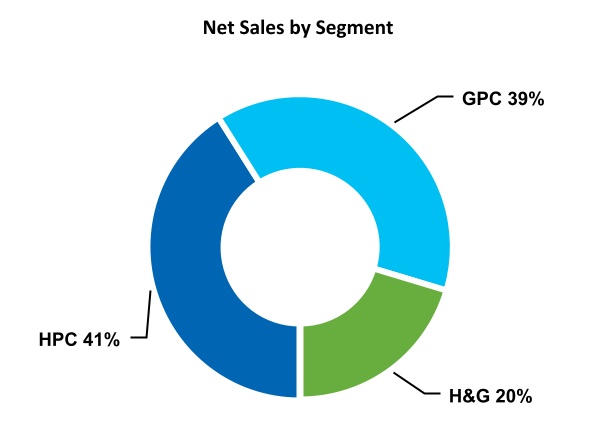
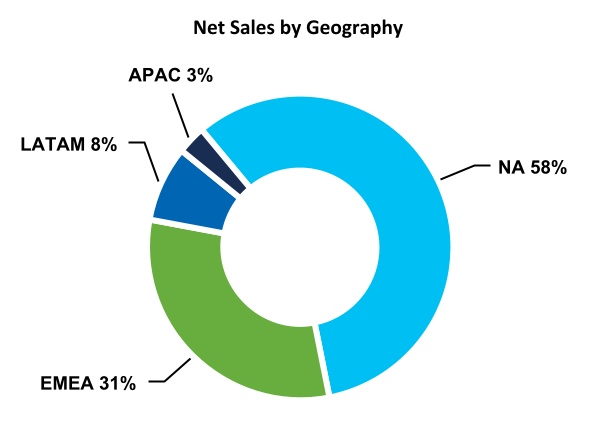
Fiscal 2025 Strategic Priorities
Our operating performance is influenced by a number of factors including: general economic conditions; foreign exchange fluctuations; trends in consumer markets; consumer confidence and preferences; our overall product line mix, including pricing and gross margin, which vary by product line and geographic market; pricing of certain raw materials and commodities; energy and fuel prices; and our general competitive position, especially as impacted by our competitors’ advertising and promotional activities and pricing strategies. See Item 7 - Management’s Discussion and Analysis of Financial Condition and Results of Operations, for further discussion of the consolidated operating results and segment operating results.
Global Pet Care (GPC)
GPC sells products within the companion animal, dog and cat food and aquatics product categories. Companion animal products include rawhide and rawhide free chews and treats, dog and cat clean-up, training, health and grooming, and small animal food and care products. Dog and cat food includes wet and dry pet food for dogs and cats. Aquatics includes consumer and commercial aquarium kits, stand-alone tanks, aquatics equipment such as filtration systems, heaters and pumps, and aquatics consumables such as fish food, water management and care. The following is an overview of GPC net sales by product category and geographic region (based upon destination) for the year ended September 30, 2025.
Related Brands
Product sales are generally through our direct sales force and network of brokers and distributors primarily with large retailers, pet superstores, e-commerce, food and drug retailers, warehouse clubs and other pet specialty retail, with a significant concentration of sales to a limited group of retail customers each exceeding 10% of segment sales, consisting of Amazon and Walmart, representing approximately 34% of segment sales for the year ended September 30, 2025. A portion of sales are from installation and maintenance services on commercial aquariums. Live fish under the GloFish® brand are produced, marketed, and sold by an independent third-party breeder through a supply and licensing agreement with the Company. Segment sales remain mostly consistent throughout the year with slight variations during holiday periods. Our sales by quarter as a percentage of annual net sales during the year ended September 30, 2025 are as follows:
|
|
|
|
|
|
|
|
|
|
|
|
|
|
|
|
|
|
|
|
|
First Quarter |
|
Second Quarter |
|
Third Quarter |
|
Fourth Quarter |
| 24 |
% |
|
25 |
% |
|
24 |
% |
|
27 |
% |
Markets for our products are highly competitive where we compete based upon brand strength, product innovation, quality, performance, advertising and brand awareness, value, dependency and strength in our relationships with our retail partners and distributors. Primary competitors are Mars Corporation, Nestle Purina, and the Central Garden & Pet Company, each of which sells a comprehensive line of pet products and brands that competes across product categories. The pet supplies product category is highly fragmented with no competitor holding a substantial market share and consists of small companies with limited product lines, including private label products and suppliers.
Most all chews products along with other aquatics equipment and companion animal hard goods are also produced at third-party suppliers in the APAC region. We maintain ownership of most tooling and molds used by third-party suppliers. Product purchased from third-party suppliers are susceptible to fluctuations in transportation costs, government regulations and tariffs, and foreign currency exchange rates. We continuously monitor and evaluate our supplier network for quality, cost, and manufacturing capacity.
Aquatics and certain other companion animal products are produced in various manufacturing plants located in the U.S. and Germany, including the production of glass aquariums in in our Noblesville, IN facility, shampoos and aquarium salt in our Blacksburg, VA facility, OmegaSea® fish food with bird and other small animal products manufactured in our Bridgeton, MO facility, and most Tetra® aquatics nutrition and care products manufactured in our Melle, Germany facility. We continually evaluate capacity at our manufacturing facilities and related utilization. In general, we believe our existing facilities are adequate for our present and foreseeable future operating needs. Majority of our shipments are made via common carriers with strategically located distribution centers within the respective operating regions for the segment.
Our research and development strategy is focused on new product development and performance enhancements of our existing products. We plan to continue to use our brand names, customer relationships and research and development efforts to introduce innovative products that offer enhanced value to consumers through new designs and improved functionality.
Home and Garden (H&G)
H&G sells products in the household and outdoor controls, repellents, and cleaning product categories. Household controls include pest control solutions such as spider and scorpion killers, ant and roach killers, flying insect killers, insect foggers, wasp and hornet killers, and bedbug, flea and tick control products. Outdoor controls include weed control solutions and insect and animal repellents, such as aerosols, granules, and ready-to-use spray or hose-and-ready-to-sprays. Repellents include personal use pesticides and insect repellent products, including aerosols, lotions, pump sprays and wipes; in addition to area repellents such as yard sprays and citronella candles. Cleaning includes household surface cleaning, maintenance, and restoration products, including bottled liquids, mops, and wipes. The following is an overview of H&G net sales by product category and geographic region (based upon destination) for the year ended September 30, 2025.
Related Brands
Product sales are generally through our direct sales force and network of brokers and distributors primarily with large retailers, home improvement centers, mass merchants, dollar stores, hardware stores, lawn and garden distributors, food and drug retailers, and e-commerce with a significant concentration of sales to a limited group of retailer customers each exceeding 10% of segment sales, consisting of The Home Depot, Lowe’s and Walmart, representing approximately 64% segment sales for the year ended September 30, 2025. Segment sales typically peak during the first six months of the calendar year (the Company’s second and third fiscal quarters) and are generally lowest in the last three months of the calendar year (the Company’s first quarter) due to customer purchasing patterns, timing of promotional activities and seasonal sales activity impacted by changes in weather conditions. Quarterly sales as a percentage of annual net sales during the year ended September 30, 2025, are as follows:
|
|
|
|
|
|
|
|
|
|
|
|
|
|
|
|
|
|
|
|
|
| First Quarter |
|
Second Quarter |
|
Third Quarter |
|
Fourth Quarter |
| 16 |
% |
|
27 |
% |
|
33 |
% |
|
24 |
% |
Markets for our products are highly competitive where we compete based upon brand strength, product innovation, quality, performance, advertising and brand awareness, value, dependency and strength in our relationships with our retail partners and distributors. Primary competitors include The Scotts Miracle-Gro Company (Ortho, Roundup, Tomcat), S.C. Johnson & Son, Inc. (Raid, OFF!), Central Garden & Pet (AMDRO, Sevin), SBM Company (BioAdvanced), Henkel AG & Co. KgaA (Combat), Bona AB (Bona), and Procter & Gamble (Swiffer, Zevo).
H&G produces the majority of its products in one facility in Vinita Park, MO, with production primarily consisting of liquids and aerosols, and the remaining portion of products being produced by various third-party manufacturers, consisting of granulates, candles, baits & traps, wipes and Rejuvenate® cleaning products. The main raw materials purchased are plastic bottles, steel aerosol cans, corrugate, active ingredients, and bulk chemicals. The prices of these raw materials are susceptible to fluctuations due to supply and demand trends, energy costs, transportation costs, inflation, government regulations, and tariffs. We continuously monitor and evaluate our supplier network for quality, cost, and manufacturing capacity. Majority of our shipments are made via common carriers with a strategically located distribution center in Edwardsville, IL.
Our research and development strategy is focused on new product development and performance enhancements of our existing products. We plan to continue to use our brand names, customer relationships, and research and development efforts to introduce innovative products that offer enhanced value to consumers through new designs and improved functionality.
Home and Personal Care (HPC)
HPC sells products in the small home appliances and personal care appliance product categories. Home appliances products consist of small kitchen appliances including toaster ovens, coffeemakers, slow cookers, air fryers, blenders, hand mixers, grills, food processors, juicers, toasters, irons, kettles, and bread makers, cookware and cookbooks. Personal care products consist of hair dryers, flat irons and straighteners, rotary and foil electric shavers, personal groomers, mustache and beard trimmers, body groomers, nose and ear trimmers, women's shavers, and haircut kits. The following is an overview of net sales by product category and geographic region (based upon destination) for the year ended September 30, 2025.
Related Brands
Product sales are generally through our direct sales force and network of brokers and distributors primarily with large retailers, e-commerce, wholesalers, distributors, warehouse clubs, food and drug retailers and specialty retail outlets with a significant concentration of sales to a limited group of retail customers each exceeding 10% of segment sales, consisting of Amazon and Walmart, representing approximately 42% of segment sales for the year ended September 30, 2025. A portion of sales are also direct-to-consumer through direct response television, brand websites, and other online marketplaces. Segment sales tend to increase during the December holiday season (the Company’s fiscal first quarter) and late summer months for “back-to-school” sales (the Company’s fiscal fourth quarter). Quarterly sales as a percentage of annual net sales during the year ended September 30, 2025, are as follows:
|
|
|
|
|
|
|
|
|
|
|
|
|
|
|
|
|
|
|
|
|
| First Quarter |
|
Second Quarter |
|
Third Quarter |
|
Fourth Quarter |
| 30 |
% |
|
22 |
% |
|
22 |
% |
|
26 |
% |
All brands and tradenames noted above are owned by the Company, with the exception of Black+Decker® (“B+D”) and Emeril Legasse® ("Emeril") which are subject to trademark license agreements. The B+D brand is subject to a trademark license agreement with the license holder, Stanley Black+Decker, pursuant to which we license the brand in NA and LATAM for certain designated products types of home appliances for a fee based on a percentage of sales, subject to minimum annual royalty payments, maximum annual return rates and promotional spending commitments, and having an expiration of December 31, 2027 with two subsequent four-year renewal rights each based upon meeting certain sales metrics, with minimum royalty subject to adjustment for each renewal period; potentially extending the total contract term to December 31, 2035. See Note 5 – Revenue Recognition and Receivables included in the Notes to the Consolidated Financial Statements for further detail on concentration of sales exceeding 10% of consolidated and segment sales from B+D product sales. The Emeril brand is subject to a trademark license agreement with the license holder, Martha Stewart Living Omnimedia, Inc., pursuant to which we license the brand within NA, Mexico, Australia, and the United Kingdom for certain designated product types of home appliances for a fee based on a percentage of sales expiring on December 31, 2027. Sales subject to the Emeril license do not have a concentration greater than 10% of consolidated or segments sales. We own the right to use the Remington® trademark for personal care products through the terms of an agreement between a wholly-owned subsidiary of the Company, Remington Products, LLC, and a separate third party, Remington Arms Company, Inc., which provides shared use of the trademark on products not considered "principal products of interest" for either company.
Markets for our products are highly competitive where we compete based upon brand strength, product innovation, quality, performance, advertising and brand awareness, value, dependency and strength in our relationships with our retail partners and distributors. Primary competitors for the home appliances product category within our HPC segment include Newell Brands (Sunbeam, Mr. Coffee, Crockpot, Oster), De’Longhi America (DeLonghi, Kenwood, Braun), SharkNinja (Shark, Ninja), Hamilton Beach Holding Co. (Hamilton Beach, Proctor Silex), Sensio, Inc. (Bella), SEB S.A.(T-fal, Krups, Rowenta), Whirlpool Corporation (Kitchen Aid), Conair Corporation (Cuisinart, Waring), Versuni (Philips), Donlim (Morphy Richards), Gourmia, and private label brands for major retailers. Primary competitors for the personal care product category within our HPC segment include Koninklijke Philips Electronics N.V. (Norelco), The Procter & Gamble Company (Braun), Conair Corporation, Wahl Clipper Corporation, Helen of Troy Limited, SharkNinja (Shark), and Dyson Limited (Dyson).
Substantially all segment products are manufactured by third-party suppliers located in the APAC region, the prices of which may be susceptible to changes in transportation costs, government regulations and tariffs, and changes in currency exchange rates. We maintain ownership of most tooling and molds used by our suppliers. We continuously monitor and evaluate our supplier network for quality, cost, and manufacturing capacity. The majority of our shipments are made via common carriers with strategically located distribution centers within the respective operating regions of the segment.
Our research and development strategy is focused on new product development and performance enhancements of our existing products. We plan to continue to use our brand names, customer relationships and research and development efforts to introduce innovative products that offer enhanced value to consumers through new designs and improved functionality.
Human Resources
Employee Profile
At Spectrum Brands, everything we do is led by our values of trust, accountability, and collaboration to serve our customers, consumers, and communities and accomplish our mission to Make Living Better at Home. Our workplace culture is centered around practices that support our communities and promote sustainable practices and a diverse and inclusive workforce.
As of September 30, 2025, we have approximately 3,000 full-time employees worldwide. Approximately 32% of our total labor force is covered by collective bargaining agreements, of which approximately 57% is subject to regular and ongoing negotiations as an ordinary course of business with our work councils. No applicable collective bargaining agreement is scheduled or expected to expire within the next 12 months. We believe that our overall relationship with our employees is good.
Employee Wellness
We encourage our employees to “Speak Up,” “Be Accountable,” “Take Action,” and “Grow Talent,” all in the efforts to promote innovation, trust, accountability and collaboration. The result is a work environment that encourages the well-being of our employees and the development of our future leaders.
Employee Health and Safety
We are committed to the Environmental Health and Safety (“EHS”) safety of our employees and maintaining our strong safety performance as we continue to operate and grow our global business. The keys to our EHS success are a workforce that is engaged, a management team who supports and invests in employee safety, regular employee trainings on EHS topics, and the leadership of our skilled EHS team. Our team has dedicated EHS professionals at our individual sites to train employees and ensure compliance with applicable safety standards and regulations. The team hosts regular meetings to share information and discuss best practices and learnings across plants.
Environmental, Social and Governance
Spectrum Brands is committed to further enhancing our ESG efforts and recognizes the impact our business has on our communities and the world. We believe in making a positive difference in the communities in which we live and work and strive to discharge our corporate social responsibilities from a global perspective and throughout every aspect of our operations, consistent with our focus on creating value for all of our stakeholders over the long term. Our decisions regarding business strategy, operations and resource allocation are guided by this purpose and are rooted in our core values. The Board of Directors of the Company (the "Board of Directors") recognizes the negative effect that poor environmental practices and human capital management may have on us and our returns. Accordingly, our Board of Directors considers and balances the impact on the environment, people and the communities of which we are a part in deciding how to operate our business. Our Board of Directors receives periodic reports regarding our risk exposure and risk mitigation efforts in these areas.
We are committed to operating our business with all stakeholders in mind and with a view toward long-term sustainability and value creation, even as our business and society face a variety of existing and emerging challenges. We leverage our expertise, along with external partners, to help address these challenges. While our corporate social responsibility commitments address many areas, we focus on five key priorities: (i) product and content safety; (ii) environmental sustainability; (iii) human rights and ethical sourcing; (iv) employee safety and well-being; and (v) belonging and inclusion.
Talent Development
Spectrum Brands is committed to developing our future leaders at every level. Our talent processes start with understanding what current and future talent is needed to deliver business goals, followed by a talent review process to assist managers with evaluating talent.
Learning and development are a critical part of creating our culture of high performance and innovation. We believe in transparency and accountability and utilize performance and development plans to assess and develop career plans, mobility and developmental goals to align with our overall work environment.
Employee Communication and Feedback
In an ongoing effort to understand our employees' needs, and deliver on our values of trust, accountability and collaboration, we listen. We regularly host company-wide and business unit town halls to offer employees an opportunity to ask questions about Company activities and policies that impact them. We solicit and receive questions and feedback from our employees through this process.
Belonging and Inclusion
Spectrum Brands takes a holistic approach to belonging and inclusion ("BeIn"). We believe that supporting and promoting inclusion across our business and society makes the world a better place for all. We believe that the more inclusive we are as a company, the stronger our business will be. We support the personal and professional growth of our diverse worker base, with a goal of positively impacting their lives and well-being.
To further these efforts, we have established a U.S. Belonging & Inclusion Council, comprised of employees with diverse backgrounds and perspectives who advocate and advise on ways to advance the BeIn dialogue and drive meaningful cultural change at the company. In furtherance of these efforts, we have implemented leadership training for our senior leaders across the Company to foster an inclusive and welcoming workplace.
ITEM 1A. RISK FACTORS
Any of the following factors could materially and adversely affect our business, financial condition and results of operations. The risks described below are not the only risks that we may face. Additional risks and uncertainties not currently known to us or that we currently view as immaterial may also materially and adversely affect our business, financial condition or results of operations.
We are subject to a variety of risks, including those described below. In particular, these risks include, but are not limited to:
•Risks related to our business operations: We participate in very competitive markets and we may not be able to compete successfully, causing us to lose market share and sales.
•Risks related to our indebtedness and financing abilities: Our indebtedness may limit our financial and operating flexibility, and we may incur additional debt, which could increase the risks associated with our substantial indebtedness.
•Risks related to our international operations: We are subject to significant international business risks that could hurt our business and cause our results of operations to fluctuate.
•Risks related to data privacy and intellectual property: We may not be able to adequately establish and protect our intellectual property rights, and the infringement or loss of our intellectual property rights could harm our business.
•Risks related to litigation and regulatory compliance: We are subject to a number of claims and litigation and may be subject to future claims and litigation, any of which may adversely affect our business.
•Risks related to investment in our common stock: The market price of the Company’s common stock is likely to be highly volatile and could fluctuate widely in price in response to various factors, many of which are beyond our control.
Risks Related to our Business Operations
Our plans to separate our HPC business into an independent, publicly traded company may not be completed on the currently contemplated timeline or at all and, if completed, may not achieve the intended benefits.
We have previously announced our plan to divest our HPC business through a sale or spin of the segment. A spin off would be through a pro rata distribution of shares to our common stockholders and the recognition of two distinct and independent, publicly traded companies. The proposed spin is subject to various conditions, is complex in nature, and may be affected by unanticipated developments, credit and equity markets, or changes in market conditions. As independent, publicly traded companies, each of the resulting companies will be smaller and less diversified than the existing company, with a narrower business focus, and they may be more vulnerable to changing market conditions.
We may not be able to achieve the full strategic and financial benefits that we anticipate to result from the separation, or such benefits may be delayed or not occur at all. We may experience negative reactions from financial markets if we do not complete the separation in a reasonable time period, or at all. Following the proposed separation, the combined value of the shares of the two publicly traded companies may not be equal to or greater than what the value of our common stock would have been had the proposed separation not occurred. In addition, the cost and resources required to effectuate the separation may be significantly higher than what we currently anticipate.
Any of these factors could have a material adverse effect on our business, financial condition, results of operations, cash flows or the price of our common stock.
Reliance on third-party relationships and outsourcing arrangements that are beyond our control could adversely affect our business.
We rely on third parties, including suppliers, distributors, alliances with other companies, and third-party service providers, for selected aspects of product development, manufacturing, commercialization, support for information technology systems, product distribution, and certain financial transactional processes. Additionally, we have outsourced certain functions to third-party service providers to leverage leading specialized capabilities and achieve cost efficiencies. Outsourcing these functions involves the risk that third-party service providers may not perform to our standards or legal requirements, may not produce reliable results, may not perform in a timely manner, may not maintain the confidentiality of our proprietary information, or may fail to perform at all. While we have implemented processes and procedures to try to ensure that the suppliers we use are complying with all applicable regulations, there can be no assurances that such suppliers in all instances will comply with such processes and procedures or otherwise with applicable regulations. Noncompliance could result in our marketing and distribution of contaminated, defective or dangerous products which could subject us to liabilities and could result in the imposition by governmental authorities of procedures or penalties that could restrict or eliminate our ability to purchase products. Any or all of these effects could adversely affect our business, financial condition, and results of operations.
Additionally, any disruption to global supply chains or shipping channels, such as recently announced tariffs, a government shutdown, war, natural disaster or global pandemic, could affect the ability of our third-party service providers to meet their contractual obligations to us. The impact of such global disruptions to the economic conditions of our suppliers cannot be predicted. Further, our suppliers may be unable to access financing or become insolvent for any other reasons and thus become unable to supply us with products. Failure of these third parties to meet their contractual, regulatory, confidentiality or other obligations to us could result in material financial loss, higher costs, regulatory actions, and reputational harm.
Compliance with regulations regarding the use of “conflict minerals” could limit the supply and increase the cost of certain metals used in manufacturing our products.
The Dodd-Frank Wall Street Reform and Consumer Protection Act includes provisions regarding certain minerals and metals, known as conflict minerals, mined from the Democratic Republic of Congo and adjoining countries. These provisions require companies to undertake due diligence procedures and report on the use of conflict minerals in its products, including products manufactured by third parties. Compliance with these provisions causes us to incur costs to certify that our supply chain is conflict free and we may face difficulties if our suppliers are unwilling or unable to verify the source of their materials. Our ability to source these minerals and metals may also be adversely impacted. In addition, our customers may require that we provide them with a certification and our inability to do so may disqualify us as a supplier.
Uncertain global economic conditions may adversely impact demand for our products or cause our customers and other business partners to suffer financial hardship, which could adversely impact our business.
Our business could be negatively impacted by reduced demand for our products related to one or more significant local, regional or global economic disruptions, such as: a slow-down in the general economy; reduced market growth rates; increased inflation rates; tighter credit markets for our suppliers, vendors or customers; a significant shift in government policies; the deterioration of economic relations between countries or regions, including potential negative consumer sentiment toward non-local products or sources; or the inability to conduct day-to-day transactions through our financial intermediaries to pay funds to, or collect funds from, our customers, vendors and suppliers. Additionally, economic conditions may cause our suppliers, distributors, contractors or other third-party partners to suffer financial difficulties that they cannot overcome, resulting in their inability to provide us with the materials and services we need, in which case our business and results of operations could be adversely affected. Customers may also suffer financial hardships due to economic conditions such that their accounts become uncollectible or are subject to longer collection cycles. In addition, if we are unable to generate sufficient income and cash flow, it could affect the Company’s ability to achieve expected share repurchase and dividend payments.
The People’s Republic of China (“PRC”) government may intervene with or influence the operations of our suppliers at any time, which could result in a material change in our operations.
Many of our suppliers conduct significant operations in China. The PRC government may choose to exercise significant oversight and discretion, and the regulations to which our suppliers are subject may change rapidly and with little notice to us or our shareholders. As a result, the application, interpretation, and enforcement of new and existing laws and regulations in China are often uncertain. In addition, these laws and regulations may be interpreted and applied inconsistently by different agencies or authorities, and inconsistently with our suppliers’ current policies and practices. New laws, regulations, and other government directives in China may also be costly to comply with, and such compliance or any associated inquiries or investigations or any other government actions may:
•delay or impede our development;
•result in negative publicity or increase our operating costs;
•require significant management time and attention; and
•subject our suppliers to remedies, administrative penalties and liabilities that may harm our and our suppliers’ businesses, including fines, demands or orders that we or our suppliers modify or cease our business practices.
The promulgation of new laws or regulations, or the new interpretation of existing laws and regulations, in each case that restrict or otherwise unfavorably impact the ability or manner in which we or our suppliers conduct our respective businesses could require us to change certain aspects of our business to ensure compliance, which could decrease demand for our products, increase costs, require us to obtain more licenses, permits, approvals or certificates, or subject us to additional liabilities. To the extent any new or more stringent measures are required to be implemented, our business and results of operations and the value of our shares could be adversely affected.
Disruption in our global supply chain may negatively impact our business results.
Our ability to meet our customers’ needs and achieve cost targets depends on our ability to maintain key manufacturing and supply arrangements, including execution of supply chain optimizations and certain sole supplier or sole manufacturing plant arrangements. The loss or disruption of such manufacturing and supply arrangements, including for issues such as labor disputes, labor shortages, loss or impairment of key manufacturing sites, discontinuity in our internal information and data systems, inability to procure sufficient raw or input materials, significant changes in trade policy, natural disasters, increasing severity or frequency of extreme weather events due to climate change or otherwise, acts of war or terrorism, or disease outbreaks or other external factors over which we have no control, including inflation, have interrupted product supply and, if not effectively managed and remedied, could have an adverse impact on our business, financial condition or results of operations.
We participate in very competitive markets and we may not be able to compete successfully, causing us to lose market share and sales.
We compete for consumer acceptance and limited shelf space based upon brand name recognition, perceived product quality, price, performance, product features and enhancements, product packaging and design innovation, as well as creative marketing, promotion and distribution strategies, and new product introductions. Additional discussion over the segments, product categories, and markets in which we compete are included under Item 1 above. Our ability to compete in these consumer product markets may be adversely affected by a number of factors, including, but not limited to, the following:
•We compete against many well-established companies that may have substantially greater financial and other resources, including personnel and research and development, and greater overall market share than us.
•In some key product lines, our competitors may have lower production costs and higher profit margins than us, which may enable them to compete more aggressively in offering retail discounts, rebates and other promotional incentives.
•Technological advancements, product improvements or effective advertising campaigns by competitors may weaken consumer demand for our products.
•Consumer purchasing behavior may shift to distribution channels, including to online retailers, where we and our customers do not have a strong presence.
•Consumer preferences may change to lower or higher margin products or products other than those we market.
•We may not be successful in the introduction, marketing and manufacture of any new products or product innovations or be able to develop and introduce, in a timely manner, innovations to our existing products that satisfy customer needs or achieve market acceptance.
In addition, in certain of our product lines, we compete with our retail customers, who use their own private label brands, and with distributors and foreign manufacturers of unbranded products. Significant new competitors or increased competition from existing competitors, including specifically private label brands, may adversely affect our business, financial condition and results of our operations.
Some competitors may be willing to reduce prices and accept lower profit margins to compete with us. As a result of this competition, we could lose market share and sales or be forced to reduce our prices to meet competition. If our product offerings are unable to compete successfully, our sales, results of operations and financial condition could be materially and adversely affected. In addition, we may be unable to implement changes to our products or otherwise adapt to changing consumer trends. If we are unable to respond to changing consumer trends, our operating results and financial condition could be adversely affected.
Changes in consumer preferences and shopping trends and changes in distribution channels could significantly harm our business.
We sell our products through a variety of trade channels with a significant portion dependent upon retail partnerships, through both traditional brick-and-mortar retail channels and e-commerce channels. We are seeing the emergence of strong e-commerce channels generating more online competition and declining in-store traffic in brick-and-mortar retailers. Our strategic initiatives have begun to direct significant investment into owned e-commerce platforms and developing relationships with digital channel partners. If we are not successful in developing and utilizing e-commerce channels that future consumers may prefer, we may experience lower than expected revenues. Consumer shopping preferences have shifted and may continue to shift in the future to distribution channels other than traditional retail that may have more limited experience, presence and developed, such as e-commerce channels. These shifts could be to retail channels in which we have more limited experience, presence and development, which may adversely affect our business, financial condition and results of operations.
We are also seeing more traditional brick-and-mortar retailers consolidating, closing physical stores, and filing for bankruptcy, which could further concentrate the negotiating power of our remaining brick-and-mortar customers and negatively impact our distribution strategies and/or sales if such retailers decide to pursue aggressive price reduction strategies, significantly reduce their inventory levels for our products or to designate more floor space to our competitors. Further consolidation, store closures and bankruptcies could have a material adverse effect on our business, prospects, financial condition, results of operations, cash flows, as well as the trading price of our securities.
Consolidation of retailers and our dependence on a small number of key customers for a significant percentage of our sales may negatively affect our business, financial condition and results of operations.
As a result of consolidation of retailers that has occurred during the past several years, particularly in the U.S. and the European Union (“EU”), and consumer trends toward national mass merchandisers, a significant percentage of our sales are attributable to a limited group of customers. As these mass merchandisers and retailers grow larger and become more sophisticated, they may demand lower pricing, special packaging or impose other requirements on product suppliers. These business demands may relate to inventory practices, logistics or other aspects of the customer-supplier relationship. Because of the importance of these key customers, demands for price reductions or promotions, retail inventory levels and requirements influencing their purchasing, consumer shopping behavior and patterns, and changes in their financial condition or loss of their accounts could have a material adverse effect on our business, financial condition and results of operations. Our success is dependent on our ability to manage our retailer relationships, including offering mutually acceptable trade terms. Concentration of sales are further discussed in Item 1 - Business above and Note 5 - Revenue Recognition and Receivables in the Notes to the Consolidated Financial Statements.
Although we have long-established relationships with many of our retail customers, we generally do not have long-term agreements with them and purchases are normally made through the use of individual purchase orders. Any significant reduction in purchases, failure to obtain anticipated orders or delays or cancellations of orders by any of these major retail customers, changes to retail inventory management strategies and initiatives, competition from private label products or significant pressure to reduce prices and support promotions and discounts from any of these major retail customers, could have a material adverse effect on our business, financial condition and results of operations. Additionally, any decline in retail consumer spending, a significant deterioration in the financial condition of the retail industry in general, the bankruptcy of any of our customers or any of our customers ceasing operations could have a material adverse effect on our sales and profitability.
As a result of retailers maintaining tighter inventory control, we face risks related to meeting demand and storing inventory.
There is a growing trend among retailers to purchase products on a “just-in-time” basis. Due to a number of factors, including (i) manufacturing lead-times, (ii) seasonal purchasing patterns, and (iii) the potential for material price increases, we may be required to shorten our lead-time for production and more closely anticipate shifts in our retailers’ demands and consumer spending habits, which could in the future, require us to carry additional inventories and increase our working capital and related financing requirements. This may increase the cost of warehousing inventory or result in excess inventory becoming difficult to manage, unusable or obsolete and impact our ability to realize the anticipated returns from product sales. In addition, if our retailers significantly change their inventory management strategies, we may encounter difficulties in filling customer orders or in liquidating excess inventories or may find that customers are cancelling orders or returning products, which may have a material adverse effect on our business.
Furthermore, we primarily sell branded products and a move by one or more of our large customers to sell significant quantities of private label products, which could be at the exclusion of our products and/or which directly compete with our products, could have a material adverse effect on our business, financial condition and results of operations.
Sales of certain of our products are seasonal and may cause our operating results and working capital requirements to fluctuate.
On a consolidated basis, our financial results are approximately equally weighted across our quarters, however, sales of certain product categories tend to be seasonal. Further discussion over the seasonality of our sales is included in Item 1 - Business. As a result of this seasonality, our inventory and working capital needs fluctuate significantly throughout the year. In addition, orders from retailers are often made late in the period preceding the applicable peak season, making forecasting of production schedules and inventory purchases difficult. If we are unable to accurately forecast and prepare for customer orders or our working capital needs, or there is a general downturn in business or economic conditions during these periods, our business, financial condition and results of operations could be materially and adversely affected.
Adverse weather conditions during our peak selling seasons for our home and garden products could have a material adverse effect on our home and garden business.
Weather conditions have a significant impact on the timing and volume of sales of certain of our lawn and garden and household insecticide and repellent products. For example, periods of dry, hot weather can decrease insecticide sales, while periods of cold and wet weather can slow sales of herbicides. Adverse weather conditions during the first six months of the calendar year (the Company’s second and third fiscal quarters), when demand for home and garden control products typically peaks, could have a material adverse effect on our home and garden business and our financial results during such period.
Our products utilize certain key raw materials; any significant increase in the price of, or change in supply and demand for, these raw materials could have a material and adverse effect on our business, financial condition and profits.
The principal raw materials used to produce our products, including petroleum-based plastic materials and corrugated materials (for packaging), are sourced either on a global or regional basis by us or our suppliers, and the prices of those raw materials are susceptible to price fluctuations due to supply and demand trends, energy costs, transportation costs, government regulations, duties and tariffs, changes in currency exchange rates, price controls, general economic conditions, inflation, and other unforeseen circumstances. Although we may seek to increase the prices of certain of our goods to our customers, we may not be able to pass all of these cost increases on to our customers. As a result, our margins may be adversely impacted by such cost increases. We cannot provide any assurance that our sources of supply will not be interrupted due to changes in worldwide supply of or demand for raw materials or other events that interrupt material flow, which may have an adverse effect on our profitability and results of operations.
If we are not effective in managing our exposure to above average costs for an extended period of time, and we are unable to pass our raw materials costs on to our customers, our future profitability may be materially and adversely affected. Furthermore, with respect to transportation costs, certain modes of delivery are subject to fuel surcharges which are determined based upon the current cost of diesel fuel in relation to pre-established agreed upon costs. We may be unable to pass these fuel surcharges on to our customers, which may have an adverse effect on our profitability and results of operations.
In addition, we have exclusivity arrangements and minimum purchase requirements with certain of our suppliers for the home and garden business, which increase our dependence upon and exposure to those suppliers. Some of those agreements include caps on the price we pay for our supplies and in certain instances these caps have allowed us to purchase materials at below market prices. When we attempt to renew those contracts, the other parties to the contracts may not be willing to include or may limit the effect of those caps and could even attempt to impose above market prices in an effort to make up for any below market prices paid by us prior to the renewal of the agreement. Any failure to timely obtain suitable supplies at competitive prices could materially adversely affect our business, financial condition and results of operations.
Our dependence on a few suppliers for certain of our products makes us vulnerable to supply disruption.
We generally do not have long-term contracts with our suppliers. If any of the following were to occur, we could experience loss and liability, which could have a material adverse effect on our business, financial condition and results of operations:
•our ability to identify and develop relationships with qualified suppliers;
•the terms and conditions upon which we purchase products from our suppliers, including applicable exchange rates, transport and other costs, our suppliers’ willingness to extend credit to us to finance our inventory purchases and other factors beyond our control;
•the financial condition of our suppliers and their ability to deliver products on a timely and efficient basis;
•political and economic instability in the countries in which our suppliers are located, as a result of war, terrorist attacks, pandemics, natural disasters or otherwise;
•our ability to import outsourced products;
•our suppliers’ noncompliance with applicable laws, trade restrictions and tariffs; or
•our suppliers’ ability to manufacture and deliver outsourced products according to our standards of quality on a timely and efficient basis.
If our relationship with one of our key suppliers is adversely affected, we may not be able to quickly or effectively replace such supplier and may not be able to retrieve tooling, molds or other specialized production equipment or processes used by such supplier in the manufacture of our products. The loss of one or more of our suppliers, a material reduction in their supply of products or provision of services to us or extended disruptions or interruptions in their operations could have a material adverse effect on our business, financial condition and results of operations.
Our home and garden products are mainly manufactured from our Vinita Park, MO, facility and our aquatics products and certain companion animal products are manufactured in Blacksburg, VA, Bridgeton, MO, Noblesville IN and Melle, Germany. We are dependent upon the continued safe operation of these facilities.
Our facilities are subject to various hazards associated with the manufacturing, handling, storage, and transportation of chemical materials and products, including human error, leaks and ruptures, explosions, floods, fires, inclement weather and natural disasters, power loss or other infrastructure failures, mechanical failure, unscheduled downtime, regulatory requirements, the loss of certifications, technical difficulties, labor disputes, inability to obtain material, equipment or transportation, environmental hazards such as remediation, chemical spills, discharges or releases of toxic or hazardous substances or gases, and other risks. Many of these hazards could cause personal injury and loss of life, severe damage to, or destruction of, property and equipment and environmental contamination. In addition, the occurrence of material operation problems at our facilities due to any of these hazards could cause a disruption in the production of products. We may also encounter difficulties or interruption as a result of the application of enhanced manufacturing technologies or changes to production lines to improve throughput or to upgrade or repair its production lines. The Company’s insurance policies have coverage in case of significant damage to its manufacturing facilities but may not fully compensate for the cost of replacement for any such damage and any loss from business interruption. As a result, we may not be adequately insured to cover losses resulting from significant damage to our manufacturing facility. Any damage to this facility or interruption in manufacturing could result in production delays and delays in meeting contractual obligations which could have a material adverse effect on relationships with customers and on its results of operations, financial condition or cash flows in any given period.
We face a number of local, regional, and global uncertainties and potential disruptions, including relating to political and economic instability in a number of regions, some of which have been historically volatile, including relating to political and economic instability in a number of regions, some of which have been historically volatile, which could adversely impact our businesses.
We face a number of local, regional, and global uncertainties and potential disruptions, including relating to political and economic instability in a number of regions, some of which have been historically volatile, which could adversely impact our businesses, our financial performance or liquidity, and our ability to carry out our go-forward plans and strategies. These economic uncertainties and potential disruptions include a slow-down in the general economy; reduced market growth rates; increased inflation rates and cost of goods; increased fuel and employee costs; higher interest rates; tighter credit markets; changes in government policies, including the imposition of tariffs or import costs; the deterioration of economic relations between countries or regions; and the escalation or continuation of armed conflict, hostilities or economic sanctions between countries or regions, all of which can negatively impact our ability to manufacture, supply or sell our products and otherwise conduct our day-to-day operations. For instance, the conflict between Russia and Ukraine has led us to terminate, reduce or significantly change our business activities in these regions and certain surrounding regions. We have also experienced increased shipping costs and shipping delays from the dangerous disruptions to shipping in the Red Sea. We have closed our HPC operations within Russia and in the future, we may have to further reduce or cease doing business within the certain surrounding regions, which could have a negative impact on our ability to collect outstanding accounts receivables, or impose additional costs, further negatively impacting our business performance. In addition, the economic sanctions and hostilities in Russia and Ukraine and the Israel-Hamas war (including other parts of the Middle East) may negatively impact our and our customers’ financial viability, which may negatively impact us or the demands or economic viability of our customers in other parts of the world.
The Company has in the past and may in the future , transition its third-party logistics service providers at its distribution centers, which efforts would require incorporating a new service provider into our distribution capabilities and are complicated and require coordination among a number of our stakeholders, including our suppliers and transportation and logistics handlers. These changes and updates are inherently difficult and may be exacerbated by the other uncertainties and potential disruptions our business faces. We do not control the operations of these third parties and are dependent on them to execute our orders and deliver our products in a timely and efficient way. The failure of these third parties to fulfill all of their obligations to us could result in lost sales, penalties and other adverse effects on our business. While we believe that optimizing our distribution centers and other aspects of our supply chain and customer delivery network will allow us to manage our inventory more efficiently and more effectively respond to customer demands, there can be no assurance that we will realize such benefits. We have experienced, and may continue to experience, delays in executing these efforts. Our inability to execute, or timely execute these efforts, has resulted in us being unable to supply, or timely supply, our products to our customers or incurring higher costs and reductions in revenues, incurring penalties imposed by our customers, or may disrupt our business operations.
Furthermore, our raw materials are sourced from industries characterized by a limited supply base, and their cost can fluctuate substantially. Under many of our supply arrangements, the price we pay for raw materials fluctuates along with certain changes in underlying commodities costs. Price increases for our raw materials have placed pressure on our costs and could continue to do so, and we may not be able to effectively hedge or pass along any such increases to our customers or consumers. Furthermore, any price increases passed along to our customers or consumers could significantly reduce demand for our products and could negatively affect our business and financial performance.
If we are unable to negotiate satisfactory terms to continue existing or enter into additional collective bargaining agreements, we may experience an increased risk of labor disruptions and our results of operations and financial condition may suffer.
While we currently expect to negotiate continuations to the terms of collective bargaining agreements, there can be no assurances that we will be able to obtain terms that are satisfactory to us or otherwise to reach agreement at all with the applicable parties. In addition, in the course of our business, we may also become subject to additional collective bargaining agreements. These agreements may be on terms that are less favorable than those under our current collective bargaining agreements. Increased exposure to collective bargaining agreements, whether on terms more or less favorable than our existing collective bargaining agreements, could adversely affect the operation of our business, including through increased labor expenses. While we intend to comply with all collective bargaining agreements to which we are subject, there can be no assurances that we will be able to do so and any noncompliance could subject us to disruptions in our operations and materially and adversely affect our results of operations and financial condition. For additional information see the discussion over the Company’s labor force subject to collective bargaining agreements under the caption Employee Profile in Item 1 - Business above.
Significant changes in actual investment return on pension assets, discount rates, and other factors could affect our results of operations, equity and pension contributions in future periods.
Our results of operations may be positively or negatively affected by the amount of income or expense we record for the defined benefit pension plans for which we are responsible. Generally Accepted Accounting Principles in the U.S. (“GAAP”) requires that we calculate income or expense for the plans using actuarial valuations. These valuations reflect assumptions about financial markets and other economic conditions, which may change based on changes in key economic indicators. The most significant assumptions we use to estimate pension income or expense are the discount rate and the expected long-term rate of return on plan assets. In addition, we are required to make an annual measurement of plan assets and liabilities, which may result in a significant change to equity. Although pension expense and pension funding contributions are not directly related, key economic factors that affect pension expense would also likely affect the amount of cash we would contribute to pension plans as required under the Employee Retirement Income Security Act of 1974, as amended. Refer to Note - 14 Employee Benefit Plans in the Notes to the Consolidated Financial Statements for additional information and disclosure over defined benefit plans.
Our business may be materially affected by changes to fiscal and tax policies that could adversely affect our results of operations and cash flows.
We operate globally and changes in tax laws could adversely affect our results. On December 22, 2017, the Tax Cuts and Jobs Act (the “Tax Reform Act”) was signed into law. The legislation, which became effective on January 1, 2018, significantly changed U.S. tax law by, among other things, lowering corporate income tax rates, implementing a dividends received deduction for dividends from foreign subsidiaries, imposing a repatriation tax on deemed repatriated earnings of foreign subsidiaries, a minimum tax on foreign earnings, limitations on deduction of business interest expense and limits on deducting compensation to certain executive officers. Additional tax regulations and interpretations of the Tax Reform Act have been, and continue to be, issued, some with retroactive application dates and some which materially impacted the Company. The Company understands that other U.S. taxpayers have or plan to challenge the constitutionality of a set of regulations that had a material impact on the Company. If the regulations were ruled unconstitutional, the Company could be favorably impacted. New or revised interpretations of the Tax Reform Act and state conformity with its provisions could have a material impact on the valuation allowance recorded on U.S. state net operating losses. Certain of these changes could have a negative or adverse impact on the operating results and cash flows of the Company. In addition, our future income tax obligations and effective tax rates could be adversely affected by changes in, or interpretations of, tax laws, regulations, policies, or decisions in the U.S. as a result of the One Big Beautiful Bill Act (the "Act"), which was signed into law on July 4, 2025. The Act contains numerous provisions related to corporate income taxes with various effective dates, which could have a negative or adverse impact on the operating results and cash flows of the Company. See Note 15 – Income Taxes in the Notes to the Consolidated Financial Statements for further discussion on the impact from the Tax Reform Act.
We may not be able to fully utilize our U.S. tax attributes.
The Company has accumulated a substantial amount of U.S. federal and state net operating loss (“NOLs”) carryforwards, and federal and state tax credits that will expire if unused. We have concluded that it is more likely than not that the majority of the federal and state deferred tax assets related to loss and credit carryforwards will not create tax benefits in the future. As a consequence of earlier business combinations and issuances of common stock, the Company and its subsidiaries have had various changes of ownership that continue to subject a significant amount of the Company’s U.S. NOLs and other tax attributes to certain limitations; and therefore a valuation allowance is still recognized on certain federal and state tax asset carryforwards that are expected to expire due to the ownership change limitations or because we do not believe we will earn enough taxable income to utilize. Changes to state conformity to the provisions of the U.S. federal income tax law could have a material impact on the valuation allowance recorded on U.S. state net operating losses. For further discussion on the Company’s federal and state NOLs, credits, and applicable valuation allowance see Note 15 – Income Taxes in the Notes to the Consolidated Financial Statements.
Our strategic initiatives including acquisitions and divestitures may not be successful and may divert our management’s attention away from operations and could create general customer uncertainty.
Our growth strategy is based in part on growth through strategic initiatives including both acquisitions and divestitures, which poses a number of risks. We may not be successful in identifying appropriate acquisition candidates, achieving targeted values as part of a disposition, consummating an acquisition or divestiture on satisfactory terms, integrating any newly acquired or expanded business with our current operations, or separating a divested business or commingled operation effectively. We may issue additional equity, incur long-term or short-term indebtedness, spend cash or use a combination of these for all or part of the consideration paid in future acquisitions or expansion of our operations, which may not be available to us on terms we find advantageous or acceptable, if at all. In addition, subject to any requirements in the agreements governing our outstanding indebtedness, we may have significant discretion in how we employ the consideration received in a divestiture and our management may not apply such consideration in a way that is ultimately accretive to our business.
The execution of our strategic initiatives could entail repositioning or similar actions that in turn require us to record impairments, restructuring and other charges. Any such charges would reduce our earnings. We cannot guarantee that any future business acquisitions or divestitures will be pursued or that any acquisitions or divestitures that are pursued will be consummated. For example, the Company had disclosed intentions to look for acquisitions for the GPC and H&G businesses and to strategically separate the HPC business, but there are no assurances that any such acquisitions or divestitures may be consummated.
Additionally, any acquisition or disposition (including the successful integration and separation of operations, products and personnel) may place a significant burden on our management and other internal resources. The diversion of management’s attention, and any difficulties encountered in such a process, could harm our business, financial condition, and operating results. Moreover, our customers may, in response to the announcement or consummation of a transaction, delay or defer purchasing decisions. If our customers delay or defer purchasing decisions, our revenues could materially decline or any anticipated increases in revenue could be lower than expected.
For example, on February 18, 2022, the Company completed the acquisition of the Tristar Business, and the Company has been detrimentally impacted by aspects of the integration of the Tristar Business’ operations and products, which have negatively impacted subsequent operating performance and partner relationships of the Tristar Business’ brands and the HPC business. Since the acquisition, the acquired Tristar Business realized, among other things, significant distribution challenges, increased levels of retail inventory, reduced sales, increased promotional spending and deductions, higher level of returns, and overall increased amount of costs. Additionally, the segment has subsequently realized unusual losses attributable to the recognition of product recalls for products associated with the brands, increased risks over the realizability of receivables and inventory, and recognized an impairment on assets including the acquired goodwill and tradename intangible assets. Most recently, the Company disposed of certain inventory and products associated with the Tristar Business’ brand after assessing, among other things, performance and quality standards.
Many of these factors are outside of our control, and any one of them could result in lower revenues, higher costs and diversion of management time and energy, which could materially impact our business, financial condition, and results of operations. As of September 30, 2025, the Company believes it has assessed appropriate risks and recognized applicable losses and reserves reflecting the net assets of the Company, however there may be additional risks posed to the Company from the acquisition of the Tristar Business and its integration with the Company.
Significant costs have been incurred and are expected to be incurred in connection with the consummation of recent and future strategic initiatives including the integration or separation of acquired or divested businesses within the Company.
We expect to incur one-time costs in connection with integrating our operations, products and personnel and those of the businesses we acquire or divest, in addition to costs related directly to completing such transactions. We would expect similar costs to be incurred with any future acquisition or divestiture. These costs may include expenditures for:
•employee redeployment, relocation or severance;
•integration or separation of operations and information systems;
•combination or segregation of research and development teams and processes; and
•reorganization or closures of facilities.
In addition, we expect to incur a number of non-recurring costs associated our operations with those strategic transactions. Additional unanticipated costs may yet be incurred as we integrate or separate our businesses. Although we expect that the elimination of duplicative costs, as well as the realization of other efficiencies may offset incremental transaction and transaction-related costs over time, this net benefit may not be achieved in the near term. Additionally, while we expect to benefit from leveraging distribution channels and brand names among the combined Company, we cannot assure you that we will achieve such benefits.
We may not realize the anticipated benefits of, and synergies from, our business acquisitions and may become responsible for certain liabilities and integration costs as a result.
Business acquisitions involve the integration of new businesses that have previously operated independently from us. The integration of our operations with those of acquired businesses is frequently expected to result in financial and operational benefits, including increased top line growth, margins, revenues and cost savings and be accretive to earnings per share, earnings before interest, taxes, depreciation and amortization and free cash flow before synergies. There can be no assurance, however, regarding when or the extent to which we will be able to realize increased top line growth, margins, revenues, cost savings or accretions to earnings per share, earnings before interest, taxes, depreciation and amortization or free cash flow or other benefits. Integration may also be difficult, unpredictable, and subject to delay because of possible company culture conflicts and different opinions on technical decisions and product roadmaps. We will often be required to integrate or, in some cases, replace, numerous systems, including those involving management information, purchasing, accounting and finance, sales, billing, employee benefits, payroll and regulatory compliance, many of which may be dissimilar. In some instances, we and certain acquired businesses have served the same customers, and some customers may decide that it is desirable to have additional or different suppliers. Difficulties associated with the integration of acquired businesses could have a material adverse effect on our business.
We may also acquire partial or full ownership in businesses or may acquire rights to market and distribute particular products or lines of products. The acquisition of a business or the rights to market specific products or use specific product names may involve a financial commitment by us, either in the form of cash or equity consideration. In the case of a new license, such commitments are usually in the form of prepaid royalties and future minimum royalty payments. There is no guarantee that we will acquire businesses or product distribution rights that will contribute positively to our earnings. Anticipated synergies may not materialize, cost savings may be less than expected, sales of products may not meet expectations and acquired businesses may carry unexpected liabilities.
In addition, in connection with business acquisitions, we have assumed, and may assume in connection with future acquisitions, certain potential liabilities. To the extent such liabilities are not identified by us or to the extent the indemnifications obtained from third parties are insufficient to cover such liabilities, these liabilities could have a material adverse effect on our business.
We may not be able to retain key personnel or recruit additional qualified personnel, which could materially affect our business and require us to incur substantial additional costs to recruit replacement personnel.
We are highly dependent on the continuing efforts of our senior management team and other key personnel. Our business, financial condition and results of operations could be materially adversely affected if we lose any of these persons and are unable to attract and retain qualified replacements. Additionally, the agreements that we sign as a result of business acquisitions could affect our current and prospective employees due to uncertainty about their future roles. This uncertainty may adversely affect our ability to attract and retain key management, sales, marketing and technical personnel. Any failure to attract and retain key personnel could have a material adverse effect on our business. If any of our key personnel or those of our acquired businesses were to join a competitor or form a competing company, existing and potential customers or suppliers could choose to form business relationships with that competitor instead of us. There can be no assurance that confidentiality, non-solicitation, non-competition or similar agreements signed by former directors, officers, employees or stockholders of us, our acquired businesses or our transactional counterparties will be effective in preventing a loss of business. In addition, we currently do not maintain “key person” insurance covering any member of our management team.
Increased focus by governmental and non-governmental organizations, customers, consumers and investors on sustainability issues, including those related to climate change, may have an adverse effect on our business, financial condition and results of operations and damage our reputation.
As climate change, land use, water use, deforestation, plastic waste, recyclability or recoverability of packaging, including single-use and other plastic packaging, and other sustainability concerns become more prevalent, governmental and non-governmental organizations, customers, consumers and investors are increasingly focusing on these issues. In particular, changing consumer preferences have resulted in and may result in future customer and consumer concerns and demands regarding plastics and packaging materials, including single-use and non-recyclable plastic packaging, and their environmental impact on sustainability, a growing focus on the components, raw materials and production processes used to create our products and ingredients, or increased consumer concerns or perceptions (whether accurate or inaccurate) regarding the effects of ingredients or substances present in certain consumer products. This increased focus on environmental issues and sustainability has resulted in and may result in further adoption of a number of customer, consumer, investor and industry demands, that could cause us to incur additional costs or to make changes to our operations to comply with any such regulations and address demands. If we are unable to respond or are perceived to be inadequately responding to sustainability concerns, customers and consumers may choose to purchase products from a competitor and investors may not provide financing on attractive terms, or at all, to our Company. Concern over climate change may result in new or increased legal and regulatory requirements to reduce or mitigate the effects of climate change on the environment. Increased costs of energy or compliance with emissions standards due to increased legal or regulatory requirements may cause disruptions in or increased costs associated with manufacturing our products. Any failure to achieve our goals with respect to reducing our impact on the environment or a perception (whether or not valid) of our failure to act responsibly with respect to the environment or to effectively respond to new, or changes in, legal or regulatory requirements concerning climate change or other sustainability concerns could adversely affect our business and reputation.
Our business could be negatively impacted by corporate citizenship and sustainability matters and/or our reporting of such matters.
There is a focus from U.S. and foreign governmental and nongovernmental authorities and from certain investors, customers, consumers, employees, and other stakeholders concerning corporate citizenship and sustainability matters. From time to time, we announce certain initiatives, including goals; regarding our focus areas, which include environmental matters, packaging and waste, responsible sourcing, social investments, and diversity and inclusion. We could fail, or be perceived to fail, in our achievement of such initiatives or goals, or we could fail in accurately reporting our progress on such initiatives and goals. Such failures could be due to changes in our business. Moreover, the standards by which citizenship and sustainability efforts and related matters are measured are developing and evolving, and certain areas are subject to assumptions, which could change over time. In addition, as the result of such heightened public focus on sustainability matters, we may face increased pressure to provide expanded disclosure, make or expand commitments, set targets, or establish additional goals and take actions to meet such goals, in connection with such matters. We could also be criticized for the scope of such initiatives or goals or perceived as not acting responsibly in connection with these matters. Any such matters, or related corporate citizenship and sustainability matters, could adversely affect our business, results of operations, cash flows and financial condition.
Failure to deploy social media and influencers effectively may materially and adversely affect our reputation, business, financial condition and results of operations.
We use third-party social media platforms as marketing tools, among other things. For example, we maintain a variety of social media accounts, as well as our own content on our websites. We maintain relationships with many influencers and engage in sponsorship initiatives. As existing e-commerce and social media platforms continue to rapidly evolve, new platforms develop and new influencers emerge, we must continue to maintain a presence on these platforms and establish presences on new or emerging popular social media platforms and with new or emerging influencers. If we are unable to cost-effectively use social media platforms and influencers as marketing tools, if the social media platforms we use do not evolve quickly enough for us to fully optimize such platforms or if the influencers we use lose their following, our ability to acquire new consumers and our business, financial condition and results of operations may suffer as a result.
Negative commentary regarding us, our products or influencers, our business ventures, and other third parties who are affiliated with us may also be posted on social media platforms and may be adverse to our reputation or business. Influencers with whom we maintain relationships could engage in behavior that reflects poorly on our brands and may be attributed to us or otherwise adversely affect us. It is not possible to prevent such behavior, and the precautions we take to detect this activity may not be effective in all cases.
In addition, an increase in the use of social media for marketing may increase the burden of compliance and increases the risk of violation of applicable rules and regulations, which are subject to sudden and rapid change. We require influencers to comply applicable laws, but it is nonetheless possible for them to fail to comply, which could reflect poorly on us or our products and/or expose us to certain liabilities, any of which could have a material adverse effect on our business, financial condition and results of operations.
Risks Related to our Indebtedness and Financing Activities
Servicing our existing and future debt may require a significant amount of cash, and we may not have sufficient cash flow from our business to settle exchanges of the Exchangeable Notes in cash, repay the Exchangeable Notes at maturity, or repurchase the Exchangeable Notes as required following a fundamental change.
In May 2024, Spectrum Brands, Inc. (“SBI”) issued $350.0 million aggregate principal amount of Exchangeable Notes, which are unconditionally guaranteed, jointly and severally, on a senior unsecured basis by SBH and, subject to certain exceptions, each of SBI’s existing and future domestic subsidiaries that guarantee other debt securities issued by SBI or SBH in the form of senior unsecured notes or convertible or exchangeable notes. Prior to March 1, 2029, the Exchangeable Notes are exchangeable at the option of the holders only under certain conditions or upon occurrence of certain events as described in Note 9 - Debt in the Notes to the Consolidated Financial Statements. Upon any exchange of the Exchangeable Notes, SBI is required to settle the principal amount (or, if less, the conversion value) of the Exchangeable Notes in cash upon any exchange of the Exchangeable Notes. As a result, if holders of the Exchangeable Notes elect to exchange their Exchangeable Notes, SBI will be required to make cash payments in respect of the Exchangeable Notes being exchanged. Holders of the Exchangeable Notes also have the right to require SBI to repurchase all or a portion of their Exchangeable Notes upon the occurrence of a “fundamental change” (as defined in the indenture governing the Exchangeable Notes) at a repurchase price equal to 100% of the principal amount of the Exchangeable Notes to be repurchased, plus accrued and unpaid interest, if any. If the Exchangeable Notes have not previously been exchanged, redeemed or repurchased, SBI will be required to repay the outstanding principal amount of the Exchangeable Notes, plus accrued and unpaid interest, if any, in cash at maturity. The Exchangeable Notes are scheduled to mature on June 1, 2029.
SBI’s ability to make required cash payments in connection with exchanges of the Exchangeable Notes, repurchase the Exchangeable Notes in the event of a fundamental change, or to repay or refinance the Exchangeable Notes at maturity will depend on market conditions and our past and expected future performance, which is subject to economic, financial, competitive, and other factors beyond our and SBI’s control. We also may not use the cash proceeds we raised through the issuance of the Exchangeable Notes in an optimally productive and profitable manner.
In addition, SBI’s ability to repurchase or pay cash upon exchange or at maturity of the Exchangeable Notes may be limited by law, regulatory authority or the terms of our other then-existing indebtedness. SBI’s failure to repurchase Exchangeable Notes following a fundamental change or to pay cash upon exchange or at maturity of the Exchangeable Notes as required by the indenture would constitute a default under such indenture. A default under the indenture or the fundamental change itself could also lead to a default under our senior credit facility, our other outstanding indebtedness, or agreements governing our future indebtedness and could have a material adverse effect on our business, results of operations, and financial condition. If the payment of the related indebtedness were to be accelerated after any applicable notice or grace periods, SBI and/or the guarantors party to the indenture governing the Exchangeable Notes may not have sufficient funds to repay the indebtedness and repurchase the Exchangeable Notes or to pay cash upon exchange or at maturity of the Exchangeable Notes.
The capped call transactions we entered into in connection with the issuance of the Exchangeable Notes may affect the value of our common stock.
In connection with the issuance of the Exchangeable Notes, we entered into privately negotiated capped call transactions with various option counterparties (the “Capped Calls”). The Capped Calls cover, subject to customary anti-dilution adjustments, the aggregate number of shares of our common stock initially underlying the Exchangeable Notes. The Capped Calls are expected generally to reduce the potential dilution to our common stock and/or offset any potential cash payments we are required to make in excess of the principal amount upon any exchange of the Exchangeable Notes, with such reduction or offset, as the case may be, subject to a cap based on the cap price, which is $158.90 per share of our common stock.
From time to time, the counterparties to the Capped Calls (the “option counterparties”) or their respective affiliates may modify their hedge positions by entering into or unwinding various derivatives with respect to our common stock and/or purchasing or selling our common stock or other securities of ours in secondary market transactions prior to the maturity of the Exchangeable Notes. This activity could also cause or prevent an increase or a decrease in the market price of our common stock or the Exchangeable Notes.
Aspects of the Capped Calls may not operate as planned and may affect the value of the Exchangeable Notes and our common stock, and we are subject to counterparty credit risk with respect to the Capped Calls.
In connection with the pricing of the Exchangeable Notes, we entered into the Capped Calls. Please refer to Note 9 - Debt in the Notes to the Consolidated Financial Statements. The Capped Calls are expected generally to reduce the potential dilution to our common stock and/or offset any potential cash payments we are required to make in excess of the principal amount upon any exchange of the Exchangeable Notes, with such reduction or offset, as the case may be, subject to a cap based on the cap price. The Capped Calls are complex transactions that are not part of the terms of the Exchangeable Notes and may not operate as planned. If the Capped Calls do not operate as we intend, it may have an effect on the price of the Exchangeable Notes or our common stock.
The option counterparties or their respective affiliates may modify their hedge positions by entering into or unwinding various derivatives with respect to our common stock and/or purchasing or selling our common stock or other securities of ours in secondary market transactions following any exchange of the Exchangeable Notes, any repurchase of the Exchangeable Notes by us on any fundamental change repurchase date or any redemption date, or, if we exercise our option to terminate the relevant portion of the Capped Calls, any other date on which the Exchangeable Notes are retired by us. This activity could cause or avoid an increase or a decrease in the market price of our common stock or the Exchangeable Notes, which could affect the ability of a holder to exchange the Exchangeable Notes and, to the extent the activity occurs during any observation period related to an exchange of Exchangeable Notes, could affect the number of shares of common stock, if any, and value of the consideration that a holder will receive upon exchange of the Exchangeable Notes.
The option counterparties are financial institutions, and we are subject to the risk that they might default under the Capped Calls. Our exposure to the credit risk of the option counterparties is not secured by any collateral. If an option counterparty becomes subject to insolvency proceedings, we will become an unsecured creditor in those proceedings with a claim equal to our exposure at that time under our transactions with that option counterparty. Our exposure will depend on many factors, but, generally, the increase in our exposure will be correlated with increases in the market price or the volatility of our common stock. In addition, upon a default by an option counterparty, we may suffer adverse tax consequences and more dilution than we currently anticipate with respect to our common stock. We can provide no assurances as to the financial stability or viability of any option counterparty.
The conditional exchange feature of the Exchangeable Notes, if triggered, may adversely affect our financial condition and operating results.
In the event the conditional exchange feature of the Exchangeable Notes is triggered, holders of the Exchangeable Notes will be entitled to exchange the Exchangeable Notes at any time during specified periods at their option. If one or more holders elect to exchange their Exchangeable Notes, SBI would be required to settle any exchanged principal amount of such Exchangeable Notes through the payment of cash, which could adversely affect our and/or SBI’s liquidity. In addition, even if holders do not elect to exchange their Exchangeable Notes, SBI could be required under applicable accounting rules to reclassify all or a portion of the outstanding principal of the Exchangeable Notes as a current rather than long-term liability, which would result in a material reduction of our net working capital.
Provisions in the indenture for the Exchangeable Notes may deter or prevent a strategic transaction that may be favorable to you.
If a fundamental change occurs prior to the maturity date of the Exchangeable Notes, subject to a limited exception, holders of the Exchangeable Notes will have the right, at their option, to require SBI to repurchase all or a portion of their Exchangeable Notes. In addition, if a “make-whole fundamental change” (as defined in the indenture governing the Exchangeable Notes) occurs prior the maturity date, SBI will in some cases be required to increase the exchange rate for a holder that elects to exchange all or a portion of its Exchangeable Notes in connection with such make-whole fundamental change. Furthermore, the Exchangeable Notes indenture will prohibit SBI from engaging in certain mergers or acquisitions unless, among other things, the surviving entity assumes SBI’s obligations under the Exchangeable Notes. These and other provisions in the indenture could increase the cost of acquiring us or otherwise discourage a third party from acquiring us or removing incumbent management, including in a transaction that you may view as favorable.
The issuance of additional stock, including common stock delivered upon exchange of the Exchangeable Notes, will dilute all other shareholders.
The issuance of additional stock in connection with acquisitions, financings, our equity incentive plans, the Exchangeable Notes, or otherwise will dilute all other shareholders. Our Amended Restated Certificate of Incorporation authorizes us to issue up to two hundred million shares of common stock with such rights and preferences as may be determined by our Board of Directors. Subject to compliance with applicable rules and regulations, we may issue all of these shares that are not already outstanding without any action or approval by our shareholders. We intend to continue to evaluate strategic acquisitions or opportunities in the future. We may pay for such acquisitions or opportunities, in part or in full, through the issuance of additional equity securities. Further, the exchange of some or all of the Exchangeable Notes will dilute the ownership interests of existing shareholders to the extent SBI delivers shares of our common stock upon exchange of any of the Exchangeable Notes.
Our substantial indebtedness may limit our financial and operating flexibility, and we may incur additional debt, which could increase the risks associated with our indebtedness.
We have, and we expect to continue to have, substantial indebtedness. See Note 9 - Debt in the Notes to the Consolidated Financial Statements for additional detail. Our indebtedness has had, and could continue to have, adverse consequences for our business, and may:
•require us to dedicate a large portion of our cash flow to pay principal and interest on our indebtedness, which will reduce the availability of our cash flow to fund working capital, capital expenditures, research and development expenditures and other business activities;
•increase our vulnerability to general adverse economic and industry conditions;
•limit our flexibility in planning for, or reacting to, changes in our business and the industry in which we operate;
•restrict our ability to make strategic acquisitions, dispositions or to exploit business opportunities;
•place us at a competitive disadvantage compared to our competitors that have less debt; and
•limit our ability to borrow additional funds (even when necessary to maintain adequate liquidity) or dispose of assets.
Under our senior credit agreement governing our secured facilities and the indentures governing our senior notes (together, our “debt agreements”), we may incur additional indebtedness. If new debt is added to our existing debt levels, the related risks that we now face would increase.
Furthermore, our credit agreement and borrowings under the Revolver Facility are subject to variable interest rates. Increases in market interest rates may raise the interest rate on our variable rate debt and create higher debt service requirements, which would adversely affect our cash flow and could adversely impact our results of operations. While we may enter into agreements limiting our exposure to higher debt service requirements, any such agreements may not offer complete protection from this risk. Moreover, upon completion of a divestiture, we may be required to pay down debt using proceeds from the sale pursuant to the terms of the Company’s outstanding indebtedness.
Restrictive covenants in our debt agreements may restrict our ability to pursue our business strategies.
Our debt agreements each restrict, among other things, asset dispositions, mergers and acquisitions, dividends, stock repurchases and redemptions, other restricted payments, indebtedness and preferred stock, loans and investments, liens and affiliate transactions. Our debt agreements also contain customary events of default and covenants imposing operating and financial restrictions on our business. These covenants could, among other things, restrict our ability to incur additional indebtedness, liens or engage in sale and leaseback transactions, pay dividends or make distribution in respect of capital stock, make certain restricted payments, sell assets, engage in transactions with affiliates, except on an arms-length basis, or consolidate or merge with or sell substantially all of our assets. Further, these covenants could, among other things, limit our ability to fund future working capital and capital expenditures, engage in future acquisitions or development activities, or otherwise realize the value of our assets and opportunities fully. In addition, our debt agreements may require us to dedicate a portion of cash flow from operations to payments on debt and also contain borrowing restrictions based on, among other things, our fixed charge coverage ratio. Furthermore, the credit agreement governing our senior secured facilities contains a financial covenant relating to maximum net leverage. Such requirements and covenants could limit the flexibility of our restricted entities in planning for, or reacting to, changes in the industries in which they operate. Our ability to comply with these covenants is subject to certain events outside our control. If we are unable to comply with these covenants, the lenders under our senior secured facilities could terminate their commitments and the lenders under our senior secured facilities or the holders of our senior notes could accelerate repayment of our outstanding borrowings and, in either case, we may be unable to obtain adequate refinancing of outstanding borrowings on favorable terms or at all. If we are unable to repay outstanding borrowings when due, the lenders under the senior secured facilities will also have the right to proceed against the collateral granted to them to secure the indebtedness owed to them. If our obligations under the senior secured facilities are accelerated, we cannot assure you that our assets would be sufficient to repay in full such indebtedness.
Future financing activities may adversely affect our leverage and financial condition.
Subject to the limitations set forth in our debt agreements, we may incur additional indebtedness and issue dividend-bearing redeemable equity interests. We may incur substantial additional financial obligations to enable us to execute our business objectives. These obligations could result in:
•default and foreclosure on our assets if our operating revenues after an investment or acquisition are insufficient to repay our financial obligations;
•acceleration of our obligations to repay the financial obligations even if we make all required payments when due if we breach certain covenants that require the maintenance of certain financial ratios or reserves without a waiver or renegotiation of that covenant;
•our immediate payments of all amounts owed, if any, if such financial obligations are payable on demand;
•our inability to obtain additional financing if such financial obligations contain covenants restricting our ability to obtain such financing while the financial obligations remain outstanding;
•our inability to pay dividends on our capital stock;
•using a substantial portion of our cash flow to pay principal and interest or dividends on our financial obligations, which will reduce the funds available for dividends on our Common Stock if declared, expenses, capital expenditures, acquisitions and other general corporate purposes;
•limitations on our flexibility in planning for and reacting to changes in our business and in the industries in which we operate;
•an event of default that triggers a cross default with respect to other financial obligations, including our indebtedness;
•increased vulnerability to adverse changes in general economic, industry, financial, competitive, legislative, regulatory and other conditions and adverse changes in government regulation; and
•limitations on our ability to borrow additional amounts for expenses, capital expenditures, acquisitions, debt service requirements, execution of our strategy and other purposes and other disadvantages compared to our competitors.
Risks Related to our International Operations
We are subject to significant international business risks that could hurt our business and cause our results of operations to fluctuate.
A significant portion of our net sales are to customers outside of the U.S. See Note 5 - Revenue Recognition and Receivables and Note 20 – Segment Information in the Notes to the Consolidated Financial Statements for sales by geographic region. Our pursuit of international growth opportunities may require significant investments for an extended period before returns on these investments, if any, are realized. Our international operations are subject to risks including, among others:
•currency fluctuations, including, without limitation, fluctuations in the foreign exchange rate of the Euro, British Pound, Canadian Dollar, Australian Dollar, Japanese Yen, Chinese Renminbi, and the Mexican Peso, among others;
•changes in the economic conditions or consumer preferences or demand for our products in these markets;
•the risk that because our brand names may not be locally recognized, we must spend significant amounts of time and money to build brand recognition without certainty that we will be successful;
•labor unrest;
•political and economic instability, as a result of war, terrorist attacks, pandemics, natural disasters or otherwise;
•lack of developed infrastructure;
•longer payment cycles and greater difficulty in collecting accounts;
•restrictions on transfers of funds;
•import and export duties and quotas, as well as general transportation costs;
•changes in domestic and international customs and tariffs;
•compliance with laws and regulations concerning ethical business practices, such as U.S. Foreign Corrupt Practices Act;
•compliance with U.S. economic sanctions and laws and regulations (including those administered by the U.S. Department of the Treasury's Office of Foreign Assets Control (“OFAC”) and export controls;
•changes in foreign labor laws and regulations affecting our ability to hire and retain employees;
•inadequate protection of intellectual property in foreign countries;
•unexpected changes in regulatory environments;
•difficulty in complying with foreign law; and
•adverse tax consequences.
The foregoing factors may have a material adverse effect on our ability to increase or maintain our supply of products, financial condition or results of operations.
As a result of our international operations, we face a number of risks related to exchange rates and foreign currencies.
Our international sales and certain of our expenses are transacted in foreign currencies. See Note 5 - Revenue Recognition and Receivables and Note 20 – Segment Information , in the Notes to the Consolidated Financial Statements for sales by geographic region. We expect that the amount of our revenues and expenses transacted in foreign currencies will increase as our Latin American, European and Asian operations grow and as a result of acquisitions in these markets and, as a result, our exposure to risks associated with foreign currencies could increase accordingly. Significant changes in the value of the U.S. dollar in relation to foreign currencies will affect our sales through our pricing for certain segments or products sold in international jurisdictions, our purchasing activity and cost of goods sold, and our overall operating margins, which could result in exchange losses or otherwise have a material effect on our business, financial condition and results of operations. Changes in currency exchange rates may also affect our sales to, purchases from, and loans to, our subsidiaries, as well as sales to, purchases from, and bank lines of credit with, our customers, suppliers and creditors that are denominated in foreign currencies.
We source many products from China and other Asian countries. To the extent the Chinese Renminbi (“RMB”) or other currencies depreciate or appreciate with respect to the U.S. dollar (“USD”), we may experience fluctuations in our results of operations. The RMB is not pegged to the USD at a constant exchange rate and instead fluctuates versus a basket of currencies. Although the People’s Bank of China has historically intervened in the foreign exchange market to prevent significant short-term fluctuations in the exchange rate, the RMB may appreciate or depreciate within a flexible peg range against the USD in the medium to long term. Moreover, it is possible that in the future Chinese authorities may lift restrictions on fluctuations in the RMB exchange rate and lessen intervention in the foreign exchange market.
Additionally, many products in our international operations are sourced through USD denominated transactions and sold within their respective markets using local currencies. We may experience fluctuations in our results of operations for changes in the local currency rates reflective of the USD. The deterioration of any local currency against the USD may impact our ability to appropriately price and realize operating margins for such products consistent to historical operations within those international markets. We may not be successful in implementing customer pricing or other actions in an effort to mitigate the impact of currency fluctuations and, consequently, our results of operations may be adversely impacted.
While we may enter into hedging transactions in the future, the availability and effectiveness of these transactions may be limited, and we may not be able to successfully hedge our exposure to currency fluctuations. See Note 11 - Derivatives in the Notes to the Consolidated Financial Statements for further detail on related hedging activity.
Our international operations expose us to risks related to compliance with the laws and regulations of foreign countries.
Electronic and electrical products that depend on electric current to operate (“EEE”) that we sell in Europe are subject to regulation in EU markets under two key EU directives. Among our brands, this includes a limited range of products, such as aquarium pumps, heaters, and lighting. We are subject to two EU Directives that may have a material impact on our business: Restriction of the Use of Hazardous Substances in Electrical and Electronic Equipment (“RUHSEEE”) and Waste of Electrical and Electronic Equipment (“WEEE”). RUHSEEE requires us to eliminate specified hazardous materials from products we sell in EU member states. WEEE requires us to collect and treat, dispose of or recycle certain products we manufacture or import into the EU at our own expense. The costs associated with maintaining compliance or failing to comply with the EU Directives may harm our business. For example:
•Although contracts with our suppliers address related compliance issues, we may be unable to procure appropriate RUHSEEE-compliant material in sufficient quantity and quality and/or be able to incorporate it into our product procurement processes without compromising quality and/or harming our cost structure.
•We may face excess and/or obsolete inventory risk related to non-compliant inventory that we may hold for which there is reduced demand, and we may need to write down the carrying value of such inventories.
We believe that compliance with RUHSEEE does not have a material effect on our capital expenditures, financial condition, earnings or competitive position. To comply with WEEE requirements, we have partnered with other companies to create a comprehensive collection, treatment, disposal and recycling program as specified within the member countries we conduct business. As EU member states pass enabling legislation, we currently expect our compliance system to be sufficient to meet such requirements. Our current estimated costs associated with compliance with WEEE are not significant based on our current market share. However, we continue to evaluate the impact of the WEEE legislation and implementing regulations as EU member states implement guidance and as our market share changes and, as a result, actual costs to our company could differ from our current estimates and may be material to our business, financial condition or results of operations.
Many of the developing countries in which we operate do not have significant governmental regulation relating to environmental safety, occupational safety, employment practices or other business matters routinely regulated in the U.S. and EU or may not rigorously enforce such regulation. As these countries and their economies develop, it is possible that new regulations or increased enforcement of existing regulations may increase the expense of doing business in these countries. In addition, social legislation in many countries in which we operate may result in significantly higher expenses associated with labor costs, terminating employees or distributors and closing manufacturing facilities. Increases in our costs as a result of increased regulation, legislation or enforcement could materially and adversely affect our business, results of operations and financial condition.
We face risks related to the impact on foreign trade agreements and relations.
Recent changes in the U.S. federal government have caused uncertainty about the future of trade partnerships and treaties, such as the North American Free Trade Agreement (“NAFTA”) and the World Trade Organization. The U.S. has withdrawn from the Trans Pacific Partnership Agreement (“TPPA”), which may affect the Company’s ability to leverage lower cost facilities in territories outside of the U.S. Additionally, on November 30, 2018 the U.S., Mexico, and Canada signed a replacement trade deal for NAFTA known as the U.S.-Mexico-Canada Agreement (“USMCA”), which was subsequently ratified by each government. The USMCA maintains duty-free access for most products and leaves most key provisions of the NAFTA agreement largely intact. Any additional assertive trade policies could result in further conflicts with U.S. trading partners, which could affect the Company’s supply chains, sourcing, and markets. Foreign countries may impose additional burdens on U.S. companies through the use of local regulations, tariffs or other requirements which could increase our operating costs in those foreign jurisdictions. It remains unclear what additional actions, if any, the current administration will take. If the U.S. were to materially modify or replace any international trade agreements to which it is a party, or if tariffs were raised on the foreign-sourced goods that we sell, such goods may no longer be available at a commercially attractive price, which in turn could have a material adverse effect on our business, financial condition and results of operations.
We face risks associated with our international suppliers and supply chains, including those related to unfavorable and uncertain regulatory, political, economic, tax, tariff, export and import controls imposed by the U.S. and other governments
The U.S. has announced and implemented changes to existing U.S. trade policy, including increasing tariffs on imports, in many cases significantly, and potentially renegotiating or terminating existing trade agreements. The exact scope of any such tariffs or changes to existing trade agreements, that will ultimately be implemented is not known at this time, and the impacts on our business and costs of our products is uncertain. In response, a number of countries, including several in Europe as well as China, have imposed retaliatory tariffs on a wide range of American products. Additional tariffs could be imposed by the U.S. or on the U.S.’ response to actions taken by the U.S. government.
A large percentage of our products that we sell in the U.S. are manufactured in or sourced from China. The imposition of tariffs on products imported by us from China have in some cases required us to increase prices to our customers or and/or resulted in lowering our gross margin on products sold. Our attempts to mitigate potential disruptions to our supply chain and offset procurement and operational cost pressures, such as through alternative sourcing and/or increases in the selling prices of some of our products and services, may not be successful. Impacts from potential deterioration in geopolitical or trade relationships between the U.S. and other countries, particularly China and EU member states, could have, and any similar future action may have, a material adverse effect on our business, financial condition and result of operations. Further, we cannot predict whether, and to what extent, there may be changes to international trade agreements, such as those with China, or whether, or to what extent, quotas, duties, additional tariffs, export controls or other restrictions will be changed or imposed by the U.S. or by other countries.
We are subject to risks associated with importing goods and materials from foreign countries.
A portion of goods and materials may be sourced by vendors and by us outside of the U.S.. Although we have implemented policies and procedures designed to facilitate compliance with laws and regulations relating to doing business in foreign markets and importing merchandise from abroad, there can be no assurance that suppliers and other third parties with whom we do business will not violate such laws and regulations or our policies, which could subject us to liability and could adversely affect our results of operations.
We are subject to the various risks of importing merchandise from abroad and purchasing product made in foreign countries, such as:
•potential disruptions in manufacturing, logistics and supply;
•changes in duties, tariffs, quotas and voluntary export restrictions on imported goods;
•strikes and other events affecting delivery;
•product compliance with laws and regulations of the destination country;
•product liability claims from customers or penalties from government agencies relating to products that are recalled, defective or otherwise noncompliance or alleged to be harmful;
•concerns about human rights, working conditions and other labor rights and conditions and environmental impact in foreign countries where goods are produced and materials or components are sourced, and changing labor, environmental and other laws in these countries;
•local business practice and political issues that may result in adverse publicity or threatened or actual adverse consumer actions, including boycotts;
•compliance with laws and regulations concerning ethical business practices, such as the U.S. Foreign Corrupt Practices Act;
•compliance with U.S. economic sanctions laws and regulations (including those administered by OFAC); and
•economic, political or other problems in countries from or through which goods are imported.
Political or financial instability, trade restrictions, tariffs, currency exchange rates, labor conditions, congestion and labor issues at major ports, transport capacity and costs, systems issues, problems in third-party distribution and warehousing and other interruptions of the supply chain, compliance with U.S. and foreign laws and regulations and other factors relating to international trade and imported merchandise beyond our control could affect the availability and the price of our inventory. These risks and other factors relating to foreign trade could subject us to liability or hinder our ability to access suitable merchandise on acceptable terms, which could adversely impact our results of operations. In addition, developments in tax policy, such as the disallowance of tax deductions for imported merchandise, or the imposition of tariffs on imported goods, could have a material adverse effect on our results of operations and liquidity.
Risks Related to Data Privacy and Intellectual Property
We and our licensors may not be able to adequately establish and protect the intellectual property rights we use in our business and the infringement or loss of our intellectual property rights could harm our business.
To establish and protect our intellectual property rights, we rely upon a combination of national, foreign and multinational patent, trademark and trade secret laws, together with licenses, confidentiality agreements and other contractual arrangements. The measures that we take to protect our intellectual property rights may prove inadequate to prevent third parties from infringing or misappropriating our intellectual property. We may need to resort to litigation to enforce or defend our intellectual property rights. If a competitor or collaborator files a patent application claiming technology also claimed by us, or a trademark application claiming a trademark, service mark or trade dress also used by us, in order to protect our rights, we may have to participate in expensive and time consuming opposition or interference proceedings before the U.S. Patent and Trademark Office or a similar foreign agency. Similarly, our intellectual property rights may be challenged by third parties or invalidated through administrative process or litigation. The costs associated with protecting intellectual property rights, including litigation costs, may be material. Furthermore, even if our intellectual property rights are not directly challenged, disputes among third parties could lead to the weakening or invalidation of our intellectual property rights, or our competitors may independently develop technologies that are substantially equivalent or superior to our technology. Obtaining, protecting and defending intellectual property rights can be time consuming and expensive, and may require us to incur substantial costs, including the diversion of the time and resources of management and technical personnel.
Moreover, the laws of certain foreign countries in which we operate or may operate in the future do not protect, and the governments of certain foreign countries do not enforce, intellectual property rights to the same extent as do the laws and government of the U.S., which may negate our competitive or technological advantages in such markets. Also, some of the technology underlying our products is the subject of nonexclusive licenses from third parties. As a result, this technology could be made available to our competitors at any time. If we are unable to establish and then adequately protect our intellectual property rights, our business, financial condition and results of operations could be materially and adversely affected.
We license various trademarks, tradenames and patents from third parties for certain of our products. These licenses generally place marketing obligations on us and require us to pay fees and royalties based on net sales or profits. We do not own the trademarks, tradenames and patents that underlie these licenses, and we may not control either the prosecution or enforcement of rights under the licenses, in which case we may be forced to rely upon our licensors to properly prosecute and prevent infringement of the trademarks, tradenames and patents that underlie these licenses. Typically, these licenses may be terminated if we fail to satisfy certain minimum sales obligations or if we breach the terms of the license. The failure or inability of our licensors to protect these trademarks, tradenames and patents, the termination of these licensing arrangements, or the failure to renew or enter into a new agreement on acceptable terms could adversely affect our business, financial condition and results of operations. When our right to use these trademarks, brand names and logos expires, we may not be able to maintain or enjoy comparable name recognition or status under our new brand. If we are unable to successfully manage the transition of our business to new brands, our reputation among our customers could be adversely affected, and our revenue and profitability could decline. Refer to Item 1 - Business for further discussions on licensed tradenames and related contractual terms. There can be no assurance that we will be able to renew our existing licensing agreements for associated tradenames outside of their existing terms and options, or that we will be able to retain tradenames indefinitely that are not directly owned by the Company.
If we are unable to protect the confidentiality of our proprietary information and know-how, the value of our technology, products and services could be harmed significantly.
We rely on trade secrets, know-how and other proprietary information in operating our business. If this information is not adequately protected, then it may be disclosed or used in an unauthorized manner. To the extent that consultants, key employees or other third parties apply technological information independently developed by them or by others to our proposed products, disputes may arise as to the proprietary rights to such information, which may not be resolved in our favor. The risk that other parties may breach confidentiality agreements or that our trade secrets become known or independently discovered by competitors, could harm us by enabling our competitors, who may have greater experience and financial resources, to copy or use our trade secrets and other proprietary information in the advancement of their products, methods or technologies. The disclosure of our trade secrets would impair our competitive position, thereby weakening demand for our products or services and harming our ability to maintain or increase our customer base.
Claims by third parties that we are infringing their intellectual property and other litigation could adversely affect our business.
From time to time in the past we have been subject to claims that we are infringing the intellectual property of others. We currently are the subject of such claims and it is possible that third parties will assert infringement claims against us in the future. An adverse finding against us in these or similar trademark or other intellectual property litigation may have a material adverse effect on our business, financial condition and results of operations. Any such claims, with or without merit, could be time consuming and expensive, and may require us to incur substantial costs, including the diversion of the resources of management and technical personnel, cause product delays or require us to enter into licensing or other agreements in order to secure continued access to necessary or desirable intellectual property. If we are deemed to be infringing a third-party’s intellectual property and are unable to continue using that intellectual property as we had been, our business and results of operations could be harmed if we are unable to successfully develop non-infringing alternative intellectual property on a timely basis or license non-infringing alternatives or substitutes, if any exist, on commercially reasonable terms. In addition, an unfavorable ruling in intellectual property litigation could subject us to significant liability, as well as require us to cease developing, manufacturing or selling the affected products or using the affected processes or trademarks. Any significant restriction on our proprietary or licensed intellectual property that impedes our ability to develop and commercialize our products could have a material adverse effect on our business, financial condition and results of operations.
A cybersecurity breach or failure of one or more key information technology systems could have a material adverse impact on our business or reputation.
We rely extensively on information technology ("IT") systems, networks and services, including internet sites, data hosting and processing facilities and tools and other hardware, software and technical applications and platforms, some of which are managed, hosted, provided and/or used by third-parties or their vendors, to assist in conducting our business.
In addition, our use of social media presents other possible vulnerabilities. For instance, our accounts and IT systems may be subject to boycotts, spam, spyware, ransomware, phishing and social engineering, viruses, worms, malware, distributed denial-of-service attacks, password attacks, man-in-the-middle attacks, cybersquatting, impersonation of employees or officers, abuse of comments and message boards, fake reviews, doxing and swatting. Our IT systems have been, and will likely continue to be, subject to computer viruses or other malicious codes, unauthorized access attempts, phishing and other cyber-attacks. Through our third party service providers, we continue to assess potential threats and seek to address and prevent these threats, including monitoring of networks and systems and upgrading skills, employee training and security policies for the Company and its third-party providers. However, because the techniques used in these attacks change frequently and may be difficult to detect for periods of time, we and our service providers may face difficulties in anticipating and implementing adequate preventative measures. To date, we have seen no material impact on our business or operations from these attacks; however, we cannot guarantee that our security efforts will prevent breaches or breakdowns to our or our third-party providers’ databases or systems. If the IT systems, networks or service providers we rely upon fail to function properly, or if we or one of our third-party providers suffer a loss, significant unavailability of or disclosure of our business or stakeholder information, and our business continuity plans do not effectively address these failures on a timely basis, we may be exposed to reputational, competitive and business harm as well as litigation and regulatory action. The costs and operational consequences of responding to breaches and implementing remediation measures could be significant.
Disruption or failures of our information technology systems could have a material adverse effect on our business.
The IT systems used by the Company are susceptible to security breaches, operational data loss, general disruptions in functionality, and may not be compatible with new technology. We depend on our IT systems for the effectiveness of our operations and to interface with our customers, as well as to maintain financial records and accuracy. Disruption or failures of our IT systems could impair our ability to effectively and timely provide our services and products and maintain our financial records, which could damage our reputation and have a material adverse effect on our business.
Our actual or perceived failure to adequately protect personal data could adversely affect our business, financial condition and results of operations.
A continually evolving variety of state, national, foreign, and international laws and regulations apply to the collection, use, retention, protection, disclosure, transfer, and other processing of personal data. These privacy and data protection-related laws and regulations are evolving, with new or modified laws and regulations proposed and implemented frequently and existing laws and regulations subject to new or different interpretations. Compliance with these laws and regulations can be costly and can delay or impede the development of new products.
Our actual or alleged failure to comply with applicable laws and regulations, or a government’s interpretation of its laws and regulations, or an actual or alleged failure to protect personal data, could result in enforcement actions and significant penalties against us, which could result in negative publicity, increase our operating costs, subject us to claims or other remedies and have a material adverse effect on our business, financial condition, and results of operations.
We are subject to data security and privacy risks that could negatively affect our results, operations or reputation.
In addition to our own sensitive and proprietary business information, we handle transactional and personal information about our customers, suppliers and vendors. Despite our security measures and those of third parties with whom we do business, our respective systems and facilities and those of our third-party vendors may be vulnerable to security incidents, disruptions, cyberattacks, ransomware, data breaches, viruses, phishing attacks and other forms of social engineering, denial-of-service attacks, third-party or employee theft or misuse and other negligent actions. Hackers, data thieves and rogue insiders are increasingly sophisticated and operate social engineering, such as phishing, and large-scale, complex automated attacks that can evade detection for long periods of time. Any breach of our or our service providers’ network, or other vendor systems, may result in the loss of confidential business and financial data, misappropriation of our consumers,’ users’ or employees’ personal information or a disruption of our business. Any of these outcomes could have a material adverse effect on our business, including unwanted media attention, impairment of our consumer and customer relationships, damage to our reputation, resulting in lost sales and consumers, fines, lawsuits, or significant legal and remediation expenses. We also may need to expend significant resources to protect against, respond to and/or redress problems caused by any breach. Insurance policies that may provide coverage with regard to such incidents may not cover any or all of the resulting financial losses.
In addition, we must comply with increasingly complex and rigorous regulatory standards enacted to protect business and personal data in the U.S., Europe and elsewhere. For example, the EU adopted the General Data Protection Regulation (the “GDPR”), which became effective on May 25, 2018, and California passed the California Consumer Privacy Act (the “CCPA”), which became effective on January 1, 2020, has been amended by the California Privacy Rights Act (“CPRA”), which became effective on January 1, 2023. In addition, approximately 20 other states have adopted similar comprehensive privacy laws, which may require companies to change their practices for collecting and handling personal information. These laws impose additional obligations on companies such as ours regarding the handling of personal data and provides certain individual privacy rights to persons whose data is stored. Compliance with existing, proposed and recently enacted laws (including implementation of the privacy and process enhancements called for under GDPR, CCPA, CPRA and regulations can be costly; any failure to comply with these regulatory standards could subject us to legal and reputational risks. Misuse of or failure to secure personal information could also result in violation of data privacy laws and regulations, proceedings against the Company by governmental entities or others, damage to our reputation and credibility and could have a negative impact on revenues and profits.
Risks Related to Litigation and Regulatory Compliance
Class action and derivative action lawsuits and other investigations, regardless of their merits, could have an adverse effect on our business, financial condition and results of operations.
We and certain of our officers and directors have been named in the past, and may be named in the future, as defendants of class action and derivative action lawsuits. In the past, we have also received requests for information from government authorities. Regardless of their subject matter or merits, class action lawsuits and other government investigations may result in significant cost to us, which may not be covered by insurance, may divert the attention of management or may otherwise have an adverse effect on our business, financial condition and results of operations.
We are subject to a number of claims and litigation and may be subject to future claims and litigation, any of which may adversely affect our business.
From time to time in the past we have been subject to a variety of claims and litigation and we may in the future be subject to additional claims and litigation (including class action lawsuits). For instance, following periods of volatility in the market price of our stock, we have become subject to the class action shareholder litigation. We are also subject to various other litigation and claims on a variety of matters. Based on the information currently available, we believe that our ultimate liability for the matters or proceedings presently pending against the Company will not have a material adverse effect on the Company’s business or financial condition. But, regardless of their merits, lawsuits (including class action lawsuits) may result in significant cost to the Company that may not be covered by insurance and may divert attention of management or may otherwise have an adverse effect on our business, financial condition, and results of operation. See Note 19 - Commitments and Contingencies in the Notes to the Consolidated Financial Statements for further discussion over material claims and litigation.
The Company has been, and may in the future be, subject to product liability claims and product recalls, which could negatively impact its profitability.
In the ordinary course of our business, the Company may be named as a defendant in lawsuits involving product liability claims. In any such product liability proceedings, plaintiffs may seek to recover large and sometimes unspecified amounts of damages, and the matters may remain unresolved for several years. Any such matters could have a material adverse effect on our business, results of operations and cash flows if we are unable to successfully defend against or settle these matters or if our insurance coverage is insufficient to satisfy any judgments against us or settlement related to these matters. The Company sells perishable treats for animal consumption, which involves risks such as product contamination or spoilage, product tampering, and other adulteration of food products. The Company may be subject to liability if the consumption of any of its products causes injury, illness, or death. In addition, the Company will voluntarily recall products in the event of contamination or damage. The Company has previously voluntarily recalled products, including a Black+Decker Garment Steamer, PowerXL Self-Cleaning Juicer, PowerXL Stuffed Wafflizer Waffle Maker, and PowerXL Dual Basket Air Fryer, which resulted in costs to the Company to provide for consumer refunds, replacement parts and product rework, and resulted in losses from retail customer returns and costs and inventory disposition due to the issuance of a stop sale and the return and disposition of the recalled products. Any future product recalls could have a material adverse effect on our business, results of operations and cash flows.
A significant product liability judgment or a widespread product recall involving our business may negatively impact the Company’s sales and profitability for a period of time depending on product availability, competitive reaction, and consumer attitudes. Even if a product liability claim is unsuccessful or is not fully pursued, the negative publicity surrounding any assertion that Company products caused illness, injury or property damage could adversely affect the Company’s reputation with existing and potential customers and its corporate and brand image and trigger certain rights of owners of the brands the Company licenses. Although we have product liability insurance coverage and an excess umbrella policy, our insurance policies may not provide coverage for certain, or any, claims against us or may not be sufficient to cover all possible liabilities. We may not be able to maintain such insurance on acceptable terms, if at all, in the future. See Note 19 - Commitments and Contingencies in the Notes to the Consolidated Financial Statements for further discussion on product liability.
Agreements, transactions and litigation involving or resulting from the activities of our predecessor and its former subsidiaries may subject us to future claims or litigation that could materially adversely impact our capital resources.
The Company was formerly known as HRG, which is the successor to Zapata Corporation, which was a holding company engaged, through its subsidiaries, in a number of business activities and over the course of HRG’s existence, acquired and disposed of a number of businesses. The activities of such entities may subject us to future claims or litigation regardless of the merit of such claims or litigation and the defenses available to us. The time and expense that we may be required to dedicate to such matters may be material to us and our subsidiaries and may adversely impact our capital resources. In certain instances, we may have continuing obligations pursuant to certain of these transactions, including obligations to indemnify other parties to agreements, and may be subject to risks resulting from these transactions.
We may incur material capital and other costs due to changing environmental laws and regulations and other environmental liabilities.
We are subject to a broad range of federal, state, local, foreign and multi-national laws and regulations relating to the environment. These include laws and regulations that govern:
•discharges to the air, water and land; and
•the handling and disposal of solid and hazardous substances and wastes; and
•the remediation of contamination associated with release of hazardous substances at our facilities and at off-site disposal locations.
Risk of environmental liability is inherent in our business. As a result, material environmental costs may arise in the future. In particular, we may incur capital and other costs to comply with increasingly stringent environmental laws and enforcement policies, such as the EU Directives: RUSHEE and WEEE discussed above. Our international operations may expose us to risks related to compliance with the laws and regulations of foreign countries. See the risk factor Our international operations may expose us to risks related to compliance with the laws and regulations of foreign countries.
Moreover, there are adopted and proposed international accords and treaties, as well as federal, state and local laws and regulations, that would attempt to control or limit the causes of climate change, including the effect of greenhouse gas emissions on the environment. In the event that the U.S. government or foreign governments enact new climate change laws or regulations or make changes to existing laws or regulations, compliance with applicable laws or regulations may result in increased manufacturing costs for our products, such as by requiring investment in new pollution control equipment or changing the ways in which certain of our products are made. We may incur some of these costs directly and others may be passed on to us from our third-party suppliers. Although we believe that we are substantially in compliance with applicable environmental laws and regulations at our facilities, we may not always be in compliance with such laws and regulations or any new laws and regulations in the future, which could have a material adverse effect on our business, financial condition and results of operations.
From time to time, we have been required to address the effect of historic activities on the environmental condition of our properties or former properties. We have not conducted invasive testing at all of our facilities to identify all potential environmental liability risks. Given the age of our facilities and the nature of our operations, material liabilities may arise in the future in connection with our current or former facilities. If previously unknown contamination of property underlying or in the vicinity of our manufacturing facilities is discovered, we could be required to incur material unforeseen expenses. If this occurs, it may have a material adverse effect on our business, financial condition and results of operations. We are currently engaged in investigative or remedial projects at a few of our facilities and any liabilities arising from such investigative or remedial projects at such facilities may have a material effect on our business, financial condition and results of operations.
In addition, in connection with certain business acquisitions, we have assumed, and in connection with future acquisitions may assume, certain potential environmental liabilities. To the extent we have not identified such environmental liabilities or to the extent the indemnifications obtained from our counterparties are insufficient to cover such environmental liabilities, these environmental liabilities could have a material adverse effect on our business.
We are also subject to proceedings related to our disposal of industrial and hazardous material at off-site disposal locations or similar disposals made by other parties for which we are responsible as a result of our relationship with such other parties. These proceedings are under the Comprehensive Environmental Response, Compensation, and Liability Act (“CERCLA”) or similar state or foreign jurisdiction laws that hold persons who “arranged for” the disposal or treatment of such substances strictly liable for costs incurred in responding to the release or threatened release of hazardous substances from such sites, regardless of fault or the lawfulness of the original disposal. Liability under CERCLA is typically joint and several, meaning that a liable party may be responsible for all of the costs incurred in investigating and remediating contamination at a site. We occasionally are identified by federal or state governmental agencies as being a potentially responsible party for response actions contemplated at an off-site facility. At the existing sites where we have been notified of our status as a potentially responsible party, it is either premature to determine if our potential liability, if any, will be material or we do not believe that our liability, if any, will be material. We may be named as a potentially responsible party under CERCLA or similar state or foreign jurisdiction laws in the future for other sites not currently known to us, and the costs and liabilities associated with these sites may have a material adverse effect on our business, financial condition and results of operations.
It is difficult to quantify with certainty the potential financial impact of actions regarding expenditures for environmental matters, particularly remediation, and future capital expenditures for environmental control equipment. See Note 19 - Commitments and Contingencies in the Notes to the Consolidated Financial Statements for further discussion on estimated liabilities arising from such environmental matters. Nevertheless, based upon the information currently available, we believe that our ultimate liability arising from such environmental matters should not be material to our business or financial condition.
Compliance with various public health, consumer protection and other regulations applicable to our products and facilities could increase our cost of doing business and expose us to additional requirements with which we may be unable to comply.
Certain of our products sold through, and facilities operated under, each of our business segments are regulated by the Environmental Protection Agency (“EPA”), the Food and Drug Administration (“FDA”), the U.S. Department of Agriculture or other federal or state consumer protection and product safety agencies and are subject to the regulations such agencies enforce, as well as by similar state, foreign and multinational agencies and regulations. For example, in the U.S., all products containing pesticides must be registered with the EPA and, in many cases, similar state and foreign agencies before they can be manufactured or sold. Our inability to obtain, or the cancellation of, any registration could have an adverse effect on our business, financial condition and results of operations. The severity of the effect would depend on which products were involved, whether another product could be substituted and whether our competitors were similarly affected. We attempt to anticipate regulatory developments and maintain registrations of, and access to, substitute chemicals and other ingredients, but we may not always be able to avoid or minimize these risks.
As a global distributor of consumer products, certain of our products are subject to the Consumer Product Safety Act, which empowers the U.S. Consumer Product Safety Commission (the “Consumer Commission”) to exclude from the market products that are found to be unsafe or hazardous, and other similar laws in states and other countries in which we sell our products. Under certain circumstances, the Consumer Commission, or similar state or foreign regulatory bodies, could require us to repair, replace or refund the purchase price of one or more of our products, or we may voluntarily do so. Any additional repurchases or recalls of our products could be costly to us and could damage the reputation or the value of our brands. If we are required to remove, or we voluntarily remove our products from the market, our reputation or brands could be tarnished, and we may have large quantities of finished products that could not be sold. Furthermore, failure to timely notify the Consumer Commission, or a similar state or foreign regulatory bodies, of a potential safety hazard could result in significant fines being assessed against us, which could have a material adverse effect on our business, financial condition and results of operations.
Certain of our products and packaging materials are subject to regulations administered by the FDA. Among other things, the FDA enforces statutory prohibitions against misbranded and adulterated products, establishes ingredients and manufacturing procedures for certain products, establishes standards of identity for certain products, determines the safety of products and establishes labeling standards and requirements. In addition, various states regulate these products by enforcing federal and state standards of identity for selected products, grading products, inspecting production facilities and imposing their own labeling requirements.
The Food Quality Protection Act (“FQPA”) established a standard for food-use pesticides, which is that a reasonable certainty of no harm will result from the cumulative effect of pesticide exposures. Under the FQPA, the EPA is evaluating the cumulative effects from dietary and non-dietary exposures to pesticides. The pesticides in certain of our products that are sold through our H&G business continue to be evaluated by the EPA as part of this program. It is possible that the EPA or a third-party active ingredient registrant may decide that a pesticide we use in our products will be limited or made unavailable to us. We cannot predict the outcome or the severity of the effect of the EPA’s continuing evaluations of active ingredients used in our products.
In addition, the use of certain pesticide products that are sold through our H&G business may, among other things, be regulated by various local, state, federal and foreign environmental and public health agencies. These regulations may require that only certified or professional users apply the product, that users post notices on properties where products have been or will be applied or that certain ingredients may not be used. Compliance with such public health regulations could increase our cost of doing business and expose us to additional requirements with which we may be unable to comply.
The U.S. Toxic Substances Control Act (“TSCA”) was amended in 2016, and the EPA is currently evaluating additional chemicals for regulation under that amended law. Certain of our products may be manufactured using chemicals or other ingredients that may be subject to regulation under current TSCA regulations, and other chemicals or ingredients may be regulated under the law in the future. We do not expect that compliance with current or future TSCA regulations will cause us to incur expenditures that are material to our business, financial condition or results of operations; however, it is possible that our future liability could be material.
The fish sold under the GloFish brand can be classified as an intragenic or transgenic species due to the addition of their bioluminescent genes, which means the FDA has the authority to regulate as the luminescence is caused by intentionally altered genomic DNA. Additional regulatory agencies, including the EPA, as well as agencies in U.S. and foreign states have authority to regulate these types of species. It is possible that the EPA, FDA, another U.S. federal agency, a U.S. state, or a foreign agency could in the future seek to exercise authority over the distribution and/or sale of GloFish brand fish. We will continue to monitor the development of any regulations that might apply to our bioluminescent fish.
Certain of our products may be regulated under programs within the U.S., Canada, or in other countries that may require that those products and the associated product packaging be recycled or managed for disposal through a designated recycling program. Some programs are funded through assessment of a fee on the manufacturer and suppliers, including the Company. We do not expect that such programs will cause us to incur expenditures that are material to our business, financial condition or results of operations; however, it is possible that our future liability could be material.
Any failure to comply with these laws or regulations, or the terms of applicable environmental permits, could result in us incurring substantial costs, including fines, penalties and other civil and criminal sanctions or the prohibition of sales of our pest control products. Environmental law requirements and the enforcement thereof, change frequently, have tended to become more stringent over time and could require us to incur significant expenses.
Most federal, state and local authorities require certification by Underwriters Laboratory, Inc. (“UL”), an independent, not-for-profit corporation engaged in the testing of products for compliance with certain public safety standards, or other safety regulation certification prior to marketing electrical appliances. Foreign jurisdictions also have regulatory authorities overseeing the safety of consumer products. Our products may not meet the specifications required by these authorities. A determination that any of our products are not in compliance with these rules and regulations could result in the imposition of fines or an award of damages to private litigants.
Public perceptions that some of the products we produce and market are not safe could adversely affect us.
On occasion, customers have alleged that some products failed to perform up to expectations or have caused damage or injury to individuals or property. Public perception that any of our products are not safe, whether justified or not, could impair our reputation, damage our brand names and have a material adverse effect on our business, financial condition and results of operations. In addition, we rely on certain third-party trademarks, brand names and logos of which we do not have exclusive use of. Public perception that any such third-party trademarks, brand names and logos used by us are not safe, whether justified or not, could have a material adverse effect on our business, financial condition and results of operations.
We have in our past recorded substantial impairment charges relating to indefinite-lived intangible assets. If our indefinite-lived intangible assets or other long-term assets become impaired, we will be required to record additional impairment charges, which may be significant.
A significant portion of our long-term assets have historically consisted of goodwill, other indefinite-lived intangible assets and finite-lived intangible assets recorded as a result of past acquisitions as well as through fresh start reporting. We do not amortize goodwill and indefinite-lived intangible assets, but rather review them for impairment on a periodic basis or whenever events or changes in circumstances indicate that their carrying value may not be recoverable. We consider whether circumstances or conditions exist which suggest that the carrying value of our goodwill and other long-lived intangible assets might be impaired. If such circumstances or conditions exist, further steps are required in order to determine whether the carrying value of each of the individual assets exceeds its fair value. If analysis indicates that an individual asset’s carrying value does exceed its fair value, the next step is to record a loss equal to the excess of the individual asset’s carrying value over its fair value.
The analysis required by GAAP entails significant amounts of judgment and subjectivity. Events and changes in circumstances that may indicate that there may be an impairment include, but are not limited to: strategic decisions to exit a business or dispose of an asset made in response to changes in economic, political and competitive conditions; the impact of the economic environment on the customer base and on broad market conditions that drive valuation considerations by market participants; our internal expectations with regard to future revenue growth and the assumptions we make when performing impairment reviews; a significant decrease in the market price of our assets; a significant adverse change in the extent or manner in which our assets are used; a significant adverse change in legal factors or the business climate that could affect our assets; an accumulation of costs significantly in excess of the amount originally expected for the acquisition of an asset; and significant changes in the cash flows associated with an asset. As a result of such circumstances, we may be required to record a significant charge to earnings in our financial statements during the period in which any impairment of our goodwill, indefinite-lived intangible assets or other long-term assets is determined. Any such impairment charges could have a material adverse effect on our business, financial condition and operating results. See Note 8 – Goodwill and Intangible Assets in the Notes to the Consolidated Financial Statements for further detail.
The successful execution of our operational efficiency and multi-year restructuring initiatives are important to the long-term growth of our business.
We continue to engage in targeted restructuring initiatives to align our business operations in response to current and anticipated future market conditions and investment strategy. We will evaluate opportunities for additional initiatives to restructure or reorganize the business across our operating segments and functions with a focus on areas of strategic growth and optimizing operational efficiency. Significant risks associated with these actions may impair our ability to achieve the anticipated cost reduction or may disrupt our business including delays in shipping, implementation of workforce, redundant costs, and failure to meet operational targets. In addition, our ability to achieve the anticipated cost savings and other benefits from these actions within the expected timeframe is subject to many estimates and assumptions. These estimates and assumptions are subject to significant economic, competitive and other uncertainties, some of which are beyond our control. If these estimates and assumptions are incorrect, experience delays, or if other unforeseen events occur, our business and results of operation could be adversely affected. Refer to Note 4 - Exit and Disposal Activities in the Notes to the Consolidated Financial Statements for additional detail over restructuring related activity.
Risks Related to our Common Stock
Our Restated Bylaws provide that the Court of Chancery of the State of Delaware will be the exclusive forum for substantially all disputes between us and our stockholders, which could limit our stockholders’ ability to obtain a favorable judicial forum for disputes with us or our directors, officers or employees.
Our Restated Bylaws provide that the Court of Chancery of the State of Delaware is the exclusive forum for any derivative action or proceeding brought on our behalf, any action asserting a breach of fiduciary duty, any action asserting a claim against us arising pursuant to the DGCL, our Amended and Restated Certificate of Incorporation or our Restated Bylaws, any action to interpret, apply, enforce, or determine the validity of our Amended and Restated Certificate of Incorporation or our Restated Bylaws, or any action asserting a claim against us that is governed by the internal affairs doctrine. The choice of forum provision may limit a stockholder’s ability to bring a claim in a judicial forum that it finds favorable for disputes with us or our directors, officers or other employees, which may discourage such lawsuits against us and our directors, officers and other employees. Alternatively, if a court were to find the choice of forum provision contained in our Restated Bylaws to be inapplicable or unenforceable in an action, we may incur additional costs associated with resolving such action in other jurisdictions, which could adversely affect our business and financial condition.
Certain provisions of our Amended and Restated Certificate of Incorporation, Restated Bylaws, and of the Delaware General Corporation Law (the “DGCL”) have anti-takeover effects and could delay, discourage, defer or prevent a tender offer or takeover attempt that a stockholder might consider to be in the stockholder’s best interests.
Certain provisions of our Amended and Restated Certificate of Incorporation and Restated Bylaws and the DGCL may have the effect of delaying or preventing changes in control if our Board of Directors determines that such changes in control are not in the best interests of the Company and its stockholders. Such provisions include, among other things, those that:
•authorize the Board of Directors to issue preferred shares and to determine the terms, including the number of shares, voting powers, redemption provisions, dividend rates, liquidation preferences and conversion rights, of those shares, without stockholder approval;
•permit the removal of directors by the stockholders only for cause and then only by the affirmative vote of a majority of the outstanding shares of our common stock;
•opt in to Section 203 of the DGCL, which generally prohibits a Delaware corporation from engaging in a “business combination” with any interested stockholder (generally speaking a stockholder who holds 15% or more of our voting stock) for three years from the date such stockholder becomes an interested stockholder unless certain conditions are met; and
•subject to certain exceptions, prohibit any person from acquiring shares of our common stock if such person is, or would become as a result of the acquisition, a “Substantial Holder” (as defined in our Amended and Restated Certificate of Incorporation).
These provisions may frustrate or prevent attempts by stockholders to cause a change in control of the Company or to replace members of its Board of Directors.
The market price of the Company’s common stock is likely to be highly volatile and could fluctuate widely in price in response to various factors, many of which are beyond our control.
Our stock price has been highly volatile. From October 1, 2024 through September 30, 2025, the closing sale price of our common stock has been as low as $50.31 per share and as high as $94.48 per share. Many factors, including some we may be unable to control, may influence the price of the common stock including, without limitation, the following:
•loss of any of our key customers or suppliers, including our B+D licensing agreement with Stanley Black+Decker;
•additions or departures of key personnel;
•sales of common stock;
•our ability to execute our business plan;
•announcements and consummations of business acquisitions and divestitures;
•operating results that fall below expectations;
•amount and terms of borrowings with debtors and net leverage provisions;
•additional issuances of common stock;
•low volume of sales due to concentrated ownership of common stock;
•intellectual property disputes;
•industry developments;
•economic and other external factors; and
•period-to-period fluctuations in our financial results.
In addition, the securities markets have from time to time experienced significant price and volume fluctuations that are unrelated to the operating performance of particular companies. These market fluctuations may also materially and adversely affect the market price of the Company’s common stock. You should also be aware that price volatility might be worse if the trading volume of shares of the common stock is low.
ITEM 1B.
None.
ITEM 1C. CYBERSECURITY
Risk management and strategy.
UNRESOLVED STAFF COMMENTS We have developed and implemented an enterprise-wide cybersecurity program designed to provide a structured and thorough cybersecurity risk management system and governance structure to assess, identify, and manage material risks from cybersecurity threats. The Company considers the following factors, among others, to assess whether adequate protections are in place to address risks from known and anticipated cybersecurity threats: likelihood and severity of risk, impact on the Company and others, including retail customers, suppliers, consumers, and/or employees, if a risk materializes; feasibility and cost of controls; and impact of controls on our operations.
Our cybersecurity program is aligned with various frameworks for managing cybersecurity risks, such as the National Institute of Standards and Technology Cyber Security Framework for IT systems and International Electrotechnical Commission 62443 which governs cybersecurity for Industrial Control Systems. Our cybersecurity program prioritizes, among other things, prevention of unauthorized access; protection of sensitive information; detection, assessment, and response to cyber threats; and continuous improvements to our cybersecurity measures. We seek to achieve our cybersecurity program priorities through a multi-pronged and -tiered approach to address cyber threats and incidents that includes implementation of various industry best practices, proactive monitoring of our IT systems, ongoing employee training, and regular risk assessments. We also maintain cyber insurance coverage to help mitigate a portion of the potential costs in the event of covered events.
As part of the cybersecurity risk management program, the Company utilizes cybersecurity assessors, consultants, auditors, and other third parties to assist the internal team with network security, cloud security, endpoint security, data loss prevention, and security information and event management. In addition, the Company utilizes a variety of third-party technology, information systems, and service providers to help identify, isolate, and mitigate security incidents. The Information Security team retains external cybersecurity firms to review and provide feedback on improving our cybersecurity program, including in the areas of data protection, threat and vulnerability management, and end-point protection. Tabletop exercises are conducted to prepare for potential cyber incidents and assess preparedness and processes. Cybersecurity training is provided to users of the Company technology resources, regular simulated exercises are conducted to help recognize phishing emails and other social engineering tactics and provide various methods for users to report suspicious activity that may give rise to a cyber incident or threat. Significant results of such testing and reviews are communicated to our executive management team and our Audit Committee, as applicable, and are utilized in our cybersecurity program’s continuous improvement process.
In response to the growing risks associated with third-party service providers, we have established review processes for assessing the technological and information security controls of our third-party suppliers to attempt to identify material cybersecurity risks associated with such providers, their IT systems, and their access to our IT systems that could significantly disrupt our operations. These processes encompass a range of measures, such as pre-engagement cybersecurity due diligence for providers who access our IT systems or information before their engagement, ongoing monitoring and evaluation of our providers, detailed examination of available System and Organization Controls attestation reports, and inclusion of relevant contractual provisions in our agreements with third-party service providers with respect to areas including cyber protections, notifications, auditing, and risk allocation.
To support incident response preparedness, the Company has developed a cybersecurity incident response plan and conducts an annual simulated incident exercise. The cybersecurity incident response plan addresses cybersecurity incidents that directly impact the Company or arise from the Company’s use of third-party technology, information systems, and service providers. The Company also utilizes business continuity and disaster recovery plans to prepare for potential disruptions in technology that the Company relies upon. Further, the Company monitors novel and advanced cybersecurity threats and provides ongoing employee security awareness training.
Cybersecurity governance
Our Board of Directors oversees the management of risks inherent in the operation of our business, with a focus on the most significant risks that we face, including those related to cybersecurity. The Board of Directors has delegated oversight of cybersecurity, including privacy and information security, as well as enterprise risk management to the Audit Committee. In connection with that oversight responsibility, our Chief Information Officer ("CIO") provides the Audit Committee and the senior executive management team of the Company information and updates on a range of cybersecurity topics which may include our cybersecurity program and governance processes; cyber risk monitoring and management; the status of projects to strengthen our cybersecurity and privacy capabilities; recent significant incidents or threats impacting our operations, industry, or third-party suppliers; and the emerging threat landscape. Our head of Internal Audit also meets with our executive management team and the Audit Committee on a quarterly basis and reports on processes and activities, including applicable cyber risk management, pertinent to enterprise risk management.
Our enterprise-wide cybersecurity program is managed by a dedicated information security team, led by our CIO. Our CIO has more than 25 years of technology experience across various disciplines, including nearly 15 years of experience as a CISO in the financial, manufacturing, and the consumer packaged goods industries. He has led our global information security organization for almost four years. In addition to his employment experience in the cybersecurity field, our CIO has a Master of Computer Systems and a Bachelor’s Degree in Accounting, and he has served on corporate and industry advisory boards related to cybersecurity, all of which have provided him with skills and experience to manage our global information security function. Our CIO regularly meets with other members of our executive team and provides relevant updates on our cybersecurity program.
Material Cybersecurity Risks, Threats & Incidents
We actively monitor the evolving cybersecurity and geopolitical landscapes that could result in new or increased cybersecurity threat. As a global company, we routinely experience the threat of a wide variety of cybersecurity incidents. In the last three (3) fiscal years, the Company has not experienced any material cybersecurity incidents, and expenses incurred from non-material cybersecurity incidents were minimal. However, despite our significant cybersecurity protocols and governance, we cannot assure that we will not experience any such event in the future. Any security breach or other significant disruption involving our computer networks and related systems could cause substantial costs and other negative effects, including litigation, remediation costs, costs to deploy additional protection strategies, compromising of confidential information, and reputational damage adversely affecting investor confidence. Further, a penetration of our systems or a third-party’s systems or other misappropriation or misuse of personal information could subject us to business, regulatory, litigation and reputation risk, which could have a negative effect on our business, financial condition and results of operations. See Item 1A. Risk Factors for further details on risks related to potential breaches of our information technology systems.
Incident Response
A cybersecurity incident response plan is in place that is designed to provide a framework across all functions for a coordinated identification and response to security incidents. The plan specifies the process for identifying, validating, classifying, documenting, and responding to cybersecurity events as well as determining whether reporting of an event is appropriate under regulatory standards. The plan also includes a materiality assessment framework that sets forth procedures to support our assessment of whether a security incident is “material” under the federal securities laws. Internal reporting and escalation protocols are in place to ensure the involvement of the CIO, other senior executive leaders, and the Audit Committee, as appropriate. Under the plan, regular tabletop exercises are conducted to test preparedness and incident response processes and provide ongoing training.
ITEM 2. PROPERTIES
Our principal executive office is in Middleton, Wisconsin. The Company owns and leases properties supporting our administrative, manufacturing and distribution operations in approximately 37 countries, with approximately 5 manufacturing facilities, 31 distribution centers and warehouse storage locations including facilities owned and operated by third-party logistics providers supporting product distribution, and approximately 56 office locations supporting sales and commercial operations, research labs and other administrative functions. We believe that our existing facilities are suitable and adequate for our present purposes and that the productive capacity in such facilities is substantially being utilized or we have plans to utilize it. The following lists our principal owned or leased facilities and related function or use.
|
|
|
|
|
|
|
|
|
|
|
|
|
|
|
|
|
|
|
|
|
|
|
|
|
|
|
|
|
Location |
|
Function / Use |
|
Owned / Leased |
|
Size (Sqft) |
|
Expiration |
|
U.S. Locations |
|
|
|
|
|
|
|
|
|
Blacksburg, Virginia |
|
Manufacturing Facility - GPC |
|
Owned |
|
208,000 |
|
n/a |
|
Bridgeton, Missouri |
|
Manufacturing Facility - GPC |
|
Leased |
|
153,300 |
|
2029 |
|
Earth City, Missouri |
|
Administrative Offices and NA Shared Operations |
|
Leased |
|
112,000 |
|
2035 |
|
Edwardsville, Illinois |
|
Distribution Center - GPC |
|
Leased |
|
1,017,800 |
|
2030 |
|
Edwardsville, Illinois |
|
Distribution Center - H&G |
|
Leased |
|
1,057,800 |
|
2028 |
|
Middleton, Wisconsin |
|
Administrative Offices and NA Shared Operations |
|
Leased |
|
252,100 |
|
2034 |
|
Noblesville, Indiana |
|
Manufacturing Facility - GPC |
|
Owned |
|
382,200 |
|
n/a |
|
Redlands, California |
|
Distribution Center - HPC |
|
Leased |
|
984,000 |
|
2036 |
|
Vinita Park, Missouri |
|
Manufacturing Facility - H&G |
|
Leased |
|
445,400 |
|
2030 |
|
Non-U.S. Locations |
|
|
|
|
|
|
|
|
|
Borgholzhausen, Germany |
|
Distribution Center - GPC |
|
Leased1 |
|
95,000 |
|
2026 |
|
Manchester, UK |
|
Administrative Offices and EMEA Shared Operations |
|
Owned |
|
170,000 |
|
n/a |
|
Melle, Germany |
|
Manufacturing Facility - GPC |
|
Owned |
|
398,300 |
|
n/a |
|
Mentone, Australia |
|
Distribution Center - HPC |
|
Leased |
|
336,900 |
|
2027 |
|
Worksop, UK |
|
Distribution Center - GPC |
|
Leased1 |
|
128,500 |
|
2030 |
|
Nuremberg, Germany |
|
Distribution Center - HPC |
|
Leased1 |
|
242,100 |
|
2026 |
|
Wombourne, UK |
|
Distribution Center - HPC |
|
Leased |
|
130,700 |
|
2030 |
1 Location not directly leased by the Company but operated through agreements with third party logistics service providers.
ITEM 3. LEGAL PROCEEDINGS
We have disclosed all matters of legal proceedings believed to have an adverse effect on our results of operations, financial condition, liquidity or cash flows in the notes to our consolidated financial statements. See Note 19 - Commitments and Contingencies in the Notes to the Consolidated Financial Statements for additional detail.
ITEM 4. MINE SAFETY DISCLOSURES ITEM 5.
Not applicable
PART II
MARKET FOR THE REGISTRANTS’ COMMON EQUITY, RELATED STOCKHOLDER MATTERS AND ISSUER PURCHASES OF EQUITY SECURITIES
SBH’s common stock trades on the New York Stock Exchange (the “NYSE”) under the symbol “SPB.”
As of November 11, 2025 there were approximately 963 holders of record based upon data provided by the transfer agent for the SBH’s common stock. This number does not include the stockholders for whom shares are held in a “nominee” or “street” name.
Equity Plans
Equity based incentive and performance compensation awards provided to employees, directors, officers and consultants were issued pursuant to the following awards plans:
•Spectrum Brands Holdings, Inc. 2011 Omnibus Equity Awards Plan as approved and amended by the stockholders.
•Spectrum Brands Holdings, Inc. 2020 Omnibus Equity Plan, as approved and amended by stockholders.
The following is a summary of the authorized and available shares per the respective plans:
|
|
|
|
|
|
|
|
|
|
|
|
|
|
|
| (number of shares, in millions) |
|
Authorized |
|
Available |
| Spectrum Brands Holdings, Inc. 2011 Omnibus Equity Awards Plan |
|
7.1 |
|
|
0.3 |
|
| Spectrum Brands Holdings, Inc. 2020 Omnibus Equity Plan |
|
2.6 |
|
|
1.7 |
Refer to Note 17 – Share Based Compensation in the Notes to our Consolidated Financial Statement for additional information.
Purchases of Equity Securities by the Issuer and Affiliated Purchasers
The following table summarizes the common stock repurchases for the three month period ended September 30, 2025:
|
|
|
|
|
|
|
|
|
|
|
|
|
|
|
|
|
|
|
|
|
|
|
|
|
|
|
|
|
Total Number of Shares Purchased |
|
Average Price Paid Per Share |
|
Total Number of Shares Purchased as Part of Plan1 |
|
Approximate Dollar Value of Shares That May Yet Be Purchased |
|
|
|
|
|
|
|
|
|
|
|
|
|
|
|
|
|
|
|
|
|
|
|
|
|
|
|
|
|
|
|
|
|
|
|
|
|
|
|
|
|
|
|
|
|
|
|
|
|
|
|
|
|
|
|
|
|
|
|
|
|
|
|
|
|
|
|
|
|
|
|
|
|
|
|
|
|
|
|
|
|
| June 30, 2025 to July 27, 2025 |
|
190,743 |
|
|
$ |
55.86 |
|
|
190,743 |
|
|
$ |
104,876,380 |
|
| July 28, 2025 to August 24, 2025 |
|
209,593 |
|
|
55.66 |
|
|
209,593 |
|
|
93,210,511 |
|
| August 25, 2025 to September 30, 2025 |
|
313,158 |
|
|
54.21 |
|
|
313,158 |
|
|
76,234,107 |
|
________________________________________
1 On May 20, 2024, the Company announced a $500 million (the "Maximum Amount") common stock repurchase program authorized by its Board of Directors, which is effective from May 20, 2204 until the earlier of the Maximum Amount being repurchased thereunder or the suspension, termination or replacement of the program by the Company's Board of Directors.
The repurchase of additional shares in the future will depend upon many factors, including the Company’s financial condition, liquidity and legal requirements, and may use funds received from its divestitures to support the common stock repurchase program. See Note 16 – Shareholders’ Equity in the Notes to the Consolidated Financial Statements for further detail.
Recent Sales of Unregistered Securities
None.
Stock Performance Graph
The following graph compares the cumulative total stockholder return on our Common Stock to the cumulative total return of the Russell 1000 Financial Index, the S&P 500 Household Products Index. The comparison below assumes that $100 was invested in the common stock of SBH from September 30, 2020 until September 30, 2025. The comparison is based upon the closing price of the common stock, as applicable, and assumes the reinvestment of all dividends, if any. The returns of each of the companies in our peer group are weighted according to the respective company’s stock market capitalization at the beginning of each period for which a return is indicated. The stockholder return shown on the graph below is not necessarily indicative of future performance and will not make or endorse any predictions as to future stockholder returns.
ITEM 6. RESERVED.
ITEM 7. MANAGEMENT’S DISCUSSION AND ANALYSIS OF FINANCIAL CONDITION AND RESULTS OF OPERATIONS
The following is management’s discussion of the financial results, liquidity and other key items related to our performance and should be read in conjunction with our Consolidated Financial Statements and related notes in this Annual Report. Unless the context indicates otherwise, the terms the “Company,” “we,” “our” or “us” are used to refer to SBH and its subsidiaries, collectively.
Non-GAAP Measurements
Our consolidated results contain non-GAAP metrics such as organic net sales, Adjusted EBITDA and Adjusted EBITDA margin. While we believe organic net sales and Adjusted EBITDA are useful supplemental information, such adjusted results are not intended to replace our financial results in accordance with Accounting Principles Generally Accepted in the U.S. (“GAAP”) and should be read in conjunction with those GAAP results.
Organic Net Sales. We define organic net sales as net sales excluding the effect of changes in foreign currency exchange rates and impact from acquisitions (where applicable). We believe this non-GAAP measure provides useful information to investors because it reflects regional and operating segment performance from our activities without the effect of changes in currency exchange rates and acquisitions. We use organic net sales as one measure to monitor and evaluate our regional and segment performance. Organic growth is calculated by comparing organic net sales to net sales in the prior year. The effect of changes in currency exchange rates is determined by translating the current period net sales using the currency exchange rates that were in effect during the prior comparative period. Net sales are attributed to the geographic regions based on the country of destination. We exclude net sales from acquired businesses in the current year for which there are no comparable sales in the prior period.
The following is a reconciliation of net sales to organic net sales of for the year ended September 30, 2025, compared to net sales for the year ended September 30, 2024.
|
|
|
|
|
|
|
|
|
|
|
|
|
|
|
|
|
|
|
|
|
|
|
|
|
|
|
|
|
|
|
|
|
|
|
|
|
|
|
|
|
|
2025 |
|
2024 |
|
Variance |
| Year Ended (in millions, except %) |
|
Net Sales |
|
Effect of Changes in Foreign Currency |
|
|
|
|
|
Organic Net Sales |
|
|
| GPC |
|
$ |
1,082.5 |
|
|
$ |
(9.2) |
|
|
|
|
|
|
$ |
1,073.3 |
|
|
$ |
1,151.5 |
|
|
$ |
(78.2) |
|
(6.8 |
%) |
| H&G |
|
572.8 |
|
|
— |
|
|
|
|
|
|
572.8 |
|
|
578.6 |
|
|
(5.8) |
|
(1.0 |
%) |
| HPC |
|
1,153.7 |
|
|
7.1 |
|
|
|
|
|
|
1,160.8 |
|
|
1,233.8 |
|
|
(73.0) |
|
(5.9 |
%) |
| Total |
|
$ |
2,809.0 |
|
|
$ |
(2.1) |
|
|
|
|
|
|
$ |
2,806.9 |
|
|
$ |
2,963.9 |
|
|
(157.0) |
|
(5.3 |
%) |
|
|
|
|
|
|
|
|
|
|
|
|
|
|
|
|
|
|
|
|
|
|
|
|
|
|
|
|
|
|
|
|
|
|
|
|
|
|
|
|
|
|
|
|
|
|
|
|
|
|
|
|
|
|
|
|
|
|
|
|
|
|
|
|
|
|
|
|
|
|
|
|
|
|
|
|
|
|
|
|
|
|
|
|
|
|
|
|
|
|
|
|
|
|
|
|
|
|
|
|
Adjusted EBITDA and Adjusted EBITDA Margin. Adjusted EBITDA and adjusted EBITDA margin are non-GAAP metrics used by management, which we believe are useful to investors to measure the operational strength and performance of our business. These metrics provide investors additional information about our operating profitability for certain non-cash items, non-routine items we do not expect to continue at the same level in the future, as well as other items not core to our continuing operations. By providing these measures, together with a reconciliation of the most directly comparable GAAP measure, we believe we are enhancing investors' understanding of our business and our results of operations, as well as assisting investors in evaluating how well we are executing our strategic initiatives, as securities analysts and other interested parties use such calculations as a measure of financial performance and debt service capabilities, and they are regularly used by management and our Board of Directors for internal purposes in evaluating our business performance, making budgeting decisions, and comparing our performance against other peer companies using similar measures. They facilitate comparisons between peer companies since interest, taxes, depreciation, and amortization can differ greatly between organizations as a result of differing capital structures and tax strategies. Adjusted EBITDA is also used for determining compliance with the Company’s debt covenants. See Note 9 – Debt in the Notes to the Consolidated Financial Statements for additional detail.
EBITDA is calculated by excluding the Company’s income tax expense, interest expense, depreciation expense and amortization expense (from intangible assets) from net income from continuing operations. Adjusted EBITDA also excludes certain non-cash adjustments including share based compensation (see Note 17 - Share Based Compensation in the Notes to the Consolidated Financial Statements for further detail); impairment charges on property, plant and equipment, right of use lease assets, and goodwill and other intangible assets, (See Note 7- Property, Plant and Equipment, Note 10 - Leases and Note 8 - Goodwill and Intangible Assets in the Notes to the Consolidated Financial Statements for further detail, as applicable); gain or loss from the early extinguishment of debt (See Note 9 - Debt in the Notes to the Consolidated Financial Statements for further detail, as applicable); and purchase accounting adjustments recognized in income subsequent to an acquisition attributable to the step-up in value on assets acquired. Additionally, the Company will further recognize adjustments from adjusted EBITDA for other costs, gains and losses that are considered significant, non-recurring, or otherwise not supporting the continuing operations and revenue generating activity of the segment or Company, including but not limited to, exit and disposal activities, or incremental costs associated with strategic transactions, restructuring and optimization initiatives such as the acquisition or divestiture of a business, related integration or separation costs, or the development and implementation of strategies to optimize or restructure the Company and its operations. Adjusted EBITDA margin is adjusted EBITDA as a percentage of reported net sales.
The following is a reconciliation of net income from continuing operations to Adjusted EBITDA and Adjusted EBITDA margin for the years ended September 30, 2025 and 2024.
|
|
|
|
|
|
|
|
|
|
|
|
|
|
|
|
|
| (in millions, except %) |
|
2025 |
|
2024 |
|
|
| Net income from continuing operations |
|
$ |
100.2 |
|
|
$ |
99.3 |
|
|
|
| Income tax (benefit) expense |
|
(13.0) |
|
|
64.3 |
|
|
|
| Interest expense |
|
30.0 |
|
|
58.5 |
|
|
|
| Depreciation |
|
56.4 |
|
|
57.3 |
|
|
|
| Amortization |
|
41.6 |
|
|
44.5 |
|
|
|
| Share based compensation |
|
20.5 |
|
|
17.5 |
|
|
|
| Non-cash impairment charges |
|
24.4 |
|
|
50.3 |
|
|
|
| Non-cash purchase accounting adjustments |
|
— |
|
|
1.2 |
|
|
|
| Gain from early extinguishment of debt |
|
— |
|
|
(2.6) |
|
|
|
| Exit and disposal costs |
|
8.8 |
|
|
1.0 |
|
|
|
HHI separation costs1 |
|
1.5 |
|
|
3.9 |
|
|
|
HPC separation initiatives1 |
|
0.9 |
|
|
13.4 |
|
|
|
Global ERP transformation1 |
|
9.2 |
|
|
15.0 |
|
|
|
|
|
|
|
|
|
|
HPC product recall2 |
|
— |
|
|
6.9 |
|
|
|
|
|
|
|
|
|
|
Representation and warranty insurance proceeds3 |
|
— |
|
|
(65.0) |
|
|
|
Litigation costs4 |
|
3.5 |
|
|
2.9 |
|
|
|
|
|
|
|
|
|
|
Other5 |
|
5.1 |
|
|
3.4 |
|
|
|
| Adjusted EBITDA |
|
$ |
289.1 |
|
|
$ |
371.8 |
|
|
|
| Net sales |
|
$ |
2,809.0 |
|
|
$ |
2,963.9 |
|
|
|
| Net income from continuing operations margin |
|
3.6 |
% |
|
3.4 |
% |
|
|
| Adjusted EBITDA margin |
|
10.3 |
% |
|
12.5 |
% |
|
|
________________________________________
1 Incremental costs associated with strategic transactions, restructuring and optimization initiatives, including, but not limited to, the acquisition or divestiture of a business, related integration or separation costs, or the development and implementation of strategies to optimize or restructure operations. Refer to Strategic Transactions, Restructuring and Optimization Initiatives discussion within the Business Overview section for further detail.
2 Incremental net costs from product recalls in the HPC segment. See Note 19 - Commitments and Contingencies in the Notes to the Consolidated Financial Statements for further detail.
3 Gain from the receipt of insurance proceeds on representation and warranty policies associated with the Tristar Business acquisition. See Note 19 Commitments and Contingencies in the Notes to the Consolidated Financial Statements for further detail.
4 Litigation costs primarily associated with the Tristar Business acquisition. See Note 19 - Commitments and Contingencies in the Notes to the Consolidated Financial Statements for further detail.
5 Other is attributable to (1) other project costs associated with distribution center transitions; (2) key executive severance costs; and (3) loss from the sale and deconsolidation of a Romania joint venture subsidiary during the year ended September 30, 2025, and the liquidation and deconsolidation of a Russia operating subsidiary during the year ended September 30, 2024.
Business Overview
The following section provides a general description of our business as well as recent developments for the years ended September 30, 2025 and 2024, which we believe are important to understanding our results of operations, our financial condition, and anticipated future trends. Refer to Item 1 - Business and Note 1 - Description of Business in the Notes to the Consolidated Financial Statements for an overview of our business. For a discussion of our fiscal 2023 results, please refer to Item 7 - Management's Discussion and Analysis of Financial Condition and Results of Operations for the Company’s Annual Report on Form 10-K for the year ended September 30, 2024, filed with the SEC on November 15, 2024.
Recent Developments
U.S. Tariffs and Global Macro-Economic Environment
The changes to U.S. trade policy with the introduction of incremental U.S. tariffs on imported goods, especially on Chinese imports, are expected to have a significant impact to our operations, increasing costs for sourced products, materials and components, and thus raising cost of goods sold and pressuring profit margins. To mitigate this, the Company has adjusted prices to pass on some costs to customers and is actively managing its supply chain and engaging suppliers to support cost sharing or expand supply chain diversification, which can further impact our ability to supply customers timely during periods of such transitions. With the incremental tariffs on Chinese imports announced in early April 2025, we had temporarily paused virtually all finished goods imports out of China. Following further amendments to the interim tariff rates in June 2025, we had subsequently reinstated our imports of finished goods without substantial risk to margin realization, but we have recognized some impact on near-term fulfillment and distribution as part of our operating results, which are considered short-term and non-recurring.
The changing tariff policies impact all segments to varying degrees, most significantly with the HPC segment as most all products supporting the U.S. business are imported from southeast Asia, with the majority coming from China. The HPC business has been actively pursuing sourcing alternatives and moving production to diversify its supply chain and more effectively manage risk. Over 60% of net sales in the HPC segment are driven through international markets and are not directly impacted by U.S. tariffs. During the year ended September 30, 2025, the HPC segment temporarily paused Chinese imports coming into the U.S., as such the U.S. business in the HPC segment was limited to its current and in-transit inventory, impacting operating results. As we have reinstated our supply chain to import product, the HPC business normalized its fulfillment and distribution by the end of the fiscal year.
The GPC business had certain aquatic equipment and chews & treats products that are sourced out of China, but has a higher degree of diversity within its product sourcing with major suppliers outside of China, which has allowed it to move production more swiftly to alternative supply. The GPC segment temporarily paused finished goods imports from China coming into the U.S., but were reinstated. GPC also manufactures aquatics nutrition products at its facility in EMEA and imports such products into the U.S., which are also subject to the enacted tariffs. The Company has predominantly mitigated the impact from tariffs primarily through pricing adjustments and cost management.
The H&G segment is predominantly manufactured and sold within the U.S. but will also be impacted by tariffs, to a lesser degree, with certain affected material costs and a small portfolio of products, such as baits, traps and mops, that are internationally sourced and are being evaluated for alternative sourcing strategies. Due to the limited impact on the H&G segment and seasonal supply for its products, the impact from tariffs will not substantially impact near term operating results, with anticipated impacts mitigated through pricing adjustments and vendor cost management.
We have intensified our focus on operational efficiencies by optimizing production processes, reducing waste, and leveraging technology to enhance productivity, aiming to offset cost increases and protect margins. With the most recent implemented tariff changes, there is an expected impact on operating results and we are closely monitoring impacts to our projections and forecasts. We have managed cash flow and secured our balance sheet to support the ongoing business through the evolving changes in U.S. trade policy and potential impacts to the global-macro economic environment. We are focused on supply chain diversification, operational efficiency, and strategic investments for sustaining growth and profitability amid trade uncertainties.
Strategic transactions, restructuring and optimization initiatives
We periodically evaluate and enter into strategic transactions that may result in the acquisition or divestiture of a business and develop or enter into restructuring and optimization initiatives to improve efficiencies and utilization to reduce costs, increase revenues and improve margins which impacts the comparability of the financial information of the consolidated group and or segments by incremental amounts attributable to such transactions and initiatives. Such changes and updates are inherently difficult and are made even more difficult by current global economic conditions. Our ability to achieve the anticipated cost savings and other benefits from such operating strategies may be affected by a number of other macro-economic factors, or inflation and increased interest rates, many of which are beyond our control. The following is a summary of incremental costs attributable to strategic transactions and business development costs that are considered as having a significant impact on the comparability of the financial results during the years ended September 30, 2025 and 2024, included as Selling, General & Administrative expense on the Consolidated Statements of Income:
|
|
|
|
|
|
|
|
|
|
|
|
|
|
|
|
|
| (in millions) |
|
2025 |
|
2024 |
|
|
HHI separation costs1 |
|
$ |
1.5 |
|
|
$ |
3.9 |
|
|
|
HPC separation initiatives2 |
|
0.9 |
|
|
13.4 |
|
|
|
Global ERP transformation3 |
|
9.2 |
|
|
15.0 |
|
|
|
|
|
|
|
|
|
|
Other project costs4 |
|
0.9 |
|
|
0.4 |
|
|
|
| Total |
|
$ |
12.5 |
|
|
$ |
32.7 |
|
|
|
| Reported as: |
|
|
|
|
|
|
|
|
|
|
|
|
|
|
|
|
|
|
|
|
| Selling, general & administrative |
|
12.5 |
|
|
32.7 |
|
|
|
|
|
|
|
|
|
|
________________________________________
1 Costs attributable to the HHI separation consisting of costs to facilitate separation and transition of systems and processes subject to transition services agreements (“TSAs”), which closed effective June 2025. No further costs are anticipated to be incurred. See Note 3 - Divestitures in the Notes to the Consolidated Financial Statements for further discussion.
2 Costs attributable to efforts to facilitate a strategic separation of the HPC segment either through a spin, merger or sale, consisting of legal and professional fees to facilitate transaction opportunities and diligence, consult on tax and compliance implications, legal entity restructurings, system and process segregation, carve-out financials and the confidential filing of a Form 10 registration statement in July 2024. The Company continues to assess potential strategic opportunities for a proposed HPC separation, as well as considerations within the macroeconomic environment that may affect the timing or ability to execute on such initiatives.
3 Costs attributable to a multi-year transformation project to upgrade and implement our enterprise-wide operating systems to SAP S/4 HANA on a global basis, including project management and professional services for planning, design, and business process review that do not qualify as software configuration and implementation costs recognized as capital expenditures or deferred costs under applicable accounting principles. The Company has recently extended the project to include its HPC segment and anticipates costs to be incurred through further deployments through September 30, 2026.
4 Other project costs are attributable to distribution center transitions.
Exit and Disposal Activity
The Company periodically recognizes exit and disposal costs primarily consisting of severance and contract termination costs that may be attributable to a reorganization or restructuring of the Company, cost savings initiatives, or in consideration of a recent strategic transaction. Such actions result in the recognition of costs to the Company that are considered incremental and not reflective of the continuing operating costs of the business and may impact the comparability of the consolidated company and its segments. See Note 4 - Exit and Disposal Activities in the Notes to the Consolidated Financial Statements for further discussion.
Refinancing Activity
The following financing activity has a significant impact on the comparability of financial results on the consolidated financial statements. See Note 9 - Debt in the Notes to the Consolidated Financial Statements for additional detail regarding debt and refinancing activity.
•On May 23, 2024, the Company completed its offering of $350.0 million principal amount of 3.375% Exchangeable Senior Notes due June 1, 2029 (the “Exchangeable Notes”), recognizing $11.8 million of fees and expenses which were capitalized as debt issuance costs and will be amortized over the term of the Exchangeable Notes.
•Concurrent with the issuance of the Exchangeable Notes during the year ended September 30, 2024, the Company completed a tender offer on the aggregate outstanding principal balance of the 4.00% Senior Notes due 2026 (the “2026 Notes”), the 5.00% Senior Notes due 2029, the 5.50% Senior Notes due 2030, and the 3.875% Senior Notes due 2031 (the “2031 Notes”) (collectively, the “Tendered Notes”) and redeemed the remaining outstanding principal balance of the 2026 Notes, resulting in the reduction of the principal debt balance of $1,174.4 million and recognition of a loss on early extinguishment of $2.2 million.
•During the year ended September 30, 2024, the Company repurchased outstanding bonds in the open market at a discount resulting in the recognition of a gain on extinguishment of 4.7 million.
Consolidated Results of Operations
The following section provides an analysis of our operations for the years ended September 30, 2025 and 2024. For a discussion of our fiscal 2023 results, please refer to Item 7 - Management's Discussion and Analysis of Financial Condition and Results of Operations for the Company’s Annual Report on Form 10-K for the year ended September 30, 2024 filed with the SEC on November 15, 2024.
The following is summarized consolidated results of operations for the years ended September 30, 2025 and 2024, respectively:
|
|
|
|
|
|
|
|
|
|
|
|
|
|
|
|
|
|
|
|
|
|
|
|
|
|
|
|
|
(in millions, except %) |
|
2025 |
|
2024 |
|
Variance |
|
|
|
|
| Net sales |
|
$ |
2,809.0 |
|
|
$ |
2,963.9 |
|
|
$ |
(154.9) |
|
(5.2) |
% |
|
|
|
|
|
| Gross profit |
|
1,031.9 |
|
|
1,109.3 |
|
|
(77.4) |
|
(7.0) |
% |
|
|
|
|
|
| Selling, general & administrative |
|
882.6 |
|
|
953.4 |
|
|
(70.8) |
|
(7.4) |
% |
|
|
|
|
|
|
|
|
|
|
|
|
|
|
|
|
|
|
| Impairment of intangible assets |
|
16.6 |
|
|
45.2 |
|
|
(28.6) |
|
(63.3) |
% |
|
|
|
|
|
| Impairment of property, plant and equipment and operating leases |
|
7.8 |
|
|
5.1 |
|
|
2.7 |
|
52.9 |
% |
|
|
|
|
|
| Representation and warranty insurance proceeds |
|
— |
|
|
(65.0) |
|
|
65.0 |
|
n/m |
|
|
|
|
|
|
|
|
|
|
|
|
|
|
|
|
|
|
| Interest expense |
|
30.0 |
|
|
58.5 |
|
|
(28.5) |
|
(48.7) |
% |
|
|
|
|
|
| Interest income |
|
(4.2) |
|
|
(57.5) |
|
|
53.3 |
|
(92.7) |
% |
|
|
|
|
|
Gain from early extinguishment of debt |
|
— |
|
|
(2.6) |
|
|
2.6 |
|
n/m |
|
|
|
|
|
| Other non-operating expense, net |
|
11.9 |
|
|
8.6 |
|
|
3.3 |
|
38.4 |
% |
|
|
|
|
|
| Income tax (benefit) expense |
|
(13.0) |
|
|
64.3 |
|
|
(77.3) |
|
n/m |
|
|
|
|
|
Net income from continuing operations |
|
100.2 |
|
|
99.3 |
|
|
0.9 |
|
0.9 |
% |
|
|
|
|
|
| Income from discontinued operations, net of tax |
|
0.2 |
|
|
25.5 |
|
|
(25.3) |
|
(99.2) |
% |
|
|
|
|
|
| Net income |
|
100.4 |
|
|
124.8 |
|
|
(24.4) |
|
(19.6) |
% |
|
|
|
|
|
| n/m = not meaningful |
|
|
|
|
|
|
|
|
|
|
|
|
Net Sales. The following is a summary of net sales by segment for the years ended September 30, 2025 and 2024 and the principal components of changes in net sales for the respective periods:
|
|
|
|
|
|
|
|
|
|
|
|
|
|
|
|
|
|
|
|
|
|
|
|
|
|
|
|
|
(in millions, except %) |
|
2025 |
|
2024 |
|
Variance |
|
|
|
|
| GPC |
|
$ |
1,082.5 |
|
|
$ |
1,151.5 |
|
|
$ |
(69.0) |
|
(6.0) |
% |
|
|
|
|
|
| H&G |
|
572.8 |
|
|
578.6 |
|
|
(5.8) |
|
(1.0) |
% |
|
|
|
|
|
HPC |
|
1,153.7 |
|
|
1,233.8 |
|
|
(80.1) |
|
(6.5) |
% |
|
|
|
|
|
Net Sales |
|
$ |
2,809.0 |
|
|
$ |
2,963.9 |
|
|
(154.9) |
|
(5.2) |
% |
|
|
|
|
|
|
|
|
|
|
|
|
|
|
|
|
|
|
|
|
|
|
|
|
|
|
|
|
|
|
|
|
|
|
|
|
|
|
|
|
|
|
|
|
|
|
|
|
|
|
|
|
|
|
|
|
| Year Ended (in millions, except %) |
|
GPC |
|
H&G |
|
HPC |
|
Total |
|
Amount |
|
Percent |
|
Amount |
|
Percent |
|
Amount |
|
Percent |
|
Amount |
|
Percent |
| Volume |
|
$ |
(77.7) |
|
|
(6.7) |
% |
|
$ |
(12.7) |
|
|
(2.2) |
% |
|
$ |
(83.3) |
|
|
(6.8) |
% |
|
$ |
(173.7) |
|
|
(5.9) |
% |
| Price |
|
(0.5) |
|
|
— |
% |
|
6.9 |
|
|
1.2 |
% |
|
10.3 |
|
|
0.8 |
% |
|
16.7 |
|
|
0.6 |
% |
|
|
|
|
|
|
|
|
|
|
|
|
|
|
|
|
|
|
|
|
|
|
|
|
|
|
|
|
|
|
|
|
|
|
| Foreign Currency |
|
9.2 |
|
|
0.8 |
% |
|
— |
|
|
— |
% |
|
(7.1) |
|
|
(0.6) |
% |
|
2.1 |
|
|
0.1 |
% |
| Total |
|
$ |
(69.0) |
|
|
(6.0) |
% |
|
$ |
(5.8) |
|
|
(1.0) |
% |
|
$ |
(80.1) |
|
|
(6.5) |
% |
|
$ |
(154.9) |
|
|
(5.2) |
% |
| Organic |
|
$ |
(78.2) |
|
|
(6.8) |
% |
|
$ |
(5.8) |
|
|
(1.0) |
% |
|
$ |
(73.0) |
|
|
(5.9) |
% |
|
$ |
(157.0) |
|
|
(5.3) |
% |
|
|
|
|
|
|
|
|
|
|
|
|
|
|
|
|
|
|
|
|
|
|
|
|
|
|
|
|
|
|
|
|
|
|
|
|
|
|
|
|
|
|
|
|
|
|
|
|
|
|
|
|
|
|
|
|
|
|
|
|
|
|
|
|
|
|
|
|
|
|
|
|
|
|
|
|
|
|
|
|
|
|
|
|
|
|
|
|
|
|
|
|
|
|
|
|
|
|
|
|
|
|
|
|
|
|
|
|
|
|
|
|
|
|
|
|
|
|
|
|
|
|
|
|
|
|
|
|
|
|
|
|
|
|
|
|
|
|
|
|
|
|
|
|
|
|
|
|
|
|
|
|
|
|
|
|
|
|
|
|
|
Refer to the Segment Financial Data section below for further discussion on net sales.
Gross Profit. The following is a summary of the gross profit and gross profit margin for the years ended September 30, 2025 and 2024, respectively, and the principal factors contributing to the change between periods.
|
|
|
|
|
|
|
|
|
|
|
|
|
|
|
|
|
|
|
|
|
|
|
|
|
|
|
|
|
|
|
|
|
|
|
|
|
|
|
|
|
|
|
|
|
|
|
|
|
|
|
|
|
|
| (in millions, except %) |
|
2025 |
|
2024 |
|
Variance |
|
|
|
|
|
|
|
|
|
|
| Gross Profit |
|
$ |
1,031.9 |
|
|
$ |
1,109.3 |
|
|
$ |
(77.4) |
|
(7.0) |
% |
|
|
|
|
|
|
|
|
|
|
|
|
|
| Gross Profit Margin |
|
36.7 |
% |
|
37.4 |
% |
|
(70) |
|
bps |
|
|
|
|
|
|
|
|
|
|
|
|
|
|
|
|
|
|
|
|
|
|
|
|
|
|
|
|
|
|
|
| (in millions, except margin) |
|
Gross Profit |
|
Margin |
|
|
|
|
| Price |
|
$ |
16.7 |
|
|
30 |
bps |
|
|
|
|
| Mix |
|
(26.1) |
|
|
(90) |
bps |
|
|
|
|
| Volume |
|
(61.9) |
|
|
10 |
bps |
|
|
|
|
| Cost changes |
|
(19.2) |
|
|
(60) |
bps |
|
|
|
|
|
|
|
|
|
|
|
|
|
| Product recalls |
|
6.0 |
|
|
20 |
bps |
|
|
|
|
|
|
|
|
|
|
|
|
|
| Foreign exchange rates |
|
7.1 |
|
|
20 |
bps |
|
|
|
|
| Total |
|
$ |
(77.4) |
|
|
(70) |
bps |
|
|
|
|
Gross profit and gross profit margin decreased primarily due to lower sales volumes, with a margin decrease attributable to inflationary costs and incremental tariffs in the second half of the fiscal year, unfavorable mix, offset by pricing adjustments, mostly in response to tariffs, with favorable foreign currency and prior year product recall costs.
Selling, General & Administrative. The following summarizes the selling, general & administrative costs for the years ended September 30, 2025 and 2024, respectively, including amounts as a percentage of net sales for each respective period.
|
|
|
|
|
|
|
|
|
|
|
|
|
|
|
|
|
|
|
|
|
|
|
|
|
|
|
|
|
|
|
|
|
|
|
|
| Year Ended (in millions, except %) |
|
2025 |
|
% of Net Sales |
|
2024 |
|
% of Net Sales |
|
Variance |
| Sales, marketing & advertising |
|
$ |
323.6 |
|
|
11.5 |
% |
|
$ |
346.6 |
|
|
11.7 |
% |
|
$ |
(23.0) |
|
(6.6) |
% |
| Distribution |
|
248.6 |
|
|
8.9 |
% |
|
266.9 |
|
|
9.0 |
% |
|
(18.3) |
|
(6.9) |
% |
| General & administrative |
|
266.0 |
|
|
9.5 |
% |
|
278.1 |
|
|
9.4 |
% |
|
(12.1) |
|
(4.4) |
% |
| Research & development |
|
23.2 |
|
|
0.8 |
% |
|
28.1 |
|
|
0.9 |
% |
|
(4.9) |
|
(17.4) |
% |
| Strategic transaction, restructuring and optimization |
|
21.2 |
|
|
0.8 |
% |
|
33.7 |
|
|
1.1 |
% |
|
(12.5) |
|
(37.1) |
% |
| Total selling, general & administrative |
|
$ |
882.6 |
|
|
31.4 |
% |
|
$ |
953.4 |
|
|
32.2 |
% |
|
(70.8) |
|
(7.4) |
% |
|
|
|
|
|
|
|
|
|
|
|
|
|
|
|
|
|
|
|
|
|
|
|
|
|
|
|
|
|
|
|
|
|
|
|
|
|
|
|
|
|
|
|
|
|
|
|
|
|
|
|
|
|
|
|
|
|
|
|
|
|
|
|
|
|
|
|
|
|
|
|
|
|
|
|
|
|
|
|
|
|
|
|
|
|
|
|
|
|
|
|
|
|
|
|
Sales, marketing & advertising decreased due to lower volumes and cost savings initiatives offset by higher costs on marketing and advertising initiatives in the first half of the fiscal year. Distribution costs decreased due to lower volumes plus cost reduction and optimization in our distribution operations and supply chain. General & administrative costs decreased due to lower overhead costs from cost improvement initiatives, partially offset by the expiration of transition service agreements associated with the HHI separation. See Note 3 - Divestitures in the Notes to the Consolidated Financial Statements. Research & development costs decreased due to cost savings initiatives. Strategic transaction, restructuring and optimization costs, including exit & disposal costs, decreased due to lower costs towards HPC separation initiatives and the expiration of transition service agreements associated with the HHI separation, offset by higher exit and disposal costs. See Note 4 - Exit and Disposal Activities in the Notes to the Consolidated Financial Statements for further discussion.
Impairment of Intangible Assets. During the year ended September 30, 2025, the Company recognized impairment charges primarily associated with its PowerXL® tradename in response to a triggering event. During the year ended September 30, 2024, the Company recognized impairment charges primarily associated with its Rejuvenate® and OmegaSea® tradenames in response to a triggering event. See Note 8 - Goodwill and Intangible Assets in the Notes to the Consolidated Financial Statements for further discussion.
Impairment of Property Plant and Equipment and Operating Leases. During the year ended September 30, 2025, the Company recognized an impairment charge on a finance lease for its offices in Middleton, WI. During the year ended September 30, 2024, the Company recognized an impairment charge on an operating lease asset for a HPC distribution center. See Note 10 - Leases in the Notes to the Consolidated Financial Statements for further discussion.
Representation and Warranty Insurance Proceeds. During the year ended September 30, 2024, the Company recognized a gain of $65.0 million from its representation and warranty insurance policy associated with the Tristar Business acquisition. See Note 19 - Commitments and Contingencies in the Notes to the Consolidated Financial Statements for further discussion. There was no comparable activity during the year ended September 30, 2025.
Interest Expense. Interest expense decreased due to reduced debt borrowings during the year following previously discussed refinancing activity late in the prior year.
Interest Income. Interest income decreased due to lower balances in term deposits following the use of funds towards previously discussed refinancing activity in the prior year.
Gain From Early Extinguishment of Debt. During the year ended September 30, 2024, the Company recognized a net gain from extinguishment of debt associated with previously discussed refinancing activity. There was no comparable activity during the year ended September 30, 2025.
Other Non-Operating Expense, Net. Other non-operating expense, net increased primarily due to the changes in foreign currency transaction gains and losses.
Income Taxes. The effective tax rate was (14.9)% for the year ended September 30, 2025, compared to 39.3% for the year ended September 30, 2024. Our annual effective tax rate is significantly impacted by income earned outside the U.S. that is subject to U.S. tax including the U.S. tax on global intangible low taxed income, certain nondeductible expenses, state income taxes, and foreign rates that differ from the U.S. federal statutory rate as well as one time impacts from changes in valuation allowances and other deferred tax assets and liabilities. See Note 15– Income Taxes in the Notes to the Consolidated Financial Statements.
Income From Discontinued Operations. Income from discontinued operations primarily reflect changes to indemnifications associated with divested businesses. During the year ended September 30, 2025 gain from discontinued operations was due to settlement of previously accrued tax indemnifications including the lapse of certain statutes of limitations related to the previously accrued tax indemnifications. Income from discontinued operations during the year ended September 30, 2024 were attributable to a tax related indemnification settlement and reduction in previously accrued transaction related costs associated with the HHI separation. See Note 3– Divestitures in the Notes to the Consolidated Financial Statements for further detail.
Noncontrolling Interest. The net income attributable to noncontrolling interest reflects the share of the net income of our subsidiaries, which are not wholly-owned, attributable to the accounting interest. Such amount varies in relation to such a subsidiary’s net income or loss for the period and the percentage interest not owned by the Company. During the year ended September 30, 2025, the Company sold its majority interest in a Romanian joint venture subsidiary resulting in the deconsolidation of the subsidiary and a loss on disposal. As of September 30, 2025, there are no further non-controlling interests recognized.
Segment Financial Data
This section provides an analysis of our results of reportable segments for the years ended September 30, 2025 and 2024. For a discussion of our fiscal 2023 results, please refer to Item 7 - Management's Discussion and Analysis of Financial Condition and Results of Operations for the Company’s Annual Report on Form 10-K for the year ended September 30, 2024 filed with the SEC on November 15, 2024.
Global Pet Care (GPC)
|
|
|
|
|
|
|
|
|
|
|
|
|
|
|
|
|
|
|
|
|
|
|
|
|
|
|
|
|
| (in millions, except %) |
|
2025 |
|
2024 |
|
Variance |
|
|
|
|
| Net sales |
|
$ |
1,082.5 |
|
|
$ |
1,151.5 |
|
|
$ |
(69.0) |
|
(6.0) |
% |
|
|
|
|
|
| Adjusted EBITDA |
|
195.1 |
|
|
216.1 |
|
|
(21.0) |
|
(9.7 |
%) |
|
|
|
|
|
| Adjusted EBITDA margin |
|
18.0 |
% |
|
18.8 |
% |
|
(80) |
|
bps |
|
|
|
|
|
Net sales decreased with a decrease in organic net sales of 6.8% excluding favorable foreign exchange impact of $9.2 million due to lower volumes primarily in NA due to overall category softness for both companion animal and aquatics, increased pressure from private label, supply disruption following temporary tariff volatility that resolved later in the second half of the fiscal year, and slower replenishment and reduced distribution within e-commerce attributable to tariff driven pricing negotiations. EMEA volumes increased with the expansion of the Good Boy® brand in continental Europe as well as new branding and product launches in dog and cat food, partially offset by some experienced lower consumer demand and market softness later in the year. Positive pricing was realized following tariff driven pricing adjustments in the second half of the fiscal year. Net sales in the prior year also benefited from the pull forward of sales in anticipation of the transition to S/4 HANA ERP implementation in NA. Adjusted EBITDA decreased and adjusted EBITDA margin decreased due to lower sales volume with inflationary costs and tariffs and unfavorable mix, partially offset by tariff related pricing adjustments, cost improvements and favorable foreign currency.
Home & Garden (H&G)
|
|
|
|
|
|
|
|
|
|
|
|
|
|
|
|
|
|
|
|
|
|
|
|
|
|
|
|
|
(in millions, except %) |
|
2025 |
|
2024 |
|
Variance |
|
|
|
|
Net sales |
|
$ |
572.8 |
|
|
$ |
578.6 |
|
|
$ |
(5.8) |
|
(1.0 |
%) |
|
|
|
|
|
Adjusted EBITDA |
|
91.5 |
|
|
90.8 |
|
|
0.7 |
|
0.8 |
% |
|
|
|
|
|
| Adjusted EBITDA margin |
|
16.0 |
% |
|
15.7 |
% |
|
30 |
|
bps |
|
|
|
|
|
|
|
|
|
|
|
|
|
|
|
|
|
|
Net sales decreased with higher volumes in the prior year across product categories, excluding outdoor controls, given the favorable weather trends in the prior year. Sales volumes for Repellents and Household control product categories decreased due to a delayed season driving slower retail sales and reduced replenishment whereas outdoor controls products such as Spectracide® increased volume despite the delayed season due to its strong market position, investment in brand-awareness and positioning with key retail partners. Cleaning product volumes decreased with slower category POS and lowered placement with retail partners resulting in decreased replenishment orders. Overall pricing positively impacted net sales with favorable trade variances. Adjusted EBITDA increased and adjusted EBITDA margin increased due to improved profitability on lower sales with favorable trade variances and cost improvements offsetting the higher investment in advertising, inflationary cost pressures and unfavorable mix.
Home & Personal Care (HPC)
|
|
|
|
|
|
|
|
|
|
|
|
|
|
|
|
|
|
|
|
|
|
|
|
|
|
|
|
|
| (in millions, except %) |
|
2025 |
|
2024 |
|
Variance |
|
|
|
|
| Net sales |
|
$ |
1,153.7 |
|
|
$ |
1,233.8 |
|
|
$ |
(80.1) |
|
(6.5 |
%) |
|
|
|
|
|
| Adjusted EBITDA |
|
56.7 |
|
|
75.3 |
|
|
(18.6) |
|
(24.7 |
%) |
|
|
|
|
|
| Adjusted EBITDA margin |
|
4.9 |
% |
|
6.1 |
% |
|
(120) |
|
bps |
|
|
|
|
|
|
|
|
|
|
|
|
|
|
|
|
|
|
Net sales decreased with a decrease in organic net sales of 5.9% excluding unfavorable foreign currency of $7.1 million primarily due to lower NA volumes for both product categories due to reduced distribution attributable to tariff driven pricing negotiations and supply disruptions following temporary tariff volatility that was resolved later in the second half of the fiscal year. EMEA sales volume decreased compared to the prior year with lower consumer category demand, reduction in traditional retail distribution and lower consumer confidence offset by positive volume growth in e-commerce. Decreases were offset by LATAM sales volume growth through new product listings and distribution wins. Adjusted EBITDA decreased and adjusted EBITDA margin decreased due to reduced sales volumes with inflationary costs and tariffs, unfavorable mix, partially offset by pricing adjustments, cost savings initiatives, and favorable foreign currency.
Liquidity and Capital Resources
This section provides a discussion of our financial condition and an analysis of our cash flows for the years ended September 30, 2025 and 2024. For a discussion of our fiscal 2023 results, please refer to Item 7, Management's Discussion and Analysis of Financial Condition and Results of Operations for the Company’s Annual Report on Form 10-K for the year ended September 30, 2024 filed with the SEC on November 15, 2024. This section also provides a discussion of our contractual operations and other commercial commitments as well as our ability to fund future commitments and operating activities through sources of capital as of September 30, 2025.
The following is a summary of the Company’s net cash flows from continuing operations for the years ended September 30, 2025 and 2024:
|
|
|
|
|
|
|
|
|
|
|
|
|
|
|
|
|
| (in millions) |
|
2025 |
|
2024 |
|
|
| Operating activities |
|
$ |
204.1 |
|
|
$ |
269.8 |
|
|
|
| Investing activities |
|
(37.7) |
|
|
1,021.2 |
|
|
|
| Financing activities |
|
(401.2) |
|
|
(1,578.2) |
|
|
|
Cash flows from operating activities
Cash flows provided by operating activities for continuing operations decreased $65.7 million due to lower sales offset by improved operating spend and lower interest costs, with higher working capital realization primarily associated with improved collection and terms on receivables offset by higher costs attributable to incremental tariffs and inflationary costs.
Cash flows from investing activities
Cash flows used in investing activities for continuing operations decreased $1,058.9 million from cash provided by investing activities in the prior year due to the decreased short term investment activity from the reduction of term deposits following previously discussed funding of refinancing activity in the prior year.
Cash flows from financing activities
Cash flows used by financing activities for continuing operations decreased $1,177.0 million due to refinancing activity in the prior year and lower cash paid towards share repurchases activity. During the year ended September 30, 2025, the Company decreased cash dividend payments by $2.4 million due to the lower outstanding shares.
Liquidity Outlook
Our ability to generate cash flow from operating activities coupled with our expected ability to access the credit markets, enables us to execute our growth strategies and return value to our shareholders. Our ability to make principal and interest payments on borrowings under our debt agreements and our ability to fund planned capital expenditures will depend on the ability to generate cash in the future, which, to a certain extent, is subject to general economic, financial, competitive, regulatory and other conditions. Based upon our current and anticipated level of operations, existing cash balances, and availability under our credit facility, we expect cash flows from operations to be sufficient to meet our operating and capital expenditure requirements for at least the next 12 months. It is not unusual for our business to experience negative operating cash flow during the first quarter of the fiscal year due to the operating calendar with our customers and the seasonality of our working capital. Additionally, we believe the availability under our credit facility and access to capital markets are sufficient to achieve our longer-term strategic plans. As of September 30, 2025, the Company has total cash and cash equivalents of $123.6 million and borrowing availability of $492.3 million under our credit facility with a total liquidity of $615.9 million.
We maintain a capital structure that we believe provides us with sufficient access to credit markets. When combined with strong levels of cash flow from operations, our capital structure has provided the flexibility necessary to pursue strategic growth opportunities and return value to our shareholders. The Company’s access to capital markets and financing costs may depend on the Company’s credit ratings. None of the Company’s current borrowings are subject to default or acceleration as a result of a downgrading of credit ratings, although a downgrade of the Company’s credit ratings could increase fees and interest charges on future borrowings. As of September 30, 2025, we were in compliance with all covenants under the Credit Agreement and the indentures governing the 3.375% Notes, due June 1, 2029 and the 3.875% Notes, due March 15, 2031.
Short-term financing needs primarily consist of working capital requirements, capital spending, periodic principal and interest payments on our long-term debt, and initiatives to support restructuring, integration or other strategic projects. Long-term financing needs depend largely on potential growth opportunities including acquisition activity, repayment or refinancing of our long-term obligations, and share repurchase activity, amongst others. Our long-term liquidity may be influenced by our ability to borrow additional funds, renegotiate existing debt, and raise equity under terms that are favorable to us. We also have long-term obligations associated with defined benefit plans with expected minimum required contributions that are not considered significant to the consolidated group.
The Company has continued to repurchase shares of common stock as further detailed in Note 16 – Shareholders’ Equity in the Notes to the Consolidated Financial Statements. We may, from time to time, seek to repurchase additional shares of our common stock and any further repurchase activity will be dependent on prevailing market conditions, liquidity requirements and other factors.
A portion of our cash balance is located outside the U.S. given our international operations. We manage our worldwide cash requirements centrally by reviewing available cash balances across our worldwide group and the cost effectiveness with which this cash can be accessed. We generally repatriate cash from non-U.S. subsidiaries, provided the cost of the repatriation is not considered material. The counterparties that hold our deposits consist of major financial institutions.
The majority of our business is not considered seasonal with a year round selling cycle that is overall consistent during the fiscal year with the exception of our H&G segment. H&G sales typically peak during the first six months of the calendar year (the Company's second and third fiscal quarters) due to customer seasonal purchasing patterns and the timing of promotional activity. This seasonality requires the Company to ship large quantities of products ahead of peak consumer buying season that can impact cash flow demands to meet manufacturing and inventory requirements earlier in the fiscal year, as well as extended credit terms and/or promotional discounts throughout the peak season.
From time to time the Company enters into factoring agreements and customers' supply chain financing arrangements to provide for the sale of certain trade receivables to unrelated third-party financial institutions. The factored receivables are accounted for as a sale without recourse, and the balance of the receivables sold are removed from the Consolidated Balance Sheet at the time of the sales transaction, with the proceeds received recognized as an operating cash flow. Amounts received from customers for factored receivables are recognized as a payable and remitted to the factor based upon terms of the factoring agreements. The Company has currently discontinued its receivable factoring activity but may factor receivables in the future which will be dependent on various factors. Additionally, the Company facilitates a voluntary supply chain financing program to provide certain of its suppliers with the opportunity to sell receivables due from the Company (the Company's payables) to an unrelated third-party financial institution under the sole discretion of the supplier and the participating financial institution. There are no guarantees provided by the Company or its subsidiaries and we do not enter into any agreements with the suppliers regarding their participation. The Company's responsibility is limited to payments on the original terms negotiated with its suppliers, regardless of whether the suppliers sell their receivables to the financial institution and continue to be recognized as Accounts Payable on the Company's Consolidated Balance Sheet with cash flow activity recognized as an operating cash flow. We do not believe the level of supplier based financing to be material.
Debt obligations
Our debt obligations, excluding finance leases, have varying maturity dates with no material outstanding principal payments due within the following 12 months. Refer to Note 9 - Debt in the Notes to the Consolidated Financial Statements for expiration dates and maturity schedules on outstanding debt obligations for the following 5 years and thereafter. In addition to the outstanding principal on our debt, we anticipate annual interest payments of approximately $26 million including unused fees associated with the Revolver Facility with interest of approximately $4 million attributable to finance leases. Interest on the notes is payable semi-annually in arrears and interest on borrowings under the Revolver Facility, if any, would be payable on various interest payment dates as provided in the Credit Agreement.
Lease obligations
The Company enters into leases primarily pertaining to real estate for manufacturing facilities, distribution centers, office space, warehouses, and various equipment including automobiles, machinery, computers, and office equipment, amongst others. Lease obligations with a term in excess of 12 months are recognized on the Consolidated Statement of Financial Position. See Note 10 - Leases of the Notes to the Consolidated Financial Statement for further detail, including maturity schedule on outstanding finance and operating lease obligations for the following 5 years and thereafter, including imputed interest not reflected on the Consolidated Statements of Financial Position, as well as additional disclosure on lease commitments that have not yet commenced and therefore not yet reflected as an obligation on the Consolidated Statements of Financial Position.
Employee benefit plan obligations
The Company and its subsidiaries are sponsors to various defined benefit pension plans covering some of its employees that provide post-employment benefits of stated amounts for each year of service, including non-U.S. pension arrangements, including various retirement and termination benefit plans, some of which are covered by local law or coordinated with government-sponsored plans. The Company’s recognizes an actuarial determined unfunded projected benefit obligation, net fair value of dedicated plan assets. See Note 14 - Employee Benefit Plans in the Notes to the Consolidated Financial Statements for further detail including the projected payments on the outstanding obligation for the following 10 years. The Company anticipates that benefit obligations will be predominantly paid through dedicated plan assets. Future contributions to defined benefit plans are not expected to be material to the operations and cash flow for the Company.
Other commitments and obligations
Other commitments and obligations include an outstanding mandatory repatriation tax liability of $5.5 million that is payable in the next 12 months. Our Consolidated Statements of Financial Position also includes reserves for uncertain tax positions; however, it is not possible to predict or estimate the amount and timing of payments for uncertain tax positions and those liabilities have been excluded from the obligations above. The Company cannot reasonably predict the ultimate outcome of income tax audits currently in progress for certain of our companies. It is reasonably possible that during the next 12 months, some portion of our unrecognized tax benefits could be recognized. See Note 15 – Income Taxes in the Notes to the Consolidated Financial Statements for additional discussion.
The Company has other obligations associated with various contingent matters includes environmental remediation obligations, product liabilities and warranties, and product recalls. See Note 19 - Commitments and Contingencies in the Notes to the Consolidated Financial Statements for further discussion. The Company is a defendant in various litigation matters generally arising out of the ordinary course of business. Based on information currently available, the Company does not believe that any additional matters or proceedings presently pending will have a material adverse effect on its results of operations, financial condition, liquidity or cash flows.
Guarantor Statements
Spectrum Brands, Inc. ("SBI") has issued the 3.375% Notes, due June 1, 2029, under the 2029 Indenture and the 3.875% Exchangeable Notes, due March 15, 2031, under the 2031 Indentures, (collectively, the “Notes”). The Notes are unconditionally guaranteed, jointly and severally, on a senior unsecured basis by Spectrum Brands Holdings, Inc., as parent guarantor, and SBI’s domestic subsidiaries. The Notes and the related guarantees rank equally in right of payment with all of SBI and the guarantors’ existing and future senior indebtedness and rank senior in right of payment to all of SBI and the guarantors’ future indebtedness that expressively provide for its subordination to the Notes and the related guarantees. Non-guarantor subsidiaries primarily consist of SBI’s foreign subsidiaries. See Note 9 - Debt for further detail.
The following financial information consists of summarized financial information of the Obligor, presented on a combined basis. The “Obligor” consists of the financial statements of SBI as the debt issuer, SBH as a parent guarantor, and the domestic subsidiaries of SBI as subsidiary guarantors. Intercompany balances and transactions between SBI and the guarantors have been eliminated. Investments in non-guarantor subsidiaries and the earnings or losses from those non-guarantor subsidiaries have been excluded.
|
|
|
|
|
|
|
|
|
(in millions) |
|
2025 |
| Statement of Operations Data |
|
|
| Third party net sales |
|
$ |
1,665.4 |
|
| Intercompany net sales to non-guarantor subsidiaries |
|
53.2 |
|
| Net sales |
|
1,718.5 |
|
| Gross profit |
|
613.1 |
|
| Operating loss |
|
(6.9) |
|
| Net income from continuing operations |
|
197.9 |
|
| Net income |
|
198.1 |
|
| Net income attributable to controlling interest |
|
198.1 |
|
| Statements of Financial Position Data |
|
|
| Current assets |
|
$ |
781.5 |
|
| Noncurrent assets |
|
4,963.7 |
|
| Current liabilities |
|
732.9 |
|
| Noncurrent liabilities |
|
865.9 |
|
The Obligor’s amounts due from, due to the non-guarantor subsidiaries as of September 30, 2025, are as follows:
|
|
|
|
|
|
|
|
|
(in millions) |
|
2025 |
Statement of Financial Position Data |
|
|
| Current receivables from non-guarantor subsidiaries |
|
$ |
119.8 |
|
| Current note receivables from non-guarantor subsidiaries |
|
20.8 |
|
| Long-term note receivables from non-guarantor subsidiaries |
|
— |
|
| Current payables to non-guarantor subsidiaries |
|
81.2 |
|
| Current debt with non-guarantor subsidiaries |
|
376.5 |
|
| Long-term debt with non-guarantor subsidiaries |
|
1.8 |
|
Critical Accounting Policies and Estimates
Our Consolidated Financial Statements have been prepared in accordance with GAAP and fairly present our financial position and results of operations. The preparation of the consolidated financial statements requires management to make estimates and assumptions that affect the reported amounts of assets and liabilities at the date of the financial statements and the reported amounts of revenues and expenses during the reporting period. The Company bases its accounting estimates on historical experience and on various other assumptions that are believed to be reasonable under the circumstances and evaluates its estimates on an ongoing basis. The following section identifies and summarizes those accounting policies considered by management to be the most critical to understanding the judgments that are involved in the preparation of our consolidated financial statements and the uncertainties that could impact our results of operations, financial position and cash flows. The application of these accounting policies requires judgment and use of assumptions as to future events and outcomes that are uncertain and, as a result, actual results could differ from these estimates. Refer to Note 2 - Significant Accounting Policies and Practices in the Notes to the Consolidated Financial Statements for all relevant accounting policies.
Goodwill, Intangible Assets and Other Long-Lived Assets
The Company’s goodwill, intangible assets and tangible fixed assets are stated at historical cost, net of depreciation and amortization, less any provision for impairment. Intangible and tangible assets with determinable useful lives are amortized or depreciated on a straight-line basis over estimated useful lives. Refer to Note 2 - Significant Accounting Policies and Practices in the Notes to the Consolidated Financial Statements for more information about useful lives.
On an annual basis, during the fourth quarter of the fiscal year, or more frequently if triggering events occur, the Company tests for impairment of goodwill by either performing a qualitative assessment or quantitative test for some or all reporting units, with our reporting units being consistent to our operating segments. The Company periodically evaluates qualitative factors to determine whether it is more likely than not that the fair value of the reporting unit is less than its carrying amount. In performing a qualitative assessment, the Company considers events and circumstances, including, but not limited to macroeconomic conditions, industry and market conditions, cost factors, overall financial performance, changes in management or key personnel, changes in strategy, changes in customers, changes in market value, composition or carrying amount of a reporting unit's net asset, and considering change in the market price of the Company’s common stock. If we determine that it is more likely than not the carrying value is greater than the fair value of a reporting unit after assessing the totality of facts and circumstances, a quantitative assessment is performed to determine the reporting unit fair value and measure the impairment. The estimated fair value represents the amount at which a reporting unit could be bought or sold in an arms-length transaction with a market participant. In estimating the fair value of the reporting unit, we use both an income approach and a market approach. The income approach is a discounted cash flows methodology, which requires us to estimate future revenues, expenses, and capital expenditures and make assumptions about our weighted average cost of capital, perpetuity growth rate, and an appropriate discount rate, among other variables. The market approach is a guideline public company method that assesses value of our reporting unit based upon market multiples derived from financial results of comparable companies. We test the aggregate estimated fair value of our reporting units by comparison to our total market capitalization, including both equity and debt capital, to assess reasonableness of internally generated valuations of our reporting units with the current perspective on market value based on the Company's total capitalization. If the fair value of a reporting unit is less than its carrying value, an impairment loss is recorded for the difference between the fair value of the reporting unit goodwill and its carrying value. During the year ended September 30, 2025, the Company had no impairments of goodwill for any of its reporting units. See Note 8 - Goodwill and Intangible Assets in Notes to the Consolidated Financial Statements for further discussion.
The Company also has indefinite-lived intangible assets that consist of acquired tradenames which are tested for impairment by either performing a qualitative assessment or quantitative test on an annual basis, during the Company’s fourth quarter, or more frequently if triggering events occur. The Company evaluates qualitative factors to determine whether it is more likely than not that the fair value of the indefinite lived intangible assets is less than its carrying amount. In performing a qualitative assessment, the Company considers events and circumstances including, but not limited to, macroeconomic conditions, industry and market conditions, cost factors, changes in strategy and overall financial performance. If we determine that it is more likely than not the carrying value is greater than the fair value of an indefinite lived intangible asset, a quantitative assessment is performed to determine the fair value and measure the impairment. The fair value of indefinite-lived intangible assets is determined using an income approach, the relief-from-royalty methodology, which requires us to make estimates and assumptions about future revenues, royalty rates, and an appropriate discount rate, among others. If the fair value is less than its carrying value, an impairment loss is recorded for the excess. During the year ended September 30, 2025, we recognized impairment charges primarily associated with the PowerXL® tradename to triggering events identified earlier in the fiscal year, and non-core brands as part of our annual impairment analysis in the fourth quarter. See Note 8 - Goodwill and Intangible Assets in the Notes to the Consolidated Financial Statements for further discussion.
The Company believes there is a potential risk of impairment primarily associated with the Rejuvenate® tradename, with a carrying cost of $24.0 million as of September 30, 2025, attributable to impairment charges in the prior year and the historic operating performance results which have limited its growth since acquisition. We do not anticipate that these assets will be subject to further impairment based upon our projections and forecasts used in evaluating the current market value but cannot guarantee that no future impairment will be realized. The risk of future impairment for the Rejuvenate® tradename is based upon the results realized during the year ended September 30, 2025, recent impairments on the respective tradenames and dependency upon the timing and realization of projected revenues and growth strategies.
The Company also reviews other definite-lived intangible assets, tangible fixed assets and operating lease assets for impairment when events or changes in business circumstances indicate that the carrying amount of the assets may not be fully recoverable. Circumstances such as the discontinuation of a product or product line, a sudden or consistent decline in the sales forecast for a product, changes in technology or in the way an asset or asset group is being used, a history of operating or cash flow losses or an adverse change in legal factors or in the business climate, among others, may trigger an impairment review. If such indicators are present, the Company performs undiscounted cash flow analyses to determine if impairment exists. The asset value would be deemed impaired if the undiscounted cash flows expected to be generated by the asset or asset group did not exceed its carrying value. If impairment is determined to exist, any related impairment loss is calculated based on fair value. For the year ended September 30, 2025, the Company recognized an impairment on a right of use finance lease asset for office space in Middleton, WI. See Note 10 - Leases in the Notes to the Consolidated Financial Statements for further discussion.
A considerable amount of judgment and assumptions are required in performing the impairment tests, principally in determining the fair value of each reporting unit and assets subject to impairment testing. The assessment for the impairment of goodwill, intangible assets and other long-lived assets requires the consideration of a significant level of judgment and subjectivity, including the use of prospective financial information, which may be impacted by changes in the economic environment, future strategic business decisions, political, legal or regulatory conditions, competitive or market risk factors not readily identifiable or present, or other changes that may negatively impact prospective revenue generation or cash flow. Such changes may not be determinable but could adversely impact the fair value of its reporting unit goodwill, intangible assets or other long-lived assets and increase the risk of impairment, particularly associated with those assets recently acquired through a business without generating excess value since the initial acquisition. The Company believes its judgments and assumptions are reasonable, but different assumptions could change the estimated fair value, increasing the risk of impairment and potentially additional impairment charges could be required. The Company is subject to financial statement risk in the event that business or economic conditions unexpectedly decline and impairment is realized.
Income Taxes
The Company is subject to income taxes in the U.S. and numerous foreign jurisdictions. Significant judgment is required in determining our worldwide provision for income taxes and recording the related deferred tax assets and liabilities.
The Company assesses its income tax positions and records tax liabilities for all years subject to examination based upon management’s evaluation of the facts and circumstances and information available for reporting. For those income tax positions where it is more likely than not that a tax benefit will be sustained upon conclusion of an examination, the Company has recorded a reserve based upon the largest amount of tax benefit having a cumulatively greater than 50% likelihood of being realized upon ultimate settlement with the applicable taxing authority assuming that it has full knowledge of all relevant information. For those income tax positions where it is more likely than not that a tax benefit will not be sustained, the Company did not recognize a tax benefit. As of September 30, 2025, the total amount of unrecognized tax benefits, including interest and penalties, that if not recognized would affect the effective tax rate in future periods was $112.5 million. Our effective tax rate includes the impact of income tax reserves and changes to those reserves when considered appropriate. A number of years may elapse before a particular matter for which we have established a reserve is finally resolved. Unfavorable settlement of any particular issue may require the use of cash or a reduction in our net operating loss carryforwards or tax credits. Favorable resolution would be recognized as a reduction to the effective rate in the year of resolution.
The Company recognizes deferred tax assets and liabilities for future tax consequences attributable to differences between financial statement carrying amounts of existing assets and liabilities and their respective tax bases, net operating losses, tax credit, and other carryforwards. Deferred tax assets and liabilities are measured using enacted tax rates expected to apply to taxable income in the years in which those temporary differences are expected to be recovered or settled. The Company does not adjust its measurement for proposed future tax rate changes that have not yet been enacted into law. The Company regularly reviews its deferred tax assets for recoverability and establishes a valuation allowance based on historical losses, projected future taxable income, expected timing of the reversals of existing temporary differences, and ongoing prudent and feasible tax planning strategies. We base these estimates on projections of future income, including tax planning strategies, in certain jurisdictions. Changes in industry conditions and other economic conditions may impact our ability to project future income. Should we determine that we would not be able to realize all or part of our net deferred tax asset in the future, an adjustment to the deferred tax asset would be charged to income in the period we make that determination.
As of September 30, 2025, we have U.S. federal net operating loss carryforwards (“NOLs”) of $601.8 million, with a federal tax benefit of $126.4 million and future tax benefits related to state NOLs of $44.1 million. Our total valuation allowance for the tax benefit of deferred tax assets that may not be realized is $296.4 million at September 30, 2025. Of this amount, $193.4 million relates to U.S. net deferred tax assets and $103 million relates to foreign net deferred tax assets. We estimate that $123.2 million of valuation allowance related to domestic deferred tax assets cannot be released regardless of the amount of domestic operating income generated due to prior period ownership changes that limit the amount of NOLs and credits we can use.
As of September 30, 2025, we have provided no significant residual U.S. taxes on earnings not yet taxed in the U.S. As of September 30, 2025, we project $2.4 million of additional tax from non-U.S. withholding and other taxes expected to be incurred on repatriation of foreign earnings.
See Note 15 - Income Taxes in the Notes to the Consolidated Financial Statements elsewhere included in this Annual Report.
New Accounting Pronouncements
See Note 2 – Significant Accounting Policies and Practices in the Notes to the Consolidated Financial Statements elsewhere included in this Annual Report for information about recent accounting pronouncements not yet adopted.
ITEM 7A. QUANTITATIVE AND QUALITATIVE DISCLOSURES ABOUT MARKET RISK
Market Risk Factors
We have market risk exposure from changes in interest rates, foreign currency exchange rates, and commodity prices. When appropriate, we use derivative financial instruments to mitigate the risk from such exposures. Further discussion of our accounting policies for derivative financial instruments is included in Note 11 – Derivatives in the Notes to the Consolidated Financial Statements.
Interest Rate Risk
Borrowings on our Revolver Facility are subject to variable interest rates. If market interest rates increase, the interest rate on our variable rate debt will increase and will create higher debt service requirements, which would adversely affect our cash flow and could adversely impact our results of operations. The general levels of SOFR, EURIBOR, CORRA and/or SONIA rates affect interest expense. As of September 30, 2025, there are no outstanding borrowings under the Revolver Facility and no additional substantive outstanding debt obligations subject to variable interest rates that would result in a substantive change to the expected cash flows or results of operations for hypothetical fluctuations in market interest rate.
Foreign Exchange Risk
We are subject to risk from sales and loans to and from our subsidiaries as well as sales to, purchases from and bank lines of credit with third-party customers, suppliers and creditors denominated in foreign currencies. Foreign currency sales and purchases are made primarily in Euro, Pounds Sterling, Mexican Pesos, Canadian Dollars, and Australian Dollars. We manage our foreign exchange exposure from such sales, accounts receivable, intercompany loans, firm purchase commitments, accounts payable and credit obligations through the use of naturally occurring offsetting positions (borrowing in local currency), forward foreign exchange contracts, foreign exchange rate swaps and foreign exchange options. The related amounts payable to, or receivable from, the contract counterparties are included in accounts payable or accounts receivable.
At September 30, 2025, we had $8.1 million equivalent of debt denominated in foreign currencies, primarily consisting of finance leases located in international territories and recognized within the functional currency of the residing country. Due to the low level of debt denominated in foreign currency, we do not believe there is a material risk of changes in expected cash flows or results of operations for hypothetical fluctuations in foreign currency associated with the foreign currency denominated debt.
We use derivative financial instruments to mitigate the risk of foreign currency exposures, as further discussed in Note 11- Derivatives in the Notes to the Consolidated Financial statements. At September 30, 2025, the potential change in fair value of outstanding foreign exchange derivative instruments, assuming a 10% unfavorable change in the underlying exchange rates, would be a loss of $69.2 million. The net impact on reported earnings, after including the effect of the change of the underlying foreign currency-denominated exposures, would be a net gain of $7.5 million.
ITEM 8. FINANCIAL STATEMENTS AND SUPPLEMENTARY DATA
The information required for this Item is included in this Annual Report on Form 10-K within Item 15, Exhibits, Financial Statements and Schedules, and is incorporated herein by reference.
ITEM 9. CHANGES IN AND DISAGREEMENTS WITH ACCOUNTANTS ON ACCOUNTING AND FINANCIAL DISCLOSURE
None.
ITEM 9A. CONTROLS AND PROCEDURES
Evaluation of Disclosure Controls and Procedures. An evaluation was performed under the supervision and participation of the Company’s management, including the Principal Executive Officer and Principal Financial Officer, of the effectiveness of the design and operation of the Company’s disclosure controls and procedures (as defined in Rules 13a-15(e) and 15d-15(e) of the Exchange Act), as of September 30, 2025. Based on that evaluation, the Company’s management, including the Principal Executive Officer and Principal Financial Officer, concluded that as of September 30, 2025, our disclosure controls and procedures were effective to provide reasonable assurance that the information required to be disclosed by us in this Annual Report on Form 10-K was reported within the time periods specified by SEC rules and regulations, and communicated to our management, including our Chief Executive Officer and Chief Financial Officer, as appropriate, to allow for timely decisions regarding the required disclosures.
Notwithstanding the foregoing, there can be no assurance that the Company's controls and procedures will detect or uncover all failures of persons within the Company to disclose material information otherwise required to be set forth in the Company's periodic reports. There are inherent limitations to the effectiveness of any system of disclosure controls and procedures, including the possibility of human error and circumvention or overriding of the controls and procedures. Accordingly, even effective disclosure controls and procedures can only provide reasonable, not absolute, assurance of achieving their control objectives.
Management’s Annual Report on Internal Control over Financial Reporting. The Company’s management is responsible for establishing and maintaining adequate internal control over financial reporting for the Company, as such term is defined in Exchange Act Rule 13a-15(f). Internal control over financial reporting is a process designed to provide reasonable assurance regarding the reliability of financial reporting and the preparation of financial statements for external purposes in accordance with generally accepted accounting principles. Internal control over financial reporting includes those policies and procedures that: (i) pertain to the maintenance of records that, in reasonable detail, accurately and fairly reflect the transactions and dispositions of the Company’s assets; (ii) provide reasonable assurance that transactions are recorded as necessary to permit preparation of the financial statements in accordance with generally accepted accounting principles, and that receipts and expenditures are being made only with proper authorizations; and (iii) provide reasonable assurance regarding prevention or timely detection of unauthorized acquisition, use or disposition of the Company’s assets that could have a material effect on the financial statements.
Because of its inherent limitations, internal control over financial reporting may not prevent or detect misstatements. These inherent limitations are an intrinsic part of the financial reporting process. Therefore, although the Company's management is unable to eliminate this risk, it is possible to develop safeguards to reduce it. Also, projections of any evaluation of effectiveness to future periods are subject to the risk that controls may become inadequate because of changes in conditions, or that the degree of compliance with the policies or procedures may deteriorate.
The Company’s management, under the oversight of the principal executive and principal financial officers, and Board of Directors, conducted an assessment of the effectiveness of our internal control over financial reporting based upon the framework issued by the Committee of Sponsoring Organizations of the Treadway Commission in Internal Control-Integrated Framework (2013) (COSO 2013 Framework). Based on this assessment, management has concluded that its internal control over financial reporting was effective as of September 30, 2025, to provide reasonable assurance regarding the reliability of financial reporting and the preparation of financial statements in accordance with U.S. GAAP. The Company's internal control over financial reporting as of September 30, 2025, has been audited by KPMG LLP, an independent registered public accounting firm, as stated in its attestation report, which is included herein.
Changes in Internal Control Over Financial Reporting. The Company is undergoing a multi-year implementation of a new global enterprise resource planning (“ERP”) system. During the year ended September 30, 2025, the Company implemented the new ERP system within its GPC and H&G businesses in North America along with some smaller less significant European operations, and also implemented a new consolidation system. The new ERP system replaced a legacy system in which a significant portion of our business transactions originated, were processed, or were recorded. As a result of these implementations, certain existing internal controls were modified or removed, and new internal controls and procedures were designed and implemented to align with the new ERP system. The new ERP system is intended to provide us with enhanced transactional processing, security, and management tools and is intended to enhance internal controls over financial reporting. The implementation in other business operations and global locations will continue over subsequent years. As the project continues, the Company continues to emphasize the maintenance of effective internal controls and assessment of the design and operating effectiveness of key control activities throughout development and deployment of each phase.
Except as described above, there have been no changes in the Company's internal control over financial reporting (as defined in Rules 13a15(f) and 15d-15(f) under the Securities Exchange Act of 1934 as amended) that occurred during our fiscal fourth quarter that has materially affected, or is reasonably likely to materially affect, the Company's internal control over financial reporting.
ITEM 9B. OTHER INFORMATION
During the three month period ended September 30, 2025, none of our officers or directors adopted or terminated any contract, instruction or written plan for the purchase or sale of our securities that was intended to satisfy the affirmative defense conditions of Rule 10b5-1(c) or any “non-Rule 10b5-1” trading agreement.
Director Resignation
On November 17, 2025, Joan Chow, a member of the Board of Directors resigned from the Company's Board of Directors to spend more time with her family. Ms. Chow's departure was not due to any disagreement with the Company.
ITEM 9C. DISCLOSURE REGARDING FOREIGN JURISDICTIONS THAT PREVENT INSPECTIONS ITEM 10.
Not applicable.
PART III
DIRECTORS, EXECUTIVE OFFICERS AND CORPORATE GOVERNANCE
The information required by Items 401 and Item 407(c)(3) of Regulation S-K concerning the directors and executive officers of the Company is incorporated herein by reference to the disclosures which will be included in a subsequent amendment to the Form 10-K, which will be filed no later than 120 days after the end of the Company’s fiscal year ended September 30, 2025.
Audit Committee and Audit Committee Financial Expert
The information required by Items 407(d)(4) and 407(d)(5) of Regulation S-K is incorporated herein by reference from the disclosure which will be included in a subsequent amendment to the Form 10-K.
Section 16(a) Beneficial Ownership Reporting Compliance
The information required by Item 405 of Regulation S-K is incorporated herein by reference from the disclosure which will be included in a subsequent amendment to the Form 10-K.
Code of Ethics
We have adopted the Code of Ethics for the Principal Executive Officer and Senior Financial Officers that applies to our Chief Executive Officer, Chief Financial Officer and other senior finance organization employees. The Code of Ethics for the Principal Executive Officer and Senior Financial Officers is publicly available on our website at www.spectrumbrands.com under “Investor Relations—Corporate Governance.” We intend to disclose amendments to, and, if applicable, waivers of, this code of ethics on that section of our website.
We have also adopted the Spectrum Brands Code of Business Conduct and Ethics that applies to all of our directors, officers and employees. The Spectrum Brands Code of Business Conduct and Ethics is publicly available on our website at www.spectrumbrands.com under “Investor Relations—Corporate Governance.” Any amendments to this code of ethics or any waiver of this code of ethics for executive officers or directors may be made only by our Board of Directors as a whole or our Audit Committee and will be promptly disclosed to our shareholders via that section of our website.
Insider Trading Policy
The information required by Item 408(b) of Regulation S-K is incorporated herein by reference from the disclosure which will be included in a subsequent amendment to the Form 10-K. We have adopted the Securities Holding and Trading Policy for Spectrum Brands Holdings, Inc. governing the purchase, sale and/or other dispositions of our securities by our directors, officers, employees or us, that we believe is reasonably designed to promote compliance with insider trading laws, rules and regulations and the listing standards of the New York Stock Exchange. The foregoing summary of the Securities Holding and Trading Policy does not purport to be complete and is qualified in its entirety by reference to the full text of the Securities Holding and Trading Policy attached to this Annual Report as Exhibit 19.1 and incorporated herein by reference.
ITEM 11. EXECUTIVE COMPENSATION
Executive Compensation
The information required by Item 402 of Regulation S-K is incorporated herein by reference from the disclosures which will be included in a subsequent amendment to the Form 10-K.
Compensation Committee Interlocks and Insider Participation
The information required by Item 407(e)(4) of Regulation S-K is incorporated herein by reference from the disclosure which will be included in a subsequent amendment to the Form 10-K.
Report of the Compensation Committee of the Board of Directors
The information required by Item 407(e)(5) of Regulation S-K is incorporated herein by reference from the disclosure which will be included in a subsequent amendment to the Form 10-K.
ITEM 12. SECURITY OWNERSHIP OF CERTAIN BENEFICIAL OWNERS AND MANAGEMENT AND RELATED STOCKHOLDER MATTERS
Ownership of Common Shares of Spectrum Brands Holdings, Inc.
The information required by Items 201(d) and 403 of Regulation S-K are incorporated herein by reference from the disclosures which will be included in a subsequent amendment to the Form 10-K.
ITEM 13. CERTAIN RELATIONSHIPS AND RELATED TRANSACTIONS AND DIRECTOR INDEPENDENCE
Review, Approval or Ratification of Transactions with Related Persons
The information required by Item 404 of Regulation S-K is incorporated herein by reference from the disclosures which will be included in a subsequent amendment to the Form 10-K.
Director Independence
The information required by Item 407(a) of Regulation S-K is incorporated herein by reference from the disclosures which will be included in a subsequent amendment to the Form 10-K.
ITEM 14. PRINCIPAL ACCOUNTING FEES AND SERVICES
The following table summarizes the fees KPMG LLP, our independent registered public accounting firm, billed to the Company:
|
|
|
|
|
|
|
|
|
|
|
|
|
|
|
| (in millions) |
|
2025 |
|
2024 |
| Audit Fees |
|
$ |
6.1 |
|
|
$ |
5.8 |
|
| Audit-Related Fees |
|
— |
|
|
2.8 |
|
| Tax Fees |
|
— |
|
|
— |
|
| All Other Fees |
|
— |
|
|
0.1 |
|
| Total |
|
$ |
6.1 |
|
|
$ |
8.7 |
|
In the above table, in accordance with the SEC’s definition and rules, “Audit Fees” are fees paid to KPMG LLP for professional services for the audits of the Company, and our consolidated financial statements included in our Form 10-K and the review of our financial statements included in Forms 10-Q, or services that are normally provided by the accountant in connection with statutory and regulatory filings or engagements, such as issuance of comfort letters and statutory audits required for certain of our foreign subsidiaries. “Audit-Related Fees” are fees for assurance and related services that are reasonably related to the performance of the audit or review of our financial statements, including the due diligence activities relating to mergers and acquisitions and the audit of standalone carve-out financial statements as required. “Tax Fees” are fees for tax compliance, tax advice, and tax planning. Such fees were attributable to services for tax compliance assistance and tax advice. “All Other Fees” are fees, if any, for any services not included in the first three categories.
Pre-Approval of Independent Auditors Services and Fees
The Audit Committee approved the audit services engagement performed by KPMG LLP for the year ended September 30, 2025. In accordance with the Audit Committee’s Pre-Approval Policy, the Audit Committee has pre-approved other specified audit, or audit related services, provided that the fees incurred by KPMG LLP in connection with any individual engagement do not exceed $200,000 in any 12-month period. The Audit Committee must approve for an engagement by engagement basis any individual non-audit or tax engagement in any 12-month period. The Audit Committee has delegated to its Chairman the authority to pre-approve any other specific audit or specific non-audit service which was not previously pre-approved by the Audit Committee, provided that any decision of the Chairman to pre-approve other audit or non-audit services shall be presented to the Audit Committee at its next scheduled meeting.
PART IV
ITEM 15. EXHIBITS, FINANCIAL STATEMENTS AND SCHEDULES
(a) The following documents are filed as part of or are included in this Annual Report on Form 10-K:
1.The financial statements of Spectrum Brands Holdings, Inc. listed in the Index to Consolidated Financial Statements, filed as part of this Annual Report on Form 10-K.
2.The exhibits listed in the Exhibit Index filed as part of this Annual Report on Form 10-K.
INDEX TO CONSOLIDATED FINANCIAL STATEMENTS AND FINANCIAL STATEMENT SCHEDULE
|
|
|
|
|
|
|
Page |
|
|
|
|
|
|
|
|
|
|
|
|
Notes to Consolidated Financial Statements |
|
Report of Independent Registered Public Accounting Firm
To the Shareholders and Board of Directors
Spectrum Brands Holdings, Inc.:
Opinion on the Consolidated Financial Statements
We have audited the accompanying consolidated statements of financial position of Spectrum Brands Holdings, Inc. and subsidiaries (the Company) as of September 30, 2025 and 2024, the related consolidated statements of income, comprehensive income, shareholders’ equity, and cash flows for each of the years in the three-year period ended September 30, 2025, and the related notes (collectively, the consolidated financial statements). In our opinion, the consolidated financial statements present fairly, in all material respects, the financial position of the Company as of September 30, 2025 and 2024, and the results of its operations and its cash flows for each of the years in the three-year period ended September 30, 2025, in conformity with U.S. generally accepted accounting principles.
We also have audited, in accordance with the standards of the Public Company Accounting Oversight Board (United States) (PCAOB), the Company’s internal control over financial reporting as of September 30, 2025, based on criteria established in Internal Control – Integrated Framework (2013) issued by the Committee of Sponsoring Organizations of the Treadway Commission, and our report dated November 18, 2025 expressed an unqualified opinion on the effectiveness of the Company’s internal control over financial reporting.
Basis for Opinion
These consolidated financial statements are the responsibility of the Company’s management. Our responsibility is to express an opinion on these consolidated financial statements based on our audits. We are a public accounting firm registered with the PCAOB and are required to be independent with respect to the Company in accordance with the U.S. federal securities laws and the applicable rules and regulations of the Securities and Exchange Commission and the PCAOB.
We conducted our audits in accordance with the standards of the PCAOB. Those standards require that we plan and perform the audit to obtain reasonable assurance about whether the consolidated financial statements are free of material misstatement, whether due to error or fraud. Our audits included performing procedures to assess the risks of material misstatement of the consolidated financial statements, whether due to error or fraud, and performing procedures that respond to those risks. Such procedures included examining, on a test basis, evidence regarding the amounts and disclosures in the consolidated financial statements. Our audits also included evaluating the accounting principles used and significant estimates made by management, as well as evaluating the overall presentation of the consolidated financial statements. We believe that our audits provide a reasonable basis for our opinion.
Critical Audit Matter
The critical audit matter communicated below is a matter arising from the current period audit of the consolidated financial statements that was communicated or required to be communicated to the audit committee and that: (1) relates to accounts or disclosures that are material to the consolidated financial statements and (2) involved our especially challenging, subjective, or complex judgments. The communication of a critical audit matter does not alter in any way our opinion on the consolidated financial statements, taken as a whole, and we are not, by communicating the critical audit matter below, providing a separate opinion on the critical audit matter or on the accounts or disclosures to which it relates.
Valuation of the Rejuvenate Tradename
As discussed in Note 2 to the consolidated financial statements, the Company assesses indefinite lived intangible assets for impairment at least annually. If the carrying value is more likely than not greater than the fair value of the indefinite lived intangible asset, a quantitative assessment is performed to determine the fair value and measure impairment. The fair value of indefinite lived intangible assets is determined using an income approach, specifically the relief-from-royalty methodology which requires estimates of future revenues, royalty rates, and the discount rate. As discussed in Note 8, the indefinite lived intangible asset balance, consisting primarily of tradenames, was $721.5 million as of September 30, 2025.
We identified the valuation of the Rejuvenate tradename as a critical audit matter. A high degree of challenging auditor judgment was required to evaluate the future revenues and discount rate used to estimate the fair value of the tradename. Specifically, the determination of (1) the discrete and long-term revenue growth rates used to estimate future revenues and (2) the discount rate included subjective determinations of future market and economic conditions. Changes to these assumptions could have a significant effect on the Company’s assessment of the fair value of the Rejuvenate tradename. In addition, specialized skill and knowledge were needed to evaluate the long-term revenue growth rate and discount rate.
The following are the primary procedures we performed to address this critical audit matter. We evaluated the design and tested the operating effectiveness of certain internal controls related to the Rejuvenate tradename impairment process, including controls over the determination of discrete and long-term revenue growth rates and discount rate. We evaluated the Company’s discrete revenue growth rate by comparing the rate for the tradename to the Company’s historical revenue growth rate and industry analyst reports. We involved valuation professionals with specialized skill and knowledge, who assisted in evaluating the Company’s long-term revenue growth rate and discount rate by:
•comparing the long-term revenue growth rate to long-term economic growth expectations using publicly available third-party data
•comparing the discount rate to discount rate ranges that were independently developed using publicly available market data for comparable entities
•performing a sensitivity analysis to assess the impact of possible changes to the discount rate.
/s/ KPMG LLP
We have served as the Company’s auditor since 2011.
Milwaukee, Wisconsin
November 18, 2025
Report of Independent Registered Public Accounting Firm
To the Shareholders and Board of Directors
Spectrum Brands Holdings, Inc.:
Opinion on Internal Control Over Financial Reporting
We have audited Spectrum Brands Holdings, Inc. and subsidiaries' (the Company) internal control over financial reporting as of September 30, 2025, based on criteria established in Internal Control – Integrated Framework (2013) issued by the Committee of Sponsoring Organizations of the Treadway Commission. In our opinion, the Company maintained, in all material respects, effective internal control over financial reporting as of September 30, 2025, based on criteria established in Internal Control – Integrated Framework (2013) issued by the Committee of Sponsoring Organizations of the Treadway Commission.
We also have audited, in accordance with the standards of the Public Company Accounting Oversight Board (United States) (PCAOB), the consolidated statements of financial position of the Company as of September 30, 2025 and 2024, the related consolidated statements of income, comprehensive income, shareholders’ equity, and cash flows for each of the years in the three-year period ended September 30, 2025, and the related notes (collectively, the consolidated financial statements), and our report dated November 18, 2025 expressed an unqualified opinion on those consolidated financial statements.
Basis for Opinion
The Company’s management is responsible for maintaining effective internal control over financial reporting and for its assessment of the effectiveness of internal control over financial reporting, included in the accompanying Management's Annual Report on Internal Control over Financial Reporting. Our responsibility is to express an opinion on the Company’s internal control over financial reporting based on our audit. We are a public accounting firm registered with the PCAOB and are required to be independent with respect to the Company in accordance with the U.S. federal securities laws and the applicable rules and regulations of the Securities and Exchange Commission and the PCAOB.
We conducted our audit in accordance with the standards of the PCAOB. Those standards require that we plan and perform the audit to obtain reasonable assurance about whether effective internal control over financial reporting was maintained in all material respects. Our audit of internal control over financial reporting included obtaining an understanding of internal control over financial reporting, assessing the risk that a material weakness exists, and testing and evaluating the design and operating effectiveness of internal control based on the assessed risk. Our audit also included performing such other procedures as we considered necessary in the circumstances. We believe that our audit provides a reasonable basis for our opinion.
Definition and Limitations of Internal Control Over Financial Reporting
A company’s internal control over financial reporting is a process designed to provide reasonable assurance regarding the reliability of financial reporting and the preparation of financial statements for external purposes in accordance with generally accepted accounting principles. A company’s internal control over financial reporting includes those policies and procedures that (1) pertain to the maintenance of records that, in reasonable detail, accurately and fairly reflect the transactions and dispositions of the assets of the company; (2) provide reasonable assurance that transactions are recorded as necessary to permit preparation of financial statements in accordance with generally accepted accounting principles, and that receipts and expenditures of the company are being made only in accordance with authorizations of management and directors of the company; and (3) provide reasonable assurance regarding prevention or timely detection of unauthorized acquisition, use, or disposition of the company’s assets that could have a material effect on the financial statements.
Because of its inherent limitations, internal control over financial reporting may not prevent or detect misstatements. Also, projections of any evaluation of effectiveness to future periods are subject to the risk that controls may become inadequate because of changes in conditions, or that the degree of compliance with the policies or procedures may deteriorate.
/s/ KPMG LLP
Milwaukee, Wisconsin
November 18, 2025
SPECTRUM BRANDS HOLDINGS, INC.
Consolidated Statements of Financial Position
September 30, 2025 and 2024
(in millions, except per share figures)
|
|
|
|
|
|
|
|
|
|
|
|
|
|
|
| (in millions) |
|
2025 |
|
2024 |
| Assets |
|
|
|
|
| Cash and cash equivalents |
|
$ |
123.6 |
|
|
$ |
368.9 |
|
|
|
|
|
|
| Trade receivables, net |
|
521.7 |
|
|
635.4 |
|
| Other receivables |
|
50.9 |
|
|
70.7 |
|
| Inventories |
|
446.1 |
|
|
462.1 |
|
| Prepaid expenses and other current assets |
|
41.9 |
|
|
41.5 |
|
|
|
|
|
|
| Total current assets |
|
1,184.2 |
|
|
1,578.6 |
|
| Property, plant and equipment, net |
|
255.0 |
|
|
266.6 |
|
| Operating lease assets |
|
73.5 |
|
|
101.9 |
|
| Deferred charges and other |
|
62.5 |
|
|
39.9 |
|
| Goodwill |
|
866.8 |
|
|
864.9 |
|
| Intangible assets, net |
|
937.6 |
|
|
990.4 |
|
|
|
|
|
|
| Total assets |
|
$ |
3,379.6 |
|
|
$ |
3,842.3 |
|
Liabilities and Shareholders’ Equity |
|
|
|
|
| Current portion of long-term debt |
|
$ |
11.7 |
|
|
$ |
9.4 |
|
| Accounts payable |
|
283.7 |
|
|
397.3 |
|
| Accrued wages and salaries |
|
50.2 |
|
|
78.8 |
|
| Accrued interest |
|
4.5 |
|
|
4.7 |
|
| Income tax payable |
|
21.2 |
|
|
25.0 |
|
| Short-term operating lease liabilities |
|
31.8 |
|
|
31.3 |
|
| Other current liabilities |
|
120.1 |
|
|
140.6 |
|
|
|
|
|
|
| Total current liabilities |
|
523.2 |
|
|
687.1 |
|
| Long-term debt, net of current portion |
|
556.2 |
|
|
551.4 |
|
| Long-term operating lease liabilities |
|
54.5 |
|
|
87.0 |
|
| Deferred income taxes |
|
136.6 |
|
|
170.8 |
|
| Uncertain tax benefit obligation |
|
180.3 |
|
|
171.5 |
|
| Other long-term liabilities |
|
19.1 |
|
|
32.8 |
|
|
|
|
|
|
| Total liabilities |
|
$ |
1,469.9 |
|
|
$ |
1,700.6 |
|
| Commitments and contingencies (Note 19) |
|
|
|
|
| Shareholders' equity |
|
|
|
|
Common stock, 0.01 par value; 200 million shares authorized; 53.8 million and 53.8 million shares issued, respectively. |
|
$ |
0.5 |
|
|
$ |
0.5 |
|
| Additional paid-in capital |
|
1,998.1 |
|
|
1,988.1 |
|
| Accumulated earnings |
|
2,219.3 |
|
|
2,169.0 |
|
| Accumulated other comprehensive loss, net of tax |
|
(171.9) |
|
|
(204.0) |
|
Treasury stock, 30.0 million and 25.7 million shares, respectively |
|
(2,136.3) |
|
|
(1,812.7) |
|
| Total shareholders' equity |
|
1,909.7 |
|
|
2,140.9 |
|
| Non-controlling interest |
|
— |
|
|
0.8 |
|
| Total equity |
|
1,909.7 |
|
|
2,141.7 |
|
| Total liabilities and equity |
|
$ |
3,379.6 |
|
|
$ |
3,842.3 |
|
See accompanying notes to the consolidated financial statements.
SPECTRUM BRANDS HOLDINGS, INC.
Consolidated Statements of Income
Years ended September 30, 2025, 2024 and 2023
(in millions, except per share figures)
|
|
|
|
|
|
|
|
|
|
|
|
|
|
|
|
|
|
|
|
|
(in millions, except per share) |
|
2025 |
|
2024 |
|
2023 |
| Net sales |
|
$ |
2,809.0 |
|
|
$ |
2,963.9 |
|
|
$ |
2,918.8 |
|
| Cost of goods sold |
|
1,777.1 |
|
|
1,854.6 |
|
|
1,994.5 |
|
| Gross profit |
|
1,031.9 |
|
|
1,109.3 |
|
|
924.3 |
|
| Selling, general & administrative |
|
882.6 |
|
|
953.4 |
|
|
888.8 |
|
| Impairment of goodwill |
|
— |
|
|
— |
|
|
111.1 |
|
| Impairment of intangible assets |
|
16.6 |
|
|
45.2 |
|
|
120.7 |
|
| Impairment of property, plant and equipment and operating leases |
|
7.8 |
|
|
5.1 |
|
|
10.8 |
|
| Representation and warranty insurance proceeds |
|
— |
|
|
(65.0) |
|
|
— |
|
| Gain from remeasurement of contingent consideration liability |
|
— |
|
|
— |
|
|
(1.5) |
|
| Total operating expenses |
|
907.0 |
|
|
938.7 |
|
|
1,129.9 |
|
| Operating income |
|
124.9 |
|
|
170.6 |
|
|
(205.6) |
|
| Interest expense |
|
30.0 |
|
|
58.5 |
|
|
116.1 |
|
| Interest income |
|
(4.2) |
|
|
(57.5) |
|
|
(38.3) |
|
(Gain) loss from early extinguishment of debt |
|
— |
|
|
(2.6) |
|
|
3.0 |
|
| Other non-operating expense, net |
|
11.9 |
|
|
8.6 |
|
|
3.8 |
|
Income (loss) from continuing operations before income taxes |
|
87.2 |
|
|
163.6 |
|
|
(290.2) |
|
| Income tax (benefit) expense |
|
(13.0) |
|
|
64.3 |
|
|
(56.5) |
|
Net income (loss) from continuing operations |
|
100.2 |
|
|
99.3 |
|
|
(233.7) |
|
Income from discontinued operations, net of tax |
|
0.2 |
|
|
25.5 |
|
|
2,035.6 |
|
| Net income |
|
100.4 |
|
|
124.8 |
|
|
1,801.9 |
|
Net income from continuing operations attributable to non-controlling interest |
|
0.5 |
|
|
— |
|
|
0.1 |
|
| Income from discontinued operations attributable to non-controlling interest, net of tax |
|
— |
|
|
— |
|
|
0.3 |
|
| Net income attributable to controlling interest |
|
$ |
99.9 |
|
|
$ |
124.8 |
|
|
$ |
1,801.5 |
|
| Amounts attributable to controlling interest |
|
|
|
|
|
|
Net income (loss) from continuing operations attributable to controlling interest |
|
$ |
99.7 |
|
|
$ |
99.3 |
|
|
$ |
(233.8) |
|
Income from discontinued operations attributable to controlling interest, net of tax |
|
0.2 |
|
|
25.5 |
|
|
2,035.3 |
|
| Net income attributable to controlling interest |
|
$ |
99.9 |
|
|
$ |
124.8 |
|
|
$ |
1,801.5 |
|
| Earnings Per Share |
|
|
|
|
|
|
| Basic earnings per share from continuing operations |
|
$ |
3.88 |
|
|
$ |
3.28 |
|
|
$ |
(5.92) |
|
| Basic earnings per share from discontinued operations |
|
— |
|
|
0.84 |
|
|
51.57 |
|
| Basic earnings per share |
|
$ |
3.88 |
|
|
$ |
4.12 |
|
|
$ |
45.65 |
|
| Diluted earnings per share from continuing operations |
|
$ |
3.85 |
|
|
$ |
3.26 |
|
|
$ |
(5.92) |
|
| Diluted earnings per share from discontinued operations |
|
0.01 |
|
|
0.84 |
|
|
51.57 |
|
| Diluted earnings per share |
|
$ |
3.86 |
|
|
$ |
4.10 |
|
|
$ |
45.65 |
|
| Dividend per share |
|
$ |
1.88 |
|
|
$ |
1.68 |
|
|
$ |
1.68 |
|
| Weighted Average Shares Outstanding |
|
|
|
|
|
|
| Basic |
|
25.7 |
|
|
30.3 |
|
|
39.5 |
|
| Diluted |
|
25.9 |
|
|
30.5 |
|
|
39.5 |
|
See accompanying notes to the consolidated financial statements.
SPECTRUM BRANDS HOLDINGS, INC.
Consolidated Statements of Comprehensive Income
Years ended September 30, 2025, 2024 and 2023
(in millions)
|
|
|
|
|
|
|
|
|
|
|
|
|
|
|
|
|
|
|
|
|
(in millions) |
|
2025 |
|
2024 |
|
2023 |
| Net income |
|
$ |
100.4 |
|
|
$ |
124.8 |
|
|
$ |
1,801.9 |
|
Other comprehensive income |
|
|
|
|
|
|
Foreign currency translation gain |
|
|
|
|
|
|
Foreign currency translation gain |
|
18.6 |
|
|
62.8 |
|
|
69.0 |
|
| Unrealized loss from net investment hedge |
|
— |
|
|
(13.2) |
|
|
(31.7) |
|
| Net reclassification for loss to income from continuing operations |
|
1.0 |
|
|
2.4 |
|
|
— |
|
|
|
|
|
|
|
|
Foreign currency translation gain before tax |
|
19.6 |
|
|
52.0 |
|
|
37.3 |
|
| Deferred tax effect |
|
4.7 |
|
|
0.1 |
|
|
7.0 |
|
Foreign currency translation gain, net |
|
24.3 |
|
|
52.1 |
|
|
44.3 |
|
Unrealized gain (loss) on derivative instruments |
|
|
|
|
|
|
Unrealized loss on derivative instruments before reclassification |
|
(4.3) |
|
|
(20.0) |
|
|
(35.3) |
|
| Net reclassification for loss to income from continuing operations |
|
7.9 |
|
|
15.2 |
|
|
12.2 |
|
| Net reclassification for loss to income from discontinued operations |
|
— |
|
|
— |
|
|
2.3 |
|
Unrealized gain (loss) on derivative instruments after reclassification |
|
3.6 |
|
|
(4.8) |
|
|
(20.8) |
|
| Deferred tax effect |
|
(0.8) |
|
|
1.2 |
|
|
5.4 |
|
Net unrealized gain (loss) on derivative instruments |
|
2.8 |
|
|
(3.6) |
|
|
(15.4) |
|
Defined benefit pension gain (loss) |
|
|
|
|
|
|
Defined benefit pension gain (loss) before reclassification |
|
5.7 |
|
|
(5.3) |
|
|
(0.8) |
|
| Net reclassification for loss to income from continuing operations |
|
2.0 |
|
|
1.0 |
|
|
0.8 |
|
| Net reclassification for gain to income from discontinued operations |
|
— |
|
|
— |
|
|
(0.1) |
|
Defined benefit pension gain (loss) after reclassification |
|
7.7 |
|
|
(4.3) |
|
|
(0.1) |
|
| Deferred tax effect |
|
(2.2) |
|
|
1.3 |
|
|
(0.1) |
|
Net defined benefit pension gain (loss) |
|
5.5 |
|
|
(3.0) |
|
|
(0.2) |
|
| Deconsolidation of discontinued operations |
|
— |
|
|
— |
|
|
26.1 |
|
| Net change to derive comprehensive income for the periods |
|
32.6 |
|
|
45.5 |
|
|
54.8 |
|
Comprehensive income |
|
133.0 |
|
|
170.3 |
|
|
1,856.7 |
|
| Comprehensive income from continuing operations attributable to non-controlling interest |
|
— |
|
|
0.1 |
|
|
0.3 |
|
|
|
|
|
|
|
|
| Deconsolidation from sale of subsidiary attributable to non-controlling interest |
|
0.5 |
|
|
— |
|
|
0.8 |
|
Comprehensive income attributable to controlling interest |
|
$ |
132.5 |
|
|
$ |
170.2 |
|
|
$ |
1,855.6 |
|
See accompanying notes to the consolidated financial statements.
SPECTRUM BRANDS HOLDINGS, INC.
Consolidated Statements of Shareholders’ Equity
Years ended September 30, 2025, 2024 and 2023
(in millions)
|
|
|
|
|
|
|
|
|
|
|
|
|
|
|
|
|
|
|
|
|
|
|
|
|
|
|
|
|
|
|
|
|
|
|
|
|
|
|
|
|
|
|
|
|
|
|
|
|
|
|
|
|
|
|
|
|
|
|
Common Stock |
|
Additional
Paid-in
Capital |
|
Accumulated
Earnings |
|
Accumulated
Other
Comprehensive
Loss |
|
Treasury
Stock |
|
Total
Shareholders’
Equity
|
|
Non-
controlling
Interest |
|
Total
Equity |
| (in millions) |
|
Shares |
|
Amount |
|
|
|
|
|
|
|
| Balance at September 30, 2022 |
|
40.8 |
|
|
$ |
0.5 |
|
|
$ |
2,032.5 |
|
|
$ |
362.1 |
|
|
$ |
(303.1) |
|
|
$ |
(828.8) |
|
|
$ |
1,263.2 |
|
|
$ |
5.9 |
|
|
$ |
1,269.1 |
|
Net (loss) income from continuing operations |
|
— |
|
|
— |
|
|
— |
|
|
(233.8) |
|
|
— |
|
|
— |
|
|
(233.8) |
|
|
0.1 |
|
|
(233.7) |
|
Income from discontinued operations, net of tax |
|
— |
|
|
— |
|
|
— |
|
|
2,035.3 |
|
|
— |
|
|
— |
|
|
2,035.3 |
|
|
0.3 |
|
|
2,035.6 |
|
| Sale and deconsolidation of assets held for sale |
|
— |
|
|
— |
|
|
— |
|
|
— |
|
|
25.3 |
|
|
— |
|
|
25.3 |
|
|
(5.9) |
|
|
19.4 |
|
Other comprehensive income, net of tax |
|
— |
|
|
— |
|
|
— |
|
|
— |
|
|
28.4 |
|
|
— |
|
|
28.4 |
|
|
0.3 |
|
|
28.7 |
|
| Treasury stock repurchases |
|
(0.4) |
|
|
— |
|
|
— |
|
|
— |
|
|
— |
|
|
(34.7) |
|
|
(34.7) |
|
|
— |
|
|
(34.7) |
|
| Accelerated share repurchase |
|
(5.3) |
|
|
— |
|
|
(100.0) |
|
|
— |
|
|
— |
|
|
(400.0) |
|
|
(500.0) |
|
|
— |
|
|
(500.0) |
|
| Excise tax on net share repurchases |
|
— |
|
|
— |
|
|
— |
|
|
— |
|
|
— |
|
|
(4.2) |
|
|
(4.2) |
|
|
— |
|
|
(4.2) |
|
| Restricted stock issued and related tax withholdings |
|
0.2 |
|
|
— |
|
|
(30.3) |
|
|
— |
|
|
— |
|
|
17.4 |
|
|
(12.9) |
|
|
— |
|
|
(12.9) |
|
| Share based compensation |
|
— |
|
|
— |
|
|
18.6 |
|
|
— |
|
|
— |
|
|
— |
|
|
18.6 |
|
|
— |
|
|
18.6 |
|
| Dividends declared |
|
— |
|
|
— |
|
|
— |
|
|
(67.6) |
|
|
— |
|
|
— |
|
|
(67.6) |
|
|
— |
|
|
(67.6) |
|
|
|
|
|
|
|
|
|
|
|
|
|
|
|
|
|
|
|
|
| Balances at September 30, 2023 |
|
35.3 |
|
|
0.5 |
|
|
1,920.8 |
|
|
2,096.0 |
|
|
(249.4) |
|
|
(1,250.3) |
|
|
2,517.6 |
|
|
0.7 |
|
|
2,518.3 |
|
| Net income from continuing operations |
|
— |
|
|
— |
|
|
— |
|
|
99.3 |
|
|
— |
|
|
— |
|
|
99.3 |
|
|
— |
|
|
99.3 |
|
Income from discontinued operations, net of tax |
|
— |
|
|
— |
|
|
— |
|
|
25.5 |
|
|
— |
|
|
— |
|
|
25.5 |
|
|
— |
|
|
25.5 |
|
| Other comprehensive income, net of tax |
|
— |
|
|
— |
|
|
— |
|
|
— |
|
|
45.4 |
|
|
— |
|
|
45.4 |
|
|
0.1 |
|
|
45.5 |
|
| Premium on capped call transactions, net of tax |
|
— |
|
|
— |
|
|
(18.8) |
|
|
— |
|
|
— |
|
|
— |
|
|
(18.8) |
|
|
— |
|
|
(18.8) |
|
| Treasury stock repurchases |
|
(6.1) |
|
|
— |
|
|
— |
|
|
— |
|
|
— |
|
|
(482.7) |
|
|
(482.7) |
|
|
— |
|
|
(482.7) |
|
| Accelerated share repurchase |
|
(1.3) |
|
|
— |
|
|
83.2 |
|
|
— |
|
|
— |
|
|
(83.2) |
|
|
— |
|
|
— |
|
|
— |
|
| Excise tax on net share repurchases |
|
— |
|
|
— |
|
|
— |
|
|
— |
|
|
— |
|
|
(5.6) |
|
|
(5.6) |
|
|
— |
|
|
(5.6) |
|
| Restricted stock issued and related tax withholdings |
|
0.1 |
|
|
— |
|
|
(14.6) |
|
|
— |
|
|
— |
|
|
9.1 |
|
|
(5.5) |
|
|
— |
|
|
(5.5) |
|
| Share based compensation |
|
— |
|
|
— |
|
|
17.5 |
|
|
— |
|
|
— |
|
|
— |
|
|
17.5 |
|
|
— |
|
|
17.5 |
|
| Dividends declared |
|
— |
|
|
— |
|
|
— |
|
|
(51.8) |
|
|
— |
|
|
— |
|
|
(51.8) |
|
|
— |
|
|
(51.8) |
|
|
|
|
|
|
|
|
|
|
|
|
|
|
|
|
|
|
|
|
| Balances at September 30, 2024 |
|
28.0 |
|
|
0.5 |
|
|
1,988.1 |
|
|
2,169.0 |
|
|
(204.0) |
|
|
(1,812.7) |
|
|
2,140.9 |
|
|
0.8 |
|
|
2,141.7 |
|
Net income from continuing operations |
|
— |
|
|
— |
|
|
— |
|
|
99.7 |
|
|
— |
|
|
— |
|
|
99.7 |
|
|
0.5 |
|
|
100.2 |
|
Income from discontinued operations, net of tax |
|
— |
|
|
— |
|
|
— |
|
|
0.2 |
|
|
— |
|
|
— |
|
|
0.2 |
|
|
— |
|
|
0.2 |
|
| Deconsolidation of non-controlling interest from sale of subsidiary |
|
— |
|
|
— |
|
|
— |
|
|
— |
|
|
— |
|
|
— |
|
|
— |
|
|
(0.3) |
|
|
(0.3) |
|
Other comprehensive income, net of tax |
|
— |
|
|
— |
|
|
— |
|
|
— |
|
|
32.1 |
|
|
— |
|
|
32.1 |
|
|
0.5 |
|
|
32.6 |
|
| Treasury stock repurchases |
|
(4.4) |
|
|
— |
|
|
— |
|
|
— |
|
|
— |
|
|
(326.4) |
|
|
(326.4) |
|
|
— |
|
|
(326.4) |
|
| Excise tax on net share repurchases |
|
— |
|
|
— |
|
|
— |
|
|
— |
|
|
— |
|
|
(3.2) |
|
|
(3.2) |
|
|
— |
|
|
(3.2) |
|
| Restricted stock issued and related tax withholdings |
|
0.1 |
|
|
— |
|
|
(10.5) |
|
|
— |
|
|
— |
|
|
6.0 |
|
|
(4.5) |
|
|
— |
|
|
(4.5) |
|
| Share based compensation |
|
— |
|
|
— |
|
|
20.5 |
|
|
— |
|
|
— |
|
|
— |
|
|
20.5 |
|
|
— |
|
|
20.5 |
|
| Dividends declared |
|
— |
|
|
— |
|
|
— |
|
|
(49.6) |
|
|
— |
|
|
— |
|
|
(49.6) |
|
|
— |
|
|
(49.6) |
|
| Dividends declared by non-controlling interest |
|
— |
|
|
— |
|
|
— |
|
|
— |
|
|
— |
|
|
— |
|
|
— |
|
|
(1.5) |
|
|
(1.5) |
|
| Balances at September 30, 2025 |
|
23.7 |
|
|
$ |
0.5 |
|
|
$ |
1,998.1 |
|
|
$ |
2,219.3 |
|
|
$ |
(171.9) |
|
|
$ |
(2,136.3) |
|
|
$ |
1,909.7 |
|
|
$ |
— |
|
|
$ |
1,909.7 |
|
See accompanying notes to the consolidated financial statements.
SPECTRUM BRANDS HOLDINGS, INC.
Consolidated Statements of Cash Flows
Years ended September 30, 2025, 2024 and 2023
(in millions)
|
|
|
|
|
|
|
|
|
|
|
|
|
|
|
|
|
|
|
|
|
(in millions) |
|
2025 |
|
2024 |
|
2023 |
| Cash flows from operating activities |
|
|
|
|
|
|
| Net income |
|
$ |
100.4 |
|
|
$ |
124.8 |
|
|
$ |
1,801.9 |
|
Income from discontinued operations, net of tax |
|
0.2 |
|
|
25.5 |
|
|
2,035.6 |
|
Net income (loss) from continuing operations |
|
100.2 |
|
|
99.3 |
|
|
(233.7) |
|
| Adjustments to reconcile net income from continuing operations to net cash used by operating activities from continuing operations: |
|
|
|
|
|
|
| Depreciation |
|
56.4 |
|
|
57.3 |
|
|
48.9 |
|
| Amortization |
|
41.6 |
|
|
44.5 |
|
|
42.3 |
|
| Share based compensation |
|
20.5 |
|
|
17.5 |
|
|
17.2 |
|
| Impairment of goodwill |
|
— |
|
|
— |
|
|
111.1 |
|
| Impairment of intangible assets |
|
16.6 |
|
|
45.2 |
|
|
120.7 |
|
| Impairment of property, plant and equipment and operating lease assets |
|
7.8 |
|
|
5.1 |
|
|
10.8 |
|
Gain on sale of property, plant and equipment |
|
— |
|
|
— |
|
|
(2.7) |
|
Loss on sale of business |
|
0.3 |
|
|
— |
|
|
— |
|
| (Gain) loss on early extinguishment of debt |
|
— |
|
|
(2.7) |
|
|
3.0 |
|
| Amortization of debt issuance costs and debt discount |
|
3.5 |
|
|
3.9 |
|
|
6.9 |
|
| Non-cash purchase accounting adjustments |
|
— |
|
|
1.2 |
|
|
1.9 |
|
| Gain from remeasurement of contingent consideration liability |
|
— |
|
|
— |
|
|
(1.5) |
|
| Non-cash interest on short term investment |
|
— |
|
|
— |
|
|
(11.3) |
|
| Deferred tax (benefit) expense |
|
(59.2) |
|
|
3.7 |
|
|
(182.8) |
|
| Net changes in operating assets and liabilities |
|
|
|
|
|
|
| Receivables |
|
131.4 |
|
|
(116.5) |
|
|
(224.2) |
|
| Inventories |
|
18.1 |
|
|
8.5 |
|
|
328.3 |
|
| Prepaid expenses and other current assets |
|
1.2 |
|
|
11.9 |
|
|
26.1 |
|
| Accounts payable and accrued liabilities |
|
(154.6) |
|
|
55.6 |
|
|
(154.5) |
|
| Income tax and other |
|
20.3 |
|
|
35.3 |
|
|
101.5 |
|
| Net cash provided by operating activities from continuing operations |
|
204.1 |
|
|
269.8 |
|
|
8.0 |
|
| Net cash used by operating activities from discontinued operations |
|
(0.5) |
|
|
(107.2) |
|
|
(417.7) |
|
Net cash provided (used) by operating activities |
|
203.6 |
|
|
162.6 |
|
|
(409.7) |
|
| Cash flows from investing activities |
|
|
|
|
|
|
| Purchases of property, plant and equipment |
|
(38.3) |
|
|
(44.0) |
|
|
(59.0) |
|
| Proceeds from disposal of property, plant and equipment |
|
— |
|
|
— |
|
|
8.4 |
|
Proceeds from sale of business, net cash |
|
0.7 |
|
|
(26.9) |
|
|
4,334.7 |
|
|
|
|
|
|
|
|
| Purchases of short term investments |
|
— |
|
|
(849.3) |
|
|
(1,092.0) |
|
| Proceeds from sale of short term investments |
|
— |
|
|
1,941.3 |
|
|
— |
|
| Other investing activity |
|
(0.1) |
|
|
0.1 |
|
|
(0.2) |
|
| Net cash (used) provided by investing activities from continuing operations |
|
(37.7) |
|
|
1,021.2 |
|
|
3,191.9 |
|
| Net cash used by investing activities from discontinued operations |
|
— |
|
|
— |
|
|
(11.8) |
|
| Net cash (used) provided by investing activities |
|
(37.7) |
|
|
1,021.2 |
|
|
3,180.1 |
|
See accompanying notes to the consolidated financial statements.
SPECTRUM BRANDS HOLDINGS, INC.
Consolidated Statements of Cash Flows
Years ended September 30, 2025, 2024 and 2023
(in millions)
|
|
|
|
|
|
|
|
|
|
|
|
|
|
|
|
|
|
|
|
|
| (in millions) |
|
2025 |
|
2024 |
|
2023 |
| Cash flows from financing activities |
|
|
|
|
|
|
| Payment of debt and debt premium |
|
$ |
(10.8) |
|
|
$ |
(1,349.3) |
|
|
$ |
(1,646.8) |
|
| Proceeds from issuance of debt |
|
— |
|
|
350.0 |
|
|
— |
|
| Payment of debt issuance costs |
|
(0.1) |
|
|
(15.0) |
|
|
(2.3) |
|
| Premium on capped call transactions |
|
— |
|
|
(25.2) |
|
|
— |
|
|
|
|
|
|
|
|
| Dividends paid to shareholders |
|
(48.2) |
|
|
(50.6) |
|
|
(66.5) |
|
|
|
|
|
|
|
|
| Dividends paid by subsidiary to non-controlling interest |
|
(1.5) |
|
|
— |
|
|
— |
|
| Treasury stock purchases |
|
(326.4) |
|
|
(482.7) |
|
|
(34.7) |
|
| Excise tax paid on net share repurchases |
|
(9.7) |
|
|
— |
|
|
— |
|
| Accelerated share repurchase |
|
— |
|
|
— |
|
|
(500.0) |
|
| Share based award tax withholding payments, net of proceeds upon vesting |
|
(4.5) |
|
|
(5.4) |
|
|
(13.0) |
|
|
|
|
|
|
|
|
| Net cash used by financing activities from continuing operations |
|
(401.2) |
|
|
(1,578.2) |
|
|
(2,263.3) |
|
| Net cash used by financing activities from discontinued operations |
|
— |
|
|
— |
|
|
(0.8) |
|
| Net cash used by financing activities |
|
(401.2) |
|
|
(1,578.2) |
|
|
(2,264.1) |
|
| Effect of exchange rate changes on cash and cash equivalents |
|
(8.0) |
|
|
11.0 |
|
|
3.7 |
|
| Net change in cash, cash equivalents and restricted cash |
|
(243.3) |
|
|
(383.4) |
|
|
510.0 |
|
|
|
|
|
|
|
|
|
|
|
|
|
|
|
| Cash, cash equivalents, and restricted cash, beginning of period |
|
370.5 |
|
|
753.9 |
|
|
243.9 |
|
| Cash, cash equivalents, and restricted cash, end of period |
|
$ |
127.2 |
|
|
$ |
370.5 |
|
|
$ |
753.9 |
|
| Supplemental disclosure of cash flow information |
|
|
|
|
|
|
| Cash paid for interest associated with continuing operations |
|
$ |
26.4 |
|
|
$ |
71.0 |
|
|
$ |
123.1 |
|
| Cash paid for interest associated with discontinued operations |
|
— |
|
|
— |
|
|
45.3 |
|
| Cash paid for taxes associated with continuing operations |
|
44.9 |
|
|
31.4 |
|
|
25.5 |
|
| Cash paid for taxes associated with discontinued operations |
|
2.8 |
|
|
69.8 |
|
|
449.2 |
|
| Non cash investing activities |
|
|
|
|
|
|
| Acquisition of property, plant and equipment through finance leases |
|
14.5 |
|
|
4.6 |
|
|
3.2 |
|
| Non cash financing activities |
|
|
|
|
|
|
| Non-cash excise tax on net share repurchases |
|
3.2 |
|
|
5.6 |
|
|
4.2 |
|
| Issuance of shares through stock compensation plan |
|
9.7 |
|
|
14.0 |
|
|
32.6 |
|
See accompanying notes to the consolidated financial statements.
SPECTRUM BRANDS HOLDINGS INC.
NOTES TO THE CONSOLIDATED FINANCIAL STATEMENTS
(in millions)
NOTE 1 - DESCRIPTION OF BUSINESS
The Company is a diversified global branded consumer products company managed in three product-focused segments: (i) Global Pet Care (“GPC”), (ii) Home and Garden (“H&G”) and (iii) Home and Personal Care (“HPC”). The Company manufactures, markets and/or distributes its products globally across regions including North America (“NA”), Europe, Middle East & Africa (“EMEA”), Latin America (“LATAM”) and Asia-Pacific (“APAC”) regions through a variety of trade channels, including retailers, wholesalers and distributors. We enjoy strong name recognition under various brands and patented technologies across multiple product categories. Global and geographic strategic initiatives and financial objectives are determined at the corporate level. Each segment is responsible for implementing the defined strategic initiatives and achieving certain financial objectives and has a business unit president responsible for sales and marketing initiatives and the financial results for all product lines within the segment. The segments are supported through center-led shared service operations and enabling functions consisting of finance and accounting, information technology, legal, human resources, supply chain, and commercial operations. See Note 20 – Segment Information for more information pertaining to segments of continuing operations. The following is an overview of the consolidated business, by segment, summarizing product categories and brands:
|
|
|
|
|
|
|
|
|
|
|
|
|
|
|
Segment |
|
Products |
|
Brands |
| GPC |
|
Companion Animal: Rawhide chews, dog and cat clean-up, training, health and grooming products, small animal food and care products, and rawhide-free dog and cat treats, and
Dog and Cat Food: Wet and dry pet food for dogs and cats.
Aquatics: Consumer and commercial aquarium kits, stand-alone tanks; aquatics equipment such as filtration systems, heaters and pumps; and aquatics consumables such as fish food, water management and care.
|
|
Companion Animal: Good’n’Fun®, DreamBone®, Good Boy®, Nature's Miracle®, SmartBones®, FURminator®, Wild HarvestTM, Dingo®, 8IN1® (8-in-1), Better Belly®, and Meowee!®.
Dog and Cat Food: Eukanuba® (Europe only), IAMS® (Europe only).
Aquatics: Tetra®, Marineland®, GloFish®, Instant Ocean®, and OmegaSea®.
|
H&G |
|
Household: Household pest control solutions such as spider and scorpion killers; ant and roach killers; flying insect killers; insect foggers; wasp and hornet killers; and bedbug, flea and tick control products.
Controls: Outdoor insect and weed control solutions, and animal repellents such as aerosols, granules, and ready-to-use sprays or hose-end ready-to-sprays.
Repellents: Personal use pesticides and insect repellent products, including aerosols, lotions, pump sprays and wipes, yard sprays and citronella candles.
Cleaning: Household surface cleaning, maintenance, and restoration products, including bottled liquids, mops, wipes and markers.
|
|
Household: Hot Shot®, Black Flag®.
Controls: Spectracide®, Liquid Fence®, Garden Safe®, and EcoLogic®.
Repellents: Cutter® and Repel®.
Cleaning: Rejuvenate®.
|
HPC |
|
Kitchen & Home Appliances: Small kitchen appliances including toaster ovens, coffeemakers, slow cookers, air fryers, blenders, hand mixers, grills, food processors, juicers, toasters, irons, kettles, and bread makers, cookware, and cookbooks.
Personal Care: Hair dryers, flat irons and straighteners, rotary and foil electric shavers, personal groomers, mustache and beard trimmers, body groomers, nose and ear trimmers, women’s shavers, and haircut kits.
|
|
Kitchen & Home Appliances: Black+Decker®, Russell Hobbs®, Emeril Legasse®, PowerXL®, Goerge Forman®, Copper Chef ®, Breadman®, and Juiceman®.
Personal Care: Remington®.
|
All brands and tradenames are owned by the Company, with the exception of Black+Decker® (“B+D”) and Emeril Legasse® ("Emeril") which are subject to trademark license agreements. The B+D brand is subject to a trademark license agreement with the license holder, Stanley Black+Decker, pursuant to which we license the brand in NA and LATAM for certain designated products types of home appliances for a fee based on a percentage of sales, subject to minimum annual royalty payments, maximum annual return rates and promotional spending commitments, and having an expiration of December 31, 2027 with two subsequent four-year renewal rights each based upon meeting certain sales metrics, with minimum royalty subject to adjustment for each renewal period, potentially extending the total contract term to December 31, 2035. See Note 5 – Revenue Recognition and Receivables for concentration of sales exceeding 10% of sales from B+D product sales. The Emeril brand is subject to a trademark license agreement with the license holder, Martha Stewart Living Omnimedia, Inc., pursuant to which we license the brand within NA, Mexico, Australia, and the United Kingdom for certain designated product types of home appliances for a fee based on a percentage of sales, expiring on December 31, 2027. Sales subject to the Emeril license do not have a concentration greater than 10% of consolidated or segments sales. We own the right to use the Remington® trademark for personal care products through the terms of an agreement between a wholly-owned subsidiary of the Company, Remington Products, LLC, and a separate third party, Remington Arms Company, Inc., which provides shared use of the trademark on products not considered "principal products of interest" for either company.
SPECTRUM BRANDS HOLDINGS INC.
NOTES TO THE CONSOLIDATED FINANCIAL STATEMENTS
(in millions)
NOTE 2 - SIGNIFICANT ACCOUNTING POLICIES AND PRACTICES
Principles of Consolidation and Fiscal Year End
The consolidated financial statements include the financial statements of the Company and its majority owned subsidiaries and have been prepared in accordance with Accounting Principles Generally Accepted in the U.S. (“GAAP”). All intercompany transactions have been eliminated.
The Company’s fiscal year ends September 30 and reports its results using fiscal quarters whereby each three-month quarterly reporting period is approximately thirteen weeks in length and ends on a Sunday. The exceptions are the first quarter, which begins on October 1, and the fourth quarter, which ends on September 30. For the year ended September 30, 2025, the fiscal quarters were comprised of the three months ended December 29, 2024, March 30, 2025, June 29, 2025, and September 30, 2025.
Use of Estimates
The preparation of financial statements in conformity with GAAP requires management to make estimates and assumptions that affect the reported amounts of assets and liabilities and disclosure of contingent assets and liabilities at the date of the financial statements and the reported amounts of revenues and expenses during the reporting period. Actual results could differ from those estimates.
Cash and Cash Equivalents
The Company considers all highly liquid temporary instruments purchased with original maturities of three months or less from date of purchase to be cash equivalents.
Short-Term Investments
The Company determines the balance sheet classification of its investments at the time of purchase and evaluates the classification at each balance sheet date. Money market funds, certificates of deposit, and time deposits with original maturities of greater than three months but no more than twelve months from the date of purchase are carried at cost, which approximates fair value, and are recognized on the Consolidated Statements of Financial Position as short-term investments.
Restricted Cash
The Company may be required to maintain cash deposits or accounts that may be restricted under certain contractual agreements such as security deposits, escrows or other restricting requirements. Such restricted accounts are otherwise excluded from cash and cash equivalents and reflected as other current or non-current assets depending upon the requirements. As of September 30, 2025 and September 30, 2024, there was $3.6 million and $1.6 million of restricted cash, recognized as Deferred Charges and Other on the Consolidated Statements of Financial Position, primarily restricted for funding towards non-US retirement benefit obligations.
Receivables
Trade accounts receivable are carried at net realizable value. The Company extends credit to its customers based upon an evaluation of the customer’s financial condition and credit history, but generally does not require collateral. The Company monitors its customers’ credit and financial condition based on changing economic conditions and will make adjustments to credit policies as required. Provisions for losses on uncollectible trade receivables and doubtful accounts are determined based on ongoing evaluations of the Company’s receivables, principally on the basis of historical collection experience and evaluations of the risks of nonpayment or return for a given customer, with an applicable reserve recognized as a reduction to Trade Receivables on the Consolidated Statements of Financial Positions. See Note 5 - Revenue Recognition and Receivables for further detail.
Inventories
Inventories are valued at the lower of cost or net realizable value. Cost of inventories is determined using the first-in, first-out (FIFO) method. See Note 6 - Inventory for further detail.
Property, Plant and Equipment
Property, plant and equipment are recorded at cost. Depreciation is calculated on the straight-line basis over the estimated useful lives of the assets. Property, plant and equipment held under finance leases are depreciated on a straight-line basis over the shorter of the lease term or estimated useful life of the asset. Such amortization is included in depreciation expense and recognized as Cost of Goods Sold or Selling, General & Administrative Expense in the Consolidated Statements of Income depending on the nature and use of the underlying asset. The Company uses accelerated depreciation methods for income tax purposes. Useful lives for property, plant and equipment are as follows:
|
|
|
|
|
|
|
|
|
Asset Type |
|
Range |
Buildings and improvements |
|
20 - 40 years |
Machinery, tooling and equipment |
|
2 - 15 years |
Computer software |
|
3 - 5 years |
Expenditures which substantially increase value or extend useful lives are capitalized with corresponding cash flows recognized as investing activity on the Consolidated Statements of Cash Flows. Expenditures for maintenance and repairs are charged to operations as incurred. The Company records gains and losses on the disposition or retirement of property, plant and equipment based on the net book value and any proceeds received.
Long-lived fixed assets held and used are reviewed for impairment when events or changes in business circumstances indicate that the carrying amount of the assets may not be fully recoverable. Circumstances such as the discontinuation of a product or product line, a sudden or consistent decline in the sales forecast for a product, changes in technology or in the way an asset is being used, a history of operating or cash flow losses or an adverse change in legal factors or in the business climate, among others, may trigger an impairment review. If such indicators are present, the Company performs undiscounted cash flow analyses to determine if impairment exists. The asset value would be deemed impaired if the undiscounted cash flows generated did not exceed the carrying value of the respective asset group. If impairment is determined to exist, any related impairment loss is calculated based on fair value. Assets to be disposed of are reported at the lower of the carrying amount or fair value less costs to sell. See Note 7 - Property, Plant and Equipment for further detail.
SPECTRUM BRANDS HOLDINGS INC.
NOTES TO THE CONSOLIDATED FINANCIAL STATEMENTS
(in millions)
NOTE 2 - SIGNIFICANT ACCOUNTING POLICIES AND PRACTICES (continued)
Internal Use Software and Cloud Computing Arrangements
The costs incurred towards internal-use software development in the preliminary stages of development are expensed as incurred. Once an application has reached the development stage, internal and external costs incurred to develop internal-use software are capitalized and recognized as Property Plant and Equipment on the Consolidated Statements of Financial Position. Other costs associated with training and data conversion are generally expensed as incurred. Depreciation is calculated on a straight-line basis over the estimated useful life of the software. Maintenance and enhancement costs, including those costs in the post-implementation stages, are typically expensed as incurred, unless such costs relate to substantial upgrades and enhancements to the software that result in added functionality, in which case the costs are capitalized and depreciated on a straight-line basis over the estimated useful life of the software. See Note 7 - Property, Plant and Equipment for further detail. Corresponding cash flows attributable to the development of internal use software are recognized as investing activity on the Consolidated Statements of Cash Flows.
Costs incurred towards the implementation of cloud computing arrangements, including software-as-a-service (“SaaS”), or other similar SaaS type services, such as platform as a service, infrastructure as a service and other hosting arrangements where we do not take possession of the software and instead gain access to the software remotely, are accounted for consistent with internal-use software development. Unlike internal-use software development costs, the amounts capitalized are recognized as a deferred balance similar to a prepayment or other deferred assets. Amortization of such costs are calculated on a straight-line basis over the applicable term of such hosting arrangements, recognized as Selling, General & Administrative Expense on the Consolidated Statements of Income and not considered depreciation or amortization expense. If there is no software license provided by the contract, then the arrangement is considered a service contract and expensed as incurred. See Note 7 - Property, Plant and Equipment for further detail. Corresponding cash flows attributable to the implementation of cloud computing arrangements are recognized as operating activity on the Consolidated Statements of Cash Flows.
Goodwill
Goodwill reflects the excess of acquisition cost over the aggregate fair value assigned to identifiable net assets acquired. Goodwill is not amortized, but instead is assessed for impairment at least annually and as triggering events or indicators of potential impairment are identified. Goodwill has been assigned to reporting units for purposes of impairment testing based upon the relative fair value of the asset to each reporting unit. Our reporting units are consistent with our reportable segments. See Note 20 - Segment Information for further discussion.
Goodwill is tested for impairment in the fourth quarter of our fiscal year by either performing a qualitative assessment or a quantitative test for some, or all reporting units. The Company evaluates qualitative factors to determine whether it is more likely than not that the fair value of the reporting unit is less than its carrying amount. In performing a qualitative assessment, the Company considers events and circumstances, including, but not limited to, macroeconomic conditions, industry and market considerations, cost factors, overall financial performance, changes in management or key personnel, changes in strategy, changes in customers, changes in market value, composition or carrying amount of a reporting unit’s net assets, and considering any changes in the market price of the Company’s common stock. If the Company determines that it is more likely than not the carrying value is greater than the fair value of a reporting unit after assessing the totality of facts and circumstances, a quantitative assessment is performed to determine the reporting unit fair value and measure the impairment. If the Company determines that it is more likely than not the fair value is greater than the carrying amount, then a quantitative assessment is not required.
In estimating the fair value of our reporting units for a quantitative impairment assessment, we use both an income approach and a market approach. The income approach is a discounted cash flow methodology, which requires us to estimate future revenues, expenses, and capital expenditures and make assumptions about our weighted average cost of capital and perpetuity growth rate, among other variables. The market approach is a guideline public company method that assesses value of our reporting unit based upon market multiples derived from financial results of selected comparable companies. We test the aggregate estimated fair value of our reporting units by comparison to our total market capitalization, including both equity and debt capital. The fair value of each reporting unit is compared to its carrying value, including goodwill. If the fair value of a reporting unit is less than its carrying value, an impairment loss would be recognized equal to that excess; however, the loss recognized cannot exceed the total amount of goodwill allocated to that reporting unit. See Note 8 - Goodwill and Intangible Assets for further detail.
SPECTRUM BRANDS HOLDINGS INC.
NOTES TO THE CONSOLIDATED FINANCIAL STATEMENTS
(in millions)
NOTE 2 - SIGNIFICANT ACCOUNTING POLICIES AND PRACTICES (continued)
Intangible Assets
Intangible assets are recorded at cost or at estimated fair value if acquired in a business combination. Customer lists, proprietary technology and certain trade name intangible assets are amortized, using the straight-line method, over their estimated useful lives. The ranges of useful lives for definite-lived intangibles assets are as follows:
|
|
|
|
|
|
|
|
|
Asset Type |
|
Range |
Customer relationships |
|
12 - 20 years |
Technology assets |
|
8 - 18 years |
Tradenames |
|
7 - 30 years |
Definite-lived intangible assets held and used are reviewed for impairment when events or changes in business circumstances indicate that the carrying amount of the assets may not be recoverable. If indicators of potential impairment are identified, the Company performs an undiscounted cash flow analysis to determine if impairment exists. The asset value would be deemed impaired if the undiscounted cash flows expected to be generated by the asset did not exceed the carrying value of the respective asset group. If impairment is determined to exist, any related impairment loss is calculated based on fair value.
Certain trade name intangible assets have an indefinite life and are not amortized, but instead are assessed for impairment at least annually, in the fourth quarter of our fiscal year by either performing a qualitative assessment or a quantitative test for some or all indefinite lived intangible assets. The Company evaluates qualitative factors to determine whether it is more likely than not that the fair value of the indefinite lived intangible assets is less than its carrying amount. In performing a qualitative assessment, the Company considers events and circumstances, including, but not limited to, macroeconomic conditions, industry and market conditions, cost factors, changes in strategy and overall financial performance. If the Company determines that it is more likely than not the carrying value is greater than the fair value of an indefinite lived intangible asset, a quantitative assessment is performed to determine the fair value and measure the impairment. If the Company determines that it is more likely than not the fair value is greater than the carrying amount, then a quantitative assessment is not required.
The quantitative impairment analysis of indefinite lived intangible assets compares the estimated fair value of the identified trade names to their carrying value to determine if impairment exists. If the fair value is less than the carrying value, an impairment loss is recorded for the excess. The fair value of indefinite-lived intangible assets is determined using an income approach, the relief-from-royalty methodology, which requires us to make estimates and assumptions about future revenues, royalty rates, and a discount rate, among others. See Note 8 - Goodwill and Intangible Assets for further detail.
Assets Held for Sale and Discontinued Operations
An asset, group of assets, or qualifying business are considered held for sale when they meet all the applicable criteria; including: (i) having the authority to sell, (ii) being available to sell in their present condition, (iii) having an active program to locate buyers, (iv) being actively marketed at current fair value, and (v) considered probable of selling within one year. Assessment for held for sale are performed at least quarterly or when events or changes in business circumstances indicate that a change in classification may be necessary.
Assets and liabilities of a qualifying business are excluded from the net assets of continuing operations, separated in a disposal group and classified as held for sale in the period in which the held for sale criteria was met. Corporate debt is not included as a component of the disposal group, regardless of repayment provisions, and only debt directly attributable to the divested operations may be included as held for sale. Assets and liabilities held for sale are recorded at the lower of its carrying amount or estimated fair value less expected cost to sell and any unrecognized other comprehensive loss. Assets held for sale do not experience any subsequent depreciation or amortization after being classified as held for sale and are reviewed for impairment at least quarterly. If the carrying amount of the disposal group exceeds the estimated fair value less cost to sell, a loss is recognized. If a business is classified as held for sale after the balance sheet date but before the financial statements are issued or are available to be issued, the business continues to be classified as held and used in those financial statements when issued or when available to be issued.
The Company reports the results of operations of a business as discontinued operations if a disposal represents a strategic shift that has, or will have, a major effect on an entity’s operations and financial results when the business is sold and meets the criteria for being classified as held for sale. Assets and liabilities of a disposal group classified as held for sale and related to discontinued operations are presented as held for sale for all current and prior periods presented within the Consolidated Statements of Financial Position. The results of discontinued operations are reported in Income From Discontinued Operations, Net of Tax on the Consolidated Statements of Income for both current and prior periods commencing in the period in which the business meets the held for sale criteria, and includes any gain or loss recognized on closing, or adjustment of the carrying amount to fair value less cost to sell while being held for sale. Loss realized upon change of classification to held for sale is recognized as a loss to continuing operations. Income from discontinued operations includes only direct costs attributable to the divested business and excludes any indirect cost allocation associated with any shared or corporate led functions unless otherwise dedicated to the divested business. Transactions between the businesses held for sale and businesses held for use that are expected to continue to exist after the disposal are not eliminated to appropriately reflect the continuing operations and balances held for sale. Interest costs from corporate debt, excluding premium payments or loss on extinguishment of debt, may be included as a component of income from discontinued operations specifically attributable to interest from corporate debt that is obligated to be repaid following the completion of a divestiture; plus the allocation of interest cost from corporate debt not directly attributable to or related to other operations based on the ratio of net assets of the disposal group held for sale to the consolidated net assets plus consolidated debt, excluding debt assumed in transaction, required to be repaid, or directly attributable to other operations of the Company. Adjustments to discontinued operations subsequent to the completion of a transaction or disposition are generally attributable to contingencies and indemnifications directly related to the disposal transaction, operations of the discontinued operations, or settlement of obligations directly related to the disposal. Amounts within accumulated other comprehensive income directly associated with a divested business are not realized as a component of Income from Discontinued Operations until completion of the sale or disposition. See Note 3 - Divestitures for further detail.
Debt Issuance Costs
Debt issuance costs are deferred and amortized to interest expense using the effective interest method over the lives of the related debt agreements. Debt issuance costs are included as a reduction to Long Term Debt, Net of Current Portion on the Consolidated Statements of Financial Position. Amortization of debt issuance costs is recognized as a component of Interest Expense in the Consolidated Statements of Income. See Note 9 - Debt for further detail.
SPECTRUM BRANDS HOLDINGS INC.
NOTES TO THE CONSOLIDATED FINANCIAL STATEMENTS
(in millions)
NOTE 2 - SIGNIFICANT ACCOUNTING POLICIES AND PRACTICES (continued)
Derivative Financial Instruments
Derivative financial instruments are used by the Company principally in the management of its foreign currency exposures. The Company does not hold or issue derivative financial instruments for trading or speculative purposes. Derivative assets and liabilities are reported at fair value in the Consolidated Statements of Financial Position. When hedge accounting is elected at inception, the Company formally designates the financial instrument as a hedge of a specific underlying exposure and documents both the risk management objectives and strategies for undertaking the hedge. Depending on the nature of derivatives designated as hedging instruments, changes in fair value are either offset against the change in fair value of the hedged assets or liability through earnings, or recognized in equity through other comprehensive income until the hedged item is recognized. Derivative instruments that hedge the exposure to variability in expected future cash flows and are designated as cash flow hedges, and the entire change in the fair value of the hedging instrument is recorded as a component of Accumulated Other Comprehensive (Loss) Income (“AOCI”) in Shareholders’ Equity on the Consolidated Statements of Financial Position. Those amounts are subsequently reclassified to earnings in the same line item in the Consolidated Statements of Income as impacted by the hedge item when the hedged item affects earnings. To receive hedge accounting treatment, cash flow hedges must be highly effective in offsetting changes to expected future cash flows on hedged transactions. For derivatives that do not qualify for hedge accounting treatment, the change in the fair value is recognized in earnings. Cash flows attributable to derivative financial instruments are reflected as operating activity on the Consolidated Statements of Cash Flows. See Note 11 - Derivatives for further detail.
Treasury Stock
Treasury stock purchases are stated at average cost and presented as a separate reduction of equity. See Note 16 - Shareholders’ Equity for further detail.
Noncontrolling Interest
Noncontrolling interest recognized in the consolidated equity of the Company is the minority interest ownership in equity of a consolidated subsidiary that is not attributable, directly or indirectly, to the parent company; and recognized separate from Shareholders’ Equity in the Consolidated Statements of Financial Position. Income from a consolidated subsidiary with a minority interest ownership is allocated to the minority interest and considered attributable to the noncontrolling interest in the Consolidated Statements of Income.
Business Combinations and Acquisition Accounting
The Company accounts for acquisitions by applying the acquisition method of accounting when the transaction or event is considered a business combination, which requires that the assets acquired and liabilities assumed constitute a business. A defined business is generally an acquired group of assets with inputs and processes that make it capable of generating a return or economic benefit for the acquirer. The acquisition method of accounting requires, among other things, that the assets acquired and liabilities assumed in a business combination be measured at their fair values as of the closing date of the acquisition.
Revenue Recognition
Product Sales
Our customers mostly consist of retailers, wholesalers and distributors with the intention to sell and distribute to an end consumer. A portion of our business is also sold direct-to-consumer through online marketplaces, brand websites, and direct response television. The Company recognizes revenue from the sale of products upon transfer of control to the customer. For the majority of our product sales, the transfer of control is recognized when we ship the product from our facilities to the customer unless we retain title and risk of loss upon shipment and we arrange and paid for freight such that we retain physical possession and control during delivery. The Company does not assess whether promised goods or services are performance obligations if they are not material in the context of the contract with the customer.
Licensing Revenue
The Company may also license its brands to third-party sellers and manufacturers for the development, production, sales & distribution of products that are not directly managed or offered by the Company. The Company maintains all right of ownership of the intellectual property and contracts with its customer for the use of the intellectual property in their operations. Revenue derived from the right-to-access licenses is recognized using the over time revenue recognition method, applying the ‘as-invoiced’ practical expedient method at the amount we are able to bill using a time-elapsed measure of progress, taking into consideration any minimum guarantee provisions under the contract, as it appropriately depicts its performance of providing access to the Company’s brands, trade names, logos, etc.
Other Revenue
Other revenue consists primarily of installation or maintenance services that are provided to certain customers in the GPC segment which are often associated with the sale of product but are also provided separately and are considered a distinct performance obligation separate from product sales.
SPECTRUM BRANDS HOLDINGS INC.
NOTES TO THE CONSOLIDATED FINANCIAL STATEMENTS
(in millions)
NOTE 2 - SIGNIFICANT ACCOUNTING POLICIES AND PRACTICES (continued)
Variable Consideration and Cash Paid to Customers
The Company measures revenue as the amount of consideration for which it expects to be entitled in exchange for transferring goods or providing services. Certain retailers or end customers may receive cash or non-cash incentives such as rebates, volume or trade discounts, cooperative advertising, price protection, coupons, and other customer-related programs, including service level penalties, which are accounted for as variable consideration. Estimated amounts are included in the transaction price to the extent it is probable that a significant reversal of revenue recognized will not occur when the uncertainty is resolved. Estimates of variable consideration and determination of whether to include estimated amounts in the transaction price are based largely on an assessment of the anticipated performance and all information (historical, current and forecasted) that is reasonably available. The estimated liability for sales discounts and other programs and allowances is calculated using the expected value method or most likely amount and recorded at the time of sale as a reduction of Net Sales on the Consolidated Statements of Income and reduction of trade receivables on the Consolidated Statements of Financial Position. The Company does not adjust the promised amount of consideration for the effects of a significant financing component, as the period between the transfer of a promised good or service to a customer and the customer’s payment for the good or service is one year or less.
The Company generally expenses sales commissions and other contract and fulfillment costs when the amortization period is less than one year. The Company records these costs within Selling General & Administrative Expenses on the Consolidated Statements of Income. The Company may enter into various arrangements, primarily with retail customers, which require the Company to make upfront cash payments or provide permanent fixtures and displays to support and secure distribution through such customers. The Company defers the cost provided they are supported by a volume-based arrangement with a period of 12 months or longer and amortizes the associated payment on a straight line basis based upon historical assumptions and terms of the customer arrangement. Deferred costs are recognized as a contract asset and reported as Prepaid Expenses and Other Current Assets or Deferred Charges and Other in the Consolidated Statements of Financial Position depending on realization of costs and expected amortization. The costs are incorporated into the pricing of product sold and the related amortization is treated as a reduction in Net Sales on the Consolidated Statements of Income.
The Company excludes all sales taxes that are assessed by a governmental authority from the transaction price.
Product Returns
In the normal course of business, the Company may allow customers to return product per the provisions in a sale agreement. Estimated product returns are recorded as a reduction in reported revenues at the time of sale based upon historical product return experience, adjusted for known trends, to arrive at the amount of consideration expected to be received. For the anticipated value of the returns, the Company will recognize a return liability in Other Current Liabilities on the Consolidated Statements of Financial Position and a separate return asset, when applicable, included in the Prepaid Expenses and Other Current Assets on the Consolidated Statements of Financial Position. See Note 5 - Revenue Recognition and Receivables for further discussion on product returns. Product returns do not include provisions for standard warranties provided to end-consumers of the Company’s products, which are recognized as a component of the Cost of Goods Sold on the Consolidated Statements of Income. Costs and reserves associated with standard warranties are not material to the consolidated financial statements.
The Company does not disclose the value of unsatisfied performance obligations for (i) contracts with an original expected length of one year or less and (ii) contracts for which we recognize revenue at the amount to which we have the right to invoice for services performed. The estimated revenue expected to be recognized in the future related to performance obligations that are unsatisfied or partially unsatisfied at the end of the reporting period is not material.
Shipping and Handling Costs
Shipping and handling costs include costs incurred with third-party carriers to transport products to customers and salaries and overhead costs related to activities to prepare the Company’s products for shipment at the Company’s distribution facilities. The Company accounts for shipping and handling activities, which occur after control of the related goods transfers, as fulfillment activities instead of assessing such activities as performance obligations. Shipping and handling costs were $248.6 million, $266.9 million and $272.6 million during the years ended September 30, 2025, 2024 and 2023, respectively, and are included in Selling, General & Administrative Expenses on the Consolidated Statements of Income.
Advertising Costs
Advertising costs include agency fees and other costs to create advertisements, as well as costs paid to third parties to print or broadcast the Company’s advertisements, online marketplace advertisement and sponsorship agreements, which are expensed as incurred. Payments or costs may be deferred and expensed upon the initial period in which the advertisement is released or over a period of service per applicable terms and conditions. The Company incurred advertising costs of $87.7 million, $91.7 million and $59.1 million during the years ended September 30, 2025, 2024 and 2023, respectively, and are included in Selling, General & Administrative Expenses on the Consolidated Statements of Income.
Research and Development Costs
Research and development costs include internal personnel and third-party costs incurred towards the development of new products and product innovation and are expensed as incurred. The Company incurred research and development costs of $23.2 million, $28.1 million, $22.5 million during the years ended September 30, 2025, 2024 and 2023, respectively, and are included in Selling, General & Administrative Expenses on the Consolidated Statements of Income.
Environmental Expenditures
Environmental expenditures that relate to current operations or to conditions caused by past operations are expensed or capitalized as appropriate. The Company determines its liability for environmental matters on a site-by-site basis and records a liability at the time when it is probable that a liability has been incurred and such liability can be reasonably estimated. The estimated liability is not reduced for possible recoveries from insurance carriers. Environmental costs include initial site surveys, costs for remediation and restoration and ongoing monitoring costs, as well as fines, damages and other costs, when applicable and estimable. Adjustments to initial estimates are recorded, from time to time, to reflect changing circumstances and estimates based upon additional information developed in subsequent periods. See Note 19 - Commitments and Contingencies for further discussion.
SPECTRUM BRANDS HOLDINGS INC.
NOTES TO THE CONSOLIDATED FINANCIAL STATEMENTS
(in millions)
NOTE 2 - SIGNIFICANT ACCOUNTING POLICIES AND PRACTICES (continued)
Exit and Disposal Costs
The Company regularly enters into initiatives that may include the recognition of exit or disposal costs. Exit or disposal costs include, but are not limited to, the costs of termination benefits, such as a one-time involuntary severance or retention bonuses, one-time contract termination costs (excluding leases), and other costs associated with non-termination type costs related to restructuring initiatives such as incremental costs for the sale or termination of a line of business, closure or consolidation of facilities, country or region, relocation of business activities and employees from one location to another, change in management structure, among others. Exit and disposal costs associated with manufacturing are recorded as Cost of Goods Sold on the Consolidated Statements of Income and exit and disposal costs associated with sales, marketing, distribution or other administrative functions are recorded as Selling, General & Administrative Expenses on the Consolidated Statements of Income.
Liabilities from exit and disposal costs are recorded for estimated costs of facility closures, significant organizational adjustments and measures undertaken by management to exit certain activities. Costs for such activities are estimated by management after evaluating detailed analyses of the costs to be incurred. Such liabilities could include amounts for items such as severance costs and related benefits, and other items directly related to the exit activities. Impairment of property and equipment and other assets as a result of a such initiatives is recognized as a reduction of the appropriate asset. See Note 4 - Exit and Disposal Activities for further detail.
Leases
The Company determines if an arrangement is a lease at inception, considering whether the contract conveys a right to control the use of the identified asset for a period of time in exchange for consideration. Leases are classified as operating or finance leases at the commencement date of the lease. Operating leases are included in Operating Lease Assets, Other Current Liabilities and Long-Term Operating Lease Liabilities on the Consolidated Statements of Financial Position. Finance leases are included in Property, Plant and Equipment, Current Portion of Long-Term Debt, and Long-Term Debt, Net of Current Portion on the Consolidated Statements of Financial Position.
Right of use (“ROU”) lease assets and liabilities are recognized based on the present value of future minimum lease payments over the lease term at commencement date. ROU lease liabilities are classified between current and long-term liabilities based on their payment terms. The ROU lease asset includes prepaid rent and reflects the unamortized balance of lease incentives. Our leases may include renewal options, and we include the renewal option in the lease term if we conclude that it is reasonably certain that we will exercise that option. The Company’s lease agreements do not contain any material residual value guarantees or material restrictive covenants. The Company records its operating lease and amortization of finance lease ROU assets within Cost of Goods Sold or Selling, General & Administrative Expense in the Consolidated Statements of Income depending on the nature and use of the underlying asset. Lease expense for operating leases is generally recognized on a straight-line basis over the lease term. Finance lease ROU assets are depreciated over the term of the lease and recognized as depreciation from Property Plant and Equipment, with finance interest cost recognized as Interest Expense in the Consolidated Statements of Income. Variable lease payments that do not depend on an index or a rate, such as the Company’s proportionate share of actual costs for utilities, common area maintenance, insurance, and property taxes, are excluded from the measurement of the lease liability, unless subject to fixed minimum requirements, and are recognized as variable lease cost when the obligation for that payment is incurred.
As most of the Company’s leases do not provide the lease implicit rates, the Company uses its incremental borrowing rates as the discount rate, adjusted as applicable, based on the information available at the lease commencement dates to determine the present value of lease payments. The incremental borrowing rate represents an estimate of the interest rate the Company would incur to borrow, on a collateralized basis and in a similar economic environment, over the term of a lease. The Company may use the lease implicit rate, if readily determinable, as the discount rate to determine the present value of lease payments.
The Company has subleased certain portions of excess space at certain of its distribution centers and administrative offices. Sublease income is associated with both finance and operating leases, recognized on a straight-line basis over the sublease term, and included in Other Non-Operating Expense, Net on the Consolidated Statements of Income.
We review the impairment of our ROU lease assets consistent with the approach applied for our other long-lived assets. ROU lease assets are reviewed for impairment when events or changes in business circumstances indicate that the carrying amount of the assets may not be fully recoverable. Circumstances such as the discontinuation of a product or product line, a sudden or consistent decline in the sales forecast for a product, changes in technology or in the way an asset is being used, early termination or exit of a lease agreement, a history of operating or cash flow losses including changes in anticipated sublease income, when applicable, or an adverse change in legal factors or in the business climate, among others, may trigger an impairment review. If such indicators are present, the Company performs an undiscounted cash flow analysis to determine if impairment exists, including consideration for actual or potential sublease income. The asset value would be deemed impaired if the undiscounted cash flows generated did not exceed the carrying value of the respective asset group. If impairment is determined to exist, any related impairment loss is calculated based on fair value. See Note 10 – Leases for additional information.
Income Taxes
Income taxes are accounted for under the asset and liability method. Deferred tax assets and liabilities are recognized for the future tax consequences attributable to differences between the financial statement carrying amounts of existing assets and liabilities and their respective tax bases and operating loss and tax credit carryforwards. Deferred tax assets and liabilities are measured using enacted tax rates expected to apply to taxable income in the years in which those temporary differences are expected to be recovered or settled. The effect on deferred tax assets and liabilities of a change in tax rates is recognized in income in the period that includes the enactment date.
The Company recognizes the effect of income tax positions only if those positions are more likely than not of being sustained. Recognized income tax positions are measured at the largest amount that is greater than 50% likely of being realized. Changes in recognition or measurement are reflected in income tax expense in the period in which the change in judgment occurs. Accrued interest expense and penalties related to uncertain tax positions are recorded in Income Tax Expense. See Note 15 - Income Taxes for further detail.
SPECTRUM BRANDS HOLDINGS INC.
NOTES TO THE CONSOLIDATED FINANCIAL STATEMENTS
(in millions)
NOTE 2 - SIGNIFICANT ACCOUNTING POLICIES AND PRACTICES (continued)
Foreign Currency Translation
Local currencies are considered the functional currencies for most of the Company’s operations outside the U.S.. Assets and liabilities of the Company’s foreign subsidiaries are translated at the rate of exchange existing at year-end, with revenues, expenses and cash flows translated at the average of the monthly exchange rates. Adjustments resulting from translation of the financial statements are recorded as a component of equity in AOCI, including the effects of exchange rate changes on intercompany balances of a long-term investment nature.
Foreign currency transaction gains and losses for transactions denominated in a currency other than the functional currency are reported in Other Non-Operating Expense, Net in the Consolidated Statements of Income in the period they occur. Exchange losses on foreign currency transactions were $11.0 million, $7.5 million, and $5.1 million for the years ended September 30, 2025, 2024 and 2023, respectively.
Newly Adopted Accounting Standards
In November 2023, the FASB issued ASU 2023-07, Segment Reporting (Topic 280): Improvements to Reportable Segment Disclosures, which provides updates to qualitative and quantitative reportable segment disclosure requirements, including enhanced disclosures about significant segment expenses and increased interim disclosure requirements, among others. The enhanced disclosure requirements became effective for the fiscal year ended September 30, 2025 and are reflected within Note 20 - Segment Reporting with the increased interim disclosure requirements becoming effective for the first interim reporting period for the fiscal year ending September 30, 2026, including retrospective presentation for all comparable periods.
Recently Issued Accounting Standards
In December 2023, the FASB issued ASU 2023-09, Income Taxes (Topic 740): Improvements to Income Tax Disclosures, which provides qualitative and quantitative updates to the rate reconciliation and income taxes paid disclosures, among others, in order to enhance the transparency of income tax disclosures, including consistent categories and greater disaggregation of information in the rate reconciliation and disaggregation by jurisdiction of income taxes paid. The amendments in ASU 2023-09 are effective for fiscal years beginning after December 15, 2024, with early adoption permitted. The amendments should be applied prospectively; however, retrospective application is also permitted. This ASU will be effective for our fiscal year ending September 30, 2026. The Company is currently evaluating the impact this ASU may have on our consolidated financial statement disclosures.
In November 2024, the FASB issued ASU 2024-03, Disaggregation of Income Statement Expenses, which provides updates to qualitative and quantitative disclosure requirements over the disaggregation of relevant expense captions within the income statement to provide more transparency and useful information on expenses within the income statement including tabular presentation of prescribed expense categories such as the purchases of inventory, employee compensation, depreciation, intangible asset amortization, and inclusion of other specific expense, gains and losses required by existing GAAP with reconciliation of disaggregation to the face of the income statement. The amendments in ASU 2024-03 are effective for fiscal years beginning after December 15, 2026, with early adoption permitted. The amendment should be applied prospectively, however, retrospective application is also permitted. This ASU will be effective for our fiscal year ending September 30, 2028. The Company is currently evaluating the impact this ASU may have on our consolidated financial statement disclosures.
In July 2025, the FASB issued ASU 2025-05, Financial Instruments - Credit Losses (Topic 326): Measurement of Credit Losses for Accounts Receivable and Contract Assets, which provides a practical expedient in estimating credit losses for current accounts receivables and current contract assets arising from transactions accounted for under Topic 606 that assumes that current conditions as of the balance sheet date do not change for the remaining life of the asset. The amendments in ASU 2025-05 are effective for fiscal years beginning after December 15, 2025, and interim reporting periods within those annual reporting periods. This ASU will be effective for our fiscal year ending September 30, 2027. The Company is currently evaluating the impact this ASU may have on the Company's consolidated financial statements.
In September 2025, the FASB issued ASU 2025-06, Intangibles-Goodwill and Other-Internal-Use Software (Subtopic 350-40): Targeted Improvements to the Accounting for Internal-Use Software, which modernizes previously written guidance around internal-use software costs by eliminating accounting consideration of software project development stages and provide for cost capitalization when management has authorized and committed funding to the project and that the project is considered 'probable' of completion and the software used to perform the function as intended, along with prescriptive disclosure requirements associated with internal-use software costs to be consistent with Subtopic 360-10, Property, Plant and Equipment regardless of how those costs are presented in the financial statements. The amendments in ASU 2025-06 are effective for fiscal years beginning after December 15, 2027, with early adoption permitted. The amendment may be applied either retrospectively or prospectively or on a modified prospective basis prescribed by the ASU. This ASU will be effective for our fiscal year ending September 30, 2029. The Company is currently evaluating the impact this ASU may have on our consolidated financial statements.
SPECTRUM BRANDS HOLDINGS INC.
NOTES TO THE CONSOLIDATED FINANCIAL STATEMENTS
(in millions)
NOTE 3 – DIVESTITURES
The following table summarizes the components of Income from Discontinued Operations, Net of Tax in the Consolidated Statements of Income for the years ended September 30, 2025, 2024, and 2023:
|
|
|
|
|
|
|
|
|
|
|
|
|
|
|
|
|
|
|
|
|
(in millions) |
|
2025 |
|
2024 |
|
2023 |
Income from HHI discontinued operations before income taxes |
|
$ |
— |
|
|
$ |
— |
|
|
$ |
136.9 |
|
Gain on sale of HHI discontinued operations before income taxes |
|
— |
|
|
14.9 |
|
|
2,824.2 |
|
Other income (loss) from discontinued operations before income taxes |
|
4.5 |
|
|
10.2 |
|
|
(2.4) |
|
| Interest expense on corporate debt allocated to discontinued operations |
|
— |
|
|
— |
|
|
49.4 |
|
Income from discontinued operations before income taxes |
|
4.5 |
|
|
25.1 |
|
|
2,909.3 |
|
Income tax expense (benefit) from discontinued operations |
|
4.3 |
|
|
(0.4) |
|
|
873.7 |
|
Income from discontinued operations, net of tax |
|
0.2 |
|
|
25.5 |
|
|
2,035.6 |
|
| Income from discontinued operations attributable to noncontrolling interest, net of tax |
|
— |
|
|
— |
|
|
0.3 |
|
| Income from discontinued operations attributable to controlling interest, net of tax |
|
$ |
0.2 |
|
|
$ |
25.5 |
|
|
$ |
2,035.3 |
|
Hardware and Home Improvement (“HHI”)
On September 8, 2021, the Company entered into a definitive Asset and Stock Purchase Agreement with ASSA ABLOY AB (“ASSA”) to sell its HHI segment for cash proceeds of $4.3 billion, which was completed on June 20, 2023 resulting in the recognition of a pre-tax gain on sale of $2.8 billion, recognized as income from discontinued operations during the year ended September 30, 2023. The following summarizes income from the HHI segment for the year ended September 30, 2023, prior to the close of the divestiture, recognized as income from discontinued operations before income taxes.
|
|
|
|
|
|
|
|
|
(in millions) |
|
2023 |
| Net sales |
|
$ |
1,042.5 |
|
| Cost of goods sold |
|
701.6 |
|
| Gross profit |
|
340.9 |
|
| Operating expenses |
|
199.4 |
|
| Operating income |
|
141.5 |
|
| Interest expense |
|
2.4 |
|
| Other non-operating expense, net |
|
2.2 |
|
| Income from discontinued operations before income taxes |
|
$ |
136.9 |
|
|
|
|
The following presents significant non-cash items and capital expenditures from the HHI separation for the year ended September 30, 2023, through the close date of the separation.
|
|
|
|
|
|
|
|
|
(in millions) |
|
2023 |
|
|
|
Share based compensation |
|
$ |
1.5 |
|
| Purchases of property, plant and equipment |
|
11.9 |
|
Income from discontinued operations associated with HHI includes only direct costs associated with the disposal group and excludes indirect costs for allocations from enabling functions and shared operations of the Company which supported HHI during the periods of ownership. These costs were included as part of previous segment reporting of HHI, but excluded from discounted operations as they are not a direct cost of the disposal group. Such indirect costs for the year ended September 30, 2023, through the close date of the divestiture was $18.0 million. Subsequently, indirect costs were mitigated by income from Transition Services Agreements ("TSAs") entered into upon the consummation of the transaction for various shared administrative functions. TSAs charges were under a fixed fee structure and settled periodically on a net basis. All TSAs had expired effective June 20, 2025 and there is no continuing involvement with the divested business. The following summarizes the net gain recognized from TSA charges for the years ended September 30, 2025, 2024 and 2023, recognized as Selling, General and Administrative Expenses in the Consolidated Statements of Income.
|
|
|
|
|
|
|
|
|
|
|
|
|
|
|
|
|
|
|
|
|
| (in millions) |
|
2025 |
|
2024 |
|
2023 |
Net gain from Transaction Service Agreements |
|
$ |
21.9 |
|
|
$ |
31.8 |
|
|
$ |
9.2 |
|
Indemnifications and Other
Other income from discontinued operations include incremental pre-tax income or charges from changes in tax and legal indemnifications and other agreed-upon funding with divested businesses. During the year ended September 30, 2024, the Company recognized $10.2 million in income from discontinued operations before income taxes primarily related to the settlement on outstanding tax audits that were previously recognized as uncertain tax benefit obligations at the time of sale and indemnified in accordance with the acquisition agreement. Additionally, during the year ended September 30, 2024, the Company recognized a income of $14.9 million related to a gain realized by a subsequently agreed reduction on accrued fees associated with the transaction that was previously recognized as a component of the gain on sale. As of September 30, 2025, there are no significant or material outstanding indemnification payables.
SPECTRUM BRANDS HOLDINGS, INC.
NOTES TO THE CONSOLIDATED FINANCIAL STATEMENTS
(in millions)
NOTE 4 - EXIT AND DISPOSAL ACTIVITIES
During the year ended September 30, 2025, the Company entered into initiatives within its HPC and GPC segments following the consolidation of functions and operations within the segments and changes in their commercial strategies for international markets, in addition to initiatives with shared operations and enabling functions as the Company exited transition service agreements from previous divestitures, resulting in the realization of headcount reductions and related termination charges. During the year ended September 30, 2023, the Company entered into initiatives in response to economic pressures within the consumer products and retail markets and changing operating strategies, resulting in the realization of headcount reductions. As of September 30, 2025, there are no further significant costs expected to be incurred from current initiatives.
The following summarizes exit and disposal charges for the years ended September 30, 2025, 2024 and 2023.
|
|
|
|
|
|
|
|
|
|
|
|
|
|
|
|
|
|
|
|
|
| (in millions) |
|
2025 |
|
2024 |
|
2023 |
| Exit and disposal costs |
|
$ |
8.8 |
|
|
$ |
1.0 |
|
|
$ |
9.3 |
|
| Reported as: |
|
|
|
|
|
|
| Cost of goods sold |
|
$ |
— |
|
|
$ |
— |
|
|
$ |
0.6 |
|
| Selling, general & administrative expense |
|
8.8 |
|
|
1.0 |
|
|
8.7 |
|
The following summarizes exit and disposal charges by segment for the years ended September 30, 2025, 2024 and 2023.
|
|
|
|
|
|
|
|
|
|
|
|
|
|
|
|
|
|
|
|
|
| (in millions) |
|
2025 |
|
2024 |
|
2023 |
| GPC |
|
$ |
0.9 |
|
|
$ |
0.1 |
|
|
$ |
3.5 |
|
| H&G |
|
— |
|
|
— |
|
|
0.2 |
|
| HPC |
|
5.6 |
|
|
0.6 |
|
|
5.2 |
|
| Corporate and shared operations |
|
2.3 |
|
|
0.3 |
|
|
0.4 |
|
| Total exit and disposal activities |
|
$ |
8.8 |
|
|
$ |
1.0 |
|
|
$ |
9.3 |
|
The following is a summary of exit and disposal charges by cost type for the years ended September 30, 2025, 2024, and 2023.
|
|
|
|
|
|
|
|
|
|
|
|
|
|
|
|
|
|
|
|
|
(in millions) |
|
Termination
Benefits
|
|
Other
Costs |
|
Total |
| For the year ended September 30, 2025 |
|
$ |
8.0 |
|
|
$ |
0.8 |
|
|
$ |
8.8 |
|
| For the year ended September 30, 2024 |
|
0.6 |
|
|
0.4 |
|
|
1.0 |
|
| For the year ended September 30, 2023 |
|
8.2 |
|
|
1.1 |
|
|
9.3 |
|
The following is a rollforward of the accrual for exit and disposal charges by cost type for the years ended September 30, 2025, and 2024, included in Other Current Liabilities on the Consolidated Statements of Financial Position.
|
|
|
|
|
|
|
|
|
|
|
|
|
|
|
|
|
|
|
|
|
(in millions) |
|
Termination
Benefits
|
|
Other
Costs |
|
Total |
| Accrual balance at September 30, 2023 |
|
$ |
3.4 |
|
|
$ |
0.5 |
|
|
$ |
3.9 |
|
| Provisions |
|
0.6 |
|
|
— |
|
|
0.6 |
|
| Cash expenditures |
|
(2.8) |
|
|
(0.4) |
|
|
(3.2) |
|
|
|
|
|
|
|
|
| Accrual balance at September 30, 2024 |
|
$ |
1.2 |
|
|
$ |
0.1 |
|
|
$ |
1.3 |
|
| Provisions |
|
6.9 |
|
|
(0.1) |
|
|
6.8 |
|
| Cash expenditures |
|
(6.1) |
|
|
— |
|
|
(6.1) |
|
| Foreign currency and other |
|
0.1 |
|
|
— |
|
|
0.1 |
|
| Accrual balance at September 30, 2025 |
|
$ |
2.1 |
|
|
$ |
— |
|
|
$ |
2.1 |
|
SPECTRUM BRANDS HOLDINGS, INC.
NOTES TO THE CONSOLIDATED FINANCIAL STATEMENTS
(in millions)
NOTE 5 - REVENUE RECOGNITION AND RECEIVABLES
The Company generates all of its revenue from contracts with customers. The following tables disaggregate our revenue for the years ended September 30, 2025, 2024, and 2023, by the Company’s key revenue streams, segments and geographic regions (based upon destination):
|
|
|
|
|
|
|
|
|
|
|
|
|
|
|
|
|
|
|
|
|
|
|
|
|
|
|
|
|
2025 |
| (in millions) |
|
GPC |
|
H&G |
|
HPC |
|
Total |
| Geographic Sales |
|
|
|
|
|
|
|
|
| NA |
|
$ |
643.4 |
|
|
$ |
565.3 |
|
|
$ |
412.9 |
|
|
$ |
1,621.6 |
|
| EMEA |
|
399.2 |
|
|
— |
|
|
482.3 |
|
|
881.5 |
|
| LATAM |
|
12.2 |
|
|
7.5 |
|
|
193.3 |
|
|
213.0 |
|
| APAC |
|
27.7 |
|
|
— |
|
|
65.2 |
|
|
92.9 |
|
| Total revenue |
|
1,082.5 |
|
|
572.8 |
|
|
1,153.7 |
|
|
2,809.0 |
|
Revenue Type |
|
|
|
|
|
|
|
|
| Product Sales |
|
$ |
1,069.7 |
|
|
$ |
570.9 |
|
|
$ |
1,146.9 |
|
|
$ |
2,787.5 |
|
| Licensing |
|
9.0 |
|
|
1.9 |
|
|
6.5 |
|
|
17.4 |
|
| Service and other |
|
3.8 |
|
|
— |
|
|
0.3 |
|
|
4.1 |
|
| Total revenue |
|
$ |
1,082.5 |
|
|
$ |
572.8 |
|
|
$ |
1,153.7 |
|
|
$ |
2,809.0 |
|
|
|
|
|
|
|
|
|
|
|
|
|
|
|
|
|
|
|
|
|
|
|
|
|
|
|
|
|
|
2024 |
| (in millions) |
|
GPC |
|
H&G |
|
HPC |
|
Total |
| Geographic Sales |
|
|
|
|
|
|
|
|
| NA |
|
$ |
721.2 |
|
|
$ |
569.4 |
|
|
$ |
476.9 |
|
|
$ |
1,767.5 |
|
| EMEA |
|
388.5 |
|
|
— |
|
|
496.7 |
|
|
885.2 |
|
| LATAM |
|
12.8 |
|
|
9.2 |
|
|
189.8 |
|
|
211.8 |
|
| APAC |
|
29.0 |
|
|
— |
|
|
70.4 |
|
|
99.4 |
|
| Total revenue |
|
1,151.5 |
|
|
578.6 |
|
|
1,233.8 |
|
|
2,963.9 |
|
Revenue Type |
|
|
|
|
|
|
|
|
| Product Sales |
|
$ |
1,136.6 |
|
|
$ |
576.3 |
|
|
$ |
1,225.7 |
|
|
$ |
2,938.6 |
|
| Licensing |
|
9.8 |
|
|
2.3 |
|
|
7.5 |
|
|
19.6 |
|
| Service and other |
|
5.1 |
|
|
— |
|
|
0.6 |
|
|
5.7 |
|
| Total revenue |
|
$ |
1,151.5 |
|
|
$ |
578.6 |
|
|
$ |
1,233.8 |
|
|
$ |
2,963.9 |
|
|
|
|
|
|
|
|
|
|
|
|
|
|
|
|
|
|
|
|
|
|
|
|
|
|
|
|
|
|
2023 |
| (in millions) |
|
GPC |
|
H&G |
|
HPC |
|
Total |
| Geographic Sales |
|
|
|
|
|
|
|
|
| NA |
|
$ |
726.4 |
|
|
$ |
529.2 |
|
|
$ |
519.1 |
|
|
$ |
1,774.7 |
|
| EMEA |
|
361.3 |
|
|
— |
|
|
469.4 |
|
|
830.7 |
|
| LATAM |
|
18.0 |
|
|
7.3 |
|
|
181.5 |
|
|
206.8 |
|
| APAC |
|
33.3 |
|
|
— |
|
|
73.3 |
|
|
106.6 |
|
| Total revenue |
|
$ |
1,139.0 |
|
|
$ |
536.5 |
|
|
$ |
1,243.3 |
|
|
$ |
2,918.8 |
|
Revenue Type |
|
|
|
|
|
|
|
|
| Product Sales |
|
$ |
1,123.3 |
|
|
$ |
534.4 |
|
|
$ |
1,234.2 |
|
|
$ |
2,891.9 |
|
| Licensing |
|
10.0 |
|
|
2.1 |
|
|
7.8 |
|
|
19.9 |
|
| Service and other |
|
5.7 |
|
|
— |
|
|
1.3 |
|
|
7.0 |
|
| Total revenue |
|
$ |
1,139.0 |
|
|
$ |
536.5 |
|
|
$ |
1,243.3 |
|
|
$ |
2,918.8 |
|
SPECTRUM BRANDS HOLDINGS, INC.
NOTES TO THE CONSOLIDATED FINANCIAL STATEMENTS
(in millions)
NOTE 5 - REVENUE RECOGNITION AND RECEIVABLES (continued)
The Company has identified significant customers consisting of two large retail customers, each regularly exceeding 10% of consolidated net sales. All segments sell products to the significant customers and sales with those customers are considered significant to the respective segments. The following table summarizes significant concentration risk associated with net sales for the years ended September 30, 2025, 2024, and 2023.
|
|
|
|
|
|
|
|
|
|
|
|
|
|
|
|
|
|
|
|
|
| (% of Net Sales) |
|
2025 |
|
2024 |
|
2023 |
| Significant customers, exceeding 10% of net sales |
|
36.0 |
% |
|
35.9 |
% |
|
33.9 |
% |
| Subject to Black & Decker trademark license agreement |
|
11.7 |
% |
|
11.9 |
% |
|
12.0 |
% |
The following summarizes the concentration risk of the associated receivables from the two significant customers. There were no additional concentrations of credit risk exceeding 10% of net trade receivables.
|
|
|
|
|
|
|
|
|
|
|
|
|
|
|
(% of Trade Receivables, Net) |
|
2025 |
|
2024 |
| Significant customers, exceeding 10% of net trade receivables |
|
41.6 |
% |
|
42.6 |
% |
The following is a rollforward of the allowance for doubtful accounts for the years ended September 30, 2025, 2024 and 2023:
|
|
|
|
|
|
|
|
|
|
|
|
|
|
|
|
|
|
|
|
|
|
|
|
|
|
|
|
|
|
|
|
|
(in millions) |
|
Beginning
Balance
|
|
Charged to
Profit & Loss
|
|
Deductions |
|
Foreign Currency and Other |
|
Ending
Balance
|
| September 30, 2025 |
|
$ |
8.1 |
|
|
$ |
0.9 |
|
|
$ |
(2.5) |
|
|
$ |
(0.2) |
|
|
$ |
6.3 |
|
| September 30, 2024 |
|
7.7 |
|
|
2.6 |
|
|
(2.2) |
|
|
— |
|
|
8.1 |
|
| September 30, 2023 |
|
7.3 |
|
|
5.0 |
|
|
(1.4) |
|
|
(3.2) |
|
|
7.7 |
|
The following is a rollforward of the liability for product returns for the years ended September 30, 2025, 2024 and 2023:
|
|
|
|
|
|
|
|
|
|
|
|
|
|
|
|
|
|
|
|
|
|
|
|
|
|
|
|
|
|
|
|
|
| (in millions) |
|
Beginning
Balance |
|
Charged to
Profit & Loss |
|
Deductions |
|
Foreign Currency and Other |
|
Ending
Balance |
| September 30, 2025 |
|
$ |
14.4 |
|
|
$ |
16.4 |
|
|
$ |
(21.1) |
|
|
$ |
0.1 |
|
|
$ |
9.8 |
|
| September 30, 2024 |
|
12.8 |
|
|
28.6 |
|
|
(27.3) |
|
|
0.3 |
|
|
14.4 |
|
| September 30, 2023 |
|
15.5 |
|
|
8.7 |
|
|
(11.2) |
|
|
(0.2) |
|
|
12.8 |
|
SPECTRUM BRANDS HOLDINGS, INC.
NOTES TO THE CONSOLIDATED FINANCIAL STATEMENTS
(in million)
NOTE 6 - INVENTORY
Inventories as of September 30, 2025 and 2024 consist of the following.
|
|
|
|
|
|
|
|
|
|
|
|
|
|
|
(in millions) |
|
2025 |
|
2024 |
Raw materials |
|
$ |
45.7 |
|
|
$ |
46.8 |
|
Work-in-process |
|
5.2 |
|
|
5.6 |
|
Finished goods |
|
395.2 |
|
|
409.7 |
|
Inventories |
|
$ |
446.1 |
|
|
$ |
462.1 |
|
NOTE 7 - PROPERTY, PLANT AND EQUIPMENT
Property, plant and equipment as of September 30, 2025 and 2024 consist of the following.
|
|
|
|
|
|
|
|
|
|
|
|
|
|
|
(in millions) |
|
2025 |
|
2024 |
| Land, buildings and improvements |
|
$ |
91.3 |
|
|
$ |
88.2 |
|
| Machinery, equipment and other |
|
359.6 |
|
|
337.4 |
|
| Computer software |
|
146.3 |
|
|
142.6 |
|
| Finance leases |
|
138.0 |
|
|
141.4 |
|
| Construction in progress |
|
21.7 |
|
|
25.1 |
|
| Property, plant and equipment |
|
$ |
756.9 |
|
|
$ |
734.7 |
|
| Accumulated depreciation |
|
(501.9) |
|
|
(468.1) |
|
| Property, plant and equipment, net |
|
$ |
255.0 |
|
|
$ |
266.6 |
|
Depreciation expense on property, plant and equipment for the years ended September 30, 2025, 2024, and 2023 is as follows.
|
|
|
|
|
|
|
|
|
|
|
|
|
|
|
|
|
|
|
|
|
| (in millions) |
|
2025 |
|
2024 |
|
2023 |
| Depreciation expense |
|
$ |
56.4 |
|
|
$ |
57.3 |
|
|
$ |
48.9 |
|
During the year ended September 30, 2023, the Company completed the sale of two facilities in its EMEA region, primarily consisting of office space supporting the GPC segment, with total proceeds of $5.2 million and resulting in a gain on sale of $2.7 million, included as Selling, General and Administrative Expense on the Consolidated Statements of Income.
During the year ended September 30, 2023, the Company recognized a $3.9 million impairment charge on idle equipment associated with the early exit of a GPC warehouse lease, included as Selling, General and Administrative Expense on the Consolidated Statements of Income.
Additionally, the Company has deferred implementation costs for hosted cloud computing arrangements as of September 30, 2025 and 2024 as follows.
|
|
|
|
|
|
|
|
|
|
|
|
|
|
|
| (in millions) |
|
2025 |
|
2024 |
| Deferred cloud computing costs, net |
|
$ |
3.7 |
|
|
$ |
8.3 |
|
| Reported as: |
|
|
|
|
| Prepaid expenses and other current assets |
|
3.3 |
|
|
4.3 |
|
| Deferred charges and other |
|
0.4 |
|
|
4.0 |
|
Amortization expense of deferred implementation costs for hosted cloud computing costs arrangements for the years ended September 30, 2025, 2024, and 2023 is as follows.
|
|
|
|
|
|
|
|
|
|
|
|
|
|
|
|
|
|
|
|
|
| (in millions) |
|
2025 |
|
2024 |
|
2023 |
| Amortization expense |
|
$ |
7.2 |
|
|
$ |
2.6 |
|
|
$ |
1.1 |
|
SPECTRUM BRANDS HOLDINGS, INC.
NOTES TO THE CONSOLIDATED FINANCIAL STATEMENTS
(in millions)
NOTE 8 - GOODWILL AND INTANGIBLE ASSETS
Goodwill, by segment, consists of the following.
|
|
|
|
|
|
|
|
|
|
|
|
|
|
|
|
|
|
|
|
|
|
|
| (in millions) |
|
GPC |
|
H&G |
|
|
|
Total |
| As of September 30, 2023 |
|
$ |
512.1 |
|
|
$ |
342.6 |
|
|
|
|
$ |
854.7 |
|
|
|
|
|
|
|
|
|
|
|
|
|
|
|
|
|
|
|
| Foreign currency impact |
|
10.2 |
|
|
— |
|
|
|
|
10.2 |
|
| As of September 30, 2024 |
|
522.3 |
|
|
342.6 |
|
|
|
|
864.9 |
|
|
|
|
|
|
|
|
|
|
|
|
|
|
|
|
|
|
|
| Foreign currency impact |
|
1.9 |
|
|
— |
|
|
|
|
1.9 |
|
| As of September 30, 2025 |
|
$ |
524.2 |
|
|
$ |
342.6 |
|
|
|
|
$ |
866.8 |
|
The carrying value of indefinite lived intangible assets and definite lived intangible assets subject to amortization and accumulated amortization are as follows.
|
|
|
|
|
|
|
|
|
|
|
|
|
|
|
|
|
|
|
|
|
|
|
|
|
|
|
|
|
|
|
|
|
|
|
|
|
|
|
|
|
2025 |
|
2024 |
(in millions) |
|
Gross Carrying Amount |
|
Accumulated Amortization |
|
Net |
|
Gross Carrying Amount |
|
Accumulated Amortization |
|
Net |
| Amortizable intangible assets |
|
|
|
|
|
|
|
|
|
|
|
|
Customer relationships |
|
$ |
621.3 |
|
|
$ |
(465.9) |
|
|
$ |
155.4 |
|
|
$ |
641.8 |
|
|
$ |
(452.3) |
|
|
$ |
189.5 |
|
Technology assets |
|
75.3 |
|
|
(46.1) |
|
|
29.2 |
|
|
75.3 |
|
|
(41.0) |
|
|
34.3 |
|
Tradenames |
|
44.4 |
|
|
(12.9) |
|
|
31.5 |
|
|
27.9 |
|
|
(10.9) |
|
|
17.0 |
|
| Total amortizable intangible assets |
|
741.0 |
|
|
(524.9) |
|
|
216.1 |
|
|
745.0 |
|
|
(504.2) |
|
|
240.8 |
|
| Indefinite-lived intangible assets - tradenames |
|
721.5 |
|
|
— |
|
|
721.5 |
|
|
749.6 |
|
|
— |
|
|
749.6 |
|
| Total intangible assets |
|
$ |
1,462.5 |
|
|
$ |
(524.9) |
|
|
$ |
937.6 |
|
|
$ |
1,494.6 |
|
|
$ |
(504.2) |
|
|
$ |
990.4 |
|
During the year ended September 30, 2025, the Company recognized impairment charges on indefinite lived intangible assets of $16.6 million, including an impairment of $15.7 million associated with the HPC segment and its PowerXL® tradename due the recognition of a triggering event attributable to declining sales expectations and a change in our direct to consumer strategy, plus an impairment of $0.9 million on other non-core strategic brands with the GPC segment as part of our annual impairment assessment.
During the year ended September 30, 2024, the Company recognized impairment charges on indefinite lived intangible assets of $45.2 million, including an impairment of $39.0 million associated with the H&G segment and its Rejuvenate® tradename due to the recognition of a triggering event due to the loss of a key distribution expansion opportunity resulting in a significant shift in the forecasted revenue, an impairment of $4.0 million associated with the HPC segment and a non-core tradename identified by a triggering event due to a change in brand strategy, and an impairment of $2.2 million associated with the GPC segment and its OmegaSea® tradename identified as part of our annual impairment assessment.
Amortization expense on intangible assets for the years ended September 30, 2025, 2024, and 2023 is as follows.
|
|
|
|
|
|
|
|
|
|
|
|
|
|
|
|
|
|
|
|
|
| (in millions) |
|
2025 |
|
2024 |
|
2023 |
| Amortization expense |
|
$ |
41.6 |
|
|
$ |
44.5 |
|
|
$ |
42.3 |
|
Excluding the impact of any future acquisitions or changes in foreign currency, the Company anticipates the annual amortization expense of intangible assets for the next five fiscal years will be as follows:
|
|
|
|
|
|
|
|
|
(in millions) |
|
Amortization |
| 2026 |
|
$ |
41.2 |
|
| 2027 |
|
41.1 |
|
| 2028 |
|
39.4 |
|
| 2029 |
|
36.1 |
|
| 2030 |
|
15.7 |
|
SPECTRUM BRANDS HOLDINGS INC.
NOTES TO THE CONSOLIDATED FINANCIAL STATEMENTS
(in millions)
NOTE 9 - DEBT
Debt as of September 30, 2025 and 2024 consist of the following:
|
|
|
|
|
|
|
|
|
|
|
|
|
|
|
|
|
|
|
|
|
|
|
|
|
|
|
|
|
2025 |
|
2024 |
| (in millions) |
|
Amount |
|
Rate |
|
Amount |
|
Rate |
| Revolver Facility, variable rate, expiring October 19, 2028 |
|
$ |
— |
|
|
— |
% |
|
$ |
— |
|
|
— |
% |
3.375% Exchangeable Notes, due June 1, 2029 |
|
350.0 |
|
|
3.4 |
% |
|
350.0 |
|
|
3.4 |
% |
5.00% Notes, due October 1, 2029 |
|
4.9 |
|
|
5.0 |
% |
|
4.9 |
|
|
5.0 |
% |
5.50% Notes, due July 15, 2030 |
|
13.2 |
|
|
5.5 |
% |
|
13.2 |
|
|
5.5 |
% |
3.875% Notes, due March 15, 2031 |
|
128.0 |
|
|
3.9 |
% |
|
128.0 |
|
|
3.9 |
% |
|
|
|
|
|
|
|
|
|
| Obligations under finance leases |
|
85.3 |
|
|
5.6 |
% |
|
81.6 |
|
|
5.4 |
% |
| Total debt |
|
581.4 |
|
|
|
|
577.7 |
|
|
|
|
|
|
|
|
|
|
|
|
| Debt issuance costs |
|
(13.5) |
|
|
|
|
(16.9) |
|
|
|
| Less current portion |
|
(11.7) |
|
|
|
|
(9.4) |
|
|
|
| Long-term debt, net of current portion |
|
$ |
556.2 |
|
|
|
|
$ |
551.4 |
|
|
|
The aggregate scheduled maturities of debt obligations are as follows, excluding obligations under finance leases. See Note 10 - Leases for scheduled maturities of obligations under finance leases:
|
|
|
|
|
|
|
|
|
| (in millions) |
|
Amount |
| 2026 |
|
$ |
— |
|
| 2027 |
|
— |
|
| 2028 |
|
— |
|
| 2029 |
|
350.0 |
|
| 2030 |
|
18.1 |
|
| Thereafter |
|
128.0 |
|
| Total long-term debt |
|
$ |
496.1 |
|
Credit Agreement and Revolver Facility
On October 19, 2023, Spectrum Brands, Inc. (“SBI”), a wholly-owned subsidiary of Spectrum Brands, Holdings, Inc. (“SBH”), and SB/RH Holdings, LLC (“SB/RH”), a wholly-owned subsidiary of Spectrum Brands Holdings, Inc. and parent to SBI, entered into the Second Amended and Restated Credit Agreement (the “Credit Agreement”), by and among the Company, SB/RH, Royal Bank of Canada, as the administrative agent, and the lenders party thereto. The proceeds of the Credit Agreement will be used for working capital needs and other general corporate purposes. The Credit Agreement refinanced the Company’s previous credit agreement and includes certain modified terms from the previous Credit Agreement, including extending the maturity to October 19, 2028, and the reduction of the Revolver Facility to $500 million (with a U.S. dollar tranche and a multicurrency tranche). The Credit Agreement contains customary affirmative and negative covenants, including, but not limited to, restrictions on SBI and its restricted subsidiaries’ ability to incur indebtedness, create liens, make investments, pay dividends or make certain other distributions, and merge or consolidate or sell assets, in each case subject to certain expectations set forth in the Credit Agreement.
The aggregate commitment amount with respect to (a) the U.S. dollar tranche of the Revolving Facility is $400 million and (b) the multi-currency tranche of the Revolving Facility is $100 million. The commitment fee rate is equal to 0.20% of the unused commitments under the Revolving Facility (which may be increased to a maximum rate equal to 0.40% based on certain total net leverage ratios specified in the Credit Agreement).
All outstanding amounts under the U.S. dollar tranche (if funded in U.S. dollars) will bear interest, at the option of the Company, at a rate per annum equal to (x) Term SOFR, plus a margin ranging between 1.00% to 2.00% per annum (based on certain total net leverage ratios specified in the Credit Agreement) or (y) the Alternate Base Rate (as defined in the Credit Agreement), plus a margin ranging between 0.00% to 1.00% per annum (based on certain total net leverage ratios specified in the Credit Agreement).
The multi-currency tranche (if funded in Euros) will bear interest at a rate per annum equal to the EURIBOR Rate, plus a margin ranging between 1.00% to 2.00% per annum (based on certain total net leverage ratios specified in the Credit Agreement). The multi-currency tranche (if funded in Canadian dollars) will bear interest, at the option of the Company, at a rate per annum equal to (x) Term CORRA (Canadian Overnight Repo Rate Average), plus a margin ranging between 1.00% to 2.00% per annum (based on certain total net leverage ratios specified in the Credit Agreement) or (y) the Canadian Prime Rate, plus a margin ranging between 0.00% to 1.00% per annum (based on certain total net leverage ratios specified in the Credit Agreement). The multi-currency tranche (if funded in Pounds Sterling) will bear interest at a rate per annum equal to the SONIA, plus a margin ranging between 1.00% to 2.00% per annum (based on certain total net leverage ratios specified in the Credit Agreement).
Pursuant to a guarantee agreement, SBH and the material wholly-owned domestic subsidiaries of SBI have guaranteed SBI’s obligations under the Credit Agreement and related loan documents. Pursuant to a security agreement, SBI and such subsidiary guarantors have pledged substantially all of their respective assets to secure such obligations and, in addition, SBH has pledged the capital stock of SBI to secure such obligations. The Credit Agreement also provides for customary events of default including payment defaults and cross-defaults to other material indebtedness.
The Credit Agreement, solely with respect to the Revolver Facility, contains a financial covenant test on the last day of each fiscal quarter on the maximum total leverage ratio. This is calculated as the ratio of (i) the principal amount of third-party debt for borrowed money (including unreimbursed letter of credit drawings), capital leases and purchase money debt, at period-end, less cash and cash equivalents, to (ii) adjusted EBITDA for the trailing twelve months. The maximum total leverage ratio should be no greater than 6.0 to 1.0.
SPECTRUM BRANDS HOLDINGS, INC.
NOTES TO THE CONSOLIDATED FINANCIAL STATEMENTS
(in millions)
NOTE 9 - DEBT (continued)
As of September 30, 2025, the Company had borrowing availability of $492.3 million, net of outstanding letters of credit of $7.7 million. As of September 30, 2025, there was unamortized debt issuance costs of $3.3 million associated with the Credit Agreement.
3.375% Exchangeable Notes due June 1, 2029
On May 23, 2024, SBI completed its offering of $350.0 million principal amount of 3.375% Exchangeable Senior Notes due 2029 (the “Exchangeable Notes”), which are unconditionally guaranteed jointly and severally, on a senior unsecured basis by SBH and, subject to certain exceptions, each of SBI's existing and future domestic subsidiaries that guarantee other debt securities issued by SBI or SBH in the form of senior unsecured notes or convertible or exchangeable notes. The Notes are governed by the terms of the indenture, dated as of May 23, 2024, among the Company, the guarantors party thereto and U.S. Bank Trust Company, National Association, as trustee. The Exchangeable Notes will mature on June 1, 2029, unless earlier repurchased, redeemed or converted. The Exchangeable Notes are senior unsecured obligations of the Company with interest payable semiannually June 1 and December 1 of each year, beginning on December 1, 2024. Proceeds from the issuance were used to fund a $50.0 million share repurchase of SBH's common stock, to pay $25.2 million in premiums on the Capped Calls (as described below) and other general company needs.
Holders may convert their notes at their option at any time after the close of business on the business day immediately preceding March 1, 2029 under the following circumstances:
•During any calendar quarter (and only during such calendar quarter) beginning after September 30, 2024, if, the last reported sale price per share of SBH’s common stock exceeds 130% of the applicable conversion price on each applicable trading day for at least 20 trading days in the period of the 30 consecutive trading day period ending on, and including, the last trading day of the immediately preceding calendar quarter;
•During the five business day period after any ten consecutive trading day period in which, for each day of that period, the trading price per $1,000 principal amount of the Exchangeable Notes for such trading day was less than 98% of the product of the last reported sale price of SBH’s common stock and the applicable conversion rate on such trading day;
•The Company issues to common stockholders any rights, options, or warrants, entitling them to purchase shares of common stock at a price per share less than the average closing sale price of 10 consecutive trading days, or the Company’s election to make a distribution to common stockholders exceeding 10% of the previous day’s closing sale price;
•Upon the occurrence of specified corporate events, as set forth in the indenture governing the Exchangeable Notes; or
•Prior to the related redemption date if the Company calls the Exchangeable Notes for redemption.
On or after March 1, 2029, until the close of business on the scheduled trading day immediately preceding the maturity date, holders may convert all or a portion of their Exchangeable Notes, in multiples of $1,000 principal amount, at any time, regardless of the foregoing circumstances. The initial conversion rate for the Exchangeable Notes was 8.2060 shares of common stock per $1,000 principal amount of notes (which is equal to a conversion price of approximately $121.86 per share of SBH’s common stock), subject to adjustment as set forth in the Indenture. Subsequent to the issuance of the Exchangeable Notes, the Company had increased its quarterly dividend rate to $0.47 per share. As such, as of September 30, 2025, the exchange rate has been adjusted to 8.2298 shares of common stock per $1,000 principal amount of notes (which is equal to a conversion price of approximately $121.51 per share of the Company's common stock). Upon conversion, the Company will pay cash up to the aggregate principal amount of the notes to be converted and pay or deliver, as the case may be, cash, common stock or a combination of cash and common stock, at the Company’s election, in respect of the remainder, if any, of the Company’s conversion obligation in excess of the aggregate principal amount of the notes being converted. If a make-whole adjustment event, as described in the Indenture, occurs and a holder elects to convert its Exchangeable Notes in connection with such make-whole adjustment event, such holder may be entitled to an increase in the conversion rate as described in the Indenture.
The Exchangeable Notes will be redeemable, in whole or in part, at the Company’s option at any time, and from time to time, on or after June 7, 2027 if the notes are freely tradeable and on or before the 41st scheduled trading day immediately before the maturity date, if the last reported sale price per share of the SBH’s common stock exceeds 130% of the conversion price then in effect for at least 20 of any 30 consecutive trading day period ending on, and including, the trading day immediately before the date the Company sends the related redemption notice at a redemption price equal to 100% of the principal amount of the Exchangeable Notes to be redeemed, plus accrued and unpaid interest to, but excluding the redemption date. Upon the occurrence of certain fundamental changes involving the Company, holders of the Exchangeable Notes may require the Company to repurchase for cash all or part of their Exchangeable Notes at a repurchase price equal to 100% of the principal amount of the Exchangeable Notes to be repurchased, plus accrued and unpaid interest.
The Company incurred $11.8 million in fees and expenses in connection with the issuance of the Exchangeable Notes which were capitalized as debt issuance costs and will be amortized over the term of the Exchangeable Notes. As of September 30, 2025, there was unamortized debt issuance costs of $9.0 million associated with the Exchangeable Notes.
Since the issuance of the Exchangeable Notes, the conditions allowing holders of the Exchangeable Notes to convert have not been met. The Exchangeable Notes were therefore not convertible as of September 30, 2025, and were classified as long-term debt on the Consolidated Statements of Financial Position.
Capped Call Transactions
In connection with the issuance of the Exchangeable Notes, the Company entered into capped call transactions with certain financial institutions (“Capped Calls”). The Capped Calls each having an initial strike price of approximately 121.51 per share, subject to certain adjustments, which corresponds to the initial conversion price of the Exchangeable Notes. The Capped Calls had an initial cap prices of $159.36 per share, subject to certain adjustments. As of September 30, 2025, concurrent with the subsequent adjustment to the conversion rate of the Exchangeable Notes, the strike price with the associated Capped Calls has been updated to approximately $121.51 per share, and the cap price has been updated to approximately $158.90 per share. The Capped Calls are expected to partially offset the potential dilution to the Company’s common stock upon any conversion of the Exchangeable Notes, with such offset subject to a cap based on the cap price. The Capped Calls cover, subject to anti-dilution adjustments, approximately 0.7 million shares of SBH’s common stock. The Capped Calls will expire upon the maturity of the Exchangeable Notes. The Company used $25.2 million of the net proceeds from the offering of the Exchangeable Notes to pay premiums on the Capped Calls. The Capped Calls are separate transactions entered into by us with the counterparties, and not part of the terms of the Exchangeable Notes and do not change the holders’ rights under the Exchanges Notes. The capped call transactions do not meet the criteria for separate accounting as a derivative as they meet the criteria for equity classification, and the capped call transaction premiums are recorded as a reduction to Additional Paid-In Capital within Shareholders’ Equity, net of deferred income taxes.
SPECTRUM BRANDS HOLDINGS, INC.
NOTES TO THE CONSOLIDATED FINANCIAL STATEMENTS
(in millions)
NOTE 9 - DEBT (continued)
5.00% Notes due October 1, 2029 (“2029 Notes”)
On September 24, 2019, SBI issued $300 million aggregate principal amount of 5.00% Senior Notes due October 1, 2029. The 2029 Notes are guaranteed by SBI’s existing and future domestic subsidiaries.
SBI may redeem some or all of the 2029 Notes at certain fixed redemption prices. Further, the indenture governing the 2029 Notes (the “2029 Indenture”) requires SBI to make an offer, in cash, to repurchase all or a portion of the applicable outstanding notes for a specified redemption price, including a redemption premium, upon the occurrence of a change of control of SBI, as defined in the 2029 Indenture.
The 2029 Indenture contains covenants that limit, among other things, the incurrence of additional indebtedness, payment of dividends on or redemption or repurchase of equity interests, the making of certain investments, expansion into unrelated businesses, creation of liens on assets, merger or consolidation with another company, transfer or sale of all or substantially all assets, and transactions with affiliates.
In addition, the 2029 Indenture provides for customary events of default, including failure to make required payments, failure to comply with certain agreements or covenants, failure to make payments when due or on acceleration of certain other indebtedness, and certain events of bankruptcy and insolvency. Events of default under the 2029 Indenture arising from certain events of bankruptcy or insolvency will automatically cause the acceleration of the amounts due under the 2029 Notes. If any other event of default under the 2029 Indenture occurs and is continuing, the trustee for the 2029 Indenture or the registered holders of at least 25% in the then aggregate outstanding principal amount of the 2029 Notes, may declare the acceleration of the amounts due under those notes. As of September 30, 2025, we were in compliance with all covenants under the indentures governing the 2029 Notes.
The Company recorded $4.1 million of fees in connection with the offering of the 2029 Notes, which have been capitalized as debt issuance costs and are being amortized over the remaining life of the 2029 Notes. During the year ended September 30, 2024, concurrent with the issuance of the Exchangeable Notes, the Company initiated a cash tender offer and partially redeemed the outstanding principal amount of the 2029 Notes, resulting in a partial write-off of unamortized debt issuance costs and loss on early extinguishment, as further discussed below. Additionally, the Company had repurchased a portion of the 2029 Notes in prior periods resulting in a partial write-off of unamortized debt issuance costs and gain on early extinguishment, as further discussed below. As of September 30, 2025, there was no material or significant unamortized debt issuance costs associated with the 2029 Notes.
5.50% Notes due July 15, 2030 (“2030 Notes”)
On June 30, 2020, SBI issued $300 million aggregate principal amount of 5.50% Senior Notes due July 13, 2030. The 2030 Notes are guaranteed by SBI's existing and future domestic subsidiaries.
SBI may redeem some or all of the 2030 Notes at certain fixed redemption prices. Further, the indenture governing the 2030 Notes (the “2030 Indenture”) requires SBI to make an offer, in cash, to repurchase all or a portion of applicable outstanding notes for a specified redemption price, including a redemption premium, upon the occurrence of a change of control of SBI, as defined in the 2030 Indenture.
The 2030 Indenture contains covenants limiting, among other things, the incurrence of additional indebtedness, payments of dividends on or redemption or repurchase of equity interests, the making of certain investments, expansion into unrelated businesses, creation of liens on assets, merger or consolidation with another company, transfer or sale of all or substantially all assets, and transactions with affiliates.
In addition, the 2030 Indenture provides for customary events of default, including failure to make required payments, failure to comply with certain agreements or covenants, failure to make payments when due or an acceleration of certain other indebtedness, and certain events of bankruptcy and insolvency. Events of default under the 2030 Indenture arising from certain events of bankruptcy or insolvency will automatically cause the acceleration of the amounts due under the 2030 Notes. If any other event of default under the 2030 Indenture occurs and is continuing, the trustee for the 2030 Indenture or the registered holders of at least 25% in the then aggregate outstanding principal amount of the 2030 Notes, may declare the acceleration of the amounts due under those notes. As of September 30, 2025, we were in compliance with all covenants under the indentures governing the 2030 Notes.
The Company recorded $6.2 million of fees in connection with the offering of the 2030 Notes, which have been capitalized as debt issuance costs and amortized over the remaining life of the 2030 Notes. During the year ended September 30, 2024, concurrent with the issuance of the Exchangeable Notes, the Company initiated a cash tender offer and partially redeemed the outstanding principal amount of the 2030 Notes, resulting in a partial write-off of unamortized debt issuance costs and loss on early extinguishment, as further discussed below. Additionally, the Company had repurchased a portion of the 2030 Notes in prior periods resulting in a partial write-off of unamortized debt issuance costs and gain on early extinguishment, as further discussed below. As of September 30, 2025, there was unamortized debt issuance costs of $0.1 million associated with the 2030 Notes.
SPECTRUM BRANDS HOLDINGS, INC.
NOTES TO THE CONSOLIDATED FINANCIAL STATEMENTS
(in millions)
NOTE 9 - DEBT (continued)
3.875% Notes due March 15, 2031 (“2031 Notes”)
On March 3, 2021, SBI issued $500 million aggregate principal amount of 3.875% Senior Notes due March 15, 2031. The 2031 Notes are guaranteed by SBI's existing and future domestic subsidiaries.
On or after March 15, 2026, SBI may redeem some or all of the 2031 Notes at certain fixed redemption prices. In addition, prior to March 15, 2026, SBI may redeem the applicable outstanding notes at a redemption price equal to 100% of the principal amount plus a “make-whole” premium, plus accrued and unpaid interest. SBI may redeem up to 35% of the aggregate principal amount of the notes before March 15, 2024 with cash equal to the net proceeds that SBI raises in equity offerings at specified redemption price. Further, the indenture governing the 2031 Notes (the “2031 Indenture”) requires SBI to make an offer, in cash, to repurchase all or a portion of applicable outstanding notes for a specified redemption price, including a redemption premium, upon the occurrence of a change of control of SBI, as defined in the 2031 Indenture.
The 2031 Indenture contains covenants limiting, among other things, the incurrence of additional indebtedness, payments of dividends on or redemption or repurchase of equity interests, the making of certain investments, expansion into unrelated businesses, creation of liens on assets, merger or consolidation with another company, transfer or sale of all or substantially all assets, and transactions with affiliates.
In addition, the 2031 Indenture provides for customary events of default, including failure to make required payments, failure to comply with certain agreements or covenants, failure to make payments when due or an acceleration of certain other indebtedness, and certain events of bankruptcy and insolvency. Events of default under the 2031 Indenture arising from certain events of bankruptcy or insolvency will automatically cause the acceleration of the amounts due under the 2031 Notes. If any other event of default under the 2031 Indenture occurs and is continuing, the trustee for the 2031 Indenture or the registered holders of at least 25% in the then aggregate outstanding principal amount of the 2031 Notes, may declare the acceleration of the amounts due under those notes. As of September 30, 2025, we were in compliance with all covenants under the indentures governing the 2031 Notes.
The Company recorded $7.6 million of fees in connection with the offering of the 2031 Notes, which have been capitalized as debt issuance costs and are being amortized over the remaining life of the 2031 Notes. During the year ended September 30, 2024, concurrent with the issuance of the Exchangeable Notes, the Company initiated a cash tender offer and partially redeemed the outstanding principal amount of the 2031 Notes, resulting in a partial write-off of unamortized debt issuance costs and gain on early extinguishment, as further discussed below. Additionally, the Company had repurchased a portion of the 2031 Notes in prior periods resulting in a partial write-off of unamortized debt issuance costs and gain on early extinguishment, as further discussed below. As of September 30, 2025, there was unamortized debt issuance costs of $1.1 million associated with the 2031 Notes.
Tendered Notes and Redemption of 2026 Notes
On May 20, 2024, the Company commenced a cash tender offer (the “Tender Offer”) by its wholly-owned subsidiary, SBI, of up to the outstanding aggregate principal amount of the €425.0 million aggregate principal amount of 4.00% Notes due October 1,2026 ("2026 Notes"), the 2029 Notes and the 2030 Notes, and a tender offer for the 2031 Notes (collectively, the “Tendered Notes”) that may be purchased for an combined aggregate purchase price of up to $925.0 million, including accrued and unpaid interest, with discretion to upsize the Tender Offer. On June 3, 2024, the Company received the early tender results and amended the Tender Offer to increase the previously announced maximum tender offer from $925.0 million to $1,160.5 million, including accrued and unpaid interest. On June 18, 2024, the Company completed the cash tender offer of the Tendered Notes.
Additionally, on June 17, 2024, the Company notified the trustee of the 2026 Notes that it would redeem the remaining aggregate principal amount not redeemed as part of the Tender Offer, which was subsequently paid on June 20, 2024, at a redemption price equal to 100.667% of the principal amount, plus accrued and unpaid interest, resulting in the full redemption of the 2026 Notes.
The following summarizes the results of the cash tender of the Tendered Offer and full redemption of the 2026 Notes (excluding amounts paid for unpaid and accrued interest), the write-off of unamortized debt issuance costs and loss (gain) from early extinguishment of debt realized during the year ended September 30, 2024.
|
|
|
|
|
|
|
|
|
|
|
|
|
|
|
|
|
|
|
|
|
|
|
|
|
|
|
|
|
|
|
|
|
| (in millions) |
|
Amounts Tendered |
|
Amounts Paid |
|
Premium (Discount) Realized |
|
Unamortized Debt Issuance Costs |
|
Loss (Gain) on Early Extinguishment |
| 2026 Notes |
|
$ |
462.0 |
|
|
$ |
462.1 |
|
|
$ |
0.1 |
|
|
$ |
2.2 |
|
|
$ |
2.3 |
|
| 2029 Notes |
|
284.2 |
|
|
284.2 |
|
|
— |
|
|
2.9 |
|
|
2.9 |
|
| 2030 Notes |
|
142.5 |
|
|
142.5 |
|
|
— |
|
|
2.0 |
|
|
2.0 |
|
| 2031 Notes |
|
285.7 |
|
|
277.7 |
|
|
(8.0) |
|
|
3.0 |
|
|
(5.0) |
|
| Total |
|
$ |
1,174.4 |
|
|
$ |
1,166.5 |
|
|
$ |
(7.9) |
|
|
$ |
10.1 |
|
|
$ |
2.2 |
|
SPECTRUM BRANDS HOLDINGS, INC.
NOTES TO THE CONSOLIDATED FINANCIAL STATEMENTS
(in millions)
NOTE 9 - DEBT (continued)
In connection with the Tender Offer, the Company solicited consents (the “Consent Solicitation”) from the respective holders of the indentures governing the 2026 Notes, the 2029 Notes and the 2030 Notes (collectively, the “Consent Notes”) for certain proposed amendments with respect to each series of Consent Notes. The Company did not solicit any consents from the holders of the 2031 Notes. The proposed amendments required the requisite consents applicable to each series of Consent Notes and amended the indenture for each of the Consent Notes.
Following the receipt of the requisite consents with respect to each series of Consent Notes, the Company entered into (i) supplemental indenture, dated as of June 4, 2024 (the “2026 Supplemental Indenture”), by and among the Company, the guarantors party thereto (the “Guarantors”), U.S. Bank Trust Company, National Association (as successor to U.S. Bank National Association), as trustee (the “Trustee”), Elavon Financial Services DAC, UK Branch, as paying agent and Elavon Financial Services DAC, as registrar and transfer agent, relating to the 2026 Notes, (ii) supplemental indenture, dated as of June 4, 2024 (the “2029 Supplemental Indenture”), by and among the Company, the Guarantors and the Trustee, relating to the 2029 Notes and (iii) supplemental indenture, dated as of June 4, 2024 (the “2030 Supplemental Indenture” and, together with the 2026 Supplemental Indenture and 2029 Supplemental Indenture, the “Supplemental Indentures”), by and among the Company, the Guarantors and the Trustee, relating to the 2030 Notes, to effect the proposed amendments. The Supplemental Indentures shorten the notice periods for the redemption of the Consent Notes and eliminate substantially all of the restrictive covenants and certain events of default under each indenture governing the Consent Notes, among other things.
Additionally, Spectrum Brands Holdings, Inc. has agreed to irrevocably and unconditionally guarantee the 2031 Notes pursuant to a guarantee agreement, dated as of June 20, 2024, in favor of the holders of the 2031 Notes, the Company and U.S. Bank Trust Company, National Association (as successor to U.S. Bank National Association), as trustee.
Debt Repurchase
During the years ended September 30, 2024 and 2023, the Company repurchased certain Senior Notes available for sale on the open market, at a discount, which were ultimately retired upon receipt. The repurchase of debt obligations are treated as an extinguishment, with any realized discount recognized as a gain on debt repurchase on the Consolidated Statements of Income, net any write-off of related deferred financing costs. There was not debt repurchase activity during the year ended September 30, 2025. The following summarizes the repurchase activity for each of the respective Senior Notes, including the amounts paid (excluding amounts paid for unpaid and accrued interest) for debt repurchases, the write-off of unamortized debt issuance costs and gain from early extinguishment realized during the years ended September 30, 2024 and 2023.
|
|
|
|
|
|
|
|
|
|
|
|
|
|
|
|
|
|
|
|
|
|
|
|
|
|
|
|
|
|
|
|
|
|
|
|
|
|
|
|
|
|
|
|
|
|
|
|
|
|
|
|
|
2024 |
|
2023 |
| (in millions) |
|
Amounts Repurchased |
|
Amounts Paid |
|
Unamortized Debt Issuance Costs |
|
Gain Realized |
|
Amounts Repurchased |
|
Amounts Paid |
|
Unamortized Debt Issuance Costs |
|
Gain Realized |
| 2029 Notes |
|
$ |
8.1 |
|
|
$ |
7.8 |
|
|
$ |
0.1 |
|
|
$ |
0.2 |
|
|
$ |
2.8 |
|
|
$ |
2.6 |
|
|
$ |
— |
|
|
$ |
0.2 |
|
| 2030 Notes |
|
132.8 |
|
|
130.5 |
|
|
2.0 |
|
|
0.3 |
|
|
11.5 |
|
|
10.7 |
|
|
0.2 |
|
|
0.6 |
|
| 2031 Notes |
|
39.2 |
|
|
34.6 |
|
|
0.4 |
|
|
4.2 |
|
|
47.1 |
|
|
39.4 |
|
|
0.6 |
|
|
7.1 |
|
| Total |
|
$ |
180.1 |
|
|
$ |
172.9 |
|
|
$ |
2.5 |
|
|
$ |
4.7 |
|
|
$ |
61.4 |
|
|
$ |
52.7 |
|
|
$ |
0.8 |
|
|
$ |
7.9 |
|
SPECTRUM BRANDS HOLDINGS, INC.
NOTES TO THE CONSOLIDATED FINANCIAL STATEMENTS
(in millions)
NOTE 10 - LEASES
The Company has leases primarily pertaining to manufacturing facilities, distribution centers, office space, warehouses, automobiles, machinery, computers, and office equipment that expire at various times through June 2035. We have embedded operating leases within certain third-party logistic agreements for warehousing and information technology services arrangements and recognized right of use assets identified in the arrangements as part of Operating Lease Assets on the Consolidated Statements of Financial Position. We elected to exclude certain supply chain contracts that may contain embedded leases for manufacturing facilities or dedicated manufacturing lines from our ROU asset and liability calculation based on the insignificant impact to our consolidated financial statements.
The following is a summary of leases recognized on the Consolidated Statements of Financial Position as of September 30, 2025 and 2024:
|
|
|
|
|
|
|
|
|
|
|
|
|
|
|
|
|
|
|
|
|
| (in millions) |
|
Line Item |
|
2025 |
|
2024 |
| Assets |
|
|
|
|
|
|
| Operating |
|
Operating lease assets |
|
$ |
73.5 |
|
|
$ |
101.9 |
|
| Finance |
|
Property, plant and equipment, net |
|
56.7 |
|
|
61.0 |
|
| Total leased assets |
|
|
|
$ |
130.2 |
|
|
$ |
162.9 |
|
| Liabilities |
|
|
|
|
|
|
| Current |
|
|
|
|
|
|
| Operating |
|
Short-term operating lease liabilities |
|
$ |
31.8 |
|
|
$ |
31.3 |
|
| Finance |
|
Current portion of long-term debt |
|
11.7 |
|
|
9.4 |
|
| Long-term |
|
|
|
|
|
|
| Operating |
|
Long-term operating lease liabilities |
|
54.5 |
|
|
87.0 |
|
| Finance |
|
Long-term debt, net of current portion |
|
73.6 |
|
|
72.2 |
|
| Total lease liabilities |
|
|
|
$ |
171.6 |
|
|
$ |
199.9 |
|
As of September 30, 2025, the Company has unrecognized commitments of approximately $14.0 million related to a distribution center with a third party logistics service provider that has not yet commenced. The lease is expected to commence in February 2026.
The components of lease costs recognized in the Consolidated Statements of Income for the year ended September 30, 2025, 2024, and 2023 are as follows:
|
|
|
|
|
|
|
|
|
|
|
|
|
|
|
|
|
|
|
|
|
| (in millions) |
|
2025 |
|
2024 |
|
2023 |
| Operating lease cost |
|
$ |
33.3 |
|
|
$ |
34.6 |
|
|
$ |
37.0 |
|
| Finance lease cost |
|
|
|
|
|
|
| Amortization of leased assets |
|
10.0 |
|
|
10.3 |
|
|
10.2 |
|
| Interest on lease liability |
|
4.4 |
|
|
4.5 |
|
|
4.8 |
|
| Variable lease cost |
|
15.1 |
|
|
13.0 |
|
|
12.4 |
|
| Total lease cost |
|
$ |
62.8 |
|
|
$ |
62.4 |
|
|
$ |
64.4 |
|
During the year ended September 30, 2025, the Company recognized a $7.8 million impairment charge on its finance lease for office space in Middleton, WI following the Company's exit from transition service agreements from previous divestitures and lack of sufficient sublease income to mitigate outgoing cash flow on unused components. During the year ended September 30, 2024, the Company recognized a $5.1 million impairment charge on a right of use operating lease asset for a HPC distribution center having a maturity of February 2025, due to the early exit of operations from the facility and the inability to sub-lease to a third-party prior to the maturity. During the year ended September 30, 2023, the Company recognized a $5.2 million impairment charge on a right of use operating lease asset for a GPC warehouse having a maturity date of December 2029, due to the exit of operations from the facility and the intention to sub-lease to a third-party. The impairments were measured using projected discounted cash flow for the facility, including assumed sub-lease income, when applicable, at sub-lease rental rates comparable to current market conditions and included within Selling, General & Administrative Expense on the Consolidated Statements of Income.
The following summarizes income attributable to sub-leases for the years ended September 30, 2025, 2024, and 2023, respectively, recognized as Other Non-Operating Expense, Net on the Consolidated Statements of Income.
|
|
|
|
|
|
|
|
|
|
|
|
|
|
|
|
|
|
|
|
|
| (in millions) |
|
2025 |
|
2024 |
|
2023 |
| Sub-lease income |
|
$ |
2.9 |
|
|
$ |
2.4 |
|
|
$ |
2.4 |
|
SPECTRUM BRANDS HOLDINGS, INC.
NOTES TO THE CONSOLIDATED FINANCIAL STATEMENTS
(in millions)
NOTE 10 LEASES (continued)
The following is a summary of cash paid for amounts included in the measurement of lease liabilities recognized in the Consolidated Statements of Cash Flow, including supplemental non-cash activity related to operating leases, for the years ended September 30, 2025, 2024, and 2023:
|
|
|
|
|
|
|
|
|
|
|
|
|
|
|
|
|
|
|
|
|
| (in millions) |
|
2025 |
|
2024 |
|
2023 |
| Operating cash flow from operating leases |
|
$ |
36.0 |
|
|
$ |
35.5 |
|
|
$ |
30.3 |
|
| Operating cash flows from finance leases |
|
4.5 |
|
|
4.5 |
|
|
4.8 |
|
| Financing cash flows from finance leases |
|
10.8 |
|
|
10.1 |
|
|
9.5 |
|
| Supplemental non-cash flow disclosure |
|
|
|
|
|
|
| Acquisition of operating lease asset through lease obligations |
|
5.4 |
|
|
25.2 |
|
|
66.9 |
|
The following is a summary of weighted-average lease term and discount rate at September 30, 2025 and 2024.
|
|
|
|
|
|
|
|
|
|
|
|
|
|
|
|
|
2025 |
|
2024 |
| Weighted average remaining lease term |
|
|
|
|
| Operating leases |
|
3.0 years |
|
4.0 years |
| Finance leases |
|
6.8 years |
|
8.0 years |
| Weighted average discount rate |
|
|
|
|
| Operating leases |
|
6.3 % |
|
|
6.0 |
% |
| Finance leases |
|
5.6 % |
|
|
5.4 |
% |
At September 30, 2025, future lease payments under operating and finance leases were as follows.
|
|
|
|
|
|
|
|
|
|
|
|
|
|
|
| (in millions) |
|
Finance Leases |
|
Operating Leases |
| 2026 |
|
$ |
15.6 |
|
|
$ |
36.1 |
|
| 2027 |
|
16.4 |
|
|
28.3 |
|
| 2028 |
|
16.1 |
|
|
23.8 |
|
| 2029 |
|
15.5 |
|
|
5.6 |
|
| 2030 |
|
12.3 |
|
|
0.6 |
|
| Thereafter |
|
26.2 |
|
|
— |
|
| Total lease payments |
|
102.1 |
|
|
94.4 |
|
| Amount representing interest |
|
16.8 |
|
|
8.1 |
|
| Total minimum lease payments |
|
$ |
85.3 |
|
|
$ |
86.3 |
|
SPECTRUM BRANDS HOLDINGS, INC.
NOTES TO THE CONSOLIDATED FINANCIAL STATEMENTS
(in millions)
NOTE 11 - DERIVATIVES
Cash Flow Hedges. The Company periodically enters into forward foreign exchange contracts to hedge the cash flow risk from the forecasted purchase and sale of inventory denominated in foreign currencies. These obligations generally require the Company to exchange foreign currencies for Australian Dollars, Canadian Dollars, Colombian Pesos, Euros, Japanese Yen, Mexican Pesos, Pound Sterling, or U.S. Dollars. The fair value of qualifying hedges are recorded in Accumulated Other Comprehensive Income ("AOCI") and as a derivative asset or liability, as applicable, until the purchase or sale is recognized, or otherwise determined to be ineffective or discontinued, at which point the fair value of the related hedge is reclassified to earnings.
Derivative Instruments Not Designated as Hedge. The Company periodically enters into forward contracts to economically hedge a portion of risk from balance sheet exposures denominated in foreign currencies. These obligations generally require the Company to exchange foreign currencies for, among others, Australian Dollars, Canadian Dollars, Euros, Japanese Yen, Polish Zloty, Pound Sterling, Turkish Lira, or U.S. Dollars. These foreign exchange contracts are fair value hedges of related intercompany balances with the gain or loss on the derivative instruments recorded in earnings offsetting the change in value of the related intercompany balance.
The following summarizes outstanding notional balances and maturities of derivative instruments as of September 30, 2025 and September 30, 2024.
|
|
|
|
|
|
|
|
|
|
|
|
|
|
|
|
|
|
|
|
|
|
|
|
|
|
|
|
|
2025 |
|
2024 |
| (in millions) |
|
Notional Balance |
|
Maturities thru |
|
Notional Balance |
|
Maturities thru |
| Foreign exchange contracts - cash flow hedges |
|
$ |
333.5 |
|
|
March 2027 |
|
$ |
351.7 |
|
|
June 2026 |
| Foreign exchange contracts - not designated as hedge |
|
447.7 |
|
|
October 2025 |
|
466.9 |
|
|
October 2024 |
The following summarizes the fair value and location of outstanding derivative instruments in the Consolidated Statements of Financial Position as of September 30, 2025 and September 30, 2024.
|
|
|
|
|
|
|
|
|
|
|
|
|
|
|
|
|
|
|
|
|
| (in millions) |
|
Line Item |
|
2025 |
|
2024 |
| Derivative Assets |
|
|
|
|
|
|
| Foreign exchange contracts – cash flow hedges |
|
Other receivables |
|
$ |
0.6 |
|
|
$ |
1.4 |
|
| Foreign exchange contracts – cash flow hedges |
|
Deferred charges and other |
|
0.1 |
|
|
0.1 |
|
| Foreign exchange contracts – not designated as hedge |
|
Other receivables |
|
0.1 |
|
|
0.3 |
|
| Total Derivative Assets |
|
|
|
$ |
0.8 |
|
|
$ |
1.8 |
|
| Derivative Liabilities |
|
|
|
|
|
|
| Foreign exchange contracts – cash flow hedges |
|
Accounts payable |
|
$ |
8.8 |
|
|
$ |
11.5 |
|
| Foreign exchange contracts – cash flow hedges |
|
Other long term liabilities |
|
0.1 |
|
|
1.4 |
|
| Foreign exchange contracts – not designated as hedge |
|
Accounts payable |
|
0.7 |
|
|
2.4 |
|
| Total Derivative Liabilities |
|
|
|
$ |
9.6 |
|
|
$ |
15.3 |
|
The following summarizes the pre-tax gain (loss) from derivative instruments and location in the Consolidated Statements of Income for the years ended September 30, 2025, 2024, and 2023.
|
|
|
|
|
|
|
|
|
|
|
|
|
|
|
|
|
|
|
|
|
|
|
|
|
|
|
| (in millions) |
|
Line Item |
|
2025 |
|
2024 |
|
2023 |
| Foreign exchange contracts - cash flow hedges |
|
Net sales |
|
$ |
0.1 |
|
|
$ |
0.3 |
|
|
$ |
0.2 |
|
| Foreign exchange contracts - cash flow hedges |
|
Cost of goods sold |
|
(8.9) |
|
|
(15.5) |
|
|
(12.4) |
|
| Foreign exchange contracts - not designated as hedge |
|
Other non-operating expense, net |
|
11.1 |
|
|
(20.1) |
|
|
(14.3) |
|
There was no gain or loss realized from cash flow hedges due to the ineffectiveness or discontinuation of the cash flow hedge because it was not considered probable that the original forecasted transaction would not occur. See Note 18 - Accumulated Other Comprehensive Income for unrealized gains and losses initially recognized as other comprehensive income and the accumulated unrealized gain (loss) associated with cash flow hedges recognized in AOCI. As of September 30, 2025, the net loss estimated to be reclassified from AOCI into earnings associated with cash flow hedges over the next 12 months is $5.7 million, net of tax.
Net Investment Hedge
SBI had €425.0 million aggregate principal amount of the 2026 Notes designated as a non-derivative economic hedge, or net investment hedge, of the translation of the Company’s net investments in Euro denominated subsidiaries at the time of issuance. The hedge effectiveness is measured on the beginning balance of the net investment and re-designated every three months. Any gains and losses attributable to the translation of the Euro denominated debt designated as net investment hedge are recognized as a component of foreign currency translation within AOCI, and gains and losses attributable to the translation of the undesignated portion are recognized as foreign currency translation gains or losses within Other Non-Operating Expense, Net in the Consolidated Statements of Income.
Net unrealized gains or losses from the net investment hedge are reclassified from AOCI into earnings upon liquidation event or deconsolidation of Euro denominated subsidiaries. Effective June 20, 2024, the net investment hedge is no longer outstanding due to the full redemption of the 2026 Notes. See Note 9 - Debt for additional detail. The cumulative unrealized gain of $11.9 million related to the net investment hedge will remain in AOCI until a liquidation event or deconsolidation of the underlying Euro denominated subsidiaries. The following summarizes the pre-tax (loss) gain from the net investment hedge recognized in Other Comprehensive Income for the year ended September 30, 2024, through redemption of the 2026 Notes, and the year ended September 30, 2023:
|
|
|
|
|
|
|
|
|
|
|
|
|
|
|
|
|
| (Loss) Gain in OCI (in millions) |
|
|
|
2024 |
|
2023 |
| Net investment hedge |
|
|
|
$ |
(13.2) |
|
|
$ |
(31.7) |
|
SPECTRUM BRANDS HOLDINGS, INC.
NOTES TO THE CONSOLIDATED FINANCIAL STATEMENTS
(in millions)
NOTE 12 - FAIR VALUE OF FINANCIAL INSTRUMENTS
The fair value measurements of financial assets and liabilities are defined as the exchange price that would be received for an asset or paid to transfer a liability (an exit price) in the principal or most advantageous market for the asset or liability in an orderly transaction between market participants. Fair value measurements are classified using a fair value hierarchy that is based on the observability of inputs used in measuring fair value. Observable inputs (highest level) reflect market data obtained from independent sources, while unobservable inputs (lowest level) reflect internally developed assumptions about hypothetical transactions in the absence of market data. The Company utilizes valuation techniques that attempt to maximize the use of observable inputs and minimize the use of unobservable inputs. Fair value measurements are classified under the following hierarchy:
•Level 1 - Unadjusted quoted prices for identical instruments in active markets.
•Level 2 - Quoted prices for similar instruments in active markets; quoted prices for identical or similar instruments in markets that are not active; and model-derived valuations whose inputs are observable or whose significant value drivers are observable.
•Level 3 - Significant inputs to the valuation model are unobservable.
The carrying values and estimated fair values for financial instruments as of September 30, 2025 and 2024 are as follows:
|
|
|
|
|
|
|
|
|
|
|
|
|
|
|
|
|
|
|
|
|
|
|
|
|
|
|
|
|
|
|
|
|
|
|
|
|
|
|
|
|
|
|
|
|
|
|
|
|
|
|
|
|
|
|
|
|
|
|
|
|
|
|
|
|
2025 |
|
2024 |
(in millions) |
|
Level 1 |
|
Level 2 |
|
Level 3 |
|
Fair Value |
|
Carrying
Amount
|
|
Level 1 |
|
Level 2 |
|
Level 3 |
|
Fair Value |
|
Carrying
Amount
|
Derivative assets |
|
$ |
— |
|
|
$ |
0.8 |
|
|
$ |
— |
|
|
$ |
0.8 |
|
|
$ |
0.8 |
|
|
$ |
— |
|
|
$ |
1.8 |
|
|
$ |
— |
|
|
$ |
1.8 |
|
|
$ |
1.8 |
|
Derivative liabilities |
|
— |
|
|
9.6 |
|
|
— |
|
|
9.6 |
|
|
9.6 |
|
|
— |
|
|
15.3 |
|
|
— |
|
|
15.3 |
|
|
15.3 |
|
| Debt |
|
— |
|
|
532.7 |
|
|
— |
|
|
532.7 |
|
|
567.9 |
|
|
— |
|
|
576.3 |
|
|
— |
|
|
576.3 |
|
|
560.8 |
|
The Company’s derivative instruments are valued on a recurring basis using internal models, which are based on market observable inputs, including both forward and spot prices for currencies and commodities, which are generally based on quoted or observed market prices (Level 2). The fair value of certain derivative financial instruments is estimated using pricing models based on contracts with similar terms and risks. Modeling techniques assume market correlation and volatility, such as using prices of one delivery point to calculate the price of the contract’s different delivery point. In addition, by applying a credit reserve which is calculated based on credit default swaps or published default probabilities for the actual and potential asset value, the fair value of the Company’s derivative financial instrument assets reflects the risk that the counterparties to these contracts may default on the obligations. Likewise, by assessing the requirements of a reserve for non-performance, which is calculated based on the probability of default by the Company, the Company adjusts its derivative contract liabilities to reflect the price at which a potential market participant would be willing to assume the Company’s liabilities. The Company has not changed the valuation techniques used in measuring the fair value of any financial assets and liabilities during the year. See Note 11 – Derivatives for further detail.
The fair value measurements of the Company’s debt represent non-active market exchange-traded securities which are valued at quoted input prices that are directly observable or indirectly observable through corroboration with observable market data (Level 2). See Note 9 – Debt for further detail.
The carrying values of goodwill, intangible assets and other long-lived assets such as property, plant and equipment and operating lease assets, are tested annually or more frequently if a triggering event occurs that indicates an impairment loss may have been incurred, using fair value measurements with unobservable inputs (Level 3). See Note 8 - Goodwill and Intangible Assets, Note 7 - Property Plant and Equipment, and Note 10 - Leases for further detail.
The carrying values of cash and cash equivalents, short term investments, receivables, accounts payable and other short-term debt and accruals approximate fair value based on the short-term nature of these assets and liabilities.
SPECTRUM BRANDS HOLDINGS, INC.
NOTES TO THE CONSOLIDATED FINANCIAL STATEMENTS
(in millions)
NOTE 13 - FACTORING PROGRAMS
Receivables Factoring
The Company has entered into various factoring agreements and early pay programs with customers to sell trade receivables under non-recourse agreements in exchange for cash proceeds and as part of our financing for working capital. These transactions were treated as a sale and accounted for as a reduction in trade receivables because the agreements transferred control and risk related to the receivables to the buyers. A loss is recognized for any discount and fees associated with the transfer and recognized as Selling, General and Administrative Expense on the Consolidated Statements of Income, with cash proceeds recognized as cash flow from operating activities. In some instances, we continued to service the transferred receivable after the factoring has occurred, but in most cases, we do not service any factored accounts. Any servicing of the trade receivable did not constitute significant continuing involvement or preclude the recognition of a sale. We do not carry any material servicing assets or liabilities. The cost of factoring such trade receivables was $1.9 million, and $15.1 million for the years ended September 30, 2024, and 2023, respectively. During the year ended September 30, 2024, the Company had discontinued the use of factoring arrangements and participation in early pay programs so there were no such costs realized during the year ended September 30, 2025.
Supplier Financing
The Company works with its suppliers to optimize the terms and conditions, which may include the extension of payment terms as part of its ongoing efforts to maximize working capital. The Company has an agreement with a third-party administrator to provide an accounts payable tracking system and facilitate a supplier financing program, which allows participating suppliers to monitor and voluntarily elect to sell the Company’s payment obligations to a designated third-party financial institution. Participating suppliers can sell one or more of the payment obligations at their sole discretion, and the Company’s rights and obligations to its suppliers are not impacted. The Company has no economic interest in a supplier’s decision to enter into these agreements. The Company’s rights and obligations to its suppliers, including amounts due and scheduled payment terms, are not impacted by suppliers’ decisions to sell amounts under these arrangements. Outstanding payment obligations that were sold to a financial institution by participating suppliers continue to be recognized as Accounts Payable in the Consolidated Statements of Financial Position. The following table summarizes the activity in amounts owned to the financial institution for the years ended September 30, 2025 and 2024.
|
|
|
|
|
|
|
|
|
|
|
|
|
|
|
| (in millions) |
|
2025 |
|
2024 |
| Outstanding payment obligations, beginning of period |
|
$ |
4.8 |
|
|
$ |
17.9 |
|
| Invoices confirmed during the period |
|
42.5 |
|
|
45.7 |
|
| Confirmed invoices paid during the period |
|
(41.0) |
|
|
(58.8) |
|
| Outstanding payment obligations, end of period |
|
$ |
6.3 |
|
|
$ |
4.8 |
|
SPECTRUM BRANDS HOLDINGS, INC.
NOTES TO THE CONSOLIDATED FINANCIAL STATEMENTS
(in millions)
NOTE 14 - EMPLOYEE BENEFIT PLANS
Defined Benefit Plans
The Company has various defined benefit pension plans covering some of its employees. Plans generally provide benefits of stated amounts for each year of service. The Company funds its pension plans in accordance with the requirements of the defined benefit pension plans and, where applicable, in amounts sufficient to satisfy the minimum funding requirements of applicable laws. Additionally, in compliance with the Company’s funding policy, annual contributions to defined benefit plans are equal to the actuarial recommendations or statutory requirements in the respective countries. The Company sponsors or participates in a number of other non-U.S. pension arrangements, including various retirement and termination benefit plans, some of which are covered by local law or coordinated with government-sponsored plans, which are not significant in the aggregate.
The following tables provide additional information on the defined benefit plans as of September 30, 2025 and 2024.
|
|
|
|
|
|
|
|
|
|
|
|
|
|
|
|
|
|
|
|
|
|
|
|
|
|
|
|
|
U.S. Plans |
|
Non U.S. Plans |
| (in millions) |
|
2025 |
|
2024 |
|
2025 |
|
2024 |
| Changes in benefit obligation |
|
|
|
|
|
|
|
|
| Benefit obligation, beginning of year |
|
$ |
54.0 |
|
|
$ |
50.9 |
|
|
$ |
112.7 |
|
|
$ |
106.5 |
|
|
|
|
|
|
|
|
|
|
| Service cost |
|
0.4 |
|
|
0.7 |
|
|
0.8 |
|
|
0.7 |
|
| Interest cost |
|
2.4 |
|
|
2.8 |
|
|
4.4 |
|
|
5.0 |
|
|
|
|
|
|
|
|
|
|
|
|
|
|
|
|
|
|
|
| Actuarial loss |
|
(2.2) |
|
|
4.4 |
|
|
(8.5) |
|
|
8.0 |
|
| Curtailments |
|
— |
|
|
— |
|
|
— |
|
|
(11.1) |
|
| Benefits paid |
|
(4.5) |
|
|
(4.8) |
|
|
(4.4) |
|
|
(4.5) |
|
| Foreign currency exchange rate changes |
|
— |
|
|
— |
|
|
3.2 |
|
|
8.1 |
|
|
|
|
|
|
|
|
|
|
| Benefit obligation, end of year |
|
50.1 |
|
|
54.0 |
|
|
108.2 |
|
|
112.7 |
|
| Changes in plan assets |
|
|
|
|
|
|
|
|
| Fair value of plan assets, beginning of year |
|
53.2 |
|
|
49.0 |
|
|
109.4 |
|
|
102.7 |
|
|
|
|
|
|
|
|
|
|
| Actual return on plan assets |
|
2.3 |
|
|
8.9 |
|
|
(0.1) |
|
|
7.9 |
|
| Employer contributions |
|
0.1 |
|
|
0.1 |
|
|
2.7 |
|
|
6.4 |
|
| Curtailments |
|
— |
|
|
— |
|
|
— |
|
|
(11.1) |
|
| Benefits paid |
|
(4.5) |
|
|
(4.8) |
|
|
(4.4) |
|
|
(4.5) |
|
| Foreign currency exchange rate changes |
|
— |
|
|
— |
|
|
2.8 |
|
|
8.0 |
|
|
|
|
|
|
|
|
|
|
| Fair value of plan assets, end of year |
|
51.1 |
|
|
53.2 |
|
|
110.4 |
|
|
109.4 |
|
| Funded Status |
|
$ |
1.0 |
|
|
$ |
(0.8) |
|
|
$ |
2.2 |
|
|
$ |
(3.3) |
|
| Amounts recognized in statement of financial position |
|
|
|
|
|
|
|
|
| Deferred charges and other |
|
$ |
1.2 |
|
|
$ |
— |
|
|
$ |
13.0 |
|
|
$ |
12.4 |
|
| Other accrued expenses |
|
— |
|
|
0.1 |
|
|
— |
|
|
— |
|
| Other long-term liabilities |
|
0.2 |
|
|
0.7 |
|
|
10.8 |
|
|
15.7 |
|
| Accumulated other comprehensive loss |
|
4.5 |
|
|
7.7 |
|
|
24.8 |
|
|
29.5 |
|
| Weighted average assumptions |
|
|
|
|
|
|
|
|
| Discount rate |
|
4.79%- 5.10% |
|
4.39%- 4.74% |
|
3.90% - 5.90% |
|
3.40% - 5.10% |
| Rate of compensation increase |
|
N/A |
|
N/A |
|
2.75% |
|
2.75% |
The following table summarizes the projected benefit obligation, accumulated benefit obligation and fair value of plan assets for defined benefit plans with projected benefit obligations in excess of plan assets.
|
|
|
|
|
|
|
|
|
|
|
|
|
|
|
|
|
|
|
|
|
|
|
|
|
|
|
|
|
U.S. Plans |
|
Non U.S. Plans |
| (in millions) |
|
2025 |
|
2024 |
|
2025 |
|
2024 |
| Projected benefit obligation |
|
$ |
0.3 |
|
|
$ |
54.0 |
|
|
$ |
66.8 |
|
|
$ |
66.8 |
|
| Accumulated benefit obligation |
|
0.3 |
|
|
54.0 |
|
|
64.4 |
|
|
64.0 |
|
| Fair value of plan assets |
|
— |
|
|
53.2 |
|
|
56.0 |
|
|
51.1 |
|
SPECTRUM BRANDS HOLDINGS, INC.
NOTES TO THE CONSOLIDATED FINANCIAL STATEMENTS
(in million)
NOTE 14 - EMPLOYEE BENEFIT PLANS (continued)
The following table contains the components of net periodic benefit cost from defined benefit plans for the years ended September 30, 2025, 2024 and 2023.
|
|
|
|
|
|
|
|
|
|
|
|
|
|
|
|
|
|
|
|
|
|
|
|
|
|
|
|
|
|
|
|
|
|
|
|
|
|
|
|
|
U.S. Plans |
|
Non U.S. Plans |
| (in millions) |
|
2025 |
|
2024 |
|
2023 |
|
2025 |
|
2024 |
|
2023 |
| Service cost |
|
$ |
0.4 |
|
|
$ |
0.7 |
|
|
$ |
0.6 |
|
|
$ |
0.8 |
|
|
$ |
0.7 |
|
|
$ |
0.8 |
|
| Interest cost |
|
2.4 |
|
|
2.8 |
|
|
2.8 |
|
|
4.4 |
|
|
5.0 |
|
|
4.6 |
|
| Expected return on assets |
|
(2.4) |
|
|
(2.9) |
|
|
(3.1) |
|
|
(4.5) |
|
|
(4.5) |
|
|
(3.9) |
|
|
|
|
|
|
|
|
|
|
|
|
|
|
| Recognized net actuarial loss |
|
1.1 |
|
|
— |
|
|
— |
|
|
0.9 |
|
|
0.9 |
|
|
0.8 |
|
| Recognized net prior service cost |
|
— |
|
|
— |
|
|
— |
|
|
— |
|
|
0.1 |
|
|
— |
|
|
|
|
|
|
|
|
|
|
|
|
|
|
| Net periodic benefit cost |
|
$ |
1.5 |
|
|
$ |
0.6 |
|
|
$ |
0.3 |
|
|
$ |
1.6 |
|
|
$ |
2.2 |
|
|
$ |
2.3 |
|
| Weighted average assumptions |
|
|
|
|
|
|
|
|
|
|
|
|
| Discount rate |
|
4.39% - 4.74% |
|
5.56% - 5.72% |
|
5.37% |
|
3.40% - 5.10% |
|
4.00% - 5.60% |
|
3.70% - 5.20% |
| Expected return on plan assets |
|
5.25% |
|
5.50% |
|
5.25% |
|
2.54% - 4.80% |
|
2.54% - 5.00% |
|
2.54% - 5.58% |
| Rate of compensation increase |
|
N/A |
|
N/A |
|
N/A |
|
2.75% |
|
2.75% |
|
2.75% |
The discount rate is used to calculate the projected benefit obligation. The discount rate used is based on the rate of return on government bonds as well as current market conditions of the respective countries where the plans are established. The expected return on plan assets is based on the expectation of the long-term average rate of return of the capital market in which the plans invest. The expected return reflects the target asset allocations and considers the historical returns earned for each asset category. The components of net periodic benefit cost other than the service cost component are recognized as Other Non-Operating Expense, Net on the Consolidated Statements of Income. See Note 18 - Accumulated Other Comprehensive Income for further detail on recognition of the net actuarial loss recognized in other comprehensive income attributable to defined benefit plans.
The following benefit payments are expected to be paid.
|
|
|
|
|
|
|
|
|
|
|
|
|
|
|
|
|
| (in millions) |
|
US Plans |
|
Non US Plans |
|
|
| 2026 |
|
$ |
4.8 |
|
|
$ |
5.1 |
|
|
|
| 2027 |
|
4.2 |
|
|
5.9 |
|
|
|
| 2028 |
|
4.1 |
|
|
6.4 |
|
|
|
| 2029 |
|
4.1 |
|
|
5.9 |
|
|
|
| 2030 |
|
4.0 |
|
|
6.9 |
|
|
|
| 2031-2035 |
|
18.9 |
|
|
33.5 |
|
|
|
SPECTRUM BRANDS HOLDINGS, INC.
NOTES TO THE CONSOLIDATED FINANCIAL STATEMENTS
(in million)
NOTE 14 - EMPLOYEE BENEFIT PLANS (continued)
Plan Assets
The Company established formal investment policies for the assets associated with these plans. Policy objectives include maximizing long-term return at acceptable risk levels, diversifying among asset classes, if appropriate, and among investment managers, as well as establishing relevant risk parameters within each asset class. Specific asset class targets are based on the results of periodic asset/liability studies. The investment policies permit variances from the targets within certain parameters. The plan assets currently do not include holdings of the Company’s common stock.
Below is a summary allocation of defined benefit plan assets as of September 30, 2025 and 2024.
|
|
|
|
|
|
|
|
|
|
|
|
|
|
|
|
|
|
|
|
|
|
|
|
|
|
|
|
|
U.S. Plans |
|
Non U.S. Plans |
| Asset Type |
|
2025 |
|
2024 |
|
2025 |
|
2024 |
| Cash |
|
— |
% |
|
— |
% |
|
6 |
% |
|
— |
% |
| Equity Securities |
|
20 |
% |
|
20 |
% |
|
— |
% |
|
— |
% |
| Fixed Income Securities |
|
80 |
% |
|
80 |
% |
|
46 |
% |
|
55 |
% |
| Other |
|
— |
% |
|
— |
% |
|
48 |
% |
|
45 |
% |
| Total |
|
100 |
% |
|
100 |
% |
|
100 |
% |
|
100 |
% |
The fair value of defined benefit plan assets by asset category as of September 30, 2025 and 2024 are as follows.
|
|
|
|
|
|
|
|
|
|
|
|
|
|
|
|
|
|
|
|
|
|
|
|
|
|
|
|
|
|
|
|
|
|
|
|
|
|
|
|
|
|
|
|
|
|
|
|
|
|
|
|
|
2025 |
|
2024 |
| (in millions) |
|
Level 1 |
|
Level 2 |
|
Level 3 |
|
Total |
|
Level 1 |
|
Level 2 |
|
Level 3 |
|
Total |
| Cash & cash equivalents |
|
$ |
6.3 |
|
|
$ |
— |
|
|
$ |
— |
|
|
$ |
6.3 |
|
|
$ |
1.3 |
|
|
$ |
— |
|
|
$ |
— |
|
|
$ |
1.3 |
|
| Equity |
|
4.2 |
|
|
3.4 |
|
|
— |
|
|
7.6 |
|
|
3.5 |
|
|
4.4 |
|
|
— |
|
|
7.9 |
|
| Fixed income securities |
|
31.8 |
|
|
6.6 |
|
|
— |
|
|
38.4 |
|
|
33.3 |
|
|
7.1 |
|
|
— |
|
|
40.4 |
|
| Foreign equity |
|
2.8 |
|
|
— |
|
|
— |
|
|
2.8 |
|
|
3.0 |
|
|
— |
|
|
— |
|
|
3.0 |
|
| Foreign fixed income securities |
|
— |
|
|
51.3 |
|
|
— |
|
|
51.3 |
|
|
— |
|
|
60.5 |
|
|
— |
|
|
60.5 |
|
| Life insurance contracts |
|
— |
|
|
51.5 |
|
|
— |
|
|
51.5 |
|
|
— |
|
|
47.0 |
|
|
— |
|
|
47.0 |
|
|
|
|
|
|
|
|
|
|
|
|
|
|
|
|
|
|
| Other |
|
— |
|
|
3.6 |
|
|
— |
|
|
3.6 |
|
|
— |
|
|
2.5 |
|
|
— |
|
|
2.5 |
|
| Total plan assets |
|
$ |
45.1 |
|
|
$ |
116.4 |
|
|
$ |
— |
|
|
$ |
161.5 |
|
|
$ |
41.1 |
|
|
$ |
121.5 |
|
|
$ |
— |
|
|
$ |
162.6 |
|
Defined Contribution Plans
The Company sponsored defined contribution plans in which eligible participants may defer a fixed amount or a percentage of their eligible compensation, subject to limitations, pursuant to Section 401(k) of the Internal Revenue Code. The Company made discretionary matching contributions of eligible compensation. The Company also sponsors defined contribution plans for eligible employees of certain foreign subsidiaries. Contributions are discretionary and evaluated annually. Aggregate contributions charged to operations, including discretionary amounts, for the years ended September 30, 2025, 2024 and 2023, were $8.4 million, $7.4 million, and $7.5 million, respectively.
SPECTRUM BRANDS HOLDINGS, INC.
NOTES TO THE CONSOLIDATED FINANCIAL STATEMENTS
(in millions)
NOTE 15 - INCOME TAXES
Income tax expense (benefit) was calculated based upon the following components of income (loss) from continuing operations before income taxes for the years ended September 30, 2025, 2024 and 2023.
|
|
|
|
|
|
|
|
|
|
|
|
|
|
|
|
|
|
|
|
|
| (in millions) |
|
2025 |
|
2024 |
|
2023 |
| United States |
|
$ |
(53.1) |
|
|
$ |
8.0 |
|
|
$ |
(399.8) |
|
| Outside the United States |
|
140.3 |
|
|
155.6 |
|
|
109.6 |
|
| Income (loss) from operations before income taxes |
|
$ |
87.2 |
|
|
$ |
163.6 |
|
|
$ |
(290.2) |
|
The components of income tax expense (benefit) for the years ended September 30, 2025, 2024 and 2023 are as follows.
|
|
|
|
|
|
|
|
|
|
|
|
|
|
|
|
|
|
|
|
|
| (in millions) |
|
2025 |
|
2024 |
|
2023 |
| Current tax expense |
|
|
|
|
|
|
| U.S. Federal |
|
$ |
10.9 |
|
|
$ |
27.4 |
|
|
$ |
81.8 |
|
| Foreign |
|
34.2 |
|
|
31.9 |
|
|
44.9 |
|
| State and local |
|
1.1 |
|
|
1.3 |
|
|
(0.4) |
|
| Total current tax expense |
|
46.2 |
|
|
60.6 |
|
|
126.3 |
|
| Deferred tax (benefit) expense |
|
|
|
|
|
|
| U.S. Federal |
|
(20.5) |
|
|
6.2 |
|
|
(197.7) |
|
| Foreign |
|
(26.4) |
|
|
1.2 |
|
|
5.0 |
|
| State and local |
|
(12.3) |
|
|
(3.7) |
|
|
9.9 |
|
| Total deferred tax (benefit) expense |
|
(59.2) |
|
|
3.7 |
|
|
(182.8) |
|
| Income tax (benefit) expense |
|
$ |
(13.0) |
|
|
$ |
64.3 |
|
|
$ |
(56.5) |
|
The following reconciles the total income tax (benefit) expense, based on the U.S. Federal statutory income tax rate of 21% with the Company’s recognized income tax (benefit) expense.
|
|
|
|
|
|
|
|
|
|
|
|
|
|
|
|
|
|
|
|
|
|
|
|
| (in millions) |
|
2025 |
|
2024 |
|
2023 |
| U.S. Statutory federal income tax expense (benefit) |
|
$ |
18.3 |
|
|
$ |
34.4 |
|
|
$ |
(60.9) |
|
| Permanent items |
|
4.9 |
|
|
8.1 |
|
|
5.0 |
|
| Goodwill impairment |
|
— |
|
|
— |
|
|
2.8 |
|
| Foreign statutory rate vs. U.S. statutory rate |
|
(1.9) |
|
|
(3.7) |
|
|
(1.6) |
|
| State income taxes, net of federal effect |
|
(4.5) |
|
|
(3.2) |
|
|
(14.5) |
|
| State and Foreign effective rate change |
|
(6.4) |
|
|
1.0 |
|
|
(4.0) |
|
|
|
|
|
|
|
|
| GILTI |
|
0.6 |
|
|
5.0 |
|
|
2.1 |
|
|
|
|
|
|
|
|
|
|
|
|
|
|
|
| Residual tax on foreign earnings |
|
1.8 |
|
|
1.9 |
|
|
1.5 |
|
| Change in valuation allowance |
|
(13.2) |
|
|
1.9 |
|
|
0.2 |
|
| Unrecognized tax expense |
|
4.1 |
|
|
7.3 |
|
|
3.8 |
|
| Share based compensation adjustments |
|
(0.8) |
|
|
0.3 |
|
|
0.3 |
|
| Research and development tax credits |
|
(2.0) |
|
|
(2.3) |
|
|
(1.8) |
|
|
|
|
|
|
|
|
| Partnership outside basis adjustment |
|
(9.5) |
|
|
7.7 |
|
|
7.0 |
|
| Return to provision adjustments |
|
(3.8) |
|
|
4.0 |
|
|
(0.9) |
|
| Other |
|
(0.6) |
|
|
$ |
1.9 |
|
|
$ |
4.5 |
|
| Income tax (benefit) expense |
|
$ |
(13.0) |
|
|
$ |
64.3 |
|
|
$ |
(56.5) |
|
SPECTRUM BRANDS HOLDINGS, INC.
NOTES TO THE CONSOLIDATED FINANCIAL STATEMENTS
(in millions)
NOTE 15 - INCOME TAXES (continued)
The tax effects of temporary differences that give rise to deferred tax assets and deferred tax liabilities as of September 30, 2025 and 2024 are as follows.
|
|
|
|
|
|
|
|
|
|
|
|
|
|
|
| (in millions) |
|
2025 |
|
2024 |
| Deferred tax assets |
|
|
|
|
| Employee benefits |
|
$ |
22.2 |
|
|
$ |
27.4 |
|
|
|
|
|
|
| Inventories and receivables |
|
22.9 |
|
|
28.0 |
|
| Marketing and promotional accruals |
|
8.0 |
|
|
5.1 |
|
| Property, plant and equipment |
|
1.7 |
|
|
2.3 |
|
| Unrealized losses |
|
13.2 |
|
|
22.2 |
|
| Intangibles |
|
14.9 |
|
|
9.6 |
|
|
|
|
|
|
| Operating lease liabilities |
|
19.8 |
|
|
27.7 |
|
| Net operating loss and credit carry forwards |
|
347.6 |
|
|
322.2 |
|
| Other |
|
10.9 |
|
|
21.1 |
|
| Total deferred tax assets |
|
461.2 |
|
|
465.6 |
|
| Deferred tax liabilities |
|
|
|
|
| Property, plant and equipment |
|
1.2 |
|
|
4.4 |
|
| Unrealized gains |
|
2.7 |
|
|
6.8 |
|
| Intangibles |
|
164.7 |
|
|
171.8 |
|
| Operating lease assets |
|
16.9 |
|
|
23.4 |
|
| Investment in partnership |
|
64.5 |
|
|
78.3 |
|
| Taxes on unremitted foreign earnings |
|
2.4 |
|
|
1.7 |
|
| Other |
|
15.1 |
|
|
13.7 |
|
| Total deferred tax liabilities |
|
267.5 |
|
|
300.1 |
|
| Net deferred tax liabilities |
|
193.7 |
|
|
165.5 |
|
| Valuation allowance |
|
(296.4) |
|
|
(321.4) |
|
| Net deferred tax liabilities, net valuation allowance |
|
$ |
(102.7) |
|
|
$ |
(155.9) |
|
| Reported as: |
|
|
|
|
| Deferred charges and other |
|
$ |
33.9 |
|
|
$ |
14.9 |
|
| Deferred taxes (noncurrent liability) |
|
136.6 |
|
|
170.8 |
|
During the tax year ended September 30, 2025, the Company recognized a $13.0 million tax benefit related to reducing the outside basis deferred tax liability related to its U.S. partnership. The benefit resulted from the Company’s adoption of a plan during Fiscal 2025 to restructure its US operations in Fiscal 2026 in a tax-free manner that reversed $13.0 million of the outside basis difference.
During Fiscal 2022, the Company became aware of ongoing legal challenges to the validity of the IRC Section 245A temporary regulations (“June 2019 Regulations”) adopted by the Treasury Department in June of 2019. During the year ended September 30, 2022, the Company filed a protective amended U.S. income tax return consistent with the June 2019 Regulations being invalid. The Company has determined that this position is not more likely than not to be upheld and therefore has not recorded a tax benefit for this amended return and for the tax effects on each of its open Fiscal Years. Should the June 2019 Regulations ultimately be found invalid, the Company estimates that, as of September 30, 2025, it would recognize a tax benefit of approximately $56.6 million.
The Organization for Economic Co-operations and Development has introduced a framework to implement a global minimum corporate income tax of 15% referred to as "Pillar Two." Certain countries have adopted legislation to implement Pillar Two, and other countries are in the process of introducing legislation to implement Pillar Two. Many aspects of Pillar Two are effective for tax years beginning after January 1, 2024 with certain remaining aspects to be effective for tax years beginning January 1, 2025 or later. The impact of the Pillar Two legislation currently in effect for the Company's Fiscal 2025 does not have a material effect on the Fiscal 2025 tax provision.
On July 4, 2025, the One Big Beautiful Bill Act (“the Act”) was enacted into law in the U.S. The Act includes numerous provisions related to corporate income taxes with various effective dates. While the Company is still evaluating the changes contained in the Act, it does not expect them to have a material effect on its ongoing effective tax rate.
SPECTRUM BRANDS HOLDINGS, INC.
NOTES TO THE CONSOLIDATED FINANCIAL STATEMENTS
(in millions)
NOTE 15 - INCOME TAXES (continued)
The Tax Reform Act of December 22, 2017, included a tax on deemed repatriated accumulated earnings of foreign subsidiaries. The Company’s mandatory repatriation tax is payable over 8 years. The first payment was due January 2019. As of September 30, 2025, the remainder of the $5.5 million of the mandatory repatriation liability is due and payable in the next 12 months.
To the extent necessary, the Company intends to utilize free cash flow from foreign subsidiaries in order to support management's plans to voluntarily accelerate pay down of U.S. debt, fund distributions to shareholders, fund U.S. acquisitions and satisfy ongoing U.S. operational cash flow requirements. The Company annually estimates the available earnings, permanent reinvestment classification and the availability of and management’s intent to use alternative mechanisms for repatriation for each jurisdiction in which the Company does business. Accordingly, the Company is providing residual U.S. and foreign deferred taxes on these earnings to the extent they cannot be repatriated in a tax-free manner.
As of September 30, 2025 and 2024, the Company provided $2.4 million and $1.7 million, respectively, of residual foreign taxes on undistributed foreign earnings.
As a result of the June 2019 Regulations and the deemed mandatory repatriation, the Company does not have significant prior year untaxed, undistributed earnings from its foreign operations at September 30, 2025. There were $500.6 million of the Company’s undistributed earnings taxed in the U.S. as a result of the mandatory deemed repatriation that was part of the Tax Reform Act, and the remaining earnings were taxed as a result of the June 2019 Regulations. The Company recorded GILTI inclusions for the tax year ended September 30, 2025 of $2.8 million. The Company estimates it generated untaxed, undistributed foreign earnings due to high-tax exceptions to GILTI inclusions under the Tax Reform Act for the year ended September 30, 2025 of $49.8 million and has cumulative untaxed, undistributed foreign earnings due to high-tax exceptions as of September 30, 2025 of $229.9 million.
As of September 30, 2025, the Company has U.S. federal net operating carryforwards (“NOLs”) of $601.8 million with a federal tax benefit of $126.4 million and tax benefits related to state NOLs of $44.1 million. Certain of the U.S. federal and state NOLs have indefinite carryforward periods while certain state NOLs expire through years ending in 2045. As of September 30, 2025, the Company has foreign NOLs of $515.1 million and tax benefits of $124.2 million, which will expire beginning in the Company's fiscal year ending September 30, 2026. Certain of the foreign NOLs have indefinite carryforward periods.
A valuation allowance is recorded when it is more likely than not that some portion or all of the deferred tax assets will not be realized. The ultimate realization of the deferred tax assets depends on the ability of the Company to generate sufficient taxable income of the appropriate character in the future and in the appropriate taxing jurisdictions.
During the year ended September 30, 2025, the Company initiated refinancing of certain intercompany loans, which will allow the Company to utilize certain Luxembourg NOLs that previously had a full valuation allowance. The Company recorded a tax benefit of $16.0 million due to the release of the valuation allowance against these NOLs in the year ended September 30, 2025.
The Company has had multiple changes of ownership, as defined under Section 382 of the Internal Revenue Code of 1986, as amended, that subject the Company’s U.S. federal and state NOLs and other tax attributes to certain limitations. The annual limitation is based on a number of factors including the value of the Company’s stock (as defined for tax purposes) on the date of the ownership change, its net unrealized gain position on that date, the occurrence of realized gains in years subsequent to the ownership change and the effects of subsequent ownership changes (as defined for tax purposes), if any. Due to these limitations, the Company estimates, as of September 30, 2025, that $521.0 million of the total U.S. federal NOLs with a federal tax benefit of $109.4 million and $13.8 million of the tax benefit related to state NOLs will expire unused even if the Company generates sufficient income to otherwise use all of its NOLs. The Company also projects, as of September 30, 2025, that $98.1 million of tax benefits related to foreign NOLs will not be used. The Company has provided a full valuation allowance against these deferred tax assets.
As of September 30, 2025, the valuation allowance is $296.4 million, of which $193.4 million is related to U.S. net deferred tax assets and $103.0 million is related to foreign net deferred tax assets. As of September 30, 2024, the valuation allowance was $321.4 million, of which $203.6 million was related to U.S. net deferred tax assets and 117.8 is related to foreign net deferred tax assets. As of September 30, 2023, the valuation allowance was $333.4 million, of which $244.7 million is related to U.S. net deferred tax assets and $88.7 million is related to foreign net deferred tax assets. During the year ended September 30, 2025, the Company decreased its valuation allowance for deferred tax assets by $25.0 million of which $10.2 million is related to the decrease in valuation allowance against U.S. net deferred tax assets and $14.8 million related to the decrease in the valuation allowance against foreign net deferred tax assets. During the year ended September 30, 2024, the Company decreased its valuation allowance for deferred tax assets by $12.0 million, of which $41.1 million was related to the decrease in valuation allowance against U.S. net deferred tax assets and $29.1 million related to the increase in the valuation allowance against foreign net deferred tax assets.
During the year ended September 30, 2025, $40.2 million of U.S. federal NOLs with a tax benefit of $8.4 million expired unused. The expiring NOLs had a full valuation allowance recorded.
As of September 30, 2025, the Company has recorded $40.9 million of valuation allowance against its U.S. state net operating losses.
SPECTRUM BRANDS HOLDINGS, INC.
NOTES TO THE CONSOLIDATED FINANCIAL STATEMENTS
(in millions)
NOTE 15 - INCOME TAXES (continued)
The total amount of unrecognized tax benefits at September 30, 2025 and 2024 are $186.3 million and $190.2 million, respectively. If recognized in the future, $112.5 million of the unrecognized tax benefits as of September 30, 2025 will impact the effective tax rate. The Company recognizes interest and penalties related to uncertain tax positions in income tax expense. As of September 30, 2025, and 2024 the Company had $22.0 million and $9.8 million of accrued interest and penalties related to uncertain tax positions. The impact on income tax expense related to interest and penalties for the year ended September 30, 2025 was a net increase of $12.2 million, a net increase of $8.1 million for the year ended September 30, 2024, and a net increase of $0.3 million for the year ended September 30, 2023. The following table summarizes the changes to the amount of unrecognized tax benefits for the years ended September 30, 2025, 2024 and 2023:
|
|
|
|
|
|
|
|
|
|
|
|
|
|
|
|
|
|
|
|
|
| (in millions) |
|
2025 |
|
2024 |
|
2023 |
| Unrecognized tax benefits, beginning of year |
|
$ |
190.2 |
|
|
$ |
121.1 |
|
|
$ |
100.9 |
|
| Gross increase – tax positions in prior period |
|
3.2 |
|
|
77.5 |
|
|
21.5 |
|
| Gross decrease – tax positions in prior period |
|
(6.7) |
|
|
(9.2) |
|
|
(34.4) |
|
| Gross increase – tax positions in current period |
|
1.4 |
|
|
1.7 |
|
|
33.4 |
|
| Settlements |
|
— |
|
|
(0.6) |
|
|
— |
|
| Lapse of statutes of limitations |
|
(1.8) |
|
|
(0.3) |
|
|
(0.3) |
|
| Unrecognized tax benefits, end of year |
|
$ |
186.3 |
|
|
$ |
190.2 |
|
|
$ |
121.1 |
|
For the year ended September 30, 2025, the Company recorded a decrease to the June 2019 Regulations position of $2.6 million for the impact of Fiscal 2025 on the position. For the year ended September 30, 2024, the Company recorded a decrease to the June 2019 Regulations position of $2.3 million for the impact of Fiscal 2024 on the position. In addition, during the year ended September 30, 2024, the Company recorded an increase to the June 2019 regulations position of $17.9 million for the adjustments related to the Fiscal 2023 U.S. federal tax return filed during Fiscal 2024. For the year ended September 30, 2023, the Company recorded a decrease to the June 2019 Regulations position of $33.0 million, which is included in the $34.4 million decrease for unrecognized tax positions in prior periods, and represents the impact of Fiscal 2023 activity on the position. The Company also recorded $27.3 million during the year ended September 30, 2023 for uncertain tax positions related to the state tax on the sale of HHI, which was increased by an additional $50.1 million during the year ended September 30, 2024 for the Fiscal 2023 state tax returns filed during Fiscal 2024.
The Company files income tax returns in the U.S. federal jurisdiction and various state, local and foreign jurisdictions and is subject to ongoing examination by the various taxing authorities. The Company’s major taxing jurisdictions are the U.S., United Kingdom and Germany. In the U.S., federal tax filings for years prior to and including the Company’s fiscal year ended September 30, 2017 are closed. However, the federal NOLs from the Company’s fiscal years ended September 30, 2012 through December 31, 2015 are subject to Internal Revenue Service examination until the year that such net operating loss carryforwards are utilized, and those years are closed for audit. In addition, certain losses from 2002 to 2010 of entities acquired by the Company were able to be used in Fiscal 2019 and are subject to Internal Revenue Service examination until Fiscal 2019 is closed to audit. Fiscal years 2018, 2019, and 2021 are currently under examination and remain open. Filings in various U.S. state and local jurisdictions are also subject to audit and to date no significant audit matters have arisen. As of September 30, 2025, certain of the Company’s legal entities are undergoing income tax audits. The Company cannot predict the ultimate outcome of the examinations; however, it is reasonably possible that during the next twelve months some portion of previously unrecognized tax benefits could be recognized.
SPECTRUM BRANDS HOLDINGS, INC.
NOTES TO THE CONSOLIDATED FINANCIAL STATEMENTS
(in million)
NOTE 16 - SHAREHOLDERS' EQUITY
The Company has a share repurchase program that is executed through purchases made from time to time either in the open market or otherwise. On May 20, 2024, the Company announced a new $500 million common stock repurchase program authorized by its Board of Directors, replacing the Company’s previously approved share repurchase program of $1.0 billion. Purchases under the program may be made in the open market or in privately negotiated transactions from time to time at management’s discretion. The repurchase program may be suspended or discontinued at any time. The following summarizes the activity of common stock repurchases under the program for the years ended September 30, 2025, 2024 and 2023, excluding the recognition of excise tax on annual net share repurchases, included as a component of Treasury Stock on the Consolidated Statements of Financial Position.
|
|
|
|
|
|
|
|
|
|
|
|
|
|
|
|
|
|
|
|
|
|
|
|
|
|
|
|
|
|
|
|
|
|
|
|
|
|
|
|
|
|
|
|
|
|
|
|
|
|
|
|
|
|
|
|
|
|
|
2025 |
|
2024 |
|
2023 |
(in millions, except per share data) |
|
Number of
Shares
Repurchased
|
|
Average
Price
Per Share
|
|
Amount |
|
Number of
Shares
Repurchased
|
|
Average
Price
Per Share
|
|
Amount |
|
Number of
Shares
Repurchased
|
|
Average
Price
Per Share
|
|
Amount |
Open market purchases |
|
4.4 |
|
|
$ |
74.52 |
|
|
$ |
326.4 |
|
|
5.6 |
|
|
$ |
77.48 |
|
|
$ |
432.7 |
|
|
0.4 |
|
|
$ |
81.60 |
|
|
$ |
34.7 |
|
Private purchases |
|
— |
|
|
— |
|
|
— |
|
|
0.5 |
|
|
93.74 |
|
|
50.0 |
|
|
— |
|
|
— |
|
|
— |
|
ASR Agreement |
|
— |
|
|
— |
|
|
— |
|
|
1.3 |
|
|
65.84 |
|
|
83.2 |
|
|
5.3 |
|
|
74.86 |
|
|
400.0 |
|
Total purchases |
|
4.4 |
|
|
74.52 |
|
|
$ |
326.4 |
|
|
7.4 |
|
|
76.66 |
|
|
$ |
565.9 |
|
|
5.7 |
|
|
75.36 |
|
|
$ |
434.7 |
|
During the year ended September 30, 2025, the Company entered into a $150 million rule 10b5-1 repurchase plan in December 2024 to facilitate daily market share repurchases which reached its cap and was terminated in February 2025 with a total of 1.8 million shares. In March 2025, the Company entered into a rule 10b5-1 repurchase plan for $50 million to facilitate daily market share repurchases which reached its cap and was terminated in June 2025 with a total of 0.8 million shares. In June 2025, the Company entered into a rule 10b5-1 plan for $50 million to facilitate daily market share repurchases through February 13, 2026, until the cap is reached or until the plan is terminated, which was subsequently amended in September 2025 to increase the cap to $100 million. As of September 30, 2025, there has been 0.8 million shares repurchased for $45.3 million pursuant to the current 10b-1 repurchase plan. Repurchase activity subject to 10b5-1 plans are recognized as open market purchases above.
During the year ended September 30, 2024, the Company entered into a $200 million rule 10b5-1 repurchase plan in December 2023 to facilitate daily market share repurchases through November 15, 2024, until the cap is reached or until the plan is terminated. This plan was terminated in May 2024 with a total of 1.9 million shares for $153.6 million, reflected in open market purchases above. In May 2024, the Company purchased $50.0 million of common stock concurrent with the pricing of the offering of the Exchangeable Notes in privately negotiated transactions effected through one of the initial purchasers and/or its affiliates, at market price, reflected as open market purchases above.
During the year ended September 30, 2023, the Company entered into an accelerated share repurchase agreement (the “ASR Agreement”) on June 20, 2023, with a third-party financial institution to repurchase an aggregate of $500 million of the Company’s common stock, par value $0.01 per share. The Company funded the share repurchases under the ASR Agreement with cash on-hand following the closing of the sale of the Company’s HHI segment. Pursuant to the agreement, the Company paid $500.0 million to the financial institution at inception of the agreement and took delivery of 5.3 million shares, which represented 80% of the total shares the company expected to receive based on the market price at the time of the initial delivery. The transaction was accounted for as an equity transaction. The fair value of the initial shares received of $400.0 million were recorded as a treasury stock transaction, with the remainder of $100.0 million recorded as a reduction of Additional Paid-In Capital ("APIC") during the year ended September 30, 2023. Upon initial receipt of the shares, there was an immediate reduction in the weighted average common shares calculation for basic and diluted earnings per share. Upon settlement of the ASR Agreement effective November 16, 2023, the financial institution delivered additional shares of 1.3 million, based on the volume weighted average price per share of our common stock over the term of the agreement, less a negotiated discount, and recognized a non-cash treasury share repurchase from APIC of $83.2 million during the year ended September 30, 2024, based upon the market value of the Company’s stock at the time of settlement.
SPECTRUM BRANDS HOLDINGS, INC.
NOTES TO THE CONSOLIDATED FINANCIAL STATEMENTS
(in millions)
NOTE 17 - SHARE BASED COMPENSATION
Equity based incentive and performance compensation awards provided to employees, directors, officers and consultants, including the restricted stock units and stock options further discussed below, were issued pursuant to the Spectrum Brands Holdings, Inc. 2011 Omnibus Equity Awards Plan as approved and amended by the stockholders, and the Spectrum Brands Holdings, Inc. 2020 Omnibus Equity Plan, as approved by the stockholders. The following is a summary of the authorized and available shares per the respective plans:
|
|
|
|
|
|
|
|
|
|
|
|
|
|
|
| (number of shares, in millions) |
|
Authorized |
|
Available |
| Spectrum Brands Holdings, Inc. 2011 Omnibus Equity Awards Plan |
|
$ |
7.1 |
|
|
$ |
0.3 |
|
| Spectrum Brands Holdings, Inc. 2020 Omnibus Equity Plan |
|
2.6 |
|
|
1.7 |
|
Compensation costs for share-based payment arrangements are recognized as Selling, General and Administrative Expense on the Consolidated Statements of Income. The following is a summary of the share based compensation expense for the years ended September 30, 2025, 2024 and 2023:
|
|
|
|
|
|
|
|
|
|
|
|
|
|
|
|
|
|
|
|
|
| (in millions) |
|
2025 |
|
2024 |
|
2023 |
Share based compensation expense |
|
$ |
20.5 |
|
|
$ |
17.5 |
|
|
$ |
17.2 |
|
Restricted Stock Units (“RSUs”)
The Company recognizes share based compensation expense from the issuance of RSUs, primarily under its Long-Term Incentive Plan (“LTIP”). RSUs granted under the LTIP include a combination of time-based grants and performance-based grants. Compensation cost is based on the fair value of the awards, as determined by the market price of the Company’s shares of common stock on the designated grant date and recognized on a straight-line basis over the requisite service period of the awards. Time-based RSUs provide for either a three year cliff vesting or graded vesting depending upon the vesting conditions and forfeitures provided by the grant. Performance-based RSUs are dependent upon achieving specified cumulative financial metrics (adjusted EBITDA, return on adjusted equity, and/or adjusted free cash flow) by the end of the three year vesting period. The actual number of shares that will ultimately vest for the performance-based RSUs is dependent on the level of achievement of the specified performance conditions upon completion of the designated performance period. The Company assessed the probability of achievement of the performance conditions and recognized expense for the awards based on the probable achievement of such metrics. Additionally, the Company regularly issues individual RSU awards under its equity plan to its Board members and individual employees for recognition, incentive, or retention purposes, when needed, which are primarily conditional upon time-based service conditions, valued based on the fair value of the awards as determined by the market price of the Company’s share of common stock on the designated grant price date and recognized as a component of share-based compensation on a straight-line basis over the requisite service period of the award. RSUs are subject to forfeiture if employment terminates prior to vesting with forfeitures recognized as they occur. RSUs have dividend equivalents credited to the recipient and are paid only to the extent the RSU vests and the related stock is issued. RSUs are exercised upon completion of the vesting conditions. Shares issued upon exercise of RSUs are sourced from treasury shares when available.
The Company regularly issues annual RSU grants under its LTIP during the first quarter of the fiscal year. The following is a summary of the RSUs granted during the fiscal year ended September 30, 2025:
|
|
|
|
|
|
|
|
|
|
|
|
|
|
|
|
|
|
|
|
|
(in millions, except per share data) |
|
Units |
|
Weighted
Average
Grant Date
Fair Value |
|
Fair
Value
at Grant
Date |
| Time-based grants |
|
|
|
|
|
|
| Vesting in less than 12 months |
|
0.04 |
|
|
$ |
86.28 |
|
|
$ |
3.4 |
|
| Vesting in more than 12 months |
|
0.11 |
|
|
79.02 |
|
|
8.5 |
|
| Total time-based grants |
|
0.15 |
|
|
80.95 |
|
|
11.9 |
|
| Performance-based grants |
|
0.18 |
|
|
86.16 |
|
|
15.7 |
|
| Total grants |
|
0.33 |
|
|
$ |
83.84 |
|
|
$ |
27.6 |
|
SPECTRUM BRANDS HOLDINGS, INC.
NOTES TO THE CONSOLIDATED FINANCIAL STATEMENTS
(in millions)
NOTE 17 - SHARE BASED COMPENSATION (continued)
The following is a summary of RSU activity for the years ended September 30, 2025, 2024 and 2023:
|
|
|
|
|
|
|
|
|
|
|
|
|
|
|
|
|
|
|
|
|
| (in millions, except per share data) |
|
Units |
|
Weighted
Average
Grant Date
Fair Value |
|
Fair
Value
at Grant
Date |
| Outstanding and nonvested as of September 30, 2022 |
|
1.01 |
|
|
$ |
77.22 |
|
|
$ |
78.3 |
|
| Granted |
|
0.55 |
|
|
52.22 |
|
|
28.6 |
|
| Forfeited |
|
(0.21) |
|
|
71.99 |
|
|
(15.0) |
|
| Vested and exercised |
|
(0.46) |
|
|
70.98 |
|
|
(32.7) |
|
| Outstanding and nonvested as of September 30, 2023 |
|
0.89 |
|
|
66.29 |
|
|
59.2 |
|
| Granted |
|
0.48 |
|
|
67.81 |
|
|
32.5 |
|
| Forfeited |
|
(0.18) |
|
|
70.71 |
|
|
(12.6) |
|
| Vested and exercised |
|
(0.21) |
|
|
67.73 |
|
|
(14.0) |
|
| Outstanding and nonvested as of September 30, 2024 |
|
0.98 |
|
|
65.93 |
|
|
65.1 |
|
| Granted |
|
0.33 |
|
|
83.84 |
|
|
27.6 |
|
| Forfeited |
|
(0.24) |
|
|
84.47 |
|
|
(20.5) |
|
| Vested |
|
(0.13) |
|
|
72.82 |
|
|
(9.7) |
|
| Outstanding and nonvested as of September 30, 2025 |
|
0.94 |
|
|
$ |
66.46 |
|
|
$ |
62.5 |
|
As of September 30, 2025, the remaining unrecognized pre-tax compensation cost associated with outstanding RSUs is 27.4 million that would expect to be recognized over a weighted average period of 1.6 years, contingent upon realization of performance goals for performance based grants. If performance goals are not met, compensation cost may be not recognized, and previously recognized compensation cost would be reversed.
Stock Options
All stock options awards are fully vested and exercisable. The Company does not regularly grant new stock option awards and there were no awards granted during the years ended September 30, 2025, 2024 and 2023. Shares issued upon exercise of stock option awards are sourced from treasury shares when available. The following is a summary of outstanding stock option awards during the years ended September 30, 2025, 2024, and 2023:
|
|
|
|
|
|
|
|
|
|
|
|
|
|
|
|
|
|
|
|
|
| (in millions, except per share data) |
|
Options |
|
Weighted
Average
Exercise
Price |
|
Weighted
Average
Grant Date Fair Value
|
| Vested and exercisable at September 30, 2022 |
|
$ |
0.16 |
|
|
$ |
82.36 |
|
|
$ |
5.32 |
|
|
|
|
|
|
|
|
|
|
|
|
|
|
|
| Vested and exercisable at September 30, 2023 |
|
0.16 |
|
|
82.36 |
|
|
5.32 |
|
| Forfeited |
|
(0.07) |
|
|
72.92 |
|
|
4.91 |
|
| Exercised |
|
(0.03) |
|
|
82.85 |
|
|
5.25 |
|
| Vested and exercisable at September 30, 2024 |
|
0.06 |
|
|
93.96 |
|
|
5.86 |
|
|
|
|
|
|
|
|
| Exercised |
|
(0.01) |
|
|
83.46 |
|
|
5.22 |
|
| Vested and exercisable at September 30, 2025 |
|
$ |
0.05 |
|
|
$ |
95.32 |
|
|
$ |
5.95 |
|
The intrinsic value of share options exercised during the year ended September 30, 2025 and September 30, 2024, was $0.1 million and $0.4 million, which were settled through a net-share settlement where the shares delivered having an aggregate fair value equal to the intrinsic value of the share option at exercise, and no cash was received upon exercise. No options were exercised during the year ended September 30, 2023. As of September 30, 2025, there was no aggregate intrinsic value of outstanding and exercisable options, with the remaining contractual term of 1.1 years.
SPECTRUM BRANDS HOLDINGS, INC.
NOTES TO THE CONSOLIDATED FINANCIAL STATEMENTS
(in millions)
NOTE 18 - ACCUMULATED OTHER COMPREHENSIVE INCOME
The changes in the components of accumulated other comprehensive income (loss), net of taxes, was as follows:
|
|
|
|
|
|
|
|
|
|
|
|
|
|
|
|
|
|
|
|
|
|
|
|
|
|
|
| (in millions) |
|
Foreign Currency Translation |
|
Derivative Instruments |
|
Defined Benefit Pension |
|
Total |
| Balance as of September 30, 2022 |
|
$ |
(285.9) |
|
|
$ |
16.8 |
|
|
$ |
(34.0) |
|
|
$ |
(303.1) |
|
| Other comprehensive income (loss) before reclassification |
|
37.3 |
|
|
(35.3) |
|
|
(0.8) |
|
|
1.2 |
|
| Net reclassification for loss to income from continuing operations |
|
— |
|
|
12.2 |
|
|
0.8 |
|
|
13.0 |
|
Net reclassification for loss (gain) to income from discontinued operations |
|
— |
|
|
2.3 |
|
|
(0.1) |
|
|
2.2 |
|
| Other comprehensive income (loss) before tax |
|
37.3 |
|
|
(20.8) |
|
|
(0.1) |
|
|
16.4 |
|
| Deferred tax effect |
|
7.0 |
|
|
5.4 |
|
|
(0.1) |
|
|
12.3 |
|
| Other comprehensive income (loss), net of tax |
|
44.3 |
|
|
(15.4) |
|
|
(0.2) |
|
|
28.7 |
|
| Deconsolidation of discontinued operations |
|
26.6 |
|
|
— |
|
|
(0.5) |
|
|
26.1 |
|
| Net change to determine comprehensive income for the period |
|
70.9 |
|
|
(15.4) |
|
|
(0.7) |
|
|
54.8 |
|
| Less: other comprehensive income from continuing operations attributable to non-controlling interest |
|
0.3 |
|
|
— |
|
|
— |
|
|
0.3 |
|
| Less: deconsolidation of discontinued operations |
|
0.8 |
|
|
— |
|
|
— |
|
|
0.8 |
|
| Other comprehensive income (loss) attributable to controlling interest |
|
69.8 |
|
|
(15.4) |
|
|
(0.7) |
|
|
53.7 |
|
| Balance as of September 30, 2023 |
|
(216.1) |
|
|
1.4 |
|
|
(34.7) |
|
|
(249.4) |
|
Other comprehensive income (loss) before reclassification |
|
49.6 |
|
|
(20.0) |
|
|
(5.3) |
|
|
24.3 |
|
| Net reclassification for loss to income from continuing operations |
|
2.4 |
|
|
15.2 |
|
|
1.0 |
|
|
18.6 |
|
Other comprehensive income (loss) before tax |
|
52.0 |
|
|
(4.8) |
|
|
(4.3) |
|
|
42.9 |
|
| Deferred tax effect |
|
0.1 |
|
|
1.2 |
|
|
1.3 |
|
|
2.6 |
|
Other comprehensive income (loss), net of tax |
|
52.1 |
|
|
(3.6) |
|
|
(3.0) |
|
|
45.5 |
|
| Less: other comprehensive loss from continuing operations attributable to non-controlling interest |
|
0.1 |
|
|
— |
|
|
— |
|
|
0.1 |
|
Other comprehensive income (loss) attributable to controlling interest |
|
52.0 |
|
|
(3.6) |
|
|
(3.0) |
|
|
45.4 |
|
| Balance as of September 30, 2024 |
|
(164.1) |
|
|
(2.2) |
|
|
(37.7) |
|
|
(204.0) |
|
| Other comprehensive income (loss) before reclassification |
|
18.6 |
|
|
(4.3) |
|
|
5.7 |
|
|
20.0 |
|
| Net reclassification for loss to income from continuing operations |
|
1.0 |
|
|
7.9 |
|
|
2.0 |
|
|
10.9 |
|
|
|
|
|
|
|
|
|
|
Other comprehensive income before tax |
|
19.6 |
|
|
3.6 |
|
|
7.7 |
|
|
30.9 |
|
| Deferred tax effect |
|
4.7 |
|
|
(0.8) |
|
|
(2.2) |
|
|
1.7 |
|
Other comprehensive income, net of tax |
|
24.3 |
|
|
2.8 |
|
|
5.5 |
|
|
32.6 |
|
|
|
|
|
|
|
|
|
|
| Less: deconsolidation from sale of subsidiary attributable to non-controlling interest |
|
0.5 |
|
|
— |
|
|
— |
|
|
0.5 |
|
Other comprehensive income attributable to controlling interest |
|
23.8 |
|
|
2.8 |
|
|
5.5 |
|
|
32.1 |
|
| Balance as of September 30, 2025 |
|
$ |
(140.3) |
|
|
$ |
0.6 |
|
|
$ |
(32.2) |
|
|
$ |
(171.9) |
|
The following table presents reclassifications of the gain (loss) on the Consolidated Statements of Income from AOCI for the periods indicated:
|
|
|
|
|
|
|
|
|
|
|
|
|
|
|
|
|
|
|
|
|
|
|
|
|
|
|
|
|
|
|
|
|
|
|
|
|
|
|
|
|
|
|
|
|
|
|
|
|
|
|
|
(in millions)
|
|
2025 |
|
2024 |
|
2023 |
|
Foreign Currency Translation |
|
Derivative Instruments |
|
Defined Benefit Pension |
|
Foreign Currency Translation |
|
Defined Benefit Pension |
|
Derivative Instruments |
|
Defined Benefit Pension |
|
Derivative Instruments |
| Net sales |
|
$ |
— |
|
|
$ |
0.1 |
|
|
$ |
— |
|
|
$ |
— |
|
|
$ |
— |
|
|
$ |
0.3 |
|
|
$ |
— |
|
|
$ |
0.2 |
|
| Cost of goods sold |
|
— |
|
|
(8.0) |
|
|
— |
|
|
— |
|
|
— |
|
|
(15.5) |
|
|
— |
|
|
(12.4) |
|
|
|
|
|
|
|
|
|
|
|
|
|
|
|
|
|
|
| Other non-operating expense, net |
|
(1.0) |
|
|
— |
|
|
(2.0) |
|
|
(2.4) |
|
|
(1.0) |
|
|
— |
|
|
(0.8) |
|
|
— |
|
| Income from discontinued operations, net of tax |
|
— |
|
|
— |
|
|
— |
|
|
— |
|
|
— |
|
|
— |
|
|
0.1 |
|
|
(2.3) |
|
See Note 11 - Derivatives for further detail on the Company’s hedging activity. See Note 14 - Employee Benefit Plans for further detail over the Company’s defined benefit plans.
SPECTRUM BRANDS HOLDINGS, INC.
NOTES TO THE CONSOLIDATED FINANCIAL STATEMENTS
(in millions)
NOTE 19 - COMMITMENTS AND CONTINGENCIES
The Company is a defendant in various litigation matters generally arising out of the ordinary course of business. Based on information currently available, the Company does not believe that any additional liability in excess of the amounts currently disclosed below or additional matters or proceedings presently pending, or the legal sufficiency of insurance claims or the solvency of insurance carriers, where applicable, will have a material adverse effect on the consolidated financial condition, results of operations, liquidity or cash flows.
Environmental Liabilities. The Company has realized commitments attributable to environmental remediation activities primarily associated with former manufacturing sites of the HPC business. In coordination with local and federal regulatory agencies, we have conducted testing on certain sites which have resulted in the identification of contamination that has been attributed to historic activities at the properties, resulting in the realization of incremental costs to be assumed by the Company towards the remediation of these properties and the recognition of an environmental remediation liability. We have not conducted invasive testing at all sites and locations and have identified an environmental remediation liability to the extent such remediation requirements have been identified and are considered estimable. The following is a summary of the environment remediation liability as of September 30, 2025 and 2024:
|
|
|
|
|
|
|
|
|
|
|
|
|
|
|
(in millions) |
|
2025 |
|
2024 |
Environmental remediation liability |
|
$ |
5.4 |
|
|
$ |
4.5 |
|
Reported as: |
|
|
|
|
Other current liabilities |
|
1.8 |
|
|
0.8 |
|
Other long-term liabilities |
|
3.5 |
|
|
3.7 |
|
The Company’s environmental remediation liabilities are measured at the expected value of future cash outflows discounted to their present value using a discount rate of 5%. Based on current estimates, the expected payments for environmental remediation for the next five years and thereafter at September 30, 2025, are as follows:
|
|
|
|
|
|
|
|
|
(in millions) |
|
Amount |
| 2026 |
|
$ |
2.0 |
|
| 2027 |
|
2.5 |
|
| 2028 |
|
0.2 |
|
| 2029 |
|
0.3 |
|
| 2030 |
|
0.4 |
|
Thereafter |
|
1.3 |
|
| Total payments |
|
6.7 |
|
| Amount representing interest |
|
1.3 |
|
| Total environmental obligation |
|
$ |
5.4 |
|
Product Liability. The Company may be named as a defendant in lawsuits involving product liability claims and maintains a liability in the amount of management's estimate for aggregate exposure for such liability based upon probable loss from loss reports, individual cases, and losses incurred but not reported, including projected costs for legal support and expected coverage provided by insurance or other indemnities. As of September 30, 2025, and 2024, the Company recognized $2.0 million and $2.2 million in product liability, respectively, included in Other Current Liabilities on the Consolidated Statements of Financial Position.
HPC Product Safety Recalls. The Company and its HPC segment had initiated voluntary product safety recalls in collaboration with the U.S. Consumer Product Safety Commission ("CPSC") for specific products and has assessed the costs for anticipated returns, inventory loss, and other costs to facilitate the recall such as refunds, rework and destruction of affected products, as needed, and evaluated the probability of redemption. As of September 30, 2025 and 2024, the Company has recognized $3.9 million and $6.1 million in Other Current Liabilities on the Consolidated Statements of Financial Position associated with the estimated costs for the recalls. For certain products affected by the recall, the Company has contractual indemnification provisions with third parties and as of September 30, 2025 and 2024, the Company has recognized $7.6 million and $8.1 million in Other Receivables, respectively, on the Consolidated Statements of Financial Position related to such indemnifications.
Tristar Business Acquisition Litigation. On February 28, 2022, the Company acquired all of the membership interests of HPC Brands, LLC, which consisted of the home appliances and cookware business of Tristar Products, Inc. (the "Tristar Business") pursuant to a Membership Interest Purchase agreement dated February 3, 2022 (the "Acquisition Agreement"). Following the purchase of the Tristar Business in February 2022, the Company and its HPC segment were detrimentally impacted by aspects of the acquired business’ operations and products, which negatively impacted subsequent operating performance and partner relationships of the acquired brands and segment. Since the acquisition, the acquired business realized, among other things, significant distribution challenges, increased levels of retail inventory, reduced sales, increased promotional spending and deductions, higher level of product returns, and overall increased amount of costs. Additionally, the segment had realized losses attributable to recalls for products associated with the acquired brands, increased risks over the realizability of receivables and inventory, and recognized an impairment on assets including the acquired goodwill and the PowerXL® tradename intangible assets and disposed of certain inventory and products associated with the acquired brands. During the year ended September 30, 2023, the Company submitted a claim under its representation and warranty insurance policies, seeking coverage for certain losses resulting from breaches of representations and warranties in the Acquisition Agreement. During the year ended September 30, 2024, the Company recognized a gain of $65.0 million attributable to insurance proceeds received from its representation and warranty insurance policies. The Company continues to be actively engaged in various litigation matters associated with the Tristar Business acquisition and incurs costs to facilitate such litigation matters. As part of these various litigation matters, the HPC segment and the Company are seeking recovery for losses and other damage incurred in connection with the product recalls and separately for alleged fraud committed by sellers of the Tristar Business and other persons in connection with the sale of the Tristar Business to the Company, and in each case other damages and losses incurred by the HPC segment, the Company and the acquired business. While the Company continues to pursue such actions, there can be no guarantees and assurances that recoveries associated with the litigation matters can be realized and recovered. As of September 30, 2025, the Company believes it has assessed appropriate risks and recognized applicable losses and reserves reflecting the net assets of the Company and its HPC segment.
SPECTRUM BRANDS HOLDINGS, INC.
NOTES TO THE CONSOLIDATED FINANCIAL STATEMENTS
(in millions)
NOTE 20 - SEGMENT INFORMATION
The Company is a diversified global branded consumer products company managed through three product-focused reporting segments: (i) GPC, which consists of the Company’s global pet care business; (ii) H&G, which consists of the Company’s home and garden, insect control and cleaning products business and (iii) HPC, which consists of the Company’s global small kitchen and personal care appliances business. The Company identifies its segments as those operations whose results the Chief Operating Decision Maker ("CODM"), recognized as the Company's Chief Executive Officer, regularly reviews for making operating decisions, allocating capital and resources amongst the operations, and assessing performance as the source of its reportable segments. Global strategic initiatives and financial objectives for each reportable segment are determined at the corporate level. Each segment is responsible for implementing defined strategic initiatives and achieving certain financial objectives and has a president responsible for the sales and marketing initiatives and financial results for product lines within the segment. See Note 1 - Description of Business for further discussion.
The CODM of the Company uses Adjusted EBITDA (Earnings Before Interest, Tax, Depreciation and Amortization) as the primary operating metric in evaluating the business and making operating decisions. EBITDA is calculated by excluding the Company’s income tax expense, interest expense, depreciation expense and amortization expense (from intangible assets) from net income from continuing operations. Adjusted EBITDA also excludes certain non-cash adjustments including share based compensation (see Note 17 - Share Based Compensation for further detail); impairment charges on property, plant and equipment, operating and finance lease assets, and goodwill and other intangible assets (See Note 7 - Property, Plant and Equipment, Note 10 - Leases, and Note 8 - Goodwill and Intangible Assets and for further detail, respectively); gain or loss from the early extinguishment of debt (See Note 9 - Debt for further detail); and purchase accounting adjustments recognized in income subsequent to an acquisition attributable to the step in value on assets acquired. Additionally, the Company will further recognize adjustments from Adjusted EBITDA for other costs, gains and losses that are considered significant, non-recurring, or otherwise not supporting the continuing operations and revenue generating activity of the segment or Company, including but not limited to, exit and disposal activities (See Note 4 - Exit and Disposal Activities for further detail), or incremental costs associated with strategic transactions, restructuring and optimization initiatives such as the acquisition or divestiture of a business, related integration or separation costs, or the development and implementation of strategies to optimize or restructure the Company and its operations.
Segment net sales consists of revenue generated by contracts with external customers for the sale of products and services. The Company does not have any significant or material intrasegment revenues. See Note 5 - Revenue Recognition and Receivables for further breakdown of revenue by segment.
The segments are supported through center-led corporate shared service operations which are enabling functions to the segments consisting of finance and accounting, information technology, legal and human resource, supply chain and commercial operations. Costs attributable to such shared service operations are allocated to the segments based upon various metrics which are considered representative to the use and support provided by such enabling functions to each of the segments. From time to time, the Company may revise the measurement of overhead allocations and presentation of significant expenses, as determined by the information regularly reviewed by its CODM.
The Company has not included the results from discontinued operations within the following segment reporting when the discontinued operations were previously reported as a segment in any prior period. Indirect costs from shared enabling functions supporting discontinued operations during the fiscal periods of the Company’s ownership of the divested segment, prior to the completion of the divestiture, are excluded from the reporting of income (loss) from discontinued operations and included within the income (loss) for continuing operations as they are not direct costs of the disposal group. The indirect costs are considered unallocated shared service costs and not allocated across the remaining segments of the Company during the respective periods. See Note 3 - Divestitures for further discussion.
The Company also incurs costs attributable to corporate functions such as tax, treasury, internal audit, corporate finance, legal and corporate executive and board related governance costs, which are considered corporate costs of the Company and not allocated to the segments. Interest costs attributable to external borrowings, including finance leases, are not recognized or allocated to segments. Interest income is generally not recognized or allocated to segments.
SPECTRUM BRANDS HOLDINGS INC.
NOTES TO THE CONSOLIDATED FINANCIAL STATEMENTS
(in millions)
NOTE 20 - SEGMENT INFORMATION (continued)
Financial information for the Company's segments, including net sales, significant expenses and reconciliation of Segment Adjusted EBITDA to Income from Continuing Operations Before Income Taxes for the years ended September 30, 2025, 2024, and 2023 are as follows:
|
|
|
|
|
|
|
|
|
|
|
|
|
|
|
|
|
|
|
|
|
|
|
|
|
|
|
|
|
|
|
|
|
|
|
|
|
|
|
|
|
|
|
|
|
|
|
|
|
|
|
|
|
|
|
|
|
|
|
|
|
|
|
|
|
|
|
|
|
|
|
|
|
|
|
|
|
2025 |
|
2024 |
|
2023 |
| (in millions) |
|
GPC |
|
H&G |
|
HPC |
|
Total |
|
GPC |
|
H&G |
|
HPC |
|
Total |
|
GPC |
|
H&G |
|
HPC |
|
Total |
| Net sales |
|
$ |
1,082.5 |
|
|
$ |
572.8 |
|
|
$ |
1,153.7 |
|
|
$ |
2,809.0 |
|
|
$ |
1,151.5 |
|
|
$ |
578.6 |
|
|
$ |
1,233.8 |
|
|
$ |
2,963.9 |
|
|
$ |
1,139.0 |
|
|
$ |
536.5 |
|
|
$ |
1,243.3 |
|
|
$ |
2,918.8 |
|
| Cost of goods sold |
|
655.5 |
|
|
341.0 |
|
|
780.6 |
|
|
1,777.1 |
|
|
690.8 |
|
|
345.6 |
|
|
812.2 |
|
|
1,848.6 |
|
|
729.9 |
|
|
348.9 |
|
|
877.0 |
|
|
1,955.8 |
|
| Selling, general & administrative |
|
265.4 |
|
|
159.5 |
|
|
332.8 |
|
|
757.7 |
|
|
280.1 |
|
|
161.6 |
|
|
367.4 |
|
|
809.1 |
|
|
255.4 |
|
|
133.9 |
|
|
342.4 |
|
|
731.7 |
|
| Other non-operating expense, net |
|
1.2 |
|
|
— |
|
|
3.7 |
|
|
4.9 |
|
|
1.2 |
|
|
— |
|
|
0.3 |
|
|
1.5 |
|
|
0.5 |
|
|
— |
|
|
1.2 |
|
|
1.7 |
|
| Addback: Depreciation & amortization |
|
34.7 |
|
|
19.2 |
|
|
20.1 |
|
|
74.0 |
|
|
36.7 |
|
|
19.4 |
|
|
21.4 |
|
|
77.5 |
|
|
37.4 |
|
|
18.8 |
|
|
20.4 |
|
|
76.6 |
|
| Segment Adjusted EBITDA |
|
$ |
195.1 |
|
|
$ |
91.5 |
|
|
$ |
56.7 |
|
|
343.3 |
|
|
$ |
216.1 |
|
|
$ |
90.8 |
|
|
$ |
75.3 |
|
|
382.2 |
|
|
$ |
190.6 |
|
|
$ |
72.5 |
|
|
$ |
43.1 |
|
|
$ |
306.2 |
|
| Interest expense |
|
|
|
|
|
|
|
30.0 |
|
|
|
|
|
|
|
|
58.5 |
|
|
|
|
|
|
|
|
116.1 |
|
| Depreciation |
|
|
|
|
|
|
|
56.4 |
|
|
|
|
|
|
|
|
57.3 |
|
|
|
|
|
|
|
|
48.9 |
|
| Amortization |
|
|
|
|
|
|
|
41.6 |
|
|
|
|
|
|
|
|
44.5 |
|
|
|
|
|
|
|
|
42.3 |
|
| Corporate costs |
|
|
|
|
|
|
|
58.3 |
|
|
|
|
|
|
|
|
66.1 |
|
|
|
|
|
|
|
|
41.1 |
|
| Unallocated shared service costs |
|
|
|
|
|
|
|
— |
|
|
|
|
|
|
|
|
— |
|
|
|
|
|
|
|
|
18.0 |
|
Interest income1 |
|
|
|
|
|
|
|
(4.2) |
|
|
|
|
|
|
|
|
(55.7) |
|
|
|
|
|
|
|
|
(37.9) |
|
| Share-based compensation |
|
|
|
|
|
|
|
20.5 |
|
|
|
|
|
|
|
|
17.5 |
|
|
|
|
|
|
|
|
17.2 |
|
| Non-cash impairment charges |
|
|
|
|
|
|
|
24.4 |
|
|
|
|
|
|
|
|
50.3 |
|
|
|
|
|
|
|
|
242.6 |
|
| Non-cash purchase accounting adjustments |
|
|
|
|
|
|
|
— |
|
|
|
|
|
|
|
|
1.2 |
|
|
|
|
|
|
|
|
1.9 |
|
| (Gain) loss from early extinguishment of debt |
|
|
|
|
|
|
|
— |
|
|
|
|
|
|
|
|
(2.6) |
|
|
|
|
|
|
|
|
3.0 |
|
| Exit and disposal costs |
|
|
|
|
|
|
|
8.8 |
|
|
|
|
|
|
|
|
1.0 |
|
|
|
|
|
|
|
|
9.3 |
|
HHI separation costs2 |
|
|
|
|
|
|
|
1.5 |
|
|
|
|
|
|
|
|
3.9 |
|
|
|
|
|
|
|
|
8.4 |
|
HPC separation initiatives2 |
|
|
|
|
|
|
|
0.9 |
|
|
|
|
|
|
|
|
13.4 |
|
|
|
|
|
|
|
|
4.2 |
|
Global ERP transformation2 |
|
|
|
|
|
|
|
9.2 |
|
|
|
|
|
|
|
|
15.0 |
|
|
|
|
|
|
|
|
11.4 |
|
Tristar Business integration2 |
|
|
|
|
|
|
|
— |
|
|
|
|
|
|
|
|
— |
|
|
|
|
|
|
|
|
11.5 |
|
HPC product recall3 |
|
|
|
|
|
|
|
— |
|
|
|
|
|
|
|
|
6.9 |
|
|
|
|
|
|
|
|
7.7 |
|
Gain from remeasurement of contingent consideration liability4 |
|
|
|
|
|
|
|
— |
|
|
|
|
|
|
|
|
— |
|
|
|
|
|
|
|
|
(1.5) |
|
Representation and warranty insurance proceeds5 |
|
|
|
|
|
|
|
— |
|
|
|
|
|
|
|
|
(65.0) |
|
|
|
|
|
|
|
|
— |
|
Litigation charges6 |
|
|
|
|
|
|
|
3.5 |
|
|
|
|
|
|
|
|
2.9 |
|
|
|
|
|
|
|
|
3.0 |
|
HPC product disposal7 |
|
|
|
|
|
|
|
— |
|
|
|
|
|
|
|
|
— |
|
|
|
|
|
|
|
|
20.6 |
|
Other8 |
|
|
|
|
|
|
|
5.2 |
|
|
|
|
|
|
|
|
3.4 |
|
|
|
|
|
|
|
|
28.6 |
|
| Income (loss) from continuing operations before income taxes |
|
|
|
|
|
|
|
$ |
87.2 |
|
|
|
|
|
|
|
|
$ |
163.6 |
|
|
|
|
|
|
|
|
$ |
(290.2) |
|
______________________________________________
1 Interest income is primarily associated with the corporate investment of cash proceeds from the HHI separation in June 2023.
2 Incremental costs associated with strategic transactions, restructuring and optimization initiatives, including, but not limited to, the acquisition or divestiture of a business, related integration or separation costs, or the development and implementation of strategies to optimize or restructure operations.
3 Incremental net costs from product recalls in the HPC segment. See Note 19 - Commitment and Contingencies for further detail.
4 Non-cash gain from the remeasurement of a contingent consideration liability associated with the Tristar Business.
5 Gain from the receipt of insurance proceeds on representation and warranty policies associated with the Tristar Business acquisition. See Note 19 Commitment and Contingencies for further detail.
6 Litigation costs primarily associated with the Tristar Business acquisition. See Note 19 - Commitment and Contingencies for further detail.
7 Non-cash write-off from the incremental disposition of certain HPC inventory primarily associated with acquired brand from the Tristar Business acquisition.
8 Other is attributable to (1) other project costs primarily associated with distribution center transitions; (2) key executive severance and other one-time compensatory costs; (3) loss from the sale and deconsolidation of a Romania joint venture subsidiary during the year ended September 30, 2025, and the liquidation and deconsolidation of a Russia operating subsidiary during the year ended September 30, 2024; and (4) the impact from the early settlement of foreign currency cash flow hedges during September 30, 2023.
SPECTRUM BRANDS HOLDINGS INC.
NOTES TO THE CONSOLIDATED FINANCIAL STATEMENTS
(in millions)
NOTE 20 - SEGMENT INFORMATION (continued)
Depreciation and amortization relating to the segments are as follows for the years ended September 30, 2025, 2024 and 2023:
|
|
|
|
|
|
|
|
|
|
|
|
|
|
|
|
|
|
|
|
|
| (in millions) |
|
2025 |
|
2024 |
|
2023 |
| GPC |
|
$ |
34.7 |
|
|
$ |
36.7 |
|
|
$ |
37.4 |
|
| H&G |
|
19.2 |
|
|
19.4 |
|
|
18.8 |
|
| HPC |
|
20.1 |
|
|
21.4 |
|
|
20.4 |
|
| Total segments |
|
74.0 |
|
|
77.5 |
|
|
76.6 |
|
| Corporate and shared operations |
|
24.0 |
|
|
24.3 |
|
|
14.6 |
|
| Total depreciation and amortization |
|
$ |
98.0 |
|
|
$ |
101.8 |
|
|
$ |
91.2 |
|
Segment assets consist of Inventories, net. The following is a summary of segment assets and a reconciliation of segment assets to total assets of the Company were as follows as of September 30, 2025 and 2024:
|
|
|
|
|
|
|
|
|
|
|
|
|
|
|
| Segment assets (in millions) |
|
2025 |
|
2024 |
| GPC |
|
$ |
161.4 |
|
|
$ |
159.4 |
|
| H&G |
|
92.2 |
|
|
85.6 |
|
| HPC |
|
192.5 |
|
|
217.1 |
|
| Total segment assets |
|
446.1 |
|
|
462.1 |
|
| Other current assets |
|
738.1 |
|
|
1,116.5 |
|
| Non-current assets |
|
2,195.4 |
|
|
2,263.7 |
|
| Total assets |
|
$ |
3,379.6 |
|
|
$ |
3,842.3 |
|
Geographic Financial Information
Net sales geographic regions (based upon destination) for the years ended September 30, 2025, 2024 and 2023 are as follows:
|
|
|
|
|
|
|
|
|
|
|
|
|
|
|
|
|
|
|
|
|
Net sales to external parties - Geographic Disclosure (in millions) |
|
2025 |
|
2024 |
|
2023 |
| United States |
|
$ |
1,568.5 |
|
|
$ |
1,715.8 |
|
|
$ |
1,722.4 |
|
| Europe/MEA |
|
881.5 |
|
|
885.2 |
|
|
830.7 |
|
| Latin America |
|
213.0 |
|
|
211.8 |
|
|
206.8 |
|
| Asia-Pacific |
|
92.9 |
|
|
99.4 |
|
|
106.6 |
|
| North America - Other |
|
53.1 |
|
|
51.7 |
|
|
52.3 |
|
| Net sales |
|
$ |
2,809.0 |
|
|
$ |
2,963.9 |
|
|
$ |
2,918.8 |
|
Long-lived asset information, consisting of Property Plant and Equipment, Net, and Operating Lease Assets, as of September 30, 2025 and 2024 by geographic area are as follows:
|
|
|
|
|
|
|
|
|
|
|
|
|
|
|
| Long-lived assets - Geographic Disclosure (in millions) |
|
2025 |
|
2024 |
| United States |
|
$ |
270.9 |
|
|
$ |
285.7 |
|
| Europe/MEA |
|
49.2 |
|
|
73.0 |
|
| Latin America |
|
2.1 |
|
|
2.4 |
|
| North America - Other |
|
4.7 |
|
|
1.3 |
|
| Asia-Pacific |
|
1.6 |
|
|
6.1 |
|
| Total long-lived assets |
|
$ |
328.5 |
|
|
$ |
368.5 |
|
SPECTRUM BRANDS HOLDINGS INC.
NOTES TO THE CONSOLIDATED FINANCIAL STATEMENTS
(in millions)
NOTE 21 - EARNINGS PER SHARE
Basic earnings per share is computed by dividing net income attributable to controlling interest by the weighted average number of common shares outstanding for the period. Diluted earnings per share is calculated using its weighted-average outstanding common shares including the dilutive effect of share-based awards, based upon the treasury stock method, and the Exchangeable Notes, as determined under the net share settlement method. Performance based restricted stock units are excluded if the performance targets upon which the issuance of the shares is contingent have not been achieved and the respective performance period has not been completed as of the end of the current period. From the time of the issuance of the Exchangeable Notes, the average market price of the Company’s common shares has been less than the initial conversion price, and consequently no shares have been included in diluted earnings per share for the conversion value of the Exchangeable Notes. The reconciliation of the numerator and denominator of the basic and diluted earnings per share calculation and the anti-dilutive shares for the years ended September 30, 2025, 2024 and 2023, are as follows:
|
|
|
|
|
|
|
|
|
|
|
|
|
|
|
|
|
|
|
|
|
(in millions, except per share amounts) |
|
2025 |
|
2024 |
|
2023 |
| Numerator |
|
|
|
|
|
|
| Net income (loss) from continuing operations attributable to controlling interest |
|
$ |
99.7 |
|
|
$ |
99.3 |
|
|
$ |
(233.8) |
|
| Income from discontinued operations attributable to controlling interest |
|
0.2 |
|
|
25.5 |
|
|
2,035.3 |
|
| Net income attributable to controlling interest |
|
$ |
99.9 |
|
|
$ |
124.8 |
|
|
$ |
1,801.5 |
|
| Denominator |
|
|
|
|
|
|
| Weighted average shares outstanding - basic |
|
25.7 |
|
|
30.3 |
|
|
39.5 |
|
| Dilutive shares |
|
0.2 |
|
|
0.2 |
|
|
— |
|
| Weighted average shares outstanding - diluted |
|
25.9 |
|
|
30.5 |
|
|
39.5 |
|
| Earnings per share |
|
|
|
|
|
|
| Basic earnings per share from continuing operations |
|
$ |
3.88 |
|
|
$ |
3.28 |
|
|
$ |
(5.92) |
|
| Basic earnings per share from discontinued operations |
|
— |
|
|
0.84 |
|
|
51.57 |
|
| Basic earnings per share |
|
$ |
3.88 |
|
|
$ |
4.12 |
|
|
$ |
45.65 |
|
| Diluted earnings per share from continuing operations |
|
$ |
3.85 |
|
|
$ |
3.26 |
|
|
$ |
(5.92) |
|
| Diluted earnings per share from discontinued operations |
|
0.01 |
|
|
0.84 |
|
|
51.57 |
|
| Diluted earnings per share |
|
$ |
3.86 |
|
|
$ |
4.10 |
|
|
$ |
45.65 |
|
| Weighted average number of anti-dilutive shares excluded from denominator |
|
— |
|
|
— |
|
|
0.2 |
|
EXHIBIT INDEX
|
|
|
|
|
|
| Exhibit 3.1 |
|
| Exhibit 3.2 |
|
| Exhibit 3.3 |
|
Exhibit 3.4 |
|
Exhibit 4.1 |
Indenture governing Spectrum Brands, Inc.’s 5.00% Senior Notes due 2029, dated as of September 24, 2019, among Spectrum Brands, Inc., the guarantors named therein and US Bank National Association, as trustee (incorporated herein by reference to Exhibit 4.1 to the Current Report on Form 8-K filed with the SEC by Spectrum Brands Holdings, Inc. (f.k.a. HRG Group, Inc.) on September 24, 2019 (File No. 001-4219)). |
Exhibit 4.2 |
Supplemental Indenture, dated as of June 4, 2024, by and among Spectrum Brands, Inc., the guarantors named therein and U.S. Bank Trust Company, National Association (as successor to U.S. Bank National Association), as trustee, relating to Spectrum Brands, Inc.'s 5.00% Senior Notes due 2029 (incorporated by reference to Exhibit 4.2 to the Current Report on Form 8-K filed with the SEC by Spectrum Brands Holdings, Inc. on June 4, 2024 (File No. 001-04219)). |
| Exhibit 4.3 |
Indenture governing Spectrum Brands, Inc.’s 3.375% Exchangeable Senior Notes due 2029, dated as of May 23, 2024, among Spectrum Brands, Inc., Spectrum Brands Holdings, Inc., the subsidiary guarantors party thereto and U.S. Bank Trust Company, National Association (incorporated herein by reference to Exhibit 4.1 to the Current Report on Form 8-K filed with the SEC by Spectrum Brands Holdings, Inc. on May 23, 2024 (File No. 001-04219)) |
Exhibit 4.4 |
Indenture governing Spectrum Brands, Inc.’s 5.50% Senior Notes due 2030, dated as of June 30, 2020, among Spectrum Brands, Inc., the guarantors named therein and US Bank National Association, as trustee (filed by incorporation by reference to Exhibit 4.1 to the Current Report on Form 8-K filed with the SEC by Spectrum Brands Holdings, Inc. (f.k.a. HRG Group, Inc.) on June 30, 2020 (File No. 001-4219)). |
| Exhibit 4.5 |
Supplemental Indenture, dated as of June 4, 2024, by and among Spectrum Brands, Inc., the guarantors named therein and U.S. Bank Trust Company, National Association (as successor to U.S. Bank National Association), as trustee, relating to Spectrum Brands Inc.'s 5.5% Senior Notes due 2030 (incorporated by reference to Exhibit 4.3 to the Current Report on Form 8-K filed with the SEC by Spectrum Brands Holdings, Inc. on June 4, 2024 (File No. 001-04219).) |
| Exhibit 4.6 |
|
| Exhibit 4.7 |
|
Exhibit 4.8 |
Rights Agreement, dated as of February 24, 2018, between Spectrum Brands Holdings, Inc. (f.k.a. HRG Group, Inc.) and American Stock Transfer & Trust Company, LLC, as Rights Agent, which includes the Form of Certificate of Designation of Series B Preferred Stock of Spectrum Brands Holdings, Inc. (f.k.a. HRG Group, Inc.) as Exhibit A, the Form of Right Certificate as Exhibit B and the Summary of Terms of the Rights Agreement as Exhibit C (incorporated herein by reference to Exhibit 4.1 to the Current Report on Form 8-K filed with the SEC by Spectrum Brands Holdings, Inc. (f.k.a. HRG Group, Inc.) on February 26, 2018 (File No. 001-4219)). |
Exhibit 4.9 |
|
Exhibit 10.1 |
|
Exhibit 10.2 |
Security Agreement, dated as of June 23, 2015, by and among Spectrum Brands, Inc., SB/RH Holdings, LLC, the subsidiary guarantors party thereto from time to time and Deutsche Bank AG New York Branch, as collateral agent (incorporated herein by reference to Exhibit 10.2 to the Current Report on Form 8-K filed with the SEC by Spectrum Brands Legacy, Inc. (f.k.a. Spectrum Brands Holdings, Inc.) on June 23, 2015 (File No. 001-34757)). |
Exhibit 10.3 |
|
Exhibit 10.4+ |
|
Exhibit 10.5+ |
|
Exhibit 10.6+ |
|
Exhibit 10.7+ |
|
Exhibit 10.8+ |
|
Exhibit 10.9+ |
Employment Agreement, dated as of September 13, 2018, by and among Ehsan Zargar, Spectrum Brands Holdings, Inc. (f.k.a. HRG Group, Inc.) and Spectrum Brands, Inc. (incorporated herein by reference to Exhibit 10.41 to the Annual Report on Form 10-K filed with the SEC by Spectrum Brands Holdings, Inc. (f.k.a. HRG Group, Inc.) on November 23, 2018 (File NO. 001-4219)). |
|
|
|
|
|
|
| Exhibit 10.10+ |
|
Exhibit 10.11+ |
|
Exhibit 10.12+ |
|
Exhibit 10.13+ |
|
| Exhibit 10.14+ |
|
Exhibit 10.15+ |
|
Exhibit 10.16+ |
|
Exhibit 10.17+* |
|
Exhibit 10.18+* |
|
Exhibit 19.1 |
|
Exhibit 21.1* |
|
| Exhibit 21.2* |
|
| Exhibit 23.1* |
|
| Exhibit 31.1* |
|
| Exhibit 31.2* |
|
| Exhibit 32.1* |
|
| Exhibit 32.2* |
|
Exhibit 97.1 |
|
| Exhibit 101.INS** |
XBRL Instance Document** |
| Exhibit 101.SCH** |
XBRL Taxonomy Extension Schema Document** |
| Exhibit 101.CAL** |
XBRL Taxonomy Extension Calculation Linkbase Document** |
| Exhibit 101.DEF** |
XBRL Taxonomy Extension Definition Linkbase Document** |
| Exhibit 101.LAB** |
XBRL Taxonomy Extension Label Linkbase Document** |
| Exhibit 101.PRE** |
XBRL Taxonomy Extension Presentation Linkbase Document** |
| Exhibit 104 |
Cover Page Interactive Data File (formatted as Inline XBRL and contained in Exhibit 101) |
_____________________________
* Filed herewith
** In accordance with Regulation S-T, the XBRL-related information in Exhibit 101 to this Annual Report on Form 10-K shall be deemed to be furnished and not filed.
+ Denotes a management contract or compensatory plan or arrangement.
Signatures
Pursuant to the requirements of Section 13 or 15(d) of the Securities Exchange Act of 1934, the registrant has duly caused this report to be signed on its behalf by the undersigned thereunto duly authorized.
|
|
|
|
|
|
|
|
|
| SPECTRUM BRANDS HOLDINGS, INC. |
|
|
| By: |
|
/s/ David M. Maura |
|
|
David M. Maura |
|
|
Chief Executive Officer and Chairman of the Board |
DATE: November 18, 2025
Pursuant to the requirements of the Securities Exchange Act of 1934, this report has been signed below by the following persons on behalf of the registrant and in the capacities indicated and on the above-stated date.
|
|
|
|
|
|
|
|
|
| Signature |
|
Title |
|
|
|
/s/ David M. Maura
David M. Maura
|
|
Chief Executive Officer and Chairman of the Board
(Principal Executive Officer)
|
|
|
|
|
/s/ Faisal Qadir
Faisal Qadir
|
|
Executive Vice President, Chief Financial Officer
(Principal Financial Officer and Principal Accounting Officer)
|
|
|
|
|
/s/ Leslie L. Campbell
Leslie L. Campbell
|
|
Director |
|
|
|
|
|
|
|
|
|
|
/s/ Sherianne James
Sherianne James
|
|
Director |
|
|
|
|
/s/ Gautam Patel
Gautam Patel
|
|
Director |
|
|
|
|
/s/ Terry L. Polistina
Terry L. Polistina
|
|
Director |
|
|
|
|
/s/ Hugh R. Rovit
Hugh R. Rovit
|
|
Director |
|
|
|
EX-10.17
2
smeltserjeremy-separationa.htm
EX-10.17
Document
SEPARATION AGREEMENT
This Separation Agreement (this “Agreement”), dated September 3, 2025 (the “Effective Date”), is between Spectrum Brands Holdings, Inc. (together with its subsidiaries, the “Company”) and Jeremy W. Smeltser (who in this Agreement is referred to as “Executive” or “I” or “me” or “my,” as the context dictates). Collectively, the Company and Executive are referred to as the “Parties”.
1.Background and Employment Termination.
(a)The Company has made the decision to terminate Executive’s employment effective as of the date set forth in Section 1(d) below (the date of Executive’s termination, the “Separation Date”). I understand that my employment with the Company will end on the Separation Date, for reasons that have been explained to me. Pursuant to the terms of the Employment Agreement, dated September 9, 2019, between me and the Company (the “Employment Agreement”), I understand that my employment with the Company is being terminated “without Cause” and as such, I will be entitled to receive certain severance benefits subject to my continuing compliance with certain post-termination obligations, as set forth in more detail in this Agreement (which incorporate certain provisions of my Employment Agreement and my equity award agreements) (and the payments in this Agreement will be in full satisfaction of any obligations of the Company under the Employment Agreement, as well as any other agreement, offer letter, or contract Executive has or may have with the Company).
(b)The Parties both desire an amicable separation and to fully and finally settle any differences that may exist between them on the terms set forth in this Agreement. I acknowledge, agree and represent that I have been paid and have received all compensation and/or other amounts due that I have earned on or before the date I sign this Agreement, including but not limited to all wages, salary, bonuses, incentive compensation, accrued and used vacation, sick and personal day pay except for base salary earned but not yet paid, and to be paid in arrears, under the Company’s payroll practices, which will be paid in the next payroll cycle in accordance with such normal practices. I further agree that the Company’s payment and my receipt of all compensation due, which was earned on or before the date I sign this Agreement, is not and has not been conditioned upon my execution of this Agreement.
(c)Effective as of September 3, 2025, Executive’s title shall be changed to “Senior Finance Executive”. From September 3, 2025 until the Separation Date, Executive shall perform such reasonable requests as directed by the Company’s Chief Executive Officer (“CEO”) or his designees, including, but not limited to, assisting the CEO or his designees with the transition of the new Chief Financial Officer of the Company. From September 3, 2025 until December 31, 2025, subject to continued employment, Executive shall continue to be paid his base salary at the rate in effect on the Effective Date.
(d)Executive’s Separation Date will be December 31, 2025, and, as of such date, it is agreed and understood that Executive shall not be eligible to participate in:
(i)any Company benefit programs other than medical, dental and other benefit programs which he is entitled and as set forth in Section 2(d) and (e); or
(ii)any other Company compensation, incentive or equity programs, including, the Fiscal 2026 Management Incentive Plan (“MIP”) and the Fiscal 2026 long-term incentive plan (any Company long-term incentive plan, “LTIP”), except for Executive receiving, in each case in accordance with the terms of this Agreement, (x) continuing base salary payments through December 31, 2025, (y) payout of the MIP and LTIP grants, and the prorated portion of the 2026 MIP bonus, in each case as set forth in Section 2 hereof, and (z) accrued but unused vacation in accordance with the Company’s policies.
Except as explicitly specified in Section 2, Executive’s right to participate in any other compensation program of the Company or retain any unvested equity shall be forfeited and terminated. The payments and benefits described in Section 2 are not intended to result in any duplication of any compensation or benefits plans, policies, programs, agreements or arrangements of the Company. I acknowledge and agree that except as set forth herein, I will not be eligible to receive any portion of any other bonus plans, equity award programs or any other bonus or payments, and I do not have any other equity or equity based awards of the Company or any of its affiliates to which I am entitled and that I will not receive any equity awards for Fiscal 2026 or thereafter. I further agree and acknowledge that by entering into this Agreement, I have no rights to terminate my employment for Good Reason (as defined in the Employment Agreement) prior to the Separation Date.
2.Severance Pay and Benefits. In return for the execution of this Agreement and it becoming effective (see Section 14), and me complying with and honoring all of its terms (including the Bring Down Agreement per Section 21), the Company will provide me with the following pay and benefits.
(a)Severance. Subject to Executive not being terminated for Cause or resigning prior to the Separation Date, Executive shall receive severance pay equal to the sum of (1) $900,000, which is equal to eighteen months of my current base salary (the “Salary Continuation Pay”), and (2) $510,000 (the “Severance Bonus”), which is equal to the bonus payable to Executive under the Company’s annual bonus plan at target performance goals. The Salary Continuation Pay and the Severance Bonus shall each be paid in cash, subject to my compliance with Section 24, in approximately equal monthly installments over an eighteen-month period (the “Severance Period”) commencing with the first payroll following the Separation Date and the date on which both this Agreement and the Bring Down Agreement become effective and irrevocable (see Section 14 and Section 21).
(b)Annual Bonus. Subject to Executive not being terminated for Cause or resigning prior to the Separation Date, Executive shall be paid: (1) his annual bonus for Fiscal 2025 to the extent earned (and to the extent performance targets are satisfied) by Executive based on actual performance pursuant to the Company’s Fiscal 2025 annual bonus plan, in accordance with the Employment Agreement, with such payment being made at the same performance level as the other named executive officers (“NEOs”) and at the same time that bonuses are paid to other executives of the Company for Fiscal 2025; and (2) a pro-rata portion of his annual bonus for Fiscal 2026 (with such pro-ration based on the number of weeks Executive worked during such fiscal year prior to the Separation Date) to the extent earned (and to the extent performance targets are satisfied) by Executive based on actual performance pursuant to the Company’s Fiscal 2026 annual bonus plan, in accordance with the Employment Agreement with such payment being made at the same performance level as the other NEOs and at the same time that bonuses are paid to other executives of the Company for Fiscal 2026.
(c)Long-Term Equity Grants. I acknowledge having previously received certain equity awards pursuant to the Spectrum Brands Holdings, Inc. LTIP program for Fiscal 2023 (“2023 LTIP Award”), Fiscal 2024 (“2024 LTIP Award”), Fiscal 2025 (“2025 LTIP Award”), and a special, one-time retention grant (“2024 Retention Award” and, collectively with the 2023 LTIP Award, the 2024 LTIP Award and the 2025 LTIP Award, the “LTIP Awards”). Subject to Executive not being terminated for Cause or resigning prior to the Separation Date:
(i)2023 LTIP Award. Executive shall (i) vest in the entire portion of the unvested time-based portion of Executive’s 2023 LTIP Award and receive 7,108 shares of common stock of Spectrum Brands Holdings (“Common Stock”) and (ii) be eligible to vest in the unvested performance-based portion of the 2023 LTIP Award and receive earned shares of Common Stock based on achievement of the performance metrics thereunder.
(ii)2024 LTIP Award. Executive shall receive 4,718 shares of Common Stock, representing the pro-rata vesting of the unvested time-based portion of the 2024 LTIP Award on the Separation Date. For the avoidance of doubt, any other portion of the 2024 LTIP Award (including the performance-based portion and any remaining time-based portion) shall not continue to vest and shall be forfeited in its entirety as of the Separation Date.
(iii)2025 LTIP Award. Executive shall receive 1,829 shares of Common Stock, representing the pro-rata vesting of the unvested time-based portion of the 2025 LTIP Award on the Separation Date. For the avoidance of doubt, any other portion of the 2025 LTIP Award (including the performance-based portion and any remaining time-based portion) shall not continue to vest and shall be forfeited in its entirety as of the Separation Date.
(iv)2024 Retention Award. Executive shall receive (i) 9,437 shares of Common Stock representing the entire first tranche of the 2024 Retention Award, and (ii) 1,834 shares of Common Stock representing the pro-rata vesting of the second tranche of the 2024 Retention Award on the Separation Date.
(d)Health Benefits. From now until the Separation Date and thereafter during the Severance Period, the Company shall provide Executive and his dependents medical and dental benefits substantially similar and with similar costs to those provided to other executives of the Company, subject to Executive timely electing COBRA coverage (“Continuation Benefits”). Continuation Benefits otherwise receivable by Executive pursuant to this Section 2(d) shall cease immediately upon the discovery by the Company of Executive’s breach of any of the covenants contained in this Agreement or otherwise, including Sections 6 and 7 of the Employment Agreement. In addition, Continuation Benefits otherwise receivable by Executive pursuant to this Section 2(d) shall be reduced to the extent benefits of the same type are received by or made available to Executive during the Severance Period following Executive’s termination of employment (and any such benefits received by or made available to Executive shall be reported to the Company by Executive).
(e)Other Benefits.
(i)The Company maintains a leased car program for Executive Vice Presidents (“EVPs”), under which the EVPs are provided a stipend per fiscal year for their car leases. For the avoidance of doubt, subject to Executive not being terminated for Cause or resigning prior to the Separation Date, Executive will be an EVP when this stipend is provided for Fiscal 2026 and as a result Executive will receive a lump-sum payment under this program for Fiscal 2026 on or about December 15, 2025 and will be permitted to continue utilizing Executive’s Company-leased vehicle following the date hereof until the Separation Date (the “Fiscal 2026 Vehicle Stipend”). Prior to or promptly following the Separation Date (or such other date agreed to otherwise), Executive may at his sole expense purchase the vehicle and the Company will provide Executive with reasonable assistance. The Company shall have no financial obligations in connection with providing such assistance. Executive understands and acknowledges that he shall not be entitled to any other compensation or reimbursement related to his leased vehicle other than the Fiscal 2026 Vehicle Stipend.
(ii)The Company provides a financial and tax assistance program under which EVPs are provided a stipend each fiscal year. For the avoidance of doubt, subject to Executive not being terminated for Cause or resigning prior to the Separation Date, Executive will be an EVP when this stipend is provided for Fiscal 2026 and as a result Executive will receive a lump-sum payment under this program for Fiscal 2026 on or about December 15, 2025 (the “Financial Planning Stipend”). Executive acknowledges and agrees that other than the Financial Planning Stipend, Executive shall not be eligible to receive any other compensation or stipend related to financial planning and/or tax activities for 2026 or thereafter.
(iii)The Company provides contributions towards life insurance for its EVPs each fiscal year. For the avoidance of doubt, subject to Executive not being terminated for Cause or resigning prior to the Separation Date, the Company shall continue making contributions to Executive’s Executive Life Insurance benefit following the date hereof and until the Separation Date, at such times and amounts consistent with past practice. Prior to or promptly following the Separation Date (or such other date agreed to otherwise), Executive may at his sole expense transfer the insurance policy to himself, and Executive shall be solely responsible for continuing the policy. The Company will provide Executive with reasonable assistance with such transfer. The Company shall have no financial obligations in connection with providing such assistance.
3.Acknowledgement. I understand that the severance pay and benefits provided in Section 2 will not be paid or provided unless I accept this Agreement and the Bring Down Agreement, and they become effective, and I continue to honor all of their terms.
4.Release.
(a)In consideration of the compensation and severance payments set forth in this Agreement (including Section 2), I agree and understand that my acceptance of this Agreement means that, except as stated in Section 7, I am knowingly, voluntarily, fully, finally, and completely forever waiving and giving up each and every claim, grievance, administrative claim or proceeding, dispute, claim, demand, arbitration, controversy, action, or cause of action, of whatever kind, character, or nature against the Company, its incorporated and unincorporated subsidiaries and affiliates and any successors or assigns of the foregoing, as well as each of their current or former employees, attorneys, partners, members, agents, assigns, representatives, designees, insurers, benefit plans and other related persons or entities, including their predecessors, successors, and equity and asset purchasers, together with their respective current or former officers, directors, members, managers, shareholders, partners (general and limited), agents, owners, legal representatives, servants, and employees, and the assigns, heirs, privies, predecessors, successors, and insurers of each such person or entity in their individual, corporate, or official capacities (collectively, the “Releasees”), including, without limitation, all claims that in any way relate to, arise from, or are in any way connected with my employment with and/or separation from the Company and its affiliates, regardless of whether or not same (i) is presently known or unknown, (ii) has been specifically referenced, claimed, or asserted by me, or (iii) is statutory, contractual, or at common law in nature or basis. I acknowledge and agree that I am not aware of any unlawful activity or accounting or other disputes with the Company and the separation of employment is not as a result of any accounting dispute. Without limiting the generality or comprehensiveness of the above, I knowingly, voluntarily, fully, finally, and completely waive, release, and forever discharge the Releasees from all known and unknown claims, actions, causes of action, or demands existing as of the date of this Agreement, including without limitation any and all claims for injunctive relief; attorneys’ fees; expenses; costs; actual, compensatory, exemplary, or punitive damages; physical injuries; personal injuries; emotional injuries; mental anguish; physical pain and suffering; wrongful discharge; any claims I may have under, without limitation, Title VII of the Civil Rights Act of 1964, the Americans with Disabilities Act of 1990, the Age Discrimination in Employment Act of 1967 (the “ADEA”), the Older Worker Benefits Protection Act, the Family and Medical Leave Act of 1993, the statutory and regulatory laws and common law of Wisconsin, Missouri, and any other state, municipality, or locality, the Fair Labor Standards Act, the Employee Retirement Income Security Act of 1974, the Worker Adjustment and Retraining Notification Act, the Uniformed Services Employment and Reemployment Rights Act, or any other civil rights statutes; harassment, discrimination, and/or retaliation because of protected characteristics (including, sex, race, color, national origin, religion, age, disability, veteran’s status), the filing of a workers’ compensation claim, or other protected classification; failure to accommodate; retaliation; incapacity; failure to pay proper wage, minimum wage, and/or overtime wages; unpaid wages; loss of wages; loss of earning capacity; loss of job security; humiliation; physical impairment and/or disfigurement; loss of consortium; harm to reputation; libel, slander, or defamation; medical expenses; personal property damage, loss or diminution in value; negligence; gross negligence; assault or battery; strict liability; malice; invasion of privacy; intentional infliction of emotional distress; negligent infliction of emotional distress; loss or diminution of career advancement; loss of dignity; any and all claims arising under any other federal, state, or local statute, law, ordinance, rule, regulation, or order prohibiting employment discrimination or retaliation; any claim under tort, wrongful discharge, breach of contract, or breach of agreement; and any other theory, claim, or cause of action whatsoever, whether known or unknown.
(b)Waiver of Unknown Claims. It is my intention and the Company’s intention that the release under Section 4(a) above should be construed in the broadest sense possible and shall be effective as a prohibition to all claims, charges, actions, suits, demands, obligations, damages, injuries, liabilities, losses, and causes of action of every character, nature, kind or description, known or unknown, and suspected or unsuspected, that I may have against the Company, and its agents, successors, assignees and representatives. I further acknowledge that I may later discover facts different from or in addition to those facts now known to me or believed by me to be true with respect to any or all of the matters covered by this Agreement, and I agree that this Agreement nevertheless shall remain in full and complete force and effect. I acknowledge that the foregoing waiver was separately bargained for and is a key element and material term of this Agreement.
5.No Disparagement. Executive hereby agrees not to defame or disparage the Company and its affiliates, their respective current or former employees, officers, directors, members, managers, customers, clients, managers, shareholders, partners (general and limited), agents, owners, legal representatives or agents to any individual, company, entity, or person. It being understood that in this Section, “former” means any person or entity Executive knows has had such role or relationship with the Company. Executive hereby agrees to cooperate with the Company and its affiliates, upon reasonable request, in refuting any defamatory or disparaging remarks by any third party made in respect of the Company or its affiliates and their respective directors, members, officers, or employees.
6.Future Employment. I agree that I am not now or hereafter entitled to employment or reemployment with the Company.
7.Claims Not Waived. I understand that this Agreement does not waive any claims that I may have: (a) for compensation for illness or injury or medical expenses under any worker’s compensation statute or compensation for unemployment insurance of benefits; (b) for vested benefits under any plan currently maintained by the Company that provides for retirement benefits (however, I agree and acknowledge that the payment provided in Section 2 above shall not be considered or included for purposes of any retirement benefit contribution or plan); (c) under any law or any policy or plan currently maintained by the Company that provides health insurance continuation or conversion rights; (d) my rights to D&O Insurance as set forth in Section 19; (e) any claim for breach of this Agreement; (f) any rights or claims that I may have that arise after the effective date of this Agreement; or (g) any claim that by law cannot be released or waived by private agreement.
8.Government Cooperation. Notwithstanding any provision in this Agreement or any agreements on confidentiality, trade secrets or inventions, employment or severance agreements, or any other agreement that Executive may have entered into with the Company or affiliates thereof on or prior to the date hereof (collectively, the “Confidentiality Agreements”), nothing contained in this Agreement or any of the Confidentiality Agreements shall (i) prohibit Executive from cooperating with or reporting to the staff of the Securities and Exchange Commission (“SEC”) possible violations of any law or regulation of the SEC, (ii) prohibit Executive from cooperating with or making other disclosures to the staff of the SEC that are protected under the whistleblower provisions of any federal securities laws or regulations or (iii) limit Executive’s right to receive an award for information provided to the SEC staff in accordance with the foregoing. I acknowledge I do not need the prior authorizations of the Company to engage in such reports, communications or disclosures and I am not required to notify the Company if I engage in any such reports, communications or disclosures.
9.Non-Competition, Confidentiality & Non-Solicitation Obligations.
(a)Obligation to Comply. I acknowledge and reaffirm that both my Employment Agreement and the agreements documenting the LTIP Awards restrict my use of confidential information and trade secrets, my assignment of inventions, my solicitation of Company customers or employees, and my engagement in competitive activities for specified periods after my employment ends, as well as impose my obligation to provide cooperation to the Company after my employment ends, and I reaffirm my obligation to comply with these obligations in accordance with their terms for the duration of the specified periods, and I acknowledge that the severance pay and benefits made available to me in Section 2 are partly provided in return for my agreement to comply with these obligations.
(b)Privileged Information. I acknowledge that I have been privy to information and materials that are protected by the attorney-client privilege, the work product doctrine, and other applicable privileges and doctrines. Such privileged information includes, but is not limited to, information related to legal strategy, tax and financial strategy, legal entity formation, current and former litigation, and threatened litigation (“Privileged Information”). I understand and agree that the disclosure of such Privileged Information will significantly harm the Company and agree to hold the Privileged Information in strict confidence. Further, the Company has not authorized me to disclose any such Privileged Information, and, except as the Company may, in writing, authorize or direct, I will not disclose to any person or use such Privileged Information for so long as the information remains privileged and confidential. I further acknowledge that I am obligated to abide by all applicable ethical obligations owed to the Company, including any and all obligations to abide by legal conflict rules and any other rules that would prohibit me from representing other parties or participating in litigation against the Company.
(c)Confidentiality. Notwithstanding any provision in this Agreement or the Confidentiality Agreements on or prior to the date hereof, nothing contained in any of the Confidentiality Agreements shall (i) prohibit Executive from cooperating with or reporting to the staff of the SEC possible violations of any law or regulation of the SEC, (ii) prohibit Executive from cooperating with or making other disclosures to the staff of the SEC that are protected under the whistleblower provisions of any federal securities laws or regulations or (iii) limit Executive’s right to receive an award for information provided to the SEC staff in accordance with the foregoing. In addition, Executive shall not be prohibited from cooperating with or reporting to any government agency, including the National Labor Relations Board, the Department of Labor, or the Equal Employment Opportunity Commission or any other federal, state or local agency or authority, but Executive agrees to waive Executive’s right to recover damages or individual relief that might otherwise result in filing a charge or complaint with the Department of Labor, the Equal Employment Opportunity Commission, or any similar state or local agency. Executive does not need the prior authorizations of the Company to engage in such cooperation, reports, communications or disclosures and Executive is not required to notify the Company if he engages in any such cooperation, reports, communications or disclosures.
(d)Trade Secrets/Defend Trade Secrets Act. Nothing in this Agreement (or my Employment Agreement or the Confidentiality Agreements) diminishes or limits any protection granted by law to trade secrets or relieves me of any duty not to disclose, use, or misappropriate any information that is a trade secret, for as long as such information remains a trade secret. Additionally, nothing in this Agreement (or the Confidentiality Agreements) is intended to discourage me from reporting any theft of trade secrets to the appropriate government official pursuant to the Defend Trade Secrets Act of 2016 (“DTSA”) or other applicable state or federal law. Additionally, under the DTSA, a trade secret may be disclosed to report a suspected violation of law and/or in an anti-retaliation lawsuit, as follows:
(i)An individual shall not be held criminally or civilly liable under any federal or state trade secret law for the disclosure of a trade secret that: (A) is made (1) in confidence to a federal, state, or local government official, either directly or indirectly, or to an attorney; and (2) solely for the purpose of reporting or investigating a suspected violation of law; or (B) is made in a complaint or other document filed in a lawsuit or other proceeding, if such filing is made under seal.
(ii)An individual who files a lawsuit for retaliation by an employer for reporting a suspected violation of law may disclose the trade secret to the attorney of the individual and use the trade secret information in the court proceeding, if the individual: (A) files any document containing the trade secret under seal; and (B) does not disclose the trade secret, except pursuant to court order. Nothing in this Agreement (or the Confidentiality Agreements) shall limit, curtail or diminish the Company’s statutory rights under the DTSA, any applicable state law regarding trade secrets or common law.
(e)Severability. The provisions in this Section of this Agreement shall be considered separate and independent from each other and any other sections of this Agreement. However, because it is expressly acknowledged that the payment and benefits in Section 2 of this Agreement are provided, in part, as consideration for the obligations imposed upon me under Section 9, should any court of competent jurisdiction determine that any of the provisions under these Sections is unlawful or unenforceable, such that I need not honor any single provision and I do not honor such provision, then I agree that I shall not receive such payments and benefits provided for in Section 2 of this Agreement, and I shall promptly repay to the Company any and all such payments and benefits I previously received, with the exception of One Thousand Dollars ($1,000.00). If any provision of this Agreement or the application thereof is held invalid, the invalidity shall not affect other provisions or applications of this Agreement which can be given effect without the invalid provisions or applications and to this end the provisions of this Agreement are declared to be severable.
10.Other Terms and Acknowledgments. Notwithstanding any provision of this Agreement to the contrary, I acknowledge and agree that:
(a)Non-Admission. I and the Company both acknowledge and agree that nothing in this Agreement is meant to suggest that the Company has violated any law or contract or that I have any claim against the Company.
(b)Voluntary Agreement. I acknowledge and state that I have read this entire document and understand all of its terms and have entered into this Agreement knowingly and voluntarily and that I have not been pressured in any way to sign this Agreement by the Company or by any of the other Releasees.
(c)Consulting An Attorney. I acknowledge that the Company has told me in writing that I should consult an attorney of my own choice and at my own expense about this Agreement and every matter that it covers before signing this Agreement.
11.Obligation to Pay Attorney Fees and Costs. The Parties will each bear their own attorneys’ fees and costs in connection with drafting and negotiation of this Agreement. In the event that either Party is required to file any legal proceeding to enforce any provision of this Agreement, the prevailing Party shall be entitled to recover, in addition to any legal or equitable relief to which the prevailing Party may be entitled under applicable law, the Party’s reasonable costs, including attorneys’ fees, incurred in connection with the enforcement of any provision of this Agreement. Further, I understand and agree that if I violate any material commitments I have made in this Agreement, the Company may seek to recover the severance payments and benefits paid or payable to me under this Agreement.
12.Exception to Attorney Fees Obligation. The obligation to pay the Company’s attorney fees and costs does not apply to an action by me regarding the validity of this Agreement under the ADEA.
13.Complete Agreement. Except as provided in Section 9 (which incorporates all covenants from the Employment Agreement and LTIP Awards) and the definition of “Cause” contained in the Employment Agreement, I understand and agree that this document contains the entire agreement between me and the Company relating to my employment and the termination of my employment, that this Agreement supersedes and displaces any prior agreements and discussions relating to such matters and that I may not rely on any such prior agreements or discussions. However, for the avoidance of doubt, to the extent the language, terms, and/or conditions of this Agreement conflict with any language, terms, and/or conditions in the Employment Agreement, or any other agreement, the Company and I agree and acknowledge that the language, terms, and/or conditions of this Agreement will govern and be controlling.
14.Effective Date and Revocation. This Agreement shall not be effective until seven (7) days after I sign it and return it to the company representative indicated below and have not revoked it. During that seven (7)-day period I may revoke my acceptance of this Agreement by delivering to the company representative indicated below a written statement stating I wish to revoke this Agreement or not be bound by it. In addition, I understand and agree that this Agreement may be executed by me and the Company in counterparts and that facsimile or copy signatures shall be considered just as effective as original signatures.
15.Final and Binding Effect. I understand that if this Agreement becomes effective it will have a final and binding effect and that by signing and not timely revoking this Agreement I may be giving up legal rights.
16.Intentionally Omitted.
17.Return of Property. I acknowledge an obligation and agree to return all Company property, unless otherwise specified in this Section. This includes, whether in paper or electronic form, all files, memoranda, documents, records, credit cards, keys and key cards, computers, laptops, iPads, personal digital assistants, cellular telephones, iPhones, Blackberry devices or similar instruments, other equipment of any sort, badges, vehicles (subject to the specific vehicle lease provisions previously established), and any other property of the Company. In addition, I agree to provide any and all access codes or passwords necessary to gain access to any computer, program or other equipment that belongs to the Company or is maintained by the Company or on Company property. Further, I acknowledge an obligation and agree not to destroy, delete or disable any Company property, including items, files and materials on computers and laptops, subject to ordinary business practices and records retention policies.
18.Divisibility of Agreement or Modification by Court. I understand that, to the extent permitted by law, the invalidity of any provision of this Agreement will not and shall not be deemed to affect the validity of any other provision. I agree that in the event that any provision of this Agreement is held to be invalid or unenforceable, in whole or in part, or as applied to any circumstances, under the laws of any jurisdiction which may govern for such purpose, then such provision shall be deemed, to the extent allowed by the laws of such jurisdiction, to be modified or restricted to the extent and in the manner necessary to render the same valid and enforceable, either generally or as applied to such circumstance, or shall be deemed excised from this Agreement, as the case may require, and this Agreement shall be construed and enforced to the maximum extent permitted by law, as if such provision had been originally incorporated herein as so modified or restricted, or as if such provision had not been originally incorporated herein, as the case may be. Finally, in the event that any provision of this Agreement is held to be invalid and not capable of modification by a court, then I understand and agree that such provision shall be considered expunged (eliminated), and I further agree that the remaining provisions shall be treated as in full force and effect as if this Agreement had been executed by me after the expungement (elimination) of the invalid provision.
19.D&O Insurance. Following the Separation Date, Executive will continue to be entitled to indemnification to the maximum extent provided by law for claims, causes of action, litigation (and litigation expenses), losses or damages relating to his service as an officer and/or director of the Company, but not for any action, suit, arbitration or other proceeding (or portion thereof) initiated by Executive, unless authorized by the Board of Directors of the Company. Such indemnification shall be covered by the terms of the Company’s policies of insurance for directors and officers of the Company in effect from time to time (the “D&O Insurance”).
20.Representations. By signing this Agreement, I represent that I have read this entire document and understand all of its terms.
21.Performance Through Separation Date; Bring Down Agreement.
(a)I understand and acknowledge that my receipt of the pay and benefits provided in Section 2 is contingent on my continued performance of my duties and responsibilities at a level acceptable to the Company through the Separation Date. Further, should I be terminated prior to the Separation Date for Cause (as defined in the Employment Agreement), or if I resign my employment prior to the Separation Date without the written consent of the Company, then this Agreement shall be considered null and void and of no effect and I shall not receive any of the pay or benefits outlined in Section 2 above.
(b)In the event that subsequent to the date hereof and prior to the second anniversary of the Separation Date, the Company acquires evidence that I have failed to abide by my continuing obligations under Section 9 of this Agreement or Section 6 or 7 of the Employment Agreement or any LTIP Award then, in addition to any and all rights that the Company shall have under contract or law, I shall promptly return to the Company all severance or benefit payments set forth in Section 2 of this Agreement, with the exception of $1,000, which I agree shall remain the consideration for the release of claims set forth in Section 4 herein.
(c)I also agree that in order to be eligible to receive the payments and benefits outlined in Section 2 above: (i) I will be required to sign and not revoke an agreement reaffirming my release of claims under Section 4 as of and through my Separation Date (the “Bring Down Agreement”) substantially in the form attached as Exhibit A; and (ii) at the request of the Company, I will promptly deliver one or more resignation letters resigning from such titles and appointments I may hold with the Company, its subsidiaries and affiliates, as identified by the Company. I will also return any property not previously otherwise returned in accordance with Section 17.
22.45-Day Consideration Period. I may consider whether to sign and accept this Agreement for a period of forty-five (45) days from the day I received it. If this Agreement is not signed, dated and returned to the company representative identified below within forty-six (46) days, the offer of severance payments and benefits described in Section 2 will no longer be available. I acknowledge that should I sign and return this Agreement within the 45-day period, I am knowingly waiving whatever additional time I may have up to the conclusion of the 45-day period.
23.Comparative Data. I acknowledge that I have received with this Agreement a list for my facility of the job titles of those affected by the current layoff or restructuring to date and the ages of those affected and not affected in those job classifications as set forth in Exhibit B. Only the employees selected for layoff are eligible for or offered separation benefits in exchange for signing a waiver and release. To actually receive the separation benefits, the individuals, including Executive, must timely sign and not revoke a separation and release agreement (this Agreement in the case of Executive).
24.Tax Consequences. The Parties intend that any amounts payable hereunder that could constitute “deferred compensation” within the meaning of Section 409A of the Internal Revenue Code of 1986, as amended (“Section 409A”) will be compliant with or exempt from Section 409A. Notwithstanding the foregoing, the Company shall have no obligation to indemnify or otherwise hold Executive (or any beneficiary) harmless from any or all of such taxes or penalties. For purposes of Section 409A, each of the payments that may be made under this Agreement are designated as separate payments. Executive acknowledges that since Executive is a “specified employee” (within the meaning of Section 409A) at the time of the Separation Date, the payment of any amount under this Agreement that is considered deferred compensation subject to Section 409A and is to be paid on account of Executive’s separation from service shall be deferred, as required by Section 409A(a)(2) (B)(i), for six (6) months after Executive’s separation from service or, if earlier, Executive’s death (the “409A Deferral Period”). Any payments that otherwise would have been made during the 409A Deferral Period shall be paid in a lump sum on the date after the 409A Deferral Period expires, and the balance of any severance payments shall be made as scheduled.
(i)Notwithstanding anything herein to the contrary, any payment or benefit under this Agreement or otherwise that is exempt from Section 409A pursuant to Treasury Regulation § 1.409A-1(b)(9)(v)(A) or (C) (relating to certain reimbursements and in-kind benefits) shall be paid or provided to Executive only to the extent that the expenses are not incurred, or the benefits are not provided, beyond the last day of the second calendar year following the calendar year in which Executive’s “separation from service” occurs; and provided further that such expenses are reimbursed no later than the last day of the third calendar year following the calendar year in which Executive’s “separation from service” occurs.
(ii)To the extent any indemnification payment, expense reimbursement, or the provision of any in-kind benefit is determined to be subject to Section 409A (and not exempt pursuant to the prior sentence or otherwise), the amount of any such indemnification payment or expenses eligible for reimbursement, or the provision of any in-kind benefit, in one calendar year shall not affect the indemnification payment or provision of in-kind benefits or expenses eligible for reimbursement in any other calendar year (except for any lifetime or other aggregate limitation applicable to medical expenses), and in no event shall any indemnification payment or expenses be reimbursed after the last day of the calendar year following the calendar year in which Executive incurred such indemnification payment or expenses, and in no event shall any right to indemnification payment or reimbursement or the provision of any in-kind benefit be subject to liquidation or exchange for another benefit.
25.Dispute Resolution. To the maximum extent permitted by law, any dispute or claim relating to or arising out of this Agreement or my employment with the Company, other than relating to Section 9 of this Agreement (collectively “Disputes”), both the Company and I agree to arbitrate such Disputes and agree that such Disputes will be resolved by binding arbitration conducted by the American Arbitration Association (“AAA”). This Section of this Agreement is an agreement to arbitrate and is a contract governed by the Federal Arbitration Act, 9 U.S.C. § 1 et seq. and evidences a transaction involving commerce. Arbitration will be held in the state where my employment with the Company was located, as determined by the Company, in accordance with the AAA’s National Rules for the Resolution of Employment Disputes; provided, however, that for any employee who primarily resides and works in California, discovery shall be permitted to the full extent authorized by the California Code of Civil Procedure, and the time limitations of California law shall apply, and California law shall apply to motions for summary adjudication, summary judgment, and/or other similar motions. The prevailing Party shall be entitled to the recovery of its attorney’s fees and costs incurred to the extent permitted or provided by applicable law; provided that if both parties prevail in part, the reasonable attorney’s fees and costs shall be awarded by the court in such a manner as it deems equitable to reflect the relative amounts and merits of the parties’ claims. The Parties shall mutually select an arbitrator. The Parties mutually agree that the arbitrator shall have no authority to award punitive or exemplary damages to the prevailing Party, unless otherwise permitted or required by applicable law. Each Party shall pay fifty percent (50%) of the cost of the arbitration, except that any arbitration costs and expenses that are unique to arbitration or are in excess of the costs of filing the same claim in a court of competent jurisdiction, shall be borne by the Company. Within twenty (20) days of the conclusion of the arbitration hearing, the arbitrator shall prepare written findings of fact and conclusions of law. THE PARTIES EXPRESSLY WAIVE THEIR RIGHT TO A JURY TRIAL AND WAIVE THE RIGHT TO PURSUE ANY CLASS ACTION, COLLECTIVE ACTION, OR REPRESENTATIVE CLAIMS TO THE MAXIMUM EXTENT ALLOWED BY LAW. To the extent a class or collective action or representative claim may not be waived, I agree to stay any such claims until after all claims subject to arbitration are fully resolved. Notwithstanding anything to the contrary, nothing in this Agreement shall be interpreted to mean that I am precluded from cooperating with or reporting to any government agency, including the National Labor Relations Board, the Department of Labor, or the Equal Employment Opportunity Commission or any other federal, state or local agency or authority.
26.Claims under Section 9. With respect to any controversy, claim or dispute under Section 9 of this Agreement, the parties each hereby irrevocably submits to the exclusive jurisdiction of any court of the United States located in the State of Delaware or in a State Court in Delaware. Except as otherwise specifically provided in this Agreement, the parties undertake not to commence any suit, action or proceeding based on any dispute between them that arises out of or relates to Section 9 of Agreement in a forum other than a forum described in this Section; provided, however, that nothing herein shall preclude either party from bringing any suit, action or proceeding in any other court for the purposes of enforcing the provisions of this Section or enforcing any judgment obtained by the Company. The agreement of the parties to the forum described in this Section is independent of the law that may be applied in any suit, action, or proceeding, and the parties agree to such forum even if such forum may under applicable law choose to apply non-forum law. The parties waive, to the fullest extent permitted by applicable law, any objection which they now or hereafter have to personal jurisdiction or to the laying of venue of any such suit, action or proceeding brought in an applicable court described in this Section, and the parties agree that they shall not attempt to deny or defeat such personal jurisdiction by motion or other request for leave from any such court. The parties agree that, to the fullest extent permitted by applicable law, a final and non-appealable judgment in any suit, action or proceeding brought in any applicable court described in this Section shall be conclusive and binding upon the parties and may be enforced in any other jurisdiction.
27.Waiver of Jury Trial; Service. THE PARTIES EXPRESSLY AND KNOWINGLY WAIVE ANY RIGHT TO A JURY TRIAL. Each of the parties hereto agrees that this Agreement involves at least $100,000 and that this Agreement has been entered into in express reliance on Section 2708 of Title 6 of the Delaware Code. Each of the parties hereto irrevocably and unconditionally agrees that service of process may be made on such party by mailing copies of such process to such party at such party’s address on file and that service made pursuant to the foregoing shall, to the fullest extent permitted by applicable law, have the same legal force and effect as if served upon such party personally within the State of Delaware.
28.Applicable Law. All matters relating to the interpretation, construction, application, validity, and enforcement of this Agreement will be governed by the laws of the State of Delaware without giving effect to any choice or conflict of law provision or rule, whether of the State of Delaware or any other jurisdiction, that would cause the application of laws of any jurisdiction other than the State of Delaware.
29.Severability. The sections and sub-sections of this Agreement shall be considered separate and independent from the other sections of this Agreement and no invalidity of any one of those sections shall affect any other section or provision of this Agreement. Any provision of this Agreement held invalid or unenforceable only in part or degree will remain in full force and effect to the extent not held invalid or unenforceable. Specific to the covenants in Sections 5, 6, 9, 17, and 25, if any court of competent jurisdiction holds the geographic, business, or temporal scope of any restrictive covenant in this Agreement to be invalid or unenforceable, then such restrictive covenant will be construed as a series of parallel restrictive covenants and the geographic, business, or temporal scope of such restrictive covenant will be deemed modified (including by application of any “blue pencil” doctrine under applicable law) to the minimum extent necessary to render such restrictive covenant valid and enforceable. However, because it is expressly acknowledged that the payment and benefits in Section 2 of this Agreement are provided, in part, as consideration for the obligations imposed upon me under Sections 5, 6, 9, 17, and/or 25, should (x) I challenge those obligations or (y) any court determine that any provision under these Sections is unlawful or unenforceable, such that I need not honor any single provision and I do not honor such provision, then I agree that I shall not receive such payments and benefits provided for in this Agreement (including any payments or benefits under Section 2 of this Agreement), and I shall promptly repay to the Company any and all such payments and benefits I previously received, in excess of such payments in the amount of One Thousand Dollars ($1,000), which I agree shall remain the consideration for the release of claims set forth in Section 4 herein.
30.Taxes. Notwithstanding anything herein to the contrary, all payments in this agreement shall be subject to deduction of applicable taxes and the Company and its affiliates may withhold from any amounts payable to Executive hereunder all federal, state, city, foreign or other taxes that the Company may reasonably determine are required to be withheld pursuant to any applicable law or regulation (it being understood that Executive shall be responsible for payment of all taxes in respect of the payments and benefits provided herein).
31.Clawback. Executive acknowledges that to the extent required by applicable law (including without limitation Section 304 of the Sarbanes Oxley Act and Section 954 of the Dodd Frank Act) or Company policy, or by applicable award agreement, bonus and other incentive compensation shall be subject to any required clawback, forfeiture, recoupment or similar requirement.
32.Successors and Assigns. This Agreement shall be binding upon and inure to the benefit of the Company, its successors and assigns, and Executive and the beneficiaries, executors, administrators, heirs and successors of Executive. This Agreement shall inure to the benefit of the Company and its successors and assigns, and it is agreed and understood that the Company may freely assign this Agreement at any time without Executive’s consent. Executive, however, may not assign, and is prohibited from assigning, this Agreement in whole or in part. Any purposed assignment of this Agreement by Executive shall be null and void.
33.No Third Party Beneficiaries. Nothing in this Agreement, express or implied, (i) is intended to or shall confer upon any person other than the Parties hereto, any right, benefit or remedy of any nature whatsoever under or by reason of this Agreement; or (ii) shall create any obligation on the part of the Company or any Releasee other than as explicitly set forth in this Agreement.
34.Execution of Other Documents. Upon the Separation Date, unless the Company requests otherwise, Executive shall be deemed to have resigned, effective immediately, from all positions, offices, directorships, memberships, and other positions he held with the Company, and Executive shall execute any documents reasonably required to effectuate the foregoing. Executive’s prompt execution of such documents shall be a condition precedent to the receipt of severance benefits as set forth in this Agreement and failure to do so shall result in a termination for Cause.
[Remainder of Page Left Blank; Signatures on Next Page]
IN WITNESS WHEREOF, the parties have executed this Agreement as of the date first above written.
SPECTRUM BRANDS HOLDINGS, INC.
By:
Name: Ehsan Zargar
Title: EVP, General Counsel and Corporate Secretary
Date: September 3, 2025
EXECUTIVE
By:
Name: Jeremy W. Smeltser
Date: September 3, 2025
Exhibit A
December 31, 2025
Spectrum Brands Holdings, Inc.
3001 Deming Way
Middleton, Wisconsin 53562
Facsimile: (608)278-6363
Attention: General Counsel
Re: Bring Down Agreement - Second Release and Waiver of Claims
Reference is hereby made to that certain Separation Agreement (the “Separation Agreement”), dated as of September 3, 2025, between Jeremy W. Smeltser (“Executive” or “I”) and Spectrum Brands Holdings, Inc. (the “Company”). Capitalized terms used but not defined in this letter (this “Bring Down Agreement”) shall have the meaning given to such terms in the Separation Agreement. As contemplated by Section 21 of the Separation Agreement, this Bring Down Agreement sets forth Executive’s second release and waiver of claims as of the Separation Date.
1.Release and Waiver of Claims by Executive
(a)THIS BRING DOWN AGREEMENT PROVIDES A COMPLETE RELEASE AND WAIVER OF ALL EXISTING AND POTENTIAL CLAIMS EXECUTIVE MAY HAVE AGAINST EVERY PERSON AND ENTITY INCLUDED WITHIN THE DESCRIPTION BELOW OF “RELEASEE.” BEFORE EXECUTIVE SIGNS THIS RELEASE, EXECUTIVE MUST READ THIS SECTION 1 CAREFULLY, AND MAKE SURE THAT EXECUTIVE UNDERSTANDS IT FULLY.
(b)I understand and agree that my acceptance of this Bring Down Agreement means that, except as stated in Section 1(c), I am knowingly, voluntarily, fully, finally, and completely forever waiving and giving up each and every claim, grievance, administrative claim or proceeding, dispute, claim, demand, arbitration, controversy, action, or cause of action, of whatever kind, character, or nature against the Company, its incorporated and unincorporated subsidiaries and affiliates and any successors or assigns of the foregoing, as well as each of their current or former employees, attorneys, partners, members, agents, assigns, representatives, designees, insurers, benefit plans and other related persons or entities, including their predecessors, successors, and equity and asset purchasers, together with their respective current or former officers, directors, members, managers, shareholders, partners (general and limited), agents, owners, legal representatives, servants, and employees, and the assigns, heirs, privies, predecessors, successors, and insurers of each such person or entity in their individual, corporate, or official capacities (collectively, the “Releasees”), including, without limitation, all claims that in any way relate to, arise from, or are in any way connected with my employment with and/or separation from the Company and its affiliates, regardless of whether or not same (i) is presently known or unknown, (ii) has been specifically referenced, claimed, or asserted by me, or (iii) is statutory, contractual, or at common law in nature or basis. I acknowledge and agree that I am not aware of any unlawful activity or accounting or other disputes with the Company and the separation of employment is not as a result of any accounting dispute. Without limiting the generality or comprehensiveness of the above Section, I knowingly, voluntarily, fully, finally, and completely waive, release, and forever discharge the Releasees from all known and unknown claims, actions, causes of action, or demands existing as of the date of this Bring Down Agreement, including without limitation any and all claims for injunctive relief; attorneys’ fees; expenses; costs; actual, compensatory, exemplary, or punitive damages; physical injuries; personal injuries; emotional injuries; mental anguish; physical pain and suffering; wrongful discharge; any claims I may have under, without limitation, Title VII of the Civil Rights Act of 1964, the Americans with Disabilities Act of 1990, the Age Discrimination in Employment Act of 1967 (the “ADEA”), the Older Worker Benefits Protection Act, the Family and Medical Leave Act of 1993, the statutory and regulatory laws and common law of Wisconsin, Missouri, and any other state, municipality, or locality, the Fair Labor Standards Act, Employee Retirement Income Security Act of 1974, the Worker Adjustment and Retraining Notification Act, the Uniformed Services Employment and Reemployment Rights Act, or any other civil rights statutes; harassment and/or discrimination because of protected characteristics (including, sex, race, color, national origin, religion, age, disability, veteran’s status), the filing of a workers’ compensation claim, or other protected classification; failure to accommodate; retaliation; incapacity; failure to pay proper wage, minimum wage, and/or overtime wages; unpaid wages; loss of wages; loss of earning capacity; loss of job security; humiliation; physical impairment and/or disfigurement; loss of consortium; harm to reputation; libel, slander, or defamation; medical expenses; personal property damage, loss or diminution in value; negligence; gross negligence; assault or battery; strict liability; malice; invasion of privacy; intentional infliction of emotional distress; negligent infliction of emotional distress; loss or diminution of career advancement; loss of dignity; any and all claims arising under any other federal, state, or local statute, law, ordinance, rule, regulation, or order prohibiting employment discrimination or retaliation; any claim under tort, wrongful discharge, breach of contract, or breach of agreement; and any other theory, claim, or cause of action whatsoever, whether known or unknown.
(c)Waiver of Unknown Claims. It is my intention and the Company’s intention that the release above should be construed in the broadest sense possible and shall be effective as a prohibition to all claims, charges, actions, suits, demands, obligations, damages, injuries, liabilities, losses, and causes of action of every character, nature, kind or description, known or unknown, and suspected or unsuspected, that I may have against the Company, and its agents, successors, assignees and representatives. I further acknowledge that I may later discover facts different from or in addition to those facts now known to me or believed by me to be true with respect to any or all of the matters covered by this Bring Down Agreement, and I agree that this Bring Down Agreement nevertheless shall remain in full and complete force and effect. I acknowledge that the foregoing waiver was separately bargained for and is a key element and material term of this Bring Down Agreement.
(d)Future Employment. I agree that I am not now or hereafter entitled to employment or reemployment with the Company.
(e)Claims Not Waived. I understand that this Bring Down Agreement does not waive any claims that I may have: (i) for compensation for illness or injury or medical expenses under any workers’ compensation statute or compensation for unemployment insurance of benefits; (ii) for vested benefits under any plan currently maintained by the Company that provides for retirement benefits (however, I agree and acknowledge that the severance pay and benefits provided in Section 2 of the Separation Agreement shall not be considered or included for purposes of any retirement benefit contribution or plan); (iii) under any law or any policy or plan currently maintained by the Company that provides health insurance continuation or conversion rights; (iv) any rights to D&O Insurance as set forth in Section 19 of the Separation Agreement; (v) any claim for breach of this Bring Down Agreement; (vi) any rights or claims that I may have that arise after the effective date of this Bring Down Agreement; or (vii) any claim that by law cannot be released or waived by private agreement.
2.Executive Acknowledgments.
By executing this Bring Down Agreement, Executive agrees and acknowledges that:
(a)I and the Company both acknowledge and agree that nothing in this Bring Down Agreement is meant to suggest that the Company has violated any law or contract or that I have any claim against the Company;
(b)I acknowledge and state that I have entered into this Bring Down Agreement knowingly, freely, and voluntarily and that I have not been pressured in any way to sign this Bring Down Agreement by the Company or by any of the other Releasees;
(c)I acknowledge that the Company has told me in writing that I should consult an attorney of my own choice and at my own expense about this Bring Down Agreement and every matter that it covers before signing this Bring Down Agreement;
(d)I understand all of the terms of this Bring Down Agreement, and such terms are fair and reasonable, and are not the result of any fraud, duress, coercion, pressure or undue influence exercised by or on behalf of any Releasee;
(e)I have been provided a reasonable period of time (e.g., at least forty-five (45) days) to review and consider signing this Bring Down Agreement;
(f)I have been informed that I have a period of seven (7) calendar days after the date of delivery of a signed Bring Down Agreement to the Company (at Spectrum Brands Holdings, Inc., 3001 Deming Way Middleton, Wisconsin 53562; Attention: General Counsel) in which I may revoke this Bring Down Agreement (the “Revocation Period”), and that revocation must be made by delivery of written notice of revocation to the Company at Spectrum Brands Holdings, Inc., 3001 Deming Way Middleton, Wisconsin 53562; Attention: General Counsel prior to the end of the Revocation Period;
(g)I am not relying on any representation or statement made or contained outside of those set forth in this Bring Down Agreement and I expressly disclaim reliance on any such representation or statement; and
(h)I understand that I will not be entitled to any severance pay or benefits in the event I do not execute this Bring Down Agreement or I revoke my execution of the Bring Down Agreement during the Revocation Period.
3.Protected Rights. Notwithstanding any provision in this Bring Down Agreement or any agreements on confidentiality, trade secrets or inventions, employment or severance agreements, or any other agreement that Executive may have entered into with the Company or any subsidiaries or affiliates thereof on or prior to the date hereof (collectively, the “Confidentiality Agreements”), nothing contained in any of the Confidentiality Agreements shall (i) prohibit Executive from cooperating with or reporting to the staff of the Securities and Exchange Commission (“SEC”) possible violations of any law or regulation of the SEC, (ii) prohibit Executive from cooperating with or making other disclosures to the staff of the SEC that are protected under the whistleblower provisions of any federal securities laws or regulations or (iii) limit Executive’s right to receive an award for information provided to the SEC staff in accordance with the foregoing. In addition, Executive shall not be prohibited from cooperating with or reporting to any government agency, including the National Labor Relations Board, the Department of Labor, or the Equal Employment Opportunity Commission or any other federal, state or local agency or authority, but Executive agrees to waive Executive’s right to recover damages or individual relief that might otherwise result in filing a charge or complaint with the Department of Labor, the Equal Employment Opportunity Commission, or any similar state or local agency. Executive does not need the prior authorizations of the Company to engage in such cooperation, reports, communications or disclosures and Executive is not required to notify the Company if Executive engages in any such cooperation, reports, communications or disclosures.
4.Incorporation by Reference. For the avoidance of doubt, Sections 1 - 4 and Sections 6-33 of the Separation Agreement are incorporated herein by reference and shall apply to this Bring Down Agreement as if set forth herein, unless the context clearly indicates otherwise.
Jeremy W. Smeltser
Date:
Exhibit B
Spectrum Brands Holdings, Inc. (the “Company”) has decided to reorganize and reduce segments of its workforce and offer severance to selected employees (the “group termination program”). As an eligible employee in the group termination program, you are part of the decisional unit that included all employees at the level of Senior Vice President or Chief Financial Officer within the Company’s Finance function and its sub-functions of the Company. The criteria considered in deciding whether to select employees in this decisional unit for inclusion in the group termination program were job duties/function, job skills, experience, expense, prior or concurrent separations, job performance and/or job elimination based on business needs.
In connection with the foregoing, you and other employees selected for a group termination program are eligible to receive certain severance benefits from the Company as described in the attached Separation Agreement (“Agreement”) that the Company has given you to consider. To receive the severance benefits described in the Agreement, you must sign the Agreement and return it as instructed in the Agreement, no earlier than your separation date and no later than 45 days from the date you received the Agreement. Federal law requires that when an employee who is 40 or more years of age is offered benefits and asked to sign a separation agreement and release in connection with a group employment termination program, the employee must be provided certain information.
The Company is providing you with information showing the ages and job titles of employees in the decisional unit who are eligible and ineligible for severance benefits. The employees who are listed as “eligible” are those whose positions will be eliminated as part of this group employment termination program and who are eligible for severance in exchange for signing a Separation Agreement. If an employee is listed as “ineligible,” this is because, as of the date indicated below, the employee’s employment will not be terminated as part of this group employment termination program or the employee is not otherwise eligible for severance. Footnotes, if any, in the chart provide additional information regarding eligibility and other information.
As set forth in the Agreement, you have up to 45 days to review and sign the Agreement and return it to the Company. You will also have 7 calendar days after you sign the Agreement to change your mind and revoke the Agreement. You will not receive the money and benefits described in the Agreement until this period expires.
The chart included in Annex 1 to Exhibit B was prepared as of September 1, 2025, with dates as of September 1, 2025. This information is subject to change and may be affected by future employment decisions. If you have any questions about this information, contact Ehsan Zargar, EVP, General Counsel and Corporate Secretary.
Annex 1 to Exhibit B
|
|
|
|
|
|
|
|
|
| Job Title |
Age of Eligible
as of September 1, 2025
|
Age of Ineligible
as of September 1, 2025
|
| Executive Vice President, Chief Financial Officer |
50 |
N/A |
| Senior Vice President, Tax & Treasury |
55 |
N/A |
EX-10.18
3
qadirfaisal-employmentagre.htm
EX-10.18
Document
EMPLOYMENT AGREEMENT
This EMPLOYMENT AGREEMENT (“Agreement”) is entered into as of September 3, 2025 (“Effective Date”) by and between Spectrum Brands Holdings, Inc., a Delaware corporation (the “Company”), and Faisal Qadir (“Executive”).
WHEREAS, the Company desires to continue to employ Executive upon the terms and conditions set forth herein;
WHEREAS, Executive is willing and able to accept such continued employment on the terms and conditions set forth herein; and
WHEREAS, Executive’s continued employment with the Company is expressly conditioned upon the agreement by Executive to the terms and conditions of such employment as contained in this Agreement.
NOW THEREFORE, in consideration of the promises and mutual agreements contained herein, which include the provision of certain benefits and compensation to which Executive would not otherwise be entitled or receive, and for other good and valuable consideration, the receipt and sufficiency of which are hereby acknowledged, the Company and Executive hereby agree as follows:
1.Employment Duties and Acceptance. Prior to the Effective Date, the Company shall continue to employ Executive, and Executive agrees to continue to be employed by the Company, as Vice President, Strategic Finance and Enterprise Reporting/Actions. Commencing on September 3, 2025, Executive shall commence service as Executive Vice President and Chief Financial Officer of the Company, reporting directly to the Chief Executive Officer of the Company (the “CEO”). During the Term (as defined in Section 2 hereof), Executive shall devote substantially all of his working time and best efforts to such employment and perform such duties as Vice President, Strategic Finance and Enterprise Reporting/Actions and subsequently, as Executive Vice President and Chief Financial Officer, in each case including those duties reasonably assigned by the CEO and/or his representatives and/or the board of directors of the Company (the “Board”) or committees thereof. It is understood and agreed that, unless otherwise directed by the Company, Executive shall generally spend approximately two weeks per month at the Company’s St. Louis, Missouri office, spend approximately one week per month at the Company’s Middleton, Wisconsin office and the remainder of each such month remotely. In addition, during the Term, Executive agrees to serve without additional compensation as the Chief Financial Officer and/or as an officer or director of any other subsidiaries or affiliates of the Company, as reasonably requested by the Company. Other than as provided in this Agreement or subsequently specifically and explicitly approved by the Board or the Compensation Committee of the Board (the “Compensation Committee”), Executive shall not be entitled to any other compensation, benefits or severance for Executive’s service to the Company.
2.Term of Employment. Executive’s employment hereunder shall be for a term of one (1) year commencing on October 1, 2025, which term shall automatically extend for successive renewal periods of one (1) year thereafter, in each case subject to an earlier termination of employment as set forth in Section 4 (such period of employment shall be referred to as the “Term”).
3.Compensation and Benefits. During the Term of this Agreement and provided Executive’s employment has not terminated pursuant to Section 4 hereof, in consideration for the performance by Executive of his duties hereunder, the Company shall pay or provide to Executive certain compensation and benefits as set forth in this Section 3 and such other compensation as the Board and/or the Compensation Committee may determine (collectively, “Compensation and Benefits”). Executive agrees to accept the Compensation and Benefits as set forth in this Section 3 in full satisfaction for his performance hereunder and agrees that necessary withholdings for taxes, FICA contributions and the like (including any other applicable withholdings) may be deducted from such Compensation and Benefits.
(a)Base Salary. Executive’s salary shall remain unchanged through September 30, 2025. Commencing on October 1, 2025, Executive shall receive a base salary of Four Hundred and Fifty Thousand Dollars ($450,000) per annum (the “Base Salary”), which Base Salary shall be paid in accordance with the Company’s policies and payroll schedule. The Compensation Committee may review from time to time the Base Salary payable to Executive hereunder and may, in its sole discretion, increase Executive’s Base Salary. Any such increased Base Salary shall be and become the “Base Salary” for purposes of this Agreement.
(b)Bonus. Executive shall remain eligible to receive a Management Incentive Plan bonus (or a comparable successor bonus) for each fiscal year ending during the Term, payable annually in arrears. Commencing with fiscal year 2026, Executive’s “Bonus” (as defined below) shall be based on a target of 75% of the Base Salary and a maximum bonus opportunity of 150% of the Base Salary, provided that in all cases the Company achieves certain annual performance goals as established by the Board and/or Compensation Committee from time to time (the “Bonus”). The Board and/or the Compensation Committee may, in its sole discretion, increase the annual Bonus. Any such increased annual Bonus shall be and become the “Bonus” for purposes of this Agreement. The Bonus shall be payable in cash in accordance with the Company’s customary practices, but not later than the 75th calendar day following the end of the fiscal year to which the Bonus relates. Except as specifically set forth herein, as a condition precedent to the payment of the Bonus, Executive must remain employed and in good standing with the Company on the date the Bonus is paid. For the avoidance of doubt, for fiscal year 2025, Executive shall remain subject to the terms and conditions of his existing annual cash bonus arrangement with the Company.
(c)Insurance Coverages and Benefits. Executive shall be eligible to participate in such insurance plans and all other benefits (including, but not limited to, medical, dental, and vision), if any, as are made available from time to time by the Company to its executive officers, subject to the terms and conditions of such plans, as may be amended, modified or terminated by the Company in its sole discretion from time to time. Notwithstanding the foregoing, Executive shall not participate in the Company’s executive vice president life insurance program or any supplemental executive retirement plan and shall continue to participate in the Company life insurance program he is enrolled in on the Effective Date (the “Life Insurance Benefit”), subject to the terms and conditions of the Life Insurance Benefit plan, as it may be amended, modified or terminated by the Company in its sole discretion from time to time.
(d)Long-Term Incentive Plan Award. Executive shall remain eligible to participate in the Company’s Long Term Equity Incentive Program (or comparable successor program) (“LTIP”). Commencing with fiscal year 2026, for each fiscal year ending during the Term, Executive shall be eligible to receive an equity or equity-based award (“LTIP Award”) with a target value of 200% of Base Salary and a maximum value of 250% of Base Salary, with the form(s) of equity and vesting conditions, including time and performance, and other additional terms and conditions substantially similar to grants to other similarly-situated executives of the Company. The determination of target value and other conditions (including time and performance vesting, to the extent applicable) shall be made by the Board and/or the Compensation Committee, in their sole discretion. Both the grant of any LTIP Award and vesting of any LTIP Award shall be in accordance with the terms and conditions of the award agreement for such LTIP Award and the applicable shareholder-approved stock plan and shall be subject to the Board and/or the Compensation Committee’s approval. The terms of any LTIP Award shall be set forth in separate documentation in award agreements (in the Company’s form) and the terms and conditions of such award agreement shall govern in all respects, unless such award agreement explicitly provides otherwise. For the avoidance of doubt, LTIP Awards granted to Executive prior to September 3, 2025 will vest, if at all, in accordance with the terms and conditions of the award agreement for such LTIP Award and the applicable shareholder-approved stock plan.
(e)Vesting of Equity. The vesting of LTIP Awards to Executive shall be as provided in each applicable equity award agreement; provided, however, that such equity award agreements shall be deemed to provide in case of any ambiguity or discrepancy, that in the event of a termination of employment by the Company without Cause (including a termination following a Change in Control, which for the purposes of this Agreement, shall have the meaning ascribed to it in the Company’s omnibus equity plan in effect as of the date hereof), for death or Disability, or by Executive for Good Reason (each as defined in this Agreement), there shall be accelerated vesting of a portion of the unvested outstanding time-based awards which have been granted (pro rata based on the number of days employed during such vesting period) and any other forms of equity awards (including performance based equity or equity based awards) shall be forfeited in their entirety.
(f)Vacation. Executive shall be entitled to four (4) weeks of vacation per year.
(g)Executive Lease Program. Executive shall be entitled to participate in the Company’s Executive Lease Program during the Term for so long as such benefit is available to other similarly-situated executives of the Company.
(h)Other Expenses. Executive shall be entitled to reimbursement of reasonable and documented expenses actually incurred or paid by Executive in the performance of Executive’s duties under this Agreement, upon presentation of expense statements, vouchers or other supporting information in accordance with Company policy. All expense reimbursements and other perquisites of Executive are reviewable periodically by the Compensation Committee, the Board and/or their representatives. For the avoidance of doubt, Executive shall not be entitled to reimbursement of accommodation-related expenses incurred or paid by Executive while Executive is performing Executive’s duties at the Company’s St. Louis, Missouri office.
(i)D&O Insurance. Executive shall be entitled to indemnification from the Company to the maximum extent provided by law, but not for any action, suit, arbitration or other proceeding (or portion thereof) initiated by Executive, unless authorized or ratified by the Board. Such indemnification shall be covered by the terms of the Company’s policy of insurance for directors and officers in effect from time to time (the “D&O Insurance”). Copies of the Company’s charter, by-laws and D&O Insurance will be made available to Executive upon request.
4.Termination.
(a)Termination by the Company with Cause. The Company shall have the right at any time to immediately terminate Executive’s employment hereunder upon written notice upon the occurrence of any of the following (any such termination being referred to as termination for “Cause”):
(i)the commission by Executive of any deliberate and premeditated act taken by Executive in bad faith against the interests of the Company or the Executive engages in conduct that discriminates against or harasses any employee or other person providing services to the Company on the basis of any protected class such that it would harm the reputation of the Company or its affiliates if the Executive was retained as an employee, as determined by the Company in good faith after a reasonable inquiry;
(ii)Executive has been convicted of, or pleads nolo contendere with respect to any felony, or of any lesser crime or offense having as its predicate element fraud, dishonesty or misappropriation of the property of the Company;
(iii)the habitual drug addiction or intoxication of Executive which negatively impacts his job performance or Executive’s failure of a company-required drug test;
(iv)the willful failure or refusal of Executive to perform his duties as set forth herein or the willful failure or refusal to follow the direction of the CEO, the Board and/or committees thereof, provided (to the extent curable) such failure or refusal continues after ten (10) calendar days of the receipt of notice in writing from the Board or the Compensation Committee of such failure or refusal, which notice refers to this Section 4(a) and indicates the Company’s intention to terminate Executive’s employment hereunder if such failure or refusal is not remedied within such ten (10)-day period, provided that in no event shall the Company be required to provide more than one such notice or cure period (to the extent a cure period is applicable) within any twelve (12)-month period; or
(v)Executive materially breaches any of the terms of this Agreement, any other agreement between Executive and the Company or the Company’s polices,
which breach (to the extent curable) is not cured within ten (10) calendar days after notice from the Company to Executive of such breach, which notice refers to this Section 4(a) and indicates the Company’s intention to terminate Executive’s employment hereunder if such breach is not cured within such ten (10)-day period, provided that in no event shall the Company be required to provide more than one such notice or cure period (to the extent a cure period is applicable) within any twelve (12)-month period.
If such definition of termination for “Cause” set forth above conflicts with such definition in Executive’s time-based or performance based equity award agreements (individually, the Stock Agreement and collectively, the “Stock Agreements”), or any agreements referred to therein, the definition set forth herein shall control.
(b)Termination by Company for Death or Disability. The Company shall have the right at any time to terminate Executive’s employment hereunder upon thirty (30) calendar days prior written notice upon Executive’s inability to perform the essential functions of his job, with or without reasonable accommodation, hereunder by reason of any mental, physical or other Disability for a period of at least six (6) consecutive months (for purposes hereof, “Disability” has the same meaning as in the Company’s disability policy), if within thirty (30) calendar days after such notice of termination is given, Executive shall not have returned to the full-time performance of his duties, with or without reasonable accommodation. The Company’s obligations hereunder shall, subject to the provisions of Section 5(b), also terminate upon the death of Executive.
(c)Termination by Company without Cause. The Company shall have the right at any time to terminate Executive’s employment for any other reason without Cause upon ninety (90) calendar days prior written notice or immediately with payment of base salary in lieu of notice thereof to Executive. Any failure by the Company to renew the Term of this Agreement shall be deemed a termination by the Company without Cause as of the expiration of the Term for all purposes of this Agreement, unless the failure to renew is because of Executive’s refusal to renew or because a termination has occurred prior to the expiration of the Term.
(d)Voluntary Termination by Executive. Executive shall be entitled to voluntarily terminate his employment hereunder upon ninety (90) calendar days’ prior written notice to the Company. Any such termination shall be treated as a termination by the Company for “Cause” under Section 5(a).
(e)Termination by Executive for Good Reason. Executive shall be entitled to terminate his employment and appointment hereunder for Good Reason if the Company fails to remedy the condition creating the Good Reason within thirty (30) calendar days after receiving written notice from Executive to the Company, and any such termination shall be treated as a termination by the Company without Cause. Written notice of the existence of the condition creating the Good Reason termination must be given by the Executive to the Company within ninety (90) calendar days after the first occurrence of the condition. For this purpose, “Good Reason” shall mean:
(i)any material reduction, not consented to by Executive, in Executive’s Base Salary then in effect;
(ii)[Reserved];
(iii)a substantial diminution not consented to by Executive, in the nature or scope of Executive’s responsibilities, authorities, powers, functions or duties;
(iv)a breach by the Company of any of its material obligations under this Agreement; or
(v)the failure of the Company to obtain the agreement for any successor to the Company to assume and agree to perform this Agreement.
(f)Notice of Termination. Any termination (except due to the death of Executive) shall be communicated by Notice of Termination to the other party hereto given in accordance with Section 8. For purposes of this Agreement, a “Notice of Termination” means a written notice given prior to the termination which (i) indicates the specific termination provision in this Agreement relied upon, (ii) sets forth in reasonable detail the facts and circumstances claimed to provide a basis for termination of Executive’s employment under the provision so indicated and (iii) if the termination date is other than the date of receipt of such notice, specifies the termination date of this Agreement based on the notice period required in this Agreement. The failure by any party to set forth in the Notice of Termination any fact or circumstance which contributes to a showing of Cause or Good Reason shall not waive any right of the Company hereunder or preclude the Company from asserting such fact or circumstance in enforcing its rights under this Agreement.
(g)Upon termination of Executive’s employment with the Company, unless the Company requests otherwise, Executive shall be deemed to have resigned, effective immediately, from all positions, offices, directorships, memberships, and other positions he held with the Company and its affiliates, and Executive shall execute any documents reasonably required to effectuate the foregoing. Executive’s prompt execution of such documents shall be a condition precedent to the receipt of severance benefits as set forth in this Agreement and failure to do so shall result in a termination for Cause.
5.Effect of Termination of Employment.
(a)Termination by the Company with Cause or Voluntarily by Executive. If during the Term, the Executive’s employment is terminated by the Company with Cause or if Executive voluntarily terminates his employment without Good Reason hereunder, Executive’s Compensation and Benefits specified in Section 3 shall cease at the time of such termination, and Executive shall not be entitled to any compensation specified in Section 3 which was not required to be paid prior to such termination; provided, however, that Executive shall be entitled to continue to participate in the Company’s medical benefit plans to the extent required by law. Upon any such termination of employment, the Company shall promptly pay to Executive accrued salary and vacation pay, reimbursement for expenses incurred through the date of termination in accordance with the Company policy, and accrued benefits through the Company’s benefit plans, programs and arrangements. If the Executive’s employment is terminated for Cause or Executive voluntarily terminates his employment without Good Reason (at a time when grounds for Cause does not exist) then all of Executive’s unvested equity shall be forfeited.
(b)Termination Without Cause, for Good Reason, Death or Disability. If during the Term, the Executive’s employment is terminated (i) by the Company without Cause, (ii) by Executive for Good Reason pursuant to Section 4(e), or (iii) by reason of death or by the Company for Disability, Executive’s Compensation and Benefits specified in Section 3 shall cease at the time of such termination, and Executive shall not be entitled to any compensation specified in Section 3 which was not required to be paid prior to such termination. Upon any such termination of employment, the Company shall promptly pay to Executive accrued salary and vacation pay, reimbursement for expenses incurred through the date of termination in accordance with the Company policy, and accrued benefits under the Company’s benefit plans, programs and arrangements. Without limiting the foregoing and provided Executive executes a separation agreement with a release of claims in form and content agreeable to the Company, as further set forth in Section 5(b)(vi) below, within fifty-five (55) calendar days of such termination of employment (or such longer applicable time period if required by applicable law) and Executive adheres to the restrictions set forth in Sections 6 and 7 below, the Company shall pay Executive the amounts and provide Executive the benefits as follows:
(i)The Company shall pay to Executive as severance, an amount in cash equal to (A) one and one-half (1½) times Executive’s Base Salary, and (B) one (1) times the annual Bonus at target pursuant to any annual bonus or annual cash incentive plan maintained by the Company in respect of the fiscal year in which the termination occurs, such cash amount to be paid to Executive ratably monthly in arrears over the 18-month period immediately following such termination. Additionally, the Company shall promptly pay to Executive, in cash, following a termination under this Section 5(b), a pro rata portion of the annual Bonus applicable to the fiscal year in which termination occurs based on the amount Executive would have earned for the fiscal year in which termination occurs if Executive’s employment had not ceased. Such pro-ration shall be based on the number of weeks Executive worked during such fiscal year prior to such termination divided by 52. Payment of this pro-rated Bonus amount will be made in cash at the same time at which a Bonus would have been paid to Executive for the fiscal year in which termination occurs if Executive’s employment with the Company had not terminated. In addition, the Company shall pay the Executive any earned but unpaid bonus for the year prior to such termination, to the extent such year was completed and a bonus was earned but not yet paid. Payments otherwise receivable by Executive pursuant to this Section 5(b)(i) shall cease immediately upon the discovery by the Company of Executive’s breach of the covenants contained in Sections 6 or 7 hereof.
(ii)For the 18-month period immediately following such termination, the Company shall arrange to provide Executive and his dependents the additional medical and dental benefits specified in Section 3(c) substantially similar to those provided to other executives of the Company, subject to Executive timely electing COBRA coverage. Benefits otherwise receivable by Executive pursuant to this Section 5(b)(ii) shall cease immediately upon the discovery by the Company of Executive’s breach of the covenants contained in Sections 6 or 7 hereof. In addition, benefits otherwise receivable by Executive pursuant to this Section 5(b)(ii) shall be reduced to the extent benefits of the same type are received by or made available to Executive during the 18-month period following Executive’s termination of employment (and any such benefits received by or made available to Executive shall be reported to the Company by Executive).
(iii)The vesting of the Executive’s outstanding equity awards shall be accelerated in accordance with and to the extent set forth in Section 3(e).
(iv)The Company shall use commercially reasonable efforts to allow (but shall have no financial obligations in connection therewith) Executive to, at Executive’s sole expense: (A) transfer to Executive or have Executive purchase any vehicle leased by the Company under the Company’s Executive Lease Program and used by Executive at the time of such termination; and (B) transfer ownership of any insurance policy under Executive’s Life Insurance Benefit to himself and assume sole responsibility for continuing the policy.
(v)If Executive’s employment with the Company terminates during the Term and Executive is eligible for benefits under this Section 5(b), Executive shall not be required to seek other employment or to attempt in any way to reduce any amounts payable to Executive by the Company pursuant to this Section 5(b), and there shall be no reduction or offset of such payments, except as provided in Section 5(b)(ii), following Executive’s obtaining any other employment.
(vi)A condition precedent to the Company’s obligations to pay or provide the severance and benefits in this Agreement shall be the Executive’s compliance with Section 4(g) and Executive’s execution and delivery within fifty-five (55) days following his termination of employment (or such longer applicable time period if required by applicable law) of a timely, effective and irrevocable release of claims in favor of the Company and its affiliates, in the form and content provided by the Company (such condition, the “Release Condition”). If the Executive fails to execute and deliver such release of claims within such fifty-five (55) day period (or such longer applicable time period if required by applicable law), or if he revokes such release as provided therein, then he shall not receive the payments and benefits provided in Section 5(b)(i), 5(b)(ii), 5(b)(iii) and 5(b)(iv) or any other payment to which he is not otherwise entitled, except as provided in this Agreement. Payments and benefits of amounts which do not constitute nonqualified deferred compensation and are not subject to Section 409A (as defined below) shall commence five (5) days after the Release Condition is satisfied and payments and benefits which are subject to Section 409A shall commence on the 60th day after termination of employment (subject to further delay, if required pursuant to Section 9(b) below) provided that the Release Condition is satisfied.
6.Agreement Not to Compete.
(a)Executive agrees that during the Non-Competition Period (as defined below), he will not, directly or indirectly, in any capacity, either separately, jointly or in association with others, as an officer, director, consultant, agent, employee, owner, principal, partner or stockholder of any business, or in any other capacity, provide services of the same or similar kind or nature that he provides to the Company to, or have a financial interest in (excepting only the ownership of not more than 1% of the outstanding securities of any class listed on an exchange or the Nasdaq Stock Market), any competitor of the Company (which means any person or organization that is in the business of or makes money from designing, developing, or selling products or services similar and competitive to those products and services developed, designed or sold by the Company). The “Non-Competition Period” is the period of Executive’s employment hereunder plus a period of 18 months immediately thereafter. In recognition, acknowledgement and agreement that the Company’s business and operations extend throughout North America, Latin America, the European Union, Asia and any other worldwide location in which the Company does business, the parties agree that the geographic scope of this covenant not to compete shall extend to North America, Latin America, the European Union, Asia and any other worldwide location in which the Company does business; provided, that in the event that the geographic scope of North America, Latin America, the European Union, Asia and any other worldwide location in which the Company does business is found to be overly broad by a final, non-appealable judgment of a court of competent jurisdiction, the geographic scope shall extend to North America; provided, further that in the event that the geographic scope of North America is found to be overly broad by a final, non-appealable judgment of a court of competent jurisdiction, the geographic scope shall extend to the United States of America.
(b)Without limiting the generality of Section 6(a) above, Executive further agrees that during the Noncompetition Period, he will not, directly or indirectly, in any capacity, either separately, jointly or in association with others, solicit, divert, take away, or attempt to solicit, divert, or take away or otherwise contact any of the Company’s customers, vendors, or suppliers with whom Executive had contact, responsibility for, or had acquired confidential information about by virtue of his employment with the Company at any time during his employment, if such contact is for the general purpose of competing with the Company or interfering with the Company’s operations during the Non-Competition Period.
(c)Executive agrees that during the Non-Competition Period, he shall not (i) contact in order to induce, solicit or encourage any person to leave the Company’s employ and (ii) hire any person who is an employee or consultant under contract with the Company or who was an employee or consultant during the twelve (12) month period preceding such activity, without the Company’s written consent. Nothing in this paragraph is meant to prohibit an employee of the Company that is not a party to this Agreement from becoming employed by another organization or person.
(d)The Non-Competition Period shall be tolled by and automatically extended by the length of a breach by Executive, to the extent permitted by law.
(e)Executive hereby agrees not to defame or disparage the Company or its current or former affiliates and their respective current or former officers, directors, members or employees. Executive hereby agrees to cooperate with the Company and its affiliates, upon reasonable request, in refuting any defamatory or disparaging remarks by any third party made in respect of the Company or its current or former affiliates and their respective current or former officers, directors, members or employees.
(f)For purposes of this Section 6 and Section 7 below, the “Company” refers to the Company, and any current or former incorporated or unincorporated affiliates or subsidiaries of the Company, and any successors or assigns of the foregoing.
7.Secret Processes and Confidential Information.
(a)Executive agrees to hold in strict confidence and, except as the Company may authorize or direct, not disclose to any person or use (except in the performance of his services hereunder) any confidential information or materials received by Executive from the Company and any confidential information or materials of other parties received by Executive in connection with the performance of his duties hereunder. For purposes of this Section 7(a), confidential information or materials shall include existing and potential customer or vendor information, existing and potential supplier information, product information, design and construction information, pricing and profitability information, financial information, sales and marketing strategies and techniques, know-how and negative know-how, product developments, inventions, technical data, ideas, forecasting reports, marketing techniques and materials, cost information, margin information, information regarding the Company’s interactions with third parties, governmental entities and personnel, personnel data, employee compensation, salary, and benefits, performance reviews, and business plans, ideas or practices. Confidential information or materials shall not include any information that has entered or enters the public domain through no fault of Executive, was already in Executive’s possession or was available to Executive in a non- confidential basis before disclosure, is independently developed by Executive without using the confidential information or materials or the Company’s resources, or is based on Executive’s general knowledge or skills. As to confidential information or materials that constitute a trade secret, the restrictions in this paragraph shall last for as long as the item qualifies as a trade secret under federal or state law. The restriction on Executive’s use or disclosure of the confidential information or materials that do not constitute a trade secret shall remain in force during Executive’s employment hereunder and at all times thereafter. This Section 7(a) is not intended to preclude Executive from being gainfully employed by another entity, organization, association or person, or from being gainfully self-employed. Rather, it is intended to prohibit Executive from using the Company’s confidential information or materials in any subsequent employment or employment undertaken that is not for the benefit of the Company during the identified period.
(b)Executive will promptly disclose to the Company and to no other person, firm or entity all inventions, discoveries, improvements, trade secrets, formulas, techniques, processes, know-how and similar matters, whether or not patentable and whether or not reduced to practice, which are conceived or learned by Executive during the period of Executive’s employment with the Company, either alone or with others, which relate to or result from the actual or anticipated business or research of the Company or which result, to any extent, from Executive’s use of the Company’s premises or property (collectively called the “Inventions”). Executive acknowledges and agrees that all the Inventions shall be the sole property of the Company, and Executive hereby assigns to the Company all of Executive’s rights and interests in and to all of the Inventions, it being acknowledged and agreed by Executive that all the Inventions are works made for hire. The Company shall be the sole owner of all domestic and foreign rights and interests in the Inventions. Executive agrees to assist the Company, at the Company’s expense, to obtain, maintain, and, from time to time, enforce patents and copyrights on the Inventions, which assistance shall include Executive’s execution of any such instruments or the performance of any such acts as may be reasonably requested by the Company to perfect the Company’s ownership of all legally protectable rights in any Inventions. To the extent that any such rights or interests cannot be assigned under applicable law, and to the extent allowed by applicable law, Executive hereby waives such rights and consents to any action of the Company that otherwise would violate such rights in the absence of such waiver or consent. For the avoidance of doubt, nothing in this paragraph requires Executive to assign or offer to assign to the Company any invention that Executive developed entirely on his own time without using the Company’s equipment, supplies, facilities or trade secret information except for those inventions that either: (1) relate at the time of conception or reduction to practice of the invention to the Company’s business, or actual or demonstrably anticipated research or development of the Company; or (2) result from any work performed by Executive for the Company.
(c)Upon the request of the Company, and, in any event, upon termination of Executive’s employment with the Company for any reason, Executive shall promptly deliver to the Company all Company property, whether in paper or electronic form, including, but not limited to, all files, memoranda, documents, records, letters, texts, messages, emails, any other correspondence (including communication through apps), documents, passwords, data, records, notes, drawings, manuals, credit cards, keys and key cards, computers, laptops, iPads, personal digital assistants, cellular telephones, iPhones, Blackberry devices or similar instruments, other equipment of any sort, badges, vehicles, and any other property of the Company, and all other tangible information in whatever form which pertains to the Company, and Executive will not retain any such property, information or any reproduction or excerpt thereof. In addition, upon the Company’s request, Executive agrees to and shall also provide to (i) the Company’s IT department (physically or through cloud computing or both, in each case at the election of the Company) for removal of any information of the Company, any device (whether used for personal or work purposes), including the Executive’s iPad, iPhone and/or personal computer/tablet/phone, that contains Company information and (ii) the Company any and all access codes, passwords or other assistance necessary to gain access to any computer, program or other equipment that belongs to the Company, is maintained by the Company or on Company property, or that contains Company information. Further, Executive acknowledges an obligation and agrees not to destroy, delete or disable any Company property, including items, files and materials on computers and laptops. Notwithstanding the foregoing, Executive shall be entitled to retain a copy of any documents relating to Executive’s compensation and benefits and any post-employment obligations to which Executive may be subject. Nothing in this Agreement or elsewhere shall prevent Executive from retaining his desk calendars, address book and rolodex, but not the contact information of any customers, vendors, or suppliers of the Company.
(d)Nothing in this Section 7 diminishes or limits any protection granted by law to trade secrets or relieves Executive of any duty not to disclose, use or misappropriate any information that is a trade secret for as long as such information remains a trade secret.
(e)Notwithstanding any provision in this Agreement or any agreements on confidentiality, trade secrets or inventions, employment or severance agreements, or any other agreement that Executive may have entered into with the Company or any subsidiaries or affiliates thereof on or prior to the date hereof (collectively, the “Confidentiality Agreements”), nothing contained in any of the Confidentiality Agreements shall (i) prohibit Executive from cooperating with or reporting to the staff of the Securities and Exchange Commission (“SEC”) possible violations of any law or regulation of the SEC, (ii) prohibit Executive from cooperating with or making other disclosures to the staff of the SEC that are protected under the whistleblower provisions of any federal securities laws or regulations or (iii) limit Executive’s right to receive an award for information provided to the SEC staff in accordance with the foregoing. In addition, Executive shall not be prohibited from cooperating with or reporting to any government agency, including the National Labor Relations Board, the Department of Labor, or the Equal Employment Opportunity Commission or any other federal, state or local agency or authority. Executive does not need the prior authorizations of the Company to engage in such cooperation, reports, communications or disclosures and Executive is not required to notify the Company if he engages in any such cooperation, reports, communications or disclosures.
(f)Nothing in this Agreement (or any Confidentiality Agreement) diminishes or limits any protection granted by law to trade secrets or relieves Executive of any duty not to disclose, use, or misappropriate any information that is a trade secret, for as long as such information remains a trade secret. Additionally, nothing in this Agreement (or any Confidentiality Agreement) is intended to discourage Executive from reporting any theft of trade secrets to the appropriate government official pursuant to the Defend Trade Secrets Act of 2016 (“DTSA”) or other applicable state or federal law. Additionally, under the DTSA, a trade secret may be disclosed to report a suspected violation of law and/or in an anti-retaliation lawsuit, as follows:
(i)An individual shall not be held criminally or civilly liable under any Federal or State trade secret law for the disclosure of a trade secret that: (A) is made (1) in confidence to a Federal, State, or local government official, either directly or indirectly, or to an attorney; and (2) solely for the purpose of reporting or investigating a suspected violation of law; or (B) is made in a complaint or other document filed in a lawsuit or other proceeding, if such filing is made under seal.
(ii)An individual who files a lawsuit for retaliation by an employer for reporting a suspected violation of law may disclose the trade secret to the attorney of the individual and use the trade secret information in the court proceeding, if the individual: (A) files any document containing the trade secret under seal; and (B) does not disclose the trade secret, except pursuant to court order. Nothing in this Agreement (or any prior agreement on confidentiality to which Executive may be subject) shall limit, curtail or diminish the Company’s statutory rights under the DTSA, any applicable state law regarding trade secrets or common law.
(g)The sections and subsections in Sections 6 and 7 of this Agreement shall be considered separate and independent from each other and any other sections and/or subsections of this Agreement. No invalidity of any one of those provisions shall affect any other section or provision of this Agreement, and, as such, the remaining provisions will remain in full force and effect. Any provision of this Agreement held invalid or unenforceable only in part or degree will remain in full force and effect to the extent not held invalid or unenforceable. If any court of competent jurisdiction holds the geographic, business, or temporal scope of any non-competition, non-solicitation, or confidentiality provision in this Agreement to be invalid or unenforceable, then such restrictive covenant will be construed as a series of parallel restrictive covenants and the geographic, business, or temporal scope of such restrictive covenant will be deemed modified (including by application of any “blue pencil” doctrine under applicable law) to the minimum extent necessary to render such restrictive covenant valid and enforceable.
8.Notices. All notices or other communications hereunder shall be in writing and shall be deemed to have been duly given (a) when delivered personally, (b) upon confirmation of receipt when such notice or other communication is sent by facsimile or telex, (c) one (1) business day after delivery to an overnight delivery courier, or (d) on the fifth (5th) calendar day following the date of deposit in the United States mail if sent first class, postage prepaid, by registered or certified mail. The addresses for such notices shall be as follows:
(a)For notices and communications to the Company:
Spectrum Brands Holdings, Inc.
3001 Deming Way
Middleton, Wisconsin 53562
Facsimile: (608) 278-6363
Attention: General Counsel
(b)For notices and communications to Executive: at the address set forth in the records of the Company, as updated at the request of Executive from time to time.
Any party hereto may, by notice to the other, change its address for receipt of notices hereunder.
9.Section 409A.
(a)This Agreement is intended to satisfy the requirements of Section 409A of the Code (“Section 409A”) with respect to amounts, if any, subject thereto and shall be interpreted and construed and shall be performed by the parties consistent with such intent. This Agreement may be amended at any time, without the consent of Executive, to avoid the application of Section 409A in a particular circumstance or to satisfy any of the requirements under Section 409A. Notwithstanding the foregoing, Executive shall be solely responsible and liable for the satisfaction of all taxes and penalties that may be imposed on or for the account of Executive in connection with payments and benefits provided in accordance with the terms of this Agreement (including any taxes and penalties under Section 409A), and neither the Company nor any of its affiliates shall have any obligation to indemnify or otherwise hold Executive (or any beneficiary) harmless from any or all of such taxes or penalties.
(b)Notwithstanding anything in this Agreement to the contrary, the following special rule shall apply, if and to the extent required by Section 409A, in the event that (i) Executive is deemed to be a “specified employee” within the meaning of Section 409A(a)(2)(B)(i), (ii) amounts or benefits under this Agreement or any other program, plan or arrangement of the Company or a controlled group affiliate thereof are due or payable on account of “separation from service” within the meaning of Treasury Regulations Section 1.409A-1(h) and (iii) Executive is employed by a public company or a controlled group affiliate thereof: no payments hereunder that are “deferred compensation” subject to Section 409A shall be made to Executive prior to the date that is six (6) months after the date of Executive’s separation from service or, if earlier, Executive’s date of death; following any applicable six (6) month delay, all such delayed payments will be paid in a single lump sum on the earliest permissible payment date.
(c)Any payment or benefit due upon a termination of Executive’s employment that represents a “deferral of compensation” within the meaning of Section 409A shall be paid or provided to Executive only upon a “separation from service,” as defined in Treas. Reg. § 1.409A-1(h). Each payment made under this Agreement shall be deemed to be a separate payment for purposes of Section 409A. Amounts payable under this Agreement shall be deemed not to be a “deferral of compensation” subject to Section 409A to the extent provided in the exceptions in Treasury Regulation §§ 1.409A-1(b)(4) (“short-term deferrals”) and (b)(9) (“separation pay plans,” including the exception under subparagraph (iii)) and other applicable provisions of Treasury Regulation § 1.409A-1 through A-6.
(d)Notwithstanding anything to the contrary in this Agreement, any payment or benefit under this Agreement or otherwise that is exempt from Section 409A pursuant to Treasury Regulation § 1.409A-l(b)(9)(v)(A) or (C) (relating to certain reimbursements and in-kind benefits) shall be paid or provided to Executive only to the extent that the expenses are not incurred, or the benefits are not provided, beyond the last day of the second calendar year following the calendar year in which Executive’s “separation from service” occurs; and provided further that such expenses are reimbursed no later than the last day of the third calendar year following the calendar year in which Executive’s “separation from service” occurs. To the extent any indemnification payment, expense reimbursement, or the provision of any in-kind benefit is determined to be subject to Section 409A (and not exempt pursuant to the prior sentence or otherwise), the amount of any such indemnification payment or expenses eligible for reimbursement, or the provision of any in-kind benefit, in one calendar year shall not affect the indemnification payment or provision of in-kind benefits or expenses eligible for reimbursement in any other calendar year (except for any life-time or other aggregate limitation applicable to medical expenses), and in no event shall any indemnification payment or expenses be reimbursed after the last day of the calendar year following the calendar year in which Executive incurred such indemnification payment or expenses, and in no event shall any right to indemnification payment or reimbursement or the provision of any in-kind benefit be subject to liquidation or exchange for another benefit. Each installment or amount separately payable under Section 5(b) shall be treated as a separate payment for purposes of Section 409A.
10.General.
(a)Dispute Resolution. To the maximum extent permitted by law, any dispute or claim relating to or arising out of this Agreement or Executive’s employment with the Company, other than relating to Sections 6 and 7 of this Agreement (collectively “Disputes”), both Executive and the Company agree to arbitrate such Disputes and agree that such Disputes will be resolved by binding arbitration conducted by the American Arbitration Association (“AAA”). This Section 10(a) of this Agreement is an agreement to arbitrate and is a contract governed by the Federal Arbitration Act, 9 U.S.C. § 1 et seq. and evidences a transaction involving commerce. Arbitration will be held in the state of Delaware in accordance with the AAA’s National Rules for the Resolution of Employment Disputes; provided, however, that for any employee who primarily resides and works in California, discovery shall be permitted to the full extent authorized by the California Code of Civil Procedure, and the time limitations of California law shall apply, and California law shall apply to motions for summary adjudication, summary judgment, and/or other similar motions. Judgment upon the award rendered by the arbitrator may be entered in any court having jurisdiction thereof in the State of Delaware. The party seeking arbitration shall be entitled to the recovery of its attorney’s fees and costs incurred in such arbitration to the extent permitted or provided by applicable law, provided that such party prevails at such arbitration. The parties shall mutually select an arbitrator. The parties mutually agree that the arbitrator shall have no authority to award punitive or exemplary damages to the prevailing party, unless otherwise permitted or required by applicable law. Each party shall pay fifty percent (50%) of the cost of the arbitration, except that any arbitration costs and expenses that are unique to arbitration or are in excess of the costs of filing the same claim in a court of competent jurisdiction shall be borne by the Company. Within twenty (20) days of the conclusion of the arbitration hearing, the arbitrator shall prepare written findings of fact and conclusions of law. THE PARTIES EXPRESSLY WAIVE THEIR RIGHT TO A JURY TRIAL AND WAIVE THE RIGHT TO PURSUE ANY CLASS ACTION, COLLECTIVE ACTION, OR REPRESENTATIVE CLAIMS TO THE MAXIMUM EXTENT ALLOWED BY LAW. To the extent a class or collective action or representative claim may not be waived, Executive agrees to stay any such claims until after all claims subject to arbitration are fully resolved. Notwithstanding anything to the contrary, nothing in this Agreement shall be interpreted to mean that Executive is precluded from cooperating with or reporting to any government agency, including the National Labor Relations Board, the Department of Labor, or the Equal Employment Opportunity Commission or any other federal, state or local agency or authority.
(b)Claims under Section 6 or 7. With respect to any controversy, claim or dispute under Section 6 or 7 of this Agreement, the parties each hereby irrevocably submits to the exclusive jurisdiction of any federal court of the United States located in the State of Delaware or in a State Court in Delaware. Except as otherwise specifically provided in this Agreement, the parties undertake not to commence any suit, action or proceeding based on any dispute between them that arises out of or relates to Section 6 or 7 of this Agreement in a forum other than a forum described in this Section 10(b); provided, however, that nothing herein shall preclude either party from bringing any suit, action or proceeding in any other court for the purposes of enforcing the provisions of this Section 10(b) or enforcing any judgment obtained by the Company. The agreement of the parties to the forum described in this Section 10(b) is independent of the law that may be applied in any suit, action, or proceeding, and the parties agree to such forum even if such forum may under applicable law choose to apply non-forum law. The parties waive, to the fullest extent permitted by applicable law, any objection which they now or hereafter have to personal jurisdiction or to the laying of venue of any such suit, action or proceeding brought in an applicable court described in this Section 10(b), and the parties agree that they shall not attempt to deny or defeat such personal jurisdiction by motion or other request for leave from any such court. The parties agree that, to the fullest extent permitted by applicable law, a final and non-appealable judgment in any suit, action or proceeding brought in any applicable court described in this Section 10(b) shall be conclusive and binding upon the parties and may be enforced in any other jurisdiction.
(c)Waiver of Jury Trial; Service. THE PARTIES EXPRESSLY AND KNOWINGLY WAIVE ANY RIGHT TO A JURY TRIAL. Each of the parties hereto agrees that this Agreement involves at least $100,000 and that this Agreement has been entered into in express reliance on Section 2708 of Title 6 of the Delaware Code. Each of the parties hereto irrevocably and unconditionally agrees that service of process may be made on such party by mailing copies of such process to such party at such party’s address as specified in Section 8 and that service made pursuant to the foregoing shall, to the fullest extent permitted by applicable law, have the same legal force and effect as if served upon such party personally within the State of Delaware.
(d)Governing Law. All matters relating to the interpretation, construction, application, validity, and enforcement of this Agreement will be governed by the laws of the State of Delaware without giving effect to any choice or conflict of law provision or rule, whether of the State of Delaware or any other jurisdiction, that would cause the application of laws of any jurisdiction other than the State of Delaware.
(e)Mutual Negotiations; Representation of Counsel. This Agreement is the result of mutual negotiations between Executive and the Company. Executive acknowledges and agrees that Executive was individually represented by legal counsel of Executive’s own choosing during the negotiation of this Agreement, including the provisions regarding venue, forum, choice of laws, and the restrictive covenants contained in Sections 6, 7, 10(a), 10(b), 10(c), and 10(d), and that Executive has agreed to all terms in this Agreement based upon legal counsel’s advice and counsel.
(f)Amendment; Waiver. This Agreement may be amended, modified, superseded, canceled, renewed or extended, and the terms hereof may be waived, only by a written instrument executed by all of the parties hereto or, in the case of a waiver, by the party waiving compliance. The failure of any party at any time or times to require performance of any provision hereof shall in no manner affect the right at a later time to enforce the same. No waiver by any party of the breach of any term or covenant contained in this Agreement, whether by conduct or otherwise, in any one or more instances, shall be deemed to be, or construed as, a further or continuing waiver of any such breach, or a waiver of the breach of any other term or covenant contained in this Agreement.
(g)Successors and Assigns. This Agreement shall be binding upon Executive, without regard to the duration of his employment by the Company or reasons for the cessation of such employment, and inure to the benefit of his administrators, executors, heirs and assigns, although the obligations of Executive are personal and may be performed only by him. This Agreement shall also be binding upon and inure to the benefit of the Company and its subsidiaries, successors and assigns, including any corporation with which or into which the Company or its successors may be merged or which may succeed to their assets or business.
(h)Entire Agreement. This Agreement and the schedule hereto constitute the entire understanding of the parties hereto with respect to the subject matter hereof and supersede all prior negotiations, discussions, writings and agreements between them with respect to the subject matter hereof. This Agreement shall supersede Executive’s Restrictive Covenant and Severance Agreement with the Company dated December 23, 2020 and any other similar employment, offer letter or severance agreement with the Company (other than any LTIP award agreements and Confidentiality Agreements), which such agreements (other than any LTIP award agreements and Confidentiality Agreements) shall terminate and be of no force and effect upon effectiveness of this Agreement.
(i)Counterparts. This Agreement may be executed in several counterparts, each of which shall be deemed an original, but all of which shall constitute one and the same instrument. Signatures delivered by facsimile (including by “pdf’) shall be deemed effective for all purposes.
(j)Mitigation. In no event shall Executive be obligated to seek other employment by way of mitigation of the amounts payable to Executive under any of the provisions of this Agreement.
(k)Equitable Relief. Executive expressly agrees that breach of any provision of Sections 6 or 7 of this Agreement would result in irreparable injuries to the Company, that the remedy at law for any such breach will be inadequate and that upon breach of such provisions, the Company, in addition to all other available remedies, shall be entitled as a matter of right to injunctive relief in any court of competent jurisdiction without the necessity of posting bond or proving the actual damage to the Company. If the Company or one of its affiliates shall institute any action or proceeding to enforce any such restrictive covenant, Executive hereby waives the claim or defense that the Company or such affiliate has an adequate remedy at law and agrees not to assert in any such action or proceeding the claim or defense that the Company has an adequate remedy at law. The foregoing shall not prejudice the Company’s right to seek any other relief to which it may be entitled.
(l)Severability. Sections 6(a), 6(b), 6(c), 7(a), 7(b), 7(c), 10(a), 10(b), 10(c), 10(d), and 10(k) of this Agreement shall be considered separate and independent from the other sections of this Agreement and no invalidity of any one of those sections shall affect any other section or provision of this Agreement. However, because it is expressly acknowledged that the pay and benefits provided under this Agreement are provided, at least in part, as consideration for the obligations imposed upon Executive under Sections 6(a), 6(b), 6(c), 7(a), 7(b), 7(c), 10(a), 10(b), 10(c), 10(d), and 10(k) should (x) Executive challenge those obligations or (y) any court of competent jurisdiction determine that any of the provisions under these Sections is unlawful or unenforceable, such that Executive need not honor those provisions and the Executive does not honor those provisions, in each such case then Executive shall not receive the pay and benefits provided for in this Agreement following termination (or if he has already received severance pay or benefits, Executive shall be required to repay such severance pay and benefits, with the exception of $1,000 that will be deemed consideration for the post-termination release of claims, to the Company within ten (10) calendar days of written demand by the Company) if otherwise available to Executive, irrespective of the reason for the end of Executive’s employment. Except as set forth in the preceding two sentences, if any provision of this Agreement or the application thereof is held invalid, the invalidity shall not affect other provisions or applications of this Agreement which can be given effect without the invalid provisions or applications and to this end the provisions of this Agreement are declared to be severable.
(m)Construction. The parties acknowledge and agree that each party has reviewed and negotiated the terms and provisions of this Agreement and has had the opportunity to contribute to its revision. Accordingly, the rule of construction to the effect that ambiguities are resolved against the drafting party shall not be employed in the interpretation of this Agreement. Rather, the terms of this Agreement shall be construed fairly as to both parties and not in favor or against either party. All determinations and actions permitted to be taken under this Agreement by or on behalf of the Company (including by the Board or any committee thereof) may be taken in the sole discretion of the Company and/or the Board or any committee thereof.
(n)Cooperation. Executive agrees to cooperate with and assist the Company, during the Term and for the six (6) years immediately thereafter, as requested by the Company, including: (i) by being reasonably available to testify on behalf of the Company or any affiliate in any action, suit, or proceeding, whether civil, criminal, administrative, or investigative, and to assist the Company or any affiliate in any such action, suit or proceeding; (ii) by providing information and meeting and consulting at mutually agreeable times and places with the Board or its representatives or counsel, or representatives or counsel to the Company or any affiliate, as reasonably requested; and (iii) by otherwise providing information, signing documents, or providing other assistance requested by the Company; provided that such obligation to cooperate with and assist the Company does not unreasonably interfere with Executive’s business or personal affairs. The Company agrees to reimburse Executive for all reasonable out-of-pocket expenses actually incurred and reasonably detailed and documented by Executive in connection with his provision of testimony or assistance or other cooperation contemplated by this Section 10(n), so long as such expenses are approved in advance and are allowable under applicable law, as determined by the Company in its sole discretion.
(o)Tax Withholding. The Company and its affiliates may withhold from any amounts payable to Executive hereunder all federal, state, city, foreign or other taxes that the Company may reasonably determine are required to be withheld pursuant to any applicable law or regulation (it being understood that Executive shall be responsible for payment of all taxes in respect of the payments and benefits provided herein).
(p)Headings. The headings in this Agreement are inserted for convenience of reference only and shall not be a part of or control or affect the meaning of any provision hereof.
(q)Representations of Executive. Executive represents, warrants and covenants that as of the date hereof and as of the date Executive continues employment with the Company under this Agreement: (i) Executive has the full right, authority and capacity to enter into this Agreement and perform Executive’s obligations hereunder, (ii) Executive is not bound by any agreement that conflicts with or prevents or restricts the full performance of Executive’s duties and obligations to the Company hereunder during or after the Term and (iii) the execution and delivery of this Agreement shall not result in any breach or violation of, or a default under, any existing obligation, commitment or agreement to which Executive is subject.
(r)Clawback; Company Policies. The Executive acknowledges that to the extent required by applicable law (including without limitation Section 304 of the Sarbanes Oxley Act and Section 954 of the Dodd Frank Act) or by applicable award agreement, the Bonus and other incentive compensation shall be subject to any required clawback, forfeiture, recoupment or similar requirement. Executive further acknowledges and agrees that he will be subject at all times to all other Company policies applicable to its executives from time-to-time, including but not limited to the Company’s Stock Ownership Guidelines and Holding Requirements (the “Company Policies); provided that, for the avoidance of doubt, in the event of a conflict between the terms of an applicable Company Policy and the express terms of this Agreement, the terms of this Agreement shall control.
[signature page follows]
IN WITNESS WHEREOF, the parties have executed this Agreement as of the date first above written.
SPECTRUM BRANDS HOLDINGS, INC.
By:
Name: Ehsan Zargar
Title: EVP, General Counsel and Corporate Secretary
EXECUTIVE
By:
Name: Faisal Qadir
EX-21.1
4
fromex211listofsubsidiaries.htm
EX-21.1
Document
|
|
|
|
|
|
| Subsidiary |
Jurisdiction |
| 8 in 1 Pet Products GmbH |
Germany |
| AAG UK Holding Limited |
United Kingdom |
| Alaska Merger Acquisition Corp. |
U.S. Delaware |
| Algarde Enterprises Limited |
United Kingdom |
| Armitage Brothers Limited f/k/a Armitage Brothers Public Limited Company |
United Kingdom |
| Armitage Pet Care Limited f/k/a K9 Bidco Limited |
United Kingdom |
| Armitage Trustees Limited f/k/a Cogbook Limited |
United Kingdom |
| Charged Productions, Inc. |
U.S. Nevada |
| EB Group Holdings, LLC |
U.S. Delaware |
| Empower Brands Canada, fka Spectrum Brands Consumer Products Canada, Inc. |
Canada |
| Empower Brands Group, LLC |
U.S. Delaware |
| Empower Brands Holdings, Inc. |
U.S. Delaware |
| Empower Brands, LLC (f/k/a HPC Brands, LLC) |
U.S. Delaware |
| Eukanuba GmbH f/k/a Tiefe GmbH |
Germany |
| Focus100 Limited |
United Kingdom |
| For Life Products, LLC |
U.S. Florida |
| Front Street Re (Delaware) Ltd. |
U.S. Delaware |
| FS Holdco II, Ltd. |
U.S. Delaware |
| GloFish LLC |
U.S. Delaware |
| Goodboy Pet Foods Limited |
United Kingdom |
| HGI Asset Management Holdings, LLC |
U.S. Delaware |
| Household Products Chile Comercial Limitada fka Laponia S.A. |
Chile |
| K9 Midco Limited |
United Kingdom |
| K9 Topco Limited |
United Kingdom |
| Maanring Holding B.V. |
Netherlands |
| Minera Vidaluz, S.A. de C.V. |
Mexico |
| NCZ I, Inc. |
U.S. Minnesota |
| NCZ II, Inc. |
U.S. Minnesota |
| NZCH Corporation |
U.S. Nevada |
| Products Plus Limited |
Cayman Islands |
| Products Plus LLC |
U.S. Delaware |
| Rayovac Argentina S.R.L. |
Argentina |
| Rayovac Costa Rica, S.A. fka DICAPI |
Costa Rica |
| Remington Asia |
Cayman Islands |
| Remington Licensing Corporation |
U.S. Delaware |
| Remington Russell Hobbs d.o.o. |
Croatia |
| Rotastak Limited f/k/a R. Aitchison & Co. Limited |
Scotland |
| ROV Holding, Inc. |
U.S. Delaware |
| ROV International Holdings LLC |
U.S. Delaware |
| RRH Appliances Czech Republic s.r.o. f/k/a BMCK Prague IV Company s.r.o. |
Czech Republic |
| RRH Bulgaria EOOD |
Bulgaria |
| RRH Finland Oy f/ka/ ShelCo 133 Oy |
Finland |
| RRH France SAS |
France |
| RRH Italia S.r.l. |
Italy |
| RRH Küçük Elektrikli Aletler Limited Sirketi |
Türkiye |
| RRH Schweiz GmbH |
Switzerland |
| Russell Hobbs Holdings Limited fka The Filani (Nigeria) Tin Mining Co. Ltd., Pifco Holdings Ltd., Pifco Holding Plc., Salton Holdings Ltd. |
United Kingdom |
| Russell Hobbs Deutschland GmbH fka Salton Deutschland GmbH |
Germany |
| Russell Hobbs Limited fka Pifco Limited, Salton Europe Limited |
United Kingdom |
| Russell Hobbs Tower Limited fka Nadir Modes (London) Ltd. |
United Kingdom |
| Salix Animal Health, LLC |
U.S. Delaware |
| Salus Capital Partners II, LLC |
U.S. Delaware |
|
|
|
|
|
|
| Subsidiary |
Jurisdiction |
| Salus Capital Partners, LLC |
U.S. Delaware |
| SB/RH Holdings, LLC |
U.S. Delaware |
| Schultz Company |
U.S. Missouri |
| Shaser LLC |
U.S. Delaware |
| SP Brands Guatemala, Limitada |
Guatemala |
| SPB Argentina S.R.L. |
Argentina |
| SPB Austria GmbH f/k/a Sappho sechste Holding Gmbh |
Austria |
| SPB Colombia, S.A.S. |
Colombia |
| SPB Costa Rica Ops, S.A. |
Costa Rica |
| SPB CPG Denmark ApS |
Denmark |
| SPB CPG Dominican Republic S.R.L. |
Dominican Republic |
| SPB CPG France SAS |
France |
| SPB CPG Germany GmbH |
Germany |
| SPB CPG Mexico, S. de R.L. de C.V. |
Mexico |
| SPB CPG Netherlands B.V. |
Netherlands |
| SPB CPG Netherlands B.V. (BELGIUM BRANCH) |
Netherlands |
| SPB CPG Panama S. de R.L. |
Panama |
| SPB CPG Singapore Pte. Ltd. |
Singapore |
| SPB CPG Spain, S.L. |
Spain |
| SPB Denmark ApS |
Denmark |
| SPB El Salvador Ltda. De C.V. |
El Salvador |
| SPB France SAS |
France |
| SPB Group Sweden AB f/k/a SPB Remainco Sweden AB f/k/a Goldcup 100482 AB |
Sweden |
| SPB Guatemala, Sociedad Anonima |
Guatemala |
| SPB International Holding LLC |
U.S. Delaware |
| SPB Remainco Poland Sp.z.o.o. f/k/a OSA Poland Sp.z.o.o. |
Poland |
| SPECB Spectrum Brands Dominican Republic, S.R.L. |
Dominican Republic |
| Spectrum Brands (Barbados) Financing SRL |
Barbados |
| Spectrum Brands (Barbados) Sourcing SRL (Hong Kong Branch) |
Hong Kong |
| Spectrum Brands (Barbados) Sourcing SRL |
Barbados |
| Spectrum Brands (Shenzhen) Co., Ltd. |
China |
| Spectrum Brands (Shenzhen) Co., Ltd. (NINGBO BRANCH) |
China |
| Spectrum Brands (UK) Holdings Limited |
United Kingdom |
| Spectrum Brands (UK) Limited fka Rayovac Europe Limited |
United Kingdom |
| Spectrum Brands Appliances (Ireland) Limited fka Remington Consumer Products (Ireland) Limited |
Ireland |
| Spectrum Brands Appliances Holdings B.V. |
Netherlands |
| Spectrum Brands Asia |
Cayman Islands |
| Spectrum Brands Australia Pty. Ltd. fka Remington Products Australia Pty. Ltd. |
Australia |
| Spectrum Brands Benelux B.V. (BELGIUM Branch) fka VARTA B.V. |
Netherlands |
| Spectrum Brands Benelux B.V. fka VARTA B.V. |
Netherlands |
| Spectrum Brands Commerce (Shenzhen) Co., Ltd. |
China |
| Spectrum Brands Corp. S.A.S. f/k/a Petco Limitada, Petco S.A.S. |
Colombia |
| Spectrum Brands de Mexico, S.A. de C.V. f/k/a Ray-O-Vac de Mexico, S.A. de C.V. |
Mexico |
| Spectrum Brands del Peru S.A.C. |
Peru |
| Spectrum Brands El Salvador, Ltda. de C.V. |
El Salvador |
| Spectrum Brands EMEA UK Limited f/k/a Armitages Pet Products Limited (f/k/a Rathburn Products Limited) |
United Kingdom |
| Spectrum Brands ESP LLC |
U.S. Delaware |
| Spectrum Brands Germany GmbH fka mertus 422.GmbH |
Germany |
| Spectrum Brands Global Pet Care Canada, Inc. |
Canada |
| Spectrum Brands Group, trgovina d.o.o. f/k/a FENREMI, trgovina, d.o.o. |
Slovenia |
| Spectrum Brands HK1 Limited |
Hong Kong |
|
|
|
|
|
|
| Subsidiary |
Jurisdiction |
| Spectrum Brands HK2 Limited |
Hong Kong |
| Spectrum Brands Holding B.V. |
Netherlands |
| Spectrum Brands Holdings Limited |
Hong Kong |
| Spectrum Brands Holdings, Inc. f/k/a HRG Group, Inc. |
U.S. Delaware |
| Spectrum Brands Honduras, S. de R.L. |
Honduras |
| Spectrum Brands Hungaria Kft fka VARTA-Hungaria Kereskedelmi és Szolgáltató Kft |
Hungary |
| Spectrum Brands Italia S.r.L. fka VARTA Batterie S.r.l. |
Italy |
| Spectrum Brands Japan K.K. fka Tetra Japan KK |
Japan |
| Spectrum Brands Legacy, Inc. f/k/a Spectrum Brands Holdings, Inc. |
U.S. Delaware |
| Spectrum Brands Lux II S.à R.L. |
Luxembourg |
| Spectrum Brands Lux III S.à.R.L |
Luxembourg |
| Spectrum Brands Lux V S.à.R.L. |
Luxembourg |
| Spectrum Brands New Zealand Limited fka Remington Products New Zealand Ltd. |
New Zealand |
| Spectrum Brands Panama LLC |
Panama |
| Spectrum Brands Pet Group Inc. |
U.S. Delaware |
| Spectrum Brands Pet LLC fka Petmatrix LLC |
U.S. New York |
| Spectrum Brands Pet Supplies (Shenzhen) Co., Ltd. |
China |
| Spectrum Brands Pet Supplies (Shenzhen) Co., Ltd. (Xiamen Branch) |
China |
| Spectrum Brands Poland Sp. Z.o.o. fka VARTA Baterie Sp.z.o.o. |
Poland |
| Spectrum Brands Portugal, Unipessoal Lda. Fka VARTA Remington Rayovac Portugal Unipessoal Lda |
Portugal |
| Spectrum Brands Real Estate B.V. |
Netherlands |
| Spectrum Brands Singapore Pte. Ltd. fka Tetra Aquatic Asia Pacific Private Limited |
Singapore |
| Spectrum Brands Sourcing Limited |
Hong Kong |
| Spectrum Brands Spain, S.L. (fka VARTA Remington Rayovac Spain SL) |
Spain |
| Spectrum Brands, Inc. |
U.S. Delaware |
| Spectrum Brands, Inc. (PUERTO RICO BRANCH) |
U.S. Delaware |
| Spectrum China Business Trust |
China |
| Tetra (UK) Limited |
United Kingdom |
| Tetra GmbH |
Germany |
| United Industries Corporation |
U.S. Delaware |
| Zapata America Corporation |
U.S. New York |
| Zapata Corporation of America |
U.S. Delaware |
| Zapata Investments Corporation |
U.S. New York |
| Zapata North America Corporation |
U.S. New York |
| Zapata Transamerica Corporation |
U.S. New York |
| Zapata Worldwide Corporation f/k/a Zapata Exploration Corporation |
U.S. New York |
 エドガーで原本を確認する