株探米国株
日本語 英語
エドガーで原本を確認する
July 31, 2025July 31, 2025TRINITY INDUSTRIES INC0000099780false00000997802025-07-312025-07-31

UNITED STATES SECURITIES AND EXCHANGE COMMISSION
WASHINGTON, D.C. 20549
FORM 8-K
CURRENT REPORT
Pursuant to Section 13 or 15(d) of the Securities Exchange Act of 1934
Date of Report (Date of Earliest Event Reported):   July 31, 2025
trnlogoverticalhrblacaa14.jpg
_______________________________________
(Exact name of registrant as specified in its charter)
     
Delaware 1-6903 75-0225040
(State or other jurisdiction
of incorporation)
(Commission File No.) (I.R.S. Employer
Identification No.)
14221 N. Dallas Parkway, Suite 1100,
Dallas, Texas 75254-2957
(Address of Principal Executive Offices, and Zip Code)
(214) 631-4420
Registrant's Telephone Number, Including Area Code
Not Applicable
(Former Name or Former Address, if Changed Since Last Report)
______________________________________________
Check the appropriate box below if the Form 8-K filing is intended to simultaneously satisfy the filing obligation of the registrant under any of the following provisions:
☐  Written communications pursuant to Rule 425 under the Securities Act (17 CFR 230.425)
☐  Soliciting material pursuant to Rule 14a-12 under the Exchange Act (17 CFR 240.14a-12)
☐  Pre-commencement communications pursuant to Rule 14d-2(b) under the Exchange Act (17 CFR 240.14d-2(b))
☐  Pre-commencement communications pursuant to Rule 13e-4(c) under the Exchange Act (17 CFR 240.13e-4(c))
Securities registered pursuant to Section 12(b) of the Act:
Title of each class Trading Symbol(s) Name of each exchange on which registered
Common Stock TRN New York Stock Exchange
NYSE Texas
Indicate by check mark whether the registrant is an emerging growth company as defined in Rule 405 of the Securities Act of 1933 (17 CFR §230.405) or Rule 12b-2 of the Securities Exchange Act of 1934 (17 CFR §240.12b-2).
Emerging growth company ☐
If an emerging growth company, indicate by check mark if the registrant has elected not to use the extended transition period for complying with any new or revised financial accounting standards provided pursuant to Section 13(a) of the Exchange Act. ☐


Item 2.02 Results of Operations and Financial Condition.
Trinity Industries, Inc. ("Trinity") hereby furnishes the information set forth in its News Release, dated July 31, 2025, announcing operating results for the three month period ended June 30, 2025, a copy of which is furnished as Exhibit 99.1 and incorporated herein by reference. On July 31, 2025, Trinity held a conference call and webcast with respect to its financial results for the three month period ended June 30, 2025. The conference call scripts of Leigh Anne Mann, Vice President of Investor Relations; E. Jean Savage, Chief Executive Officer and President; and Eric R. Marchetto, Executive Vice President and Chief Financial Officer are furnished as Exhibit 99.2, and incorporated herein by reference.
The conference call, News Release, and Presentation Materials, described below, included references to Adjusted Operating Results and Adjusted Earnings Per Share, Adjusted Return on Equity, Cash Flow from Operations with Net Gains on Lease Portfolio Sales, EBITDA and Adjusted EBITDA, which are not calculations based on generally accepted accounting principles (“GAAP”). Reconciliations of each of these non-GAAP measures to the most directly comparable GAAP measures have been included in the News Release and/or the Presentation Materials. When forward-looking non-GAAP measures are provided, Trinity does not provide quantitative reconciliations of forward-looking non-GAAP measures to the most directly comparable GAAP measures because it cannot, without unreasonable effort, predict the timing and amounts of certain items included in the computations of each of these measures. These factors include, but are not limited to: the product mix of expected railcar deliveries; the timing and amount of significant transactions and investments, such as lease portfolio sales, capital expenditures, and returns of capital to shareholders; and the amount and timing of certain other items outside the normal course of our core business operations.
This information and the materials described in Item 7.01 are not "filed" pursuant to the Securities Exchange Act of 1934 and are not incorporated by reference into any Securities Act of 1933 registration statements. Additionally, the submission of the report on Form 8-K is not an admission of the materiality of any information in this report that is required to be disclosed solely by Regulation FD.
Item 7.01 Regulation FD Disclosure.
See "Item 2.02 – Results of Operations and Financial Condition." Additionally, Trinity posted its presentation for investors and interested parties to its website to accompany the conference call; a copy of these materials is furnished as Exhibit 99.3 and incorporated herein by reference.
Forward-Looking Statements
Some statements in this release, which are not historical facts, are “forward-looking statements” as defined by the Private Securities Litigation Reform Act of 1995. Forward-looking statements include statements about Trinity's estimates, expectations, beliefs, intentions or strategies for the future, and the assumptions underlying these forward-looking statements, including, but not limited to, future financial and operating performance, future opportunities and any other statements regarding events or developments that Trinity believes or anticipates will or may occur in the future. Trinity uses the words “anticipates,” “assumes,” “believes,” “estimates,” “expects,” “intends,” “forecasts,” “may,” “will,” “should,” “guidance,” “projected,” “outlook,” and similar expressions to identify these forward-looking statements. Forward-looking statements speak only as of the date of this release, and Trinity expressly disclaims any obligation or undertaking to disseminate any updates or revisions to any forward-looking statement contained herein to reflect any change in Trinity’s expectations with regard thereto or any change in events, conditions or circumstances on which any such statement is based, except as required by federal securities laws. Forward-looking statements involve risks and uncertainties that could cause actual results to differ materially from historical experience or present expectations, including but not limited to risks and uncertainties regarding economic, competitive, governmental, and technological factors affecting Trinity’s operations, markets, products, services and prices, and such forward-looking statements are not guarantees of future performance. For a discussion of such risks and uncertainties, which could cause actual results to differ from those contained in the forward-looking statements, see “Risk Factors” and “Forward-Looking Statements” in Trinity’s Annual Report on Form 10-K for the most recent fiscal year, as may be revised and updated by Trinity’s Quarterly Reports on Form 10-Q, and Trinity’s Current Reports on Form 8-K.


Item 9.01 Financial Statements and Exhibits.

(a) - (c) Not applicable.

(d) Exhibits:
NO. DESCRIPTION
99.1 
99.2 
99.3 
101.SCH Inline XBRL Taxonomy Extension Schema Document (filed electronically herewith).
101.LAB Inline XBRL Taxonomy Extension Label Linkbase Document (filed electronically herewith).
101.PRE Inline XBRL Taxonomy Extension Presentation Linkbase Document (filed electronically herewith).
104 Cover Page Interactive Data File (formatted as Inline XBRL and contained in Exhibit 101).


SIGNATURES

Pursuant to the requirements of the Securities Exchange Act of 1934, the registrant has duly caused this report to be signed on its behalf by the undersigned hereunto duly authorized.
Trinity Industries, Inc.
July 31, 2025 By: /s/ Eric R. Marchetto
Name: Eric R. Marchetto
Title: Executive Vice President and Chief Financial Officer


EX-99.1 2 exh991pressrelease6302025.htm EX-99.1 Document

Exhibit 99.1
NEWS RELEASE
logoa19.jpg
FOR IMMEDIATE RELEASE
Trinity Industries, Inc. Announces Second Quarter 2025 Results
Reports quarterly earnings from continuing operations of $0.19 per diluted share
Generates year-to-date operating cash flow of $142 million and net gains on lease portfolio sales of $14 million
Lease fleet utilization of 96.8% and Future Lease Rate Differential ("FLRD") of positive 18.3% at quarter-end
Received orders for 2,310 railcars and delivered 1,815 railcars in the quarter; backlog of $2.0 billion at quarter-end

DALLAS, Texas – July 31, 2025 – Trinity Industries, Inc. (NYSE:TRN) today announced earnings results for the second quarter ended June 30, 2025.
Financial and Operational Highlights
•Quarterly total company revenues of $506 million
•Quarterly income from continuing operations per common diluted share ("EPS") of $0.19
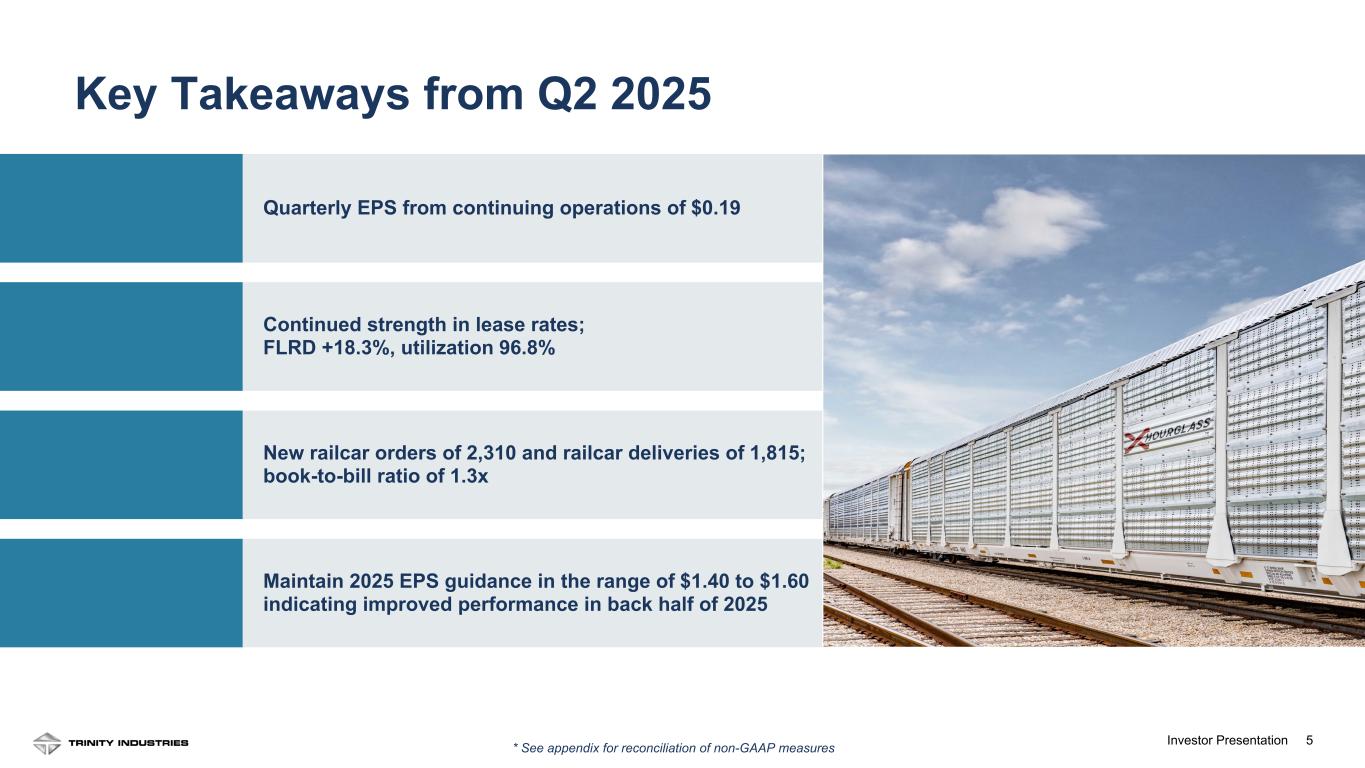
•Lease fleet utilization of 96.8% and FLRD of positive 18.3% at quarter-end
•New railcar orders of 2,310 and railcar deliveries of 1,815; book-to-bill ratio of 1.3x
•Year-to-date cash flow from continuing operations of $142 million and net gains on lease portfolio sales of $14 million
2025 Guidance
•Industry deliveries of approximately 28,000 to 33,000 railcars
•Net fleet investment of $250 million to $350 million
•Operating and administrative capital expenditures of $45 million to $55 million
•EPS of $1.40 to $1.60
◦Excludes items outside of our core business operations
Management Commentary
“Our second quarter results highlight the robust performance of our leasing business and Trinity’s capability to generate substantial cash flow,” stated Trinity’s Chief Executive Officer and President, Jean Savage. “We are seeing recovery in new railcar demand as sequential order volumes improved, and we generated a book-to-bill of 1.3x.”
Ms. Savage continued, “In our Railcar Leasing and Services segment, the market has remained strong with utilization of 96.8% and an FLRD of 18.3%, which gives us confidence that the industry fleet is in balance. Year-over-year segment revenue increased by 7.5% as we continue to re-price our fleet upward. Additionally, Trinity continues to find consistent opportunities in the secondary market as both a buyer and a seller. In the Rail Products Group, our margins reflect the strategic initiatives we have undertaken over the last several years that give us the ability to perform in a low volume environment.”
“In keeping with our capital allocation strategy, we capitalized on favorable market conditions and repurchased shares worth $39 million year-to-date to further optimize our balance sheet position,” Ms. Savage noted.
Ms. Savage concluded, “We are maintaining our full year EPS guidance of $1.40 to $1.60, which reflects our expectation of improved deliveries from second quarter levels and continued improvement across the business in the second half of the year.”

1


Consolidated Financial Summary
Three Months Ended
June 30,
2025 2024 Year over Year – Comparison
($ in millions, except per share amounts)
Revenues $ 506.2 $ 841.4
Lower external deliveries in the Rail Products Group
Operating profit
$ 95.4 $ 141.9
Lower external deliveries in the Rail Products Group, lower gains on lease portfolio sales, and costs associated with workforce reductions, partially offset by lower selling, engineering, and administrative expenses
Interest expense, net $ 67.7 $ 70.1
Net income from continuing operations attributable to Trinity Industries, Inc. $ 16.0 $ 56.1
EBITDA (1)
$ 171.7 $ 223.9
Effective tax expense rate 15.8  % 22.7  %
2025 tax rate includes the benefit of tax credits purchased at a discount
Diluted EPS – GAAP $ 0.19 $ 0.67
Six Months Ended
June 30,
2025 2024 Year over Year – Comparison
(in millions)
Net cash provided by operating activities – continuing operations $ 141.9 $ 299.7
Primarily lower earnings, the purchase of tax credits in the current year period, payments of incentive-based compensation during the current year period that were accrued as of December 31, 2024, and the timing of customer deposits for new railcar orders
Cash flow from operations with net gains on lease portfolio sales (1)
$ 155.6 $ 324.5
Net fleet investment $ 232.7 $ 46.0
Returns of capital to stockholders $ 89.6 $ 48.1
(1) Non-GAAP financial measure. See the Reconciliations of Non-GAAP Measures section within this Press Release for a reconciliation to the most directly comparable GAAP measure and why management believes this measure is useful to management and investors.
Additional Business Items
•Total committed liquidity of $792 million as of June 30, 2025.


2


Business Group Summary
Three Months Ended
June 30,
2025 2024 Year over Year – Comparison
($ in millions)
Railcar Leasing and Services Group
Revenues $ 302.4 $ 281.4
Higher lease rates, as well as favorable pricing on, and the mix of, external repairs in the maintenance services business
Operating profit $ 118.6 $ 128.0
Lower gains on lease portfolio sales and higher maintenance and compliance costs for the lease fleet, partially offset by higher lease rates and favorable pricing on external repairs in the maintenance services business
Operating profit margin 39.2  % 45.5  %
Gains on lease portfolio sales $ 7.8 $ 22.7
Fleet utilization (1)
96.8  % 96.9  %
FLRD (2)
+18.3  % +28.3  % Continued strength in current lease rates
Owned lease fleet (in units) (1)
111,545 109,365
Investor-owned lease fleet (in units) 34,205 34,305
Rail Products Group
Revenues $ 293.5 $ 634.2 Lower deliveries
Operating profit $ 8.9 $ 50.4 Lower deliveries, reduced absorption due to lower production volumes, and costs associated with workforce reductions
Operating profit margin 3.0  % 7.9  %
New railcars:
Deliveries (in units) 1,815 4,755
Orders (in units) 2,310 2,495
Order value $ 318.3 $ 338.8
Backlog value $ 1,959.8 $ 2,683.2

Sustainable railcar conversions:
Deliveries (in units) 25 195
Eliminations
Eliminations – revenues $ (89.7) $ (74.2)
Eliminations – operating profit $ (5.6) $ (3.2)
Corporate and other
Selling, engineering, and administrative expenses $ 28.8 $ 33.5
Lower employee-related costs, including incentive-based compensation, and lower consulting costs, partially offset by costs associated with workforce reductions
June 30, 2025 December 31, 2024
Loan-to-value ratio
Wholly-owned subsidiaries 69.4  % 67.6  %
(1) Includes wholly-owned railcars, partially-owned railcars, and railcars under leased-in arrangements.
(2) FLRD calculates the implied change in lease rates for railcar leases expiring over the next four quarters. The FLRD assumes that these expiring leases will be renewed at the most recent quarterly transacted lease rates for each railcar type. We believe the FLRD is useful to both management and investors as it provides insight into the near-term trend in lease rates.


3


Conference Call
Trinity will hold a conference call at 8:00 a.m. Eastern on July 31, 2025 to discuss its second quarter results. To listen to the call, please visit the Investor Relations section of the Company's website at www.trin.net and access the Events & Presentations webpage, or the live call can be accessed at 1-888-317-6003 with the conference passcode "3131927". Please call at least 10 minutes in advance to ensure a proper connection. An audio replay may be accessed through the Company’s website or by dialing 1-877-344-7529 with passcode "4452791" until 11:59 p.m. Eastern on August 7, 2025.
Additionally, the Company will provide a quarterly investor presentation that will be accessible both within the webcast and on Trinity's Investor Relations website under the Events and Presentations portion of the site along with the Second Quarter Earnings Call event weblink.
Non-GAAP Financial Measures
We have included financial measures compiled in accordance with generally accepted accounting principles ("GAAP") and certain non-GAAP measures in this earnings press release to provide management and investors with additional information regarding our financial results. Non-GAAP measures should not be considered in isolation or as a substitute for our reported results prepared in accordance with GAAP and, as calculated, may not be comparable to other similarly titled measures for other companies. For each non-GAAP financial measure, a reconciliation to the most comparable GAAP measure has been included in the accompanying tables. When forward-looking non-GAAP measures are provided, quantitative reconciliations to the most directly comparable GAAP measures are not provided because management cannot, without unreasonable effort, predict the timing and amounts of certain items included in the computations of each of these measures. These factors include, but are not limited to: the product mix of expected railcar deliveries; the timing and amount of significant transactions and investments, such as lease portfolio sales, capital expenditures, and returns of capital to stockholders; and the amount and timing of certain other items outside the normal course of our core business operations.
4


About Trinity Industries
Trinity Industries, Inc., headquartered in Dallas, Texas, owns businesses that are leading providers of rail transportation products and services in North America. Our businesses market their railcar products and services under the trade name TrinityRail®. Our platform also includes the brands of RSI Logistics, a provider of software and logistics solutions, and Holden America, a supplier of railcar parts and components. Our platform provides railcar leasing and management services; railcar manufacturing; railcar maintenance and modifications; and other railcar logistics products and services. Trinity reports its financial results in two reportable business segments: (1) Railcar Leasing and Services Group and (2) Rail Products Group. For more information, visit: www.trin.net.
Some statements in this release, which are not historical facts, are “forward-looking statements” as defined by the Private Securities Litigation Reform Act of 1995. Forward-looking statements include statements about Trinity's estimates, expectations, beliefs, intentions or strategies for the future, and the assumptions underlying these forward-looking statements, including, but not limited to, future financial and operating performance, future opportunities and any other statements regarding events or developments that Trinity believes or anticipates will or may occur in the future. Trinity uses the words “anticipates,” “assumes,” “believes,” “estimates,” “expects,” “intends,” “forecasts,” “may,” “will,” “should,” “guidance,” “projected,” “outlook,” and similar expressions to identify these forward-looking statements. Forward-looking statements speak only as of the date of this release, and Trinity expressly disclaims any obligation or undertaking to disseminate any updates or revisions to any forward-looking statement contained herein to reflect any change in Trinity’s expectations with regard thereto or any change in events, conditions or circumstances on which any such statement is based, except as required by federal securities laws. Forward-looking statements involve risks and uncertainties that could cause actual results to differ materially from historical experience or our present expectations, including but not limited to risks and uncertainties regarding economic, competitive, governmental, and technological factors affecting Trinity’s operations, markets, products, services and prices, and such forward-looking statements are not guarantees of future performance. For a discussion of such risks and uncertainties, which could cause actual results to differ from those contained in the forward-looking statements, see “Risk Factors” and “Forward-Looking Statements” in Trinity’s Annual Report on Form 10-K for the most recent fiscal year, as may be revised and updated by Trinity’s Quarterly Reports on Form 10-Q, and Trinity’s Current Reports on Form 8-K.
Investor Contact:
Leigh Anne Mann
Vice President, Investor Relations
Trinity Industries, Inc.
(Investors) 214/631-4420
Media Contact:
Jack L. Todd
Vice President, Public Affairs
Trinity Industries, Inc.
(Media Line) 214/589-8909
- TABLES TO FOLLOW -(in millions, except per share amounts)
5


Trinity Industries, Inc.
Condensed Consolidated Statements of Operations
(unaudited)
Three Months Ended
June 30,
Six Months Ended
June 30,
2025 2024 2025 2024
Revenues $ 506.2  $ 841.4  $ 1,091.6  $ 1,651.0 
Operating costs:
Cost of revenues 372.8  662.4  816.0  1,307.3 
Selling, engineering, and administrative expenses 49.4  61.3  99.4  113.6 
Gains on dispositions of property:
Lease portfolio sales 7.8  22.7  13.7  24.8 
Other 3.6  1.5  5.3  2.2 
410.8  699.5  896.4  1,393.9 
Operating profit 95.4  141.9  195.2  257.1 
Interest expense, net 67.7  70.1  133.8  139.2 
Other, net 1.7  (3.4) (1.0) — 
Income from continuing operations before income taxes 26.0  75.2  62.4  117.9 
Provision (benefit) for income taxes:
Current 3.0  13.8  16.5  26.9 
Deferred 1.1  3.3  (5.0) 1.2 
4.1  17.1  11.5  28.1 
Income from continuing operations 21.9  58.1  50.9  89.8 
Loss from discontinued operations, net of income taxes (1.9) (1.7) (3.8) (6.0)
Net income 20.0  56.4  47.1  83.8 
Net income attributable to noncontrolling interest 5.9  2.0  10.9  5.7 
Net income attributable to Trinity Industries, Inc. $ 14.1  $ 54.4  $ 36.2  $ 78.1 
Basic earnings per common share:
Income from continuing operations $ 0.20  $ 0.68  $ 0.49  $ 1.03 
Loss from discontinued operations (0.02) (0.02) (0.05) (0.07)
Net income attributable to Trinity Industries, Inc. $ 0.17  $ 0.66  $ 0.44  $ 0.96 
Diluted earnings per common share:
Income from continuing operations $ 0.19  $ 0.67  $ 0.48  $ 1.01 
Loss from discontinued operations (0.02) (0.02) (0.05) (0.07)
Net income attributable to Trinity Industries, Inc. $ 0.17  $ 0.65  $ 0.43  $ 0.94 
Weighted average number of shares outstanding:
Basic 81.3  82.4  81.4  81.7 
Diluted 82.9  84.1  83.4  83.4 
Note: Earnings per common share is calculated independently for each component and may not sum to total net income attributable to Trinity Industries, Inc. per common share due to rounding.
Trinity has certain unvested restricted stock awards that participate in dividends on a nonforfeitable basis and are therefore considered to be participating securities. Consequently, diluted net income attributable to Trinity Industries, Inc. per common share is calculated under both the two-class method and the treasury stock method, and the more dilutive of the two calculations is presented.
6


Trinity Industries, Inc.
Condensed Consolidated Balance Sheets
(in millions)
(unaudited)
June 30, 2025 December 31, 2024
ASSETS
Cash and cash equivalents $ 147.7  $ 228.2 
Receivables, net of allowance 323.9  379.1 
Income tax receivable 20.4  2.4 
Inventories 459.7  476.2 
Restricted cash 167.6  146.2 
Property, plant, and equipment, net:
Railcars in our lease fleet:
Wholly-owned subsidiaries 6,073.0  5,948.1 
Partially-owned subsidiaries 1,390.2  1,416.0 
Deferred profit on railcar products sold (728.5) (732.5)
Operating and administrative assets 352.1  356.5 
7,086.8  6,988.1 
Goodwill 221.5  221.5 
Other assets 382.4  390.5 
Total assets $ 8,810.0  $ 8,832.2 
LIABILITIES AND STOCKHOLDERS' EQUITY
Accounts payable $ 219.5  $ 251.7 
Accrued liabilities 267.0  353.0 
Debt:
Recourse 598.1  597.8 
Non-recourse:
Wholly-owned subsidiaries 4,217.2  4,021.3 
Partially-owned subsidiaries 1,041.5  1,071.8 
5,856.8  5,690.9 
Deferred income taxes 1,070.8  1,075.6 
Other liabilities 138.1  153.8 
Stockholders' equity:
Trinity Industries, Inc. 1,009.1  1,058.9 
Noncontrolling interest 248.7  248.3 
1,257.8  1,307.2 
Total liabilities and stockholders' equity $ 8,810.0  $ 8,832.2 
7


Trinity Industries, Inc.
Condensed Consolidated Statements of Cash Flows
(in millions)
(unaudited)
Six Months Ended
June 30,
2025 2024
Operating activities:
Net cash provided by operating activities – continuing operations $ 141.9  $ 299.7 
Net cash used in operating activities – discontinued operations (3.8) (6.0)
Net cash provided by operating activities 138.1  293.7 
Investing activities:
Capital expenditures – lease fleet (295.7) (232.7)
Proceeds from lease portfolio sales 63.0  186.7 
Capital expenditures – operating and administrative (17.9) (15.9)
Other investing activities 8.5  6.0 
Net cash used in investing activities (242.1) (55.9)
Financing activities:
Net proceeds from (repayments of) debt 160.1  (37.7)
Shares repurchased (39.0) (0.9)
Dividends paid to common shareholders (50.4) (47.2)
Other financing activities (25.8) (22.9)
Net cash provided by (used in) financing activities 44.9  (108.7)
Net increase (decrease) in cash, cash equivalents, and restricted cash (59.1) 129.1 
Cash, cash equivalents, and restricted cash at beginning of period 374.4  235.1 
Cash, cash equivalents, and restricted cash at end of period $ 315.3  $ 364.2 
8


Trinity Industries, Inc.
Reconciliations of Non-GAAP Measures
($ in millions, except per share amounts and percentages)
(unaudited)
Adjusted Operating Results
We have supplemented the presentation of our reported GAAP operating profit, income from continuing operations before income taxes, provision (benefit) for income taxes, income from continuing operations, net income from continuing operations attributable to Trinity Industries, Inc., and diluted income from continuing operations per common share attributable to Trinity Industries, Inc. with non-GAAP measures that adjust the GAAP measures to exclude the impact of certain interest expense, net; and certain other transactions or events (as applicable), described in the footnote to the tables below. These non-GAAP measures are derived from amounts included in our GAAP financial statements and are reconciled to the most directly comparable GAAP financial measures in the tables below. Management believes that these measures are useful to both management and investors for analyzing the performance of our business without the impact of certain items that are not indicative of our normal business operations. Non-GAAP measures should not be considered in isolation or as a substitute for our reported results prepared in accordance with GAAP and, as calculated, may not be comparable to other similarly titled measures for other companies.
Three Months Ended June 30, 2024
GAAP
Interest expense, net (1)
Adjusted
Operating profit $ 141.9  $ —  $ 141.9 
Income from continuing operations before income taxes $ 75.2  $ (0.4) $ 74.8 
Provision (benefit) for income taxes $ 17.1  $ (0.1) $ 17.0 
Income from continuing operations $ 58.1  $ (0.3) $ 57.8 
Net income from continuing operations attributable to Trinity Industries, Inc. $ 56.1  $ (0.3) $ 55.8 
Diluted weighted average shares outstanding 84.1 84.1
Diluted income from continuing operations per common share attributable to Trinity Industries, Inc. $ 0.67  $ 0.66 
Six Months Ended June 30, 2024
GAAP
Interest expense, net (1)
Adjusted
Operating profit $ 257.1  $ —  $ 257.1 
Income from continuing operations before income taxes $ 117.9  $ (0.8) $ 117.1 
Provision (benefit) for income taxes $ 28.1  $ (0.2) $ 27.9 
Income from continuing operations $ 89.8  $ (0.6) $ 89.2 
Net income from continuing operations attributable to Trinity Industries, Inc. $ 84.1  $ (0.6) $ 83.5 
Diluted weighted average shares outstanding 83.4 83.4
Diluted income from continuing operations per common share attributable to Trinity Industries, Inc. $ 1.01  $ 1.00 
(1) Represents interest income accretion related to a seller-financing agreement associated with the sale of certain non-operating assets.
9


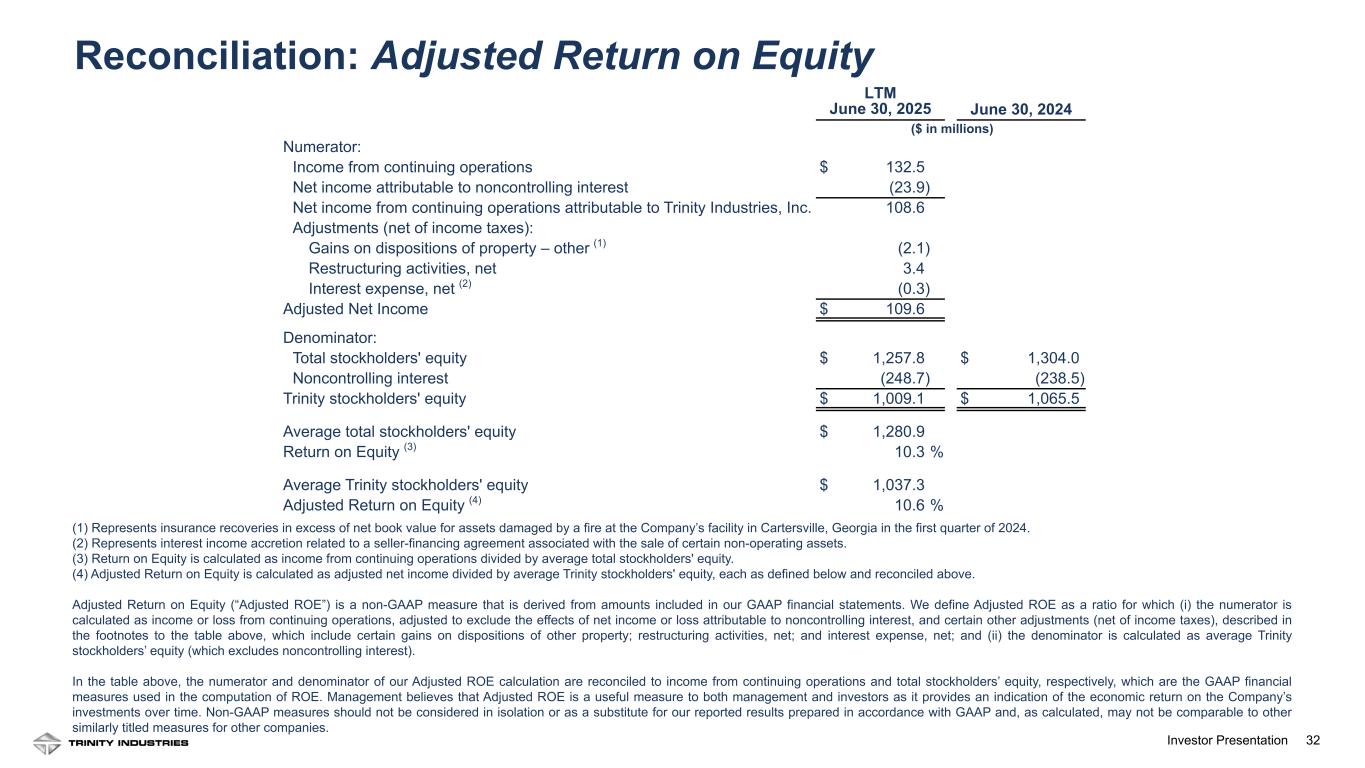
Adjusted Return on Equity
Adjusted Return on Equity (“Adjusted ROE”) is defined as a ratio for which (i) the numerator is calculated as income or loss from continuing operations, adjusted to exclude the effects of net income or loss attributable to noncontrolling interest, and certain other adjustments (net of income taxes), described in the footnotes to the table below, which include certain gains on dispositions of other property; restructuring activities, net; and interest expense, net; and (ii) the denominator is calculated as average Trinity stockholders’ equity (which excludes noncontrolling interest). In the following table, the numerator and denominator of our Adjusted ROE calculation are reconciled to income from continuing operations and total stockholders’ equity, respectively, which are the most directly comparable GAAP financial measures. Management believes that Adjusted ROE is a useful measure to both management and investors as it provides an indication of the economic return on the Company’s investments over time. Non-GAAP measures should not be considered in isolation or as a substitute for our reported results prepared in accordance with GAAP and, as calculated, may not be comparable to other similarly titled measures for other companies.
LTM
June 30, 2025
June 30, 2024
($ in millions)
Numerator:
Income from continuing operations $ 132.5 
Net income attributable to noncontrolling interest (23.9)
Net income from continuing operations attributable to Trinity Industries, Inc. 108.6 
Adjustments (net of income taxes):
Gains on dispositions of property – other (1)
(2.1)
Restructuring activities, net 3.4 
Interest expense, net (2)
(0.3)
Adjusted Net Income $ 109.6 
Denominator:
Total stockholders' equity $ 1,257.8  $ 1,304.0 
Noncontrolling interest (248.7) (238.5)
Trinity stockholders' equity $ 1,009.1  $ 1,065.5 
Average total stockholders' equity $ 1,280.9 
Return on Equity (3)
10.3  %
Average Trinity stockholders' equity $ 1,037.3 
Adjusted Return on Equity (4)
10.6  %
(1) Represents insurance recoveries in excess of net book value for assets damaged by a fire at the Company’s facility in Cartersville, Georgia in the first quarter of 2024.
(2) Represents interest income accretion related to a seller-financing agreement associated with the sale of certain non-operating assets.
(3) Return on Equity is calculated as income from continuing operations divided by average total stockholders' equity.
(4) Adjusted Return on Equity is calculated as adjusted net income divided by average Trinity stockholders' equity, each as defined and reconciled above.

10


Cash Flow from Operations with Net Gains on Lease Portfolio Sales
Cash flow from operations with net gains on lease portfolio sales is a non-GAAP financial measure. We believe this measure is useful to both management and investors as it provides a relevant measure of liquidity and a useful basis for assessing the breadth of the cash flow generation capabilities across our operating platform, as well as our ability to fund our operations and repay our debt. This measure is defined as net cash provided by operating activities from continuing operations as computed in accordance with GAAP, plus net gains on lease portfolio sales and is reconciled to net cash provided by operating activities from continuing operations, the most directly comparable GAAP financial measure, in the following table. Non-GAAP measures should not be considered in isolation or as a substitute for our reported results prepared in accordance with GAAP and, as calculated, may not be comparable to other similarly titled measures for other companies.
Six Months Ended
June 30,
2025 2024
Net cash provided by operating activities – continuing operations $ 141.9  $ 299.7 
Net gains on lease portfolio sales 13.7  24.8 
Cash flow from operations with net gains on lease portfolio sales
$ 155.6  $ 324.5 
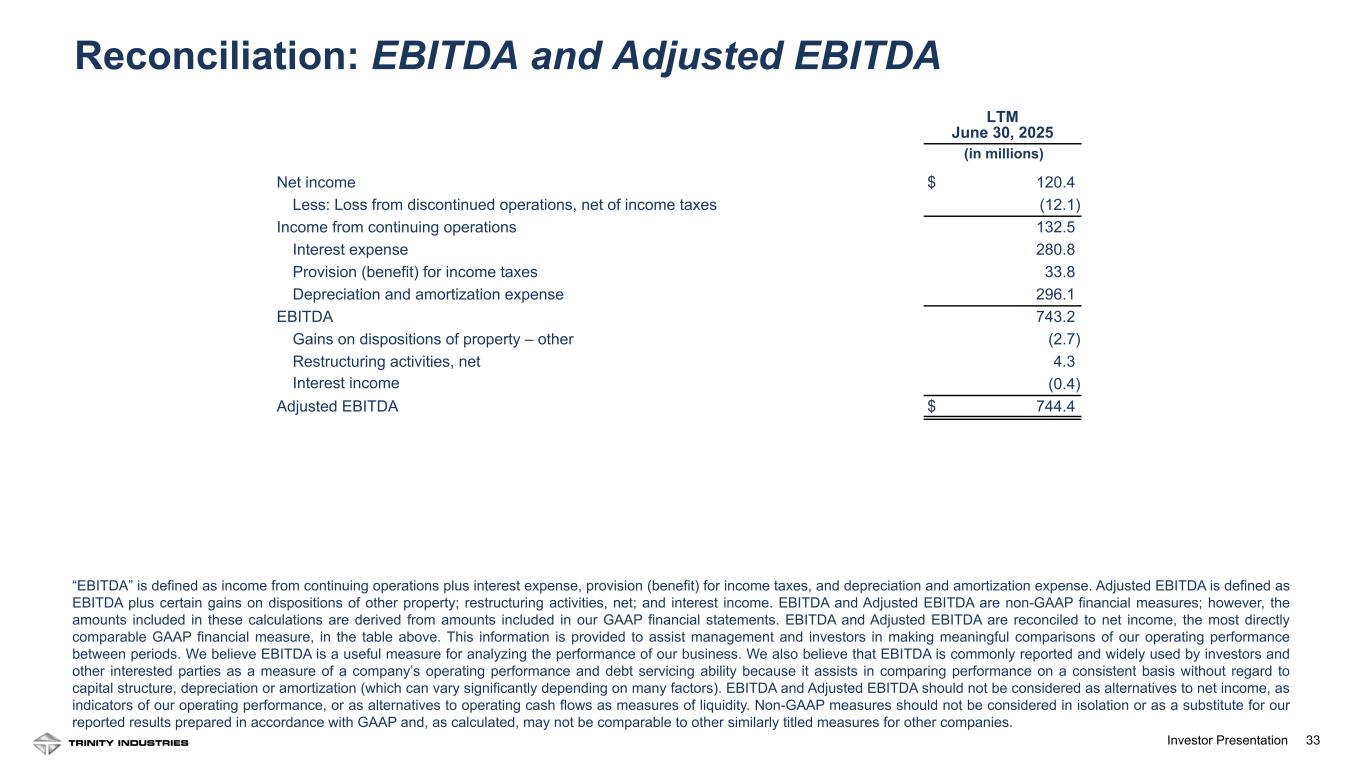
EBITDA and Adjusted EBITDA
“EBITDA” is defined as income from continuing operations plus interest expense, provision (benefit) for income taxes, and depreciation and amortization expense. Adjusted EBITDA is defined as EBITDA plus certain interest income. EBITDA and Adjusted EBITDA are non-GAAP financial measures; however, the amounts included in these calculations are derived from amounts included in our GAAP financial statements. EBITDA and Adjusted EBITDA are reconciled to net income, the most directly comparable GAAP financial measure, in the following table. This information is provided to assist management and investors in making meaningful comparisons of our operating performance between periods. We believe EBITDA is a useful measure for analyzing the performance of our business. We also believe that EBITDA is commonly reported and widely used by investors and other interested parties as a measure of a company’s operating performance and debt servicing ability because it assists in comparing performance on a consistent basis without regard to capital structure, depreciation or amortization (which can vary significantly depending on many factors). EBITDA and Adjusted EBITDA should not be considered as alternatives to net income, as indicators of our operating performance, or as alternatives to operating cash flows as measures of liquidity. Non-GAAP measures should not be considered in isolation or as a substitute for our reported results prepared in accordance with GAAP and, as calculated, may not be comparable to other similarly titled measures for other companies.
Three Months Ended
June 30,
Six Months Ended
June 30,
2025 2024 2025 2024
Net income $ 20.0  $ 56.4  $ 47.1  $ 83.8 
Less: Loss from discontinued operations, net of income taxes (1.9) (1.7) (3.8) (6.0)
Income from continuing operations 21.9  58.1  50.9  89.8 
Interest expense 70.5  74.9  139.3  147.0 
Provision (benefit) for income taxes 4.1  17.1  11.5  28.1 
Depreciation and amortization expense 75.2  73.8  149.5  147.2 
EBITDA
171.7  223.9  351.2  412.1 
Interest income —  (0.4) —  (0.8)
Adjusted EBITDA $ 171.7  $ 223.5  $ 351.2  $ 411.3 
11
EX-99.2 3 q22025exh992-conferencecal.htm EX-99.2 Document
                    
Exhibit 99.2
Trinity Industries, Inc.
Earnings Release Conference Call – Q2 2025
July 31, 2025

Leigh Anne Mann
Vice President, Investor Relations
Thank you, operator. Good morning everyone. We appreciate you joining us for the Company’s second quarter 2025 financial results conference call.
Our prepared remarks will include comments from Jean Savage, Trinity’s Chief Executive Officer and President, and Eric Marchetto, the Company’s Chief Financial Officer. We will hold a Q&A session following the prepared remarks from our leaders.
During the call today, we will reference certain non-GAAP financial metrics. The reconciliations of the non-GAAP metrics to comparable GAAP measures are provided in the appendix of the quarterly investor slides, which are accessible on our investor relations website at www.trin.net. These slides are under the Events and Presentations portion of the website, along with the Second Quarter Earnings Conference Call event link.
A replay of today’s call will be available after 10:30 a.m. Eastern time through midnight on August 7th, 2025. Replay information is available under the Events and Presentations page on our Investor Relations website.
It is now my pleasure to turn the call over to Jean.
E. Jean Savage
Chief Executive Officer and President
Thank you, Leigh Anne, and good morning everyone. Our second quarter results underscore the solid performance of our leasing business and Trinity’s strong ability to generate substantial cash flow. The North American railcar fleet remains in balance, with ongoing improvements in pricing. Although customers have delayed their capital expenditure plans and new railcar decisions due to evolving trade and tax circumstances, they continue to retain their current railcars.
Additionally, we are starting to see a recovery in new railcar demand as sequential order volumes improved, and we generated a book-to-bill of 1.3x. As detailed in our prepared remarks today, we expect an increase in deliveries from second quarter levels and continued improvement across the business in the second half of the year.
Before discussing our quarterly results, I would like to provide a brief market overview.
1

                    
Market Update
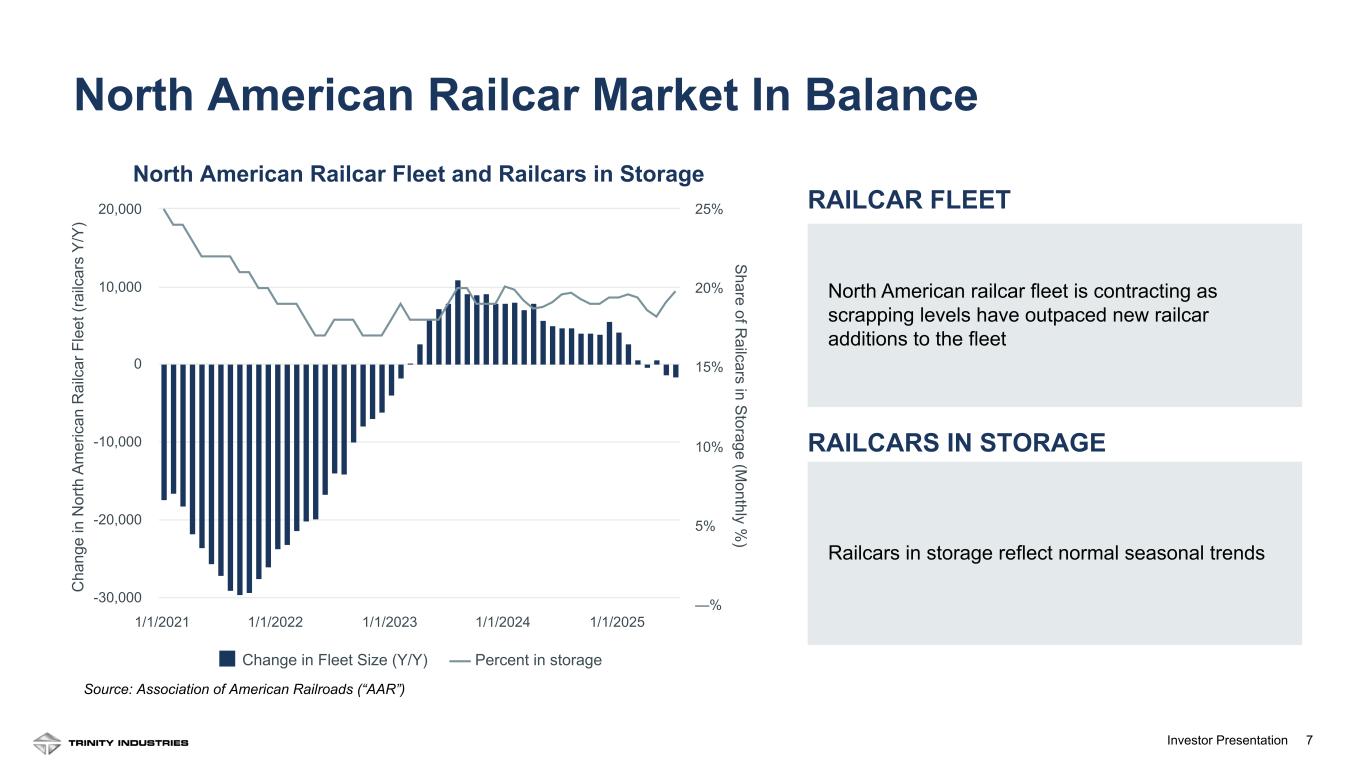
Inquiry levels remain healthy, and these inquiries are translating into increased order activity, albeit at a slower rate than initially anticipated. We are encouraged by a sequential pickup in orders in the second quarter, both for Trinity and for the broader industry. The industry fleet has experienced a modest contraction considering lower year-to-date deliveries for 2025 coupled with ongoing fleet attrition through scrapping. Given current production levels and an improving order environment, the industry is on pace for full year industry deliveries in the range of 28,000 to 33,000.
Within the existing railcar market, carloads have improved in the second quarter, primarily driven by strength in the energy and agriculture markets. Railcars in storage have ticked up slightly, consistent with normal seasonal trends.
We continue to monitor recent tax legislation and ongoing trade developments and remain generally optimistic about their impact on our business.
Segment Performance
I will now highlight segment performance for the quarter, beginning with the Railcar Leasing and Services segment, which includes leasing, maintenance, digital, and logistics services.
Leasing and Services
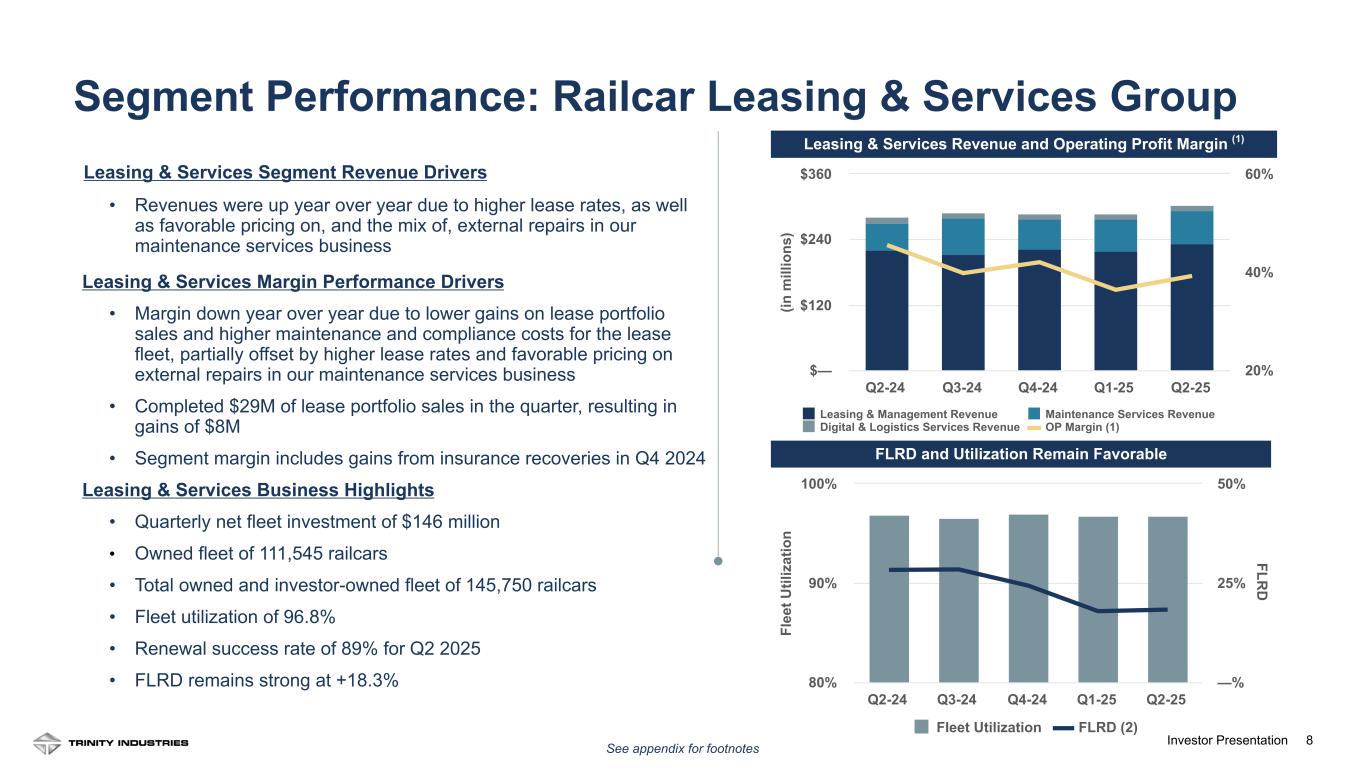
Our leasing business continues to perform exceptionally well. Segment revenues have increased both sequentially and year over year primarily due to higher lease rates, reflecting our strategic efforts to re-price the fleet. The maintenance business has benefited from favorable pricing and a positive mix, contributing to a 21% year over year increase in quarterly maintenance services revenue.
The Future Lease Rate Differential, or FLRD, stands at an impressive 18.3% for the quarter, marking 13 consecutive quarters in double digits, during which 63% of our fleet has been successfully re-priced. Renewal rates in the quarter were 17.9% above expiring rates, and our renewal success rate was 89%, demonstrating our ability to continually drive lease rates while sustaining a high fleet utilization of 96.8% during the second quarter, indicating a well-balanced fleet.
During the quarter, we completed $29 million in lease fleet portfolio sales with gains of $8 million. We remain active in the secondary market as both a buyer and a seller and anticipate this trend will continue in the second half of the year.
2

                    
The cost of revenues in the segment increased by 13.7% year over year, primarily due to higher maintenance and compliance expenses for the lease fleet, as well as a change in the mix of external repairs in our maintenance services business.
Rail Products
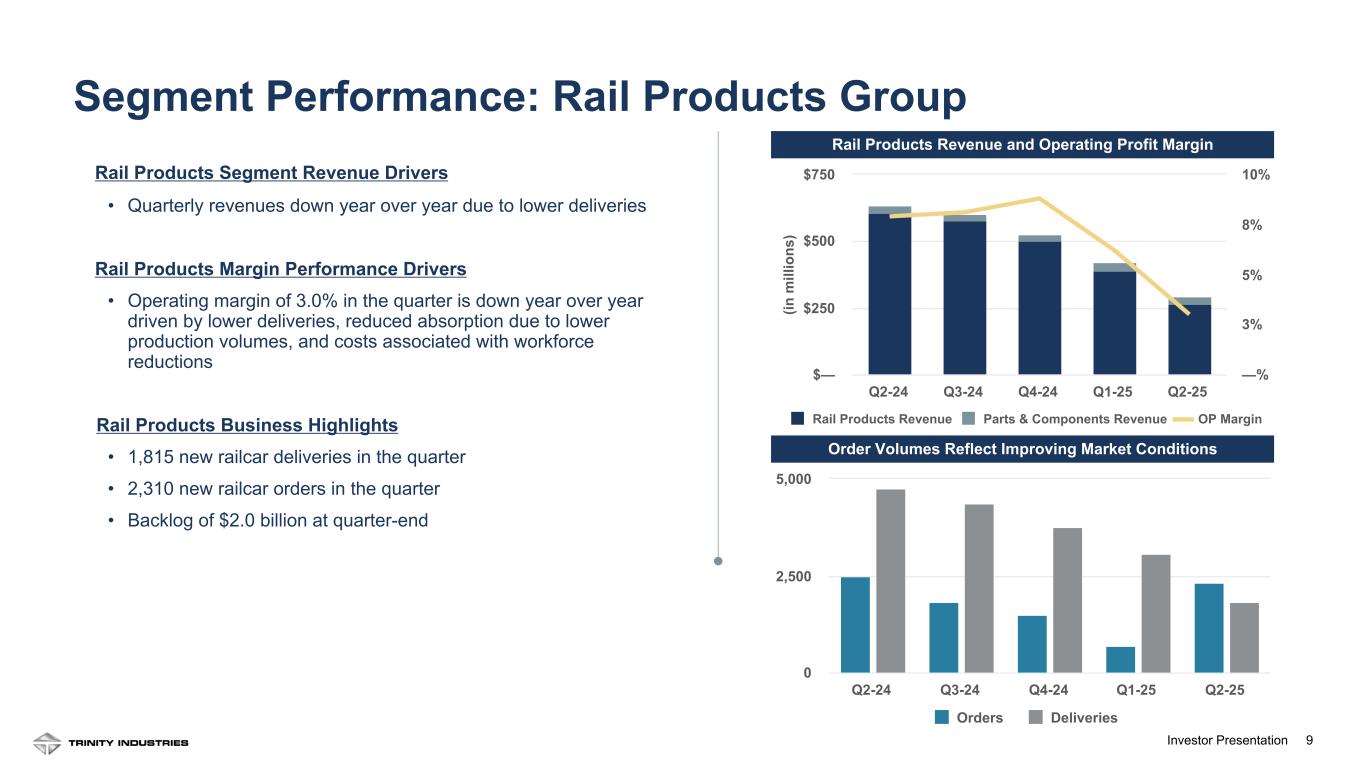
Turning to the Rail Products segment, which includes our manufacturing and parts businesses, second quarter results were in line with our expectations. Due to lower order volumes in preceding quarters, we adjusted production to match the pace of customers’ delayed decisions, delivering 1,815 railcars in the quarter. This resulted in a segment operating margin of 3.0%, which is inclusive of costs associated with workforce reductions.
We are encouraged by sequential improvement in orders. In the quarter, we received orders for 2,310 railcars and achieved a book-to-bill ratio above 1x for the first time in ten quarters. We believe this positive order momentum will continue, supported by inquiry levels consistent with replacement level demand, favorable tax policies, and increased trade certainty expected in the near future. We are well-positioned to respond to further market improvement as the year progresses.
I would like to commend our Rail Products Group for their strategic initiatives over recent years, including optimizing manufacturing operations, investing in automation, and lowering the business breakeven point. Your hard work is evident in this low order volume environment.
We are maintaining our full year operating margin guidance in the 5-6 percent range for the segment. This outlook is underpinned by our expectations of stronger deliveries in the latter part of the year, better fixed cost absorption, a streamlined workforce, and continued efficiencies through automation.
Conclusion
As we enter the second half of the year, we remain confident in our ability to deliver strong performance across our business. We will continue our efforts to re-price the lease fleet and capitalize on favorable conditions in the secondary market. We anticipate an increased pace of quarterly deliveries, benefiting both revenues and margins. Additionally, we expect our backlog to increase as pent-up demand translates into orders, driving momentum through the latter half of the year and into 2026.
I’ll now turn the call over to Eric to talk through financial results, as well as our updated guidance for 2025.
3

                    
Eric R. Marchetto
Executive Vice President and Chief Financial Officer
Thank you, Jean, and good morning everyone. I will begin by discussing our second quarter financial statements, starting with the income statement.
Income Statement
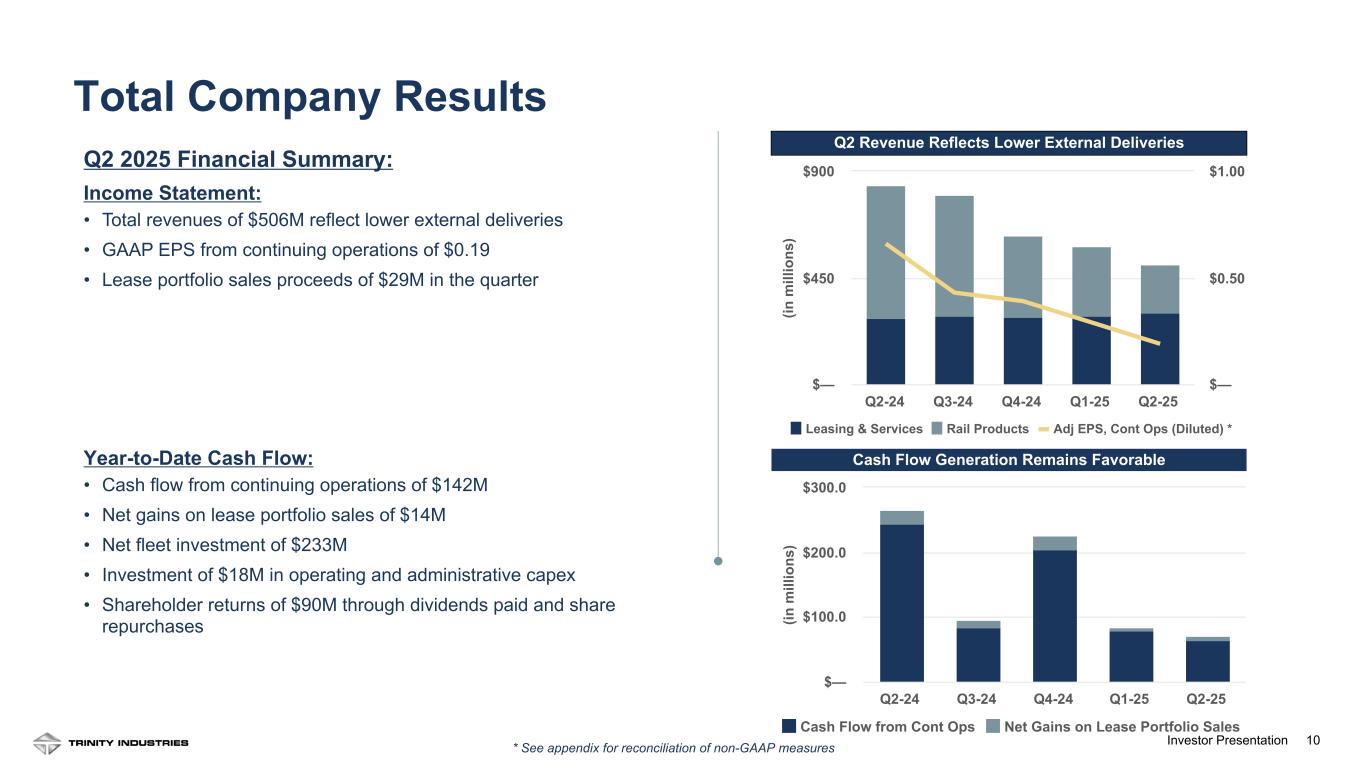
Revenues of $506 million and GAAP EPS of $0.19 in the second quarter are consistent with our expectations given a slower delivery pace in the second quarter. As Jean mentioned, lease portfolio sales proceeds were $29 million in the quarter.
Our effective tax rate in the quarter was 15.8%. In the quarter, we purchased $40 million in transferable tax credits at a discount, which benefited our quarterly tax rate. These credits were used to offset the Company’s federal tax liability for 2024.
We have incurred approximately $8 million of severance expense year-to-date, split between Rail Products Group and Corporate. We are expecting full year severance expenses of $15 million, with remaining severance costs to be incurred in the Rail Products Group. Given the workforce reductions, as well as lower incentive-based compensation, we expect to realize about $50 million in savings across the enterprise in 2025.
Net gains on lease portfolio sales are $14 million year-to-date, $8 million of which was in the second quarter. As I said last quarter, we expect gains on sales to be weighted to the second half of 2025.
Cash Flow Statement
Moving to the cash flow statement, our business continues to demonstrate its cash generation potential. Year-to-date cash flow from continuing operations is $142 million. As we go forward, we expect the effects of recent legislation to benefit our cash from operations.
Year-to-date, our net lease fleet investment is $233 million. We remain active in the secondary market, both a buyer and a seller. Secondary market purchases have allowed us to improve the yield on our fleet while also growing our lease fleet. Our full year guidance for net lease fleet investment reflects higher originations and consistent secondary market adds offset by significantly higher secondary market railcar sales in the second half of the year.
In keeping with our capital allocation framework, we increased share repurchase activity to $31 million in the quarter. Year-to-date, we have returned $90 million to shareholders through dividends paid and share repurchases.
4

                    
Finally, our year-to-date investment in operating and administrative capital expenditures is $18 million.
Balance Sheet
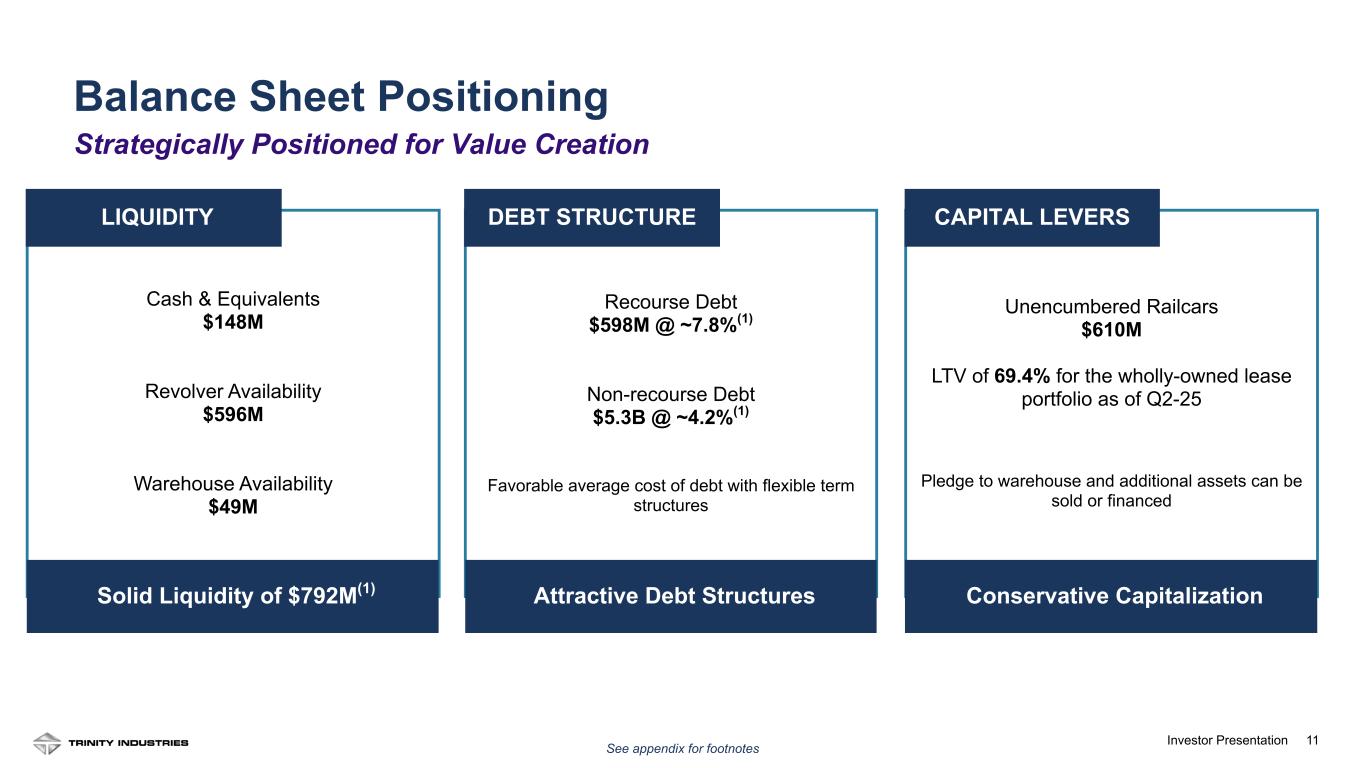
Our balance sheet positioning remains strong, providing us with significant flexibility. With $792 million in liquidity through our cash reserves, revolver, and warehouse availability, we are well-positioned for a variety of market conditions. Our loan-to-value of 69.4% on our wholly owned fleet aligns with our target range. In the second quarter, we successfully refinanced and upsized our TRL-2023 notes, further optimizing our debt portfolio and positioning our balance sheet for continued value creation.
Guidance
As we look ahead to the remainder of 2025, we are maintaining our industry delivery forecast to a range of 28,000 to 33,000 railcars. While railcar orders have recovered more slowly than anticipated, we remain confident that the demand will further materialize, with some demand shifting into 2026 based on customer conversations and market insights.
We are adjusting our net lease fleet guidance to a range of $250 million to $350 million, with approximately 35% of our 2025 deliveries expected to be added to our lease fleet. This slight reduction in fleet investment is due to lower originations and continued utilization of a robust secondary market. We anticipate gains on lease portfolio sales for the full year to be between $50 million and $60 million.
Our operating and administrative capital expenditures guidance remains steady at $45 million to $55 million.
Finally, we are maintaining our full year 2025 EPS guidance at a range of $1.40 to $1.60. This projection indicates a significantly stronger performance in the second half of the year, which aligns with our expectations. Included in the annual guidance is severance expense of approximately $0.14 per share. Additionally, we are maintaining our segment margin guidance, with an improved performance in the Rail Products segment expected in the latter half of the year, primarily driven by higher deliveries, partially offset by severance expenses.
The resilience of our business is on full display this year against a backdrop of low industrial growth and macro economic uncertainty. Anchored by our leasing business, we have seen improved performance in our fleet. In the manufacturing segment, our people have responded to changing customer demand and positioned Trinity to perform in a period of lower demand. As we move forward, we are poised to realize additional operating leverage across our platform.
5

                    
Operator, we are now ready to take our first question.

6

                    
(after Q&A)
E. Jean Savage
Chief Executive Officer and President
Thank you for joining us today. Trinity’s second quarter results highlight the strength of our leasing business and the resilience of our franchise. We are encouraged by our ability to perform in a challenging delivery environment, and are optimistic about the improving order volumes. This positive trend paves the way for an enhanced operating environment and improved financial performance in the second half of 2025.
7
EX-99.3 4 q22025investorpresentati.htm EX-99.3 q22025investorpresentati
Q2 2025 Investor Presentation Exhibit 99.3 July 31, 2025 – based on financial results as of June 30, 2025


2Investor Presentation 2 Forward Looking Statements Some statements in this presentation, which are not historical facts, are “forward-looking statements” as defined by the Private Securities Litigation Reform Act of 1995. Forward-looking statements include statements about Trinity's estimates, expectations, beliefs, intentions or strategies for the future, and the assumptions underlying these forward-looking statements, including, but not limited to, future financial and operating performance, future opportunities and any other statements regarding events or developments that Trinity believes or anticipates will or may occur in the future. Trinity uses the words “anticipates,” “assumes,” “believes,” “estimates,” “expects,” “intends,” “forecasts,” “may,” “will,” “should,” “guidance,” “projected,” “outlook,” and similar expressions to identify these forward-looking statements. Forward-looking statements speak only as of the date of this material, and Trinity expressly disclaims any obligation or undertaking to disseminate any updates or revisions to any forward-looking statement contained herein to reflect any change in Trinity’s expectations with regard thereto or any change in events, conditions or circumstances on which any such statement is based, except as required by federal securities laws. Forward-looking statements involve risks and uncertainties that could cause actual results to differ materially from historical experience or our present expectations, including but not limited to risks and uncertainties regarding economic, competitive, governmental, and technological factors affecting Trinity’s operations, markets, products, services and prices, and such forward-looking statements are not guarantees of future performance. For a discussion of such risks and uncertainties, which could cause actual results to differ from those contained in the forward-looking statements, see “Risk Factors” and “Forward-Looking Statements” in Trinity’s Annual Report on Form 10-K for the most recent fiscal year, as may be revised and updated by Trinity’s Quarterly Reports on Form 10-Q, and Trinity’s Current Reports on Form 8-K. This presentation also includes references to calculations that are not based on generally accepted accounting principles (“GAAP”). Reconciliations of each of these non-GAAP measures to the most directly comparable GAAP measures have been included in the Appendix. When forward-looking non-GAAP measures are provided, Trinity does not provide quantitative reconciliations of forward-looking non-GAAP measures to the most directly comparable GAAP measures because it cannot, without unreasonable effort, predict the timing and amounts of certain items included in the computations of each of these measures. These factors include, but are not limited to: the product mix of expected railcar deliveries; the timing and amount of significant transactions and investments, such as lease portfolio sales, capital expenditures, and returns of capital to shareholders; and the amount and timing of certain other items outside the normal course of our core business operations. Except where noted, financial data is presented as of the Company’s most recent fiscal quarter ending June 30, 2025. “LTM” represents Last Twelve Months(1) financial information from July 1, 2024 to June 30, 2025. See appendix for footnotes


3Investor Presentation I. Quarter Results . . . . . . . . . . . . . . . . . . . . . . . . . . . . . . . . . . . . . . . . . . . . . . . . . . . . . . . . . . . . 4 II. Company Overview . . . . . . . . . . . . . . . . . . . . . . . . . . . . . . . . . . . . . . . . . . . . . . . . . . . . . . . . . 13 III. Financial Positioning and Strategic Initiatives . . . . . . . . . . . . . . . . . . . . . . . . . . . . . . . . 22 IV. Appendix . . . . . . . . . . . . . . . . . . . . . . . . . . . . . . . . . . . . . . . . . . . . . . . . . . . . . . . . . . . . . . . . . . 26 Investor Presentation – Q2 2025


4Investor Presentation Quarter Results


5Investor Presentation Key Takeaways from Q2 2025 Quarterly EPS from continuing operations of $0.19 Continued strength in lease rates; FLRD +18.3%, utilization 96.8% New railcar orders of 2,310 and railcar deliveries of 1,815; book-to-bill ratio of 1.3x Maintain 2025 EPS guidance in the range of $1.40 to $1.60 indicating improved performance in back half of 2025 * See appendix for reconciliation of non-GAAP measures


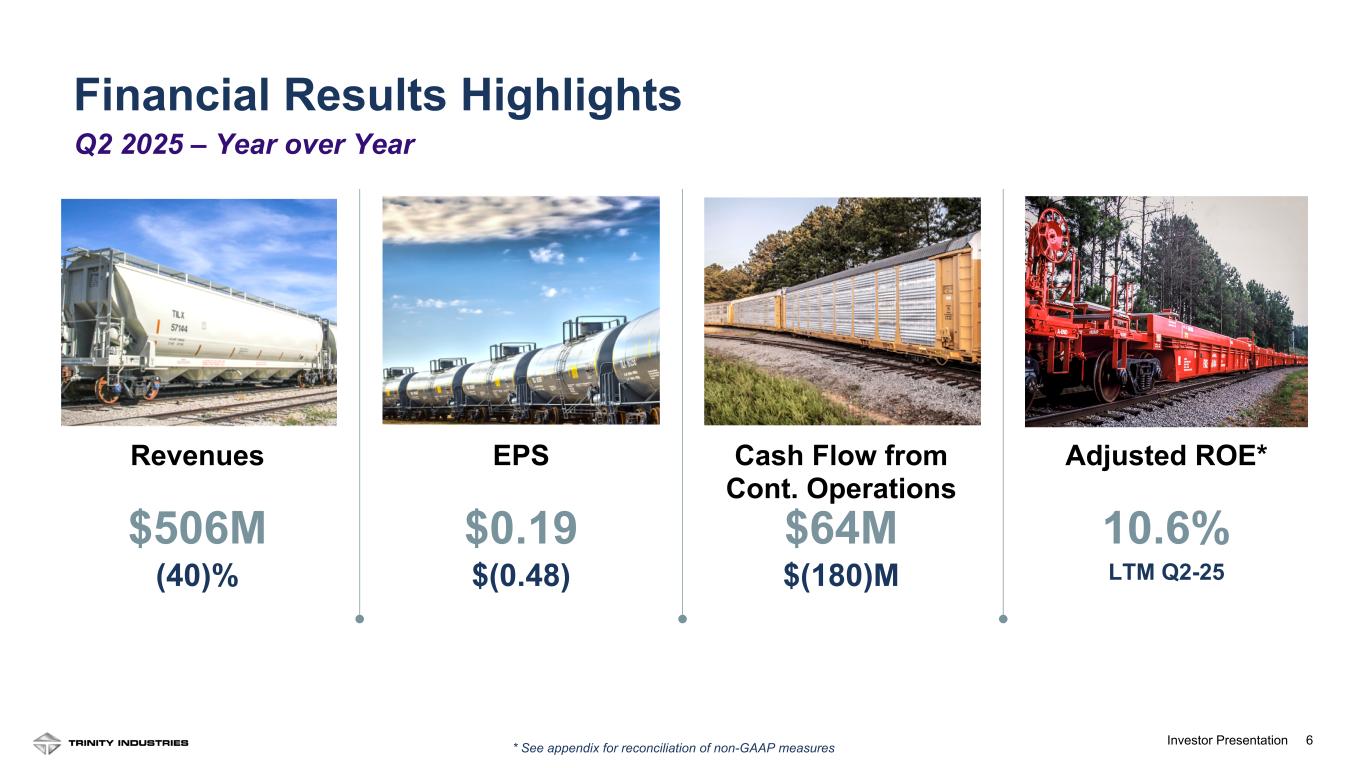
6Investor Presentation Financial Results Highlights Cash Flow from Cont. Operations $64M $(180)M Revenues $506M (40)% EPS $0.19 $(0.48) Q2 2025 – Year over Year Adjusted ROE* 10.6% LTM Q2-25 * See appendix for reconciliation of non-GAAP measures


7Investor Presentation North American Railcar Market In Balance C ha ng e in N or th A m er ic an R ai lc ar F le et (r ai lc ar s Y /Y ) S hare of R ailcars in S torage (M onthly % ) Change in Fleet Size (Y/Y) Percent in storage 1/1/2021 1/1/2022 1/1/2023 1/1/2024 1/1/2025 -30,000 -20,000 -10,000 0 10,000 20,000 —% 5% 10% 15% 20% 25% North American Railcar Fleet and Railcars in Storage Source: Association of American Railroads (“AAR”) RAILCAR FLEET North American railcar fleet is contracting as scrapping levels have outpaced new railcar additions to the fleet RAILCARS IN STORAGE Railcars in storage reflect normal seasonal trends


8Investor Presentation8 Leasing & Services Revenue and Operating Profit Margin (1) (in m ill io ns ) Leasing & Management Revenue Maintenance Services Revenue Digital & Logistics Services Revenue OP Margin (1) Q2-24 Q3-24 Q4-24 Q1-25 Q2-25 $— $120 $240 $360 20% 40% 60%Leasing & Services Segment Revenue Drivers • Revenues were up year over year due to higher lease rates, as well as favorable pricing on, and the mix of, external repairs in our maintenance services business Leasing & Services Margin Performance Drivers • Margin down year over year due to lower gains on lease portfolio sales and higher maintenance and compliance costs for the lease fleet, partially offset by higher lease rates and favorable pricing on external repairs in our maintenance services business • Completed $29M of lease portfolio sales in the quarter, resulting in gains of $8M • Segment margin includes gains from insurance recoveries in Q4 2024 Leasing & Services Business Highlights • Quarterly net fleet investment of $146 million • Owned fleet of 111,545 railcars • Total owned and investor-owned fleet of 145,750 railcars • Fleet utilization of 96.8% • Renewal success rate of 89% for Q2 2025 • FLRD remains strong at +18.3% See appendix for footnotes Segment Performance: Railcar Leasing & Services Group Fl ee t U til iz at io n FLR D Fleet Utilization FLRD (2) Q2-24 Q3-24 Q4-24 Q1-25 Q2-25 80% 90% 100% —% 25% 50% FLRD and Utilization Remain Favorable


9Investor Presentation9 Rail Products Segment Revenue Drivers • Quarterly revenues down year over year due to lower deliveries Rail Products Margin Performance Drivers • Operating margin of 3.0% in the quarter is down year over year driven by lower deliveries, reduced absorption due to lower production volumes, and costs associated with workforce reductions Rail Products Business Highlights • 1,815 new railcar deliveries in the quarter • 2,310 new railcar orders in the quarter • Backlog of $2.0 billion at quarter-end Rail Products Revenue and Operating Profit Margin (in m ill io ns ) Rail Products Revenue Parts & Components Revenue OP Margin Q2-24 Q3-24 Q4-24 Q1-25 Q2-25 $— $250 $500 $750 —% 3% 5% 8% 10% Segment Performance: Rail Products Group Orders Deliveries Q2-24 Q3-24 Q4-24 Q1-25 Q2-25 0 2,500 5,000 Order Volumes Reflect Improving Market Conditions


10Investor Presentation Q2 Revenue Reflects Lower External Deliveries Q2 2025 Financial Summary: Income Statement: • Total revenues of $506M reflect lower external deliveries • GAAP EPS from continuing operations of $0.19 • Lease portfolio sales proceeds of $29M in the quarter 10 Cash Flow Generation Remains Favorable * See appendix for reconciliation of non-GAAP measures (in m ill io ns ) Leasing & Services Rail Products Adj EPS, Cont Ops (Diluted) * Q2-24 Q3-24 Q4-24 Q1-25 Q2-25 $— $450 $900 $— $0.50 $1.00 (in m ill io ns ) Cash Flow from Cont Ops Net Gains on Lease Portfolio Sales Q2-24 Q3-24 Q4-24 Q1-25 Q2-25 $— $100.0 $200.0 $300.0 Total Company Results Year-to-Date Cash Flow: • Cash flow from continuing operations of $142M • Net gains on lease portfolio sales of $14M • Net fleet investment of $233M • Investment of $18M in operating and administrative capex • Shareholder returns of $90M through dividends paid and share repurchases


11Investor Presentation Unencumbered Railcars $610M LTV of 69.4% for the wholly-owned lease portfolio as of Q2-25 Pledge to warehouse and additional assets can be sold or financed CAPITAL LEVERS Recourse Debt $598M @ ~7.8%(1) Non-recourse Debt $5.3B @ ~4.2%(1) Favorable average cost of debt with flexible term structures DEBT STRUCTURE Cash & Equivalents $148M Revolver Availability $596M Warehouse Availability $49M LIQUIDITY Solid Liquidity of $792M(1) Attractive Debt Structures Conservative Capitalization See appendix for footnotes Balance Sheet Positioning Strategically Positioned for Value Creation


12Investor Presentation C ap ita l A llo ca tio n FY 2025 Summary Detail Industry Deliveries Approximately 28K – 33K Does not include sustainable railcar conversions Net Fleet Investment $250M – $350M Includes deliveries to our lease fleet, railcar modifications and betterments, and secondary market purchases; offset by proceeds from lease portfolio sales Operating and Administrative Capital Expenditures $45M – $55M Investments in automation, technology, and modernization of facilities and processes EPS from Continuing Operations $1.40 – $1.60 Excludes items outside of our normal business operations Any forward-looking statements made by the Company speak only as of the date on which they are made. Except as required by federal securities law, the Company is under no obligation to update or alter its forward-looking statements, whether as a result of new information, subsequent events or otherwise. Management Outlook for Business Performance


13Investor Presentation Company Overview


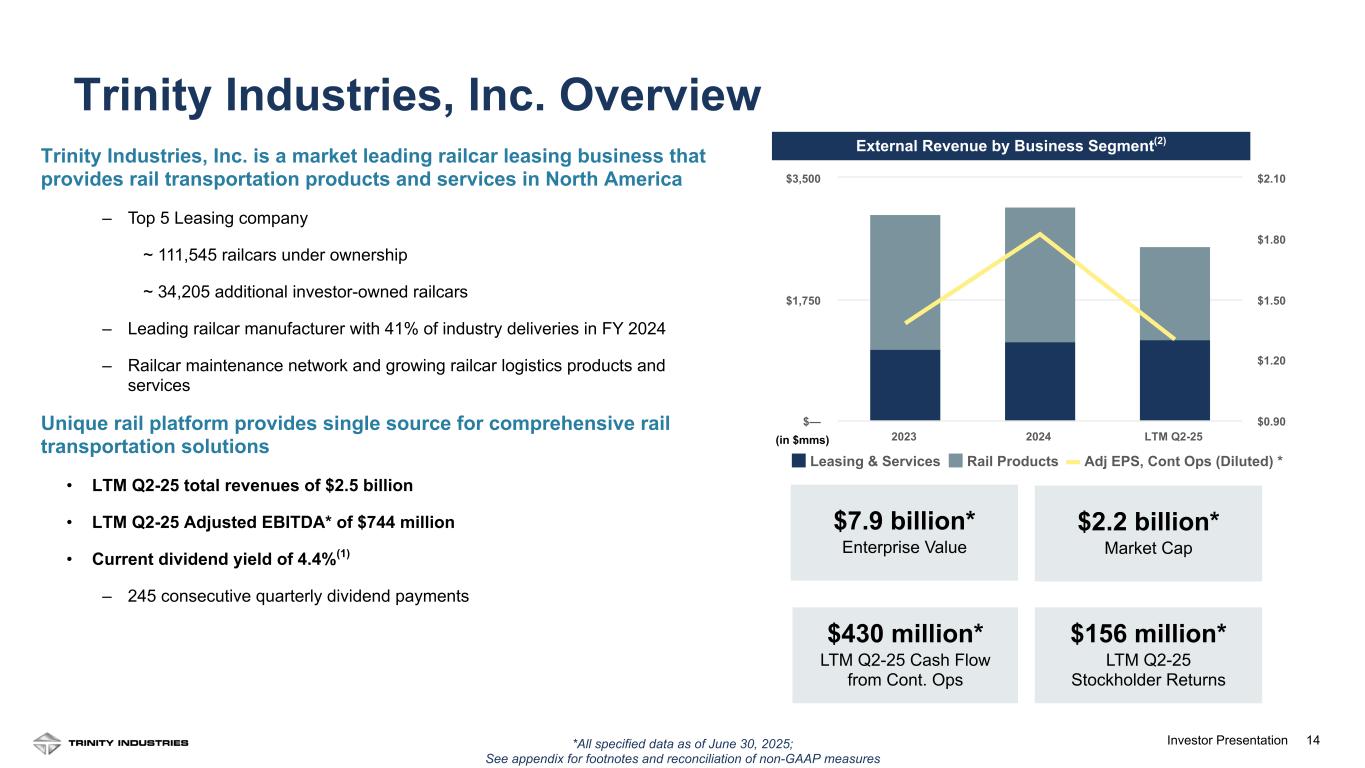
14Investor Presentation Trinity Industries, Inc. is a market leading railcar leasing business that provides rail transportation products and services in North America – Top 5 Leasing company ~ 111,545 railcars under ownership ~ 34,205 additional investor-owned railcars – Leading railcar manufacturer with 41% of industry deliveries in FY 2024 – Railcar maintenance network and growing railcar logistics products and services Unique rail platform provides single source for comprehensive rail transportation solutions • LTM Q2-25 total revenues of $2.5 billion • LTM Q2-25 Adjusted EBITDA* of $744 million • Current dividend yield of 4.4%(1) – 245 consecutive quarterly dividend payments External Revenue by Business Segment(2) *All specified data as of June 30, 2025; See appendix for footnotes and reconciliation of non-GAAP measures $7.9 billion* Enterprise Value $156 million* LTM Q2-25 Stockholder Returns $430 million* LTM Q2-25 Cash Flow from Cont. Ops $2.2 billion* Market Cap Leasing & Services Rail Products Adj EPS, Cont Ops (Diluted) * 2023 2024 LTM Q2-25 $— $1,750 $3,500 $0.90 $1.20 $1.50 $1.80 $2.10 (in $mms) Trinity Industries, Inc. Overview


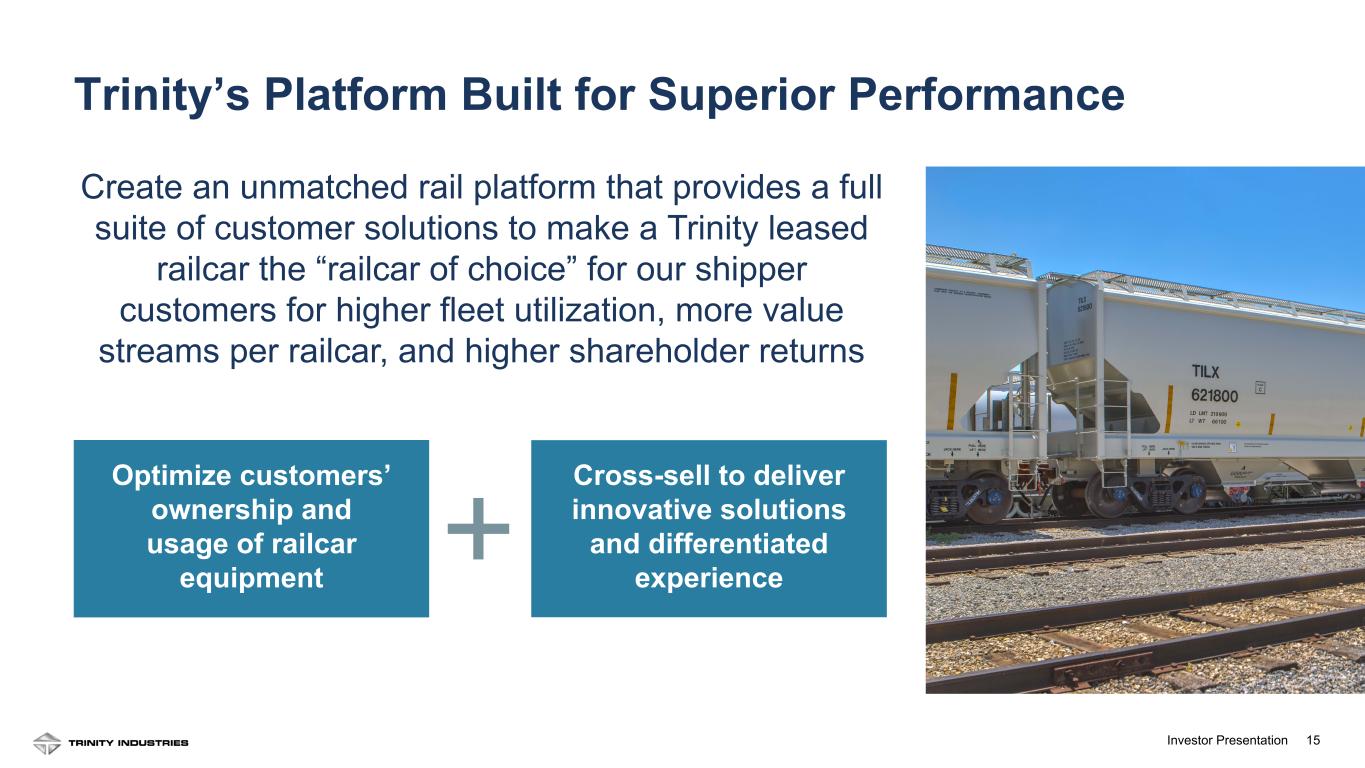
15Investor Presentation Optimize customers’ ownership and usage of railcar equipment Cross-sell to deliver innovative solutions and differentiated experience Create an unmatched rail platform that provides a full suite of customer solutions to make a Trinity leased railcar the “railcar of choice” for our shipper customers for higher fleet utilization, more value streams per railcar, and higher shareholder returns Trinity’s Platform Built for Superior Performance


16Investor Presentation Platform Capabilities Support Optimized Lease Fleet Returns Lease Originations Captive Maintenance Parts and Services Manufacturing excellence and new product development Market data and leading market view Asset Management / RIV Partnerships Dual role as owner and builder creates a feedback loop reinforcing asset differentiation Complementary lines of business give us a broad industry view and early visibility to industry trends Lease origination capabilities give customer flexibility and unlock multiple monetization options for each asset Fee income from Rail Investment Vehicle partnerships worth an average of 100bp to Adjusted ROE over last 5 years Captive maintenance and Mobile Repair Units allow for more time on rent Parts and services reduce cyclicality of earnings stream and enhance customer experience


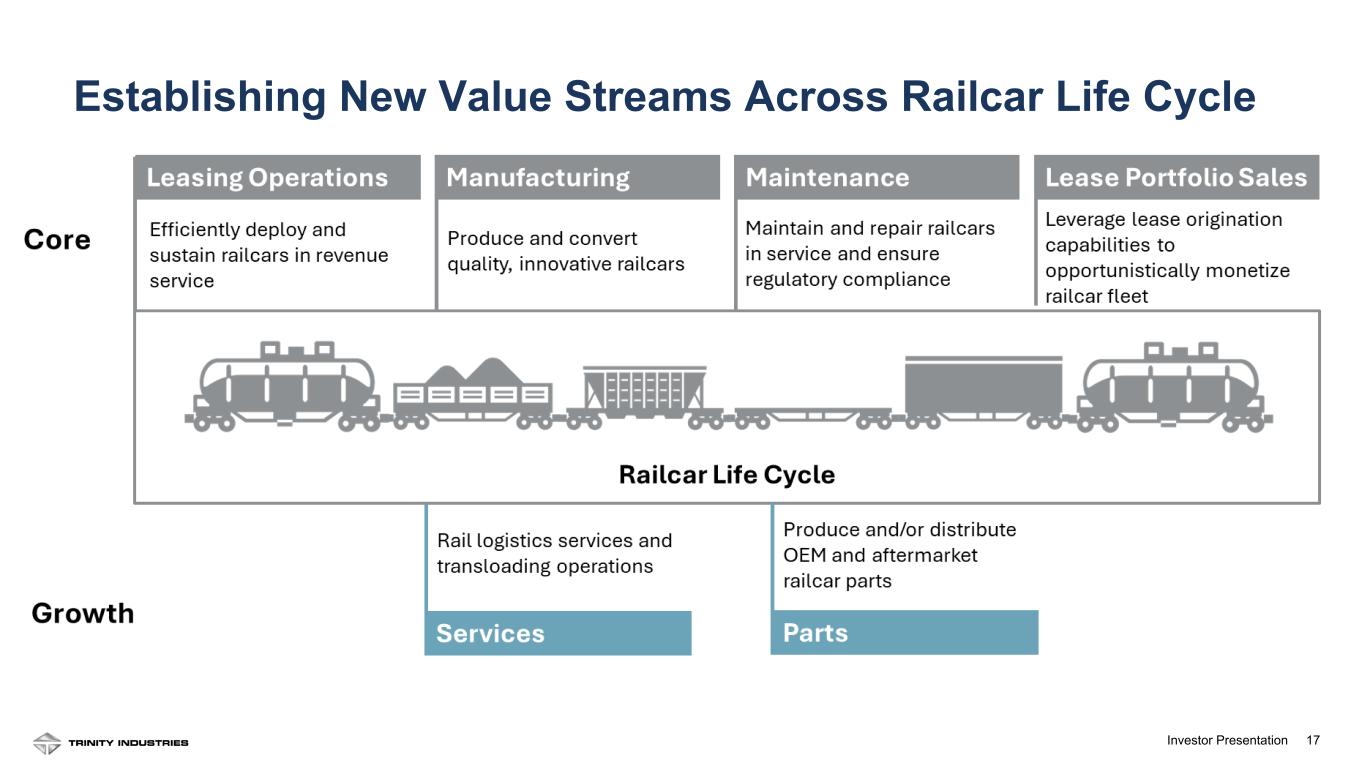
17Investor Presentation Establishing New Value Streams Across Railcar Life Cycle


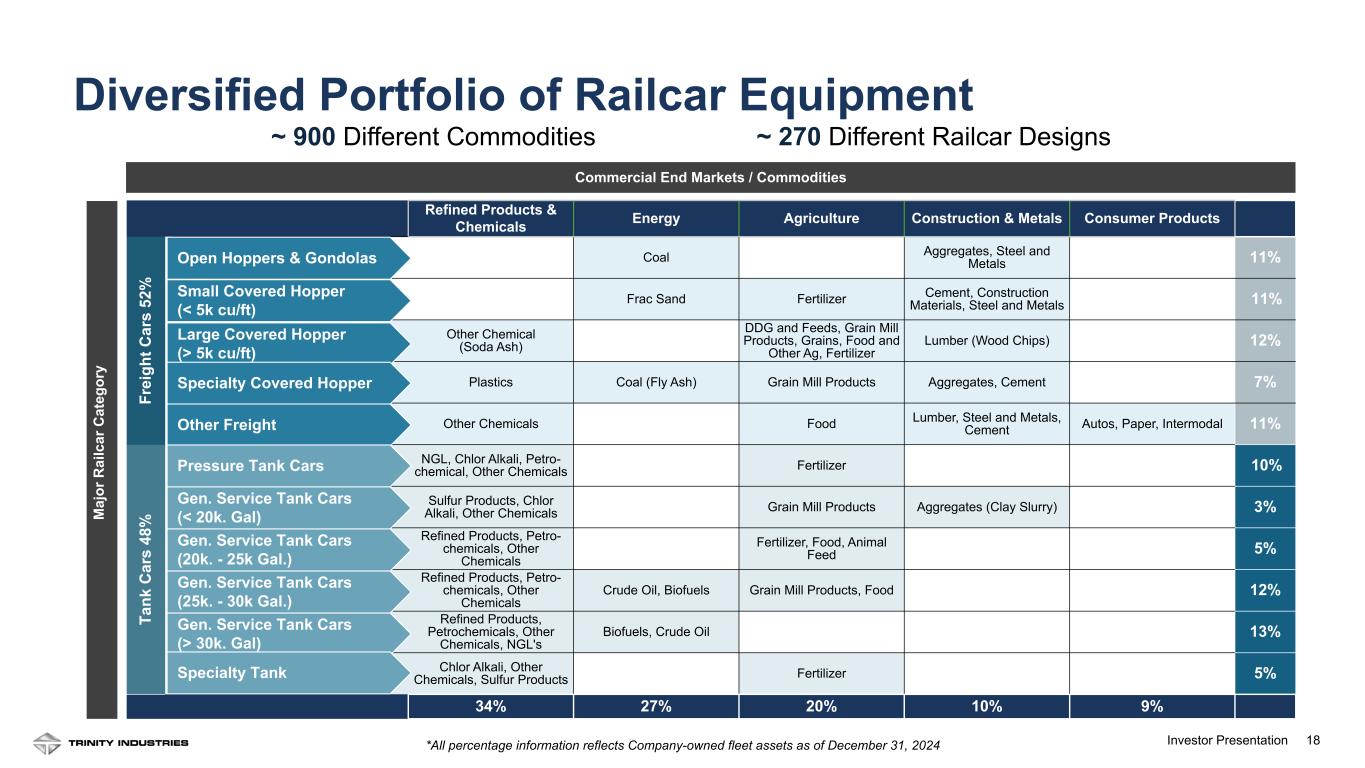
18Investor Presentation Diversified Portfolio of Railcar Equipment ~ 900 Different Commodities ~ 270 Different Railcar Designs Refined Products & Chemicals Energy Agriculture Construction & Metals Consumer Products Fr ei gh t C ar s 52 % Open Hoppers & Gondolas Coal Aggregates, Steel and Metals 11% Small Covered Hopper (< 5k cu/ft) Frac Sand Fertilizer Cement, Construction Materials, Steel and Metals 11% Large Covered Hopper (< 5k cu/ft) Other Chemical (Soda Ash) DDG and Feeds, Grain Mill Products, Grains, Food and Other Ag, Fertilizer Lumber (Wood Chips) 12% Specialty Covered Hopper Plastics Coal (Fly Ash) Grain Mill Products Aggregates, Cement 7% Other Freight Other Chemicals Food Lumber, Steel and Metals, Cement Autos, Paper, Intermodal 11% Ta nk C ar s 48 % Pressure Tank Cars NGL, Chlor Alkali, Petro- chemical, Other Chemicals Fertilizer 10% Gen. Service Tank Cars (< 20k. Gal) Sulfur Products, Chlor Alkali, Other Chemicals Grain Mill Products Aggregates (Clay Slurry) 3% Gen. Service Tank Cars (20k. - 25k Gal.) Refined Products, Petro- chemicals, Other Chemicals Fertilizer, Food, Animal Feed 5% Gen. Service Tank Cars (25k. - 30k Gal.) Refined Products, Petro- chemicals, Other Chemicals Crude Oil, Biofuels Grain Mill Products, Food 12% Gen. Service Tank Cars (> 30k. Gal) Refined Products, Petrochemicals, Other Chemicals, NGL's Biofuels, Crude Oil 13% Specialty Tank Chlor Alkali, Other Chemicals, Sulfur Products Fertilizer 5% 34% 27% 20% 10% 9% Commercial End Markets / Commodities M aj or R ai lc ar C at eg or y r l ll r r (< 5k cu/ft) Large overed opper (> 5k cu/ft) i lt r r t r r i t r r r . r i r (< 20k. Gal) . r i r (20k. - 25k Gal.) . r i r (25k. - 30k Gal.) . r i r (> 30k. Gal) i lt *All percentage information reflects Company-owned fleet assets as of December 31, 2024


19Investor Presentation 13% 13% 9% 26% 12% 13% TRN, 14% TRN UnionTank GATX All other * ITE CIT Wells Fargo The TrinityRail platform has grown at a 10% CAGR since 2003 Lessors Make Up A Growing Share of the North American Fleet Railcar Lessor Ownership Profile Presents Consolidation Opportunity Operating Lessors *Over 90 lessors own 252K railcars in “All other” 19 Financial Lessors 55% 18% 17% 10% Lessor Railroad Shipper TTX See appendix for source information Capitalizing on Structural Change in the Rail Market


20Investor Presentation20 Operating our business in a way that minimizes impact on natural resources and the environment • Leveraged Green Financing Framework, for financing of green-eligible railcars assets, supported by Sustainalytics • Sustainable railcar conversions allow for re-use of railcar components while still addressing a changing demand environment • Innovative products and services that enhance the rail modal supply chain advantage and reduce GHG emissions Attracting and retaining a diverse and empowered workforce • Fostering an inclusive and collaborative workplace • Hiring and retaining the best talent and providing opportunities for continuing professional development • Improving the well being of our employees and stakeholders • Contributing to the communities in which we operate Promoting the long-term interests of stakeholders, strengthening accountability and inspiring trust • Independent Chairman and Board of Directors with diverse backgrounds and experienced oversight • Incentive compensation programs aligned with shareholder interests • Board of Directors and Executive Leadership Team oversight of sustainability initiatives Strong track record of operational excellence • All Trinity Rail manufacturing facilities and Trinity HQ achieved ISO 14001 (Environmental) and ISO 45001 (Safety) certification, the only railcar manufacturer in North America certified to both rigorous standards • Actively engage stakeholders in environmental, health, and safety (EHS) initiatives and continually improve EHS processes, practices, and operational performance Commitment to Premier Performance and Sustainability Environmental Commitment Social Responsibility Governance Excellence Risk Management


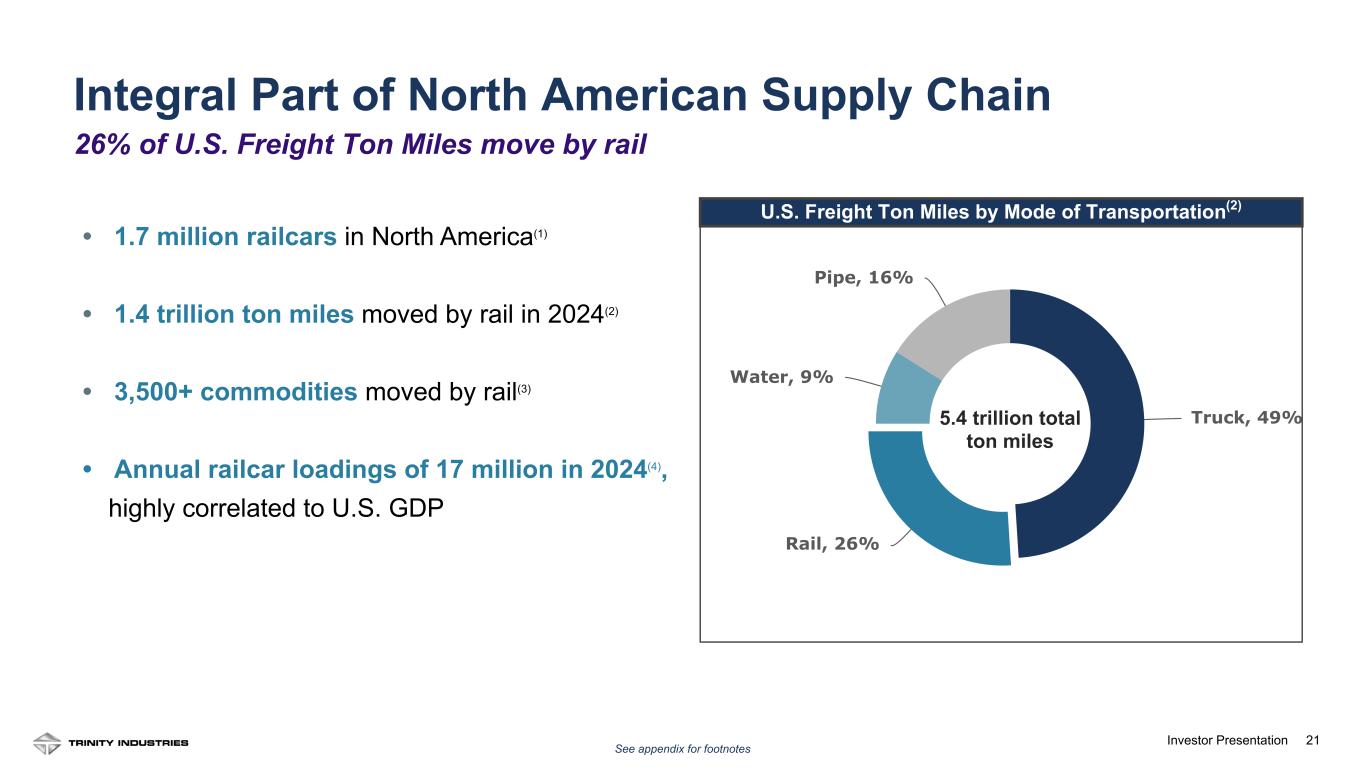
21Investor Presentation • 1.7 million railcars in North America(1) • 1.4 trillion ton miles moved by rail in 2024(2) • 3,500+ commodities moved by rail(3) • Annual railcar loadings of 17 million in 2024(4), highly correlated to U.S. GDP U.S. Freight Ton Miles by Mode of Transportation(2) See appendix for footnotes 21 Truck, 49% Rail, 26% Water, 9% Pipe, 16% 5.4 trillion total ton miles Integral Part of North American Supply Chain 26% of U.S. Freight Ton Miles move by rail


22Investor Presentation Financial Positioning and Strategic Initiatives


23Investor Presentation Fleet investment generates highest returns for Trinity Strong FLRD and growing end market demand supports our conviction in the return opportunities from fleet investment Requires diligence, but strategic M&A around Parts and Services can drive meaningful returns Committed to dividend growth and will be opportunistic around share repurchases Current debt profile supports ROE outlook Committed to maintaining appropriate liquidity Capital Allocation Strategy Focused on Returns HIGHER RETURNS LOWER RETURNS Fleet InvestmentCapital Investments and M&AReturn of CapitalDebt RepaymentHold Cash


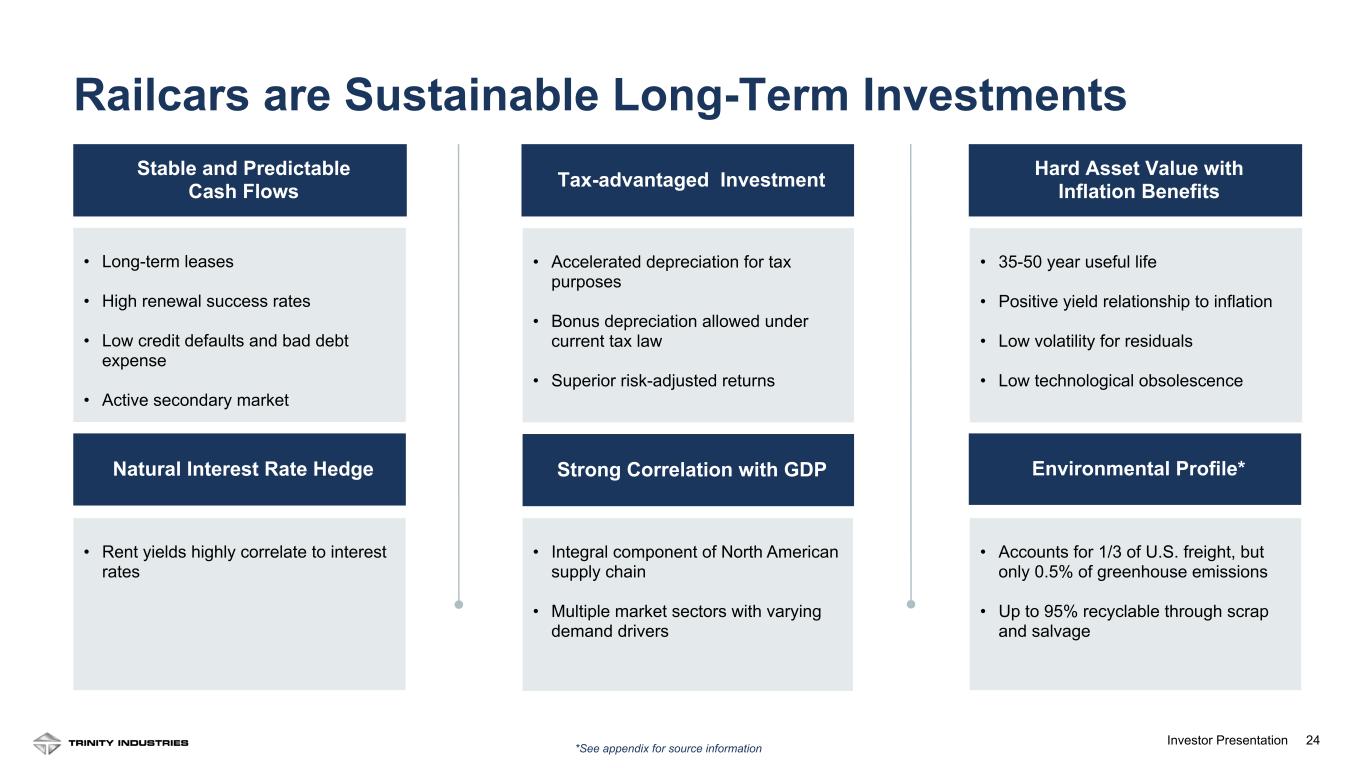
24Investor Presentation • Long-term leases • High renewal success rates • Low credit defaults and bad debt expense • Active secondary market Stable and Predictable Cash Flows • 35-50 year useful life • Positive yield relationship to inflation • Low volatility for residuals • Low technological obsolescence Hard Asset Value with Inflation Benefits • Integral component of North American supply chain • Multiple market sectors with varying demand drivers Strong Correlation with GDP • Rent yields highly correlate to interest rates Natural Interest Rate Hedge • Accelerated depreciation for tax purposes • Bonus depreciation allowed under current tax law • Superior risk-adjusted returns Tax-advantaged Investment • Accounts for 1/3 of U.S. freight, but only 0.5% of greenhouse emissions • Up to 95% recyclable through scrap and salvage Environmental Profile* *See appendix for source information 24 Railcars are Sustainable Long-Term Investments


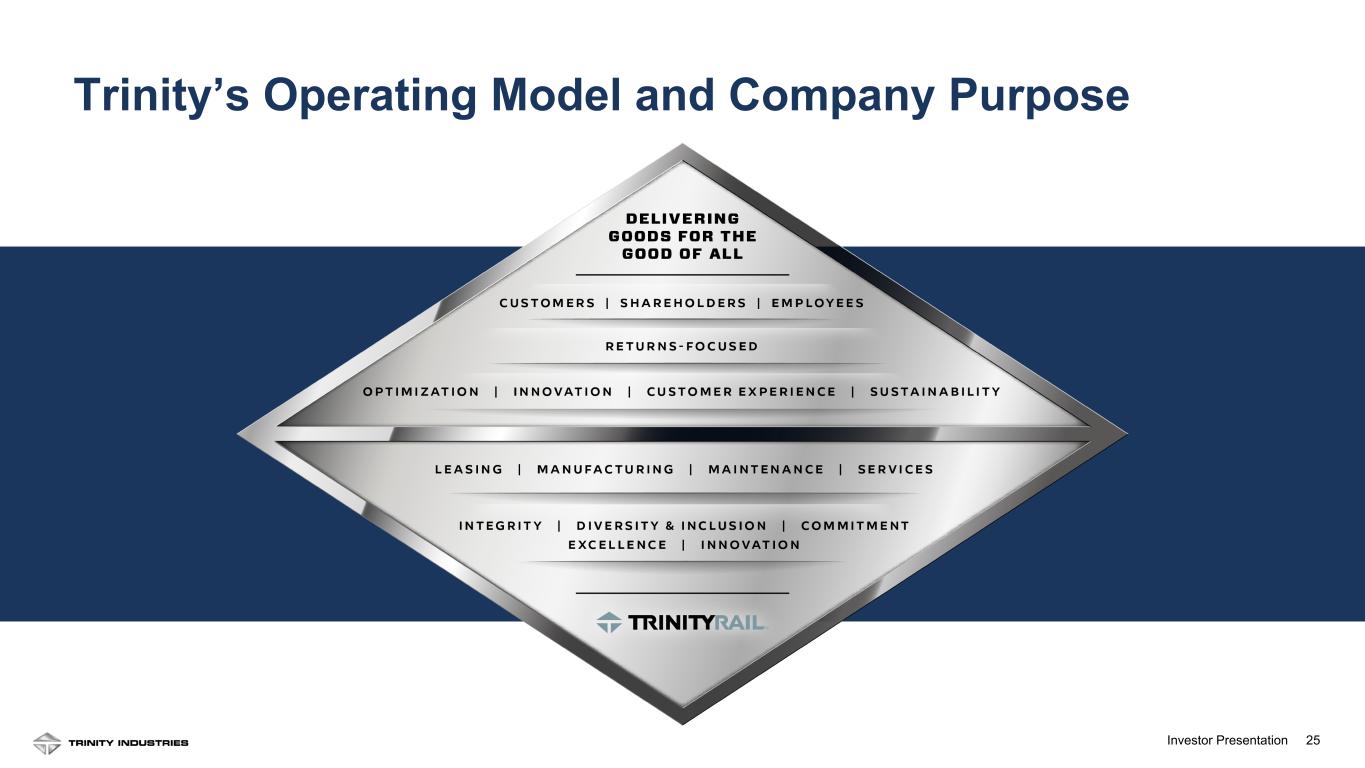
25Investor Presentation Trinity’s Operating Model and Company Purpose


26Investor Presentation Appendix


27Investor Presentation 27 Three Months Ended June 30, 2024 (in millions, except per share amounts) GAAP Interest expense, net (1) Adjusted Operating profit $ 141.9 $ — $ 141.9 Income from continuing operations before income taxes $ 75.2 $ (0.4) $ 74.8 Provision (benefit) for income taxes $ 17.1 $ (0.1) $ 17.0 Income from continuing operations $ 58.1 $ (0.3) $ 57.8 Net income from continuing operations attributable to Trinity Industries, Inc. $ 56.1 $ (0.3) $ 55.8 Diluted weighted average shares outstanding 84.1 84.1 Diluted income from continuing operations per common share attributable to Trinity Industries, Inc. $ 0.67 $ 0.66 (1) Represents interest income accretion related to a seller-financing agreement associated with the sale of certain non-operating assets. We have supplemented the presentation of our reported GAAP operating profit, income from continuing operations before income taxes, provision (benefit) for income taxes, income from continuing operations, net income from continuing operations attributable to Trinity Industries, Inc., and diluted income from continuing operations per common share attributable to Trinity Industries, Inc. with non-GAAP measures that adjust the GAAP measures to exclude the impact of certain interest expense, net; and certain other transactions or events (as applicable), described in the footnote to the table above. These non-GAAP measures are derived from amounts included in our GAAP financial statements and are reconciled to the most directly comparable GAAP financial measures in the table above. Management believes that these measures are useful to both management and investors for analyzing the performance of our business without the impact of certain items that are not indicative of our normal business operations. Non-GAAP measures should not be considered in isolation or as a substitute for our reported results prepared in accordance with GAAP and, as calculated, may not be comparable to other similarly titled measures for other companies. Reconciliation: Adjusted Operating Results


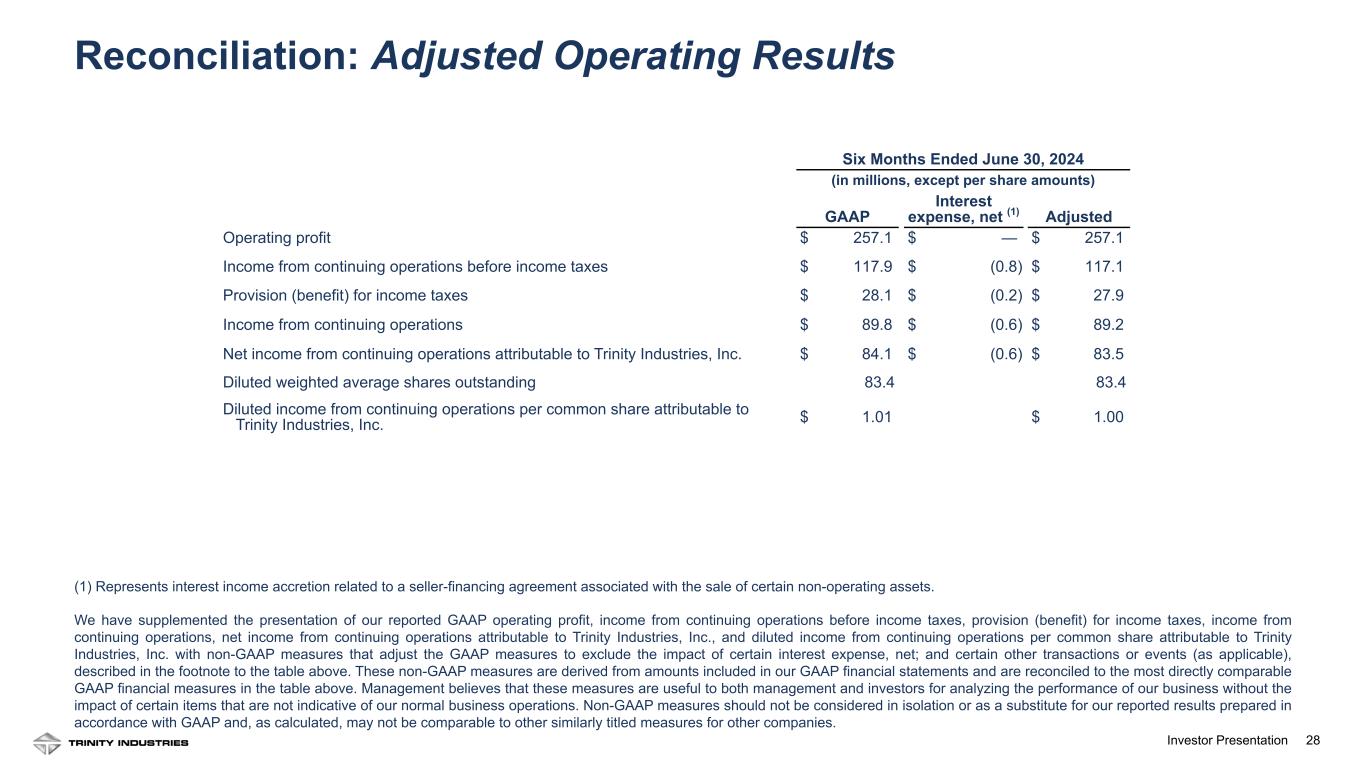
28Investor Presentation 28 Reconciliation: Adjusted Operating Results (1) Represents interest income accretion related to a seller-financing agreement associated with the sale of certain non-operating assets. We have supplemented the presentation of our reported GAAP operating profit, income from continuing operations before income taxes, provision (benefit) for income taxes, income from continuing operations, net income from continuing operations attributable to Trinity Industries, Inc., and diluted income from continuing operations per common share attributable to Trinity Industries, Inc. with non-GAAP measures that adjust the GAAP measures to exclude the impact of certain interest expense, net; and certain other transactions or events (as applicable), described in the footnote to the table above. These non-GAAP measures are derived from amounts included in our GAAP financial statements and are reconciled to the most directly comparable GAAP financial measures in the table above. Management believes that these measures are useful to both management and investors for analyzing the performance of our business without the impact of certain items that are not indicative of our normal business operations. Non-GAAP measures should not be considered in isolation or as a substitute for our reported results prepared in accordance with GAAP and, as calculated, may not be comparable to other similarly titled measures for other companies. Six Months Ended June 30, 2024 (in millions, except per share amounts) GAAP Interest expense, net (1) Adjusted Operating profit $ 257.1 $ — $ 257.1 Income from continuing operations before income taxes $ 117.9 $ (0.8) $ 117.1 Provision (benefit) for income taxes $ 28.1 $ (0.2) $ 27.9 Income from continuing operations $ 89.8 $ (0.6) $ 89.2 Net income from continuing operations attributable to Trinity Industries, Inc. $ 84.1 $ (0.6) $ 83.5 Diluted weighted average shares outstanding 83.4 83.4 Diluted income from continuing operations per common share attributable to Trinity Industries, Inc. $ 1.01 $ 1.00


29Investor Presentation 29 Year Ended December 31, 2024 (in millions, except per share amounts) GAAP Gains on dispositions of property – other (1) Restructuring activities, net Interest expense, net (2) Adjusted Operating profit $ 491.5 $ (2.7) $ 4.3 $ — $ 493.1 Income from continuing operations before income taxes $ 221.8 $ (2.7) $ 4.3 $ (1.2) $ 222.2 Provision (benefit) for income taxes $ 50.4 $ (0.6) $ 0.9 $ (0.3) $ 50.4 Income from continuing operations $ 171.4 $ (2.1) $ 3.4 $ (0.9) $ 171.8 Net income from continuing operations attributable to Trinity Industries, Inc. $ 152.7 $ (2.1) $ 3.4 $ (0.9) $ 153.1 . Diluted weighted average shares outstanding 84.2 84.2 Diluted income from continuing operations per common share attributable to Trinity Industries, Inc. $ 1.81 $ 1.82 Reconciliation: Adjusted Operating Results (1) Represents insurance recoveries in excess of net book value for assets damaged by a fire at the Company’s facility in Cartersville, Georgia in the first quarter of 2024. (2) Represents interest income accretion related to a seller-financing agreement associated with the sale of certain non-operating assets. We have supplemented the presentation of our reported GAAP operating profit, income from continuing operations before income taxes, provision (benefit) for income taxes, income from continuing operations, net income from continuing operations attributable to Trinity Industries, Inc., and diluted income from continuing operations per common share attributable to Trinity Industries, Inc. with non-GAAP measures that adjust the GAAP measures to exclude the impact of certain gains on dispositions of other property; restructuring activities, net; interest expense, net; and certain other transactions or events (as applicable), described in the footnotes to the table above. These non-GAAP measures are derived from amounts included in our GAAP financial statements and are reconciled to the most directly comparable GAAP financial measures in the table above. Management believes that these measures are useful to both management and investors for analyzing the performance of our business without the impact of certain items that are not indicative of our normal business operations. Non-GAAP measures should not be considered in isolation or as a substitute for our reported results prepared in accordance with GAAP and, as calculated, may not be comparable to other similarly titled measures for other companies.


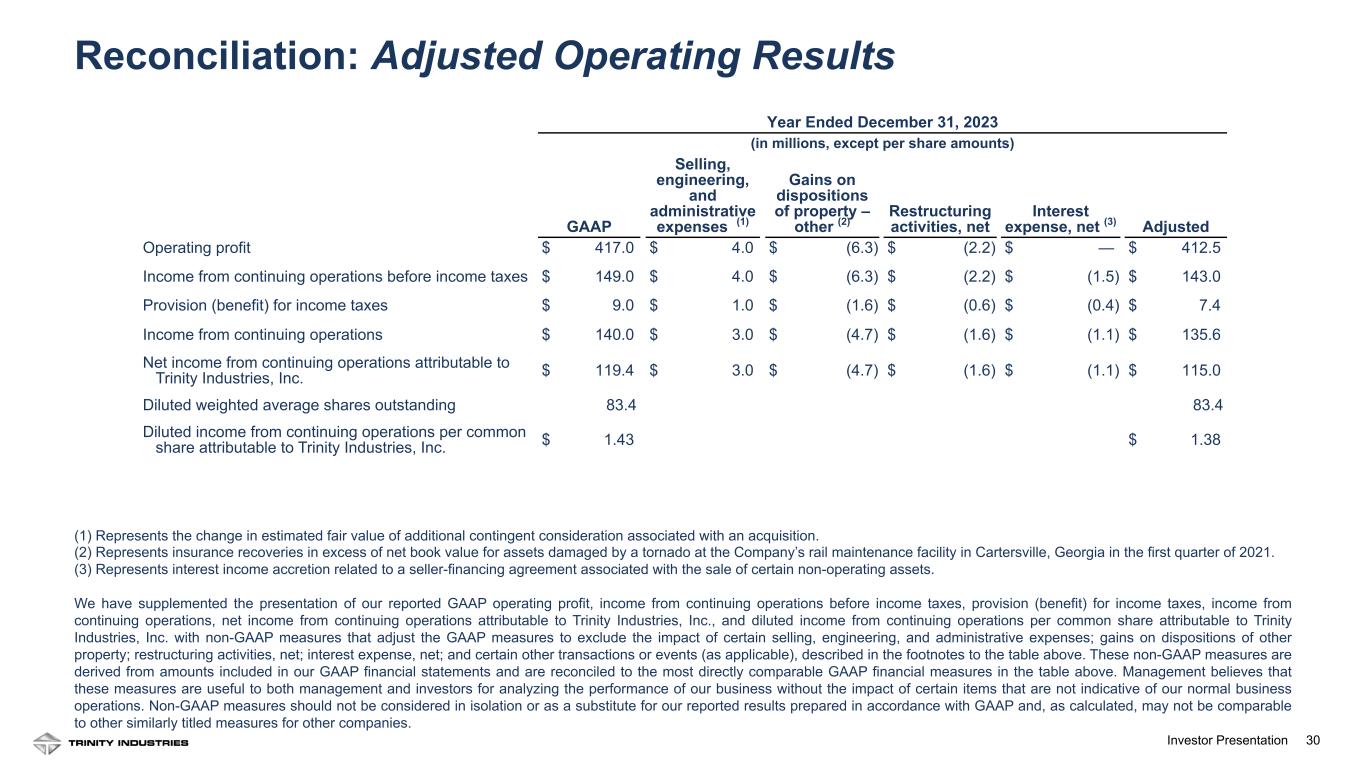
30Investor Presentation 30 (1) Represents the change in estimated fair value of additional contingent consideration associated with an acquisition. (2) Represents insurance recoveries in excess of net book value for assets damaged by a tornado at the Company’s rail maintenance facility in Cartersville, Georgia in the first quarter of 2021. (3) Represents interest income accretion related to a seller-financing agreement associated with the sale of certain non-operating assets. We have supplemented the presentation of our reported GAAP operating profit, income from continuing operations before income taxes, provision (benefit) for income taxes, income from continuing operations, net income from continuing operations attributable to Trinity Industries, Inc., and diluted income from continuing operations per common share attributable to Trinity Industries, Inc. with non-GAAP measures that adjust the GAAP measures to exclude the impact of certain selling, engineering, and administrative expenses; gains on dispositions of other property; restructuring activities, net; interest expense, net; and certain other transactions or events (as applicable), described in the footnotes to the table above. These non-GAAP measures are derived from amounts included in our GAAP financial statements and are reconciled to the most directly comparable GAAP financial measures in the table above. Management believes that these measures are useful to both management and investors for analyzing the performance of our business without the impact of certain items that are not indicative of our normal business operations. Non-GAAP measures should not be considered in isolation or as a substitute for our reported results prepared in accordance with GAAP and, as calculated, may not be comparable to other similarly titled measures for other companies. Year Ended December 31, 2023 (in millions, except per share amounts) GAAP Selling, engineering, and administrative expenses (1) Gains on dispositions of property – other (2) Restructuring activities, net Interest expense, net (3) Adjusted Operating profit $ 417.0 $ 4.0 $ (6.3) $ (2.2) $ — $ 412.5 Income from continuing operations before income taxes $ 149.0 $ 4.0 $ (6.3) $ (2.2) $ (1.5) $ 143.0 Provision (benefit) for income taxes $ 9.0 $ 1.0 $ (1.6) $ (0.6) $ (0.4) $ 7.4 Income from continuing operations $ 140.0 $ 3.0 $ (4.7) $ (1.6) $ (1.1) $ 135.6 Net income from continuing operations attributable to Trinity Industries, Inc. $ 119.4 $ 3.0 $ (4.7) $ (1.6) $ (1.1) $ 115.0 Diluted weighted average shares outstanding 83.4 83.4 Diluted income from continuing operations per common share attributable to Trinity Industries, Inc. $ 1.43 $ 1.38 Reconciliation: Adjusted Operating Results


31Investor Presentation Q2-24 Q3-24 Q4-24 Q1-25 Q2-25 (in millions) Net cash provided by operating activities – continuing operations $ 243.2 $ 83.8 $ 204.6 $ 78.4 $ 63.5 Net gains on lease portfolio sales 22.7 11.4 21.1 5.9 7.8 Cash flow from operations with net gains on lease portfolio sales $ 265.9 $ 95.2 $ 225.7 $ 84.3 $ 71.3 Reconciliation: Cash Flow from Operations with Net Gains on Lease Portfolio Sales Cash flow from operations with net gains on lease portfolio sales is a non-GAAP financial measure. We believe this measure is useful to both management and investors as it provides a relevant measure of liquidity and a useful basis for assessing the breadth of the cash flow generation capabilities across our operating platform, as well as our ability to fund our operations and repay our debt. This measure is defined as net cash provided by operating activities from continuing operations as computed in accordance with GAAP, plus net gains on lease portfolio sales and is reconciled to net cash provided by operating activities from continuing operations, the most directly comparable GAAP financial measure, in the table above. Non-GAAP measures should not be considered in isolation or as a substitute for our reported results prepared in accordance with GAAP and, as calculated, may not be comparable to other similarly titled measures for other companies.


32Investor Presentation (1) Represents insurance recoveries in excess of net book value for assets damaged by a fire at the Company’s facility in Cartersville, Georgia in the first quarter of 2024. (2) Represents interest income accretion related to a seller-financing agreement associated with the sale of certain non-operating assets. (3) Return on Equity is calculated as income from continuing operations divided by average total stockholders' equity. (4) Adjusted Return on Equity is calculated as adjusted net income divided by average Trinity stockholders' equity, each as defined below and reconciled above. Adjusted Return on Equity (“Adjusted ROE”) is a non-GAAP measure that is derived from amounts included in our GAAP financial statements. We define Adjusted ROE as a ratio for which (i) the numerator is calculated as income or loss from continuing operations, adjusted to exclude the effects of net income or loss attributable to noncontrolling interest, and certain other adjustments (net of income taxes), described in the footnotes to the table above, which include certain gains on dispositions of other property; restructuring activities, net; and interest expense, net; and (ii) the denominator is calculated as average Trinity stockholders’ equity (which excludes noncontrolling interest). In the table above, the numerator and denominator of our Adjusted ROE calculation are reconciled to income from continuing operations and total stockholders’ equity, respectively, which are the GAAP financial measures used in the computation of ROE. Management believes that Adjusted ROE is a useful measure to both management and investors as it provides an indication of the economic return on the Company’s investments over time. Non-GAAP measures should not be considered in isolation or as a substitute for our reported results prepared in accordance with GAAP and, as calculated, may not be comparable to other similarly titled measures for other companies. LTM June 30, 2025 June 30, 2024 ($ in millions) Numerator: Income from continuing operations $ 132.5 Net income attributable to noncontrolling interest (23.9) Net income from continuing operations attributable to Trinity Industries, Inc. 108.6 Adjustments (net of income taxes): Gains on dispositions of property – other (1) (2.1) Restructuring activities, net 3.4 Interest expense, net (2) (0.3) Adjusted Net Income $ 109.6 Denominator: Total stockholders' equity $ 1,257.8 $ 1,304.0 Noncontrolling interest (248.7) (238.5) Trinity stockholders' equity $ 1,009.1 $ 1,065.5 Average total stockholders' equity $ 1,280.9 Return on Equity (3) 10.3 % Average Trinity stockholders' equity $ 1,037.3 Adjusted Return on Equity (4) 10.6 % Reconciliation: Adjusted Return on Equity


33Investor Presentation “EBITDA” is defined as income from continuing operations plus interest expense, provision (benefit) for income taxes, and depreciation and amortization expense. Adjusted EBITDA is defined as EBITDA plus certain gains on dispositions of other property; restructuring activities, net; and interest income. EBITDA and Adjusted EBITDA are non-GAAP financial measures; however, the amounts included in these calculations are derived from amounts included in our GAAP financial statements. EBITDA and Adjusted EBITDA are reconciled to net income, the most directly comparable GAAP financial measure, in the table above. This information is provided to assist management and investors in making meaningful comparisons of our operating performance between periods. We believe EBITDA is a useful measure for analyzing the performance of our business. We also believe that EBITDA is commonly reported and widely used by investors and other interested parties as a measure of a company’s operating performance and debt servicing ability because it assists in comparing performance on a consistent basis without regard to capital structure, depreciation or amortization (which can vary significantly depending on many factors). EBITDA and Adjusted EBITDA should not be considered as alternatives to net income, as indicators of our operating performance, or as alternatives to operating cash flows as measures of liquidity. Non-GAAP measures should not be considered in isolation or as a substitute for our reported results prepared in accordance with GAAP and, as calculated, may not be comparable to other similarly titled measures for other companies. LTM June 30, 2025 (in millions) Net income $ 120.4 Less: Loss from discontinued operations, net of income taxes (12.1) Income from continuing operations 132.5 Interest expense 280.8 Provision (benefit) for income taxes 33.8 Depreciation and amortization expense 296.1 EBITDA 743.2 Gains on dispositions of property – other (2.7) Restructuring activities, net 4.3 Interest income (0.4) Adjusted EBITDA $ 744.4 Reconciliation: EBITDA and Adjusted EBITDA


34Investor Presentation Slide 2 – Forward Looking Statements (1) LTM is calculated as the year ended December 31, 2024, less the six months ended June 30, 2024, plus the six months ended June 30, 2025, representing the financial information from July 1, 2024 to June 30, 2025. Slide 8 – Segment Performance: Railcar Leasing & Services Group (1) OP margin for the Railcar Leasing and Services Group includes gains from insurance recoveries of $2.7M in Q4-24. (2) Future Lease Rate Differential (FLRD) calculates the implied change in lease rates for railcar leases expiring over the next four quarters. The FLRD assumes that these expiring leases will be renewed at the most recent quarterly transacted lease rates for each railcar type. We believe the FLRD is useful to both management and investors as it provides insight into the near-term trend in lease rates. The FLRD is calculated as follows: (New Lease Rates – Expiring Lease Rates) x Expiring Railcar Leases (Expiring Lease Rates x Expiring Railcar Leases) Slide 10 – Total Company Results Adjusted EPS includes the following adjustments reported by the Company (each per common diluted share): • Reported Q2-24 GAAP EPS was $0.67; Adjusted EPS excludes $0.01 related to interest income accretion related to a seller-financing agreement associated with the sale of certain non- operating assets. • Reported Q3-24 GAAP EPS was $0.44; Adjusted EPS excludes $0.01 related to interest income accretion related to a seller-financing agreement associated with the sale of certain non- operating assets. • Reported Q4-24 GAAP EPS was $0.38; Adjusted EPS excludes $0.04 related to restructuring activities and $0.03 related to the insurance recoveries in excess of net book value for assets damaged by a fire at the Company’s facility in Cartersville, Georgia in the first quarter of 2024. • Reported Q1-25 GAAP EPS was $0.29. There were no adjustments to GAAP EPS in Q1-25. • Reported Q2-25 GAAP EPS was $0.19. There were no adjustments to GAAP EPS in Q2-25. Slide 11 – Balance Sheet Positioning (1) Balances and blended average interest rate (including the effect of interest rate hedges, as applicable) as of June 30, 2025 Slide 14 – Trinity Industries, Inc. Overview (1) Current dividend yield represents the Company’s most recent quarterly dividend, annualized, and the stock price (NYSE: TRN) as of June 30, 2025. (2) Intersegment revenues are eliminated. Slide 19 – Capitalizing on Structural Change in the Rail Market Umler® North American fleet ownership data as of January 1, 2025 Slide 21 – Integral Part of North American Supply Chain (1) Umler® source data, January 1, 2025 report (2) FTR Associates 11/15/2024 (3) Association of American Railroads (“AAR”), accessed on March 1, 2022 with data as of February 20, 2022 (4) Association of American Railroads (“AAR”) 1/1/2025 Slide 24 – Railcars are Sustainable Long-Term Investments https://www.aar.org/wp-content/uploads/2023/06/AAR-Climate-Change-Fact-Sheet.pdf Presentation Footnotes


35Investor Presentation Leigh Anne Mann, Vice President of Investor Relations 214-631-4420 TrinityInvestorRelations@trin.net Investor Website: www.trin.net/investor-relations Contact Information