 エドガーで原本を確認する
UNITED STATES
SECURITIES AND EXCHANGE COMMISSION
WASHINGTON D.C. 20549
FORM 10-K
(Mark One)
ANNUAL REPORT PURSUANT TO SECTION 13 OR 15(d) OF THE SECURITIES EXCHANGE ACT OF 1934
For the fiscal year ended September 28, 2024
or
TRANSITION REPORT PURSUANT TO SECTION 13 OR 15(d) OF THE SECURITIES EXCHANGE ACT OF 1934
For the transition period from to .
Commission File Number 0-14706
INGLES MARKETS, INCORPORATED
(Exact name of registrant as specified in its charter)
|
|
|
|
North Carolina |
56-0846267 |
(State or other jurisdiction of incorporation or organization) |
(I.R.S. Employer Identification No.) |
|
|
2913 U.S. Hwy. 70 West, Black Mountain, NC |
28711 |
(Address of principal executive offices) |
(Zip Code) |
| |
Registrant’s telephone number including area code: (828) 669-2941 | |
Securities registered pursuant to Section 12(b) of the Act:
|
|
|
Title of each class |
Trading Symbol(s) |
Name of each exchange on which registered |
Class A Common Stock, $0.05 par value per share |
IMKTA |
The NASDAQ Global Select Market |
Securities registered pursuant to Section 12(g) of the Act:
None
(Title of Class)
Indicate by check mark if the registrant is a well-known seasoned issuer, as defined in Rule 405 of the Securities Act. YES NO x.
Indicate by check mark if the registrant is not required to file reports pursuant to Section 13 or Section 15(d) of the Act. YES NO x.
Indicate by check mark whether the registrant (1) has filed all reports required to be filed by Section 13 or 15(d) of the Securities Exchange Act of 1934 during the preceding 12 months (or for such shorter period that the registrant was required to file such reports), and (2) has been subject to such filing requirements for the past 90 days. YES x NO .
Indicate by check mark whether the registrant has submitted electronically every Interactive Data File required to be submitted pursuant to Rule 405 of Regulation S-T (§ 232.405 of this chapter) during the preceding 12 months (or for such shorter period that the registrant was required to submit such files). YES x NO .
Indicate by check mark whether the registrant is a large accelerated filer, an accelerated filer, a non-accelerated filer, a smaller reporting company or an emerging growth company. See the definitions of “large accelerated filer,” “accelerated filer,” “smaller reporting company” and “emerging growth company” in Rule 12b-2 of the Exchange Act. (Check one):
|
|
|
|
|
Large accelerated filer Non-accelerated filer o |
|
Accelerated filer o Smaller reporting company Emerging growth company |
If an emerging growth company, indicate by check mark if the registrant has elected not to use the extended transition period for complying with any new or revised financial accounting standards provided pursuant to Section 13(a) of the Exchange Act.
Indicate by check mark whether the registrant has filed a report on and attestation to its management’s assessment of the effectiveness of its internal control over financial reporting under Section 404(b) of the Sarbanes-Oxley Act (15 U.S.C.7262(b)) by the registered public accounting firm that prepared or issued its audit report. YES x NO
If securities are registered pursuant to Section 12(b) of the Act, indicate by check mark whether the financial statements of the registrant included in the filing reflect the correction of an error to previously issued financial statements. Indicate by check mark whether any of those error corrections are restatements that required a recovery analysis of incentive-based compensation received by any of the registrant’s executive officers during the relevant recovery period pursuant to §240.10D-1(b).
Indicate by check mark whether the registrant is a shell company (as defined in Rule 12b-2 of the Act). YES NO x.
As of March 30, 2024, the aggregate market value of voting stock held by non-affiliates of the registrant, based on the closing sales price of the Class A Common Stock on The NASDAQ Global Select Market on March 30, 2024, was approximately $1.13 billion. As of December 24, 2024, the registrant had 14,545,750 shares of Class A Common Stock outstanding and 4,448,626 shares of Class B Common Stock outstanding.
Certain information required in Part III hereof is incorporated by reference to the Proxy Statement for the registrant’s 2025 Annual Meeting of Stockholders to be filed with the Securities and Exchange Commission pursuant to Regulation 14A no later than 120 days after the end of the fiscal year covered by this report.
Ingles Markets, Incorporated
Annual Report on Form 10-K
September 28, 2024
|
|
|
|
|
Page |
|
PART I |
|
Item 1. |
Business |
5 |
Item 1A. |
Risk Factors |
11 |
Item 1B. |
Unresolved Staff Comments |
14 |
Item 1C. |
Cybersecurity |
14 |
Item 2. |
Properties |
15 |
Item 3. |
Legal Proceedings |
15 |
Item 4. |
Mine Safety Disclosures |
16 |
|
PART II |
|
Item 5. |
Market for Registrant’s Common Equity, Related Stockholder Matters, and Issuer Purchases of Equity Securities |
16 |
Item 6. |
[Reserved] |
18 |
Item 7. |
Management’s Discussion and Analysis of Financial Condition and Results of Operations |
18 |
Item 7A. |
Quantitative and Qualitative Disclosures About Market Risks |
24 |
Item 8. |
Financial Statements and Supplementary Data |
25 |
Item 9. |
Changes in and Disagreements With Accountants on Accounting and Financial Disclosure |
25 |
Item 9A. |
Controls and Procedures |
25 |
Item 9B. |
Other Information |
26 |
Item 9C. |
Disclosure Regarding Foreign Jurisdictions that Prevent Inspections |
26 |
|
PART III |
|
Item 10. |
Directors, Executive Officers and Corporate Governance |
26 |
Item 11. |
Executive Compensation |
27 |
Item 12. |
Security Ownership of Certain Beneficial Owners and Management and Related Stockholder Matters |
27 |
Item 13. |
Certain Relationships and Related Transactions, and Director Independence |
27 |
Item 14. |
Principal Accountant Fees and Services |
27 |
|
PART IV |
|
Item 15. |
Exhibits and Financial Statement Schedules |
27 |
Item 16. |
Form 10-K Summary |
29 |
|
Report of Independent Registered Public Accounting Firm PCAOB ID No. 34 |
30 |
CAUTIONARY NOTE REGARDING FORWARD-LOOKING STATEMENTS
This Annual Report on Form 10-K of Ingles Markets, Incorporated (“Ingles” or the “Company”) contains certain forward-looking statements within the meaning of Section 21E of the Securities Exchange Act of 1934, as amended (the “Exchange Act”). All statements other than statements of historical fact included in this Annual Report on Form 10-K, including the statements under “Management’s Discussion and Analysis of Financial Condition and Results of Operations,” “Business” and elsewhere regarding the Company’s strategy, future operations, financial position, estimated revenues, projected costs, projections, prospects, plans and objectives of management, are forward-looking statements. The words “expect”, “anticipate”, “intend”, “plan”, “likely”, “goal”, “believe”, “seek”, “will”, “may”, “would”, “should” and similar expressions are intended to identify forward-looking statements. While these forward-looking statements and the related assumptions are made in good faith and reflect the Company’s current judgment regarding the direction of the Company’s business, actual results will almost always vary, sometimes materially, from any estimates, predictions, projections, assumptions or other future performance suggested or described by such forward-looking statements. Such statements are based upon a number of assumptions and estimates that are inherently subject to significant risks and uncertainties, many of which are beyond the Company’s control. Some of these assumptions inevitably will not materialize, and unanticipated events will occur which will affect the Company’s results. Some important factors (but not necessarily all factors) that affect the Company’s revenues, financial position, growth strategies, profitability and operating results, or that otherwise could cause actual results to differ materially from those expressed in or implied by any forward-looking statement, include:
business and economic conditions generally in the Company’s operating area, including inflation or deflation;
shortages of labor, distribution capacity, and some product outages;
inflation in food, labor and fuel prices;
the Company’s ability to successfully implement our expansion and operating strategies;
a resurgence of the COVID-19 pandemic;
pricing pressures and other competitive factors, including online-based procurement of products the Company sells;
sudden or significant changes in the availability of fuel and retail fuel prices;
the maturation of new and expanded stores;
general concerns about food safety;
the Company’s ability to manage technology and data security;
the availability and terms of financing;
increases in costs, including food, utilities, labor and other goods and services significant to the Company’s operations;
success or failure in the ownership and development of real estate;
changes in the laws and government regulations applicable to the Company;
disruptions in the efficient distribution of food products;
changes in accounting pronouncements that could impact the Company’s reported financial results and compliance with various debt agreements; and
other risks and uncertainties, including those described under the caption “Risk Factors” in Item 1A of this Annual Report on Form 10-K.
Consequently, actual events affecting the Company and the impact of such events on the Company’s operations may vary significantly from those described in this Annual Report on Form 10-K. Given these risks and uncertainties, you are cautioned not to place undue reliance on such forward-looking statements. The forward-looking statements included in this Annual Report on Form 10-K are made only as of the date hereof. The Company does not undertake and specifically declines any obligation to update any such statements or to publicly announce the results of any revisions to any of such statements to reflect future events or developments, except to the extent required by applicable law.
PART I
Item 1. BUSINESS
General
Ingles Markets, Incorporated, a North Carolina corporation (collectively with its subsidiaries, “Ingles,” or the “Company,” “we,” “us” or “our”), is a leading supermarket chain in the southeast United States and operates a total of 198 supermarkets in North Carolina (75), Georgia (65), South Carolina (35), Tennessee (21), Virginia (1) and Alabama (1).
Impact of Hurricane Helene
On September 27, 2024, Hurricane Helene severely impacted western North Carolina, including the area where the Company’s headquarters are located, resulting in catastrophic flooding and destruction, power and communication outages, water outages, major road closures, and loss of life. For the year ended September 28, 2024, the Company recognized an impairment loss of $30.4 million related to inventory damaged or destroyed by Hurricane Helene. Additionally, the Company recognized a property and equipment impairment loss of $4.5 million for the year ended September 28, 2024 pertaining to the same storm. These recorded losses do not include future repairs and rebuilds, nor do they account for revenue lost due to store closures or electronic payment disruptions.
The Company’s properties, including its distribution center, were impacted; however, the distribution center returned to full operation within two weeks following the storm. Four stores sustained damage that required that they be temporarily closed. As of the date of this Annual Report on Form 10-K, one of the four stores has reopened and the three remaining stores are scheduled to reopen during 2025.
Overview
The Company remodels, expands and relocates stores in these communities and builds stores in new locations to retain and grow its customer base while retaining a high level of customer service and convenience. Ingles supermarkets offer customers a wide variety of nationally advertised food products, including grocery, meat and dairy products, produce, frozen foods and other perishables, and non-food products. Non-food products include fuel centers, pharmacies, health and beauty care products and general merchandise. The Company also offers quality private label items, organic and locally-sourced items throughout its market areas.
The Company believes that customer service and convenience, modern stores and competitive prices on a broad selection of quality merchandise are essential to developing and retaining a loyal customer base. The Company has an ongoing renovation and expansion plan to add stores in its target markets and modernize the appearance and layout of its existing stores. The Company’s new and remodeled supermarkets provide an enhanced level of customer convenience in order to accommodate the lifestyle of today’s shoppers. Design features of the Company’s modern stores focus on featuring local organic and home meal replacement items in the perishable departments, in-store pharmacies, on-premises fuel centers, and an expanded selection of food and non-food items throughout. The Company offers online ordering of its products for pickup at its stores.
Substantially all of the Company’s stores are located within 280 miles of the Company’s warehouse and distribution facilities, near Asheville, North Carolina. The Company operates 1.65 million square feet of warehouse and distribution facilities. These facilities supply the Company’s supermarkets with approximately 58% of the goods the Company sells. The remaining 42% is purchased from third parties and is generally delivered directly to the stores. The close proximity of the Company’s purchasing and distribution operations to its stores facilitates the timely distribution of consistently high quality perishable and non-perishable items. Due to damage sustained at the distribution center from Hurricane Helene, including power outages and connectivity issues, water outages and road closures, the normal receiving and shipping activities were limited for approximately two weeks after the storm.
To further ensure product quality, the Company also owns and operates a milk processing and packaging plant that supplies approximately 68% of the milk products sold by the Company’s supermarkets as well as a variety of organic milk, fruit juices and bottled water products. The milk processing and packaging plant did not sustain physical damage as a result of Hurricane Helene. In addition, the milk processing and packaging plant sells approximately 82% of its products to other retailers, food service distributors and grocery warehouses in 17 states, which provides the Company with an additional source of revenue.
The Company owns the real property for 175 of its supermarkets, either in free-standing stores or as the anchor tenant in a Company-owned shopping center. The Company also owns 29 undeveloped sites suitable for a free-standing store or other development by the Company or a third party. The Company’s owned real estate, including undeveloped sites, is generally located in the same geographic region as its supermarkets.
Common Stock and Corporate Information
The Company has been publicly traded since September 1987. The Company’s Class A Common Stock is listed on The NASDAQ Global Select Market under the symbol “IMKTA.” The Company’s Class B Common Stock is not publicly listed or traded. As of September 28, 2024, Mr. Robert P. Ingle II, our Chairman, beneficially owned approximately 72.5% of the combined voting power and 22.7% of the total number of shares of the Company’s outstanding Class A and Class B Common Stock (in each case including stock held by the Company’s Investment/Profit Sharing Plan and Trust of which Mr. Ingle II serves as one of the trustees). Beneficial ownership is calculated in accordance with Rule 13d-3 promulgated under the Exchange Act.
The Company was incorporated in 1965 under the laws of the State of North Carolina. Its principal mailing address is P.O. Box 6676, Asheville, North Carolina 28816, and its telephone number is 828-669-2941. The Company’s website is www.ingles-markets.com. Information on, or accessible through, the Company’s website is not a part of and is not incorporated by reference into this Annual Report on Form 10-K. The Company’s annual report on Form 10-K, quarterly reports on Form 10-Q, current reports on Form 8-K and amendments and supplements to these reports filed or furnished pursuant to Section 13(a) or 15(d) of the Exchange Act are available free of charge on the Company’s website as soon as reasonably practicable after they are filed with or furnished to the Securities and Exchange Commission.
Use of our Website and Social Media to Distribute Material Company Information
We use our website as a channel of distribution for important Company information. We routinely post on our website important information, including press releases and financial information, which may be accessed by selecting the “Corporate” sections of www.ingles-markets.com. We also use our website to expedite public access to time-critical information regarding our Company in advance of or in lieu of distributing a press release or a filing with the SEC disclosing the same information. Therefore, investors should look to the Corporate sections of our website for important and time-critical information. Visitors to our website can also register to receive financial information press releases. Information contained on, or accessible through, our website is not a part of and is not incorporated by reference into this Annual Report on Form 10-K.
Business
The Company operates one primary business segment, retail grocery, on a 52- or 53-week fiscal year ending on the last Saturday in September. The consolidated statements of income for the fiscal years ended September 28, 2024 and September 24, 2022 each consisted of 52 weeks of operations. The consolidated statements of income for the fiscal year ended September 30, 2023 had 53 weeks. Income from operations for the primary business segment, retail grocery sales, includes the charges for impairment losses from Hurricane Helene of $34.9 million. Information about the Company’s operations is as follows (for information regarding the Company’s industry segments, see Note 11, “Segment Information” to the Consolidated Financial Statements contained in this Annual Report on Form 10-K):
|
|
|
|
|
|
|
|
|
|
|
|
|
|
|
|
|
|
|
|
|
|
|
|
|
|
|
|
|
|
|
|
|
|
Fiscal Years Ended |
|||||||||||||
(dollars in millions) |
|
September 28, 2024 |
|
September 30, 2023 |
|
September 24, 2022 |
|||||||||
Revenues from unaffiliated customers: |
|
|
|
|
|
|
|
|
|
|
|
|
|
|
|
Grocery |
|
$ |
1,983.2 |
|
|
|
$ |
2,062.4 |
|
|
|
$ |
1,940.4 |
|
|
Non-foods |
|
|
1,273.3 |
|
|
|
|
1,326.9 |
|
|
|
|
1,204.5 |
|
|
Perishables |
|
|
1,441.1 |
|
|
|
|
1,482.1 |
|
|
|
|
1,445.0 |
|
|
Fuel |
|
|
724.2 |
|
|
|
|
792.5 |
|
|
|
|
885.8 |
|
|
Total retail |
|
|
5,421.8 |
|
96.1% |
|
|
5,663.9 |
|
96.1% |
|
|
5,475.7 |
|
96.4% |
Other |
|
|
217.8 |
|
3.9% |
|
|
228.9 |
|
3.9% |
|
|
203.1 |
|
3.6% |
|
|
$ |
5,639.6 |
|
100.0% |
|
$ |
5,892.8 |
|
100.0% |
|
$ |
5,678.8 |
|
100.0% |
Income from operations: |
|
|
|
|
|
|
|
|
|
|
|
|
|
|
|
Retail |
|
$ |
123.0 |
|
83.6% |
|
$ |
263.2 |
|
90.0% |
|
$ |
353.0 |
|
93.7% |
Other |
|
|
24.2 |
|
16.4% |
|
|
29.1 |
|
10.0% |
|
|
23.9 |
|
6.3% |
|
|
|
147.2 |
|
100.0% |
|
|
292.3 |
|
100.0% |
|
|
376.9 |
|
100.0% |
Other income, net |
|
|
14.2 |
|
|
|
|
8.3 |
|
|
|
|
5.9 |
|
|
Interest expense |
|
|
21.9 |
|
|
|
|
22.1 |
|
|
|
|
21.5 |
|
|
Income before income taxes |
|
$ |
139.5 |
|
|
|
$ |
278.5 |
|
|
|
$ |
361.3 |
|
|
The “Grocery” category includes grocery, dairy and frozen foods.
The “Non-foods” category includes alcoholic beverages, tobacco, pharmacy, and health/beauty/cosmetic products.
The “Perishables” category includes meat, produce, deli and bakery.
The “Other” category consists of fluid dairy operations and shopping center rentals.
Supermarket Operations
At September 28, 2024, the Company operated 189 supermarkets under the name “Ingles,” and nine supermarkets under the name “Sav-Mor” with locations in western North Carolina, western South Carolina, northern Georgia, eastern Tennessee, southwestern Virginia and northeastern Alabama. The “Sav-Mor” store concept accommodates smaller shopping areas and carries dry groceries, dairy, fresh meat and produce, all of which are displayed in a modern, readily accessible environment.
The following table sets forth certain information with respect to the Company’s supermarket operations.
|
|
|
|
|
|
|
|
|
|
|
|
|
|
|
|
|
|
|
|
|
|
|
|
|
|
|
|
Number of Supermarkets |
|
Percentage of Total |
||||||||
|
|
at Fiscal Year Ended |
|
Net Sales for Fiscal Years Ended |
||||||||
|
|
September 28, |
|
September 30, |
|
September 24, |
|
September 28, |
|
September 30, |
|
September 24, |
|
|
2024 |
|
2023 |
|
2022 |
|
2024 |
|
2023 |
|
2022 |
North Carolina |
|
75 |
|
75 |
|
75 |
|
41% |
|
41% |
|
41% |
South Carolina |
|
35 |
|
35 |
|
35 |
|
19% |
|
19% |
|
19% |
Georgia |
|
65 |
|
65 |
|
65 |
|
32% |
|
32% |
|
32% |
Tennessee |
|
21 |
|
21 |
|
21 |
|
8% |
|
8% |
|
8% |
Virginia |
|
1 |
|
1 |
|
1 |
|
— |
|
— |
|
— |
Alabama |
|
1 |
|
1 |
|
1 |
|
— |
|
— |
|
— |
|
|
198 |
|
198 |
|
198 |
|
100% |
|
100% |
|
100% |
The Company believes that today’s supermarket customers focus on convenience, quality and value in an attractive store environment. As a result, the Company’s shopping experience combines a high level of customer service, convenience-oriented quality product offerings and low overall pricing. The Company’s modern stores provide products and services such as home meal replacement items, delicatessens, bakeries, floral departments, greeting cards and broad selections of local organic, beverage and health-related items. At September 28, 2024, the Company operated 115 pharmacies and 108 fuel stations, in each case at the Company’s grocery store locations. The Company plans to continue to incorporate these departments in substantially all future new and remodeled stores. The Company trains its associates to provide friendly service and to actively address the needs of customers. These associates reinforce the Company’s distinctive service-oriented image.
Selected statistics on the Company’s supermarket operations are presented below:
|
|
|
|
|
|
|
|
|
|
|
|
|
|
|
|
|
|
|
|
|
|
|
|
|
|
|
|
|
|
|
|
|
|
Fiscal Year Ended |
|||||||||||||
|
|
September 28, |
|
September 30, |
|
September 24, |
|
September 25, |
|
September 26, |
|||||
|
|
2024 |
|
2023 |
|
2022 |
|
2021 |
|
2020 |
|||||
Weighted Average Sales Per Store (000’s) (1) |
|
$ |
27,341 |
|
$ |
28,565 |
|
$ |
27,622 |
|
$ |
23,926 |
|
$ |
22,215 |
Total Square Feet at End of Year (000’s) |
|
|
11,405 |
|
|
11,403 |
|
|
11,342 |
|
|
11,342 |
|
|
11,256 |
Average Total Square Feet per Store |
|
|
57,602 |
|
|
57,589 |
|
|
57,281 |
|
|
57,281 |
|
|
57,138 |
Average Square Feet of Selling Space per Store (2) |
|
|
40,322 |
|
|
40,313 |
|
|
40,097 |
|
|
40,097 |
|
|
39,997 |
Weighted Average Sales per Square Foot of |
|
|
676 |
|
|
709 |
|
|
689 |
|
|
609 |
|
|
568 |
(1)Weighted average sales per store include the effects of increases in square footage due to the opening of replacement stores and the expansion of stores through remodeling during the periods indicated, and fuel sales.
(2)Selling space is estimated to be 70% of total interior store square footage.
Merchandising
The Company’s merchandising strategy is designed to create a comprehensive and satisfying shopping experience that blends value and customer service with variety, quality and convenience. Management believes that this strategy fosters a loyal customer base by establishing a reputation for providing high quality products and a variety of specialty departments.
The Company’s stores carry a broad selection of quality meats, produce and other perishables. The Company offers a wide variety of fresh and non-perishable organic products, including organic milk produced by the Company’s fluid dairy plant. The Company’s market areas contain numerous providers of quality local products, which is in line with current customer preferences for goods produced where they live. Management believes that customers perceive supermarkets offering a broad array of products and time-saving services as part of a solution to today’s lifestyle demands. Accordingly, a principal component of the Company’s merchandising strategy is to design stores that enhance the shopping experience. The Company operates fuel stations at 108 of its store locations.
A selection of prepared foods and home meal replacements are featured throughout Ingles’ deli, bakery, produce and meat departments to provide customers with easy meal alternatives that they can eat at home or in the store. Many stores offer daily selections of home meal replacement items, such as rotisserie chicken and pork, international foods, fried chicken and other entrees, sandwiches, pre-packaged salads, sushi, cut fruit and prepared fresh vegetables. The bakery offers an expanded selection of baked goods and self-service options. Ingles bakes most of its items on site, including bread baked daily, cakes made to order in various sizes, donuts and other pastries. The deli offers salad, chicken wing and olive bars, an expanded offering of cheeses, gourmet items and home meal replacement items. The Company also provides its customers with an expanded selection of frozen food items (including organics) to meet the increasing demands of its customers.
The Ingles Curbside service allows customers to order any product in the Company’s stores online. The order is picked by store associates and loaded into the customer’s vehicle. This service is currently offered at 134 of the Company’s stores.
Ingles’ private labels cover a broad range of products throughout the store, such as milk, bread, organic products, soft drinks and canned goods. Ingles believes that private label sales help promote customer loyalty and provide a value-priced alternative to national brands.
The Company seeks to maintain a reputation for providing friendly service, quality merchandise and customer value and for its commitment to locally-sourced products and community involvement. The Company employs various advertising and promotional strategies to reinforce the quality and value of its products. The Company promotes these attributes using traditional advertising vehicles including radio, television, direct mail and newspapers, as well as electronic and social media. The Ingles Advantage Card is designed to foster customer loyalty by providing information to better understand the Company’s customers’ shopping patterns. The Ingles Advantage Card provides customers with special discounts throughout the Company’s stores and fuel stations.
Purchasing and Distribution
The Company currently supplies approximately 58% of its supermarkets’ inventory requirements from its modern warehouse and distribution facilities. The Company has 1.65 million square feet of office, warehouse and distribution facilities at its headquarters near Asheville, North Carolina. The Company believes that its warehouse and distribution facilities contain sufficient capacity for the continued expansion of its store base for the foreseeable future.
The Company’s centrally managed purchasing and distribution operations provide several advantages, including the ability to negotiate and reduce the cost of merchandise, decrease overhead costs and better manage its inventory at both the warehouse and store level. From time to time, the Company engages in advance purchasing on high-turnover inventory items to take advantage of special prices offered by manufacturers for limited periods, or to ensure adequate product supply during tight distribution market conditions.
The remaining 42% of the Company’s inventory requirements, primarily beverages, pharmacy, fuel, bread and snack foods, are supplied directly to the Company’s supermarkets by local distributors and manufacturers.
Goods from the warehouse and distribution facilities and the milk processing and packaging plant are distributed to the Company’s stores by a fleet of 182 tractors and 842 trailers that the Company owns, operates and maintains. The Company invests on an ongoing basis in the maintenance, upgrade and replacement of its tractor and trailer fleet. The Company also operates truck servicing and fuel storage facilities at its warehouse and distribution facilities. The Company reduces its overall distribution costs by capitalizing on back-haul opportunities (contracting with third parties to transport their merchandise on our trucks that would otherwise be empty).
The Company receives product recall information from various subscription, government and vendor sources. Upon receipt of recall information, the Company immediately contacts each of its stores to have the recalled product removed from the shelves and disposed of as instructed. The Company may also use social media to communicate product recall information to the public. The Company has a policy of refunding and/or replacing any goods returned by customers. The details of this policy are posted inside each of the Company’s stores.
Store Development, Expansion and Remodeling
The Company believes that the appearance and design of its stores are integral components of its customers’ shopping experience and aims to develop one of the most modern supermarket chains in the industry. The ongoing modernization of the Company’s store base involves (i) the construction of new stores with continuously updated designs, and (ii) the replacement, remodeling or expansion of existing stores. The Company’s goal is to maintain clean, well-lit stores with attractive architectural and display features that enhance the image of its stores as catering to the changing lifestyle needs of quality-conscious consumers who demand increasingly diverse product offerings. The construction of new stores by independent contractors is closely monitored and controlled by the Company. During fiscal year 2024, the Company started construction on a new store and started remodeling projects on several stores.
The Company renovates and remodels stores in order to increase customer traffic and sales, respond to existing customer demand, compete effectively against new stores opened by competitors and support its quality image merchandising strategy. The Company decides to complete a remodel of an existing store based on its evaluation of the competitive landscape of the local marketplace. A remodel or expansion provides the quality of facilities and product offerings identical to that of a new store, capitalizing upon the existing customer base. The Company retains the existing customer base by keeping the store in operation during the entire remodeling process. The Company may elect to relocate, rather than remodel, certain stores where relocation provides a more convenient location for its customers.
The following table sets forth, for the fiscal years indicated, the Company’s new store development, including the effect of the Company’s store remodeling activities, which has generally increased the average square footage of its stores:
|
|
|
|
|
|
|
|
|
|
|
|
|
|
|
|
|
|
|
|
|
|
|
|
2024 |
|
2023 |
|
2022 |
|
2021 |
|
2020 |
Number of Stores: |
|
|
|
|
|
|
|
|
|
|
Opened |
|
— |
|
— |
|
— |
|
2 |
|
— |
Closed |
|
— |
|
— |
|
— |
|
1 |
|
1 |
Stores open at end of period |
|
198 |
|
198 |
|
198 |
|
198 |
|
197 |
Size of Stores: |
|
|
|
|
|
|
|
|
|
|
Less than 42,000 sq. ft. |
|
45 |
|
45 |
|
46 |
|
46 |
|
46 |
42,000 up to 51,999 sq. ft. |
|
22 |
|
22 |
|
22 |
|
22 |
|
22 |
52,000 up to 61,999 sq. ft. |
|
46 |
|
47 |
|
47 |
|
47 |
|
47 |
At least 62,000 sq. ft. |
|
85 |
|
84 |
|
83 |
|
83 |
|
82 |
Average store size (sq. ft.) |
|
57,602 |
|
57,589 |
|
57,281 |
|
57,281 |
|
57,138 |
The Company’s ability to open new stores is subject to many factors, including the acquisition of satisfactory sites, as well as zoning limitations and other government regulations. In addition, the Company continually reviews its expansion, remodeling and replacement plans, which are subject to change. See the “Liquidity and Capital Resources” section included in “Item 7. Management’s Discussion and Analysis of Financial Condition and Results of Operations” regarding the Company’s capital expenditures.
Competition
The supermarket industry is highly competitive and characterized by narrow profit margins. The degree of competition the Company’s stores encounter varies by location, primarily based on the size of the community in which the store is located and its proximity to other communities. Additionally, competition for consumers’ food dollars has intensified in recent years due to the addition or expansion of food sections by many non-grocery retailers (physical and online) and by restaurants. The Company’s principal competitors are, in alphabetical order, Aldi, Inc., Earth Fare, Inc, Food City (K-VA-T Food Stores, Inc.), Food Lion (Koninlijke Ahold Delhaize America N.V.), The Fresh Market, Inc., Harris Teeter (owned by The Kroger Co.), The Kroger Co., Lidl (Lidl Stiftung & Co. KG), Publix Super Markets, Inc., Sprouts Farmers Market, Inc., Target Corporation, Wal-Mart Stores, Inc., and Whole Foods Market.
Supermarket chains generally compete based on location, quality of products, service, price, convenience, product variety, online ordering/delivery capabilities, and store condition.
The Company believes its competitive advantages include convenient locations, the quality of service it provides its customers, competitive pricing, product variety, quality and a pleasant shopping environment, which is enhanced by its ongoing modernization program.
By concentrating its operations within a relatively small geographic region, the Company is also positioned to monitor its markets and the needs of its customers more carefully within those markets. The Company’s senior executives live and work in the Company’s operating region, thereby allowing management to quickly identify changes in needs and customer preference. Because of the Company’s size, store managers have direct access to senior corporate management and can receive quick decisions regarding requested changes in operations. The Company can then move quickly to adjust its business in response to changes in the market and customer needs.
The Company’s management monitors competitive activity and regularly reviews and periodically adjusts the Company’s marketing and business strategies as management deems appropriate considering existing conditions in the Company’s region. The Company’s ability to remain competitive in its changing markets will depend in part on its ability to pursue its expansion and renovation programs and its response to remodeling and new store openings by its competitors.
Seasonality
Sales in the grocery segment of the Company’s business are subject to slight seasonal variances due to holiday related sales and sales during portions of the year in which customers return to seasonal homes. Sales are traditionally higher in the Company’s first fiscal quarter due to the inclusion of sales related to Thanksgiving and Christmas. The Company’s second fiscal quarter traditionally has the lowest sales of the year, unless Easter falls in that quarter. In the third and fourth quarters, sales are affected by the return of customers to seasonal homes in the Company’s market area.
The Company’s fluid dairy operations have a slight seasonal variation to the extent of its sales into the grocery industry. The Company’s real estate operations are not subject to seasonal variations.
Human Capital
At September 28, 2024, the Company had approximately 26,360 associates, of which 92% were supermarket personnel. Approximately 58% of supermarket personnel work on a part-time basis. Management considers labor relations to be good. The Company values its associates and believes that associate loyalty and enthusiasm are key elements of its operating performance.
The Company has responded to the tight labor market by increasing resources devoted to associate recruitment and retention, and by expanding the ways in which it markets itself to prospective associates; however, competition for labor has become more intense, resulting in higher costs to attract and retain associates.
The Company has various programs to ensure adequate store staffing levels at any given time during the week. Store managers are given tools to assist in scheduling and levels of staffing. We provide flexible scheduling to accommodate the needs of our full and part-time associates, and we also provide incentives for associates based on the achievement of operating and safety goals. The Company has made technology investments to allow efficient remote work environments for associates that do not work in our stores or distribution center.
Trademarks and Licenses
The Company employs various trademarks and service marks in its business, the most important of which are its own “Laura Lynn” and “Harvest Farms” private label trademarks, “The Ingles Advantage” service mark, and the “Ingles” service mark. These service marks and the trademarks are federally registered in the United States pursuant to applicable intellectual property laws and are the property of Ingles. The Company believes it has all material licenses and permits necessary to conduct its business.
The current expiration dates for significant trade and service marks are as follows: “Ingles” – December 9, 2025; “Laura Lynn” – March 13, 2034; “Harvest Farms Organic” – August 21, 2028; and “The Ingles Advantage” – August 30, 2025. Each registration may be renewed for an additional ten-year term prior to its expiration. The Company intends to timely file all renewals. Each of the Company’s trademark license agreements has a one year term which, with respect to one license, is automatically renewed annually, unless the owner of the trademark provides notice of termination prior to the expiration date and, with respect to the other licenses, are renewed periodically by letter from the licensor.
Environmental Matters
Under applicable environmental laws, the Company may be responsible for remediation of environmental conditions and may be subject to associated liabilities relating to its stores and other buildings and the land on which such stores and other buildings are situated (including responsibility and liability related to its operation of its gas stations and the storage of fuel in underground storage tanks), regardless of whether the Company leases or owns the stores, other buildings or land in question and regardless of whether such environmental conditions were created by the Company or by a prior owner or tenant. The presence of contamination from hazardous or toxic substances, or the failure to properly remediate such contaminated property, may adversely affect the Company’s ability to sell or rent such real property or to borrow using such real property as collateral. The Company typically conducts an environmental review prior to acquiring or leasing new stores, other buildings or raw land.
Federal, state and local governments could enact laws or regulations concerning environmental matters that affect the Company’s operations or facilities or increase the cost of producing or distributing the Company’s products. The Company believes that it currently conducts its operations, and in the past has conducted its operations, in substantial compliance with applicable environmental laws. The Company, however, cannot predict the environmental liabilities that may result from legislation or regulations adopted in the future, the effect of which could be retroactive. Nor can the Company predict how existing or future laws and regulations will be administered or interpreted or what environmental conditions may be found to exist at its facilities or at other properties where the Company or its predecessors have arranged for the disposal of hazardous substances.
The Company strives to employ sound environmental operating policies, including recycling packaging, recycling wooden pallets, and re-circulating some water used in its car washes. The Company offers reusable shopping bags to its customers and will pack groceries in bags brought in by its customers. The Company’s store modernization plans include energy efficient lighting and refrigeration equipment.
Government Regulation
The Company is subject to regulation by a variety of governmental agencies, including, but not limited to, the U.S. Food and Drug Administration, the U.S. Department of Agriculture, the Occupational Safety and Health Administration, and other federal, state and local agencies. The Company’s stores are also subject to local laws regarding zoning, land use and the sale of alcoholic beverages and tobacco products. The Company believes that its locations are in material compliance with such laws and regulations. The Company is not aware of any proposed regulations that would materially affect the Company’s business, financial condition, or results of operations.
Item 1A. RISK FACTORS
Below is a series of risk factors that may materially affect the Company’s business, financial condition and results of operation. The Company operates in a continually changing business environment, and new risk factors emerge from time to time. The following information should be read together with other information contained in this Annual Report on Form 10-K, including the consolidated financial statements and the notes thereto and “Management’s Discussion and Analysis of Financial Condition and Results of Operations”.
Risks Related to Our Business and Industry
The Company’s warehouse and distribution center and milk processing and packaging plant, as well as all of the Company’s stores, are concentrated in the Southeastern United States, which makes it vulnerable to economic downturns, natural disasters and other adverse conditions or other catastrophic events in this region.
The Company operates in the southeastern United States, and its performance is therefore heavily influenced by economic developments in the Southeast region. The Company’s headquarters, warehouse and distribution center and milk processing and packaging plant are located in North Carolina and all of the Company’s stores are located in the Southeast region. As a result, the Company’s business has been and, in the future, may be, more susceptible to regional factors than the operations of more geographically diversified competitors. These factors include, among others, changes in the economy, weather conditions and natural disasters, demographics and population. For example, on September 27, 2024, Hurricane Helene severely impacted western North Carolina, including where the Company’s headquarters are located, resulting in catastrophic flooding and destruction, power and communication outages, major road closures and loss of life. The storm caused damage to certain of the Company’s properties, including its distribution center and impacted the ability of the Company’s stores to report information to the Company’s headquarters. Although the Company largely returned to normal operations within a reasonably short period of time following Hurricane Helene, there can be no assurance that future storms impacting the region will not have more severe consequences with respect to the Company’s operations, which could more significantly and adversely impact the Company’s financial position, cash flow and results of operation.
Various aspects of the Company’s business are subject to federal, state and local laws and various operating regulations. The Company’s compliance with these regulations may require additional capital expenditures and could adversely affect the Company’s ability to conduct the Company’s business as planned.
The Company is subject to federal, state and local laws and regulations relating to zoning, land use, workplace safety, public health, community right-to-know, beer and wine sales, country of origin labeling of food products, pharmaceutical sales and fuel station operations. Furthermore, the Company’s business is regulated by a variety of governmental agencies, including, but not limited to, the U.S. Food and Drug Administration, the U.S. Department of Agriculture, and the Occupational Safety and Health Administration. Employers are also subject to laws governing their relationship with employees, including minimum wage requirements, overtime, working conditions, insurance coverage, disabled access, and work permit requirements. Recent and proposed regulation has had or may have a future impact on the cost of insurance benefits for associates and on the cost of processing debit and credit card transactions. Compliance with, or changes in, these laws could reduce the revenue and profitability of the Company’s supermarkets and could otherwise adversely affect the Company’s business, financial condition or results of operations.
The Company is affected by certain operating costs which could increase or fluctuate considerably.
The Company depends on qualified associates to operate the Company’s stores. A shortage of qualified associates could require the Company to enhance the Company’s wage and benefit package in order to better compete for and retain qualified associates, and the Company may not be able to recover these increased labor costs through price increases charged to customers, which could significantly increase the Company’s operating costs.
The Company is self-insured for workers’ compensation, general liability and group medical and dental benefits. Risks and uncertainties are associated with self-insurance; however, the Company has limited its exposure by maintaining excess liability coverage. Self-insurance liabilities are established based on claims filed and estimates of claims incurred but not reported. The estimates are based on data provided by the respective claims administrators and analyses performed by actuaries engaged by the Company. These estimates can fluctuate if historical trends are not predictive of the future. The majority of the Company’s store properties are self-insured for casualty losses and business interruption; however, liability coverage is maintained.
Energy and utility costs have been volatile in recent years. The Company attempts to increase its energy efficiency during store construction and remodeling using energy-saving equipment and construction.
The Company is subject to risks related to information systems and data security.
The Company’s business is dependent on information technology systems. These complex systems are an important part of ongoing operations. If the Company were to experience disruption in these systems, did not maintain existing systems properly, or did not implement new systems appropriately, operations could suffer.
The Company is currently undergoing a systematic program to enhance its information technology abilities.
The Company has implemented procedures to protect its information technology systems and data necessary to conduct ongoing operations. The Company cannot, however, be certain that all these systems and data are entirely free from vulnerability to attack.
Compliance with tougher privacy and information security laws and standards, including protection of customer debit and credit card information, may result in higher investments in technology and changes to operational processes.
In recent years, more industry transactions have been online for ordering and fulfillment. This trend places a higher reliance on effective and efficient information systems.
The Company is affected by the availability and wholesale price of fuel and retail fuel prices, all of which can fluctuate quickly and considerably.
The Company operates fuel stations at 108 of its store locations. While the Company obtains gasoline and diesel fuel from several different suppliers, long-term disruption in the availability and wholesale price of fuel for resale could have a material adverse effect on the Company’s business, financial condition and/or results of operations.
Fluctuating fuel costs could adversely affect the Company’s operating costs which depend on fuel for the Company’s fleet of tractors and trailers which distribute goods from the Company’s distribution facility and for the Company’s fluid dairy operations.
Furthermore, fluctuating fuel costs could have an adverse effect on the Company’s total fuel sales (both in terms of dollars and gallons sold), the profitability of fuel sales, and the Company’s plans to develop additional fuel centers. Also, retail gas price volatility could diminish customer usage of fueling centers and, thus, adversely affect customer traffic at the Company’s stores.
The Company’s industry is highly competitive. If the Company is unable to compete effectively, the Company’s financial condition and results of operations could be materially affected.
The supermarket industry is highly competitive and continues to be characterized by intense price competition, increasing fragmentation of retail formats, entry of non-traditional competitors (both physical and online) and market consolidation. Furthermore, some of the Company’s competitors have greater financial resources and could use these financial resources to take measures, such as altering product mix, reducing prices, home/in-store fulfillment, or online ordering which could adversely affect the Company’s competitive position.
Disruptions in the efficient distribution of food products to the Company’s warehouse and stores may adversely affect the Company’s business.
The Company’s business could be adversely affected by disruptions in the efficient distribution of food products to the Company’s warehouse and stores. Such disruptions could be caused by, among other things, adverse weather conditions, fuel availability, shortage of truck drivers, food contamination recalls and civil unrest in foreign countries in which the Company’s suppliers do business.
The Company’s operations are subject to economic conditions that impact consumer spending.
The Company’s results of operations are sensitive to changes in overall economic conditions that impact consumer spending, including discretionary spending. Future economic conditions such as employment levels, business conditions, interest rates, energy and fuel costs and tax rates could reduce consumer spending or change consumer purchasing habits. A general reduction in the level of consumer spending or the Company’s inability to respond to shifting consumer attitudes regarding products, store location and other factors could adversely affect the Company’s business, financial condition and/or results of operations.
Inflation could impact the Company’s operations.
The following table from the United States Bureau of Labor Statistics lists annualized changes in the Consumer Price Index that could have an effect on the Company’s operations. One of the Company’s significant costs is labor, which increases with general inflation. Inflation or deflation in energy costs affects the Company’s fuel sales, distribution expenses and plastic supply costs.
|
|
|
|
|
|
|
|
|
|
|
|
|
|
|
|
Twelve Months Ended |
||||
|
|
September 28, |
|
September 30, |
||
|
|
2024 |
|
2023 |
||
All items |
|
2.4 |
% |
|
3.7 |
% |
Food at home |
|
1.3 |
% |
|
2.4 |
% |
Energy |
|
(6.8) |
% |
|
(0.5) |
% |
If we are unable to successfully identify market trends and react to changing consumer preferences in a timely manner, our sales
may decrease.
We believe our success depends, in substantial part, on our ability to:
anticipate, identify and react to fresh, natural and organic grocery and dietary supplement trends and changing consumer preferences and demographics in a timely manner;
translate market trends into appropriate, innovative, saleable product and service offerings in our stores before our competitors and effectively market these trends to our target customers; and
develop and maintain those relationships that provide us access to the newest on-trend merchandise and customer engagement options on reasonable terms.
Consumer preferences often change rapidly and without warning, moving from one trend to another among many product or retail concepts. Our performance is impacted by trends regarding healthy lifestyles, product attributes, dietary preferences, convenient options, fresh, natural and organic products, meal solutions, ingredient transparency and sustainability, and vitamins and supplements, as well as new and evolving methods of engaging with and delivering our products to our customers. Consumer preferences might shift as a result of, among other things, economic conditions, food safety perceptions, scientific research or findings regarding the benefits or efficacy of such products, national media attention and the cost, attributes or sustainability of these products. A change in consumer preferences away from our offerings would have a material adverse effect on our business. Additionally, negative publicity over the safety, efficacy or benefits of any such items, may adversely affect demand for our products, and could result in lower customer traffic, sales, results of operations and cash flows. If we are unable to anticipate and satisfy consumer preferences with respect to product offerings and customer engagement options, our sales may decrease, which could have a material adverse effect on our business, financial condition, results of operations and cash flows.
Risk Related to Ownership of Our Common Stock
The Company’s principal stockholder, Robert P. Ingle II, has the ability to elect a majority of the Company’s directors, appoint new members of management and approve many actions requiring stockholder approval.
Mr. Ingle II’s beneficial ownership represented approximately 72.5% of the combined voting power of all classes of the Company’s capital stock as of September 28, 2024. As a result, Mr. Ingle II has the power to elect a majority of the Company’s directors and approve any action requiring the approval of the holders of the Company’s Class A Common Stock and Class B Common Stock, including adopting certain amendments to the Company’s charter and approving mergers or sales of substantially all of the Company’s assets. Beneficial ownership is calculated in accordance with Rule 13d-3 promulgated under the Exchange Act.
The Company is a controlled company under NASDAQ Rules. As a result, the Company is exempt from certain of NASDAQ’s corporate governance policies, including the requirements that the majority of Directors be independent (as defined in NASDAQ Rules), and that the Company have a nominating committee for Director candidates.
The market price and trading volume of our Class A Common Stock may be volatile and could decline significantly.
The market price of our Class A Common Stock may be highly volatile and could be subject to wide fluctuations. Securities markets worldwide experience significant price and volume fluctuations. This market volatility, as well as general economic, market or political conditions, could reduce the market price of shares of our Class A Common Stock regardless of our operating performance. The trading price of our Class A Common Stock may be adversely affected due to a number of factors, most of which we cannot predict or control, such as the following:
•fluctuations in our operating results;
•a decision by the Board of Directors to reduce or eliminate cash dividends on our common stock;
•changes in recommendations or earnings estimates by securities analysts;
•general market conditions in our industry or in the economy as a whole;
•natural disasters, including the impact of severe weather; and
•political instability, war or events of terrorism.
The payment of dividends on our common stock is at the discretion of our Board of Directors and is not guaranteed. The amount of future dividends that we will pay, if any, will depend upon a number of factors. Future dividends will be declared and paid at the sole discretion of the Board of Directors and will depend upon such factors as cash flow generated by operations, profitability, financial condition, cash requirements, future prospects, and other factors deemed relevant by our Board of Directors. The right of our Board of Directors to declare dividends, however, is subject to the availability of sufficient funds under North Carolina law to pay dividends. Additionally, the payment of cash dividends is subject to restrictions contained in certain of our financing arrangements.
Item 1B. UNRESOLVED STAFF COMMENTS
None.
Item 1C. CYBERSECURITY
The Company has processes in place to identify, assess and manage risks from information security vulnerabilities and cybersecurity threats. The Company maintains and updates tools, controls, technologies, methods, systems and other processes that are designed to prevent, detect, escalate, investigate, mitigate and remediate data loss, theft, misuse, unauthorized access or other security incidents or vulnerabilities that may affect the Company’s information systems and data. The Company uses an enterprise vulnerability management platform to scan IT assets and report any known vulnerabilities associated with such IT assets. This platform enables the Company’s Information Security Team to identify and prioritize solutions necessary to remediate any identified vulnerabilities. The Company’s policies require that remediation be performed in a timely manner, including the completion of follow-up scanning to confirm the remediation of any identified vulnerabilities. Further, the Company’s incident response program enables the identification and management of information security threats, risks and incidents. The incident response program is powered by technology that enables threat and event correlation across enterprise systems, user behavior analytics, anomalous behavior identification, network detection and response, end point detection and response, and an incident tracking system. The Company promptly engages the Computer Security Incident Response Team (“CSIRT”) if a security incident is observed. The CSIRT is composed of lead personnel from the Company’s IT department and employees who have been trained on the handling of information security incidents. The CSIRT may also engage third party incident response investigators that are on retainer to assist in incident response.
The Company uses the National Institute of Standards and Technology’s Cybersecurity Framework (NIST CSF) as a guide for cyber risk management. The Center for Internet Security (CIS) Benchmarks and the Payment Card Industry (PCI) Security Standards are also followed to ensure compliance with the Payment Card Industry Data Security Standard (PCI-DSS) and to assist with managing risk.
The Company has information technology security practices designed to protect its information technology systems and data and to monitor for potential cybersecurity threats. These practices are integrated into the Company’s risk management framework and include:
Cybersecurity controls embedded in the Company’s information technology systems;
Regular implementation of changes to the Company’s information technology systems to address potential threats and vulnerabilities;
Incident response program, including proactive simulations to identify and manage cybersecurity threats, risks and incidents;
Participation in industry forums and collaboration with peers; and
Security awareness and data protection training for applicable employees.
Additionally, the Company assesses and manages cybersecurity threats associated with its third party service providers’ information technology systems that could compromise the Company’s information security or data. Identified cybersecurity threats are communicated to management for review, response and mitigation as appropriate.
The Company evaluates risk associated with the engagement of any third-party through a lifecycle-based approach, conducting risk-based due diligence before an engagement, using contractual provisions to address risk, and, for certain third-parties, engaging in architectural review and validation prior to an engagement.
The Company has an Information Security Team composed of employees and a managed detection and response partner providing 24/7 coverage. Additionally, the Company utilizes third parties to assist with penetration testing, attack simulation, threat intelligence reporting, detection and incident response, as well as review and enhancement of associated response plans and processes.
The Company’s Vice President of Information Technology, Director of Information Security, Director of Systems Engineering, and Director of Retail Platforms manage the Company’s information security policies and have oversight of our cybersecurity systems and methodologies risks, as well as assessing and managing cybersecurity risk. The Director of Information Security holds cybersecurity certifications as a Certified Information Systems Security Professional and GIAC Penetration Tester. Risk is evaluated on an ongoing basis to determine the likelihood and magnitude of a potential impact. In addition, the Director of Internal Audit is a Certified Internal Auditor and is actively involved in the annual internal general IT controls audit and partners with a third party to assist. The results of all internal audits, including information technology issues, are shared with the Company’s Audit Committee of the Board of Directors which reports to the full Board of Directors.
The Company is constantly evolving its information security strategy and responses for new and emerging threats. As of the date of this Annual Report on Form 10-K, the Company has not encountered risks from cybersecurity threats that have materially affected, or are reasonably likely to materially affect, the Company’s business strategy, results of operations or financial position.
Item 2. PROPERTIES
Owned Properties
The Company owns 175 of its supermarkets either as free-standing locations or in shopping centers owned by the Company where it is the anchor tenant. The Company also owns 29 undeveloped sites which are suitable for a free-standing store or shopping center development. The Company additionally owns various outparcels and other acreage located adjacent to the shopping centers and supermarkets it owns. Real estate owned by the Company is generally located in the same geographic regions as its supermarkets. All of the Company’s shopping center rental operations are part of the Company’s “other” segment. See Note 1 to the Consolidated Financial Statements contained in this Annual Report on Form 10-K.
The shopping centers owned by the Company contain an aggregate of 9.3 million square feet of leasable space, of which 4.5 million square feet is used by the Company’s supermarkets. The remainder of the leasable space in these shopping centers is leased or held for lease by the Company to third-party tenants. A breakdown by size of the shopping centers owned and operated by the Company as of September 28, 2024 was as follows:
|
|
|
|
|
|
Size |
|
Number |
Less than 50,000 square feet |
|
20 |
50,000 – 100,000 square feet |
|
40 |
More than 100,000 square feet |
|
41 |
Total |
|
101 |
The Company owns a 1,649,000 square foot facility, which is strategically located between Interstate 40 and Highway 70 near Asheville, North Carolina, as well as the 119 acres of land on which it is situated. The facility includes the Company’s headquarters and its warehouse and distribution facility. The property also includes truck servicing and fuel storage facilities. The Company also owns a 139,000 square foot warehouse on 21 acres of land approximately one mile from its main warehouse and distribution facility.
The Company’s milk processing and packaging subsidiary, Milkco, Inc., which did not sustain physical damage as a result of Hurricane Helene, owns a 140,000 square foot manufacturing and storage facility in Asheville, North Carolina. In addition to the plant, the 20-acre property includes truck cleaning and fuel storage facilities. However, the water outage and ban on water usage, which was not lifted until November 2024, did impact operations and will have an impact on results for the first quarter of fiscal year 2025.
Certain long-term debt of the Company is secured by the owned properties. See Note 7, “Long-Term Debt” to the Consolidated Financial Statements of this Annual Report on Form 10-K for further details.
Leased Properties
The Company operates supermarkets at 23 locations leased from various unaffiliated third parties. The Company has six owned store buildings that are on ground leases. The Company leases one other former supermarket location, which is subleased to a third party. The majority of these leases require the Company to pay property taxes, utilities, insurance, repairs and certain other expenses incidental to occupation of the premises. In addition to base rent, most leases contain provisions that require the Company to pay additional percentage rent (ranging from 0.75% to 1.50%) if sales exceed a specified amount.
Rental rates generally range from $3.00 to $7.48 per square foot. During fiscal 2024, 2023 and 2022, the Company paid cash supermarket rent of $8.3 million, $9.4 million and $10.0 million, respectively. These amounts exclude property taxes, utilities, insurance, repairs, other expenses, and non-cash rent adjustments. The following table summarizes lease expiration dates as of September 28, 2024, with respect to the initial and any renewal option terms of leased supermarkets properties:
|
|
|
|
|
|
Year of Expiration |
|
Number of |
(Including Renewal Terms) |
|
Leases Expiring |
2024-2035 |
|
4 |
2036-2050 |
|
1 |
2051 or after |
|
19 |
Management believes that the long-term rent stability provided by these leases is a valuable asset of the Company.
Item 3. LEGAL PROCEEDINGS
Various legal proceedings and claims arising in the ordinary course of business are pending against the Company. In the opinion of management, the ultimate liability, if any, from all pending legal proceedings and claims would not materially affect the Company’s business, financial condition, results of operations or cash flows.
Item 4. MINE SAFETY DISCLOSURES
Not applicable.
PART II
Item 5. MARKET FOR REGISTRANT’S COMMON EQUITY, RELATED STOCKHOLDER MATTERS, AND ISSUER PURCHASES OF EQUITY SECURITIES
Market Information
The Company has two classes of Common Stock: Class A and Class B. Class A Common Stock is listed on The NASDAQ Global Select Market under the symbol “IMKTA”. There is no public market for the Company’s Class B Common Stock. Under the terms of the Company’s Articles of Incorporation, a holder of Class B Common Stock may convert any or all of the holder’s shares of Class B Common Stock into an equal number of shares of Class A Common Stock at any time. For additional information regarding the voting powers, preferences and relative rights of the Class A Common Stock and Class B Common Stock, please see Note 8, “Stockholders’ Equity” to the Consolidated Financial Statements contained in this Annual Report on Form 10-K.
As of December 24, 2024, there were approximately 307 holders of record of the Company’s Class A Common Stock and 85 holders of record of the Company’s Class B Common Stock.
Dividends
The Company has paid cash dividends on its Common Stock in each of the past 40 fiscal years, except for the 1984 fiscal year when the Company paid a 3% stock dividend. During both fiscal 2024 and fiscal 2023, the Company paid annual dividends totaling $0.66 per share of Class A Common Stock and $0.60 per share of Class B Common Stock, paid in quarterly installments of $0.165 and $0.15 per share, respectively. The Company’s last dividend payment was made on October 17, 2024 to common stockholders of record on October 10, 2024. For additional information regarding the dividend rights of the Class A Common Stock and Class B Common Stock, please see Note 8, “Stockholders’ Equity” to the Consolidated Financial Statements of this Annual Report on Form 10-K.
The Company expects to continue paying regular cash dividends on a quarterly basis. However, the Board of Directors periodically reconsiders the declaration of dividends. The Company pays these dividends at the discretion of the Board of Directors. The continuation of these payments, the amount of such dividends, and the form in which the dividends are paid (cash or stock) depends upon the results of operations, the financial condition of the Company and other factors which the Board of Directors deems relevant. The payment of cash dividends is also subject to restrictions contained in certain financing arrangements. Such restrictions are summarized in Note 7, “Long-Term Debt” to the Consolidated Financial Statements of this Annual Report on Form 10-K.
Repurchase of Equity Securities
None.
Stock Performance Graph
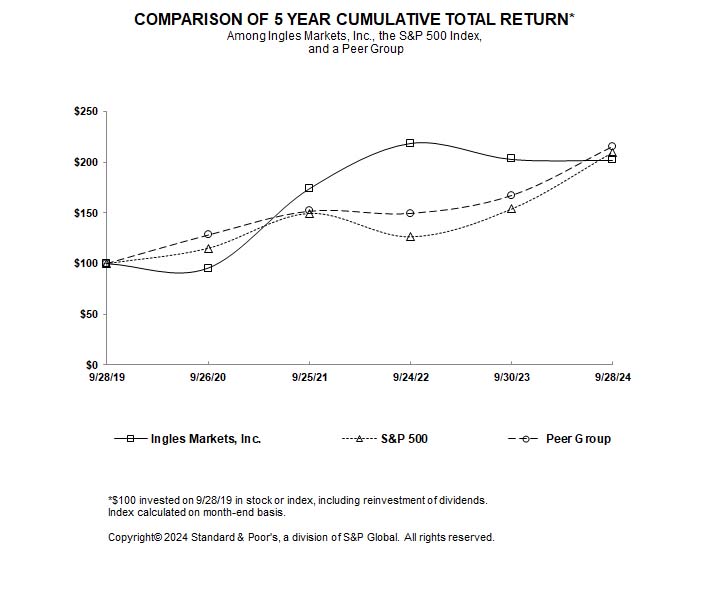
Set forth below are a graph and accompanying table comparing the five-year cumulative total stockholder return on the Class A Common Stock with the five-year cumulative total return of (i) the S&P 500 Comprehensive-Last Trading Day Index and (ii) a peer group of companies in the Company's line of business. The 2024 peer group consists of the following companies: Koninklijke Ahold Delhaize N.V., Weis Markets, Inc., The Kroger Co., SpartanNash Co., Sprouts Farmers Markets, Inc., and Village Super Market, Inc.
The comparisons cover the five-years ended September 28, 2024 and assume that $100 was invested after the close of the market on September 28, 2019, and that dividends were reinvested quarterly. Returns of the companies included in the peer group reflected below have been weighted according to each company’s stock market capitalization at the beginning of each year presented.
INGLES MARKETS, INCORPORATED COMPARATIVE RETURN TO STOCKHOLDERS INDEXED RETURNS OF INITIAL $100 INVESTMENT*
|
|
|
|
|
|
|
|
|
|
|
|
|
|
|
|
|
|
|
|
|
|
|
|
|
|
|
|
|
|
|
|
Company/Index |
|
2020 |
|
2021 |
|
2022 |
|
2023 |
|
2024 |
|||||
Ingles Markets, Incorporated Class A Common Stock |
|
$ |
95.49 |
|
$ |
173.74 |
|
$ |
218.71 |
|
$ |
203.00 |
|
$ |
202.06 |
S&P 500 Comprehensive – Last Trading Day Index |
|
$ |
115.15 |
|
$ |
149.70 |
|
$ |
126.54 |
|
$ |
153.89 |
|
$ |
209.84 |
Peer Group |
|
$ |
128.12 |
|
$ |
151.81 |
|
$ |
149.57 |
|
$ |
167.31 |
|
$ |
215.67 |
*Assumes $100 invested in the Class A Common Stock of Ingles Markets, Incorporated after the close of the market on September 28, 2019.
The foregoing stock performance information, including the graph, shall not be deemed to be “soliciting material” or to be filed with the Securities and Exchange Commission.
Item 6. [Reserved]
Item 7. MANAGEMENT’S DISCUSSION AND ANALYSIS OF FINANCIAL CONDITION AND RESULTS OF OPERATIONS
Overview
Ingles is a leading supermarket chain in the Southeast United States and operates a total of 198 supermarkets in North Carolina (75), Georgia (65), South Carolina (35), Tennessee (21), Virginia (1) and Alabama (1). Ingles supermarkets offer customers a wide variety of nationally advertised food products, including grocery, meat and dairy products, produce, frozen foods and other perishables and non-food products. Non-food products include fuel centers, pharmacies, health/beauty/cosmetic products and general merchandise. The Company offers quality private label items in most of its departments. In addition, the Company focuses on selling products to its customers through the development of certified organic products, bakery departments and prepared foods including delicatessen sections. As of September 28, 2024, the Company operated 115 in-store pharmacies and 108 fuel stations. Ingles also operates a fluid dairy and earns shopping center rentals.
Recent Developments
On September 27, 2024, Hurricane Helene severely impacted western North Carolina, including where the Company’s headquarters are located, resulting in catastrophic flooding and destruction, power and communication outages, water outages and ban on usage, major road closures and loss of life. The storm caused damage to certain of the Company’s properties and temporarily impacted the ability of the Company’s stores to report information to the Company’s headquarters. The distribution center sustained damage but returned to full operation within two weeks following the storm. During the first two weeks immediately following the storm, the Company’s headquarters experienced communication loss and some stores remained without power and communication. Four stores sustained damage that required that they be temporarily closed. One store has now reopened and the Company expects the remaining three stores will reopen in 2025. Among other impacts from the storm, the Company sustained approximately $30.4 million in lost inventory, of which approximately $10 million is expected to be covered by insurance. Real property and equipment damage was approximately $4.5 million. Real property and equipment repair expenses at the distribution center, including anticipated future expenses, of approximately $1.5 million were insured.
Critical Accounting Policies and Estimates
Critical accounting policies are those accounting policies that management believes are important to the presentation of Ingles’ financial condition and results of operations, and require management’s most difficult, subjective or complex judgments, often as a result of the need to estimate the effect of matters that are inherently uncertain. Estimates are based on historical experience and other factors believed to be reasonable under the circumstances, the results of which form the basis for making judgments about the carrying values of assets and liabilities that are not readily apparent from other sources. Management estimates, by their nature, involve judgments regarding future uncertainties, and actual results may therefore differ materially from these estimates.
Self-Insurance
The Company is self-insured for workers’ compensation, general liability, and group medical and dental benefits. Risks and uncertainties are associated with self-insurance; however, the Company has limited its exposure by maintaining excess liability coverage of $1,000,000 per occurrence for workers’ compensation and for general liability, and $500,000 per covered person for medical care benefits for a policy year. Self-insurance liabilities are established based on claims filed and estimates of claims incurred but not reported. The estimates are based on data provided by the respective claims administrators which is then applied to appropriate actuarial methods. These estimates can fluctuate if historical trends are not predictive of the future. The majority of the Company’s properties are self-insured for casualty losses and business interruption; however, liability coverage is maintained. The Company’s self-insurance reserves totaled $35.9 million and $32.9 million for employee group insurance, workers’ compensation insurance and general liability insurance at September 28, 2024 and September 30, 2023, respectively. These amounts were inclusive of expected recoveries from excess cost insurance or other sources that are recorded as receivables of $4.1 million at September 28, 2024 and $4.3 million at September 30, 2023.
Asset Impairments
The Company accounts for the impairment of long-lived assets in accordance with Financial Accounting Standards Board Accounting Standards Codification (“FASB ASC”) Topic 360. Asset groups are primarily comprised of our individual store and shopping center properties. For assets to be held and used, the Company tests for impairment using undiscounted cash flows and calculates the amount of impairment using discounted cash flows. For assets held for sale, impairment is recognized based on the excess of remaining book value over expected recovery value. The recovery value is the fair value as determined by independent quotes or expected sales prices developed by internal associates, net of costs to sell. Estimates of future cash flows and expected sales prices are judgments based upon the Company’s experience and knowledge of local operations and cash flows that are projected for several years into the future. These estimates can fluctuate significantly due to changes in real estate market conditions, the economic environment, capital spending decisions and inflation. The Company monitors the carrying value of long-lived assets for potential impairment each quarter based on whether any indicators of impairment have occurred. For the year ended September 28, 2024, the Company recognized a property and equipment impairment loss of $4.5 million pertaining to Hurricane Helene.
Vendor Allowances
The Company receives funds for a variety of merchandising activities from the many vendors whose products the Company buys for resale in its stores. These incentives and allowances are primarily composed of volume or purchase based incentives, advertising allowances, slotting fees, and promotional discounts. The purpose of these incentives and allowances is generally to help defray the costs incurred by the Company for stocking, advertising, promoting and selling the applicable vendor’s products. These allowances generally relate to short term arrangements with vendors, often relating to a period of one month or less and are negotiated on a purchase-by-purchase or transaction-by-transaction basis. Whenever practical, vendor discounts and allowances that relate to buying and merchandising activities are recorded as a reduction of item cost in inventory and recognized in merchandise costs when the item is sold. Due to the use of the retail method for store inventory and the nature of certain allowances, it is sometimes not practicable to apply allowances to the item cost of inventory. In those instances, the allowances are applied as a reduction of merchandise costs using a rational and systematic methodology, which results in the recognition of these incentives when the inventory related to the vendor consideration received is sold. Vendor allowances applied as a reduction of merchandise costs totaled $146.9 million, $128.9 million and $110.6 million for the fiscal years ended September 28, 2024, September 30, 2023, and September 24, 2022, respectively. Vendor advertising allowances that represent a reimbursement of specific identifiable incremental costs of advertising the vendor’s specific products are recorded as a reduction to the related expense in the period that the related expense is incurred. Vendor advertising allowances recorded as a reduction of advertising expense totaled $8.9 million, $8.5 million, and $7.1 million for the fiscal years ended September 28, 2024, September 30, 2023, and September 24, 2022, respectively.
If vendor advertising allowances were substantially reduced or eliminated, the Company would likely consider other methods of advertising as well as the volume and frequency of the Company’s product advertising, which could increase or decrease the Company’s expenditures.
Similarly, the Company is not able to assess the impact of vendor advertising allowances on creating additional revenue, as such allowances do not directly generate revenue for the Company’s stores.
Results of Operations
Fiscal Year
Ingles operates on a 52- or 53-week fiscal year ending on the last Saturday in September. The consolidated statements of income for the fiscal years ended September 28, 2024 and September 24, 2022 each consisted of 52 weeks of operations. The consolidated statements of income for the fiscal year ended September 30, 2023 consisted of 53 weeks.
The period-to-period comparisons of our results of operations contained in this Management’s Discussion and Analysis of Financial Condition and Results of Operation have been prepared using the Company’s audited consolidated financial statements and the notes thereto, and the following discussion should be read in conjunction with such audited annual consolidated financial statements and related notes contained elsewhere in this Annual Report on Form 10-K.
Comparable Store Sales
Comparable store sales are defined as sales by grocery stores in operation for five full fiscal quarters. The Company has an ongoing renovation and expansion plan to modernize the appearance and layout of its existing stores. Sales from replacement stores, major remodels and the addition of fuel stations to existing stores are included in the comparable store sales calculation from the date of completion of the replacement, remodel or addition. A replacement store is a newly opened store that replaces an existing nearby store that is closed. A major remodel entails substantial remodeling of an existing store and may include additional retail square footage. Comparable store sales for the fiscal years ended September 28, 2024 and September 30, 2023 included 198 stores. Since the impacts of Hurricane Helene occurred during the last two days of the fiscal year ended September 28, 2024, comparable store sales included all 198 stores.
During the last two days of the fiscal year ended September 28, 2024, Hurricane Helene caused power outages at approximately 80 stores, some of which were without power for only several hours, and others were without power for up to 13 days. Due to the disruption of internet connectivity at the headquarters and the Western North Carolina area, all of the Company’s stores were unable to process credit or debit cards and could only accept cash for various periods of time. The internet connection outage was restored at the headquarters several days after the storm but remained inconsistent for our stores for approximately two weeks. Due to the foregoing disruptions, the Company estimates that it lost approximately $14.0 million in sales for the last two days of the fiscal year ended September 28, 2024. The disruptions to internet connectivity and water continued into quarter one of fiscal year 2025. Stores that were closed during the last two days of the fiscal year ended September 28, 2024 as a result of Hurricane Helene were included in comparable store sales.
The following table sets forth, for the periods indicated, selected financial information as a percentage of net sales.
|
|
|
|
|
|
|
|
|
|
|
|
|
|
|
|
Fiscal Year Ended September |
||||
|
|
September 28, |
|
September 30, |
|
September 24, |
|
|
2024 |
|
2023 |
|
2022 |
Net sales |
|
100.0% |
|
100.0% |
|
100.0% |
Gross profit |
|
23.0 |
|
23.8 |
|
24.9 |
Operating and administrative expenses |
|
20.6 |
|
18.9 |
|
18.3 |
Gain from sale or disposal of assets |
|
0.2 |
|
0.1 |
|
— |
Income from operations |
|
2.6 |
|
5.0 |
|
6.6 |
Other income, net |
|
0.3 |
|
0.2 |
|
— |
Interest expense |
|
0.4 |
|
0.4 |
|
0.4 |
Income before income taxes |
|
2.5 |
|
4.8 |
|
6.4 |
Income tax expense |
|
0.6 |
|
1.2 |
|
1.6 |
Net income |
|
1.9 |
|
3.6 |
|
4.8 |
Fiscal Year Ended September 28, 2024 Compared to the Fiscal Year Ended September 30, 2023
Net income for the fiscal year ended September 28, 2024 was $105.5 million, compared with net income of $210.8 million for the fiscal year ended September 30, 2023. Comparisons of fiscal year 2024 to fiscal year 2023 are affected by the difference in the number of weeks in each year. Fiscal year 2024 had 52 weeks and fiscal year 2023 had 53 weeks. Net income as a percentage of sales was 1.9% for fiscal year 2024 compared with 3.6% for fiscal year 2023. Inflation in the cost of goods and increases in operating expenses due to increased labor market competition contributed to this decrease.
Net Sales. Net sales for the fiscal year ended September 28, 2024 totaled $5.64 billion, compared with $5.89 billion for the fiscal year ended September 30, 2023. In addition to the stores closed due to damage and power outages caused by Hurricane Helene, the Company’s headquarters lost connectivity to the internet which disrupted the Company’s ability to accept credit and debit cards. As described above under “Comparable Store Sales”, the Company estimates that it lost approximately $14.0 million in sales for the last two days of the fiscal year ended September 28, 2024 due to the disruptions caused by Hurricane Helene. Store closures and power outages as a result of Hurricane Helene will have an impact on net sales for the first quarter and full fiscal year of 2025. In addition, the lack of water and subsequent ban on water usage, will have an impact on the fluid dairy operations for the first quarter of fiscal year 2025.
Management analyzes comparable stores sales for the 52 weeks of fiscal year 2024 with the corresponding 52 calendar weeks of the 53 week fiscal year 2023. On this basis, retail grocery comparable store sales excluding fuel decreased 1.7% for fiscal year 2024 compared to fiscal year 2023. The number of transactions (excluding fuel) decreased 0.3% while the average transaction size (excluding fuel) decreased by 1.4%. Comparing fiscal year 2024 with 2023, fuel gallons sold decreased 5.5% and per gallon fuel prices decreased 3.3%.
Sales by product category for the fiscal years ended September 28, 2024 and September 30, 2023 were as follows:
|
|
|
|
|
|
|
|
|
|
|
|
|
|
|
|
(dollars in thousands) |
||||
|
|
2024 |
|
2023 |
||
Grocery |
|
$ |
1,983,198 |
|
$ |
2,062,416 |
Non-foods |
|
|
1,273,324 |
|
|
1,326,907 |
Perishables |
|
|
1,441,039 |
|
|
1,482,089 |
Fuel |
|
|
724,230 |
|
|
792,524 |
Total retail grocery |
|
$ |
5,421,791 |
|
$ |
5,663,936 |
The “Grocery” category includes grocery, dairy and frozen foods.
The “Non-foods” category includes alcoholic beverages, tobacco, pharmacy, and health/beauty/cosmetic products.
The “Perishables” category includes meat, produce, deli and bakery.
Changes in retail grocery sales for the fiscal year ended September 28, 2024 are summarized as follows (in thousands):
|
|
|
|
|
|
|
|
Total retail grocery sales for the fiscal year ended September 30, 2023 |
|
$ |
5,663,936 |
Comparable store sales decrease |
|
|
(130,873) |
Effect of 53rd week in fiscal year 2023 |
|
|
(106,715) |
Other |
|
|
(4,557) |
Total retail grocery sales for the fiscal year ended September 28, 2024 |
|
$ |
5,421,791 |
Gross Profit. Gross profit for the fiscal year ended September 28, 2024 decreased $105.1 million, or 7.5%, to $1.3 billion compared with $1.4 billion for the fiscal year ended September 30, 2023. As a percentage of sales, gross profit totaled 23.0% for the fiscal year ended September 28, 2024 as compared to 23.8% for the fiscal year ended September 30, 2023. The decrease in gross profit resulted primarily from the $30.4 million in inventory loss due to Hurricane Helene.
Retail grocery gross profit as a percentage of total sales (excluding fuel) decreased 0.9 basis points in fiscal year 2024, compared with fiscal year 2023. The gross margin decrease was primarily due to the inventory impairment loss of $30.4 million as a result of Hurricane Helene.
Operating and Administrative Expenses. Operating and administrative expenses increased $46.4 million, or 4.2%, to $1.2 billion for the fiscal year ended September 28, 2024 from $1.1 billion for the fiscal year ended September 30, 2023. As a percentage of sales, operating and administrative expenses were 20.6% and 18.9% for fiscal years 2024 and 2023, respectively. Excluding fuel, which does not have significant direct operating expenses, the ratio of operating expenses to sales was 23.4% for fiscal year 2024 compared with 21.7% for fiscal year 2023. Included in the operating expenses is the asset impairment write off of $4.5 million, due to Hurricane Helene. The costs of clean up and repairs will impact operating and administrative expenses for the first quarter and full fiscal year of 2025.
A breakdown of the primary increases in operating and administrative expenses is as follows.
|
|
|
|
|
|
|
|
|
|
|
|
|
|
|
|
|
|
|
||
|
|
|
|
Increase |
||
|
|
Increase |
|
as a % of |
||
|
|
(in millions) |
|
sales |
||
Insurance |
|
$ |
16.9 |
|
0.30 |
% |
Salaries and wages |
|
$ |
13.0 |
|
0.23 |
% |
Taxes and licenses |
|
$ |
5.4 |
|
0.10 |
% |
Miscellaneous |
|
$ |
4.5 |
|
0.08 |
% |
Insurance expense increased primarily due to higher claim volume for the Company’s self-insured employee benefit plans.
Salaries and wages increased due to increased labor market competition, which has increased the Company’s cost to attract and retain associates in the Company’s market area.
Taxes and licenses expenses increases were noted in both payroll taxes and in property taxes.
Miscellaneous expense increased due to the asset impairment loss of $4.5 million as a result of Hurricane Helene.
Gain from Sale or Disposal of Assets. Gains on sale or disposal of assets totaled $9.1 million for fiscal year 2024 and $2.8 million for fiscal year 2023. The increase was primarily related to the swap of shopping center properties that occurred in January 2024.
Other Income, Net. Other income, net totaled $14.2 million and $8.3 million for the fiscal years ended September 28, 2024 and September 30, 2023, respectively. Other income consists primarily of interest earned, which increased for the 2024 fiscal year due to a combination of higher deposits in interest bearing accounts and higher rates of interest earned on the Company’s cash balances.
Interest Expense. Interest expense totaled $21.9 million for the fiscal year ended September 28, 2024 and $22.1 million for the fiscal year ended September 30, 2023. Total debt was $532.6 million at the end of fiscal year 2024 compared with $550.2 million at the end of fiscal year 2023.
Income Taxes. Income tax expense totaled $34.0 million for fiscal year 2024, reflecting an effective tax rate of 24.3%. This compares with an income tax expense totaling $67.7 million and an effective tax rate of 24.3% for fiscal year 2023.
Net Income. Net income totaled $105.5 million for the fiscal year ended September 28, 2024 compared with net income of $210.8 million for the fiscal year ended September 30, 2023. Basic and diluted earnings per share for Class A Common Stock were $5.68 and $5.56, respectively, for the fiscal year ended September 28, 2024 compared with $11.35 and $11.10, respectively, for the fiscal year ended September 30, 2023. Basic and diluted earnings per share for Class B Common Stock were each $5.16 for the fiscal year ended September 28, 2024 compared with $10.32 of basic and diluted earnings per share for the fiscal year ended September 30, 2023.
Fiscal Year Ended September 30, 2023 Compared to the Fiscal Year Ended September 24, 2022
See “Item 7. Management’s Discussion and Analysis of Financial Condition and Results of Operations,” in Ingles Annual Report on Form 10-K for the year ended September 30, 2023, filed with the SEC on November 29, 2023, for a discussion of the year ended September 30, 2023 as compared to September 24, 2022.
Liquidity and Capital Resources
Capital Expenditures
The Company believes that a key to its ability to continue to increase sales and develop a loyal customer base is providing conveniently located, clean and modern stores that provide customers with good service and an increasingly diverse selection of competitively priced products. As such, the Company has invested and plans to continue to invest significant amounts of capital toward the modernization of its store base. The Company’s modernization program includes the opening of new stores, the completion of major remodels and expansion of selected existing stores, and the relocation of selected existing stores to larger, more convenient locations.
Capital expenditures totaled $210.9 million and $173.6 million for fiscal years 2024 and 2023, respectively, with the increase driven primarily by the purchase of new sites and land parcels. Major capital expenditures included the following:
|
|
|
|
|
|
|
|
|
|
|
|
2024 |
|
2023 |
New stores |
|
0 |
|
0 |
Store sites/land parcels purchased |
|
16 |
|
15 |
New fuel stations added |
|
0 |
|
1 |
Capital expenditures include upgrading and replacing store equipment, technology investments, those related to the Company’s distribution operation and its milk processing plant, and expenditures for stores to open in subsequent fiscal years.
Ingles’ capital expenditure plans for fiscal year 2025 include investments of approximately $120 to $160 million. The Company currently plans to dedicate the majority of its fiscal 2025 capital expenditures to continued improvement of its store base, as well as technology improvements, upgrading and replacing existing store, warehouse and transportation equipment and improvements to the Company’s milk processing plant.
The Company currently expects that its net annual capital expenditures will be in the range of approximately $100 to $160 million going forward in order to maintain a modern store base. Among other things, planned expenditures for any given future fiscal year will be affected by the availability of financing, which can affect both the number of projects pursued at any given time and aggregate investment by the Company in those projects. The number of projects may also fluctuate due to the types of projects pursued including new stores, major store remodels/expansions, and build-out of tenant space under the long-term leases. The Company makes decisions on the allocation of capital expenditure dollars based on many factors including the competitive environment, other Company capital initiatives, material costs and its financial condition.
In general, the Company finances its capital expenditures to the extent possible from cash on hand and cash flow from operations. Additional financing sources for capital expenditures could include borrowings under the Company’s $150 million committed line of credit (described below), other borrowings that could be collateralized by unencumbered real property and equipment with a net book value of approximately $1.5 billion, and the public debt or equity markets. The Company has used each of these to finance past capital expenditures and expects to have them available in the future.
The Company does not generally enter into commitments for capital expenditures other than on a store-by-store basis at the time it begins construction on a new store or begins a major or minor remodeling project. Construction commitments at September 28, 2024 totaled $6.2 million.
Liquidity
The Company generated $262.5 million of cash from operations in fiscal 2024 compared with $266.4 million for fiscal year 2023.
Cash used by investing activities for fiscal year 2024 totaled $206.2 million compared with $170.1 million for fiscal year 2023. The increase in cash used in investing activities was primarily due to capital expenditures, which increased by $37.3 in fiscal year 2024 as compared to fiscal year 2023.
The Company’s cash used by net financing activities totaled $31.2 million and $35.0 million for fiscal years 2024 and 2023, respectively.
The U.S. Dollar LIBOR panel ceased following June 30, 2023, and the Company’s debt agreements and interest rate swaps that utilized LIBOR discontinued the use of LIBOR and adopted the Secured Overnight Financing Rate (“SOFR”).
In June 2021, the Company issued at par $350.0 million aggregate principal amount of 4.00% senior notes due 2031 (the “Notes”).
The Company has a $150.0 million unsecured senior line of credit (the “Line”) that matures in June 2026. The Line provides the Company with various interest rate options based on the prime rate, the Federal Funds Rate, or SOFR. The Line allows the Company to issue up to $10.0 million in letters of credit, of which none were issued at September 28, 2024. The Company is not required to maintain compensating balances in connection with the Line. At September 28, 2024, the Company had no borrowings outstanding under the Line.
In December 2010, the Company completed the funding of $99.7 million of Recovery Zone Facility Bonds (the “Bonds”) for the construction of new warehouse and distribution space adjacent to its existing space in Buncombe County, North Carolina (the “Project”). The Project was completed in 2012, and the final maturity date of the Bonds is January 1, 2036.
Under a Continuing Covenant and Collateral Agency Agreement (the “Covenant Agreement”) between certain financial institutions and the Company, such financial institutions hold the Bonds until December 2029, subject to certain events. Mandatory redemption of the Bonds by the Company in the annual amount of $4.5 million began on January 1, 2014. The outstanding aggregate principal amount of the Bonds was $49.9 million at September 28, 2024. The Company may redeem the Bonds without penalty or premium at any time prior to December 17, 2029.
In September 2017, the Company refinanced approximately $60 million of secured borrowing obligations with a SOFR-based amortizing floating rate loan secured by real estate, which matures in October 2027. The Company has an interest rate swap agreement for a current notional amount of $18.5 million at a fixed rate of 3.962%. Under this agreement, the Company pays monthly the fixed rate of 3.962% and receives the one-month SOFR plus 1.75%. The interest rate swap effectively hedges floating rate debt in the same amount as the current notional amount of the interest swap. Both the floating rate debt and the interest rate swap have monthly principal amortization of $0.5 million and mature October 1, 2027.
In December 2019, the Company closed a $155 million SOFR-based amortizing floating rate loan secured by real estate, which matures in January 2030. The Company has an interest rate swap agreement for a current notional amount of $116.9 million at a fixed rate of 2.998%. Under this agreement, the Company pays monthly the fixed rate of 2.998% and receives the one-month SOFR plus 1.60%. The interest rate swap effectively hedges floating rate debt in the same amount as the current notional amount of the interest swap. Both the floating rate debt and the interest rate swap have monthly principal amortization of $0.65 million and mature in fiscal year 2030.
The fair market value of the interest rate swaps is measured quarterly with adjustments recorded in other comprehensive income.
The Company’s long-term debt agreements generally have cross-default provisions which could result in the acceleration of payments due under the Company’s Line, Bonds and the Notes indenture in the event of default under any one instrument.
The Bonds and the Line contain provisions that under certain circumstances would permit the acceleration of the indebtedness under such instruments or would otherwise permit lending institutions to terminate or withdraw their respective extensions of credit to the Company. Included among the triggering factors permitting the termination or withdrawal of the Bonds and the Line to the Company are certain events of default, including both monetary and non-monetary defaults, the initiation of bankruptcy or insolvency proceedings, and the failure of the Company to meet certain financial covenants designated in its respective loan documents. As of September 28, 2024, the Company was in compliance with these covenants. Under the most restrictive of these covenants, the Company would have been permitted to incur approximately $945.5 million of additional borrowings (including borrowings under the Line) as of September 28, 2024.
The Company’s principal sources of liquidity are expected to be cash flow from operations, borrowings under the Line and long-term debt financing. The Company believes, based on its current results of operations and financial condition, that its financial resources, including cash balances, the existing Line, short- and long-term financing expected to be available to it and internally generated funds, will be sufficient to meet planned capital expenditures and working capital requirements for the foreseeable future, including any debt service requirements of additional borrowings. However, there can be no assurance that any such sources of financing will be available to the Company when needed on acceptable terms, or at all.
It is possible that, in the future, the Company’s results of operations and financial condition will be different from that described in this Annual Report on Form 10-K based on a number of intangible factors. These factors may include, among others, increased competition, changing regional and national economic conditions, adverse climatic conditions affecting food production and delivery and changing demographics as well as the additional factors discussed above and elsewhere under “Item 1A. Risk Factors.” It is also possible, for such reasons, that the results of operations from the new, expanded, remodeled and/or replacement stores will not meet or exceed the results of operations from existing stores that are described in this Annual Report on Form 10-K.
Quarterly Cash Dividends
Since December 27, 1993, the Company has paid regular quarterly cash dividends of $0.165 per share on its Class A Common Stock and $0.15 per share on its Class B Common Stock for an annual rate of $0.66 and $0.60 per share, respectively.
The Company expects to continue paying regular cash dividends on a quarterly basis. However, the Board of Directors periodically reconsiders the declaration of dividends. The Company pays these dividends at the discretion of the Board of Directors and the continuation of these payments, the amount of such dividends, and the form in which the dividends are paid (cash or stock) depends upon the Company’s results of operations, and financial condition, as well as other factors that the Board of Directors deems relevant.
Certain of the Company’s long-term debt agreements contain various restrictive covenants requiring, among other things, minimum levels of net worth and maintenance of certain financial ratios. These covenants have the effect of restricting certain types of transactions, including the payment of cash dividends generally and in excess of current quarterly per share amounts.
New Accounting Pronouncements
For new accounting pronouncements, see Note 1 to the Consolidated Financial Statements included in this Annual Report on Form 10-K.
Outlook and Trends in the Company’s Markets
The Company continually assesses and modifies its business model to meet the changing needs and expectations of its customers. In connection with this review, the Company assesses the trends present in the markets in which it competes. Generally, it is difficult to predict whether a trend will continue for a sustained period of time and it is possible that new trends will develop that will affect an existing trend. The Company believes that the following trends are likely to continue for at least the next fiscal year:
The impact of Hurricane Helene due to physical damage to stores, water outage and ban and connectivity issues, will impact the 2025 first quarter and fiscal year 2025 results.
The supermarket industry will remain highly competitive and will be characterized by industry consolidation, fragmented food retail platforms, and continued competition from super centers and other non-supermarket operators.
Traditional supermarket products will be acquired by customers in new and diverse ways, including online ordering, home delivery and pre-picked for customer pickup.
Economic conditions will continue to affect customer behavior. Economic conditions may affect purchasing patterns with regard to meal replacement items, private label purchases, promotions and product variety.
The Company and its customers will continue to become more environmentally aware, evidenced by the Company’s transition to more energy efficient lighting and refrigerants, increased recycled waste paper and pallets, and customers’ increased usage of reusable shopping bags.
Volatile petroleum costs will impact utility and distribution costs, plastic supplies cost and may change customer shopping and dining behavior.
Retail fuel costs and retail prices will continue to be volatile, affecting the Company’s fuel sales and gross margin.
The Company plans to continue to focus on balancing sales growth and gross margin maintenance (excluding the effect of fuel sales) and will carefully monitor its product mix and customer trends.
Item 7A. QUANTITATIVE AND QUALITATIVE DISCLOSURES ABOUT MARKET RISKS
The Company is exposed to changes in interest rates primarily as a result of its borrowing activities, which include borrowings under the Line, real estate and equipment financing, and the Bonds. The Line, along with cash flow from operations, is used to maintain liquidity and fund business operations. The Notes bear a fixed rate of interest and do not expose us to interest rate risk.
The nature and amount of the Company’s debt may vary as a result of future business requirements, market conditions and other factors. The definitive extent of the Company’s interest rate risk is not quantifiable or predictable because of the variability of future interest rates and business financing requirements, but the Company does not believe such risk is material.
The table below presents principal amounts and related weighted average interest rates by year of maturity for the Company’s debt obligations at September 28, 2024 and September 30, 2023, respectively (in thousands):
|
|
|
|
|
|
|
|
|
|
|
|
|
|
|
|
|
|
|
|
|
|
|
|
|
|
|
|
|
|
|
|
|
|
|
|
|
|
|
|
|
|
|
|
|
|
|
|
|
|
|
|
|
|
|
|
|
|
|
|
|
|
|
|
September 28, 2024 |
|
2025 |
|
|
2026 |
|
|
2027 |
|
|
2028 |
|
|
2029 |
|
|
Thereafter |
|
|
Total |
|
|
Fair |
||||||||
Line of credit |
|
$ |
— |
|
|
$ |
— |
|
|
$ |
— |
|
|
$ |
— |
|
|
$ |
— |
|
|
$ |
— |
|
|
$ |
— |
|
|
$ |
— |
Average variable interest rate |
|
|
— |
% |
|
|
— |
% |
|
|
— |
% |
|
|
— |
% |
|
|
— |
% |
|
|
— |
% |
|
|
— |
% |
|
|
|
Long-term debt, variable interest rate (1)(2) |
|
$ |
13,750 |
|
|
$ |
13,750 |
|
|
$ |
13,750 |
|
|
$ |
8,237 |
|
|
$ |
7,750 |
|
|
$ |
80,083 |
|
|
$ |
137,320 |
|
|
$ |
137,320 |
Average interest rate |
|
|
6.93 |
% |
|
|
6.93 |
% |
|
|
6.93 |
% |
|
|
6.82 |
% |
|
|
6.80 |
% |
|
|
6.80 |
% |
|
|
6.84 |
% |
|
|
|
Recovery Zone Bonds, variable interest rate |
|
$ |
4,530 |
|
|
$ |
4,530 |
|
|
$ |
4,530 |
|
|
$ |
4,530 |
|
|
$ |
4,530 |
|
|
$ |
27,260 |
|
|
$ |
49,910 |
|
|
$ |
49,910 |
Average year-end interest rate |
|
|
5.10 |
% |
|
|
5.10 |
% |
|
|
5.10 |
% |
|
|
5.10 |
% |
|
|
5.10 |
% |
|
|
5.10 |
% |
|
|
5.10 |
% |
|
|
|
Senior Notes, fixed interest rate |
|
$ |
— |
|
|
$ |
— |
|
|
$ |
— |
|
|
$ |
— |
|
|
$ |
— |
|
|
$ |
350,000 |
|
|
$ |
350,000 |
|
|
$ |
317,625 |
Average interest rate |
|
|
— |
% |
|
|
— |
% |
|
|
— |
% |
|
|
— |
% |
|
|
— |
% |
|
|
4.00 |
% |
|
|
4.00 |
% |
|
|
|
|
|
|
|
|
|
|
|
|
|
|
|
|
|
|
|
|
|
|
|
|
|
|
|
|
|
|
|
|
|
|
|
September 30, 2023 |
|
2024 |
|
|
2025 |
|
|
2026 |
|
|
2027 |
|
|
2028 |
|
|
Thereafter |
|
|
Total |
|
|
Fair |
||||||||
Line of credit |
|
$ |
— |
|
|
$ |
— |
|
|
$ |
— |
|
|
$ |
— |
|
|
$ |
— |
|
|
$ |
— |
|
|
$ |
— |
|
|
$ |
— |
Average variable interest rate |
|
|
— |
% |
|
|
— |
% |
|
|
— |
% |
|
|
— |
% |
|
|
— |
% |
|
|
— |
% |
|
|
— |
% |
|
|
|
Long-term debt, variable interest rate (1)(2) |
|
$ |
13,750 |
|
|
$ |
13,750 |
|
|
$ |
13,750 |
|
|
$ |
13,750 |
|
|
$ |
8,237 |
|
|
$ |
87,833 |
|
|
$ |
151,070 |
|
|
$ |
151,070 |
Average year-end interest rate (1)(2) |
|
|
6.99 |
% |
|
|
6.99 |
% |
|
|
6.99 |
% |
|
|
6.99 |
% |
|
|
6.94 |
% |
|
|
6.93 |
% |
|
|
6.95 |
% |
|
|
|
Recovery Zone Bonds, variable interest rate |
|
$ |
4,530 |
|
|
$ |
4,530 |
|
|
$ |
4,530 |
|
|
$ |
4,530 |
|
|
$ |
4,530 |
|
|
$ |
31,790 |
|
|
$ |
54,440 |
|
|
$ |
54,440 |
Average year-end interest rate |
|
|
5.20 |
% |
|
|
5.20 |
% |
|
|
5.20 |
% |
|
|
5.20 |
% |
|
|
5.20 |
% |
|
|
5.20 |
% |
|
|
5.20 |
% |
|
|
|
Senior Notes, fixed interest rate |
|
$ |
— |
|
|
$ |
— |
|
|
$ |
— |
|
|
$ |
— |
|
|
$ |
— |
|
|
$ |
350,000 |
|
|
$ |
350,000 |
|
|
$ |
287,875 |
Average interest rate |
|
|
— |
% |
|
|
— |
% |
|
|
— |
% |
|
|
— |
% |
|
|
— |
% |
|
|
4.00 |
% |
|
|
4.00 |
% |
|
|
|
(1)Excludes interest rate swap that fixes at 3.962% the interest rate on $18.5 million of variable interest rate debt.
(2)Excludes interest rate swap that fixes at 2.998% the interest rate on $116.9 million of variable interest rate debt.
The Company will occasionally utilize financial or derivative instruments for interest rate risk management but has typically not utilized highly leveraged financial instruments. On the basis of the fair value of the Company’s market sensitive instruments at September 28, 2024, the Company does not anticipate that near-term changes in interest and exchange rates will result in material near-term losses in future earnings, fair values or cash flows.
Item 8. FINANCIAL STATEMENTS AND SUPPLEMENTARY DATA
The Company’s financial statements required by this item are set forth as a separate section of this Annual Report on Form 10-K and incorporated by reference in this Item 8. See Part IV, Item 15 of this Annual Report on Form 10-K.
Item 9. CHANGES IN AND DISAGREEMENTS WITH ACCOUNTANTS ON ACCOUNTING AND FINANCIAL DISCLOSURE.
None.
Item 9A. CONTROLS AND PROCEDURES
Conclusion Regarding Disclosure Controls and Procedures
The Company maintains disclosure controls and procedures designed to provide reasonable assurance to achieve the objective that information in its Exchange Act reports is recorded, processed, summarized and reported within the time periods specified and pursuant to the regulations of the Securities and Exchange Commission. Disclosure controls and procedures, as defined in Rule 13a-15(e) and 15d-15(e) under the Exchange Act, include controls and procedures designed to ensure the information required to be disclosed by the Company in the reports it files or submits under the Exchange Act is accumulated and communicated to the Company’s management, including its Chief Executive Officer and Chief Financial Officer, as appropriate, to allow timely decisions regarding required disclosure. It should be noted that the Company’s system of controls and procedures, however well designed and operated, can provide only reasonable, and not absolute, assurance that the objectives of the system are met.
As required by Rule 13a-15(b) under the Exchange Act, the Company carried out an evaluation, under the supervision and with participation of its management, including its Chief Executive Officer and Chief Financial Officer, of the effectiveness of the design and operation of its disclosure controls and procedures as of September 28, 2024, the end of the period covered by this Annual Report on Form 10-K.
Based on this evaluation, the Company’s Chief Executive Officer and Chief Financial Officer have concluded that our disclosure controls and procedures were effective at a reasonable assurance level as of September 28, 2024.
Management’s Annual Report on Internal Control Over Financial Reporting
Management is responsible for establishing and maintaining adequate internal control over financial reporting, as defined in Exchange Act Rule 13a-15(f). Internal control over financial reporting is designed to provide reasonable assurance regarding the reliability of financial reporting and preparation of financial statements for external purposes in accordance with U.S. generally accepted accounting principles. The Company’s internal control over financial reporting includes those policies and procedures that:
|
|
|
|
(i) |
pertain to the maintenance of records that, in a reasonable detail, accurately and fairly reflect the transactions and dispositions of the Company’s assets; |
|
|
|
|
(ii) |
provide reasonable assurance that transactions are recorded as necessary to permit preparation of financial statements in accordance with generally accepted accounting principles, and that receipts and expenditures of the Company are being made only in accordance with authorizations of the Company’s management and directors; and |
|
|
|
|
(iii) |
provide reasonable assurance regarding prevention or timely detection of unauthorized acquisitions, use or disposition of the Company’s assets that could have a material adverse effect on the financial statements. |
Because of its inherent limitations, internal control over financial reporting may not prevent or detect misstatements. Also, projections of any evaluation of effectiveness to future periods are subject to the risk that controls may become inadequate because of changes in conditions, or that the degree of compliance with the policies or procedures may deteriorate.
The Company has assessed the effectiveness of its internal control over financial reporting as of September 28, 2024, using the criteria described in Internal Control – Integrated Framework (2013) issued by the Committee of Sponsoring Organizations of the Treadway Commission (COSO).
Based on its assessment of the design and related testing of the Company’s internal control over financial reporting, management has concluded that, as of September 28, 2024, the Company maintained effective internal control over financial reporting based on the criteria set forth in the COSO framework.
The Company’s independent auditors, Deloitte & Touche LLP, a registered public accounting firm, have been appointed by the Audit Committee of the Company’s Board of Directors. Deloitte & Touche LLP has audited and reported on the consolidated financial statements of the Company and the Company’s internal control over financial reporting. The reports of the independent auditors are contained in this Annual Report on Form 10-K.
Changes in Internal Control Over Financial Reporting
There has been no change during the Company’s fiscal quarter ended September 28, 2024 in the Company’s internal control over financial reporting that was identified in connection with the evaluation required by Exchange Act Rule 13a-15(d) that has materially affected, or is reasonably likely to materially affect, the Company’s internal control over financial reporting.
Item 9B. OTHER INFORMATION
During the three-month period ended September 28, 2024, none of our officers or directors adopted or terminated any contract, instruction or written plan for the purchase or sale of our securities that was intended to satisfy the affirmative defense conditions of Rule 10b5-1(c) under the Exchange Act or any “non-Rule 10b5-1 trading arrangement”, as defined in Item 408 of Regulation S-K.
Item 9C. DISCLOSURE REGARDING FOREIGN JURISDICTIONS THAT PREVENT INSPECTIONS
Not applicable.
PART III
Item 10. DIRECTORS, EXECUTIVE OFFICERS AND CORPORATE GOVERNANCE
The information required by this Item, including the information concerning the Company’s directors and officers, audit committee, and compliance with Section 16 of the Exchange Act, is incorporated herein by reference to the information to be contained in the Company’s definitive Proxy Statement to be used in connection with the solicitation of proxies for the Company's 2025 annual meeting of stockholders. The definitive Proxy Statement will be filed with the Securities and Exchange Commission (the “Commission”) pursuant to Regulation 14A no later than 120 days after September 28, 2024.
The Company has adopted an insider trading policy which governs the purchase, sale and/or any other dispositions of the Company’s securities by the Company and its directors, officers and employees and is reasonably designed to promote compliance with insider trading laws, rules and regulations and applicable exchange listing standards. A copy of our Securities Trading Policy is filed as Exhibit 19.1 to this Annual Report on Form 10-K.
The Company has adopted a Code of Ethics that applies to its senior financial officers, including without limitation, its Chief Executive Officer, Chief Financial Officer and Controller. The full text of the Code of Ethics is published on the Company’s website at www.ingles-markets.com under the caption “Corporate”. In the event that the Company makes any amendments to, or grants any waivers of, a provision of the Code of Ethics applicable to its principal executive officer, principal financial officer or principal accounting officer, the Company intends to disclose such amendment or waiver on its website. Information on the Company’s website, however, does not form a part of this Annual Report on Form 10-K.
Item 11. EXECUTIVE COMPENSATION
The information required by this Item is incorporated herein by reference to the information to be contained in the Company’s definitive Proxy Statement referred to above in “Item 10. Directors, Executive Officers and Corporate Governance.”
Item 12. SECURITY OWNERSHIP OF CERTAIN BENEFICIAL OWNERS AND MANAGEMENT AND RELATED STOCKHOLDER MATTERS
The information required by this Item is incorporated herein by reference to the information to be contained in the definitive Proxy Statement referred to above in “Item 10. Directors, Executive Officers and Corporate Governance.”
Item 13. CERTAIN RELATIONSHIPS AND RELATED TRANSACTIONS, AND DIRECTOR INDEPENDENCE
The information required by this Item is incorporated herein by reference to the information to be contained in the definitive Proxy Statement referred to above in “Item 10. Directors, Executive Officers and Corporate Governance.”
Item 14. PRINCIPAL ACCOUNTANT FEES AND SERVICES
The information required by this Item is incorporated herein by reference to the information to be contained in the definitive Proxy Statement referred to above in “Item 10. Directors, Executive Officers and Corporate Governance.”
PART IV
Item 15. EXHIBITS AND FINANCIAL STATEMENT SCHEDULES
(a)Documents filed as part of this report:
1. The following financial statements of the Registrant are included in response to Item 8 of this Annual Report on Form 10-K:
Consolidated Balance Sheets as of September 28, 2024 and September 30, 2023;
Consolidated Statements of Income and Other Comprehensive Income for the years ended September 28, 2024, September 30, 2023, and September 24, 2022;
Consolidated Statements of Changes in Stockholders’ Equity for the years ended September 28, 2024, September 30, 2023, and September 24, 2022;
Consolidated Statements of Cash Flows for the years ended September 28, 2024, September 30, 2023, and September 24, 2022;
Notes to Consolidated Financial Statements.
2. Exhibits
(b)Exhibits:
4 |
|
|
3.2 |
* |
Composite Amended and Restated By-Laws of Ingles Markets, Incorporated. |
|
|
|
4.1 |
|
Articles 4 and 9 of the Articles of Incorporation of Ingles Markets, Incorporated (included as Exhibit 3.1 to Ingles Markets, Incorporated’s Registration Statement on Form S-1, File No. 33-23919, (filed on paper – hyperlink is not required pursuant to Rule 105 of Regulation S-T) and Exhibit 3.3 to Ingles Markets, Incorporated’s Annual Report on Form 10-K for the fiscal year ended September 25, 2004, File No. 0-14706, respectively, each of which were previously filed with the Commission and are incorporated herein by this reference). |
|
|
|
|
|
|
|
|
|
|
|
|
19.1 |
* |
|
|
|
|
21.1 |
|
|
|
|
31.1 |
* |
Certification of Chief Executive Officer Pursuant to Section 302 of Sarbanes-Oxley Act of 2002. |
|
|
|
31.2 |
* |
Certification of Chief Financial Officer Pursuant to Section 302 of Sarbanes-Oxley Act of 2002. |
|
|
|
32.1 |
** |
Certification by Chief Executive Officer Pursuant to Section 906 of Sarbanes-Oxley Act of 2002. |
|
|
|
32.2 |
** |
Certification by Chief Executive Officer Pursuant to Section 906 of Sarbanes-Oxley Act of 2002. |
|
|
|
97.1 |
* |
Ingles Markets, Incorporated Executive Officer Clawback Policy. |
|
|
|
101 |
* |
The following financial information from the Annual Report on Form 10-K for the fiscal year ended September 28, 2024 formatted as Inline XBRL (Extensible Business Reporting Language) and furnished electronically herewith: (i) the Consolidated Statements of Income; (ii) the Consolidated Balance Sheets; (iii) the Consolidated Statements of Cash Flows; (iv) the Consolidated Statements of Changes in Stockholders’ Equity; and (v) the Notes to the Consolidated Financial Statements. |
|
|
|
104 |
* |
Cover Page Interactive Data File (formatted as Inline XBRL and contained in Exhibit 101). |
___________________________________
* Filed herewith.
** Furnished herewith.
† Management contract or compensatory plan arrangement.
Item 16. FORM 10-K SUMMARY To the Stockholders and Board of Directors of Ingles Markets, Incorporated
None.
REPORT OF INDEPENDENT REGISTERED PUBLIC ACCOUNTING FIRM
Black Mountain, North Carolina
Opinion on the Financial Statements
We have audited the accompanying consolidated balance sheets of Ingles Markets, Incorporated and subsidiaries (the "Company") as of September 28, 2024 and September 30, 2023, the related consolidated statements of income and other comprehensive income, changes in stockholders’ equity, and cash flows for each of the three fiscal years in the period ended September 28, 2024 and the related notes (collectively referred to as the "financial statements"). In our opinion, the financial statements present fairly, in all material respects, the financial position of the Company as of September 28, 2024 and September 30, 2023, and the results of its operations and its cash flows for each of the three fiscal years in the period ended September 30, 2023, in conformity with accounting principles generally accepted in the United States of America.
We have also audited, in accordance with the standards of the Public Company Accounting Oversight Board (United States) (PCAOB), the Company's internal control over financial reporting as of September 30, 2023, based on criteria established in Internal Control — Integrated Framework (2013) issued by the Committee of Sponsoring Organizations of the Treadway Commission and our report dated December 27, 2024, expressed an unqualified opinion on the Company's internal control over financial reporting.
Basis for Opinion
These financial statements are the responsibility of the Company's management. Our responsibility is to express an opinion on the Company's financial statements based on our audits. We are a public accounting firm registered with the PCAOB and are required to be independent with respect to the Company in accordance with the U.S. federal securities laws and the applicable rules and regulations of the Securities and Exchange Commission and the PCAOB.
We conducted our audits in accordance with the standards of the PCAOB. Those standards require that we plan and perform the audit to obtain reasonable assurance about whether the financial statements are free of material misstatement, whether due to error or fraud. Our audits included performing procedures to assess the risks of material misstatement of the financial statements, whether due to error or fraud, and performing procedures that respond to those risks. Such procedures included examining, on a test basis, evidence regarding the amounts and disclosures in the financial statements. Our audits also included evaluating the accounting principles used and significant estimates made by management, as well as evaluating the overall presentation of the financial statements. We believe that our audits provide a reasonable basis for our opinion.
Critical Audit Matters
The critical audit matters communicated below are matters arising from the current-period audit of the financial statements that were communicated or required to be communicated to the audit committee and that (1) relate to accounts or disclosures that are material to the financial statements and (2) involved our especially challenging, subjective, or complex judgments. The communication of critical audit matters does not alter in any way our opinion on the financial statements, taken as a whole, and we are not, by communicating the critical audit matters below, providing separate opinions on the critical audit matters or on the accounts or disclosures to which they relate.
Vendor Allowances – Refer to Note 1 to the consolidated financial statements.
Critical Audit Matter Description
The Company receives funds for a variety of merchandising activities from certain vendors whose products the Company buys for resale in its stores. These incentives and allowances are primarily comprised of volume or purchase based incentives, advertising allowances, slotting fees, and promotional discounts. These allowances generally relate to short term arrangements with vendors, often relating to a period of a month or less and are negotiated on a purchase-by-purchase or transaction-by-transaction basis. Vendor discounts and allowances that relate to buying and merchandising activities are recorded as a reduction of inventory cost and recognized in cost of goods sold when the related inventory is sold. Vendor advertising allowances that represent a reimbursement of specific identifiable incremental costs of advertising the vendor’s specific products are recorded as a reduction to the related expense in the period that the related expense is incurred.
We identified vendor allowances as a critical audit matter because of the number and diversity of individual vendors agreements. This required an increased extent of effort when performing procedures to evaluate whether the vendor allowances were recorded in accordance with the terms of the vendor agreements.
How the Critical Audit Matter Was Addressed in the Audit
Our audit procedures related to whether vendor allowances were recorded in accordance with the terms of the vendor agreements included the following, among others:
•We tested the operating effectiveness of controls over vendor allowances, including management’s controls over the accrual and recording of vendor allowances as a reduction to the cost of inventory, cost of sales, or advertising expense in accordance with the terms of the vendor agreements.
•We performed detailed testing on vendor allowance transactions and tested for the appropriateness of recorded reductions to inventory, cost of sales or advertising expense.
•We performed detailed testing and sent confirmations to vendors to test the completeness of programs as well as the accuracy of amounts earned and terms of the agreement directly with the vendor.
Inventories – Refer to Note 1 to the consolidated financial statements.
Critical Audit Matter Description
On September 27, 2024, Hurricane Helene (“Helene”) severely impacted western North Carolina, including the area where the Company’s headquarters are located.
The Company recognized an impairment loss related to inventory damaged or destroyed by Helene. In calculating the impairment loss, management used the product cost as the cost basis since the inventory is sold by the Company with no additional modifications. This loss includes products destroyed or damaged at stores and at the warehouse.
We identified the recorded inventory impairment loss specific to Helene as a critical audit matter because of the number of locations impacted and to varying degrees. This required an increased extent of effort when performing procedures to evaluate the accuracy of the recorded impairment loss.
How the Critical Audit Matter Was Addressed in the Audit
Our audit procedures related to whether the inventory impairment loss was recorded accurately included the following, among others:
•We tested the operating effectiveness of controls over the Company’s process to identify locations impacted by Helene and the related impairment loss.
•We tested the recorded impairment loss using substantive analytical procedures.
•We performed detailed testing to evaluate extent of damage to locations, including performing certain physical observations.
/s/ DELOITTE & TOUCHE LLP
Charlotte, North Carolina
December 27, 2024
We have served as the Company's auditor since 2012.
REPORT OF INDEPENDENT REGISTERED PUBLIC ACCOUNTING FIRM
To the Stockholders and the Board of Directors of Ingles Markets, Incorporated
Opinion on Internal Control over Financial Reporting
We have audited the internal control over financial reporting of Ingles Markets, Incorporated and subsidiaries (the “Company”) as of September 28, 2024, based on criteria established in Internal Control — Integrated Framework (2013) issued by the Committee of Sponsoring Organizations of the Treadway Commission (COSO). In our opinion, the Company maintained, in all material respects, effective internal control over financial reporting as of September 28, 2024, based on criteria established in Internal Control — Integrated Framework (2013) issued by COSO.
We have also audited, in accordance with the standards of the Public Company Accounting Oversight Board (United States) (PCAOB), the consolidated financial statements as of and for the fiscal year ended September 28, 2024, of the Company and our report dated December 27, 2024, expressed an unqualified opinion on those financial statements.
Basis for Opinion
The Company’s management is responsible for maintaining effective internal control over financial reporting and for its assessment of the effectiveness of internal control over financial reporting, included in the accompanying Management’s Annual Report on Internal Control Over Financial Reporting. Our responsibility is to express an opinion on the Company’s internal control over financial reporting based on our audit. We are a public accounting firm registered with the PCAOB and are required to be independent with respect to the Company in accordance with the U.S. federal securities laws and the applicable rules and regulations of the Securities and Exchange Commission and the PCAOB.
We conducted our audit in accordance with the standards of the PCAOB. Those standards require that we plan and perform the audit to obtain reasonable assurance about whether effective internal control over financial reporting was maintained in all material respects. Our audit included obtaining an understanding of internal control over financial reporting, assessing the risk that a material weakness exists, testing and evaluating the design and operating effectiveness of internal control based on the assessed risk, and performing such other procedures as we considered necessary in the circumstances. We believe that our audit provides a reasonable basis for our opinion.
Definition and Limitations of Internal Control over Financial Reporting
A company’s internal control over financial reporting is a process designed to provide reasonable assurance regarding the reliability of financial reporting and the preparation of financial statements for external purposes in accordance with generally accepted accounting principles. A company’s internal control over financial reporting includes those policies and procedures that (1) pertain to the maintenance of records that, in reasonable detail, accurately and fairly reflect the transactions and dispositions of the assets of the company; (2) provide reasonable assurance that transactions are recorded as necessary to permit preparation of financial statements in accordance with generally accepted accounting principles, and that receipts and expenditures of the company are being made only in accordance with authorizations of management and directors of the company; and (3) provide reasonable assurance regarding prevention or timely detection of unauthorized acquisition, use, or disposition of the company’s assets that could have a material effect on the financial statements.
Because of its inherent limitations, internal control over financial reporting may not prevent or detect misstatements. Also, projections of any evaluation of effectiveness to future periods are subject to the risk that controls may become inadequate because of changes in conditions, or that the degree of compliance with the policies or procedures may deteriorate.
/s/ DELOITTE & TOUCHE LLP
Charlotte, North Carolina
December 27, 2024
INGLES MARKETS, INCORPORATED AND SUBSIDIARIES
CONSOLIDATED BALANCE SHEETS
SEPTEMBER 28, 2024 AND SEPTEMBER 30, 2023
|
|
|
|
|
|
|
|
|
|
|
|
|
|
|
|
2024 |
|
2023 |
||
ASSETS |
|
|
|
|
|
|
CURRENT ASSETS: |
|
|
|
|
|
|
Cash and cash equivalents |
|
$ |
353,687,911 |
|
$ |
328,539,922 |
Receivables (less allowance for doubtful accounts of $474,684 – 2024 and |
|
|
78,266,383 |
|
|
107,570,690 |
Inventories |
|
|
462,084,658 |
|
|
493,859,775 |
Other |
|
|
31,508,803 |
|
|
22,585,958 |
Total current assets |
|
|
925,547,755 |
|
|
952,556,345 |
PROPERTY AND EQUIPMENT, NET |
|
|
1,526,708,462 |
|
|
1,431,872,289 |
OPERATING LEASE RIGHT OF USE ASSETS |
|
|
27,247,555 |
|
|
39,602,202 |
OTHER ASSETS |
|
|
48,378,943 |
|
|
49,814,897 |
TOTAL ASSETS |
|
$ |
2,527,882,715 |
|
$ |
2,473,845,733 |
|
|
|
|
|
|
|
|
|
|
|
|
|
|
|
|
2024 |
|
2023 |
||
LIABILITIES AND STOCKHOLDERS’ EQUITY |
|
|
|
|
|
|
CURRENT LIABILITIES: |
|
|
|
|
|
|
Current portion of long-term debt |
|
$ |
17,520,876 |
|
$ |
17,526,289 |
Current portion of operating lease liabilities |
|
|
4,995,837 |
|
|
7,594,971 |
Current portion of finance lease liabilities |
|
|
674,759 |
|
|
635,559 |
Accounts payable - trade |
|
|
198,329,197 |
|
|
204,040,546 |
Accrued expenses and current portion of other long-term liabilities |
|
|
99,101,275 |
|
|
100,735,784 |
Total current liabilities |
|
|
320,621,944 |
|
|
330,533,149 |
DEFERRED INCOME TAXES |
|
|
63,767,000 |
|
|
67,187,000 |
LONG-TERM DEBT |
|
|
515,101,562 |
|
|
532,631,960 |
NONCURRENT OPERATING LEASE LIABILITIES |
|
|
24,276,818 |
|
|
34,016,670 |
NONCURRENT FINANCE LEASE LIABILITIES |
|
|
2,385,179 |
|
|
3,059,938 |
OTHER LONG-TERM LIABILITIES |
|
|
55,981,122 |
|
|
47,444,876 |
Total liabilities |
|
$ |
982,133,625 |
|
$ |
1,014,873,593 |
COMMITMENTS AND CONTINGENCIES |
|
|
— |
|
|
— |
STOCKHOLDERS’ EQUITY: |
|
|
|
|
|
|
Preferred stock, $0.05 par value; 10,000,000 shares authorized; no shares issued or outstanding |
|
|
— |
|
|
— |
Common stock: |
|
|
|
|
|
|
|
Class A, $0.05 par value; 150,000,000 shares authorized; issued and outstanding, 14,544,925 shares for 2024, 14,497,075 shares for 2023 |
|
|
727,247 |
|
|
724,854 |
|
Class B, convertible to Class A, $0.05 par value; 100,000,000 shares authorized; issued and outstanding, 4,449,451 shares for 2024, 4,497,301 shares for 2023 |
|
|
222,472 |
|
|
224,865 |
Paid-in capital in excess of par value |
|
|
— |
|
|
— |
Accumulated other comprehensive income |
|
|
6,737,631 |
|
|
13,233,631 |
Retained earnings |
|
|
1,538,061,740 |
|
|
1,444,788,790 |
Total stockholders’ equity |
|
|
1,545,749,090 |
|
|
1,458,972,140 |
TOTAL LIABILITIES AND STOCKHOLDERS’ EQUITY |
|
$ |
2,527,882,715 |
|
$ |
2,473,845,733 |
See Notes to Consolidated Financial Statements.
INGLES MARKETS, INCORPORATED AND SUBSIDIARIES
CONSOLIDATED STATEMENTS OF INCOME AND OTHER COMPREHENSIVE INCOME
FISCAL YEARS ENDED SEPTEMBER 28, 2024,
SEPTEMBER 30, 2023 AND SEPTEMBER 24, 2022
|
|
|
|
|
|
|
|
|
|
|
|
|
|
|
|
|
|
|
|
|
|
2024 |
|
2023 |
|
2022 |
|||
Net sales |
|
$ |
5,639,609,434 |
|
$ |
5,892,781,732 |
|
$ |
5,678,835,032 |
Cost of goods sold |
|
|
4,339,774,157 |
|
|
4,487,866,518 |
|
|
4,263,066,672 |
Gross profit |
|
|
1,299,835,277 |
|
|
1,404,915,214 |
|
|
1,415,768,360 |
Operating and administrative expenses |
|
|
1,161,797,093 |
|
|
1,115,380,833 |
|
|
1,040,193,885 |
Gain from sale or disposal of assets |
|
|
9,106,047 |
|
|
2,769,751 |
|
|
1,358,109 |
Income from operations |
|
|
147,144,231 |
|
|
292,304,132 |
|
|
376,932,584 |
Other income, net |
|
|
14,216,870 |
|
|
8,269,117 |
|
|
5,845,479 |
Interest expense |
|
|
21,859,800 |
|
|
22,068,290 |
|
|
21,508,135 |
Income before income taxes |
|
|
139,501,301 |
|
|
278,504,959 |
|
|
361,269,928 |
Income tax expense |
|
|
33,960,000 |
|
|
67,693,000 |
|
|
88,511,000 |
Net income |
|
$ |
105,541,301 |
|
$ |
210,811,959 |
|
$ |
272,758,928 |
|
|
|
|
|
|
|
|
|
|
Other comprehensive (loss) income: |
|
|
|
|
|
|
|
|
|
Change in fair value of interest rate swap |
|
$ |
(8,584,000) |
|
$ |
1,094,080 |
|
$ |
20,951,691 |
Income tax benefit (expense) |
|
|
2,088,000 |
|
|
(267,000) |
|
|
(5,119,000) |
Other comprehensive (loss) income, net of tax |
|
|
(6,496,000) |
|
|
827,080 |
|
|
15,832,691 |
Comprehensive (loss) income |
|
$ |
99,045,301 |
|
$ |
211,639,039 |
|
$ |
288,591,619 |
|
|
|
|
|
|
|
|
|
|
Per-share amounts: |
|
|
|
|
|
|
|
|
|
Class A Common Stock |
|
|
|
|
|
|
|
|
|
Basic earnings per common share |
|
$ |
5.68 |
|
$ |
11.35 |
|
$ |
14.69 |
Diluted earnings per common share |
|
$ |
5.56 |
|
$ |
11.10 |
|
$ |
14.36 |
Class B Common Stock |
|
|
|
|
|
|
|
|
|
Basic earnings per common share |
|
$ |
5.16 |
|
$ |
10.32 |
|
$ |
13.35 |
Diluted earnings per common share |
|
$ |
5.16 |
|
$ |
10.32 |
|
$ |
13.35 |
Cash dividends per common share: |
|
|
|
|
|
|
|
|
|
Class A |
|
$ |
0.66 |
|
$ |
0.66 |
|
$ |
0.66 |
Class B |
|
$ |
0.60 |
|
$ |
0.60 |
|
$ |
0.60 |
See Notes to Consolidated Financial Statements.
INGLES MARKETS, INCORPORATED AND SUBSIDIARIES
CONSOLIDATED STATEMENTS OF CHANGES IN STOCKHOLDERS’ EQUITY
FISCAL YEARS ENDED SEPTEMBER 28, 2024,
SEPTEMBER 30, 2023 AND SEPTEMBER 24, 2022
|
|
|
|
|
|
|
|
|
|
|
|
|
|
|
|
|
|
|
|
|
|
|
|
|
|
|
|
|
|
|
|
|
|
|
|
|
|
|
|
|
|
|
|
|
|
|
|
|
|
|
|
|
|
|
|
|
|
PAID-IN |
|
ACCUMULATED |
|
|
|
|
|
|
||
|
|
CLASS A |
|
CLASS B |
|
CAPITAL IN |
|
OTHER |
|
|
|
|
|
|
||||||||
|
|
COMMON STOCK |
|
COMMON STOCK |
|
EXCESS OF |
|
COMPREHENSIVE |
|
RETAINED |
|
|
|
|||||||||
|
|
SHARES |
|
AMOUNT |
|
SHARES |
|
AMOUNT |
|
PAR VALUE |
|
INCOME (LOSS) |
|
EARNINGS |
|
TOTAL |
||||||
Balance, September 25, 2021 |
|
14,271,335 |
|
$ |
713,567 |
|
4,723,041 |
|
$ |
236,152 |
|
$ |
— |
|
$ |
(3,426,140) |
|
$ |
985,734,959 |
|
$ |
983,258,538 |
Net income |
|
— |
|
|
— |
|
— |
|
|
— |
|
|
— |
|
|
— |
|
|
272,758,928 |
|
|
272,758,928 |
Other comprehensive income net of tax |
|
|
|
|
|
|
|
|
|
|
|
|
|
|
|
15,832,691 |
|
|
|
|
|
15,832,691 |
Cash dividends |
|
|
|
|
|
|
|
|
|
|
|
|
|
|
|
|
|
|
|
|
|
|
Class A |
|
— |
|
|
— |
|
— |
|
|
— |
|
|
— |
|
|
— |
|
|
(9,450,149) |
|
|
(9,450,149) |
Class B |
|
— |
|
|
— |
|
— |
|
|
— |
|
|
— |
|
|
— |
|
|
(2,805,583) |
|
|
(2,805,583) |
Common stock conversions |
|
106,240 |
|
|
5,312 |
|
(106,240) |
|
|
(5,312) |
|
|
— |
|
|
— |
|
|
— |
|
|
— |
Balance, September 24, 2022 |
|
14,377,575 |
|
$ |
718,879 |
|
4,616,801 |
|
$ |
230,840 |
|
$ |
— |
|
$ |
12,406,551 |
|
$ |
1,246,238,155 |
|
$ |
1,259,594,425 |
Net income |
|
— |
|
|
— |
|
— |
|
|
— |
|
|
— |
|
|
— |
|
|
210,811,959 |
|
|
210,811,959 |
Other comprehensive income net of tax |
|
|
|
|
|
|
|
|
|
|
|
|
|
|
|
827,080 |
|
|
|
|
|
827,080 |
Cash dividends |
|
|
|
|
|
|
|
|
|
|
|
|
|
|
|
|
|
|
|
|
|
|
Class A |
|
— |
|
|
— |
|
— |
|
|
— |
|
|
— |
|
|
— |
|
|
(9,511,647) |
|
|
(9,511,647) |
Class B |
|
— |
|
|
— |
|
— |
|
|
— |
|
|
— |
|
|
— |
|
|
(2,749,677) |
|
|
(2,749,677) |
Common stock conversions |
|
119,500 |
|
|
5,975 |
|
(119,500) |
|
|
(5,975) |
|
|
— |
|
|
— |
|
|
— |
|
|
— |
Balance, September 30, 2023 |
|
14,497,075 |
|
$ |
724,854 |
|
4,497,301 |
|
$ |
224,865 |
|
$ |
— |
|
$ |
13,233,631 |
|
$ |
1,444,788,790 |
|
$ |
1,458,972,140 |
Net income |
|
— |
|
|
— |
|
— |
|
|
— |
|
|
— |
|
|
— |
|
|
105,541,301 |
|
|
105,541,301 |
Other comprehensive loss net of tax |
|
|
|
|
|
|
|
|
|
|
|
|
|
|
|
(6,496,000) |
|
|
|
|
|
(6,496,000) |
Cash dividends |
|
|
|
|
|
|
|
|
|
|
|
|
|
|
|
|
|
|
|
|
|
|
Class A |
|
— |
|
|
— |
|
— |
|
|
— |
|
|
— |
|
|
— |
|
|
(9,588,957) |
|
|
(9,588,957) |
Class B |
|
— |
|
|
— |
|
— |
|
|
— |
|
|
— |
|
|
— |
|
|
(2,679,394) |
|
|
(2,679,394) |
Common stock conversions |
|
47,850 |
|
|
2,393 |
|
(47,850) |
|
|
(2,393) |
|
|
— |
|
|
— |
|
|
— |
|
|
— |
Balance, September 28, 2024 |
|
14,544,925 |
|
$ |
727,247 |
|
4,449,451 |
|
$ |
222,472 |
|
$ |
— |
|
$ |
6,737,631 |
|
$ |
1,538,061,740 |
|
$ |
1,545,749,090 |
See Notes to Consolidated Financial Statements.
INGLES MARKETS, INCORPORATED AND SUBSIDIARIES
CONSOLIDATED STATEMENTS OF CASH FLOWS
FISCAL YEARS ENDED SEPTEMBER 28, 2024,
SEPTEMBER 30, 2023 AND SEPTEMBER 24, 2022
|
|
|
|
|
|
|
|
|
|
|
|
|
|
|
|
|
|
|
|
|
|
2024 |
|
2023 |
|
2022 |
|||
Cash Flows From Operating Activities: |
|
|
|
|
|
|
|
|
|
Net income |
|
$ |
105,541,301 |
|
$ |
210,811,959 |
|
$ |
272,758,928 |
Adjustments to reconcile net income to net cash provided |
|
|
|
|
|
|
|
|
|
Depreciation and amortization expense |
|
|
121,622,579 |
|
|
115,979,172 |
|
|
117,801,654 |
Non cash operating lease cost |
|
|
6,184,012 |
|
|
6,878,571 |
|
|
7,935,225 |
Gain from sale or disposal of assets |
|
|
(9,106,047) |
|
|
(2,769,751) |
|
|
(1,358,109) |
Inventory and Property loss due to Helene |
|
|
34,956,523 |
|
|
— |
|
|
— |
Receipt of advance payments on purchases contracts |
|
|
3,250,328 |
|
|
4,154,945 |
|
|
2,766,995 |
Recognition of advance payments on purchase contracts |
|
|
(3,179,373) |
|
|
(3,156,909) |
|
|
(3,037,321) |
Deferred income taxes |
|
|
(1,332,000) |
|
|
(6,658,000) |
|
|
(4,309,000) |
Changes in operating assets and liabilities |
|
|
|
|
|
|
|
|
|
Receivables |
|
|
29,340,527 |
|
|
(10,413,074) |
|
|
(2,075,600) |
Inventory |
|
|
1,331,223 |
|
|
(35,914,236) |
|
|
(67,992,082) |
Other assets |
|
|
(16,087,132) |
|
|
(10,743,707) |
|
|
2,708,240 |
Operating lease liabilities |
|
|
(6,187,984) |
|
|
(6,866,749) |
|
|
(8,316,444) |
Accounts payable and accrued expenses |
|
|
(3,817,249) |
|
|
5,109,120 |
|
|
22,615,984 |
Net Cash Provided By Operating Activities |
|
|
262,516,708 |
|
|
266,411,341 |
|
|
339,498,470 |
Cash Flows From Investing Activities: |
|
|
|
|
|
|
|
|
|
Proceeds from sales of property and equipment |
|
|
4,670,841 |
|
|
3,495,707 |
|
|
2,618,907 |
Purchase from short term investments |
|
|
— |
|
|
— |
|
|
(110,210,267) |
Proceeds of short term investments |
|
|
— |
|
|
— |
|
|
115,210,267 |
Capital expenditures |
|
|
(210,855,602) |
|
|
(173,591,468) |
|
|
(119,608,974) |
Net Cash Used By Investing Activities |
|
|
(206,184,761) |
|
|
(170,095,761) |
|
|
(111,990,067) |
Cash Flows From Financing Activities: |
|
|
|
|
|
|
|
|
|
Repayment of Financing Lease |
|
|
(635,559) |
|
|
(231,291) |
|
|
— |
Principal payments on long-term borrowings |
|
|
(18,280,048) |
|
|
(22,481,560) |
|
|
(18,367,504) |
Dividends |
|
|
(12,268,351) |
|
|
(12,261,324) |
|
|
(12,255,732) |
Net Cash Used By Financing Activities |
|
|
(31,183,958) |
|
|
(34,974,175) |
|
|
(30,623,236) |
Increase in Cash and Cash Equivalents |
|
|
25,147,989 |
|
|
61,341,405 |
|
|
196,885,167 |
Cash and Cash Equivalents at Beginning of Year |
|
|
328,539,922 |
|
|
267,198,517 |
|
|
70,313,350 |
Cash and Cash Equivalents at End of Year |
|
$ |
353,687,911 |
|
$ |
328,539,922 |
|
$ |
267,198,517 |
See Notes to Consolidated Financial Statements.
Ingles Markets, Incorporated and Subsidiaries
Notes To Consolidated Financial Statements
Fiscal years ended September 28, 2024, September 30, 2023 and September 24, 2022
1. Summary of Significant Accounting Policies
Nature of Operations – Ingles Markets, Incorporated (“Ingles” or the “Company”), a leading supermarket chain in the southeast United States, operates 198 supermarkets in North Carolina (75), Georgia (65), South Carolina (35), Tennessee (21), Virginia (1) and Alabama (1).
Principles of Consolidation – The consolidated financial statements include the accounts of Ingles Markets, Incorporated and its wholly owned subsidiaries, Sky King, Inc., Ingles Markets Investments, Inc., Milkco, Inc., Land O Sky, LLC, Shopping Center Financing, LLC, and Shopping Center Financing II, LLC. All significant inter-company balances and transactions are eliminated in consolidation.
Fiscal Year – Fiscal years 2024 and 2022 each consisted of 52 weeks. The Company’s fiscal year ends on the last Saturday in September. Fiscal year 2023 consisted of 53 weeks.
Segment Information – The Company operates one primary business segment, retail grocery sales (representing the aggregation of individual retail stores). The “Other” segment includes our remaining operations -- fluid dairy and shopping center rentals. The Company defines its segments as those operations for which the Company’s chief operating decision maker regularly reviews results to analyze performance and allocate resources.
New Accounting Pronouncements – In March 2020, the FASB issued ASU 2020-04, “Reference Rate Reform (Topic 848): Facilitation of the Effects of Reference Rate Reform on Financial Reporting.” The ASU provides optional guidance to ease the potential burden in accounting for reference rate reform on financial reporting in response to the risk of cessation of the London Interbank Offered Rate (“LIBOR”). This amendment provides for optional expedients and exceptions for applying generally accepted accounting principles to contracts and hedging relationships that are affected by LIBOR and other reference rates. The ASU generally allows for hedge accounting to continue if the hedge was highly effective or met other standards prior to reference rate reform. Entities are permitted to apply the amendments to all contracts, cash flow and net investment hedge relationships that existed as of March 12, 2020. The relief provided in this ASU extends through December 31, 2024. The U.S. Dollar LIBOR panel ceased following June 30, 2023, and the Company’s debt agreements and interest rate swaps that utilized LIBOR discontinued the use of LIBOR and adopted the Secured Overnight Financing Rate (“SOFR”), which did not materially impact our consolidated audited financial statements.
In December 2023, the FASB issued ASU 2023-09, Income Taxes (Topic 740): Improvements to Income Taxes Disclosures, which requires greater disaggregation of income tax disclosures. The new standard requires additional information to be disclosed with respect to the income tax rate reconciliation and income taxes paid disaggregated by jurisdiction. This ASU should be applied prospectively for fiscal years beginning after December 15, 2024, with retrospective application permitted. The Company is currently evaluating the impact of this guidance on the Company’s consolidated financial statements.
In November 2023, the FASB issued ASU 2023-07, Segment Reporting (Topic 280): Improvements to Reportable Segment Disclosures, which requires companies to enhance the disclosures about segment expenses. The new standard requires the disclosure of the Company’s Chief Operating Decision Maker (“CODM”), expanded incremental line-item disclosures of significant segment expenses used by the CODM for decision-making, and the inclusion of previous annual only segment disclosure requirements on a quarterly basis. This ASU should be applied retrospectively for fiscal years beginning after December 15, 2023, and early adoption is permitted. The Company is currently evaluating the impact of this guidance on the Company’s consolidated financial statements.
In November 2024, the FASB issued ASU 2024-03, Disaggregation of Income Statement Expenses (DISE), which requires disclosures about specific types of expenses included in the expense captions presented on the face of the income statement as well as disclosures about selling expenses. The new guidance is effective for annual reporting periods beginning after December 15, 2026, and interim reporting periods beginning after December 15, 2027. The requirements will be applied prospectively with the option for retrospective application. The Company is currently evaluating the impact that the adoption of this accounting standard will have on its financial disclosures.
Cash and Cash Equivalents – Outstanding checks in excess of bank balances are included in the line item “Accounts payable – trade” on the Consolidated Balance Sheets. There were no such balances at September 28, 2024 and September 30, 2023, respectively.
At September 28, 2024 demand deposits aggregating approximately $346.3 million in five banks exceed the $250,000 FDIC insurance limit per bank.
Short Term Investments – From time to time, the Company purchases financial products that can be readily converted into cash and the Company accounts for such financial products as short-term investments. Financial products include money market funds, bonds, and mutual funds. The carrying values of the Company’s short-term investments approximate fair value because of their liquidity.
Interest Rate Swaps – The Company utilizes interest rate swap contracts to reduce its exposure to fluctuations in variable interest rates applicable to some of its debt instruments. For determining the fair value of the interest rate swap contracts, the Company uses significant observable market data or assumptions about counterparty risk. The fair value estimates reflect an income approach based on the terms of the interest rate swap contracts and inputs corroborated by observable market data including interest rate curves. The Company has designated its swaps as cash flow hedges, for which the Company records the effective portions of changes in its fair value, net of tax, in other comprehensive income (expense). To the extent interest rate swaps are determined to be ineffective, the Company recognizes the change in the estimated fair value of the swaps in earnings.
Allowance for Doubtful Accounts – Accounts receivable are primarily from vendor allowances, customer charges and pharmacy insurance company reimbursements. Accounts receivable are stated net of an allowance for uncollectible accounts, which is determined through analysis of the aging of accounts receivable at the date of the consolidated financial statements and assessments of the collectability based upon historical collection activity adjusted for current conditions.
Inventories – Substantially all of the Company’s inventory consists of finished goods. Warehouse inventories are valued at the lower of average cost or market. Store inventories are valued using the retail method under which inventories at cost (and the resulting gross margins) are determined by applying a calculated cost-to-retail ratio to the retail value of inventories. As an integral part of valuing inventory at cost, management makes certain judgments and estimates for gross margins, allowances for vendor consideration, markdowns and shrinkage. Warehousing and distribution costs are not included in the valuation of inventories. The Company reviews its judgments and estimates regularly and makes adjustments where facts and circumstances dictate. For the year ended September 28, 2024, the Company recognized an impairment loss of $30.4 million related to inventory damaged or destroyed by Hurricane Helene. In calculating the impairment loss amount, management used the product cost as the cost basis since the inventory is sold by the Company with no additional modifications. This loss includes products destroyed or damaged at stores and at the warehouse. Warehouse inventory is covered through the Company’s insurance policy. A claim made by the Company under that policy is being processed and the expected proceeds are currently being assessed.
Property, Equipment and Depreciation – Property and equipment are stated at cost and depreciated over the estimated useful lives by the straight-line method. Buildings are generally depreciated over 30 years. Store, office and warehouse equipment is generally depreciated over three years to 10 years. Transportation equipment is generally depreciated over three years to five years. Leasehold improvements are depreciated over the shorter of the subject lease term or the useful life of the asset, generally from three years to 30 years. Depreciation and amortization expense totaled $121.6 million, $116.0 million and $117.8 million for fiscal years 2024, 2023 and 2022, respectively.
Asset Impairments – The Company accounts for the impairment of long-lived assets in accordance with FASB Accounting Standards Codification (“FASB ASC”) Topic 360. Asset groups are primarily composed of individual store and shopping center properties. For assets to be held and used, the Company tests for impairment using undiscounted cash flows and calculates the amount of impairment using discounted cash flows. For assets held for sale, impairment is recognized based on the excess of remaining book value over expected recovery value. The recovery value is the fair value as determined by independent quotes or expected sales prices developed by internal associates, less costs to sell. Estimates of future cash flows and expected sales prices are judgments based upon the Company’s experience and knowledge of local operations and cash flows that are projected for several years into the future. These estimates can fluctuate significantly due to changes in real estate market conditions, the economic environment, capital spending decisions and inflation. The Company monitors the carrying value of long-lived assets for potential impairment each quarter based on whether any indicators of impairment have occurred. For the year ended September 28, 2024, the Company recognized a property and equipment impairment loss of $4.5 million pertaining to Hurricane Helene.
Nonqualified Investment Plan – The purpose of the Executive Nonqualified Excess Plan is to provide retirement benefits similar to the Company’s Investment/Profit Sharing Plan to certain of the Company’s management associates who are otherwise subject to limited participation in the 401(k) feature of the Company’s Investment/Profit Sharing Plan. Participant retirement account balances are liabilities of the Company. Assets of the plan are assets of the Company and are held in trust for associates and distributed upon retirement, death, disability, in-service distributions, or termination of employment. In accordance with the trust, the Company may not use these assets for general corporate purposes. Life insurance policies and marketable securities held in the trust are included in the caption “Other assets” in the Consolidated Balance Sheets. The liability to plan participants totaled $28.9 million at September 28, 2024 and $21.8 million at September 30, 2023. The settlement of this obligation is dependent upon participant elections to withdraw funds, which cannot be predicted.
Self-Insurance – The Company is self-insured for workers’ compensation, general liability and group medical and dental benefits. There are risks and uncertainties associated with self-insurance; however, the Company has limited its exposure by maintaining excess liability coverage of $1,000,000 per occurrence for workers’ compensation, and for general liability, and $500,000 per covered person for medical care benefits for a policy year. Self-insurance liabilities are established based on claims filed and estimates of claims incurred but not reported. The estimates are based on data provided by the respective claims administrators, which is then applied to appropriate actuarial methods. These estimates can fluctuate if historical trends are not predictive of the future. The Company’s self-insurance reserves totaled $35.9 million and $32.9 million for employee group insurance, workers’ compensation insurance and general liability insurance at September 28, 2024 and September 30, 2023, respectively. These amounts include expected recoveries from excess cost insurance or other sources of $4.1 million at September 28, 2024 and $4.3 million at September 30, 2023, and are recorded as receivables.
The Company is required in certain cases to pledge certificates of deposit or obtain surety bonds to support its self-insured status. The Company carries casualty insurance on only those properties for which it is required to do so. The Company has elected to self-insure its other properties.
Income Taxes – The Company accounts for income taxes under FASB ASC Topic 740. Deferred tax assets and liabilities are determined based on differences between financial reporting and tax bases of assets and liabilities and are measured using the currently enacted tax rates. The Company accounts for uncertainty in income taxes by prescribing a recognition threshold and measurement attribute for financial statement recognition and measurement of a tax position taken or expected to be taken on a tax return.
The Company files income tax returns with federal and various state jurisdictions. With few exceptions, the Company is no longer subject to federal or state income tax examinations by tax authorities for the years before tax year 2020. Examinations may challenge certain of the Company’s tax positions. Actual results could materially differ from these estimates and could significantly affect the effective tax rate and cash flows in the future years.
Valuation allowances are established when necessary to reduce deferred tax assets to the amount more likely than not expected to be realized.
Gross unrecognized tax benefits as well as interest and penalties related to uncertain tax positions could affect the Company’s effective tax rate. These amounts are insignificant for fiscal years 2024, 2023, and 2022.
Pre-Opening Costs – Costs associated with the opening of new stores are expensed when incurred.
Per-Share Amounts – The Company calculates earnings per share using the two-class method in accordance with FASB ASC Topic 260.
Advertising – The Company expenses advertising as incurred. Advertising and promotion expenses, net of vendor allowance reimbursements, totaled $14.5 million, $14.6 million and $20.8 million for fiscal years 2024, 2023 and 2022, respectively.
Use of Estimates – The preparation of financial statements in conformity with U.S. generally accepted accounting principles requires management to make estimates and assumptions that affect the amounts reported in the financial statements and accompanying notes. Although these estimates are based on management’s knowledge of current events and actions it may undertake in the future, they may ultimately differ from actual results. Such estimates include the allowance for doubtful accounts, various inventory reserves, realizability of deferred tax assets, and self-insurance reserves.
Cost of Goods Sold – In addition to the direct product cost, cost of goods sold for the grocery segment includes inbound freight charges and costs of the Company’s distribution network. Milk processing is a manufacturing process. Therefore, cost of goods sold include direct product and production costs, inbound freight, purchasing and receiving costs, inspection costs, warehousing costs, internal transfer costs, and other costs of distribution. Depreciation expense included in costs of goods sold totaled $16.4 million, $15.2 million and $15.0 million for fiscal years 2024, 2023 and 2022, respectively. Inventory losses of $30.4 million are included in cost of goods sold from Hurricane Helene.
Operating and Administrative Expenses – Operating and administrative expenses include costs incurred for store and administrative labor, occupancy, depreciation (to the extent not included in Cost of Goods Sold), insurance and general administration. Asset impairments of $4.5 million are included in operating and administrative expenses for fiscal year 2024.
Revenue Recognition – The Company recognizes revenues from grocery segment sales at the point of sale to its customers. Sales taxes collected from customers are not included in reported revenues. Discounts provided to customers by the Company at the point of sale, including discounts provided in connection with loyalty cards, are recognized as a reduction in sales as the products are sold. Product returns are not significant.
The Company recognizes fluid dairy revenues at the time the risk of loss shifts to the customer pursuant to our terms of sale. Therefore, approximately 40.5% of fluid dairy revenues are recognized when the product is picked up by the customer at our facility. The remaining fluid dairy revenues are recognized when the product is received at the customer’s facility upon delivery via transportation arranged by the Company.
Rental income, including contingent rentals, is recognized on the accrual basis. Upfront consideration paid by either the Company as lessor or by the lessee is recognized as an adjustment to net rental income using the straight line method over the term of the lease.
Vendor Allowances – The Company receives funds for a variety of merchandising activities from the many vendors whose products the Company buys for resale in its stores. These incentives and allowances are primarily composed of volume or purchase based incentives, advertising allowances, slotting fees, and promotional discounts. The purpose of these incentives and allowances is generally to help defray the costs incurred by the Company for stocking, advertising, promoting and selling the vendors’ products. These allowances generally relate to short term arrangements with vendors, often relating to a period of a month or less, and are negotiated on a purchase-by-purchase or transaction-by-transaction basis. Whenever practical, vendor discounts and allowances that relate to buying and merchandising activities are recorded as a component of item cost in inventory and recognized in merchandise costs when the item is sold.
Due to system constraints, the use of the retail method for store inventory, and the nature of certain allowances, it is sometimes not practicable to apply allowances to the item cost of inventory. In those instances, the allowances are applied as a reduction of merchandise costs using a rational and systematic methodology, which results in the recognition of these incentives when the inventory related to the vendor consideration received is sold. Vendor allowances applied as a reduction of merchandise costs totaled $146.9 million, $128.9 million and $110.6 million for the fiscal years ended September 28, 2024, September 30, 2023 and September 24, 2022, respectively. Vendor advertising allowances that represent a reimbursement of specific identifiable incremental costs of advertising the vendor’s specific products are recorded as a reduction to the related expense in the period that the related expense is incurred. Vendor advertising allowances recorded as a reduction of advertising expense totaled $8.9 million, $8.5 million and $7.1 million for the fiscal years ended September 28, 2024, September 30, 2023 and September 24, 2022, respectively. During fiscal year 2022 the continuing effects of the COVID-19 pandemic contributed to an increase in the Company’s sales. As a result, vendors offered a lower level of incentives for the Company to sell their products.
If vendor advertising allowances were substantially reduced or eliminated, the Company would likely consider other methods of advertising as well as the volume and frequency of its product advertising, which could increase or decrease its expenditures.
Similarly, the Company is not able to assess the impact of vendor advertising allowances on the creation of additional revenue; as such allowances do not directly generate revenue for its stores.
2. Income Taxes
Deferred Income Tax Liabilities and Assets – Deferred income taxes are determined based on the difference between the financial statement and tax bases of assets and liabilities using enacted tax laws and rates. Significant components of the Company’s deferred tax liabilities and assets were as follows:
|
|
|
|
|
|
|
|
|
|
|
|
|
|
|
|
2024 |
|
2023 |
||
Deferred tax liabilities: |
|
|
|
|
|
|
Property and equipment tax/book differences |
|
$ |
81,318,000 |
|
$ |
78,008,000 |
Interest rate swaps |
|
|
2,173,000 |
|
|
4,278,000 |
Property tax method |
|
|
1,324,000 |
|
|
1,462,000 |
Right of use asset |
|
|
7,350,000 |
|
|
— |
Total deferred tax liabilities |
|
|
92,165,000 |
|
|
83,748,000 |
Deferred tax assets: |
|
|
|
|
|
|
Insurance reserves |
|
|
4,929,000 |
|
|
5,115,000 |
Advance payments on purchases contracts |
|
|
746,000 |
|
|
731,000 |
Vacation accrual |
|
|
1,959,000 |
|
|
1,724,000 |
Inventory |
|
|
1,566,000 |
|
|
1,777,000 |
Deferred compensation |
|
|
6,986,000 |
|
|
5,282,000 |
Lease liability |
|
|
7,868,000 |
|
|
— |
Other |
|
|
4,344,000 |
|
|
1,932,000 |
Total deferred tax assets |
|
|
28,398,000 |
|
|
16,561,000 |
Net deferred tax liabilities |
|
$ |
63,767,000 |
|
$ |
67,187,000 |
Refundable current income taxes totaling $16.9 million and $8.0 million at September 28, 2024 and September 30, 2023, respectively are included in the line item “Other current assets” on the Consolidated Balance Sheets.
Income Tax Expense - Income tax expense differs from the amounts computed by applying the statutory federal rates to income before income taxes. The reasons for the differences were as follows:
|
|
|
|
|
|
|
|
|
|
|
|
|
|
|
|
|
|
|
|
|
|
2024 |
|
2023 |
|
2022 |
|||
Federal tax at statutory rate |
|
$ |
29,295,000 |
|
$ |
58,396,000 |
|
$ |
75,783,000 |
State income tax, net of federal tax benefits |
|
|
3,892,000 |
|
|
9,247,000 |
|
|
12,032,000 |
Federal tax credits |
|
|
(1,239,000) |
|
|
(1,449,000) |
|
|
(1,500,000) |
Other |
|
|
2,012,000 |
|
|
1,499,000 |
|
|
2,196,000 |
Total |
|
$ |
33,960,000 |
|
$ |
67,693,000 |
|
$ |
88,511,000 |
Current and deferred income tax expense (benefit) was as follows:
|
|
|
|
|
|
|
|
|
|
|
|
|
|
|
|
|
|
|
|
|
|
2024 |
|
2023 |
|
2022 |
|||
Current: |
|
|
|
|
|
|
|
|
|
Federal |
|
$ |
29,394,000 |
|
$ |
61,562,000 |
|
$ |
76,647,000 |
State |
|
|
5,898,000 |
|
|
12,789,000 |
|
|
16,173,000 |
Total current expense |
|
|
35,292,000 |
|
|
74,351,000 |
|
|
92,820,000 |
Deferred: |
|
|
|
|
|
|
|
|
|
Federal |
|
|
(565,000) |
|
|
(5,802,000) |
|
|
(3,565,000) |
State |
|
|
(767,000) |
|
|
(856,000) |
|
|
(744,000) |
Total deferred (benefit) expense |
|
|
(1,332,000) |
|
|
(6,658,000) |
|
|
(4,309,000) |
Total expense |
|
$ |
33,960,000 |
|
$ |
67,693,000 |
|
$ |
88,511,000 |
3. Property and Equipment
Property and equipment, net, consisted of the following:
|
|
|
|
|
|
|
|
|
|
|
|
|
|
|
|
2024 |
|
2023 |
||
Land |
|
$ |
503,677,113 |
|
$ |
457,048,257 |
Construction in progress |
|
|
37,545,222 |
|
|
43,281,401 |
Buildings |
|
|
1,470,754,512 |
|
|
1,414,696,772 |
Store, office and warehouse equipment |
|
|
1,118,250,135 |
|
|
1,053,056,285 |
Transportation equipment |
|
|
88,465,993 |
|
|
78,531,980 |
Leasehold improvements |
|
|
59,748,005 |
|
|
60,950,486 |
Finance lease right-of-use assets |
|
|
3,946,422 |
|
|
3,656,078 |
Total |
|
|
3,282,387,402 |
|
|
3,111,221,259 |
Less accumulated depreciation and amortization |
|
|
1,755,678,940 |
|
|
1,679,348,970 |
Property and equipment - net |
|
$ |
1,526,708,462 |
|
$ |
1,431,872,289 |
4. Property Held for Lease and Rental Income
At September 28, 2024, the Company owned and operated 101 shopping centers in conjunction with its supermarket operations. The Company leases a portion of its shopping center properties to third parties. The leases are non-cancelable operating lease agreements for periods ranging up to 20 years.
Rental income is included in the line item “Net sales” on the Consolidated Statements of Income. Depreciation on owned properties leased to others and other shopping center expenses are included in the line item “Cost of goods sold” on the Consolidated Statements of Income.
|
|
|
|
|
|
|
|
|
|
|
|
|
|
|
|
|
|
|
|
|
|
2024 |
|
2023 |
|
2022 |
|||
Rents earned on owned and subleased properties: |
|
|
|
|
|
|
|
|
|
Base rentals |
|
$ |
26,658,958 |
|
$ |
24,964,305 |
|
$ |
20,091,776 |
Variable rentals |
|
|
314,009 |
|
|
203,823 |
|
|
166,890 |
Total |
|
|
26,972,967 |
|
|
25,168,128 |
|
|
20,258,666 |
Depreciation on owned properties leased to others |
|
|
(8,620,836) |
|
|
(7,788,344) |
|
|
(6,318,888) |
Other shopping center expenses |
|
|
(3,819,139) |
|
|
(3,752,407) |
|
|
(2,968,660) |
Total |
|
$ |
14,532,992 |
|
$ |
13,627,377 |
|
$ |
10,971,118 |
Owned properties leased or held for lease to others under operating leases by major classes are summarized as follows:
|
|
|
|
|
|
|
|
|
|
|
|
|
|
|
|
September 28, |
|
September 30, |
||
|
|
2024 |
|
2023 |
||
Land |
|
$ |
112,871,892 |
|
$ |
111,407,692 |
Buildings |
|
|
305,862,582 |
|
|
286,022,850 |
Total |
|
|
418,734,474 |
|
|
397,430,542 |
Less accumulated depreciation |
|
|
(127,936,997) |
|
|
(120,412,929) |
Total |
|
$ |
290,797,477 |
|
$ |
277,017,613 |
The above amounts are included on the Consolidated Balance Sheets in the caption “Property and equipment, net.”
The following is a schedule of minimum future rental income on non-cancelable operating leases as of September 28, 2024:
|
|
|
|
|
|
|
|
Fiscal Year |
|
|
|
2025 |
|
$ |
19,707,170 |
2026 |
|
|
16,017,822 |
2027 |
|
|
12,574,738 |
2028 |
|
|
10,052,200 |
2029 |
|
|
6,919,482 |
Thereafter |
|
|
33,084,759 |
Total minimum future rental income |
|
$ |
98,356,171 |
5. Leases and Rental Expense
The Company conducts part of its retail operations from leased facilities. The initial term of the leases is generally 20 years. The majority of the leases include one or more renewal options and provide that the Company pay property taxes, utilities, repairs and certain other costs incidental to occupation of the leased premises. Several leases contain clauses calling for percentage rentals based upon gross sales of the supermarket occupying the leased space. Step rent provisions, escalation clauses, capital improvements and other lease concessions are taken into account in computing lease payments. Operating lease expense is recognized on a straight-line basis over the minimum lease term.
Operating Leases - Rent expense for all operating leases of $9.7 million, $10.6 million and $10.9 million for fiscal years 2024, 2023 and 2022, respectively, is included in operating and administrative expenses. These amounts included short-term (less than one year) leases, common area expenses, and variable lease costs, all of which were insignificant. Cash paid for lease liabilities in operating activities approximates operating lease cost. Sub-lease rental income of $0.3 million for each of fiscal years 2024, 2023 and 2022, was included as a reduction of rental expense.
Finance Leases – Fiscal year 2024 finance lease cost of $318.5 thousand included amortization expense of $275.6 thousand, included in operating and administrative expense, and $82.3 thousand of interest expense. Finance lease cost of $270.7 thousand included amortization expense of $231.3 thousand, included in operating and administrative expense, and $87.2 thousand of interest expense for fiscal year 2023. No finance lease cost was incurred during fiscal year 2022.
Future maturities of lease liabilities as of September 28, 2024 were as follows:
|
|
|
|
|
|
|
|
|
|
|
|
|
|
Fiscal Year |
|
|
Operating Leases |
|
|
Finance Leases |
2025 |
|
$ |
6,065,926 |
|
$ |
840,000 |
2026 |
|
|
5,171,179 |
|
|
840,000 |
2027 |
|
|
4,602,012 |
|
|
840,000 |
2028 |
|
|
3,060,046 |
|
|
840,000 |
2029 |
|
|
2,082,223 |
|
|
101,500 |
Thereafter |
|
|
17,897,558 |
|
|
— |
Total lease payments |
|
|
38,878,944 |
|
|
3,461,500 |
Less amount representing interest |
|
|
9,606,289 |
|
|
401,562 |
Present value of lease liabilities |
|
$ |
29,272,655 |
|
$ |
3,059,938 |
On the Consolidated Balance Sheets, lease extensions exercised during fiscal year 2024 increased the line items “Operating lease right of use assets” and “Noncurrent operating lease liabilities” by $6.2 million each during the year ended September 28, 2024. The weighted average remaining lease term for the Company’s operating leases is 14.9 years. No new financing leases were entered into during fiscal year 2024. The weighted average discount rate used to determine operating lease liability balances as of September 28, 2024 was 3.9%, and was 6.0% for finance lease liability balances.
6. Supplementary Balance Sheet Information
Accrued Expenses and Current Portion of Other Long-Term Liabilities - Accrued expenses and current portion of other long-term liabilities are summarized as follows:
|
|
|
|
|
|
|
|
|
|
|
|
|
|
|
|
2024 |
|
2023 |
||
Property, payroll, and other taxes payable |
|
$ |
22,592,669 |
|
$ |
25,203,091 |
Salaries, wages, and bonuses payable |
|
|
48,869,003 |
|
|
50,836,143 |
Self-insurance liabilities: |
|
|
|
|
|
|
Employee group insurance |
|
|
5,849,118 |
|
|
4,536,309 |
Workers’ compensation insurance |
|
|
4,937,591 |
|
|
4,711,748 |
General liability insurance |
|
|
5,690,735 |
|
|
4,726,301 |
Interest |
|
|
4,984,248 |
|
|
5,111,666 |
Other |
|
|
6,177,911 |
|
|
5,610,526 |
Total accrued expenses and current portion of other long-term liabilities |
|
$ |
99,101,275 |
|
$ |
100,735,784 |
Employee insurance expense, including workers’ compensation and medical care benefits, net of employee contributions, totaled $44.3 million, $35.2 million and $37.0 million for fiscal years 2024, 2023 and 2022, respectively.
Other Long-Term Liabilities - Other long-term liabilities are summarized as follows:
|
|
|
|
|
|
|
|
|
|
|
|
|
|
|
|
2024 |
|
2023 |
||
Advance payments on purchases contracts |
|
$ |
3,063,450 |
|
$ |
2,992,494 |
Nonqualified investment plan liability |
|
|
28,916,206 |
|
|
21,768,079 |
Self-insurance liabilities: |
|
|
|
|
|
|
Workers’ compensation insurance |
|
|
12,137,235 |
|
|
13,297,179 |
General liability insurance |
|
|
7,331,787 |
|
|
5,628,963 |
Other |
|
|
5,927,404 |
|
|
4,804,238 |
Other long-term liabilities |
|
|
57,376,082 |
|
|
48,490,953 |
Less current portion |
|
|
1,394,960 |
|
|
1,046,077 |
Total other long-term liabilities |
|
$ |
55,981,122 |
|
$ |
47,444,876 |
The Company’s fuel operations contain underground tanks for the storage of gasoline and diesel fuel. The Company reviewed FASB Topic ASC 410 and determined that we have a legal obligation to remove tanks at a point in the future and accordingly determined we have met the requirements for an asset retirement obligation. The Company followed the FASB ASC 410 model for determining the asset retirement cost and asset retirement obligation. The amounts recorded are immaterial for each fuel center as well as in the aggregate at September 28, 2024 and September 30, 2023.
Advance Payments on Purchases Contracts - The Company has entered into agreements with suppliers whereby payment is received in advance and earned based on purchases of product from these suppliers in the future. The unearned portion, included in other long-term liabilities, will be recognized in the results of operations in accordance with the terms of the contract.
7. Long-Term Debt
Long-term debt and short-term loans were as follows:
|
|
|
|
|
|
|
|
|
|
|
|
|
|
|
|
|
September 28, |
|
|
September 30, |
|
|
2024 |
|
2023 |
||
Bonds payable: |
|
|
|
|
|
|
Senior notes, interest rate of 4.00%, maturing 2031 |
|
$ |
350,000,000 |
|
$ |
350,000,000 |
Recovery Zone Facility Bonds, maturing 2036 |
|
|
49,910,000 |
|
|
54,440,000 |
Notes payable due to banks, weighted average interest rate of 7.49% for 2024 |
|
|
137,319,905 |
|
|
151,069,954 |
Less unamortized prepaid loan costs |
|
|
(4,607,467) |
|
|
(5,351,705) |
Total long-term debt |
|
|
532,622,438 |
|
|
550,158,249 |
Less current portion |
|
|
17,520,876 |
|
|
17,526,289 |
Long-term debt, net of current portion |
|
$ |
515,101,562 |
|
$ |
532,631,960 |
The U.S. Dollar LIBOR panel ceased following June 30, 2023, and the Company’s debt agreements and interest rate swaps that utilized LIBOR discontinued the use of LIBOR and adopted SOFR, which did not materially impact our consolidated audited financial statements.
In June 2021, the Company issued at par $350.0 million aggregate principal amount of 4.00% senior notes due 2031 (the “Notes”).
The Company may redeem all or a portion of the Notes at any time at the following redemption prices (expressed as percentages of the principal amount) if redeemed during the 12-month periods beginning June 15 of the years indicated below:
|
|
|
|
Year |
|
2026 |
102.000% |
2027 |
101.333% |
2028 |
100.667% |
2029 and thereafter |
100.000% |
Additionally, the Company may also redeem all or part of the Notes at any time prior to June 15, 2026 at a redemption price equal to 100% of the principal amount of the Notes to be redeemed plus the Applicable Premium (as defined in the indenture governing the Notes), as of, and accrued and unpaid interest to, the redemption date. The Company may also redeem up to 40% of the aggregate principal amount of the Notes prior to June 15, 2024 with the net cash proceeds of certain sales of its capital stock at a redemption price equal to 104.0% of the principal amount of the Notes, plus accrued and unpaid interest, if any, to the date of redemption; provided, that, after such redemption, at least 60% of the aggregate principal amount of the Notes originally issued remains outstanding.
The Company has a $150.0 million line of credit (the “Line”) that matures in June 2026. The Line provides the Company with various interest rate options based on the prime rate, the Federal Funds Rate or SOFR. The Line allows the Company to issue up to $10.0 million in letters of credit, of which none were issued at September 28, 2024. The Company is not required to maintain compensating balances in connection with the Line. At September 28, 2024, the Company had no borrowings outstanding under the Line.
In December 2010, the Company completed the funding of $99.7 million of Recovery Zone Facility Bonds (the “Bonds”) for construction of new warehouse and distribution space adjacent to its existing space in Buncombe County, North Carolina (the “Project”). The Project was completed in 2012 and the final maturity date of the Bonds is January 1, 2036.
Under a Continuing Covenant and Collateral Agency Agreement (the “Covenant Agreement”) between certain financial institutions and the Company, such financial institutions hold the Bonds until December 2029, subject to certain events. Mandatory redemption of the Bonds by the Company in the annual amount of $4.5 million began on January 1, 2014. The Company may redeem the Bonds without penalty or premium at any time prior to December 17, 2029.
Interest earned by bondholders on the Bonds is exempt from Federal and North Carolina income taxation. The interest rate on the Bonds is equal to SOFR plus a credit spread, adjusted to reflect the income tax exemption.
The Company’s obligation to repay the Bonds is collateralized by the Project. The Covenant Agreement incorporates substantially all financial covenants included in the Line.
The Notes, the Bonds and the Line contain provisions that under certain circumstances would permit the acceleration of the indebtedness under such instruments or would otherwise permit lending institutions to terminate or withdraw their respective extensions of credit to the Company. Included among the triggering factors permitting the termination or withdrawal of the Line are certain events of default, including both monetary and non-monetary defaults, the initiation of bankruptcy or insolvency proceedings, and the failure of the Company to meet certain financial covenants designated in its loan documents. The Company was in compliance with all financial covenants related to the Notes, the Bonds and Line at September 28, 2024.
In September 2017, the Company refinanced approximately $60 million of secured borrowing obligations with a SOFR-based amortizing floating rate loan secured by real estate, which matures in October 2027. The Company has an interest rate swap agreement for a current notional amount of $18.5 million at a fixed rate of 3.962%. Under this agreement, the Company pays monthly the fixed rate of 3.962% and receives the one-month SOFR plus 1.75%. The interest rate swap effectively hedges floating rate debt in the same amount as the current notional amount of the interest swap. Both the floating rate debt and the interest rate swap have monthly principal amortization of $0.5 million and mature October 1, 2027.
In December 2019, the Company closed a $155 million SOFR-based amortizing floating rate loan secured by real estate, which matures in January 2030. The Company has an interest rate swap agreement for a current notional amount of $116.9 million at a fixed rate of 2.998%. Under this agreement, the Company pays monthly the fixed rate of 2.998% and receives the one-month SOFR plus 1.60%. The interest rate swap effectively hedges floating rate debt in the same amount as the current notional amount of the interest swap. Both the floating rate debt and the interest rate swap have monthly principal amortization of $0.65 million and mature in fiscal year 2030.
The Company recognizes differences between the variable rate interest payments and the fixed interest rate settlements with the swap counterparties as an adjustment to interest expense each period over the life of the swaps. The Company has designated the swaps as cash flow hedges and records the changes in the estimated fair value of the swaps to other comprehensive income each period. For the fiscal year ended September 28, 2024, the Company recorded $6.5 million of other comprehensive loss, net of income tax benefits, in its Consolidated Statements of Comprehensive Income. Unrealized gains of $8.9 million are recorded as an asset at fair value in the line “Other Assets” on the Consolidated Balance Sheet as of September 28, 2024. For the fiscal year ended September 30, 2023, the Company recorded $0.8 million of other comprehensive income, net of income taxes, in its Consolidated Statements of Comprehensive Income. Unrealized gains of $17.5 million are recorded as an asset at fair value in the line “Other Assets” on the Consolidated Balance Sheet as of September 30, 2023.
Failure of the swap counterparty to make payments would result in the loss of any potential benefit to the Company under the swap agreement. In this case, the Company would still be obligated to pay the variable interest payments underlying the debt agreements. Additionally, failure of the swap counterparty would not eliminate the Company’s obligation to continue to make payments under the existing swap agreement if it continues to be in a net pay position.
At September 28, 2024, property and equipment with an undepreciated cost of approximately $249.5 million was pledged as collateral for long-term debt. Long-term debt and Line agreements contain various restrictive covenants requiring, among other things, minimum levels of net worth and maintenance of certain financial ratios. While there are no current restrictions on net income or retained earnings available for the payment of dividends, certain loan agreements contain provisions outlining minimum tangible net worth requirements that restrict the ability of the Company to pay cash dividends in excess of the current annual per share dividends paid on the Company’s Class A and Class B Common Stock.
Components of interest costs were as follows:
|
|
|
|
|
|
|
|
|
|
|
|
|
|
|
|
|
|
|
|
|
|
2024 |
|
2023 |
|
2022 |
|||
Total interest costs |
|
$ |
22,572,596 |
|
$ |
23,056,378 |
|
$ |
21,848,860 |
Interest capitalized |
|
|
(712,796) |
|
|
(988,088) |
|
|
(340,725) |
Interest expense |
|
$ |
21,859,800 |
|
$ |
22,068,290 |
|
$ |
21,508,135 |
Maturities of long-term debt at September 28, 2024 were as follows:
|
|
|
|
|
|
|
|
Fiscal Year |
|
|
|
2025 |
|
$ |
18,280,000 |
2026 |
|
|
18,280,000 |
2027 |
|
|
18,280,000 |
2028 |
|
|
12,766,571 |
2029 |
|
|
12,280,000 |
Thereafter |
|
|
457,343,334 |
Less unamortized prepaid loan costs |
|
|
(4,607,467) |
Total |
|
$ |
532,622,438 |
8. Stockholders’ Equity
The Company has two classes of Common Stock: Class A and Class B. Class A Common Stock is traded on The NASDAQ Global Select Market under the symbol IMKTA. There is no public market for the Company’s Class B Common Stock. Each share of Class B Common Stock is convertible at any time, at the option of the holder, into one share of Class A Common Stock. Upon any transfers of Class B Common Stock (other than to immediate family members, other eligible holders, and participants in the Investment/Profit Sharing Plan), such stock is automatically converted into Class A Common Stock.
The holders of the Class A Common Stock and Class B Common Stock are entitled to dividends and other distributions when declared out of assets legally available therefore, subject to the dividend rights of any preferred stock that may be issued in the future. Each share of Class A Common Stock is entitled to receive a cash dividend and liquidation payment in an amount equal to 110% of any cash dividend or liquidation payment on Class B Common Stock. Any stock dividend must be paid in shares of Class A Common Stock with respect to Class A Common Stock and in shares of Class B Common Stock with respect to Class B Common Stock.
The voting powers, preferences and relative rights of Class A Common Stock and Class B Common Stock are identical in all respects, except that the holders of Class A Common Stock have one vote per share and the holders of Class B Common Stock have ten votes per share. In addition, holders of Class A Common Stock, as a separate class, are entitled to elect 25% of all directors constituting the Board of Directors (rounded to the nearest whole number). As long as the Class B Common Stock represents at least 12.5% of the total outstanding Common Stock of both classes, holders of Class B Common Stock, as a separate class, are entitled to elect the remaining directors. The Company’s Articles of Incorporation and Bylaws provide that the Board of Directors can set the number of directors between five and eleven.
9. Earnings Per Common Share
The Company calculates earnings per share using the two-class method in accordance with FASB ASC Topic 260.
The two-class method of computing basic earnings per share for each period reflects the cash dividends paid per share for each class of stock, plus the amount of allocated undistributed earnings per share computed using the participation percentage which reflects the dividend rights of each class of stock. Diluted earnings per share is calculated assuming the conversion of all shares of Class B Common Stock to shares of Class A Common Stock on a share-for-share basis. The tables below reconcile the numerators and denominators of basic and diluted earnings per share for current and prior periods.
|
|
|
|
|
|
|
|
|
|
|
|
|
|
|
|
Year Ended |
||||
|
|
September 28, 2024 |
||||
|
|
Class A |
|
Class B |
||
Numerator: Allocated net income |
|
|
|
|
|
|
Net income allocated, basic |
|
$ |
82,518,040 |
|
$ |
23,023,261 |
Conversion of Class B to Class A shares |
|
|
23,023,261 |
|
|
— |
Net income allocated, diluted |
|
$ |
105,541,301 |
|
$ |
23,023,261 |
Denominator: Weighted average shares outstanding |
|
|
|
|
|
|
Weighted average shares outstanding, basic |
|
|
14,534,479 |
|
|
4,459,897 |
Conversion of Class B to Class A shares |
|
|
4,459,897 |
|
|
— |
Weighted average shares outstanding, diluted |
|
|
18,994,376 |
|
|
4,459,897 |
Earnings per share |
|
|
|
|
|
|
Basic |
|
$ |
5.68 |
|
$ |
5.16 |
Diluted |
|
$ |
5.56 |
|
$ |
5.16 |
|
|
|
|
|
|
|
|
|
|
|
|
|
|
|
|
|
|
|
|
|
|
|
|
|
|
|
|
Year Ended |
|
Year Ended |
||||||||
|
|
September 30, 2023 |
|
September 24, 2022 |
||||||||
|
|
Class A |
|
Class B |
|
Class A |
|
Class B |
||||
Numerator: Allocated net income |
|
|
|
|
|
|
|
|
|
|
|
|
Net income allocated, basic |
|
$ |
163,599,005 |
|
$ |
47,212,954 |
|
$ |
210,480,738 |
|
$ |
62,278,190 |
Conversion of Class B to Class A shares |
|
|
47,212,954 |
|
|
— |
|
|
62,278,190 |
|
|
— |
Net income allocated, diluted |
|
$ |
210,811,959 |
|
$ |
47,212,954 |
|
$ |
272,758,928 |
|
$ |
62,278,190 |
Denominator: Weighted average |
|
|
|
|
|
|
|
|
|
|
|
|
|
Weighted average shares outstanding, basic |
|
|
14,417,916 |
|
|
4,576,460 |
|
|
14,330,809 |
|
|
4,663,567 |
Conversion of Class B to Class A shares |
|
|
4,576,460 |
|
|
— |
|
|
4,663,567 |
|
|
— |
|
Weighted average shares outstanding, diluted |
|
|
18,994,376 |
|
|
4,576,460 |
|
|
18,994,376 |
|
|
4,663,567 |
Earnings per share |
|
|
|
|
|
|
|
|
|
|
|
|
Basic |
|
$ |
11.35 |
|
$ |
10.32 |
|
$ |
14.69 |
|
$ |
13.35 |
Diluted |
|
$ |
11.10 |
|
$ |
10.32 |
|
$ |
14.36 |
|
$ |
13.35 |
10. Employee Benefit Plans
Investment/Profit Sharing Plan – The purpose of the qualified investment/profit sharing plan is to provide retirement benefits to eligible associates. Assets of the plan, including the Company’s Class B Common Stock, are held in trust for associates and distributed upon retirement, death, disability or termination of employment. Company contributions are discretionary and are determined quarterly by the Board of Directors. The plan includes a 401(k) feature. Company contributions to the plan, included in operating and administrative expenses, were approximately $5.7 million, $5.7 million and $5.0 million for fiscal years 2024, 2023 and 2022, respectively.
Nonqualified Investment Plan – The purpose of the Executive Nonqualified Excess Plan is to provide benefits similar to the Company’s Investment/Profit Sharing Plan to certain of the Company’s management associates who are otherwise subject to limited participation in the 401(k) feature of the Company’s Investment/Profit Sharing Plan. Company contributions to the plan, included in operating and administrative expenses, were approximately $564,000, $509,000 and $440,000 for fiscal years 2024, 2023 and 2022, respectively.
Cash Bonuses – The Company pays monthly bonuses to various managerial personnel based on the performance of the operating units managed by these personnel. The Company pays discretionary annual bonuses to certain associates who do not receive monthly performance bonuses. The Company pays discretionary bonuses to certain executive officers based on Company performance. Operating and administrative expenses include bonuses of approximately $29.2 million, $34.4 million and $32.3 million for fiscal years 2024, 2023 and 2022, respectively. The accrued liability for cash bonuses totaled $21.5 million at September 28, 2024 and $23.6 million at September 30, 2023. These amounts are included in the caption “Accrued expenses and current portion of other long-term liabilities” in the Consolidated Balance Sheets.
Medical Care Plan - Medical and dental benefits are provided to qualified associates under a self-insured plan. Expenses under the plan include claims paid, administrative expenses and an estimated liability for claims incurred but not yet paid.
11. Segment Information
The Company operates one primary business segment, retail grocery sales (representing the aggregation of individual retail stores). “Other” includes the Company’s remaining operations -- fluid dairy and shopping center rentals. Income from operations for the primary business segment, retail grocery sales, includes the charges for impairment losses from Hurricane Helene of $34.9 million. Information about the Company’s operations by lines of business (amounts in thousands) is as follows:
|
|
|
|
|
|
|
|
|
|
|
|
|
|
|
|
|
|
|
|
|
|
2024 |
|
2023 |
|
2022 |
|||
Revenues from unaffiliated customers: |
|
|
|
|
|
|
|
|
|
Grocery |
|
$ |
1,983,198 |
|
$ |
2,062,416 |
|
$ |
1,940,414 |
Non-foods |
|
|
1,273,324 |
|
|
1,326,907 |
|
|
1,204,443 |
Perishables |
|
|
1,441,039 |
|
|
1,482,089 |
|
|
1,445,042 |
Gasoline |
|
|
724,230 |
|
|
792,524 |
|
|
885,801 |
Total retail |
|
|
5,421,791 |
|
|
5,663,936 |
|
|
5,475,700 |
Other |
|
|
217,818 |
|
|
228,846 |
|
|
203,135 |
Total revenues from unaffiliated customers |
|
$ |
5,639,609 |
|
$ |
5,892,782 |
|
$ |
5,678,835 |
Income before income taxes: |
|
|
|
|
|
|
|
|
|
Retail |
|
$ |
122,986 |
|
$ |
263,220 |
|
$ |
353,006 |
Other |
|
|
24,158 |
|
|
29,084 |
|
|
23,927 |
Total income from operations |
|
|
147,144 |
|
|
292,304 |
|
|
376,933 |
Other income, net |
|
|
14,217 |
|
|
8,269 |
|
|
5,845 |
Interest expense |
|
|
21,860 |
|
|
22,068 |
|
|
21,508 |
Income before income taxes |
|
$ |
139,501 |
|
$ |
278,505 |
|
$ |
361,270 |
Assets: |
|
|
|
|
|
|
|
|
|
Retail |
|
$ |
2,198,732 |
|
$ |
2,159,883 |
|
$ |
2,042,730 |
Other |
|
|
331,150 |
|
|
317,479 |
|
|
255,880 |
Elimination of intercompany receivable |
|
|
(1,999) |
|
|
(3,516) |
|
|
(3,099) |
Total assets |
|
$ |
2,527,883 |
|
$ |
2,473,846 |
|
$ |
2,295,511 |
Capital expenditures: |
|
|
|
|
|
|
|
|
|
Retail |
|
$ |
202,360 |
|
$ |
168,154 |
|
$ |
106,508 |
Other |
|
|
8,496 |
|
|
5,437 |
|
|
13,101 |
Total capital expenditures |
|
$ |
210,856 |
|
$ |
173,591 |
|
$ |
119,609 |
Depreciation and amortization: |
|
|
|
|
|
|
|
|
|
Retail |
|
$ |
110,675 |
|
$ |
106,225 |
|
$ |
109,642 |
Other |
|
|
10,948 |
|
|
9,754 |
|
|
8,160 |
Total depreciation and amortization |
|
$ |
121,623 |
|
$ |
115,979 |
|
$ |
117,802 |
The “Grocery” category includes grocery, dairy, and frozen foods.
The “Non-foods” category includes alcoholic beverages, tobacco, pharmacy, and health/beauty/cosmetic products.
The “Perishable” category includes meat, produce, deli and bakery.
12. Commitments and Contingencies
Various legal proceedings and claims arising in the ordinary course of business are pending against the Company. In the opinion of management, the ultimate liability, if any, from all pending legal proceedings and claims is not expected to materially affect the Company’s financial position, the results of its operations or its cash flows.
Construction commitments at September 28, 2024 totaled $8.9 million. The Company expects these commitments to be fulfilled during fiscal year 2025.
The Company has entered into supply contracts to provide approximately 87% of the fuel sold in its fuel centers. Pricing is based on certain market indices at the time of purchase. The suppliers can modify or terminate the contracts if the Company does not meet certain minimum monthly purchase requirements.
There have been no other material changes in contractual obligations and commercial commitments subsequent to September 28, 2024 other than as described elsewhere in this Annual Report on Form 10-K.
13. Fair Values of Financial Instruments
The following methods and assumptions were used by the Company in estimating its fair value disclosures for financial instruments:
Cash and cash equivalents: The carrying amounts reported in the Consolidated Balance Sheets for cash and cash equivalents approximate their fair values.
Short term investments: The carrying amounts reported in the Consolidated Balance Sheets for short term investments approximate their fair values.
Receivables: The carrying amounts reported in the Consolidated Balance Sheets for receivables approximate their fair values.
The fair value of the Company’s debt is estimated using valuation techniques under the accounting guidance related to fair value measurements based on observable and unobservable inputs. Observable inputs reflect readily available data from independent sources, while unobservable inputs reflect the Company’s market assumptions. These inputs are classified into the following hierarchy:
|
|
Level 1 Inputs - |
Quoted prices for identical assets or liabilities in active markets. |
|
|
Level 2 Inputs - |
Quoted prices for similar assets or liabilities in active markets; quoted prices for identical or similar assets or liabilities in markets that are not active; and model-derived valuations whose inputs are observable or whose significant value drivers are observable. |
|
|
Level 3 Inputs - |
Pricing inputs are unobservable for the assets or liabilities and include situations where there is little, if any, market activity for the assets or liabilities. The inputs into the determination of fair value require significant management judgment or estimation. |
The carrying amount and fair value of the Company’s debt, interest rate swaps, and non-qualified plan assets at September 28, 2024 were as follows (in thousands):
|
|
|
|
|
|
|
|
|
|
|
|
|
|
|
|
|
|
|
|
Carrying |
|
|
|
|
|
|
|
|
Amount |
|
Fair Value |
|
Fair Value Measurements |
||
Senior Notes due 2031 |
|
$ |
350,000 |
|
$ |
317,625 |
|
Level 2 |
Facility Bonds due 2036 |
|
|
49,910 |
|
|
49,910 |
|
Level 2 |
Secured notes payable and other |
|
|
132,712 |
|
|
132,712 |
|
Level 2 |
Interest rate swaps derivative contract asset |
|
|
8,931 |
|
|
8,931 |
|
Level 2 |
Non-qualified retirement plan assets |
|
|
27,126 |
|
|
27,126 |
|
Level 2 |
The carrying amount and fair value of the Company’s debt, interest rate swaps, and non-qualified plan assets at September 30, 2023 were as follows (in thousands):
|
|
|
|
|
|
|
|
|
|
|
Carrying |
|
|
|
|
|
|
|
|
Amount |
|
Fair Value |
|
Fair Value Measurements |
||
Senior Notes due 2031 |
|
$ |
350,000 |
|
$ |
287,875 |
|
Level 2 |
Facility Bonds due 2036 |
|
|
54,440 |
|
|
54,440 |
|
Level 2 |
Secured notes payable and other |
|
|
145,718 |
|
|
145,718 |
|
Level 2 |
Interest rate swaps derivative contract assets |
|
|
17,515 |
|
|
17,515 |
|
Level 2 |
Non-qualified retirement plan assets |
|
|
20,074 |
|
|
20,074 |
|
Level 2 |
The fair values for Level 2 measurements were determined primarily using market yields and taking into consideration the underlying terms of the debt.
14. Cash Flow Information
Supplemental disclosure of cash flow information is as follows:
|
|
|
|
|
|
|
|
|
|
|
|
|
|
|
|
|
|
|
|
|
|
2024 |
|
2023 |
|
2022 |
|||
Cash paid during the year for: |
|
|
|
|
|
|
|
|
|
Interest (net of amounts capitalized) |
|
$ |
21,987,218 |
|
$ |
21,546,878 |
|
$ |
21,398,985 |
Income taxes |
|
|
45,765,414 |
|
|
78,406,107 |
|
|
87,187,808 |
Non cash items: |
|
|
|
|
|
|
|
|
|
Property and equipment additions included in accounts payable |
|
|
10,082,470 |
|
|
5,067,861 |
|
|
8,724,576 |
15. Related Party Transactions
The Company will from time to time make short-term non-interest bearing loans to the Company’s Investment/Profit Sharing Plan to allow the plan to meet distribution obligations during a time when the plan was prohibited from selling shares of the Company’s Class A Common Stock. At September 30, 2023 there was an aggregate of $330,000 of outstanding loans, and there were no such loans outstanding at September 28, 2024.
In January 2024, the Company and a limited liability company having Mr. Robert P. Ingle II, the Company’s Chairman of the Board, as one of its principals swapped adjoining properties. In accordance with the Company’s related party transaction policy, independent fair market value appraisals were obtained, and the transaction was approved by the Audit Committee. The Company received $2.3 million in addition to the swapped property based on these values.
16. Subsequent Events
As major flooding and power outages devastated the Southeast region of the United States in late September 2024, many Ingles locations were forced to cease operations, some for an extended period, and some of the inventory at the Company’s warehouse and some of its stores was damaged or destroyed. The Company notified the insurance carrier of the loss immediately and submitted an insurance claim for damages and interruption of business at the Company’s distribution center in November 2024. The final amount of the claim is currently being assessed and the timing and exact amount of insurance proceeds remain uncertain. The Company did not recognize an asset for the insurance recovery receivable in the Consolidated Balance Sheet as of September 28, 2024, because recovery was not yet deemed probable. The Company will continue to monitor the claims process and will adjust its impact on financials statements accordingly in future periods.
SIGNATURES
Pursuant to the requirements of Section 13 or 15(d) of the Securities Exchange Act of 1934, the Registrant has duly caused this report to be signed on its behalf by the undersigned, thereunto duly authorized.
|
|
|
|
INGLES MARKETS, INCORPORATED |
|
|
|
|
|
By: |
/s/ James W. Lanning |
|
James W. Lanning |
|
|
President, Chief Executive Officer |
|
|
and Chief Operating Officer |
|
|
(principal executive officer) |
|
|
|
|
|
Date: December 27, 2024 |
|
Pursuant to the requirements of the Securities Exchange Act of 1934, this report has been signed below by the following persons on behalf of the Registrant and in the capacities and on the dates indicated:
|
|
|
/s/ Robert P. Ingle, II |
|
December 27, 2024 |
Robert P. Ingle, II, Chairman and Director |
|
|
|
|
|
/s/ James W. Lanning |
|
December 27, 2024 |
James W. Lanning, President, Chief Executive Officer, |
|
|
Chief Operating Officer and Director |
|
|
(principal executive officer) |
|
|
|
|
|
/s/ Patricia E. Jackson |
|
December 27, 2024 |
Patricia E. Jackson, CPA, |
|
|
Vice President-Finance, Chief Financial Officer, and Director |
|
|
(principal financial and accounting officer) |
|
|
|
|
|
/s/ Catherine L. Phillips |
|
December 27, 2024 |
Catherine L. Phillips, CPA, Secretary and Controller |
|
|
|
|
|
/s/ John R. Lowden |
|
December 27, 2024 |
John R. Lowden, Director |
|
|
|
|
|
/s/ Fred D. Ayers |
|
December 27, 2024 |
Fred D. Ayers, Director |
|
|
|
|
|
/s/ Laura Sharp |
|
December 27, 2024 |
Laura Sharp, Director |
|
|
|
|
|
/s/ Brenda S. Tudor |
|
December 27, 2024 |
Brenda S. Tudor, Director |
|
|
|
|
|
/s/ Ernest E. Ferguson |
|
December 27, 2024 |
Ernest E. Ferguson, Director |
|
|
Exhibit 3.2
THIS COMPOSITE AMENDED AND RESTATED BY-LAWS OF INGLES MARKETS, INCORPORATED (THE “CORPORATION”) REFLECTS THE PROVISIONS OF THE CORPORATION’S AMENDED AND RESTATED BY-LAWS AND ALL AMENDMENTS THERETO ADOPTED ON OR PRIOR TO SEPTEMBER 26, 2024, BUT IS NOT AN AMENDMENT AND/OR RESTATEMENT THEREOF.
INGLES MARKETS, INCORPORATED
COMPOSITE AMENDED AND RESTATED BY-LAWS
|
ARTICLE ONE
|
. The Corporation shall maintain a registered office in or near Asheville, North Carolina and shall have a registered agent whose business office is identical with such registered office.
Other Offices. The Corporation may have offices at such place or places, within or without the State of North Carolina, as the Board of Directors may, from time to time, appoint or as the business of the Corporation may require or make desirable.
|
ARTICLE TWO
|
. Shares of stock are eligible for a Direct Registration Program. The record of ownership and transfer of shares of stock may be made in a Direct Registration System as a book entry with no physical certificate. Physical certificates of each class of common stock may be issued by the Chairman of the Board, Chief Executive Officer, President or Vice-President in consecutive number in the order in which they are issued upon the request of the shareholder accompanied by the proper evidence of assignment of authority to transfer. It shall be the duty of the Corporation or the transfer agent to cancel the surrendered certificate or book share and issue a certificate or book share to the person entitled thereto and otherwise record the transaction. The President of the Corporation shall have the authority to not issue physical certificates.
Transfer Agents and Registrars. The Board of Directors of the Corporation may appoint a transfer agent or agents and a registrar or registrars of transfer (other than the Corporation itself or an employee thereof) for the issuance of and transfer of shares of stock of the Corporation and may require that all stock certificates bear the signature of such transfer agent or registrar. In the event such a transfer agent or registrar is thus appointed, any share certificate may be signed by the facsimile of the signature of the President, Secretary, or Assistant Secretary printed thereon. If the same is countersigned by the transfer agent of the Corporation, the certificates bearing the facsimile of such Officers and printed thereon shall be valid in all respects as if such Officer or Officers were still in office even though such person or persons shall have died or otherwise ceased to be Officers.
Transfer
. Upon surrender to the corporation or to the transfer agent of the Corporation of a certificate for shares duly endorsed or accompanied by proper evidence of assignment of authority to transfer, it shall be the duty of the Corporation or the transfer agent to cancel the surrendered certificate and issue a certificate to the person entitled thereto and otherwise record the transaction upon the books of the Corporation. No transfer of stock shall affect the right of the Corporation to pay any dividend upon the stock to the holder of record as the holder in fact thereof for all purposes, and no transfer shall be valid, except between the parties thereto, until such transfer shall have been made upon the books of the Corporation as herein provided. The Board of Directors may, from time to time, make such additional rules and regulations as it may deem expedient, not inconsistent with these By-laws or the Articles of Incorporation, concerning the issue, transfer and registration of certificates for shares of the stock of the Corporation.
Lost Certificates. Any person claiming a certificate of stock to be lost or destroyed shall make an affidavit or affirmation of that fact and shall, if the Board of Directors so requires, comply with such other conditions applicable to the circumstances as the Board of Directors may require, including the delivery of a bond of indemnity, in a form and with one or more sureties satisfactory to the Board of Directors, in at least double in value of the stock represented by said certificates; whereupon a new certificate may be issued of the same tenor and for the same number of shares as the one alleged to be lost or destroyed.
Shareholders of Record. The Corporation shall be entitled to treat the holder of record of any share or shares of stock as the holder thereof in fact and shall not be bound to recognize any equitable or other claim to or interest in such shares on the part of any other person, whether or not it shall have express or other notice thereof, except as otherwise expressly provided by law.
Determining Shareholders of Record. In order that the Corporation may determine the Shareholders entitled to notice of or to vote at any meeting of Shareholders or any adjournment thereof, or entitled to receive payment of any dividend or other distribution or allotment of any rights, or entitled to exercise any rights in respect of any change, conversion or exchange of stock or for the purpose of any other lawful action, the Board of Directors may provide that the stock transfer books shall be closed for a stated period which shall not exceed, in any case, fifty (50) days. If the stock transfer books shall be closed for the purpose of determining Shareholders entitled to notice or to vote at a meeting of Shareholders, such books shall be closed for at least ten (10) days immediately preceding such meeting. In lieu of closing the stock transfer books, the Board of Directors may fix, in advance, a record date, which shall not be more than sixty (60) days and, in case of a meeting of Shareholders, not less than ten (10) days, prior to the date on which the particular action requiring such determination of Shareholders is to be taken. If the stock transfer books are not closed and no record date is fixed for the determination of Shareholders entitled to notice of or to vote at a meeting of Shareholders, .or Shareholders entitled to receive payment of a dividend, the date on which notice of the meeting is mailed or the date on which the resolution of the Board of Directors declaring such dividend is adopted, as the case may be, shall be the record date for such determination of Shareholders. A determination of Shareholders of record entitled to notice of or to vote at a meeting of Shareholders shall apply to any adjournment of the meeting unless the Board of Directors shall fix a new record date for the adjourned meeting.
2
When a record date is so fixed, only Shareholders of record on that date shall be deemed to be Shareholders for the purpose of the particular action requiring such determination, notwithstanding any transfer of any shares on the books of the Corporation after the record date.
|
ARTICLE THREE
|
. All meetings of the Shareholders may be held at such place, if any, either within or without the State of North Carolina, and at such time and date as the Board of Directors shall determine and state in the notice of the meeting. The Board of Directors may, in its sole discretion, determine that any meeting of the Shareholders shall not be held at any place, but may instead be held solely by means of remote communication as provided by Section 3.15 hereof and in accordance with the North Carolina Business Corporation Act.
Annual Meeting. The annual meeting of the Shareholders shall be held each year on such hour and such date between February 1 and April 30 of each year (other than a Saturday, Sunday or legal holiday) as the Board of Directors shall designate. At such annual meeting, the Shareholders shall elect a Board of Directors and transact such other business as may properly come before the meeting, regardless of whether notice of such matter has been given.
Substitute Annual Meeting. If the annual meeting shall not be held on the day designated pursuant to these By-laws, then a special meeting may be called as a substitute annual meeting in accordance with the provisions of Section 3.4 below. A substitute annual meeting so called shall be designated and treated for all purposes as the annual meeting for such year.
Special Meetings.
|
A. Calling of Special Meetings. Upon request in writing to the President or Secretary, sent by registered mail or delivered to such Officer in person, by any of the persons entitled to call a meeting of Shareholders, as provided in Section 3.4B below, such Officer shall forthwith cause notice to be given to the Shareholders entitled to vote at such meeting. If the notice is not given within thirty (30) days after the date of delivery of the request, the persons calling the meeting may fix the time of meeting and give notice in the manner provided in these By-laws. |
|
B. Persons Entitled to Call Special Meetings. Special meetings of the- Shareholders, for any purpose whatsoever, may be called at any time by any of the following: (i) the Chairman of the Board; (ii) a majority of the Board of Directors in office; or (iii) Shareholders holding-not less than ten (10%) percent of the aggregate voting power of all classes of stock of the Corporation which are entitled to vote with respect to the subject matter of the meeting. |
|
C. Permissible Matters. Business transacted at all special meetings shall be confined to the objects stated in the call. |
3
Notice
.
|
D. Notice of Meetings. Notice of all meetings of Shareholders shall be given in writing to Shareholders of record entitled to vote at such meetings, by or at the direction of the President, the Secretary or the officer or persons calling the meeting. |
|
E. Method of Notice. A notice may be given by the Corporation to any Shareholder, either personally or by mail or other means of written communication, charges prepaid, addressed to the Shareholder at his address appearing on the books of the Corporation. |
|
F. Time of Notice. Notice of meeting of Shareholders shall be sent to each Shareholder entitled thereto not less than ten (10) days nor more than fifty (50) days before the meeting except in the case of a meeting for the purpose of approving a merger or consolidation in which case the notice must be given not less-than twenty (20) days prior to the date of the meeting. If mailed, such notice shall be deemed to be delivered when deposited in the United States mail with first class postage (air mail postage if the address is outside of the United States) thereon prepaid addressed to the Shareholder at his address as it appears on the Corporation’s record of Shareholders. |
|
G. Contents of Notice. Notice of any meeting of Shareholders shall specify the place, the day and the hour of the meeting, and in the case of a special meeting, the purpose or purposes for which the meeting is called. In the case of an annual or substitute annual meeting, the notice of meeting need not specifically state the business to be transacted thereat unless it is a matter, other than election of a Board of Directors, on which the vote of Shareholders is expressly required by the provisions of the North Carolina Business Corporation Act. |
. Attendance of a Shareholder at a meeting of Shareholders shall constitute a waiver of notice of such meeting and of all objections to the place or time of meeting, or the manner in which it has been called or convened, except when a Shareholder attends a meeting solely for the purpose of stating, at the beginning of the meeting, any such objection to the transaction of any business. Notice of a meeting need not be given to any Shareholder who signs a waiver of notice, in person or by proxy, either before or after the meeting; and a Shareholder’s waiver shall be deemed the equivalent of giving notice. Neither the business transacted nor the purpose of the meeting need be specified in the waiver, except as may be otherwise required by the North Carolina Business Corporation Act.
Quorum.
|
H. What Constitutes a Quorum. Except with respect to the election or removal of Directors or any other issue required by law or by the Corporation’s Articles of Incorporation to be submitted to Shareholders voting as separate classes (hereinafter referred to as “Class Voting Issues”), Shareholders holding shares having a majority of the aggregate votes of all classes of stock entitled to vote, represented in person or by proxy, shall constitute a quorum at any meeting of Shareholders for the purpose of acting on any matter that is not a Class Voting Issue. With respect to any Class Voting Issue, Shareholders holding a majority of the shares of the class of stock entitled to vote on such Class Voting Issue, represented in person or by proxy, shall constitute a quorum of such class of stock at any meeting of Shareholders for the purpose of
4 |
acting on any matter that is a Class Voting Issue. If a quorum is present, the affirmative vote of Shareholders holding shares having a majority of the votes represented at the meeting and entitled to vote on the subject matter shall be the act of the Shareholders, except as may be otherwise required by the North Carolina Business Corporation Act. |
|
I. Loss of Quorum. The Shareholders present at a duly called or held meeting at which a quorum is present may continue to-do business until adjournment notwithstanding the withdrawal of enough Shareholders-to leave less than a quorum. |
. Any meeting of the Shareholders may be adjourned to another time and place by the holders of shares having a majority of the votes represented at a meeting, whether or not a quorum is present. Notice of the adjourned meeting or of the business to be transacted at such meeting shall not be necessary, provided that the meeting is adjourned for less than 30 days and the time and place to which the meeting is adjourned are announced at the meeting at which the adjournment is taken. Notwithstanding the preceding sentence, if the Board of Directors fixes a new record date for the adjourned meeting with respect to who can vote at such meeting, then notice of the adjourned meeting shall be given to each Shareholder of record on the new record date who is entitled to vote at such meeting, which notice shall be given in accordance with the provisions of Section 3.4 hereof. At an adjourned meeting at which a quorum is present or represented, any business may be transacted which could have been transacted at the meeting originally called.
Voting Rights. Pursuant to the Articles of Incorporation, there are currently authorized two classes of voting stock: Class A Common Stock and Class B Common Stock. If there are no Class A Common Stock shares outstanding, subject to the issuance of any series of voting Preferred Stock, holders of Class B Common Stock shares shall have exclusive voting power. If Class A Common Stock shares are issued and outstanding, the voting rights of holders of the Class A Common Stock and Class B Common Stock shall be as follows:
|
J. Holders of Class A Common Stock and Class B Common Stock shall in all matters not specified in paragraph B, C, D or E of this Section 3.9 vote together as a single class; provided that holders of Class A Common Stock shall have one vote per share and holders of Class B Common Stock shall have ten votes per share. |
|
K. With respect to the election of directors, holders of Class A Common Stock voting as a separate class shall be entitled to elect that number of directors which constitutes twenty-five (25%) percent of the number of members of the Board of Directors authorized pursuant to Section 4.2 herein (rounded up to the next whole number if the fraction which results from the multiplication of the authorized number of members of the Board of Directors by 25% is equal to or greater than one-half and rounded down to the whole number if such fraction is less than one-half). Holders of Class B Common Stock voting as a separate class shall be entitled to elect those authorized directors which holders of the Class A Common Stock are not entitled to elect. Voting for directors shall be cumulatively by class only if and to the extent required by applicable North Carolina law. |
|
L. The holders of Class A Common Stock by majority vote may remove with cause any Director elected by the holders of Class A Common Stock. In addition,
5 |
such holders may remove, without cause, all of the -Directors elected by the holders of Class A Common Stock or any one of such Directors if the votes cast against the removal of such single Director would not be sufficient to elect such Director if such shares could be voted cumulatively at an annual election. The holders of Class B Common Stock by majority vote may remove with cause any Director elected by the holders of Class B Common Stock. In addition, such holders may remove, without cause, all of the Directors elected by the Molders of Class B Common Stock or any one of such Directors if the votes cast against the removal of such single Director would not be sufficient to elect such Director if such shares could be voted cumulatively at an annual election. |
|
M. Holders of Class A Common Stock and Class B Common Stock shall be entitled to vote as a separate class on such other matters as may be required by law or the Corporation’s Articles of Incorporation to be submitted to such holders voting as separate classes. |
|
N. Any vacancy in the office of a director elected by holders of Class A Common Stock may be filled by a vote of such holders voting as a separate class, and any vacancy in the office of a director elected by holders of Class B Common Stock may be filled by a vote of such holders voting as a separate class; provided, however, that in the absence of a Shareholder vote, in the case of a vacancy in the office of a director elected by either class, any vacancy may be filled by the remaining directors as provided in Section 4.4C herein. Any director elected by the Board of Directors to fill a vacancy shall serve until the next annual meeting of the Shareholders and until his successor shall have been elected and qualified. |
|
O. Holders of Class B Common Stock will not have the right to elect directors as set forth in paragraphs B and E of this Section 3.9 if, on the record date for any Shareholder meeting at which directors are to be elected, the number of issued and outstanding shares of Class B Common Stock is less than twelve and one-half (12.5%) percent of the aggregate number of issued and outstanding shares of Class A Common Stock and Class B Common Stock. In such event, those directors to be elected at such meeting other than by holders of Class A Common Stock voting as a class shall be elected by holders of Class A Common Stock and Class B Common Stock voting together as a single class; provided that, with respect to said election, holders of Class A Common Stock shall have one vote per share and holders of Class B Common Stock shall have ten votes per share. |
|
P. Notwithstanding anything in this Section 3.9 to the contrary, subject to the issuance of any series of voting Preferred Stock, holders of Class A Common Stock shall have exclusive voting power on all matters at any meeting of Shareholders if there are no shares of Class A Common Stock issued and outstanding as of the record date for such Shareholder meeting. |
. A Shareholder entitled to vote may vote in person or by one or more agents authorized by a proxy executed in writing by the Shareholder or by his attorney-in-fact. A telegram, cablegram, wireless message or photogram appearing to have been transmitted by a Shareholder, or a photographic, photostatic or equivalent reproduction of a writing appointing one or more agents shall be deemed a written proxy within the meaning of this Section 3.10. A proxy shall not be valid after eleven months from the date of its execution unless a longer period (not in excess of ten years) is expressly stated in such proxy. Every proxy shall be revocable at the pleasure of the Shareholder executing it except as may be otherwise provided in the North Carolina Business Corporation Act.
6
List of Shareholders
. At least ten (10) days prior to each meeting of the Shareholders, a full, true and complete list, in alphabetical order, of all the Shareholders entitled to vote at such meeting, and indicating the address and the number of shares of each class of stock held by each, certified by the Secretary of the Corporation, shall be prepared and kept on file at the Corporation’s registered office. Such list shall be open to the inspection of the Shareholders at any time during normal business hours during such ten (10) day period and during the entire time of the Shareholders’ meeting. Such list shall be prima facie evidence of who is a Shareholder of, record, but in the event of challenge, the record of Shareholders determined in accordance with Section 2.6 above shall prevail.
Voting Inspectors. The Board of Directors, or, if the Board shall not have made the appointment, the chairman presiding at any meeting of Shareholders, shall appoint two or more persons to act as voting inspectors to receive, canvass, certify and report the votes cast by the Shareholders at such meeting; but no candidate for the office of Director shall be appointed as a voting inspector at any meeting for the election of Directors. Section 3.13 Chairman of Meeting. The Chairman of the Board shall preside at all meetings of the Shareholders. In the absence of the Chairman of the Board, the President of the Corporation shall act as the presiding officer; and in the absence of the President, the Board of Directors may appoint any Director or Officer to act as chairman of the meeting.
Secretary of Meeting. The Secretary of the Corporation shall act as secretary of all meetings of the Shareholders; and, in his absence, the chairman of the meeting may appoint any person to act as secretary of the meeting.
Chairman of Meeting. The Chairman of the Board shall preside at all meetings of the Shareholders. In the absence of the Chairman of the Board, the President of the Corporation shall act as the presiding officer, and in the absence of the President, the Board of Directors may appoint any Director or Officer to act as chairman of the meeting.
Remote Communication. If authorized by the Board of Directors in its sole discretion, and subject to such rules, regulations and procedures as the Board of Directors may adopt, the Shareholders and proxyholders not physically present at a meeting of the Shareholders may, by means of remote communication:
|
Q. participate in a meeting of the Shareholders; and |
|
R. be deemed present in person and vote at a meeting of the Shareholders whether such meeting is to be held at a designated place or solely by means of remote communication; provided, however, that: |
|
(1) the Corporation shall implement reasonable measures to verify that each person deemed present and permitted to vote at the meeting by means of remote communication is a Shareholder or proxyholder; |
|
(2) the Corporation shall implement reasonable measures to provide
7 |
such Shareholders and proxyholders a reasonable opportunity to participate in the meeting and to vote on matters submitted to the Shareholders, including an opportunity to read or hear the proceedings of the meeting substantially concurrently with such proceedings; and |
|
(3) if any Shareholder or proxyholder votes or takes other action at the meeting by means of remote communication, a record of such vote or other action shall be maintained by the Corporation. |
|
ARTICLE FOUR
|
. Subject to Limitations included in the Corporation’s Articles of Incorporation, these By-laws or the North Carolina Business Corporation Act concerning action which shall be authorized by the Shareholders, the full and entire management of the affairs and business of the Corporation shall be vested in the Board of Directors.
Number, Qualification and Term of Office. The business and affairs of the Corporation shall be managed by a Board of Directors which shall consist of not less than five (5) nor more than eleven (11) members as determined by resolution of the Board of Directors. In absence of such a resolution, the Board of Directors shall consist of eleven (11) members. Any directorships not filled by the Shareholders shall be treated as a vacancy to be filled by and in the discretion of the Board of Directors. The Directors shall be elected at the annual meeting of Shareholders, as hereinafter provided; and each Director elected shall hold office for a term of one year and until his successor is elected and qualified or until his earlier resignation, removal from office or death. Directors shall be natural persons who have attained the age of 18 years, but need not be residents of the State of North Carolina or Shareholders of the Corporation.
Removal. Directors may be removed by the Shareholders in accordance with the provisions of Section 3.9C herein.
Vacancies.
|
A. When Vacancies Occur. Vacancies in the Board of Directors shall exist in the case of happening of any of the following events: (1) an increase in the number of Directors; (2) the death, resignation or removal of any Director; (3) a declaration of vacancy by the Board of Directors as provided in Paragraph B below; or (4) at any meeting of Shareholders at which the Directors are elected, the Shareholders fail to elect the full authorized number of Directors to be voted for at that meeting. A reduction of the authorized number of Directors does not remove any Director prior to the expiration of his term in office. |
|
B. Declaration of Vacancy. The Board of Directors may declare vacant the office of any Director if he is declared of unsound mind by an order of court, or finally convicted of a felony or adjudged a bankrupt. |
|
C. Filling Vacancies. If the Board of Directors determines that a
8 |
meeting of Shareholders is to be held or must be held to fill any vacancy, then such vacancy occurring in the Board of Directors may be filled by the Shareholders entitled to elect such Director in accordance with Section 3.9E herein. If a Shareholders meeting is not to be held to fill such vacancy in accordance with Section 3.9E herein, then such vacancy may be filled by a majority of the remaining Directors who were elected by the same class of Shareholders as the Director whose vacancy is being filled, even if such remaining Directors are less than a quorum; provided, however, that if there are no remaining Directors who were elected by such class of Shareholders, such vacancy may be filled by the remaining Directors, even if less than a quorum. Except for vacancies arising as a result of the Shareholders failing to elect the full authorized number of Directors and except for filling any vacancies created as a result of the adoption of these By-laws, a vacancy created by an increase in the authorized number of Directors must be filled only by the vote of the Shareholders. Any Director elected by the Board of Directors shall serve only until the next annual meeting of Shareholders and until his successor shall have been elected and qualified. |
. By resolution of the Board of Directors, compensation to the Directors shall be fixed and expenses of attendance allowed for attendance at meetings of the Board. A Director may serve the Corporation in a capacity other than that of Director and receive compensation for the services rendered in such other capacity.
|
ARTICLE FIVE
|
. The meetings of the Board of Directors may be held at the registered office of the Corporation or at any place either within or without the State of North Carolina as the Board of Directors may, from time to time, designate.
Annual Meeting.
|
A. Time of Annual Meeting. The Board of Directors shall meet each year immediately following the annual meeting of the Shareholders at the place that meeting had been held or at such other time and date as -a majority of the number of the members of the Board of Directors may designate by resolution. At such annual meeting, Officers shall be elected and such other business may be transacted which is within the powers of the Directors. |
|
B. Notice of Annual Meeting. Notice of the annual meeting of the Board of Directors need not be given. |
.
|
C. Timing and Call of Regular Meetings. Regular meetings of the Board of Directors shall be held not less than every three (3) months. All regular meetings of the Board of Directors of the Corporation shall be called by the Chairman of the Board or by the President. |
|
D. Notice of Regular Meetings. Regular meetings of the Board of Directors may be held without notice at such time and place as shall from time to time be determined by resolution of the Board of Directors. Notice of the time and place of any other
9 |
regular meetings of the Board of Directors shall be delivered personally to each Director or sent to each Director by mail or by other form of written communication at least three (3) days before the meeting. |
.
|
E. Special Meetings. Special meetings of the Board of Directors may be called by the Chairman of the Board, by the President or by any two directors. Such meetings may be held within or without the State of North Carolina as the Board of Directors may designate. |
|
F. Notice of Special Meeting. Notice of the time and place of special meetings of the Board of Directors shall be given orally or telegraphically or delivered personally to each Director at least two (2) days before the meeting or sent to each Director by mail or by other form of written communication at least four (4) days before the meeting. Such notice shall state a reasonable time, date and place of meeting, but the purpose need not be stated therein. |
. A Director may waive in writing notice of a special meeting of the Board, either before or after the meeting, and his waiver shall be deemed the equivalent of giving notice. Attendance of a Director at a meeting shall constitute a waiver of notice of that meeting except when he attends a meeting solely for the purpose of stating at the beginning of the meeting any such objection or objections to the transaction of business.
Purpose of Meeting. Neither the business to be transacted at a regular or special meeting, nor the purpose of such meeting, need be specified in the notice or waiver of notice of such meeting.
Meeting by Telephone. Any one or more Directors may participate in a meeting of the Board of Directors by means of a conference telephone or similar communications device which allows all persona participating in the meeting to hear each other, and such participation in a meeting pursuant to this Section 5.7 shall be deemed presence in person at such meeting.
Quorum and Majority Action. At meetings of the Board of Directors, a majority of the number of the Directors shall constitute a quorum for the transaction of business. Only when a quorum is present may the Board of Directors continue to do business at any such meeting. If a quorum is present, the acts of a majority of the number of Directors in attendance shall be the acts of the Board of Directors.
Manifestation of Dissent. A Director of the Corporation who is present at a meeting of the Board of Directors at which action on any corporate matter is taken shall be presumed to have assented to the action taken unless his dissent shall be entered in the minutes of the meeting or unless he shall file his written dissent to such action with the person acting as the secretary of the meeting before the adjournment thereof or shall forward such dissent by registered mail to the Secretary of the Corporation immediately after the adjournment of the meeting. Such right to dissent shall not apply to a Director who voted in favor of such action.
Informal Action by Directors. Any action required or permitted to be taken by the Board of Directors may be taken without a meeting if all members of the Board shall individually or collectively consent in writing to such action.
10
Such written consent or consents shall be filed with the minutes of the proceedings of the Board. Such action by written consent shall have the same force and effect as a unanimous vote of such Directors. Any certificate or other document filed under any provision of the North Carolina Business Corporation Act which relates to action so taken shall state that the action was taken by unanimous written consent of the Board of Directors without a meeting and that these By-laws authorize the Directors to so act, and such statement shall be prima facie evidence of such authority.
Adjourned Meetings.
|
G. Adjournment. In the absence of a quorum, a majority of the Directors present may adjourn from time to time until the time fixed for the next regular meeting of the Board or until a quorum shall be present. |
|
H. Notice of Adjourned Meeting. Notice of the time and place of holding an adjourned meeting of a meeting need not be given to absent Directors if the time and place are fixed at the meeting adjourned and if the period of adjournment does not exceed ten (10) days in any one adjournment. |
. At every meeting of the Board of Directors, the Chairman of the Board, or in his absence, the President, or in absence of both, the Chairman of the Board and the President, a chairman chosen by a majority of the Directors present, shall preside. The Secretary of the Corporation shall act as Secretary of the Board of Directors. In case the Secretary shall be absent from any meeting, the chairman of the meeting may appoint any person to act as secretary of the meeting.
|
ARTICLE SIX
|
. The Board of Directors may from time to time, by majority resolution of the full Board of Directors, appoint from among its members such Committees as the Board may determine. The Board of Directors may designate one or more Directors as alternate members of any Committee, who may replace any absent member at any meeting of such Committee. Any such Committee, to the extent provided in the resolution or by law, shall have and may exercise all of the authority of the Board of Directors in the management of the business and affairs of the Corporation except that it shall have no authority as to the following matters:
|
(1) the dissolution, merger or consolidation of the Corporation, or the sale, lease or exchange of all or substantially all of the property of the Corporation; |
|
(2) the designation of any such Committee or the filling of vacancies in the Board of Directors or in any such Committee; |
|
(3) the fixing of compensation of the Directors for serving on the Board or on any such Committee; |
11
|
(4) the amendment or repeal of the By-laws or the adoption of new By-laws; or |
|
(5) the amendment or repeal of any resolution of the Board which by its terms shall not be so amendable or repealable. |
The designation of any Committee and the delegation thereto of authority shall not operate to relieve the Board of Directors, or any member thereof, of any responsibility or liability imposed upon it or him by law. Such Committee or Committees shall have such name or names as may be determined from time to time by resolution adopted by the Board of Directors. A majority of each Committee may determine its action, subject to Section 6.3 and to direction or instruction provided by the Board of Directors. Each Committee shall keep regular minutes of its meetings and report the same to the Board of Directors when required. Each Committee member shall hold office until the next regular annual meeting of the Board of Directors following his designation and until his successor is designated as a member of such Committee and is elected and qualified. Vacancies in the membership of any Committee which shall be so appointed by the Board of Directors shall be filled by the Board of Directors at a regular meeting or at a special meeting called for that purpose.
Meetings. Regular meetings of any Committee may be held without notice at such time and place as such Committee may fix from time to time by resolution. Special meetings of any Committee may be called by any member thereof upon not less than three (3) days notice stating the place, date and hour of such meeting, which notice may be written or oral, and if mailed, shall be deemed to be delivered when deposited in the United States mail addressed to any member of such Committee at his business address. Any member of such Committee may waive in writing notice of any meeting and such waiver shall be deemed the equivalent of giving notice. The notice of a meeting of the Committee need not state the business proposed to be transacted at the meeting.
Quorum. Unless otherwise provided in the resolution establishing any Committee or in amendments or revisions of any such resolution, a majority of the members of any Committee shall constitute a quorum for the transaction of business at any meeting thereof, and actions of such Committee must be authorized by the affirmative vote of a majority of the members present at the meeting at which a quorum is present.
Informal Action. Action taken by a majority of the members of any Committee without meeting is nevertheless action of such Committee if written consent to the action in question is signed by all of the members of such Committee and filed with the minutes of the proceedings of the Committee, whether done before or after the actions so taken.
Removal. Any member of any such Committee may be removed at any time with or without cause by resolution adopted by a majority of the Board of Directors.
Procedure. Any Committee shall elect a presiding officer from among its members and may fix its own rules of procedure which shall not be inconsistent with these By-laws.
Meeting by Telephone.
12
Any one or more members of any Committee may participate in a meeting of the Committee by means of a conference telephone or similar communications device which allows all persons participating in the meeting to hear each other and such participation in a meeting shall be deemed presence in person at such meeting.
Executive Committee. The Board of Directors, by resolution adopted by a majority of its members, may appoint from its members an Executive Committee. The Executive Committee shall, during the intervals between meetings of the Board of Directors, advise and aid the Officers of the Corporation in all matters concerning the Corporation’s interest and the management of its business and generally perform such duties and exercise such powers as may be directed or delegated by the Board of Directors from time- to time. The Board may delegate to the Executive Committee authority to exercise all powers of the Board, excepting powers which may not be delegated to such Committee under the North Carolina Business Corporation Act, while the Board of Directors is not in session.
Audit/Compensation Committee. The Board of Directors, by resolution adopted by a majority of its members, shall appoint from its members an Audit/Compensation Committee. To the extent it is practical in conducting the business of the Audit/Compensation Committee, meetings of the Audit/Compensation Committee will take place either immediately before or after regularly scheduled meetings of the Board of Directors.
|
ARTICLE SEVEN
|
. The Officers of the Corporation shall consist of a Chairman of the Board, Chief Executive Officer, President, one or more Vice Presidents, Secretary and Treasurer. Upon action by the Board of Directors, the Officers of the Corporation may be extended to constitute, in addition to the foregoing, one or more Assistant Vice Presidents, an Assistant Secretary or an Assistant Treasurer. Any two or more offices may be held by the same person, except for the offices of President and Secretary. The Officers shall be elected or appointed by the Board of Directors and shall serve at the pleasure of the Board of Directors.
Election and Term. The Officers of the Corporation shall be elected by the Board of Directors. Such elections may be held at any regular or special meeting of the Board. Each Officer shall hold office for a period of one year or until his death, resignation, retirement, removal, disqualification, or his successor is elected and qualified.
Duties of Officers. All Officers of the Corporation, as between themselves and the Corporation, shall have such authority and perform such duties in the management of the Corporation as hereinafter provided in these By-laws or as may be determined by action of the Board of Directors.
|
A. Chairman of the Board. The Chairman of the Board shall preside at all meetings of the Directors and the Shareholders and shall discharge the duties of the presiding Officer. He shall present at each annual meeting of the Shareholders a report of the business of the corporation for the preceding fiscal year and shall perform whatever other duties the Board of Directors may from time to time prescribe. He may execute contracts under the seal of the
13 |
Corporation. In the absence or disability of the Chief Executive Officer, the Chairman of the Board shall perform the duties and exercise the powers of the Chief Executive. |
|
B. Chief Executive Officer. The Chief Executive Officer shall have the responsibility for the general supervision of the business affairs of the Corporation, including general supervision of the policies of the Corporation and general and active management of the financial affairs of the Corporation. He shall be present at each meeting of the Board of Directors and shall be present at each annual meeting of the Shareholders and shall perform whatever other duties the Board of Directors may from time to time prescribe. |
|
C. President. The President shall be the Chief Operating Officer of the Corporation and as such, he shall have the responsibility to supervise the day-to-day operations of the Corporation. He shall sign, with any other proper Officer, certificates for share of the corporation and any deeds, mortgages, bonds, contracts, or other instruments which may be lawfully executed on behalf of the corporation, except where required or permitted by law to be otherwise signed and executed and except where the signing and execution there of shall be delegated by the Board of Directions to some other Officer or agent. The President shall perform all other duties incident to the office of President and such other duties as may be prescribed by the Board of Directors from time to time. |
|
D. Vice Presidents. The Vice Presidents shall, in the absence or disability of the President, perform the duties and exercise the powers of that office. In addition, they shall perform such other duties and have such other powers as the Board of Directors may from time to time prescribe. The Board of Directors or Chairman of -the Board may designate the order of seniority of Vice Presidents and may designate one or more Vice Presidents as Senior Vice Presidents. The duties and powers of the Presidents shall disburse first to the Senior Vice President in the order of seniority specified by the Board of Directors or Chairman of the Board. |
|
E. Secretary. The Secretary shall keep minutes of all meetings of the Shareholders and Directors, have charge of the minute books, stock books and seal of the Corporation, and shall perform such other duties and have such other powers as may from time to time be delegated to him by the Chairman of the Board, President or Board of Directors. |
|
F. Treasurer. The Treasurer shall: |
|
(1) Funds - Custody and Deposit. Have charge and custody of, and be responsible for, all funds and securities of the Corporation and shall deposit all such funds and other valuable effects in the name and to the credit of the Corporation in such depositories as shall be designated by the Board of Directors |
|
(2) Funds - Receipt. Give receipts for all moneys due and payable to the Corporation. |
|
(3) Funds - Disbursement. Disburse the funds of the Corporation, keeping proper vouchers for such disbursements. |
|
(4) Maintain Accounts. Keep and maintain adequate and correct
14 |
accounts of the Corporation’s properties and business transactions, including accounts of its assets, liabilities, receipts, disbursements, gains, losses, capital, surplus and shares. |
|
(5) Other Duties. Perform all the duties incident to the office of Treasurer and such other duties as from time to time may be assigned to him by the Chairman of the Board, President or Board of Directors. |
|
G. Assistant Vice Presidents, Secretaries and Treasurers. Assistants to the Vice Presidents, Secretary and Treasurer may be appointed by the Board of Directors. The Assistant Secretaries and Assistant Treasurers, if any, shall, in the absence or disability of the Secretary or the Treasurer, respectively, perform the duties and exercise the powers of those offices. Assistants to the Vice Presidents, Secretary and Treasurer shall, in general, perform such other duties as shall be assigned to them by the Chairman of the Board, President or Board of Directors. |
. In case of the absence of any Officer of the Corporation, or for any other reason and for any duration that the Board of Directors may deem advisable, the Board of Directors may delegate the powers or duties, or any of them, of such Officer to any other Officer, or to any Director, provided a majority of the entire Board of Directors concurs therein.
Removal of Officers. Any Officer elected or appointed by the Board of Directors may be removed by the Board of Directors whenever, in the judgment of a majority of the members of the Board of Directors, the best interest of the Corporation will be served thereby. The removal of any such Officer shall be without prejudice to the contract rights, if any, of the person so removed; however, the election or appointment of an Officer shall not in and of itself create any contract rights.
Bonds. The Board of Directors may by resolution require any or all Officers, agents and employees of the Corporation to give bond to the Corporation, with sufficient sureties, conditioned on the faithful performance of the duties of their respective offices or positions, and to comply with such other conditions as may from time to time be required by the Board of Directors.
Vacancies. When a vacancy occurs in one of the executive offices by death, resignation, removal or otherwise, it shall be filled by the Board of Directors. The Officer so elected shall hold office until his successor is chosen and qualified or until his earlier resignation, removal from office or death.
Compensation. The Board of Directors shall prescribe or fix the salaries, bonuses and other benefits to be paid or allowed to or in respect of all Officers.
|
ARTICLE EIGHT
|
.
15
The Corporation shall have the power to indemnify any present or former Director, Officer, employee or agent or any person who has served or is serving in such capacity at the request of the Corporation in any other corporation, partnership, joint venture, trust or other enterprise or as a trustee or administrator under an employee benefit plan, with respect to any liability or litigation expenses resulting from any threatened, pending or completed action, suit or proceeding, whether civil, criminal, administrative or investigative (other than an action by or in the right of the Corporation), including reasonable attorneys fees, incurred by any such person to the extent and upon the terms and conditions provided by law.
Circumstances for Claim of Indemnification. To the extent and upon the terms and conditions provided by law, the Corporation shall indemnify any and all of its Officers and Directors against such liability and litigation expense, including reasonable attorneys’ fees, arising out of their status as such or their activities in any of the foregoing capacities (excluding, however, liability or litigation expense which any of the foregoing may incur on account of his activities which were at the time taken known or believed by him to be clearly in conflict with the best interests of the Corporation or, with respect to any criminal action or proceeding, unlawful), and said Officers and Directors shall be entitled to recover from the Corporation, and the Corporation shall pay, all reasonable costs, expenses and attorneys’ fees in connection with the enforcement of rights to indemnification granted herein. Any person who at any time after the adoption of this By-law serves or has served in either of the aforesaid capacities for or on behalf of the Corporation shall be deemed to be doing or to have done so in reliance upon and in consideration for the right of indemnification provided herein. Such right shall inure to the benefit of the legal representatives of any such person and shall not be exclusive of any other right to which such person may be entitled apart from the provisions of this By-law. The termination of any action, suit or proceeding by judgment, order, settlement, conviction, or upon a plea of nolo contendere or its equivalent, shall not, of itself, create a presumption that the person did not act in good faith and in a manner which he reasonably believed to be in the best interests of the Corporation, and, with respect to any criminal action or proceeding, had reasonable cause to believe that his conduct was unlawful.
Determination of Right to Indemnification. Ultimate determination of the right to indemnification and the amount thereof may be made, at the option of the person to be indemnified, pursuant to procedure set forth from time to time in these By-laws or by any of the following procedures: (i) order of the court or administrative body or agency having jurisdiction of the action, suit or proceeding, (ii) resolution adopted by a majority vote of a quorum consisting of Directors of the Corporation without counting in such majority or quorum any Directors who were parties to such action, suit or proceeding, or if such a quorum of disinterested Directors cannot be obtained, by independent counsel in a written opinion, (iii) resolution adopted by a majority in interest of the shares of all classes of stock of the Corporation entitled to vote at any meeting, or (iv) order of any court having jurisdiction over the Corporation. Any such determination that a payment by way of indemnity should be made shall be binding upon the Corporation. Such right of indemnification shall not be exclusive of any other right which such Directors and Officers of the Corporation, and the other persons above mentioned, may have or hereafter acquire and, without limiting the generality of such statement, they shall be entitled to their respective rights of indemnification or reimbursement under any By-laws, agreement or vote of the Shareholders, their rights under this Article being cumulative. The provisions of this Article shall apply to any member of any Committee appointed by the Board of Directors as fully as though such person had been a Director, Officer or employee of the Corporation.
16
Advance Payment of Expenses
. Expenses incurred by a Director, Officer, employee or agent in defending a civil or criminal action, suit or proceeding may be paid by the Corporation in advance of the final disposition of such action, suit or proceeding if and as authorized (i) by a majority of the members of the Board of Directors who were not parties to such .action, (ii) by a majority in interest of the shares of all classes of stock of the Corporation entitled to vote at any meeting, (iii) under any charter or By-law provision requiring same, or (iv) by any applicable resolution or contract upon receipt of an undertaking by or on behalf of the Director, Officer, employee or agent to repay such amount unless it shall ultimately be determined that he is entitled to be indemnified by the Corporation against such expenses.
Intent. It is the intention of this Corporation that this Article of the By-laws of this Corporation and the indemnification hereunder shall extend to the maximum indemnification possible under the laws of the State of North Carolina and if one or more words, phrases, clauses, sentences or sections of this Article should be held unenforceable for any reason, all of the remaining portions of this Article shall remain in full force and effect.
Insurance. The Corporation shall have the power to purchase and maintain insurance on behalf of any person who is or was a Director, Officer, employee or agent of the Corporation, or is or was serving at the request of the Corporation as a Director, Officer, employee or agent of another corporation, partnership, joint venture, trust or other enterprise or as a trustee or administrator under an employee benefit plan against any liability asserted against him and incurred by him in any such capacity, or arising out of his status as such, whether or not the Corporation would have the power to indemnify him against such liability.
|
ARTICLE NINE
|
. No contract or other transaction between the Corporation and one or more of its Directors or Officers, or between the Corporation and any other corporation, partnership, association or other organization in which one or more of the Directors or Officers of this Corporation are directors or officers or have a financial interest, shall be void or voidable solely for this reason, or solely because the Director or Officer is present at or participates in the meeting of the Board of Directors or Committee which authorizes the contract or transaction, or solely because his or their votes are counted for such purpose if:
|
A. With knowledge on the part of the other Directors of such adverse interest, the transaction is approved in good faith by a majority, not less than two, of the disinterested Directors present even though less than a quorum, irrespective of the participation of the adversely interested Director in the approval; or if |
|
B. After full disclosure of all the material facts to all the Shareholders, the transaction is specifically approved by the vote of Shareholders holding shares having a majority of the aggregate votes of all classes of stock entitled to vote or by the written consent of all of the voting shares other than those owned or controlled by the adversely interested Directors;
17 |
or if |
|
C. The adversely interested party proves that the transaction was just and reasonable to the Corporation at the time when entered into or approved. In the case of compensation paid or voted for services of a Director as director or as officer or employee the standard of what is “just and reasonable” is what would be paid for such services at arm’s length under competitive conditions. |
Interested Directors may be counted in determining the presence of a quorum at a meeting of the Board of Directors thereof which authorizes the contract or transaction.
|
ARTICLE TEN
|
. The Board of Directors of the Corporation may from time to time declare, and thereupon the Corporation shall pay, dividends on such outstanding shares in cash, property or its own shares, except when the Corporation is insolvent or when the declaration or payment thereof would be contrary to any restrictions contained in the Articles of Incorporation and subject to the following provisions:
|
A. Dividends may be declared and paid in cash or property only out of the unreserved and unrestricted earned surplus of the Corporation, or out of the unreserved and unrestricted net earnings of the current fiscal year (computed to the date of the declaration of the dividend) or the next preceding fiscal year. |
|
B. Dividends may be declared and paid in the Corporation’s own shares out of any treasury shares that have been reacquired out of surplus of the Corporation. |
|
C. Dividends may be declared and paid in the Corporation’s own authorized but unissued shares out of any unreserved and unrestricted surplus of the Corporation provided that such shares shall be issued at not less than the par value thereof and there shall be transferred to stated capital at the time such dividend is paid an amount of surplus at least equal to the aggregate par value of the shares to be issued as a dividend. |
|
D. The Corporation shall have the use of any cash or property declared as a dividend that is unclaimed until the time it escheats to the applicable jurisdiction. Any stock declared as a dividend and unclaimed shall be voted by the Board of Directors. |
. Before payment of any dividend, there may be set aside out of any funds of the Corporation available for dividends such sum or sums as the Directors from time to time, in their absolute discretion, think proper as a reserve fund to meet contingencies or for equalizing dividends or for repairing or maintaining any property of the Corporation or for such other purpose as the Directors shall think conducive to the interest of the Corporation, and the Directors may modify or abolish any such reserve in the manner by which it was created; provided, however, that no such., reserve shall, except in accordance with generally accepted accounting principles applicable to the kind of business conducted by the Corporation, diminish the amount of earned surplus or net profits available for dividends.
18
|
ARTICLE ELEVEN
|
. The Corporation shall keep at the principal office, or such other place as the Board of. Directors may order, a book of minutes of all meetings of its Directors and of its Shareholders, with the time and place of -holding, whether annual, regular or special, and, if special, how authorized, the notice thereof given, the names of those present at Directors’ meetings, the number of shares present or represented at Shareholders’ meetings and the proceedings thereof.
Share Register. The Corporation shall keep at its registered office or principal place of business, or at the office of its transfer agent or registrar, a share register showing the names of the Shareholders and their addresses, the number of shares held by each and the number of every certificate surrendered for cancellation. The above specified information may be kept by the Corporation on punch cards, magnetic tape or other information storage device related to electronic data processing equipment provided that such card, tape or other equipment is capable of reproducing the information in clearly legible form for the purposes of inspection as provided in Section 11.3 of these By-laws.
Inspection of Records.
|
A. By Shareholders. The share register, duplicate share register, and other books and records of account, minutes and record of Shareholders shall be open to inspection at any reasonable time, upon written demand stating the purpose thereof by any Shareholder who shall have been a Shareholder of record for at least six (6) months or who possesses, or is authorized in writing by the holders of, at least five (5%) percent of the outstanding shares of any class of Common Stock, for any proper purpose. Such inspection by a Shareholder may be made in person or by agent or- attorney and the right of inspection includes the right to make extracts. Demand of inspection other than at a Shareholders meeting shall be made in writing upon the President or Secretary of the Corporation. Holders of voting trust certificates representing shares of the Corporation shall be regarded as Shareholders for the purpose of this section. |
|
B. By Directors. Every Director shall have the absolute right at any reasonable time to inspect all books, records, documents of every kind and the physical properties of the Corporation and also of its subsidiary corporations, domestic or foreign. Such inspection by a Director may be made in person or by agent or attorney and the right of inspection includes the right to make extracts. |
|
ARTICLE TWELVE
|
. The fiscal year of the Corporation shall be fixed by resolution of the Board of Directors.
Annual Report. The Board of Directors of the Corporation shall present at each annual meeting, and when called for by vote of the Shareholders at any special meeting of the Shareholders, a full and clear statement of any business and condition of the Corporation.
19
Authority for Execution of Contracts and Instruments
. The Board of Directors, except as otherwise provided, in these By-laws, may authorize any officer or Officers, agent or agents to enter into any contract or execute and deliver any instrument in the name and on behalf of the Corporation, and such authority may be general or confined to specific instances; and, unless so authorized, no Officer, agent or employee shall have any power or authority to bind the Corporation by any contract or engagement or to pledge its credit or to render it liable pecuniarily for any purpose or in any amount.
Signing of Checks, Drafts, Etc. All checks, drafts or other order for payment of money, notes or other evidences of indebtedness issued in the name of or payable to the Corporation shall be signed or endorsed by such person or persons and in such manner as shall be determined under applicable North Carolina law and from time to time by resolution of the Board of Directors.
|
ARTICLE THIRTEEN
|
. The seal of the Corporation shall be in the form of a circle and shall have on the circumference thereon the name of the Corporation and “North Carolina” and shall have the word “SEAL” in the center. Such seal may be an impression or a stamp. The seal may be used by causing it or a facsimile thereof to be impressed or affixed or reproduced or otherwise. In the event it is inconvenient to use such a seal at any time, the signature of the Corporation followed by the words “Corporate Seal” enclosed in parentheses or scroll shall be deemed the seal of the Corporation. The seal shall be in the custody of the Secretary and affixed by him or any Assistant Secretary on the certificates of stock and such other papers as may be directed by law, by these By-laws or by the Chairman of the Board, President or Board of Directors.
|
ARTICLE FOURTEEN
|
. Except as otherwise required by law, these By-laws may be amended or repealed and new By-laws may be adopted by the affirmative vote of a majority of the Directors then holding office at any regular or special meeting of the Board of Directors.
No by-law adopted or amended by the Shareholders shall be altered or repealed by the Board of Directors.
No alteration, amendment or rescission of a by-law shall be voted upon unless notice thereof has been given in the notice of the meeting or unless all of the Directors of the Corporation execute a written waiver of notice stating that action upon the by-laws is to be taken at the meeting, and the original of such waiver shall be recorded in the Minute Book.
20
AS APPROVED BY THE BOARD OF DIRECTORS ON FEBRUARY 22, 1988. AMENDED IN 2001 FOR REMOVAL OF SECTION 8.7. AMENDED AND RESTATED ON AUGUST 29, 2007 FOR AMENDMENTS OF SECTION 2.1 AND 7.3.
21
INGLES MARKETS, INCORPORATED
SECURITIES TRADING POLICY
(Compliance with U.S. Securities Laws and Security Trading)
This Securities Trading Policy (this “Policy”) contains the following sections:
|
1.0 |
General |
|
2.0 |
Definitions |
|
3.0 |
Statement of Policy |
|
4.0 |
Certain Exceptions |
|
5.0 |
Window Periods, Pre-clearance of Trades and Other Procedures |
|
6.0 |
10b5-1 Plans/Margin Accounts and Pledges/Short Sales |
|
7.0 |
Potential Criminal and Civil Liability and/or Disciplinary Action |
|
8.0 |
Broker Requirements for Section 16 Persons |
|
9.0 |
Confidentiality |
1.0General
1.1Ingles Markets, Incorporated, and its subsidiaries (collectively, the “Company”, “we”, “us” or “our”), their respective directors, officers and employees (collectively, “Personnel”), family members (as defined below) of Personnel and trusts, corporations and other entities controlled by any of such persons (collectively, “Insiders”) must, at all times, comply with this Policy and the securities laws of the United States and all applicable jurisdictions. The Company may also from time to time determine that additional persons and entities, including certain of the Company’s contractors or consultants, shall be deemed Personnel under this Policy (collectively, “Non-Employee Personnel”).
1.2Federal securities laws prohibit trading in the securities of the Company or any other entity on the basis of “inside” information about the Company or that other entity obtained in the course of your position with the Company. These transactions are commonly known as “insider trading.” It is also illegal to recommend to others (commonly called “tipping”) that they buy or sell the securities to which such inside information relates. Anyone violating these laws is subject to personal liability and could face criminal penalties, including a jail term. Federal securities laws also create a strong incentive for the Company to deter insider trading by its employees. In the normal course of business, Personnel may come into possession of inside information concerning the Company, transactions in which the Company proposes to engage or other entities with which the Company does business that is not available to the investing public. Therefore, the Company has established this Policy with respect to trading in its securities or securities of another company. Any violation of this Policy could subject you to disciplinary action, up to and including termination. See Section 7.0.
1.3This Policy addresses compliance as it pertains to the disclosure of inside information regarding the Company or another company and to trading in securities (including transactions in common stock, preferred stock, bonds and other debt securities, options to purchase common stock, convertible debentures and warrants, as well as derivative securities whether or not issued by the Company, such as exchange-traded put or call options or swaps relating to the Company’s securities) while in possession of such inside information. In addition to requiring that Insiders comply with the letter of the law, it is the Company’s policy that Insiders exercise judgment so as to also comply with the spirit of the law and avoid even the appearance of impropriety.
1.4This Policy is intended to help protect Insiders and the Company from insider trading violations. However, the matters set forth in this Policy are merely guidelines and are not intended to replace your responsibility to understand and comply with the legal prohibition on insider trading.
Appropriate judgment should be exercised in connection with all securities trading. Each person subject to this Policy is individually responsible for complying with this Policy and ensuring the compliance of any family member, household member or entity whose transactions are subject to this Policy.
1.5In all cases, responsibility for determining whether an individual is in possession of Material Nonpublic Information (as defined below) rests with that individual, and any action on the part of the Company or any other employee pursuant to this Policy (or otherwise) does not in any way constitute legal advice or insulate an individual from liability under applicable securities laws. If you have specific questions regarding this Policy or applicable law, please contact the [Chief Financial Officer at pjackson@ingles-markets.com].
2.0Definitions
2.1“Family Members.” For purposes of this Policy, the term “family members” includes spouses, minor children, adult family members who reside with you, anyone else who shares the same household and any immediate family members and family members who do not share the same household but whose transactions in the Company’s securities are directed by you or are subject to your influence or control. Personnel are responsible for the transactions of their Family Members and therefore should make them aware of the need to confer with you before they trade in the Company’s securities or securities of companies with which we do business.
2.2“Material.” Under Company policy and United States laws, information is “material” if a reasonable investor would consider the information important in determining whether to trade in a security. Information may be material even if it relates to future, speculative or contingent events and even if it is significant only when considered in combination with publicly available information. The information may concern the Company or another company and may be positive or negative. In addition, it should be emphasized that material information does not have to relate to a company’s business; information about the contents of a forthcoming publication in the financial press that is expected to affect the market price of a security could also be material. Nonpublic information can be material even with respect to companies that do not have publicly-traded stock, such as those with outstanding bonds. Employees should assume that information that would affect their trading decisions, or which might tend to influence the price of the security, is material.
Depending on the facts and circumstances, examples of information that could be considered material include, but are not limited to:
|
· |
quarterly or annual results, as well as other financial information; |
|
· |
expansion or curtailment of operations and business disruptions; |
|
· |
a cybersecurity incident that may adversely impact the Company’s business, reputation or share value; |
|
· |
a merger, acquisition, tender offer or divestiture proposal or agreement; |
|
· |
investments, joint ventures or changes in assets; |
|
· |
new product or service offerings or significant news relating to product or service offerings; |
|
· |
a change in control of the Company or extraordinary management developments; |
|
· |
significant changes in compensation policy; |
|
· |
financings and other events regarding the Company’s securities; |
|
· |
dividend information; |
|
· |
the gain or loss of a significant customer or supplier; or |
|
· |
pending or threatened litigation or governmental investigations. |
Information that something may happen, regardless of the likelihood, can be material. Courts often resolve close cases in favor of finding information material. Therefore, Insiders should err on the side of caution. Insiders should keep in mind that the Securities and Exchange Commission’s (“SEC”) rules and regulations provide that the mere fact that a person is aware of Material Non-Public Information is a bar to trading. It is no excuse that such person’s reasons for trading were not based on the information.
2.3“Non-Public Information.” Information is considered to be “Non-Public” unless it has been adequately disclosed to the public. This means that the information must be publicly disseminated and sufficient time must have passed for the securities markets to digest the information.
It is important to note that information is not necessarily public merely because it has been discussed in the press or on social media, which will sometimes report rumors. In other words, the fact that rumors, speculation, or statements attributed to unidentified sources are public is insufficient to be considered widely disseminated even when the information is accurate. You should presume that information is Non-Public Information, unless you can point to its official release by the Company in at least one of the following ways:
|
· |
has appeared in a publicly available filing with the SEC; or |
|
· |
issuance of a press release via major newswire such as the Dow Jones Broad Tape or the Associated Press. |
You may not attempt to “beat the market” by trading simultaneously with, or shortly after, the official release of material information. After the information has been disseminated, a sufficient period of time must pass for the information to be absorbed by the general public. As a general rule, information should not be considered fully absorbed until the second trading day on the Nasdaq Stock Market LLC (“Nasdaq”) after the day on which the information is disseminated in a national news medium or disclosed in a filing with the SEC. Although there is no fixed period for how long it takes the market to absorb information, generally a person in possession of Material Non-Public Information should from refrain from any trading activity until the conclusion of such period of time.
Twenty-Twenty Hindsight. If securities transactions ever become the subject of scrutiny, they are likely to be viewed after-the-fact with the benefit of hindsight. As a result, before engaging in any transaction you should carefully consider how the transaction may be construed in the bright light of hindsight. If you have any questions or uncertainties about this Policy or a proposed transaction, please ask the [Chief Financial Officer at pjackson@ingles-markets.com].
2.4“Security” or “Securities.” The term “security” or “securities” is defined very broadly by securities laws and includes, among other things, stock (common and preferred), stock options, warrants, bonds, notes, debentures, convertible instruments, put or call options (e.g., exchange- traded options), and other similar instruments.
2.5“Trade” or “Trading.” For purposes of this Policy, the term “trade” or “trading” means broadly any purchase, sale or other transaction to acquire, transfer or dispose of securities, including market option exercises, gifts or other contributions, exercises of stock options granted under the Company’s stock plans, sales of stock acquired upon the exercise of options and trades made under an employee benefit plan such as a 401(k) plan.
3.0Statement of Policy
3.1No Insider may trade in the Company’s securities at any time when the Insider has Material Non-Public Information concerning the Company. NOTE: it is your responsibility to determine whether you possess Material Non-Public Information, and any action on the part of the Company or any other employee pursuant to this Policy (or otherwise) does not in any way constitute legal advice or insulate an individual from liability under applicable securities laws. If you have any question whether information in your possession is Material Non-Public Information, then you should contact the [Chief Financial Officer at pjackson@ingles-markets.com].
3.2No Insider may trade in securities of another entity at any time when the Insider has Material Non-Public Information about that entity, including, without limitation, any of our customers, vendors, suppliers or partners, when that information was obtained as a result of the Insider’s employment or relationship to the Company.
3.3In addition to trading while in possession of Material Non-Public Information, no Insider may disclose (“tip”) Material Non-Public Information to any other person (including Family Members or entities, such as a trust or corporation), and no Insider may make buy or sell recommendations on the basis of Material Non-Public Information. In addition, Insiders should take care before trading on the recommendation of others to ensure that the recommendation is not the result of an illegal “tip.”
3.4No Insider who receives or has access to the Company’s Material Non-Public Information may comment on stock price movements or rumors of corporate developments (including discussions in Internet “chat rooms”, forums or via any form of social media) that are of possible significance to the investing public unless it is part of the Insider’s job (such as Investor Relations) or the Insider has been specifically authorized by the [Chief Financial Officer]. If you comment on stock price movements or rumors or disclose Material Non-Public Information to a third party you must contact the [Chief Financial Officer immediately at pjackson@ingles-markets.com].
3.5In addition, it is generally the practice of the Company not to respond to inquiries and/or rumors concerning the Company’s affairs. If you receive inquiries concerning the Company from the media or inquiries from securities analysts or other members of the financial community, you should refer such inquiries, without comment, to the Company’s [Chief Financial Officer]. Under no circumstances should you attempt to handle these inquiries without prior authorization. Only Company individuals specifically authorized to do so may answer questions about or disclose information concerning the Company.
3.6Certain Insiders may trade in the Company’s securities only during the four open “Window Periods” that occur each fiscal year or in connection with a registered primary or secondary underwritten offering by the Company. Some of these persons must also receive pre-approval prior to any transaction. See Section 5.0.
3.7Due to the heightened risk associated with the following transactions, no Insider, whether or not he or she possesses Material Non-Public Information, may engage in the following:
|
· |
Publicly Traded Options. Insiders may not trade in options, warrants, puts and calls or similar instruments linked to the Company’s securities. |
|
· |
Short Sales. Insiders may not sell securities of the Company “short” (generally, selling securities the Insider does not presently own). |
|
· |
Margin Accounts and Pledges. Insiders may not hold Company securities in a margin account or otherwise pledge Company securities as collateral for a loan. See Section 6.2. |
|
· |
Hedging Transactions. No Insiders may engage in any hedging transactions (including variable forward contracts, equity swaps, collars and exchange funds) that are designed to hedge or offset any decrease in the market value of the Company’s equity securities. |
|
· |
Standing and Limit Orders. Except in connection with a Rule 10b5-1 trading plan (see Section 6.1), Insiders may not place standing or limit orders on Company securities. |
3.8This Policy continues to apply to transactions in Company securities even after termination of a person’s service with the Company. An Insider who is aware of Material Non-Public Information when he or she ceases to be an Insider may not trade in the Company’s securities until that information has become public or is no longer material.
4.0Certain Exceptions
The prohibition on trading in the Company’s securities set forth in Section 3.0 above does not apply to:
|
· |
No Change in Beneficial Ownership. The trading restrictions in this Policy do not apply to transferring shares to an entity that does not involve a change in the beneficial ownership of the shares (for example, to an inter vivos trust of which you are the sole beneficiary during your lifetime). |
|
· |
Gifts of Securities. Bona fide gifts of securities unless the person making the gift has reason to believe that the recipient intends to sell the Company securities while the Insider is aware of Material Non-Public Information, or the person making the gift is subject to the trading restrictions specified in Section 5.0, in which case pre-clearance in accordance with that section is required prior to effecting the gift. |
|
· |
Stock Option Plan. The trading restrictions in this policy do not apply to the exercise of stock options pursuant to our stock plans where no Company common stock is sold in the market to fund the option exercise price or related taxes (i.e., a net exercise or where cash is paid to exercise the option) or to the exercise pursuant to which a person has elected to have the Company withhold shares subject to an option to satisfy tax withholding requirements. |
|
· |
Trading Plans. The execution of transactions pursuant to a trading plan that complies with SEC Rule 10b5-1 and which has been approved by the Company. See Section 6.1. |
|
· |
401(k) Plan. To the extent the Company offers its securities as an investment option in the Company’s 401(k) plan, the trading restrictions in this Policy do not apply to the purchase of stock through the Company’s 401(k) plan resulting from periodic contributions of money to the plan through regular payroll deduction elections; however, the trading restrictions do apply to elections made under the 401(k) plan to (a) increase or decrease the percentage of periodic contributions that will be allocated to the Company stock fund, (b) make an intra-plan transfer of an existing account balance into or out of the Company stock fund, (c) borrow money against a 401(k) plan account if the loan will result in a liquidation of some or all of a Company stock fund balance and (d) pre-pay a plan loan if the pre-payment will result in allocation of loan proceeds to the Company stock fund. |
|
· |
Employee Stock Purchase Plan. To the extent the Company offers its securities as an investment option in an employee stock purchase plan, the trading restrictions in this Policy do not apply to the purchase of stock through the Company’s employee stock purchase plan resulting from periodic payroll contributions to the plan under an election made at the time of enrollment in the plan or purchases of Company securities resulting from lump sum contributions to the plan. However, the trading restrictions do apply to subsequent sales of any such stock purchased under the plan, an election to participate in the plan outside of an open enrollment period and changing instructions regarding the level of withholding contributions which are used to purchase stock made outside of an open enrollment period is subject to this Policy. |
|
· |
Restricted Stock Awards. The trading restrictions in this Policy do not apply to the vesting of shares of restricted stock, or the exercise of a tax withholding right pursuant to which you elect to have the Company withhold shares of stock to satisfy tax withholding requirements upon the vesting of any restricted stock. The trading restrictions do apply, however, to any market sale of restricted stock. |
|
· |
Registered Public Offering. The trading restrictions in this Policy do not apply to sales of the Company’s securities by selling stockholders in a registered public offering in accordance with applicable securities laws. |
NOTE: if you are a Section 16 Person (as defined in Section 5.1), you must notify the [Chief Financial Officer at pjackson@ingles-markets.com] prior to executing any transaction in reliance on any of the above exceptions.
5.0Window Periods, Pre-clearance of Trades and Other Procedures
5.1Window Period and Special Blackout Period Applicability. This Section 5.0 explains the requirements and procedures, which apply to all members of the Board of Directors and the Company’s officers (such officers and directors, “Section 16 Persons”) for purposes of Section 16 of the Securities Exchange Act of 1934, as amended (the “Exchange Act”), persons working in the finance, accounting and legal departments (such persons, together with the Section 16 Persons, and together with Family Members of any of such persons or of any such Section 16 Persons and trusts, corporations and other entities over whom such person or such Section 16 Person exercises influence or control over his, her or its securities trading decisions, “Permanent Window Persons”), as well as Other Window Persons (as defined below) who have access to Material Nonpublic Information about the Company. The Company may from time to time designate other individuals and/or positions that are subject to this Section 5.0. Please note that this Section 5.0 applies to all Company securities which Permanent Window Persons hold or may acquire in the future.
From time to time, the Company will notify persons that they are subject to the trading restrictions set forth in this Section 5.0 (including the Window Periods set forth in Section 5.2) if the Company believes that, in the normal course of their duties, they have access to Material Non-Public Information (together with family members of any of such persons and trusts, corporations and other entities over whom such person exercises influence or control over his, her or its securities trading decisions, “Other Window Persons”). Such persons may include Non-Employee Personnel.
Permanent Window Persons, as well as Other Window Persons, may not engage in any transaction involving the Company’s securities (including the exercise of stock options, gifts, loans, contributions to a trust, or any other transfers) at any time other than during a Window Period and without first obtaining pre-clearance of the transaction from the Company’s [Chief Financial Officer].
Occasionally, Section 16 Persons and certain other individuals may have access to Material Non-Public Information for a limited period of time. During such a period, such persons, which shall always include all Section 16 Persons and may include other Personnel and Non-Employee Personnel, may be notified that they are “Special Blackout Persons” who will be subject to the special blackout provisions set forth in Section 5.3.
5.2Window Periods. The Company has established four “windows” of time during the fiscal year during which Request for Approval forms may be approved and transactions in the Company’s securities may be effected (“Window Periods”). Each Window Period begins with the second trading day on Nasdaq after the day on which the Company makes a public news release of its quarterly or annual earnings for the prior fiscal quarter or year. That same Window Period closes at the close of trading on the last trading day that is [fifteen calendar days] prior to the end of the then current fiscal quarter. After the close of the Window Period, except as set forth in Section 4.0 above, Permanent Window Persons and Other Window Persons may not trade in any of the Company’s securities.
5.3Special Blackout Period Suspension of Trading. From time to time, the Company may require that Special Blackout Persons suspend trading in the Company’s securities because of developments that have not yet been disclosed to the public. All Special Blackout Persons shall not trade in the Company’s securities while the suspension is in effect and shall not disclose to any other person that the Company has suspended trading for certain individuals. Though these blackouts generally will arise because an event may occur that is material to the Company and is known by only a few directors, officers and/or employees, they may be declared for any reason. If the Company declares a special blackout period, the Company will deliver an e-mail (or other communication) notifying all Special Blackout Persons subject to the special blackout period when the special blackout period begins and when it ends. If, however, a person that is not a Special Blackout Person but whose trades are subject to pre-clearance requests permission to trade in the Company’s securities during the special blackout period, the [Chief Financial Officer] will inform the requesting person of a blackout period, without disclosing the reason for the blackout. Any person made aware of the existence of a special blackout period shall not disclose the existence of the blackout to any other person. NOTE: the Company’s delivery or non-delivery of these e-mails (or other communication) does not relieve you of your obligation to only trade in the Company’s securities in full compliance with this Policy.
5.4Notification of Window Periods. In order to assist you in complying with this Policy, the Company may, as a courtesy, deliver an e-mail (or other communication) notifying Permanent Window Persons and other Personnel and Non-Employee Personnel designated as Other Window Persons when the Window Period has opened and when the Window Period is about to close. However, whether or not the Company delivers these emails (or other communication) does not relieve you of your obligations to read, understand and comply with this Policy, including that you transact in the Company’s securities only during Window Periods.
5.5Hardship Exemptions. Those subject to the Window Periods or a special blackout period pursuant to Section 5.3 may request a hardship exemption for periods outside the Window Periods or during a special blackout period, as applicable, if they are not in possession of Material Non-Public Information and are not otherwise prohibited from trading pursuant to this Policy. Hardship exemptions are granted infrequently and only in exceptional circumstances. Any request for a hardship exemption should be made to the [Chief Financial Officer].
5.6Pre-Clearance of Trades Applicability. Section 16 Persons and Family Members of such persons and any other person or entity (including trusts, corporations and other entities) over whom the Section 16 Person exercises influence or control over his, her or its trading decisions (collectively, “Permanent Restricted Persons”), as well as Other Restricted Persons (as defined below), must obtain the advance approval of the [Chief Financial Officer] in accordance with Section 5.7 before effecting transactions in the Company’s securities, including any exercise of an option (whether cashless or otherwise), gifts, loans, pledges, rights or warrant to purchase or sell such securities, contribution to a trust or other transfers, whether the transaction is for the individual’s own account, one over which he or she exercises control or one in which he or she has a beneficial interest. Each proposed transaction will be evaluated to determine if it raises insider trading concerns or other concerns under federal laws and regulations.
Any advice will relate solely to the restraints imposed by law and will not constitute advice regarding the investment aspects of any transaction.
From time to time, the Company will notify Personnel and Non-Employee Personnel (other than Permanent Restricted Persons) that they are subject to the pre-clearance requirements set forth in Section 5.7 if the Company believes that, in the normal course of their duties, they are likely to have regular access to Material Non-Public Information (together with family members of any of such persons and trusts, corporations and other entities controlled by any of such persons, “Other Restricted Persons”).
Occasionally, individuals other than Permanent Restricted Persons and Other Restricted Persons may have access to Material Non-Public Information for a limited period of time (together with family members of any of such persons and trusts, corporations and other entities controlled by any of such persons, “Special Restricted Persons”). During such a period, such persons may be notified that they are Special Restricted Persons who will be subject to the pre-clearance requirements set forth in Section 5.7.
5.7Pre-Clearance Procedures. Subject to Section 6.1, Permanent Restricted Persons, Other Restricted Persons and Special Restricted Persons shall submit a request for pre-clearance to the [Chief Financial Officer] at least two business days in advance of the proposed transaction and by completing the attached “Request for Approval” form. Clearance of a transaction must be re-requested if the transaction order is not placed within twenty-four hours after obtaining pre-clearance. If pre-clearance is denied, the fact of such denial must be kept confidential by the person requesting such clearance. Approval must be in writing, dated and signed, specifying the securities involved. Pre-clearance correspondence with the [Chief Financial Officer may be directed to the following email address: pjackson@ingles-markets.com].
When requesting pre-clearance, the requestor should carefully consider whether he or she may be aware of any Material Non-Public Information about the Company, and should describe fully those circumstances to the Company’s [Chief Financial Officer]. The requestor should also indicate whether he or she has effected any non-exempt “opposite-way” transactions within the past six months, and should be prepared to report the proposed transaction on an appropriate Form 4 or 5, if applicable.
The requestor should also be prepared to comply with SEC Rule 144 and file Form 144, if required, at the time of any sale.
5.8General Restrictions Apply. For the avoidance of doubt, the provisions of Section 3 of this Policy continue to apply regardless of whether such Insider has obtained pre-clearance approval or such transaction occurs during any Window Period.
5.9Acknowledgement. All directors, officers and other employees subject to the procedures set forth in this Section 5.0 must acknowledge their understanding of, and intent to comply with, this Policy and this Section 5.0 on the form attached to this Policy.
6.010b5-1 Trading Plans/Margin Accounts and Pledges/Short Sales
6.110b5-1 Trading Plans. Notwithstanding the prohibition against insider trading, Rule 10b5-1 under the Exchange Act (“Rule 10b5-1”) provides an affirmative defense against insider trading under Rule 10b-5. A person subject to this Policy can rely on this defense and trade in the Company’s securities, regardless of their awareness of inside information, if the transaction occurs pursuant to a pre-arranged written trading plan with another person instructing that other person to purchase or sell the Company’s securities for such person’s account, provided that the pre-arranged written trading plan was entered into when such person was not in possession of Material Non-Public Information and that complies with the other requirements of Rule 10b5-1 (such a compliant trading plan, a “10b5-1 trading plan”).
A 10b5-1 trading plan is a binding, written contract, instruction or plan between you and your broker that: (i) specifies the price, amount, and date of trades to be executed for your account in the future; or (ii) provides a written formula or algorithm, or computer program, that your broker will follow to determine the amount, price and timing of the Company’s securities to be purchased or sold; or (iii) did not permit you to exercise any subsequent influence over how, when, or whether the purchases or sales are made, provided that any person who does exercise such influence must not be in possession of Material Non-Public Information.
Conditions for Entry Into 10b5-1 Trading Plans. Any 10b5-1 trading plan must be entered into (i) in good faith and not as part of a plan or scheme to evade the prohibitions of Rule 10b5-1 and (ii) at a time when a person is not in possession of Material Non-Public Information about the Company or the securities subject to such plan. With respect to any Section 16 Person, the 10b5-1 trading plan must also include a representation by such officer or director certifying to such conditions in the preceding sentence. In addition to the condition that a 10b5-1 trading plan be entered into in good faith, Rule 10b5-1 requires the applicable person continue to act in good faith with respect to the 10b5-1 trading plan during its duration.
Persons subject to the pre-clearance requirements of this Policy described in Section 5.0 cannot enter into these plans outside Window Periods. In addition, a 10b5-1 trading plan must not permit you to exercise any subsequent influence over how, when, or whether the purchases or sales are made. Entering into or altering a corresponding or hedging transaction or position with respect to the securities under a 10b5-1 trading plan is likewise prohibited.
As noted above, you have an affirmative defense against any claim by the SEC against you for insider trading if your trade was made under a 10b5-1 trading plan that you entered into when you were not aware of Material Non-Public Information. The rules regarding 10b5-1 trading plans are complex and you must fully comply with them. You should consult with your legal advisor before proceeding.
Pre-Clearance of New 10b5-1 Trading Plans. Each Insider must pre-clear with the [Chief Financial Officer] his or her proposed 10b5-1 trading plan at least five business days prior to the entry into such plan. The Company reserves the right to withhold preclearance of any 10b5-1 trading plan that the Company determines is not consistent with the rules regarding such plans. Notwithstanding any pre-clearance of a 10b5-1 trading plan, the Company assumes no liability for the consequences of any transaction made pursuant to such plan.
Transactions effected pursuant to a pre-cleared 10b5-1 trading plan will not require further pre- clearance at the time of the transaction if the plan specifies the dates, prices and amounts of the contemplated trades, or establishes a formula for determining the dates, prices and amounts.
Modification or Termination of 10b5-1 Trading Plans. Any modification of a 10b5-1 trading plan must occur before you become aware of any Material Non-Public Information and must comply with the requirements of the rules regarding 10b5-1 trading plans, including, if applicable, a new cooling off period as described below. If you are subject to Window Period restrictions pursuant to Section 5.0, then any modification of a pre-approved 10b5-1 trading plan must take place during a Window Period. In addition, any modification or termination of a pre-approved 10b5-1 trading plan by an Insider requires pre-clearance by the [Chief Financial Officer].
You should understand that frequent modifications or terminations of a 10b5-1 trading plan, even if the applicable cooling-off periods are observed, may call into question the conditions that you entered into the 10b5-1 trading plan in good faith and not as part of a plan or scheme to evade the prohibitions of Rule 10b5-1. Frequent modifications or terminations therefore may jeopardize the availability of the Rule 10b5-1 affirmative defense against insider trading allegations.
Cooling-off Periods for Trades under 10b5-1 Trading Plans. No trades may occur under a 10b5-1 trading plan until the expiration of the applicable cooling-off period described below. The applicable cooling-off period depends on the status of the person.
|
· |
Section 16 Persons: the cooling-off period ends on the later of (x) ninety (90) days after adoption of the 10b5-1 trading plan; or (y) two (2) business days following disclosure of the Company’s financial results in a Quarterly Report on Form 10-Q or an Annual Report on Form 10-K covering the fiscal quarter in which the plan was adopted or modified, but in no event later than one hundred twenty (120) days after adoption of the plan. |
|
· |
All persons other than Section 16 Persons: the cooling-off period ends thirty (30) days after adoption of the 10b5-1 trading plan. |
A new cooling-off period is required following the entry into a new 10b5-1 trading plan, and any of the following modifications to an existing 10b5-1 trading plan will be considered termination of such existing plan and the entry into a new 10b5-1 trading plan, necessitating a new cooling off period: any modification or change to the amount, price, or timing of the purchase or sale of the securities (which includes a modification or change to a written formula or algorithm, or computer program that affects the amount, price, or timing of the purchase or sale of the securities) underlying a 10b5-1 trading plan as well as any modification, such as the substitution or removal of a broker that is executing trades pursuant to a 10b5–1 trading plan, that changes the price or date on which purchases or sales are to be executed.
Prohibition on Multiple Outstanding 10b5-1 Trading Plans. A person entering into a 10b5-1 trading plan must have no outstanding 10b5-1 trading plans for purchases or sales of the Company’s securities on the open market (and shall not subsequently enter into any additional such plan), subject to the following exceptions:
|
· |
Series of contracts treated as a single plan: A series of separate contracts with different broker-dealers or other agents acting on behalf of such person to execute trades thereunder may be treated as a single plan so long as the contracts when taken together meet the conditions under Rule 10b5-1; provided that any modification of any individual contract in such a series will be treated as a modification of each other contract in that series and a modification of the 10b5-1 trading plan, which modification may be considered a termination of the existing 10b5-1 trading plan, necessitating a new cooling off period as described above, provided that, the substitution of a broker-dealer or other agent acting on behalf of such person for another broker dealer that is executing trades under such a 10b5-1 trading plan shall not be considered a modification as long as the purchase or sales instructions applicable to the substitute and substituted broker are identical with respect to the prices of the Company’s securities to be purchased or sold, dates of the purchases or sales to be executed, and amounts of securities to be purchased or sold. |
|
· |
Overlapping plans: There may be multiple concurrent 10b5-1 trading plans if trading under such plans does not overlap such that trading under a later commencing plan may not be authorized until all trades under the earlier commencing 10b5-1 trading plan are completed or expired without execution, provided that, the trades under the later commencing plan must comply with the applicable cooling-off period described above, treating the termination date of the earlier-commencing plan as the date of adoption of the later-commencing plan from which the cooling-off period commences. Any trades under a later-commencing plan that occur during the applicable cooling-off period negate the ability of such later-commencing plan to rely on the Rule 10b5-1 affirmative defense. |
|
· |
“Sell-to-cover” tax withholding plans: A separate contract, instruction or plan for purposes of “sell-to-cover” transactions will not be considered an outstanding 10b5-1 trading plan if such separate contract, instruction or plan authorizes such person’s broker or other agent to sell only such of the Company’s securities as are necessary to satisfy tax withholding obligations arising exclusively from the vesting of compensatory awards (e.g. restricted stock units) and such person does not otherwise exercise control over the timing of such sales. The foregoing “sell-to-cover” transaction exemption does not apply to sales incident to the exercise of option awards. A subject person may, however, enter into a valid 10b5-1 trading plan that provides instructions for, in addition to other trades, sell-to-cover transactions to satisfy tax withholding obligations arising from the exercise of option awards |
“Single Trade” 10b5-1 Trading Plans. A 10b5-1 trading plan designed to effect the open-market purchase or sale of the total amount of the Company’s securities subject to that plan as a single transaction cannot be entered into if the applicable person adopted a contract, instruction or plan similarly designed to effect an open market purchase or sale in a single transaction in the prior 12 month period and such contract, instruction or plan would otherwise qualify for the affirmative defense under Rule 10b5-1. The prohibition on more than one “single trade” 10b5-1 trading plan within a 12 month period does not prohibit sell-to-cover transactions described in the immediately preceding bullet.
Disclosure of 10b5-1 Trading Plans. The Company will disclose certain information regarding 10b5-1 trading plans and any “non-Rule 10b5–1 trading arrangement” entered into, terminated or modified by Section 16 Persons in the Company’s Quarterly Reports on Form 10-Q and Annual Reports on Form 10-K during the fiscal quarter covered by the applicable report. Section 16 Persons, by acknowledging their understanding of, and intent to comply with, this Policy, agree to cooperate with the Company to provide any necessary information related to such disclosure.
If you are a Section 16 Person, 10b5-1 trading plan compliance with Section 16 of the Exchange Act require special care because such persons may not even be aware that a reportable transaction under a 10b5-1 trading plan has taken place and may not be able to comply with the SEC’s requirement to report on Form 4 purchases or sales of the Company’s securities within two business days after the execution of the applicable transaction. Forms 4 and 5 include a mandatory checkbox indicating whether the transaction reportable thereunder was intended to satisfy the affirmative defense conditions under a 10b5-1 trading plan. Therefore, for Section 16 Persons, a transaction executed according to a 10b5-1 trading plan is not permitted unless the 10b5-1 trading plan requires that your broker notify the Company before the close of business on the day of the execution of the transaction. See Section 8.0.
6.2Margin Accounts and Pledges. [No Insiders or family members of any of such persons or trusts, corporations and other entities over whom such person exercises influence or control over his, her or its securities trading decisions, whether or not in possession of Material Non-Public Information, may purchase the Company’s securities on margin, or borrow against any account in which the Company’s securities are held, or pledge the Company’s securities as collateral for a loan. Such persons or entities who have pledged shares or hold securities in margin accounts must unwind or remove such securities.]
7.0Potential Criminal and Civil Liability and/or Disciplinary Action
7.1Individual Responsibility. Each Insider is individually responsible for complying with the securities laws and this Policy, regardless of whether the Company has prohibited trading by that Insider or any other Insiders. Trading in securities during the Window Periods and outside of any suspension periods should not be considered a “safe harbor.” We remind you that, whether or not during a Window Period, you may not trade securities on the basis of Material Non-Public Information.
7.2Potential Sanctions. Trading on the basis of Material Non-Public Information may result in significant civil and criminal penalties and other potential liabilities under federal and state securities laws. Subject to applicable law, Personnel who violate this Policy will be subject to disciplinary action, up to and including termination of employment for cause, whether or not the Personnel’s failure to comply results in a violation of law,
7.3Questions and Violations. Anyone with questions concerning this Policy or its application should contact the [Chief Financial Officer]. Any violation or perceived violation should be reported immediately to the [Chief Financial Officer].
8.0Broker Requirements for Section 16 Persons
Brokers for Section 16 Persons must comply with the following requirements:
|
· |
not to enter any order (except for orders under pre-approved 10b5-1 trading plans) without first verifying with the Company that your transaction was pre-cleared and complying with the brokerage firm’s compliance procedures (e.g., Rule 144); and |
|
· |
report before the close of business on the day of the execution of the transaction to the Company by telephone and in writing via e-mail to the [Chief Financial Officer], the complete (i.e., date, type of transaction, number of shares and price) details of every transaction involving the Company’s stock, including gifts, transfers, pledges and all 10b5-1 transactions. |
Because it is the legal obligation of the trading person to cause any filings on Form 3, Form 4, Form 5 or Form 144 (or as may otherwise be required) to be made, you are strongly encouraged to confirm with your broker, following any transaction, that he or she has telephoned and e-mailed the required information to the Company.
9.0Confidentiality
If material information relating to the Company or its business is considered Non-Public Information, such information must be kept in strict confidence and should be discussed only in the ordinary course of business with persons who have a “need to know” the information for legitimate business purposes and then only when the Personnel disclosing the information has no reason to believe that the recipient will misuse or improperly disclose the information. When such information is disclosed, the recipient must be told that such information may be used only for the business purpose related to its disclosure and that the information must be held in strict confidence.
ACKNOWLEDGMENT CONCERNING SECURITIES TRADING POLICY
If you are a Permanent Restricted Person as described in Section 5.1 or have been notified by us that you are subject to the pre-clearance requirements as an Other Restricted Person as described in Section 6, we ask that you acknowledge that you have received and read this Securities Trading Policy. Ingles Markets, Incorporated may ask you to re-submit this acknowledgement on an annual basis, at such time as a person has been designated as an Other Restricted Person or whenever the Securities Trading Policy is significantly updated.
If you are not a Permanent Restricted Person and have not been notified by us that you have been designated as an Other Restricted Person, you do not have to sign the acknowledgement below.
By my signature below, I acknowledge that I have read and received Ingles Markets, Incorporated’s Securities Trading Policy.
Signature:
Name (printed):
Date:
REQUEST FOR APPROVAL TO TRADE
Ingles Markets, Incorporated
SECURITIES
SUBMIT TO:
Attention:Ingles Markets, Incorporated [Chief Financial Officer
Email:pjackson@ingles-markets.com]
Type of Security check all applicable boxes
☐ Common stock
☐ Preferred stock
☐ Restricted stock
☐ Stock Option
Number of Shares _______________
Proposed Date of Transaction _______________
Type of Transaction
☐ Stock option exercise – Exercise Price $__________/share
Exercise Price paid as follows:
☐Broker’s cashless exchange
☐cash
☐pledge
☐other
Withholding tax paid as follows:
☐Broker’s cashless exchange
☐cash
☐other
☐ Purchase
☐ Sale
☐ Gift
☐ Other (including 10b5-1 trading plan)(please specify)
Broker Contact Information
Company Name
Contact Name
Telephone
Fax
Account Number
Social Security or other Tax Identification Number ________________________
Status (check all applicable boxes)
☐ Executive Officer
☐ Board Member
Filing Information (check all applicable boxes and complete blanks)
Date of filing of last Form 3 or 4
☐Is a Form 144 Necessary?
Date of filing of last Form 144
I am not currently in possession of any material non-public information relating to Ingles Markets, Incorporated and its subsidiaries. I hereby certify that the statements made on this form are true and correct.
I understand that clearance may be rescinded prior to effectuating the above transaction if material non-public information regarding Ingles Markets, Incorporated arises and, in the reasonable judgment of Ingles Markets, Incorporated, the completion of my trade would be inadvisable. I also understand that the ultimate responsibility for compliance with the insider trading provisions of the federal securities laws rests with me and that clearance of any proposed transaction should not be construed as a guarantee that I will not later be found to have been in possession of material non-public information.
Signature______________________
Print Name______________________
Date ______________________
Telephone Number Where You May Be Reached ______________________
☐Request Approved (transaction must be completed during the Window Period (as defined in Section 5.4 of Ingles Markets, Incorporated’s Securities Trading Policy) in which this approval was granted and in any event within two business days after approval).
☐Request Denied
☐Request Approved with the following modification
Signature ___________________
Date ___________________
2
Exhibit 31.1
CERTIFICATION PURSUANT TO 17 CFR 240.13a-14
PROMULGATED UNDER SECTION 302 OF THE SARBANES-OXLEY ACT OF 2002
I, James W. Lanning, certify that:
1.I have reviewed this annual report on Form 10-K of Ingles Markets, Incorporated;
2.Based on my knowledge, this report does not contain any untrue statement of a material fact or omit to state a material fact necessary to make the statements made, in light of the circumstances under which such statements were made, not misleading with respect to the period covered by this report;
3.Based on my knowledge, the financial statements, and other financial information included in this report, fairly present in all material respects the financial condition, results of operations and cash flows of the registrant as of, and for, the periods presented in this report;
4.The registrant’s other certifying officer and I are responsible for establishing and maintaining disclosure controls and procedures (as defined in Exchange Act Rules 13a-15(e) and 15d-15 (e)) and internal control over financial reporting (as defined in Exchange Act Rules 13a – 15(f) and 15d – 15(f)) for the registrant and have:
|
(a) |
designed such disclosure controls and procedures, or caused such disclosure controls and procedures to be designed under our supervision, to ensure that material information relating to the registrant, including its consolidated subsidiaries, is made known to us by others within those entities, particularly during the period in which this report is being prepared; |
|
(b) |
designed such internal control over financial reporting, or caused such internal control over financial reporting to be designed under our supervision, to provide reasonable assurance regarding the reliability of financial reporting and the preparation of financial statements for external purposes in accordance with generally accepted accounting principles; |
|
(c) |
evaluated the effectiveness of the registrant’s disclosure controls and procedures and presented in this report our conclusions about the effectiveness of the disclosure controls and procedures, as of the end of the period covered by this report based on such evaluation; and |
|
(d) |
disclosed in this report any change in the registrant’s internal control over financial reporting that occurred during the registrant’s most recent fiscal quarter (the registrant’s fourth fiscal quarter) that has materially affected, or is reasonably likely to materially affect, the registrant’s internal control over financial reporting; and |
|
5. |
The registrant’s other certifying officer and I have disclosed, based on our most recent evaluation of internal control over financial reporting, to the registrant’s auditors and the audit committee of the registrant’s board of directors (or persons performing the equivalent functions): |
|
(a) |
all significant deficiencies and material weaknesses in the design or operation of internal control over financial reporting which are reasonably likely to adversely affect the registrant’s ability to record, process, summarize and report financial information; and |
|
(b) |
any fraud, whether or not material, that involves management or other employees who have a significant role in the registrant’s internal control over financial reporting. |
|
|
|
Date: December 27, 2024 |
|
|
|
/s/ James W. Lanning
|
|
James W. Lanning |
|
President and Chief Executive Officer |
Exhibit 31.2
CERTIFICATION PURSUANT TO 17 CFR 240.13a-14
PROMULGATED UNDER SECTION 302 OF THE SARBANES-OXLEY ACT OF 2002
I, Patricia E. Jackson, certify that:
1.I have reviewed this annual report on Form 10-K of Ingles Markets, Incorporated;
2.Based on my knowledge, this report does not contain any untrue statement of a material fact or omit to state a material fact necessary to make the statements made, in light of the circumstances under which such statements were made, not misleading with respect to the period covered by this report;
3.Based on my knowledge, the financial statements, and other financial information included in this report, fairly present in all material respects the financial condition, results of operations and cash flows of the registrant as of, and for, the periods presented in this report;
4.The registrant’s other certifying officer and I are responsible for establishing and maintaining disclosure controls and procedures (as defined in Exchange Act Rules 13a-15(e) and 15d-15 (e)) and internal control over financial reporting (as defined in Exchange Act Rules 13a – 15(f) and 15d – 15(f)) for the registrant and have:
|
(a) |
designed such disclosure controls and procedures, or caused such disclosure controls and procedures to be designed under our supervision, to ensure that material information relating to the registrant, including its consolidated subsidiaries, is made known to us by others within those entities, particularly during the period in which this report is being prepared; |
|
(b) |
designed such internal control over financial reporting, or caused such internal control over financial reporting to be designed under our supervision, to provide reasonable assurance regarding the reliability of financial reporting and the preparation of financial statements for external purposes in accordance with generally accepted accounting principles; |
|
(c) |
evaluated the effectiveness of the registrant’s disclosure controls and procedures and presented in this report our conclusions about the effectiveness of the disclosure controls and procedures, as of the end of the period covered by this report based on such evaluation; and |
|
(d) |
disclosed in this report any change in the registrant’s internal control over financial reporting that occurred during the registrant’s most recent fiscal quarter (the registrant’s fourth fiscal quarter) that has materially affected, or is reasonably likely to materially affect, the registrant’s internal control over financial reporting; and |
|
5. |
The registrant’s other certifying officer and I have disclosed, based on our most recent evaluation of internal control over financial reporting, to the registrant’s auditors and the audit committee of the registrant’s board of directors (or persons performing the equivalent functions): |
|
(a) |
all significant deficiencies and material weaknesses in the design or operation of internal control over financial reporting which are reasonably likely to adversely affect the registrant’s ability to record, process, summarize and report financial information; and |
|
(b) |
any fraud, whether or not material, that involves management or other employees who have a significant role in the registrant’s internal control over financial reporting. |
|
|
|
Date: December 27, 2024 |
|
|
|
/s/ Patricia E. Jackson
|
|
Patricia E. Jackson |
|
Vice President-Finance and Chief Financial Officer |
Exhibit 32.1
CERTIFICATION PURSUANT TO
18 U.S.C. SECTION 1350
AS ADOPTED PURSUANT TO
SECTION 906 OF THE SARBANES-OXLEY ACT OF 2002
In connection with the Annual Report of Ingles Markets, Incorporated (the “Company”) on Form 10-K for the period ending September 28, 2024 as filed with the Securities and Exchange Commission on the date hereof (the “Report”), I, James W. Lanning, President and Chief Executive Officer of the Company, certify, pursuant to 18 U.S.C. Section 1350, as adopted pursuant to Section 906 of the Sarbanes-Oxley Act of 2002, that:
|
1) |
The Report fully complies with the requirements of section 13(a) or 15(d) of the Securities Exchange Act of 1934; and |
|
2) |
The information contained in the Report fairly presents, in all material respects, the financial condition and results of operations of the Company. |
|
/s/ James W. Lanning
|
|
James W. Lanning |
|
President and Chief Executive Officer |
|
December 27, 2024 |
The foregoing certification is being furnished as an exhibit of the Report pursuant to Item 601(b)(32) of Regulation S-K and Section 906 of the Sarbanes-Oxley Act of 2002 and, accordingly, is not being filed with the Securities and Exchange Commission as part of the Report and is not to be incorporated by reference into any filing of the Company under the Securities Act of 1933, as amended, or the Securities and Exchange Act of 1934, as amended (whether made before or after the date of the Report, irrespective of any general incorporation language contained in such filing).
Exhibit 32.2
CERTIFICATION PURSUANT TO
18 U.S.C. SECTION 1350
AS ADOPTED PURSUANT TO
SECTION 906 OF THE SARBANES-OXLEY ACT OF 2002
In connection with the Annual Report of Ingles Markets, Incorporated (the “Company”) on Form 10-K for the period ending September 28, 2024 as filed with the Securities and Exchange Commission on the date hereof (the “Report”), I, Patricia E. Jackson, Vice President-Finance and Chief Financial Officer of the Company, certify, pursuant to 18 U.S.C. Section 1350, as adopted pursuant to Section 906 of the Sarbanes-Oxley Act of 2002, that:
1) The Report fully complies with the requirements of section 13(a) or 15(d) of the Securities Exchange Act of 1934; and
2) The information contained in the Report fairly presents, in all material respects, the financial condition and results of operations of the Company.
|
|
|
/s/ Patricia E. Jackson
|
|
Patricia E. Jackson |
|
Vice President-Finance and Chief Financial Officer |
|
December 27, 2024 |
The foregoing certification is being furnished as an exhibit of the Report pursuant to Item 601(b)(32) of Regulation S-K and Section 906 of the Sarbanes-Oxley Act of 2002 and, accordingly, is not being filed with the Securities and Exchange Commission as part of the Report and is not to be incorporated by reference into any filing of the Company under the Securities Act of 1933, as amended, or the Securities and Exchange Act of 1934, as amended (whether made before or after the date of the Report, irrespective of any general incorporation language contained in such filing).
Exhibit 97.1
Ingles Markets, Incorporated
Executive Officer Clawback Policy
Approved by the Board of Directors on November 27, 2023 (the “Adoption Date”)
|
I. |
Purpose |
This Executive Officer Clawback Policy describes the circumstances under which Covered Persons of Ingles Markets, Incorporated, a North Carolina corporation, and any of its direct or indirect subsidiaries (collectively, the “Company”) will be required to repay or return Erroneously-Awarded Compensation to the Company.
This Policy and any terms used in this Policy shall be construed in accordance with all applicable SEC regulations promulgated to comply with Section 954 of the Dodd-Frank Wall Street Reform and Consumer Protection Act of 2010, including, without limitation, Rule 10D-1 promulgated under the Securities Exchange Act of 1934, as amended (the “Exchange Act”), and the rules adopted by Nasdaq.
Each Covered Person shall sign an Acknowledgement and Agreement to the Clawback Policy in the form attached hereto as Exhibit A as a condition to his or her participation in any of the Company’s incentive-based compensation programs; provided, that, this Policy shall apply to each Covered Person, irrespective of whether such Covered Person shall have failed, for any reason, to have executed such acknowledgement and agreement.
|
II. |
Definitions |
For purposes of this Policy, the following capitalized terms shall have the respective meanings set forth below:
|
(a) |
“Accounting Restatement” means an accounting restatement (i) due to the material noncompliance of the Company with any financial reporting requirement under the securities laws, including any required accounting restatement to correct an error in previously issued financial restatements that is material to the previously issued financial statements (a “Big R” restatement), or (ii) that corrects an error that is not material to previously issued financial statements, but would result in a material misstatement if the error were corrected in the current period or left uncorrected in the current period (a “little r” restatement). Notwithstanding the foregoing, none of the following changes to the Company’s financial statements represent error corrections and shall not be deemed an Accounting Restatement: (a) retrospective application of a change in accounting principle; (b) retrospective revision to reportable segment information due to a change in the structure of the Company’s internal organization; (c) retrospective reclassification due to a discontinued operation; (d) retrospective application of a change in reporting entity, such as from a reorganization of entities under common control; and (e) retrospective revision for stock splits, reverse stock splits, stock dividends or other changes in capital structure. |
|
(b) |
“Board” means the Board of Directors of the Company. |
|
(c) |
“Clawback-Eligible Incentive Compensation” means, in connection with an Accounting Restatement, any Incentive-Based Compensation Received by a Covered Person (regardless of whether such Covered Person was serving at the time that Erroneously-Awarded Compensation is required to be repaid) (i) on or after the Nasdaq Effective Date, (ii) after beginning service as a Covered Person, |
Exhibit 97.1
|
(d) |
(iii) while the Company has a class of securities listed on a national securities exchange or national securities association and (iv) during the Clawback Period. |
|
(e) |
“Clawback Period” means, with respect to any Accounting Restatement, the three completed fiscal years immediately preceding the Restatement Date and any transition period (that results from a change in the Company’s fiscal year) of less than nine months within or immediately following those three completed fiscal years. |
|
(f) |
“Committee” means the Audit/Compensation Committee of the Board. |
|
(g) |
“Covered Person” means any person who is, or was at any time, during the Clawback Period, an Executive Officer. For the elimination of doubt, Covered Person may include a former Executive Officer who left the Company, retired or transitioned to a non-Executive Officer role (including after serving as an Executive Officer in an interim capacity) during the Clawback Period, and this Policy applies regardless of whether the Covered Person was at fault for an accounting error that resulted in, or contributed to, the Accounting Restatement. |
|
(h) |
“Erroneously-Awarded Compensation” means the amount of Clawback-Eligible Incentive Compensation that exceeded the amount of Incentive-Based Compensation that otherwise would have been Received had it been determined based on the restated amounts set forth in the Accounting Restatement. This amount must be computed without regard to any taxes paid. |
|
(i) |
“Executive Officer” means the Company’s president, principal financial officer, principal accounting officer (or if there is no such accounting officer, the controller), any vice-president in charge of a principal business unit, division, or function (such as sales, administration, or finance), any other officer who performs a policy-making function, or any other person (including an officer of the Company’s parent(s) or subsidiaries) who performs similar policy-making functions for the Company. For the sake of clarity, at a minimum, all persons who are executive officers pursuant to Item 401(b) of Regulation S-K shall be deemed “Executive Officers”. |
|
(j) |
“Financial Reporting Measures” means measures that are determined and presented in accordance with the accounting principles used in preparing the Company’s financial statements, and all other measures that are derived wholly or in part from such measures, including, without limitation, measures that are “non-GAAP financial measures” for purposes of Exchange Act Regulation G and Item 10(e) of Regulation S-K, as well other measures, metrics and ratios that are not non-GAAP measures. For purposes of this Policy, Financial Reporting Measures shall include stock price and total stockholder return (and any measures that are derived wholly or in part from stock price or total stockholder return). A Financial Reporting Measure need not be presented within the Company’s financial statements or included in a Company filing with the SEC. |
|
(k) |
“Home Country” shall mean the Company’s jurisdiction of incorporation. |
|
(l) |
“Incentive-Based Compensation” has the meaning set forth in Section III below. |
|
(m) |
“Nasdaq” means The Nasdaq Stock Market LLC. |
|
(n) |
“Nasdaq Effective Date” means October 2, 2023. |
|
(o) |
“Policy” means this Executive Officer Clawback Policy, as the same may be amended or restated from time to time. |
|
(p) |
“PSUs” means performance stock units. |
|
(q) |
“Received” means Incentive-Based Compensation received, or deemed to be received, in the Company’s fiscal period during which the Financial Reporting Measure specified in the Incentive-Based Compensation award is attained, even if the payment or grant occurs after such fiscal period. |
|
(r) |
“Repayment Agreement” has the meaning set forth in Section V below. |
|
(s) |
“Restatement Date” means the earlier of (i) the date the Board, a committee of the Board or the officers of the Company authorized to take such action if Board action is not required, concludes, or reasonably should have concluded, that the Company is required to prepare an Accounting Restatement and (ii) the date that a court, regulator or other legally authorized body directs the Company to prepare an Accounting Restatement. |
|
(t) |
“RSUs” means restricted stock units. |
|
(u) |
“SARs” means stock appreciation rights. |
|
(v) |
“SEC” means the U.S. Securities and Exchange Commission. |
|
III. |
Incentive-Based Compensation |
“Incentive-Based Compensation” means any compensation that is granted, earned or vested based wholly or in part upon the attainment of a Financial Reporting Measure.
For purposes of this Policy, specific examples of Incentive-Based Compensation include, but are not limited to:
|
· |
Non-equity incentive plan awards that are earned based, wholly or in part, based on satisfaction of a Financial Reporting Measure-based performance goal; |
|
· |
Bonuses paid from a “bonus pool,” the size of which is determined, wholly or in part, based on satisfaction of a Financial Reporting Measure-based performance goal; |
|
· |
Other cash awards based on satisfaction of a Financial Reporting Measure-based performance goal; |
|
· |
Restricted stock, RSUs, PSUs, stock options and SARs that are granted or become vested, wholly or in part, on satisfaction of a Financial Reporting Measure-based performance goal; and |
|
· |
Proceeds Received upon the sale of shares acquired through an incentive plan that were granted or vested based, wholly or in part, on satisfaction of a Financial Reporting Measure-based performance goal. |
For purposes of this Policy, Incentive-Based Compensation excludes:
|
· |
Base salaries (except with respect to any salary increases earned, wholly or in part, based on satisfaction of a Financial Reporting Measure-based performance goal); |
|
· |
Bonuses paid solely at the discretion of the Committee or Board that are not paid from a “bonus pool” that is determined by satisfying a Financial Reporting Measure-based performance goal; |
|
· |
Bonuses paid solely upon satisfying one or more subjective standards or completion of a specified employment period; |
|
· |
Non-equity incentive plan awards earned solely upon satisfying one or more strategic measures or operational measures; and |
|
· |
Equity awards that vest solely based on the passage of time or satisfaction of one or more non-Financial Reporting Measures. |
|
IV. |
Determination and Calculation of Erroneously-Awarded Compensation |
In the event of an Accounting Restatement, the Committee shall promptly determine the amount of any Erroneously-Awarded Compensation for each Executive Officer in connection with such Accounting Restatement and shall promptly thereafter provide each Executive Officer with a written notice containing the amount of Erroneously-Awarded Compensation and a demand for repayment, return or forfeiture thereof, as applicable.
|
(a) |
Cash Awards. With respect to cash awards, the Erroneously-Awarded Compensation is the difference between the amount of the cash award (whether payable as a lump sum or over time) that was Received and the amount that should have been Received applying the restated Financial Reporting Measure. |
|
(b) |
Cash Awards Paid From Bonus Pools. With respect to cash awards paid from bonus pools, the Erroneously-Awarded Compensation is the pro rata portion of any deficiency that results from the aggregate bonus pool that is reduced based on applying the restated Financial Reporting Measure. |
|
(c) |
Equity Awards. With respect to equity awards, if the shares, options, RSUs, PSUs, SARs or other equity awards are still held at the time of recovery, the Erroneously-Awarded Compensation is the number of such securities Received in excess of the number that should have been Received applying the restated Financial Reporting Measure (or the value in excess of that number). If the restricted shares, options, RSUs, PSUs, SARs or other equity awards have been exercised, vested, settled, or otherwise been converted into the underlying shares, but the underlying shares have not been sold, the Erroneously-Awarded Compensation is the number of shares underlying the excess shares, options, SARs, RSUs, PSUs or other equity awards (or the value thereof). If the underlying shares have already been sold, then [the Committee shall determine the amount that most reasonably estimates the Erroneously-Awarded Compensation and retain documentation reflecting the estimate analysis and provide to Nasdaq if deemed appropriate by the Board or requested by Nasdaq.] |
|
(d) |
Compensation Based on Stock Price or Total Stockholder Return. For Incentive-Based Compensation based on (or derived from) stock price or total stockholder return, where the amount of Erroneously-Awarded Compensation is not subject to mathematical recalculation directly from the information in the applicable Accounting Restatement, the amount shall be determined by the Committee based on a reasonable estimate of the effect of the Accounting Restatement on the stock price or total stockholder return upon which the Incentive-Based Compensation was Received (in which case, the Committee shall maintain documentation of such determination of that reasonable estimate and provide such documentation to Nasdaq in accordance with applicable listing standards). |
|
V. |
Recovery of Erroneously-Awarded Compensation |
Once the Committee has determined the amount of Erroneously-Awarded Compensation recoverable from the applicable Covered Person, the Committee shall take action to recover the Erroneously-Awarded Compensation reasonably promptly. The Company’s obligation to recover Erroneously-Awarded Compensation is not dependent on if or when the restated financial statements pursuant to the applicable Accounting Restatement are filed with the SEC. Unless otherwise determined by the Committee, the Committee shall pursue the recovery of Erroneously-Awarded Compensation as set forth below:
|
(a) |
Cash Awards. With respect to cash awards, the Committee shall either (i) require the Covered Person to repay the Erroneously-Awarded Compensation in a lump sum in cash (or such property as the
|
Committee agrees to accept with a value equal to such Erroneously-Awarded Compensation) or (ii) if approved by the Committee, offer to enter into a Repayment Agreement. If the Covered Person accepts such offer and signs the Repayment Agreement within a reasonable time, as determined by the Committee, the Company shall countersign such Repayment Agreement. |
|
(b) |
Unvested Equity Awards. With respect to those equity awards that have not yet vested, the Committee shall take such action as is necessary to cancel, or otherwise cause to be forfeited, the awards in the amount of the Erroneously-Awarded Compensation. |
|
(c) |
Vested Equity Awards. With respect to those equity awards that have vested or been exercised and the underlying shares have not been sold, the Committee shall take such action as is necessary to cause the Covered Person to deliver and surrender the underlying shares in the amount of the Erroneously-Awarded Compensation. |
In the event that the Covered Person has sold the underlying shares, the Committee shall either (i) require the Covered Person to repay the Erroneously-Awarded Compensation in a lump sum in cash (or such property as the Committee agrees to accept with a value equal to such Erroneously-Awarded Compensation) or (ii) if approved by the Committee, offer to enter into a Repayment Agreement. If the Covered Person accepts such offer and signs the Repayment Agreement within a reasonable time, as determined by the Committee, the Company shall countersign such Repayment Agreement.
|
(d) |
Repayment Agreement. “Repayment Agreement” means a written agreement (in a form reasonably acceptable to the Committee) with the Covered Person that provides for the Covered Person’s repayment of the Erroneously-Awarded Compensation as promptly as possible without unreasonable economic hardship to the Covered Person. |
|
(e) |
Effect of Non-Repayment. To the extent that a Covered Person fails to repay all Erroneously-Awarded Compensation to the Company when due (as determined in accordance with this Policy), the Company shall take reasonable and appropriate actions to recover such outstanding Erroneously-Awarded Compensation from the applicable Covered Person. [The applicable Covered Person shall be required to reimburse the Company for any and all expenses reasonably incurred (including legal fees) by the Company in recovering such Erroneously-Awarded Compensation in accordance with the immediately preceding sentence.] |
The Committee shall have broad discretion to determine the appropriate means of recovery of Erroneously-Awarded Compensation based on all applicable facts and circumstances and taking into account the time value of money and the cost to stockholders of delaying recovery. However, in no event may the Company accept an amount that is less than the amount of Erroneously-Awarded Compensation in satisfaction of a Covered Person’s obligations hereunder.
|
VI. |
Discretionary Recovery |
Notwithstanding anything herein to the contrary, the Company shall not be required to take action to recover Erroneously-Awarded Compensation if any one of the following conditions are met and the Committee (or in lieu of such a committee, a majority of the independent directors serving on the Board) determines that recovery would be impracticable:
|
(i) |
The direct expenses paid to a third party to assist in enforcing this Policy against a Covered Person would exceed the amount to be recovered, after the Company has made a reasonable attempt to recover the applicable Erroneously-Awarded Compensation, documented such attempts and provided such documentation to Nasdaq; |
|
(ii) |
Recovery would violate Home Country law where that law was adopted prior to November 28, 2022, provided that, before determining that it would be impracticable to recover any amount of Erroneously-Awarded Compensation based on violation of Home Country law, the Company has obtained an opinion of Home Country counsel, acceptable to Nasdaq, that recovery would result in such a violation and a copy of the opinion is provided to Nasdaq; or |
|
(iii) |
Recovery would likely cause an otherwise tax-qualified retirement plan, under which benefits are broadly available to employees of the Company, to fail to meet the requirements of 26 U.S.C. 401(a)(13) or 26 U.S.C. 411(a) and regulations thereunder. |
|
VII. |
Reporting and Disclosure Requirements |
The Company shall file all disclosures with respect to this Policy in accordance with the requirements of the federal securities laws, including the disclosure required by the applicable filings required to be made with the SEC.
|
VIII. |
Effective Date |
This Policy shall apply to all Incentive-Based Compensation Received on or after the Nasdaq Effective Date.
|
IX. |
No Indemnification |
The Company shall not indemnify any Covered Person against the loss of Erroneously-Awarded Compensation and shall not pay, or reimburse any Covered Persons for premiums, for any insurance policy to fund such Covered Person’s potential recovery obligations.
|
X. |
Administration |
The Committee has the sole discretion to administer this Policy and ensure compliance with Nasdaq listing rules and any other applicable law, regulation, rule or interpretation of the SEC or Nasdaq promulgated or issued in connection therewith. The Committee shall, subject to the provisions of this Policy, make such determinations and interpretations and take such actions as it deems necessary, appropriate or advisable. All determinations and interpretations made by the Committee shall be final, binding and conclusive.
|
XI. |
Amendment; Termination |
The Board of Directors may amend this Policy from time to time in its discretion and shall amend this Policy as it deems necessary, including as and when it determines that it is legally required by any federal securities laws, SEC rule or the rules of any national securities exchange or national securities association on which the Company’s securities are then listed. The Board of Directors may terminate this Policy at any time. Notwithstanding anything in this Section XI to the contrary, no amendment or termination of this Policy shall be effective if such amendment or termination would (after taking into account any actions taken by the Company contemporaneously with such amendment or termination) cause the Company to violate any federal securities laws, SEC rule, or the rules of any national securities exchange or national securities association on which the Company’s securities are then listed.
|
XII. |
Other Recoupment Rights; No Additional Payments |
The Committee intends that this Policy will be applied to the fullest extent of the law. The Committee may require that any employment agreement, equity award agreement or any other agreement entered into on or after the Adoption Date shall, as a condition to the grant of any benefit thereunder, require a Covered Person to agree to abide by the terms of this Policy; provided, that, this Policy shall apply to all Covered Persons irrespective of any such explicit agreement. Any right of recoupment under this Policy is in addition to, and not in lieu of, any other rights under applicable law, regulation or rule or any similar policy in any employment agreement, code of conduct, employee handbook, equity plan, equity award agreement or similar arrangement and any other legal remedies available to the Company. However, this Policy shall not provide for recovery of Incentive-Based Compensation that the Company has already recovered pursuant to Section 304 of the Sarbanes-Oxley Act or other recovery obligations.
|
XIII. |
Successors |
This Policy shall be binding and enforceable against all Covered Persons and their beneficiaries, heirs, executors, administrators or other legal representatives.
Exhibit A
ACKNOWLEDGEMENT AND AGREEMENT
TO THE
EXECUTIVE OFFICER CLAWBACK POLICY
OF
INGLES MARKETS, INCORPORATED
By signing below, the undersigned acknowledges and confirms that the undersigned has received and reviewed a copy of Ingles Markets, Incorporated’s Executive Officer Clawback Policy (the “Policy”). Capitalized terms used but not otherwise defined in this Acknowledgement Form (this “Acknowledgement Form”) shall have the meanings ascribed to such terms in the Policy.
By signing this Acknowledgement Form, the undersigned acknowledges and agrees that the undersigned is and will continue to be subject to the Policy and that the Policy will apply both during and after the undersigned’s employment with the Company. Further, by signing below, the undersigned agrees to abide by the terms of the Policy, including, without limitation, by returning any Erroneously-Awarded Compensation (as defined in the Policy) to the Company to the extent required by, and in a manner permitted by, the Policy.
|
|
|
Signature |
|
|
|
Name |
|
|
|
Date |