0000022444FALSE2025FY11http://fasb.org/us-gaap/2025#OtherAssetsNoncurrenthttp://fasb.org/us-gaap/2025#OtherAssetsNoncurrenthttp://fasb.org/us-gaap/2025#PropertyPlantAndEquipmentNethttp://fasb.org/us-gaap/2025#PropertyPlantAndEquipmentNethttp://fasb.org/us-gaap/2025#OtherAccountsPayableAndAccruedLiabilitieshttp://fasb.org/us-gaap/2025#OtherAccountsPayableAndAccruedLiabilitieshttp://fasb.org/us-gaap/2025#OtherLiabilitiesNoncurrenthttp://fasb.org/us-gaap/2025#OtherLiabilitiesNoncurrenthttp://fasb.org/us-gaap/2025#LongTermDebtCurrenthttp://fasb.org/us-gaap/2025#LongTermDebtCurrenthttp://fasb.org/us-gaap/2025#LongTermDebtAndCapitalLeaseObligationshttp://fasb.org/us-gaap/2025#LongTermDebtAndCapitalLeaseObligationshttp://fasb.org/us-gaap/2025#OtherLiabilitiesNoncurrenthttp://fasb.org/us-gaap/2025#OtherLiabilitiesNoncurrentiso4217:USDxbrli:sharescmc:segmentscmc:numberOfRerollingMillsxbrli:pureiso4217:USDxbrli:sharescmc:millcmc:facilityiso4217:PLNcmc:numberOfTaxCreditTransactionsutr:tutr:MWhutr:MMBTUcmc:Interval00000224442024-09-012025-08-3100000224442025-02-2800000224442025-10-1400000224442025-08-3100000224442023-09-012024-08-3100000224442022-09-012023-08-3100000224442024-08-3100000224442023-08-3100000224442022-08-310000022444us-gaap:CommonStockMember2022-08-310000022444us-gaap:AdditionalPaidInCapitalMember2022-08-310000022444us-gaap:AccumulatedOtherComprehensiveIncomeMember2022-08-310000022444us-gaap:RetainedEarningsMember2022-08-310000022444us-gaap:TreasuryStockCommonMember2022-08-310000022444us-gaap:NoncontrollingInterestMember2022-08-310000022444us-gaap:RetainedEarningsMember2022-09-012023-08-310000022444us-gaap:AccumulatedOtherComprehensiveIncomeMember2022-09-012023-08-310000022444us-gaap:TreasuryStockCommonMember2022-09-012023-08-310000022444us-gaap:AdditionalPaidInCapitalMember2022-09-012023-08-310000022444us-gaap:NoncontrollingInterestMember2022-09-012023-08-310000022444us-gaap:CommonStockMember2023-08-310000022444us-gaap:AdditionalPaidInCapitalMember2023-08-310000022444us-gaap:AccumulatedOtherComprehensiveIncomeMember2023-08-310000022444us-gaap:RetainedEarningsMember2023-08-310000022444us-gaap:TreasuryStockCommonMember2023-08-310000022444us-gaap:NoncontrollingInterestMember2023-08-310000022444us-gaap:RetainedEarningsMember2023-09-012024-08-310000022444us-gaap:AccumulatedOtherComprehensiveIncomeMember2023-09-012024-08-310000022444us-gaap:TreasuryStockCommonMember2023-09-012024-08-310000022444us-gaap:AdditionalPaidInCapitalMember2023-09-012024-08-310000022444us-gaap:NoncontrollingInterestMember2023-09-012024-08-310000022444us-gaap:CommonStockMember2024-08-310000022444us-gaap:AdditionalPaidInCapitalMember2024-08-310000022444us-gaap:AccumulatedOtherComprehensiveIncomeMember2024-08-310000022444us-gaap:RetainedEarningsMember2024-08-310000022444us-gaap:TreasuryStockCommonMember2024-08-310000022444us-gaap:NoncontrollingInterestMember2024-08-310000022444us-gaap:RetainedEarningsMember2024-09-012025-08-310000022444us-gaap:AccumulatedOtherComprehensiveIncomeMember2024-09-012025-08-310000022444us-gaap:TreasuryStockCommonMember2024-09-012025-08-310000022444us-gaap:AdditionalPaidInCapitalMember2024-09-012025-08-310000022444us-gaap:NoncontrollingInterestMember2024-09-012025-08-310000022444us-gaap:CommonStockMember2025-08-310000022444us-gaap:AdditionalPaidInCapitalMember2025-08-310000022444us-gaap:AccumulatedOtherComprehensiveIncomeMember2025-08-310000022444us-gaap:RetainedEarningsMember2025-08-310000022444us-gaap:TreasuryStockCommonMember2025-08-310000022444us-gaap:NoncontrollingInterestMember2025-08-310000022444cmc:SecuredAccountsReceivableMember2025-08-310000022444cmc:SecuredAccountsReceivableMember2024-08-310000022444srt:MinimumMemberus-gaap:BuildingMember2025-08-310000022444srt:MaximumMemberus-gaap:BuildingMember2025-08-310000022444srt:MinimumMemberus-gaap:LandImprovementsMember2025-08-310000022444srt:MaximumMemberus-gaap:LandImprovementsMember2025-08-310000022444srt:MinimumMemberus-gaap:LeaseholdImprovementsMember2025-08-310000022444srt:MaximumMemberus-gaap:LeaseholdImprovementsMember2025-08-310000022444srt:MinimumMemberus-gaap:MachineryAndEquipmentMember2025-08-310000022444srt:MaximumMemberus-gaap:MachineryAndEquipmentMember2025-08-310000022444srt:MinimumMemberus-gaap:SoftwareDevelopmentMember2025-08-310000022444srt:MaximumMemberus-gaap:SoftwareDevelopmentMember2025-08-310000022444cmc:NorthAmericaSteelGroupMember2023-09-012024-08-3100000224442023-06-012023-08-310000022444cmc:PolandCompensationSchemeActMember2024-09-012025-08-310000022444cmc:PolandCompensationSchemeActMember2023-09-012024-08-310000022444cmc:PolandCompensationSchemeActMember2022-09-012023-08-310000022444cmc:EnergyAidProgram2022Member2024-09-012025-08-310000022444cmc:EnergyAidProgram2022Member2023-09-012024-08-310000022444cmc:EnergyAidProgram2022Member2022-09-012023-08-310000022444cmc:WestVirginiaEconomicDevelopmentAuthorityMember2022-09-012023-08-310000022444cmc:WestVirginiaEconomicDevelopmentAuthorityMember2024-09-012025-08-310000022444us-gaap:DisposalGroupHeldforsaleNotDiscontinuedOperationsMembercmc:RebarFabricationFacilityMember2024-11-220000022444us-gaap:DisposalGroupHeldforsaleNotDiscontinuedOperationsMembercmc:RebarFabricationFacilityMember2024-11-222024-11-220000022444cmc:RoaneMetalsGroupLLCMember2023-03-032023-03-030000022444cmc:EDSCOFastenersLLCMember2023-07-122023-07-120000022444us-gaap:AccumulatedTranslationAdjustmentMember2022-08-310000022444us-gaap:AccumulatedGainLossNetCashFlowHedgeParentMember2022-08-310000022444us-gaap:AccumulatedDefinedBenefitPlansAdjustmentMember2022-08-310000022444us-gaap:AccumulatedTranslationAdjustmentMember2022-09-012023-08-310000022444us-gaap:AccumulatedGainLossNetCashFlowHedgeParentMember2022-09-012023-08-310000022444us-gaap:AccumulatedDefinedBenefitPlansAdjustmentMember2022-09-012023-08-310000022444us-gaap:AccumulatedTranslationAdjustmentMember2023-08-310000022444us-gaap:AccumulatedGainLossNetCashFlowHedgeParentMember2023-08-310000022444us-gaap:AccumulatedDefinedBenefitPlansAdjustmentMember2023-08-310000022444us-gaap:AccumulatedTranslationAdjustmentMember2023-09-012024-08-310000022444us-gaap:AccumulatedGainLossNetCashFlowHedgeParentMember2023-09-012024-08-310000022444us-gaap:AccumulatedDefinedBenefitPlansAdjustmentMember2023-09-012024-08-310000022444us-gaap:AccumulatedTranslationAdjustmentMember2024-08-310000022444us-gaap:AccumulatedGainLossNetCashFlowHedgeParentMember2024-08-310000022444us-gaap:AccumulatedDefinedBenefitPlansAdjustmentMember2024-08-310000022444us-gaap:AccumulatedTranslationAdjustmentMember2024-09-012025-08-310000022444us-gaap:AccumulatedGainLossNetCashFlowHedgeParentMember2024-09-012025-08-310000022444us-gaap:AccumulatedDefinedBenefitPlansAdjustmentMember2024-09-012025-08-310000022444us-gaap:AccumulatedTranslationAdjustmentMember2025-08-310000022444us-gaap:AccumulatedGainLossNetCashFlowHedgeParentMember2025-08-310000022444us-gaap:AccumulatedDefinedBenefitPlansAdjustmentMember2025-08-310000022444cmc:FabricatedProductandInstallationServicesMembercmc:NorthAmericaSegmentMemberus-gaap:TransferredOverTimeMember2024-09-012025-08-310000022444cmc:FabricatedProductwithoutInstallationServicesMembercmc:NorthAmericaSegmentMemberus-gaap:TransferredOverTimeMember2024-09-012025-08-310000022444cmc:FabricatedProductwithoutInstallationServicesMembercmc:NorthAmericaSegmentMemberus-gaap:TransferredOverTimeMember2022-09-012023-08-3100000224442025-09-012025-08-3100000224442026-09-012025-08-310000022444cmc:NorthAmericaSteelGroupMember2023-08-310000022444cmc:EmergingBusinessGroupMember2023-08-310000022444cmc:EuropeSteelGroupMember2023-08-310000022444cmc:EmergingBusinessGroupMember2022-09-012023-08-310000022444cmc:EmergingBusinessGroupMember2023-09-012024-08-310000022444cmc:EuropeSteelGroupMember2023-09-012024-08-310000022444cmc:NorthAmericaSteelGroupMember2024-08-310000022444cmc:EmergingBusinessGroupMember2024-08-310000022444cmc:EuropeSteelGroupMember2024-08-310000022444cmc:NorthAmericaSteelGroupMember2024-09-012025-08-310000022444cmc:EmergingBusinessGroupMember2024-09-012025-08-310000022444cmc:EuropeSteelGroupMember2024-09-012025-08-310000022444cmc:NorthAmericaSteelGroupMember2025-08-310000022444cmc:EmergingBusinessGroupMember2025-08-310000022444cmc:EuropeSteelGroupMember2025-08-310000022444cmc:NorthAmericaSteelGroupMember2022-09-012023-08-310000022444cmc:EuropeSteelGroupMember2022-09-012023-08-310000022444cmc:SeveQualitativeReportingUnitsMember2025-08-310000022444cmc:FirstQuantitativeReportingUnitMember2025-08-310000022444cmc:SecondQuantitativeReportingUnitMember2025-08-310000022444us-gaap:TradeNamesMembercmc:TensarMember2024-09-012025-08-310000022444us-gaap:TradeNamesMembercmc:TensarMember2023-09-012024-08-310000022444us-gaap:InProcessResearchAndDevelopmentMembercmc:TensarMember2024-09-012025-08-310000022444us-gaap:InProcessResearchAndDevelopmentMembercmc:TensarMember2023-09-012024-08-310000022444cmc:NonCompeteAgreementsMembercmc:TensarMember2024-09-012025-08-310000022444cmc:NonCompeteAgreementsMembercmc:TensarMember2023-09-012024-08-3100000224442025-06-012025-06-0100000224442025-06-010000022444cmc:TensarMemberus-gaap:DevelopedTechnologyRightsMember2025-08-310000022444us-gaap:DevelopedTechnologyRightsMember2025-08-310000022444cmc:TensarMemberus-gaap:DevelopedTechnologyRightsMember2024-08-310000022444us-gaap:DevelopedTechnologyRightsMember2024-08-310000022444us-gaap:CustomerListsMember2025-08-310000022444us-gaap:CustomerListsMember2024-08-310000022444us-gaap:PatentsMember2025-08-310000022444us-gaap:PatentsMember2024-08-310000022444us-gaap:LeaseAgreementsMember2025-08-310000022444us-gaap:LeaseAgreementsMember2024-08-310000022444us-gaap:OtherIntangibleAssetsMember2025-08-310000022444us-gaap:OtherIntangibleAssetsMember2024-08-310000022444cmc:FinanceLeasesMember2025-08-310000022444srt:MinimumMember2025-08-310000022444srt:MaximumMember2025-08-310000022444cmc:A300MillionNotesAt4.125DueJanuary2030Member2025-08-310000022444cmc:A300MillionNotesAt4.125DueJanuary2030Member2024-08-310000022444cmc:A300MillionNotesAt3.875DueFebruary2031Member2025-08-310000022444cmc:A300MillionNotesAt3.875DueFebruary2031Member2024-08-310000022444cmc:A300MillionNotesAt4.375DueMarch2032Member2025-08-310000022444cmc:A300MillionNotesAt4.375DueMarch2032Member2024-08-310000022444cmc:Series2022BondsDue2047Member2025-08-310000022444cmc:Series2022BondsDue2047Member2024-08-310000022444cmc:Series2025BondsDue2032Member2025-08-310000022444cmc:Series2025BondsDue2032Member2024-08-310000022444cmc:OtherDebtMember2025-08-310000022444cmc:OtherDebtMember2024-08-310000022444cmc:FinanceLeasesMember2024-08-310000022444cmc:Series2022BondsDue2047Member2025-08-310000022444cmc:Series2022BondsDue2047Member2024-08-310000022444cmc:A300MillionNotesAt4.125DueJanuary2030Member2022-01-310000022444cmc:A300MillionNotesAt4.375DueMarch2032Member2022-01-310000022444cmc:A300MillionNotesAt3.875DueFebruary2031Member2021-02-280000022444cmc:Series2022BondsDue2047Member2022-02-280000022444cmc:Series2022BondsDue2047Member2022-02-012022-02-280000022444cmc:Series2025BondsDue2032Member2025-05-310000022444us-gaap:RevolvingCreditFacilityMembercmc:CreditAgreementMaturingMarch2026Member2025-08-310000022444us-gaap:RevolvingCreditFacilityMember2025-08-310000022444us-gaap:RevolvingCreditFacilityMember2024-08-310000022444us-gaap:LetterOfCreditMember2025-08-310000022444us-gaap:LetterOfCreditMember2024-08-310000022444us-gaap:RevolvingCreditFacilityMember2024-09-012025-08-310000022444cmc:CmcpMember2024-08-310000022444cmc:CmcpMember2025-08-310000022444us-gaap:StandbyLettersOfCreditMembercmc:CmcpMember2025-08-310000022444us-gaap:StandbyLettersOfCreditMembercmc:CmcpMember2024-08-310000022444cmc:PolandProgramMember2024-08-310000022444cmc:PolandProgramMember2025-08-3100000224442016-01-012017-12-310000022444cmc:Fund156Membercmc:MicroMillMember2024-09-012025-08-310000022444cmc:Fund156Membercmc:MicroMillMember2025-08-310000022444cmc:Fund156Membercmc:MicroMillMembercmc:QualifiedEquityInvestmentLoansMembercmc:CMCSteelOklahomaLLCMember2025-08-310000022444cmc:Fund249Membercmc:SpoolerProjectMember2024-09-012025-08-310000022444cmc:Fund249Membercmc:SpoolerProjectMember2025-08-310000022444cmc:Fund249Membercmc:SpoolerProjectMembercmc:QualifiedEquityInvestmentLoansMembercmc:CMCSteelOklahomaLLCMember2025-08-310000022444cmc:Fund219andFund222Membercmc:PostShopProjectMember2024-09-012025-08-310000022444cmc:Fund219andFund222Membercmc:PostShopProjectMember2025-08-310000022444cmc:Fund219andFund222Membercmc:PostShopProjectMembercmc:QualifiedEquityInvestmentLoansMembercmc:CMCSteelOklahomaLLCMember2025-08-310000022444cmc:Fund156andFund249Member2024-09-012025-08-310000022444cmc:Fund219Member2024-09-012025-08-310000022444cmc:Fund249Member2025-08-310000022444cmc:Fund219Member2025-08-310000022444cmc:Fund222Member2024-09-012025-08-310000022444cmc:Fund222Member2024-08-310000022444us-gaap:CommodityContractMember2025-08-310000022444us-gaap:CommodityContractMember2024-08-310000022444us-gaap:ForeignExchangeContractMember2025-08-310000022444us-gaap:ForeignExchangeContractMember2024-08-310000022444cmc:CopperMemberus-gaap:LongMember2024-09-012025-08-310000022444cmc:CopperMemberus-gaap:ShortMember2024-09-012025-08-310000022444us-gaap:ElectricityMemberus-gaap:LongMember2024-09-012025-08-310000022444srt:NaturalGasReservesMemberus-gaap:LongMember2024-09-012025-08-310000022444us-gaap:CommodityMemberus-gaap:PrepaidExpensesAndOtherCurrentAssetsMember2025-08-310000022444us-gaap:CommodityMemberus-gaap:PrepaidExpensesAndOtherCurrentAssetsMember2024-08-310000022444us-gaap:CommodityMemberus-gaap:OtherNoncurrentAssetsMember2025-08-310000022444us-gaap:CommodityMemberus-gaap:OtherNoncurrentAssetsMember2024-08-310000022444us-gaap:ForeignExchangeMemberus-gaap:PrepaidExpensesAndOtherCurrentAssetsMember2025-08-310000022444us-gaap:ForeignExchangeMemberus-gaap:PrepaidExpensesAndOtherCurrentAssetsMember2024-08-310000022444us-gaap:CommodityMemberus-gaap:AccountsPayableAndAccruedLiabilitiesMember2025-08-310000022444us-gaap:CommodityMemberus-gaap:AccountsPayableAndAccruedLiabilitiesMember2024-08-310000022444us-gaap:CommodityMemberus-gaap:OtherNoncurrentLiabilitiesMember2025-08-310000022444us-gaap:CommodityMemberus-gaap:OtherNoncurrentLiabilitiesMember2024-08-310000022444us-gaap:ForeignExchangeMemberus-gaap:AccountsPayableAndAccruedLiabilitiesMember2025-08-310000022444us-gaap:ForeignExchangeMemberus-gaap:AccountsPayableAndAccruedLiabilitiesMember2024-08-310000022444us-gaap:ForeignExchangeMemberus-gaap:OtherNoncurrentLiabilitiesMember2025-08-310000022444us-gaap:ForeignExchangeMemberus-gaap:OtherNoncurrentLiabilitiesMember2024-08-310000022444us-gaap:CommodityContractMemberus-gaap:CostOfSalesMember2024-09-012025-08-310000022444us-gaap:CommodityContractMemberus-gaap:CostOfSalesMember2023-09-012024-08-310000022444us-gaap:CommodityContractMemberus-gaap:CostOfSalesMember2022-09-012023-08-310000022444us-gaap:ForeignExchangeContractMemberus-gaap:SellingGeneralAndAdministrativeExpensesMember2024-09-012025-08-310000022444us-gaap:ForeignExchangeContractMemberus-gaap:SellingGeneralAndAdministrativeExpensesMember2023-09-012024-08-310000022444us-gaap:ForeignExchangeContractMemberus-gaap:SellingGeneralAndAdministrativeExpensesMember2022-09-012023-08-310000022444us-gaap:CommodityContractMember2024-09-012025-08-310000022444us-gaap:CommodityContractMember2023-09-012024-08-310000022444us-gaap:CommodityContractMember2022-09-012023-08-310000022444us-gaap:ForeignExchangeContractMember2024-09-012025-08-310000022444us-gaap:ForeignExchangeContractMember2023-09-012024-08-310000022444us-gaap:ForeignExchangeContractMember2022-09-012023-08-310000022444us-gaap:FairValueMeasurementsRecurringMember2025-08-310000022444us-gaap:FairValueMeasurementsRecurringMemberus-gaap:FairValueInputsLevel1Member2025-08-310000022444us-gaap:FairValueMeasurementsRecurringMemberus-gaap:FairValueInputsLevel2Member2025-08-310000022444us-gaap:FairValueMeasurementsRecurringMemberus-gaap:FairValueInputsLevel3Member2025-08-310000022444us-gaap:CommodityContractMemberus-gaap:FairValueMeasurementsRecurringMember2025-08-310000022444us-gaap:CommodityContractMemberus-gaap:FairValueMeasurementsRecurringMemberus-gaap:FairValueInputsLevel1Member2025-08-310000022444us-gaap:CommodityContractMemberus-gaap:FairValueMeasurementsRecurringMemberus-gaap:FairValueInputsLevel2Member2025-08-310000022444us-gaap:CommodityContractMemberus-gaap:FairValueMeasurementsRecurringMemberus-gaap:FairValueInputsLevel3Member2025-08-310000022444us-gaap:ForeignExchangeContractMemberus-gaap:FairValueMeasurementsRecurringMember2025-08-310000022444us-gaap:ForeignExchangeContractMemberus-gaap:FairValueMeasurementsRecurringMemberus-gaap:FairValueInputsLevel1Member2025-08-310000022444us-gaap:ForeignExchangeContractMemberus-gaap:FairValueMeasurementsRecurringMemberus-gaap:FairValueInputsLevel2Member2025-08-310000022444us-gaap:ForeignExchangeContractMemberus-gaap:FairValueMeasurementsRecurringMemberus-gaap:FairValueInputsLevel3Member2025-08-310000022444us-gaap:FairValueMeasurementsRecurringMember2024-08-310000022444us-gaap:FairValueMeasurementsRecurringMemberus-gaap:FairValueInputsLevel1Member2024-08-310000022444us-gaap:FairValueMeasurementsRecurringMemberus-gaap:FairValueInputsLevel2Member2024-08-310000022444us-gaap:FairValueMeasurementsRecurringMemberus-gaap:FairValueInputsLevel3Member2024-08-310000022444us-gaap:CommodityContractMemberus-gaap:FairValueMeasurementsRecurringMember2024-08-310000022444us-gaap:CommodityContractMemberus-gaap:FairValueMeasurementsRecurringMemberus-gaap:FairValueInputsLevel1Member2024-08-310000022444us-gaap:CommodityContractMemberus-gaap:FairValueMeasurementsRecurringMemberus-gaap:FairValueInputsLevel2Member2024-08-310000022444us-gaap:CommodityContractMemberus-gaap:FairValueMeasurementsRecurringMemberus-gaap:FairValueInputsLevel3Member2024-08-310000022444us-gaap:ForeignExchangeContractMemberus-gaap:FairValueMeasurementsRecurringMember2024-08-310000022444us-gaap:ForeignExchangeContractMemberus-gaap:FairValueMeasurementsRecurringMemberus-gaap:FairValueInputsLevel1Member2024-08-310000022444us-gaap:ForeignExchangeContractMemberus-gaap:FairValueMeasurementsRecurringMemberus-gaap:FairValueInputsLevel2Member2024-08-310000022444us-gaap:ForeignExchangeContractMemberus-gaap:FairValueMeasurementsRecurringMemberus-gaap:FairValueInputsLevel3Member2024-08-310000022444us-gaap:CommodityContractMemberus-gaap:FairValueInputsLevel3Memberus-gaap:ValuationTechniqueDiscountedCashFlowMembersrt:MinimumMember2025-08-310000022444us-gaap:CommodityContractMemberus-gaap:FairValueInputsLevel3Memberus-gaap:ValuationTechniqueDiscountedCashFlowMembersrt:MaximumMember2025-08-310000022444us-gaap:CommodityContractMemberus-gaap:FairValueInputsLevel3Memberus-gaap:ValuationTechniqueDiscountedCashFlowMembersrt:WeightedAverageMember2025-08-310000022444us-gaap:CommodityContractMemberus-gaap:FairValueInputsLevel3Memberus-gaap:ValuationTechniqueDiscountedCashFlowMembersrt:MinimumMember2024-08-310000022444us-gaap:CommodityContractMemberus-gaap:FairValueInputsLevel3Memberus-gaap:ValuationTechniqueDiscountedCashFlowMembersrt:MaximumMember2024-08-310000022444us-gaap:CommodityContractMemberus-gaap:FairValueInputsLevel3Memberus-gaap:ValuationTechniqueDiscountedCashFlowMembersrt:WeightedAverageMember2024-08-310000022444us-gaap:CommodityContractMemberus-gaap:FairValueInputsLevel3Member2022-08-310000022444us-gaap:CommodityContractMemberus-gaap:FairValueInputsLevel3Member2022-09-012023-08-310000022444us-gaap:CommodityContractMemberus-gaap:FairValueInputsLevel3Member2023-08-310000022444us-gaap:CommodityContractMemberus-gaap:FairValueInputsLevel3Member2023-09-012024-08-310000022444us-gaap:CommodityContractMemberus-gaap:FairValueInputsLevel3Member2024-08-310000022444us-gaap:CommodityContractMemberus-gaap:FairValueInputsLevel3Member2024-09-012025-08-310000022444us-gaap:CommodityContractMemberus-gaap:FairValueInputsLevel3Member2025-08-3100000224442025-06-012025-08-310000022444us-gaap:FairValueInputsLevel2Member2025-08-310000022444us-gaap:FairValueInputsLevel2Member2024-08-310000022444us-gaap:StateAndLocalJurisdictionMember2025-08-310000022444us-gaap:ForeignCountryMember2025-08-310000022444country:USus-gaap:RestrictedStockUnitsRSUMember2024-09-012025-08-310000022444srt:MinimumMemberus-gaap:PerformanceSharesMember2024-09-012025-08-310000022444srt:MaximumMemberus-gaap:PerformanceSharesMember2024-09-012025-08-310000022444cmc:EBITDAMemberus-gaap:PerformanceSharesMember2023-09-012024-08-310000022444cmc:RelativeTotalShareholderReturnMemberus-gaap:PerformanceSharesMember2023-09-012024-08-310000022444us-gaap:RestrictedStockUnitsRSUMember2022-09-012023-08-310000022444us-gaap:PerformanceSharesMember2022-09-012023-08-310000022444us-gaap:RestrictedStockUnitsRSUMember2023-09-012024-08-310000022444us-gaap:PerformanceSharesMember2023-09-012024-08-310000022444us-gaap:RestrictedStockUnitsRSUMember2024-09-012025-08-310000022444us-gaap:PerformanceSharesMember2024-09-012025-08-310000022444cmc:RestrictedStockAwardsAndPsusexcludingthecashcomponentMember2022-08-310000022444cmc:RestrictedStockAwardsAndPsusexcludingthecashcomponentMember2022-09-012023-08-310000022444cmc:RestrictedStockAwardsAndPsusexcludingthecashcomponentMember2023-08-310000022444cmc:RestrictedStockAwardsAndPsusexcludingthecashcomponentMember2023-09-012024-08-310000022444cmc:RestrictedStockAwardsAndPsusexcludingthecashcomponentMember2024-08-310000022444cmc:RestrictedStockAwardsAndPsusexcludingthecashcomponentMember2024-09-012025-08-310000022444cmc:RestrictedStockAwardsAndPsusexcludingthecashcomponentMember2025-08-310000022444us-gaap:PhantomShareUnitsPSUsMember2024-09-012025-08-310000022444us-gaap:PhantomShareUnitsPSUsMember2023-09-012024-08-310000022444us-gaap:PhantomShareUnitsPSUsMember2025-08-310000022444us-gaap:EmployeeStockMember2024-09-012025-08-310000022444us-gaap:EmployeeStockMember2022-09-012023-08-310000022444us-gaap:EmployeeStockMember2023-09-012024-08-310000022444us-gaap:EmployeeStockMember2025-08-310000022444us-gaap:EmployeeStockMember2024-08-310000022444us-gaap:EmployeeStockMember2023-08-310000022444us-gaap:CostOfSalesMember2024-09-012025-08-310000022444us-gaap:CostOfSalesMember2023-09-012024-08-310000022444us-gaap:CostOfSalesMember2022-09-012023-08-310000022444us-gaap:SupplementalEmployeeRetirementPlanDefinedBenefitMember2025-08-310000022444us-gaap:SupplementalEmployeeRetirementPlanDefinedBenefitMember2024-08-310000022444us-gaap:OtherNoncurrentLiabilitiesMemberus-gaap:SupplementalEmployeeRetirementPlanDefinedBenefitMember2025-08-310000022444us-gaap:OtherNoncurrentLiabilitiesMemberus-gaap:SupplementalEmployeeRetirementPlanDefinedBenefitMember2024-08-310000022444us-gaap:SupplementalEmployeeRetirementPlanDefinedBenefitMember2024-09-012025-08-310000022444us-gaap:SupplementalEmployeeRetirementPlanDefinedBenefitMember2023-09-012024-08-310000022444us-gaap:SupplementalEmployeeRetirementPlanDefinedBenefitMember2022-09-012023-08-3100000224442022-10-012022-10-310000022444cmc:UKPensionPlanMember2024-08-310000022444cmc:UKPensionPlanMember2023-08-310000022444cmc:UKPensionPlanMember2024-09-012025-08-310000022444cmc:UKPensionPlanMember2023-09-012024-08-310000022444cmc:UKPensionPlanMember2025-08-310000022444cmc:UKPensionPlanMember2022-09-012023-08-310000022444srt:MinimumMembercmc:UKPensionPlanMemberus-gaap:FixedIncomeSecuritiesMember2025-08-310000022444srt:MaximumMembercmc:UKPensionPlanMemberus-gaap:FixedIncomeSecuritiesMember2025-08-310000022444cmc:UKPensionPlanMemberus-gaap:FixedIncomeSecuritiesMember2025-08-310000022444cmc:UKPensionPlanMemberus-gaap:FixedIncomeSecuritiesMember2024-08-310000022444srt:MinimumMembercmc:UKPensionPlanMemberus-gaap:DefinedBenefitPlanCashMember2025-08-310000022444srt:MaximumMembercmc:UKPensionPlanMemberus-gaap:DefinedBenefitPlanCashMember2025-08-310000022444cmc:UKPensionPlanMemberus-gaap:DefinedBenefitPlanCashMember2025-08-310000022444cmc:UKPensionPlanMemberus-gaap:DefinedBenefitPlanCashMember2024-08-310000022444us-gaap:FairValueInputsLevel1Membercmc:UKPensionPlanMemberus-gaap:FixedIncomeSecuritiesMember2025-08-310000022444us-gaap:FairValueInputsLevel2Membercmc:UKPensionPlanMemberus-gaap:FixedIncomeSecuritiesMember2025-08-310000022444us-gaap:FairValueInputsLevel3Membercmc:UKPensionPlanMemberus-gaap:FixedIncomeSecuritiesMember2025-08-310000022444us-gaap:FairValueInputsLevel1Membercmc:UKPensionPlanMemberus-gaap:DefinedBenefitPlanCashMember2025-08-310000022444us-gaap:FairValueInputsLevel2Membercmc:UKPensionPlanMemberus-gaap:DefinedBenefitPlanCashMember2025-08-310000022444us-gaap:FairValueInputsLevel3Membercmc:UKPensionPlanMemberus-gaap:DefinedBenefitPlanCashMember2025-08-310000022444us-gaap:FairValueInputsLevel1Membercmc:UKPensionPlanMemberus-gaap:FixedIncomeSecuritiesMember2024-08-310000022444us-gaap:FairValueInputsLevel2Membercmc:UKPensionPlanMemberus-gaap:FixedIncomeSecuritiesMember2024-08-310000022444us-gaap:FairValueInputsLevel3Membercmc:UKPensionPlanMemberus-gaap:FixedIncomeSecuritiesMember2024-08-310000022444us-gaap:FairValueInputsLevel1Membercmc:UKPensionPlanMemberus-gaap:DefinedBenefitPlanCashMember2024-08-310000022444us-gaap:FairValueInputsLevel2Membercmc:UKPensionPlanMemberus-gaap:DefinedBenefitPlanCashMember2024-08-310000022444us-gaap:FairValueInputsLevel3Membercmc:UKPensionPlanMemberus-gaap:DefinedBenefitPlanCashMember2024-08-310000022444cmc:UKPensionPlanMemberus-gaap:FairValueInputsLevel3Member2023-08-310000022444cmc:UKPensionPlanMemberus-gaap:FairValueInputsLevel3Member2023-09-012024-08-310000022444cmc:UKPensionPlanMemberus-gaap:FairValueInputsLevel3Member2024-08-3100000224442021-10-3100000224442024-01-3100000224442024-11-052024-11-050000022444cmc:CerclaSitesMember2025-08-310000022444us-gaap:OperatingSegmentsMembercmc:NorthAmericaSteelGroupMember2024-09-012025-08-310000022444us-gaap:OperatingSegmentsMembercmc:EmergingBusinessGroupMember2024-09-012025-08-310000022444us-gaap:OperatingSegmentsMembercmc:EuropeSteelGroupMember2024-09-012025-08-310000022444us-gaap:OperatingSegmentsMember2024-09-012025-08-310000022444us-gaap:IntersegmentEliminationMembercmc:NorthAmericaSteelGroupMember2024-09-012025-08-310000022444us-gaap:IntersegmentEliminationMembercmc:EmergingBusinessGroupMember2024-09-012025-08-310000022444us-gaap:IntersegmentEliminationMembercmc:EuropeSteelGroupMember2024-09-012025-08-310000022444us-gaap:IntersegmentEliminationMember2024-09-012025-08-310000022444us-gaap:ReportableSegmentAggregationBeforeOtherOperatingSegmentMember2024-09-012025-08-310000022444us-gaap:OperatingSegmentsMemberus-gaap:CorporateAndOtherMember2024-09-012025-08-310000022444us-gaap:IntersegmentEliminationMembercmc:SegmentEliminationsMember2024-09-012025-08-310000022444us-gaap:OperatingSegmentsMembercmc:NorthAmericaSteelGroupMember2025-08-310000022444us-gaap:OperatingSegmentsMembercmc:EmergingBusinessGroupMember2025-08-310000022444us-gaap:OperatingSegmentsMembercmc:EuropeSteelGroupMember2025-08-310000022444us-gaap:OperatingSegmentsMembercmc:NorthAmericaSteelGroupMember2023-09-012024-08-310000022444us-gaap:OperatingSegmentsMembercmc:EmergingBusinessGroupMember2023-09-012024-08-310000022444us-gaap:OperatingSegmentsMembercmc:EuropeSteelGroupMember2023-09-012024-08-310000022444us-gaap:OperatingSegmentsMember2023-09-012024-08-310000022444us-gaap:IntersegmentEliminationMembercmc:NorthAmericaSteelGroupMember2023-09-012024-08-310000022444us-gaap:IntersegmentEliminationMembercmc:EmergingBusinessGroupMember2023-09-012024-08-310000022444us-gaap:IntersegmentEliminationMembercmc:EuropeSteelGroupMember2023-09-012024-08-310000022444us-gaap:IntersegmentEliminationMember2023-09-012024-08-310000022444us-gaap:ReportableSegmentAggregationBeforeOtherOperatingSegmentMember2023-09-012024-08-310000022444us-gaap:OperatingSegmentsMemberus-gaap:CorporateAndOtherMember2023-09-012024-08-310000022444us-gaap:IntersegmentEliminationMembercmc:SegmentEliminationsMember2023-09-012024-08-310000022444us-gaap:OperatingSegmentsMembercmc:NorthAmericaSteelGroupMember2024-08-310000022444us-gaap:OperatingSegmentsMembercmc:EmergingBusinessGroupMember2024-08-310000022444us-gaap:OperatingSegmentsMembercmc:EuropeSteelGroupMember2024-08-310000022444us-gaap:OperatingSegmentsMembercmc:NorthAmericaSteelGroupMember2022-09-012023-08-310000022444us-gaap:OperatingSegmentsMembercmc:EmergingBusinessGroupMember2022-09-012023-08-310000022444us-gaap:OperatingSegmentsMembercmc:EuropeSteelGroupMember2022-09-012023-08-310000022444us-gaap:OperatingSegmentsMember2022-09-012023-08-310000022444us-gaap:IntersegmentEliminationMembercmc:NorthAmericaSteelGroupMember2022-09-012023-08-310000022444us-gaap:IntersegmentEliminationMembercmc:EmergingBusinessGroupMember2022-09-012023-08-310000022444us-gaap:IntersegmentEliminationMembercmc:EuropeSteelGroupMember2022-09-012023-08-310000022444us-gaap:IntersegmentEliminationMember2022-09-012023-08-310000022444us-gaap:ReportableSegmentAggregationBeforeOtherOperatingSegmentMember2022-09-012023-08-310000022444us-gaap:OperatingSegmentsMemberus-gaap:CorporateAndOtherMember2022-09-012023-08-310000022444us-gaap:IntersegmentEliminationMembercmc:SegmentEliminationsMember2022-09-012023-08-310000022444us-gaap:OperatingSegmentsMembercmc:NorthAmericaSteelGroupMember2023-08-310000022444us-gaap:OperatingSegmentsMembercmc:EmergingBusinessGroupMember2023-08-310000022444us-gaap:OperatingSegmentsMembercmc:EuropeSteelGroupMember2023-08-310000022444us-gaap:OperatingSegmentsMemberus-gaap:ReportableSegmentAggregationBeforeOtherOperatingSegmentMember2024-09-012025-08-310000022444us-gaap:OperatingSegmentsMemberus-gaap:ReportableSegmentAggregationBeforeOtherOperatingSegmentMember2025-08-310000022444us-gaap:OperatingSegmentsMemberus-gaap:CorporateAndOtherMember2025-08-310000022444us-gaap:OperatingSegmentsMemberus-gaap:ReportableSegmentAggregationBeforeOtherOperatingSegmentMember2023-09-012024-08-310000022444us-gaap:OperatingSegmentsMemberus-gaap:ReportableSegmentAggregationBeforeOtherOperatingSegmentMember2024-08-310000022444us-gaap:OperatingSegmentsMemberus-gaap:CorporateAndOtherMember2024-08-310000022444us-gaap:OperatingSegmentsMemberus-gaap:ReportableSegmentAggregationBeforeOtherOperatingSegmentMember2022-09-012023-08-310000022444us-gaap:OperatingSegmentsMemberus-gaap:ReportableSegmentAggregationBeforeOtherOperatingSegmentMember2023-08-310000022444us-gaap:OperatingSegmentsMemberus-gaap:CorporateAndOtherMember2023-08-310000022444us-gaap:OperatingSegmentsMembercmc:RawMaterialProductsMembercmc:NorthAmericaSteelGroupMember2024-09-012025-08-310000022444us-gaap:OperatingSegmentsMembercmc:RawMaterialProductsMembercmc:EmergingBusinessGroupMember2024-09-012025-08-310000022444us-gaap:OperatingSegmentsMembercmc:RawMaterialProductsMembercmc:EuropeSteelGroupMember2024-09-012025-08-310000022444us-gaap:OperatingSegmentsMembercmc:RawMaterialProductsMemberus-gaap:CorporateAndOtherMember2024-09-012025-08-310000022444us-gaap:OperatingSegmentsMembercmc:RawMaterialProductsMember2024-09-012025-08-310000022444us-gaap:OperatingSegmentsMembercmc:SteelProductsMembercmc:NorthAmericaSteelGroupMember2024-09-012025-08-310000022444us-gaap:OperatingSegmentsMembercmc:SteelProductsMembercmc:EmergingBusinessGroupMember2024-09-012025-08-310000022444us-gaap:OperatingSegmentsMembercmc:SteelProductsMembercmc:EuropeSteelGroupMember2024-09-012025-08-310000022444us-gaap:OperatingSegmentsMembercmc:SteelProductsMemberus-gaap:CorporateAndOtherMember2024-09-012025-08-310000022444us-gaap:OperatingSegmentsMembercmc:SteelProductsMember2024-09-012025-08-310000022444us-gaap:OperatingSegmentsMembercmc:DownstreamProductsMembercmc:NorthAmericaSteelGroupMember2024-09-012025-08-310000022444us-gaap:OperatingSegmentsMembercmc:DownstreamProductsMembercmc:EmergingBusinessGroupMember2024-09-012025-08-310000022444us-gaap:OperatingSegmentsMembercmc:DownstreamProductsMembercmc:EuropeSteelGroupMember2024-09-012025-08-310000022444us-gaap:OperatingSegmentsMembercmc:DownstreamProductsMemberus-gaap:CorporateAndOtherMember2024-09-012025-08-310000022444us-gaap:OperatingSegmentsMembercmc:DownstreamProductsMember2024-09-012025-08-310000022444us-gaap:OperatingSegmentsMembercmc:ConstructionProductsMembercmc:NorthAmericaSteelGroupMember2024-09-012025-08-310000022444us-gaap:OperatingSegmentsMembercmc:ConstructionProductsMembercmc:EmergingBusinessGroupMember2024-09-012025-08-310000022444us-gaap:OperatingSegmentsMembercmc:ConstructionProductsMembercmc:EuropeSteelGroupMember2024-09-012025-08-310000022444us-gaap:OperatingSegmentsMembercmc:ConstructionProductsMemberus-gaap:CorporateAndOtherMember2024-09-012025-08-310000022444us-gaap:OperatingSegmentsMembercmc:ConstructionProductsMember2024-09-012025-08-310000022444us-gaap:OperatingSegmentsMembercmc:GroundStabilizationProductsMembercmc:NorthAmericaSteelGroupMember2024-09-012025-08-310000022444us-gaap:OperatingSegmentsMembercmc:GroundStabilizationProductsMembercmc:EmergingBusinessGroupMember2024-09-012025-08-310000022444us-gaap:OperatingSegmentsMembercmc:GroundStabilizationProductsMembercmc:EuropeSteelGroupMember2024-09-012025-08-310000022444us-gaap:OperatingSegmentsMembercmc:GroundStabilizationProductsMemberus-gaap:CorporateAndOtherMember2024-09-012025-08-310000022444us-gaap:OperatingSegmentsMembercmc:GroundStabilizationProductsMember2024-09-012025-08-310000022444us-gaap:OperatingSegmentsMembercmc:OtherProductMembercmc:NorthAmericaSteelGroupMember2024-09-012025-08-310000022444us-gaap:OperatingSegmentsMembercmc:OtherProductMembercmc:EmergingBusinessGroupMember2024-09-012025-08-310000022444us-gaap:OperatingSegmentsMembercmc:OtherProductMembercmc:EuropeSteelGroupMember2024-09-012025-08-310000022444us-gaap:OperatingSegmentsMembercmc:OtherProductMemberus-gaap:CorporateAndOtherMember2024-09-012025-08-310000022444us-gaap:OperatingSegmentsMembercmc:OtherProductMember2024-09-012025-08-310000022444us-gaap:CorporateAndOtherMember2024-09-012025-08-310000022444us-gaap:OperatingSegmentsMembercmc:RawMaterialProductsMembercmc:NorthAmericaSteelGroupMember2023-09-012024-08-310000022444us-gaap:OperatingSegmentsMembercmc:RawMaterialProductsMembercmc:EmergingBusinessGroupMember2023-09-012024-08-310000022444us-gaap:OperatingSegmentsMembercmc:RawMaterialProductsMembercmc:EuropeSteelGroupMember2023-09-012024-08-310000022444us-gaap:OperatingSegmentsMembercmc:RawMaterialProductsMemberus-gaap:CorporateAndOtherMember2023-09-012024-08-310000022444us-gaap:OperatingSegmentsMembercmc:RawMaterialProductsMember2023-09-012024-08-310000022444us-gaap:OperatingSegmentsMembercmc:SteelProductsMembercmc:NorthAmericaSteelGroupMember2023-09-012024-08-310000022444us-gaap:OperatingSegmentsMembercmc:SteelProductsMembercmc:EmergingBusinessGroupMember2023-09-012024-08-310000022444us-gaap:OperatingSegmentsMembercmc:SteelProductsMembercmc:EuropeSteelGroupMember2023-09-012024-08-310000022444us-gaap:OperatingSegmentsMembercmc:SteelProductsMemberus-gaap:CorporateAndOtherMember2023-09-012024-08-310000022444us-gaap:OperatingSegmentsMembercmc:SteelProductsMember2023-09-012024-08-310000022444us-gaap:OperatingSegmentsMembercmc:DownstreamProductsMembercmc:NorthAmericaSteelGroupMember2023-09-012024-08-310000022444us-gaap:OperatingSegmentsMembercmc:DownstreamProductsMembercmc:EmergingBusinessGroupMember2023-09-012024-08-310000022444us-gaap:OperatingSegmentsMembercmc:DownstreamProductsMembercmc:EuropeSteelGroupMember2023-09-012024-08-310000022444us-gaap:OperatingSegmentsMembercmc:DownstreamProductsMemberus-gaap:CorporateAndOtherMember2023-09-012024-08-310000022444us-gaap:OperatingSegmentsMembercmc:DownstreamProductsMember2023-09-012024-08-310000022444us-gaap:OperatingSegmentsMembercmc:ConstructionProductsMembercmc:NorthAmericaSteelGroupMember2023-09-012024-08-310000022444us-gaap:OperatingSegmentsMembercmc:ConstructionProductsMembercmc:EmergingBusinessGroupMember2023-09-012024-08-310000022444us-gaap:OperatingSegmentsMembercmc:ConstructionProductsMembercmc:EuropeSteelGroupMember2023-09-012024-08-310000022444us-gaap:OperatingSegmentsMembercmc:ConstructionProductsMemberus-gaap:CorporateAndOtherMember2023-09-012024-08-310000022444us-gaap:OperatingSegmentsMembercmc:ConstructionProductsMember2023-09-012024-08-310000022444us-gaap:OperatingSegmentsMembercmc:GroundStabilizationProductsMembercmc:NorthAmericaSteelGroupMember2023-09-012024-08-310000022444us-gaap:OperatingSegmentsMembercmc:GroundStabilizationProductsMembercmc:EmergingBusinessGroupMember2023-09-012024-08-310000022444us-gaap:OperatingSegmentsMembercmc:GroundStabilizationProductsMembercmc:EuropeSteelGroupMember2023-09-012024-08-310000022444us-gaap:OperatingSegmentsMembercmc:GroundStabilizationProductsMemberus-gaap:CorporateAndOtherMember2023-09-012024-08-310000022444us-gaap:OperatingSegmentsMembercmc:GroundStabilizationProductsMember2023-09-012024-08-310000022444us-gaap:OperatingSegmentsMembercmc:OtherProductMembercmc:NorthAmericaSteelGroupMember2023-09-012024-08-310000022444us-gaap:OperatingSegmentsMembercmc:OtherProductMembercmc:EmergingBusinessGroupMember2023-09-012024-08-310000022444us-gaap:OperatingSegmentsMembercmc:OtherProductMembercmc:EuropeSteelGroupMember2023-09-012024-08-310000022444us-gaap:OperatingSegmentsMembercmc:OtherProductMemberus-gaap:CorporateAndOtherMember2023-09-012024-08-310000022444us-gaap:OperatingSegmentsMembercmc:OtherProductMember2023-09-012024-08-310000022444us-gaap:CorporateAndOtherMember2023-09-012024-08-310000022444us-gaap:OperatingSegmentsMembercmc:RawMaterialProductsMembercmc:NorthAmericaSteelGroupMember2022-09-012023-08-310000022444us-gaap:OperatingSegmentsMembercmc:RawMaterialProductsMembercmc:EmergingBusinessGroupMember2022-09-012023-08-310000022444us-gaap:OperatingSegmentsMembercmc:RawMaterialProductsMembercmc:EuropeSteelGroupMember2022-09-012023-08-310000022444us-gaap:OperatingSegmentsMembercmc:RawMaterialProductsMemberus-gaap:CorporateAndOtherMember2022-09-012023-08-310000022444us-gaap:OperatingSegmentsMembercmc:RawMaterialProductsMember2022-09-012023-08-310000022444us-gaap:OperatingSegmentsMembercmc:SteelProductsMembercmc:NorthAmericaSteelGroupMember2022-09-012023-08-310000022444us-gaap:OperatingSegmentsMembercmc:SteelProductsMembercmc:EmergingBusinessGroupMember2022-09-012023-08-310000022444us-gaap:OperatingSegmentsMembercmc:SteelProductsMembercmc:EuropeSteelGroupMember2022-09-012023-08-310000022444us-gaap:OperatingSegmentsMembercmc:SteelProductsMemberus-gaap:CorporateAndOtherMember2022-09-012023-08-310000022444us-gaap:OperatingSegmentsMembercmc:SteelProductsMember2022-09-012023-08-310000022444us-gaap:OperatingSegmentsMembercmc:DownstreamProductsMembercmc:NorthAmericaSteelGroupMember2022-09-012023-08-310000022444us-gaap:OperatingSegmentsMembercmc:DownstreamProductsMembercmc:EmergingBusinessGroupMember2022-09-012023-08-310000022444us-gaap:OperatingSegmentsMembercmc:DownstreamProductsMembercmc:EuropeSteelGroupMember2022-09-012023-08-310000022444us-gaap:OperatingSegmentsMembercmc:DownstreamProductsMemberus-gaap:CorporateAndOtherMember2022-09-012023-08-310000022444us-gaap:OperatingSegmentsMembercmc:DownstreamProductsMember2022-09-012023-08-310000022444us-gaap:OperatingSegmentsMembercmc:ConstructionProductsMembercmc:NorthAmericaSteelGroupMember2022-09-012023-08-310000022444us-gaap:OperatingSegmentsMembercmc:ConstructionProductsMembercmc:EmergingBusinessGroupMember2022-09-012023-08-310000022444us-gaap:OperatingSegmentsMembercmc:ConstructionProductsMembercmc:EuropeSteelGroupMember2022-09-012023-08-310000022444us-gaap:OperatingSegmentsMembercmc:ConstructionProductsMemberus-gaap:CorporateAndOtherMember2022-09-012023-08-310000022444us-gaap:OperatingSegmentsMembercmc:ConstructionProductsMember2022-09-012023-08-310000022444us-gaap:OperatingSegmentsMembercmc:GroundStabilizationProductsMembercmc:NorthAmericaSteelGroupMember2022-09-012023-08-310000022444us-gaap:OperatingSegmentsMembercmc:GroundStabilizationProductsMembercmc:EmergingBusinessGroupMember2022-09-012023-08-310000022444us-gaap:OperatingSegmentsMembercmc:GroundStabilizationProductsMembercmc:EuropeSteelGroupMember2022-09-012023-08-310000022444us-gaap:OperatingSegmentsMembercmc:GroundStabilizationProductsMemberus-gaap:CorporateAndOtherMember2022-09-012023-08-310000022444us-gaap:OperatingSegmentsMembercmc:GroundStabilizationProductsMember2022-09-012023-08-310000022444us-gaap:OperatingSegmentsMembercmc:OtherProductMembercmc:NorthAmericaSteelGroupMember2022-09-012023-08-310000022444us-gaap:OperatingSegmentsMembercmc:OtherProductMembercmc:EmergingBusinessGroupMember2022-09-012023-08-310000022444us-gaap:OperatingSegmentsMembercmc:OtherProductMembercmc:EuropeSteelGroupMember2022-09-012023-08-310000022444us-gaap:OperatingSegmentsMembercmc:OtherProductMemberus-gaap:CorporateAndOtherMember2022-09-012023-08-310000022444us-gaap:OperatingSegmentsMembercmc:OtherProductMember2022-09-012023-08-310000022444us-gaap:CorporateAndOtherMember2022-09-012023-08-310000022444country:US2024-09-012025-08-310000022444country:US2023-09-012024-08-310000022444country:US2022-09-012023-08-310000022444country:PL2024-09-012025-08-310000022444country:PL2023-09-012024-08-310000022444country:PL2022-09-012023-08-310000022444cmc:OtherGeographicalAreasMember2024-09-012025-08-310000022444cmc:OtherGeographicalAreasMember2023-09-012024-08-310000022444cmc:OtherGeographicalAreasMember2022-09-012023-08-310000022444country:US2025-08-310000022444country:US2024-08-310000022444country:US2023-08-310000022444country:PL2025-08-310000022444country:PL2024-08-310000022444country:PL2023-08-310000022444cmc:OtherGeographicalAreasMember2025-08-310000022444cmc:OtherGeographicalAreasMember2024-08-310000022444cmc:OtherGeographicalAreasMember2023-08-310000022444cmc:ConcretePipeAndPrecastLLCMemberus-gaap:SubsequentEventMember2025-09-172025-09-170000022444cmc:FoleyProductsCoLLCMemberus-gaap:SubsequentEventMember2025-10-102025-10-100000022444us-gaap:AllowanceForCreditLossMember2024-08-310000022444us-gaap:AllowanceForCreditLossMember2024-09-012025-08-310000022444us-gaap:AllowanceForCreditLossMember2025-08-310000022444us-gaap:ValuationAllowanceOfDeferredTaxAssetsMember2024-08-310000022444us-gaap:ValuationAllowanceOfDeferredTaxAssetsMember2024-09-012025-08-310000022444us-gaap:ValuationAllowanceOfDeferredTaxAssetsMember2025-08-310000022444us-gaap:AllowanceForCreditLossMember2023-08-310000022444us-gaap:AllowanceForCreditLossMember2023-09-012024-08-310000022444us-gaap:ValuationAllowanceOfDeferredTaxAssetsMember2023-08-310000022444us-gaap:ValuationAllowanceOfDeferredTaxAssetsMember2023-09-012024-08-310000022444us-gaap:AllowanceForCreditLossMember2022-08-310000022444us-gaap:AllowanceForCreditLossMember2022-09-012023-08-310000022444us-gaap:ValuationAllowanceOfDeferredTaxAssetsMember2022-08-310000022444us-gaap:ValuationAllowanceOfDeferredTaxAssetsMember2022-09-012023-08-31
UNITED STATES SECURITIES AND EXCHANGE COMMISSION
Washington, D.C. 20549
Form 10-K
|
|
|
|
|
|
|
|
|
| ☑ |
|
ANNUAL REPORT PURSUANT TO SECTION 13 OR 15(d) OF THE SECURITIES EXCHANGE ACT OF 1934 |
|
|
For the fiscal year ended August 31, 2025 |
|
|
|
|
|
|
|
|
|
| ☐ |
|
TRANSITION REPORT PURSUANT TO SECTION 13 OR 15(d) OF THE SECURITIES EXCHANGE ACT OF 1934 |
|
|
For the transition period from to |
Commission file number 1-4304
Commercial Metals Company
(Exact name of registrant as specified in its charter)

|
|
|
|
|
|
|
|
|
| Delaware |
|
75-0725338 |
| (State or other jurisdiction of incorporation or organization) |
|
(I.R.S. Employer Identification No.) |
6565 N. MacArthur Blvd., Irving, Texas 75039
(Address of Principal Executive Office) (Zip Code)
(214) 689-4300
(Registrant's Telephone Number, Including Area Code)
Securities registered pursuant to Section 12(b) of the Act:
|
|
|
|
|
|
|
|
|
|
|
|
|
|
|
| Title of Each Class |
|
Trading Symbol(s) |
|
Name of Each Exchange on Which Registered |
| Common Stock, $0.01 par value |
|
CMC |
|
New York Stock Exchange |
Securities registered pursuant to Section 12(g) of the Act: None
Indicate by check mark if the registrant is a well-known seasoned issuer, as defined in Rule 405 of the Securities Act. Yes þ No o
Indicate by check mark if the registrant is not required to file reports pursuant to Section 13 or Section 15(d) of the Act. Yes o No þ
Indicate by check mark whether the registrant (1) has filed all reports required to be filed by Section 13 or 15(d) of the Securities Exchange Act of 1934 during the preceding 12 months (or for such shorter period that the registrant was required to file such reports), and (2) has been subject to such filing requirements for the past 90 days. Yes þ No o
Indicate by check mark whether the registrant has submitted electronically every Interactive Data File required to be submitted pursuant to Rule 405 of Regulation S-T (§ 232.405 of this chapter) during the preceding 12 months (or for such shorter period that the registrant was required to submit such files). Yes þ No o
Indicate by check mark whether the registrant is a large accelerated filer, an accelerated filer, a non-accelerated filer, a smaller reporting company, or an emerging growth company. See the definitions of "large accelerated filer," "accelerated filer," "smaller reporting company," and "emerging growth company" in Rule 12b-2 of the Exchange Act.
|
|
|
|
|
|
|
|
|
|
|
|
| Large accelerated filer |
☑ |
Accelerated filer |
☐ |
| Non-accelerated filer |
☐ |
Smaller reporting company |
☐ |
|
|
Emerging growth company |
☐ |
If an emerging growth company, indicate by check mark if the registrant has elected not to use the extended transition period for complying with any new or revised financial accounting standards provided pursuant to Section 13(a) of the Exchange Act. ☐
Indicate by check mark whether the registrant has filed a report on and attestation to its management's assessment of the effectiveness of its internal control over financial reporting under Section 404(b) of the Sarbanes-Oxley Act (15 U.S.C 7262(b)) by the registered public accounting firm that prepared or issued its audit report. ☑
If securities are registered pursuant to Section 12(b) of the Act, indicate by check mark whether the financial statements of the registrant included in the filing reflect the correction of an error to previously issued financial statements. ☐
Indicate by check mark whether any of those error corrections are restatements that required a recovery analysis of incentive-based compensation received by any of the registrant’s executive officers during the relevant recovery period pursuant to §240.10D-1(b). ☐
Indicate by check mark whether the registrant is a shell company (as defined in Rule 12b-2 of the Act). Yes ☐ No ☑
The aggregate market value of the Company's common stock on February 28, 2025 held by non-affiliates of the registrant based on the closing price per share on February 28, 2025 on the New York Stock Exchange was approximately $5.5 billion.
As of October 14, 2025, 110,968,083 shares of the registrant's common stock, par value $0.01 per share, were outstanding.
DOCUMENTS INCORPORATED BY REFERENCE:
Portions of the definitive proxy statement for the 2026 annual meeting of stockholders are incorporated by reference into Part III.
COMMERCIAL METALS COMPANY AND SUBSIDIARIES
TABLE OF CONTENTS
|
|
|
|
|
|
|
|
| |
|
|
|
|
|
|
|
|
|
|
|
|
|
|
|
| |
|
|
|
| |
|
|
|
Item 6: Intentionally Omitted |
|
|
|
|
|
|
|
|
|
|
|
|
|
|
|
| |
|
|
|
| |
|
|
|
|
|
|
|
|
|
|
|
| |
|
|
|
| |
|
|
|
|
|
PART I
ITEM 1. BUSINESS
DISCLOSURE REGARDING FORWARD-LOOKING STATEMENTS
This annual report on Form 10-K (hereinafter referred to as the "Annual Report") contains forward-looking statements within the meaning of Section 27A of the Securities Act of 1933, as amended (the "Securities Act"), Section 21E of the Securities Exchange Act of 1934, as amended (the "Exchange Act") and the Private Securities Litigation Reform Act of 1995. Actual results, performance or achievements could differ materially from those projected in the forward-looking statements as a result of a number of risks, uncertainties and other factors. For a discussion of important factors that could cause our results, performance or achievements to differ materially from any future results, performance or achievements expressed or implied by our forward-looking statements, please refer to Part I, Item 1A, Risk Factors and Part II, Item 7, Management's Discussion and Analysis of Financial Condition and Results of Operations in this Annual Report.
References in this Annual Report to "CMC," "the Company," "we," "our" and "us" refer to Commercial Metals Company and its subsidiaries unless otherwise indicated.
Certain trademarks or service marks of CMC appearing in this Annual Report are the property of CMC and are protected under applicable intellectual property laws. Solely for convenience, our trademarks and tradenames referred to in this Annual Report may appear without the ® or ™ symbols, but such references are not intended to indicate in any way that we will not assert, to the fullest extent under applicable law, our rights to these trademarks and tradenames.
OVERVIEW
Founded in 1915 as a single scrap yard in Dallas, Texas, CMC has become an innovative solutions provider helping build a stronger, safer and more sustainable world. Today, through an extensive manufacturing network principally located in the United States ("U.S.") and Central Europe, we offer products and technologies to meet the critical reinforcement needs of the global construction sector. CMC’s solutions support early-stage construction across a wide variety of applications, including infrastructure, non-residential, residential, industrial and energy generation and transmission. Our operations are conducted through three reportable segments: North America Steel Group, Emerging Businesses Group and Europe Steel Group.
At CMC, we believe "it’s what’s inside that counts." This reflects the nature of our products, which are found in critical infrastructure worldwide, and also applies to our culture and employees. We operate under the guiding principles of placing the customer at the core of all we do, staying committed to our employees, giving back to our communities and creating value for our investors, all while continuing our commitment to sustainability. From our inception, our business model has been strategically built on sustainable principles, including recycling metals, manufacturing products from approximately 98% recycled material using energy-efficient technology and employing closed-loop water recycling processes.
Our focus on safety and talent development allows us to run a great company and achieve operational and commercial excellence across our business. We provide differentiating value for our customers through our industry-leading customer service with a low cost, high-quality production process. Further, we have achieved market leadership through our commitment to transformation, advancement and long-term growth by investing in our business and in our people. As our customers' needs and preferences have evolved, our products have expanded to include diverse and innovative solutions and future growth platforms. Through a combination of both value-accretive organic growth that captures available internal synergies, and capability-enhancing inorganic growth that broadens our portfolio, we aim to provide our customers with a comprehensive solution.
We maintain our corporate office at 6565 North MacArthur Boulevard, Suite 800, Irving, Texas 75039. Our telephone number is (214) 689-4300, and our website is http://www.cmc.com. Our fiscal year ends August 31st, and any reference in this Annual Report to a year refers to the fiscal year ended August 31st of that year, unless otherwise noted. Any reference in this Annual Report to a ton refers to the U.S. short ton, a unit of weight equal to 2,000 pounds.
Our Annual Report, Quarterly Reports on Form 10-Q, Current Reports on Form 8-K and all amendments to these reports are made available free of charge through the Investors section of our website as soon as reasonably practicable after such material is electronically filed with, or furnished to, the U.S. Securities and Exchange Commission (the "SEC"). The information contained on our website or available by hyperlink from our website is not incorporated into this Annual Report or other documents we file with, or furnish to, the SEC.
Segments
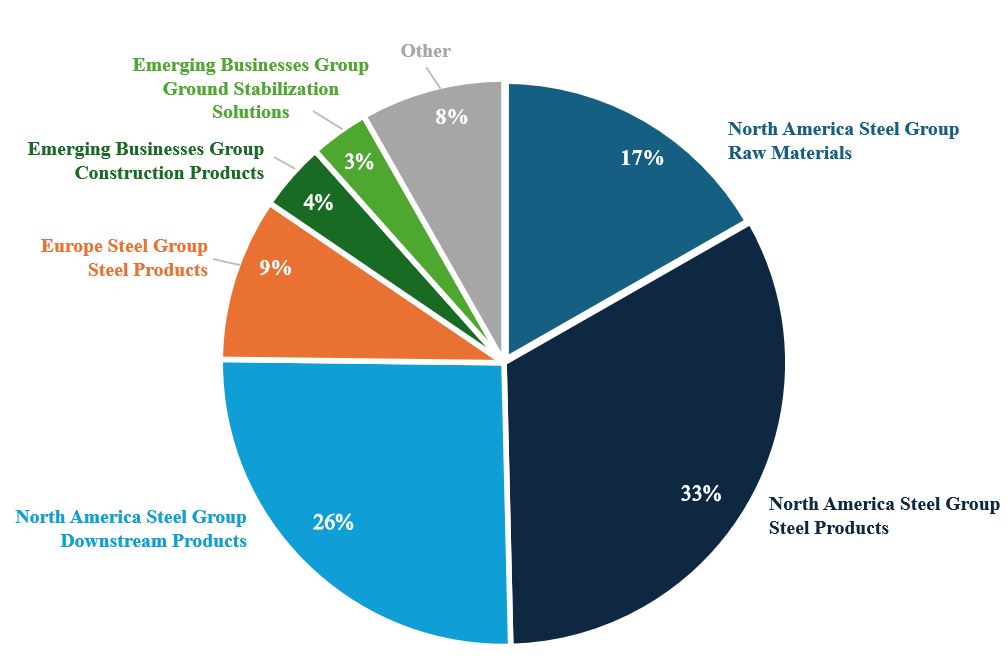
The Company has three reportable segments that represent the primary businesses reported in our consolidated financial statements: North America Steel Group, Emerging Businesses Group and Europe Steel Group. The following chart summarizes net sales to external customers by major product category within each reportable segment during the year ended August 31, 2025. For a historical breakout of our net sales to external customers by major product category within each reportable segment, see Note 19, Segment Information, in Part II, Item 8 of this Annual Report.
NORTH AMERICA STEEL GROUP SEGMENT
Our North America Steel Group segment provides a diverse offering of products and solutions to support the construction sector. Composed of a vertically integrated network of recycling facilities, steel mills and fabrication operations, our strategy in North America is to optimize our vertically integrated value chain to maximize profitability while providing industry-leading customer service. To execute our strategy, we seek to (i) obtain inputs at the lowest possible cost, including materials procured from our recycling facilities, which are operated to provide low-cost scrap to our steel mills, (ii) operate modern, efficient electric arc furnace ("EAF") steel mills and (iii) enhance operational efficiency by utilizing our fabrication operations to optimize our steel mill volumes and obtain the highest possible selling prices to maximize metal margin. We strive to maximize cash flow generation through increased productivity, high-capacity utilization and optimal product mix. To remain competitive, we regularly make substantial capital expenditures. We have invested approximately 80%, 77% and 88% of total capital expenditures in our North America Steel Group segment during 2025, 2024 and 2023, respectively. For logistics, we utilize a fleet of trucks we own or lease as well as private haulers, railcars, export containers and barges.
Our 42 scrap metal recycling facilities, primarily located in the southeast and central U.S., process ferrous and nonferrous scrap metals. These facilities purchase processed and unprocessed ferrous and nonferrous scrap metals from a variety of sources including manufacturing and industrial plants, metal fabrication plants, electric utilities, machine shops, factories, refineries, shipyards, demolition businesses, automobile salvage firms, wrecking companies and retail individuals. Our recycling facilities utilize specialized equipment to efficiently process large volumes of ferrous material, including seven large machines capable of shredding obsolete automobiles or other sources of scrap metal. Certain facilities also have nonferrous downstream separation equipment, including equipment at three of our facilities that reclaim metal from insulated copper wire, to allow us to capture more metal content. With the exception of precious metals, our scrap metal processing facilities recycle and process almost all types of metal. We sell ferrous and nonferrous scrap metals (collectively referred to as "raw materials") to steel mills and foundries, aluminum sheet and ingot manufacturers, brass and bronze ingot makers, copper refineries and mills, secondary lead smelters, specialty steel mills, high temperature alloy manufacturers and other consumers. Raw materials margin per ton is defined as the difference between the selling prices for processed and recycled ferrous and nonferrous scrap metals and the price paid to purchase obsolete and industrial scrap.
Our steel mill operations consist of six EAF mini mills, three EAF micro mills and one rerolling mill. Our steel mills manufacture finished long steel products including rebar, merchant bar, light structural and other special sections and wire rod, as well as semi-finished billets for rerolling and forging applications (collectively referred to as "steel products" in the context of the North America Steel Group segment). Each EAF mini mill consists of:
•a melt shop with an EAF;
•continuous casting equipment that shapes molten metal into billets;
•a reheating furnace that prepares billets for rolling;
•a rolling line that forms products from heated billets;
•a mechanical cooling bed that receives hot products from the rolling line;
•finishing facilities that shear, straighten, bundle and prepare products for shipping;
•baghouse systems that control particulate emissions from steelmaking operations; and
•supporting facilities such as maintenance, warehouse and office areas.
Our EAF micro mills utilize similar equipment and processes as described above; however, these facilities utilize unique continuous process technology where metal flows uninterrupted from melting to casting to rolling into finished steel products. Our rerolling mill does not utilize a melt shop; the rerolling process begins by reheating billets to roll into finished steel products. We ship hot-rolled spooled rebar from two facilities and re-spooled rebar from one facility. The estimated annual capacity for our steel mills, included in Part I, Item 2, Properties, of this Annual Report assumes a typical product mix and is not necessarily indicative of the expected production volumes or shipments in any fiscal year. Descriptions of mill capacity, particularly rolling capacity, are highly dependent on the specific product mix manufactured. Our mills roll many different types and sizes of products depending on market conditions, including pricing and demand.
We are currently constructing a fourth EAF micro mill in Berkeley County, West Virginia. This facility is strategically located to serve the Northeast, Mid-Atlantic and Mid-Western U.S. markets and will be supported by our existing network of downstream fabrication plants. Site improvements, foundation work and substantial portions of supporting infrastructure for the micro mill are complete. Construction of structural components for multiple process buildings and equipment is ongoing. We expect to begin melt shop production at this micro mill during 2026. Once operational, this facility will expand our production capacity for straight-length and spooled rebar and advance our commitment to sustainable steelmaking.
Ferrous scrap is the primary raw material used by our steel mills and is subject to significant price fluctuations. We believe the supply of ferrous scrap available to us is adequate to meet our future needs. Our mills consume large amounts of electricity and natural gas. We have not had any significant curtailments, and we believe that energy supplies are adequate. The supply and demand of regional and national energy, and the extent of applicable regulatory oversight of rates charged by providers, affect the prices we pay for electricity and natural gas. Our mills ship to a broad range of customers and end markets across the U.S. The primary end markets are construction and fabricating industries, metals service centers, original equipment manufacturers and agricultural, energy and petrochemical industries. Due to the nature of our steel products, we do not have a long lead time between order receipt and delivery. We generally fill orders for steel products from inventory or with products near completion. As a result, we do not believe our steel products backlog is a significant factor in the evaluation of our North America Steel Group operations.
Our fabrication operations include 53 facilities engaged in various aspects of steel fabrication; 49 of these facilities engage in general fabrication of reinforcing steel, including shearing, bending and welding, and four of these facilities fabricate steel fence posts. Fabricated rebar is used to reinforce concrete primarily in the construction of commercial and non-commercial buildings, hospitals, convention centers, industrial plants, power plants, highways, bridges, arenas, stadiums and dams, and is generally sold in response to a competitive bid solicitation. Many of the resulting projects are fixed price over the life of the project, and certain contracts include escalation provisions. We also provide installation services of fabricated rebar in certain markets. We obtain steel for our fabrication operations primarily from our own steel mills, and the demand created by our fabrication operations optimizes the production from our steel mills. Our steel fence posts have many applications, including residential and commercial landscaping and agricultural and livestock containment. Additionally, we have three facilities that supply post-tension cable for use in a variety of projects, such as slab-on-grade foundations, bridges, buildings, parking structures and rock-and-soil anchors. The fabrication and post-tension cable offerings are collectively referred to as "downstream products" in the context of the North America Steel Group segment. Downstream products backlog, defined as the total value of unfulfilled orders, was $1.4 billion at August 31, 2025.
EMERGING BUSINESSES GROUP SEGMENT
Our Emerging Businesses Group segment provides construction-related solutions and value-added products with strong underlying growth fundamentals to serve domestic and international markets that are adjacent to those served by our vertically integrated operations in the North America Steel Group segment and the Europe Steel Group segment. The Emerging Businesses Group segment's portfolio consists of the following:
•CMC Construction Services operations sell and rent construction-related products and equipment to concrete installers and other businesses in the construction industry (collectively referred to as "construction products").
•Tensar operations sell geogrids and Geopier foundation systems (collectively referred to as "ground stabilization solutions"). Geogrids are polymer-based products used for ground stabilization, soil reinforcement and asphalt optimization in construction applications, including roadways, public infrastructure and industrial facilities. Geopier foundation systems are rammed aggregate pier and other foundation solutions that increase the load-bearing characteristics of ground structures and working surfaces and can be applied in soil types and construction situations in which traditional support methods are impractical or would make a project infeasible.
•CMC Impact Metals operations manufacture heat-treated, high-strength steel products, such as high-strength bar for the truck trailer industry, special bar quality steel for the energy market and armor plate for military vehicles.
•Our group of performance reinforcing steel offerings include innovative products such as Galvabar (galvanized rebar with a zinc alloy coating that provides corrosion protection and post-fabrication formability), ChromX (designed for high-strength capabilities, corrosion resistance and a service life of more than 100 years), and CryoSteel (a cryogenic reinforcing steel that exceeds minimum performance requirements for strength and ductility at extremely low temperatures). Additionally, CMC Anchoring Systems' operations supply custom engineered anchor cages, bolts and fasteners that are fabricated principally from rebar and are used primarily to secure high voltage electrical transmission poles to concrete foundations.
•Through our licensing agreement with InQuik Inc., CMC Bridge Systems is the authorized provider of InQuik Bridges in the U.S. CMC Bridges are a patented prefabricated and modular system for constructing reinforced concrete bridge components off-site, which are then installed on-site with poured concrete for a cast-in-place structure.
EUROPE STEEL GROUP SEGMENT
Our Europe Steel Group segment is composed of a vertically integrated network of recycling facilities, an EAF mini mill and fabrication operations located in Poland. Our strategy in Europe is to optimize profitability of the products manufactured by our mini mill, and we execute this strategy in the same way in our Europe Steel Group segment as we do in our North America Steel Group segment.
Our 12 scrap metal recycling facilities, located throughout Poland, process ferrous scrap metals for use as a raw material for our mini mill. These facilities provide material almost exclusively to our mini mill and operate in order to lower the cost of scrap used by our mini mill. The equipment utilized at these facilities is similar to our North America Steel Group recycling operations and includes one large capacity scrap metal shredder similar to the largest shredder we operate in North America. Nonferrous scrap metal is not material to this segment’s operations.
Our mini mill is a significant manufacturer of rebar, merchant bar, wire rod and semi-finished billets in Central Europe and includes three rolling lines. The first rolling line is designed to allow efficient and flexible production of a range of medium section merchant bar products. The second rolling line is dedicated primarily to rebar production. The third rolling line is designed to produce high grade wire rod. The products produced by the mini mill are collectively referred to as "steel products" in the context of our Europe Steel Group segment. Our mini mill sells steel products primarily to fabricators, manufacturers, distributors and construction companies, mostly to customers located within Poland. However, the mini mill also exports steel products to the Czech Republic, France, Germany, Italy and Slovakia, among other countries. Ferrous scrap metal, the principal raw material used by our mini mill, electricity, natural gas and other necessary raw materials for the steel manufacturing process are generally readily available, although they can be subject to significant price fluctuations. Our mini mill generally fills orders for steel products from inventory or with products near completion. As a result, we do not believe that our steel products backlog is a significant factor in evaluating the operations of our Europe Steel Group segment.
Our fabrication operations consist of five steel fabrication facilities located in Poland which produce downstream products including fabricated rebar, wire mesh, welded steel mesh, wire rod, cold-rolled rebar, cold-rolled wire rod, assembled rebar cages and other fabricated rebar by-products (collectively referred to as "downstream products" in the context of our Europe Steel Group segment). These facilities obtain rebar and wire rod primarily from the mini mill. Three of the facilities are similar to the facilities operated by our North America Steel Group segment and sell fabricated rebar primarily to contractors for incorporation into construction projects. The other two fabrication facilities in Poland produce welded steel mesh, cold-rolled wire rod and cold-rolled rebar.
We are among the largest manufacturers of wire mesh in Poland, and our wire mesh customers include metals service centers and construction contractors. In addition to sales of downstream products in the Polish market, we also export our downstream products to neighboring countries such as the Czech Republic and Germany. The downstream products backlog is not a significant factor in evaluating the operations of our Europe Steel Group segment.
SEASONALITY
Our facilities primarily serve customers in the construction industry. Due to the increase in construction activities during the spring and summer months, our net sales are generally higher in our third and fourth quarters than in our first and second quarters.
COMPETITION
Our North America Steel Group recycling operations compete with scrap metal processors and primary nonferrous scrap metal producers. The nonferrous recycling industry is highly fragmented in the U.S.; however, we believe our recycling operations are among the largest engaged in the recycling of nonferrous scrap metals in the U.S. We are also a major regional processor of ferrous scrap metal. For both nonferrous and ferrous scrap metals, we compete primarily on the quality and price of our products. Our Europe Steel Group recycling facilities operate to provide raw materials almost exclusively to our mini mill in Poland.
We produce a significant percentage of the total U.S. output of rebar and merchant bar through our EAF steel mills. Domestic and international competitors include local, regional, national and international manufacturers and suppliers of steel. We compete primarily on the services we provide to our customers and on the quality and price of our products. In the U.S., we believe we are the largest manufacturer and fabricator of rebar, the largest manufacturer of steel fence posts and among the largest manufacturers of merchant bar. In Poland, we believe we are the second largest producer of rebar and wire rod, and the largest producer of merchant bar for the products we manufacture.
Furthermore, the global steel industry is cyclical and highly competitive, consisting of domestic and international producers for all major product lines across our North America Steel Group and Europe Steel Group segments. Global steelmaking capacity greatly exceeds demand for steel products in many regions around the world, and this overcapacity results in competition from steel imports into the regions we operate. Our global strategy and differentiating customer service allow us to navigate the risks arising from overproduction. Additionally, trade enforcement laws, such as the tariffs and quotas set forth in Section 232 of the U.S. Trade Expansion Act of 1962 ("Section 232"), which were restored and expanded by President Trump on February 10, 2025, should support domestic production and reduced imports of unfairly priced steel. Although the elimination of Section 232 tariff exemptions is expected to provide a favorable backdrop to the domestic long steel market, there remains uncertainty regarding the duration and scope of this and other potential executive actions related to tariffs. If the Section 232 or other import tariffs, quotas or duties are relaxed, repealed, challenged legally or expire; if other countries are exempted, or if relatively higher U.S. steel prices make it attractive for foreign steelmakers to export their steel products to the U.S., despite the presence of import tariffs, quotas or duties, a resurgence of substantial imports of foreign steel could occur. This occurrence would put downward pressure on U.S. steel prices.
Competitive Advantage
CMC's diverse product offerings support a wide variety of applications and position us as a global solutions provider to the construction industry, capable of addressing multiple stages of the early phases of construction. We believe our vertically integrated manufacturing platform provides an advantageous cost structure and maximizes the results of our steel-related operations. Our recycling and fabrication operations are designed to support our steel mills. Our recycling operations provide scrap metal to our steel mills, which in turn use the scrap metal to produce and supply steel required by our fabrication operations. As our recycling facilities are generally located near our steel mills, we can ensure a secure supply of low-cost raw materials, and our fabrication facilities provide a significant and consistent source of demand as well as forward visibility into end customer demand. This is a strategic advantage when imports increase as our steel mills can continue to supply our fabricators. Contract pricing that is utilized for these operations helps to stabilize short-term volatility. The construction-related solutions and value-added products within our Emerging Businesses Group segment complement our existing concrete reinforcement product lines and broaden our commercial portfolio, allowing us to address multiple stages of the early phases of commercial and infrastructure construction and provide a comprehensive solution for our customers.
Our operational footprint also provides a competitive advantage in North America and Europe. Our steel mills and fabrication operations in North America and Europe are well-positioned geographically with steel mill locations in some of the highest demand locations for rebar and merchant bar consumption.
In North America, we operate a network of operations that stretch from the East Coast to the West Coast and can reach every major metro area in the U.S. Demand for our products in the U.S. is highest in the Sun Belt region where most of our steel mills are located, which positions us to capitalize on growth in this region as well as benefit from a longer construction season. Our mini mill in Poland also provides strategic benefits as it is well positioned to serve neighboring European economies.
See Part I, Item 1A, Risk Factors, of this Annual Report for more information on competitive factors described above.
SUSTAINABILITY
Sustainability is embedded in our business model and remains central to our strategy. For over 50 years, we have manufactured steel using recycled scrap metal and EAF technology, which is more efficient and environmentally friendly than traditional blast furnace technology, using less energy than the industry average and producing significantly less carbon dioxide per ton of steel we melt. We play a key role in returning our primary input, ferrous scrap, into the economy in the form of rebar, merchant bar, wire rod and fence post for use in a wide variety of applications. In 2025, recycled content made up approximately 98% of the raw materials used in our manufactured finished steel. Our Tensar geogrid technology is also inherently sustainable, as its use in construction projects can, for example, extend road service life, conserve water resources, control soil erosion and reduce consumption of aggregate.
Increasingly, our customers are prioritizing sustainable business practices in and through their supply chains. We help our customers meet their own sustainability needs by offering products such as our RebarZero, MerchantZero, WireZero and PostZero product lines, among others in our portfolio of "net-zero" emissions products. Annually, our vertically integrated manufacturing process keeps millions of tons of scrap metal out of landfills. Our process includes five primary steps:

|
|
|
|
1. Locally source, purchase and process scrap metal as feedstock, which allows us to lower emissions and put more waste to beneficial use.
2. Melt the recycled scrap metal into new steel in our mills using our modern, efficient EAFs, which consume less energy and reduce greenhouse gas ("GHG") emissions compared to traditional blast furnace technology.
3. Roll the new steel into finished long steel products, including rebar, merchant bar, light structural shapes and other special sections, wire rod and semi-finished billets for rerolling.
4. Fabricate the finished products into custom shapes and lengths for end use by our customers.
5. Reclaim end-of-life steel material as feedstock for new steel products, thereby starting our cycle of steel production once again.
|
|
|
|
|
|
|
|
|
We continue to invest in new technologies and processes to reduce our environmental impact, including our most recently commissioned micro mill located in Mesa, Arizona, which utilizes advanced EAF power supply systems designed for greater energy efficiency, resulting in lower overall power consumption and reduced environmental impact compared to traditional steelmaking methods. The same technology will be utilized at our micro mill currently under construction in Berkeley County, West Virginia.
Information relating to our environmental, social and governance ("ESG") commitments and the goals we have established to increase our use of renewable energy and reduce our energy consumption, GHG emissions and water withdrawal is available on the ESG section of our website, www.esg.cmc.com.
ENVIRONMENTAL MATTERS
A significant factor in our business is our compliance with complex and evolving environmental laws and regulations. These laws and regulations govern, among other things, waste disposal, air emissions, waste and storm water effluent and disposal. Our operations hold a variety of permits and authorizations pursuant to environmental law. Environmental laws and regulations evolve and are subject to changing interpretation and enforcement over time. We devote considerable resources to compliance with environmental laws and these expenditures may change in ways that cannot be currently anticipated due to the possibility of unanticipated regulatory development. Further, uncertainty regarding adequate control levels, testing and sampling procedures, new pollution control technology and cost benefit analysis based on market conditions impact our future expenditures that are necessary to comply with environmental regulatory programs. Compliance with and changes to various environmental requirements and environmental risks applicable to our industry may adversely affect our business, results of operations and financial condition.
Under the Comprehensive Environmental Response, Compensation and Liability Act ("CERCLA" or "Superfund") and analogous state statutes, we may occasionally be required to cleanup or take remedial action with regard to (or pay for cleanup or remedial action with regard to, or pay for natural resource damages with respect to) sites we operate or formerly operated, or to which we have sent materials. If we are found to have arranged for treatment or disposal of hazardous substances at a site, we could be named as a potentially responsible party ("PRP") and responsible for both the costs of cleanup as well as for associated natural resource damages at such site. The U.S. Environmental Protection Agency ("EPA"), or equivalent state agency, has named us as a PRP at several federal Superfund sites or similar state sites, and we have received information requests with respect to other sites. In some cases, these agencies allege that we are a PRP because we sold scrap metals to, or otherwise disposed of materials at, the site. With respect to the sale of scrap metals, we contend that an arm's length sale of valuable scrap metal for use as a raw material in a manufacturing process that we do not control should not constitute "an arrangement for disposal or treatment of hazardous substances" as defined under federal law. Subject to the satisfaction of certain conditions, the Superfund Recycling Equity Act provides legitimate sellers of scrap metal for recycling with some relief from Superfund liability under federal law. Despite Congress' clarification of the intent of the federal law, some state laws and environmental agencies still seek to impose liability on the basis of such arm's length sale constituting "an arrangement for disposal or treatment of hazardous substances." We believe efforts to impose such liability are contrary to public policy objectives and legislation encouraging recycling and promoting the use of recycled materials, and we continue to support clarification of state laws and regulations consistent with Congress' action.
Wastes that we generate, including hazardous wastes, are subject to the Resource Conservation and Recovery Act ("RCRA") and comparable state and local statutes. The RCRA governs the handling, recycling and disposal of solid waste and hazardous secondary materials, and thus may limit the disposal options for certain of our wastes. Under the RCRA, the government may impose penalties and may order corrective action to address contamination. Additionally, the RCRA provides for citizens suits, allowing private parties to bring claims to enforce the RCRA. Over time, state and federal laws applicable to wastes and contaminated sites have become more strict, and we cannot predict if future regulatory trends will result in more stringent requirements related to our wastes and contaminated properties.
Under the Clean Air Act ("CAA") and comparable state and local statutes, we must obtain permits or other authorizations related to air emissions at various of our facilities. Under the CAA, the government can seek penalties and injunctive relief for violations, and the CAA provides for private party enforcement through citizen suits. Requirements to control air emissions under the CAA have become more stringent over time and there is no guarantee that EPA or states will not adopt different or more stringent standards for emissions, requiring additional expenditures.
The Clean Water Act ("CWA") and comparable state and local statutes impose controls on the discharge of materials into waters of the U.S. (or the applicable state), including controls on the discharge of wastewater, stormwater and fill material. These controls have become more stringent over time and we cannot predict if additional restrictions will be imposed in the future. The CWA provides for injunctive relief for violations and allows for private enforcement through citizen suits.
Other environmental laws apply to our operations and facilities and our products. These include, without limitation, the Toxic Substances Control Act, the Oil Pollution Act and the Safe Drinking Water Act, as well as state and local environmental laws. Additionally, we could be subject to common law claims, such nuisance, trespass, negligence or other claims alleging personal injury, property damage and other harms.
We cannot predict the total amount of capital expenditures or increases in operating costs or other expenses that may be required as a result of environmental compliance. We also do not know if we can pass such costs on to our customers through product price increases. During 2025, we incurred environmental costs, including disposal, permits, license fees, tests, studies, remediation, consultant fees and environmental personnel expense of $58.4 million. In addition, we spent $4.7 million on capital expenditures for environmental projects in 2025. We believe that our facilities are in material compliance with currently applicable environmental laws and regulations. We anticipate capital expenditures for new environmental projects during 2026 to be approximately $2 million. For more information on our compliance with environmental laws and regulations, see Part I, Item 1A, Risk Factors — Risks Related to the Regulatory Environment, in this Annual Report.
EMPLOYEES AND WORKFORCE CULTURE
Our employees are our most important asset and are fundamental to our success. We recognize that our employees bring diverse backgrounds and unique skill sets, and we have fostered a culture that challenges conventional thinking, promotes teamwork, requires accountability and rewards success. At the heart of our culture are our core values of Integrity, Safety, Collaboration and Excellence. These core values are reinforced daily through our actions and in meetings with employees and serve as a compass for our behaviors and decisions.
The following table presents the approximate headcount of employees within each reportable segment and Corporate and Other as of August 31, 2025:
|
|
|
|
|
|
|
|
|
| Segment |
|
Number of Employees |
| North America Steel Group |
|
8,171 |
|
| Emerging Businesses Group |
|
1,421 |
|
| Europe Steel Group |
|
2,702 |
|
| Corporate and Other |
|
396 |
|
| Total |
|
12,690 |
|
Approximately 11%, 4% and 28% of the employees in our North America Steel Group, Emerging Businesses Group and Europe Steel Group segments, respectively, belong to unions. We believe that we have good relations with the union representatives that represent our employees, and we are focused on providing safe and productive workplace environments for our employees.
Ethics and Compliance
At CMC, we believe "it’s what’s inside that counts." It is fundamental to our success that both our leaders and employees observe the highest ethical standards of business conduct in their interactions with our customers, suppliers, communities, investors and each other. We empower our employees to make the right decisions and have established the CMC Code of Conduct and Business Ethics (the "Code") to help our employees understand company policies and guide their actions. Employees are required to complete training to reinforce their continued understanding of and compliance with the Code. Additionally, to foster and maintain our culture of ethical conduct and integrity, we provide confidential channels for employees to report known and suspected violations of applicable laws, the Code, our policies or our internal controls, and receive a response to such reports.
Employee Health and Safety
The safety of every employee is, and has always been, one of our top values. We strive to provide a safe working environment where facilities achieve zero work-related injuries or illnesses. In pursuit of our goal of zero incidents, we embrace a total safety culture that encourages our employees to recognize potentially unsafe situations and use our Proactive Safety Program to report concerns and work together to remove potential hazards from the work environment before incidents occur. Additionally, our Global Health and Safety Policy sets the standard for our facilities based on best practices that often exceed regulatory requirements and all of our employees are provided with the training necessary to safely and effectively perform their responsibilities.
Our Safety Management System includes our policies, incident management process, data dashboards and safety action plans based on observed behaviors related to health and safety. We periodically issue employee Safety Perception Surveys at various locations to identify any discrepancies between management and employee perspectives on the safety of our working conditions. Additionally, we participate in industry association meetings to share expertise and best practices. These surveys and meetings facilitate important discussions that ultimately help further develop our health and safety management systems.
With continued focus on safety in 2025, we improved our already exceptional safety record to achieve the lowest total recordable incident rate ("TRIR") in our Company's history. This marks the third consecutive year of TRIR reduction, reflecting our continued commitment to workplace safety.
____________________________
(1) TRIR is defined as OSHA recordable incidents x 200,000/hours worked.
(2) This line represents the 2023 average for Steel Product Manufacturing (North American Industry Classification System ("NAICS") code 3311), based on the latest available information provided by the U.S. Bureau of Labor Statistics.
In addition to TRIR, we also measure our near miss frequency rate, which we believe is critical to incident avoidance and supports our superior safety rating in the industry.
Talent Development and Retention
We invest in training and resources to support our employees in reaching their full potential and to build internal capabilities, and are committed to providing a safe, welcoming and engaging work environment. Our culture of continuous improvement creates internal advancement and growth opportunities for our employees. We recognize that retaining and hiring employees with the right talent, commitment and drive are critical steps to allow us to achieve our goals and reach our full growth potential. CMC provides both online and in-person training options to our employees as well as tuition assistance to support the cost of furthering relevant education for our employees. In addition to our internally developed technical, safety and leadership training available to all employees, many new employees in commercial and operational positions complete rotational programs during onboarding to gain technical experience across the business. We also conduct periodic surveys and other initiatives with employees, which provide invaluable information about how employees perceive our onboarding, employee training, development and culture and allow us to further enhance the training and resources we offer.
INFORMATION ABOUT OUR EXECUTIVE OFFICERS
Our Board of Directors (the "Board") annually elects executive officers. Our executive officers continue to serve for terms set by our Board in its discretion. The table below sets forth the name, current position and offices, age and calendar year in which they became an executive officer, for each of our executive officers as of October 16, 2025.
|
|
|
|
|
|
|
|
|
|
|
|
|
|
|
|
|
|
|
|
|
| NAME |
|
CURRENT POSITION & OFFICES |
|
AGE |
|
EXECUTIVE OFFICER SINCE |
| Peter R. Matt |
|
President and Chief Executive Officer |
|
62 |
|
2023 |
| Paul J. Lawrence |
|
Senior Vice President and Chief Financial Officer |
|
55 |
|
2016 |
| Jody K. Absher |
|
Senior Vice President, Chief Legal Officer and Corporate Secretary |
|
48 |
|
2020 |
| Jennifer J. Durbin |
|
Senior Vice President, Chief Human Resources and Communications Officer |
|
44 |
|
2020 |
| Kekin M. Ghelani |
|
Senior Vice President, Chief Strategy Officer |
|
51 |
|
2024 |
| Brian N. Halloran |
|
Senior Vice President, North America Steel Group |
|
54 |
|
2025 |
Peter R. Matt has served as the President and Chief Executive Officer of CMC since September 1, 2023 and previously served as President of CMC from April 2023 to August 2023. Prior to joining CMC, Mr. Matt served as Executive Vice President and Chief Financial Officer of Constellium N.V. ("Constellium"), a global aluminum fabrication company, from 2016 to 2023. Prior to joining Constellium, Mr. Matt served as a Managing Partner for Tumpline Capital, LLC from 2015 to 2016. From 1985 to 2015, he held various leadership positions with Credit Suisse.
Paul J. Lawrence has served as Senior Vice President and Chief Financial Officer of CMC since November 2021. Prior thereto, Mr. Lawrence served as CMC’s Vice President and Chief Financial Officer from September 2019 to November 2021, Vice President of Finance from June 2018 to September 2019, Treasurer, Vice President of Financial Planning and Analysis from January 2017 to June 2018, Vice President of Finance and Treasurer from September 2016 to January 2017, and Vice President of Finance from February 2016 to September 2016. Prior to joining CMC, Mr. Lawrence served as North American Information Technology Leader of Gerdau Long Steel North America, a U.S. steel producer, from 2014 to 2016, and from 2010 to 2014, he served as Gerdau Template Deployment Leader at Gerdau Long Steel North America. From 2003 to 2010, Mr. Lawrence held a variety of financial roles at Gerdau Ameristeel Corporation, including Assistant Vice President and Corporate Controller, and Deputy Corporate Controller. From 1998 to 2002, Mr. Lawrence held several financial positions with Co-Steel Inc., which was acquired by Gerdau SA.
Jody K. Absher has served as Senior Vice President, Chief Legal Officer and Corporate Secretary since October 2023. Prior thereto, Ms. Absher served as CMC’s Vice President, Chief Legal Officer and Corporate Secretary from August 2022 to October 2023, Vice President, General Counsel and Corporate Secretary from May 2020 to August 2022, Interim General Counsel from February 2020 to May 2020, Lead Counsel and Assistant Corporate Secretary from November 2014 to February 2020, Senior Counsel and Assistant Corporate Secretary from October 2013 to November 2014, and Legal Counsel from May 2011 to October 2013. Prior to joining CMC, Ms. Absher was an attorney at Haynes and Boone, LLP, a global law firm, from August 2007 to May 2011.
Jennifer J. Durbin has served as Senior Vice President and Chief Human Resources and Communications Officer since October 2023. Prior thereto, Ms. Durbin served as CMC’s Vice President and Chief Human Resources Officer from August 2022 to October 2023, Vice President of Human Resources and Safety from November 2021 to August 2022, Vice President of Human Resources from January 2020 to November 2021, Lead Counsel from November 2014 to January 2020, Senior Counsel from January 2013 to November 2014, and Legal Counsel from May 2010 to January 2013. Prior to joining CMC, Ms. Durbin was an attorney at Sidley Austin LLP, a global law firm, from August 2006 to May 2010.
Kekin M. Ghelani has served as Senior Vice President, Chief Strategy Officer since October 2024. Prior to joining CMC, Mr. Ghelani served as the Chief Strategy and Growth Officer of Summit Materials, Inc. from May 2022 to August 2024. From 2019 to 2022, Mr. Ghelani served as Vice President of Strategy, Growth and Ventures of the Water & Protection business unit of DuPont Nemours, Inc. From 2013 to 2019, Mr. Ghelani held roles of increasing responsibility at Celanese Corporation. Prior thereto, he held various senior positions at McKesson Corporation and Honeywell International.
Brian N. Halloran has served as Senior Vice President, North America Steel Group since May 2025. Mr. Halloran joined CMC in 1998, and has worked in numerous commercial and operational roles, most recently as Vice President of CMC’s Central Division. He is a member of the Recycled Materials Association ("ReMa"), and a former Chair of ReMa’s Ferrous Division.
ITEM 1A. RISK FACTORS
There are inherent risks and uncertainties associated with our business that could adversely affect our business, results of operations and financial condition. Set forth below are descriptions of those risks and uncertainties that we currently believe to be material, but the risks and uncertainties described below are not the only risks and uncertainties that could adversely affect our business, results of operations and financial condition. If any of these risks actually occur, our business, results of operations and financial condition could be materially adversely affected.
RISKS RELATED TO OUR BUSINESS
Scrap and other inputs for our business are subject to significant price fluctuations and limited availability, which may adversely affect our business, results of operations and financial condition.
At any given time, we may be unable to obtain an adequate supply of critical raw materials at prices and on other terms acceptable to us. We depend on ferrous scrap, the primary raw material used by our steel mills, and other inputs such as graphite electrodes and alloys for our steel mill operations. The price of scrap and other inputs has historically been subject to significant fluctuation, and we may not be able to adjust our product prices to recover the costs of rapid increases in raw material prices, especially over the short-term and in our fixed price contracts. The profitability of our operations would be adversely affected if we are unable to pass increased raw material and input costs on to our customers.
The purchase prices for automobile bodies and various other grades of obsolete and industrial scrap, as well as the selling prices for processed and recycled scrap metals we utilize in our own manufacturing process or resell to others, are highly volatile. A prolonged period of low scrap prices or a fall in scrap prices could impair our ability to obtain, process, sell and consume recycled material, which could have a material adverse effect on our business, results of operations and financial condition.
Our ability to respond to changing recycled metal selling prices may be limited by competitive or other factors during periods of low scrap prices, when the supply of scrap may decline considerably, as scrap generators hold onto their scrap in the hope of getting higher prices later. Conversely, increased foreign demand for scrap due to economic expansion in countries such as China, India, Brazil and Turkey, as well as the growth of EAF steel production due to efforts by countries and producers to reduce carbon emissions in the industry, can result in an outflow of available domestic scrap as well as higher scrap prices that cannot always be passed on to domestic scrap consumers or consumers of our steel products, further reducing the available domestic scrap flows and margins, all of which could adversely affect our sales and profitability.
The availability of raw materials may also be negatively affected by laws and regulations, domestic and foreign trade policy, allocations by suppliers, interruptions in production, accidents and natural disasters, changes in exchange rates, global price fluctuations and the availability and cost of transportation. If we are unable to obtain adequate and timely deliveries of our required raw materials, we may be unable to manufacture significant quantities of our products in a timely manner.
We rely on the availability of large amounts of electricity and natural gas. Disruptions in delivery or substantial increases in energy costs, including crude oil prices, could adversely affect our business, results of operations and financial condition.
Our EAF mills melt steel scrap and use natural gas to heat steel billets for rolling into finished steel products. As large consumers of electricity and natural gas, often the largest in the geographic area where our mills are located, we must have dependable delivery of electricity and natural gas in order to operate. Accordingly, we are at risk in the event of an energy disruption. Prolonged black-outs or brown-outs or disruptions caused by natural disasters could substantially disrupt our production. Additionally, the rapid expansion of data centers driven by growing demand for cloud services, artificial intelligence and other digital infrastructure is expected to significantly increase electric power consumption, which could impact energy availability and pricing for industrial users, including steel producers. While we have not suffered prolonged production delays due to our inability to access electricity or natural gas, several of our competitors have experienced such occurrences. Prolonged substantial increases in energy costs would have an adverse effect on the costs of operating our mills and would negatively impact our profitability unless we were able to fully pass through the additional expense to our customers. Further, our finished steel products are typically delivered by truck. Rapid increases in the price of fuel attributable to increases in crude oil prices would increase our costs and adversely affect many of our customers' financial results, which in turn could result in reduced margins and declining demand for our products.
We may encounter labor disputes and shortages for skilled labor and/or qualified employees in operational positions, which could adversely impact our operations.
Our employees contribute to and are instrumental in developing and meeting our business goals and objectives, and we depend on a qualified labor force for the manufacture of our products. The impact of labor shortages and increased competition for available workers may increase our costs or impede our ability to optimally staff our facilities and could have an adverse impact on our results of operations, financial condition and cash flows. In addition, an ongoing labor shortage may result in increased expenses related to hiring and retention of qualified employees. As our experienced employees retire and we lose their institutional knowledge, we may encounter challenges and may have difficulty replacing them with employees of comparable skill and efficiency. Additionally, as of August 31, 2025, 11%, 4% and 28% of the employees in our North America Steel Group, Emerging Businesses Group and Europe Steel Group segments, respectively, belong to unions. While we believe that we have good relations with the union representatives, there can be no assurance that any future labor negotiations will prove successful, which may result in a significant increase in the cost of labor, or may break down and result in the disruption of our business or operations.
The loss of, or inability to hire, key employees may adversely affect our ability to successfully manage our operations and meet our strategic objectives.
Our future success depends, in large part, on the continued service of our officers and other key employees and our ability to continue to attract and retain additional highly qualified personnel. These employees are integral to our success based on their expertise and knowledge of our business and products. We compete for such personnel with other companies, including public and private company competitors who may periodically offer more favorable terms of employment. The loss or interruption of the services of a number of our key employees could reduce our ability to effectively manage our operations should we be unable to find appropriate replacement personnel in a timely manner.
Our business, financial condition and results of operations may be adversely impacted by the effects of inflation.
Inflation has the potential to adversely affect our business, financial condition and results of operations by increasing our overall cost structure, particularly if we are unable to achieve commensurate increases in the prices we charge our customers. Other inflationary pressures could affect wages, energy prices, the cost and availability of components and raw materials and other inputs and our ability to meet customer demand. Inflation may further exacerbate other risk factors, including supply chain disruptions, risks related to international operations and the recruitment and retention of qualified employees.
We may have difficulty competing with companies that have a lower cost structure or access to greater financial resources.
We compete with regional, national and foreign manufacturers and traders. Consolidation among participants in the steel manufacturing and recycling industries has resulted in fewer competitors, and several of our competitors are significantly larger than us and have greater financial resources and more diverse businesses than us. Some of our foreign competitors may be able to pursue business opportunities without regard to certain laws and regulations with which we must comply, such as environmental regulations. These companies may have a lower cost structure and more operating flexibility, and consequently they may be able to offer lower prices and more services than we can. There is no assurance that we will be able to compete successfully with these companies. Any of these factors could have a material adverse effect on our business, results of operations and financial condition.
Operating and startup risks, as well as market risks associated with the commissioning of our micro mills, could prevent us from realizing anticipated benefits and could result in a loss of all or a substantial part of our investments.
Although we have successfully commissioned and operated similar facilities, there are technological, operational, market and start-up risks associated with the continued ramp up of our third micro mill and the construction and commissioning of our fourth micro mill. Construction of our micro mills is subject to changing market conditions, delays, inflation and cost overruns, work stoppages, labor shortages, weather-related disruptions, supply chain delays, changes in transportation costs and availability, changes required by governmental authorities, availability of government tax credits and delays in acquiring or the inability to acquire required permits or licenses, any of which could adversely affect our operational and financial results. While we believe these facilities should each be capable of consistently producing high-quality products in sufficient quantities and at costs that will compare favorably with other similar steel manufacturing facilities, these expectations may not be achieved. If we encounter cost overruns, system or process difficulties or quality control restrictions during commissioning of our fourth micro mill or after startup with any facility, our capital costs could increase materially, the expected benefits from the development of the applicable facilities could be diminished or lost and we could lose all or a substantial portion of our investments. Furthermore, due to the innovative systems and processes being deployed, construction and commissioning of our fourth micro mill may present new operational complexities not previously experienced at our other micro mills. In addition, reductions in the availability of certain modes of transportation, such as rail or trucking, during construction of our micro mills could result in significant delays, and reduced transportation availability following startup at our facilities could limit our ability to deliver our steel products and therefore adversely affect our operational and financial results. We could also encounter commodity market risk if, over a sustained period, the cost to manufacture is greater than projected or the market prices for steel products decline.
Our mills require continual capital investments that we may not be able to sustain.
We must make regular, substantial capital investments in our steel mills to maintain the mills, lower production costs and remain competitive. We cannot be certain that we will have sufficient internally generated cash or acceptable external financing to make necessary substantial capital expenditures in the future. The availability of external financing depends on many factors outside of our control, including capital market conditions and the overall performance of the economy. If funding is insufficient, we may be unable to develop or enhance our mills, take advantage of business opportunities and respond to competitive pressures.
Unexpected equipment failures may lead to production curtailments or shutdowns, which may adversely affect our business, results of operations and financial condition.
Interruptions in our production capabilities adversely affect our production costs, products available for sale and earnings from time to time. Our manufacturing processes are dependent upon critical pieces of equipment, such as our furnaces, continuous casters and rolling equipment, press and stretching equipment, and electrical systems such as transformers. This equipment may, on occasion, be out of service as a result of unanticipated failures. While we maintain backups for certain critical pieces of equipment to use during the time it may take to repair or replace inoperable equipment, we have experienced, and may in the future experience, material plant shutdowns or periods of reduced production as a result of such equipment failures. In addition to equipment failures, our facilities are also subject to the risk of catastrophic loss due to unanticipated events such as fires, explosions or violent weather conditions.
We are vulnerable to the economic conditions in the regions in which our operations are concentrated.
Economic downturns in the U.S., United Kingdom (the "U.K."), Central Europe and China, or decisions by governments that have an impact on the level and pace of overall economic activity in one of these regions, could adversely affect demand for our products and, consequently, our sales and profitability. As a result, our financial results are substantially dependent upon the overall economic conditions in these areas.
Information technology interruptions and breaches in data security could adversely impact our business, results of operations and financial condition.
We rely on computers, information and communications technology and related systems and networks to operate our business, including to store sensitive data such as intellectual property, our own proprietary business information and that of our customers, suppliers and business partners, as well as personally identifiable information of our employees. Increased global information technology security requirements, vulnerabilities, threats and a rise in sophisticated and targeted cyber attacks, which may be heightened in times of hostilities or war, computer viruses, phishing attacks, social engineering schemes, malicious code, ransomware attacks, acts of terrorism and physical or electronic security breaches, including breaches by computer hackers, cyber-terrorists and/or unauthorized access to or disclosure of our and/or our employees’ or customers’ data pose a risk to the security of our systems, networks and the confidentiality, availability and integrity of our data. We have experienced cybersecurity incidents in the ordinary course of business but, as of the date of this Annual Report, prior cybersecurity incidents have not had a material adverse effect on our business strategy, results of operations or financial condition. Our systems and networks are also subject to damage or interruption from power outages, natural disasters, telecommunications failures, intentional or inadvertent user misuse, employee error, operator negligence and other similar events. Any of these or other events could result in system interruption, the disclosure, modification or destruction of proprietary and other key information, corruption of data, legal claims or proceedings, government enforcement actions, civil or criminal penalties, increased cybersecurity protection and remediation costs, production delays or disruptions to operations including processing transactions and reporting financial results and could adversely impact our reputation and our operating results. We have taken steps to address these concerns and have implemented internal control and security measures to protect our systems and networks from security breaches; however, measures that the Company takes to avoid, detect, mitigate or recover from material incidents, may be circumvented, become ineffective or fail to detect or prevent all threats. Despite these efforts, a system or network failure, or security breach, could materially impact our business, results of operations and financial condition. As cybersecurity threats continue to evolve and become more sophisticated, we may be required to incur significant costs and invest additional resources to protect against and, if required, remediate the damage caused by such disruptions or system failures in the future.
Increasing attention to ESG matters, including any targets or other ESG, environmental justice or regulatory initiatives, could result in additional costs or risks or adverse impacts on our business.
Our business faces increasing scrutiny related to ESG issues, including environmental stewardship, supply chain management, climate change, diversity and inclusion, workplace conduct, human rights, philanthropy and support for local communities. Investors, stakeholders and other interested parties are also increasingly focused on issues related to environmental justice and ESG in general.
Implementation of our environmental and sustainability initiatives, including the goals set forth in our annual sustainability report, requires certain financial expenditures and employee resources, and the implementation of certain ESG practices or disclosures. In addition, we are, or in the future may become, subject to domestic and international disclosure frameworks, regulations and requirements related to climate change and sustainability. Compliance with such disclosure frameworks, regulations and requirements, if and when they are implemented, could require significant effort, and if we fail to meet the applicable regulatory standards or expectations with respect to these issues, including the expectations we establish for our business, we could be subject to penalties, fines, lawsuits or regulatory action, our reputation and brand could be damaged, and our business, financial condition and results of operations could be adversely impacted. Furthermore, negative publicity with respect to our business and operations could result in the cancellation or delay of projects, the revocation of permits or termination of contracts, each of which may adversely affect our business strategy, increase our costs, or adversely affect our reputation, performance and availability of capital.
We are subject to litigation, potential liability claims and contract disputes, and may become subject to additional litigation, claims and disputes in the future, any of which could adversely affect our business, results of operations and financial condition.
We are involved in various litigation matters, including regulatory proceedings, administrative proceedings, governmental investigations, environmental matters and construction contract disputes. The nature of our operations also exposes us to possible litigation claims in the future. Furthermore, the manufacture and sale of our products as well as the use of our products in a wide variety of commercial and industrial applications expose us to potential product liability and related claims. In the event that a product of ours fails to perform as expected, regardless of fault, or is used in an unexpected manner, and such failure or use results in, or is alleged to result in, bodily injury and/or property damage or other losses, we may be subject to product liability and product quality claims.
Because of the uncertain nature of litigation and insurance coverage decisions, we cannot predict the outcome of these matters. These matters could have a material adverse effect on our reputation, business, results of operations and financial condition. Litigation is very costly, and the costs associated with prosecuting and defending litigation matters could have a material adverse effect on our business, results of operations and financial condition. Although we are unable to precisely estimate the ultimate dollar amount of exposure to loss in connection with litigation matters, we make accruals as warranted. However, the amounts that we accrue could vary significantly from the amounts we actually pay, due to inherent uncertainties, including the inherent uncertainties of the estimation process, the uncertainties involved in litigation and other factors. As further described in Part I, Item 3, Legal Proceedings of this Annual Report, on October 30, 2020, plaintiff Pacific Steel Group ("PSG") filed a suit in the U.S. District Court for the Northern District of California (the "Northern District Court") alleging that CMC, CMC Steel Fabricators, Inc. and CMC Steel US, LLC violated the federal and California state antitrust laws and California common law by entering into an exclusivity agreement for certain steel mill equipment manufactured by one of the Company’s equipment suppliers. On November 5, 2024, a jury returned a verdict in favor of PSG in the amount of $110.0 million, which the Northern District Court, in entering its judgment on the verdict, subsequently trebled as a matter of law. In the year ended August 31, 2025, we reported $362.3 million of litigation expense in the consolidated statement of earnings, which represents our estimate based on our understanding of the PSG judgment, PSG’s attorneys’ fees and other related costs, including post-judgment interest. Unless the verdict and judgment are overturned or the judgment is significantly reduced, the losses incurred in connection with this litigation would have a material adverse effect on our liquidity and financial condition.
Potential limitations on our ability to access credit, or the ability of our customers and suppliers to access credit, may adversely affect our business, results of operations and financial condition.
If our access to credit is limited or impaired, our business, results of operations and financial condition could be adversely impacted. Our senior unsecured notes are rated by Standard & Poor's Corporation, Moody's Investors Service and Fitch Group, Inc. In determining our credit ratings, the rating agencies consider a number of both quantitative and qualitative factors. These factors include earnings, fixed charges such as interest, cash flows, total debt outstanding, off-balance sheet obligations and other commitments, total capitalization and various ratios calculated from these factors. The rating agencies also consider predictability of cash flows, business strategy and diversity, industry conditions and contingencies. Any downgrades in our credit ratings may make raising capital more difficult, increase the cost and affect the terms of future borrowings, affect the terms under which we purchase goods and services and limit our ability to take advantage of potential business opportunities. We could also be adversely affected if our banks refused to honor their contractual commitments or cease lending.
We are also exposed to risks associated with the creditworthiness of our customers and suppliers. In certain markets, we have experienced a consolidation among those entities to whom we sell. This consolidation has resulted in an increased credit risk spread among fewer customers, often without a corresponding strengthening of their financial status. If the availability of credit to fund or support the continuation and expansion of our customers' business operations is curtailed or if the cost of that credit is increased, the resulting inability of our customers or of their customers to either access credit or absorb the increased cost of that credit could adversely affect our business by reducing our sales or by increasing our exposure to losses from uncollectible customer accounts.
The consequences of such adverse effects could include the interruption of production at the facilities of our customers, the reduction, delay or cancellation of customer orders, delays or interruptions of the supply of raw materials we purchase and bankruptcy of customers, suppliers or other creditors. Any of these events may adversely affect our business, results of operations and financial condition.
Geopolitical conditions, including political turmoil and volatility, regional conflicts, terrorism and war have caused disruptions in the global economy, energy supplies and raw materials, which may continue to negatively impact our business and operations.
The global economy has been negatively impacted by geopolitical conflicts, such as the continuing military conflict between Russia and Ukraine and the conflict between Israel and Hamas. Such conflicts have led and may continue to lead to market and other disruptions, including significant volatility in commodity prices and supply of energy resources, instability in financial markets, higher inflation, supply chain interruptions, political and social instability, as well as an increase in cyberattacks and espionage. While such recent geopolitical conflicts have not had a direct material adverse impact on our business, financial condition or results of operations, we will continue to monitor such situations and develop contingency plans as necessary to address any disruptions to our business operations. To the extent geopolitical conflicts continue to adversely affect the global economy as discussed above, they may also heighten many of the other risks described in this "Risk Factors" section, such as those relating to data security, supply chain, volatility in prices of scrap, energy and other inputs and market conditions, any of which could negatively affect our business, results of operations or financial condition.
The potential impact of our customers' non-compliance with existing commercial contracts and commitments, due to insolvency or for any other reason, may adversely affect our business, results of operations and financial condition.
From time to time in the past, some of our customers have sought to renegotiate or cancel their existing purchase commitments with us. In addition, some of our customers have breached previously agreed upon contracts to buy our products by refusing delivery of the products.
Where appropriate, we have and expect to in the future pursue litigation to recover our damages resulting from customer contract defaults and bankruptcy filings. We use credit assessments in the U.S. and credit insurance in Poland to mitigate the risk of customer insolvency. However, a large number of our customers defaulting on existing contractual obligations to purchase our products could have a material adverse effect on our business, results of operations and financial condition.
The agreements governing our notes and our other debt contain financial covenants and impose restrictions on our business.
The indentures governing our 4.125% Senior Notes due 2030, our 3.875% Senior Notes due 2031 and our 4.375% Senior Notes due 2032 contain restrictions on our ability to create liens, sell assets, enter into sale and leaseback transactions and consummate transactions causing a change of control such as a merger or consolidation. In addition to these restrictions, our Credit Agreement, as defined in Note 8, Credit Arrangements, in Part II, Item 8 of this Annual Report, contains covenants that restrict our ability to, among other things, enter into transactions with affiliates and guarantee the debt of some of our subsidiaries. Our Credit Agreement also requires that we meet certain financial tests and maintain certain financial ratios, including maximum debt to capitalization and interest coverage ratios. The loan agreements related to the Series 2022 Bonds and Series 2025 Bonds, as defined in Note 8, Credit Arrangements, in Part II, Item 8 of this Annual Report, also restrict our ability to, among other things, enter into certain sale and leaseback transactions, incur certain liens and take actions that could adversely affect the tax-exempt status of such bonds.
Other agreements that we may enter into in the future may contain covenants imposing significant restrictions on our business that are similar to, or in addition to, the covenants under our existing agreements. These restrictions may affect our ability to operate our business and may limit our ability to take advantage of potential business opportunities as they arise.
Our ability to comply with these covenants may be affected by events beyond our control, including prevailing economic, financial and industry conditions. The breach of any of these covenants could result in a default under the indentures governing our notes or under our other debt agreements. An event of default under our debt agreements would permit our lenders to declare all amounts borrowed from them to be due and payable, together with accrued and unpaid interest. If we were unable to repay debt to our secured lenders or if we incur additional secured debt in the future, these lenders could proceed against the collateral securing such debt. In addition, acceleration of our other indebtedness may cause us to be unable to make interest payments on our notes.
We may not be able to successfully identify, consummate or integrate acquisitions, and acquisitions may adversely affect our financial leverage.
Part of our strategy includes pursuing inorganic growth through acquisitions. We have expanded, and plan to continue to expand, our business by making strategic acquisitions and regularly seeking suitable acquisition targets to enhance our growth. We may fund such acquisitions using cash on hand, drawing under our credit facility or accessing the capital markets. To the extent we finance such acquisitions with additional debt, the incurrence of such debt may result in a significant increase in our interest expense and financial leverage, which could be further exacerbated by volatility in the debt capital markets. Further, an increase in our leverage could lead to deterioration in our credit ratings.
The pursuit of acquisitions may pose certain risks to us. We may not be able to identify acquisition candidates that fit our criteria for growth and profitability. Even if we are able to identify such candidates, we may not be able to acquire them on terms or financing satisfactory to us. We will incur expenses and dedicate attention and resources associated with the review of acquisition opportunities, whether or not we consummate such acquisitions. In addition, potential acquisition targets may operate in industries in which we do not currently operate. For example, on September 17, 2025, we entered into an Equity Purchase Agreement with Concrete Pipe & Precast, LLC ("CP&P"), Eagle Corporation and ECPP, LLC, pursuant to which we will acquire all of the issued and outstanding equity securities of CP&P, a leading supplier of precast concrete solutions (the "CP&P Purchase Agreement"). Additionally, on October 15, 2025, we entered into a Securities Purchase Agreement with respect to the acquisition of all of the issued and outstanding equity securities of entities that own Foley Products Company, LLC ("Foley"), another leading supplier of precast concrete solutions (the "Foley Purchase Agreement"). The acquisitions of CP&P, Foley or any future acquisition in a new industry could result in unforeseen operating challenges and difficulties, and subject us to unfamiliar legal requirements.
Additionally, even if we are able to acquire suitable targets on agreeable terms, we may not be able to successfully integrate their operations with ours. Achieving the anticipated benefits of any acquisition will depend in significant part upon whether we integrate such acquired businesses in an efficient and effective manner. We may not be able to achieve the anticipated operating and cost synergies or long-term strategic benefits of our acquisitions within the anticipated timing or at all. For example, elimination of duplicative costs may not be fully achieved or may take longer than anticipated. The benefits from any acquisition may be offset by the costs incurred in integrating the businesses and operations. We may also assume liabilities in connection with acquisitions to which we would not otherwise be exposed. An inability to realize any or all of the anticipated synergies or other benefits of an acquisition as well as any delays that may be encountered in the integration process, which may delay the timing of such synergies or other benefits, could have an adverse effect on our business, results of operations and financial condition.
Goodwill or other indefinite-lived intangible asset impairment charges in the future could have a material adverse effect on our business, results of operations and financial condition.
Goodwill and other indefinite-lived intangible assets are tested for impairment annually as of the first day of our fourth quarter and between annual tests whenever events or circumstances indicate that the carrying value of a reporting unit, including goodwill, or an indefinite-lived intangible asset exceeds its fair value.
To evaluate goodwill and other indefinite-lived intangible assets for impairment, we may use qualitative assessments to determine whether it is more likely than not that the fair value of a reporting unit, including goodwill, or an indefinite-lived intangible asset is less than its carrying amount. The qualitative assessments require assumptions to be made regarding multiple factors, including the current operating environment, historical and future financial performance and industry and market conditions. If an initial qualitative assessment identifies that it is more likely than not that the carrying value of a reporting unit exceeds its estimated fair value, additional quantitative testing is performed. Alternatively, the Company may elect to bypass the qualitative assessment and instead perform a quantitative impairment test to calculate the fair value of the reporting unit in comparison to its associated carrying value.
The quantitative impairment tests require us to make an estimate of the fair value of our reporting units and indefinite-lived intangible assets. An impairment could be recorded as a result of changes in assumptions, estimates or circumstances, some of which are beyond our control. Factors which could result in an impairment include, but are not limited to: (i) reduced demand for our products; (ii) our cost of capital; (iii) higher material prices; (iv) slower growth rates in our industry; and (v) changes in the market based discount rates. Since a number of factors may influence determinations of fair value of goodwill and indefinite-lived intangible assets, we are unable to predict whether impairments will occur in the future, and there can be no assurance that continued conditions will not result in future impairments.
The future occurrence of a potential indicator of impairment could include matters such as (i) a decrease in expected net earnings; (ii) adverse equity market conditions; (iii) a decline in current market multiples; (iv) a decline in our common stock price; (v) a significant adverse change in legal factors or the general business climate; (vi) an adverse action or assessment by a regulator; (vii) a significant downturn in residential or non-residential construction markets; and (viii) excess steelmaking capacity due to new mill startup in the U.S. or levels of imported steel. Any such impairment would result in us recognizing a non-cash charge in our consolidated statements of earnings, which could adversely affect our business, results of operations and financial condition.
Impairment of long-lived assets in the future could have a material adverse effect on our business, results of operations and financial condition.
We have a significant amount of property, plant and equipment, finite-lived intangible assets and right-of-use ("ROU") assets that may be subject to impairment testing. Long-lived assets are subject to an impairment assessment when certain triggering events or circumstances indicate that their carrying value may be impaired. If the net carrying value of the asset or group of assets exceeds our estimate of future undiscounted cash flows of the operations related to the asset, the excess of the net carrying value over estimated fair value is charged to impairment loss in the consolidated statements of earnings. The primary factors that affect estimates of future cash flows for these long-lived asset groups are (i) management's raw material price outlook; (ii) market demand; (iii) working capital changes; (iv) capital expenditures; and (v) selling, general and administrative ("SG&A") expenses. There can be no assurance that continued market conditions, demand for our products, facility utilization levels or other factors will not result in future impairment charges.
Competition from other materials may have a material adverse effect on our business, results of operations and financial condition.
In many applications, steel competes with other materials, such as aluminum and plastics (particularly in the automobile industry), cement, composites, glass and wood. Increased use of, or additional substitutes for, steel products could adversely affect future market prices and demand for steel products.
Our operations present significant risk of injury or death.
The industrial activities conducted at our facilities present significant risk of serious injury or death to our employees, customers or other visitors to our operations. Notwithstanding our safety precautions, including our material compliance with federal, state and local employee health and safety regulations, we may be unable to avoid material liabilities for injuries or deaths. We maintain workers' compensation insurance to address the risk of incurring material liabilities for injuries or deaths, but there can be no assurance that the insurance coverage will be adequate or will continue to be available on the terms acceptable to us, or at all, which could result in material liabilities to us for any injuries or deaths.
Our business, financial condition, results of operations, cash flows, liquidity and stock price may be adversely affected by global public health epidemics.
Pandemics, epidemics, widespread illness or other health issues that interfere with the ability of our employees, suppliers, customers, financing sources or others to conduct business, or negatively affect consumer confidence or the global economy, could adversely affect our business, financial condition, results of operations, cash flows, liquidity and stock price.
Additionally, such global public health epidemics could negatively impact our operations, supply chain, transportation networks and customers, which may compress our margins, including as a result of preventative and precautionary measures that we, other businesses and governments are taking. Any economic downturn resulting from the widespread public health impacts of any future public health epidemic could adversely affect demand for our products and contribute to volatile supply and demand conditions affecting prices and volumes in the markets for our products and raw materials.
Fluctuations in the value of the U.S. dollar relative to other currencies may adversely affect our business, results of operations and financial condition.
Fluctuations in the value of the U.S. dollar, including, in particular, the increased strength of the U.S. dollar as compared to Turkey's lira, China's renminbi or the euro, may adversely affect our business, results of operations and financial condition. A strong U.S. dollar makes imported metal products less expensive, resulting in more imports of steel products into the U.S. by our foreign competitors, while a weak U.S. dollar may have the opposite impact on imports. With the exception of exports of scrap metal by certain recycling facilities in our North America Steel Group segment, we have not recently been a significant exporter of metal products from the U.S. Economic difficulties in some large steel-producing regions of the world, resulting in lower local demand for steel products, have historically encouraged greater steel exports to the U.S. at depressed prices which can be exacerbated by a strong U.S. dollar. As a result, our products that are made in the U.S. may become relatively more expensive as compared to imported steel, which has had, and in the future could have, a negative impact on our business, results of operations and financial condition.
Operating internationally carries risks and uncertainties which could adversely affect our business, results of operations and financial condition.
We have significant recycling and fabrication facilities and a mini mill in Poland as well as Tensar facilities in China and the U.K. Our Europe Steel Group segment, which comprises the majority of our international operations, generated approximately 12% of 2025 consolidated net sales. Our stability, growth and profitability are subject to a number of risks inherent in doing business internationally in addition to the currency exchange risk and operating risks discussed above, including:
•political, military, terrorist or major pandemic events;
•differences in demand, production and energy costs;
•local labor and social issues;
•legal and regulatory requirements or limitations imposed by foreign governments (particularly those with significant steel consumption or steel-related production including Turkey, China, Brazil, and India), including quotas, tariffs or other protectionist trade barriers, adverse tax law changes, nationalization or currency restrictions, and efforts to reduce carbon dioxide emissions;
•disruptions or delays in shipments caused by customs compliance or government agencies; and
•potential difficulties in staffing and managing local operations.
These factors may adversely affect our business, results of operations and financial condition.
Hedging transactions may expose us to losses or limit our potential gains.
Our product lines and global operations expose us to risks associated with fluctuations in foreign currency exchange rates, commodity prices and interest rates. As part of our risk management program, we periodically use financial instruments, including metals commodity futures, natural gas, electricity and other energy forward contracts, freight forward contracts, foreign currency exchange forward contracts and interest rate swap contracts. While intended to reduce the effects of fluctuations in these prices and rates, these transactions may limit our potential gains or expose us to losses. In addition, if our counterparties to such transactions or the sponsors of the exchanges through which these transactions are offered fail to honor their obligations due to financial distress, we could be exposed to potential losses or the inability to recover anticipated gains from these transactions.
We enter into foreign currency exchange forward contracts as economic hedges of trade commitments or anticipated commitments denominated in currencies other than the functional currency to mitigate the effects of changes in currency rates. These foreign exchange commitments are dependent on timely performance by our counterparties. Their failure to perform could result in us having to close these hedges without the anticipated underlying transaction and could result in losses if foreign currency exchange rates have changed.
There can be no assurance that we will repurchase shares of our common stock at all or in any particular amounts.
The stock markets in general have experienced substantial price and trading fluctuations, which have resulted in volatility in the market prices of securities that often are unrelated or disproportionate to changes in operating performance. These broad market fluctuations may adversely affect the trading price of our common stock. Price volatility over a given period may also cause the average price at which we repurchase our own common stock to exceed the stock's price at a given point in time. In addition, significant changes in the trading price of our common stock and our ability to access capital on terms favorable to us could impact our ability to repurchase shares of our common stock. The timing and amount of any repurchases will be determined by the Company's management based on its evaluation of market conditions, capital allocation alternatives and other factors beyond our control. Our share repurchase program may be modified, suspended, extended or terminated by the Company at any time and without notice. See Note 15, Capital Stock, in Part II, Item 8 of this Annual Report for additional information on our share repurchase program.
RISKS RELATED TO OUR INDUSTRY
Our industry and the industries we serve are vulnerable to global economic conditions.
Metals industries and commodity products have historically been vulnerable to significant declines in consumption, global overcapacity and depressed product pricing during prolonged periods of economic downturn. Our business supports cyclical industries such as commercial, government and residential construction, energy, metals service center, petrochemical and original equipment manufacturing. We may experience significant fluctuations in demand for our products from these industries based on global or regional economic conditions, geo-political conflicts, energy prices, consumer demand and decisions by governments to fund infrastructure projects such as highways, schools, energy plants and airports. Commercial and infrastructure construction activities related to the residential housing market, such as shopping centers, schools and roads, could be adversely impacted by a prolonged slump in new housing construction. Our business, results of operations and financial condition are adversely affected when the industries we serve suffer a prolonged downturn or anemic growth. Because we do not have unlimited backlogs, our business, results of operations and financial condition are promptly affected by short-term economic fluctuations.
We are unable to predict the duration of current economic conditions that are contributing to current demand for our products. Future economic downturns or a prolonged period of slow growth or economic stagnation could materially adversely affect our business, results of operations and financial condition.
Excess capacity and over-production by foreign producers in the steel industry as well as the startup of new steelmaking capacity in the U.S. could result in lower domestic steel prices, which would adversely affect our sales, margins, profitability, cash flows and liquidity.
Global steelmaking capacity exceeds demand for steel products in many regions around the world. Rather than reducing employment by rationalizing capacity with consumption, steel manufacturers in these countries (often with local government assistance or subsidies in various forms) have traditionally exported steel at prices significantly below their home market prices, which prices may not reflect their costs of production or capital. For example, steel production in China, the world's largest producer and consumer of steel, has continued to exceed Chinese demand. This excess capacity in China has resulted in a further increase in imports of artificially low-priced steel and steel products to the U.S. and world steel markets. A continuation of this trend or a significant decrease in China's rate of economic expansion could result in increasing steel imports from China. Countries such as Algeria, Bulgaria, Egypt, and Vietnam have also increased their steel exports, particularly of rebar, to the U.S. Excessive imports of steel into the U.S. have exerted, and may continue to exert, downward pressure on U.S. steel prices, which negatively affects our ability to increase our sales, margins and profitability.
The excess capacity may create downward pressure on our steel prices and lead to reduced sales volumes as imports absorb market share that would otherwise be filled by domestic supply, all of which would adversely affect our sales, margins and profitability and could subject us to possible renegotiation of contracts or increases in bad debt. Further, excess capacity has also led to greater protectionism as is evident in raw material and finished product border tariffs put in place by China, Brazil and other countries.
We believe the downward pressure on, and periodically depressed levels of, U.S. steel prices in some recent years have been caused, at least in part, by imports of steel involving dumping and subsidy abuses by foreign steel producers. While some tariffs and quotas are periodically put into effect for certain steel products imported from a number of countries, including tariffs recently imposed by the current U.S. presidential administration, there is no assurance that tariffs and quotas will always be levied, even if otherwise justified, and even when imposed, many of these are short-lived or ineffective.
The adverse effects of excess capacity and overproduction by foreign producers could be exacerbated by the startup of new steelmaking capacity in the U.S. Certain of our competitors have announced and are moving ahead with plans to develop new steelmaking capacity in the near term. There are a number of ongoing EAF projects in the U.S., with additional capacity expected to come online at various times over the next one to three years. The addition of new mill production and decreased domestic demand could lead to domestic overcapacity, which could lead to a decrease in steel prices. Any of these adverse effects could have a material adverse effect on our business, results of operations and financial condition. Pending and future trade actions may mitigate some of this risk.
Enhanced U.S. tariffs, import/export restrictions or other trade barriers may have a negative effect on global economic conditions, financial markets and our business.
There is currently significant uncertainty about the future relationship between the U.S. and various other countries with respect to trade policies, treaties, tariffs and taxes. Current or future tariffs imposed by the U.S. may negatively impact our customers’ businesses, thereby causing an indirect negative impact on our sales. For example, during 2025, the U.S. presidential administration threatened or imposed tariffs on imports from various countries, including, among others, China, Mexico and Canada. In response, some of these countries threatened or announced tariffs on imports from the U.S. The extent to which these threats will be enacted and the duration for which enacted tariffs will be in place remain uncertain and could lead to economic decline, which could negatively impact demand for our products and adversely affect our results of operations. Uncertainty regarding tariffs has increased uncertainty in the market related to future costs of projects and the availability of materials, which has resulted in some projects not under contract being delayed. In addition, to the extent such tariffs have a positive impact on pricing, if such tariffs are relaxed or repealed, become subject to legal challenges or expire, or if other countries are exempted, or if relatively higher U.S. steel prices make it attractive for foreign steelmakers to export their steel products to the U.S. despite the presence of import tariffs, quotas or duties, a resurgence of substantial imports of foreign steel could occur, putting downward pressure on U.S. steel prices.
Tariffs or trade restrictions that may be implemented by the U.S. or retaliatory trade measures or tariffs implemented by other countries could result in reduced economic activity, increased costs in operating the Company’s business, reduced demand and changes in purchasing behaviors for the Company’s customers, limits on trade with the U.S. or other potentially adverse economic outcomes. Additionally, the Company’s international sales also may be impacted by the tariffs and other restrictions on trade between the U.S. and other countries. While tariffs and other retaliatory trade measures imposed by other countries on U.S. goods and services have not yet had a significant impact on the Company’s business or results of operations, the Company cannot predict further developments, and such existing or future tariffs could have a material adverse effect on results of the Company’s operations, financial position and cash flows.
Rapid and significant changes in the price of metals could adversely impact our business, results of operations and financial condition.
Prices for most metals in which we deal have experienced increased volatility over the last several years, and such increased price volatility impacts us in several ways. While our downstream products may benefit from metal margin expansion as rapidly decreasing input costs for previously contracted fixed price work declines, our steel products would likely experience reduced metal margin and may be forced to liquidate high-cost inventory at reduced metal margins or losses until prices stabilize. Sudden increases in input costs could have the opposite effect in each case. Overall, we believe that rapid substantial price changes are not to our industry's benefit. Our customer and supplier base would be impacted due to uncertainty as to future prices. A reluctance to purchase inventory in the face of extreme price decreases or to sell quickly during a period of rapid price increases would likely reduce our volume of business. Marginal industry participants or speculators may attempt to participate to an unhealthy extent during a period of rapid price escalation with a substantial risk of contract default if prices suddenly reverse. Risks of default in contract performance by customers or suppliers as well as an increased risk of bad debts and customer credit exposure could increase during periods of rapid and substantial price changes.
Physical impacts of climate change could have a material adverse effect on our costs and results of operations.
The physical impacts of climate change may result in, among other things, increasing temperatures and an increase in extreme weather events such as droughts, wildfires, thunderstorms, snow or ice storms, earthquakes, floods, hurricanes and rising sea levels. Extreme weather conditions and natural disasters may increase our costs, limit the availability of materials, cause damage to our facilities or result in a prolonged disruption to our operations, and any damage resulting from extreme weather may not be fully insured.
Many of our facilities are located near coastal areas or waterways where rising sea levels or flooding could disrupt our operations or adversely impact our facilities. Additionally, two of our micro mills are located in an arid desert climate, where drought may restrict available water supplies and increase the risk of wildfires. Furthermore, major changes in weather patterns, periods of extended inclement weather or associated flooding may inhibit construction activity utilizing our products, result in project cancellations, delay or hinder shipments of our products to customers or reduce scrap metal inflows to our recycling facilities or disrupt the availability of electricity to our facilities. Any such events could have a material adverse effect on our costs or results of operations.
RISKS RELATED TO THE REGULATORY ENVIRONMENT
Compliance with and changes in environmental laws and regulations and remediation requirements could result in substantially increased capital obligations and operating costs; violations of environmental laws and regulations could result in costs that have a material adverse effect on our business, results of operations and financial condition.
Existing environmental laws or regulations, as currently interpreted or reinterpreted in the future, and future laws and regulations, may have a material adverse effect on our business, results of operations and financial condition. Compliance with environmental laws and regulations is a significant factor in our business. We are subject to local, state, federal and international environmental laws and regulations concerning, among other matters, waste disposal, air emissions, waste and storm water effluent and disposal and employee health. Federal and state regulatory agencies can impose administrative, civil and criminal penalties and may seek injunctive relief impacting continuing operations for non-compliance with environmental requirements.
New facilities that we may build, especially steel mills, are required to obtain several environmental permits before significant construction or commencement of operations. Delays in obtaining permits or unanticipated conditions in such permits could delay the project or increase construction costs or operating expenses. Our manufacturing and recycling operations produce significant amounts of by-products, some of which are handled as industrial waste or hazardous waste. For example, our EAF mills generate electric arc furnace dust ("EAF dust"), which the EPA and other regulatory authorities classify as hazardous waste. EAF dust and other industrial waste and hazardous waste require special handling, recycling or disposal.
In addition, the primary feed materials for the shredders operated by our recycling facilities are automobile hulks and obsolete household appliances. Approximately 20% of the weight of an automobile hulk consists of material known as shredder fluff. After the segregation of ferrous scrap metal and saleable nonferrous metals, shredder fluff remains. We, along with others in the recycling industry, interpret federal regulations to require shredder fluff to meet certain criteria and pass a toxic leaching test to avoid classification as a hazardous waste. We also endeavor to remove hazardous contaminants from the feed material prior to shredding. As a result, we believe the shredder fluff we generate is not normally considered or properly classified as hazardous waste. If the laws, regulations or testing methods change with regard to EAF dust or shredder fluff or other by-products, we may incur additional significant costs.
Changes to National Ambient Air Quality Standards ("NAAQS") or other requirements on our air emissions could make it more difficult to obtain new permits or to modify existing permits and could require changes to our operations or emissions control equipment. Such difficulties and changes could result in operational delays and capital and ongoing compliance expenditures. These regulations can also increase our costs of energy, primarily electricity, which we use extensively in the steelmaking process. Moreover, in July 2021, the EPA issued a public statement regarding CAA violations at metal recycling facilities that operate auto and scrap metal shredders, noting that noncompliant shredders can have an impact on overburdened communities, and in August 2023, the EPA released federal enforcement priorities, which affirmed the EPA’s continued focus on reducing air toxins. The EPA uses alerts such as this to signal its intention to focus enforcement activity on a particular industry sector. In March 2025, the EPA issued a memorandum providing guidance on implementing the enforcement priorities consistent with President Trump’s Executive Orders, including those revoking Executive Orders from previous administrations regarding environmental justice and new Executive Orders relating to energy development.
Legal requirements are changing frequently and are subject to interpretation. New laws, regulations and changing interpretations by regulatory authorities, together with uncertainty regarding adequate pollution control levels, testing and sampling procedures, new pollution control technology and cost/benefit analysis based on market conditions along with changing interpretations, stricter enforcement and expanding scope of regulation to emerging contaminants are all factors that may increase our future expenditures to comply with environmental requirements. Accordingly, we are unable to predict the ultimate cost of future compliance with these requirements or their effect on our operations. We cannot predict whether such costs would be able to be passed on to customers through product price increases. Competitors in various regions or countries where environmental regulation is less restrictive, subject to different interpretation or generally not enforced, may enjoy a competitive advantage.
We may also be required to conduct additional cleanup (and pay for associated natural resource damages) at sites where we have already participated in remediation efforts or take remediation action with regard to sites formerly used in connection with our operations in response to new information or new regulatory requirements. We may be required to pay for a portion or all of the costs of cleanup or remediation at sites we never owned or on which we never operated if we are found to have arranged for treatment or disposal of hazardous substances on the sites. In cases of joint and several liability, we may be obligated to pay a disproportionate share of cleanup costs if other responsible parties are financially insolvent.
Increased regulation associated with climate change could impose significant additional costs on both our steelmaking and metals recycling operations.
Energy used by our steelmaking operations is a significant input and the largest contributor to our GHG emissions, and there is growing belief that consumption of energy derived from fossil fuels is a major contributor to climate change. The U.S. government and various governmental agencies have introduced or are contemplating regulatory changes in response to the potential impact of climate change, including legislation regarding carbon emission pricing, GHG emissions and renewable energy targets. International treaties or agreements may also result in increasing regulation of GHG emissions, including the introduction of carbon emissions trading mechanisms. Therefore, any such regulation regarding climate change and GHG emissions could impose significant costs on our steelmaking and metals recycling operations and on the operations of our customers and suppliers, including increased energy, capital equipment, environmental monitoring and reporting and other costs in order to comply with current or future laws or regulations and limitations imposed on our operations. The potential costs of "allowances," "offsets" or "credits" that may be part of potential cap-and-trade programs or similar future regulatory measures are still uncertain. Any adopted future climate change and GHG regulations could negatively impact our ability (and that of our customers and suppliers) to compete with companies situated in areas not subject to such limitations. From a medium and long-term perspective, as a result of these regulatory initiatives, we may see an increase in costs relating to our assets that emit significant amounts of GHGs. Following the change in U.S. presidential administrations in January 2025, there have been significant changes with respect to federal environmental policy. In January 2025, the U.S. submitted notification to the United Nations that it intends to withdraw from the Paris Agreement regarding climate change, with the withdrawal effective January 27, 2026. Additionally, the Trump administration has announced several initiatives to scale back GHG regulation. Furthermore, in July 2025, the EPA proposed to repeal the Endangerment Finding under the CAA, which was the finding prerequisite to developing motor vehicle emission standards. The regulation of GHGs with respect to vehicle emission standards eventually triggered additional GHGs emission regulation for stationary sources under the CAA. Although at the U.S. federal level, various proposals are pending to reduce regulation of GHGs, many state and local governments may continue to adopt and enforce GHG regulations.
Additionally, although we are focused on water conservation and reuse in our operations, steel manufacturing is a water intensive industry. There may be an increase in costs to respond to future water laws and regulations, and operations in areas with limited water availability may be impacted if droughts become more frequent or severe.
Regulatory initiatives in these areas will be either voluntary or mandatory and may impact our operations directly or through our suppliers or customers. Until the timing, scope and extent of any future regulation, or changes in existing regulation, becomes known, we cannot predict the effect on our business, results of operations or financial condition, but such effect could be materially adverse to our business, results of operations and financial condition.
We are subject to governmental regulatory and compliance risks that expose us to potential litigation and disputes regarding violations, which could adversely affect our business, results of operations and financial condition.
As noted above, existing laws or regulations, as currently interpreted or reinterpreted in the future, and future laws and regulations, may have a material adverse effect on our business, results of operations and financial condition. See the risk factor "Compliance with and changes in environmental laws and regulations and remediation requirements could result in substantially increased capital obligations and operating costs; violations of environmental laws and regulations could result in costs that have a material adverse effect on our business, results of operations and financial condition" of this Annual Report for a description of such risks relating to environmental laws and regulations. In addition to such environmental laws and regulations, complex foreign and U.S. laws and regulations that apply to our international operations, including without limitation the Foreign Corrupt Practices Act and similar laws in other countries, which generally prohibit companies and those acting on their behalf from making improper payments to foreign government officials for the purpose of obtaining or retaining business, regulations related to import-export controls, the Office of Foreign Assets Control sanctions program and antiboycott provisions, may increase our cost of doing business in international jurisdictions and expose us and our employees to elevated risk. While we believe that we have adopted appropriate risk management and compliance programs, the nature of our operations means that legal and compliance risks will continue to exist. A negative outcome in an unusual or significant legal proceeding or compliance investigation could adversely affect our business, results of operations and financial condition.
We are involved, and may in the future become involved, in various environmental matters that may result in fines, penalties or judgments being assessed against us or liability imposed upon us which we cannot presently estimate or reasonably foresee, and which may have a material impact on our business, results of operations and financial condition.
Under CERCLA or similar state statutes, we may have obligations to conduct investigation and remediation activities associated with alleged releases of hazardous substances or other materials or to reimburse the EPA (or state agencies as applicable) for such activities and to pay for natural resource damages associated with alleged releases.
We have been named a PRP at several federal and state Superfund sites because the EPA or an equivalent state agency contends that we and other potentially responsible scrap metal suppliers are liable for the cleanup of those sites as a result of having sold scrap metal to unrelated manufacturers for recycling as a raw material in the manufacture of new products. We are involved in litigation or administrative proceedings with regard to several of these sites in which we are contesting, or at the appropriate time may contest, our liability. In addition, we have received information requests with regard to other sites which may be under consideration by the EPA as potential CERCLA sites.
We are presently participating in PRP organizations at several sites, which are paying for certain remediation expenses. Although we are unable to precisely estimate the ultimate dollar amount of exposure to loss in connection with various environmental matters or the effect on our consolidated financial position, we make accruals as warranted. In addition, although we do not believe that a reasonably possible range of loss in excess of amounts accrued for pending lawsuits, claims or proceedings would be material to our financial statements, additional developments may occur, and due to inherent uncertainties, including evolving remediation technology, changing regulations, possible third-party contributions, the inherent uncertainties of the estimation process, the uncertainties involved in litigation and other factors, the amounts we ultimately are required to pay could vary significantly from the amounts we accrue, and this could have a material adverse effect on our business, results of operations and financial condition.
Changes in tax legislation and regulations in the jurisdictions in which we operate may adversely affect our financial condition or results of operations.
We are subject to taxation at the federal, state and local levels in the U.S., Poland, the U.K. and other countries and jurisdictions in which we operate, including income taxes, sales taxes, value-added taxes and similar taxes and assessments. New tax legislative initiatives may be proposed from time to time which may impact our effective tax rate and which could adversely affect our tax positions or tax liabilities. Our future effective tax rate could be adversely affected by, among other things, changes in the composition of earnings in jurisdictions with differing tax rates, changes in statutory rates and other legislative changes, changes in interpretations of existing tax laws, or changes in determinations regarding the jurisdictions in which we are subject to tax. From time to time, U.S. federal, state and local and foreign governments make substantive changes to tax rules and their application, which could result in materially higher taxes than would be incurred under existing tax law and which could adversely affect our financial condition or results of operations.
ITEM 1B. UNRESOLVED STAFF COMMENTS
None.
ITEM 1C. CYBERSECURITY
Risk Management and Strategy
CMC has established a comprehensive cybersecurity risk management program to identify, assess and manage material risks from cybersecurity threats to our computer systems, outsourced services, communications systems, industrial processing equipment, hardware and software, and to safeguard our data and our customers’ data. Our risk management program includes a documented cybersecurity incident response plan and a data breach response plan (the "response plans") that outline how to respond to and contain incidents and data breaches. Additionally, we maintain a cybersecurity incident disclosure and evaluation plan (the "disclosure plan") which is used to assess the impact of a cybersecurity incident and promptly issue required SEC disclosures if needed. The response plans and disclosure plan are adapted based on the type of incident or data breach and are tested at least once per year. We use the National Institute of Standards and Technology Cybersecurity Framework to guide our risk management program and engage third parties to regularly review our response plans.
CMC recognizes the critical importance of a well-developed cybersecurity risk management program and has designed ongoing cybersecurity management protocols that are embedded in our global business processes and activities. These protocols include, but are not limited to, penetration testing, vulnerability scanning, attack simulations and appropriate internal controls, along with independent third-party audits conducted to evaluate compliance with security standards and best practices. The protocols are designed by our Chief Information Security Officer ("CISO") and implemented by an experienced team comprising our information security and various technology departments. We engage expert consultants and third-party service providers to review our cybersecurity controls and readiness, alert us to potential improvements and provide incremental industry knowledge and expertise. Additionally, employees are required to complete cybersecurity training at the start of their employment and annually thereafter, and are regularly exposed to phishing awareness campaigns that simulate real-world threats.
Our cybersecurity risk management program also addresses cybersecurity risks associated with our use of third-party service providers and vendors. We proactively manage these risks by reviewing current and prospective third-party service providers’ compliance with our established, relevant privacy and data security standards. We also require our key vendors to complete security questionnaires, and we conduct audits and vulnerability scans of those vendors and their systems. Depending on the nature of the services provided and the sensitivity of the relevant data involved, our service provider and vendor management processes may involve different levels of assessment and impose additional obligations related to cybersecurity on the service provider or vendor.
While previous cybersecurity incidents and threats have not materially adversely affected our business strategy, results of operations or financial condition to date, any actual or perceived breach of our security could damage our reputation or subject us to third-party lawsuits, regulatory investigations and fines or other actions or liabilities, any of which could materially adversely affect our business strategy, results of operations, or financial condition. See Item 1A, Risk Factors, "Information technology interruptions and breaches in data security could adversely impact our business, results of operations and financial condition" for more information.
Governance
Both management and our Board understand that cybersecurity is crucial for securing our data and operations and defending the interests of our stakeholders. Our Board considers cybersecurity risk management as part of its general oversight function and receives an annual update on cybersecurity matters. The audit committee of our Board oversees management’s process for identifying and mitigating cybersecurity threats and implementing the cybersecurity risk management processes described above. On a quarterly basis, our Vice President and Chief Information Officer ("CIO") and CISO update the audit committee regarding cybersecurity management initiatives, the status of ongoing cybersecurity threats and other developments in our cybersecurity management protocols.
Our CISO has many years of experience in creating and implementing cybersecurity risk management programs and using cybersecurity management technologies and infrastructure solutions. Our CISO works under the supervision of our CIO, who has extensive experience in information technology and cybersecurity functions. The CISO and the CIO are responsible for daily cybersecurity risk management, establishing risk management practices and executing the response plans when potential cybersecurity incidents arise. We engage a third-party service provider on a biannual basis to evaluate our cybersecurity risk management program and perform health checks on key applications. We also complete annual penetration testing to test our defenses against potential threats or risks.
The response plans define a cross-functional cyber incident response team (the "CIRT") that includes members of senior management, including the CISO and CIO, among other skilled employees. The CIRT supports the detection, mitigation and remediation of cybersecurity incidents and informs relevant members of management and the audit committee about cybersecurity threats and events. Select CIRT members participate in regular technical readiness exercises. Moreover, our executive officers participate in annual crisis tabletop exercises and attack simulations to prepare for a swift, effective and thorough response to potential cybersecurity incidents.
ITEM 2. PROPERTIES
The following table describes our principal properties as of August 31, 2025. These properties are either owned by us and not subject to any significant encumbrances or are leased by us. Refer to Part I, Item 1, Business, included in this Annual Report for a discussion of the nature of our operations.
|
|
|
|
|
|
|
|
|
|
|
|
|
|
|
|
|
|
|
|
|
|
|
|
|
|
|
|
|
|
|
|
|
| Segment and Operation |
|
Location |
|
Site Acreage Owned |
|
Site Acreage Leased |
|
Approximate Building Square Footage |
|
Capacity (Millions of Tons)(9) |
| North America Steel Group |
|
|
|
|
|
|
|
|
|
|
| Recycling facilities |
|
(1) |
|
756 |
|
88 |
|
1,660,000 |
|
|
5.1 |
| Steel mills |
|
|
|
|
|
|
|
|
|
6.1 |
| Mini mill |
|
Birmingham, Alabama |
|
71 |
|
1 |
|
|
580,000 |
|
|
|
| Mini mill |
|
Cayce, South Carolina |
|
142 |
|
— |
|
|
760,000 |
|
|
|
| Mini mill |
|
Jacksonville, Florida |
|
619 |
|
— |
|
|
460,000 |
|
|
|
| Mini mill |
|
Knoxville, Tennessee |
|
76 |
|
— |
|
|
460,000 |
|
|
|
| Mini mill |
|
Sayreville, New Jersey |
|
116 |
|
— |
|
|
380,000 |
|
|
|
| Mini mill |
|
Seguin, Texas |
|
661 |
|
— |
|
|
870,000 |
|
|
|
| Micro mill |
|
Durant, Oklahoma |
|
402 |
|
4 |
|
|
290,000 |
|
|
|
| Two micro mills |
|
Mesa, Arizona |
|
273 |
|
— |
|
|
820,000 |
|
|
|
| Rerolling mill |
|
Magnolia, Arkansas |
|
123 |
|
— |
|
|
280,000 |
|
|
|
| Fabrication facilities |
|
(2) |
|
752 |
|
40 |
|
|
2,890,000 |
|
|
2.2 |
| Post-tension cable facilities |
|
(3) |
|
9 |
|
|
8 |
|
|
120,000 |
|
|
|
|
|
|
|
|
|
|
|
|
|
|
| Emerging Businesses Group |
|
|
|
|
|
|
|
|
|
|
| CMC Anchoring Systems facilities |
|
(4) |
|
— |
|
|
26 |
|
|
170,000 |
|
|
|
| CMC Impact Metals facilities |
|
(5) |
|
112 |
|
— |
|
|
300,000 |
|
|
|
| CMC Construction Services facilities |
|
(6) |
|
35 |
|
51 |
|
450,000 |
|
|
|
| Tensar facilities |
|
(7) |
|
34 |
|
20 |
|
710,000 |
|
|
|
| CMC Bridge Systems |
|
Lawrenceville, Georgia |
|
1 |
|
— |
|
|
30,000 |
|
|
|
|
|
|
|
|
|
|
|
|
|
|
| Europe Steel Group |
|
|
|
|
|
|
|
|
|
|
| Recycling facilities |
|
12 locations in Poland(8) |
|
104 |
|
4 |
|
|
160,000 |
|
|
0.7 |
| Steel mini mill |
|
Zawiercie, Poland |
|
524 |
|
— |
|
|
2,950,000 |
|
|
1.7 |
| Fabrication facilities |
|
Five locations in Poland(8) |
|
24 |
|
— |
|
|
260,000 |
|
|
0.5 |
__________________________________
(1) Consists of 42 scrap metal recycling facilities, with 15 locations in Texas, seven locations in South Carolina, four locations in each of Florida and Tennessee, two locations in each of Alabama, Georgia, Missouri and North Carolina and one location in each of California, Kansas, Louisiana and Oklahoma. The recycling facilities associated with the North America Steel Group segment are not individually material.
(2) Consists of 53 fabrication facilities, with 11 locations in Texas, five locations in Florida, three locations in each of California and Illinois, two locations in each of Arizona, Colorado, Georgia, Hawaii, Missouri, Nevada, New Jersey, North Carolina, Oklahoma, South Carolina, Tennessee, Utah and Virginia, and one location in each of Alabama, Kentucky, Louisiana, New Mexico, and Ohio. The fabrication facilities associated with the North America Steel Group segment are not individually material.
(3) Consists of three post-tension cable facilities, with two locations in Georgia and one location in California. The post-tension cable facilities are not individually material.
(4) Consists of four CMC Anchoring Systems facilities, with one location in each of North Carolina, Tennessee, Texas and Utah. The CMC Anchoring Systems facilities are not individually material.
(5) Consists of two CMC Impact Metals facilities, with one location in Alabama and one location in Pennsylvania. The CMC Impact Metals facilities are not individually material.
(6) Consists of 24 CMC Construction Services facilities, with 18 locations in Texas, five locations in Louisiana and one location in Oklahoma. The CMC Construction Services facilities are not individually material.
(7) Consists of four Tensar facilities, with one location in each of Georgia, Oklahoma, China and the U.K. The Tensar facilities are not individually material.
(8) The recycling facilities and fabrication facilities associated with the Europe Steel Group segment are not individually material.
(9) Refer to Part 1, Item 1, Business, of this Annual Report for information about the calculation of capacity for our steel mills.
The extent to which we utilize our capacity varies by property and is highly dependent on the specific product mix manufactured. Our product mix is determined in response to market conditions, including pricing and demand. We believe our properties are appropriately utilized and suitable for current and foreseeable operations and are capable of increased production.
In addition to the facilities described above, we own 208 acres of land in Berkeley County, West Virginia, the site of our fourth micro mill, which is currently under construction. We expect to begin melt shop production at this micro mill during 2026.
In addition to the leased facilities described above, we lease a 105,916 square foot office space for our corporate headquarters in Irving, Texas. Most of our leases expire on various dates over the next ten years, with the exception of the leased facilities in our Europe Steel Group segment, which have longer lease terms. Several of our leases include renewal options, and while we have exercised renewal options in certain cases in the past, the decision to renew is made based on business needs and market conditions at the time of expiration. We estimate our minimum annual rental obligation for our real estate operating leases in effect at August 31, 2025, to be paid during 2026, to be approximately $13 million.
ITEM 3. LEGAL PROCEEDINGS
The Company is involved in legal and regulatory proceedings, lawsuits, claims and investigations (including those related to environmental laws and regulations) associated with the normal conduct of its businesses and operations. It is not possible to predict the outcome of the pending actions, and, as with any litigation, it is possible that these actions could be decided unfavorably to the Company.
Legal Proceedings
On October 30, 2020, plaintiff PSG filed a suit in the Northern District Court alleging that CMC, CMC Steel Fabricators, Inc. and CMC Steel US, LLC violated the federal and California state antitrust laws and California common law by entering into an exclusivity agreement for certain steel mill equipment manufactured by one of our equipment suppliers. On November 5, 2024, a jury returned a verdict in favor of PSG in the amount of $110.0 million, which the Northern District Court, in entering its judgment on the verdict, subsequently trebled as a matter of law. PSG is also entitled to petition for and recover its attorneys' fees, costs and post-judgment interest. On December 20, 2024, CMC, CMC Steel Fabricators, Inc. and CMC Steel US, LLC filed a motion with the Northern District Court challenging the jury’s verdict and requesting a new trial. On September 29, 2025, the Northern District Court denied this post-trial motion, upholding the jury’s verdict. We are confident we conducted our business appropriately and intend to vigorously pursue all reasonably available avenues to have the verdict and judgment overturned, including by filing an appeal with the U.S. Court of Appeals for the Ninth Circuit within the statutory period. In the meantime, as a trial judgment in favor of PSG was rendered, it was determined that there was a probable and reasonably estimable loss, which was recorded as an expense within the consolidated financial statements. In the year ended August 31, 2025, we reported $362.3 million of litigation expense in the consolidated statements of earnings, which represents our estimate based on our understanding of the PSG judgment, PSG's attorneys' fees and other related costs, including post-judgment interest. This amount was classified as a current liability in the consolidated balance sheet as of August 31, 2025 because the timing of the potential payment is uncertain. All other legal expenses for the year ended August 31, 2025 and August 31, 2024 are reported within SG&A expenses. If the verdict and judgment are overturned through the appeals process, the expenses and related liability will be reversed in the same period the verdict and judgment are overturned. Our litigation defense costs are expensed as incurred. Although we are vigorously pursuing a reversal of the jury’s verdict and the judgment, the ultimate resolution is uncertain. Unless the verdict and judgment are overturned or the judgment is significantly reduced, the losses incurred in connection with this litigation would have a material adverse effect on our liquidity and financial condition.
On March 13, 2022, PSG filed a second suit in the San Diego County Superior Court of California alleging that CMC Steel Fabricators, Inc., CMC Steel US, LLC, and CMC Rebar West (which later merged into CMC Steel Fabricators, Inc.) violated California state antitrust and unfair competition laws by bidding below their costs for rebar furnish-and-install projects in California to hamper PSG's ability to win jobs and reduce PSG’s profitability. These allegations were initially brought in PSG's lawsuit in the Northern District Court, but were dismissed without prejudice by the Northern District Court for lack of jurisdiction. This second lawsuit was later removed to the U.S. District Court for the Southern District of California (the "Southern District Court"). There, PSG seeks, among other things, a jury trial on its claims in addition to injunctive relief, compensatory damages of approximately $29 million for alleged lost profits, pre-judgment interest, fees and costs. Fact and expert discovery are substantially complete.
On November 12, 2024, CMC Steel Fabricators, Inc., CMC Steel US, LLC and CMC Rebar West filed a motion for summary judgment, which was subsequently denied on September 29, 2025. This ruling does not represent a determination on the merits of the case. As of the date of this Annual Report, no trial has been scheduled. We are confident we conducted our business appropriately, believe we have substantial defenses and intend to vigorously defend against PSG's claims. We have not recorded any liability for this matter as we do not believe a loss is probable, and cannot estimate any reasonably possible loss or range of possible loss. It is possible that an unfavorable resolution of this matter could have an adverse effect on our results of operations, financial position or cash flows.
Environmental Matters
With respect to administrative or judicial proceedings arising under any federal, state or local provisions that have been enacted or adopted regulating the discharge of materials into the environment or primarily for the purpose of protecting the environment, we have determined that we will disclose any such proceeding to which a governmental authority is a party if we reasonably believe such proceeding could result in monetary sanctions, exclusive of interest and costs, of at least $1.0 million. We believe that this threshold is reasonably designed to result in disclosure of environmental proceedings that are material to our business or financial condition. Applying this threshold, there were no environmental matters to disclose for this period.
We are the subject of civil actions regarding compliance with environmental law, or have received notices from the EPA or state agencies with similar responsibility, that we and numerous other parties are considered a PRP and may be obligated under CERCLA, or similar state statutes, to pay for the cost of remedial investigation, feasibility studies and ultimately remediation to correct alleged releases of hazardous substances at ten locations. The actions and notices refer to the following locations, none of which involve real estate we ever owned or upon which we ever conducted operations: the Sapp Battery site in Cottondale, Florida, the Interstate Lead Company site in Leeds, Alabama, the Peak Oil site in Tampa, Florida, the R&H Oil site in San Antonio, Texas, the SoGreen/Parramore site in Tifton, Georgia, the Jensen Drive site in Houston, Texas, the Chemetco site in Hartford, Illinois, the Ward Transformer site in Raleigh, North Carolina, the Bailey Metal Processors, Inc. site in Brady, Texas and the Poly-Cycle Industries, Inc. site in Tecula, Texas. We may contest our designation as a PRP with regard to certain sites, while at other sites we are participating with other named PRPs in agreements or negotiations that have resulted or that we expect will result in agreements to remediate the sites. During 2010, we acquired a 70% interest in the real property at Jensen Drive as part of the remediation of that site. We have periodically received information requests from government environmental agencies with regard to other sites that are apparently under consideration for designation as listed sites under CERCLA or similar state statutes. Often, we do not receive any further communication with regard to these sites, and as of the date of this Annual Report, we do not know if any of these inquiries will ultimately result in a demand for payment from us.
We believe that adequate provisions have been made in the financial statements for the potential impact of any loss in connection with the above-described environmental matters and other miscellaneous litigation and legal proceedings not referenced above. We believe that there are substantial defenses to these actions and, where appropriate, these actions are being vigorously contested. Management believes that the outcome of the above-described environmental matters and other miscellaneous litigation and proceedings not referenced above now pending will not have a material adverse effect on our business, results of operations or financial condition.
ITEM 4. MINE SAFETY DISCLOSURES ITEM 5.
Not applicable.
PART II
MARKET FOR REGISTRANT'S COMMON EQUITY, RELATED STOCKHOLDER MATTERS AND ISSUER PURCHASES OF EQUITY SECURITIES
MARKET, STOCKHOLDERS AND DIVIDENDS
Our common stock is traded on the New York Stock Exchange under the symbol CMC. The number of stockholders of record of CMC common stock as of October 14, 2025 was 1,803. In March 2024, our Board authorized a $0.02 increase to the quarterly cash dividend, raising it to $0.18 per share of CMC common stock. This increased dividend was paid during the third and fourth quarters of 2024 and throughout the year ended August 31, 2025. By comparison, a quarterly cash dividend of $0.16 per share of CMC common stock was paid during the first and second quarters of 2024.
On October 15, 2025, the Board declared CMC's 244th consecutive quarterly cash dividend. The dividend was declared at $0.18 per share of CMC common stock, payable on November 13, 2025 to stockholders of record as of the close of business on October 30, 2025. While the Board currently intends to continue regular quarterly cash dividends, future determinations will depend on our profitability, financial condition, contractual and legal restrictions and other factors the Board deems relevant. Based on its evaluation, the Board may decide not to declare a dividend or to declare dividends at lower rates than currently anticipated.
PURCHASES OF EQUITY SECURITIES BY THE ISSUER AND AFFILIATED PURCHASERS
The following table provides information about purchases of equity securities registered by the Company pursuant to Section 12 of the Exchange Act, as amended, made by the Company during the quarter ended August 31, 2025.
|
|
|
|
|
|
|
|
|
|
|
|
|
|
|
|
|
|
|
|
|
|
|
|
|
|
|
Issuer Purchases of Equity Securities(1) |
| Period |
|
Total Number of Shares Purchased |
|
Average Price Paid Per Share |
|
Total Number of Shares Purchased as Part of Publicly Announced Plans or Programs |
|
Approximate Dollar Value of Shares that May Yet Be Purchased Under the Plans or Programs as of the End of Period |
| June 1, 2025 - June 30, 2025 |
|
311,134 |
|
|
$ |
46.54 |
|
|
311,134 |
|
|
$ |
240,446,159 |
|
| July 1, 2025 - July 31, 2025 |
|
348,209 |
|
|
52.14 |
|
|
348,209 |
|
|
222,289,726 |
|
| August 1, 2025 - August 31, 2025 |
|
315,119 |
|
|
55.00 |
|
|
315,119 |
|
|
204,958,926 |
|
|
|
974,462 |
|
|
|
|
974,462 |
|
|
|
__________________________________
(1) On October 13, 2021, the Company announced that the Board authorized a share repurchase program under which the Company may repurchase up to $350.0 million of the Company's outstanding common stock. On January 10, 2024, the Company announced that the Board authorized a $500.0 million increase to the existing share repurchase program. The share repurchase program does not require the Company to purchase any dollar amount or number of shares of CMC common stock and may be modified, suspended, extended or terminated by the Company at any time without prior notice. See Note 15, Capital Stock, in Part II, Item 8 of this Annual Report for additional information on the share repurchase program.
ITEM 7. MANAGEMENT'S DISCUSSION AND ANALYSIS OF FINANCIAL CONDITION AND RESULTS OF OPERATIONS
This Management's Discussion and Analysis of Financial Condition and Results of Operations should be read in conjunction with our consolidated financial statements and the accompanying notes contained in this Annual Report. Our discussion and analysis of fiscal year 2025 compared to fiscal year 2024 is included herein. Our discussion and analysis of fiscal year 2024 compared to fiscal year 2023 can be found in Part II, Item 7, Management's Discussion and Analysis of Financial Condition and Results of Operations, in our Annual Report on Form 10-K for the year ended August 31, 2024, which was filed with the SEC on October 17, 2024.
OVERVIEW
CMC has grown into an innovative solutions provider helping build a stronger, safer and more sustainable world. Today, through an extensive manufacturing network principally located in the U.S. and Central Europe, the Company offers products and technologies to meet the critical reinforcement needs of the global construction sector. CMC’s solutions support early-stage construction across a wide variety of applications, including infrastructure, non-residential, residential, industrial and energy generation and transmission.
Our operations are conducted through three reportable segments: North America Steel Group, Emerging Businesses Group and Europe Steel Group. See Part I, Item 1, Business, of this Annual Report for further information regarding our business and reportable segments.
Key Performance Indicators
When evaluating our results, we compare net sales, in the aggregate and for each of our reportable segments, in the current period to net sales in the corresponding period. For the North America Steel Group and the Europe Steel Group segments, we focus on changes in average selling price per ton and tons shipped compared to the corresponding period for each of our vertically integrated product categories as these are the two variables that typically have the greatest impact on our net sales for those reportable segments. Of the products evaluated by changes in average selling price per ton and tons shipped within the North America Steel Group and Europe Steel Group segments, raw materials include ferrous and nonferrous scrap, steel products include rebar, merchant bar, light structural and other special sections and other steel products, such as billets and wire rod, and downstream products include fabricated rebar, steel fence posts and wire mesh. Evaluations of average selling price per ton and tons shipped for downstream products exclude post-tension cable, which is not measured on a per ton basis.
Adjusted EBITDA is used by management to compare and evaluate the period-over-period underlying business operational performance of our reportable segments. Adjusted EBITDA is the sum of the Company's earnings before interest expense, income taxes, depreciation and amortization expense, impairment expense and unrealized gains and losses on undesignated commodity hedges. During the fourth quarter of 2025, the Company modified its method of calculating adjusted EBITDA to exclude the impact of unrealized gains and losses on undesignated commodity derivatives. This change was primarily driven by heightened volatility in copper forward markets, which introduced significant non-cash fluctuations unrelated to core operations. By removing this volatility, the revised metric provides a more representative view of operating performance and cash-generating capability. We evaluated the impact of this change on prior-period disclosures and have recast adjusted EBITDA for all periods presented in this Annual Report to conform to the new presentation. We did not revise the comparative analysis of results of operations for 2024 compared to 2023, as the change in methodology did not materially affect the comparability of adjusted EBITDA in earlier periods.
Although there are many factors that can impact a segment’s adjusted EBITDA and, therefore, our overall earnings or losses, changes in metal margins of our steel products and downstream products period-over-period in the North America Steel Group and Europe Steel Group segments are a consistent area of focus for our Company and industry. Metal margin is a metric used by management to monitor the results of our vertically integrated organization. For our steel products, metal margin is the difference between the average selling price per ton of rebar, merchant bar and other steel products and the cost of ferrous scrap per ton utilized by our steel mills to produce these products. The metal margin for the North America Steel Group and Europe Steel Group segments' downstream products is the difference between the average selling price per ton of our downstream products and the scrap input costs to produce these products. An increase or decrease in input costs can impact profitability of steel products and downstream products when there is no corresponding change in selling prices. The majority of the North America Steel Group and Europe Steel Group segments' downstream products selling prices per ton are fixed at the beginning of a project and these projects last one to two years on average. The selling price generally remains fixed over the life of a project; therefore, changes in input costs over the life of the project can significantly impact profitability.
BUSINESS CONDITIONS AND DEVELOPMENTS
CP&P Acquisition
On September 17, 2025, we entered into the CP&P Purchase Agreement, pursuant to which we will acquire all of the issued and outstanding equity securities of CP&P (the "CP&P Acquisition"). Pursuant to the terms and conditions of the CP&P Purchase Agreement, at the closing of the CP&P Acquisition, we will pay a cash purchase price of $675.0 million, which is subject to a customary purchase price adjustment as described in the CP&P Purchase Agreement. The transaction will be funded with cash on hand and is not contingent on any financing arrangements. We expect the CP&P Acquisition to close in December 2025, subject to customary regulatory review and closing conditions. The CP&P Acquisition aligns with our strategy to pursue inorganic growth by expanding CMC’s portfolio of early-stage construction solutions through the addition of precast capabilities.
Foley Acquisition
On October 15, 2025, we entered into the Foley Purchase Agreement, pursuant to which we will acquire all of the issued and outstanding equity securities of entities that own Foley (the "Foley Acquisition"). Pursuant to the terms and conditions of the Foley Purchase Agreement, at the closing of the Foley Acquisition, we will pay a cash purchase price of approximately $1.84 billion, which is subject to customary purchase price adjustments as described in the Foley Purchase Agreement. We expect to finance the purchase price of the Foley Acquisition and related fees and expenses with cash on hand, through one or more capital markets transactions (subject to market conditions and other factors), through borrowings under the Credit Agreement or Backstop Facility (as defined below), and, only to the extent necessary, borrowings under the Bridge Facility (as defined below). We expect the Foley Acquisition to close by the end of calendar 2025, subject to customary regulatory review and closing conditions. The Foley Acquisition aligns with our strategy to pursue inorganic growth by adding scale, margin strength and regional leadership to our precast platform.
Transform, Advance and Grow Initiative
In 2024, we launched our Transform, Advance and Grow ("TAG") operational and commercial excellence program as a cornerstone of our long-term strategic growth plan. Through a disciplined and structured approach, the TAG program is designed to deliver meaningful and sustained enhancements to our margins, cash flow generation and return on capital. The TAG program has already delivered significant results through ongoing initiatives focused on melt shop and rolling mill yield, scrap cost optimization, logistics optimization and reduced alloy consumption.
Capital Expenditures
During the fourth quarter of 2023, our third micro mill was placed into service, and we continued to increase production levels toward targeted run-rates for this mill during 2025. The new facility, located in Mesa, Arizona, allows us to meet underlying West Coast and Pacific Northwest demand for steel products. Designed to produce both rebar and merchant bar, this micro mill is one of the first in the world to produce merchant bar quality products through a continuous production process. Rebar production and merchant bar production commenced during the fourth quarter of 2023 and second quarter of 2024, respectively.
We are currently constructing our fourth micro mill, located in Berkeley County, West Virginia. This facility is strategically located to serve the Northeast, Mid-Atlantic and Mid-Western U.S. markets and will be supported by our existing network of downstream fabrication plants. Site improvements, foundation work and substantial portions of supporting infrastructure for the micro mill are complete. Construction of structural components for multiple process buildings and equipment is ongoing. We expect to begin melt shop production at this micro mill during 2026.
In 2023, we entered into an agreement with the West Virginia Economic Development Authority (the "WVEDA") to permanently finance a portion of the costs to construct our fourth micro mill in Berkeley County, West Virginia. As of the date of this Annual Report, we have received $55.0 million in total government assistance from the WVEDA for meeting certain investment thresholds, including $50.0 million received during 2025. These amounts were recognized in the North America Steel Group segment as a reduction to property, plant and equipment, net, in the consolidated balance sheet as of August 31, 2025. We expect our total investment in the micro mill to be between $550.0 million and $600.0 million, net of $75.0 million in total government assistance expected to be received from the WVEDA. The construction of the micro mill is also expected to qualify for a net federal tax credit under the Inflation Reduction Act of approximately $80 million. See Note 1, Nature of Operations and Summary of Significant Accounting Policies, in Part II, Item 8 of this Annual Report, for more information.
Series 2025 Bonds
In May 2025, we announced the issuance of $150.0 million in original aggregate principal amount of tax-exempt bonds (the "Series 2025 Bonds") by the WVEDA. The Series 2025 Bonds were issued at par. The proceeds of the Series 2025 Bonds were loaned to the Company pursuant to a loan agreement with the WVEDA and partially offset the construction costs for facilities located in Berkeley County, West Virginia. We will make semiannual interest payments on the outstanding principal of the Series 2025 Bonds on April 15 and October 15 of each year, with the first such interest payment made in October 2025. Issuance costs of $2.9 million were recorded as a reduction of long-term debt in the consolidated balance sheet as of August 31, 2025.
Macroeconomic Trends and Uncertainties
We are subject to risks and exposures from the evolving macroeconomic environment, including uncertainty and volatility in financial markets, efforts of governments to stimulate or stabilize the economy and other changes in economic conditions, such as an increase in trade tensions and related tariffs with U.S. trading partners. On February 10, 2025, President Trump issued an Executive Order to restore and expand Section 232's 25% tariffs on steel imports from all sources, effective March 12, 2025, ending country and product exemptions, and broadening the application of the tariffs to fabricated steel products. Effective June 4, 2025, the tariffs on steel imports were increased to 50% for all countries other than the U.K., which continues to be subject to 25% tariffs.
Although the elimination of Section 232 tariff exemptions is expected to provide a favorable backdrop to the domestic long steel market, there remains uncertainty regarding the duration and scope of this and other potential executive actions related to tariffs. If the Section 232 or other import tariffs, quotas or duties are relaxed, repealed, challenged legally or expire; if other countries are exempted, or if relatively higher U.S. steel prices make it attractive for foreign steelmakers to export their steel products to the U.S., despite the presence of import tariffs, quotas or duties, a resurgence of substantial imports of foreign steel could occur. This would put downward pressure on U.S. steel prices.
Recent developments illustrate how these risks may materialize. Countries such as Algeria, Bulgaria, Egypt, and Vietnam have also increased their steel exports, particularly of rebar, to the U.S. Excessive imports of steel into the U.S. have exerted, and may continue to exert, downward pressure on U.S. steel prices, which negatively affects our ability to increase our sales, margins and profitability. Further, excess capacity has also led to greater protectionism as is evident in raw material and finished product border tariffs put in place by China, Brazil and other countries. In response to these pressures, a petition was filed with the U.S. International Trade Commission ("ITC") in June 2025, alleging that exporters of steel concrete reinforcing bar from Algeria, Bulgaria, Egypt and Vietnam are dumping material into the U.S. market at prices below fair value. The petition seeks the imposition of significant antidumping duties on rebar imports from these countries. In July 2025, the ITC determined that the petition has merit and referred the case to the Department of Commerce for further investigation.
To date, heightened uncertainty has contributed to delays in the awarding of projects. From a longer-term perspective on demand, we see tariffs as a single component of a broader program that includes changes to tax, regulatory, energy and trade policy aimed at stimulating domestic investment, which could meaningfully benefit construction activity. With regard to operating costs, we anticipate the impact of tariffs to be modest, as we source primarily from domestic suppliers. We also anticipate the impact on capital costs to be modest.
One Big Beautiful Bill Act
On July 4, 2025, the One Big Beautiful Bill Act (the "OBBBA") was enacted into law, introducing significant amendments to U.S. tax legislation with varying effective dates. Key provisions that impact CMC include the expansion of bonus depreciation, accelerated expensing of research and development costs and revisions to international tax regimes. CMC has incorporated these amendments into its fiscal 2025 tax provision, as applicable, and there was no material impact to our income tax expense or effective tax rate. The Company continues to evaluate the legislation.
See Part I, Item 1A, Risk Factors, in this Annual Report for further discussion related to the above business conditions and developments.
RESULTS OF OPERATIONS SUMMARY
|
|
|
|
|
|
|
|
|
|
|
|
|
|
|
| |
|
Year Ended August 31, |
| (in thousands, except per share data) |
|
2025 |
|
2024 |
| Net sales |
|
$ |
7,798,480 |
|
|
$ |
7,925,972 |
|
| Net earnings |
|
84,662 |
|
|
485,491 |
|
| Diluted earnings per share |
|
0.74 |
|
|
4.14 |
|
Net sales during 2025 decreased $127.5 million, or 2%, compared to 2024. See discussions below, labeled North America Steel Group, Emerging Businesses Group and Europe Steel Group within the Segment Operating Data section, for further information on our net sales results.
During 2025, we reported net earnings of $84.7 million, a decrease of $400.8 million, or 83%, compared to 2024. The year-over-year decrease in net earnings was primarily due to an expense of approximately $274 million, net of estimated tax, associated with a contingent litigation-related loss. Additionally, lower earnings from the North America Steel Group, driven by compression in steel and downstream products metal margins, contributed to the decrease in consolidated net earnings. These impacts were partially offset by higher earnings from the Europe Steel Group, primarily due to an increase in both steel products shipment volumes and steel products metal margin, as well as a $9.3 million increase in government assistance received in 2025 versus 2024.
Selling, General and Administrative Expenses
SG&A expenses increased $31.8 million, or 5%, in 2025 compared to 2024. The year-over-year increase was primarily driven by $35.2 million of increased employee-related expenses, including labor, commissions and benefits. These increases were concentrated in Corporate and Other and the Emerging Businesses Group. Also contributing to the increase were higher information technology and supply costs, which rose $9.1 million year-over-year, due to investments in cloud-based software and other technology-related expenses. These increases were partially offset by a $2.8 million reduction in SG&A expenses in 2025 compared to 2024, due to foreign currency impacts from both non-functional currency transactions and forward contracts. The remaining change was attributable to multiple factors, none of which were material.
Interest Expense
Interest expense remained relatively consistent in 2025 compared to 2024, as higher capitalized interest attributable to micro mill construction offset the impact of an increased long-term debt balance, driven by the issuance of the Series 2025 Bonds in May 2025, along with higher interest expense related to finance leases.
Litigation Expense
Litigation expense related to the PSG litigation of $362.3 million was recorded during 2025. The amount recorded includes interest accrued on the judgment amount. For more information about the contingent litigation-related loss, see Note 17, Commitments and Contingencies, in Part II, Item 8 of this Annual Report.
Income Taxes
Our effective income tax rate for 2025 was 21.3% compared to 23.6% for 2024. The year-over-year decrease was primarily driven by a reduction in pre-tax earnings, reflecting the contingent litigation-related loss recorded during 2025 in connection with the PSG litigation. See Note 12, Income Tax, in Part II, Item 8 of this Annual Report for further discussion of our effective tax rate. For more information about the contingent litigation-related loss, see Note 17, Commitments and Contingencies, in Part II, Item 8 of this Annual Report.
SEGMENT OPERATING DATA
All amounts are computed and presented in a manner that is consistent with how we internally disaggregate financial information for the purpose of making operating decisions. See Note 19, Segment Information, in Part II, Item 8 of this Annual Report for further information on how we evaluate financial performance of our segments. The operational data by product category presented in the North America Steel Group and Europe Steel Group tables below is calculated using average values for each period presented.
North America Steel Group
|
|
|
|
|
|
|
|
|
|
|
|
|
|
|
|
|
Year Ended August 31, |
| (in thousands, except per ton amounts) |
|
2025 |
|
2024 |
| Net sales to external customers |
|
$ |
6,083,849 |
|
|
$ |
6,309,730 |
|
| Adjusted EBITDA |
|
742,485 |
|
|
944,388 |
|
|
|
|
|
|
| External tons shipped |
|
|
|
|
| Raw materials |
|
1,410 |
|
|
1,452 |
|
| Rebar |
|
2,130 |
|
|
2,024 |
|
| Merchant bar and other |
|
992 |
|
|
945 |
|
| Steel products |
|
3,122 |
|
|
2,969 |
|
| Downstream products |
|
1,375 |
|
|
1,394 |
|
|
|
|
|
|
| Average selling price per ton |
|
|
|
|
| Raw materials |
|
$ |
876 |
|
|
$ |
874 |
|
| Steel products |
|
842 |
|
|
882 |
|
| Downstream products |
|
1,226 |
|
|
1,346 |
|
|
|
|
|
|
| Cost of ferrous scrap utilized per ton |
|
$ |
333 |
|
|
$ |
348 |
|
| Steel products metal margin per ton |
|
509 |
|
|
534 |
|
Net sales to external customers in our North America Steel Group segment decreased $225.9 million, or 4%, in 2025 compared to 2024. The decrease in net sales to external customers was primarily due to a decrease in the average selling price per ton for steel products and downstream products of 5% and 9%, respectively, year-over-year, as well as lower shipment volumes for raw materials and downstream products. This decrease was partially offset by increased tons shipped of steel products, supported by resilient construction activity and demand in our end-use markets.
Adjusted EBITDA decreased $201.9 million, or 21%, in 2025 compared to 2024. The reduction in average selling prices per ton for steel and downstream products outpaced the 4% year-over-year decrease in the cost of ferrous scrap utilized per ton, the largest single driver of cost of goods sold for both steel and downstream products, resulting in metal margin compression compared to 2024. The impact of the decrease in steel and downstream products metal margins per ton was partially offset by improved steel products shipment volumes year-over-year.
Emerging Businesses Group
|
|
|
|
|
|
|
|
|
|
|
|
|
|
|
| |
|
Year Ended August 31, |
| (in thousands) |
|
2025 |
|
2024 |
| Net sales to external customers |
|
$ |
747,486 |
|
|
$ |
717,397 |
|
| Adjusted EBITDA |
|
137,721 |
|
|
129,530 |
|
Net sales to external customers in our Emerging Businesses Group segment increased $30.1 million, or 4%, in 2025 compared to 2024. The increase was primarily due to a $15.6 million increase in net sales to external customers of our proprietary performance reinforcing steel products, including Galvabar, ChromX and Cryosteel, and a $14.1 million increase in net sales to external customers by CMC Construction Services, reflecting robust demand in our target markets.
Adjusted EBITDA increased $8.2 million, or 6%, in 2025 compared to 2024. The year-over-year increase in adjusted EBITDA was primarily driven by a $22.6 million increase in adjusted EBITDA in our performance reinforcing steel offerings, resulting from both increased shipments and improved margin. This increase more than offset the $4.9 million year-over-year decline in adjusted EBITDA from our Tensar division, which was impacted by challenging conditions in the Eastern Hemisphere and delays in certain key projects, and the $4.2 million year-over-year decline in adjusted EBITDA from CMC Impact Metals, which was impacted by lower tons shipped due to persistently weak demand across truck, trailer and armor-related markets. Additionally, we incurred approximately $3 million of startup costs associated with CMC Bridge Systems in 2025.
Europe Steel Group
|
|
|
|
|
|
|
|
|
|
|
|
|
|
|
|
|
Year Ended August 31, |
| (in thousands, except per ton amounts) |
|
2025 |
|
2024 |
| Net sales to external customers |
|
$ |
918,320 |
|
|
$ |
848,566 |
|
| Adjusted EBITDA |
|
69,282 |
|
|
22,517 |
|
|
|
|
|
|
| External tons shipped |
|
|
|
|
| Rebar |
|
412 |
|
|
364 |
|
| Merchant bar and other |
|
944 |
|
|
870 |
|
| Steel products |
|
1,356 |
|
|
1,234 |
|
|
|
|
|
|
| Average selling price per ton |
|
|
|
|
| Steel products |
|
$ |
647 |
|
|
$ |
663 |
|
|
|
|
|
|
| Cost of ferrous scrap utilized per ton |
|
$ |
357 |
|
|
$ |
383 |
|
| Steel products metal margin per ton |
|
290 |
|
|
280 |
|
Net sales to external customers in our Europe Steel Group segment increased $69.8 million, or 8%, in 2025 compared to 2024. This increase was primarily due to a 10% year-over-year increase in steel products shipment volumes, reflecting a modest recovery in construction and industrial activity across key European markets following the slowdown that persisted in 2024. The increase also reflects lower import levels into Poland in 2025 compared to 2024, which supported heightened domestic demand for our products. Higher volumes were partially offset by a 2% reduction in steel products average selling price per ton in 2025 compared to 2024, driven by continued competitive pricing pressure. On average, the U.S. dollar weakened against the Polish zloty in 2025 compared to 2024, resulting in a foreign currency translation benefit of approximately $40 million on net sales to external customers.
Adjusted EBITDA increased $46.8 million, or 208%, in 2025 compared to 2024, primarily driven by the increase in steel products shipment volumes described above. Also contributing to the improvement in adjusted EBITDA was an expansion in steel products metal margin of $10 per ton, or 4%, in 2025 compared to 2024, due to the reduction in the cost of ferrous scrap utilized per ton outpacing the decline in steel products average selling prices per ton described above. Results in 2025 also benefited from government assistance programs established to offset rising costs of electricity and natural gas, due to the indirect costs of rising carbon emission rights included in energy costs. The government assistance recognized under these programs during 2025 was $78.7 million, compared to $69.4 million in 2024. The effect of foreign currency translation on adjusted EBITDA was immaterial in 2025.
Corporate and Other
|
|
|
|
|
|
|
|
|
|
|
|
|
|
|
| |
|
Year Ended August 31, |
| (in thousands) |
|
2025 |
|
2024 |
| Adjusted EBITDA loss |
|
$ |
(508,765) |
|
|
$ |
(127,758) |
|
Corporate and Other adjusted EBITDA loss increased by $381.0 million in 2025 compared to 2024 primarily due to a $362.3 million contingent litigation-related loss recorded in connection with the PSG litigation. Increased investment in information technology, as discussed above, also contributed to the year-over-year increase in adjusted EBITDA loss. For more information about the contingent litigation-related loss, see Note 17, Commitments and Contingencies, in Part II, Item 8 of this Annual Report.
LIQUIDITY AND CAPITAL RESOURCES
Sources of Liquidity and Capital Resources
Our cash flows from operating activities are our principal sources of liquidity and result primarily from sales of products offered by the vertically integrated operations in our North America Steel Group and the Europe Steel Group segments, products and solutions offered by our Emerging Businesses Group segment and related materials and services that support these offerings, as described in Part I, Item 1, Business, of this Annual Report. Historically, our U.S. operations have generated the majority of our cash. At August 31, 2025, cash and cash equivalents of $41.9 million were held by our non-U.S. subsidiaries.
We have a diverse and generally stable customer base, and regularly maintain a substantial amount of accounts receivable. We actively monitor our accounts receivable and, based on market conditions and customers' financial condition, record allowances when we believe accounts are uncollectible. We use credit insurance internationally to mitigate the risk of customer insolvency. We estimate that the amount of credit-insured or financially assured receivables was approximately 15% of total receivables as of August 31, 2025.
We use futures and forward contracts to mitigate the risks from fluctuations in commodity prices, foreign currency exchange rates, interest rates and natural gas, electricity and other energy prices. See Note 10, Derivatives, in Part II, Item 8 of this Annual Report for further information.
The table below reflects our sources, facilities and availability of liquidity at August 31, 2025. See Note 8, Credit Arrangements, in Part II, Item 8 of this Annual Report for additional information.
|
|
|
|
|
|
|
|
|
|
|
|
|
|
|
| (in thousands) |
|
Total Facility |
|
Availability |
| Cash and cash equivalents |
|
$ |
1,043,252 |
|
|
$ |
1,043,252 |
|
| Notes due from 2030 to 2032 |
|
900,000 |
|
|
(1) |
| Revolver |
|
600,000 |
|
|
599,030 |
|
| Series 2022 Bonds, due 2047 |
|
145,060 |
|
|
— |
|
Series 2025 Bonds, due 2032(2) |
|
150,000 |
|
|
— |
|
| Poland credit facilities |
|
164,474 |
|
|
161,808 |
|
| Poland accounts receivable facility |
|
78,947 |
|
|
78,947 |
|
__________________________________
(1) We believe we have access to additional financing and refinancing, if needed, although we can make no assurances as to the form or terms of such financing.
(2) The Series 2025 Bonds accrue interest at a fixed rate of 4.625%, payable semiannually, for an initial period ending with a mandatory tender for purchase on May 15, 2032, at a purchase price equal to 100% of the principal amount. The Series 2025 Bonds mature in 2055. See Note 8, Credit Arrangements, in Part II, Item 8 of this Annual Report for additional information regarding the Series 2025 Bonds.
We continually review our capital resources to determine whether we can meet our short and long-term goals. For at least the next twelve months, we anticipate our current cash balances, cash flows from operations and available sources of liquidity will be sufficient to maintain operations, make necessary capital expenditures, pay for litigation-related expenses, invest in the development of our fourth micro mill, pay dividends and opportunistically repurchase shares. Additionally, we expect our long-term liquidity position will be sufficient to meet our long-term liquidity needs with cash flows from operations and financing arrangements. However, in the event of changes in business conditions or other developments, including a sustained market deterioration, unanticipated regulatory or legal developments, significant acquisitions, competitive pressures, or to the extent our liquidity needs prove to be greater than expected or cash generated from operations is less than anticipated, we may need additional liquidity. To the extent we elect to finance our long-term liquidity needs, we believe that the potential financing capital available to us in the future will be sufficient.
We aim to execute a capital allocation strategy that prioritizes both value-accretive growth and competitive cash returns to stockholders. We estimate that our 2026 capital spending will be approximately $600 million, driven by the construction costs for facilities located in Berkeley Country, West Virginia. We regularly assess our capital spending based on current and expected results and the amount is subject to change.
During 2025, 2024 and 2023, we repurchased $198.8 million, $182.9 million and $101.4 million, respectively, of shares of CMC common stock. Under the share repurchase program, we had remaining authorization to repurchase $205.0 million of shares of CMC common stock as of August 31, 2025.
See Note 15, Capital Stock, in Part II, Item 8, of this Annual Report for more information on the share repurchase program.
In March 2024, our Board authorized a $0.02 increase to the quarterly cash dividend, raising it to $0.18 per share of CMC common stock. This increased dividend was paid during the third and fourth quarters of 2024 and throughout the year ended August 31, 2025. By comparison, a quarterly cash dividend of $0.16 per share of CMC common stock was paid during the first and second quarters of 2024. On October 15, 2025, our Board declared CMC's 244th quarterly cash dividend. The dividend was declared at $0.18 per share of CMC common stock, and is payable on November 13, 2025 to stockholders of record as of the close of business on October 30, 2025. During 2025, 2024 and 2023, we paid $81.4 million, $78.9 million and $74.9 million, respectively, of cash dividends to our stockholders.
Our credit arrangements require compliance with certain non-financial and financial covenants, including an interest coverage ratio and a debt to capitalization ratio. At August 31, 2025, we believe we were in compliance with all covenants contained in our credit arrangements.
As of August 31, 2025 and 2024, we had no off-balance sheet arrangements that may have a current or future material effect on our financial condition, revenues or expenses, results of operations, liquidity, capital expenditures or capital resources.
As described above under "Business Conditions and Developments," each of the CP&P and Foley Acquisitions are currently pending. The aggregate purchase price of the CP&P and Foley Acquisitions is $2.5 billion. We expect to fund the CP&P Acquisition with cash on hand. In connection with the Foley Acquisition, the Company entered into a commitment letter, dated October 15, 2025 (the "Commitment Letter"), with Bank of America, N.A. ("Bank of America"), BofA Securities, Inc. and Citigroup Global Markets Inc. ("Citi"), pursuant to which, subject to the terms and conditions set forth therein, Bank of America and Citi agreed to provide to the Company (i) a 364-day senior unsecured bridge facility in an aggregate principal amount of up to $1.85 billion (the "Bridge Loan Facility") and (ii) a senior secured revolving credit facility in an aggregate principal amount of $600.0 million (the "Backstop Facility"). We expect to finance the Foley Acquisition with cash on hand, through one or more capital markets transactions (subject to market conditions and other factors), through borrowings under our Credit Agreement or Backstop Facility and, only to the extent necessary, borrowings under the Bridge Facility. See Note 20, Subsequent Events, in Part II, Item 8 of this Annual Report for information regarding the Commitment Letter.
As described in Note 17, Commitments and Contingencies, in Part II, Item 8 of this Annual Report, on November 5, 2024, a jury returned a verdict in favor of PSG in the amount of $110.0 million, which the Northern District Court, in entering its judgment on the verdict, subsequently trebled as a matter of law. PSG will also be entitled to petition for and recover its attorneys' fees, costs and post-judgment interest. We are confident that we conducted our business appropriately and intend to vigorously pursue all reasonably available avenues to have the verdict and judgment overturned. Nonetheless, unless the verdict and judgment are overturned or the judgment is significantly reduced, the losses incurred in connection with this litigation would have a material adverse effect on our liquidity and financial condition.
Cash Flows
Changes in Operating Assets and Liabilities
During the year ended August 31, 2025, changes in operating assets and liabilities resulted in a $55.6 million reduction in cash from operating activities, compared to 2024, primarily due to a $104.3 million year-over-year decrease in cash provided by accounts receivable. The change in cash flows related to accounts receivable was driven by the timing of collections, due in part to strong sales at the end of 2025 compared to the end of 2024. Cash flows from inventories decreased $19.2 million year-over-year, driven primarily by significant inventory reductions in 2024 within our Europe Steel Group segment, which did not recur in 2025. These reductions were partially offset by a $72.2 million decrease in cash used by accounts payable, mainly driven by higher payroll related accruals at the end of 2025.
Capital Investments
For the year ended August 31, 2025, capital expenditures increased $78.6 million year-over-year, primarily driven by the construction of our fourth micro mill. This was partially offset by $50.0 million in government assistance received in 2025 pursuant to an agreement with the WVEDA. See Note 1, Nature of Operations and Summary of Significant Accounting Policies, in Part II, Item 8 of this Annual Report for more information about the government assistance received during 2025 in connection with the construction of our fourth micro mill.
Series 2025 Bonds
For the year ended August 31, 2025, we received net proceeds of $147.7 million from the issuance of tax-exempt bonds (the "Series 2025 Bonds"). See Note 8, Credit Arrangements, in Part II, Item 8 of this Annual Report for more information regarding the Series 2025 Bonds.
Share Repurchases
For the year ended August 31, 2025 we repurchased $198.8 million of CMC common stock under our share repurchase program, an increase of $15.9 million compared to 2024. See Note 15, Capital Stock, in Part II, Item 8 of this Annual Report, for more information on the share repurchase program.
Contractual Obligations and Commitments
Our material cash commitments from known contractual and other obligations primarily consist of obligations for long-term debt and related interest, leases for properties and equipment, construction of our fourth micro mill and other purchase obligations as part of normal operations. See Note 8, Credit Arrangements, in Part II, Item 8 of this Annual Report for more information regarding scheduled maturities of our long-term debt. See Note 7, Leases, in Part II, Item 8 of this Annual Report for additional information on leases. Interest payable on our long-term debt was $49.7 million due in the twelve months following August 31, 2025 and $342.3 million due thereafter. Additionally, we have a U.S. federal repatriation tax obligation resulting from the repatriation tax provisions of the Tax Cuts and Jobs Act ("TCJA"), of which the remaining $6.9 million is due in the twelve months following August 31, 2025.
As of August 31, 2025, our undiscounted purchase obligations were approximately $720 million due in the next twelve months and $370 million due thereafter under purchase orders and "take or pay" arrangements. These purchase obligations include all enforceable, legally binding agreements to purchase goods or services that specify all significant terms, regardless of the duration of the agreement, and exclude agreements with variable terms for which we are unable to estimate the minimum amounts. The "take or pay" arrangements are multi-year commitments with minimum annual purchase requirements and are entered into primarily for purchases of commodities used in operations such as electrodes and natural gas.
Of the purchase obligations due within the twelve months following August 31, 2025, approximately 24% were for consumable production inputs, such as alloys, 23% were for the construction of our fourth micro mill, 15% were for commodities and 14% were for capital expenditures in connection with normal business operations. Of the purchase obligations due thereafter, 55% were for commodities, 15% were for the construction of our fourth micro mill and 14% were for investments in information technology. The remainder of the purchase obligations are for goods and services in the normal course of business.
We provide certain eligible employees benefits pursuant to our nonqualified BRP equal to amounts that would have been available under our tax qualified plans under the Employee Retirement Income Security Act of 1974, as amended ("ERISA"), but for limitations of ERISA, tax laws and regulations. We did not include estimated payments related to the BRP in the above description of contractual obligations and commitments. Refer to Note 14, Employees' Retirement Plans, in Part II, Item 8 of this Annual Report for more information on the BRP.
Other Commercial Commitments
We maintain stand-by letters of credit to provide support for certain transactions that governmental agencies, our insurance providers and suppliers require. At August 31, 2025, we had committed $38.5 million under these arrangements, of which $1.0 million reduced availability under the Revolver (as defined in Note 8, Credit Arrangements, in Part II, Item 8 of this Annual Report).
CONTINGENCIES
In the ordinary course of conducting our business, we become involved in litigation, administrative proceedings and governmental investigations, including environmental matters. We have in the past, and may in the future, incur settlements, fines, penalties or judgments in connection with some of these matters. Liabilities and costs associated with litigation-related loss contingencies require estimates and judgments based on our knowledge of the facts and circumstances surrounding each matter and the advice of our legal counsel. We record liabilities for litigation-related losses when a loss is probable, and we can reasonably estimate the amount of the loss. In the year ended August 31, 2025, the Company reported $362.3 million of litigation expense in the consolidated statement of earnings, which amount represents the Company's estimate based on its understanding of the PSG judgment, PSG's attorneys' fees and other related costs, including post-judgment interest. This amount was classified as a current liability in the consolidated balance sheet as of August 31, 2025 because the timing of the potential payment is uncertain. We evaluate the measurement of recorded liabilities each reporting period based on the current facts and circumstances specific to each matter. The ultimate losses incurred upon final resolution of litigation-related loss contingencies may differ materially from the estimated liability recorded at a particular balance sheet date. Changes in estimates are recorded in earnings in the period in which such changes occur. See Note 17, Commitments and Contingencies, in Part II, Item 8 of this Annual Report for more information on pending litigation and other matters.
Environmental and Other Matters
The information set forth in Note 17, Commitments and Contingencies, in Part II, Item 8 of this Annual Report is hereby incorporated by reference.
General
We are subject to federal, state and local pollution control laws and regulations in all locations where we have operating facilities. We anticipate that compliance with these laws and regulations will involve continuing capital expenditures and operating costs.
Metals recycling was our original business, and it has been one of our core businesses for over a century. In the present era of conservation of natural resources and ecological concerns, we are committed to sound ecological and business conduct. Certain governmental regulations regarding environmental concerns, however well-intentioned, may expose us and our industry to potentially significant risks. We believe that recycled materials are commodities that are diverted by recyclers, such as us, from the solid waste streams because of their inherent value and thus should be treated like products rather than wastes. They are identified, purchased, sorted, processed and sold by us in accordance with carefully established industry specifications.
We incurred environmental expenses of $58.4 million, $54.9 million and $49.3 million for 2025, 2024 and 2023, respectively. The expenses included the cost of disposal, environmental personnel at various divisions, permit and license fees, accruals and payments for studies, tests, assessments, remediation, consultant fees, baghouse dust removal and various other expenses. In addition, during 2025, we spent $4.7 million in capital expenditures related to costs directly associated with environmental compliance. Our accrued environmental liabilities were $3.4 million as of August 31, 2025 and 2024, of which $1.9 million were classified as other noncurrent liabilities within the consolidated balance sheets as of August 31, 2025 and 2024.
Solid and Hazardous Waste
We currently own or lease, and in the past we have owned or leased, properties for use in our operations. Although we have used operating and disposal practices that were industry standard at the time, wastes may have been disposed of or released on or under the properties, or on or under locations where such wastes have been taken for disposal, in a manner that is now understood to pose a contamination threat. We are currently involved in the investigation and remediation of several such properties, and we have been named as a PRP by governmental entities at a number of contaminated sites.
Superfund
Based on currently available information, which is in many cases preliminary and incomplete, we had immaterial amounts accrued as of both August 31, 2025 and 2024, in connection with CERCLA sites. We have accrued for these liabilities based upon our best estimates. The amounts paid and the expenses incurred on these sites for 2025, 2024 and 2023 were not material. Historically, the amounts that we have ultimately paid for such remediation activities have not been material.
We believe that adequate provisions have been made in the consolidated financial statements for the potential impact of these contingencies, and that the outcomes of the suits and proceedings described above, and other miscellaneous litigation and proceedings now pending, will not have a material adverse effect on our business, results of operations or financial condition.
CRITICAL ACCOUNTING POLICIES AND ESTIMATES
The preceding discussion and analysis of our financial condition and results of operations is based upon our consolidated financial statements, which have been prepared in accordance with accounting principles generally accepted in the United States. The preparation of the consolidated financial statements requires us to make estimates and assumptions that affect the reported amounts of assets, liabilities, revenue and expenses and related disclosure of contingent liabilities. We evaluate the appropriateness of these estimates and assumptions, including those related to revenue recognition, income taxes, inventory cost, acquisitions, goodwill and other intangible assets, long-lived assets, derivative financial instruments and contingencies, on an ongoing basis. Estimates and assumptions are based on historical experience and on various other assumptions that we believe to be reasonable under the circumstances, the results of which form the basis for making judgments about the carrying value of assets and liabilities that are not readily apparent from other sources. Accordingly, actual results in future periods could differ materially from these estimates. Judgments and estimates related to critical accounting policies used in the preparation of the consolidated financial statements include the following:
Revenue Recognition
Revenue from contracts where the Company provides fabrication and installation services is recognized over time using an input method based on costs incurred compared to total estimated costs. Revenue from contracts where the Company does not provide installation services is recognized over time using an output method based on tons shipped compared to total estimated tons. Significant judgment is required to evaluate total estimated costs used in the input method and total estimated tons in the output method. If total estimated costs on any contract are greater than the net contract revenues, the Company recognizes the entire estimated loss in the period the loss becomes known. The cumulative effect of revisions to estimates related to net contract revenues, costs to complete or total planned quantity is recorded in the period in which such revisions are identified. The Company does not exercise significant judgment in determining the transaction price. See Note 4, Revenue Recognition, in Part II, Item 8 of this Annual Report for further details.
Income Taxes
We periodically assess the likelihood of realizing our deferred tax assets and maintain a valuation allowance to reduce certain deferred tax assets to amounts that we believe are more likely than not to be realized. We base our judgment of the recoverability of our deferred tax assets primarily on historical earnings, our estimate of current and expected future earnings, prudent and feasible tax planning strategies and current and future ownership changes. At August 31, 2025 and 2024, we had valuation allowances of $253.2 million and $256.8 million, respectively, against our deferred tax assets. Of these amounts, $12.1 million and $10.0 million at August 31, 2025 and 2024, respectively, relate to net operating loss and credit carryforwards in certain state jurisdictions that are subject to estimation. The remaining valuation allowance primarily relates to net operating loss carryforwards in certain foreign jurisdictions, which the Company does not expect to realize.
Inventories
We state inventories at the lower of cost or net realizable value, which is defined as estimated selling prices in the ordinary course of business, less reasonably predictable costs of completion, disposal and transportation. Adjustments to inventory may be due to changes in price levels, assumptions about market conditions, obsolescence, damage, physical deterioration and other causes. Any adjustments required to reduce the carrying value of inventory to net realizable value are recorded as a charge to cost of goods sold within the consolidated statements of earnings. As of August 31, 2025, the inventory valuation reserve was immaterial.
Acquisitions
The Company accounts for business combinations under the acquisition method of accounting, which requires assets acquired and liabilities assumed to be recorded at their estimated fair value at the date of acquisition. The fair value is estimated by the Company using valuation techniques and Level 3 inputs, including expected future cash flows and discount rates. The excess of purchase price over the fair value amounts assigned to the assets acquired and liabilities assumed, if any, is recorded as goodwill. Determining the fair value of assets acquired and liabilities assumed involves the use of significant estimates and assumptions. See Note 2, Changes in Business, in Part II, Item 8 of this Annual Report for more information about the Company's prior acquisitions. See Note 20, Subsequent Events, in Part II, Item 8 of this Annual Report for information regarding the Company's pending acquisitions.
Goodwill and Other Intangible Assets
Goodwill and indefinite-lived intangible assets are tested for impairment annually as of the first day of the Company’s fourth quarter (the "annual impairment test date"), and between annual tests whenever events or circumstances indicate that the carrying value of a reporting unit, including goodwill, or of an indefinite-lived intangible asset exceeds its fair value. Goodwill is tested at the reporting unit level, which represents an operating segment or one level below an operating segment. When evaluating goodwill and other indefinite-lived intangible assets for impairment, the Company may first assess qualitative factors in determining whether it is more likely than not that the respective fair value is less than its carrying amount. The qualitative evaluation is an assessment of multiple factors, including the current operating environment, historical and future financial performance and industry and market considerations. The Company may elect to bypass this qualitative assessment for some or all of its reporting units or other indefinite-lived intangible assets and perform a quantitative test, based on management's judgment. If the Company chooses to bypass the qualitative assessment, it performs a quantitative test by comparing the fair value of the reporting units or indefinite-lived intangible assets to their respective carrying amounts and records an impairment charge if the carrying amount exceeds the fair value; however, the loss recognized, if any, will not exceed the total amount of the intangible asset or the goodwill allocated to a reporting unit.
When assessing the recoverability of goodwill using a quantitative approach we use an income and a market approach to calculate the fair value of the reporting unit. To calculate the fair value of a reporting unit using the income approach, management uses a discounted cash flow model, which includes a number of significant assumptions and estimates regarding future cash flows such as discount rates, volumes, prices, capital expenditures and the impact of current market conditions. The market approach estimates fair value based on market multiples of earnings derived from comparable publicly traded companies with similar operating and investment characteristics as the reporting unit. The estimates used during a quantitative approach to test goodwill could be materially impacted by adverse changes in market conditions.
For 2025 and 2024, the annual goodwill impairment analyses did not result in impairment charges. As of the 2025 annual impairment test date, the Company had goodwill of $386.5 million related to three reporting units within the North America Steel Group segment, five reporting units within the Emerging Businesses Group segment and one reporting unit within the Europe Steel Group segment. Seven reporting units, which, as of the 2025 annual impairment test date, comprised $45.7 million of goodwill within the North America Steel Group segment, $70.3 million of goodwill within the Emerging Businesses Group segment and $4.3 million of goodwill within the Europe Steel Group segment, were assessed for impairment using a qualitative approach. Management determined it was more likely than not that the fair values of the reporting units which were assessed using a qualitative approach exceeded their respective carrying values.
The remaining two reporting units, one within the North America Steel Group segment and one within the Emerging Businesses Group segment, were tested for impairment using a quantitative approach. The fair value of the reporting unit within the North America Steel Group segment with $71.7 million of goodwill as of the 2025 annual impairment test date exceeded its carrying value by greater than 50%. The fair value of the reporting unit within the Emerging Businesses Group segment with $194.5 million of goodwill as of the 2025 annual impairment test date exceeded its carrying value by greater than 15%. The difference in the value of goodwill between the 2025 annual impairment test date and August 31, 2025 was due to foreign currency translation adjustments.
As of the 2025 annual impairment test date, the Company had $57.9 million of other indefinite-lived intangible assets within the Emerging Businesses Group segment, of which $54.7 million were tested for impairment using a quantitative approach. To perform the quantitative impairment tests, the Company used an income approach to calculate the fair value of each intangible asset using a relief from royalty method. Significant inputs to measure the fair value of the indefinite-lived intangible assets included projected revenue growth rates, royalty rates and discount rates. The fair values of the indefinite-lived intangible assets exceeded their carrying values by approximately 10%. The difference in the value of indefinite-lived intangible assets between the 2025 annual impairment test date and August 31, 2025 was due to foreign currency translation adjustments. Based on the Company’s annual impairment testing of the indefinite-lived intangible assets, no impairment charges were recognized.
Further, based on the results of impairment tests performed in 2025, management does not believe that it is reasonably likely that our reporting units or indefinite-lived intangible assets will fail their respective impairment tests in the near term. See Note 6, Goodwill and Other Intangible Assets, in Part II, Item 8 of this Annual Report for additional information.
Long-Lived Assets
We evaluate the carrying value of property, plant and equipment and finite-lived intangible assets whenever a change in circumstances indicates that the net carrying value may not be recoverable from the entity-specific undiscounted future cash flows expected to result from our use of and eventual disposition of a long-lived asset or asset group. Events or circumstances that could trigger an impairment review of a long-lived asset or asset group include, but are not limited to: (i) a significant decrease in the market price of the asset, (ii) a significant adverse change in the extent or manner that the asset is used or in its physical condition, (iii) a significant adverse change in legal factors or in the business climate that could affect the value of the asset, (iv) an accumulation of costs significantly in excess of original expectation for the acquisition or construction of the asset, (v) a current period operating or cash flow loss combined with a history of operating or cash flow losses or a forecast of continuing losses associated with the use of the asset and (vi) a more-likely-than-not expectation that the asset will be sold or disposed of significantly before the end of its previously estimated useful life. If an impairment exists, the net carrying values are reduced to fair values. We estimate the fair values of these long-lived assets by performing a discounted future cash flow analysis for the remaining useful life of the asset, or the remaining useful life of the primary asset in the case of an asset group. An individual asset within an asset group is not impaired below its estimated fair value.
Our operations are capital intensive. The estimates of undiscounted future cash flows used during an impairment review of a long-lived asset or asset group require judgments and assumptions of future cash flows that are expected to arise as a direct result of the use and eventual disposition of the asset or asset group. If these assets were for sale, our estimates of their values could be significantly different because of market conditions, specific transaction terms and a buyer's perspective on future cash flows. During 2025, the Company recorded an immaterial impairment charge related to specific equipment; however, no broader events or circumstances triggered a recoverability assessment for property, plant and equipment.
Derivative Financial Instruments
Our global operations and product lines expose us to risks from fluctuations in metal commodity prices, foreign currency exchange rates, interest rates and natural gas, electricity and other energy prices. To limit the impact of these exposures, we enter into derivative instruments. We do not enter into derivative financial instruments for speculative purposes. We evaluate the fair value of our derivative financial instruments using an established fair value hierarchy as stated in Note 1, Nature of Operations and Summary of Significant Accounting Policies, in Part II, Item 8 of this Annual Report.
The Company has three Level 3 commodity derivatives which are bilateral agreements with a counterparty. The fair value estimates of the Level 3 commodity derivatives are based on an internally developed discounted cash flow model primarily utilizing unobservable inputs for which there is little or no market data. The company determined the Level 3 fair value inputs as provided for under ASC 820 utilizing information obtained from relevant published indexes and external sources along with management’s own assumptions. Fluctuations in the information used to forecast future energy rates may cause volatility in the fair value estimate and in the unrealized gains and losses in other comprehensive income. See Note 11, Fair Value, in Part II, Item 8 of this Annual Report for more information on the Level 3 commodity derivatives.
Contingencies
In the ordinary course of conducting our business, we become involved in litigation, administrative proceedings and governmental investigations, including environmental matters. We may incur settlements, fines, penalties or judgments in connection with some of these matters. While we are unable to estimate the ultimate dollar amount of exposure or loss in connection with these matters, we make accruals when a loss is probable and the amount can be reasonably estimated. The amounts we accrue could vary substantially from amounts we pay due to several factors including the following: evolving remediation technology, changing regulations, possible third-party contributions, the inherent uncertainties of the estimation process and the uncertainties involved in litigation. We believe that we have adequately provided for these contingencies as needed in our consolidated financial statements. See Note 17, Commitments and Contingencies, in Part II, Item 8 of this Annual Report for more information on pending litigation and other matters.
Other Accounting Policies and New Accounting Pronouncements
See Note 1, Nature of Operations and Summary of Significant Accounting Policies, in Part II, Item 8 of this Annual Report.
FORWARD-LOOKING STATEMENTS
This Annual Report contains "forward-looking statements" within the meaning of the federal securities laws. The statements in this report that are not historical statements are forward-looking statements and address activities, events or developments that may occur in the future, including (without limitation) such matters as activities related to the proposed acquisitions of CP&P and Foley and the timing thereof, the ability to obtain regulatory approvals and meet other closing conditions for the proposed acquisitions, the expected benefits of the proposed acquisitions, general economic conditions, key macro-economic drivers that impact our business, the effects of ongoing trade actions, the effects of continued pressure on the liquidity of our customers, potential synergies and growth provided by acquisitions and strategic investments, demand for our products, shipment volumes, metal margins, the ability to operate our steel mills at full capacity, particularly during periods of domestic mill start-ups, the future availability and cost of supplies of raw materials and energy for our operations, growth rates in certain reportable segments, product margins within our Emerging Businesses Group segment, share repurchases, legal proceedings, construction activity, international trade, the impact of geopolitical conditions, capital expenditures, tax credits, our liquidity and our ability to satisfy future liquidity requirements, estimated contractual obligations, the expected capabilities and benefits of new facilities, the anticipated benefits and timeline for execution of our growth plan and initiatives, including our TAG operational and commercial excellence program, and our expectations or beliefs concerning future events. These forward-looking statements can generally be identified by phrases such as we or our management "expects," "anticipates," "believes," "estimates," "future," "intends," "may," "plans to," "ought," "could," "will," "should," "likely," "appears," "projects," "forecasts," "outlook" or other similar words or phrases, as well as by discussions of strategy, plans or intentions.
Our forward-looking statements are based on management's expectations and beliefs as of the time this Annual Report is filed with the SEC or, with respect to any document incorporated by reference, as of the time such document was prepared. Although we believe that our expectations are reasonable, we can give no assurance that these expectations will prove to have been correct, and actual results may vary materially. Except as required by law, we undertake no obligation to update, amend or clarify any forward-looking statements to reflect changed assumptions, the occurrence of anticipated or unanticipated events, new information or circumstances or any other changes. Important factors that could cause actual results to differ materially from our expectations include those described in Part I, Item 1A, Risk Factors and Part II, Item 7, Management's Discussion and Analysis of Financial Condition and Results of Operations of this Annual Report as well as the following:
•changes in economic conditions which affect demand for our products or construction activity generally, and the impact of such changes on the highly cyclical steel industry;
•rapid and significant changes in the price of metals, potentially impairing our inventory values due to declines in commodity prices or reducing the profitability of downstream contracts within our vertically integrated steel operations due to rising commodity pricing;
•excess capacity in our industry, particularly in China, and product availability from competing steel mills and other steel suppliers including import quantities and pricing;
•the impact of additional steelmaking capacity expected to come online from a number of ongoing EAF projects in the U.S.;
•the impact of geopolitical conditions, including political turmoil and volatility, regional conflicts, terrorism and war on the global economy, inflation, energy supplies and raw materials;
•increased attention to ESG matters, including any targets or other ESG, environmental justice or regulatory initiatives;
•operating and startup risks, as well as market risks associated with the commissioning of new projects could prevent us from realizing anticipated benefits and could result in a loss of all or a substantial part of our investments;
•impacts from global public health crises on the economy, demand for our products, global supply chain and on our operations;
•compliance with and changes in existing and future laws, regulations and other legal requirements and judicial decisions that govern our business, including increased environmental regulations associated with climate change and greenhouse gas emissions;
•involvement in various environmental matters that may result in fines, penalties or judgments;
•evolving remediation technology, changing regulations, possible third-party contributions, the inherent uncertainties of the estimation process and other factors that may impact amounts accrued for environmental liabilities;
•potential limitations in our or our customers' abilities to access credit and non-compliance with their contractual obligations, including payment obligations;
•activity in repurchasing shares of our common stock under our share repurchase program;
•financial and non-financial covenants and restrictions on the operation of our business contained in agreements governing our debt;
•our ability to successfully identify, consummate and integrate acquisitions and realize any or all of the anticipated synergies or other benefits of acquisitions;
•the effects that acquisitions may have on our financial leverage;
•risks associated with acquisitions generally, such as the inability to obtain, or delays in obtaining, required approvals under applicable antitrust legislation and other regulatory and third-party consents and approvals;
•lower than expected future levels of revenues and higher than expected future costs;
•failure or inability to implement growth strategies in a timely manner;
•the impact of goodwill or other indefinite-lived intangible asset impairment charges;
•the impact of long-lived asset impairment charges;
•currency fluctuations;
•global factors, such as trade measures, military conflicts and political uncertainties, including changes to current trade regulations, such as Section 232 trade tariffs and quotas, tax legislation and other regulations which might adversely impact our business;
•availability and pricing of electricity, electrodes and natural gas for mill operations;
•our ability to hire and retain key executives and other employees;
•competition from other materials or from competitors that have a lower cost structure or access to greater financial resources;
•information technology interruptions and breaches in security;
•our ability to make necessary capital expenditures;
•availability and pricing of raw materials and other items over which we exert little influence, including scrap metal, energy and insurance;
•unexpected equipment failures;
•losses or limited potential gains due to hedging transactions;
•litigation claims and settlements, court decisions, regulatory rulings and legal compliance risks, including those related to the PSG litigation and other legal proceedings discussed in Note 17, Commitments and Contingencies, in Part II, Item 8, and in Part I, Item 3, Legal Proceedings of this Annual Report;
•risk of injury or death to employees, customers or other visitors to our operations; and
•civil unrest, protests and riots.
Refer to the "Risk Factors" disclosed in Part I, Item 1A, Risk Factors in this Annual Report for information regarding additional risks which would cause actual results to be significantly different from those expressed or implied by these forward-looking statements. Forward-looking statements involve known and unknown risks, uncertainties, assumptions and other important factors that could cause actual results, performance or our achievements, or industry results, to differ materially from historical results, any future results, or performance or achievements expressed or implied by such forward-looking statements.
Accordingly, readers of this Annual Report are cautioned not to place undue reliance on any forward-looking statements.
ITEM 7A. QUANTITATIVE AND QUALITATIVE DISCLOSURES ABOUT MARKET RISK
Approach to Mitigating Market Risk
See Note 10, Derivatives, in Part II, Item 8 of this Annual Report for disclosure regarding our approach to mitigating market risk and for summarized market risk information by year. Also, see Note 1, Nature of Operations and Summary of Significant Accounting Policies, in Part II, Item 8 of this Annual Report for additional information. We utilized foreign currency exchange forward contracts and commodity futures contracts during 2025 in accordance with our risk management program. None of the instruments were entered into for speculative purposes.
Foreign Currency Exchange Forward Contracts
Our global operations expose us to risks from fluctuations in foreign currency exchange rates. The Polish zloty ("PLN") to the United States dollar ("USD") exchange rate is considered to be a material foreign currency exchange rate risk exposure. We enter into currency exchange forward contracts as economic hedges of trade commitments denominated in currencies other than our reporting currency or the functional currency of our subsidiaries, including commitments denominated in PLN, USD and the euro ("EUR").
The fair value of our foreign currency exchange forward contract commitments as of August 31, 2025 were as follows:
|
|
|
|
|
|
|
|
|
|
|
|
|
|
|
|
|
|
|
|
|
|
|
|
|
|
|
|
|
|
|
|
|
|
|
|
|
|
|
| Functional Currency |
|
Foreign Currency |
|
|
|
|
|
|
| Type |
|
Amount
(in thousands) |
|
Type |
|
Amount
(in thousands) |
|
Range of
Hedge Rates (1)
|
|
Total Contract Fair Value
(in thousands) |
| PLN |
|
540,927 |
|
|
EUR |
|
125,400 |
|
|
4.22 |
— |
4.55 |
|
$ |
(392) |
|
| PLN |
|
7,507 |
|
|
USD |
|
1,950 |
|
|
3.65 |
— |
4.17 |
|
(71) |
|
| USD |
|
131,859 |
|
|
PLN |
|
497,643 |
|
|
0.26 |
— |
0.27 |
|
4,451 |
|
| |
|
|
|
|
|
|
|
|
|
|
|
$ |
3,988 |
|
__________________________________
(1) Most foreign currency exchange forward contracts mature within one year. The range of hedge rates represents functional to foreign currency conversion rates.
Commodity Futures Contracts
Our product lines expose us to risks from fluctuations in metal commodity prices and natural gas, electricity and other energy commodity prices. We base pricing in some of our sales and purchase contracts on metal commodity futures exchange quotes, which we determine at the beginning of the contract. Due to the volatility of the metal commodity indexes, we enter into metal commodity futures contracts for copper. These futures contracts mitigate the risk of unanticipated declines in gross margin due to the price volatility of the underlying commodities. We also enter into energy derivatives to mitigate the risk of unanticipated declines in gross margin due to the price volatility of electricity and natural gas.
The fair value of our commodity futures contract commitments and energy derivatives as of August 31, 2025 were as follows:
|
|
|
|
|
|
|
|
|
|
|
|
|
|
|
|
|
|
|
|
|
|
|
|
|
|
|
|
|
|
|
|
|
|
|
|
|
|
|
|
|
|
|
|
|
|
|
|
| Commodity |
|
Exchange |
|
Long/
Short |
|
Total Contract Volumes |
|
Range or
Amount of Hedge
Rates per unit |
|
Total Contract
Fair Value(1)
(in thousands)
|
| Copper |
|
New York Mercantile Exchange |
|
Long |
|
261 |
|
MT |
|
|
$ |
441.00 |
|
— |
|
|
$ |
588.55 |
|
|
$ |
(77) |
|
| Copper |
|
New York Mercantile Exchange |
|
Short |
|
6,169 |
|
MT |
|
|
$ |
441.45 |
|
— |
|
|
$ |
600.00 |
|
|
5,230 |
|
| Electricity |
|
N/A(2) |
|
Long |
|
2,859,000 |
|
MW(h) |
|
PLN |
248.96 |
|
— |
|
PLN |
744.64 |
|
|
53,443 |
|
| Natural Gas |
|
New York Mercantile Exchange |
|
Long |
|
4,832,000 |
|
MMBtu |
|
|
$ |
3.17 |
|
— |
|
|
$ |
5.75 |
|
|
177 |
|
| |
|
|
|
|
|
|
|
|
|
|
|
|
|
|
$ |
58,773 |
|
__________________________________
MT = Metric ton
MW(h) = Megawatt hour
MMBtu = Million British thermal unit
(1) All commodity futures contract commitments mature within one year, except for the electricity and natural gas contract commitments, which have maturity dates extending to December 31, 2034 and August 31, 2028, respectively.
(2) There is no exchange for the electricity derivatives as they are bilateral agreements with a counterparty.
ITEM 8. FINANCIAL STATEMENTS AND SUPPLEMENTARY DATA
REPORT OF INDEPENDENT REGISTERED PUBLIC ACCOUNTING FIRM
To the stockholders and the Board of Directors of Commercial Metals Company
Opinion on Internal Control over Financial Reporting
We have audited the internal control over financial reporting of Commercial Metals Company and subsidiaries (the "Company") as of August 31, 2025, based on criteria established in Internal Control — Integrated Framework (2013) issued by the Committee of Sponsoring Organizations of the Treadway Commission (COSO). In our opinion, the Company maintained, in all material respects, effective internal control over financial reporting as of August 31, 2025, based on criteria established in Internal Control — Integrated Framework (2013) issued by COSO.
We have also audited, in accordance with the standards of the Public Company Accounting Oversight Board (United States) (PCAOB), the consolidated financial statements as of and for the year ended August 31, 2025, of the Company and our report dated October 16, 2025, expressed an unqualified opinion on those financial statements.
Basis for Opinion
The Company’s management is responsible for maintaining effective internal control over financial reporting and for its assessment of the effectiveness of internal control over financial reporting, included in the accompanying Management’s Report on Internal Control Over Financial Reporting. Our responsibility is to express an opinion on the Company’s internal control over financial reporting based on our audit. We are a public accounting firm registered with the PCAOB and are required to be independent with respect to the Company in accordance with the U.S. federal securities laws and the applicable rules and regulations of the Securities and Exchange Commission and the PCAOB.
We conducted our audit in accordance with the standards of the PCAOB. Those standards require that we plan and perform the audit to obtain reasonable assurance about whether effective internal control over financial reporting was maintained in all material respects. Our audit included obtaining an understanding of internal control over financial reporting, assessing the risk that a material weakness exists, testing and evaluating the design and operating effectiveness of internal control based on the assessed risk, and performing such other procedures as we considered necessary in the circumstances. We believe that our audit provides a reasonable basis for our opinion.
Definition and Limitations of Internal Control over Financial Reporting
A company’s internal control over financial reporting is a process designed to provide reasonable assurance regarding the reliability of financial reporting and the preparation of financial statements for external purposes in accordance with generally accepted accounting principles. A company’s internal control over financial reporting includes those policies and procedures that (1) pertain to the maintenance of records that, in reasonable detail, accurately and fairly reflect the transactions and dispositions of the assets of the company; (2) provide reasonable assurance that transactions are recorded as necessary to permit preparation of financial statements in accordance with generally accepted accounting principles, and that receipts and expenditures of the company are being made only in accordance with authorizations of management and directors of the company; and (3) provide reasonable assurance regarding prevention or timely detection of unauthorized acquisition, use, or disposition of the company’s assets that could have a material effect on the financial statements.
Because of its inherent limitations, internal control over financial reporting may not prevent or detect misstatements. Also, projections of any evaluation of effectiveness to future periods are subject to the risk that controls may become inadequate because of changes in conditions, or that the degree of compliance with the policies or procedures may deteriorate.
/s/ Deloitte & Touche LLP
Dallas, Texas
October 16, 2025
REPORT OF INDEPENDENT REGISTERED PUBLIC ACCOUNTING FIRM
To the stockholders and the Board of Directors of Commercial Metals Company
Opinion on the Financial Statements
We have audited the accompanying consolidated balance sheets of Commercial Metals Company and subsidiaries (the "Company") as of August 31, 2025 and 2024, the related consolidated statements of earnings, comprehensive income, stockholders' equity, and cash flows, for each of the three years in the period ended August 31, 2025, and the related notes and the schedule listed in the Index at Item 15 (collectively referred to as the "financial statements"). In our opinion, the financial statements present fairly, in all material respects, the financial position of the Company as of August 31, 2025 and 2024, and the results of its operations and its cash flows for each of the three years in the period ended August 31, 2025, in conformity with accounting principles generally accepted in the United States of America.
We have also audited, in accordance with the standards of the Public Company Accounting Oversight Board (United States) (PCAOB), the Company's internal control over financial reporting as of August 31, 2025, based on criteria established in Internal Control — Integrated Framework (2013) issued by the Committee of Sponsoring Organizations of the Treadway Commission and our report dated October 16, 2025, expressed an unqualified opinion on the Company's internal control over financial reporting.
Basis for Opinion
These financial statements are the responsibility of the Company's management. Our responsibility is to express an opinion on the Company's financial statements based on our audits. We are a public accounting firm registered with the PCAOB and are required to be independent with respect to the Company in accordance with the U.S. federal securities laws and the applicable rules and regulations of the Securities and Exchange Commission and the PCAOB.
We conducted our audits in accordance with the standards of the PCAOB. Those standards require that we plan and perform the audit to obtain reasonable assurance about whether the financial statements are free of material misstatement, whether due to error or fraud. Our audits included performing procedures to assess the risks of material misstatement of the financial statements, whether due to error or fraud, and performing procedures that respond to those risks. Such procedures included examining, on a test basis, evidence regarding the amounts and disclosures in the financial statements. Our audits also included evaluating the accounting principles used and significant estimates made by management, as well as evaluating the overall presentation of the financial statements. We believe that our audits provide a reasonable basis for our opinion.
Critical Audit Matter
The critical audit matter communicated below is a matter arising from the current-period audit of the financial statements that was communicated or required to be communicated to the audit committee and that (1) relates to accounts or disclosures that are material to the financial statements and (2) involved our especially challenging, subjective, or complex judgments. The communication of critical audit matters does not alter in any way our opinion on the financial statements, taken as a whole, and we are not, by communicating the critical audit matter below, providing a separate opinion on the critical audit matter or on the accounts or disclosures to which it relates.
Goodwill — Annual impairment test for one Reporting Unit within the North America Steel Group segment and one Reporting Unit within the Emerging Businesses Group segment – Refer to Notes 1 and 6 to the Financial Statements
Critical Audit Matter Description
Goodwill is tested for impairment at the reporting unit level annually as of the first day of the Company’s fourth quarter and whenever events or circumstances indicate that the carrying value exceeds its fair value. As of the 2025 annual impairment test date, the Company had goodwill of $386.5 million, of which $71.7 million related to one reporting unit within the North America Steel Group segment and $194.5 million related to one reporting unit within the Emerging Businesses Group segment. The Company’s goodwill impairment assessment involves comparing the fair value of each reporting unit to its carrying value. The Company estimates the fair value of its reporting units using a weighting of fair values derived from the income and market approaches. The determination of fair value using the income approach is based on the present value of estimated future cash flows, which requires management to make significant estimates and assumptions of revenue growth rates and operating margins, and selection of the discount rate. The determination of the fair value using the market approach requires management to make significant assumptions related to market multiples of earnings derived from comparable publicly traded companies with similar operating and investment characteristics as the reporting unit.
Based on the results of the Company’s annual impairment testing, no impairment was recognized as the fair value of the Company’s reporting units exceeded their carrying value.
We identified the Company’s goodwill impairment assessment as of the first day of the Company’s fourth quarter for the $71.7 million of goodwill related to one reporting unit within the North America Steel Group segment and $194.5 million related to one reporting unit within the Emerging Businesses Group segment as a critical audit matter because of the significant estimates and assumptions used by management to estimate the fair value of the reporting unit. This required a high degree of auditor judgment and an increased extent of effort, including the need to involve our fair value specialists, when performing audit procedures to evaluate the reasonableness of management’s estimates and assumptions of future cash flows based on estimates of revenue growth rates and operating margins and selection of the discount rate for the income approach, and multiples of earnings for the market approach.
How the Critical Audit Matter Was Addressed in the Audit
Our audit procedures related to the annual goodwill impairment assessment for one reporting unit within the North America Steel Group segment and one reporting unit within the Emerging Businesses Group segment included the following, among others:
•We tested the effectiveness of controls over the goodwill impairment assessment, including management’s controls over forecasts of future cash flows based on estimates of revenue growth rates and operating margins and the selection of the discount rate for the income approach, and determination of multiples of earnings for the market approach.
•We evaluated the reasonableness of management’s forecasts of future cash flows based on revenue growth rates and operating margins by comparing the forecasts to (1) historical revenues and operating margins and (2) forecasted information included in industry reports.
•With the assistance of our fair value specialists:
◦We evaluated the reasonableness of the valuation methodologies.
◦We evaluated the reasonableness of the discount rate used in the income approach by developing an independent range of estimated discount rates and comparing that range to the discount rate used in the Company’s valuation.
◦We evaluated the multiples of earnings used in the market approach, including testing the underlying source information and mathematical accuracy of the calculations.
/s/ Deloitte & Touche LLP
Dallas, Texas
October 16, 2025
We have served as the Company's auditor since 1959.
|
|
|
|
|
|
|
|
|
|
|
|
|
|
|
|
|
|
|
|
|
|
COMMERCIAL METALS COMPANY AND SUBSIDIARIES
CONSOLIDATED STATEMENTS OF EARNINGS
|
| |
|
Year Ended August 31, |
| (in thousands, except share and per share data) |
|
2025 |
|
2024 |
|
2023 |
| Net sales |
|
$ |
7,798,480 |
|
|
$ |
7,925,972 |
|
|
$ |
8,799,533 |
|
| Costs and operating expenses: |
|
|
|
|
|
|
| Cost of goods sold |
|
6,578,324 |
|
|
6,567,287 |
|
|
6,987,618 |
|
| Selling, general and administrative expenses |
|
700,234 |
|
|
668,413 |
|
|
646,041 |
|
| Interest expense |
|
45,498 |
|
|
47,893 |
|
|
40,127 |
|
| Litigation expense |
|
362,272 |
|
|
— |
|
|
— |
|
| Asset impairments |
|
4,607 |
|
|
6,708 |
|
|
3,780 |
|
| Net costs and operating expenses |
|
7,690,935 |
|
|
7,290,301 |
|
|
7,677,566 |
|
| Earnings before income taxes |
|
107,545 |
|
|
635,671 |
|
|
1,121,967 |
|
| Income tax expense |
|
22,883 |
|
|
150,180 |
|
|
262,207 |
|
| Net earnings |
|
$ |
84,662 |
|
|
$ |
485,491 |
|
|
$ |
859,760 |
|
|
|
|
|
|
|
|
Earnings per share: |
|
|
|
|
|
|
| Basic |
|
$ |
0.75 |
|
|
$ |
4.19 |
|
|
$ |
7.34 |
|
| Diluted |
|
0.74 |
|
|
4.14 |
|
|
7.25 |
|
|
|
|
|
|
|
|
| Average basic shares outstanding |
|
112,994,381 |
|
|
115,844,977 |
|
|
117,077,703 |
|
| Average diluted shares outstanding |
|
114,086,750 |
|
|
117,152,552 |
|
|
118,606,271 |
|
See notes to consolidated financial statements.
|
|
|
|
|
|
|
|
|
|
|
|
|
|
|
|
|
|
|
|
|
|
COMMERCIAL METALS COMPANY AND SUBSIDIARIES
CONSOLIDATED STATEMENTS OF COMPREHENSIVE INCOME
|
|
|
Year Ended August 31, |
| (in thousands) |
|
2025 |
|
2024 |
|
2023 |
| Net earnings |
|
$ |
84,662 |
|
|
$ |
485,491 |
|
|
$ |
859,760 |
|
| Other comprehensive income (loss), net of income taxes: |
|
|
|
|
|
|
| Foreign currency translation adjustments |
|
47,932 |
|
|
49,191 |
|
|
119,852 |
|
| Derivatives: |
|
|
|
|
|
|
Net unrealized holding gain (loss) |
|
16,944 |
|
|
(129,678) |
|
|
6,395 |
|
Reclassification for realized gain |
|
(5,565) |
|
|
(1,965) |
|
|
(9,380) |
|
| Net other comprehensive income (loss) on derivatives |
|
11,379 |
|
|
(131,643) |
|
|
(2,985) |
|
| Defined benefit pension plans: |
|
|
|
|
|
|
Net gain (loss) |
|
1,802 |
|
|
708 |
|
|
(7,985) |
|
| Reclassification for settlement losses and other |
|
(412) |
|
|
(430) |
|
|
1,791 |
|
| Net other comprehensive income (loss) on defined benefit pension plans |
|
1,390 |
|
|
278 |
|
|
(6,194) |
|
Total other comprehensive income (loss), net of income taxes |
|
60,701 |
|
|
(82,174) |
|
|
110,673 |
|
Comprehensive income |
|
$ |
145,363 |
|
|
$ |
403,317 |
|
|
$ |
970,433 |
|
See notes to consolidated financial statements.
|
|
|
|
|
|
|
|
|
|
|
|
|
|
|
|
COMMERCIAL METALS COMPANY AND SUBSIDIARIES
CONSOLIDATED BALANCE SHEETS
|
|
|
August 31, |
| (in thousands, except share and per share data) |
|
2025 |
|
2024 |
| Assets |
|
|
|
|
| Current assets: |
|
|
|
|
| Cash and cash equivalents |
|
$ |
1,043,252 |
|
|
$ |
857,922 |
|
Accounts receivable (less allowance for doubtful accounts of $3,186 and $3,494) |
|
1,201,680 |
|
|
1,158,946 |
|
| Inventories |
|
934,310 |
|
|
971,755 |
|
| Prepaid and other current assets |
|
314,372 |
|
|
285,489 |
|
| Assets held for sale |
|
1,204 |
|
|
18,656 |
|
| Total current assets |
|
3,494,818 |
|
|
3,292,768 |
|
| Property, plant and equipment: |
|
|
|
|
| Land |
|
170,823 |
|
|
165,674 |
|
| Buildings and improvements |
|
1,206,672 |
|
|
1,166,788 |
|
| Equipment |
|
3,477,813 |
|
|
3,317,537 |
|
| Construction in process |
|
449,616 |
|
|
261,321 |
|
|
|
5,304,924 |
|
|
4,911,320 |
|
| Less accumulated depreciation and amortization |
|
(2,562,151) |
|
|
(2,334,184) |
|
| Property, plant and equipment, net |
|
2,742,773 |
|
|
2,577,136 |
|
| Intangible assets, net |
|
210,815 |
|
|
234,869 |
|
| Goodwill |
|
386,846 |
|
|
385,630 |
|
| Other noncurrent assets |
|
336,582 |
|
|
327,436 |
|
| Total assets |
|
$ |
7,171,834 |
|
|
$ |
6,817,839 |
|
| Liabilities and stockholders' equity |
|
|
|
|
| Current liabilities: |
|
|
|
|
| Accounts payable |
|
$ |
358,373 |
|
|
$ |
350,550 |
|
| Accrued contingent litigation-related loss |
|
362,272 |
|
|
— |
|
| Other accrued expenses and payables |
|
493,879 |
|
|
445,514 |
|
| Current maturities of long-term debt |
|
44,289 |
|
|
38,786 |
|
| Total current liabilities |
|
1,258,813 |
|
|
834,850 |
|
| Deferred income taxes |
|
184,645 |
|
|
276,908 |
|
| Other noncurrent liabilities |
|
225,044 |
|
|
255,222 |
|
| Long-term debt |
|
1,310,006 |
|
|
1,150,835 |
|
| Total liabilities |
|
2,978,508 |
|
|
2,517,815 |
|
| Commitments and contingencies (Note 17) |
|
|
|
|
| Stockholders' equity: |
|
|
|
|
Common stock, par value $0.01 per share; authorized 200,000,000 shares; issued 129,060,664 shares; outstanding 111,189,136 and 114,104,057 shares |
|
1,290 |
|
|
1,290 |
|
| Additional paid-in capital |
|
406,916 |
|
|
407,232 |
|
| Accumulated other comprehensive loss |
|
(25,251) |
|
|
(85,952) |
|
| Retained earnings |
|
4,507,114 |
|
|
4,503,885 |
|
Less treasury stock, 17,871,528 and 14,956,607 shares at cost |
|
(697,003) |
|
|
(526,679) |
|
| Stockholders' equity |
|
4,193,066 |
|
|
4,299,776 |
|
| Stockholders' equity attributable to non-controlling interests |
|
260 |
|
|
248 |
|
| Total stockholders' equity |
|
4,193,326 |
|
|
4,300,024 |
|
| Total liabilities and stockholders' equity |
|
$ |
7,171,834 |
|
|
$ |
6,817,839 |
|
See notes to consolidated financial statements.
|
|
|
|
|
|
|
|
|
|
|
|
|
|
|
|
|
|
|
|
|
COMMERCIAL METALS COMPANY AND SUBSIDIARIES
CONSOLIDATED STATEMENTS OF CASH FLOWS |
| |
|
Year Ended August 31, |
| (in thousands) |
|
2025 |
|
2024 |
|
2023 |
| Cash flows from (used by) operating activities: |
|
|
|
|
|
|
| Net earnings |
|
$ |
84,662 |
|
|
$ |
485,491 |
|
|
$ |
859,760 |
|
Adjustments to reconcile net earnings to net cash flows from operating activities: |
|
|
|
|
|
|
| Depreciation and amortization |
|
285,877 |
|
|
280,367 |
|
|
218,830 |
|
| Stock-based compensation |
|
37,053 |
|
|
45,066 |
|
|
60,529 |
|
| Deferred income taxes and other long-term taxes |
|
(98,304) |
|
|
(15,319) |
|
|
51,919 |
|
| Write-down of inventory |
|
2,473 |
|
|
5,098 |
|
|
11,286 |
|
| Unrealized (gain) loss on undesignated commodity hedges |
|
(2,804) |
|
|
(1,962) |
|
|
3,122 |
|
| Asset impairments |
|
4,607 |
|
|
6,708 |
|
|
3,780 |
|
Net loss on sales of assets |
|
1,827 |
|
|
3,321 |
|
|
2,327 |
|
| Litigation expense |
|
362,272 |
|
|
— |
|
|
— |
|
| Settlement of New Markets Tax Credit transactions |
|
(2,786) |
|
|
(6,748) |
|
|
(17,659) |
|
| Other |
|
1,644 |
|
|
3,553 |
|
|
3,488 |
|
| Changes in operating assets and liabilities, net of acquisitions: |
|
|
|
|
|
|
| Accounts receivable |
|
(28,621) |
|
|
75,703 |
|
|
175,102 |
|
| Inventories |
|
42,590 |
|
|
61,777 |
|
|
177,024 |
|
| Accounts payable, accrued expenses and other payables |
|
49,836 |
|
|
(22,326) |
|
|
(173,000) |
|
| Other operating assets and liabilities |
|
(25,256) |
|
|
(21,021) |
|
|
(32,405) |
|
Net cash flows from operating activities |
|
715,070 |
|
|
899,708 |
|
|
1,344,103 |
|
| Cash flows from (used by) investing activities: |
|
|
|
|
|
|
| Capital expenditures |
|
(402,821) |
|
|
(324,271) |
|
|
(606,665) |
|
| Acquisitions, net of cash acquired |
|
— |
|
|
— |
|
|
(234,717) |
|
| Proceeds from government assistance related to property, plant and equipment |
|
50,000 |
|
|
— |
|
|
5,000 |
|
| Proceeds from insurance |
|
2,237 |
|
|
— |
|
|
2,456 |
|
| Proceeds from the sale of property, plant and equipment |
|
5,758 |
|
|
756 |
|
|
1,006 |
|
| Other |
|
(1,946) |
|
|
513 |
|
|
(2,307) |
|
Net cash flows used by investing activities |
|
(346,772) |
|
|
(323,002) |
|
|
(835,227) |
|
| Cash flows from (used by) financing activities: |
|
|
|
|
|
|
| Proceeds from issuance of long-term debt, net |
|
147,724 |
|
|
— |
|
|
— |
|
| Repayments of long-term debt |
|
(41,480) |
|
|
(36,346) |
|
|
(389,756) |
|
| Debt issuance and extinguishment |
|
(622) |
|
|
— |
|
|
(1,897) |
|
| Proceeds from accounts receivable facilities |
|
35,979 |
|
|
175,322 |
|
|
330,061 |
|
| Repayments under accounts receivable facilities |
|
(35,979) |
|
|
(183,347) |
|
|
(349,015) |
|
| Treasury stock acquired |
|
(198,822) |
|
|
(182,932) |
|
|
(101,406) |
|
| Tax withholdings related to share settlements, net of purchase plans |
|
(8,823) |
|
|
(7,595) |
|
|
(12,539) |
|
| Dividends |
|
(81,433) |
|
|
(78,868) |
|
|
(74,936) |
|
| Contribution from non-controlling interest |
|
12 |
|
|
7 |
|
|
9 |
|
Net cash flows used by financing activities |
|
(183,444) |
|
|
(313,759) |
|
|
(599,479) |
|
| Effect of exchange rate changes on cash |
|
1,495 |
|
|
891 |
|
|
7,077 |
|
Increase (decrease) in cash and cash equivalents |
|
186,349 |
|
|
263,838 |
|
|
(83,526) |
|
| Cash, restricted cash and cash equivalents at beginning of period |
|
859,555 |
|
|
595,717 |
|
|
679,243 |
|
| Cash, restricted cash and cash equivalents at end of period |
|
$ |
1,045,904 |
|
|
$ |
859,555 |
|
|
$ |
595,717 |
|
See notes to consolidated financial statements.
|
|
|
|
|
|
|
|
|
|
|
|
|
|
|
|
|
|
|
|
|
| |
|
Year Ended August 31, |
| (in thousands) |
|
2025 |
|
2024 |
|
2023 |
| Supplemental information: |
|
|
|
|
|
|
| Cash paid for income taxes |
|
$ |
116,161 |
|
|
$ |
158,455 |
|
|
$ |
199,883 |
|
| Cash paid for interest |
|
51,078 |
|
|
49,463 |
|
|
64,431 |
|
|
|
|
|
|
|
|
| Noncash activities: |
|
|
|
|
|
|
| Liabilities related to additions of property, plant and equipment |
|
$ |
36,898 |
|
|
$ |
35,203 |
|
|
$ |
31,379 |
|
|
|
|
|
|
|
|
| Cash and cash equivalents |
|
$ |
1,043,252 |
|
|
$ |
857,922 |
|
|
$ |
592,332 |
|
| Restricted cash |
|
2,652 |
|
|
1,633 |
|
|
3,385 |
|
| Total cash, restricted cash and cash equivalents |
|
$ |
1,045,904 |
|
|
$ |
859,555 |
|
|
$ |
595,717 |
|
|
|
|
|
|
|
|
|
|
|
|
|
|
|
|
|
|
|
|
|
|
|
|
|
|
|
|
|
|
|
COMMERCIAL METALS COMPANY AND SUBSIDIARIES
CONSOLIDATED STATEMENTS OF STOCKHOLDERS' EQUITY |
| |
Common Stock |
|
|
|
Treasury Stock |
|
|
| (in thousands, except share and per share data) |
Number of
Shares |
Amount |
Additional Paid-In
Capital |
Accumulated Other Comprehensive Loss |
Retained
Earnings |
Number of
Shares |
Amount |
Non-Controlling
Interests |
Total |
| Balance, September 1, 2022 |
129,060,664 |
|
$ |
1,290 |
|
$ |
382,767 |
|
$ |
(114,451) |
|
$ |
3,312,438 |
|
(11,564,611) |
|
$ |
(295,847) |
|
$ |
232 |
|
$ |
3,286,429 |
|
| Net earnings |
|
|
|
|
859,760 |
|
|
|
|
859,760 |
|
| Other comprehensive income |
|
|
|
110,673 |
|
|
|
|
|
110,673 |
|
Dividends ($0.64 per share) |
|
|
|
|
(74,936) |
|
|
|
|
(74,936) |
|
| Treasury stock acquired |
|
|
|
|
|
(2,309,452) |
|
(101,406) |
|
|
(101,406) |
|
| Issuance of stock under incentive and purchase plans, net of shares withheld for taxes |
|
|
(41,219) |
|
|
|
1,328,826 |
|
28,680 |
|
|
(12,539) |
|
| Stock-based compensation |
|
|
43,434 |
|
|
|
|
|
|
43,434 |
|
| Contribution of non-controlling interest |
|
|
|
|
|
|
|
9 |
|
9 |
|
| Reclassification of share-based liability awards |
|
|
9,690 |
|
|
|
|
|
|
9,690 |
|
| Balance, August 31, 2023 |
129,060,664 |
|
$ |
1,290 |
|
$ |
394,672 |
|
$ |
(3,778) |
|
$ |
4,097,262 |
|
(12,545,237) |
|
$ |
(368,573) |
|
$ |
241 |
|
$ |
4,121,114 |
|
| Net earnings |
|
|
|
|
485,491 |
|
|
|
|
485,491 |
|
| Other comprehensive loss |
|
|
|
(82,174) |
|
|
|
|
|
(82,174) |
|
Dividends ($0.68 per share) |
|
|
|
|
(78,868) |
|
|
|
|
(78,868) |
|
| Treasury stock acquired and excise tax |
|
|
|
|
|
(3,499,225) |
|
(184,249) |
|
|
(184,249) |
|
| Issuance of stock under incentive and purchase plans, net of shares withheld for taxes and other |
|
|
(33,882) |
|
|
|
1,087,855 |
|
26,143 |
|
|
(7,739) |
|
| Stock-based compensation |
|
|
35,241 |
|
|
|
|
|
|
35,241 |
|
| Contribution of non-controlling interest |
|
|
|
|
|
|
|
7 |
|
7 |
|
| Reclassification of share-based liability awards |
|
|
11,201 |
|
|
|
|
|
|
11,201 |
|
| Balance at August 31, 2024 |
129,060,664 |
|
$ |
1,290 |
|
$ |
407,232 |
|
$ |
(85,952) |
|
$ |
4,503,885 |
|
(14,956,607) |
|
$ |
(526,679) |
|
$ |
248 |
|
$ |
4,300,024 |
|
| Net earnings |
|
|
|
|
84,662 |
|
|
|
|
84,662 |
|
| Other comprehensive income |
|
|
|
60,701 |
|
|
|
|
|
60,701 |
|
Dividends ($0.72 per share) |
|
|
|
|
(81,433) |
|
|
|
|
(81,433) |
|
| Treasury stock acquired and excise tax |
|
|
|
|
|
(3,913,560) |
|
(200,280) |
|
|
(200,280) |
|
| Issuance of stock under incentive and purchase plans, net of shares withheld for taxes |
|
|
(38,779) |
|
|
|
998,639 |
|
29,956 |
|
|
(8,823) |
|
| Stock-based compensation |
|
|
28,554 |
|
|
|
|
|
|
28,554 |
|
| Contribution of non-controlling interest |
|
|
|
|
|
|
|
12 |
|
12 |
|
| Reclassification of share-based liability awards |
|
|
9,909 |
|
|
|
|
|
|
9,909 |
|
| Balance at August 31, 2025 |
129,060,664 |
|
$ |
1,290 |
|
$ |
406,916 |
|
$ |
(25,251) |
|
$ |
4,507,114 |
|
(17,871,528) |
|
$ |
(697,003) |
|
$ |
260 |
|
$ |
4,193,326 |
|
See notes to consolidated financial statements.
COMMERCIAL METALS COMPANY AND SUBSIDIARIES
NOTES TO CONSOLIDATED FINANCIAL STATEMENTS
NOTE 1. NATURE OF OPERATIONS AND SUMMARY OF SIGNIFICANT ACCOUNTING POLICIES
Basis of Presentation
The accompanying audited consolidated financial statements have been prepared in accordance with accounting principles generally accepted in the United States ("GAAP") and include all normal recurring adjustments necessary to present fairly the consolidated balance sheets and the consolidated statements of earnings, comprehensive income, cash flows and stockholders' equity for the periods indicated. Any reference in this Form 10-K to a year refers to the fiscal year ended August 31st of that year, unless otherwise stated.
Nature of Operations
CMC is an innovative solutions provider helping build a stronger, safer and more sustainable world. Through an extensive manufacturing network principally located in the United States ("U.S.") and Central Europe, CMC offers products and technologies to meet the critical reinforcement needs of the global construction sector. CMC’s solutions support early-stage construction across a wide variety of applications, including infrastructure, non-residential, residential, industrial and energy generation and transmission.
North America Steel Group
The North America Steel Group segment is composed of a vertically integrated network of recycling facilities, steel mills and fabrication operations located in the U.S. The recycling facilities process ferrous and nonferrous scrap metals (collectively referred to as "raw materials") for use by manufacturers of metal products. The steel mill operations consist of six electric arc furnace ("EAF") mini mills, three EAF micro mills and one rerolling mill. The steel mills manufacture finished long steel products including reinforcing bar ("rebar"), merchant bar, light structural and other special sections and wire rod, as well as semi-finished billets for rerolling and forging applications (collectively referred to as "steel products" in the context of the North America Steel Group segment). The fabrication operations primarily fabricate rebar and steel fence posts and offer post-tension cable products (collectively referred to as "downstream products" in the context of the North America Steel Group segment). The general strategy in the North America Steel Group segment is to optimize the Company's vertically integrated value chain to maximize profitability by obtaining the lowest possible input costs and highest possible selling prices. The Company operates the recycling facilities to provide low-cost scrap to the steel mills and the fabrication operations to optimize the steel mill volumes. The North America Steel Group segment's products are sold to steel mills and foundries, as well as construction, fabrication and other manufacturing industries.
Emerging Businesses Group
The Emerging Businesses Group segment consists of CMC Construction Services products ("construction products"), Tensar products and solutions (collectively referred to as "ground stabilization solutions"), CMC Impact Metals, performance reinforcing steel products (collectively referred to as "downstream products" in the context of the Emerging Businesses Group segment) and CMC Bridge Systems.
•CMC Construction Services sells and rents products and equipment used to execute construction projects. Primary customers include concrete installers and other businesses in the construction industry.
•Tensar sells geogrids and Geopier foundation systems. Geogrids are polymer-based products used for ground stabilization, soil reinforcement and asphalt optimization in construction applications, including roadways, public infrastructure and industrial facilities. Geopier foundation systems are rammed aggregate pier and other foundation solutions that increase the load-bearing characteristics of ground structures and working surfaces and can be applied in soil types and construction situations where traditional support methods are impractical or would make a project infeasible.
•CMC Impact Metals manufactures heat-treated, high-strength steel products, such as high-strength bar for the truck trailer industry, special bar quality steel for the energy market and armor plate for military vehicles.
•CMC's group of performance reinforcing steel offerings include innovative products such as Galvabar (galvanized rebar with a zinc alloy coating that provides corrosion protection and post-fabrication formability), ChromX (designed for high-strength capabilities, corrosion resistance and a service life of more than 100 years) and CryoSteel (a cryogenic reinforcing steel that exceeds minimum performance requirements for strength and ductility at extremely low temperatures).
Additionally, CMC Anchoring Systems sells custom engineered anchor cages, bolts and fasteners that are fabricated principally from rebar and are used primarily to secure high voltage electrical transmission poles to concrete foundations.
•Through the Company's licensing agreement with InQuik Inc., CMC Bridge Systems is the authorized provider of InQuik Bridges in the U.S. CMC Bridges are a patented prefabricated and modular system for constructing reinforced concrete bridge components off-site, which are then installed on-site with poured concrete for a cast-in-place structure.
The strategy in the Emerging Businesses Group segment is to provide construction-related solutions and value-added products with strong underlying growth fundamentals to serve domestic and international markets adjacent to those served by the vertically integrated operations in the North America Steel Group segment and the Europe Steel Group segment. To execute this strategy, the Company (i) develops proprietary products and solutions that deliver high value to customers by reducing costs and construction time, (ii) provides concrete-related construction products, equipment, and services and (iii) produces reinforcing steel products with increased strength, durability and corrosion resistance to support sustainable concrete construction.
Europe Steel Group
The Europe Steel Group segment is composed of a vertically integrated network of recycling facilities, an EAF mini mill and fabrication operations located in Poland. The scrap metal recycling facilities process ferrous scrap metals for use almost exclusively by the mini mill. The steel products manufactured by the mini mill include rebar, merchant bar and wire rod as well as semi-finished billets. The products manufactured by this segment's fabrication operations include fabricated rebar, wire mesh, welded steel mesh, wire rod, cold-rolled rebar, cold-rolled wire rod, assembled rebar cages and other fabricated rebar by-products (collectively referred to as "downstream products" in the context of the Europe Steel Group segment). The strategy in the Europe Steel Group segment is to optimize profitability of the products manufactured by the mini mill and is executed in the same manner as in the North America Steel Group segment. The Europe Steel Group segment's products are sold primarily to fabricators, manufacturers, distributors and construction companies.
Summary of Significant Accounting Policies
Consolidation
The consolidated financial statements include the accounts of the Company, its wholly owned and majority owned subsidiaries and certain variable interest entities ("VIEs") for which the Company is the primary beneficiary. Intercompany account balances and transactions have been eliminated.
Use of Estimates
The preparation of the consolidated financial statements in accordance with accounting principles generally accepted in the United States requires management to make estimates and assumptions that affect the reported amounts of assets and liabilities and disclosure of contingent assets and liabilities at the date of the consolidated financial statements, and reported amounts of net sales and expenses during the reporting period. Significant items subject to such estimates and assumptions include revenue recognition, income taxes, inventories, acquisitions, goodwill and other intangible assets, long-lived assets, derivative financial instruments and contingencies. Actual results could differ significantly from these estimates and assumptions.
Cash and Cash Equivalents
Cash and cash equivalents include cash on deposit and short-term highly-liquid investments with original maturities of three months or less at the date of purchase.
Revenue Recognition and Allowance for Doubtful Accounts
Revenue is recognized when control of the promised goods or services is transferred to the customer in an amount that reflects the consideration received or expected to be received in exchange for those goods or services. The Company's performance obligations arise from (i) sales of raw materials, steel products, downstream products, construction products and ground stabilization solutions and (ii) installation services performed by its fabrication operations. The shipment of products to customers is considered a fulfillment activity, and amounts billed to customers for shipping and freight are included in net sales, and the related costs are included in cost of goods sold. Net sales are presented net of taxes remitted to taxing authorities.
The majority of the Company's revenue is recognized at a point in time concurrent with the transfer of control, which usually occurs, depending on shipping terms, upon shipment or customer receipt. Certain revenue from sales of downstream products in the North America Steel Group segment is recognized over time, as discussed below. Remaining revenue from sales of downstream products in the North America Steel Group segment is recognized based on the amount the Company has a right to invoice as a practical expedient.
Each of the North America Steel Group segment's fabrication contracts represents a single performance obligation. For contracts where the Company provides fabricated rebar and installation services, revenue is recognized over time using an input measure of progress based on contract costs incurred to date compared to total estimated contract costs ("input measure"). This input measure provides a reasonable depiction of the Company’s progress toward satisfaction of the performance obligation, as there is a direct relationship between costs incurred by the Company and the transfer of the fabrication and installation services. Revenue from fabrication contracts where the Company does not provide installation services is recognized over time using an output measure of progress based on tons shipped compared to total estimated tons ("output measure"). This output measure provides a reasonable depiction of the transfer of contract value to the customer, as there is a direct relationship between the units shipped by the Company and the transfer of the fabricated rebar. If total estimated costs on any contract are greater than the net contract revenues, the Company recognizes the entire estimated loss in the period the loss becomes known. The cumulative effect of revisions to estimates related to net contract revenues, costs to complete or total planned quantity is recorded in the period in which such revisions are identified.
The timing of revenue recognition may differ from the timing of invoicing to customers. The Company records an asset when revenue is recognized prior to invoicing and a liability when revenue is recognized subsequent to invoicing. Payment terms and conditions vary by contract type, although the Company generally requires customers to pay 30 days after the Company satisfies the performance obligations. In instances where the timing of revenue recognition differs from the timing of invoicing, the Company has determined that the contracts do not include a significant financing component.
The Company maintains an allowance for doubtful accounts for accounts receivable it estimates will not be collected based on market conditions, customers' financial condition and other factors. Historically, these allowances have not been material. The Company reviews and sets credit limits for each customer. The Europe Steel Group segment uses credit insurance to ensure payment in accordance with the terms of sale. Generally, collateral is not required. Approximately 15% and 13% of total receivables at August 31, 2025 and 2024, respectively, were financially assured.
Inventories
Inventories are stated at the lower of cost or net realizable value. Cost is determined by the weighted average cost method. Adjustments to inventory may be due to changes in price levels, assumptions about market conditions, obsolescence, damage, physical deterioration and other causes. Adjustments required to reduce the carrying value of inventory to net realizable value are recorded as a charge to cost of goods sold within the consolidated statements of earnings.
Elements of cost in finished goods inventory, in addition to the cost of material, include depreciation, utilities, consumable production inputs, maintenance, production, wages and transportation costs. Additionally, the costs of departments that support production, including materials management and quality control, are allocated to inventory.
Property, Plant and Equipment
Property, plant and equipment are recorded at cost. Maintenance is expensed as incurred. Leasehold improvements are amortized over the shorter of their estimated useful lives or the lease term. Depreciation and amortization are recorded on a straight-line basis over the following estimated useful lives:
|
|
|
|
|
|
|
|
|
|
|
|
|
|
|
| Buildings |
7 |
to |
40 |
years |
| Land improvements |
3 |
to |
25 |
years |
| Leasehold improvements |
3 |
to |
15 |
years |
| Equipment |
3 |
to |
25 |
years |
| Internal-use software |
3 |
to |
15 |
years |
The Company evaluates impairment of its property, plant and equipment to be held and used whenever events or changes in circumstances indicate that the carrying value of an asset or asset group may not be recoverable. For each asset or asset group held for use with indicators of impairment, the Company compares the undiscounted net cash flows to be generated from the use and eventual disposition of the asset or asset group with its net carrying value. If the net carrying value of the asset or asset group exceeds the estimated undiscounted net future cash flows, the excess of the net carrying value over the estimated fair value is charged to impairment loss.
Property, plant and equipment held for sale are reported at the lower of the carrying amount or the estimated sales price, less estimated costs to sell.
During 2025, the Company recorded an immaterial impairment charge related to specific equipment; however, no broader events or circumstances triggered a recoverability assessment for property, plant and equipment.
During 2024, the Company committed to a plan to sell a rebar fabrication facility within the North America Steel Group segment and determined that the disposal group met the criteria to be classified as held for sale. Upon concluding that the disposal group met the held for sale criteria, the Company recorded an impairment charge of $6.6 million to record the disposal group at the lower of its carrying value or fair value less costs to sell.
During 2023, historical and current period operating losses were determined to be triggering events for three long-lived asset groups associated with downstream fabricated rebar operations. The Company reviewed the undiscounted future cash flows for the long-lived asset groups for recoverability, which indicated that the net carrying values of certain right-of-use ("ROU") assets included in one long-lived asset group were not recoverable. Therefore, such ROU assets were evaluated for impairment by comparing the estimated fair values of the ROU assets to their net carrying values, which resulted in a non-cash impairment of $3.5 million during the fourth quarter of 2023, included in asset impairments in the consolidated statement of earnings. Further discussion regarding non-recurring fair value remeasurements is included in Note 11, Fair Value.
Software Development Costs
The Company capitalizes certain direct internal and external costs for the development of internal-use software based on the stage of development as well as the nature of the costs incurred. Capitalization of qualifying internal-use software costs begins when the preliminary project stage is completed, management with the relevant authority, implicitly or explicitly, authorizes and commits to funding the project and it is probable that the project will be completed and the software will perform as intended. Costs incurred in the application and infrastructure development phases, including significant enhancements and upgrades, are capitalized. Capitalization ends once a project is substantially complete and the software is ready for its intended purpose. Costs incurred in the preliminary project stage and post implementation phases, including costs associated with post-configuration training and repairs and maintenance of the developed technologies, are expensed as incurred.
Software development includes costs associated with a cloud computing arrangement ("CCA"), such as software as a service or other hosting arrangements. If the CCA includes a software license, the software license element of the arrangement is accounted for in the same manner as the acquisition of internal-use software. If the CCA does not include a software license, the service element of the arrangement is accounted for as a service contract. The Company defers certain implementation costs for its CCAs that are service contracts, which are included in prepaids and other current assets and other noncurrent assets in the consolidated balance sheets. The Company amortizes deferred implementation costs in a CCA over the life of the service contract.
Leases
The Company's leases are primarily for real property and equipment. The Company determines if an arrangement is a lease at the inception of a contract by assessing whether the Company has the right to direct the use of, and obtain substantially all the economic benefits from, a specific asset identified in the contract. The ROU assets represent the Company's right to use the underlying assets for the lease term, and the lease liabilities represent the obligation to make lease payments arising from the leases. The Company's ROU assets and lease liabilities are recognized at the commencement date based on the present value of lease payments to be made over the lease term. Certain of the Company's lease agreements contain options to extend the lease. The Company evaluates these options on a lease-by-lease basis, and if the Company determines it is reasonably certain to be exercised, the lease term includes the extension. The Company uses its incremental borrowing rate at lease commencement to determine the present value of lease payments, and lease expense is recognized on a straight-line basis over the lease term. The incremental borrowing rate is the rate of interest the Company could borrow on a collateralized basis over a similar term with similar payments. The Company does not include leases with an initial term of twelve months or less in the ROU asset or lease liability balances.
Certain of the Company's lease agreements include payments for variable costs not determinable upon lease commencement, including mileage, utilities, fuel and inflation adjustments. These variable lease payments are recognized in cost of goods sold and selling, general and administrative ("SG&A") expenses, but are not included in the ROU asset or lease liability balances. The Company's lease agreements do not contain any material residual value guarantees, restrictions or covenants.
Government Assistance
Government assistance, including non-monetary grants, herein collectively referred to as grants, is not recognized until there is reasonable assurance that the Company will comply with the conditions of the grant and will receive it. Generally, government grants fall into two categories: grants related to assets and grants related to income.
Grants related to assets are government grants for the purchase, construction or other acquisition of long-lived assets. The Company accounts for grants related to assets by deducting the grant in arriving at the carrying amount of the asset on the consolidated balance sheets. Non-monetary grants are recognized at fair value. The Company recognizes the grant in profit or loss over the life of the depreciable asset as a reduction to depreciation expense. Grants related to non-depreciable assets may require the fulfillment of certain obligations and, in such cases, are recognized in profit or loss over the periods that bear the cost of meeting the obligations. As an example, a grant of land that is conditional upon constructing a building on the site is recognized as a reduction to depreciation expense over the life of the building.
Grants related to income are any grants that are not considered grants related to assets, such as grants to compensate for certain expenses. Grants related to income are recognized in profit or loss on a systematic basis upon meeting the recognition criteria specified in the grants and during the periods when the expenses being compensated by the grants are incurred.
During 2025, 2024 and 2023, the Company was awarded $74.7 million, $29.2 million and $9.5 million, respectively, in government grants related to income as part of the compensation scheme for energy-intensive sectors and sub-sectors established by the Energy Regulatory Office in Poland (the "Poland Compensation Scheme Act" or "PCSA"). The purpose of the PCSA each year was to provide aid to energy-intensive companies to offset indirect costs of rising carbon emission rights included in energy costs. The amount of government assistance awarded by the PCSA each year was dependent upon the Company meeting certain electricity consumption thresholds and the number of other applicants. The government assistance received and recognized under the PCSA each year is not subject to recapture. The PCSA grants were recognized in the Europe Steel Group segment as reductions to cost of goods sold in the consolidated statements of earnings.
During 2025, 2024 and 2023, the Company was awarded $4.0 million, $40.2 million and $4.3 million, respectively, in government grants related to income as part of the annual Polish state aid programs established for rising electricity and natural gas prices (the "Energy Aid Programs"). The Energy Aid Programs were established by the Polish Ministry of Development and Technology to mitigate the effects of sudden increases in electricity and natural gas prices in Poland for companies that met required energy intensity and sectorial conditions and met certain financial metrics. The government assistance received and recognized under the Energy Aid Programs each year is not subject to recapture. The grants from the Energy Aid Programs were recognized in the Europe Steel Group segment as reductions to cost of goods sold in the consolidated statements of earnings.
During 2023, the Company entered into an agreement with the West Virginia Economic Development Authority (the "WVEDA") to permanently finance a portion of the costs to construct the Company's fourth micro mill, which is under development in Berkeley County, West Virginia. Under this agreement, the Company can receive up to $75.0 million in aggregate disbursements in the form of a forgivable loan for eligible costs incurred from June 21, 2023 through June 20, 2027 (the "Completion Date"). Eligible costs include the acquisition of land and buildings, the acquisition and installation of machinery and equipment and necessary construction costs. The Company anticipates receiving disbursements over this period upon achieving certain capital investment and employment thresholds. Amounts received under the agreement are subject to recapture in the event that the Company fails to achieve certain minimum investment and employment thresholds prior to the Completion Date. The Company has determined that amounts received under the agreement are grants related to assets. During 2025 and 2023, the Company received $50.0 million and $5.0 million, respectively, in benefits from the WVEDA as a result of meeting certain investment thresholds; amounts received were recognized in the North America Steel Group segment and the cumulative benefits reduced construction in process in the consolidated balance sheets.
Goodwill and Other Intangible Assets
Goodwill and other indefinite-lived intangible assets are tested for impairment annually as of the first day of the Company's fourth quarter, and between annual tests whenever events or circumstances indicate that the carrying value of a reporting unit, including goodwill, or an indefinite-lived intangible asset exceeds its fair value. To evaluate goodwill and other indefinite-lived intangible assets for impairment, the Company may use qualitative assessments to determine whether it is more likely than not that the fair value of a reporting unit, including goodwill, or an indefinite-lived intangible asset is less than its carrying amount. The qualitative assessments consider multiple factors, including the current operating environment, historical and future financial performance and industry and market conditions. If an initial qualitative assessment identifies that it is more likely than not that the carrying value of a reporting unit exceeds its estimated fair value, additional quantitative testing is performed.
The Company may elect to bypass the qualitative assessment and instead perform a quantitative impairment test to calculate the fair value of the reporting unit in comparison to its associated carrying value.
The Company's reporting units represent an operating segment or one level below an operating segment. When performing a quantitative impairment test, the Company estimates the fair value of its reporting units using a weighting of fair values derived from the income and market approaches. Using the income approach, the Company determines the fair value of a reporting unit based on the present value of estimated future cash flows. Cash flow projections are based on management's estimates of revenue growth rates and operating margins, taking into account industry and market conditions. The discount rate is based on a weighted average cost of capital adjusted for the relevant risk associated with the characteristics of the reporting unit. The market approach estimates fair value based on market multiples of earnings derived from comparable publicly traded companies with similar operating and investment characteristics to the reporting unit. If the carrying amount of a reporting unit exceeds its fair value, an impairment loss is indicated in the amount that the carrying value exceeds the fair value of the reporting unit, not to exceed the goodwill value for the reporting unit.
When estimating the fair value of indefinite-lived intangible assets using a quantitative approach, the Company applies the relief from royalty method, an income approach. Significant inputs to estimate the fair value of the indefinite-lived intangible assets include projected revenue growth rates, royalty rates and discount rates.
Intangible assets with finite lives are amortized on a straight-line basis over their estimated useful lives and are tested for impairment whenever events or changes in circumstances indicate that the carrying value may not be recoverable. Impairment charges are recorded on finite-lived intangible assets when indicators of impairment are present and the undiscounted cash flows estimated to be generated by those assets are less than their carrying amounts.
Contingencies
The Company accrues for claims and litigation, including environmental investigation and remediation costs, when they are both probable and the amount can be reasonably estimated. In the event that estimates or assumptions differ from actual results, adjustments are made in subsequent periods to reflect more current information. The Company expenses legal fees as incurred.
Environmental costs are based on estimates regarding the sites for which the Company will be responsible, the scope and cost of work to be performed at each site, the portion of costs that will be shared with other parties and the timing of remediation. Where timing and amounts cannot be reasonably determined, a range is estimated and the lower end of the range is recorded.
Stock-Based Compensation
The Company recognizes stock-based equity and liability awards at fair value. The fair value of each stock-based equity award is estimated at the grant date using either the Black-Scholes or Monte Carlo pricing model. The total compensation cost for these awards is amortized over the requisite service period using the accelerated method of amortization for grants with graded vesting or the straight-line method for grants with cliff vesting. Stock-based liability awards are measured at fair value at the end of each reporting period and fluctuate based on the price of CMC common stock and performance relative to the targets.
Income Taxes
CMC and its U.S. subsidiaries file a consolidated federal income tax return. Deferred income taxes are provided for temporary differences between financial statement and income tax bases of assets and liabilities. The principal differences are described in Note 12, Income Tax. Benefits from income tax credits are recognized as a component of income tax expense in the period earned. The Company records income tax positions based on a more likely than not threshold for sustaining the position upon examination by taxing authorities with full knowledge of all relevant facts. The Company classifies interest and any statutory penalties recognized on a tax position as income tax expense.
Foreign Currencies
The functional currency of the Company's foreign operations is the local currency of each respective country. Translation adjustments are reported as a component of accumulated other comprehensive income or loss. Transactions denominated in currencies other than the functional currency resulted in losses of $9.8 million, $7.7 million and $12.1 million in 2025, 2024 and 2023, respectively.
Derivative Financial Instruments
The Company recognizes derivatives as either assets or liabilities in the consolidated balance sheets and measures those instruments at fair value. Derivatives that are not designated as hedges are adjusted to fair value through net earnings. Changes in the fair value of derivatives that are designated as hedges are recognized depending on the nature of the hedge. For fair value hedges, changes are recognized as an offset against the change in fair value of the hedged balance sheet item. When the derivative is designated as a cash flow hedge and is highly effective, changes are recognized in other comprehensive income (loss).
Gains or losses on derivative instruments are recognized in the consolidated statements of earnings when the instrument is sold, terminated, exercised, or expires, if it is an undesignated hedge or designated as a fair value hedge. If a derivative instrument is designated as a cash flow hedge, the cumulative unrealized gain or loss, which has been recognized in the statement of comprehensive income, is reclassified to the consolidated statements of earnings when the hedged transaction either impacts earnings or is no longer expected to occur.
Fair Value
The Company has established a fair value hierarchy that prioritizes the inputs to the valuation techniques used to measure fair value into three levels. These levels are determined based on the lowest level input that is significant to the fair value measurement. Level 1 represents unadjusted quoted prices in active markets for identical assets and liabilities. Level 2 represents quoted prices for similar assets and liabilities in active markets (other than those included in Level 1) that are observable, either directly or indirectly. Level 3 represents valuations derived from valuation techniques in which one or more significant inputs or significant value drivers are unobservable.
Recently Issued and Adopted Accounting Pronouncements
In October 2021, the Financial Accounting Standards Board ("FASB") issued Accounting Standards Update ("ASU") 2021-08, Business Combinations (Topic 805): Accounting for Contract Assets and Contract Liabilities from Contracts with Customers. ASU 2021-08 requires that an acquirer recognize and measure contract assets and liabilities acquired in a business combination in accordance with ASU 2014-09, Revenue from Contracts with Customers (Topic 606). The Company adopted this standard on a prospective basis for the annual period beginning September 1, 2023. The adoption did not have an impact on the Company's consolidated financial statements at the time of adoption.
In November 2023, the FASB issued ASU 2023-07, Segment Reporting (Topic 280): Improvements to Reportable Segment Disclosures ("ASU 2023-07"). ASU 2023-07 requires, among other updates, enhanced disclosures about significant segment expenses that are regularly provided to the Chief Operating Decision Maker ("CODM"), as well as the aggregate amount of other segment items included in the reported measure of segment profit or loss. ASU 2023-07 is effective for fiscal years beginning after December 15, 2023, and interim periods within fiscal years beginning after December 15, 2024, and requires retrospective adoption. The Company adopted the amendments in ASU 2023-07 for its fiscal year ended August 31, 2025. Based on the Company's assessment of significant segment expenses regularly provided to the CODM, cost of goods sold and SG&A expenses are now disclosed for each reportable segment. The amendment was applied retrospectively to all prior periods presented. See Note 19, Segment Information, for additional information.
In December 2023, the FASB issued ASU 2023-09, Income Taxes (Topic 740): Improvements to Income Tax Disclosures ("ASU 2023-09"). ASU 2023-09 requires enhanced annual disclosures regarding the rate reconciliation and income taxes paid information. ASU 2023-09 is effective for fiscal years beginning after December 15, 2024 and may be adopted on a prospective or retrospective basis. Early adoption is permitted. The Company is evaluating the impact of this guidance on its consolidated financial statements and disclosures but does not expect it to have a material effect.
In November 2024, the FASB issued ASU 2024-03, Income Statement - Reporting Comprehensive Income - Expense Disaggregation Disclosures (Subtopic 220-40): Disaggregation of Income Statement Expenses ("ASU 2024-03"). ASU 2024-03 requires disaggregated income statement expense disclosures related to functional or natural expense line items within continuing operations. ASU 2024-03 is effective for fiscal years beginning after December 15, 2026 and interim periods within fiscal years beginning after December 15, 2027, and permits either prospective or retrospective adoption. Early adoption is permitted. The Company is evaluating the impact of this guidance on its consolidated financial statements and related disclosures.
In September 2025, the FASB issued ASU 2025-06, Intangibles - Goodwill and Other - Internal-Use Software (Subtopic 350-40): Targeted Improvements to the Accounting for Internal Use Software ("ASU 2025-06"). ASU 2025-06 eliminates accounting consideration of software project development stages and clarifies the threshold applied to begin capitalizing costs. ASU 2025-06 is effective for fiscal years beginning after December 15, 2027 and interim periods within those fiscal years, and permits prospective, modified prospective, or retrospective adoption. Early adoption is permitted. The Company is evaluating the impact of this guidance on its consolidated financial statements and related disclosures.
NOTE 2. CHANGES IN BUSINESS
On November 22, 2024, the Company completed the sale of a rebar fabrication facility within the North America Steel Group segment for gross consideration of $5.9 million, which consisted of $5.0 million in cash proceeds and $0.9 million in the form of a seller financing receivable. The sale had an immaterial impact on the Company's results of operations during the year ended August 31, 2025.
2023 Acquisitions
On September 15, 2022, the Company completed the acquisition of Advanced Steel Recovery, LLC ("ASR"), a supplier of recycled ferrous scrap metals located in Southern California. ASR's primary operations include processing and brokering capabilities that source material for sale into both the domestic and export markets.
On November 14, 2022, the Company completed the acquisition of a Galveston, Texas area metals recycling facility and related assets (collectively, "Kodiak") from Kodiak Resources, Inc. and Kodiak Properties, L.L.C.
On March 3, 2023, the Company completed the acquisition of all of the assets of Roane Metals Group, LLC ("Roane"), a supplier of recycled metals with two facilities located in eastern Tennessee.
On March 17, 2023, the Company completed the acquisition of Tendon Systems, LLC ("Tendon"), a leading provider of post-tensioning, barrier cable and concrete restoration solutions to the southeastern U.S.
On May 1, 2023, the Company completed the acquisition of all of the assets of BOSTD America, LLC ("BOSTD"), a geogrid manufacturing facility located in Blackwell, Oklahoma. Prior to the acquisition, BOSTD produced several product lines for Tensar under a contract manufacturing arrangement.
On July 12, 2023, the Company completed the acquisition of EDSCO Fasteners, LLC ("EDSCO"), a leading provider of anchoring solutions for the electrical transmission market, with four manufacturing facilities located in North Carolina, Tennessee, Texas and Utah. Following the acquisition, EDSCO was rebranded as CMC Anchoring Systems.
The acquisitions of ASR, Kodiak, Roane, Tendon, BOSTD and EDSCO (collectively, the "2023 Acquisitions") were not material individually, or in the aggregate, to the Company's financial position or results of operations, and therefore, pro forma operating results and other disclosures are not presented.
Operating results for the acquired operations of ASR, Kodiak, Roane and Tendon are presented within the Company's North America Steel Group segment. Operating results for BOSTD and CMC Anchoring Systems are presented within the Company's Emerging Businesses Group segment.
Pending Acquisitions
See Note 20, Subsequent Events, in Part II, Item 8 of this Annual Report for information regarding the Company's pending acquisitions.
NOTE 3. ACCUMULATED OTHER COMPREHENSIVE LOSS
Accumulated other comprehensive loss ("AOCL") was comprised of the following:
|
|
|
|
|
|
|
|
|
|
|
|
|
|
|
|
|
|
|
|
|
|
|
|
|
|
|
| (in thousands) |
|
Foreign Currency Translation |
|
Derivatives |
|
Defined Benefit Pension Plans |
|
Total AOCL |
| Balance, September 1, 2022 |
|
$ |
(245,897) |
|
|
$ |
138,242 |
|
|
$ |
(6,796) |
|
|
$ |
(114,451) |
|
Other comprehensive income (loss) before reclassifications(1) |
|
119,852 |
|
|
6,395 |
|
|
(7,985) |
|
|
118,262 |
|
Reclassification for (gain) loss(2) |
|
— |
|
|
(9,380) |
|
|
1,791 |
|
|
(7,589) |
|
Net other comprehensive income (loss) |
|
119,852 |
|
|
(2,985) |
|
|
(6,194) |
|
|
110,673 |
|
| Balance at August 31, 2023 |
|
(126,045) |
|
|
135,257 |
|
|
(12,990) |
|
|
(3,778) |
|
Other comprehensive income (loss) before reclassifications(1) |
|
49,191 |
|
|
(129,678) |
|
|
708 |
|
|
(79,779) |
|
Reclassification for gain and other(2)(3) |
|
— |
|
|
(1,965) |
|
|
(430) |
|
|
(2,395) |
|
Net other comprehensive income (loss) |
|
49,191 |
|
|
(131,643) |
|
|
278 |
|
|
(82,174) |
|
| Balance at August 31, 2024 |
|
(76,854) |
|
|
3,614 |
|
|
(12,712) |
|
|
(85,952) |
|
Other comprehensive income before reclassifications(1) |
|
47,932 |
|
|
16,944 |
|
|
1,802 |
|
|
66,678 |
|
Reclassification for gain and other(2)(3) |
|
— |
|
|
(5,565) |
|
|
(412) |
|
|
(5,977) |
|
Net other comprehensive income |
|
47,932 |
|
|
11,379 |
|
|
1,390 |
|
|
60,701 |
|
| Balance at August 31, 2025 |
|
$ |
(28,922) |
|
|
$ |
14,993 |
|
|
$ |
(11,322) |
|
|
$ |
(25,251) |
|
__________________________________
(1) Other comprehensive income (loss) ("OCI") before reclassifications from derivatives is presented net of income tax benefit (expense) of $(4.0) million, $30.6 million and $(1.1) million for 2025, 2024 and 2023, respectively. OCI before reclassifications from defined benefit pension plans is presented net of immaterial income tax impacts for 2025 and 2024, and net of income tax benefit of $3.9 million for 2023.
(2) Reclassifications for gains from derivatives included in net earnings are primarily recorded in cost of goods sold in the consolidated statements of earnings and are presented net of immaterial income tax impacts for 2025 and 2024, and net of income tax expense of $2.2 million for 2023.
(3) Reclassification from defined benefit pension plans include settlement losses and other items such as amortization of unrecognized gains or losses that are recorded in SG&A expenses in the consolidated statements of earnings and are presented net of immaterial income tax impacts for all periods presented.
NOTE 4. REVENUE RECOGNITION
Revenue from Contracts with Customers
The majority of the Company's revenue is recognized at a point in time, concurrent with the transfer of control, which usually occurs, depending on shipping terms, upon shipment or customer receipt. See Note 19, Segment Information, for more information about disaggregated revenue by the Company's major product lines.
Certain revenue from sales of downstream products in the North America Steel Group segment is recognized over time, as discussed below. Remaining revenue from sales of downstream products in the North America Steel Group segment is recognized based on the amount the Company has a right to invoice as a practical expedient.
Each of the North America Steel Group segment's fabrication contracts represents a single performance obligation. Revenue from certain fabrication contracts for which the Company provides downstream products and installation services is recognized over time using an input measure. This revenue represented 8% of net sales in the North America Steel Group segment in 2025, 2024 and 2023. Revenue from fabrication contracts for which the Company does not provide installation services is recognized over time using an output measure, and represented 10% of net sales in the North America Steel Group in both 2025 and 2024, compared to 12% in 2023.
The following table provides information about assets and liabilities from contracts with customers:
|
|
|
|
|
|
|
|
|
|
|
|
|
|
|
| (in thousands) |
|
August 31, 2025 |
|
August 31, 2024 |
| Contract assets (included in accounts receivable) |
|
$ |
108,570 |
|
|
$ |
57,007 |
|
| Contract liabilities (included in other accrued expenses and payables) |
|
21,631 |
|
|
35,356 |
The entire contract liability as of August 31, 2024 was recognized in net sales during 2025.
Remaining Performance Obligations
As of August 31, 2025, revenue totaling $867.4 million was allocated to remaining performance obligations in the North America Steel Group segment related to contracts for which revenue is recognized using input or output measures. The Company estimates that approximately 75% of the remaining performance obligations will be recognized during 2026 and the remainder will be recognized during 2027. The duration of all other contracts in the North America Steel Group, Emerging Businesses Group and Europe Steel Group segments is typically less than one year.
NOTE 5. INVENTORIES
Most of the Company's inventories are in the form of semi-finished and finished steel products. Under the Company’s vertically integrated business model in the North America Steel Group and Europe Steel Group segments, steel products are sold to external customers in various stages, from semi-finished billets through fabricated steel, so these categories are combined as finished goods.
The components of inventories were as follows:
|
|
|
|
|
|
|
|
|
|
|
|
|
|
|
| (in thousands) |
|
August 31, 2025 |
|
August 31, 2024 |
| Raw materials |
|
$ |
204,945 |
|
|
$ |
232,982 |
|
| Work in process |
|
4,165 |
|
|
5,390 |
|
| Finished goods |
|
725,200 |
|
|
733,383 |
|
| Total |
|
$ |
934,310 |
|
|
$ |
971,755 |
|
As of August 31, 2025, the inventory valuation reserve was $2.5 million, and primarily related to the North America Steel Group segment. The inventory valuation reserve was $5.1 million and $11.3 million as of August 31, 2024 and 2023, respectively, and primarily impacted the Europe Steel Group segment. The inventory write-downs were recorded in cost of goods sold in the consolidated statements of earnings.
NOTE 6. GOODWILL AND OTHER INTANGIBLE ASSETS
Goodwill by reportable segment is detailed in the following table:
|
|
|
|
|
|
|
|
|
|
|
|
|
|
|
|
|
|
|
|
|
|
|
|
|
|
|
| (in thousands) |
|
North America Steel Group |
|
Emerging Businesses Group |
|
Europe Steel Group |
|
Consolidated |
| Goodwill, gross: |
|
|
|
|
|
|
|
|
| Balance, September 1, 2023 |
|
$ |
126,915 |
|
|
$ |
265,012 |
|
|
$ |
4,075 |
|
|
$ |
396,002 |
|
Acquisition adjustments(1) |
|
— |
|
|
(1,808) |
|
|
— |
|
|
(1,808) |
|
| Foreign currency translation |
|
— |
|
|
1,364 |
|
|
262 |
|
|
1,626 |
|
| Balance at August 31, 2024 |
|
126,915 |
|
|
264,568 |
|
|
4,337 |
|
|
395,820 |
|
| Foreign currency translation |
|
— |
|
|
955 |
|
|
271 |
|
|
1,226 |
|
| Balance at August 31, 2025 |
|
126,915 |
|
|
265,523 |
|
|
4,608 |
|
|
397,046 |
|
|
|
|
|
|
|
|
|
|
| Accumulated impairment: |
|
|
|
|
|
|
|
|
| Balance, September 1, 2023 |
|
(9,542) |
|
|
(493) |
|
|
(146) |
|
|
(10,181) |
|
| Foreign currency translation |
|
— |
|
|
— |
|
|
(9) |
|
|
(9) |
|
| Balance at August 31, 2024 |
|
(9,542) |
|
|
(493) |
|
|
(155) |
|
|
(10,190) |
|
| Foreign currency translation |
|
— |
|
|
— |
|
|
(10) |
|
|
(10) |
|
| Balance at August 31, 2025 |
|
(9,542) |
|
|
(493) |
|
|
(165) |
|
|
(10,200) |
|
|
|
|
|
|
|
|
|
|
| Goodwill, net: |
|
|
|
|
|
|
|
|
| Balance, September 1, 2023 |
|
117,373 |
|
|
264,519 |
|
|
3,929 |
|
|
385,821 |
|
Acquisition adjustments(1) |
|
— |
|
|
(1,808) |
|
|
— |
|
|
(1,808) |
|
| Foreign currency translation |
|
— |
|
|
1,364 |
|
|
253 |
|
|
1,617 |
|
| Balance at August 31, 2024 |
|
117,373 |
|
|
264,075 |
|
|
4,182 |
|
|
385,630 |
|
| Foreign currency translation |
|
— |
|
|
955 |
|
|
261 |
|
|
1,216 |
|
| Balance at August 31, 2025 |
|
$ |
117,373 |
|
|
$ |
265,030 |
|
|
$ |
4,443 |
|
|
$ |
386,846 |
|
__________________________________
(1) Measurement period adjustments related to the 2023 Acquisitions which impacted the amount of goodwill originally reported.
During 2025, 2024 and 2023, the annual goodwill impairment assessments, which were performed as of the first day of the Company's fourth quarter (the "annual impairment test date"), did not result in any impairment charges. For the year ended August 31, 2025, the Company performed qualitative assessments for seven reporting units consisting of $120.3 million of goodwill as of the 2025 annual impairment test date and quantitative tests for two reporting units consisting of $194.5 million and $71.7 million of goodwill as of the 2025 annual impairment test date. The results of the qualitative assessments and quantitative tests indicated that it was more likely than not that the fair value of all reporting units exceeded their carrying values. The difference in the value of goodwill between the 2025 annual impairment test date and August 31, 2025 was due to foreign currency translation adjustments.
Other indefinite-lived intangible assets consisted of the following:
|
|
|
|
|
|
|
|
|
|
|
|
|
|
|
| (in thousands) |
|
August 31, 2025 |
|
August 31, 2024 |
| Trade names |
|
$ |
54,813 |
|
|
$ |
54,531 |
|
| In-process research and development |
|
2,400 |
|
|
2,400 |
|
| Non-compete agreements |
|
750 |
|
|
750 |
|
| Total |
|
$ |
57,963 |
|
|
$ |
57,681 |
|
During 2025, 2024 and 2023, the Company did not record any indefinite-lived intangible asset impairment charges. As of the 2025 annual impairment test date, the Company had $57.9 million of indefinite-lived intangible assets, of which $54.7 million were tested for impairment using a quantitative approach. Based on the quantitative tests performed, the Company concluded it was more likely than not that the estimated fair values of the indefinite-lived intangible assets were greater than their respective carrying values. The changes in the balance of intangible assets with indefinite lives from August 31, 2024 to August 31, 2025 and from the 2025 annual impairment test date to August 31, 2025 were due to foreign currency translation adjustments.
Other intangible assets subject to amortization are detailed in the following table:
|
|
|
|
|
|
|
|
|
|
|
|
|
|
|
|
|
|
|
|
|
|
|
|
|
|
|
|
|
|
|
|
|
|
|
|
|
|
|
|
|
| |
|
|
|
August 31, 2025 |
|
August 31, 2024 |
| (in thousands) |
|
|
|
Gross
Carrying Amount |
|
Accumulated Amortization |
|
Net |
|
Gross
Carrying Amount |
|
Accumulated Amortization |
|
Net |
| Developed technologies |
|
|
|
$ |
153,844 |
|
|
$ |
60,882 |
|
|
$ |
92,962 |
|
|
$ |
152,659 |
|
|
$ |
43,540 |
|
|
$ |
109,119 |
|
| Customer relationships |
|
|
|
75,304 |
|
|
24,663 |
|
|
50,641 |
|
|
75,000 |
|
|
16,118 |
|
|
58,882 |
|
| Patents |
|
|
|
9,111 |
|
|
7,338 |
|
|
1,773 |
|
|
7,970 |
|
|
6,595 |
|
|
1,375 |
|
| Lease rights |
|
|
|
6,804 |
|
|
1,200 |
|
|
5,604 |
|
|
6,404 |
|
|
1,049 |
|
|
5,355 |
|
| Other |
|
|
|
6,084 |
|
|
4,212 |
|
|
1,872 |
|
|
5,937 |
|
|
3,480 |
|
|
2,457 |
|
| Total |
|
|
|
$ |
251,147 |
|
|
$ |
98,295 |
|
|
$ |
152,852 |
|
|
$ |
247,970 |
|
|
$ |
70,782 |
|
|
$ |
177,188 |
|
The foreign currency translation adjustments for intangible assets subject to amortization were immaterial for all periods presented above.
Amortization expense for intangible assets was $27.1 million, $28.3 million and $25.9 million in 2025, 2024 and 2023, respectively, including $17.2 million, $18.2 million and $18.7 million, respectively, recorded in cost of goods sold, with the remainder recognized in SG&A expenses in the consolidated statements of earnings. Estimated amortization expense for the next five years is as follows:
|
|
|
|
|
|
|
|
|
| Year Ended August 31, |
|
(in thousands) |
| 2026 |
|
$ |
26,097 |
|
| 2027 |
|
25,971 |
|
| 2028 |
|
24,121 |
|
| 2029 |
|
19,535 |
|
| 2030 |
|
18,010 |
|
NOTE 7. LEASES
The following table presents the components of total leased assets and lease liabilities, including their classification in the consolidated balance sheets:
|
|
|
|
|
|
|
|
|
|
|
|
|
|
|
|
|
|
|
|
|
| (in thousands) |
|
Classification in Consolidated Balance Sheets |
|
August 31, 2025 |
|
August 31, 2024 |
| Assets: |
|
|
|
|
|
|
| Operating assets |
|
Other noncurrent assets |
|
$ |
172,374 |
|
|
$ |
178,006 |
|
| Finance assets |
|
Property, plant and equipment, net |
|
189,923 |
|
|
160,361 |
|
| Total leased assets |
|
|
|
$ |
362,297 |
|
|
$ |
338,367 |
|
|
|
|
|
|
|
|
| Liabilities: |
|
|
|
|
|
|
| Operating lease liabilities: |
|
|
|
|
|
|
| Current |
|
Other accrued expenses and payables |
|
$ |
37,250 |
|
|
$ |
36,675 |
|
| Long-term |
|
Other noncurrent liabilities |
|
136,629 |
|
|
140,109 |
|
| Total operating lease liabilities |
|
|
|
173,879 |
|
|
176,784 |
|
| Finance lease liabilities: |
|
|
|
|
|
|
| Current |
|
Current maturities of long-term debt and short-term borrowings |
|
42,500 |
|
|
36,985 |
|
| Long-term |
|
Long-term debt |
|
116,417 |
|
|
104,286 |
|
| Total finance lease liabilities |
|
|
|
158,917 |
|
|
141,271 |
|
| Total lease liabilities |
|
|
|
$ |
332,796 |
|
|
$ |
318,055 |
|
The components of lease cost were as follows:
|
|
|
|
|
|
|
|
|
|
|
|
|
|
|
|
|
|
|
|
|
|
|
Year Ended August 31, |
| (in thousands) |
|
2025 |
|
2024 |
|
2023 |
| Operating lease expense |
|
$ |
48,618 |
|
|
$ |
46,515 |
|
|
$ |
40,093 |
|
| Finance lease expense: |
|
|
|
|
|
|
| Amortization of assets |
|
27,966 |
|
|
23,825 |
|
|
16,574 |
|
| Interest on lease liabilities |
|
7,690 |
|
|
5,712 |
|
|
3,642 |
|
| Total finance lease expense |
|
35,656 |
|
|
29,537 |
|
|
20,216 |
|
| Variable and short-term lease expense |
|
20,901 |
|
|
19,481 |
|
|
20,810 |
|
| Total lease expense |
|
$ |
105,175 |
|
|
$ |
95,533 |
|
|
$ |
81,119 |
|
The weighted average remaining lease terms and discount rates for operating and finance leases are presented in the following table:
|
|
|
|
|
|
|
|
|
|
|
|
|
|
|
|
|
August 31, 2025 |
|
August 31, 2024 |
| Weighted average remaining lease term (years): |
|
|
|
|
| Operating leases |
|
5.9 |
|
6.2 |
| Finance leases |
|
3.9 |
|
4.1 |
|
|
|
|
|
| Weighted average discount rate: |
|
|
|
|
| Operating leases |
|
5.126 |
% |
|
4.934 |
% |
| Finance leases |
|
5.263 |
% |
|
5.134 |
% |
Cash flow and other information related to leases is included in the following table:
|
|
|
|
|
|
|
|
|
|
|
|
|
|
|
|
|
|
|
|
|
|
|
Year Ended August 31, |
| (in thousands) |
|
2025 |
|
2024 |
|
2023 |
| Cash paid for amounts included in the measurement of lease liabilities: |
|
|
|
|
|
|
| Operating cash outflows from operating leases |
|
$ |
48,649 |
|
|
$ |
47,508 |
|
|
$ |
40,645 |
|
| Operating cash outflows from finance leases |
|
7,690 |
|
|
5,712 |
|
|
3,642 |
|
| Financing cash outflows from finance leases |
|
40,567 |
|
|
34,508 |
|
|
22,837 |
|
|
|
|
|
|
|
|
| ROU assets obtained in exchange for lease obligations: |
|
|
|
|
|
|
| Operating leases |
|
$ |
38,263 |
|
|
$ |
57,746 |
|
|
$ |
55,588 |
|
| Finance leases |
|
59,102 |
|
|
79,841 |
|
|
59,499 |
|
Future maturities of lease liabilities at August 31, 2025 are presented in the following table:
|
|
|
|
|
|
|
|
|
|
|
|
|
|
|
| (in thousands) |
|
Operating Leases |
|
Finance Leases |
| 2026 |
|
$ |
44,803 |
|
|
$ |
49,766 |
|
| 2027 |
|
40,453 |
|
|
46,380 |
|
| 2028 |
|
31,523 |
|
|
39,783 |
|
| 2029 |
|
22,762 |
|
|
25,445 |
|
| 2030 |
|
16,728 |
|
|
11,036 |
|
| Thereafter |
|
46,125 |
|
|
3,690 |
|
| Total lease payments |
|
202,394 |
|
|
176,100 |
|
| Less imputed interest |
|
(28,515) |
|
|
(17,183) |
|
| Present value of lease liabilities |
|
$ |
173,879 |
|
|
$ |
158,917 |
|
As of August 31, 2025, the Company has additional leases that have not yet commenced, primarily for heavy-duty vehicles, with aggregate fixed payments over their terms of approximately $14 million. Of these, leases with aggregate payments approximately $13 million are expected to commence in 2026 and the remainder are expected to commence in 2027. These leases have noncancellable terms of 4 to 7 years.
NOTE 8. CREDIT ARRANGEMENTS
Long-term debt was as follows:
|
|
|
|
|
|
|
|
|
|
|
|
|
|
|
|
|
|
|
|
|
|
|
Weighted Average Interest Rate as of August 31, 2025 |
|
Year Ended August 31, |
| (in thousands) |
|
|
2025 |
|
2024 |
| 2030 Notes |
|
4.125% |
|
$ |
300,000 |
|
|
$ |
300,000 |
|
| 2031 Notes |
|
3.875% |
|
300,000 |
|
|
300,000 |
|
| 2032 Notes |
|
4.375% |
|
300,000 |
|
|
300,000 |
|
| Series 2022 Bonds, due 2047 |
|
4.000% |
|
145,060 |
|
|
145,060 |
|
| Series 2025 Bonds, due 2032 |
|
4.625% |
|
150,000 |
|
|
— |
|
| Other |
|
5.100% |
|
10,108 |
|
|
11,910 |
|
| Finance leases |
|
5.263% |
|
158,917 |
|
|
141,271 |
|
| Total debt |
|
|
|
1,364,085 |
|
|
1,198,241 |
|
| Less unamortized debt issuance costs |
|
|
|
(14,051) |
|
|
(13,073) |
|
| Plus unamortized bond premium |
|
|
|
4,261 |
|
|
4,453 |
|
| Total amounts outstanding |
|
|
|
1,354,295 |
|
|
1,189,621 |
|
| Less current maturities of long-term debt |
|
|
|
(44,289) |
|
|
(38,786) |
|
| Long-term debt |
|
|
|
$ |
1,310,006 |
|
|
$ |
1,150,835 |
|
Senior Notes
In January 2022, the Company issued $300.0 million of 4.125% Senior Notes due January 2030 (the "2030 Notes") and $300.0 million of 4.375% Senior Notes due March 2032 (the "2032 Notes"). Interest on the 2030 Notes is payable semiannually on January 15 and July 15. Interest on the 2032 Notes is payable semiannually on March 15 and September 15.
In February 2021, the Company issued $300.0 million of 3.875% Senior Notes due February 2031 (the "2031 Notes"). Interest on the 2031 Notes is payable semiannually on February 15 and August 15.
Series 2022 Bonds
In February 2022, the Company announced the issuance of $145.1 million in original aggregate principal amount of tax-exempt bonds (the "Series 2022 Bonds") by the Industrial Development Authority of the County of Maricopa (the "MCIDA"). The Series 2022 Bonds were priced to yield 3.5% and provided gross proceeds of $150.0 million. The proceeds were loaned to the Company pursuant to a loan agreement between the Company and the MCIDA and were used to fund a portion of the acquisition, construction and equipping of the Company’s third micro mill.
The Series 2022 Bonds accrue interest at 4.0%, payable semiannually on April 15 and October 15 and have a maturity date in October 2047.
Series 2025 Bonds
In May 2025, the Company announced the issuance of $150.0 million in original aggregate principal amount of tax-exempt bonds (the "Series 2025 Bonds") by the WVEDA. The Series 2025 Bonds were issued at par. The proceeds of the Series 2025 Bonds were loaned to the Company pursuant to a loan agreement with the WVEDA and will be used to finance a portion of the construction costs for facilities located in Berkeley County, West Virginia, the site of the Company's fourth micro mill. The Series 2025 Bonds accrue interest at a fixed rate of 4.625%, payable semiannually on April 15 and October 15 of each year, with the first such interest payment made in October 2025. The Series 2025 Bonds have a mandatory tender for purchase on May 15, 2032, and will mature in 2055. Issuance costs of $2.9 million were recorded as a reduction of long-term debt in the consolidated balance sheet as of August 31, 2025.
Credit Facilities
On October 30, 2024, the Company entered into the First Amendment to the Sixth Amended and Restated Credit Agreement (as amended, the "Credit Agreement"), which, among other things, extended the maturity date of the Credit Agreement from October 26, 2027 to October 26, 2029. The Credit Agreement provides for a $600.0 million revolving credit facility (the "Revolver").
The maximum availability under the Revolver may be increased to $850.0 million with bank approval. The Company had no amounts drawn under the Revolver at August 31, 2025 or 2024. The Company's obligations under the Credit Agreement are secured by its U.S.-domiciled inventory. The Credit Agreement's capacity includes a $50.0 million sub-limit for the issuance of stand-by letters of credit. Outstanding stand-by letters of credit reduced availability under the Revolver by $1.0 million and $0.9 million at August 31, 2025 and 2024, respectively.
Under the Credit Agreement, the Company is required to comply with certain covenants, including covenants to maintain: (i) an interest coverage ratio (consolidated EBITDA to consolidated interest expense, as each is defined in the Credit Agreement) of not less than 2.50 to 1.00 and (ii) a debt to capitalization ratio (consolidated funded debt to total capitalization, as each is defined in the Credit Agreement) that does not exceed 0.60 to 1.00. Loans under the Credit Agreement bear interest based on the Eurocurrency rate, a base rate, or the Secured Overnight Financing Rate ("SOFR"). At August 31, 2025, the Company was in compliance with all financial covenants contained in its credit arrangements. At August 31, 2025, the Company's interest coverage ratio was 10.18 to 1.00 and the Company's debt to capitalization ratio was 0.25 to 1.00.
The Company also has credit facilities in Poland, through its subsidiary, CMC Poland Sp. z.o.o. ("CMCP"), available to support working capital, short-term cash needs, letters of credit, financial assurance and other trade finance-related matters. At August 31, 2025 and 2024, CMCP's credit facilities totaled PLN 600.0 million, or $164.5 million and $154.8 million, respectively. The facilities have an expiration date in April 2028. There were no amounts outstanding under these facilities at August 31, 2025 or 2024. The available balance of these credit facilities was reduced by outstanding stand-by letters of credit, guarantees and/or other financial assurance instruments, which totaled $2.7 million and $2.4 million at August 31, 2025 and 2024, respectively.
The scheduled maturities of the Company's long-term debt, excluding obligations related to finance leases, are included in the table below. See Note 7, Leases, for scheduled maturities of finance leases.
|
|
|
|
|
|
|
|
|
| Year Ended August 31, |
|
(in thousands) |
| 2026 |
|
$ |
1,789 |
|
| 2027 |
|
1,782 |
|
| 2028 |
|
1,795 |
|
| 2029 |
|
1,806 |
|
| 2030 |
|
301,814 |
|
| Thereafter |
|
896,182 |
|
| Total long-term debt, excluding finance leases |
|
1,205,168 |
|
| Less unamortized debt issuance costs |
|
(14,051) |
|
| Plus unamortized bond premium |
|
4,261 |
|
| Total long-term debt outstanding, excluding finance leases |
|
$ |
1,195,378 |
|
The Company capitalized $10.8 million, $5.4 million and $21.5 million of interest in the cost of property, plant and equipment during 2025, 2024 and 2023, respectively.
Accounts Receivable Facility
The Company's subsidiary in Poland, CMCP, transfers trade accounts receivable to financial institutions without recourse (the "Poland Facility"). The Poland Facility had a limit of PLN 288.0 million as of August 31, 2025 and 2024, equivalent to $78.9 million and $74.3 million, respectively. Advances taken under the Poland Facility incur interest based on the Warsaw Interbank Offered Rate plus a margin. Receivables transferred under the Poland Facility do not qualify for sale accounting. Therefore, any advances outstanding under this program are recorded as debt on the consolidated balance sheets. The Company had no outstanding advances under the Poland Facility as of August 31, 2025 or 2024.
Commitment Letter
In connection with pending acquisitions, the Company entered into a commitment letter (the "Commitment Letter") dated October 15, 2025, with Bank of America, N.A. ("Bank of America"), BofA Securities, Inc. ("BofA"), and Citigroup Global Markets Inc. ("Citi"), pursuant to which Bank of America and Citi agreed to provide a 364-day senior unsecured bridge facility in aggregate principal amount of up to $1.85 billion (the "Bridge Facility") and a senior secured revolving credit facility in the aggregate principal amount of $600.0 million (the "Backstop Facility"), subject to customary terms and conditions. See Note 20, Subsequent Events, in Part II, Item 8 of this Annual Report for information regarding the Company's pending acquisitions and the Commitment Letter.
NOTE 9. NEW MARKETS TAX CREDIT TRANSACTIONS
During 2016 and 2017, the Company entered into three New Markets Tax Credit ("NMTC") transactions with U.S. Bancorp Community Development Corporation, a Minnesota corporation ("USBCDC"). The NMTC transactions supported the construction and equipping of the micro mill in Durant, Oklahoma, as well as a rebar spooler and an automated T-post shop located on the same site.
The transactions qualified through the New Markets Tax Credit program provided for in the Community Renewal Tax Relief Act of 2000 (the "NMTC Program"), as the micro mill, spooler and T-post shop are located in an eligible zone designated by the Internal Revenue Service ("IRS") and were considered eligible business activities for the NMTC Program. Under the NMTC Program, an investor that makes a capital investment, which, in turn, together with leverage loan sources, is used to make a Qualifying Equity Investment ("QEI") in an entity that (i) qualifies as a Community Development Entity ("CDE"), (ii) has applied for and been granted an allocation of a portion of the total federal funds available to fund the credits (an "NMTC Allocation") and (iii) uses a minimum specified portion of the QEI to make a Qualified Low Income Community Investment up to the maximum amount of the CDE’s NMTC Allocation will be entitled to claim, over a period of seven years, federal nonrefundable tax credits in an amount equal to 39% of the QEI amount. NMTCs are subject to 100% recapture for a period of seven years as provided in the Internal Revenue Code.
In general, the three NMTC transactions were structured similarly. USBCDC made a capital contribution to an investment fund, and Commonwealth Acquisition Holdings, Inc., a wholly owned subsidiary of the Company ("Commonwealth"), made a loan to the investment fund. The investment fund used the proceeds from the capital contribution and the loan to make a QEI into a CDE, which, in turn, made loans of the QEIs to the operating subsidiaries of the Company with terms similar to the loans by Commonwealth.
The following table summarizes the key terms and conditions for each of the three NMTC transactions ($ in millions):
|
|
|
|
|
|
|
|
|
|
|
|
|
|
|
|
|
|
|
|
|
|
|
|
|
|
|
|
|
|
|
|
|
|
|
|
|
|
|
|
|
| Project |
|
USBCDC Capital Contribution |
|
Commonwealth Loan |
|
Commonwealth Loan Rate / Maturity |
|
Investment Fund(s) |
|
QEI to CDE |
|
CDE Loan |
|
|
| Micro mill |
|
$17.7 |
|
$35.3 |
|
1.08% / December 24, 2045 |
|
USBCDC Investment Fund 156, LLC |
|
$51.5 |
|
$50.7 |
|
|
| Spooler |
|
6.7 |
|
14.0 |
|
1.39% / July 26, 2042 |
|
Twain Investment Fund 249, LLC |
|
20.0 |
|
19.4 |
|
|
| T-post shop |
|
5.0 |
|
10.4 |
|
1.16% / March 23, 2047 |
|
Twain Investment Fund 219, LLC
Twain Investment Fund 222, LLC |
|
15.0 |
|
14.7 |
|
|
By its capital contributions to the investment funds (exclusive of Twain Investment Fund 222) (collectively, the "Funds"), USBCDC was entitled to substantially all the benefits derived from the NMTCs. These transactions included a put/call provision whereby the Company was obligated or entitled to repurchase USBCDC’s interest in the Funds at the end of a seven-year period in the case of USBCDC Investment Fund 156, LLC and Twain Investment Fund 249, LLC and an eight-year period in the case of Twain Investment Fund 219, LLC (each of such periods, an "Exercise Period").
In December 2022, the Exercise Period on the first NMTC transaction, USBCDC Investment Fund 156, ended, and the corresponding $17.7 million USBCDC capital contribution was recognized in net sales in the consolidated statements of earnings. In July 2024, the Exercise Period on Twain Investment Fund 249 ended, and the $6.7 million USBCDC capital contribution was recognized in net sales in the consolidated statements of earnings. In March 2025, the Exercise Period on Twain Investment Fund 219 ended, and the remaining $2.8 million USBCDC capital contribution was recognized in net sales in the consolidated statements of earnings.
Additionally, the $2.2 million of capital contributions to Twain Investment Fund 222 resulted in a $2.1 million QEI, which was repaid by the Company at maturity in March 2024.
Direct costs incurred in structuring the transactions were deferred and recognized as expenses over each Exercise Period. Incremental costs to maintain the structures during the compliance periods were recognized as incurred. All NMTC related transactions were fully unwound, and no NMTC related obligations remained outstanding as of August 31, 2025.
NOTE 10. DERIVATIVES
The Company's global operations and product lines expose it to risks from fluctuations in metal prices, foreign currency exchange rates, interest rates and natural gas, electricity and other energy prices. One objective of the Company's risk management program is to mitigate these risks using derivative instruments. The Company enters into (i) copper futures and forward contracts to mitigate the risk of unanticipated changes in net earnings due to price volatility, (ii) foreign currency forward contracts that align with the expected settlements for purchases and sales denominated in foreign currencies and (iii) natural gas and electricity commodity derivatives to mitigate the risk related to price volatility in those markets.
The Company designates only those contracts that closely match the terms of the underlying transaction as hedges for accounting purposes. Certain foreign currency and commodity contracts were not designated as hedges for accounting purposes, although management believes these contracts are essential economic hedges.
The Company considers the total notional value of its futures and forward contracts to be the best measure of the volume of derivative transactions. At August 31, 2025 and 2024, the notional values of the Company's commodity contract commitments were $453.4 million and $480.1 million, respectively. At August 31, 2025 and 2024, the notional values of the Company's foreign currency contract commitments were $279.3 million and $225.1 million, respectively.
The following table provides information regarding the Company's commodity contract commitments as of August 31, 2025:
|
|
|
|
|
|
|
|
|
|
|
|
|
|
|
|
|
|
|
|
|
| Commodity |
|
Position |
|
Total |
| Copper |
|
Long |
|
261 |
|
|
MT |
| Copper |
|
Short |
|
6,169 |
|
|
MT |
| Electricity |
|
Long |
|
2,859,000 |
|
|
MW(h) |
| Natural Gas |
|
Long |
|
4,832,000 |
|
|
MMBtu |
__________________________________
MT = Metric ton
MW(h) = Megawatt hour
MMBtu = Million British thermal unit
The following table summarizes the location and fair value amounts of the Company's derivative instruments as reported in the consolidated balance sheets:
|
|
|
|
|
|
|
|
|
|
|
|
|
|
|
|
|
|
|
|
|
| (in thousands) |
|
Primary Location |
|
August 31, 2025 |
|
August 31, 2024 |
| Derivative assets: |
|
|
|
|
|
|
| Commodity |
|
Prepaid and other current assets |
|
$ |
14,957 |
|
|
$ |
9,823 |
|
| Commodity |
|
Other noncurrent assets |
|
43,944 |
|
|
30,402 |
|
| Foreign exchange |
|
Prepaid and other current assets |
|
4,809 |
|
|
419 |
|
| Derivative liabilities: |
|
|
|
|
|
|
| Commodity |
|
Other accrued expenses and payables |
|
$ |
282 |
|
|
$ |
3,445 |
|
| Commodity |
|
Other noncurrent liabilities |
|
— |
|
|
157 |
|
| Foreign exchange |
|
Other accrued expenses and payables |
|
809 |
|
|
1,885 |
|
| Foreign exchange |
|
Other noncurrent liabilities |
|
12 |
|
|
— |
|
The following table summarizes the effects of derivatives not designated as hedging instruments on the consolidated statements of earnings. All other activity related to these derivatives was immaterial for the periods presented.
|
|
|
|
|
|
|
|
|
|
|
|
|
|
|
|
|
|
|
|
|
|
|
|
|
|
|
|
|
|
|
Year Ended August 31, |
| Gain (Loss) on Derivatives Not Designated as Hedging Instruments (in thousands) |
|
Primary Location |
|
2025 |
|
2024 |
|
2023 |
| Commodity |
|
Cost of goods sold |
|
$ |
1,928 |
|
|
$ |
(10,195) |
|
|
$ |
(3,028) |
|
| Foreign exchange |
|
SG&A expenses |
|
11,865 |
|
|
6,974 |
|
|
12,265 |
|
The following table summarizes the effects of derivatives designated as cash flow hedging instruments on the consolidated statements of comprehensive income and consolidated statements of earnings. The amounts presented exclude the effects of foreign currency translation adjustments.
|
|
|
|
|
|
|
|
|
|
|
|
|
|
|
|
|
|
|
|
|
| Effective Portion of Derivatives Designated as Cash Flow Hedging Instruments Gain (Loss) Recognized in OCI, Net of Income Taxes (in thousands) |
|
Year Ended August 31, |
|
2025 |
|
2024 |
|
2023 |
| Commodity |
|
$ |
16,926 |
|
|
$ |
(129,709) |
|
|
$ |
6,367 |
|
| Foreign exchange |
|
18 |
|
|
31 |
|
|
28 |
|
|
|
|
|
|
|
|
|
|
|
|
|
|
|
|
|
|
|
|
|
|
|
|
|
|
|
|
| Gain on Derivatives Designated as Cash Flow Hedging Instruments Reclassified from AOCL into Net Earnings (in thousands) |
|
|
|
Year Ended August 31, |
|
Primary Location |
|
2025 |
|
2024 |
|
2023 |
| Commodity |
|
Cost of goods sold |
|
$ |
6,661 |
|
|
$ |
2,031 |
|
|
$ |
11,325 |
|
| Foreign exchange |
|
SG&A expenses |
|
143 |
|
|
250 |
|
|
244 |
|
The Company's natural gas and electricity derivatives accounted for as cash flow hedging instruments have maturities extending to August 2028 and December 2034, respectively. As of August 31, 2025, the AOCL balance included an estimated net gain of $10.1 million from cash flow hedging instruments which is expected to be reclassified into net earnings within the twelve months following August 31, 2025. Cash flows associated with these instruments are recorded as operating activities in the consolidated statements of cash flows. See Note 11, Fair Value, for the fair value of derivative instruments recorded in the consolidated balance sheets.
NOTE 11. FAIR VALUE
The Company has established a fair value hierarchy that prioritizes the inputs to the valuation techniques used to measure fair value into three levels. These levels are determined based on the lowest-level input that is significant to the fair value measurement. See Note 1, Nature of Operations and Summary of Significant Accounting Policies, for definitions of the three levels within the hierarchy.
The Company presents the fair value of its derivative contracts on a net-by-counterparty basis when a legal right to offset exists under an enforceable netting agreement. The following table summarizes the Company's financial assets and financial liabilities measured at fair value on a recurring basis:
|
|
|
|
|
|
|
|
|
|
|
|
|
|
|
|
|
|
|
|
|
|
|
|
|
|
|
| |
|
|
|
Fair Value Measurements at Reporting Date Using |
| (in thousands) |
|
Total |
|
Level 1 |
|
Level 2 |
|
Level 3 |
As of August 31, 2025: |
|
|
|
|
|
|
|
|
| Assets: |
|
|
|
|
|
|
|
|
Investment deposit accounts(1) |
|
$ |
902,106 |
|
|
$ |
902,106 |
|
|
$ |
— |
|
|
$ |
— |
|
| Commodity derivative assets |
|
58,901 |
|
|
5,458 |
|
|
— |
|
|
53,443 |
|
| Foreign exchange derivative assets |
|
4,809 |
|
|
— |
|
|
4,809 |
|
|
— |
|
| Liabilities: |
|
|
|
|
|
|
|
|
| Commodity derivative liabilities |
|
282 |
|
|
282 |
|
|
— |
|
|
— |
|
| Foreign exchange derivative liabilities |
|
821 |
|
|
— |
|
|
821 |
|
|
— |
|
|
|
|
|
|
|
|
|
|
As of August 31, 2024: |
|
|
|
|
|
|
|
|
| Assets: |
|
|
|
|
|
|
|
|
Investment deposit accounts(1) |
|
$ |
718,110 |
|
|
$ |
718,110 |
|
|
$ |
— |
|
|
$ |
— |
|
| Commodity derivative assets |
|
40,225 |
|
|
2,196 |
|
|
— |
|
|
38,029 |
|
| Foreign exchange derivative assets |
|
419 |
|
|
— |
|
|
419 |
|
|
— |
|
| Liabilities: |
|
|
|
|
|
|
|
|
| Commodity derivative liabilities |
|
3,602 |
|
|
3,602 |
|
|
— |
|
|
— |
|
| Foreign exchange derivative liabilities |
|
1,885 |
|
|
— |
|
|
1,885 |
|
|
— |
|
__________________________________
(1) Investment deposit accounts are short-term in nature, and the value is based on principal plus interest.
As of August 31, 2025, the Company had three Level 3 commodity derivatives with the same counterparty. The fair value of the Level 3 commodity derivatives is estimated using internally developed discounted cash flow models that rely on significant unobservable inputs. The Company forecasts future energy rates using a range of historical prices (the "floating rate"), which is the only significant unobservable input used in the Company's discounted cash flow models. Significant variations in the floating rate could materially impact the fair value measurement. The following table summarizes the range of floating rates used to measure the fair value of the Level 3 commodity derivatives at August 31, 2025 and 2024, which are applied uniformly across each of the Company's Level 3 commodity derivatives:
|
|
|
|
|
|
|
|
|
|
|
|
|
|
|
|
|
|
|
|
|
|
|
Floating Rate (PLN) |
|
|
Low |
|
High |
|
Average |
| August 31, 2025 |
|
346 |
|
|
563 |
|
|
436 |
|
| August 31, 2024 |
|
324 |
|
|
510 |
|
|
405 |
|
Below is a reconciliation of the beginning and ending balances of the Level 3 commodity derivatives recognized in the consolidated statements of comprehensive income. Amounts are shown before income taxes. The fluctuation in energy rates over time may cause volatility in the fair value estimate and was the primary reason for unrealized gains and losses in OCI in 2025, 2024 and 2023.
|
|
|
|
|
|
|
|
|
| (in thousands) |
|
Level 3 Commodity Derivatives |
| Balance, September 1, 2022 |
|
$ |
143,500 |
|
Unrealized holding gain before reclassification(1) |
|
62,706 |
|
Reclassification for gain included in net earnings(2) |
|
(11,781) |
|
| Balance at August 31, 2023 |
|
194,425 |
|
Unrealized holding loss before reclassification(1) |
|
(148,533) |
|
Reclassification for gain included in net earnings(2) |
|
(7,863) |
|
| Balance at August 31, 2024 |
|
38,029 |
|
Unrealized holding gain before reclassification(1) |
|
24,721 |
|
Reclassification for gain included in net earnings(2) |
|
(9,307) |
|
| Balance at August 31, 2025 |
|
$ |
53,443 |
|
__________________________________
(1) Unrealized holding gains (losses), net of foreign currency translation, less amounts reclassified, are included in net unrealized holding gain (loss) on derivatives in the consolidated statements of comprehensive income.
(2) Realized gains included in net earnings are recorded in cost of goods sold in the consolidated statements of earnings.
During the fourth quarter of 2024, the Company committed to a plan to sell a rebar fabrication facility within the North America Steel Group segment and determined that the disposal group met the criteria to be classified as held for sale. Accordingly, the Company classified $17.5 million of assets and $4.1 million of liabilities as held for sale within the Company's consolidated balance sheet as of August 31, 2024. The liabilities held for sale were included in other accrued expenses and payables. Upon concluding that the disposal group met the held for sale criteria, the Company recorded an impairment charge of $6.6 million to record the disposal group at the lower of its carrying value or fair value less costs to sell. The Company determined the fair value of the disposal group using a Level 2 input, based on a quoted price in an inactive market. There were no other material nonrecurring fair value remeasurements in 2025 or 2024.
The carrying values of the Company's short-term items, including documentary letters of credit and notes payable, approximate fair value.
The carrying value and fair value of the Company's long-term debt, including current maturities, excluding other borrowings and finance leases, was $1.2 billion and $1.1 billion, respectively, at August 31, 2025, and $1.0 billion and $962.8 million, respectively, at August 31, 2024. The fair values were estimated based on Level 2 of the fair value hierarchy using indicated market values. The Company's other borrowings contain variable interest rates, so their carrying values approximate fair values.
NOTE 12. INCOME TAX
The components of earnings before income taxes were as follows:
|
|
|
|
|
|
|
|
|
|
|
|
|
|
|
|
|
|
|
|
|
| |
|
Year Ended August 31, |
| (in thousands) |
|
2025 |
|
2024 |
|
2023 |
| United States |
|
$ |
61,897 |
|
|
$ |
631,592 |
|
|
$ |
1,095,099 |
|
| Foreign |
|
45,648 |
|
|
4,079 |
|
|
26,868 |
|
| Total |
|
$ |
107,545 |
|
|
$ |
635,671 |
|
|
$ |
1,121,967 |
|
The income taxes included in the consolidated statements of earnings were as follows:
|
|
|
|
|
|
|
|
|
|
|
|
|
|
|
|
|
|
|
|
|
| |
|
Year Ended August 31, |
| (in thousands) |
|
2025 |
|
2024 |
|
2023 |
| Current: |
|
|
|
|
|
|
| United States |
|
$ |
83,897 |
|
|
$ |
143,462 |
|
|
$ |
168,399 |
|
| Foreign |
|
8,371 |
|
|
163 |
|
|
6,089 |
|
| State and local |
|
20,669 |
|
|
18,035 |
|
|
32,916 |
|
| Current taxes |
|
112,937 |
|
|
161,660 |
|
|
207,404 |
|
| Deferred: |
|
|
|
|
|
|
| United States |
|
(76,005) |
|
|
(8,075) |
|
|
46,008 |
|
| Foreign |
|
1,126 |
|
|
(7,684) |
|
|
(847) |
|
| State and local |
|
(15,175) |
|
|
4,279 |
|
|
9,642 |
|
| Deferred taxes |
|
(90,054) |
|
|
(11,480) |
|
|
54,803 |
|
| Total income taxes |
|
$ |
22,883 |
|
|
$ |
150,180 |
|
|
$ |
262,207 |
|
A reconciliation of the federal statutory rate to the Company's effective income tax rate, including material items impacting the effective income tax rate, is presented below:
|
|
|
|
|
|
|
|
|
|
|
|
|
|
|
|
|
|
|
|
|
|
|
Year Ended August 31, |
| (in thousands) |
|
2025 |
|
2024 |
|
2023 |
| Income tax expense at statutory rate |
|
$ |
22,584 |
|
$ |
133,491 |
|
$ |
235,613 |
State and local taxes(1) |
|
4,341 |
|
17,629 |
|
33,621 |
Research and development credit(1) |
|
(7,255) |
|
(1,151) |
|
(7,986) |
Foreign rate differential |
|
(1,344) |
|
513 |
|
(1,365) |
Interest expense related to uncertain tax positions |
|
1,314 |
|
2,154 |
|
1,052 |
Non-deductible compensation |
|
1,300 |
|
1,651 |
|
1,825 |
Nontaxable gain |
|
(2,131) |
|
(1,786) |
|
(1,055) |
TCJA - Toll charge and related foreign tax credits |
|
(2,766) |
|
— |
|
— |
| Other |
|
6,840 |
|
(2,321) |
|
502 |
| Income tax expense |
|
$ |
22,883 |
|
$ |
150,180 |
|
$ |
262,207 |
| Effective income tax rate |
|
21.3 |
% |
|
23.6 |
% |
|
23.4 |
% |
__________________________________
(1) 2025, 2024 and 2023 include impacts of uncertain tax positions.
The Company plans to repatriate the current and future earnings from the Europe Steel Group segment and certain immaterial foreign jurisdictions in the Emerging Businesses Group segment and has recorded an immaterial amount of tax expense related to such earnings. The Company considers the undistributed earnings of the Europe Steel Group segment prior to August 31, 2019 and all other undistributed earnings of the Emerging Businesses Group segment to be indefinitely reinvested and has not recorded deferred tax liabilities on such earnings.
The income tax effects of significant temporary differences giving rise to deferred tax assets and liabilities were as follows:
|
|
|
|
|
|
|
|
|
|
|
|
|
|
|
| |
|
August 31, |
| (in thousands) |
|
2025 |
|
2024 |
| Deferred tax assets: |
|
|
|
|
| Net operating losses and credits |
|
$ |
273,140 |
|
|
$ |
278,855 |
|
| Capitalized research and development |
|
53,651 |
|
|
57,597 |
|
| ROU operating lease liabilities |
|
41,352 |
|
|
41,838 |
|
| Deferred compensation and employee benefits |
|
33,905 |
|
|
32,377 |
|
| Reserves and other accrued expenses |
|
11,924 |
|
|
13,839 |
|
| Litigation-related reserve |
|
88,756 |
|
|
— |
|
| Other |
|
7,300 |
|
|
19,122 |
|
| Total deferred tax assets |
|
510,028 |
|
|
443,628 |
|
| Valuation allowance for deferred tax assets |
|
(253,196) |
|
|
(256,826) |
|
| Deferred tax assets, net |
|
256,832 |
|
|
186,802 |
|
| Deferred tax liabilities: |
|
|
|
|
| Property, plant and equipment |
|
(335,705) |
|
|
(353,439) |
|
| Intangible assets |
|
(32,444) |
|
|
(37,233) |
|
| ROU operating lease assets |
|
(40,922) |
|
|
(41,463) |
|
| Derivatives |
|
(11,889) |
|
|
(6,850) |
|
| Other |
|
(13,349) |
|
|
(13,093) |
|
| Total deferred tax liabilities |
|
(434,309) |
|
|
(452,078) |
|
| Net deferred tax liabilities |
|
$ |
(177,477) |
|
|
$ |
(265,276) |
|
Net operating losses giving rise to deferred tax assets consist of $269.3 million of state net operating losses and $915.0 million of foreign net operating losses that expire in varying amounts beginning in 2026 (with certain amounts having indefinite carryforward periods). These assets will be reduced as income tax expense is recognized in future periods.
The Company maintains a valuation allowance to reduce certain deferred tax assets to amounts that are more likely than not to be realized. The Company's valuation allowances primarily relate to net operating loss and credit carryforwards in certain state and foreign jurisdictions for which utilization is uncertain.
A reconciliation of the beginning and ending amounts of unrecognized income tax benefits is presented below:
|
|
|
|
|
|
|
|
|
|
|
|
|
|
|
|
|
|
|
|
|
| (in thousands) |
|
2025 |
|
2024 |
|
2023 |
| Balance at September 1, |
|
$ |
45,721 |
|
|
$ |
44,165 |
|
|
$ |
29,747 |
|
|
|
|
|
|
|
|
| Change for tax positions of current year |
|
— |
|
|
— |
|
|
14,792 |
|
| Change for tax positions of prior years |
|
8,000 |
|
|
1,556 |
|
|
(374) |
|
| Reductions due to lapse of statute of limitations |
|
(9,486) |
|
|
— |
|
|
— |
|
Balance at August 31,(1) |
|
$ |
44,235 |
|
|
$ |
45,721 |
|
|
$ |
44,165 |
|
__________________________________
(1) The full balance of unrecognized income tax benefits in each year, if recognized, would have impacted the Company’s effective income tax rate at the end of each respective year.
At August 31, 2025 and 2024, the Company had accrued interest and penalties related to uncertain tax positions of $5.8 million and $4.1 million, respectively.
During 2026, the Company anticipates the statute of limitations relating to positions of the Company in prior year income tax returns may lapse. As a result, it is reasonably possible that the amount of unrecognized tax benefits may decrease by $12.6 million.
The Company files income tax returns in the U.S. and multiple foreign jurisdictions with varying statutes of limitations. In the normal course of business, the Company and its subsidiaries are subject to examination by various taxing authorities. A summary of fiscal years open to examination is presented below.
U.S. Federal — 2022 and forward
U.S. States — 2021 and forward
Foreign — 2020 and forward
One Big Beautiful Bill Act
On July 4, 2025, the One Big Beautiful Bill Act (the "OBBBA") was enacted into law, introducing significant amendments to U.S. tax legislation with varying effective dates. Key provisions that impact CMC include the expansion of bonus depreciation, accelerated expensing of research and development costs and revisions to international tax regimes. CMC has incorporated these amendments into its fiscal 2025 tax provision, as applicable, and there was no material impact to the Company's income tax expense or effective tax rate. The Company continues to evaluate the legislation.
NOTE 13. STOCK-BASED COMPENSATION PLANS
The Company's stock-based compensation plans provide for the issuance of incentive and nonqualified stock options, restricted stock awards and performance-based awards. The Compensation Committee of the Board (the "Compensation Committee") approves all awards granted under the Company's stock-based compensation plans. Stock-based compensation expense for 2025, 2024 and 2023 of $37.1 million, $45.1 million and $60.5 million, respectively, was primarily included in SG&A expenses on the consolidated statements of earnings. Total tax benefits recognized in the consolidated statements of earnings related to stock-based compensation expense were $7.9 million, $10.6 million and $14.2 million for the years ended August 31, 2025, 2024 and 2023, respectively. As of August 31, 2025, total unrecognized compensation cost related to unvested stock-based compensation arrangements was $20.6 million, which is expected to be recognized over a weighted average period of 1.42 years.
Restricted Stock Units
Restricted stock units issued under the Company's stock-based compensation plans may not be sold, transferred, pledged or assigned until service-based restrictions lapse. The restricted stock units generally vest and are converted to shares of the Company's common stock in three equal installments on each of the first three anniversaries of the date of grant. Generally, upon termination of employment, restricted stock units that have not vested are forfeited. Other than awards granted to certain executives, which continue to vest following qualifying retirement, a pro-rata portion of the unvested awards will vest and become payable upon death, disability or qualifying retirement.
The estimated fair value of the restricted stock units is based on the closing price of the Company's common stock on the date of grant, discounted for the expected dividend yield through the vesting period. Compensation cost related to the restricted stock units is recognized ratably over the service period and is recorded in equity on the consolidated balance sheets.
Performance Stock Units
Performance stock units issued under the Company's stock-based compensation plans may not be sold, transferred, pledged or assigned until service-based restrictions lapse and any performance objectives have been attained as established by the Compensation Committee. Performance stock units have a three-year performance period that includes the fiscal year in which the awards were granted and the succeeding two fiscal years (the "performance period"). Recipients of these awards generally must be actively employed by and providing services to the Company on the last day of the performance period in order to receive an award payout. Performance stock units that have not vested are generally forfeited upon termination of employment. Other than awards granted to certain executives, which continue to vest following qualifying retirement, a pro-rata portion of the performance stock units vests and becomes payable at the end of the performance period upon death, disability or qualifying retirement.
Compensation cost for performance stock units is accrued based on the probable outcome of specified performance conditions, net of estimated forfeitures. The Company accrues compensation cost if it is probable that the performance conditions will be met. The Company reassesses the probability of meeting the specified performance conditions at the end of each reporting period and adjusts compensation cost, as necessary, based on the probability of achieving those conditions. If they are not met at the end of the performance period, the Company reverses the related compensation cost.
Performance stock units awarded are settled in shares of the Company's common stock. Award payouts range from a threshold of 50% to a maximum of 200% for each portion of the target awards. The fair value of these performance stock units is measured each reporting period and is recognized ratably over the performance period.
Performance targets established by the Compensation Committee for performance stock units were weighted 75% based on the Company's cumulative EBITDA targets and positive return on invested capital during the performance period, as approved by the Board in the respective year's business plan, and 25% based on a three-year relative total stockholder return metric. EBITDA, as used in this context, reflects the definition approved by the Compensation Committee of the Board of Directors in the respective year’s business plan for compensation purposes and may differ from the Company’s adjusted EBITDA disclosed elsewhere in this Annual Report.
The performance stock units associated with the Company's cumulative EBITDA targets and positive return on invested capital were classified as liability awards on the date of grant and are included in other accrued expenses and payables on the consolidated balance sheets until the start of the third year within the performance period. Upon entering the third year within the performance period when the final EBITDA target is set, the liability awards are reclassified as equity awards. The performance stock units associated with the total stockholder return metric were included in equity on the consolidated balance sheets on the date of grant and measured at fair value using the Monte Carlo pricing model.
The following table summarizes the total liability awards and equity awards granted:
|
|
|
|
|
|
|
|
|
|
|
|
|
|
|
|
|
|
|
|
|
Restricted Stock
Awards/Units |
|
Performance
Awards |
| 2023 grants |
|
|
|
633,898 |
|
|
335,746 |
|
| 2024 grants |
|
|
|
524,943 |
|
|
244,931 |
|
| 2025 grants |
|
|
|
521,295 |
|
|
226,405 |
|
As of August 31, 2025, the Company had 2,607,024 shares of common stock available for future grants under its long-term equity incentive plan.
Information for restricted stock units and performance stock units accounted for as equity awards is presented below:
|
|
|
|
|
|
|
|
|
|
|
|
|
|
|
|
|
Number |
|
Weighted Average
Fair Value |
| Outstanding as of August 31, 2022 |
|
1,993,630 |
|
|
$ |
27.59 |
|
Granted(1) |
|
1,438,695 |
|
|
36.88 |
|
| Vested |
|
(1,621,002) |
|
|
25.32 |
|
| Forfeited |
|
(33,732) |
|
|
36.65 |
|
| Outstanding as of August 31, 2023 |
|
1,777,591 |
|
|
37.01 |
|
Granted(1) |
|
1,084,719 |
|
|
47.73 |
|
| Vested |
|
(1,256,412) |
|
|
38.03 |
|
| Forfeited |
|
(57,312) |
|
|
41.95 |
|
| Outstanding as of August 31, 2024 |
|
1,548,586 |
|
|
43.52 |
|
Granted(1) |
|
1,060,413 |
|
|
48.13 |
|
| Vested |
|
(1,132,335) |
|
|
39.05 |
|
| Forfeited |
|
(107,459) |
|
|
48.72 |
|
| Outstanding as of August 31, 2025 |
|
1,369,205 |
|
|
$ |
50.37 |
|
_______________________________
(1) Includes grants related to (i) all restricted stock units accounted for as equity awards, (ii) performance stock units accounted for as equity awards on the date of grant and (iii) performance stock units reclassified from liability awards to equity awards in the applicable year, which is the third year of the respective performance period for such performance stock units.
The total fair value of shares vested during 2025, 2024 and 2023 was $44.2 million, $47.8 million and $41.0 million, respectively.
The Company granted 172,992 and 188,453 equivalent shares of restricted stock units and performance stock units accounted for as liability awards during 2025 and 2024, respectively. As of August 31, 2025, the Company had 337,508 equivalent shares of awards outstanding and expects 331,623 equivalent shares to vest.
Stock Purchase Plan
Almost all U.S. resident employees may participate in the Company's employee stock purchase plan. In 2024 and 2023, each eligible employee could purchase up to 500 shares annually. In 2025, each eligible employee could purchase shares equal to up to 15% of their annual compensation, not to exceed the IRS allowable limit. The Board established a 15% purchase discount based on market prices on specified dates for 2025, 2024 and 2023. Yearly activity of the stock purchase plan is presented below:
|
|
|
|
|
|
|
|
|
|
|
|
|
|
|
|
|
|
|
|
|
|
|
Year Ended August 31, |
|
|
2025 |
|
2024 |
|
2023 |
| Shares subscribed |
|
235,065 |
|
|
259,500 |
|
|
272,980 |
|
| Price per share |
|
$ |
42.97 |
|
|
$ |
42.16 |
|
|
$ |
41.31 |
|
| Shares purchased |
|
222,154 |
|
|
238,850 |
|
|
248,080 |
|
| Price per share |
|
$ |
42.23 |
|
|
$ |
41.31 |
|
|
$ |
29.90 |
|
| Shares available for future issuance |
|
1,215,000 |
|
|
|
|
|
NOTE 14. EMPLOYEES' RETIREMENT PLANS
Substantially all employees in the U.S. are covered by a defined contribution 401(k) retirement plan. The tax-qualified defined contribution plan is maintained, and contributions are made, in accordance with the Employee Retirement Income Security Act of 1974, as amended ("ERISA"). The Company also provides certain eligible executives benefits pursuant to its Benefit Restoration Plan ("BRP") equal to amounts that would have been available under the tax qualified ERISA plan but were subject to the limitations of ERISA, tax laws and regulations. Company expenses for these plans, a portion of which are discretionary, totaled $46.6 million, $46.9 million and $40.4 million for 2025, 2024 and 2023, respectively, of which $28.3 million, $27.7 million and $26.1 million were recorded in cost of goods sold and the remainder was recorded in SG&A expenses in the consolidated statements of earnings.
The deferred compensation liability under the BRP was $43.4 million and $48.8 million at August 31, 2025 and 2024, respectively, of which $38.0 million and $44.3 million, respectively, was included in other noncurrent liabilities, and the remainder was included in other accrued expenses and payables on the consolidated balance sheets. Though under no obligation to fund the BRP, the Company has segregated assets in a trust with a value of $67.5 million and $67.0 million at August 31, 2025 and 2024, respectively, and such assets were included in other noncurrent assets on the consolidated balance sheets. The net holding gain on these segregated assets was $10.1 million, $8.5 million and $5.0 million in 2025, 2024 and 2023, respectively, and was included in net sales in the consolidated statements of earnings.
U.K. Pension Plan
In 2022, the Company acquired a partially funded defined benefit pension plan in the United Kingdom (the "U.K.") (the "U.K. Pension Plan"). The U.K. Pension Plan provides retirement benefit payments for participating retired employees and their spouses, and was closed to new participants prior to the acquisition. The Company’s funding policy for the U.K. Pension Plan is to contribute annually the amount necessary to provide for benefits based on accrued service and meet the minimum contributions required by applicable regulations.
U.S. Pension Plan
In 2019, the Company acquired a partially funded defined benefit pension plan in the U.S. (the "U.S. Pension Plan"), which was closed to new participants prior to the acquisition. In October 2022, the Company terminated its U.S. Pension Plan. As part of the termination, the Company made a contribution of $4.1 million. Plan assets were liquidated to purchase annuity contracts with an insurance company for all participants. The Company recognized a $4.2 million settlement charge as a result of the termination, including an immaterial non-cash charge for unrecognized losses within accumulated other comprehensive loss as of the termination date. The $4.2 million settlement charge was included in SG&A expenses in the consolidated statements of earnings during 2023. All other components of net periodic benefit cost recognized in the consolidated statements of earnings and changes in plan assets and benefits obligations recorded in OCI were immaterial in 2023. No benefit obligation or plan assets related to the U.S. Pension Plan remain.
The following tables present a reconciliation of the beginning and ending balances of the pension benefit obligation and the fair value of plan assets resulting from the U.K. Pension Plan and the related amounts recognized in the consolidated balance sheets as of August 31, 2025 and 2024:
|
|
|
|
|
|
|
|
|
|
|
|
|
|
|
|
|
|
|
|
|
|
U.K. Pension Plan |
|
|
| (in thousands) |
|
2025 |
|
|
2024 |
|
|
|
|
| Benefit obligation at beginning of year |
|
$ |
53,192 |
|
|
|
$ |
50,900 |
|
|
|
|
|
| Interest cost |
|
2,539 |
|
|
|
2,615 |
|
|
|
|
|
| Actuarial (gain) loss |
|
(6,613) |
|
|
|
794 |
|
|
|
|
|
| Benefits paid |
|
(3,195) |
|
|
|
(2,958) |
|
|
|
|
|
| Foreign currency translation |
|
1,269 |
|
|
|
1,841 |
|
|
|
|
|
| Benefit obligation at end of year |
|
$ |
47,192 |
|
|
|
$ |
53,192 |
|
|
|
|
|
|
|
|
|
|
|
|
|
|
|
| Fair value of plan assets at beginning of year |
|
$ |
51,415 |
|
|
|
$ |
49,522 |
|
|
|
|
|
| Actual (loss) return on plan assets |
|
(3,096) |
|
|
|
2,733 |
|
|
|
|
|
| Employer contributions |
|
342 |
|
|
|
339 |
|
|
|
|
|
| Benefits paid |
|
(3,195) |
|
|
|
(2,958) |
|
|
|
|
|
| Foreign currency translation |
|
1,264 |
|
|
|
1,779 |
|
|
|
|
|
| Fair value of plan assets at end of year |
|
$ |
46,730 |
|
|
|
$ |
51,415 |
|
|
|
|
|
| Funded status at end of year liability recognized in the consolidated balance sheets as of August 31, |
|
$ |
(462) |
|
|
|
$ |
(1,777) |
|
|
|
|
|
|
|
|
|
|
|
|
|
|
|
| Amounts recognized in AOCL as of August 31, |
|
|
|
|
|
|
|
|
|
Net actuarial loss |
|
$ |
13,711 |
|
|
|
$ |
15,981 |
|
|
|
|
|
Weighted average assumptions used to determine benefit obligations are detailed below:
|
|
|
|
|
|
|
|
|
|
|
|
|
|
|
|
|
U.K. Pension Plan |
|
|
2025 |
|
2024 |
| Effective discount rate for benefit obligations |
|
5.9 |
% |
|
5.0 |
% |
The pension accumulated benefit obligation represents the actuarial present value of benefits based on employee service and compensation as of the measurement date and does not include an assumption about future compensation levels.
Net periodic benefit cost (gain) are recorded in SG&A expenses within the consolidated statements of earnings. Components of net periodic benefit cost (gain) and other supplemental information are detailed below:
|
|
|
|
|
|
|
|
|
|
|
|
|
|
|
|
|
|
|
|
|
|
|
U.K. Pension Plan |
|
|
Year Ended August 31, |
| (in thousands) |
|
2025 |
|
2024 |
|
2023 |
| Interest cost |
|
$ |
2,539 |
|
|
$ |
2,615 |
|
|
$ |
2,261 |
|
| Expected return on plan assets |
|
(1,895) |
|
|
(2,065) |
|
|
(2,589) |
|
| Amortization of unrecognized net actuarial loss |
|
648 |
|
|
622 |
|
|
— |
|
| Total net periodic benefit cost (gain) |
|
$ |
1,292 |
|
|
$ |
1,172 |
|
|
$ |
(328) |
|
|
|
|
|
|
|
|
| Other changes in plan assets and benefit obligations recognized in OCI |
|
|
|
|
|
|
| Net actuarial (gain) loss arising during measurement period |
|
$ |
(2,270) |
|
|
$ |
(496) |
|
|
$ |
10,811 |
|
Weighted average assumptions used to determine net periodic benefit costs (gains) are detailed below:
|
|
|
|
|
|
|
|
|
|
|
|
|
|
|
|
|
|
|
|
|
|
|
U.K. Pension Plan |
|
|
2025 |
|
2024 |
|
2023 |
| Effective rate for interest on benefit obligations |
|
5.0 |
% |
|
5.3 |
% |
|
4.3 |
% |
| Expected long-term rate of return |
|
4.7 |
% |
|
5.0 |
% |
|
4.6 |
% |
The Company determines the discount rates used to measure liabilities as of the August 31 measurement date, which is also the date used for the related annual measurement assumptions. The discount rates reflect the current rate at which the associated liabilities could be effectively settled at the end of the year. For the U.K. Pension Plan, the Company sets its discount rate by reference to a corporate bond yield curve derived from AA rated U.K. corporate bonds. The single equivalent discount rate is equivalent to applying the full yield curve approach to each future year's projected benefit cash flow.
The expected return assumptions are based on the strategic asset allocation of each plan and long-term capital market return expectations. For the U.K. Pension Plan, the interest cost calculation is determined by applying the single equivalent discount rate to the discounted value of the year-by-year projected benefit payments. The single equivalent discount rate does not affect the measurement of the total benefit obligation.
The Company plans to make immaterial contributions to the U.K. Pension Plan in 2026. Future contributions will depend on market conditions, interest rates and other factors.
Plan Assets
Plan assets consist primarily of public equity, corporate and government bonds. The principal investment objectives are to achieve, over the long term, a return on the plan assets that is consistent with the assumptions made by the plan actuaries in determining the funding of the plans, to ensure that sufficient liquid assets are available to meet benefit payments as they are due and to consider the interest of the Company in relation to the size and volatility of the Company's contribution requirements. Each asset class has broadly diversified characteristics. Asset and benefit obligation forecasting studies are conducted periodically, generally every two to three years, or when significant changes have occurred in market conditions, benefits, participant demographics or funded status.
The U.K. Pension Plan's weighted average target allocation ranges and actual allocations as a percentage of plan assets, including the notional exposure of future contracts by asset categories, are detailed below:
|
|
|
|
|
|
|
|
|
|
|
|
|
|
|
|
|
|
|
|
|
|
|
|
|
|
|
|
|
Pension Assets |
|
|
Target Percent |
|
2025 |
|
2024 |
| Fixed income securities |
|
95.0% |
to |
100% |
|
98.9% |
|
99.6% |
| Cash and other |
|
— |
to |
5.0 |
|
1.1 |
|
0.4 |
| Total |
|
|
|
|
|
100% |
|
100% |
Investment Valuation
Investments are stated at fair value. Fair value is the price that would be received to sell an asset or paid to transfer a liability at the measurement date. Fixed income securities are valued at the yields currently available on comparable securities of issuers with similar credit ratings. Purchases and sales of securities are recorded as of the trade date. Realized gains and losses on sales of securities are determined based on average cost. Interest income is recognized on the accrual basis. Dividend income is recognized on the ex-dividend date. Non-interest-bearing cash is valued at cost, which approximates fair value.
Fair Value Measurements
The following table presents the fair value of the plan assets by asset class for the U.K. Pension Plan as of August 31, 2025 and 2024. Level 1 assets consist of cash and cash equivalents. Level 2 assets include funds invested in bonds and fixed income securities. The Company had no level 3 assets as part of its U.K. Pension Plan as of August 31, 2025 or 2024.
|
|
|
|
|
|
|
|
|
|
|
|
|
|
|
|
|
|
|
|
|
|
|
|
|
|
|
|
|
|
|
|
|
|
|
|
|
Fair Value at Measurement Date Using |
|
|
|
|
|
|
| (in thousands) |
|
Total |
|
Quoted Prices in
Active Markets for
Identical Assets
(Level 1) |
|
Significant Other
Observable Inputs
(Level 2) |
|
Significant
Unobservable Inputs
(Level 3) |
|
|
|
|
|
|
As of August 31, 2025: |
|
|
|
|
|
|
|
|
|
|
|
|
|
|
| Fixed income securities |
|
$ |
46,201 |
|
|
$ |
— |
|
|
$ |
46,201 |
|
|
$ |
— |
|
|
|
|
|
|
|
| Cash |
|
529 |
|
|
529 |
|
|
— |
|
|
— |
|
|
|
|
|
|
|
| Fair value of U.K. Pension Plan assets |
|
$ |
46,730 |
|
|
|
|
|
|
|
|
|
|
|
|
|
|
|
|
|
|
|
|
|
|
|
|
|
|
|
|
As of August 31, 2024: |
|
|
|
|
|
|
|
|
|
|
|
|
|
|
| Fixed income securities |
|
$ |
51,194 |
|
|
$ |
— |
|
|
$ |
51,194 |
|
|
$ |
— |
|
|
|
|
|
|
|
| Cash and other |
|
221 |
|
|
— |
|
|
221 |
|
|
— |
|
|
|
|
|
|
|
| Fair value of U.K. Pension Plan assets |
|
$ |
51,415 |
|
|
|
|
|
|
|
|
|
|
|
|
|
The following table provides a reconciliation of the beginning and ending balances of U.K. Pension Plan Level 3 assets recognized in the consolidated balance sheets:
|
|
|
|
|
|
|
|
|
| (in thousands) |
|
Level 3 Plan Assets |
| Balance at August 31, 2023 |
|
$ |
3,293 |
|
| Sales |
|
(3,139) |
|
| Actual return on plan assets sold during the year |
|
(139) |
|
| Foreign currency translation |
|
(15) |
|
| Balance at August 31, 2024 |
|
$ |
— |
|
Future Pension Benefit Payments
The following table provides the estimated aggregate pension benefit payments that are payable from the U.K. Pension Plan to participants in future years:
|
|
|
|
|
|
|
|
|
| (in thousands) |
|
U.K. Pension Plan |
| 2026 |
|
$ |
3,388 |
|
| 2027 |
|
3,471 |
|
| 2028 |
|
3,556 |
|
| 2029 |
|
3,642 |
|
| 2030 |
|
3,730 |
|
| 2031 through 2035 |
|
20,056 |
|
NOTE 15. CAPITAL STOCK
Treasury Stock
In October 2021, the Board approved a share repurchase program under which CMC was authorized to repurchase up to $350.0 million of shares of common stock. In January 2024, the Board authorized an increase of $500.0 million to the existing share repurchase program. The share repurchase program does not require the Company to purchase any dollar amount or number of shares of CMC common stock and may be modified, suspended, extended or terminated by the Company at any time without prior notice. During 2025, 2024 and 2023, the Company repurchased 3,913,560, 3,499,225 and 2,309,452 shares of CMC common stock, respectively, at average purchase prices of $50.80, $52.28 and $43.91 per share, respectively. CMC was authorized to purchase $205.0 million of common stock at August 31, 2025.
Preferred Stock
The Company has 2,000,000 shares of preferred stock, par value of $1.00 per share, authorized. The Company may issue preferred stock in series, and the shares of each series may have such rights and preferences as determined by the Board when authorizing the issuance of that particular series. There are no shares of preferred stock outstanding.
NOTE 16. EARNINGS PER SHARE
Basic earnings per share ("EPS") is computed using the weighted average shares of common stock outstanding during the period. Restricted stock is included in the number of shares of common stock issued and outstanding, but excluded from the basic EPS calculation until the shares vest. Diluted EPS is computed based on the weighted average shares of common stock and the effect of dilutive securities outstanding during the period using the treasury stock method. The effect of dilutive securities includes the impact of outstanding stock-based incentive awards and shares purchased by employees through participation in the Company's employee stock purchase plan.
The calculations of basic and diluted EPS were as follows:
|
|
|
|
|
|
|
|
|
|
|
|
|
|
|
|
|
|
|
|
|
|
|
Year Ended August 31, |
| (in thousands, except share and per share data) |
|
2025 |
|
2024 |
|
2023 |
| Net earnings |
|
$ |
84,662 |
|
|
$ |
485,491 |
|
|
$ |
859,760 |
|
|
|
|
|
|
|
|
| Average basic shares outstanding |
|
112,994,381 |
|
|
115,844,977 |
|
|
117,077,703 |
|
| Effect of dilutive securities |
|
1,092,369 |
|
|
1,307,575 |
|
|
1,528,568 |
|
| Average diluted shares outstanding |
|
114,086,750 |
|
|
117,152,552 |
|
|
118,606,271 |
|
|
|
|
|
|
|
|
Earnings per share: |
|
|
|
|
|
|
| Basic |
|
$ |
0.75 |
|
|
$ |
4.19 |
|
|
$ |
7.34 |
|
| Diluted |
|
0.74 |
|
|
4.14 |
|
|
7.25 |
|
Anti-dilutive shares not included in the table above were immaterial for all periods presented.
NOTE 17. COMMITMENTS AND CONTINGENCIES
In the ordinary course of conducting its business, the Company becomes involved in litigation, administrative proceedings and governmental investigations, including environmental matters.
Legal Proceedings
On October 30, 2020, plaintiff Pacific Steel Group ("PSG") filed a suit in the U.S. District Court for the Northern District of California (the "Northern District Court") alleging that CMC, CMC Steel Fabricators, Inc. and CMC Steel US, LLC violated the federal and California state antitrust laws and California common law by entering into an exclusivity agreement for certain steel mill equipment manufactured by one of the Company’s equipment suppliers. On November 5, 2024, a jury returned a verdict in favor of PSG in the amount of $110.0 million, which the Northern District Court, in entering its judgment on the verdict, subsequently trebled as a matter of law. PSG is also entitled to petition for and recover its attorneys' fees, costs and post-judgment interest. On December 20, 2024, CMC, CMC Steel Fabricators, Inc. and CMC Steel US, LLC filed a motion with the Northern District Court challenging the jury’s verdict and requesting a new trial.
On September 29, 2025, the Northern District Court denied this post-trial motion, upholding the jury’s verdict. The Company is confident it conducted its business appropriately and intends to vigorously pursue all reasonably available avenues to have the verdict and judgment overturned, including by filing an appeal with the U.S. Court of Appeals for the Ninth Circuit within the statutory period. In the meantime, as a trial judgment in favor of PSG was rendered, it was determined that there was a probable and reasonably estimable loss, which was recorded as an expense within the consolidated financial statements. In the year ended August 31, 2025, the Company reported $362.3 million of litigation expense in the consolidated statements of earnings, which represents the Company's estimate based on its understanding of the PSG judgment, PSG's attorneys' fees and other related costs, including post-judgment interest. This amount was classified as a current liability in the consolidated balance sheet as of August 31, 2025 because the timing of the potential payment is uncertain. All other legal expenses for the year ended August 31, 2025 and 2024 are reported within SG&A expenses. If the verdict and judgment are overturned through the appeals process, the expenses and related liability will be reversed in the same period the verdict and judgment are overturned. The Company's litigation defense costs are expensed as incurred. Although the Company is vigorously pursuing a reversal of the jury’s verdict and the judgment, the ultimate resolution is uncertain. Unless the verdict and judgment are overturned or the judgment is significantly reduced, the losses incurred in connection with this litigation would have a material adverse effect on our liquidity and financial condition.
On March 13, 2022, PSG filed a second suit in the San Diego County Superior Court of California alleging that CMC Steel Fabricators, Inc., CMC Steel US, LLC, and CMC Rebar West (which later merged into CMC Steel Fabricators, Inc.) violated California state antitrust and unfair competition laws by bidding below their costs for rebar furnish-and-install projects in California to hamper PSG's ability to win jobs and reduce PSG’s profitability. These allegations were initially brought in PSG's lawsuit in the Northern District Court, but were dismissed without prejudice by the Northern District Court for lack of jurisdiction. This second lawsuit was later removed to the U.S. District Court for the Southern District of California (the "Southern District Court"). There, PSG seeks, among other things, a jury trial on its claims in addition to injunctive relief, compensatory damages of approximately $29 million for alleged lost profits, pre-judgment interest, fees and costs. Fact and expert discovery are substantially complete. On November 12, 2024, CMC Steel Fabricators, Inc., CMC Steel US, LLC and CMC Rebar West filed a motion for summary judgment, which was subsequently denied on September 29, 2025. This ruling does not represent a determination on the merits of the case. As of the date of this Annual Report, no trial has been scheduled. The Company is confident it conducted its business appropriately, believes it has substantial defenses and intends to vigorously defend against PSG's claims. The Company has not recorded any liability for this matter as it does not believe a loss is probable, and it cannot estimate any reasonably possible loss or range of possible loss. It is possible that an unfavorable resolution to this matter could have an adverse effect on the Company’s results of operations, financial position or cash flows.
Other Matters
At August 31, 2025 and 2024, the amounts accrued for cleanup and remediation costs at certain sites in response to notices, actions and agreements under the Comprehensive Environmental Response, Compensation and Liability Act of 1980 ("CERCLA") and analogous state and local statutes were immaterial. Total accrued environmental liabilities, including CERCLA sites, were $3.4 million as of both August 31, 2025 and 2024, of which $1.9 million was classified as other noncurrent liabilities at both August 31, 2025 and 2024. These amounts have not been discounted to present value. Due to evolving remediation technology, changing regulations, possible third-party contributions, the inherent uncertainties of the estimation process and other factors, amounts accrued could vary significantly from amounts paid.
NOTE 18. ACCRUED EXPENSES AND OTHER PAYABLES
Significant accrued expenses and other payables are presented below:
|
|
|
|
|
|
|
|
|
|
|
|
|
|
|
| |
|
Year Ended August 31, |
| (in thousands) |
|
2025 |
|
2024 |
| Salaries and incentive compensation |
|
$ |
150,893 |
|
|
$ |
118,462 |
|
| Worker's compensation and general liability insurance |
|
78,530 |
|
|
64,539 |
|
| Taxes other than income taxes |
|
48,705 |
|
|
40,193 |
|
| Utilities |
|
21,394 |
|
|
17,595 |
|
NOTE 19. SEGMENT INFORMATION
The Company's operating segments engage in business activities from which they may earn revenues and incur expenses and for which discrete financial information is available. The Company's CODM is the President and Chief Executive Officer. The CODM uses adjusted EBITDA to evaluate the underlying operational performance of the Company’s reportable segments and to guide strategic decisions aligned with Company-wide objectives, as it provides a consistent and comparable view of operating results across segments. In doing so, the CODM considers the performance of this measure relative to historical, planned and forecasted financial information when making decisions about capital and personnel allocation.
Adjusted EBITDA is the sum of the Company's earnings before interest expense, income taxes, depreciation and amortization expense, impairment expense and unrealized gains and losses on undesignated commodity hedges. During the fourth quarter of 2025, the Company modified its method of calculating adjusted EBITDA to exclude the impact of unrealized gains and losses on undesignated commodity derivatives. This change was primarily driven by heightened volatility in copper forward markets, which introduced significant non-cash fluctuations unrelated to core operations. By removing this volatility, the revised metric provides a more representative view of operating performance and cash-generating capability. The Company has recast adjusted EBITDA for all periods presented in this Annual Report to conform to the new presentation.
The Company structures its business into the following three reportable segments: North America Steel Group, Emerging Businesses Group and Europe Steel Group. See Note 1, Nature of Operations and Summary of Significant Accounting Policies, for more information about the reportable segments, including the types of products and services from which each reportable segment derives its net sales. Corporate and Other contains earnings or losses on assets and liabilities related to the Company's BRP assets and short-term investments, expenses of the Company's corporate headquarters, litigation-related expenses, interest expense related to long-term debt, other revenue resulting from the Company's NMTC transactions and intercompany eliminations. Certain corporate administrative expenses are allocated to the segments based upon the nature of the expense.
The following tables present net sales and the significant expense categories that are included in adjusted EBITDA and regularly provided to the Company's CODM:
|
|
|
|
|
|
|
|
|
|
|
|
|
|
|
|
|
|
|
|
|
|
|
|
|
|
|
| |
|
Year Ended August 31, 2025 |
| (in thousands) |
|
North America Steel Group |
|
Emerging Businesses Group |
|
Europe Steel Group |
|
Total |
| Net sales to external customers |
|
$ |
6,083,849 |
|
|
$ |
747,486 |
|
|
$ |
918,320 |
|
|
$ |
7,749,655 |
|
| Intersegment net sales |
|
66,953 |
|
|
58,596 |
|
|
2,839 |
|
|
128,388 |
|
|
|
$ |
6,150,802 |
|
|
$ |
806,082 |
|
|
$ |
921,159 |
|
|
$ |
7,878,043 |
|
| Reconciliation of net sales |
|
|
|
|
|
|
|
|
| Corporate and Other, excluding eliminations |
|
|
|
|
|
|
|
48,825 |
|
| Eliminations |
|
|
|
|
|
|
|
(128,388) |
|
| Total consolidated net sales |
|
|
|
|
|
|
|
$ |
7,798,480 |
|
| Less: |
|
|
|
|
|
|
|
|
| Cost of goods sold |
|
5,286,310 |
|
|
547,607 |
|
|
859,269 |
|
|
|
| Selling, general and administrative expenses |
|
316,900 |
|
|
168,718 |
|
|
27,358 |
|
|
|
| Add: |
|
|
|
|
|
|
|
|
Depreciation and amortization(1) |
|
197,314 |
|
|
43,744 |
|
|
34,746 |
|
|
|
Asset impairments(1) |
|
383 |
|
|
4,220 |
|
|
4 |
|
|
|
Unrealized gain on undesignated commodity hedges(1) |
|
(2,804) |
|
|
— |
|
|
— |
|
|
|
| Adjusted EBITDA reportable segments |
|
$ |
742,485 |
|
|
$ |
137,721 |
|
|
$ |
69,282 |
|
|
$ |
949,488 |
|
| Reconciliation of profit or loss |
|
|
|
|
|
|
|
|
| Interest expense |
|
|
|
|
|
|
|
45,498 |
|
| Depreciation and amortization |
|
|
|
|
|
|
|
285,877 |
|
| Asset impairments |
|
|
|
|
|
|
|
4,607 |
|
| Unrealized gain on undesignated commodity hedges |
|
|
|
|
|
|
|
(2,804) |
|
| Corporate and Other expenses |
|
|
|
|
|
|
|
508,765 |
|
| Earnings before income taxes |
|
|
|
|
|
|
|
$ |
107,545 |
|
|
|
|
|
|
|
|
|
|
| Capital expenditures |
|
$ |
323,517 |
|
|
$ |
38,315 |
|
|
$ |
33,613 |
|
|
|
| Assets |
|
$ |
4,306,295 |
|
|
$ |
883,232 |
|
|
$ |
750,370 |
|
|
|
__________________________________
(1) Depreciation and amortization, asset impairments and unrealized gain on undesignated commodity hedges are included in either cost of goods sold or SG&A expenses when those expenses are provided to the CODM.
|
|
|
|
|
|
|
|
|
|
|
|
|
|
|
|
|
|
|
|
|
|
|
|
|
|
|
| |
|
Year Ended August 31, 2024 |
| (in thousands) |
|
North America Steel Group |
|
Emerging Businesses Group |
|
Europe Steel Group |
|
Total |
| Net sales to external customers |
|
$ |
6,309,730 |
|
|
$ |
717,397 |
|
|
$ |
848,566 |
|
|
$ |
7,875,693 |
|
| Intersegment net sales |
|
73,376 |
|
|
33,357 |
|
|
3,044 |
|
|
109,777 |
|
|
|
$ |
6,383,106 |
|
|
$ |
750,754 |
|
|
$ |
851,610 |
|
|
$ |
7,985,470 |
|
| Reconciliation of net sales |
|
|
|
|
|
|
|
|
| Corporate and Other, excluding eliminations |
|
|
|
|
|
|
|
50,279 |
|
| Eliminations |
|
|
|
|
|
|
|
(109,777) |
|
| Total consolidated net sales |
|
|
|
|
|
|
|
$ |
7,925,972 |
|
| Less: |
|
|
|
|
|
|
|
|
| Cost of goods sold |
|
5,319,787 |
|
|
512,883 |
|
|
839,872 |
|
|
|
| Selling, general and administrative expenses |
|
316,224 |
|
|
152,286 |
|
|
23,448 |
|
|
|
| Add: |
|
|
|
|
|
|
|
|
Depreciation and amortization(1) |
|
192,697 |
|
|
43,945 |
|
|
34,077 |
|
|
|
Asset impairments(1) |
|
6,558 |
|
|
— |
|
|
150 |
|
|
|
Unrealized gain on undesignated commodity hedges(1) |
|
(1,962) |
|
|
— |
|
|
— |
|
|
|
| Adjusted EBITDA reportable segments |
|
$ |
944,388 |
|
|
$ |
129,530 |
|
|
$ |
22,517 |
|
|
$ |
1,096,435 |
|
| Reconciliation of profit or loss |
|
|
|
|
|
|
|
|
| Interest expense |
|
|
|
|
|
|
|
47,893 |
|
| Depreciation and amortization |
|
|
|
|
|
|
|
280,367 |
|
| Asset impairments |
|
|
|
|
|
|
|
6,708 |
|
| Unrealized gain loss on undesignated commodity hedges |
|
|
|
|
|
|
|
(1,962) |
|
| Corporate and Other expenses |
|
|
|
|
|
|
|
127,758 |
|
| Earnings before income taxes |
|
|
|
|
|
|
|
$ |
635,671 |
|
|
|
|
|
|
|
|
|
|
| Capital expenditures |
|
$ |
250,599 |
|
|
$ |
20,479 |
|
|
$ |
44,726 |
|
|
|
| Assets |
|
$ |
4,219,603 |
|
|
$ |
861,025 |
|
|
$ |
677,697 |
|
|
|
__________________________________
(1) Depreciation and amortization, asset impairments and unrealized gain on undesignated commodity hedges are included in either cost of goods sold or SG&A expenses when those expenses are provided to the CODM.
|
|
|
|
|
|
|
|
|
|
|
|
|
|
|
|
|
|
|
|
|
|
|
|
|
|
|
| |
|
Year Ended August 31, 2023 |
| (in thousands) |
|
North America Steel Group |
|
Emerging Businesses Group |
|
Europe Steel Group |
|
Total |
| Net sales to external customers |
|
$ |
6,704,305 |
|
|
$ |
721,746 |
|
|
$ |
1,328,791 |
|
|
$ |
8,754,842 |
|
| Intersegment net sales |
|
93,522 |
|
|
22,802 |
|
|
2,353 |
|
|
118,677 |
|
|
|
$ |
6,797,827 |
|
|
$ |
744,548 |
|
|
$ |
1,331,144 |
|
|
$ |
8,873,519 |
|
| Reconciliation of net sales |
|
|
|
|
|
|
|
|
| Corporate and Other, excluding eliminations |
|
|
|
|
|
|
|
44,691 |
|
| Eliminations |
|
|
|
|
|
|
|
(118,677) |
|
| Total consolidated net sales |
|
|
|
|
|
|
|
$ |
8,799,533 |
|
| Less: |
|
|
|
|
|
|
|
|
| Cost of goods sold |
|
$ |
5,302,100 |
|
|
$ |
509,905 |
|
|
$ |
1,290,825 |
|
|
|
| Selling, general and administrative expenses |
|
307,420 |
|
|
136,383 |
|
|
24,500 |
|
|
|
| Add: |
|
|
|
|
|
|
|
|
Depreciation and amortization(1) |
|
136,391 |
|
|
40,725 |
|
|
32,607 |
|
|
|
Asset impairments(1) |
|
3,733 |
|
|
— |
|
|
47 |
|
|
|
Unrealized loss on undesignated commodity hedges(1) |
|
3,122 |
|
|
— |
|
|
— |
|
|
|
| Adjusted EBITDA reportable segments |
|
$ |
1,331,553 |
|
|
$ |
138,985 |
|
|
$ |
48,473 |
|
|
$ |
1,519,011 |
|
| Reconciliation of profit or loss |
|
|
|
|
|
|
|
|
| Interest expense |
|
|
|
|
|
|
|
40,127 |
|
| Depreciation and amortization |
|
|
|
|
|
|
|
218,830 |
|
| Asset impairments |
|
|
|
|
|
|
|
3,780 |
|
| Unrealized loss on undesignated commodity hedges |
|
|
|
|
|
|
|
3,122 |
|
| Corporate and Other expenses |
|
|
|
|
|
|
|
131,185 |
|
| Earnings before income taxes |
|
|
|
|
|
|
|
$ |
1,121,967 |
|
|
|
|
|
|
|
|
|
|
| Capital expenditures |
|
$ |
535,927 |
|
|
$ |
19,986 |
|
|
$ |
37,600 |
|
|
|
| Assets |
|
$ |
4,166,521 |
|
|
$ |
874,330 |
|
|
$ |
927,468 |
|
|
|
__________________________________
(1) Depreciation and amortization, asset impairments and unrealized loss on undesignated commodity hedges are included in either cost of goods sold or SG&A expenses when those expenses are provided to the CODM.
The following tables present a reconciliation of certain financial information to consolidated totals for the reportable segments:
|
|
|
|
|
|
|
|
|
|
|
|
|
|
|
|
|
|
|
|
|
| |
|
Year Ended August 31, 2025 |
| (in thousands) |
|
Reportable Segments Total |
|
Corporate and Other |
|
Consolidated Total |
| Depreciation and amortization |
|
$ |
275,804 |
|
|
$ |
10,073 |
|
|
$ |
285,877 |
|
| Asset impairments |
|
4,607 |
|
|
— |
|
|
4,607 |
|
| Capital expenditures |
|
395,445 |
|
|
7,376 |
|
|
402,821 |
|
| Assets |
|
5,939,897 |
|
|
1,231,937 |
|
|
7,171,834 |
|
|
|
|
|
|
|
|
|
|
|
|
|
|
|
|
|
|
|
|
|
|
| |
|
Year Ended August 31, 2024 |
| (in thousands) |
|
Reportable Segments Total |
|
Corporate and Other |
|
Consolidated Total |
| Depreciation and amortization |
|
$ |
270,719 |
|
|
$ |
9,648 |
|
|
$ |
280,367 |
|
| Asset impairments |
|
6,708 |
|
|
— |
|
|
6,708 |
|
| Capital expenditures |
|
315,804 |
|
|
8,467 |
|
|
324,271 |
|
| Assets |
|
5,758,325 |
|
|
1,059,514 |
|
|
6,817,839 |
|
|
|
|
|
|
|
|
|
|
|
|
|
|
|
|
|
|
|
|
|
|
| |
|
Year Ended August 31, 2023 |
| (in thousands) |
|
Reportable Segments Total |
|
Corporate and Other |
|
Consolidated Total |
| Depreciation and amortization |
|
$ |
209,723 |
|
|
$ |
9,107 |
|
|
$ |
218,830 |
|
| Asset impairments |
|
3,780 |
|
|
— |
|
|
3,780 |
|
| Capital expenditures |
|
593,513 |
|
|
13,152 |
|
|
606,665 |
|
| Assets |
|
5,968,319 |
|
|
670,775 |
|
|
6,639,094 |
|
The following tables display net sales to external customers by reportable segment and Corporate and Other, disaggregated by major product:
|
|
|
|
|
|
|
|
|
|
|
|
|
|
|
|
|
|
|
|
|
|
|
|
|
|
|
|
|
|
|
|
|
|
|
Year Ended August 31, 2025 |
| (in thousands) |
|
North America Steel Group |
|
Emerging Businesses Group |
|
Europe Steel Group |
|
Corporate and Other |
|
Total |
| Major product: |
|
|
|
|
|
|
|
|
|
|
| Raw materials |
|
$ |
1,305,753 |
|
|
$ |
— |
|
|
$ |
22,859 |
|
|
$ |
— |
|
|
$ |
1,328,612 |
|
| Steel products |
|
2,564,107 |
|
|
— |
|
|
727,372 |
|
|
— |
|
|
3,291,479 |
|
| Downstream products |
|
1,993,761 |
|
|
163,409 |
|
129,841 |
|
|
— |
|
|
2,287,011 |
|
| Construction products |
|
— |
|
|
304,130 |
|
— |
|
|
— |
|
|
304,130 |
|
| Ground stabilization solutions |
|
— |
|
|
261,738 |
|
— |
|
|
— |
|
|
261,738 |
|
| Other |
|
220,228 |
|
|
18,209 |
|
38,248 |
|
|
48,825 |
|
|
325,510 |
|
| Net sales to external customers |
|
6,083,849 |
|
|
747,486 |
|
|
918,320 |
|
|
48,825 |
|
|
7,798,480 |
|
| Intersegment net sales, eliminated in consolidation |
|
66,953 |
|
|
58,596 |
|
|
2,839 |
|
|
(128,388) |
|
|
— |
|
| Net sales |
|
$ |
6,150,802 |
|
|
$ |
806,082 |
|
|
$ |
921,159 |
|
|
$ |
(79,563) |
|
|
$ |
7,798,480 |
|
|
|
|
|
|
|
|
|
|
|
|
|
|
|
|
|
|
|
|
|
|
|
|
|
|
|
|
|
|
|
|
|
|
|
|
Year Ended August 31, 2024 |
| (in thousands) |
|
North America Steel Group |
|
Emerging Businesses Group |
|
Europe Steel Group |
|
Corporate and Other |
|
Total |
| Major product: |
|
|
|
|
|
|
|
|
|
|
| Raw materials |
|
$ |
1,311,995 |
|
|
$ |
— |
|
|
$ |
17,943 |
|
|
$ |
— |
|
|
$ |
1,329,938 |
|
| Steel products |
|
2,564,472 |
|
|
— |
|
|
672,886 |
|
|
— |
|
|
3,237,358 |
|
| Downstream products |
|
2,217,621 |
|
|
157,644 |
|
|
121,431 |
|
|
— |
|
|
2,496,696 |
|
| Construction products |
|
— |
|
|
290,304 |
|
|
— |
|
|
— |
|
|
290,304 |
|
| Ground stabilization solutions |
|
— |
|
|
250,941 |
|
|
— |
|
|
— |
|
|
250,941 |
|
| Other |
|
215,642 |
|
|
18,508 |
|
|
36,306 |
|
|
50,279 |
|
|
320,735 |
|
| Net sales to external customers |
|
6,309,730 |
|
|
717,397 |
|
|
848,566 |
|
|
50,279 |
|
|
7,925,972 |
|
| Intersegment net sales, eliminated in consolidation |
|
73,376 |
|
|
33,357 |
|
|
3,044 |
|
|
(109,777) |
|
|
— |
|
| Net sales |
|
$ |
6,383,106 |
|
|
$ |
750,754 |
|
|
$ |
851,610 |
|
|
$ |
(59,498) |
|
|
$ |
7,925,972 |
|
|
|
|
|
|
|
|
|
|
|
|
|
|
|
|
|
|
|
|
|
|
|
|
|
|
|
|
|
|
|
|
|
|
|
|
Year Ended August 31, 2023 |
| (in thousands) |
|
North America Steel Group |
|
Emerging Businesses Group |
|
Europe Steel Group |
|
Corporate and Other |
|
Total |
| Major product: |
|
|
|
|
|
|
|
|
|
|
| Raw materials |
|
$ |
1,324,373 |
|
|
$ |
— |
|
|
$ |
21,010 |
|
|
$ |
— |
|
|
$ |
1,345,383 |
|
| Steel products |
|
2,776,572 |
|
|
— |
|
|
1,069,130 |
|
|
— |
|
|
3,845,702 |
|
| Downstream products |
|
2,417,045 |
|
|
118,321 |
|
|
194,414 |
|
|
— |
|
|
2,729,780 |
|
| Construction products |
|
— |
|
|
332,940 |
|
|
— |
|
|
— |
|
|
332,940 |
|
| Ground stabilization solutions |
|
— |
|
|
256,148 |
|
|
— |
|
|
— |
|
|
256,148 |
|
| Other |
|
186,315 |
|
|
14,337 |
|
|
44,237 |
|
|
44,691 |
|
|
289,580 |
|
| Net sales to external customers |
|
6,704,305 |
|
|
721,746 |
|
|
1,328,791 |
|
|
44,691 |
|
|
8,799,533 |
|
| Intersegment net sales, eliminated in consolidation |
|
93,522 |
|
|
22,802 |
|
|
2,353 |
|
|
(118,677) |
|
|
— |
|
| Net sales |
|
$ |
6,797,827 |
|
|
$ |
744,548 |
|
|
$ |
1,331,144 |
|
|
$ |
(73,986) |
|
|
$ |
8,799,533 |
|
The Company allocates net sales to external customers based on the location of the customer. The following table presents net sales by geographic area of the Company's customers:
|
|
|
|
|
|
|
|
|
|
|
|
|
|
|
|
|
|
|
|
|
| |
|
Year Ended August 31, |
| (in thousands) |
|
2025 |
|
2024 |
|
2023 |
| Geographic area: |
|
|
|
|
|
|
| United States |
|
$ |
6,216,096 |
|
|
$ |
6,465,388 |
|
|
$ |
6,894,990 |
|
| Poland |
|
617,623 |
|
|
583,320 |
|
|
941,806 |
|
| Other |
|
964,761 |
|
|
877,264 |
|
|
962,737 |
|
| Net sales |
|
$ |
7,798,480 |
|
|
$ |
7,925,972 |
|
|
$ |
8,799,533 |
|
The following table presents long-lived assets, net of accumulated depreciation and amortization, by geographic area:
|
|
|
|
|
|
|
|
|
|
|
|
|
|
|
|
|
|
|
|
|
| |
|
August 31, |
| (in thousands) |
|
2025 |
|
2024 |
|
2023 |
| Geographic area: |
|
|
|
|
|
|
| United States |
|
$ |
2,650,327 |
|
|
$ |
2,499,949 |
|
|
$ |
2,343,606 |
|
| Poland |
|
256,248 |
|
|
236,326 |
|
|
209,966 |
|
| Other |
|
37,780 |
|
|
43,026 |
|
|
39,704 |
|
| Total long-lived assets, net |
|
$ |
2,944,355 |
|
|
$ |
2,779,301 |
|
|
$ |
2,593,276 |
|
NOTE 20. SUBSEQUENT EVENTS
On September 17, 2025, the Company entered into an Equity Purchase Agreement to acquire Concrete Pipe and Precast, LLC ("CP&P"), a portfolio company of Eagle Corporation, and a leading supplier of precast concrete solutions to the U.S. Mid-Atlantic and South Atlantic markets, for aggregate consideration of $675.0 million, subject to customary purchase price adjustments. The transaction will be funded with cash on hand and is not contingent on any financing arrangements. The transaction is subject to customary regulatory review and closing conditions.
On October 15, 2025, the Company entered into a Securities Purchase Agreement (the "Foley Purchase Agreement") to acquire Foley Products Company, LLC ("Foley"), a leading provider of precast concrete products and reinforced concrete pipe to southeastern and western U.S., for aggregate consideration of approximately $1.84 billion, subject to customary purchase price adjustments. The transaction is subject to customary regulatory review and closing conditions.
Concurrently with the execution of the Foley Purchase Agreement, the Company entered into the Commitment Letter with Bank of America, BofA, and Citi, pursuant to which, subject to the terms and conditions set forth therein, Bank of America and Citi agreed to provide the Bridge Facility and the Backstop Facility. The Company may borrow under the Bridge Facility if proceeds from other financing sources sufficient to consummate the Foley acquisition are not available on or prior to closing. Commitments under the Bridge Facility will be reduced by the net cash proceeds received from certain credit facilities or the issuance of certain debt, equity, or equity-linked securities, and upon other specified events, subject to exceptions set forth in the Commitment Letter.
The Backstop Facility is available to replace the outstanding commitments under the Credit Agreement if the Company does not obtain an amendment, waiver, or consent from the requisite lenders under the Credit Agreement to permit the incurrence of loans under the Bridge Facility, if drawn. If drawn, the Backstop Facility will have substantially the same terms as the Credit Agreement.
ITEM 9. CHANGES IN AND DISAGREEMENTS WITH ACCOUNTANTS ON ACCOUNTING AND FINANCIAL DISCLOSURE
Not applicable.
ITEM 9A. CONTROLS AND PROCEDURES
Evaluation of Disclosure Controls and Procedures. Under the supervision and with the participation of our management, including the Chief Executive Officer and the Chief Financial Officer, we have evaluated the effectiveness of our disclosure controls and procedures as required by Rules 13a-15(b) and 15d-15(b) under the Exchange Act as of the end of the period covered by this report. There are inherent limitations to the effectiveness of any system of disclosure controls and procedures. Accordingly, even effective disclosure controls and procedures can only provide reasonable assurance of achieving their control objectives. Based on that evaluation, the Chief Executive Officer and the Chief Financial Officer have concluded that these disclosure controls and procedures were effective at the reasonable assurance level as of August 31, 2025.
Management's Report on Internal Control Over Financial Reporting. Management is responsible for establishing and maintaining adequate internal control over financial reporting as defined in Rule 13a-15(f) under the Exchange Act. Internal control over financial reporting is a process designed to provide reasonable assurance regarding the reliability of our financial reporting and the preparation of financial statements for external purposes in accordance with accounting principles generally accepted in the United States of America.
Because of its inherent limitations, internal control over financial reporting may not prevent or detect misstatements. Also, projections of any evaluation of the effectiveness of internal control over financial reporting to future periods are subject to the risk that controls may become inadequate because of changes in conditions or that the degree of compliance with the policies or procedures may deteriorate over time.
Management, including our Chief Executive Officer and our Chief Financial Officer, conducted an evaluation of the effectiveness of our internal control over financial reporting as of August 31, 2025 based on the guidelines established in Internal Control-Integrated Framework (2013) issued by the Committee of Sponsoring Organizations of the Treadway Commission ("COSO"). Based on the results of our evaluation, our management concluded that our internal control over financial reporting was effective as of August 31, 2025.
CMC's internal control over financial reporting as of August 31, 2025 has been audited by Deloitte & Touche LLP, an independent registered public accounting firm, as stated in its report included in Part II, Item 8 of this Annual Report.
There were no changes in our internal control over financial reporting (as defined in Rules 13a-15(f) and 15d-15(f) of the Exchange Act) that occurred during the quarter ended August 31, 2025 that materially affected, or are reasonably likely to materially affect, our internal control over financial reporting.
ITEM 9B. OTHER INFORMATION
During the three months ended August 31, 2025, none of the Company’s directors or executive officers adopted or terminated a "Rule 10b5-1 trading arrangement" or "non-Rule 10b5-1 trading arrangement," as each term is defined in Item 408(a) of Regulation S-K.
ITEM 9C.
Not applicable.
PART III
DISCLOSURE REGARDING FOREIGN JURISDICTIONS THAT PREVENT INSPECTIONS We will file a definitive proxy statement for our 2026 annual meeting of stockholders (such proxy statement, the "2026 Proxy Statement") with the SEC, pursuant to Regulation 14A of the Exchange Act, not later than 120 days after the end of the fiscal year covered by this Annual Report. Accordingly, certain information required by Part III has been omitted under General Instruction G(3) to Form 10-K. Only those sections of the 2026 Proxy Statement that specifically address the items set forth herein are incorporated by reference.
ITEM 10. DIRECTORS, EXECUTIVE OFFICERS AND CORPORATE GOVERNANCE
The information required in response to this Item 10 with regard to directors is incorporated herein by reference to the 2026 Proxy Statement. Information regarding the Company's executive officers is set forth under the caption "Information About Our Executive Officers" in Part I, Item 1, Business of this Annual Report and incorporated herein by reference.
ITEM 11. EXECUTIVE COMPENSATION
The information required in response to this Item 11 is incorporated herein by reference to the 2026 Proxy Statement, except for the information required by Item 402(v) of Regulation S-K, which is specifically not incorporated herein by reference.
ITEM 12. SECURITY OWNERSHIP OF CERTAIN BENEFICIAL OWNERS AND MANAGEMENT AND RELATED STOCKHOLDER MATTERS
The information required in response to this Item 12 is incorporated herein by reference to the 2026 Proxy Statement.
ITEM 13. CERTAIN RELATIONSHIPS AND RELATED TRANSACTIONS AND DIRECTOR INDEPENDENCE
The information required in response to this Item 13 is incorporated herein by reference to the 2026 Proxy Statement.
ITEM 14. PRINCIPAL ACCOUNTANT FEES AND SERVICES
The information required in response to this Item 14 about our principal accountant, Deloitte & Touche LLP (PCAOB ID No. 34), is incorporated herein by reference to the 2026 Proxy Statement.
PART IV
ITEM 15. EXHIBITS AND FINANCIAL STATEMENT SCHEDULE
(a) The following documents are filed as a part of this Annual Report:
1. All financial statements are included in Item 8 above.
2. Financial statement schedule: The following financial statement schedule is attached to this Annual Report.
Schedule II — Valuation and Qualifying Accounts
All other financial statement schedules have been omitted because they are not applicable, they are not required or the required information is shown in the financial statements or notes thereto.
3. Exhibits:
Pursuant to Item 601(b)(4)(iii) of Regulation S-K, certain long-term debt instruments are omitted because the total amount of securities authorized thereunder does not exceed 10% of the total assets of CMC and its subsidiaries on a consolidated basis. The Company agrees to furnish copies of such instruments to the SEC upon its request.
|
|
|
|
|
|
|
|
|
| EXHIBIT |
|
|
| NO. |
|
DESCRIPTION |
2.1† |
|
|
|
|
|
2.2† |
|
Securities Purchase Agreement, dated as of October 15, 2025, by and among Commercial Metals Company, The Concrete Company, OCM SSF II Foley Holdings, L.P., FPC Holdco, LLC, OCM SSF II Foley Blocker, LLC and the sellers identified on the signature pages thereto (filed as Exhibit 2.1 to Commercial Metals Company’s Current Report on Form 8-K dated October 16, 2025 and incorporated herein by reference). |
|
|
|
| 3(i)(a) |
|
|
|
|
|
| 3(i)(b) |
|
|
|
|
|
| 3(i)(c) |
|
|
|
|
|
| 3(i)(d) |
|
|
|
|
|
| 3(i)(e) |
|
|
|
|
|
| 3(i)(f) |
|
|
|
|
|
| 3(ii) |
|
|
|
|
|
| 4(i)(a) |
|
|
|
|
|
| 4(i)(b) |
|
|
|
|
|
|
|
|
|
|
|
|
|
|
| 4(i)(c) |
|
|
|
|
|
| 4(i)(d) |
|
|
|
|
|
| 4(i)(e) |
|
|
|
|
|
| 4(i)(f) |
|
|
|
|
|
| 4(i)(g) |
|
|
|
|
|
| 4(ii)(a) |
|
|
|
|
|
| 10(i)(a) |
|
|
|
|
|
| 10(i)(b) |
|
|
|
|
|
| 10(i)(c) |
|
|
|
|
|
| 10(i)(d) |
|
|
|
|
|
| 10(i)(e) |
|
|
|
|
|
| 10(ii)(a)* |
|
|
|
|
|
| 10(ii)(b)* |
|
|
|
|
|
| 10(ii)(c)* |
|
|
|
|
|
| 10(ii)(d)* |
|
|
|
|
|
| 10(ii)(e)* |
|
|
|
|
|
| 10(ii)(f)* |
|
|
|
|
|
|
|
|
|
|
|
|
|
|
| 10(ii)(g)* |
|
|
|
|
|
| 10(ii)(h)* |
|
|
|
|
|
| 10(ii)(i)* |
|
|
|
|
|
| 10(ii)(j)* |
|
|
|
|
|
| 10(ii)(k)* |
|
|
|
|
|
| 10(ii)(l)* |
|
|
|
|
|
| 10(ii)(m)* |
|
|
|
|
|
| 10(ii)(n)* |
|
|
|
|
|
| 10(ii)(o)* |
|
|
|
|
|
| 10(ii)(p)* |
|
|
|
|
|
| 10(ii)(q)* |
|
|
|
|
|
| 10(ii)(r) |
|
|
|
|
|
| 19 |
|
|
|
|
|
| 21 |
|
|
|
|
|
| 23 |
|
|
|
|
|
| 31(a) |
|
|
|
|
|
| 31(b) |
|
|
|
|
|
| 32(a) |
|
|
|
|
|
| 32(b) |
|
|
|
|
|
| 97 |
|
|
|
|
|
| 101.INS |
|
Inline XBRL Instance Document (filed herewith). |
|
|
|
| 101.SCH |
|
Inline XBRL Taxonomy Extension Schema Document (filed herewith). |
|
|
|
|
|
|
|
|
|
|
|
|
| 101.CAL |
|
Inline XBRL Taxonomy Extension Calculation Linkbase Document (filed herewith). |
|
|
|
| 101.DEF |
|
Inline XBRL Taxonomy Extension Definition Linkbase Document (filed herewith). |
|
|
|
| 101.LAB |
|
Inline XBRL Taxonomy Extension Label Linkbase Document (filed herewith). |
|
|
|
| 101.PRE |
|
Inline XBRL Taxonomy Extension Presentation Linkbase Document (filed herewith). |
|
|
|
| 104 |
|
Cover Page Interactive Data File (formatted as Inline XBRL document and included in Exhibit 101). |
|
|
|
* Denotes management contract or compensatory plan.
† Certain of the exhibits and schedules to this Exhibit have been omitted in accordance with Regulation S-K Item 601(a)(5), and the Company agrees to furnish a copy of all omitted exhibits and schedules to the SEC upon its request. Certain confidential information has been excluded pursuant to Item 601(b)(2) of Regulation S-K. Such excluded information is not material and is the type that the registrant treats as private or confidential.
SCHEDULE II — VALUATION AND QUALIFYING ACCOUNTS
|
|
|
|
|
|
|
|
|
|
|
|
|
|
|
|
|
|
|
|
|
|
|
|
|
|
|
|
|
|
|
|
|
|
|
|
|
|
|
| |
|
|
|
Additions |
Deductions |
|
| Description (in thousands) |
|
Balance at Beginning of Period |
Charged to Costs and Expenses |
|
Charged to Other Accounts (1) |
Charged to Costs and Expenses |
|
Charged to Other Accounts (2) |
Balance at End of Period |
| Year Ended August 31, 2025 |
|
|
|
|
|
|
|
|
|
|
|
|
| Allowance for doubtful accounts |
|
$ |
3,494 |
|
|
$ |
1,363 |
|
|
$ |
288 |
|
|
$ |
— |
|
|
$ |
(1,959) |
|
|
$ |
3,186 |
|
| Deferred tax valuation allowance |
|
$ |
256,826 |
|
|
$ |
5,826 |
|
|
$ |
— |
|
|
$ |
(9,456) |
|
|
$ |
— |
|
|
$ |
253,196 |
|
| Year Ended August 31, 2024 |
|
|
|
|
|
|
|
|
|
|
|
|
| Allowance for doubtful accounts |
|
$ |
4,135 |
|
|
$ |
605 |
|
|
$ |
405 |
|
|
$ |
— |
|
|
$ |
(1,651) |
|
|
$ |
3,494 |
|
| Deferred tax valuation allowance |
|
$ |
280,463 |
|
|
$ |
1,537 |
|
|
$ |
— |
|
|
$ |
(25,174) |
|
|
$ |
— |
|
|
$ |
256,826 |
|
| Year Ended August 31, 2023 |
|
|
|
|
|
|
|
|
|
|
|
|
| Allowance for doubtful accounts |
|
$ |
4,990 |
|
|
$ |
463 |
|
|
$ |
157 |
|
|
$ |
— |
|
|
$ |
(1,475) |
|
|
$ |
4,135 |
|
| Deferred tax valuation allowance |
|
$ |
268,547 |
|
|
$ |
16,514 |
|
|
$ |
— |
|
|
$ |
(4,598) |
|
|
$ |
— |
|
|
$ |
280,463 |
|
__________________________________
(1) Recoveries and translation adjustments.
(2) Uncollectible accounts charged to the allowance.
SIGNATURES
Pursuant to the requirements of Section 13 or 15(d) of the Securities Exchange Act of 1934, the registrant has duly caused this report to be signed on its behalf by the undersigned, thereunto duly authorized.
|
|
|
|
|
|
|
|
|
|
|
|
|
|
|
| |
|
|
|
|
| |
COMMERCIAL METALS COMPANY
|
|
| |
By |
/s/ Peter R. Matt |
|
| |
|
Peter R. Matt |
|
| |
|
President and Chief Executive Officer |
|
|
|
Date: |
October 16, 2025 |
|
| |
|
|
|
|
Pursuant to the requirements of the Securities Exchange Act of 1934, this report has been signed below by the following persons on behalf of the registrant and in the capacities and on the dates indicated:
|
|
|
|
|
|
|
|
|
|
|
|
|
|
|
|
|
|
|
|
|
| /s/ Peter R. Matt |
|
/s/ Robert S. Wetherbee |
|
|
| |
|
|
|
|
| Peter R. Matt, October 16, 2025 |
|
Robert S. Wetherbee, October 16, 2025 |
|
|
| President, Chief Executive Officer and Director |
|
Chairman of the Board |
|
|
| (Principal Executive Officer) |
|
|
|
|
|
|
|
|
|
| /s/ Sarah E. Raiss |
|
/s/ Charles L. Szews |
|
|
| |
|
|
|
|
| Sarah E. Raiss, October 16, 2025 |
|
Charles L. Szews, October 16, 2025 |
|
|
| Director |
|
Director |
|
|
| |
|
|
|
|
|
|
|
|
|
| /s/ John R. McPherson |
|
/s/ Lisa M. Barton |
|
|
|
|
|
|
|
| John R. McPherson, October 16, 2025 |
|
Lisa M. Barton, October 16, 2025 |
|
|
| Director |
|
Director |
|
|
| |
|
|
|
|
|
|
|
|
|
| /s/ Gary E. McCullough |
|
/s/ Dennis V. Arriola |
|
|
|
|
|
|
|
| Gary E. McCullough, October 16, 2025 |
|
Dennis V. Arriola, October 16, 2025 |
|
|
| Director |
|
Director |
|
|
|
|
|
|
|
|
|
|
|
|
| /s/ Tandra C. Perkins |
|
/s/ Paul J. Lawrence |
|
|
| |
|
|
|
|
| Tandra C. Perkins, October 16, 2025 |
|
Paul J. Lawrence, October 16, 2025 |
|
|
| Director |
|
Senior Vice President and Chief Financial Officer |
|
|
|
|
(Principal Financial Officer) |
|
|
|
|
|
|
|
| /s/ Dawne S. Hickton |
|
/s/ Lindsay L. Sloan |
|
|
|
|
|
|
|
| Dawne S. Hickton, October 16, 2025 |
|
Lindsay L. Sloan, October 16, 2025 |
|
|
| Director |
|
Vice President and Chief Accounting Officer |
|
|
|
|
(Principal Accounting Officer) |
|
|
EX-2.1
2
projectcyclone-equitypur.htm
EX-2.1
projectcyclone-equitypur
EXECUTION VERSION EQUITY PURCHASE AGREEMENT BY AND AMONG COMMERCIAL METALS COMPANY, CONCRETE PIPE & PRECAST, LLC, EAGLE CORPORATION AND ECPP, LLC Dated as of September 17, 2025

i TABLE OF CONTENTS Page ARTICLE I PURCHASE AND SALE OF PURCHASED EQUITY ............................................ 5 Section 1.1 Purchase and Sale ................................................................................... 5 Section 1.2 Amount and Form of Purchase Price...................................................... 5 Section 1.3 Estimated Closing Adjustment Statement; Closing Payment. ............... 5 Section 1.4 Post-Closing Purchase Price Adjustment. .............................................. 7 Section 1.5 Withholding ............................................................................................ 9 ARTICLE II CLOSING ................................................................................................................ 10 Section 2.1 Closing Date ......................................................................................... 10 Section 2.2 Closing Deliveries. ............................................................................... 10 ARTICLE III REPRESENTATIONS AND WARRANTIES OF THE SELLERS ..................... 13 Section 3.1 Authorization, Validity and Execution ................................................. 13 Section 3.2 Consents and Approvals; No Violations .............................................. 13 Section 3.3 Governmental Authorization ................................................................ 13 Section 3.4 Ownership of the Purchased Equity ..................................................... 14 Section 3.5 Brokers ................................................................................................. 14 Section 3.6 Litigation .............................................................................................. 14 Section 3.7 Disclaimer of Other Representations and Warranties .......................... 14 ARTICLE IV REPRESENTATIONS AND WARRANTIES OF THE COMPANY ................. 15 Section 4.1 Organization, Existence and Good Standing ........................................ 15 Section 4.2 Authorization, Validity and Execution ................................................. 15 Section 4.3 Consents and Approvals; No Violations .............................................. 16 Section 4.4 Governmental Authorization ................................................................ 16 Section 4.5 Capitalization ........................................................................................ 16 Section 4.6 Financial Statements; Absence of Undisclosed Liabilities. ................. 17 Section 4.7 Absence of Certain Changes or Events ................................................ 18 Section 4.8 Real Property. ....................................................................................... 18 Section 4.9 Seller Owned Real Property. ................................................................ 21 Section 4.10 Intellectual Property. ............................................................................ 23 Section 4.11 Material Contracts. ............................................................................... 25 Section 4.12 Title to Assets ....................................................................................... 28 Section 4.13 Litigation .............................................................................................. 29 Section 4.14 Compliance with Laws; Permits. .......................................................... 29 Section 4.15 Taxes. ................................................................................................... 30 Section 4.16 Accounts and Notes Receivable and Payable. ...................................... 31 Section 4.17 Employee Benefit Plans. ...................................................................... 32 Section 4.18 Employee and Labor Matters. .............................................................. 34 Section 4.19 Environmental Matters. ........................................................................ 36 Section 4.20 Customers and Suppliers. ..................................................................... 37 Section 4.21 Products. ............................................................................................... 38 Section 4.22 Affiliate Transactions ........................................................................... 39
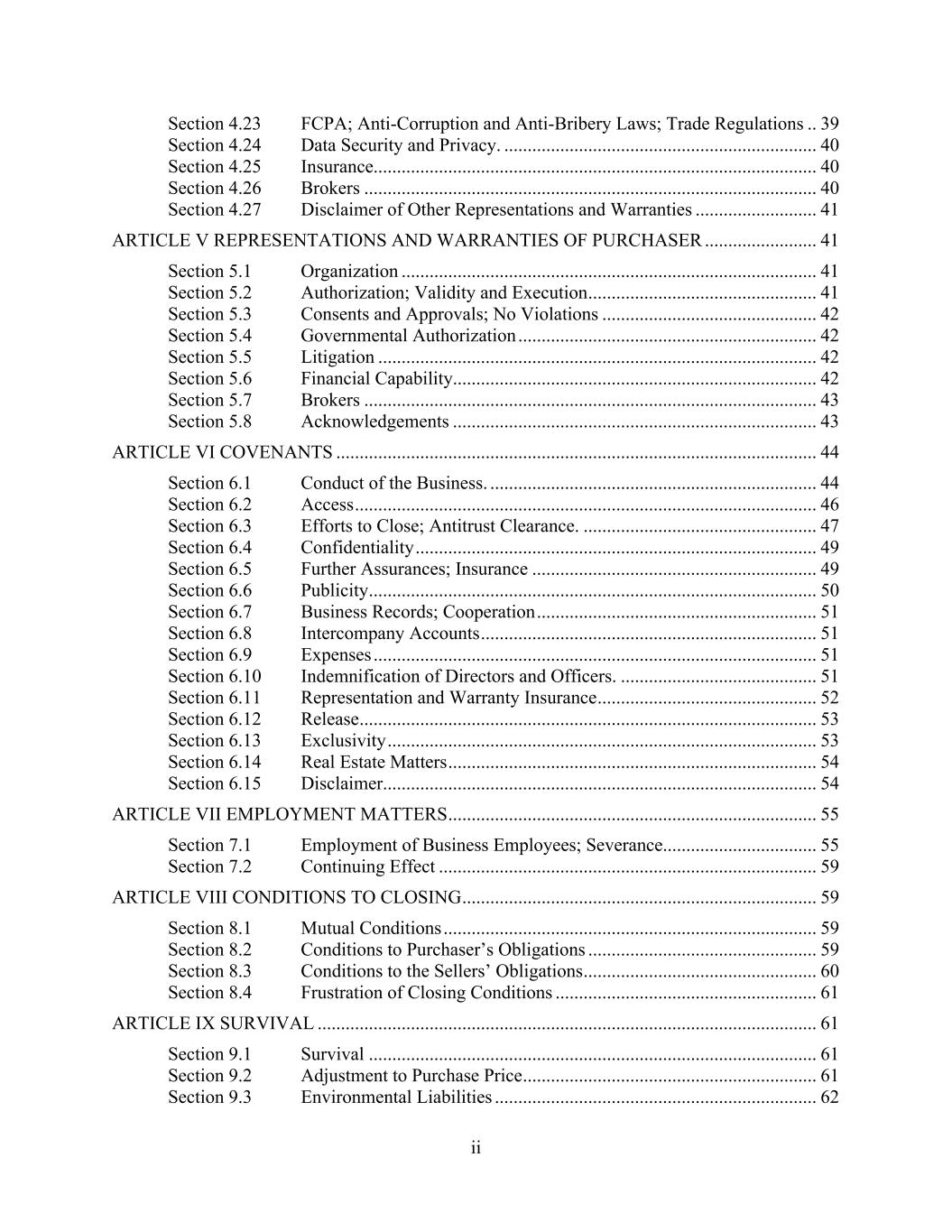
ii Section 4.23 FCPA; Anti-Corruption and Anti-Bribery Laws; Trade Regulations .. 39 Section 4.24 Data Security and Privacy. ................................................................... 40 Section 4.25 Insurance............................................................................................... 40 Section 4.26 Brokers ................................................................................................. 40 Section 4.27 Disclaimer of Other Representations and Warranties .......................... 41 ARTICLE V REPRESENTATIONS AND WARRANTIES OF PURCHASER ........................ 41 Section 5.1 Organization ......................................................................................... 41 Section 5.2 Authorization; Validity and Execution ................................................. 41 Section 5.3 Consents and Approvals; No Violations .............................................. 42 Section 5.4 Governmental Authorization ................................................................ 42 Section 5.5 Litigation .............................................................................................. 42 Section 5.6 Financial Capability.............................................................................. 42 Section 5.7 Brokers ................................................................................................. 43 Section 5.8 Acknowledgements .............................................................................. 43 ARTICLE VI COVENANTS ....................................................................................................... 44 Section 6.1 Conduct of the Business. ...................................................................... 44 Section 6.2 Access ................................................................................................... 46 Section 6.3 Efforts to Close; Antitrust Clearance. .................................................. 47 Section 6.4 Confidentiality ...................................................................................... 49 Section 6.5 Further Assurances; Insurance ............................................................. 49 Section 6.6 Publicity ................................................................................................ 50 Section 6.7 Business Records; Cooperation ............................................................ 51 Section 6.8 Intercompany Accounts ........................................................................ 51 Section 6.9 Expenses ............................................................................................... 51 Section 6.10 Indemnification of Directors and Officers. .......................................... 51 Section 6.11 Representation and Warranty Insurance ............................................... 52 Section 6.12 Release .................................................................................................. 53 Section 6.13 Exclusivity ............................................................................................ 53 Section 6.14 Real Estate Matters ............................................................................... 54 Section 6.15 Disclaimer............................................................................................. 54 ARTICLE VII EMPLOYMENT MATTERS ............................................................................... 55 Section 7.1 Employment of Business Employees; Severance................................. 55 Section 7.2 Continuing Effect ................................................................................. 59 ARTICLE VIII CONDITIONS TO CLOSING ............................................................................ 59 Section 8.1 Mutual Conditions ................................................................................ 59 Section 8.2 Conditions to Purchaser’s Obligations ................................................. 59 Section 8.3 Conditions to the Sellers’ Obligations .................................................. 60 Section 8.4 Frustration of Closing Conditions ........................................................ 61 ARTICLE IX SURVIVAL ........................................................................................................... 61 Section 9.1 Survival ................................................................................................ 61 Section 9.2 Adjustment to Purchase Price ............................................................... 61 Section 9.3 Environmental Liabilities ..................................................................... 62
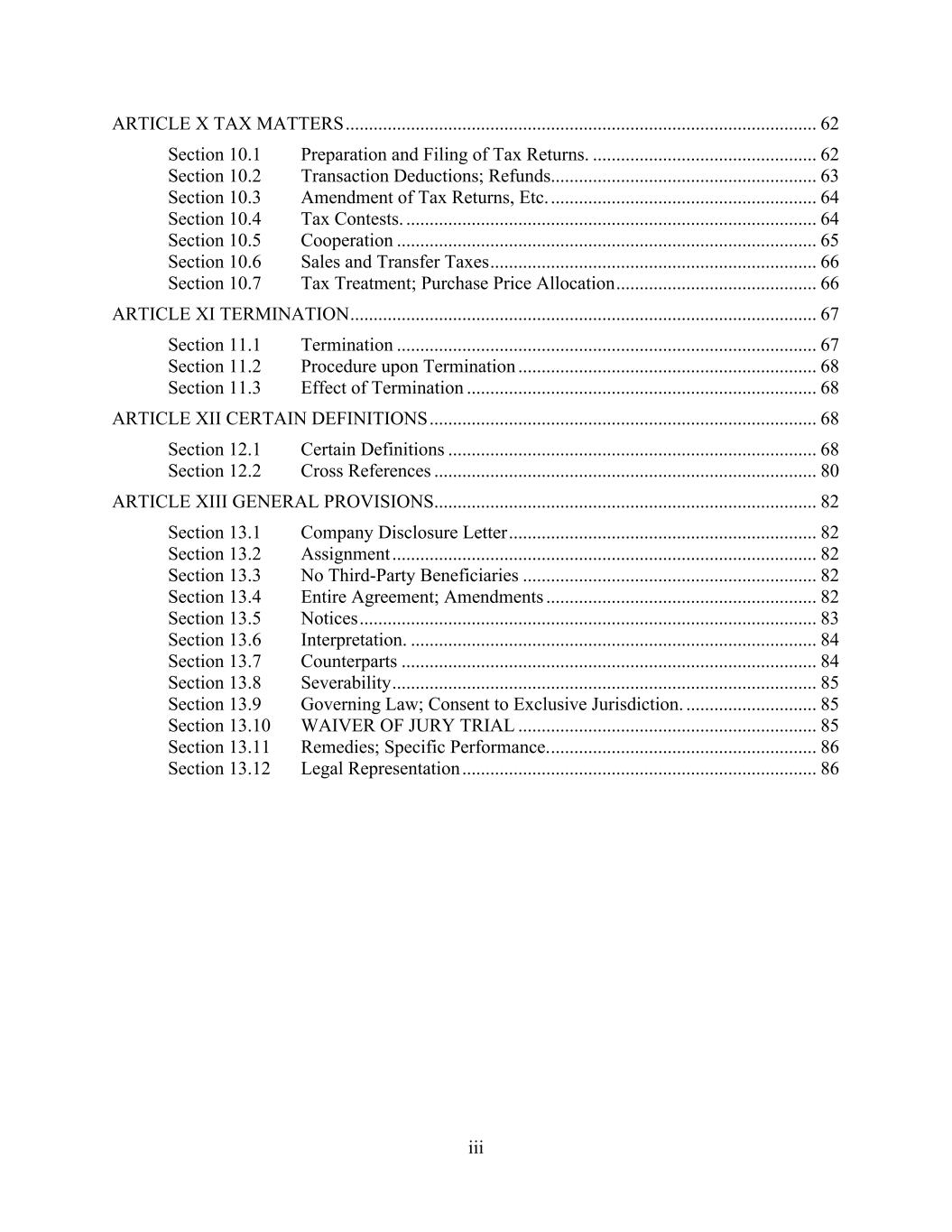
iii ARTICLE X TAX MATTERS ..................................................................................................... 62 Section 10.1 Preparation and Filing of Tax Returns. ................................................ 62 Section 10.2 Transaction Deductions; Refunds......................................................... 63 Section 10.3 Amendment of Tax Returns, Etc. ......................................................... 64 Section 10.4 Tax Contests. ........................................................................................ 64 Section 10.5 Cooperation .......................................................................................... 65 Section 10.6 Sales and Transfer Taxes ...................................................................... 66 Section 10.7 Tax Treatment; Purchase Price Allocation ........................................... 66 ARTICLE XI TERMINATION .................................................................................................... 67 Section 11.1 Termination .......................................................................................... 67 Section 11.2 Procedure upon Termination ................................................................ 68 Section 11.3 Effect of Termination ........................................................................... 68 ARTICLE XII CERTAIN DEFINITIONS ................................................................................... 68 Section 12.1 Certain Definitions ............................................................................... 68 Section 12.2 Cross References .................................................................................. 80 ARTICLE XIII GENERAL PROVISIONS .................................................................................. 82 Section 13.1 Company Disclosure Letter .................................................................. 82 Section 13.2 Assignment ........................................................................................... 82 Section 13.3 No Third-Party Beneficiaries ............................................................... 82 Section 13.4 Entire Agreement; Amendments .......................................................... 82 Section 13.5 Notices .................................................................................................. 83 Section 13.6 Interpretation. ....................................................................................... 84 Section 13.7 Counterparts ......................................................................................... 84 Section 13.8 Severability ........................................................................................... 85 Section 13.9 Governing Law; Consent to Exclusive Jurisdiction. ............................ 85 Section 13.10 WAIVER OF JURY TRIAL ................................................................ 85 Section 13.11 Remedies; Specific Performance. ......................................................... 86 Section 13.12 Legal Representation ............................................................................ 86
iv EXHIBITS Exhibit A Accounting Principles Exhibit B Escrow Agreement Exhibit C Form of Lease Agreements Exhibit D Sample Net Working Capital Calculation Exhibit E Form of Restrictive Covenants Agreement Exhibit F Eagle HQ Lease Agreement Term Sheet Exhibit G Harrisonburg (Beery Rd) Lease Agreement Term Sheet Exhibit H Form of Wayman Employment Agreement Exhibit I Transition Services Agreement Term Sheet

5 EQUITY PURCHASE AGREEMENT This EQUITY PURCHASE AGREEMENT (this “Agreement”), dated as of September 17, 2025 (the “Effective Date”), is by and among Commercial Metals Company, a Delaware corporation (“Purchaser”), Concrete Pipe & Precast, LLC, a Delaware limited liability company (the “Company”), Eagle Corporation, a Virginia corporation (“Eagle”), and ECPP, LLC, a Virginia limited liability company (“ECPP”, and together with Eagle, each a “Seller” and collectively the “Sellers”). Purchaser, the Company and the Sellers are each sometimes referred to herein as a “Party” or collectively as the “Parties”. RECITALS: 1. The Sellers collectively own all of the issued and outstanding Equity Securities of the Company (the “Purchased Equity”). 2. On the terms and subject to the conditions of this Agreement, Purchaser desires to purchase the Purchased Equity from the Sellers, and the Sellers desire to sell the Purchased Equity to Purchaser. Accordingly, the Parties agree as follows: ARTICLE I PURCHASE AND SALE OF PURCHASED EQUITY Section 1.1 Purchase and Sale. On the terms and subject to the conditions of this Agreement, at the Closing, the Sellers will sell, assign, transfer, convey and deliver to Purchaser, and Purchaser will purchase, acquire and accept from the Sellers, all right, title and interest in and to the Purchased Equity, free and clear of all Encumbrances other than those imposed by federal or state securities Laws. Section 1.2 Amount and Form of Purchase Price. The aggregate purchase price to be paid to the Sellers in consideration of the Purchased Equity will be $675,000,000 in cash, plus the Estimated Closing Adjustment (if positive) or minus the absolute value of the Estimated Closing Adjustment (if negative), minus the Escrow Fund (the resulting calculation of the foregoing, the “Closing Payment”), subject to the adjustments set forth in Section 1.4 (the Closing Payment, as so adjusted, the “Purchase Price”). Section 1.3 Estimated Closing Adjustment Statement; Closing Payment. (a) Not later than three Business Days prior to the Closing Date, the Sellers (or their respective Representatives) will deliver to Purchaser a statement (the “Estimated Closing Adjustment Statement”) setting forth its good faith estimates, together with reasonably detailed supporting documentation, of (i) Closing Net Working Capital, Indebtedness, Cash and Transaction Expenses and (ii) the Closing Adjustment based thereon. The estimate of the amount of the Closing Adjustment, as set forth in the Estimated Closing Adjustment Statement, is referred to herein as the “Estimated Closing Adjustment.” The Estimated Closing Adjustment Statement, and the component items thereof, will be prepared in accordance with the Accounting Principles.
6 Following the receipt of the Estimated Closing Adjustment Statement, the Sellers shall promptly permit Purchaser and its representatives to review any working papers of the Sellers or the Company reasonably relating to the preparing of the Estimated Closing Adjustment Statement and the calculations related thereto, as well as the financial books, ledgers and records reasonably related thereto, and the Sellers shall promptly make reasonably available to Purchaser and its representatives the individuals responsible for and knowledgeable about the information used in, and the preparation or calculation of, the Estimated Closing Adjustment Statement. The Sellers shall consider in good faith any potential adjustments to the Estimated Closing Adjustment Statement proposed by Purchaser and make any corresponding changes to the Estimated Closing Adjustment Statement that the Sellers reasonably deem appropriate based on Purchaser’s proposed adjustments. Notwithstanding anything to the contrary in this Agreement, (i) in no event shall the delivery of the Estimated Closing Adjustment Statement contemplated hereby or any comments thereto provided by Purchaser be deemed to constitute the agreement by Purchaser to any of the estimates or the amounts set forth therein or be construed as a waiver by Purchaser of any provisions, rights or privileges hereunder, and (ii) each Seller acknowledges and agrees that to the extent any of the Sellers or the Company take any extraordinary action following the Reference Time but prior to the Closing, which, if taken prior to the Reference Time, would have the effect of modifying the Estimated Closing Adjustment, the effect of such actions may, at Purchaser’s election, be taken into account in calculating the Closing Adjustment. (b) At the Closing, Purchaser will: (i) pay, or cause to be paid, to each Seller, by wire transfer of immediately available funds to the account or accounts designated in writing by the Sellers at least three (3) Business Days prior to the Closing Date, such Seller’s Pro Rata Percentage of the Closing Payment; (ii) deposit, or cause to be deposited, in cash an amount equal to the Escrow Fund with the Escrow Agent to be distributed in accordance with the terms of this Agreement and the Escrow Agreement; (iii) on behalf of the Company, pay, or cause to be paid, to such account or accounts set forth in the Payoff Letters and Releases contemplating payment, the estimated Indebtedness amount set forth in the Estimated Closing Adjustment Statement contemplated to be paid under such Payoff Letters and Releases; (iv) on behalf of the Company, pay the estimated Transaction Expenses set forth in the Estimated Closing Adjustment Statement to the payees thereof (other than Transaction Expenses that are compensatory payments to Company Employees or other service providers of the Company), in accordance with the instructions furnished by the Sellers in writing at least two (2) Business Days prior to the Closing Date; and (v) pay, or cause to be paid, to the Company an aggregate amount equal to all estimated Transaction Expenses that are compensatory payments to Company Employees or other service providers of the Company, in each case, for distribution by the Company to such Company Employees or other service providers through the payroll processing system of the Company (which may be paid on the next regularly scheduled payroll date following the Closing).
7 Section 1.4 Post-Closing Purchase Price Adjustment. (a) Preparation of the Preliminary Statement. Within ninety (90) days after the Closing Date, Purchaser will prepare and deliver to the Sellers a preliminary statement (the “Preliminary Statement”) setting forth in reasonable detail Purchaser’s good faith calculation of (i) Closing Net Working Capital, Indebtedness, Cash and Transaction Expenses and (ii) the Closing Adjustment based thereon. The Preliminary Statement and each component item thereof will be prepared in accordance with the Accounting Principles. The Preliminary Statement, as finally determined pursuant to clauses (b) through (d) of this Section 1.4, is referred to herein as the “Final Statement.” All disputes with respect to the Preliminary Statement and the Final Statement will be resolved in accordance with clauses (b) through (d) of this Section 1.4. (b) Review of Preliminary Statement. (i) The Sellers will have 30 days following Purchaser’s delivery of the Preliminary Statement to the Sellers to review and respond to the Preliminary Statement, during which period Purchaser will grant the Sellers and their respective Representatives reasonable access during normal business hours to Purchaser’s and the Company’s personnel, the Continuing Employees, the books and records of the Company and the work papers prepared by Purchaser’s accountants with respect to the Preliminary Statement, in each case, provided on a confidential basis and only to the extent reasonably necessary to confirm Purchaser’s determinations set forth in the Preliminary Statement. (ii) Unless the Sellers have delivered to Purchaser a written letter of their disagreement with the Preliminary Statement (the “Notice of Disagreement”) prior to the 31st day following Purchaser’s delivery of the Preliminary Statement to the Sellers, the Preliminary Statement will become the Final Statement on the 31st day following Purchaser’s delivery of the Preliminary Statement to the Sellers. If issued, the Notice of Disagreement shall set forth in reasonable detail any proposed adjustment to the Preliminary Statement and the basis for such adjustment. (iii) If the Notice of Disagreement is delivered in accordance with Section 1.4(b)(ii), then (A) any amount set forth in the Preliminary Statement as to which the Sellers have not objected in the Notice of Disagreement in accordance with Section 1.4(b)(ii) will be deemed to be accepted and will become part of the Final Statement, and (B) the Preliminary Statement, as modified to reflect the adjustments in the Notice of Disagreement (x) agreed to in writing by Purchaser (whether pursuant to Section 1.4(c) or otherwise) or (y) finally determined by the Accounting Referee pursuant to Section 1.4(d)(iii) will become the Final Statement on the earlier of (1) the date that the Sellers and Purchaser resolve in writing all remaining disputed matters specified in the Notice of Disagreement or (2) the date that the Accounting Referee delivers to the Sellers and Purchaser a copy of the Final Statement and its calculation of the Closing Adjustment pursuant to Section 1.4(d), as applicable. (c) Meeting to Resolve Proposed Adjustments. As soon as reasonably practicable, but in no event later than 20 days after the Sellers’ delivery of the Notice of Disagreement, Purchaser and the Sellers will work together in good faith to resolve the adjustments in the Notice of Disagreement that have not been accepted in writing at such time by Purchaser.

8 If Purchaser and the Sellers reach agreement in writing on such adjustments, the Final Statement will be the Preliminary Statement modified to reflect the adjustments agreed to pursuant to Section 1.4(b)(iii) and those otherwise agreed to in writing by the Parties pursuant to this Section 1.4(c). (d) Resolution by Accounting Referee. (i) If Purchaser and the Sellers do not resolve to their mutual satisfaction all disputed adjustments in the Notice of Disagreement within the 20-day period after the Sellers’ delivery of the Notice of Disagreement, Purchaser or the Sellers may submit any remaining disputed adjustments that were included in the Notice of Disagreement to be settled by BDO US, LLP (or, if such accounting firm declines to act, by an independent accounting firm mutually acceptable to Purchaser and the Sellers) (or, if Purchaser and the Sellers are unable to agree on an independent accounting firm within 15 days of the expiration of the 20-day period contemplated in this Section 1.4(d)(i), Purchaser and the Sellers will instruct the American Arbitration Association to appoint the Accounting Referee) (the “Accounting Referee”), acting as an expert and not arbitrator, in accordance with the following provisions of this Section 1.4(d). (ii) The Sellers will furnish the Accounting Referee with a copy of this Agreement, the Financial Statements, the Preliminary Statement and the Notice of Disagreement. Purchaser and the Sellers will also give the Accounting Referee: (A) position papers outlining such Party’s respective arguments and supporting documentation for such Party’s position (the “Position Papers”); and (B) reasonable access to the books and records of the Company, including any work papers or other schedules prepared by such Party’s accountants relating to the preparation of the Preliminary Statement and the Notice of Disagreement. (iii) The Accounting Referee’s engagement will be limited to (A) reviewing the Preliminary Statement, Position Papers, and the amounts placed in dispute by the Notice of Disagreement pursuant to Section 1.4(b)(ii) that remain in dispute (the “Unresolved Matters”); (B) determining (1) whether Purchaser’s proposed amount for each individual item in the Preliminary Statement disputed in the Notice of Disagreement or the Sellers’ proposed adjustment thereto in the Notice of Disagreement is calculated more nearly in accordance with the terms of this Agreement (including the Accounting Principles) and (2) whether there were mathematical errors in the Preliminary Statement in calculating the disputed items in the Notice of Disagreement; (C) preparing the Final Statement, which will include those amounts in the Preliminary Statement accepted by the Sellers pursuant to Section 1.4(b)(iii), those adjustments otherwise agreed to in writing by Purchaser and the Sellers pursuant to Section 1.4(c), and those amounts determined by the Accounting Referee for the Unresolved Matters which are to be calculated more nearly in accordance with this Agreement (including the Accounting Principles); and (D) calculating the Closing Adjustment. The fees and expenses of the Accounting Referee will be borne by the Sellers, on the one hand, and Purchaser, on the other hand, in inverse proportion as they may prevail on matters resolved by the Accounting Referee, which proportionate allocations will also be determined by the Accounting Referee at the time the determination of the Accounting Referee is rendered on the Final Statement and the Closing Adjustment. For the avoidance of doubt, the Accounting Referee may not assign a value to any

9 item greater than the greatest value for such item claimed by either Party or less than the smallest value for such item claimed by either Party. Purchaser and Sellers shall cooperate with the Accounting Referee in all reasonable respects. No ex parte conferences, oral examinations, testimony, depositions, discovery or other form of evidence gathering or hearings will be conducted or allowed by or with the Accounting Referee as it is intended for the Sellers and Purchaser to be included in all discussions and correspondence with the Accounting Referee. (iv) The Parties will instruct the Accounting Referee to (A) complete its preparation of the Final Statement and calculation of the Closing Adjustment within 20 days from the date of submission of the Unresolved Matters to the Accounting Referee pursuant to Section 1.4(d)(ii) and (B) deliver promptly thereafter a copy of the Final Statement and its reasonably detailed calculation of the Closing Adjustment to the Sellers and Purchaser, together with a report setting forth each Unresolved Matter and the Accounting Referee’s determination and reasonably detailed calculations with respect thereto. The Accounting Referee’s determination will be conclusive and binding upon the Parties and may be entered and enforced in any court of competent jurisdiction absent manifest error. (e) Payment of Closing Adjustment. If the Closing Adjustment, as finally determined in accordance with this Section 1.4 (the “Final Closing Adjustment”) is: (i) greater than the Estimated Closing Adjustment (such amount, the “Positive Adjustment Amount”), within three (3) Business Days (A) Eagle and Purchaser will execute and deliver a joint written instruction to the Escrow Agent to effectuate disbursement of the Escrow Fund to the Sellers (or their respective designee(s)) in accordance with their Pro Rata Percentages, and (B) Purchaser will pay to each Seller such Seller’s Pro Rata Percentage of the Positive Adjustment Amount by wire transfer of immediately available funds pursuant to instructions provided in writing by the Sellers; or (ii) less than the Estimated Closing Adjustment (such amount, the “Negative Adjustment Amount”), within three (3) Business Days (A) Eagle and Purchaser will execute and deliver a joint written instruction to the Escrow Agent to effectuate disbursement of an amount equal to the Negative Adjustment Amount to Purchaser, and (B) (1) to the extent the Negative Adjustment Amount is less than the amount of the Escrow Fund, then Eagle and Purchaser will execute and deliver a joint written instruction to the Escrow Agent to effectuate disbursement of the difference between the amount of the Escrow Fund and the Negative Adjustment Amount to the Sellers (or their respective designee(s)) in accordance with their Pro Rata Percentages, or (2) to the extent the Negative Adjustment Amount is greater than the amount of the Escrow Fund, the Sellers will pay (and such obligation to pay shall be joint and several) to Purchaser the difference between the Negative Adjustment Amount and the amount of the Escrow Fund by wire transfer of immediately available funds pursuant to instructions provided in writing by Purchaser. Section 1.5 Withholding. Purchaser will be entitled to deduct and withhold from the consideration otherwise payable to any Person pursuant to this Agreement such amounts as may be required under applicable Law to be deducted and withheld with respect to Taxes. To the extent that amounts are so withheld and paid over to the appropriate Governmental Authority, such withheld amounts will be treated for all purposes of this Agreement as having been paid to the
10 Person in respect of whom such deduction and withholding was made. Except with respect to any deduction or withholding required as a result of failure to comply with Section 2.2(a)(xvii) or withholding relating to compensatory payments made pursuant to this Agreement, Purchaser shall provide Sellers with written notice of intent to withhold at least five (5) Business Days before deducting or withholding any amount pursuant to this Section 1.5. ARTICLE II CLOSING Section 2.1 Closing Date. The closing of the Transactions (the “Closing”) will take place remotely via the electronic exchange of documents and signatures contemplated herein at 8:00 am (U.S. Eastern Time) on the second Business Day following the date on which the last to be satisfied or waived of the conditions set forth in Article VIII (other than those conditions that by their nature are to be satisfied at the Closing, but subject to the fulfillment or waiver of those conditions) shall be satisfied or waived in accordance with this Agreement, or at such other time and place as the Sellers and Purchaser mutually agree in writing; provided, that in no event shall the Closing take place before December 1, 2025 without the prior written consent of Purchaser. The date on which the Closing occurs is referred to herein as the “Closing Date.” All proceedings to be taken and all documents to be executed and delivered by all Parties at the Closing will be deemed to have been taken and executed simultaneously, and no proceedings will be deemed to have been taken nor documents executed or delivered until all have been taken, executed and delivered. Notwithstanding anything to the contrary in this Agreement, the Closing will be deemed to have occurred as of 12:01 a.m. (U.S. Eastern Time) on the Closing Date (the “Reference Time”), solely for purposes of calculating the Closing Adjustment and the component items thereof. Section 2.2 Closing Deliveries. (a) By the Sellers and the Company. At or prior to the Closing, the Sellers and the Company will deliver, or cause to be delivered, to Purchaser: (i) such assignments, deeds and other instruments of conveyance as the Parties and their respective counsel deem reasonably necessary to vest in Purchaser all of the right, title and interest of the Sellers in and to the Purchased Equity (in such form as the Parties, acting reasonably and in good faith, agree, it being understood that no such instrument of assignment will require either Seller or any of their respective Affiliates to make any additional representations, warranties or covenants, expressed or implied, not contained in this Agreement); (ii) evidence reasonably satisfactory to Purchaser that (A) the option to purchase the real property located at 3800 Oxford Loop Road, Oxford, North Carolina (the “Option Property”) has been assigned by the Company to ECPP, (B) ECPP has exercised the option to purchase the Option Property, and (C) ECPP has closed on the acquisition of and is the sole fee owner of the Option Property; (iii) terminations of all Leases with ECPP or an Affiliate of the Company or the Sellers as landlord or lessor in form and substance reasonably acceptable to Purchaser, which
11 provide that for a full release of the Company from and all liability of the Company relating to or arising out of such Leases (collectively, the “Affiliate Lease Terminations”); (iv) the Lease Agreements, duly executed by ECPP; (v) a lease agreement reflecting the terms attached hereto as Exhibit F (the “Eagle HQ Lease Agreement”), duly executed by Eagle Real Estate, LLC; (vi) a lease agreement reflecting the terms attached hereto as Exhibit G (the “Harrisonburg (Beery Rd) Lease Agreement”), duly executed by Eagle Real Estate, LLC; (vii) resignations, in form and substance reasonably satisfactory to Purchaser, duly executed by each of the officers and managers of the Company, except as requested otherwise by Purchaser in writing prior to the Closing Date; (viii) the certificate contemplated by Section 8.2(c); (ix) (a) a certificate of an authorized officer of the Company, dated as of the Closing Date, in form and substance reasonably satisfactory to Purchaser, as to (i) the Company’s Organizational Documents, (ii) the resolutions of the board of managers of the Company authorizing the execution and performance of this Agreement and the Ancillary Agreements to which the Company is a party and the transactions contemplated hereby and thereby, and (iii) incumbency and signatures of the officers of the Company executing this Agreement and any Ancillary Agreement; and (b) a copy of the resolutions of the board of managers or directors (as applicable) of each Seller authorizing the execution and performance of this Agreement and the Ancillary Agreements to which each such Seller is a party and the transactions contemplated hereby and thereby; (x) executed terminations and releases of the Company of each Affiliate Arrangement (other than those set forth on Section 2.2(a)(x) of the Company Disclosure Letter), or other evidence of termination, in each case in form and substance reasonably satisfactory to Purchaser; (xi) evidence reasonably satisfactory to Purchaser that the consents set forth on Section 2.2(a)(xi) of the Company Disclosure Letter have been obtained in writing; (xii) Payoff Letters and Releases executed by the parties thereto, including the Payoff Letters and Releases with respect to the BoA Credit Agreement (as defined in the Company Disclosure Letter) and the Encumbrances in favor of Wells Fargo Bank, NA (including those described on Section 4.12 of the Company Disclosure Letter); (xiii) the employment agreement in the form attached hereto as Exhibit H, duly executed by Matthew Wayman and the Company (the “Wayman Employment Agreement”); (xiv) a transition services agreement reflecting the terms attached hereto as Exhibit I (the “Transition Services Agreement”), duly executed by each Seller and the Company;
12 (xv) the Restrictive Covenants Agreements, duly executed by the Sellers and each Person set forth on set forth on Section 2.2(a)(xv) of the Company Disclosure Letter; (xvi) the Escrow Agreement, duly executed by Eagle; (xvii) a validly executed IRS Form W-9 from each Seller (or, if such Seller is disregarded for U.S. federal income Tax purposes, its regarded owner); (xviii) evidence reasonably satisfactory to Purchaser that the Assets and Contracts set forth on Section 2.2(a)(xviii) of the Company Disclosure Letter have been transferred and assigned to the Company (the “Transferred Assets”); and (xix) such other closing documents and instruments as are expressly required by this Agreement. (b) By Purchaser. At the Closing, Purchaser will deliver to the Sellers: (i) the Closing Payment; (ii) the Lease Agreements, duly executed by the Company; (iii) the Eagle HQ Lease Agreement, duly executed by the Company; (iv) the Harrisonburg (Beery Rd) Lease Agreement, duly executed by the Company; (v) the certificate contemplated by Section 8.3(c) hereof; (vi) a certificate from an officer of Purchaser certifying the Purchaser’s board of directors has authorized the execution and performance of this Agreement and the Ancillary Agreements to which Purchaser is a party and the transactions contemplated hereby and thereby; (vii) the Transition Services Agreement, duly executed by the Purchaser, in its capacity as the owner of the Company following the Closing; (viii) the Restrictive Covenants Agreements, each duly executed by Purchaser; (ix) the Escrow Agreement, duly executed by Purchaser; (x) a true, complete and correct copy of the R&W Insurance Policy; and (xi) such other closing documents and instruments as are expressly required by this Agreement.

13 ARTICLE III REPRESENTATIONS AND WARRANTIES OF THE SELLERS Except as set forth in the applicable Section or subsection of the Company Disclosure Letter (interpreted as contemplated by Article XIII), each Seller represents and warrants to Purchaser, on behalf of itself only and not on behalf of the other Seller, as follows: Section 3.1 Authorization, Validity and Execution. Such Seller is duly formed, validly existing and in good standing under the Laws of the jurisdiction in which it is organized. The execution, delivery and performance of such Seller of this Agreement, each Ancillary Agreement, and each other agreement, document, instrument or certificate contemplated by this Agreement to which such Seller is (or will be) a party (collectively, the “Seller Documents”) and the consummation of the Transactions by such Seller are within the corporate or equivalent organizational power and authority of such Seller and have been duly authorized and approved by all necessary action on the part of such Seller. The Seller Documents (i) have been (or, in the case of Seller Documents to be entered into at or prior to the Closing, will be) duly executed and delivered by such Seller and (ii) assuming due authorization, execution and delivery by the other parties hereto and thereto, is (or, in the case of Seller Documents to be entered into at or prior to the Closing, will be) a legal, valid and binding obligation of such Seller, enforceable against such Seller in accordance with its terms, subject to applicable bankruptcy, insolvency, reorganization, moratorium, receivership and similar Laws affecting the enforcement of creditors’ rights generally and to general equitable principles (the “Bankruptcy and Equity Exception”). Section 3.2 Consents and Approvals; No Violations. Except as set forth on Section 3.2 of the Company Disclosure Letter, none of the execution, delivery and performance by such Seller of the Seller Documents, the consummation by such Seller of the Transactions, or compliance by such Seller with the provisions of the Seller Documents will (a) violate, conflict with or result in the breach of the Organizational Documents of such Seller; (b) assuming compliance with the matters referred to in Section 3.3, violate any Law of any Governmental Authority by which such Seller is subject or by which any of such Seller’s properties or Assets are subject or (c) conflict with, result in any breach of, constitute a default (or event which with the giving of notice or lapse of time, or both, would become a default) under, require any consent or notice under, give to others any rights of amendment, termination, acceleration or cancellation of, result in the institution of any material obligation or loss of a material benefit under, or result in the creation of any Encumbrance upon any property or Assets of such Seller pursuant to, any Contract (other than an Employee Benefit Plan) or Permit to which such Seller is a party or by which any of the properties or Assets of such Seller are bound, except, with respect to clause (b), as would not, or would not reasonably be expected to, individually or the aggregate, (i) be materially adverse to the Company, (ii) prevent or materially delay the consummation of the Transactions or (iii) materially impair such Seller’s ability to perform their obligations under the Seller Documents. Section 3.3 Governmental Authorization. The execution, delivery and performance by such Seller of the Seller Documents and the consummation of the Transactions require no declaration, order, permit, filing or registration with, or notice to, or authorization, consent or approval of, any Governmental Authority, other than (a) compliance with any applicable

14 requirements of Antitrust Laws, and (b) any such action or filing the failure of which to be made or obtained would not reasonably be expected to, individually or the aggregate, (i) be materially adverse to the Company, (ii) prevent or materially delay the consummation of the Transactions or (iii) materially impair such Seller’s ability to perform its obligations under the Seller Documents. Section 3.4 Ownership of the Purchased Equity. Such Seller is the sole and direct owner, beneficially and of record, and has good, valid and marketable title to the portion of the Purchased Equity listed across from such Seller’s name on Section 3.4 of the Company Disclosure Letter (which constitute all of the Purchased Equity), free and clear of any and all Encumbrances and transfer restrictions imposed thereon by Law. Such Seller has the power, authority and legal capacity to sell, transfer, assign and deliver the portion of the Purchased Equity owned by such Seller as provided in the Seller Documents, and subject to the effect of any unilateral action taken by Purchaser, such delivery will convey to Purchaser good, valid and marketable title to the Purchased Equity, free and clear of any and all Encumbrances, other than transfer restrictions imposed thereon by Law. Except as set forth on Section 3.4 of the Company Disclosure Letter, such Seller is not a party to any voting trust, proxy, or other agreement or understanding between or among any Persons that affects or relates to the voting or giving of written consent with respect to the Purchased Equity. Except as set forth on Section 3.4 of the Company Disclosure Letter, there are no preemptive rights, co-sale rights, rights of first refusal, management equity holder transfer restrictions, or similar rights with respect to the Purchased Equity to which such Seller may be entitled, or that such Seller has granted to any other Person, in relation to the sale and purchase of the Purchased Equity hereunder. Section 3.5 Brokers. Except as set forth on Section 3.5 of the Company Disclosure Letter, no broker, finder, financial advisor or investment banker is entitled to any brokerage, finder’s or other fee or commission or like payment in connection with the Transactions based upon arrangements made by or on behalf of such Seller. Section 3.6 Litigation. Except as set forth on Section 3.6 of the Company Disclosure Letter, there is no Action pending or, to the Knowledge of such Seller, threatened against such Seller or to which such Seller is otherwise a party relating to this Agreement, the Seller Documents or the Transactions contemplated hereby or thereby. Such Seller is not subject to any outstanding Order pending or, to the Knowledge of Sellers, threatened, that affects or would reasonably be expected to affect such Seller’s ownership of the Purchased Equity or such Seller’s right or ability to perform its obligations under this Agreement or the Seller Documents. Section 3.7 Disclaimer of Other Representations and Warranties. Except for the representations and warranties expressly set forth in this Article III and Article IV (as modified by the Company Disclosure Letter) or in any Seller Document or Company Document, neither such Seller nor any other Person has made, makes or will be deemed to make any other representation or warranty of any kind whatsoever (express or implied, written or oral, at Law or in equity) on behalf of such Seller or any of its respective Affiliates regarding the Company, the Business, the Purchased Equity or the Transactions, and such Seller hereby disclaims all other representations and warranties of any kind whatsoever, express or implied, written or oral, at Law or in equity. Except for the representations and warranties expressly set forth in this Article III and Article IV (as modified by the Company Disclosure Letter) or in any Seller Document or Company Document, such Seller hereby disclaims all Liability and responsibility for all projections,
15 forecasts, estimates, financial statements, financial information, appraisals, statements, promises, advice, data or information made, communicated or furnished (orally or in writing, including electronically) to Purchaser or any of Purchaser’s Affiliates or any Representatives of Purchaser or any of its Affiliates, including omissions therefrom. Without limiting the foregoing, such Seller makes no representation or warranty of any kind whatsoever, express or implied, written or oral, at Law or in equity, to Purchaser or any of its Affiliates or any Representatives of Purchaser or any of its Affiliates regarding the success, profitability or value of the Company, the Purchased Equity or the Business. The foregoing language in this Section 3.7 is not intended to impair any claims of Actual Fraud against the Sellers or their Affiliates hereunder. ARTICLE IV REPRESENTATIONS AND WARRANTIES OF THE COMPANY Except as set forth in the applicable Section or subsection of the Company Disclosure Letter (interpreted as contemplated by Article XIII), the Company and the Sellers represent and warrant to Purchaser as follows: Section 4.1 Organization, Existence and Good Standing. The Company is a limited liability company duly formed, validly existing and in good standing under the Laws of the State of Delaware, and has all limited liability company power and authority necessary to own, lease and operate its Assets and to carry on its business in all material respects as now conducted and as currently proposed to be conducted. The Company is duly qualified to do business (where such concept is applicable) in each jurisdiction where the nature of its business or the ownership of its Assets makes such qualification necessary, except where the failure to be so duly qualified would not reasonably be expected to, individually or in the aggregate, adversely impact the Business as presently conducted in any material respect, with each such jurisdiction set forth on Section 4.1 of the Company Disclosure Letter. The Company has delivered or Made Available to Purchaser accurate and complete copies of the Organizational Documents of the Company, in each case, as amended through the date of this Agreement. There has not been any violation in any material respect of the provisions in the Organizational Documents of the Company, and the Company has not taken any action that is inconsistent in any material respect with any resolution adopted by the governing body of the Company. Section 4.2 Authorization, Validity and Execution. The execution, delivery and performance by the Company of this Agreement, each Ancillary Agreement, and each other agreement, document, instrument or certificate contemplated by this Agreement to which the Company is (or will be) a party (the “Company Documents”) and the consummation of the Transactions by the Company are within the limited liability company power and authority of the Company and have been duly authorized and approved by all necessary action on the part of the Company. The Company Documents (a) have been (or, in the case of Company Documents to be entered into at or prior to the Closing, will be) duly executed and delivered by the Company and (b) assuming due authorization, execution and delivery by the other parties hereto and thereto, is (or, in the case of Company Documents to be entered into at or prior to the Closing, will be) a legal, valid and binding obligation of the Company, enforceable against the Company in accordance with its terms, subject to the Bankruptcy and Equity Exception.
16 Section 4.3 Consents and Approvals; No Violations. Except as set forth on Section 4.3 of the Company Disclosure Letter, none of the execution, delivery and performance by the Company of the Company Documents, the consummation of the Transactions, or compliance by the Company or the Sellers with the provisions of the Company Documents or Seller Documents, as applicable, will (a) violate, conflict with or result in the breach of the Organizational Documents of the Company; (b) assuming compliance with the matters referred to in Section 4.3, violate any Law of any Governmental Authority or Order by which the Company is subject or by which any of the Company’s properties or Assets are subject or (c) conflict with, result in any breach of, constitute a default (or event which with the giving of notice or lapse of time, or both, would become a default) under, require any consent or notice under, give to others any rights of amendment, termination, acceleration or cancellation of, result in the institution of any material obligation or loss of a material benefit under, or result in the creation of any Encumbrance upon any property or Assets of the Company or the Purchased Equity pursuant to, any Contract (other than an Employee Benefit Plan) or Permit to which the Company is a party or by which any of the properties or Assets of the Company are bound, except, in the case of clause (b), as would not and would not reasonably be expected to, individually or in the aggregate, (i) adversely impact the Business as presently conducted in any material respect, or (ii) prevent or materially impair or delay (A) the Company’s ability to consummate the Transactions contemplated by this Agreement or any of the Company Documents or (B) the Company’s performance of its obligations hereunder or thereunder. Section 4.4 Governmental Authorization. Except as set forth on Section 4.4 of the Company Disclosure Letter, the execution, delivery and performance by the Company of the Company Documents, the consummation of the Transactions, or compliance by the Company or the Sellers with the provisions of the Company Documents or the Seller Documents require no declaration, order, permit, filing or registration with, or notice to, or authorization, consent or approval of, any Governmental Authority, other than (a) compliance with any applicable requirements of Antitrust Laws, and (b) any such action or filing the failure of which to be made or obtained would not reasonably be expected to (i) be materially adverse to the Company, (ii) prevent or materially delay the consummation of the Transactions, (iii) materially impair the Company’s ability to perform its obligations under the Company Documents, or (iv) affect, in any material respect, the continuing validity and effectiveness immediately following the Closing of any Contract or Permit of the Company or with respect to which any of its Assets or properties are bound. Section 4.5 Capitalization. Section 4.5 of the Company Disclosure Letter sets forth, a true and correct list of the record and beneficial holders of all of the Equity Securities of the Company, including the number of Equity Securities held thereby. The Equity Securities are owned beneficially and of record by the holders set forth on Section 4.5 of the Company Disclosure Letter free and clear of all Encumbrances other than (1) transfer restrictions under applicable Law and (2) as set forth on Section 4.5 of the Company Disclosure Letter. All of the issued and outstanding Equity Securities of the Company have been duly authorized and validly issued and are fully paid and nonassessable, are not subject to any preemptive or subscription rights (other than those included in the Organizational Documents of the Company) and were not issued in violation of any preemptive or subscription rights. There are no existing options, warrants, calls, subscriptions or other rights, convertible securities, trusts or Contracts of any character (x) obligating the Company to issue, transfer or sell any Equity Securities of the Company or securities
17 convertible into or exchangeable for Equity Securities of the Company, (y) requiring the Company to repurchase, redeem or otherwise acquire any Equity Securities of the Company, or (z) with respect to the voting of the Equity Securities of the Company. The Company does not have, and has never had, any Subsidiaries, and except as set forth on Section 4.5 of the Company Disclosure Letter, the Company does not hold or beneficially own, directly or indirectly, any equity interests in any Person or any subscriptions, options, warrants, rights, calls, convertible securities or other agreements or commitments for any interest in any Person. There are no declared but unpaid, or outstanding obligations of the Company with respect to, dividends or distributions of the Company. There are no equity interests of the Company other than the Purchased Equity, and the Company and the Sellers have not promised to issue any Equity Securities of the Company to any Person. Section 4.6 Financial Statements; Absence of Undisclosed Liabilities. (a) Attached to Section 4.6(a)(i) of the Company Disclosure Letter are the true, correct and complete copies of the (i) audited consolidated financial statements of Eagle, its Subsidiaries (including the Company) and ECPP as of, and for the periods ended, as applicable, December 31, 2024, December 31, 2023, and December 31, 2022, and (ii) the unaudited balance sheet of the Business (the “Balance Sheet”) as of July 31, 2025 (the “Balance Sheet Date”), and the unaudited statement of income and statement of cash flow of the Business for the seven-month period then ended (the “Interim Financial Statements”), and the financial statements described in the preceding clauses (i) and (ii) being referred to as the “Financial Statements”). The Financial Statements have been prepared in accordance with GAAP, consistently applied throughout the periods presented, and fairly present in all material respects, the financial position, results of operations and cash flows of the Company as of the respective dates or for the respective time periods set forth therein, except in the case of the unaudited Financial Statements, (A) for the absence of footnotes and (B) for normal and recurring year-end adjustments, provided such adjustments are not, individually or in the aggregate, material to the Company taken as a whole. The Company maintains a system of internal controls over financial reporting that is intended to provide reasonable assurance (x) that transactions are recorded as necessary to permit preparation of financial statements in accordance with GAAP, (y) regarding prevention or timely detection of the unauthorized acquisition, use, or disposition of the Company’s Assets, and (z) that all off- balance sheet arrangements (each of which are set forth on Section 4.6(a)(ii) of the Company Disclosure Letter) are properly identified and quantified. (b) The Company does not have any Liabilities that would be required to be reflected or reserved against in a balance sheet prepared in accordance with GAAP except for Liabilities (i) as set forth in the Balance Sheet, (ii) incurred in the Ordinary Course of Business since the Balance Sheet Date, (iii) incurred since the Balance Sheet Date pursuant to or in connection with this Agreement or the Transactions, (iv) disclosed in this Agreement (or the Company Disclosure Letter) or (v) that would not reasonably be expected to be, individually or in the aggregate, material to the Business, taken as a whole (none of which is a Liability for breach of Contract, breach of warranty, tort, infringement or violation of Law); provided, however, that for purposes of determining which capital lease obligations of the Company shall be included in Indebtedness, such determination shall be made without giving effect to ASC 842 and shall be consistent with the capital lease obligations historically capitalized by the Company in the Financial Statements.
18 Section 4.7 Absence of Certain Changes or Events. Except as expressly contemplated by this Agreement or as set forth on Section 4.7 of the Company Disclosure Letter, during the period from the Balance Sheet Date to the Effective Date, (i) the Company has conducted its business in the Ordinary Course of Business in all material respects and in compliance with applicable Law, (ii) there has not been any Event which has had or would reasonably be expected to have, individually or in the aggregate, a Material Adverse Effect, (iii) the Company has not suffered any material loss, damage, destruction or other casualty affecting any of its material properties, rights or Assets, whether or not covered by insurance, and (iv) the Company has not taken any action that would, after the date hereof, be prohibited by Section 6.1(b). Section 4.8 Real Property. (a) Owned Real Property. The Company does not own any real property or interests in real property. (b) Leased Real Property. Section 4.8(b) of the Company Disclosure Letter sets forth a complete and accurate list of all leasehold, or subleasehold, licensed or sublicensed estates and other rights to use, operate or occupy any land, buildings, structures, improvements, fixtures or other interest in real property which is used or intended to be used in the Business (collectively, and including the Seller Owned Real Property and all other real property used or intended to be used in the Business, the “Leased Real Property”), and of all leases, licenses, occupancy agreements, access agreements, lease guaranties, agreements and documents, and all amendments, modifications and addenda thereto, in each case pursuant to which the Company leases, licenses, occupies or otherwise has the right to use any Leased Real Property (collectively, the “Leases”), including a description of each Lease, the name of the third party or Affiliate lessor or lessee (licensee, licensor, grantee or grantor, as applicable), the address of each Leased Real Property, and the date of each such Lease and all amendments, modifications and addenda thereto. Except as set forth on Section 4.8(b) of the Company Disclosure Letter, the Company has Made Available to Purchaser true, complete and correct copies of each of the Leases that are memorialized in writing and has described each oral Lease on Section 4.8(b) of the Company Disclosure Letter, together with the following to the extent in existence and in the Company’s possession: all extension notices, estoppel certificates, and subordination, non-disturbance and attornment agreements related thereto. The Company has a valid, binding, enforceable and existing leasehold interest in all of the Leased Real Property, free and clear of all Encumbrances (except for Permitted Encumbrances). Except as set forth on Section 4.8(b) of the Company Disclosure Letter, the Company has not subleased, sublicensed or otherwise granted to any other third party the right to use or occupy any part of the Leased Real Property. The Company has not pledged, assigned, mortgaged or otherwise encumbered any of the Leases or the leasehold estates, rights or interests created by such Leases. The current annual rent and term under each Lease are as set forth on Section 4.8(b) of the Company Disclosure Letter. The Company has not waived any rights under any Lease that would be in effect on or after the date of this Agreement and that would be adverse to the Company. The Company has accepted full possession of each Leased Real Property and is currently occupying and using same pursuant to and in accordance with the express terms of the applicable Lease. Section 4.8(b) of the Company Disclosure Letter separately identifies all Leases with respect to which the landlord or lessor thereunder is an Affiliate of the Company. With respect to each Lease:
19 (i) such Lease is a legal, valid and binding obligation of the Company, and, to the Knowledge of the Company, each other party thereto, enforceable in accordance with its terms, subject to the Bankruptcy and Equity Exception; (ii) the Company is not in default or material breach of, and has not received any written or, to the Knowledge of the Company, other notice of default or event that, with the notice or lapse of time, or both would constitute a default by such Person or permit the termination, modification or acceleration of rent under any Lease. To the Knowledge of the Company, no other party to a Lease is in default or material breach of such Lease; (iii) no security deposit or portion thereof deposited with respect to any Lease has been applied in respect of a breach or default under any Lease which has not been re- deposited in full; (iv) no party to any Lease has exercised any termination rights with respect thereto, and no such party has given written (or, to the Knowledge of the Sellers and/or the Company, oral) notice of any outstanding dispute with respect to a Lease; and (v) all “landlord work,” all “tenant work” and any corresponding credits (or credits in lieu thereof) contemplated or required under all Leases have been completed (or credited, as applicable) in accordance with the applicable Lease and accepted by the Company, and no capital improvements are required to be made to any Leased Real Property pursuant to the terms of any Lease. (c) Other than with respect to the Seller Owned Real Property, to the Knowledge of the Company, there are no condemnation or eminent domain proceedings (or any consensual agreement in lieu thereof) or any other proceedings (including, without limitation, any rezoning or permitting application or proceeding) affecting the Leased Real Property pending or threatened or contemplated. With respect to the Seller Owned Real Property, there are no condemnation or eminent domain proceedings (or any consensual agreement in lieu thereof) or any other proceedings (including, without limitation, any rezoning or permitting application or proceeding) affecting the Leased Real Property or, to the Knowledge of the Company, pending or threatened or contemplated. (d) The Leased Real Property constitutes all interests in real property (i) currently used, occupied or held for use in connection with the Business as currently conducted, and (ii) necessary for the continued operation of the Business as currently conducted and as proposed to be conducted. The Company does not own or hold, nor is the Company obligated under nor a party to, any option, right of first refusal or other contractual (or other) right or obligation to purchase, sell, assign or dispose of any real property or any portion thereof or interest therein, except as set forth on Section 4.8(d) of the Company Disclosure Letter. (e) The Leased Real Property is (i) in good operating condition and repair, subject to ordinary wear and tear (consistent with the age of such Leased Real Property), (ii) not in need of maintenance or repair except for ordinary routine maintenance and repair, (iii) is structurally sound with no known material defects and in conformity with all applicable Laws relating thereto currently in effect, (iv) in compliance with the requirements of the applicable

20 Lease, and (v) in compliance with all applicable Laws including, without limitation, fire, health, building, use, occupancy and zoning Laws. The Company has not received any notice from any Governmental Authority that the Leased Real Property (or any portion thereof) is not in compliance with applicable Laws including, without limitation, fire, health, building, use, occupancy and zoning Laws. (f) Except as set forth on Section 4.8(f) of the Company Disclosure Letter, the Company has (i) all certificates of occupancy and/or use and Permits of any Governmental Authority necessary or useful for the current use and operation of the Leased Real Property, and (ii) fully complied with all conditions of such Permits applicable to it. The Company has not received written, or to the Knowledge of the Company, other notice of any outstanding violation, default or notice of cancellation or termination of any such Permit. (g) The Company has not received any notice from any insurance company that has issued a policy with respect to any Leased Real Property, oral or written, requiring performance of any structural or other repairs or alterations to such Leased Real Property that have not been completed. (h) No work has been done at the Leased Real Property by, through, or under Sellers or their Affiliates, and no materials have been supplied to the Leased Real Property, that have not been paid for, and there are no materialman’s liens or mechanic’s liens affecting the Leased Real Property. (i) The existing water, sewer, gas and electricity lines, storm sewer and other utility systems at the Leased Real Property are adequate to serve the utility needs of the Leased Real Property and Business currently conducted thereon, and all approvals, licenses and permits required for said utilities have been obtained and are in full force and effect. (j) All buildings, structures and other improvements and fixtures located on the Leased Real Property are (i) structurally sound with no known material defects, (ii) in good operating condition and repair, subject to ordinary wear and tear (consistent with the age of such items), (iii) not in need of maintenance or repair except for ordinary routine maintenance and repair, (iv) in conformity in all material respects with all applicable Laws and, to the extent applicable, the applicable Lease, in each case, relating thereto currently in effect, and (v) suitable and sufficient for their current and contemplated uses. There are no outstanding warranty claims with respect to any such buildings, structures, improvements or fixtures. (k) The Company and each parcel of Leased Real Property are in compliance, in all material respects, with all declarations of covenants, conditions or restrictions, restrictive covenants and easement agreements, in each case, affecting any Leased Real Property. The Company has not received any written, or to the Knowledge of the Company, other notice or claim from any counterparty or beneficiary of any easement, covenant, condition, restriction or similar provision in any instrument of record or unrecorded agreement affecting the Leased Real Property alleging that (i) the Company or any parcel of Leased Real Property are not in compliance with all declarations of covenants, conditions or restrictions, restrictive covenants and easement agreements, in each case, affecting any Leased Real Property, or (ii) the current use and occupancy of the Leased Real Property or the operation of the Business as currently conducted thereon

21 violates in any material respect any such easement, covenant, condition, restriction or similar provisions. (l) No buildings, structures and other improvements and fixtures located on the Leased Real Property constitute a legal non-conforming use or otherwise require any special dispensation, variance or permit under any applicable Law. Each parcel of Leased Real Property is properly zoned for its present use under applicable zoning ordinances, and there are no pending or threatened actions or proceedings that could result in a modification or termination of such zoning. (m) Other than ordinary course reassessments not triggered by the conveyance of the applicable Leased Real Property, the Company has not received any written or, to the Knowledge of the Company, other notice of any increase in the current assessed valuation of any Leased Real Property or any notice of any planned or contemplated special assessments that would be the Company’s obligation to pay under any Lease or other document affecting any Leased Real Property, or any written, or to the Knowledge of the Company, other notice of any planned changes to zoning Laws applicable to any Leased Real Property. (n) The Company is not a party to any lease brokerage, commission or finder’s agreement, and there are no outstanding and unpaid broker fees, commissions or similar obligations payable in connection with any Leased Real Property. Section 4.9 Seller Owned Real Property. (a) Section 4.9(a) of the Company Disclosure Letter sets forth a complete and accurate list of all real property currently owned by the Sellers (or an Affiliate thereof) that are currently leased to the Company, and all real property that will be leased to the Company pursuant to the Lease Agreements or other separate lease, including, without limitation, all buildings, structures, improvements and fixtures located thereon, together with all rights and interests appurtenant thereto (collectively, the “Seller Owned Real Property”), including the address and a description of each Seller Owned Real Property. To the extent the same are in the Sellers’ possession or control, Sellers have delivered to Purchaser complete and correct copies of all title policies and commitments (where no policy was issued) naming the applicable Seller (or Affiliate thereof, including the Company with respect to the properties included in the Pre-Closing Real Estate Transfers) as the insured party, documents evidencing the exceptions to title shown thereon, and surveys for the Seller Owned Real Property. The Sellers (or applicable Affiliate thereof) has good, exclusive, marketable and valid, fee simple title in and to, and is in peaceable possession of, and has the right to use and sell, transfer, convey, lease or assign, the Seller Owned Real Property, free and clear of all Encumbrances other than (i) Permitted Encumbrances or (ii) any Encumbrances that will be released at or prior to Closing. There are no unpaid charges, claims or obligations arising from the construction, occupancy, ownership, use or operation of the Seller Owned Real Property which could give rise to any mechanic’s or materialmen’s or other statutory Encumbrances against any of the Seller Owned Real Property. Except as set forth on Section 4.9(a) of the Company Disclosure Letter, the Seller Owned Real Property is not subject to any leases, subleases, licenses, concessions or other agreements, written or oral, granting to any Person other than the Company the right or option of use or occupancy of any of the Seller Owned Real Property. There are no Persons (other than the Company) in possession of any of the Seller Owned
22 Real Property, and the Sellers (or their applicable Affiliate) have all easements, licenses, permits or other rights required by applicable Law for the current use and occupancy of the Seller Owned Real Property. (b) There are no condemnation or eminent domain proceedings (or any consensual agreement in lieu thereof) or any other proceedings (including, without limitation, any rezoning or permitting application or proceeding) affecting the Seller Owned Real Property pending or, to the Knowledge of the Sellers, threatened or contemplated. (c) The Seller Owned Real Property is (A) in good operating condition and repair, in all material respects, subject to ordinary wear and tear (consistent with the age of such Seller Owned Real Property), (B) not in need of maintenance or repair except for ordinary routine maintenance and repair, (C) is structurally sound with no known material defects and in conformity with all applicable Laws relating thereto currently in effect, and (D) in compliance with all applicable Laws including, without limitation, fire, health, building, use, occupancy and zoning Laws. The Sellers (or their applicable Affiliate) have not received any notice from any Governmental Authority that any Seller Owned Real Property (or any portion thereof) is not in compliance with applicable Laws including, without limitation, fire, health, building, use, occupancy and zoning Laws. (d) The Sellers (or their applicable Affiliate) have (i) all certificates of occupancy and/or use and Permits of any Governmental Authority necessary or useful for the current use and operation of the Seller Owned Real Property, and (ii) fully complied with all conditions of such Permits applicable to it. The Sellers (or their applicable Affiliate) have not received written, or to the Knowledge of the Sellers, other notice of any outstanding violation, default or notice of cancellation or termination of any such Permit. (e) The Sellers (or their applicable Affiliate) have not received any notice from any insurance company that has issued a policy with respect to any Seller Owned Real Property, oral or written, requiring performance of any structural or other repairs or alterations to such Seller Owned Real Property that have not been completed. (f) No work has been done at the Seller Owned Real Property, and no materials have been supplied to the Seller Owned Real Property, that have not been paid for, and there are no materialman’s liens or mechanic’s liens affecting the Seller Owned Real Property. (g) The existing water, sewer, gas and electricity lines, storm sewer and other utility systems at the Seller Owned Real Property are adequate to serve the utility needs of the Seller Owned Real Property and Business currently conducted thereon, and all approvals, licenses and permits required for said utilities have been obtained and are in full force and effect. (h) All buildings, structures and other improvements and fixtures located on the Seller Owned Real Property are (i) structurally sound with no known material defects, (ii) in good operating condition and repair, subject to ordinary wear and tear (consistent with the age of such items), (iii) not in need of maintenance or repair except for ordinary routine maintenance and repair, (iv) in conformity in all material respects with all applicable Laws and, to the extent applicable, the applicable Lease, in each case, relating thereto currently in effect, and (v) suitable
23 and sufficient for their current and contemplated uses. There are no outstanding warranty claims with respect to any such buildings, structures, improvements or fixtures. (i) The Sellers (or their applicable Affiliate) and each parcel of Seller Owned Real Property are in compliance, in all material respects, with all declarations of covenants, conditions or restrictions, restrictive covenants and easement agreements, in each case, affecting any Seller Owned Real Property. The Sellers (or their applicable Affiliate) have not received any written, or to the Knowledge of the Sellers, other notice or claim from any counterparty or beneficiary of any easement, covenant, condition, restriction or similar provision in any instrument of record or unrecorded agreement affecting the Seller Owned Real Property alleging that (i) the Sellers (or their applicable Affiliate) or any parcel of Seller Owned Real Property are not in compliance with all declarations of covenants, conditions or restrictions, restrictive covenants and easement agreements, in each case, affecting any Seller Owned Real Property, or (ii) the current use and occupancy of the Seller Owned Real Property or the operation of the Sellers’ (or their applicable Affiliate’s) or the Business as currently conducted and as proposed to be conducted thereon violates in any material respect any such easement, covenant, condition, restriction or similar provisions. (j) No buildings, structures and other improvements and fixtures located on the Seller Owned Real Property constitute a legal non-conforming use or otherwise require any special dispensation, variance or permit under any applicable Law. Each parcel of Seller Owned Real Property is properly zoned for its present use under applicable zoning ordinances, and there are no pending or threatened actions or proceedings that could result in a modification or termination of such zoning. (k) Other than immaterial ordinary course reassessments not triggered by the conveyance of the applicable Seller Owned Real Property, the Sellers (or their applicable Affiliate) have not received any written or, to the Knowledge of the Sellers, other notice of any increase in the current assessed valuation of any Seller Owned Real Property or any notice of any planned or contemplated special assessments that would be the Sellers’ (or their applicable Affiliate’s) or the Company’s obligation to pay under any lease or other document affecting any Seller Owned Real Property, or any written, or to the Knowledge of the Sellers, other notice of any planned changes to zoning Laws applicable to any Seller Owned Real Property. (l) The Sellers are not a party to any lease brokerage, commission or finder’s agreement, and there are no outstanding and unpaid broker fees, commissions or similar obligations payable in connection with any Seller Owned Real Property. Section 4.10 Intellectual Property. (a) Section 4.10(a) of the Company Disclosure Letter sets forth a true and complete list, as of the Effective Date, of the patents and pending patent applications, registrations and pending applications for registration for trademarks and copyrights, and material domain name registrations included in the Owned IP (collectively, the “Registered IP”), indicating for each such item, as applicable, the application or registration number, date and jurisdiction of filing or issuance, and the identity of the current applicant or registered owner. The Company has made all necessary filings, and has paid all necessary registration, maintenance and renewal fees to maintain
24 all Registered IP. All Registered IP is subsisting and all material Registered IP is valid and enforceable. (b) The Company is the sole and exclusive owner of the Owned IP free and clear of all Encumbrances (other than Permitted Encumbrances) and otherwise has valid and binding licenses to use all other Business IP. The Business IP owned by or licensed to the Company constitutes all Intellectual Property used in or necessary for the conduct of the Business as currently conducted. (c) During the past three (3) years, no written claim has been made by any third party against the Company (i) challenging or contesting the validity, enforceability or ownership of any of the Owned IP, or (ii) alleging that the operation of the Business infringes, misappropriates or otherwise violates any third-party Intellectual Property. Neither the operation of the Business nor any product or service marketed, sold, licensed or provided by or on behalf of the Company currently infringes, misappropriates or otherwise violates or, during the past three (3) years, has infringed, misappropriated or otherwise violated, any third-party Intellectual Property, except for any infringement, misappropriation, or violation beyond the Knowledge of the Company with respect to Intellectual Property licensed from third parties. To the Knowledge of the Company, no third party is infringing, violating or misappropriating any Business IP that is material to the Business. (d) Except for the independent contractors or consultants identified in Section 4.10(d) of the Company Disclosure Letter, each Person who contributed to the creation, development or invention of any material item of Owned IP (each, an “Inventor”) was an employee of the Company and acting within the scope of his or her employment at the time of such creation, development or invention. No Inventor has performed services for any government body, university, college, or other educational institution or research center and none of the material Owned IP or material Business IP that is exclusively licensed to the Company was created or developed using the funding, facilities, personnel or other resources of any government body, university, college, or other educational institution or research center, in each case, in a manner that would affect in any material respect the Company’s rights in such Owned IP or Business IP, except for any arrangement beyond the Knowledge of the Company with respect to Intellectual Property licensed from third parties. (e) The Company has not embedded, incorporated, bundled, linked to, used or distributed any Open Source Software in connection with any of its products or services that are available to any third party in any manner that requires, or purports to require, (i) any software code included in the Owned IP (“Company Code”) to be disclosed or distributed in source code form or to be licensed in a manner that permits decompilation, reverse engineering or the making of derivative works; or (ii) any restriction on the consideration to be charged for the distribution of any such Company Code; (iii) the grant to any third-party or Person of any rights or immunities under Owned IP; or (iv) any other limitation, restriction or condition on the right of the Company with respect to its use or distribution of any Owned IP (other than attribution, warranty and liability disclaimer, and notice delivery conditions). The Company is in material compliance with all licenses for Open Source Software that it embeds, incorporates, bundles, links to, uses or distributes.
25 (f) The Company has taken commercially reasonable steps to maintain and protect (i) the confidentiality of all trade secrets and other confidential information included in the Owned IP that is material to the Business and (ii) the security, integrity and continuous operation of the computers, systems, networks, hardware, software, firmware, routers, hubs, data storage devices, operating systems and other information technology Assets and equipment (including any “Infrastructure-as-a-Service” or other hybrid cloud services) owned by the Company or used and controlled by the Company in connection with the Business (the “Company Systems”) and the information and data stored, transmitted and/or processed thereon or thereby. The Company Systems are sufficient for the operation of the Business as currently conducted, and in the past three (3) years there has been no material malfunction, failure, security breach or other incident or impairment affecting the Company Systems or such information or data that has not been remedied in all material respects. Section 4.11 Material Contracts. (a) Section 4.11 of the Company Disclosure Letter sets forth a list, by reference to the applicable subsection of this Section 4.11(a), as of the Effective Date, all of the following Contracts to which the Company is a party or by which any of the Company’s Assets or properties are bound (other than such Contracts set forth in, or required to be set forth in, Section 4.17(a) of the Company Disclosure Letter): (i) Contracts (or group of related Contracts) which (A) involve the expenditure by the Company of more than $250,000 annually or $1,000,000 in the aggregate or (B) involve payments to the Company of more than $250,000 annually or $1,000,000 in the aggregate; (ii) Contracts which require the Company to purchase or sell a stated portion of its requirements or outputs; (iii) Contracts pursuant to which the Company expressly grants to any Person the exclusive right to market, distribute or resell any product, or to exclusively represent the Company with respect to any such product, or act as exclusive agent for the Company in connection with the marketing, distribution or sale of any product; (iv) Contracts for the lease of equipment requiring annual payments by the Company in excess of $250,000; (v) Contracts to which any Seller is a party that are used by the Company in connection with the Business or that relate to the Business of the Company; (vi) Contracts containing any (A) covenants that restricts the Company from engaging in any line of business, industry, or geographical area or restricting the solicitation, engagement, or hiring of any Person or otherwise restricting the operation of the Company, or (B) covenants of any other Person not to compete with the Company in any line of business, industry, or in any geographical area or restricting the solicitation, engagement, or hiring of any Person; (vii) Contracts (A) imposing any confidentiality obligation on the Company or on any other Person (other than routine nondisclosure agreements or routine
26 confidentiality provisions contained in Contracts entered into in the Ordinary Course of Business), (B) containing “standstill” or similar provisions, (C) providing any preferential rights to purchase Assets of the Company, right of first negotiation, right of first refusal, or similar right to any other Person, (D) containing caps or waivers on fees or expenses, (E) containing “key person” provisions (including any such provisions giving rise to rights of termination of, or obligations to notify, other parties), (F) providing for performance-based fee or allocation provisions, or (G) providing any exclusivity rights, that any term of such Contract will be no less favorable to any other Person either individually or in the aggregate than similar provisions in any other Contract, or any other similar “most favored nation” or “most favored customer” provision in favor of any other Person; (viii) Contracts which cannot be cancelled by the Company without material penalty or without more than ninety (90) days’ notice; (ix) Contracts under which a license to use material Business IP is (A) granted to the Company by a third party or (B) granted by the Company to a third party (in each case of (A) and (B), other than (1) licenses of off-the-shelf computer software commercially available on standard terms, (2) non-exclusive licenses granted by the Company in the Ordinary Course of Business, to its sales agents, suppliers or service providers solely for the purpose of providing products or services to the Company or to its customers solely for use in connection with the products or services of the Business, (3) non-disclosure agreements entered into in the Ordinary Course of Business for the disclosure or receipt of confidential information, (4) non- exclusive licenses of Intellectual Property granted to the Company in the Ordinary Course of Business where such license is incidental to the primary purpose of the Contract in which such license is granted and (5) licenses to or under Open Source Software; (x) Contracts relating to sales commission, broker, distributor, dealer, manufacturer’s representative, franchise, agency (foreign or domestic), continuing sales or purchase, sales promotion, or market research and similar Contracts providing for payments to any Person (other than a Business Employee) based on sales, purchases, or profits, other than direct payments for products or services, under which the Company made payments exceeding $200,000 in the aggregate during the 12-month period ending July 31,2025; (xi) Contracts relating to the incurrence, assumption, or guarantee of any Indebtedness, giving rise to material Liabilities of the Company, or imposing an Encumbrance on any of the Assets of the Company, including indentures, guarantees, loan or credit agreements, sale and leaseback agreements, purchase money obligations incurred in connection with the acquisition of property, mortgages, pledge agreements, security agreements, or conditional sale or title retention agreements; (xii) outstanding Contracts of guaranty or surety, or Contracts entered into for the primary purpose of providing indemnification, direct or indirect, by the Company, including Contracts containing an obligation to indemnify any Related Person or any other Person in connection with the acquisition (whether by means of merger, stock sale, or asset sale) of any Person, except for any such Contract that is no longer in effect and under which no claim has been made or to the Knowledge of the Company, threatened;

27 (xiii) Contracts for joint ventures, partnerships, strategic alliances, licensing arrangements, and all other similar Contracts (however named) that involve a sharing of profits, losses, costs, liabilities, or proprietary information with any other Person; (xiv) Contracts relating to (A) the acquisition (by merger, purchase of equity, or assets or otherwise) of any operating business, material assets, capital stock or equity securities of any other Person, or (B) the sale of any of the Assets of the Company other than in the Ordinary Course of Business; (xv) Contracts for capital expenditures, other than (A) capital expenditures reflected in the capital expenditures budget of the Company previously Made Available to Purchaser or (B) which involves or is reasonably likely to involve aggregate expenditures of not more than $250,000; (xvi) Contracts with Material Customers; (xvii) Contracts with Material Suppliers; (xviii) settlement Contracts with respect to any Action involving the Company pursuant to which the Company is subject to continuing payment obligations in excess of $250,000 in the aggregate or continuing performance obligations or equitable remedies; (xix) Contracts, other than any Employee Benefit Plan disclosed on Section 4.17(a) of the Company Disclosure Letter, (A) relating to the employment of, or the performance of services by, any Business Employee or Independent Contractor, except for employment Contracts which are terminable at will (without advance notice) and without penalty and consulting/independent contractor Contracts which are terminable without penalty on no more than thirty (30) days’ notice, (B) pursuant to which the Company is or may become obligated to make any severance, retention, change of control, bonus, sales compensation, commission, termination or similar payment to any Business Employee or Independent Contractor or former employee or a former individual independent contractor of the Company or Sellers providing services to the Business, or (C) pursuant to which the Company is or may become obligated to make any bonus, sales compensation, commissions, benefits outside the Ordinary Course of Business or similar payment (whether in the form of cash, stock, or other securities but excluding payments constituting base salary); (xx) Contracts with any Related Person; (xxi) Contracts with respect to the Leases; and (xxii) collective bargaining agreement with any labor union, works council, labor organization, group of employees or any collective bargaining representative that covers any Business Employee. (b) Each Contract of the type contemplated by Section 4.11(a) or set forth in, or required to be set forth in (whether or not disclosed or entered into prior to the Effective Date) Section 4.11 of the Company Disclosure Letter (each, a “Material Contract”) is a legal, valid and binding obligation of the Company and, to the Knowledge of the Company, each other party
28 thereto, enforceable in accordance with its terms, subject to the Bankruptcy and Equity Exception. The Company is not in material default or breach of, and has not received any written, or to the Knowledge of the Company, other notice of any default or event that, with notice or lapse of time, or both, would constitute a default by such Person under any Material Contract. To the Knowledge of the Company, no other party to a Material Contract is in material default or breach of such Material Contract. Since the Balance Sheet Date, the Company has not, orally or in writing, and no other party to any Material Contract has, in writing or, to the Knowledge of the Company, orally, provided any indication that (i) intends to terminate, not renew or otherwise materially alter or seek to materially alter the terms of any Material Contract or (ii) a dispute of any kind exists that involves or affects any Material Contract. Subject to Section 4.11(c), the Company has Made Available to Purchaser correct and complete copies of all Material Contracts, together with all amendments, modifications or supplements thereto. (c) The Company has made available to Purchaser a list, effective as of 5 Business Days prior to the Effective Date, of all open sales orders issued by the Company which are accepted (“Material SOs”). All Material SOs, purchase orders, bids, quotes, and proposals issued by the Company which are accepted or that remain open for acceptance or negotiation and which, if accepted, would result in a Material Contract (“Material Bids/SOs”) were prepared and submitted by the Company in the ordinary course of business on arms-length terms. No such Material Bids/SOs would reasonably be expected to result in a loss to the Company if accepted in accordance with its terms or executed in accordance with its terms and the Company’s standard practice. All representations and warranties made by the Company in connection with any Material Bids/SOs were true, correct and complete in all material respects when made and no intervening changes have occurred that would render any such representations or warranties inaccurate or misleading in any material respect. Section 4.12 Title to Assets. The Company has, other than with respect to the Transferred Assets (which the Company will have as of the Closing), good, valid and marketable legal and beneficial title to, or a valid leasehold interest in, its Assets (including inventory but other than the Transferred Assets (which the Company will have as of the Closing)), rights and property owned or purported to be owned (or, as applicable, leased or licensed or purported to be leased or licensed) by the Company or used in its business, including all of the items of material tangible personal property used in the Business, in each case, free and clear of all Encumbrances except Permitted Encumbrances. Such Assets, rights and property (i) are sufficient, in all material respects and subject to repair and maintenance in the Ordinary Course of Business, to conduct the Business immediately after the Closing without interruption and in the Ordinary Course of Business as it has been conducted immediately prior to the Closing, (ii) are in good operating condition and repair, normal wear and tear excepted, and (iii) do not need to be renewed or replaced other than in the Ordinary Course of Business. Except for this Agreement, the Company is not party to or bound by any Contract, absolute or contingent, to effect any Acquisition Transaction or to sell, license or otherwise transfer any material Assets of the Company, other than sales of inventory and non-exclusive licenses granted in the Ordinary Course of Business. Immediately following the Closing, the Company will possess all material Assets, rights and property currently used in the conduct or operation of its business immediately prior to the Closing. Except as set forth on Section 4.12 of the Company Disclosure Letter, all inventory of the Company is being held at the Leased
29 Real Properties, and no inventory of the Company is with customers, agents, distributors, representatives, or other Persons on consignment. The inventory of the Company is of a quality and quantity useable and, with respect to finished goods, saleable in each jurisdiction in which the Company sells inventory in the Ordinary Course of Business. This Section 4.12 does not apply to (a) Leased Real Property, which is the subject solely of Section 4.8, and Section 4.9 or (b) Intellectual Property, which is the subject solely of Section 4.10. Section 4.13 Litigation. Except as set forth on Section 4.13 of the Company Disclosure Letter, there are no, and during the past three (3) years there have been no, material Actions pending, or threatened in writing (or to the Knowledge of the Company, threatened orally) against the Company or any of its respective officers, directors, or managers (in their capacities as such), properties, or Assets. The Company has not been permanently and is not currently temporarily enjoined or barred by order, judgment, decree, doctrine, ruling, writ, assessment, arbitration award or injunction of any Governmental Authority (each, an “Order”) from engaging in or continuing any conduct or practice that is material to the operation of the Business, and there is no outstanding Order to which the Company is party requiring the Company to take, or refrain from taking, action. There are no, and during the past three (3) years there have not been any outstanding Orders, inquiries, complaints, investigations or unsatisfied judgments, penalties or awards against or affecting the Company or any of its properties or Assets in any material respect and no such Order, inquiry, complaint or investigation is threatened in writing (or, to the Knowledge of the Company, otherwise). Section 4.14 Compliance with Laws; Permits. (a) Except as set forth on Section 4.14(a) of the Company Disclosure Letter, the Company is, and at all times during the past three (3) years has been, in material compliance with all Laws applicable to the Company (each, a “Legal Requirement”) and to the Knowledge of the Company, there are no facts or circumstances which would reasonably be expected to form the basis for a material violation of a Legal Requirement. During the past three (3) years, the Company has not received any written, or to the Knowledge of the Company, other notice from any Governmental Authority regarding any actual or alleged violation by the Company of, or failure by the Company to comply with, any Legal Requirement, and there has been and is no Action (including fines) currently pending, or threatened in writing or, to the Knowledge of the Company, orally against the Company by any Governmental Authority with respect to, any violation of, or any obligation to take remedial action under, any Laws or Permits, other than (i) routine audits or inquiries by a Governmental Authority unrelated to any wrongdoing or misconduct by the Company or (ii) as would not, individually or in the aggregate, reasonably be expected to result in a material Liability to the Company, or otherwise interfere with the conduct of the Business in any material respect. (b) Section 4.14 of the Company Disclosure Letter contains a list of all Permits held by the Company. All Permits held by the Company that are material to the operations of the Company are in full force and effect in all material respects, and the Company has not, during the past three (3) years, received any written, or to the Knowledge of the Company, other notice of any suspension, modification, revocation, cancellation or non-renewal, in whole or in part, of any such Permit. There has been no material violation, material default, cancellation or revocation, nor any cancellation or revocation threatened in writing or, to the Knowledge of the Company,
30 orally of any Permit in connection with the Business. Except as set forth on Section 4.14 of the Company Disclosure Letter, the Company and any Business Employees who are required, whether by Law or by Contract, to have any Permit, including, without limitation, a professional engineering license or certification, in any state, are duly licensed and in good standing with respect to each such Permit. Section 4.15 Taxes. (a) All income and other material Tax Returns required to be filed by or with respect to the Company have been duly and timely filed (taking into account any applicable extension of time within which to file), and such Tax Returns are true, correct and complete in all material respects. (b) All income and other material Taxes owed by the Company or for which the Company may be liable which are or have become due have been timely paid in full. (c) The aggregate amount of the unpaid Tax liabilities of the Company for all Tax periods (or portions thereof) prior to and including the Closing Date will not exceed the aggregate amount of the unpaid Tax liabilities of the Company as reflected on the Financial Statements as of the Balance Sheet Date (excluding any reserves for deferred Taxes), as adjusted for the operations and transactions in the ordinary course of business of the Company for the period from the Balance Sheet Date to and including the Closing Date consistent with the past custom and practice of the Company. (d) All material Taxes that the Company has been required to collect or withhold with respect to any payment to any employee, independent contractor, creditor, equity holder or other third party have been duly collected or withheld and have been or will be timely and duly paid to the proper Governmental Authority. (e) There are no Encumbrances for Taxes upon any Asset of the Company, other than Permitted Encumbrances. (f) There is not in force any extension of time with respect to the due date for the filing of any Tax Return of or with respect to the Company (other than any automatically obtained extension of time to file a Tax Return) or any waiver or Agreement for any extension of time for the assessment or payment of any Tax of or with respect to the Company. (g) There is no Tax Claim, and no assessment, deficiency, or adjustment has been asserted, proposed or, to the Knowledge of the Company, threatened with respect to any Taxes or Tax Returns of or with respect to the Company. No Tax audits or administrative or judicial proceedings are being conducted, pending or, to the Knowledge of the Company, threatened with respect to the Company. No written claim has ever been made by an authority in a jurisdiction where the Company does not file Tax Returns that the Company is or may be subject to taxation in that jurisdiction. (h) The Company will not be required to include any item of income in, or exclude any item of deduction from, taxable income for any taxable period (or portion thereof) beginning after the Closing Date as a result of any: (i) change in method of accounting for a taxable
31 period ending on or prior to the Closing Date; (ii) “closing agreement” as described in Code Section 7121 (or any corresponding or similar provision of state, local or foreign income Tax law) executed on or prior to the Closing Date; (iii) installment sale or open transaction disposition made on or before the Closing Date; (iv) cash method of accounting or long-term contract method of accounting utilized prior to the Closing Date; or (v) prepaid amount or deferred revenue received on or before the Closing Date. (i) The Company is not a party to or bound by any Tax allocation, sharing or indemnity agreements or arrangements (other than any commercial Contract or financing agreement the primary purpose of which is not Taxes). The Company does not have any liability for the Taxes of any Person under Treasury Regulations Section 1.1502-6 (or any corresponding provisions of state, local or foreign Tax law), or as a transferee or successor, or by Contract (other than any commercial Contract or financing agreement the primary purpose of which is not Taxes) or otherwise. (j) No closing agreements, private letter rulings, technical advice memoranda or similar agreements or rulings primarily relating to Taxes have been entered into or issued by any Governmental Authority with or in respect of the Company which will have continuing effect in a taxable period (or portion thereof) beginning after the Closing Date. (k) Except as set forth on Section 4.15(k) of the Company Disclosure Letter, the Company has not made a PTET Election. (l) The Company has not engaged in any “listed transaction” within the meaning of Treasury Regulation Section 1.6011-4(b)(2). (m) For U.S. federal income tax purposes, the Company is classified as a partnership and at all times since its formation has been classified as either a partnership or a disregarded entity. (n) No power of attorney that is currently in force has been granted by the Company with respect to any matter relating to Taxes that will remain in effect after the Closing Date. Section 4.16 Accounts and Notes Receivable and Payable. (a) A complete and accurate list of the accounts receivables of the Company as of September 14, 2025, showing the aging thereof, is included on Section 4.16(a) of the Company Disclosure Letter. All accounts and notes receivable of the Company have arisen from bona fide transactions in the Ordinary Course of Business and are payable on ordinary trade terms. Except as set forth on Section 4.16(a) of the Company Disclosure Letter, the reserves reflected on the Interim Financial Statements with respect to the accounts and notes receivable of the Company reflected on Section 4.16(a) of the Company Disclosure Letter were calculated in a manner consistent with past practice and in accordance with GAAP. Except as set forth on Section 4.16(a) of the Company Disclosure Letter, the reserves with respect to the accounts and notes receivable of the Company arising after the Balance Sheet Date were calculated in a manner consistent with past practice and in accordance with GAAP. None of the accounts or the notes receivable of the Company (i) are subject to any setoffs or counterclaims or (ii) represent obligations for goods sold
32 on consignment, on approval or on sale or return basis or subject to any other repurchase or return arrangement. (b) A complete and accurate list of the accounts payable of the Company as of September 14, 2025, showing the aging thereof, is included on Section 4.16(b) of the Company Disclosure Letter. There are no accounts payable of the Company (i) for purchases in material excess of usual requirements, (ii) that did not arise in the Ordinary Course of Business, or (iii) that are materially past due. Except as set forth on Section 4.16(b) of the Company Disclosure Letter all accounts payable of the Company are appropriately reserved for and recorded in accordance with GAAP and reflected in the Financial Statements or were incurred following the Balance Sheet Date. Section 4.17 Employee Benefit Plans. (a) Section 4.17(a) of the Company Disclosure Letter is a true and complete list of all Employee Benefit Plans in which Business Employees participate as of the date hereof, and separately designates which Employee Benefit Plans are Seller Benefit Plans. With respect to each such Employee Benefit Plan, the Sellers have delivered or Made Available to Purchaser or its counsel true and complete copies or summaries (as applicable) of (i) the written plan document, trust agreement, and all amendments thereto and a written description of any unwritten Employee Benefit Plan; (ii) the most recent annual report and accompanying schedule; (iii) the current summary plan description and any material modifications thereto; (iv) the most recent annual financial and actuarial reports; (v) the most recent determination letter or opinion or advisory letter received by the Sellers or one of their Affiliates from the IRS regarding the tax-qualified status of such Employee Benefit Plan; (vi) the most recent written results of all required compliance testing; and (vii) copies of any material correspondence with the IRS, Department of Labor or other Governmental Authority. In the current fiscal year, there has been no amendment to or announcement by the Sellers or any of their Affiliates with respect to any Employee Benefit Plan covering Business Employees other than in the Ordinary Course of Business, which would increase materially the expense of maintaining such plan above the level of the expense incurred therefor for the most recently completed fiscal year. (b) No Employee Benefit Plan is, and neither the Company nor any of their ERISA Affiliates has ever sponsored, established, maintained, contributed to, or been required to contribute to, or in any way has any Liability (whether on account of an ERISA Affiliate or otherwise), directly or indirectly, with respect to, any plan that is (i) subject to Title IV or Section 302 of ERISA or Section 412, 430 or 4971 of the Code or a “defined benefit” plan within the meaning of Section 414(j) of the Code or Section 3(35) of ERISA (whether or not subject thereto); (ii) a Multiemployer Plan; (iii) a plan that has two or more contributing sponsors at least two of whom are not under common control, within the meaning of Section 4063 of ERISA; (iv) a “multiple employer welfare arrangement” (as defined in Section 3(40) of ERISA); or (v) a plan maintained in connection with any trust described in Section 501(c)(9) of the Code. None of Company or any ERISA Affiliate has withdrawn at any time within the preceding three (3) years from any Multiemployer Plan, or incurred any withdrawal liability which remains unsatisfied, and no events have occurred and no circumstances exist that could reasonably be expected to result in any such Liability to the Company. No stock or other securities issued by any of the Sellers or
33 their Affiliates forms or has formed any part of the assets of any Employee Benefit Plan that is intended to qualify under Section 401(a) of the Code. (c) With respect to each Employee Benefit Plan that is intended to qualify under Code Section 401(a), such Employee Benefit Plan and its related trust, has at all times since its adoption been so qualified and has received the latest available favorable determination, opinion or advisory letter from the IRS as to its qualified status on which the Company can rely and that its trust is exempt from Tax under Section 501(a) of the Code, and no event has occurred with respect to any such Employee Benefit Plan which would reasonably be expected to result in the revocation by the IRS of such qualified status or the imposition of any material Liability, penalty or Tax under ERISA or the Code. (d) Each Employee Benefit Plan (and each related trust, insurance contract or fund) has been established, administered, maintained, and funded in accordance with its express terms, and in compliance in all material respects with the terms thereof and all applicable Laws, including ERISA and the Code. Neither the Sellers nor their Affiliates nor, to the Knowledge of the Sellers, any “party in interest” or “disqualified person” with respect to an Employee Benefit Plan has engaged in a non-exempt “prohibited transaction” within the meaning of Section 4975 of the Code or Section 406 of ERISA. To the Knowledge of the Sellers, no fiduciary (within the meaning of Section 3(21) of ERISA) has breached any fiduciary duty with respect to an Employee Benefit Plan or otherwise has any Liability in connection with acts taken (or the failure to act) with respect to the administration or investment of the assets of any Employee Benefit Plan. No Employee Benefit Plan is presently under audit or examination (nor has written, or to the Knowledge of the Company, other notice been received of a potential audit or examination) by any Governmental Authority. All payments required to be made by the Sellers or their Affiliates under, or with respect to, any Employee Benefit Plan (including all contributions, distributions, reimbursements, premium payments or intercompany charges) with respect to all prior periods have been timely made or, for any such payments that are not yet due, properly accrued and reflected in the most recent consolidated balance sheet prior to the date hereof, in each case in accordance with the provisions of each of the Employee Benefit Plans, applicable Law and GAAP. There is not now nor do any circumstances exist that could give rise to any requirement for the posting of security with respect to an Employee Benefit Plan or the imposition of any Encumbrance on the assets of the Company under ERISA or the Code. (e) No event has occurred and no condition exists that would subject the Company by reason of its affiliation with any ERISA Affiliate to any (i) material Tax, penalty, fine, (ii) Encumbrance, or (iii) other material liability imposed by ERISA, the Code or other applicable Laws, in each case, in respect of any employee benefit plan maintained, sponsored, contributed to, or required to be contributed to by any ERISA Affiliate (other than the Company). (f) None of the Employee Benefit Plans provide, and neither the Sellers nor any of their Affiliates has any current or potential obligation to provide, medical, health, life or other welfare benefits after the termination of a Business Employee’s employment or engagement, as applicable, except as may be required by Section 4980B of the Code and Section 601 of ERISA, any other applicable Law or at the sole expense of the participant or the participant’s beneficiary. The Company has not incurred (whether or not assessed), and the Company is not reasonably expected to incur or to be subject to, any material Tax or other penalty with respect to the reporting
34 requirements under Sections 6055 and 6056 of the Code, as applicable, or under Section 4980B, 4980D or 4980H of the Code. (g) There are no pending nor, to the Knowledge of the Company, threatened Actions against or relating to any Employee Benefit Plan, the assets of any of the trusts under such Employee Benefit Plan or the plan sponsor or the plan administrator, or against any fiduciary of any Employee Benefit Plan with respect to the operation of such Employee Benefit Plan (other than routine benefits claims). (h) Neither the execution and delivery of this Agreement nor the consummation of the transactions contemplated hereby will (either alone or in combination with another event) (i) result in any payment becoming due, or increase the amount of any compensation or benefits due, to any Business Employee or with respect to any Employee Benefit Plan; (ii) increase any benefits otherwise payable under any Employee Benefit Plan; (iii) result in the acceleration of the time of payment or vesting of any such compensation or benefits, or the forgiveness of indebtedness of any Business Employee; or (iv) result in an obligation to fund or otherwise set aside assets to secure to any extent any of the obligations under any Employee Benefit Plan. No Person is entitled to receive any additional payment (including any Tax gross-up or other payment) from the Sellers or their Affiliates (including the Company) as a result of the imposition of the excise Taxes required by Section 4999 of the Code or any Taxes required by Section 409A of the Code. (i) Neither the execution and delivery of this Agreement nor the consummation of the transactions contemplated hereby will (either alone or in combination with another event) result in any payment or benefit (whether in cash or property or the vesting of property) to any “disqualified individual” (as such term is defined in Treasury Regulation Section 1.280G-1) that could, individually or in combination with any other such payment. (j) Each Employee Benefit Plan that is a “nonqualified deferred compensation plan” (as defined in Section 409A(d)(1) of the Code) is in all material respects in documentary compliance with, and has been administered in all material respects in compliance with, Section 409A of the Code and applicable guidance thereunder and no amount under such Employee Benefit Plan is or has been subject to the interest and additional Tax set forth under Section 409A(a)(1)(B) of the Code. Section 4.18 Employee and Labor Matters. (a) Section 4.18(a) of the Company Disclosure Letter sets forth a true and complete list, as of the most recent payroll date prior to the date of this Agreement, of each Business Employee who is employed by the Company or the Sellers or their Affiliates, together with such individual’s title or position, employing entity, work location, full-time or part-time status, accrued but unused vacation, dates of service, hire date, years of service credit, current hourly wage rate or base annual salary, and annual target cash bonus opportunity (the “Business Employee List”). Other than the services provided under the Transition Services Agreement, the Business Employees are reasonably sufficient in number and skill to conduct and operate the Business in substantially the same manner as of the Closing Date, in all material respects, as
35 conducted by the Sellers and their Affiliates (including the Company) as of the date hereof. None of the Business Employees’ principal work location is outside of the United States. (b) Except as set forth in Section 4.18(b) of the Company Disclosure Letter, the Company is not party to a collective bargaining agreement or similar Contract with a labor organization, works council or trade union governing the terms and conditions of employment of any Business Employee and, to the Knowledge of the Sellers, there are no activities or proceedings of any labor union, works council or similar employee or labor organization to organize any such Business Employees. There are no current, and in the past three (3) years there have not been any, (i) labor strikes, work stoppages, work slowdowns or lockouts by any Business Employees acting in concert existing or, to the Knowledge of the Sellers, threatened in writing against the Sellers or their Affiliates solely with respect to the Business, (ii) unfair labor practice charges pending or, to the Knowledge of the Sellers, threatened in writing by or on behalf of any Business Employee or group of Business Employees against the Sellers and their Affiliates solely with respect to the Business, or (iii) charges by any Business Employee brought against the Company that are pending before any applicable Governmental Authority responsible for the prevention of unlawful employment practices. (c) Except as set forth on Section 4.18(c) of the Company Disclosure Letter, the Company is, and at all times during the past three (3) years has been, in compliance in all material respects with all applicable Laws respecting employment or engagement of labor, employment practices, terms and conditions of employment, wages, overtime, collective bargaining, employment discrimination, civil rights, pay equity, classification of employees and individual independent contractors, employment standards, human rights, occupational health and safety and workers’ compensation, the collection and payment of withholding and/or social security Taxes, and any collective bargaining agreement covering any Continuing Employee (collectively, the “Employment Laws”). (d) Except as set forth on Section 4.18(d) of the Company Disclosure Letter, there are no, and during the past three (3) years there have been no, Actions pending or, to the Knowledge of the Company, threatened against the Company brought by or on behalf of any Business Employee, relating to any Employment Laws which could reasonably be expected to result in material Liability to the Company or otherwise materially interfere with the conduct of the Business in substantially the manner currently conducted. (e) Except as would not result in material liability for the Company, (i) any individual who performs, or in the past three (3) years performed, services relating to the Business for the Sellers and their Affiliates (including the Company) and who is not treated by Sellers or their Affiliates (as applicable) as an employee for federal income tax purposes by the Sellers and their Affiliates (including the Company) is not an employee under applicable Laws or for any purpose, including, without limitation, for Tax withholding purposes or Employee Benefit Plan participation purposes, and none of the Sellers or their Affiliates (including the Company) has any Liability by reason of any individual who performs or performed services relating to the Business for the Sellers and their Affiliates (including the Company), in any capacity, being improperly excluded from participating in any Employee Benefit Plan, and (ii) each Business Employee is properly classified by the Sellers and their Affiliates (including the Company) as “exempt” or “non-exempt” under applicable wage and hour Law.
36 (f) Except as set forth on Section 4.18(f) of the Company Disclosure Letter, during the past three (3) years, (i) no allegations of workplace sexual harassment or illegal retaliation or discrimination have been reported to the Company or filed or, to the Knowledge of the Sellers, threatened in any Action by any Business Employee, and (ii) none of the Sellers or their Affiliates (including the Company) have entered into any settlement agreement related to allegations of sexual harassment or illegal retaliation or discrimination by any Business Employee. (g) Except as set forth on Section 4.18(g) of the Company Disclosure Letter, no Business Employee is party to any agreement with Sellers or their Affiliates (other than the Company) containing any post-termination non-solicitation, non-competition, or similar restrictive covenant obligation owed to the Sellers (excluding, for the avoidance of doubt, any standard confidentiality, non-disclosure or non-disparagement obligations). Section 4.19 Environmental Matters. (a) Except as set forth on Section 4.19 of the Company Disclosure Letter or for matters that would not, individually or in the aggregate, reasonably be expected to result in a material Liability to the Company: (i) The Company possesses and has held all Environmental Permits (all of which are listed on Section 4.19(a)(i) of the Company Disclosure Letter) required by applicable Environmental Laws and is in compliance with all Environmental Permits held by the Company; all Environmental Permits presently held by the Company are in full force and effect, and, there is no proceeding pending or, to the Knowledge of the Company, threatened to obtain, suspend, terminate, adversely modify, revoke, or cancel any Environmental Permit; the Company has applied for renewal of any such Environmental Permit if such renewal must be filed prior to Closing to maintain such Environmental Permit in effect during the pendency of the application; (ii) The Company is and for the past five (5) years has been in compliance with all Environmental Laws; (iii) The Company has not received in the past five (5) years or where such matter remains unresolved regardless of when received, any written or to the Knowledge of the Company, other, notice asserting that the Company is not in compliance with any Environmental Laws or any Environmental Permit held by the Company (other than written, or to the Knowledge of the Company, other notice with respect to matters that have been settled, dismissed, paid or otherwise resolved or in the process of being resolved without ongoing obligations or costs prior to the Effective Date); (iv) The Company has not entered into and is not subject to any outstanding Order under Environmental Law or any other agreement under any Environmental Law limiting or restricting the use of any formerly Leased Real Property or restricting the activities of the Business; (v) There has been no Release or threatened Release of any Hazardous Substances on, at, to or from (x) any Leased Real Property or any other property presently operated by the Company, (y) any property formerly owned, operated or leased by the Company during the term of such ownership, operation or lease, or (z) any location at which Hazardous Substances
37 from the operations of the Company have come to be located, including locations to which the Company has sent materials for disposal, in each case where such condition requires remediation under any Environmental Law or may result in a liability to the Company; (vi) There is no Action arising under any Environmental Law or relating to Hazardous Substances that is pending or threatened against the Company; (vii) There are no claims, actions, suits, arbitration, investigations or inquiries arising under any Environmental Law or relating to Hazardous Substances that are pending or threatened in writing (or to the Knowledge of the Company, otherwise threatened) against the Company by any third party other than a Governmental Authority; (viii) The Company has not received any communication or notice alleging that it is liable or potentially liable for the remediation of Hazardous Substances or natural resource damages or any request for information under CERCLA, analogous state or local Laws or analogous Environmental Laws; (ix) The Company has not assumed, undertaken or provided an indemnity with respect to any liability of any other person or entity relating to Environmental Law or Hazardous Substances; (x) The Company, the Company has not made any claim under any insurance policy relating to Hazardous Substances, Environmental Law or Environmental Permits; (xi) The Company Products do not contain and have not contained any intentionally added PFAS; (xii) The Company has made no statements or representations to any Person regarding its use of PFAS or the presence of PFAS in its products or waste materials; and (xiii) The Company has provided to Purchaser true, complete and correct copies of any reports, studies, analyses, tests, or monitoring data regarding Hazardous Substances or compliance with Environmental Laws, including all Environmental Permits, Phase I reports, Phase II reports, governmental filings with respect to Environmental Law or Hazardous Substances or similar documents, to the extent in the Company’s possession or control. Section 4.20 Customers and Suppliers. (a) Section 4.20(a) of the Company Disclosure Letter contains a list of the fifteen (15) largest customers of the Company for the fiscal year ended December 31, 2024 and for the seven (7) month period ended July 31, 2025 (such customers, the “Material Customers”). Such list includes the total dollar amount of revenue from each Material Customer as well as a summary of any credit terms applicable to the Material Customers. No Material Customer has provided written or oral notice to the Company that it intends to stop, or materially decrease the rate of, buying products or services from the Company. The Company has not been engaged in any material dispute with any Material Customer.
38 (b) Section 4.20(b) of the Company Disclosure Letter contains a list of the fifteen (15) largest suppliers of the Company for the fiscal year ended December 31, 2024 and for the seven (7) month period ended July 31, 2025 (such suppliers, the “Material Suppliers”). Such list includes the total dollar spend with each Material Supplier as well as a summary of any credit terms applicable to the Material Suppliers. No Material Supplier has provided written or oral notice to the Company that it intends to stop, materially decrease the rate of, supplying materials, products or services from the Company or change the prices or terms of any Contracts with the Company. The Company has not been engaged in any material dispute with any Material Supplier. Section 4.21 Products. (a) During the past three (3) years, each Company Product has conformed in all material respects with all applicable Contract commitments and all express and implied warranties, if any, and all Law, including applicable standards for quality and workmanship. The Company has adequate policies to ensure such conformity. No Company Product is subject to any guaranty, warranty or other indemnity beyond the applicable standard terms and conditions of sale other than implied warranties. Section 4.21 of the Company Disclosure Letter sets forth a true, correct and complete list of all claims and disputes arising from any of the Company Products that have been settled or otherwise resolved in the last three (3) years (other than a claim or dispute in the Ordinary Course of Business that is immaterial on an individual basis and is not subject to any contractual warranty obligations). (b) The Company has not committed any act, or failed to commit any act, which would reasonably be expected to result in any material product Liability claim or material Liability for breach of warranty (whether covered by insurance or not) on the part of the Company with respect to any Company Products. In the last three (3) years, the Company and the Sellers have not received written, or to the Knowledge of the Company and the Sellers, other notice of any claims for any material warranty obligations (other than a claim in the Ordinary Course of Business that is immaterial on an individual basis and is not subject to any contractual warranty obligations). (c) In the last three (3) years, no Governmental Authority has alleged to the Company that any Company Product designed, manufactured, held in inventory, marketed, distributed, or delivered by the Company is defective or unsafe or fails to meet any product warranty or any standards promulgated by any such Governmental Authority. No Company Product is, or has been during the last three (3) years, subject to any product recall, withdrawal, seizure, sequestration or quarantine, whether voluntarily or at the discretion or Order of any Governmental Authority or otherwise (and, to the Knowledge of the Company, there is no reasonable basis for any recall, withdrawal, seizure, sequestration or quarantine). (d) There is no Action before any Governmental Authority pending, or threatened in writing (or, to the Knowledge of the Company, otherwise) against the Company involving any Company Products resulting from an alleged defect in design, manufacture, materials or workmanship of any Company Product, or any alleged failure to warn, or from any breach of implied warranties or representations. (e) The Company does not have any material Liability (and, to the Knowledge of the Company, there is no reasonable basis for any present or future Action against the Company
39 giving rise to any material Liability) arising out of any injury to individuals or property as a result of the ownership, possession, or use of any Company Product. Section 4.22 Affiliate Transactions. Except (x) as set forth on Section 4.22 of the Company Disclosure Letter or (y) customary employment arrangements and Employee Benefit Plans, the Company is not party to and has not entered into any Affiliate Arrangement or other Contract, agreements, arrangements or other business relationships with (a) either Seller, (b) any current or former officer, director, manager, member, equity holder or partner of the Company, (c) any immediate family member of any of the foregoing, (d) any trust of which any of the foregoing is the grantor, trustee or beneficiary, or (e) Affiliate of any of the foregoing (other than the Company) (each in clauses (a)-(e), a “Related Person”). Except for employee compensation in the Ordinary Course of Business, the Company does not have any Liability to or from any Related Person. Section 4.23 FCPA; Anti-Corruption and Anti-Bribery Laws; Trade Regulations. None of the Sellers, the Company or any of their officers or directors or to the Knowledge of the Company any other Person, acting on behalf of the Company, in the course of their actions for, or on behalf of, the Company, have: (a) violated any provision of the Foreign Corrupt Practices Act (the “FCPA”), the Laws promulgated, monitored or enforced by the U.S. Office of Foreign Assets, or any other applicable anti-bribery, anti-money laundering, or anti-corruption Laws (collectively, the “Anti-Corruption Laws”); (b) violated any applicable customs, import, export, reexport, transfer and retransfer controls, trade sanctions, anti-terrorism, and anti-boycott Laws (together with the Anti-Corruption Laws, collectively, the “Trade Laws”); (c) made any unlawful political contribution or established or maintained any unlawful or unreported funds; (d) offered, paid, promised to pay, or authorized the payment of any money, or offered, given, promised to give, or authorized the giving of anything of value, to (i) any individual holding a legislative, administrative or judicial position of any kind, (ii) any officer, employee or any other individual acting in an official capacity for any Governmental Authority, (iii) any political party or official thereof or any candidate for political office (individually and collectively, a “Government Official”), (iv) any employee or agent of a private entity with which the Company does or seeks to do business (a “Private Sector Counterparty”), or (v) any individual while knowing that all or a portion of such money or thing of value would be offered, given or promised to any Government Official or Private Sector Counterparty, in each case described in this Section 4.23, for the purpose of assisting the Sellers, the Company or any of their respective subsidiaries or Affiliates in obtaining or retaining business or a business advantage for or with, directing business to the Company, or securing any improper advantage for the Sellers or the Company; or (e) established or maintained any fund or asset with respect to the Company that has not been recorded on the books and records of the Company. During the past six (6) years, the Company has not (i) been subject to any investigations by any Governmental Authority for any Trade Laws violations in any material respect, and none of the Sellers or the Company has received any written, or to the Knowledge of the Company and the Sellers, other notice of any threatened investigations by any Governmental Authority for any Trade Laws violations in any material respect; (ii) made any voluntary or other disclosures to any Governmental Authority with respect to any alleged irregularity, misstatement or omission or other potential violation arising under or relating to the requirements of any Trade Laws; or (iii) been denied, suspended or revoked of their respective trade privileges by any Governmental Authority, in whole or in part.
40 Section 4.24 Data Security and Privacy. (a) The Company is, and for the past three (3) years, has been, in compliance in all material respects with all Data Protection Requirements. (b) The Company maintains, and for the past three (3) years, has maintained, commercially reasonable physical, technical, organizational and administrative security measures and policies that are materially compliant with Data Protection Requirements and designed to protect all Personal Information owned or controlled by the Company from and against unlawful, accidental or unauthorized access, destruction, loss, use, modification or disclosure. (c) In the past three (3) years, the Company has not experienced any material security breach or incident or material unauthorized access, use, modification, or disclosure of Personal Information or to the Company Systems that would require notification of any Person under applicable Privacy Law. (d) In the past three (3) years, the Company has not received any subpoena, demand, or other written notice from any Governmental Authority investigating, inquiring into, or otherwise relating to any actual violation of any Privacy Law, and to the Knowledge of the Company, the Company is not under investigation by any Governmental Authority for any actual or potential violation of any Privacy Law. In the past three (3) years, no written notice, complaint, claim, inquiry, audit, enforcement action, proceeding, or litigation has been served on, or initiated against, the Company or any of its officers, directors, or employees (in their capacity as such) by any Person or Governmental Authority, foreign or domestic, under any Data Protection Requirement. Section 4.25 Insurance. Section 4.25 of the Company Disclosure Letter lists each insurance policy maintained by the Company or that name the Company as an insured (or loss payee), in each case for the current policy period (collectively, the “Insurance Policies”). The Insurance Policies are in full force and effect, and the Company is not, nor has ever been, in default with respect to its payment obligations under any such policies. No written, or to the Knowledge of the Company, other notice of cancellation or non-renewal with respect to any Insurance Policy has been received by the Company or, to the Knowledge of the Company, is the termination or non-renewal of any Insurance Policy threatened. There is no material proceeding pending under any Insurance Policy as to which coverage has been questioned, denied or disputed by the underwriters of such Insurance Policy. Section 4.26 Brokers. Except as set forth on Section 4.26 of the Company Disclosure Letter, no broker, finder, financial advisor or investment banker is entitled to any brokerage, finder’s or other fee or commission or like payment in connection with the Transactions based upon arrangements made by or on behalf of the Company. Following the Closing, none of Purchaser, the Company, or any of their respective Affiliates shall have any Liability, either directly or indirectly, to any such broker, finder, financial advisor or investment banker or similar party as a result of this Agreement or the Transactions, or the Company’s (or any of its Affiliates) engagement of any such broker, finder, financial advisor or investment banker or similar party prior to the Closing.
41 Section 4.27 Disclaimer of Other Representations and Warranties. Except for the representations and warranties expressly set forth in Article III and this Article IV (as modified by the Company Disclosure Letter) or in any Company Document or Seller Document, neither the Company, the Sellers, nor any other Person has made, makes or will be deemed to make any other representation or warranty of any kind whatsoever (express or implied, written or oral, at Law or in equity) on behalf of the Company, the Sellers or any of their Affiliates regarding the Company, the Seller, the Business, the Purchased Equity or the Transactions, and the Company and the Sellers hereby disclaim all other representations and warranties of any kind whatsoever, express or implied, written or oral, at Law or in equity. Except for the representations and warranties expressly set forth in Article III and this Article IV (as modified by the Company Disclosure Letter) or in any Company Document or Seller Document, the Company and the Sellers hereby disclaim all Liability and responsibility for all projections, forecasts, estimates, financial statements, financial information, appraisals, statements, promises, advice, data or information made, communicated or furnished (orally or in writing, including electronically) to Purchaser or any of Purchaser’s Affiliates or any Representatives of Purchaser or any of its Affiliates, including omissions therefrom. Except for the representations and warranties expressly set forth in Article III and this Article IV (as modified by the Company Disclosure Letter) or in any Company Document or Seller Document, the condition of the Assets of the Company shall be “as is” and “where is” and the Company and the Sellers make no warranty of merchantability, suitability, fitness for a particular purpose or quality with respect to any of the Assets of the Company or as to the condition or workmanship thereof or the absence of any defects therein, whether latent or patent. Without limiting the foregoing, the Company and the Sellers make no representation or warranty of any kind whatsoever, express or implied, written or oral, at Law or in equity, to Purchaser or any of its Affiliates or any Representatives of Purchaser or any of its Affiliates regarding the success, profitability or value of the Company, the Purchased Equity or the Business. The foregoing language in this Section 4.27 is not intended to impair any claims of Actual Fraud against the Company, the Sellers or their Affiliates hereunder. ARTICLE V REPRESENTATIONS AND WARRANTIES OF PURCHASER Purchaser represents and warrants to the Sellers and the Company as follows: Section 5.1 Organization. Purchaser is a corporation duly organized, validly existing and in good standing under the Laws of the State of Delaware and has the requisite power and authority to carry on its businesses as now conducted and as currently proposed to be conducted. Purchaser is duly qualified to do business (where such concept is applicable) in each jurisdiction where the nature of its business or the ownership of its Assets makes such qualification necessary, except where the failure to be so licensed or qualified would not reasonably be expected to interfere with, prevent or materially delay the ability of Purchaser to enter into and perform its obligations under this Agreement or consummate the Transactions. Section 5.2 Authorization; Validity and Execution. The execution, delivery and performance of Purchaser of this Agreement, each Ancillary Agreement, and each other agreement, document, instrument or certificate contemplated by this Agreement to which Purchaser is (or will be) a party (the “Purchaser Documents”) and the consummation of the
42 Transactions by Purchaser are within the corporate or equivalent organizational power and authority of Purchaser and have been duly authorized and approved by all necessary action on the part of Purchaser. The Purchaser Documents (i) have been (or, in the case of Purchaser Documents to be entered into at or prior to the Closing, will be) duly executed and delivered by Purchaser and (ii) assuming due authorization, execution and delivery by the other parties hereto and thereto, is (or, in the case of Purchaser Documents to be entered into at or prior to the Closing, will be) a legal, valid and binding obligation of Purchaser, enforceable against Purchaser against its terms, subject to the Bankruptcy and Equity Exception. Section 5.3 Consents and Approvals; No Violations. The execution, delivery and performance by Purchaser of the Purchaser Documents and the consummation by Purchaser of the Transactions will not, (a) violate the provisions of any Organizational Document of Purchaser; (b) violate any Law of any Governmental Authority by which Purchaser is bound; or (c) assuming compliance with the matters referred to in Section 5.4, require any consent or approval of, or the giving of any notice to, or filing with, any Governmental Authority on or prior to the Closing Date, except, with respect to clauses (b) and (c), as would not reasonably be expected to interfere with, prevent or materially delay the ability of Purchaser to enter into and perform its obligations under this Agreement or consummate the Transactions. Section 5.4 Governmental Authorization. The execution, delivery and performance by Purchaser of the Purchaser Documents and the consummation of the Transactions, or compliance with the Purchaser with the provisions of the Purchaser Documents require no declaration, order, permit, filing, or registration with, or notice to, or authorization, consent or approval of, any Governmental Authority, other than (a) compliance with any requirements of applicable Antitrust Laws and (b) any such action or filing the failure of which to be made or obtained would not reasonably be expected to interfere with, prevent or materially delay the ability of Purchaser to enter into and perform its obligations under this Agreement or consummate the Transactions. Purchaser is not a “foreign person”, as defined at 31 C.F.R. § 800.224. Section 5.5 Litigation. There are no (a) outstanding Orders pending, or to the knowledge of Purchaser, threatened against Purchaser that would reasonably be expected to interfere with, prevent or materially delay the ability of Purchaser to enter into and perform its obligations under this Agreement or consummate the Transactions; or (b) Actions pending or, to the knowledge of Purchaser, threatened against Purchaser that would reasonably be expected to materially interfere with, prevent or materially delay the ability of Purchaser to enter into and perform its obligations under this Agreement or consummate the Transactions. Section 5.6 Financial Capability. (a) Purchaser will have at the Closing (i) the resources and capabilities (financial and otherwise) to perform its obligations under this Agreement and the other Purchaser Documents (including all payments to be made by it in connection herewith) and (ii) immediately available funds in an aggregate amount to enable Purchaser to (x) consummate the Transactions on the terms contemplated by this Agreement and the other Purchaser Documents, (y) pay all related fees and expenses and (z) undertake its other obligations at the Closing upon the terms contemplated by this Agreement and the other Purchaser Documents. Purchaser has not incurred any Liability of any kind, and is not contemplating or aware of any Liability of any kind, in either
43 case which would reasonably be expected to impair or adversely, in any material respect, affect such resources, funds or capabilities. (b) As of the Closing and immediately after consummating the Transactions, assuming the accuracy of the representations and warranties of the Company and the Sellers hereunder, Purchaser and its consolidated Subsidiaries taken as a whole will not (i) be insolvent (either because its financial condition is such that the sum of its debts is greater than the fair value of its assets or because the present fair salable value of its assets will be less than the amount required to pay its probable liability on its debts as they become absolute and matured), (ii) have unreasonably small capital with which to engage in its business or (iii) have incurred or plan to incur debts beyond its ability to repay such debts as they become absolute and matured. (c) For the avoidance of doubt, Purchaser acknowledges and agrees that the obligations of Purchaser under this Agreement and the Ancillary Agreements are not contingent on the availability of financing. Section 5.7 Brokers. Except for Moelis & Company LLC, no broker, finder or investment banker is entitled to any brokerage, finder’s or other fee or commission in connection with the Transactions based upon arrangements made by or on behalf of Purchaser or any of its Affiliates. Section 5.8 Acknowledgements. Purchaser acknowledges and agrees that it (a) has completed such inquiries and investigations as it has deemed appropriate into, and, based thereon, has formed an independent judgment concerning, the Company, the Purchased Equity and the Business and (b) has been furnished with, or given access to, all such projections, forecasts, estimates, appraisals, statements, promises, advice, data or information about the Company, the Purchased Equity and the Business, as it has requested. Purchaser further acknowledges and agrees that (x) the only representations and warranties made by the Sellers and the Company are the representations and warranties expressly set forth in Article III and Article IV (as modified by the Company Disclosure Letter) and the Company Documents and the Seller Documents, and Purchaser has not relied upon any other express or implied representations, warranties or other projections, forecasts, estimates, appraisals, statements, promises, advice, data or information made, communicated or furnished by or on behalf of the Sellers, the Company or any of their respective Affiliates, any Representatives of the Sellers, the Company or any of their respective Affiliates or any other Person, including any projections, forecasts, estimates, appraisals, statements, promises, advice, data or information made, communicated or furnished by or through management presentations, data rooms (electronic or otherwise) or other due diligence information, and that Purchaser will not have any right or remedy arising out of any such representation, warranty or other protections, forecasts, estimates, appraisals, statements, promises, advice, data or information and (y) any claims Purchaser may have for breach of any representation or warranty will be based solely on the representations and warranties of the Sellers and the Company expressly set forth in Article III, Article IV (as each modified by the Company Disclosure Letter), the Company Documents or the Seller Documents, except in the case of Actual Fraud.
44 ARTICLE VI COVENANTS Section 6.1 Conduct of the Business. (a) Except (A) as expressly provided by this Agreement or any Ancillary Agreement, (B) as set forth in Section 6.1 of the Company Disclosure Letter, or (C) as consented to in writing by Purchaser, between the Effective Date and the earlier of (i) the termination of this Agreement in accordance with Article XI, and (ii) the Closing (the “Pre-Closing Period”), the Company and the Sellers, as applicable, will conduct the Business in all material respects in the Ordinary Course of Business, and shall use commercially reasonable efforts to (i) preserve, in all material respects, the current business organization and goodwill of the Company and the present relationships of the Company; (ii) maintain and keep in good repair (ordinary wear and tear excepted) the Assets of the Company and the Assets of the Seller used in the Business; (iii) perform all obligations under all Contracts relating to or affecting the Business or the Company’s Assets, including, without limitation, all Leases, in all cases, in all material respects; and (iv) comply in all material respects with applicable Law. (b) Without limiting the generality of Section 6.1(a), and except (A) as otherwise expressly provided in this Agreement or any Ancillary Agreement, (B) as set forth in Section 6.1 of the Company Disclosure Letter, or (C) as expressly consented to in writing by Purchaser, during the Pre-Closing Period, the Company and the Sellers (to the extent related to or would reasonably be expected to impact the Business or Transactions) will not: (i) sell, pledge, dispose of, grant, transfer, lease, license, guarantee, encumber or authorize the sale, pledge, disposition, grant, transfer, lease, license, guarantee or encumbrance of or on any Assets of the Company and the Assets of the Sellers or its Affiliates used in the Business (excluding (A) sales of inventory in the Ordinary Course of Business and (B) the Business IP, provision for which is made in Section 6.1(b)(viii)); (ii) acquire, directly or indirectly (including by merger, consolidation or acquisition of stock or assets), any equity interest or other interest in any Person or any division thereof or any properties or assets from any Person, other than inventory or similar goods in the Ordinary Course of Business; (iii) (A) issue, sell, transfer, pledge, dispose of, split, combine, reclassify, redeem, repurchase, acquire (directly or indirectly) or encumber any Equity Securities, including, without limitation, the Purchased Equity (including any rights or options to acquire the Purchased Equity) or otherwise change the capitalization of the Company or (B) repurchase, redeem or otherwise acquire any Equity Securities of the Company; (iv) (A) change its financial accounting principles, methods or policies, except as required by a change in GAAP or any applicable Law, (B) make, change or revoke any material Tax election or method of Tax accounting, (C) file any amended income or other material Tax Return, (D) settle any Tax Proceeding in respect of material Taxes, (E) surrender any rights to claim a refund of material Taxes, (F) consent in writing to any extension or waiver of the
45 limitation period applicable to any Tax Claim or (G) enter into any “closing agreement” within the meaning of Section 7121 of the Code (or any corresponding or similar provision of state, local or foreign Law) or file any request for rulings or special Tax incentives with any Taxing Authority; (v) (A) establish, adopt, amend or terminate any Employee Benefit Plan or any plan, program or agreement that would be an Employee Benefit Plan if in effect on the date hereof, (B) increase or accelerate the compensation, salaries, wage rates, benefits, target bonus opportunities or equity-based compensation payable or available to any Business Employee, other than in connection with an internal promotion of any Business Employee to fill any positions within the Company vacated on or after the date hereof, provided, that any increase in total compensation and benefits provided to such promoted Business Employee shall in no event exceed or be more favorable than the total compensation and benefits that were otherwise provided to such former Business Employee who vacated such position on or after the date hereof, (C) set aside assets in a trust or other funding vehicle to fund any payments or benefits that are payable or to be provided to any Business Employee under any Employee Benefit Plan, (D) except as required by this Agreement, transfer the employment of (x) any employee of the Sellers or their Affiliates (other than the Company) into the Company or (y) any Company Employee into Sellers or their Affiliates (other than the Company), (E) make or forgive any loan to any Business Employee (other than advancement of expenses in the Ordinary Course of Business), (F) implement or announce any employee layoffs, furloughs, reductions in force, reductions in compensation, hour or benefits, work schedule changes or similar actions that trigger notice or other obligations under the WARN Act, (G) except with respect to an individual having a base annual compensation not exceeding $100,000, hire, promote, materially change the duties of, or terminate (other than for “cause” as determined consistent with past practice), any Business Employee, other than for purposes of an internal promotion of any Business Employee to fill any positions within the Company vacated on or after the date hereof, (H) recognize or certify any labor union, works council, bargaining representative, or any other similar labor organization as the bargaining representative for any Business Employee, or (I) knowingly waive or release any noncompetition, nonsolicitation, nondisclosure, noninterference, nondisparagement or similar restrictive covenant obligation of any Business Employee, in each case, except (1) in the Ordinary Course of Business, or (2) as required to comply with applicable Law or by the terms of any Employee Benefit Plan or Contract listed on Section 4.17(a) of the Company Disclosure Letter and in effect on the Effective Date; (vi) enter (or commit to enter) into, amend, terminate or extend any collective bargaining agreement or agreement with a works council or other labor union (or enter into negotiations to do any of the foregoing) covering any Business Employee; (vii) amend or modify or terminate (partially or completely), or enter into any agreement to amend or modify or terminate (partially or completely), any of the Material Contracts other than the Leases (including waiving any material claim or right under any Material Contract) or enter into any new Contract that if in effect on the Effective Date would be a Material Contract, in each case, other than (A) in the Ordinary Course of Business or (B) which is beneficial to the Company, taken as a whole; (viii) (A) amend, modify or terminate (partially or completely), or enter into any agreement to amend or modify or terminate (partially or completely), any Lease other

46 than the Affiliate Lease Terminations, or enter into any new Lease, or (B) acquire any real property or any ownership interest in any real property, or enter into any agreement to acquire any real property or any ownership interest in any real property; (ix) (A) grant any rights to or transfer, sell, dispose of, pledge, license, sublicense, lease, or encumber any Business IP, other than non-exclusive licenses or sublicenses of limited duration granted in the Ordinary Course of Business or (B) disclose to any Person any trade secrets included in the Owned IP, other than pursuant to written obligations of confidentiality in the Ordinary Course of Business; (x) other than settlements of disputes over accounts receivable which are settled in accordance with the Ordinary Course of Business, enter into any settlement, or offer or propose to enter into any settlement, that would (i) require the payment of money by the Company in an amount more than $250,000 or (ii) require or contemplate material non-monetary performance by, or injunctive relief or remedies against, the Company or, after the Closing, Purchaser or its Affiliates or representatives (including, without limitation, any settlement that would restrict the Company from engaging in any line of business, industry, or geographical area or restricting the solicitation, engagement, or hiring of any Person or otherwise restricting the operation of the Company); (xi) adopt a plan of complete or partial liquidation, dissolution, restructuring, recapitalization or other reorganization of the Company; (xii) (A) make any loans, advances or capital contributions to, or investments in, any Person, (B) incur, assume, prepay or guarantee or otherwise become responsible for any Indebtedness or (C) modify the material terms of any existing Indebtedness, in each case, in excess of $250,000 in the aggregate; (xiii) make, or enter into any commitment for, any capital expenditures of the Company in excess of $600,000 individually or $1,000,000 in the aggregate; (xiv) change or modify the Company’s credit, collection or payment policies, procedures or practices, including acceleration of collections or receivables, in each case, in any material respect; (xv) enter into any line of business in any geographic area other than existing lines of Business; (xvi) enter into any transaction, arrangement or Contract with any Related Person; (xvii) amend any Organizational Document of the Company; or (xviii) agree, commit or authorize any Person to take any of the foregoing actions. Section 6.2 Access. The Company will permit Purchaser and its Representatives to have reasonable access, prior to the Closing Date, to the properties, books and records of the
47 Company during normal working hours and upon reasonable advance notice; provided, however, that Purchaser will not disrupt the personnel and operations of the Company in any material respect; provided, further, that nothing in this Section 6.2 (a) will require any Person to provide any information regarding the Company in any other format other than its existing format or otherwise to manipulate or reconfigure any data; (b) will require any Person to provide Purchaser with access to or copies of any information that must be maintained as confidential by applicable Law, in the reasonable opinion of the Company’s counsel, or the terms of any confidentiality or contractual obligations binding on the Company; (c) will require any Person to provide Purchaser with access to or copies of any information that relates solely to other businesses or operations of the Sellers or their respective Affiliates and not relating to the Business; and (d) will permit Purchaser to conduct any soil, sediment, groundwater, surface water, air, building material or other similar sampling. The Parties will, to the extent legally permissible, reasonably necessary and practicable, cooperate in good faith to make appropriate substitute arrangements or seek an appropriate work-around under circumstances in which the restrictions of the preceding (a) and (b) apply. All requests for access will be made to such Representatives of the Company as the Sellers will designate, who will be solely responsible for coordinating all such requests and access thereunder. Notwithstanding the foregoing, prior to the Closing, (i) Purchaser may contact the Company’s employees, customers and suppliers at reasonable times and in reasonable manners to discuss the Transactions; provided, that prior to any such contact, the Sellers and Purchaser will discuss and agree upon the manner and substance of such discussions, and (ii) Purchaser may enter upon the Owned Properties in accordance with the preceding sentence to conduct any inspections or investigations Purchaser deems necessary in its sole discretion to the extent permitted by this Section 6.2. Notwithstanding the foregoing or any other provision in this Agreement, none of Purchaser, any Affiliate of Purchaser or any Representative of Purchaser will be entitled to review or have access to any Tax Return of either Seller or any work papers related thereto. Section 6.3 Efforts to Close; Antitrust Clearance. (a) In addition to the actions specifically provided for elsewhere in this Agreement or in any Ancillary Agreement, the Sellers, the Company and Purchaser will cooperate with each other and use (and will cause their respective Affiliates to use) their commercially reasonable efforts, prior to, at and after the Closing Date, to take, or to cause to be taken, all actions, and to do, or to cause to be done, all things reasonably necessary on its part under applicable Law or contractual obligations to consummate and make effective the Transactions as promptly as reasonably practicable; provided, however, that (i) none of the Sellers or any of their respective Affiliates will be required to make any payments, incur any Liability, or offer or grant any accommodation (financial or otherwise) to any third party in connection with obtaining any consent, approval or waiver and (ii) none of the Sellers or any of their Affiliates will be required to offer or agree to sell, divest, lease, license, transfer, dispose of or otherwise encumber before or after the Closing any assets, licenses, operations, rights, product lines, business or interests therein of the Sellers or any of their respective Affiliates or agree to make any changes to or restriction on, or other impairment of the Sellers’ or their respective Affiliates’ ability to own, operate or exercise rights in respect of, such assets, licenses, operations, rights, products lines, business or interests therein. (b) The Sellers, the Company and Purchaser will comply fully with all applicable notification, reporting and other requirements of applicable Law and Governmental
48 Authorities. The Sellers, the Company and Purchaser will, and will cause their respective Affiliates to, (i) as promptly as practicable, but in no event later than 15 Business Days after the Effective Date or by such later date agreed to by the Sellers and Purchaser, file or cause to be filed the required notifications with the appropriate Governmental Authorities pursuant to and in compliance with applicable Antitrust Laws (with respect to the HSR Act, such filings shall request early termination of the waiting period), and (ii) make other filings with the appropriate Governmental Authorities as are required under other applicable Antitrust Laws as soon as reasonably practicable after the Effective Date. The Sellers, the Company and Purchaser will, and will cause their respective Affiliates to, file as soon as practicable, any additional information reasonably requested by any Governmental Authority. Each of Sellers, the Company and the Purchaser will pay its own costs and expenses related to compliance with Antitrust Laws, except that Purchaser will pay all related filing fees. (c) Purchaser will offer to take (and if such offer is accepted, commit to take) any and all necessary steps to eliminate impediments under any Antitrust Law that could at any time be asserted by any Governmental Authority with respect to the Transactions so as to permit such transactions to be consummated as promptly as practicable (and in any event no later than the Outside Date), including (i) proposing, negotiating, committing to and effecting, by consent decree, hold separate order, or otherwise, the sale, divestiture or disposition of such businesses, product lines or assets of the Company, and (ii) otherwise taking or committing to take actions that would limit Purchaser’s or any of its Affiliate’s freedom of action with respect to, or ability to retain, one or more of the businesses, products, lines or Assets of Purchaser, any of its Affiliates or the Company, in each case as may be required in order to avoid the adoption, entry of, or to effect the dissolution of, any Order that would otherwise have the effect of preventing or delaying the Closing. In the event of any Action (instituted or threatened to be instituted) challenging the Transactions as violative of any applicable Laws, Purchaser will use its best efforts to settle, vigorously contest and resist any such Action, and to have vacated, lifted, reversed, or overturned any Order, whether temporary, preliminary or permanent, that is in effect and that delays, prohibits, prevents, or restricts consummation of the Transactions, including by vigorously pursuing all available avenues of administrative and judicial appeal unless, by mutual agreement, Purchaser and the Sellers decide that litigation or resolution by means of settlement is not in their respective best interests. Notwithstanding the foregoing, in no event will Purchaser be required pursuant to this Section 6.3(c) to offer or commit to take any step that is not conditioned upon the occurrence of the Closing. (d) The Sellers, the Company and Purchaser will cooperate in connection with the antitrust defense of the Transactions in any investigation or litigation by, or negotiations with, any Governmental Authority or other Person relating to the Transactions or regulatory filings under applicable Antitrust Laws. Without limiting the foregoing and subject to applicable legal limitations and the instructions of any Governmental Authority, the Sellers, the Company and Purchaser agree to, subject to applicable Law, (i) cooperate and consult with each other, (ii) furnish to the other such reasonably necessary information and assistance as the other may reasonably request in connection with its preparation of any notifications or filings, (iii) keep each other apprised of the status of matters relating to the completion of the Transactions, including promptly furnishing the other with copies of notices or other communications received by such Party from, or given by such Party to, any third party or any Governmental Authority with respect to the Transactions, (iv) permit the other to review and incorporate the other’s reasonable comments in
49 any communication to be given by it to any Governmental Authority with respect to obtaining the necessary approvals for the Transactions, and (v) not to participate in any meeting or discussion, either in person or by telephone, with any Governmental Authority in connection with the Transactions unless, to the extent not prohibited by such Governmental Authority, it gives the other the opportunity to attend and observe. The Sellers, the Company and Purchaser agree not to extend, stay or toll any waiting period or withdraw and refile any notification under any Antitrust Law or enter into any agreement with any Governmental Authority to delay, or otherwise not to consummate as soon as practicable, any of the Transactions except with the prior written consent of the Sellers or Purchaser, as the case may be, which consent may not be unreasonably withheld, conditioned or delayed. (e) Notwithstanding any other terms contained herein, Purchaser will control the antitrust defense described in this Section 6.3 and shall, after good faith consultation with Seller and the Company and after considering, in good faith, the views and comments of Seller and the Company, lead and have final authority over all substantive communications, negotiations, timing decisions (subject to other provisions of this Section 6.3), and strategy on behalf of the parties relating to any approval under the Antitrust Laws and any litigation matters pertaining to the Antitrust Laws applicable to the Transactions, and Seller and the Company shall take all reasonable actions to support Purchaser in connection therewith. Section 6.4 Confidentiality. Purchaser acknowledges that the information being provided to it in connection with the Transactions is subject to the terms of a confidentiality agreement dated July 26, 2024, by and between the Company and Commercial Metals Company, as supplemented by that certain Clean Team Confidentiality Agreement, dated August 6, 2025, by and between the Company and Commercial Metals Company (as so supplemented, the “Confidentiality Agreement”), the terms of which are incorporated herein by reference. Effective upon the Closing, the Confidentiality Agreement will terminate; provided, however, that Purchaser acknowledges that any and all other information provided to it by the Sellers, the Company, their respective Affiliates or any of their respective Representatives concerning solely the Sellers or any of their respective Affiliates (other than the Company) will remain subject to the terms and conditions of the Confidentiality Agreement after the Closing Date. Section 6.5 Further Assurances; Insurance. (a) From and after the Closing, as and when requested by any Party, each Party will execute and deliver, or cause to be executed and delivered, for no additional consideration, all such documents and instruments and will take, or cause to be taken, at the requesting Party’s expense, all such further or other actions, as such other Party may reasonably deem necessary or desirable to consummate the Transactions. (b) From and after the Closing, Sellers and their Affiliates shall (i) reasonably cooperate with and assist, in each case, at Purchaser’s sole cost and expense, Purchaser and the Company to cause any carrier that has underwritten any global, primary casualty, and excess liability insurance policies, as well as workers’ compensation policies, as of the Closing which provides insurance coverage to the Company or Sellers on an “occurrence” basis (the “Occurrence Policies”) to continue to make coverage available to the Company following the Closing Date in accordance with its terms for claims arising out of occurrences prior to the Closing Date until the
50 expiration of such Occurrence Policies in accordance with their terms and (ii) at Purchaser’s written request, subject to the terms of the applicable Occurrence Policies, the Sellers shall make and pursue claims in respect of such losses under any Occurrence Policies and, to the extent that insurance proceeds in respect of any such claims are recovered by the Sellers, shall remit the amount of such proceeds to Purchaser or the Company (at Purchaser’s request) promptly after such recovery, provided that Purchaser shall reimburse Sellers’ reasonable and documented out-of- pocket costs incurred by Sellers (including any payments made by Sellers with respect to workers’ compensation claims (aside from the claim set forth on Section 7.1(b) of the Company Disclosure Letter)) in connection with making or pursuing any such claims made at Purchaser’s request pursuant to this Section 6.5(b), regardless of whether or not any insurance proceeds are recovered by the Sellers. Sellers and, prior to the Closing, the Company, (i) shall not terminate coverage under any Occurrence Policies with respect to pre-Closing occurrences and (ii) shall maintain the Occurrence Policies through and including the Closing Date, in each case, other than expirations in the Ordinary Course of Business. The Sellers acknowledge the right of the Company and Purchaser to access the benefit of insurance for such pre-Closing occurrences under the Occurrence Policies which have provided coverage to the Company pursuant to this Section 6.5(b), to issue notice of claims under any Occurrence Policies, to present such claims for payment and to collect insurance proceeds related thereto. Section 6.6 Publicity. Prior to and following the Closing, no Party will issue any press release or make any other public statement, in each case relating to this Agreement or the matters contained herein without obtaining the prior written consent (which shall not be unreasonably withheld, conditioned or delayed) of Purchaser, in the case of the Sellers or the Company, or the Sellers, in the case of Purchaser, except, in each case, as may be required by applicable Law or securities exchange, in which case the Party proposing to issue such press release or make such public statement will provide the other Party a copy of such press release or announcement prior to the announcement being publicized and shall in good faith consider any proposed changes thereto requested by such other Party; provided, however, that the foregoing shall not restrict (i) the Sellers or the Company from making any announcements to their respective employees, customers and suppliers to the extent it is reasonably determined in good faith that such announcement is necessary or advisable in connection with the Transactions or (ii) any Party from disclosing the terms hereof to current and prospective lenders, accountants, financial advisors, other advisors and attorneys who have a need to know of the information contained herein and who are bound by obligations of confidentiality to the disclosing Party. Notwithstanding the foregoing, (i) Purchaser and the Sellers shall cooperate to prepare a press release and public announcement to be issued by Purchaser on the Effective Date and on the Closing Date, which press release shall be mutually acceptable to Purchaser and the Sellers, and (ii) at any time following the Effective Date, Purchaser shall be permitted to issue additional press releases or make any public announcements relating to this Agreement or the matters contained herein without obtaining the prior written consent of the Company or the Seller, provided (x) Purchaser provides Sellers with a copy of such press release or announcement within a reasonable time prior to the announcement being publicized and considers in good faith any proposed changes thereto requested by the Sellers, and (y) the contents of such press release or announcement shall be substantially consistent with the contents of any press release or public announcement previously made or issued pursuant to this Section 6.6.
51 Section 6.7 Business Records; Cooperation. After the Closing, Purchaser will reasonably cooperate with the Sellers and their respective Affiliates, and will afford the Sellers and their respective Affiliates and their respective Representatives reasonable access upon reasonably prior written notice and at Sellers’ cost, during normal business hours to the books and records of the Company (and will permit such Persons to examine and copy such books and records to the extent reasonably requested by such Person) and, without limiting the obligations set forth in Section 10.7, will cause the directors, officers and employees of the Company to furnish all information reasonably requested by the Sellers or their respective Affiliates and their respective Representatives in connection with Tax matters (including financial and Tax audits and Tax contests), third-party litigation and compliance with Law by the Sellers, in each case, on a confidential basis. Purchaser will not destroy or dispose of, or permit the destruction or disposal of, any such books and records of the Company existing and in possession of the Company on the Closing Date for a period of seven years after the Closing (or longer if required by Law). Section 6.8 Intercompany Accounts. Except for the Lease Agreements, the Eagle HQ Lease Agreement, the Harrisonburg (Beery Rd) Lease Agreement, the Transition Services Agreement and as set forth in Section 6.8 of the Company Disclosure Letter, on or prior to the Closing Date, the Sellers will cause all Affiliate Arrangements to be terminated and canceled without any further Liability to, or obligation of, the Company, effective from and as of the Closing. Section 6.9 Expenses. All costs and expenses incurred in connection with this Agreement and the Transactions will be paid by the Party incurring such costs and expenses, whether or not the Transactions are consummated, except as otherwise expressly provided in this Agreement. Section 6.10 Indemnification of Directors and Officers. (a) Purchaser agrees that all rights to indemnification or exculpation now existing in favor of the directors, officers, employees and agents of the Company, as provided in the Company’s Organizational Documents in effect as of the Effective Date with respect to any matters occurring prior to the Closing Date, will survive the Closing and will continue in full force and effect and that the Company on its own behalf will perform and discharge its obligations to provide such indemnity and exculpation, except, in all cases, with respect to any claim of Actual Fraud. To the maximum extent permitted by applicable Law, the Company, as applicable, will, except in the case of Actual Fraud, advance expenses in connection with such indemnification as provided in the Company’s Organizational Documents. For a period of six (6) years after the Closing, the indemnification and liability limitation or exculpation provisions of the Company’s Organizational Documents will not be amended, repealed or otherwise modified after the Closing Date in any manner that would adversely affect the rights thereunder of individuals who, as of the Closing Date or at any time prior to the Closing Date, were directors, officers, employees or agents of the Company, unless such modification is required by applicable Law. (b) At the Closing, Purchaser will cause the Company to obtain, at Purchaser’s sole cost and expense, a prepaid directors’ and officers’ and ERISA fiduciary insurance and indemnification policy (which may be a “runoff” or “tail” policy), which policy covers the six- year period immediately following the Closing Date from an insurance carrier with the same or
52 better credit rating as the Company’s current insurance carrier with respect to directors’ and officers’ and ERISA fiduciary liability insurance and in an amount and scope at least as favorable as the Company’s existing policies (the “D&O Insurance”). Purchaser agrees to maintain, or cause to be maintained, the D&O Insurance in full force and effect, and to continue to honor the obligations thereunder during the term thereof. (c) The current and former directors, officers, employees and agents of the Company entitled to the indemnification, liability limitation, exculpation and insurance set forth in this Section 6.10 are intended to be third-party beneficiaries of this Section 6.10. This Section 6.10 will survive the consummation of the Transactions and will be binding on all successors and assigns of Purchaser. (d) Purchaser agrees to pay, or to cause the Company to pay, jointly and severally, all expenses, including reasonable attorneys’ fees, which may be incurred by the indemnified persons referred to in this Section 6.10 in connection with their enforcement of their rights provided in this Section 6.10; provided, however, that the indemnified persons shall sign an undertaking obligating the indemnified persons to repay such amounts should it be finally determined that such indemnified persons is not entitled to such indemnification. (e) If Purchaser, the Company or any of its respective successors and assigns proposes to (i) consolidate with or merge into any other Person, and Purchaser or the Company (as applicable) will not be the continuing or surviving corporation or entity in such proposed transaction, or (ii) transfer all or substantially all of its properties and assets to any Person, then, and in each case, proper provision shall be made prior to or concurrently with the consummation of such transaction to the extent required to ensure the successors and assigns of Purchaser or the Company, as the case may be, will, from and after the consummation of such transaction, be subject to the indemnification and other obligations set forth in this Section 6.10. Section 6.11 Representation and Warranty Insurance. Concurrently with the execution and delivery of this Agreement, Purchaser obtained and caused to be bound representation and warranty insurance with respect to this Agreement (“R&W Insurance Policy”). Purchaser will ensure that the R&W Insurance Policy shall, at all times, include terms to the effect that (a) the insurer of such policy waives its rights (other than in the case of Actual Fraud) to bring any claim against the Sellers or any of their respective Affiliates by way of subrogation, claim for contribution or otherwise, and (b) the Sellers are third party beneficiaries of the waiver contemplated in subsection (a) above. In addition, Purchaser agrees that it will ensure that the terms of the R&W Insurance Policy, at all times, provide that no insurer or Person claiming through an insurer in relation to the R&W Insurance Policy may bring any claim against the Sellers or any of their respective Affiliates by way of subrogation (other than with respect to Actual Fraud by the Company), claim for contribution or otherwise. Purchaser shall not amend, modify or otherwise change, terminate or waive any subrogation provision or any other provision of the R&W Insurance Policy in any manner that would be adverse in any respect to either Seller or their respective Affiliates, or its and their officers, directors, employees and Representatives, without the prior written consent of the Sellers. The premium for the R&W Insurance Policy and any out- of-pocket fees and costs incurred by Purchaser in connection therewith or otherwise in procuring the R&W Insurance Policy (including the work deposit made to the underwriter) were and shall be borne solely by Purchaser.
53 Section 6.12 Release. As a material inducement to Purchaser to enter into this Agreement, except for the rights and claims under this Agreement, effective as of the Closing, each Seller, for itself and on behalf of its Affiliates, successors and assigns, agrees not to sue and fully waives, releases and discharges the Company and each of its current and former managers, directors, officers, representatives, employees, principals, and agents of any of the foregoing (the “Company Released Parties”), with respect to and from any and all losses, claims, demands, rights, encumbrances, contracts (including employment contracts), covenants or proceedings, of whatever kind or nature in law, equity or otherwise, whether now known or unknown, and whether or not concealed or hidden relating to such Seller’s ownership of the Company, or the Business or by reason of any matter, circumstance, event, action, inaction, omission or cause arising at any time at or prior to the Closing. It is the intention of each Seller that such release be effective as a bar to each and every claim, demand and cause of action hereinabove specified. In furtherance of this intention, Sellers hereby expressly waive, effective as of the Closing, any and all rights and benefits conferred upon them by the provisions of any Law and expressly consent that this release will be given full force and effect according to each and all of its express terms and provisions, including those related to unknown and unsuspected claims, demands and causes of action, if any, as those relating to any other claims, demands and causes of action hereinabove specified. Notwithstanding the foregoing, this release does not release, and is not a waiver of, any claims by the Sellers (or the Sellers’ Affiliates, predecessors, and assigns) arising under or relating to (i) this Agreement, or any agreement, document, or certificate entered into in connection with this Agreement, or (ii) any indemnification obligations of the Company to the Sellers in the Sellers’ capacity as a manager, officer or director of the Company underlying any claims for reimbursement or advancement under the Company’s directors’ and officers’ liability insurance policy. The Company Released Parties are express third-party beneficiaries of this Section 6.12. Section 6.13 Exclusivity. Following the date of this Agreement, Sellers shall not and shall cause its Affiliates (including the Company) not to, and shall cause its and their respective representatives not to, directly or indirectly, solicit, initiate, discuss, undertake, authorize, consider, facilitate, encourage or accept, or furnish to any other Person any information with respect to, any proposals or inquiries from any Person (other than Purchaser) relating to (i) any acquisition or purchase, directly or indirectly, of all or any of the issued equity interests of the Company (including any acquisition structured as a merger, consolidation or membership interest exchange), or of Sellers, or all or substantially all of the properties and assets of the Company (other than the sale of inventory in the Ordinary Course of Business) or of Sellers that relates to the Business, or (ii) any transaction the consummation of which would reasonably be expected to impede, interfere with, prevent or materially delay the consummation of the transactions contemplated by this Agreement (any such proposal, an “Acquisition Proposal”). Following the date of this Agreement, Sellers shall and shall cause its Affiliates (including the Company) to, and shall cause its and their respective representatives to, immediately cease and cause to be terminated all existing discussions, conversations, negotiations and other communications with any Person conducted heretofore with respect to any Acquisition Proposal, and the provisions of diligence materials or Confidential Information (as defined in the Confidentiality Agreement) to any Person contemplating an Acquisition Proposal. Orally and in writing, promptly after receipt by the Sellers or the Company or any of the representatives thereof, the Sellers shall notify Purchaser of the receipt of an Acquisition Proposal if from any Person other than Purchaser. No later than the second Business Day following the date of this Agreement, the Sellers shall promptly request that all Persons who executed a confidentiality agreement with Sellers or any of its Affiliates that is
54 still in effect in connection with the consideration of an Acquisition Proposal (each a “Seller Confidentiality Agreement”) return, or destroy, all confidential information heretofore furnished to such Persons by or on behalf of the Sellers or its Affiliates subject to the terms of such Seller Confidentiality Agreement, and terminate access to any virtual data room containing any such confidential information heretofore furnished to such Persons by or on behalf of the Sellers or its Affiliates. Section 6.14 Real Estate Matters. The Parties hereby covenant and agree that they shall be bound by, and shall comply with, all obligations, terms, and conditions relating to the matters set forth on Section 6.14 of the Company Disclosure Letter. Section 6.15 Disclaimer. Purchaser hereby agrees and acknowledges that, except as expressly set forth in Article III and Article IV, the Seller Documents or the Company Documents, none of the Sellers, the Company or any other Person (including any equityholder, member, officer, director, employee or agent of any of the foregoing, whether in any individual, corporate or any other capacity) makes any representation or warranty, express or implied, at law or in equity and any such other representations or warranties are hereby expressly disclaimed. Purchaser hereby agrees and acknowledges that, notwithstanding anything to the contrary herein, (i) none of the Sellers, the Company or any other Person (including any equityholder, member, officer, director, employee or agent of any of the foregoing, whether in any individual, corporate or any other capacity) shall be deemed to make to Purchaser any representation or warranty other than as expressly made by such Person in this Agreement and (ii) none of the Sellers, the Company or any other Person (including any equityholder, member, officer, director, employee or agent of any of the foregoing, whether in any individual, corporate or any other capacity) makes any representation or warranty to Purchaser with respect to (A) any projections, estimates or budgets heretofore delivered to or Made Available to Purchaser or its counsel, accountants or advisors of future revenues, expenses or expenditures or future results of operations of the Company or (B) except as expressly covered by a representation and warranty contained in Article IV, the Seller Documents or the Company Documents, any other information or documents (financial or otherwise) Made Available to Purchaser or its counsel, accountants or advisors with respect to the Sellers or the Company. All representations and warranties set forth in this Agreement are contractual in nature only and subject to the sole and exclusive remedies set forth herein (except for Actual Fraud). PURCHASER SPECIFICALLY ACKNOWLEDGES AND AGREES THAT NONE OF THE COMPANY, THE SELLERS OR ANY OTHER PERSON (INCLUDING ANY EQUITYHOLDER, MEMBER, OFFICER, DIRECTOR, EMPLOYEE OR AGENT OF ANY OF THE FOREGOING, WHETHER IN ANY INDIVIDUAL, CORPORATE OR ANY OTHER CAPACITY) ARE MAKING, AND, EXCEPT FOR THOSE REPRESENTATIONS AND WARRANTIES EXPRESSLY SET FORTH IN ARTICLE III AND ARTICLE IV, THE SELLER DOCUMENTS OR THE COMPANY DOCUMENTS, PURCHASER IS NOT RELYING ON, ANY REPRESENTATIONS, WARRANTIES, OR OTHER STATEMENTS OF ANY KIND WHATSOEVER, WHETHER ORAL OR WRITTEN, EXPRESS OR IMPLIED, STATUTORY OR OTHERWISE, AS TO ANY MATTER CONCERNING ANY OF THE COMPANY, THIS AGREEMENT OR THE TRANSACTIONS, OR THE ACCURACY OR COMPLETENESS OF ANY INFORMATION PROVIDED TO (OR OTHERWISE ACQUIRED BY) PURCHASER OR ANY OF ITS DIRECTORS, OFFICERS, EMPLOYEES, ADVISERS, AGENTS OR REPRESENTATIVES.
55 ARTICLE VII EMPLOYMENT MATTERS Section 7.1 Employment of Business Employees; Severance. (a) Prior to the Closing, the Sellers will, or will cause, the employment of the applicable Eagle Employees who are identified on the Business Employee List to be transferred to the Company on terms and conditions of employment that are not more favorable to such Eagle Employees than those terms and conditions in effect immediately prior to the transfer and as set forth on the Business Employee List. Each Company Employee and each Eagle Employee whose employment with the Company continues with the Company immediately following the Closing shall be referred to herein as a “Continuing Employee”. The Sellers shall update and deliver to Purchaser an updated Business Employee List at least ten (10) Business Days prior to the Closing Date and from time to time as reasonably requested by Purchaser prior to Closing to reflect any terminations and new hires. Effective as of the Closing, the terms as are set forth in this Article VII shall govern with respect to Continuing Employees. (b) Effective as of the Closing, the Continuing Employees shall cease (i) participation in the Seller Benefit Plans and (ii) being paid through Eagle’s payroll system (and will be paid through the payroll system of Purchaser or one of its Affiliates following the Closing). The Sellers and their Affiliates (other than the Company), either directly or through insurance policies maintained by the Sellers or their Affiliates (other than the Company), shall remain liable for (1) all Liabilities under the Seller Benefit Plans (except as otherwise expressly set forth herein, including the Net Working Capital calculation), (2) the items set forth on Section 7.1(b) of the Company Disclosure Letter, and (3) eligible claims for benefits that are incurred by Business Employees (including the Continuing Employees) or their respective eligible spouses and dependents prior to the Closing under the Seller Benefit Plans that provide medical, dental, vision, prescription drug coverage, life, accidental death and dismemberment, business travel accident insurance, and long and short-term disability insurance; provided, in each case, to the extent such Liabilities have not been fully satisfied prior to or as of the Closing. In the event that the Purchaser or the Company incurs any Liabilities or makes any payments with respect to the items set forth in clauses (1), (2) or (3) above, Sellers shall reimburse Purchaser or the Company, as applicable, for all such Liabilities incurred or payments made by the Purchaser or the Company in connection therewith. For purposes of this Agreement, the following claims and Liabilities shall be deemed to be incurred as follows: (A) with respect to life, accidental death and dismemberment, and short- term disability insurance, on the date of the illness, death, injury or accident giving rise to such benefits; (B) with respect to medical, vision, dental, prescription drug, business travel accident insurance benefits, on the date the applicable services, materials or supplies were provided (or, in the case of hospitalization expenses, upon commencement of such period of hospitalization); and (C) with respect to long-term disability insurance, on the eligibility date determined by the long- term disability insurance carrier for the Seller Benefit Plan in which the applicable Continuing Employee participates. Notwithstanding anything herein to the contrary, the Sellers and their Affiliates (other than the Company) shall be responsible for any Liabilities arising from or in connection with any employee of the Sellers or their Affiliates (other than the Company) who does not become a Continuing Employee.
56 (c) For a period of at least 12 months following the Closing Date (or, if shorter, until a termination of employment of such Continuing Employee), Purchaser will, and will cause its Affiliates (including the Company) to, provide each Continuing Employee who is not covered by a collective bargaining agreement or other labor Contract with (i) at least substantially similar levels of base salary or hourly wage rate (as applicable), target annual cash bonus opportunities (excluding equity-based bonuses), and commission opportunities as in effect immediately prior to the Closing Date, and (ii) employee benefits (excluding change in control or similar type transaction or retention bonus arrangements or other one-time special bonus opportunities, equity or equity-based incentive compensation opportunities, deferred compensation, post-retirement or retiree health and welfare benefits, and defined benefit pension plans) that are substantially similar in the aggregate to those employee benefits offered by Purchaser or one of its Affiliates to an existing employee of Purchaser or one of its Affiliates of comparable status to any Continuing Employee. (d) If, during the 12-month period following the Closing Date, Purchaser or any Affiliate of Purchaser (including the Company) terminates the employment of any Continuing Employee without cause (other than due to death or disability), Purchaser will provide, and will be solely responsible for providing, such Continuing Employee, as applicable, severance benefits which are not less favorable than the severance benefits such Continuing Employee was eligible to receive immediately prior to the Closing pursuant to the applicable Employee Benefit Plan set forth on Section 4.16(a) and in effect as of the Closing or as otherwise required by Law or Contract, in each case, subject to the Continuing Employee’s execution, delivery, and non-revocation of a release of claims in favor of Purchaser and its Affiliates. (e) Following the Closing, the Company shall, and Purchaser shall cause the Company to, pay all cash bonuses earned and payable in respect of the year in which the Closing occurs under the Employee Benefit Plans for and in respect of each Continuing Employee, which earned amounts will be based on actual performance, as determined by Purchaser and the Company in good faith in accordance with the applicable Employee Benefit Plan, but shall be no less than the amounts accrued prior to the Closing and reflected in Net Working Capital (as further broken down in a separate schedule to be provided by Sellers to Purchaser not later than three Business Days prior to the Closing Date reflecting the individual amounts payable to the identified employees) (the “Accrued Incentive Amount”), which shall be paid no later than the 15th day of the third month following the Closing Date. The Company’s and Purchaser’s obligations under this Section 7.1(e) with respect to the Accrued Incentive Amount are limited to the Accrued Incentive Amount actually included in Net Working Capital. In no event shall Purchaser or its Affiliates cause the Company to pay to a Continuing Employee an amount less than such Continuing Employee’s applicable portion of the Accrued Incentive Amount unless the Continuing Employee voluntarily resigns prior to the applicable payment date. If a Continuing Employee voluntarily resigns prior to the applicable payment date, Purchaser shall redistribute the unpaid amount of such Continuing Employee’s applicable Accrued Incentive Amount to other Continuing Employees in accordance with instructions provided by the Sellers. If a Continuing Employee who is entitled to receive a portion of the Accrued Incentive Amount is terminated by Purchaser or its Affiliates (including the Company) prior to the bonus payment date for any reason, Purchaser or its Affiliates (including the Company) shall pay such employee their respective portion of the Accrued Incentive Amount no later than the applicable payment date. Notwithstanding anything herein to the contrary, subject to Purchaser’s compliance with its obligations under Section 7.1(c)
57 and the Company’s obligation to pay the cash bonuses in an amount of at least the Accrued Incentive Amount in this Section 7.1(e), nothing in this Section 7.1(e) shall limit or restrict Purchaser from causing the Company to otherwise amend, modify, replace or terminate any Employee Benefit Plan providing for cash bonuses (whether formal or informal) from and after the Closing Date. (f) Purchaser will credit, or will cause its Affiliates (including the Company) to credit, the Continuing Employees for their service with the Sellers and their Affiliates (including the Company) immediately prior to the Closing Date to the extent such service was taken into account under the comparable Employee Benefit Plan in which Continuing Employees participated immediately prior to the Closing for purposes of (a) eligibility, benefit accruals and vesting (other than for purposes of any new equity or equity-based compensation plan, program, agreement, or arrangement) under the employee benefit plans, programs or arrangements maintained by Purchaser or any of its Affiliates in which Continuing Employees commence participation after the Closing (the “Purchaser’s Plans”) and (b) determining benefits under any applicable vacation, paid time off or severance policies or programs that are Purchaser’s Plans to the same extent as credited under the comparable Employee Benefit Plans immediately prior to Closing Date and for any other purpose required by applicable Law; provided, however, that such service shall not be credited (x) for purposes of benefit accruals under any defined benefit pension plan or retiree health or welfare plan or arrangement (y) to the extent that its application would result in a duplication of benefits with respect to the same period of service or (z) to the extent that such service is not recognized under such Purchaser’s Plan for other employees of Purchaser and its Affiliates. During the plan year in which the Closing occurs and for the plan year thereafter, Purchaser will use commercially reasonable efforts to permit, or will cause its Affiliates (including the Company) to use commercially reasonable efforts to (i) permit, all Continuing Employees (and their respective eligible spouses and dependents) to participate in Purchaser’s Plans without being subject to any waiting periods, actively at work requirements, or any restrictions or limitations for pre-existing conditions and similar limitations, except to the extent any such person has not satisfied any corresponding applicable waiting period or limitation under the comparable Employee Benefit Plans immediately prior to the Closing and (ii) credit each Continuing Employee (and his or her spouse and dependents) with the amount, if any, paid during the plan year in which the Closing Date occurs under the comparable Employee Benefit Plans towards deductibles, co- pays and out-of-pocket maximums. (g) Each Continuing Employee who is a participant immediately prior to the Closing Date in a Seller Benefit Plan that is a defined contribution retirement plan and is tax- qualified under Section 401(a) of the Code and includes a qualified cash or deferred arrangement within the meaning of Section 401(k) of the Code (each a “Seller 401(k) Plan”) shall have the opportunity to enroll in a plan sponsored by Purchaser or one of its Affiliates that is a defined contribution retirement plan and is tax-qualified under Section 401(a) of the Code and includes a qualified cash or deferred arrangement within the meaning of Section 401(k) of the Code (each, a “Purchaser 401(k) Plan”) as of the Closing Date. The Sellers and Purchaser shall take all actions necessary to (i) cause each Continuing Employee to cease participation in the Seller 401(k) Plan as of the Closing Date, (ii) fully vest all Continuing Employees who participate in the Seller 401(k) Plan in their account balances thereunder, (iii) make all required employer contributions to Seller 401(k) Plan for such participants for all periods up to and including the Closing Date, and (iv) permit the direct rollover in cash (and outstanding loan promissory notes for participant loans, if

58 applicable) of account balances of the Continuing Employees from the Seller 401(k) Plan to the Purchaser 401(k) Plan, by each Continuing Employee who elects such direct rollover in accordance with the terms of the Seller 401(k) Plan and the Code. Each Continuing Employee who is not a participant in the Seller 401(k) Plan immediately prior to the Closing Date shall be permitted to enroll in the Purchaser 401(k) Plan on or after the Closing Date in accordance with the terms of the Purchaser 401(k) Plan. (h) Purchaser shall, or shall cause one of its Affiliates to, have in effect, or cause to be in effect, on or as soon as administratively practicable following the Closing, flexible spending reimbursement accounts under a cafeteria plan qualifying under Section 125 of the Code (the “Purchaser Cafeteria Plan”) that provides benefits to Continuing Employees who participate in the flexible spending account reimbursement plans of the Sellers or their Affiliates as of the Closing Date (the “Sellers Cafeteria Plan”). Purchaser will cause the Purchaser Cafeteria Plan to honor and continue through the end of the calendar year in which the Closing Date occurs the elections made by each Continuing Employee under any Sellers Cafeteria Plan in respect of the flexible spending reimbursement accounts that are in effect immediately prior to the Closing. As soon as reasonably practicable following the Closing Date, the Sellers shall cause to be transferred to Purchaser an amount in cash equal to the excess of the aggregate accumulated contributions to the flexible spending reimbursement account under any Sellers Cafeteria Plan made during the year in which the Closing Date occurs by the Continuing Employees over the aggregate accumulated payouts made for such year from such accounts to the Continuing Employees. Purchaser shall cause such amounts to be credited to each such Continuing Employee’s corresponding account under the Purchaser Cafeteria Plan in which such Continuing Employee participates following the Closing Date. (i) Sellers and their Affiliates (other than the Company) shall be solely responsible for providing, and shall provide, continuation coverage under COBRA, or similar statute, if applicable, to each Business Employee who does not become a Continuing Employee and their qualified beneficiaries (as defined in Section 4980B(g)(1) of the Code). Sellers and their Affiliates (other than the Company) shall maintain a group health plan or arrangement in order to provide COBRA continuation coverage, and shall pay any applicable administrative fees to the group health plan insurer required to maintain such COBRA continuation coverage for the period of COBRA heath care continuation coverage of each COBRA beneficiary, including M&A qualified beneficiaries. (j) Notwithstanding anything to the contrary in this Agreement, the terms and conditions of employment of any Continuing Employee covered by any collective bargaining or other labor agreement shall be governed following the Closing Date by the terms of any such applicable and effective agreement. (k) Prior to the Closing Date, the Sellers and the Company shall reasonably cooperate and provide reasonable assistance to Purchaser and its Affiliates, including providing information approved by Purchaser to Business Employees regarding Purchaser’s Plans and assisting (where reasonably requested) Purchaser or its Affiliates to establish payroll systems for Continuing Employees beginning on or as soon as reasonably practicable after the Closing Date (including assisting in providing data and in obtaining any necessary authorizations or consents) and in each case, subject to compliance with applicable Law, and permitting access to Business
59 Employees to conduct an open enrollment period to enable Business Employees to make benefit enrollment elections under such Purchaser’s Plans that will be made available (if any) to Continuing Employees on and after the Closing; provided, that notwithstanding any of the foregoing, the Company or its Affiliates shall have the opportunity to advise any labor union or bargaining representative of any Business Employee prior to providing any such cooperation or assistance and shall not be required to provide any such information or access that is not permitted under the terms of any collective bargaining or other labor agreement or Law. Section 7.2 Continuing Effect. This Article VII will survive the Closing and will be binding on all successors and assigns of the Sellers, the Company, Purchaser and their respective Affiliates. The provisions of this Article VII are solely for the benefit of the parties to this Agreement, and nothing set forth in this Article VII will confer any third-party beneficiary rights or remedies upon any Continuing Employee or current or former employee of the Sellers or the Company or any of their respective Affiliates, be construed to constitute an amendment to any Employee Benefit Plan, Purchaser’s Plans or any other plan or arrangement covering the Continuing Employees, or be construed to create any right to compensation or benefits of any nature or kind whatsoever. Nothing in this Article VII, express or implied, will obligate Purchaser or any of its Affiliates (including the Company) to continue the employment of any Continuing Employee for any specific period after the Closing or continued receipt of any specific employee benefit. ARTICLE VIII CONDITIONS TO CLOSING Section 8.1 Mutual Conditions. The respective obligations of each Party to consummate the Transactions will be subject to the satisfaction at or prior to the Closing of each of the following conditions, any and all of which may be waived, in whole or in part, by the Parties to the extent permitted by applicable Law: (a) No Prohibition. No Order enacted, entered, promulgated or enforced by any Governmental Authority of competent jurisdiction shall be in effect at the Closing preventing the consummation of the Transactions (each, a “Closing Legal Impediment”). (b) Antitrust Approvals. All required filings shall have been made, applicable waiting periods (and extensions thereof) expired or been terminated, and required approvals obtained pursuant to or in connection with applicable Antitrust Laws. Section 8.2 Conditions to Purchaser’s Obligations. The obligation of Purchaser to consummate the Transactions is conditioned upon the satisfaction or waiver, at or prior to the Closing, of the following conditions: (a) Representations and Warranties. (i) The representations and warranties set forth in Article IV (other than the representations and warranties of the Sellers and Company contained in Section 4.1 (Organization, Existence and Good Standing), Section 4.2 (Authorization, Validity and Execution), Section 4.3 (Consents and Approvals), Section 4.5 (Capitalization) and Section 4.26
60 (Brokers) (collectively, the “Company Fundamental Representations”) and the representations of the Sellers contained in Section 3.1 (Authorization, Validity and Execution), Section 3.4 (Ownership of Purchased Equity), and Section 3.5 (Brokers) (collectively, the “Seller Fundamental Representations” and, together with the Company Fundamental Representations, the “Fundamental Representations”), without giving effect to materiality, Material Adverse Effect or similar qualifications, shall be true and correct in all respects at and as of the Effective Date and as of the Closing Date as though such representations and warranties were made at and as of the Closing Date (except for representations and warranties that speak as of a specific date prior to the Closing Date, in which case such representations and warranties need only be true and correct as of such specified date), except to the extent the failure of such representations and warranties to be true and correct would not reasonably be expected to have, individually or in the aggregate, a Material Adverse Effect. (ii) The Fundamental Representations shall be true and correct in all respects (other than any de minimis inaccuracies) at and as of the Effective Date and as of the Closing Date as though such representations and warranties were made at and as of the Closing Date (except for representations and warranties that speak as of a specific date prior to the Closing Date, in which case such representations and warranties need only be true and correct in all respects (other than any de minimis inaccuracies) as of such specified date). (b) Covenants. The Sellers and the Company shall have performed in all material respects all of the covenants and agreements required to be performed by them under this Agreement at or prior to the Closing. (c) The Sellers Officer’s Certificate. The Sellers shall have delivered to Purchaser a certificate dated as of the Closing Date signed by a duly authorized officer of each Seller to the effect that each of the conditions set forth in Section 8.2(a) (with respect to the representations and warranties of such Seller), Section 8.2(b) (with respect to the covenants required to be performed by such Seller), and Section 8.2(f) have been satisfied. (d) Company Officer’s Certificate. The Company shall have delivered to Purchaser a certificate dated as of the Closing Date signed by a duly authorized officer of the Company to the effect that each of the conditions set forth in Section 8.2(a) (with respect to the representations and warranties of the Company), Section 8.2(b) (with respect to the covenants required to be performed by the Company) and Section 8.2(f) have been satisfied. (e) Closing Deliveries. A Seller or the Company shall have delivered, or caused to be delivered, to Purchaser the items and documents set forth in Section 2.2(a). (f) No Material Adverse Effect. No Event shall have occurred since the Effective Date and be continuing that has had, or would reasonably be expected to have, individually or in the aggregate, a Material Adverse Effect. Section 8.3 Conditions to the Sellers’ Obligations. The obligation of the Sellers to consummate the Transactions is conditioned upon the satisfaction or waiver, at or prior to the Closing, of the following conditions:
61 (a) Representations and Warranties. The representations and warranties set forth in Article V, without giving effect to materiality or similar qualifications, shall be true and correct in all respects at and as of the Closing Date as though such representations and warranties were made at and as of the Closing Date (except for representations and warranties that speak as of a specific date prior to the Closing Date, in which case such representations and warranties need only be true and correct in all respects as of such specified date), except, in each case, as would not have a Material Adverse Effect on the ability of Purchaser to consummate the Transactions. (b) Covenants. Purchaser shall have performed in all material respects all of the covenants and agreements required to be performed by it under this Agreement at or prior to the Closing. (c) Officer’s Certificate. Purchaser shall have delivered to the Sellers a certificate dated as of the Closing Date signed by a duly authorized Representative of Purchaser to the effect that each of the conditions set forth in Section 8.3(a) and Section 8.3(b) has been satisfied. (d) Closing Deliveries. Purchaser shall have delivered to the Sellers the Closing Payment and the other items and documents set forth in Section 2.2(b). Section 8.4 Frustration of Closing Conditions. No Party may rely, as a basis for not consummating the Transactions, terminating this Agreement or abandoning the Transactions contemplated hereby, on the failure of any condition set forth in Section 8.1, Section 8.2 or Section 8.3, as the case may be, to be satisfied if such failure was caused by such Party’s breach of any provisions of this Agreement. ARTICLE IX SURVIVAL Section 9.1 Survival. Except as set forth in Section 9.3, none of the representations, warranties, covenants or agreements contained in this Agreement, the Ancillary Agreements or any other agreement or certificate delivered pursuant to this Agreement will survive beyond the Closing such that, except in the case of Actual Fraud, no claim for breach of any such representation, warranty, covenant or agreement, or other right or remedy (whether in contract, in tort or at law or in equity) may be brought by Purchaser after the Closing with respect thereto, and there will be no Liability of the Sellers in respect thereof, whether such Liability has accrued prior to, on or after the Closing; provided, however, that notwithstanding the foregoing, any covenant or agreement contained in this Agreement or an Ancillary Agreement which contemplates performance or is to be performed following the Closing (or by its terms survives the Closing), shall survive the Closing in accordance with its terms until fully performed. Notwithstanding anything contained herein to the contrary, nothing contained herein shall limit (i) any claim for Actual Fraud by any Party or (ii) any claim under the R&W Insurance Policy. Section 9.2 Adjustment to Purchase Price. Following the Closing, any payment made pursuant to this Article IX shall be treated by the Parties as an adjustment to the cash proceeds received by the Sellers in the transactions contemplated by this Agreement.

62 Section 9.3 Environmental Liabilities. The Sellers shall jointly and severally indemnify and hold harmless Purchaser, its Affiliates and the Company from and against any and all Liabilities to the extent arising out of or resulting from any Pre-Closing Environmental Liabilities; provided, however, for the avoidance of doubt, that there shall be no double recovery hereunder with respect to any Liabilities for which Purchaser, any of its Affiliates or the Company is also indemnified under any Lease Agreements. THIS INDEMNITY OBLIGATION IS INTENDED TO ALLOCATE LIABILITY IN ACCORDANCE WITH ITS TERMS FOR, WITHOUT LIMITATION, ANY CLAIMS RESULTING FROM THE ACTUAL OR ALLEGED NEGLIGENCE OF THE COMPANY OR THE PURCHASER OR ITS AFFILIATES OR FROM THE STRICT LIABILITY OF THE COMPANY OR THE PURCHASER OR ITS AFFILIATES, INCLUDING THOSE ARISING UNDER ENVIRONMENTAL LAWS, INCLUDING CERCLA. In no event shall Purchaser or the Company be entitled to indemnification under this Section 9.3 with respect to a Pre-Closing Environmental Liability to the extent (i) such Pre-Closing Environmental Liability is actually recovered by Purchaser or the Company under the R&W Insurance Policy or (ii) such Pre-Closing Environmental Liability relates to any environmental matter or condition that is discovered or detected by any sampling or investigation (provided, however, that, except in the event of an emergency incident or to avoid risk of harm to human health or damage to property, Purchaser or the Company shall provide notice to Sellers in advance of conducting any such sampling or investigation and allow a reasonable amount of time for Sellers to review and respond thereto) by or on behalf of Purchaser or the Company after the Closing unless it is: (a) conducted because Purchaser or Company has a good faith belief that such sampling or investigation is affirmatively required by Environmental Law, (b) conducted in response to an unsolicited Order from a Governmental Authority, (c) conducted in reasonable response to or to defend against or settle a third party claim or complaint, to respond to an emergency incident or to avoid risk of harm to human health or damage to property, (d) conducted in response to matters or conditions identified or discovered in the course of property development, redevelopment, repair, expansion, construction of improvements, grading, demolition or ordinary course of business maintenance or upkeep of the property or the operations thereon, or (e) required by a landlord pursuant to the terms of a lease or requested by Sellers. Purchaser’s or the Company’s right to indemnification with respect to any remediation or cleanup obligation shall be limited to such cost effective action that is required by Environmental Law to attain compliance with minimum applicable remedial standards for continued industrial or commercial use of the relevant property or facility, employing where applicable and allowed by applicable Law, risk based remedial standards, deed restrictions and institutional controls, where such standards, deed restrictions or controls would not unreasonably interfere with ongoing operations at the relevant property or facility. Sellers’ obligations under this Section 9.3 shall survive Closing indefinitely. ARTICLE X TAX MATTERS Section 10.1 Preparation and Filing of Tax Returns. (a) Pass-Through Tax Returns. The Sellers will timely prepare or will cause to be timely prepared any Pass-Through Tax Return of the Company for any taxable period ending on or before the Closing Date that is required to be filed after the Closing Date, including for the avoidance of doubt any federal, state or local partnership income Tax Return (including the final
63 IRS Form 1065 of the Company) required to be filed by the Company for any taxable period ending on or before the Closing Date. All such Pass-Through Tax Returns will be prepared and filed in a manner consistent with past practice of the Company unless otherwise required by Law. The Sellers shall deliver a copy of each such Pass-Through Tax Return, together with reasonable supporting documentation and workpapers, to Purchaser for its review and reasonable comment at least 20 days prior to the due date (taking into account any validly obtained extension) of such Tax Return and the Sellers shall consider in good faith any such comments of Purchaser. The Party required by applicable Law to file such Pass-Through Tax Return shall cause such Pass-Through Return, as revised in accordance with this Section 10.1(a), to be timely filed (taking into account any validly obtained extension) with the appropriate Governmental Authority and shall promptly provide a copy thereof to the other Party. (b) Other Tax Returns. Purchaser will prepare or cause to be prepared, and timely file or cause to be timely filed, all Tax Returns of the Company for Pre-Closing Tax Periods, including for any Straddle Tax Period (other than any Pass-Through Tax Returns described in Section 10.1(a)) that are required to be filed after the Closing Date. All such Tax Returns will be prepared and filed in a manner consistent with past practice of the Company unless otherwise required by Law. Purchaser will provide a copy of each such Tax Return to the Sellers, together with reasonable supporting documentation and workpapers, for their review and comment at least 20 days prior to the due date thereof (other than a Tax Return relating to sales use, payroll, or other Taxes that are required to be filed contemporary with, or promptly after, the close of a Tax period), and will make any changes reasonably requested by the Sellers at least ten (10) days in advance of the due date for the filing of such Tax Return. (c) Straddle Period Allocation. In the case of Taxes that are payable with respect to any Straddle Period, the portion of any such Taxes that is attributable to the portion of the period ending on the Closing Date will be: (i) in the case of Taxes that are either (1) based upon or related to income or receipts, or (2) imposed in connection with any sale or other transfer or assignment of property (real or personal, tangible or intangible), deemed equal to the amount that would be payable if the Tax period of the Company (and any partnership in which the Company is a partner) ended with (and included) the Closing Date; provided, that exemptions, allowances or deductions that are calculated on an annual basis (including depreciation and amortization deductions) will be allocated between the period ending on and including the Closing Date and the period beginning after the Closing Date in proportion to the number of days in each period; and (ii) in the case of Taxes that are imposed on a periodic basis with respect to the assets or capital of the Company, deemed to be the amount of such Taxes for the entire Straddle Period (or, in the case of such Taxes determined on an arrears basis, the amount of such Taxes for the immediately preceding period), multiplied by a fraction the numerator of which is the number of calendar days in the portion of the period ending on and including the Closing Date and the denominator of which is the number of calendar days in the entire period. Section 10.2 Transaction Deductions; Refunds.

64 (a) Transaction Deductions. Any deductions relating to Transaction Expenses (including expenses that would be Transaction Expenses except for the fact that they were paid prior to Closing), the repayment of any Indebtedness and any compensatory payments to employees, independent contractors or directors of the Company or any of its Affiliates, or any successor thereto, in each case arising out of or related to the Transactions, will be treated as deductions for the Pre-Closing Tax Period for all income Tax purposes (including in connection with the filing of any Tax Returns described in Section 10.1) to the extent permitted by Law at a “more likely than not” or higher level of comfort. (b) Payment of Refunds. The amount of any refunds or credits of Taxes of the Company for any Tax period ending on or before the Closing Date shall be for the account of the Sellers. The amount of any refunds of Taxes of the Company for any Tax period beginning after the Closing Date shall be for the account of the Purchaser. The amount of any refund of Taxes of the Company for any Straddle Period shall be equitably apportioned between Purchaser and the Sellers in accordance with the principles set forth in Section 10.1(c). Notwithstanding anything in this Section 10.2(b) to the contrary, Sellers shall not be entitled to any refunds or credits of Taxes of the Company to the extent such refunds or credits were taken into account in calculating Net Working Capital or Indebtedness. Until the date that the Final Statement is finally determined, each Party shall forward, and shall cause its Affiliates to forward, to the party entitled to receive a refund of Tax pursuant to this Section 10.2(b)the amount of such refund (and interest received from the Taxing Authority) within 30 days after such refund is received (or, in the case of a credit, within 30 days after the filing of a Tax Return utilizing such credit), net of any costs or expenses incurred by such Party or its Affiliates in procuring such refund or credit; provided that if, before the final determination of the Final Statement, Sellers provide Purchaser with written notice and evidence of expected tax refunds due to the Company for a Pre-Closing Tax Period, such identified Tax refunds shall be for the Sellers’ benefit and shall be paid to the Sellers in accordance with this Section 10.2(b). Section 10.3 Amendment of Tax Returns, Etc. Unless required by applicable Law and, except with respect to Pass-Through Income Taxes which shall continue until the expiration of the applicable statute of limitations, until the date that the Final Statement is finally determined, neither the Company nor Purchaser (including its Affiliates) will (i) except as provided in Section 10.1, file or amend any Tax Returns of the Company for any Pre-Closing Tax Period, (ii) extend or waive, or cause to be extended or waived, any statute of limitations or other period for the assessment of any Tax or deficiency of the Company related to a Pre-Closing Tax Period, (iii) make or change any material Tax election (other than an election under Section 6226 of the Code) or accounting method or practice with respect to, or that has retroactive effect to, any Pre-Closing Tax Period of the Company, or (iv) make or initiate any voluntary contact with a Governmental Authority regarding Taxes of the Company for any Pre-Closing Tax Period, in each case without the prior written consent of the Sellers, not to be unreasonably conditioned, withheld, or delayed. Section 10.4 Tax Contests. (a) Notice of Tax Proceedings. If any Governmental Authority asserts a Tax Claim relating to a Pre-Closing Tax Period (including any Straddle Tax Period) in respect of the Company, then the Party first receiving notice of such Tax Claim promptly will provide written notice thereof to the other Parties. Such notice will specify in reasonable detail the basis for such
65 Tax Claim to the extent the Party giving such notice is aware of such basis and will include a copy of the relevant portion of any correspondence received from the Governmental Authority. The failure of (or delay in) a Party to provide notice as required by this Section 10.4(a) shall not alter the rights and obligations of the Parties under this Agreement, except to the extent such failure (or delay) causes actual and material prejudice to the Party entitled to such notice. (b) Control of Tax Proceedings. (i) The Sellers will have the right to control, at their own expense, any audit, examination, contest, litigation or other proceeding by or against any Governmental Authority (a “Tax Proceeding”) in respect of any Pass-Through Income Taxes or Pass-Through Tax Returns of the Company for any taxable period ending on or before the Closing Date; provided, however, that (i) the Sellers will not settle, compromise or abandon any such Tax Proceeding without Purchaser’s prior written consent (not to be unreasonably withheld, conditioned or delayed), (ii) the Purchaser will be entitled to participate in the defense of any such Tax Proceeding and to employ counsel of its choice, the fees and expenses of which separate counsel will be borne solely by Purchaser and (iii) the Sellers will provide the Purchaser with any correspondence to or from a Governmental Authority with respect to such Tax Proceeding. (ii) Purchaser will have the right to control, at its own expense, any Tax Proceeding of the Company for any Pre-Closing Tax Period and any Straddle Period (other than any Tax Proceeding controlled by the Sellers pursuant to Section 10.4(b)(i)); provided, however, that, until the date that the Final Statement is finally determined (i) the Purchaser will not settle, compromise or abandon any such Tax Proceeding without Sellers’ prior written consent (not to be unreasonably withheld, conditioned or delayed), (ii) the Sellers will be entitled to participate in the defense of any such Tax Proceeding and to employ counsel of their choice, the fees and expenses of which separate counsel will be borne solely by the Sellers and (iii) the Purchaser will provide the Sellers with any correspondence to or from a Governmental Authority with respect to such Tax Proceeding. (iii) With respect to any Tax Proceeding of the Company that is governed by the Partnership Tax Audit Rules, the Parties agree that the Company shall make the election under Code Section 6226 (or any comparable provisions of state, local or non-U.S. Tax law) with respect to any Pre-Closing Tax Period or Straddle Period. The Parties shall (and shall cause the relevant “partnership representative” and “designated individual” to) cooperate with each other and provide assistance as requested by the other Party in connection with the making of any such election under Section 6226 of the Code (or any comparable provision of state, local or non-U.S. Tax law). (iv) In the event of a conflict between this Section 10.4 and Section 9.2, this Section 10.4 shall control. Section 10.5 Cooperation. Each Party will, and will cause its Affiliates to, provide to the other Parties such cooperation, documentation and information as any of them reasonably may request in connection with (a) filing any Tax Return, amended Tax Return or claim for refund, or (b) conducting any Tax Proceeding. Such cooperation will include the retention and (upon the other Party’s request) the provision of records and information that are reasonably relevant to any
66 such Tax Return or Action and making employees available on a mutually convenient basis to provide additional information and explanation of any material provided under this Agreement; provided, that, notwithstanding any other provision of this Agreement, neither Seller will be required to disclose any Tax Return or related work papers or supporting information, other than Tax Returns or supporting information that relates solely to the Company. Without limiting the foregoing, Purchaser will cause the relevant Eagle Employees who become Continuing Employees to devote such time as is necessary to provide reasonable assistance to the Sellers in connection with the preparation of any Tax Returns pursuant to Section 10.1(a). Section 10.6 Sales and Transfer Taxes. Sellers, on the one hand, and Purchaser, on the other hand, will each be responsible for one-half of all sales, use, transfer, real estate transfer, documentary, conveyance or similar Taxes that may be imposed as a result of the Transactions, excluding any such Taxes payable in connection with the Pre-Closing Real Estate Transfers for which Sellers shall be solely responsible and pay, and the Sellers and Purchaser will cooperate in timely filing all Tax Returns required to be filed with respect to such Taxes. Purchaser and Sellers will cooperate in good faith to minimize, to the extent permissible under applicable Law, the amount of any such Taxes. Section 10.7 Tax Treatment; Purchase Price Allocation. The Parties acknowledge and agree that they intend that the Transactions will be treated for U.S. federal income tax purposes in accordance with IRS Revenue Ruling 99-6 (Situation 2), (A) from the Sellers’ perspective, as a sale of the ownership interests of the Company, and (B) from Purchaser’s perspective, as a purchase of the Company’s assets (collectively, the “Intended Tax Treatment”). The Parties agree that the Purchase Price (and other relevant amounts constituting consideration for U.S. federal income Tax purposes) paid to the Sellers for the purchase of the Purchased Equity will be allocated among the assets of the Company in accordance with Sections 751, 755 and 1060 and the principles set forth on Section 10.7 of the Company Disclosure Letter (the “Allocation”). As soon as reasonably practicable following the completion of the Final Statement pursuant to Section 1.4, but no later than 30 days thereafter, the Sellers shall deliver to Purchaser a draft statement setting forth the Allocation (the “Purchase Price Allocation Statement”). If within 15 days after the delivery of the Purchase Price Allocation Statement, Purchaser notifies the Sellers in writing that Purchaser objects to the Allocation set forth in the Purchase Price Allocation Statement, the Sellers and Purchaser shall use commercially reasonable efforts to resolve such dispute within 15 days. In the event that the Sellers and Purchaser are unable to resolve any items in dispute within such fifteen (15) day period, then any items that remain in dispute shall be referred to the Accounting Referee for resolution in accordance with the procedures set forth in Section 1.4(d), mutatis mutandis, and, in such event, the Sellers, on the one hand, and Purchaser, on the other hand, shall each pay one-half of the fees and expenses of the Accounting Referee. The Purchase Price Allocation Statement, as finally determined pursuant to this Section 10.7, shall be binding upon the Parties for all income Tax purposes. Following the Closing, any adjustments to the Purchase Price shall be allocated in accordance with the Purchase Price Allocation Statement, as finally determined pursuant to this Section 10.7. Except as otherwise required by a “determination” within the meaning of Section 1313(a) of the Code, the Parties (i) shall (and shall cause their respective Affiliates to) file all Tax Returns in a manner that is consistent with the Intended Tax Treatment and, as finally determined pursuant to this Section 10.7, the Purchase Price Allocation Statement, and (ii) shall not take any action inconsistent therewith in any Action relating to Taxes.
67 ARTICLE XI TERMINATION Section 11.1 Termination. Notwithstanding anything herein to the contrary, this Agreement may be terminated and the Transactions may be abandoned at any time prior to the Closing: (a) by mutual written consent of the Sellers, the Company and Purchaser; (b) by the Sellers or Purchaser if any Closing Legal Impediment shall be in effect and shall have become final and nonappealable; provided, however, that the right to terminate this Agreement under this Section 11.1(b) shall not be available to any party if such Closing Legal Impediment was primarily due to such party’s breach of or failure to perform any of its representations, warranties, covenants or agreements set forth in this Agreement; (c) by the Sellers or Purchaser, upon written notice to Purchaser or the Sellers, as applicable, if any of the conditions set forth in Section 8.1, Section 8.2 and Section 8.3 of this Agreement, as applicable, have not been satisfied or waived on or prior to six (6) months from the Effective Date (the “Initial Outside Date” and, as the same may be extended in accordance with this Section 11.1(c), the “Outside Date”); provided, that, if on the Initial Outside Date all of the conditions set forth in Section 8.1, Section 8.2 and Section 8.3 have been satisfied or waived, other than the conditions (i) that by their nature are to be satisfied by actions to be taken at the Closing and (ii) set forth in Section 8.1(a) (but solely with respect to Closing Legal Impediments arising with respect to Antitrust Laws) or Section 8.1(b), then the Purchaser or the Sellers may elect to extend the Outside Date beyond the Initial Outside Date for one or more 30-day periods not to exceed 180 days following the Initial Outside Date in the aggregate (inclusive of any other extensions by the other Party pursuant to this Section 11.1(c)); by providing written notice thereof to the Sellers or Purchaser on or prior to the Initial Outside Date; provided further, that this right of termination will not be available to any Party whose failure to comply with its obligations under this Agreement has been the primary cause of, or has primarily resulted in, the failure of any such conditions to be satisfied before such date; (d) by Purchaser, upon written notice to the Sellers, in the event any representation, warranty, covenant or agreement on the part of either Seller or the Company shall not be true and correct or shall be breached (as applicable), such that the conditions specified in Section 8.2(a) or Section 8.2(b) would not be satisfied at the Closing, and which, (i) with respect to any such breach that is capable of being cured, is not cured by the applicable Seller or the Company, as the case may be, within 30 days after receipt of written notice thereof, or (ii) is incapable of being cured prior to the applicable Outside Date; provided, that Purchaser will not have the right to terminate this Agreement pursuant to this Section 11.1(d) if it is then in breach of any of its representations, warranties, covenants or agreements set forth in this Agreement so as to cause the conditions to Closing set forth in Section 8.3(a) or Section 8.3(b) not to be satisfied as of the Closing Date; or (e) by the Sellers, upon written notice to Purchaser, in the event of any representation, warranty, covenant or agreement contained in this Agreement on the part of
68 Purchaser shall not be true and correct or shall be breached (as applicable), such that the conditions specified in Section 8.3(a) or Section 8.3(b) would not be satisfied at the Closing, and which, (i) with respect to any such breach that is capable of being cured, is not cured by Purchaser within 30 days after receipt of written notice thereof, or (ii) is incapable of being cured prior to the applicable Outside Date; provided, that the Sellers will not have the right to terminate this Agreement pursuant to this Section 11.1(e) if the Sellers or the Company is then in breach of any of their respective representations, warranties, covenants or agreements set forth in this Agreement so as to cause the conditions to Closing set forth in Section 8.2(a) and Section 8.2(b) not to be satisfied as of the Closing Date; and provided, further, that a breach by Purchaser of Section 5.6 will be deemed a breach incapable of being cured unless otherwise expressly agreed to in writing by the Sellers. Section 11.2 Procedure upon Termination. In the event that this Agreement is terminated by Purchaser or the Sellers pursuant to Section 11.1, written notice thereof will be given to the non-terminating Party or Parties specifying the provision hereof pursuant to which such termination is made and in accordance with Section 11.1 and Section 13.5, and this Agreement will terminate (except as otherwise provided in Section 11.3), and the Transactions will be abandoned, without further action by the Sellers, the Company or Purchaser. Section 11.3 Effect of Termination. Except as otherwise set forth in this Section 11.3 in the event of the termination of this Agreement pursuant to Section 11.1, this Agreement will forthwith become void and have no further force or effect, without any Liability on the part of any Party hereto or its Affiliates, officers, directors or stockholders, other than the Liability of the Sellers, the Company or Purchaser, as the case may be, for Actual Fraud or any willful breach of this Agreement occurring prior to such termination. Notwithstanding the forgoing, the provisions of Section 6.4, Section 6.6, Section 6.9, this Article XI, Article XII, Article XIII and the Confidentiality Agreement will survive any termination of this Agreement pursuant to Section 11.1 and remain valid and binding obligations of the Parties. ARTICLE XII CERTAIN DEFINITIONS Section 12.1 Certain Definitions. The following terms as used in this Agreement, have the following meanings: “Accounting Principles” means the methodologies, practices, classifications, judgments, estimation techniques, assumptions and principles set forth on Exhibit A. “Action” means any action (whether in contract or tort or otherwise), claim, dispute, demand, mediation, investigation, audit, litigation (whether at law or in equity, whether civil or criminal), charge, complaint, judgment, examination, suit, arbitration or other proceeding, in each case, by or before any Governmental Authority or arbitration body. “Actual Fraud” means willful and knowing fraud committed with the intent to deceive that constitutes common law fraud under the Laws of the State of Delaware with respect
69 to each of the Parties’ respective representations, warranties and covenants expressly set forth in this Agreement or in any certificate delivered in connection with this Agreement. “Acquisition Transaction” means any transaction involving a merger, consolidation, business combination, purchase or disposition of any material amount of the Assets of the Company or any capital stock or other equity interests of the Company other than the Transactions. “Affiliate” of any Person means another Person that directly or indirectly, through one or more intermediaries, controls, is controlled by, or is under common control with, such first Person. The term “control” means the possession, directly or indirectly, of the power to direct or cause the direction of the management and policies of a Person, whether through the ownership of voting securities, by Contract or otherwise, and the terms “controlled by” and “under common control with” have meanings correlative thereto. For purposes of the foregoing, (a) for all periods prior to the Closing, neither Purchaser, on the one hand, nor the Company, on the other hand, will be treated as an Affiliate of the other, and (b) for all periods after the Closing, neither the Sellers, on the one hand, nor the Company, on the other hand, will be treated as an Affiliate of the other. “Affiliate Arrangements” means all Contracts, arrangements, commitments or transactions between the Company, on the one hand, and any Related Person, on the other hand. “Ancillary Agreements” means the Restrictive Covenants Agreements, the Escrow Agreement, the Lease Agreements, the Eagle HQ Lease Agreement, the Harrisonburg (Beery Rd) Lease Agreement, the Transition Services Agreement and the Wayman Employment Agreement. “Antitrust Laws” means applicable supranational, national, federal, state, provincial or local Laws designed or intended to prohibit, restrict or regulate actions having the purpose or effect of monopolizing or restraining trade or lessening competition of any other country or jurisdiction, to the extent applicable to the purchase and sale of the Purchased Equity and the other transactions contemplated by this Agreement, including the HSR Act and other similar competition or antitrust laws of any jurisdiction other than the United States. “Assets” means assets, properties and rights, wherever located (including in the possession of vendors or other third-parties or elsewhere), whether real, personal or mixed, tangible, intangible or contingent, in each case whether or not recorded or reflected or required to be recorded or reflected on the books and records or financial statements of any Person. “Business” means the Company’s business of manufacturing and selling concrete pipe, box culverts, manholes, dry utility vaults, other precast structures and various components related to the foregoing. “Business Days” means a day other than Saturday, Sunday or other day on which commercial banks in New York, New York and Dallas, Texas are required to or may be closed. “Business Employee” means each Company Employee and each Eagle Employee. “Business IP” means the Owned IP and all other Intellectual Property used by the Company in the Business.
70 “Cash” means the unrestricted cash and cash equivalents (including petty cash, marketable securities and short-term investments to the extent convertible to cash within thirty days) of the Company as of immediately prior to the Closing. Notwithstanding the previous sentence, Cash will include uncleared checks, wires and drafts received or deposited for the account of the Company as of such time, and will exclude all checks, wires and drafts issued by the Company that are uncleared as of such time. “Closing Adjustment” means an amount equal to (a) the Working Capital Adjustment (which may be a positive or negative number), plus (b) Cash, minus (c) Indebtedness, minus (d) Transaction Expenses. “Closing Net Working Capital” means the Net Working Capital as of immediately prior to the Closing. “COBRA” means the continuation coverage requirements under Section 4980B of the Code and Part 6 of Title I of ERISA and the regulations thereunder or any similar provision under other applicable state Law. “Code” means the Internal Revenue Code of 1986. “Company Disclosure Letter” means the disclosure letter delivered by the Sellers and the Company to Purchaser in connection with the execution of this Agreement and dated as of the Effective Date. “Company Employee” means each individual who is or was employed by the Company, including all such employees absent due to vacation, holiday, sickness, short term disability or approved leave of absence. “Company Product” means all products, technology, and services produced, marketed, licensed, sold, distributed, or performed by or on behalf of any of the Company. “Contract” means any contract, agreement, license, lease, guaranty, indenture, sales or purchase order or other legally binding commitment in the nature of a contract, whether written or oral. “Damages” means all damages, losses, fines, penalties, costs and expenses, including reasonable attorneys’ fees and expenses incurred in investigating or defending a claim. “Data Protection Requirements” means (a) Privacy Laws, (b) the Company’s published privacy policies regarding privacy and data security practices and written procedures, and (c) the data privacy requirements of any contracts or industry standards by which the Company is designated as a contracting party, represents compliance, or otherwise legally bound. “Eagle Employee” means each individual set forth on Section 7.1(a) of the Company Disclosure Letter. “Employee Benefit Plan” means (a) an “employee benefit plan,” as such term is defined in Section 3(3) of ERISA (regardless of whether such plan is subject to ERISA), and (b)
71 each other stock purchase, stock option, restricted stock, profit sharing, pension, savings, severance, retention, employment, consulting, commission, change-of-control, collective bargaining, bonus, incentive, deferred compensation, loan, fringe benefit, insurance, welfare, post- retirement health or welfare, health, life, tuition refund, service award, company car, scholarship, relocation, disability, accident, sick pay, sick leave, accrued leave, vacation, holiday, termination, unemployment, restrictive covenant, and other benefit plan, policy, program, arrangement or practice, whether or not subject to ERISA (including any related funding mechanism now in effect or required in the future), whether formal or informal, oral or written, funded or unfunded, insured or self-insured, in each case, that is sponsored, established, maintained, contributed to or required to be contributed to by the Sellers, the Company or any of their Affiliates, or under which the Sellers, the Company, or any of their Affiliates has any current or potential Liability for Business Employees. Notwithstanding the foregoing, “Employee Benefit Plan” will not include any plan or arrangement sponsored and maintained by a Governmental Authority. “Encumbrances” means, with respect to any Asset or property, any lien (statutory or other kind), mortgage, deed of trust, security interest, title, pledge, charge, hypothecation, retention device, imperfection or defect of title, lease, sublease, license, sublicense, easement, right of way, restriction of any nature, encroachment, reservation, servitude, assessment, collateral assignment, conditional or other sales agreement, title retention agreement, right of first offer or refusal, put, call, claim, interference, infringement, proxy, voting trust or agreement, option, warrant, preemptive right, transfer restriction, community property interest or other limitation or encumbrance of any kind whatsoever (including any restriction on the voting of any security, any restriction on the transfer of any security or other asset, and any restriction on the possession, exercise, transfer, or any other attribute of ownership of any asset) in each case, applicable with respect to such asset or property. “Environmental Claim” means any actual Liability (including for investigatory cost, cleanup cost, governmental response cost, natural resources damage, property damage, personal injury, fine or penalty) under Environmental Law, including, with respect to (i) any presence, or release into the environment, of any material, substance or waste (including Hazardous Substance) at any location, or (ii) violation or alleged violation of any Environmental Law. “Environmental Laws” means (a) Laws relating to Releases or threatened Releases of pollutants, contaminants, chemicals or wastes into the environment, including those relating to investigation, remediation, removal, cleanup or monitoring of such materials, (b) Laws relating to protection of human health and safety (with regard to exposure to Hazardous Substances), the environment or natural resources, and (c) Laws relating to the generation, manufacture, distribution, labeling, warning, migration, use, treatment, storage, disposal or transport of or with respect to pollutants, contaminants, chemicals or wastes. “Environmental Permits” means all material Permits required under Environmental Law by the conduct of the Business as currently or previously conducted. “Equity Securities” means (a) any partnership interests, (b) any membership or limited liability company interests or units, (c) any shares of capital stock, (d) any other interest or participation that confers on a Person the right to receive a share of the profits and losses of, or distribution of assets of, the issuing entity, (e) any subscriptions, calls, warrants, options, or
72 commitments of any kind or character relating to, or entitling any Person or entity to purchase or otherwise acquire membership or limited liability company interests or units, capital stock, or any other equity securities, (f) any securities convertible into or exercisable or exchangeable for partnership interests, membership or limited liability company interests or units, capital stock, or any other equity securities, or (g) any other interest classified as an equity security of a Person. “ERISA” means the Employee Retirement Income Security Act of 1974 as amended, and the rules and regulations promulgated thereunder. “ERISA Affiliate” means each entity, trade or business that is, or was at the relevant time, a member of a group described in Section 414(b), (c), (m) or (o) of the Code or Section 4001(b)(1) of ERISA that includes or included the Sellers, the Company, and their respective Affiliates, or that is, or was at the relevant time, a member of the same “controlled group” as the Sellers, the Company, and their respective Affiliates pursuant to Section 4001(a)(14) of ERISA. “Escrow Agent” means J.P. Morgan. “Escrow Agreement” means the Escrow Agreement, dated as of the Closing Date, by and among the Escrow Agent, Purchaser and Eagle, substantially in the form attached hereto as Exhibit B. “Escrow Fund” means $2,000,000, as adjusted from time to time in accordance with the Escrow Agreement, together with any interest earned thereon. “Event” means any change, effect, development, occurrence, state of facts, circumstance or event. “GAAP” means generally accepted accounting principles in the United States. “Governmental Authority” means (a) any, national, federal, state, provincial, county, municipal or foreign or supranational government, or other political subdivision thereof, (b) any entity exercising executive, legislative, judicial, regulatory, tribunal, taxing or administrative functions of or pertaining to government, and (c) any government official, arbitrator or arbitral body or panel, department, ministry, instrumentality, agency, court, commission or body of competent jurisdiction. “Hazardous Substance” means any material, substance, chemical, waste, product, derivative, compound, mixture, solid, liquid, mineral or gas, in each case, whether naturally occurring or man-made, that is regulated by, or deemed hazardous or toxic or is subject to limitation under, any Environmental Law or that is regulated because of its effect, or potential effect, on human health or the environment. Hazardous Substance includes but is not limited to petroleum, petroleum-derived products or any fraction thereof, radon, radioactive materials or wastes, asbestos in any form, lead or lead-containing materials, urea formaldehyde foam insulation and polychlorinated biphenyls and PFAS. “HSR Act” means the Hart-Scott-Rodino Antitrust Improvements Act of 1976.
73 “Indebtedness” means, without duplication, the following Liabilities of the Company, in each case calculated as of immediately prior to the Closing: (a) all borrowed money indebtedness; (b) all indebtedness and obligations evidenced by guarantees, bonds, debentures, notes or similar instruments; (c) all obligations for the reimbursement of any obligor on any letter of credit, banker’s acceptance or similar credit transaction, but only to the extent of the obligation actually drawn down or borrowed (or that the counterparty is entitled to draw down on or borrow against); (d) all lease obligations of the Company required to be capitalized in accordance with GAAP (notwithstanding anything herein to the contrary, without giving effect to ASC 842) and historically capitalized by the Company in the Financial Statements; (e) all or any part of the deferred purchase price of property or services (other than ordinary course outstanding invoices included in Net Working Capital and purchase order obligations paid or to be paid in the Ordinary Course of Business), including any earn-out or contingent purchase price payment liabilities calculated as the maximum gross amount payable (for the avoidance of doubt, excluding any short- term deferred revenue (i.e., revenue expected to be earned within one year)); (f) to the extent drawn or funded, any obligations under any currency, interest rate or other hedge agreement; (g) all obligations with respect to any intercompany payables or amounts payable to any Related Person; (h) management fees or similar fees payable to any direct or indirect equityholder of the Company; (i) any unfunded or underfunded Liabilities pursuant to any defined benefit pension plan or nonqualified deferred compensation plan or arrangement, and any unpaid severance obligations of the Company with respect to Company Employees terminated prior to the Closing, in each case, together with the employer portion of any withholding, payroll, employment or similar Taxes, if any, associated therewith; (j) all penalty payments, premiums, charges, yield maintenance amounts and other expenses; (k) payable (A) as a result of or in connection with the prepayment of any obligations of the types referred to in clauses (a) through (j) (assuming for purposes of calculating such amounts that such prepayment occurs immediately prior to or at the time of the Closing), or (B) in respect of obligations of the types referred to in clauses (a) through (g) above that are triggered or accelerated solely as a result of the Transactions; and (l) accrued and unpaid income Taxes for any Pre-Closing Tax Period that first become due after the Closing Date, determined by (A) including any Taxes required to be paid by the Company pursuant to a PTET Election and (B) taking into account any applicable estimated tax payments, overpayments, or refunds to the extent such amounts actually reduce the liability for such Taxes (but not to be reduced below zero). For the avoidance of doubt, “Indebtedness” will not include (i) any performance bonds or supply bonds (including any related guarantees) or (ii) any amounts to the extent included in Transaction Expenses or Net Working Capital. “Independent Contractor” means a natural Person providing services to the Company on the Effective Date who is not a Company Employee or Business Employee. “Intellectual Property” means any (a) utility and design patents, (b) trademarks, service marks, trade names, brand names, trade dress, slogans, logos and domain names, (c) inventions, discoveries, ideas, processes, formulae, designs, models, industrial designs, know- how, proprietary information, trade secrets, and confidential information, whether or not patented or patentable, (d) copyrights, writings and other copyrightable works, including copyrights in works in progress, databases and software, (e) all other intellectual property rights and foreign equivalent or counterpart rights and forms of protection of a similar or analogous nature or having similar effect in any jurisdiction throughout the world, (f) all registrations and applications for
74 registration of any of the foregoing and (g) subject matter and tangible embodiments of the foregoing. “IRS” means the United States Internal Revenue Service. “Knowledge” means, (A) with respect to the Company, the actual knowledge after reasonable inquiry of Ed Eagle, Wendy Olson, Cam Arnold, Matthew Wayman and Dave Paulson, and (B) with respect to the Sellers, the actual knowledge after reasonable inquiry of Ed Eagle, Wendy Olson, Cam Arnold, Matthew Wayman and Dave Paulson. “Law” means any foreign, federal, state or local statute, law (including common law), code, orders, ordinance, rule, regulation, Order or decree promulgated by any Governmental Authority, including any other pronouncement of any Governmental Authority having the effect of law. “Lease Agreements” means those certain lease agreements, substantially in the form as attached to Exhibit C, between the Company, on the one hand, and ECPP, on the other hand, with respect to the real property locations identified therein. “Liability” means all debts, losses, claims, liabilities, obligations, Damages, fines, penalties, adverse claims, judgments, suits, actions, Tax, costs and expenses (whether direct or indirect, known or unknown, vested or unvested, asserted or unasserted, absolute or contingent, accrued or unaccrued, assessed or unassessed, liquidated or unliquidated, actual or potential, and due or to become due) and including all costs and expenses relating thereto including all fees, disbursements and expenses of legal counsel, experts, engineers and consultants and costs of investigation. “Made Available” means that an accurate and complete copy of the referenced information or document (for the avoidance of doubt, including all amendments, waivers, exhibits and schedules thereto, if any) is available for Purchaser to download in reviewable format in the “Project Cyclone” virtual data room at least one (1) day prior to the Effective Date. “Material Adverse Effect” means any Event that (x) is or would reasonably be expected to be materially adverse to the financial condition of the Company or results of results of operations of the Business or (y) prevents or materially impairs, or would reasonably be expected to prevent or materially impair, the ability of the Sellers or the Company to consummate the transactions contemplated by this Agreement; provided, however, in the case of (x), that no Event will be considered when determining whether a Material Adverse Effect has occurred to the extent such Event resulted or arose from any of the following: (a) the execution or announcement of this Agreement or the Transactions, including any impact thereof on relationships, contractual or otherwise, with any customers, suppliers, distributors, partners or employees, solely to the extent any such change relates to the identify of Purchaser (provided, that, this clause (a) shall not apply in connection with any representation or warranty addressing the execution or the announcement or existence hereof, or the performance of the transactions contemplated by this Agreement); (b) conditions generally affecting the industries in which the Company operates; (c) actions taken as required by this Agreement or with the Purchaser’s consent; (d) any change in applicable Laws or the interpretation thereof by courts or any Governmental Authority; (e) any change or proposed
75 change in GAAP; (f) any national or international political or social conditions, including an outbreak or escalation of hostilities, acts of terrorism, military acts, political instability, in each case whether or not involving the United States; (g) any change in financial, credit, debt, capital or reinsurance markets (including changes in interest or exchange rates, prices of any security or market index or any disruption of such markets) generally (including any disruption thereof) in each case, in the United States or anywhere else in the world in which the Company operates; (h) pandemics (including an mutations or variants thereto), earthquakes, hurricanes, tornados or other natural disasters; (i) any failure by the Company to meet any internal or published projections, forecasts or revenue or earnings predictions for any period ending (or for which revenues or earnings are released) on or after the date of this Agreement (provided, that this clause (i) will not include any Event underlying such failure has resulted in a Material Adverse Effect); provided, further, that clauses (b) – (h) will be considered when determining whether a Material Adverse Effect has occurred to the extent such Events have a materially disproportionate adverse impact on the Company relative to other Persons in the industries in which the Company operates. “Multiemployer Plan” means each Plan that is a “multiemployer plan” as defined in Section 3(37) or 4001(a)(3) of ERISA or Section 414(f) of the Code. “Net Working Capital” means, as of any particular time, (a) the total current assets of the Company minus (b) the total current liabilities of the Company, in each case, calculated in accordance with the Accounting Principles; provided, however, that total current assets will not include (without duplication) (i) any Cash or (ii) any income Tax asset, and total current liabilities will not include (without duplication) (1) any item included in the Indebtedness, (2) any income Tax Liability, or (3) any Transaction Expenses. For illustrative purposes only, a sample calculation of the foregoing definition of Net Working Capital is attached hereto as Exhibit D. “Open Source Software” means any software that is subject to or licensed, provided or distributed under any license meeting the Open Source Definition (as promulgated by the Open Source Initiative as of the Effective Date) or the Free Software Definition (as promulgated by the Free Software Foundation as of the date of this Agreement) or any similar license for “free,” “publicly available” or “open source” software, including the GNU General Public License, the Lesser GNU General Public License, the Apache License, the BSD License, Mozilla Public License (MPL), the MIT License. “Ordinary Course of Business” means ordinary and usual course of normal day-to- day operations of the Business through the Effective Date consistent with past practice. “Organizational Documents” means any charter, certificate of formation, articles of incorporation, declaration of partnership, articles of association, bylaws, operating agreement, limited liability company agreement, partnership agreement or similar formation or governing documents and instruments of any Person. “Owned IP” means Intellectual Property owned or purported to be owned by the Company.

76 “Partnership Tax Audit Rules” shall mean Sections 6221 through 6241 of the Code, together with any Treasury Regulations and other guidance issued thereunder or successor provisions and any similar provision of state or local Tax Laws. “Pass-Through Income Taxes” means any U.S. federal (and state or local) income, franchise or similar Taxes imposed on the direct or indirect owners of any entity on a “pass- through” basis by allocating or attributing to such owners all or certain of such entity’s items of income, gain, loss, deduction and other relevant tax attributes. “Pass-Through Tax Return” shall mean any U.S. federal income Tax Return and any state or local income, franchise or similar Tax Return prepared on a “pass-through” basis, in each case, of the Company related to Pass-Through Income Taxes imposed on a Seller (or any of its direct or indirect owners). “Payoff Letters and Releases” means (i) payoff letters in respect of any Indebtedness being repaid as of the Closing Date (together with pay-off instructions for making such repayments on the Closing Date) and (ii) termination documents necessary or desirable to effectuate, or to reflect in public record, the release and discharge of (x) any Encumbrances on the Purchased Equity, (y) any Encumbrances on the Assets of the Company or the Transferred Assets, and (z) any guarantees or other obligations of the Company, in each case in connection with any Indebtedness of the Company or indebtedness of the Seller in existence on the Closing Date, including appropriate UCC termination statements, in each case, from the holder of such indebtedness or administrative agent or other similar agents, as applicable, in each case, which documents shall provide for the automatic release and discharge of all such Encumbrances, guarantees and obligations automatically upon consummation of the Closing, and which shall be otherwise in form and substance reasonably satisfactory to Purchaser. “Peg Net Working Capital” means $47,500,000. “Permit” means any permit, license, certificate, franchise, permission, clearance, registration, qualification or other authorization issued, granted, given or otherwise Made Available by or under the authority of any Governmental Authority and applications therefor and renewals thereof, including, without limitation, any professional engineering licenses required for the operation of the Business by Law or Contract. “Permitted Encumbrances” means (a) (i) statutory Encumbrances for Taxes, assessments or governmental charges or levies on property not yet delinquent or the validity of which are being contested in good faith by appropriate proceedings and for which adequate reserves have been established in accordance with GAAP, (ii) mechanics’, carriers’, workmen’s, repairmen’s and other like statutory Encumbrances arising or incurred in the Ordinary Course of Business which are not yet delinquent and for which adequate reserves have been established in accordance with GAAP and (iii) Encumbrances arising under equipment leases with third parties entered into in the Ordinary Course of Business treated as “operating leases” in the Financial Statements; (b) Encumbrances consisting of zoning or planning restrictions, Permits and other governmental restrictions or limitations on the use of real property under applicable Laws regulating the use or occupancy of any real property or the activities conducted thereon which are imposed by any Governmental Authority having jurisdiction over such real property, which in

77 each case have not been violated and do not materially impair the use of such real property in the operation of the Business as currently conducted and as proposed to be conducted, or detract, in any material respect, from the value of such real property; (c) covenants, conditions and restrictions of record, and private and public easements, rights of way and utility agreements, which, in each case, have not been violated and do not materially impair the use of such real property in the operation of the Business as currently conducted or as proposed to be conducted, or detract, in any material respect, from the value of such real property; (d) all covenants, conditions, restrictions, easements, rights of way, encumbrances, minor defects, minor imperfections, minor irregularities of title or other Encumbrances that would be readily apparent upon physical inspection of the Leased Real Property (including the properties to be leased under the Lease Agreements, the Eagle HQ Lease Agreement and the Harrisonburg (Beery Rd) Lease Agreement) or review of an accurate survey covering the Leased Real Property (including the properties to be leased under the Lease Agreements, the Eagle HQ Lease Agreement and the Harrisonburg (Beery Rd) Lease Agreement), or that are otherwise disclosed in any real property files that have been Made Available to Purchaser, which, in each case, have not been violated and do not materially impair the use of such real property in the operation of the Business as currently conducted or as proposed to be conducted, or detract, in any material respect, from the value of such real property; (e) with respect to any Leased Real Property (including the properties to be leased under the Lease Agreements, the Eagle HQ Lease Agreement and the Harrisonburg (Beery Rd) Lease Agreement), (i) the interests and rights of the respective lessors with respect thereto, including any statutory landlord liens and any Encumbrance thereon (except to the extent expressly waived pursuant to the applicable Lease) and (ii) any Encumbrance expressly permitted under the applicable lease agreement and any ancillary documents thereto, which in each case have not been violated and do not impair the use of such real property in the operation of the Business as currently conducted or as proposed to be conducted, or detract, in any material respect, from the value of such real property; (f) Encumbrances created by Purchaser or its successors and assigns; and (g) non- exclusive licenses of Intellectual Property. “Person” means any individual, corporation (including not-for-profit), general or limited partnership, limited liability company, joint venture, estate, trust, association, organization, Governmental Authority or other entity of any kind or nature. “Personal Information” means any information that constitutes “personal information,” “personal data,” “personally identifiable information” or an analogous term as defined in applicable Laws. “PFAS” means that class of chemicals commonly known as per- and polyfluoroalkyl substances. PFAS includes all chemicals defined as PFAS by 40 CFR 705.3. “Pre-Closing Real Estate Transfers” means the transfer of ownership of the following real property locations pursuant to those certain deeds of gift dated September 1, 2025 from the Company to ECPP: (1) 405 Corning Way, Martinsburg, WV 25405, (2) 11352 Virginia Precast Rd, Ashland, VA 23005, (3) 211 Stone Spring Road, Harrisonburg, VA 22801, (4) 2750 Azalea Drive, Charleston, SC 29405 and (5) 10364 Design Rd, Ashland, VA 23005.
78 “Pre-Closing Tax Period” means any taxable period ending on or before the Closing Date, and with respect to any Straddle Tax Period, the portion of such taxable period ending on and including the Closing Date. “Pre-Closing Environmental Liabilities” means any Environmental Claims arising from or relating to (i) conditions existing as of or first coming into existence on or prior to the Closing with respect to the real property locations covered by the Eagle HQ Lease Agreement and the Harrisonburg (Beery Rd) Lease Agreement or (ii) conduct of the Business prior to the Closing. For the avoidance of doubt, Pre-Closing Environmental Liabilities does not include Liabilities arising from or relating to conditions existing as of or first coming into existence on or prior to the Closing with respect to the real property locations covered by the Lease Agreements. “Privacy Laws” means any and all applicable Laws relating to the collection, compilation, use, storage, processing, disclosure or transfer of any Personal Information, or pertaining to data protection, data privacy, data security, cybersecurity, cross-border data transfer, and general consumer protection laws as applied in the context of data privacy, data breach notification, electronic communication, telephone and text message communications, marketing by email or other channels. “Pro Rata Percentage” means (i) as to Eagle, 99%, and (ii) as to ECCP, 1%. “PTET” shall mean an entity-level tax imposed by any “Domestic Jurisdiction” (as defined in Notice 2020-75) on an entity treated as a partnership for U.S. federal income tax purposes, as described in Notice 2020-75. “PTET Election” shall mean, with respect to a given “Domestic Jurisdiction” (as defined in Notice 2020-75), an election for an entity treated as a partnership for U.S. federal income tax purposes to be subject to PTET. “Release” means any spilling, leaking, pumping, pouring, emitting, emptying, discharging, injecting, escaping, migrating, leaching, dumping or disposing of any Hazardous Substance into the indoor or outdoor environment. “Representatives” means a Party’s directors, managers, officers, employees, accountants, attorneys, consultants, advisors, agents and other representatives or agents. “Restrictive Covenants Agreements” means those restrictive covenant agreements by and between Purchaser and each of the Sellers, each substantially in the form attached to Exhibit E. “Seller Benefit Plan” means each Employee Benefit Plan that provides, has provided, or may provide benefits and compensation in respect of any Business Employees or their beneficiaries or dependents, and is not (a) sponsored, maintained, or contributed to solely by the Company or (b) exclusively for the benefit of the Company Employees. Section 4.17(a) of the Company Disclosure Letter shall identify the Employee Benefit Plans that are Seller Benefit Plans. “Straddle Tax Period” means a Tax year or Tax period that includes, but does not end on, the Closing Date.
79 “Subsidiary” means, with respect to any Person: (a) any other Person of which such Person beneficially owns, either directly or indirectly, more than 50% of (i) the total combined voting power of all classes of voting securities of such other Person, (ii) the total, combined equity interests of such other Person, or (iii) the capital or profit interests of such other Person; or (b) any other Person of which such Person has the power to vote, either directly or indirectly, sufficient securities to elect a majority of the board of directors or similar governing body of such other Person. “Tax” or “Taxes” shall mean (a) any taxes, assessments and other governmental charges in the nature of a tax imposed by any Governmental Authority, including income, profits, gross receipts, stamp, alternative or add-on minimum, ad valorem, real property, personal property, transfer, real property transfer, value added, sales, use, customs, duties, capital stock, franchise, excise, withholding, severance, production, estimated or other tax, including any interest, penalty or addition thereto, and (b) any liability in respect of any item described in clause (a) that arises by reason of a contract, assumption, transferee or successor liability or operation of Law (including by reason of being a member of an affiliated, combined, consolidated or similar group with respect to Taxes) or otherwise. “Tax Claim” means any Action with respect to Taxes. “Tax Return” means any return, declaration, report, claim for refund, information return or similar statement filed or required to be filed with respect to any Taxes, including any schedule or attachment thereto, and including any amendment thereof. “Taxing Authority” means any governmental agency, board, bureau, body, department or authority of any federal, state or local jurisdiction or any foreign jurisdiction, having or purporting to exercise jurisdiction with respect to any Tax. “Transaction Expenses” means, without duplication, to the extent not paid prior to the Closing, (a) all costs, fees and expenses incurred or payable by the Company in connection with the preparation, negotiation, execution and performance of this Agreement, the Ancillary Agreements and the Transactions, and (b) all transaction, retention, sale, change of control, severance or similar Business Employee-related change in control payments or transaction-related bonuses (excluding regular performance bonuses) that will become payable by the Company as of or after the Closing Date (including the employer portion of any withholding, payroll, employment or similar Taxes, if any, associated therewith whether payable on the Closing Date or at a later time, and whether payable by the Company) as a result of or in connection with the consummation of the Transactions; provided, that Transaction Expenses will exclude (i) costs and expenses paid by either Seller or any of their respective Affiliates (including the Company) prior to or as of the Closing and (ii) costs and expenses expressly contemplated to be paid by Purchaser or its Affiliates pursuant to this Agreement or any other Ancillary Agreement. “Transactions” means the transactions contemplated by this Agreement and the Ancillary Agreements. “Treasury Regulations” means final and temporary regulations promulgated by the IRS and the U.S. Department of Treasury under the Code.
80 “WARN Act” means the United States Worker Adjustment and Retraining Notification Act and the regulations promulgated thereunder and any similar applicable state or local Law. “Working Capital Adjustment” means an amount (which may be positive or negative) equal to the amount by which the Closing Net Working Capital is greater than or less than, as the case may be, the Peg Net Working Capital. For the avoidance of doubt, the Working Capital Adjustment will be positive if the Closing Net Working Capital is greater than the Peg Net Working Capital and negative if the Closing Net Working Capital is less than the Peg Net Working Capital. Section 12.2 Cross References. Each of the following terms is defined in the Section set forth opposite such term: Accounting Referee ................................................................................................ Section 1.4(d)(i) Acquisition Proposal ..................................................................................................... Section 6.13 Agreement .......................................................................................................................... Preamble Allocation ...................................................................................................................... Section 10.7 Anti-Corruption Laws ................................................................................................... Section 4.23 Balance Sheet .............................................................................................................. Section 4.6(a) Balance Sheet Date ..................................................................................................... Section 4.6(a) Bankruptcy and Equity Exception .................................................................................. Section 3.1 Closing ............................................................................................................................ Section 2.1 Closing Date.................................................................................................................... Section 2.1 Closing Legal Impediment .......................................................................................... Section 8.1(a) Closing Payment ............................................................................................................. Section 1.2 Company ............................................................................................................................ Preamble Company Code............................................................................................................ Section 4.6(a) Company Documents ...................................................................................................... Section 4.2 Company Fundamental Representations................................................................... Section 4.18(a) Company Released Parties ............................................................................................ Section 6.12 Company Systems ....................................................................................................... Section 4.6(a) Confidentiality Agreement.............................................................................................. Section 6.4 Continuing Employee ............................................................................................... Section 4.18(a) D&O Insurance ......................................................................................................... Section 6.10(b) Eagle .................................................................................................................................. Preamble Eagle HQ Lease Agreement ................................................................................... Section 2.2(a)(v) ECPP .................................................................................................................................. Preamble Effective Date .................................................................................................................... Preamble Estimated Closing Adjustment ................................................................................... Section 1.3(a) Estimated Closing Adjustment Statement .................................................................. Section 1.3(a) FCPA......................................................................................................................... Section 4.11(b) Final Closing Adjustment ........................................................................................... Section 1.4(e) Final Statement ........................................................................................................... Section 1.4(a) Financial Statements ................................................................................................... Section 4.6(a) Fundamental Representations ................................................................................... Section 4.18(a)
81 Government Official ..................................................................................................... Section 4.23 Harrisonburg (Beery Rd) Lease Agreement ......................................................... Section 2.2(a)(vi) Initial Outside Date ................................................................................................... Section 11.1(c) Insurance Policies ......................................................................................................... Section 4.25 Intended Tax Treatment ................................................................................................ Section 10.7 Interim Financial Statements ...................................................................................... Section 4.6(a) Leased Real Property .................................................................................................. Section 4.8(b) Leases .......................................................................................................................... Section 4.8(b) Legal Requirement ........................................................................................................ Section 4.14 Material Bids/SOs ..................................................................................................... Section 4.11(c) Material Contract ...................................................................................................... Section 4.11(b) Material Customers ................................................................................................... Section 4.11(b) Material SOs ............................................................................................................. Section 4.11(c) Material Suppliers ..................................................................................................... Section 4.20(b) Negative Adjustment Amount ................................................................................ Section 1.4(e)(i) Notice of Disagreement ......................................................................................... Section 1.4(b)(ii) Order ............................................................................................................................. Section 4.13 Outside Date.............................................................................................................. Section 11.1(c) Parties ................................................................................................................................. Preamble Party ................................................................................................................................... Preamble Positive Adjustment Amount .................................................................................. Section 1.4(e)(i) Pre-Closing Period ...................................................................................................... Section 6.1(a) Preliminary Statement ................................................................................................. Section 1.4(a) Private Sector Counterparty .......................................................................................... Section 4.23 Privileged Communications ........................................................................................ Section 13.12 Purchase Price ................................................................................................................. Section 1.2 Purchase Price Allocation Statement ............................................................................ Section 10.7 Purchased Equity ................................................................................................................. Recitals Purchaser ............................................................................................................................ Preamble Purchaser 401(k) Plan ............................................................................................... Section 4.18(a) Purchaser Cafeteria Plan ............................................................................................. Section 7.1(h) Purchaser Documents .................................................................................................... Section 4.23 Purchaser’s Plans ...................................................................................................... Section 4.18(a) R&W Insurance Policy ................................................................................................. Section 6.11 Reference Time ............................................................................................................... Section 2.1 Registered IP ............................................................................................................... Section 4.6(a) Related Person .......................................................................................................... Section 4.11(b) Seller .................................................................................................................................. Preamble Seller 401(k) Plan ..................................................................................................... Section 4.18(a) Seller Confidentiality Agreement ................................................................................. Section 6.13 Seller Documents ............................................................................................................ Section 3.1 Seller Fundamental Representations ......................................................................... Section 4.18(a) Seller Owned Real Property ........................................................................................ Section 4.9(a) Sellers ................................................................................................................................. Preamble Sellers Cafeteria Plan .................................................................................................. Section 7.1(h) Tax Proceeding ......................................................................................................... Section 10.4(b)
82 Trade Laws .................................................................................................................... Section 4.23 Transition Services Agreement ........................................................................... Section 2.2(a)(xiv) Unresolved Matters ............................................................................................... Section 1.4(d)(iii) ARTICLE XIII GENERAL PROVISIONS Section 13.1 Company Disclosure Letter. Any disclosure by the Sellers or the Company in any section of the Company Disclosure Letter will be deemed to be fully disclosed with respect to all other sections of the Company Disclosure Letter, to the extent that the applicability to the disclosure required by or provided in another section of the Company Disclosure Letter is reasonably apparent from the face of such disclosure. The Company Disclosure Letter is qualified in its entirety by reference to specific provisions of this Agreement and is not intended to constitute, and will not be construed as constituting, any representations or warranties of either Seller or the Company except as and to the extent provided in this Agreement, subject to the limitations and conditions provided for in this Agreement. The Company Disclosure Letter may include items or information which neither the Sellers nor the Company is required to disclose under this Agreement; disclosure of such items or information will not affect (directly or indirectly) the interpretation of this Agreement or the scope of any disclosure obligation under this Agreement. The attachments to the Company Disclosure Letter form an integral part of the Company Disclosure Letter and are incorporated by reference for all purposes as if set forth fully therein. The headings contained in the Company Disclosure Letter are for convenience of reference purposes only and will not affect in any way the meaning or interpretation of this Agreement or the Company Disclosure Letter. No disclosure in the Company Disclosure Letter relating to any possible breach or violation of any Contract or applicable Law will be construed as an admission or indication to any third party that any such breach or violation exists or has actually occurred. The exceptions, modifications, descriptions and disclosures in any section of the Company Disclosure Letter are made for all relevant purposes of this Agreement and are exceptions by the Sellers and the Company to all representations and warranties set forth in this Agreement or in any instrument delivered pursuant to this Agreement to the extent applicable thereto. Section 13.2 Assignment. No Party may assign any of its rights or delegate any of its obligations under this Agreement without the prior written consent of the other Parties; provided, however, that Purchaser shall have the right to assign this Agreement, the Ancillary Agreements to which it is a party and the rights and obligations hereunder and thereunder to any Affiliate of Purchaser; provided, however, that such assignment shall not release Purchaser from its obligations hereunder. Section 13.3 No Third-Party Beneficiaries. Except for the Persons covered by Section 6.10 and Section 13.12, this Agreement is for the sole benefit of the Parties and does not benefit or create any right or cause of action for any other Persons. Section 13.4 Entire Agreement; Amendments. This Agreement, including any Exhibits, the Company Disclosure Letter, the Ancillary Agreements and the Confidentiality Agreement, contain the complete and entire understanding of the Parties with respect to their
84 with a copy (which shall not constitute notice) to: King & Spalding LLP 1180 Peachtree St., NE Atlanta, Georgia 30309 Attn: Justin King and Hillyer Jennings E-mail: jking@kslaw.com hjennings@kslaw.com or such other addresses or numbers or addressee as are furnished in writing by either Party in accordance with this Section 13.5. Section 13.6 Interpretation. (a) All titles to Articles and headings of Sections are inserted for convenience of reference only and shall not be deemed a part of or to affect the meaning or interpretation of this Agreement. The words “hereof” “herein” and “herewith” and words of similar import will, unless otherwise stated, be construed to refer to this Agreement as a whole and not to any particular provision of this Agreement, and Article, Section and Exhibit references are to the Articles, Sections and Exhibits of this Agreement unless otherwise specified. Whenever the words “include,” “includes” “including” or similar expressions are used in this Agreement, they will be understood be followed by the words “without limitation.” The word “or” is not exclusive. The words describing the singular number will include the plural and vice versa, and words denoting any gender will include all genders and words denoting natural persons will include corporations and partnerships and vice versa. The phrase “Made Available to Purchaser” or any similar phrases used with respect to documents or data in this Agreement will mean that the documents or data referred to has been Made Available in the data room no later than two Business Days prior to the date hereof. When calculating the period of time before which, within which or following which any act is to be done or step taken pursuant to this Agreement, the date that is the reference date in calculating such period shall be excluded. If the last day of such period is a non-Business Day, the period in question shall end on the next succeeding Business Day. (b) The Parties have participated jointly in the negotiation and drafting of this Agreement. In the event of an ambiguity or question of intent or interpretation arises, this Agreement will be construed as if drafted jointly by the Parties, and no presumption or burden of proof will arise favoring or disfavoring any Party by virtue of the authorship of any provisions of this Agreement. (c) All references to “$” or “dollars” are to U.S. dollars, and all amounts to be calculated or paid under this Agreement will be in U.S. dollars. All references to “days” are to calendar days unless Business Days are so specified. References to statutes include all regulations promulgated thereunder and reference to statutes or regulations will be construed as including all statutory and regulatory provisions consolidating, amending or replacing the statue or regulation. Section 13.7 Counterparts. This Agreement may be executed in multiple original, PDF or facsimile counterparts, each of which will be deemed an original, and all of which taken together will be considered one and the same agreement. In the event that any signature to this Agreement
85 or any agreement or certificate delivered pursuant hereto, or any amendment thereof, is delivered by facsimile transmission or by e-mail delivery of a “.pdf” format data file, such signature will create a valid and binding obligation of the Party executing (or on whose behalf such signature is executed) with the same force and effect as if such facsimile or “.pdf” signature page were an original thereof. No Party will raise the use of a facsimile machine or e-mail delivery of a “.pdf” format data file to deliver any such signature page or the fact that such signature was transmitted or communicated through the use of a facsimile machine or e-mail delivery of a “.pdf” format data file as a defense to the formation or enforceability of a contract and each Party forever waives any such defense. Section 13.8 Severability. If any provision of this Agreement or the application of any such provision to any Person or circumstance is held invalid, illegal or unenforceable in any respect by the Accounting Referee or a court of competent jurisdiction, such invalidity, illegality or unenforceability will not affect any other provision of this Agreement. Section 13.9 Governing Law; Consent to Exclusive Jurisdiction. (a) The interpretation and construction of this Agreement, the Transactions, the Ancillary Agreements and all matters relating to this Agreement, will be governed by the Laws of the State of Delaware applicable to contracts made and to be performed entirely within the State of Delaware without giving effect to any conflict of Law provisions thereof. (b) Each of the Parties agrees that any legal action or proceeding with respect to this Agreement may be brought in the federal and state courts located in the State of Delaware, and, by execution and delivery of this Agreement, each Party irrevocably submits itself in respect of its property, generally and unconditionally, to the exclusive jurisdiction of the aforesaid courts in any legal action or proceeding arising out of this Agreement. Each of the Parties irrevocably waives any objection which it may now or hereafter have to the laying of venue of any of the aforesaid Actions or proceedings arising out of or in connection with this Agreement brought in the courts referred to in the preceding sentence. Each Party consents to process being served in any such action or proceeding by the mailing of a copy thereof to the address (set forth in Section 13.5) corresponding to its name and agrees that such service upon receipt will constitute good and sufficient service of process or notice thereof. Nothing in this paragraph will affect or eliminate any right to serve process in any other manner permitted by Law. Section 13.10 WAIVER OF JURY TRIAL. THE PARTIES TO THIS AGREEMENT IRREVOCABLY WAIVE THEIR RESPECTIVE RIGHTS TO TRIAL BY JURY OF ANY CAUSE OF ACTION, CLAIM, COUNTERCLAIM OR CROSS-COMPLAINT IN ANY ACTION OR OTHER PROCEEDING BROUGHT BY ANY PARTY TO THIS AGREEMENT AGAINST ANY OTHER PARTY OR PARTIES TO THIS AGREEMENT WITH RESPECT TO ANY MATTER ARISING OUT OF, OR IN ANY WAY CONNECTED WITH OR RELATED TO THIS AGREEMENT OR ANY PORTION OF THIS AGREEMENT, WHETHER BASED UPON CONTRACTUAL, STATUTORY, TORTIOUS OR OTHER THEORIES OF LIABILITY. EACH PARTY REPRESENTS THAT IT HAS CONSULTED WITH COUNSEL REGARDING THE MEANING AND EFFECT OF THE FOREGOING WAIVER OF ITS RIGHT TO A JURY TRIAL.
86 Section 13.11 Remedies; Specific Performance. (a) Except to the extent set forth otherwise in this Agreement, all remedies under this Agreement expressly conferred upon a Party will be deemed cumulative with and not exclusive of any other remedy conferred hereby, or by Law or equity upon such Party, and the exercise by a Party of any one remedy will not preclude the exercise of any other remedy. (b) Each Party agrees that irreparable damage would occur and the Parties would not have an adequate remedy at law if any provision of this Agreement is not performed in accordance with its specific terms or is otherwise breached. Accordingly, each Party agrees that the other Parties will be entitled to injunctive relief from time to time to prevent breaches of the provisions of this Agreement and to enforce specifically the terms and provisions of this Agreement, in each case (i) without the requirement of posting any bond or other security and (ii) in addition to any other remedy to which it may be entitled at law or in equity. Furthermore, each Party agrees not to raise any objections based on the availability of a remedy at law to the availability of the equitable remedy of specific performance to prevent or restrain breaches of this Agreement, and to specifically enforce the terms of this Agreement to prevent breaches or threatened breaches of, or to enforce compliance with, the covenants and obligations of such Party under this Agreement. Section 13.12 Legal Representation. King & Spalding LLP has represented the Company and the Sellers in connection with the Transactions. All Parties recognize the commonality of interest that exists and will continue to exist until Closing, and the Parties agree that such commonality of interest should continue to be recognized after the Closing. Specifically, Purchaser acknowledges and agrees that it will not, and will cause the Company and any Affiliate of the Company not to, seek to have King & Spalding LLP disqualified from representing the Sellers or their respective Affiliates in connection with any dispute that may arise between such parties and Purchaser or the Company in connection with this Agreement or the Transactions. Purchaser further acknowledges and agrees that, as to all communications subject to attorney client privilege between all counsel for the Sellers, the Company or their respective Affiliates (including King & Spalding LLP) and either Seller, the Company (prior to the Closing) or any of their respective Affiliates that relate principally to the negotiation, execution or consummation of this Agreement or the Transactions (collectively, the “Privileged Communications”), the attorney- client privilege and the expectation of client confidence with respect to the Privileged Communications belongs to the Sellers and may be controlled by the Sellers and will not pass to or be claimed by Purchaser or any of its Affiliates (including, following the Closing, the Company). The Privileged Communications are the property of the Sellers, and from and after the Closing, neither Purchaser nor any of its Affiliates (including, following the Closing, the Company) will seek to obtain such communications, whether by seeking a waiver of the attorney- client privilege or through other means. Purchaser, on behalf of itself and its Affiliates, further acknowledges and agrees that no such Person may use or rely on any of the Privileged Communications in any action against or involving either Seller or any of their respective Affiliates after the Closing. The Privileged Communications may be used by either Seller or any of their respective Affiliates in connection with any dispute that relates to this Agreement or the Transactions. Notwithstanding the foregoing, in the event that a dispute arises between Purchaser or any of its Affiliates and a third party (other than a Party to this Agreement or any of such Party’s Affiliates) after the Closing, Purchaser and its Affiliates may assert the attorney-client privilege to

87 prevent disclosure of confidential communications by counsel to such third party; provided, that neither Purchaser nor any of its Affiliates may waive such privilege without the prior written consent of the Sellers (which may be withheld in the Sellers’ sole discretion). [Remainder of this Page Intentionally Left Blank; Signature Pages Follow]
Signature Page to Equity Purchase Agreement IN WITNESS WHEREOF, the Parties have caused this Agreement to be duly executed as of the Effective Date. THE COMPANY: Concrete Pipe & Precast, LLC By: Name: Matt Wayman Title: President THE SELLERS: Eagle Corporation By: Name: Dave Paulson Title: President ECPP, LLC By: Name: Dave Paulson Title: President
EX-10.(II)(E)
3
cmc2013cashincentiveplan.htm
EX-10.(II)(E)
cmc2013cashincentiveplan
1 Approved by the Compensation Committee of the Board: June 17, 2025 COMMERCIAL METALS COMPANY 2013 CASH INCENTIVE PLAN As Amended and Restated Effective September 1, 2025 Purpose The purpose of the Commercial Metals Company 2013 Cash Incentive Plan (the “Plan”) is to advance the interests of Commercial Metals Company (the “Company”) and its stockholders by (a) providing certain employees of the Company and its Subsidiaries (as hereinafter defined) incentive compensation which is tied to the achievement of pre-established and objective performance goals, (b) identifying and rewarding superior performance and providing competitive compensation to attract, motivate, and maintain employees who have outstanding skills and abilities and who achieve superior performance, and (c) fostering accountability and teamwork throughout the Company. Article I Definitions For the purposes of this Plan, unless the context requires otherwise, the following terms shall have the meanings indicated: “Affiliate” shall have the meaning set forth in Rule 12b-2 promulgated under Section 12 of the Exchange Act. “Award” means a grant of Incentive Compensation that may be paid to an Eligible Employee upon the satisfaction of specified Performance Goal(s) for a particular Performance Period; such Performance Period may be a period of less than a Fiscal Year (e.g., six months, a “Short-Term Cash Bonus Award”), a period equal to a Fiscal Year (an “Annual Cash Bonus Award”), or a period in excess of a Fiscal Year (e.g., three Fiscal Years, a “Long-Term Cash Bonus Award”). “Base Pay” means a Participant’s annualized rate of base salary as determined in the manner specified by the Committee during the Determination Period. “Board” means the Board of Directors of the Company. “Business Unit” means any segment or operating or administrative unit, including geographical unit, of the Company identified by the Committee as a separate business unit, or a Subsidiary identified by the Committee as a separate business unit. “Business Unit Performance Goals” means the Performance Goals established for each Business Unit in accordance with Sections 4.1, 4.2 and 4.3 below for any Performance Period. “Change in Control” means a “change in control” as defined in the Commercial Metals Company 2013 Long-Term Equity Incentive Plan or any successor thereto. “Chief Executive Officer” or “CEO” means the chief executive officer of the Company.
2 Approved by the Compensation Committee of the Board: June 17, 2025 “Claim” shall have the meaning set forth in Section 6.5. “Code” means the Internal Revenue Code of 1986, as amended. “Committee” means the Compensation Committee of the Board. “Company” means Commercial Metals Company, a Delaware corporation. “Company Performance Goals” means the Performance Goals established for the Company in accordance with Sections 4.1 , 4.2 and 4.4 below for any Performance Period. “Determination Period” shall mean, with respect to any Performance Period, a period commencing on or before the first day of the Performance Period and ending not later than the 90th day after the commencement of the Performance Period. “Disability” means absence from active employment after exhaustion of short-term disability benefits and failure to return to active employment within the time period specified in the Company’s short-term disability policy. “Eligible Employee” shall mean any employee of the Company or any Subsidiary. “Exchange Act” means the United States Securities Exchange Act of 1934, as amended. “Fiscal Year” means the fiscal year of the Company, which is the twelve-month (12-month) period ending on August 31 of each calendar year. “Incentive Compensation” means the compensation approved by the Committee to be paid to a Participant for any Performance Period under the Plan. “Individual Performance Goals” means the objective performance goals established for an individual Participant in accordance with Section 4.7 below for any Performance Period. “Maximum Achievement” means, for a Participant for any Performance Period, the maximum level of achievement of a set of Performance Goals required for Incentive Compensation to be paid which shall be a specified percentage of the Participant’s Base Pay with respect to such set of Performance Goals, determined by the Committee in accordance with Section 4.1 below. “Named Executive Officer” means the Chief Executive Officer, the Chief Financial Officer of the Company, and the other executive officers of the Company, as determined by the Committee. “Participant” means an employee of the Company or a Subsidiary who satisfies the eligibility requirements of Article III of the Plan and who is selected by the Committee to participate in the Plan for any Performance Period. “Performance Goals” means the Individual Performance Goals, Company Performance Goals and/or Business Unit Performance Goals established by the Committee for each Participant, the Company and each Business Unit for any Performance Period, as provided in Sections 4.1 , 4.2, 4.3., 4.4, and 4.7 below.
3 Approved by the Compensation Committee of the Board: June 17, 2025 “Performance Period” means the period selected by the Committee for the payment of Incentive Compensation. Unless the Committee, in its discretion, specifies other Performance Periods for the payment of Incentive Compensation hereunder, the Performance Period shall be a Fiscal Year. “Plan” means the Commercial Metals Company 2013 Cash Incentive Plan, as it may be amended from time to time. “Retirement” means a Participant’s Termination of Service solely due to the Participant’s retirement, as determined by the Committee in its sole discretion, provided that the following thresholds shall act as triggers for an analysis by the Committee of whether a Participant’s Termination of Service is due to his or her retirement: (A) the Participant’s Termination of Service solely due to retirement following the attainment of age sixty-two (62), (B) the Participant’s Termination of Service solely due to retirement following the attainment of age fifty-five (55) and ten (10) years of employment with the Company or any Subsidiary, or (C) the Participant’s Termination of Service solely due to retirement following the attainment of age fifty (50) and fifteen (15) years of employment with the Company or any Subsidiary, or (D) the Participant’s Termination of Service for any other reason that the Committee determines, in its sole discretion, should qualify as a Termination of Service due to retirement “Subsidiary” means (i) any corporation in an unbroken chain of corporations beginning with the Company, if each of the corporations other than the last corporation in the unbroken chain owns stock possessing a majority of the total combined voting power of all classes of stock in one of the other corporations in the chain, (ii) any limited partnership, if the Company or any corporation described in item (i) above owns a majority of the general partnership interest and a majority of the limited partnership interests entitled to vote on the removal and replacement of the general partner, and (iii) any partnership or limited liability company, if the partners or members thereof are composed only of the Company, any corporation listed in item (i) above or any limited partnership listed in item (ii) above. “Subsidiaries” means more than one of any such corporations, limited partnerships, partnerships, or limited liability company. “Target Achievement” means, for a Participant for any Performance Period, the target level of achievement of a set of Performance Goals required for Incentive Compensation to be paid which shall be a specified percentage of the Participant’s Base Pay with respect to such set of Performance Goals, determined by the Committee in accordance with Section 4.1 below. “Termination of Service” means occurs when a Participant ceases to serve as an employee of the Company and its Subsidiaries, for any reason, and such cessation of service constitutes a “separation from service” as defined under Section 409A of the Code and the regulations or other guidance issued thereunder. “Threshold Achievement” means, for a Participant for any Performance Period, the minimum level of achievement of a set of Performance Goals required for any Incentive Compensation to be paid which shall be a specified percentage of the Participant’s Base Pay with respect to such set of Performance Goals, as determined by the Committee in accordance with Section 4.1 below. Article II
4 Approved by the Compensation Committee of the Board: June 17, 2025 Administration 2.1 Committee’s Authority. Subject to the terms of this Article II, the Plan shall be administered by the Committee. For each Performance Period, the Committee shall have full authority to (i) designate the Eligible Employees who shall participate in the Plan; (ii) establish the Performance Goals and achievement levels for each Participant pursuant to Article IV hereof; and (iii) establish and certify the achievement of the Performance Goals. The Committee may delegate its authority and responsibilities to the CEO or any other Named Executive Officer of the Company; provided, however, that with respect to participation in the Plan by the CEO or any other Named Executive Officer, notwithstanding any provision of the Plan to the contrary, any decision concerning the awarding of Incentive Compensation hereunder (including, without limitation, establishment of Performance Goals, Threshold Achievement, Target Achievement, Maximum Achievement, and any other information necessary to calculate Incentive Compensation for the CEO or any other Named Executive Officer) shall be made by members of the Committee other than such specified individuals. 2.2 Committee Action. A majority of the Committee shall constitute a quorum, and the act of a majority of the members of the Committee present at a meeting at which a quorum is present shall be the act of the Committee. 2.3 Committee’s Powers. The Committee shall have the power, in its discretion, to take such actions as may be necessary to carry out the provisions and purposes of the Plan and shall have the authority to control and manage the operation and administration of the Plan. In order to effectuate the purposes of the Plan, the Committee shall have the discretionary power and authority to construe and interpret the Plan, to supply any omissions therein, to reconcile and correct any errors or inconsistencies, to decide any questions in the administration and application of the Plan, and to make equitable adjustments for any mistakes or errors made in the administration of the Plan. All such actions or determinations made by the Committee, and the application of rules and regulations to a particular case or issue by the Committee, in good faith, shall not be subject to review by anyone, but shall be final, binding and conclusive on all persons ever interested hereunder. In construing the Plan and in exercising its power under provisions requiring the Committee’s approval, the Committee shall attempt to ascertain the purpose of the provisions in question, and when the purpose is known or reasonably ascertainable, the purpose shall be given effect to the extent feasible. Likewise, the Committee is authorized to determine all questions with respect to the individual rights of all Participants under this Plan, including, but not limited to, all issues with respect to eligibility. The Committee shall have all powers necessary or appropriate to accomplish its duties under this Plan including, but not limited to, the power to: (a) designate the Eligible Employees who shall participate in the Plan; (b) maintain complete and accurate records of all Plan transactions and other data in the manner necessary for proper administration of the Plan; (c) adopt rules of procedure and regulations necessary for the proper and efficient administration of the Plan, provided the rules and regulations are not inconsistent with the terms of the Plan as set out herein. All rules and decisions of the Committee shall be uniformly and consistently applied to all Participants in similar circumstances;
5 Approved by the Compensation Committee of the Board: June 17, 2025 (d) enforce the terms of the Plan and the rules and regulations it adopts; (e) review claims and render decisions on claims for benefits under the Plan; (f) furnish the Company or the Participants, upon request, with information that the Company or the Participants may require for tax or other purposes; (g) employ agents, attorneys, accountants or other persons (who also may be employed by or represent the Company) for such purposes as the Committee considers necessary or desirable in connection with its duties hereunder; and (h) perform any and all other acts necessary or appropriate for the proper management and administration of the Plan. Article III Eligibility For each Performance Period, the Committee shall select the particular Eligible Employees to whom Incentive Compensation may be awarded for such Performance Period. To the extent permitted by the Committee, employees who participate in the Plan may also participate in other incentive or benefit plans of the Company or any Subsidiary. Senior management of each Business Unit shall recommend to the Committee those employees of such Business Unit to be eligible to participate in the Plan for such Performance Period; the Committee shall consider, but shall not be bound by, such recommendations. Notwithstanding any other provision in this Plan to the contrary, the Committee may grant one or more Awards to an Eligible Employee at any time, and from time to time, and the Committee shall have the discretion to determine whether any such Award shall be a Short-Term Cash Bonus Award, an Annual Cash Bonus Award or a Long-Term Cash Bonus Award. Article IV Determination of Goals and Incentive Compensation 4.1 Establishment of Business Unit and Company Performance Goals. Not later than the last day of the Determination Period, the Committee shall approve and deliver to the Chief Executive Officer of the Company a written report setting forth the applicable goals for the Performance Period, which may include a combination of the following: (i) the Business Unit Performance Goals for the Performance Period, (ii) the Company Performance Goals for the Performance Period, (iii) the Threshold, Target, and Maximum Achievement levels for Business Unit Performance Goals and Company Performance Goals for the Performance Period, (iv) with respect to each Participant, Incentive Compensation as a percentage of Base Pay for achievement of Threshold, Target, and Maximum Achievement levels and the relative weighting of each Performance Goal in determining the Participant’s Incentive Compensation, and (v) a schedule setting forth payout opportunity as a percentage of Base Pay for Threshold, Target, and Maximum Achievement levels. The Committee may delegate to the CEO or any other officer of the Company the authority to establish and report to the Committee for each Participant the determinations under items (i) through (v) above. The Committee shall consider, but shall not be bound by, the recommendations and determinations of the CEO or such other officer with respect to such items.
6 Approved by the Compensation Committee of the Board: June 17, 2025 4.2 Establishment of Incentive Compensation Pool. Not later than the last day of the Determination Period, the Committee may, in its sole discretion, establish Incentive Compensation pools to be allocated among some or all of the Participants, the amount of which shall be calculated based on the attainment of one or more Individual Performance Goals, Company Performance Goals or Business Unit Performance Goals prescribed by the Committee, and which shall be allocated among such Participants in such percentages as the Committee shall determine. The Committee may establish such Incentive Compensation pools either in lieu of or in combination with the Incentive Compensation opportunities established pursuant to Section 4.1. Following the end of the Performance Period, the Committee may decrease or increase the amount of the Incentive Compensation pool allocated to any Participant in its sole discretion, based on any objective or subjective performance considerations as the Committee determines to be appropriate. 4.3 Categories of Business Unit Performance Goals. The Business Unit Performance Goals established by the Committee for any Performance Period may differ among Participants and Business Units. For each Business Unit, any Business Unit Performance Goals shall be based on the performance of the Business Unit. Performance criteria for a Business Unit shall be based on one or more objective subsidiary, division, operating unit or individual measures, as determined by the Committee in its sole discretion, which may include, but shall not be limited to: (a) operating profit; (b) net earnings (c) net sales; (d) EBITDA or other measures of cash flow; (e) total shareholder return, or the attainment by the shares of Company common stock of a specified value for a specified period of time, or share price; (f) earnings; (g) return on net assets,, return on invested capital, or other return measures, including return or net return on working assets, equity, capital or net sales; (h) pre-tax profits; (i) operating margins; (j) operating earnings or earnings per share; (k) value of assets; (l) market share or market penetration with respect to specific designated products or product groups and/or specific geographic areas; (m) aggregate product price and other product measures; (n) expense or cost levels; (o) reduction of losses, loss ratios or expense ratios; (p) reduction in fixed assets; (q) operating cost management; (r) management of capital structure; (s) debt reduction; (t) productivity improvements; (u) inventory and/or receivables control; (v) satisfaction of specified business expansion goals or goals relating to acquisitions or divestitures; (w) customer satisfaction based on specified objective goals or a Company-sponsored customer survey; (x) employee diversity goals; (y) employee turnover; (z) specified objective social goals; (aa) safety record; or (bb) total working capital. Each such goal may be expressed on an absolute or relative basis and may include comparisons based on current internal targets, the past performance of the Business Unit (including the performance of one or more subsidiaries, divisions, or operating units) or the past or current performance of other companies (or a combination of such past and current performance). In the case of earnings-based measures, performance goals may include comparisons relating to capital (including, but not limited to, the cost of capital), stockholders’ equity, shares outstanding, assets or net assets, or any combination thereof. The Business Unit Performance Goals established for the Performance Period may consist of any objective or subjective subsidiary, division, operating unit or individual measures, whether or not listed herein. Performance goals shall be subject to such other special rules and conditions as the Committee may establish at any time. 4.4 Company Performance Goals. The Company Performance Goals established by the Committee for any Performance Period shall be based exclusively on one or more objective financial and operating objectives determined by the Committee in its sole discretion, as applied to the Company and its Subsidiaries on a consolidated basis. Each such goal may be expressed on
7 Approved by the Compensation Committee of the Board: June 17, 2025 an absolute or relative basis and may include comparisons based on current internal targets, the past performance of the Company and its Subsidiaries or the past or current performance of other companies (or a combination of such past and current performance). In the case of earnings-based measures, performance goals may include comparisons relating to capital (including, but not limited to, the cost of capital), stockholders’ equity, shares outstanding, assets or net assets, or any combination thereof. The Company Performance Goals established for the Performance Period may consist of any objective or subjective corporate-wide measures. Performance Goals shall be subject to such other special rules and conditions as the Committee may establish at any time. 4.5 Certification. Within two and one-half (2½) months after the end of each Performance Period, the senior management of the Company and each Business Unit shall report to the Committee the extent to which Company and Business Unit Performance Goals were achieved for the Performance Period. As soon as practicable following the finalization of the Company’s financial statements or receipt of the Independent Auditor’s Report on the Company’s financial statements for a Performance Period consisting of one or more Fiscal Years covered by the financial statements or other accounting finalizing of the Company’s financial results for any Performance Period and receipt of the report of the Company and Business Unit senior management, as applicable, the Committee shall certify in writing the determination by the Committee of the amount of Incentive Compensation, if any, to be paid to each Participant for the Performance Period. In determining whether Incentive Compensation is payable for a given Performance Period, generally accepted accounting principles to the extent applicable to the Performance Goal shall be applied, and such determinations shall be based on the calculations provided by the Company and binding on each Participant. 4.6 Earned Award Based on Level of Achievement. If Threshold Achievement is attained with respect to a Performance Goal, then the Incentive Compensation that may be paid to such Participant with respect to such Performance Goal shall be based on the percentage of Base Pay and the Committee’s predetermined schedule (which may allow for interpolation between achievement levels) setting forth the earned award as a percentage of Base Pay; for example, if (i) Threshold Achievement of a Performance Goal is 80% and 50% of Base Pay is earned at that level, (ii) the Performance Goal level actually achieved is 90% and, pursuant to the Committee’s predetermined schedule, 75% of Base Pay is earned for that level of achievement, then the earned award for such Performance Goal is 75% of Base Pay. The Committee may increase or decrease, in its sole discretion, the Incentive Compensation to be paid to one or more Participants for such Performance Period. 4.7 Discretion to Modify Incentive Compensation and Other Adjustments. After the certification described in Section 4.5, the Committee may, in its sole and absolute discretion, increase or decrease the Incentive Compensation to be paid to one or more Participants for such Performance Period. The Committee may consider subjective factors, including factors communicated to the Participant at the beginning of the Performance Period or other factors the Committee considers appropriate, and including any Individual Performance Goals set for the Participant for the given Performance Period, in determining whether to modify the Incentive Compensation to be paid to a Participant. Individual Performance Goals need not have been established during the Determination Period for the establishment of Company Performance Goals and Business Unit Performance Goals. In addition, in assessing the outcome of goals, the Committee may provide for exclusion of the impact of an event or occurrence which the
8 Approved by the Compensation Committee of the Board: June 17, 2025 Committee determines should appropriately be excluded, including but not limited to restructurings, discontinued operations, extraordinary items, and other unusual, infrequently occurring or non-recurring charges or events, any business interruption event, the cumulative effects of tax or accounting changes in accordance with U.S. generally accepted accounting principles, or the effect of changes in other laws or regulatory rules affecting reported results. Article V Payment of Incentive Compensation 5.1 Form and Time of Payment. Subject to the provisions of Sections 5.2 and 5.3 below and except as otherwise provided herein, at the time the Committee determines an Award opportunity for a Participant, the Committee shall also establish the payment terms applicable to such Award. Such terms shall include when such payments will be made; provided, however, that the timing of such payments shall in all instances either (A) satisfy the conditions of an exception from Section 409A of the Code (e.g., the short-term deferral exception described in Treasury Regulation Section 1.409A-1(b)(4)), or (B) comply with Section 409A of the Code and provided, further, that in the absence of such terms regarding the timing of payments, such payments shall be made in a lump sum cash payment not later than March 15th of the first calendar year immediately following the close of the applicable Performance Period. 5.2 Forfeiture Upon Termination Prior to Date of Payment. If a Participant’s employment with the Company and all of its Subsidiaries is terminated voluntarily by the Participant for any reason other than Retirement, or is terminated by his or her employer for cause (as determined by such employer) during a Performance Period or after a Performance Period but prior to the date of actual payment in accordance with Section 5.1 above, then, except as otherwise determined by the Committee, such Participant will immediately forfeit any right to receive any Incentive Compensation hereunder for such Performance Period. 5.3 Pro Rata Payment for Death, Disability, Retirement, or Termination without Cause; New Hires. (a) Death or Disability. If during a Performance Period, a Participant’s employment is terminated by reason of the Participant’s death or Disability, then such Participant (or the Participant’s beneficiary, as applicable) shall, if the Committee so determines, be eligible to receive a pro rata portion of the Incentive Compensation that would have been payable to such Participant, if he or she had remained employed until the close of such Performance Period, based on the number of days worked during the Performance Period and calculated on the basis of his or her Base Pay for the Performance Period. Such Incentive Compensation shall be paid at the time and in the manner set forth in Section 5.1 hereof. (b) Retirement or Termination Without Cause. If during a Performance Period a Participant’s employment is terminated by reason of the Participant’s Retirement, or is terminated by his or her employer without cause (as determined by such employer in its sole discretion) then such Participant shall, if the Committee so determines, be eligible to receive a pro rata portion of the Incentive Compensation that would have been payable to such Participant, if he or she had remained employed until the close of such Performance Period, based on the number of days worked during the Performance Period and calculated on the

9 Approved by the Compensation Committee of the Board: June 17, 2025 basis of his or her Base Pay for the Performance Period. Such Incentive Compensation shall be paid at the time and in the manner set forth in Section 5.1 hereof. (c) New Hires; Promotions. Any individual who is newly-hired or becomes an Eligible Employee during a Performance Period and who is selected by the Committee to participate in the Plan shall be eligible to receive a pro rata portion of the Incentive Compensation to which he or she could have been entitled if he or she had been employed for the full Performance Period, based on the number of days during the Performance Period during which he or she is a Participant in the Plan and calculated on the basis of his or her Base Pay for the Performance Period. Such Incentive Compensation shall be paid at the time and in the manner set forth in Section 5.1 hereof. 5.4 Recoupment for Restatements. Notwithstanding any other provision in this Plan to the contrary, to the extent required by Company policy, applicable law, government regulation or any applicable securities exchange listing standards, amounts paid or payable under this Plan shall be subject to the provisions of any applicable clawback policies or procedures adopted by the Company and applicable to employees of the Company generally, including pursuant to applicable law, government regulation or applicable securities exchange listing requirements, which clawback policies or procedures may provide for forfeiture and/or recoupment of amounts paid or payable under this Plan in the event of material misstatements, financial restatements, other bad acts (or inaction), or other events or occurrences consistent with any government regulation or securities exchange listing requirement. The Company reserves the right, without the consent of any Participant, to adopt any such clawback policies and procedures that are consistent with the immediately preceding sentence, including such policies and procedures applicable to this Plan with retroactive effect. 5.5 Change in Control. Subject to the provisions of Section 5.1 hereof, in the event of a Change in Control during a Performance Period, the Committee may, in its sole discretion, take such action with respect to the Plan and any Incentive Compensation payable during such Performance Period as the Committee determines is in the best interest of the Company, including without limitation the adjustment of Performance Goals and achievement levels in accordance with Section 6.10 or the payment of full or prorated Incentive Compensation Awards upon or following the consummation of such Change in Control, based on either the attainment of the applicable Performance Goals for the period preceding such Change in Control or on a deemed attainment of the applicable Performance Goals at the target or any other level. Article VI Miscellaneous Provisions 6.1 Non-Assignability. A Participant may not alienate, assign, pledge, encumber, transfer, sell or otherwise dispose of any rights or benefits awarded hereunder prior to the actual receipt thereof; and any attempt to alienate, assign, pledge, sell, transfer or assign prior to such receipt, or any levy, attachment, execution or similar process upon any such rights or benefits shall be null and void. 6.2 No Right To Continue In Employment. Nothing in the Plan confers upon any employee the right to continue in the employ of the Company or any Subsidiary, or interferes with or restricts
10 Approved by the Compensation Committee of the Board: June 17, 2025 in any way the right of the Company and its Subsidiaries to discharge any employee at any time (subject to any contract rights of such employee). 6.3 Indemnification Of Committee, No Duties, Waiver of Claims. No member of the Committee nor any officer or employee of the Company acting with or on behalf of the Committee, shall be personally liable for any action, determination, or interpretation taken or made in good faith with respect to the Plan, and all members of the Committee, and each and any officer or employee of the Company acting with or on their behalf shall, to the extent permitted by law, be fully indemnified and protected by the Company with respect to any such action, determination or interpretation. Except to the extent required by any unwaiveable requirement under applicable law, no member of the Committee (and no officer, employee or Affiliate of the Company) shall have any duties or liabilities, including without limitation any fiduciary duties, to any Participant (or any Person claiming by and through any Participant) as a result of this Plan, any Award or any Claim arising hereunder and, to the fullest extent permitted under applicable law, each Participant (as consideration for receiving and accepting an Award) irrevocably waives and releases any right or opportunity such Participant might have to assert (or participate or cooperate in) any Claim against any member of the Committee and any officer, employee or Affiliate of the Company arising out of this Plan. 6.4 No Trust or Plan Funding. The Company (and not any of its Affiliates) will be solely responsible for the payment of all amounts hereunder. The Plan shall at all times be entirely unfunded, and no provision shall at any time be made with respect to segregating assets of the Company for payment of any amounts hereunder. Neither the Plan nor any Award shall create or be construed to create a trust or separate fund of any kind or a fiduciary relationship between the Company and any Participant. No Participant, beneficiary, or other person shall have any interest in any particular assets of the Company (or any of its Affiliates) by reason of the right to receive any Incentive Compensation under the Plan. To the extent that any Participant acquires a right to receive any payment from the Company pursuant to an Award, such right shall be no greater than the right of a general unsecured creditor of the Company. 6.5 Governing Law. This Plan shall be construed in accordance with the laws of the State of Delaware, without giving effect to principles of conflict of laws, and the rights and obligations created hereby shall be governed by the laws of the State of Delaware. The Participant’s sole remedy for any claim, liability or obligation of any nature, arising out of or relating to this Plan or an alleged breach of this Plan, or an Award (collectively, “Claims”) shall be against the Company, and no Participant shall have any claim or right of any nature against any Affiliate or any owner or existing or former director, officer or employee of the Company or any Affiliate. The individuals and entities described above in this Section 6.5 (other than the Company) shall be third- party beneficiaries of this Plan for purposes of enforcing the terms of this Section 6.5. 6.6 Binding Effect. This Plan shall be binding upon and inure to the benefit of the Company, its successors and assigns, and the Participants, and their heirs, assigns, and personal representatives. 6.7 Construction of Plan. The captions used in this Plan are for convenience only and shall not be construed in interpreting the Plan. Whenever the context so requires, the masculine shall include the feminine and neuter, and the singular shall also include the plural, and conversely.
11 Approved by the Compensation Committee of the Board: June 17, 2025 6.8 Integrated Plan. This Plan constitutes the final and complete expression of agreement with respect to the subject matter hereof. 6.9 Tax Requirements. The Company (and, where applicable, its Subsidiaries) shall have the power and the right to deduct or withhold, or require a Participant to remit to the Company, an amount sufficient to satisfy applicable taxes required by law to be withheld with respect to any payment of any Incentive Compensation to a Participant. 6.10 Adjustments. In the event of (a) any merger, reorganization, consolidation, recapitalization, liquidation, reclassification, stock dividend, stock split, combination of shares, rights, offering, extraordinary dividend (including a spin-off), or other similar change affecting the Company’s shares; (b) any purchase, acquisition, sale, or disposition of a significant amount of assets other than in the ordinary course of business, or of a significant business; (c) any change resulting from the accounting effects of discontinued operations, extraordinary income or loss, changes in accounting as determined under generally accepted accounting principles, or restatement of earnings; or (d) any charge or credit resulting from an item which is classified as “non-recurring,” “restructuring,” or similar unusual item on the Company’s audited annual Statement of Income which, in the case of (a) – (d), results in a change in the components of the calculations of any of the criteria upon which the Performance Goals are based, as established by the Committee, in each case with respect to the Company or any other entity whose performance is relevant to the achievement of any Performance Goal included in an Award, the Committee shall, without the consent of any affected Participant, amend or modify the terms of any outstanding Award that includes any Performance Goal based in whole or in part on the financial performance of the Company (or any Subsidiary or division thereof) or such other entity so as equitably to reflect such event or events, such that the criteria for evaluating such financial performance of the Company or such other entity (and the achievement of the corresponding Performance Goal) will be substantially the same (as determined by the Committee or the committee of the board of directors of the surviving corporation) following such event as prior to such event. Article VII Amendment or Discontinuance The Committee may at any time and from time to time, without the consent of the Participants, alter, amend, revise, suspend, or discontinue the Plan in whole or in part. Article VIII Effect of the Plan Neither the adoption of this Plan nor any action of the Board or the Committee shall be deemed to give any Participant any right to be granted Incentive Compensation or any other rights. In addition, nothing contained in this Plan and no action taken pursuant to its provisions shall be construed to (a) give any Participant any right to any compensation, except as expressly provided herein; (b) be evidence of any agreement, contract or understanding, express or implied, that the Company or any Subsidiary will employ a Participant in any particular position; (c) give any Participant any right, title, or interest whatsoever in or to any investments which the Company may make to aid it in meeting its obligations hereunder; or (d) create a trust of any kind or a fiduciary relationship between the Company and a Participant or any other person.

12 Approved by the Compensation Committee of the Board: June 17, 2025 Article IX Term The effective date of this Plan, as amended and restated, shall be September 1, 2025. This Plan shall remain in effect until it is terminated by the Committee or the Board. *******************************
 エドガーで原本を確認する