0002024218false2024FYhttp://fasb.org/srt/2024#NaturalGasLiquidsReservesMemberhttp://fasb.org/srt/2024#NaturalGasLiquidsReservesMember111111http://fasb.org/us-gaap/2024#OtherAssetsNoncurrenthttp://fasb.org/us-gaap/2024#OtherAssetsNoncurrenthttp://fasb.org/us-gaap/2024#OtherAssetsNoncurrenthttp://fasb.org/us-gaap/2024#OtherAssetsNoncurrenthttp://fasb.org/us-gaap/2024#OtherLiabilitiesCurrenthttp://fasb.org/us-gaap/2024#OtherLiabilitiesCurrenthttp://fasb.org/us-gaap/2024#OtherLiabilitiesCurrenthttp://fasb.org/us-gaap/2024#OtherLiabilitiesCurrenthttp://fasb.org/us-gaap/2024#OtherLiabilitiesNoncurrenthttp://fasb.org/us-gaap/2024#OtherLiabilitiesNoncurrenthttp://fasb.org/us-gaap/2024#OtherLiabilitiesNoncurrenthttp://fasb.org/us-gaap/2024#OtherLiabilitiesNoncurrentiso4217:USDxbrli:sharesiso4217:USDxbrli:sharesxbrli:puresmlp:claimsmlp:director00020242182024-01-012024-12-3100020242182024-06-300002024218us-gaap:CommonClassAMember2025-03-100002024218us-gaap:CommonClassBMember2025-03-1000020242182024-12-3100020242182023-12-310002024218smlp:DoubleECompanyLLCMember2024-12-310002024218smlp:SubsidiarySeriesAPreferredUnitsMember2023-12-310002024218smlp:SubsidiarySeriesAPreferredUnitsMember2024-12-310002024218us-gaap:SeriesAPreferredStockMember2023-12-310002024218us-gaap:SeriesAPreferredStockMember2024-12-310002024218us-gaap:SeriesAPreferredStockMember2024-12-310002024218us-gaap:CommonStockMember2024-08-010002024218us-gaap:CommonStockMember2024-12-310002024218us-gaap:CommonClassBMember2024-12-310002024218us-gaap:NaturalGasGatheringTransportationMarketingAndProcessingMember2024-01-012024-12-310002024218us-gaap:NaturalGasGatheringTransportationMarketingAndProcessingMember2023-01-012023-12-310002024218us-gaap:OilAndCondensateMember2024-01-012024-12-310002024218us-gaap:OilAndCondensateMember2023-01-012023-12-310002024218us-gaap:ProductAndServiceOtherMember2024-01-012024-12-310002024218us-gaap:ProductAndServiceOtherMember2023-01-012023-12-3100020242182023-01-012023-12-310002024218us-gaap:CommonClassBMember2024-01-012024-12-310002024218us-gaap:CommonClassBMember2023-01-012023-12-310002024218smlp:PartnersCapitalMemberus-gaap:SeriesAPreferredStockMember2022-12-310002024218smlp:PartnersCapitalMember2022-12-310002024218us-gaap:PreferredStockMemberus-gaap:SeriesAPreferredStockMember2022-12-310002024218us-gaap:CommonStockMemberus-gaap:CommonClassAMember2022-12-310002024218us-gaap:CommonStockMemberus-gaap:CommonClassBMember2022-12-310002024218us-gaap:AdditionalPaidInCapitalMember2022-12-310002024218us-gaap:RetainedEarningsMember2022-12-310002024218us-gaap:NoncontrollingInterestMember2022-12-3100020242182022-12-310002024218smlp:PartnersCapitalMemberus-gaap:SeriesAPreferredStockMember2023-01-012023-12-310002024218smlp:PartnersCapitalMember2023-01-012023-12-310002024218smlp:PartnersCapitalMemberus-gaap:SeriesAPreferredStockMember2023-12-310002024218smlp:PartnersCapitalMember2023-12-310002024218us-gaap:PreferredStockMemberus-gaap:SeriesAPreferredStockMember2023-12-310002024218us-gaap:CommonStockMemberus-gaap:CommonClassAMember2023-12-310002024218us-gaap:CommonStockMemberus-gaap:CommonClassBMember2023-12-310002024218us-gaap:AdditionalPaidInCapitalMember2023-12-310002024218us-gaap:RetainedEarningsMember2023-12-310002024218us-gaap:NoncontrollingInterestMember2023-12-310002024218smlp:PartnersCapitalMemberus-gaap:SeriesAPreferredStockMember2024-01-012024-12-310002024218smlp:PartnersCapitalMember2024-01-012024-12-310002024218us-gaap:PreferredStockMember2024-01-012024-12-310002024218us-gaap:RetainedEarningsMember2024-01-012024-12-310002024218us-gaap:NoncontrollingInterestMember2024-01-012024-12-310002024218us-gaap:AdditionalPaidInCapitalMember2024-01-012024-12-310002024218us-gaap:CommonStockMemberus-gaap:CommonClassAMember2024-01-012024-12-310002024218smlp:TallOakMemberus-gaap:CommonStockMemberus-gaap:CommonClassBMember2024-01-012024-12-310002024218smlp:TallOakMemberus-gaap:AdditionalPaidInCapitalMember2024-01-012024-12-310002024218smlp:TallOakMemberus-gaap:NoncontrollingInterestMember2024-01-012024-12-310002024218smlp:PartnersCapitalMemberus-gaap:SeriesAPreferredStockMember2024-12-310002024218smlp:PartnersCapitalMember2024-12-310002024218us-gaap:PreferredStockMemberus-gaap:SeriesAPreferredStockMember2024-12-310002024218us-gaap:CommonStockMemberus-gaap:CommonClassAMember2024-12-310002024218us-gaap:CommonStockMemberus-gaap:CommonClassBMember2024-12-310002024218us-gaap:AdditionalPaidInCapitalMember2024-12-310002024218us-gaap:RetainedEarningsMember2024-12-310002024218us-gaap:NoncontrollingInterestMember2024-12-310002024218smlp:A2026SecuredNotesExcessCashFlowOfferMember2024-01-012024-12-310002024218smlp:A2026SecuredNotesExcessCashFlowOfferMember2023-01-012023-12-310002024218smlp:A2026SecuredNotesAssetSaleOfferMember2024-01-012024-12-310002024218smlp:A2026SecuredNotesAssetSaleOfferMember2023-01-012023-12-310002024218smlp:RepurchaseOf2025SeniorNotesMember2024-01-012024-12-310002024218smlp:RepurchaseOf2025SeniorNotesMember2023-01-012023-12-310002024218smlp:PermianTransmissionTermLoanMember2024-01-012024-12-310002024218smlp:PermianTransmissionTermLoanMember2023-01-012023-12-310002024218smlp:A2025SeniorNotesRedemptionMember2024-01-012024-12-310002024218smlp:A2025SeniorNotesRedemptionMember2023-01-012023-12-310002024218smlp:A2026SecuredNotesRedemptionMember2024-01-012024-12-310002024218smlp:A2026SecuredNotesRedemptionMember2023-01-012023-12-310002024218us-gaap:CommonStockMember2024-08-012024-08-010002024218smlp:SubsidiarySeriesAPreferredUnitsMember2024-08-012024-08-010002024218srt:MinimumMemberus-gaap:GasGatheringAndProcessingEquipmentMember2024-12-310002024218srt:MaximumMemberus-gaap:GasGatheringAndProcessingEquipmentMember2024-12-310002024218srt:MinimumMemberus-gaap:OtherCapitalizedPropertyPlantAndEquipmentMember2024-12-310002024218srt:MaximumMemberus-gaap:OtherCapitalizedPropertyPlantAndEquipmentMember2024-12-310002024218smlp:FavorableGasGatheringContractMembersrt:MinimumMember2024-12-310002024218smlp:FavorableGasGatheringContractMembersrt:MaximumMember2024-12-310002024218smlp:OtherGasGatheringContractMembersrt:MinimumMember2024-12-310002024218smlp:OtherGasGatheringContractMembersrt:MaximumMember2024-12-310002024218smlp:RightsOfWayMembersrt:MinimumMember2024-12-310002024218smlp:RightsOfWayMembersrt:MaximumMember2024-12-310002024218smlp:TallOakMember2024-12-310002024218smlp:TallOakMembersrt:PartnershipInterestMembersmlp:BusinessContributionAgreementMember2024-12-022024-12-020002024218smlp:TallOakMemberus-gaap:CommonClassBMembersmlp:BusinessContributionAgreementMember2024-12-022024-12-020002024218smlp:TallOakMembersmlp:TallOakParentMembersmlp:BusinessContributionAgreementMember2024-12-022024-12-020002024218smlp:TallOakMember2024-01-012024-12-310002024218smlp:TallOakMember2024-12-022024-12-020002024218smlp:TallOakMember2024-12-020002024218smlp:TallOakMember2024-12-022024-12-310002024218us-gaap:DisposalGroupDisposedOfBySaleNotDiscontinuedOperationsMembersmlp:SummitUticaMember2024-03-220002024218smlp:OhioGatheringCompanyLLCMembersmlp:SummitUticaMember2024-03-220002024218smlp:OCCMembersmlp:SummitUticaMember2024-03-220002024218us-gaap:DisposalGroupDisposedOfBySaleNotDiscontinuedOperationsMembersmlp:SummitUticaMember2024-01-012024-03-310002024218us-gaap:DisposalGroupDisposedOfBySaleNotDiscontinuedOperationsMembersmlp:SummitUticaMember2024-03-310002024218us-gaap:DisposalGroupDisposedOfBySaleNotDiscontinuedOperationsMember2024-01-012024-12-310002024218us-gaap:DisposalGroupDisposedOfBySaleNotDiscontinuedOperationsMembersmlp:MountaineerMidstreamCompanyLLCMember2024-05-010002024218us-gaap:DisposalGroupDisposedOfBySaleNotDiscontinuedOperationsMembersmlp:MountaineerMidstreamCompanyLLCMember2024-04-012024-04-300002024218us-gaap:DisposalGroupDisposedOfBySaleNotDiscontinuedOperationsMember2024-12-3100020242182025-01-01smlp:GatheringServicesandRelatedFeesMember2024-12-3100020242182026-01-01smlp:GatheringServicesandRelatedFeesMember2024-12-3100020242182027-01-01smlp:GatheringServicesandRelatedFeesMember2024-12-3100020242182028-01-01smlp:GatheringServicesandRelatedFeesMember2024-12-3100020242182029-01-01smlp:GatheringServicesandRelatedFeesMember2024-12-3100020242182030-01-01smlp:GatheringServicesandRelatedFeesMember2024-12-310002024218us-gaap:OperatingSegmentsMembersmlp:GatheringServicesandRelatedFeesMembersmlp:RockiesSegmentMember2024-01-012024-12-310002024218us-gaap:OperatingSegmentsMembersmlp:NaturalGasNGLAndCondensateSalesMembersmlp:RockiesSegmentMember2024-01-012024-12-310002024218us-gaap:OperatingSegmentsMembersmlp:OtherProductsAndServicesMembersmlp:RockiesSegmentMember2024-01-012024-12-310002024218us-gaap:OperatingSegmentsMembersmlp:RockiesSegmentMember2024-01-012024-12-310002024218us-gaap:OperatingSegmentsMembersmlp:GatheringServicesandRelatedFeesMembersmlp:PermianBasinSegmentMember2024-01-012024-12-310002024218us-gaap:OperatingSegmentsMembersmlp:NaturalGasNGLAndCondensateSalesMembersmlp:PermianBasinSegmentMember2024-01-012024-12-310002024218us-gaap:OperatingSegmentsMembersmlp:OtherProductsAndServicesMembersmlp:PermianBasinSegmentMember2024-01-012024-12-310002024218us-gaap:OperatingSegmentsMembersmlp:PermianBasinSegmentMember2024-01-012024-12-310002024218us-gaap:OperatingSegmentsMembersmlp:GatheringServicesandRelatedFeesMembersmlp:PiceanceBasinSegmentMember2024-01-012024-12-310002024218us-gaap:OperatingSegmentsMembersmlp:NaturalGasNGLAndCondensateSalesMembersmlp:PiceanceBasinSegmentMember2024-01-012024-12-310002024218us-gaap:OperatingSegmentsMembersmlp:OtherProductsAndServicesMembersmlp:PiceanceBasinSegmentMember2024-01-012024-12-310002024218us-gaap:OperatingSegmentsMembersmlp:PiceanceBasinSegmentMember2024-01-012024-12-310002024218us-gaap:OperatingSegmentsMembersmlp:GatheringServicesandRelatedFeesMembersmlp:MidConBarnettShaleSegmentMember2024-01-012024-12-310002024218us-gaap:OperatingSegmentsMembersmlp:NaturalGasNGLAndCondensateSalesMembersmlp:MidConBarnettShaleSegmentMember2024-01-012024-12-310002024218us-gaap:OperatingSegmentsMembersmlp:OtherProductsAndServicesMembersmlp:MidConBarnettShaleSegmentMember2024-01-012024-12-310002024218us-gaap:OperatingSegmentsMembersmlp:MidConBarnettShaleSegmentMember2024-01-012024-12-310002024218us-gaap:OperatingSegmentsMembersmlp:GatheringServicesandRelatedFeesMembersmlp:NortheastSegmentMember2024-01-012024-12-310002024218us-gaap:OperatingSegmentsMembersmlp:NaturalGasNGLAndCondensateSalesMembersmlp:NortheastSegmentMember2024-01-012024-12-310002024218us-gaap:OperatingSegmentsMembersmlp:OtherProductsAndServicesMembersmlp:NortheastSegmentMember2024-01-012024-12-310002024218us-gaap:OperatingSegmentsMembersmlp:NortheastSegmentMember2024-01-012024-12-310002024218us-gaap:OperatingSegmentsMembersmlp:GatheringServicesandRelatedFeesMember2024-01-012024-12-310002024218us-gaap:OperatingSegmentsMembersmlp:NaturalGasNGLAndCondensateSalesMember2024-01-012024-12-310002024218us-gaap:OperatingSegmentsMembersmlp:OtherProductsAndServicesMember2024-01-012024-12-310002024218us-gaap:OperatingSegmentsMember2024-01-012024-12-310002024218smlp:GatheringServicesandRelatedFeesMemberus-gaap:AllOtherSegmentsMember2024-01-012024-12-310002024218smlp:NaturalGasNGLAndCondensateSalesMemberus-gaap:AllOtherSegmentsMember2024-01-012024-12-310002024218smlp:OtherProductsAndServicesMemberus-gaap:AllOtherSegmentsMember2024-01-012024-12-310002024218us-gaap:AllOtherSegmentsMember2024-01-012024-12-310002024218smlp:GatheringServicesandRelatedFeesMember2024-01-012024-12-310002024218smlp:NaturalGasNGLAndCondensateSalesMember2024-01-012024-12-310002024218smlp:OtherProductsAndServicesMember2024-01-012024-12-310002024218us-gaap:OperatingSegmentsMembersmlp:GatheringServicesandRelatedFeesMembersmlp:RockiesSegmentMember2023-01-012023-12-310002024218us-gaap:OperatingSegmentsMembersmlp:NaturalGasNGLAndCondensateSalesMembersmlp:RockiesSegmentMember2023-01-012023-12-310002024218us-gaap:OperatingSegmentsMembersmlp:OtherProductsAndServicesMembersmlp:RockiesSegmentMember2023-01-012023-12-310002024218us-gaap:OperatingSegmentsMembersmlp:RockiesSegmentMember2023-01-012023-12-310002024218us-gaap:OperatingSegmentsMembersmlp:GatheringServicesandRelatedFeesMembersmlp:PermianBasinSegmentMember2023-01-012023-12-310002024218us-gaap:OperatingSegmentsMembersmlp:NaturalGasNGLAndCondensateSalesMembersmlp:PermianBasinSegmentMember2023-01-012023-12-310002024218us-gaap:OperatingSegmentsMembersmlp:OtherProductsAndServicesMembersmlp:PermianBasinSegmentMember2023-01-012023-12-310002024218us-gaap:OperatingSegmentsMembersmlp:PermianBasinSegmentMember2023-01-012023-12-310002024218us-gaap:OperatingSegmentsMembersmlp:GatheringServicesandRelatedFeesMembersmlp:PiceanceBasinSegmentMember2023-01-012023-12-310002024218us-gaap:OperatingSegmentsMembersmlp:NaturalGasNGLAndCondensateSalesMembersmlp:PiceanceBasinSegmentMember2023-01-012023-12-310002024218us-gaap:OperatingSegmentsMembersmlp:OtherProductsAndServicesMembersmlp:PiceanceBasinSegmentMember2023-01-012023-12-310002024218us-gaap:OperatingSegmentsMembersmlp:PiceanceBasinSegmentMember2023-01-012023-12-310002024218us-gaap:OperatingSegmentsMembersmlp:GatheringServicesandRelatedFeesMembersmlp:MidConBarnettShaleSegmentMember2023-01-012023-12-310002024218us-gaap:OperatingSegmentsMembersmlp:NaturalGasNGLAndCondensateSalesMembersmlp:MidConBarnettShaleSegmentMember2023-01-012023-12-310002024218us-gaap:OperatingSegmentsMembersmlp:OtherProductsAndServicesMembersmlp:MidConBarnettShaleSegmentMember2023-01-012023-12-310002024218us-gaap:OperatingSegmentsMembersmlp:MidConBarnettShaleSegmentMember2023-01-012023-12-310002024218us-gaap:OperatingSegmentsMembersmlp:GatheringServicesandRelatedFeesMembersmlp:NortheastSegmentMember2023-01-012023-12-310002024218us-gaap:OperatingSegmentsMembersmlp:NaturalGasNGLAndCondensateSalesMembersmlp:NortheastSegmentMember2023-01-012023-12-310002024218us-gaap:OperatingSegmentsMembersmlp:OtherProductsAndServicesMembersmlp:NortheastSegmentMember2023-01-012023-12-310002024218us-gaap:OperatingSegmentsMembersmlp:NortheastSegmentMember2023-01-012023-12-310002024218us-gaap:OperatingSegmentsMembersmlp:GatheringServicesandRelatedFeesMember2023-01-012023-12-310002024218us-gaap:OperatingSegmentsMembersmlp:NaturalGasNGLAndCondensateSalesMember2023-01-012023-12-310002024218us-gaap:OperatingSegmentsMembersmlp:OtherProductsAndServicesMember2023-01-012023-12-310002024218us-gaap:OperatingSegmentsMember2023-01-012023-12-310002024218smlp:GatheringServicesandRelatedFeesMemberus-gaap:AllOtherSegmentsMember2023-01-012023-12-310002024218smlp:NaturalGasNGLAndCondensateSalesMemberus-gaap:AllOtherSegmentsMember2023-01-012023-12-310002024218smlp:OtherProductsAndServicesMemberus-gaap:AllOtherSegmentsMember2023-01-012023-12-310002024218us-gaap:AllOtherSegmentsMember2023-01-012023-12-310002024218smlp:GatheringServicesandRelatedFeesMember2023-01-012023-12-310002024218smlp:NaturalGasNGLAndCondensateSalesMember2023-01-012023-12-310002024218smlp:OtherProductsAndServicesMember2023-01-012023-12-310002024218us-gaap:GasGatheringAndProcessingEquipmentMember2024-12-310002024218us-gaap:GasGatheringAndProcessingEquipmentMember2023-12-310002024218us-gaap:ConstructionInProgressMember2024-12-310002024218us-gaap:ConstructionInProgressMember2023-12-310002024218smlp:LandandLineFillMember2024-12-310002024218smlp:LandandLineFillMember2023-12-310002024218us-gaap:OtherCapitalizedPropertyPlantAndEquipmentMember2024-12-310002024218us-gaap:OtherCapitalizedPropertyPlantAndEquipmentMember2023-12-310002024218smlp:FavorableGasGatheringContractMember2024-12-310002024218smlp:ContractIntangiblesMember2024-12-310002024218smlp:RightsOfWayMember2024-12-310002024218smlp:FavorableGasGatheringContractMember2023-12-310002024218smlp:ContractIntangiblesMember2023-12-310002024218smlp:RightsOfWayMember2023-12-310002024218smlp:FavorableGasGatheringContractMembersmlp:OtherRevenueMember2024-01-012024-12-310002024218smlp:FavorableGasGatheringContractMembersmlp:OtherRevenueMember2023-01-012023-12-310002024218smlp:ContractIntangiblesMembersmlp:CostsAndExpensesMember2024-01-012024-12-310002024218smlp:ContractIntangiblesMembersmlp:CostsAndExpensesMember2023-01-012023-12-310002024218smlp:RightsOfWayMembersmlp:CostsAndExpensesMember2024-01-012024-12-310002024218smlp:RightsOfWayMembersmlp:CostsAndExpensesMember2023-01-012023-12-310002024218smlp:DoubleECompanyLLCMember2023-12-310002024218smlp:OhioGatheringCompanyLLCMember2024-12-310002024218smlp:OhioGatheringCompanyLLCMember2023-12-310002024218smlp:DoubleECompanyLLCMember2024-01-012024-12-310002024218smlp:DoubleECompanyLLCMember2023-01-012023-12-310002024218us-gaap:EquityMethodInvestmentNonconsolidatedInvesteeOrGroupOfInvesteesMember2024-12-310002024218us-gaap:EquityMethodInvestmentNonconsolidatedInvesteeOrGroupOfInvesteesMember2023-12-310002024218us-gaap:EquityMethodInvestmentNonconsolidatedInvesteeOrGroupOfInvesteesMember2024-01-012024-12-310002024218us-gaap:EquityMethodInvestmentNonconsolidatedInvesteeOrGroupOfInvesteesMember2023-01-012023-12-310002024218smlp:OhioGatheringCompanyLLCMemberus-gaap:PrincipalOwnerMember2024-12-310002024218smlp:OCCMemberus-gaap:PrincipalOwnerMember2023-12-310002024218smlp:OCCMemberus-gaap:PrincipalOwnerMember2024-12-310002024218smlp:OhioGatheringCompanyLLCMember2024-01-012024-12-310002024218smlp:OhioGatheringCompanyLLCMember2023-01-012023-12-310002024218smlp:AssetBackedLendingFacilityMemberus-gaap:LineOfCreditMember2024-12-310002024218smlp:AssetBackedLendingFacilityMemberus-gaap:LineOfCreditMember2023-12-310002024218smlp:PermianTransmissionTermLoanMemberus-gaap:LineOfCreditMember2024-12-310002024218smlp:PermianTransmissionTermLoanMemberus-gaap:LineOfCreditMember2023-12-310002024218smlp:SeniorSecuredNotesDue2029Memberus-gaap:SecuredDebtMember2024-12-310002024218smlp:SeniorSecuredNotesDue2029Memberus-gaap:SecuredDebtMember2023-12-310002024218smlp:SeniorUnsecuredNotesDue2026Member2024-12-310002024218smlp:SeniorUnsecuredNotesDue2026Memberus-gaap:UnsecuredDebtMember2024-12-310002024218smlp:SeniorUnsecuredNotesDue2026Memberus-gaap:UnsecuredDebtMember2023-12-310002024218smlp:SeniorNotesDueAprilTwentyTwentyFiveMember2024-12-310002024218smlp:SeniorNotesDueAprilTwentyTwentyFiveMemberus-gaap:SeniorNotesMember2024-12-310002024218smlp:SeniorNotesDueAprilTwentyTwentyFiveMemberus-gaap:SeniorNotesMember2023-12-310002024218smlp:SeniorSecuredNotesDue2026Member2024-12-310002024218smlp:SeniorSecuredNotesDue2026Memberus-gaap:SecuredDebtMember2024-12-310002024218smlp:SeniorSecuredNotesDue2026Memberus-gaap:SecuredDebtMember2023-12-310002024218smlp:SeniorSecuredSecondLienNotesDue2029Memberus-gaap:SubsequentEventMember2025-01-100002024218smlp:ABLFacilityMember2024-07-260002024218smlp:ABLFacilityMember2024-12-310002024218smlp:ABLFacilityMembersmlp:SummitHoldingsMember2024-07-262024-07-260002024218smlp:ABLFacilityMembersmlp:SummitHoldingsMember2024-07-260002024218smlp:ABLFacilityMembersmlp:SummitHoldingsMemberus-gaap:BaseRateMembersrt:MinimumMember2024-07-262024-07-260002024218smlp:ABLFacilityMembersmlp:SummitHoldingsMemberus-gaap:BaseRateMembersrt:MaximumMember2024-07-262024-07-260002024218smlp:ABLFacilityMembersmlp:SummitHoldingsMemberus-gaap:SecuredOvernightFinancingRateSofrOvernightIndexSwapRateMembersrt:MinimumMember2024-07-262024-07-260002024218smlp:ABLFacilityMembersmlp:SummitHoldingsMemberus-gaap:SecuredOvernightFinancingRateSofrOvernightIndexSwapRateMembersrt:MaximumMember2024-07-262024-07-260002024218smlp:ABLFacilityMembersmlp:SummitPermianTransmissionLLCMembersrt:MaximumMember2024-07-260002024218smlp:ABLFacilityMembersmlp:SummitPermianTransmissionLLCMembersrt:MaximumMember2024-12-310002024218smlp:ABLFacilityMember2024-01-012024-12-310002024218smlp:ABLFacilityMemberus-gaap:RevolvingCreditFacilityMember2024-12-310002024218smlp:CreditAgreementMember2021-03-080002024218smlp:CreditAgreementMembersmlp:TermLoanCreditFacilityMember2021-03-080002024218smlp:CreditAgreementMembersmlp:WorkingCapitalCreditFacilityMember2021-03-080002024218smlp:CreditAgreementMember2024-01-012024-12-310002024218smlp:CreditAgreementMember2024-12-310002024218smlp:CreditAgreementMemberus-gaap:StandbyLettersOfCreditMember2024-12-310002024218smlp:CreditAgreementMembersmlp:SummitPermianTransmissionLLCMember2024-12-310002024218smlp:CreditAgreementMemberus-gaap:InterestRateContractMembersmlp:SummitPermianTransmissionLLCMember2024-01-012024-12-310002024218smlp:PermianTransmissionTermLoanMember2024-12-310002024218smlp:SeniorSecuredSecondLienNotesDue2029Membersmlp:SummitHoldingsMember2024-07-260002024218smlp:SeniorSecuredSecondLienNotesDue2029Membersmlp:SummitHoldingsMemberus-gaap:SubsequentEventMember2026-07-302026-07-300002024218smlp:SeniorSecuredSecondLienNotesDue2029Membersmlp:SummitHoldingsMemberus-gaap:SubsequentEventMembersrt:ScenarioForecastMember2026-07-302026-07-300002024218smlp:SeniorSecuredSecondLienNotesDue2029Membersmlp:SummitHoldingsMembersmlp:DebtInstrumentsRedemptionPeriodOneMember2024-07-262024-07-260002024218smlp:SeniorSecuredSecondLienNotesDue2029Membersmlp:SummitHoldingsMembersmlp:DebtInstrumentsRedemptionPeriodTwoMember2024-07-262024-07-260002024218smlp:SeniorSecuredSecondLienNotesDue2029Membersmlp:SummitHoldingsMembersmlp:DebtInstrumentRedemptionPeriodAfterTwoMember2024-07-262024-07-260002024218smlp:A2026NotesMember2021-12-310002024218smlp:A2026NotesMember2022-11-300002024218smlp:SecuredNotesIndenture2026Member2024-03-270002024218smlp:SecuredNotesIndenture2026Member2024-04-240002024218smlp:SecuredNotesIndenture2026Member2024-05-070002024218smlp:SecuredNotesIndenture2026Member2024-06-050002024218smlp:SecuredNotesIndenture2026Membersmlp:SummitHoldingsMember2024-07-262024-07-260002024218smlp:SecuredNotesIndenture2026Membersmlp:SummitHoldingsMember2024-07-260002024218smlp:SecuredNotesIndenture2026Member2024-07-260002024218smlp:A2026UnsecuredNotesMember2023-11-300002024218smlp:TwoThousandTwentyFiveSeniorNotesMember2023-11-300002024218smlp:A2026UnsecuredNotesMembersmlp:SummitHoldingsMember2024-06-070002024218smlp:TwoThousandTwentyFiveSeniorNotesMembersmlp:SummitHoldingsAndFinanceCorporationMemberus-gaap:DebtInstrumentRedemptionPeriodThreeMember2017-02-012017-02-280002024218smlp:TwoThousandTwentyFiveSeniorNotesMembersmlp:SummitHoldingsMember2024-07-170002024218smlp:SeniorSecuredSecondLienNotesDue2029Member2024-07-260002024218smlp:TwoThousandTwentyFiveSeniorNotesMembersmlp:SummitHoldingsMember2024-12-310002024218smlp:MeadowlarkMidstreamGatheringSystemMember2022-12-310002024218smlp:MeadowlarkMidstreamGatheringSystemMember2023-01-012023-12-310002024218smlp:MeadowlarkMidstreamGatheringSystemMember2023-12-310002024218smlp:MeadowlarkMidstreamGatheringSystemMember2024-01-012024-12-310002024218smlp:MeadowlarkMidstreamGatheringSystemMember2024-12-310002024218smlp:A2015BlacktailReleaseMember2024-12-310002024218smlp:A2015BlacktailReleaseMember2023-12-310002024218smlp:A2015BlacktailReleaseMembersmlp:NaturalResourceDamagesToFederalAndStateGovernmentsMember2024-01-012024-12-310002024218smlp:A2015BlacktailReleaseMembersmlp:DamagesPayableToFederalGovernmentOverFiveYearsMember2024-01-012024-12-310002024218smlp:A2015BlacktailReleaseMembersmlp:DamagesPayableToStateGovernmentsOverSixYearsMember2024-01-012024-12-310002024218smlp:A2015BlacktailReleaseMembersmlp:DamagesPayableToFederalCriminalOverFiveYearsMember2024-01-012024-12-310002024218smlp:A2015BlacktailReleaseMember2024-01-012024-12-310002024218smlp:SeniorNotesDue2025Memberus-gaap:CarryingReportedAmountFairValueDisclosureMember2024-12-310002024218us-gaap:FairValueInputsLevel2Membersmlp:SeniorNotesDue2025Memberus-gaap:EstimateOfFairValueFairValueDisclosureMember2024-12-310002024218smlp:SeniorNotesDue2025Memberus-gaap:CarryingReportedAmountFairValueDisclosureMember2023-12-310002024218us-gaap:FairValueInputsLevel2Membersmlp:SeniorNotesDue2025Memberus-gaap:EstimateOfFairValueFairValueDisclosureMember2023-12-310002024218smlp:SeniorNotesDueTwentyTwentySixMemberus-gaap:CarryingReportedAmountFairValueDisclosureMember2024-12-310002024218us-gaap:FairValueInputsLevel2Membersmlp:SeniorNotesDueTwentyTwentySixMemberus-gaap:EstimateOfFairValueFairValueDisclosureMember2024-12-310002024218smlp:SeniorNotesDueTwentyTwentySixMemberus-gaap:CarryingReportedAmountFairValueDisclosureMember2023-12-310002024218us-gaap:FairValueInputsLevel2Membersmlp:SeniorNotesDueTwentyTwentySixMemberus-gaap:EstimateOfFairValueFairValueDisclosureMember2023-12-310002024218smlp:SeniorUnsecuredNotesDueTwentyTwentySixMemberus-gaap:CarryingReportedAmountFairValueDisclosureMember2024-12-310002024218us-gaap:FairValueInputsLevel2Membersmlp:SeniorUnsecuredNotesDueTwentyTwentySixMemberus-gaap:EstimateOfFairValueFairValueDisclosureMember2024-12-310002024218smlp:SeniorUnsecuredNotesDueTwentyTwentySixMemberus-gaap:CarryingReportedAmountFairValueDisclosureMember2023-12-310002024218us-gaap:FairValueInputsLevel2Membersmlp:SeniorUnsecuredNotesDueTwentyTwentySixMemberus-gaap:EstimateOfFairValueFairValueDisclosureMember2023-12-310002024218smlp:SeniorSecuredNotesDue2029Memberus-gaap:CarryingReportedAmountFairValueDisclosureMember2024-12-310002024218us-gaap:FairValueInputsLevel2Membersmlp:SeniorSecuredNotesDue2029Memberus-gaap:EstimateOfFairValueFairValueDisclosureMember2024-12-310002024218smlp:SeniorSecuredNotesDue2029Memberus-gaap:CarryingReportedAmountFairValueDisclosureMember2023-12-310002024218us-gaap:FairValueInputsLevel2Membersmlp:SeniorSecuredNotesDue2029Memberus-gaap:EstimateOfFairValueFairValueDisclosureMember2023-12-310002024218us-gaap:FairValueInputsLevel3Member2024-12-310002024218us-gaap:FairValueInputsLevel3Member2023-12-310002024218us-gaap:InterestRateSwapMember2024-12-310002024218us-gaap:InterestRateSwapMember2023-12-310002024218us-gaap:CommonStockMember2024-01-012024-12-310002024218smlp:LimitedPartnerCommonUnitsMember2022-12-310002024218us-gaap:CommonStockMember2022-12-310002024218smlp:LimitedPartnerCommonUnitsMember2023-01-012023-12-310002024218us-gaap:CommonStockMember2023-12-310002024218smlp:LimitedPartnerCommonUnitsMember2023-12-310002024218smlp:LimitedPartnerCommonUnitsMember2024-01-012024-12-310002024218us-gaap:CommonStockMember2024-12-310002024218smlp:LimitedPartnerCommonUnitsMember2024-12-310002024218us-gaap:CommonClassBMember2022-12-310002024218us-gaap:CommonClassBMember2023-12-310002024218smlp:TallOakMemberus-gaap:CommonClassBMember2024-01-012024-12-310002024218us-gaap:SeriesAPreferredStockMember2017-11-012017-11-300002024218us-gaap:SeriesAPreferredStockMember2017-11-300002024218us-gaap:SeriesAPreferredStockMemberus-gaap:SecuredOvernightFinancingRateSofrOvernightIndexSwapRateMember2023-10-012023-12-310002024218us-gaap:SeriesAPreferredStockMembersmlp:LondonInterbankOfferRateLIBORMember2023-12-152023-12-150002024218smlp:SeriesAPreferredUnitsMember2022-12-310002024218us-gaap:SeriesAPreferredStockMember2022-12-310002024218smlp:SeriesAPreferredUnitsMember2023-01-012023-12-310002024218us-gaap:SeriesAPreferredStockMember2023-01-012023-12-310002024218smlp:SeriesAPreferredUnitsMember2023-12-310002024218smlp:SeriesAPreferredUnitsMember2024-01-012024-12-310002024218us-gaap:SeriesAPreferredStockMember2024-01-012024-12-310002024218smlp:SeriesAPreferredUnitsMember2024-12-310002024218smlp:TallOakMembersmlp:LimitedPartnerCommonUnitsMemberus-gaap:CommonStockMember2024-01-012024-12-310002024218smlp:LimitedPartnerCommonUnitsMemberus-gaap:CommonStockMember2022-12-310002024218smlp:LimitedPartnerCommonUnitsMemberus-gaap:CommonStockMember2023-12-310002024218smlp:LimitedPartnerCommonUnitsMemberus-gaap:CommonStockMember2024-12-310002024218srt:SubsidiariesMembersmlp:SeriesAPreferredUnitsMember2024-01-012024-12-310002024218srt:SubsidiariesMembersmlp:SeriesAPreferredUnitsMember2023-01-012023-12-310002024218srt:ParentCompanyMembersmlp:SeriesAPreferredUnitsMember2024-01-012024-12-310002024218srt:ParentCompanyMembersmlp:SeriesAPreferredUnitsMember2023-01-012023-12-310002024218smlp:CommonUnitsMember2024-01-012024-12-310002024218smlp:CommonUnitsMember2023-01-012023-12-310002024218us-gaap:RestrictedStockMember2024-01-012024-12-310002024218us-gaap:RestrictedStockMember2023-01-012023-12-310002024218smlp:TallOakMember2023-01-012023-12-310002024218smlp:SeniorNotesDueAprilTwentyTwentyFiveMember2024-01-012024-12-310002024218smlp:SeniorNotesDueAprilTwentyTwentyFiveMember2023-01-012023-12-310002024218smlp:SeriesAPreferredUnitsMember2024-01-012024-12-310002024218smlp:SeriesAPreferredUnitsMember2023-01-012023-12-310002024218smlp:LongTermIncentivePlanMember2024-01-012024-12-310002024218smlp:PhantomShareUnitsAndAssociatedDistributionEquivalentRightsMembersmlp:LongTermIncentivePlanMember2024-01-012024-12-310002024218us-gaap:PerformanceSharesMembersmlp:LongTermIncentivePlanMember2024-01-012024-12-310002024218smlp:CommonUnitsMembersmlp:LongTermIncentivePlanMember2024-01-012024-12-310002024218smlp:CommonUnitsMembersmlp:LongTermIncentivePlanMember2024-05-162024-05-160002024218smlp:SMCLongTermIncentivePlanMember2024-01-012024-12-310002024218us-gaap:RestrictedStockUnitsRSUMembersmlp:SMCLongTermIncentivePlanMember2024-01-012024-12-310002024218us-gaap:RestrictedStockUnitsRSUMembersmlp:SMCLongTermIncentivePlanMember2024-12-310002024218smlp:SMCLongTermIncentivePlanMember2024-12-310002024218us-gaap:RestrictedStockMembersmlp:SMCLongTermIncentivePlanMember2024-12-310002024218us-gaap:PhantomShareUnitsPSUsMembersmlp:LongTermIncentivePlanMember2022-12-310002024218us-gaap:PhantomShareUnitsPSUsMembersmlp:LongTermIncentivePlanMember2023-01-012023-12-310002024218us-gaap:PhantomShareUnitsPSUsMembersmlp:LongTermIncentivePlanMember2023-12-310002024218us-gaap:PhantomShareUnitsPSUsMembersmlp:LongTermIncentivePlanMember2024-01-012024-12-310002024218us-gaap:PhantomShareUnitsPSUsMembersmlp:LongTermIncentivePlanMember2024-12-310002024218us-gaap:RestrictedStockMembersmlp:LongTermIncentivePlanMember2024-12-310002024218smlp:LongTermIncentivePlanMember2024-12-310002024218us-gaap:GeneralAndAdministrativeExpenseMembersmlp:LongTermIncentivePlanMember2023-01-012023-12-3100020242182024-08-012024-08-0100020242182024-08-010002024218srt:MinimumMembersmlp:OfficeSpaceMember2024-12-310002024218srt:MaximumMembersmlp:OfficeSpaceMember2024-12-310002024218srt:MinimumMemberus-gaap:EquipmentMember2024-12-310002024218srt:MaximumMemberus-gaap:EquipmentMember2024-12-310002024218us-gaap:RevolvingCreditFacilityMember2024-01-012024-12-310002024218us-gaap:OperatingSegmentsMemberus-gaap:NaturalGasGatheringTransportationMarketingAndProcessingMembersmlp:RockiesSegmentMember2024-01-012024-12-310002024218us-gaap:OperatingSegmentsMemberus-gaap:NaturalGasGatheringTransportationMarketingAndProcessingMembersmlp:PermianBasinSegmentMember2024-01-012024-12-310002024218us-gaap:OperatingSegmentsMemberus-gaap:NaturalGasGatheringTransportationMarketingAndProcessingMembersmlp:PiceanceBasinSegmentMember2024-01-012024-12-310002024218us-gaap:OperatingSegmentsMemberus-gaap:NaturalGasGatheringTransportationMarketingAndProcessingMembersmlp:MidConBarnettShaleSegmentMember2024-01-012024-12-310002024218us-gaap:OperatingSegmentsMemberus-gaap:NaturalGasGatheringTransportationMarketingAndProcessingMembersmlp:NortheastSegmentMember2024-01-012024-12-310002024218us-gaap:OperatingSegmentsMemberus-gaap:OilAndCondensateMembersmlp:RockiesSegmentMember2024-01-012024-12-310002024218us-gaap:OperatingSegmentsMemberus-gaap:OilAndCondensateMembersmlp:PermianBasinSegmentMember2024-01-012024-12-310002024218us-gaap:OperatingSegmentsMemberus-gaap:OilAndCondensateMembersmlp:PiceanceBasinSegmentMember2024-01-012024-12-310002024218us-gaap:OperatingSegmentsMemberus-gaap:OilAndCondensateMembersmlp:MidConBarnettShaleSegmentMember2024-01-012024-12-310002024218us-gaap:OperatingSegmentsMemberus-gaap:OilAndCondensateMembersmlp:NortheastSegmentMember2024-01-012024-12-310002024218us-gaap:OperatingSegmentsMemberus-gaap:ProductAndServiceOtherMembersmlp:RockiesSegmentMember2024-01-012024-12-310002024218us-gaap:OperatingSegmentsMemberus-gaap:ProductAndServiceOtherMembersmlp:PermianBasinSegmentMember2024-01-012024-12-310002024218us-gaap:OperatingSegmentsMemberus-gaap:ProductAndServiceOtherMembersmlp:PiceanceBasinSegmentMember2024-01-012024-12-310002024218us-gaap:OperatingSegmentsMemberus-gaap:ProductAndServiceOtherMembersmlp:MidConBarnettShaleSegmentMember2024-01-012024-12-310002024218us-gaap:OperatingSegmentsMemberus-gaap:ProductAndServiceOtherMembersmlp:NortheastSegmentMember2024-01-012024-12-310002024218us-gaap:OperatingSegmentsMemberus-gaap:NaturalGasGatheringTransportationMarketingAndProcessingMembersmlp:RockiesSegmentMember2023-01-012023-12-310002024218us-gaap:OperatingSegmentsMemberus-gaap:NaturalGasGatheringTransportationMarketingAndProcessingMembersmlp:PermianBasinSegmentMember2023-01-012023-12-310002024218us-gaap:OperatingSegmentsMemberus-gaap:NaturalGasGatheringTransportationMarketingAndProcessingMembersmlp:PiceanceBasinSegmentMember2023-01-012023-12-310002024218us-gaap:OperatingSegmentsMemberus-gaap:NaturalGasGatheringTransportationMarketingAndProcessingMembersmlp:MidConBarnettShaleSegmentMember2023-01-012023-12-310002024218us-gaap:OperatingSegmentsMemberus-gaap:NaturalGasGatheringTransportationMarketingAndProcessingMembersmlp:NortheastSegmentMember2023-01-012023-12-310002024218us-gaap:OperatingSegmentsMemberus-gaap:OilAndCondensateMembersmlp:RockiesSegmentMember2023-01-012023-12-310002024218us-gaap:OperatingSegmentsMemberus-gaap:OilAndCondensateMembersmlp:PermianBasinSegmentMember2023-01-012023-12-310002024218us-gaap:OperatingSegmentsMemberus-gaap:OilAndCondensateMembersmlp:PiceanceBasinSegmentMember2023-01-012023-12-310002024218us-gaap:OperatingSegmentsMemberus-gaap:OilAndCondensateMembersmlp:MidConBarnettShaleSegmentMember2023-01-012023-12-310002024218us-gaap:OperatingSegmentsMemberus-gaap:OilAndCondensateMembersmlp:NortheastSegmentMember2023-01-012023-12-310002024218us-gaap:OperatingSegmentsMemberus-gaap:ProductAndServiceOtherMembersmlp:RockiesSegmentMember2023-01-012023-12-310002024218us-gaap:OperatingSegmentsMemberus-gaap:ProductAndServiceOtherMembersmlp:PermianBasinSegmentMember2023-01-012023-12-310002024218us-gaap:OperatingSegmentsMemberus-gaap:ProductAndServiceOtherMembersmlp:PiceanceBasinSegmentMember2023-01-012023-12-310002024218us-gaap:OperatingSegmentsMemberus-gaap:ProductAndServiceOtherMembersmlp:MidConBarnettShaleSegmentMember2023-01-012023-12-310002024218us-gaap:OperatingSegmentsMemberus-gaap:ProductAndServiceOtherMembersmlp:NortheastSegmentMember2023-01-012023-12-310002024218us-gaap:OperatingSegmentsMembersmlp:RockiesSegmentMember2024-12-310002024218us-gaap:OperatingSegmentsMembersmlp:RockiesSegmentMember2023-12-310002024218us-gaap:OperatingSegmentsMembersmlp:PermianBasinSegmentMember2024-12-310002024218us-gaap:OperatingSegmentsMembersmlp:PermianBasinSegmentMember2023-12-310002024218us-gaap:OperatingSegmentsMembersmlp:PiceanceBasinSegmentMember2024-12-310002024218us-gaap:OperatingSegmentsMembersmlp:PiceanceBasinSegmentMember2023-12-310002024218us-gaap:OperatingSegmentsMembersmlp:MidConBarnettShaleSegmentMember2024-12-310002024218us-gaap:OperatingSegmentsMembersmlp:MidConBarnettShaleSegmentMember2023-12-310002024218us-gaap:OperatingSegmentsMembersmlp:NortheastSegmentMember2024-12-310002024218us-gaap:OperatingSegmentsMembersmlp:NortheastSegmentMember2023-12-310002024218us-gaap:OperatingSegmentsMember2024-12-310002024218us-gaap:OperatingSegmentsMember2023-12-310002024218us-gaap:CorporateNonSegmentMember2024-12-310002024218us-gaap:CorporateNonSegmentMember2023-12-310002024218us-gaap:CustomerConcentrationRiskMemberus-gaap:SalesRevenueNetMembersmlp:PiceanceBasinSegmentMember2023-01-012023-12-310002024218us-gaap:CustomerConcentrationRiskMemberus-gaap:SalesRevenueNetMembersmlp:RockiesBSegmentMember2024-01-012024-12-310002024218us-gaap:CustomerConcentrationRiskMemberus-gaap:SalesRevenueNetMembersmlp:RockiesBSegmentMember2023-01-012023-12-310002024218us-gaap:CustomerConcentrationRiskMemberus-gaap:SalesRevenueNetMembersmlp:RockiesCSegmentMember2024-01-012024-12-310002024218us-gaap:CorporateNonSegmentMember2024-01-012024-12-310002024218us-gaap:CorporateNonSegmentMember2023-01-012023-12-310002024218smlp:TallOakMemberus-gaap:CommonClassBMemberus-gaap:SubsequentEventMember2025-01-012025-01-010002024218smlp:TallOakMemberus-gaap:CommonClassAMemberus-gaap:SubsequentEventMember2025-01-012025-01-010002024218smlp:SeniorSecuredSecondLienNotesDue2029Memberus-gaap:SubsequentEventMember2025-03-070002024218us-gaap:SeriesAPreferredStockMemberus-gaap:SubsequentEventMember2025-02-282025-02-280002024218us-gaap:SeriesAPreferredStockMemberus-gaap:SubsequentEventMember2025-02-280002024218smlp:MoonriseMidstreamLLCMemberus-gaap:SubsequentEventMember2025-03-102025-03-1000020242182024-10-012024-12-31
UNITED STATES
SECURITIES AND EXCHANGE COMMISSION
Washington, D.C. 20549
Form 10-K
|
|
|
|
|
|
x |
ANNUAL REPORT PURSUANT TO SECTION 13 OR 15(d) OF THE SECURITIES EXCHANGE ACT OF 1934 |
For the fiscal year ended December 31, 2024
or
|
|
|
|
|
|
o |
TRANSITION REPORT PURSUANT TO SECTION 13 OR 15(d) OF THE SECURITIES EXCHANGE ACT OF 1934 |
For the transition period from to
Commission file number: 001-42201
Summit Midstream Corporation
(Exact name of registrant as specified in its charter)
Delaware
(State or other jurisdiction of
incorporation or organization)
910 Louisiana Street, Suite 4200
Houston, TX
(Address of principal executive offices)
99-3056990
(I.R.S. Employer
Identification No.)
77002
(Zip Code)
(832) 413-4770
(Registrant’s telephone number, including area code)
Securities registered pursuant to Section 12(b) of the Act:
|
|
|
|
|
|
|
|
|
| Title of each class |
Trading Symbol(s) |
Name of each exchange on which registered |
Common Stock, par value $0.01 per share |
SMC |
New York Stock Exchange |
Securities registered pursuant to Section 12(g) of the Act: None
Indicate by check mark if the registrant is a well-known seasoned issuer, as defined in Rule 405 of the Securities Act. o Yes x No
Indicate by check mark if the registrant is not required to file reports pursuant to Section 13 or Section 15(d) of the Act. o Yes x No
Indicate by check mark whether the registrant (1) has filed all reports required to be filed by Section 13 or 15(d) of the Securities Exchange Act of 1934 during the preceding 12 months (or for such shorter period that the registrant was required to file such reports), and (2) has been subject to such filing requirements for the past 90 days. x Yes o No
Indicate by check mark whether the registrant has submitted electronically every Interactive Data File required to be submitted pursuant to Rule 405 of Regulation S-T (§232.405 of this chapter) during the preceding 12 months (or for such shorter period that the registrant was required to submit such files).x Yes o No
Indicate by check mark whether the registrant is a large accelerated filer, an accelerated filer, a non-accelerated filer, a smaller reporting company, or an emerging growth company. See the definitions of “large accelerated filer,” “accelerated filer,” “smaller reporting company,” and “emerging growth company” in Rule 12b-2 of the Exchange Act.
|
|
|
|
|
|
|
|
|
|
|
|
|
|
|
| Large accelerated filer |
o |
|
Accelerated filer |
x |
|
|
|
|
|
| Non-accelerated filer |
o |
|
Smaller reporting company |
x |
|
|
|
|
|
| Emerging growth company |
o |
|
|
|
If an emerging growth company, indicate by check mark if the registrant has elected not to use the extended transition period for complying with any new or revised financial accounting standards provided pursuant to Section 13(a) of the Exchange Act. o
Indicate by check mark whether the registrant has filed a report on and attestation to its management’s assessment of the effectiveness of its internal control over financial reporting under Section 404(b) of the Sarbanes-Oxley Act (15 U.S.C. 7262(b)) by the registered public accounting firm that prepared or issued its audit report. x
If securities are registered pursuant to Section 12(b) of the Act, indicate by check mark whether the financial statements of the registrant included in the filing reflect the correction of an error to previously issued financial statements. ☐
Indicate by check mark whether any of those error corrections are restatements that required a recovery analysis of incentive-based compensation received by any of the registrant’s executive officers during the relevant recovery period pursuant to § 240.10D-1(b). o
Indicate by check mark whether the registrant is a shell company (as defined in Rule 12b-2 of the Act). ☐ Yes x No
The aggregate market value of voting stock held by non-affiliates of the registrant as of June 30, 2024 was $378,667,239.
Indicate the number of shares outstanding of each of the issuer’s classes of common stock, as of the latest practicable date:
|
|
|
|
|
|
|
|
|
| Class |
|
As of March 10, 2025 |
| Common Stock, par value $0.01 per share |
|
12,120,835 |
Class B Common Stock, par value $0.01 per share |
|
6,524,467 |
DOCUMENTS INCORPORATED BY REFERENCE
Portions of the registrant’s definitive proxy statement relating to its 2025 Annual Meeting of Stockholders, which will be filed with the Securities and Exchange Commission within 120 days of December 31, 2024, are incorporated by reference into Part III of this Annual Report on Form 10-K where indicated.
TABLE OF CONTENTS
|
|
|
|
|
|
|
|
|
|
|
|
|
|
|
|
|
|
|
|
|
| Item 1C. |
|
|
|
|
|
|
|
|
|
|
|
|
|
|
|
|
|
|
|
|
Item 6. |
|
|
|
|
|
|
|
|
|
|
|
|
|
|
|
|
|
|
|
|
|
|
|
|
|
|
|
|
|
|
|
|
|
|
|
|
Security Ownership of Certain Beneficial Owners and Management and Related Stockholder Matters. |
|
|
|
|
|
|
|
|
|
|
|
|
|
|
|
|
|
|
|
|
|
|
|
|
CAUTIONARY STATEMENT REGARDING FORWARD-LOOKING STATEMENTS
Investors are cautioned that certain statements contained in this report as well as in periodic press releases and certain oral statements made by our officers and employees during our presentations are “forward-looking” statements. Forward-looking statements include, without limitation, any statement that may project, indicate or imply future results, events, performance or achievements and may contain the words “expect,” “intend,” “plan,” “anticipate,” “estimate,” “believe,” “will be,” “will continue,” “will likely result,” and similar expressions, or future conditional verbs such as “may,” “will,” “should,” “would,” and “could.” In addition, any statement concerning future financial performance (including future revenues, earnings or growth rates), ongoing business strategies or prospects, and possible actions taken by us or our subsidiaries are also forward-looking statements. These forward-looking statements involve various risks and uncertainties, including, but not limited to, those described in Item 1A. Risk Factors included in this Annual Report on Form 10-K (this “Annual Report”).
Forward-looking statements are based on current expectations and projections about future events and are inherently subject to a variety of risks and uncertainties, many of which are beyond the control of our management team. All forward-looking statements in this report and subsequent written and oral forward-looking statements attributable to us, or to persons acting on our behalf, are expressly qualified in their entirety by the cautionary statements in this paragraph. These risks and uncertainties include, among others:
•our ability to achieve the strategic and other objectives relating to the Tall Oak Acquisition;
•the risk that we are unable to integrate Tall Oak’s operations in a successful manner and in the expected time period;
•our decision whether to pay, or our ability to grow, our cash dividends;
•fluctuations in natural gas, NGLs and crude oil prices, including as a result of political or economic measures taken by various countries or OPEC;
•the extent and success of our customers’ drilling and completion efforts, as well as the quantity of natural gas, crude oil, freshwater deliveries, and produced water volumes produced within proximity of our assets;
•failure or delays by our customers in achieving expected production in their natural gas, crude oil and produced water projects;
•competitive conditions in our industry and their impact on our ability to connect hydrocarbon supplies to our gathering and processing assets or systems;
•actions or inactions taken or nonperformance by third parties, including suppliers, contractors, operators, processors, transporters and customers, including the inability or failure of our shipper customers to meet their financial obligations under our gathering agreements and our ability to enforce the terms and conditions of certain of our gathering agreements in the event of a bankruptcy of one or more of our customers;
•our ability to divest of certain of our assets to third parties on attractive terms, which is subject to a number of factors, including prevailing conditions and outlook in the natural gas, NGL and crude oil industries and markets;
•the ability to attract and retain key management personnel;
•commercial bank and capital market conditions and the potential impact of changes or disruptions in the credit and/or capital markets;
•changes in the availability and cost of capital and the results of our financing efforts, including availability of funds in the credit and/or capital markets;
•restrictions placed on us by the agreements governing our debt and preferred equity instruments;
•the availability, terms and cost of downstream transportation and processing services;
•natural disasters, accidents, weather-related delays, casualty losses and other matters beyond our control;
•the current and potential future impact of pandemics on our business, results of operations, financial position or cash flows;
•operational risks and hazards inherent in the gathering, compression, treating and/or processing of natural gas, crude oil and produced water;
•our ability to comply with the terms of the agreements comprising the Global Settlement;
•weather conditions and terrain in certain areas in which we operate;
•physical and financial risks associated with climate change;
•any other issues that can result in deficiencies in the design, installation or operation of our gathering, compression, treating, processing and freshwater facilities;
•timely receipt of necessary government approvals and permits, our ability to control the costs of construction, including costs of materials, labor and rights-of-way and other factors that may impact our ability to complete projects within budget and on schedule;
•our ability to finance our obligations related to capital expenditures, including through opportunistic asset divestitures or joint ventures and the impact any such divestitures or joint ventures could have on our results;
•the effects of existing and future laws and governmental regulations, including environmental, safety and climate change requirements and federal, state and local restrictions or requirements applicable to oil and/or gas drilling, production or transportation;
•the effects of litigation;
•interest rates;
•changes in general economic conditions; and
•certain factors discussed elsewhere in this report.
Developments in any of these areas could cause actual results to differ materially from those anticipated or projected or cause a significant reduction in the market price of our common stock, Series A Preferred Stock and 2029 Secured Notes.
The foregoing list of risks and uncertainties may not contain all of the risks and uncertainties that could affect us. In addition, in light of these risks and uncertainties, the matters referred to in the forward-looking statements contained in this document may not in fact occur. Accordingly, undue reliance should not be placed on these statements. We undertake no obligation to publicly update or revise any forward-looking statements as a result of new information, future events or otherwise, except as otherwise required by law.
Risk Factors Summary
This summary briefly lists the principal risks and uncertainties facing our business, which are only a select portion of those risks. A more complete discussion of those risks and uncertainties is set forth in Part I, Item 1A of this Annual Report. Additional risks not presently known to us or that we currently deem immaterial may also affect us. If any of these risks occur, our business, financial condition or results of operations could be materially and adversely affected.
Our business is subject to the following principal risks and uncertainties:
Risks Related to Our Operations
•We may not have sufficient cash from operations following the establishment of cash reserves and payment of fees and expenses to enable us to pay dividends to holders of our Series A Preferred Stock and common stock.
•We depend on a relatively small number of customers for a significant portion of our revenues. The loss of, or material nonpayment or nonperformance by, or the curtailment of production by, any one or more of our customers could materially adversely affect our revenues, cash flows and results of operations.
•We are exposed to the creditworthiness and performance of our customers, suppliers and contract counterparties and any material nonpayment or nonperformance by one or more of these parties could materially adversely affect our financial and operating results.
•Significant prolonged weakness in natural gas, NGL and crude oil prices could reduce throughput on our systems and materially adversely affect our revenues and results of operations.
•Because of the natural decline in production from our customers' existing wells, our success depends in part on our customers replacing declining production and also on our ability to maintain levels of throughput on our systems. Any decrease in the volumes that we gather and process could materially adversely affect our business and operating results.
•If our customers do not increase the volumes they provide to our gathering systems, our results of operations and financial condition may be materially adversely affected.
•Certain of our gathering and processing agreements contain provisions that can reduce the cash flow stability that the agreements were designed to achieve.
•We have not obtained independent evaluations of all of the reserves connected to our gathering systems; therefore, in the future, customer volumes on our systems could be less than we anticipate.
•Our industry is highly competitive, and increased competitive pressure could materially adversely affect our business and operating results.
•We may not be able to renew or replace expiring contracts at favorable rates or on a long-term basis.
•If third-party pipelines or other midstream facilities interconnected to our gathering systems become partially or fully unavailable, our revenues and cash flows could be materially adversely affected.
•We have had and continue to have discussions with unaffiliated third parties with respect to potential strategic
transactions.
Risks Related to Our Finances
•Limited access to and/or availability of the commercial bank market or debt and equity capital markets could impair our ability to grow or cause us to be unable to meet future capital requirements.
•We have a significant amount of indebtedness. Our leverage and debt service obligations may adversely affect our financial condition, results of operations and business prospects, and may limit our flexibility to obtain financing and to pursue other business opportunities.
•We may not be able to generate sufficient cash to service all of our indebtedness and may be forced to take other actions to satisfy our obligations under our indebtedness or to refinance, which may not be successful.
•The failure to successfully integrate the business and operations of Tall Oak in the expected time frame may adversely affect the Company’s future results.
•Restrictions in the Permian Transmission Credit Facilities, the indenture governing the 2029 Secured Notes and the Amended and Restated ABL Facility could materially adversely affect our business, financial condition, results of operations and ability to make cash dividends.
•An increase in interest rates will cause our debt service obligations to increase.
•A downgrade of our credit rating could impact our liquidity, access to capital and our costs of doing business, and independent third parties determine our credit ratings outside of our control.
Regulatory and Environmental Policy Risks
•We settled a matter that was previously under investigation by federal and state regulatory agencies regarding a pipeline rupture and release of produced water by one of our subsidiaries. The resulting compliance requirements of the settlement may impact our results of operations or cash flows.
•We may, from time to time, be involved in litigation and claims arising out of our operations in the normal course of business. As a result, we may be required to expend significant funds for legal defense or to settle claims. Any such loss, if incurred, could be material.
•A change in laws and regulations applicable to our assets or services, or the interpretation or implementation of existing laws and regulations may cause our revenues to decline or our operation and maintenance expenses to increase.
•Increased regulation of hydraulic fracturing could result in reductions or delays in customer production, which could materially adversely impact our revenues.
•We are subject to FERC jurisdiction, federal anti-market manipulation laws and regulations, potentially other federal regulatory requirements and state and local regulation and could be materially affected by changes in such laws and regulations, or in the way they are interpreted and enforced.
•We are subject to stringent environmental laws and regulations that may expose us to significant costs and liabilities.
Risks Related to the Common Stock and Series A Preferred Stock
•The price of the common stock or Series A Preferred Stock may experience volatility.
•Our Governing Documents contain provisions that may make it difficult for a third party to acquire control of the Company, even if a change in control would result in the purchase of your shares of common stock or Series A Preferred Stock at a premium to the market price or would otherwise be beneficial to you.
•We do not expect to pay dividends on our common stock for the foreseeable future.
•The value of our common stock may be diluted by future equity issuances and shares eligible for future sale may have adverse effects on our share price.
Risks Related to Tax
•The Company is a holding company, and its principal asset is our ownership of Partnership Common Units. Accordingly, we are dependent upon distributions from SMLP to pay dividends, if any, and to pay taxes and other expenses.
•The Tall Oak Acquisition and subsequent changes in stock ownership of the Company (including upon the redemption or exchange of the shares of Class B Common Stock and associated Partnership Common Units for common stock) may trigger a limitation on the utilization of net operating loss carryforwards of the Company.
•If SMLP were to become a publicly traded partnership taxable as a corporation for U.S. federal income tax purposes, the Company and SMLP might be subject to potentially significant tax inefficiencies.
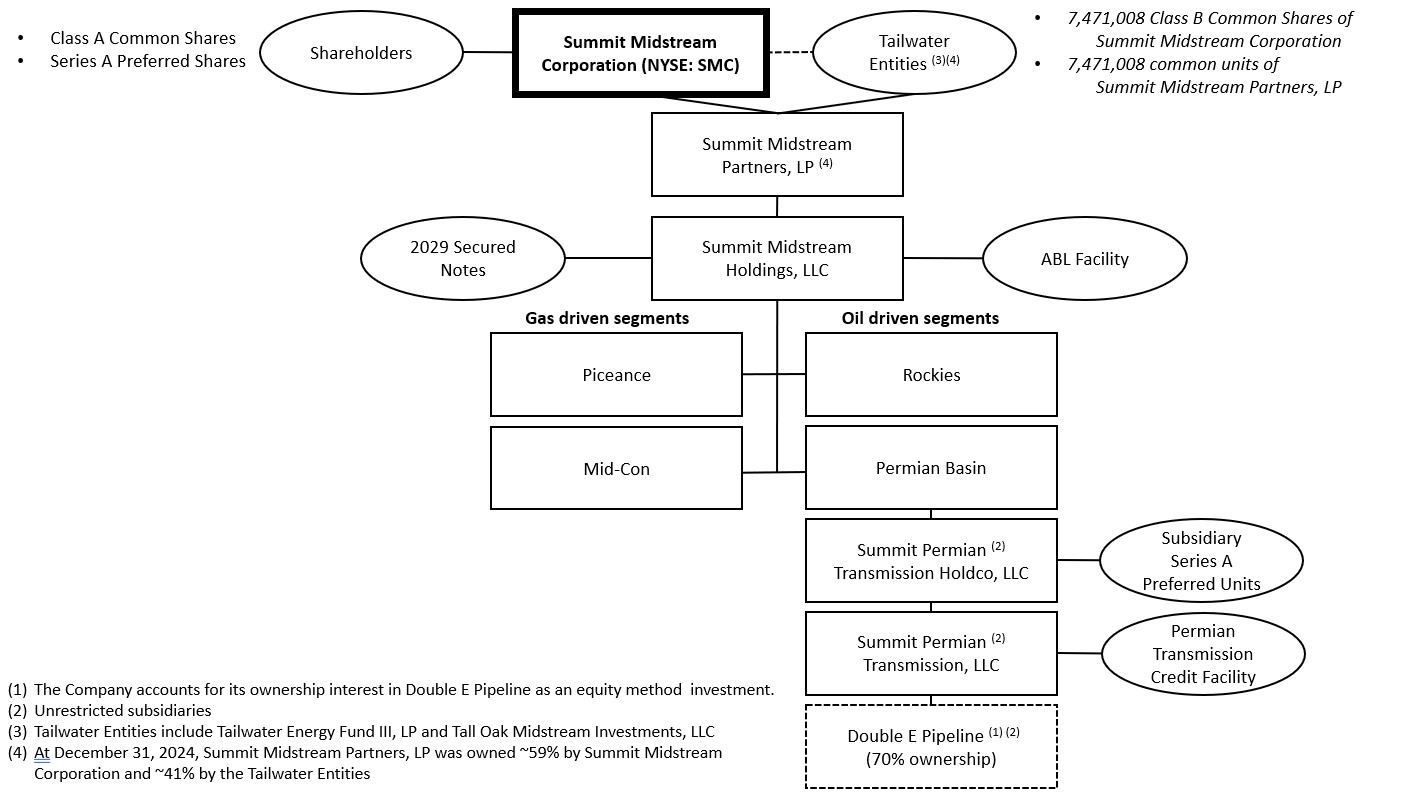
ORGANIZATIONAL CHART
The following chart provides a summarized view of our legal entity structure as of December 31, 2024:
COMMONLY USED OR DEFINED TERMS
|
|
|
|
|
|
| 2015 Blacktail Release |
a 2015 rupture of our four-inch produced water gathering pipeline near Williston, North Dakota
|
|
|
| 2022 DJ Acquisitions |
the acquisition of Outrigger DJ Midstream LLC from Outrigger Energy II LLC, and each of Sterling Energy Investments LLC, Grasslands Energy Marketing LLC and Centennial Water Pipelines LLC from Sterling Investment Holdings LLC
|
2023 Exchange Transactions |
the exchange of new 2026 Unsecured Notes for outstanding 2025 Senior Notes and cash in November 2023 and the subsequent repurchases of outstanding 2025 Senior Notes
|
2024 ECF Offer |
the cash tender offer by Summit Holdings and Finance Corp. to purchase up to $19.3 million
aggregate principal amount of the outstanding 2026 Secured Notes, pursuant to which
$13.6 million aggregate principal amount of the 2026 Secured Notes was tendered and
validly accepted, which settled on April 26, 2024
|
2025 Senior Notes |
Summit Holdings’ and Finance Corp.’s 5.75% senior unsecured notes due April 2025, which
were fully repaid on August 16, 2024
|
| 2026 Secured Notes |
Summit Holdings’ and Finance Corp.’s 8.500% senior secured second lien notes due October 2026, which were fully repaid on October 15, 2024
|
|
|
2026 Unsecured Notes |
Summit Holdings’ and Finance Corp.’s 12.00% senior unsecured notes due October 2026, which were fully repaid on June 24, 2024
|
|
|
|
2026 Secured Notes Asset
Sale Offer
|
the cash tender offer by Summit Holdings and Finance Corp. to purchase up to
$215.0 million aggregate principal amount of the outstanding 2026 Secured Notes, pursuant
to which $6.0 million aggregate principal amount of the 2026 Secured Notes was tendered
and validly accepted, which settled on June 6, 2024
|
|
2026 Secured Notes Tender
Offer
|
the cash tender offer by Summit Holdings and Finance Corp. to purchase any and all of the
outstanding 2026 Secured Notes, pursuant to which $649.8 million aggregate principal
amount of the 2026 Secured Notes was tendered and validly accepted, which settled on July
26, 2024
|
|
2026 Unsecured Notes
Redemption
|
the redemption by Summit Holdings and Finance Corp. of all $209.5 million aggregate
principal amount of the 2026 Unsecured Notes, which settled on June 24, 2024
|
| 2029 Secured Notes |
Summit Holdings’ 8.625% Senior Secured Second Lien Notes due October 2029
|
|
A&R Partnership
Agreement
|
the Sixth Amended and Restated Agreement of Limited Partnership of SMLP, by and among
the Company, the General Partner, and Tall Oak Parent, dated as of December 2, 2024
|
| ABL Agreement |
Loan and Security Agreement, dated as of November 2, 2021, among Summit Holdings, as borrower, SMLP and certain subsidiaries from time to time party thereto, as guarantors, Bank of America, N.A., as agent, ING Capital LLC, Royal Bank of Canada and Regions Bank, as co-syndication agents, and Bank of America, N.A., ING Capital LLC, RBC Capital Markets and Regions Capital Markets, as joint lead arrangers and joint bookrunners
|
| ABL Facility |
the asset-based lending credit facility governed by the ABL Agreement
|
|
|
|
|
|
|
Amended and Restated ABL Agreement |
Amended and Restated Loan and Security Agreement, dated as of July 26, 2024, among Summit Holdings, as borrower, SMLP and certain subsidiaries from time to time party thereto, as guarantors, Bank of America, N.A., as agent, and Bank of America, N.A., Royal Bank of Canada, Regions Capital Markets, TD Securities (USA) LLC, JPMorgan Chase Bank, N.A, Citizens Bank, N.A., and Truist Bank, as joint lead arrangers and joint bookrunners
|
Amended and Restated ABL Facility |
the asset-based lending credit facility governed by the Amended and Restated ABL Agreement
|
|
|
AMI |
area of mutual interest; AMIs require that any production from wells drilled by our customers within the AMI be shipped on and/or processed by our gathering systems
|
associated natural gas |
a form of natural gas which is found with deposits of petroleum, either dissolved in the crude oil or as a free gas cap above the crude oil in the reservoir
|
ASC |
Accounting Standards Codification
|
ASU |
Accounting Standards Update
|
Audit Committee |
the audit committee of the Board of Directors
|
Bbl |
one barrel; used for crude oil and produced water and equivalent to 42 U.S. gallons
|
Bcf |
one billion cubic feet
|
| Bcf/d |
the equivalent of one billion cubic feet per day; generally calculated when liquids are converted into natural gas; determined using a ratio of six thousand cubic feet of natural gas to one barrel of liquids
|
BLM |
Bureau of Land Management
|
Board of Directors |
the board of directors of Summit Midstream Corporation
|
CAA |
Clean Air Act
|
CEA |
Commodity Exchange Act
|
CCPA |
California Consumer Privacy Act, as amended by the California Privacy Rights Act
|
CERCLA |
Comprehensive Environmental Response, Compensation and Liability Act
|
CFTC |
Commodity Futures Trading Commission
|
|
|
Class B Common Stock |
Class B common stock of the Company, par value $0.01 per share
|
common stock |
common stock of the Company, par value $0.01 per share
|
Compensation Committee |
the compensation committee of the Board of Directors
|
condensate |
a natural gas liquid with a low vapor pressure, mainly composed of propane, butane, pentane and heavier hydrocarbon fractions
|
|
|
|
|
|
|
|
|
Corporate Reorganization |
the August 1, 2024 consummation of a transaction that resulted in SMLP becoming a wholly owned subsidiary of a newly formed Delaware corporation, Summit Midstream Corporation (taxed as a C-corporation)
|
Corps |
U.S. Army Corps of Engineers
|
CWA |
Clean Water Act
|
DFW Midstream |
DFW Midstream Services LLC
|
DJ Basin |
Denver-Julesburg Basin
|
Dodd-Frank Act |
Dodd-Frank Wall Street Reform and Consumer Protection Act of 2010
|
DOI |
U.S. Department of the Interior
|
DOJ |
U.S. Department of Justice
|
DOT |
U.S. Department of Transportation
|
Double E |
Double E Pipeline, LLC
|
| Double E Pipeline |
a 135 mile, 1.5 Bcf/d, FERC-regulated interstate natural gas transmission pipeline that commenced operations in November 2021 and provides transportation service from multiple receipt points in the Delaware Basin to various delivery points in and around the Waha hub in Texas
|
|
|
|
|
| Dth/d |
one million British Thermal Units per day
|
|
|
EPA |
Environmental Protection Agency
|
Epping |
Epping Transmission Company, LLC
|
| Epping Pipeline |
an interstate crude oil pipeline in North Dakota, owned and operated by Epping
|
EPS |
earnings or loss per share
|
|
|
ESA |
Endangered Species Act
|
Exchange Act |
Securities Exchange Act of 1934, as amended
|
FASB |
Financial Accounting Standards Board
|
FERC |
Federal Energy Regulatory Commission
|
Finance Corp. |
Summit Midstream Finance Corp.
|
|
|
|
|
FTC |
Federal Trade Commission
|
GAAP |
accounting principles generally accepted in the United States of America
|
| GDPR |
European Union General Data Protection Regulation
|
|
|
|
|
|
|
General Partner |
Summit Midstream GP, LLC
|
GHG |
greenhouse gas(es)
|
|
|
|
|
|
|
Grand River |
Grand River Gathering, LLC
|
|
|
| hub |
geographic location of a storage facility and multiple pipeline interconnections
|
ICA |
Interstate Commerce Act
|
|
|
Initial 2029 Secured Notes |
the $575,000,000 in aggregate principal amount of 2029 Secured Notes issued on July 26,
2024
|
| Intercreditor Agreement |
Intercreditor Agreement, dated as of November 2, 2021, by and among Bank of America, N.A., as first lien representative and collateral agent for the initial first lien claimholders, Regions Bank, as second lien representative for the initial second lien claimholders and as collateral agent for the initial second lien claimholders, acknowledged and agreed to by Summit Holdings and the other grantors referred to therein as reaffirmed and modified by
the Notice of Reaffirmation
|
IRA |
Inflation Reduction Act
|
IRS |
Internal Revenue Service
|
IT |
information technology
|
LIBOR |
London Interbank Offered Rate
|
LNG |
liquefied natural gas
|
MAOP |
Maximum Allowable Operating Pressure
|
Mbbl/d |
one thousand barrels per day
|
|
|
| MDTQ |
maximum daily transportation quantity
|
Meadowlark Midstream |
Meadowlark Midstream Company, LLC
|
| MMBTU |
metric million British thermal units
|
MMcf |
one million cubic feet
|
MMcf/d |
one million cubic feet per day
|
| MMcfe/d |
the equivalent of one million cubic feet per day; determined using a ratio of six thousand cubic feet of natural gas to one barrel of liquids
|
Mountaineer Midstream |
Mountaineer Midstream Company, LLC
|
Mountaineer Transaction |
the sale of the Mountaineer Midstream system to Antero Midstream LLC for a cash sale
price of $70 million, subject to customary post-closing adjustments
|
MVC |
minimum volume commitment
|
|
|
|
|
|
|
NAAQS |
national ambient air quality standard
|
NEPA |
National Environmental Policy Act
|
| NDIC |
North Dakota Industrial Commission
|
NGA |
Natural Gas Act
|
NGLs |
natural gas liquids; the combination of ethane, propane, normal butane, iso-butane and natural gasolines that when removed from unprocessed natural gas streams become liquid under various levels of higher pressure and lower temperature
|
NGPA |
Natural Gas Policy Act of 1978
|
Niobrara G&P |
Niobrara Gathering and Processing system
|
Notice of Reaffirmation |
Notice and Reaffirmation of Intercreditor Agreement, dated as of July 26, 2024, by and
among Bank of America, N.A., as first lien representative and collateral agent for the initial
first lien claimholders, Regions Bank, as second lien representative and collateral agent for
the initial second lien claimholders, acknowledged and agreed to by Summit Holdings and
the other grantors referred to therein
|
NYSE |
New York Stock Exchange
|
|
|
OCC |
Ohio Condensate Company, L.L.C.
|
OGC |
Ohio Gathering Company, L.L.C.
|
Ohio Gathering |
Ohio Gathering Company, L.L.C. and Ohio Condensate Company, L.L.C.
|
OPA |
Oil Pollution Control Act
|
|
|
|
|
OT |
operational technology
|
Partnership Common Units |
common units representing limited partner interests of SMLP
|
PHMSA |
Pipeline and Hazardous Materials Safety Administration
|
play |
a proven geological formation that contains commercial amounts of hydrocarbons
|
|
|
Permian Holdco |
Summit Permian Transmission Holdco, LLC
|
| Permian Term Loan Facility |
the term loan governed by the Credit Agreement, dated as of March 8, 2021, among Summit Permian Transmission, LLC, as borrower, MUFG Bank Ltd., as administrative agent, Mizuho Bank (USA), as collateral agent, ING Capital LLC, Mizuho Bank, Ltd. and MUFG Union Bank, N.A., as L/C issuers, coordinating lead arrangers and joint bookrunners, and the lenders from time to time party thereto
|
Permian Transmission Credit Facilities |
the credit facilities governed by the Credit Agreement, dated as of March 8, 2021, among Summit Permian Transmission, as borrower, MUFG Bank Ltd., as administrative agent, Mizuho Bank (USA), as collateral agent, ING Capital LLC, Mizuho Bank, Ltd. and MUFG Union Bank, N.A., as L/C issuers, coordinating lead arrangers and joint bookrunners, and the lenders from time to time party thereto
|
|
|
|
|
|
|
Polar and Divide |
the Polar and Divide system; collectively Polar Midstream and Epping
|
Polar Midstream |
Polar Midstream, LLC
|
ppb |
parts per billion
|
produced water |
water from underground geologic formations that is a by-product of natural gas and crude oil production
|
PSD |
Prevention of Significant Deterioration
|
RCRA |
Resource Conservation and Recovery Act
|
|
|
|
|
SEC |
U.S. Securities and Exchange Commission
|
Securities Act |
Securities Act of 1933, as amended
|
segment adjusted EBITDA |
total revenues less total costs and expenses; plus (i) other income excluding interest income, (ii) our proportional adjusted EBITDA for equity method investees, (iii) depreciation and amortization, (iv) adjustments related to MVC shortfall payments, (v) adjustments related to capital reimbursement activity, (vi) stock-based and noncash compensation, (vii) impairments and (viii) other noncash expenses or losses, less other noncash income or gains
|
Series A Certificate of Designation |
the Certificate of Designation of Series A Floating Rate Cumulative Redeemable
Perpetual Preferred Stock of the Company
|
| Series A Preferred Stock |
Series A Fixed-to-Floating Rate Cumulative Redeemable Perpetual Preferred Stock issued
by the Company
|
Series A Preferred Units |
Series A Fixed-to-Floating Rate Cumulative Redeemable Perpetual Preferred Units issued by SMLP |
shortfall payment |
the payment received from a counterparty when its volume throughput does not meet its MVC for the applicable period
|
| SMC LTIP |
Summit Midstream Corporation 2024 Long-Term Incentive Plan
|
SMLP |
Summit Midstream Partners, LP
|
SMLP LTIP |
SMLP 2022 Long-Term Incentive Plan
|
|
|
|
|
| SOFR |
Secured Overnight Financing Rate
|
SPCC |
Spill Prevention Control and Countermeasure
|
Subsidiary Series A Preferred Units |
Series A Fixed Rate Cumulative Redeemable Preferred Units issued by Permian Holdco
|
Summit Holdings |
Summit Midstream Holdings, LLC
|
Summit Investments |
Summit Midstream Partners, LLC
|
|
|
|
|
|
|
|
|
Summit Permian Transmission |
Summit Permian Transmission, LLC
|
|
|
|
|
|
|
Summit Utica |
Summit Midstream Utica, LLC
|
Tall Oak |
Tall Oak Midstream Operating, LLC
|
Tall Oak Acquisition |
the consummation of the transaction contemplated by the Tall Oak Business Contribution Agreement
|
|
|
|
|
Tall Oak Business Contribution Agreement |
the Business Contribution Agreement, dated as of October 1, 2024, by and among the Company, SMLP, and Tall Oak Parent, pursuant to which Tall Oak Parent contributed all of its equity interests in Tall Oak to SMLP in exchange for total consideration equal to $425.0 million
|
Tall Oak Parent |
Tall Oak Midstream Holdings, LLC
|
Tcfe |
the equivalent of one trillion cubic feet
|
the Company |
Summit Midstream Corporation and its subsidiaries
|
throughput volume |
the volume of natural gas, crude oil or produced water gathered, transported or passing through a pipeline, plant or other facility during a particular period; also referred to as volume throughput
|
|
|
|
|
unconventional resource basin |
a basin where natural gas or crude oil production is developed from unconventional sources that require hydraulic fracturing as part of the completion process, for instance, natural gas produced from shale formations and coalbeds; also referred to as an unconventional resource play
|
Utica Sale |
the sale of Summit Utica to a subsidiary of MPLX LP for a cash sale price of $625.0 million,
subject to customary post-closing adjustments
|
VOC |
volatile organic compound(s)
|
wellhead |
the equipment at the surface of a well, used to control the well’s pressure; also, the point at which the hydrocarbons and water exit the ground
|
PART I
ITEM 1. BUSINESS
Summit Midstream Corporation, a Delaware corporation (including its subsidiaries, collectively, “we”, “our”, “us”, “SMC”, or “the Company”), is a value-driven company focused on developing, owning and operating midstream energy infrastructure assets that are strategically located in the core producing areas of unconventional resource basins, primarily shale formations, in the continental United States. The Company’s business activities are primarily conducted through various operating subsidiaries, each of which is owned or controlled by its subsidiary holding company, Summit Holdings.
The Company was incorporated under the laws of the State of Delaware on May 14, 2024 for the purpose of effecting the Corporate Reorganization of Summit Midstream Partners, LP, a Delaware master limited partnership, in which the Company was incorporated to serve as the new parent holding company of SMLP. The Company’s common stock is listed on the New York Stock Exchange under the ticker symbol “SMC.” SMLP was formed in May 2012, and prior to August 1, 2024, SMLP’s common units were listed on NYSE under the ticker symbol “SMLP.”
The Company’s executive offices are located at 910 Louisiana Street, Suite 4200, Houston, Texas 77002, and can be reached by phone at 832-413-4770. The Company also maintains regional field offices in close proximity to its areas of operation to support the operation and development of the Company’s midstream assets.
Our Business Strategies
We operate a differentiated midstream platform that is built for long-term, sustainable value creation. Our integrated assets are strategically located in production basins, including the Williston Basin, DJ Basin, Barnett Shale, Piceance Basin, Permian Basin and, following the Tall Oak Acquisition, the Arkoma Basin. Our primary business objective is to maximize cash flow and provide cash flow stability for its stakeholders while growing prudently and profitably. We intend to accomplish this objective by executing the following strategies:
•Capital structure optimization. We seek to maximize stakeholder value. Our capital structure currently consists of common equity (including the Company’s common stock and Class B Common Stock and associated Partnership Common Units of SMLP), preferred equity, and indebtedness that is comprised of debt securities and borrowings under our revolving credit facilities, a portion of which is secured by substantially all of our assets. We intend to optimize our capital structure in the future by reducing our indebtedness with free cash flow, and when appropriate, we may pursue opportunistic capital markets transactions, asset acquisitions (such as the Tall Oak Acquisition), or asset divestitures (such as the Utica Sale or the Mountaineer Transaction) with the objective of increasing long-term stakeholder value.
•Portfolio management. We seek to maximize stakeholder value by strategically managing our portfolio of midstream assets and allocating capital based on appropriate risk-informed cash flow assumptions. This may include value enhancing acquisitions (such as the Tall Oak Acquisition) or opportunistic divestitures (such as the Utica Sale or the Mountaineer Transaction), re-allocation of capital to new or existing areas, and development of joint ventures (such as Double E) involving our existing midstream assets or new investment opportunities.
•Maintaining focus on fee-based revenue with minimal direct commodity price exposure. We intend to maintain our focus on providing midstream services under primarily long-term and fee-based contracts. We believe that our focus on fee-based revenues with minimal direct commodity price exposure is essential to maintaining stable cash flows.
•Maintaining strong producer relationships to maximize utilization of all of our midstream assets. We have cultivated strong producer relationships by focusing on customer service and reliable project execution and by operating our assets safely and reliably over time. We believe that our strong producer relationships will create future opportunities to expand our midstream services reach and optimize the utilization of our midstream assets for our customers.
•Continuing to prioritize safe and reliable operations. We believe that providing safe, reliable and efficient operations is a key component of our business strategy. We place a strong emphasis on employee training, operational procedures and enterprise technology, and we intend to continue promoting a high standard with respect to the efficiency of our operations and the safety of all of our constituents.
Recent Developments and Highlights
The following is a brief listing of significant developments and highlights for the year ended December 31, 2024. Additional information regarding these items may be found elsewhere in this Annual Report.
•Strategic review. Subsequent to the October 2023 announcement of our strategic review, we executed the following transactions in order to maximize shareholder value:
•Summit Utica Sale. On March 22, 2024, we completed the Utica Sale for a cash sale price of $625.0 million, subject to customary post-closing adjustments. Summit Utica was the owner of (i) approximately 36% of the issued and outstanding equity interests in OGC, (ii) approximately 38% of the issued and outstanding equity interests in OCC (together with OGC, Ohio Gathering) and (iii) midstream assets located in the Utica Shale. Ohio Gathering was the owner of a natural gas gathering system and condensate stabilization facility located in Belmont and Monroe counties in the Utica Shale in southeastern Ohio.
•Mountaineer Transaction. On May 1, 2024, we completed the Mountaineer Transaction for a cash sale price of $70.0 million, subject to customary post-closing adjustments. Mountaineer Midstream was the owner of midstream assets located in the Marcellus Shale. Prior to closing the Mountaineer Transaction, we sold related compression assets located in the Marcellus Shale to a compression service provider for approximately $5 million in April 2024.
•Debt Reduction and Maturity Optimization. Over the course of 2024, the Company optimized its indebtedness by reducing debt, lowering its borrowing cost, and extending its debt maturities. These optimization transactions included the following:
•2026 Secured Notes Excess Cash Flow Offer. On March 27, 2024, Summit Holdings and Finance Corp. commenced a cash tender offer to purchase up to $19.3 million aggregate principal amount of the outstanding 2026 Secured Notes at 100% of the principal amount plus accrued and unpaid interest. The 2024 ECF Offer expired on April 24, 2024 with $13.6 million aggregate principal amount of the 2026 Secured Notes tendered and validly accepted and $5.7 million of declined proceeds.
•2026 Secured Notes Asset Sale Offer. On May 7, 2024, Summit Holdings and Finance Corp. commenced a cash tender offer to purchase up to $215.0 million aggregate principal amount of the outstanding 2026 Secured Notes at 100% of the principal amount plus accrued and unpaid interest. The 2026 Secured Notes Asset Sale Offer expired on June 5, 2024 with $6.9 million aggregate principal amount of the 2026 Secured Notes tendered and validly accepted and $208.1 million of declined proceeds.
•2026 Unsecured Notes Redemption. On June 7, 2024, Summit Holdings and Finance Corp. delivered a redemption notice with respect to all $209.5 million aggregate principal amount of the 2026 Unsecured Notes. The 2026 Unsecured Notes Redemption was funded with declined proceeds from the 2024 ECF Offer and the 2026 Secured Notes Asset Sale Offer and proceeds from the Mountaineer Transaction and the Utica Sale and settled on June 24, 2024.
•Issuance of 2029 Secured Notes. On July 26, 2024, Summit Holdings issued $575.0 million aggregate principal amount of the 2029 Secured Notes.
•2026 Secured Notes Tender Offer and Redemption. On July 26, 2024, concurrently with closing the offering of the Initial 2029 Secured Notes, Summit Holdings and Finance Corp. consummated a cash tender offer to purchase any and all of the outstanding 2026 Secured Notes. Summit Holdings and Finance Corp. accepted for payment and made payment for $649.8 million aggregate principal amount of the 2026 Secured Notes validly tendered in the 2026 Secured Notes Tender Offer. On July 26, 2024, concurrently with consummation of the 2026 Secured Notes Tender Offer, Summit Holdings and Finance Corp. delivered a notice of redemption to holders of 2026 Secured Notes for the redemption of all $114.7 million aggregate principal amount of 2026 Secured Notes not purchased in the 2026 Secured Notes Tender Offer, at a price equal to 102.125% of the principal amount thereof, plus accrued and unpaid interest to the redemption date. On July 26, 2024, concurrently with delivery of a notice of redemption, Summit Holdings and Finance Corp. irrevocably deposited $121.2 million in aggregate principal amount of non-callable United States Treasury securities, which included amounts for principal, interest, and premium, with the trustee to satisfy and discharge the 2026 Secured Notes until redeemed on October 15, 2024 with the funds deposited with the trustee. On October 15, 2024, the 2026 Secured Notes were fully repaid.
•2025 Senior Notes Redemption. On July 17, 2024, Summit Holdings and Finance Corp. delivered a conditional notice of redemption to holders of 2025 Senior Notes for the redemption of all $49.8 million aggregate principal amount of outstanding 2025 Senior Notes, at a price equal to 100.000% of the principal amount thereof, plus accrued and unpaid interest to the redemption date, conditioned on closing of the offering of the Initial 2029 Secured Notes. On July 26, 2024, concurrently with closing of the offering of the Initial 2029 Secured Notes, Summit Holdings and Finance Corp. irrevocably deposited $50.6 million in aggregate principal amount of non-callable United States Treasury securities, which included amounts for principal and interest, with the trustee to satisfy and discharge the 2025 Senior Notes until redeemed with the funds deposited with the trustee. On August 16, 2024, the 2025 Senior Notes were fully repaid.
•Corporate Reorganization. On August 1, 2024, following unitholder approval at SMLP’s Special Meeting of Unitholders on July 18, 2024, SMLP consummated a previously announced transaction that resulted in SMLP becoming a wholly owned subsidiary of the Company. Upon the consummation of the Corporate Reorganization, each outstanding common unit of SMLP was converted into the right to receive 1.000 shares of common stock of the Company and each outstanding Series A Preferred Unit was converted into the right to receive 1.000 shares of Series A Preferred Stock of the Company, with the liquidation preference of each share of Series A Preferred Stock initially equal to $1,000 and the Series A Certificate of Designation deeming all accumulated and unpaid distributions on the Series A Preferred Units to be Series A Unpaid Cash Dividends (as defined in the Series A Certificate of Designation) per share of Series A Preferred Stock, which constituted all consideration to be paid in respect to such Series A Preferred Units, and any rights to accumulated and unpaid distributions on such Series A Preferred Units were discharged.
The Corporate Reorganization was accounted for as a common-control transaction between SMLP and the Company as a result of SMLP’s unitholders controlling both SMLP and the Company before and after the Corporate Reorganization. In the case of this common-control transaction, the historical financial statements of SMLP became the historical financial statements of the Company, except for certain changes that conform SMLP’s historical financial statements to a corporate entity. These changes include, but are not limited to, the reclassification of SMLP’s capital accounts to shareholders’ equity accounts and an update of certain limited partner terms to synonymous corporate entity terms. The Corporate Reorganization had no impact to historical revenues, expenses, assets, liabilities, or cash flows.
•Tall Oak Acquisition. On December 2, 2024, the Company completed the transaction contemplated in the Tall Oak Business Contribution Agreement, pursuant to which Tall Oak Parent contributed all of its equity interests in Tall Oak to SMLP in exchange for total consideration equal to $425.0 million. Total consideration consisted of (i) a $155.0 million cash payment, (ii) cash earn-out payments of up to $25.0 million subject to Tall Oak and its customers meeting certain development requirements and (iii) the issuance of 7,471,008 shares of Class B Common Stock of the Company and 7,471,008 Partnership Common Units of SMLP (causing SMLP to be treated as a partnership for U.S. federal income tax purposes), that are exchangeable into an equivalent quantity of the Company’s common stock on a 1:1 exchange ratio. Upon completion of the Tall Oak Acquisition, the Company and Tall Oak Parent jointly owned SMLP, each with economic and voting rights, and Tall Oak Parent owned exchangeable non-economic Class B Common Stock with Company voting rights (the “Up-C Structure”).
Our Midstream Assets
Our midstream assets primarily gather natural gas produced from pad sites, wells and central receipt points connected to our systems. Gathered natural gas volumes are then compressed, dehydrated, treated and/or processed for delivery to downstream pipelines serving end users. We also contract with producers to gather crude oil and produced water from wells connected to our systems for delivery to downstream pipelines and to third-party rail terminals in the case of crude oil and to third-party disposal wells in the case of produced water. We generally refer to most of the services our systems provide as gathering services. We also provide natural gas transmission services via Double E, a long-haul natural gas pipeline in which we indirectly own a 70% equity interest and serve as the pipeline’s operator. Double E provides natural gas transportation services from multiple receipt points in the Permian Basin to various delivery points in and around the Waha hub in Texas.
Reportable Segments. As of December 31, 2024, our reportable segments are below along with management’s categorization of the primary commodity driving customer drilling and completion decisions for each segment:
Oil price driven. Our cash flows in the Rockies and Permian segments are primarily influenced by the prevailing price of crude oil because the drilling and completion decisions by our customers in these segments are based on well economics most heavily tied to crude oil prices. Our customers’ decisions to drill and complete wells in these segments therefore result in higher volume throughput and cash flows for our midstream assets in which we collect fixed fees for gathering or processing hydrocarbons, gathering produced water, or transporting residue natural gas.
•Rockies – Includes our midstream assets located in the Williston Basin and the DJ Basin.
•Permian – Includes our equity method investment in Double E.
Natural gas price driven. Our cash flows in the Piceance and Mid-Con segments are primarily influenced by the prevailing price of natural gas because the drilling, completion and recompletion decisions by our customers in these segments are based on well economics most heavily tied to natural gas and NGL prices. Our customers’ decisions to drill, complete or recomplete wells in these segments therefore result in higher throughput and cash flows for those segments in which we collect fixed fees for gathering natural gas.
•Piceance – Includes our midstream assets located in the Piceance Basin.
•Mid-Con – Includes our midstream assets located in the Barnett Shale and, following the Tall Oak Acquisition, the Arkoma Basin.
Industry Overview and Commercial Arrangements
We compete with other midstream companies, producers and intrastate and interstate pipelines. Competition for volumes is primarily based on reputation, commercial terms, acreage dedications, service levels, access to end-use markets, geographic proximity of existing assets to a producer’s acreage and available gathering and processing capacity. We may also face competition to gather production outside of our AMIs and attract producer volumes to our gathering systems.
We earn revenue by providing gathering, compression, treating and/or processing services pursuant to primarily long-term and fee-based gathering and processing agreements with some of the largest and most active producers in North America. Through our equity method investment in the Double E Pipeline, we earn revenue by providing high pressure transportation services, as both firm and interruptible service, for residue natural gas in the Permian Basin. The fee-based nature of these agreements enhances the stability of our cash flows by limiting our direct commodity price exposure.
The significant features of our transportation and gathering and processing agreements, and the gathering and transportation systems to which they relate, are discussed in more detail below. For additional operating and financial performance information, on a consolidated basis and by reportable segment, see the “Results of Operations” section in Item 7. Management’s Discussion and Analysis of Financial Condition and Results of Operations.
Areas of Mutual Interest. The vast majority of our gathering and processing agreements contain AMIs, some of which extend through 2039. The AMIs generally require that any production by our customers within the AMIs will be gathered and/or processed by our assets. In general, our customers have not leased acreage that cover our entire AMIs but, to the extent that they have leased acreage within our AMI, or lease additional acreage within our AMIs, any production from wells within that AMI will be dedicated to our systems.
Under certain of our gathering agreements, we have agreed to construct pipeline laterals to connect our gathering systems to producer pad sites located within the AMI. However, in certain circumstances we may choose not to pursue a pad connection opportunity presented by a customer if we believe that the investment would not meet our internal return expectations. Under this scenario, the customer may, in certain circumstances, construct the gathering infrastructure itself and sell it to us at a price equal to their cost plus an applicable profit margin, or, in some cases, we may release the relevant acreage dedication from the AMI.
Our AMIs cover approximately 5.8 million surface acres in the aggregate.
Minimum Volume Commitments. Certain of our gathering and/or processing agreements contain MVCs which, like AMIs, benefit from the development and ongoing operation of a gathering system because they provide a minimum contracted monthly or annual revenue stream. Some of our MVCs, including those of affiliates, extend through 2031. To the extent a customer does not meet its contractual MVC, it is obligated to make an MVC shortfall payment to us to cover the shortfall of required volume throughput not shipped or processed, either on a monthly or annual basis. We have designed our MVC provisions to ensure that we will generate a minimum amount of revenue from each customer over the life of the associated gathering and/or processing agreement, by either collecting gathering or processing fees on actual throughput or from cash payments to cover any MVC shortfall.
As of December 31, 2024, we had remaining MVCs totaling 0.1 Tcfe, our MVCs had a weighted-average remaining life of 2.4 years, and these MVC’s average approximately 90 MMcfe/d through 2028.
For additional information on our MVCs, see Note 4 – Revenue and Note 8 – Deferred Revenue to the consolidated financial statements.
Throughput and Commodity Price Exposure. Our financial results are primarily driven by volume throughput across our gathering systems and by expense management. During 2024, aggregate natural gas volume throughput averaged 862 MMcf/d and crude oil and produced water volume throughput averaged 72 Mbbl/d. A majority of the volumes that we gather, compress, treat and/or process have a fixed-fee rate structure, which enhances the stability of our cash flows by providing a revenue stream that is not subject to direct commodity price risk or volatility. We also earn a portion of our revenues from the following activities that directly expose us to fluctuations in commodity prices: (i) the sale of physical natural gas and/or NGLs purchased under percentage-of-proceeds or other processing arrangements with certain of our customers in the Rockies, Piceance and Mid-Con segments, (ii) the sale of natural gas we retain from certain Mid-Con customers, (iii) the sale of condensate we retain from our gathering services in the Rockies, Mid-Con and Piceance segments and (iv) additional gathering fees that are tied to performance of certain commodity price indexes, which are then added to the fixed gathering rates. During the year ended December 31, 2024, these additional activities accounted for approximately 45% of total revenues.
Equity Method Investment – Double E. We have an equity method investment in Double E, a 1.5 Bcf/d FERC-regulated interstate natural gas transmission pipeline that commenced operations in November 2021 and provides transportation service from multiple receipt points in the Delaware Basin to various delivery points in and around the Waha hub in Texas. We are the operator of the joint venture and have made all required capital contributions to Double E. As of December 31, 2024, the Company owns a 70% interest in Double E. A subsidiary of ExxonMobil Corporation is our joint venture partner.
Equity Method Investment – Ohio Gathering. Up until March 22, 2024, we owned an equity method investment in Ohio Gathering, which was comprised of a natural gas gathering system and condensate stabilization facility located in the core of the Utica Shale in southeastern Ohio. On March 22, 2024, we completed the disposition of Summit Utica to a subsidiary of MPLX LP for a cash sale price of $625.0 million, subject to customary post-closing adjustments. Summit Utica was the owner of (i) approximately 36% of the issued and outstanding equity interests in OGC, (ii) approximately 38% of the issued and outstanding equity interests in OCC (together with OGC, Ohio Gathering) and (iii) midstream assets located in the Utica Shale. Ohio Gathering was the owner of a natural gas gathering system and condensate stabilization facility located in Belmont and Monroe counties in the Utica Shale in southeastern Ohio.
Overview of our Segments
The following provides an overview of our reportable segments as of December 31, 2024.
Rockies.
The following table provides operating information regarding our Rockies reportable segment as of December 31, 2024.
|
|
|
|
|
|
|
|
|
|
|
|
|
|
|
|
|
|
|
|
|
|
|
|
|
|
|
|
|
|
|
|
|
|
|
|
|
Aggregate throughput capacity -
liquids (Mbbl/d) |
|
Aggregate throughput capacity -
natural gas (MMcf/d) |
|
Average daily MVCs through 2029 (MMcf/d) |
|
Remaining MVCs (Bcfe) |
|
Weighted-average remaining contract life (Years) |
|
Weighted-average remaining MVC life (Years) |
| Rockies - Williston |
225 |
|
n/a |
|
n/a |
|
n/a |
|
4.4 |
|
n/a |
Rockies - DJ (1) |
50 |
|
220 |
|
7 |
|
14 |
|
7.1 |
|
3.6 |
______________________________________________
(1)Capacity of 220 MMcf/d represents nameplate processing capacity. Operational capacity is estimated at approximately 180 MMcf/d. Weighted average remaining life excludes interruptible off-load contracts.
AMIs for the Rockies reportable segment total approximately 2.5 million surface acres in the aggregate.
Our Rockies reportable segment is comprised of our Polar and Divide system and the Niobrara G&P system.
Polar and Divide system. The Polar and Divide system, which is located primarily in Williams and Divide counties in northwestern North Dakota, owns, operates and is currently developing crude oil and produced water gathering systems and transmission pipelines serving multiple customers that are targeting crude oil production from the Bakken and Three Forks shale formations. The Polar and Divide system is underpinned by long-term, fee-based gathering agreements, which include acreage dedications. Chord Energy Corporation, Kraken Resources and Zavanna LLC are the key customers of the Polar and Divide system. Crude oil that is gathered by the Polar and Divide system is delivered to interconnects with (i) the Dakota Access Pipeline, (ii) the COLT Hub rail facility and (iii) Enbridge Inc’s North Dakota Pipeline System. Produced water is delivered to third-party or producer owned disposal facilities.
Niobrara G&P system. The Niobrara G&P system is located in rural Weld, Morgan and Logan Counties, and in Cheyenne County of Nebraska. Weld County is the largest crude oil and natural gas producing county in Colorado. Gathering and processing services on the Niobrara G&P system are provided pursuant to long-term, fee-based and percentage of proceeds agreements with producers that are primarily targeting crude oil production from the Niobrara and Codell shale formations. Bison Oil and Gas IV, Chevron Corporation, Civitas Resources, Inc., a large U.S. independent crude oil and natural gas company, and Verdad Resources are the key customers of the Niobrara G&P system and have underpinned our volume throughput with acreage dedications and MVCs.
The Niobrara G&P system operates a low-pressure associated natural gas gathering system, and natural gas processing plants with processing capacity of up to 220 MMcf/d.
Residue gas can be delivered to the Cheyenne Plains, Colorado Interstate Gas, Tallgrass Interstate Gas Transmission, Trailblazer Pipeline and Southern Star and processed NGLs are delivered to the Overland Pass Pipeline and the P66 NGL System.
Additionally, the system has discrete freshwater infrastructure that consists of 19 water wells and other infrastructure to provide its customers with up to approximately 55,000 barrels per day of fresh water for well completion activities. The crude gathering system includes approximately 30 miles of gathering pipeline with delivery into the Pony Express pipeline.
Permian.
The following table provides operating information regarding our Permian reportable segment as of December 31, 2024.
|
|
|
|
|
|
|
|
|
|
|
|
|
|
|
|
|
|
|
|
|
|
|
|
|
|
|
|
|
|
|
Aggregate throughput capacity (MMcf/d) |
|
Average daily MVCs through 2029 (MMcf/d) |
|
Remaining MVCs (Bcf) |
|
Weighted-average remaining contract life (Years) |
|
Weighted-average remaining MVC life (Years) |
Double E (1) |
1,500 |
|
1,106 |
|
3,012 |
|
7.4 |
|
7.6 |
______________________________________________
(1) Presented on a gross basis. Existing MVC’s contractually increase to 1.0 Bcf/d beginning in November 2024. As of December 31, 2024, we owned a 70% interest in Double E.
Double E. Double E is a 135 mile FERC-regulated interstate natural gas transmission pipeline that commenced operations in November 2021 and provides transportation service from receipt points in the Delaware Basin to various delivery points in and around the Waha hub in Texas. Double E is underpinned by 1.1 Bcf/d of long-term take-or-pay contracts with ExxonMobil Corporation, a large U.S. independent crude oil and natural gas company, Marathon Oil Corporation, which merged with ConocoPhillips in November 2024, and Matador Resources Company.
In 2021, we entered into negotiated rate agreements with an average term of 10 years from the in-service date of the pipeline, which occurred on November 18, 2021 and with total MDTQs that increase from 585,000 Dth/d during the first year of the agreement to 1,000,000 Dth/d in the fourth year, which equates to approximately 67% of its estimated capacity of 1,500,000 Dth/d.
Volume throughput is received from multiple processing plants, including Enlink’s Lobo plant, San Mateo’s Marlan plant, XTO Energy’s Cowboy plant, Targa Resources Corp.’s Roadrunner plant, San Mateo’s Black River plant and Energy Transfer’s Carlsbad plant. In 2023, Double E executed a new 40 MMcf/d contract with a large U.S. independent crude oil and natural gas company, which includes a connection to the Janus Processing Plant. The take-or-pay contract has a 10-year term from March 1, 2025.
In 2024, Double E executed a new agreement with Matador Resources Company, which consolidated Matador’s two existing agreements and added an incremental 75 MMcf/d of firm transport capacity to support the expansion of their Marlan processing plant. Matador’s new consolidated agreement has a 10-year term from the effective date, which occurred on May 1, 2024.
We own 70% of Double E and operate the pipeline.
Piceance.
The following table provides operating information regarding our Piceance reportable segment as of December 31, 2024.
|
|
|
|
|
|
|
|
|
|
|
|
|
|
|
|
|
|
|
|
|
|
|
|
|
|
|
|
|
|
|
Aggregate throughput capacity (MMcf/d) |
|
Average daily MVCs through 2029 (MMcf/d) |
|
Remaining MVCs (Bcf) |
|
Weighted-average remaining contract life (Years) |
|
Weighted-average remaining MVC life (Years) |
| Piceance |
1,338 |
|
64 |
|
117 |
|
8.0 |
|
1.6 |
AMIs for the Piceance reportable segment cover approximately 434,000 surface acres in the aggregate.
Our Piceance reportable segment is comprised of our Grand River gathering system.
Grand River system. Grand River is primarily located in Garfield County, one of the largest natural gas producing counties in Colorado. The Grand River system provides natural gas gathering services pursuant to primarily long-term and fee-based agreements with multiple producers, including its key customers, QB Energy, which acquired Caerus Oil and Gas’ Piceance assets in August 2024, and Terra Energy Partners. Volume throughput on the Grand River system is underpinned with acreage dedications and MVCs. The Grand River system is primarily a low-pressure gathering system located in western Colorado that gathers natural gas produced from directional wells targeting the liquids-rich Mesaverde formation. The Grand River system also gathers natural gas produced from the Mancos and Niobrara shale formations. Natural gas gathered and/or processed on the Grand River system is compressed, dehydrated, processed and/or discharged to downstream pipelines serving (i) the Meeker Processing Complex, (ii) the Williams Processing Complex, (iii) the TransColorado Pipeline system and (iv) SourceGas. Processed NGLs from Grand River are injected into the Mid-America Pipeline system or delivered to local markets. Residue gas has access to multiple pipelines and end markets. In addition, certain of our gathering agreements with our customers on the Grand River system permit us to retain, and monetize for our own account, condensate volumes that naturally discharge from the liquids-rich natural gas as it moves across our system.
Mid-Con.
The following table provides operating information regarding our Mid-Con reportable segment as of December 31, 2024.
|
|
|
|
|
|
|
|
|
|
|
|
|
|
|
|
|
|
|
|
|
|
|
|
|
|
|
|
|
|
|
Throughput capacity (MMcf/d) |
|
Average daily MVCs through 2029 (MMcf/d) |
|
Remaining MVCs (Bcf) |
|
Weighted-average remaining contract life (Years) |
|
Weighted-average remaining MVC life (Years) |
| Mid-Con |
440 |
|
n/a |
|
n/a |
|
7.2 |
|
n/a |
AMIs for the Mid-Con reportable segment cover approximately 2.9 million surface acres.
Our Mid-Con reportable segment is comprised of DFW Midstream system and the Tall Oak system.
DFW Midstream system. The DFW Midstream system is primarily located in southeastern Tarrant County, in north-central Texas. We considers this area to be the core of the Barnett Shale because of the quality of the geology and the high production profile of the wells drilled to date in our service area. The DFW Midstream system is underpinned by long-term, fee-based gathering agreements with TotalEnergies Gas & Power North America, Inc. and other customers. TotalEnergies Gas & Power North America, Inc. is the key customer for DFW Midstream.
The DFW Midstream system includes natural gas gathering pipelines located under both private and public property and is partially located along existing electric transmission corridors. Compression on the system is powered by electricity. To offset the costs we incur to operate the system’s electric-drive compressors, we either pass through a portion of the power expense to our customers or retain and sell a fixed percentage of the natural gas that we gather.
The DFW Midstream system currently has five primary interconnections with third-parties, primarily intrastate pipelines. These interconnections enable us to connect our customers, directly or indirectly, with the major natural gas market hubs in Texas and Louisiana.
Tall Oak system. Following the Tall Oak Acquisition, we operate assets in central Oklahoma. Gathering and processing services are provided pursuant to long-term, primarily fee-based contracts with producers that are primarily targeting liquids-rich natural gas production from the Woodford and Caney formations. Volume throughput on the Tall Oak system is underpinned by acreage dedications and Calyx Energy is the key customer.
The Tall Oak system’s residue gas has access to MarkWest’s Arkoma Connector and Energy Transfer’s Enable Oklahoma Transmission and Enable Gas Transmission connections. NGL’s have access to ONEOK’s NGL system and Targa’s Grand Prix pipeline.
Northeast.
During the year ended December 31, 2024, we divested of our Northeast operations which consisted of midstream assets located in the Marcellus shale play and midstream assets located in the Utica shale play together with our previously owned equity method investment in Ohio Gathering that was focused on the Utica Shale.
Our Customers
The systems that we operate and/or have significant ownership interests in have a diverse group of customers and counterparties comprising affiliates and/or subsidiaries of some of the largest natural gas and crude oil producers in North America.
Regulation of the Natural Gas and Crude Oil Industries
General. Sales by producers of natural gas, crude oil, condensate and NGLs are currently made at market prices. However, gathering and transportation services are subject to various types of regulation, which may affect certain aspects of our business and the market for our services. FERC regulates the transportation of natural gas in interstate commerce and the interstate transportation of crude oil, petroleum products and NGLs. FERC regulation includes reviewing and accepting or approving rates and other terms and conditions for such transportation services and authorizing and regulating the construction and operation of interstate natural gas pipelines. FERC is also authorized to prevent and sanction market manipulation in natural gas markets while the FTC is authorized to prevent and sanction market manipulation in petroleum markets and the CFTC is authorized to prevent and sanction fraud and price manipulations in the commodity and futures markets, including the energy futures markets. State and municipal regulations may apply to the production and gathering of certain natural gas, the construction and operation of natural gas and crude oil facilities and the rates and practices of gathering systems and intrastate pipelines.
Regulation of Crude Oil and Natural Gas Exploration, Production and Sales. Sales of crude oil and NGLs are not currently regulated and are transacted at market prices. In 1989, the U.S. Congress enacted the Natural Gas Wellhead Decontrol Act, which removed all remaining price and non-price controls affecting wellhead sales of natural gas. FERC, which has the authority under the NGA to regulate the prices and other terms and conditions of the sale of natural gas for resale in interstate commerce, has issued blanket authorizations for all gas resellers subject to its regulation, except interstate pipelines, to resell natural gas at market prices. Either Congress or FERC (with respect to the resale of gas in interstate commerce), however, could re-impose price controls in the future.
Exploration and production operations are subject to various types of federal, state and local regulation, including, but not limited to, permitting, well location, methods of drilling, well operations and conservation of resources. While these regulations do not directly apply to our business, they may affect our customers' ability to produce natural gas.
Regulation of the Gathering and Transportation of Natural Gas and Crude Oil. We believe that the majority of our natural gas pipeline facilities qualify as gathering facilities that are exempt from the jurisdiction of FERC. Our Double E Pipeline, which is an interstate natural gas pipeline located in New Mexico and Texas, and Epping Pipeline interstate crude oil pipeline, which is located in North Dakota and owned and operated by Epping, are subject to FERC’s jurisdiction and oversight pursuant to FERC's authority under the NGA and the ICA, respectively. Epping and Double E have tariffs on file with FERC.
In addition to approving and regulating the construction and operation of interstate natural gas pipelines, FERC also regulates such pipelines’ rates and terms and conditions of service, including transportation service agreements and negotiated rate agreements.
Under FERC’s ICA jurisdiction, rates for interstate movements of liquids by pipeline are currently regulated primarily through an annual indexing methodology, under which pipelines increase or decrease their existing rates in accordance with a FERC-specified adjustment that sets a rate ceiling. This adjustment, which may be positive or negative in a given year, is subject to review every five years. There is currently some uncertainty regarding the index pricing. During the last review period, FERC set the index level in December 2020 (the “Initial Order”), however, both pipelines and pipeline customers sought rehearing of the Initial Order and in January 2022, FERC issued a rehearing order setting a lower index price prospectively (the “Rehearing Order”). Pipelines challenged the Rehearing Order at the D.C. Circuit and on July 26, 2024, the D.C. Circuit vacated the Rehearing Order, which will increase the index price back to the Initial Order levels. On October 17, 2024, FERC issued a supplemental notice of proposed rulemaking proposing to reduce the index price back down to the Rehearing Order price and the proposal is now pending at FERC.
Under current FERC regulations, liquids pipelines can request a rate increase that exceeds the rate obtained through the indexing methodology by using a cost-of-service approach, but a pipeline must establish that a substantial divergence exists between its actual costs and the rates resulting from the indexing methodology.
The ICA permits interested persons to challenge proposed new or changed rates and authorizes FERC to suspend the effectiveness of such rates for up to seven months and investigate such rates. If, upon completion of an investigation, FERC finds that the new or changed rate is unlawful, it is authorized to require the pipeline to refund revenues collected in excess of the just and reasonable rate during the term of the investigation. FERC may also investigate, upon complaint or on its own motion, rates that are already in effect and may order a carrier to change its rates prospectively. Under certain circumstances, FERC could limit Epping’s ability to set rates based on costs or could order reduced rates and reparations to complaining shippers for up to two years prior to the date of a complaint. FERC also has the authority to change terms and conditions of service if it determines that they are unjust and unreasonable or unduly discriminatory or preferential.
The ICA also imposes potential criminal liability for certain violations of the statute.
FERC has jurisdiction over, among other things, the construction, ownership and commercial operation of pipelines and related facilities used in the transportation and storage of natural gas in interstate commerce, including the modification, extension, enlargement, and abandonment of such facilities. FERC also has jurisdiction over the rates, charges, and term and conditions of service for the transportation and storage of natural gas in interstate commerce. With respect to transportation rates, FERC exercises its ratemaking authority by applying cost-of-service principles to limit the maximum and minimum levels of tariff-based recourse rates; however, it also allows for discounted or negotiated rates as an alternative to cost-based rates. In addition, FERC regulations also restrict interstate natural gas pipelines from sharing certain transportation or customer information with marketing affiliates and require that the transmission function personnel of interstate natural gas pipelines operate independently of the marketing function personnel of the pipeline or its affiliates.
Pursuant to the NGA, existing interstate natural gas transportation and storage rates and terms and conditions of service may be challenged by complaint and are subject to prospective change by FERC. Additionally, rate changes and changes to terms and conditions of service proposed by a regulated natural gas interstate pipeline may be protested and such changes can be delayed and may ultimately be rejected by FERC. FERC may also initiate reviews of an interstate pipeline’s rates. Double E currently holds authority from the FERC to charge and collect (i) “recourse rates,” which are the maximum cost-based rates an interstate natural gas pipeline may charge for its services under its tariff; (ii) “discount rates,” which are rates offered by the natural gas pipeline to shippers at discounts vis-à-vis the recourse rates and that fall within the cost-based maximum and minimum rate levels set forth in the natural gas pipeline's tariff; and (iii) “negotiated rates,” which are rates negotiated and agreed to by the pipeline and the shipper for the contract term that may fall within or outside of the cost-based maximum and minimum rate levels set forth in the tariff, and which are individually filed with the FERC for review and acceptance. On November 18, 2021, we entered into negotiated rate agreements with an average term of 10 years from the in-service date of the pipeline and with total MDTQ’s that increase from 585,000 Dth/d during the first year of the agreement to 1,000,000 Dth/d in the fourth year, which equates to approximately 67% of its capacity of 1,500,000 Dth/d. When capacity is available and offered for sale, the rates (which include reservation, commodity, surcharges, and fixed fuel and lost and unaccounted for charges) and the terms and conditions at which such capacity is sold are subject to regulatory approval and oversight. Any successful challenge by a regulator or shipper in any of these matters could have a material adverse effect on our business, financial condition and results of operations.
Intrastate pipelines, which may include some pipelines that perform gathering functions, may be subject to safety regulation by the DOT, although typically state regulatory authorities (operating under a federal certification) perform this function. State regulatory authorities also have jurisdiction over the rates and practices of intrastate pipelines and gathering systems, including requirements for ratable takes or non-discriminatory access to pipeline services. The basis for state regulation and the degree of regulatory oversight of gathering systems and intrastate pipelines varies from state to state. In Texas, we are regulated as a gas utility and have filed tariffs with the Railroad Commission of Texas to establish rates and terms of service for our DFW Midstream system assets. We have not been required to file tariffs in the other states in which we operate, although we are required to submit shape files and other information regarding the location and construction of underground gathering pipelines in North Dakota. The states in which we operate have adopted complaint-based regulation that allows natural gas producers and shippers to file complaints with state regulators in an effort to resolve access issues and rate grievances, among other matters. State authorities in the states in which we operate generally have not initiated investigations of the rates or practices of gathering systems or intrastate pipelines in the absence of a complaint. State regulation of intrastate pipelines continues to evolve and may become more stringent in the future.
Natural gas, crude oil and produced water production, gathering and transportation, including the construction of new gathering facilities and expansion of existing gathering facilities may also be subject to local regulation, such as approval and permit requirements.
Statutory Compliance and Anti-Market Manipulation Rules. We are subject to the anti-market manipulation and penalty provisions in the NGA and the NGPA, as amended by the Energy Policy Act of 2005, which authorize FERC to impose fines of up to approximately $1.5 million per day per violation of the NGA, the NGPA, or their implementing rules, regulations, and orders subject to future adjustments for inflation. In addition, the FTC holds statutory authority under the Energy Independence and Security Act of 2007 to prevent market manipulation in petroleum markets, including the authority to request that a court impose fines of up to approximately $1.5 million per violation, subject to future adjustment for inflation. These agencies have promulgated broad rules and regulations prohibiting fraud and manipulation in oil and gas markets. The CFTC is directed under the CEA to prevent price manipulations in the commodity and futures markets, including the energy futures markets. Pursuant to statutory authority, the CFTC has adopted anti-market manipulation regulations that prohibit fraud and price manipulation in the commodity and futures markets. The CFTC also has statutory authority to seek civil penalties of up to the greater of approximately $1.5 million per day per violation, subject to future adjustment for inflation, or triple the monetary gain to the violator for violations of the anti-market manipulation sections of the CEA. We are also subject to various reporting requirements that are designed to facilitate transparency and prevent market manipulation.
Safety and Maintenance. We are subject to regulation by the DOT, which establishes federal safety standards for the design, construction, operation and maintenance of natural gas and crude oil pipeline facilities. In the Pipeline Safety Act of 1992, Congress expanded the DOT’s regulatory authority to include regulated gathering lines that had previously been exempt from federal jurisdiction. Additional legislation has been passed over the years to reauthorize federal funding for federal pipeline programs, increase penalties for safety violations and establish additional safety requirements. For example, in December 2020, the Protecting our Infrastructure of Pipelines and Enhancing Safety Act of 2020 became law, reauthorizing PHMSA for funding through 2023 and requiring, among other things, rulemaking to amend the integrity management program, emergency response plan, operation and maintenance manual, and pressure control recordkeeping requirements for gas distribution operators; to create new leak detection and repair program obligations; and to set new minimum federal safety standards for onshore gas gathering lines. Legislation is currently pending to extend the reauthorization of PHMSA.
The DOT has delegated the implementation of pipeline safety requirements to PHMSA, which has adopted and enforces safety standards and procedures applicable to a limited number of our pipelines. In addition, many states, including the states in which we operate, have adopted regulations that are identical to or more restrictive than existing PHMSA regulations for intrastate pipelines. Among the regulations applicable to us, PHMSA requires pipeline operators to develop integrity management programs for certain pipelines located in high consequence areas, which include high-population areas such as the Dallas-Fort Worth greater metropolitan area where our DFW Midstream system is located. While the majority of our pipelines have historically met the DOT definition of gathering lines and were thus exempt from the integrity management requirements of PHMSA, we also operate a limited number of pipelines that are subject to the integrity management requirements. Those regulations require operators, including us, to:
•perform ongoing assessments of pipeline integrity;
•identify and characterize applicable threats to pipeline segments that could impact a high consequence area;
•maintain processes for data collection, integration and analysis;
•repair and remediate pipelines as necessary;
•adopt and maintain procedures, standards and training programs for control room operations; and
•implement preventive and mitigating actions.
In addition, PHMSA has jurisdiction over gathering systems, which includes integrity management requirements. In November 2021, PHMSA issued a final rule that extended pipeline safety requirements to onshore gas gathering pipelines. The rule requires all onshore gas gathering pipeline operators to comply with PHMSA’s incident and annual reporting requirements. It also extends existing pipeline safety requirements to a new category of gas gathering pipelines, “Type C” lines, which generally include high-pressure pipelines that are larger than 8.625 inches in diameter. Safety requirements applicable to Type C lines vary based on pipeline diameter and potential failure consequences.
PHMSA has also imposed requirements on onshore gas transmission systems and hazardous liquids pipelines in recent years. PHMSA may issue an emergency order without advance notice or opportunity for a hearing; require pipelines to conduct integrity assessments beyond high consequence areas (“HCAs”) to pipelines in “moderate consequence areas”; and require reporting regarding MAOP, including reporting MAOP exceedances, considering seismicity as a risk factor in integrity management, and using certain safety features on in-line inspection equipment. The rule concerning hazardous liquids extends the required use of leak detection systems beyond HCAs to all regulated non-gathering hazardous liquid pipelines, requires reporting for gravity fed lines and unregulated gathering lines, requires periodic inspection of all lines not in HCAs, calls for inspections of lines after extreme weather events, and added a requirement to make all lines in or affecting HCAs capable of accommodating in-line inspection tools over the next 20 years. PHMSA also requires natural gas transmission lines to meet certain requirements related to the management of change process, integrity management, corrosion control standards, and pipeline inspections and repairs. In January 2025, PHMSA submitted a final rule to the Federal Register that amends regulations to reduce methane emissions from new and existing gas transmission, distribution, and regulated gas gathering pipelines with strengthened leakage survey and patrolling requirements, performance standards for advanced leak detection programs, leak grading and repair criteria with mandatory repair timelines, requirements for mitigation of emissions from blowdowns, pressure relief device design, configuration, and maintenance requirements, clarified requirements for investigating failures, and expanded reporting requirements.
Gathering systems like ours are also subject to a number of other federal and state laws and regulations, including the Federal Occupational Safety and Health Act and comparable state statutes, the purposes of which are to protect the health and safety of workers, both generally and within the pipeline industry. In addition, the Occupational Safety and Health Administration hazard communication standard, EPA community right-to-know regulations under Title III of the federal Superfund Amendment and Reauthorization Act and comparable state statutes require that information be maintained concerning hazardous materials used or produced in our operations and that such information be provided to employees, state and local government authorities and the public.
Environmental Matters
General. Our operation of pipelines and other assets for the gathering, treating, transportation and/or processing of natural gas and the gathering of crude oil and produced water is subject to stringent and complex federal, state and local laws and regulations relating to the protection of the environment. As an owner or operator of these assets, we must comply with these laws and regulations at the federal, state and local levels. These laws and regulations can restrict or impact our business activities in many ways, such as:
•requiring the installation of pollution-control equipment or otherwise restricting the way we operate;
•limiting or prohibiting construction activities in sensitive areas, such as wetlands, coastal regions or areas inhabited by endangered or threatened species;
•delaying system modification or upgrades during permit reviews;
•requiring investigatory and remedial actions to mitigate pollution conditions caused by our operations or attributable to former operations; and
•enjoining the operations of facilities deemed to be in non-compliance with permits or permit requirements issued pursuant to or imposed by such environmental laws and regulations.
Failure to comply with these laws and regulations may trigger administrative, civil and criminal enforcement measures, including the assessment of monetary penalties. Certain environmental statutes impose strict joint and several liability for costs required to clean up and restore sites where substances, hydrocarbons or wastes have been disposed or otherwise released. Moreover, it is not uncommon for neighboring landowners and other third parties to file claims for personal injury and property damage allegedly caused by the release of hazardous substances, hydrocarbons or other waste products into the environment.
The trend in environmental regulation is to place more stringent requirements, resulting in more restrictions and limitations, on activities that may affect the environment. Thus, there can be no assurance as to the amount or timing of future expenditures for environmental compliance or remediation and actual future expenditures may be different from the amounts we currently anticipate. We try to anticipate future regulatory requirements that might be imposed and plan accordingly to remain in compliance with changing environmental laws and regulations and to minimize the costs of such compliance. We also actively participate in industry groups that help formulate recommendations for addressing existing and future regulations.
The following is a discussion of the material environmental laws and regulations that relate to our business.
Hazardous Substances and Waste. Our operations are subject to environmental laws and regulations relating to the management and release of solid and hazardous wastes and other substances, including hydrocarbons. These laws generally regulate the generation, storage, treatment, transportation and disposal of solid and hazardous waste and may impose strict joint and several liability for the investigation and remediation of affected areas where hazardous substances may have been released or disposed. Furthermore, the Toxic Substances Control Act and analogous state laws, impose requirements on the use, storage and disposal of various chemicals and chemical substances at our facilities. CERCLA and comparable state laws impose liability, without regard to fault or the legality of the original conduct, on certain classes of persons that contributed to the release of a hazardous substance into the environment. We may handle hazardous substances within the meaning of CERCLA, or similar state statutes, in the course of our ordinary operations and, as a result, may be jointly and severally liable under CERCLA for all or part of the costs required to clean up sites at which these hazardous substances have been released into the environment.
We also generate industrial wastes that are subject to the requirements of the RCRA and comparable state statutes. While the RCRA regulates both solid and hazardous wastes, it imposes strict requirements on the generation, storage, treatment, transportation and disposal of hazardous wastes. Although we generate minimal hazardous waste, it is possible that non-hazardous wastes, which could include wastes currently generated during our operations, will in the future be designated as hazardous wastes and, therefore, be subject to more rigorous and costly disposal requirements. Moreover, from time to time, the EPA and state regulatory agencies have considered the adoption of stricter disposal standards for non-hazardous wastes, including natural gas wastes and expansion of the definition of hazardous materials to include new substances, such as per- and polyfluoroalkyl substances.
We currently own or lease properties where hydrocarbons are being or have been handled for many years. Although we believe that the previous operators utilized operating and disposal practices that were standard in the industry at the time, hydrocarbons or other wastes may have been disposed of or released on or under the properties owned or leased by us or on or under the other locations where these hydrocarbons and wastes have been transported for treatment or disposal, without our knowledge. These properties and the wastes disposed thereon may be subject to CERCLA, the RCRA and analogous state laws.
Under these laws, we could be required to remove or remediate previously disposed wastes (including wastes disposed of or released by prior owners or operators), to clean up contaminated property (including contaminated groundwater) or to perform remedial operations to prevent future contamination. We are not currently aware of any facts, events or conditions relating to such requirements that could materially impact our operations or financial condition.
Air Emissions. Our operations are subject to the federal CAA and comparable state and local laws and regulations. These laws and regulations regulate emissions of air pollutants from various industrial sources, including our facilities, and also impose various monitoring, control and reporting requirements. Such laws and regulations may require that we obtain pre-approval for the construction or modification of certain projects or facilities expected to produce or significantly increase air emissions, obtain and strictly comply with air permits containing various emissions and operational limitations and utilize specific emission control technologies to limit emissions. Our failure to comply with these requirements could subject us to monetary penalties, injunctions, conditions or restrictions on operations and criminal enforcement actions. Furthermore, we may be required to incur certain capital expenditures in the future to obtain and maintain operating permits and approvals for air pollutant emitting sources.
In October 2015, the EPA issued a new lower NAAQS for ozone. The previous ozone standard was set at 75 ppb. The revised standard has been lowered to 70 ppb. The lowered ozone NAAQS could subject us to increased regulatory burdens in the form of more stringent emission controls, emission offset requirements and increased permitting delays and costs. In October 2022, the EPA reclassified the Dallas Fort Worth area as severe nonattainment under the 75 ppb standard and moderate nonattainment under the 70 ppb standard. As part of the same action, the EPA also reclassified portions of Weld County, Colorado as severe nonattainment under the 75 ppb standard. In July 2022, the EPA notified the State of Texas that it was considering redesignating an area comprising several Texas and New Mexico counties in the Permian Basin as a new ozone nonattainment area. However, the EPA deprioritized the redesignation of the Permian Basin in 2023. Such reclassifications and redesignations in areas where we operate could result in additional fees and more stringent permitting requirements for our operations, among other things. In addition, the EPA reviewed the 2015 70 ppb standard in 2020, but retained the standard without revision. However, the EPA has announced that it will reconsider the 2020 decision to retain the 2015 standards. Future actions to lower the standard could similarly result in additional fees or more stringent permitting.
In June 2016, the EPA finalized revisions to its 2012 New Source Performance Standard (“NSPS”) OOOO for the oil and gas industry, to reduce emissions of greenhouse gases - most notably methane - along with smog-forming VOCs. The revisions, which are published in the Federal Register under Subpart OOOOa, included the addition of methane to the pollutants covered by the rule, along with requirements for detecting and repairing leaks at gathering and boosting stations. Further, in November 2021, the EPA issued a new proposed rule targeting methane emissions from new and existing oil and gas sources. The proposed rule sought to: (1) update NSPS OOOOa; (2) adopt a new NSPS OOOOb for sources that commence construction, modification or reconstruction after the date the proposed rule is published in the Federal Register; and (3) adopt a new NSPS OOOOc to establish emissions guidelines, which will inform state plans to establish standards for existing sources. The EPA issued a supplemental proposal in November 2022 to update and expand the proposed NSPS OOOOb and OOOOc rules. This supplemental proposal sought to impose more stringent requirements and include sources not previously regulated under this source category. In December 2023, the EPA announced its final methane rules, which impose several new methane emission requirements on the oil and gas industry. These increasingly stringent requirements, or the application of new requirements to existing facilities, could result in additional restrictions on operations and increased compliance costs for us or our customers. However, in January 2025, President Trump issued an executive order directing the heads of all federal agencies to identify and begin the processes to suspend, revise, or rescind all agency actions that are unduly burdensome on the identification, development, or use of domestic energy resources. Consequently, future implementation and enforcement of the final rules remains uncertain at this time.
In November 2016, the BLM issued a final rule to reduce venting and flaring of natural gas on public and Indian lands. The final rule mirrored many of the requirements found in NSPS OOOOa, with additional natural gas royalty requirements for flared volumes at sites already connected to gas capture infrastructure. The rule was vacated by a Wyoming federal district judge in 2020. However, the BLM proposed a new rule in November 2022, similarly designed to reduce the waste of natural gas from venting, flaring and leaks during oil and gas production activities on federal and Indian leases. In April 2024, North Dakota, Montana, Texas, Wyoming and Utah filed a lawsuit in federal district court challenging the rule. In September 2024, the court granted a preliminary injunction enjoining the BLM from enforcing the rule in the plaintiff states, and the litigation remains ongoing. The rule, which went into effect in all other states on June 10, 2024, is expected to have little or no direct impact on our operations. However, our customers that are primarily upstream wellhead operators may be impacted by the requirements in this rule.
In recent years, the EPA has also demonstrated an increased focus on CAA compliance for natural gas gathering operations. For example, in September 2019, the EPA issued an enforcement alert noting that the EPA identified CAA noncompliance caused by unauthorized and/or excess emissions from depressurizing pig launchers and receivers in natural gas gathering operations. The alert discussed engineering, design, operations, and maintenance practices that the EPA found that can cause noncompliance and summarizes engineering solutions to reduce emissions.
This increased focus on natural gas gathering operations and any resulting enforcement actions by the EPA or state agencies could subject us to monetary penalties, injunctions, conditions or restrictions on operations.
Water Discharges. The CWA and analogous state laws impose restrictions and strict controls regarding the discharge of pollutants into regulated waters, which impacts our ability to conduct construction activities in waters and wetlands. Certain state regulations and the general permits issued under the Federal National Pollutant Discharge Elimination System program prohibit the discharge of pollutants and chemicals. In addition, the CWA and analogous state laws require individual permits or coverage under general permits for discharges of storm water runoff from certain types of facilities. These permits require us to control storm water runoff from some of our facilities. Some states also maintain groundwater protection programs that require permits for discharges or operations that may impact groundwater conditions. Federal and state regulatory agencies can impose administrative, civil and criminal penalties for non-compliance with discharge permits or other requirements of the CWA and analogous state laws and regulations. Except as otherwise disclosed in this annual report, we believe that we are in substantial compliance with all applicable requirements of the CWA and analogous state laws and regulations relating to water discharges.
Oil Pollution Control Act. The OPA requires the preparation of an SPCC plan for facilities engaged in drilling, producing, gathering, storing, processing, refining, transferring, distributing, using, or consuming oil and oil products, and which due to their location, could reasonably be expected to discharge oil in harmful quantities into or upon the navigable waters of the United States. The owner or operator of an SPCC-regulated facility is required to prepare a written, site-specific spill prevention plan, which details how a facility's operations comply with the requirements. To be in compliance, the facility's SPCC plan must satisfy all of the applicable requirements for drainage, bulk storage tanks, tank car and truck loading and unloading, transfer operations (intrafacility piping), inspections and records, security and training. Certain of our facilities are classified as SPCC-regulated facilities. We believe that they are in substantial compliance with all applicable requirements of OPA.
Hydraulic Fracturing. Hydraulic fracturing is an important practice that is used to stimulate production of natural gas and/or crude oil from dense subsurface rock formations, and is primarily regulated by state agencies. A number of states have adopted, and other states are considering adopting, legal requirements that could impose more stringent permitting, disclosure and well construction requirements on crude oil and/or natural gas drilling activities. For example, during the 2021-2022 election cycle, Colorado representatives proposed a ballot initiative to ban hydraulic fracturing on all non-federal land, but the proposed initiative failed to garner significant support. States also could elect to prohibit hydraulic fracturing altogether, as New York, Maryland, Oregon, and Vermont have done. In addition, certain local governments have adopted, and additional local governments may adopt, ordinances within their jurisdictions regulating the time, place and manner of drilling activities in general or hydraulic fracturing activities in particular. These initiatives and similar efforts could restrict oil and gas development in the future.
The EPA has also moved forward with various regulatory actions, including new regulations under the NSPS to expand and strengthen emissions reduction requirements under NSPS OOOOa for new, modified and reconstructed oil and natural gas sources, and require states to reduce methane emissions from existing sources nationwide. For further discussion of NSPS OOOOa and subsequent actions by the EPA, see the “Air Emissions” section above. The BLM has also asserted regulatory authority over aspects of the hydraulic fracturing process, and issued a final rule in March 2015 that established more stringent standards for performing hydraulic fracturing on federal and Indian lands, including requirements relating to well construction and integrity, handling of wastewater and chemical disclosure. However, in December 2017, the BLM published a final rule rescinding the 2015 rule. The U.S. District Court for the Northern District of California upheld the December 2017 rescission rule in a March 2020 decision, and the State of California and environmental plaintiffs appealed. The parties remain in settlement discussions.
Further, several federal governmental agencies (including the EPA) have conducted reviews and studies on the environmental aspects of hydraulic fracturing, including the EPA. The results of such reviews or studies could spur initiatives to further regulate hydraulic fracturing.
State and federal regulatory agencies have also focused on a possible connection between the hydraulic fracturing related activities and the increased occurrence of seismic activity. When caused by human activity, such events are called induced seismicity. Some state regulatory agencies, including those in Colorado, Oklahoma and Texas, have modified their regulations or guidance to account for induced seismicity. These developments could result in additional regulation and restrictions on the use of injection disposal wells and hydraulic fracturing. Such regulations and restrictions could cause delays and impose additional costs and restrictions on our customers.
Additionally, certain of our customers produce oil and gas on federal lands. On January 20, 2021, the Acting Secretary for the DOI signed an order effectively suspending new fossil fuel leasing and permitting on federal lands for 60 days. In April 2024, the DOI issued a final rule updating its onshore oil and gas leasing program, which includes revised royalty rates and bonding requirements and attempts to direct oil and gas development away from wildlife habitat and cultural sites. However, in January 2025, President Trump issued executive orders directing the heads of federal agencies to (i) facilitate the leasing of domestic energy resources, including on federal lands and (ii) identify and begin the processes to suspend, revise, or rescind all agency actions that impose an undue burden on the identification, development, or use of domestic energy resources.
As a result, future implementation and enforcement of the final rule remains uncertain.
If new or more stringent federal, state or local legal restrictions relating to drilling activities or to the hydraulic fracturing process are adopted, this could result in a reduction in the supply of natural gas and/or crude oil that our customers produce, and could thereby adversely affect our revenues and results of operations. Compliance with such rules could also generally result in additional costs, including increased capital expenditures and operating costs, for our customers, which could ultimately decrease end-user demand for our services and could have a material adverse effect on our business.
Endangered Species Act. The Endangered Species Act restricts activities that may affect endangered or threatened species or their habitats. Some of our pipelines may be located in areas that are designated as habitats for endangered or threatened species.
National Environmental Policy Act. NEPA establishes a national environmental policy and goals for the protection, maintenance and enhancement of the environment and provides a process for implementing these goals within federal agencies. Major projects requiring federal permits or involving federal funding that have the potential to significantly impact the environment require review under NEPA. Many of our activities are covered under categorical exclusions which result in an expedited NEPA review process. Large upstream and downstream projects with significant cumulative impacts may be subject to longer NEPA review processes, which could impact the timing of those projects and our services associated with them. However, in January 2025, President Trump issued an executive order requiring the White House Council on Environmental Quality (“CEQ”) to propose rescinding the NEPA regulations and provide guidance regarding promulgating consistent NEPA implementing regulations at the agency level. The executive order also instructs federal agencies to adhere to only the relevant legislated requirements for environmental reviews and to prioritize efficiency and certainty over any other objectives in such reviews. In February 2025, CEQ issued an interim final rule to immediately withdraw the NEPA implementing regulations. The potential impact of further changes to the NEPA regulations and statutory text therefore remains uncertain and could affect our operations.
Climate Change. The EPA has adopted regulations under the CAA that, among other things, establish GHG emission limits from motor vehicles as well as establish PSD construction and Title V operating permit reviews for certain large stationary sources that are potential major sources of GHG emissions. Facilities required to obtain PSD permits for their GHG emissions also will be required to meet “best available control technology” standards that will be established by the states or, in some cases, by the EPA on a case-by-case basis.
EPA rules also require the reporting of GHG emissions from specified large GHG-emitting sources in the United States, including onshore and offshore oil and natural gas systems. We are required to report under these rules for our assets that have GHG emissions above the reporting thresholds. In October 2015, the EPA issued revisions to Subpart W of the GHG reporting rule to include reporting requirements for gathering and booster stations, onshore natural gas transmission pipelines, and completions and workovers of oil wells with hydraulic fracturing. This development resulted in increased monitoring and reporting for our operations and for upstream producers for whom we provide midstream services. Further, the IRA, signed into law in August 2022, includes a Methane Emissions Reduction Program to incentivize methane emission reductions and imposes a “Waste Emissions Charge” on GHG emissions from certain oil and gas facilities. Emissions reported under the GHG reporting rule will be the basis for any payments under the Methane Emissions Reduction Program. However, petitions for reconsideration to the EPA are pending and litigation in the D.C. Circuit has commenced. In November 2024, the EPA finalized regulations to implement the IRA’s Waste Emissions Charge, which became effective in January 2025. The Waste Emissions Charge for 2024 is $900 per ton of methane emitted over permitted methane emissions thresholds, and increases to $1,200 in 2025, and $1,500 in 2026. However, in January 2025, President Trump issued an executive order directing the heads of all federal agencies to identify and begin the processes to suspend, revise, or rescind all agency actions that are unduly burdensome on the identification, development, or use of domestic energy resources. In addition, on February 27, 2025, the United States Senate voted to overturn the Waste Emissions Charge by passing a resolution through the Congressional Review Act, which allows Congress to reverse new federal rules with a simple majority vote. Consequently, future implementation and enforcement of these rules remains uncertain at this time.
In addition, almost half of the states, either individually or through multi-state regional initiatives, have begun to address GHG emissions, primarily through the planned development of emission inventories or regional GHG cap and trade programs. Most of these cap and trade programs work by requiring either major sources of emissions, such as electric power plants, or major producers of fuels, such as refineries and gas processing plants, to acquire and surrender emission allowances. In general, the number of allowances available for purchase is reduced each year until the overall GHG emission reduction goal is achieved. Depending on the scope of a particular program, we could be required to purchase and surrender allowances for GHG emissions resulting from our operations (e.g., at compressor stations). Although most of the state-level initiatives have to date been focused on large sources of GHG emissions, such as electric power plants, it is possible that certain components of our operations, such as our gas-fired compressors, could become subject to state-level GHG-related regulation.
At the international level, in February 2021, pursuant to the Paris Agreement, the Biden Administration announced reentry of the U.S. into the Paris Agreement (an international agreement from the 21st Conference of the Parties to the United Nations Framework Convention on Climate Change in Paris, France, which resulted in an agreement for signatory countries to nationally determine their contributions and set GHG emission reduction goals) along with a new “nationally determined contribution” for U.S. GHG emissions that would achieve emissions reductions of at least 50% relative to 2005 levels by 2030. In September 2021, the United States and the European Union jointly announced the launch of the “Global Methane Pledge,” which aims to cut global methane pollution by at least 30% by 2030 relative to 2020 levels, including “all feasible reductions” in the energy sector. In December 2023, at the 28th Conference of the Parties to the United Nations Framework Convention on Climate Change, member countries issued the first global stocktake, which calls on parties, including the U.S., to contribute to transitioning away from fossil fuels, reduce methane emissions, and increase renewable energy capacity, amongst other things, to achieve net zero by 2050. Most recently, at the 29th Conference of the Parties to the United Nations Framework Convention on Climate Change (“COP29”), delegates approved rules to operationalize international carbon markets under Article 6 of the Paris Agreement, including a new Paris Agreement Crediting Mechanism to trade UN-approved carbon credits. Additionally, participants at COP29 representing 159 countries met to review progress toward the goals of the Global Methane Pledge and the addition of nearly $500 million in new grant funding for methane abatement. In January 2025, President Trump issued an executive order directing the immediate notice to the United Nations of the United States’ withdrawal from the Paris Agreement and all other agreements made under the United Nations Framework Convention on Climate Change. However, various state and local governments have vowed to continue to enact regulations to further the goals of the Paris Agreement. Adoption of additional regulations or changes to existing regulations related to climate change could have a material adverse effect on our business and that of our customers.
Legislation or regulations that may be adopted to address climate change could also affect the markets for our products, and those of our customers, by making our products more or less desirable than competing sources of energy. For example, a number of local governments across the country have banned or considered instituting bans on gas-fired appliances in newly constructed homes and other buildings. To the extent that our products are competing with higher GHG-emitting energy sources, our products would become more desirable in the market with more stringent limitations on GHG emissions. Conversely, to the extent that our products are competing with lower GHG-emitting energy sources such as solar and wind, our products would become less desirable in the market with more stringent limitations on GHG emissions.
Other Information
Human Capital Resources. We recognize that our continued ability to attract, retain and motivate exceptional employees is vital to ensuring our long-term competitive advantage and the ability to create value for our unitholders. Our employees are critical to our long-term success and are essential to helping us meet our goals. Among other things, we support and incentivize our employees in the following ways:
•Talent development, compensation and retention – We strive to provide our employees with a rewarding work environment, including the opportunity for success and a platform for personal and professional development. We provide a competitive benefits package designed to attract and retain a skilled and diverse workforce. We offer our employees a comprehensive benefits package, which includes company funded health plan options, vision and dental coverage, healthcare savings account, paid time off, parental leave and flexible spending accounts. We also provide professional training and development opportunities as well as education reimbursement. We also offer employees immediate eligibility in our 401(k) plan with company matching program.
•Health and safety – Employee health and safety in the workplace is one of our core values. Some of the ways in which we support the health and safety of our employees include wellness programs with incentives and employee assistance programs.
•Inclusion and diversity – We are committed to efforts to support diversity and foster an inclusive work environment that strengthens our workforce.
As of December 31, 2024, the Company employed 272 people who provide direct, full-time support to our operations. None of our employees are covered by collective bargaining agreements, and we have not experienced any business interruption as a result of any labor disputes.
Availability of Reports. We make certain filings with the SEC, including, among other filings, this annual report on Form 10-K, quarterly reports on Form 10-Q, current reports on Form 8-K and all amendments and exhibits to those reports, available free of charge through our website, www.summitmidstream.com, as soon as reasonably practicable after the date they are filed with, or furnished to, the SEC. We also post announcements, updates, events, investor information and presentations on our website in addition to copies of all recent news releases. We may use the Investors section of our website to communicate with investors.
It is possible that the financial and other information posted there could be deemed to be material information. Documents and information on our website are not incorporated by reference herein. The SEC maintains a website that contains reports, proxy and information statements, and other information regarding issuers that file electronically with the SEC through the SEC’s website, https://www.sec.gov.
Item 1A. Risk Factors.
You should carefully consider the following risk factors in addition to the other information included in this Annual Report. Each of these risk factors could adversely affect our business, operating results and financial condition, as well as adversely affect the value of an investment in our common stock.
Risks Related to Our Operations
We may not have sufficient cash from operations following the establishment of cash reserves and payment of fees and expenses to enable us to pay dividends to holders of our Series A Preferred Stock and common stock.
We may not have sufficient available cash from operating surplus each quarter to pay the dividends to holders of our Series A Preferred Stock and common stock. We have not made a distribution on our common stock or Series A Preferred Stock, or prior to the Corporate Reorganization, our Series A Preferred Units or our common units, since we announced suspension of those dividends on May 3, 2020. Because our Series A Preferred Stock rank senior to our common stock with respect to divided rights, any accrued amounts on our Series A Preferred Stock must first be paid prior to our resumption of dividends to our holders of common stock. As of December 31, 2024, the amount of accrued and unpaid dividends on the Series A Preferred Stock totaled $46.4 million.
Further, absent a material change to our business, we do not expect to pay dividends on the common stock in the foreseeable future, and our outstanding indebtedness restricts our ability to pay cash dividends on any of our equity securities. We intend to use our cash flow to reduce debt and invest in our business.
The amount of cash we can distribute on our common stock principally depends upon the amount of cash we generate from our operations, which will fluctuate from quarter to quarter based on, among other things:
•the volumes we gather, transport, treat and process;
•the level of production of natural gas and crude oil (and associated volumes of produced water) from wells connected to our gathering systems, which is dependent in part on the demand for, and the market prices of, crude oil, natural gas and NGLs;
•damage to pipelines, facilities, related equipment and surrounding properties caused by earthquakes, floods, fires, severe weather, explosions and other natural disasters, accidents and acts of terrorism;
•leaks or accidental releases of hazardous materials into the environment;
•weather conditions and seasonal trends;
•changes in the fees we charge for our services;
•changes in contractual MVCs and our customer’s capacity to make MVC shortfall payments when due;
•the level of competition from other midstream energy companies in our areas of operation;
•changes in the level of our operating, maintenance and general and administrative expenses;
•regulatory action affecting the supply of, or demand for, crude oil, natural gas and NGLs, the fees we can charge, how we contract for services, our existing contracts, our operating and maintenance costs or our operating flexibility;
•adverse economic impacts from epidemics, including disruptions in demand for oil, natural gas and other petroleum products, supply chain disruptions, and decreased productivity resulting from illness, travel restrictions, quarantine, or government mandates; and
•prevailing economic and market conditions.
In addition, the actual amount of cash we have available for distribution to our holders of common stock depends on other factors, some of which are beyond our control, including:
•the level and timing of capital expenditures we make;
•the level of our operating, maintenance and general and administrative expenses;
•the cost of acquisitions, if any;
•our ability to sell assets, if any, and the price that we may receive for such assets;
•our debt service requirements and other liabilities;
•fluctuations in our working capital needs;
•our ability to borrow funds and access the debt and equity capital markets;
•restrictions contained in our debt agreements;
•the amount of cash reserves established by us;
•not receiving anticipated shortfall payments from our customers;
•adverse legal judgments, fines and settlements;
•dividends, if any, paid on our Series A Preferred Stock or on the preferred stock of our subsidiaries, including the Subsidiary Series A Preferred Units; and
•other business risks affecting our cash levels.
We depend on a relatively small number of customers for a significant portion of our revenues. The loss of, or material nonpayment or nonperformance by, or the curtailment of production by, any one or more of our customers could materially adversely affect our revenues, cash flows and results of operations.
Certain of our customers may have material financial and liquidity issues or may, as a result of operational incidents or other events, be disproportionately affected as compared to larger, better-capitalized companies. Any material nonpayment or nonperformance by any of our customers could have a material adverse effect on our revenues, cash flows and results of operations. We expect our exposure to concentrated risk of nonpayment or nonperformance to continue as long as we remain substantially dependent on a relatively small number of customers for a significant portion of our revenues.
If any of our customers curtail or reduce production in our areas of operation, it could reduce throughput on our systems and, therefore, materially adversely affect our revenues, cash flows and results of operations.
Further, we are subject to the risk of non-payment or non-performance by our larger customers. We cannot predict the extent to which our customers’ businesses would be impacted if conditions in the energy industry deteriorate, nor can we estimate the impact such conditions would have on any of our customers’ abilities to execute their drilling and development programs or perform under our gathering and processing agreements. An extended low commodity price environment negatively impacts natural gas producers causing some producers in the industry significant economic stress, including, in certain cases, to file for bankruptcy protection or to renegotiate contracts. To the extent that any customer is in financial distress or commences bankruptcy proceedings, contracts with these customers may be subject to renegotiation or rejection under applicable provisions of the United States Bankruptcy Code. Any material non-payment or non-performance by our customers could adversely affect our business and operating results.
We are exposed to the creditworthiness and performance of our customers, suppliers and contract counterparties and any material nonpayment or nonperformance by one or more of these parties could materially adversely affect our financial and operating results.
Although we attempt to assess the creditworthiness and associated liquidity of our customers, suppliers and contract counterparties, there can be no assurance that our assessments will be accurate or that there will not be a rapid or unanticipated deterioration in their creditworthiness, which may have an adverse impact on our business, results of operations, financial condition and cash flows. In addition, there can be no assurance that our contract counterparties will perform or adhere to existing or future contractual arrangements, including making any required shortfall payments or other payments due under their respective contracts.
The policies and procedures we use to manage our exposure to credit risk, such as credit analysis, credit monitoring and, if necessary, requiring credit support, cannot fully eliminate counterparty credit risks. To the extent our policies and procedures prove to be inadequate, our financial and operational results may be negatively impacted.
Some of our counterparties may be highly leveraged, have limited financial resources and/or have recently experienced a rating agency downgrade and will be subject to their own operating and regulatory risks. Even if our credit review and analysis mechanisms work properly, we may experience financial losses in our dealings with such parties. In addition, volatility in commodity prices could have a negative impact on our counterparties, which, in turn, could have a negative impact on their ability to meet their obligations to us.
Any material nonpayment or nonperformance by any of our counterparties or suppliers could require us to pursue substitute counterparties or suppliers for the affected operations or reduce our operations. There can be no assurance that any such efforts would be successful or would provide similar financial and operational results.
Significant prolonged weakness in natural gas, NGL and crude oil prices could reduce throughput on our systems and materially adversely affect our revenues and results of operations.
Lower natural gas, NGL and crude oil prices could negatively impact exploration, development and production of natural gas and crude oil, thereby resulting in reduced throughput on our gathering systems. If natural gas, NGL and/or crude oil prices decrease, it could cause sustained reductions in exploration or production activity in our areas of operation and result in a further reduction in throughput on our systems, which could have a material adverse effect on our business, financial condition, results of operations and cash flows. In the first half of 2024, the Henry Hub Natural Gas Spot Price declined from a monthly average of $3.18 per MMBtu in January 2024 to a monthly average of $1.49 per MMBtu in March 2024, before trending upward in the latter three quarters of 2024 to close the year at $3.40 per MMBtu on December 31, 2024. As of January 31, 2025, Henry Hub 12-month strip pricing closed at $3.04 per MMBtu. In the first half of 2024, Cushing, Oklahoma West Texas Intermediate crude oil spot prices increased from a monthly average of $74.15 per barrel in January 2024 to a monthly average of $85.35 per barrel in April 2024, before trending downward in the latter half of 2024 to close the year at $72.44 per barrel on December 31, 2024. As of January 31, 2025, West Texas Intermediate 12-month strip pricing closed at $72.53 per barrel.
Because of the natural decline in production from our customers’ existing wells, our success depends in part on our customers replacing declining production and also on our ability to maintain levels of throughput on our systems. Any decrease in the volumes that we gather and process could materially adversely affect our business and operating results.
The customer volumes that support our business depend on the level of production from natural gas and crude oil wells connected to our systems, the production from which may be less than expected and will naturally decline over time. As a result, our cash flows associated with these wells will also decline over time. To maintain or increase throughput levels on our systems, we must obtain new sources of volume throughput. The primary factors affecting our ability to obtain new sources of volume throughput include (i) the level of successful drilling activity in our areas of operation and (ii) our ability to compete for new volumes on our systems.
We have no control over the level of drilling activity in our areas of operation, the amount of reserves associated with wells connected to our systems or the rate at which production from a well declines. In addition, we have no control over producers or their drilling and production decisions, which are affected by, among other things:
•the availability and cost of capital;
•prevailing and projected hydrocarbon commodity prices;
•demand for crude oil, natural gas and other hydrocarbon products, including NGLs;
•levels of reserves;
•geological considerations;
•environmental or other governmental regulations, including the availability of drilling permits and the regulation of hydraulic fracturing; and
•the availability of drilling rigs and other costs of production and equipment.
Fluctuations in energy prices can also greatly affect the development of new crude oil and natural gas reserves. Drilling and production activities generally decrease as commodity prices decrease. In general terms, the prices of crude oil, natural gas and other hydrocarbon products fluctuate in response to changes in supply and demand, market uncertainty and a variety of additional factors that are beyond our control. These factors include:
•worldwide economic and geopolitical conditions;
•global or national health concerns, including the outbreak of pandemic or contagious disease, such as COVID-19, which may reduce demand for crude oil, natural gas and NGLs because of reduced global or national economic activity;
•weather conditions and seasonal trends;
•the levels of domestic production and consumer demand;
•the availability of imported LNG;
•the ability to export LNG;
•the availability of transportation and storage systems with adequate capacity;
•the volatility and uncertainty of regional pricing differentials and premiums;
•the price and availability of alternative fuels, including alternative fuels that benefit from government subsidies;
•the effect of energy conservation measures;
•the cost and availability of alternative energy sources;
•the nature and extent of governmental regulation and taxation; and
•the anticipated future prices of crude oil, natural gas and other hydrocarbon products, including NGLs.
Because of these factors, even if new crude oil or natural gas reserves are known to exist in areas served by our assets, producers may choose not to develop those reserves. If reductions in drilling activity result in our inability to maintain the current levels of throughput on our systems, those reductions could reduce our revenues and cash flows and materially adversely affect our results of operations.
In addition, it may be more difficult to maintain or increase the current volumes on our gathering systems, as several of the formations in the unconventional resource plays in which we operate generally have higher initial production rates and steeper production decline curves than wells in more conventional basins and may have steeper production decline curves than initially anticipated. Should we determine that the economics of our gathering, treating, transportation and processing assets do not justify the capital expenditures needed to grow or maintain volumes associated therewith, revenues associated with these assets will decline over time. In addition to capital expenditures to support growth, the steeper production decline curves associated with unconventional resource plays may require us to incur higher maintenance capital expenditures over time, which will reduce our cash available for distribution.
Many of our costs are fixed and do not vary with our throughput. These costs will not decline ratably or at all should we experience a reduction in throughput, which could result in a decline in our revenues and cash flows and materially adversely affect our results of operations and financial condition.
If our customers do not increase the volumes they provide to our gathering systems, our results of operations and financial condition may be materially adversely affected.
If we are unsuccessful in attracting new customers and/or new gathering opportunities with existing customers, our results of operations will be impaired. Our customers are not obligated to provide additional volumes to our gathering systems, and they may determine in the future that drilling activities in areas outside of our current areas of operation are strategically more attractive to them. Reductions by our customers in our areas of mutual interest could result in reductions in throughput on our systems and materially adversely impact our results of operations and financial condition.
Certain of our gathering and processing agreements contain provisions that can reduce the cash flow stability that the agreements were designed to achieve.
We designed those gathering and processing agreements that contain MVC provisions to generate stable cash flows for us over the life of the MVC contract term while also minimizing our direct commodity price risk. Under certain of these MVCs, our customers agree to ship a minimum volume on our gathering systems or send a minimum volume to our processing plants or, in some cases, to pay a minimum monetary amount, over certain periods during the term of the MVC. In addition, our gathering and processing agreements may also include an aggregate MVC, which represents the total amount that the customer must flow on our gathering system or send to our processing plants (or an equivalent monetary amount) over the MVC term. If such customer’s actual throughput volumes are less than its MVC for the contracted measurement period, it must make a shortfall payment to us at the end of the applicable measurement period. The amount of the shortfall payment is based on the difference between the actual throughput volume shipped or processed for the applicable period and the MVC for the applicable period, multiplied by the applicable fee. To the extent that a customer’s actual throughput volumes are above or below its MVC for the applicable contracted measurement period, certain of our gathering agreements contain provisions that allow the customer to use the excess volumes or the shortfall payment to credit against future excess volumes or future shortfall payments, which could have a material adverse effect on our results of operations, financial condition and cash flows.
We have not obtained independent evaluations of all of the reserves connected to our gathering systems; therefore, in the future, customer volumes on our systems could be less than we anticipate.
We do not routinely obtain or update independent evaluations of the reserves connected to our systems. Moreover, even if we did obtain independent evaluations of all of the reserves connected to our systems, such evaluations may prove to be incorrect. Crude oil and natural gas reserve engineering requires subjective estimates of underground accumulations of crude oil and natural gas and assumptions concerning future crude oil and natural gas prices, future production levels and operating and development costs.
Accordingly, we may not have accurate estimates of total reserves dedicated to our systems or the anticipated life of such reserves. If the total reserves or estimated life of the reserves connected to our gathering systems are less than we anticipate and we are unable to secure additional volumes, it could have a material adverse effect on our business, results of operations and financial condition.
Our industry is highly competitive, and increased competitive pressure could materially adversely affect our business and operating results.
We compete with other midstream companies in our areas of operations, some of which are large companies that have greater financial, managerial and other resources than we do. In addition, some of our competitors may have assets in closer proximity to natural gas and crude oil supplies and may have available idle capacity in existing assets that would not require new capital investments for use. Our competitors may expand or construct gathering systems that would create additional competition for the services we provide to our customers. Because our customers do not have leases that cover the entirety of our areas of mutual interest, non-customer producers that lease acreage within any of our areas of mutual interest may choose to use one of our competitors for their gathering and/or processing service needs.
In addition, our customers may develop their own gathering systems outside of our areas of mutual interest. Our ability to renew or replace existing contracts with our customers at rates sufficient to maintain current revenues and cash flows could be materially adversely affected by the activities of our competitors and our customers. All of these competitive pressures could have a material adverse effect on our business, results of operations and financial condition.
We may not be able to renew or replace expiring contracts at favorable rates or on a long-term basis.
Our gathering, treating, transportation and processing contracts have terms of various durations. As these contracts expire, we may have to negotiate extensions or renewals with existing customers or enter into new contracts with other customers. We may be unable to obtain new contracts on favorable commercial terms, if at all. We also may be unable to maintain the economic structure of a particular contract with an existing customer or the overall mix of our contract portfolio. Moreover, we may be unable to obtain areas of mutual interest from new customers in the future, and we may be unable to renew existing areas of mutual interest with current customers as and when they expire. The extension or replacement of existing contracts depends on a number of factors beyond our control, including:
•the level of existing and new competition to provide gathering and/or processing services in our areas of operation;
•the macroeconomic factors affecting gathering, treating, transporting and processing economics for our current and potential customers;
•the balance of supply and demand, on a short-term, seasonal and long-term basis, in our markets;
•the extent to which the customers in our areas of operation are willing to contract on a long-term basis; and
•the effects of federal, state or local regulations on the contracting practices of our customers.
To the extent we are unable to renew our existing contracts on terms that are favorable to us or successfully manage our overall contract mix over time, our revenues and cash flows could decline.
If third-party pipelines or other midstream facilities interconnected to our gathering systems become partially or fully unavailable, our revenues and cash flows could be materially adversely affected.
Our gathering systems connect to third-party pipelines and other midstream facilities, such as processing plants, rail terminals and produced water disposal facilities. The continuing operation of such third-party pipelines and other midstream facilities is not within our control. These pipelines and other midstream facilities may become unavailable due to issues including, but not limited to, testing, turnarounds, line repair, reduced operating pressure, lack of operating capacity, regulatory requirements, curtailments of receipt or deliveries due to insufficient capacity or because of damage from other hazards. In addition, we do not have interconnect agreements with all of these pipelines and other facilities and the agreements we do have may be terminated in certain circumstances and/or on short notice. If any of these pipelines or other midstream facilities become unavailable for any reason, or, if these third parties are otherwise unwilling to receive or transport the natural gas, crude oil and produced water that we gather and/or process, our revenues, cash flows and results of operations could be materially adversely affected.
Crude oil and natural gas production and gathering may be adversely affected by weather conditions and terrain, which in turn could negatively impact the operations of our gathering, treating, transportation and processing facilities and our construction of additional facilities.
Extended periods of below freezing weather and unseasonably wet weather conditions, especially in North Dakota, Colorado and Texas, can be severe and can adversely affect crude oil and natural gas operations due to the potential shut-in of producing wells or decreased drilling activities. These types of interruptions could result in a decrease in the volumes supplied to our gathering systems. Further, delays and shutdowns caused by severe weather may have a material negative impact on the continuous operations of our gathering, treating, transporting and processing systems, including interruptions in service. These types of interruptions could negatively impact our ability to meet our contractual obligations to our customers and thereby give rise to certain termination rights and/or the release of dedicated acreage.
Any resulting terminations or releases could materially adversely affect our business and results of operations.
We also may be required to incur additional costs and expenses in connection with the design and installation of our facilities due to their locations and surrounding terrain. We may be required to install additional facilities, incur additional capital and operating expenditures, or experience interruptions in or impairments of our operations to the extent that the facilities are not designed or installed correctly. For example, certain of our pipeline facilities are located in locations with significant elevation changes, which may require specially designed facilities and special installation considerations. If such facilities are not designed or installed correctly, do not perform as intended, or fail, we may be required to incur significant expenditures to correct or repair the deficiencies, or may incur significant damages to or loss of facilities, and our operations may be interrupted as a result of deficiencies or failures. In addition, such deficiencies may cause damage to the surrounding environment, including slope failures, stream impacts and other natural resource damages, and we may as a result also be subject to increased operating expenses or environmental penalties and fines.
Finally, most scientists have concluded that increasing concentrations of GHGs in the Earth’s atmosphere may produce climate changes that have significant physical effects, such as increased frequency and severity of storms, wildfires, droughts and floods, changes in weather patterns, extreme temperatures and other climatic events. While we cannot predict with any certainty at this time whether we will be affected by these possibilities, severe weather associated with climate change could result in disruptions or delays to our operations, damage to our assets and facilities and increased operating costs, any of which could materially adversely affect our business and results of operations.
Interruptions in operations at any of our facilities may adversely affect our operations and cash flows available for dividends.
Our operations depend upon the infrastructure that we have developed and constructed. Any significant interruption at any of our gathering, treating, transporting or processing facilities, or in our ability to provide gathering, treating, transporting or processing services, could adversely affect our operations and cash flows available for dividends. Operations at our facilities could be partially or completely shut down, temporarily or permanently, as the result of circumstances not within our control, such as:
•unscheduled turnarounds or catastrophic events at our physical plants or pipeline facilities;
•restrictions imposed by governmental authorities or court proceedings;
•labor difficulties that result in a work stoppage or slowdown;
•a disruption in the supply of resources necessary to operate our midstream facilities;
•damage to our facilities resulting from production volumes that do not comply with applicable specifications; and
•inadequate transportation and/or market access to support production volumes, including lack of pipeline, rail terminals, produced water disposal facilities and/or third-party processing capacity.
Any significant interruption at any of our gathering, treating, transporting or processing facilities, or in our ability to provide gathering, treating, transporting or processing services, could adversely affect our operations.
Our business involves many hazards and operational risks, some of which may not be fully covered by insurance. If a significant incident or event occurs for which we are not adequately insured or if we fail to recover all anticipated insurance proceeds for significant incidents or events for which we are insured, our operations and financial results could be materially adversely affected.
Our operations are subject to all of the risks and hazards inherent in the operation of gathering, treating, transporting and processing systems, including:
•damage to pipelines, processing plants, compression assets, related equipment and surrounding properties caused by tornadoes, floods, freezes, fires and other natural disasters and acts of terrorism;
•inadvertent damage from construction, vehicles, farm and utility equipment;
•leaks or losses resulting from the malfunction of equipment or facilities;
•ruptures, fires and explosions; and
•other hazards that could also result in personal injury and loss of life, pollution and suspension of operations.
These risks could result in substantial losses due to personal injury and/or loss of life, severe damage to and destruction of property and equipment and pollution or other environmental damage. The location of certain of our systems in or near populated areas, including residential areas, commercial business centers and industrial sites, could increase the damages resulting from such events.
These events may also result in the curtailment or suspension of our operations. A natural disaster or any event such as those described above affecting the areas in which we and our customers operate could have a material adverse effect on our operations. Accidents or other operating risks could further result in loss of service available to our customers. Such circumstances, including those arising from maintenance and repair activities, could result in service interruptions on portions or all of our gathering systems. Potential customer impacts arising from service interruptions on segments of our gathering systems could include limitations on our ability to satisfy customer requirements, obligations to temporarily waive MVCs during times of constrained capacity, temporary or permanent release of production dedications, and solicitation of existing customers by others for potential new projects that would compete directly with our existing services. Such circumstances could materially adversely impact our ability to meet contractual obligations and retain customers, with a resulting negative impact on our business and results of operations.
Although we have a range of insurance programs providing varying levels of protection for public liability, damage to property, loss of income and certain environmental hazards, we may not be insured against all causes of loss, claims or damage that may occur. If a significant incident or event occurs for which we are not fully insured, it could materially adversely affect our operations and financial condition. Furthermore, we may not be able to maintain or obtain insurance of the type and amount we desire at reasonable rates. As a result of industry or market conditions, including any reluctance by insurance companies to insure oil and gas operations for political or other reasons, premiums and deductibles for certain of our insurance policies may substantially increase. In some instances, certain insurance could become unavailable or available only for reduced amounts of coverage. Additionally, with regard to the assets we have acquired, we have limited indemnification rights to recover from the seller of the assets in the event of any potential environmental liabilities.
We have had and continue to have discussions with unaffiliated third parties with respect to potential strategic transactions.
We have had and continue to have discussions with unaffiliated third parties with respect to potential strategic transactions (each such transaction, a “Potential Transaction”). These discussions include Potential Transactions that would be material acquisitions. There can be no assurance that these discussions will result in the consummation of a Potential Transaction. If the Board of Directors decides to proceed with a Potential Transaction, or any other strategic alternative, it may not be at a valuation that our investors view as attractive relative to the value of our standalone business. Depending on the structure of any such Potential Transaction, we may be required to seek the approval of the transaction from our stockholders and raise additional equity or debt financing in connection with such Potential Transaction. In addition, the closing of any such transaction would be dependent upon a number of factors that may be beyond our control, including, among other factors, market conditions and regulatory factors.
Our construction of new assets may not result in revenue increases and will be subject to regulatory, environmental, political, legal and economic risks, which could materially adversely affect our results of operations and financial condition.
The construction of new assets, including for example, the Double E Pipeline, which was placed into service in November 2021, involve numerous regulatory, environmental, political, legal and economic uncertainties that are beyond our control.
Such construction projects may also require the expenditure of significant amounts of capital and financing, traditional or otherwise, that may not be available on economically acceptable terms or at all. If we undertake these projects, our revenue may not increase immediately upon the expenditure of funds for a particular project and they may not be completed on schedule, at the budgeted cost, or at all.
Moreover, we could construct facilities to capture anticipated future production growth in a region where such growth does not materialize or only materializes over a period materially longer than expected. To the extent we rely on estimates of future production in our decision to construct additions to our systems, such estimates may prove to be inaccurate due to the numerous uncertainties inherent in estimating quantities of future production. As a result, new facilities may not attract enough throughput to achieve our expected investment return, which could materially adversely affect our results of operations and financial condition.
In addition, the construction of additions or modifications to our existing gathering, treating, transporting and processing assets and the construction of new midstream assets may require us to obtain federal, state and local regulatory environmental or other authorizations. The approval process for gathering, treating, transporting and processing activities has become increasingly challenging, due in part to state and local concerns related to unregulated exploration and production and gathering, treating, transporting and processing activities in new production areas. Such authorization may not be granted or, if granted, such authorization may include burdensome or expensive conditions. In addition, various officials and candidates at the federal, state and local levels have made climate-related pledges or proposed banning hydraulic fracturing altogether. As a result, we may be unable to obtain such authorizations and may, therefore, be unable to connect new volumes to our systems or capitalize on other attractive expansion opportunities. A future government shutdown could delay the receipt of any federal regulatory approvals.
Additionally, it may become more expensive or difficult for us to obtain authorizations or to renew existing authorizations. If the cost of renewing or obtaining new authorizations increases materially, our cash flows could be materially adversely affected.
We do not own all of the land on which our pipelines and facilities are located, which could result in disruptions to our operations.
We do not own all of the land on which our pipelines and facilities have been constructed, and we are, therefore, subject to the possibility of more onerous terms and/or increased costs to retain necessary land use if we do not have valid rights-of-way or if such rights-of-way lapse or terminate or if our pipelines are not properly located within the boundaries of such rights-of-way. We obtain the rights to construct and operate our pipelines on land owned by third parties and governmental agencies either perpetually or for a specific period of time. If we were to be unsuccessful in renegotiating rights-of-way, we might have to relocate our pipelines and related infrastructure. Our loss of these rights, through our inability to renew right-of-way contracts or otherwise, could have a material adverse effect on our business, results of operations and financial condition.
Our ability to operate our business effectively could be impaired if we fail to attract and retain key personnel, and a shortage of skilled labor in the midstream energy industry could reduce employee productivity and increase costs, which could have a material adverse effect on our business and results of operations.
Our ability to operate our business and implement our strategies depends on our continued ability to attract and retain highly skilled personnel with midstream energy industry experience and competition for these persons in the midstream energy industry is intense. Given our size, we may be at a disadvantage, relative to our larger competitors, in the competition for these personnel. We may not be able to continue to employ our senior executives and key personnel or attract and retain qualified personnel in the future, and our failure to retain or attract our senior executives and key personnel could have a material adverse effect on our ability to effectively operate our business.
Furthermore, as a result of labor shortages we have experienced difficulty in recruiting and hiring skilled labor throughout our organization. The operation of gathering, treating, transporting and processing systems requires skilled laborers in multiple disciplines such as equipment operators, mechanics and engineers, among others. If we continue to experience shortages of skilled labor in the future, our labor and overall productivity or costs could be materially adversely affected. If our labor prices increase or if we experience materially increased health and benefit costs with respect to our employees, our business and results of operations could be materially adversely affected.
A transition from hydrocarbon energy sources to alternative energy sources could lead to changes in demand, technology and public sentiment, which could have material adverse effects on our business and results of operations.
Increased public attention on climate change and corresponding changes in consumer, commercial and industrial preferences and behavior regarding energy use and generation may result in:
•technological advances with respect to the generation, transmission, storage and consumption of energy (including advances in wind, solar and hydrogen power as well as battery technology);
•increased availability of, and increased demand from consumers and industry for, energy sources other than crude oil and natural gas (including wind, solar, nuclear, and geothermal sources as well as electric vehicles); and
•development of, and increased demand from consumers and industry for, lower-emission products and services (including electric vehicles and renewable residential and commercial power supplies) as well as more efficient products and services.
Such developments relating to a transition from oil and gas to alternative energy sources and a lower-carbon economy may reduce the demand for natural gas and crude oil and other products made from hydrocarbons. Any significant decrease in the demand for natural gas and crude oil resulting from such developments could reduce the volumes of natural gas and crude oil that we gather and process, which could adversely affect our business and operating results.
Furthermore, if any such developments reduce the desirability of participating in the midstream oil and gas industry, then such developments could also reduce the availability to us of necessary third-party services or facilities that we rely on, which could increase our operational costs and have an adverse effect on our business and results of operations.
Such developments and accompanying societal expectations on companies to address climate change, investor and societal expectations regarding voluntary environmental, social and governance (“ESG”) initiatives and disclosures could, among other things, increase costs related to compliance and stakeholder engagement, increase reputational risk and negatively impact our access to and cost of accessing capital. For example, some prominent investors have announced their intention to no longer invest in the oil and gas sector, citing climate change concerns. If other financial institutions and investors refuse to invest in or provide capital to the oil and gas sector in the future because of these reputational risks, that could result in capital being unavailable to us, or only at significantly increased cost. In addition, we have established a corporate strategy intended to meet ESG-related objectives, which currently includes certain ESG targets.
However, we cannot guarantee that our strategy will meet our ESG-related objectives on the timelines communicated or at all. Such initiatives are voluntary, not binding on our business or management and subject to change. We may determine in our discretion that it is not feasible or practical to implement or complete certain of our ESG-related initiatives, or to meet previously set goals and targets based on cost, timing or other considerations. If we do not adapt to or comply with investor or other stakeholder expectations and standards on ESG matters (or meet ESG-related goals and targets that we have set), as they continue to evolve, if we are perceived to have not responded appropriately or quickly enough to growing concern for ESG and sustainability issues, regardless of whether there is a regulatory or legal requirement to do so, or if estimates, assumptions, and/or third-party information we currently believe to be reasonable are subsequently considered erroneous or misinterpreted, we may suffer from reputational damage and our business, financial condition and/or stock price could be materially and adversely affected.
Further, our operations, projects and growth opportunities require us to have strong relationships with various key stakeholders, including our stockholders, employees, suppliers, customers, local communities and others. We may face pressure from stakeholders, many of whom are increasingly focused on climate change, to prioritize sustainable energy practices and reduce our carbon footprint while others may disagree with the ESG initiatives and targets we have set. If we do not successfully manage expectations across these varied stakeholder interests, it could erode stakeholder trust and thereby affect our brand and reputation.
In addition, organizations that provide information to investors on corporate governance and related matters have developed ratings systems for evaluating companies on their approach to ESG and sustainability matters. These ratings are used by some investors to inform their investment and voting decisions. Unfavorable ESG and sustainability ratings may lead to increased negative investor sentiment toward us and our industry and to the diversion of investment to other industries, which could have a negative impact on our stock price and our access to and costs of capital. To the extent unfavorable ESG and sustainability ratings negatively affect our reputation, it may also harm our ability to attract or retain employees or customers.
Furthermore, negative public perception regarding the oil and gas industry resulting from, among other things, concerns raised by advocacy groups about climate change, emissions, hydraulic fracturing, seismicity, or oil spills may lead to increased litigation risk and regulatory, legislative and judicial scrutiny, which may, in turn, lead to new state and federal safety and environmental laws, regulations, guidelines and enforcement interpretations. These actions may cause operational delays or restrictions, increased operating costs, additional regulatory burdens, including enhanced disclosure obligations, and increased risk of litigation. More broadly, the enactment of climate change-related policies and initiatives across the market at the corporate level and/or investor community level may in the future result in increases in our compliance costs and other operating costs and have other adverse effects (e.g., greater potential for governmental investigations or litigation, driving down demand for our products, or stimulating demand for alternative forms of energy that do not rely on combustion of fossil fuels).
Risks Related to Our Finances
Limited access to and/or availability of the commercial bank market or debt and equity capital markets could impair our ability to grow or cause us to be unable to meet future capital requirements.
To expand our asset base, whether through acquisitions or organic growth, we will need to make expansion capital expenditures. We also frequently consider and enter into discussions with third parties regarding potential acquisitions. In addition, the terms of certain of our gathering and processing agreements also require us to spend significant amounts of capital, over a short period of time, to construct and develop additional midstream assets to support our customers’ development projects. Depending on our customers’ future development plans, it is possible that the capital required to construct and develop such assets could exceed our ability to finance those expenditures using our cash reserves or available capacity under the Amended and Restated ABL Facility or the Permian Transmission Credit Facilities.
We plan to use cash from operations, incur borrowings and/or sell additional shares of capital stock or other securities to fund our future expansion capital expenditures. Our ability to obtain financing or to access the capital markets for future debt or equity offerings may be limited by (i) our financial condition at the time of any such financing or offering, (ii) covenants in our debt agreements, (iii) restrictions imposed by our Series A Preferred Stock, (iv) general economic conditions and contingencies, (v) increasing disfavor among many investors towards investments in fossil fuel companies and (vi) general weakness in the debt and equity capital markets and other uncertainties that are beyond our control, including political uncertainty in the U.S. (including the ongoing debates related to the U.S. federal government budget), volatility and disruption in global capital and credit markets (including those resulting from geopolitical events, such as the Russian invasion of Ukraine or the continued conflict in the Middle East), uncertainty regarding increases or decreases in interest rates resulting from changes in the federal funds rate range targeted by the Federal Reserve, pandemics, epidemics and other outbreaks, such as COVID-19, or other adverse developments that affect financial institutions. In addition, lenders are facing increasing pressure to curtail their lending activities to companies in the oil and natural gas industry.
We have not made a dividend on our common stock or Series A Preferred Stock, or prior to the Corporate Reorganization, the common units or Series A Preferred Units, since we announced suspension of those distributions on May 3, 2020, and these suspensions of dividends may further reduce demand for our common stock or Series A Preferred Stock.
Because our Series A Preferred Stock ranks senior to our common stock with respect to distribution rights, any accrued amounts on our Series A Preferred Stock must first be paid prior to our resumption of dividends to holders of our common stock. As of December 31, 2024, the amount of accrued and unpaid dividends on the Series A Preferred Stock totaled $46.4 million. Further, absent a material change to our business, we do not expect to pay dividends on the common stock in the foreseeable future. Additionally, our debt agreements restrict our ability to pay cash dividends on any of our equity securities. As such, if we are unable to raise expansion capital, we may lose the opportunity to make acquisitions, pursue new organic development projects, or to gather, treat and process new production volumes from our customers with whom we have agreed to construct and develop midstream assets in the future. Even if we are successful in obtaining external funds for expansion capital expenditures through the capital markets, the terms thereof could limit our ability to pay dividends to our common equity holders.
We have a significant amount of indebtedness. Our leverage and debt service obligations may adversely affect our financial condition, results of operations and business prospects, and may limit our flexibility to obtain financing and to pursue other business opportunities.
As of December 31, 2024, we had $1.0 billion of indebtedness outstanding, and the unused portion of the Amended and Restated ABL Facility totaled $194.2 million after giving effect to the issuance of $0.8 million in outstanding but undrawn irrevocable standby letters of credit. Our existing and future debt services obligations could have significant consequences, including among other things:
•limiting our ability to obtain additional financing, if necessary, for working capital, capital expenditures, acquisitions or other purposes and/or obtaining such financing on favorable terms;
•reducing our funds available for operations, future business opportunities and cash dividends by that portion of our cash flow required to make interest payments on our debt;
•increasing our vulnerability to competitive pressures or a downturn in our business or the economy generally; and
•limiting our flexibility in responding to changing business and economic conditions.
Our ability to service our debt will depend upon, among other things, our future financial and operating performance, which will be affected by prevailing economic conditions and financial, business and other factors, many of which are beyond our control, such as commodity prices and governmental regulation.
We may not be able to generate sufficient cash to service all of our indebtedness and may be forced to take other actions to satisfy our obligations under our indebtedness or to refinance, which may not be successful.
Our ability to make scheduled payments on, or to refinance, our indebtedness obligations, including the Amended and Restated ABL Facility, the Permian Transmission Credit Facilities and the 2029 Secured Notes, depends on our financial condition and operating performance, which are subject to prevailing economic and competitive conditions and certain financial, business and other factors beyond our control. We may not be able to maintain a level of cash flows from operating activities sufficient to permit us to pay the principal, premium, if any, and interest on our indebtedness.
If our operating cash flows and capital resources are insufficient to fund our debt service obligations, we may be forced to adopt alternative financing strategies, such as reducing or delaying investments and capital expenditures, selling assets, seeking additional capital or restructuring or refinancing our indebtedness, some or all of which may not be available to us on terms acceptable to us, if at all, or such alternative strategies may yield insufficient funds to make required payments on our indebtedness.
The 2029 Secured Notes will mature on October 31, 2029 and have interest payable semi-annually in arrears on each February 15 and August 15. As of December 31, 2024, $575.0 million of the 2029 Secured Notes were outstanding, and we subsequently issued an additional $250.0 million of the 2029 Secured Notes on January 10, 2025. As of March 11, 2025, $825.0 million of the 2029 Secured Notes were outstanding. See Note 19 – Subsequent Events, for additional information.
The Amended and Restated ABL Facility will mature on the earliest of (a) July 26, 2029, (b) July 31, 2029 if either (i) the outstanding amount of the 2029 Secured Notes (or any refinancing debt permitted under the Amended and Restated ABL Facility in respect thereof that has a final maturity date, scheduled amortization or any other scheduled repayment, mandatory prepayment, mandatory redemption or sinking fund obligation prior to the date that is 91 days after the Amended and Restated ABL Termination Date (provided, that the terms of such permitted refinancing debt may (x) require the payment of interest from time to time and (y) include customary mandatory redemptions, prepayments or offers to purchase with proceeds of asset sales or upon the occurrence of a change of control)) on such date equals or exceeds $50.0 million or (ii) the outstanding amount of such debt described in clause (i) above on such date is less than $50.0 million and Liquidity (as defined in the Amended and Restated ABL Agreement) at any time on or after such date is less than the sum of (A) such outstanding amount and (B) the greater of (x) 10% of the aggregate Commitments (as defined in the Amended and Restated ABL Agreement) then in effect and (y) $50.0 million (and, for the avoidance of doubt, once the Amended and Restated ABL Termination Date occurs it may not be unwound as a result of Liquidity (as defined in the Amended and Restated ABL Agreement) increasing on a subsequent date), and (c) any date on which the aggregate Commitments terminate thereunder.
Our ability to restructure or refinance our indebtedness will depend on the condition of the capital markets, including the market for senior secured or unsecured notes, and our financial condition at the time. Any refinancing of our indebtedness could be at higher interest rates, may require the pledging of collateral and may require us to comply with more onerous covenants than we are currently subject to, which could further restrict our business operations. In addition, any failure to make payments of interest and principal on our outstanding indebtedness on a timely basis would likely result in a reduction of our credit rating, which could harm our ability to incur additional indebtedness on acceptable terms. In the absence of sufficient cash flows and capital resources, we could face substantial liquidity problems and might be required to dispose of material assets or operations to meet our debt service and other obligations.
The agreements governing our debt place certain restrictions on our ability to dispose of assets and our use of the proceeds from such dispositions. We may not be able to consummate those dispositions on terms acceptable to us, if at all, and the proceeds of any such dispositions may not be adequate to meet any debt service obligations then due.
Further, if for any reason we are unable to meet our debt service and principal repayment obligations, or if we fail to comply with the financial covenants in the documents governing our debt, we would be in default under the terms of the agreements governing our debt, which would allow our creditors under those agreements to declare all outstanding indebtedness thereunder to be due and payable (which would in turn trigger cross-acceleration or cross-default rights among our other debt agreements), the lenders under the Amended and Restated ABL Facility could terminate their commitments to extend credit, and the lenders could foreclose against our assets securing their borrowings and we could be forced into bankruptcy or liquidation. If the amounts outstanding under our debt agreements were to be accelerated, we cannot assure you that our assets would be sufficient to repay in full the amounts owed to our creditors.
The failure to successfully integrate the business and operations of Tall Oak in the expected time frame may adversely affect the Company’s future results.
The Company believes that the acquisition of the Tall Oak will result in certain benefits, including certain cost synergies and operational efficiencies. However, to realize these anticipated benefits, the businesses of the Company and Tall Oak must be successfully combined. The success of the Tall Oak Acquisition will depend on the Company’s ability to realize these anticipated benefits from integrating the business of Tall Oak into the Company. The actual integration may result in additional and unforeseen expenses or delays. If the Company is not able to successfully integrate Tall Oak’s business and operations, or if there are delays in combining the businesses, the anticipated benefits of the Tall Oak Acquisition may not be realized fully or at all or may take longer to realize than expected.
Restrictions in the Permian Transmission Credit Facilities, the indenture governing the 2029 Secured Notes and the Amended and Restated ABL Facility could materially adversely affect our business, financial condition, results of operations and ability to make cash dividends.
We are dependent upon the earnings and cash flows generated by our operations to meet our debt service obligations and to make cash dividends. The operating and financial restrictions and covenants in the Permian Transmission Credit Facilities, the indenture governing the 2029 Secured Notes, the Amended and Restated ABL Facility and any future financing agreements could restrict our ability to finance future operations or capital needs or to expand or pursue our business activities. For example, the Amended and Restated ABL Facility, the Permian Transmission Credit Facilities and the indenture governing the 2029 Secured Notes, taken together, restrict our ability to, among other things:
•incur or guarantee certain additional debt;
•make certain cash dividends on or redeem or repurchase certain equity securities;
•make payments on certain other indebtedness;
•make certain investments and acquisitions;
•make certain capital expenditures;
•incur certain liens or other encumbrances or permit them to exist;
•enter into certain types of transactions with affiliates;
•enter into sale and lease-back transactions and certain operating leases;
•merge or consolidate with another company or otherwise engage in a change of control transaction; and
•transfer, sell or otherwise dispose of certain assets.
The Amended and Restated ABL Facility also contains covenants requiring Summit Holdings to maintain certain financial ratios and meet certain tests. Summit Holdings’ ability to meet those financial ratios and tests can be affected by events beyond its control, and we cannot guarantee that Summit Holdings will meet those ratios and tests.
The provisions of the Permian Transmission Credit Facilities, the indenture governing the 2029 Secured Notes, and the Amended and Restated ABL Facility may affect our ability to obtain future financing and pursue attractive business opportunities as well as affect our flexibility in planning for, and reacting to, changes in business conditions. In addition, a failure to comply with the provisions of the Permian Transmission Credit Facilities, the indenture governing the 2029 Secured Notes, and the Amended and Restated ABL Facility could result in a default or an event of default that could enable our lenders and/or senior noteholders to declare the outstanding principal of that debt, together with accrued and unpaid interest, to be immediately due and payable. If we were unable to repay the accelerated amounts, the lenders under the Amended and Restated ABL Facility could proceed against the collateral granted to them to secure such debt. If the payment of the debt is accelerated, our assets may be insufficient to repay such debt in full, and our equityholders could experience a partial or total loss of their investment. The Amended and Restated ABL Facility also has cross default provisions that apply to any other indebtedness we may have, and the indenture governing the 2029 Secured Notes have cross default provisions that apply to certain other indebtedness. Any of these restrictions in the Amended and Restated ABL Facility, the Permian Transmission Credit Facilities and the indenture governing the 2029 Secured Notes could materially adversely affect our business, financial condition, cash flows and results of operations.
Inflation could have adverse effects on our results of operation.
Although inflation in the United States had been relatively low for many years, there was a significant increase in inflation beginning in the second half of 2021 through 2023 due to a substantial increase in money supply, a stimulative fiscal policy, a significant rebound in consumer demand as COVID-19 restrictions were relaxed, the Russia-Ukraine war and worldwide supply chain disruptions resulting from the economic contraction caused by COVID-19 and lockdowns followed by a rapid recovery. Inflation rose from 5.4% in June 2021 to 7.0% in December 2021 to 8.2% in September 2022.
While inflation has declined since the second half of 2022, declining to 2.9% in December 2024, further increases in inflation in 2025 could increase our labor and other operating costs and the overall cost of capital projects we undertake. An increase in inflation rates could negatively affect our profitability and cash flows, due to higher wages, higher operating costs, higher financing costs, and/or higher supplier prices. We may be unable to pass along such higher costs to its customers. In addition, inflation may adversely affect customers’ financing costs, cash flows, and profitability, which could adversely impact their operations and our ability to offer credit and collect receivables.
An increase in interest rates will cause our debt service obligations to increase.
Between March 2022 and July 2023, the Federal Reserve raised its target range for the federal funds rate by 5.25%, to a high of 5.25% to 5.50% from July 2023 to September 2024. While the Federal Reserve has since lowered its target range multiple times to a current target range of 4.25% to 4.50% the timing of any potential increases or decreases remains uncertain. Borrowings under the Amended and Restated ABL Facility and the Permian Transmission Credit Facilities bear interest at rates equal to SOFR plus margin. The interest rates are subject to adjustment based on fluctuations in SOFR, as applicable. An increase in the interest rates associated with our floating rate debt would increase our debt service costs and affect our results of operations and cash flow available for payments of our debt obligations. In addition, an increase in interest rates could adversely affect our future ability to obtain financing or materially increase the cost of any additional financing.
A downgrade of our credit rating could impact our liquidity, access to capital and our costs of doing business, and independent third parties determine our credit ratings outside of our control.
Moody’s Investors Service, Inc., Standard & Poor’s Ratings Services or Fitch Ratings, Inc. assign ratings to our senior unsecured credit from time to time. A downgrade of our credit rating could increase our future cost of borrowing and could require us to post collateral with third parties, including our hedging arrangements, which could negatively impact our available liquidity and increase our cost of debt. If a credit rating downgrade and the resultant cash collateral requirement were to occur at a time when we are experiencing significant working capital requirements or otherwise lacking liquidity, our results of operations, financial condition and cash flows could be adversely affected.
We have in the past and may in the future incur losses due to an impairment in the carrying value of our long-lived assets or equity method investments.
We recorded long-lived asset impairments of $68.3 million during the year ended December 31, 2024 and $0.5 million in 2023. When evidence exists that we will not be able to recover a long-lived asset’s carrying value through future cash flows, we write down the carrying value of the asset to its estimated fair value. We test long-lived assets for impairment when events or circumstances indicate that the carrying value of a long-lived asset may not be recoverable. With respect to property, plant and equipment and our amortizing intangible assets, the carrying value of a long-lived asset is not recoverable if the carrying value exceeds the sum of the undiscounted cash flows expected to result from the asset’s use and eventual disposal.
In this situation, we recognize an impairment loss equal to the amount by which the carrying value exceeds the asset’s fair value. We determine fair value using either a market-based approach, an income-based approach in which we discount the asset’s expected future cash flows to reflect the risk associated with achieving the underlying cash flows, or a mixture of both market-and income-based approaches. We evaluate our equity method investments for impairment whenever events or circumstances indicate that a decline in fair value is other than temporary. Any impairment determinations involve significant assumptions and judgments. If actual results are not consistent with our assumptions and estimates, or our assumptions and estimates change due to new information, we may be exposed to impairment charges. Adverse changes in our business or the overall operating environment, such as lower commodity prices, may affect our estimate of future operating results, which could result in future impairment due to the potential impact on our operations and cash flows.
A portion of our revenues are directly exposed to changes in crude oil, natural gas and NGL prices, and our exposure may increase in the future.
During the year ended December 31, 2024, we derived 45% of our revenues from (i) the sale of physical natural gas and/or NGLs purchased under percentage-of-proceeds or other processing arrangements with certain of our customers in the Rockies, Piceance and Mid-Con segments, (ii) the sale of natural gas we retain from certain Mid-Con customers, (iii) the sale of condensate we retain from our gathering services in the Rockies and Piceance segment and (iv) additional gathering fees that are tied to performance of certain commodity price indexes, which are then added to the fixed gathering rates. Consequently, our existing operations and cash flows have direct exposure to commodity price risk. Although we will seek to limit our commodity price exposure with new customers in the future, our efforts to obtain fee-based contractual terms may not be successful or the local market for our services may not support fee-based gathering and processing agreements. For example, we have percent-of-proceeds contracts with certain natural gas producer customers and we may, in the future, enter into additional percent-of-proceeds contracts with these customers or other customers or enter into keep-whole arrangements, which would increase our exposure to commodity price risk, as the revenues generated from those contracts directly correlate with the fluctuating price of the underlying commodities.
Furthermore, we may acquire or develop additional midstream assets in the future that have a greater exposure to fluctuations in commodity price risk than our current operations. Future exposure to the volatility of natural gas and crude oil prices could have a material adverse effect on our business, results of operations and financial condition. For example, for a small portion of the natural gas gathered on our systems, we purchase natural gas from producers prior to delivering the natural gas to pipelines where we typically resell the natural gas under arrangements including sales at index prices. Generally, the gross margins we realize under these arrangements decrease in periods of low natural gas prices. If we expand the implementation of such natural gas purchase and sale arrangements within our business, such fluctuations could materially affect our business.
Regulatory and Environmental Policy Risks
We settled a matter that was previously under investigation by federal and state regulatory agencies regarding a pipeline rupture and release of produced water by one of our subsidiaries. The resulting compliance requirements of the settlement may impact our results of operations or cash flows.
On August 4, 2021, we settled an incident involving a produced water disposal pipeline owned by our subsidiary Meadowlark Midstream that resulted in a discharge of materials into the environment, which was investigated by federal and state agencies. This settlement resulted in losses amounting to $36.3 million and will be paid over five (5) to six (6) years, of which we have paid principal amounts of $21.3 million as of December 31, 2024 and requires compliance with certain conditions and terms and conditions, which may impact our results of operations or cash flows.
We may, from time to time, be involved in litigation and claims arising out of our operations in the normal course of business. As a result, we may be required to expend significant funds for legal defense or to settle claims. Any such loss, if incurred, could be material.
Expenditures made by us for the payment of litigation related costs, including legal defense costs and settlement payments, if any, reduce our cash flows available for debt service and dividends. Any such expenditures, if incurred, could be material.
A change in laws and regulations applicable to our assets or services, or the interpretation or implementation of existing laws and regulations may cause our revenues to decline or our operation and maintenance expenses to increase.
Various aspects of our operations are subject to regulation by the various federal, state and local departments and agencies that have jurisdiction over participants in the energy industry. The regulation of our activities and the natural gas and crude oil industries frequently change as they are reviewed by legislators and regulators. For example, the PHMSA has issued new proposed and final rules concerning pipeline safety in recent years. In November 2021, PHMSA issued a final rule that extended pipeline safety requirements to onshore gas gathering pipelines. The rule requires all onshore gas gathering pipeline operators to comply with PHMSA’s incident and annual reporting requirements. It also extended existing pipeline safety requirements to a new category of gas gathering pipelines, “Type C” lines, which generally include high-pressure pipelines that are larger than 8.625 inches in diameter.
Safety requirements applicable to Type C lines vary based on pipeline diameter and potential failure consequences. The final rule became effective in May 2022. In addition, in August 2022, PHMSA issued a final rule that established new or additional requirements for natural gas transmission lines related to the management of change process, integrity management, corrosion control standards, and pipeline inspections and repairs. In January 2025, PHMSA submitted a final rule to the Federal Register to amend regulations to reduce methane emissions from new and existing gas transmission, distribution, and regulated gas gathering pipelines with strengthened leakage survey and patrolling requirements, performance standards for advanced leak detection programs, leak grading and repair criteria with mandatory repair timelines, requirements for mitigation of emissions from blowdowns, pressure relief device design, configuration, and maintenance requirements, clarified requirements for investigating failures, and expanded reporting requirements. To the extent these or other new proposed or final rules create additional requirements for our pipelines, they could have a material adverse effect on our operations, operating and maintenance expenses and revenues. For additional information on the potential risks associated with PHMSA requirements, see “—We may incur greater than anticipated costs and liabilities as a result of pipeline safety requirements.”
In addition, the adoption of proposals for more stringent legislation, regulation or taxation of drilling activity could directly curtail such activity or increase the cost of drilling, resulting in reduced levels of drilling activity and therefore reduced demand for our services. For example, Colorado Senate Bill 19-181, signed into law in April 2019, changed the mandate of the Colorado Energy and Carbon Management Commission (“ECMC,” formerly the Colorado Oil and Gas Conservation Commission) from fostering oil and gas development to regulating oil and gas development in a reasonable manner to protect public health and the environment. The law also allows local governments to impose more restrictive requirements on oil and gas operations than those issued by the state. As part of its implementation of this law, in November 2020 the ECMC adopted new regulations that increase oil and gas setbacks to a minimum of 2,000 feet from schools and childcare facilities, prohibit routine venting and flaring, increase wildlife protections, and alter certain aspects of the permitting process. In addition, in May 2024, the Governor of Colorado signed into law Senate Bill 24-230, which imposes a production fee that applies to all oil and gas produced by a producer in the state on or after July 1, 2025 to fund clean transit initiatives. These regulations and similar efforts in Colorado and elsewhere could restrict oil and gas development in the future. Regulatory agencies establish and, from time to time, change priorities, which may result in additional burdens on us, such as additional reporting requirements and more frequent audits of operations. Our operations and the markets in which we participate are affected by these laws, regulations and interpretations and may be affected by changes to them or their implementation, which may cause us to realize materially lower revenues or incur materially increased operation and maintenance costs or both.
Increased regulation of hydraulic fracturing could result in reductions or delays in customer production, which could materially adversely impact our revenues.
Hydraulic fracturing is an important and increasingly common practice that is used to stimulate production of natural gas and/or crude oil from dense subsurface rock formations and is primarily regulated by state agencies. However, Congress has in the past considered, and may in the future consider, legislation to regulate hydraulic fracturing by federal agencies. Many states have already adopted laws and/or regulations that require disclosure of the chemicals used in hydraulic fracturing. A number of states – such as Colorado, as discussed above – have adopted, and other states are considering adopting, legal requirements that could impose more stringent permitting, disclosure and well construction requirements on crude oil and/or natural gas drilling activities. For example, during the 2021-2022 election cycle, Colorado representatives proposed a ballot initiative to ban hydraulic fracturing on all non-federal land, but the proposed initiative failed to garner significant support. States also could elect to prohibit hydraulic fracturing altogether, as New York, Maryland, Oregon, Washington, California and Vermont have done. In addition, certain local governments have adopted, and additional local governments may adopt, ordinances within their jurisdictions regulating the time, place and manner of drilling activities in general or hydraulic fracturing activities in particular. These initiatives and similar efforts in Colorado and elsewhere could restrict oil and gas development in the future.
The EPA has also moved forward with various regulatory actions, including announcing final new regulations under the NSPS to expand and strengthen emissions reduction requirements for new, modified and reconstructed oil and natural gas sources, and require states to reduce methane emissions from existing sources nationwide. The BLM has also asserted regulatory authority over aspects of the hydraulic fracturing process and issued a final rule in March 2015 that established more stringent standards for performing hydraulic fracturing on federal and Indian lands, including requirements relating to well construction and integrity, handling of wastewater and chemical disclosure. However, in December 2017, the BLM published a final rule rescinding the 2015 rule. The U.S. District Court for the Northern District of California upheld the December 2017 rescission rule in a March 2020 decision, and the State of California and environmental plaintiffs appealed. The parties remain in settlement discussions.
Further, several federal governmental agencies (including the EPA) have conducted reviews and studies on the environmental aspects of hydraulic fracturing in the past. The results of such reviews or studies could spur initiatives to further regulate hydraulic fracturing.
State and federal regulatory agencies have also focused on a possible connection between the hydraulic fracturing related activities and the increased occurrence of seismic activity. When caused by human activity, such events are called induced seismicity. Some state regulatory agencies, including those in Colorado, Oklahoma and Texas, have modified their regulations or guidance to account for induced seismicity. These developments could result in additional regulation and restrictions on the use of injection disposal wells and hydraulic fracturing. Such regulations and restrictions could cause delays and impose additional costs and restrictions on our customers.
Additionally, certain of our customers produce oil and gas on federal lands. On January 20, 2021, the Acting Secretary for the DOI signed an order effectively suspending new fossil fuel leasing and permitting on federal lands for 60 days. In April 2024, the DOI finalized updates to its onshore oil and gas leasing regulations, including revised royalty rates and bonding requirements and attempts to direct oil and gas development away from wildlife habitat and cultural sites, which could further restrict oil and gas exploration and production on federal lands. However, in January 2025, President Trump issued executive orders directing the heads of federal agencies to (i) facilitate the leasing of domestic energy resources, including on federal lands and (ii) identify and begin the processes to suspend, revise, or rescind all agency actions that impose an undue burden on the identification, development, or use of domestic energy resources. As a result, future implementation and enforcement of the final rule remains uncertain.
If new or more stringent federal, state or local legal restrictions relating to drilling activities or to the hydraulic fracturing process are adopted, this could result in a reduction in the supply of natural gas and/or crude oil that our customers produce, and could thereby adversely affect our revenues and results of operations. Compliance with such rules could also generally result in additional costs, including increased capital expenditures and operating costs, for our customers, which could ultimately decrease end-user demand for our services and could have a material adverse effect on our business.
We are subject to FERC jurisdiction, federal anti-market manipulation laws and regulations, potentially other federal regulatory requirements and state and local regulation and could be materially affected by changes in such laws and regulations, or in the way they are interpreted and enforced.
We believe that our natural gas pipeline facilities qualify as gathering facilities that are exempt from the jurisdiction of FERC under the NGA and the NGPA. Interstate movements of crude oil on the Epping Pipeline in North Dakota are subject to FERC jurisdiction under the ICA, and the rates, terms and conditions of service, and practices on the pipeline are subject to review and challenge before FERC.
Additionally, the Double E Pipeline, which provides interstate natural gas transmission service from southeastern New Mexico to the Waha hub in Texas, is subject to FERC jurisdiction under the NGA with respect to post-construction remediation activities, operations, and rates and terms and conditions of service. Pursuant to the NGA, Double E Pipeline’s existing interstate natural gas transportation rates and terms and conditions of service may be challenged by complaint and are subject to prospective change by FERC. Additionally, rate changes and changes to terms and conditions of service proposed by a regulated natural gas interstate pipeline may be protested and such changes can be delayed and may ultimately be rejected by FERC. FERC may also initiate reviews of an interstate pipeline’s rates. We cannot guarantee that any new or existing tariff rate for service on our FERC-regulated pipelines would not be rejected or modified by the FERC or subjected to refunds. Any successful challenge by a regulator or shipper in any of these matters could have a material adverse effect on our business, financial condition and results of operations.
We have certain long-term fixed priced natural gas and crude oil transportation contracts that cannot be adjusted even if our costs increase. As a result, our costs could exceed our revenues. In 2021, we entered into negotiated rate agreements with an average term of 10 years from the in-service date of the pipeline, which occurred on November 18, 2021 and with total maximum daily transportation quantities that increases from 585,000 Dth/d during the first year of the agreement to 1,000,000 Dth/d in the fourth year, which equates to approximately 67% of its capacity of 1,500,000 Dth/d; these contracts are not subject to adjustment, even if our cost to perform such services exceeds the revenues received from such contracts, and, as a result, our costs could exceed our revenues received under such contracts. It is possible that costs to perform services under our “negotiated or discount rate” contracts will exceed the negotiated or discounted rates. It is also possible with respect to discounted rates that if our filed “recourse rates” should ever be reduced below applicable discounted rates, we would only be allowed by FERC to charge the lower recourse rates, since FERC policy does not allow discount rates to be charged to the extent that they exceed applicable recourse rates. If these events were to occur, it could decrease the cash flow realized by our assets.
Under FERC policy, a regulated service provider and a customer may mutually agree to sign a contract for service at a “negotiated rate,” which is generally fixed between the natural gas pipeline and the shipper for the contract term and does not necessarily vary with changes in the level of cost-based “recourse rates,” provided that the affected customer is willing to agree to such rates and that the FERC has accepted the negotiated rate agreement. These “negotiated or discount rate” contracts are not generally subject to adjustment for increased costs, which could be caused by inflation or other factors relating to the specific facilities being used to perform the services. Any shortfall of revenue, representing the difference between “recourse rates” (if higher) and negotiated or discounted rates, under current FERC policy, may be recoverable from other shippers in certain circumstances.
For example, the FERC may recognize this shortfall in the determination of prospective rates in a future rate case. However, if the FERC were to disallow the recovery of such costs from other customers, it could decrease the cash flow realized by our assets.
We are also generally subject to the anti-market manipulation provisions in the NGA, as amended by the Energy Policy Act of 2005, and to FERC’s regulations thereunder, and also must comply with the other applicable provisions of the NGA and NGPA and FERC’s rules, regulations, and orders concerning the Double E Pipeline’s interstate natural gas pipeline business, including those that require us to provide firm and interruptible transportation service on an open access basis that is not unduly discriminatory or preferential. Violations of the NGA or NGPA, or the rules, regulations, and orders issued by FERC thereunder could result in the imposition of administrative and criminal remedies, including without limitation, revocation of certain authorities, disgorgement of ill-gotten gains, and civil penalties of up to approximately $1.5 million per day per violation of the NGA or its implementing regulations, subject to future adjustment for inflation. In addition, the FTC holds statutory authority under the Energy Independence and Security Act of 2007 to prevent market manipulation in oil markets and has adopted broad rules and regulations prohibiting fraud and market manipulation. The FTC is also authorized to seek fines of up to approximately $1.5 million per violation, subject to future adjustment for inflation. The CFTC is directed under the CEA to prevent price manipulation in the commodity, futures and swaps markets, including the energy markets. Pursuant to the Dodd-Frank Act, and other authority, the CFTC has adopted additional anti-market manipulation regulations that prohibit fraud and price manipulation in the commodity, futures and swaps markets. The CFTC also has statutory authority to seek civil penalties of up to the greater of approximately $1.5 million per violation, subject to future adjustment for inflation, or triple the monetary gain to the violator for each violation of the anti-market manipulation provisions of the CEA.
The distinction between federally unregulated natural gas and crude oil pipelines and FERC-regulated natural gas and crude oil pipelines has been the subject of extensive litigation and is determined by FERC on a case-by-case basis. FERC has made no determinations as to the status of our facilities. Consequently, the classification and regulation of some of our pipelines could change based on future determinations by FERC, Congress or the courts. If our natural gas gathering operations or crude oil operations beyond the Epping Pipeline become subject to FERC jurisdiction under the NGA, the NGPA or the ICA, the result may materially adversely affect the rates we are able to charge and the services we currently provide and may include the potential for a termination of our gathering agreements with our customers. In addition, if any of our facilities were found to have provided services or otherwise operated in violation of the NGA, the NGPA or the ICA, this could result in the imposition of civil penalties as well as a requirement to disgorge charges collected for such services in excess of the rate established by FERC.
We are subject to state and local regulation regarding the construction and operation of our gathering, treating, transporting and processing systems, as well as state ratable take statutes and regulations. Regulation of the construction and operation of our facilities may affect our ability to expand our facilities or build new facilities and such regulation may cause us to incur additional operating costs or limit the quantities of natural gas and crude oil we may gather, treat and process. Ratable take statutes and regulations generally require gatherers to take natural gas and crude oil production that may be tendered for gathering without undue discrimination. These requirements restrict our right to decide whose production we gather, treat and process. Many states have adopted complaint-based regulation of gathering, treating, transporting and processing activities, which allows producers and shippers to file complaints with state regulators in an effort to resolve access issues, rate grievances and other matters. Other state and municipal regulations do not directly apply to our business but may nonetheless affect the availability of natural gas and crude oil for gathering, treating, transporting and processing, including state regulation of production rates, maximum daily production allowable from wells, and other activities related to drilling and operating wells. While our facilities currently are subject to limited state and local regulation, there is a risk that state or local laws will be changed or reinterpreted, which may materially affect our operations, operating costs and revenues.
We are subject to stringent environmental laws and regulations that may expose us to significant costs and liabilities.
Our gathering, treating, transporting and processing operations are subject to stringent and complex federal, state and local environmental laws and regulations, including laws and regulations regarding the discharge of materials into the environment or otherwise relating to environmental protection, including, for example, the CAA, the Comprehensive Environmental Response, Compensation and Liability Act, the Clean Water Act, the Oil Pollution Control Act, the Resource Conservation and Recovery Act, the ESA and the Toxic Substances Control Act. It is possible that future changes in environmental laws, regulations, or enforcement policies, including judicial or agency opinions or orders, could impose additional requirements or give rise to claims for damages to persons, property, natural resources, or the environment.
These laws and regulations may impose numerous obligations that are applicable to our operations, including the acquisition of permits to conduct regulated activities, the incurrence of capital or operating expenditures to limit or prevent releases of materials from our pipelines and facilities, and the imposition of substantial liabilities and remedial obligations for pollution resulting from our operations or at locations currently or previously owned or operated by us.
Numerous governmental authorities, such as the EPA and analogous state agencies, have the power to enforce compliance with these laws and regulations and the permits issued under them, oftentimes requiring difficult and costly corrective actions or costly pollution control measures. Failure to comply with these laws, regulations and requisite permits may result in the assessment of significant administrative, civil and criminal penalties, the imposition of remedial obligations and the issuance of injunctions limiting or preventing some or all of our operations. In addition, we may experience a delay in obtaining or be unable to obtain required permits or regulatory authorizations, which may cause us to lose potential and current customers, interrupt our operations and limit our growth and revenue.
There is a risk that we may incur significant environmental costs and liabilities in connection with our operations due to historical industry operations and waste disposal practices, our handling of hydrocarbons and other wastes and potential emissions and discharges related to our operations. Joint and several, strict liability may be incurred, without regard to fault, under certain of these environmental laws and regulations in connection with discharges or releases of hydrocarbon wastes on, under or from our properties and facilities, many of which have been used for midstream activities for a number of years, oftentimes by third parties not under our control. Private parties, including the owners of the properties through which our gathering systems pass, and on which certain of our facilities are located, may also have the right to pursue legal actions to enforce compliance as well as to seek damages for non-compliance with environmental laws and regulations or for personal injury or property damage. For example, an accidental release from one of our pipelines could subject us to substantial liabilities arising from environmental cleanup and restoration costs, claims made by neighboring landowners and other third parties for personal injury and property damage and fines or penalties for related violations of environmental laws or regulations. In addition, changes in environmental laws occur frequently, and any such changes that result in additional permitting obligations or more stringent and costly waste handling, storage, transport, disposal or remediation requirements could have a material adverse effect on our operations or financial position. We may not be able to recover all or any of these costs from insurance.
Revisions to the leasing and permitting programs for oil and gas development on federal lands could materially adversely affect our industry and our financial condition and results of operations.
We may incur greater than anticipated costs and liabilities as a result of pipeline safety requirements.
The DOT, through PHMSA, has adopted and enforces safety standards and procedures applicable to our pipelines. In addition, many states, including the states in which we operate, have adopted regulations that are identical to or more restrictive than existing DOT regulations for intrastate pipelines. Among the regulations applicable to us, PHMSA requires pipeline operators to develop integrity management programs for certain pipelines located in high consequence areas, which include high population areas such as the Dallas-Fort Worth greater metropolitan area where our DFW Midstream Services LLC system is located. While the majority of our pipelines have historically met the DOT definition of gathering lines and were thus exempt from PHMSA’s integrity management requirements, we also operate a limited number of pipelines that are subject to the integrity management requirements. The regulations require operators, including us, to:
•perform ongoing assessments of pipeline integrity;
•identify and characterize applicable threats to pipeline segments that could impact a high consequence area;
•maintain processes for data collection, integration and analysis;
•repair and remediate pipelines as necessary;
•adopt and maintain procedures, standards and training programs for control room operations; and
•implement preventive and mitigating actions.
For additional information on PHMSA regulations relating to pipeline safety, see “—A change in laws and regulations applicable to our assets or services, or the interpretation or implementation of existing laws and regulations may cause our revenues to decline or our operation and maintenance expenses to increase.”
Climate change legislation, regulatory initiatives and litigation could result in increased operating costs and reduced demand for the services we provide.
The U.S. Congress has considered legislation to restrict or regulate emissions of GHGs, such as carbon dioxide and methane that may be contributing to global warming and energy legislation and other initiatives are expected to be proposed that may be relevant to GHG emissions issues. For example, the IRA, signed into law in August 2022, includes a Methane Emissions Reduction Program to incentivize methane emission reductions and impose a “Waste Emissions Charge” on GHG emissions from certain oil and gas facilities that are already required to report under the EPA’s GHG reporting rule. Emissions reported under the GHG reporting rule will be the basis for any payments under the Methane Emissions Reduction Program. However, petitions for reconsideration to the EPA are pending and litigation in the D.C. Circuit has commenced. In November 2024, the EPA finalized regulations to implement the IRA’s Waste Emissions Charge, which became effective in January 2025. The Waste Emissions Charge for 2024 is $900 per ton of methane emitted over permitted methane emissions thresholds, and increases to $1,200 in 2025, and $1,500 in 2026.
The Waste Emissions Charge and other related initiatives targeting methane emissions could impose additional costs on our operations. However, in January 2025, President Trump issued an executive order directing the heads of all federal agencies to identify and begin the processes to suspend, revise, or rescind all agency actions that are unduly burdensome on the identification, development, or use of domestic energy resources. Consequently, future implementation and enforcement of these rules remains uncertain at this time.
In addition, almost half of the states, either individually or through multi-state regional initiatives, have begun to address GHG emissions, primarily through the planned development of emission inventories or regional GHG cap and trade programs. Most of these cap and trade programs work by requiring either major sources of emissions, such as electric power plants, or major producers of fuels, such as refineries and gas processing plants, to acquire and surrender emission allowances. In general, the number of allowances available for purchase is reduced each year until the overall GHG emission reduction goal is achieved. Depending on the scope of a particular program, we could be required to purchase and surrender allowances for GHG emissions resulting from our operations (e.g., at compressor stations). It is possible that certain components of our operations, such as our gas-fired compressors, could become subject to state-level GHG-related regulation. For example, in June 2022, as part of a Governor-directed statewide initiative to reduce GHG emissions by at least 45% by 2030, the New Mexico Environment Department finalized rules that establish emissions standards for volatile organic compounds and nitrogen oxides for oil and gas production and processing sources located in certain areas of the state with high ozone concentrations. Similarly, due to recent legislation approved in May 2024, the Colorado Department of Public Health and Environment is now required to propose rules to the Colorado Air Quality Control Commission to reduce nitrogen oxide emissions that oil and gas operations generate by 50% by 2030 relative to 2017 levels. We cannot currently determine the effect of these proposed regulations and other regulatory initiatives to implement state directives to reduce GHG emissions, that could, if implemented, impact the business, reputation, financial condition or results of our operations or that of our customers. In addition, in April 2021, the New Mexico Department of Energy, Minerals, and Natural Resources (“EMNRD”) finalized rules concerning venting and flaring of natural gas. EMNRD’s final rule could impose new or increased costs and obligations on our customers upstream of the Double E Pipeline.
Independent of Congress, the EPA has adopted regulations under its existing CAA authority. In 2009, the EPA published its findings that emissions of GHGs present an endangerment to public health and the environment because emissions of such gases are contributing to warming of the earth’s atmosphere and other climatic changes. Based on these findings, the EPA adopted regulations that, among other things, establish Prevention of Significant Deterioration construction and Title V operating permit reviews for certain large stationary sources of GHG emissions.
At the international level, in February 2021, pursuant to the Paris Agreement, the Biden Administration announced reentry of the U.S. into the Paris Agreement (an international agreement from the 21st Conference of the Parties to the United Nations Framework Convention on Climate Change in Paris, France, which resulted in an agreement for signatory countries to nationally determine their contributions and set GHG emission reduction goals) along with a new “nationally determined contribution” for U.S. GHG emissions that would achieve emissions reductions of at least 50% relative to 2005 levels by 2030. In September 2021, the United States and the European Union jointly announced the launch of the “Global Methane Pledge,” which aims to cut global methane pollution by at least 30% by 2030 relative to 2020 levels, including “all feasible reductions” in the energy sector. In December 2023, at the 28th Conference of the Parties to the United Nations Framework Convention on Climate Change, member countries issued the first global stocktake, which calls on parties, including the U.S., to contribute to global efforts to transition away from fossil fuels, reduce methane emissions, triple renewable energy capacity and double energy efficiency improvements by 2030, among other things, to achieve net zero by 2050. While the stocktake agreement is not legally binding and has no enforcement mechanism, the United States could pass further legislation based on the agreement. Most recently, at COP29, delegates approved rules to operationalize international carbon markets under Article 6 of the Paris Agreement, including a new Paris Agreement Crediting Mechanism to trade UN-approved carbon credits. Additionally, participants at COP29 representing 159 countries met to review progress toward the goals of the Global Methane Pledge and the addition of nearly $500 million in new grant funding for methane abatement. In January 2025, President Trump issued an executive order directing the immediate notice to the United Nations of the United States’ withdrawal from the Paris Agreement and all other agreements made under the United Nations Framework Convention on Climate Change. However, various state and local governments in the U.S. have vowed to continue to enact regulations to further the goals of the Paris Agreement. In addition, enhanced climate disclosure requirements could accelerate the trend of certain stakeholders and lenders restricting or seeking more stringent conditions with respect to their investments in certain carbon intensive sectors. While the Supreme Court’s June 2024 decision in Loper Bright Enterprises v. Raimondo to overrule Chevron U.S.A. Inc. v. Natural Resources Defense Council, Inc. ended the concept of general deference to regulatory agency interpretations of laws and introduced new complexity for federal agencies and administration of climate change policy and regulatory programs, many of these initiatives could continue.
Although it is not possible at this time to accurately estimate how potential future laws or regulations addressing GHG emissions would impact our business, either directly or indirectly, any future federal or state laws or implementing regulations that may be adopted to address climate change and GHG emissions could require us to incur increased operating costs and could materially adversely affect demand for our services. The potential increase in the costs of our operations resulting from any legislation or regulation to address climate change or restrict emissions of GHG could include new or increased costs to operate and maintain our facilities, install new emission controls on our facilities, acquire allowances to authorize our GHG emissions, pay any taxes related to our GHG emissions, adhere to alternative energy requirements and administer and manage a GHG emissions program. While we may be able to include some or all of such increased costs in the rates we charge, such recovery of costs is uncertain. Moreover, incentives to conserve energy or use alternative energy sources could reduce demand for our services. We cannot predict with any certainty at this time how these possibilities may affect our operations.
Statutory and regulatory requirements for swap transactions could have an adverse impact on our ability to hedge risks associated with our business and increase the working capital requirements to conduct these activities.
In the Dodd-Frank Act, Congress adopted comprehensive financial reform legislation that establishes federal oversight over and regulation of the over-the-counter derivatives market and entities, such as us, that participate in that market. Under this legislation, the CFTC and the SEC and other regulatory authorities have promulgated rules and regulations, including rules and regulations relating to the regulation of certain swaps market participants, such as swap dealers, the clearing of certain swaps through central counterparties, the execution of certain swaps on designated contract markets or swap execution facilities, mandatory margin requirements for uncleared swaps, and the reporting and recordkeeping of swaps. In light of the continuing adjustment of the regulations, we cannot predict the ultimate effect of the rules and regulations on our business. Any new regulations or modifications to existing regulations could increase the cost of derivative contracts, limit the availability of derivatives to protect against risks that we encounter, reduce our ability to monetize or restructure our existing derivative contracts, or increase our exposure to less creditworthy counterparties.
In October 2020, the CFTC adopted rules that place limits on positions in certain core futures and equivalent swaps contracts for or linked to certain physical commodities, subject to exceptions for certain bona fide hedging transactions. We do not expect these regulations to materially impede our hedging activity at this time, but a companion rule on aggregation among entities under common ownership or control may have an impact on our ability to hedge our exposure to certain enumerated commodities.
The CFTC has implemented final rules regarding mandatory clearing of certain classes of interest rate swaps and certain classes of index credit default swaps. Mandatory trading on designated contract markets or swap execution facilities of certain interest rate swaps and index credit default swaps also began in 2014. At this time, the CFTC has not proposed any rules designating other classes of swaps, including physical commodity swaps, for mandatory clearing. The CFTC and prudential banking regulators also adopted mandatory margin requirements on uncleared swaps between swap dealers and certain other counterparties. Although we may qualify for a commercial end-user exception from the mandatory clearing, trade execution and certain uncleared swaps margin requirements, mandatory clearing and trade execution requirements and uncleared swaps margin requirements applicable to other market participants, such as swap dealers, may affect the cost and availability of the swaps that we use for hedging.
Under the Dodd-Frank Act, the CFTC is also directed generally to prevent price manipulation and fraud in the following two markets: (i) physical commodities traded in interstate commerce, including physical energy and other commodities, and (ii) financial instruments, such as futures, options and swaps. The CFTC has adopted additional anti-market manipulation, anti-fraud and disruptive trading practices regulations that prohibit, among other things, fraud and price manipulation in the physical commodities, futures, options and swaps markets. Should we violate these laws and regulations, we could be subject to CFTC enforcement action, material penalties and sanctions.
We currently enter into forward contracts with third parties to buy power and sell natural gas in an attempt to mitigate our exposure to fluctuations in the price of natural gas with respect to those volumes. The CFTC has finalized an interpretation clarifying whether and when certain forwards with volumetric optionality are to be regulated as forwards or qualify as options on commodities and therefore swaps. The application of this interpretation to any particular situation may impact our ability to enter into certain forwards or may impose additional requirements with respect to certain transactions.
In addition to the Dodd-Frank Act, regulators within the European Union and other foreign regulators have adopted and implemented local reforms generally comparable with the reforms under the Dodd-Frank Act. Enforcement of these regulatory provisions may reduce our ability to hedge our market risks with non-U.S. counterparties or may make any transactions involving cross-border swaps more expensive and burdensome. Additionally, the lingering absence of regulatory equivalency across jurisdictions may increase compliance costs and make it more costly to satisfy regulatory obligations.
We may face opposition to the development, permitting, construction or operation of our pipelines and facilities from various groups.
We may face opposition to the development, permitting, construction or operation of our pipelines and facilities from environmental groups, landowners, local groups and other advocates. Such opposition could take many forms, including organized protests, attempts to block or sabotage our operations, intervention in regulatory or administrative proceedings involving our assets, or lawsuits or other actions designed to prevent, disrupt or delay the development or operation of our assets and business. For example, repairing our pipelines often involves securing consent from individual landowners to access their property; one or more landowners may resist our efforts to make needed repairs, which could lead to an interruption in the operation of the affected pipeline or other facility for a period of time that is significantly longer than would have otherwise been the case. In addition, acts of sabotage or eco-terrorism could cause significant damage or injury to people, property or the environment or lead to extended interruptions of our operations. Any such event that interrupts the revenues generated by our operations, or which causes us to make significant expenditures not covered by insurance, could have a material adverse effect on our business, financial condition and results of operations. Moreover, governmental authorities exercise considerable discretion in the timing and scope of permit issuance and the public may engage in the permitting process, including through intervention in the courts. Negative public perception could cause the permits we require to conduct our operations to be withheld, delayed or burdened by requirements that restrict our ability to profitably conduct our business.
For example, in an April 15, 2020 ruling, amended May 11, 2020, the U.S. District Court for the District of Montana issued an order invalidating the Corps 2017 reissuance of Nationwide Permit 12 (“NWP 12”), the general permit governing discharges of dredged or fill material associated with pipeline and other utility line construction projects, to the extent it was used to authorize construction of new oil and gas pipelines. Environmental groups had alleged that the Corps failed to consult with federal wildlife agencies as required by the ESA. However, in January 2021, the EPA and Corps reissued NWP 12 as a general permit specific to oil and gas pipelines, moving other utility line activities into separate general permits. The U.S. Court of Appeals for the Ninth Circuit subsequently held that the Corps’ January 2021 reissuance rendered the prior challenge moot. In May 2021, environmental groups once again filed suit in the U.S. District Court for the District of Montana, seeking vacatur of the reissued NWP 12. In September 2022, the U.S. District Court for Montana dismissed the ESA consultation challenges as moot and dismissed the remainder of the lawsuit without prejudice after the Corps announced in March 2022 that it was undertaking a formal review of all nationwide permits. However, in January 2025, President Trump issued executive orders directing (i) the Corps to use emergency authorities and nationwide permits to grant approvals for energy projects under Section 404 of the CWA and (ii) the heads of all federal agencies to identify and begin the processes to suspend, revise, or rescind all agency actions that are unduly burdensome on the identification, development, or use of domestic energy resources. As a result, any future revisions to nationwide permits, including NWP 12, are uncertain at this time. To the extent that limitations are imposed on the use of NWP 12 in the future, such limitations could make it more difficult to permit our projects, require consideration of alternative construction or siting, which may impose additional costs and delays, and could cause us to lose potential and current customers and limit our growth and revenue.
In addition, on July 6, 2020, the U.S. District Court for the District of Columbia issued an order vacating a Corps Mineral Leasing Act easement for the Dakota Access Pipeline in a lawsuit filed by the Standing Rock Sioux Tribe and other Native American tribes. The court’s decision requires the pipeline to shut down operations by August 5, 2020 but was stayed by the U.S. Court of Appeals for the District of Columbia Circuit. On January 26, 2021, the U.S. Court of Appeals for the District of Columbia Circuit issued a decision affirming the district court’s holding that the easement should be vacated but reversing the requirement to shut down the pipeline. The Court of Appeals left it to the Corps to determine how to proceed after the loss of the easement, and while the Corps declined to shut down the pipeline, it did not formally approve the pipeline’s ongoing operation without an easement. Dakota Access filed for rehearing en banc on April 12, 2021, which the Court of Appeals denied. On September 20, 2021, Dakota Access filed a petition with the U.S. Supreme Court to hear the case. Oppositions were filed by the Solicitor General and plaintiffs, and Dakota Access has filed its reply.
The Dakota Access Pipeline continues to operate pending the Corps’ ongoing development of a court-ordered environmental impact statement for the project. On June 22, 2021, the District Court terminated the consolidated lawsuits and dismissed all remaining outstanding counts without prejudice. On January 20, 2022, the Standing Rock Sioux Tribe withdrew as a cooperating agency on the draft Environmental Impact Statement (“EIS”), prompting the Corps to temporarily pause on the draft EIS. The Corps published the draft EIS on September 8, 2023 and tribal and public meetings were held in November and December of 2023. A final EIS is expected to be completed by the Corps in 2025. If the Dakota Access Pipeline is forced to shut down, this could have a material adverse effect on our business, financial condition and results of operations associated with the Polar and Divide system, which interconnects with the Dakota Access Pipeline.
Recently, activists concerned about the potential effects of climate change have directed their attention towards sources of funding for fossil-fuel energy companies, which has resulted in an increasing number of financial institutions, funds, individual investors and other sources of capital restricting or eliminating their investment in fossil fuel-related activities. In addition, financial institutions have begun to screen companies such as ours for sustainability performance, including practices related to GHGs and climate change, before providing loans or investing in our equity securities.
There is also a risk that financial institutions may adopt policies that have the effect of reducing the funding provided to the fossil fuel sector, such as the adoption of net zero financed emissions targets. Ultimately, this could make it more difficult to secure funding for exploration and production activities or energy infrastructure related projects or adversely impact our cost of capital, and consequently could both indirectly affect demand for our services and directly affect our ability to fund construction or other capital projects. Any efforts to improve our sustainability practices in response to these pressures may increase our costs, and we may be forced to implement technologies that are not economically viable in order to improve our sustainability performance and to meet the specific requirements to maintain access to capital or perform services for certain customers.
Our business is subject to complex and evolving United States and international laws and regulations regarding privacy and data protection (“data protection laws”). Many of these data protection laws are subject to change and uncertain interpretation, and could result in claims, increased cost of operations or otherwise harm our business.
Along with our own data and information that we collect and retain in the normal course of our business, we and our business partners collect and retain significant volumes of certain other types of data, some of which are subject to data protection laws. The regulatory environment surrounding the collection, use, transfer and protection of such data, both domestically and internationally, is becoming increasingly complex, constantly evolving, and is subject to frequent significant change. New data protection laws at the federal, state, international, national, provincial and local levels, including recent Colorado, Connecticut, Virginia and Utah legislation, the GDPR and the CCPA, pose increasingly complex compliance challenges and potentially elevate our costs.
Complying with these jurisdictional requirements could increase the costs and complexity of compliance procedures, and violations of applicable data protection laws can result in significant penalties. For example, the GDPR applies to activities regarding personal data that may be conducted by us, directly or indirectly through business partners. Failure to comply could result in significant penalties of up to a maximum of 4% of our global turnover that may materially adversely affect our business, reputation, results of operations, and cash flows. Similarly, the CCPA, which came into effect on January 1, 2020, imposes specific obligations on businesses that collect personal data from California residents and provides California residents specific rights in relation to their personal data that we or our business partners collect and use. As interpretation and enforcement of the CCPA evolves, it creates a range of new compliance obligations, which could necessitate we change our business practices, and carries the possibility for significant financial penalties for noncompliance that may materially adversely affect our business, reputation, results of operations, and cash flows.
As noted below, we are also subject to the possibility of information security breaches, which themselves may result in material financial and reputational exposure under such data protection laws. Additionally, if we acquire a company that has violated or is not in compliance with applicable data protection laws, we may incur significant liabilities and penalties as a result.
Risks Related to the Common Stock and Series A Preferred Stock
The price of the common stock or Series A Preferred Stock may experience volatility.
The price of our common stock or the Series A Preferred Stock may be volatile. In addition to the risk factors described above, some of the factors that could affect the price of our common stock are quarterly increases or decreases in revenue or earnings, changes in revenue or earnings estimates by the investment community, sales of the common stock by significant stockholders, a turnover of the investor base as a result of the Corporate Reorganization, short-selling of the common stock or Series A Preferred Stock by investors, issuance of a significant number of shares for equity-based compensation or to raise additional capital to fund our operations, changes in market valuations of similar companies and speculation in the press or investment community about our financial condition or results of operations, as well as any doubt about its ability to continue as a going concern. General market conditions and United States or international economic factors and political events unrelated to our performance may also affect our stock price. For these reasons, investors should not rely on recent trends in the price of the common stock or Series A Preferred Stock to predict the future price of the common stock or Series A Preferred Stock or our future financial results.
Our Governing Documents contain provisions that may make it difficult for a third party to acquire control of the Company, even if a change in control would result in the purchase of your shares of common stock or Series A Preferred Stock at a premium to the market price or would otherwise be beneficial to you.
There are provisions in our amended and restated certificate of incorporation (the “Charter”), our amended and restated bylaws (the “Bylaws”) and the Certificate of Designation of Series A Floating Rate Cumulative Redeemable Perpetual Preferred Stock (the “Series A Certificate of Designation” and, together with the Charter and the Bylaws, the “Governing Documents”) that may make it difficult for a third party to acquire control of the Company, even if a change in control would result in the purchase of your shares of common stock or Series A Preferred Stock at a premium to the market price or would otherwise be beneficial to you. For example, the Charter authorizes the Board of Directors to issue preferred stock, $0.01 par value per share (“Preferred Stock”), and common stock, $0.01 par value per share (“ Blank Check Common Stock”), without stockholder approval.
If the Board of Directors elects to issue Preferred Stock or Blank Check Common Stock, it could be more difficult for a third party to acquire the Company.
In addition, provisions of the Governing Documents, including a classified board of directors and limitations on stockholder actions by written consent and on stockholder proposals and director nominations at meetings of stockholders, could make it more difficult for a third party to acquire control of the Company. Certain provisions of the DGCL may also discourage takeover attempts that have not been approved by the Board of Directors.
We do not expect to pay dividends on our common stock for the foreseeable future.
We do not expect to pay dividends for the foreseeable future. In addition, the Amended and Restated ABL Facility may limit our subsidiaries subject thereto from distributing cash to the Company, without the prior consent of the lenders under the Amended and Restated ABL Facility, thereby limiting our ability to pay dividends to equity holders, other than dividends payable solely in additional equity interests in the Company.
The value of our common stock may be diluted by future equity issuances and shares eligible for future sale may have adverse effects on our share price.
We cannot predict the effect of future sales of shares or the availability of shares for future sales, on the market price of or the liquidity of the market for the shares. Sales of substantial amounts of shares, or the perception that such sales could occur, could adversely affect the prevailing market price of the shares. Such sales, or the possibility of such sales, could also make it difficult for us to sell equity securities in the future at a time and at a price that we deem appropriate.
In the Tall Oak Acquisition, we issued 7,471,008 shares of Class B Common Stock to Tall Oak Parent in exchange for 100% of the equity interests in Tall Oak. Such shares of Class B Common Stock are exchangeable for shares of our common stock at the election of the holder for no additional consideration. Pursuant to that certain Investor and Registration Rights Agreement, dated as of December 2, 2024, 6,524,467 shares of Class B Common Stock and associated Partnership Common Units that were issued and subsequently transferred by Tall Oak Parent to Tailwater Energy Fund III, LP (“Tailwater”) and its designees may not be transferred until one year after closing, after which time 50% of such securities will be available for resale, with the remaining 50% available for resale two years after closing. With respect to the 946,541 shares of Class B Common Stock and associated Partnership Common Units issued to Tall Oak Parent and subsequently transferred to Tall Oak Midstream Investments, LLC (“TOMI”), TOMI exercised its exchange right in full on January 1, 2025. However, TOMI may not sell the common stock received upon exchange until six months after the closing, after which time 50% of such common stock will be available for resale, with the remainder of the common stock held by TOMI being available for resale one year after the closing. Tailwater and TOMI may decide to reduce their investment in the Company at any time thereafter. Any such sales of our equity securities, or expectations thereof, could have the effect of depressing the market price for our common stock.
Our authorized capital stock consists of 42,000,000 shares of common stock, 500,000 shares of Preferred Stock and 30,000,000 shares of Blank Check Common Stock, a significant portion of which are currently unissued. We may need to raise a significant amount of capital to fund our operations and pay down outstanding indebtedness, including borrowings on the Amended and Restated ABL Facility and the Permian Transmission Credit Facilities and the 2029 Secured Notes, and may raise such capital through the issuance of newly issued common stock, Preferred Stock or Blank Check Common Stock. Such issuance and sale of equity could be dilutive to the interests of existing stockholders.
Risks Related to Tax
The Company is a holding company, and its principal asset is our ownership of Partnership Common Units. Accordingly, we are dependent upon distributions from SMLP to pay dividends, if any, and to pay taxes and other expenses.
The Company is a holding company whose principal asset is Partnership Common Units, and the Company has no independent means of generating revenue. SMLP is, and will continue to be, treated as a partnership for U.S. federal and applicable state and local income tax purposes and, as such, will generally not be subject to applicable federal, state, and local income taxes. SMLP’s taxable income will be allocated to holders of Partnership Common Units, including us. Accordingly, the Company will incur income taxes on its allocable share of any taxable income of SMLP.
In addition, the Up-C Structure confers certain benefits upon Tall Oak Parent and its transferees that will not benefit the holders of common stock and Series A Preferred Stock to the same extent as it will benefit the holders of Tall Oak Parent and its transferees. If SMLP makes distributions to Tall Oak Parent or its transferees, Tall Oak Parent or its transferees can distribute such amounts to holders of Tall Oak Parent or its transferees without reduction for taxes. However, because the Company must pay corporate-level taxes, amounts ultimately distributed as dividends, if any in the future, to holders of common stock and Series A Preferred Stock are expected to be less on a per share basis than the amounts distributed by Tall Oak Parent or its transferees to their respective holders on a per unit basis. This and other aspects of the Up-C Structure may adversely impact the future trading market for the common stock and Series A Preferred Stock.
The Tall Oak Acquisition and subsequent changes in stock ownership of the Company (including upon the redemption or exchange of the shares of Class B Common Stock and associated Partnership Common Units for common stock) may trigger a limitation on the utilization of net operating loss carryforwards of the Company.
The Company’s ability to utilize U.S. net operating loss carryforwards to reduce future taxable income depends on many factors, including its future income, which cannot be assured. Section 382 and 383 of the Code generally impose an annual limitation on the amount of net operating losses and certain other tax attributes that may be used to offset taxable income when a corporation has undergone an “ownership change” (as determined under Section 382 of the Code). An ownership change generally occurs if one or more stockholders (or groups of stockholders) who are each deemed to own at least 5% of such corporation’s stock increase their ownership by more than 50 percentage points over their lowest ownership percentage within a rolling three-year period. In the event that an ownership change occurs, utilization of net operating losses by the Company would be subject to an annual limitation under Section 382, generally determined by, subject to certain adjustments, multiplying (1) the fair market value of its stock immediately before the ownership change by (2) the long-term tax-exempt rate published by the IRS for the month in which the ownership change occurs. Any unused annual limitation may be carried over to later years. In addition, an ownership change may arise as a result of subsequent changes in the Company’s stock ownership, including as a result of redemptions or exchanges of shares of Class B Common Stock and associated Partnership Common Units for common stock, which would trigger a limitation on the Company’s ability to utilize net operating loss carryforwards.
If SMLP were to become a publicly traded partnership taxable as a corporation for U.S. federal income tax purposes, the Company and SMLP might be subject to potentially significant tax inefficiencies.
Our intent is to cause SMLP to be operated in a manner such that SMLP does not become a publicly traded partnership taxable as a corporation for U.S. federal income tax purposes. A “publicly traded partnership” is a partnership the interests of which are traded on an established securities market or are readily tradable on a secondary market or the substantial equivalent thereof. Under certain circumstances, the exchange of shares of Class B Common Stock for common stock or other transfers of Partnership Common Units could cause SMLP to be treated as a publicly traded partnership. Applicable U.S. Treasury regulations provide for certain safe harbors from treatment as a publicly traded partnership, and we intend to operate such that exchanges or other transfers of Partnership Common Units qualify for one or more of such safe harbors. For example, we intend to limit the number of holders of Partnership Common Units, and the A&R Partnership Agreement provides for certain limitations on the ability of holders of common units to transfer their common units and provides the General Partner with the right to impose restrictions on the ability of limited partners to exchange their Partnership Common Units for common stock pursuant to the redemption right to the extent the General Partner believes there is a material risk that SMLP would be a publicly traded partnership as a result of such exercise. If, notwithstanding our intent above, SMLP were to become a publicly traded partnership taxable as a corporation for U.S. federal income tax purposes, the Company and SMLP might be subject to potentially significant tax inefficiencies, such as two layers of corporate taxation if the Company were unable to file a consolidated U.S. federal income tax return with SMLP.
Risks Related to Terrorism and Cyberterrorism
Terrorist attacks and threats, escalation of military activity in response to these attacks, or acts of war could have a material adverse effect on our business, financial condition or results of operations.
Terrorist attacks and threats, escalation of military activity, or acts of war may have significant effects on general economic conditions, fluctuations in consumer confidence and spending and market liquidity, each of which could materially and adversely affect our business. Future terrorist attacks, rumors or threats of war, actual conflicts involving the United States or its allies, or military or trade disruptions may significantly affect our operations and those of our customers. Strategic targets, such as energy-related assets, may be at greater risk of future attacks than other targets in the United States. Disruption or significant increases in energy prices could result in government-imposed price controls. It is possible that any of these occurrences, or a combination of them, could have a material adverse effect on our business, financial condition and results of operations. Our insurance may not protect us against such occurrences.
Our operations depend on the use of IT and OT systems that could be the target of a cyberattack, including state-sponsored attacks or cyberterrorism.
Cybersecurity threats present a large and growing risk to our business, as the oil and gas industry has become increasingly dependent on digital technologies to conduct day-to-day operations, including certain midstream activities. For example, software programs are used to manage gathering and transportation systems and for compliance reporting. The use of remote communication devices has increased rapidly. Industrial control systems now control large scale processes that can include multiple sites and long distances, such as oil and gas pipelines.
Our operations depend on the use of sophisticated IT and OT systems. These systems, as well as those of our customers, business partners and counterparties, may become the target of cyber-attacks or information security breaches. Additionally, increased remote access to information systems by employees and contractors can increase exposure to potential cybersecurity incidents.
Any such cyber-attacks or information security breaches could have a material adverse effect on our revenues and increase our operating and capital costs and could reduce the amount of cash otherwise available for distribution. A cyber-incident involving our IT or OT systems, or that of our customers, business partners or counterparties, could disrupt our business plans and negatively impact our reputation and operations in the following ways, among others:
•a cyber-attack on a vendor or service provider could result in supply chain disruptions, which could delay or halt development of additional infrastructure, effectively delaying the start of cash flows from the project;
•a cyber-attack on downstream pipelines could prevent us from delivering product at the tailgate of our facilities, resulting in a loss of revenues;
•a cyber-attack on a communications network or power grid could cause operational disruption, resulting in loss of revenues;
•a deliberate corruption of our financial or operational data could result in events of non-compliance, which could lead to regulatory fines or penalties; and
•business interruptions could result in expensive remediation efforts, distraction of management, damage to our reputation or a negative impact on the price of our common stock or Series A Preferred Stock.
Cyber-incidents and related business interruptions could result in expensive and time-consuming remediation efforts, disproportionate attention of management, damage to our reputation or a negative impact on the price of our common stock or Series A Preferred Stock. In addition, certain cyberattacks and related incidents, such as reconnaissance or surveillance by threat actors, may remain undetected for an extended period notwithstanding our monitoring and detection efforts. As a result, we may be required to incur additional costs to modify or enhance our IT or OT systems to prevent or remediate any such attacks. Finally, readily evolving laws and regulations governing cybersecurity pose increasingly complex compliance technical challenges, and failure to comply with these laws could result in penalties and legal liability.
Item 1B. Unresolved Staff Comments.
Not applicable.
Item 1C. Cybersecurity Risk Management, Strategy and Governance.
Cybersecurity Oversight and Management
Board Oversight of Cybersecurity Matters
The Audit Committee is tasked with overseeing the Company’s cybersecurity matters. Pursuant to the Audit Committee’s charter, one of the Audit Committee’s responsibilities is to discuss the Company’s major risk exposures with management, including those related to cybersecurity, and the steps taken by management to monitor and control such exposures, including the Company’s risk assessment and risk management guidelines, policies and practices.
The Audit Committee reports to the entire Board of Directors periodically regarding its oversight of cybersecurity matters. In developing such updates to the Board of Directors, the Audit Committee relies in large part on periodic updates from Company management.
Management of Cybersecurity Matters
The Company’s management assumes executive responsibility for assessing, identifying, and managing cybersecurity risks and incidents.
In particular, the Senior Vice President, Engineering and Operations (SVP, E&O) reports directly to the President, Chief Executive Officer, and Chairman of the Board and holds the highest level of executive responsibility for assessing and managing all cybersecurity threats, incidents, and risks at the Company, as well as developing and implementing all cybersecurity risk management, strategy, and governance recommendations.
The SVP, E&O holds key skills, experience, and competencies related to the management of cybersecurity matters. In particular, our current SVP, E&O has over 30 years of experience leading IT and OT physical security and cybersecurity.
The SVP, E&O is supported by critical internal positions within the Company, including but not limited to the Director of Information Technology, Vice President of Operational Technology and dedicated IT and OT resources with cybersecurity responsibilities. The SVP, E&O is further supported by various external parties, including but not limited to cybersecurity service providers, consultants, and other third parties engaged on an as-needed basis.
The Company’s management has processes in place by which it is informed of and monitors the prevention, detection, mitigation, and remediation of cybersecurity risks. These processes include, but are not limited to:
•Maintaining an updated inventory and management of digital assets;
•Ensuring familiarity and compliance with cybersecurity frameworks, including the National Institute of Standards and Technology’s Cybersecurity Framework and ISO 27001;
•Updating and maintaining an internal incident response plan;
•Conducting risk assessments of the Company’s cybersecurity policies, practices, and tools;
•Employing appropriate antivirus, anti-malware, firewall, endpoint detection and response, backup and recovery software, multifactor authentication, virtual private network, account change monitoring, patch management, web content filter, spam filter and reporting, and vulnerability management software;
•Conducting regular vulnerability scans of the Company’s digital and operational infrastructure;
•Requiring employees to complete a Cybersecurity Awareness Program, which includes computer-based training; and
•Reviewing and evaluating developments in the threat landscape.
The Company’s management also has processes in place to oversee and identify material risks from cybersecurity threats associated with its use of third-party service providers. These processes include, but are not limited to:
•Maintaining an inventory of all third-party vendors engaged by the Company and assessing each vendor’s level of access to the Company’s IT and OT systems and information; and
•Implementing access controls that restrict vendor access to only specific Company systems and information necessary to perform their service.
The SVP, E&O provides updates to the Audit Committee at its quarterly meetings regarding management of the Company’s cybersecurity matters, including any new cybersecurity threats, incidents, risks, risk management solutions, trainings or education, infrastructure upgrades, or governance changes.
As of March 11, 2025, the Company’s business strategy, operations, or financial condition have not been materially affected by and are not likely to be materially affected by, any cybersecurity threats or incidents.
Item 2. Properties.
A description of our properties is included in Item 1. Business, and is incorporated herein by reference. For additional information on our midstream assets and their capacities, see Item 1. Business.
Our real property falls into two categories: (i) parcels that we own in fee and (ii) parcels in which our interest derives from leases, easements, rights-of-way, permits or licenses from landowners or governmental authorities, permitting the use of such land for our operations. Portions of the land on which our gathering systems and other major facilities are located are owned by us in fee title, and we believe that we have valid title to these lands. The remainder of the land on which our major facilities are located are held by us pursuant to long-term leases or easements between us and the underlying fee owner or permits with governmental authorities. We believe that we have valid leasehold estates or fee ownership in such lands or valid permits with governmental authorities. We have no knowledge of any material challenge to the underlying fee title of any material lease, easement, right-of-way, permit or license held by us or to our title to any material lease, easement, right-of-way, permit or license. We believe that we have satisfactory title to all of our material leases, easements, rights-of-way, permits and licenses with the exception of certain ordinary course encumbrances and permits with governmental entities that have been applied for, but not yet issued.
In addition, we lease various office space to support our operations.
Item 3. Legal Proceedings.
Although we may, from time to time, be involved in litigation and claims arising out of our operations in the ordinary course of business, we are not currently a party to any significant legal or governmental proceedings, except as described below. In addition, we are not aware of any significant legal or governmental proceedings contemplated to be brought against us, under the various environmental protection statutes to which we are subject.
Fiberspar Corporation. On May 3, 2022, Fiberspar Corporation (“Fiberspar”) filed a petition in the District Court of Harris County, Texas. Fiberspar is currently seeking a total of approximately $8.5 million in damages consisting of $5.0 million from allegedly owed but not paid for orders of pipeline product, plus prejudgment interest and attorney’s fees. The petition asserts causes of action for breach of contract and suit on sworn account. A civil action on the same claims had been filed by Fiberspar in 2016 but was dismissed without prejudice pursuant to a standstill and tolling agreement that expired in 2021.
We filed an answer on September 6, 2022 denying Fiberspar’s claims and asserting counter claims. The case is pending in the District Court of Harris County, Texas. We are unable to predict the final outcome of this matter.
Global Settlement. On August 4, 2021, SMLP and several of its subsidiaries entered into agreements to resolve government investigations into the previously disclosed 2015 Blacktail Release, from a pipeline owned and operated by Meadowlark Midstream, which at the time was a wholly owned subsidiary of Summit Investments (together with Meadowlark Midstream, the “Companies”). The Companies entered into the following agreements to resolve the U.S. federal and North Dakota state governments’ environmental claims against the Companies with respect to the 2015 Blacktail Release: (i) a Consent Decree with (a) the DOJ, on behalf of the U.S. Environmental Protection Agency and the U.S. Department of Interior, and (b) the State of North Dakota, on behalf of the North Dakota Department of Environmental Quality and the North Dakota Game and Fish Department, lodged with the U.S. District Court; (ii) a Plea Agreement with the United States, by and through the U.S. Attorney for the District of North Dakota, and the Environmental Crimes Section of the DOJ; and (iii) a Consent Agreement with the North Dakota Industrial Commission (together, the “Global Settlement”).
The Consent Decree provides for, among other requirements and subject to the conditions therein, (i) payment of total civil penalties and reimbursement of assessment costs of approximately $21.25 million, with the federal portion of penalties payable over up to five years and the state portion of penalties payable over up to, for the federal and state civil amounts, six years and, for the federal criminal amounts, five years, with interest accruing at, for the federal and state civil amounts, a fixed rate of 3.25% and, for the federal criminal amounts, a variable rate set by statute; (ii) continuation of remediation efforts at the site of the 2015 Blacktail Release; (iii) other injunctive relief, including, but not limited to, control room management, an environmental management system audit, training, and reporting; and (iv) no admission of liability to the U.S. or North Dakota. The Consent Decree was entered by the U.S. District Court on September 28, 2021.
The Consent Agreement settles a complaint brought by the North Dakota Industrial Commission in an administrative action against the Companies for alleged violations of the North Dakota Administrative Code (“NDAC”) arising from the 2015 Blacktail Release on the following terms: (i) the Companies admit to three counts of violating the NDAC; (ii) the Companies agree to follow the terms and conditions of the Consent Decree, including payment of penalty and reimbursement amounts set forth in the Consent Decree; and (iii) specified conditions in the Consent Decree regarding operation and testing of certain existing produced water pipelines shall survive until those pipelines are properly abandoned.
Under the Plea Agreement, the Companies agreed to, among other requirements and subject to the conditions therein, (i) enter guilty pleas for one charge of negligent discharge of a harmful quantity of oil and one charge of knowing failure to immediately report a discharge of oil; (ii) sentencing that includes payment of a fine of $15.0 million plus mandatory special assessments over a period of up to five years with interest accruing at the federal statutory rate; (iii) organizational probation for a minimum period of three years from sentencing on December 6, 2021, which will include payment in full of certain components of the fines and penalty amounts; and (iv) compliance with the remedial measures in the Consent Decree.
On December 6, 2021, the U.S. District Court accepted the Plea Agreement. This Global Settlement resulted in losses amounting to $36.3 million and will be paid over five to six years, of which we have paid principal amounts of $21.3 million as of December 31, 2024.
Item 4. Mine Safety Disclosures.
Not applicable.
PART II
Item 5. Market for Registrant’s Common Equity, Related Stockholder Matters and Issuer Purchases of Equity Securities.
Our common stock trades on the NYSE under the ticker symbol “SMC”. As of December 31, 2024, there were approximately 72 holders of our common stock and one holder of our non-economic Class B Common Stock. The number of holders of our common stock does not include holders that have common stock held for them in “street name,” meaning that the stock is held for their accounts by a broker or other nominee. In these instances, the brokers or other nominees are included in the number of registered holders, but the underlying holders of the common stock that hold such stock in “street name” are not.
We have not paid any dividends on our shares of common stock or shares of Series A Preferred Stock, or prior to the Corporate Reorganization, our common units or our Series A Preferred Units, since we announced a suspension of those distributions on May 3, 2020. We paid cash distributions on our Subsidiary Series A Preferred Units totaling $6.5 million in 2024 and 2023 and accrued an additional $1.6 million in 2024 which was subsequently paid in 2025.
Our Dividend Policy and Restrictions on Dividends
General
On May 3, 2020, we suspended distributions to holders of our common units and suspended payments of distributions to holders of our Series A Preferred Units, commencing with respect to the quarter ending March 31, 2020. Upon the consummation of the Corporate Reorganization, all accumulated and unpaid distributions on the Series A Preferred Units were deemed by the Series A Certificate of Designation to be Series A Unpaid Cash Dividends (as defined in the Series A Certificate of Designation) per share of Series A Preferred Stock, and any rights to accumulated and unpaid distributions on such Series A Preferred Units were discharged. Because our Series A Preferred Stock ranks senior to our common stock with respect to dividend rights, any accrued dividends on our Series A Preferred Stock must first be paid prior to the initiation of dividends to our holders of common stock. As of December 31, 2024, the amount of accrued and unpaid dividends on the Series A Preferred Stock totaled $46.4 million.
Absent a material change to our business, we do not expect to pay dividends to holders of our common stock in the foreseeable future. Any future dividend payments will depend on our financial condition, market conditions and other matters deemed relevant by the Board of Directors. Additionally, our ability to pay dividends is subject to restrictions on dividends under our Amended and Restated ABL Facility and the indenture governing the 2029 Senior Notes.
Preferred Unit Dividends and Distributions
Series A Preferred Stock
The Company had 65,508 shares of Series A Preferred Stock outstanding as of December 31, 2024 and $46.4 million of accrued and unpaid dividends.
Dividends on our Series A Preferred Stock are cumulative and compounding and are payable quarterly in arrears on the 15th day of March, June, September and December of each year (each, a “Distribution Payment Date”) to holders of record as of the close of business on the first business day of the month of the applicable Distribution Payment Date, in each case, when, as, and if declared by the Board of Directors out of legally available funds for such purpose.
The dividend rate for our Series A Preferred Stock is equal to the three-month SOFR plus a spread of 7.69%. See Note 12 - Equity and Mezzanine Equity to the consolidated financial statements for additional details. On February 28, 2025, we announced the resumption of dividends to holders of shares of Series A Preferred Stock. See Note 19 - Subsequent Events to the consolidated financial statements.
Subsidiary Series A Preferred Units
Permian Holdco had 93,039 Subsidiary Series A Preferred Units outstanding as of December 31, 2024.
Distributions on the Subsidiary Series A Preferred Units are cumulative and compounding and are payable quarterly in arrears 21 days after the quarter ending March, June, September and December of each year (each, a “Subsidiary Series A Preferred Distribution Payment Date”) to holders of record as of the close of business on the first business day of the month of the applicable Subsidiary Series A Preferred Distribution Payment Date, in each case, when, as, and if declared by the board of directors of Permian Holdco out of legally available funds for such purpose.
The distribution rate is 7.00% per annum of the $1,000 issue amount per outstanding Permian Holdco Subsidiary Series A Preferred Unit. If the Subsidiary Series A Preferred Units were redeemed on December 31, 2024, the redemption amount would be $134.1 million, when considering the applicable multiple of invested capital metric and make-whole amount provisions contained in the Amended and Restated Limited Liability Company Agreement of Permian Holdco.
See Note 12 - Equity and Mezzanine Equity to the consolidated financial statements for additional details.
Unregistered Sales of Equity Securities
Other than the shares of Class B Common Stock issued to Tall Oak Parent in the Tall Oak Acquisition, we did not sell any unregistered equity securities during the quarter or year ended December 31, 2024.
Issuer Purchases of Equity Securities
We made no repurchases of our common stock or common units of the Partnership during the quarter or year ended December 31, 2024.
Item 6. [Reserved]
Item 7. Management’s Discussion and Analysis of Financial Condition and Results of Operations.
This Management’s Discussion and Analysis of Financial Condition and Results of Operations is intended to inform the reader about matters affecting the financial condition and results of operations of the Company and its subsidiaries. As a result, the following discussion for the year ended December 31, 2024 should be read in conjunction with the consolidated financial statements and notes thereto included in this Annual Report. Among other things, the consolidated financial statements and the related notes include more detailed information regarding the basis of presentation for the following information. This discussion contains forward-looking statements that constitute our plans, estimates and beliefs. These forward-looking statements involve numerous risks and uncertainties, including, but not limited to, those discussed in Forward-Looking Statements. Actual results may differ materially from those contained in any forward-looking statements.
Unless the context requires otherwise or unless otherwise noted, all references to “Summit Midstream,” the “Company,” “we,” “us,” “our” or like terms are to Summit Midstream Corporation (including its subsidiaries) for the periods after August 1, 2024, the date the Corporate Reorganization was consummated. For the periods prior to August 1, 2024, unless the context requires otherwise or unless otherwise noted, all reference to “Summit Midstream,” or the “Company” are to Summit Midstream Partners, LP. (including its subsidiaries).
Overview
We are a value-oriented company focused on developing, owning and operating midstream energy infrastructure assets that are strategically located in the core producing areas of unconventional resource basins, primarily shale formations, in the continental United States.
Our financial results are driven primarily by volume throughput across our gathering systems and by expense management. We generate the majority of our revenues from the gathering, compression, treating and processing services that we provide to our customers. A majority of the volumes that we gather, compress, treat and/or process have a fixed-fee rate structure which enhances the stability of our cash flows by providing a revenue stream that is not subject to direct commodity price risk. We also earn a portion of our revenues from the following activities that directly expose us to fluctuations in commodity prices: (i) the sale of physical natural gas and/or NGLs purchased under percentage-of-proceeds or other processing arrangements with certain of our customers in the Rockies, Piceance and Mid-Con segments, (ii) the sale of natural gas we retain from certain Mid-Con segment customers, (iii) the sale of condensate we retain from our gathering services in the Rockies and Piceance segment and (iv) additional gathering fees that are tied to the performance of certain commodity price indexes which are then added to the fixed gathering rates. During the year ended December 31, 2024, these additional activities accounted for approximately 45% of our total revenues.
We also have indirect exposure to changes in commodity prices such that persistently low commodity prices may cause our customers to delay and/or cancel drilling and/or completion activities or temporarily shut-in production, which would reduce the volumes of natural gas and crude oil (and associated volumes of produced water) that we gather. If certain of our customers cancel or delay drilling and/or completion activities or temporarily shut-in production, the associated MVCs, if any, ensure that we will earn a minimum amount of revenue.
The following table presents certain consolidated and reportable segment financial data. For additional information on our reportable segments, see the “Segment Overview for the Years Ended December 31, 2024 and 2023” section herein.
|
|
|
|
|
|
|
|
|
|
|
|
|
Year ended December 31, |
|
2024 |
|
2023 |
|
(In thousands) |
| Net loss |
$ |
(113,175) |
|
|
$ |
(38,947) |
|
| Reportable segment adjusted EBITDA |
|
|
|
| Rockies |
$ |
93,827 |
|
|
$ |
87,390 |
|
| Permian |
31,227 |
|
|
24,207 |
|
| Piceance |
52,704 |
|
|
59,749 |
|
| Mid-Con |
30,645 |
|
|
26,171 |
|
| Northeast |
30,634 |
|
|
94,249 |
|
|
|
|
|
| Net cash provided by operating activities |
$ |
61,771 |
|
|
$ |
126,906 |
|
Capital expenditures(1) |
53,611 |
|
|
68,905 |
|
| Cash consideration paid for Tall Oak Acquisition, net of cash acquired |
(154,154) |
|
|
— |
|
| Proceeds from Utica Sale (excluding Ohio Gathering) |
292,266 |
|
|
— |
|
| Proceeds from sale of Ohio Gathering |
332,734 |
|
|
— |
|
| Proceeds from Mountaineer Transaction |
69,304 |
|
|
— |
|
| Investment in Double E equity method investee |
3,880 |
|
|
3,500 |
|
|
|
|
|
| Net cash provided by (used in) financing activities |
|
|
|
| Debt repayments - ABL Facility |
(313,000) |
|
|
(87,000) |
|
| Debt repayments - Redemption of 2026 Unsecured Notes |
(209,510) |
|
|
— |
|
| Debt repayments - 2026 Secured Notes (Excess Cash Flow Offer) |
(13,626) |
|
|
— |
|
| Debt repayments - 2026 Secured Notes (Asset Sale Offer) |
(6,910) |
|
|
— |
|
| Debt repayments - Repurchase of 2025 Senior Notes |
— |
|
|
(29,650) |
|
| Debt repayments - Permian Transmission Term Loan |
(15,524) |
|
|
(10,507) |
|
| Debt repayments - 2025 Senior Notes Redemption |
(49,783) |
|
|
— |
|
| Debt repayments - 2026 Secured Notes Redemption |
(764,464) |
|
|
— |
|
| Borrowings on Amended and Restated ABL Facility |
305,000 |
|
|
70,000 |
|
| Issuance of 2029 Secured Notes |
565,800 |
|
|
— |
|
| Issuance of 2026 Unsecured Notes |
— |
|
|
29,480 |
|
|
|
|
|
________________________________
(1)See “Liquidity and Capital Resources” herein and Note 18 - Segment Information to the consolidated financial statements for additional information on capital expenditures.
Key Matters for the Year ended December 31, 2024. The following is a brief listing of significant developments and highlights which are items reflected in our financial results for the fiscal year ended December 31, 2024. Additional information regarding these items may be found elsewhere in this Annual Report.
•Strategic review. Subsequent to the October 2023 announcement of our strategic review, we executed the following transactions in order to maximize shareholder value:
•Summit Utica Sale. On March 22, 2024, we completed the Utica Sale for a cash sale price of $625.0 million, subject to customary post-closing adjustments. Summit Utica was the owner of (i) approximately 36% of the issued and outstanding equity interests in OGC, (ii) approximately 38% of the issued and outstanding equity interests in OCC (together with OGC, Ohio Gathering) and (iii) midstream assets located in the Utica Shale. Ohio Gathering was the owner of a natural gas gathering system and condensate stabilization facility located in Belmont and Monroe counties in the Utica Shale in southeastern Ohio.
•Mountaineer Transaction. On May 1, 2024, we completed the Mountaineer Transaction for a cash sale price of $70.0 million, subject to customary post-closing adjustments. Mountaineer Midstream was the owner of midstream assets located in the Marcellus Shale. Prior to closing the Mountaineer Transaction, we sold related compression assets located in the Marcellus Shale to a compression service provider for approximately $5 million in April 2024.
•Debt Reduction and Maturity Optimization. Over the course of 2024, the Company optimized its indebtedness by reducing debt, lowering its borrowing cost, and extending its debt maturities. These optimization transactions included the following:
•2026 Secured Notes Excess Cash Flow Offer. On March 27, 2024, Summit Holdings and Finance Corp. commenced a cash tender offer to purchase up to $19.3 million aggregate principal amount of the outstanding 2026 Secured Notes at 100% of the principal amount plus accrued and unpaid interest. The 2024 ECF Offer expired on April 24, 2024 with $13.6 million aggregate principal amount of the 2026 Secured Notes tendered and validly accepted and $5.7 million of declined proceeds.
•2026 Secured Notes Asset Sale Offer. On May 7, 2024, Summit Holdings and Finance Corp. commenced a cash tender offer to purchase up to $215.0 million aggregate principal amount of the outstanding 2026 Secured Notes at 100% of the principal amount plus accrued and unpaid interest. The 2026 Secured Notes Asset Sale Offer expired on June 5, 2024 with $6.9 million aggregate principal amount of the 2026 Secured Notes tendered and validly accepted and $208.1 million of declined proceeds.
•2026 Unsecured Notes Redemption. On June 7, 2024, Summit Holdings and Finance Corp. delivered a redemption notice with respect to all $209.5 million aggregate principal amount of the 2026 Unsecured Notes. The 2026 Unsecured Notes Redemption was funded with declined proceeds from the 2024 ECF Offer and the 2026 Secured Notes Asset Sale Offer and proceeds from the Mountaineer Transaction and the Utica Sale and settled on June 24, 2024.
•Issuance of 2029 Secured Notes. On July 26, 2024, Summit Holdings issued $575.0 million aggregate principal amount of the 2029 Secured Notes.
•2026 Secured Notes Tender Offer and Redemption. On July 26, 2024, concurrently with closing the offering of the Initial 2029 Secured Notes, Summit Holdings and Finance Corp. consummated a cash tender offer to purchase any and all of the outstanding 2026 Secured Notes. Summit Holdings and Finance Corp. accepted for payment and made payment for $649.8 million aggregate principal amount of the 2026 Secured Notes validly tendered in the 2026 Secured Notes Tender Offer. On July 26, 2024, concurrently with consummation of the 2026 Secured Notes Tender Offer, Summit Holdings and Finance Corp. delivered a notice of redemption to holders of 2026 Secured Notes for the redemption of all $114.7 million aggregate principal amount of 2026 Secured Notes not purchased in the 2026 Secured Notes Tender Offer, at a price equal to 102.125% of the principal amount thereof, plus accrued and unpaid interest to the redemption date. On July 26, 2024, concurrently with delivery of notice of redemption, Summit Holdings and Finance Corp. irrevocably deposited $121.2 million in aggregate principal amount of non-callable United States Treasury securities, which included amounts for principal, interest, and premium, with the trustee to satisfy and discharge the 2026 Secured Notes until redeemed on October 15, 2024 with the funds deposited with the trustee. On October 15, 2024, the 2026 Secured Notes were fully repaid.
•2025 Senior Notes Redemption. On July 17, 2024, Summit Holdings and Finance Corp. delivered a conditional notice of redemption to holders of 2025 Senior Notes for the redemption of all $49.8 million aggregate principal amount of outstanding 2025 Senior Notes, at a price equal to 100.000% of the principal amount thereof, plus accrued and unpaid interest to the redemption date, conditioned on closing of the offering of the Initial 2029 Secured Notes. On July 26, 2024, concurrently with closing of the offering of the Initial 2029 Secured Notes, Summit Holdings and Finance Corp. irrevocably deposited $50.6 million in aggregate principal amount of non-callable United States Treasury securities, which included amounts for principal and interest, with the trustee to satisfy and discharge the 2025 Senior Notes until redeemed with the funds deposited with the trustee. On August 16, 2024, the 2025 Senior Notes were fully repaid.
•Corporate Reorganization. On August 1, 2024, following unitholder approval at SMLP’s Special Meeting of Unitholders on July 18, 2024, SMLP consummated a previously announced transaction that resulted in SMLP becoming a wholly owned subsidiary of the Company. Upon the consummation of the Corporate Reorganization, each outstanding common unit of SMLP was converted into the right to receive 1.000 shares of common stock of the Company and each outstanding Series A Preferred Unit was converted into the right to receive 1.000 shares of Series A Preferred Stock of the Company, with the liquidation preference of each share of Series A Preferred Stock initially equal to $1,000 and the Series A Certificate of Designation deeming all accumulated and unpaid distributions on the Series A Preferred Units to be Series A Unpaid Cash Dividends (as defined in the Series A Certificate of Designation) per share of Series A Preferred Stock, which constituted all consideration to be paid in respect to such Series A Preferred Units, and any rights to accumulated and unpaid distributions on such Series A Preferred Units were discharged.
The Corporate Reorganization was accounted for as a common-control transaction between SMLP and the Company as a result of SMLP’s unitholders controlling both SMLP and the Company before and after the Corporate Reorganization. In the case of this common-control transaction, the historical financial statements of SMLP became the historical financial statements of the Company, except for certain changes that conform SMLP’s historical financial statements to a corporate entity. These changes include, but are not limited to, the reclassification of SMLP’s capital accounts to shareholders’ equity accounts and an update of certain limited partner terms to synonymous corporate entity terms. The Corporate Reorganization had no impact to historical revenues, expenses, assets, liabilities, or cash flows.
•Tall Oak Acquisition. On December 2, 2024, the Company completed the transaction contemplated in the Tall Oak Business Contribution Agreement, pursuant to which Tall Oak Parent contributed all of its equity interests in Tall Oak to SMLP in exchange for total consideration equal to $425.0 million. Total consideration consisted of (i) a $155.0 million cash payment, (ii) cash earn-out payments of up to $25.0 million subject to Tall Oak and its customers meeting certain development requirements and (iii) the issuance of 7,471,008 shares of Class B Common Stock of the Company and 7,471,008 Partnership Common Units of SMLP (causing SMLP to be treated as a partnership for U.S. federal income tax purposes), that are exchangeable into an equivalent quantity of the Company’s common stock on a 1:1 exchange ratio. Upon completion of the Tall Oak Acquisition, the Company’s tax structure shifted to the Up-C Structure.
Key Matters for the Year ended December 31, 2023. The following items are reflected in our financial results for the fiscal year ended 2023:
•Strategic review. As we previously announced in October 2023, based on our then-recent and expected financial performance, as well as interest received from third parties for potential transactions, ranging from the sale of specific assets to consideration for the whole SMLP, our Board of Directors engaged external advisors to evaluate strategic alternatives for us with the goal of maximizing value for our unitholders. These alternatives included, but were not limited to, continued execution of our business plan, sale of assets, refinancing parts or the entirety of our capital structure, sale of SMLP by merger or cash, or any combination of these and other alternatives. The strategic review concluded in 2024 and is discussed above.
•Refinancing of 2025 Senior Notes. In November 2023, we entered into a private agreement to issue a total of $209.5 million aggregate principal amount of 2026 Unsecured Notes in exchange for $180.0 million aggregate principal amount of our existing 2025 Senior Notes and $29.5 million in cash (the “2023 Exchange”). The exchanged 2025 Senior Notes were cancelled. The cash raised was used to repurchase $29.7 million aggregate principal amount of existing 2025 Senior Notes (together with the 2023 Exchange, the “2023 Exchange Transactions”) that were not exchanged. As of December 31, 2023, following the consummation of the 2023 Exchange Transactions, approximately $49.8 million of 2025 Senior Notes remained outstanding.
•Integration of DJ Acquisitions. Our financial results for the year ended December 31, 2023 include our first full year with the assets acquired in the 2022 DJ Acquisitions. During 2023, we worked on integrating the 2022 DJ Acquisitions into our existing DJ Basin assets and began to achieve capital and operating synergies. Those integration efforts continued into 2024.
Trends and Outlook
Our business has been, and we expect our future business to continue to be, affected by the following key trends:
•Ongoing impact of political and economic conditions and events in foreign oil and natural gas producing countries on commodity prices, including the current Russia-Ukraine conflict, the international sanctions against Russia, continued conflict in the Middle East and other sustained military campaigns;
•Natural gas, NGL and crude oil supply and demand dynamics;
•Actions of the OPEC and its allies, including the ability and willingness of the members of OPEC and other exporting nations to agree to and maintain oil price and production controls;
•Production from U.S. shale plays;
•Capital markets availability and cost of capital; and
•Inflation and shifts in operating costs.
Our expectations are based on assumptions made by us and information currently available to us. To the extent our underlying assumptions about, or interpretations of, available information prove to be incorrect, our actual results may vary materially from our expected results.
Capital structure optimization and portfolio management. We intend to continue to improve our capital structure in the future by reducing our indebtedness with free cash flow, and when appropriate, we may pursue opportunistic transactions with the objective of increasing long term shareholder value. This may include opportunistic acquisitions, divestitures, re-allocation of capital to new or existing areas, and development of joint ventures involving our existing midstream assets or new investment opportunities. We believe that our current cash balance, internally generated cash flow, our Amended and Restated ABL Facility, the Permian Credit Facility, and access to debt or equity will be adequate to finance our strategic initiatives. To attain our overall corporate strategic objectives, we may conduct an asset divestiture, or divestitures, at a transaction valuation that is less than the net book value of the divested asset.
Ongoing impact of political and economic conditions and events in foreign oil and natural gas producing countries on commodity prices. Although we operate solely in the United States, certain events and conditions in foreign oil and natural gas producing countries, such as the continued conflict in the Middle East and Russia’s invasion of Ukraine, could have potential effects on us, including, but not limited to, volatility in currencies and commodity prices, higher inflation, cost and supply chain pressures and availability and disruptions in banking systems and capital markets. As of the date of filing, there have been no material impacts to us.
Natural gas, NGL and crude oil supply and demand dynamics. Natural gas continues to be a critical component of energy supply and demand in the United States. The average spot price of natural gas decreased by approximately 13% from 2023 to 2024, primarily due to natural gas supply exceeding demand. The average daily Henry Hub Natural Gas Spot Price was $2.19 per MMBtu during 2024, compared with $2.53 per MMBtu during 2023. As of January 31, 2025, Henry Hub 12-month strip pricing closed at 3.04 per MMBtu. During 2024, the number of active natural gas drilling rigs in the continental United States decreased from 120 in December 2023 to 102 in December 2024, according to Baker Hughes. Over the long term, we believe that the prospects for continued natural gas demand are favorable and will be driven primarily by global population and economic growth, as well as the continued displacement of coal-fired electricity generation by natural gas-fired electricity generation and increase in U.S. LNG exports. Over the next several years, we expect natural gas prices will support continued upstream industry activity by producers focused on natural gas production.
In addition, certain of our gathering systems are directly affected by crude oil supply and demand dynamics. Crude oil prices decreased in 2024, with the average daily Cushing, Oklahoma West Texas Intermediate crude oil spot price average of $77.58 per barrel during 2023 decreasing to an average of $76.63 per barrel during 2024, representing a 1% decrease. As of January 31, 2025, West Texas Intermediate 12-month strip pricing closed at 72.53 per barrel. During 2024, the number of active crude oil drilling rigs in the continental United States decreased from 500 in December 2023 to 483 in December 2024, according to Baker Hughes. Over the next several years, we expect that crude oil prices will support continued drilling activity and increasing production in the Williston Basin, Permian Basin, and given the current regulatory environment in Colorado, in rural parts of the DJ Basin where we operate.
Despite improving fundamentals that should support additional development activities, we note that over the last several years there has been an increasing societal opposition to the production of hydrocarbons generally, which may be reflected in legislation, executive orders or regulations that may significantly restrict the domestic production of fossil fuels, including natural gas.
Growth in production from U.S. shale plays. Over the past several years, natural gas production from unconventional shale resources has increased due to advances in technology that allow producers to extract significant volumes of natural gas from unconventional shale plays on favorable economic terms relative to most conventional plays. In recent years, a number of producers and their joint venture partners, including large international operators, industrial manufacturers and private equity sponsors, have committed significant capital to the development of these unconventional resources, including the Piceance, Barnett, Bakken, Permian and Arkoma Basin shale plays in which we operate. We believe that these long-term capital investments should support drilling activity in unconventional shale plays over the long term.
Rate of growth in production from U.S. shale plays. Some of our producer customers have adjusted their drilling and completion activities and schedules to manage drilling and completion costs at levels that are achievable using internally generated cash flow from their underlying operations. Historically, as part of a strategy to accelerate production growth, these producers would raise external capital to fund drilling and completion costs in excess of the cash flows generated from their underlying assets. Producers are experiencing increasing pressure from their investors to focus on returning capital and maximizing free cash flow versus re-investing that cash flow into development. In general, we expect our producer customers to maintain moderate completion and production activities across many of our systems relative to our previous expectations as a result of the commodity price environment and a continuation of the general trend of producers constraining drilling and completion activity to levels that can be satisfied with internally generated cash flow.
Capital markets availability and cost of capital. Capital markets conditions, including but not limited to availability and higher borrowing costs, could affect our ability to access the debt and equity capital markets, to the extent necessary, to fund our future growth. In addition, interest rates on future credit facilities and debt offerings could be higher than current levels, causing our financing costs to increase accordingly.
The borrowings under our Amended and Restated ABL Facility, which have a variable interest rate, expose us to the risk of increasing interest rates.
Inflation and operating costs. The annual rate of inflation in the United States hit 6.5% in December 2022, one of the highest increases in more than three decades, as measured by the Consumer Price Index. While inflation has declined since the second half of 2022, declining to 2.9% in December 2024, further increases in inflation in 2024 could increase our operating costs and the overall cost of capital projects we undertake. While some of our fee arrangements escalate based on changes in price indexes, these fee escalations may not be sufficient to offset an increase in our expenditures. Furthermore, inflation may impact producers’ economic decision making, which in turn could impact their willingness to develop acreage in areas that are more susceptible to inflationary pressures and labor force shortages.
How We Evaluate Our Operations
We currently conduct and report our operations in the midstream energy industry through four reportable segments: Rockies, Permian, Piceance and Mid-Con. Each of our reportable segments provides midstream services in a specific geographic area and our reportable segments reflect the way in which we internally report the financial information used to make decisions and allocate resources in connection with our operations (see Note 18 - Segment Information to the consolidated financial statements). Our management uses a variety of financial and operational metrics to analyze our consolidated and segment performance and we view these metrics as important factors in evaluating our profitability. These metrics include (i) throughput volume, (ii) revenues, (iii) operation and maintenance expenses, (iv) capital expenditures and (v) segment adjusted EBITDA.
During the year ended December 31, 2024, we divested of our Northeast operations which consisted of midstream assets located in the Marcellus shale play and midstream assets located in the Utica shale play together with our equity method investment in Ohio Gathering that is focused on the Utica Shale.
Throughput Volume
The volume of (i) natural gas that we gather, compress, treat and/or process and (ii) crude oil and produced water that we gather depends on the level of production from natural gas or crude oil wells connected to our gathering systems. Aggregate production volumes are impacted by the overall amount of drilling and completion activity. Furthermore, because the production rate of natural gas and crude oil wells decline over time, production can only be maintained or increased by new drilling or other activity.
As a result, we must continually obtain new supplies of production to maintain or increase the throughput volume on our systems. Our ability to maintain or increase throughput volumes from existing customers and obtain new supplies of throughput is impacted by:
•successful drilling activity within our AMIs;
•the level of work-overs and recompletions of wells on existing pad sites to which our gathering systems are connected;
•the number of new pad sites in our AMIs awaiting connections;
•our ability to compete for volumes from successful new wells in the areas in which we operate outside of our existing AMIs; and
•our ability to gather, treat and/or process production that has been released from commitments with our competitors.
We report volumes gathered for natural gas in cubic feet per day. We aggregate crude oil and produced water gathering and report volumes gathered in barrels per day.
Revenues
Our revenues are primarily attributable to the volumes that we gather, compress, treat and/or process and the rates we charge for those services. A majority of our gathering and processing agreements are fee-based, which limits our direct exposure to fluctuations in commodity prices; however, certain of our contracts have rates that are directly impacted by commodity prices. We also have percent-of-proceeds arrangements with certain customers under which the gathering and processing revenues that we earn correlate directly with the fluctuating price of natural gas, condensate and NGLs.
Certain of our gathering and processing agreements contain MVCs pursuant to which our customers agree to ship or process a minimum volume of production on our gathering systems, or, in some cases, to pay a minimum monetary amount, over certain periods during the term of the MVC. These MVCs help us generate stable revenues and serve to mitigate the financial impact associated with declining volumes.
Operation and Maintenance Expenses
We seek to maximize the profitability of our operations in part by minimizing, to the extent appropriate, expenses directly tied to operating our assets. Direct labor costs, compression costs, ad valorem taxes, repair and non-capitalized maintenance costs, integrity management costs, utilities and contract services comprise the most significant portion of our operation and maintenance expense. Other than utilities expense, these expenses are largely independent of volumes delivered through our gathering systems but may fluctuate depending on the activities performed during a specific period.
Our operations and maintenance expenses also include costs that are reimbursed by our customers, which are included in Other revenues.
Segment Adjusted EBITDA
Segment adjusted EBITDA is a supplemental financial measure used by management and by external users of our financial statements such as investors, commercial banks, research analysts and others.
Segment adjusted EBITDA is used to assess:
•the ability of our assets to generate cash sufficient to make cash distributions and support our indebtedness;
•the financial performance of our assets without regard to financing methods, capital structure or historical cost basis;
•our operating performance and return on capital as compared to other companies in the midstream energy sector, without regard to financing or capital structure;
•the attractiveness of capital projects and acquisitions and the overall rates of return on alternative investment opportunities; and
•the financial performance of our assets without regard to (i) income or loss from equity method investees, (ii) the impact of the timing of MVC shortfall payments under our gathering agreements or (iii) the timing of impairments or other noncash income or expense items.
Additional Information. For additional information, see the “Results of Operations” section herein and the notes to the consolidated financial statements contained in Item 8. Financial Statements and Supplementary Data.
Results of Operations
Consolidated Overview for the Years Ended December 31, 2024 and 2023
The following table presents certain consolidated data and volume throughput for the years ended December 31, 2024 and 2023.
|
|
|
|
|
|
|
|
|
|
|
|
|
|
|
|
|
|
|
Year ended December 31, |
|
|
|
2024 |
|
2023 |
|
Percentage change |
|
(In thousands) |
|
|
| Revenues: |
|
|
|
|
|
| Gathering services and related fees |
$ |
200,844 |
|
|
$ |
248,223 |
|
|
(19%) |
| Natural gas, NGLs and condensate sales |
195,027 |
|
|
179,254 |
|
|
9% |
| Other revenues |
33,748 |
|
|
31,426 |
|
|
7% |
| Total revenues |
429,619 |
|
|
458,903 |
|
|
(6%) |
| Costs and expenses: |
|
|
|
|
|
| Cost of natural gas and NGLs |
114,996 |
|
|
112,462 |
|
|
2% |
| Operation and maintenance |
100,968 |
|
|
100,741 |
|
|
—% |
| General and administrative |
55,562 |
|
|
42,135 |
|
|
32% |
| Depreciation and amortization |
100,647 |
|
|
122,764 |
|
|
(18%) |
| Transaction costs |
30,956 |
|
|
1,251 |
|
|
* |
| Acquisition integration costs |
165 |
|
|
2,654 |
|
|
* |
| (Gain) loss on asset sales, net |
1 |
|
|
(260) |
|
|
(100%) |
| Long-lived asset impairment |
68,260 |
|
|
540 |
|
|
* |
| Total costs and expenses |
471,555 |
|
|
382,287 |
|
|
23% |
| Other income, net |
4,188 |
|
|
865 |
|
|
* |
| Gain on interest rate swaps |
4,127 |
|
|
1,830 |
|
|
126% |
| Gain (loss) on sale of business |
82,187 |
|
|
(47) |
|
|
* |
| Gain on sale of equity method investment |
126,261 |
|
|
— |
|
|
N/A |
| Interest expense |
(115,446) |
|
|
(140,784) |
|
|
(18%) |
| Loss on early extinguishment of debt |
(50,075) |
|
|
(10,934) |
|
|
* |
| Income from equity method investees |
24,197 |
|
|
33,829 |
|
|
(28%) |
| Income (loss) before income taxes |
33,503 |
|
|
(38,625) |
|
|
(187%) |
| Income tax expense |
(146,678) |
|
|
(322) |
|
|
* |
|
|
|
|
|
|
| Net loss |
$ |
(113,175) |
|
|
$ |
(38,947) |
|
|
191% |
|
|
|
|
|
|
Volume throughput (1): |
|
|
|
|
|
| Aggregate average daily throughput - natural gas (MMcf/d) |
862 |
|
|
1,292 |
|
|
(33%) |
| Aggregate average daily throughput - liquids (Mbbl/d) |
72 |
|
|
78 |
|
|
(8%) |
_________________________________________________
*Not considered meaningful
(1)Excludes volume throughput for Ohio Gathering and Double E. For additional information, see the Northeast and Permian sections herein under the caption “Segment Overview for the Years Ended December 31, 2024 and 2023.” Volumes – Gas. Natural gas throughput volumes decreased 430 MMcf/d for the year ended December 31, 2024 compared to the year ended December 31, 2023, primarily reflecting:
•a volume throughput decrease of 490 MMcf/d for the Northeast segment;
•a volume throughput decrease of 13 MMcf/d for the Piceance segment; offset by
•a volume throughput increase of 58 MMcf/d for the Mid-Con segment;
•a volume throughput increase of 15 MMcf/d for the Rockies segment.
Volumes – Liquids. Crude oil and produced water volume throughput for the Rockies segment decreased 6 Mbbl/d for the year ended December 31, 2024 compared to the year ended December 31, 2023.
For additional information on volumes, see the “Segment Overview for the Years Ended December 31, 2024 and 2023” section herein.
Revenues. Total revenues decreased $29.3 million during the year ended December 31, 2024 compared to the year ended December 31, 2023 comprised of a $47.4 million decrease in gathering services and related fees, offset by a $15.8 million increase in natural gas, NGLs and condensate sales and a $2.3 million increase in Other revenues.
Gathering services and related fees. Gathering services and related fees decreased $47.4 million compared to the year ended December 31, 2023, primarily reflecting:
•a $45.0 million decrease in the Northeast segment;
•a $7.9 million decrease in the Piceance segment;
•a $2.7 million decrease in the Rockies segment; offset by
•an $8.2 million increase in the Mid-Con segment.
Natural Gas, NGLs and Condensate Sales. Natural gas, NGLs and condensate sales revenue increased $15.8 million compared to the year ended December 31, 2023, primarily reflecting:
•a $16.8 million increase in the Rockies segment;
•a $0.9 million increase in the Mid-Con segment; offset by
•a $2.0 million decrease in the Piceance segment.
Costs and expenses. Total costs and expenses increased $89.3 million during the year ended December 31, 2024 compared to the year ended December 31, 2023, primarily reflecting:
General and administrative. General and administrative expense increased $13.4 million for the year ended December 31, 2024 compared to the year ended December 31, 2023 primarily due to increased employee salaries and benefit expense, as well as professional and other expenses associated with our Corporate Reorganization.
Depreciation and amortization. Depreciation and amortization expense decreased $22.1 million for the year ended December 31, 2024 compared to the year ended December 31, 2023 primarily due to the sale of our Mountaineer Midstream system and disposition of Summit Utica during 2024 as well as a reduction to amortization expense in connection with certain intangible assets that became fully amortized in December 2023.
Transaction costs. Transaction costs during 2024 were primarily related to the Utica Sale that closed on March 22, 2024, the Mountaineer Transaction that closed on May 1, 2024, the Tall Oak Acquisition which closed on December 2, 2024 and the costs incurred in connection with our Corporate Reorganization and strategic alternatives review.
Long-lived asset impairments. In 2024, we recognized impairments of $68.3 million primarily in connection with the Mountaineer Transaction.
Gain on sale of business. Gain on sale of business is primarily related to the gain recognized in connection with the disposition of the Utica midstream business in March of 2024.
Gain on sale of equity method investment. Gain on sale of equity method investment is related to disposition of our equity method investment Ohio Gathering in March of 2024.
Interest Expense. Interest expense decreased $25.3 million during the year ended December 31, 2024 compared to the year ended December 31, 2023 primarily due to $27.3 million of reduced interest expense as a result of the 2026 Secured Notes Tender Offer and the 2026 Secured Notes Asset Sale Offer that occurred in July 2024 and May 2024, respectively, $16.0 million of reduced interest expense as a result of decreased borrowings on the Amended and Restated ABL Facility, $11.9 million of reduced interest expense as a result of the exchange and repurchase of $209.7 million of the 2025 Senior Notes that occurred in November 2023, partially offset by $21.4 million of increased borrowing costs on the 2029 Secured Notes issued in July 2024 and $8.9 million of increased borrowing costs on the 2026 Unsecured Notes issued in November 2023.
Loss on early extinguishment of debt. Loss on early extinguishment of debt in 2024 is primarily related to amortization of debt issuance costs in connection with extinguishments of our 2026 Unsecured Notes, 2026 Secured Notes and 2025 Senior Notes.
Income taxes. Effective August 1, 2024, we became a corporation and therefore subject to United States federal and state income taxes. Prior to this date SMLP was treated as a partnership for federal and state income tax purposes, in which SMLP’s taxable income or loss was passed through to its unitholders.
See Note 9 – Debt to the consolidated financial statements for additional details. Interest expense does not include the impact of gains or losses from our interest rate swaps entered into for the Permian Transmission Credit Facilities.
Segment Overview for the Years Ended December 31, 2024 and 2023
Rockies.
Volume throughput for our Rockies reportable segment follows.
|
|
|
|
|
|
|
|
|
|
|
|
|
|
|
|
|
|
|
Rockies |
|
Year ended December 31, |
|
|
|
2024 |
|
2023 |
|
Percentage Change |
| Aggregate average daily throughput - natural gas (MMcf/d) |
128 |
|
113 |
|
13% |
| Aggregate average daily throughput - liquids (Mbbl/d) |
72 |
|
78 |
|
(8)% |
Natural gas. Natural gas volume throughput in 2024 increased 13% compared to the year ended December 31, 2023, primarily reflecting 92 new well connections that came online during 2024, partially offset by winter related interruptions which occurred during the first quarter of 2024.
For the years ended December 31, 2024 and 2023, costs of natural gas and NGLs includes $50.6 million and $39.6 million, respectively, of gathering fees collected under percentage of proceeds arrangements.
Liquids. Liquids volume throughput in 2024 decreased 8% compared to the year ended December 31, 2023, primarily due to natural production declines, offset by 37 new well connections that came online during 2024.
Financial data for our Rockies reportable segment follows.
|
|
|
|
|
|
|
|
|
|
|
|
|
|
|
|
|
|
|
|
Rockies |
|
|
Year ended December 31, |
|
|
|
|
2024 |
|
2023 |
|
Percentage Change |
|
|
(Dollars in thousands) |
|
|
|
| Revenues: |
|
|
|
|
|
|
| Gathering services and related fees |
$ |
63,219 |
|
|
$ |
65,869 |
|
|
(4%) |
|
| Natural gas, NGLs and condensate sales |
190,535 |
|
|
173,688 |
|
|
10% |
|
| Other revenues |
14,757 |
|
|
15,474 |
|
|
(5%) |
|
| Total revenues |
268,511 |
|
|
255,031 |
|
|
5% |
|
| Costs and expenses: |
|
|
|
|
|
|
| Cost of natural gas and NGLs |
113,714 |
|
|
110,105 |
|
|
3% |
|
| Operation and maintenance |
49,849 |
|
|
50,246 |
|
|
(1%) |
|
| General and administrative |
4,785 |
|
|
4,185 |
|
|
14% |
|
| Depreciation and amortization |
36,319 |
|
|
36,148 |
|
|
0% |
|
| Integration costs |
— |
|
|
553 |
|
|
* |
|
| Gain on asset sales, net |
30 |
|
|
(127) |
|
|
(124%) |
|
| Long-lived asset impairment |
344 |
|
|
540 |
|
|
(36%) |
|
| Total costs and expenses |
205,041 |
|
|
201,650 |
|
|
2% |
|
| Add: |
|
|
|
|
|
|
| Depreciation and amortization |
36,319 |
|
|
36,148 |
|
|
|
|
| Integration costs |
— |
|
|
553 |
|
|
|
|
|
Adjustments related to capital
reimbursement activity
|
(6,348) |
|
|
(3,378) |
|
|
|
|
| Gain on asset sales, net |
30 |
|
|
(127) |
|
|
|
|
| Long-lived asset impairment |
344 |
|
|
540 |
|
|
|
|
| Other |
12 |
|
|
273 |
|
|
|
|
| Segment adjusted EBITDA |
$ |
93,827 |
|
|
$ |
87,390 |
|
|
7% |
|
_________________
* Not considered meaningful
Year ended December 31, 2024. Segment adjusted EBITDA increased $6.4 million compared to the year ended December 31, 2023 primarily as a result of increased natural gas throughput as described above, partially offset by a decrease in liquids throughput and lower natural gas and NGL pricing.
Permian.
Volume throughput for our Permian reportable segment follows.
|
|
|
|
|
|
|
|
|
|
|
|
|
|
|
|
|
|
|
Permian |
|
Year ended December 31, |
|
|
|
2024 |
|
2023 |
|
Percentage Change |
| Average daily throughput (MMcf/d) (Double E) |
573 |
|
|
305 |
|
|
88% |
Volume throughput for Double E increased 88% compared to the year ended December 31, 2023.
The following table presents the MVC quantities that Double E’s shippers have contracted to with firm transportation service agreements and related negotiated rate agreements:
|
|
|
|
|
|
| Weighted average MVC quantities for the year ended December 31, |
(MMBTU/day) |
|
|
|
|
| 2025 |
1,068,630 |
|
| 2026 |
1,115,000 |
|
| 2027 |
1,115,000 |
|
| 2028 |
1,115,000 |
|
| 2029 |
1,115,000 |
|
| 2030 |
1,115,000 |
|
| 2031 |
1,009,521 |
|
| 2032 |
240,000 |
|
| 2033 |
240,000 |
|
| 2034 |
105,753 |
|
| 2035 |
9,863 |
|
Financial data for our Permian reportable segment follows.
|
|
|
|
|
|
|
|
|
|
|
|
|
|
|
|
|
|
|
Permian |
|
Year ended December 31, |
|
|
|
2024 |
|
2023 |
|
Percentage
Change |
|
(Dollars in thousands) |
|
|
| Revenues: |
|
|
|
|
|
| Other revenues |
$ |
3,641 |
|
|
$ |
3,570 |
|
|
2% |
| Total revenues |
3,641 |
|
|
3,570 |
|
|
2% |
| Costs and expenses: |
|
|
|
|
|
| General and administrative |
169 |
|
|
308 |
|
|
(45%) |
| Transaction costs |
— |
|
|
75 |
|
|
* |
| Total costs and expenses |
169 |
|
|
383 |
|
|
(56%) |
| Add: |
|
|
|
|
|
| Transaction costs |
— |
|
|
75 |
|
|
|
| Proportional adjusted EBITDA for Double E |
27,755 |
|
|
20,945 |
|
|
|
| Segment adjusted EBITDA |
$ |
31,227 |
|
|
$ |
24,207 |
|
|
29% |
_________________
* Not considered meaningful
Year ended December 31, 2024. Segment adjusted EBITDA increased $7.0 million compared to the year ended December 31, 2023 primarily as a result of an increase in proportional adjusted EBITDA from our equity method investment in Double E.
Piceance.
Volume throughput for our Piceance reportable segment follows.
|
|
|
|
|
|
|
|
|
|
|
|
|
|
|
|
|
|
|
Piceance |
|
Year ended December 31, |
|
|
|
2024 |
|
2023 |
|
Percentage Change |
| Aggregate average daily throughput (MMcf/d) |
291 |
|
|
304 |
|
|
(4%) |
Volume throughput decreased 4% in 2024 compared to the year ended December 31, 2023, primarily as a result of natural production declines.
Financial data for our Piceance reportable segment follows.
|
|
|
|
|
|
|
|
|
|
|
|
|
|
|
|
|
|
|
Piceance |
|
Year ended December 31, |
|
|
|
2024 |
|
2023 |
|
Percentage
Change |
|
(Dollars in thousands) |
|
|
| Revenues: |
|
|
|
|
|
| Gathering services and related fees |
$ |
73,115 |
|
|
$ |
81,041 |
|
|
(10%) |
| Natural gas, NGLs and condensate sales |
2,775 |
|
|
4,788 |
|
|
(42%) |
| Other revenues |
5,109 |
|
|
5,588 |
|
|
* |
| Total revenues |
80,999 |
|
|
91,417 |
|
|
(11%) |
| Costs and expenses: |
|
|
|
|
|
| Cost of natural gas and NGLs |
1,138 |
|
|
2,357 |
|
|
(52%) |
| Operation and maintenance |
23,964 |
|
|
23,441 |
|
|
* |
| General and administrative |
1,298 |
|
|
1,189 |
|
|
9% |
| Depreciation and amortization |
42,012 |
|
|
52,014 |
|
|
(19%) |
Gain on asset sales, net |
(8) |
|
|
(45) |
|
|
(82%) |
|
|
|
|
|
|
| Total costs and expenses |
68,404 |
|
|
78,956 |
|
|
(13%) |
| Add: |
|
|
|
|
|
| Depreciation and amortization |
42,012 |
|
|
52,014 |
|
|
|
|
|
|
|
|
|
| Adjustments related to capital reimbursement activity |
(2,201) |
|
|
(5,099) |
|
|
|
Gain on asset sales, net |
(8) |
|
|
(45) |
|
|
|
|
|
|
|
|
|
| Other |
306 |
|
|
418 |
|
|
|
| Segment adjusted EBITDA |
$ |
52,704 |
|
|
$ |
59,749 |
|
|
(12%) |
_________________
* Not considered meaningful
Year ended December 31, 2024. Segment adjusted EBITDA decreased $7.0 million compared to the year ended December 31, 2023, primarily related to a decrease in volume throughput described above, contractual step-downs associated with MVC shortfall payments and a reduction in condensate margin.
Mid-Con.
Volume throughput for our Mid-Con reportable segment follows.
|
|
|
|
|
|
|
|
|
|
|
|
|
|
|
|
|
|
|
Mid-Con |
|
Year ended December 31, |
|
|
|
2024 |
|
2023 |
|
Percentage Change |
| Average daily throughput (MMcf/d) |
241 |
|
|
183 |
|
|
32% |
Volume throughput increased 32% compared to the year ended December 31, 2023, primarily as a result of 27 wells that came online during 2024 and the acquisition of Tall Oak in December 2024, partially offset by temporary production curtailments associated with reductions in commodity pricing.
Financial data for our Mid-Con reportable segment follows.
|
|
|
|
|
|
|
|
|
|
|
|
|
|
|
|
|
|
|
Mid-Con |
|
Year ended December 31, |
|
|
|
2024 |
|
2023 |
|
Percentage
Change |
|
(Dollars in thousands) |
|
|
| Revenues: |
|
|
|
|
|
| Gathering services and related fees |
$ |
45,659 |
|
|
$ |
37,508 |
|
|
22% |
| Natural gas, NGLs and condensate sales |
1,717 |
|
|
778 |
|
|
121% |
Other revenues (1) |
9,515 |
|
|
6,831 |
|
|
39% |
| Total revenues |
56,891 |
|
|
45,117 |
|
|
26% |
| Costs and expenses: |
|
|
|
|
|
| Cost of natural gas and NGLs |
129 |
|
|
— |
|
|
* |
| Operation and maintenance |
24,366 |
|
|
18,255 |
|
|
33% |
| General and administrative |
1,349 |
|
|
1,299 |
|
|
* |
| Depreciation and amortization |
16,767 |
|
|
15,233 |
|
|
* |
| Integration costs |
39 |
|
|
— |
|
|
* |
| Gain on asset sales, net |
— |
|
|
(73) |
|
|
(100%) |
|
|
|
|
|
|
| Total costs and expenses |
42,650 |
|
|
34,714 |
|
|
23% |
| Add: |
|
|
|
|
|
Depreciation and amortization (1) |
17,705 |
|
|
16,171 |
|
|
|
| Integration costs |
39 |
|
|
— |
|
|
|
| Adjustments related to capital reimbursement activity |
(1,340) |
|
|
(1,316) |
|
|
|
| Gain on asset sales, net |
— |
|
|
(73) |
|
|
|
|
|
|
|
|
|
| Other |
— |
|
|
986 |
|
|
|
| Segment adjusted EBITDA |
$ |
30,645 |
|
|
$ |
26,171 |
|
|
17% |
_________________
*Not considered meaningful
(1)Includes the amortization expense associated with our favorable and unfavorable gas gathering contracts as reported in other revenues.
Year ended December 31, 2024. Segment adjusted EBITDA increased $4.5 million compared to the year ended December 31, 2023 primarily as a result of increased volume throughput partially offset by production curtailments discussed above and unfavorable margin mix.
Northeast.
Volume throughput for the Northeast reportable segment follows.
|
|
|
|
|
|
|
|
|
|
|
|
|
|
|
|
|
|
|
Northeast |
|
Year ended December 31, |
|
|
|
2024 |
|
2023 |
|
Percentage
Change |
| Average daily throughput (MMcf/d) |
202 |
|
|
692 |
|
|
(71)% |
| Average daily throughput (MMcf/d) (Ohio Gathering) |
212 |
|
|
779 |
|
|
(73)% |
On March 22, 2024, we completed the disposition of Summit Utica, the owner of our previously owned equity method investment, Ohio Gathering, and on May 1, 2024, we completed the disposition of our Mountaineer Midstream system.
Volume throughput for the Northeast, excluding Ohio Gathering, decreased 71% compared to the year ended December 31, 2023 primarily due to the sale of our Mountaineer Midstream system and the disposition of Summit Utica as discussed above.
Volume throughput for the Ohio Gathering system decreased 73% compared to the year ended December 31, 2023, primarily due to the disposition of Summit Utica, which owned an interest in the Ohio Gathering system.
Financial data for our Northeast reportable segment follows.
|
|
|
|
|
|
|
|
|
|
|
|
|
|
|
|
|
|
|
Northeast |
|
Year ended December 31, |
|
|
|
2024 |
|
2023 |
|
Percentage
Change |
| Revenues: |
(Dollars in thousands) |
|
|
|
|
|
|
|
|
| Gathering services and related fees |
$ |
18,851 |
|
|
$ |
63,805 |
|
|
(70)% |
|
|
|
|
|
|
| Total revenues |
18,851 |
|
|
63,805 |
|
|
(70)% |
| Costs and expenses: |
|
|
|
|
|
| Operation and maintenance |
2,259 |
|
|
8,862 |
|
|
(75%) |
| General and administrative |
220 |
|
|
867 |
|
|
(75)% |
| Depreciation and amortization |
4,248 |
|
|
17,856 |
|
|
(76)% |
| Gain on asset sales, net |
(21) |
|
|
(7) |
|
|
200% |
| Long-lived asset impairment |
67,916 |
|
|
— |
|
|
N/A |
| Total costs and expenses |
74,622 |
|
|
27,578 |
|
|
171% |
| Add: |
|
|
|
|
|
| Depreciation and amortization |
4,248 |
|
|
17,856 |
|
|
|
| Adjustments related to capital reimbursement activity |
(20) |
|
|
(81) |
|
|
|
| Gain on asset sales, net |
(21) |
|
|
(7) |
|
|
|
| Long-lived asset impairment |
67,916 |
|
|
— |
|
|
|
Proportional adjusted EBITDA for Ohio Gathering (1) |
14,282 |
|
|
40,125 |
|
|
|
| Other |
— |
|
|
129 |
|
|
|
| Segment adjusted EBITDA |
$ |
30,634 |
|
|
$ |
94,249 |
|
|
(67%) |
|
|
|
|
|
|
_________________
*Not considered meaningful
(1) SMLP recorded its financial results of its investment in Ohio Gathering on a one-month lag based on financial information available to us during the reporting period. With the divestiture of Ohio Gathering in March 2024, proportional adjusted EBITDA includes financial results from December 1, 2023 through March 22, 2024 ($2.5 million for March 1, 2024 - March 22, 2024).
Year ended December 31, 2024. Segment adjusted EBITDA decreased $63.6 million compared to the year ended December 31, 2023, primarily as the result of the sale of our Mountaineer Midstream system and the disposition of Summit Utica, the owner of our previously owned equity method investment, Ohio Gathering.
Corporate and Other Overview for the Years Ended December 31, 2024 and 2023
Corporate and Other represents those results that are not specifically attributable to a reportable segment or that have not been allocated to our reportable segments, including certain general and administrative expense items, transaction costs, acquisition integration costs, interest expense and losses on early extinguishment of debt. Corporate and Other includes intercompany eliminations.
|
|
|
|
|
|
|
|
|
|
|
|
|
|
|
|
|
|
|
Corporate and Other |
|
Year ended December 31, |
|
|
|
2024 |
|
2023 |
|
Percentage
Change |
|
(Dollars in thousands) |
|
|
|
|
|
|
|
|
|
|
|
|
|
|
| Costs and expenses: |
|
|
|
|
|
| General and administrative |
47,741 |
|
|
34,287 |
|
|
39% |
| Transaction costs |
30,956 |
|
|
1,176 |
|
|
* |
| Interest expense |
115,446 |
|
|
140,784 |
|
|
(18%) |
|
|
|
|
|
|
|
|
|
|
|
|
|
|
|
|
|
|
_________________
* Not considered meaningful
Transaction costs. Transaction costs during 2024 were primarily related to the Utica Sale that closed on March 22, 2024, the Mountaineer Transaction that closed on May 1, 2024, the Tall Oak Acquisition which closed on December 2, 2024 and the costs incurred in connection with our strategic alternatives review.
General and administrative. General and administrative expense attributable to Corporate and Other increased by $13.5 million compared to the year ended December 31, 2023, primarily due to increased employee salaries and benefit expense, as well as certain professional and other expenses associated with our Corporate Reorganization.
Interest Expense. Interest expense decreased $25.3 million during the year ended December 31, 2024 compared to the year ended December 31, 2023 primarily due to $27.3 million of reduced interest expense as a result of the 2026 Secured Notes Tender Offer and the 2026 Secured Notes Asset Sale Offer that occurred in July 2024 and May 2024, respectively, $16.0 million of reduced interest expense as a result of decreased borrowings on the Amended and Restated ABL Facility, $11.9 million of reduced interest expense as a result of the exchange and repurchase of $209.7 million of the 2025 Senior Notes that occurred in November 2023, partially offset by $21.4 million of increased borrowing costs on the 2029 Secured Notes issued in July 2024 and $8.9 million of increased borrowing costs on the 2026 Unsecured Notes issued in November 2023.
See Note 9 – Debt to the consolidated financial statements for additional details. Interest expense does not include the impact of gains or losses from our interest rate swaps entered into for the Permian Transmission Credit Facilities.
Liquidity and Capital Resources
We rely primarily on internally generated cash flows as well as current cash balance and external financing sources, including commercial bank borrowings, and the issuance of debt, equity and preferred equity securities, and proceeds from potential asset divestitures to fund our capital expenditures. We believe that our Amended and Restated ABL Facility and Permian Transmission Credit Facility, together with internally generated cash flows, current cash balance and access to debt or equity capital markets, will be adequate to finance our operations for the next twelve months, and based on current expectations, the long-term, without adversely impacting our liquidity.
We may enter into off-balance sheet arrangements and transactions that can give rise to material off-balance sheet obligations. As of December 31, 2024, our material off-balance sheet arrangements and transactions include (i) letters of credit outstanding against our Amended and Restated ABL Facility aggregating to $0.8 million and (ii) letters of credit outstanding against our Permian Transmission Credit Facilities aggregating to $10.5 million. There are no other transactions, arrangements or other relationships with unconsolidated entities or other persons that are reasonably likely to materially affect our liquidity or availability of our capital resources.
We are in compliance with all covenants contained in the indenture governing the 2029 Secured Notes, the Amended and Restated ABL Facility and the Permian Transmission Credit Facilities. The Amended and Restated ABL Facility requires that Summit Holdings not permit (i) the First Lien Net Leverage Ratio (as defined in the Amended and Restated ABL Agreement) as of the last day of any fiscal quarter to be greater than 2.50:1.00, or (ii) the Interest Coverage Ratio (as defined in the Amended and Restated ABL Agreement) as of the last day of any fiscal quarter to be less than 2.00:1.00. As of December 31, 2024, the First Lien Net Leverage Ratio was 0.41:1.00 and the Interest Coverage Ratio was 2.84:1.00, in each case including the pro forma impacts of (i) the January 10, 2025 issuance by Summit Holdings of an additional $250.0 million in aggregate principal amount of 2029 Secured Notes and (ii) our March 10, 2025 completion of the transaction contemplated in the Membership Interest Purchase Agreement, dated as of March 10, 2025, by and among us, Summit Holdings, Fundare Resources Company HoldCo, LLC, a Delaware limited liability company (“Fundare”), and solely for purposes of Section 9.19 thereto, Fundare Resources Company, LLC, a Delaware limited liability company, pursuant to which Fundare contributed all of its equity interests in Moonrise Midstream, LLC, a Delaware limited liability company, to Summit Holdings in exchange for total consideration equal to $90.0 million. See Note 19 - Subsequent Events to the consolidated financial statements for additional information.
Amended and Restated ABL Facility. Concurrently with the issuance of the 2029 Secured Notes, on July 26, 2024, Summit Holdings, as borrower, amended and restated its existing first-lien, senior secured credit agreement, with SMLP, consisting of a $500.0 million asset-based revolving credit facility. As of December 31, 2024, the Amended and Restated ABL Facility will mature on the earliest of (a) July 26, 2029, (b) July 31, 2029 if either (i) the outstanding amount of the 2029 Secured Notes (or any refinancing debt permitted under the Amended and Restated ABL Facility in respect thereof that has a final maturity date, scheduled amortization or any other scheduled repayment, mandatory prepayment, mandatory redemption or sinking fund obligation prior to the date that is 91 days after the Amended and Restated ABL Termination Date (provided, that the terms of such permitted refinancing debt may (x) require the payment of interest from time to time and (y) include customary mandatory redemptions, prepayments or offers to purchase with proceeds of asset sales or upon the occurrence of a change of control)) on such date equals or exceeds $50.0 million or (ii) the outstanding amount of such debt described in clause (i) above on such date is less than $50.0 million and Liquidity (as defined in the Amended and Restated ABL Agreement) at any time on or after such date is less than the sum of (A) such outstanding amount and (B) the greater of (x) 10% of the aggregate Commitments (as defined in the Amended and Restated ABL Agreement) then in effect and (y) $50.0 million (and, for the avoidance of doubt, once the Amended and Restated ABL Termination Date occurs it may not be unwound as a result of Liquidity (as defined in the Amended and Restated ABL Agreement) increasing on a subsequent date), and (c) any date on which the aggregate Commitments terminate thereunder. As of December 31, 2024, there was $305.0 million outstanding under the Amended and Restated ABL Facility and the available borrowing capacity totaled $194.2 million after giving effect to the issuance thereunder of $0.8 million of outstanding but undrawn irrevocable standby letters of credit.
2029 Secured Notes. On July 26, 2024, Summit Holdings issued $575.0 million aggregate principal amount of 8.625% Senior Secured Second Lien Notes due 2029. The 2029 Secured Notes are guaranteed on a senior second-priority basis by Summit Midstream Corporation and certain of Summit Midstream Corporation’s existing and future subsidiaries and are secured on a second-priority basis by substantially the same collateral that is pledged for the benefit of the lenders under the Amended and Restated ABL Facility. The 2029 Secured Notes mature on October 31, 2029 and have interest payable semi-annually in arrears on each February 15 and August 15. As of December 31, 2024, the outstanding balance of the 2029 Secured Notes was $575.0 million, and we subsequently issued an additional $250.0 million of the 2029 Secured Notes on January 10, 2025. As of March 11, 2025, $825.0 million of the 2029 Secured Notes were outstanding. See Note 19 – Subsequent Events, for additional information.
Other. We may in the future use a combination of cash, secured or unsecured borrowings and issuances of our common stock or other securities and the proceeds from asset sales to retire or refinance our outstanding debt or Series A Preferred Stock through privately negotiated transactions, open market repurchases, redemptions, exchange offers, tender offers or otherwise, but we are under no obligation to do so.
Cash Flows
|
|
|
|
|
|
|
|
|
|
|
|
|
Year ended December 31, |
|
2024 |
|
2023 |
|
(In thousands) |
| Net cash provided by operating activities |
$ |
61,771 |
|
|
$ |
126,906 |
|
Net cash provided by (used in) investing activities |
487,059 |
|
|
(74,756) |
|
Net cash used in financing activities |
(540,276) |
|
|
(49,036) |
|
| Net change in cash, cash equivalents and restricted cash |
$ |
8,554 |
|
|
$ |
3,114 |
|
The components of the net change in cash, cash equivalents and restricted cash were as follows:
Operating activities. Details of cash flows from operating activities follow.
Cash flows from operating activities for the year ended December 31, 2024, primarily reflected:
•a net loss of $113.2 million plus adjustments of $192.9 million for non-cash items; and
•a $18.0 million change in working capital accounts.
Cash flows from operating activities for the year ended December 31, 2023, primarily reflected:
•a net loss of $38.9 million plus adjustments of $185.5 million for non-cash items; and
•a $19.7 million change in working capital accounts.
Investing activities. Details of cash flows from investing activities follow.
Cash flows used in investing activities during the year ended December 31, 2024 primarily reflected:
•$332.7 million of cash inflows from the proceeds of the sale Ohio Gathering;
•$292.3 million of cash inflows from the proceeds of the Utica Sale (excluding Ohio Gathering);
•$69.3 million of cash inflows from the proceeds of the Mountaineer Transaction;
•$4.4 million of cash inflows from the sale of compressor equipment; partially offset by
•$154.2 million of cash outflows from the Tall Oak Acquisition; and
•$53.6 million of cash outflows for capital expenditures.
Cash flows used in investing activities during the year ended December 31, 2023 primarily reflected:
•$68.9 million of cash outflows for capital expenditures; and
•$3.5 million of capital contributions and costs for our equity method investment in Double E.
Financing activities. Details of cash flows from financing activities follow.
Cash flows used in financing activities during the year ended December 31, 2024 primarily reflected:
•$764.5 million of cash outflows for the 2026 Secured Notes Tender Offer and redemption of 2026 Secured Notes;
•$313.0 million of cash outflows for repayments on the Amended and Restated ABL Facility;
•$209.5 million of cash outflows from the redemption of 2026 Unsecured Notes;
•$49.8 million of cash outflows from the redemption of 2025 Senior Notes;
•$23.8 million of cash outflows for debt extinguishment costs;
•$15.5 million of cash outflows for repayments on the Permian Transmission Term Loan;
•$13.6 million of cash outflows for the Excess Cash Flow Offer;
•$6.9 million of cash outflows for the 2026 Secured Notes Asset Sale Offer; offset by
•$565.8 million of cash inflows from the issuance of the 2029 Secured Notes;
•$305.0 million of cash inflows from borrowings on the Amended and Restated ABL Facility.
Cash flows provided by financing activities during the year ended December 31, 2023 primarily reflected:
•$87.0 million of cash outflows for repayments on the ABL Facility;
•$29.7 million of cash outflows for the repurchase of 2025 Senior Notes;
•$10.5 million of cash outflows for repayments on the Permian Transmission Term Loan; offset by
•$29.5 million of borrowings under the 2026 Unsecured Notes; and
•$70.0 million from borrowings under the ABL Facility.
Contractual Obligations Update
The Company’s cash flows generated from operations are the primary source for funding various contractual obligations. The table below summarizes the Company’s major commitments as of December 31, 2024 through 2029 (in thousands):
|
|
|
|
|
|
|
|
|
|
|
|
|
|
|
|
|
|
|
|
|
|
|
|
|
|
|
|
|
|
|
|
|
|
|
|
|
|
|
|
|
Total |
|
2025 |
|
2026 |
|
2027 |
|
2028 |
|
2029 |
Amended and Restated ABL Facility, due July 2029 (1) |
|
$ |
405,792 |
|
|
$ |
21,991 |
|
|
$ |
21,991 |
|
|
$ |
21,991 |
|
|
$ |
21,991 |
|
|
$ |
317,828 |
|
2029 Secured Notes, due October 2029 (2) |
|
816,771 |
|
|
49,594 |
|
|
49,594 |
|
|
49,594 |
|
|
49,594 |
|
|
618,395 |
|
Permian Transmission Term Loan, due January 2028 (3) |
|
151,786 |
|
|
25,439 |
|
|
24,624 |
|
|
24,185 |
|
|
77,538 |
|
|
— |
|
Global Settlement for 2015 Blacktail release (4) |
|
15,000 |
|
|
6,667 |
|
|
6,667 |
|
|
1,666 |
|
|
— |
|
|
— |
|
| Lease obligations |
|
12,754 |
|
|
7,818 |
|
|
2,641 |
|
|
2,066 |
|
|
124 |
|
|
105 |
|
Total (5) |
|
$ |
1,402,103 |
|
|
$ |
111,509 |
|
|
$ |
105,517 |
|
|
$ |
99,502 |
|
|
$ |
149,247 |
|
|
$ |
936,328 |
|
(1)Amounts include an estimate for interest cost based on either the stated interest rate for fixed rate indebtedness or the interest rate in effect as of December 31, 2024 for variable rate indebtedness.
(2)Amounts do not reflect the additional $250.0 million of the 2029 Secured Notes that Summit Holdings issued on January 10, 2025. See Note 19 – Subsequent Events, for additional information.
(3)Amounts include mandatory principal repayments of $16.6 million in 2025, $17.0 million in 2026 and $17.8 million in 2027.
(4)Global Settlement amounts in the table exclude interest owed on the unpaid portion. See Note 10 - Commitments and Contingencies to the consolidated financial statements for additional details.
(5)Amounts exclude potential cumulative earn-out payments continuing through March 31, 2026 not to exceed $25.0 million in connection with an incurred earn-out liability as part of the Tall Oak Acquisition.
Capital Requirements
Our business is capital intensive, requiring significant investment for the maintenance of existing gathering systems and the acquisition or construction and development of new gathering systems and other midstream assets and facilities. Our Partnership Agreement required that we categorize our capital expenditures as either:
•maintenance capital expenditures, which are cash expenditures (including expenditures for the addition or improvement to, or the replacement of, our capital assets or for the acquisition of existing, or the construction or development of new, capital assets) made to maintain our long-term operating income or operating capacity; or
•expansion capital expenditures, which are cash expenditures incurred for acquisitions or capital improvements that we expect will increase our operating income or operating capacity over the long term.
In connection with the consummation of the Corporate Reorganization, the Partnership Agreement was amended to, among other things, reflect that all of the issued and outstanding limited partnership interests of the Partnership are held by Summit Midstream Corporation. For information on the Corporate Reorganization, see Note 1 - Organization, Business Operations, Corporate Reorganization and Presentation and Consolidation.
For the year ended December 31, 2024, cash paid for capital expenditures totaled $53.6 million which included $11.7 million of maintenance capital expenditures. For the year ended December 31, 2024, we contributed $3.9 million to Double E.
We rely primarily on internally generated cash flows, our cash balance as well as external financing sources, including commercial bank borrowings and the issuance of debt, equity and preferred equity securities, and proceeds from potential asset divestitures to fund our capital expenditures. We believe that our internally generated cash flows, current cash balance, our Amended and Restated ABL Facility and the Permian Transmission Credit Facilities, and access to debt or equity capital markets, will be adequate to finance our operations for the next twelve months without adversely impacting our liquidity.
We estimate that our 2025 capital program will range from $65.0 million to $75.0 million, including between $15.0 million and $20.0 million of maintenance capital expenditures. We estimate that we will make an additional investment in our Double E equity method investee of approximately $5.0 million.
There are a number of risks and uncertainties that could cause our current expectations to change, including, but not limited to, (i) the ability to reach agreements with third parties; (ii) prevailing conditions and outlook in the natural gas, crude oil and NGL industries and markets and (iii) our ability to obtain financing from commercial banks, the capital markets, or other financing sources.
Credit and Counterparty Concentration Risks
We examine the creditworthiness of counterparties to whom we extend credit and manage our exposure to credit risk through credit analysis, credit approval, credit limits and monitoring procedures, and for certain transactions, we may request letters of credit, prepayments or guarantees.
Certain of our customers may be temporarily unable to meet their current obligations. While this may cause disruption to cash flows, we believe that we are properly positioned to deal with the potential disruption because the vast majority of our gathering assets are strategically positioned at the beginning of the midstream value chain. The majority of our infrastructure is connected directly to our customers’ wellheads and pad sites, which means our gathering systems are typically the first third-party infrastructure through which our customers’ commodities flow and, in many cases, the only way for our customers to get their production to market.
We have exposure due to nonperformance under our MVC contracts whereby a potential customer may not have the wherewithal to make its MVC shortfall payments when they become due. We typically receive payment for all prior-year MVC shortfall billings in the quarter immediately following billing. Therefore, our exposure to risk of nonperformance is limited to and accumulates during the current year-to-date contracted measurement period.
Critical Accounting Estimates
The discussion and analysis of financial condition and results of operations are based upon our consolidated financial statements, which have been prepared in accordance with accounting principles generally accepted in the United States. The preparation of these financial statements requires management to make estimates and judgments that affect the amounts of assets, liabilities, revenues and expenses and related disclosure of contingent assets and liabilities. We evaluate our estimates on an on-going basis, based on historical experience and on various other assumptions that are believed to be reasonable under the circumstances. Actual results may differ from these estimates under different assumptions or conditions. We believe the following describes significant judgments and estimates used in the preparation of our consolidated financial statements.
Long-Lived Assets. Our long-lived assets consist of property, plant and equipment and intangible assets that have been obtained by multiple business combinations and property, plant and equipment that has been constructed in recent years. The initial recording of a majority of these long-lived assets was at fair value, which is estimated by management primarily utilizing market-related information, asset specific information and other projections on the performance of the assets acquired (including an analysis of discounted cash flows which can involve assumptions on weighted average cost of capital and projected cash flows of the assets acquired). Management reviews this information to determine its reasonableness in comparison to the assumptions utilized in determining the purchase price of the assets in addition to other market-based information that was received through the purchase process and other sources. These projections also include projections on potential and contractual obligations assumed in these acquisitions. Due to the imprecise nature of the projections and assumptions utilized in determining fair value, actual results can and often do, differ from our estimates.
As of December 31, 2024, we had net property, plant and equipment with a carrying value of approximately $1.8 billion and net intangible assets with a carrying value of approximately $154.3 million. When evidence exists that we will not be able to recover a long-lived asset’s carrying value through future cash flows, we write down the carrying value of the asset to its estimated fair value. We test assets for impairment when events or circumstances indicate that the carrying value of a long-lived asset may not be recoverable. With respect to property, plant and equipment and our amortizing intangible assets, the carrying value of a long-lived asset is not recoverable if the carrying value exceeds the sum of the undiscounted cash flows expected to result from the asset’s use and eventual disposal. In this situation, we would recognize an impairment loss equal to the amount by which the carrying value exceeds the asset’s fair value. We determine fair value using a combination of approaches, including a market-based approach and an income-based approach in which we discount the asset’s expected future cash flows to reflect the risk associated with achieving the underlying cash flows. Any impairment determinations involve significant assumptions and judgments. Differing assumptions regarding any of these inputs could have a significant effect on the various valuations. As such, the fair value measurements utilized within these estimates are classified as non-recurring Level 3 measurements in the fair value hierarchy because they are not observable from objective sources. Due to the volatility of the inputs used, we cannot predict the likelihood of any future impairment.
We evaluate our equity method investments for impairment when we believe the current fair value may be less than the carrying amount and record an impairment if we believe the decline in value is other than temporary.
Business Combinations. In accordance with accounting guidance for business combinations, we allocate the purchase price of an acquired business to its identifiable assets and liabilities based on estimated fair values. The excess of the purchase price over the amount allocated to the assets and liabilities, if any, is recorded as goodwill. We use all available information to estimate fair values. We typically engage outside appraisal firms to assist in the fair value determination of identifiable intangible assets such as trade names and any other significant assets or liabilities. We adjust the preliminary purchase price allocation, as necessary, up to one year after the acquisition closing date as we obtain more information regarding asset valuations and liabilities assumed.
Our purchase price allocation methodology contains uncertainties because it requires management to make assumptions and to apply judgment to estimate the fair value of acquired assets and liabilities. Management estimates the fair value of assets and liabilities based upon quoted market prices, the carrying value of the acquired assets and widely accepted valuation techniques, including discounted cash flows and market multiple analysis. Unanticipated events or circumstances may occur which could affect the accuracy of our fair value estimates, including assumptions regarding industry economic factors and business strategies. If actual results are materially different than the assumptions we used to determine fair value of the assets and liabilities acquired through a business combination, it is possible that adjustments to the carrying values of such assets and liabilities will have an impact on our net earnings.
Item 7A. Quantitative and Qualitative Disclosures About Market Risk.
Interest Rate Risk
Our current interest rate risk exposure is largely related to our indebtedness. As of December 31, 2024, we had $575.0 million principal amount of fixed-rate debt, $305.0 million outstanding under our variable rate Amended and Restated ABL Facility and $129.3 million outstanding under our variable rate Permian Transmission Term Loan. As of December 31, 2024, we had $116.4 million of interest rate exposure hedged to offset the impact of changes in interest rates on our Permian Transmission Term Loan. While existing fixed-rate debt mitigates the downside impact of fluctuations in interest rates, future issuances of long-term debt could be impacted by increases in interest rates, which could result in higher overall interest costs. In addition, the borrowings under our Amended and Restated ABL Facility, which have a variable interest rate, also expose us to the risk of increasing interest rates. For the year ended December 31, 2024, a hypothetical 1% increase (decrease) in interest rates on our variable rate debt would have increased (decreased) our interest expense by approximately $2.5 million assuming no changes in amounts drawn or other variables under our Amended and Restated ABL Facility or Permian Transmission Term Loan.
Commodity Price Risk
We generate a majority of our revenues pursuant to primarily long-term and fee-based gathering agreements, many of which include MVCs and AMIs. Currently, our direct commodity price exposure relates to (i) the sale of physical natural gas and/or NGLs purchased under percentage-of-proceeds and other processing arrangements with certain of our customers in the Rockies, Piceance and Mid-Con segments, (ii) the sale of natural gas we retain from certain Mid-Con segment customers and (iii) the sale of condensate we retain from certain gathering services in the Piceance segment. Our gathering agreements with certain Mid-Con customers permit us to retain a certain quantity of natural gas that we sell to offset the power costs we incur to operate our electric-drive compression assets. We manage our direct exposure to natural gas and power prices through the use of forward power purchase contracts with wholesale power providers that require us to purchase a fixed quantity of power at a fixed heat rate based on prevailing natural gas prices on the Henry Hub Index. We sell retainage natural gas at prices that are based on the Atmos Zone 3 Index. By basing the power prices on a system and basin-relevant market, we are able to closely associate the relationship between the compression electricity expense and natural gas retainage sales. We do not enter into risk management contracts for speculative purposes.
Item 8. Financial Statements and Supplementary Data.
REPORT OF INDEPENDENT REGISTERED PUBLIC ACCOUNTING FIRM
To the stockholders and the Board of Directors of Summit Midstream Corporation
Opinion on the Financial Statements
We have audited the accompanying consolidated balance sheets of Summit Midstream Corporation and subsidiaries (the "Company") as of December 31, 2024 and 2023, the related consolidated statements of operations, equity, and cash flows, for each of the two years in the period ended December 31, 2024, and the related notes (collectively referred to as the "financial statements"). In our opinion, the financial statements present fairly, in all material respects, the financial position of the Company as of December 31, 2024 and 2023, and the results of its operations and its cash flows for each of the two years in the period ended December 31, 2024, in conformity with accounting principles generally accepted in the United States of America.
We have also audited, in accordance with the standards of the Public Company Accounting Oversight Board (United States) (PCAOB), the Company's internal control over financial reporting as of December 31, 2024, based on criteria established in Internal Control — Integrated Framework (2013) issued by the Committee of Sponsoring Organizations of the Treadway Commission and our report dated March 11, 2025, expressed an unqualified opinion on the Company's internal control over financial reporting.
Basis for Opinion
These financial statements are the responsibility of the Company's management. Our responsibility is to express an opinion on the Company's financial statements based on our audits. We are a public accounting firm registered with the PCAOB and are required to be independent with respect to the Company in accordance with the U.S. federal securities laws and the applicable rules and regulations of the Securities and Exchange Commission and the PCAOB.
We conducted our audits in accordance with the standards of the PCAOB. Those standards require that we plan and perform the audit to obtain reasonable assurance about whether the financial statements are free of material misstatement, whether due to error or fraud. Our audits included performing procedures to assess the risks of material misstatement of the financial statements, whether due to error or fraud, and performing procedures that respond to those risks. Such procedures included examining, on a test basis, evidence regarding the amounts and disclosures in the financial statements. Our audits also included evaluating the accounting principles used and significant estimates made by management, as well as evaluating the overall presentation of the financial statements. We believe that our audits provide a reasonable basis for our opinion.
Critical Audit Matters
The critical audit matters communicated below are matters arising from the current-period audit of the financial statements that were communicated or required to be communicated to the audit committee and that (1) relate to accounts or disclosures that are material to the financial statements and (2) involved our especially challenging, subjective, or complex judgments. The communication of critical audit matters does not alter in any way our opinion on the financial statements, taken as a whole, and we are not, by communicating the critical audit matters below, providing separate opinions on the critical audit matters or on the accounts or disclosures to which they relate.
Acquisition and Divestitures – Purchase Price Accounting — Refer to Note 3 to the financial statements
Critical Audit Matter Description
As described in Note 3 to the consolidated financial statements, on December 2, 2024, the Company completed the acquisition of Tall Oak Midstream Operating, LLC (“Tall Oak”) for $155 million of cash, the issuance of 7,471,008 shares of Class B Common Stock of the Company and 7,471,008 Partnership Common Units of Summit Midstream Partners, LP, and up to $25 million contingent consideration in cash over certain measurement periods through March 31, 2026. Accordingly, the purchase price was allocated to the assets acquired and liabilities assumed based on their preliminary estimated fair values on the date of acquisition. The valuation of assets acquired are based on preliminary appraisals, available market data, and cost and income approaches. These methods are considered Level 3 fair value estimates and include significant assumptions of future gathering and processing volumes, commodity prices, and operating and capital cost estimates, discounted using weighted average cost of capital for industry peers.
We identified the valuation of property, plant and equipment related to the Tall Oak acquisition as a critical audit matter because of the significant estimates and assumptions made by management. This required a high degree of auditor judgment and an increased extent of effort, including the involvement of our fair value specialists, when performing audit procedures to evaluate the reasonableness of management's selection of a weighted average cost of capital, and the preliminary fair value of the acquired property, plant and equipment assets.
How the Critical Audit Matter Was Addressed in the Audit
Our audit procedures related to management's selection of a weighted average cost of capital, and the fair value of acquired property, plant and equipment included the following, among others:
•We tested the effectiveness of controls over the purchase price allocation, including management's controls over the assumptions used in the valuation of property, plant and equipment, including estimating the preliminary appraisal and fair value of the acquired property, plant and equipment, determination of the weighted average cost of capital, and reviewing the work of third-party specialists.
•With the assistance of our fair value specialists, we evaluated the reasonableness of the purchase price allocation of the Tall Oak acquisition by:
◦Evaluating the appropriateness of the valuation methodology
◦Testing the cost to acquire or construct comparable assets and the remaining useful lives used for the cost approach for property, plant and equipment, including comparing such estimates to independent market information to determine reasonableness.
◦Testing the methodology used for the valuation of rights-of-way.
◦Developing a range of independent estimates of the weighted average cost of capital and comparing to the weighted average cost of capital utilized by management.
•Evaluated management's use of experts related to the valuation of certain acquired assets including qualifications and methodology.
Property, Plant and Equipment, Net - Determination of Impairment Indicators– Refer to Notes 2 and 5 to the financial statements
Critical Audit Matter Description
As described in Notes 2 and 5 to the Company's consolidated financial statements, the Company recorded approximately $1.8 billion of property, plant and equipment, net as of December 31, 2024. The Company tests assets for impairment when events or circumstances indicate the carrying value of a long-lived asset may not be recoverable. The carrying value of a long-lived asset is not recoverable if it exceeds the sum of the undiscounted cash flows expected to result from its use and eventual disposition. If the Company concludes that an asset’s carrying value will not be recovered through future cash flows, the Company recognizes an impairment loss on the long-lived asset equal to the amount by which the carrying value exceeds its fair value.
We have identified the determination of impairment indicators for long-lived assets as a critical audit matter due to the significant judgments management makes when determining whether events or changes in circumstances have occurred indicating that the carrying amounts of long-lived assets may not be recoverable. Auditing management’s judgements involved especially challenging auditor judgment due to the nature and extent of audit effort required to address these matters, including the degree of auditor judgment and the extent of specialized knowledge needed.
How the Critical Audit Matter Was Addressed in the Audit
Our audit procedures related to the identification of impairment indicators for long-lived assets included the following, among others:
•We tested the effectiveness of internal controls over financial reporting related to management’s identification of possible impairment indicators for long-lived assets that may indicate the carrying amount of long-lived assets may not be recoverable.
•We evaluated management’s analysis of impairment indicators by:
◦Assessing whether long-lived assets having indicators of impairment were appropriately identified.
◦Considering industry reports and the impact of macroeconomic factors, such as adverse changes in the regulatory environment, legislation or other factors that may represent impairment indicators not previously contemplated in management's analysis.
◦Evaluating management’s judgments around historical trends, macroeconomic and industry conditions, and whether projections are consistent with the Company’s operating strategy.
◦Inquiry of management over whether long-lived assets may be sold or otherwise disposed of significantly before the end of the assets' previously estimated useful life.
◦Inspecting minutes of the board of directors and committees of executive management to understand if there were factors that would represent potential impairment indicators for long-lived assets.
/s/ Deloitte & Touche LLP
Houston, Texas
March 11, 2025
We have served as the Company’s auditor since 2009.
SUMMIT MIDSTREAM CORPORATION AND SUBSIDIARIES
CONSOLIDATED BALANCE SHEETS
|
|
|
|
|
|
|
|
|
|
|
|
|
December 31,
2024 |
|
December 31,
2023 |
|
(In thousands, except unit amounts) |
| ASSETS |
|
|
|
| Cash and cash equivalents |
$ |
22,822 |
|
|
$ |
14,044 |
|
| Restricted cash |
2,377 |
|
|
2,601 |
|
| Accounts receivable |
77,058 |
|
|
76,275 |
|
| Other current assets |
16,014 |
|
|
5,502 |
|
| Total current assets |
118,271 |
|
|
98,422 |
|
| Property, plant and equipment, net |
1,785,029 |
|
|
1,698,585 |
|
| Intangible assets, net |
154,279 |
|
|
175,592 |
|
| Investment in equity method investees |
269,561 |
|
|
486,434 |
|
| Other noncurrent assets |
32,344 |
|
|
35,165 |
|
| TOTAL ASSETS |
$ |
2,359,484 |
|
|
$ |
2,494,198 |
|
|
|
|
|
| LIABILITIES AND EQUITY |
|
|
|
| Trade accounts payable |
$ |
25,162 |
|
|
$ |
22,714 |
|
| Accrued expenses |
38,176 |
|
|
32,377 |
|
| Deferred revenue |
9,595 |
|
|
10,196 |
|
| Ad valorem taxes payable |
9,544 |
|
|
8,543 |
|
| Accrued compensation and employee benefits |
11,222 |
|
|
6,815 |
|
| Accrued interest |
21,711 |
|
|
19,298 |
|
| Accrued environmental remediation |
1,430 |
|
|
1,483 |
|
| Accrued settlement payable |
6,667 |
|
|
6,667 |
|
| Current portion of long-term debt |
16,580 |
|
|
15,524 |
|
| Other current liabilities |
34,714 |
|
|
10,395 |
|
| Total current liabilities |
174,801 |
|
|
134,012 |
|
| Deferred tax liabilities |
63,326 |
|
|
1,425 |
|
| Long-term debt, net |
976,995 |
|
|
1,455,166 |
|
| Noncurrent deferred revenue |
25,373 |
|
|
30,085 |
|
| Noncurrent accrued environmental remediation |
768 |
|
|
1,454 |
|
| Other noncurrent liabilities |
20,150 |
|
|
28,841 |
|
| Total liabilities |
1,261,413 |
|
|
1,650,983 |
|
Commitments and contingencies (Note 10) |
|
|
|
|
|
|
|
| Mezzanine Equity |
|
|
|
Subsidiary Series A Preferred Units (93,039 issued and outstanding as of December 31, 2024 and December 31, 2023) |
132,946 |
|
|
124,652 |
|
|
|
|
|
| Equity |
|
|
|
Series A Preferred Units (65,508 issued and outstanding as of December 31, 2023) |
— |
|
|
96,893 |
|
Common limited partner capital (10,376,189 issued and outstanding as of December 31, 2023) |
— |
|
|
621,670 |
|
Series A Preferred Stock (65,508 shares authorized, 65,508 issued and outstanding as of December 31, 2024) |
110,230 |
|
|
— |
|
Common Stock, $0.01 par value (42,000,000 authorized, 10,659,220 issued and outstanding as of December 31, 2024) |
106 |
|
|
— |
|
Class B Common Stock, $0.01 par value (7,471,008 shares authorized, 7,471,008 issued and outstanding as of December 31, 2024) |
75 |
|
|
— |
|
| Additional paid-in capital |
540,714 |
|
|
— |
|
| Accumulated deficit |
(183,333) |
|
|
— |
|
Total Company stockholders’ equity |
467,792 |
|
|
718,563 |
|
| Noncontrolling interest |
497,333 |
|
|
— |
|
| Total equity |
965,125 |
|
|
718,563 |
|
| TOTAL LIABILITIES AND EQUITY |
$ |
2,359,484 |
|
|
$ |
2,494,198 |
|
The accompanying notes are an integral part of these consolidated financial statements.
SUMMIT MIDSTREAM CORPORATION AND SUBSIDIARIES
CONSOLIDATED STATEMENTS OF OPERATIONS
|
|
|
|
|
|
|
|
|
|
|
|
|
Year ended December 31, |
|
2024 |
|
2023 |
|
(In thousands, except per-share amount) |
| Revenues: |
|
|
|
| Gathering services and related fees |
$ |
200,844 |
|
|
$ |
248,223 |
|
| Natural gas, NGLs and condensate sales |
195,027 |
|
|
179,254 |
|
| Other revenues |
33,748 |
|
|
31,426 |
|
| Total revenues |
429,619 |
|
|
458,903 |
|
| Costs and expenses: |
|
|
|
| Cost of natural gas and NGLs |
114,996 |
|
|
112,462 |
|
| Operation and maintenance |
100,968 |
|
|
100,741 |
|
| General and administrative |
55,562 |
|
|
42,135 |
|
| Depreciation and amortization |
100,647 |
|
|
122,764 |
|
| Transaction costs |
30,956 |
|
|
1,251 |
|
| Acquisition integration costs |
165 |
|
|
2,654 |
|
(Gain) loss on asset sales, net |
1 |
|
|
(260) |
|
| Long-lived asset impairment |
68,260 |
|
|
540 |
|
| Total costs and expenses |
471,555 |
|
|
382,287 |
|
Other income, net |
4,188 |
|
|
865 |
|
| Gain on interest rate swaps |
4,127 |
|
|
1,830 |
|
Gain (loss) on sale of business |
82,187 |
|
|
(47) |
|
| Gain on sale of equity method investment |
126,261 |
|
|
— |
|
| Interest expense |
(115,446) |
|
|
(140,784) |
|
| Loss on early extinguishment of debt |
(50,075) |
|
|
(10,934) |
|
| Income from equity method investees |
24,197 |
|
|
33,829 |
|
| Income (loss) before income taxes |
33,503 |
|
|
(38,625) |
|
| Income tax expense |
(146,678) |
|
|
(322) |
|
|
|
|
|
| Net loss |
$ |
(113,175) |
|
|
$ |
(38,947) |
|
| Less: Net income attributable to Subsidiary Series A Preferred Units |
(14,806) |
|
|
(12,581) |
|
Add: Net loss attributable to noncontrolling interest |
5,822 |
|
|
— |
|
| Net loss attributable to Summit Midstream Corporation |
$ |
(122,159) |
|
|
$ |
(51,528) |
|
| Less: net income attributable to Series A Preferred Stock |
(13,337) |
|
|
(11,566) |
|
|
|
|
|
| Net loss attributable to common equity holders |
$ |
(135,496) |
|
|
$ |
(63,094) |
|
| Net loss per share: |
|
|
|
| Common stock – basic |
$ |
(12.78) |
|
|
$ |
(6.11) |
|
| Common stock – diluted |
$ |
(12.78) |
|
|
$ |
(6.11) |
|
|
|
|
|
| Weighted-average number of shares outstanding: |
|
|
|
| Common stock – basic |
10,600 |
|
|
10,334 |
|
| Common stock – diluted |
10,600 |
|
|
10,334 |
|
The accompanying notes are an integral part of these consolidated financial statements.
SUMMIT MIDSTREAM CORPORATION AND SUBSIDIARIES
CONSOLIDATED STATEMENTS EQUITY
|
|
|
|
|
|
|
|
|
|
|
|
|
|
|
|
|
|
|
|
|
|
|
|
|
|
|
|
|
|
|
|
|
|
|
|
|
|
|
|
|
|
|
|
|
|
|
|
|
|
|
|
|
|
|
|
|
|
|
Partners’ Capital
(Before Corporate Reorganization) |
|
Equity
(After Corporate Reorganization) |
|
|
|
|
|
|
Summit Midstream Corporation Stockholders |
|
|
|
|
|
|
Series A Preferred Units |
|
Common Limited Partners’ Capital |
|
Series A Preferred Stock |
|
Common Stock Amount, at $0.01 par value |
|
Class B Common Stock Amount, at $0.01 par value |
|
Additional Paid in Capital |
|
Retained Earning (Deficit) |
|
Non-controlling interest |
|
Total Equity |
|
|
|
| Partners’ capital, December 31, 2022 |
|
$ |
85,327 |
|
|
$ |
679,491 |
|
|
$ |
— |
|
|
$ |
— |
|
|
$ |
— |
|
|
$ |
— |
|
|
$ |
— |
|
|
$ |
— |
|
|
$ |
764,818 |
|
| Net income (loss) |
|
11,566 |
|
|
(63,094) |
|
|
— |
|
|
— |
|
|
— |
|
|
— |
|
|
— |
|
|
— |
|
|
(51,528) |
|
| Equity compensation |
|
— |
|
|
6,566 |
|
|
— |
|
|
— |
|
|
— |
|
|
— |
|
|
— |
|
|
— |
|
|
6,566 |
|
| Tax withholdings and associated payments on vested SMLP LTIP awards |
|
— |
|
|
(1,293) |
|
|
— |
|
|
— |
|
|
— |
|
|
— |
|
|
— |
|
|
— |
|
|
(1,293) |
|
|
|
|
|
|
|
|
|
|
|
|
|
|
|
|
|
|
|
|
| Partners’ capital, December 31, 2023 |
$ |
— |
|
$ |
96,893 |
|
|
$ |
621,670 |
|
|
$ |
— |
|
|
$ |
— |
|
|
$ |
— |
|
|
$ |
— |
|
|
$ |
— |
|
|
$ |
— |
|
|
$ |
718,563 |
|
| Net income (loss) |
|
7,668 |
|
|
47,837 |
|
|
5,669 |
|
|
— |
|
|
— |
|
|
|
|
(183,333) |
|
|
(5,822) |
|
|
(127,981) |
|
| Equity compensation |
|
— |
|
|
5,415 |
|
|
— |
|
|
— |
|
|
— |
|
|
3,146 |
|
|
— |
|
|
— |
|
|
8,561 |
|
| Tax withholdings and associated payments on vested SMLP LTIP awards |
|
— |
|
|
(1,882) |
|
|
— |
|
|
— |
|
|
— |
|
|
(144) |
|
|
— |
|
|
— |
|
|
(2,026) |
|
| Corporate Reorganization |
|
(104,561) |
|
|
(673,040) |
|
|
104,561 |
|
|
106 |
|
|
— |
|
|
672,934 |
|
|
— |
|
|
— |
|
|
— |
|
| Tax impact of Corporate Reorganization |
|
— |
|
|
— |
|
|
— |
|
|
— |
|
|
— |
|
|
32,349 |
|
|
— |
|
|
— |
|
|
32,349 |
|
Tax impact of Up-C Structure |
|
— |
|
|
— |
|
|
— |
|
|
— |
|
|
— |
|
|
52,582 |
|
|
— |
|
|
— |
|
|
52,582 |
|
Issuance of noncontrolling interest (Tall Oak Acquisition) |
|
— |
|
|
— |
|
|
— |
|
|
— |
|
|
75 |
|
|
(220,153) |
|
|
— |
|
|
503,155 |
|
|
283,077 |
|
| Equity, December 31, 2024 |
$ |
— |
|
$ |
— |
|
|
$ |
— |
|
|
$ |
110,230 |
|
|
$ |
106 |
|
|
$ |
75 |
|
|
$ |
540,714 |
|
|
$ |
(183,333) |
|
|
$ |
497,333 |
|
|
$ |
965,125 |
|
|
|
|
|
|
|
|
|
|
|
|
|
|
|
|
|
|
|
|
|
|
|
|
|
|
|
|
|
|
|
|
|
|
|
|
|
|
|
|
|
|
|
|
|
|
|
|
|
|
|
|
|
|
|
|
|
|
|
|
|
|
|
|
|
|
|
|
|
|
|
|
|
|
|
|
|
|
|
|
|
|
|
|
|
|
|
|
|
|
|
|
|
|
|
|
|
|
|
|
|
|
|
|
|
|
|
|
|
|
|
|
|
|
|
|
|
|
|
|
|
|
|
|
|
|
|
|
|
|
|
|
|
|
|
|
|
|
|
|
|
|
|
|
|
|
|
|
|
|
|
|
|
The accompanying notes are an integral part of these consolidated financial statements.
SUMMIT MIDSTREAM CORPORATION AND SUBSIDIARIES
CONSOLIDATED STATEMENTS OF CASH FLOWS
|
|
|
|
|
|
|
|
|
|
|
|
|
Year ended December 31, |
|
2024 |
|
2023 |
|
(In thousands) |
| Cash flows from operating activities: |
|
|
|
| Net loss |
$ |
(113,175) |
|
|
$ |
(38,947) |
|
| Adjustments to reconcile net income (loss) to net cash provided by operating activities: |
|
|
|
Deferred income taxes |
146,831 |
|
|
— |
|
| Depreciation and amortization |
101,585 |
|
|
123,702 |
|
| Noncash lease expense |
1,658 |
|
|
3,773 |
|
| Amortization of debt issuance costs |
11,439 |
|
|
12,685 |
|
Equity compensation |
8,561 |
|
|
6,566 |
|
| Income from equity method investees |
(24,197) |
|
|
(33,829) |
|
| Distributions from equity method investees |
36,190 |
|
|
57,572 |
|
(Gain) loss on asset sales, net |
1 |
|
|
(260) |
|
| Foreign currency (gain) loss |
42 |
|
|
(102) |
|
| (Gain) loss on earn-out |
(6) |
|
|
599 |
|
Loss on early extinguishment of debt |
50,075 |
|
|
10,934 |
|
(Gain) loss on sale of business |
(82,187) |
|
|
47 |
|
Gain on sale of equity method investment |
(126,261) |
|
|
— |
|
Unrealized loss on interest rate swaps |
914 |
|
|
3,318 |
|
| Long-lived asset impairment |
68,260 |
|
|
540 |
|
| Changes in operating assets and liabilities: |
|
|
|
| Accounts receivable |
3,004 |
|
|
(3,352) |
|
| Trade accounts payable |
1,119 |
|
|
4,483 |
|
| Accrued expenses |
(625) |
|
|
5,586 |
|
| Deferred revenue |
(5,075) |
|
|
(6,467) |
|
| Ad valorem taxes payable |
1,001 |
|
|
(1,702) |
|
| Accrued interest |
2,413 |
|
|
1,943 |
|
| Accrued environmental remediation, net |
(739) |
|
|
(768) |
|
| Other, net |
(19,057) |
|
|
(19,415) |
|
| Net cash provided by operating activities |
61,771 |
|
|
126,906 |
|
| Cash flows from investing activities: |
|
|
|
| Capital expenditures |
(53,611) |
|
|
(68,905) |
|
| Cash consideration paid for Tall Oak Acquisition, net of cash acquired |
(154,154) |
|
|
— |
|
Proceeds from Utica Sale (excluding Ohio Gathering) |
292,266 |
|
|
— |
|
Proceeds from sale of Ohio Gathering |
332,734 |
|
|
— |
|
Proceeds from Mountaineer Transaction |
69,304 |
|
|
— |
|
|
|
|
|
| Proceeds from asset sale |
4,400 |
|
|
260 |
|
| Investment in Double E equity method investee |
(3,880) |
|
|
(3,500) |
|
| Other, net |
— |
|
|
(2,611) |
|
Net cash provided by (used in) investing activities |
487,059 |
|
|
(74,756) |
|
| Cash flows from financing activities: |
|
|
|
Debt repayments - Amended and Restated ABL Facility |
(313,000) |
|
|
(87,000) |
|
| Debt repayments - Redemption of 2026 Unsecured Notes |
(209,510) |
|
|
— |
|
Debt repayments - 2026 Secured Notes (Excess Cash Flow Offer) |
(13,626) |
|
|
— |
|
Debt repayments - 2026 Secured Notes (Asset Sale Offer) |
(6,910) |
|
|
— |
|
| Debt repayments - Repurchase of 2025 Senior Notes |
— |
|
|
(29,650) |
|
Debt repayments - Permian Transmission Term Loan |
(15,524) |
|
|
(10,507) |
|
| Debt repayments - 2025 Senior Notes Redemption |
(49,783) |
|
|
— |
|
Debt repayments - 2026 Secured Notes Tender Offer and Redemption |
(764,464) |
|
|
— |
|
Borrowings on Amended and Restated ABL Facility |
305,000 |
|
|
70,000 |
|
Issuance of 2026 Unsecured Notes |
— |
|
|
29,480 |
|
Issuance of 2029 Secured Notes |
565,800 |
|
|
— |
|
| Distributions on Subsidiary Series A Preferred Units |
(6,513) |
|
|
(6,512) |
|
| Debt extinguishment costs |
(23,791) |
|
|
(10,306) |
|
| Debt issuance costs |
(4,675) |
|
|
(2,968) |
|
| Other, net |
(3,280) |
|
|
(1,573) |
|
Net cash used in financing activities |
(540,276) |
|
|
(49,036) |
|
| Net change in cash, cash equivalents and restricted cash |
8,554 |
|
|
3,114 |
|
| Cash, cash equivalents and restricted cash, beginning of period |
16,645 |
|
|
13,531 |
|
| Cash, cash equivalents and restricted cash, end of period |
$ |
25,199 |
|
|
$ |
16,645 |
|
The accompanying notes are an integral part of these consolidated financial statements.
SUMMIT MIDSTREAM CORPORATION AND SUBSIDIARIES
NOTES TO CONSOLIDATED FINANCIAL STATEMENTS
1. ORGANIZATION, CORPORATE REORGANIZATION, BUSINESS OPERATIONS AND PRESENTATION AND CONSOLIDATION
Organization. Summit Midstream Corporation (including its subsidiaries, collectively the “Company”) was incorporated under the laws of the State of Delaware on May 14, 2024 for the purpose of effecting the reorganization (the “Corporate Reorganization”) of Summit Midstream Partners, LP, a Delaware master limited partnership (“SMLP”), in which the Company was incorporated to serve as the new parent holding company of SMLP. The Company’s common stock, par value $0.01 per share (“common stock”), is listed on the New York Stock Exchange (“NYSE”) under the ticker symbol “SMC.” SMLP was formed in May 2012, and prior to August 1, 2024, SMLP’s common units were listed on the NYSE under the ticker symbol “SMLP.” Upon completion of the Tall Oak Acquisition (as defined herein) on December 2, 2024, ownership of SMLP shifted to an Up‑C tax structure, with the Company owning SMLP alongside holders of a noncontrolling limited partnership interest.
The Company is a value-oriented company focused on developing, owning and operating midstream energy infrastructure assets that are strategically located in the core producing areas of unconventional resource basins, primarily shale formations, in the continental United States. The Company’s business activities are primarily conducted through various operating subsidiaries, each of which is owned or controlled by its subsidiary holding company, Summit Midstream Holdings, LLC, a Delaware limited liability company (“Summit Holdings”).
Corporate Reorganization. In connection with the Corporate Reorganization, SMLP entered into an Agreement and Plan of Merger (the “Merger Agreement”), by and among SMLP, the Company, Summit SMC NewCo, LLC (“Merger Sub”), a wholly owned subsidiary of the Company, and Summit Midstream GP, LLC (the “General Partner”). Pursuant to the Merger Agreement, Merger Sub merged with and into SMLP (the “Merger”), with SMLP continuing as the surviving entity and a wholly owned subsidiary of the Company, with (i) each then outstanding common unit representing limited partner interests in SMLP automatically converting into the right to receive one share of the Company’s common stock and (ii) each then outstanding Series A Fixed to Floating Rate Cumulative Redeemable Perpetual Preferred Unit (“Series A Preferred Unit”) automatically converting into the right to receive one share of Series A Fixed-to-Floating Rate Cumulative Redeemable Perpetual Preferred Stock (“Series A Preferred Stock”) of the Company. The Merger was accounted for as a common-control transaction between SMLP and Summit Midstream Corporation as a result of SMLP’s unitholders controlling both SMLP and Summit Midstream Corporation before and after the Merger. Upon consummation of the Corporate Reorganization, Summit Midstream Corporation recognized (i) income tax expense in its consolidated statements of operations for temporary differences that existed as of the date of the Corporate Reorganization, (ii) a tax benefit to equity due to changes in tax basis in assets and liabilities and (iii) a net deferred tax liability in its consolidated balance sheets. Upon completion of the Merger, SMLP’s common limited partner capital accounts were eliminated and replaced with shares of common stock, paid in capital, and retained deficit. Additionally, the Series A Preferred Units were exchanged for an equivalent number of shares of Series A Preferred Stock, with no substantive changes in contractual terms or investor cash flows.
As a result of the Corporate Reorganization, periods prior to August 1, 2024 reflect Summit Midstream as a limited partnership, not a corporation. References to common units for periods prior to the Corporate Reorganization refer to common units of SMLP, and references to common stock for periods following the Corporate Reorganization refer to shares of common stock of the Company.
Business Operations. The Company provides natural gas gathering, compression, treating and processing services as well as crude oil and produced water gathering services pursuant to primarily long-term, fee-based agreements with its customers. In addition to these services, the Company also provides freshwater delivery services pursuant to short-term agreements with customers. The Company’s results are primarily driven by the volumes of natural gas that it transports, gathers, compresses, treats and/or processes as well as by the volumes of crude oil and produced water that it gathers.
Presentation and Consolidation. The Company prepares its consolidated financial statements in accordance with GAAP as established by the FASB. The Company makes estimates and assumptions that affect the reported amounts of assets and liabilities at the balance sheet dates, including fair value measurements, the reported amounts of revenues and expenses and the disclosure of commitments and contingencies. Although management believes these estimates are reasonable, actual results could differ from its estimates. The consolidated financial statements include the assets, liabilities and results of operations of Summit Midstream Corporation and its subsidiaries. All intercompany transactions among the consolidated entities have been eliminated in consolidation. Comprehensive income or loss is the same as net income or loss for all periods presented.
2. SUMMARY OF SIGNIFICANT ACCOUNTING POLICIES AND RECENTLY ISSUED ACCOUNTING STANDARDS APPLICABLE TO THE COMPANY
Cash, Cash Equivalents and Restricted Cash. The Company considers all highly liquid investments with an original maturity of three months or less to be cash equivalents. Cash that has restrictions on its availability to the Company is classified as restricted cash.
The restricted cash balance of $2.4 million and $2.6 million as of December 31, 2024 and 2023, respectively, is related to proceeds that are available to finance Permian Transmission’s debt service or other general corporate purposes of Permian Transmission. See Note 9 - Debt for additional information.
Accounts Receivable. Accounts receivable relate to gathering and other services provided to the Company’s customers and other counterparties. The Company evaluates the collectability of its accounts receivable and the need for an allowance for doubtful accounts based on customer-specific facts and circumstances. To the extent the collectability of a specific customer or counterparty receivable is doubtful, the Company recognizes an allowance for doubtful accounts. Uncollectible receivables are written off when a settlement is reached for an amount that is less than the outstanding historical balance or a receivable amount is deemed otherwise unrealizable.
Other. As of December 31, 2024, other current assets and other current liabilities include a $9.8 million insurance receivable and a corresponding liability, in connection with an insured claim that was fully settled during January 2025.
Property, Plant and Equipment. The Company records its property, plant and equipment at historical cost of construction or its fair value at the time of acquisition. The Company capitalizes expenditures that extend the useful life of an asset or enhance its productivity or efficiency from its original design over the expected remaining period of use. For maintenance and repairs that do not add capacity or extend the useful life of an asset, the Company recognizes expenditures as an expense as incurred. The Company capitalizes project costs incurred during construction, including interest on funds borrowed to finance the construction of facilities and pipelines, as construction in progress. Accrued capital expenditures are reflected in trade accounts payable.
The Company records depreciation on a straight-line basis over an asset’s estimated useful life and bases its estimates for useful life on various factors including age (in the case of acquired assets), manufacturing specifications, technological advances and historical data concerning useful lives of similar assets. Estimates of useful lives follow.
|
|
|
|
|
|
|
Useful lives
(In years) |
| Gathering and processing systems and related equipment |
12-30 |
| Other |
3-15 |
Construction in progress is depreciated consistent with its applicable asset class once it is placed in service. Land and line fill are not depreciated.
The Company bases an asset’s carrying value on estimates, assumptions and judgments for useful life and salvage value. Upon sale, retirement or other disposal, the Company removes the carrying value of an asset and its accumulated depreciation from its balance sheet and recognizes the related gain or loss, if any.
Asset Retirement Obligations. The Company records a liability for asset retirement obligations only if and when a future asset retirement obligation with a determinable life is identified. For identified asset retirement obligations, the Company evaluates whether the expected retirement date and related costs of retirement can be estimated. The Company has concluded that its gathering and processing assets have an indeterminate life because they are owned and will operate for an indeterminate period when properly maintained. Because the Company does not have sufficient information to reasonably estimate the amount or timing of such obligations and does not have any current plan to discontinue use of any significant assets, the Company did not provide for any asset retirement obligations as of December 31, 2024 or 2023.
Amortizing Intangibles. The Company has certain acquired gas gathering contracts that had above-market pricing structures at the acquisition date and the Company amortizes these favorable contracts using a straight-line method over the contract’s estimated useful life. The Company defines useful life as the period over which the contract is expected to contribute to the Company’s future cash flows. These favorable contracts have original terms ranging from 10 years to 20 years and the Company recognizes the amortization expense associated with these contracts in Other revenues.
The Company amortizes all other gas gathering contracts, or contract intangibles, over the period of economic benefit based upon expected revenues over the life of the contract. The useful life of these contracts ranges from 3 years to 25 years. The Company recognizes the amortization expense associated with these contracts in Depreciation and amortization expense.
The Company also has rights-of-way associated with municipal easements and easements granted within existing rights-of-way. The Company amortizes these intangible assets over the shorter of the contractual term of the rights-of-way or the estimated useful life of the gathering system. The contractual terms of the rights-of-way range from 20 years to 30 years and the Company recognizes the amortization expense associated with these rights-of-way assets in Depreciation and amortization expense.
Equity Method Investment. The Company accounts for its investment in which it exercises significant influence using the equity method so long as it (i) does not control the investee and (ii) is not the primary beneficiary. The Company reflects this investment in its consolidated balance sheets under the caption titled “investment in equity method investees.”
The Company recognizes an other-than-temporary impairment for losses in the value of equity method investees when evidence indicates that the carrying amount is no longer supportable. Evidence of a loss in value might include, but is not limited to, absence of an ability to recover the carrying amount of the investment or an inability of the equity method investee to sustain an earnings capacity that would justify the carrying amount of the investment. A current fair value of an investment that is less than its carrying amount may indicate a loss in value of the investment. The Company evaluates its equity method investments for impairment whenever a triggering event exists that would indicate a need to assess the investment for potential impairment.
Impairment of Long-Lived Assets. The Company tests assets for impairment when events or circumstances indicate the carrying value of a long-lived asset may not be recoverable. The carrying value of a long-lived asset is not recoverable if it exceeds the sum of the undiscounted cash flows expected to result from its use and eventual disposition. If the Company concludes that an asset’s carrying value will not be recovered through future cash flows, the Company recognizes an impairment loss on the long-lived asset equal to the amount by which the carrying value exceeds its fair value. The Company determines fair value using a combination of market-based and income-based approaches.
Environmental Matters. The Company is subject to various federal, state and local laws and regulations relating to the protection of the environment. Liabilities for loss contingencies, including environmental remediation costs, arising from claims, assessments, litigation, fines and penalties and other sources are charged to expense when it is probable that a liability has been incurred and the amount of the assessment and/or remediation can be reasonably estimated. The Company accrues for losses associated with environmental remediation obligations when such losses are probable and reasonably estimable. Such accruals are adjusted as further information develops or circumstances change. Recoveries of environmental remediation costs from other parties or insurers are recorded as assets when their realization is assured beyond a reasonable doubt.
Commitments and Contingencies. When required, the Company records accruals for loss contingencies in accordance with FASB ASC 450, Contingencies. Such determinations are subject to interpretations of current facts and circumstances, forecasts of future events and estimates of the financial impacts of such events.
Mezzanine Equity. A noncontrolling interest is reported as a component of equity unless the noncontrolling interest is considered redeemable, in which case the noncontrolling interest is recorded between liabilities and equity (mezzanine or temporary equity) in the Company’s consolidated balance sheet.
Noncontrolling Interest. Noncontrolling interests represent the portion of net assets in the Company’s consolidated subsidiaries that are not wholly owned by the Company. The Company’s noncontrolling interest is recorded at carrying value and is reported as a component of equity on the consolidated balance sheet. The Company’s noncontrolling interest was established in December 2024 in connection with the Tall Oak Acquisition, as a result of the Company owning SMLP alongside the former owners of Tall Oak. See Note 3 - Acquisition and Divestitures for additional information.
As of December 31, 2024, the noncontrolling interest on the Company’s balance sheet reflects a 41.2% noncontrolling interest in SMLP.
Revenue. The Company provides gathering and/or processing services principally under contracts that contain one or more of the following arrangements described below:
•Fee-based arrangements. Under fee-based arrangements, the Company receives a fee or fees for one or more of the following services (i) natural gas gathering, treating, transporting, compressing and/or processing, (ii) crude oil and/or produced water gathering and (iii) fresh water delivery services.
•Percent-of-proceeds arrangements. Under percent-of-proceeds arrangements, the Company generally purchases natural gas from producers at the wellhead, or other receipt points, gathers the wellhead natural gas through its gathering system, treats and compresses the natural gas, processes the natural gas and/or sells the natural gas to a third party for processing. The Company then remits to its producers an agreed-upon percentage of the actual proceeds received from sales of the residue natural gas and NGLs. Certain of these arrangements may also result in returning all or a portion of the residue natural gas and/or the NGLs to the producer, in lieu of returning sales proceeds. The margins earned are directly related to the volume of natural gas that flows through the system and the price at which the Company is able to sell the residue natural gas and NGLs.
The majority of the Company’s contracts have a single performance obligation which is either to provide gathering services (an integrated service) or sell natural gas, NGLs and condensate, which are both satisfied when the related natural gas, crude oil and produced water are received and transferred to an agreed upon delivery point. The Company also has certain contracts with multiple performance obligations. They include an option for the customer to acquire additional services such as contracts containing minimum volume commitment (“MVCs”). These performance obligations would also be satisfied when the related natural gas, crude oil and produced water are received and transferred to an agreed upon delivery point.
In these instances, the Company allocates the contract’s transaction price to each performance obligation using its best estimate of the standalone selling price of each service in the contract.
Performance obligations for gathering services are generally satisfied over time. The Company utilizes either an output method (i.e., measure of progress) for guaranteed, stand-ready service contracts or an asset/system delivery time estimate for non-guaranteed, as-available service contracts.
Performance obligations for the sale of natural gas, NGLs and condensate are satisfied at a point in time. There are no significant judgments for these transactions because the customer obtains control based on an agreed upon delivery point.
Services are typically billed on a monthly basis and the Company does not offer extended payment terms. The Company does not have contracts with financing components.
For the contracts described above, the Company reflects its revenues in the financial statement captions described below.
|
|
|
|
|
|
|
|
|
| Financial statement caption: |
|
Revenue description: |
| Revenues: |
|
|
| Gathering services and related fees |
|
•Revenue earned from fee-based gathering, compression, treating and processing services; |
| Natural gas, NGLs and condensate sales |
|
•Revenue from the sale of physical natural gas purchased from customers percent-of- proceeds arrangements (Costs are presented within cost of natural gas and NGLs);
•Revenue from sale of condensate and NGLs retained from gathering services;
|
| Other revenues |
|
•Reimbursements to the Company for costs incurred on customer’s behalf (Recorded on a gross basis with corresponding costs included in operations and maintenance expense);
•Revenue for freshwater deliveries;
•Lease revenue;
•Contract amortization; and
•Revenue for management fees related to Double E
(as defined herein).
|
Certain of the Company’s gathering and/or processing agreements provide for monthly MVCs. Under these MVCs, customers agree to ship and/or process a minimum volume of production on the Company’s gathering systems or to pay a minimum monetary amount over certain periods during the term of the MVC. A customer must make a shortfall payment to the Company at the end of the contracted measurement period if its actual throughput volumes are less than its contractual MVC for that period. Certain customers are entitled to utilize shortfall payments to offset gathering fees in one or more subsequent contracted measurement periods to the extent that such customers throughput volumes in a subsequent contracted measurement period exceed its MVC for that contracted measurement period.
Many of the Company’s gas gathering agreements contain provisions that can reduce or delay the cash flows that it expects to receive from MVCs to the extent that a customer’s actual throughput volumes are above or below its MVC for the applicable contracted measurement period. These provisions include the following:
•To the extent that a customer’s throughput volumes are less than its MVC for the applicable period and the customer makes a shortfall payment, it may be entitled to an offset in one or more subsequent periods to the extent that its throughput volumes in subsequent periods exceed its MVC for those periods. In such a situation, the Company would not receive gathering fees on throughput in excess of that customer’s MVC (depending on the terms of the specific gas gathering agreement) to the extent that the customer had made a shortfall payment with respect to one or more preceding measurement periods (as applicable).
•To the extent that a customer’s throughput volumes exceed its MVC in the applicable contracted measurement period, it may be entitled to apply the excess throughput against its aggregate MVC, thereby reducing the period for which its annual MVC applies. As a result of this mechanism, the weighted-average remaining period for which the Company’s MVCs apply will be less than the weighted-average of the originally stated MVC contractual terms.
•To the extent that certain of the Company’s customers’ throughput volumes exceed its MVC for the applicable period, there is a crediting mechanism that allows the customer to build a bank of credits that it can utilize in the future to reduce shortfall payments owed in subsequent periods, subject to expiration if there is no shortfall in subsequent periods. The period over which this credit bank can be applied to future shortfall payments varies, depending on the particular gas gathering agreement.
The Company recognizes customer obligations under their MVCs as revenue and contract assets when (i) it considers it remote that the customer will utilize shortfall payments to offset gathering or processing fees in excess of its MVCs in subsequent periods; (ii) the customer incurs a shortfall in a contract with no banking mechanism or claw back provision; (iii) the customer’s banking mechanism has expired; or (iv) it is remote that the customer will use its unexercised right. In making this determination, the Company considers both quantitative and qualitative facts and circumstances, including, but not limited to, contract terms, capacity of the associated pipeline or receipt point and/or expectations regarding future investment, drilling and production.
The majority of the Company’s revenue is derived from long-term, fee-based contracts with its customers, which include original terms of up to 25 years. The Company also earns revenue in the Rockies, Piceance and Mid-Con reporting segments from the sale of physical natural gas purchased from certain customers under percent-of-proceeds arrangements which are reported in Natural gas, NGLs and condensate sales. However, the gathering fees associated with these gathering contracts are presented net within cost of natural gas and NGLs. The Company also sells condensate and NGLs retained from certain of its gathering services in the Piceance, Rockies and Mid-Con reporting segments. Revenues from the sale of natural gas and condensate are recognized in Natural gas, NGLs and condensate sales; the associated expense is included in Operation and maintenance expense. Certain customers reimburse the Company for costs incurred on their behalf. The Company records costs incurred and reimbursed by its customers on a gross basis, with the revenue component recognized in Other revenues and the associated expense included in operations and maintenance expense.
The transaction price in the Company’s contracts is primarily based on the volume of natural gas, crude oil or produced water transferred by its gathering systems to the customer’s agreed upon delivery point multiplied by the contractual rate. For contracts that include MVCs, variable consideration up to the MVC will be included in the transaction price. For contracts that do not include MVCs, the Company does not estimate variable consideration because the performance obligations are completed on a daily basis. For contracts containing noncash consideration such as fuel received in-kind, the Company measures the transaction price at the point of sale when the volume, mix and market price of the commodities are known.
The Company has contracts with MVCs that are variable and constrained. Contracts with longer than monthly MVCs are reviewed on a quarterly basis and adjustments to those estimates are made during each respective reporting period, if necessary.
The transaction price is allocated if the contract contains more than one performance obligation such as contracts that include MVCs. The transaction price allocated is based on the MVC for the applicable measurement period.
Share-Based Compensation. For awards of share-based compensation, the Company determines a grant date fair value and recognizes the related compensation expense in the statements of operations over the vesting period for each respective award.
Income Taxes. Prior to the consummation of the Corporate Reorganization on August 1, 2024, SMLP was treated as a partnership for federal and state income tax purposes, in which the taxable income or loss generally was passed through to its unitholders. SMLP was also subject to the Texas margin tax. Therefore, for periods prior to the Corporate Reorganization, with the exception of the state of Texas, SMLP did not directly pay federal and state income taxes and no entity-level income tax provision was recognized, other than for the effects of the Texas margin tax.
Effective with the Corporate Reorganization, the Company became subject to federal and state income taxes as a C-corporation. As such, it accounts for income taxes, as required, under ASC 740, Accounting for Income Taxes (“ASC 740”). Deferred tax assets and liabilities are recognized for future tax consequences attributable to differences between the financial statement carrying amounts of existing assets and liabilities and their respective tax bases and net operating loss and tax credit carry-forwards. Deferred tax assets and liabilities are measured using enacted tax rates applied to taxable income in the relevant years in which those temporary differences are expected to be recovered or settled. The effect of a change in tax rates on deferred tax assets and liabilities is recognized in net income or loss in the period that includes the enactment date. Deferred tax assets are reduced by a valuation allowance when, in the opinion of management, it is more likely than not that some portion or all of the deferred tax assets will not be realized.
We record income tax balances in accordance with ASC 740 on the basis of a two-step process in which (1) we determine whether it is more likely than not that the tax positions will be sustained on the basis of the technical merits of the position and (2) for those tax positions that meet the more-likely-than-not recognition threshold, we recognize the largest amount of tax benefit that is more than 50 percent likely to be realized upon ultimate settlement with the related tax authority. For tax positions which do not meet the more-likely-than-not threshold, we record uncertain tax positions in accordance with ASC 740.
Interest Rate Swaps. Interest rate swap agreements are reported as either assets or liabilities on the consolidated balance sheet at fair value. Interest rate swap agreements are not designated as cash-flow hedges, and accordingly, changes in fair value are recorded in earnings. The Company does not use interest rate swap agreements for speculative purposes.
Accounting standards recently implemented. ASU No. 2023-07, Segment Reporting (Topic 280): Improvements to Reportable Segment Disclosures (“ASU 2023-07”). ASU 2023-07 enhances disclosures on reportable segments and provides additional detailed information about significant segment expenses. The guidance in ASU 2023-07 is effective for fiscal years beginning after December 15, 2023 and interim periods within fiscal years beginning after December 15, 2024. The Company adopted ASU 2023-07 on this annual report as of and for the year ended December 31, 2024.
New accounting standards not yet implemented in this Annual Report. ASU 2023-09, Income Taxes (Topic 740): Improvements to Income Tax Disclosures (“ASU 2023-09”). ASU 2023-09 requires additional transparency for income tax disclosures, including the income tax rate reconciliation table and cash taxes paid both in the United States and foreign jurisdictions. This standard is effective for annual periods beginning after December 15, 2024. The Company is currently assessing the impact this standard will have on our disclosures.
ASU 2024-03, Income Statement - Reporting Comprehensive Income - Expense Disaggregation Disclosures (Subtopic 220-40): Disaggregation of Income Statement Expenses (“ASU 2024-03”). ASU 2024-03 is intended to improve expense disclosures, primarily by requiring disclosure of disaggregated information about certain income statement expense line items on an annual and interim basis. This standard will be effective for annual reporting periods beginning in fiscal year 2027 and for interim periods beginning in fiscal year 2028, with early adoption permitted. The updates required by this standard should be applied prospectively, but retrospective application is permitted. The Company is currently assessing the impact this standard will have on our disclosures.
3. ACQUISITION AND DIVESTITURES
Tall Oak Business Contribution Agreement. On December 2, 2024, the Company completed the transaction contemplated in the Business Contribution Agreement (the “Tall Oak Business Contribution Agreement”), by and among the Company, SMLP, and Tall Oak Midstream Holdings, LLC, a Delaware limited liability company (“Tall Oak Parent”), pursuant to which Tall Oak Parent contributed all of its equity interests in Tall Oak Midstream Operating, LLC, a Delaware limited liability company (“Tall Oak”), to the Company in exchange for an aggregate amount equal to (i) $425.0 million, consisting of (a) $155.0 million in cash consideration, subject to certain adjustments contemplated by the Tall Oak Business Contribution Agreement, and (b) 7,471,008 shares of Class B Common Stock and 7,471,008 Partnership Common Units, plus (ii) potential cumulative earn-out payments continuing through March 31, 2026, not to exceed $25.0 million in the aggregate, that Tall Oak Parent may become entitled to receive pursuant to the Tall Oak Business Contribution Agreement, subject to Tall Oak and its customers meeting certain development requirements (the “Tall Oak Acquisition”). During the year ended December 31, 2024 the Company paid $0.8 million to Tall Oak Midstream Management, LLC for transition services in connection with the Tall Oak acquisition, which is recorded within general and administrative expense on the consolidated statements of operations.
The estimated fair values of certain assets and liabilities, including property, plant and equipment and other intangible assets required the use of significant judgements and estimates. As a result, the provisional measurements below are preliminary and subject to change during the measurement period and such changes could be material. The Company continues to assess the fair values of the assets acquired and liabilities assumed.
The following table sets forth the preliminary fair value of the assets acquired and liabilities assumed as of the acquisition date. Certain data and assessments necessary to complete the purchase price allocation are still under evaluation, including, but not limited to, the final actualization of accrued liabilities and receivable balances and the valuation of property, plant and equipment and intangible assets. The Company will finalize the purchase price allocation during the twelve-month period following the acquisition date, during which time the value of the assets and liabilities may be revised as appropriate.
|
|
|
|
|
|
|
|
|
Preliminary Purchase Price Allocation (in thousands): |
|
|
Total consideration paid for Tall Oak (1) |
|
$ |
459,305 |
|
Recognized amounts of identifiable assets acquired and liabilities assumed: |
|
|
Cash |
|
846 |
|
Accounts receivable |
|
10,925 |
|
Other current assets |
|
4,741 |
|
Property, plant and equipment, net |
|
439,556 |
|
Intangibles |
|
17,000 |
|
Trade accounts payable, accrued expenses and other |
|
(13,763) |
|
Net assets acquired and liabilities assumed |
|
$ |
459,305 |
|
(1) Purchase price consideration includes $283.1 million of equity consideration.
The assets acquired and liabilities assumed were recorded at their preliminary estimated fair values at the date of the acquisition. Acquired working capital amounts are expected to approximate fair value due to their short-term nature. The valuation of certain assets, including property, are based on preliminary appraisals. The fair value of acquired equipment is based on both available market data and cost and income approaches. These methods are considered Level 3 fair value estimates and include significant assumptions of future gathering and processing volumes, commodity prices, and operating and capital cost estimates, discounted using weighted average cost of capital for industry peers.
Intangible assets acquired consist of rights-of-way with a weighted average amortization period of 30 years.
From the date of the Tall Oak Acquisition through December 31, 2024, revenues and operating income associated with the operations acquired through the acquisition totaled $6.8 million and $3.3 million, respectively.
Pro Forma Information (Unaudited). The following table summarizes the unaudited pro forma condensed financial information of SMC as if the Tall Oak Acquisition had occurred on January 1, 2023:
|
|
|
|
|
|
|
|
|
|
|
|
|
Year Ended December 31, 2024 |
|
Year Ended December 31, 2023 |
Revenues |
$ |
519,456 |
|
|
$ |
575,348 |
|
Net loss |
$ |
(94,020) |
|
|
$ |
(6,387) |
|
The unaudited pro forma information is for information purposes only and is not necessarily indicative of the operating results that would have occurred had the transaction been completed at January 1, 2023, nor is it necessarily indicative of future operating results.
Summit Utica Sale. On March 22, 2024, SMLP completed the disposition of Summit Midstream Utica, LLC (“Summit Utica”) to a subsidiary of MPLX LP for a cash sale price of $625.0 million, subject to customary post-closing adjustments (the “Utica Sale”). Summit Utica was the owner of (i) approximately 36% of the issued and outstanding equity interests in Ohio Gathering Company, L.L.C. (“OGC”), (ii) approximately 38% of the issued and outstanding equity interests in Ohio Condensate Company, L.L.C. (“OCC” and, together with OGC, “Ohio Gathering”) and (iii) midstream assets located in the Utica Shale. Ohio Gathering was the owner of a natural gas gathering system and condensate stabilization facility located in Belmont and Monroe counties in the Utica Shale in southeastern Ohio.
During the quarterly period ended March 31, 2024, the Company recognized a total gain on the disposition of Summit Utica of $212.5 million based on total cash proceeds received of $625.0 million and net assets sold of $412.5 million. A portion of the cash proceeds was used to reduce amounts outstanding under the Company’s existing asset-based revolving credit facility and pay the costs and expenses in connection with the 2026 Secured Notes Asset Sale Offer (as defined herein) (see Note 8 - Debt, for additional information).
The purchase and sale agreement for the sale of Summit Utica did not discretely list values for OGC, OCC or SMLP’s midstream assets located in the Utica Shale. Using fair value methods allowed by GAAP, the Company derived a fair value estimate for the disposed assets and then determined the appropriate gain recognition amount for each disposal to include in its consolidated financial statements. The estimated fair values were determined utilizing a discounted cash flow technique based on estimated revenues, costs, capital expenditures and an appropriate discount rate. Given the unobservable nature of the inputs, the fair value measurement is deemed to use Level 3 inputs. Based on these fair values, the Company recognized a gain on the disposition of the Utica midstream business of $85.6 million, which is recorded within gain on sale of business in the Company’s consolidated statements of operations, and a gain of $126.3 million related to the disposition of Ohio Gathering, which is recorded within gain on sale of Ohio Gathering in the Company’s consolidated statements of operations.
Mountaineer Midstream System. On May 1, 2024, SMLP completed the sale of its Mountaineer Midstream Company, LLC (“Mountaineer Midstream”) system, to Antero Midstream LLC for a cash sale price of $70.0 million, subject to customary post-closing adjustments (the “Mountaineer Transaction”). Mountaineer Midstream was the owner of midstream assets located in the Marcellus Shale. Prior to closing the Mountaineer Transaction, SMLP sold related compression assets located in the Marcellus Shale to a compression service provider for cash consideration of approximately $5 million in April 2024.
During the year ended December 31, 2024, the Company recognized an impairment of $68.0 million in connection with the Mountaineer Transaction and the sale of compression assets based on their estimated fair value and net assets of approximately $143.0 million.
4. REVENUE
The following table presents estimated revenue expected to be recognized over the remaining contract period related to performance obligations that are unsatisfied and are comprised of estimated MVC shortfall payments.
The Company applies the practical expedient in paragraph 606-10-50-14 of Topic 606 for certain arrangements that are considered optional purchases (i.e., there is no enforceable obligation for the customer to make purchases) and those amounts are therefore excluded from the table.
|
|
|
|
|
|
|
|
|
|
|
|
|
|
|
|
|
|
|
|
|
|
|
|
|
|
|
|
|
|
|
|
|
|
|
|
|
2025 |
|
2026 |
|
2027 |
|
2028 |
|
2029 |
|
Thereafter |
|
(in thousands) |
Gathering services and related fees |
$ |
37,557 |
|
|
$ |
26,568 |
|
|
$ |
7,965 |
|
|
$ |
5,325 |
|
|
$ |
— |
|
|
$ |
— |
|
Revenue by Category. In the following tables, revenue is disaggregated by geographic area and major products and services. For more detailed information about reportable segments, see Note 18 -Segment Information.
|
|
|
|
|
|
|
|
|
|
|
|
|
|
|
|
|
|
|
|
|
|
|
|
|
Year ended December 31, 2024 |
|
Gathering services and related fees |
|
Natural gas, NGLs and condensate sales |
|
Other revenues |
|
Total |
|
(in thousands) |
| Reportable Segments: |
|
|
|
|
|
|
|
| Rockies |
$ |
63,219 |
|
|
$ |
190,535 |
|
|
$ |
14,757 |
|
|
$ |
268,511 |
|
| Permian |
— |
|
|
— |
|
|
3,641 |
|
|
3,641 |
|
| Piceance |
73,115 |
|
|
2,775 |
|
|
5,109 |
|
|
80,999 |
|
Mid-Con |
45,659 |
|
|
1,717 |
|
|
9,515 |
|
|
56,891 |
|
| Northeast |
18,851 |
|
|
— |
|
|
— |
|
|
18,851 |
|
| Total reportable segments |
200,844 |
|
|
195,027 |
|
|
33,022 |
|
|
428,893 |
|
| Corporate and other |
— |
|
|
— |
|
|
726 |
|
|
726 |
|
|
|
|
|
|
|
|
|
| Total |
$ |
200,844 |
|
|
$ |
195,027 |
|
|
$ |
33,748 |
|
|
$ |
429,619 |
|
|
|
|
|
|
|
|
|
|
|
|
|
|
|
|
|
|
|
|
|
|
|
|
|
|
Year ended December 31, 2023 |
|
Gathering services and related fees |
|
Natural gas, NGLs and condensate sales |
|
Other revenues |
|
Total |
|
(in thousands) |
| Reportable Segments: |
|
|
|
|
|
|
|
| Rockies |
$ |
65,869 |
|
|
$ |
173,688 |
|
|
$ |
15,474 |
|
|
$ |
255,031 |
|
| Permian |
— |
|
|
— |
|
|
3,570 |
|
|
3,570 |
|
| Piceance |
81,041 |
|
|
4,788 |
|
|
5,588 |
|
|
91,417 |
|
| Mid-Con |
37,508 |
|
|
778 |
|
|
6,831 |
|
|
45,117 |
|
| Northeast |
63,805 |
|
|
— |
|
|
— |
|
|
63,805 |
|
| Total reportable segments |
248,223 |
|
|
179,254 |
|
|
31,463 |
|
|
458,940 |
|
| Corporate and other |
— |
|
|
— |
|
|
(37) |
|
|
(37) |
|
| Total |
$ |
248,223 |
|
|
$ |
179,254 |
|
|
$ |
31,426 |
|
|
$ |
458,903 |
|
5. PROPERTY, PLANT AND EQUIPMENT
Details on the Company’s property, plant and equipment follow.
|
|
|
|
|
|
|
|
|
|
|
|
|
December 31, 2024 |
|
December 31, 2023 |
|
(In thousands) |
| Gathering and processing systems and related equipment |
$ |
2,372,881 |
|
|
$ |
2,335,980 |
|
| Construction in progress |
57,611 |
|
|
56,064 |
|
| Land and line fill |
12,816 |
|
|
11,534 |
|
| Other |
66,303 |
|
|
65,029 |
|
Total |
2,509,611 |
|
|
2,468,607 |
|
Less: accumulated depreciation |
(724,582) |
|
|
(770,022) |
|
Property, plant and equipment, net |
$ |
1,785,029 |
|
|
$ |
1,698,585 |
|
When the carrying amount of a long-lived asset is not recoverable, an impairment is recognized equal to the excess of the asset’s carrying value over its fair value, which is based on inputs that are not observable in the market, and thus represent Level 3 inputs under GAAP’s fair value hierarchy. The Company recognized $68.3 million and $0.5 million of impairments during the fiscal years ended December 31, 2024 and 2023, respectively. The Company cannot predict the likelihood of future impairments, if any.
Depreciation expense and capitalized interest for the Company follow.
|
|
|
|
|
|
|
|
|
|
|
|
|
Year ended December 31, |
|
2024 |
|
2023 |
|
(In thousands) |
| Depreciation expense |
$ |
85,615 |
|
|
$ |
95,307 |
|
| Capitalized interest |
1,164 |
|
|
1,284 |
|
6. INTANGIBLE ASSETS
Details regarding the Company’s intangible assets follow.
|
|
|
|
|
|
|
|
|
|
|
|
|
|
|
|
|
|
|
December 31, 2024 |
|
Gross carrying amount |
|
Accumulated amortization |
|
Net |
|
(In thousands) |
| Favorable gas gathering contracts |
$ |
21,063 |
|
|
$ |
(16,685) |
|
|
$ |
4,378 |
|
| Contract intangibles |
146,900 |
|
|
(134,885) |
|
|
12,015 |
|
| Rights-of-way |
197,077 |
|
|
(67,627) |
|
|
129,450 |
|
| Indefinite-lived intangibles |
8,436 |
|
|
— |
|
|
8,436 |
|
Total intangible assets |
$ |
373,476 |
|
|
$ |
(219,197) |
|
|
$ |
154,279 |
|
|
|
|
|
|
|
|
|
|
|
|
|
|
|
|
|
|
|
|
December 31, 2023 |
|
Gross carrying amount |
|
Accumulated amortization |
|
Net |
|
(In thousands) |
| Favorable gas gathering contracts |
$ |
21,063 |
|
|
$ |
(15,747) |
|
|
$ |
5,316 |
|
| Contract intangibles |
270,412 |
|
|
(247,024) |
|
|
23,388 |
|
| Rights-of-way |
205,358 |
|
|
(66,906) |
|
|
138,452 |
|
| Indefinite-lived intangibles |
8,436 |
|
|
— |
|
|
8,436 |
|
Total intangible assets |
$ |
505,269 |
|
|
$ |
(329,677) |
|
|
$ |
175,592 |
|
The Company recognized amortization expense of its favorable gas gathering contracts in Other revenues as follows:
|
|
|
|
|
|
|
|
|
|
|
|
|
Year ended December 31, |
|
2024 |
|
2023 |
|
(In thousands) |
| Amortization expense – favorable gas gathering contracts |
$ |
938 |
|
|
$ |
938 |
|
The Company recognized amortization expense of its contract and right of way intangibles in costs and expenses as follows:
|
|
|
|
|
|
|
|
|
|
|
|
|
Year ended December 31, |
|
2024 |
|
2023 |
|
(In thousands) |
| Amortization expense – contract intangibles |
$ |
7,093 |
|
|
$ |
18,881 |
|
| Amortization expense – rights-of-way |
7,940 |
|
|
8,576 |
|
The Company’s estimated aggregate annual amortization expected to be recognized for each of the five succeeding fiscal years and thereafter, as of December 31, 2024, follows.
|
|
|
|
|
|
|
(In thousands) |
| 2025 |
$ |
15,603 |
|
| 2026 |
14,185 |
|
| 2027 |
8,724 |
|
| 2028 |
8,557 |
|
| 2029 |
8,007 |
|
| Thereafter |
90,767 |
|
|
$ |
145,843 |
|
7. EQUITY METHOD INVESTMENTS
As of December 31, 2024, the Company has an equity method investment in Double E, the balance of which is included in the Investment in equity method investees caption on the consolidated balance sheets. On March 22, 2024, in connection with the Utica Sale, the Company sold its investment in Ohio Gathering and recognized a $126.3 million gain, which is recorded within Gain on sale of equity method investment within the consolidated statements of operations. See Note 3 - Acquisition and Divestitures for additional information.
Details of the Company’s equity method investments follow.
|
|
|
|
|
|
|
|
|
|
|
|
|
December 31, 2024 |
|
December 31, 2023 |
|
(In thousands) |
Double E (1) |
$ |
269,561 |
|
|
$ |
276,221 |
|
| Ohio Gathering |
— |
|
|
210,213 |
|
| Total |
$ |
269,561 |
|
|
$ |
486,434 |
|
(1) The Company’s investment balance in Double E includes capitalized interest costs.
Double E. The Company, through its wholly owned subsidiary Summit Permian Transmission, LLC (“Summit Permian
Transmission”), has a 70% ownership in Double E Pipeline, LLC (“Double E”). Double E owns a long-haul natural gas pipeline (the “Double E Pipeline”) that provides transportation service for residue natural gas from multiple receipt points in the Delaware Basin to various delivery points in and around the Waha hub in Texas. The Double E Pipeline commenced operations in November 2021 and during the years ended December 31, 2024 and 2023, the Company made cash investments of $3.9 million and $3.5 million, respectively, in Double E. During the year ended December 31, 2024, Double E made distributions to its investors totaling $36.4 million of which the Company received $25.5 million. All amounts received by the Company were utilized for payment of interest and principal on the Permian Transmission Term Loan and distributions to the holders of the Subsidiary Series A Preferred Units.
Double E is deemed to be a variable interest entity as defined in GAAP. Summit Permian Transmission was not deemed to be the primary beneficiary of Double E due to the voting rights of Double E’s other owner regarding significant matters. The Company accounts for its ownership interest in Double E as an equity method investment because it has significant influence over Double E.
Summarized balance sheet information for Double E follows (amounts represent 100% of investee financial information).
|
|
|
|
|
|
|
|
|
|
|
|
|
December 31, 2024 |
|
December 31, 2023 |
|
(In thousands) |
| Current assets |
$ |
10,762 |
|
|
$ |
11,410 |
|
| Noncurrent assets |
385,837 |
|
|
391,777 |
|
| Total assets |
$ |
396,599 |
|
|
$ |
403,187 |
|
|
|
|
|
| Current liabilities |
$ |
10,987 |
|
|
$ |
6,373 |
|
| Noncurrent liabilities |
11,890 |
|
|
13,727 |
|
| Total liabilities |
$ |
22,877 |
|
|
$ |
20,100 |
|
Summarized statements of operations information for Double E follows (amounts represent 100% of investee financial information).
|
|
|
|
|
|
|
|
|
|
|
|
|
Year Ended December 31, 2024 |
|
Year Ended December 31, 2023 |
|
(In thousands) |
| Total revenues |
$ |
52,981 |
|
|
$ |
42,335 |
|
| Total operating expenses |
28,328 |
|
|
26,868 |
|
Net income |
$ |
24,660 |
|
|
$ |
15,467 |
|
As of December 31, 2024 and 2023, the Company’s carrying amount of its interest in Double E approximated its underlying investment.
Ohio Gathering. The Company had an investment in OGC and OCC that was collectively referred to as Ohio Gathering. Ohio Gathering owned, operated and developed midstream infrastructure consisting of a liquids-rich natural gas gathering system, a dry natural gas gathering system and a condensate stabilization facility in the Utica Shale in southeastern Ohio. Ohio Gathering provided gathering services pursuant to primarily long-term, fee-based gathering agreements, which included acreage dedications. The Company made its initial investment in Ohio Gathering in 2014 and owned approximately 36.5% of OGC and approximately 38.2% of OCC as of December 31, 2023.
As previously discussed, on March 22, 2024, the Company completed the Utica Sale. Summit Utica was the owner of Ohio Gathering. Ohio Gathering was accounted for as an equity method investment because it had joint control with non-affiliated owners, which gave the Company significant influence. For the years ended December 31, 2024 and 2023, equity in earnings from our equity method investee Ohio Gathering totaled $7.0 million and $22.9 million, respectively.
8. DEFERRED REVENUE
The balances in deferred revenue as of December 31, 2024 and 2023 are primarily related to contributions in aid of construction which will be recognized as revenue over the life of the contract. An update of current deferred revenue follows.
|
|
|
|
|
|
|
(In thousands) |
| Current deferred revenue, January 1, 2024 |
$ |
10,196 |
|
Additions |
8,258 |
|
Less: revenue recognized and other |
(8,859) |
|
| Current deferred revenue, December 31, 2024 |
$ |
9,595 |
|
An update of noncurrent deferred revenue follows.
|
|
|
|
|
|
|
(In thousands) |
| Noncurrent deferred revenue, January 1, 2024 |
$ |
30,085 |
|
Additions |
4,652 |
|
Less: reclassification to current deferred revenue and other |
(9,364) |
|
| Noncurrent deferred revenue, December 31, 2024 |
$ |
25,373 |
|
9. DEBT
Debt for the Company as of December 31, 2024 and 2023 follows.
|
|
|
|
|
|
|
|
|
|
|
|
|
December 31, 2024 |
|
December 31, 2023 |
|
(In thousands) |
Amended and Restated ABL Facility: Summit Holdings’ asset based credit facility due July 2029 |
$ |
305,000 |
|
|
$ |
313,000 |
|
|
|
|
|
Permian Transmission Term Loan: Summit Permian Transmission’s variable rate senior secured term loan due January 2028 |
129,321 |
|
|
144,846 |
|
2029 Secured Notes: 8.625% senior secured second lien notes due October 2029 (1) |
575,000 |
|
|
— |
|
2026 Unsecured Notes: 12.00% senior unsecured notes due October 2026 |
— |
|
|
209,510 |
|
2025 Senior Notes: 5.75% senior unsecured notes due April 2025 |
— |
|
|
49,783 |
|
2026 Secured Notes: 8.50% senior second lien notes due October 2026 |
— |
|
|
785,000 |
|
| Less: unamortized debt discount and debt issuance costs |
(15,746) |
|
|
(31,449) |
|
Total debt, net of unamortized debt discount and debt issuance costs |
993,575 |
|
|
1,470,690 |
|
Less: current portion of Permian Transmission Term Loan |
(16,580) |
|
|
(15,524) |
|
| Total long-term debt |
$ |
976,995 |
|
|
$ |
1,455,166 |
|
(1) Excludes the additional $250.0 million of 2029 Secured Notes issued on January 10, 2025. See Note 19 – Subsequent Events, for additional information.
The aggregate amount of Company’s debt maturing during each of the years after December 31, 2024 are as follows (in thousands):
|
|
|
|
|
|
| 2025 |
$ |
16,580 |
|
| 2026 |
16,967 |
|
| 2027 |
17,769 |
|
| 2028 |
78,005 |
|
2029 (1) |
880,000 |
|
| Thereafter |
— |
|
Total debt |
$ |
1,009,321 |
|
(1) Excludes the additional $250.0 million of 2029 Secured Notes issued on January 10, 2025. See Note 19 – Subsequent Events, for additional information.
Amended and Restated ABL Facility. Concurrently with the issuance of the 2029 Secured Notes, as discussed below, on July 26, 2024, Summit Holdings, as borrower, amended and restated its existing first-lien, senior secured credit agreement pursuant to that certain Amended and Restated Loan and Security Agreement (the “Amended and Restated ABL Agreement”), with SMLP, the subsidiaries party thereto, Bank of America, N.A., as agent, and the several lenders and other agents party thereto, consisting of a $500.0 million asset-based revolving credit facility (the “Amended and Restated ABL Facility”), subject to a borrowing base comprised of a percentage of eligible accounts receivable of Summit Holdings and certain of its subsidiaries that guarantee the Amended and Restated ABL Facility (collectively, the “Amended and Restated ABL Facility Subsidiary Guarantors”) and a percentage of eligible above-ground fixed assets including eligible compression units, processing plants, compression stations and related equipment of Summit Holdings and the Amended and Restated ABL Facility Subsidiary Guarantors. As of December 31, 2024, the most recent borrowing base determination of eligible assets, which does not include any additions for the acquired Tall Oak assets, totaled $532.0 million, an amount greater than the $500.0 million of aggregate lending commitments.
The Amended and Restated ABL Facility will mature on the earliest of (a) July 26, 2029, (b) July 31, 2029 if either (i) the outstanding amount of the 2029 Secured Notes (or any refinancing debt permitted under the Amended and Restated ABL Facility in respect thereof that has a final maturity date, scheduled amortization or any other scheduled repayment, mandatory prepayment, mandatory redemption or sinking fund obligation prior to the date that is 91 days after the Amended and Restated ABL Termination Date (as defined below) (provided, that the terms of such permitted refinancing debt may (x) require the payment of interest from time to time and (y) include customary mandatory redemptions, prepayments or offers to purchase with proceeds of asset sales or upon the occurrence of a change of control)) on such date equals or exceeds $50.0 million or (ii) the outstanding amount of such debt described in clause (i) above on such date is less than $50.0 million and Liquidity (as defined in the Amended and Restated ABL Agreement) at any time on or after such date is less than the sum of (A) such outstanding amount and (B) the greater of (x) 10% of the aggregate Commitments (as defined in the Amended and Restated ABL Agreement) then in effect and (y) $50.0 million (and, for the avoidance of doubt, once the Amended and Restated ABL Termination Date occurs it may not be unwound as a result of Liquidity (as defined in the Amended and Restated ABL Agreement) increasing on a subsequent date), and (c) any date on which the aggregate Commitments terminate thereunder (such date, the “Amended and Restated ABL Termination Date”).
Borrowings under the Amended and Restated ABL Facility bear interest at rates equal to, at the election of Summit Holdings, at a SOFR-based rate or a base rate, in each case, plus an applicable borrowing margin based on our Total Net Leverage Ratio (as defined in the Amended and Restated ABL Agreement consistent with the Amended and Restated ABL Facility). The applicable margin for base rate loans varies from 1.50% to 2.25% and the applicable margin for SOFR-based loans varies from 2.50% to 3.25%, in each case, depending on the Company’s Total Net Leverage Ratio (as defined in the Amended and Restated ABL Agreement).
The Amended and Restated ABL Facility (together with certain Secured Bank Product Obligations (as defined in the Amended and Restated ABL Agreement)) is jointly and severally guaranteed, on a senior first-priority secured basis (subject to permitted liens), by SMLP, Summit Holdings and each of the Amended and Restated ABL Facility Subsidiary Guarantors.
The Amended and Restated ABL Facility restricts, among other things, Summit Holdings’ and its Restricted Subsidiaries’ (as defined in the Amended and Restated ABL Agreement) ability and the ability of certain of their subsidiaries to: (i) incur additional debt or issue preferred stock; (ii) make distributions or repurchase equity; (iii) make payments on or redeem junior lien, unsecured or subordinated indebtedness; (iv) create liens or other encumbrances; (v) make investments, loans or other guarantees; (vi) engage in transactions with affiliates; and (viii) make acquisitions or merge or consolidate with another entity. These covenants are subject both to a number of important exceptions and qualifications.
The Amended and Restated ABL Facility requires that Summit Holdings not permit (i) the First Lien Net Leverage Ratio (as defined in the Amended and Restated ABL Agreement) as of the last day of any fiscal quarter to be greater than 2.50:1.00, or (ii) the Interest Coverage Ratio (as defined in the Amended and Restated ABL Agreement) as of the last day of any fiscal quarter to be less than 2.00:1.00. As of December 31, 2024, the First Lien Net Leverage Ratio was 0.41:1.00 and the Interest Coverage Ratio was 2.84:1.00, in each case including the pro forma impacts of (i) the issuance of the Additional 2029 Secured Notes (as defined herein) and (ii) the Moonrise Acquisition (as defined herein), and the Company was in compliance with the financial covenants of the Amended and Restated ABL Facility. See Note 19 - Subsequent Events for additional information.
The Amended and Restated ABL Facility contains certain events of default customary for instruments of this type. In the case of an event of default arising from certain events of bankruptcy, insolvency or reorganization with respect to Summit Holdings, all outstanding Obligations (as defined in the Amended and Restated ABL Agreement) will become due and payable immediately without further action or notice and all Commitments (as defined in the Amended and Restated ABL Agreement) under the Amended and Restated ABL Facility will terminate.
Pursuant to the Amended and Restated ABL Agreement, the Obligations (as defined in the Amended and Restated ABL Agreement) are generally secured by a first priority lien on and security interest in (subject to permitted liens), subject to certain exclusions and limitations set forth in the Amended and Restated ABL Agreement, (i) substantially all of the personal property of Summit Holdings and the Amended and Restated ABL Facility Subsidiary Guarantors, (ii) all equity interests in Summit Holdings and certain other entities, all debt securities and certain rights related to the foregoing, in each case, owned by the Company, (iii) Closing Date Material Gathering Station Real Property and Closing Date Pipeline Material Gathering Station Real Property (each, as defined in the Amended and Restated ABL Agreement) and certain other material real property interests (including improvements thereon) of Summit Holdings and the Amended and Restated ABL Facility Subsidiary Guarantors as provided in the Amended and Restated ABL Agreement and (iv) all proceeds of the foregoing collateral.
As of December 31, 2024, the applicable margin under the adjusted SOFR borrowings was 2.75%, the interest rate was 7.21%, and the total available borrowing capacity totaled $194.2 million, after giving effect to the issuance of $0.8 million in outstanding but undrawn irrevocable standby letters of credit.
Intercreditor Agreement. On November 2, 2021, in connection with the entry into the ABL Facility and issuance of the 2026 Secured Notes, Summit Holdings and the other guarantors party thereto entered into an Intercreditor Agreement (as reaffirmed and modified by the Notice of Reaffirmation (as defined below), the “Intercreditor Agreement”) with Bank of America, N.A., as first lien representative and collateral agent for the initial first lien claimholders, Regions Bank, as second lien representative for the initial second lien claimholders and collateral agent for the initial second lien claimholders. On July 26, 2024, in connection with and substantially concurrently with the entry into the Amended and Restated ABL Agreement, Bank of America, N.A. reaffirmed the Intercreditor Agreement pursuant to that certain Notice and Reaffirmation of Intercreditor Agreement (the “Notice of Reaffirmation”), dated as of July 26, 2024, and Regions Bank joined the Intercreditor Agreement as an additional second lien representative for the additional second lien claimholders and additional second lien collateral agent for the additional second lien claimholders. The Intercreditor Agreement established (i) a first-priority lien (subject to permitted liens) status for the liens on the collateral securing the Amended and Restated ABL Facility and any additional first-lien indebtedness and (ii) a junior priority lien (subject to permitted liens) status for the liens on the collateral securing the 2029 Secured Notes and any additional second-lien indebtedness.
Permian Transmission Credit Facilities. On March 8, 2021 (the “Permian Closing Date”), the Company’s unrestricted subsidiary, Summit Permian Transmission, entered into a Credit Agreement which allows for $175.0 million of senior secured credit facilities (the “Permian Transmission Credit Facilities”), including a $160.0 million Term Loan Facility and a $15.0 million Working Capital Facility. The Permian Transmission Credit Facilities can be used to finance Summit Permian Transmission’s capital calls associated with its investment in Double E, debt service and other general corporate purposes. Unexpended proceeds from draws on the Permian Transmission Credit Facilities are classified as restricted cash on the accompanying consolidated balance sheets.
As of December 31, 2024, the applicable margin under adjusted term SOFR borrowings was 2.475%, the interest rate was 7.19% and the unused portion of the Permian Transmission Credit Facilities totaled $4.5 million, subject to a commitment fee of 0.7% after giving effect to the issuance of $10.5 million in outstanding but undrawn irrevocable standby letters of credit. Summit Permian Transmission entered into interest rate hedges with notional amounts representing approximately 90% of the Permian Term Loan Facility at a fixed SOFR rate of 1.23%. As of December 31, 2024, the Company was in compliance with the financial covenants of the Permian Transmission Credit Facilities.
Permian Transmission Term Loan. In accordance with the terms of the Permian Transmission Credit Facilities, in January 2022, the Permian Term Loan Facility was converted into a Term Loan (the “Permian Transmission Term Loan”). The Permian Transmission Term Loan is due January 2028. As of December 31, 2024, the applicable margin under adjusted term SOFR borrowings was 2.475% and the interest rate was 7.19%. As of December 31, 2024, the Company was in compliance with the financial covenants governing the Permian Transmission Term Loan.
In accordance with the terms of the Permian Transmission Term Loan, Summit Permian Transmission is required to make mandatory principal repayments. Below is a summary of the remaining mandatory principal repayments as of December 31, 2024:
|
|
|
|
|
|
|
|
|
|
|
|
|
|
|
|
|
|
|
|
|
|
|
|
|
|
|
|
|
|
|
|
|
|
|
|
|
|
|
|
|
| (In thousands) |
|
Total |
|
2025 |
|
2026 |
|
2027 |
|
2028 |
|
Thereafter |
|
|
| Amortizing principal repayments |
|
$ |
129,321 |
|
|
$ |
16,580 |
|
|
$ |
16,967 |
|
|
$ |
17,769 |
|
|
$ |
78,005 |
|
|
$ |
— |
|
|
|
2029 Secured Notes. On July 26, 2024, Summit Holdings issued $575.0 million aggregate principal amount of 8.625% Senior Secured Second Lien Notes due 2029 (the “2029 Secured Notes”). The 2029 Secured Notes are guaranteed on a senior second-priority basis by Summit Midstream Corporation and certain of Summit Midstream Corporation’s existing and future subsidiaries and are secured on a second-priority basis by substantially the same collateral that is pledged for the benefit of the lenders under the Amended and Restated ABL Facility. The 2029 Secured Notes mature on October 31, 2029 and have interest payable semi-annually in arrears on each February 15 and August 15.
At any time prior to July 31, 2026, Summit Holdings may on any one or more occasions redeem up to 40% of the aggregate principal amount of the 2029 Secured Notes at a redemption rate of 108.625% of the principal amount plus accrued and unpaid interest, if any, to, but not including, the redemption date, in an amount not greater than the net cash proceeds of one or more equity offerings. At any time before July 31, 2026, Summit Holdings may also redeem the 2029 Secured Notes, in whole or in part, at a price equal to 100% of their principal amount, plus a make-whole premium, together with accrued and unpaid interest to, but not including, the redemption date. Thereafter, Summit Holdings may redeem all or a portion of the 2029 Secured Notes in whole at any time or in part from time to time at the following redemption prices (expressed as percentages of the principal amount) plus accrued and unpaid interest if redeemed during the periods indicated below:
|
|
|
|
|
|
|
|
|
| Period |
|
Redemption Price |
July 31, 2026 to July 30, 2027 |
|
104.313 |
% |
July 31, 2027 to July 30, 2028 |
|
102.156 |
% |
July 31, 2028 and thereafter |
|
100.000 |
% |
As of December 31, 2024, the Company was in compliance with the financial covenants of the indenture governing the 2029 Secured Notes.
2026 Secured Notes. In 2021, Summit Holdings and Summit Midstream Finance Corp. (“Finance Corp.”) issued $700.0 million of 8.500% Senior Secured Second Lien Notes due 2026 (the “2026 Secured Notes”) to eligible purchasers pursuant to Rule 144A and Regulation S of the Securities Act, at a price of 98.5% of their face value. Additionally, in November 2022, in connection with the acquisition of Outrigger DJ Midstream LLC from Outrigger Energy II LLC, and each of Sterling Energy Investments LLC, Grasslands Energy Marketing LLC and Centennial Water Pipelines LLC from Sterling Investment Holdings LLC, Summit Holdings and Finance Corp issued an additional $85.0 million of 2026 Secured Notes at a price of 99.26% of their face value. The Company paid interest on the 2026 Secured Notes semi-annually on April 15 and October 15 of each year.
2026 Secured Notes Tender Offers and Redemption. On March 27, 2024, Summit Holdings and Finance Corp. commenced a cash tender offer to purchase up to $19.3 million of the outstanding 2026 Secured Notes (the “Excess Cash Flow Offer”). The Excess Cash Flow Offer expired on April 24, 2024 with $13.6 million of the 2026 Secured Notes tendered and validly accepted and fully discharged.
On May 7, 2024, Summit Holdings and Finance Corp. commenced a cash tender offer to purchase up to $215.0 million of the outstanding 2026 Secured Notes (the “2026 Secured Notes Asset Sale Offer”). The 2026 Secured Notes Asset Sale Offer expired on June 5, 2024 with $6.9 million of the 2026 Secured Notes tendered and validly accepted and fully discharged.
On July 26, 2024, concurrently with closing the offering of 2029 Secured Notes, Summit Holdings and Finance Corp. consummated a cash tender offer to purchase any and all of the outstanding 2026 Secured Notes (the “2026 Secured Notes Tender Offer”). Summit Holdings and Finance Corp. accepted for payment and made payment for $649.8 million aggregate principal amount of the 2026 Secured Notes validly tendered in the 2026 Secured Notes Tender Offer.
On July 26, 2024, concurrently with consummation of the 2026 Secured Notes Tender Offer, Summit Holdings and Finance Corp. delivered a notice of redemption to holders of 2026 Secured Notes for the redemption of all $114.7 million aggregate principal amount of 2026 Secured Notes not purchased in the 2026 Secured Notes Tender Offer, at a price equal to 102.125% of the principal amount thereof, plus accrued and unpaid interest to the redemption date (which was October 15, 2024).
On July 26, 2024, concurrently with delivery of the notice of redemption, Summit Holdings and Finance Corp irrevocably deposited $121.2 million in aggregate principal amount of non-callable United States Treasury securities, which included amounts for principal, interest, and premium with the trustee to satisfy and discharge the 2026 Secured Notes until redeemed on October 15, 2024 with the funds deposited with the trustee. On October 15, 2024, the 2026 Secured Notes were fully repaid, and as of December 31, 2024, no amounts of the 2026 Secured Notes remained outstanding.
2026 Unsecured Notes. In November 2023, Summit Holdings and Finance Corp. issued a total of $209.5 million aggregate principal amount of 2026 Unsecured Notes (“2026 Unsecured Notes”) in exchange for $180.0 million aggregate principal amount of the 2025 Senior Notes and $29.5 million in cash. The cash raised was used to repurchase $29.7 million aggregate principal amount of the remaining 2025 Senior Notes that were not exchanged. The Company paid interest on the 2026 Unsecured Notes semi-annually in cash in arrears on April 15 and October 15 of each year.
On June 7, 2024, Summit Holdings and Finance Corp. delivered a redemption notice with respect to all $209.5 million of the outstanding 2026 Unsecured Notes. On June 24, 2024, the 2026 Unsecured Notes were fully repaid and discharged. As of December 31, 2024, no amounts of the 2026 Unsecured Notes remained outstanding.
2025 Senior Notes. In February 2017, Summit Holdings and Finance Corp. issued the 2025 Senior Notes. The Company paid interest on the 2025 Senior Notes semi-annually in cash in arrears on April 15 and October 15 of each year.
Summit Holdings and Finance Corp. had the right to redeem all or part of the 2025 Senior Notes at a redemption price of 100.00%, plus accrued and unpaid interest, if any, to, but not including, the redemption date.
In November 2023, the Company exchanged $180.0 million aggregate principal amount of the 2025 Senior Notes and repurchased $29.7 million aggregate principal amount of the remaining 2025 Senior Notes that were not exchanged.
On July 17, 2024, Summit Holdings and Finance Corp. delivered a conditional notice of redemption to holders of 2025 Senior Notes for the redemption of all $49.8 million aggregate principal amount of outstanding 2025 Senior Notes, at a price equal to 100.00% of the principal amount thereof, plus accrued and unpaid interest to the redemption date, which was conditioned on the closing of the offering of 2029 Secured Notes.
On July 26, 2024, concurrently with the closing of the offering of 2029 Secured Notes, Summit Holdings and Finance Corp. irrevocably deposited $50.6 million in aggregate principal amount of non-callable United States Treasury securities, which included amounts for principal and interest with the trustee to satisfy and discharge the 2025 Senior Notes until redeemed with the funds deposited with the trustee. On August 16, 2024, the 2025 Senior Notes were fully repaid, and as of December 31, 2024, no amounts of the 2025 Senior Notes remained outstanding.
10. COMMITMENTS AND CONTINGENCIES
Environmental Matters. Although the Company believes that it is in material compliance with applicable environmental regulations, the risk of environmental remediation costs and liabilities are inherent in pipeline ownership and operation. Furthermore, the Company can provide no assurances that significant environmental remediation costs and liabilities will not be incurred in the future. The Company is currently not aware of any material contingent liabilities that exist with respect to environmental matters, except as noted below.
As of December 31, 2024, the Company has recognized (i) a current liability for remediation effort expenditures expected to be incurred within the next 12 months and (ii) a noncurrent liability for estimated remediation expenditures expected to be incurred subsequent to December 31, 2025.
Each of these amounts represent the Company’s best estimate for costs expected to be incurred. Neither of these amounts have been discounted to their present value.
An update of the Company’s undiscounted accrued environmental remediation is as follows and is primarily related to the 2015 Blacktail Release and other environmental remediation activities, as detailed below.
|
|
|
|
|
|
|
(In thousands) |
| Accrued environmental remediation, December 31, 2022 |
$ |
3,705 |
|
| Payments made |
(641) |
|
Changes in estimates |
(127) |
|
| Accrued environmental remediation, December 31, 2023 |
$ |
2,937 |
|
| Payments made |
(1,160) |
|
| Changes in estimates |
421 |
|
| Accrued environmental remediation, December 31, 2024 |
$ |
2,198 |
|
In 2015, SMLP learned of the rupture of a four-inch produced water gathering pipeline on the Meadowlark Midstream system near Williston, North Dakota (“2015 Blacktail Release”). On August 4, 2021, subsidiaries of SMLP entered into the following agreements to resolve the U.S. federal and North Dakota state governments’ environmental claims with respect to the 2015 Blacktail Release: (i) a Consent Decree with the U.S. Department of Justice, the U.S. Environmental Protection Agency (“EPA”), and the State of North Dakota (“Consent Decree”); (ii) a Plea Agreement with the United States (“Plea Agreement”); and (iii) a Consent Agreement with the North Dakota Industrial Commission (“Consent Agreement” together with the Consent Decree and Plea Agreement, the “Global Settlement”). As of December 31, 2024 and 2023, the accrued loss liability for the 2015 Blacktail Release was $15.0 million and $21.7 million, respectively, and are recorded within Other noncurrent liabilities and Accrued settlement payable within the consolidated balance sheets.
Key terms of the Global Settlement included (i) payment of penalties and fines totaling $36.3 million, consisting of $1.25 million in natural resource damages payable to federal and state governments, $25.0 million payable to the federal government over five years, and $10.0 million payable to state governments over, for the federal and state civil amounts, six years and, for the federal criminal amounts, five years, with interest applied to unpaid amounts accruing at, for the federal and state civil amounts, a fixed rate of 3.25% and, for the federal criminal amounts, a variable rate set by statute, and of which $6.7 million is expected to be paid within the next twelve months; (ii) continuation of remediation efforts at the site of the 2015 Blacktail Release; (iii) other injunctive relief including but not limited to control room management, environmental management system audit, training, and reporting; (iv) guilty pleas by defendant Summit Midstream Partners, LLC (the “Defendant”) for (a) one charge of negligent discharge of a harmful quantity of oil and (b) one charge of knowing failure to immediately report a discharge of oil; and (v) organizational probation for a minimum period of three years from sentencing on December 6, 2021, including payment in full of certain components of the fines and penalty amounts. The agreements comprising the Global Settlement were subject to the approval of the U.S. District Court for the District of North Dakota (the “U.S. District Court”). The U.S. District Court entered an order making the civil components of the Global Settlement effective on September 28, 2021 and accepted the sentencing in the Plea Agreement on December 6, 2021, completing approval of the Global Settlement.
Subsidiaries of the Company are also participating in two proceedings before the EPA as a result of the Plea Agreement becoming effective. Following the U.S. District Court’s entering judgment on the Defendant’s guilty plea to one count of negligent discharge of produced water in violation of the Clean Water Act, the Defendant was statutorily debarred by operation of law pursuant to 33 U.S.C. § 1368(a) to participate in federal awards performed at the “violating facility,” which the EPA determined to be the Marmon subsystem of the produced water gathering system in North Dakota. The scope and effect of the debarment as defined do not materially affect the Company’s operations. The Defendant has submitted a petition for reinstatement, which was denied by the EPA’s suspension and debarment office (“SDO”) on July 11, 2022. The SDO determined that the term of probation in the Plea Agreement was the appropriate period of time to demonstrate the Defendant’s change of corporate attitude, policies, practices, and procedures. SMLP and certain subsidiaries of SMLP have also received a show cause notice from the EPA requesting us to “show cause” why SDO should not issue a Notice of Proposed Debarment to the Defendant and certain affiliates under 2 C.F.R. § 180.800(d), to which SMLP responded, and in which proceeding no further developments have occurred.
Legal Proceedings. The Company is involved in various litigation and administrative proceedings arising in the ordinary course of business. In the opinion of management, any liabilities, which include insured claims, would not individually or in the aggregate have a material adverse effect on the Company’s financial position or results of operations. When a liability is covered by insurance, the Company reports the gross liability for the loss and a separate asset for the estimate of the probable amount recoverable from the insurance company.
11. FINANCIAL INSTRUMENTS
Concentrations of Credit Risk. Financial instruments that potentially subject the Company to concentrations of credit risk consist of cash and cash equivalents, restricted cash and accounts receivable. The Company maintains its cash and cash equivalents and restricted cash in bank deposit accounts that frequently exceed federally insured limits. The Company has not experienced any losses in such accounts and does not believe it is exposed to any significant risk.
Accounts receivable primarily comprise amounts due for the gathering, compression, treating and processing services the Company provides to its customers and also the sale of natural gas liquids resulting from its processing services. This industry concentration has the potential to impact its overall exposure to credit risk, either positively or negatively, in that the Company’s customers may be similarly affected by changes in economic, industry or other conditions. The Company monitors the creditworthiness of its counterparties and can require letters of credit or other forms of credit assurance for receivables from counterparties that are judged to have substandard credit, unless the credit risk can otherwise be mitigated.
Fair Value. The carrying amount of cash and cash equivalents, restricted cash, accounts receivable and trade accounts payable reported on the consolidated balance sheet approximates fair value due to their short-term maturities.
A summary of the estimated fair value of the Company’s debt financial instruments follows.
|
|
|
|
|
|
|
|
|
|
|
|
|
|
|
|
|
|
|
|
|
|
|
|
|
December 31, 2024 |
|
December 31, 2023 |
|
Carrying
Value (1)
|
|
Estimated
fair value
(Level 2) |
|
Carrying
Value (1)
|
|
Estimated
fair value
(Level 2) |
|
(in thousands) |
|
|
|
|
|
|
|
|
| 2025 Senior Notes |
$ |
— |
|
|
$ |
— |
|
|
$ |
49,783 |
|
|
$ |
48,414 |
|
| 2026 Secured Notes |
$ |
— |
|
|
$ |
— |
|
|
$ |
785,000 |
|
|
$ |
778,131 |
|
2026 Unsecured Notes |
$ |
— |
|
|
$ |
— |
|
|
$ |
209,510 |
|
|
$ |
203,225 |
|
2029 Secured Notes (2) |
$ |
575,000 |
|
|
$ |
595,125 |
|
|
$ |
— |
|
|
$ |
— |
|
(1) Excludes applicable unamortized debt issuance costs and debt discounts.
(2) Excludes the additional $250.0 million of 2029 Secured Notes issued on January 10, 2025. See Note 19 – Subsequent Events, for additional information.
The carrying value on the balance sheets of the Amended and Restated ABL Facility and Permian Transmission Term Loan represent their fair value due to its floating interest rate. The fair value for the 2029 Secured Notes, 2026 Unsecured Notes, 2026 Secured Notes and 2025 Senior Notes is based on an average of nonbinding broker quotes as of December 31, 2024 and 2023. The use of different market assumptions or valuation methodologies may have a material effect on the estimated fair value.
Deferred earn-out. The estimated fair value of the Company’s deferred earn-outs are remeasured each reporting period and estimated using discounted cash flow techniques with appropriate discount rates. The balances of deferred earn-outs are recorded within other noncurrent liabilities on the consolidated balance sheets. Given the unobservable nature of the inputs, the fair value measurement of the deferred earn-out is deemed to use Level 3 inputs.
Tall Oak earn-out: In connection with the Tall Oak Acquisition, the Company incurred a deferred earn-out liability. As of December 31, 2024, the estimated fair value of the deferred earn-out liability recorded on the Company’s consolidated balance sheet was $21.3 million, of which $14.5 million is reflected within other current liabilities and $6.8 million is reflected within other noncurrent liabilities. The earn-out becomes payable to Tall Oak Parent subject to Tall Oak and its customers meeting certain development requirements. As of December 31, 2024 none of the earn-out requirements had been met.
Sterling DJ earn-out: In connection with the acquisition of Sterling DJ, SMLP assumed a deferred earn-out liability, which was remeasured each reporting period. SMLP’s deferred earn-out liability was settled in full during the quarterly period ended June 30, 2024. As of December 31, 2023, the estimated fair value of the deferred earn-out liability was $5.1 million.
Interest Rate Swaps. In connection with the Permian Transmission Term Loan, formerly the Permian Transmission Credit Facilities, SMLP entered into amortizing interest rate swap agreements. As of December 31, 2024 and 2023, the outstanding notional amount of interest rate swaps was $116.4 million and $130.4 million, respectively. These interest rate swaps manage exposure to variability in expected cash flows attributable to interest rate risk. Interest rate swaps convert a portion of the Company’s variable rate debt to fixed rate debt. The Company chooses counterparties for its derivative instruments that it believes are creditworthy at the time the transactions are entered into, and the Company actively monitors the creditworthiness where applicable. However, there can be no assurance that a counterparty will be able to meet its obligations to the Company. The Company presents its derivative positions on a gross basis and does not net the asset and liability positions.
As of December 31, 2024 and 2023, the Company’s interest rate swap agreements had a fair value of $11.0 million and $11.9 million, respectively, and are recorded within other noncurrent assets within the consolidated balance sheets. The derivative instruments’ fair value are determined using level 2 inputs from the fair value hierarchy.
12. EQUITY AND MEZZANINE EQUITY
Common Stock. Upon the consummation of the Corporate Reorganization, each outstanding common unit of SMLP was converted into the right to receive 1.000 shares of common stock of Summit Midstream Corporation. An update on the number of shares of common stock follows for the period from December 31, 2022 to December 31, 2024.
|
|
|
|
|
|
|
|
|
|
|
|
|
Common Units |
|
Shares of Common Stock |
| Units, December 31, 2022 |
10,182,763 |
|
|
— |
|
|
|
|
|
| Common units issued for SMLP LTIP, net |
193,426 |
|
|
— |
|
|
|
|
|
|
|
|
|
|
|
|
|
| Units, December 31, 2023 |
10,376,189 |
|
|
— |
|
|
|
|
|
| Common units issued for SMLP LTIP, net |
272,496 |
|
|
— |
|
Corporate Reorganization |
(10,648,685) |
|
|
10,648,685 |
|
Common units issued for SMC LTIP, net |
— |
|
|
10,535 |
|
| Shares, December 31, 2024 |
— |
|
|
10,659,220 |
|
Class B Common Stock. In the Tall Oak Acquisition, the Company issued 7,471,008 shares of non-economic Class B Common Stock to Tall Oak Parent. Such shares of Class B Common Stock have Company voting rights and are exchangeable along with the associated Partnership Common Units for shares of our common stock at the election of the holder for no additional consideration.
An update on the number of shares of Class B Common Stock follows for the period from December 31, 2022 to December 31, 2024.
|
|
|
|
|
|
|
Shares of Class B Common Stock |
| Shares, December 31, 2022 |
— |
|
|
|
|
|
| Shares, December 31, 2023 |
— |
|
|
|
Tall Oak Acquisition |
7,471,008 |
|
| Shares, December 31, 2024 |
7,471,008 |
|
Series A Preferred Stock. Upon the consummation of the Corporate Reorganization, each outstanding Series A Preferred Unit was converted into the right to receive 1.000 shares of Series A Preferred Stock of Summit Midstream Corporation, with the liquidation preference of each share of Series A Preferred Stock initially equal to $1,000 and the Certificate of Designation of Series A Floating Rate Cumulative Redeemable Perpetual Preferred Stock of Summit Midstream Corporation (the “Series A Certificate of Designation”) deeming all accumulated and unpaid distributions on the Series A Preferred Units to be Series A Unpaid Cash Dividends (as defined in the Series A Certificate of Designation) per share of Series A Preferred Stock, which constituted all consideration to be paid in respect to such Series A Preferred Units, and any rights to accumulated and unpaid distributions on such Series A Preferred Units were discharged.
The Series A Preferred Stock ranks senior to (i) shares of common stock and Class B Common Stock and (ii) each other class or series of company interests or other equity securities in the Company that may be established in the future that expressly ranks junior to the Series A Preferred Stock as to the payment of dividends and amounts payable upon a liquidation event. The Series A Preferred Stock ranks equal in all respects with each class or series of company interests or other equity securities in the Company that may be established in the future that is not expressly made senior or subordinated to the Series A Preferred Stock as to the payment of dividends and amounts payable on a liquidation event. The Series A Preferred Stock ranks junior to (i) all of the Company’s existing and future indebtedness and other liabilities with respect to assets available to satisfy claims against the Company and (ii) each other class or series of company interests or other equity securities in the Company established in the future that is expressly made senior to the Series A Preferred Stock as to the payment of dividends and amounts payable upon a liquidation event.
Dividends on the Series A Preferred Stock are cumulative and compounding and are payable quarterly in arrears on the 15th day of March, June, September and December of each year (each, a “Dividend Payment Date”) to holders of record as of the close of business on the first business day of the month of the applicable Dividend Payment Date, in each case, when, as, and if declared by the Company’s Board of Directors out of legally available funds for such purpose.
The dividend rate for the Series A Preferred Stock is equal to the three-month SOFR plus a spread of 7.69%. The floating rate established on December 15, 2024 for the period ending March 31, 2025 was 12.0%.
On May 3, 2020, SMLP suspended distributions to holders of the Series A Preferred Units, commencing with respect to the quarter ending March 31, 2020. On February 28, 2025, the Company announced the resumption of its dividends to holders of shares of Series A Preferred Stock (the “Series A Preferred Dividend”). See Note 19 - Subsequent Events for additional information.
As of December 31, 2024, the Company had 65,508 shares of Series A Preferred Stock outstanding and $46.4 million of accrued and unpaid distributions on the Series A Preferred Stock.
An update on the number of shares of Series A Preferred Stock is as follows for the period from December 31, 2022 to December 31, 2024.
|
|
|
|
|
|
|
|
|
|
|
|
|
Series A
Preferred Units |
|
Series A
Preferred Stock
|
| Units, December 31, 2022 |
65,508 |
|
|
— |
|
2023 activity |
— |
|
|
— |
|
|
|
|
|
| Units, December 31, 2023 |
65,508 |
|
|
— |
|
Corporate Reorganization |
(65,508) |
|
|
65,508 |
|
| Shares, December 31, 2024 |
— |
|
|
65,508 |
|
Partnership Common Units. In the Tall Oak Acquisition, we issued 7,471,008 Partnership Common Units to Tall Oak Parent. Such Partnership Common Units are exchangeable along with the associated shares of Class B Common Stock for shares of our common stock at the election of the holder for no additional consideration.
An update on the number of Partnership Common Units not owned by the Company follows for the period from December 31, 2022 to December 31, 2024.
|
|
|
|
|
|
|
Partnership Common Units |
Units, December 31, 2022 |
— |
|
|
|
|
|
| Units, December 31, 2023 |
— |
|
|
|
Tall Oak Acquisition |
7,471,008 |
|
| Units, December 31, 2024 |
7,471,008 |
|
Subsidiary Series A Preferred Units. Summit Permian Transmission Holdco, LLC (“Permian Holdco”) has Series A Fixed Rate Cumulative Redeemable Preferred Units (“Subsidiary Series A Preferred Units”) that rank senior to each other class or series of limited liability company interests or other equity securities in Permian Holdco that may be established in the future that expressly ranks junior to the Subsidiary Series A Preferred Units as to the payment of distributions and amounts payable upon a liquidation event. The Subsidiary Series A Preferred Units rank equal in all respects with each class or series of limited liability company interests or other equity securities in Permian Holdco that may be established in the future that is not expressly made senior or subordinated to the Subsidiary Series A Preferred Units as to the payment of distributions and amounts payable on a liquidation event. The Subsidiary Series A Preferred Units rank junior to (i) all of Permian Holdco’s or a subsidiary of Permian Holdco’s future indebtedness and other liabilities with respect to assets available to satisfy claims against Permian Holdco and (ii) each other class or series of limited liability company interests or other equity securities in Permian Holdco established in the future that is expressly made senior to the Subsidiary Series A Preferred Units as to the payment of distributions and amounts payable upon a liquidation event. Income is allocated to the Subsidiary Series A Preferred Units in an amount equal to the earned distributions for the respective reporting period.
Distributions on the Subsidiary Series A Preferred Units are cumulative and compounding and are payable 21 days following the quarterly period ended March, June, September and December of each year (each, a “Subsidiary Series A Distribution Payment Date”) to holders of record as of the close of business on the first business day of the month of the applicable Subsidiary Series A Distribution Payment Date, in each case, when, as, and if declared by the board of directors of Permian Holdco out of legally available funds for such purpose.
The distribution rate for the Subsidiary Series A Preferred Units is 7.00% per annum of the $1,000 issue amount per outstanding Subsidiary Series A Preferred Unit.
These Subsidiary Series A Preferred Units are considered redeemable securities under GAAP due to the existence of certain redemption provisions that are outside of the Company’s control. Therefore, the securities are classified as temporary equity in the mezzanine section of the consolidated balance sheets.
The Company records its Subsidiary Series A Preferred Units at fair value upon issuance, net of issuance costs, and subsequently records an effective interest method accretion amount each reporting period to accrete the carrying value to a most probable redemption value that is based on a predetermined internal rate of return measure. As of December 31, 2024 and 2023, the Company had 93,039 Subsidiary Series A Preferred Units outstanding.
If the Subsidiary Series A Preferred Units were redeemed on December 31, 2024, the redemption amount would be $134.1 million, when considering the applicable multiple of invested capital metric and make-whole amount provisions contained in the Amended and Restated Limited Liability Company Agreement of Permian Holdco.
The following table shows the change in the Company’s Subsidiary Series A Preferred Unit balance from January 1, 2023 through December 31, 2024, net of $1.1 million and $1.7 million of unamortized issuance costs as of December 31, 2024 and December 31, 2023, respectively:
|
|
|
|
|
|
|
(in thousands) |
| Balance as of January 1, 2023 |
$ |
118,584 |
|
|
|
|
|
|
|
Redemption accretion, net of issuance cost amortization |
12,581 |
|
Cash distribution (includes $1.6 million distribution payable as of December 31, 2023) |
(6,513) |
|
| Balance as of December 31, 2023 |
$ |
124,652 |
|
| Redemption accretion, net of issuance cost amortization |
14,807 |
|
Cash distribution (includes $1.6 million distribution payable as of December 31, 2024) |
(6,513) |
|
| Balance as of December 31, 2024 |
$ |
132,946 |
|
Noncontrolling interest. The following table shows the changes in noncontrolling interest during the periods presented:
|
|
|
|
|
|
|
|
|
|
|
Noncontrolling
Interest
|
| Balance, January 1, 2024 |
|
$ |
— |
|
| Issuance of noncontrolling interest (Tall Oak Acquisition) |
|
503,155 |
|
Net loss |
|
(5,822) |
|
| Balance as of December 31, 2024 |
|
$ |
497,333 |
|
Change in Ownership of Consolidated Subsidiary. The Tall Oak Acquisition resulted in the establishment of a noncontrolling interest on December 2, 2024 due to the issuance of 7,471,008 Partnership Common Units in Summit Midstream Partners, LP to Tall Oak Parent. From December 2, 2024 to December 31, 2024, there were no changes to the ownership of Summit Midstream Partners, LP.
Dividend Policy. On May 3, 2020, SMLP suspended distributions to holders of its common units and suspended payments of distributions to holders of the Series A Preferred Units, commencing with respect to the quarter ending March 31, 2020. Upon the consummation of the Corporate Reorganization, all accumulated and unpaid distributions on the Series A Preferred Units were deemed by the Series A Certificate of Designation to be Series A Unpaid Cash Dividends (as defined in the Series A Certificate of Designation) per share of Series A Preferred Stock, and any rights to accumulated and unpaid distributions on such Series A Preferred Units were discharged. Because the Series A Preferred Stock ranks senior to the Company’s common stock with respect to dividend rights, any accrued dividends on the Series A Preferred Stock must first be paid prior to the initiation of dividends to holders of the Company’s common stock. As of December 31, 2024, the amount of accrued and unpaid dividends on the Series A Preferred Stock totaled $46.4 million. On February 28, 2025, the Company announced the resumption of its Series A Preferred Dividend. See Note 19 - Subsequent Events for additional information.
Absent a material change to the Company’s business, the Company does not expect to pay dividends to holders of the Company’s common stock in the foreseeable future. Any future dividend payments will depend on the Company’s financial condition, market conditions and other matters deemed relevant by the Company’s Board of Directors. Additionally, the Company’s ability to pay dividends is subject to restrictions on dividends under the Amended and Restated ABL Facility and the indenture governing the 2029 Senior Notes.
13. EARNINGS PER SHARE
Earnings per share is computed using the two-class method. The two-class method determines earnings per share of common stock and participating securities according to dividends or dividend equivalents and their respective participation rights in undistributed earnings. The following table details the components of basic and diluted EPS.
|
|
|
|
|
|
|
|
|
|
|
|
|
Year ended December 31, |
|
2024 |
|
2023 |
|
(In thousands, except per-share amounts) |
Numerator for basic and diluted EPS: |
|
|
|
|
|
|
|
| Net loss |
$ |
(113,175) |
|
|
$ |
(38,947) |
|
| Less: Net income attributable to Subsidiary Series A Preferred Units |
(14,806) |
|
|
(12,581) |
|
| Net loss attributable to noncontrolling interest |
5,822 |
|
|
— |
|
Net loss attributable Summit Midstream Corporation |
(122,159) |
|
|
(51,528) |
|
|
|
|
|
Less: Net income attributable to Series A Preferred Stock |
(13,337) |
|
|
(11,566) |
|
|
|
|
|
Net loss attributable to common equity holders |
$ |
(135,496) |
|
|
$ |
(63,094) |
|
|
|
|
|
Denominator for basic and diluted EPS: |
|
|
|
Weighted-average number of shares outstanding – basic |
10,600 |
|
|
10,334 |
|
Effect of nonvested restricted stock units |
— |
|
|
— |
|
Effect of assumed conversion and elimination of noncontrolling interest net income |
— |
|
|
— |
|
Weighted-average number of shares outstanding – diluted |
10,600 |
|
|
10,334 |
|
|
|
|
|
Net Loss per share: |
|
|
|
Common Stock – basic |
$ |
(12.78) |
|
|
$ |
(6.11) |
|
Common Stock – diluted |
$ |
(12.78) |
|
|
$ |
(6.11) |
|
Class B Common Stock – basic and diluted |
$ |
— |
|
|
$ |
— |
|
|
|
|
|
Nonvested anti-dilutive restricted shares excluded from the calculation of diluted EPS |
546 |
|
|
245 |
|
Class B Common Stock |
592 |
|
|
— |
|
14. SUPPLEMENTAL CASH FLOW INFORMATION
|
|
|
|
|
|
|
|
|
|
|
|
|
Year ended December 31, |
|
2024 |
|
2023 |
|
(In thousands) |
| Supplemental cash flow information: |
|
|
|
| Cash interest paid |
$ |
101,779 |
|
|
$ |
127,022 |
|
| Cash paid for taxes |
$ |
22 |
|
|
$ |
15 |
|
|
|
|
|
| Noncash investing and financing activities: |
|
|
|
| Capital expenditures in trade accounts payable (period-end accruals) |
$ |
10,684 |
|
|
$ |
11,612 |
|
Equity consideration issued for Tall Oak Acquisition |
$ |
283,077 |
|
|
$ |
— |
|
2025 Senior Notes Exchange |
$ |
— |
|
|
$ |
180,030 |
|
Accretion of Subsidiary Series A Preferred Units, net of issuance cost amortization |
$ |
14,807 |
|
|
$ |
12,581 |
|
|
|
|
|
|
|
|
|
15. EQUITY AND NONCASH COMPENSATION
SMLP Long-Term Incentive Plan. SMLP’s 2022 Long-Term Incentive Plan, as amended by the First Amendment, effective as of March 16, 2022 (the “SMLP LTIP”) provided for equity awards to eligible officers, employees, consultants and directors of SMLP, thereby linking the recipients’ compensation directly to SMLP’s performance. The SMLP LTIP provided for the granting, from time to time, of unit-based awards, including common units, restricted units, phantom units, unit options, unit appreciation rights, distribution equivalent rights, profits interest units and other unit-based awards.
Grants were made at the discretion of the Board of Directors or the Compensation Committee. Initially, a total of 1.0 million common units was reserved for issuance pursuant to and in accordance with the SMLP LTIP.
Significant items for the year ended December 31, 2024:
•For the year ended December 31, 2024, SMLP granted 237,619 time-based phantom units and associated distribution equivalent rights to employees in connection with SMLP’s annual incentive compensation award cycle. These granted date fair value of these awards totaled $4.0 million and the awards generally vest ratably over a three-year period.
•For the year ended December 31, 2024, SMLP granted 122,867 performance-based phantom units and associated distribution equivalent rights to certain members of management in connection with SMLP’s annual incentive compensation award cycle. The grant date fair value of these awards totaled $2.4 million and the awards vest at the end of three years.
•For the year ended December 31, 2024, SMLP issued 39,486 common units to SMLP’s six independent directors in connection with their annual compensation plan. The grant date fair value of these awards totaled $0.6 million and became fully vested at the grant date.
•On May 16, 2024, the Board of Directors of the General Partner approved the First Amendment to the SMLP LTIP, which increased the number of common units that may be delivered with respect to awards granted under the SMLP LTIP by 750,000 common units.
SMC Long-Term Incentive Plan. In connection with the consummation of the Corporate Reorganization, the Company assumed the SMLP LTIP, and all the obligations of SMLP thereunder. The SMLP LTIP units were exchanged on a one-for-one basis with equivalent terms. In connection with the assumption of the SMLP LTIP and the Corporate Reorganization, the Board of Directors approved the amendment and restatement of the SMLP LTIP, with such amendment and restatement effective as of August 1, 2024 (such amended and restated plan, the Summit Midstream Corporation 2024 Long-Term Incentive Plan (the “SMC LTIP”)). The SMC LTIP authorizes the Compensation Committee of the Company, in its discretion, to grant awards of restricted stock, restricted stock units, stock options, stock appreciation rights and other awards related to the Company’s common stock upon such terms and conditions as it may determine appropriate and in accordance with the terms of the SMC LTIP.
•For the year ended December 31, 2024, the Company granted 16,550 time-based phantom units and associated distribution equivalent rights to employees. The granted date fair value of these awards totaled $0.6 million and the awards vest over a three-year period.
As of December 31, 2024, approximately 0.8 million shares of common stock remained available for future issuance under the SMC LTIP, which includes the impact of 0.7 million of granted but unvested restricted stock and performance based awards, assuming the performance based awards are settled with a 100% target payout.
The following table presents phantom award activity for the periods presented inclusive of activity before and after the Corporate Reorganization:
|
|
|
|
|
|
|
|
|
|
|
|
|
|
|
Units |
|
|
|
Weighted-average grant date fair value |
| Nonvested phantom awards, December 31, 2022 |
605,142 |
|
|
|
|
$ |
17.62 |
|
Phantom awards granted |
323,371 |
|
|
|
|
17.29 |
|
Phantom awards vested |
(236,154) |
|
|
|
|
15.69 |
|
Phantom awards forfeited |
(3,892) |
|
|
|
|
20.50 |
|
| Nonvested phantom awards, December 31, 2023 |
688,467 |
|
|
|
|
17.69 |
|
Phantom awards granted |
377,036 |
|
|
|
|
18.52 |
|
Phantom awards vested |
(349,064) |
|
|
|
|
17.92 |
|
Phantom awards forfeited |
(19,129) |
|
|
|
|
15.92 |
|
| Nonvested phantom awards, December 31, 2024 |
697,310 |
|
|
|
|
$ |
19.19 |
|
Each phantom unit issued pursuant to the SMLP LTIP was a notional unit that entitled the grantee to receive a common unit upon the vesting of the phantom unit or on a deferred basis upon specified future dates or events or, in the discretion of the administrator, cash equal to the fair market value of a common unit. Distribution equivalent rights for each phantom unit provided for a lump sum cash amount equal to the accrued distributions from the grant date to be paid in cash upon the vesting date.
Phantom units granted prior to the Corporate Reorganization generally vested ratably over a three-year period. Grant date fair value was determined based on the closing price of SMLP’s common units on the date of grant multiplied by the number of phantom units awarded to the grantee. Forfeitures were recorded as incurred. Holders of all phantom units granted prior to the Corporate Reorganization were entitled to receive distribution equivalent rights for each phantom unit, providing for a lump sum cash amount equal to the accrued distributions from the grant date of the phantom units to be paid in cash upon the vesting date.
In connection with the Corporation Reorganization, each outstanding phantom unit automatically was canceled and converted into a restricted stock unit with respect to 1.000 share of Company common stock and will continue to be subject to the same terms and conditions applicable to such phantom unit as in effect immediately prior to the Corporate Reorganization. Upon vesting, restricted stock unit awards will be settled with shares of Company common stock. Any accumulated but not yet settled distribution equivalent rights associated with the phantom units will be paid in accordance with the terms and conditions applicable to such phantom unit award agreement immediately prior to the effective time of the Corporate Reorganization.
The intrinsic value of phantom units and restricted stock units that vested during the years ended December 31, 2023 and 2024 follows.
|
|
|
|
|
|
|
|
|
|
|
|
|
Year ended December 31, |
|
2024 |
|
2023 |
|
(In thousands) |
| Intrinsic value of vested LTIP awards |
$ |
7,375 |
|
|
$ |
3,758 |
|
As of December 31, 2024, the unrecognized share-based compensation related to the SMC LTIP was $5.5 million. Incremental unit-based compensation will be recorded over the remaining weighted-average vesting period of approximately 1.1 years.
Share-based compensation recognized in general and administrative expense related to awards under the SMC LTIP follows.
|
|
|
|
|
|
|
|
|
|
|
|
|
Year ended December 31, |
|
2024 |
|
2023 |
|
(In thousands) |
SMC LTIP share-based compensation |
$ |
8,561 |
|
|
$ |
6,566 |
|
16. INCOME TAXES
Prior to consummation of the Corporate Reorganization, SMLP was treated as a partnership for federal and state income tax purposes, in which SMLP’s taxable income or loss was passed through to its unitholders. SMLP was subject to Texas margin tax. Therefore, with the exception of the state of Texas, SMLP did not directly pay federal and state income taxes and no entity-level income tax provisions was recorded other than for the effects of the Texas margin tax.
Effective August 1, 2024, pursuant to the Corporate Reorganization, Summit Midstream Corporation became a corporation and thus is subject to United States federal and state income taxes. Upon consummation of the Corporate Reorganization, Summit Midstream Corporation recognized (i) an incremental $153.0 million income tax expense in its consolidated statements of operations for temporary differences that existed as of the date of the Corporate Reorganization, (ii) a $32.4 million tax benefit to equity due to changes in tax bases and liabilities and (iii) a net deferred tax liability of $120.6 million in its consolidated balance sheet. The tax amounts recognized in the financial statements are based on management’s best estimates, are preliminary and subject to change, and such changes could be material. The Company has not yet completed its tax return process for tax year 2024, which will require the receipt of final brokerage trade data and the determination of SMLP’s final outside tax basis immediately prior to the Corporate Reorganization.
On December 2, 2024, the Company completed the transaction contemplated in the Tall Oak Business Contribution Agreement, pursuant to which Tall Oak Parent contributed all of its equity interests in Tall Oak to SMLP in exchange for total consideration equal to $425.0 million. Upon completion of the Tall Oak Acquisition, the Company and Tall Oak Parent jointly owned SMLP each with economic and voting rights, and Tall Oak Parent owned exchangeable non-economic Class B Common Stock with Company voting rights (the “Up-C Structure”). Starting on December 2, 2024, SMLP is treated as a partnership for income tax reporting purposes. Its partners, including the Company, are liable for federal, state, and local income taxes based on their share of SMLP’s taxable income.
The provision (benefit) for income taxes included the following components:
|
|
|
|
|
|
|
|
|
|
|
|
|
|
|
(in thousands) |
|
2024 |
|
2023 |
Current: |
|
|
|
|
Federal |
|
$ |
— |
|
|
$ |
— |
|
State |
|
(135) |
|
|
322 |
|
|
|
$ |
(135) |
|
|
$ |
322 |
|
Deferred |
|
|
|
|
Federal |
|
$ |
124,330 |
|
|
$ |
— |
|
State |
|
22,483 |
|
|
— |
|
|
|
$ |
146,813 |
|
|
$ |
— |
|
Provision (benefit) for income taxes |
|
$ |
146,678 |
|
|
$ |
322 |
|
The following reconciles the provision for income taxes included in the consolidated statements of operations with the provision which would result from application of the statutory federal tax rate to pre-tax financial income:
|
|
|
|
|
|
|
|
|
|
|
|
|
|
|
(in thousands) |
|
2024 |
|
2023 |
Income (loss) before income taxes |
|
$ |
33,503 |
|
$ |
(38,625) |
Increase (decrease) resulting from: |
|
|
|
|
Pretax income at federal statutory rates |
|
7,036 |
|
(8,111) |
State income taxes, net of federal income tax effect |
|
(804) |
|
322 |
Corporate reorganization |
|
152,992 |
|
— |
Transaction costs |
|
1,086 |
|
— |
Minority interests in Summit Midstream Partners, LP |
|
1,222 |
|
— |
Removal of noncontrolling interests |
|
(3,304) |
|
— |
Removal of nontaxable income |
|
(11,550) |
|
8,111 |
Other |
|
— |
|
— |
Provision (benefit) for income taxes |
|
$ |
146,678 |
|
$ |
322 |
Effective Tax Rate |
|
438 |
% |
|
(1) |
% |
The components of the Company’s deferred tax balances as of December 31, 2024 were as follows:
|
|
|
|
|
|
|
|
|
|
|
|
|
|
|
|
|
(in thousands) |
|
2024 |
|
2023 |
|
|
Deferred tax liabilities: |
|
|
|
|
|
|
Investment in Partnership |
|
(86,227) |
|
|
— |
|
|
|
Other Deferred Tax Liability |
|
$ |
— |
|
|
$ |
(1,425) |
|
|
|
Total deferred tax liabilities |
|
$ |
(86,227) |
|
|
$ |
(1,425) |
|
|
|
|
|
|
|
|
|
|
Deferred tax assets: |
|
|
|
|
|
|
Interest expense |
|
6,001 |
|
|
— |
|
|
|
Net operating loss carryforward |
|
15,683 |
|
|
— |
|
|
|
Other |
|
1,217 |
|
|
— |
|
|
|
Subtotal |
|
$ |
22,901 |
|
|
$ |
— |
|
|
|
Valuation allowance |
|
— |
|
|
— |
|
|
|
Total deferred tax assets |
|
$ |
22,901 |
|
|
$ |
— |
|
|
|
Net deferred tax liability |
|
$ |
(63,326) |
|
|
$ |
(1,425) |
|
|
|
In assessing the realizability of deferred tax assets, management considers whether it is more likely than not that some portion or all of the deferred tax assets will not be realized, and when necessary, valuation allowances are provided. The ultimate realization of deferred tax assets is dependent upon the generation of future taxable income during the periods in which those temporary differences become deductible. The Company assesses the realizability of its deferred tax assets quarterly and considers carryback availability, the scheduled reversal of deferred tax liabilities, projected future taxable income and tax planning strategies in making this assessment. No valuation allowance has been recognized as of December 31, 2024.
As of December 31, 2024, the Company has $64.8 million of U.S. federal net operating loss carryforwards that have an indefinite life and $57.7 million of state net operating losses that will begin to expire in 2044.
The Company’s policy is to record interest and penalties for uncertain tax positions in income tax expense. At December 31, 2024, the Company did not have any uncertain tax positions, interest or penalties.
17. LEASES
Leases. The Company leases certain office space and equipment under operating leases. The Company leases office space for terms of between 3 and 10 years. Office space leases limit exposure to risks related to ownership, such as fluctuations in real estate prices. The Company leases equipment primarily to support its operations in response to the needs of its gathering systems for terms of between 3 and 4 years. The Company also leases vehicles under finance leases to support its operations in response to the needs of its gathering systems for a term of 3 years.
Some of the Company’s leases are subject to annual escalations relating to the Consumer Price Index (“CPI”). While lease liabilities are not remeasured as a result of changes to the CPI, changes to the CPI are treated as variable lease payments and recognized in the period in which the obligation for those payments was incurred.
Significant assumptions or judgments include the determination of whether a contract contains a lease and the discount rate used in the lease liabilities.
The rate implicit in the lease contracts are not readily determinable. In determining the discount rate used for lease liabilities, the Company analyzed certain factors in its incremental borrowing rate, including collateral assumptions and the term used. The Company’s incremental borrowing rate was 6.43% as of December 31, 2024, which reflects the rate at which the Company could borrow a similar amount, for a similar term and with similar collateral as in the lease contracts at the commencement date.
ROU assets (included in the other noncurrent assets caption on the Company’s consolidated balance sheet) and lease liabilities (included in the Other current liabilities and Other noncurrent liabilities captions on the Company’s consolidated balance sheet) follow:
|
|
|
|
|
|
|
|
|
|
|
|
|
December 31, 2024 |
|
December 31, 2023 |
|
(In thousands) |
|
|
|
|
| ROU assets |
|
|
|
Operating |
$ |
8,513 |
|
|
$ |
10,352 |
|
Finance |
3,861 |
|
|
2,400 |
|
|
$ |
12,374 |
|
|
$ |
12,752 |
|
| Lease liabilities, current |
|
|
|
Operating |
$ |
5,801 |
|
|
$ |
3,341 |
|
Finance |
1,382 |
|
|
870 |
|
|
$ |
7,183 |
|
|
$ |
4,211 |
|
| Lease liabilities, noncurrent |
|
|
|
Operating |
$ |
3,390 |
|
|
$ |
7,360 |
|
Finance |
1,560 |
|
|
1,197 |
|
|
$ |
4,950 |
|
|
$ |
8,557 |
|
Lease cost and Other information follow:
|
|
|
|
|
|
|
|
|
|
|
|
|
Year ended December 31, |
|
2024 |
|
2023 |
|
(In thousands) |
| Lease cost |
|
|
|
| Finance lease cost: |
|
|
|
Amortization of ROU assets (included in depreciation and amortization) |
$ |
1,186 |
|
|
$ |
686 |
|
Interest on lease liabilities (included in interest expense) |
156 |
|
|
62 |
|
| Operating lease cost (included in general and administrative expense) |
916 |
|
|
1,999 |
|
|
$ |
2,258 |
|
|
$ |
2,747 |
|
|
|
|
|
|
|
|
|
|
|
|
|
|
Year ended December 31, |
|
2024 |
|
2023 |
|
(In thousands) |
| Other information |
|
|
|
| Cash paid for amounts included in the measurement of lease liabilities |
|
|
|
Operating cash outflows from operating leases |
$ |
3,328 |
|
$ |
3,975 |
Operating cash outflows from finance leases |
156 |
|
62 |
Financing cash outflows from finance leases |
1,148 |
|
610 |
ROU assets obtained in exchange for new operating lease liabilities |
3,882 |
|
3,516 |
ROU assets obtained in exchange for new finance lease liabilities |
1,781 |
|
1,238 |
| Weighted-average remaining lease term (years) - operating leases |
2.2 |
|
3.6 |
| Weighted-average remaining lease term (years) - finance leases |
2.3 |
|
2.5 |
| Weighted-average discount rate - operating leases |
7% |
|
6% |
| Weighted-average discount rate - finance leases |
6% |
|
5% |
The Company recognizes total lease expense incurred or allocated to us in general and administrative expenses. Lease expense related to operating leases, including lease expense incurred on the Company’s behalf and allocated to us, was as follows:
|
|
|
|
|
|
|
|
|
|
|
|
|
Year ended December 31, |
|
2024 |
|
2023 |
|
(In thousands) |
| Lease expense |
$ |
6,179 |
|
|
$ |
5,898 |
|
Future minimum lease payments due under noncancelable leases as of December 31, 2024, were as follows:
|
|
|
|
|
|
|
|
|
|
|
|
|
December 31, 2024 |
|
(In thousands) |
|
Operating |
|
Finance |
| 2025 |
$ |
6,402 |
|
|
$ |
1,416 |
|
| 2026 |
1,662 |
|
|
979 |
|
| 2027 |
1,543 |
|
|
523 |
|
| 2028 |
50 |
|
|
74 |
|
| 2029 |
105 |
|
|
— |
|
| 2030 |
18 |
|
|
— |
|
| Thereafter |
646 |
|
|
— |
|
Total future minimum lease payments |
$ |
10,426 |
|
|
$ |
2,992 |
|
18. SEGMENT INFORMATION
The Company’s operating segments, which are equivalent to our reportable segments, have been identified based on their geographic location and reflect how the Company’s Chief Operating Decision Maker (“CODM”) assesses performance and allocates resources. The Company’s CODM, which is its Chief Executive Officer, primarily utilizes segment adjusted EBITDA as the key indicator in assessing the segment’s performance and allocating resources. Segment adjusted EBITDA is primarily used in the budgeting and forecasting process and the CODM regularly considers budget-to-actual variances when evaluating the performance of each segment and making decisions on the allocation of operating and capital resources to each individual segment.
As of December 31, 2024, the Company’s reportable segments are:
•Rockies – Includes the Company’s midstream assets located in the Williston Basin and the DJ Basin.
•Permian – Includes the Company’s equity method investment in Double E.
•Piceance – Includes the Company’s midstream assets located in the Piceance Basin.
•Mid-Con – Includes the Company’s midstream assets located in the Barnett Shale and, following the Tall Oak Acquisition, the Arkoma Basin.
•Northeast – Includes the Company’s previously owned midstream assets located in the Utica and Marcellus shale plays and the previously owned equity method investment in Ohio Gathering that was focused on the Utica Shale. During the year ended December 31, 2024, the Company divested of its Northeast operations. See Note 3 - Acquisition and Divestitures for additional information.
The following table provides information about the Company’s reportable segments:
|
|
|
|
|
|
|
|
|
|
|
|
|
|
|
|
|
|
|
|
|
|
|
|
|
|
|
|
|
|
|
|
|
|
|
Rockies |
|
Permian |
|
Piceance |
|
Mid-Con |
|
Northeast |
|
|
|
|
| Year Ended December 31, 2024 |
|
Revenues: (1) |
|
|
|
|
|
|
|
|
|
|
|
|
|
Gathering services and related fees |
$ |
63,219 |
|
|
$ |
— |
|
|
$ |
73,115 |
|
|
$ |
45,659 |
|
|
$ |
18,851 |
|
|
|
|
|
Natural gas, NGL’s and condensate sales |
190,535 |
|
|
— |
|
|
2,775 |
|
|
1,717 |
|
|
— |
|
|
|
|
|
Other revenues |
14,757 |
|
|
3,641 |
|
|
5,109 |
|
|
9,515 |
|
|
— |
|
|
|
|
|
Total revenues |
$ |
268,511 |
|
|
$ |
3,641 |
|
|
$ |
80,999 |
|
|
$ |
56,891 |
|
|
$ |
18,851 |
|
|
|
|
|
Less: |
|
|
|
|
|
|
|
|
|
|
|
|
|
Cost of natural gas and NGLs (excludes deductions for gathering, processing and other fees) |
$ |
164,342 |
|
|
$ |
— |
|
|
$ |
1,138 |
|
|
$ |
— |
|
|
$ |
— |
|
|
|
|
|
Cost of natural gas and NGLs (amounts withheld from customers for the Company’s gathering, processing and other fees) |
(50,628) |
|
|
— |
|
|
— |
|
|
129 |
|
|
— |
|
|
|
|
|
Employee costs |
16,379 |
|
|
— |
|
|
6,480 |
|
|
3,822 |
|
|
661 |
|
|
|
|
|
Materials, parts and other operating expenses |
17,936 |
|
|
— |
|
|
7,769 |
|
|
4,960 |
|
|
868 |
|
|
|
|
|
Indirect and passthrough (3) |
16,811 |
|
|
— |
|
|
9,924 |
|
|
15,837 |
|
|
754 |
|
|
|
|
|
Other segment items (2) |
9,844 |
|
|
(27,586) |
|
|
2,984 |
|
|
1,498 |
|
|
(14,066) |
|
|
|
|
|
Segment Adjusted EBITDA |
$ |
93,827 |
|
|
$ |
31,227 |
|
|
$ |
52,704 |
|
|
$ |
30,645 |
|
|
$ |
30,634 |
|
|
|
|
|
|
|
|
|
|
|
|
|
|
|
|
|
|
|
|
|
|
|
|
|
|
|
|
|
|
|
|
|
|
|
|
|
|
|
|
|
|
|
|
|
|
|
|
|
|
|
|
|
|
|
|
|
|
|
|
|
|
|
|
|
|
|
|
|
|
|
|
|
|
|
|
|
|
|
|
|
|
|
|
|
|
|
|
|
|
|
|
|
|
|
|
|
|
|
|
|
|
|
|
|
|
|
|
|
|
|
|
|
|
|
|
|
|
|
|
|
|
|
|
|
|
|
|
|
|
|
|
|
|
|
|
|
|
|
|
|
|
|
|
|
|
|
|
|
|
|
|
Rockies |
|
Permian |
|
Piceance |
|
Mid-Con |
|
Northeast |
|
|
|
|
|
|
|
|
|
|
|
|
|
|
|
|
|
|
|
|
|
|
|
|
|
|
|
|
|
|
|
|
|
|
|
|
|
|
|
|
|
|
|
|
|
|
|
|
|
|
|
|
|
|
|
|
|
|
|
|
| Year Ended December 31, 2023 |
|
|
|
|
|
|
|
|
|
|
|
|
|
Revenues: (1) |
|
|
|
|
|
|
|
|
|
|
|
|
|
| Gathering services and related fees |
$ |
65,869 |
|
|
$ |
— |
|
|
$ |
81,041 |
|
|
$ |
37,508 |
|
|
$ |
63,805 |
|
|
|
|
|
| Natural gas, NGL’s and condensate sales |
173,688 |
|
|
— |
|
|
4,788 |
|
|
778 |
|
|
— |
|
|
|
|
|
| Other revenues |
15,474 |
|
|
3,570 |
|
|
5,588 |
|
|
6,831 |
|
|
— |
|
|
|
|
|
Total revenues |
$ |
255,031 |
|
|
$ |
3,570 |
|
|
$ |
91,417 |
|
|
$ |
45,117 |
|
|
$ |
63,805 |
|
|
|
|
|
| Less: |
|
|
|
|
|
|
|
|
|
|
|
|
|
| Cost of natural gas and NGLs (excludes deductions for gathering, processing and other fees) |
$ |
149,655 |
|
|
$ |
— |
|
|
$ |
2,357 |
|
|
$ |
— |
|
|
$ |
— |
|
|
|
|
|
| Cost of natural gas and NGLs (amounts withheld from customers for the Company’s gathering, processing and other fees) |
(39,550) |
|
|
— |
|
|
— |
|
|
— |
|
|
— |
|
|
|
|
|
|
|
|
|
|
|
|
|
|
|
|
|
|
|
| Employee costs |
15,516 |
|
|
— |
|
|
5,935 |
|
|
3,214 |
|
|
2,622 |
|
|
|
|
|
| Materials, parts and other operating expenses |
18,158 |
|
|
— |
|
|
7,206 |
|
|
2,977 |
|
|
3,453 |
|
|
|
|
|
Indirect and passthrough (3) |
17,244 |
|
|
— |
|
|
10,439 |
|
|
12,234 |
|
|
2,869 |
|
|
|
|
|
Other segment items (2) |
6,618 |
|
|
(20,637) |
|
|
5,731 |
|
|
521 |
|
|
(39,388) |
|
|
|
|
|
| Segment Adjusted EBITDA |
$ |
87,390 |
|
|
$ |
24,207 |
|
|
$ |
59,749 |
|
|
$ |
26,171 |
|
|
$ |
94,249 |
|
|
|
|
|
|
|
|
|
|
|
|
|
|
|
|
|
|
|
|
|
|
|
|
|
|
|
|
|
|
|
|
|
|
|
|
|
|
|
|
|
|
|
|
|
|
|
|
|
|
|
|
|
|
|
|
|
|
|
|
|
(1) The Company’s revenues are attributable solely to external customers located within the United States.
(2) For the year ended December 31, 2024 and 2023, other segment items consist primarily of the following:
•Rockies - includes general and administrative expenses, operations and maintenance expenses and adjustments related to capital reimbursement activity;
•Permian - includes general and administrative expenses and the Company’s proportional adjusted EBITDA from its equity method investment in Double E;
•Piceance - includes general and administrative expenses, operations and maintenance expenses and adjustments related to capital reimbursement activity;
•Mid-Con - includes general and administrative expenses, operations and maintenance expenses, adjustments related to capital reimbursement activity, the amortization expense associated with the Company’s favorable and unfavorable gas gathering contracts. In 2023 other segment items additionally includes other income;
•Northeast - includes general and administrative expenses, operations and maintenance expense, the Company’s proportional adjusted EBITDA from its equity method investment in Ohio Gathering.
(3) Indirect and passthrough consist primarily of electricity expense incurred by the Company of which a portion is passed through to its customers.
Assets by reportable segment follow.
|
|
|
|
|
|
|
|
|
|
|
|
|
December 31, |
|
2024 |
|
2023 |
|
(in thousands) |
Assets (1): |
|
|
|
| Rockies |
$ |
917,293 |
|
|
$ |
904,974 |
|
| Permian |
285,280 |
|
|
291,073 |
|
| Piceance |
389,668 |
|
|
431,687 |
|
Mid-Con |
746,549 |
|
|
281,861 |
|
| Northeast |
— |
|
|
573,663 |
|
Total reportable segment assets |
2,338,790 |
|
|
2,483,258 |
|
| Corporate and Other |
20,694 |
|
|
10,940 |
|
Total assets |
$ |
2,359,484 |
|
|
$ |
2,494,198 |
|
(1) The Company’s long-lived assets are located within the United States.
Counterparties accounting for a significant portion of total revenues were as follows:
|
|
|
|
|
|
|
|
|
|
|
|
|
Year ended December 31, |
|
2024 |
|
2023 |
Percentage of total revenues: |
|
|
|
| Counterparty A - Piceance |
* |
|
10 |
% |
Counterparty B - Rockies |
17 |
% |
|
13 |
% |
Counterparty C - Rockies |
13 |
% |
|
* |
|
|
|
|
|
|
|
|
|
|
|
|
________________________________________________________
* Less than 10% in the aggregate
Depreciation and amortization, including the amortization expense associated with the Company’s favorable and unfavorable gas gathering contracts as reported in other revenues, by reportable segment follow.
|
|
|
|
|
|
|
|
|
|
|
|
|
Year ended December 31, |
|
2024 |
|
2023 |
|
(In thousands) |
| Depreciation and amortization: |
|
|
|
| Rockies |
$ |
36,319 |
|
|
$ |
36,148 |
|
|
|
|
|
| Piceance |
42,012 |
|
|
52,014 |
|
Mid-Con(1) |
17,705 |
|
|
16,171 |
|
| Northeast |
4,248 |
|
|
17,856 |
|
Total reportable segment depreciation and amortization |
100,284 |
|
|
122,189 |
|
| Corporate and Other |
1,301 |
|
|
1,513 |
|
Total depreciation and amortization |
$ |
101,585 |
|
|
$ |
123,702 |
|
(1) Includes the amortization expense associated with the Company’s favorable and unfavorable gas gathering contracts as reported in Other revenues.
Cash paid for capital expenditures by reportable segment follow.
|
|
|
|
|
|
|
|
|
|
|
|
|
Year ended December 31, |
|
2024 |
|
2023 |
|
(In thousands) |
| Cash paid for capital expenditures: |
|
|
|
| Rockies |
$ |
44,092 |
|
|
$ |
54,969 |
|
|
|
|
|
| Piceance |
2,361 |
|
|
4,544 |
|
Mid-Con |
1,312 |
|
|
186 |
|
| Northeast |
2,980 |
|
|
4,695 |
|
Total reportable segment capital expenditures |
50,745 |
|
|
64,394 |
|
| Corporate and Other |
2,866 |
|
|
4,511 |
|
Total cash paid for capital expenditures |
$ |
53,611 |
|
|
$ |
68,905 |
|
For the purpose of evaluating segment performance, the Company excludes the effect of Corporate and Other revenues and expenses, such as certain general and administrative expenses (including compensation-related expenses and professional services fees), certain natural gas and crude oil marketing services, transaction costs, interest expense and income tax expense or benefit from segment adjusted EBITDA.
A reconciliation of total of reportable segments’ measure of profit to income or loss before income taxes and income from equity method investees follows.
|
|
|
|
|
|
|
|
|
|
|
|
|
Year ended December 31, |
|
2024 |
|
2023 |
|
(In thousands) |
Reconciliation of segment adjusted EBITDA to income (loss) before income taxes: |
|
|
|
Total segment adjusted EBITDA |
$ |
239,037 |
|
|
$ |
291,766 |
|
Less: |
|
|
|
Corporate and Other expense (1) |
62,122 |
|
|
30,711 |
|
Income from equity method investee |
(24,197) |
|
|
(33,829) |
|
Interest expense |
115,446 |
|
|
140,784 |
|
Depreciation and amortization (2) |
101,585 |
|
|
123,702 |
|
Proportional adjusted EBITDA for equity method investees (3) |
42,038 |
|
|
61,070 |
|
Adjustments related to capital reimbursement activity (4) |
(9,909) |
|
|
(9,874) |
|
Equity compensation |
8,561 |
|
|
6,566 |
|
(Gain) loss on asset sales, net |
1 |
|
|
(260) |
|
(Gain) loss on sale of business |
(82,187) |
|
|
47 |
|
| Gain on sale of equity method investment |
(126,261) |
|
|
— |
|
Long-lived asset impairment |
68,260 |
|
|
540 |
|
Loss on early extinguishment of debt |
50,075 |
|
|
10,934 |
|
Income (loss) before income taxes |
$ |
33,503 |
|
|
$ |
(38,625) |
|
______________________________________
(1)Corporate includes results that are not specifically attributable to a reportable segment or that have not been allocated to the Company’s reportable segments, For the years ended December 31, 2024 and 2023, Other expense consists primarily of gain on interest rate swaps.
(2)Includes the amortization expense associated with the Company’s favorable gas gathering contracts as reported in other revenues.
(3)The Company recorded financial results of its investment in Ohio Gathering on a one-month lag and is based on the financial information available to the Company during the reporting period. With the divestiture of Ohio Gathering in March 2024, proportional adjusted EBITDA includes financial results from December 1, 2023 through March 22, 2024.
(4)Contributions in aid of construction are recognized over the remaining term of the respective contract. The Company includes adjustments related to capital reimbursement activity in its calculation of segment adjusted EBITDA to account for revenue recognized from contributions in aid of construction.
19. SUBSEQUENT EVENTS
Conversion of Class B Common Stock and Partnership Common Units. On January 1, 2025, Tall Oak Midstream Investments, LLC, exercised its exchange right in full and converted 946,541 shares of Class B Common Stock and associated Partnership Common Units for 946,541 shares of the Company’s common stock.
Issuance of $250.0 million of additional 8.625% Senior Secured Second Lien Notes Due 2029. On January 10, 2025, Summit Holdings issued an additional $250.0 million in aggregate principal amount of 2029 Secured Notes (the “Additional 2029 Secured Notes”). The Additional 2029 Secured Notes were issued as additional notes under the same indenture pursuant to which, on July 26, 2024, Summit Holdings issued $575.0 million in aggregate principal amount of 2029 Secured Notes (the “Initial 2029 Secured Notes”). The Additional 2029 Secured Notes are treated as a single class with the Initial 2029 Secured Notes for all purposes, were issued under the same CUSIP numbers as, and are fully fungible with, the Initial 2029 Secured Notes (except that the Additional 2029 Secured Notes issued pursuant to Regulation S under the Securities Act of 1933, as amended (the “Securities Act”), traded separately under a different CUSIP number until February 19, 2025, but thereafter, any such holder may transfer its Additional 2029 Secured Notes issued pursuant to Regulation S under the Securities Act into the same CUSIP number as the Initial 2029 Secured Notes issued pursuant to Regulation S under the Securities Act), and rank equally with the Initial 2029 Secured Notes, and vote together with the holders of the Initial 2029 Secured Notes on any matter submitted to the holders of the 2029 Secured Notes. Upon issuance of the Additional 2029 Secured Notes, the aggregate principal amount outstanding of the 2029 Secured Notes became $825.0 million. Summit Holdings used the net proceeds from the offering of the Additional 2029 Secured Notes (i) to repay a portion of the outstanding borrowings under the Amended and Restated ABL Facility and (ii) for general corporate purposes, including to pay fees and expenses associated with the offering of the Additional 2029 Secured Notes.
Resumption of Series A Preferred Dividend. On February 28, 2025, the Company announced that the Board of Directors declared a quarterly cash dividend on its Series A Preferred Stock for the period ended March 14, 2025. A cash dividend of $51.27 per share will be paid on the outstanding 65,508 shares of Series A Preferred Stock on March 15, 2025 to holders of record of shares of Series A Preferred Stock as of the close of business on March 3, 2025.
Moonrise Acquisition. On March 10, 2025, the Company completed the transaction contemplated in the Membership Interest Purchase Agreement, dated as of March 10, 2025, by and among the Company, Summit Holdings, Fundare Resources Company HoldCo, LLC, a Delaware limited liability company (“Fundare”), and solely for purposes of Section 9.19 thereto, Fundare Resources Company, LLC, a Delaware limited liability company, pursuant to which Fundare contributed all of its equity interests in Moonrise Midstream, LLC, a Delaware limited liability company, to Summit Holdings in exchange for total consideration equal to $90.0 million (the “Moonrise Acquisition”). Total consideration consisted of (i) a $70.0 million cash payment and (ii) the issuance of 462,265 shares of common stock of the Company.
Item 9. Changes in and Disagreements with Accountants on Accounting and Financial Disclosure.
There have been no changes in, or disagreements with, accountants on accounting and financial disclosure matters during the years ended December 31, 2024 and 2023.
Item 9A. Controls and Procedures.
Disclosure Controls and Procedures
We maintain disclosure controls and procedures that are designed to ensure that information required to be disclosed by us in the reports that we file or submit to the Securities and Exchange Commission under the Exchange Act, is recorded, processed, summarized and reported within the time periods specified by the SEC’s rules and forms, and that information is accumulated and communicated to the management of the Company, including our Company’s principal executive and principal financial officers, as appropriate to allow timely decisions regarding required disclosure. The Company’s management has evaluated the effectiveness of its disclosure controls and procedures (as such term is defined in Rules 13a-15(e) and 15d-15(e) under the Exchange Act) as of the end of the period covered by this annual report (the “Evaluation Date”). Based on such evaluation, the Chief Executive Officer and Chief Financial Officer of the Company have concluded that, as of the Evaluation Date, the Company’s disclosure controls and procedures are effective.
Changes in Internal Control Over Financial Reporting
During the quarter ended December 31, 2024, the Company completed the Tall Oak Acquisition. As part of the ongoing integration of the acquired business, we are in the process of incorporating the controls and related procedures of the Tall Oak Acquisition. Other than incorporating the Tall Oak Acquisition controls and the annual income tax accounting controls discussed below, there have not been any changes in the Company’s internal control over financial reporting (as such term is defined in Rules 13a-15(f) and 15d-15(f) under the Exchange Act) during the fourth fiscal quarter of 2024 that have materially affected, or are reasonably likely to materially affect, the Company’s internal control over financial reporting.
During the fourth fiscal quarter of 2024, we added internal control processes over financial reporting as a result of our Corporate Reorganization and resulting federal and state income tax requirements.
Management’s Annual Report on Internal Control Over Financial Reporting
Management of the Company is responsible for establishing and maintaining adequate internal control over financial reporting. An evaluation of the effectiveness of our internal control over financial reporting was conducted as of December 31, 2024, based on the framework and criteria established in Internal Control - Integrated Framework (2013) issued by the Committee of Sponsoring Organizations of the Treadway Commission. Based on this evaluation, management has concluded that our internal control over financial reporting was effective as of December 31, 2024.
Management’s assessment and conclusion on the effectiveness of the Company’s internal control over financial reporting as of December 31, 2024 excludes an assessment of the internal control over financial reporting of the Tall Oak Acquisition, which was acquired on December 2, 2024. The Tall Oak Acquisition represented approximately 20% of our consolidated total assets as of December 31, 2024 and 2% of our consolidated revenues for the fiscal year ended December 31, 2024.
Our independent registered public accounting firm has issued an audit report on our internal control over financial reporting, included below this report.
|
|
|
|
|
|
| /s/ J. HEATH DENEKE |
|
| J. Heath Deneke |
|
| President and Chief Executive Officer, Summit Midstream Corporation |
|
|
|
| /s/ WILLIAM J. MAULT |
|
| William J. Mault |
|
Executive Vice President and Chief Financial Officer, Summit
Midstream Corporation |
|
REPORT OF INDEPENDENT REGISTERED PUBLIC ACCOUNTING FIRM
To the stockholders and the Board of Directors of Summit Midstream Corporation
Opinion on Internal Control over Financial Reporting
We have audited the internal control over financial reporting of Summit Midstream Corporation and subsidiaries (the "Company") as of December 31, 2024, based on criteria established in Internal Control — Integrated Framework (2013) issued by the Committee of Sponsoring Organizations of the Treadway Commission (COSO). In our opinion, the Company maintained, in all material respects, effective internal control over financial reporting as of December 31, 2024, based on criteria established in Internal Control — Integrated Framework (2013) issued by COSO.
We have also audited, in accordance with the standards of the Public Company Accounting Oversight Board (United States) (PCAOB), the consolidated financial statements as of and for the year ended December 31, 2024, of the Company and our report dated March 11, 2025, expressed an unqualified opinion on those financial statements based on our audit.
Basis for Opinion
The Company's management is responsible for maintaining effective internal control over financial reporting and for its assessment of the effectiveness of internal control over financial reporting, included in the accompanying Management's Annual Report on Internal Control over Financial Reporting. Our responsibility is to express an opinion on the Company's internal control over financial reporting based on our audit. We are a public accounting firm registered with the PCAOB and are required to be independent with respect to the Company in accordance with the U.S. federal securities laws and the applicable rules and regulations of the Securities and Exchange Commission and the PCAOB.
We conducted our audit in accordance with the standards of the PCAOB. Those standards require that we plan and perform the audit to obtain reasonable assurance about whether effective internal control over financial reporting was maintained in all material respects. Our audit included obtaining an understanding of internal control over financial reporting, assessing the risk that a material weakness exists, testing and evaluating the design and operating effectiveness of internal control based on the assessed risk, and performing such other procedures as we considered necessary in the circumstances. We believe that our audit provides a reasonable basis for our opinion.
Definition and Limitations of Internal Control over Financial Reporting
A company's internal control over financial reporting is a process designed to provide reasonable assurance regarding the reliability of financial reporting and the preparation of financial statements for external purposes in accordance with generally accepted accounting principles. A company's internal control over financial reporting includes those policies and procedures that (1) pertain to the maintenance of records that, in reasonable detail, accurately and fairly reflect the transactions and dispositions of the assets of the company; (2) provide reasonable assurance that transactions are recorded as necessary to permit preparation of financial statements in accordance with generally accepted accounting principles, and that receipts and expenditures of the company are being made only in accordance with authorizations of management and directors of the company; and (3) provide reasonable assurance regarding prevention or timely detection of unauthorized acquisition, use, or disposition of the company's assets that could have a material effect on the financial statements.
Because of its inherent limitations, internal control over financial reporting may not prevent or detect misstatements. Also, projections of any evaluation of effectiveness to future periods are subject to the risk that controls may become inadequate because of changes in conditions, or that the degree of compliance with the policies or procedures may deteriorate.
/s/ Deloitte & Touche LLP
Houston, Texas
March 11, 2025
Item 9B. Other Information.
(A)None.
(B) During the three months ended December 31, 2024, no director or officer of the Company adopted or terminated a “Rule 10b5-1 trading arrangement” or “non-Rule 10b5-1 trading arrangement,” as each term is defined in Item 408(a) of Regulation S-K.
Item 9C. Disclosure Regarding Foreign Jurisdictions that Prevent Inspections.
Not applicable.
PART III
Item 10. Directors, Executive Officers and Corporate Governance.
This information is incorporated by reference to the Company’s Proxy Statement for its 2025 Annual Meeting of Stockholders, which will be filed with the SEC within 120 days of December 31, 2024.
Item 11. Executive Compensation.
This information is incorporated by reference to the Company’s Proxy Statement for its 2025 Annual Meeting of Stockholders, which will be filed with the SEC within 120 days of December 31, 2024.
Item 12. Security Ownership of Certain Beneficial Owners and Management and Related Stockholder Matters.
This information is incorporated by reference to the Company’s Proxy Statement for its 2025 Annual Meeting of Stockholders, which will be filed with the SEC within 120 days of December 31, 2024.
Item 13. Certain Relationships and Related Transactions, and Director Independence.
This information is incorporated by reference to the Company’s Proxy Statement for its 2025 Annual Meeting of Stockholders, which will be filed with the SEC within 120 days of December 31, 2024.
Item 14. Principal Accounting Fees and Services.
This information is incorporated by reference to the Company's Proxy Statement for its 2025 Annual Meeting of Stockholders, which will be filed with the SEC within 120 days of December 31, 2024.
PART IV
Item 15. Exhibits, Financial Statement Schedules.
(a)(1) Financial Statements
Our Consolidated Financial Statements and accompanying footnotes are included in Part II, Item 8, of this report.
(2) Financial Statement Schedules
All schedules are omitted because the required information is inapplicable or the information is presented in the financial statements or the notes thereto.
(3) Exhibit Index
The exhibits listed on the accompanying Exhibit Index are filed as part of, or incorporated by reference into, this Annual Report.
|
|
|
|
|
|
|
|
|
|
|
Exhibit
number |
|
Description |
|
|
| 2.1 |
† |
|
|
|
| 2.2 |
† |
|
|
|
| 2.3 |
† |
Purchase and Sale Agreement, dated as of March 22, 2024, by and among Summit Midstream Opco, LP, as Seller, MPLX LP, as Buyer, and, solely for purposes of Section 12.18 thereto, Summit Midstream Partners, LP, as Seller Parent (Incorporated herein by reference to Exhibit 2.1 to SMLP’s Current Report on Form 8-K filed March 22, 2024 (Commission File No. 001-35666)) |
|
|
| 2.4 |
† |
Purchase and Sale Agreement, dated May 1, 2024, by and among Mountaineer Midstream Company, LLC, as Seller, and Antero Midstream LLC, as Buyer, and for the limited purposes expressly set forth thereto, Summit Midstream Partners, LP (Incorporated herein by reference to Exhibit 10.1 to SMLP’s Quarterly Report on Form 10-Q filed May 5, 2024 (Commission File No. 001-35666)) |
|
|
| 2.5 |
|
|
|
|
| 2.6 |
† |
|
|
|
| 3.1 |
|
|
|
|
| 3.2 |
|
|
|
|
| 3.3 |
|
|
|
|
| 3.4 |
|
|
|
|
| 4.1 |
*** |
|
|
|
| 4.2 |
|
|
|
|
|
|
|
|
|
|
|
|
|
|
|
| 4.3 |
|
|
|
|
| 4.4 |
|
Second Supplemental Indenture, dated December 4, 2024, among Summit Midstream Holdings, LLC, Tall Oak Midstream Operating, LLC, Tall Oak Woodford, LLC, VM ARKOMA Stack, LLC, BCZ Land Holdings, LLC and Regions Bank, as trustee and collateral agent (Incorporated herein by reference to Exhibit 4.1 to the Company’s Current Report on Form 8-K filed December 6, 2024 (Commission File No. 001-42201)) |
|
|
| 4.5 |
|
|
|
|
| 10.1 |
|
|
|
|
| 10.2 |
|
|
|
|
| 10.3 |
† |
Amended and Restated Loan and Security Agreement, dated as of July 26, 2024, among Summit Midstream Holdings, as borrower, Summit Midstream Partners, LP and certain subsidiaries from time to time party thereto, as guarantors, Bank of America, N.A., as agent, Bank of America, N.A., Royal Bank of Canada, Regions Capital Markets, TD Securities (USA) LLC, JPMorgan Chase Bank, N.A., Citizens Bank, N.A. and Truist Bank, as joint lead arrangers and joint bookrunners (Incorporated herein by reference to Exhibit 10.1 to SMLP’s Current Report on Form 8-K filed July 29, 2024 (Commission File No. 001-35666)) |
|
|
| 10.4 |
|
First Amendment to Amended and Restated Loan and Security Agreement, dated November 29, 2024, among Summit Midstream Corporation, Summit Midstream Partners, LP, Summit Midstream Holdings, LLC, the lenders party thereto and Bank of America, N.A., as agent for such lenders (Incorporated herein by reference to Exhibit 10.3 to the Company’s Current Report on Form 8-K filed December 3, 2024 (Commission File No. 001-42201)) |
|
|
| 10.5 |
† *** |
|
|
|
| 10.6 |
† |
Intercreditor Agreement, dated as of November 2, 2021, by and among Bank of America, N.A., as first lien representative and collateral agent for the initial first lien claimholders, Regions Bank, as second lien representative for the initial second lien claimholders and as collateral agent for the initial second lien claimholders, acknowledged and agreed to by Summit Midstream Holdings, LLC and the other grantors referred to therein (Incorporated herein by reference to Exhibit 10.6 to SMLP’s Quarterly Report on Form 10-Q for the three months ended September 30, 2021 dated November 4, 2021 (Commission File No. 333-183466)) |
|
|
| 10.7 |
† |
|
|
|
| 10.8 |
|
|
|
|
| 10.9 |
† |
Credit Agreement, dated as of March 8, 2021, among Summit Permian Transmission, LLC, as borrower, MUFG Bank Ltd., as administrative agent, Mizuho Bank (USA), as collateral agent, ING Capital LLC, Mizuho Bank, Ltd. and MUFG Union Bank, N.A., as L/C issuers, coordinating lead arrangers and joint bookrunners, and the lenders from time to time party thereto (Incorporated herein by reference to Exhibit 10.1 to SMLP’s Quarterly Report on Form 10-Q dated May 7, 2021 (Commission File No. 333-183466)) |
|
|
|
|
|
|
|
|
|
|
|
|
|
| 10.10 |
† |
Omnibus Amendment, dated June 27, 2023, by and among Summit Permian Transmission, LLC, MUFG Bank, Ltd., Mizuho Bank (USA), Mizuho Bank, Ltd. and the lenders party thereto (Incorporated herein by Incorporated herein by reference to Exhibit 10.3 to SMLP’s Quarterly Report on Form 10-Q filed August 9, 2023 (Commission File No. 001-35666)) |
|
|
| 10.11 |
|
|
|
|
| 10.12 |
|
|
|
|
| 10.13 |
|
|
|
|
| 10.14 |
|
|
|
|
| 10.15 |
* |
|
|
|
| 10.16 |
* |
|
|
|
| 10.17 |
* |
|
|
|
| 10.18 |
* |
|
|
|
| 10.19 |
* |
|
|
|
| 10.20 |
* |
|
|
|
| 10.21 |
* |
|
|
|
| 10.22 |
* |
|
|
|
| 10.23 |
* |
|
|
|
| 10.24 |
* |
|
|
|
| 10.25 |
* |
|
|
|
| 10.26 |
* |
|
|
|
| 10.27 |
* |
|
|
|
| 10.28 |
* |
|
|
|
|
|
|
|
|
|
|
|
|
|
|
| 10.29 |
* |
|
|
|
| 10.30 |
* |
|
|
|
| 10.31 |
* |
|
|
|
| 10.32 |
* |
|
|
|
| 19.1 |
*** |
|
|
|
| 21.1 |
*** |
|
|
|
| 23.1 |
*** |
|
|
|
| 31.1 |
*** |
|
|
|
| 31.2 |
*** |
|
|
|
| 32.1 |
**** |
|
|
|
| 97.1 |
*** |
|
|
|
| 101.INS |
** |
XBRL Instance Document – the instance document does not appear in the Interactive Data File because its XBRL tags are embedded within the Inline XBRL document |
|
|
| 101.SCH |
** |
Inline XBRL Taxonomy Extension Schema |
|
|
| 101.CAL |
** |
Inline XBRL Taxonomy Extension Calculation Linkbase |
|
|
| 101.DEF |
** |
Inline XBRL Taxonomy Extension Definition Linkbase |
|
|
| 101.LAB |
** |
Inline XBRL Taxonomy Extension Label Linkbase |
|
|
| 101.PRE |
** |
Inline XBRL Taxonomy Extension Presentation Linkbase |
|
|
| 104 |
|
Cover Page Interactive Data File (embedded within the Inline XBRL document). |
|
|
* Management contract or compensatory plan or arrangement required to be filed as an exhibit pursuant to Item 15(b) of this report.
† Certain of the schedules and exhibits have been omitted pursuant to Item 601(a)(5), Item 601(b)(2) or Item 601(b)(10) of Regulation S-K. The Company agrees to furnish an unredacted, supplemental copy (including any omitted schedule or attachment) to the SEC upon request.
** Pursuant to Rule 406T of Regulation S-T, the Interactive Data Files on Exhibit 101 hereto are deemed not filed or part of a registration statement or prospectus for purposes of Sections 11 or 12 of the Securities Act of 1933, as amended, are deemed not filed for purposes of Section 18 of the Securities and Exchange Act of 1934, as amended, and otherwise are not subject to liability under those sections. The financial information contained in the XBRL (eXtensible Business Reporting Language)-related documents is unaudited and unreviewed.
*** Filed herewith.
**** Furnished herewith.
(c) Financial Statement Schedules
Not applicable.
Item 16. Form 10-K Summary.
Not applicable.
SIGNATURES
Pursuant to the requirements of Section 13 or 15(d) of the Securities Exchange Act of 1934, the registrant has duly caused this report to be signed on its behalf by the undersigned thereunto duly authorized.
|
|
|
|
|
|
|
Summit Midstream Corporation |
|
(Registrant) |
|
|
| March 11, 2025 |
/s/ WILLIAM J. MAULT |
|
|
|
William J. Mault, Executive Vice President and Chief Financial Officer (Principal Financial Officer) |
Pursuant to the requirements of the Securities Exchange Act of 1934, this report has been signed below by the following persons on behalf of the registrant and in the capacities and on the dates indicated.
|
|
|
|
|
|
|
|
|
|
|
|
|
|
|
|
|
|
Signature |
|
|
Title |
|
Date |
/s/ J. HEATH DENEKE |
|
|
Director, President and Chief Executive Officer (Principal Executive Officer) |
|
March 11, 2025 |
J. Heath Deneke |
|
|
|
|
|
|
|
|
|
|
|
/s/ WILLIAM J. MAULT |
|
|
Executive Vice President and Chief Financial Officer (Principal Financial Officer) |
|
March 11, 2025 |
William J. Mault |
|
|
|
|
|
|
|
|
|
|
|
/s/ MATTHEW B. SICINSKI |
|
|
Senior Vice President and Chief Accounting Officer (Principal Accounting Officer) |
|
March 11, 2025 |
Matthew B. Sicinski |
|
|
|
|
|
|
|
|
|
|
|
/s/ JAMES J. CLEARY |
|
|
Director |
|
March 11, 2025 |
James J. Cleary |
|
|
|
|
|
|
|
|
|
|
|
/s/ JASON H. DOWNIE |
|
|
Director |
|
March 11, 2025 |
Jason H. Downie |
|
|
|
|
|
|
|
|
|
|
|
/s/ JAMES E. HERRING, JR. |
|
|
Director |
|
March 11, 2025 |
James E. Herring, Jr. |
|
|
|
|
|
|
|
|
|
|
|
/s/ LEE JACOBE |
|
|
Director |
|
March 11, 2025 |
Lee Jacobe |
|
|
|
|
|
|
|
|
|
|
|
/s/ STEPHEN M. LIPSCOMB JR. |
|
|
Director |
|
March 11, 2025 |
Stephen M. Lipscomb Jr. |
|
|
|
|
|
|
|
|
|
|
|
/s/ ROBERT J. MCNALLY |
|
|
Director |
|
March 11, 2025 |
Robert J. McNally |
|
|
|
|
|
|
|
|
|
|
|
| /s/ ROMMEL M. OATES |
|
|
Director |
|
March 11, 2025 |
| Rommel M. Oates |
|
|
|
|
|
|
|
|
|
|
|
/s/ JERRY L. PETERS |
|
|
Director |
|
March 11, 2025 |
Jerry L. Peters |
|
|
|
|
|
|
|
|
|
|
|
/s/ ANDREW A. WINSTON |
|
|
Director |
|
March 11, 2025 |
Andrew A. Winston |
|
|
|
|
|
|
|
|
|
|
|
/s/ MARGUERITE WOUNG-CHAPMAN |
|
|
Director |
|
March 11, 2025 |
Marguerite Woung-Chapman |
|
|
|
|
|
|
|
|
|
|
|
EX-4.1
2
smc-20241231x10kexx41.htm
EX-4.1
Document
EXHIBIT 4.1
DESCRIPTION OF CAPITAL STOCK
Throughout this exhibit, the terms “we,” “us,” “our” and the “Company” refer to Summit Midstream Corporation. The summary of general terms and provisions of our capital stock set forth below does not purport to be complete and is subject to and qualified by reference to our Amended and Restated Certificate of Incorporation (our “Certificate of Incorporation”), the Certificate of Designation (our “Series A Certificate of Designation”) of our Series A Floating Rate Cumulative Redeemable Perpetual Preferred Stock (our “Series A Preferred Stock”), the Certificate of Designation (our “Class B Certificate of Designation”) of our Class B Common Stock, par value $0.01 per share (“Class B Common Stock”), and our Amended and Restated Bylaws (our “Bylaws,” and together with our Certificate of Incorporation, our Series A Certificate of Designation and our Class B Series of Designation, our “Charter Documents”), each of which is included as an exhibit to our most recent Annual Report on Form 10-K filed with the U.S. Securities and Exchange Commission and incorporated by reference herein. For additional information, please read our Charter Documents and the applicable provisions of the Delaware General Corporation Law (the “DGCL”).
Authorized Capital Stock
We are authorized to issue up to 72,500,000 shares, of which (i) 42,000,000 have been designated common stock, par value $0.01 per share (“common stock”), (ii) 500,000 have been designated preferred stock, par value $0.01 per share (“preferred stock”), and (iii) 30,000,000 have been designated common stock, par value $0.01 per share (“Blank Check Common Stock”). Our board of directors has designated 65,508 shares of preferred stock as Series A Preferred Stock and 7,471,008 shares of the Blank Check Common Stock as Class B Common Stock.
Common Stock
Holders of shares of common stock are entitled to one vote for each share held of record on all matters on which stockholders are entitled to vote generally, including the election or removal of directors elected by stockholders generally. The holders of common stock do not have cumulative voting rights in the election of directors.
Holders of shares of common stock are entitled to receive dividends when, as and if declared by our board of directors out of funds legally available therefor, subject to any statutory or contractual restrictions on the payment of dividends and to any restrictions on the payment of dividends imposed by the terms of any outstanding preferred stock or Blank Check Common Stock.
Upon our liquidation, dissolution or winding up and after payment in full of all amounts required to be paid to creditors and to the holders of preferred stock and Blank Check Common Stock having liquidation preferences, if any, the holders of shares of common stock will be entitled to receive pro rata our remaining assets available for distribution.
All shares of common stock that are outstanding are fully paid and non-assessable. Our common stock is not subject to further calls or assessments by us. Holders of shares of common stock do not have preemptive, subscription, redemption or conversion rights. There are no redemption or sinking fund provisions applicable to our common stock. The rights powers, preferences and privileges of common stock are subject to those of the holders of any shares of preferred stock (including our Series A Preferred Stock) or Blank Check Common Stock (including our Class B Common Stock) or any other series or class of stock that we may authorize and issue in the future.
Our common stock is currently listed on the New York Stock Exchange under the symbol “SMC.”
Blank Check Common Stock
Our Certificate of Incorporation authorizes our board of directors to establish one or more series of Blank Check Common Stock (including convertible Blank Check Common Stock). Unless required by law or any stock exchange, the authorized shares of Blank Check Common Stock are available for issuance without further action by the holders of common stock or preferred stock. Our board of directors is able to determine, with respect to any series of Blank Check Common Stock, the powers (including voting powers), preferences and relative, participating, optional or other special rights, and the qualifications, limitations or restrictions thereof, including, without limitation:
•the designation of the series;
•the number of shares of the series, which our board of directors may, except where otherwise provided in the Blank Check Common Stock designation, increase (but not above the total number of authorized shares of the class) or decrease (but not below the number of shares then outstanding);
•whether dividends, if any, will be cumulative or non-cumulative and the dividend rate of the series;
•the dates at which dividends, if any, will be payable;
•the redemption or repurchase rights and price or prices, if any, for shares of the series;
•the terms and amounts of any sinking fund provided for the purchase or redemption of shares of the series;
•the amounts payable on shares of the series in the event of any voluntary or involuntary liquidation, dissolution or winding-up of our affairs;
•whether the shares of the series will be convertible into shares of any other class or series, or any other security, of us or any other entity, and, if so, the specification of the other class or series or other security, the conversion price or prices or rate or rates, any rate adjustments, the date or dates as of which the shares will be convertible and all other terms and conditions upon which the conversion may be made;
•restrictions on the issuance of shares of the same series or of any other class or series; and
•the voting rights, if any, of the holders of the series.
Class B Common Stock
On December 2, 2024, in connection with the consummation of the transaction contemplated in the Business Contribution Agreement, dated as of October 1, 2024, by and among us, Summit Midstream Partners, LP, a Delaware limited partnership (“SMLP”), and Tall Oak Midstream Holdings, LLC, a Delaware limited liability company (“Tall Oak Parent”), pursuant to which Tall Oak Parent contributed all of its equity interests in Tall Oak Midstream Operating, LLC, a Delaware limited liability company, to us in exchange for total consideration equal to $425.0 million (the “Tall Oak Acquisition”), we filed our Class B Certificate of Designation with the Secretary of State of the State of Delaware, which among other things, designated a series of our Blank Check Common Stock as Class B Common Stock. At closing of the Tall Oak Acquisition, we issued 7,471,008 shares of our Class B Common Stock and SMLP issued 7,471,008 common units representing limited partner interests (“SMLP Partnership Units”), which are exchangeable into an equivalent quantity of our common stock on a 1:1 exchange ratio. The shares of Class B Common Stock are non-economic interests and are not convertible into any of our other securities. However, if a holder exchanges one SMLP Partnership Unit for one share of common stock, it must also surrender to us one share of Class B Common Stock for each SMLP Partnership Unit exchanged.
For so long as Tall Oak Parent and its permitted transferees (collectively, the “Investor”) continuously own the following threshold amounts of the outstanding shares of common stock, on a diluted basis assuming the exchange of all SMLP Partnership Units then outstanding (the “Total Shares”), the Investor will have the right to elect (by the holders of a majority of the shares of Class B Common Stock then outstanding, voting separately as a class and to the exclusion of our common stock and any other class or series of our capital stock) directors to our board of directors (“TW Directors”), and our board of directors will be composed in part of TW Directors as specified below:
•up to four TW Directors, until such time as the number of shares of common stock issuable to the Investor upon redemption or exchange of the SMLP Partnership Units held by the Investor (the “Total Class B Ownership”) continuously held is less than or equal to 32% of the Total Shares;
•up to three TW Directors, until such time as the Total Class B Ownership continuously held is less than 28% of the Total Shares;
•up to two TW Directors, until such time as the Total Class B Ownership continuously held is less than 20% of the Total Shares; and
•up to one TW Director, until such time as the Total Class B Ownership continuously held is less than 10% of the Total Shares.
In addition to the election of TW Directors described above, holders of shares of Class B Common Stock vote together with holders of our common stock as a single class and are entitled to one vote (subject to adjustment to account for any subdivision or combination or similar reclassification or recapitalization of the outstanding shares of common stock) for each share held of record on all matters on which stockholders are entitled to vote generally, including the election or removal of directors elected by stockholders generally.
Upon our liquidation, dissolution or winding up and after payment in full of all amounts required to be paid to creditors and to the holders of preferred stock and Blank Check Common Stock having liquidation preferences senior to the Class B Common Stock, if any, the holders of shares of Class B Common Stock will be entitled to receive a liquidation preference of $0.01 per share of Class B Common Stock.
Preferred Stock
Our Certificate of Incorporation authorizes our board of directors to establish one or more series of preferred stock (including convertible preferred stock). Unless required by law or any stock exchange, the authorized shares of preferred stock are available for issuance without further action by the holders of common stock or Blank Check Common Stock. Our board of directors is able to determine, with respect to any series of preferred stock, the powers (including voting powers), preferences and relative, participating, optional or other special rights, and the qualifications, limitations or restrictions thereof, including, without limitation:
•the designation of the series;
•the number of shares of the series, which our board of directors may, except where otherwise provided in the preferred stock designation, increase (but not above the total number of authorized shares of the class) or decrease (but not below the number of shares then outstanding);
•whether dividends, if any, will be cumulative or non-cumulative and the dividend rate of the series;
•the dates at which dividends, if any, will be payable;
•the redemption or repurchase rights and price or prices, if any, for shares of the series;
•the terms and amounts of any sinking fund provided for the purchase or redemption of shares of the series;
•the amounts payable on shares of the series in the event of any voluntary or involuntary liquidation, dissolution or winding-up of our affairs;
•whether the shares of the series will be convertible into shares of any other class or series, or any other security, of us or any other entity, and, if so, the specification of the other class or series or other security, the conversion price or prices or rate or rates, any rate adjustments, the date or dates as of which the shares will be convertible and all other terms and conditions upon which the conversion may be made;
•restrictions on the issuance of shares of the same series or of any other class or series; and
•the voting rights, if any, of the holders of the series.
Series A Preferred Stock
Shares of Series A Preferred Stock represent perpetual equity interests in us, and they have no stated maturity or mandatory redemption date. Holders of Series A Preferred Stock generally have no voting rights, except for limited voting rights in certain circumstances.
The holders of Series A Preferred Stock are entitled to receive, when, as and if declared by our board of directors out of legally available funds for such purpose, cumulative and compounding quarterly cash dividends. Dividends on the shares of Series A Preferred Stock are cumulative and compounding and are payable quarterly in arrears on the 15th days of March, June, September and December of each year. The dividend rate for the Series A Preferred Stock is a percentage of the Series A Liquidation Preference (as defined in the Series A Certificate of Designation) equal to the three-month SOFR, or, if no such rate is so published, a substitute or successor rate determined by the calculation agent, plus a spread of 7.69%.
We may, at our option, redeem the Series A Preferred Stock, in whole or in part, at a redemption price of 100% of the Series A Liquidation Preference per share of Series A Preferred Stock plus an amount equal to all accumulated and unpaid dividends thereon to, but not including, the date of redemption, whether or not declared.
If certain change of control triggering events occur, each holder of Series A Preferred Stock may require us to repurchase all or a portion of such holder’s Series A Preferred Stock at a purchase price equal to 101% of the Series A Liquidation Preference per share of Series A Preferred Stock plus an amount equal to all accumulated and unpaid dividends thereon to, but not including, the date of settlement. Any such redemption would be effected only out of funds legally available for such purposes and will be subject to compliance with the provisions of our outstanding indebtedness.
Dividends
The DGCL permits a corporation to declare and pay dividends out of “surplus” or, if there is no “surplus,” out of its net profits for the fiscal year in which the dividend is declared and/or the preceding fiscal year. “Surplus” is defined as the excess of the net assets of the corporation over the amount determined to be the capital of the corporation by its board of directors. The capital of the corporation is typically calculated to be (and cannot be less than) the aggregate par value of all issued shares of capital stock. Net assets equals the fair value of the total assets minus total liabilities. The DGCL also provides that dividends may not be paid out of net profits if, after the payment of the dividend, remaining capital would be less than the capital represented by the outstanding stock of all classes having a preference upon the distribution of assets. Declaration and payment of any dividend will be subject to the discretion of our board of directors.
We have no current plans to pay dividends on our common stock. Any decision to declare and pay dividends in the future will be made at the sole discretion of our board of directors and will depend on, among other things, our results of operations, cash requirements, financial condition, contractual restrictions and other factors that our board of directors may deem relevant. Because we are a holding company and have no direct operations, we are only be able to pay dividends from funds we receive from our subsidiaries. In addition, our ability to pay dividends is limited by covenants in our existing indebtedness and may be limited by the agreements governing other indebtedness that we or our subsidiaries incur in the future.
Until the redemption of the Series A Preferred Stock, holders of the shares of Series A Preferred Stock are entitled to receive cumulative compounding dividends quarterly. In any quarter, the holders of shares of Series A Preferred Stock must receive the dividend to which they are entitled for that quarter, plus any accrued and unpaid dividends from prior quarters, and our board of directors must expect to have sufficient funds to pay the next dividend on the Series A Preferred Stock, before any distributions can be paid on our common stock. We cannot pay dividends on any junior securities, including our common stock, prior to paying the dividends payable on the Series A Preferred Stock.
Anti-Takeover Effects of Charter Documents and Certain Provisions of Delaware Law
Some provisions of Delaware law and our Charter Documents could make certain change of control transactions more difficult, including acquisitions of us by means of a tender offer, a proxy contest or otherwise, as well as removal of our incumbent officers and directors. These provisions may also have the effect of preventing changes in our management. It is possible that these provisions could make it more difficult to accomplish or could deter transactions that stockholders may otherwise consider to be in their best interest or in our best interests, including transactions that might result in a premium over the market price for our shares. Therefore, these provisions could adversely affect the price of our securities.
These provisions, summarized below, are intended to discourage coercive takeover practices and inadequate takeover bids. These provisions are also designed to encourage persons seeking to acquire control of us to first negotiate with our board of directors. We believe that the benefits of increased protection and our potential ability to negotiate with the proponent of an unsolicited proposal to acquire or restructure us outweigh the disadvantages of discouraging these proposals because, among other things, negotiation of these proposals could result in an improvement of their terms.
Charter Documents
Among other things, the Charter Documents:
•establish advance notice procedures with regard to stockholder proposals relating to the nomination of candidates for election as directors or new business to be brought before meetings of our stockholders. These procedures provide that notice of stockholder proposals must be timely delivered to our corporate secretary prior to the meeting at which the action is to be taken. Generally, to be timely, notice must be delivered to our corporate secretary not less than 90 days nor more than 120 days prior to the first anniversary of the date of our proxy statement released to the stockholders for the preceding year’s annual meeting. Our Bylaws specify the requirements as to form and content of all stockholders’ notices. These requirements may deter stockholders from bringing matters before the stockholders at an annual or special meeting;
•authorize our board of directors to issue undesignated preferred stock and undesignated Blank Check Common Stock. This ability makes it possible for our board of directors to issue, without stockholder approval, preferred stock or Blank Check Common Stock with voting or other rights or preferences that could impede the success of any attempt to change control of us. These and other provisions may have the effect of deferring hostile takeovers or delaying changes in control or management of us;
•provide that the authorized number of directors may be changed only by resolution of our board of directors;
•provide that all vacancies, including newly created directorships, may, except as otherwise required by law or, if applicable, the rights of holders of a series of preferred stock or Blank Check Common Stock, be filled by the affirmative vote of a majority of the total number of directors then in office, even if less than a quorum;
•provide that any action required or permitted to be taken by the stockholders must be effected at a duly called annual or special meeting of stockholders and may not be effected by any consent in writing in lieu of a meeting of such stockholders, subject to the rights of the holders of any series of preferred stock or Blank Check Common Stock with respect to such series;
•provide that special meetings of our stockholders may only be called by resolution of our board of directors;
•provide that our board of directors be divided into three classes of directors, serving staggered three-year terms, other than directors which may be elected by holders of preferred stock or Blank Check Common Stock (including our Class B Common Stock), if any. This system of electing and removing directors may tend to discourage a third party from making a tender offer or otherwise attempting to obtain control of us because it generally makes it more difficult for stockholders to replace a majority of the directors; and
•provide that the approval of the holders of at least two-thirds of the then outstanding Series A Preferred Stock is required on any matter (including a merger, consolidation or business combination) that would materially adversely affect any of the existing preferences, rights, powers, duties or obligations of the Series A Preferred Stock.
Forum Selection
Our Certificate of Incorporation provides that unless we consent in writing to the selection of an alternative forum, the Court of Chancery of the State of Delaware (or, if and only if the Court of Chancery of the State of Delaware lacks requisite subject matter jurisdiction, and state court located within the State of Delaware or, if and only if all such state courts lack subject matter jurisdiction, the federal district court for the District of Delaware) and any appellate court therefrom will, to the fullest extent permitted by applicable law, be the sole and exclusive forum for:
•any derivative action or proceeding brought on our behalf;
•any action asserting a claim of breach of a fiduciary duty owed by any of our current or former directors, officers, other employees or stockholders to us or our stockholders;
•any action asserting a claim arising pursuant to any provision of the DGCL or the Charter Documents or as to which the DGCL confers jurisdiction on the Court of Chancery of the State of Delaware; or
•any action asserting a claim against us or any director or officer or other employee of ours that is governed by the internal affairs doctrine, in each such case subject to such Court of Chancery having personal jurisdiction over the indispensable parties named as defendants therein.
Notwithstanding the foregoing sentence, the federal district courts of the United States of America will be the exclusive forum for the resolution of any complaint asserting a cause of action arising under the Securities Act of 1933, as amended, against us or any director, officer, employee or agent of us.
Our Certificate of Incorporation also provides that any person or entity purchasing or otherwise acquiring or holding any interest in shares of our capital stock will be deemed to have notice of, and to have consented to, these forum selection provisions. Although we believe these provisions benefit us by providing increased consistency in the application of Delaware law for the specified types of actions and proceedings, the provisions may have the effect of discouraging lawsuits against our directors, officers, employees and agents. The enforceability of similar exclusive forum provisions in other companies’ certificates of incorporation has been challenged in legal proceedings, and it is possible that, in connection with one or more actions or proceedings described above, a court could rule that this provision in our Certificate of Incorporation is inapplicable or unenforceable.
Transfer Agent and Registrar
The transfer agent and registrar for our common stock, Class B Common Stock and Series A Preferred Stock is Equiniti Trust Company, LLC.
EX-10.5
3
exhibit105-summitx2024re.htm
EX-10.5
exhibit105-summitx2024re
Execution Version 119645946 COLLATERAL AGREEMENT (Second Lien) Dated as of July 26, 2024, among SUMMIT MIDSTREAM PARTNERS, LP, as a Pledgor, SUMMIT MIDSTREAM HOLDINGS, LLC, as a Pledgor and a Grantor, each SUBSIDIARY GUARANTOR identified herein each in the capacity or capacities set forth herein, and REGIONS BANK, as Collateral Agent Exhibit 10.5
i TABLE OF CONTENTS Page ARTICLE 1. DEFINITIONS ........................................................................................................................ 1 Section 1.01 Interpretation ......................................................................................................... 1 Section 1.02 Other Defined Terms ............................................................................................. 1 Section 1.03 Intercreditor Agreements ....................................................................................... 8 ARTICLE 2. PLEDGE AGREEMENT ........................................................................................................ 9 Section 2.01 Pledge .................................................................................................................... 9 Section 2.02 Delivery of the Pledged Collateral ...................................................................... 10 Section 2.03 Representations, Warranties and Covenants ....................................................... 10 Section 2.04 Certain Representations and Warranties by the Parent ...................................... 11 Section 2.05 Registration in Nominee Name; Denominations .................................................. 12 Section 2.06 Voting Rights; Dividends and Interest, etc. ......................................................... 12 Section 2.07 Authorization to File UCC Financing Statements ............................................... 14 ARTICLE 3. SECURITY AGREEMENT .................................................................................................. 14 Section 3.01 Security Interest ................................................................................................... 14 Section 3.02 Representations and Warranties .......................................................................... 16 Section 3.03 Covenants ............................................................................................................ 18 Section 3.04 [Reserved.] ........................................................................................................... 20 Section 3.05 Further Assurances with Respect to Collateral. .................................................. 20 Section 3.06 Mortgaged Property ............................................................................................ 20 Section 3.07 Deposit Accounts, Securities Accounts and Commodity Accounts ...................... 20 ARTICLE 4. REMEDIES ........................................................................................................................... 20 Section 4.01 Remedies Upon Default ....................................................................................... 20 Section 4.02 Application of Proceeds ....................................................................................... 23 Section 4.03 Grant of License to Use Intellectual Property ..................................................... 23 Section 4.04 Securities Act, etc. ................................................................................................ 24 Section 4.05 Registration, etc. .................................................................................................. 24 ARTICLE 5. INDEMNITY, SUBROGATION AND SUBORDINATION AMONG OBLIGORS ......... 25 Section 5.01 Indemnity and Subrogation .................................................................................. 25 Section 5.02 Contribution and Subrogation ............................................................................. 25 Section 5.03 Subordination ...................................................................................................... 26 ARTICLE 6. MISCELLANEOUS ............................................................................................................. 26 Section 6.01 Notices ................................................................................................................. 26 Section 6.02 Security Interest Absolute .................................................................................... 26 Section 6.03 Binding Effect; Several Nature of this Agreement. .............................................. 27 Section 6.04 Successors and Assigns ........................................................................................ 27 Section 6.05 Collateral Agent’s Fees and Expenses; Indemnification ..................................... 27
ii Section 6.06 Collateral Agent Appointed Attorney-in-Fact ..................................................... 27 Section 6.07 Applicable Law .................................................................................................... 28 Section 6.08 Waivers; Amendment ........................................................................................... 28 Section 6.09 Waiver of Jury Trial ............................................................................................. 29 Section 6.10 Severability .......................................................................................................... 29 Section 6.11 Counterparts ........................................................................................................ 29 Section 6.12 Headings .............................................................................................................. 29 Section 6.13 Jurisdiction; Consent to Service of Process ......................................................... 29 Section 6.14 Termination or Release ........................................................................................ 30 Section 6.15 Additional Subsidiary Obligors ........................................................................... 31 Section 6.16 Indenture .............................................................................................................. 31 Section 6.17 Authority of Collateral Agent .............................................................................. 31 Section 6.18 Other Secured Parties .......................................................................................... 31 Section 6.19 Limitations ........................................................................................................... 31 Section 6.20 The Collateral Agent ............................................................................................ 31

iii Schedules Schedule I Pledged Collateral Schedule II Intellectual Property Schedule III Commercial Tort Claims Schedule IV Closing Date Gathering Station Real Property Schedule V Closing Date Pipeline Systems Real Property Schedule VI Deposit Accounts, Securities Accounts and Commodity Accounts Exhibits Exhibit I Form of Supplement to the Collateral Agreement
1 COLLATERAL AGREEMENT (Second Lien) This COLLATERAL AGREEMENT (Second Lien), dated as of July 26, 2024 (as amended, restated, supplemented or otherwise modified from time to time, this “Agreement”), is by and among SUMMIT MIDSTREAM HOLDINGS, LLC, a Delaware limited liability company (the “Issuer”), SUMMIT MIDSTREAM PARTNERS, LP, a Delaware limited partnership (the “Parent”), each Subsidiary listed on the signature pages hereof as a “Pledgor” or “Grantor”, each Subsidiary that shall, at any time after the date hereof, become a Pledgor or Grantor pursuant to Section 6.15 hereof, and REGIONS BANK (“Regions”), as collateral agent (in such capacity, together with its successors and permitted assigns in such capacity, the “Collateral Agent”) for the benefit of the Secured Parties. WHEREAS, the Issuer has entered into that certain Indenture, among the Issuer, the Parent, the Subsidiary Guarantors, and Regions, as trustee (in such capacity, the “Trustee”) and the Collateral Agent, dated as of July 26, 2024, (as so amended and restated and otherwise amended, supplemented or otherwise modified from time to time, the “Indenture”); WHEREAS, this Agreement is given by each Grantor and Pledgor in favor of the Collateral Agent for the ratable benefit of the Secured Parties to secure the payment and performance in full when due of the Secured Obligations; and WHEREAS, it is in the best interests of the Parent to execute this Agreement inasmuch as the Parent will derive substantial direct and indirect benefits from the execution, delivery and performance of its obligations under the Indenture and other Note Documents and is, therefore, willing to enter into this Agreement. NOW, THEREFORE, in consideration of the premises, the terms and conditions contained herein, and other good and valuable consideration, the receipt and sufficiency of which are hereby acknowledged, the parties hereto hereby agree as follows: ARTICLE 1. DEFINITIONS Section 1.01 Interpretation. (a) Capitalized terms used in this Agreement and not otherwise defined herein have the respective meanings assigned thereto in the Indenture or the Intercreditor Agreement, as applicable. All terms defined in the New York UCC (as defined herein) and not defined in this Agreement have the meanings specified therein (and if defined in more than one article of the New York UCC, shall have the meaning given in Article 8 or 9 thereof). (b) The rules of construction specified in Section 1.04 of the Indenture are incorporated herein mutatis mutandis. Section 1.02 Other Defined Terms. As used in this Agreement, the following terms have the meanings specified below: “Agreement” has the meaning assigned to such term in the introductory paragraph hereto. “Applicable Law” means all laws, rules, regulations and governmental guidelines applicable to the Person or matter in question, including statutory law, common law and equitable principles, as well as
2 provisions of constitutions, treaties, statutes, rules, regulations, orders and decrees of Governmental Authorities. “Article 9 Collateral” has the meaning assigned to such term in Section 3.01. “Bankruptcy Code” means Title 11 of the United States Code. “Building” has the meaning assigned to such term in the applicable Flood Law. “Claiming Obligor” has the meaning assigned to such term in Section 5.02. “Closing Date Gathering Station Real Property” means the Real Property listed on Schedule IV on the date hereof. “Closing Date Pipeline Systems Real Property” means the Real Property listed on Schedule V on the date hereof. “Code” means the Internal Revenue Code of 1986, as amended. “Collateral” means Article 9 Collateral and Pledged Collateral. “Collateral Agent” has the meaning assigned to such term in the introductory paragraph hereto. “Compression Units” means completed Compressor Packages of the Issuer or any Subsidiary Guarantor held by such Person, for use by such Person in providing compression services to its customers in the ordinary course of business, as evidenced by such Compressor Packages either then being or previously having been used by such Person in providing compression services under a service contract with a customer or designated by such Person for use under an executory contract for services with a customer. “Compressor Packages” means natural gas compression Equipment generally consisting of an engineered package of major serial numbered components including an engine, compressor, compressor cylinders, natural gas and engine jacket cooler, control devices and ancillary piping mounted on a metal skid. “Contributing Obligor” has the meaning assigned to such term in Section 5.02. “Copyrights” means all of the following: (a) all copyright rights in any work subject to the copyright laws of the United States or any other country or group of countries, whether as author, assignee, transferee or otherwise including but not limited to copyrights in software and all rights in and to databases, all designs (including but not limited to industrial designs, Protected Designs within the meaning of 17 U.S.C. 1301 et seq. and European Community designs), and all Mask Works (as defined under 17 U.S.C. 901 of the U.S. Copyright Act), whether registered or unregistered, (b) all registrations and applications for registration of any such copyright in the United States or any other country or group of countries, including registrations, supplemental registrations and pending applications for registration in the United States Copyright Office listed on Schedule II and (c) the right to sue or otherwise recover for any past, present and future infringement or other violation of any of the foregoing. “Domestic Subsidiary” means any Subsidiary that is not a Foreign Subsidiary.
3 “Dividends” means cash dividends and cash distributions with respect to any Pledged Stock made in the ordinary course of business and not as a liquidating dividend. “Double E Joint Venture” means Double E Pipeline, LLC, a Delaware limited liability company. “Eddy County” means Eddy County, New Mexico. “Excluded Accounts” means (a) Deposit Accounts and Securities Accounts holding exclusively cash, cash equivalents or other assets comprised solely of (i) funds used for payroll and payroll taxes and other employee benefit payments to or for the benefit of any Issuer’s or Guarantor’s employees in the current period (which may be monthly or quarterly, as applicable), (ii) taxes required to be collected, remitted, reserved or withheld in the current period (which may be monthly or quarterly, as applicable) (including, without limitation, federal and state withholding taxes (including the employer’s share thereof)) and (iii) any other funds which any Issuer or Guarantor holds in trust or as an escrow or fiduciary for another person (which is not an Issuer, Guarantor or a Restricted Subsidiary), (b) “zero balance” Deposit Accounts, (c) other Deposit Accounts and Securities Accounts to the extent that the aggregate balance in all such Deposit Accounts and Securities Accounts does not exceed $1,000,000 at any time on a combined basis for all such accounts and (d) prior to Discharge of First Lien Obligations, any other Deposit Account, Securities Account or Commodity Account that is excluded from constituting a perfected Lien in favor of any First Lien Collateral Agent. “Excluded Assets” means (a) all real property of the Issuer or any Guarantor (whether leased or fee-owned) other than any Gathering Station Real Property acquired (whether acquired in a single transaction or in a series of transactions) or owned by the Issuer or any Subsidiary Guarantor having a net book value (including the net book value of improvements owned by the Issuer or any Subsidiary Guarantor and located thereon or thereunder) on the date of determination exceeding $15,000,000 (provided that, notwithstanding the foregoing, the Issuer shall cause not less than a substantial majority as determined by the Issuer and, prior to the Discharge of First Lien Obligations, the Initial First Lien Representative each acting reasonably and in good faith) of the value (including the net book value of improvements owned by the Issuer or any Guarantor and located thereon or thereunder) of the Gathering Station Real Property and the Pipeline Systems Real Property as of the date hereof and, thereafter, as of December 31 of each calendar year, to be subject to the Lien of a Mortgage), (b) Equity Interests in any Person (other than (i) the Issuer, any Subsidiary Guarantor or any Wholly Owned Subsidiary to the extent owned by the Issuer or any Subsidiary Guarantor and (ii) the Double E Joint Venture, to the extent owned by the Issuer or any Guarantor) to the extent not permitted to be pledged by the terms of such Person’s constitutional or joint venture documents but only so long as such prohibition or consent requirement was not created in contemplation or anticipation of circumventing the Issuer’s or any Guarantor’s obligations under the Note Documents (and, to the extent any such prohibition or limitation is removed or the applicable Person has obtained any required consents to eliminate or waive any such restrictions, such Equity Interests shall cease to be Excluded Assets), (c) Equity Interests constituting an amount greater than 65% of the voting Equity Interests of any Foreign Subsidiary or any Domestic Subsidiary substantially all of which Subsidiary’s assets consist of the Equity Interest in “controlled foreign corporations” under Section 957 of the Code, (d) Equity Interests or other assets that are held directly by a Foreign Subsidiary, (e) any “intent to use” applications for trademark or service mark registrations filed pursuant to Section 1(b) of the Lanham Act, 15 U.S.C. §1051 (the “Lanham Act”), unless and until an “Amendment to Allege Use” or a “Statement of Use” under Section 1(c) or Section 1(d) of the Lanham Act has been filed, solely to the extent that such a grant of a security interest therein prior to such filing would impair the validity or enforceability of any registration that issues from such “intent to use” application, (f) any Building or Manufactured (Mobile) Home (each as defined in applicable flood insurance laws), (g) assets where the cost of obtaining a security interest therein or perfection thereof exceeds the practical benefit to the holders afforded thereby as
4 reasonably determined by any First Lien Representative, (h) any assets of a Person, the acquisition of which Person was financed from a subsidy or payments, the terms of which prohibit any assets acquired with such subsidy or payment being used as Collateral but only to the extent such financing is permitted by the Note Documents, (i) any lease, license, contract or agreement to which the Issuer or any Guarantor is a party, or any of the Issuer’s or such Guarantor’s rights or interest thereunder, if and to the extent that a security interest is prohibited by or in violation of a term, provision or condition of any such lease, license, contract or agreement, in each case solely to the extent that the Issuer or applicable Guarantor has previously used commercially reasonable efforts to remove such prohibition or limitation or to obtain any required consents to eliminate or have waived any such prohibition or limitation (unless such term, provision or condition would be rendered ineffective with respect to the creation of the security interest hereunder pursuant to Sections 9-406, 9-407, 9-408 or 9-409 of the UCC (or any successor provision or provisions) of any relevant jurisdiction or any other applicable law (including the Bankruptcy Code) or principles of equity); provided, that this clause (i) shall not prohibit the grant of a Lien at such time as the contractual prohibition shall no longer be applicable and, to the extent severable, which Lien shall attach immediately to any portion of such lease, license, contract or agreement not subject to the prohibitions specified above; and provided, further, that the provisions hereof shall not exclude any Proceeds (as defined in the UCC) of any such lease, license, contract or agreement, (j) any asset of the Issuer or any Guarantor, if and to the extent that a security interest therein would result in the contravention of applicable law, unless such applicable law would be rendered ineffective with respect to the creation of the security interest hereunder pursuant to Sections 9- 406, 9-407, 9-408 or 9-409 of the UCC (or any successor provision or provisions); provided, that this clause (j) shall not prohibit the grant of a Lien at such time as the legal prohibition shall no longer be applicable and to the extent severable (which Lien shall attach immediately to any portion not subject to the prohibitions specified above), (k) any asset of the Issuer or any Guarantor, if and to the extent that a security interest therein would result in a breach of a Material Contract (as defined in the ABL Facility) existing on the Issue Date and binding on the Issuer or such Guarantor solely to the extent that the Issuer or such Guarantor has previously used commercially reasonable efforts to amend, restate, supplement or otherwise modify the terms of such Material Contract to avoid such breach or to obtain a consent to, or waive, any such breach and (l) prior to the Discharge of First Lien Obligations, any other assets or property not subject to any Lien securing any First Lien Obligations. “Federal Securities Laws” has the meaning assigned to such term in Section 4.04. “Flood Laws” means collectively, the National Flood Insurance Act of 1968 as now or hereafter in effect or any successor statute thereto, the Flood Disaster Protection Act of 1973 as now or hereafter in effect or any successor statute thereto, the National Flood Insurance Reform Act of 1994 (amending 42 USC 4001, et seq.), as the same may be amended or recodified from time to time, the Flood Insurance Reform Act of 2004, the Biggert-Waters Flood Insurance Reform Act of 2012, related laws and any regulations promulgated thereunder. “Foreign Subsidiary” means a Subsidiary that is a “controlled foreign corporation” under Section 957 of the Code. “Gathering Station Real Property” means on any date of determination, any Real Property on which any Gathering Station owned, held or leased by any Issuer or Subsidiary Guarantor at such time is located (including, as of the date hereof, the Closing Date Gathering Station Real Property). “Gathering Stations” means collectively, (a) each location, now owned or hereafter used, acquired, constructed, built or otherwise obtained by the Issuer or any Subsidiary Guarantor, where the Issuer or any such Subsidiary Guarantor uses, holds, stores or maintains compression and dehydration equipment, other than any such compression and dehydration equipment that, as of the applicable date of
5 determination, (i) has not been used by the Issuer or any Restricted Subsidiary for the conduct of its Midstream Activities for a period of at least thirty (30) days, and (ii) neither the Issuer nor any Restricted Subsidiary intends to use for the conduct of Midstream Activities, and (b) any other processing plants and terminals, now or hereafter owned by the Issuer or any Subsidiary Guarantor, that are connected to (or are intended to be connected to) the Pipeline Systems. “Gathering System Real Property” means, collectively, the Gathering Station Real Property and the Pipeline Systems Real Property. “General Intangibles” means all “General Intangibles” as defined in the New York UCC, including all choses in action and causes of action and all other intangible personal property of any Grantor of every kind and nature (other than Accounts) now owned or hereafter acquired by any Grantor, including corporate or other business records, indemnification claims, contract rights (including rights under leases, whether entered into as lessor or lessee and other agreements), Intellectual Property, goodwill, registrations, franchises and tax refund claims. “Governmental Authority” means any federal, state, local, foreign or other agency, authority, body, commission, court, instrumentality, political subdivision, central bank, or other entity or officer exercising executive, legislative, judicial, taxing, regulatory or administrative powers or functions for any governmental, judicial, investigative, regulatory or self-regulatory authority (including the Financial Conduct Authority, the Prudential Regulation Authority and any supra-national bodies such as the European Union or European Central Bank). “Grantor” means the Issuer and each Person listed on the signature pages hereof as a “Grantor”, together with each other Subsidiary of the Issuer, or other Person, that from time to time becomes a party to this Agreement in the capacity of a “Grantor” pursuant to Section 6.15 hereof. “Guarantors” means, with respect to all Secured Obligations, the Parent and each Subsidiary Guarantor. “Indemnifying Obligor” has the meaning assigned to such term in Section 5.01. “Indenture” has the meaning assigned to such term in the recitals hereto. “Intellectual Property” means all Patents, Copyrights, Trademarks, IP Agreements, Trade Secrets, domain names, and all inventions, designs, confidential or proprietary technical and business information, know-how, show-how and other proprietary data or information and all related documentation. “Intellectual Property Claim” means any claim or assertion (whether in writing, by suit or otherwise) that the Issuer’s or any Restricted Subsidiary’s ownership, use, marketing, sale or distribution of any Inventory, Equipment, Intellectual Property or other Property violates another Person’s Intellectual Property in any material respect. “Intercreditor Agreement” means that certain Intercreditor Agreement dated as of November 2, 2021 (as supplemented by that certain Joinder Agreement dated as of November 14, 2022, as reaffirmed and amended by that certain Notice and Reaffirmation of Intercreditor Agreement as of the date hereof) among Bank of America, N.A., as the Initial First Lien Representative and the Initial First Lien Collateral Agent for the Initial First Lien Claimholders, Regions Bank, as the Initial Second Lien Representative and the Initial Second Lien Collateral Agent for the Initial Second Lien Claimholders, Regions, as an Additional Second Lien Representative and an Additional Second Lien Collateral Agent, and acknowledged and
6 agreed to by Summit Midstream Holdings, LLC, as the Issuer and the other Grantors referred to therein (as such terms are defined therein). “Investment Property Collateral” has the meaning assigned to such term in Section 4.04. “IP Agreements” means all agreements granting to or receiving from a third party any rights to Intellectual Property to which any Grantor, now or hereafter, is a party. “Issuer” has the meaning assigned to such term in the introductory paragraph hereto. “Lanham Act” has the meaning assigned to such term in the definition of “Excluded Assets”. “Manufactured (Mobile) Home” has the meaning assigned to such term in the applicable Flood Law. “Material Adverse Effect” means a material adverse effect on the condition (financial or otherwise), results of operations, members’ equity, partners’ capital or shareholders’ equity, properties, business or prospects of the Obligors, taken as a whole. “Midstream Activities” means with respect to any Person, collectively, the treatment, processing, gathering, dehydration, compression, blending, transportation, terminalling, storage, transmission, marketing, buying or selling or other disposition, whether for such Person’s own account or for the account of others, of oil, natural gas, natural gas liquids or other liquid or gaseous hydrocarbons, including that used for fuel or consumed in the foregoing activities, and water gathering and related activities in connection therewith; provided, that “Midstream Activities” shall in no event include the drilling, completion or servicing of oil or gas wells, including, the ownership of drilling rigs. “Mortgage” means any mortgage, deed of trust or any other document creating and evidencing a Lien on Real Property, including Gathering System Real Property, in favor of the Collateral Agent, for the benefit of the Secured Parties, as security for any Secured Obligations, including all such changes as may be required to account for local law matters, as the same may be amended, supplemented or otherwise modified from time to time in accordance with the Note Documents. “New York UCC” means the Uniform Commercial Code as from time to time in effect in the State of New York. “Obligor” means each Grantor, Guarantor and Pledgor hereunder. “Parent” has the meaning assigned to such term in the introductory paragraph hereto. “Patents” means all of the following: (a) all letters patent of the United States or the equivalent thereof in any other country or group of countries, and all applications for letters patent of the United States or the equivalent thereof in any other country or group of countries, including those listed on Schedule II, (b) all reissues, continuations, divisions, continuations-in-part or extensions thereof, and the inventions disclosed or claimed therein, including the right to make, use and/or sell the inventions disclosed or claimed therein and (c) the right to sue or otherwise recover for any past, present and future infringement or other violation of any of the foregoing.
7 “Perfection Certificate” means a certificate in substantially the same form and substance as the Perfection Certificate (as defined in the ABL Facility) delivered to the Initial First Lien Representative on or about the date hereof. “Pipeline Systems” means collectively, (a) the natural gas gathering pipelines and other appurtenant facilities such as meters and valve yard facilities owned by the Issuer, any Subsidiary Guarantor or any Restricted Subsidiary in connection with its or their Midstream Activities and (b) any other pipelines and other appurtenant facilities such as meters and valve yard facilities, located in Texas, Colorado, North Dakota, Wyoming or any other state, now or hereafter owned by one or more of the Issuer, any Subsidiary Guarantor or any Restricted Subsidiary in connection with its or their Midstream Activities. “Pipeline Systems Real Property” means on any date of determination, any Real Property on which any Pipeline System owned, held or leased by the Issuer or any Subsidiary Guarantor at such time is located (including, without limitation, as of the date hereof, the Closing Date Pipeline Systems Real Property). “Pledged Certificated Securities” means security certificates or instruments now or hereafter included in the Pledged Collateral. “Pledged Collateral” has the meaning assigned to such term in Section 2.01. “Pledged Debt” has the meaning assigned to such term in Section 2.01. “Pledged Interests Issuer” means each Person identified in Schedule I hereto as the issuer of Pledged Stock and each other Person that is the issuer of any Pledged Stock after the date hereof. “Pledged Stock” has the meaning assigned to such term in Section 2.01. “Pledgor” means each Person listed on the signature pages hereof as a “Pledgor”, together with each other Subsidiary of the Issuer, or other Person, that from time to time becomes a party to this Agreement in the capacity of a “Pledgor” pursuant to Section 6.15 hereof. “Property” means any interest in any kind of property or asset, whether real, personal or mixed, or tangible or intangible. “Real Property” means collectively, all right, title and interest (whether as owner, lessor or lessee) of the Issuer or any Restricted Subsidiary in and to any and all parcels of real Property owned or leased by, or subject to any rights of way, easements, servitudes, permits, licenses or other instruments in favor of, the Issuer or any Restricted Subsidiary together with all improvements and appurtenant fixtures, easements and other property and rights incidental to the ownership, lease, occupancy, use or operation thereof. “Regions” has the meaning assigned to such term in the introductory paragraph hereto. “Secured Obligations” means the Note Obligations, including all indemnification obligations specified in Section 6.05 hereof. “Secured Parties” means, collectively, the Collateral Agent, the Trustee, each Holder and each other holder or obligee in respect of the Secured Obligations. “Security Interest” has the meaning assigned to such term in Section 3.01.
8 “SMC” means Summit Midstream Corporation, a Delaware corporation. “Subsidiary Guarantor” means each Person listed on the signature pages hereof as a “Subsidiary Guarantor”, together with each other Subsidiary of the Issuer, or other Person, that from time to time becomes a party to this Agreement in the capacity of a “Subsidiary Guarantor” pursuant to Section 6.15 hereof. “Summit Permian” means Summit Midstream Permian, LLC, a Delaware limited liability company. “Summit Permian Finance” means Summit Midstream Permian Finance, LLC, a Delaware limited liability company. “Taxes” means any and all present or future taxes, levies, imposts, duties (including stamp duties), deductions, charges (including ad valorem charges) or withholdings imposed by any Governmental Authority and any and all additions to tax, interest and penalties related thereto. “Trade Secrets” means common law and statutory trade secrets and all other confidential or proprietary or useful information and all know-how obtained by or used in or contemplated at any time for use in the business of any Grantor, whether or not any of the foregoing has been reduced to a writing or other tangible form, including all documents and things embodying, incorporating or referring in any way to the foregoing, all licenses related to the foregoing, and including the right to sue for and to enjoin and to collect damages for the actual or threatened misappropriation of any of the foregoing and for the breach or enforcement of any license related to the foregoing. “Trademarks” means all of the following: (a) all domestic and foreign trademarks, trade names, service marks, corporate names, company names, business names, fictitious business names, trade styles, trade dress, logos, service marks, other source or business identifiers, designs and General Intangibles of like nature, now owned or hereafter adopted or acquired, all registrations thereof, if any, including all registration and recording applications filed in connection therewith in the United States Patent and Trademark Office listed on Schedule II and all renewals thereof, including those listed on Schedule II (provided that no security interest shall be granted in United States intent-to-use trademark applications to the extent that, and solely during the period, if any, in which, the grant of a security interest therein would impair the validity or enforceability of such intent-to-use trademark applications under applicable federal law), (b) all goodwill associated therewith or symbolized thereby and (c) the right to sue or otherwise recover for any past, present and future infringement, dilution or other violation of any of the foregoing or for any injury to the related goodwill. “Trustee” has the meaning assigned to such term in the recitals hereto. “UCC” or “Uniform Commercial Code” means the Uniform Commercial Code as in effect in the applicable jurisdiction. Section 1.03 Intercreditor Agreements. (a) Notwithstanding anything herein to the contrary, (i) the liens and security interests granted to the Collateral Agent pursuant to this Agreement are expressly subject and subordinate to the liens and security interests granted in favor of the First Lien Claimholders, including liens and security interests granted to Bank of America, N.A., as collateral agent, pursuant to or in connection with the ABL Facility, as such agreement has been or may be, in whole or in part, in one or more instances, amended, restated,
9 renewed, extended, substituted, refinanced, restructured, replaced, supplemented or otherwise modified from time to time (including, without limitation, any successive amendments, restatements, renewals, extensions, or substitutions of the foregoing) and (ii) the exercise of any right or remedy by the Collateral Agent hereunder is subject to the limitations and provisions of the Intercreditor Agreement. In the event of any conflict between the terms of the Intercreditor Agreement and the terms of this Agreement, the terms of the Intercreditor Agreement shall govern. (b) Notwithstanding anything to the contrary in this Agreement, prior to the Discharge of First Lien Obligations, any obligation of the Grantors or Pledgors in this Agreement that requires delivery of Collateral to, possession or control of Collateral with, the pledge, assignment, endorsement or transfer of Collateral to or the registration of Collateral in the name of, the Collateral Agent shall be deemed complied with and satisfied if such delivery of Collateral is made to, such possession or control of Collateral is with, or such Collateral be assigned, endorsed or transferred to or registered in the name of, a First Lien Collateral Agent or any other Person permitted by a Second Lien Pari Passu Intercreditor Agreement; provided that, notwithstanding the foregoing, nothing contained in this Section 1.03(b) shall limit or otherwise adversely affect the grant of a lien on or a security interest in any Collateral under Section 2.01 or 3.01 of this Agreement. Prior to the Discharge of First Lien Obligations, to the extent that any covenants, representations or warranties set forth in this Agreement are untrue or incorrect solely as a result of the delivery to, or grant of possession or control to, a First Lien Collateral Agent in accordance with this Section 1.03(b), such covenant, representation or warranty shall not be deemed to be untrue or incorrect for purposes of this Agreement. (c) Notwithstanding anything herein to the contrary, the lien and security interest granted to the Collateral Agent pursuant to this Agreement shall be a second lien on and security interest in the Collateral junior only to the Liens securing First Lien Indebtedness and any other Permitted Liens and such lien and security interest and the exercise of any right or remedy by the Collateral Agent hereunder are subject to the provisions of the Intercreditor Agreement. (d) In addition to the foregoing, in the event that the Issuer and Collateral Agent enter into any Second Lien Pari Passu Intercreditor Agreement or any Junior Lien Intercreditor Agreement, this Agreement is subject to the terms and provisions of such agreement, and in the event of any conflict between such agreement and such agreement, the terms of this Agreement shall govern. ARTICLE 2. PLEDGE AGREEMENT Section 2.01 Pledge. As security for the payment or performance, as the case may be, in full of the Secured Obligations, each Pledgor hereby assigns and pledges to Collateral Agent, its successors and assigns, for the benefit of the Secured Parties, and hereby grants to Collateral Agent, its successors and assigns, for the benefit of Secured Parties, a security interest in, all of such Pledgor’s right, title and interest in, to and under (a) all Equity Interests now owned or at any time hereafter acquired by such Pledgor (other than (i) any Equity Interests that constitute Excluded Assets and (ii) any Equity Interests directly owned by the Parent or SMC (as applicable) in any Person other than the Issuer, any Subsidiary Guarantor, and the Double E Joint Venture), including the Equity Interests set forth opposite the name of such Pledgor on Schedule I, and all certificates and other instruments representing such Equity Interests (the “Pledged Stock”); (b) the debt securities now owned or at any time hereafter acquired by such Pledgor, including the debt securities set forth opposite the name of such Pledgor on Schedule I, and all promissory notes
10 and other instruments evidencing such debt securities (collectively, the “Pledged Debt”); (c) subject to Section 2.06, all payments of principal or interest, dividends, cash, instruments and other property from time to time received, receivable or otherwise distributed in respect of, in exchange for or upon the conversion of, and all other proceeds received in respect of, the securities and instruments referred to in clauses (a) and (b) above; (d) subject to Section 2.06, all rights and privileges of such Pledgor with respect to the securities, instruments and other property referred to in clauses (a), (b) and (c) above; and (e) all proceeds of any and all of the foregoing (the items referred to in clauses (a) through (e) above being collectively referred to as the “Pledged Collateral”). Notwithstanding anything to the contrary, no pledge or security interest is created hereby in, and the Pledged Collateral shall not include, any Excluded Assets. Section 2.02 Delivery of the Pledged Collateral. Subject to the terms of the Intercreditor Agreement and any Second Lien Pari Passu Intercreditor Agreement: (a) Each Pledgor agrees to deliver or cause to be delivered to the Collateral Agent any and all Pledged Collateral at any time owned by such Pledgor promptly following the acquisition thereof by such Pledgor to the extent that such Pledged Collateral is either (i) Pledged Certificated Securities or (ii) in the case of Pledged Debt, required to be delivered pursuant to paragraph (b) of this Section 2.02; (b) all Indebtedness (other than Indebtedness that has a principal amount of less than $10,000,000 individually and in the aggregate) owing to any Pledgor that is evidenced by (i) a promissory note or (ii) other Instrument of which a responsible officer is aware shall be promptly pledged and delivered to the Collateral Agent pursuant to the terms hereof; and (c) upon delivery to the Collateral Agent, (i) any Pledged Certificated Securities shall be accompanied by undated stock powers duly executed by the applicable Pledgor in blank or other instruments of transfer and by such other instruments and documents as are necessary or the Collateral Agent may reasonably request and (ii) all other property comprising part of the Pledged Collateral shall be accompanied by undated proper instruments of assignment duly executed by the applicable Pledgor in blank and by such other instruments and documents as are necessary or the Collateral Agent may reasonably request. In connection with any delivery of Pledged Collateral after the date hereof to the Collateral Agent (or prior to the Discharge of First Lien Obligations, any First Lien Collateral Agent), the Issuer shall deliver a schedule to the Collateral Agent describing the Pledged Collateral so delivered, which schedule shall be attached to Schedule I and made a part hereof; provided that failure to deliver any such schedule hereto or any error in a Schedule so attached shall not affect the validity of the pledge of any Pledged Collateral. Section 2.03 Representations, Warranties and Covenants. The Pledgors, jointly and severally, represent, warrant and covenant to the Collateral Agent, for the ratable benefit of the Secured Parties, that: (a) Schedule I sets forth a true and complete list, with respect to such Pledgor, of (other than (i) to the extent constituting Excluded Assets and (ii) any Equity Interests directly owned by the Parent or SMC (if applicable) in any Person other than the Issuer, any Subsidiary Guarantor, and the Double E Joint Venture) (i) all the Equity Interests owned by such Pledgor and the percentage of the issued and outstanding units of each class of the Equity Interests of the issuer thereof represented by the Pledged Stock owned by such Pledgor and (ii) all debt securities owned by such Pledgor, and all promissory notes and other instruments evidencing such debt securities. Schedule I sets forth all Equity Interests, debt securities and promissory notes required to be pledged hereunder;
11 (b) the Pledged Stock and Pledged Debt have been duly and validly authorized and issued by the issuers thereof and (i) in the case of Pledged Stock, are fully paid and nonassessable and (ii) in the case of Pledged Debt, are legal, valid and binding obligations of the issuers thereof (subject to applicable bankruptcy, reorganization, insolvency, moratorium or similar laws affecting creditors’ rights generally and subject, as to enforceability, to equitable principles of general application (regardless of whether enforcement is sought in a proceeding in equity or at law)); (c) except for the security interests granted hereunder, such Pledgor (i) is and, subject to any transfers or dispositions made in compliance with the Indenture and the other Note Documents, will continue to be the direct owner, beneficially and of record, of the Pledged Collateral indicated on Schedule I as owned by such Pledgor, (b) holds the same free and clear of all Liens (other than Permitted Liens), (c) will make no assignment, pledge, hypothecation or transfer of, or create or permit to exist any security interest in or other Lien on, the Pledged Collateral (other than Permitted Liens) and (d) will defend its title or interest thereto or therein against any and all Liens (other than Permitted Liens), however arising, of all persons whomsoever; and (d) by virtue of the execution and delivery by such Pledgor of this Agreement, when any Pledged Collateral that is represented by a certificate is delivered to the Collateral Agent (or its gratuitous bailee) in any jurisdiction that has adopted the New York UCC in accordance with this Agreement, together with duly executed stock powers with respect thereto, the Collateral Agent will obtain a legal, valid and perfected Lien upon and security interest in such Pledged Collateral under the UCC, as security for the payment and performance of the Secured Obligations. Section 2.04 Certain Representations and Warranties by the Parent. The Parent, in its capacity as a Pledgor hereunder, represents and warrants on behalf of and in respect of itself to the Collateral Agent and each Secured Party that: (a) Organization; Powers. The Parent (i) is duly organized, and validly existing in the jurisdiction of its incorporation, organization or formation, (ii) has all requisite power and authority to own its property and assets and to carry on its business as now conducted, (iii) is in good standing (to the extent that such concept is applicable in the relevant jurisdiction) and qualified to do business in each jurisdiction (including its jurisdiction of incorporation, organization or formation) where such qualification is required, except where the failure, individually or in the aggregate, to so qualify or to be in good standing could not reasonably be expected to have a material adverse effect on the Parent’s pledge of Pledged Collateral in support of the Secured Obligations and (iv) has the power and authority to execute, deliver and perform its obligations under this Agreement and each other agreement or instrument contemplated hereby to which it is or will be a party. (b) Authorization. The execution, delivery and performance by the Parent of this Agreement (i) has been duly authorized by all necessary limited partnership action required to be obtained by the Parent and (ii) will not (A) violate (1) any provision of law, statute, rule or regulation, or of the certificate of partnership or other constitutive documents or limited partnership agreement of the Parent, (2) any applicable order of any court or any rule, regulation or order of any Governmental Authority or (3) any provision of any indenture, lease, agreement or other instrument to which the Parent is a party or by which it or its property is or may be bound, (B) be in conflict with, result in a breach of or constitute (alone or with notice or lapse of time or both) a default under, give rise to a right of or result in any cancellation or acceleration of any right or obligation (including any payment) or to a loss of a material benefit under any such indenture, lease, agreement or other instrument, where any such conflict, violation, breach or default referred to in subclause (A)(3) and (B) of this clause (ii), could reasonably be expected have a material
12 adverse effect on the Parent’s pledge of Pledged Collateral in support of the Secured Obligations, or (iii) will not result in the creation or imposition of any Lien upon or with respect to any Property now owned or hereafter acquired by the Parent, other than pursuant to this Agreement. (c) Enforceability. This Agreement has been duly executed and delivered by the Parent and constitutes, and each other Note Document when executed and delivered by the Parent will constitute, a legal, valid and binding obligation of the Parent enforceable against the Parent in accordance with its terms, subject to (i) the effects of bankruptcy, insolvency, moratorium, reorganization, fraudulent conveyance or other laws affecting creditors’ rights generally, (ii) general principles of equity (regardless of whether such enforceability is considered in a proceeding in equity or at law) and (iii) implied covenants of good faith and fair dealing. (d) Governmental Approvals. No action, consent or approval of, registration or filing with or any other action by any Governmental Authority is or will be required in connection with the entry into this Agreement by the Parent except for (i) the filing of UCC financing statements, (ii) such consents, authorizations, filings or other actions that have been made or obtained and are in full force and effect, and (iii) such actions, consents, approvals, registrations or filings, the failure to be obtained or made which could not reasonably be expected to have a material adverse effect on such the Parent’s pledge of the Pledged Collateral in support of the Secured Obligations. Section 2.05 Registration in Nominee Name; Denominations. Subject to the terms of the Intercreditor Agreement and any Second Lien Pari Passu Intercreditor Agreement, the Collateral Agent shall have the right (in its reasonable discretion) to hold the Pledged Collateral in its own name as pledgee, in the name of its nominee (as pledgee or as sub-agent) or in the name of the applicable Pledgor, endorsed or assigned in blank or in favor of the Collateral Agent. Each Pledgor will promptly give to the Collateral Agent copies of any notices or other communications received by it with respect to Pledged Collateral registered in the name of such Pledgor. Subject to the terms of the Intercreditor Agreement and any Second Lien Pari Passu Intercreditor Agreement, the Collateral Agent shall at all times have the right to exchange the certificates representing Pledged Stock for certificates of smaller or larger denominations for any purpose consistent with this Agreement. Section 2.06 Voting Rights; Dividends and Interest, etc. (a) Subject to the terms of the Intercreditor Agreement and any Second Lien Pari Passu Intercreditor Agreement, unless and until an Event of Default shall have occurred and be continuing and the Collateral Agent shall have notified any Pledgors that their rights under this Section 2.06(a) are being suspended: (i) Each Pledgor shall be entitled to exercise any and all voting and other consensual rights and powers inuring to an owner of Pledged Collateral or any part thereof for any purpose consistent with the terms of this Agreement and the other Note Documents; provided that such rights and powers shall not be exercised in any manner that could materially and adversely affect the rights inuring to a holder of any Pledged Collateral or the rights and remedies of the Collateral Agent or any other Secured Party under this Agreement or any other Note Document or the ability of the Secured Parties to exercise the same. (ii) The Collateral Agent shall promptly execute and deliver to each Pledgor, or cause to be executed and delivered to such Pledgor, all such proxies, powers of attorney and other instruments as such Pledgor may reasonably request for the purpose of enabling such Pledgor to exercise the voting and/or consensual rights and powers it is entitled to exercise pursuant to Section 2.06(a)(i).
13 (iii) Each Pledgor shall be entitled to receive and retain any and all dividends, interest, principal and other distributions paid on or distributed in respect of the Pledged Collateral to the extent and only to the extent that such dividends, interest, principal and other distributions are permitted by, and otherwise paid or distributed in accordance with, the terms and conditions of this Agreement, the other Note Documents and Applicable Law; provided that any noncash dividends, interest, principal or other distributions that would constitute Pledged Stock or Pledged Debt, whether resulting from a subdivision, combination or reclassification of the outstanding Equity Interests of the issuer of any Pledged Collateral or received in exchange for Pledged Collateral or any part thereof, or in redemption thereof, or as a result of any merger, consolidation, acquisition or other exchange of assets to which such issuer may be a party or otherwise, shall be and become part of the Pledged Collateral and, if received by any Pledgor, shall be held in trust for the benefit of the Collateral Agent and shall be forthwith delivered to the Collateral Agent upon demand in the same form as so received (with any necessary endorsement). (b) Subject to the terms of the Intercreditor Agreement and any Second Lien Pari Passu Intercreditor Agreement, upon the occurrence and during the continuance of an Event of Default, after the Collateral Agent shall have notified any Pledgors of the suspension of their rights under paragraph (a)(iii) of this Section 2.06, all rights of any Pledgor to dividends, interest, principal or other distributions that such Pledgor is authorized to receive pursuant to paragraph (a)(iii) of this Section 2.06 shall cease, and all such rights shall thereupon become vested in the Collateral Agent, which shall have the sole and exclusive right and authority to receive and retain such dividends, interest, principal or other distributions. All dividends, interest, principal or other distributions received by any Pledgor contrary to the provisions of this Section 2.06(b) shall be held in trust for the benefit of the Collateral Agent and shall be forthwith delivered to the Collateral Agent upon demand in the same form as so received (with any necessary endorsement). Any and all money and other property paid over to or received by the Collateral Agent pursuant to the provisions of this Section 2.06(b) shall be retained by the Collateral Agent in an account to be established by the Collateral Agent upon receipt of such money or other property, shall be held as security for the Secured Obligations and shall be applied in accordance with the provisions of Section 4.02. After all Events of Default have been cured or waived, the Collateral Agent shall promptly repay to the Pledgors (without interest) all dividends, interest, principal or other distributions that the Pledgors would otherwise be permitted to retain pursuant to the terms of paragraph (a)(iii) of this Section 2.06 and that remain in such account. (c) Subject to the terms of the Intercreditor Agreement and any Second Lien Pari Passu Intercreditor Agreement, upon the occurrence and during the continuance of an Event of Default, after the Collateral Agent shall have notified any Pledgors of the suspension of their rights under paragraph (a)(i) of this Section 2.06, all rights of any Pledgor to exercise the voting and other consensual rights and powers it is entitled to exercise pursuant to paragraph (a)(i) of this Section 2.06, and the obligations of the Collateral Agent under paragraph (a)(ii) of this Section 2.06, shall cease, and all such rights shall thereupon become vested in the Collateral Agent, which shall have the sole and exclusive right and authority (subject to the Intercreditor Agreement and any Second Lien Pari Passu Intercreditor Agreement) to exercise such voting and other consensual rights and powers; provided that, unless otherwise directed by the Trustee, the Collateral Agent shall have the right from time to, in its reasonable discretion, notwithstanding the continuance of an Event of Default, to permit any Pledgor to exercise such rights and powers. SUBJECT TO THE TERMS OF THE INTERCREDITOR AGREEMENT AND ANY SECOND LIEN PARI PASSU INTERCREDITOR AGREEMENT, EACH PLEDGOR HEREBY GRANTS THE COLLATERAL AGENT AN IRREVOCABLE PROXY, EXERCISABLE UPON THE OCCURRENCE AND DURING THE CONTINUANCE OF AN EVENT OF DEFAULT, TO VOTE THE PLEDGED

14 STOCK AND SUCH OTHER PLEDGED COLLATERAL, WITH SUCH PROXY TO REMAIN VALID, SO LONG AS SUCH EVENT OF DEFAULT IS CONTINUING AND HAS NOT BEEN CURED OR WAIVED, UNTIL THE INDEFEASIBLE PAYMENT IN FULL IN CASH OF ALL SECURED OBLIGATIONS. Each Pledgor agrees promptly to deliver to the Collateral Agent such additional proxies and other documents as the Collateral Agent may reasonably request to exercise the voting power and other incidental rights of ownership described above. Section 2.07 Authorization to File UCC Financing Statements. Each Pledgor hereby irrevocably authorizes (but does not obligate) the Collateral Agent at any time and from time to time to file in any relevant jurisdiction any initial financing statements, continuation statements, amendments, other filings and recordings, with respect to the Pledged Collateral or any part thereof and amendments thereto that contain information required, useful, convenient or appropriate to perfect the security interest granted pursuant to this Agreement, describing the Pledged Collateral as described in this Agreement or as the Collateral Agent may otherwise determine in its reasonable discretion is necessary to ensure the perfection of such security interests, including, with respect to the Issuer or any Subsidiary Guarantor, describing the Pledged Collateral as “all assets” or “all property” or words of similar import. To the extent any Pledgor is also a Grantor, the Collateral Agent may, in its reasonable discretion, file initial financing statements, continuation statements, amendments or other filings and recordings that cover either (i) all Collateral pledged by such Grantor/Pledgor or (ii) the Pledged Collateral separately from the Article 9 Collateral pledged by such Grantor/Pledgor (such that two or more filings, including initial financing statements, would be filed), and, with respect to both clauses (i) and (ii), each of such filings may describe the Collateral described in such filing as “all assets” or “all property” or words of similar import and each of such filings may be made pursuant to either or both of this Section 2.07 and Section 3.01(c). ARTICLE 3. SECURITY AGREEMENT Section 3.01 Security Interest. (a) To secure the prompt payment and performance of the Secured Obligations, each Grantor hereby grants to the Collateral Agent, for the benefit of Secured Parties, a continuing security interest (the “Security Interest”) in and Lien upon all Property of such Grantor, including all of the following Property, whether now owned or hereafter acquired, and wherever located (collectively, the “Article 9 Collateral”): (i) all Accounts; (ii) all Chattel Paper, including Electronic Chattel Paper; (iii) all Commercial Tort Claims, including those shown on Schedule III; (iv) all Commodity Accounts, Deposit Accounts and Securities Accounts, including all checks, cash and other evidences of payment, marketable securities, securities entitlements, financial assets and other funds or Property held in or on deposit in any of the foregoing other than any Excluded Accounts; (v) all Documents; (vi) all General Intangibles, including Payment Intangibles and Intellectual Property;
15 (vii) all Goods, including Inventory, Equipment and Fixtures, including, the Pipeline Systems now owned or hereafter acquired or constructed by such Obligor; (viii) all Instruments; (ix) all Investment Property; (x) all Letters of Credit and Letter-of-Credit Rights; (xi) all As-Extracted Collateral; (xii) all Software; (xiii) all Supporting Obligations; (xiv) all monies, whether or not in the possession or under the control of the Collateral Agent or a bailee or Affiliate of the Collateral Agent other than monies in Excluded Accounts; (xv) all accessions to, substitutions for, and all replacements, products, and cash and non-cash proceeds of the foregoing, including proceeds of and unearned premiums with respect to insurance policies, and claims against any Person for loss, damage or destruction of any Collateral; and (xvi) all books and records (including customer lists, files, correspondence, tapes, computer programs, print-outs and computer records) and other property relating to, used or useful in connection with, evidencing, embodying, incorporating or referring to, or pertaining to any of pertaining to the foregoing. Notwithstanding the foregoing, (a) Collateral shall not include the Excluded Assets; provided that proceeds and other assets or Property received, arising from, in exchange for or in respect of any Excluded Assets shall automatically (and without any further action) be subject to the security interest and Lien granted by the applicable Grantor pursuant to this Section 3.01 and shall constitute Collateral hereunder (unless any such assets or Property are themselves Excluded Assets) and (b) no Obligor shall be required to take any action with respect to the perfection of security interests in motor vehicles and other assets subject to a certificate of title other than any Compression Unit that is covered by a certificate of title, Letter-of-Credit Rights that have a face amount of less than $5,000,000 in the aggregate, any Commercial Tort Claim reasonably estimated to be less than $5,000,000 or Excluded Accounts. The applicable Obligors shall from time to time at the request of the Collateral Agent give written notice to the Collateral Agent identifying in reasonable detail Excluded Assets and shall provide to the Collateral Agent such other information regarding the Excluded Assets as the Collateral Agent may reasonably request. (b) [Reserved.] (c) Subject to the Intercreditor Agreement and any Second Lien Pari Passu Intercreditor Agreement, each Grantor hereby irrevocably authorizes (but does not obligate) the Collateral Agent at any time and from time to time to file in any relevant jurisdiction any initial financing statements (including Fixture filings and transmitting utility filings with respect to Fixtures situated on Real Property (regardless of whether such real property is owned by an Issuer or a Guarantor or is owned by a Person other than an Issuer or a Guarantor)), continuation statements, amendments, other filings and recordings, with respect to
16 the Article 9 Collateral and any other collateral pledged hereunder or any part thereof and amendments thereto that contain the information required, useful, convenient or appropriate for the filing of any financing statement, continuation or amendment, or such other information as may be required, useful, convenient or appropriate under applicable law, including (i) whether such Grantor is an organization, the type of organization and any organizational identification number issued to such Grantor, (ii) in the case of Fixtures, if required, a sufficient description of the real property to which such Article 9 Collateral relates and (iii) a description of collateral that describes such property in any other manner as the Collateral Agent may reasonably determine is necessary to ensure the perfection of the security interest in the Article 9 Collateral or other Collateral granted under this Agreement, including describing such property as “all assets” or “all property” or words of similar import. Each Grantor agrees to provide such information to the Collateral Agent promptly upon request. To the extent any Grantor is also a Pledgor, the Collateral Agent may, in its reasonable discretion, file initial financing statements, continuation statements, amendments or other filings and recording that cover either (i) all Collateral pledged by such Grantor/Pledgor or (ii) the Pledged Collateral separately from the Article 9 Collateral pledged by such Grantor/Pledgor (such that two or more filings, including initial financing statements, would be filed), and, with respect to both clauses (i) and (ii), each of such filings may describe the Collateral described in such filing as “all assets” or “all property” or words of similar import and each of such filings may be made pursuant to either or both of this paragraph and Section 2.07. The Collateral Agent is further authorized (but not obligated) to file with the United States Patent and Trademark Office or United States Copyright Office (or any successor office or any similar office in any other country) such documents executed by any Grantor as may be necessary (in the reasonable discretion of the Collateral Agent) for the purpose of perfecting, confirming, continuing, enforcing or protecting the Security Interest granted by each Grantor and naming any Grantor or the Grantors as debtors and the Collateral Agent as secured party. (d) Anything herein to the contrary notwithstanding, as between each Grantor and any Secured Party, (a) such Grantor shall remain liable under the contracts and agreements included in the Article 9 Collateral from time to time to which it is a party to the extent set forth therein; (b) the exercise by the Collateral Agent of any of its rights hereunder shall not release any Grantor from any of its duties or obligations under any contracts and agreements included in the Article 9 Collateral; and (c) neither the Collateral Agent nor any other Secured Party shall have any obligation or liability under any such contracts or agreements included in the Article 9 Collateral by reason of this Agreement, nor shall the Collateral Agent or any other Secured Party be obligated to perform any of the obligations or duties of any Grantor thereunder or to take any action to collect or enforce any claim for payment assigned hereunder. Section 3.02 Representations and Warranties. The Obligors (or the relevant subset of Obligors specified explicitly below) jointly and severally represent and warrant to the Collateral Agent and the Secured Parties, as of the date hereof, that: (a) Each Grantor is the legal and beneficial owner of, and has good and valid title to the Article 9 Collateral with respect to which it has purported to grant a Security Interest hereunder, except where the failure to have such title could not reasonably be expected to have, individually or in the aggregate, a Material Adverse Effect, and has full power and authority to grant to the Collateral Agent the Security Interest in such Article 9 Collateral pursuant hereto and to execute, deliver and perform its obligations in accordance with the terms of this Agreement, without the consent or approval of any other Person other than any consent or approval that has been obtained and is in full force and effect except to the extent the failure to obtain such consent or approval could not reasonably be expected to have a Material Adverse Effect.
17 (b) This Agreement has been duly executed and delivered by each Obligor (in its capacity as a Pledgor and/or Grantor, as applicable) and constitutes a legal, valid and binding obligation of such Obligor in such capacities enforceable against each such Obligor in such capacities in accordance with its terms, subject to (i) the effects of bankruptcy, insolvency, moratorium, reorganization, fraudulent conveyance or other laws affecting creditors’ rights generally, (ii) general principles of equity (regardless of whether such enforceability is considered in a proceeding in equity or at law) and (iii) implied covenants of good faith and fair dealing. (c) A Perfection Certificate, dated the date hereof, has been completed, duly executed by each Obligor and delivered to the Collateral Agent, together with all attachments contemplated thereby and the information set forth therein, including the exact legal name of each Obligor, is correct and complete, in all material respects, as of the date hereof. (d) The Security Interest constitutes (i) a legal and valid security interest in all the Article 9 Collateral securing the payment and performance of the Secured Obligations under the New York UCC, (ii) upon the filing of appropriate financing statements with respect to the Article 9 Collateral in the filing offices of the appropriate jurisdictions, a perfected security interest in all Article 9 Collateral in which a security interest may be perfected by filing, recording or registering a financing statement or analogous document in the United States (or any political subdivision thereof) and its territories and possessions pursuant to the Uniform Commercial Code or other applicable law in such jurisdictions and (iii) to the extent that a Grantor has Article 9 Collateral consisting of Intellectual Property set forth on Schedule II hereof (as such Schedule is updated from time to time), a security interest that shall be perfected in all Article 9 Collateral in which a security interest may be perfected upon the receipt and recording of a fully executed agreement, in form reasonably acceptable to the Collateral Agent and in form and substance reasonably acceptable to the Issuer, with the United States Copyright Office. The Security Interest shall be prior to any other Lien on any of the Article 9 Collateral other than Permitted Liens. (e) The Article 9 Collateral is owned by the Grantors free and clear of any Lien, other than Permitted Liens. None of the Grantors has filed or consented to the filing of (i) any financing statement or analogous document under the Uniform Commercial Code (including the New York UCC) in any applicable jurisdiction or any other applicable laws covering any Article 9 Collateral, (ii) any assignment in which any Grantor assigns any Article 9 Collateral or any security agreement or similar instrument covering any Article 9 Collateral with the United States Patent and Trademark Office or the United States Copyright Office or (iii) any assignment in which any Grantor assigns any Article 9 Collateral or any security agreement or similar instrument covering any Article 9 Collateral with any foreign governmental, municipal or other office, which financing statement or analogous document, assignment, security agreement or similar instrument is still in effect, except, in each case of (i) through (iii) of this Section 3.02(e), for financing statements or assignments with respect to Permitted Liens. (f) None of the Grantors holds any Commercial Tort Claim individually in excess of the $5,000,000 except as indicated on Schedule III hereto, as such schedule may be updated or supplemented from time to time. (g) All Accounts constituting Article 9 Collateral have been originated by the Grantors and all Inventory constituting Article 9 Collateral has been acquired by the Grantors in the ordinary course of business. All Equipment and Inventory constituting Article 9 Collateral are in the exclusive control of one or more Grantors (other than Equipment and Inventory in transit or in the possession of third parties in the ordinary course of business).
18 (h) The Issuer and each Restricted Subsidiary owns or has the lawful right to use all Intellectual Property reasonably necessary for the present conduct of its business, without any known conflict with any rights of others and free from any burdensome restrictions, except where such conflicts and restrictions could not reasonably be expected to have, individually or in the aggregate, a Material Adverse Effect. There is no pending or, to the Issuer’s or any Restricted Subsidiary’s knowledge, threatened Intellectual Property Claim with respect to the Issuer, any Restricted Subsidiary or any of their Property (including any Intellectual Property) that could reasonably be expected to have, individually or in the aggregate, a Material Adverse Effect. All Intellectual Property owned, used or licensed by, or otherwise subject to any interests of, an Issuer or Subsidiary Guarantor as of the date hereof is shown on Schedule II. Section 3.03 Covenants. (a) Each Grantor agrees promptly (but in no event more than 15 Business Days thereafter) to notify the Collateral Agent in writing of any change (i) in its legal name, (ii) in its identity or type of organization or corporate structure, (iii) in its Federal Taxpayer Identification Number or organizational identification number, (iv) the location of its chief executive office or the location where it maintains its records, or (v) in its jurisdiction of organization. Each Grantor agrees promptly to provide the Collateral Agent with certified constitutional documents reflecting any of the changes described in the immediately preceding sentence. (b) Subject to the rights of such Grantor under the Note Documents to dispose of Collateral, each Grantor shall, at its own expense, take any and all actions necessary to defend title to the Article 9 Collateral against all Persons (other than those holding Liens that are Permitted Liens) and to defend the Security Interest of the Collateral Agent, for the ratable benefit of the Secured Parties, in the Article 9 Collateral against any Lien and the priority thereof against any Lien (other than Permitted Liens). (c) Subject to the terms of the Intercreditor Agreement and any Second Lien Pari Passu Intercreditor Agreement, each Grantor agrees, at its own expense, to execute, acknowledge, deliver and cause to be duly filed all such further instruments and documents and take all such actions as are necessary (or as the Collateral Agent may from time to time reasonably request) to preserve, protect and perfect the Security Interest and the rights and remedies created hereby, including the payment of any fees and taxes required in connection with the execution and delivery of this Agreement, the granting of the Security Interest and the filing of any financing statements (including Fixture filings and transmitting utility filing) or other documents in connection herewith or therewith. Subject to the terms of the Intercreditor Agreement, if any amount payable under or in connection with any of the Article 9 Collateral that is in excess of $10,000,000 shall be or become evidenced by any promissory note or other instrument, such note or instrument shall be promptly pledged and delivered to the Collateral Agent, for the ratable benefit of the Secured Parties, duly endorsed in a manner reasonably satisfactory to the Collateral Agent. Without limiting the generality of the foregoing, each Grantor hereby authorizes the Collateral Agent, with prompt notice thereof to the Grantors, to supplement this Agreement by supplementing Schedule II or adding additional schedules hereto to specifically identify any asset or item that may constitute a registration or application for any Copyrights, Patents or Trademarks; provided that any Grantor shall have the right, exercisable within thirty days after it has been notified by the Collateral Agent of the specific identification of such Article 9 Collateral, to advise the Collateral Agent in writing of any inaccuracy of the representations and warranties made by such Grantor hereunder with respect to such Article 9 Collateral. Each Grantor agrees that it will use its commercially reasonable efforts to take such action as shall be necessary in order that all representations and warranties hereunder shall be true and correct with respect to such Article 9 Collateral within thirty days after the date it has been notified by the Collateral Agent of the specific identification of such Article 9 Collateral.
19 (d) At its option, the Collateral Agent may discharge past due Taxes, Liens, or other encumbrances at any time levied or placed on any Article 9 Collateral other than those which are Permitted Liens, and may pay for the maintenance and preservation of the Article 9 Collateral to the extent any Grantor fails to do so as required by the Indenture or this Agreement; and each Grantor jointly and severally agrees to reimburse the Collateral Agent on demand for any payment or any reasonable expense incurred by the Collateral Agent pursuant to the foregoing authorization; provided, that such Grantor shall not be obligated to reimburse Collateral Agent with respect to any Article 9 Collateral consisting of Intellectual Property which any Grantor has failed to maintain or pursue, or otherwise has allowed to lapse, terminate or put in the public domain (and such Grantor has provided prior notice to the Collateral Agent of such fact) and provided, further, that nothing in this Section 3.03(d) shall be interpreted as excusing any Grantor from the performance of, or imposing any obligation on the Collateral Agent or any Secured Party (i) to cure or perform, any covenants or other promises of any Grantor with respect to Taxes, Liens or other encumbrances or (ii) to maintain any of the Article 9 Collateral as set forth herein. (e) Each Grantor (rather than the Collateral Agent or any Secured Party) shall remain liable for the observance and performance of all the conditions and obligations to be observed and performed by it under each contract, agreement or instrument relating to or constituting Article 9 Collateral and each Grantor jointly and severally agrees to indemnify and hold harmless the Collateral Agent and the Secured Parties from and against any and all liability for such performance. (f) None of the Grantors shall make or permit to be made an assignment, pledge or hypothecation of the Article 9 Collateral or shall grant any other Lien in respect of the Article 9 Collateral, except as expressly permitted by the Indenture. None of the Grantors shall make or permit to be made any transfer of the Article 9 Collateral and each Grantor shall remain at all times in control of the Article 9 Collateral owned by it (other than Equipment and Inventory in transit or in the possession of third parties in the ordinary course of business), except as permitted by the Indenture. (g) Following the Discharge of First Lien Obligations, each Grantor will, and the Issuer will cause each of its Restricted Subsidiaries to, name the Collateral Agent as loss payee on all casualty and property insurance policies of the Issuer and its Restricted Subsidiaries other than insurance policies related solely to Excluded Assets, to the extent such policies name another Person as loss payee. (h) Subject to the Intercreditor Agreement, without limiting Section 6.06, each Grantor irrevocably makes, constitutes and appoints the Collateral Agent (and all officers, employees or agents designated by the Collateral Agent) as such Grantor’s true and lawful attorney-in-fact for the purpose, during the continuance of an Event of Default, of making, settling and adjusting claims in respect of Article 9 Collateral under policies of insurance covering the Article 9 Collateral, endorsing the name of such Grantor on any check, draft, instrument or other item of payment for the proceeds of such policies of insurance and for making all determinations and decisions with respect thereto. In the event that any Grantor at any time or times shall fail to obtain or maintain any of the policies of insurance required by Section 3.03(g) of this Agreement, or to pay any premium in whole or part relating thereto, the Collateral Agent may, without waiving or releasing any obligation or liability of the Grantors hereunder or any Event of Default, in its reasonable discretion, obtain and maintain such policies of insurance and pay such premium and take any other actions with respect thereto as the Collateral Agent reasonably deems necessary. All sums disbursed by the Collateral Agent in connection with this Section 3.03(h), including reasonable attorneys’ fees, court costs, expenses and other out-of-pocket charges relating thereto, shall be payable, within 30 days after written demand for such is received by the Issuer, by the Grantors to the Collateral Agent and shall be additional Secured Obligations secured hereby.
20 Section 3.04 [Reserved.] Section 3.05 Further Assurances with Respect to Collateral. All Liens granted to the Collateral Agent under the Note Documents are for the benefit of Secured Parties. The Issuer and the Subsidiary Guarantors shall deliver such instruments and agreements, and shall take such actions which are necessary under Applicable Law to evidence or perfect the Collateral Agent’s Lien on any Collateral, or otherwise to give effect to the intent of this Agreement. The Issuer and each Subsidiary Guarantor authorizes (but do not obligate) the Collateral Agent to file any financing statement that describes the Collateral as “all assets” or “all personal property” of such Obligor, or words to similar effect, and ratifies any action taken by the Collateral Agent before the date hereof to effect or perfect its Lien on any Collateral. On the date of incurrence and thereafter so long as any Second Lien Obligations exist, other than the Secured Obligations, the Issuer and the Subsidiary Guarantors shall execute and deliver along with the applicable representatives of all such Second Lien Obligations, a Second Lien Pari Passu Intercreditor Agreement. Section 3.06 Mortgaged Property. The Secured Obligations shall be secured by Mortgages upon the Real Property of the Issuer or Subsidiary Guarantors required to be mortgaged pursuant to Section 11.04 of the Indenture. The Mortgages shall be duly recorded, at Issuer’s expense, in each office where such recording is required to constitute a fully perfected Lien on the Real Property covered thereby. If the Issuer or any Subsidiary Guarantor acquires Real Property hereafter, such Grantor shall comply with the requirements of Section 11.03 of the Indenture with respect to such Real Property. Section 3.07 Deposit Accounts, Securities Accounts and Commodity Accounts. Schedule VI lists all Deposit Accounts, Securities Accounts and Commodity Accounts maintained by the Issuer and any Subsidiary. Subject to the last sentence of this Section 3.07, the Issuer and each Subsidiary Guarantor shall take all actions necessary to establish Collateral Agent’s Lien (subject to Permitted Liens) on each Deposit Account, including each Securities Account and Commodity Account maintained by it (except Excluded Accounts). Except with respect to any Excluded Account, the Issuer and each Subsidiary Guarantor shall be the sole account holder of each Deposit Account, Securities Account and Commodity Account maintained by it and shall not allow any Person (other than the Collateral Agent and the depository bank or with respect to Permitted Liens) to have control over its Deposit Accounts, Securities Accounts and Commodity Accounts or any Property deposited therein. The Issuer shall promptly notify the Collateral Agent of any opening or closing by the Issuer or any Subsidiary Guarantor of a Deposit Account, Securities Account or Commodity Account and will deliver to the Collateral Agent an amended Schedule VI reflecting the same. With respect to all Deposit Accounts, Securities Accounts and Commodity Accounts (other than Excluded Accounts) of the Issuer and Subsidiary Guarantors existing on the date hereof and concurrently with the opening of any new Deposit Account, Securities Account and Commodity Account (other than an Excluded Account) after the date hereof, the applicable Obligor shall provide the Collateral Agent with a deposit account control agreement, securities account control agreement or commodity account control agreement, as applicable, within 90 days after the date hereof for any such accounts in existence on the date hereof and within 60 days after the opening of such account hereafter. ARTICLE 4. REMEDIES Section 4.01 Remedies Upon Default. Subject to the terms of the Intercreditor Agreement and any Second Lien Pari Passu Intercreditor Agreement, (a) upon the occurrence and during the continuance of an Event of Default, each Obligor agrees to deliver each item of Collateral to the Collateral Agent on demand, and it is agreed that the Collateral Agent shall have the right to take any of or all the following actions at the same or different times: (i) with respect to any Article 9 Collateral consisting of Intellectual
21 Property, on demand, the Collateral Agent may cause the Security Interest to become an assignment, transfer and conveyance of any of or all such Article 9 Collateral by the applicable Grantors to the Collateral Agent, and the Collateral Agent may also license or sublicense, whether general, special or otherwise, and whether on an exclusive or a nonexclusive basis, any such Article 9 Collateral throughout the world on such terms and conditions and in such manner as the Collateral Agent shall determine (other than in violation of any then-existing licensing arrangements to the extent that waivers thereunder cannot be obtained and subject to the provisos set forth in Section 4.03); (ii) with or without legal process and with or without prior notice or demand for performance, the Collateral Agent may take possession of the Article 9 Collateral and, without liability for trespass, the Collateral Agent may, enter any premises where the Article 9 Collateral may be located for the purpose of taking possession of or removing the Article 9 Collateral and, generally, to exercise any and all rights afforded to a secured party under the applicable Uniform Commercial Code or other applicable law; (iii) automatically (without any request or notice being delivered by the Collateral Agent or any other Person) upon the occurrence and during the continuance of an Event of Default pursuant to Sections 6.01(1), (2), (9) and (10) of the Indenture, and upon the occurrence and during the continuance of any other Event of Default, after written notice by the Collateral Agent to the Issuer, all rights of any Grantor to all cash, checks, drafts and other instruments or writings for the payment of money constituting proceeds of Article 9 Collateral shall cease, and all such rights shall thereupon become vested, for the ratable benefit of the Secured Parties, in the Collateral Agent, which shall have the sole and exclusive right and authority to receive and retain such cash, checks, drafts and other instruments or writings for the payment of money constituting proceeds of Article 9 Collateral. Automatically (without any request or notice being delivered by the Collateral Agent or any other Person) upon the occurrence and during the continuance of an Event of Default pursuant to Sections 6.01(1), (2), (9) and (10) of the Indenture, and upon the occurrence and during the continuance of any other Event of Default, after written notice by the Collateral Agent to the Issuer, all cash, checks, drafts and other instruments or writings for the payment of money constituting proceeds of Article 9 Collateral received by any Grantor contrary to the provisions of Section 4.01(a)(iii) shall not be commingled by such Grantor with any of its other funds or property but shall be held separate and apart therefrom, shall be held in trust for the benefit of the Collateral Agent, for the ratable benefit of the Secured Parties, and shall be forthwith delivered to the Collateral Agent, for the ratable benefit of the Secured Parties, in the same form as so received (endorsed in a manner reasonably satisfactory to the Collateral Agent); provided, that (x) the failure of the Collateral Agent to give the notice referred to in this sentence shall have no effect on the rights of the Collateral Agent hereunder, and (y) the Collateral Agent shall not be required to deliver any such notice if such delivery would be prohibited by applicable law. Any and all money and other property paid over to or received by the Collateral Agent pursuant to the provisions of Section 4.01(a)(iii) shall be retained by the Collateral Agent in an account to be established by the Collateral Agent upon receipt of such money or other property and shall be applied in accordance with the provisions of Section 4.02. After all Events of Default have been cured or waived and the Issuer have delivered to the Collateral Agent a certificate to that effect, the Collateral Agent shall promptly repay to each Grantor (without interest) all cash, checks, drafts and other instruments or writings for the payment of money constituting proceeds of Article 9 Collateral that such Grantor would otherwise be permitted to retain pursuant to the terms of this Agreement and that remain in such account. (b) Subject to the terms of the Intercreditor Agreement and any Second Lien Pari Passu Intercreditor Agreement, after the occurrence of an Event of Default and during the continuance thereof, the Collateral Agent shall have the right to verify under reasonable procedures the validity, amount, quality, quantity, value, condition and status of, or any other matter relating to, the Article 9 Collateral, including, in the case of Accounts or Article 9 Collateral in the possession of any third Person, by contacting Account Debtors or the third Person possessing such Article 9 Collateral for the purpose of making such a verification. The Collateral Agent shall have the right to share any information it gains from such inspection or verification with any Secured Party.
22 (c) Without limiting the generality of the foregoing, subject to the terms of the Intercreditor Agreement and any Second Lien Pari Passu Intercreditor Agreement, each Obligor agrees that the Collateral Agent shall have the right, subject to the mandatory requirements of applicable law, upon the occurrence and during the continuance of an Event of Default, to sell or otherwise dispose of all or any part of the Collateral at a public or private sale or at any broker’s board or on any securities exchange, for cash, upon credit or for future delivery as the Collateral Agent shall deem appropriate. The Collateral Agent shall be authorized in connection with any sale of a security (if it deems it advisable to do so) pursuant to the foregoing to restrict the prospective bidders or purchasers to Persons who represent and agree that they are purchasing such security for their own account, for investment, and not with a view to the distribution or sale thereof. Upon consummation of any such sale of Collateral pursuant to this Section 4.01, the Collateral Agent shall have the right to assign, transfer and deliver to the purchaser or purchasers thereof the Collateral so sold. Each such purchaser at any such sale shall hold the property sold absolutely, free from any claim or right on the part of any Obligor, and each Obligor hereby waives and releases (to the extent permitted by law) all rights of redemption, stay, valuation and appraisal that such Obligor now has or may at any time in the future have under any rule of law or statute now existing or hereafter enacted; and (d) The Collateral Agent may also exercise any other remedy available at law or equity. (e) The Collateral Agent shall give the applicable Obligors 10 Business Days’ written notice (which each Obligor agrees is reasonable notice within the meaning of Section 9-611 of the New York UCC or its equivalent in other jurisdictions) of the Collateral Agent’s intention to make any sale of Collateral. Such notice, in the case of a public sale, shall state the time and place for such sale and, in the case of a sale at a broker’s board or on a securities exchange, shall state the board or exchange at which such sale is to be made and the day on which the Collateral, or portion thereof, will first be offered for sale at such board or exchange. Any such public sale shall be held at such time or times within ordinary business hours and at such place or places as the Collateral Agent may fix and state in the notice (if any) of such sale. At any such sale, the Collateral, or the portion thereof, to be sold may be sold in one lot as an entirety or in separate parcels, as the Collateral Agent may (in its sole and absolute discretion) determine. The Collateral Agent shall not be obligated to make any sale of any Collateral if it shall determine not to do so, regardless of the fact that notice of sale of such Collateral shall have been given. The Collateral Agent may, without notice or publication, adjourn any public or private sale or cause the same to be adjourned from time to time by announcement at the time and place fixed for sale, and such sale may, without further notice, be made at the time and place to which the same was so adjourned. In the case of any sale of all or any part of the Collateral made on credit or for future delivery, the Collateral so sold may be retained by the Collateral Agent until the sale price is paid by the purchaser or purchasers thereof, but the Collateral Agent shall not incur any liability in the event that any such purchaser or purchasers shall fail to take up and pay for the Collateral so sold and, in the case of any such failure, such Collateral may be sold again upon notice given in accordance with provisions above. At any public (or, to the extent permitted by law, private) sale made pursuant to this Section 4.01, any Secured Party may bid for or purchase for cash, free (to the extent permitted by law) from any right of redemption, stay, valuation or appraisal on the part of any Obligor (all such rights being also hereby waived and released to the extent permitted by law), the Collateral or any part thereof offered for sale and may (subject to the Collateral Agent’s consent) make payment on account thereof by using any claim then due and payable pursuant to the Note Documents to such Secured Party from any Obligor as a credit against the purchase price, and such Secured Party may, upon compliance with the terms of sale, hold, retain and dispose of such property without further accountability to any Obligor therefor. For purposes hereof, a written agreement to purchase the Collateral or any portion thereof shall be treated as a sale thereof; the Collateral Agent shall be free to carry out such sale pursuant to such agreement and no Obligor shall be entitled to the return of the Collateral or any portion thereof subject thereto, notwithstanding the fact that after the Collateral Agent shall have entered into such an agreement
23 all Events of Default shall have been remedied and the Secured Obligations paid in full. The Collateral Agent may sell the Collateral without giving any warranties as to the Collateral. The Collateral Agent may specifically disclaim or modify any warranties of title or the like. This procedure will not be considered to adversely affect the commercial reasonableness of any sale of the Collateral. As an alternative to exercising the power of sale herein conferred upon it, the Collateral Agent may proceed by a suit or suits at law or in equity to foreclose upon the Collateral and to sell the Collateral or any portion thereof pursuant to a judgment or decree of a court or courts having competent jurisdiction or pursuant to a proceeding by a court-appointed receiver. Any sale pursuant to the provisions of this Section 4.01 shall be deemed to conform to the commercially reasonable standards as provided in Section 9-610(b) of the New York UCC or its equivalent in other jurisdictions. Each Obligor shall remain liable for any deficiency if the proceeds of any sale or other disposition of the Collateral are insufficient to pay the Secured Obligations and the reasonable fees and disbursements of any external attorneys employed by the Collateral Agent or any other Secured Party to collect such deficiency. Notwithstanding the foregoing, this Section 4.01 is subject to the terms of the Intercreditor Agreement in all respects. Section 4.02 Application of Proceeds. Subject to the terms of the Intercreditor Agreement and any Second Lien Pari Passu Intercreditor Agreement, all cash proceeds received by the Collateral Agent in respect of any sale of, collection from, or other realization upon all or any part of the Collateral shall be promptly applied by the Collateral Agent as set forth in Section 6.10 of the Indenture. The Collateral Agent shall have absolute discretion as to the time of application of any such proceeds, moneys or balances in accordance with this Agreement and the other Note Documents. Upon any sale of Collateral by the Collateral Agent (including pursuant to a power of sale granted by statute or under a judicial proceeding), the receipt of the purchase money by the Collateral Agent or of the officer making the sale shall be a sufficient discharge to the purchaser or purchasers of the Collateral so sold and such purchaser or purchasers shall not be obligated to see to the application of any part of the purchase money paid over to the Collateral Agent or such officer or be answerable in any way for the misapplication thereof. Section 4.03 Grant of License to Use Intellectual Property. For the purpose of enabling the Collateral Agent to exercise rights and remedies under this Agreement at such time as the Collateral Agent shall be lawfully entitled to exercise such rights and remedies, each Grantor shall, upon request by the Collateral Agent at any time after and during the continuance of an Event of Default, grant to (in the Collateral Agent’s sole discretion) the Collateral Agent or a designee of the Collateral Agent, for the ratable benefit of the Secured Parties, an irrevocable, nonexclusive license (exercisable without payment of royalty or other compensation to any Grantor) to use, license or, solely to the extent necessary to exercise such rights and remedies, sublicense Intellectual Property constituting Article 9 Collateral, now owned or hereafter acquired by such Grantor, wherever the same may be located, and including, without limitation, in such license reasonable access to all media in which any of the licensed items may be recorded or stored and to all computer software and programs used for the compilation or printout thereof; provided, however, that nothing in this Section 4.03 shall require such Grantor to grant any license that is prohibited by any rule of law, statute or regulation or is prohibited by, or constitutes a breach or default under or results in the termination of or gives rise to any right of acceleration, modification or cancellation under any contract, license, agreement, instrument or other document evidencing, giving rise to a right to use or theretofore granted with respect to such property; provided, further, that such licenses to be granted hereunder with respect to Trademarks shall be subject to the maintenance of quality standards with respect to the goods
24 and services on which such Trademarks are used sufficient to preserve the validity of such Trademarks. The use of such license by the Collateral Agent may be exercised, at the option of the Collateral Agent, upon the occurrence and during the continuation of an Event of Default; provided that any permitted license, sublicense or other transaction entered into by the Collateral Agent in accordance herewith shall be binding upon the Grantors notwithstanding any subsequent cure of an Event of Default. Section 4.04 Securities Act, etc. In view of the position of the Obligors in relation to the Investment Property Collateral (as defined below for purposes of this Article 5 only), or because of other current or future circumstances, a question may arise under the Securities Act of 1933, as now or hereafter in effect, or any similar federal statute hereafter enacted analogous in purpose or effect (such act and any such similar statute as from time to time in effect being called the “Federal Securities Laws”) with respect to any disposition of the Pledged Collateral or the Article 9 Collateral consisting of or relating to Equity Interests (all such Collateral referred to in this Article as “Investment Property Collateral”) permitted hereunder. Each Obligor understands that compliance with the Federal Securities Laws might very strictly limit the course of conduct of the Collateral Agent if the Collateral Agent were to attempt to dispose of all or any part of the Investment Property Collateral, and might also limit the extent to which or the manner in which any subsequent transferee of any Investment Property Collateral could dispose of the same. Similarly, there may be other legal restrictions or limitations affecting the Collateral Agent in any attempt to dispose of all or part of the Investment Property Collateral under applicable “blue sky” or other state securities laws or similar laws analogous in purpose or effect. Each Obligor acknowledges and agrees that in light of such restrictions and limitations, the Collateral Agent, in its sole and absolute discretion, (a) may proceed to make such a sale whether or not a registration statement for the purpose of registering such Investment Property Collateral or part thereof shall have been filed under the Federal Securities Laws or, to the extent applicable, “blue sky” or other state securities laws, (b) may approach and negotiate with a single potential purchaser to effect such sale and (c) may, with respect to any sale of the Investment Property Collateral, limit the purchasers to those who will agree, among other things, to acquire such Investment Property Collateral for their own account, for investment, and not with a view to the distribution or resale thereof. Each Obligor acknowledges and agrees that any such sale might result in prices and other terms less favorable to the seller than if such sale were a public sale without such restrictions. In the event of any such sale, the Collateral Agent shall incur no responsibility or liability for selling all or any part of the Investment Property Collateral at a price that the Collateral Agent, in its sole and absolute discretion, may in good faith deem reasonable under the circumstances, notwithstanding the possibility that a substantially higher price might have been realized if the sale were deferred until after registration as aforesaid or if more than a single purchaser were approached. The provisions of this Section 4.04 will apply notwithstanding the existence of a public or private market upon which the quotations or sales prices may exceed substantially the price at which the Collateral Agent sells. Section 4.05 Registration, etc. Subject to the Intercreditor Agreement, each Obligor agrees that, upon the occurrence and during the continuance of an Event of Default, if for any reason the Collateral Agent desires to sell any of the Investment Property Collateral at a public sale, it will, at any time and from time to time, upon the written request of the Collateral Agent, use its commercially reasonable efforts to take or to cause each applicable Pledged Interests Issuer to take such action and prepare, distribute and/or file such documents as are required or advisable in the reasonable opinion of counsel for the Collateral Agent to permit the public sale of such Investment Property Collateral. Each Obligor further agrees to indemnify, defend and hold harmless the Trustee, the Collateral Agent and each other Secured Party, any underwriter and their respective officers, directors, affiliates and controlling Persons from and against all loss, liability, expenses, costs of counsel (including reasonable fees and expenses to the Collateral Agent of legal counsel), and claims (including the costs of investigation) that they may incur insofar as such loss, liability, expense or claim arises out of or is based upon any alleged untrue statement of a material fact
25 contained in any prospectus, notification or offering circular (or any amendment or supplement thereto), or arises out of or is based upon any alleged omission to state a material fact required to be stated therein or necessary to make the statements in any thereof not misleading, except insofar as the same may have been caused by any untrue statement or omission based upon information furnished in writing to such Grantor or the Pledged Interests Issuer by the Collateral Agent or any other Secured Party expressly for use therein. Each Obligor further agrees, upon such written request referred to above, to use its commercially reasonable efforts to qualify, file or register, or cause applicable Pledged Interests Issuer to qualify, file or register, any of the Investment Property Collateral under the “blue sky” or other securities laws of such states as may be reasonably requested by the Collateral Agent and keep effective, or cause to be kept effective, all such qualifications, filings or registrations. Each Obligor will bear all costs and expenses of carrying out its obligations under this Section 4.05. Each Obligor acknowledges that there is no adequate remedy at law for failure by it to comply with the provisions of this Section 4.05 only and that such failure would not be adequately compensable in damages and, therefore, agrees that its agreements contained in this Section 4.05 may be specifically enforced. ARTICLE 5. INDEMNITY, SUBROGATION AND SUBORDINATION AMONG OBLIGORS Section 5.01 Indemnity and Subrogation. In addition to all such rights of indemnity and subrogation as the Obligors may have under applicable law (but subject to Section 5.03), (a) the Issuer agree that (i) in the event a payment shall be made by any Obligor (other than the Issuer) under this Agreement in respect of any Secured Obligation of the Issuer, the Issuer shall indemnify such Obligor for the full amount of such payment and such Obligor shall be subrogated to the rights of the Person to whom such payment shall have been made to the extent of such payment and (ii) in the event any assets of any Obligor (other than the Issuer) shall be sold pursuant to this Agreement or any other Note Document to satisfy in whole or in part a Secured Obligation of the Issuer, the Issuer shall indemnify such Obligor in an amount equal to the greater of the book value or the fair market value of the assets so sold and (b) each Obligor (other than the Issuer) (each such Obligor, together with the Issuer in the context of clause (a) above, an “Indemnifying Obligor”) agrees that (i) in the event a payment shall be made by any other Obligor under this Agreement in respect of any Obligation of such Obligor, such Obligor shall indemnify such other Obligor for the full amount of such payment and such other Obligor shall be subrogated to the rights of the Person to whom such payment shall have been made to the extent of such payment and (ii) in the event any assets of any other Obligor shall be sold pursuant to this Agreement or any other Security Document to satisfy in whole or in part an Obligation of such Obligor, such Obligor shall indemnify such other Obligor in an amount equal to the greater of the book value or the fair market value of the assets so sold. Section 5.02 Contribution and Subrogation. Each Obligor (a “Contributing Obligor”) agrees (subject to Section 5.03) that, in the event a payment shall be made by any other Obligor hereunder in respect of any Secured Obligation or assets of any other Obligor shall be sold pursuant to any Note Document to satisfy any Secured Obligation owed to any Secured Party and such other Obligor (the “Claiming Obligor”) shall not have been fully indemnified by the Indemnifying Obligor as provided in Section 5.01, the Contributing Obligor shall indemnify the Claiming Obligor in an amount equal to the amount of such payment or the greater of the book value or the fair market value of such assets, as applicable, in each case multiplied by a fraction of which the numerator shall be the net worth of such Contributing Obligor on the date hereof and the denominator shall be the aggregate net worth of all the Obligors on the date hereof (or, in the case of any Obligor becoming a party hereto pursuant to Section 6.15, the date of the supplement hereto executed and delivered by such Obligor). Any Contributing Obligor
26 making any payment to a Claiming Obligor pursuant to this Section 5.02 shall be subrogated to the rights of such Claiming Obligor under Section 5.01 to the extent of such payment. Section 5.03 Subordination. (a) Notwithstanding any provision of this Agreement to the contrary, all rights of the Obligors under Sections 5.01 and 5.02 and all other rights of indemnity, contribution or subrogation of the Obligors under applicable law or otherwise shall be fully subordinated to the indefeasible payment in full in cash of the Secured Obligations. No failure on the part of the Issuer or any other Obligor to make the payments required by Sections 5.01 and 5.02 (or any other payments required under applicable law or otherwise) shall in any respect limit the obligations and liabilities of any Obligor with respect to its obligations hereunder, and each Obligor shall remain liable for the full amount of the obligations of such Obligor hereunder. (b) Each Obligor hereby agrees that all Indebtedness and other monetary obligations owed by it to any other Obligor or any Subsidiary of the Issuer shall be fully subordinated to the indefeasible payment in full in cash of the Secured Obligations. ARTICLE 6. MISCELLANEOUS Section 6.01 Notices. (a) Except in the case of notices expressly permitted to be given by telephone and except as provided in Section 6.01(b), all notices and other communications provided for herein shall be in writing and shall be delivered by hand, overnight service, courier service, mailed by certified or registered mail or sent by facsimile, as set forth in Section 12.02 of the Indenture. All notices hereunder to any Obligor shall be given to such Person in care of the Issuer. (b) Notices and other communications to the Collateral Agent or other Secured Parties hereunder may be delivered or furnished by electronic communications pursuant to procedures approved by the Collateral Agent, as required by the Indenture; provided that the foregoing shall not apply to service of process. Each party hereto may, in its discretion, agree to accept notices and other communications to it hereunder by electronic communications pursuant to procedures approved by it; provided that approval of such procedures may be limited to particular notices or communications. (c) All notices and other communications given to any party hereto in accordance with the provisions of this Agreement shall be deemed to have been given (i) on the date of receipt if delivered prior to 5:00 p.m., New York City time, on such date by hand, overnight service, courier service, facsimile or (to the extent permitted by paragraph (b) above) electronic means, or (ii) on the date five Business Days after dispatch by certified or registered mail with respect to both foregoing clauses (i) and (ii), to the extent properly addressed and delivered, sent or mailed to such party as provided in this Section 6.01 or in accordance with the latest unrevoked direction from such party given in accordance with this Section 6.01 or Section 12.02 of the Indenture. (d) Any party hereto may change its address or facsimile number for notices and other communications hereunder by notice to the other parties hereto. Section 6.02 Security Interest Absolute. All rights of the Collateral Agent hereunder, the Security Interest, the security interest in the Pledged Collateral and all obligations of each Obligor hereunder shall be absolute and unconditional irrespective of (a) any lack of validity or enforceability of the Indenture, this Agreement, any other Note Document, any agreement with respect to any of the Secured Obligations or any other agreement or instrument relating to any of the foregoing, (b) any change in the
27 time, manner or place of payment of, or in any other term of, all or any of the Secured Obligations, or any other amendment or waiver of or any consent to any departure from the Indenture, any other Note Document or any other agreement or instrument, (c) any exchange, release or nonperfection of any Lien on other collateral, or any release or amendment or waiver of or consent under or departure from any guarantee, securing or guaranteeing all or any of the Secured Obligations, (d) any failure by a Secured Party to assert any claim or exercise any right or remedy, (e) any reduction, limitation or impairment of the Secured Obligations for any reason, or (f) any other circumstance that might otherwise constitute a defense available to, or a discharge of, any Obligor in respect of the Secured Obligations or this Agreement. Section 6.03 Binding Effect; Several Nature of this Agreement. (a) This Agreement shall become effective as to any party to this Agreement when a counterpart hereof executed on behalf of such party shall have been delivered to the Collateral Agent and a counterpart hereof shall have been executed on behalf of the Collateral Agent, and thereafter shall be binding upon such party and the Collateral Agent and their respective permitted successors and assigns, and shall inure to the benefit of such party, the Collateral Agent and the other Secured Parties and their respective permitted successors and assigns, except that no party hereto shall have the right to assign or transfer its rights or obligations hereunder or any interest herein or in the Collateral (and any such assignment or transfer shall be void) except as expressly contemplated by this Agreement or the Indenture. (b) This Agreement shall be construed as a separate agreement with respect to each Obligor and may be amended, modified, supplemented, waived or released with respect to any party without the approval of any other Obligor and without affecting the obligations of any other party hereunder. Section 6.04 Successors and Assigns. Whenever in this Agreement any of the parties hereto is referred to, such reference shall be deemed to include the permitted successors and assigns of such party; and all covenants, promises and agreements by or on behalf of any Obligor or the Collateral Agent that are contained in this Agreement shall bind and inure to the benefit of their respective permitted successors and assigns. Section 6.05 Collateral Agent’s Fees and Expenses; Indemnification. (a) The parties hereto agree that the Collateral Agent shall be entitled to reimbursement of its expenses incurred hereunder as provided in Sections 7.07 and 11.01(w) of the Indenture. (b) The parties hereto agree that the Collateral Agent shall be entitled to indemnification as provided in Sections 7.07 and 11.01(w) of the Indenture. (c) Any such amounts payable by any Obligor as provided hereunder shall be additional Secured Obligations secured hereby and by the other Note Documents. The provisions of this Section 6.05 shall remain operative and in full force and effect regardless of the termination of this Agreement or any other Note Document, the consummation of the transactions contemplated hereby, the repayment of any of the Secured Obligations, the invalidity or unenforceability of any term or provision of this Agreement or any other Note Document, any investigation made by or on behalf of the Collateral Agent or any other Secured Party or the resignation or removal of the Collateral Agent. All amounts due under this Section 6.05 shall be payable within 30 days after receipt by the Issuer of written demand therefor. Section 6.06 Collateral Agent Appointed Attorney-in-Fact. Each Obligor hereby appoints the Collateral Agent as the attorney-in-fact of such Obligor for the purpose of carrying out the provisions of this Agreement and taking any action and executing any instrument that the Collateral Agent reasonably deems necessary to accomplish the purposes hereof, which appointment is irrevocable and coupled with an
28 interest. Without limiting the generality of the foregoing, the Collateral Agent shall have the right, upon the occurrence and during the continuance of an Event of Default, with full power of substitution either in the Collateral Agent’s name or in the name of such Obligor (and each Obligor hereby authorizes each of the following to the extent applicable to such entity in such entity’s capacity or capacities hereunder): (a) to receive, endorse, assign or deliver any and all notes, acceptances, checks, drafts, money orders or other evidences of payment relating to the Collateral or any part thereof; (b) to demand, collect, receive payment of, give receipt for and give discharges and releases of all or any of the Collateral; (c) to ask for, demand, sue for, collect, receive and give acquittance for any and all moneys due or to become due under and by virtue of any Collateral; (d) to sign the name of such Obligor on any invoice or bill of lading relating to any of the Collateral; (e) to send verifications of Accounts to any Account Debtor; (f) to commence and prosecute any and all suits, actions or proceedings at law or in equity in any court of competent jurisdiction to collect or otherwise realize on all or any of the Collateral or to enforce any rights in respect of any Collateral; (g) to settle, compromise, compound, adjust or defend any actions, suits or proceedings relating to all or any of the Collateral; (h) to notify, or to require such Obligor to notify, Account Debtors to make payment directly to the Collateral Agent; and (i) to use, sell, assign, transfer, pledge, make any agreement with respect to or otherwise deal with all or any of the Collateral, and to do all other acts and things necessary to carry out the purposes of this Agreement, as fully and completely as though the Collateral Agent were the absolute owner of the Collateral for all purposes; provided, that nothing herein contained shall be construed as requiring or obligating the Collateral Agent to make any commitment or to make any inquiry as to the nature or sufficiency of any payment received by the Collateral Agent, or to present or file any claim or notice, or to take any action with respect to the Collateral or any part thereof or the moneys due or to become due in respect thereof or any property covered thereby. Each of the Collateral Agent and the other Secured Parties shall be accountable only for amounts actually received by it as a result of the exercise of the powers granted to them herein, and neither they nor their respective officers, directors, employees or agents shall be responsible to any Obligor for any act or failure to act hereunder, except, respectively, to the extent of its own gross negligence or willful misconduct. Notwithstanding anything to the contrary in this Section 6.06, the Collateral Agent agrees that it will not exercise any rights under the power of attorney provided for in this Section 6.06 unless (x) an Event of Default shall have occurred and be continuing or (y) such rights under this power of attorney are exercised to take any action necessary to secure the validity, perfection or priority of the Liens on the Collateral. Section 6.07 Applicable Law. THIS AGREEMENT AND THE RIGHTS AND OBLIGATIONS OF THE PARTIES UNDER THIS AGREEMENT WITHOUT GIVING EFFECT TO CONFLICT OF LAWS AND PRINCIPLES SHALL BE CONSTRUED IN ACCORDANCE WITH AND GOVERNED BY THE LAWS OF THE STATE OF NEW YORK. Section 6.08 Waivers; Amendment. (a) No failure or delay by the Trustee, the Collateral Agent or any other Secured Party in exercising any right, power or remedy hereunder or under any other Note Document shall operate as a waiver thereof, nor shall any single or partial exercise of any such right, power or remedy, or any abandonment or discontinuance of steps to enforce such a right, power or remedy, preclude any other or further exercise thereof or the exercise of any other right, power or remedy. The rights, powers and remedies of the Trustee, the Collateral Agent and the other Secured Parties hereunder and under the other Note Documents are cumulative and are not exclusive of any rights, powers or remedies that they would otherwise have. No waiver of any provision of this Agreement or consent to any departure by the Obligors therefrom shall in any event be effective unless the same shall be permitted by Section 6.08(b), and then such waiver or consent shall be effective only in the specific instance and for the purpose for which given. No notice or demand on any Obligor in any case shall entitle any Obligor to any other or further notice or demand in similar or other circumstances.
29 (b) Without modifying Section 6.03(b), neither this Agreement nor any provision hereof may be waived, amended or modified except pursuant to an agreement or agreements in writing entered into by the Collateral Agent and the Obligors with respect to which such waiver, amendment or modification is to apply, subject to any consent required in accordance with the Indenture and the Intercreditor Agreement. Section 6.09 Waiver of Jury Trial. EACH PARTY HERETO HEREBY AND THE HOLDERS (BY THEIR ACCEPTANCE OF THE NOTES) WAIVES, TO THE FULLEST EXTENT PERMITTED BY APPLICABLE LAW, ANY RIGHT IT MAY HAVE TO A TRIAL BY JURY IN RESPECT OF ANY LITIGATION DIRECTLY OR INDIRECTLY ARISING OUT OF, UNDER OR IN CONNECTION WITH THIS AGREEMENT OR ANY OTHER NOTE DOCUMENTS. EACH PARTY HERETO (A) CERTIFIES THAT NO REPRESENTATIVE, AGENT OR ATTORNEY OF ANY OTHER PARTY HAS REPRESENTED, EXPRESSLY OR OTHERWISE, THAT SUCH OTHER PARTY WOULD NOT, IN THE EVENT OF LITIGATION, SEEK TO ENFORCE THE FOREGOING WAIVER AND (B) ACKNOWLEDGES THAT IT AND THE OTHER PARTIES HERETO HAVE BEEN INDUCED TO ENTER INTO THIS AGREEMENT BY, AMONG OTHER THINGS, THE MUTUAL WAIVERS AND CERTIFICATIONS IN THIS SECTION 6.09. Section 6.10 Severability. In the event any one or more of the provisions contained in this Agreement or in any other Note Document should be held invalid, illegal or unenforceable in any respect, the validity, legality and enforceability of the remaining provisions contained herein and therein shall not in any way be affected or impaired thereby. The parties shall endeavor in good-faith negotiations to replace the invalid, illegal or unenforceable provisions with valid provisions the economic effect of which comes as close as possible to that of the invalid, illegal or unenforceable provisions. Section 6.11 Counterparts. This Agreement may be executed in one or more counterparts, each of which shall constitute an original but all of which when taken together shall constitute but one contract, and shall become effective as provided in Section 6.03. Delivery of an executed counterpart to this Agreement by facsimile or an electronic transmission of a PDF copy thereof shall be as effective as delivery of a manually signed original. Any such delivery shall be followed promptly by delivery of the manually signed original. Section 6.12 Headings. Article and Section headings and the Table of Contents used herein are for convenience of reference only, are not part of this Agreement and are not to affect the construction of, or to be taken into consideration in interpreting, this Agreement. Section 6.13 Jurisdiction; Consent to Service of Process. (a) Each party to this Agreement hereby irrevocably and unconditionally submits, for itself and its property, to the non-exclusive jurisdiction of any New York State court or federal court of the United States of America sitting in New York County, and any appellate court from any thereof, in any action or proceeding arising out of or relating to this Agreement or the other Note Documents, or for recognition or enforcement of any judgment, and each of the parties hereto hereby irrevocably and unconditionally agrees that all claims in respect of any such action or proceeding may be heard and determined in such New York State or, to the extent permitted by law, in such federal court. Each Obligor further irrevocably consents to the service of process in any action or proceeding in such courts by the mailing thereof by any parties thereto by registered or certified mail, postage prepaid, to the Issuer at the address of the Issuer specified pursuant to the terms of the Indenture. Each of the parties hereto agrees that a final judgment in any such action or proceeding shall be conclusive and may be enforced in other jurisdictions by suit on the judgment or in any other manner provided by law. Subject to Section 6.06 of the Indenture, nothing in this Agreement shall affect any right that the Trustee, the Collateral Agent or any other Secured Party may otherwise have to bring any action or proceeding
30 relating to this Agreement or any other Note Document against any Obligor, or its properties, in the courts of any jurisdiction. (b) Each party to this Agreement hereby irrevocably and unconditionally waives, to the fullest extent it may legally and effectively do so, any objection which it may now or hereafter have to the laying of venue of any suit, action or proceeding arising out of or relating to this Agreement or any other Note Document in any New York State or federal court sitting in New York County. Each of the parties hereto hereby irrevocably waives, to the fullest extent permitted by law, the defense of an inconvenient forum to the maintenance of such action or proceeding in any such court. Section 6.14 Termination or Release. (a) The Issuer and the Guarantors shall be entitled to releases of assets included in the Collateral from the Liens securing the Secured Obligations under any one or more of the following circumstances: (i) upon any conveyance, sale, lease, assignment, transfer or other disposition by any Grantor or Pledgor of any Collateral to any Person that is not (and is not required to become) an Issuer or a Guarantor, to the extent such dispositions are permitted, or not prohibited, by the Indenture; (ii) if any Guarantor is released from its Notes Guarantee in accordance with the terms of the Indenture (including by virtue of such Guarantor ceasing to be a Restricted Subsidiary) that Guarantor’s assets will also be released from the Liens securing the Note Obligations; (iii) if required in accordance with the terms of the Intercreditor Agreement, including in connection with any Enforcement Action (as defined therein) by any First Lien Representative or any First Lien Collateral Agent or any other exercise of any First Lien Representative’s or any First Lien Collateral Agent’s remedies in respect of the Collateral; (iv) if the release of Collateral is ordered pursuant to applicable law under a final and nonappealable order or judgment of a court of competent jurisdiction; and (v) upon the effectiveness of any written consent to the release of the security interest granted hereby in any Collateral pursuant to Article 9 of the Indenture. (b) The Liens securing the Secured Obligations will also be released in whole: (i) upon Legal Defeasance or Covenant Defeasance as described in Sections 8.02 or 8.03 of the Indenture or upon satisfaction and discharge of the Indenture as described in Section 8.08 of the Indenture; or (ii) with the consent of the holders of the requisite percentage of notes in accordance with the provisions described in Article 9 of the Indenture. Subject to a receipt of an officer’s certificate of the Issuer and an opinion of counsel that all conditions precedent provided for in the indenture relating to the release of Collateral have been complied with (or will be complied with substantially concurrently with such release), the Collateral Agent shall execute and deliver such acknowledgments, releases and terminations as the Issuer may request in connection with any release of Collateral, and the Collateral Agent shall be entitled to rely exclusively on such officer’s certificate and opinion of counsel when executing and delivering any such acknowledgment, release or termination.
31 Section 6.15 Additional Subsidiary Obligors. Any Subsidiary of the Issuer may become a party hereto by signing and delivering to the Collateral Agent a Collateral Agreement Supplement, substantially in the form of Exhibit I hereto (with such changes and modifications thereto as may be required by any Applicable Laws), whereupon such Subsidiary shall become an “Obligor”, a “Subsidiary Guarantor”, a “Pledgor” and a “Grantor” (or any one or more of the foregoing) defined herein with the same force and effect as if originally named as an Obligor, a Subsidiary Guarantor, a Pledgor and a Grantor (or any one or more of the foregoing), as applicable, herein. Any such Subsidiary becoming a party to this Agreement pursuant to this Section 6.15 will enter into this Agreement in the capacity or capacities (and only capacity or capacities) set forth on the signature page to such Collateral Agreement Supplement. The execution and delivery of any such instrument shall not require the consent of any other party to this Agreement. The rights and obligations of each party to this Agreement shall remain in full force and effect notwithstanding the addition of any new party to this Agreement. Section 6.16 Indenture. If any conflict exists between this Agreement and the Indenture, the Indenture shall govern. Section 6.17 Authority of Collateral Agent. Each Obligor acknowledges that the rights and responsibilities of the Collateral Agent under this Agreement with respect to any action taken by the Collateral Agent or the exercise or nonexercise by the Collateral Agent of any option, voting right, request, judgment or other right or remedy provided for herein or resulting or arising out of this Agreement shall, as among the Secured Parties, be governed by the Indenture, the Intercreditor Agreement, any Second Lien Pari Passu Intercreditor Agreement and by such other agreements with respect thereto as may exist from time to time among them, but, as between the Collateral Agent and the Obligors, the Collateral Agent shall be conclusively presumed to be acting as agent for the Secured Parties with full and valid authority so to act or refrain from acting, and no Obligor shall be under any obligation, or entitlement, to make any inquiry respecting such authority. The Collateral Agent has been appointed to act as Collateral Agent hereunder by the Holders and, by their acceptance of the benefits hereof, the other Secured Parties. The Collateral Agent shall be obligated, and shall have the right hereunder, to make demands, to give notices, to exercise or refrain from exercising any rights, and to take or refrain from taking any action (including the release or substitution of Collateral), solely in accordance with this Agreement and the other Note Documents. Section 6.18 Other Secured Parties. By its acceptance of its note and the benefits hereof, each Holder thereby (a) confirms that it has received a copy (or description of the material terms of) the Notes Documents and such other documents and information as it has deemed appropriate to make its own decision to become a Secured Party and acknowledges that it is aware of the contents of, and consents to the terms of, the Note Documents, (b) appoints and authorizes the Collateral Agent to take such action as agent on its behalf and to exercise such powers and discretion under the Indenture, the other Note Documents or any other instrument or document furnished pursuant hereto or thereto as are delegated to the Collateral Agent by the terms hereof or thereof, together with such powers as are incidental thereto, (c) agrees that it will be bound by the provisions of the Note Documents and will perform in accordance with their terms all such obligations which by the terms of such documents are required to be performed by it as a Secured Party and will take no actions contrary to such obligations, and (d) authorizes and instructs the Collateral Agent to enter into the Note Documents as Collateral Agent and on behalf of such Secured Party. Section 6.19 Limitations. The Lien on Collateral granted hereunder is given as security only and shall not subject the Collateral Agent or any Holders to, or in any way modify, any obligation or liability of the Issuer relating to any Collateral. Section 6.20 The Collateral Agent. The Collateral Agent shall be entitled to all of the protections, immunities, rights and indemnities provided to it in the Indenture.

32 [Signature Pages Follow]
Signature Page to Collateral Agreement IN WITNESS WHEREOF, the parties hereto have caused this Agreement to be executed by their respective officers thereunto duly authorized, as of the date first above written. SUMMIT MIDSTREAM PARTNERS, LP, as the Parent and a Pledgor By: SUMMIT MIDSTREAM GP, LLC, its general partner By: /s/ William J. Mault Name: William J. Mault Title: Executive Vice President and Chief Financial Officer SUMMIT MIDSTREAM HOLDINGS, LLC, as an Issuer, a Pledgor and a Grantor By: /s/ William J. Mault Name: William J. Mault Title: Executive Vice President and Chief Financial Officer
Signature Page to Collateral Agreement GRAND RIVER GATHERING, LLC RED ROCK GATHERING COMPANY, LLC SUMMIT MIDSTREAM NIOBRARA, LLC DFW MIDSTREAM SERVICES LLC POLAR MIDSTREAM, LLC EPPING TRANSMISSION COMPANY, LLC SUMMIT MIDSTREAM MARKETING, LLC SUMMIT MIDSTREAM PERMIAN II, LLC MEADOWLARK MIDSTREAM COMPANY, LLC SUMMIT DJ-O, LLC SUMMIT DJ-S, LLC SUMMIT DJ-O OPERATING, LLC GRASSLANDS ENERGY MARKETING LLC each as a Pledgor and a Grantor By: /s/ William J. Mault Name: William J. Mault Title: Executive Vice President and Chief Financial Officer SUMMIT MIDSTREAM OPCO, LP, as a Pledgor and a Grantor By: SUMMIT MIDSTREAM MARKETING, LLC, its general partner By: /s/ William J. Mault Name: William J. Mault Title: Executive Vice President and Chief Financial Officer

Signature Page to Collateral Agreement REGIONS BANK as the Collateral Agent on behalf of the Secured Parties By: /s/ Shawn Bednasek Name: Shawn Bednasek Title: Sr. Vice President
Exhibit I – Page 1 Exhibit I to the Collateral Agreement FORM OF COLLATERAL AGREEMENT SUPPLEMENT This SUPPLEMENT NO. [__] dated as of [_____________], 20[__] (this “Supplement”), to the COLLATERAL AGREEMENT, dated as of July 26, 2024 (as amended, restated, amended and restated, supplemented, waived or otherwise modified or replaced from time to time, the “Collateral Agreement”), among SUMMIT MIDSTREAM HOLDINGS, LLC, Delaware limited liability company (the “Issuer”), each Subsidiary listed on the signature pages thereof as a “Pledgor” and/or “Grantor”, each Subsidiary that shall, at any time after the date thereof, become a Pledgor and/or Grantor pursuant to Section 6.15 thereof, SUMMIT MIDSTREAM PARTNERS, LP, a Delaware limited partnership (the “Parent”), and REGIONS BANK (“Regions”), as collateral agent (in such capacity, together with its successors and assigns in such capacity, the “Collateral Agent”) for the Secured Parties. A. Reference is made to the Indenture dated as of even date with the Collateral Agreement (as may be amended, restated, amended and restated, supplemented, extended, renewed, refinanced, waived or otherwise modified or replaced from time to time, the “Indenture”), among the Issuer, the Parent, Regions, as the trustee and the collateral agent and the other Persons from time to time party thereto. B. Capitalized terms used herein and not otherwise defined herein shall have the meanings assigned to such terms in the Indenture and the Collateral Agreement, as applicable. C. Section 6.15 of the Collateral Agreement provides that any additional Subsidiary may become a Subsidiary Guarantor, a Grantor, a Pledgor or any or all of the foregoing under the Collateral Agreement by execution and delivery of an instrument substantially in the form of this Supplement (with such changes and modifications hereto as may be required by the laws of any applicable foreign jurisdiction to the extent applicable). The undersigned Subsidiary (the “New Subsidiary”) is executing this Supplement, in accordance with the requirements of the Indenture, to become an Obligor in the capacity under the Collateral Agreement as specified on the signature page hereto. Accordingly, the Collateral Agent and the New Subsidiary agree as follows: SECTION 1. In accordance with Section 6.15 of the Collateral Agreement, the New Subsidiary by its signature below and delivery of such executed signature page to the Collateral Agent becomes, to the extent specified on the signature page hereto, a “Subsidiary Guarantor”, “Pledgor” and “Grantor” (or any one or more of the foregoing; provided that if the signature page hereto fails to state the capacity or capacities in which such New Subsidiary is entering the Collateral Agreement, then such New Subsidiary shall join in each such capacity) under the Collateral Agreement with the same force and effect as if originally named therein as an Obligor, and the New Subsidiary hereby (a) agrees to all the terms and provisions of the Collateral Agreement applicable to it as a Guarantor, Pledgor and Grantor or any one or more of the foregoing, as applicable, thereunder and (b) represents and warrants that the representations and warranties made by it as a Pledgor and Grantor or any one or more of the foregoing, as applicable, thereunder (as supplemented by the attached supplemental schedules to the Collateral Agreement) are true and correct, in all material respects, on and as of the date hereof, except to the extent that such representations and warranties specifically refer to an earlier date, in which case they shall be true and correct, in all material respects, as of such earlier date. SECTION 2. In furtherance of the foregoing, to the extent the New Subsidiary is joining the Collateral Agreement as a Pledgor, and as security for the indefeasible payment in full and performance of
Exhibit I – Page 2 all of the Secured Obligations, the New Subsidiary hereby pledges, hypothecates, assigns, charges, mortgages, delivers, and transfers to the Collateral Agent, its successors and assigns, for the ratable benefit of the Secured Parties, and hereby grants to the Collateral Agent, its successors and assigns, for the ratable benefit of the Secured Parties, a continuing security interest in all of the New Subsidiary’s right, title and interest in, to and under and whether direct or indirect, whether legal, beneficial, or economic, whether fixed or contingent and whether now or hereafter existing or arising in all of its Property constituting Pledged Collateral. SECTION 3. In furtherance of the foregoing, to the extent the New Subsidiary is joining the Collateral Agreement as a Grantor, and as security for the indefeasible payment in full and performance, of the Secured Obligations, the New Subsidiary hereby pledges, hypothecates, assigns, charges, mortgages, delivers and transfers to the Collateral Agent, its successors and assigns, for the ratable benefit of the Secured Parties, and hereby grants to the Collateral Agent, its successors and assigns, for the ratable benefit of the Secured Parties, a continuing Security Interest in all right, title and interest in, to and under any and all of its Property constituting Article 9 Collateral now owned or at any time hereafter acquired by the New Subsidiary or in which the New Subsidiary now has or at any time in the future may acquire any right, title or interest. SECTION 4. Each reference to an “Obligor”, a “Guarantor”, a “Subsidiary Guarantor”, a “Pledgor”, or a “Grantor” in the Collateral Agreement shall be deemed to include the New Subsidiary to the extent the New Subsidiary is joining the Collateral Agreement in such capacity, as indicated on the signature page hereto (or if no such indication is made, then in each such capacity). The Collateral Agreement is hereby incorporated herein by reference. SECTION 5. The New Subsidiary represents and warrants to the Collateral Agent and the other Secured Parties that this Supplement has been duly authorized, executed and delivered by it and constitutes its legal, valid and binding obligation, enforceable against it in accordance with its terms, subject to (i) the effects of bankruptcy, insolvency, moratorium, reorganization, fraudulent conveyance or other similar laws affecting creditors’ rights generally, (ii) general principles of equity (regardless of whether such enforceability is considered in a proceeding in equity or at law) and (iii) implied covenants of good faith and fair dealing. SECTION 6. This Supplement may be executed in one or more counterparts, each of which shall constitute an original but all of which when taken together shall constitute but one contract. This Supplement shall become effective when (a) the Collateral Agent shall have received a counterpart of this Supplement that bears the signature of the New Subsidiary and (b) the Collateral Agent has executed a counterpart hereof. Delivery of an executed counterpart to this Supplement by facsimile or an electronic transmission of a PDF copy thereof shall be as effective as delivery of a manually signed original. Any such delivery shall be followed promptly by delivery of the manually signed original. SECTION 7. The New Subsidiary has delivered a Perfection Certificate to the Collateral Agent. The information set forth therein (including the schedules attached thereto) is correct and complete as of the date hereof. SECTION 8. Except as expressly supplemented hereby, the Collateral Agreement shall remain in full force and effect. SECTION 9. THIS SUPPLEMENT AND THE RIGHTS AND OBLIGATIONS OF THE PARTIES UNDER THIS SUPPLEMENT WITHOUT GIVING EFFECT TO CONFLICT OF LAWS AND PRINCIPLES SHALL BE CONSTRUED IN ACCORDANCE WITH AND GOVERNED BY THE LAWS OF THE STATE OF NEW YORK.
Exhibit I – Page 3 SECTION 10. In the event any one or more of the provisions contained in this Supplement should be held invalid, illegal or unenforceable in any respect, the validity, legality and enforceability of the remaining provisions contained herein and in the Collateral Agreement shall not in any way be affected or impaired thereby. The parties shall endeavor in good-faith negotiations to replace the invalid, illegal or unenforceable provisions with valid provisions the economic effect of which comes as close as possible to that of the invalid, illegal or unenforceable provisions. SECTION 11. All communications and notices hereunder shall be in writing and given as provided in Section 6.01 of the Collateral Agreement. SECTION 12. Without in any way limiting the indemnification and expenses provisions of the Collateral Agreement that have been incorporated herein by reference, the New Subsidiary agrees to reimburse the Collateral Agent for its reasonable and documented out-of-pocket expenses in connection with this Supplement, including the reasonable and documented fees, disbursements and other charges of counsel for the Collateral Agent. [Signatures begin on following page]
Exhibit I – Page 4 IN WITNESS WHEREOF, the New Subsidiary and the Collateral Agent have duly executed this Supplement to the Collateral Agreement as of the day and year first above written. [Insert Company Name], as New Subsidiary, in its capacity as a Pledgor and a Grantor By: ______________________________ Name: Title:

Exhibit I – Page 5 REGIONS BANK, as Collateral Agent By: ______________________________ Name: Title:
EX-19.1
4
smc-insidertradingpolicy.htm
EX-19.1
smc-insidertradingpolicy
Page 1 of 11 Summit Midstream Corporation Insider Trading Policy Adopted August 1, 2024 This Insider Trading Policy (this “Policy”) of Summit Midstream Corporation (“SMC” and, together with its subsidiaries, the “Company”) is presented in the following four sections: • Section I – Summary: this section provides an overview of the Policy; • Section II – Statement of Policies Prohibiting Insider Trading: sets forth the policies of the Company prohibiting insider trading; • Section III – Explanation of Insider Trading: explains insider trading; and • Section IV – Statement of Procedures Preventing Insider Trading: consists of various procedures that have been put in place by the Company to prevent insider trading. I. Summary Preventing insider trading is necessary to comply with securities law and to preserve the reputation and integrity of the Company as well as that of all persons affiliated with it. “Insider trading” occurs when any person purchases or sells a security while in possession of inside information relating to that security. As explained in Section III below, “inside information” is information that is considered to be both “material” and “non-public.” Insider trading is a crime and the penalties for violating the law include imprisonment, disgorgement of profits, civil fines of up to three times the profit gained or loss avoided, and criminal fines of up to $5,000,000 for individuals and $25,000,000 for entities. Insider trading is also prohibited by this Policy and could result in serious sanctions, including dismissal. This Policy applies to all members of the Board of Directors of SMC (“directors”), and all officers and employees of the Company, and extends to all activities within and outside an individual’s duties at the Company. Every officer, director and employee of the Company, including Restricted Persons (as defined below), and other persons that the Company may determine should be subject to this Policy, such as but no limited to, contractors or consultants who have access to material non-public information (together, the “Covered Persons” and each a “Covered Person”) must review and abide by this Policy. This Policy also applies to transactions by each Covered Person’s (i) spouse, children or other relatives living in the same household (“family members”); (ii) corporations or other business entities controlled by the Covered Person or his family members; (iii) corporations or other business entities controlled by the Company; and (iv) trusts in which the Covered Person or any family member acts as trustee or otherwise has investment control. Questions regarding the Policy should be directed to the chief compliance officer of SMC (the “Chief Compliance Officer”). EXHIBIT 19.1
Page 2 of 11 II. Statement of Policies Prohibiting Insider Trading A. GENERAL INSIDER TRADING POLICY No Covered Person shall purchase, sell or make a bona fide gift of any type of Company security while in possession of material non-public information relating to the security, whether the issuer of such security is SMC or any other Company entity. No Covered Person shall directly or indirectly tip material non-public information to anyone who may trade while in possession of such information. In addition, material non-public information generally should not be communicated to anyone outside the Company, or to anyone within the Company other than on a need-to-know basis. In addition, to provide assistance in preventing inadvertent violations of applicable securities laws and to avoid the appearance of impropriety in connection with the purchase, sale and bona fide gift of Company securities by certain key persons, all transactions in Company securities (including without limitation, acquisitions, dispositions and bona fide gifts of SMC common stock, the exercise of options and the sale of SMC common stock issued upon exercise of options) by directors, officers of the Company, employees of the Company who have the title of vice president, senior vice president, or executive vice president, and employees in the Business Development, Finance, and Legal Groups (each a “Restricted Person” and together, “Restricted Persons”) must be precleared by the Chief Compliance Officer or his or her designee. Additionally, except for transactions pursuant to a valid 10b5-1 Plan (defined below), no Restricted Person shall purchase or sell any security of the Company during the period beginning one week before the end of any fiscal quarter of SMC and ending two days after the public release of earnings data for such fiscal quarter. There are no exceptions to this Policy, except as specifically noted herein. Transactions that may be necessary or justifiable for independent reasons (such as the need to raise money for an emergency expenditure), or small transactions, are not excepted from this Policy. The securities laws do not recognize any mitigating circumstances, and, in any event, even the appearance of an improper transaction must be avoided to preserve the Company’s reputation for adhering to the highest standards of conduct. B. EXCEPTION FOR AFFIRMATIVE DEFENSES UNDER SECURITIES EXCHANGE ACT RULE 10B5-1 The federal securities laws provide for an affirmative defense to certain insider trading violations when a transaction in securities is consummated in accordance with a contract, instruction or plan satisfying the requirements of Rule 10b5-1 under the Securities Exchange Act of 1934, as amended (the “Exchange Act”). Notwithstanding the trading preclearance requirement stated above (Section II.A.), a Restricted Person shall not be required to preclear a transaction in Company securities if such transaction is executed pursuant to a valid contract, instruction or plan that provides an affirmative defense (a “10b5-1 Plan”) pursuant to Rule 10b5-1 under the Exchange Act and such transaction is lawful under any applicable state securities laws.
Page 3 of 11 However, a 10b5-1 Plan cannot be entered into or adopted by a Restricted Person when the Restricted Person is in possession of material non-public information related to the security, whether the issuer of such security is SMC or any other Company entity. To provide assistance in preventing inadvertent violations of applicable securities laws and to avoid the appearance of impropriety in connection with the adoption of a 10b5-1 Plan, the adoption of any 10b5-1 Plan by a Restricted Person providing for transactions in the securities of the Company (including without limitation, acquisitions, dispositions and bona fide gifts of SMC common stock, the exercise of options and the sale of SMC common stock issued upon exercise of options) must be consistent with the requirements of Appendix A of this Policy, and precleared by the Chief Compliance Officer or his or her designee to confirm the absence of material non-public information at the time of such adoption; provided, however, that in the event that the Chief Compliance Officer proposes to enter into a 10b5-1 Plan, such 10b5-1 Plan shall be pre- cleared by the Deputy General Counsel and Chief Financial Officer of SMC. The Chief Compliance Officer or designee will not otherwise certify the conformity of the 10b5-1 Plan to the requirements of Rule 10b5-1, the requirements of Appendix A, or to any applicable state law, which shall be solely the responsibility of the Restricted Person. In addition, any proposed amendment to, alteration of or deviation from an established 10b5-1 Plan will be treated as the adoption of a new 10b5-1 Plan, which must be precleared by the Chief Compliance Officer. In connection with this preclearance, the Restricted Person shall provide the Chief Compliance Officer with a copy of the 10b5-1 Plan proposed to be entered into or adopted by the Restricted Person. III. Explanation of Insider Trading As noted above, “insider trading” refers to the purchase or sale of a security while in possession of “material,” “non-public” information relating to the security. “Securities” include stocks, bonds, notes, debentures, options, warrants and similar instruments. “Purchase” and “sale” are defined broadly under the federal securities laws. “Purchase” includes the actual purchase of a security and any contract to purchase or otherwise acquire a security. “Sale” includes the actual sale of a security and any contract to sell or otherwise dispose of a security. These definitions extend to a broad range of transactions including conventional cash-for-equity transactions, conversions, and acquisitions and exercises of warrants or puts, calls or other options related to a security. It is generally understood that insider trading includes the following: • Trading by insiders while in possession of material non-public information; • Trading by persons other than insiders while in possession of material non-public information where the information either was given in breach of an insider’s duty to keep it confidential or was misappropriated; or • Communicating or tipping material non-public information to others, including recommending the purchase or sale of a security while in possession of such information. A. WHAT FACTS ARE MATERIAL? The materiality of a fact depends upon the circumstances. A fact is considered “material” if there is a substantial likelihood that a reasonable investor would consider it important in making
Page 4 of 11 a decision to buy, sell or hold a security or where the fact is likely to have a significant effect on the market price of the security. Material information can be positive or negative and can relate to virtually any aspect of a company’s business or to any type of security, debt or equity. Examples of material information include (but are not limited to) facts concerning: dividends; earnings or earnings forecasts; mergers, acquisitions or divestitures; joint ventures; tender offers; share repurchases; changes in management; major litigation; significant borrowings or financings; defaults on borrowings; restructurings; and bankruptcies. Moreover, material information does not have to be related to a company’s business. For example, the contents of a forthcoming newspaper column that is expected to affect the market price of a security can be material. A good general rule of thumb: when in doubt, do not trade. B. WHAT IS NON-PUBLIC? Information is “non-public” if it is not available to the general public. In order for information to be considered public, it must be widely disseminated in a manner making it generally available to investors through such media as Dow Jones, Reuters, The Wall Street Journal or Associated Press, or through public disclosure documents filed with the Securities and Exchange Commission (“SEC”) that are available on the SEC’s website. The circulation of rumors, even if accurate and reported in the media, does not constitute effective public dissemination. In addition, even after a public announcement, a reasonable period of time must lapse in order for the market to react to the information. Generally, one should allow approximately 48 hours following publication as a reasonable waiting period before such information is deemed to be public. C. WHO IS AN INSIDER? “Insiders” include officers, directors, and employees of a company and anyone else who has material non-public information about a company. Insiders have duties to their company and its securityholders not to trade on material non-public information relating to the company’s securities. Not only Restricted Persons, but all Covered Persons should consider themselves insiders with respect to material non-public information about business activities and securities of SMC or any other Company entity. Officers, directors and employees may not trade SMC’s or any other Company entity’s securities while in possession of material non-public information relating to SMC or any other Company entity nor tip (or communicate except on a need-to-know basis) such information to others. It should be noted that trading by members of an officer’s, director’s or employee’s household can be the responsibility of such officer, director or employee under certain circumstances and could give rise to legal and Company-imposed sanctions. D. TRADING BY PERSONS OTHER THAN INSIDERS Insiders may be liable for communicating or tipping material non-public information to a third party (“tippee”), and insider trading violations are not limited to trading or tipping by insiders.
Page 5 of 11 Persons other than insiders also can be liable for insider trading, including tippees who trade on material non-public information tipped to them or individuals who trade on material non-public information that has been misappropriated. Tippees inherit an insider’s duties and are liable for trading on material non-public information illegally tipped to them by an insider. Similarly, just as insiders are liable for the insider trading of their tippees, so are tippees who pass the information along to others who trade. In other words, a tippee’s liability for insider trading is no different from that of an insider. Tippees can obtain material non-public information by receiving overt tips from others or through, among other things, conversations at social, business, or other gatherings. E. PENALTIES FOR ENGAGING IN INSIDER TRADING Penalties for trading on or tipping material non-public information can extend significantly beyond any profits made or losses avoided, both for individuals engaging in such unlawful conduct and their employers. The SEC and Department of Justice have made the civil and criminal prosecution of insider trading violations a top priority. Enforcement remedies available to the government or private plaintiffs under the federal securities laws include: • SEC administrative sanctions; • Securities industry self-regulatory organization sanctions; • Civil injunctions; • Damage awards to private plaintiffs; • Disgorgement of all profits; • Civil fines for the violator of up to three times the amount of profit gained or loss avoided; • Civil fines for the employer or other controlling person of a violator (i.e., where the violator is an employee or other controlled person) of up to the greater of $1,000,000 or three times the amount of profit gained or loss avoided by the violator; • Criminal fines for individual violators of up to $5,000,000 ($25,000,000 for an entity); and • Jail sentences of up to 20 years. In addition, insider trading could result in serious sanctions by the Company, including dismissal. Insider trading violations are not limited to violations of the federal securities laws. Other federal and state civil or criminal laws, such as the laws prohibiting mail and wire fraud and the Racketeer Influenced and Corrupt Organizations Act (RICO), also may be violated upon the occurrence of insider trading.
Page 6 of 11 F. EXAMPLES OF INSIDER TRADING Examples of insider trading cases include actions brought against: officers, directors and employees who traded a company’s securities after learning of significant confidential corporate developments; friends, business associates, family members and other tippees of such officers, directors, and employees who traded the securities after receiving such information; government employees who learned of such information in the course of their employment; and other persons who misappropriated, and took advantage of, confidential information from their employers. The following are illustrations of insider trading violations. These illustrations are hypothetical and, consequently, not intended to reflect the actual activities or business of the Company or any other entity. TRADING BY INSIDER An officer of X Corporation learns that earnings to be reported by X Corporation will increase dramatically. Prior to the public announcement of such earnings, the officer purchases X Corporation’s common stock. The officer, an insider, is liable for all profits as well as penalties of up to three times the amount of all profits. The officer also is subject to, among other things, criminal sanctions, including up to $5,000,000 in additional fines and up to 20 years in jail. Depending upon the circumstances, X Corporation and the individual to whom the officer reports also could be liable as controlling persons. TRADING BY TIPPEE An officer of X Corporation tells a friend that X Corporation is about to publicly announce that it has concluded an agreement for a major acquisition. This tip causes the friend to purchase X Corporation’s common stock in advance of the announcement. The officer is jointly liable with his friend for all of the friend’s profits and each is liable for all penalties of up to three times the amount of the friend’s profits. In addition, the officer and his friend are subject to, among other things, criminal sanctions, as described above. IV. Statement of Procedures Preventing Insider Trading The following procedures have been established, and will be maintained and enforced, by the Company to prevent insider trading. Every Covered Person is required to follow these procedures. A. PRE-CLEARANCE OF TRADES IN COMPANY SECURITIES BY ALL RESTRICTED PERSONS To provide assistance in preventing inadvertent violations of applicable securities laws and to avoid the appearance of impropriety in connection with the purchase and sale of Company securities by certain key persons, all transactions in Company securities (including without limitation, acquisitions, dispositions and bona fide gifts of SMC common stock, the exercise of options and the sale of SMC common stock issued upon exercise of options) by Restricted Persons must be precleared by the Chief Compliance Officer. If, after consultation with the Chief
Page 7 of 11 Compliance Officer, it is determined that the Company and/or such Restricted Person is in possession of material non-public information, there may be no trading in Company securities. Additionally, except for transactions pursuant to a valid 10b5-1 Plan, no Restricted Person shall purchase or sell any security of the Company during the period beginning one week before the end of any fiscal quarter of the Company and ending two days after the public release of earnings data for such fiscal quarter. B. TRANSACTIONS PURSUANT TO 10B5-1 PLANS AND PRE-CLEARANCE OF 10B5-1 PLANS Notwithstanding the trading preclearance requirement stated above (Section IV.A.), a Restricted Person shall not be required to preclear a transaction in Company securities if such transaction is executed pursuant to a valid 10b5-1 Plan pursuant to Rule 10b5-1 under the Exchange Act and such transaction is lawful under any applicable state securities laws. However, a 10b5-1 Plan cannot be entered into or adopted by a Restricted Person when the Restricted Person is in possession of material non-public information related to the security, whether the issuer of such security is SMC or any other company. To provide assistance in preventing inadvertent violations of applicable securities laws and to avoid the appearance of impropriety in connection with the adoption of a 10b5-1 Plan, the adoption of any 10b5-1 Plan by a Restricted Person providing for transactions in the securities of the Company (including without limitation, acquisitions, dispositions and bona fide gifts of SMC common stock, the exercise of options and the sale of SMC common stock issued upon exercise of options) must be consistent with the requirements of Appendix A of this Policy, and must be precleared by the Chief Compliance Officer or his or her designee to confirm the absence of material non- public information at the time of such adoption. In addition, any proposed amendment to, alteration of or deviation from an established 10b5-1 Plan will be treated as the adoption of a new 10b5-1 Plan, which must be precleared by the Chief Compliance Officer or designee. In connection with this preclearance, the Restricted Person shall provide the Chief Compliance Officer or designee with a copy of the 10b5-1 Plan proposed to be entered into or adopted by the Covered Person. If after consultation with the Chief Compliance Officer or designee it is determined that the Company and/or such Restricted Person is in possession of material non- public information, the Restricted Person may not enter into or adopt the 10b5-1 Plan at such time. C. INFORMATION RELATING TO THE COMPANY 1. ACCESS TO INFORMATION Access to material non-public information about the Company, including the Company’s business, earnings or prospects, should be limited to officers, directors and employees of the Company on a need-to-know basis. In addition, such information should generally not be communicated to anyone outside the Company. In communicating material non-public information to employees of the Company, all officers, directors and employees must take care to emphasize the need for confidential treatment
Page 8 of 11 of such information and adherence to the Company’s policies with regard to confidential information. 2. INQUIRIES FROM THIRD PARTIES Inquiries from third parties, such as industry analysts or members of the media, about the Company should be directed to the Chief Financial Officer of SMC. D. LIMITATIONS ON ACCESS TO THE COMPANY’S INFORMATION The following procedures are designed to maintain confidentiality with respect to the Company’s business operations and activities. 1. All officers, directors and employees should take all steps and precautions necessary to restrict access to, and secure, material non-public information by, among other things: • Maintaining the confidentiality of Company-related transactions; • Conducting business and social activities so as not to risk inadvertent disclosure of confidential information. Review of confidential documents in public places should be conducted so as to prevent access by unauthorized persons; • Restricting access to documents and files (including computer files) containing material non-public information to individuals on a need-to-know basis (including maintaining control over the distribution of documents and drafts of documents); • Promptly removing and cleaning up all confidential documents and other materials from conference rooms following the conclusion of any meetings; • Disposing of all confidential documents and other papers, after there is no longer any business or other legally required need, through shredders when appropriate; • Restricting access to areas likely to contain confidential documents or material non-public information; and • Avoiding the discussion of material non-public information in places where the information could be overheard by others such as in elevators, restrooms, hallways, restaurants, airplanes or taxicabs. 2. Personnel involved with material non-public information, to the extent feasible, should conduct their business and activities in areas separate from other Company activities.
Page 9 of 11 E. AVOIDANCE OF CERTAIN AGGRESSIVE OR SPECULATIVE TRADING Covered Persons and their respective family members (including spouses, minor children, or any other family members living in the same household) should ordinarily not directly or indirectly participate in transactions involving trading activities which by their aggressive or speculative nature may give rise to an appearance of impropriety. Such activities would include the purchase of put or call options, or the writing of such options. F. EXECUTION AND RETURN OF ACKNOWLEDGMENT After reading this policy statement all Covered Persons shall provide such acknowledgment as directed by the Chief Compliance Officer or his or her designee.
Appendix A APPENDIX A Rule 10b5-1 Trading Plans Rule 10b5-1 under the Exchange Act can provide an “affirmative defense” to officers, directors, and other individuals to insider trading allegations for transactions under a previously established contract, plan, or instruction. This rule presents an opportunity for insiders to establish arrangements to sell (or purchase) Company securities without the restrictions imposed by closed trading periods or preclearance procedures - even when material non-public information exists. The arrangements may include blind trusts, other trusts, pre- scheduled stock option exercises and sales, prearranged trading instructions, and other brokerage and third-party arrangements. The rule only provides an “affirmative defense” (which must be proven) if there is an insider trading lawsuit. It does not prevent anyone from bringing a lawsuit, nor does it prevent the media from writing about the sales. As noted below, trades completed pursuant to a Rule 10b5-1 trading arrangement must also comply with applicable federal and state securities laws including, without limitation, the requirements that (i) all sales must be registered with the SEC or fall into exemption from registration (such as Rule 144); and (ii) if applicable, a Form 4 is filed with the SEC within two business days of the purchase or sale by insiders subject to Section 16 under the Exchange Act. The program must be documented, bona fide, and previously established (at a time when the insider did not possess material non-public information) and must specify the price, amount, and date of trades or provide a formula or mechanism to be followed. In order to reduce the risk of litigation and adverse press, and to preserve our reputation, if you would like to use such a trading program: • The Chief Compliance Officer or his or her designee must pre-approve your program (which would include any plan, arrangement, or trading instructions relating to our securities, such as blind trusts, discretionary accounts with banks or brokers, limit orders, hedging strategies, and other arrangements) prior to entry into or modification of the plan; • The plan must comply with the SEC’s “cooling-off” periods: o In the case of directors and any officer required to file reports under Section 16 of the 1934 Act, trading under the plan must not begin until the later of (1) 90 days following plan adoption or modification; and (2) two business days following disclosure of SMC’s financial results for the fiscal quarter (by Form 10-K or Form 10-Q) in which the plan was adopted or modified (but not to exceed 120 days following plan adoption or modification) o In the case of any other employee, at least 30 days must elapse before the first transactions may occur under the plan following adoption or modification; • you may not establish, modify or terminate the program when you possess material non- public information; • if a 10b5-1 plan is terminated, you must wait at least 14 calendar days before trading outside of the plan; and
Appendix A • If your proposed plan is designed to effect the open market purchase or sale of all SMC common stock or other Company securities covered by the plan in a single transaction, you may not have entered into a similarly designed Rule 10b5-1 plan during the prior 12 months; • The plan must contain certifications that you are not aware of material non-public information regarding the Company and that you are adopting the plan in good faith and not as part of a plan or scheme to evade the prohibitions against insider trading; • Notwithstanding anything else to the contrary herein, in no event shall you be entitled to have in effect at the same time more than one 10b5-1 plan. Directors and executive officers: please note that if you enter into (or terminate) any plan to trade in Company securities (whether or not the plan complies with Rule 10b5-1), SMC is required to disclose that fact in its next Form 10-Q or Form 10-K and to describe the duration of the plan and the amount of securities to be sold under the plan. You must still adhere to these procedures even where, for example, you are assured that the trading program that a brokerage firm or bank may be suggesting has been approved by its attorneys. Establishing a trading program under Rule 10b5-1 is likely to implicate other laws, such as Section 16 of the Exchange Act and Rule 144 under the Securities Act of 1933, as amended. Under Section 16 generally, an executive officer, director or owner of more than ten percent of a class of SMC’s securities must file a report on Form 4 with the SEC by the second business day following the execution date of a transaction under a Rule 10b5-1 trading program. Recognizing that you may not know when a trade will be executed pursuant to a Rule 10b5-1 trading program, the SEC has provided a limited exception to this two-day deadline, with which you should be familiar if you establish such a program. In any event, if you are covered by Section 16 and establish such a program, we will need to establish a procedure with whoever is handling your transactions to ensure timely filings of a Form 4 after a transaction has taken place (failure to file on time results in unwanted proxy statement disclosure of your filing violations). As mentioned above, Rule 10b5-1 is an SEC rule. There will be ongoing interpretations of what can and cannot be done. Needless to say, some brokers, investment bankers, and advisers may approach you suggesting a variety of arrangements. You should consult your own tax and legal advisers before establishing a trading program under Rule 10b5-1. If you have any questions, please contact the Chief Compliance Officer.
EX-21.1
5
exhibit211listofsubsidiari.htm
EX-21.1
Document
|
|
|
|
|
|
|
|
|
|
|
EXHIBIT 21.1 |
| SUMMIT MIDSTREAM CORPORATION |
| LIST OF SUBSIDIARIES |
|
|
|
| Name |
|
State or other jurisdiction of incorporation or organization |
| BCZ Land Holdings, LLC |
|
Delaware |
| Centennial Water Pipelines, LLC |
|
Delaware |
| DFW Midstream Services, LLC |
|
Delaware |
| Double E Pipelines, LLC |
|
Delaware |
| Epping Transmission Company, LLC |
|
Delaware |
| Grand River Gathering, LLC |
|
Delaware |
| Grasslands Energy Marketing, LLC |
|
Delaware |
| Meadowlark Midstream Company, LLC |
|
Delaware |
| Moonrise Midstream, LLC |
|
Delaware |
| Mountaineer Midstream Company, LLC |
|
Delaware |
| Polar Midstream, LLC |
|
Delaware |
| Red Rock Gathering Company, LLC |
|
Delaware |
| Summit Climate Solutions, LLC |
|
Delaware |
| Summit Contribution Holdings, LLC |
|
Delaware |
| Summit DJ-O, LLC |
|
Delaware |
| Summit DJ-O Operating, LLC |
|
Delaware |
| Summit DJ-S, LLC |
|
Delaware |
| Summit Management Holdings, LLC |
|
Delaware |
| Summit Midstream Finance Corp. |
|
Delaware |
| Summit Midstream GP, LLC |
|
Delaware |
| Summit Midstream Holdings, LLC |
|
Delaware |
| Summit Midstream Marketing, LLC |
|
Delaware |
| Summit Midstream Niobrara, LLC |
|
Delaware |
| Summit Midstream OpCo, LP |
|
Delaware |
| Summit Midstream Partners Holdings, LLC |
|
Delaware |
| Summit Midstream Partners, LP |
|
Delaware |
| Summit Midstream Partners, LLC |
|
Delaware |
| Summit Midstream Permian II, LLC |
|
Delaware |
| Summit Operating Services Company, LLC |
|
Delaware |
| Summit Permian Transmission Holdco, LLC |
|
Delaware |
| Summit Permian Transmission, LLC |
|
Delaware |
| Tall Oak Midstream Operating, LLC |
|
Delaware |
| Tall Oak Woodford, LLC |
|
Delaware |
| VM Arkoma Stack, LLC |
|
Delaware |
EX-23.1
6
smlpconsent2024.htm
EX-23.1
Document
CONSENT OF INDEPENDENT REGISTERED PUBLIC ACCOUNTING FIRM
We consent to the incorporation by reference in Registration Statement No. 333-281730 on Form S-8 of our reports dated March 11, 2025, relating to the financial statements of Summit Midstream Corporation (the “Company”), and the effectiveness of the Company’s internal control over financial reporting appearing in this Annual Report on Form 10-K for the year ended December 31, 2024.
/s/ Deloitte & Touche LLP
Houston, Texas
March 11, 2025
EX-31.1
7
smlp-20241231x10kexx311.htm
EX-31.1
Document
EXHIBIT 31.1
CERTIFICATIONS
I, Heath Deneke, certify that:
1.I have reviewed this annual report on Form 10-K of Summit Midstream Corporation;
2.Based on my knowledge, this report does not contain any untrue statement of a material fact or omit to state a material fact necessary to make the statements made, in light of the circumstances under which such statements were made, not misleading with respect to the period covered by this report;
3.Based on my knowledge, the financial statements, and other financial information included in this report, fairly present in all material respects the financial condition, results of operations and cash flows of the registrant as of, and for, the periods presented in this report;
4.The registrant's other certifying officer(s) and I are responsible for establishing and maintaining disclosure controls and procedures (as defined in Exchange Act Rules 13a-15(e) and 15d-15(e)) and internal control over financial reporting (as defined in Exchange Act Rules 13a-15(f) and 15d-15(f)) for the registrant and have:
(a)Designed such disclosure controls and procedures, or caused such disclosure controls and procedures to be designed under our supervision, to ensure that material information relating to the registrant, including its consolidated subsidiaries, is made known to us by others within those entities, particularly during the period in which this report is being prepared;
(b)Designed such internal control over financial reporting, or caused such internal control over financial reporting to be designed under our supervision, to provide reasonable assurance regarding the reliability of financial reporting and the preparation of financial statements for external purposes in accordance with generally accepted accounting principles;
(c)Evaluated the effectiveness of the registrant's disclosure controls and procedures and presented in this report our conclusions about the effectiveness of the disclosure controls and procedures, as of the end of the period covered by this report based on such evaluation; and
(d)Disclosed in this report any change in the registrant's internal control over financial reporting that occurred during the registrant's most recent fiscal quarter (the registrant's fourth fiscal quarter in the case of an annual report) that has materially affected, or is reasonably likely to materially affect, the registrant's internal control over financial reporting; and
5.The registrant's other certifying officer(s) and I have disclosed, based on our most recent evaluation of internal control over financial reporting, to the registrant's auditors and the audit committee of the registrant's board of directors (or persons performing the equivalent functions):
(a)All significant deficiencies and material weaknesses in the design or operation of internal control over financial reporting which are reasonably likely to adversely affect the registrant's ability to record, process, summarize and report financial information; and
(b)Any fraud, whether or not material, that involves management or other employees who have a significant role in the registrant's internal control over financial reporting.
|
|
|
|
|
|
|
|
|
|
|
|
| Date: |
March 11, 2025 |
|
/s/ Heath Deneke |
|
|
|
Heath Deneke |
|
|
|
President, Chief Executive Officer and Director (Principal Executive Officer) |
EX-31.2
8
smlp-20241231x10kexx312.htm
EX-31.2
Document
EXHIBIT 31.2
CERTIFICATIONS
I, William J. Mault, certify that:
1.I have reviewed this annual report on Form 10-K of Summit Midstream Corporation;
2.Based on my knowledge, this report does not contain any untrue statement of a material fact or omit to state a material fact necessary to make the statements made, in light of the circumstances under which such statements were made, not misleading with respect to the period covered by this report;
3.Based on my knowledge, the financial statements, and other financial information included in this report, fairly present in all material respects the financial condition, results of operations and cash flows of the registrant as of, and for, the periods presented in this report;
4.The registrant's other certifying officer(s) and I are responsible for establishing and maintaining disclosure controls and procedures (as defined in Exchange Act Rules 13a-15(e) and 15d-15(e)) and internal control over financial reporting (as defined in Exchange Act Rules 13a-15(f) and 15d-15(f)) for the registrant and have:
(a)Designed such disclosure controls and procedures, or caused such disclosure controls and procedures to be designed under our supervision, to ensure that material information relating to the registrant, including its consolidated subsidiaries, is made known to us by others within those entities, particularly during the period in which this report is being prepared;
(b)Designed such internal control over financial reporting, or caused such internal control over financial reporting to be designed under our supervision, to provide reasonable assurance regarding the reliability of financial reporting and the preparation of financial statements for external purposes in accordance with generally accepted accounting principles;
(c)Evaluated the effectiveness of the registrant's disclosure controls and procedures and presented in this report our conclusions about the effectiveness of the disclosure controls and procedures, as of the end of the period covered by this report based on such evaluation; and
(d)Disclosed in this report any change in the registrant's internal control over financial reporting that occurred during the registrant's most recent fiscal quarter (the registrant's fourth fiscal quarter in the case of an annual report) that has materially affected, or is reasonably likely to materially affect, the registrant's internal control over financial reporting; and
5.The registrant's other certifying officer(s) and I have disclosed, based on our most recent evaluation of internal control over financial reporting, to the registrant's auditors and the audit committee of the registrant's board of directors (or persons performing the equivalent functions):
(a)All significant deficiencies and material weaknesses in the design or operation of internal control over financial reporting which are reasonably likely to adversely affect the registrant's ability to record, process, summarize and report financial information; and
(b)Any fraud, whether or not material, that involves management or other employees who have a significant role in the registrant's internal control over financial reporting.
|
|
|
|
|
|
|
|
|
|
|
|
| Date: |
March 11, 2025 |
|
/s/ William J. Mault |
|
|
|
William J. Mault |
|
|
|
Executive Vice President and Chief Financial Officer (Principal Financial Officer) |
EX-32.1
9
smlp-20241231x10kexx321.htm
EX-32.1
Document
EXHIBIT 32.1
CERTIFICATION PURSUANT TO 18 U.S.C. SECTION 1350,
AS ADOPTED PURSUANT TO
SECTION 906 OF THE SARBANES-OXLEY ACT OF 2002
In connection with the annual report on Form 10-K of Summit Midstream Corporation (the “Registrant”) for the annual period ended December 31, 2024, as filed with the Securities and Exchange Commission on the date hereof (the “Report”), the undersigned, Heath Deneke, as President, Chief Executive Officer and Director of the Registrant, and William J. Mault, as Executive Vice President and Chief Financial Officer of the Registrant, each hereby certify, pursuant to 18 U.S.C. Section 1350, as adopted pursuant to Section 906 of the Sarbanes-Oxley Act of 2002, that, to his knowledge:
(1)The Report fully complies with the requirements of Section 13(a) or 15(d) of the Securities Exchange Act of 1934; and
(2)The information contained in the Report fairly presents, in all material respects, the financial condition and results of operations of the Registrant.
|
|
|
|
|
|
| /s/ Heath Deneke |
| Name: |
Heath Deneke |
| Title: |
President, Chief Executive Officer and Director (Principal Executive Officer) |
| Date: |
March 11, 2025 |
|
|
| /s/ William J. Mault |
| Name: |
William J. Mault |
| Title: |
Executive Vice President and Chief Financial Officer (Principal Financial Officer) |
| Date: |
March 11, 2025 |
EX 32.1-1
EX-97.1
10
a971smc-clawbackpolicyfi.htm
EX-97.1
a971smc-clawbackpolicyfi
Page 1 of 6 Summit Midstream Corporation Policy for the Recovery of Erroneously Awarded Compensation Adopted August 1, 2024 1. Purpose. The purpose of this Policy is to describe circumstances in which the Company will recover Erroneously Awarded Compensation and the process for such recovery. This Policy is intended to comply with (a) Section 954 of the Dodd-Frank Wall Street Reform and Consumer Protection Act of 2010, as codified in Section 10D of the Exchange Act, and implemented by Rule 10D-1 thereunder adopted by the Commission and (b) Section 303A.14 of the Listed Company Manual of the NYSE. 2. Administration. This Policy shall be administered by the Compensation Committee. Any determinations made by the Compensation Committee shall be final and binding on all affected individuals. 3. Definitions. For purposes of this Policy, the following capitalized terms shall have the meanings set forth below. a. “Audit Committee” means the Audit Committee of the Board. b. “Board” means the Board of Directors of the Company. c. “Commission” means the United States Securities and Exchange Commission. d. “Company” means Summit Midstream Corporation, a Delaware corporation. e. “Compensation Committee” means the Compensation Committee of the Board. f. “Compensation Eligible for Recovery” means Incentive-based Compensation received by an individual: i. after beginning service as a Covered Executive Officer, ii. who served as a Covered Executive Officer at any time during the performance period for the applicable Incentive-based Compensation (regardless of whether such individual is serving as a Covered Executive Officer at the time the Erroneously Awarded Compensation is required to be repaid to the Company), iii. while the Company had a class of securities listed on a national securities exchange or a national securities association, iv. during the applicable Recovery Period, and Exhibit 97.1
Page 2 of 6 v. after the Effective Date. g. "Covered Executive Officers” means all current and former Executive Officers (as determined by the Compensation Committee in accordance with Section 10D of the Exchange Act, the rules promulgated thereunder, and the listing standards of the national securities exchange on which the Company’s securities are listed) and such other senior executives or employees who may from time to time be deemed subject to this Policy by the Compensation Committee. h. “Effective Date” means October 2, 2023. i. “Erroneously Awarded Compensation” means the Compensation Eligible for Recovery less the amount of such compensation as it would have been determined based on the restated amounts, computed without regard to any taxes paid. j. “Exchange Act” means the Securities Exchange Act of 1934, as amended. k. “Executive Officer” means the Company’s principal executive officer, principal financial officer, principal accounting officer (or if there is no such accounting officer, the controller), any vice president of the Company in charge of a principal business unit, division, or function (such as sales, administration or finance) and any other officer who performs a significant policy-making function, and any other person who performs similar policy-making functions for the Company. For purposes of this policy, Executive Officers would include, at a minimum, executive officers identified pursuant to 17 C.F.R. 229.401(b). l. “Financial Reporting Measure” means measures that are determined and presented in accordance with the accounting principles used in preparing the Company’s financial statements, and any measures that are derived wholly or in part from such measures. Stock price and total shareholder return are considered Financial Reporting Measures. For the avoidance of doubt, a Financial Reporting Measure need not be presented within the financial statements or included in a filing with the Commission. m. “Incentive-based Compensation” means any compensation that is granted, earned, or vested based wholly or in part upon the attainment of a Financial Reporting Measure. n. “NYSE” means the New York Stock Exchange LLC. o. “Policy” means this Policy for the Recovery of Erroneously Awarded Compensation, as the same may be amended or amended and restated from time to time. p. “Recovery Period” means the three completed fiscal years immediately preceding the Restatement Date and any transition period (that results from a
Page 3 of 6 change in the Company’s fiscal year) of less than nine months within or immediately following those three completed fiscal years. q. “Restatement” means an accounting restatement: i. due to material noncompliance of the Company with any financial reporting requirement under the securities laws, including any required accounting restatement to correct an error in previously issued financial statements that is material to the previously issued financial statements, or ii. that would result in a material misstatement if the error were corrected in the current period or left uncorrected in the current period. r. “Restatement Date” means the earlier of: i. the date the Audit Committee concludes, or reasonably should have concluded, that the Company is required to prepare a Restatement, or ii. the date a court, regulator, or other legally authorized body directs the Company to prepare a Restatement. 4. Recovery of Erroneously Awarded Compensation. a. The Chief Financial Officer or Chief Accounting Officer of the Company shall promptly report to the Audit Committee any instance in which the Company is required to prepare a Restatement. b. Upon learning of a required Restatement, the Audit Committee shall determine the Restatement Date and shall promptly report to the Compensation Committee such determination. c. The Chief Financial Officer or Chief Accounting Officer (or another appropriate officer or third party designated by the Compensation Committee) shall promptly (but in any event within 90 days following the Restatement) calculate the Erroneously Awarded Compensation for each affected individual, which calculation shall be subject to Compensation Committee approval. For purposes of calculating Erroneously Awarded Compensation: i. Incentive-based Compensation shall be deemed received in the Company’s fiscal period during which the Financial Reporting Measure specified in the Incentive-based Compensation award is attained, even if the payment or grant of the Incentive-based Compensation occurs after the end of that period.
Page 4 of 6 ii. Incentive-based Compensation based on (or derived from) stock price or total shareholder return, where the amount of Erroneously Awarded Compensation is not subject to mathematical recalculation directly from the information in a Restatement, shall be based on a reasonable estimate of the effect of the Restatement on the stock price or total shareholder return upon which the Incentive-based Compensation was received. The Secretary of the Company or their designee shall maintain documentation of the determination of such reasonable estimate and provide such documentation to the NYSE. d. Promptly following the Compensation Committee’s approval of the Erroneously Awarded Compensation calculated by the Chief Financial Officer or Chief Accounting Officer (or another appropriate officer or third party designated by the Compensation Committee), the Secretary of the Company or their designee shall notify in writing each individual who received Erroneously Awarded Compensation of the amount of Erroneously Awarded Compensation received by such individual and shall demand payment or return, as applicable, of such Erroneously Award Compensation. e. The Secretary of the Company or their designee shall demand recovery and recover Erroneously Awarded Compensation in compliance with this Policy except to the extent that the Compensation Committee determines that (I) recovery of the Erroneously Awarded Compensation would be duplicative of compensation recovered by the Company from the individual pursuant to Section 304 of the Sarbanes-Oxley Act or pursuant to other recovery obligations (in which case, the amount of Erroneously Awarded Compensation shall be appropriately reduced to avoid such duplication), or (II) recovery would be impracticable, and one of the following conditions applies: i. the direct expense paid to a third party to assist in enforcing this Policy would exceed the amount to be recovered. Before concluding that it would be impracticable to recover any amount of Erroneously Awarded Compensation based on expense of enforcement, the Company must make a reasonable attempt to recover such Erroneously Awarded Compensation, document such reasonable attempt(s) to recover, and provide that documentation to the NYSE; ii. recovery would violate home country law where that law was adopted prior to November 28, 2022. Before concluding that it would be impracticable to recover any amount of Erroneously Awarded Compensation based on violation of home country law, the Company must obtain an opinion of home country counsel, acceptable to the NYSE, that recovery would result in such a violation, and must provide such opinion to the NYSE; or
Page 5 of 6 iii. recovery would likely cause an otherwise tax-qualified retirement plan, under which benefits are broadly available to employees of the Company, to fail to meet the requirements of 26 U.S.C. 401(a)(13) or 26 U.S.C. 411(a) and regulations thereunder. f. Except as provided in Section 4(e), in no event may the Company accept repayment from the affected individual of less than the full amount of the Erroneously Awarded Compensation received by such individual. g. The Compensation Committee shall determine, in its sole discretion, the method of recovering any Erroneously Awarded Compensation pursuant to this Policy, taking into account all facts and circumstances (including the time value of money and the cost to shareholders of delayed recovery), so long as such method complies with the terms of Section 303A.14 of the NYSE Listing Standards. h. If the affected individual fails to repay to the Company when due the full amount of the Erroneously Awarded Compensation received by such affected individual, the Company shall take all actions reasonable and appropriate to recover the full amount of the Erroneously Awarded Compensation from the affected individual. 5. Disclosure. The Company shall file all disclosures with respect to this Policy in accordance with the requirements of the securities laws, including the disclosure required by the applicable Commission filings. 6. No Indemnification. The Company shall not indemnify any Covered Executive Officer against the loss of Erroneously Awarded Compensation, and shall not pay, or reimburse any Covered Executive Officers for premiums for any insurance policy to fund such Covered Executive Officer’s potential recovery obligations. 7. Amendment and Interpretation. The Compensation Committee may amend this Policy from time to time in its discretion and shall amend this Policy as it deems necessary or advisable to reflect the regulations adopted by the Commission and to comply with any rules or standards adopted by the NYSE. The Compensation Committee may at any time in its sole discretion, supplement, amend or terminate any provision of this Policy in any respect as the Compensation Committee determines to be necessary or appropriate. The Compensation Committee is authorized to interpret and construe this Policy and make all determinations necessary, appropriate or advisable for the administration of this Policy. It is intended that this Policy be interpreted in a manner that is consistent with the requirements of Section 10D of the Exchange Act and Rule 10D-1 thereunder and Section 303A.14 of the NYSE Listed Company Manual and any other applicable rules or standards adopted by the Commission or any national securities exchange on which the Company’s securities are listed. 8. Other Recoupment Rights. The Compensation Committee intends that this Policy will be applied to the fullest extent of the law. The Compensation Committee may require
Page 6 of 6 that any employment or service agreement, cash-based bonus plan or program, equity award agreement or similar agreement shall, as a condition to the grant of any benefit thereunder, require the party thereto to agree to abide by the terms of this Policy or implement arrangements designed to facilitate the administration hereof. Any right of recovery under this Policy is in addition to, and not in lieu of, any other remedies or rights of recovery that may be available to the Company pursuant to the terms of any employment or service agreement, cash-based bonus plan or program, equity award agreement, or similar agreement and any other legal remedies available to the Company. 9. Successors. This Policy applies to the Covered Executive Officers and shall be binding and enforceable against all Covered Executive Officers and their beneficiaries, heirs, executors, administrators or other legal representatives.
 エドガーで原本を確認する