00018665812024FYFALSEhttp://fasb.org/us-gaap/2024#AccountingStandardsUpdate201602MemberP1YP1YP1YP1YP1Yhttp://fasb.org/us-gaap/2024#SellingGeneralAndAdministrativeExpense33.3333.3333.33456iso4217:USDxbrli:sharesiso4217:USDxbrli:sharesbros:storebros:statexbrli:purebros:renewalbros:taxReceivableAgreementbros:segment00018665812024-01-012024-12-3100018665812024-06-300001866581us-gaap:CommonClassAMember2025-02-060001866581us-gaap:CommonClassBMember2025-02-060001866581us-gaap:CommonClassCMember2025-02-0600018665812024-12-3100018665812023-12-310001866581us-gaap:CommonClassAMember2024-12-310001866581us-gaap:CommonClassAMember2023-12-310001866581us-gaap:CommonClassBMember2023-12-310001866581us-gaap:CommonClassBMember2024-12-310001866581us-gaap:CommonClassCMember2023-12-310001866581us-gaap:CommonClassCMember2024-12-310001866581bros:CommonClassDMember2023-12-310001866581bros:CommonClassDMember2024-12-310001866581bros:CompanyOperatedShopsMember2024-01-012024-12-310001866581bros:CompanyOperatedShopsMember2023-01-012023-12-310001866581bros:CompanyOperatedShopsMember2022-01-012022-12-310001866581bros:FranchisingAndOtherMember2024-01-012024-12-310001866581bros:FranchisingAndOtherMember2023-01-012023-12-310001866581bros:FranchisingAndOtherMember2022-01-012022-12-3100018665812023-01-012023-12-3100018665812022-01-012022-12-310001866581us-gaap:CommonStockMemberus-gaap:CommonClassAMember2023-12-310001866581us-gaap:CommonStockMemberus-gaap:CommonClassBMember2023-12-310001866581us-gaap:CommonStockMemberus-gaap:CommonClassCMember2023-12-310001866581us-gaap:CommonStockMemberbros:CommonClassDMember2023-12-310001866581us-gaap:AdditionalPaidInCapitalMember2023-12-310001866581us-gaap:AccumulatedOtherComprehensiveIncomeMember2023-12-310001866581us-gaap:RetainedEarningsMember2023-12-310001866581us-gaap:NoncontrollingInterestMember2023-12-310001866581us-gaap:RetainedEarningsMember2024-01-012024-12-310001866581us-gaap:NoncontrollingInterestMember2024-01-012024-12-310001866581us-gaap:AdditionalPaidInCapitalMember2024-01-012024-12-310001866581us-gaap:AccumulatedOtherComprehensiveIncomeMember2024-01-012024-12-310001866581us-gaap:CommonStockMemberus-gaap:CommonClassAMember2024-01-012024-12-310001866581us-gaap:CommonStockMemberus-gaap:CommonClassBMember2024-01-012024-12-310001866581us-gaap:CommonStockMemberus-gaap:CommonClassCMember2024-01-012024-12-310001866581us-gaap:CommonStockMemberbros:CommonClassDMember2024-01-012024-12-310001866581us-gaap:CommonStockMemberus-gaap:CommonClassAMember2024-12-310001866581us-gaap:CommonStockMemberus-gaap:CommonClassBMember2024-12-310001866581us-gaap:CommonStockMemberus-gaap:CommonClassCMember2024-12-310001866581us-gaap:CommonStockMemberbros:CommonClassDMember2024-12-310001866581us-gaap:AdditionalPaidInCapitalMember2024-12-310001866581us-gaap:AccumulatedOtherComprehensiveIncomeMember2024-12-310001866581us-gaap:RetainedEarningsMember2024-12-310001866581us-gaap:NoncontrollingInterestMember2024-12-310001866581us-gaap:CommonStockMemberus-gaap:CommonClassAMember2022-12-310001866581us-gaap:CommonStockMemberus-gaap:CommonClassBMember2022-12-310001866581us-gaap:CommonStockMemberus-gaap:CommonClassCMember2022-12-310001866581us-gaap:CommonStockMemberbros:CommonClassDMember2022-12-310001866581us-gaap:AdditionalPaidInCapitalMember2022-12-310001866581us-gaap:AccumulatedOtherComprehensiveIncomeMember2022-12-310001866581us-gaap:RetainedEarningsMember2022-12-310001866581us-gaap:NoncontrollingInterestMember2022-12-3100018665812022-12-310001866581us-gaap:RetainedEarningsMember2023-01-012023-12-310001866581us-gaap:NoncontrollingInterestMember2023-01-012023-12-310001866581us-gaap:AdditionalPaidInCapitalMember2023-01-012023-12-310001866581us-gaap:AccumulatedOtherComprehensiveIncomeMember2023-01-012023-12-310001866581us-gaap:CommonStockMemberus-gaap:CommonClassAMember2023-01-012023-12-310001866581us-gaap:CommonStockMemberus-gaap:CommonClassBMember2023-01-012023-12-310001866581us-gaap:CommonStockMemberus-gaap:CommonClassCMember2023-01-012023-12-310001866581us-gaap:CommonStockMemberbros:CommonClassDMember2023-01-012023-12-310001866581us-gaap:CommonStockMemberus-gaap:CommonClassAMember2021-12-310001866581us-gaap:CommonStockMemberus-gaap:CommonClassBMember2021-12-310001866581us-gaap:CommonStockMemberus-gaap:CommonClassCMember2021-12-310001866581us-gaap:CommonStockMemberbros:CommonClassDMember2021-12-310001866581us-gaap:AdditionalPaidInCapitalMember2021-12-310001866581us-gaap:AccumulatedOtherComprehensiveIncomeMember2021-12-310001866581us-gaap:RetainedEarningsMember2021-12-310001866581us-gaap:NoncontrollingInterestMember2021-12-3100018665812021-12-310001866581srt:CumulativeEffectPeriodOfAdoptionAdjustmentMemberus-gaap:RetainedEarningsMember2021-12-310001866581srt:CumulativeEffectPeriodOfAdoptionAdjustmentMemberus-gaap:NoncontrollingInterestMember2021-12-310001866581srt:CumulativeEffectPeriodOfAdoptionAdjustmentMember2021-12-310001866581us-gaap:RetainedEarningsMember2022-01-012022-12-310001866581us-gaap:NoncontrollingInterestMember2022-01-012022-12-310001866581us-gaap:AdditionalPaidInCapitalMember2022-01-012022-12-310001866581us-gaap:AccumulatedOtherComprehensiveIncomeMember2022-01-012022-12-310001866581us-gaap:CommonStockMemberus-gaap:CommonClassAMember2022-01-012022-12-310001866581us-gaap:CommonStockMemberus-gaap:CommonClassCMember2022-01-012022-12-310001866581us-gaap:CommonStockMemberbros:CommonClassDMember2022-01-012022-12-310001866581us-gaap:EntityOperatedUnitsMember2024-12-310001866581us-gaap:FranchisedUnitsMember2024-12-310001866581bros:DutchBrosIncMember2024-12-310001866581bros:ContinuingLLCEquityOwnersMember2024-12-310001866581bros:ContinuingLLCMembersMember2024-12-310001866581us-gaap:CommonClassAMember2024-01-012024-12-310001866581bros:CommonClassDMember2024-01-012024-12-310001866581bros:DutchBrosIncMemberus-gaap:CommonClassAMember2024-12-310001866581bros:DutchBrosIncMember2023-12-310001866581us-gaap:CommonClassBMember2024-05-310001866581us-gaap:CommonClassAMemberbros:FollowOnOfferingMember2023-01-012023-12-310001866581us-gaap:CommonClassAMemberbros:FollowOnOfferingMember2023-12-310001866581bros:FollowOnOfferingMember2023-01-012023-12-310001866581us-gaap:SoftwareDevelopmentMember2024-12-310001866581srt:MinimumMemberus-gaap:FurnitureAndFixturesMember2024-12-310001866581srt:MaximumMemberus-gaap:FurnitureAndFixturesMember2024-12-310001866581srt:MinimumMemberus-gaap:LeaseholdImprovementsMember2024-12-310001866581srt:MaximumMemberus-gaap:LeaseholdImprovementsMember2024-12-310001866581srt:MinimumMemberus-gaap:BuildingMember2024-12-310001866581srt:MaximumMemberus-gaap:BuildingMember2024-12-310001866581srt:MinimumMemberus-gaap:RealEstateMember2024-12-310001866581srt:MaximumMemberus-gaap:RealEstateMember2024-12-310001866581bros:RealEstateLeaseFiveYearRenewalOptionMembersrt:MinimumMemberus-gaap:RealEstateMember2024-01-012024-12-310001866581bros:RealEstateLeaseFiveYearRenewalOptionMembersrt:MaximumMemberus-gaap:RealEstateMember2024-01-012024-12-310001866581bros:RealEstateLeaseFiveYearRenewalOptionMemberus-gaap:RealEstateMember2024-01-012024-12-310001866581us-gaap:CostOfSalesMember2024-01-012024-12-310001866581us-gaap:CostOfSalesMember2023-01-012023-12-310001866581us-gaap:CostOfSalesMember2022-01-012022-12-310001866581us-gaap:SellingGeneralAndAdministrativeExpensesMember2024-01-012024-12-310001866581us-gaap:SellingGeneralAndAdministrativeExpensesMember2023-01-012023-12-310001866581us-gaap:SellingGeneralAndAdministrativeExpensesMember2022-01-012022-12-310001866581bros:CompanyOperatedShopsMember2024-01-012024-12-310001866581bros:CompanyOperatedShopsMember2023-01-012023-12-310001866581bros:CompanyOperatedShopsMember2022-01-012022-12-310001866581bros:FranchiseFeesMember2024-01-012024-12-310001866581bros:FranchiseFeesMember2023-01-012023-12-310001866581bros:FranchiseFeesMember2022-01-012022-12-310001866581us-gaap:ProductAndServiceOtherMember2024-01-012024-12-310001866581us-gaap:ProductAndServiceOtherMember2023-01-012023-12-310001866581us-gaap:ProductAndServiceOtherMember2022-01-012022-12-310001866581bros:GiftCardAndLoyaltyProgramsMember2024-12-310001866581bros:GiftCardAndLoyaltyProgramsMember2023-12-310001866581bros:FranchiseFeesMember2024-12-310001866581bros:FranchiseFeesMember2023-12-310001866581bros:GiftCardRewardRedemptionsMember2024-01-012024-12-310001866581bros:GiftCardRewardRedemptionsMember2023-01-012023-12-310001866581bros:GiftCardRewardRedemptionsMember2022-01-012022-12-3100018665812025-01-012024-12-3100018665812026-01-012024-12-3100018665812027-01-012024-12-3100018665812028-01-012024-12-3100018665812029-01-012024-12-3100018665812030-01-012024-12-310001866581bros:OrganizationRealignmentAndRestructuringMember2024-12-310001866581bros:OrganizationRealignmentAndRestructuringMembersrt:MinimumMember2024-01-290001866581bros:OrganizationRealignmentAndRestructuringMembersrt:MaximumMember2024-01-290001866581bros:EmployeeRelatedCostsMemberbros:OrganizationRealignmentAndRestructuringMembersrt:MinimumMember2024-01-290001866581bros:EmployeeRelatedCostsMemberbros:OrganizationRealignmentAndRestructuringMembersrt:MaximumMember2024-01-290001866581us-gaap:OtherRestructuringMemberbros:OrganizationRealignmentAndRestructuringMember2024-01-290001866581bros:CharitableDonationMemberbros:OrganizationRealignmentAndRestructuringMember2024-12-310001866581us-gaap:EmployeeRelocationMemberbros:OrganizationRealignmentAndRestructuringMember2024-01-012024-12-310001866581us-gaap:OneTimeTerminationBenefitsMemberbros:OrganizationRealignmentAndRestructuringMember2024-01-012024-12-310001866581bros:EmployeeRelatedCostsMemberbros:OrganizationRealignmentAndRestructuringMember2024-01-012024-12-310001866581bros:BuildingDonationMemberbros:OrganizationRealignmentAndRestructuringMember2024-01-012024-12-310001866581bros:DuplicateRentMemberbros:OrganizationRealignmentAndRestructuringMember2024-01-012024-12-310001866581bros:ConsultingMemberbros:OrganizationRealignmentAndRestructuringMember2024-01-012024-12-310001866581bros:OrganizationRealignmentAndRestructuringMember2024-01-012024-12-310001866581us-gaap:EmployeeRelocationMemberbros:OrganizationRealignmentAndRestructuringMember2023-12-310001866581us-gaap:EmployeeRelocationMemberbros:OrganizationRealignmentAndRestructuringMember2024-12-310001866581us-gaap:OneTimeTerminationBenefitsMemberbros:OrganizationRealignmentAndRestructuringMember2023-12-310001866581us-gaap:OneTimeTerminationBenefitsMemberbros:OrganizationRealignmentAndRestructuringMember2024-12-310001866581bros:EmployeeRelatedCostsMemberbros:OrganizationRealignmentAndRestructuringMember2023-12-310001866581bros:EmployeeRelatedCostsMemberbros:OrganizationRealignmentAndRestructuringMember2024-12-310001866581bros:DuplicateRentMemberbros:OrganizationRealignmentAndRestructuringMember2023-12-310001866581bros:DuplicateRentMemberbros:OrganizationRealignmentAndRestructuringMember2024-12-310001866581bros:ConsultingMemberbros:OrganizationRealignmentAndRestructuringMember2023-12-310001866581bros:ConsultingMemberbros:OrganizationRealignmentAndRestructuringMember2024-12-310001866581bros:BuildingDonationMemberbros:OrganizationRealignmentAndRestructuringMember2023-12-310001866581bros:BuildingDonationMemberbros:OrganizationRealignmentAndRestructuringMember2024-12-310001866581us-gaap:OtherRestructuringMemberbros:OrganizationRealignmentAndRestructuringMember2023-12-310001866581us-gaap:OtherRestructuringMemberbros:OrganizationRealignmentAndRestructuringMember2024-01-012024-12-310001866581us-gaap:OtherRestructuringMemberbros:OrganizationRealignmentAndRestructuringMember2024-12-310001866581bros:OrganizationRealignmentAndRestructuringMember2023-12-310001866581us-gaap:SoftwareDevelopmentMember2023-12-310001866581us-gaap:FurnitureAndFixturesMember2024-12-310001866581us-gaap:FurnitureAndFixturesMember2023-12-310001866581us-gaap:LeaseholdImprovementsMember2024-12-310001866581us-gaap:LeaseholdImprovementsMember2023-12-310001866581us-gaap:BuildingMember2024-12-310001866581us-gaap:BuildingMember2023-12-310001866581us-gaap:LandMember2024-12-310001866581us-gaap:LandMember2023-12-310001866581us-gaap:AirTransportationEquipmentMember2024-12-310001866581us-gaap:AirTransportationEquipmentMember2023-12-310001866581us-gaap:ConstructionInProgressMember2024-12-310001866581us-gaap:ConstructionInProgressMember2023-12-310001866581us-gaap:FranchiseRightsMember2024-12-310001866581us-gaap:FranchiseRightsMember2023-12-310001866581bros:ReacquiredFranchiseRightsMember2024-12-310001866581bros:The2022CreditFacilityMemberus-gaap:SecuredDebtMember2023-08-042023-08-040001866581bros:The2022CreditFacilityMemberus-gaap:SecuredDebtMember2023-08-040001866581bros:The2022CreditFacilityMemberus-gaap:RevolvingCreditFacilityMemberus-gaap:LineOfCreditMember2023-08-040001866581bros:The2022CreditFacilityMemberbros:TermLoanFacilityMemberus-gaap:SecuredDebtMember2023-08-040001866581bros:The2022CreditFacilityMemberbros:DelayedDrawTermLoanFacilityMemberus-gaap:LineOfCreditMember2023-08-040001866581bros:The2022CreditFacilityMemberus-gaap:LetterOfCreditMemberus-gaap:LineOfCreditMember2023-08-030001866581bros:The2022CreditFacilityMemberus-gaap:BridgeLoanMemberus-gaap:LineOfCreditMember2023-08-030001866581bros:The2022CreditFacilityMemberbros:DelayedDrawTermLoanFacilityMemberus-gaap:LineOfCreditMember2024-02-202024-02-200001866581bros:The2022CreditFacilityMemberbros:DelayedDrawTermLoanFacilityMemberus-gaap:LineOfCreditMember2024-02-200001866581bros:The2022CreditFacilityMemberus-gaap:RevolvingCreditFacilityMemberus-gaap:LineOfCreditMembersrt:MinimumMember2023-08-042023-08-040001866581bros:The2022CreditFacilityMemberus-gaap:RevolvingCreditFacilityMemberus-gaap:LineOfCreditMembersrt:MaximumMember2023-08-042023-08-040001866581bros:The2022CreditFacilityMemberus-gaap:RevolvingCreditFacilityMemberus-gaap:LineOfCreditMember2024-12-310001866581bros:The2022CreditFacilityMemberus-gaap:LetterOfCreditMemberus-gaap:LineOfCreditMember2024-12-310001866581bros:The2022CreditFacilityMemberus-gaap:SecuredDebtMember2024-12-310001866581bros:The2022CreditFacilityMemberus-gaap:SecuredDebtMember2023-12-310001866581us-gaap:UnsecuredDebtMember2024-12-310001866581us-gaap:UnsecuredDebtMember2023-12-310001866581us-gaap:InterestRateSwapMemberus-gaap:CashFlowHedgingMemberus-gaap:DesignatedAsHedgingInstrumentMember2024-12-310001866581us-gaap:InterestRateSwapMemberus-gaap:CashFlowHedgingMemberus-gaap:DesignatedAsHedgingInstrumentMember2024-01-012024-12-310001866581us-gaap:InterestRateSwapMemberus-gaap:DesignatedAsHedgingInstrumentMember2024-12-310001866581us-gaap:InterestRateSwapMemberus-gaap:DesignatedAsHedgingInstrumentMember2023-12-310001866581us-gaap:DesignatedAsHedgingInstrumentMember2024-12-310001866581us-gaap:DesignatedAsHedgingInstrumentMember2023-12-310001866581us-gaap:InterestRateSwapMemberus-gaap:DesignatedAsHedgingInstrumentMember2024-01-012024-12-310001866581us-gaap:InterestRateSwapMemberus-gaap:DesignatedAsHedgingInstrumentMember2023-01-012023-12-310001866581us-gaap:InterestRateSwapMemberus-gaap:DesignatedAsHedgingInstrumentMember2022-01-012022-12-310001866581us-gaap:InterestRateSwapMemberus-gaap:DesignatedAsHedgingInstrumentMemberus-gaap:InterestExpenseMember2024-01-012024-12-310001866581us-gaap:InterestRateSwapMemberus-gaap:DesignatedAsHedgingInstrumentMemberus-gaap:InterestExpenseMember2023-01-012023-12-310001866581us-gaap:InterestRateSwapMemberus-gaap:DesignatedAsHedgingInstrumentMemberus-gaap:InterestExpenseMember2022-01-012022-12-310001866581us-gaap:InterestRateSwapMemberus-gaap:DesignatedAsHedgingInstrumentMemberbros:IncomeTaxExpenseBenefitMember2024-01-012024-12-310001866581us-gaap:InterestRateSwapMemberus-gaap:DesignatedAsHedgingInstrumentMemberbros:IncomeTaxExpenseBenefitMember2023-01-012023-12-310001866581us-gaap:InterestRateSwapMemberus-gaap:DesignatedAsHedgingInstrumentMemberbros:IncomeTaxExpenseBenefitMember2022-01-012022-12-310001866581us-gaap:DomesticCountryMember2024-12-310001866581us-gaap:StateAndLocalJurisdictionMember2024-12-310001866581us-gaap:ShareBasedCompensationAwardTrancheTwoMember2024-01-012024-12-310001866581us-gaap:ShareBasedCompensationAwardTrancheThreeMember2024-01-012024-12-310001866581bros:ShareBasedPaymentArrangementTrancheFourMember2024-01-012024-12-310001866581us-gaap:RestrictedStockMember2023-12-310001866581us-gaap:RestrictedStockMember2024-01-012024-12-310001866581us-gaap:RestrictedStockMember2024-12-310001866581us-gaap:RestrictedStockUnitsRSUMember2023-12-310001866581us-gaap:RestrictedStockUnitsRSUMember2024-01-012024-12-310001866581us-gaap:RestrictedStockUnitsRSUMember2024-12-310001866581us-gaap:RestrictedStockMember2023-01-012023-12-310001866581us-gaap:RestrictedStockMember2022-01-012022-12-310001866581us-gaap:RestrictedStockUnitsRSUMember2023-01-012023-12-310001866581us-gaap:RestrictedStockUnitsRSUMember2022-01-012022-12-310001866581us-gaap:ShareBasedCompensationAwardTrancheOneMember2024-01-012024-12-310001866581bros:ShareBasedPaymentArrangementTrancheFiveMember2024-01-012024-12-310001866581bros:ShareBasedPaymentArrangementTrancheSixMember2024-01-012024-12-310001866581us-gaap:CommonClassAMemberbros:PublicStockOfferingSharesFromContinuingMembersMember2024-12-310001866581bros:ClassACommonUnitsHeldByDutchBrosIncAndNonControllingInterestHoldersMember2024-12-310001866581us-gaap:PropertyLeaseGuaranteeMember2024-12-310001866581us-gaap:PropertyLeaseGuaranteeMember2023-12-310001866581us-gaap:RelatedPartyMember2024-01-012024-12-310001866581us-gaap:RelatedPartyMember2023-01-012023-12-310001866581us-gaap:OperatingSegmentsMemberbros:CompanyOperatedShopsMember2024-01-012024-12-310001866581us-gaap:OperatingSegmentsMemberbros:CompanyOperatedShopsMember2023-01-012023-12-310001866581us-gaap:OperatingSegmentsMemberbros:CompanyOperatedShopsMember2022-01-012022-12-310001866581us-gaap:OperatingSegmentsMemberbros:FranchisingAndOtherMember2024-01-012024-12-310001866581us-gaap:OperatingSegmentsMemberbros:FranchisingAndOtherMember2023-01-012023-12-310001866581us-gaap:OperatingSegmentsMemberbros:FranchisingAndOtherMember2022-01-012022-12-310001866581us-gaap:OperatingSegmentsMember2024-01-012024-12-310001866581us-gaap:OperatingSegmentsMember2023-01-012023-12-310001866581us-gaap:OperatingSegmentsMember2022-01-012022-12-310001866581us-gaap:OperatingSegmentsMemberbros:BeverageFoodPackagingMemberbros:CompanyOperatedShopsMember2024-01-012024-12-310001866581us-gaap:OperatingSegmentsMemberbros:BeverageFoodPackagingMemberbros:CompanyOperatedShopsMember2023-01-012023-12-310001866581us-gaap:OperatingSegmentsMemberbros:BeverageFoodPackagingMemberbros:CompanyOperatedShopsMember2022-01-012022-12-310001866581us-gaap:OperatingSegmentsMemberbros:LaborCostsMemberbros:CompanyOperatedShopsMember2024-01-012024-12-310001866581us-gaap:OperatingSegmentsMemberbros:LaborCostsMemberbros:CompanyOperatedShopsMember2023-01-012023-12-310001866581us-gaap:OperatingSegmentsMemberbros:LaborCostsMemberbros:CompanyOperatedShopsMember2022-01-012022-12-310001866581us-gaap:OperatingSegmentsMemberbros:OccupancyOtherCostsMemberbros:CompanyOperatedShopsMember2024-01-012024-12-310001866581us-gaap:OperatingSegmentsMemberbros:OccupancyOtherCostsMemberbros:CompanyOperatedShopsMember2023-01-012023-12-310001866581us-gaap:OperatingSegmentsMemberbros:OccupancyOtherCostsMemberbros:CompanyOperatedShopsMember2022-01-012022-12-310001866581us-gaap:OperatingSegmentsMemberbros:PreOpeningCostsMemberbros:CompanyOperatedShopsMember2024-01-012024-12-310001866581us-gaap:OperatingSegmentsMemberbros:PreOpeningCostsMemberbros:CompanyOperatedShopsMember2023-01-012023-12-310001866581us-gaap:OperatingSegmentsMemberbros:PreOpeningCostsMemberbros:CompanyOperatedShopsMember2022-01-012022-12-310001866581bros:The2022CreditFacilityMemberbros:DelayedDrawTermLoanFacilityMemberus-gaap:LineOfCreditMemberus-gaap:SubsequentEventMember2025-02-042025-02-040001866581us-gaap:SubsequentEventMember2025-02-072025-02-070001866581us-gaap:SubsequentEventMember2025-02-070001866581us-gaap:CommonClassBMemberus-gaap:SubsequentEventMember2025-01-012025-02-070001866581us-gaap:CommonClassCMemberus-gaap:SubsequentEventMember2025-01-012025-02-070001866581bros:DutchBrosIncMemberus-gaap:SubsequentEventMember2025-02-060001866581bros:DutchBrosIncMemberus-gaap:SubsequentEventMember2025-02-070001866581bros:DutchBrosIncMemberus-gaap:SubsequentEventMember2025-02-080001866581bros:ContinuingLLCMembersMemberus-gaap:SubsequentEventMember2025-02-060001866581bros:ContinuingLLCMembersMemberus-gaap:SubsequentEventMember2025-02-070001866581bros:ContinuingLLCMembersMemberus-gaap:SubsequentEventMember2025-02-080001866581bros:ClassACommonUnitsHeldByDutchBrosIncAndNonControllingInterestHoldersMemberus-gaap:SubsequentEventMember2025-02-060001866581bros:ClassACommonUnitsHeldByDutchBrosIncAndNonControllingInterestHoldersMemberus-gaap:SubsequentEventMember2025-02-070001866581bros:ClassACommonUnitsHeldByDutchBrosIncAndNonControllingInterestHoldersMemberus-gaap:SubsequentEventMember2025-02-080001866581us-gaap:CommonClassAMemberus-gaap:SubsequentEventMember2025-01-012025-02-070001866581us-gaap:CommonClassAMemberus-gaap:SubsequentEventMember2025-02-080001866581us-gaap:CommonClassBMemberus-gaap:SubsequentEventMember2025-02-080001866581us-gaap:CommonClassCMemberus-gaap:SubsequentEventMember2025-02-080001866581us-gaap:SubsequentEventMember2025-01-012025-02-070001866581us-gaap:SubsequentEventMember2025-02-0800018665812024-10-012024-12-310001866581bros:EntitiesControlledByOurCoFounderMember2024-01-012024-12-310001866581bros:EntitiesControlledByOurCoFounderMember2024-10-012024-12-310001866581bros:EntitiesControlledByOurCoFounderMember2024-12-31
UNITED STATES
SECURITIES AND EXCHANGE COMMISSION
Washington, D.C. 20549
______________________________
FORM 10-K
______________________________
(Mark One)
|
|
|
|
|
|
☒ |
ANNUAL REPORT PURSUANT TO SECTION 13 OR 15(d) OF THE SECURITIES EXCHANGE ACT OF 1934 |
For the fiscal year ended December 31, 2024
OR
|
|
|
|
|
|
☐ |
TRANSITION REPORT PURSUANT TO SECTION 13 OR 15(d) OF THE SECURITIES EXCHANGE ACT OF 1934 |
For the transition period from ________ to ________
Commission file number 001-40798
______________________________
DUTCH BROS INC.
(Exact name of registrant as specified in its charter)
______________________________
|
|
|
|
|
|
|
|
|
|
|
|
|
|
|
Delaware |
|
87-1041305 |
|
(State or other jurisdiction of
incorporation or organization)
|
|
(I.R.S. Employer Identification No.) |
|
|
|
300 N Valley Dr |
|
|
|
Grants Pass, |
Oregon |
|
97526 |
(Address of principal executive offices) |
|
(Zip Code) |
(541) 955-4700
(Registrant's telephone number, including area code)
______________________________
Securities registered pursuant to Section 12(b) of the Act:
|
|
|
|
|
|
|
|
|
| Title of Each Class |
Trading Symbol |
Name of Exchange on which Registered |
Class A Common Stock,
par value $0.00001 per share |
BROS |
The New York Stock Exchange |
Securities registered pursuant to section 12(g) of the Act: None Indicate by check mark if the registrant is a well-known seasoned issuer, as defined in Rule 405 of the Securities Act.
Yes ☒ No ☐
Indicate by check mark if the registrant is not required to file reports pursuant to Section 13 or Section 15(d) of the Act. Yes ☐ No ☒
Indicate by check mark whether the registrant: (1) has filed all reports required to be filed by Section 13 or 15(d) of the Securities Exchange Act of 1934 during the preceding 12 months (or for such shorter period that the registrant was required to file such reports); and (2) has been subject to such filing requirements for the past 90 days. Yes ☒ No ☐
Indicate by check mark whether the registrant has submitted electronically every Interactive Data File required to be submitted pursuant to Rule 405 of Regulation S-T (§232.405 of this chapter) during the preceding 12 months (or for such shorter period that the registrant was required to submit such files). Yes ☒ No ☐
Indicate by check mark whether the registrant is a large accelerated filer, an accelerated filer, a non-accelerated filer, a smaller reporting company, or an emerging growth company. See the definitions of “large accelerated filer,” “accelerated filer,” “smaller reporting company,” and “emerging growth company” in Rule 12b-2 of the Exchange Act.
|
|
|
|
|
|
|
|
|
|
|
|
|
|
|
| Large accelerated filer |
☒ |
|
Accelerated filer |
☐ |
Non-accelerated filer |
☐ |
|
Smaller reporting company |
☐ |
|
|
|
Emerging growth company |
☐ |
If an emerging growth company, indicate by check mark if the registrant has elected not to use the extended transition period for complying with any new or revised financial accounting standards provided pursuant to Section 13(a) of the Exchange Act. ☐
Indicate by check mark whether the registrant has filed a report on and attestation to its management’s assessment of the effectiveness of its internal control over financial reporting under Section 404(b) of the Sarbanes-Oxley Act (15 U.S.C. 7262(b)) by the registered public accounting firm that prepared or issued its audit report. ☒
If securities are registered pursuant to Section 12(b) of the Act, indicate by check mark whether the financial statements of the registrant included in the filing reflect the correction of an error to previously issued financial statements. ☐
Indicate by check mark whether any of those error corrections are restatements that required a recovery analysis of incentive-based compensation received by any of the registrant’s executive officers during the relevant recovery period pursuant to §240.10D-1(b). ☐
Indicate by check mark whether the registrant is a shell company (as defined in Rule 12b-2 of the Act). Yes ☐ No ☒
The aggregate market value of the voting and non-voting stock held by non-affiliates of the Registrant, as of June 30, 2024, the last business day of the registrant's most recently completed second fiscal quarter, was approximately $4.9 billion, computed using the closing price on that day of $41.40.
As of February 6, 2025, the registrant’s outstanding shares of common stock were as follows:
|
|
|
|
|
|
| Class A common stock |
116,247,434 |
|
| Class B common stock |
35,226,680 |
|
| Class C common stock |
2,730,334 |
|
Documents Incorporated by Reference
Portions of the registrant’s definitive proxy statement relating to the 2025 Annual Meeting of Stockholders of Dutch Bros Inc., which will be filed with the Securities and Exchange Commission within 120 days of December 31, 2024, are incorporated by reference in Items 10, 11, 12, 13, and 14 of Part III of this report.
DUTCH BROS INC.
ANNUAL REPORT ON FORM 10-K
TABLE OF CONTENTS
|
|
|
|
|
|
|
|
|
|
|
Page |
|
|
|
Glossary |
|
|
|
|
|
|
| PART I |
|
|
|
|
|
|
|
|
|
|
|
| ITEM 1. |
|
|
| ITEM 1A. |
|
|
| ITEM 1B. |
|
|
ITEM 1C. |
|
|
| ITEM 2. |
|
|
| ITEM 3. |
|
|
| ITEM 4. |
|
|
|
|
|
| PART II |
|
|
|
|
|
|
|
|
|
|
|
| ITEM 5. |
|
|
| ITEM 6. |
|
|
| ITEM 7. |
|
|
| ITEM 7A. |
|
|
| ITEM 8. |
|
|
| ITEM 9. |
|
|
| ITEM 9A. |
|
|
| ITEM 9B. |
|
|
| ITEM 9C. |
|
|
|
|
|
| PART III |
|
|
|
|
|
|
|
|
|
|
|
| ITEM 10. |
|
|
| ITEM 11. |
|
|
| ITEM 12. |
|
|
| ITEM 13. |
|
|
| ITEM 14. |
|
|
|
|
|
| PART IV |
|
|
|
|
|
|
|
|
|
|
|
| ITEM 15. |
|
|
| ITEM 16. |
|
|
| |
|
|
| SIGNATURES |
|
|
|
|
|
|
|
|
|
|
|
As used in this Annual Report on Form 10-K (this Form 10-K), the terms identified below have the meanings specified below unless otherwise noted or the context requires otherwise. References in this Form 10-K to “Dutch Bros,” the “Company,” “we,” “us” and “our” refer to Dutch Bros Inc. and its consolidated subsidiaries unless the context indicates otherwise.
|
|
|
|
|
|
|
|
|
| TERM |
|
DEFINITION |
2022 Credit Facility |
|
Has the meaning set forth in NOTE 9 — Debt to the consolidated financial statements, included elsewhere in this Form 10-K |
AOCI |
|
Accumulated Other Comprehensive Income |
ASU |
|
Accounting Standards Update |
| AUV |
|
Average Unit Volume; determined based on the net sales for any trailing twelve-month period for systemwide and company-operated shops that have been open a minimum of 15 months. |
| Blocker Companies |
|
TSG7 A AIV VI Holdings, LLC and DG Coinvestor Blocker, LLC |
| BPS or bps |
|
Basis points which is used to express differences in rates. One basis point is the equivalent of 1/100 of one percent. |
CODM |
|
Chief Operating Decision Maker |
| Co-Founder |
|
Travis Boersma and affiliated entities over which he maintains voting control. |
| Continuing Members |
|
The Co-Founder and the Sponsor and any of their assignees or successors pursuant to the terms of the Exchange Tax Receivable Agreement or OpCo LLC Agreement |
|
|
|
| Dutch Bros OpCo |
|
Dutch Mafia, LLC, a Delaware limited liability company and direct subsidiary of Dutch Bros Inc. |
| Dutch Bros Inc. |
|
A Delaware corporation, the Class A common stock of which is publicly traded on the New York Stock Exchange under the symbol “BROS”. |
Exchange Tax Receivable Agreement |
|
The Exchange Tax Receivable Agreement among the Company and the Continuing Members entered into in connection with reorganization transactions prior to the IPO. |
FASB |
|
Financial Accounting Standards Board |
| GAAP |
|
U.S. Generally Accepted Accounting Principles |
| IPO |
|
Initial Public Offering |
| MOB |
|
A group of master broistas who travel to help open new locations and markets. They train new broistas on operations and infuse them with the culture of Dutch Bros. |
| N/M |
|
A not meaningful percentage. |
OpCo LLC Agreement |
|
The Fifth Amended and Restated Limited Liability Company Agreement of Dutch Bros OpCo. |
| OpCo Units |
|
Class A common units, Class B voting units and Class C voting units of Dutch Bros OpCo, each as further defined in the OpCo LLC Agreement, collectively. |
| Pre-IPO Blocker Holders |
|
TSG7 A AIV VI Holdings-A, L.P. and DG Coinvestor Blocker Aggregator, L.P. or their assignees or successors pursuant to the terms of that certain Reorganization Tax Receivable Agreement. |
| QSR |
|
Quick Service Restaurant |
Reorganization Tax Receivable Agreement |
|
The Reorganization Tax Receivable Agreement among the Company and the Pre-IPO Blocker Holders entered into in connection with the reorganization transactions prior to the IPO. |
|
|
|
| RSA |
|
Restricted Stock Awards |
| RSU |
|
Restricted Stock Units |
|
|
|

Dutch Bros Inc.| Form 10-K | 1
|
|
|
|
|
|
|
|
|
| TERM |
|
DEFINITION |
Same Shop Sales |
|
The estimated percentage change in year-over-year sales, for the comparable shop base, which we define as shops open for 15 complete months or longer as of the first day of the reporting period. |
| SEC |
|
Securities and Exchange Commission |
| Sponsor |
|
TSG Consumer Partners, L.P. and certain of its affiliates. |
| Tax Receivable Agreements and TRAs |
|
The Reorganization Tax Receivable Agreement, and the Exchange Tax Receivable Agreement entered into in connection with reorganization transactions prior to the IPO. |
| Western United States |
|
The collection of states including Arizona, California, Colorado, Idaho, Nevada, New Mexico, Oregon, Utah and Washington. |
Dutch Bros, our Windmill logo (
), Dutch Bros Rebel, and our other registered and common law trade names, trademarks and service marks are the property of Dutch Bros Inc. All other trademarks, trade names and service marks appearing in this Form 10-K are the property of their respective owners. Solely for convenience, the trademarks and trade names in this Form 10-K may be referred to without the ® and ™ symbols, but such references should not be construed as any indicator that their respective owners will not assert their rights thereto.
Dutch Bros Inc.| Form 10-K | 2
FORWARD-LOOKING STATEMENTS
Certain statements in this Form 10-K, including statements regarding the impact of inflation, increased minimum wages, and general macroeconomic conditions on our results of operations, supply chain or liquidity, the potential impact of actions we have taken to mitigate the impact of unforeseen circumstances, taxes and tax rates, our expectations regarding the number of new shops we may open, anticipated future revenues and earnings, anticipated capital expenditures, consumer demand, and our expectations regarding positive cash flow, are forward-looking statements as defined in the Private Securities Litigation Reform Act of 1995. We use words such as “anticipate,” “believe,” “could,” “should,” “estimate,” “expect,” “intend,” “may,” “predict,” “project,” “target,” and similar terms and phrases, including references to assumptions, to identify forward-looking statements. These forward-looking statements are based on information available to us as of the date any such statements are made, and we assume no obligation to update these forward-looking statements. Our statements should not be read to indicate that we have conducted an exhaustive inquiry into, or review of, all relevant information. These statements are subject to risks and uncertainties that could cause actual results to differ materially from those described in the statements. You should not place undue reliance on forward-looking statements, which speak only as of the date of this Form 10-K.
While we believe that our assumptions are reasonable, we caution that it is very difficult to predict the impact of known factors, and it is impossible for us to anticipate all factors that could affect actual results. You should evaluate all forward-looking statements made in this report in the context of the factors that could cause outcomes to differ materially from expectations. These factors include, but are not limited to, those listed under “Item 1A. Risk Factors” of this report, as such risk factors may be amended, supplemented or superseded from time to time by other reports we file with the SEC.
You should read the consolidated financial statements and the related notes in this Form 10-K together with our analysis and discussion of our consolidated financial condition and results of operations and other financial information included elsewhere in this Form 10-K.
Website Disclosure
We use our website as a distribution channel of material company information. Financial and other important information regarding our company is routinely posted on and accessible through our website at https://investors.dutchbros.com. In addition, you may automatically receive email alerts and other information about our company when you subscribe your email address by visiting the “Investor Email Alerts” section of our investor relations page at https://investors.dutchbros.com/resources. The information on our website is not incorporated herein or otherwise a part of this Form 10-K.
Dutch Bros Inc.| Form 10-K | 3
PART I
ITEM 1. BUSINESS
Dutch Bros Inc. is a Delaware corporation, and its Class A common stock trades on the New York Stock Exchange under the symbol “BROS”.
OUR COMPANY
Dutch Bros is a high growth operator and franchisor of drive-thru shops that focus on serving high- QUALITY, hand-crafted beverages with unparalleled SPEED and superior SERVICE. Founded in 1992 by brothers Dane and Travis Boersma, Dutch Bros began with a double-head espresso machine and a pushcart in Grants Pass, Oregon. Today, we believe that Dutch Bros is one of the fastest-growing brands in the quick service beverage industry in the United States by location count.
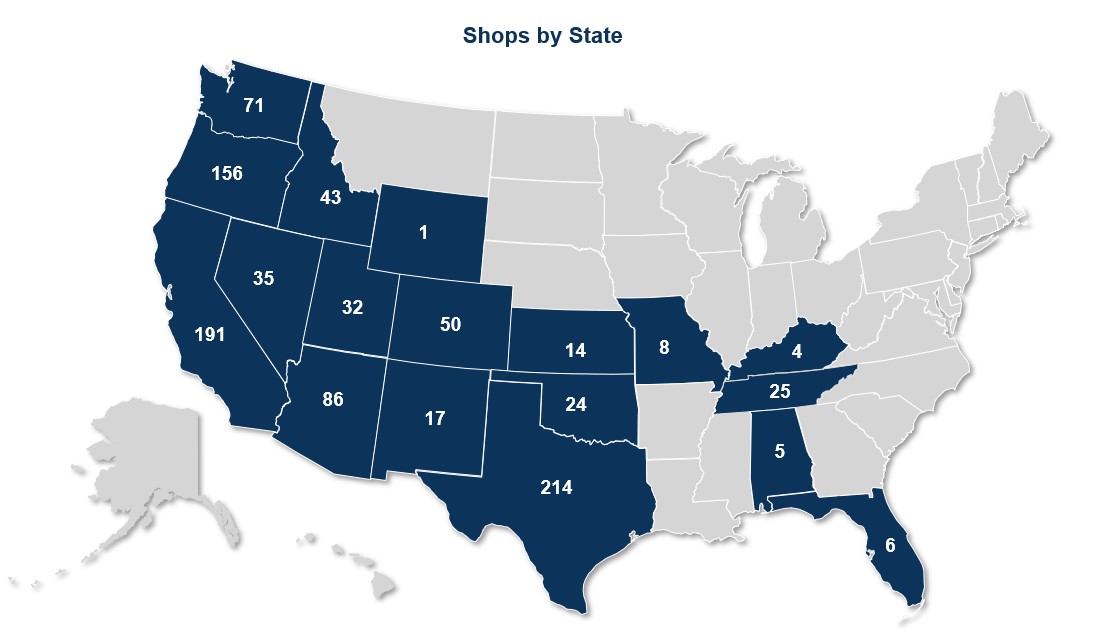
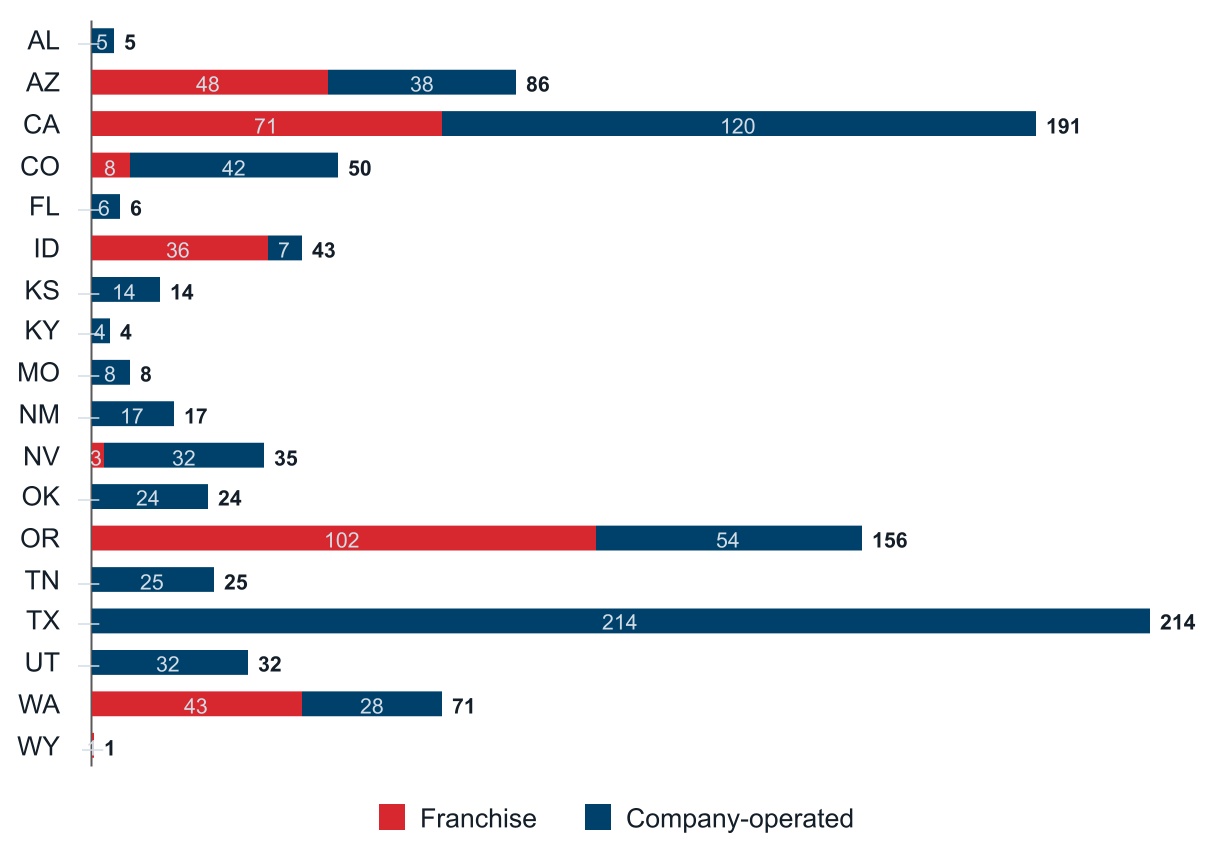
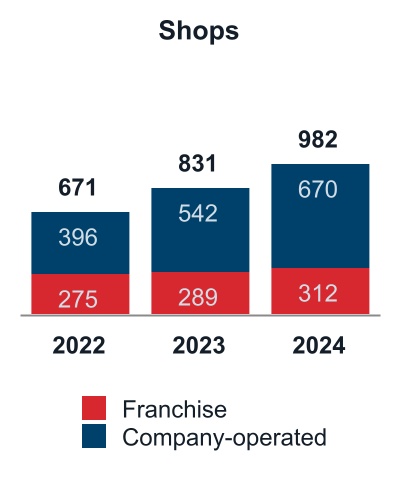
As of December 31, 2024, we had 982 shops, of which 670 were company-operated and 312 were franchise, across 18 states as shown in the graphic below. For additional information regarding company-operated and franchise shops by state, refer to Part I, Item 2 Properties of this Form 10-K
Dutch Bros Inc.| Form 10-K | 4
The Dutch Bros Experience
|
|
|
|
|
|
|
|
|
|
|
Dutch Bros is more than just the products we serve: we are dedicated to making differences in the lives of our employees, customers, and the communities in which we operate. Our people are the key to our success and our broistas are the face of Dutch Bros, delivering on our core values of SPEED, QUALITY and SERVICE. |
•SPEED: Our drive-thru and walk-up windows enable us to rapidly serve our customers. In 2024, we launched mobile order functionality which we expect could help us elevate throughput and enhance convenience.
•QUALITY: We take pride in the training and skills of our broistas, which enable them to provide consistent, high-quality hand-crafted beverages to our customers.
•SERVICE: We embrace a customer-first attitude and use every interaction to connect with our customers and seek to deliver an experience that exceeds our customers’ expectations.
The combination of hand-crafted and high-quality beverages, our unique drive-thru experience, and our community-driven people-first culture has allowed us to successfully open new shops and continue to share the “Dutch Luv”. To achieve these experiences and create meaningful differentiation in our industry, we and our franchise partners are committed to attracting and retaining broistas who deliver an experience that exceeds our customers’ expectations. We empower our broistas to take the extra step to make each customer interaction remarkable.
Our Menu
We sell a wide range of customizable hot, iced, and blended beverages.
•Coffee: coffee-based beverages make up ~50%1 of our menu mix. In our shops, we utilize premium La Marzocco machines to handcraft espresso shots for both our hot and cold custom classic and signature coffee beverages. We also sell our proprietary coffee-based “Freeze” blended beverages and cold brew. We import and roast our own coffee beans. Our Private Reserve coffee is a 100% Arabica three-bean blend, roasted by Dutch Bros in our Grants Pass, Oregon or Melissa, Texas facilities.
•Energy: ~25%1 of our menu mix is based upon our proprietary Dutch Bros Rebel® energy drink, which is highly customizable with flavors and modifiers and can be served blended or over ice. Our energy platform helps unlock the afternoon daypart and helps us appeal to a diverse customer base.
•Refreshments and Other: the remaining ~25%1 of our menu mix is a wide variety of teas, lemonades, smoothies, food, and sodas offering caffeine-lite and caffeine-free beverages that can be enjoyed across all dayparts and by customers of all ages.
_________________
1 Based on number of drinks sold across our system in 2024.
Dutch Bros Inc.| Form 10-K | 5
|
|
|
|
|
|
|
|
|
|
|
Customization is at the core of what we do, and we encourage our customers to make their drinks “their own” through the addition of flavors and other modifiers including protein milk, boba, soft top and a variety of other mix-ins and toppings. We believe this customization process helps create a competitive moat and drives a broad demographic appeal. Because of our robust pantry and “made-to-order” process, we also have the ability to tailor many of our drinks to specific dietary needs, including sugar-free, dairy-free, caffeine-free, and fat-free, which positions us favorably as customer trends evolve. |
Our Dutch Rewards Loyalty Program
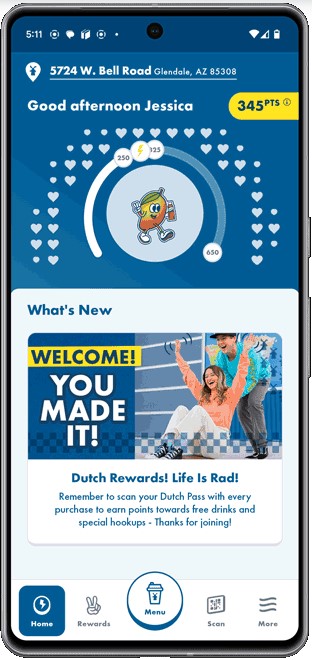
Dutch Rewards is our app-based digital loyalty program. In 2024, approximately 68% of all transactions were attributable to Dutch Rewards members, up from approximately 65% in 2023.
|
|
|
|
|
|
|
|
|
| Dutch Rewards uses a spend-based model, where customers collect points that can be redeemed for rewards. These rewards can be utilized to receive free drinks or shared with others. Points and rewards generally expire after six months. |
|
|
|
|
We offer members the ability to preload funds on their account and pay through our app, a function we call Dutch Pass. In addition to being convenient for customers, Dutch Pass enables us to increase our speed of service by reducing the payment collection time. Our Dutch Pass functionality also allows users to purchase and share digital gift cards, providing more customers the opportunity to share in the Dutch Bros experience. |
|
|
|
We utilize Dutch Rewards to communicate and interact directly with our customers and drive traffic. We see an opportunity to continue enhancing the sophistication of our segmentation and targeting efforts, using consumer insights to drive behaviors that we expect will create lasting value. We intend to continue investing in consumer insights and moving toward more personalized marketing to offer targeted messaging, offers, and rewards that enhance the Dutch Bros experience at an attractive return on investment. |
|
Mobile Order
In 2024, we launched mobile order functionality within our Dutch Rewards app. As of December 31, 2024, over 95% of systemwide shops had mobile order functionality enabled. In most cases, customers can choose to park and pick-up at our walk-up window or pick up their order in our drive thru. To date, many customers have chosen to utilize the pick-up feature, which we believe has considerable capacity. Whether customers choose our drive thru or walk-up window, their drink is personally delivered with a friendly interaction from a broista, which we believe helps maintain and strengthen service and connection as competitive differentiators.
Our mobile order system interacts with our existing point-of-sale and kitchen display system, easing integration with our operations. We believe our shops are well situated for mobile order, with multiple beverage production bars and escape lanes and pick-up windows at many of our shops. We have the ability to throttle production at peak times to help ensure smooth operations.
Dutch Bros Inc.| Form 10-K | 6
We believe mobile order provides enhanced convenience to our customers, allowing for orders to be placed in advance of customers arriving at a shop and offering an alternative to waiting in line. Compared to our peers in the beverage industry, we believe we have an opportunity to drive traffic in the morning daypart. Mobile order may present an opportunity to appeal to a broader range of customers who may be time-constrained in the morning and have not previously considered Dutch Bros as part of their morning routine.
Our Shops
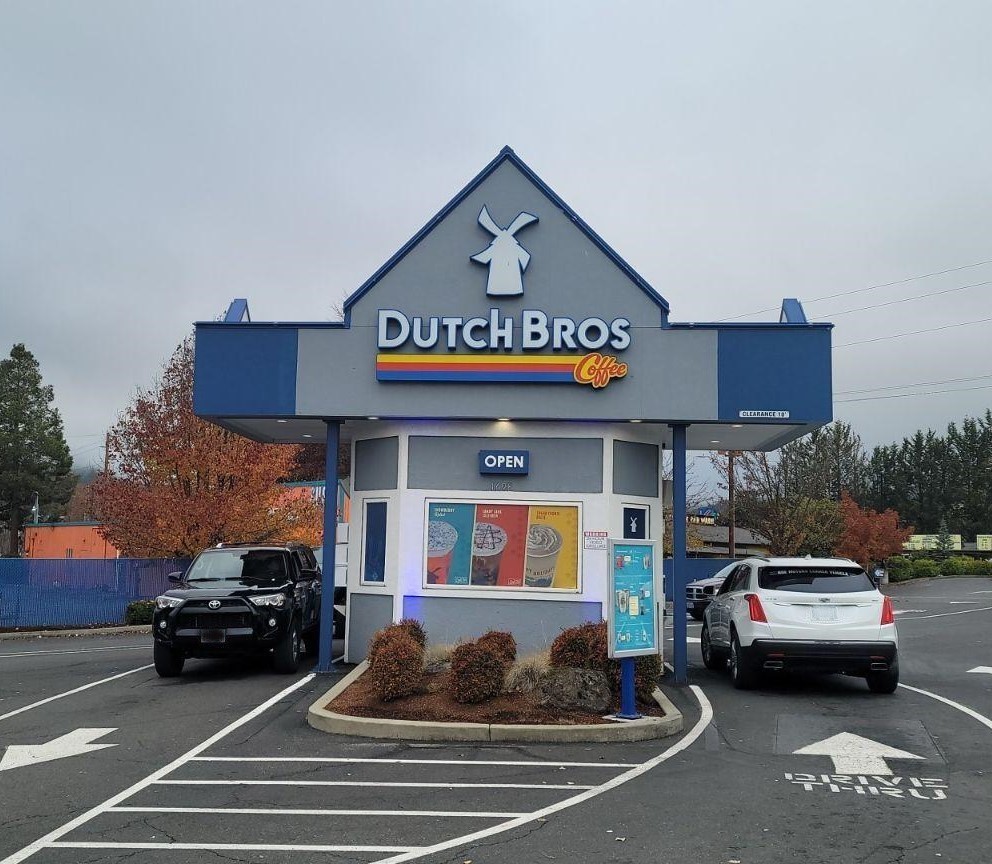
Speed is core to what we do at Dutch Bros. We primarily utilize a drive-thru model: approximately 90% of our business is conducted through the drive-thru with the remaining 10% conducted at our walk-up windows. The vast majority of our shops do not have lobbies with customer seating areas. We believe this business model places a premium on customer convenience without sacrificing the personal experience. Our shops and our real estate strategy are designed from the ground up to support this drive-thru centric business.
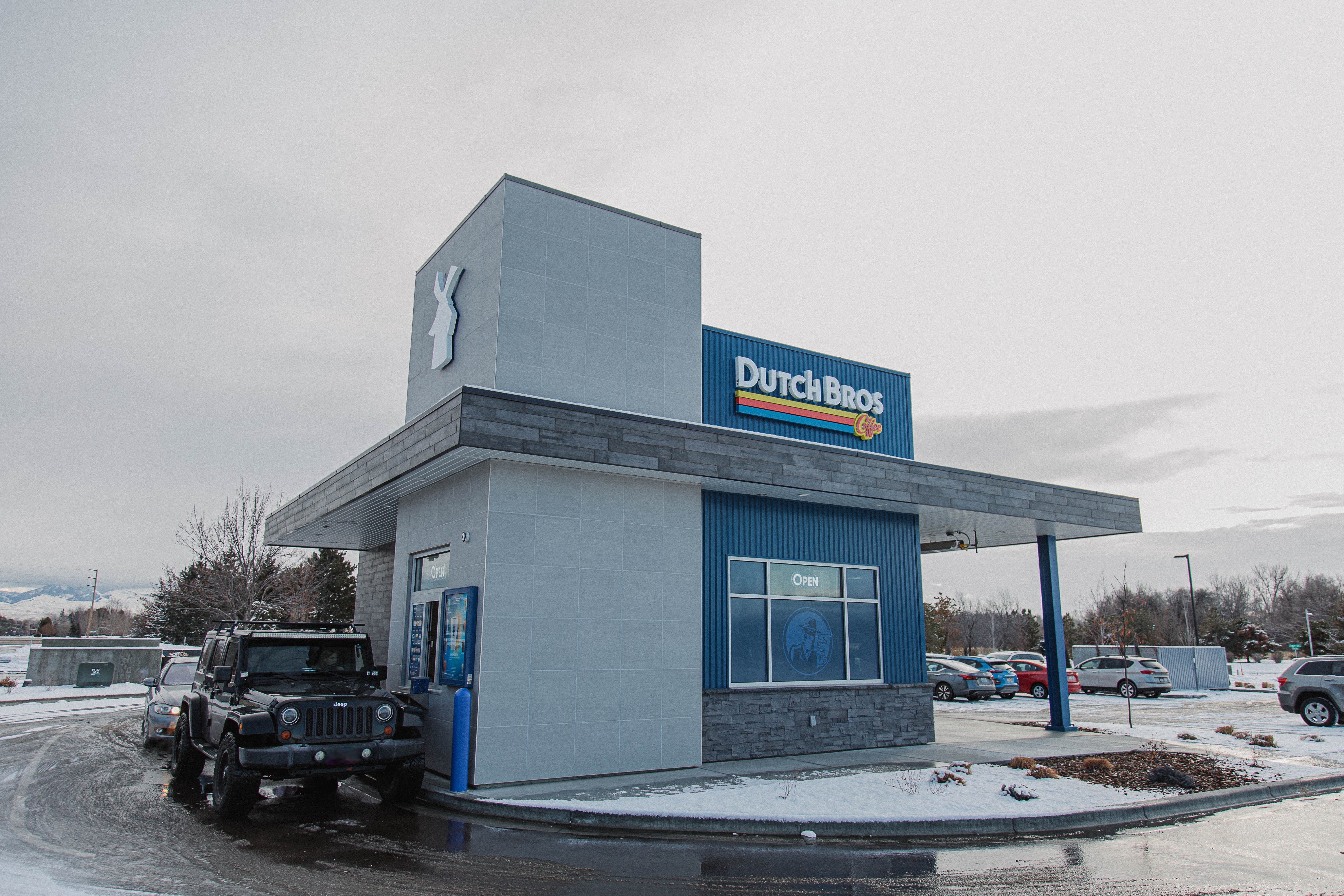
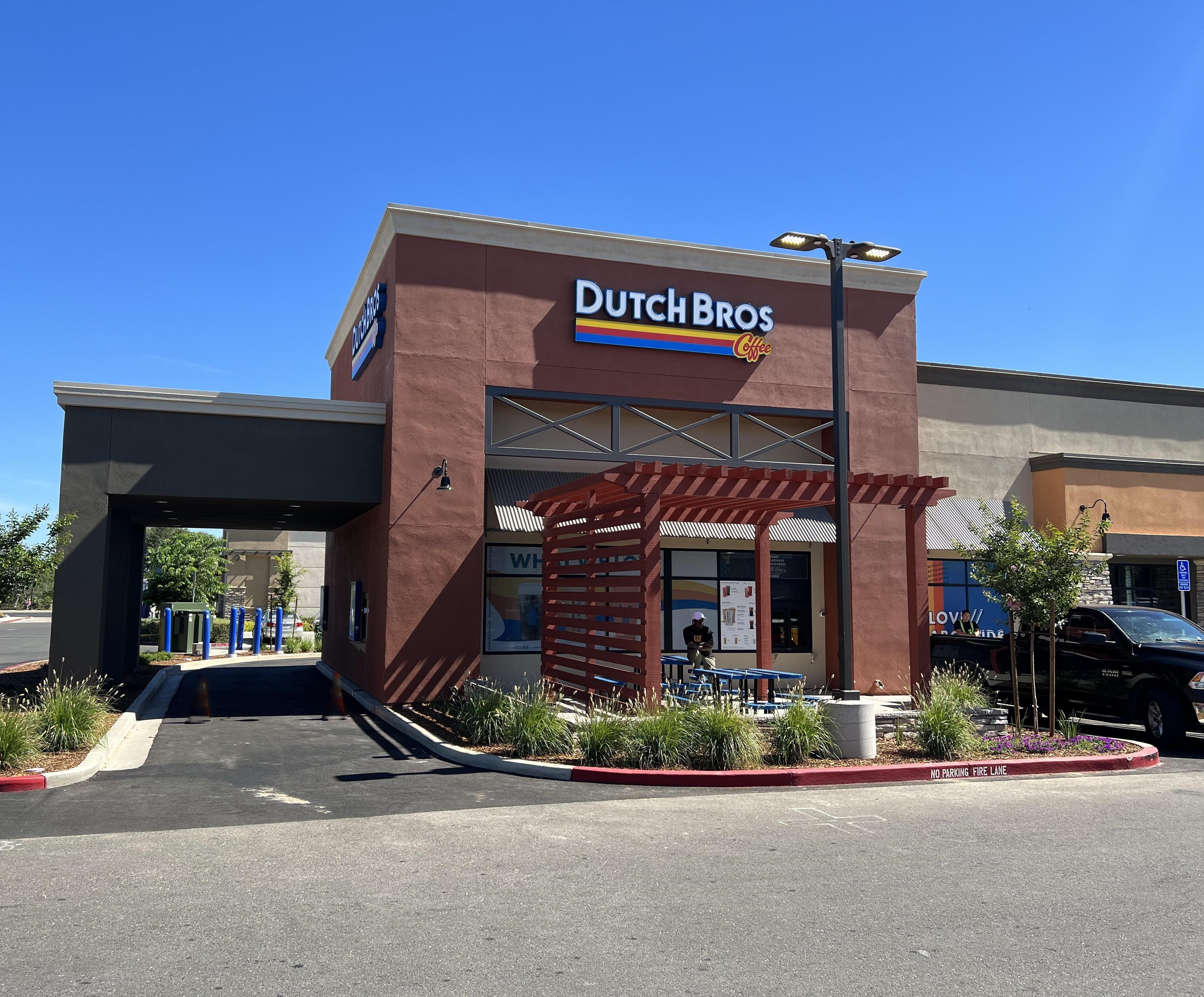
Although our shops typically have a smaller overall footprint than other drive-thru formats, essentially all of our square footage is used to support the production of beverages. We typically target lots that are at least 25,000 square feet to handle substantial car volume. Except for a handful of legacy “coffee houses,” which do have lobby areas, our shops are designed to enable customers to drive-thru or walk-up and enjoy their beverage off premises. Most of our shops feature either a single or double drive-thru window with multiple feeder lanes for traffic flow and a walk-up window.
|
|
|
|
|
|
|
|
|
|
|
|
|
|
|
| Legacy Configuration |
|
Current Configuration |
|
Endcap Configuration |
|
|
|
|
|
Size: ~500 square feet |
|
Size: ~800-1,000 square feet |
|
Size: ~1,200 square feet |
|
|
|
|
|
Geographies: Legacy West Coast |
|
Geographies: Widespread |
|
Geographies: Select Locations |
|
|
|
|
|
Characteristics: May have drive-thru lanes on both sides of the building; walk-up window optional; no lobby; storage outbuilding may be needed. |
|
Characteristics: Multiple drive-thru lanes served by one window; ample car stacking and circulation, escape lane likely; walk-up window standard; no lobby. |
|
Characteristics: Attached to the end of a strip center or purpose built with co-tenants; may have lobby with walk-up window, but no seating. |
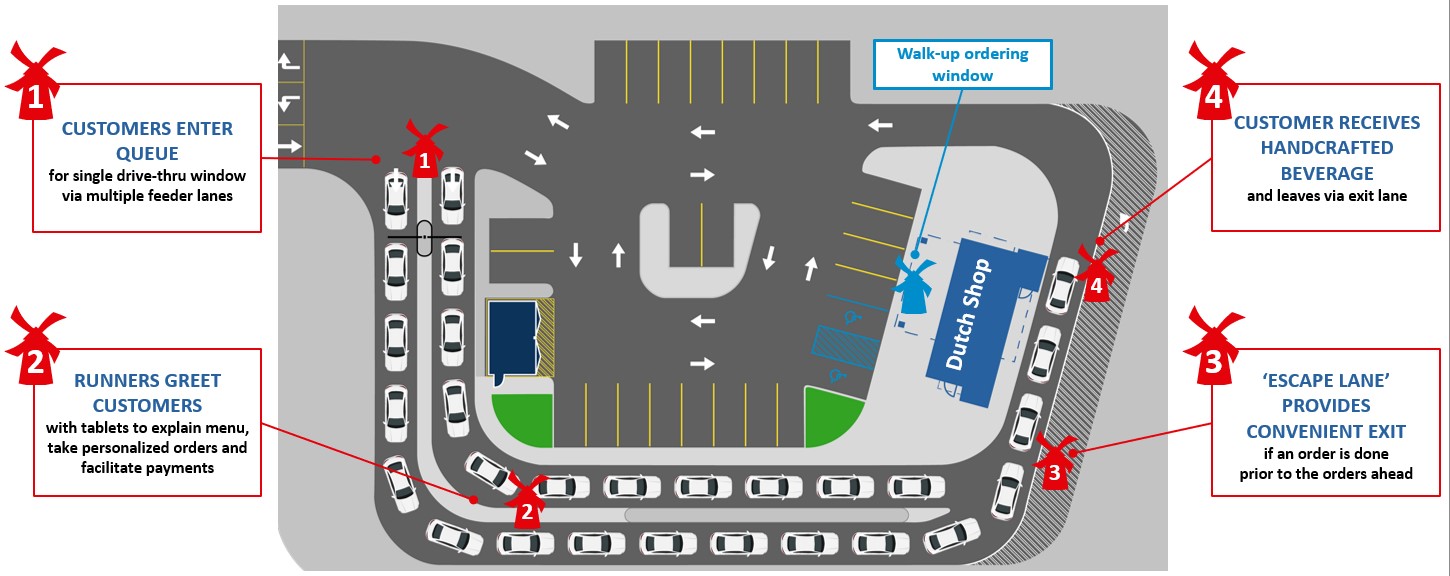
When our shops are busy, a “runner” broista leaves the shop and greets our customers before they reach the drive-thru window. The runner explains the menu and helps customers personalize their orders. Using tablets, our runners take orders, sending them to broistas inside the shop, who utilize our flexible systems to hand-craft custom beverages.
Dutch Bros Inc.| Form 10-K | 7
Many of our shops also have walk-up ordering windows and “escape lanes” that enable customers to exit the line after a runner delivers their drink before reaching the window, helping increase throughput and reducing congestion. For illustration of our shop model, see the graphic below.
Our Long-Term Franchise Partners
We believe we have a high-quality and strong franchise base, made up of long-term franchise partners. Many of these franchise partners began their Dutch Bros journeys working in the shops as broistas.
Throughout our history, we have used a variety of development models, including both franchise and company-operated led growth. We currently utilize a mixed model, where we continue to encourage our franchisees to develop within their existing operating areas (where we believe there is significant room for continued growth) while developing new regions with company-operated shops.
Since 2017, our focus has been a company-operated strategy with all operators recruited from within our system. While we maintain great relationships with our existing franchise partners and they continue to open new shops as they look to infill their high-demand markets, we anticipate that the majority of new shops we open each year will be company-operated shops.
OUR GROWTH STRATEGIES
We are a high-growth company with considerable whitespace and opportunities. We will continue expanding our business to positively impact our communities through the following growth strategies:
|
|
|
|
|
|
|
|
|
|
|
GROW OUR PEOPLE: SCALE OUR CULTURE |
|
|
|
•Recruit, develop, and retain great people |
|
|
|
•Provide robust internal training and career advancement programs, which help develop a high-quality talent pool of candidates seeking larger roles within the Company |
|
|
|
•Target 100% internal promotion for regional operators from a list of 400+ qualified candidates with an average tenure of 7 years |
|
|
|
•Invest in our leadership team to support operations and drive strategy |
Dutch Bros Inc.| Form 10-K | 8
|
|
|
|
|
|
|
|
|
|
|
GROW OUR SHOP BASE: EXECUTE ON OUR LARGE WHITESPACE |
|
|
|
•Open new shops with superior financial returns |
|
|
|
•Target a “mid-teens” annual new shop growth rate |
|
|
|
•Invest in our shop development teams so they can utilize new data sources, analytic techniques, and tighter underwriting standards |
|
|
|
•Utilize a refined real estate strategy that balances penetration and pacing to support new shop productivity as we grow in new markets |
|
|
|
|
|
|
|
|
|
|
|
|
GROW TRANSACTIONS: DEVELOP SALES LAYERS |
|
|
|
•Innovation - assume an innovation leadership position within the beverage industry, keeping the brand fresh and encouraging trial and frequency |
|
|
|
•Paid Media - build brand awareness in new and existing markets through enhanced messaging and elevated spending |
|
|
|
•Dutch Rewards - increase sophistication of our segmentation and offers to drive more effective communication and higher frequency |
|
|
|
•Mobile Order - offer greater convenience, widen our addressable customer set, and seek to drive frequency, especially in the morning daypart where customers may have greater time constraints. |
|
|
|
•Food - test an expanded food offering in 2025 to better address customer needs in the critical morning daypart. We aim to capture beverage occasions that might be “lost” by potential customers who desire breakfast with their morning beverage and choose options other than Dutch Bros currently. |
|
|
|
|
|
|
|
|
|
|
|
GROW MARGINS: DELIVER LONG-TERM MARGIN EXPANSION |
|
|
|
•Continue targeting year-2 contribution margins of 30%+ for new shops, which support quick paybacks and funds new unit growth |
|
|
|
•Seek opportunities to continue to reinforce our shop-level P&L through operational improvement, which will enable us to continue investing to maintain our competitive advantages |
|
|
|
•Continue targeting and achieving Adjusted SG&A leverage through strong revenue growth and smart investments |
Operations
Coffee Procurement and Roasting
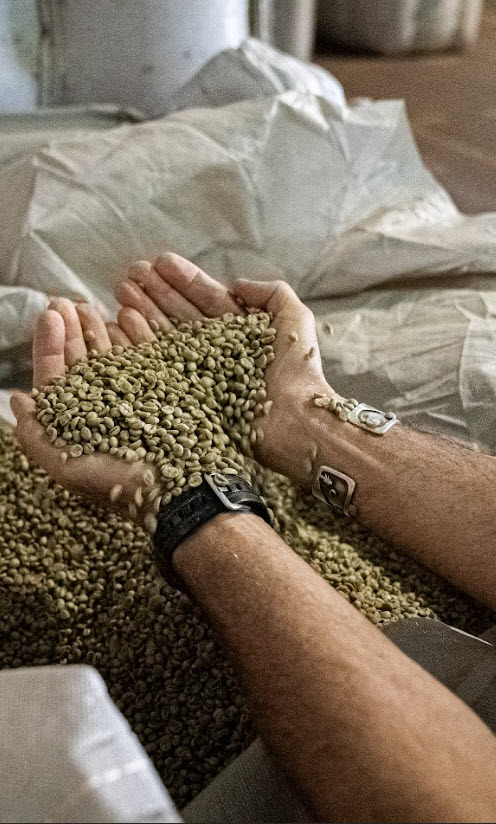
We pride ourselves on the quality of our coffee. To ensure we are able to consistently deliver high-quality coffee across all shops in our system, we are actively involved in the sourcing, roasting, packaging, and distribution of coffee beans.
Dutch Bros Inc.| Form 10-K | 9
|
|
|
|
|
|
|
|
|
|
|
We partner with third-party importers and exporters to purchase and import our green coffee beans. Through this relationship, we source high-quality coffee beans from across Central and South America.
Since 2021, we have partnered with Enveritas, an independent nonprofit organization that provides sustainability verifications for coffee. Annually, we have our green coffee purchases and our farmer support impact investments assessed against Enveritas’ responsible sourcing standards. In their evaluation, Enveritas maps our sourcing footprint and evaluates and monitors environmental, economic, and social conditions within the sourcing areas where we purchase our coffee, including child labor and forced labor.
Within Dutch Bros, we sponsor a Coffee Origins Impact Program focused on continuous improvement and targeted investments in environmental, economic, and social conditions within our supply chain. We are also proud members of World Coffee Research, an organization dedicated to ensuring the future of coffee with a strategic aim to preserve origin diversity in the face of climate change and accelerate innovation for coffee agriculture and climate resistant varietal productivity.
|
|
|
|
|
|
We currently roast all our coffee in our roasting facilities in Grants Pass, Oregon and Melissa, Texas. We roast our coffee bean varietals to specific profiles designed to highlight each of the coffee beans’ unique flavors and aromas. After the coffee beans are roasted, we blend them to create our signature Private Reserve espresso blend. |
|
|
|
We package and ship our Private Reserve, Decaf and White Coffee espresso blends to several distributors across the country that supply all our company-operated and franchised shops. |
We designed our supply chain to be flexible in response to changes in the market. On average, we typically have approximately four months of green coffee bean inventory stored at our two ports of entry in the United States or at our roasting facilities. In the event of a supply disruption in any one of our production origins, we have identified alternate coffee beans with substantially similar flavor profiles that can be sourced and incorporated to produce our blend.
In mid-2024, we opened a new roasting facility in Melissa, Texas. We expect this facility will increase the resilience of our supply chain and reduce transportation costs as we expand company-operated shops eastward within the United States.
Sourcing and Supply Chain
In addition to coffee purchases, we also source dairy, syrups, packaging, Dutch Bros Rebel energy drink, and other items. We strive to have multiple sources for our key commodities, including dairy, to provide stability. As we grow eastward, we are continuing to adjust our supplier and distribution network to find partners more centrally located to our expanding shop base while continuing to evaluate our current market partnerships to ensure that they can grow and scale in accordance with our future plans. Strategically, our Supply Chain team is recalibrating its Innovation to Implementation pipeline, aiming to add more process capabilities while remaining nimble for increased product innovation at scale.
Dutch Bros Inc.| Form 10-K | 10
|
|
|
|
|
|
|
|
|
|
We also manufacture our own proprietary Dutch Bros Rebel energy drink via a co-bottling and co-packaging relationship. Neither our Dutch Bros Rebel energy drink, nor our syrups contain high-fructose corn syrup, as we use pure cane sugar as a sweetener for our non-sugar free offerings.
As we scale, we continue to look for opportunities to mitigate our impact on the environment. In 2023, we began rolling out tap systems and distributing our Dutch Bros Rebel energy drink via a “bag in a box” system for use in shop beverage taps, with a goal of helping us reduce our dependence on aluminum cans.
|
|
|
Quality, Health, and Safety
We and our franchise partners strive to maintain a safe, healthy environment at each shop through the careful training and supervision of personnel and by following rigorous quality standards. Our quality assurance team informs, monitors, and reports on standards for preparation and cleaning at each of our shops. The quality assurance team inspects both Company-owned and franchise shops on a regular cadence. As part of our people-first culture, the health and safety of our customers and employees are our highest priority.
Our commitment to beverage and food safety is strengthened through the direct relationships among our supply chain, culinary research and development, food safety, operations, and quality control teams. We collaborate with our supply chain partners on material decisions regarding ingredients and process changes to ensure our final customer-facing product meets our standards of approval. We examine new and existing suppliers’ food safety and quality records through compliance assessments, and we reserve the right to conduct spot-checks, onsite audits, and verify insurance coverage. We believe that our established requirement for franchise partners to purchase supplies and equipment from approved vendors further enhances safety and quality within our system.
Furthermore, as part of our broista onboarding process, new hires are taken through our “broista manifesto” which includes food safety training. Before working a shift on their own, broistas must pass our “flow check” test, which ensures they can make every drink to our high standards.
Our supply chain risk model stretches beyond food safety and quality assurance practices. Products are evaluated for risk on the basis of other numerous factors, including price volatility, supply continuity, and sustainability.
People
Our people are the heart of our mission and the foundation of our success. We strive to build meaningful relationships with our employees, who are key members of the communities we love and serve. We attract individuals who love growth, thrive in unique and fun environments, and radiate positivity. With a love for life, a natural ability to connect with others in any circumstance, and a genuine smile, our team members embody everything that makes Dutch Bros special.
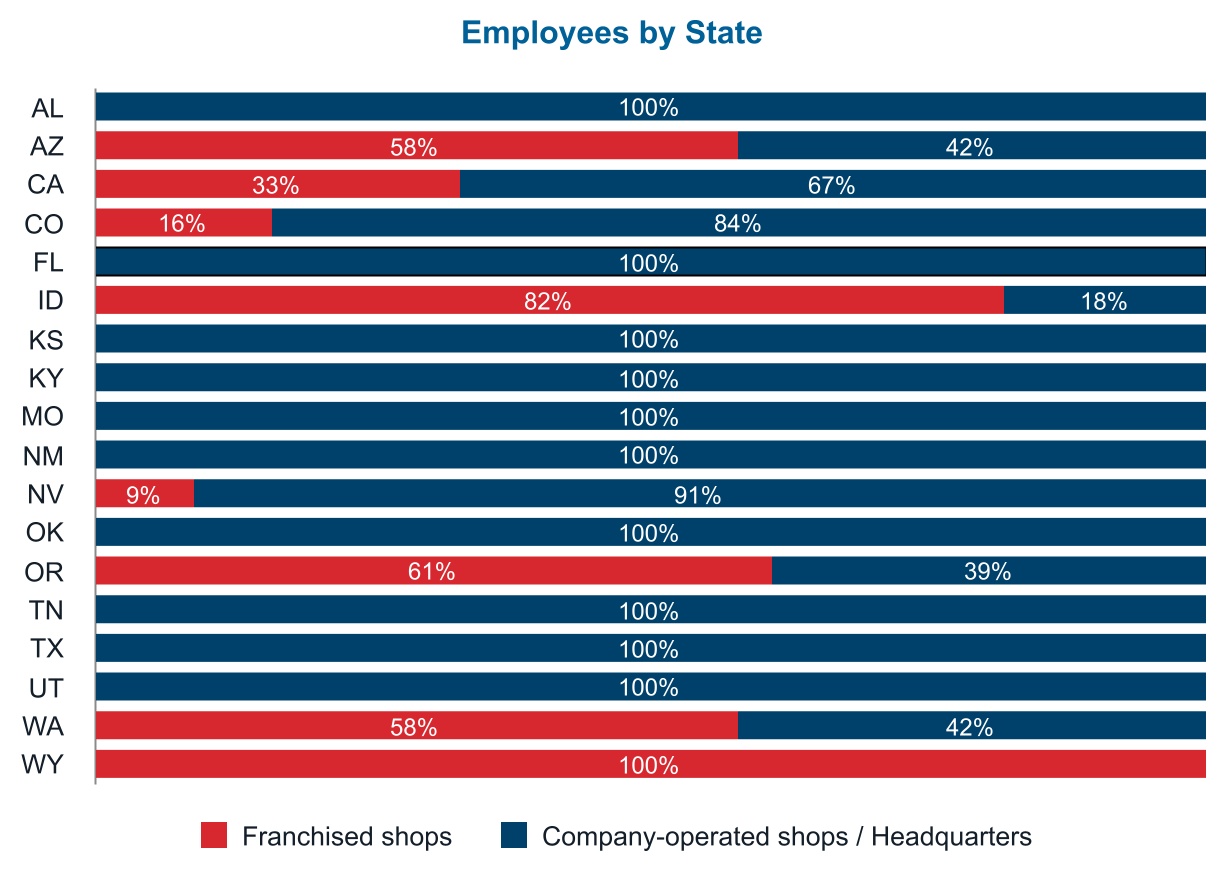
As of December 31, 2024, we and our franchise partners have approximately 26,000 employees, of which approximately 18,000 employees are in our company-operated shops and headquarters. The chart below provides the approximate percentage of systemwide employees by shop type and state location:
Dutch Bros Inc.| Form 10-K | 11
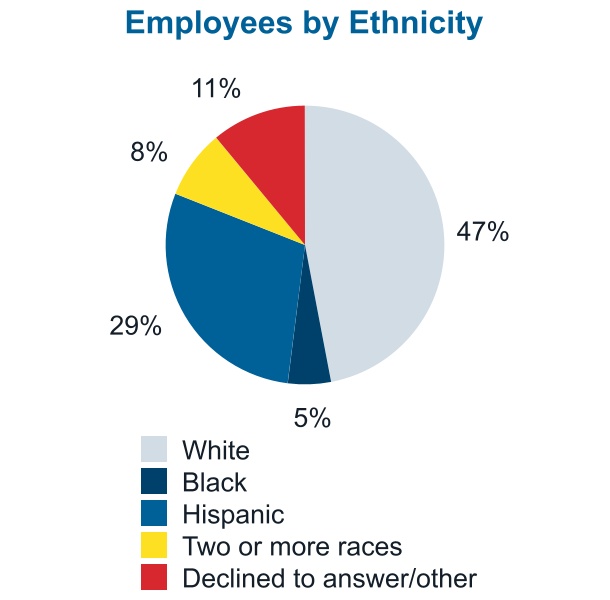
The charts below provide the approximate percentages of our company-operated shop and headquarters employees by gender and ethnicity:
Dutch Bros Inc.| Form 10-K | 12
Sharing the Dutch Luv
We are committed to sharing the Dutch Luv at our headquarters, at the window, and in our communities, cultivating an inclusive environment of love, acceptance, and kindness. Our commitment strives to ensure all customers, crews, and communities are welcomed, honored, and loved.
•Building Community Through Employee Resource Groups: Expanded and enriched Employee Resource Groups foster connection, belonging, and shared purpose among employees and allies. These groups create spaces where individuals can celebrate their identities, support one another, and collaborate on initiatives that make a meaningful impact, strengthening the sense of community across the organization.
•Continuous improvement of our library of training, events, and resources to headquarters employees and shop management.
Total Rewards
At our company, we are committed to fostering a dynamic and supportive workplace that nurtures the growth and satisfaction of our employees. To remain competitive in today’s ever-evolving business landscape, we routinely evaluate and adjust our salary and wage offerings, ensuring alignment with current labor market conditions.
As part of our strategic growth initiatives, we continuously enhance our total rewards program, which is designed to attract and retain exceptional talent. Our comprehensive suite of benefits reflects this commitment and includes several key offerings for our broistas, shop management, and headquarters employees, such as:
•Competitive Compensation: We uphold a company-wide minimum wage of at least $10.00 per hour, ensuring fair pay across all markets.
•Parental Leave: Employees in management roles and those at our headquarters benefit from more than eight weeks of company-paid parental leave after completing one year of service.
•Wellness Initiatives: Our wellness program empowers employees to prioritize their health and well-being, while our employee assistance program offers free access to support resources for all team members.
•Tuition Assistance: We provide financial support for professional development through tuition assistance, available after one full year of service, enabling our employees to enhance their skills and advance in their careers.
•Flexible Working Arrangements: Flexible working arrangements are a feature of our headquarters, which fosters a positive work-life balance through a hybrid work environment.
•Community Engagement: We encourage social responsibility by offering up to 16 hours of paid volunteer time for all employees, allowing them to contribute positively to their communities.
•Growth Opportunities: Our culture emphasizes teamwork and collaboration, with numerous opportunities for leadership development and career advancement.
Training and Development
We are committed to inspiring and facilitating personal and professional growth for our people as they fulfill their dreams and contribute to their communities. As part of this commitment, we provide resources to train and develop our people.
Broista Training
•2 day cultural immersion, history, and fundamental knowledge
•10 shifts of on-the-job training
•Review of “Manifesto,” field guide, and employee handbook, and have proficiency tests twice per year
Dutch Bros Inc.| Form 10-K | 13
Leadership Pathways
We exclusively source regional operators, who we view as the linchpins of our field organization and lead between 3-7 shops at scale, from within our organization. For our continued growth, it is critical that we consistently train and develop new leaders. Our leadership development program outlines shop growth opportunities at all levels of the organization and furthers our philosophy of hiring and developing leaders from within. This program provides ample opportunities for our shop broistas to create their own pathway, which can be a mix of Path A and B, to reach their potential goals.
|
|
|
|
|
|
|
|
|
|
|
|
|
|
|
|
|
|
|
|
|
| Broista |
|
|
|
ê |
|
|
|
| Shift Lead |
|
|
í |
|
î |
|
|
|
Path A: Shop Level Operations |
|
|
|
Path B: Shop Opening Team |
|
|
|
|
|
|
|
|
|
|
|
|
|
|
|
|
Shop Lead |
|
|
|
|
|
|
|
|
|
|
Master of Broistas (MOB) |
|
|
Manager |
|
|
|
|
|
|
|
|
|
|
Lead MOB |
|
|
Regional Manager |
|
|
|
|
|
|
|
|
|
|
|
|
|
|
î |
|
í |
|
|
| Regional Operator |
This leadership program develops a pipeline of home-grown talent, which we believe will be sufficient for our new shop growth over the next several years.
Philanthropy
Since our inception, we have been dedicated to giving back to the communities in which we serve, and we consider our brand to be a powerful platform for social impact. Our philanthropic efforts support local and national causes. A culture of philanthropy and giving back to build better communities permeates the entire Dutch Bros organization, energizing our broistas and customers alike.
We host three company-wide giveback days each year. Dutch Bros, along with our franchise partners and the Dutch Bros Foundation (the Foundation) provide donations for funds raised in each of these giveback days. The Foundation is a not-for-profit founded by the Company that provides philanthropy to coffee farmers and local communities.
Dutch Bros Inc.| Form 10-K | 14
|
|
|
|
|
|
|
|
|
|
|
|
|
|
|
|
|
|
|
|
|
|
|
|
|
“Dutch Luv” |
|
“Drink One for Dane” |
|
“Buck for Kids” |
Every February, we donate proceeds from every drink sold to local organizations working to fight food insecurity in our communities. |
|
Every May, in honor of our co-founder Dane Boersma, we raise funds for the Muscular Dystrophy Association to find a cause and cure for ALS, or Lou Gehrig’s disease. |
|
Every September, we dedicate a day to donate proceeds from every drink sold to nonprofit organizations helping create brighter futures for local kids. |
|
|
|
|
|
2024 Donations |
$0.9 million |
|
$2.5 million |
|
More than $1.0 million |
In addition, during 2024, we donated our previous Grants Pass, Oregon headquarters building for development of a children’s learning center and recorded a net donation of $1.8 million.
Competition
The beverage industry is highly competitive and fragmented, and our shops compete on a variety of factors, including convenience, taste, price, quality, service, labor, and location. We believe our primary competitors include national and regional coffee chains, local specialty coffee shops, regional drive-thru beverage chains, and drive-thru quick service restaurants with coffee and other beverage programs. Our competitors operate company-operated, franchised, and mixed business models. In addition, we also compete with convenience stores.
Intellectual Property
We own many registered trademarks and service marks in the United States, the most important of which might be our trademarked Windmill logo. Other important trademarks include our “Dutch Bros,” “Dutch Bros Coffee,” “Dutch Bros Rebel,” and “Dutch Bros. Blue Rebel” word marks and our recognizable Dutch Bros sign logo. We believe the Dutch Bros name and the many distinctive marks associated with it are of significant value and are very important to our business. Accordingly, as a general policy, we pursue registration and monitor the use of our marks in the United States and challenge unauthorized use.
We license the use of our marks to franchise partners, third-party vendors and others through franchise agreements, vendor agreements, and licensing agreements. These agreements typically restrict third parties’ activities with respect to use of the marks, impose brand standards requirements, and require licensees to inform us of any potential infringement of the marks.
We register some of our copyrighted material and otherwise rely on common law protection of our copyrighted works. Such copyrighted materials are not material to our business.
Dutch Bros Inc.| Form 10-K | 15
Government Regulation and Environmental Matters
We are subject to extensive federal, state, local, and foreign laws and regulations, as well as other statutory and regulatory requirements, including those related to, among others, nutritional content labeling and disclosure requirements, food safety regulations, local licensure, building, and zoning regulations, employment regulations, and laws and regulations related to our licensed operations. New laws and regulations or new interpretations of existing laws and regulations may also impact our business. The costs of compliance with these laws and regulations are high, are likely to increase in the future, and any failure on our part to comply with these laws may subject us to significant liabilities and other penalties. See "Risk Related to Regulation and Litigation" in Item 1A, Risk Factors for more information.
We are not aware of any federal, state, or local provisions that have been enacted or adopted regulating the discharge of materials into the environment, or otherwise relating to the protection of the environment, that have materially affected, or are reasonably expected to materially affect, our results of operations, competitive position, or capital expenditures.
Seasonality
Our business is subject to seasonal fluctuations that impact our revenue and shop gross profit margins. We typically experience higher nominal system sales in the summer months, which impacts revenue and shop gross profit margins in our second and third quarters of our fiscal year.
Information About our Executive Officers
The executive officers of Dutch Bros Inc. as of the filing of this Form 10-K, are as follows:
|
|
|
|
|
|
| Travis Boersma, 54 |
Co-founder and Executive Chairman of the Board |
Mr. Boersma is our Co-Founder and has served as our Executive Chairman since August 2021 and as the Executive Chairman of Dutch Bros OpCo since February 2021. Prior to serving as our Executive Chairman, he served as the Chief Executive Officer of Dutch Bros OpCo from February 2019 to February 2021. Mr. Boersma has led us as Co-Founder since 1992. Mr. Boersma attended Southern Oregon University.
|
|
|
|
|
|
| Christine Barone, 51 |
Chief Executive Officer and President |
Ms. Barone has served as our Chief Executive Officer and as a member of our Board since January 2024, and as our President since February 2023. Ms. Barone has worked in the food service and beverage industries for more than a decade, and most recently served as Chief Executive Officer at True Food Kitchen, a high growth restaurant and lifestyle brand, from August 2016 to February 2023. Prior to that, she served in various leadership roles at Starbucks Corporation (Nasdaq: SBUX). Earlier in her career, she held positions with Bain & Company and Raymond James. Since March 2020, Ms. Barone has served on the Board of Directors of Yelp Inc. Ms. Barone holds a B.A. in Applied Mathematics and an M.B.A. from Harvard University.
|
|
|
|
|
|
| Joshua Guenser, 46 |
Chief Financial Officer |
Mr. Guenser has served as our Chief Financial Officer since May 2024, after a transitional period as Incoming Chief Financial Officer from February 2024 to May 2024. Mr. Guenser served as Chief Financial Officer of MOD Super Fast Pizza Holdings, LLC, a US-based fast-casual pizza restaurant chain, from March 2020 to January 2024. Prior to that, he served in various roles at Starbucks Corporation (Nasdaq: SBUX), a global coffee chain, from October 2009 to March 2020, most recently as Senior Vice President, Finance - Americas from January 2019 to March 2020, and prior to that, as Vice President, Finance - US Retail from July 2018 to January 2019. Mr. Guenser holds a Master of Professional Accounting and a B.A. in Business Administration from the University of Washington.
Dutch Bros Inc.| Form 10-K | 16
|
|
|
|
|
|
| Sumi Ghosh, 57 |
President of Operations |
Mr. Ghosh has served as our President of Operations since April 2024, after a transitional period as Incoming President of Operations from January 2024 to March 2024. Mr. Ghosh served as Global VP of Nike Stores for NIKE, Inc. (NYSE: NKE), a multinational athletic, footwear, apparel, equipment, and services corporation, from November 2021 to December 2023. Prior to that, he served as Chief Operating Officer of Foxtrot Ventures Inc., a food and drink convenience store and delivery service, from December 2020 to September 2021. He held various roles at Starbucks Corporation (Nasdaq: SBUX), a global coffee chain, from 2008 to December 2020, most recently as Senior Vice President of Siren Retail, Global Roastery and Reserve Stores from January 2019 to December 2020, and before that as Chief Executive Officer and Managing Director of TATA Starbucks Private Limited from January 2016 to January 2019. Mr. Ghosh serves on the Boards of Directors of the non-profit organizations India Initiative and New City Church. He holds a B.A. in Advertising from Michigan State University.
|
|
|
|
|
|
| Tana Davila, 42 |
Chief Marketing Officer |
Ms. Davila has served as our Chief Marketing Officer since June 2023. Prior to joining Dutch Bros, she served as Chief Marketing Officer at CKE Restaurants, Inc., a quick service restaurant group, from September 2022 to June 2023. Prior to that, she served in various roles at PF Chang’s China Bistro Inc., a casual dining restaurant chain, including most recently as Chief Marketing Officer from September 2019 to August 2022, as Senior Vice President – Marketing from January 2019 to September 2019, and as Vice President – Marketing and Brand Development from November 2017 to January 2019. Ms. Davila is a Fulbright Scholar and holds a B.A. in International Studies and German from Washington University in St. Louis, a J.D. from Seton Hall University, and an M.B.A. from Emory University.
|
|
|
|
|
|
| Victoria Tullett, 57 |
Chief Legal Officer |
Ms. Tullett has served as our Chief Legal Officer since September 2022 and has more than 20 years of experience helping diverse organizations manage operational risk and achieve record levels of growth, compliance, and profitability. Prior to joining Dutch Bros, she served Papa Murphy’s International, a franchise model take-and-bake pizza company, for more than 20 years in various roles, including most recently as Senior Vice President, General Counsel, and head of new store Development from May 2019 to August 2022, and from May 2014 to May 2019, as Chief Legal Officer while the company was publicly traded on the Nasdaq. In addition to her role at Dutch Bros, Ms. Tullett serves on the Board of Directors for Vancouver Symphony Orchestra. Ms. Tullett holds a J.D. from Lewis & Clark, Northwestern School of Law.
Please refer to our website for a complete listing of our executive management team.
Available Information
Our website address is dutchbros.com. Our Form 10-K, Quarterly Reports on Form 10-Q, Current Reports on Form 8-K, and other filings with the SEC, and all amendments to these filings, can be obtained free of charge from our website at https://investors.dutchbros.com/financials/sec-filings/default.aspx or by contacting our Investor Relations department at our office address listed above as soon as reasonably practical following our filing or furnishing of any of these reports with the SEC. The SEC maintains a website that contains reports, proxy and information statements, and other information regarding issuers that file electronically with the SEC at www.sec.gov. We also routinely use the investor relations page on our website as a channel of distribution for important Company information, including press releases, analyst presentations, and financial and corporate governance information. The contents of these websites are not incorporated into this filing. Further, the Company’s references to the URLs for these websites are intended to be inactive textual references only.
Dutch Bros Inc.| Form 10-K | 17
ITEM 1A. RISK FACTORS
Summary of Risk Factors
Below is a summary of the principal factors that make an investment in our Class A common stock speculative or risky. This summary does not address all of the risks that we face. Additional discussion of the risks summarized in this summary, and other risks that we face, can be found below under the heading “Risk Factors” and should be carefully considered, together with other information in this Form 10-K and our other filings with the SEC before making investment decisions regarding our Class A common stock.
•Evolving consumer preferences and tastes or changes in consumer spending may adversely affect our business.
•Our financial condition and quarterly results of operations are subject to, and may be adversely affected by, a number of factors, many of which are also largely outside our control and as such our results may fluctuate significantly and may not fully reflect the underlying performance of our business.
•We may not be able to compete successfully with other shops, QSRs and convenience shops, including the growing number of coffee delivery options. Intense competition in the food service and restaurant industry could make it more difficult to expand our business and could also have a negative impact on our operating results if customers favor our competitors.
•Our failure to manage our growth effectively could harm our business and operating results.
•Our inability to identify, recruit, and retain qualified individuals for our shops could slow our growth and adversely impact our ability to operate.
•Our shops are geographically concentrated in the Western United States, and we could be negatively affected by conditions specific to that region.
•Interruption of our supply chain of coffee, flavored syrups or other ingredients, coffee machines and other restaurant equipment or packaging could affect our ability to produce or deliver our products and could negatively impact our business and profitability.
•Increases or sustained inflation in the cost of high-quality arabica coffee beans, dairy, or other commodities or decreases in the availability of high-quality arabica coffee beans, dairy, or other commodities could have an adverse impact on our business and financial results.
•Our success depends substantially on the value of our brand and failure to preserve its value could have a negative impact on our financial results.
•Food safety and quality concerns may negatively impact our brand, business, and profitability, our internal operational controls and standards may not always be met and our employees may not always act professionally, responsibly and in our and our customers’ best interests. Any possible instances or reports, whether true or not, of food and/or beverage-borne illness could reduce our sales.
•Changes in the availability of and the cost of labor could harm our business.
•Our culture has contributed to our success, and if we cannot maintain this culture as we grow, we could lose the high employee engagement fostered by our culture, which could harm our business.
•Our Co-Founder continues to have significant influence over us, which could limit your ability to influence the outcome of matters submitted to stockholders for a vote.
•We are a “controlled company” within the meaning of the New York Stock Exchange rules and, as a result, qualify for, and may rely on, exemptions and relief from certain corporate governance requirements. You do not have the same protections afforded to stockholders of companies that are subject to such requirements.
Dutch Bros Inc.| Form 10-K | 18
•Our growth strategy depends in part on opening new shops in existing and new markets. We may be unsuccessful in opening new shops or establishing new markets, which could adversely affect our growth.
•Our operating results and growth strategies are closely tied to the success of our franchise partners, and we have limited control with respect to their operations. Additionally, our franchise partners’ interests may conflict or diverge with our interests in the future, which could have a negative impact on our business.
•Dutch Bros OpCo may make distributions of cash to Dutch Bros Inc. in excess of the amounts used by Dutch Bros Inc. to make distributions to its stockholders and pay its expenses (including taxes and payments under the Tax Receivable Agreements). In certain circumstances, such excess cash could cause the value of a share of Class A common stock to be deemed to increase relative to the value of a Dutch Bros OpCo Class A common unit, and if actions are not taken to address this issue the Continuing Members could benefit disproportionately from any additional value of a share of Class A common stock attributable to such cash if they exercise their redemption or exchange rights.
Risk Factors
You should carefully consider the risks described below in addition to the other information set forth in this Form 10-K, including “Management’s Discussion and Analysis of Financial Condition and Results of Operations,” “Quantitative and Qualitative Disclosures about Market Risk,” our consolidated financial statements and related notes in this Form 10-K, before making an investment decision. If any of the risks and uncertainties described below occur, it could have a material adverse impact on our business, reputation, financial position, results of operations or cash flows, and the trading price of our Class A common stock. Although it is not possible to predict or identify all such risks and uncertainties, they may include, but are not limited to, the factors discussed below. The risks described herein are not the only risks we may face. Additional risks and uncertainties not currently known to us or that we currently deem to be immaterial may become material and adversely affect our business, reputation, financial condition, results of operations or cash flows, or the trading price of our Class A common stock.
Risks Related to Our Business
Evolving consumer preferences and tastes or changes in consumer spending may adversely affect our business.
Dutch Bros’ continued success depends on our ability to attract and retain customers. Our financial results could be adversely affected by a shift in consumer spending away from outside-the-home beverages, decreases in general discretionary consumer spending (including due to higher gas prices, inflation or lack of consumer confidence), lack of customer acceptance of new products (including due to price increases necessary to cover the costs of new beverages or higher input costs), brand perception (such as the existence or expansion of our competitors), platforms (such as features of our mobile application and changes in our loyalty rewards programs and initiatives), a reduction in individual vehicle ownership, which in turn may reduce the usefulness and convenience of our drive-thru shops, or customers reducing their demand for our current offerings as new beverages are introduced. We may not be successful in introducing new products or new features to our mobile application that are adopted by our customers. Experimentation with and implementation of innovations in products and technologies may result in inefficiencies, such as a slowdown in our shop operations and traffic flow, disruption of workflows, technical glitches, disruption of current systems and technology, and negative customer experiences.
Dutch Bros Inc.| Form 10-K | 19
In addition, most of our beverages contain sugar, caffeine, dairy products, and other compounds, such as taurine and artificial coloring, the health effects of which are the subject of public and regulatory scrutiny, including the suggestion of linkages to a variety of adverse health effects. There is increasing consumer awareness of health risks that are attributed to ingredients we use, particularly in the United States, including obesity, increased blood pressure and heart rate, anxiety and insomnia, as well as increased consumer litigation based on alleged adverse health impacts attributed to the consumption of various food and beverage products. While we offer alternatives, including reduced sugar and sugar-free items, negative publicity or an unfavorable perception of the health effects of sugar, caffeine, or other ingredients in our products could significantly reduce the demand for our beverages and could harm our business.
Our financial condition and results of operations are subject to, and may be adversely affected by, a number of factors, many of which are also largely outside our control.
Our results of operations will be subject to a number of factors and may vary significantly in the future as they have in the past, many of which are outside of our control, and may not fully reflect the underlying performance of our business. Factors that may cause fluctuations in our results of operations and key metrics include, without limitation, those listed elsewhere in this Risk Factors section and those listed below. Any one or more of the factors listed below or described elsewhere in this section could harm our business:
•increases in real estate or labor costs in certain markets, which we have recently experienced;
•changes in consumer preferences;
•disruptions in our supply chain;
•the impact of shortages or inflation on our cost of goods or labor, including construction supplies and labor, which we have recently seen;
•changes in governmental laws and rules, including those regarding minimum wage, and approaches to taxation;
•severe weather or other natural or man-made disasters affecting a large market or several closely located markets that may temporarily but significantly affect our business in such markets, including the price or availability of goods;
•labor discord or disruption, geopolitical events, social unrest, war, including repercussions of the war between Russia and Ukraine or the war between Israel and Hamas and the related risk of larger regional conflicts, terrorism, political instability or uncertainty, acts of public violence, boycotts, hostilities and social unrest, or resurgence of or new epidemics; and
•adverse outcomes of litigation.
Our marketing programs may not be successful, and our new menu items, advertising campaigns, and other initiatives may not generate increased revenues or profits.
We incur costs and expend resources in our marketing efforts on new menu items, advertising campaigns to raise brand awareness and attract and retain customers, and other initiatives. For example, we began testing hot food offerings in a limited number of shops and implemented mobile order capabilities in over 95% of shops during 2024. These initiatives, and other initiatives we implement, may not be successful in creating new occasions in our shops or improving our financial condition and results of operations, resulting in expenses incurred without the benefit of higher revenue. For example, new menu offerings may not generate enough customer interest and sales to become profitable or cover the costs of their implementation, and may reduce our operating income. Additionally, some of our competitors have substantially greater financial resources than we do, which enable them to spend significantly more on marketing, advertising, pricing and other initiatives. Should our competitors increase spending on marketing and advertising and other initiatives or our marketing funds decrease for any reason, or should our advertising, promotions and new menu items fail to reach our customers effectively and efficiently, for example if our marketing efforts do not continue to appeal to our current customers or are perceived negatively, there could be an adverse effect on our revenues and profits could decrease.
Dutch Bros Inc.| Form 10-K | 20
From time to time our marketing efforts include limited releases of either paid or complimentary merchandise. These limited releases may be unsuccessful in creating increased demand and result in incurred cost without additional benefit. They may also be more successful than planned, resulting in product scarcity and negative customer sentiment, including potential social media backlash, which could harm our reputation and negatively affect our profits.
We may not be able to compete successfully with other coffee shops, QSRs, and convenience shops, including the growing number of coffee delivery options. Intense competition in the food service and restaurant industry could make it more difficult to expand our business and could also have a negative impact on our operating results if customers favor our competitors.
The food service and restaurant industry is intensely competitive. We expect competition in this market to continue to be intense as we compete on a variety of fronts, including convenience, taste, price, quality, service, and location. If our company-operated and franchised shops cannot compete successfully with other beverage and coffee shops, including Dunkin’, CosMc’s, Starbucks, other specialty coffee shops, drive-thru QSRs, and the growing number of coffee delivery options in new and existing markets, we could lose customers and our revenue could decline. Our company-operated and franchised shops compete with national, regional, and local coffee chains, QSRs, and convenience shops for customers, shop locations, and qualified management and other staff. Compared to us, some of our competitors have been in business longer, have greater brand recognition, or are better established in the markets where our shops are located or are planned to be located. In some markets that we may grow into, there are already well-funded competitors in the drive-thru coffee or beverage business that may challenge our ability to grow into those regions. Certain markets may limit the number of drive-thru businesses operating within their geographic region, which could negatively affect our ability to grow into those markets. Some of our competitors have substantially greater financial and other resources to devote to innovation in products, technology, and market and consumer data analytics, including integration, use, or offering of new technologies, including artificial intelligence (AI). We may be unable to offer new or innovative products and technologies to our customers that are offered by our competitors, or there may be a delay in our ability to innovate or implement new technologies. Any of these competitive factors may harm our business.
Additionally, if our competitors begin to evolve their business strategies and adopt aspects of the Dutch Bros business model, such as our drive-thru convenience, digital ordering, and similar product offerings or branding, our customers may be drawn to those competitors for their beverage needs and our business could be harmed.
Our strategic initiatives and growth strategy may be unsuccessful which could adversely affect our business and financial results.
As of December 31, 2024, Dutch Bros had 982 shops across 18 states, of which 670 were company-operated and 312 were franchised. One of the key means to achieving our growth strategy will be through opening new shops and operating those shops on a profitable basis. During the year ended December 31, 2024, we opened 128 new company-operated shops, across 15 states. Our ability to open new shops is dependent upon a number of factors, many of which are beyond our control, including our and our franchise partners’ ability to:
•identify available and suitable sites, specifically for drive-thru locations;
•compete for such sites;
•reach acceptable agreements regarding the lease of locations;
•obtain or have available the financing required to acquire and operate a shop, including construction and opening costs, which includes access to build-to-suit leases and ground lease construction arrangements;
•respond to unforeseen engineering or environmental problems with leased premises;
•avoid the impact of inclement weather, natural disasters, and other calamities;
•hire, train, and retain the skilled management and other employees necessary to meet staffing needs;
Dutch Bros Inc.| Form 10-K | 21
•obtain, in a timely manner and for an acceptable cost, required licenses, permits, and regulatory approvals and respond effectively to any changes in local, state, or federal law and regulations, such as regulatory bans on new drive-thru businesses, that adversely affect our and our franchise partners’ costs or ability to open new shops; and
•control construction and equipment cost increases for new shops and secure the services of qualified contractors and subcontractors in an increasingly competitive environment.
There is no guarantee that a sufficient number of suitable sites for shops will be available in desirable areas or on terms that are acceptable to us in order to achieve our growth plan. If we are unable to open new shops, or if existing franchise partners do not open new shops, or if shop openings are significantly delayed, our revenue or earnings growth could be adversely affected and our business may be harmed.
In addition, we may experience delays in our shop development and expansion plans due to unexpectedly long processing times or delays on the part of governmental agencies who issue necessary licenses, permits, and approvals. Delays in the permitting or licensure processes that may result from government shutdowns, staffing shortages, or similar actions that are out of our control, due to, among other things, loss of or uncertainty around federal funding, including the receipt of federal funding by states or state agencies where we operate, could lead to delays in building our shops and affect our shop development and expansion plans, which could harm our results of operations and financial condition
As part of our longer-term growth strategy, we expect to continue to enter into geographic markets in which we have little or no prior operating experience. The challenges of entering new markets include: adapting to local regulations or restrictions that may limit our ability to open new shops, restrictions on the use of certain branding, or increases in the cost of development; difficulties in hiring qualified personnel; unfamiliarity with local real estate markets and demographics; consumer unfamiliarity with our brand; and different competitive and economic conditions, consumer tastes, and discretionary spending patterns that are more difficult to predict or satisfy than in our existing markets. Consumer recognition of our brand has been important in the success of our shops in our existing markets, and we will need to build this recognition in new markets. Shops we open in new markets may take longer to reach expected sales and profit levels on a consistent basis and may have higher construction, occupancy, and operating costs than existing shops, thereby affecting our overall profitability. Any failure on our part to recognize or respond to these challenges may adversely affect the success of any new shops.
New shops, once opened, may not be profitable or may close, and the increases in average per shop revenue and comparable sales that we have experienced in the past may not be indicative of future results.
We plan to continue to open additional company-operated Dutch Bros shops in markets, including in markets where we have little or no operating experience. The target customer base of our shops varies by location, depending on a number of factors, including population density, other local coffee and convenience beverage distributors, area demographics, and geography. Our results have been, and in the future may continue to be, significantly impacted by the timing of new shop openings, which is subject to a number of factors, many of which are outside of our control, including landlord delays, delays due to scarcity of construction labor, associated pre-opening costs, and operating inefficiencies, as well as changes in our geographic concentration due to the opening of new shops. We have typically incurred the most significant portion of pre-opening expenses associated with a given shop within the three months preceding the opening of the shop. Due to the impact of inflation and other factors, we are experiencing increased costs in connection with new shops. Our experience has been that labor and operating costs associated with a newly opened shop for the first several months of operation are materially greater than what can be expected after that time, both in aggregate dollars and as a percentage of sales. Our new shops commonly take three months or more to reach planned operating levels due to inefficiencies typically associated with new shops, including the training of new personnel, new market learning curves, inability to hire sufficient qualified staff, and other factors. We may incur additional costs in new markets, particularly for transportation and distribution, which may impact sales and the profitability of those shops. Accordingly, the volume and timing of new shop openings may have a material adverse impact on our profitability.
Dutch Bros Inc.| Form 10-K | 22
Some of Dutch Bros’ shops open with an initial start-up period of higher-than-normal sales volumes and related costs, which subsequently decrease to stabilized levels. In new markets, the length of time before average sales for new shops stabilize is less predictable and can be longer as a result of our limited knowledge of these markets and consumers’ limited awareness of our brand. In addition, we do not expect our AUV and comparable sales to continue to increase at the rates achieved over the past several years. Our ability to operate new shops profitably and increase average shop revenue and comparable shop sales will depend on many factors, some of which are beyond our control, including:
•consumer awareness and understanding of the Dutch Bros brand;
•general economic conditions, such as inflation, which can affect shop traffic, local labor costs, and prices we pay for the beverage and other supplies we use;
•consumption patterns and beverage preferences that differ from region to region;
•changes in consumer preferences and discretionary spending, which we have seen impacted recently by factors such as inflation;
•difficulties obtaining or maintaining adequate relationships with distributors or suppliers in new markets;
•increases or continued elevation in prices for commodities, including coffee, milk, and flavored syrups;
•inefficiency in our labor costs as the staff gains experience;
•competition, either from our competitors in the food service and restaurant industry or our own shops;
•temporary and permanent site characteristics of new shops;
•changes in government regulation;
•our ability to hire, motivate, and retain qualified employees who share our values;
•our ability to operate effectively, including timely open and meet demand due to scarcity of equipment or other materials; and
•other unanticipated increases in costs, including costs of construction materials and trade labor, any of which could give rise to delays or cost overruns.
If our new shops do not perform as planned or close, our business and future prospects could be harmed. In addition, an inability to achieve our expected average shop revenue could harm our business.
Additionally, opening new shops in existing markets may negatively impact sales at our, and our franchise partners’, existing shops. The consumer target area of our shops varies by location, depending on a number of factors, including population density, other local retail and business attractions, area demographics, and geography. Our core business strategy anticipates achieving an ideal AUV through multiple mid-volume shops in a single region to infill and reduce the number of high-volume shops in order to provide continued efficient service. However, existing shops could also make it more difficult to build our and our franchise partners’ consumer base for a new shop in the same market. Sales transfer between our shops may be significant in the future as we continue to expand our operations, and we expect it will have an impact on our sales growth, which could, in turn, harm our business.
As we expand, we may not be able to maintain our current average shop sales and our business may be harmed. Although we target specified operating and financial metrics, new shops may never meet these targets or may take longer than anticipated to do so. Any new shop we open may never become profitable or achieve operating results similar to those of our existing shops, which could adversely affect our business, financial condition, or results of operations.
Dutch Bros Inc.| Form 10-K | 23
Our failure to manage our growth effectively could harm our business and operating results.
We have experienced rapid growth. The growth and expansion of our business may place a significant strain on our management, operational, and financial resources. As we expand our business, it is important that we continue to maintain a high level of customer service and satisfaction which may place a significant strain on our management, sales and marketing, administrative, financial, and other resources. We may not be able to respond in a timely basis to all the changing demands that our planned expansion will impose on management and on our existing infrastructure, or be able to hire or retain the necessary management and broistas, which could harm our business. Further, if we are not able to continue to provide high quality customer service as a result of these demands, our reputation, as well as our business, could be harmed, including by a decline in financial performance. If we experience a decline in financial performance, we may decrease the number of or discontinue new Dutch Bros shop openings, or we may decide to close shops that we are unable to operate in a profitable manner.
We are required to manage multiple relationships with various strategic partners, our franchise partners, customers, and other third parties. In the event of further growth of our operations or in the number of our third-party relationships, our existing management systems, financial and management controls, and information systems may not be adequate to support our planned expansion and allow for us to accurately monitor and predict changes in our costs and customer demand. Additionally, we may face challenges of integrating, developing, training, and motivating a rapidly growing employee base in our various shops and maintaining our company culture across multiple offices and shops. In 2024, we shifted approximately 40% of our total support staff to our Phoenix, Arizona office. In connection with our reorganization, we experienced increased turnover of support staff employees unable or unwilling to relocate to Arizona and may see further increased turnover in our support functions, which could potentially lead to inefficiencies, such as operational delays or disruptions and increased labor costs. In addition, increased turnover of support staff employees could make it difficult to retain other employees necessary to maintain an effective system of internal controls, including internal control over financial reporting, and timely file periodic reports with the SEC. Our ability to manage our growth effectively will require us to continue to enhance our systems, procedures and controls, and to locate, hire, train, and retain management and broistas, particularly in new markets which may require significant capital expenditures.
Damage to our brand or reputation or negative publicity could negatively impact our business.
Our reputation and the quality of our Dutch Bros brand are critical to our business and success in existing markets and will be critical to our success as we enter new markets. We believe that we have built our reputation on the high quality of our hand-crafted beverages and service, our commitment to our customers and our strong employee culture, and we must protect and grow the value of our brand in order for us to continue to be successful. Any incident that erodes consumer loyalty for our brand could significantly reduce its value and damage our business.
We may, from time to time, be faced with negative publicity, including on social media, regardless of its accuracy, relating to: beverage quality; pricing; the safety, sanitation and welfare of our shops; customer complaints or litigation alleging illness or injury; health inspection scores; integrity of our or our suppliers’ or franchise partners’ food processing, employment practices, and other policies, practices, and procedures; or employee relationships and welfare; the appearance of our shops on third-party delivery platforms that may contain inaccurate menu pricing and extended delivery times; related parties, such as our Co-Founder, and their reputation, public perception, or actions, whether or not related to Dutch Bros; or other matters. Negative publicity may adversely affect us, regardless of whether the allegations are substantiated or whether we are determined to be responsible, and it may be difficult to address negative publicity, including as a result of fictitious media content (such as content produced by generative AI technologies or bad actors). In addition, the negative impact of adverse publicity relating to one shop may extend far beyond the shop involved, to affect some or all of our other shops, including our franchise partner shops. The risk of negative publicity is particularly great with respect to our franchise partner shops because we are limited in the manner in which we can regulate them, especially on a real-time basis, and negative publicity from our franchise partners’ shops may also significantly impact company-
Dutch Bros Inc.| Form 10-K | 24
operated shops. A similar risk exists with respect to beverage businesses unrelated to us if customers mistakenly associate such unrelated businesses with our operations. Employee claims against us based on, among other things, wage and hour violations, discrimination, harassment or wrongful termination may also create not only legal and financial liability but also negative publicity that could adversely affect us and divert our financial and management resources that would otherwise be used to benefit the future performance of our operations. These types of employee claims could also be asserted against us, on a co-employer theory, by employees of our franchise partners. A significant increase in the number of these claims or an increase in the number of successful claims could harm our business.
Additionally, social media platforms and similar devices, including blogs, social media websites and other forms of internet-based communications provide individuals with access to a broad audience of consumers and other interested persons. The availability of information on social media platforms is virtually immediate as is its impact. Many social media platforms immediately publish the content their subscribers and participants can post, often without filters or checks on accuracy of the content posted. The opportunity for dissemination of information, including inaccurate information, is seemingly limitless and readily available. Information concerning us may be posted on such platforms at any time. Such platforms could be used for or result in polarizing campaigns or movements involving our brand. Information posted may be adverse to our interests or may be inaccurate, each of which may harm our performance, prospects, or business. The harm may be immediate without affording us an opportunity for redress or correction and, as we grow our brand awareness, the risk of visibility and potential magnitude of any resulting harm increases.
Ultimately, the risks associated with any such negative publicity or incorrect information cannot be completely eliminated or mitigated and may harm our business.
Our inability to identify, recruit, and retain qualified individuals for our shops could slow our growth and adversely impact our ability to operate.
Our success also depends substantially on the contributions and abilities of our broistas on whom we rely to give customers a superior experience and elevate our brand. At Dutch Bros, it’s about having fun and giving customers our special brand of “Dutch Luv,” growing our people, and forming genuine relationships with our customers. Accordingly, our success depends in part upon our ability to attract, motivate, and retain a sufficient number of qualified operators, all of whom come from within our system, and broistas to meet the needs of our existing shops and to staff new shops. Some of our broistas advance to become operators and when they do, their prior positions need to be filled. We aim to hire warm, friendly, motivated, caring, self-aware, and intellectually curious individuals, who are excited and committed to championship performance, remarkable and enriching hospitality, embodying our culture and actively growing themselves and our brand. A sufficient number of qualified individuals to fill these positions and qualifications may be in short supply in some communities. Competition in these communities for qualified staff is high and may require us to pay higher wages and provide greater benefits. We place a heavy emphasis on the qualification and training of our personnel and spend a significant amount of time and money on training our employees. Any inability to recruit and retain qualified individuals may result in higher turnover and increased labor costs, and could compromise the quality of our service, all of which could adversely affect our business. Any such inability could also delay the planned openings of new shops and could adversely impact our existing shops. Any such inability to retain or recruit qualified employees, increased costs of attracting qualified employees or delays in shop openings could harm our business.
Dutch Bros Inc.| Form 10-K | 25
We are subject to the risks associated with leasing space subject to long-term non-cancelable leases and, with respect to the real property that we own, owning real estate.
Our leases generally have initial terms of 15 years with renewal options. Shop leases provide for a specified annual rent, typically at a fixed rate for the first five years, with incremental escalations thereafter, and which may contain Consumer Price Index increases and other escalators. Generally, our leases are “net” leases, which require us to pay all the cost of insurance, taxes, maintenance and utilities. We generally cannot terminate these leases without incurring substantial costs. Additional sites that we lease, including facilities for corporate support staff, are likely to be subject to similar long-term non-cancelable leases. If an existing or future shop is not profitable, and we decide to close it, we may nonetheless be committed to perform our obligations under the applicable lease including, among other things, paying the base rent for the balance of the lease term. In addition, as each of our leases expires, we may fail to negotiate renewals, either on commercially acceptable terms or at all, which could cause us to close shops in desirable locations. Also, because we sometimes purchase real property for various shop locations and company facilities, we are subject to all the risks generally associated with owning real estate, including changes in the investment climate for real estate, demographic trends and supply or demand for the use of the shops, which may result from competition from similar restaurants in the area as well as strict, joint and several liability for environmental contamination at or from the property, regardless of fault.
Our operating results and growth strategies are closely tied to the success of our franchise partners and we have limited control with respect to their operations. Additionally, our franchise partners’ interests may conflict or diverge with our interests in the future, which could have a negative impact on our business.
As of December 31, 2024, approximately 32% of our shops were operated by Dutch Bros’ franchise partners and, because of this, we depend on the financial success and cooperation of our franchise partners for our success. Our franchise partners are independent business operators and are not our employees, and as such we have limited control over how our franchise partners run their businesses, and their inability to operate successfully could adversely affect our operating results.
We receive royalties, franchise fees, contributions to our marketing development fund, and other fees from our franchise partners. Additionally, we sell proprietary products to our franchise partners at a markup over our cost to produce. We have established operational standards and guidelines for our franchise partners; however, we have limited control over how our franchise partners’ businesses are run, including day to day operations. Even with these operation standards and guidelines, the quality of franchised Dutch Bros shops may be diminished by any number of factors beyond our control. Consequently, our franchise partners may not successfully operate shops in a manner consistent with our standards and requirements, such as quality, service, and cleanliness, or may not hire and train qualified shop managers, broistas and other shop personnel or may not implement marketing programs and major initiatives such as shop remodels or equipment or technology upgrades, which may require financial investment. Even if such unsuccessful operations do not rise to the level of breaching the related franchise documents, they may be attributed by customers to our Dutch Bros brand and could have a negative impact on our business.
Our franchise partners may not be able to secure adequate financing to open or continue operating their Dutch Bros shops. If they incur too much debt or if economic or sales trends deteriorate such that they are unable to repay existing debt, our franchise partners could experience financial distress or even bankruptcy. If a significant number of our franchise partners become financially distressed, it could harm our operating results through reduced royalty revenue, marketing fees, and proprietary product sales, and the impact on our profitability could be greater than the percentage decrease in these revenue streams. In addition, franchise partners may desire to sell their franchise locations, in some cases, to a third party, or to the Company, which may result in unexpected costs to the Company related to evaluating or consummating these transactions.
Dutch Bros Inc.| Form 10-K | 26
While we are responsible for ensuring the success of our entire system of shops and for taking a longer-term view with respect to system improvements, our franchise partners have individual business strategies and objectives, which might conflict with our interests. We may not be able to extend or renew agreements with our franchise partners on favorable terms. Our franchise partners may from time to time disagree with us and our strategies and objectives regarding the business or our interpretation of our respective rights and obligations under the franchise agreement and the terms and conditions of the franchise partner relationship. This may lead to disputes with our franchise partners and we expect such disputes to occur from time to time in the future as we continue to have franchises. Such disputes may result in legal action against us. To the extent we have such disputes, the attention, time and financial resources of our management and our franchise partners will be diverted from our shops, which could harm our business even if we have a successful outcome in the dispute.
Actions or omissions by our franchise partners in violation of various laws may be attributed to us or result in negative publicity that affects our overall brand image, which may decrease consumer demand for our products. Franchise partners may engage in online activity via social media or activity in their personal lives that negatively impacts public perception of our franchise partners, our operations or our brand as a whole. This activity may negatively affect franchise partners’ sales and in turn impact our revenue.
In addition, various state and federal laws govern our relationship with our franchise partners and our potential sale of a franchise. A franchise partner and/or a government agency may bring legal action against us based on the franchisee/franchisor relationships that could result in the award of damages to franchise partners and/or the imposition of fines or other penalties against us.
Our shops are geographically concentrated in the Western United States, and we could be negatively affected by conditions specific to that region.
As of December 31, 2024, our company-operated and franchised shops in the Western United States represent approximately 70% of our total shops. Adverse changes in demographic, unemployment, economic, regulatory, or weather conditions in the Western United States, including recent significant increases in gas prices, have harmed, and may continue to harm, our business. As a result of our concentration in this market, we have been, and in the future may be, disproportionately affected by these adverse conditions compared to other chain beverage shops with a more expansive national footprint. For example, in recent years, wildfires spread across most western states causing poor air quality which reduced consumers’ willingness to venture outside their homes and, we believe, reduced our AUVs, and any future wildfires may have a similar impact. If we experience wildfires, such wildfires may also damage shops and the communities in which they operate which could decrease demand for our products. For example, in 2018 a wildfire partially destroyed a town in northern California and damaged one of our shops. In addition to rebuilding costs, prolonged economic recovery within affected communities may have a negative impact on our results of operations. In addition, until our roasting facility in Texas is operating at full capacity, our roasting operations are concentrated in this region and may experience closures or be subject to damage due to adverse weather conditions occurring in the Western United States. For example, in 2022 our roasting facility was temporarily under a “Level 1 - Be Ready” evacuation alert due to the Rum Creek Fire. Future wildfires may result in actual evacuations and closures, which would disrupt our operations and may harm our business.
Dutch Bros Inc.| Form 10-K | 27
Interruption of our supply chain of coffee, flavored syrups or other ingredients, coffee machines, and other restaurant equipment or packaging could affect our ability to produce or deliver our products and could negatively impact our business and profitability.
Any material interruption in our supply chain, such as material interruption of the supply of coffee, flavored syrups, dairy, coffee machines, cans for our Dutch Bros Rebel energy drink, and other restaurant equipment or packaging, including any packaging for our for our proprietary products, for any reason, including: the casualty loss of our roasting facilities; interruptions in service by our third-party logistic service providers or common carriers that ship goods within our distribution channels; trade restrictions, such as increased tariffs or quotas, embargoes or customs restrictions; pandemics; social or labor unrest; acts of terrorism; natural disasters; or political disputes and military conflicts could have a negative material impact on our business and our profitability. For example, in 2005, our roasting facility burned and our costs increased as we replaced these operations by purchasing coffee from other roasters and paying for contract roasting to cover for the shortage in our own supply, and, in 2021, there were global delays in shipping due in part to the COVID-19 pandemic.
Uncertainty around potential tariffs, embargoes, or similar restrictions could cause uncertainty and disruption in our supply chain, whether or not any such tariffs, embargoes, or similar restrictions are ultimately enacted, and could have a negative material impact on our business and our profitability. For example, in January 2025, the US President announced the imposition of tariffs and other sanctions on Canada, Mexico, and Colombia, and it remains uncertain whether they, or similar measures, will ultimately be enacted. Any tariffs or other barriers to trade affecting Central and South America, from where we source our coffee beans, could lead to, among other things, shortages and higher cost of procurement, and could negatively impact our business and profitability.
Additionally, most of our beverages and other products are sourced from a wide variety of domestic and international business partners and we rely on these suppliers to provide high quality products and to comply with applicable laws. For certain products, we may rely on one or very few suppliers, such as for our proprietary Dutch Bros Rebel energy drinks, where we rely on relationships with our co-packers, Portland Bottling Co. and Lieb Foods, LLC to blend, package, label, and warehouse these drinks. Sales of Dutch Bros Rebel energy drinks accounted for approximately 26% of our systemwide net sales in the year ended December 31, 2024. Failures by our co-packers or any of our other suppliers or distributors to meet our standards, provide products in a timely and efficient manner, or comply with applicable laws is beyond our control. Failures by a supplier could have a direct negative impact that would harm our business by reducing our and our franchise partners’ sales, which would reduce income from direct sales and royalties.
We have experienced disruptions in our supply chain for certain products including cups, canning supplies, lids, espresso machines and restaurant equipment parts, and certain building materials and supplies. While we have, to this point, been able to find acceptable replacements or substitutes or prepurchase certain materials or items, this may not always be possible, especially if supply chains continue to suffer disruptions for extended periods of time. If we are unable to source critical or proprietary supplies, find acceptable replacements or substitutes, or adapt our construction strategies effectively, we may be unable to sustain our growth, and it may negatively affect our business and profitability. Finding acceptable replacements or substitutes may require trial and error that could cause losses or delays. If construction and building materials are not of the quality or durability we typically require, this may lead to increased maintenance costs or even business interruption for necessary repairs or replacements in the future, and may also lead to construction defect claims which could be time-consuming and expensive to resolve. If we are unable to locate sufficient building or construction materials, or to successfully scale our construction and new shop opening operations, we may not be able to achieve our stated growth objectives.
Dutch Bros Inc.| Form 10-K | 28
Increases or sustained inflation in the cost of high-quality arabica coffee beans, dairy, or other commodities or decreases in the availability of high-quality arabica coffee beans, dairy, or other commodities could have an adverse impact on our business and financial results.
The availability and prices of coffee beans, dairy, and other commodities are subject to significant volatility. We purchase, roast, and sell high-quality whole bean arabica coffee beans and related coffee products. The high-quality arabica coffee of the quality we seek tends to trade on a negotiated basis at a premium above the “C” price. This premium depends, among other factors, upon the supply and demand at the time of purchase and the amount of the premium can vary significantly. Increases in the “C” coffee commodity price increase the price of high-quality arabica coffee and also impact our ability to enter into fixed-price purchase commitments. We frequently enter into supply contracts whereby the quality, quantity, delivery period, and other negotiated terms are agreed upon, but the date, and therefore price, at which the base “C” coffee commodity price component will be fixed has not yet been established.
The supply and price of coffee we purchase can also be affected by multiple factors in the producing countries, such as weather (including the potential effects of climate change), natural disasters, crop disease, general increase in farm inputs and costs of production, inventory levels, political and economic conditions, and the actions of certain organizations and associations that have historically attempted to influence prices of green coffee through agreements establishing export quotas or by restricting coffee supplies. Speculative trading in coffee commodities can also influence coffee prices. The price of coffee increased significantly in 2022, has since remained elevated, and further increased significantly during the year ended December 31, 2024, and we expect will continue increasing during 2025. Because of the significance of coffee beans to our operations, combined with our ability to only partially mitigate future price risk through purchasing practices, increases in the cost of high-quality arabica coffee beans could have a material adverse impact on our profitability. In addition, if we are not able to purchase sufficient quantities of green coffee due to any of the above factors or to a worldwide or regional shortage, we may not be able to fulfill the demand for our coffee, which could have a material adverse impact on our profitability.
We also purchase significant amounts of dairy products, particularly milk, to support the needs of our shops. For example, in 2022, there were material increases in dairy costs and such dairy costs remained elevated through, and increased further in, the third quarter of 2024. If dairy costs further increase, this could harm our business. Additionally, and although less significant to our operations than coffee or dairy, other commodities, including but not limited to cocoa, plant-based “milks,” tea, sugar, syrups, energy and packaging material, such as plastics, corrugate, and canning materials, are important to our operations, and may be subject to increased costs, which could negatively impact our margins. For example, the cost of sugar increased significantly in 2022 and 2023, and remained elevated during 2024, and the cost of cocoa increased significantly during 2024.
Increases in the cost of other commodities, such as petroleum, may increase the cost of our packing materials, or lack of availability, whether due to supply shortages, tariffs or similar governmental measures, delays or interruptions in processing, may impact consumer spending, or could otherwise harm our business. For example, in 2022, we believe fluctuating increases in gas prices negatively impacted consumer discretionary spending, particularly in the Western United States where such increases were relatively higher and where our shops are geographically concentrated.
Dutch Bros Inc.| Form 10-K | 29
If we fail to offer high-quality customer experience, our business and reputation will suffer.
Numerous factors may impact a customer’s experience which may in turn impact the likelihood of such customer returning. Those factors include service, convenience, taste, price, quality, location of our shops, and brand image. In addition to providing high quality hand-crafted beverages, we empower our employees to provide an enhanced customer experience. Our broistas put customer needs first and we give them the flexibility required to build genuine, meaningful connections that keep our customers returning for more. From remembering our regulars by name and knowing their customary order, to having treats ready for the four-legged members of the family, or by offering a free drink to someone having a rough day—there is a hint of magic in the details of the Dutch Bros experience that leads to recurring, loyal customers. As we grow, it may be difficult for us to identify, recruit, train, and manage enough people with the right skills, talent, and attitude to provide this enhanced customer experience.
If we fail to maintain adequate operational and financial resources, particularly if we continue to grow rapidly, we may be unable to execute our business plan or maintain high levels of service and customer satisfaction.
Our continuous growth and expansion have placed, and may continue to place, significant demands on our management and our operational and financial resources. Our organizational structure is becoming more complex as we scale our operational, financial, and management controls, as well as our reporting systems and procedures. As we continue to grow, we face challenges of integrating, developing, training, and motivating a rapidly growing employee base in our various shops and maintaining our company culture across multiple offices and shops, and within our hybrid remote and remote workforce. Certain members of our management have not previously worked together for an extended period of time, and some do not have prior experience managing a public company, which may affect how they manage our growth. If we fail to manage our anticipated growth and change in a manner that preserves the key aspects of our corporate culture, the quality of our beverages and services may suffer, which could negatively affect our brand and reputation and harm our ability to attract users, employees, and organizations.
To manage growth in our operations and personnel, we need to continue to grow and improve our operational, financial, and management controls and our reporting systems and procedures. We will require significant capital expenditures and the allocation of valuable management resources to grow and change in these areas. Our expansion has placed, and our expected future growth will continue to place, a significant strain on our management, customer experience, research and development, sales and marketing, administrative, financial, and other resources.
In addition, as we expand our business, it is important that we continue to maintain a high level of customer service and satisfaction. As our customer base continues to grow, we will need to expand our customer service and other personnel, which will require more complex management and systems. If we are not able to continue to provide high levels of customer service, our reputation, as well as our business could be harmed.
We have a limited history of operating with a dispersed workforce and the long-term impact on our financial results and business operations are uncertain.
In 2024, we shifted approximately 40% of our total support staff to our Phoenix, Arizona office. In addition, effective September 3, 2024, all employees who were not classified as remote were required to begin working in-person at either our Grants Pass or Phoenix offices at least four days a week. Our management and support functions are now working out of multiple offices and, in some cases, continuing to work remotely.
Dutch Bros Inc.| Form 10-K | 30
We have a limited history of operating with a dispersed workforce and the impact on our financial results and business operations remains uncertain, particularly in the near term. Additionally, there is no guarantee that we will realize any anticipated benefits to our business from our in-person and remote workforce, such as any cost savings or operational efficiencies. Our ongoing return to in-person work in-office and maintenance of a dispersed workforce may make it increasingly difficult to manage our business and adequately oversee our employees and business functions, potentially resulting in harm to our company culture, increased employee attrition, the loss of key personnel, difficulty in properly classifying employees, and harm to the growth of our business.
We may also experience an increased risk of privacy and data security breaches and incidents involving our information technology networks and systems and data processing as our employees continue to utilize network connections outside our premises or network, including working at home, while in transit, and in public locations. The mobility of our remote workers may also subject us to an increased risk of regulatory claims if our remote employees establish a nexus for our business in unanticipated jurisdictions. This could cause us to be subject to tax and employment claims in the applicable jurisdiction. Any of these factors could adversely affect our financial condition and operating results.
We are increasingly dependent on information technology and our ability to process data in order to operate and sell our products, and if we (or the third parties with whom we work) are unable to protect against software and hardware vulnerabilities, service interruptions, data corruption, cyber-based attacks, ransomware, fraud, or security breaches, or if we (or the third parties with whom we work) fail to comply with our commitments and assurances regarding the privacy and security of such data, our operations could be disrupted, our ability to provide our products could be interrupted, our reputation may be harmed and we may be exposed to liability and loss of customers and business.
We rely on information technology networks and systems and data processing: to market; to sell and deliver our products; to fulfill orders; to collect, receive, store, process, generate, use, transfer, disclose, make accessible, protect, secure, dispose of and share (Process or Processing) personal information, confidential or proprietary information, financial information and other sensitive information (collectively, Sensitive Information); to manage a variety of business processes and activities; for financial reporting purposes; to operate our business; to process orders; to accept payments using credit cards and debit cards; to accept payments using the Dutch Rewards mobile app; for legal purposes; and to comply with regulatory, legal and tax requirements.
Our (and those of the third parties with whom we work) information technology networks and systems, and the Processing of Sensitive Information they perform, may be vulnerable to data security and privacy threats, cyber and otherwise. These threats are prevalent, continue to rise, are becoming increasingly difficult to detect, and come from a variety of sources, including traditional computer “hackers,” threat actors, “hacktivists,” personnel (such as through theft or misuse), organized criminal threat actors, sophisticated nation states, and nation-state supported actors. Some threat actors now engage and are expected to continue to engage in cyberattacks, including without limitation nation-state actors for geopolitical reasons and in conjunction with military conflicts and defense activities. During times of war and other major conflicts, we and the third parties with whom we work may be vulnerable to a heightened risk of these attacks, including retaliatory cyberattacks, that could materially disrupt our systems and operations, supply chain, and ability to market, produce, sell, and distribute our products.
Dutch Bros Inc.| Form 10-K | 31
The risk of unauthorized circumvention of our security measures or those of the third parties with whom we work has been heightened by advances in computer and software capabilities and the increasing sophistication of actors who employ complex techniques, including, without limitation, “phishing” or social engineering incidents (including deep fakes, which are becoming increasingly difficult to detect), ransomware, extortion, account takeover attacks, personnel misconduct or error, denial or degradation of service attacks, malicious code (such as viruses or worms), supply-chain attacks, software bugs, adware, attacks enhanced or facilitated by AI, or malware and other similar threats. In particular, severe ransomware attacks are becoming increasingly prevalent and can lead to significant interruptions in our operations, loss of Sensitive Information and income, reputational harm, and diversion of funds. Extortion payments may alleviate the negative impact of a ransomware attack, but we may be unwilling or unable to make such payments due to, for example, applicable laws or regulations prohibiting such payments. We may also experience server malfunctions, software or hardware failures, telecommunications failures, or loss of data or other information technology assets. Further, security incidents experienced by other companies may also be leveraged against us. For example, credential stuffing attacks are becoming increasingly common and sophisticated actors can mask their attacks, making them increasingly difficult to identify and prevent. It may be difficult and/or costly to detect, investigate, mitigate, contain, and remediate a security incident. Our efforts to do so may not be successful. Actions taken by us or the third parties with whom we work to detect, investigate, mitigate, contain, and remediate a security incident could result in outages, data losses, and disruptions of our business. Threat actors may also gain access to other networks and systems after a compromise of our networks and systems.
We rely upon third parties to operate critical business systems to process Sensitive Information in a variety of contexts, including, without limitation, third party payment processors, point of sale and order management systems, encryption and authentication technology, human resources systems including scheduling, payroll and compliance systems, internet service providers, enterprise resource planning and financial systems, document management and storage, employee email, our Dutch Rewards mobile app, and other functions. Our ability to monitor these third parties’ information security practices is limited, and these third parties may not have adequate information security measures in place. If these third parties experience a security incident or other interruption, we could experience adverse consequences. While we may be entitled to damages if the third parties with whom we work fail to satisfy their privacy or security-related obligations to us, any award may be insufficient to cover our damages, or we may be unable to recover such award. In addition, supply-chain attacks have increased in frequency and severity, and we cannot guarantee that third parties’ infrastructure in our supply chain or in the third parties with whom we work supply chains have not been compromised.
While we have implemented security measures designed to protect against security incidents, our security measures (and those of the third parties with whom we work) may not be adequate to prevent or detect service interruption, system failure data loss, fraud or theft, or other material adverse consequences. Moreover, we take steps designed to detect, mitigate, and remediate vulnerabilities in our information systems (such as our hardware or software and those of the third parties with whom we work). We may not, however, detect and remediate all such vulnerabilities, including on a timely basis. Vulnerabilities could be exploited and result in a security incident. We expect similar issues to arise in the future as the Dutch Rewards mobile app is more widely adopted, and as we continue to expand the features and functionality of the Dutch Rewards mobile app.
Any of the previously identified or similar threats and issues could cause a security incident or other interruption that could result in unauthorized, unlawful, or accidental acquisition, modification, destruction, loss, alteration, encryption, disclosure of, or access to Sensitive Information or our information technology networks and systems (or those of the third parties with whom we work). For example, we have been the target of unsuccessful phishing attempts in the past, and expect such attempts will continue in the future.
Dutch Bros Inc.| Form 10-K | 32
We may expend significant resources or modify our business activities to try to protect against such security incidents and/or fraud. Certain data privacy and security obligations may require us to implement and maintain specific security measures, industry-standard, or reasonable security measures to protect our information technology networks and systems and Sensitive Information. Despite our efforts to protect our information technology networks and systems, and our Processing of Sensitive Information, no security solution, strategy, or measures can address all possible security threats and/or fraud. Additionally, Sensitive Information of the Company or our customers could be leaked, disclosed, or revealed as a result of or in connection with the use of generative AI technologies by our employees’, personnel’s, or third parties with whom we work.
Applicable data privacy and security obligations may require us, or we may voluntarily choose, to notify relevant stakeholders of security incidents including affected individuals, customers, regulators, and investors. Such disclosures are costly, and the disclosure or the failure to comply with such requirements could lead to adverse consequences. If we or a third party with whom we work experiences a security incident or are perceived to have experienced a security incident, we may experience adverse consequences, including reputational harm, costly litigation (including class action litigation), material contract breaches, liability, settlement costs, loss of sales, disruption in our ability (or that of third parties with whom we work) to process payments, regulatory scrutiny, actions or investigations, a loss of confidence in our business, systems and Processing of Sensitive Information, a diversion of management’s time and attention, and significant fines, penalties, assessments, fees and expenses.
Additionally, the costs to respond to a security incident and/or to mitigate any security vulnerabilities that may be identified could be significant, and our efforts to address these problems may not be successful. These costs include, but are not limited to, retaining the services of cybersecurity providers; compliance costs arising out of existing and future cybersecurity, data protection and privacy laws and regulations; and costs related to maintaining redundant networks, data backups and other damage-mitigation measures. We could be required to fundamentally change our business activities and practices in response to a security incident or related regulatory actions or litigation, which could have an adverse effect on our business.
We may not have adequate insurance coverage for handling security incidents, including fines, judgments, settlements, penalties, costs, attorney fees and other impacts that arise out of incidents or breaches. If the impacts of a security incident, or the successful assertion of one or more large claims against us that exceeds our available insurance coverage, or results in changes to our insurance policies (including premium increases or the imposition of large deductible or co-insurance requirements), it could harm our business. In addition, we cannot be sure that our existing insurance coverage will continue to be available on acceptable terms or that our insurers will not deny coverage as to all or part of any future claim or loss. Our contracts may not contain limitations of liability, and even where they do, there can be no assurance that limitations of liability in our contracts are sufficient to protect us from liabilities, damages, or claims related to our data privacy and security obligations. Moreover, our information security risks are likely to increase as we continue to expand, grow our customer base, and process, store, and transmit increasingly large amounts of personal and/or Sensitive Information. In addition to experiencing a security incident, third parties may gather, collect, or infer Sensitive Information about us from public sources, data brokers, or other means that reveals competitively sensitive details about our organization and could be used to undermine our competitive advantage or market position.
Pandemics or disease outbreaks have had, and may continue to have, an effect on our business and results of operations.
Pandemics or disease outbreaks, such as the COVID-19 pandemic, have impacted and may continue to impact customer traffic at our Dutch Bros shops and may make it more difficult to staff our shops and, in more severe cases, may cause a temporary inability to obtain supplies and may increase commodity costs. The extent of the impact of pandemics or disease outbreaks on our business, operations, and development timelines and plans will depend on the specifics of any particular pandemic or disease outbreak that cannot be predicted at this time.
Dutch Bros Inc.| Form 10-K | 33
Our operations have been, and may continue to be, disrupted when employees or employees of our franchise partners are suspected of having a communicable disease or other illnesses since this requires us or our franchise partners to quarantine some or all such employees and close and disinfect our impacted shops. If a significant percentage of our workforce or the workforce of our franchise partners are unable to work, including because of illness or travel or government restrictions, like quarantine requirements, in connection with pandemics or disease outbreaks, our operations may be negatively impacted, potentially materially adversely affecting our business, liquidity, financial condition, or results of operations.
Our success is heavily reliant on our franchise partners and another pandemic may cause financial distress for certain franchise partners that have been or will be impacted, such as those partners who were negatively impacted by the COVID-19 pandemic. As a result of distress, our franchise partners may not be able to meet their financial obligations as they come due, including the payment of royalties, rent, or other amounts due to us. For example, in the past, this has led to write-offs of amounts we had due from our franchise partners beyond amounts we have reserved, as well as decreased future collections from franchise partners. Franchise partners’ financial distress has also led to, and may continue to lead to, permanent shop closures and delayed or reduced new franchise partner development which would further harm our results and liquidity going forward. Further, in some cases, we are contingently liable for franchise partner lease obligations, and a failure by a franchise partner to perform its obligations under such lease could result in direct payment obligations for us.
While we have developed and continue to develop plans to help mitigate the potential negative impact of a pandemic, these efforts may not be effective, and any protracted economic downturn will likely limit the effectiveness of our efforts. Accordingly, it is not possible for us to predict the duration and extent to which this will affect our business at this time. There is no guarantee that a future outbreak of COVID-19 or any other widespread epidemics will not occur, or that the global economy will recover to pre-pandemic levels, either of which could seriously harm our business.
Unstable market and economic conditions may have serious adverse consequences on our business and financial condition.
The global credit and financial markets have experienced extreme volatility and disruptions (including as a result of the COVID-19 pandemic and actual or perceived changes in interest rates, continued economic inflation, and failures of financial institutions), which has included severely diminished liquidity and credit availability, declines in consumer confidence, prolonged weak consumer demand, a decrease in consumer discretionary spending, declines in economic growth, high inflation, uncertainty about economic stability, and increases in unemployment rates. The financial markets and the global economy may also be adversely affected by the current or anticipated impact of military conflict, including the war between Russia and Ukraine and the war between Israel and Hamas, terrorism, or other geopolitical events. Sanctions imposed by the United States and other countries in response to such conflicts, including the war in Ukraine, may also continue to adversely impact the financial markets and the global economy, and any economic countermeasures by the affected countries or others could exacerbate market and economic instability. There can be no assurance that further deterioration in credit and financial markets and confidence in economic conditions will not occur. Our general business strategy may be adversely affected by any such economic downturn, volatile business environment, or continued unpredictable and unstable market conditions, including disruption to customer demand and our ability to purchase necessary supplies on acceptable terms, if at all. If the current equity and credit markets deteriorate, it may make any necessary debt or equity financing more difficult, more costly, and more dilutive. Failure to secure any necessary financing in a timely manner and on favorable terms could have a material adverse effect on our growth strategy, financial performance, and stock price, and could require us to delay or abandon growth plans. In addition, there is a risk that one or more of our current suppliers, manufacturers, or other partners may not survive an economic downturn, which could directly affect our ability to attain our operating goals on schedule and on budget.
Dutch Bros Inc.| Form 10-K | 34
Risks Related to Our Brand
Our success depends substantially on the value of our brand and failure to preserve its value could have a negative impact on our financial results.
Our success depends in large part upon our and our franchise partners’ ability to maintain and enhance our corporate reputation and the value and perception of our brand. Brand value is based in part on consumer perceptions on a variety of subjective qualities. To be successful in the future, particularly outside of the Western United States where the Dutch Bros brand may be less well-known, we believe we must preserve, grow, and leverage the value of our brand across interactions.
Business incidents, whether isolated or recurring and whether originating from us or our business partners, that erode consumer trust can significantly reduce brand value, potentially trigger boycotts of our shops, or result in civil or criminal liability and can have a negative impact on our financial results. Such incidents include actual or perceived breaches of privacy, contaminated products, broistas infected with communicable diseases, or other potential incidents discussed in this Risk Factors section. The impact of such incidents may be exacerbated if they receive considerable publicity, including rapidly through social or digital media (including for malicious reasons), or result in litigation. Consumer demand for our products and our brand equity could diminish significantly if we, our employees, franchise partners, or other business partners fail to preserve the quality of our products, act or are perceived to act in an unethical, illegal, racially-biased, unequal or socially irresponsible manner, including with respect to the sourcing, content or sale of our products, service and treatment of customers at Dutch Bros shops, or the use of customer data for general or direct marketing or other purposes. Additionally, if we fail to comply with laws and regulations, publicly take controversial positions or actions or fail to deliver a consistently positive consumer experience in each of our markets, including by failing to invest in the right balance of wages and benefits to attract and retain employees that represent the brand well or foster an inclusive and diverse environment, our brand value may be diminished.
Moreover, our success depends in large part upon our ability to maintain our corporate reputation. For example, the reputation of our Dutch Bros brand could be damaged by claims or perceptions about the quality or safety of our ingredients or beverages or the quality or reputation of our suppliers, distributors, or franchise partners or by claims or perceptions that we, our franchise partners, or other business partners have acted or are acting in an unethical, illegal, racially-biased, or socially irresponsible manner or are not fostering an inclusive and diverse environment, regardless of whether such claims or perceptions are substantiated. Our corporate reputation could also suffer from negative publicity or consumer sentiment regarding Dutch Bros’ action or inaction or brand imagery, or a real or perceived failure of corporate governance or misconduct by any officer or any employee or representative of us or a franchise partner. Our corporate reputation could suffer from negative publicity or consumer sentiment regarding our charitable giving practices, campaigns, and marketing around such campaigns, including any change to our charitable giving practices or long-standing giveback days (“Drink One for Dane,” “Dutch Luv,” and “Buck for Kids”). We empower our operators and franchise partners to create their own local, shop-specific giveback programs within their communities. If the recipient of discretionary donations is subject to negative publicity or consumer sentiment, Dutch Bros could experience the same. Any such incidents (even if resulting from actions of a competitor or franchise partner) could cause a decline directly or indirectly in consumer confidence in, or the perception of, our Dutch Bros brand and/or our products and reduce consumer demand for our products, which would likely result in lower revenue and profits.
Dutch Bros Inc.| Form 10-K | 35
Ongoing public and government scrutiny of environmental, social, and corporate governance (ESG) matters or our reporting of such matters could negatively impact our business.
There has been an ongoing public focus, including from the United States federal and state governments, on ESG matters, including with respect to climate change, greenhouse gases, water resources, packaging and waste, animal health and welfare, deforestation, and land use. We are working to manage the risks and costs to us, our franchise partners and our supply chain associated with these types of ESG matters, however, there is no assurance that such efforts will result in the intended effective management of such risks and costs. In addition, as the result of such focus on ESG matters, we may face increased pressure to provide expanded disclosure, make or expand commitments, set targets, or establish additional goals and take actions to meet such goals, in connection with such ESG matters. These matters and our efforts to address them could expose us to market, operational, reputational, and execution costs or risks.
As ESG best practices and reporting standards continue to develop, we may incur increasing costs relating to ESG monitoring and reporting and complying with ESG initiatives. In the event that we communicate certain initiatives or goals regarding ESG matters in the future, we could fail, or be perceived to fail, in our achievement of such initiatives or goals, or we could be criticized for the scope of such initiatives or goals. If we fail to satisfy the expectations of certain investors and other stakeholders or our initiatives are not executed as planned, our business, financial condition, results of operations, and prospects may be adversely affected.
We may not be able to adequately protect our intellectual property, including trademarks, trade names, and service marks, which, in turn, could harm the value of our brand and adversely affect our business.
Our ability to implement our business plan successfully depends in part on our ability to further build brand recognition using our trademarks, service marks, proprietary products, and other intellectual property, including our name and logos and the unique character and atmosphere of our Dutch Bros shops. We rely on U.S. and foreign trademark, copyright, and trade secret laws, as well as license agreements, nondisclosure agreements, and confidentiality and other contractual provisions to protect our intellectual property. Nevertheless, our competitors may develop similar marks, menu items, and concepts, and adequate remedies may not be available in the event of an unauthorized use or disclosure of our trade secrets and other intellectual property.
The success of our business depends on our continued ability to use our existing trademarks, trade names, and service marks to increase brand awareness and further develop our brand as we expand into new markets. We have registered and applied to register trademarks and service marks in the United States and in foreign jurisdictions. We may not be able to adequately protect our trademarks and service marks, and our competitors and others may successfully challenge the validity and/or enforceability of our trademarks and service marks and other intellectual property. There can also be no assurance that pending or future trademark applications will be approved in a timely manner or at all, or that such registrations will effectively protect our brand names and trademarks.
Additionally, the steps we have taken to protect our intellectual property in the United States and internationally may not be adequate. If our efforts to maintain and protect our intellectual property are inadequate, or if any third party misappropriates, dilutes, or infringes on our intellectual property, the value of our brand may be harmed, which could have a material adverse effect on our business and might prevent our brand from achieving or maintaining market acceptance. We license our intellectual property to third parties with whom we do business, which could result in misuse of our intellectual property and harm to our brand. Even with our own franchise partners, whose activities are monitored and regulated through our franchise agreements, we face risk that they may refer to or make statements about our Dutch Bros brand that do not make proper use of our trademarks or required designations, that improperly alter trademarks or branding, or that are critical of our brand or place our brand in a context that may tarnish our reputation. This may result in dilution of, or harm to, our intellectual property or the value of our brand.
Dutch Bros Inc.| Form 10-K | 36
We may also from time to time be required to institute enforcement action, including litigation, to enforce and preserve the value of our trademarks, service marks and other intellectual property. Such litigation could result in substantial costs and diversion of resources and could negatively affect our sales, business, profitability, and prospects regardless of whether we can successfully enforce our rights.
Third parties may oppose our trademark and service mark applications, or otherwise challenge our use of the trademarks and service marks. This risk may increase as we enter new markets with localized competitors. In the event that these or other intellectual property rights are successfully challenged, we could experience brand dilution or be forced to rebrand our products, which would result in loss of brand recognition and would require us to devote resources to advertising and marketing new brands. Third parties may also assert that we infringe, misappropriate, or otherwise violate their intellectual property and may sue us for intellectual property infringement. Even if we are successful in these proceedings, we may incur substantial costs, and the time and attention of our management and other personnel may be diverted in pursuing these proceedings. If a court finds that we infringe a third party's intellectual property, we may be required to pay damages and/or be subject to an injunction. With respect to any third-party intellectual property that we use or wish to use in our business (whether or not asserted against us in litigation), we may not be able to enter into licensing or other arrangements with the owner of such intellectual property at a reasonable cost or on reasonable terms.
Food safety and quality concerns may negatively impact our brand, business, and profitability, our internal operational controls and standards may not always be met, and our employees may not always act professionally, responsibly, and in our and our customers’ best interests. Any possible instances or reports, whether true or not, of food and/or beverage-borne illness could negatively affect our brand and reduce our sales.
Incidents or reports, whether true or not, of food-borne or water-borne illness or other food safety issues, food contamination or tampering, employee hygiene and cleanliness failures, allergen cross-contamination, or improper employee conduct at our shops could lead to product liability or other claims. Such incidents or reports could negatively affect our brand and reputation as well as our business, revenue, and profits. Validated food safety issues could also result in regulatory action and may lead to a recall of impacted offerings. Similar incidents or reports occurring at coffee and convenience shops unrelated to us could likewise create negative publicity, which could negatively impact consumer behavior towards us.
We cannot guarantee to customers that our internal controls and training will be fully effective in preventing all food-borne illnesses. Our new strategic initiatives, such as hot food, may require new or increased food safety measures, which we may not be successful in implementing. In addition, we rely on third party vendors to supply our ingredients and, in some cases, to assemble and package our products, whose practices and any resulting food safety and quality concerns could negatively impact our business New illnesses resistant to our, or our third party vendors’, current precautions may develop in the future, or diseases with long incubation periods could arise, that could give rise to claims or allegations on a retroactive basis. One or more instances of food-borne illness in one of our company-operated or franchised shops could negatively affect sales at all our shops if highly publicized. This risk exists even if it were later determined that the illness was wrongly attributed to one of our shops. Additionally, even if food-borne illnesses were not identified at our shops, our sales could be adversely affected if instances of food-borne illnesses at other coffee and beverage chains were highly publicized.
If we, our franchise partners, or our vendors are unable to protect our customers’ credit and debit card data or confidential information in connection with processing the same or confidential employee information, we could be exposed to data loss, litigation, liability, and reputational damage.
Our business requires the collection, transmission and retention of large volumes of customer and employee data, including credit and debit card numbers and other personally identifiable information, in various information technology systems that we maintain and in those maintained by third parties with whom we contract to provide services. The integrity and protection of that customer and employee data is critical to us.
Dutch Bros Inc.| Form 10-K | 37
We are subject to rules governing electronic funds transfers, including the Payment Card Industry Data Security Standard (PCI DSS) as discussed further below. Such rules could change or be reinterpreted to make it difficult or impossible for us to comply. If we (or a third party processing payment card transactions on our behalf) suffer a security breach affecting payment card information, we may have to pay onerous and significant fines, penalties and assessments arising out of the major card brands’ rules and regulations, contractual indemnifications or liability contained in merchant agreements and similar contracts, and we may lose our ability to accept payment cards as payment for transactions, which could materially impact our operations and financial performance.
The information, security and privacy requirements imposed by governmental regulation are increasingly demanding. Our systems may not be able to satisfy these changing requirements and customer and employee expectations or may require significant additional investments or time in order to do so. Efforts to hack or breach security measures, failures of systems or software to operate as designed or intended, viruses, operator error or inadvertent releases of data all threaten our and our service providers' information systems and records. A breach in the security of our information technology systems or that of our service providers could lead to an interruption in the operation of our systems, resulting in operational inefficiencies and a loss of profits. For example, in 2014, our online store and our customers were the victims of a security breach and as a result a few thousand of our customer’s personal information records were exposed. Additionally, a significant theft, loss or misappropriation of, or access to, customers’ or other proprietary data or other breach of our information technology systems could result in fines, legal claims or proceedings, including regulatory investigations and actions, or liability for failure to comply with privacy and information security laws, which could disrupt our operations, damage our reputation and expose us to claims from customers and employees, any of which could harm our business.
We are subject to payment-related fraud and an increase in or failure to deal effectively with fraud, fraudulent activities, fictitious transactions, or illegal transactions would materially and adversely affect our business, results of operations, and financial condition.
We process a significant volume of credit and debit card transactions on a daily basis through our point of sale and order management systems and our Dutch Rewards mobile app. We have in the past, and may again in the future, be the victim of fraudulent transactions arising out of the actual or alleged theft of credit or debit card information through such systems. Such instances have and can lead to the reversal of payments received by us for such payments, referred to as a “chargeback.” We have been and will likely continue to be liable for chargebacks and other costs and fees related to fraudulent transactions. Our ability to detect and combat such fraudulent transactions, which have become increasingly common and sophisticated, could be adversely impacted by the emergence and innovation of new technology platforms, including mobile and other devices. We expect that technically knowledgeable criminals will continue to attempt to circumvent our anti-fraud systems. In addition, the payment card networks have rules around acceptable chargeback ratios. If we are unable to effectively combat the use of fraudulent or stolen credit cards, we may be subject to fines and higher transaction fees or be unable to continue to accept card payments because payment card networks have revoked our access to their networks, any of which would materially adversely impact our business, results of operations, and financial condition. We may also be subject to lawsuits, regulatory investigations, or other proceedings relating to these types of incidents.
Further, payments systems we use are susceptible to potentially illegal or improper uses, including money laundering, transactions in violation of economic and trade sanctions, corruption and bribery, terrorist financing, customer account takeovers, or the facilitation of other illegal activity. Use of our payments systems for illegal or improper uses could subject us to claims, lawsuits, and government and regulatory investigations, inquiries, or requests, which could result in liability and reputational harm for us. We have taken measures to detect and reduce fraud and illegal activities, but these measures need to be continually improved and may add friction to our payment processes. These measures may also not be effective against fraud and illegal activities, particularly new and continually evolving forms of circumvention. If these measures do not succeed in reducing fraud, our business, results of operations, and financial condition would be materially and adversely affected.
Dutch Bros Inc.| Form 10-K | 38
Risks Related to People and Culture
Changes in the availability of and the cost of labor could harm our business.
Our business could be harmed by increases in labor costs, including those increases triggered by inflation, regulatory actions regarding wages, scheduling and benefits, and increased health care and workers’ compensation insurance costs, which, in a retail business such as ours, are some of our most significant costs. In particular, our broistas are typically paid wage rates at or based on the applicable federal, state, or local minimum wage, and increases in the applicable minimum wage have in the past and will increase labor costs. From time to time, legislative proposals are made to increase the minimum wage at the federal, state, and local level, such as Assembly Bill 1228 in California, which created a minimum wage of $20 per hour for fast food workers, effective April 1, 2024, among other provisions. As federal, state, or other applicable minimum wage rates increase, we may be required to increase not only the wage rates of minimum wage broistas or other employees, but also the wages paid to other hourly employees. As part of our focus on building long-term customer loyalty, we do not typically expect our customers to bear the entire burden of increased labor and commodity costs and, when possible, we do not increase prices in order to pass increased labor or commodity costs on to customers, as we believe such price increases would negatively impact our brand and consumer loyalty. If we do not increase prices to cover increased labor or commodity costs, or if such increase is delayed, this is likely to result in lower revenue, and may also reduce margins.
Furthermore, the successful operation of our business depends upon our, and our franchise partners’, ability to attract, motivate, and retain a sufficient number of qualified employees. From time to time, there may be a shortage of qualified employees in certain of the communities in which we operate or to which we expand. Shortages may make it increasingly difficult and expensive to attract, train, and retain the services of a satisfactory number of qualified employees, which could delay the planned openings of new company-operated and franchised shops and adversely impact the operations and profitability of existing shops. Changing conditions beyond our control, including the potential effects of climate change, could affect the desirability of working in our shops, such as increases in extreme heat or cold, wildfire smoke, and other extreme weather events that make working outdoors or in a limited space more difficult. Furthermore, competition for qualified employees, particularly in markets where such shortages exist, could require us to pay higher wages, which could result in higher labor costs. Accordingly, if we and our franchise partners are unable to recruit and retain sufficiently qualified individuals, our business could be harmed.
Additionally, the growth of our business can make it increasingly difficult to locate and hire sufficient numbers of key employees, to maintain an effective system of internal controls for a dispersed chain, and to train employees to deliver consistently high-quality hand-crafted beverages and customer experiences, which could materially harm our business and results of operations. In addition, growth and the addition of new shops may result in inefficiencies in our staffing, which can increase overtime costs or otherwise impact profitability.
Dutch Bros Inc.| Form 10-K | 39
We depend on our executive officers and other key employees, and the loss of one or more of these employees or an inability to attract and retain other highly skilled employees could harm our business.
Our success depends largely upon the continued services of our executive officers and other key employees, and the hiring and retention of additional executives and other key personnel. We rely on our leadership team in the areas of finance, marketing, sales, customer experience, and selling, general and administrative. As we look to expand our business and strengthen the depth of our senior management team, we expect there will be changes in our executive management team resulting from the hiring or departure of executives, which could disrupt our business. In January 2024, our prior Chief Executive Officer, Joth Ricci, transitioned and Christine Barone was appointed as our Chief Executive Officer. In addition, in April 2024, Brian Maxwell transitioned from the role of our Chief Operating Officer to the newly created role of Vice Chair, and Sumi Ghosh was appointed President of Operations, and in May 2024, our prior Chief Financial Officer, Charley Jemley, transitioned into the role of Strategic Advisor and Joshua Guenser was appointed as our Chief Financial Officer. Changes in our executive management team may also cause disruptions in, and harm to, our business. The loss of one or more of our executive officers or key employees could harm our business.
Dutch Bros continues to be led by our Executive Chairman and Co-Founder, Travis Boersma, who plays an important role in driving our culture, determining the strategy, and executing against that strategy across the Company. If Mr. Boersma’s services became unavailable to Dutch Bros for any reason, it may be difficult or impossible for us to find an adequate replacement, which could cause us to be less successful in maintaining our culture and developing and effectively executing on our company strategies.
Our culture has contributed to our success, and if we cannot maintain this culture as we grow, we could lose the high employee engagement fostered by our culture, which could harm our business.
At Dutch Bros, we believe our people-first culture is a critical component of our success and customer loyalty. The success of this differentiated people-first culture and serving hand-crafted, high-quality beverages through the convenience of a premium drive-thru experience has helped us enter new markets and rapidly open new shops. We have invested substantial time and resources in developing pathways for our employees to create their own compelling future, which we believe has fostered the positive, people-first culture that defines our organization and is enjoyed by our customers. We have built out our leadership team with an expectation of protecting this culture, an emphasis on shared values and a commitment to diversity and inclusion. In 2024, we shifted approximately 40% of our total support staff to our Phoenix, Arizona office, which may create additional challenges maintaining our corporate culture. As we continue to develop and expand across the United States, we will need to maintain our culture among a larger number of employees dispersed in various geographic regions. Any failure to preserve our company culture could negatively affect our future success, including our ability to retain and recruit personnel, and result in a loss of customer loyalty.
Unionization activities may disrupt our operations and affect our profitability.
Although none of our employees are currently covered under collective bargaining agreements, our employees may elect to be represented by labor unions in the future. If a significant number of our employees were to become unionized and collective bargaining agreement terms were significantly different from our current compensation arrangements, it could adversely affect our business, financial condition, or results of operations. In addition, one or more labor disputes involving some or all of our employees may harm our reputation, disrupt our operations and reduce our revenue, and resolution of disputes may increase our costs. Further, if we enter into a new market with unionized construction companies, or the construction companies in our current markets become unionized, construction and build out costs for new shops in such markets could materially increase.
Dutch Bros Inc.| Form 10-K | 40
Risks Related to Regulation and Litigation
Changes in statutory, regulatory, accounting, and other legal requirements, including changes in accounting principles generally accepted in the United States, could potentially impact our operating and financial results.
We are subject to numerous statutory, regulatory, and legal requirements. Our operating results could be negatively impacted by developments in these areas due to the costs of compliance in addition to possible government penalties and litigation in the event of deemed noncompliance. Changes in the regulatory environment in the area of food safety, wage and hour laws, among others, could potentially impact our operations and financial results.
Generally accepted accounting principles in the United States (GAAP) are subject to interpretation by the Financial Accounting Standards Board, the American Institute of Certified Public Accountants, the SEC, and various bodies formed to promulgate and interpret appropriate accounting principles. A change in these principles or interpretations could have a significant effect on our reported financial results, and could affect the reporting of transactions completed before the announcement of a change.
Moreover, while we believe that we maintain insurance customary for businesses of our size and type, there are types of losses we may incur that cannot be insured against or that we believe are not economically reasonable to insure. Such losses could harm our business.
Fluctuations in our tax obligations and effective tax rate and realization of our deferred tax assets may result in volatility of our operating results and adversely affect our financial condition.
We are subject to taxes by the U.S. federal, state, and local tax authorities, and our tax liabilities will be affected by the allocation of expenses to differing jurisdictions. We record tax expense based on our estimates of future payments, which may include reserves for uncertain tax positions in multiple tax jurisdictions, and valuation allowances related to certain net deferred tax assets. At any one time, many tax years may be subject to audit by various taxing jurisdictions. The results of these audits and negotiations with taxing authorities may affect the ultimate settlement of these issues. We expect that throughout the year there could be ongoing variability in our quarterly tax rates as events occur and exposures are evaluated. Our future effective tax rates could be subject to volatility or adversely affected by a number of factors, including:
•changes in the valuation of our deferred tax assets and liabilities;
•expected timing and amount of the release of any tax valuation allowance;
•changes in tax laws, regulations, or interpretations thereof; or
•future earnings being lower than anticipated in jurisdictions where we have lower statutory tax rates and higher than anticipated earnings in jurisdictions where we have higher statutory tax rates.
In addition, our effective tax rate in a given financial statement period may be materially impacted by a variety of factors including but not limited to changes in the mix and level of earnings, varying tax rates in the different jurisdictions in which we operate, fluctuations in the valuation allowance, or by changes to existing accounting rules or regulations. Further, tax legislation may be enacted in the future which could negatively impact our current or future tax structure and effective tax rates. We may be subject to audits of our income, sales, and other transaction taxes by U.S. federal, state, and local taxing authorities. Outcomes from these audits could have an adverse effect on our operating results and financial condition.
Dutch Bros Inc.| Form 10-K | 41
We are subject to many federal, state, and local laws with which compliance is both costly and complex.
The food service and restaurant industry is subject to extensive federal, state, and local laws and regulations, including those relating to health care reform, building and zoning requirements, and the preparation and sale of food and beverages for consumption. Such laws and regulations are subject to change from time to time. Our failure to comply with these laws and regulations as they evolve could adversely affect our operating results. Typically, licenses, permits, and approvals under such laws and regulations must be renewed annually and may be revoked, suspended, or denied renewal for cause at any time if governmental authorities determine that our conduct violates applicable regulations. Difficulties or failure to maintain or obtain the required licenses, permits, and approvals could adversely affect our existing shops and delay or result in our decision to cancel the opening of new shops, which would adversely affect our business.
The development and operation of a shop depends, to a significant extent, on the selection of suitable sites for drive-thrus, which are subject to unique permitting, zoning, land use, environmental, traffic, and other regulations and requirements. Drive-thru concepts in general may not be seen as desirable in some jurisdictions, and the long lines that may result from the popularity of our brand and success of our shops may lead to negative perceptions from neighboring businesses and residences, which may lead to difficulties in obtaining or maintaining required permits. We are also subject to licensing and regulation by state and local authorities relating to health, sanitation, safety, and fire standards.
We are subject to the Fair Labor Standards Act and various other federal, state and local laws that regulate the wages and hours of employees. These laws commonly apply a strict liability standard so that even inadvertent noncompliance can lead to claims, government enforcement actions, and litigation. These laws vary from state to state and are subject to frequent amendments and judicial interpretations that can require rapid adjustments to operations. Insurance coverage for violations of these laws is costly and sometimes is not available. Changes to these laws can adversely affect our business by increasing labor and compliance costs. The failure to comply with these laws could adversely affect our business as a result of costly litigation or government enforcement actions.
We are also subject to a variety of other employee relations laws including Family and Medical Leave Act of 1933 and state leave laws, employment discrimination laws, predictive scheduling laws, occupational health and safety laws and regulations, and the National Labor Relations Act of 1935, to name a few. Together, these many laws and regulations present a thicket of compliance obligations and liability risks. As we grow, our compliance efforts in these areas will continue to increase, which may result in additional costs and affect our results from operations. Changes to these laws and regulations may increase these costs beyond our expectations or predictions, which would adversely affect our business operations and financial results. Violations of these laws could lead to costly litigation or governmental investigation or proceedings.
We are subject to compliance obligations of the Food Safety Modernization Acts (FSMA). Under FSMA, we are required to develop and implement a Food Safety Plan for our roasting operations. While we are not currently required to implement a FSMA Food Safety Plan or a Hazard Analysis and Critical Points system (HACCP) in our shops, many states have required restaurants to develop and implement HACCP, and the United States government continues to expand the sectors of the food industry that must adopt and implement HACCP. Additionally, our suppliers may initiate or otherwise be subject to food recalls that may impact the availability of certain products, result in adverse publicity or require us to take actions that could be costly for us or otherwise impact our business.
We are subject to the Americans with Disabilities Act (the ADA), which, among other things, requires our shops to meet federally mandated requirements for the disabled. The ADA prohibits discrimination in employment and public accommodations on the basis of disability. Under the ADA, we could be required to expend funds to modify our shops to provide service to, or make reasonable accommodations for the employment of, disabled persons. In addition, our employment practices are subject to the requirements of the Immigration and Naturalization Service relating to citizenship and residency.
Dutch Bros Inc.| Form 10-K | 42
In addition, our franchise activities are subject to laws enacted by a number of states and rules and regulations promulgated by the Franchise Trade Commission (the FTC). Failure to comply with new or existing franchise laws, rules, and regulations in any jurisdiction or to obtain required government approvals could negatively affect our franchising activities and our relationships with our franchisees.
The impact of current laws and regulations, the effect of future changes in laws or regulations that impose additional requirements and the consequences of litigation relating to current or future laws and regulations, or our inability to respond effectively to significant regulatory or public policy issues, could increase our compliance and other costs of doing business and, therefore, have an adverse effect on our results of operations. Failure to comply with the laws and regulatory requirements of federal, state, and local authorities could result in, among other things, revocation of required licenses, administrative enforcement actions, fines, and civil and criminal liability. In addition, certain laws, including the ADA, could require us to expend significant funds to make modifications to our shops if we failed to comply with applicable standards. Compliance with all these laws and regulations can be costly and can increase our exposure to litigation or governmental investigations or proceedings.
We (and the third parties with whom we work) are subject to stringent and changing laws, regulations, industry standards, contractual obligations, policies, and other obligations related to data privacy and security. The actual or perceived failure by us or the third parties with whom we work to comply with such obligations, may harm our business, financial condition and results of operations, and prospects.
We Process Sensitive Information to provide our products and services and other business functions. Our Processing activities may subject us to numerous data privacy and security obligations, such as various laws, regulations, guidance, industry standards, external and internal privacy and security policies, contracts, and other obligations that govern data privacy, security, and Processing of personal information by us and the third parties with whom we work.
Data privacy and security have become a significant issue in the United States. The legal and regulatory framework for data privacy and security issues is rapidly evolving and is expected to increase our compliance costs and exposure to liability. The number and scope of data privacy and security obligations is changing, subject to differing applications and interpretations, and may be inconsistent among jurisdictions, or in conflict with other obligations. We expect that there will continue to be new data privacy and security obligations, and any significant change to data privacy and security obligations could increase compliance costs for us and the third parties with whom we work and may necessitate changes to our services, information technologies, systems, and practices and to those of any third parties that Process personal information on our behalf. In addition, these obligations may require us to change our business model.
Dutch Bros Inc.| Form 10-K | 43
In the United States, federal, state, and local governments have enacted numerous data privacy and security laws, including data breach notification laws, personal information privacy laws, consumer protection laws (e.g., Section 5 of the Federal Trade Commission Act), and other similar laws (e.g., wiretapping laws). Additional data privacy and security laws include the Telephone Consumer Protection Act (TCPA), the Electronic Communications Privacy Act, the Computer Fraud and Abuse Act, the California Consumer Privacy Act, as amended (the CCPA), other state, local, and federal laws relating to data privacy and security, and rules and regulations promulgated under the authority of the Federal Trade Commission. In the past few years, numerous states in the United States—including California, Virginia, Colorado, Connecticut, Oregon, New Hampshire, Texas, Montana, and Utah—have enacted comprehensive privacy laws that impose certain obligations on covered businesses, including providing specific disclosures in privacy notices and affording residents with certain rights concerning their personal information. As applicable, such rights include the right to access, correct, or delete certain personal information, and to opt-out of certain data processing activities, such as targeted advertising, profiling, and automated decision-making. The exercise of these rights may impact our business and ability to provide our products and services. These laws also impose stricter requirements for processing certain personal information, including sensitive personal data, such as data protection impact assessments. These state laws allow for statutory fines for noncompliance. For example, the CCPA applies to personal information of consumers, business representatives, and employees who are California residents, and requires businesses to provide specific disclosures in privacy notices and honor requests of California residents to exercise certain privacy rights. The CCPA provides for fines and allows private litigants affected by certain data breaches to seek to recover potentially significant statutory damages. In addition, other data privacy and security laws have been proposed at the federal, state, and local levels in recent years, which could further complicate compliance efforts.
In addition, we are subject to the terms of our external and internal privacy and security policies, marketing materials, and other statements, such as compliance with certain certifications, industry standards, publications and frameworks and contractual obligations to third parties related to data privacy, security and Processing of Sensitive Information. If these policies, materials or statements are found to be deficient, lacking in transparency, deceptive, unfair, or misrepresentative of our practices, we may be subject to investigation, enforcement actions by regulators or other adverse consequences.
We are also contractually subject to data privacy and security obligations, including contractual obligations to indemnify and hold harmless third parties from the costs or consequences of non-compliance with data privacy laws or other related obligations and to comply with industry standards adopted by industry groups. We may become subject to new data privacy and security contractual obligations in the future. Additionally, because we accept payments using credit cards and debit cards, we are subject to the PCI DSS. The PCI DSS requires companies to adopt certain measures to ensure the security of cardholder information, including using and maintaining firewalls, adopting proper password protections for certain devices and software, and restricting data access. Noncompliance with the PCI DSS can result in penalties ranging from $5,000 to $100,000 per month by credit card companies, litigation, damage to our reputation, and revenue losses. We may also rely on third parties to process payment card data, and those third parties may be subject to PCI DSS. Our business may be negatively affected if these third parties are fined or suffer other consequences as a result of PCI DSS noncompliance (or perceived noncompliance).
Furthermore, we rely on a variety of marketing techniques and practices, including email and social media marketing, online targeted advertising, and cookie-based Processing, to sell our products and services and to attract new customers. We, and the third parties with whom we work, may be subject to various current and future obligations that govern marketing and advertising practices. For example, the Controlling the Assault of Non-Solicited Pornography and Marketing Act of 2003 (CAN-SPAM) and the TCPA impose specific requirements on communications with customers. For example, the TCPA imposes various consumer consent requirements and other restrictions on certain telemarketing activity and other communications with consumers by phone, fax or text message. TCPA violations can result in significant financial penalties, including penalties or criminal fines imposed by the Federal Communications Commission or fines of up to $1,500 per violation imposed through private litigation or by state authorities.
Dutch Bros Inc.| Form 10-K | 44
Our employees and personnel may use generative AI technologies to perform their work, and the disclosure and use of personal information in generative AI technologies is subject to various data privacy laws and other privacy obligations. Governments have passed and are likely to pass additional laws regulating generative AI technologies. Our use of this technology could result in additional compliance costs, regulatory investigations and actions, and lawsuits. If we are unable to use generative AI technologies, it could make our business less efficient and result in competitive disadvantages.
We may at times fail to comply with applicable data privacy and security obligations, or may be perceived to have failed to do so. Moreover, despite our efforts, we may not be successful in achieving compliance if our employees, partners, or other third parties with whom we work do not comply with applicable data privacy and security obligations. Any failure (or perceived failure) by us or a third party with whom we work to comply with applicable data privacy and security obligations could subject us to litigation (including class claims), mass arbitration demands, claims, proceedings, actions or investigations by governmental entities, authorities, private parties, or regulators; additional reporting requirements and/or oversight; bans on Processing personal information; and orders to destroy or not use personal information. In particular, plaintiffs have become increasingly active in bringing privacy-related claims against companies, including class claims and mass arbitration demands. Some of these claims allow for the recovery of statutory damages on a per-violation basis, and, if viable, carry the potential for monumental statutory damages, depending on the volume of data and the number of violations. Any of the foregoing could result in an adverse consequences, including increase our compliance and operational costs; limit our ability to market our products or services and attract new and retain current customers; result in reputational harm; lead to a loss of customers; reduce the use of our products or services; cause us to incur significant costs, expenses, and fees (including attorney fees); cause a material adverse impact to business operations or financial results; and otherwise result in other material harm to our business.
We and our franchise partners are subject to extensive government regulations that could result in claims leading to increased costs and restrict our ability to operate franchises.
We and our franchise partners are subject to extensive government regulation at the federal, state and local government levels, including by the FTC. These include, but are not limited to, regulations relating to the preparation and sale of beverages, zoning and building codes, franchising, land use, and employee, health, sanitation and safety matters. We and our franchise partners are required to obtain and maintain a wide variety of governmental licenses, permits and approvals. Local authorities may suspend or deny renewal of our governmental licenses if they determine that our operations do not meet the standards for initial grant or renewal. Difficulty or failure in obtaining them in the future could result in delaying or canceling the opening of new shops and thus could harm our business. Any such failure could also subject us to liability from our franchise partners.
Additionally, governmental authorities may adopt broad standards for determining when two or more entities may be deemed joint employers of the same employees. For example, the National Labor Relations Board passed a rule in October 2023, broadening the standards applicable to establishing a joint employer relationship and Congress has a legislation proposal in process that could shift more liability for franchise partner employment practices onto franchisors. The federal PRO Act would codify the Browning-Ferris decision that redefined joint employment to include a broader category of conduct by the franchisor. If the proposed or similar laws or rules come into effect, it could increase the possibility of Dutch Bros being held liable for our franchise partners’ employment practices.
Dutch Bros Inc.| Form 10-K | 45
Beverage and restaurant companies have been the target of class action lawsuits and other proceedings that are costly, divert management attention and, if successful, could result in our payment of substantial damages or settlement costs.
Our business is subject to the risk of litigation by employees, customers, competitors, landlords, or neighboring businesses, suppliers, franchise partners, stockholders, or others through private actions, class actions, administrative proceedings, regulatory actions, or other litigation. For example, in March 2023, a putative class action lawsuit was filed alleging that Dutch Bros Inc. and certain of its executive officers made false or misleading statements about the impact of commodity inflation on our financial results, which lawsuit was followed by a number of stockholder derivative lawsuits based on substantially the same underlying factual allegations. While all claims in the above-described putative class action lawsuit were dismissed by the court with prejudice, and all stockholder derivative lawsuits based on substantially the same underlying factual allegations have been dismissed, the outcome of litigation, particularly class action and regulatory actions, is difficult to assess or quantify. In recent years, beverage and restaurant companies have also been subject to lawsuits, including class action lawsuits, alleging violations of federal and state laws regarding workplace and employment matters, discrimination, and similar matters. A number of these lawsuits have resulted in the payment of substantial damages by the defendants. Similar lawsuits have been instituted from time to time alleging violations of various federal and state wage and hour laws regarding, among other things, employee meal deductions, overtime eligibility of assistant managers and failure to pay for all hours worked. Any such lawsuits in which Dutch Bros, Dutch Bros OpCo, or any subsidiary thereof is named as a party may result in substantial expenses and/or damages, even if such lawsuits may ultimately be decided in our favor.
Occasionally, our customers file complaints or lawsuits against us alleging that we are responsible for some illness or injury they suffered at or after a visit to one of our shops, including actions seeking damages resulting from food-borne illness or accidents in our shops. We also could be subject to a variety of other claims from third parties arising in the ordinary course of our business, including contract claims. The food service and restaurant industry has also been subject to a growing number of claims that their menus and actions have led to the obesity of certain of their customers.
Occasionally, we and our franchise partners are involved in disputes with neighbors, government officials, and landlords over the lines of cars attempting to visit our shops. These disputes have led to and could lead to the loss or changing of locations, changes to hours and operations, and costly litigation. If we are unable to reach agreement in future disputes or to alleviate pressure on certain shops by building additional shops or making operational changes, we may be required to close locations or alter operations at some locations. Lost sales and royalty payments caused by such closures or alterations, plus increased expenses from litigation, would harm our business.
Regardless of whether any claims against us are valid or whether we are liable, claims may be expensive to defend and may divert time and money away from our operations. In addition, they may generate negative publicity, which could reduce customer traffic and sales. Although we maintain what we believe to be adequate levels of insurance, insurance may not be available at all or in sufficient amounts to cover any liabilities with respect to these or other matters. A judgment or other liability in excess of our insurance coverage for any claims or any adverse publicity resulting from claims could harm our business.
Dutch Bros Inc.| Form 10-K | 46
Legislation and regulations requiring the display and provision of nutritional information for our menu offerings, and new information, attitudes, or regulations regarding diet and health or adverse opinions about the health effects of consuming our menu offerings, could affect consumer preferences and negatively impact our business, financial condition, and results of operations.
Government regulation and customer consumption habits may impact our business as a result of changes in attitudes regarding diet and health (including use of weight-loss or appetite-suppressing drugs) or new information regarding the health effects of consuming our menu offerings. These changes have resulted in, and may continue to result in, the enactment of laws and regulations that impact the ingredients and nutritional content of our menu offerings, or laws and regulations requiring us to disclose the nutritional content of our food offerings.
For example, a number of states, counties, and cities have enacted menu labeling laws requiring multi-unit restaurant operators to disclose certain nutritional information to customers, or have enacted legislation restricting the use of certain types of ingredients in food sold at restaurants. Furthermore, the Patient Protection and Affordable Care Act of 2010 (the PPACA) establishes a uniform, federal requirement for certain restaurants to post certain nutritional information on their menus. Specifically, the PPACA amended the Federal Food, Drug and Cosmetic Act to require certain chain restaurants to publish the total number of calories of standard menu items on menus and menu boards, along with a statement that puts this calorie information in the context of a total daily calorie intake. The PPACA also requires covered restaurants to provide to consumers, upon request, a written summary of detailed nutritional information for each standard menu item, and to provide a statement on menus and menu boards about the availability of this information. The PPACA further permits the Food and Drug Administration to require covered restaurants to make additional nutrient disclosures, such as disclosure of trans-fat content. An unfavorable report on, or reaction to, our menu ingredients, the size of our portions or the nutritional content of our menu items could negatively influence the demand for our offerings.
We cannot make any assurances regarding our ability to effectively respond to changes in customer health perceptions or our ability to successfully implement nutrient content disclosure requirements or other resulting regulations, including potential regulations around the use of certain ingredients or additives, or to adapt our menu offerings to trends in drinking and consumption habits. The imposition of menu-labeling laws and such other regulations could have an adverse effect on our results of operations and financial position, as well as the food service and restaurant industry in general.
We may be unable to identify all potential allergens present in our products at the time of purchase, whether they may have been introduced by us or by our third party vendors. This could result in the inability of some customers to purchase our products, or could result in negative health consequences for individuals sensitive to such allergens who choose to purchase our products regardless. A potentially serious allergic reaction to our products may result in negative public perception and could harm our business and results of operations.
In addition, social media has contributed to an increase in “secret menu” style drinks that are not created or marketed by us. Such drinks can be ordered by customers, for example, by asking for specific combinations of flavors or ingredients. We have no control over such trends, may not become timely aware of them, and may be unable to provide nutritional information for them. Such trends may also result in the mixture of ingredients in ways that could be perceived negatively, including with regard to health effects, and such perception could harm our business.
Dutch Bros Inc.| Form 10-K | 47
Risks Related to Our Organizational Structure
Dutch Bros Inc. is a holding company, and its only material asset is its interest in Dutch Bros OpCo. Accordingly, Dutch Bros Inc. is dependent upon distributions from Dutch Bros OpCo to pay its taxes and expenses (including payments under the Tax Receivable Agreements) and to pay dividends.
Dutch Bros Inc. is a holding company, and has no material assets other than its ownership of OpCo Units. Dutch Bros Inc. has no independent means of generating revenue or cash flow, and its ability to pay taxes, operating expenses and dividends in the future, if any, will be dependent upon the financial results and cash flows of Dutch Bros OpCo and its subsidiaries and distributions received from Dutch Bros OpCo. There can be no assurance that Dutch Bros OpCo and its subsidiaries will generate sufficient cash flow to make such distributions, or that applicable state law and contractual restrictions, including negative covenants in our debt instruments, will permit such distributions.
We anticipate that Dutch Bros OpCo will continue to be treated as a partnership for U.S. federal income tax purposes and, as such, generally will not be subject to any entity-level U.S. federal income tax. Instead, taxable income will be allocated to holders of Dutch Bros OpCo Class A common units. Accordingly, Dutch Bros Inc. will incur income taxes on its allocable share of any net taxable income of Dutch Bros OpCo and will also incur expenses related to its operations, including payments under the Tax Receivable Agreements, which we expect could be significant. Furthermore, Dutch Bros Inc.’s economic interest in Dutch Bros OpCo will increase over time as the Continuing Members redeem or exchange their Dutch Bros OpCo Class A common units for shares of Class A common stock or cash, and, accordingly, Dutch Bros Inc.’s allocable share of Dutch Bros OpCo’s net taxable income is expected to increase over time.
The OpCo LLC Agreement generally requires Dutch Bros OpCo to make pro rata cash distributions to the holders of Dutch Bros OpCo Class A common units, including Dutch Bros Inc., in amounts sufficient to (i) fund each holder’s tax obligations in respect of allocations of taxable income from Dutch Bros OpCo and (ii) cover Dutch Bros Inc.’s operating expenses, including payments under the Tax Receivable Agreements. However, Dutch Bros OpCo’s ability to make such distributions may be subject to various limitations and restrictions, such as restrictions on distributions that would either violate any contract or agreement to which Dutch Bros OpCo or its subsidiaries is then a party, including debt agreements, or any applicable law, or that would have the effect of rendering Dutch Bros OpCo insolvent. In addition, for taxable years beginning after December 31, 2017, liability for adjustments to a partnership’s tax return can be imposed on the partnership itself in certain circumstances, absent an election to the contrary. Dutch Bros OpCo could be subject to material liabilities pursuant to adjustments to its partnership tax returns if, for example, its calculations or allocations of taxable income or loss are incorrect, which also could limit Dutch Bros OpCo’s ability to make distributions to Dutch Bros Inc.
If Dutch Bros Inc. does not have sufficient funds to pay taxes or other liabilities or to fund its operations, we may have to borrow funds, which could materially adversely affect our liquidity and financial condition and subject us to various restrictions imposed by any such lenders. To the extent that Dutch Bros Inc. is unable to make payments under the Tax Receivable Agreements for any reason, such payments generally will be deferred and will accrue interest until paid; provided, however, that nonpayment for a specified period may constitute a material breach of a material obligation under the Tax Receivable Agreements and therefore accelerate payments due under the Tax Receivable Agreements. In addition, if Dutch Bros OpCo does not have sufficient funds to make distributions, Dutch Bros Inc.’s ability to declare and pay cash dividends will also be restricted or impaired.
Dutch Bros Inc.| Form 10-K | 48
Dutch Bros OpCo may make distributions of cash to Dutch Bros Inc. in excess of the amounts used by Dutch Bros Inc. to make distributions to its stockholders and pay its expenses (including taxes and payments under the Tax Receivable Agreements). In certain circumstances, such excess cash could cause the value of a share of Class A common stock to be deemed to increase relative to the value of a Dutch Bros OpCo Class A common unit, and if actions are not taken to address this issue the Continuing Members could benefit disproportionately from any additional value of a share of Class A common stock attributable to such cash if they exercise their redemption or exchange rights.
Distributions required under the OpCo LLC Agreement from Dutch Bros OpCo to Dutch Bros Inc. may in certain periods exceed Dutch Bros Inc.’s liabilities, including tax liabilities, obligations to make payments under the Tax Receivable Agreements, and other expenses. Dutch Bros Inc.’s board of directors will, subject to applicable restrictions in any contract or agreement, including debt agreements, or any applicable law, determine from time to time the use of any such cash in excess of its liabilities so accumulated, which may include, among other uses, holding such cash balance in Dutch Bros Inc., purchasing additional Class A common units, lending such cash to Dutch Bros OpCo for operations, or using such cash to pay dividends on its Class A common stock. Dutch Bros Inc. has no obligation to distribute such cash to its stockholders and may be restricted from making such distributions to its stockholders. See “Restrictions imposed by our outstanding indebtedness and any future indebtedness may limit our ability to operate our business, execute our growth strategy, and finance our future operations or capital needs or engage in other business activities.” See also Item 9B Other Information “Dutch Bros OpCo Fifth Amended and Restated Limited Liability Company Agreement” and “Class A Common Unit Issuance and Share Cancellation.”
If future cash distributions from Dutch Bros OpCo exceed Dutch Bros Inc.’s liabilities and Dutch Bros Inc. retains such excess cash balance, the shares of Class A common stock may be deemed to increase in value relative to the Dutch Bros OpCo Class A common units. If there is an increase in the relative value of a share of Class A common stock, Continuing Members could be viewed as disproportionately benefiting because the OpCo LLC Agreement and our certificate of incorporation provide that each Dutch Bros OpCo Class A common unit may be redeemed or exchanged for one share Class A common stock. For example, Continuing Members could disproportionately benefit in instances where they have received a tax distribution from Dutch Bros OpCo and subsequently redeem or exchange Dutch Bros OpCo Class A common units for shares of Class A common stock on a one-to-one basis when the value of the Class A common stock is increased relative to the Dutch Bros OpCo Class A common units as a result of Dutch Bros Inc. retaining any cash distribution from Dutch Bros OpCo in excess of Dutch Bros Inc.’s liabilities. If Dutch Bros Inc. retains such excess cash, we may implement measures to mitigate any arguable disproportionate benefits to Continuing Members and to maintain the equal value of Dutch Bros OpCo Class A common units relative to the shares of Class A common stock into which they are exchangeable. Such measures may require consent from Continuing Members, amendment to the OpCo LLC Agreement or our amended and restated certificate of incorporation or approvals required under our governing documents, third-party agreements, including our debt agreements, or applicable law. No assurance can be given that we will be able to obtain the required consents or approvals or that we will be able to maintain the equal value of Dutch Bros OpCo Class A common units and corresponding shares of Class A common stock at all times. To the extent we are unable to fully eliminate any value disparity, our Continuing Members may arguably disproportionately benefit if they acquire shares of Class A common stock in redemption or exchange of their Dutch Bros OpCo Class A common units.
The Tax Receivable Agreements with the Continuing Members and Pre-IPO Blocker Holders require Dutch Bros Inc. to make cash payments to them in respect of certain tax benefits to which it may become entitled, and such payments may be substantial.
Dutch Bros Inc.| Form 10-K | 49
In connection with the IPO, Dutch Bros Inc. entered into the Tax Receivable Agreements with the Continuing Members and the Pre-IPO Blocker Holders. These Tax Receivable Agreements provide for the payment by Dutch Bros Inc. to the Continuing Members and Pre-IPO Blocker Holders of 85% of the benefits, if any, that Dutch Bros Inc. is deemed to realize (calculated using certain assumptions) as a result of certain tax attributes and benefits covered by the Tax Receivable Agreements. The Exchange Tax Receivable Agreement provides for the payment by Dutch Bros Inc. to the Continuing Members of 85% of the benefits, if any, that Dutch Bros Inc. is deemed to realize (calculated using certain assumptions) as a result of (i) Dutch Bros Inc.’s allocable share of existing tax basis attributable to certain assets of Dutch Bros OpCo and its subsidiaries (including assets that will eventually be subject to depreciation or amortization once placed in service) at the time of any redemption or exchange of Dutch Bros OpCo Class A common units (including certain transactions in connection with the IPO) which tax basis is allocated to such redeemed or exchanged Dutch Bros OpCo Class A common units acquired by Dutch Bros Inc., (ii) adjustments that will increase the tax basis of the tangible and intangible assets of the Dutch Bros OpCo and its subsidiaries as a result of Dutch Bros Inc.’s taxable acquisition of Dutch Bros OpCo Class A common units from the Continuing Members in connection with the IPO and in connection with future redemptions or exchanges of Dutch Bros OpCo Class A common units for shares of Class A common stock (or a corresponding amount of cash), (iii) disproportionate allocations (if any) of tax benefits to Dutch Bros Inc. under Section 704(c) of the Internal Revenue Code of 1986, as amended (the Code), as a result of Dutch Bros Inc.’s earlier acquisition of other Dutch Bros OpCo Class A common units in connection with the IPO and (iv) certain other tax benefits, including tax benefits attributable to payments under the Exchange Tax Receivable Agreement. The Reorganization Tax Receivable Agreement provides for the payment by Dutch Bros Inc. to Pre-IPO Blocker Holders of 85% of the benefits, if any, that Dutch Bros Inc. is deemed to realize (calculated using certain assumptions) as a result of (i) existing tax basis and certain adjustments to the tax basis of certain assets of Dutch Bros OpCo and its subsidiaries, in each case, that are attributable to Dutch Bros OpCo Class A common units acquired by Dutch Bros Inc. from the Blocker Companies in connection with the IPO, (ii) certain tax attributes of the Blocker Companies (including net operating losses, capital losses, research and development credits, work opportunity tax credits, excess Section 163(j) limitation carryforwards, charitable deductions, foreign Tax credits and any Tax attributes subject to carryforward under Section 381 of the Code), and (iii) certain other tax benefits, including tax benefits attributable to payments under the Reorganization Tax Receivable Agreement.
In each case, these increases in Dutch Bros Inc.’s allocable share of existing tax basis, the tax basis adjustments generated over time, and the application of Section 704(c) of the Code, may increase (for tax purposes) depreciation and amortization deductions allocated to Dutch Bros Inc. and, therefore, may reduce the amount of tax that Dutch Bros Inc. would otherwise be required to pay in the future. Actual tax benefits realized by Dutch Bros Inc. may differ from tax benefits calculated under the Tax Receivable Agreements as a result of the use of certain assumptions in the Tax Receivable Agreements, including the use of an assumed weighted-average state and local income tax rate to calculate tax benefits. The payment obligations under the Tax Receivable Agreements are an obligation of Dutch Bros Inc., but not of Dutch Bros OpCo. While the amount of existing tax basis, the anticipated tax basis adjustments, the application of Section 704(c) of the Code, and the actual amount and utilization of tax attributes, as well as the amount and timing of any payments under the Tax Receivable Agreements, will vary depending upon a number of factors, including the timing of redemptions and exchanges, the price of shares of our Class A common stock at the time of redemptions and exchanges, the extent to which such redemptions and exchanges are taxable, and the amount and timing of our income, we expect that as a result of the size of the transfers and increases in the tax basis of the tangible and intangible assets of Dutch Bros OpCo and our possible utilization of tax attributes, including existing tax basis attributable to Dutch Bros OpCo Class A common units acquired in connection with the IPO, the payments that Dutch Bros Inc. may make under the Tax Receivable Agreements may be substantial. The payments under the Tax Receivable Agreements are not conditioned upon continued ownership of Dutch Bros Inc. by the exchanging holders of Dutch Bros OpCo Class A common units or the Pre-IPO Blocker Holders.
Dutch Bros Inc.| Form 10-K | 50
Payments under the Tax Receivable Agreements will be based on the tax reporting positions that we determine, and the Internal Revenue Service (IRS) or another tax authority may challenge all or part of the tax basis increases, as well as other related tax positions we take, and a court could sustain such challenge. The Continuing Members and Pre-IPO Blocker Holders will not reimburse Dutch Bros Inc. for any payments previously made under the Tax Receivable Agreements if such basis increases or other tax benefits are subsequently disallowed, except that any excess payments made by Dutch Bros Inc. to the Continuing Members and Pre-IPO Blocker Holders will be netted against future payments that it might otherwise be required to make to them under the applicable Tax Receivable Agreements. However, a challenge to any tax benefits initially claimed may not arise for a number of years following the initial time of such payment or, even if challenged early, such excess cash payment may be greater than the amount of future cash payments that Dutch Bros Inc. might otherwise be required to make under the terms of the Tax Receivable Agreements and, as a result, there might not be sufficient future cash payments against which the prior payments can be fully netted. The applicable U.S. federal income tax rules are complex and factual in nature, and there can be no assurance that the IRS or a court will not disagree with our tax reporting positions. As a result, in certain circumstances Dutch Bros Inc. may make payments to the Continuing Members and Pre-IPO Blocker Holders under the Tax Receivable Agreements in excess of its actual cash tax savings. Therefore, payments could be made under the Tax Receivable Agreements in excess of the tax savings that we realize in respect of the tax attributes with respect to the Continuing Members and Pre-IPO Blocker Holders that are the subject of the Tax Receivable Agreements.
In certain cases, payments under the Tax Receivable Agreements may be accelerated and/or significantly exceed the actual benefits Dutch Bros Inc. realizes in respect of the tax attributes subject to the Tax Receivable Agreements.
Dutch Bros Inc.’s payment obligations under the Tax Receivable Agreements may be accelerated in the event of certain changes of control or certain material breaches of material obligations and will be accelerated in the event it elects to terminate the Tax Receivable Agreements early. The accelerated payments will relate to all relevant tax attributes that may subsequently be available to Dutch Bros Inc. The accelerated payments required in such circumstances will be calculated by reference to the present value (at a discount rate equal to the lesser of (i) 6.5% per annum and (ii) one year LIBOR, or its successor rate, plus 100 “basis points”) of all future payments that the Continuing Members and Pre-IPO Blocker Holders would have been entitled to receive under the Tax Receivable Agreements, and such accelerated payments and any other future payments under the Tax Receivable Agreements will utilize certain valuation assumptions, including that Dutch Bros Inc. will have sufficient taxable income to fully utilize the deductions arising from the increased tax deductions and tax basis and other benefits related to entering into the Tax Receivable Agreements and sufficient taxable income to fully utilize any remaining net operating losses subject to the Tax Receivable Agreements on a straight line basis over the shorter of the statutory expiration period for such net operating losses and the five-year period after the early termination or change of control.
Accordingly, it is possible that the actual cash tax benefits realized by Dutch Bros Inc. may be significantly less than the corresponding Tax Receivable Agreement payments or that payments under the Tax Receivable Agreements may be made years in advance of the actual realization, if any, of the anticipated future tax benefits. There may be a material negative effect on our liquidity if the payments under the Tax Receivable Agreements exceed the actual cash tax benefits that Dutch Bros Inc. realizes in respect of the tax attributes subject to the Tax Receivable Agreements and/or payments to us from Dutch Bros OpCo are not sufficient to permit Dutch Bros Inc. to make payments under the Tax Receivable Agreements after it has paid taxes and other expenses. We may need to incur additional indebtedness to finance payments under the Tax Receivable Agreements to the extent our cash resources are insufficient to meet our obligations under the Tax Receivable Agreements as a result of timing discrepancies or otherwise, and these obligations could have the effect of delaying, deferring or preventing certain mergers, asset sales, other forms of business combinations, or other changes of control.
Dutch Bros Inc.| Form 10-K | 51
The acceleration of payments under the Tax Receivable Agreements in the case of certain changes of control may impair our ability to consummate change of control transactions or negatively impact the value received by owners of our Class A common stock.
The Tax Receivable Agreements provide that upon certain mergers, asset sales or other forms of business combination, or certain other changes of control, Dutch Bros Inc.’s (or its successor’s) obligations with respect to the Tax Receivable Agreements would be based on certain assumptions, including that we (or our successor) would have sufficient taxable income to fully utilize the benefits arising from the increased tax deductions and tax basis and other benefits covered by the Tax Receivable Agreements. Consequently, it is possible, in these circumstances, that the actual cash tax savings realized by us may be significantly less than the corresponding tax benefit payments under the Tax Receivable Agreements. Dutch Bros Inc.’s accelerated payment obligations and/or assumptions adopted under the Tax Receivable Agreements in the case of a change of control may impair our ability to consummate a change of control transactions or negatively impact the value received by owners of our Class A common stock in a change of control transaction.
If we were deemed to be an investment company under the Investment Company Act of 1940, as amended (the 1940 Act), as a result of our ownership of Dutch Bros OpCo, applicable restrictions could make it impractical for us to continue our business as contemplated and could have a material adverse effect on our business.
Under Sections 3(a)(1)(A) and (C) of the 1940 Act, a company generally will be deemed to be an “investment company” for purposes of the 1940 Act if (i) it is, or holds itself out as being, engaged primarily, or proposes to engage primarily, in the business of investing, reinvesting or trading in securities or (ii) it engages, or proposes to engage, in the business of investing, reinvesting, owning, holding or trading in securities and it owns or proposes to acquire investment securities having a value exceeding 40% of the value of its total assets (exclusive of U.S. government securities and cash items) on an unconsolidated basis. We do not believe that we are an “investment company,” as such term is defined in either of those sections of the 1940 Act.
As the sole managing member of Dutch Bros OpCo, we control and operate Dutch Bros OpCo. On that basis, we believe that our interest in Dutch Bros OpCo is not an “investment security” as that term is used in the 1940 Act. However, if we were to cease participation in the management of Dutch Bros OpCo or if Dutch Bros OpCo itself becomes an investment company, our interest in Dutch Bros OpCo, as applicable, could be deemed an “investment security” for purposes of the 1940 Act.
We and Dutch Bros OpCo intend to conduct our operations so that we will not be deemed an investment company. If it were established that we were an unregistered investment company, there would be a risk that we would be subject to monetary penalties and injunctive relief in an action brought by the SEC, that we would be unable to enforce contracts with third parties, and that third parties could seek to obtain rescission of transactions undertaken during the period it was established that we were an unregistered investment company. If we were required to register as an investment company, restrictions imposed by the 1940 Act, including limitations on our capital structure and our ability to transact with affiliates, could make it impractical for us to continue our business as contemplated and could have a material adverse effect on our business.
Risks Related to Ownership of Our Class A Common Stock
Additional stock issuances (including pursuant to the redemption or exchange of Dutch Bros OpCo Class A common units from our Continuing Members) could result in significant dilution to our stockholders and cause the trading price of our Class A common stock to decline.
We may issue our capital stock or securities convertible into our capital stock from time to time in connection with financing our business operations and growth, to repay debt, or for acquisitions, investments, or otherwise (including pursuant to the redemption or exchange of Dutch Bros OpCo Class A common units from our Continuing Members). Any such issuances could result in substantial dilution to our existing stockholders and cause the trading price of our Class A common stock to decline.
Dutch Bros Inc.| Form 10-K | 52
In particular, following the issuance of shares of Class A common stock in connection with the redemption or exchange of Dutch Bros OpCo Class A common units from our Continuing Members (together with the cancellation of any shares of our Class B common stock or Class C common stock paired with such units), such shares of Class A common stock will have the same economic rights as other shares of Class A common stock. For example, in each of February, March, and June 2024, we facilitated a registered underwritten public offering of shares of our Class A common stock by our Sponsor. In connection with such offerings, our Sponsor exchanged an aggregate of approximately 19 million Dutch Bros OpCo Class A common units and converted an aggregate of approximately 6 million shares of our Class D common stock for approximately 25 million shares of our Class A common stock.
The trading price of our Class A common stock may be volatile, and you could lose all or part of your investment.
The price of our Class A common stock may be volatile and could be subject to fluctuations in response to various factors, some of which are beyond our control. These fluctuations could cause you to lose all or part of your investment in our Class A common stock. Factors that could cause fluctuations in the trading price of our Class A common stock include the risk factors set forth in this section as well as the following:
•price and volume fluctuations in the overall stock market from time to time;
•volatility in the trading prices and trading volumes of competitors’ stocks;
•changes in operating performance and stock market valuations of other companies generally, or those in our industry in particular;
•sales of shares of our Class A common stock by us or our stockholders, including the Continuing Members;
•failure of securities analysts to maintain coverage of us, changes in financial estimates by securities analysts who follow our company, or our failure to meet these estimates or the expectations of investors;
•changes in our financial, operating or other metrics, regardless of whether we consider those metrics as reflective of the current state or long-term prospects of our business, and how those results compare to securities analyst expectations, including whether those results fail to meet, exceed or significantly exceed securities analyst expectations, particularly in light of the significant portion of our revenue derived from a limited number of customers;
•announcements by us or our competitors of new products or services;
•the public’s reaction to our press releases, other public announcements, and filings with the SEC;
•rumors and market speculation involving us or other companies in our industry;
•actual or anticipated changes in our results of operations or fluctuations in our results of operations;
•actual or anticipated developments in our business, our competitors’ businesses, or the competitive landscape generally;
•litigation involving us, our industry or both, or investigations by regulators into our operations or those of our competitors;
•actual or perceived privacy or data security incidents;
•developments or disputes concerning our intellectual property or other proprietary rights;
•announced or completed acquisitions of businesses, franchises or other assets by us or our competitors;
•new laws or regulations or new interpretations of existing laws or regulations applicable to our business;
•changes in accounting standards, policies, guidelines, interpretations or principles;
•any significant change in our management; and
•general political and economic conditions and slow or negative growth of our markets.
Dutch Bros Inc.| Form 10-K | 53
In addition, in the past, following periods of volatility in the overall market and in the market price of a particular company’s securities, securities class action litigation has often been instituted against these companies. For example, in March 2023, a putative class action lawsuit was filed alleging that Dutch Bros Inc. and certain of its executive officers made false or misleading statements about the impact of commodity inflation on our financial results for the first quarter of 2022, which lawsuit was followed by a number of additional lawsuits based on substantially the same underlying factual allegations. While all claims in the above-described putative class action lawsuit were dismissed by the court with prejudice, and all additional lawsuits based on substantially the same underlying factual allegations have been withdrawn, other litigation, if instituted against us, could result in substantial costs and a diversion of our management’s attention and resources.
The multi-class structure of our common stock has the effect of concentrating voting control with our Co-Founder, limiting your ability to influence corporate matters.
Each share of our Class A common stock entitles its holder to one vote on all matters on which stockholders are entitled to vote generally. Our shares of Class B common stock have no economic rights but each share entitles its holder to ten votes (or such lower number as required to prevent the holders of Class B common stock from holding, in the aggregate, 80% or more of the aggregate voting power of Dutch Bros Inc. at any time) for so long as the aggregate number of outstanding shares of our Class B common stock represents at least 5% of the total outstanding shares of common stock, and thereafter, one vote per share on all matters on which stockholders are entitled to vote generally. All of our Class B common stock are held by certain Continuing Members affiliated with our Co-Founder.
Prior to the Secondary Offering in June 2024, our shares of Class C common stock and Class D common stock entitled its holder to three votes for each share (for so long as the aggregate number of outstanding shares of our Class C common stock and Class D common stock represents at least 5% of the total outstanding shares of common stock, and thereafter, one vote per share) on all matters on which stockholders are entitled to vote generally. As a result of the Secondary Offering in June 2024, the aggregate number of outstanding shares of our Class C common stock and Class D common stock represent less than 5% of the total outstanding shares of common stock. All of the outstanding shares of Class D common stock were converted into an equal number of shares of Class A common stock in June 2024 and there are no shares of Class D common stock outstanding. Pursuant to our amended and restated certificate of incorporation, our board of directors fixed September 30, 2024 as the date the number of votes per share of the remaining outstanding shares of Class C common stock was reduced to one vote per share. Our shares of Class C common stock have no economic rights. All of our Class C common stock are held by certain Continuing Members affiliated with our Sponsor.
The difference in voting rights could adversely affect the value of our Class A common stock by, for example, delaying or deferring a change of control or if investors view, or any potential future purchaser of our company views, the superior voting rights of the Class B common stock to have value. Because of the ten-to-one voting ratio between our Class B common stock, on the one hand, and our Class A common stock on the other hand, our Co-Founder, as the holder of all of our Class B common stock, will continue to control a majority of the combined voting power of our common stock and therefore be able to control all matters submitted to our stockholders so long as the shares held by our Co-Founder collectively represent at least a majority of the total voting power. This concentrated control will limit or preclude the ability of holders of Class A common stock to influence corporate matters for the foreseeable future.
Dutch Bros Inc.| Form 10-K | 54
As a public company utilizing a multi-class capital structure, FTSE Russell and Standard & Poor’s will not include our stock in their indices. Affected indices include the Russell 2000 and the S&P 500, S&P MidCap 400 and S&P SmallCap 600, which together make up the S&P Composite 1500. Our multi-class capital structure makes us ineligible for inclusion in certain indices, and as a result, mutual funds, exchange-traded funds and other investment vehicles that attempt to passively track these indices will not be investing in our Class A common stock. In addition, we cannot assure you that other stock indices will not take similar actions. Given the sustained flow of investment funds into passive strategies that seek to track certain indices, exclusion from certain stock indices would likely preclude investment by many of these funds and would make our Class A common stock less attractive to other investors. As a result, the trading price and volume of our Class A common stock could be adversely affected.
Our Co-Founder continues to have significant influence over us, which could limit your ability to influence the outcome of matters submitted to stockholders for a vote.
As of December 31, 2024, our Co-Founder beneficially owned approximately 74.8% of the combined voting power of our Class A common stock, Class B common stock, and Class C common stock (since June 2024, no shares of Class D common stock were outstanding). Each share of Class A common stock entitles the holder to one vote and each share of Class B common stock entitles the holder to ten votes (for so long as the aggregate number of outstanding shares of our Class B common stock represents at least 5% of the total outstanding common stock, and thereafter, one vote per share, provided that the number of votes per share may be adjusted from time to time in accordance with our amended and restated certificate of incorporation, as required to prevent the holders of Class B common stock from holding, in the aggregate, 80% or more of the aggregate voting power of Dutch Bros Inc. at any time). Thus, our Co-Founder exercises control over all corporate actions requiring stockholder approval, irrespective of how our other stockholders may vote, including the election and removal of directors and the size of our board of directors, any amendment of our certificate of incorporation or bylaws or the approval of any merger or other significant corporate transaction, including a sale of substantially all our assets. It is possible that our Co-Founder’s interests may not align with the interests of our other stockholders.
Our Co-Founder owned approximately 32.9% of the Dutch Bros OpCo Class A common units as of December 31, 2024. Because he holds some of his ownership interest in our business directly in Dutch Bros OpCo, rather than through Dutch Bros Inc., our Co-Founder may have conflicting interests with holders of shares of our Class A common stock. For example, if Dutch Bros OpCo makes distributions to Dutch Bros Inc., the non-managing members of Dutch Bros OpCo will also be entitled to receive such distributions pro rata in accordance with their ownership of Dutch Bros OpCo Class A common units and their preferences as to the timing and amount of any such distributions may differ from those of our public stockholders. Our Co-Founder may also have different tax positions from Dutch Bros Inc. that could influence his decisions regarding whether and when to dispose of assets, especially in light of the existence of the Tax Receivable Agreements, whether and when to incur new or refinance existing indebtedness and whether and when Dutch Bros Inc. should terminate the Tax Receivable Agreements and accelerate its obligations thereunder. In addition, the structuring of future transactions may take into consideration our pre-IPO owners’ (pre-IPO Dutch Bros OpCo unitholders and Pre-IPO Blocker Holders) tax or other considerations even where no similar benefit would accrue to us.
Dutch Bros Inc.| Form 10-K | 55
We are a “controlled company” within the meaning of the New York Stock Exchange rules and, as a result, qualify for, and may rely on, exemptions and relief from certain corporate governance requirements. You do not have the same protections afforded to stockholders of companies that are subject to such requirements.
As of December 31, 2024, our Co-Founder beneficially owned approximately 74.8% of the combined voting power of our Class A common stock, Class B common stock, and Class C common stock. As a result, we are a “controlled company” within the meaning of the New York Stock Exchange corporate governance standards. Under these corporate governance standards, a company of which more than 50% of the voting power in the election of directors is held by an individual, group or another company is a “controlled company” and may elect not to comply with certain corporate governance requirements. For example, controlled companies are not required to have:
•a board that is composed of a majority of “independent directors,” as defined under the New York Stock Exchange rules;
•a compensation committee that is composed entirely of independent directors; and
•director nominations be made, or recommended to the full board of directors, by its independent directors, or by a nominations/governance committee that is composed entirely of independent directors.
We have in the past, and may in the future, utilize one or more of these exemptions until we are no longer eligible for them. Accordingly, you do not have the same protections afforded to stockholders of companies that are subject to all the corporate governance requirements of the New York Stock Exchange.
Certain of our directors have in the past and may in the future have relationships with our Sponsor, which may cause conflicts of interest with respect to our business.
Certain of our directors have in the past been, and may in the future be, affiliated with our Sponsor. Such Sponsor-affiliated directors have fiduciary duties to us and, in addition, have duties to our Sponsor. As a result, such a director may face real or apparent conflicts of interest with respect to matters affecting both us and our Sponsor, whose interests may be adverse to ours in some circumstances.
Additionally, our amended and restated certificate of incorporation provides that we renounce any interest or expectancy in, or in being offered an opportunity to participate in, business opportunities that are from time to time available to Sponsor and of its officers, directors, agents, stockholders, members, partners, affiliates and subsidiaries and each such party shall not have any obligation to offer us those opportunities unless presented to one of our directors or officers in his or her capacity as a director or officer.
Future sales of shares of our Class A common stock could cause the market price of our Class A common stock to decline.
Sales of a substantial number of shares of our Class A common stock in the public market, or the perception that these redemptions, exchanges or sales might occur, could depress the market price of our Class A common stock and could impair our ability to raise capital through the sale of additional equity securities. Many of our existing equity holders have substantial unrecognized gains on the value of the equity they hold based upon the price per share of the IPO, and therefore they may take steps to sell their shares or otherwise secure the unrecognized gains on those shares.
Subject to the terms of the OpCo LLC Agreement, as of December 31, 2024, an aggregate of 61,771,949 Dutch Bros OpCo Class A common units may be redeemed or exchanged for shares of our Class A common stock. Any shares we issue upon redemption or exchange of Dutch Bros OpCo Class A common units will be “restricted securities” as defined in Rule 144 and may not be sold in the absence of registration under the Securities Act of 1933, as amended (Securities Act) unless an exemption from registration is available, including the exemptions contained in Rule 144.
However, all such shares are now eligible for resale in the public market, subject, in the case of shares held by our affiliates, to volume, manner of sale, and other limitations under Rule 144.
Dutch Bros Inc.| Form 10-K | 56
Our trading price and trading volume could decline if securities or industry analysts do not publish research about our business, or if they publish unfavorable research.
The trading market for our Class A common stock relies in part on the research and reports that equity research analysts publish about us or our business. A lack of adequate research coverage may harm the liquidity and trading price of our Class A common stock. We do not have any control over the content and opinions included in their reports. The trading price of our Class A common stock could decline if one or more equity research analysts downgrade our stock or publish other unfavorable commentary or research. If one or more equity research analysts cease coverage of our company, or fail to regularly publish reports on us, the demand for our Class A common stock could decrease, which in turn could cause our trading price or trading volume to decline.
General Risks
Our results may fluctuate significantly and may not meet our expectations or those of investors or securities analysts.
Our results of operations, including the levels of our revenue, deferred revenue, working capital, and cash flows, may vary significantly in the future, such that period-to-period comparisons of our results of operations may not be meaningful. Our financial results may fluctuate due to a variety of factors, many of which are outside of our control and may be difficult to predict, including, but not limited to:
•changes in consumer tastes and nutritional and dietary trends;
•successful identification and acquisition of appropriate sites to timely develop and expand our number of profitable shops;
•protection of our brand and reputation;
•dependence on a small number of suppliers, including for roasting;
•expectations regarding our future operating and financial performance;
•the size of our addressable markets, market share, and market trends;
•effective management and continued growth of our workforce and operations;
•our ability to attract, retain, and motivate skilled personnel, including key members of our senior management;
•generation of projected same shop sales growth;
•the sufficiency of our cash, cash equivalents, and investments to meet our liquidity needs;
•dependence on long-term non-cancelable leases;
•our employees and the status of our workers;
•our inability to maintain good relationships with our franchising partners;
•the timing and amount of deferred expenses related to the maintenance of company-operated shops;
•the effects of seasonal trends on our results of operations;
•our vulnerability to global financial market conditions, including the continuing effects from the recent recession;
•adverse weather conditions in local or regional areas where our shops are located; and
•our realization of any benefit from our organizational structure net of expenses associated with the same (including our obligations under the Tax Receivable Agreements).
Any one or more of the factors above may result in significant fluctuations in our results of operations, which may negatively impact the trading price of our Class A common stock. You should not rely on our past results as an indicator of our future performance.
Dutch Bros Inc.| Form 10-K | 57
Our outstanding indebtedness could materially adversely affect our financial condition and our ability to operate our business, pursue our growth strategy, and react to changes in the economy or industry.
As of December 31, 2024, we had $234.7 million outstanding under our term loan facility. In addition, subject to certain restrictions under the 2022 Credit Facility, we may incur additional debt.
Our debt could have important consequences to you, including the following:
•it may be difficult for us to satisfy our obligations, including debt service requirements under our outstanding debt, resulting in possible defaults on and acceleration of such indebtedness;
•we may need to issue additional Class A common stock to fund the repayment of our debt, which would result in additional dilution to existing investors and may cause our stock price to decline;
•our ability to obtain additional financing for working capital, capital expenditures, debt service requirements, or other general corporate purposes may be impaired;
•a substantial portion of cash flow from operations may be dedicated to the payment of principal and interest on our debt, therefore reducing our ability to use our cash flow to fund our operations, capital expenditures, future business opportunities, acquisitions, and other general corporate purposes;
•we are more vulnerable to economic downturns and adverse industry conditions and our flexibility to plan for, or react to, changes in our business or industry is more limited;
•our ability to capitalize on business opportunities and to react to competitive pressures, as compared to our competitors, may be compromised due to our level of debt; and
•our ability to borrow additional funds or to refinance debt may be limited.
Furthermore, all of our debt under our 2022 Credit Facility bears interest at variable rates, which may increase from time to time. If these rates were to increase significantly, whether because of an increase in market interest rates or a decrease in our creditworthiness, our ability to borrow additional funds may be reduced and the risks related to our substantial debt would intensify.
Restrictions imposed by our outstanding indebtedness and any future indebtedness may limit our ability to operate our business, execute our growth strategy, and finance our future operations or capital needs or engage in other business activities.
The covenants under our 2022 Credit Facility restrict our ability, among other things, to:
•incur additional debt;
•grant liens on assets;
•sell or dispose of assets;
•merge with or acquire other companies, or make other investments;
•enter into sale and leaseback transactions and swap agreements;
•liquidate or dissolve ourselves;
•engage in businesses that are not in a related line of business; or
•pay dividends or make other distributions.
For example, our 2022 Credit Facility generally requires that any cash distributions received by Dutch Bros Inc. that exceed its actual tax liability and operating expenses generally must be reinvested into Dutch Bros OpCo, which restricts our ability to distribute such cash to our stockholders or to retain such cash in Dutch Bros Inc. for other uses.
In addition, our 2022 Credit Facility contains financial covenants that require us not to exceed a maximum net lease-adjusted total leverage ratio and maintain a minimum fixed charge coverage ratio. Our ability to comply with these financial covenants can be affected by events beyond our control, and we may not be able to satisfy them.
Dutch Bros Inc.| Form 10-K | 58
A breach of any of the covenants in the 2022 Credit Facility could result in an event of default, which could trigger acceleration of our indebtedness and may result in the acceleration of or default under other debt we may incur in the future, which could have a material adverse effect on our business, results of operations, and financial condition. In the event of such event of default under our 2022 Credit Facility, the applicable lenders could elect to terminate their commitments and declare all outstanding loans, together with accrued and unpaid interest and any fees and other obligations, to be due and payable, and/or exercise their rights and remedies under the loan documents governing our 2022 Credit Facility or any applicable law. Our obligations under the 2022 Credit Facility are guaranteed by our subsidiaries and secured by substantially all of our and such subsidiary guarantors’ assets.
If we were unable to repay or otherwise refinance these loans when due, the applicable lenders could proceed against the collateral granted to them to secure such indebtedness, which could force us into bankruptcy or liquidation. In the event the applicable lenders accelerate the repayment of our loans, we and our subsidiaries may not have sufficient assets to repay such indebtedness. Any acceleration of amounts due under our 2022 Credit Facility or the exercise by the applicable lenders of their rights and remedies would likely have a material adverse effect on our business.
As a result of these restrictions, we may be:
•limited in how we conduct our business;
•unable to raise additional debt or equity financing to operate during general economic or business downturns; or
•unable to compete effectively or to take advantage of new business opportunities.
These restrictions may affect our ability to grow in accordance with our strategy.
Furthermore, the terms of any future indebtedness we may incur could have further additional restrictive covenants. We may not be able to maintain compliance with these covenants in the future, and in such event, we cannot assure you that we will be able to obtain waivers from the lenders or amend the covenants.
We are vulnerable to interest rate risk with respect to our debt, and swap agreements entered into to manage such risk may not effectively limit our exposure.
We are subject to interest rate risk in connection with our 2022 Credit Facility, which carries interest at a floating rate. We have, and may in the future, use interest rate swap agreements to fix all or a portion of our variable rate debt in order to manage interest rate risk. We may not be successful in structuring such agreements to manage our risks effectively in the future, which could adversely affect our business, financial condition, and results of operations. There can be no assurance that we can develop and implement a strategy that can effectively insulate us from risks associated with interest rate fluctuations, or that our swap agreements will have the desired beneficial impact. We might be subject to additional costs, such as transaction or termination fees, if we terminate these arrangements.
If we fail to maintain effective internal controls, we may be unable to produce timely and accurate financial statements, and we may conclude that our internal control over financial reporting is not effective, which could adversely impact our investors’ confidence and our Class A common stock price.
We are required, pursuant to Section 404 of the Sarbanes-Oxley Act (Section 404) to furnish a report by management on, among other things, the effectiveness of our internal control over financial reporting. This assessment requires disclosure of any material weaknesses identified by our management in our internal control over financial reporting. In addition, our independent registered public accounting firm is required to attest to the effectiveness of our internal control over financial reporting.
Dutch Bros Inc.| Form 10-K | 59
During the evaluation and testing process of our internal controls, if we identify one or more material weaknesses in our internal control over financial reporting, we will be unable to certify that our internal control over financial reporting is effective. We have previously identified and remediated material weaknesses in our internal control over financial reporting and cannot assure you that there will not be material weaknesses in our internal control over financial reporting in the future. For example, in connection with the audit of our consolidated financial statements as of and for the year ended December 31, 2022, our management and auditors determined that material weaknesses existed in the internal control over financial reporting. Although we have implemented measures designed to improve our internal control over financial reporting and remediated these material weaknesses, we cannot assure you that the measures we have taken to date will be sufficient to avoid potential future material weaknesses
If we identify new material weaknesses in our internal control over financial reporting, if we are unable to comply with the requirements of Section 404 of the Sarbanes-Oxley Act, if we are unable to conclude that our internal control over financial reporting is effective, or if our independent registered public accounting firm is unable to express an opinion as to the effectiveness of our internal control over financial reporting, investors may lose confidence in the accuracy and completeness of our financial reports and the market price of our common stock could be negatively affected. As a result of such failures, we could also become subject to investigations by the New York Stock Exchange, the SEC or other regulatory authorities, and become subject to litigation from investors and stockholders, which could harm our reputation and financial condition or divert financial and management resources from our regular business activities. Failure to remedy any material weakness in our internal control over financial reporting, or to implement or maintain other effective control systems required of public companies, could also restrict our future access to the capital markets.
A failure to establish and maintain an effective system of disclosure controls and internal control over financial reporting, could adversely affect our ability to produce timely and accurate financial statements or comply with applicable regulations.
The Sarbanes-Oxley Act requires, among other things, that we maintain effective disclosure controls and procedures and internal control over financial reporting. For example, as we prepared to become a public company, we worked to improve the controls around our key accounting processes and our quarterly close process, and we hired additional accounting and finance personnel to help us implement those processes and controls. In order to maintain and improve the effectiveness of our disclosure controls and procedures and internal control over financial reporting, we have expended, and anticipate that we will continue to expend, significant resources, including accounting-related costs and investments.
Our current controls and any new controls that we develop may become inadequate because of changes in conditions in our business. In addition, changes in reporting requirements or accounting principles or interpretations could also challenge our internal controls and require that we establish new business processes, systems, and controls to accommodate such changes. We have limited experience with implementing the systems and controls that are necessary to operate as a public company, as well as adopting changes in accounting principles or interpretations mandated by the relevant regulatory bodies. Additionally, if these new systems, controls, or standards and the associated process changes do not give rise to the benefits that we expect or do not operate as intended, it could adversely affect our financial reporting systems and processes, our ability to produce timely and accurate financial reports, or the effectiveness of internal control over financial reporting. Moreover, our business may be harmed if we experience problems with any new systems and controls that result in delays in their implementation or increased costs to correct any post-implementation issues that may arise.
Dutch Bros Inc.| Form 10-K | 60
Further, deficiencies in our disclosure controls and internal control over financial reporting have been and may be discovered in the future. Any failure to develop or maintain effective controls or any difficulties encountered in their implementation or improvement could harm our results of operations or cause us to fail to meet our reporting obligations and may result in a restatement of our consolidated financial statements for prior periods. Any failure to implement and maintain effective internal control over financial reporting also could adversely affect the results of periodic management evaluations and annual independent registered public accounting firm attestation reports regarding the effectiveness of our internal control over financial reporting that we are required to include in our periodic reports filed with the SEC. Ineffective disclosure controls and procedures and internal control over financial reporting could also cause investors to lose confidence in our reported financial and other information, which would likely have a negative effect on the trading price of our Class A common stock. In addition, if we are unable to continue to meet these requirements, we may not be able to remain listed on the New York Stock Exchange. As a public company, we are required to provide an annual management report on the effectiveness of our internal control over financial reporting, and make a formal assessment of the effectiveness of our internal control over financial reporting in compliance with the SEC rules that implement Section 404 of the Sarbanes-Oxley Act.
Our independent registered public accounting firm is required to formally attest to the effectiveness of our internal control over financial reporting. Our independent registered public accounting firm has issued in the past and may in the future issue a report that is adverse in the event it is not satisfied with the level at which our internal control over financial reporting is documented, designed, or operating. Any failure to maintain effective disclosure controls and internal control over financial reporting could harm our business, results of operations, and financial condition and could cause a decline in the trading price of our common stock.
We may engage in merger and acquisition activities or strategic partnerships, which could require significant management attention, disrupt our business, dilute stockholder value, and adversely affect our business, results of operations, and financial condition.
As part of our business strategy to grow our business, we have in the past and may in the future make investments or acquisitions in, or enter into strategic partnerships with, other companies, including acquisitions of franchises from our franchise partners. The identification of suitable acquisition or partnership candidates can be difficult, time-consuming, and costly, and we may not be able to complete acquisitions or partnerships on favorable terms, if at all. These acquisitions or partnerships may not ultimately strengthen our competitive position or achieve the intended goals of such acquisition or partnership, and any acquisitions or partnerships we complete could be viewed negatively by customers or investors. We may encounter difficult or unforeseen expenditures in integrating an acquisition or partnership. In addition, if we fail to successfully integrate such acquisitions, assets, technologies, or personnel associated with such acquisitions or partnerships into our company, the business and results of operations of the combined company would be adversely affected.
These transactions may disrupt our ongoing operations, divert management from their primary responsibilities, subject us to additional liabilities, increase our expenses, subject us to increased regulatory requirements, cause adverse tax consequences or unfavorable accounting treatment, expose us to claims and disputes by stockholders and third parties, and adversely impact our business, financial condition, and results of operations. We may not successfully evaluate or utilize the acquired assets and accurately forecast the financial impact of an acquisition or partnership transaction, including accounting charges. We may have to pay cash for any such acquisition or partnership which would limit other potential uses for our cash. If we incur debt to fund any such acquisition or partnership, such debt may subject us to material restrictions in our ability to conduct our business, result in increased fixed obligations, and subject us to covenants or other restrictions that would decrease our operational flexibility and impede our ability to manage our operations. If we issue a significant amount of equity securities in connection with future acquisitions or partnerships, existing stockholders’ ownership would be diluted.
Dutch Bros Inc.| Form 10-K | 61
We may need additional capital, and we cannot be sure that additional financing will be available.
Prior to our IPO, we financed our operations and capital expenditures primarily through sales of OpCo Units that are convertible into our capital stock and debt financing. Thereafter, we have financed our operations and capital expenditures primarily through the sale of Dutch Bros Inc. Class A common stock and debt financing. For example, in September 2023, we raised additional capital through the sale and issuance of approximately 13.3 million shares of our Class A common stock in an underwritten public offering. In the future, we may raise additional capital through additional equity or debt financings to support our business growth, to respond to business opportunities, challenges, or unforeseen circumstances, to repay our debt, or for other reasons. On an ongoing basis, we are evaluating sources of financing and may raise additional capital in the future. Our ability to obtain additional capital will depend on our development efforts, business plans, investor demand, operating performance, the condition of the capital markets, and other factors. We cannot assure you that additional financing will be available to us on favorable terms when required, or at all. If we raise additional funds through the issuance of equity, equity-linked or debt securities, those securities may have rights, preferences or privileges senior to the rights of existing stockholders, and existing stockholders may experience dilution. Further, if we are unable to obtain additional capital when required, or are unable to obtain additional capital on satisfactory terms, our ability to continue to support our business growth or to respond to business opportunities, challenges, or unforeseen circumstances would be adversely affected.
If a financial institution holding our funds fails, we may not be able to pay our operational expenses or make other payments, which could adversely impact our liquidity and financial performance. Deterioration of financial markets may result in our inability to borrow on favorable terms, which could adversely impact our ability to pursue our growth and other strategic initiatives.
We regularly maintain cash balances at financial institutions in amounts exceeding the Federal Deposit Insurance Corporation (FDIC) insurance limit. If a financial institution in which we hold such funds fails, or is subject to significant adverse conditions in the financial or credit markets, we could lose all or a portion of our uninsured funds, or be subject to a delay in accessing all or a portion of our funds. If we are unable to access all or a significant portion of our funds for any extended period of time, we may not be able to pay our operational expenses or make other payments, including to our vendors and employees, and we may be subject to other operational challenges, any of which could adversely impact our liquidity and financial performance. In addition, any inability of our franchisees, suppliers, distributors, or other third parties to meet their contractual obligations to the Company because of similar risks could adversely impact our business and financial performance.
Despite the steps taken to date by the FDIC to protect depositors, the follow-on effects of the events surrounding the March 2023 failures of Silicon Valley Bank and Signature Bank and the pressures on other financial institutions and the broader financial services industry are unknown and could include failures of other financial institutions or wide-ranging liquidity shortages. In the event of a sustained deterioration of financial market liquidity, we may be unable to borrow from financial institutions on favorable terms, or at all, which could adversely impact our ability to pursue our growth strategy and fund strategic initiatives.
Our amended and restated certificate of incorporation provides that the Court of Chancery of the State of Delaware and, to the extent enforceable, the federal district courts of the United States of America will be the exclusive forums for substantially all disputes between us and our stockholders, which could limit our stockholders’ ability to obtain a favorable judicial forum for disputes with us or our directors, officers, or employees.
Our amended and restated certificate of incorporation provides that, unless we consent in writing to the selection of an alternative forum, the Court of Chancery of the State of Delaware is the exclusive forum for the following types of actions or proceedings under Delaware statutory or common law:
•any derivative claim or cause of action brought on our behalf;
Dutch Bros Inc.| Form 10-K | 62
•any claim or cause of action for a breach of fiduciary duty owed by any of our current or former directors, officers, or other employees to us or our stockholders;
•any claim or cause of action against us or any of our current or former directors, officers, or other employees arising out of or pursuant to any provision of the Delaware General Corporation Law, our amended and restated certificate of incorporation or our amended and restated bylaws (as each may be amended from time to time);
•any claim or cause of action seeking to interpret, apply, enforce or determine the validity of our amended and restated certificate of incorporation or our amended and restated bylaws (as each may be amended from time to time, including any right, obligation, or remedy thereunder);
•any claim or cause of action as to which the Delaware General Corporation Law confers jurisdiction to the Court of Chancery of the State of Delaware; and
•any claim or cause of action against us or any of our current or former directors, officers, or other employees governed by the internal affairs doctrine.
This provision would not apply to suits brought to enforce a duty or liability created by the Exchange Act or any other claim for which the U.S. federal courts have exclusive jurisdiction. In addition, our amended and restated certificate of incorporation provides that, unless we consent in writing to the selection of an alternative forum, to the fullest extent permitted by law, the federal district courts of the United States of America shall be the exclusive forum for the resolution of any complaint asserting a cause or causes of action arising under the Securities Act, including all causes of action asserted against any defendant to such complaint. For the avoidance of doubt, this provision is intended to benefit and may be enforced by us, our officers and directors, the underwriters to any offering giving rise to such complaint, and any other professional entity whose profession gives authority to a statement made by that person or entity and who has prepared or certified any part of the documents underlying such offering. If a court were to find either choice of forum provision contained in our amended and restated certificate of incorporation to be inapplicable or unenforceable in an action, we may incur additional costs associated with resolving such action in other jurisdictions. For example, the Court of Chancery of the State of Delaware recently determined that the exclusive forum provisions of federal district courts of the United States of America for resolving any complaint asserting a cause of action arising under the Securities Act is not enforceable.
These choices of forum provisions may limit a stockholder’s ability to bring a claim in a judicial forum that it finds favorable for disputes with us or our directors, officers, or other employees. While the Delaware courts have determined that such choice of forum provisions are facially valid, a stockholder may nevertheless seek to bring a claim in a venue other than those designated in the exclusive forum provisions, and there can be no assurance that such provisions will be enforced by a court in those other jurisdictions. We note that investors cannot waive compliance with the federal securities laws and the rules and regulations thereunder.
Additionally, our amended and restated certificate of incorporation provides that any person or entity holding, owning, or otherwise acquiring any interest in any of our securities shall be deemed to have notice of and consented to these provisions.
Provisions in our corporate charter documents and under Delaware law may prevent or frustrate attempts by our stockholders to change our management or hinder efforts to acquire a controlling interest in us, and the market price of our Class A common stock may be lower as a result.
There are provisions in our amended and restated certificate of incorporation and amended and restated bylaws that may make it difficult for a third party to acquire, or attempt to acquire, control of our company, even if a change in control was considered favorable by our stockholders.
Our charter documents also contain other provisions that could have an anti-takeover effect, such as:
•permitting the board of directors to establish the number of directors and fill any vacancies and newly created directorships;
Dutch Bros Inc.| Form 10-K | 63
•providing that directors may only be removed pursuant to the provisions of Section 141(k) of the Delaware General Corporation Law;
•prohibiting cumulative voting for directors;
•requiring super-majority voting to amend some provisions in our amended and restated bylaws;
•authorizing the issuance of “blank check” preferred stock that our board of directors could use to implement a stockholder rights plan;
•eliminating the ability of stockholders to call special meetings of stockholders; and
•our multi-class common stock structure as described above.
Moreover, because we are incorporated in Delaware, we are governed by the provisions of Section 203 of the Delaware General Corporation Law, which prohibit a person who owns 15% or more of our outstanding voting stock from merging or combining with us for a period of three years after the date of the transaction in which the person acquired in excess of 15% of our outstanding voting stock, unless the merger or combination is approved in a prescribed manner. Any provision in our amended and restated certificate of incorporation or our amended and restated bylaws or Delaware law that has the effect of delaying or deterring a change in control could limit the opportunity for our stockholders to receive a premium for their shares of our Class A common stock and could also affect the price that some investors are willing to pay for our Class A common stock.
Catastrophic events may disrupt our business.
Labor discord or disruption, geopolitical events, social unrest, war, including repercussions of the recent war between Russia and Ukraine and the war between Israel and Hamas, terrorism, political instability, acts of public violence, boycotts, hostilities and social unrest, and other health pandemics that lead to avoidance of public places or cause people to stay at home could harm our business.
Additionally, natural disasters or other catastrophic events may cause damage or disruption to our operations, international commerce, and the global economy, and thus could harm our business. In particular, the west coast wildfires and wildfire smoke and extreme weather conditions in other areas in which we operate, such as hurricanes, high winds, and flooding in Texas and other states, water scarcity or drought in California and other states, extreme heat and cold, snow or ice storms, and other extreme weather events across the country, and disease outbreaks or pandemics, including the reactions of governments, markets, and the general public, may result in a number of adverse consequences for our business, operations, and results of operations, many of which are beyond our control. We rely on the stable provision of utilities such as power and water that are subject to disruption or increased costs due to such events, which may cause significant operational disruptions or our operating costs to increase significantly. In the event of a major earthquake, hurricane, or catastrophic event such as drought, fire, power loss, telecommunications failure, cyber-attack, war, or terrorist attack, we may be unable to continue our operations and may endure system interruptions, property loss, reputational harm, breaches of data security, and loss of critical data, all of which would harm our business, results of operations, and financial condition. Our drive-thru model relies heavily on the ability of customers to safely drive to and from our shops, which can be negatively affected by extreme weather. Such extreme weather events may affect traffic to our shops and may have a harmful effect on the local economy, decreasing the demand for our products. For example, we experienced shop closures as a result of hurricanes in Texas and Florida during the third quarter of 2024. In addition, the insurance we maintain would likely not be adequate to cover our losses resulting from disasters or other business interruptions.
Dutch Bros Inc.| Form 10-K | 64
Economic and business factors that are largely beyond our control may adversely affect consumer behavior and the results of our operations.
Our business is dependent upon consumer discretionary spending, which may be affected by general economic conditions that are beyond our control. For example, increasing and sustained inflation, international, domestic and regional economic conditions, consumer income levels, financial market volatility, a slow or stagnant pace of economic growth, rising energy costs, rising interest rates, social unrest, and governmental, political, and budget concerns, uncertainty, or divisions, including due to the changes in both the executive and legislative branches of the US federal government in 2025, may have a negative effect on consumer confidence and discretionary spending. For example, the federal government provided relief from student loan payments beginning in March 2020, and extended such relief multiple times through September 2023, when loan payments resumed. This and similar governmental acts could have significant impact on consumer discretionary spending. A significant decrease in our customer traffic or average value per transaction without a corresponding decrease in costs would put downward pressure on margins and would negatively impact our financial results.
There is also a risk that if negative economic conditions or uncertainty persist for a long period of time or worsen, consumers may make long-lasting changes to their discretionary purchasing behavior, including less frequent discretionary purchases on a more permanent basis or there may be a general downturn in our industry. These and other macroeconomic factors could have an adverse effect on our sales, profitability, or shop development and expansion plans, which could harm our results of operations and financial condition. These factors also could cause us to, among other things, reduce the number and frequency of new shop openings or close shops.
ITEM 1B. UNRESOLVED STAFF COMMENTS
None.
ITEM 1C. CYBERSECURITY
Risk Management and Strategy
We rely on information technology networks and systems and data processing to manage a variety of business processes and activities, including, without limitation, to process customer payments and conduct our marketing efforts. We have implemented and maintain various information security processes designed to identify, assess, and manage material risks from cybersecurity threats to our critical computer networks, third party hosted services, communications systems, hardware and software, and our critical data, including intellectual property, confidential information that is proprietary, strategic, or competitive in nature, and customer data.
We utilize certain third-party service providers to perform a variety of functions, such as outsourcing certain business critical functions, augmenting staff for after-hours support, help tracking chain of custody for physical PCI devices for our shops, providing applications, hosting our systems, distributing our products, property management, providing cloud-based infrastructure, data center facilities, encryption and authentication technology, supporting corporate productivity services, and other functions. Depending on the nature of the services provided, the sensitivity and quantity of information processed, and the identity of the service provider, for certain service providers, our vendor management process includes reviewing the cybersecurity practices of certain providers, contractually imposing obligations on certain providers related to the services they provide and/or the information they process, conducting security vulnerability assessments, requiring providers to complete written questionnaires regarding their services and data handling practices, conducting periodic re-assessments during their engagement, using a third party vendor management security company to provide certain ongoing monitoring, or annually collecting certain information security-related compliance documentation and reports.
Dutch Bros Inc.| Form 10-K | 65
Risks from cybersecurity threats are among those that we address in the Company’s general risk management program. As part of our overall risk management processes, the Company maintains various policies related to information security, including, for example, an Incident Response Policy and a Cybersecurity Incident Reporting Policy. We identify cybersecurity threats as part of our risk management processes, including (depending on the environment or systems) through internal monitoring, monitoring the threat environment using manual and automated tools, subscribing to reports and services that identify cybersecurity threats, analyzing reports of threats and actors, conducting scans of the threat environments, evaluating our and our industry’s risk profile, evaluating threats reported to us, conducting threat assessments for internal and external threats, and conducting security vulnerability assessments to identify vulnerabilities. Our information technology team is responsible for identifying, assessing, and managing the Company’s cybersecurity threats and risks under the oversight of our Chief Technology and Information Officer. This team works with third parties from time to time to help identify, assess, and manage cybersecurity risks, including professional services firms and other vendors.
Based on our assessment process, we implement and maintain various technical, physical, and organizational measures designed to manage and mitigate cybersecurity risks and potential material impacts. Depending on the environment or systems, we implement measures designed to prevent, detect, respond to, mitigate, and recover from identified and significant cybersecurity threats. The risk management and reduction measures we implement for certain of our environments or systems include: policies and procedures designed to address cybersecurity threats, including an incident response policy, acceptable use policy, and vulnerability management policy; internal and/or external security audit assessments of select environments to assess our exposure to cybersecurity threats, compliance with risk mitigation procedures, and the effectiveness of relevant controls; documented risk assessments; encryption of certain data; network security controls in certain systems; physical and electronic access controls in certain environments; asset management, tracking and disposal; systems monitoring of certain systems; employee security training; penetration testing of certain environments; maintaining cyber insurance; and a dedicated cybersecurity leader.
Our business, results of operations, financial condition, or reputation could be materially affected as a result of certain risks from cybersecurity threats, including for example, due to: the cost of and modification of business activities and implementation of security measures; system failure, data loss, fraud or theft; disruptions, including in operations; delays in remediation of high risk or critical vulnerabilities; costs of notices and other disclosures that may be required by applicable data privacy and security obligations; or our inability to recover such costs under insurance policies or contractual rights. See "Risks Related to Our Business" in Item 1A, Risk Factors for more information and a description of the risks from cybersecurity threats that materially affect the Company.
Governance
The Audit and Risk Committee of the board of directors is responsible for oversight of the Company’s processes and policies for enterprise risk identification, management, and assessment, including certain risks around data privacy, technology, and information security. Our cybersecurity risk assessment and management processes are implemented and maintained by certain Company management, including our Chief Technology and Information Officer, Venki Krishnababu, who has over 30 years of experience in the information technology field. Prior to serving the Company, Mr. Krishnababu served in various information technology roles, most recently as Chief Technology Officer, at lululemon athletica inc. (NASDAQ: LULU), and prior to that as Chief Technology Officer at Premera Blue Cross.
Our Chief Technology and Information Officer is responsible for hiring appropriate personnel, helping to integrate cybersecurity risk considerations into the Company’s overall risk management strategy, and communicating key priorities to relevant personnel. Our Chief Technology and Information Officer and his team are responsible for approving budgets, helping prepare for cybersecurity incidents, approving cybersecurity processes, and reviewing security assessments and other security-related reports.
Dutch Bros Inc.| Form 10-K | 66
Our cybersecurity incident response processes are designed to escalate certain cybersecurity incidents to members of management depending on the circumstances, including reporting certain incidents to a cross-functional group responsible for making ongoing assessments of reported incidents. This group is led by our Chief Legal Officer and Chief Technology and Information Officer, and includes members of our standing Disclosure Committee. The Chief Legal Officer is responsible for informing the Audit and Risk Committee regarding certain significant cybersecurity threats and risks, and meets with the Audit and Risk Committee periodically or at special meetings to review and discuss issues. Additionally, our Chief Legal Officer oversees an annual enterprise risk assessment that addresses certain applicable cybersecurity risks, the results of which are presented to the Audit and Risk Committee. We also engage a third party consulting firm to assist with our annual enterprise risk assessment. Our Chief Legal Officer works with the Board, senior management, others at various levels of the organization, and our outside advisors to help identify, assess, and validate the Company’s top risks, taking into account past risk mitigation activities and future plans. Under our Cybersecurity Incident Reporting Policy, the Chief Legal Officer is also responsible for communicating to the Audit and Risk Committee the activities of the Company related to the assessments and reporting of potentially significant cybersecurity incidents.
ITEM 2. PROPERTIES
As of December 31, 2024, we had 670 company-operated and 312 franchise shops with 982 total shops in 18 states. The chart below shows our properties by state as of December 31, 2024.
Dutch Bros Inc.| Form 10-K | 67
In addition to our company-operated shops, we own and lease the following facilities:
|
|
|
|
|
|
|
|
|
|
|
|
|
|
|
|
|
|
|
|
|
| Location |
|
Primary Function(s) |
|
Square Feet |
|
Owned or Leased |
| Grants Pass, Oregon |
|
Headquarters office space |
|
21,000 |
|
Leased |
| Grants Pass, Oregon |
|
Roasting and packing facility |
|
36,000 |
|
Owned |
| Grants Pass, Oregon |
|
Roasting and warehouse facility |
|
21,000 |
|
Leased |
Melissa, Texas |
|
Roasting and packing facility |
|
65,000 |
|
Owned |
| Scottsdale, Arizona |
|
Office space |
|
25,000 |
|
Leased |
Tempe, Arizona |
|
Headquarters office space |
|
136,000 |
|
Leased |
Our principal executive offices are located at 300 N. Valley Drive, Grants Pass, Oregon, 97526. We believe our current facilities are suitable for our near-term needs. In addition, we expect to continue to add additional capacity on an as-needed basis.
For additional information regarding leases, see NOTE 2 — Basis of Presentation and Summary of Significant Accounting Policies and NOTE 8 — Leases in our consolidated financial statements, included elsewhere in this Form 10-K.
ITEM 3. LEGAL PROCEEDINGS
We may, from time to time, be party to litigation and subject to claims incident to the ordinary course of business. As our company matures, we may become party to an increasing number of litigation matters and claims. The outcome of litigation and claims cannot be predicted with certainty, and the resolution of these matters could materially adversely affect our business, financial condition, results of operations, and growth prospects.
Please refer to NOTE 17 — Commitments and Contingencies under the heading “Legal Proceedings” for further information.
ITEM 4. MINE SAFETY DISCLOSURES
Not applicable.
Dutch Bros Inc.| Form 10-K | 68
PART II
ITEM 5. MARKET FOR REGISTRANT’S COMMON EQUITY, RELATED STOCKHOLDER MATTERS AND ISSUER PURCHASES OF EQUITY SECURITIES
Market Information for Common Stock
Our Class A common stock is traded on the New York Stock Exchange under the symbol “BROS”. There is no established public trading market for our Class B common stock, Class C common stock, or Class D common stock. Since June 2024, there have been no shares of Class D common stock outstanding.
Stockholders
As of December 31, 2024, our Class A common stock was held by 122 holders of record. The actual number of stockholders of Class A common stock is greater than this number of record holders and includes stockholders who are beneficial owners, but whose shares are held in street name by brokers and other nominees. This number of holders of record also does not include stockholders whose shares may be held in trust by other entities. As of December 31, 2024, we also had three holders of record of our Class B common stock, and one holder of record of our Class C common stock.
Dividend Policy
We have not declared or paid dividends on our Class A common stock. Holders of our Class B common stock and Class C common stock are not entitled to participate in any dividends. We intend to continue to retain earnings for our use in operation and expansion of our business. Any future determination to pay dividends to holders of our Class A common stock will be at the discretion of our Board and will depend upon many factors, including our results of operations, financial condition, capital requirements, restrictions in our debt agreements, and other factors that our Board deems relevant.
Stock Performance Graph
The graph below compares the cumulative total stockholder return on our Class A common stock (BROS) with the cumulative total return on the S&P 500 Index (SPX) and the S&P 500 Consumer Discretionary Index (SP500.25), assuming an initial investment of $100 at the market close on September 15, 2021, the date our stock commenced trading on the New York Stock Exchange. Data for the S&P 500 Index and the S&P 500 Consumer Discretionary Index assume reinvestment of dividends. As noted above, no dividends have been declared on our Class A common stock to date.
The comparisons in the graph below are based upon historical data and are not indicative of, nor intend to forecast, future performance of our Class A common stock.
Dutch Bros Inc.| Form 10-K | 69
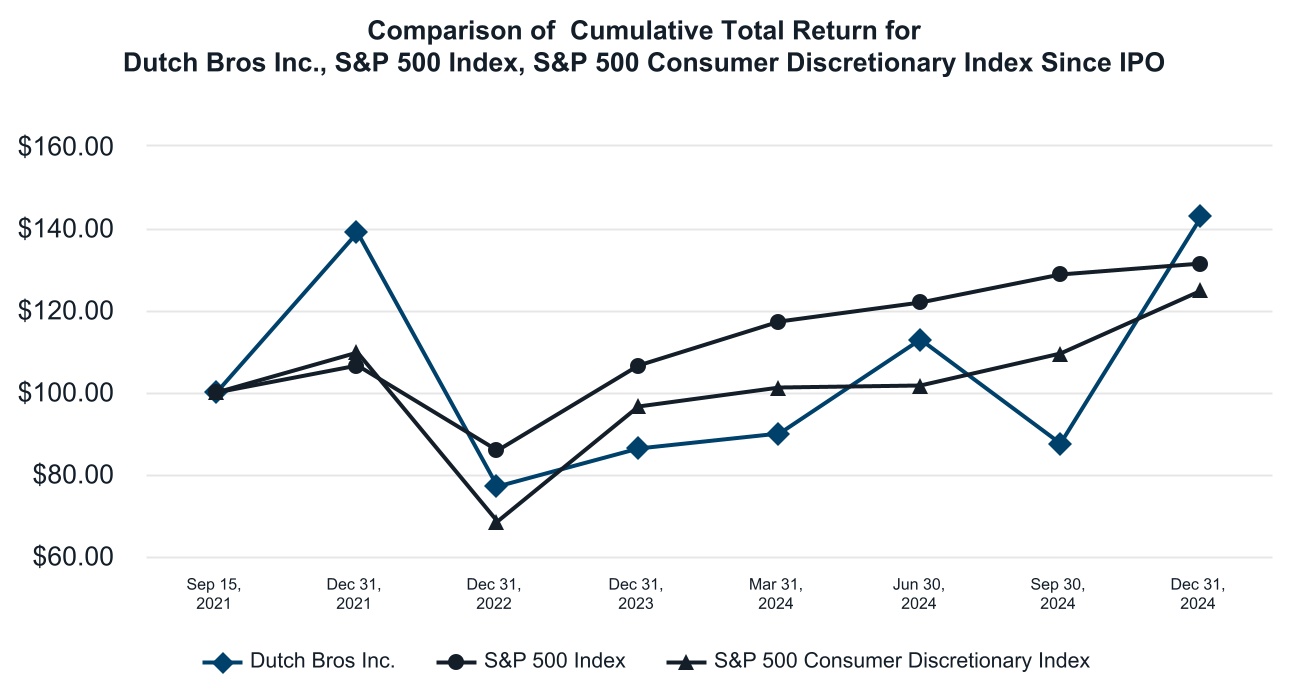
|
|
|
|
|
|
|
|
|
|
|
|
|
|
|
|
|
|
|
|
|
|
|
|
|
|
|
|
|
|
|
|
|
|
|
|
|
|
|
|
|
|
|
|
|
|
|
|
|
|
|
|
|
Sep 15,
2021 |
|
Dec 31,
2021 |
|
Dec 31,
2022 |
|
Dec 31,
2023 |
|
Mar 31,
2024 |
|
Jun 30,
2024 |
|
Sep 30,
2024 |
|
Dec 31,
2024 |
| Dutch Bros Inc. |
|
$ |
100.00 |
|
|
$ |
138.79 |
|
|
$ |
76.85 |
|
|
$ |
86.34 |
|
|
$ |
89.97 |
|
|
$ |
112.87 |
|
|
$ |
87.32 |
|
|
$ |
142.80 |
|
| S&P 500 Index |
|
$ |
100.00 |
|
|
$ |
106.37 |
|
|
$ |
85.69 |
|
|
$ |
106.45 |
|
|
$ |
117.27 |
|
|
$ |
121.87 |
|
|
$ |
128.61 |
|
|
$ |
131.27 |
|
| S&P 500 Consumer Discretionary Index |
|
$ |
100.00 |
|
|
$ |
109.67 |
|
|
$ |
68.46 |
|
|
$ |
96.55 |
|
|
$ |
101.14 |
|
|
$ |
101.59 |
|
|
$ |
109.31 |
|
|
$ |
124.68 |
|
The above Stock Performance Graph and related information shall not be deemed “soliciting material” or to be “filed” with the SEC nor shall such information be incorporated by reference into any future filing under the Securities Act or the Exchange Act, each as amended, except to the extent that we specifically incorporate it by reference into such filing.
Recent Sales of Unregistered Securities
The Continuing Members, from time-to-time, may require us to exchange all or a portion of their Dutch Bros OpCo Class A common units (together with the cancellation of any shares of our Class B common stock or Class C common stock paired with such units) for shares of Class A common stock on a one-for-one basis. The shares of Class B common stock or Class C common stock paired with such Dutch Bros OpCo Class A common units will be canceled on a one-for-one basis upon any such issuance of Class A common stock.
During the year ended December 31, 2024, pursuant to Section 3(a)(9) of the Securities Act, we made unregistered issuances of our Class A common stock via exchange of approximately 13.8 million Dutch Bros OpCo Class A common units (and corresponding cancellation of the same number of shares of Class C common stock) and conversion of approximately 4.4 million shares of our Class D common stock, held by our Sponsor for shares of our Class A common stock on a one-for-one basis. Such shares of Class A common stock were then sold directly by our Sponsor pursuant to Rule 144 of the Securities Act, and no proceeds were received by the Company.
During the year ended December 31, 2024, pursuant to Section 3(a)(9) of the Securities Act, we made an unregistered issuance of our Class A common stock via exchange of approximately 2.4 million Dutch Bros OpCo Class A common units (and corresponding cancellation of the same number of shares of Class B common stock) held by our Co-Founder for shares of our Class A common stock on a one-for-one basis.
Dutch Bros Inc.| Form 10-K | 70
Such shares of Class A common stock were then reserved for sale directly by our Co-Founder pursuant to a Rule 10b5-1 trading arrangement, and no proceeds were received by the Company.
Issuer Purchases of Equity Securities
The following table summarizes purchases of Class A common stock during the three months ended December 31, 2024:
|
|
|
|
|
|
|
|
|
|
|
|
|
|
|
|
|
|
|
|
|
|
|
|
|
|
|
| Period |
|
Total Number of Shares Purchased 1 |
|
Weighted-Average Price Paid Per Share |
|
Total Number of Shares Purchased as Part of Publicly Announced Plans or Programs |
|
Maximum Number (or Approximate Dollar Value) of Shares that May Yet Be Purchased Under the Plans or Programs |
|
|
|
|
|
|
|
|
|
|
|
|
|
|
|
|
|
|
|
|
|
|
|
|
|
|
|
|
|
|
|
|
|
|
|
|
|
|
|
|
|
|
|
|
|
|
|
|
|
|
|
|
|
|
|
|
|
|
|
|
|
|
|
|
|
|
|
|
|
|
|
|
|
|
|
|
|
|
|
|
|
| October 1 - 31, 2024 |
|
— |
|
|
— |
|
|
— |
|
|
— |
|
| November 1 - 30, 2024 |
|
4,092 |
|
|
$ |
33.40 |
|
|
— |
|
|
— |
|
| December 1 - 31, 2024 |
|
— |
|
|
— |
|
|
— |
|
|
— |
|
_________________
1 In connection with the vesting of RSUs granted pursuant to the Dutch Bros Inc. 2021 Equity Incentive Plan, as amended, shares of Class A common stock are delivered to Dutch Bros by employees to satisfy tax withholding obligations.
ITEM 6. [RESERVED]
Dutch Bros Inc.| Form 10-K | 71
ITEM 7. MANAGEMENT’S DISCUSSION AND ANALYSIS OF FINANCIAL CONDITION AND RESULTS OF OPERATIONS
You should read the following discussion and analysis of our financial condition and results of operations together with our audited consolidated financial statements and the related notes included elsewhere in this Form 10-K. Some of the information contained in this discussion and analysis or set forth elsewhere in this document includes forward looking statements that involve risks, uncertainties, and assumptions. You should carefully read the “Forward-Looking Statements” and “Risk Factors” sections of this Form 10-K for a discussion of important factors that could cause actual results to differ materially from the results described in or implied by the forward-looking statements contained in the following discussion and analysis.
In addition, statements that “we believe” and similar statements reflect our beliefs and opinions on the relevant subject. These statements are based on information available to us as of the date of this Form 10-K. While we believe that information provides a reasonable basis for these statements, that information may be limited or incomplete. Our statements should not be read to indicate that we have conducted an exhaustive inquiry into, or review of, all relevant information. These statements are inherently uncertain, and investors are cautioned not to unduly rely on these statements. Further, the section of this “Management’s Discussion and Analysis of Financial Condition and Results of Operations” generally discusses 2024 and 2023 items and year-to-year comparisons between 2024 and 2023. Discussions of 2022 items and year-to-year comparisons between 2023 and 2022 are not included in this Annual Report on Form 10-K and can be found in “Management’s Discussion and Analysis of Financial Condition and Results of Operations” in Part II, Item 7 of our Annual Report on Form 10-K for the fiscal year ended December 31, 2023, filed with the SEC on February 23, 2024.
Index to Management’s Discussion and Analysis of Financial Condition and Results of Operations
Dutch Bros Inc.| Form 10-K | 72
Overview and Highlights
Dutch Bros is a high growth operator and franchisor of drive-thru shops that focus on serving high QUALITY, hand-crafted beverages with unparalleled SPEED and superior SERVICE. Founded in 1992 by brothers Dane and Travis Boersma, Dutch Bros began with a double-head espresso machine and a pushcart in Grants Pass, Oregon. Today, we believe that Dutch Bros is one of the fastest-growing brands in the quick service beverage industry in the United States by location count.
Key Highlights
•Delivered approximately 33% total revenue growth year-over-year.
•Opened 151 systemwide shops across multiple new operating areas, an increase of approximately 18% over 2023.
•Launched and implemented mobile ordering in over 95% of systemwide shops.
•Opened second roasting facility in Melissa, Texas, increasing the resiliency of our supply chain.
•Welcomed new President of Operations, Chief Financial Officer, Chief People Officer, and Chief Technology and Information Officer.
Impact of Global Events
General Macroeconomic Uncertainties
As a retailer that is dependent upon consumer discretionary spending, our results of operations are sensitive to changes in macroeconomic conditions. Inflation may have a material adverse effect on our business, financial condition or results of operations. Our customers may have or in the future may have less money available for discretionary purchases and may reduce or stop their purchases of our products.
On a macro level, conditions, including changes in interest rates, inflation, bank failures and other events affecting financial institutions, geopolitical conflicts (such as the Russia-Ukraine war, the state of war between Israel and Hamas, and the risk of larger regional conflicts), and significant weather events (such as the recent wildfires in California), have created significant uncertainty in the global economy. While we are not able to fully predict the potential impacts of these conditions, we do not currently believe any potential impacts of these macroeconomic conditions would be material to our business.
Minimum Wage Increases
We continued to experience the effects of legislated minimum wage increases that took effect in 2024 in certain states. We expect these pressures to continue to affect our operating results in the foreseeable future. For example, California’s minimum wage increased to $20 per hour effective April 2024 for covered employees in our industry. Additionally, several other states that we operate in have increased their minimum wage requirements in 2025. While these pressures have impacted our operating results, we have taken measures to gradually increase our menu prices, adjust our Dutch Rewards loyalty program, and make operating adjustments that increase productivity to help offset them. Menu price increases may lead to decreases in consumer demand. We will continue to evaluate further pricing actions to protect our operating results, however, if there is a time lag between increasing costs and our ability to increase menu prices or take other action in response, or if we choose not to pass on the cost increases by increasing menu prices, our operating results could be negatively affected.
Dutch Bros Inc.| Form 10-K | 73
Results of Operations
As of December 31, 2024, we had 982 company-operated and franchised shops in 18 states, an increase of approximately 18.2% from the same period in the prior year. For the year ended December 31, 2024, we generated $1.3 billion of revenue, $66.5 million net income, and $0.34 income per diluted share. We have two reportable operating segments: Company-operated shops and Franchising and other.
_________________
1 Reconciliation of GAAP to non-GAAP results is provided in the section “Non-GAAP Financial Measures” in Part II, Item 7 “Management’s Discussion and Analysis of Financial Condition and Results of Operations”.
|
|
|
|
|
|
|
|
|
|
|
|
|
|
|
|
|
|
|
|
2024 vs 2023 |
|
2023 vs 2022 |
|
|
|
Increase in total shops |
|
18.2 |
% |
|
23.8 |
% |
|
|
|
Increase in total revenue |
|
32.6 |
% |
|
30.7 |
% |
|
|
|
|
|
|
|
|
|
|
|
|
|
|
|
|
|
|
|
|
|
|
|
|
|
|
|
|
|
|
|
|
|
|
|
|
|
|
|
|
|
|
|
|
|
|
|
|
|
|
|
|
|
|
|
|
|
|
|
Dutch Bros Inc.| Form 10-K | 74
Key Performance Indicators
The key performance indicators that we use to effectively manage and evaluate our business are as follows:
|
|
|
|
|
|
|
|
|
|
|
|
|
|
|
|
|
|
|
|
|
|
|
|
|
| |
|
|
|
Year Ended December 31, |
| (in thousands, except shop count data; unaudited) |
|
|
|
|
|
2024 |
|
2023 |
|
2022 |
| Shop count, beginning of period |
|
|
|
|
|
|
|
|
|
|
| Company-operated |
|
|
|
|
|
542 |
|
396 |
|
271 |
| Franchised |
|
|
|
|
|
289 |
|
275 |
|
267 |
| Total shop count |
|
|
|
|
|
831 |
|
671 |
|
538 |
|
|
|
|
|
|
|
|
|
|
|
| Company-operated new openings |
|
|
|
|
|
128 |
|
146 |
|
120 |
| Franchised new openings |
|
|
|
|
|
23 |
|
13 |
|
13 |
| Acquisition of franchise shops |
|
|
|
|
|
— |
|
— |
|
5 |
Re-openings 1 |
|
|
|
|
|
— |
|
1 |
|
— |
|
|
|
|
|
|
|
|
|
|
|
| Shop count, end of period |
|
|
|
|
|
|
|
|
|
|
| Company-operated |
|
|
|
|
|
670 |
|
542 |
|
396 |
| Franchised |
|
|
|
|
|
312 |
|
289 |
|
275 |
| Total shop count |
|
|
|
|
|
982 |
|
831 |
|
671 |
|
|
|
|
|
|
|
|
|
|
|
Systemwide AUV 2 |
|
|
|
|
|
$ |
2,018 |
|
$ |
1,973 |
|
$ |
1,924 |
Company-operated shops AUV 2 |
|
|
|
|
|
$ |
1,933 |
|
$ |
1,902 |
|
$ |
1,895 |
|
|
|
|
|
|
|
|
|
|
|
Systemwide same shop sales 3, 4 |
|
|
|
|
|
5.3 |
% |
|
2.8 |
% |
|
1.0 |
% |
| Ticket |
|
|
|
|
|
5.4 |
% |
|
7.3 |
% |
|
4.8 |
% |
| Transactions |
|
|
|
|
|
(0.1) |
% |
|
(4.5) |
% |
|
(3.8) |
% |
Company-operated same shop sales 3 |
|
|
|
|
|
6.8 |
% |
|
1.5 |
% |
|
0.6 |
% |
| Ticket |
|
|
|
|
|
5.3 |
% |
|
7.2 |
% |
|
4.7 |
% |
| Transactions |
|
|
|
|
|
1.5 |
% |
|
(5.7) |
% |
|
(4.1) |
% |
|
|
|
|
|
|
|
|
|
|
|
|
|
|
|
|
|
|
|
|
|
|
|
|
|
|
|
|
|
|
|
|
|
|
|
|
|
|
|
|
|
|
|
|
|
|
|
|
|
|
|
|
|
|
|
|
|
|
|
|
|
|
|
|
|
|
|
|
|
|
|
|
|
|
|
|
|
|
|
|
|
|
|
|
|
|
|
|
|
|
|
|
|
|
|
|
|
|
|
|
|
|
|
|
|
|
|
|
|
|
|
|
|
|
|
|
|
|
|
|
|
|
|
|
|
|
|
|
|
|
|
|
Systemwide sales 4 |
|
|
|
|
|
$ |
1,819,018 |
|
$ |
1,444,433 |
|
$ |
1,163,182 |
Company-operated shops operating weeks 5 |
|
|
|
|
|
31,708 |
|
24,395 |
|
17,489 |
Franchising shops operating weeks 5 |
|
|
|
|
|
15,579 |
|
14,624 |
|
13,828 |
|
|
|
|
|
|
|
|
|
|
|
|
|
|
|
|
|
|
|
|
|
|
Dutch Rewards transactions as a percentage of total transactions 6 |
|
|
|
|
|
67.8 |
% |
|
64.5 |
% |
|
62.3 |
% |
Dutch Bros Inc.| Form 10-K | 75
|
|
|
|
|
|
|
|
|
|
|
|
|
|
|
|
|
|
|
|
|
|
|
|
|
|
|
|
|
|
|
|
|
|
|
|
|
|
|
|
|
|
|
|
|
|
|
|
|
|
|
Year Ended December 31, |
| |
|
|
|
|
|
2024 |
|
2023 |
|
2022 |
| (in thousands; unaudited) |
|
|
|
|
|
|
|
|
|
$ |
|
% |
|
$ |
|
% |
|
$ |
|
% |
| Company-operated shop revenues |
|
|
|
|
|
|
|
|
|
1,165,830 |
|
|
100.0 |
|
|
857,939 |
|
|
100.0 |
|
|
639,710 |
|
|
100.0 |
|
| Company-operated shop gross profit |
|
|
|
|
|
|
|
|
|
259,959 |
|
|
22.3 |
|
|
180,235 |
|
|
21.0 |
|
|
121,327 |
|
|
19.0 |
|
Company-operated shop contribution 7 |
|
|
|
|
|
|
|
|
|
346,768 |
|
|
29.7 |
|
|
242,323 |
|
|
28.2 |
|
|
157,633 |
|
|
24.6 |
|
| Selling, general, and administrative expenses |
|
|
|
|
|
|
|
|
|
234,036 |
|
|
18.3 |
|
|
205,074 |
|
|
21.2 |
|
|
183,528 |
|
|
24.8 |
|
Adjusted selling, general, and administrative expenses 7 |
|
|
|
|
|
|
|
|
|
202,720 |
|
|
15.8 |
|
|
159,101 |
|
|
16.5 |
|
|
133,725 |
|
|
18.1 |
|
| Net income (loss) |
|
|
|
|
|
|
|
|
|
66,450 |
|
|
5.2 |
|
|
9,952 |
|
|
1.0 |
|
|
(19,253) |
|
|
(2.6) |
|
Adjusted EBITDA 7 |
|
|
|
|
|
|
|
|
|
230,283 |
|
|
18.0 |
|
|
160,062 |
|
|
16.6 |
|
|
91,181 |
|
|
12.3 |
|
_________________
1 Re-opening of a shop that was temporarily closed in 2021.
2 AUVs are determined based on the net sales for any trailing twelve-month period for systemwide and company-operated shops that have been open a minimum of 15 months. AUVs are calculated by dividing the systemwide and company-operated shop net sales by the total number of systemwide and company-operated shops, respectively. Management uses these metrics as an indicator of shop growth and future expectations of mature locations.
3 Same shop sales represents the estimated percentage change in year-over-year sales, for the comparable shop base, which we define as shops open for 15 complete months or longer as of the first day of the reporting period. Same shop sales can be impacted by changes in customer transaction counts and by changes in the per-ticket amounts. Management uses these metrics as an indicator of shop growth and future expansion strategy. The number of shops included in the systemwide and company-operated comparable bases for the respective periods are presented in the following table.
|
|
|
|
|
|
|
|
|
|
|
|
|
|
|
|
|
|
|
|
|
|
|
|
|
|
|
|
|
Year Ended December 31, |
| (unaudited) |
|
|
|
|
|
2024 |
|
2023 |
|
2022 |
| Systemwide shop base |
|
|
|
|
|
641 |
|
503 |
|
414 |
| Company-operated shop base |
|
|
|
|
|
370 |
|
246 |
|
173 |
4 Systemwide sales and systemwide same shop sales are operating measures that include sales at company-operated shops and sales at franchised shops during the comparable periods presented. Franchise sales represent sales at all franchise shops and are revenues to our franchise partners. We do not record franchise sales as revenues; however, our royalty revenues and advertising fund contributions are calculated based on a percentage of franchise sales. As these metrics include sales reported to us by our non-consolidated franchise partners, these metrics should be considered as a supplement to, not a substitute for, our results as reported under GAAP. Management uses these metrics as indicators of our system’s overall financial health, growth and future expansion prospects.
5 Company-operated and franchise shop operating weeks are calculated based on the number of operating days for the shop base and dividing by 7. Our shop base is defined as shops opened as of the period end date. The operating weeks calculations reflect re-acquired franchises through 2022. Management uses these metrics as indicators of our system’s overall financial health, growth and future expansion prospects.
6 Dutch Rewards is our digitally based rewards program available exclusively through the Dutch Rewards app. Management uses this metric as an indicator of customer loyalty adoption of our Dutch Rewards app and future promotional plans.
7 Reconciliation of GAAP to non-GAAP results is provided in the section “Non-GAAP Financial Measures” in Part II, Item 7 “Management’s Discussion and Analysis of Financial Condition and Results of Operations.”
Dutch Bros Inc.| Form 10-K | 76
Company-operated Shop Results
Results for our company-operated shops segment were as follows:
|
|
|
|
|
|
|
|
|
|
|
|
|
|
|
|
|
|
|
|
|
|
|
|
|
|
|
|
|
|
|
|
|
|
|
|
|
|
|
|
|
|
|
|
|
|
|
| |
|
|
|
Year Ended December 31, |
|
|
|
|
|
|
2024 |
|
2023 |
|
2022 |
| (in thousands; unaudited) |
|
|
|
|
|
|
|
|
|
$ |
|
% |
|
$ |
|
% |
|
$ |
|
% |
|
|
|
|
|
|
|
|
|
|
|
|
|
|
|
|
|
|
|
|
|
|
|
|
|
|
|
|
|
|
|
|
|
|
|
|
|
|
|
|
|
|
|
|
|
|
|
|
|
|
|
|
|
|
|
|
|
|
|
|
|
|
|
| Company-operated shop revenues |
|
|
|
|
|
|
|
|
|
1,165,830 |
|
|
100.0 |
|
|
857,939 |
|
|
100.0 |
|
|
639,710 |
|
|
100.0 |
|
|
|
|
|
|
|
|
|
|
|
|
|
|
|
|
|
|
|
|
|
|
| Beverage, food, and packaging costs |
|
|
|
|
|
|
|
|
|
296,752 |
|
|
25.5 |
|
|
230,133 |
|
|
26.9 |
|
|
171,864 |
|
|
26.9 |
|
| Labor costs |
|
|
|
|
|
|
|
|
|
315,805 |
|
|
27.1 |
|
|
230,505 |
|
|
26.9 |
|
|
182,861 |
|
|
28.6 |
|
| Occupancy and other costs |
|
|
|
|
|
|
|
|
|
191,372 |
|
|
16.4 |
|
|
140,895 |
|
|
16.4 |
|
|
109,366 |
|
|
17.1 |
|
| Pre-opening costs |
|
|
|
|
|
|
|
|
|
15,133 |
|
|
1.3 |
|
|
14,083 |
|
|
1.6 |
|
|
17,986 |
|
|
2.8 |
|
| Depreciation and amortization |
|
|
|
|
|
|
|
|
|
86,809 |
|
|
7.4 |
|
|
62,088 |
|
|
7.2 |
|
|
36,306 |
|
|
5.6 |
|
| Company-operated shop costs and expenses |
|
|
|
|
|
|
|
|
|
905,871 |
|
|
77.7 |
|
|
677,704 |
|
|
79.0 |
|
|
518,383 |
|
|
81.0 |
|
| Company-operated shop gross profit |
|
|
|
|
|
|
|
|
|
259,959 |
|
|
22.3 |
|
|
180,235 |
|
|
21.0 |
|
|
121,327 |
|
|
19.0 |
|
Company-operated shop contribution 1 |
|
|
|
|
|
|
|
|
|
346,768 |
|
|
29.7 |
|
|
242,323 |
|
|
28.2 |
|
|
157,633 |
|
|
24.6 |
|
_________________
1 Reconciliation of GAAP to non-GAAP results is provided in the section “Non-GAAP Financial Measures” in Part I, Item 2 “Management’s Discussion and Analysis of Financial Condition and Results of Operations.”
Company-operated Shops Segment Performance
Company-operated Shop Revenue
|
|
|
|
|
|
|
|
|
|
|
|
|
|
|
|
|
|
|
|
|
|
|
|
|
|
|
|
|
|
|
|
|
|
|
|
|
|
|
|
|
|
|
|
|
|
|
|
|
|
|
|
|
| |
|
|
|
Year Ended December 31, |
| (in thousands; unaudited) |
|
|
|
|
|
|
|
2024 |
|
2023 |
|
2022 |
|
2024 v. 2023 |
|
2023 v 2022 |
Company-operated shop revenue |
|
|
|
|
|
|
|
|
|
$1,165,830 |
|
$857,939 |
|
$639,710 |
|
$307,891 |
|
35.9% |
|
$218,229 |
|
34.1% |
Year Ended December 31, 2024 v. 2023
The company-operated shop revenue increase was driven by $262.3 million from newly opened shops not yet in the comparable shop base and $45.6 million from an increase in same shop sales within the comparable shop base.
_________________
1 The comparable same shop bases were 370, 246, and 173 for the three years ended December 31, 2024, 2023, and 2022, respectively.
Dutch Bros Inc.| Form 10-K | 77
Beverage, Food, and Packaging Costs
|
|
|
|
|
|
|
|
|
|
|
|
|
|
|
|
|
|
|
|
|
|
|
|
|
|
|
|
|
|
|
|
|
|
|
|
|
|
|
|
|
|
|
|
|
|
|
|
|
|
|
|
|
| |
|
|
|
Year Ended December 31, |
| (in thousands; unaudited) |
|
|
|
|
|
|
|
2024 |
|
2023 |
|
2022 |
|
2024 v. 2023 |
|
2023 v 2022 |
| Beverage, food and packaging costs |
|
|
|
|
|
|
|
|
|
$296,752 |
|
$230,133 |
|
$171,864 |
|
$66,619 |
|
28.9% |
|
$58,269 |
|
33.9% |
| As a percentage of company-operated shop revenues |
|
|
|
|
|
|
|
|
|
25.5% |
|
26.9% |
|
26.9% |
|
N/A |
|
(140) bps |
|
N/A |
|
— bps |
Year Ended December 31, 2024 v. 2023
As a percentage of company-operated shop revenues, beverage, food and packaging costs decreased by 140 basis points. This was primarily due to a 110 basis point decrease due to the impact of increased pricing on the comparable shop base.
Labor Costs
|
|
|
|
|
|
|
|
|
|
|
|
|
|
|
|
|
|
|
|
|
|
|
|
|
|
|
|
|
|
|
|
|
|
|
|
|
|
|
|
|
|
|
|
|
|
|
|
|
|
|
|
|
| |
|
|
|
Year Ended December 31, |
| (in thousands; unaudited) |
|
|
|
|
|
|
|
2024 |
|
2023 |
|
2022 |
|
2024 v. 2023 |
|
2023 v 2022 |
| Labor costs |
|
|
|
|
|
|
|
|
|
$315,805 |
|
$230,505 |
|
$182,861 |
|
$85,300 |
|
37.0% |
|
$47,644 |
|
26.1% |
| As a percentage of company-operated shop revenues |
|
|
|
|
|
|
|
|
|
27.1% |
|
26.9% |
|
28.6% |
|
N/A |
|
20 bps |
|
N/A |
|
(170) bps |
Year Ended December 31, 2024 v. 2023
As a percentage of company-operated shop revenues, labor costs increased by 20 basis points. This was primarily due to 180 basis points from increased wages, partially offset by a decrease of 110 basis points from the impact of increased pricing and a decrease of 50 basis points driven by staffing management.
Occupancy and Other Costs
|
|
|
|
|
|
|
|
|
|
|
|
|
|
|
|
|
|
|
|
|
|
|
|
|
|
|
|
|
|
|
|
|
|
|
|
|
|
|
|
|
|
|
|
|
|
|
|
|
|
|
|
|
| |
|
|
|
Year Ended December 31, |
| (in thousands; unaudited) |
|
|
|
|
|
|
|
2024 |
|
2023 |
|
2022 |
|
2024 v. 2023 |
|
2023 v 2022 |
| Occupancy and other costs |
|
|
|
|
|
|
|
|
|
$191,372 |
|
$140,895 |
|
$109,366 |
|
$50,477 |
|
35.8% |
|
$31,529 |
|
28.8% |
| As a percentage of company-operated shop revenues |
|
|
|
|
|
|
|
|
|
16.4% |
|
16.4% |
|
17.1% |
|
N/A |
|
— bps |
|
N/A |
|
(70) bps |
Year Ended December 31, 2024 v. 2023
As a percentage of company-operated shop revenues, occupancy and other costs were flat. This was primarily due to a 40 basis point increase driven by higher repairs and maintenance, offset by a decrease of 50 basis points from the impact of increased pricing.
Dutch Bros Inc.| Form 10-K | 78
Pre-opening Costs
|
|
|
|
|
|
|
|
|
|
|
|
|
|
|
|
|
|
|
|
|
|
|
|
|
|
|
|
|
|
|
|
|
|
|
|
|
|
|
|
|
|
|
|
|
|
|
|
|
|
|
|
|
| |
|
|
|
Year Ended December 31, |
| (in thousands, except shop data; unaudited) |
|
|
|
|
|
|
|
2024 |
|
2023 |
|
2022 |
|
2024 v. 2023 |
|
2023 v 2022 |
| Pre-opening costs |
|
|
|
|
|
|
|
|
|
$15,133 |
|
$14,083 |
|
$17,986 |
|
$1,050 |
|
7.5% |
|
$(3,903) |
|
(21.7)% |
| As a percentage of company-operated shop revenues |
|
|
|
|
|
|
|
|
|
1.3% |
|
1.6% |
|
2.8% |
|
N/A |
|
(30) bps |
|
N/A |
|
(120) bps |
| New company-operated shops opened |
|
|
|
|
|
|
|
|
|
128 |
|
146 |
|
120 |
|
(18) |
|
(12.3)% |
|
26 |
|
21.7% |
| Pre-opening costs per new company-operated shop |
|
|
|
|
|
|
|
|
|
$118 |
|
$96 |
|
$150 |
|
$22 |
|
22.9% |
|
$(54) |
|
(36.0)% |
Year Ended December 31, 2024 v. 2023
The increase in pre-opening costs was primarily driven by increased travel for setup and training teams and lease expense related to unopened shops, in the year ended December 31, 2024 as compared to the same period in 2023.
Depreciation and Amortization
|
|
|
|
|
|
|
|
|
|
|
|
|
|
|
|
|
|
|
|
|
|
|
|
|
|
|
|
|
|
|
|
|
|
|
|
|
|
|
|
|
|
|
|
|
|
|
|
|
|
|
|
|
| |
|
|
|
Year Ended December 31, |
| (in thousands; unaudited) |
|
|
|
|
|
|
|
2024 |
|
2023 |
|
2022 |
|
2024 v. 2023 |
|
2023 v 2022 |
| Depreciation and amortization |
|
|
|
|
|
|
|
|
|
$86,809 |
|
$62,088 |
|
$36,306 |
|
$24,721 |
|
39.8% |
|
$25,782 |
|
71.0% |
| As a percentage of company-operated shop revenues |
|
|
|
|
|
|
|
|
|
7.4% |
|
7.2% |
|
5.6% |
|
N/A |
|
20 bps |
|
N/A |
|
160 bps |
Year Ended December 31, 2024 v. 2023
The increase in depreciation and amortization was primarily driven by the opening of 128 new company-operated shops during 2024.
Company-operated Shop Gross Profit and Contribution1
|
|
|
|
|
|
|
|
|
|
|
|
|
|
|
|
|
|
|
|
|
|
|
|
|
|
|
|
|
|
|
|
|
|
|
|
|
|
|
|
|
|
|
|
|
|
|
|
|
|
|
|
|
| |
|
|
|
Year Ended December 31, |
| (in thousands; unaudited) |
|
|
|
|
|
|
|
2024 |
|
2023 |
|
2022 |
|
2024 v. 2023 |
|
2023 v 2022 |
| Company-operated shop gross profit |
|
|
|
|
|
|
|
|
|
$259,959 |
|
$180,235 |
|
$121,327 |
|
$79,724 |
|
44.2% |
|
$58,908 |
|
48.6% |
| As a percentage of company-operated shop revenues |
|
|
|
|
|
|
|
|
|
22.3% |
|
21.0% |
|
19.0% |
|
N/A |
|
130 bps |
|
N/A |
|
200 bps |
Company-operated shop contribution 1 |
|
|
|
|
|
|
|
|
|
$346,768 |
|
$242,323 |
|
$157,633 |
|
$104,445 |
|
43.1% |
|
$84,690 |
|
53.7% |
| As a percentage of company-operated shop revenues |
|
|
|
|
|
|
|
|
|
29.7% |
|
28.2% |
|
24.6% |
|
N/A |
|
150 bps |
|
N/A |
|
360 bps |
_______________________
1 Reconciliation of GAAP to non-GAAP results is provided in the section “Non-GAAP Financial Measures” in Part II, Item 7 “Management’s Discussion and Analysis of Financial Condition and Results of Operations.”
Dutch Bros Inc.| Form 10-K | 79
Year Ended December 31, 2024 v. 2023
The increase in the company-operated shop gross profit margin of 130 basis points was driven primarily by a 270 basis point increase due to the impact of increased pricing on the comparable shop base, offset by a 140 basis point decrease due to increased labor costs.
Franchising and Other Segment Performance
|
|
|
|
|
|
|
|
|
|
|
|
|
|
|
|
|
|
|
|
|
|
|
|
|
|
|
|
|
|
|
|
|
|
|
|
|
|
|
|
|
|
|
|
|
|
|
|
|
|
|
|
|
| |
|
|
|
Year Ended December 31, |
| (in thousands; unaudited) |
|
|
|
|
|
|
|
2024 |
|
2023 |
|
2022 |
|
2024 v. 2023 |
|
2023 v 2022 |
| Franchising and other revenue |
|
|
|
|
|
|
|
|
|
$115,185 |
|
$107,837 |
|
$99,302 |
|
$7,348 |
|
6.8% |
|
$8,535 |
|
8.6% |
| Franchising and other gross profit |
|
|
|
|
|
|
|
|
|
$80,170 |
|
$71,061 |
|
$59,589 |
|
$9,109 |
|
12.8% |
|
$11,472 |
|
19.3% |
| As a percentage of franchising and other revenue |
|
|
|
|
|
|
|
|
|
69.6% |
|
65.9% |
|
60.0% |
|
N/A |
|
370 bps |
|
N/A |
|
590 bps |
Year Ended December 31, 2024 v. 2023
The franchising and other gross profit increase of $9.1 million was driven by $4.6 million due to newly opened franchised shops not in the comparable shop base, $2.6 million from same shop sales, and a $1.9 million increase from products sold to franchisees, net of costs and adjustments.
Selling, General, and Administrative
|
|
|
|
|
|
|
|
|
|
|
|
|
|
|
|
|
|
|
|
|
|
|
|
|
|
|
|
|
|
|
|
|
|
|
|
|
|
|
|
|
|
|
|
|
|
|
|
|
|
|
|
|
| |
|
|
|
Year Ended December 31, |
| (in thousands; unaudited) |
|
|
|
|
|
|
|
2024 |
|
2023 |
|
2022 |
|
2024 v. 2023 |
|
2023 v 2022 |
|
|
|
|
|
|
|
|
|
|
|
|
|
|
|
|
|
|
|
|
|
|
|
|
|
|
|
|
|
|
|
|
|
|
|
|
|
|
|
|
|
|
|
|
|
|
|
|
|
|
|
|
|
|
|
|
|
|
|
|
|
|
|
|
|
|
|
|
|
|
|
|
|
|
|
|
|
|
|
|
|
|
|
|
|
|
|
|
|
|
|
|
|
|
|
|
|
|
|
|
|
|
|
|
|
|
|
|
|
|
|
|
|
|
|
|
|
|
|
|
|
|
|
|
|
|
|
|
|
|
|
|
|
|
|
|
|
|
|
|
|
|
|
|
|
|
|
|
|
|
|
|
|
|
|
|
|
|
|
|
|
|
|
|
|
|
|
|
|
|
|
|
|
|
|
|
|
|
|
|
|
|
|
|
|
|
|
|
|
|
|
|
|
|
|
|
|
|
|
|
|
|
|
|
|
|
|
|
|
|
|
|
|
|
|
|
|
|
|
|
|
|
|
|
|
|
|
|
|
|
|
|
|
|
|
|
|
|
|
|
|
|
|
|
|
|
|
|
|
|
|
|
|
|
|
|
|
|
|
|
|
|
|
|
|
|
|
|
|
|
|
|
|
|
|
|
|
|
|
|
|
|
|
|
|
|
|
|
|
|
|
|
|
|
|
|
|
|
|
| Selling, General and Administrative |
|
|
|
|
|
|
|
|
|
$234,036 |
|
$205,074 |
|
$183,528 |
|
$28,962 |
|
14.1% |
|
$21,546 |
|
11.7% |
| As a percentage of total revenues |
|
|
|
|
|
|
|
|
|
18.3% |
|
21.2% |
|
24.8% |
|
N/A |
|
(290) bps |
|
N/A |
|
N/M |
|
|
|
|
|
|
|
|
|
|
|
|
|
|
|
|
|
|
|
|
|
|
|
|
|
|
|
|
|
|
|
|
|
|
|
|
|
|
|
|
|
|
|
|
|
|
Year Ended December 31, 2024 v. 2023
The selling, general, and administrative increase of approximately $29.0 million was primarily driven by increased expenses of $25.8 million primarily consisting of investments in human capital to support our revenue growth and higher performance-based compensation; an increase of $15.7 million of organization realignment and restructuring costs (which includes a $1.8 million net expense that resulted from the donation of our former Grants Pass headquarters building for the development of a children’s learning center); $12.6 million of increased professional fees and technology services to support our growing business; and $4.0 million of increased donations to our Foundation. These increases were partially offset by lower equity-based compensation of $28.6 million.
Dutch Bros Inc.| Form 10-K | 80
Other Expense
|
|
|
|
|
|
|
|
|
|
|
|
|
|
|
|
|
|
|
|
|
|
|
|
|
|
|
|
|
|
|
|
|
|
|
|
|
|
|
|
|
|
|
|
|
|
|
|
|
|
|
|
|
| |
|
|
|
Year Ended December 31, |
| (in thousands; unaudited) |
|
|
|
|
|
|
|
2024 |
|
2023 |
|
2022 |
|
2024 v. 2023 |
|
2023 v 2022 |
|
|
|
|
|
|
|
|
|
|
|
|
|
|
|
|
|
|
|
|
|
|
|
|
|
|
|
|
|
|
|
|
|
|
|
|
|
|
|
|
|
|
|
|
|
|
|
|
|
|
|
|
|
|
|
|
|
|
|
|
|
|
|
|
|
|
|
|
|
|
|
|
|
|
|
|
|
|
|
|
|
|
|
|
|
|
|
|
|
|
|
|
|
|
|
|
|
|
|
|
|
|
|
|
|
|
|
|
|
|
|
|
|
|
|
|
|
|
|
|
|
|
|
|
|
|
|
|
|
|
|
|
|
|
|
|
|
|
|
|
|
|
|
|
|
|
|
|
|
|
|
|
|
|
|
|
|
|
|
|
|
|
|
|
|
|
|
|
|
|
|
|
|
|
|
|
|
|
|
|
|
|
|
|
|
|
|
|
|
|
|
|
|
|
|
|
|
|
|
|
|
|
|
|
|
|
|
|
|
|
|
|
|
|
|
|
|
|
|
|
|
|
|
|
|
|
|
|
|
|
|
|
|
|
|
|
|
|
|
|
|
|
|
|
|
|
|
|
|
|
|
|
|
|
|
|
|
|
|
|
|
|
|
|
|
|
|
|
|
|
|
|
|
|
|
|
|
|
|
|
|
|
|
|
|
|
|
|
|
|
|
|
|
|
|
|
|
|
|
| Interest expense on finance leases |
|
|
|
|
|
|
|
|
|
$ |
(22,053) |
|
|
$ |
(17,516) |
|
|
$ |
(9,296) |
|
|
$ |
(4,537) |
|
|
25.9% |
|
$ |
(8,220) |
|
|
88.4% |
| Other interest expense, net |
|
|
|
|
|
|
|
|
|
(4,967) |
|
|
(14,805) |
|
|
(8,722) |
|
|
9,838 |
|
|
(66.5)% |
|
(6,083) |
|
|
69.7% |
Interest expense, net |
|
|
|
|
|
|
|
|
|
$ |
(27,020) |
|
|
$ |
(32,321) |
|
|
$ |
(18,018) |
|
|
$ |
5,301 |
|
|
(16.4)% |
|
$ |
(14,303) |
|
|
79.4% |
| Other income |
|
|
|
|
|
|
|
|
|
5,812 |
|
|
3,018 |
|
|
3,976 |
|
|
2,794 |
|
|
92.6% |
|
(958) |
|
|
(24.1)% |
| Total other expense |
|
|
|
|
|
|
|
|
|
$ |
(21,208) |
|
|
$ |
(29,303) |
|
|
$ |
(14,042) |
|
|
$ |
8,095 |
|
|
(27.6)% |
|
$ |
(15,261) |
|
|
108.7% |
|
|
|
|
|
|
|
|
|
|
|
|
|
|
|
|
|
|
|
|
|
|
|
|
|
|
|
|
|
|
|
|
|
|
|
|
|
|
|
|
|
|
|
|
|
|
|
|
|
|
|
|
|
|
|
|
|
|
|
|
|
|
|
|
|
|
|
|
|
Year Ended December 31, 2024 v. 2023
The decrease in interest expense, net was primarily driven by interest income on cash invested in money market funds, partially offset by additional interest on finance leases for new shop builds.
The increase in other income was primarily driven by higher remeasurement gains in the current year related to the TRAs liability and the gain on sale of our airplane and hangar.
Income Tax Expense
|
|
|
|
|
|
|
|
|
|
|
|
|
|
|
|
|
|
|
|
|
|
|
|
|
|
|
|
|
|
|
|
|
|
|
|
|
|
|
|
|
|
|
|
|
|
|
|
|
|
|
|
|
| |
|
|
|
Year Ended December 31, |
| (in thousands; unaudited) |
|
|
|
|
|
|
|
2024 |
|
2023 |
|
2022 |
|
2024 v. 2023 |
|
2023 v 2022 |
| Income tax expense |
|
|
|
|
|
|
|
|
|
$18,435 |
|
$6,967 |
|
$2,599 |
|
$11,468 |
|
164.6% |
|
$4,368 |
|
168.1% |
| Effective tax rate |
|
|
|
|
|
|
|
|
|
21.7% |
|
41.2% |
|
(15.6)% |
|
N/A |
|
N/M |
|
N/A |
|
N/M |
Year Ended December 31, 2024 v. 2023
The increase in tax expense was primarily driven by increased current year pre-tax income and the increase in our ownership interest of Dutch Bros OpCo, changes in state earnings mix, and its impact on deferred taxes.
Liquidity and Capital Resources
Cash Overview
We had cash and cash equivalents of $293.4 million and $133.5 million as of December 31, 2024 and December 31, 2023, respectively.
For the year ended December 31, 2024, our principal sources of liquidity were cash flows from operations and our delayed draw term loan facility. Our principal uses of liquidity for the year ended December 31, 2024 were to fund our new shop builds, our new Texas roasting facility, and other working capital needs.
Dutch Bros Inc.| Form 10-K | 81
Cash Flows
The following table summarizes our cash flows for the periods presented:
|
|
|
|
|
|
|
|
|
|
|
|
|
|
|
|
|
|
|
|
|
|
|
|
|
|
|
|
|
|
|
|
|
|
|
|
|
|
|
|
|
|
|
|
|
|
|
Year Ended December 31, |
| (in thousands; unaudited) |
|
2024 |
|
2023 |
|
2022 |
|
2024 v. 2023 |
|
2023 v 2022 |
| Net cash provided by operating activities |
|
$ |
246,432 |
|
|
$ |
139,915 |
|
|
$ |
59,883 |
|
|
$ |
106,517 |
|
|
76.1% |
|
$ |
80,032 |
|
|
133.6% |
| Net cash used in investing activities |
|
(212,072) |
|
|
(227,280) |
|
|
(192,572) |
|
|
15,208 |
|
|
(6.7) |
|
(34,708) |
|
|
18.0 |
| Net cash provided by financing activities |
|
125,449 |
|
|
200,732 |
|
|
134,361 |
|
|
(75,283) |
|
|
(37.5)% |
|
66,371 |
|
|
49.4% |
| Net increase in cash and cash equivalents |
|
$ |
159,809 |
|
|
$ |
113,367 |
|
|
$ |
1,672 |
|
|
$ |
46,442 |
|
|
41.0% |
|
$ |
111,695 |
|
|
6680.3% |
| Cash and cash equivalents at beginning of period |
|
133,545 |
|
|
20,178 |
|
|
18,506 |
|
|
113,367 |
|
|
561.8 |
|
1,672 |
|
|
9.0 |
| Cash and cash equivalents at end of period |
|
$ |
293,354 |
|
|
$ |
133,545 |
|
|
$ |
20,178 |
|
|
$ |
159,809 |
|
|
119.7% |
|
$ |
113,367 |
|
|
561.8% |
Operating Activities
The increase in operating activities cash flows was primarily driven by higher net income as a result of year-over-year sales growth, expanded company-operated shop contribution, leverage of selling, general and administrative costs, and working capital management.
Investing Activities
The decrease in investing activities cash outflows was primarily driven by lower investment in capital expenditures due to fewer new company-operated shop openings in the current period compared to last period, and higher proceeds from disposal of fixed assets in the current year, driven by the sale of our company plane (a non-recurring event).
Financing Activities
The decrease in financing activities cash flows was primarily driven by proceeds received in 2023 from our follow-on offering, partially offset by a prior year payoff of our net revolving credit facility, and our delayed draw term loan advance in 2024.
Cash Requirements
We believe that cash provided by operating activities and proceeds from our 2022 Credit Facility are adequate to fund our debt service requirements, lease obligations, cash distributions required by the OpCo LLC Agreement and the TRAs, and working capital obligations for at least the next 12 months.
Our future capital requirements may vary materially from period to period and will depend on many factors, primarily our expansion and growth by opening additional company-operated shops and/or reacquiring existing franchised shops, and our large-scale organization realignment including relocation of key business operations to Arizona. Further, the payments that we may be required to make under the TRAs may be significant. We currently expect to fund our current and long-term material capital requirements with operating cash flows and, as needed, additional proceeds from our 2022 Credit Facility, but we may also seek additional debt or equity financing. From time to time, we may explore additional financing sources which could include equity, equity‑linked, and debt financing arrangements.
Dutch Bros Inc.| Form 10-K | 82
Other than operating expenses, our cash requirements for 2025 are expected to consist primarily of capital expenditures for investments in our new and existing shops, our supply chain, and our corporate facilities. The total capital expenditures for 2025 are estimated to be approximately $240 million to $260 million.
Our current and long-term material cash requirements as of December 31, 2024, primarily include the following:
•Debt Obligations: Refer to NOTE 9 — Debt, of the notes to the consolidated financial statements, included elsewhere in this Form 10-K, for further information of our obligations and the timing of expected payments.
•Operating and Finance Leases: Refer to NOTE 8 — Leases, of the notes to the consolidated financial statements, included elsewhere in this Form 10-K, for further information of our obligations and the timing of expected payments.
•Purchase Obligations: include all legally binding contracts, including firm minimum commitments for inventory purchases, commitments for the purchase, construction or remodeling of real estate facilities, equipment purchases, marketing-related contracts, software acquisition/license commitments and service contracts. As of December 31, 2024, purchase obligations were approximately $210 million, of which substantially all are expected to be paid within one to two years.
•TRAs Obligations: Refer to NOTE 11 — Tax Receivable Agreements and NOTE 17 — Commitments and Contingencies, of the notes to the consolidated financial statements, included elsewhere in this Form 10-K, for further information of our obligations.
Credit Facility
JPMorgan Credit Facility
On August 4, 2023, we amended our senior secured credit facility, dated February 28, 2022 with JPMorgan Chase Bank, N.A. (as amended, the 2022 Credit Facility) to increase borrowing capacity by $150 million to a total of $650 million. The 2022 Credit Facility consists of a $350 million revolving credit facility, a term loan facility of up to $100 million, and a delayed draw term loan facility of up to $200 million. The 2022 Credit Facility also includes sublimits for letters of credit and swingline loans of up to $50 million and $15 million, respectively. The 2022 Credit Facility expires on February 28, 2027 (the Maturity Date).
On February 4, 2025, we drew the remaining $50 million on our delayed draw term loan facility before this portion was set to expire on February 4, 2025.
Interest on borrowings under the 2022 Credit Facility is based on (a) the Alternate Base Rate plus an applicable margin, or (b) the Adjusted Term SOFR plus an applicable margin, and is payable in accordance with the selected interest rate period (at least quarterly) and upon maturity. Principal payments for the term loans are required on a quarterly basis in accordance with an amortization schedule up through and including the Maturity Date.
Obligations under the 2022 Credit Facility are guaranteed by each of Dutch Bros Inc.’s subsidiaries, and secured by a first priority perfected security interest in substantially all of the assets of the guarantors.
Interest Rate Swap Contract
We have an interest rate swap with JPMorgan Chase Bank, N.A. As of December 31, 2024, the interest rate swap had a notional amount of approximately $63.9 million and hedges interest rate risk on the term loan under the 2022 Credit Facility. The purpose of the floating-to-fixed interest rate swap is to fix the interest base rate charged on the term loan at 2.67% for the notional amount. The interest rate swap matures on February 28, 2027.
See NOTE 9 — Debt and NOTE 10 — Derivative Financial Instruments for additional details related to our 2022 Credit Facility and interest rate swap contract.
Dutch Bros Inc.| Form 10-K | 83
Critical Accounting Estimates
The methods, assumptions, and estimates that we use in applying our accounting policies may require us to apply judgments regarding matters that are inherently uncertain. We consider an accounting policy to be a critical estimate if: (1) we must make assumptions that were uncertain when the judgment was made, and (2) changes in the estimate assumptions, or selection of a different estimate methodology, could have a significant impact on our financial position and the results that we report in our consolidated financial statements. While we believe that our estimates, assumptions, and judgments are reasonable, they are based on information available when the estimate was made.
Refer to NOTE 2 — Basis of Presentation and Summary of Significant Accounting Policies within the consolidated financial statements, included elsewhere in this Form 10-K, for further information on our critical accounting estimates and policies, which are as follows:
Leases
At the commencement of each lease, we evaluate the lease agreement to determine whether it is an operating or finance lease. The evaluation requires significant judgments in determining the fair value of the lease right-of-use asset and the lease liability and appropriate lease terms.
Our lease agreements generally do not provide an implicit interest rate; as such, the discount rate used to measure the initial lease liability is equal to the rate the Company would pay on a collateralized basis to borrow an amount equal to the lease payments under similar terms. Management uses a specialist to determine the discount rate, which is subject to fluctuation based on market interest rates and our credit risk profile.
We also estimate the lease term at commencement. The lease term commences on the date when we take possession of the leased property. To determine the length of the lease term at inception, we consider both termination and renewal option periods available. Reasonably certain renewal periods are included in the lease term at commencement.
Variations in judgment applied to these estimates could result in material differences such as the following:
• Lease expenses, including rent, depreciation and amortization
• Present value of lease right-of-use assets and lease liabilities
• Reasonably certain lease term
See NOTE 8 — Leases for further details.
Income Taxes
In determining the provision for income taxes, we make estimates and judgments which affect our evaluation of the carrying value of our deferred tax assets as well as our calculation of certain tax liabilities. We evaluate the carrying value of our deferred tax assets on a quarterly basis. In completing this evaluation, we consider all available positive and negative evidence. Such evidence includes historical operating results, the existence of cumulative earnings and losses in the most recent fiscal years, taxable income in prior carryback year(s) if permitted under the tax law, expectations for future pre-tax operating income, the time period over which our temporary differences will reverse, and the implementation of feasible and prudent tax planning strategies. Estimating future taxable income is inherently uncertain and requires judgment.
Our expense/(benefit) for income taxes, deferred tax assets and liabilities including valuation allowance requires the use of estimates based on our management’s interpretation and application of complex tax laws and accounting guidance.
Dutch Bros Inc.| Form 10-K | 84
Deferred taxes are recorded using the asset and liability method, whereby tax assets and liabilities are determined based on the differences between the financial statement and tax basis of assets and liabilities using enacted tax rates in effect for the year in which the differences are expected to reverse. We regularly evaluate the valuation allowances established for deferred tax assets for which future realization is uncertain. In assessing the realizability of deferred tax assets, we consider both positive and negative evidence, including scheduled reversals of deferred tax assets and liabilities, projected future taxable income, tax planning strategies and results of recent operations. If, based on the weight of available evidence, it is more likely than not that the deferred tax assets will not be realized, a valuation allowance is recorded. See NOTE 12 — Income Taxes for further details.
Tax Receivable Agreements
In connection with our IPO, we entered into two TRAs with the Continuing Members and Pre-IPO Blocker Holders. The TRAs generally provide for us to pay the Continuing Members and Pre-IPO Blocker Holders 85% of the net cash savings, if any, in U.S. federal, state and local income tax or franchise tax that we actually realize or are deemed to realize in certain circumstances. We will retain the benefit of the remaining 15% of these net cash savings. As of December 31, 2024, we recognized $627.8 million of liabilities relating to our obligations under the TRAs.
Changes in the projected TRAs liability resulting from these tax benefit arrangements may occur based on changes in anticipated future taxable income, changes in applicable tax rates or other changes in tax attributes that may occur and impact the expected future tax benefits to be received by the Company. Estimating future taxable income is a key input in calculating the TRAs liability, and is inherently uncertain and requires judgment. In projecting future taxable income, we consider our historical results and incorporate certain assumptions. See NOTE 11 — Tax Receivable Agreements for further details.
Non-GAAP Financial Measures
In addition to disclosing financial results in accordance with GAAP, this document contains references to the non-GAAP financial measures below. We believe these non-GAAP financial measures provide investors with useful supplemental information about our operating performance, enable comparison of financial trends and results between periods where certain items may vary independent of business performance, and allow for greater transparency with respect to key metrics used by management in operating our business and measuring our performance.
Our non-GAAP financial measures reflect adjustments based on one or more of the following items, as well as the related income tax effects where applicable. Income tax effects have been calculated based on the combined total non-GAAP adjustments using our total effective tax rate. These non-GAAP financial measures should not be considered a substitute for, or superior to, financial measures calculated in accordance with GAAP, and the financial results calculated in accordance with GAAP and reconciliations from these results should be carefully evaluated.
Segment contribution
Definition and/or calculation
Segment gross profit, before depreciation and amortization.
Usefulness to management and investors
This non-GAAP measure is used by our management in making performance decisions without the impact of non-cash depreciation and amortization charges. This is a standard metric used across our industry by investors.
EBITDA, Adjusted EBITDA
EBITDA — definition and/or calculation
Net income before interest expense (net of interest income), income tax expense, and depreciation and amortization expense.
Dutch Bros Inc.| Form 10-K | 85
Adjusted EBITDA — definition and/or calculation
Defined as EBITDA, excluding equity-based compensation, expenses associated with equity offerings, COVID-19: catastrophic leave expenses, COVID-19: prepaid costs not utilized, costs incurred for company-wide milestone events, executives transitions costs, (gain) loss on the remeasurement of the liability related to the TRAs, estimated expenses related to certain legal disputes, sale of aircraft, and organization realignment and restructuring costs.
Usefulness to management and investors
These non-GAAP measures are supplemental operating performance measures we believe facilitate comparisons to historical performance and competitors’ operating results. We believe these non-GAAP measures presented provide investors with a supplemental view of our operating performance that facilitates analysis and comparisons of our ongoing business operations because they exclude items that may not be indicative of our ongoing operating performance.
Adjusted selling, general, and administrative
Definition and/or calculation
Selling, general, and administrative expenses, excluding depreciation and amortization, equity-based compensation expense, expenses associated with equity offerings, COVID-19: prepaid costs not utilized, costs incurred for company-wide milestone events, executive transitions, legal proceedings, and organization realignment and restructuring costs.
Usefulness to management and investors
This non-GAAP measure is used as a supplemental measure of operating performance that we believe is useful to evaluate our performance period over period and relative to our competitors. We believe the non-GAAP measure presented provides investors with a supplemental view of our operating performance that facilitates analysis and comparisons of our ongoing business operations because it excludes items that may not be indicative of our ongoing operating performance.
Non-GAAP adjustments
Below are the definitions of the non-GAAP adjustments that are used in the calculation of our non-GAAP measures, as described above.
Equity-based compensation
Non-cash expenses related to the grant and vesting of stock awards, including RSAs and RSUs, in Dutch Bros Inc. to certain eligible employees.
Expenses associated with equity offerings
Costs incurred as a result of our equity offerings, including secondary offerings by our Sponsor. These costs include, but are not limited to, legal fees, consulting fees, tax fees, and accounting fees.
COVID-19: Catastrophic leave
Costs related to a catastrophic leave policy that provided paid leave to employees who were required to quarantine due to in-shop exposures and could not work their regular hours. The catastrophic leave program was retired in May 2023.
COVID-19: Prepaid costs not utilized
Costs related to the write-off of previously prepaid expenses for the development of a virtual corporate engagement platform built in response to the health restrictions of the COVID-19 pandemic. The platform was developed as a substitute for in person engagement practices used pre-pandemic. The platform has been determined ineffective, particularly as we shift back to in-person events with the easing of restrictions related to the COVID-19 pandemic.
Milestone events
Costs incurred for company-wide events to celebrate 30 years of serving high QUALITY, hand-crafted beverages with unparalleled SPEED and superior SERVICE to our customers.
Dutch Bros Inc.| Form 10-K | 86
Executive transitions
Employee severance and related benefit costs, as well as sign-on bonus(es) for several executive-level transitions occurring in 2022 and 2023, and amortized through the first quarter of 2024.
TRAs remeasurements
(Gain) loss impacts related to adjustments of our TRAs liabilities.
Legal proceedings
Loss accrual related to certain legal disputes.
Sale of Aircraft
Gain impact related to the sale of our airplane, hangar and related equipment to our Co-Founder.
Organization realignment and restructuring
Fees and costs, including consulting, employee-related and other costs, in connection with our comprehensive initiative to develop and implement a long-term strategy involving changes to our organizational structure to support our growth. This initiative resulted in realignment activities that occurred in 2023, and restructuring activities that commenced in 2024, and are expected to continue through the first half of 2025. Given this strategic initiative's magnitude and scope, we do not expect such costs will recur in the foreseeable future, and do not consider such costs reflective of the ongoing costs necessary to operate our business.
The following are reconciliations of the most comparable GAAP metric to non-GAAP metrics (presented in dollars and as a percentage of revenue):
Segment contribution:
|
|
|
|
|
|
|
|
|
|
|
|
|
|
|
|
|
|
|
|
|
|
|
|
|
|
|
|
|
|
|
|
|
|
|
|
|
|
|
|
|
|
|
|
|
|
|
|
|
|
|
Year Ended December 31, |
| |
|
|
|
|
|
2024 |
|
2023 |
|
2022 |
| (in thousands; unaudited) |
|
|
|
|
|
|
|
|
|
$ |
|
% |
|
$ |
|
% |
|
$ |
|
% |
| Company-operated shop gross profit |
|
|
|
|
|
|
|
|
|
259,959 |
|
|
22.3 |
|
|
180,235 |
|
|
21.0 |
|
|
121,327 |
|
|
19.0 |
|
| Depreciation and amortization |
|
|
|
|
|
|
|
|
|
86,809 |
|
|
7.4 |
|
|
62,088 |
|
|
7.2 |
|
|
36,306 |
|
|
5.6 |
|
| Company-operated shop contribution |
|
|
|
|
|
|
|
|
|
346,768 |
|
|
29.7 |
|
|
242,323 |
|
|
28.2 |
|
|
157,633 |
|
|
24.6 |
|
|
|
|
|
|
|
|
|
|
|
|
|
|
|
|
|
|
|
|
|
|
|
|
|
|
|
|
|
|
|
|
|
|
|
|
|
|
|
|
|
|
|
|
|
|
|
|
|
|
|
|
Year Ended December 31, |
| |
|
|
|
|
|
2024 |
|
2023 |
|
2022 |
| (in thousands; unaudited) |
|
|
|
|
|
|
|
|
|
$ |
|
% |
|
$ |
|
% |
|
$ |
|
% |
Franchising and other gross profit |
|
|
|
|
|
|
|
|
|
80,170 |
|
|
69.6 |
|
|
71,061 |
|
|
65.9 |
|
|
59,589 |
|
|
60.0 |
|
| Depreciation and amortization |
|
|
|
|
|
|
|
|
|
4,915 |
|
|
4.3 |
|
|
5,398 |
|
|
5.0 |
|
|
5,706 |
|
|
5.8 |
|
Franchising and other contribution |
|
|
|
|
|
|
|
|
|
85,085 |
|
|
73.9 |
|
|
76,459 |
|
|
70.9 |
|
|
65,295 |
|
|
65.8 |
|
Dutch Bros Inc.| Form 10-K | 87
|
|
|
|
|
|
|
|
|
|
|
|
|
|
|
|
|
|
|
|
|
|
|
|
|
|
|
|
|
|
|
|
|
|
|
|
|
|
|
|
|
|
|
|
|
|
|
|
|
|
|
Year Ended December 31, |
| |
|
|
|
|
|
2024 |
|
2023 |
|
2022 |
| (in thousands; unaudited) |
|
|
|
|
|
|
|
|
|
$ |
|
% |
|
$ |
|
% |
|
$ |
|
% |
|
|
|
|
|
|
|
|
|
|
|
|
|
|
|
|
|
|
|
|
|
|
|
|
|
|
|
|
|
|
|
|
|
|
|
|
|
|
|
|
|
|
|
|
|
|
|
|
|
|
|
|
|
|
|
|
|
|
|
|
|
|
|
|
|
|
|
|
|
|
|
|
|
|
|
|
|
|
|
|
|
|
|
|
|
|
|
|
|
|
|
|
|
|
|
|
|
|
|
|
|
|
|
|
|
|
|
|
|
|
|
|
|
|
|
|
|
|
|
|
|
|
|
|
|
|
| Net income (loss) |
|
|
|
|
|
|
|
|
|
66,450 |
|
|
5.2 |
|
|
9,952 |
|
|
1.0 |
|
|
(19,253) |
|
|
(2.6) |
|
| Depreciation and amortization |
|
|
|
|
|
|
|
|
|
93,005 |
|
|
7.3 |
|
|
69,135 |
|
|
7.2 |
|
|
44,728 |
|
|
6.0 |
|
| Interest expense, net |
|
|
|
|
|
|
|
|
|
27,020 |
|
|
2.1 |
|
|
32,321 |
|
|
3.3 |
|
|
18,018 |
|
|
2.4 |
|
| Income tax expense |
|
|
|
|
|
|
|
|
|
18,435 |
|
|
1.4 |
|
|
6,967 |
|
|
0.8 |
|
|
2,599 |
|
|
0.4 |
|
| EBITDA |
|
|
|
|
|
|
|
|
|
204,910 |
|
|
16.0 |
|
|
118,375 |
|
|
12.3 |
|
|
46,092 |
|
|
6.2 |
|
| Equity-based compensation |
|
|
|
|
|
|
|
|
|
11,482 |
|
|
0.9 |
|
|
39,222 |
|
|
4.1 |
|
|
41,657 |
|
|
5.6 |
|
Expenses associated with equity offerings |
|
|
|
|
|
|
|
|
|
1,489 |
|
|
0.1 |
|
|
— |
|
|
— |
|
|
— |
|
|
— |
|
|
|
|
|
|
|
|
|
|
|
|
|
|
|
|
|
|
|
|
|
|
|
|
|
|
|
|
|
|
|
|
|
|
|
|
|
|
|
|
|
|
|
COVID-19: Catastrophic leave |
|
|
|
|
|
|
|
|
|
— |
|
|
— |
|
|
— |
|
|
— |
|
|
1,468 |
|
|
0.2 |
|
|
|
|
|
|
|
|
|
|
|
|
|
|
|
|
|
|
|
|
|
|
|
|
|
|
|
|
|
|
|
|
|
|
|
|
|
|
|
|
|
|
|
| COVID-19: prepaid costs not utilized |
|
|
|
|
|
|
|
|
|
— |
|
|
— |
|
|
— |
|
|
— |
|
|
2,305 |
|
|
0.3 |
|
|
|
|
|
|
|
|
|
|
|
|
|
|
|
|
|
|
|
|
|
|
|
|
|
|
|
|
|
|
|
|
|
|
|
|
|
|
|
|
|
|
|
| Milestone events |
|
|
|
|
|
|
|
|
|
— |
|
|
— |
|
|
— |
|
|
— |
|
|
2,434 |
|
|
0.3 |
|
Executive transitions |
|
|
|
|
|
|
|
|
|
75 |
|
|
— |
|
|
1,000 |
|
|
0.1 |
|
|
691 |
|
|
0.1 |
|
|
|
|
|
|
|
|
|
|
|
|
|
|
|
|
|
|
|
|
|
|
| TRAs remeasurement |
|
|
|
|
|
|
|
|
|
(4,247) |
|
|
(0.3) |
|
|
(2,638) |
|
|
(0.3) |
|
|
(3,466) |
|
|
(0.4) |
|
| Legal proceedings |
|
|
|
|
|
|
|
|
|
— |
|
|
— |
|
|
1,950 |
|
|
0.2 |
|
|
— |
|
|
— |
|
Sale of aircraft |
|
|
|
|
|
|
|
|
|
(1,302) |
|
|
(0.1) |
|
|
— |
|
|
— |
|
|
— |
|
|
— |
|
Organization realignment and restructuring: |
|
|
|
|
|
|
|
|
|
|
|
|
|
|
|
|
|
|
|
|
Consulting |
|
|
|
|
|
|
|
|
|
— |
|
|
— |
|
|
2,153 |
|
|
0.2 |
|
|
— |
|
|
— |
|
Employee-related costs |
|
|
|
|
|
|
|
|
|
15,549 |
|
|
1.2 |
|
|
— |
|
|
— |
|
|
— |
|
|
— |
|
Other costs |
|
|
|
|
|
|
|
|
|
2,327 |
|
|
0.2 |
|
|
— |
|
|
— |
|
|
— |
|
|
— |
|
Total organization realignment and restructuring |
|
|
|
|
|
|
|
|
|
17,876 |
|
|
1.4 |
|
|
2,153 |
|
|
0.2 |
|
|
— |
|
|
— |
|
| Adjusted EBITDA |
|
|
|
|
|
|
|
|
|
230,283 |
|
|
18.0 |
|
|
160,062 |
|
|
16.6 |
|
|
91,181 |
|
|
12.3 |
|
|
|
|
|
|
|
|
|
|
|
|
|
|
|
|
|
|
|
|
|
|
|
|
|
|
|
|
|
|
|
|
|
|
|
|
|
|
|
|
|
|
|
|
|
|
|
|
|
|
|
|
Year Ended December 31, |
|
|
|
|
|
|
2024 |
|
2023 |
|
2022 |
| (in thousands; unaudited) |
|
|
|
|
|
|
|
|
|
$ |
|
% |
|
$ |
|
% |
|
$ |
|
% |
Selling, general, and administrative |
|
|
|
|
|
|
|
|
|
234,036 |
|
|
18.3 |
|
|
205,074 |
|
|
21.2 |
|
|
183,528 |
|
|
24.8 |
|
| Depreciation and amortization |
|
|
|
|
|
|
|
|
|
(1,281) |
|
|
(0.2) |
|
|
(1,648) |
|
|
(0.1) |
|
|
(2,716) |
|
|
(0.4) |
|
| Equity-based compensation |
|
|
|
|
|
|
|
|
|
(10,595) |
|
|
(0.8) |
|
|
(39,222) |
|
|
(4.1) |
|
|
(41,657) |
|
|
(5.6) |
|
Expenses associated with equity offerings |
|
|
|
|
|
|
|
|
|
(1,489) |
|
|
(0.1) |
|
|
— |
|
|
— |
|
|
— |
|
|
— |
|
|
|
|
|
|
|
|
|
|
|
|
|
|
|
|
|
|
|
|
|
|
|
|
|
|
|
|
|
|
|
|
|
|
|
|
|
|
|
|
|
|
|
|
|
|
|
|
|
|
|
|
|
|
|
|
|
|
|
|
|
|
|
|
|
|
|
|
|
|
|
|
|
|
|
|
|
|
|
|
|
|
|
|
|
|
|
|
|
|
|
|
|
|
|
|
|
|
|
|
|
|
|
|
|
|
| COVID-19: prepaid costs not utilized |
|
|
|
|
|
|
|
|
|
— |
|
|
— |
|
|
— |
|
|
— |
|
|
(2,305) |
|
|
(0.3) |
|
|
|
|
|
|
|
|
|
|
|
|
|
|
|
|
|
|
|
|
|
|
|
|
|
|
|
|
|
|
|
|
|
|
|
|
|
|
|
|
|
|
|
| Milestone events |
|
|
|
|
|
|
|
|
|
— |
|
|
— |
|
|
— |
|
|
— |
|
|
(2,434) |
|
|
(0.3) |
|
Executives transition |
|
|
|
|
|
|
|
|
|
(75) |
|
|
— |
|
|
(1,000) |
|
|
(0.1) |
|
|
(691) |
|
|
(0.1) |
|
| Legal proceedings |
|
|
|
|
|
|
|
|
|
— |
|
|
— |
|
|
(1,950) |
|
|
(0.2) |
|
|
— |
|
|
— |
|
Organization realignment and restructuring: |
|
|
|
|
|
|
|
|
|
|
|
|
|
|
|
|
|
|
|
|
Consulting |
|
|
|
|
|
|
|
|
|
— |
|
|
— |
|
|
(2,153) |
|
|
(0.2) |
|
|
— |
|
|
— |
|
Employee-related costs |
|
|
|
|
|
|
|
|
|
(15,549) |
|
|
(1.2) |
|
|
— |
|
|
— |
|
|
— |
|
|
— |
|
Other costs |
|
|
|
|
|
|
|
|
|
(2,327) |
|
|
(0.2) |
|
|
— |
|
|
— |
|
|
— |
|
|
— |
|
Total organization realignment and restructuring |
|
|
|
|
|
|
|
|
|
(17,876) |
|
|
(1.4) |
|
|
(2,153) |
|
|
(0.2) |
|
|
— |
|
|
— |
|
Adjusted selling, general and administrative |
|
|
|
|
|
|
|
|
|
202,720 |
|
|
15.8 |
|
|
159,101 |
|
|
16.5 |
|
|
133,725 |
|
|
18.1 |
|
Dutch Bros Inc.| Form 10-K | 88
ITEM 7A. QUANTITATIVE AND QUALITATIVE DISCLOSURES ABOUT MARKET RISK
Commodity Risks
Our profitability is dependent on, among other things, our ability to anticipate and react to changes in the costs of key operating resources, including beverage commodities, energy, and other commodities. We have been able to partially offset cost increases resulting from several factors, including market conditions, shortages or interruptions in supply due to weather or other conditions beyond our control, governmental regulations, and inflation by increasing our menu prices over the past year, adjusting our Dutch Rewards loyalty program, and making operational adjustments that increase productivity. However, sustained inflation of or substantial increases in costs and expenses, including dairy, coffee, fuel, sugar, cocoa, and packaging commodities pricing, could impact our operating results to the extent that such costs and expenses remain elevated or increase and cannot be offset by menu price increases. Additionally, if there is a time lag between increasing commodity prices and our ability to increase menu prices or take other action in response, or if we choose not to pass on the cost increases by increasing menu prices, our operating results could be negatively affected.
Labor Costs
We have experienced minimum wage increases, which directly affect our labor costs, and other upward pressure on wage rates in several states, including in California beginning in April 2024. Additionally, several other states that we operate in have increased their minimum wage requirements in 2025. In the future, we may or may not be able to offset these cost increases with operational efficiencies, menu price increases, or other adjustments. As of December 31, 2024, we employed approximately 17,000 hourly workers in our company-operated shops.
Interest Rate Risk
We have historically been exposed to interest rate risk through fluctuations in interest rates on our debt obligations. Our 2022 Credit Facility carries interest at a floating rate. We seek to manage exposure to adverse interest rate changes through our normal operating and financing activities, including through the use of interest rate swaps to mitigate the potential impacts of changes in benchmark interest rates on interest expense and cash flows. As of December 31, 2024, we had no revolving loans outstanding, and $234.7 million was outstanding on our term loan facilities. A hypothetical increase of interest rates up to 1% on our outstanding term loan as of December 31, 2024 would result in an increase in our annual interest expense of approximately $2.3 million, excluding any potential impacts of interest rate swaps.
Impact of Inflation
The primary inflation factors affecting our operations are commodity and supply costs, energy costs, labor costs, and construction costs of company-operated shops. Increases in the minimum wage requirements directly affect our labor costs. Our leases require us to pay taxes, maintenance, repairs, insurance, and utilities, all of which are generally subject to inflationary increases. Finally, the total cost to build our shops is impacted by inflation. Specifically, increases in sitework and permitting, construction materials, labor, and equipment may increase our overall development costs and capital expenditures, and potentially result in higher rent expenses for new shops. We continue to encounter current commodity inflation, known or pending legislation that will increase minimum wages in certain states, and labor market forces that at times may cause us to increase wages in order to adequately staff our shops. We expect these to affect our operating results in the foreseeable future. While these cost increases have impacted our operating results, we have taken measures to gradually increase our menu prices, adjust our Dutch Rewards loyalty program, and make operating adjustments that increase productivity to help offset these pressures. Price increases and other inflationary pressures may lead to decreases in consumer demand.
Dutch Bros Inc.| Form 10-K | 89
ITEM 8. FINANCIAL STATEMENTS AND SUPPLEMENTARY DATA
Index to Consolidated Financial Statements
|
|
|
|
|
|
|
|
|
| Audited Consolidated Financial Statements of Dutch Bros Inc. and Subsidiaries |
|
Page |
Report of Independent Registered Public Accounting Firm |
|
|
|
|
|
|
|
|
Consolidated Statements of Comprehensive Income (Loss) |
|
|
|
|
|
|
|
|
|
|
|
Dutch Bros Inc.| Form 10-K | 90
Report of Independent Registered Public Accounting Firm
To the Stockholders and Board of Directors
Dutch Bros Inc.:
Opinions on the Consolidated Financial Statements and Internal Control Over Financial Reporting
We have audited the accompanying consolidated balance sheets of Dutch Bros Inc. and subsidiaries (the Company) as of December 31, 2024 and 2023, the related consolidated statements of operations, comprehensive income (loss), stockholders’ equity, and cash flows for each of the years in the three-year period ended December 31, 2024, and the related notes (collectively, the consolidated financial statements). We also have audited the Company’s internal control over financial reporting as of December 31, 2024, based on criteria established in Internal Control – Integrated Framework (2013) issued by the Committee of Sponsoring Organizations of the Treadway Commission.
In our opinion, the consolidated financial statements referred to above present fairly, in all material respects, the financial position of the Company as of December 31, 2024 and 2023, and the results of its operations and its cash flows for each of the years in the three-year period ended December 31, 2024, in conformity with U.S. generally accepted accounting principles. Also in our opinion, the Company maintained, in all material respects, effective internal control over financial reporting as of December 31, 2024 based on criteria established in Internal Control – Integrated Framework (2013) issued by the Committee of Sponsoring Organizations of the Treadway Commission.
Basis for Opinions
The Company’s management is responsible for these consolidated financial statements, for maintaining effective internal control over financial reporting, and for its assessment of the effectiveness of internal control over financial reporting, included in the accompanying Management's Report on Internal Control over Financial Reporting. Our responsibility is to express an opinion on the Company’s consolidated financial statements and an opinion on the Company’s internal control over financial reporting based on our audits. We are a public accounting firm registered with the Public Company Accounting Oversight Board (United States) (PCAOB) and are required to be independent with respect to the Company in accordance with the U.S. federal securities laws and the applicable rules and regulations of the Securities and Exchange Commission and the PCAOB.
We conducted our audits in accordance with the standards of the PCAOB. Those standards require that we plan and perform the audits to obtain reasonable assurance about whether the consolidated financial statements are free of material misstatement, whether due to error or fraud, and whether effective internal control over financial reporting was maintained in all material respects.
Our audits of the consolidated financial statements included performing procedures to assess the risks of material misstatement of the consolidated financial statements, whether due to error or fraud, and performing procedures that respond to those risks. Such procedures included examining, on a test basis, evidence regarding the amounts and disclosures in the consolidated financial statements. Our audits also included evaluating the accounting principles used and significant estimates made by management, as well as evaluating the overall presentation of the consolidated financial statements. Our audit of internal control over financial reporting included obtaining an understanding of internal control over financial reporting, assessing the risk that a material weakness exists, and testing and evaluating the design and operating effectiveness of internal control based on the assessed risk. Our audits also included performing such other procedures as we considered necessary in the circumstances. We believe that our audits provide a reasonable basis for our opinions.
Definition and Limitations of Internal Control Over Financial Reporting
A company’s internal control over financial reporting is a process designed to provide reasonable assurance regarding the reliability of financial reporting and the preparation of financial statements for external purposes in accordance with generally accepted accounting principles. A company’s internal
Dutch Bros Inc.| Form 10-K | 91
control over financial reporting includes those policies and procedures that (1) pertain to the maintenance of records that, in reasonable detail, accurately and fairly reflect the transactions and dispositions of the assets of the company; (2) provide reasonable assurance that transactions are recorded as necessary to permit preparation of financial statements in accordance with generally accepted accounting principles, and that receipts and expenditures of the company are being made only in accordance with authorizations of management and directors of the company; and (3) provide reasonable assurance regarding prevention or timely detection of unauthorized acquisition, use, or disposition of the company’s assets that could have a material effect on the financial statements.
Because of its inherent limitations, internal control over financial reporting may not prevent or detect misstatements. Also, projections of any evaluation of effectiveness to future periods are subject to the risk that controls may become inadequate because of changes in conditions, or that the degree of compliance with the policies or procedures may deteriorate.
Critical Audit Matter
The critical audit matter communicated below is a matter arising from the current period audit of the consolidated financial statements that was communicated or required to be communicated to the audit committee and that: (1) relates to accounts or disclosures that are material to the consolidated financial statements and (2) involved our especially challenging, subjective, or complex judgments. The communication of a critical audit matter does not alter in any way our opinion on the consolidated financial statements, taken as a whole, and we are not, by communicating the critical audit matter below, providing a separate opinion on the critical audit matter or on the accounts or disclosures to which it relates.
Measurement of the tax receivable agreements liability
As discussed in Note 2 to the consolidated financial statements, the Company has tax receivable agreements (TRAs), which are contractual commitments to pay an amount equal to 85% of certain tax attributes and benefits, deemed to be realized in certain circumstances by the Company, to the parties to the TRAs. As discussed in Note 11, the Company’s liability related to obligations under the TRAs (TRA liability) was $627.8 million as of December 31, 2024.
We identified the measurement of the TRA liability as a critical audit matter. Subjective auditor judgment, including specialized skills and knowledge, was required in the evaluation of the Company’s application of relevant tax law to determine the tax attributes and benefits subject to the TRAs. In addition, evaluation of the accuracy of the TRA liability required specialized skills and knowledge.
The following are the primary procedures we performed to address this critical audit matter. We evaluated the design and tested the operating effectiveness of certain internal controls over the TRA liability. This included the internal controls over the application of relevant tax law and the accuracy of the TRA liability. We involved tax professionals with specialized skills and knowledge, who assisted in:
•developing an independent application of the relevant tax law to determine the tax attributes and benefits subject to the TRAs and comparing to the Company’s application
•evaluating the accuracy of the TRA liability by comparing the TRA liability calculated by the Company to our independently calculated TRA liability.
/s/ KPMG LLP
We have served as the Company’s auditor since 2020.
Portland, Oregon
February 13, 2025
Dutch Bros Inc.| Form 10-K | 92
DUTCH BROS INC.
Consolidated Balance Sheets
|
|
|
|
|
|
|
|
|
|
|
|
|
|
|
|
|
|
(in thousands, except per share amounts) |
|
December 31,
2024 |
|
December 31,
2023 |
Assets |
|
|
|
|
| Current assets: |
|
|
|
|
| Cash and cash equivalents |
|
$ |
293,354 |
|
|
$ |
133,545 |
|
| Accounts receivable, net |
|
10,598 |
|
|
9,124 |
|
| Inventories, net |
|
36,488 |
|
|
46,953 |
|
| Prepaid expenses and other current assets |
|
17,501 |
|
|
15,637 |
|
| Total current assets |
|
357,941 |
|
|
205,259 |
|
| Property and equipment, net |
|
683,971 |
|
|
542,440 |
|
| Finance lease right-of-use assets, net |
|
374,623 |
|
|
382,734 |
|
| Operating lease right-of-use assets, net |
|
315,256 |
|
|
199,673 |
|
| Intangibles, net |
|
2,947 |
|
|
5,415 |
|
| Goodwill |
|
21,629 |
|
|
21,629 |
|
| Deferred income tax assets, net |
|
742,126 |
|
|
402,995 |
|
| Other long-term assets |
|
2,592 |
|
|
3,865 |
|
| Total assets |
|
$ |
2,501,085 |
|
|
$ |
1,764,010 |
|
Liabilities and Equity |
|
|
|
|
| Current liabilities: |
|
|
|
|
| Accounts payable |
|
$ |
32,225 |
|
|
$ |
29,957 |
|
Accrued compensation and benefits |
|
49,778 |
|
|
31,405 |
|
Other accrued liabilities |
|
26,516 |
|
|
15,770 |
|
| Other current liabilities |
|
7,067 |
|
|
6,423 |
|
| Deferred revenue |
|
42,868 |
|
|
30,349 |
|
|
|
|
|
|
| Current portion of tax receivable agreements liability |
|
71 |
|
|
— |
|
| Current portion of finance lease liabilities |
|
13,256 |
|
|
9,482 |
|
| Current portion of operating lease liabilities |
|
13,979 |
|
|
10,239 |
|
| Current portion of long-term debt |
|
17,311 |
|
|
4,491 |
|
| Total current liabilities |
|
203,071 |
|
|
138,116 |
|
| Deferred revenue, net of current portion |
|
8,015 |
|
|
6,676 |
|
| Finance lease liabilities, net of current portion |
|
369,297 |
|
|
367,775 |
|
| Operating lease liabilities, net of current portion |
|
309,311 |
|
|
191,419 |
|
| Long-term debt, net of current portion |
|
219,755 |
|
|
93,175 |
|
Tax receivable agreements liability, net of current portion |
|
627,763 |
|
|
290,920 |
|
| Other long-term liabilities |
|
8 |
|
|
8 |
|
| Total liabilities |
|
1,737,220 |
|
|
1,088,089 |
|
Commitments and contingencies (Note 17) |
|
|
|
|
Dutch Bros Inc.| Form 10-K | 93
DUTCH BROS INC.
Consolidated Balance Sheets (continued)
|
|
|
|
|
|
|
|
|
|
|
|
|
|
|
|
|
|
(in thousands, except per share amounts) |
|
December 31,
2024 |
|
December 31,
2023 |
Preferred stock, $0.00001 par value per share - 20,000 shares authorized; zero shares issued and outstanding as of December 31, 2024 and December 31, 2023, respectively |
|
— |
|
|
— |
|
Class A common stock, $0.00001 par value per share - 400,000 shares authorized; 115,432 and 69,958 shares issued and outstanding as of December 31, 2024 and December 31, 2023, respectively |
|
1 |
|
|
1 |
|
Class B common stock, $0.00001 par value per share - 144,000 shares authorized; 35,227 and 60,629 shares issued and outstanding as of December 31, 2024 and December 31, 2023, respectively |
|
— |
|
|
1 |
|
Class C common stock, $0.00001 par value per share - 105,000 shares authorized; 3,545 and 35,864 shares issued and outstanding as of December 31, 2024 and December 31, 2023, respectively |
|
— |
|
|
— |
|
Class D common stock, $0.00001 par value per share - 42,000 shares authorized; zero and 10,669 shares issued and outstanding as of December 31, 2024 and December 31, 2023, respectively |
|
— |
|
|
— |
|
Additional paid-in capital |
|
517,074 |
|
|
379,391 |
|
| Accumulated other comprehensive income |
|
628 |
|
|
544 |
|
Retained earnings (accumulated deficit) |
|
19,666 |
|
|
(15,592) |
|
| Total stockholders' equity attributable to Dutch Bros Inc. |
|
537,369 |
|
|
364,345 |
|
| Non-controlling interests |
|
226,496 |
|
|
311,576 |
|
| Total equity |
|
763,865 |
|
|
675,921 |
|
| Total liabilities and equity |
|
$ |
2,501,085 |
|
|
$ |
1,764,010 |
|
See accompanying notes to consolidated financial statements.
Dutch Bros Inc.| Form 10-K | 94
DUTCH BROS INC.
Consolidated Statements of Operations
|
|
|
|
|
|
|
|
|
|
|
|
|
|
|
|
|
|
|
|
|
|
|
|
|
|
|
|
|
Year Ended December 31, |
(in thousands, except per share amounts) |
|
|
|
|
|
2024 |
|
2023 |
|
2022 |
| Revenues |
|
|
|
|
|
|
|
|
|
|
| Company-operated shops |
|
|
|
|
|
$ |
1,165,830 |
|
|
$ |
857,939 |
|
|
$ |
639,710 |
|
| Franchising and other |
|
|
|
|
|
115,185 |
|
|
107,837 |
|
|
99,302 |
|
| Total revenues |
|
|
|
|
|
1,281,015 |
|
|
965,776 |
|
|
739,012 |
|
|
|
|
|
|
|
|
|
|
|
|
Costs and Expenses |
|
|
|
|
|
|
|
|
|
|
|
|
|
|
|
|
|
|
|
|
|
|
|
|
|
|
|
|
|
|
|
|
| Cost of sales |
|
|
|
|
|
940,886 |
|
|
714,480 |
|
|
558,096 |
|
|
|
|
|
|
|
|
|
|
|
|
|
|
|
|
|
|
|
|
|
|
|
|
|
|
|
|
|
|
|
|
|
|
|
|
|
|
|
|
|
|
|
|
|
| Selling, general and administrative |
|
|
|
|
|
234,036 |
|
|
205,074 |
|
|
183,528 |
|
| Total costs and expenses |
|
|
|
|
|
1,174,922 |
|
|
919,554 |
|
|
741,624 |
|
|
|
|
|
|
|
|
|
|
|
|
| Income (loss) from operations |
|
|
|
|
|
106,093 |
|
|
46,222 |
|
|
(2,612) |
|
|
|
|
|
|
|
|
|
|
|
|
| Other expense |
|
|
|
|
|
|
|
|
|
|
| Interest expense, net |
|
|
|
|
|
(27,020) |
|
|
(32,321) |
|
|
(18,018) |
|
| Other income |
|
|
|
|
|
5,812 |
|
|
3,018 |
|
|
3,976 |
|
| Total other expense |
|
|
|
|
|
(21,208) |
|
|
(29,303) |
|
|
(14,042) |
|
|
|
|
|
|
|
|
|
|
|
|
| Income (loss) before income taxes |
|
|
|
|
|
84,885 |
|
|
16,919 |
|
|
(16,654) |
|
| Income tax expense |
|
|
|
|
|
18,435 |
|
|
6,967 |
|
|
2,599 |
|
| Net income (loss) |
|
|
|
|
|
$ |
66,450 |
|
|
$ |
9,952 |
|
|
$ |
(19,253) |
|
|
|
|
|
|
|
|
|
|
|
|
Less: Net income (loss) attributable to non-controlling interests |
|
|
|
|
|
31,192 |
|
|
8,234 |
|
|
(14,500) |
|
Net income (loss) attributable to Dutch Bros Inc. |
|
|
|
|
|
$ |
35,258 |
|
|
$ |
1,718 |
|
|
$ |
(4,753) |
|
Net income (loss) per share of Class A and Class D common stock: |
|
|
|
|
|
|
|
|
|
|
| Basic |
|
|
|
|
|
$ |
0.34 |
|
|
$ |
0.03 |
|
|
$ |
(0.09) |
|
| Diluted |
|
|
|
|
|
$ |
0.34 |
|
|
$ |
0.03 |
|
|
$ |
(0.09) |
|
Weighted-average shares of Class A and Class D common stock outstanding: |
|
|
|
|
|
|
|
|
|
|
| Basic |
|
|
|
|
|
103,504 |
|
|
62,074 |
|
|
51,871 |
|
| Diluted |
|
|
|
|
|
104,129 |
|
|
62,074 |
|
|
51,871 |
|
See accompanying notes to consolidated financial statements.
Dutch Bros Inc.| Form 10-K | 95
DUTCH BROS INC.
Consolidated Statements of Comprehensive Income (Loss)
|
|
|
|
|
|
|
|
|
|
|
|
|
|
|
|
|
|
|
|
|
|
|
|
|
|
|
|
|
Year Ended December 31, |
(in thousands) |
|
|
|
|
|
2024 |
|
2023 |
|
2022 |
| Net income (loss) |
|
|
|
|
|
$ |
66,450 |
|
|
$ |
9,952 |
|
|
$ |
(19,253) |
|
| Other comprehensive income (loss): |
|
|
|
|
|
|
|
|
|
|
Unrealized gain (loss) on derivative securities, effective portion, net of income tax expense (benefit) of $(83), $10, and $273, respectively |
|
|
|
|
|
(1) |
|
|
(748) |
|
|
2,908 |
|
| Comprehensive income (loss) |
|
|
|
|
|
66,449 |
|
|
9,204 |
|
|
(16,345) |
|
|
|
|
|
|
|
|
|
|
|
|
| Less: comprehensive income (loss) attributable to non-controlling interests |
|
|
|
|
|
31,107 |
|
|
7,755 |
|
|
(12,405) |
|
| Comprehensive income (loss) attributable to Dutch Bros Inc. |
|
|
|
|
|
$ |
35,342 |
|
|
$ |
1,449 |
|
|
$ |
(3,940) |
|
See accompanying notes to consolidated financial statements.
Dutch Bros Inc.| Form 10-K | 96
DUTCH BROS INC.
Consolidated Statements of Stockholders’ Equity
|
|
|
|
|
|
|
|
|
|
|
|
|
|
|
|
|
|
|
|
|
|
|
|
|
|
|
|
|
|
|
|
|
|
|
|
|
|
|
|
|
|
|
|
|
|
|
|
|
|
|
|
|
|
|
|
|
|
|
|
|
|
|
|
|
|
|
|
|
|
|
|
|
|
|
|
|
|
|
|
|
|
|
| Year Ended December 31, 2024 |
|
|
|
|
|
|
|
|
|
|
|
|
|
|
|
|
|
|
|
|
|
|
|
|
|
|
|
|
|
|
|
|
|
Dutch Bros Inc. Stockholders’ Equity |
|
|
|
|
|
|
|
|
Class A
Common Stock
|
|
Class B
Common Stock
|
|
Class C
Common Stock
|
|
Class D
Common Stock
|
|
|
|
|
|
|
|
|
|
|
(in thousands) |
|
|
|
Shares |
|
Amount |
|
Shares |
|
Amount |
|
Shares |
|
Amount |
|
Shares |
|
Amount |
|
Additional Paid-in-Capital |
|
Accumulated Other Comprehensive Income |
|
Retained Earnings (Accumulated Deficit) |
|
Non-Controlling Interests |
|
Total Equity |
| Balance, December 31, 2023 |
|
|
|
69,958 |
|
|
$ |
1 |
|
|
60,629 |
|
|
$ |
1 |
|
|
35,864 |
|
|
$ |
— |
|
|
10,669 |
|
|
$ |
— |
|
|
$ |
379,391 |
|
|
$ |
544 |
|
|
$ |
(15,592) |
|
|
$ |
311,576 |
|
|
$ |
675,921 |
|
|
|
|
|
|
|
|
|
|
|
|
|
|
|
|
|
|
|
|
|
|
|
|
|
|
|
|
|
|
Net income |
|
|
|
— |
|
|
— |
|
|
— |
|
|
— |
|
|
— |
|
|
— |
|
|
— |
|
|
— |
|
|
— |
|
|
— |
|
|
35,258 |
|
|
31,192 |
|
|
66,450 |
|
Unrealized gain (loss) on derivative securities, effective portion, net of income tax benefit of $83 |
|
|
|
— |
|
|
— |
|
|
— |
|
|
— |
|
|
— |
|
|
— |
|
|
— |
|
|
— |
|
|
(338) |
|
|
84 |
|
|
— |
|
|
(85) |
|
|
(339) |
|
| Equity-based compensation expense |
|
|
|
— |
|
|
— |
|
|
— |
|
|
— |
|
|
— |
|
|
— |
|
|
— |
|
|
— |
|
|
6,980 |
|
|
— |
|
|
— |
|
|
4,502 |
|
|
11,482 |
|
| Issuance of Class A common stock pursuant to vesting of equity awards, net of stock withheld for tax and forfeitures |
|
|
|
83 |
|
|
— |
|
|
— |
|
|
— |
|
|
— |
|
|
— |
|
|
— |
|
|
— |
|
|
1,743 |
|
|
— |
|
|
— |
|
|
(2,812) |
|
|
(1,069) |
|
| Issuance of Class A common stock in exchange for surrender and cancellation of Class D common stock, and conversion of Dutch Bros OpCo Class A common units for surrender and cancellation of Class B and C common stock, pursuant to exchange transactions |
|
|
|
45,391 |
|
|
— |
|
|
(2,402) |
|
|
— |
|
|
(32,319) |
|
|
— |
|
|
(10,669) |
|
|
— |
|
|
— |
|
|
— |
|
|
— |
|
|
— |
|
|
— |
|
| Effect of equity transactions of Dutch Bros OpCo Class A common units |
|
|
|
— |
|
|
— |
|
|
— |
|
|
— |
|
|
— |
|
|
— |
|
|
— |
|
|
— |
|
|
115,989 |
|
|
— |
|
|
— |
|
|
(115,989) |
|
|
— |
|
| Impacts of Tax Receivable Agreements |
|
|
|
— |
|
|
— |
|
|
— |
|
|
— |
|
|
— |
|
|
— |
|
|
— |
|
|
— |
|
|
12,921 |
|
|
— |
|
|
— |
|
|
— |
|
|
12,921 |
|
| Tax impacts of other equity-related transactions |
|
|
|
— |
|
|
— |
|
|
— |
|
|
— |
|
|
— |
|
|
— |
|
|
— |
|
|
— |
|
|
388 |
|
|
— |
|
|
— |
|
|
— |
|
|
388 |
|
| Class B common stock decoupled from Dutch Bros OpCo Class A common units, surrendered and cancelled |
|
|
|
— |
|
|
— |
|
|
(23,000) |
|
|
(1) |
|
|
— |
|
|
— |
|
|
— |
|
|
— |
|
|
— |
|
|
— |
|
|
— |
|
|
— |
|
|
(1) |
|
| Distributions paid to non-controlling interest holders |
|
|
|
— |
|
|
— |
|
|
— |
|
|
— |
|
|
— |
|
|
— |
|
|
— |
|
|
— |
|
|
— |
|
|
— |
|
|
— |
|
|
(1,888) |
|
|
(1,888) |
|
| Balance, December 31, 2024 |
|
|
|
115,432 |
|
|
$ |
1 |
|
|
35,227 |
|
|
$ |
— |
|
|
3,545 |
|
|
$ |
— |
|
|
— |
|
|
$ |
— |
|
|
$ |
517,074 |
|
|
$ |
628 |
|
|
$ |
19,666 |
|
|
$ |
226,496 |
|
|
$ |
763,865 |
|
Dutch Bros Inc.| Form 10-K | 97
DUTCH BROS INC.
Consolidated Statements of Stockholders’ Equity (continued)
|
|
|
|
|
|
|
|
|
|
|
|
|
|
|
|
|
|
|
|
|
|
|
|
|
|
|
|
|
|
|
|
|
|
|
|
|
|
|
|
|
|
|
|
|
|
|
|
|
|
|
|
|
|
|
|
|
|
|
|
|
|
|
|
|
|
|
|
|
|
|
|
|
|
|
|
|
|
|
|
|
| Year Ended December 31, 2023 |
|
|
|
|
|
|
|
|
|
|
|
|
|
|
|
|
|
|
|
|
|
|
|
|
|
|
|
|
|
Dutch Bros. Inc. Stockholders’ Equity |
|
|
|
|
|
|
Class A
Common Stock
|
|
Class B
Common Stock
|
|
Class C
Common Stock
|
|
Class D
Common Stock
|
|
|
|
|
|
|
|
|
|
|
(in thousands) |
|
Shares |
|
Amount |
|
Shares |
|
Amount |
|
Shares |
|
Amount |
|
Shares |
|
Amount |
|
Additional Paid-in-Capital |
|
Accumulated Other Comprehensive Income |
|
Accumulated Deficit |
|
Non-Controlling Interests |
|
Total Equity |
| Balance, December 31, 2022 |
|
45,544 |
|
|
$ |
1 |
|
|
64,699 |
|
|
$ |
1 |
|
|
41,056 |
|
|
$ |
— |
|
|
12,411 |
|
|
$ |
— |
|
|
$ |
145,613 |
|
|
$ |
813 |
|
|
$ |
(17,310) |
|
|
$ |
122,858 |
|
|
$ |
251,976 |
|
|
|
|
|
|
|
|
|
|
|
|
|
|
|
|
|
|
|
|
|
|
|
|
|
|
|
|
Net income |
|
— |
|
|
— |
|
|
— |
|
|
— |
|
|
— |
|
|
— |
|
|
— |
|
|
— |
|
|
— |
|
|
— |
|
|
1,718 |
|
|
8,234 |
|
|
9,952 |
|
Unrealized loss on derivative securities, effective portion, net of income tax expense of $10 |
|
— |
|
|
— |
|
|
— |
|
|
— |
|
|
— |
|
|
— |
|
|
— |
|
|
— |
|
|
(217) |
|
|
(269) |
|
|
— |
|
|
(479) |
|
|
(965) |
|
| Equity-based compensation |
|
— |
|
|
— |
|
|
— |
|
|
— |
|
|
— |
|
|
— |
|
|
— |
|
|
— |
|
|
15,177 |
|
|
— |
|
|
— |
|
|
24,045 |
|
|
39,222 |
|
Issuance of Class A common stock pursuant to vesting of equity awards, net of stock withheld for tax and forfeitures |
|
140 |
|
|
— |
|
|
— |
|
|
— |
|
|
— |
|
|
— |
|
|
— |
|
|
— |
|
|
(661) |
|
|
— |
|
|
— |
|
|
(1,234) |
|
|
(1,895) |
|
| Issuance of Class A common stock sold pursuant to follow-on offering, net of offering costs |
|
13,269 |
|
|
— |
|
|
— |
|
|
— |
|
|
— |
|
|
— |
|
|
— |
|
|
— |
|
|
330,081 |
|
|
— |
|
|
— |
|
|
— |
|
|
330,081 |
|
| Issuance of Class A common stock in exchange for surrender and cancellation of Class D common stock, and conversion of Dutch Bros OpCo Class A common units for surrender and cancellation of Class B and C common stock, pursuant to exchange transactions |
|
11,005 |
|
|
— |
|
|
(4,070) |
|
|
— |
|
|
(5,192) |
|
|
— |
|
|
(1,742) |
|
|
— |
|
|
— |
|
|
— |
|
|
— |
|
|
— |
|
|
— |
|
Effect of equity transactions of Dutch Bros OpCo Class A common units |
|
— |
|
|
— |
|
|
— |
|
|
— |
|
|
— |
|
|
— |
|
|
— |
|
|
— |
|
|
(158,152) |
|
|
— |
|
|
— |
|
|
158,152 |
|
|
— |
|
| Tax impacts of follow-on offering |
|
— |
|
|
— |
|
|
— |
|
|
— |
|
|
— |
|
|
— |
|
|
— |
|
|
— |
|
|
46,594 |
|
|
— |
|
|
— |
|
|
— |
|
|
46,594 |
|
| Tax impacts of other equity-related transactions |
|
— |
|
|
— |
|
|
— |
|
|
— |
|
|
— |
|
|
— |
|
|
— |
|
|
— |
|
|
655 |
|
|
— |
|
|
— |
|
|
— |
|
|
655 |
|
Impacts of Tax Receivable Agreements |
|
— |
|
|
— |
|
|
— |
|
|
— |
|
|
— |
|
|
— |
|
|
— |
|
|
— |
|
|
301 |
|
|
— |
|
|
— |
|
|
— |
|
|
301 |
|
| Balance, December 31, 2023 |
|
69,958 |
|
|
$ |
1 |
|
|
60,629 |
|
|
$ |
1 |
|
|
35,864 |
|
|
$ |
— |
|
|
10,669 |
|
|
$ |
— |
|
|
$ |
379,391 |
|
|
$ |
544 |
|
|
$ |
(15,592) |
|
|
$ |
311,576 |
|
|
$ |
675,921 |
|
Dutch Bros Inc.| Form 10-K | 98
DUTCH BROS INC.
Consolidated Statements of Stockholders’ Equity (continued)
|
|
|
|
|
|
|
|
|
|
|
|
|
|
|
|
|
|
|
|
|
|
|
|
|
|
|
|
|
|
|
|
|
|
|
|
|
|
|
|
|
|
|
|
|
|
|
|
|
|
|
|
|
|
|
|
|
|
|
|
|
|
|
|
|
|
|
|
|
|
|
|
|
|
|
|
|
|
|
|
|
|
|
| Year Ended December 31, 2022 |
|
|
|
|
|
|
|
|
|
|
|
|
|
|
|
|
|
|
|
|
|
|
|
|
|
|
|
|
|
|
|
|
|
Dutch Bros. Inc. Stockholders’ Equity |
|
|
|
|
|
|
|
|
Class A
Common Stock
|
|
Class B
Common Stock
|
|
Class C
Common Stock
|
|
Class D
Common Stock
|
|
|
|
|
|
|
|
|
|
|
(in thousands) |
|
|
|
Shares |
|
Amount |
|
Shares |
|
Amount |
|
Shares |
|
Amount |
|
Shares |
|
Amount |
|
Additional Paid-in-Capital |
|
Accumulated Other Comprehensive Income |
|
Accumulated Deficit |
|
Non-Controlling Interests |
|
Total Equity |
| Balance, December 31, 2021 |
|
|
|
34,433 |
|
|
$ |
— |
|
|
64,699 |
|
|
$ |
1 |
|
|
49,006 |
|
|
$ |
1 |
|
|
15,441 |
|
|
$ |
— |
|
|
$ |
107,193 |
|
|
$ |
— |
|
|
$ |
(12,679) |
|
|
$ |
119,213 |
|
|
$ |
213,729 |
|
| Adoption of ASU 2016-02, as amended |
|
|
|
— |
|
|
— |
|
|
— |
|
|
— |
|
|
— |
|
|
— |
|
|
— |
|
|
— |
|
|
— |
|
|
— |
|
|
122 |
|
|
301 |
|
|
423 |
|
| Net loss |
|
|
|
— |
|
|
— |
|
|
— |
|
|
— |
|
|
— |
|
|
— |
|
|
— |
|
|
— |
|
|
— |
|
|
— |
|
|
(4,753) |
|
|
(14,500) |
|
|
(19,253) |
|
Unrealized gain on derivative securities, effective portion, net of income tax expense of $273 |
|
|
|
— |
|
|
— |
|
|
— |
|
|
— |
|
|
— |
|
|
— |
|
|
— |
|
|
— |
|
|
(17) |
|
|
813 |
|
|
— |
|
|
2,095 |
|
|
2,891 |
|
| Equity-based compensation |
|
|
|
— |
|
|
— |
|
|
— |
|
|
— |
|
|
— |
|
|
— |
|
|
— |
|
|
— |
|
|
13,743 |
|
|
— |
|
|
— |
|
|
27,914 |
|
|
41,657 |
|
| Issuance of Class A common stock pursuant to vesting of equity awards, net of stock withheld for tax |
|
|
|
131 |
|
|
— |
|
|
— |
|
|
— |
|
|
— |
|
|
— |
|
|
— |
|
|
— |
|
|
(1,145) |
|
|
— |
|
|
— |
|
|
(2,755) |
|
|
(3,900) |
|
| Issuance of Class A common stock, in exchange for surrender and cancellation of Class D common stock, and conversion of Dutch Bros OpCo Class A common units for surrender and cancellation of Class C common stock, pursuant to exchange transactions |
|
|
|
10,980 |
|
|
1 |
|
|
— |
|
|
— |
|
|
(7,950) |
|
|
(1) |
|
|
(3,030) |
|
|
— |
|
|
— |
|
|
— |
|
|
— |
|
|
— |
|
|
— |
|
| Impact of Tax Receivable Agreements |
|
|
|
— |
|
|
— |
|
|
— |
|
|
— |
|
|
— |
|
|
— |
|
|
— |
|
|
— |
|
|
16,429 |
|
|
— |
|
|
— |
|
|
— |
|
|
16,429 |
|
Effect of equity transactions of Dutch Bros OpCo Class A common units |
|
|
|
— |
|
|
— |
|
|
— |
|
|
— |
|
|
— |
|
|
— |
|
|
— |
|
|
— |
|
|
9,410 |
|
|
— |
|
|
— |
|
|
(9,410) |
|
|
— |
|
| Balance, December 31, 2022 |
|
|
|
45,544 |
|
|
$ |
1 |
|
|
64,699 |
|
|
$ |
1 |
|
|
41,056 |
|
|
$ |
— |
|
|
12,411 |
|
|
$ |
— |
|
|
$ |
145,613 |
|
|
$ |
813 |
|
|
$ |
(17,310) |
|
|
$ |
122,858 |
|
|
$ |
251,976 |
|
See accompanying notes to consolidated financial statements.
Dutch Bros Inc.| Form 10-K | 99
DUTCH BROS INC.
Consolidated Statements of Cash Flows
|
|
|
|
|
|
|
|
|
|
|
|
|
|
|
|
|
|
|
|
|
|
|
Year Ended December 31, |
(in thousands) |
|
2024 |
|
2023 |
|
2022 |
| Cash flows from operating activities: |
|
|
|
|
|
|
| Net income (loss) |
|
$ |
66,450 |
|
|
$ |
9,952 |
|
|
$ |
(19,253) |
|
Adjustments to reconcile net income (loss) to net cash provided by operating activities: |
|
|
|
|
|
|
| Depreciation and amortization |
|
93,005 |
|
|
69,135 |
|
|
44,728 |
|
| Non-cash interest expense |
|
1,113 |
|
|
887 |
|
|
691 |
|
Non-cash donation expense |
|
1,811 |
|
|
— |
|
|
— |
|
Gain on disposal of assets |
|
(1,277) |
|
|
(23) |
|
|
(340) |
|
|
|
|
|
|
|
|
| Equity-based compensation |
|
11,482 |
|
|
39,222 |
|
|
41,657 |
|
| Deferred income taxes |
|
15,421 |
|
|
5,946 |
|
|
1,078 |
|
Remeasurement gain on TRAs |
|
(4,247) |
|
|
(2,638) |
|
|
(3,466) |
|
| Non-cash operating lease cost |
|
15,765 |
|
|
11,413 |
|
|
9,919 |
|
Changes in operating assets and liabilities, net of acquisitions: |
|
|
|
|
|
|
| Accounts receivable, net |
|
(1,474) |
|
|
2,842 |
|
|
(1,322) |
|
| Inventories, net |
|
10,465 |
|
|
(7,724) |
|
|
(15,817) |
|
| Prepaid expenses and other current assets |
|
(2,282) |
|
|
(4,775) |
|
|
(695) |
|
| Other long-term assets |
|
611 |
|
|
(578) |
|
|
1,147 |
|
| Accounts payable |
|
3,658 |
|
|
3,903 |
|
|
1,606 |
|
Accrued compensation and benefits |
|
18,373 |
|
|
11,699 |
|
|
5,333 |
|
Other accrued liabilities |
|
10,601 |
|
|
3,738 |
|
|
643 |
|
| Other current liabilities |
|
644 |
|
|
484 |
|
|
1,001 |
|
| Deferred revenue |
|
13,858 |
|
|
5,571 |
|
|
3,367 |
|
|
|
|
|
|
|
|
| Other long-term liabilities |
|
— |
|
|
— |
|
|
(672) |
|
| Operating lease liabilities |
|
(7,545) |
|
|
(9,139) |
|
|
(9,722) |
|
| Net cash provided by operating activities |
|
246,432 |
|
|
139,915 |
|
|
59,883 |
|
| Cash flows from investing activities: |
|
|
|
|
|
|
| Purchases of property and equipment |
|
(221,738) |
|
|
(228,457) |
|
|
(187,880) |
|
| Proceeds from disposal of fixed assets |
|
9,666 |
|
|
1,177 |
|
|
1,359 |
|
| Acquisition of shops from franchisees |
|
— |
|
|
— |
|
|
(6,051) |
|
| Net cash used in investing activities |
|
(212,072) |
|
|
(227,280) |
|
|
(192,572) |
|
| Cash flows from financing activities: |
|
|
|
|
|
|
| Proceeds from line of credit |
|
2,449 |
|
|
90,000 |
|
|
157,705 |
|
| Payments on line of credit |
|
(2,449) |
|
|
(202,705) |
|
|
(10,000) |
|
| Payments on finance lease liabilities |
|
(10,541) |
|
|
(12,432) |
|
|
(5,838) |
|
|
|
|
|
|
|
|
| Proceeds from long-term debt |
|
150,000 |
|
|
1,647 |
|
|
1,375 |
|
| Payments on long-term debt |
|
(11,053) |
|
|
(2,613) |
|
|
(1,982) |
|
| Payments of debt issuance costs |
|
— |
|
|
(1,350) |
|
|
(2,749) |
|
|
|
|
|
|
|
|
|
|
|
|
|
|
|
|
|
|
|
|
|
|
Proceeds from equity offering, net of underwriting discounts and commissions |
|
— |
|
|
331,200 |
|
|
— |
|
|
|
|
|
|
|
|
| Payment of deferred offering costs |
|
— |
|
|
(1,119) |
|
|
(250) |
|
| Tax withholding payments upon vesting of equity awards |
|
(1,069) |
|
|
(1,896) |
|
|
(3,900) |
|
Distributions to non-controlling interest holders |
|
(1,888) |
|
|
— |
|
|
— |
|
| Net cash provided by financing activities |
|
125,449 |
|
|
200,732 |
|
|
134,361 |
|
| Net increase in cash and cash equivalents |
|
159,809 |
|
|
113,367 |
|
|
1,672 |
|
| Cash and cash equivalents, beginning of period |
|
133,545 |
|
|
20,178 |
|
|
18,506 |
|
| Cash and cash equivalents, end of period |
|
$ |
293,354 |
|
|
$ |
133,545 |
|
|
$ |
20,178 |
|
Dutch Bros Inc.| Form 10-K | 100
DUTCH BROS INC.
Consolidated Statements of Cash Flows (continued)
|
|
|
|
|
|
|
|
|
|
|
|
|
|
|
|
|
|
|
|
|
|
|
Year Ended December 31, |
(in thousands) |
|
2024 |
|
2023 |
|
2022 |
| Supplemental disclosure of cash flow information |
|
|
|
|
|
|
Interest paid |
|
$ |
39,103 |
|
|
$ |
34,969 |
|
|
$ |
17,613 |
|
Income taxes paid, net of refunds |
|
2,253 |
|
|
1,731 |
|
|
1,316 |
|
| Supplemental disclosure of noncash investing and financing activities |
|
|
|
|
|
|
|
|
|
|
|
|
|
| Additions of property and equipment accrued as of end of period |
|
12,635 |
|
|
13,880 |
|
|
6,731 |
|
|
|
|
|
|
|
|
| Transfer between line of credit and term loan facility |
|
— |
|
|
— |
|
|
100,000 |
|
See accompanying notes to consolidated financial statements.
Dutch Bros Inc.| Form 10-K | 101
DUTCH BROS INC.
Index for Notes to Consolidated Financial Statements
|
|
|
|
|
|
|
|
|
| Note |
|
Page |
| NOTE 1 — Organization and Background |
|
|
| NOTE 2 — Basis of Presentation and Summary of Significant Accounting Policies |
|
|
| NOTE 3 — Revenue Recognition |
|
|
| NOTE 4 — Organization Realignment and Restructuring |
|
|
|
|
|
| NOTE 5 — Inventories |
|
|
| NOTE 6 — Property and Equipment |
|
|
| NOTE 7 — Intangible Assets |
|
|
| NOTE 8 — Leases |
|
|
| NOTE 9 — Debt |
|
|
|
|
|
| NOTE 10 — Derivative Financial Instruments |
|
|
| NOTE 11 — Tax Receivable Agreements |
|
|
| NOTE 12 — Income Taxes |
|
|
| NOTE 13 — Equity-Based Compensation |
|
|
| NOTE 14 — Employee Benefit Plans |
|
|
| NOTE 15 — Non-Controlling Interests |
|
|
| NOTE 16 — Income (Loss) Per Share |
|
|
| NOTE 17 — Commitments and Contingencies |
|
|
| NOTE 18 — Related Party Transactions |
|
|
| NOTE 19 — Segment Reporting |
|
|
| NOTE 20 — Subsequent Events |
|
|
Dutch Bros Inc.| Form 10-K | 102
DUTCH BROS INC.
Notes to Consolidated Financial Statements
NOTE 1 — Organization and Background
Business
Dutch Bros Inc., a Delaware corporation, together with its subsidiaries (the Company, we, us, or our, collectively) is in the business of operating and franchising drive-thru coffee shops as well as the wholesale and distribution of coffee, coffee-related products, and accessories. As of December 31, 2024, there were 982 shops in operation in 18 U.S. states, of which 670 were company-operated and 312 were franchised.
Organization
Dutch Bros Inc. is the sole managing member of Dutch Bros OpCo and operates and controls all of the business and affairs of Dutch Bros OpCo. As a result, Dutch Bros Inc. consolidates the financial results of Dutch Bros OpCo and reports a non-controlling interest representing the economic interest in Dutch Bros OpCo held by the other members of Dutch Bros OpCo. The Company’s fiscal year end is December 31.
As of December 31, 2024, Dutch Bros Inc. held 100.0% of the voting interest and 65.1% of the economic interest of Dutch Bros OpCo. The Continuing Members held none of the voting interest and the remaining 34.9% of the economic interest of Dutch Bros OpCo.
During 2024, in connection with various equity-related transactions by the Company’s Sponsor and Co-Founder, Dutch Bros Inc. issued approximately 45.4 million shares of Class A common stock in exchange for approximately 10.7 million shares of Class D common stock and conversion of approximately 34.7 million Dutch Bros OpCo Class A common units on a one-for-one basis. These transactions in total increased the Company’s interest in Dutch Bros OpCo to 65.1% as of December 31, 2024 from 45.5% as of the prior year-end.
Further, in May 2024, pursuant to a share surrender agreement, among the Company, Dutch Bros OpCo, and our Co-Founder, our Co-Founder surrendered 23 million shares of Class B common stock, and the shares were cancelled by the Company. The surrender and cancellation of these shares had no impact on the economic interest in Dutch Bros OpCo held by our Co-Founder.
In 2023, we completed a follow-on offering of approximately 13.3 million shares of Class A common stock at a public offering price of $26.00 per share, which resulted in net proceeds of approximately $331.2 million. The proceeds were used to purchase an equal number of Class A common units of Dutch Bros OpCo. Dutch Bros OpCo used the proceeds for working capital and general corporate purposes, including principal repayment of the Company’s revolving credit facility and for payment of offering costs.
NOTE 2 — Basis of Presentation and Summary of Significant Accounting Policies
Financial Statements Presentation
Our consolidated financial statements as of December 31, 2024 and for the three years then ended have been prepared in accordance with GAAP and pursuant to the rules and regulations of the SEC.
Dutch Bros Inc.| Form 10-K | 103
Significant Accounting Policies
Principles of Consolidation
The consolidated financial statements include the accounts of our Company and subsidiaries that we control due to ownership of a majority voting interest or pursuant to accounting guidance for non-controlling interests. All intercompany transactions and balances have been eliminated in consolidation.
Use of Estimates
The presentation of consolidated financial statements in conformity with GAAP requires that we make estimates and assumptions, primarily related to long-lived asset valuation, leases, deferred revenue, tax receivable agreements, income taxes, and equity-based compensation that affect the reported amounts of assets and liabilities and disclosure of contingent assets and liabilities at the date of the consolidated financial statements and the reported amounts of revenues and expenses during the reporting periods. Although we base our estimates on historical experience and assumptions that are believed to be reasonable under the circumstances, actual results could differ from those estimates.
Cash and Cash Equivalents
Cash and cash equivalents include all short-term highly liquid instruments with original maturities of three months or less at the time of purchase, as well as credit card receivables for sales to customers in company-operated shops that generally settle within two to five business days. Our cash accounts are maintained at various high credit quality financial institutions and may exceed federally insured limits. We have not experienced any losses in such accounts.
Fair Value Measurements
We apply fair value accounting for all financial assets and liabilities and non-financial assets and liabilities that are recognized or disclosed at fair value in our consolidated financial statements. We categorize assets and liabilities, based on the priority of the inputs to the valuation technique, into a three-level fair value hierarchy as set forth below. The three levels of the hierarchy are defined as follows:
Level 1 – Unadjusted quoted prices in active markets for identical assets or liabilities.
Level 2 – Observable inputs other than quoted prices in active markets for identical assets or liabilities, quoted prices for identical assets or liabilities in inactive markets, or other inputs that are observable or can be corroborated by observable market data for substantially the full term of the assets or liabilities.
Level 3 – Inputs that are both unobservable and significant to the overall fair value measurements reflecting an entity's estimates of assumptions that market participants would use in pricing the asset or liability.
Our consolidated balance sheets include cash and cash equivalents, accounts receivable, prepaid expenses and other current assets, accounts payable, accrued expenses and other current liabilities, for which the carrying amounts approximate fair value due to their short-term maturity. The fair value of our variable-rate credit facilities approximate their carrying amounts as the cost of borrowing is variable and approximates current market prices, which is considered Level 2 in the fair value hierarchy.
Dutch Bros Inc.| Form 10-K | 104
Derivative Instruments
We manage exposure to fluctuations in interest rates within our consolidated financial statements according to a hedging policy. Under this policy, we may from time to time enter into interest rate swap agreements to fix a portion of interest expense and hedge interest rate risk. A swap agreement is a contract between two parties to exchange cash flows based on specified underlying notional amounts, assets and/or indices. We do not enter into derivative instruments for speculative purposes or for any other purpose other than to manage its risks related to fluctuations in interest rates.
By using swap instruments, we are exposed to potential credit risk. Credit risk is the failure of the counterparty to perform under the terms of the derivative contract. We minimize this credit risk by entering into transactions with carefully selected, credit-worthy counterparties.
Cash Flow Hedges
Cash flow hedges related to anticipated transactions are designated and documented at the inception of each hedge. Cash flows from hedging transactions are classified in the same categories as the cash flows from the respective hedged items.
For derivative instruments that are designated and qualify as a cash flow hedge, the derivative's gain or loss is reported as a component of other comprehensive income and recorded in accumulated other comprehensive income on the Company’s consolidated balance sheets. The gain or loss is subsequently reclassified into net earnings when the hedged exposure affects net earnings, in the same line item as the underlying hedged item on our consolidated statements of operations.
We may discontinue hedge accounting when:
•it is determined that the cash flow derivative is no longer effective in offsetting changes in the cash flows of a hedged item;
•the derivative expires or is sold, terminated or exercised;
•it is no longer probable that the forecasted transaction will occur; or
•management determines that designation of the derivatives as a hedge instrument is no longer appropriate.
Refer to NOTE 10 — Derivative Financial Instruments for further discussion of the Company’s derivative instruments.
Accounts Receivable
Accounts receivable, net of allowance for credit losses, consist primarily of royalty revenues, outstanding balances for sales of roasted coffee beans, Dutch Bros Rebel, other retail-related supplies to franchisees, and vendor rebates. The allowance for credit losses is estimated based on our historical losses adjusted for current, reasonable and supportable forecasts of economic conditions and other pertinent factors affecting our customers, including review of specific accounts, financial stability and credit worthiness. Accounts receivable are charged off against the allowance for credit losses when the financial condition of our customers is adversely affected and they are unable to meet their financial obligations. We had no allowance for credit losses at December 31, 2024 and 2023.
Inventories
Inventories, net consist primarily of roasted and unroasted coffee beans, Dutch Bros Rebel, and other retail related supplies. Inventories are stated at the lower of cost or net realizable value, with cost being determined on a first-in, first-out basis. We record product returns as they are received, and obsolete and slow-moving inventory when identified, as these types of transactions have generally been immaterial to our historical operations.
Dutch Bros Inc.| Form 10-K | 105
Property and Equipment
Property and equipment, net are stated at historical cost less accumulated depreciation. Expenditures for maintenance, repairs, and routine replacements are charged to expense as incurred. Expenditures for major repairs and improvements that extend the useful lives of property and equipment are capitalized. When property or equipment is sold or otherwise disposed of, the asset and related accumulated depreciation are removed from the balance sheet and any gain or loss is included in income (loss) from operations in the accompanying consolidated statements of operations. Depreciation is computed on a straight-line basis over the following useful lives:
|
|
|
|
|
|
|
|
|
(in years) |
|
Estimated Useful Life |
Software |
|
3 |
Equipment and fixtures |
|
3 - 7 |
Leasehold improvements |
|
5 - 15 1 |
Buildings |
|
10 - 39 |
_________________
1 Lesser of lease term or useful life
We capitalize costs associated with the acquisition or development of major software for internal use and amortize the assets over the expected life of the software, generally 3 years. We only capitalize subsequent additions, modifications, or upgrades to internal-use software to the extent that such changes allow the software to perform a task it previously did not perform. Software maintenance and training costs are expensed as incurred.
Leases
We lease our company-operated shops, warehouse facilities, headquarters buildings, and certain equipment under non-cancelable lease agreements that expire on various dates through 2048. Our real estate leases consist of build-to-suit and commercial ground leases with typical initial terms of 15 or 20 years, respectively and include one to three renewal periods of five-years each. Renewals are included in the lease term when it is reasonably certain that the renewal period will be exercised. We recognize a right-of-use asset and lease liability for each lease with a contractual term of greater than 12 months at lease inception, and have elected not to recognize leases with terms of 12 months or less.
We calculate right-of-use assets and lease liabilities based on the present value of the fixed minimum lease payments, including any estimated lease incentives, at lease commencement using an estimated incremental borrowing rate corresponding to the lease term and applied on a portfolio basis. We’ve elected not to separate lease and non-lease components on real estate leases.
Lease classification is determined as operating or finance at lease commencement, and expense recognition occurs over the lease term from the date we take possession of the property. For operating leases, expense is recognized on a straight-line basis; for finance leases, expense is recognized on an accelerated basis. We record lease expense in cost of sales on our consolidated statements of operations. Variable lease costs are expensed as incurred and recognized in cost of sales on the consolidated statements of operations.
From time to time we may have sale and leaseback transactions that do not qualify for sale-leaseback accounting because of our deemed continuing involvement, which results in the transaction being recorded under the financing method. These financing obligations are included in long-term debt on our consolidated balance sheets.
For additional information, see NOTE 8 — Leases and NOTE 9 — Debt to the consolidated financial statements.
Dutch Bros Inc.| Form 10-K | 106
Business Combinations
Historically, our business combination activity has been related to reacquiring franchises. We account for the acquisition of reacquired franchises using the acquisition method of accounting for business combinations. We allocate the purchase price paid for acquired assets and liabilities in connection with an acquisition based on the estimated fair value at the time of acquisition. This allocation involves a number of assumptions, estimates, and judgments in determining the fair value of the following:
•Intangible assets, including valuation methodology, estimations of future cash flows, discount rates, market segment growth rates, assumed market share, and estimated useful life;
•Deferred tax assets and liabilities, uncertain tax positions, and tax-related valuation allowances estimate; and
•Other assets and liabilities, and contingent consideration, as applicable.
Fair value measurements for reacquired franchise rights and property and equipment were determined using the income approach and cost approach, respectively. The fair value measurement of acquired assets and liabilities as of the acquisition date is based on significant inputs not observed in the market, and as such, represents a Level 3 fair value measurement.
Goodwill is measured as the excess of the purchase price paid over the net of the acquisition date fair values of assets acquired and liabilities assumed. Goodwill associated with the acquisition of reacquired franchises is allocated to the company-operated shops reportable segment and is expected to be fully deductible for tax purposes.
Goodwill
Recoverability of goodwill is reviewed by reporting unit at least annually, as of the beginning of our fourth fiscal quarter, and whenever events or changes in circumstances indicate that the carrying amount may not be recoverable. The annual impairment test includes an option to perform a qualitative assessment of whether it is more likely than not that a reporting unit’s fair value is less than its carrying value; the qualitative test may be performed prior to, or as an alternative to, performing a quantitative goodwill impairment test. If, after assessing the totality of events or circumstances, it is determined that it is more-likely-than-not that the fair value of a reporting unit is less than its carrying value, we are required to perform the quantitative goodwill impairment test. Otherwise, no further analysis is required. We performed the annual qualitative impairment assessments for each of the three years in the period ended December 31, 2024, and no impairment charges were recognized, nor were there any accumulated impairment losses.
Impairment of Long-Lived Assets
Long-lived assets are reviewed for impairment at least annually or whenever events or changes in circumstances indicate that the carrying amount of an asset or asset group may not be recoverable. The assessment of recoverability of property and equipment and finite-lived intangible assets is performed at the component level, which is generally an individual shop, and requires judgment and an estimate of future undiscounted shop-generated cash flows. Estimates of fair values are based on the best information available and require the use of estimates, judgments, and projections. We test for recoverability by comparing the carrying value of the asset to the undiscounted cash flows. If the carrying value is not recoverable, we would recognize an impairment loss if the carrying value of the asset exceeds the fair value. We performed an annual assessment in the fourth quarter of 2024, which indicated no changes in circumstances or triggering events for impairment.
Revenue Recognition
Consolidated revenues are recognized net of any discounts, returns, allowances and sales incentives.
Dutch Bros Inc.| Form 10-K | 107
Company-operated Shops Revenue
Retail sales from company-operated shops are recognized at the point in time when the products are sold to the customers. We report revenues net of sales taxes collected from customers and remitted to government taxing authorities.
Loyalty Program
Dutch Pass, our digital loyalty program accessible via mobile app, provides the following key opportunities for customers:
•Collect points based on purchases
•Convert points to rewards
•Redeem rewards for free drinks
•Share free drink rewards with other app users
•Receive birthday and other promotional awards
•Mobile ordering
•Digital gift cards
Points earned and not redeemed for rewards within 180 days automatically expire, and rewards that are not used within 180 days of issuance automatically expire. Separately, birthday and other promotional awards generally automatically expire after 30 days, depending on the specific award.
We defer revenue based on the estimated value of beverages for which the points, rewards, and awards are expected to be redeemed. Based on historical expiration rates, a portion of points, rewards, and awards are not expected to be redeemed and are recognized as breakage.
Gift Card Program
We maintain a contract liability for physical and digital gift cards sold, recognizing revenue when a gift card is redeemed. Gift cards do not have an expiration date or a service fee causing a decrement to the customer balance. Based on historical redemptions rates, a portion of gift cards are not expected to be redeemed and are recognized as breakage. The Company’s breakage income is not material.
Franchising Revenue
Franchise royalty fees are generally computed as a percentage of net franchise sales and are charged for continuing support of franchisees for various services provided by us. These services are highly interrelated, and as such are accounted for as a single performance obligation.
Separately, we receive marketing fees from franchisees for promotion of the Dutch Bros brand. Contributions are based on a percentage of shop sales and marketing expenditures include payments to third parties and other costs. We determined our advertising and promotion management services do not represent individually distinct performance obligations and are included in the franchise performance obligation.
Initial and other deferred franchise fees are recorded as a contract liability, and revenue is recognized ratably over the term of the franchise agreement, which is generally ten years.
Other franchising revenue, including coffee bean sales, Dutch Bros Rebel energy drink sales, and other sales, are recognized when shipped.
Other Revenue
Other revenue includes retail coffee and other food and beverage sales, recognized at the date of sale, as well as sales of products through our website, recognized at the point in time of shipment to customers.
Deferred Revenue
Deferred revenue primarily consists of the unredeemed gift card liability and unredeemed points/rewards from our Dutch Rewards loyalty program. Deferred revenue also includes bean and beverage sales to distributors where the performance obligation has not yet been satisfied as control has not transferred to the customer.
Dutch Bros Inc.| Form 10-K | 108
Shop Pre-opening Expenses
Pre-opening expenses incurred with the opening of new company-operated shops are expensed as incurred. These costs include rent expense, wages, benefits, travel and lodging for the training and opening management teams, and beverage and other operating expenses incurred prior to a shop opening for business and are included in cost of sales.
Vendor Rebates
We have food and beverage supply agreements with certain major vendors. Per the terms of these arrangements, vendor rebates are provided to us based on the dollar value of purchases for systemwide shops. These rebates are recognized as earned throughout the year and are recorded as accounts receivable and a reduction to cost of sales.
Advertising Expense
Advertising costs are expensed as incurred. Franchise shops contribute to an advertising fund that we manage on behalf of the shops. Under our standard franchise agreement, the contributions received must be spent on specific marketing-related activities. The expenditures are primarily amounts paid to third parties and other costs. If receipts exceed expenditures, the excess is recorded as an accrued liability. As of December 31, 2024 and 2023, no excess marketing fees were accrued in our consolidated financial statements.
Advertising expense is recorded in cost of sales and selling, general and administrative on our consolidated statements of operations, and was as follows for the periods presented:
|
|
|
|
|
|
|
|
|
|
|
|
|
|
|
|
|
|
|
|
|
|
|
|
|
|
|
|
|
Year Ended December 31, |
| (in thousands) |
|
|
|
|
|
2024 |
|
2023 |
|
2022 |
Cost of sales |
|
|
|
|
|
$ |
21,897 |
|
|
$ |
18,946 |
|
|
$ |
19,150 |
|
Selling, general and administrative |
|
|
|
|
|
17,313 |
|
|
10,953 |
|
|
13,177 |
|
Total advertising expense |
|
|
|
|
|
$ |
39,210 |
|
|
$ |
29,899 |
|
|
$ |
32,327 |
|
Equity-based Compensation
The Company granted time-based RSAs to certain officers and employees in connection with the IPO, and RSUs to directors and certain employees. The RSAs and RSUs are accounted for as equity-classified awards, and are granted at the fair value of the underlying Class A common stock of Dutch Bros Inc. as of the grant date and vest over the requisite service period.
Vesting of all awards granted are subject to the grantee’s continued service at Dutch Bros through the applicable vesting date.
The cost of the RSAs and RSUs is recognized as expense over the grantee’s requisite service period, and forfeitures are accounted for as they occur. To date, the Company has not granted any performance-based awards.
During the year ended December 31, 2024, the RSAs were fully expensed and fully vested.
Tax Receivables Agreements
In connection with the IPO, the Company executed two TRAs which provide for payment by the Company to certain Dutch Bros OpCo owners of 85% of the benefits, if any, that the Company would be deemed to realize (calculated using certain assumptions) as a result of certain tax attributes and benefits covered by the TRAs.
Dutch Bros Inc.| Form 10-K | 109
The Company expects to obtain an increase in its share of the tax basis in the net assets of Dutch Bros OpCo when OpCo Units are exchanged by Pre-IPO Dutch Bros OpCo Unitholders. The Company treats any redemptions and exchanges of OpCo Units as direct purchases for U.S. federal income tax purposes. These increases in tax basis may reduce the amounts that it would otherwise pay in the future to various tax authorities. They may also decrease gains (or increase losses) on future dispositions of certain capital assets to the extent tax basis is allocated to those capital assets.
TRA-related liabilities are classified on the Company’s consolidated balance sheets as current or non-current assets based on the expected date of payment under the captions “Current portion of tax receivable agreements liability” and “Tax receivable agreements liability, net of current portion,” respectively.
Income Taxes
The Company is a corporation and sole managing member of Dutch Bros OpCo which is treated as a partnership for tax purposes.
The Company records income tax provision, deferred tax assets, deferred tax liabilities, uncertain tax positions, and valuation allowance, as applicable, only for the items for which the Company is responsible to the relevant tax authority.
Deferred income taxes result from temporary differences between the financial reporting and tax basis of assets and liabilities, and are measured using the enacted tax rates and laws expected to be in effect when such differences are expected to reverse. These temporary differences are reflected as deferred income tax assets, net on the consolidated balance sheets. A deferred tax asset is recognized if it is more likely than not that a tax benefit will be realized.
The Company recognizes tax benefits from entity-level uncertain tax positions if it is more likely than not that the tax position will be sustained on examination by the tax authorities, based on technical merits of the position. The tax benefit is measured based on the largest benefit that has a greater than 50% likelihood of being realized upon ultimate settlement.
Income (Loss) Per Share
Basic income (loss) per share of Class A and Class D common stock is computed by dividing net income (loss) attributable to Dutch Bros Inc. by the weighted-average number of shares of Class A and Class D common stock outstanding during the period. Diluted income (loss) per share of Class A and Class D common stock is computed by dividing net income (loss) attributable to Dutch Bros Inc., adjusted for the assumed exchange of all potentially dilutive instruments for Class A common stock, by the weighted-average number of shares of Class A and Class D common stock outstanding, adjusted to give effect to potentially dilutive elements. Share counts used in the diluted income (loss) per share calculations are adjusted for the deemed repurchases provided for in the treasury stock method for RSAs and RSUs, and under the if-converted method for the outstanding convertible Class B and Class C common stock, if dilutive.
As of June 2024, all Class D common shares were converted to Class A common shares.
Shares of the Company’s Class B and Class C common stock do not participate in the earnings or losses of the Company and are therefore not participating securities. As such, separate presentation of basic and diluted income (loss) per share of Class B and Class C common stock under the two-class method has not been presented.
Dutch Bros Inc.| Form 10-K | 110
Recently Issued Accounting Standards
In December 2023, the FASB issued ASU No. 2023-09, Income Taxes (Topic 740): Improvements to Income Tax Disclosures. The amendments in this update are intended to enhance the transparency and decision usefulness of income tax disclosures, primarily through improvements to the rate reconciliation and income taxes paid information, specifically requiring (1) consistent categories and greater disaggregation of information in the rate reconciliation, and (2) income taxes paid disaggregation by jurisdiction. These amendments are effective for public business entities' annual periods beginning after December 15, 2024 and interim periods within fiscal years beginning after December 15, 2025, and should be applied on a prospective basis. Early adoption is permitted for annual financial statements that have not yet been issued. The Company is currently assessing the potential impacts of this standard on its income tax disclosures, and expects to provide additional detail and disclosures under the new guidance.
In November 2024, the FASB issued ASU No. 2024-03, Income Statement - Reporting Comprehensive Income - Expense Disaggregation Disclosures (Subtopic 220-40). The intent of this ASU is to improve public entity financial footnote disclosures around types of expenses in commonly presented expense categories (i.e. cost of sales, SG&A, and research and development). The amendments in this ASU do not change or remove current expense disclosure requirements, but rather 1) impact where this information appears in the notes to the consolidated financial statements and 2) add additional disclosure requirements for certain expense line items appearing on the face of our consolidated statements of operations. ASU 2024-03, as amended, is effective for annual reporting periods beginning after December 15, 2026 and interim reporting periods beginning after December 15, 2027. Early adoption is permitted. We will assess potential impacts of this standard on our disclosures in future periods.
Recently Adopted Accounting Standards
In November 2023, the FASB issued ASU No. 2023-07, Segment Reporting (Topic 280): Improvements to Reportable Segment Disclosures. The amendments in this update are intended to improve reportable segment disclosure requirements, primarily through enhanced disclosures about significant segment expenses. Effective for annual periods beginning after December 15, 2023, and interim periods within fiscal years beginning after December 15, 2024, with early adoption permitted. Public entities should apply the amendments in this update retrospectively to all prior periods presented in the financial statements. Upon transition, the segment expense categories and amounts disclosed in the prior periods should be based on the significant segment expense categories identified and disclosed in the period of adoption. We have completed our analysis and identified significant segment expenses primarily related to segment cost of sales for disclosure in this 2024 Form 10-K. The new standard has not had a material impact on our consolidated financial statements; however, we have provided additional detail and disclosures under the new guidance in NOTE 19 — Segment Reporting.
NOTE 3 — Revenue Recognition
Revenue
The following table disaggregates revenue by major component:
|
|
|
|
|
|
|
|
|
|
|
|
|
|
|
|
|
|
|
|
|
|
|
|
|
|
|
|
|
Year Ended December 31, |
| (in thousands) |
|
|
|
|
|
2024 |
|
2023 |
|
2022 |
| Company-operated shops |
|
|
|
|
|
$ |
1,165,830 |
|
|
$ |
857,939 |
|
|
$ |
639,710 |
|
| Franchising |
|
|
|
|
|
109,610 |
|
|
101,907 |
|
|
93,756 |
|
| Other |
|
|
|
|
|
5,575 |
|
|
5,930 |
|
|
5,546 |
|
| Total revenues |
|
|
|
|
|
$ |
1,281,015 |
|
|
$ |
965,776 |
|
|
$ |
739,012 |
|
Dutch Bros Inc.| Form 10-K | 111
Deferred Revenue
Components of our deferred revenue liability are as follows:
|
|
|
|
|
|
|
|
|
|
|
|
|
|
|
|
|
|
|
Year Ended December 31, |
|
|
| (in thousands) |
|
2024 |
|
2023 |
|
|
Gift card and loyalty programs |
|
$ |
48,265 |
|
|
$ |
34,616 |
|
|
|
Initial unearned franchise fees |
|
2,618 |
|
|
2,409 |
|
|
|
|
|
|
|
|
|
|
Total deferred revenue |
|
$ |
50,883 |
|
|
$ |
37,025 |
|
|
|
Deferred revenue activity was as follows:
|
|
|
|
|
|
|
|
|
|
|
|
|
|
|
|
|
Year Ended December 31, |
| (in thousands) |
|
2024 |
|
2023 |
| Beginning balance |
|
$ |
37,025 |
|
|
$ |
31,454 |
|
| Revenue deferred - gift card activations, loyalty app loads, and loyalty points and rewards earned |
|
419,107 |
|
|
362,482 |
|
Revenue recognized - gift card, loyalty app, loyalty rewards redemptions, and breakage |
|
(405,458) |
|
|
(354,770) |
|
|
|
|
|
|
|
|
|
|
|
Other deferred revenue, net 1 |
|
209 |
|
|
(2,141) |
|
| Ending balance |
|
50,883 |
|
|
37,025 |
|
| Less: current portion |
|
(42,868) |
|
|
(30,349) |
|
| Deferred revenue, net of current portion |
|
$ |
8,015 |
|
|
$ |
6,676 |
|
_______________
1 Other deferred revenue, net, includes activity related to initial unearned franchise fees, and in 2023 includes recognition of previously outstanding performance obligations.
Revenue recognized during each of the three years ended December 31, 2024 that was included in the respective deferred revenue liability balances at the beginning of the period are shown below.
|
|
|
|
|
|
|
|
|
|
|
|
|
|
|
|
|
|
|
|
|
|
|
|
|
|
|
|
|
Year Ended December 31, |
| (in thousands) |
|
|
|
|
|
2024 |
|
2023 |
|
2022 |
Gift card redemptions 1 |
|
|
|
|
|
$ |
6,215 |
|
|
$ |
5,149 |
|
|
$ |
3,965 |
|
| Earned franchise fees |
|
|
|
|
|
450 |
|
|
454 |
|
|
507 |
|
_____________________
1 Amounts exclude cash loads and transactions related to the Company’s loyalty rewards program.
Future recognition of initial unearned franchise fees as of December 31, 2024 is as follows:
|
|
|
|
|
|
|
|
|
| (in thousands) |
|
|
|
|
|
| 2025 |
|
$ |
430 |
|
| 2026 |
|
388 |
|
| 2027 |
|
343 |
|
| 2028 |
|
294 |
|
| 2029 |
|
249 |
|
| Thereafter |
|
914 |
|
| Total |
|
$ |
2,618 |
|
Dutch Bros Inc.| Form 10-K | 112
NOTE 4 — Organization Realignment and Restructuring
On January 29, 2024, the Company’s Board of Directors approved an organizational realignment and restructuring plan to expand the Company’s support operations at its Phoenix, Arizona office. As part of this large-scale initiative, the Company relocated certain of its support center staff from the Grants Pass, Oregon headquarters to the Phoenix office. As of December 31, 2024, approximately 40% of the Company’s total support operations staff were located in Phoenix, Arizona. All affected employees were either offered an opportunity to continue employment in the Phoenix office or were offered a severance package; these communications were largely completed by February 9, 2024. The Company expects to incur total aggregate charges of approximately $19 million to $20 million related to this initiative, consisting of (i) approximately $16 million to $17 million in employee-related costs, including relocation, retention and transition costs, termination benefits, and duplicate transition wages and benefits; and (ii) approximately $3 million in other costs, including building donation, consulting fees and costs and duplicate rent. Substantially all of the estimated charges have resulted in current cash expenditures or are expected in future cash expenditures.
We recorded severance related to this initiative as a one-time termination benefit and recognized the expense ratably over the employees’ required future service period.
All other costs, including other employee transition costs, recruitment and relocation costs, and third-party costs, are recognized in the period incurred.
There have been no material lease terminations or lease abandonments related to this initiative.
In December 2024, the Grants Pass, Oregon headquarters building was vacated as a result of the organization realignment and restructuring activities. The building was donated to a local charity for development of a children’s learning center, and we recorded a net donation expense of $1.8 million.
During the year ended December 31, 2024, we recorded restructuring charges for employee-related and other costs in selling, general and administrative expenses on the consolidated statements of operations as follows:
|
|
|
|
|
|
|
|
|
|
|
| (in thousands) |
|
|
|
Year Ended December 31, 2024 |
Relocation and travel costs |
|
|
|
$ |
11,403 |
|
One-time termination benefits |
|
|
|
4,146 |
|
Total employee-related costs |
|
|
|
15,549 |
|
Building donation |
|
|
|
1,811 |
|
Duplicate rent |
|
|
|
461 |
|
Consulting |
|
|
|
55 |
|
| Total other costs |
|
|
|
2,327 |
|
| Total restructuring costs incurred |
|
|
|
$ |
17,876 |
|
Dutch Bros Inc.| Form 10-K | 113
As of December 31, 2024, the accruals for corporate restructuring costs are included in accounts payable, accrued compensation and benefits, and accrued expenses on the consolidated balance sheets. The following table summarizes the activity for the restructuring liability during the year ended December 31, 2024:
|
|
|
|
|
|
|
|
|
|
|
|
|
|
|
|
|
|
|
|
|
|
|
|
|
|
|
|
|
|
|
|
|
| (in thousands) |
|
Liability, December 31, 2023 |
|
Charges |
|
Cash Payments |
|
Non-Cash |
|
Liability, December 31, 2024 |
Relocation and travel costs |
|
$ |
— |
|
|
$ |
11,403 |
|
|
$ |
(10,705) |
|
|
$ |
— |
|
|
$ |
698 |
|
One-time termination benefits |
|
— |
|
|
4,146 |
|
|
(2,118) |
|
|
— |
|
|
2,028 |
|
| Total employee-related costs |
|
— |
|
|
15,549 |
|
|
(12,823) |
|
|
— |
|
|
2,726 |
|
Duplicate rent |
|
— |
|
|
461 |
|
|
(461) |
|
|
— |
|
|
— |
|
Consulting |
|
— |
|
|
55 |
|
|
— |
|
|
— |
|
|
55 |
|
Building donation |
|
— |
|
|
1,811 |
|
|
— |
|
|
(1,811) |
|
|
— |
|
Total other costs |
|
— |
|
|
2,327 |
|
|
(461) |
|
|
(1,811) |
|
|
55 |
|
| Totals |
|
$ |
— |
|
|
$ |
17,876 |
|
|
$ |
(13,284) |
|
|
$ |
(1,811) |
|
|
$ |
2,781 |
|
NOTE 5 — Inventories
Inventories, net consist of the following:
|
|
|
|
|
|
|
|
|
|
|
|
|
|
|
|
|
|
| (in thousands) |
|
December 31, 2024 |
|
December 31, 2023 |
| Raw materials |
|
$ |
14,594 |
|
|
$ |
28,523 |
|
| Finished goods |
|
21,894 |
|
|
18,430 |
|
| Total inventories |
|
$ |
36,488 |
|
|
$ |
46,953 |
|
NOTE 6 — Property and Equipment
Property and equipment, net consists of the following:
|
|
|
|
|
|
|
|
|
|
|
|
|
|
|
|
|
|
|
|
|
|
|
|
|
|
|
|
|
|
|
|
|
|
| (in thousands) |
|
Useful Life (Years) |
|
December 31, 2024 |
|
December 31, 2023 |
| Software |
|
3 |
|
$ |
10,666 |
|
|
$ |
7,212 |
|
|
|
|
|
|
|
|
|
|
| Equipment and fixtures |
|
3 |
— |
7 |
|
229,307 |
|
|
157,352 |
|
| Leasehold improvements |
|
5 |
— |
15 |
|
54,535 |
|
|
42,441 |
|
| Buildings |
|
10 |
— |
39 |
|
487,060 |
|
|
269,186 |
|
| Land |
|
N/A |
|
7,022 |
|
|
7,338 |
|
Aircraft 1 |
|
N/A |
|
— |
|
|
9,195 |
|
Construction-in-progress 2 |
|
N/A |
|
71,951 |
|
|
166,054 |
|
| Property and equipment, gross |
|
|
|
|
|
860,541 |
|
|
658,778 |
|
| Less: accumulated depreciation |
|
|
|
|
|
(176,570) |
|
|
(116,338) |
|
| Property and equipment, net |
|
|
|
|
|
$ |
683,971 |
|
|
$ |
542,440 |
|
_______________
1 Airplane, and hangar and related equipment, were sold to our Co-Founder in 2024. See NOTE 18 — Related Party Transactions for additional information.
2 Construction-in-progress primarily consists of construction and equipment costs for new and existing shops and, for 2023, our new roasting facility in Texas.
Dutch Bros Inc.| Form 10-K | 114
Depreciation expense included in our consolidated statements of operations was as follows:
|
|
|
|
|
|
|
|
|
|
|
|
|
|
|
|
|
|
|
|
|
|
|
|
|
|
|
|
|
Year Ended December 31, |
| (in thousands) |
|
|
|
|
|
2024 |
|
2023 |
|
2022 |
| Cost of sales |
|
|
|
|
|
$ |
63,707 |
|
|
$ |
42,807 |
|
|
$ |
26,261 |
|
| Selling, general and administrative expenses |
|
|
|
|
|
1,229 |
|
|
1,634 |
|
|
2,705 |
|
| Total depreciation expense |
|
|
|
|
|
$ |
64,936 |
|
|
$ |
44,441 |
|
|
$ |
28,966 |
|
NOTE 7 — Intangible Assets
The details of the intangible assets are as follows:
|
|
|
|
|
|
|
|
|
|
|
|
|
|
|
|
|
|
|
|
|
|
|
|
|
|
|
|
|
|
| (in thousands) |
|
|
|
Weighted-average amortization period (in years) |
|
December 31, 2024 |
|
December 31, 2023 |
| Reacquired franchise rights |
|
|
|
2.94 |
|
$ |
27,049 |
|
|
$ |
27,049 |
|
| Less: accumulated amortization |
|
|
|
|
|
(24,102) |
|
|
(21,634) |
|
| Intangibles, net |
|
|
|
|
|
$ |
2,947 |
|
|
$ |
5,415 |
|
Amortization expense included in our consolidated statements of operations was as follows:
|
|
|
|
|
|
|
|
|
|
|
|
|
|
|
|
|
|
|
|
|
|
|
|
|
|
|
|
|
Year Ended December 31, |
| (in thousands) |
|
|
|
|
|
2024 |
|
2023 |
|
2022 |
| Cost of sales |
|
|
|
|
|
$ |
2,468 |
|
|
$ |
3,389 |
|
|
$ |
4,034 |
|
|
|
|
|
|
|
|
|
|
|
|
|
|
|
|
|
|
|
|
|
|
|
The estimated future amortization expense of the reacquired franchise rights as of December 31, 2024 is as follows:
|
|
|
|
|
|
|
|
|
| (in thousands) |
|
|
|
|
|
| 2025 |
|
$ |
1,435 |
|
| 2026 |
|
681 |
|
| 2027 |
|
383 |
|
| 2028 |
|
247 |
|
| 2029 |
|
153 |
|
| Thereafter |
|
48 |
|
| Total |
|
$ |
2,947 |
|
Dutch Bros Inc.| Form 10-K | 115
NOTE 8 — Leases
A summary of finance and operating lease right-of-use assets and lease liabilities as of December 31, 2024 and December 31, 2023 is as follows:
|
|
|
|
|
|
|
|
|
|
|
|
|
|
|
|
|
|
|
|
|
| (in thousands) |
|
Balance Sheet Classification |
|
December 31, 2024 |
|
December 31, 2023 |
| Right-of-use assets |
|
|
|
|
|
|
| Finance leases |
|
Finance lease right-of-use assets, net |
|
$ |
374,623 |
|
|
$ |
382,734 |
|
| Operating leases |
|
Operating lease right-of-use assets, net |
|
315,256 |
|
|
199,673 |
|
| Total right-of-use assets |
|
|
|
$ |
689,879 |
|
|
$ |
582,407 |
|
|
|
|
|
|
|
|
| Lease liabilities |
|
|
|
|
|
|
| Finance leases |
|
Current portion of finance lease liabilities |
|
$ |
13,256 |
|
|
$ |
9,482 |
|
| |
|
Finance lease liabilities, net of current portion |
|
369,297 |
|
|
367,775 |
|
|
|
|
|
|
|
|
| Operating leases |
|
Current portion of operating lease liabilities |
|
13,979 |
|
|
10,239 |
|
| |
|
Operating lease liabilities, net of current portion |
|
309,311 |
|
|
191,419 |
|
| Total lease liabilities |
|
|
|
$ |
705,843 |
|
|
$ |
578,915 |
|
The components of lease costs, excluding short-term lease costs and sublease income (both immaterial for the periods presented), were as follows:
|
|
|
|
|
|
|
|
|
|
|
|
|
|
|
|
|
|
|
|
|
|
|
|
|
|
|
|
|
|
|
|
|
Statements of Operations Classification |
|
|
|
Year Ended December 31, |
| (in thousands) |
|
|
|
|
|
|
2024 |
|
2023 |
|
2022 |
Finance lease costs |
|
|
|
|
|
|
|
|
|
|
|
|
| Amortization of right-of-use assets |
|
Cost of sales |
|
|
|
|
|
$ |
25,551 |
|
|
$ |
21,290 |
|
|
$ |
11,718 |
|
| Amortization of right-of-use assets |
|
Selling, general, and administrative |
|
|
|
|
|
50 |
|
|
15 |
|
|
10 |
|
| Interest on lease liabilities |
|
Interest expense |
|
|
|
|
|
22,053 |
|
|
17,516 |
|
|
9,263 |
|
Total finance lease costs |
|
|
|
|
|
|
|
47,654 |
|
|
38,821 |
|
|
20,991 |
|
|
|
|
|
|
|
|
|
|
|
|
|
|
Operating lease costs |
|
|
|
|
|
|
|
|
|
|
|
|
Lease expenses |
|
Cost of sales |
|
|
|
|
|
28,703 |
|
|
19,385 |
|
|
16,428 |
|
Lease expenses |
|
Selling, general, and administrative |
|
|
|
|
|
1,646 |
|
|
55 |
|
|
37 |
|
Total operating lease costs |
|
|
|
|
|
|
|
30,349 |
|
|
19,440 |
|
|
16,465 |
|
| |
|
|
|
|
|
|
|
|
|
|
|
|
|
|
|
|
|
|
|
|
|
|
|
|
|
|
|
|
|
|
|
|
|
|
|
|
|
|
Variable lease costs |
|
Cost of sales |
|
|
|
|
|
6,874 |
|
|
5,216 |
|
|
3,979 |
|
| Total lease costs |
|
|
|
|
|
|
|
$ |
84,877 |
|
|
$ |
63,477 |
|
|
$ |
41,435 |
|
Dutch Bros Inc.| Form 10-K | 116
Future minimum lease payments for finance and operating lease liabilities as of December 31, 2024 are as follows:
|
|
|
|
|
|
|
|
|
|
|
|
|
|
|
| (in thousands) |
|
Finance |
|
Operating |
|
|
|
|
|
| 2025 |
|
$ |
35,094 |
|
|
$ |
20,644 |
|
| 2026 |
|
35,201 |
|
|
31,570 |
|
| 2027 |
|
35,959 |
|
|
31,722 |
|
| 2028 |
|
37,074 |
|
|
31,357 |
|
| 2029 |
|
38,000 |
|
|
32,127 |
|
| Thereafter |
|
413,822 |
|
|
366,879 |
|
| Total |
|
$ |
595,150 |
|
|
$ |
514,299 |
|
| Less: imputed interest |
|
(212,597) |
|
|
(191,009) |
|
| Present value of minimum lease payments |
|
382,553 |
|
|
323,290 |
|
| Less: current portion |
|
(13,256) |
|
|
(13,979) |
|
| Lease liabilities, net of current portion |
|
$ |
369,297 |
|
|
$ |
309,311 |
|
A summary of lease terms and discount rates for finance and operating leases is as follows:
|
|
|
|
|
|
|
|
|
|
|
|
|
|
|
| |
|
December 31, 2024 |
|
December 31, 2023 |
| Weighted-average remaining lease term (years) |
|
|
|
|
| Finance leases |
|
15.3 |
|
16.3 |
| Operating leases |
|
15.5 |
|
14.7 |
| |
|
|
|
|
| Weighted-average discount rate (percentages) |
|
|
|
|
| Finance leases |
|
6.0% |
|
5.9% |
| Operating leases |
|
5.9% |
|
4.9% |
Supplemental cash flow information related to leases is as follows for the periods presented:
|
|
|
|
|
|
|
|
|
|
|
|
|
|
|
|
|
|
|
|
|
|
|
Year Ended December 31, |
| (in thousands) |
|
2024 |
|
2023 |
|
2022 |
Cash paid for amounts included in the measurement of lease liabilities |
|
|
|
|
|
|
| Operating cash flows from finance leases |
|
$ |
22,053 |
|
|
$ |
17,516 |
|
|
9,264 |
|
| Operating cash flows from operating leases |
|
22,127 |
|
|
17,167 |
|
|
16,269 |
|
| Financing cash flows from finance leases |
|
10,541 |
|
|
12,432 |
|
|
5,838 |
|
Right-of-use assets obtained in exchange for lease obligations |
|
|
|
|
|
|
| Finance leases |
|
15,838 |
|
|
144,588 |
|
|
167,687 |
|
| Operating leases |
|
130,059 |
|
|
40,253 |
|
|
178,138 |
|
Dutch Bros Inc.| Form 10-K | 117
NOTE 9 — Debt
Credit Facility
On August 4, 2023, we amended our senior secured credit facility, dated February 28, 2022, with JPMorgan Chase Bank, N.A. (as amended, the 2022 Credit Facility) to increase borrowing capacity by $150 million to a total of $650 million. The 2022 Credit Facility consists of a $350 million revolving credit facility, a term loan facility of up to $100 million, and a delayed draw term loan facility of up to $200 million. The 2022 Credit Facility also includes sublimits for letters of credit and swingline loans of up to $50 million and $15 million, respectively. The 2022 Credit Facility expires on February 28, 2027 (the Maturity Date).
On February 20, 2024, we drew $150 million on our delayed draw term loan facility before this portion expired on February 28, 2024. The remaining $50 million of the delayed draw term loan is available until February 2025.
Interest on borrowings under the 2022 Credit Facility is based on (a) the Alternate Base Rate plus an applicable margin, or (b) the Adjusted Term SOFR plus an applicable margin, and is payable in accordance with the selected interest rate period (at least quarterly) and upon maturity. Principal payments for the term loans are required on a quarterly basis in accordance with an amortization schedule up through and including the Maturity Date.
We are required to pay a commitment fee on a quarterly basis, at a per annum rate of between 0.20% and 0.45% (depending on our maximum net lease-adjusted total leverage ratio) based on the (i) average daily unused portion of the revolving credit facility, and (ii) the daily undrawn amount of the delayed draw term loan facility. These fees are recorded as interest expense on our consolidated statements of operations.
The 2022 Credit Facility contains financial covenants that require us to not exceed a maximum net lease-adjusted total leverage ratio and maintain a minimum fixed charge coverage ratio. The 2022 Credit Facility also contains certain negative covenants that, among other things, limit our ability to incur additional debt, grant liens on assets, merge with or acquire other companies, make other investments, dispose of assets, and make restricted payments. Obligations under the 2022 Credit Facility are guaranteed by Dutch Bros OpCo and certain of its subsidiaries, and secured by a first priority perfected security interest in substantially all of the assets of the guarantors.
As of December 31, 2024, no amounts were outstanding on our revolving credit facility, and $343.8 million was available for borrowing, net of $6.2 million in letters of credit, and approximately $234.7 million of principal was outstanding on the term loan facilities. The term loans bear interest at approximately 6.20% as of December 31, 2024, excluding the impact from the Company’s interest rate swap. We were in compliance with our financial covenants as of that date.
Long-Term Debt
Our long-term debt consisted of the following for the periods presented:
|
|
|
|
|
|
|
|
|
|
|
|
|
|
|
|
|
|
| (in thousands) |
|
December 31, 2024 |
|
December 31, 2023 |
Term loans under credit facility |
|
$ |
234,688 |
|
|
$ |
95,625 |
|
Finance obligations1 |
|
3,022 |
|
|
3,022 |
|
| Unsecured note payable |
|
299 |
|
|
415 |
|
| Total debt |
|
238,009 |
|
|
99,062 |
|
| Less: loan origination fees |
|
(943) |
|
|
(1,396) |
|
| Less: current portion |
|
(17,311) |
|
|
(4,491) |
|
| Total long-term debt, net of current portion |
|
$ |
219,755 |
|
|
$ |
93,175 |
|
_______________
1 Represents failed sale-leaseback arrangements.
Dutch Bros Inc.| Form 10-K | 118
Future annual maturities of long-term debt as of December 31, 2024 are as follows:
|
|
|
|
|
|
|
|
|
| (in thousands) |
|
|
|
|
|
| 2025 |
|
$ |
17,311 |
|
| 2026 |
|
32,943 |
|
| 2027 |
|
184,733 |
|
| 2028 |
|
— |
|
| 2029 |
|
— |
|
| Thereafter |
|
3,022 |
|
| Total |
|
$ |
238,009 |
|
NOTE 10 — Derivative Financial Instruments
We have a receive-variable (Receive Leg), pay-fixed (Pay Leg) interest rate swap with JPMorgan Chase Bank, N.A. As of December 31, 2024, the interest rate swap had a notional amount of approximately $63.9 million and hedges interest rate risk on the term loan under the 2022 Credit Facility. The interest rate swap matures on February 28, 2027, and has a fixed rate of 2.67% per annum for the Pay Leg. The variable rate on the Receive Leg of the interest rate swap is the one-month adjusted term SOFR plus an applicable margin. As of December 31, 2024, the one-month adjusted term SOFR was 4.36%.
We typically designate all interest rate swaps as cash flow hedges, and accordingly, record the change in fair value for the effective portion of the interest rate swap in AOCI rather than in current period earnings until the underlying hedged transaction affects earnings. As of December 31, 2024, we expect to reclassify a gain of approximately $1.0 million from AOCI to earnings within the next twelve months.
Designated as a Level 2 instrument within the fair value hierarchy, the fair value and effect of the derivative instrument included in our consolidated financial statements was as follows:
|
|
|
|
|
|
|
|
|
|
|
|
|
|
|
|
|
|
|
|
|
| (in thousands) |
|
Balance Sheets Classification |
|
December 31, 2024 |
|
December 31, 2023 |
Derivative instrument designated as cash flow hedge |
|
|
|
|
|
|
| Interest rate swap contract |
|
Prepaid expenses and other current assets |
|
$ |
953 |
|
|
$ |
1,371 |
|
| Interest rate swap contract |
|
Other long-term assets |
|
832 |
|
|
837 |
|
| Total derivative instrument designated as cash flow hedge |
|
|
|
$ |
1,785 |
|
|
$ |
2,208 |
|
|
|
|
|
|
|
|
|
|
|
|
|
|
|
|
|
|
|
|
|
|
|
|
|
|
|
|
|
|
|
|
|
|
|
|
Dutch Bros Inc.| Form 10-K | 119
|
|
|
|
|
|
|
|
|
|
|
|
|
|
|
|
|
|
|
|
|
|
|
|
|
|
|
|
|
|
|
|
|
|
|
|
|
Year Ended December 31, |
| (in thousands) |
|
Financial Statements Classification |
|
|
|
|
|
2024 |
|
2023 |
|
2022 |
Derivative instrument designated as cash flow hedge |
|
|
|
|
|
|
|
|
|
|
|
|
Income recognized in other comprehensive income before reclassifications |
|
Statements of Comprehensive Income (Loss) |
|
|
|
|
|
$ |
1,661 |
|
|
$ |
954 |
|
|
$ |
2,966 |
|
Reclassification from accumulated other comprehensive income to earnings for the effective portion |
|
Statements of Operations - Interest expense, net |
|
|
|
|
|
(1,745) |
|
|
(1,692) |
|
|
215 |
|
Income tax benefit (expense) |
|
Statements of Operations - Income tax expense |
|
|
|
|
|
83 |
|
|
(10) |
|
|
(273) |
|
|
|
|
|
|
|
|
|
|
|
|
|
|
|
|
|
|
|
|
|
|
|
|
|
|
|
|
|
|
|
|
|
|
|
|
|
|
|
|
|
|
|
|
|
|
|
|
|
|
|
|
|
NOTE 11 — Tax Receivable Agreements
The changes related to our TRAs liability were as follows:
|
|
|
|
|
|
|
|
|
|
|
|
|
|
|
| (in thousands) |
|
December 31, 2024 |
|
December 31, 2023 |
Beginning balance |
|
$ |
290,920 |
|
|
$ |
220,923 |
|
| Additions (reductions) to TRAs: |
|
|
|
|
| Exchange of Dutch Bros OpCo Class A common units for Class A common stock |
|
341,161 |
|
|
72,635 |
|
TRAs remeasurements 1 |
|
(4,247) |
|
|
(2,638) |
|
|
|
|
|
|
Ending balance |
|
$ |
627,834 |
|
|
$ |
290,920 |
|
| Less: current portion |
|
(71) |
|
|
— |
|
TRAs liability, net of current portion |
|
$ |
627,763 |
|
|
$ |
290,920 |
|
_________________
1 Impact primarily related to state tax rates and adjustments from previous estimates upon finalization of the tax attributes subject to the TRA.
Dutch Bros Inc.| Form 10-K | 120
NOTE 12 — Income Taxes
Our income tax expense consisted of the following:
|
|
|
|
|
|
|
|
|
|
|
|
|
|
|
|
|
|
|
|
|
|
|
Year Ended December 31, |
| (in thousands) |
|
2024 |
|
2023 |
|
2022 |
| Current tax provision |
|
|
|
|
|
|
| Federal |
|
$ |
396 |
|
|
$ |
193 |
|
|
$ |
181 |
|
| State |
|
2,653 |
|
|
844 |
|
|
1,340 |
|
| Total current tax provision |
|
3,049 |
|
|
1,037 |
|
|
1,521 |
|
|
|
|
|
|
|
|
| Deferred tax expense (benefit) |
|
|
|
|
|
|
| Federal |
|
8,520 |
|
|
1,605 |
|
|
(6,081) |
|
| State |
|
6,866 |
|
|
4,325 |
|
|
7,159 |
|
| Total deferred tax provision |
|
15,386 |
|
|
5,930 |
|
|
1,078 |
|
|
|
|
|
|
|
|
Income tax expense |
|
$ |
18,435 |
|
|
$ |
6,967 |
|
|
$ |
2,599 |
|
Our effective income tax rate differs from the U.S. federal statutory income tax rate as itemized below:
|
|
|
|
|
|
|
|
|
|
|
|
|
|
|
|
|
|
|
|
|
|
|
Year Ended December 31, |
|
|
2024 |
|
2023 |
|
2022 |
| U.S. federal statutory income tax rate |
|
21.0 |
% |
|
21.0 |
% |
|
21.0 |
% |
| Income allocable to non-controlling interests not subject to tax |
|
(8.5) |
|
|
6.3 |
|
|
(32.9) |
|
| State and local income taxes, net of federal benefit |
|
5.3 |
|
|
10.1 |
|
|
(9.5) |
|
| State rate adjustment |
|
5.9 |
|
|
17.5 |
|
|
(39.1) |
|
|
|
|
|
|
|
|
| Non-deductible compensation |
|
— |
|
|
0.7 |
|
|
(2.0) |
|
| Tax credits |
|
(5.2) |
|
|
(12.9) |
|
|
10.1 |
|
| TRA adjustments |
|
0.4 |
|
|
0.2 |
|
|
4.4 |
|
| Return-to-provision adjustments |
|
0.6 |
|
|
(5.4) |
|
|
32.4 |
|
Stock-based compensation |
|
0.3 |
|
|
3.8 |
|
|
— |
|
| Other |
|
2.1 |
|
|
0.4 |
|
|
— |
|
| Valuation allowance |
|
(0.2) |
|
|
(0.5) |
|
|
— |
|
| Effective income tax rate |
|
21.7 |
% |
|
41.2 |
% |
|
(15.6) |
% |
Dutch Bros Inc.| Form 10-K | 121
The components of our deferred tax assets are as follows:
|
|
|
|
|
|
|
|
|
|
|
|
|
|
|
| (in thousands) |
|
December 31, 2024 |
|
December 31, 2023 |
| Deferred tax assets |
|
|
|
|
| Investment in Dutch Bros OpCo |
|
$ |
638,110 |
|
|
$ |
346,172 |
|
| Net operating loss carryforwards |
|
50,862 |
|
|
34,988 |
|
| Interest expense |
|
40,247 |
|
|
14,187 |
|
| Credit carryforwards |
|
9,399 |
|
|
4,991 |
|
| Charitable contribution carryforward |
|
1,505 |
|
|
1,546 |
|
| Other |
|
2,866 |
|
|
2,130 |
|
| Total deferred tax assets |
|
742,989 |
|
|
404,014 |
|
|
|
|
|
|
|
|
|
|
|
|
|
|
|
|
|
|
|
|
|
| Less: valuation allowance |
|
(863) |
|
|
(1,019) |
|
| Net deferred tax assets |
|
$ |
742,126 |
|
|
$ |
402,995 |
|
We recognize deferred tax assets to the extent, based on available evidence, that it is more-likely-than-not that they will be realized. In making such a determination, we consider all available positive and negative evidence, including future reversals of existing taxable temporary differences, projected future taxable income, tax planning strategies, and recent results of operations. For the years ended December 31, 2024 and 2023, we recorded a valuation allowance on our deferred tax assets, primarily related to charitable contributions, of which we do not expect to recognize benefit from in the foreseeable future. We have no deferred tax liabilities.
As of December 31, 2024, we had U.S. federal net operating losses of $208.3 million and tax credit carryforwards of approximately $9.4 million. Our federal net operating losses do not expire and tax credits will begin to expire in 2039, if not utilized. As of December 31, 2024, we had $133.4 million of state tax net operating losses and no state tax credits. Of the state tax net operating losses, $97.0 million will begin to expire in 2033 if not utilized and the remaining $36.4 million do not expire.
Utilization of net operating losses, credit carryforwards, and certain deductions may be subject to a substantial annual limitation due to ownership change limitations provided by the Internal Revenue Code of 1986, as amended, and similar state provisions. The tax benefits related to future utilization of federal and state net operating losses, tax credit carryforwards, and other deferred tax assets may be limited or lost if cumulative changes in ownership exceeds 50% within any three-year period. Additional limitations on the use of these tax attributes could occur in the event of possible disputes arising in examinations from various taxing authorities.
There were no interest and penalties accrued for the three years ended December 31, 2024. We have assessed our tax positions taken and concluded there are no significant uncertain tax positions. We have no unrecognized tax benefits as of December 31, 2024 or 2023, that, if recognized, would affect the amount of income tax expense reported.
We file returns with the Internal Revenue Service and multiple state jurisdictions, which are subject to examination by the taxing authorities for years 2018 and later. The earlier tax years are subject to examination due to the utilization of net operating losses in recent tax years. None of our federal or state income tax returns are currently under examination by federal or state taxing authorities.
Dutch Bros Inc.| Form 10-K | 122
NOTE 13 — Equity-Based Compensation
Equity Awards
As of December 31, 2024, we had equity-based compensation awards outstanding consisting of time-based RSUs with three years service vesting periods. Awards currently outstanding vest under one of the following schedules:
•Approximately one-third installments on each first, second, and third anniversary of the vesting commencement date;
•50% each of the second and third anniversaries of the vesting commencement date; or
•100% vesting on the third anniversary of the vesting commencement date.
Restricted Stock Awards
RSA activity was as follows:
|
|
|
|
|
|
|
|
|
|
|
|
|
|
|
| (in thousands, except per share amounts) |
|
Restricted Stock Awards |
|
Weighted-average grant date fair value per share |
|
|
|
|
|
|
|
|
|
|
|
|
|
|
|
|
|
|
|
|
| Balance, December 31, 2023 |
|
1,283 |
|
|
$ |
23.00 |
|
|
|
|
|
|
|
|
|
|
|
| Vested |
|
(1,283) |
|
|
23.00 |
|
|
|
|
|
|
| Balance, December 31, 2024 |
|
— |
|
|
$ |
— |
|
Restricted Stock Units
RSU activity was as follows:
|
|
|
|
|
|
|
|
|
|
|
|
|
|
|
| (in thousands, except per share amounts) |
|
Restricted Stock Units |
|
Weighted-average grant date fair value per share |
|
|
|
|
|
|
|
|
|
|
|
|
|
|
|
|
|
|
|
|
|
|
|
|
|
| Balance, December 31, 2023 |
|
648 |
|
|
$ |
35.99 |
|
|
|
|
|
|
| New grants |
|
846 |
|
|
31.21 |
|
| Vested |
|
(119) |
|
|
42.57 |
|
| Forfeitures |
|
(164) |
|
|
33.21 |
|
| Balance, December 31, 2024 |
|
1,211 |
|
|
$ |
32.38 |
|
Total release date fair value of vested RSAs and RSUs for the three years ended December 31, 2024 are presented below:
|
|
|
|
|
|
|
|
|
|
|
|
|
|
|
|
|
|
|
|
|
|
|
|
|
|
|
|
|
|
|
|
|
|
|
|
|
|
|
|
|
|
|
|
|
|
|
|
|
Year Ended December 31, |
| (in thousands, except per share amounts) |
|
|
|
|
|
2024 |
|
2023 |
|
2022 |
|
|
|
|
|
|
Awards/units |
|
WA vest date fair value |
|
Awards/units |
|
WA vest date fair value |
|
Awards/units |
|
WA vest date fair value |
| RSAs |
|
|
|
|
|
$ |
39,752 |
|
|
$ |
30.99 |
|
|
$ |
37,373 |
|
|
$ |
27.36 |
|
|
$ |
69,604 |
|
|
$ |
52.22 |
|
| RSUs |
|
|
|
|
|
3,825 |
|
|
32.25 |
|
|
6,185 |
|
|
27.16 |
|
|
10,627 |
|
|
51.59 |
|
Dutch Bros Inc.| Form 10-K | 123
Equity-Based Compensation
Equity-based compensation expense is recognized on a straight-line basis and is included in our consolidated statements of operations as follows:
|
|
|
|
|
|
|
|
|
|
|
|
|
|
|
|
|
|
|
|
|
|
|
|
|
|
|
|
|
Year Ended December 31, |
| (in thousands) |
|
|
|
|
|
2024 |
|
2023 |
|
2022 |
| Cost of sales |
|
|
|
|
|
$ |
887 |
|
|
$ |
— |
|
|
$ |
— |
|
| Selling, general, and administrative expenses |
|
|
|
|
|
10,595 |
|
|
39,222 |
|
|
41,657 |
|
Total stock-based compensation expense |
|
|
|
|
|
$ |
11,482 |
|
|
$ |
39,222 |
|
|
$ |
41,657 |
|
As of December 31, 2024, total unrecognized stock-based compensation related to unvested RSUs was $23.2 million, which will be recognized as follows:
|
|
|
|
|
|
|
|
|
| (in thousands) |
|
|
|
|
|
| 2025 |
|
$ |
12,403 |
|
| 2026 |
|
8,751 |
|
| 2027 |
|
2,044 |
|
| 2028 |
|
— |
|
| 2029 |
|
— |
|
| Thereafter |
|
— |
|
| Total unrecognized stock-based compensation |
|
$ |
23,198 |
|
NOTE 14 — Employee Benefit Plans
Our 401(k) plan covers substantially all employees who meet certain requirements. Contributions to the 401(k) plan are determined by each participant by means of an elective compensation deferral, subject to annual limits. We match 100% of employee contributions, up to 4% of eligible compensation. The total employer matching contributions to the 401(k) plan recognized in our consolidated statements of operations were as follows:
|
|
|
|
|
|
|
|
|
|
|
|
|
|
|
|
|
|
|
|
|
|
|
Year Ended December 31, |
| (in thousands) |
|
2024 |
|
2023 |
|
2022 |
| Selling, general, and administrative expenses |
|
$ |
2,971 |
|
|
$ |
2,341 |
|
|
$ |
1,680 |
|
NOTE 15 — Non-Controlling Interests
Dutch Bros Inc. is the sole managing member of Dutch Bros OpCo, and, as a result, consolidates the financial results of Dutch Bros OpCo. We report a non-controlling interest representing the economic interest in the Dutch Bros OpCo held by the other members of Dutch Bros OpCo. The OpCo LLC Agreement provides that holders of Dutch Bros OpCo Class A common units may, from time to time, require Dutch Bros OpCo to redeem all or a portion of their Dutch Bros OpCo Class A common units for newly issued shares of Class A common stock on a one-for-one basis. In connection with any redemption or exchange, Dutch Bros Inc. will receive a corresponding number of Dutch Bros OpCo Class A common units, increasing Dutch Bros Inc.’s total ownership in Dutch Bros OpCo. Changes in Dutch Bros Inc.’s ownership in Dutch Bros OpCo, while Dutch Bros Inc. retains its controlling interest in Dutch Bros OpCo, will be accounted for as equity transactions. As such, future redemptions or direct exchanges of Dutch Bros OpCo Class A common units by the other members of Dutch Bros OpCo will result in a change in ownership and reduce the amount recorded as non-controlling interest and increase additional paid-in-capital.
Dutch Bros Inc.| Form 10-K | 124
The following table summarizes the ownership interest in Dutch Bros OpCo¹:
|
|
|
|
|
|
|
|
|
|
|
|
|
|
|
|
|
December 31, 2024 |
| (in thousands) |
|
OpCo Units |
|
Ownership % |
Dutch Bros OpCo Class A common units held by Dutch Bros Inc. |
|
115,432 |
|
|
65.1 |
% |
| Dutch Bros OpCo Class A common units held by non-controlling interest holders |
|
61,772 |
|
|
34.9 |
% |
| Total Dutch Bros OpCo Class A common units outstanding |
|
177,204 |
|
|
100.0 |
% |
_______________
1 Dutch Bros OpCo effected a recapitalization on February 7, 2025. Refer to NOTE 20 — Subsequent Events for additional information.
The following table summarizes the effect of changes in ownership of Dutch Bros OpCo on our equity for the periods presented:
|
|
|
|
|
|
|
|
|
|
|
|
|
|
|
|
|
|
|
|
|
|
|
|
|
| (in thousands) |
|
|
|
Year Ended December 31, |
|
|
|
|
|
|
2024 |
|
2023 |
|
2022 |
| Net income (loss) attributable to Dutch Bros Inc. |
|
|
|
|
|
$ |
35,258 |
|
|
$ |
1,718 |
|
|
$ |
(4,753) |
|
Other comprehensive income (loss): |
|
|
|
|
|
|
|
|
|
|
Unrealized gain (loss) on derivative securities, effective portion, net of income tax impacts |
|
|
|
|
|
84 |
|
|
(269) |
|
|
813 |
|
| Transfers from (to) non-controlling interests: |
|
|
|
|
|
|
|
|
|
|
|
|
|
|
|
|
|
|
|
|
|
| Decrease in accumulated deficit as a result of the adoption of ASC 842 |
|
|
|
|
|
— |
|
|
— |
|
|
122 |
|
| Increase in additional paid-in capital as a result of equity-based compensation |
|
|
|
|
|
6,980 |
|
|
15,177 |
|
|
13,743 |
|
Increase (decrease) in additional paid-in capital as a result of common stock issuances pursuant to vesting of equity awards, net of stock withheld for tax |
|
|
|
|
|
1,743 |
|
|
(661) |
|
|
(1,145) |
|
|
|
|
|
|
|
|
|
|
|
|
Increase (decrease) in additional paid-in capital as a result of the acquisition of Dutch Bros OpCo Class A common units |
|
|
|
|
|
115,989 |
|
|
(158,152) |
|
|
9,410 |
|
| Total effect of changes in ownership interest on equity attributable to Dutch Bros Inc. |
|
|
|
|
|
$ |
160,054 |
|
|
$ |
(142,187) |
|
|
$ |
18,190 |
|
The weighted-average ownership percentage for the applicable reporting period is used to attribute net income to Dutch Bros Inc. and the non-controlling interest holders. The non-controlling interest holders’ weighted-average ownership percentage were as follows for the periods presented:
|
|
|
|
|
|
|
|
|
|
|
|
|
|
|
|
|
|
|
|
|
|
|
|
|
|
|
|
|
Year Ended December 31, |
|
|
|
|
|
|
2024 |
|
2023 |
|
2022 |
Weighted-average ownership percentage of non-controlling interest holders |
|
|
|
|
|
41.6 |
% |
|
62.8 |
% |
|
67.8% |
Under the OpCo LLC Agreement, Dutch Bros OpCo is required to make certain distributions to its members with regard to tax obligations. Such distributions paid to members were as follows for the periods presented, and no amounts were payable as of the periods then ended.
Dutch Bros Inc.| Form 10-K | 125
|
|
|
|
|
|
|
|
|
|
|
|
|
|
|
|
|
|
|
|
|
|
|
|
|
|
|
|
|
Year Ended December 31, |
| (in thousands) |
|
|
|
|
|
2024 |
|
2023 |
|
2022 |
Amounts paid to non-controlling interest holders |
|
|
|
|
|
$ |
1,888 |
|
|
$ |
— |
|
|
$ |
— |
|
NOTE 16 — Income (Loss) Per Share
The following tables set forth the numerators and denominators used to compute basic and diluted net income (loss) per share of Class A common stock for the periods presented:
|
|
|
|
|
|
|
|
|
|
|
|
|
|
|
|
|
|
|
|
|
|
|
|
|
|
|
|
|
Year Ended December 31, |
| (in thousands) |
|
|
|
|
|
2024 |
|
2023 |
|
2022 |
| Numerator: |
|
|
|
|
|
|
|
|
|
|
| Net income (loss) |
|
|
|
|
|
$ |
66,450 |
|
|
$ |
9,952 |
|
|
$ |
(19,253) |
|
|
|
|
|
|
|
|
|
|
|
|
Less: Net income (loss) attributable to non-controlling interests |
|
|
|
|
|
31,192 |
|
|
8,234 |
|
|
(14,500) |
|
Net income (loss) attributable to Dutch Bros Inc. |
|
|
|
|
|
$ |
35,258 |
|
|
$ |
1,718 |
|
|
$ |
(4,753) |
|
|
|
|
|
|
|
|
|
|
|
|
|
|
|
|
|
|
|
|
|
|
|
|
|
|
|
|
|
|
Year Ended December 31, |
| (in thousands, except per share amounts) |
|
|
|
|
|
2024 |
|
2023 |
|
2022 |
Basic net income (loss) per share attributable to common stockholders |
|
|
|
|
|
|
|
|
|
|
| Numerator: |
|
|
|
|
|
|
|
|
|
|
Net income (loss) attributable to Dutch Bros Inc. |
|
|
|
|
|
$ |
35,258 |
|
|
$ |
1,718 |
|
|
$ |
(4,753) |
|
| Denominator: |
|
|
|
|
|
|
|
|
|
|
Weighted-average number of shares of Class A and Class D common stock outstanding - basic ¹ |
|
|
|
|
|
103,504 |
|
|
62,074 |
|
|
51,871 |
|
|
|
|
|
|
|
|
|
|
|
|
|
|
|
|
|
|
|
|
|
|
|
|
|
|
|
|
|
|
|
|
|
|
|
|
|
|
|
|
|
|
|
|
|
Basic net income (loss) per share attributable to common stockholders ¹ |
|
|
|
|
|
$ |
0.34 |
|
|
$ |
0.03 |
|
|
$ |
(0.09) |
|
|
|
|
|
|
|
|
|
|
|
|
_______________
1 Class D common shares were included in net income per share and weighted-average number of shares calculations in periods prior to June 2024. As of June 2024, all Class D common shares were converted to Class A common shares.
Dutch Bros Inc.| Form 10-K | 126
|
|
|
|
|
|
|
|
|
|
|
|
|
|
|
|
|
|
|
|
|
|
|
|
|
|
|
|
|
Year Ended December 31, |
| (in thousands, except per share amounts) |
|
|
|
|
|
2024 |
|
2023 |
|
2022 |
Diluted net income (loss) per share attributable to common stockholders |
|
|
|
|
|
|
|
|
|
|
| Numerator: |
|
|
|
|
|
|
|
|
|
|
Undistributed net income (loss) for basic computation |
|
|
|
|
|
$ |
35,258 |
|
|
$ |
1,718 |
|
|
$ |
(4,753) |
|
Increase in net income attributable to common stockholders upon conversion of potentially dilutive instruments |
|
|
|
|
|
110 |
|
|
— |
|
|
— |
|
Allocation of undistributed net income (loss) |
|
|
|
|
|
$ |
35,368 |
|
|
$ |
1,718 |
|
|
$ |
(4,753) |
|
|
|
|
|
|
|
|
|
|
|
|
| Denominator: |
|
|
|
|
|
|
|
|
|
|
| Number of shares used in basic computation |
|
|
|
|
|
103,504 |
|
|
62,074 |
|
|
51,871 |
|
| Add: weighted-average effect of dilutive securities |
|
|
|
|
|
|
|
|
|
|
RSAs |
|
|
|
|
|
12 |
|
|
— |
|
|
— |
|
RSUs |
|
|
|
|
|
613 |
|
|
— |
|
|
— |
|
Weighted-average number of shares of Class A and Class D common stock outstanding used to calculate diluted net income (loss) per share ¹ |
|
|
|
|
|
104,129 |
|
|
62,074 |
|
|
51,871 |
|
Diluted net income (loss) per share attributable to common stockholders ¹ |
|
|
|
|
|
$ |
0.34 |
|
|
$ |
0.03 |
|
|
$ |
(0.09) |
|
_______________
1 Class D common shares were included in net income per share and weighted-average number of shares calculations in periods prior to June 2024. As of June 2024, all Class D common shares were converted to Class A common shares.
The following Class A common stock equivalents were excluded from diluted net income (loss) per share in the periods presented because they were anti-dilutive:
|
|
|
|
|
|
|
|
|
|
|
|
|
|
|
|
|
|
|
|
|
|
|
|
|
|
|
|
|
Year Ended December 31, |
(in thousands) |
|
|
|
|
|
2024 |
|
2023 |
|
2022 |
RSAs |
|
|
|
|
|
— |
|
|
1,283 |
|
|
2,667 |
|
RSUs |
|
|
|
|
|
90 |
|
|
648 |
|
|
583 |
|
| Total anti-dilutive securities |
|
|
|
|
|
90 |
|
|
1,931 |
|
|
3,250 |
|
NOTE 17 — Commitments and Contingencies
Purchase Obligations
We enter into fixed-price and price-to-be fixed green coffee purchase commitments. For both fixed-price and price-to-be fixed purchase commitments, we expect to take delivery of green coffee and to utilize the coffee in a reasonable period of time in the ordinary course of business. Such contracts are used for the normal purchases of green coffee and not for speculative purposes. We do not enter into futures contracts or other derivative instruments related to its green coffee purchase commitments.
Guarantees
We periodically provide guarantees to franchise partners for lease payments. Annually, we determine if a liability needs to be recorded related to these guarantees. As of December 31, 2024 and December 31, 2023, we had guaranteed approximately $8.2 million and $1.4 million, respectively, in franchise partners’ lease payments and have not established a liability for these guarantees as any liability arising from the guarantees is not material to the consolidated financial statements.
Dutch Bros Inc.| Form 10-K | 127
Legal Proceedings
The Company is a party to routine legal actions arising in the ordinary course of and incidental to its business. These claims, legal proceedings, and litigation principally arise from alleged casualty, employment, and other disputes.
In determining loss contingencies, the Company considers the likelihood of loss as well as the ability to reasonably estimate the amount of such loss or liability. An estimated loss is recognized when it is considered probable that a liability has been incurred and when the amount of loss can be reasonably estimated.
Because litigation is inherently unpredictable, assessing contingencies is highly subjective and requires judgments about future events. When evaluating litigation contingencies, we may be unable to provide a meaningful estimate due to a number of factors, including the procedural status of the matter in question, developments in legislation or regulations that affect the validity of certain claims and defenses, the availability of appellate remedies, insurance coverage related to the claim or claims in question, the presence of complex or novel legal theories, and/or the ongoing discovery and development of information important to the matter.
Any claim, proceeding or litigation has an element of uncertainty, and an unfavorable outcome may have a material adverse effect on the Company’s financial condition, results of operations, or cash flows.
Litigation Related to Securities Claims
On November 3, 2023, plaintiff David Briggs filed a putative stockholder derivative lawsuit in the Delaware Court of Chancery (the Briggs Complaint). The Briggs Complaint named Dutch Bros Inc. as a nominal defendant and purported to bring claims on behalf of Dutch Bros Inc. against certain of Dutch Bros Inc.’s directors and executive officers for alleged breaches of their fiduciary duties in relation to substantially the same factual allegations as the putative class action lawsuit in the U.S. District Court for the Southern District of New York, captioned Douglas Rein, Individually and On Behalf of All Others Similarly Situated v. Dutch Bros, Inc. et al (Rein), which asserted claims under Sections 10(b) and 20(a) of the Securities Exchange Act of 1934, as amended (the Exchange Act), on behalf of a proposed class consisting of those who acquired Dutch Bros Inc.’s securities between November 10, 2021 and May 11, 2022. On June 24, 2024, the court in Rein granted the defendants’ motion to dismiss in its entirety, with prejudice, and the time for the lead plaintiff to file a notice of appeal of the court’s dismissal has elapsed.
The Briggs Complaint primarily sought to recover for Dutch Bros Inc. compensatory damages for losses allegedly sustained by Dutch Bros Inc. related to the facts alleged, restitution, and equitable relief in the form of revisions to Dutch Bros Inc.’s governing documents. On July 9, 2024, the parties provided the court notice of the motion to dismiss ruling in Rein. On August 20, 2024, the parties filed, and the court entered, a stipulation and proposed order dismissing the case.
Liabilities Under Tax Receivable Agreements
Under the TRAs, Dutch Bros Inc. is contractually committed to pay the non-controlling interest holders 85% of the amount of any tax benefits that Dutch Bros Inc. actually realizes, or in some cases is deemed to realize, as a result of certain transactions. As of December 31, 2024, Dutch Bros Inc. recognized $627.8 million of liabilities related to its obligations under the TRAs.
NOTE 18 — Related Party Transactions
During the year ended December 31, 2024, we sold our airplane, hangar, and related equipment to our Co-Founder for approximately $9.5 million. The transactions resulted in total gains of approximately $1.3 million, reflected in the “Other income, net” line item of our consolidated statements of operations.
Dutch Bros Inc.| Form 10-K | 128
The Dutch Bros Foundation is a not-for-profit organization founded by our company that provides philanthropy to coffee farmers and local communities. Our Co-Founder, Vice Chair, and Chief Legal Officer serve on the board of directors, and our Vice Chair serves as the President. Donations to the Foundation were as follows:
|
|
|
|
|
|
|
|
|
|
|
|
|
|
|
|
|
|
|
|
|
|
|
|
|
|
|
|
|
Year Ended December 31, |
| (in thousands) |
|
|
|
|
|
2024 |
|
2023 |
|
2022 |
| Donations to Dutch Bros Foundation |
|
|
|
|
|
$ |
4,250 |
|
|
$ |
250 |
|
|
$ |
5,149 |
|
NOTE 19 — Segment Reporting
Segment information is prepared on the same basis that our CEO, who is the CODM, manages the segments, evaluates financial results and makes key operating decisions. Our CEO evaluates financial performance based on two operating segments, which offer distinct products and services to different customers: Company-operated shops and Franchising and other. The Company-operated shops segment includes retail coffee shop sales to end consumers. The Franchising and other segment includes bean and product sales to franchise partners, initial franchise fees, royalties, and marketing fees related to the franchise partners, as well as sales of products through our website.
The accounting policies applied to company-operated shops and franchising and other segments are the same as described in the Significant Accounting Policies section of NOTE 2 — Basis of Presentation and Summary of Significant Accounting Policies.
The CODM reviews segment performance and allocates resources based upon segment contribution, which is defined as segment gross profit before depreciation and amortization. Segment contribution is used to monitor and assess segment results compared to prior periods, forecasted results, and our annual operating plan.
All segment revenue is earned in the United States. All intercompany sales amongst the Dutch Bros entities are fully eliminated in consolidation. Further, there are no intersegment revenues. The CODM does not evaluate operating segments using discrete asset information.
Selling, general and administrative expenses primarily consist of unallocated corporate expenses. Unallocated corporate expenses include corporate administrative functions that support the segments but are not directly attributable to or managed by any segment and are not included in the reported financial results of the segments.
No changes have been made to our segments during the year ended December 31, 2024. In addition, no customer represented 10% or more of total revenue for the three years ended December 31, 2024, 2023, and 2022.
Dutch Bros Inc.| Form 10-K | 129
Financial information for our reportable segments was as follows for the periods presented:
|
|
|
|
|
|
|
|
|
|
|
|
|
|
|
|
|
|
|
|
|
|
|
| |
|
Year Ended December 31, |
| (in thousands) |
|
2024 |
|
2023 |
|
2022 |
|
|
Revenues |
|
|
|
|
|
|
|
|
| Company-operated shops |
|
$ |
1,165,830 |
|
|
$ |
857,939 |
|
|
$ |
639,710 |
|
|
|
| Franchising and other |
|
115,185 |
|
|
107,837 |
|
|
99,302 |
|
|
|
| Total revenues |
|
1,281,015 |
|
|
965,776 |
|
|
739,012 |
|
|
|
Cost of sales |
|
|
|
|
|
|
|
|
| Company-operated shops |
|
|
|
|
|
|
|
|
| Beverage, food & packaging |
|
296,752 |
|
|
230,133 |
|
|
171,864 |
|
|
|
| Labor costs |
|
315,805 |
|
|
230,505 |
|
|
182,861 |
|
|
|
| Occupancy & other costs |
|
191,372 |
|
|
140,895 |
|
|
109,366 |
|
|
|
| Pre-opening costs |
|
15,133 |
|
|
14,083 |
|
|
17,986 |
|
|
|
|
|
|
|
|
|
|
|
|
| Franchising and other |
|
30,100 |
|
|
31,378 |
|
|
34,007 |
|
|
|
Segment cost of sales1 |
|
849,162 |
|
|
646,994 |
|
|
516,084 |
|
|
|
Segment contribution |
|
|
|
|
|
|
|
|
| Company-operated shops |
|
346,768 |
|
|
242,323 |
|
|
157,633 |
|
|
|
| Franchising and other |
|
85,085 |
|
|
76,459 |
|
|
65,295 |
|
|
|
| Total segment contribution |
|
$ |
431,853 |
|
|
$ |
318,782 |
|
|
$ |
222,928 |
|
|
|
|
|
|
|
|
|
|
|
|
|
|
|
|
|
|
|
|
|
|
|
|
|
|
|
|
|
|
|
|
|
|
|
|
|
|
|
|
|
|
|
|
|
|
|
|
Segment depreciation and amortization |
|
(91,724) |
|
|
(67,486) |
|
|
(42,012) |
|
|
|
|
|
|
|
|
|
|
|
|
|
|
|
|
|
|
|
|
|
| Selling, general and administrative |
|
(234,036) |
|
|
(205,074) |
|
|
(183,528) |
|
|
|
| Interest expense, net |
|
(27,020) |
|
|
(32,321) |
|
|
(18,018) |
|
|
|
Other income, net |
|
5,812 |
|
|
3,018 |
|
|
3,976 |
|
|
|
Income (loss) before income taxes |
|
$ |
84,885 |
|
|
$ |
16,919 |
|
|
$ |
(16,654) |
|
|
|
__________________
1 Segment cost of sales for this presentation excludes impact of depreciation and amortization.
NOTE 20 — Subsequent Events
Credit Facility
On February 4, 2025, we drew the remaining $50 million on our delayed draw term loan facility under the 2022 Credit Facility before this portion was set to expire on February 4, 2025. We expect to use the funds for general corporate purposes, including, but not limited to, building new shops.
Dutch Bros OpCo Recapitalization
From time to time, Dutch Bros Inc. receives cash distributions from Dutch Bros OpCo pursuant to the OpCo LLC Agreement. Dutch Bros Inc. may then loan any cash in excess of its liabilities back to Dutch Bros OpCo for operations, under the open-ended balance Subordinated Intercompany Note, between Dutch Bros OpCo and Dutch Bros Inc., dated February 28, 2022 (the Intercompany Note).
On February 7, 2025, Dutch Bros Inc. entered into a subscription agreement with Dutch Bros OpCo, pursuant to which Dutch Bros OpCo issued 51,942 newly authorized Dutch Bros OpCo Class A common units to Dutch Bros Inc. in exchange for satisfaction of the outstanding balance of the Intercompany Note, which at that time was approximately $3.5 million.
Dutch Bros Inc.| Form 10-K | 130
In accordance with the OpCo LLC Agreement, all outstanding Dutch Bros OpCo Class A common units were then recapitalized through a reverse unit split (the Reverse Split) in order to maintain a one-to-one ratio between the number of Dutch Bros OpCo Class A common units owned by Dutch Bros Inc. and the number of outstanding shares of Class A common stock. Consequently, 15,734 outstanding shares of Class B common stock, and 1,220 outstanding shares of Class C common stock, that were paired with Dutch Bros OpCo Class A common units eliminated as a result of the Reverse Split, were cancelled.
The following tables reflect the changes in Dutch Bros OpCo ownership interest and Dutch Bros Inc.’s outstanding classes of common stock as a result of the Reverse Split on a pro forma basis as if they had occurred as of December 31, 2024:
|
|
|
|
|
|
|
|
|
|
|
|
|
|
|
|
|
|
|
|
|
|
|
|
|
|
|
|
|
|
|
|
|
|
|
|
|
|
|
|
|
|
|
|
|
Dutch Bros OpCo |
|
December 31, 2024 |
|
Capital Contribution |
|
Pre-Split |
|
Reverse Split |
|
Post Reverse Split |
| (in thousands) |
|
OpCo Units |
|
% |
|
OpCo Units |
|
OpCo Units |
|
OpCo Units |
|
OpCo Units |
|
% |
| Dutch Bros OpCo Class A common units held by Dutch Bros Inc. |
|
115,432 |
|
|
65.1 |
% |
|
52 |
|
|
115,484 |
|
|
(52) |
|
|
115,432 |
|
|
65.2 |
% |
| Dutch Bros OpCo Class A common units held by non-controlling interest holders |
|
61,772 |
|
|
34.9 |
% |
|
— |
|
|
61,772 |
|
|
(27) |
|
|
61,745 |
|
|
34.8 |
% |
| Total Dutch Bros OpCo Class A common units outstanding |
|
177,204 |
|
|
100.0 |
% |
|
52 |
|
|
177,256 |
|
|
(79) |
|
|
177,177 |
|
|
100.0 |
% |
|
|
|
|
|
|
|
|
|
|
|
|
|
|
|
|
|
|
|
|
|
Dutch Bros Inc. |
|
|
|
|
|
|
| (in thousands) |
|
December 31, 2024 |
|
Reverse Split |
|
Post Reverse Split |
| Class A common shares |
|
115,432 |
|
|
— |
|
|
115,432 |
|
| Class B common shares |
|
35,227 |
|
|
(16) |
|
|
35,211 |
|
| Class C common shares |
|
3,545 |
|
|
(1) |
|
|
3,544 |
|
| Total Dutch Bros Inc. common shares outstanding |
|
154,204 |
|
|
(17) |
|
|
154,187 |
|
Dutch Bros Inc.| Form 10-K | 131
ITEM 9. CHANGES IN AND DISAGREEMENTS WITH ACCOUNTANTS ON ACCOUNTING AND FINANCIAL DISCLOSURE
None.
ITEM 9A. CONTROLS AND PROCEDURES
Evaluation of Effectiveness of Disclosure Controls and Procedures
Based on an evaluation of the effectiveness of the Company’s disclosure controls and procedures, as defined in Rule 13(a)-15(e) of the Securities Exchange Act of 1934, as amended (the Exchange Act), as of December 31, 2024, the Company’s Chief Executive Officer (principal executive officer) and Chief Financial Officer (principal financial officer) have concluded that, as of the end of the period covered by this Form 10-K, the Company’s disclosure controls and procedures were effective at the reasonable assurance level.
A control system, no matter how well conceived and operated, can provide only reasonable, not absolute, assurance that the objectives of the control system are met. Because of inherent limitations in all control systems, no evaluation of controls can provide absolute assurance that all control issues, if any, within an organization have been detected. Accordingly, our disclosure controls and procedures are designed to provide reasonable, not absolute, assurance that the objectives of our disclosure control system are met.
Changes in Internal Control over Financial Reporting
There have been no changes during the quarter ended December 31, 2024 that have materially affected, or are reasonably likely to materially affect, our internal control over financial reporting.
Management’s Report on Internal Control over Financial Reporting
Management, including our principal executive officer and principal financial officer, is responsible for establishing and maintaining adequate internal control over financial reporting and for the assessment of the effectiveness of internal control over financial reporting as defined in Rule 13a-15(f) and 15d-15(f) under the Exchange Act. Internal control over financial reporting is a process designed to provide reasonable assurance regarding the reliability of financial reporting and the preparation of financial statements for external reporting purposes in accordance with U.S. GAAP and those policies and procedures that (1) pertain to the maintenance of records that, in reasonable detail, accurately and fairly reflect the transactions and dispositions of our company’s assets; (2) provide reasonable assurance that transactions are recorded as necessary to permit preparation of financial statements in accordance with generally accepted accounting principles, and that our company’s receipts and expenditures are being made in accordance with appropriate authorizations; and (3) provide reasonable assurance regarding prevention or timely detection of unauthorized acquisition, use, or disposition of assets that could have a material effect on our consolidated financial statements.
Because of its inherent limitations, internal control over financial reporting may not prevent or detect misstatements. Therefore, even those systems determined to be effective can provide only reasonable assurance with respect to financial statement preparation and presentation.
Management, under the supervision of our principal executive officer and principal financial officer, assessed the effectiveness of our internal control over financial reporting as of December 31, 2024, based on the framework established in Internal Control — Integrated Framework (2013) issued by the Committee of Sponsoring Organizations of the Treadway Commission (COSO). Based upon this evaluation, our management concluded that our internal control over financial reporting was effective as of December 31, 2024.
Dutch Bros Inc.| Form 10-K | 132
The effectiveness of our internal control over financial reporting as of December 31, 2024 has been audited by KPMG LLP, an independent registered public accounting firm, as stated in their report which is included in Item 8 of this Form 10-K.
ITEM 9B. OTHER INFORMATION
Dutch Bros OpCo Fifth Amended and Restated Limited Liability Company Agreement
On February 7, 2025, the Company and the Continuing Members amended and restated the Dutch Mafia Fourth Amended and Restated Limited Liability Company Agreement, dated May 16, 2024, to clarify the authority of the Company, as managing member of Dutch Bros OpCo (the Managing Member) to address situations in which the Company acquires or holds any amount of cash in excess of the monetary obligations Dutch Bros Inc. reasonably anticipates (Excess Cash), in order to preserve the intended economic principles of the UP-C structure. Such authority of the Managing Member includes, without limitation, causing Dutch Bros OpCo to, from time to time, issue additional Dutch Bros OpCo Class A common units without a corresponding issuance of additional shares of Class A Common Stock in circumstances in which Excess Cash (or amounts receivable pursuant to loans of Excess Cash to Dutch Bros OpCo) is used to purchase additional Dutch Bros OpCo Class A common units and to subsequently effect a reverse unit split as necessary to ensure that the number of Dutch Bros OpCo Class A common units held by the Company equals the number of shares of Class A Common Stock outstanding.
Class A Common Unit Issuance and Share Cancellation
In September and December of 2024, Dutch Bros OpCo made cash distributions in the aggregate of approximately $3.5 million to Dutch Bros Inc. as required by the Fourth Amended and Restated Limited Liability Company Agreement of Dutch Bros OpCo. In accordance with the requirements of the 2022 Credit Facility, Dutch Bros Inc. loaned such amounts to Dutch Bros OpCo for operations pursuant to the open-ended balance Subordinated Intercompany Note between Dutch Bros OpCo and Dutch Bros Inc., dated February 28, 2022 (the Intercompany Note).
On February 7, 2025, Dutch Bros Inc. entered into a subscription agreement with Dutch Bros OpCo pursuant to which Dutch Bros OpCo issued 51,942 newly authorized Dutch Bros OpCo Class A common units in exchange for satisfaction of the outstanding balance of the Intercompany Note, which at that time was approximately $3.5 million.
In accordance with the OpCo LLC Agreement, all outstanding Dutch Bros OpCo Class A common units were then recapitalized through a reverse unit split in order to maintain a one-to-one ratio between the number of Dutch Bros OpCo Class A common units owned by Dutch Bros Inc. and the number of outstanding shares of Class A common stock. Consequently, 15,734 outstanding shares of Class B common stock, and 1,220 outstanding shares of Class C common stock, that were paired with Dutch Bros OpCo Class A common units eliminated as a result of the reverse unit split, were cancelled.
Rule 10b5-1 Trading Arrangements
On November 22, 2024, entities controlled by Travis Boersma, our Co-Founder and Executive Chairman, adopted a Rule 10b5-1 trading arrangement (the Trading Plan), providing for the sale of up to 10,000,000 shares of our Class A common stock upon the exchange of Dutch Bros OpCo Class A common units pursuant to the terms of the OpCo LLC Agreement. The Trading Plan’s expiration date is February 21, 2026. The Trading Plan is intended to satisfy the affirmative defense conditions of Rule 10b5-1(c) under the Exchange Act.
Dutch Bros Inc.| Form 10-K | 133
ITEM 9C. DISCLOSURE REGARDING FOREIGN JURISDICTIONS THAT PREVENT INSPECTIONS
Not applicable.
Dutch Bros Inc.| Form 10-K | 134
PART III
ITEM 10. DIRECTORS, EXECUTIVE OFFICERS AND CORPORATE GOVERNANCE
Information regarding our executive officers is included in “Information about our Executive Officers” section in Part I, Item I of this Form 10-K.
We have adopted a Code of Business Conduct and Ethics that applies to all of our officers, directors, and employees, including our principal executive officer, principal financial officer, principal accounting officer and controller, or persons performing similar functions, which is posted on our website at https://investors.dutchbros.com/governance. Our Code of Business Conduct and Ethics is a “code of ethics,” as defined in Item 406(b) of Regulation S-K. We will make any legally required disclosures regarding amendments to, or waivers of, provisions for our Code of Business Conduct and Ethics on our website. The information contained on, or accessible from, our website is not part of this Form 10-K by reference or otherwise. We intend to satisfy the disclosure requirements under Item 5.05 of the SEC Form 8-K regarding an amendment to, or waiver from, a provision of our Code of Business Conduct and Ethics by posting such information on our website at the website address and location specified above.
The remaining information required by this item will be included in our definitive Proxy Statement relating to our 2025 Annual Meeting of Stockholders, which will be filed with the SEC within 120 days of the end of our fiscal year ended December 31, 2024 (the 2025 Proxy Statement) and is incorporated herein by reference.
ITEM 11. EXECUTIVE COMPENSATION
The information required by this item will be included in the “Executive Compensation” section of the 2025 Proxy Statement and is incorporated herein by reference.
ITEM 12. SECURITY OWNERSHIP OF CERTAIN BENEFICIAL OWNERS AND MANAGEMENT AND RELATED STOCKHOLDER MATTERS
The information required by this item will be included in the “Security Ownership of Certain Beneficial Owners and Management” section of the 2025 Proxy Statement and is incorporated herein by reference.
ITEM 13. CERTAIN RELATIONSHIPS AND RELATED TRANSACTIONS, AND DIRECTOR INDEPENDENCE
The information required by this item will be included in the “Transactions with Related Persons” section of the 2025 Proxy Statement and is incorporated herein by reference.
ITEM 14. PRINCIPAL ACCOUNTANT FEES AND SERVICES
Our independent registered public accounting firm is:
•Firm name: KPMG LLP
•Firm location: Portland, Oregon
•Auditor Firm ID: 185
The information required by this item will be included in the “Audit and Related Fees” section of the 2025 Proxy Statement and is incorporated herein by reference.
Dutch Bros Inc.| Form 10-K | 135
PART IV
ITEM 15. EXHIBITS AND FINANCIAL STATEMENT SCHEDULES
(a) Exhibits.
The following exhibits are included herein or incorporated herein by reference:
|
|
|
|
|
|
|
|
|
|
|
|
|
|
|
|
|
|
|
|
|
|
|
|
|
|
|
|
|
|
|
|
|
|
|
|
Incorporated by Reference |
|
|
| Exhibit Number |
|
Description |
|
Form |
File No. |
Exhibit |
|
Filing Date |
|
Filed Herewith |
| 3.1 |
|
|
|
8-K |
001-40798 |
3.1 |
|
September 17, 2021 |
|
|
| 3.2 |
|
|
|
8-K |
001-40798 |
3.2 |
|
September 17, 2021 |
|
|
| 4.1 |
|
|
|
S-1/A |
333-258988 |
4.1 |
|
September 7, 2021 |
|
|
| 4.2 |
|
|
|
10-K |
001-40798 |
4.2 |
|
February 27, 2023 |
|
|
| 10.1 |
|
|
|
|
|
|
|
|
|
X |
| 10.2 |
|
|
|
8-K |
001-40798 |
10.2 |
|
September 17, 2021 |
|
|
| 10.3 |
|
|
|
8-K |
001-40798 |
10.3 |
|
September 17, 2021 |
|
|
| 10.4 |
|
|
|
10-K |
001-40798 |
10.4 |
|
February 23, 2024 |
|
|
| 10.5 |
|
|
|
S-1 |
333-258988 |
10.2 |
|
August 20, 2021 |
|
|
10.6† |
|
|
|
S-8 |
333-259618 |
99.1 |
|
September 17, 2021 |
|
|
10.7† |
|
|
|
S-1/A |
333-258988 |
10.8 |
|
September 7, 2021 |
|
|
10.8† |
|
|
|
S-1/A |
333-258988 |
10.9 |
|
September 7, 2021 |
|
|
10.9† |
|
|
|
S-1/A |
333-258988 |
10.1 |
|
September 7, 2021 |
|
|
10.10† |
|
|
|
10-Q |
001-40798 |
10.1 |
|
November 7, 2024 |
|
|
10.11† |
|
|
|
8-K |
001-40798 |
10.1 |
|
December 15, 2021 |
|
|
Dutch Bros Inc.| Form 10-K | 136
|
|
|
|
|
|
|
|
|
|
|
|
|
|
|
|
|
|
|
|
|
|
|
|
|
|
|
|
|
|
|
|
|
|
|
|
Incorporated by Reference |
|
|
| Exhibit Number |
|
Description |
|
Form |
File No. |
Exhibit |
|
Filing Date |
|
Filed Herewith |
| 10.12 |
|
|
|
10-K |
001-40798 |
10.16 |
|
March 11, 2022 |
|
|
| 10.13 |
|
Amendment No. 1 to Credit Agreement, dated August 4, 2023, by and among Dutch Bros., LLC, DB Management Co., DB Franchising USA, LLC, Boersma Bros. LLC, the other Loan Parties party thereto, the financial institutions party thereto, and J.P. Morgan Chase Bank, N.A. as Administrative Agent. |
|
8-K |
001-40798 |
10.1 |
|
August 8, 2023 |
|
|
10.14† |
|
|
|
8-K |
001-40798 |
10.1 |
|
August 22, 2022 |
|
|
10.15† |
|
|
|
8-K |
001-40798 |
10.1 |
|
January 2, 2024 |
|
|
10.16† |
|
|
|
8-K |
001-40798 |
10.1 |
|
November 7, 2023 |
|
|
10.17† |
|
|
|
10-K |
001-40798 |
10.23 |
|
February 23, 2024 |
|
|
10.18† |
|
|
|
10-K |
001-40798 |
10.24 |
|
February 23, 2024 |
|
|
10.19† |
|
|
|
8-K |
001-40798 |
10.1 |
|
April 2, 2024 |
|
|
10.20† |
|
|
|
8-K |
001-40798 |
10.1 |
|
May 7, 2024 |
|
|
| 10.21 |
|
Share Surrender Agreement, by and among the Company, Dutch Bros OpCo, DMI Holdco, LLC, DM Individual Aggregator, LLC, and DM Trust Aggregator, LLC, dated May 16, 2024.
|
|
8-K |
001-40798 |
10.2 |
|
May 20, 2024 |
|
|
| 10.22 |
|
Limitation Agreement, by and among the Company, Dutch Bros OpCo, DMI Holdco, LLC, DM Individual Aggregator, LLC, and DM Trust Aggregator, LLC, dated May 16, 2024.
|
|
8-K |
001-40798 |
10.3 |
|
May 20, 2024 |
|
|
10.23† |
|
|
|
8-K |
001-40798 |
10.1 |
|
June 3, 2024 |
|
|
10.24† |
|
|
|
8-K |
001-40798 |
10.1 |
|
June 24, 2024 |
|
|
10.25† |
|
|
|
8-K |
001-40798 |
10.1 |
|
November 6, 2024 |
|
|
Dutch Bros Inc.| Form 10-K | 137
|
|
|
|
|
|
|
|
|
|
|
|
|
|
|
|
|
|
|
|
|
|
|
|
|
|
|
|
|
|
|
|
|
|
|
|
Incorporated by Reference |
|
|
| Exhibit Number |
|
Description |
|
Form |
File No. |
Exhibit |
|
Filing Date |
|
Filed Herewith |
10.26† |
|
|
|
8-K |
001-40798 |
10.2 |
|
November 6, 2024 |
|
|
| 19.1 |
|
|
|
|
|
|
|
|
|
X |
| 21.1 |
|
|
|
|
|
|
|
|
|
X |
| 23.1 |
|
|
|
|
|
|
|
|
|
X |
| 24.1 |
|
|
|
|
|
|
|
|
|
X |
| 31.1 |
|
|
|
|
|
|
|
|
|
X |
| 31.2 |
|
|
|
|
|
|
|
|
|
X |
| 32.1* |
|
|
|
|
|
|
|
|
|
X |
97.1† |
|
|
|
10-K |
001-40798 |
97.1 |
|
February 23, 2024 |
|
|
| 101.INS |
|
XBRL Instance Document. |
|
|
|
|
|
|
|
X |
| 101.SCH |
|
XBRL Taxonomy Extension Schema Document. |
|
|
|
|
|
|
|
X |
| 101.CAL |
|
XBRL Taxonomy Extension Calculation Linkbase Document. |
|
|
|
|
|
|
|
X |
| 101.DEF |
|
XBRL Taxonomy Extension Definition Linkbase Document. |
|
|
|
|
|
|
|
X |
| 101.LAB |
|
XBRL Taxonomy Extension Label Linkbase Document. |
|
|
|
|
|
|
|
X |
| 101.PRE |
|
XBRL Taxonomy Extension Presentation Linkbase Document. |
|
|
|
|
|
|
|
X |
| 104 |
|
Cover Page with Interactive Data File (formatted as Inline XBRL with applicable taxonomy extension information contained in Exhibits 101). |
|
|
|
|
|
|
|
X |
_______________________
† Management contract or compensatory plan or arrangement.
* The certifications furnished in Exhibit 32.1 hereto are deemed to accompany this Annual Report on Form 10-K and will not be deemed "filed" for purposes of Section 18 of the Securities Exchange Act of 1934, as amended, except to the extent that the registrant specifically incorporates it by reference.
ITEM 16. FORM 10-K SUMMARY
None.
Dutch Bros Inc.| Form 10-K | 138
Pursuant to the requirements of Section 13 or 15(d) of the Securities Exchange Act of 1934, the Registrant has duly caused this report to be signed on its behalf by the undersigned, thereunto duly authorized.
|
|
|
|
|
|
|
|
|
|
|
|
|
|
DUTCH BROS INC. |
|
|
|
|
|
|
|
| February 13, 2025 |
|
By: |
/s/ CHRISTINE BARONE |
| Date |
|
|
Christine Barone |
|
|
|
Chief Executive Officer and President |
POWER OF ATTORNEY
KNOW ALL PERSONS BY THESE PRESENTS, that each person whose signature appears below constitutes and appoints Christine Barone and Joshua Guenser, and each one of them, as his or her true and lawful attorneys-in-fact and agents, with full power of substitution and resubstitution, for him or her in his or her name, place and stead, in any and all capacities, to sign any and all amendments to this report, and to file the same, with all exhibits thereto and other documents in connection therewith, with the Securities and Exchange Commission, granting unto said attorneys-in-fact and agents, and each of them, full power and authority to do and perform each and every act and thing requisite and necessary to be done in connection therewith, as fully to all intents and purposes as he or she might or could do in person, hereby ratifying and confirming all that said attorneys-in-fact and agents, or any of them, or his, her or their substitute or substitutes, may lawfully do or cause to be done by virtue hereof.
Pursuant to the requirements of the Securities Exchange Act of 1934, this report has been signed by the following persons on behalf of the registrant and in the capacities and on the dates indicated.
|
|
|
|
|
|
|
|
|
|
|
|
|
|
|
| Signature |
|
Title |
|
Date |
|
|
|
|
|
/s/ CHRISTINE BARONE |
|
Chief Executive Officer and President and Director
(Principal Executive Officer)
|
|
February 13, 2025 |
Christine Barone |
|
|
|
|
|
|
|
| /s/ TRAVIS BOERSMA |
|
Executive Chairman |
|
February 13, 2025 |
Travis Boersma |
|
|
|
|
|
|
|
/s/ JOSHUA GUENSER |
|
Chief Financial Officer
(Principal Financial and Accounting Officer)
|
|
February 13, 2025 |
Joshua Guenser |
|
|
|
|
|
|
|
/s/ C. DAVID CONE |
|
Director |
|
February 13, 2025 |
C. David Cone |
|
|
|
|
|
|
|
| /s/ THOMAS DAVIS |
|
Director |
|
February 13, 2025 |
Thomas Davis |
|
|
|
|
|
|
|
| /s/ KATHRYN GEORGE |
|
Director |
|
February 13, 2025 |
Kathryn George |
|
|
|
|
|
|
|
| /s/ STEPHEN GILLETT |
|
Director |
|
February 13, 2025 |
Stephen Gillett |
|
|
|
|
|
|
|
/s/ G.J. HART |
|
Director |
|
February 13, 2025 |
G.J. Hart |
|
|
|
|
|
|
|
|
|
|
|
|
|
|
|
|
|
|
|
|
| /s/ ANN MILLER |
|
Director |
|
February 13, 2025 |
Ann Miller |
|
|
|
|
|
|
|
/s/ TODD PENEGOR |
|
Director |
|
February 13, 2025 |
Todd Penegor |
|
|
Dutch Bros Inc.| Form 10-K | 139
EX-10.1
2
exh1012025-02x07dutchmaf.htm
EX-10.1
exh1012025-02x07dutchmaf
310896661 v13 1 DUTCH MAFIA, LLC FIFTH AMENDED AND RESTATED LIMITED LIABILITY COMPANY AGREEMENT Dated as of February 7, 2025 THE UNITS REPRESENTED BY THIS FIFTH AMENDED AND RESTATED LIMITED LIABILITY COMPANY AGREEMENT HAVE NOT BEEN REGISTERED UNDER THE UNITED STATES SECURITIES ACT OF 1933, AS AMENDED, OR UNDER ANY OTHER APPLICABLE SECURITIES LAWS. SUCH UNITS MAY NOT BE SOLD, ASSIGNED, PLEDGED OR OTHERWISE DISPOSED OF AT ANY TIME WITHOUT EFFECTIVE REGISTRATION UNDER SUCH ACT AND LAWS OR EXEMPTION THEREFROM, AND COMPLIANCE WITH THE OTHER SUBSTANTIAL RESTRICTIONS ON TRANSFERABILITY SET FORTH HEREIN. DUTCH MAFIA, LLC FIFTH AMENDED AND RESTATED LIMITED LIABILITY COMPANY AGREEMENT THIS FIFTH AMENDED AND RESTATED LIMITED LIABILITY COMPANY AGREEMENT, dated as of February 7, 2025 (the “Agreement”), is entered into by and among Dutch Mafia, LLC, a Delaware limited liability company (the “Company”), and the Members (including, for the avoidance of doubt, Dutch Bros Inc., a Delaware corporation (“PubCo”)). Capitalized terms used herein without definition shall have the meanings assigned to such terms in Article I. WHEREAS, the Company and certain of the Members entered into the Second Amended and Restated Limited Liability Company Agreement of the Company, dated as of January 22, 2019 (as amended, the “Pre-IPO Agreement”). WHEREAS, in connection with PubCo’s initial public offering (the “IPO”) of shares of its Class A common stock, par value $0.00001 (the “Class A Common Stock”), the Company and certain of the Members entered into the Third Amended and Restated Limited Liability Company Agreement of the Company, dated as of September 14, 2021 (the “IPO Date Agreement”), to reflect (a) the Recapitalization (as defined below), (b) the Blocker Mergers, Pre-IPO Exchanges, and IPO Exchanges (each as defined below), and (c) the rights and obligations of the Members of the Company that were enumerated and agreed upon in the terms of the IPO Date Agreement effective as of the IPO Effective Time, at which time the Pre-IPO Agreement was superseded entirely by the IPO Date Agreement; Exhibit 10.1
310896661 v13 2 WHEREAS, at the IPO Effective Time, (i) all of the issued and outstanding PI Units were, automatically without any further action on the part of the Company and the Members, converted into Class A Common Units, and ceased to exist as PI Units; (ii) all of the issued and outstanding Common Units were, automatically without any further action on the part of the Company and the Members, converted into Class A Common Units paired with a corresponding number of Class B Voting Units (with respect to the Founder Members) or Class C Voting Units (with respect to the TSG Members) as set forth herein, and ceased to exist as Common Units (collectively, such conversions, the “Recapitalization”); WHEREAS, following the Recapitalization, pursuant to the Blocker Mergers, PubCo acquired certain Class A Common Units paired with Class C Voting Units in exchange for Class D Common Stock; WHEREAS, following the Blocker Mergers, former holders of PI Units contributed all of their Class A Common Units to PubCo in exchange for Class A Common Stock, the Founder Members contributed all of their Class B Voting Units to PubCo in exchange for Class B Common Stock, and the TSG Members contributed all of their remaining Class C Voting Units to PubCo in exchange for Class C Common Stock (the Blocker Mergers and the exchanges described in this recital, the “Pre-IPO Exchanges”); WHEREAS, immediately following the Pre-IPO Exchanges, (i) PubCo as holder of all Class B Voting Units and Class C Voting Units, designated itself as, and was admitted to the Company as, Managing Member, and in such capacity had the rights and obligations as provided in the IPO Date Agreement, and (ii) certain Founder Members and TSG Members contributed a portion of their Class A Common Units and Paired Voting Stock (as defined below) to PubCo in exchange for Class A Common Stock (the “IPO Exchanges”); WHEREAS, the board of managers of the Company under the Pre-IPO Agreement, in its capacity as administrator of the Company’s Management Incentive Plan (the “MIP”), determined that (i) the transactions contemplated by the IPO Date Agreement (including, without limitation, the IPO, the Recapitalization, the Pre-IPO Exchanges and the IPO Exchanges) together represented a “Covered Transaction” within the meaning of the MIP and (ii) as a result, the Company had the authority under Section 8 of the MIP and the Pre-IPO Agreement to complete the transactions contemplated by the IPO Date Agreement without the consent of the holders of PI Units granted under the MIP; and WHEREAS, and promptly following the IPO, PubCo used the net proceeds received therefrom to purchase Class A Common Units from the Company (the “Primary Contribution”) and from certain Founder Members and TSG Members (the “Secondary Purchase”). WHEREAS, under the IPO Date Agreement, each Class A Common Unit held by the Founder Members and TSG Members was paired with a share of Class B Common Stock or Class C Common Stock, and, pursuant to Article XII of the IPO Date Agreement, such Class A Common Unit was exchangeable for the Stock Settlement or the Cash Settlement upon surrender to PubCo of the corresponding share of Class B Common Stock or Class C Common Stock; WHEREAS, pursuant to that certain Share Surrender Agreement dated as of May 16, 2024 certain shares of Class B Common Stock were contributed to PubCo and automatically cancelled by PubCo following such contribution, and pursuant to any additional share surrender agreement
310896661 v13 3 in substantially similar form that, subject to the written consent of PubCo, may be entered into from time to time by PubCo and any of the Founder Members and/or TSG Members, additional shares of Class B Common Stock or Class C Common Stock may be so contributed to PubCo and automatically cancelled (the shares described in this Recital, upon such contribution and cancellation, the “Contributed Voting Stock”); and WHEREAS, on May 16, 2024, the Company and the Members amended and restated the IPO Date Agreement (as amended, the “Prior Agreement”) to permit the Exchange of the Class A Common Units previously paired with the Contributed Voting Stock (the “Decoupled Units”) following the contribution and cancellation of such Contributed Voting Stock, in accordance with the terms and procedures set forth in the Prior Agreement and all share surrender agreements entered into between PubCo and any of the Founder Members and/or TSG Members; WHEREAS, pursuant to the Prior Agreement and the IPO Date Agreement, the Company and PubCo (including in its capacity as Managing Member) are permitted to undertake actions to maintain a one-to-one ratio between the number of Class A Common Units owned by PubCo and the number of outstanding shares of Class A Common Stock, and the Company and the Members desire to amend and restate the Prior Agreement to more specifically address the maintenance of such one-to-one ratio when PubCo reinvests cash into the Company; NOW, THEREFORE, in consideration of the mutual covenants contained herein and other good and valuable consideration, the receipt and sufficiency of which are hereby acknowledged, the parties hereto, intending to be legally bound, hereby agree to amend and restate the Prior Agreement to read in its entirety as follows: ARTICLE I DEFINITIONS The following definitions shall be applied to the terms used in this Agreement for all purposes, unless otherwise clearly indicated to the contrary. “Additional Member” means a Person admitted to the Company as a Member pursuant to Section 10.2. “Adjusted Capital Account Balance” means, with respect to each Member, the balance in such Member’s Capital Account adjusted (i) by taking into account the adjustments, allocations and distributions described in Treasury Regulations Sections 1.704-1(b)(2)(ii)(d)(4), (5) and (6); and (ii) by adding to such balance such Member’s share of Company Minimum Gain and Member Nonrecourse Debt Minimum Gain, determined pursuant to Treasury Regulations Sections 1.704- 2(g) and 1.704-2(i)(5), any amounts such Member is obligated to restore pursuant to any provision of this Agreement or by applicable law. The foregoing definition of Adjusted Capital Account Balance is intended to comply with the provisions of Treasury Regulations Section 1.704- 1(b)(2)(ii)(d) and shall be interpreted consistently therewith. “Admission Date” has the meaning set forth in Section 9.4. “Affiliate” of any Person means any Person that directly or indirectly controls, is controlled by, or is under common control with the Person in question.
310896661 v13 4 “Appraiser FMV” means the fair market value of any Equity Security as determined by an independent appraiser mutually agreed upon by the Managing Member and the relevant Exchanging Member, whose determination shall be final and binding for those purposes for which Appraiser FMV is used in this Agreement. Appraiser FMV shall be the fair market value determined without regard to any discounts for minority interest, illiquidity or other discounts. The cost of any independent appraisal in connection with the determination of Appraiser FMV in accordance with this Agreement shall be borne by the Company. “Assignee” means a Person to whom any Units have been Transferred in accordance with the terms of this Agreement but who has not become a Member pursuant to Article X. “Assumed Tax Rate” means the highest effective marginal combined U.S. federal, state and local income tax rate (including the tax imposed under Section 1411 of the Code on net investment income) for a Taxable Year prescribed for an individual or corporate resident in California or New York, New York (whichever results in the application of the highest state and local tax rate for a given type of income), and taking into account (a) the character (e.g., long-term or short-term capital gain or ordinary or exempt income) of the applicable income, and (b) the deductibility of state and local income taxes, to the extent applicable (and with any dollar limitation on state and local income tax deductibility assumed to be exceeded), but not taking into account any deduction under Section 199A of the Code or any similar state or local law, as determined in good faith by the Managing Member. For the avoidance of doubt, the Assumed Tax Rate shall be the same for all Members. “Base Rate” means, on any date, a variable rate per annum equal to the rate of interest most recently published by The Wall Street Journal as the “prime rate” at large U.S. money center banks. “Blocker Mergers” means the transactions contemplated by the Blocker Reorganization Agreement. “Blocker Reorganization Agreement” means the Agreement and Plan of Reorganization dated as of or about the date of the IPO among PubCo, TSG7 A AIV VI Holdings, LLC, DG Coinvestor Blocker, LLC, and certain other Persons, as amended and/or restated from time to time. “Board” means the board of directors of PubCo, as constituted at any given time. “Book Value” means with respect to any asset, the asset’s adjusted basis for U.S. federal income tax purposes, except that (i) the initial Book Value of any asset contributed by a Member to the Company shall be the gross Fair Market Value of such asset; (ii) the Book Value of any property of the Company distributed to any Member shall be adjusted to equal the gross Fair Market Value of such property on the date of distribution; and (iii) the Book Values of assets of the Company shall be increased (or decreased) to the extent the Managing Member determines reasonably and in good faith that such adjustment is necessary or appropriate to comply with the requirements of Treasury Regulations Section 1.704-1(b)(2)(iv). “Business Day” means any day, other than a Saturday, Sunday or any other day on which commercial banks located in the State of New York are authorized or obligated by law or executive order to close.
310896661 v13 5 “Capital Account” means the capital account maintained for a Member pursuant to Section 3.3. “Capital Contribution” means any cash, cash equivalents, promissory obligations or the Fair Market Value of other property which a Member contributes to the Company pursuant to Section 3.1. “Capital Stock” shall mean any and all shares, interests, participations or other equivalents (however designated) of capital stock of a corporation, any and all equivalent ownership interests in a Person (other than a corporation) including, without limitation, partnership or membership interests (including any components thereof such as capital accounts, priority returns or the like) in a limited partnership or limited liability company and any and all warrants, rights or options to purchase any of the foregoing. “Cash Settlement Notice” has the meaning set forth in Section 12.1(b). “Cash Settlement” means with respect to a particular Exchange for which PubCo has elected to make a Cash Settlement in accordance with Section 12.1(b): (i) if the Class A Common Stock trades on a National Securities Exchange or automated or electronic quotation system, an amount of cash equal to the product of (x) the number of shares of Class A Common Stock that would have been received by the Exchanging Member in the Exchange for that portion of the Class A Common Units subject to the Exchange set forth in the Cash Settlement Notice if PubCo had paid the Stock Settlement with respect to such number of Class A Common Units, and (y) the price for a share of Class A Common Stock (or any class of stock into which it has been converted) on the National Securities Exchange or automated or electronic quotation system, as reported on bloomberg.com or such other reliable source as determined by the Managing Member in good faith, at the close of trading on the last full Trading Day immediately prior to the Exchange Date, subject to appropriate and equitable adjustment for any stock splits, reverse splits, stock dividends or similar events affecting the Class A Common Stock; or (ii) if the Class A Common Stock is not then traded on a National Securities Exchange or automated or electronic quotation system, as applicable, an amount of cash equal to the product of (x) the number of shares of Class A Common Stock that would have been received by the Exchanging Member in the Exchange for that portion of the Class A Common Units subject to the Exchange set forth in the Cash Settlement Notice if PubCo had paid the Stock Settlement with respect to such number of Class A Common Units, for which PubCo has elected to make a Cash Settlement and (y) the Appraiser FMV of one (1) share of Class A Common Stock that would be obtained in an arms-length transaction between an informed and willing buyer and an informed and willing seller, neither of whom is under any compulsion to buy or sell, respectively, and without regard to the particular circumstances of the buyer or seller. “Certificate” means the Company’s Certificate of Formation as filed with the Secretary of State of the State of Delaware, as amended or amended and restated. “Certificate Delivery” means, in the case of any shares of Paired Voting Stock to be transferred and surrendered by an Exchanging Member in connection with an Exchange which are represented by a certificate or certificates, the process by which the Exchanging Member shall also

310896661 v13 6 present and surrender such certificate or certificates representing such shares of Paired Voting Stock during normal business hours at the principal executive offices of PubCo, or if any agent for the registration or transfer of shares of Paired Voting Stock is then duly appointed and acting, at the office of such transfer agent, along with any instruments of transfer reasonably required by the Managing Member or such transfer agent, as applicable, duly executed by the Exchanging Member or the Exchanging Member’s duly authorized representative. “Class A Common Stock” means the Class A common stock, par value $0.00001 per share, of PubCo. “Class A Common Units” means the limited liability company interests described in Section 3.1(a)(i) and having the rights and preferences specified herein. “Class B Common Stock” means the Class B common stock, par value $0.00001 per share, of PubCo. “Class B Voting Units” means the limited liability company interests described in Section 3.1(a)(ii) and having the rights and preferences specified herein. “Class C Common Stock” means the Class C common stock, par value $0.00001 per share of PubCo. “Class C Voting Units” means the limited liability company interests described in Section 3.1(a)(iii) and having the rights and preferences specified herein. “Class D Common Stock” means the Class D common stock, par value $0.00001 per share of PubCo. “Code” means the United States Internal Revenue Code of 1986, as amended. “Commission” means the U.S. Securities and Exchange Commission, including any Governmental Entity succeeding to the functions thereof. “Common Units” shall mean the issued and outstanding Common Unit pursuant to the Pre-IPO Agreement. “Company” has the definition set forth in the Recitals. “Company Minimum Gain” has the meaning ascribed to the term “partnership minimum gain” set forth in Treasury Regulations Sections 1.704-2(b)(2) and 1.704-2(d). “Control” means the possession, direct or indirect, of the power to direct or cause the direction of the management and policies of a Person, whether through ownership of voting securities, by contract or otherwise. “Credit Agreements” means any promissory note, mortgage, loan agreement, indenture or similar instrument or agreement to which the Company or any of its Subsidiaries is or becomes a borrower, as such instruments or agreements may be amended, restated, supplemented or otherwise modified from time to time and including any one or more refinancing or replacements thereof, in whole or in part, with any other debt facility or debt obligation, for as long as the payee
310896661 v13 7 or creditor to whom the Company or any of its Subsidiaries owes such obligation is not an Affiliate of the Company. “Decoupled Unit” has the definition set forth in the Recitals. “Delaware Act” means the Delaware Limited Liability Company Act, 6 Del. C. § 18 101, et seq., as it may be amended from time to time, and any successor to the Delaware Act. “DGCL” means the General Corporation Law of the State of Delaware. “Distribution” means each distribution made by the Company to a Member, whether in cash, property or securities of the Company and whether by liquidating distribution or otherwise; provided that none of the following shall be a Distribution: (a) any redemption or repurchase by the Company of any securities, or (b) any recapitalization or exchange of securities of the Company, or any subdivision (by Unit split or otherwise) or any combination (by reverse Unit split or otherwise) of any outstanding Units. “Equity Securities” means, with respect to any Person, all of the shares of capital stock or equity of (or other ownership or profit interests in) such Person, all of the warrants, options or other rights for the purchase or acquisition from such Person of shares of capital stock or preferred interests or equity of (or other ownership or profit interests in) such Person, all of the securities convertible into or exchangeable for shares of capital stock or equity of (or other ownership or profit interests in) such Person, including convertible debt securities, or warrants, rights or options for the purchase or acquisition from such Person of such shares or equity (or such other interests), restricted stock awards, restricted stock units, equity appreciation rights, phantom equity rights, profit participation and all of the other ownership or profit interests of such Person (including partnership or member interests therein), whether voting or nonvoting. “ERISA” means the Employee Retirement Income Security Act of 1974, as amended. “Exchange” means (a) the redemption by the Company of Class A Common Units held by a Member (and, with respect to a redemption of Paired Units, the surrender and cancellation of the same number of outstanding shares of Paired Voting Stock held by such Member) for either (i) a Stock Settlement or (ii) a Cash Settlement, or (b) the direct purchase by PubCo of Class A Common Units (and, with respect to a purchase of Paired Units, the same number of outstanding shares of Paired Voting Stock) held by a Member in accordance with a PubCo Call Right, in each case, in accordance with Article XII and in an amount at least equal to or exceeding the Minimum Exchange Amount. “Exchange Act” means the Securities Exchange Act of 1934, as amended, and applicable rules and regulations thereunder, and any successor to such statute, rules or regulations. Any reference herein to a specific section, rule or regulation of the Exchange Act shall be deemed to include any corresponding provisions of future law. “Exchange Blackout Period” means any “black out” or similar period under PubCo’s policies covering trading in PubCo’s securities to which the applicable Exchanging Member is subject (or will be subject at such time as it owns Class A Common Stock, including but not limited to the PubCo’s Insider Trading Policy), which period restricts the ability of such Exchanging Member to immediately resell shares of Class A Common Stock to be delivered to such Exchanging Member in connection with a Stock Settlement.
310896661 v13 8 “Exchange Date” means the date that is two (2) Business Days after the date that proper Exchange Notice, in accordance with Section 12.1, is received by the Company (or such other day as the Managing Member and such Exchanging Member may agree in writing), subject to extension pursuant to Section 12.1(b); provided, that if the Exchange Date for any Exchange to the extent settled with the Stock Settlement would otherwise fall within any Exchange Blackout Period, then the Exchange Date shall occur on the next Business Day following the end of such Exchange Blackout Period; provided further, that to the extent an Exchange is made in connection with an Exchanging Member’s proper exercise of its rights to participate in a Piggyback Registration pursuant to Section 3.3 of the Registration Rights Agreement, the Exchange Date shall be the date on which the offering with respect to such Piggyback Registration is completed. “Exchange Notice” means a written election of Exchange in the form of Exhibit A, duly executed by the Exchanging Member. “Exchanged Units” means, with respect to any Exchange, the Class A Common Units being exchanged pursuant to a relevant Exchange Notice, and, with respect to an Exchange of a Paired Unit, the corresponding share of Paired Voting Stock held by the relevant Exchanging Member; provided, that, such amount of Class A Common Units shall in no event be less than the Minimum Exchange Amount. “Exchanging Member” means a Member initiating an Exchange. “Fair Market Value” means, with respect to any asset or equity interest, its fair market value determined according to Article XIV. “Fiscal Year” means the Company’s annual accounting period established pursuant to Section 7.2. “Founder” means Travis Boersma, an individual. “Founder Members” means DM Holdco Inc., DM Individual Aggregator LLC, DM Trust Aggregator LLC and their respective Permitted Transferees. “Founder Majority Interest” means the approval by the Founder Members holding, directly or indirectly, a majority of the aggregate Units then held by all of the Founder Members. “Fund Indemnitees” has the meaning set forth in Section 6.4(e). “Fund Indemnitors” has the meaning set forth in Section 6.4(e). “Governmental Entity” means the United States of America or any other nation, any state or other political subdivision thereof, or any entity exercising executive, legislative, judicial, regulatory or administrative functions of government. “Imputed Underpayment Amount” has the meaning set forth in Section 4.6(d). “Income Amount” has the meaning set forth in Section 4.1(c)(i). “Indemnified Person” has the meaning set forth in Section 6.4(a). “IPO” has the meaning set forth in the Recitals.
310896661 v13 9 “IPO Date Agreement” has the meaning set forth in the Recitals. “IPO Effective Date” and “IPO Effective Time” means the time at which the IPO Date Agreement was effective as set forth in the Reorganization Agreement. “Liquidity Event” means, whether occurring through one transaction or a series of related transactions, any liquidation, dissolution or winding up, voluntary or involuntary, of the Company, provided that for Section 3.2(c)(iii), “Liquidity Event” shall mean the occurrence of a Liquidation Event (as defined in the Certificate) of PubCo. “Lock-up Period” has the meaning set forth in Section 12.1(a). “Managing Member” means the person designated as such pursuant to Section 5.3, which shall be PubCo as of immediately after the Pre-IPO Exchanges, or any successor Managing Member admitted to the Company in accordance with the terms of this Agreement, in its capacity as the managing member of the Company. “Member” means each of the Persons from time to time admitted to the Company as a member of the Company and listed as a Member in the books and records of the Company, each in its capacity as a member of the Company. “Member Nonrecourse Debt Minimum Gain” means an amount with respect to each partner nonrecourse debt (as defined in Treasury Regulations Section 1.704-2(b)(4)) equal to the Company Minimum Gain that would result if such partner nonrecourse debt were treated as a nonrecourse liability (as defined in Treasury Regulations Section 1.752-1(a)(2)) determined in accordance with Treasury Regulations Section 1.704-2(i)(3). “Member Nonrecourse Deductions” has the meaning ascribed to the term “partner nonrecourse deductions” set forth in Treasury Regulations Section 1.704-2(i)(2). “Minimum Exchange Amount” means a number of Class A Common Units held by an Exchanging Member equal to the lesser of (i) the number of Class A Common Units reasonably expected to have a cash value of $500,000 and (ii) all of the Class A Common Units then held by the applicable Exchanging Member. “MIP” has the definition set forth in the Recitals. “National Securities Exchange” means a securities exchange registered with the Commission under Section 6 of the Exchange Act. “Net Loss” means, with respect to a Taxable Year, the excess, if any, of Losses for such Taxable Year over Profits for such Taxable Year (excluding Losses and Profits specially allocated pursuant to this Agreement). “Net Profit” means, with respect to a Taxable Year, the excess, if any, of Profits for such Taxable Year over Losses for such Taxable Year (excluding Profits and Losses specially allocated pursuant to this Agreement). “Non-Foreign Person Certificate” has the meaning set forth in Section 12.9(a).
310896661 v13 10 “Nonrecourse Deductions” has the meaning set forth in Treasury Regulations Section 1.704-2(b)(1). The amount of Nonrecourse Deductions of the Company for a Fiscal Year equals the net increase, if any, in the amount of Company Minimum Gain of the Company during that fiscal year, determined according to the provisions of Treasury Regulations Section 1.704-2(c). “Paired Voting Stock” means, with respect to the Paired Units, the shares of Class B Common Stock issued in exchange for the Class B Voting Units initially paired with such Class A Common Units, subject, as applicable, to adjustment pursuant to Sections 3.2(d), (e), and (f), and the PubCo Charter. “Paired Unit” means any Class A Common Unit held by a Member other than PubCo that is not a Decoupled Unit. “Participate” (and the correlative terms “Participating” and “Participation”) includes any direct or indirect ownership interest in any enterprise or participation in the management of such enterprise, whether as an officer, director, employee, partner, sole proprietor, agent, representative, independent contractor, consultant, executive, franchisor, franchisee, creditor, owner or otherwise. “Partnership Representative” has the meaning set forth in Section 8.3. “Permitted Transfer” has the meaning set forth in Section 9.1(b). “Permitted Transferee” means a transferee in a Transfer of Units, (a) with respect to Paired Units held by the Founder Members, (i) to a Person that the Founder maintains the power (whether exclusive or shared) to vote or direct the voting of the Paired Voting Stock associated with such Units by proxy, voting agreement or otherwise, and/or (ii) to an Approved Designee (as defined in the PubCo Charter), provided that if an Approved Designee is not then available to serve as an Approved Designee, to a Person entitled to exercise the power (whether exclusive or shared) to vote or direct the voting of the Paired Voting Stock associated with such Units by proxy, voting agreement or otherwise, only following the death or Incapacity (as defined in the PubCo Charter) of the Founder, pursuant to an agreement entered into between the Founder and the Person, and who is approved by the Managing Member, (b) with respect to Decoupled Units held by the Founder Members, (i) to a Person that the Founder maintains (whether exclusive or shared) sufficient shares, partnership interests, membership interests or other equity in, or otherwise has legally enforceable rights to control the actions of, such Person, and/or (ii) to an Approved Designee, provided that if an Approved Designee is not then available to serve as an Approved Designee, to a Person entitled to exercise the disposition power (whether exclusive or shared) of such Units pursuant to an agreement entered into between the Founder and the Person, only following the death or Incapacity of the Founder, and who is approved by the Managing Member, and (c) with respect to the TSG Members, to an Affiliate. “Person” means an individual or a corporation, partnership, limited liability company, trust, unincorporated organization, association or other entity. “PI Units” shall mean all of the issued and outstanding PI Units as defined in the Pre-IPO Agreement. “Piggyback Registration” is defined in the Registration Rights Agreement.
310896661 v13 11 “Pre-IPO Agreement” has the meaning set forth in the Recitals. “Pre-IPO Exchanges” has the meaning set forth in the Recitals. “Prior Agreement” has the meaning set forth in the Recitals. “Profits” or “Losses” means items of Company income and gain or loss and deduction for an applicable tax accounting period determined for purposes of maintaining the Capital Account of each Member under Section 3.3 and in accordance with Section 704(b) of the Code and the Treasury Regulations promulgated thereunder. “PubCo” means Dutch Bros Inc., a corporation incorporated under the laws of the State of Delaware, and its successors. “PubCo Charter” means PubCo’s amended and restated certificate of incorporation (as may be amended and/or restated from time to time). “PubCo Offer” has the meaning set forth in Section 3.2(c)(ii). “Recapitalization” has the meaning set forth in the Recitals. “Registration Rights Agreement” means that certain amended and restated registration rights agreement, dated October 31, 2023, by and among PubCo, certain of the Members listed therein (together with any other parties that become a party thereto from time to time upon execution of a joinder in accordance with the terms thereof by any successor or assign to any party to such Registration Rights Agreement), as may be amended and/or restated from time to time. “Registration Statement” means any registration statement that PubCo is contractually obligated to file pursuant to the Registration Rights Agreement, subject to the limitations thereof. “Reorganization Agreement” means that certain Master Reorganization Agreement, dated September 14, 2021, by and among PubCo, the Company and the other parties named therein, as may be amended and/or restated from time to time. “Reorganization Transactions” means the Recapitalization, the Blocker Mergers, the Pre-IPO Exchanges, the appointment of PubCo as Managing Member pursuant to Section 5.3, and the IPO Exchanges. “Required Tax Distribution Amount” has the meaning set forth in Section 4.1(c)(i). “Restricted Stock Agreement” has the meaning set forth in Section 3.1(b)(ii). “Securities Act” means the Securities Act of 1933, as amended, and applicable rules and regulations thereunder, and any successor to such statute, rules or regulations. Any reference herein to a specific section, rule or regulation of the Securities Act shall be deemed to include any corresponding provisions of future law. “Securities and Exchange Commission” means the United States Securities and Exchange Commission, including any governmental body or agency succeeding to the functions thereof.
310896661 v13 12 “Similar Law” means any law or regulation that could cause the underlying assets of the Company to be treated as assets of the Member by virtue of its limited liability company interest in the Company and thereby subject the Company and the Managing Member (or other persons responsible for the investment and operation of the Company’s assets) to laws or regulations that are similar to the fiduciary responsibility or prohibited transaction provisions contained in Title I of ERISA or Section 4975 of the Code. “Stock Settlement” means, with respect to any Exchange for which a Cash Settlement Notice is not in effect, a number of shares of Class A Common Stock equal to the number of Class A Common Units subject to such Exchange. “Subsidiary” means, with respect to any Person, any corporation, limited liability company, partnership, association or business entity of which (i) if a corporation, a majority of the total voting power of shares of stock entitled (without regard to the occurrence of any contingency) to vote in the election of directors, managers or trustees thereof is at the time owned or controlled, directly or indirectly, by that Person or one or more of the other Subsidiaries of that Person or a combination thereof, or (ii) if a limited liability company, partnership, association or other business entity (other than a corporation), a majority of partnership or other similar ownership interest thereof is at the time owned or controlled, directly or indirectly, by any Person or one or more Subsidiaries of that Person or a combination thereof. For purposes hereof, a Person or Persons shall be deemed to have a majority ownership interest in a limited liability company, partnership, association or other business entity (other than a corporation) if such Person or Persons shall be allocated a majority of limited liability company, partnership, association or other business entity gains or losses or shall be or control any managing director or general partner of such limited liability company, partnership, association or other business entity. For purposes hereof, references to a “Subsidiary” of the Company shall be given effect only at such times that the Company has one or more Subsidiaries, and, unless otherwise indicated, the term “Subsidiary” refers to a Subsidiary of the Company. “Substituted Member” means a Person that is admitted as a Member to the Company pursuant to Section 10.1. “Tax Distributions” has the meaning set forth in Section 4.1(c)(ii). “Tax Estimation Period” means each period from January 1 through March 31, from April 1 through May 31, from June 1 through August 31, and from September 1 through December 31 of each Taxable Year. “Tax Receivable Agreements” mean the Tax Receivable Agreements dated September 14, 2021, among the Company, Managing Member and the other parties from time to time party thereto, as amended and/or restated from time to time. “Taxable Year” means the Company’s accounting period for federal income tax purposes determined pursuant to Section 8.2. “Tax Matters Member” has the meaning set forth in Section 8.3. “Trading Day” means a day on which the New York Stock Exchange or such other principal United States securities exchange on which the Class A Common Stock is listed, quoted
310896661 v13 13 or admitted to trading and is open for the transaction of business (unless such trading shall have been suspended for the entire day). “Transfer” has the meaning set forth in Section 9.1(a). “Transferor’s Owner” has the meaning set forth Section 9.1(c)(ii). “Treasury Regulations” means the income tax regulations promulgated under the Code, as amended. “TSG Members” means Dutch Holdings LLC, TSG7 A AIV VI, LLC and their respective Permitted Transferees. “TSG Majority Interest” means the approval by the TSG Members holding, directly or indirectly, a majority of the aggregate Units then held by all of the TSG Members. “Unit” means, collectively, the Class A Common Units, the Class B Voting Units, the Class C Voting Units and such other units of the Company as may be authorized, designated or issued, as determined by the Managing Member from time to time after the date hereof. “Unvested Class A Common Units” has the meaning set forth in Section 3.1(b)(i). “Unvested Class A Common Stock” has the meaning set forth in Section 3.1(b)(ii) ARTICLE II ORGANIZATIONAL MATTERS 2.1 Formation of Company; Conversion. The Company was previously formed as a corporation on October 13, 2015, in accordance with the laws of the State of Oregon, and, in connection with transactions intended to be treated as a reorganization described in Code Section 368(a)(1)(F), converted to a Delaware limited liability company on September 27, 2018, in accordance with (a) the Oregon Business Corporation Act by the filing of the Articles of Conversion with the Oregon Secretary of State, and (b) the Delaware Act by the filing of the Certificate of Conversion and the Certificate with the Delaware Secretary of State. 2.2 Limited Liability Company Agreement. The Members hereby execute this Agreement for the purpose of establishing the affairs of the Company and the conduct of its business in accordance with the provisions of the Delaware Act. This Agreement amends and restates the Prior Agreement in its entirety and shall constitute the “limited liability company agreement” (as that term is used in the Delaware Act) of the Company effective as of the date hereof. The Members hereby agree that during the term of the Company set forth in Section 2.6 the rights and obligations of the Members with respect to the Company will be determined in accordance with the terms and conditions of this Agreement and the Delaware Act. On any matter upon which this Agreement is silent, the Delaware Act shall control. No provision of this Agreement shall be in violation of the Delaware Act and to the extent any provision of this Agreement is in violation of the Delaware Act, such provision shall be void and of no effect to the extent of such violation without affecting the validity of the other provisions of this Agreement; provided, however, that where the Delaware Act provides that a provision of the Delaware Act shall apply “unless otherwise provided in a limited liability company agreement” or words of similar effect, the provisions of this Agreement
310896661 v13 14 shall in each instance control; provided further, that notwithstanding the foregoing, Section 18- 210 of the Delaware Act shall not apply or be incorporated into this Agreement. 2.3 Name. The name of the Company shall be “Dutch Mafia, LLC”. The Managing Member in its sole discretion may change the name of the Company at any time and from time to time in accordance with the Delaware Act. Notification of any such change shall be given to all of the Members. The Company’s business may be conducted under its name and/or any other name or names deemed advisable by the Managing Member. 2.4 Purpose. The purpose and business of the Company shall be any business which may lawfully be conducted by a limited liability company formed pursuant to the Delaware Act. 2.5 Principal Office; Registered Office. The principal office of the Company shall be such place as the Managing Member may from time to time designate. The Company may maintain offices at such other place or places as the Managing Member deems advisable. Notification of any such change shall be given to all of the Members. The address of the registered office of the Company in the State of Delaware shall be 9 East Loockerman Street, Suite 311, City of Dover, County of Kent, 19901 and the name of the registered agent of the corporation in the State of Delaware at such address is Registered Agent Solutions, Inc. 2.6 Term. The term of the Company commenced upon the filing of the Certificate in accordance with the Delaware Act and shall continue in existence until dissolution thereof in accordance with the provisions of Article XIII. The existence of the Company as a separate legal entity shall continue until cancellation of the Certificate as provided in the Delaware Act. 2.7 No State-Law Partnership. The Members intend that the Company not be a partnership (including, without limitation, a limited partnership) or joint venture, and that no Member be a partner or joint venturer of any other Member by virtue of this Agreement, for any purposes other than as set forth in Section 2.8, and neither this Agreement nor any other document entered into by the Company or any Member relating to the subject matter hereof shall be construed to suggest otherwise. 2.8 Tax Treatment. The Members intend that the Company shall be treated as a partnership for federal and applicable state or local income tax purposes, and that each Member and the Company shall file all tax returns and shall otherwise take all tax and financial reporting positions in a manner consistent with and actions necessary to obtain such treatment. 2.9 Prior Agreements. For the avoidance of doubt, all prior limited liability company agreements amongst the Company and its members, including all amendments thereto, shall govern and control for all periods prior to the date hereof. ARTICLE III CAPITALIZATION; CAPITAL CONTRIBUTIONS 3.1 Capitalization. (a) Each Member shall hold Units, and the relative rights, privileges, preferences and obligations with respect to each Member’s Units shall be determined under this Agreement and the Delaware Act based upon the number and the class of Units held by such Member. The
310896661 v13 15 number and the class of Units held by each Member shall be set forth in the books and records of the Company. The classes of Units as of the IPO Effective Time were as follows: “Class A Common Units,” “Class B Voting Units” and “Class C Voting Units.” The Members shall have no right to vote on any matter, except as specifically set forth in this Agreement, or as may be required under the Delaware Act. Any such vote shall be at a meeting of the Members entitled to vote or in writing as provided herein. (i) Class A Common Units. The Class A Common Units shall have all the rights, privileges and obligations as are specifically provided for in this Agreement for Class A Common Units, and as may otherwise be generally applicable to all classes of Units, unless such application is specifically limited to one or more other classes of Units. Notwithstanding anything to the contrary contained herein, the Class A Common Units shall not be entitled to vote on any matter subject to a vote of the Members, except as otherwise required by law. (ii) Class B Voting Units. The Class B Voting Units shall be entitled to ten (10) votes per Class B Voting Unit with respect to any designation of the Managing Member pursuant to Section 5.3, designation of an additional Managing Member or substitute Managing Member pursuant to Section 10.3, or as otherwise required by law and shall not be entitled to any rights, privileges or obligations under this Agreement. (iii) Class C Voting Units. The Class C Voting Units shall be entitled to three (3) votes per Class C Voting Unit with respect to any designation of the Managing Member pursuant to Section 5.3, designation of an additional Managing Member or substitute Managing Member pursuant to Section 10.3, or as otherwise required by law, and shall not otherwise be entitled to any rights, privileges or obligations under this Agreement. (b) Restructuring Transactions. On the IPO Effective Date and in connection with the IPO, the following occurred in accordance with the Reorganization Agreement: (i) The Recapitalization. At the IPO Effective Time, all of the issued and outstanding PI Units were automatically converted into the number of Class A Common Units as calculated by the board of managers of the Company under the Pre-IPO Agreement based on the terms determined at pricing of the IPO; provided however, that that any Class A Common Units received in exchange for PI Units subject to vesting continued to vest in accordance with the vesting schedule applicable to such PI Units, except the time-vesting of all Class A Common Units received as a result of the conversion of time-vesting PI Units granted by the Company in 2020 occurred in three equal annual installments, with the first installment vesting on January 1, 2022, the second installment vesting on January 1, 2023, and the third installment vesting on January 1, 2024, subject to the holder’s continued service to the Company through each vesting date (such Class A Common Units subject to vesting, the “Unvested Class A Common Units”). Simultaneously with the conversion of PI Units, all of the issued and outstanding Common Units were automatically converted into the number of Class A Common Units paired with a corresponding number of Class B Voting Units (with respect to the Founder Members) or Class C Voting Units (with respect to the TSG Members), as calculated by the board of managers of the Company under the Pre-IPO Agreement based on the terms determined at
310896661 v13 16 pricing of the IPO. The Members agree that immediately following the conversions pursuant to this Section 3.1(b)(i), no fractional Class A Common Unit remained outstanding and any fractional Class A Common Unit held by a Member was rounded down to the nearest whole number. (ii) Pre-IPO Exchanges. Immediately after the Recapitalization described in Section 3.1(b)(i), each former holder of PI Units contributed the Class A Common Units resulting therefrom (including Unvested Class A Common Units) to PubCo in exchange for the right to receive an equal number of shares of Class A Common Stock. Any shares of Class A Common Stock received in respect of Unvested Class A Common Units continued to vest in accordance with the same vesting schedule as such Unvested Class A Common Units (the “Unvested Class A Common Stock”), and otherwise be subject to the terms and conditions of PubCo’s 2021 Equity Incentive Plan as well as the form of restricted stock award agreement approved by the Board for the purpose of granting shares of Unvested Class A Common Stock under PubCo’s 2021 Equity Incentive Plan (the “Restricted Stock Agreement”). Simultaneously with contributions by former holders of PI Units, the Founder Members contributed all of their Class B Voting Units to PubCo in exchange for an equal number of shares of Class B Common Stock, and the TSG Members contributed all of their Class C Voting Units to PubCo in exchange for an equal number of shares of Class C Common Stock. (iii) IPO Exchanges. Immediately after the Pre-IPO Exchanges described in Section 3.1(b)(ii), certain Founder Members and TSG Members contributed a portion of their Class A Common Units and corresponding Paired Voting Stock to PubCo in exchange for an equal number of shares of Class A Common Stock. (c) Unvested Class A Common Stock. Each holder of Unvested Class A Common Stock shall be required to make a valid and timely election in respect of such Unvested Class A Common Stock, and a protective election in respect of the Unvested Class A Common Units exchanged therefor, in each case, pursuant to Section 83(b) of the Code and to provide evidence of such election to PubCo and the Company. Upon any forfeiture of Unvested Class A Common Stock pursuant to the terms and conditions of the applicable Restricted Stock Agreement and PubCo’s 2021 Equity Incentive Plan, PubCo shall automatically forfeit the corresponding Unvested Class A Common Units. (d) Managing Member. Subject to the terms of this Agreement (including this Section 3.1 and Section 3.2), the Managing Member in its sole discretion may establish and issue, from time to time in accordance with such procedures as the Managing Member shall determine from time to time, additional Units, in one or more classes or series of Units, or other Company securities, at such price, and with such designations, preferences and relative, participating, optional or other special rights, powers and duties (which may be senior to existing Units, classes and series of Units or other Company securities), as shall be determined by the Managing Member without the approval of any Member or any other Person who may acquire an interest in any of the Units, including (i) the right of such Units to share in Profits and Losses or items thereof; (ii) the right of such Units to share in Company Distributions; (iii) the rights of such Units upon dissolution and winding up of the Company; (iv) whether, and the terms and conditions upon which, the Company may or shall be required to redeem such Units (including sinking fund provisions); (v) whether such Units are issued with the privilege of conversion or exchange and,
310896661 v13 17 if so, the terms and conditions of such conversion or exchange; (vi) the terms and conditions upon which such Units will be issued, evidenced by certificates and assigned or transferred; (vii) the terms and conditions of the issuance of such Units (including, without limitation, the amount and form of consideration, if any, to be received by the Company in respect thereof, the Managing Member being expressly authorized, in its sole discretion, to cause the Company to issue such Units for less than fair market value); and (viii) the right, if any, of the holder of such Units to vote on Company matters, including matters relating to the relative designations, preferences, rights, powers and duties of such Units. Notwithstanding any other provision of this Agreement, the Managing Member in its sole discretion, without the approval of any Member or any other Person, is authorized (i) to issue Units or other Company securities of any newly established class or any existing class to Members or other Persons who may acquire an interest in the Company; (ii) to amend this Agreement to reflect the creation of any such new class, the issuance of Units or other Company securities of such class, and the admission of any Person as a Member which has received Units or other Company securities; and (iii) to effect the combination, subdivision and/or reclassification of outstanding Units (including as contemplated by Sections 3.2(e) and 3.2(f)) as may be necessary or appropriate to give economic effect to equity investments in the Company by the Managing Member that are not accompanied by the issuance by the Company to the Managing Member of additional Units and to update the books and records of the Company accordingly. Except as expressly provided in this Agreement to the contrary, any reference to “Units” shall include the Class A Common Units, Class B Voting Units, Class C Voting Units, and Units of any other class or series that may be established in accordance with this Agreement. All Units of a particular class shall have identical rights in all respects as all other Units of such class, except in each case as otherwise specified in this Agreement. (e) All Units issued hereunder shall be uncertificated unless otherwise determined by the Managing Member. (f) Each Member who is issued Units by the Company pursuant to the authority of the Managing Member pursuant to Section 5.1 shall make the Capital Contributions to the Company determined by the Managing Member pursuant to the authority of the Managing Member pursuant to Section 5.1 in exchange for such Units. (g) Each Member, to the extent having the right to consent thereto, by executing this Agreement, hereby confirms, ratifies and approves the transactions contemplated by this Agreement and the other agreements and transactions referred to herein. 3.2 General Provisions with Respect to Units. (a) New PubCo Issuances. (i) Subject to Article XII and Section 3.2(a)(ii), if, at any time after the IPO Effective Time, PubCo issues shares of its Class A Common Stock or any other Equity Security of PubCo (other than shares of Class B Common Stock or Class C Common Stock), (x) the Company shall concurrently issue to PubCo an equal number of Class A Common Units (if PubCo issues shares of Class A Common Stock), or an equal number of such other Equity Security of the Company corresponding to the Equity Securities issued by PubCo (if PubCo issues Equity Securities other than Class A Common Stock), and with the same rights to Distributions (including Distributions upon liquidation) and other economic rights as those of such Equity Securities of PubCo so issued and (y) PubCo shall
310896661 v13 18 concurrently contribute to the Company the net proceeds or other property received by PubCo, if any, for such share of Class A Common Stock or other Equity Security. (ii) Notwithstanding anything to the contrary contained in Section 3.2(a)(i) or Section 3.2(a)(iii), this Section 3.2(a) shall not apply to (x) the issuance and distribution to holders of shares of PubCo Equity Securities of rights to purchase Equity Securities of PubCo under a “poison pill” or similar shareholder rights plan (and upon exchange of Class A Common Units for Class A Common Stock, such Class A Common Stock shall be issued together with a corresponding right under such plan) or (y) the issuance under PubCo’s employee benefit plans of any warrants, options, stock appreciation right, restricted stock for which an election under Section 83(b) of the Code has not been timely filed, restricted stock units, performance based award or other rights to acquire Equity Securities of PubCo or rights or property that may be converted into or settled in Equity Securities of PubCo, but shall in each of the foregoing cases apply to the issuance of Equity Securities of PubCo in connection with the exercise or settlement of such warrants, options, stock appreciation right, restricted stock units, performance based awards or the vesting of restricted stock (including as set forth in clause (iii) below, as applicable). (iii) In the event any outstanding Equity Security of PubCo is exercised or otherwise converted and, as a result, any shares of Class A Common Stock or other Equity Securities of PubCo are issued, (x) the corresponding Equity Security outstanding at the Company, if any, shall be similarly exercised or otherwise converted, if applicable, (y) an equivalent number of Class A Common Units or equivalent Equity Securities of the Company shall be issued to PubCo as required by the first sentence of Section 3.2(a)(i), and (z) PubCo shall as soon as practicable following such exercise or conversion contribute to the Company the net proceeds received by PubCo from any such exercise or conversion. (b) New Company Issuances. Except pursuant to Article XII and Sections 3.2(e) and 3.2(f), (x) the Company may not issue any additional Class A Common Units to PubCo or any of its Subsidiaries (other than the Company and its Subsidiaries) unless (i) substantially simultaneously therewith PubCo or such Subsidiary issues or transfers an equal number of newly- issued shares of Class A Common Stock (or relevant Equity Security of such Subsidiary) to another Person or Persons, and (ii) such issuance is in accordance with Section 3.2(a), and (y) the Company may not issue any other Equity Securities of the Company to PubCo or any of its Subsidiaries (other than the Company and its Subsidiaries) unless (i) substantially simultaneously therewith PubCo or such Subsidiary issues or transfers, to another Person, an equal number of newly-issued shares of Equity Securities of PubCo or such Subsidiary with substantially the same rights to dividends and distributions (including distributions upon liquidation) and other economic rights as those of such Equity Securities of the Company, and (ii) such issuance is in accordance with Section 3.2(a). (c) Repurchases and Redemptions. (i) Subject to Section 3.2(c)(ii), PubCo or any of its Subsidiaries (other than the Company and its Subsidiaries) may redeem, repurchase or otherwise acquire (A) shares of Class A Common Stock pursuant to a Board approved repurchase plan or program (or otherwise in connection with a transaction approved by the Board) and, substantially simultaneously therewith, the Company shall redeem, repurchase or otherwise acquire
310896661 v13 19 from PubCo or such Subsidiary an equal number of Class A Common Units for the same price per security, if any, or (B) any other Equity Securities of PubCo or any of its Subsidiaries (other than the Company and its Subsidiaries) pursuant to a Board approved repurchase plan or program (or otherwise in connection with a transaction approved by the Board) and, substantially simultaneously therewith, the Company shall redeem, repurchase or otherwise acquire from PubCo or such Subsidiary an equal number of the corresponding class or series of Equity Securities of the Company with the same rights to dividends and distributions (including distributions upon liquidation) and other economic rights as those of such Equity Securities of PubCo or such Subsidiary for the same price per security, if any. (ii) In the event that a tender offer, share exchange offer, or take-over bid or similar transaction with respect to Class A Common Stock (a “PubCo Offer”) is proposed by PubCo or is proposed to PubCo or its stockholders, the holders of Class A Common Units shall be permitted to participate in such PubCo Offer by delivery of an Exchange Notice (which Exchange Notice shall be effective immediately prior to the consummation of such PubCo Offer (and, for the avoidance of doubt, shall be contingent upon such PubCo Offer and not be effective if such PubCo Offer is not consummated)). In the case of a PubCo Offer proposed by PubCo, PubCo shall use its reasonable best efforts to take all such actions and do all such things as are necessary or desirable to enable and permit the holders of Class A Common Units to participate in such PubCo Offer to the same extent or on an economically equivalent basis as the holders of shares of Class A Common Stock without discrimination; provided that, without limiting the generality of this sentence (and without limiting the ability of any Member holding Class A Common Units to consummate an Exchange at any time pursuant to the terms of this Agreement), the Managing Member shall use its reasonable best efforts to ensure that such holders of Class A Common Units may participate in such PubCo Offer without being required to Exchange their Class A Common Units and surrender their shares of Paired Voting Stock, if any, for cancellation by PubCo, as the case may be, (or, if so required, to ensure that any such Exchange and cancelation shall be effective only upon, and shall be conditional upon, the closing of the transactions contemplated by the PubCo Offer). For the avoidance of doubt, in no event shall the holders of Class A Common Units be entitled to receive in such PubCo Offer aggregate consideration for each Class A Common Unit (together with corresponding share of Paired Voting Stock, if applicable), that is greater than or less than the consideration payable in respect of each share of Class A Common Stock in connection with such PubCo Offer (it being understood that payments under or in respect of the Tax Receivable Agreements shall not be considered part of any such consideration). (iii) In the event of a Liquidation Event (as defined in the PubCo Charter) of PubCo, each holder of Class A Common Units then-outstanding shall be required to, as determined by the Managing Member in its sole discretion, Exchange their Class A Common Units and surrender their shares of Paired Voting Stock, if any, for cancellation by the PubCo, (and, for the avoidance of doubt, such Exchange and cancellation shall be contingent upon such Liquidity Event and not be effective if such Liquidity Event is not consummated). (iv) The Company may not redeem, repurchase or otherwise acquire (x) any Class A Common Units from PubCo or any of its Subsidiaries (other than the Company
310896661 v13 20 and its Subsidiaries) unless substantially simultaneously PubCo or such Subsidiary redeems, repurchases or otherwise acquires pursuant to a Board approved repurchase plan or program (or otherwise in connection with a transaction approved by the Board) an equal number of shares of Class A Common Stock for the same price per security from holders thereof or (y) any other Equity Securities of the Company from PubCo or any of its Subsidiaries (other than the Company and its Subsidiaries) unless substantially simultaneously PubCo or such Subsidiary redeems, repurchases or otherwise acquires pursuant to a Board approved repurchase plan or program (or otherwise in connection with a transaction approved by the Board) for the same price per security an equal number of Equity Securities of PubCo (or such Subsidiary) of a corresponding class or series with substantially the same rights to dividends and distributions (including distributions upon liquidation) and other economic rights as those of such Equity Securities of PubCo or such Subsidiary. (v) Notwithstanding the foregoing clauses (i) through (iii), to the extent that any consideration payable by PubCo in connection with the redemption, repurchase or acquisition of any shares of Class A Common Stock or other Equity Securities of PubCo or any of its Subsidiaries (other than the Company and its Subsidiaries) consists (in whole or in part) of shares of Class A Common Stock or such other Equity Securities (including in connection with the cashless exercise of an option or warrant (or other convertible right or security)) other than under PubCo’s employee benefit plans for which there is no corresponding Common Units or other Equity Securities of the Company, then the redemption, repurchase or acquisition of the corresponding Class A Common Units or other Equity Securities of the Company shall be effectuated in an equivalent manner. (d) Equity Subdivisions and Combinations. Except pursuant to Sections 3.2(e) and (f): (i) The Company shall not in any manner effect any subdivision (by any equity split, equity distribution, reclassification, recapitalization or otherwise) or combination (by reverse equity split, reclassification, recapitalization or otherwise) of the outstanding Class A Common Units unless accompanied by an identical subdivision or combination, as applicable, of the outstanding Class A Common Stock (and corresponding share of Paired Voting Stock, if applicable) or other related class or series of Equity Security of PubCo, with corresponding changes made with respect to any other exchangeable or convertible Equity Securities of the Company and PubCo. (ii) Except in accordance with Section 12.3, PubCo shall not in any manner effect any subdivision (by any equity split, equity distribution, reclassification, recapitalization or otherwise) or combination (by reverse equity split, reclassification, recapitalization or otherwise) of the outstanding Class A Common Stock or any other class or series of Equity Security of PubCo, unless accompanied by an identical subdivision or combination, as applicable, of the outstanding Class A Common Units or other related class or series of Equity Security of the Company, with corresponding changes made with respect to any applicable exchangeable or convertible Equity Securities of the Company and PubCo.
310896661 v13 21 (e) PubCo Excess Cash. Notwithstanding any other provision of this Agreement (including Section 3.2(b) and 3.2(d)), if PubCo acquires or holds any amount of cash in excess of any monetary obligations it reasonably anticipates (including as a result of the receipt of distributions pursuant to Section 4.1 for any period that are in excess of PubCo’s liabilities for such period), PubCo may use such excess cash amount in such manner, and make such adjustments to, or take such other actions with respect to, the capitalization of PubCo and the Company, as PubCo (including in its capacity as the Managing Member of the Company) determines to be fair and reasonable to the shareholders of PubCo and to the Members and to preserve the intended economic effect of Section 3.1, this Section 3.2, Article XII, and the other provisions of this Agreement. Without limiting the foregoing, PubCo shall be entitled to use any such excess cash to purchase Class A Common Units (or to loan such excess cash to the Company from time to time and convert such loans into Class A Common Units) (“Excess Cash Unit Acquisitions”), with such Excess Cash Unit Acquisitions occurring on or as promptly as commercially feasible following any Tax Distribution Date at the price set forth in the definition of Cash Settlement (treating the date of such purchase or loan conversion as the Exchange Date for purposes of such definition), and then PubCo, in its capacity as the Managing Member of the Company, shall be entitled to cause the Company to undertake a reverse split of its Class A Common Units, as necessary to maintain the one-to-one ratio described in clause (i) of Section 3.2(f). In connection with any Excess Cash Unit Acquisitions, the Company shall be entitled to issue additional Class A Common Units without a corresponding PubCo issuance of additional shares of Equity Securities and, in the event of a reverse split of Class A Common Units, PubCo shall be entitled to cancel the number of shares of Paired Voting Stock that corresponds to the reduction in Paired Units as necessary to maintain the one-to-one ratio described in clause (ii) of Section 3.2(f). For so long as the Founder Members and the TSG Members hold Class A Common Units, the Managing Member of the Company shall use reasonable best efforts to notify their external legal counsel prior to effecting any Excess Cash Unit Acquisition contemplated in this Section 3.2(e), which notice will include the projected amount of excess cash and/or Company loan balances to be used by PubCo to acquire Class A Common Units, and estimates of the calculations supporting such Excess Cash Unit Acquisition, reverse split of Class A Common Units and cancellation of Paired Voting Stock (such calculations may be based on reasonable assumptions and information reasonably available to the Managing Member at the time such notice is provided). (f) General Authority. Notwithstanding anything to the contrary , the Company and PubCo (including in its capacity as the Managing Member of the Company) shall be permitted to undertake all actions, including an issuance, redemption, reclassification, distribution, division or recapitalization, with respect to the Class A Common Units and Paired Voting Stock (if any), that are necessary, in the Managing Member’s determination, to maintain at all times (i) a one-to-one ratio between the number of Class A Common Units owned by PubCo, directly or indirectly, and the number of outstanding shares of Class A Common Stock, and (ii) a one-to-one ratio between the number of outstanding shares of applicable Paired Voting Stock held by any Person and the number of Paired Units held by such Person, disregarding, for purposes of maintaining the one-to- one ratios in clauses (i) and (ii), (A) options, rights or securities of PubCo issued under any plan involving the issuance of any Equity Securities that are convertible into or exercisable or exchangeable for Class A Common Stock, (B) treasury stock, or (C) preferred stock or other debt or equity securities (including warrants, options or rights) issued by PubCo that are convertible or into or exercisable or exchangeable for Class A Common Stock (but in each case prior to such conversion or exchange). For the avoidance of doubt, if the actions contemplated by this Section
310896661 v13 22 3.2(f) would otherwise result in fractional interests in Class A Common Units (or in shares of Paired Voting Stock) being held by any of the Members, PubCo (including in its capacity as Managing Member) shall be permitted to round such fractional interests to the nearest whole unit and/or share, as applicable, in its reasonable good faith discretion. If the Managing Member determines that any Member’s Paired Voting Stock must be cancelled to maintain the one-to-one ratio described in this Section 3.2(f), the Managing Member shall deliver notice to the applicable Member, and each Member agrees to take all reasonably requested actions as are necessary or appropriate to cause the surrender and cancellation of such shares of Paired Voting Stock. 3.3 Capital Accounts. A separate capital account (each, a “Capital Account”) shall be established for each Member and shall be maintained in accordance with Treasury Regulations Section 1.704- 1(b)(2)(iv) and this Section 3.3 shall be interpreted and applied in a manner consistent with such regulations. In accordance with Treasury Regulations Section 1.704-1(b)(2)(iv)(f), the Company may adjust the Capital Accounts of its Members to reflect revaluations (including any unrealized income, gain or loss) of the Company’s property (including intangible assets such as goodwill), whenever it issues additional interests in the Company (including any interests issued with a zero initial Capital Account), or whenever the adjustments would otherwise be permitted under such Treasury Regulations. The Company may adjust the Capital Accounts of its Members to reflect revaluations of the property of any Subsidiary of the Company that is treated as a partnership (or entity disregarded from a partnership) for U.S. federal income tax purposes. In the event that the Capital Accounts of the Members are so adjusted, (i) the Capital Accounts of the Members shall be adjusted in accordance with Treasury Regulations Section 1.704-1(b)(2)(iv)(g) for allocations of depreciation, depletion, amortization and gain or loss, as computed for book purposes, with respect to such property and (ii) the Members’ distributive shares of depreciation, depletion, amortization and gain or loss, as computed for tax purposes, with respect to such property shall be determined so as to take account of the variation between the adjusted tax basis and Book Value of such property in the same manner as under Section 704(c) of the Code. In the event that Code Section 704(c) applies to property of the Company, the Capital Accounts of the Members shall be adjusted in accordance with Treasury Regulations Section 1.704-1(b)(2)(iv)(g) for allocations of depreciation, depletion, amortization, and gain and loss, as computed for book purposes with respect to such property. 3.4 Negative Capital Accounts. No Member shall be required to pay to any other Member or the Company any deficit or negative balance which may exist from time to time in such Member’s Capital Account (including upon and after dissolution of the Company). 3.5 No Withdrawal. No Person shall be entitled to withdraw any part of such Person’s Capital Contribution or Capital Account or to receive any distribution from the Company, except as expressly provided herein. 3.6 Loans From Members. Loans by Members to the Company shall not be considered Capital Contributions. If any Member shall advance funds to the Company in excess of the amounts required hereunder to be contributed by such Member to the capital of the Company, the making of such advances shall not result in any increase in the amount of the Capital Account of such Member. The amount of any such advances shall be a debt of the Company to such Member
310896661 v13 23 and shall be payable or collectible in accordance with the terms and conditions upon which such advances are made. 3.7 Publicly Traded Partnership Representation. Each Member represents and warrants to the Company and each other Member as of the date of such Member’s admittance to the Company and as of each subsequent date that such Member acquires any additional Units, that such Member is treated as a single partner within the meaning of Treasury Regulations Section 1.7704-1(h) (determined taking into account the rules of Treasury Regulations Section 1.7704-1(h)(3)). ARTICLE IV DISTRIBUTIONS AND ALLOCATIONS 4.1 Distributions. (a) Distributions Generally. The Managing Member may, subject to (i) any restrictions contained in the Credit Agreements, (ii) having available cash (after setting aside appropriate reserves), and (iii) any other restrictions set forth in this Agreement, make Distributions at any time and from time to time. Notwithstanding any other provision of this Agreement to the contrary, no Distribution or other payment in respect of Units shall be required to be made to any Member if, and to the extent that, such Distribution or other payment in respect of Units would not be permitted under the Delaware Act or other applicable law. (b) Operating and Liquidating Distributions. Subject to Section 4.1(c) with respect to Tax Distributions, all Distributions by the Company shall be made or allocated to the Members pro rata based on the number of Class A Common Units held by each such holder. (c) Tax Distributions. (i) With respect to each Member, the Company shall calculate the excess of (x) (A) the Income Amount allocated or allocable to such Member for the Tax Estimation Period in question and for all preceding Tax Estimation Periods, if any, within the Taxable Year containing such Tax Estimation Period multiplied by (B) the Assumed Tax Rate over (y) the aggregate amount of all prior Tax Distributions in respect of such Taxable Year and any Distributions made to such Member pursuant to Section 4.1(b) with respect to the Tax Estimation Period in question and any previous Tax Estimation Period falling in the Taxable Year containing the applicable Tax Estimation Period referred to in (x) (A) (the amount so calculated pursuant to this sentence is herein referred to as a “Required Tax Distribution Amount”); provided, however, that the Managing Member may make adjustments in its reasonable discretion to reflect transactions occurring during the Taxable Year, provided further that to the extent permitted under the Credit Agreements, the Required Tax Distribution Amount with respect to PubCo shall in no event be less than an amount that will enable PubCo to meet both its tax obligations and its obligations pursuant to the Tax Receivable Agreements for the relevant Taxable Year. For purposes of this Agreement, the “Income Amount” for a Tax Estimation Period shall equal, with respect to any Member, the net taxable income of the Company allocated or allocable to such Member for such Tax Estimation Period (excluding any compensation paid to a Member outside of this Agreement and any guaranteed payments paid to a Member). For purposes of computing the Income Amount, taxable income shall be determined (i) without regard
310896661 v13 24 to any adjustments under Sections 732(d), 734(b) and 743(b) of the Code, (ii) by including adjustments to taxable income in respect of Section 704(c) of the Code, (iii) by accounting for any limitations imposed on the deductibility of expenses and other items (but, for the avoidance of doubt, considering their future deductibility), and (iv) by reducing such taxable income by taxable losses, deductions or credits of the Company allocated to such Member for taxable periods (or portions thereof) beginning after the IPO Effective Date to the extent that such losses, deductions or credits are of a character (e.g. ordinary or capital) that would permit the losses, deductions or credits, as applicable, to be applied by such Member against the current taxable income of the Company allocable to the Member for such Tax Estimation Period, are otherwise available to be utilized, and have not previously been taken into account in determining such Member’s Income Amount. Notwithstanding anything to the contrary, the Company and the Managing Member shall be entitled to make reasonable simplifying assumptions in making determinations contemplated by this Section 4.1(c)(i), and shall be permitted to determine the amounts of any Tax Distribution required by Section 4.1(c)(ii) on the basis of good faith estimates of the amount of net taxable income, loss, deduction and/or credit allocable to any Member. (ii) At least ten (10) Business Days before the individual or corporate quarterly estimate payment deadline for U.S. federal income taxes for calendar year filers (whichever is earlier) and as soon as possible after the allocation of the Company’s actual net taxable income or loss has been finally determined (each such date, the “Tax Distribution Date”), the Company shall distribute (to the extent of available cash) to the Members pro rata based upon the number of Class A Common Units held by each such Member in accordance with Section 4.1(d), an aggregate amount of cash sufficient to provide each such Member with a Distribution (a “Tax Distribution”) at least equal to such Member’s Required Tax Distribution Amount. If, on a Tax Distribution Date, there are insufficient funds on hand to distribute to the Members the full amount of the Tax Distributions to which such Members are otherwise entitled, Distributions pursuant to this Section 4.1(c) shall be made to the Members to the extent of available funds pro rata based upon the number of Class A Common Units held by each Member in accordance with Section 4.1(d), and the Company shall make future Tax Distributions as soon as funds become available sufficient to pay the remaining portion of the Tax Distributions to which such Members are otherwise entitled. (iii) Notwithstanding anything to the contrary herein, no Tax Distributions will be required to be made with respect to items arising with respect to any Liquidity Event or any other sale, redemption or Transfer of Units, although any unpaid Tax Distributions with respect to any Tax Estimation Period, or portion thereof, ending before the effective time of a Liquidity Event, or any other sale, redemption or Transfer of Units, shall continue to be required to be paid prior to any Distributions being made under Section 4.1(b). (d) Each Distribution pursuant to Section 4.1(b) and each Distribution pursuant to Section 4.1(c) shall be made to the Persons shown on the Company’s books and records as Members as of the date of such Distribution; provided, however, that if there is a Transfer of Units (including an Exchange) during a Taxable Year, in calculating Tax Distributions: (i) the Required Tax Distribution Amount for the transferor shall be calculated excluding the portion of the transferor’s Income Amount attributable to the transferred Units, (ii) the transferor and transferee of such Units may mutually agree as to which of them should receive payment of all or any portion
310896661 v13 25 of unpaid Tax Distributions attributable to the transferred Units, and (iii) in the case of an Exchange, PubCo and the Exchanging Member agree that any Tax Distribution attributable to the Exchanged Units shall be allocated between the Exchanging Member and PubCo based on the relative Income Amounts of the Exchanging Member and PubCo attributable to the Exchanged Units (such determination to be made in the reasonable discretion of the Managing Member, and acknowledging that the Managing Member shall be entitled to make reasonable simplifying assumptions). Notwithstanding anything to the contrary the Managing Member may in its reasonable discretion make a Tax Distribution under Section 4.1(c) to a former Member in respect of a Taxable Year (or the portion thereof) in which such former Member was a Member. (e) For purposes of this Section 4.1, any non-cash Company assets distributed in kind to any Members shall be valued at their Fair Market Value in accordance with Article XIV. 4.2 Allocations of Net Profit and Net Loss. Except as otherwise provided in this Agreement, including Section 4.3, Net Profits and Net Losses (and, to the extent necessary, individual items of income, gain, loss, deduction or credit of the Company) shall be allocated among the Capital Accounts of the Members in a manner such that, after such allocations have been made, the balance of each Member’s Capital Account is, as nearly as possible, equal to (a) the amount that would be distributed to such Member if the Company were to sell all of its assets for the Book Value thereof, satisfy all of its liabilities in cash in accordance with their terms (limited with respect to each nonrecourse liability to the Book Value of the assets securing such liability), and distribute all remaining or resulting cash pursuant to Section 13.2 (assuming all Units are fully vested for this purpose), minus (b) the Member’s share of Company Minimum Gain and Member Nonrecourse Debt Minimum Gain, computed immediately prior to the hypothetical sale of assets, and (without duplication) the amount any such Member is treated as obligated to contribute to the Company, computed immediately after the hypothetical sale of assets. Notwithstanding the foregoing, the Managing Member in its sole discretion shall make allocations for tax purposes as may be needed to ensure that allocations are in accordance with the interests of the Members within the meaning of the Code and Treasury Regulations. 4.3 Special Allocations. Notwithstanding any other provision in this Article IV: (a) Minimum Gain Chargeback. If there is a net decrease in Company Minimum Gain or Member Nonrecourse Debt Minimum Gain (determined in accordance with the principles of Treasury Regulations Sections 1.704-2(d) and 1.704-2(i)) during any Company taxable year, the Members shall be specially allocated items of Company income and gain for such year (and, if necessary, subsequent years) in an amount equal to their respective shares of such net decrease during such year, determined pursuant to Treasury Regulations Sections 1.704-2(g) and 1.704- 2(i)(5). The items to be so allocated shall be determined in accordance with Treasury Regulations Section 1.704-2(f). This Section 4.3(a) is intended to comply with the minimum gain chargeback requirements in such Treasury Regulations Sections and shall be interpreted consistently therewith; including that no chargeback shall be required to the extent of the exceptions provided in Treasury Regulations Sections 1.704-2(f) and 1.704-2(i)(4). (b) Qualified Income Offset. If any Member unexpectedly receives any adjustments, allocations, or distributions described in Treasury Regulations Section 1.704- 1(b)(2)(ii)(d)(4), (5) or (6), items of Company income and gain shall be specially allocated to such Member in an amount and manner sufficient to eliminate the deficit balance in such Member’s
310896661 v13 26 Adjusted Capital Account Balance created by such adjustments, allocations or distributions as promptly as possible; provided that an allocation pursuant to this Section 4.3(b) shall be made only to the extent that a Member would have a deficit Adjusted Capital Account Balance in excess of such sum after all other allocations provided for in this Article IV have been tentatively made as if this Section 4.3(b) were not in this Agreement. This Section 4.3(b) is intended to comply with the “qualified income offset” requirement of the Code and shall be interpreted consistently therewith. (c) Gross Income Allocation. If any Member has a deficit Capital Account at the end of any taxable year which is in excess of the sum of (i) the amount such Member is obligated to restore, if any, pursuant to any provision of this Agreement, and (ii) the amount such Member is deemed to be obligated to restore pursuant to the penultimate sentences of Treasury Regulations Section 1.704-2(g)(1) and 1.704-2(i)(5), each such Member shall be specially allocated items of Company income and gain in the amount of such excess as quickly as possible; provided that an allocation pursuant to this Section 4.3(c) shall be made only if and to the extent that a Member would have a deficit Capital Account in excess of such sum after all other allocations provided for in this Article IV have been tentatively made as if Section 4.3(b) and this Section 4.3(c) were not in this Agreement. (d) Nonrecourse Deductions. Nonrecourse Deductions shall be allocated to the Members holding Class A Common Units pro rata based on the number of Class A Common Units held by each Member. (e) Member Nonrecourse Deductions. Member Nonrecourse Deductions for any taxable period shall be allocated to the Member who bears the economic risk of loss with respect to the liability to which such Member Nonrecourse Deductions are attributable in accordance with Treasury Regulations Section 1.704-2(j). (f) Ameliorative Allocations. Any special allocations of income or gain pursuant to Sections 4.3(a) or 4.3(c) hereof shall be taken into account in computing subsequent allocations pursuant to Section 4.2 and this Section 4.3(f), so that the net amount of any items so allocated and all other items allocated to each Member shall, to the extent possible, be equal to the net amount that would have been allocated to each Member if such allocations pursuant to Sections 4.3(a) or 4.3(c) had not occurred. (g) Section 754 Adjustments. To the extent an adjustment to the adjusted tax basis of any Company asset pursuant to Code Sections 734(b) or 743(b) is required, pursuant to Treasury Regulations Section 1.704-1(b)(2)(iv)(m)(2) or 1.704-1(b)(2)(iv)(m)(4), to be taken into account in determining Capital Accounts as a result of a distribution to any Member in complete or partial liquidation of such Member’s Units in the Company, the amount of such adjustment to the Capital Accounts shall be treated as an item of gain (if the adjustment increases the basis of the asset) or loss (if the adjustment decreases such basis) and such item of gain or loss shall be allocated to the Members in accordance with Treasury Regulations Section 1.704-1(b)(2)(iv)(m)(2) if such Section applies or to the Member to whom such distribution was made if Treasury Regulations Section 1.704-1(b)(2)(iv)(m)(4) applies. (h) Guaranteed Payments and Compensation Deductions. If the Company is entitled to a deduction for a guaranteed payment within the meaning of Section 707(c) of the Code or for compensation to a person providing services to the Company or its subsidiaries, in either
310896661 v13 27 case, the economic cost of which is borne by a Member (and not the Company or its subsidiaries), whether paid in cash, Class A Common Units, or other property, the Member who bore such economic cost shall be treated as having contributed to the Company such cash, Class A Common Units, or other property, and the Company shall allocate the deduction attributable to such payment to such Member. (i) Forfeiture Allocation. In the event that Unvested Class A Common Units (or any other Units subject to vesting) of any Member are forfeited, then for the fiscal year of such forfeiture or other period (as determined by the Managing Member): (i) items of income, gain, loss, and deduction shall be excluded from the calculation of Profits and Losses and shall be specially allocated to the Member whose Units have been forfeited so as to cause such Member’s Capital Account to equal such Member’s distribution entitlements under Section 4.1 after giving effect to the adjustment in the Member’s ownership of Units resulting from the applicable forfeiture; (ii) the Managing Member may elect to apply another allocation or Capital Account adjustment method to a Unit forfeiture as they deem appropriate in lieu of the method set forth in this Section 4.3(i). 4.4 Tax Allocations. (a) Except as provided in Sections 4.4(b), (c) and (d), Net Profits and Net Losses (and, to the extent necessary, individual items of income, gains, losses, deductions and credits) of the Company will be allocated, for federal, state and local income tax purposes, among the holders of Units in accordance with the allocation of such income, gains, losses, deductions and credits among the holders of Units for book purposes. (b) Items of Company taxable income, gain, loss and deduction with respect to any property contributed to the capital of the Company shall be allocated among the holders of Units in accordance with Code Section 704(c) so as to take account of any variation between the adjusted basis of such property to the Company and its Book Value using such method or methods determined by the Managing Member to be appropriate and in accordance with the applicable Treasury Regulations; provided, that the Managing Member will use the “traditional method with curative allocations,” with the curative allocations applied only to sale gain, under Treasury Regulations Section 1.704-3(c) in respect of section 197 intangibles (as defined in Section 197(d) of the Code) that are subject to reverse Section 704(c) allocations as a result of the Recapitalization described in Section 3.1(b)(i) and the contribution of cash by PubCo at the time of the IPO, and in respect of revaluations of such property following the IPO, with such curative allocations limited to gain from the sale of such section 197 intangibles as described in Treasury Regulations Section 1.704-3(c)(3)(iii)(B). (c) If the Book Value of any Company asset is adjusted pursuant to Section 3.3, subsequent allocations of items of taxable income, gain, loss and deduction with respect to such asset shall take account of any variation between the adjusted basis of such asset for federal income tax purposes and its Book Value in the same manner as under Code Section 704(c).
310896661 v13 28 (d) Allocations of tax credits, tax credit recapture, and any items related thereto shall be allocated to the holders of Units according to their interests in such items as determined by the Managing Member taking into account the principles of Treasury Regulation Section 1.704- 1(b)(4)(ii). (e) Allocations pursuant to this Section 4.4 are solely for purposes of federal, state and local taxes and shall not affect, or in any way be taken into account in computing, any holder’s Capital Account or share of book income, gain, loss or deduction, distributions or other Company items pursuant to any provision of this Agreement. 4.5 Other Allocation Rules. (a) The provisions regarding the establishment and maintenance for each Member of a Capital Account as provided by Section 3.3 and the allocations set forth in Sections 4.2, 4.3 and 4.4 are intended to comply with the Treasury Regulations and to reflect the intended economic entitlement of the Members. If the Managing Member reasonably determines that the application of the provisions in Section 3.3, 4.2, 4.3 and 4.4 would result in non-compliance with the Treasury Regulations or would be inconsistent with the intended economic entitlement of the Members, the Managing Member is authorized to make any appropriate adjustments to such provisions to the extent permitted by applicable Law, including to allocate properly items of income, gain, loss, deduction and credit to those Members who bear the economic burden or benefit associated therewith, or to otherwise cause the Members to achieve the economic objectives underlying this Agreement and the Reorganization Agreement. The Managing Member also shall (i) make any adjustments that it reasonably determines are necessary or appropriate to maintain equality between the Capital Accounts of the Members and the amount of Company capital reflected on the Company’s balance sheet, as computed for book purposes, in accordance with Treasury Regulations Section 1.704-1(b)(iv)(g) and (ii) make any reasonable and appropriate modifications in the event unanticipated events would reasonably be expected to otherwise cause this Agreement not to comply with Treasury Regulations Section 1.704-1(b). No adjustment to the allocations shall be made under this Section 4.5(a) without the prior written consent of the TSG Members or Founder Members that would be materially adversely affected thereby, which consent shall not be unreasonably withheld, conditioned or delayed. (b) With regard to PubCo’s acquisition of the Class A Common Units in the Reorganization Transactions, Profits or Losses shall be allocated to the Members of the Company so as to take into account the varying interests of the Members in the Company using an “interim closing of the books” method in a manner that complies with the provisions of Section 706 of the Code and the Treasury Regulations thereunder. If during any Taxable Year there is any other change in any Member’s Units in the Company, the Managing Member shall allocate the Profits or Losses to the Members of the Company so as to take into account the varying interests of the Members in the Company using any method that complies with the provisions of Section 706 of the Code and the Treasury Regulations thereunder. (c) Solely for purposes of determining a Member’s proportionate share of the “excess nonrecourse liabilities” of the Company, within the meaning of Treasury Regulations Section 1.752-3(a)(3), the Managing Member shall allocate such liabilities in such manner that complies with the Code and the Treasury Regulations thereunder and that the Managing Member
310896661 v13 29 reasonably determines is reasonable expected to minimize any gain of the Members to the greatest extent possible under Section 731 of the Code. 4.6 Withholding Taxes. (a) The Company shall withhold taxes from distributions to, and allocations among, the Members to the extent required by law. Except as otherwise provided in this Section 4.6, any amount so withheld by the Company with regard to a Member shall be treated for purposes of this Agreement as an amount actually distributed to such Member pursuant to Section 4.1 (a “Withholding Payment”). An amount shall be considered withheld by the Company if, and at the time, remitted to a Governmental Entity without regard to whether such remittance occurs at the same time as the distribution or allocation to which it relates; provided, however, that an amount actually withheld from a specific distribution or designated by the Managing Member as withheld from a specific allocation shall be treated as if distributed at the time such distribution or allocation occurs. (b) Each Member hereby agrees to indemnify the Company and the other Members for any liability they may incur for failure to properly withhold taxes in respect of such Member. Moreover, each Member hereby agrees that neither the Company nor any other Member shall be liable to such Member for any excess taxes withheld in respect of such Member’s interest in the Company and that, in the event of overwithholding, a Member’s sole recourse shall be to apply for a refund from the appropriate governmental authority. (c) If it is anticipated that at the due date of the Company’s withholding obligation the Member’s share of cash distributions or other amounts due is less than the amount of the Withholding Payment, the Member with respect to which the withholding obligation applies shall pay to the Company the amount of such shortfall within thirty (30) days after notice by the Company. If a Member fails to make the required payment when due hereunder, and the Company nevertheless pays the withholding, in addition to the Company’s remedies for breach of this Agreement, the amount paid shall be deemed a recourse loan from the Company to such Member bearing interest at an interest rate per annum equal to the Base Rate plus 3.0%, and the Company shall apply all distributions or payments that would otherwise be made to such Member toward payment of the loan and interest, which payments or distributions shall be applied first to interest and then to principal until the loan is repaid in full. In the event that the distributions or proceeds to the Company or any Subsidiary of the Company are reduced on account of taxes withheld at the source or any taxes are otherwise required to be paid by the Company and such taxes are imposed on or with respect to one or more, but not all of the Members in the Company, or all of the Members in the Company at different tax rates, the amount of the reduction shall be borne by the relevant Members and treated as if it were paid by the Company as a Withholding Payment with respect to such Members pursuant to Section 4.6(a). Taxes imposed on the Company where the rate of tax varies depending on characteristics of the Members shall be treated as taxes imposed on or with respect to the Members for purposes of Section 4.6(a). In addition, if the Company is obligated to pay any taxes (including penalties, interest and any addition to tax) to any Governmental Entity that is specifically attributable to a Member or a former Member, including, without limitation, on account of Sections 864 or 1446 of the Code, then (x) such Member or former Member shall indemnify the Company in full for the entire amount paid or payable, (y) the Managing Member may offset future distributions from such Member or former Member pursuant to Section 4.1 to which such Person is otherwise entitled under this Agreement against such Member or former
310896661 v13 30 Member’s obligation to indemnify the Company under this Section 4.6(c) and (z) such amounts shall be treated as a Withholding Payment pursuant to Section 4.6(a) with respect to such Member or former Member. (d) If the Company incurs an Imputed Underpayment Amount, the Partnership Representative shall determine in its discretion the portion of such Imputed Underpayment Amount attributable to each Member or former Member and such attributable amount shall be treated as a Withholding Payment pursuant to Section 4.6(a). The portion of any Imputed Underpayment Amount attributed to a former Member shall be treated as a Withholding Payment pursuant to Section 4.6(a) with respect to such former Member. The Partnership Representative shall use commercially reasonable efforts to secure any reduction in any Imputed Underpayment Amount that is available by reason of the status of any Member (or its beneficial owners), including by means of any procedures provided pursuant to Code Section 6225(c)(3), and to allocate the benefit of any such reduction to such Member. Each Member agrees to indemnify and hold harmless the Company, Managing Member and the Partnership Representative from and against any and all liability with respect to any Imputed Underpayment Amounts required on behalf of, or with respect to, such Member or any former Member whose former interest in the Company is held by such Member. For purposes hereof, “Imputed Underpayment Amount” shall mean any “imputed underpayment” within the meaning of Section 6225 of the Code (or any corresponding or similar provision of state, local or foreign law) paid (or payable) by the Company as a result of an adjustment with respect to any Company item, including any interest or penalties with respect to any such adjustment. Imputed Underpayment Amounts shall also include any imputed underpayment amounts within the meaning of Code Section 6225 (or any corresponding or similar provision of state, local or foreign law) which are paid (or payable) by any entity treated as a partnership for U.S. federal income tax purposes in which the Company holds (or has held) a direct or indirect interest (other than through entities treated as corporations for U.S. federal income tax purposes) to the extent that the Company bears the economic burden of such amounts, whether by law or agreement. (e) A Member’s obligations under this Section 4.6 shall survive the dissolution and winding up of the Company and any transfer, assignment or liquidation of such Member’s interest in the Company. 4.7 Allocations Upon Final Liquidation. With respect to the fiscal year in which the final liquidation of the Company occurs in accordance with Section 13.2 of the Agreement, and notwithstanding any other provision of Sections 4.2, 4.3 or 4.4 hereof, items of Company income, gain, loss and deduction shall be specially allocated to the Members in such amounts and priorities as are necessary so that the positive Capital Accounts of the Members shall, as closely as possible, equal the amounts that will be distributed to the Members pursuant to Section 13.2. ARTICLE V MANAGEMENT 5.1 Authority of Managing Member. The Managing Member shall be the “manager” of the Company for the purposes of the Delaware Act. Except for situations in which the approval of one or more of the Members is specifically required by the express terms of this Agreement, and subject to the provisions of this Article V, (i) all management powers and authority over the business and affairs of the Company shall be exclusively vested in the Managing Member and any
310896661 v13 31 Persons to whom the Managing Member delegates such powers and authority, (ii) the Managing Member shall conduct, direct and exercise full control over all activities of the Company, including without limitation, issuance of any Equity Securities and consummation of a Liquidity Event, and (iii) the Managing Member shall have the sole power to bind or take any action on behalf of the Company, or to exercise any rights and powers (including, without limitation, the rights and powers to take certain actions, give or withhold certain consents or approvals, or make certain determinations, opinions, judgments or other decisions) granted to the Company under this Agreement or any other agreement, instrument or other document to which the Company is a party. 5.2 Delegation of Authority. (a) The Managing Member may, from time to time, delegate to one or more Persons, including any officer or director of the Company or PubCo (or to PubCo’s Compensation Committee or its designees), or to any other Person, such authority and duties as the Managing Member may deem advisable; provided that any such Person shall exercise such authority subject to the same duties and obligations to which the Managing Member would have otherwise been subject pursuant to the terms of this Agreement. The Manager shall not cease to be a Manager of the Company as a result of the delegation of any duties hereunder. No officer or agent of the Company, in its capacity as such, shall be considered the Manager of the Company by agreement, as a result of the performance of its duties hereunder or otherwise. (b) The Managing Member may assign titles (including, without limitation, executive chairman, non-executive chairman, chief executive officer, president, vice president, secretary, assistant secretary, treasurer or assistant treasurer) and delegate certain authority and duties to such Persons. Any number of titles may be held by the same officer of the Company or other individual. The salaries or other compensation, if any, of the officers and agents of the Company shall be fixed from time to time by the Managing Member. Any delegation pursuant to this Section 5.2 may be revoked at any time by the Managing Member. 5.3 Appointment and Removal. The Managing Member shall be designated or may be removed by the Members holding a majority of then-outstanding votes of Class B Voting Units and Class C Voting Units, voting together as a single class. The Managing Member so appointed shall hold office until a successor is appointed or until the earlier of such Managing Member’s death, resignation, expulsion, bankruptcy, dissolution, the occurrence of any other event that terminates the continued membership of the Managing Member in the Company or removal. 5.4 Compensation; Expenses. (a) The Managing Member shall not be entitled to any compensation for services rendered to the Company in its capacity as Managing Member. (b) The Company shall pay, or cause to be paid, all costs, fees, operating expenses and other expenses of the Company (including the costs, fees and expenses of attorneys, accountants or other professionals) incurred in pursuing and conducting, or otherwise related to, the activities of the Company. The Company shall also, in the sole discretion of the Managing Member, bear and/or reimburse PubCo or the Managing Member for (i) any costs, fees or expenses incurred by the Managing Member in connection with serving as the Managing Member, (ii) operating, administrative and other similar costs incurred by the Managing Member, to the extent the proceeds are used or will be used by the Managing Member to pay expenses described in this
310896661 v13 32 clause (ii), and payments pursuant to any legal, tax, accounting and other professional fees and expenses (but, for the avoidance of doubt, excluding any tax liabilities of the Managing Member), (iii) any judgments, settlements, penalties, fines or other costs and expenses in respect of any claims against, or any litigation or proceedings involving, the Managing Member, (iv) fees and expenses (other than any underwriters’ discounts and commissions that are economically recovered by the Managing Member as a result of acquiring Company Units at a discount) related to any securities offering, investment or acquisition transaction (whether or not successful) authorized by PubCo, as the Managing Member, (v) other fees and expenses in connection with the maintenance of the existence of the Managing Member, and (vi) all other expenses allocable to the Company or otherwise incurred by PubCo or the Managing Member in connection with operating the Company’s business (including expenses allocated to PubCo or the Managing Member by their Affiliates and expenses incurred by PubCo in its capacity as Managing Member). To the extent that the Managing Member determines in its sole discretion that such expenses are related to the business and affairs of PubCo or the Managing Member that are conducted through the Company and/or its Subsidiaries (including expenses that relate to the business and affairs of the Company and/or its Subsidiaries and that also relate to other activities of PubCo or the Managing Member), the Managing Member may cause the Company to pay or bear all expenses of PubCo or the Managing Member, including, without limitation, compensation and meeting costs of any board of directors or similar body of PubCo or the Managing Member, any salary, bonus, incentive compensation and other amounts paid to any Person including Affiliates of PubCo or the Managing Member to perform services for the Company, litigation costs and damages arising from litigation, accounting and legal costs and franchise taxes, except to the extent such franchise taxes are based on or measured with respect to net income or profits; provided that the Company shall not pay or bear any income tax obligations of PubCo or the Managing Member or any obligations of PubCo or the Managing Member under the Tax Receivable Agreements. To the extent practicable, expenses incurred by PubCo or the Managing Member on behalf of or for the benefit of the Company shall be billed directly to and paid by the Company and, if and to the extent any reimbursements to PubCo or the Managing Member or any of their Affiliates by the Company pursuant to this Section 5.4(b) constitute gross income to such Person (as opposed to the repayment of advances made by such Person on behalf of the Company), such amounts shall be treated as “guaranteed payments” within the meaning of Section 707(c) of the Code and shall not be treated as distributions for purposes of computing the Members’ Capital Account. Reimbursements pursuant to this Section 5.4(b) shall be in addition to any reimbursement to PubCo or the Managing Member as a result of indemnification pursuant to Section 6.4. 5.5 Limitation of Liability. (a) Except as otherwise provided herein, in an agreement entered into by such Person and the Company or by applicable law, none of the Managing Member or any manager, officer, director, principal, member, employee, agent or Affiliate of the Managing Member shall be liable to the Company or to any Member for any act or omission performed or omitted by the Managing Member in its capacity as the Managing Member pursuant to authority granted to such Person by this Agreement; provided that, except as otherwise provided herein, such limitation of liability shall not apply to the extent the act or omission was attributable to such Person’s gross negligence, willful misconduct or knowing violation of law, for any present or future breaches of any representations, warranties or covenants by such Person or its Affiliates contained herein with respect to any rights of the Company under any other agreements between the Managing Member
310896661 v13 33 and the Company. The Managing Member may exercise any of the powers granted to it by this Agreement and perform any of the duties imposed upon it hereunder either directly or by or through its agents, and none of the Managing Member or any manager, officer, director, principal, member, employee, agent or Affiliate of the Managing Member shall be responsible for any misconduct or negligence on the part of any such agent appointed by the Managing Member (so long as such agent was selected in good faith and with reasonable care). The Managing Member shall be entitled to rely upon the advice of legal counsel, independent public accountants and other experts, including financial advisors, and any act of or failure to act by the Managing Member in good faith reliance on such advice shall in no event subject the Managing Member to liability to the Company or any Member. (b) Except as provided in this Agreement or in the Delaware Act, the debts, obligations and liabilities of the Company, whether arising in contract, tort or otherwise, shall be solely the debts, obligations and liabilities of the Company and no Managing Member shall be obligated personally for any such debts, obligations or liabilities solely by reason of acting as the Managing Member of the Company. The Managing Member shall not be personally liable for the Company’s obligations, liabilities and Losses. Notwithstanding anything contained herein to the contrary, the failure of the Company to observe any formalities or requirements relating to the exercise of its powers or management of its business and affairs under this Agreement or the Delaware Act shall not be grounds for imposing personal liability on the Managing Member for liabilities of the Company. ARTICLE VI RIGHTS AND OBLIGATIONS OF MEMBERS 6.1 Limitation of Liability. (a) Except as provided in this Agreement or in the Delaware Act, the debts, obligations and liabilities of the Company, whether arising in contract, tort or otherwise, shall be solely the debts, obligations and liabilities of the Company and no Member shall be obligated personally for any such debts, obligations or liabilities solely by reason of being a member of the Company. Except as otherwise provided in this Agreement or the Delaware Act, a Member’s liability (in its capacity as such) for Company obligations, liabilities and Losses shall be limited to the Company’s assets; provided that a Member shall be required to return to the Company any Distribution made to it after the execution of this Agreement in clear and manifest accounting or similar error. The immediately preceding sentence shall constitute a compromise to which all Members have consented within the meaning of the Delaware Act. (b) This Agreement is not intended to, and does not, create or impose any duty (including any fiduciary duty) on any of the Members (other than the Managing Member) hereto or on their respective Affiliates. Further, notwithstanding any other provision of this Agreement or any duty otherwise existing at law or in equity, the parties hereto agree that no Member (other than Managing Member) shall, to the fullest extent permitted by law, have duties (including fiduciary duties) to any other Member or to the Company, and in doing so, recognize, acknowledge and agree that their duties and obligations to one another and to the Company are only as expressly set forth in this Agreement; provided, however, that each Member and the Managing Member shall have the duty to act in accordance with the implied contractual covenant of good faith and fair dealing. The Managing Member shall have the same fiduciary duties to the Company and the
310896661 v13 34 Members (including with respect to the shares of Class A Common Stock into which such Members’ Class A Common Units are exchangeable) as a member of the board of directors of a Delaware corporation (assuming such corporation had in its certificate of incorporation a provision eliminating the liabilities of directors and officers to the maximum extent permitted by Section 102(b)(7) of the DGCL). Each Officer shall, in their capacity as such, and not in any other capacity, have the same fiduciary duties to the Company and the Members as an officer of a Delaware corporation (assuming such corporation had in its certificate of incorporation a provision eliminating the liabilities of directors and officers to the maximum extent permitted by Section 102(b)(7) of the DGCL). (c) To the extent that, at law or in equity, any Member (other than the Managing Member) has duties (including fiduciary duties) and liabilities relating thereto to the Company, to another Member or to another Person who is a party to or is otherwise bound by this Agreement, the Members (other than the Managing Member) acting under this Agreement will not be liable to the Company, to any such other Member or to any such other Person who is a party to or is otherwise bound by this Agreement, for their good faith reliance on the provisions of this Agreement. The provisions of this Agreement, to the extent that they restrict or eliminate the duties and liabilities relating thereto of any Member (other than the Managing Member) otherwise existing at law or in equity, are agreed by the Members to replace to that extent such other duties and liabilities of the Members relating thereto (other than the Managing Member). 6.2 Lack of Authority. No Member (other than the Managing Member) in its capacity as such (other than in its capacity as a Person delegated authority pursuant to Section 5.2) has the authority or power to act for or on behalf of the Company, to do any act that would be binding on the Company or to make any expenditures on behalf of the Company. The Members hereby consent to the exercise by the Managing Member of the powers conferred on it by law and this Agreement. 6.3 No Right of Partition. No Member shall have the right to seek or obtain partition by court decree or operation of law of any Company property, or the right to own or use particular or individual assets of the Company. 6.4 Indemnification. (a) Subject to Section 4.6, the Company hereby agrees to indemnify and hold harmless any Person (each an “Indemnified Person”) to the fullest extent permitted under the Delaware Act, as the same now exists or may hereafter be amended, substituted or replaced (but, in the case of any such amendment, substitution or replacement only to the extent that such amendment, substitution or replacement permits the Company to provide broader indemnification rights than the Company is providing immediately prior to such amendment, substitution or replacement), against all expenses, liabilities and losses (including attorneys’ fees, judgments, fines, excise taxes or penalties, as reasonably required) reasonably incurred or suffered by such Person (or one or more of such Person’s Affiliates) by reason of the fact that such Person is or was a Member (or Affiliate of a Member) or is or was serving as the Managing Member, any additional or substitute Managing Member, a Manager or a committee member pursuant to the Prior Agreement, IPO Date Agreement or Pre-IPO Agreement, officer, employee or other agent of the Company or is or was serving at the request of the Company as a manager, officer, director, principal, member, employee or agent of another corporation, partnership, joint venture, limited
310896661 v13 35 liability company, trust or other enterprise (including any manager, officer, director, principal, member, employee or agent of the Managing Member or any additional or substitute Managing Member); provided that (unless the Managing Member otherwise consents) no Indemnified Person shall be indemnified for any expenses, liabilities and losses suffered that are attributable to such Indemnified Person’s or its Affiliates’ gross negligence, willful misconduct or knowing violation of law. Expenses, including reasonable attorneys’ fees, incurred by any such Indemnified Person in defending a proceeding related to any such indemnifiable matter shall be paid by the Company in advance of the final disposition of such proceeding, including any appeal therefrom, upon receipt of an undertaking by or on behalf of such Indemnified Person to repay such amounts if it shall ultimately be determined that such Indemnified Person is not entitled to be indemnified by the Company. (b) The right to indemnification and the advancement of expenses conferred in this Section 6.4 shall not be exclusive of any other right which any Person may have or hereafter acquire under any statute, agreement, by-law, determination of the Managing Member or otherwise. (c) The Company will maintain directors’ and officers’ liability insurance, at its expense, for the benefit of the Managing Member, the officers of the Company and any other Persons to whom the Managing Member has delegated its authority pursuant to Section 5.2. (d) Notwithstanding anything contained herein to the contrary (including in this Section 6.4), any indemnity by the Company relating to the matters covered in this Section 6.4 shall be provided out of and to the extent of Company assets only and no Member (unless such Member otherwise agrees in writing or is found in a final decision by a court of competent jurisdiction to have personal liability on account thereof) shall have personal liability on account thereof or shall be required to make additional capital contributions or otherwise provide funding to help satisfy such indemnity of the Company. (e) The Company hereby acknowledges that certain of its Members (the “Fund Indemnitees”) may have rights to indemnification, advancement of expenses and/or insurance in connection with their involvement with the Company provided by other Persons (collectively, the “Fund Indemnitors”). The Company hereby agrees (i) that it is the indemnitor of first resort (i.e., its obligations to the Fund Indemnitee are primary and any obligation of the Fund Indemnitors to advance expenses or to provide indemnification for the same expenses or liabilities incurred by the Fund Indemnitees are secondary), and (ii) that it irrevocably waives, relinquishes and releases the Fund Indemnitors from any and all claims against the Fund Indemnitors for contribution, subrogation or any other recovery of any kind in respect thereof to the fullest extent permitted by law. The Company further agrees that no advancement or payment by the Fund Indemnitors on behalf of the Fund Indemnitees with respect to any claim for which the Fund Indemnitees have sought indemnification from the Company shall affect the foregoing and the Fund Indemnitors shall have a right of contribution and/or be subrogated to the extent of such advancement or payment to all of the rights of recovery of the Fund Indemnitees against the Company. (f) If this Section 6.4 or any portion hereof shall be invalidated on any ground by any court of competent jurisdiction, then the Company shall nevertheless indemnify and hold harmless each Indemnified Person pursuant to this Section 6.4 to the fullest extent permitted by
310896661 v13 36 any applicable portion of this Section 6.4 that shall not have been invalidated and to the fullest extent permitted by applicable law. 6.5 Members Right to Act. For matters that require the approval of the Members generally (rather than the approval of the Managing Member on behalf of the Members or the approval of a particular group of Members), the Members shall act through meetings and written consents as described in paragraphs (a) and (b) below: (a) Any Member entitled to vote at a meeting of Members or to express consent or dissent to Company action in writing without a meeting may authorize another person or persons to act for it by proxy. A telegram, email or similar transmission by the Member, or a photographic, photostatic, facsimile or similar reproduction of a writing executed by the Member (including pdf or any electronic signature complying with the U.S. federal ESIGN Act of 2000, e.g., www.docusign.com) shall (if stated thereon) be treated as a proxy executed in writing for purposes of this Section 6.5(a). No proxy shall be voted or acted upon after eleven months from the date thereof, unless the proxy provides for a longer period. A proxy shall be revocable unless the proxy form conspicuously states that the proxy is irrevocable and that the proxy is coupled with an interest. Should a proxy designate two or more Persons to act as proxies, unless that instrument shall provide to the contrary, a majority of such Persons present at any meeting at which their powers thereunder are to be exercised shall have and may exercise all the powers of voting or giving consents thereby conferred, or, if only one be present, then such powers may be exercised by that one; or, if an even number attend and a majority do not agree on any particular issue, the Company shall not be required to recognize such proxy with respect to such issue if such proxy does not specify how the votes that are the subject of such proxy are to be voted with respect to such issue. (b) The actions by the Members permitted hereunder may be taken at a meeting called by the Managing Member or by Members holding a majority of the Class A Common Units on the date that is at least two Business Days’ prior written notice to the other Members entitled to vote, which notice shall state the purpose or purposes for which such meeting is being called. The actions taken by the Members entitled to vote or consent at any meeting (as opposed to by written consent), however called and noticed, shall be as valid as though taken at a meeting duly held after regular call and notice if (but not until), either before, at or after the meeting, the Members entitled to vote or consent as to whom it was improperly held signs a written waiver of notice or a consent to the holding of such meeting or an approval of the minutes thereof. The actions by the Members entitled to vote or consent may be taken by vote of the Members entitled to vote or consent at a meeting or by written consent (without a meeting, without notice and without a vote) so long as such consent is signed by the Members having not less than the minimum number of Units that would be necessary to authorize or take such action at a meeting at which all Members entitled to vote thereon were present and voted. Prompt notice of the action so taken without a meeting shall be given to those Members entitled to vote or consent who have not consented in writing. Any action taken pursuant to such written consent of the Members shall have the same force and effect as if taken by the Members at a meeting thereof.
310896661 v13 37 ARTICLE VII BOOKS, RECORDS, ACCOUNTING AND REPORTS 7.1 Records and Accounting. The Company shall keep, or cause to be kept, appropriate books and records with respect to the Company’s business, including all books and records necessary to provide any information, lists and copies of documents required to be provided pursuant to Section 7.3 or pursuant to applicable laws. All matters concerning (i) the determination of the relative amount of allocations and distributions among the Members pursuant to Article III and Article IV and (ii) accounting procedures and determinations, and other determinations not specifically and expressly provided for by the terms of this Agreement, shall be determined by the Managing Member, whose determination shall be final and conclusive as to all of the Members absent manifest clerical error. 7.2 Fiscal Year. The Fiscal Year of the Company shall be such annual accounting period as is established by the Managing Member from time to time. 7.3 Reports. The Company shall use commercially reasonable efforts to deliver or cause to be delivered, within one hundred twenty (120) days following the completion of each Taxable Year, or as soon as reasonably practicable thereafter, to each Person who was a holder of Units at any time during such Taxable Year all information from the Company necessary for the preparation of such Person’s United States federal and state income tax returns, provided that the Company shall use its best efforts to provide estimates of such information to such Persons within 60 days following the completion of such Taxable Year. Except as set forth in the immediately preceding sentence or any separate written agreement between the Company and any Member, pursuant to Section 18-305(g) of the Delaware Act, no Member shall have the right to any other information from the Company, except as may be required by any non-waivable provision of law. 7.4 Transmission of Communications. Each Person that owns or controls Units on behalf of, or for the benefit of, another Person or Persons shall be responsible for conveying any report, notice or other communication received from the Company to such other Person or Persons. 7.5 Confidentiality. (a) The Managing Member may keep confidential from the Members, for such period of time as the Managing Member determines in its reasonable discretion, (i) any information that the Managing Member reasonably believes to be in the nature of trade secrets or (ii) other information the disclosure of which the Managing Member believes is not in the best interests of the Company, could damage the Company or its business or that the Company or PubCo is required by law, including securities laws or regulations or by agreement with any third party to keep confidential, including without limitation, information as to the Units held by any other Member. With respect to any schedules, annexes or exhibits to this Agreement, to the fullest extent permitted by law, each Member (other than the Managing Member) shall only be entitled to receive and review any such schedules, annexes and exhibits relating to such Member and shall not be entitled to receive or review any schedules, annexes or exhibits relating to any other Member (other than the Managing Member). (b) Each Member agrees, for so long as such Member owns any Units and for a period of two (2) years following the date upon which such Member ceases to own any Units, to
310896661 v13 38 keep confidential, any non-public information provided to such Member by the Company; provided, however, that nothing herein will limit the disclosure of any information (i) to the extent required by law, statute, rule, regulation, judicial process, subpoena or court order or required by any governmental agency or other regulatory authority; (ii) that is in the public domain or becomes generally available to the public, in each case, other than as a result of the disclosure by the parties in violation of this Agreement; (iii) to a Member’s Permitted Transferees, advisors, representatives and Affiliates or (iv) in the case of a Member that is an Affiliate of a private equity sponsor, that is included in ordinary course reporting of the status of its investment in the Company to its Affiliates or their respective limited partners or general information about the subject matter of this Agreement and Company and its Subsidiaries in connection with such Member’s or its Affiliates’ fund raising, marketing, informational or reporting activities; provided that such advisors, representatives and Affiliates shall have been advised of this agreement and shall have expressly agreed to be bound by the confidentiality provisions hereof, or shall otherwise be bound by comparable obligations of confidentiality, and the applicable Member shall be responsible for any breach of or failure to comply with this agreement by any of its Affiliates and such Member agrees, at its sole expense, to take reasonable measures (including but not limited to court proceedings) to restrain its advisors, representatives and Affiliates from prohibited or unauthorized disclosure or use of any confidential information.
310896661 v13 39 ARTICLE VIII TAX MATTERS 8.1 Preparation of Tax Returns. The Company shall arrange for the preparation and timely filing of all tax returns required to be filed by the Company. The Managing Member shall determine the accounting methods and conventions under the tax laws of the United States, the several states and other relevant jurisdictions as to the treatment of items of income, gain, deduction, loss and credit or any other method or procedure related to the preparation of such tax returns. Each Member will, upon request, supply to the Company all reasonably accessible, pertinent information in its possession relating to the operations of the Company necessary to enable the Company’s tax returns to be prepared and filed. Each Member agrees in respect of any year in which such Member had an investment in the Company that, unless otherwise agreed by the Managing Member or as required by law, such Member shall not: (i) treat, on its individual tax returns, any item of income, gain, loss, deduction or credit relating to such investment in a manner inconsistent with the treatment of such item by the Company, as reflected on the Schedule K-1 or other information statement furnished by the Company to such Member; or (ii) file any claim for refund relating to any such item based on, or which would result in, any such inconsistent treatment. 8.2 Tax Elections. The Taxable Year of the Company shall be the calendar year unless otherwise required by the Code or applicable tax laws. The Managing Member shall cause the Company to have in effect (and to cause each direct or indirect subsidiary that is treated as a partnership for U.S. federal income tax purposes to have in effect) an election pursuant to Section 754 of the Code, to adjust the tax basis of Company properties, for the taxable year that includes the date of the initial public offering of shares of Class A Common Stock and for each taxable year in which an Exchange occurs. The Managing Member shall determine whether to make or revoke any other available election or decision relating to tax matters, including controversy in Section 8.3 pursuant to the Code. Each Member will upon request supply any information necessary to give proper effect to any such election. 8.3 Tax Controversies. (a) With respect to tax periods ending after December 31, 2017, the Managing Member (or its permitted designee) is hereby designated the “partnership representative” of the Company for purposes of, and in accordance with, Section 6223 of the Code (and any analogous provisions of state or local Tax law) (the “Partnership Representative”). With respect to tax periods ending on or prior to December 31, 2017, the Managing Member (or its permitted designee) shall act as the “tax matters partner” within the meaning of Section 6231(a)(7) of the Code (and any analogous provisions of state or local Tax law) as in effect during such tax period (the “Tax Matters Member”). For each tax period in which the Partnership Representative is an entity, the Company shall appoint an individual identified by the Partnership Representative for such tax period to act on its behalf (the “Designated Individual”). (b) The Partnership Representative, the Tax Matters Member, or the Designated Individual, as applicable, is authorized and required to represent the Company (at the Company’s expense) in connection with all tax audits, litigations, contests, examinations, controversies and other similar proceedings of the Company’s affairs by tax authorities, including resulting administrative and judicial proceedings, and to expend Company funds for professional services

310896661 v13 40 reasonably incurred in connection therewith. Each holder of Units agrees to cooperate with the Company and to do or refrain from doing any or all things reasonably requested by the Company with respect to the conduct of such proceedings. Nothing herein shall be construed to restrict the Partnership Representative, the Tax Matters Member, or the Designated Individual from engaging lawyers, accountants, tax advisers, or other professional advisers or experts to assist the Partnership Representative, the Tax Matters Member or the Designated Individual in discharging its duties hereunder. None of the Partnership Representative, the Tax Matters Member or Designated Individual shall be liable to the Company, any Member or any Affiliate thereof for any costs or losses to any Persons, any diminution in value or any liability whatsoever arising as a result of the performance of its duties pursuant to this Section 8.3 absent (i) willful breach of any provision of this Section 8.3 or (ii) bad faith, fraud, gross negligence or willful misconduct on the part of the Partnership Representative, the Tax Matters Member or Designated Individual, as applicable. (c) The Partnership Representative or Tax Matters Member, as applicable, shall keep the Managing Member fully informed of the progress of any examinations, audits or other proceedings, it being agreed that, except as otherwise provided herein, no holder of Units (other than the Managing Member (or its permitted designee), in its capacity as Partnership Representative, Tax Matters Member, or Designated Individual) shall have any right to participate in any such examinations, audits or other proceedings. Each Member hereby agrees to (i) take such actions as may be required to effect the designation of the Managing Member (or its designee) as the Partnership Representative or Tax Matters Member, (ii) to cooperate to provide any information or take such other actions as may be reasonably requested by the Partnership Representative in order to determine whether any Imputed Underpayment Amount may be modified pursuant to Section 6225(c) of the Code, and (iii) in the event the Company makes an election under Section 6226 of the Code (and any analogous provision of state or local tax law), to take such actions as may be necessary or desirable to allow the Company to comply with the requirements of such election so that any “partnership adjustments” (as defined in Section 6241(2) of the Code) are taken into account by the Members and former Members rather than the Company. Notwithstanding the foregoing, the Partnership Representative, the Tax Matters Member, and the Designated Individual shall be subject to the control of the Managing Member pursuant to Section 8.2 and shall not settle or otherwise compromise any issue in any such examination, audit or other proceeding without first obtaining approval of the Managing Member. The Partnership Representative or Tax Matters Member, as applicable, shall notify the TSG Members of any examination, audit or other proceedings with respect to the Company that could reasonably be expected to affect the tax liabilities of the TSG Members (or their beneficial owners), and the TSG Members shall have the right to observe and participate through a single representative of their choosing, at their sole expense, in the conduct of such examination, audit or other proceeding, to the extent permitted by applicable law. The provisions of the immediately preceding sentence shall also apply with respect to the Founder Members, mutatis mutandis.
310896661 v13 41 ARTICLE IX RESTRICTIONS ON TRANSFER OF UNITS 9.1 Transfers of Units. (a) Except for Transfers (i) approved in writing by the Managing Member, in the case of Transfers by any Member other than the Managing Member, (ii) in the case of Transfers by the Managing Member, to any Person who succeeds to the Managing Member in accordance with Section 5.3 or (iii) that are Permitted Transfers, pursuant to and in accordance with Section 9.1(b) or (iv) the Pre-IPO Exchanges pursuant to Section 3.1(b)(ii), the IPO Exchanges pursuant to Section 3.1(b)(iii), and future Exchanges pursuant to and in accordance with Article XII, no holder of Units may sell, transfer, assign, pledge, encumber, distribute, contribute or otherwise dispose of (whether directly or indirectly (including, for the avoidance of doubt, by Transfer or issuance of any Capital Stock of any Member that is not a natural person), whether with or without consideration and whether voluntarily or involuntarily or by operation of law) any interest (legal or beneficial) in any Units (a “Transfer”). Notwithstanding the foregoing, “Transfer” shall not include an event that terminates the existence of a Member for income tax purposes (including, without limitation, a change in entity classification of a Member under Treasury Regulations Section 301.7701-3, a sale of assets by, or liquidation of, a Member pursuant to an election under Code Sections 336 or 338, or merger, severance, or allocation within a trust or among sub-trusts of a trust that is a Member), but that does not terminate the existence of such Member under applicable state law (or, in the case of a trust that is a Member, does not terminate the trusteeship of the fiduciaries under such trust with respect to all the Company Interests of such trust that is a Member). (b) The restrictions contained in Section 9.1(a) shall not apply, subject to Section 9.5, to any Transfer of Units by any Member to a Permitted Transferee (each an “Permitted Transfer”); provided that the restrictions contained in this Agreement will continue to apply to the Units after any Transfer and each transferee of Units shall agree in writing, prior to and as a condition precedent to the effectiveness of such Transfer, to be bound by the provisions of this Agreement, without modification or condition, subject only to the consummation of such Transfer. Upon each Permitted Transfer, the transferor will deliver written notice to the Company, which notice will disclose in reasonable detail the identity of such transferee(s) and shall include original counterpart signature pages of this Agreement or joinder agreements in a form acceptable to the Company. Notwithstanding the foregoing, no party hereto shall avoid the provisions of this Agreement by making one or more Transfers to one or more transferees permitted under this Section 9.1(b) and then disposing of all or any portion of such party’s interest in such transferee if such disposition would result in such transferee ceasing to be a Permitted Transferee. (c) Notwithstanding anything in this Agreement to the contrary, as a condition to any Transfer (i) the holder thereof shall deliver written notice to the Company describing in reasonable detail the Transfer or proposed Transfer, which shall, if so requested by the Managing Member, be accompanied by (A) an opinion of counsel which (to the Company’s reasonable satisfaction) is knowledgeable in securities law matters to the effect that such Transfer of Units may be effected without registration of such Units under the Securities Act or (B) such other evidence reasonably satisfactory to the Managing Member
310896661 v13 42 to the effect that such Transfer of Units may be effected without registration of such Units under the Securities Act; and (ii) (X) if the transferor of Units who proposes to transfer such Units (or if such transferor is a disregarded entity for U.S. federal income tax purposes, the first direct or indirect beneficial owner of such transferor that is not a disregarded entity (the “Transferor’s Owner”)) is a “United States person” as defined in Section 7701(a)(30) of the Code, then such transferor (or Transferor’s Owner, if applicable) shall complete and provide to both of the transferee and the Company, a valid Non-Foreign Person Certificate, including the transferor’s (or Transferor’s Owner’s, if applicable) United States taxpayer identification number, or (Y) if the transferor of Units who proposes to transfer such Units (or if such transferor is a disregarded entity for U.S. federal income tax purposes, the Transferor’s Owner) is not a “United States person” as defined in Section 7701(a)(30) of the Code, then such transferor and transferee shall jointly provide to the Company written proof reasonably satisfactory to the Managing Member that any applicable withholding tax that may be imposed on such transfer (including pursuant to Sections 864 and 1446 of the Code) and any related tax returns or forms that are required to be filed, have been, or will be, timely paid and filed, as applicable. (d) Except as otherwise expressly provided herein, it shall be a condition precedent to any Transfer of any Paired Unit held by a Member other than PubCo that, concurrently with such Transfer such transferring Member shall also Transfer to the transferee the shares of Paired Voting Stock corresponding to such Paired Unit. 9.2 Restricted Units Legend. (a) The Units have not been registered under the Securities Act and, therefore, in addition to the other restrictions on Transfer contained in this Agreement, cannot be sold unless subsequently registered under the Securities Act or an exemption from such registration is then available. To the extent such Units have been certificated, each certificate evidencing Units and each certificate issued in exchange for or upon the Transfer of any Units (if such securities remain Units as defined herein after such Transfer) shall be stamped or otherwise imprinted with a legend in substantially the following form: “THE SECURITIES REPRESENTED HEREBY HAVE NOT BEEN REGISTERED UNDER THE SECURITIES ACT OF 1933, AS AMENDED (THE “ACT”), OR ANY STATE SECURITIES OR BLUE SKY LAWS AND MAY NOT BE OFFERED, SOLD, TRANSFERRED, HYPOTHECATED OR OTHERWISE ASSIGNED EXCEPT (1) PURSUANT TO A REGISTRATION STATEMENT WITH RESPECT TO SUCH SECURITIES WHICH IS EFFECTIVE UNDER THE ACT OR (2) PURSUANT TO AN AVAILABLE EXEMPTION FROM REGISTRATION UNDER THE ACT RELATING TO THE DISPOSITION OF SECURITIES AND (3) IN ACCORDANCE WITH APPLICABLE STATE SECURITIES AND BLUE SKY LAWS. THE SECURITIES REPRESENTED BY THIS CERTIFICATE ARE ALSO SUBJECT TO ADDITIONAL RESTRICTIONS ON TRANSFER SPECIFIED IN THE AMENDED AND RESTATED LIMITED LIABILITY COMPANY AGREEMENT OF THE ISSUER OF SUCH SECURITIES, AS SUCH AGREEMENT MAY BE AMENDED, MODIFIED AND/OR RESTATED FROM TIME TO TIME, AND THE ISSUER RESERVES THE
310896661 v13 43 RIGHT TO REFUSE THE TRANSFER OF SUCH SECURITIES UNTIL SUCH TRANSFER RESTRICTIONS HAVE BEEN FULFILLED. A COPY OF SUCH AMENDED AND RESTATED LIMITED LIABILITY COMPANY AGREEMENT SHALL BE FURNISHED BY THE ISSUER TO THE HOLDER HEREOF UPON WRITTEN REQUEST AND WITHOUT CHARGE.” The Company will imprint such legend on certificates (if any) evidencing Units. The legend set forth above will be removed from the certificates (if any) evidencing any units which cease to be Units in accordance with the definition thereof. (i) In addition, if the holder of the Units delivers to the Company an opinion of counsel satisfactory to the Company that no subsequent Transfer of such Units shall require registration under the Securities Act, the Company shall promptly upon such contemplated Transfer deliver new certificates for such securities (if then certificated) which do not bear the Securities Act legend set forth in Section 9.2(a). If the Company is not required to deliver new certificates for such Units not bearing such legend, the holder thereof shall not effect any Transfer of the same until the prospective transferee has confirmed to the Company in writing its agreement to be bound by the conditions contained in this Agreement. (b) If any Units become eligible for sale pursuant to Rule 144 of the Securities and Exchange Commission or no longer constitute “restricted securities” (as defined under Rule 144(a) of the Securities and Exchange Commission), the Company shall, upon the request of the holder of such Units, remove the Securities Act legend set forth in Section 9.2(a) above from the certificates (if any) for such securities. 9.3 Assignee’s Rights. (a) Subject to Section 9.5(b), a Transfer of Units in a manner in accordance with this Agreement shall be effective as of the date of assignment and compliance with the conditions to such Transfer and such Transfer shall be shown on the books and records of the Company. Income, loss and other Company items shall be allocated between the transferor and the Assignee according to Code Section 706 as determined by the Managing Member. Distributions made before the effective date of such Transfer shall be paid to the transferor, and Distributions made after such date shall be paid to the Assignee. (b) Unless and until an Assignee becomes a Member pursuant to Article X, the Assignee shall not be entitled to any of the rights granted to a Member hereunder or under applicable law, other than the rights granted specifically to Assignees pursuant to this Agreement; provided that without relieving the transferring Member from any such limitations or obligations as more fully described in Section 9.4, such Assignee shall be bound by any limitations and obligations of a Member contained herein that a Member would be bound on account of such Units (including the obligation to make Capital Contributions on account of such Units). 9.4 Assignor’s Rights and Obligations. Any Member who shall Transfer any Units in a manner in accordance with this Agreement shall cease to be a Member with respect to such Units or such other interest and shall no longer have any rights or privileges, or, except as set forth in this Section 9.4, duties, liabilities or obligations, of a Member with respect to such Units or such other interest (it being understood, however, that the applicable provisions of Sections 4.1(d), 5.5 and 6.4 shall continue to inure to such Person’s benefit), except that unless and until the Assignee
310896661 v13 44 is admitted as a substituted Member in accordance with the provisions of Article X (the “Admission Date”), (i) such assigning Member shall retain all of the duties, liabilities and obligations of a Member with respect to such Units or other interest, including, without limitation, the obligation (together with its Assignee pursuant to Section 9.3(b)) to make and return Capital Contributions on account of such Units or other interest pursuant to the terms of this Agreement and (ii) the Managing Member may reinstate all or any portion of the rights and privileges of such Member with respect to such Units or other interest for any period of time prior to the Admission Date. Nothing contained herein shall relieve any Member who Transfers any Units or other interest in the Company from any liability of such Member to the Company with respect to such Units that may exist on the Admission Date or that is otherwise specified in the Delaware Act and incorporated into this Agreement or for any liability to the Company or any other Person for any materially false statement made by such Member (in its capacity as such) or for any present or future breaches of any representations, warranties or covenants by such Member (in its capacity as such) contained herein or in the other agreements with the Company. 9.5 Further Restrictions. (a) Notwithstanding any contrary provision in this Agreement, the Managing Member may impose such vesting requirements, forfeiture provisions, Transfer restrictions, minimum retained ownership requirements or other similar provisions with respect to any Units that are outstanding as of the date of this Agreement or are created thereafter, only with the written consent of the holder of such Units. Such requirements, provisions and restrictions need not be uniform and may be waived or released by the Managing Member in its sole discretion with respect to all or a portion of the Units owned by any one or more Members at any time and from time to time, and shall not, to the fullest extent permitted by law, constitute the breach of any duty hereunder or otherwise existing at law, in equity or otherwise. (b) Notwithstanding any contrary provision in this Agreement, in no event may any Transfer of a Unit be made by any Member or Assignee if the Managing Member determines in good faith that: (i) such Transfer is made to any Person who lacks the legal right, power or capacity to own such Unit; (ii) such Transfer would require the registration of such transferred Unit or of any class of Unit pursuant to any applicable U.S. federal or state securities laws (including, without limitation, the Securities Act or the Exchange Act) or other non-U.S. securities laws (including Canadian provincial or territorial securities laws) or would constitute a non-exempt distribution pursuant to applicable provincial or state securities laws; (iii) such Transfer would cause (i) all or any portion of the assets of the Company to (A) constitute “plan assets” (under ERISA, the Code or any applicable Similar Law) of any existing or contemplated Member, or (B) be subject to the provisions of ERISA, Section 4975 of the Code or any applicable Similar Law, or (ii) the Managing Member to become a fiduciary with respect to any existing or contemplated Member, pursuant to ERISA, any applicable Similar Law, or otherwise;
310896661 v13 45 (iv) to the extent requested by the Managing Member, the Company does not receive such legal and/or tax opinions and written instruments (including, without limitation, copies of any instruments of Transfer and such Assignee’s consent to be bound by this Agreement as an Assignee) that are in a form satisfactory to the Managing Member, as determined by the Managing Member in good faith; or (v) such Transfer would pose a material risk that the Company would be treated as a “publicly traded partnership” within the meaning of Section 7704 of the Code and the Treasury Regulations promulgated thereunder. (c) In addition, notwithstanding any contrary provision in this Agreement, to the extent the Managing Member shall reasonably determine that interests in the Company do not meet the requirements of Treasury Regulation Section 1.7704-1(h) (determined taking into account the rules of Treasury Regulations Section 1.7704-1(h)(3), provided that, for such purpose, unless otherwise required by applicable Law, the Company and the Managing Member shall assume that each Member as of immediately after the Pre-IPO Exchanges is treated as a single partner within the meaning of Regulations Section 1.7704-1(h) (and none of the Member’s beneficial owners is treated as a separate partner)), the Managing Member may impose such restrictions on the Transfer of Units or other interests in the Company as the Managing Member may reasonably determine to be necessary or advisable so that the Company is not treated as a “publicly traded partnership” within the meaning of Section 7704 of the Code and the Treasury Regulations promulgated thereunder. 9.6 Counterparts; Joinder. Prior to Transferring any Units (other than Exchanges pursuant to Pre-IPO Exchanges, the IPO Exchanges, Article XII or any other Transfer to the Company) and as a condition precedent to the effectiveness of such Transfer, the transferring holder of Units will cause the prospective transferee(s) of such Units to execute and deliver to the Company counterparts of this Agreement and any other agreements relating to such Units, or executed joinders to such agreements, in each case, in a form acceptable to the Company. Notwithstanding anything herein to the contrary, to the fullest extent permitted by law, any Person who acquires in any manner whatsoever any Units, irrespective of whether such Person has accepted and adopted in writing the terms and conditions of this Agreement, shall be deemed by the acceptance of the benefits of the acquisition thereof to have agreed to be subject to and bound by all of the terms and conditions of this Agreement to which any predecessor in such Units was subject or by which such predecessor was bound. 9.7 Ineffective Transfer. Any Transfer or attempted Transfer of any Units in violation of any provision of this Agreement shall, to the fullest extent permitted by law, be void, and the Company will not record such Transfer on its books or treat any purported transferee of such Units as the owner of such securities for any purpose.
310896661 v13 46 ARTICLE X ADMISSION OF MEMBERS 10.1 Substituted Members. Subject to the provisions of Article IX hereof, in connection with the permitted Transfer of any Units of a Member, the transferee shall become a Substituted Member on the effective date of such Transfer, which effective date shall not be earlier than the date of compliance with the conditions to such Transfer, and such admission shall be shown on the books and records of the Company. 10.2 Additional Members. Subject to the provisions of Article IX hereof, a Person may be admitted to the Company as an Additional Member only upon furnishing to the Company (a) counterparts of this Agreement or an executed joinders to this Agreement in a form acceptable to the Managing Member and (b) such other documents or instruments as may be necessary or appropriate to effect such Person’s admission as a Member (including entering into such documents as the Managing Member may deem appropriate); provided, however, that any Person who acquires any Units pursuant to the Reorganization Agreement shall, automatically without any further action on the part of the Company or such Person, be admitted to the Company as an Additional Member. Such admission shall become effective on the date on which the Managing Member determines that such conditions have been satisfied and when any such admission is shown on the books and records of the Company. 10.3 Additional Managing Member. No Person may be admitted to the Company as an additional Managing Member or substitute Managing Member without the prior approval of the Members holding a majority of then-outstanding votes of Class B Voting Units and Class C Voting Units, voting together as a single class. A Managing Member will not be entitled to resign as a Managing Member of the Company unless another Managing Member shall have been designated pursuant to Section 5.3 (and not have previously been removed or resigned). Any additional Managing Member or substitute Managing Member admitted as a Managing Member of the Company pursuant to this Section 10.3 is hereby authorized to, and shall, continue the Company without dissolution. ARTICLE XI WITHDRAWAL AND RESIGNATION OF MEMBERS No Member shall have the power or right to withdraw or otherwise resign as a Member from the Company prior to the dissolution and winding up of the Company pursuant to Article XIII without the prior written consent of the Managing Member, except as otherwise expressly permitted by this Agreement, provided, that, any Member may cease to be a Member when such Member ceases to hold any Units. Any Member, however, that attempts to withdraw or otherwise resign as a Member from the Company without the prior written consent of the Managing Member upon or following the dissolution and winding up of the Company pursuant to Article XIII but prior to such Member receiving the full amount of distributions from the Company to which such Member is entitled pursuant to Article XIII shall be liable to the Company for all damages (including all lost profits and special, indirect and consequential damages) directly or indirectly caused by the withdrawal or resignation of such Member. Upon a Transfer of all of a Member’s Units in a Transfer permitted by this Agreement, subject to the provisions of Section 9.4, such Member shall cease to be a Member.
310896661 v13 47 ARTICLE XII REDEMPTION AND EXCHANGE RIGHTS 12.1 Exchange Procedures. (a) Upon the terms and subject to the conditions set forth in this Article XII and the other provisions of this Agreement, after the expiration of the period commencing on the IPO Effective Date and ending on the lock-up expiration date (or other early release of lock-up restrictions) that is specified in those certain lock-up agreements entered into in connection with the IPO or any subsequent public offering and between the managing underwriters of the IPO and each Member (the “Lock-Up Period”), each Member (other than PubCo) shall be entitled, from time to time, to cause the Company to effect an Exchange, by delivering an Exchange Notice to the Company with a copy to PubCo. Each Exchange Notice shall be in the form set forth on Exhibit A and shall include all information required to be included therein. (b) Solely in connection with an Exchange that coincides with a substantially concurrent public offering or private sale of Class A Common Stock, within one (1) Business Day of the giving of an Exchange Notice, the Managing Member may elect to cause the Company to settle all or a portion of the Exchange in cash proceeds from such public offering or private sale in an amount equal to the Cash Settlement (in lieu of shares of Class A Common Stock), exercisable by giving written notice of such election to the Exchanging Member within such one (1) Business Day period (such notice, the “Cash Settlement Notice”); provided, that the Exchange Date for the portion of the Exchanged Units to which the Cash Settlement Notice applies shall automatically be extended for one (1) additional Business Day for purposes of this Agreement unless otherwise elected in writing by the Member that delivered the relevant Exchange Notice. The Cash Settlement Notice shall set forth the portion of the Exchanged Units which shall be redeemed for cash in lieu of Class A Common Stock. To the extent such Exchange relates to the exercise of the Exchanging Member’s registration rights under Section 3 of the Registration Rights Agreement, PubCo and the Company shall cooperate in good faith with such Exchanging Member to exercise such Exchange in a manner which preserves such Exchanging Member’s rights thereunder. At any time following the giving of a Cash Settlement Notice and prior to the Exchange Date, the Managing Member may elect (exercisable by giving written notice of such election to the Exchanging Member) to revoke the Cash Settlement Notice with respect to all or any portion of the Exchanged Units and to cause the Company to redeem such Exchanged Units on the Exchange Date for the Stock Settlement. For the avoidance of doubt, the Company shall have no obligation to make a Cash Settlement that exceeds the cash contributed to the Company by PubCo from PubCo’s offering or sales of Class A Common Stock referenced in this Section 12.1(b). (c) Notwithstanding anything herein to the contrary, an Exchanging Member may withdraw or amend an Exchange Notice, in whole or in part, prior to the effectiveness of the Exchange, at any time prior to 5:00 p.m. New York City time, on the Business Day immediately preceding the Exchange Date (or any such later time as may be required by applicable law) by delivery of a written notice of withdrawal to the Managing Member, specifying (1) the number of withdrawn Exchanged Units, (2) if any, the number of Exchanged Units as to which the Exchange Notice remains in effect and (3) if the Exchanging Member so determines, a new Exchange Date or any other new or revised information permitted in the Exchange Notice.
310896661 v13 48 (d) If a Member holding both Paired Units and Decoupled Units delivers an Exchange Notice that does not specify which Class A Common Units are to be Exchanged, such Exchange Notice shall be deemed to apply first to such Member’s Decoupled Units, and shall only apply to such Member’s Paired Units to the extent the number of Class A Common Units specified in the Exchange Notice exceeds the number of Decoupled Units held by such Member. 12.2 Exchange Payment. The Exchange shall be consummated on the Exchange Date. Unless PubCo has exercised its PubCo Call Right pursuant to Section 12.6, on the Exchange Date (to be effective immediately prior to the close of business on the Exchange Date) (i) PubCo shall contribute to the Company for delivery to the Exchanging Member (x) the Stock Settlement with respect to any Exchanged Units not subject to a Cash Settlement Notice and (y) the Cash Settlement with respect to any Exchanged Units subject to a Cash Settlement Notice, (ii) the Exchanging Member shall transfer and surrender the Exchanged Units to the Company, free and clear of all liens and encumbrances, (iii) the Company shall issue to PubCo a number of Class A Common Units equal to the number of Class A Common Units surrendered pursuant to clause (ii), (iv) solely to the extent necessary in connection with an Exchange, PubCo shall undertake all actions, including an issuance, reclassification, distribution, division or recapitalization, with respect to the Class A Common Stock to maintain a one-to-one ratio between the number of Class A Common Units owned by PubCo, directly or indirectly, and the number of outstanding shares of Class A Common Stock and Class D Common Stock (if any), taking into account the issuance in clause (iii), any Stock Settlement, and any other action taken in connection with this Article XII, (v) the Company shall (x) cancel the redeemed Class A Common Units which were Exchanged Units held by the Exchanging Member and (y) transfer to the Exchanging Member the Cash Settlement and/or the Stock Settlement, as applicable, and (vi) with respect to any Exchange of Paired Units, PubCo shall cancel the surrendered shares of Paired Voting Stock. On or prior to the Exchange Date, and as a condition to the Exchange, the Exchanging Member shall make any applicable Certificate Delivery. Upon the Exchange of all of a Member’s Units, such Member shall cease to be a Member of the Company. 12.3 Splits, Distributions and Reclassifications. If there is any reclassification, reorganization, recapitalization or other similar transaction in which the shares of Class A Common Stock are converted or changed into another security, securities or other property, this Article XII shall continue to be applicable, mutatis mutandis, with respect to such security or other property. This Section 12.3 is intended to preserve the intended economic effect of Section 3.1 and this Article XII and to put each Member in the same economic position, to the greatest extent possible, with respect to Exchanges as if such reclassification, reorganization, recapitalization or other similar transaction had not occurred and shall be interpreted in a manner consistent with such intent. 12.4 PubCo Covenants. PubCo shall at all times keep available, solely for the purpose of issuance upon an Exchange, out of its authorized but unissued shares of Class A Common Stock, such number of shares of Class A Common Stock that shall be issuable upon the Exchange of all outstanding Class A Common Units (other than those Class A Common Units held by PubCo); provided that nothing contained in this Agreement shall be construed to preclude the Company or PubCo from satisfying their obligations with respect to an Exchange by delivery of a Cash Settlement or shares of Class A Common Stock that are held in treasury of PubCo. PubCo covenants that all shares of Class A Common Stock that shall be issued upon an Exchange shall, upon issuance thereof, be validly issued, fully paid and non-assessable, free and clear of all liens
310896661 v13 49 and encumbrances. In addition, for so long as the shares of Class A Common Stock are listed on a stock exchange or automated or electronic quotation system, PubCo shall cause all shares of Class A Common Stock issued upon an Exchange to be listed on such stock exchange or automated or electronic quotation system at the time of such issuance. For purposes of this Section 12.4, references to the “Class A Common Stock” shall be deemed to include any Equity Securities issued or issuable as a result of any reclassification, combination, subdivision or similar transaction of the Class A Common Stock that any Member would be entitled to receive pursuant to Section 12.4. 12.5 Exchange Taxes. PubCo, the Company and each Exchanging Member shall bear their own expenses in connection with the consummation of any Exchange, whether or not any such Exchange is ultimately consummated, except that the Company shall bear any transfer taxes, stamp taxes or duties, or other similar taxes in connection with, or arising by reason of, any Exchange; provided, however, that if any shares of Class A Common Stock are to be delivered in a name other than that of the Exchanging Member (subject to the restrictions in Article IX), then the Person or Persons in whose name the shares are to be issued shall pay to the Company or PubCo, as applicable, the amount of any additional tax that may be payable in respect of any Transfer involved in such issuance in excess of the amount otherwise due if such shares were issued in the name of the Exchanging Member or shall establish to the reasonable satisfaction of the Company or PubCo, as applicable, that such additional tax has been paid or is not payable. 12.6 PubCo Call Rights. Notwithstanding anything to the contrary contained in this Section 12.6, with respect to any Exchange Notice, an Exchanging Member shall be deemed to have offered to sell its Exchanged Units as described in any Exchange Notice directly to PubCo (rather than causing the Company to redeem such Exchanged Units), and PubCo may, by delivery of a written notice to the Exchanging Member no later than two (2) Business Days following the giving of an Exchange Notice, in accordance with, and subject to the terms of, this Section 12.6 (such notice, a “PubCo Call Notice”), elect to purchase directly and acquire such Exchanged Units on the Exchange Date by paying to the Exchanging Member (or such other Person specified in the Exchange Notice) the Stock Settlement and/or the Cash Settlement, whereupon PubCo shall acquire the Exchanged Units on the Exchange Date and be treated for all purposes of this Agreement as the owner of such Class A Common Units. Except as otherwise provided in this Section 12.6, an exercise of the PubCo Call Right shall be consummated pursuant to the same timeframe and in the same manner as the relevant Exchange would have been consummated if PubCo had not given a PubCo Call Notice, in each case as relevant, including that Section 12.1(b) shall apply mutatis mutandis and that clauses (iv) and (vi) of Section 12.2 shall apply (notwithstanding that the other clauses thereof do not apply). 12.7 Distribution Rights. No Exchange shall impair the right of the Exchanging Member to receive any distributions payable on the Class A Common Units redeemed pursuant to such Exchange in respect of a record date that occurs prior to the Exchange Date for such Exchange. No Exchanging Member, or a Person designated by an Exchanging Member to receive shares of Class A Common Stock, shall be entitled to receive, with respect to such record date, distributions or dividends both on Class A Common Units redeemed by the Company from such Exchanging Member and on shares of Class A Common Stock received by such Exchanging Member, or other Person so designated, if applicable, in such Exchange.

310896661 v13 50 12.8 Exchange Restrictions (a) Notwithstanding any contrary provision in this Agreement, to the extent the Managing Member shall reasonably determine that interests in the Company do not meet the requirements of Treasury Regulation Section 1.7704-1(h) (determined taking into account the rules of Treasury Regulations Section 1.7704-1(h)(3), provided that, for such purpose, unless otherwise required by applicable Law, the Company and the Managing Member shall assume that each Member as of immediately after the Pre-IPO Exchanges is treated as a single partner within the meaning of Regulations Section 1.7704-1(h) (and none of the Member’s beneficial owners is treated as a separate partner)), the Managing Member may impose such restrictions on Exchanges (including limiting Exchanges or creating priority procedures for Exchanges) as the Managing Member may reasonably determine to be necessary or advisable so that the Company is not treated as a “publicly traded partnership” within the meaning of Section 7704 of the Code and the Treasury Regulations promulgated thereunder. If the Managing Member determines in good faith that any such limitations or restrictions are necessary, then before imposing any such restrictions, the Managing Member shall first consult in good faith with the Founder Members and the TSG Members in order to attempt to ameliorate the cause of such restrictions. Notwithstanding anything to the contrary herein, no Exchange shall be permitted (and, if attempted, shall, to the fullest extent permitted by law, be void ab initio) if, in the good faith determination of the Managing Member, such Exchange would pose a material risk that the Company would be treated as a “publicly traded partnership” under Section 7704 of the Code. (b) For the avoidance of doubt, and notwithstanding anything to the contrary herein, a Member shall not be entitled to effect an Exchange to the extent PubCo or the Company reasonably determines that such Exchange (i) would be prohibited by law or regulation or (ii) would not be permitted under any other agreements with PubCo or its subsidiaries by which such Member is bound (including, without limitation, this Agreement) or any written policies of PubCo related to unlawful or inappropriate trading applicable to its directors, officers or other personnel. Upon such determination, PubCo shall notify the Member requesting the Exchange of such determination, which notice shall include an explanation in reasonable detail as to the reason that the Exchange has not been effected. PubCo agrees that it has taken all or will take such steps as may be required to cause to qualify for exemption under Rule 16b-3(d) or (e), as applicable, under the Exchange Act, and to be exempt for purposes of Section 16(b) under the Exchange Act, any acquisitions from, or dispositions to, PubCo of equity securities of PubCo (including derivative securities with respect thereto) and any securities that may be deemed to be equity securities or derivative securities of PubCo for such purposes that result from the transactions contemplated by this Agreement, by each officer or director of PubCo. The authorizing resolutions shall be approved by either the Board or a committee composed solely of two or more Non-Employee Directors (as defined in Rule 16b-3) of PubCo. By including this covenant, it is the intention of the board that all such transactions be exempt. 12.9 Tax Matters (a) In connection with any Exchange, the Exchanging Member shall, to the extent it is legally entitled to do so, deliver to PubCo or the Company, as applicable, a certificate, dated as of the Exchange Date and sworn under penalties of perjury, in a form reasonably acceptable to PubCo or the Company, as applicable, certifying as to such Exchanging Member’s taxpayer identification number and that such Exchanging Member is a not a foreign person for purposes of
310896661 v13 51 Section 1445 and Section 1446(f) of the Code, which certificate may be an Internal Revenue Service Form W-9 if then sufficient for such purposes under applicable Law (such certificate a “Non-Foreign Person Certificate”). If an Exchanging Member is unable to provide a Non- Foreign Person Certificate in connection with an Exchange, then, at the Managing Member’s option, (i) such Exchanging Member shall provide a certificate substantially in the form described in Treasury Regulations Section 1.1446(f)-2(c)(2)(ii)(B) or (ii) the Company shall deliver a certificate substantially in the form described in Regulations Section 1.1446(f)-2(c)(2)(ii)(C), in each case setting forth the liabilities of the Company allocated to the Exchanged Units under Section 752 of the Code, and PubCo or the Company, as applicable, shall be permitted to withhold on the amount realized by such Exchanging Partner in respect of such Exchange as provided in Section 1446(f) of the Code and Treasury Regulations thereunder and consistent with the certificate provided pursuant to clause (i) or (ii) of this sentence, as applicable. (b) For U.S. federal and applicable state and local income tax purposes, each of the Exchanging Member, the Company and PubCo agree to treat each Exchange as a taxable sale by the Exchanging Member of the Exchanging Member’s Class A Common Units (together with the corresponding shares of Paired Voting Stock, which shares shall not be allocated any economic value, for any Exchange of Paired Units) to PubCo in exchange for (A) the payment by PubCo of the Stock Settlement, the Cash Settlement, or other applicable consideration to the Exchanging Member, and (B) to the extent provided in the Tax Receivable Agreements, corresponding payments under such Tax Receivable Agreements. Within thirty (30) days following the Exchange Date, PubCo shall deliver a Section 743 notification to the Company in accordance with Treasury Regulations Section 1.743-1(k)(2). 12.10 Withholding. Notwithstanding any other provision in this Agreement, with respect to any Exchange pursuant to Article XII, PubCo, the Company and their agents and affiliates shall have the right to deduct and withhold taxes (in cash or in kind, including Class A Common Stock with a fair market value determined in the sole discretion of the Managing Member equal to the amount of such taxes) from any payments to be made pursuant to such Exchange, if, in their opinion, such withholding is required by law. The Managing Member may, in its sole discretion, allow an Exchanging Member to pay such taxes owed on the Exchange in cash in lieu of the Company or PubCo, as applicable, withholding or deducting such taxes. To the extent that any of the aforementioned amounts are so withheld, such withheld amounts shall be treated for all purposes of this Agreement as having been delivered and paid to the recipient of the payments in respect of which such deduction and withholding was made. To the extent that any payment pursuant to this Agreement is not reduced by such deductions or withholdings, such recipient shall indemnify the applicable withholding agent for any amounts imposed by any taxing authority together with any costs and expenses related thereto. PubCo and the Company shall use commercially reasonable efforts to provide the Exchanging Member with at least three (3) days prior written notice of any amounts that they determine is required by law and shall use commercially shall use commercially reasonable efforts to cooperate with the Exchanging Member to reduce or eliminate any applicable withholding. 12.11 Representations and Warranties. In connection with any Exchange or exercise of a PubCo Call Right, (i) upon the acceptance of the Class A Common Stock or an amount of cash equal to the Cash Settlement, the Exchanging Member shall represent and warrant that the Exchanging Member is the owner of the number of Class A Common Units that the Exchanging Member is electing to Exchange and that such Class A Common Units are not subject to any liens

310896661 v13 52 or restrictions on transfer (other than restrictions imposed by this Agreement, the charter and governing documents of PubCo and applicable Law), and (ii) if the Managing Member elects a Stock Settlement, the Managing Member shall represent that (A) the shares of Class A Common Stock issued to the Exchanging Member in settlement of the Stock Settlement are duly authorized, validly issued, fully paid and non-assessable and were issued in compliance in all material respects with applicable securities laws, and (B) the issuance of such shares of Class A Common Stock issued to the Exchanging Member in settlement of the Stock Settlement does not conflict with or result in any breach of the organizational documents of PubCo. ARTICLE XIII DISSOLUTION AND WINDING UP 13.1 Dissolution. The Company shall not be dissolved by the admission of Additional Members or Substituted Members or the attempted withdrawal or resignation of a Member. The Company shall dissolve, and its affairs shall be wound up, upon: (a) the entry of a decree of judicial dissolution of the Company under Section 18- 802 of the Delaware Act; (b) any event which makes it unlawful for the business of the Company to be carried on by the Members; (c) at any time there are no Members, unless the Company is continued in accordance with the Delaware Act; or (d) the determination of the Managing Member in its sole discretion; provided that in the event of a dissolution pursuant to this clause (d), the relative economic rights of each class of Units immediately prior to such dissolution shall be preserved to the greatest extent practicable with respect to Distributions made to Members pursuant to Section 13.2 in connection with the winding up of the Company, taking into consideration tax and other legal constraints that may adversely affect one or more parties hereto and subject to compliance with applicable laws and regulations, unless, and to the extent that, with respect to any class of Units, holders of not less than 90% of the Units of such class consent in writing to a treatment other than as described above. Except as otherwise set forth in this Article XIII, the Company is intended to have perpetual existence. Death, retirement, resignation, expulsion, bankruptcy or dissolution of a Member or the occurrence of any other event that terminates the continued membership of a Member in the Company shall not, in and of itself, cause a dissolution of the Company and the Company shall continue in existence subject to the terms and conditions of this Agreement. 13.2 Winding Up and Termination. On dissolution of the Company, the Managing Member shall act as liquidating trustee or may appoint one or more Persons as liquidating trustee. The liquidating trustee shall proceed diligently to wind up the affairs of the Company and make final Distributions as provided herein and in the Delaware Act. The costs of winding up shall be borne as a Company expense. Until final Distribution, the liquidating trustee shall continue to operate the Company properties with all of the power and authority of the Managing Member. The steps to be accomplished by the liquidating trustee are as follows:
310896661 v13 53 (a) as promptly as possible after dissolution and again after completion of the winding up, the liquidating trustee shall cause a proper accounting to be made by a recognized firm of certified public accountants of the Company’s assets, liabilities and operations through the last day of the calendar month in which the dissolution occurs or the completion of the winding up is completed, as applicable; (b) the liquidating trustee shall pay, satisfy or discharge from Company funds all of the debts, liabilities and obligations of the Company (including, without limitation, all expenses incurred of winding up) or otherwise make adequate provision for payment and discharge thereof (including, without limitation, the establishment of a cash fund for contingent, conditional or unmatured liabilities in such amount and for such term as the liquidating trustee may reasonably determine); and (c) all remaining assets of the Company shall be distributed to the Members in accordance with Section 4.1(b) by the end of the Taxable Year of the Company during which the winding up of the Company occurs (or, if later, by ninety (90) days after the date of the winding up). The Distribution of cash and/or property to Members in accordance with the provisions of this Section 13.2 and Section 13.3 constitutes a complete return to the Members of their Capital Contributions and a complete Distribution to the Members of their interest in the Company and all the Company’s property and constitutes a compromise to which all Members have consented within the meaning of the Delaware Act. To the extent that a Member returns funds to the Company, it has no claim against any other Member for those funds. 13.3 Deferment; Distribution in Kind. Notwithstanding the provisions of Section 13.2, but subject to the order of priorities set forth therein, if upon dissolution of the Company the liquidating trustee determines that an immediate sale of part or all of the Company’s assets would be impractical or would cause undue loss (or would otherwise not be beneficial) to the Members, the liquidating trustee may, in their sole discretion, defer for a reasonable time the winding up of any assets except those necessary to satisfy Company liabilities (other than loans to the Company by Members) and reserves. Subject to the order of priorities set forth in Section 13.2, the liquidating trustee may, in their sole discretion, distribute to the Members, in lieu of cash, either (i) all or any portion of such remaining Company assets in-kind in accordance with the provisions of Section 13.2(c), (ii) as tenants in common and in accordance with the provisions of Section 13.2(c), undivided interests in all or any portion of such Company assets or (iii) a combination of the foregoing. Any such Distributions in kind shall be subject to (x) such conditions relating to the disposition and management of such assets as the liquidating trustee deem reasonable and equitable and (y) the terms and conditions of any agreements governing such assets (or the operation thereof or the holders thereof) at such time. Any Company assets distributed in kind will first be written up or down to their Fair Market Value, thus creating Profit or Loss (if any), which shall be allocated in accordance with Section 4.2. The liquidating trustee shall determine the Fair Market Value of any property distributed in accordance with the valuation procedures set forth in Article XIV. 13.4 Cancellation of Certificate. On completion of the winding up of the Company’s affairs and Distribution of Company assets as provided herein, the Company is terminated (and the Company shall not be terminated prior to such time), and the Managing Member (or such other Person or Persons as the Delaware Act may require or permit) shall file a certificate of cancellation

310896661 v13 54 with the Secretary of State of Delaware, cancel any other filings made pursuant to this Agreement that are or should be canceled and take such other actions as may be necessary to terminate the Company. The Company shall be deemed to continue in existence for all purposes of this Agreement until it is terminated pursuant to this Section 13.4. 13.5 Reasonable Time for Winding Up. A reasonable time shall be allowed for the orderly winding up of the business and affairs of the Company and the liquidation of its assets pursuant to Sections 13.2 and 13.3 in order to minimize any losses otherwise attendant upon such winding up. 13.6 Return of Capital. The liquidating trustee shall not be personally liable for the return of Capital Contributions or any portion thereof to the Members (it being understood that any such return shall be made solely from Company assets). ARTICLE XIV VALUATION 14.1 Value. “Fair Market Value” of any asset, property or equity interest means the amount which a seller of such asset, property or equity interest would receive in a sale of such asset, property or equity interest in an arms-length transaction with an unaffiliated third party consummated on a date determined by the Managing Member (which may be the date on which the event occurred which necessitated the determination of the Fair Market Value) (and after giving effect to any transfer taxes payable in connection with such sale). Notwithstanding the foregoing, in making the determination of Fair Market Value as described in Section 14.2, the Managing Member, the Disputing Member (as defined below) and any investment banking firm (as described below) shall not give effect or take into account any “minority discount” or “illiquidity discount” (or any similar discount arising out of the fact that the Units are restricted or are not registered with the Securities and Exchange Commission, publicly traded or listed on a securities exchange), but shall value the Company and its Subsidiaries and their respective businesses in their entirety on an enterprise basis using any variety of industry recognized valuation techniques commonly used to value businesses. 14.2 Determination and Dispute. Fair Market Value shall be determined by the Managing Member (or, if pursuant to Section 13.3, the liquidating trustee) in its good faith judgment in such manner as it deems reasonable and using all factors, information and data deemed to be pertinent. Notwithstanding the foregoing, at the request of any Founder Member or TSG Member (a “Disputing Member”), the Managing Member will retain an investment banking firm of recognized national standing reasonably acceptable to such Founder Member, or TSG Member to determine the Fair Market Value of such Units, assets or consideration.

310896661 v13 55 ARTICLE XV GENERAL PROVISIONS 15.1 Power of Attorney. (a) Each holder of Units hereby constitutes and appoints the Managing Member and the liquidating trustee, with full power of substitution, as his, her or its true and lawful agent and attorney-in-fact, with full power and authority in his, her or its name, place and stead, to: (i) execute, swear to, acknowledge, deliver, file and record in the appropriate public offices (A) this Agreement, all certificates and other instruments and all amendments thereof which the Managing Member deems appropriate or necessary to form, qualify, or continue the qualification of, the Company as a limited liability company in the State of Delaware and in all other jurisdictions in which the Company may conduct business or own property; (B) all instruments which the Managing Member deems appropriate or necessary to reflect any amendment, change, modification or restatement of this Agreement in accordance with its terms; (C) all conveyances and other instruments or documents which the Managing Member deems appropriate or necessary to reflect the dissolution and winding up of the Company pursuant to the terms of this Agreement, including a certificate of cancellation; and (D) all instruments relating to the admission, withdrawal or substitution of any Member pursuant to Article X or Article XI; and (ii) sign, execute, swear to and acknowledge all ballots, consents, approvals, waivers, certificates and other instruments appropriate or necessary, in the reasonable judgment of the Managing Member, to evidence, confirm or ratify any vote, consent, approval, agreement or other action which is made or given by such holder of Units hereunder or is consistent with the terms of this Agreement and/or appropriate or necessary (and not inconsistent with the terms of this Agreement), in the reasonable judgment of the Managing Member, to effectuate the terms of this Agreement. (b) For the avoidance of doubt, the foregoing power of attorney does not include the power or authority to vote any Units held by any Member on any matter on which the Members have a right to vote, either at a meeting or by any written consent, either as contemplated by Section 6.5 or otherwise under this Agreement. (c) The foregoing power of attorney is irrevocable and coupled with an interest, and shall survive the death, disability, incapacity, dissolution, bankruptcy, insolvency or termination of any holder of Units and the Transfer of all or any portion of his, her or its Units and shall extend to such holder’s heirs, successors, assigns and personal representatives. 15.2 Amendments. (a) The Managing Member (pursuant to its power of attorney from the holders of Units as provided in Section 15.1 or otherwise), without the consent of any holder of Units, may amend any provision of this Agreement, and execute, swear to, acknowledge, deliver, file and record whatever documents may be required in connection therewith, to reflect: (i) a change in the name of the Company or the location of the principal place of business of the Company;
310896661 v13 56 (ii) admission, substitution, removal or withdrawal of Members or Assignees in accordance with this Agreement; (iii) a change that does not adversely affect any holder of Units in any material respect in its capacity as an owner of Units and is necessary or desirable to satisfy any requirements, conditions or guidelines contained in any opinion, directive, order, ruling or regulation of any United States federal or state agency or judicial authority or contained in any United States federal or state statute; or (iv) as contemplated by Section 3.1(d). (b) Except as provided in Section 2.2 and Section 15.2(a), this Agreement may not be amended or modified except with the consent of the Managing Member and the consent or approval of each of the Founder Majority Interest and the TSG Majority Interest, for so long as the Founder Members or the TSG Members hold at least 10% of the then outstanding Class A Common Units, respectively. Notwithstanding the preceding sentence, even if the Founder Members and/or TSG Members hold less than 10% of the then-outstanding Class A Common Units, respectively, the Founder Majority Interest and TSG Majority Interest must also consent to or approve any amendments or modifications to Article IV, Section 6.1, Section 9.1, Section 13.2, this Section 15.2 or related definitions or any other amendments or modifications that affect the rights granted to the applicable Founder Members and/or TSG Members in such sections in any materially adverse respect, provided, further, any amendment which would materially and adversely affect the rights or duties of a Member on a discriminatory and non-pro rata basis shall require the consent of such Member, other than those actions set forth in Section 15.2(a) above. In addition, the amendment of any specific approval, consent, voting right, or transfer rights of a specified Member shall require the approval of such Member, provided that such Member holds the relevant Units, as applicable, required to exercise such rights. Any amendment or modification effected in accordance with this Section 15.2(b) shall be effective, in accordance with its terms, with respect to the rights and obligations of and binding upon all Members. For the avoidance of doubt, without any action or requirement of consent by any Member, the Company shall update the books and records of the Company to remove a Member’s name therefrom once such Member no longer holds any Equity Securities, following which such Person shall cease to be a “Member” or have any rights or obligations under this Agreement. 15.3 Title to Company Assets. The Company assets shall be deemed to be owned by the Company as an entity, and no holder of Units, individually or collectively, shall have any ownership interest in such Company assets or any portion thereof. The Managing Member hereby declares and warrants that any Company assets for which legal title is held in its name or the name of any nominee shall be held in trust by the Managing Member or such nominee for the use and benefit of the Company in accordance with the provisions of this Agreement. All Company assets shall be recorded as the property of the Company on its books and records, irrespective of the name in which legal title to such Company assets is held. 15.4 Addresses and Notices. Any notice provided for in this Agreement will be in writing and will be either personally delivered, or received by certified mail, return receipt requested, sent by reputable overnight courier service (charges prepaid) or facsimile to the Company at the address set forth below and to any other recipient and to any holder of Units at such address as indicated by the Company’s records, or at such address or to the attention of such other person as the
310896661 v13 57 recipient party has specified by prior written notice to the sending party. Notices will be deemed to have been given hereunder when delivered personally or sent by facsimile (provided confirmation of transmission is received), three days after deposit in the U.S. mail and one day after deposit with a reputable overnight courier service. The Company’s address is: To the Company: Dutch Mafia, LLC 300 N Valley Grants Pass, OR 97526 Facsimile Number: (541) 471-0330 Email Address: legal@dutchbros.com Attention: Chef Legal Officer To the Managing Member: Dutch Bros Inc. 300 N Valley Grants Pass, OR 97526 Facsimile Number: (541) 471-0330 Email Address: legal@dutchbros.com Attention: Chief Legal Officer in each case, with a copy (which shall not constitute written notice) to: Cooley LLP Attn: David Peinsipp 3 Embarcadero Ctr San Francisco, CA 94111 15.5 Binding Effect. This Agreement shall be binding upon and inure to the benefit of the parties hereto and their heirs, executors, administrators, successors, legal representatives and permitted assigns. 15.6 Creditors. None of the provisions of this Agreement shall be for the benefit of or enforceable by any creditors of the Company or any of its Affiliates, and no creditor who makes a loan to the Company or any of its Affiliates may have or acquire (except pursuant to the terms of a separate agreement executed by the Company in favor of such creditor) at any time as a result of making the loan any direct or indirect interest in Company Profits, Losses, Distributions, capital or property other than as a secured creditor. 15.7 Waiver. No failure by any party to insist upon the strict performance of any covenant, duty, agreement or condition of this Agreement or to exercise any right or remedy consequent upon a breach thereof shall constitute a waiver of any such breach or any other covenant, duty, agreement or condition. 15.8 Counterparts. This Agreement may be executed in separate counterparts, each of which will be an original and all of which together shall constitute one and the same agreement binding on all the parties hereto. Counterparts may be delivered via facsimile, electronic mail (including pdf or any electronic signature complying with the U.S. federal ESIGN Act of 2000,
310896661 v13 58 e.g., www.docusign.com) or other transmission method and any counterpart so delivered shall be deemed to have been duly and validly delivered and be valid and effective for all purposes. 15.9 Applicable Law; Waiver of Jury Trial. This Agreement shall be governed by, and construed in accordance with, the laws of the State of Delaware, without giving effect to any choice of law or conflict of law rules or provisions (whether of the State of Delaware or any other jurisdiction) that would cause the application of the laws of any jurisdiction other than the State of Delaware. Any dispute relating hereto shall be heard in the state or federal courts of Delaware, and the parties agree to exclusive jurisdiction and venue therein and waive, to the fullest extent permitted by law, any objection based on venue or forum non conveniens with respect to any action instituted therein. The parties hereto hereby consent to service being made through the notice procedures set forth in Section 15.4 and irrevocably submit to the jurisdiction of the aforesaid courts. THE PARTIES HERETO HEREBY IRREVOCABLY WAIVE, TO THE FULLEST EXTENT PERMITTED BY LAW, ANY AND ALL RIGHT TO TRIAL BY JURY IN ANY LEGAL PROCEEDING ARISING OUT OF OR RELATED TO THIS AGREEMENT OR THE TRANSACTIONS CONTEMPLATED HEREBY. 15.10 Severability. Whenever possible, each provision of this Agreement will be interpreted in such manner as to be effective and valid under applicable law, but if any provision of this Agreement is held to be invalid, illegal or unenforceable in any respect under any applicable law or rule in any jurisdiction, such invalidity, illegality or unenforceability will not affect any other provision or the effectiveness or validity of any provision in any other jurisdiction, and this Agreement will be reformed, construed and enforced in such jurisdiction as if such invalid, illegal or unenforceable provision had never been contained herein. 15.11 Further Action. The parties shall use commercially reasonable efforts to execute and deliver all documents, provide all information and take or refrain from taking such actions as may be necessary or appropriate to achieve the purposes of this Agreement. 15.12 Offset. Whenever the Company is to pay any sum to any holder of Units or any Affiliate or related person thereof, any undisputed amounts that such holder of Units or such Affiliate or related person owes to the Company (such lack of dispute to be evidenced by written confirmation of such by such holder of Units or related person thereof) may be deducted from that sum before payment. 15.13 Entire Agreement. This Agreement, those documents expressly referred to herein (including, without limitation, the Reorganization Agreement the Tax Receivable Agreements, the Registration Rights Agreement) and other documents of even date herewith embody the complete agreement and understanding among the parties and supersede and preempt any prior understandings, agreements or representations by or among the parties, written or oral (including the Prior Agreement or Pre-IPO Agreement), which may have related to the subject matter hereof in any way. 15.14 Remedies. Each holder of Units shall have all rights and remedies set forth in this Agreement and all rights and remedies which such Person has been granted at any time under any other agreement or contract and all of the rights which such Person has under any law. Any Person having any rights under any provision of this Agreement or any other agreements contemplated hereby shall be entitled to seek to enforce such rights specifically (without posting a bond or other
310896661 v13 59 security), to recover damages by reason of any breach of any provision of this Agreement and to exercise all other rights granted by law. 15.15 Descriptive Headings; Interpretation. The descriptive headings of this Agreement are inserted for convenience only and do not constitute a substantive part of this Agreement. Whenever required by the context, any pronoun used in this Agreement shall include the corresponding masculine, feminine or neuter forms, and the singular form of nouns, pronouns and verbs shall include the plural and vice versa. The use of the word “including” in this Agreement shall be by way of example rather than by limitation. Reference to any agreement, document or instrument means such agreement, document or instrument as amended or otherwise modified from time to time in accordance with the terms thereof, and if applicable hereof. Wherever required by the context, references to a Fiscal Year shall refer to a portion thereof. The use of the words “or,” “either” and “any” shall not be exclusive. The parties hereto have participated jointly in the negotiation and drafting of this Agreement. In the event an ambiguity or question of intent or interpretation arises, to the fullest extent permitted by law, this Agreement shall be construed as if drafted jointly by the parties hereto, and no presumption or burden of proof shall arise favoring or disfavoring any party by virtue of the authorship of any of the provisions of this Agreement. Wherever a conflict exists between this Agreement and any other agreement, this Agreement shall control but solely to the extent of such conflict. 15.16 Spousal Consent. Each Member who is married severally represents that true and complete copies of this Agreement and all documents to be executed by such Member hereunder have been furnished to his or her spouse; represents and warrants to the Company and to the other Members that such spouse has read this Agreement and all related documents applicable to such Member, is familiar with each of their terms, and has agreed to be bound to the obligations of such Member hereunder and thereunder. * * * * *

[SIGNATURE PAGE TO FIFTH AMENDED AND RESTATED LIMITED LIABILITY COMPANY AGREEMENT OF DUTCH MAFIA, LLC] IN WITNESS WHEREOF, the undersigned have executed this Fifth Amended and Restated Limited Liability Company Agreement as of the date first written above. DUTCH MAFIA, LLC By: Name: Christine Barone Title: Chief Executive Officer and President DUTCH BROS INC. By: Name: Christine Barone Title: Chief Executive Officer and President Docusign Envelope ID: F20DCAC2-FE9C-42C0-8556-E53AAD304756 /s/ Christine Barone /s/ Christine Barone

[SIGNATURE PAGE TO FIFTH AMENDED AND RESTATED LIMITED LIABILITY COMPANY AGREEMENT OF DUTCH MAFIA, LLC] IN WITNESS WHEREOF, the undersigned have executed this Fifth Amended and Restated Limited Liability Company Agreement as of the date first written above. MEMBERS TSG7 A Dutch Bros Holdings, L.P. By: TSG7 A Management L.L.C. Its: Manager By: Name: Jessica Duran Title: Authorized Signatory /s/ Jessica Duran
[SIGNATURE PAGE TO FIFTH AMENDED AND RESTATED LIMITED LIABILITY COMPANY AGREEMENT OF DUTCH MAFIA, LLC] IN WITNESS WHEREOF, the undersigned have executed this Fifth Amended and Restated Limited Liability Company Agreement as of the date first written above. MEMBERS DMI Holdco, LLC By: Name: Travis Boersma Title: Manager DM Individual Aggregator, LLC By: Name: Travis Boersma Title: Manager DM Trust Aggregator, LLC By: Name: Travis Boersma Title: Manager Docusign Envelope ID: 2D68DB69-E040-4844-A20D-25C94EB816A3 /s/ Travis Boersma /s/ Travis Boersma /s/ Travis Boersma
310896661 v13 EXHIBIT A [FORM OF] ELECTION OF EXCHANGE Dutch Bros Inc. 300 N Valley Grants Pass, OR 97526 Facsimile Number: (541) 471-0330 Email Address: legal@dutchbros.com Attention: Chief Legal Officer Dutch Mafia, LLC 300 N Valley Dr. Grants Pass, OR 97526 Facsimile Number: (541) 471-0330 Email Address: legal@dutchbros.com Attention: Chief Legal Officer Reference is hereby made to the Fifth Amended and Restated Limited Liability Company Agreement, dated as of _____________, 2025 (as amended and/or restated from time to time, the “LLC Agreement”), among Dutch Bros Inc., a Delaware corporation (“PubCo”), Dutch Mafia, LLC, a Delaware limited liability company (the “Company”), and the Members from time to time party thereto (each, a “Holder”). Capitalized terms used but not defined herein shall have the meanings given to them in the LLC Agreement. Effective as of the Exchange Date as determined in accordance with the LLC Agreement, the undersigned Member hereby transfers and surrenders to the Company the number of Class A Common Units set forth below and, with respect to any such Class A Common Units that are Paired Units, an equal number of shares of Paired Voting Stock held by such Member in exchange for the issuance to the undersigned Member of that number of shares of Class A Common Stock equal to the number of Class A Common Units so exchanged (to be issued in its name as set forth below in book entry for so long as the Company does not elect to certificate its capital stock), or, at the election of the Managing Member, a Cash Settlement to the account set forth below, in each case in accordance with the LLC Agreement. The undersigned hereby acknowledges that the Exchange of any Class A Common Units that are Paired Units shall include the cancellation of an equal number of outstanding shares of Paired Voting Stock held by the undersigned that have been surrendered in such Exchange. Legal Name of Undersigned Member: Address: Number of Class A Common Units to be Exchanged: Maximum Stated Selling Price of such Units (See Exchange TRA §3.1(c)): Cash Settlement Instructions:
310896661 v13 If the undersigned Member desires the shares of Class A Common Stock be settled through the facilities of The Depositary Trust Company (“DTC”), please indicate the account of the DTC participant below. In the event PubCo elects to certificate the shares of Class A Common Stock issued to the Member, please indicate the following: Legal Name for Certificate Delivery: Address for Certificate Delivery: The undersigned hereby represents and warrants that the undersigned is the owner of the number of Class A Common Units the undersigned is electing to Exchange pursuant to this Exchange Notice, and that such Class A Common Units are not subject to any liens or restrictions on transfer (other than restrictions imposed by the Agreement, the charter and governing documents of PubCo and applicable Law). The undersigned hereby irrevocably constitutes and appoints any officer of PubCo, as applicable, as the attorney of the undersigned, with full power of substitution and resubstitution in the premises, solely to do any and all things and to take any and all actions necessary to effect the Exchange elected hereby, in each case in accordance with the LLC Agreement. IN WITNESS WHEREOF the undersigned, by authority duly given, has caused this Election of Exchange to be executed and delivered by the undersigned or by its duly authorized attorney. Name: Dated:
EX-19.1
3
exh191dutchbros-insidert.htm
EX-19.1
exh191dutchbros-insidert
DUTCH BROS INC. INSIDER TRADING POLICY LAST AMENDED BY THE AUDIT AND RISK COMMITTEE OF THE BOARD OF DIRECTORS MARCH 6, 2023 POLICY PRINCIPLES 1. Personnel of Dutch Bros Inc. and its direct and indirect subsidiaries, including Dutch Mafia LLC (“Dutch Bros”) are responsible for understanding the obligations that come with having access to material nonpublic information and wanting to transact in Dutch Bros securities. 2. Dutch Bros personnel who are aware of material nonpublic information relating to Dutch Bros may not engage in transactions in Dutch Bros’ securities except as permitted by this policy and applicable law. 3. Dutch Bros personnel may not disclose material nonpublic information outside of Dutch Bros unless the disclosure is made in accordance with a specific Dutch Bros policy that authorizes such disclosure. 4. Dutch Bros personnel may not disclose material nonpublic information to persons within Dutch Bros whose jobs do not require them to have that information. 5. Dutch Bros personnel may not recommend the purchase or sale of any Dutch Bros securities. 6. Changes to this policy require approval by Dutch Bros’ Board of Directors or a duly appointed committee of the Board of Directors. POLICY Q&A Policy Scope and Purpose Q: Why have an insider trading policy? A: During the course of your relationship with Dutch Bros, you may receive material information that is not yet publicly available (“material nonpublic information”) about Dutch Bros or other publicly traded companies with which Dutch Bros has business relationships. Material nonpublic information may give you, or someone to whom you pass that information, a leg up over others when deciding whether to buy, sell, or otherwise transact in Dutch Bros’ securities or the securities of another publicly traded company. This policy sets forth guidelines with respect to transactions in Dutch Bros securities by persons subject to this policy. Q: Who is subject to this policy? A: This policy applies to you and all other employees, directors, and designated consultants of Dutch Bros (“Dutch Bros Persons”). This policy also applies to members of your immediate family, persons with whom you share a household, persons who are your economic dependents, and, unless otherwise determined by Dutch Bros, any other individuals or entities whose transactions in securities you influence, direct, or control (including, e.g., a venture or other investment fund, if you influence, direct, or control transactions by the fund) (collectively, “Related Persons”). You are responsible for making sure that your Related Persons comply with this policy. Exhibit 19.1
In addition, if you are an officer or director of the Company, or a designated employee or designated consultant of the Company (“Specified Personnel”), you and your Related Persons are subject to the quarterly trading blackout periods described below. Q: Whose responsibility is it to comply with this policy? A: Persons subject to this policy have ethical and legal obligations to maintain the confidentiality of information about Dutch Bros and to not engage in transactions in Dutch Bros’ securities while aware of material nonpublic information. Each individual is responsible for making sure that he or she and his or her Related Persons comply with this policy. In all cases, the responsibility for determining whether an individual is aware of material nonpublic information rests with that individual, and any action on the part of Dutch Bros or any employee or director of Dutch Bros pursuant to this policy (or otherwise) does not in any way constitute legal advice or insulate an individual from liability under applicable securities laws. You could be subject to severe legal penalties and disciplinary action by Dutch Bros for any conduct prohibited by this policy or applicable securities laws. Q: What transactions are subject to this policy? A: This policy applies to all transactions in securities issued by Dutch Bros, as well as derivative securities that are not issued by Dutch Bros, such as exchange-traded put or call options or swaps relating to Dutch Bros’ securities. Accordingly, for purposes of this policy, the terms “trade,” “trading,” and “transactions” include not only purchases and sales of Dutch Bros’ Class A common stock in the public market but also any other purchases, sales, transfers, or other acquisitions and dispositions of common or preferred equity, options, warrants, and other securities (including debt securities) and other arrangements or transactions that affect economic exposure to changes in the prices of these securities. Insider Trading and Material Nonpublic Information Q: What is insider trading? A: Generally speaking, insider trading is the buying or selling of stocks, bonds, futures, or other securities by someone who possesses or is otherwise aware of material nonpublic information about the securities or the issuer of the securities. Insider trading also includes trading in derivatives (such as put or call options) where the price is linked to the underlying price of a company’s stock. It does not matter whether the decision to buy or sell was influenced by the material nonpublic information, how many shares you buy or sell, or whether it has an effect on the stock price. Bottom line: If you are aware of material nonpublic information about Dutch Bros or another publicly traded company that Dutch Bros has business relationships with and you trade in Dutch Bros’ or such other company’s securities, you have broken the law. Q: Why is insider trading illegal? A: If company insiders are able to use their confidential knowledge to their financial advantage, other investors would not have confidence in the fairness and integrity of the market. This ensures that there is an even playing field by requiring those who are aware of material nonpublic information to refrain from trading. Q: What is material information? A: It is not always easy to figure out whether you are aware of material nonpublic information. But there is one important factor to determine whether nonpublic information you know about a public
company is material: whether the information could be expected to affect the market price of that company’s securities or to be considered important by investors who are considering trading that company’s securities. If the information makes you want to trade, it would probably have the same effect on others. Keep in mind that both positive and negative information can be material. Q: What are examples of material information? A: There is no bright-line standard for assessing materiality; rather, materiality is based on an assessment of all of the facts and circumstances, and is often evaluated by relevant enforcement authorities with the benefit of hindsight. Depending on the specific details, the following items may be considered material nonpublic information until publicly disclosed within the meaning of this policy. There may be other types of information that would qualify as material information as well; use this list merely as a non-exhaustive guide: financial results or forecasts; acquisitions, dispositions or other strategic transactions; events regarding our securities (e.g., repurchase plans, stock splits, public or private equity or debt offerings, or changes in our dividend policies or amounts); major contracts or contract cancellations; pricing changes; new menu releases; significant product problems or security incidents; top management or control changes; financial restatements or significant writeoffs; employee layoffs; a disruption in Dutch Bros’ operations or breach or unauthorized access of its property or assets, including its facilities or information technology infrastructure; proxy fights; actual or threatened major litigation, SEC or other investigations, or a major development in or the resolution of any such litigation or investigation; impending bankruptcy; and communications with government agencies. Q: When is information considered public? A: The prohibition on trading when you have material nonpublic information lifts once that information becomes publicly disseminated. But for information to be considered publicly disseminated, it must be widely disseminated through a press release, a filing with the Securities
and Exchange Commission (the “SEC”) or other widely disseminated announcement. Once information is publicly disseminated, it is still necessary to afford the investing public with sufficient time to absorb the information. Generally speaking, information will be considered publicly disseminated for purposes of this policy only after two full trading days have elapsed since the information was publicly disclosed. For example, if we announce material nonpublic information before trading begins on Wednesday, then information would be considered to be publicly disseminated by the time trading begins on Friday; if we announce material nonpublic information after trading ends on Wednesday, then information would be considered to be publicly disseminated by the time trading ends on Friday. Depending on the particular circumstances, Dutch Bros may determine that a longer or shorter waiting period should apply to the release of specific material nonpublic information. Any disclosure of nonpublic information, material or otherwise, must be done in accordance with Dutch Bros’ Corporate Disclosure Policy. Q: Who can be guilty of insider trading? A: Anyone who buys or sells a security while aware of material nonpublic information, or provides material nonpublic information that someone else uses to buy or sell a security, may be guilty of insider trading. This applies to all individuals, including officers, directors, and others who don’t even work at Dutch Bros. Regardless of who you are, if you know something material about the value of a security that not everyone knows and you trade (or convince someone else to trade) in that security, you may be found guilty of insider trading. Q: What if I am aware of material nonpublic information when I trade, but the reason I trade is because of something else, like to pay medical bills? A: The prohibition against insider trading is absolute. It applies even if the decision to trade is not based on such material nonpublic information. It also applies to transactions that may be necessary or justifiable for independent reasons (such as the need to raise money for an emergency expenditure) and also to very small transactions. All that matters is whether you are aware of any material nonpublic information relating to Dutch Bros, or any other entity whose equity securities you are trading, at the time of the transaction. Q: Do the U.S. securities laws take into account mitigating circumstance, like avoiding a loss or planning a transaction before I had material nonpublic information? A: No. The U.S. federal securities laws do not recognize any mitigating circumstances to insider trading. In addition, even the appearance of an improper transaction must be avoided to preserve Dutch Bros’ reputation for adhering to the highest standards of conduct. In some circumstances, you may need to forgo a planned transaction even if you planned it before becoming aware of the material nonpublic information. So, even if you believe you may suffer an economic loss or sacrifice an anticipated profit by waiting to trade, you must wait. Q: What if I don’t buy or sell anything, but I tell someone else material nonpublic information and he or she buys or sells? A: That is called “tipping.” You are the “tipper” and the other person is called the “tippee.” If the tippee buys or sells based on that material nonpublic information, both you and the “tippee” could be found guilty of insider trading. In fact, if you tell family members who tell others and those people then trade on the information, those family members and the “tippee” might be found guilty of insider trading too. To prevent this, you may not discuss material nonpublic information about Dutch Bros with anyone outside Dutch Bros, including spouses, family members, friends, or business associates (unless the disclosure is made in accordance with Dutch Bros’ policies regarding the protection or authorized external disclosure of information regarding Dutch Bros).
This includes anonymous discussions on the internet about Dutch Bros or companies with which Dutch Bros does business. You can be held liable for your own transactions, as well as the transactions by a tippee and even the transactions of a tippee’s tippee. For these and other reasons, no employee, director, or designated consultant of Dutch Bros (or any other person subject to this policy) may either (a) recommend to another person that they buy, hold, or sell Dutch Bros’ securities at any time or (b) disclose material nonpublic information to persons within Dutch Bros whose jobs do not require them to have that material nonpublic information, or outside of Dutch Bros to other persons (unless the disclosure is made in accordance with Dutch Bros’ policies regarding the protection or authorized external disclosure of information regarding Dutch Bros). Q: What if I don’t tell someone inside information itself; I just tell him or her whether to buy or sell? A: That is still tipping, and you can still be responsible for insider trading. You may never recommend to another person that they buy, hold, or sell Dutch Bros’ Class A common stock or any derivative security related to Dutch Bros’ Class A common stock, since that could be a form of tipping. Q: Does this policy or the insider trading laws apply to me if I work outside the U.S.? A: Yes. The same rules apply to U.S. and foreign employees and consultants. The SEC (the U.S. government agency in charge of investor protection), and the Financial Industry Regulatory Authority (a private regulator that oversees U.S. securities exchanges) routinely investigate trading in a company’s securities conducted by individuals and firms based abroad. In addition, as a Dutch Bros director, employee, or consultant, our policies apply to you no matter where you work. Q: Am I restricted from trading securities of any companies other than Dutch Bros, for example a customer or competitor of Dutch Bros? A: Possibly. U.S. insider trading laws generally restrict everyone aware of material nonpublic information about a company from trading in that company’s securities, regardless of whether the person is directly connected with that company, except in limited circumstances. Therefore, if you have material nonpublic information about another company, you should not trade in that company’s securities. You should be particularly conscious of this restriction if, through your position at Dutch Bros, you sometimes obtain sensitive, material information about other companies and their business dealings with Dutch Bros. Q: So when can I buy or sell my Dutch Bros securities? A: If you are aware of material nonpublic information, you may not buy or sell our Class A common stock until two full trading days have elapsed since the information was publicly disclosed. At that point, the information is considered publicly disseminated for purposes of our insider trading policy. For example, if we announce material nonpublic information before trading begins on Wednesday, then you may execute a transaction in our securities on Friday; if we announce material nonpublic information after trading ends on Wednesday, then you may execute a transaction in our securities on Monday. Even if you are not aware of any material nonpublic information, you may not trade our Class A common stock during any trading “blackout” period that applies to you. Our insider trading policy describes the quarterly trading blackout period, and additional event-driven trading blackout periods (which may apply to you even if the quarterly trading blackout periods do not) that may be announced by email.
Blackout Periods Q: What is a quarterly trading blackout period? A: To minimize the appearance of insider trading among our officers, directors, Specified Personnel, and their Related Persons, we have established “quarterly trading blackout periods” during which they—regardless of whether they are aware of material nonpublic information or not—may not conduct any trades in Dutch Bros securities. That means that, except as described in this policy, all officers, directors, Specified Personnel, and their Related Persons will be able to trade in Dutch Bros securities only during limited open trading window periods that generally will begin after two full trading days have has elapsed since the public dissemination of Dutch Bros’ annual or quarterly financial results and end at the beginning of the next quarterly trading blackout period. Of course, even during an open trading window period, you may not (unless an exception applies) conduct any trades in Dutch Bros securities if you are otherwise in possession of material nonpublic information. Q: What are Dutch Bros’ quarterly trading blackout periods? A: Each “quarterly trading blackout period” will generally begin at the start of the 15th day of the third month of each fiscal quarter and end after two full trading days have elapsed since the public dissemination of Dutch Bros’ financial results for that quarter (e.g., time of the earnings call). Q: Can Dutch Bros’ quarterly trading blackout periods change? A. The quarterly trading blackout period may commence early or may be extended if, in the judgment of Dutch Bros’ Chief Legal Officer or their designee there exists undisclosed information that would make trades by Dutch Bros officers, directors, Specified Personnel or their Related Persons inappropriate. It is important to note that the fact that the quarterly trading blackout period has commenced early or has been extended should be considered material nonpublic information that should not be communicated to any other person. Q: Does Dutch Bros have blackout periods other than quarterly trading blackout periods? A: Yes. From time to time, an event may occur that is material to Dutch Bros and is known by only a few directors, officers, and/or employees. So long as the event remains material and nonpublic, the persons designated by Dutch Bros’ Chief Legal Officer or their designee may not trade in Dutch Bros’ securities. In that situation, Dutch Bros will notify the designated individuals that neither they nor their Related Persons may trade in the Dutch Bros’ securities. The existence of an event- specific trading blackout should also be considered material nonpublic information and should not be communicated to any other person. Q: If I am subject to a blackout period and I have an open order to buy or sell Dutch Bros securities on the date a blackout period commences, can I leave it to my broker to cancel the open order and avoid executing the trade? A: No, unless it is in connection with a 10b5-1 Trading Plan (as defined below). If you have any open orders when a blackout period commences other than in connection with a 10b5-1 Trading Plan, it is your responsibility to cancel these orders with your broker. If you have an open order and it executes after a blackout period commences not in connection with a 10b5-1 Trading Plan, you will have violated our insider trading policy and may also have violated insider trading laws.
Q: Am I subject to trading blackout periods if I am no longer an employee, director or consultant of Dutch Bros? A: It depends. If your employment with Dutch Bros ends during a trading blackout period, you will be subject to the remainder of that trading blackout period. If your employment with Dutch Bros ends on a day that the trading window is open, you will not be subject to the next trading blackout period. However, even if you are not subject to our trading blackout period after you leave Dutch Bros, you should not trade in Dutch Bros securities if you are aware of material nonpublic information. That restriction stays with you as long as the information you possess is material and not publicly disseminated within the meaning of our insider trading policy. Q: Are there any exceptions to this policy? A: There are no exceptions to this policy, except as specifically noted below. Q: Can I exercise options granted to me by Dutch Bros, or participate in a Dutch Bros employee stock purchase plan, during a trading blackout period or when I possess material nonpublic information? A: Yes. You may purchase shares by exercising your options or participating in a Dutch Bros employee stock purchase plan, but you may not sell the shares (even to pay the exercise price or any taxes due) during a trading blackout period or any time that you are aware of material nonpublic information. To be clear, you may not effect a broker-assisted cashless exercise (because these cashless exercise transactions include a market sale) during a trading blackout period or any time that you are aware of material nonpublic information. Q: What tax withholding transactions are not restricted by this policy? A: This policy does not apply to the surrender of shares directly to Dutch Bros to satisfy tax withholding obligations as a result of the issuance of shares upon exercise of options or settlement of restricted stock units (“RSUs”) issued by Dutch Bros. Of course, any discretionary market sale of the stock received upon exercise or settlement of any such equity awards remains subject to all provisions of this policy whether or not for the purpose of generating the cash needed to pay the exercise price or pay taxes. Q: Can I effect a sell-to-cover transaction upon an option exercise or RSU vesting? A: You may not act to voluntarily sell shares (even to pay the exercise price or any taxes due) during a trading blackout period or any time that you are aware of material nonpublic information. With respect to options, as noted above, you may not voluntarily effect a broker-assisted cashless exercise (because these cashless exercise transactions include a market sale) during a trading blackout period or any time that you are aware of material nonpublic information. With respect to RSUs, you may not voluntarily sell shares upon issuance; however, if the Company requires you to sell shares to satisfy tax withholdings obligations at issuance, that would be allowed under this policy. Q: Are mutual fund shares holding Dutch Bros Class A common stock subject to the trading blackout periods? A: No. You may trade in mutual funds holding Dutch Bros Class A common stock at any time.
Q: What are the rules that apply to 10b5-1 Automatic Trading Programs? A: Under Rule 10b5-1 of the Securities Exchange Act of 1934, as amended (“Exchange Act”), any person may establish a trading plan under which a broker is instructed to buy and sell Dutch Bros securities based on pre-determined criteria (a “Trading Plan”). So long as a Trading Plan is properly established, purchases and sales of Dutch Bros securities pursuant to that Trading Plan are not subject to this policy. To be properly established, a person’s Trading Plan must be established in compliance with the requirements of Rule 10b5-1 of the Exchange Act and any applicable 10b5- 1 trading plan guidelines of Dutch Bros at a time when they were unaware of any material nonpublic information relating Dutch Bros and when you were not otherwise subject to a trading blackout period. Moreover, all Trading Plans to be adopted by directors, officers, Specified Personnel and their Related Persons must be reviewed and approved by Dutch Bros before being established to confirm that the Trading Plan complies with all pertinent company policies and applicable securities laws. See “Pre-Clearance of Transactions in Dutch Bros Stock” below. Q: Can I gift stock while I possess material nonpublic information or during a trading blackout period? A: Because of the potential for the appearance of impropriety, as a general matter gifts should only be made when you are not in possession of material nonpublic information and not subject to a trading blackout period. For example, charities that receive gifted stock typically immediately sell the stock into the public market, potentially subjecting you to “tipper” liability if you were in possession of material nonpublic information at the time of the gift. You may only make bona fide gifts of our stock when you are aware of material nonpublic information or during a trading blackout period applicable to you only the gift has been pre-cleared by Dutch Bros’ Chief Legal Officer or their designee. Pre-clearance must be obtained at least three business days in advance of the proposed gift, and pre-cleared gifts not completed within five business days will require new pre-clearance. Dutch Bros may choose to shorten this period. Margin Accounts, Pledging Shares, Hedging and Other Speculation in Dutch Bros Class A Common Stock The following policies apply to Dutch Bros personnel but not to Related Persons. Q: Can I purchase Dutch Bros securities on margin or hold them in a margin account? A: No. “Purchasing on margin” is the use of borrowed money from a brokerage firm to purchase our securities. Holding our securities in a margin account includes holding the securities in an account in which the shares can be sold to pay a loan to the brokerage firm. You may not purchase our common stock on margin or hold it in a margin account at any time. Q: Can I pledge my Dutch Bros shares as collateral for a loan? A: No. Pledging your shares as collateral for a loan could cause the pledgee to transfer your shares during a trading blackout period or when you are otherwise aware of material nonpublic information. As a result, you may not pledge your shares as collateral for a loan. Q: What is problematic about margin accounts and pledged securities? A: Securities held in a margin account as collateral for a margin loan may be sold by the broker without the customer’s consent if the customer fails to meet a margin call. Similarly, securities pledged (or hypothecated) as collateral for a loan may be sold in foreclosure if the borrower defaults on the loan. Because a margin sale or foreclosure sale may occur at a time when the pledgor is aware of material nonpublic information or otherwise is not permitted to trade in Dutch Bros’ securities, Dutch Bros’ employee, director, and designated consultants are prohibited from holding Company securities in a margin account or otherwise pledging Dutch Bros’ securities as collateral for a loan.
. Q: Can I hedge my ownership position in Dutch Bros? A: No. Hedging or monetization transactions, including through the use of financial instruments such as prepaid variable forwards, equity swaps, collars, and exchange funds are prohibited by our insider trading policy. Since such hedging transactions allow you to continue to own Dutch Bros’ securities obtained through employee benefit plans or otherwise, but without the full risks and rewards of ownership, you may no longer have the same objectives as Dutch Bros’ other shareholders. Therefore, our insider trading policy prohibits you from engaging in any such transactions. Q: Why are hedging transactions prohibited? A: Such transactions may permit a person subject to this policy to continue to own Dutch Bros’ securities obtained through employee benefit plans or otherwise, but without the full risks and rewards of ownership. When that occurs, the person may no longer have the same objectives as Dutch Bros’ other stockholders. Therefore, all persons subject to this policy are prohibited from engaging in any such transactions. Q: Am I allowed to trade derivative securities of Dutch Bros Class A common stock? A: No. You may not trade in derivative securities related to Dutch Bros Class A common stock, which include publicly traded call and put options. In addition, you may not engage in short selling of our Class A common stock at any time. Q: What are derivative securities? A: “Derivative securities” are securities other than Class A common stock that are speculative in nature because they permit a person to leverage their investment using a relatively small amount of money. Examples of derivative securities include “put options” and “call options.” These are different from employee options and other equity awards granted under our equity compensation plans, which are not derivative securities for purposes of our policy. Q: What is short selling? A: “Short selling” is profiting when you expect the price of the stock to decline, and includes transactions in which you borrow stock from a broker, sell it, and eventually buy it back on the market to return the borrowed shares to the broker. Profit is realized if the stock price decreases during the period of borrowing. Q: Why does Dutch Bros prohibit trading in derivative securities and short selling? A: Many companies with volatile stock prices have adopted similar policies because of the temptation it represents to try to benefit from a relatively low-cost method of trading on short- term swings in stock prices, without actually holding the underlying Class A common stock, and encourages speculative trading. We are dedicated to building stockholder value, short selling our Class A common stock conflicts with our values and would not be well-received by our stockholders.
Q: What if I purchased publicly traded options or other derivative securities before I became subject to this policy? A: The same rules apply as for employee stock options. You may exercise the publicly traded options at any time, but you may not sell the securities during a trading blackout period or at any time that you are aware of material nonpublic information. Q: What are the concerns about standing and limit orders? A: Standing and limit orders are instructions to purchase or sell securities once the value of those securities reaches a certain price. Standing and limit orders (except standing and limit orders under approved Trading Plans, as discussed above) create heightened risks for insider trading violations similar to the use of margin accounts, since there is no control over the timing of purchases or sales that result from standing instructions to a broker, and as a result the broker could execute a transaction when a Dutch Bros employee, director, or designated consultant is in possession of material nonpublic information. If a person subject to this policy determines that they must use a standing order or limit order (other than under an approved Trading Plan as discussed above), the order should be limited to short duration and the person using such standing order or limit order is required to cancel such instructions immediately in the event restrictions are imposed on their ability to trade pursuant to the “Quarterly Trading Blackouts” and “Event-Specific Trading Blackouts” provisions above. Pre-Clearance of Transactions in Dutch Bros Class A Common Stock Q: Who is required to pre-clear and provide advance notice of transactions? A: In addition to the requirements above, officers, directors, and other applicable members of management who have been notified that they are subject to pre-clearance requirements face a further restriction: Even during an open trading window, they may not engage in any transaction in Dutch Bros’ securities without first obtaining pre-clearance of the transaction from Dutch Bros’ Chief Legal Officer or their designee at least two business days in advance of the proposed transaction. He or she will then determine whether the transaction may proceed and to help comply with any required reporting requirements under Section 16(a) of the Exchange Act. Pre- cleared transactions not completed within ten business days after approval will require new pre- clearance. Dutch Bros may choose to shorten this period. A previously submitted and approved 10b5-1 trading plan shall constitute advance notice and pre-clearance for purposes of this policy. Q: Are individuals subject to pre-clearance required to provide advanced notice of stock option exercises? A: Yes. Persons subject to pre-clearance must also give advance notice of their plans to exercise an outstanding stock option to Dutch Bros’ Chief Legal Officer or their designee . Once any transaction takes place, the officer, director, or applicable member of management must immediately notify Dutch Bros’ Chief Legal Officer or their designee so that Dutch Bros may assist in any Section 16 reporting obligations. Q: What additional requirements apply to individuals subject to Section 16? A: Officers and directors, who are subject to the reporting obligations under Section 16 of the Exchange Act, should take care to avoid short-swing transactions (within the meaning of Section 16(b) of the Exchange Act) and the restrictions on sales by control persons (Rule 144 under the Securities Act of 1933, as amended), and should file all appropriate Section 16(a) reports (Forms 3, 4, and 5) and any notices of sale required by Rule 144.
Other Information Q: What happens if I violate our insider trading policy? A: Violating our policies may result in disciplinary action, which may include termination of your employment or other relationship with Dutch Bros. Q: What are the sanctions if I trade on material nonpublic information or tip off someone else? A: In addition to disciplinary action by Dutch Bros—which may include termination of employment— you may be liable for civil sanctions for trading on material nonpublic information. The sanctions may include return of any profit made or loss avoided as well as penalties of up to three times any profit made or any loss avoided. Persons found liable for tipping material nonpublic information, even if they did not trade themselves, may be liable for the amount of any profit gained or loss avoided by everyone in the chain of tippees as well as a penalty of up to three times that amount. In addition, anyone convicted of criminal insider trading could face prison and additional fines. Q: What is “loss avoided”? A: If you sell Class A common stock or a related derivative security before negative news is publicly announced, and as a result of the announcement the stock price declines, you have avoided the loss caused by the negative news. Q: Who should I contact if I have questions about our insider trading policy or specific trades? A: You should contact Dutch Bros’ Chief Legal Officer or Dutch Bros’ legal department. Q: Do changes to this policy require approval by Dutch Bros’ Board of Directors? A: Yes. Changes to this policy require approval by Dutch Bros’ Board of Directors or a duly appointed committee of the Board of Directors.
EX-21.1
4
exh211-2024q4subsidiaries.htm
EX-21.1
Document
Subsidiaries of Dutch Bros Inc.
As of December 31, 2024
|
|
|
|
|
|
|
|
|
| Name of Subsidiary |
|
Jurisdiction of Incorporation or Organization |
| Dutch Mafia, LLC |
|
Delaware |
| Boersma Bros. LLC |
|
Oregon |
| DB Franchising USA, LLC |
|
Oregon |
| Dutch Bros., LLC |
|
Oregon |
| Dutchwear, LLC |
|
Oregon |
| BB Holdings AL, LLC |
|
Oregon |
| BB Holdings AR, LLC |
|
Oregon |
| BB Holdings AZ, LLC |
|
Oregon |
| BB Holdings CA, LLC |
|
Oregon |
| BB Holdings Colorado, LLC |
|
Oregon |
| BB Holdings FL, LLC |
|
Oregon |
| BB Holdings ID, LLC |
|
Oregon |
| BB Holdings KS, LLC |
|
Oregon |
| BB Holdings KY, LLC |
|
Oregon |
| BB Holdings MO, LLC |
|
Oregon |
| BB Holdings NM, LLC |
|
Oregon |
| BB Holdings NV, LLC |
|
Oregon |
| BB Holdings OK Group, LLC |
|
Oregon |
| BB Holdings OR, LLC |
|
Oregon |
| BB Holdings TN, LLC |
|
Oregon |
| BB Holdings TX, LLC |
|
Oregon |
| BB Holdings UT, LLC |
|
Oregon |
| BB Holdings WA, LLC |
|
Oregon |

Dutch Bros Inc.| Exhibit 21.1
EX-23.1
5
exh231-2024q4kpmg.htm
EX-23.1
Document
Consent of Independent Registered Public Accounting Firm
We consent to the incorporation by reference in the registration statements (Nos. 333-277338, 333-270044, 333-263493 and 333-259618) on Form S-8 and the registration statement (No. 333-274368) on Form S-3ASR of our report dated February 13, 2025, with respect to the consolidated financial statements of Dutch Bros Inc. and the effectiveness of internal control over financial reporting.
|
|
|
| /s/ KPMG LLP |
|
| Portland, Oregon |
| February 13, 2025 |
Dutch Bros Inc.| Exhibit 23.1
EX-31.1
6
exh311-2024q4.htm
EX-31.1
Document
DUTCH BROS INC.
CERTIFICATION OF CHIEF EXECUTIVE OFFICER
PURSUANT TO RULE 13a-14(a) AND RULE 15d-14(a) OF
THE SECURITIES EXCHANGE ACT OF 1934
AS ADOPTED PURSUANT TO SECTION 302 OF
THE SARBANES-OXLEY ACT OF 2002
I, Christine Barone, certify that:
1.I have reviewed this Annual Report on Form 10-K for the period ended December 31, 2024 of Dutch Bros Inc.;
2.Based on my knowledge, this report does not contain any untrue statement of a material fact or omit to state a material fact necessary to make the statements made, in light of the circumstances under which such statements were made, not misleading with respect to the period covered by this report;
3.Based on my knowledge, the financial statements, and other financial information included in this report, fairly present in all material respects the financial condition, results of operations and cash flows of the registrant as of, and for, the periods presented in this report;
4.The registrant’s other certifying officer and I are responsible for establishing and maintaining disclosure controls and procedures (as defined in Exchange Act Rules 13a-15(e) and 15d-15(e)) and internal control over financial reporting (as defined in Exchange Act Rules 13a-15(f) and 15d-15(f)) for the registrant and have:
(a)Designed such disclosure controls and procedures, or caused such disclosure controls and procedures to be designed under our supervision, to ensure that material information relating to the registrant, including its consolidated subsidiaries, is made known to us by others within those entities, particularly during the period in which this report is being prepared;
(b)Designed such internal control over financial reporting, or caused such internal control over financial reporting to be designed under our supervision, to provide reasonable assurance regarding the reliability of financial reporting and the preparation of financial statements for external purposes in accordance with generally accepted accounting principles;
(c)Evaluated the effectiveness of the registrant’s disclosure controls and procedures and presented in this report our conclusions about the effectiveness of the disclosure controls and procedures, as of the end of the period covered by this report based on such evaluation; and
(d)Disclosed in this report any change in the registrant’s internal control over financial reporting that occurred during the registrant’s most recent fiscal quarter (the registrant's fourth fiscal quarter in the case of an annual report) that has materially affected, or is reasonably likely to materially affect, the registrant’s internal control over financial reporting; and
5.The registrant’s other certifying officer and I have disclosed, based on our most recent evaluation of internal control over financial reporting, to the registrant’s auditors and the audit committee of the registrant’s board of directors (or persons performing the equivalent functions):
(a)All significant deficiencies and material weaknesses in the design or operation of internal control over financial reporting which are reasonably likely to adversely affect the registrant’s ability to record, process, summarize and report financial information; and
(b)Any fraud, whether or not material, that involves management or other employees who have a significant role in the registrant’s internal control over financial reporting.
|
|
|
|
|
|
|
|
|
|
|
|
| February 13, 2025 |
|
|
/s/ Christine Barone |
| Date |
|
|
Christine Barone |
|
|
|
Chief Executive Officer and President |
|
|
|
(Principal Executive Officer) |
Dutch Bros Inc.| Exhibit 31.1
EX-31.2
7
exh312-2024q4.htm
EX-31.2
Document
DUTCH BROS INC.
CERTIFICATION OF CHIEF FINANCIAL OFFICER
PURSUANT TO RULE 13a-14(a) AND RULE 15d-14(a) OF
THE SECURITIES EXCHANGE ACT OF 1934
AS ADOPTED PURSUANT TO SECTION 302 OF
THE SARBANES-OXLEY ACT OF 2002
I, Joshua Guenser, certify that:
1.I have reviewed this Annual Report on Form 10-K for the period ended December 31, 2024 of Dutch Bros Inc.;
2.Based on my knowledge, this report does not contain any untrue statement of a material fact or omit to state a material fact necessary to make the statements made, in light of the circumstances under which such statements were made, not misleading with respect to the period covered by this report;
3.Based on my knowledge, the financial statements, and other financial information included in this report, fairly present in all material respects the financial condition, results of operations and cash flows of the registrant as of, and for, the periods presented in this report;
4.The registrant’s other certifying officer and I are responsible for establishing and maintaining disclosure controls and procedures (as defined in Exchange Act Rules 13a-15(e) and 15d-15(e)) and internal control over financial reporting (as defined in Exchange Act Rules 13a-15(f) and 15d-15(f)) for the registrant and have:
(a)Designed such disclosure controls and procedures, or caused such disclosure controls and procedures to be designed under our supervision, to ensure that material information relating to the registrant, including its consolidated subsidiaries, is made known to us by others within those entities, particularly during the period in which this report is being prepared;
(b)Designed such internal control over financial reporting, or caused such internal control over financial reporting to be designed under our supervision, to provide reasonable assurance regarding the reliability of financial reporting and the preparation of financial statements for external purposes in accordance with generally accepted accounting principles;
(c)Evaluated the effectiveness of the registrant’s disclosure controls and procedures and presented in this report our conclusions about the effectiveness of the disclosure controls and procedures, as of the end of the period covered by this report based on such evaluation; and
(d)Disclosed in this report any change in the registrant’s internal control over financial reporting that occurred during the registrant’s most recent fiscal quarter (the registrant's fourth fiscal quarter in the case of an annual report) that has materially affected, or is reasonably likely to materially affect, the registrant’s internal control over financial reporting; and
5.The registrant’s other certifying officer and I have disclosed, based on our most recent evaluation of internal control over financial reporting, to the registrant’s auditors and the audit committee of the registrant’s board of directors (or persons performing the equivalent functions):
(a)All significant deficiencies and material weaknesses in the design or operation of internal control over financial reporting which are reasonably likely to adversely affect the registrant’s ability to record, process, summarize and report financial information; and
(b)Any fraud, whether or not material, that involves management or other employees who have a significant role in the registrant’s internal control over financial reporting.
|
|
|
|
|
|
|
|
|
|
|
|
| February 13, 2025 |
|
|
/s/ Joshua Guenser |
| Date |
|
|
Joshua Guenser |
|
|
|
Chief Financial Officer |
|
|
|
(Principal Financial and Accounting Officer) |
Dutch Bros Inc.| Exhibit 31.2
EX-32.1
8
exh321-2024q4.htm
EX-32.1
Document
DUTCH BROS INC.
CERTIFICATIONS OF
CHIEF EXECUTIVE OFFICER AND CHIEF FINANCIAL OFFICER
PURSUANT TO 18 U.S.C. SECTION 1350
AS ADOPTED PURSUANT TO SECTION 906 OF
THE SARBANES-OXLEY ACT OF 2002
In connection with the Annual Report of Dutch Bros Inc. (the Company) on Form 10-K for the period ended December 31, 2024, as filed with the Securities and Exchange Commission on the date of the signatures below (the Report), Christine Barone, Chief Executive Officer and President of the Company, and Joshua Guenser, Chief Financial Officer of the Company, each hereby certifies, pursuant to 18 U.S.C. Section 1350, as adopted pursuant to Section 906 of the Sarbanes-Oxley Act of 2002, that, to the best of their respective knowledge:
1.the Report fully complies with the requirements of Section 13(a) or Section 15(d) of the Securities Exchange Act of 1934; and
2.the information contained in the Report fairly presents, in all material respects, the financial condition and results of operations of the Company.
|
|
|
|
|
|
|
|
|
|
|
|
| February 13, 2025 |
|
|
/s/ Christine Barone |
| Date |
|
|
Christine Barone |
|
|
|
Chief Executive Officer and President |
|
|
|
(Principal Executive Officer) |
|
|
|
|
| February 13, 2025 |
|
|
/s/ Joshua Guenser |
| Date |
|
|
Joshua Guenser |
|
|
|
Chief Financial Officer |
|
|
|
(Principal Financial and Accounting Officer) |
This certification accompanies the Report to which it relates, is not deemed filed with the Securities and Exchange Commission and is not to be incorporated by reference into any filing of Dutch Bros Inc. under the Securities Act of 1933, as amended, or the Securities Exchange Act of 1934, as amended (whether made before or after the date of the Report), irrespective of any general incorporation language contained in such filing.

Dutch Bros Inc.| Exhibit 32.1
 エドガーで原本を確認する