12/31false2025Q200017696282P3YP5YP4YP2YP2Y163223217262216369360xbrli:sharesiso4217:USDiso4217:USDxbrli:sharesxbrli:purecrwv:segmentutr:MWcrwv:votingRight00017696282025-01-012025-06-300001769628us-gaap:CommonClassAMember2025-08-050001769628us-gaap:CommonClassBMember2025-08-050001769628us-gaap:CommonClassCMember2025-08-0500017696282025-06-3000017696282024-12-310001769628us-gaap:RedeemableConvertiblePreferredStockMember2024-12-310001769628us-gaap:RedeemableConvertiblePreferredStockMember2025-06-300001769628crwv:RedeemableClassACommonStockMember2024-12-310001769628crwv:RedeemableClassACommonStockMember2025-06-300001769628us-gaap:CommonClassAMember2024-12-310001769628us-gaap:CommonClassAMember2025-06-300001769628us-gaap:CommonClassBMember2025-06-300001769628us-gaap:CommonClassBMember2024-12-310001769628us-gaap:CommonClassCMember2025-06-300001769628us-gaap:CommonClassCMember2024-12-3100017696282025-04-012025-06-3000017696282024-04-012024-06-3000017696282024-01-012024-06-300001769628us-gaap:CommonStockMember2024-12-310001769628us-gaap:TreasuryStockCommonMember2024-12-310001769628us-gaap:AdditionalPaidInCapitalMember2024-12-310001769628us-gaap:AccumulatedOtherComprehensiveIncomeMember2024-12-310001769628us-gaap:RetainedEarningsMember2024-12-310001769628us-gaap:RedeemableConvertiblePreferredStockMember2025-01-012025-03-310001769628us-gaap:AdditionalPaidInCapitalMember2025-01-012025-03-3100017696282025-01-012025-03-310001769628us-gaap:CommonStockMember2025-01-012025-03-310001769628crwv:RedeemableClassACommonStockMember2025-01-012025-03-310001769628us-gaap:RetainedEarningsMember2025-01-012025-03-310001769628us-gaap:RedeemableConvertiblePreferredStockMember2025-03-310001769628crwv:RedeemableClassACommonStockMember2025-03-310001769628us-gaap:CommonStockMember2025-03-310001769628us-gaap:TreasuryStockCommonMember2025-03-310001769628us-gaap:AdditionalPaidInCapitalMember2025-03-310001769628us-gaap:AccumulatedOtherComprehensiveIncomeMember2025-03-310001769628us-gaap:RetainedEarningsMember2025-03-3100017696282025-03-310001769628us-gaap:CommonStockMember2025-04-012025-06-300001769628us-gaap:AdditionalPaidInCapitalMember2025-04-012025-06-300001769628us-gaap:AccumulatedOtherComprehensiveIncomeMember2025-04-012025-06-300001769628us-gaap:RetainedEarningsMember2025-04-012025-06-300001769628us-gaap:CommonStockMember2025-06-300001769628us-gaap:TreasuryStockCommonMember2025-06-300001769628us-gaap:AdditionalPaidInCapitalMember2025-06-300001769628us-gaap:AccumulatedOtherComprehensiveIncomeMember2025-06-300001769628us-gaap:RetainedEarningsMember2025-06-300001769628us-gaap:RedeemableConvertiblePreferredStockMember2023-12-310001769628crwv:RedeemableClassACommonStockMember2023-12-310001769628us-gaap:CommonStockMember2023-12-310001769628us-gaap:TreasuryStockCommonMember2023-12-310001769628us-gaap:AdditionalPaidInCapitalMember2023-12-310001769628us-gaap:AccumulatedOtherComprehensiveIncomeMember2023-12-310001769628us-gaap:RetainedEarningsMember2023-12-3100017696282023-12-310001769628crwv:IssuanceOfSeriesBRedeemableConvertiblePreferredStockMember2024-01-012024-03-310001769628us-gaap:RedeemableConvertiblePreferredStockMember2024-01-012024-03-310001769628us-gaap:CommonStockMember2024-01-012024-03-310001769628us-gaap:AdditionalPaidInCapitalMember2024-01-012024-03-3100017696282024-01-012024-03-310001769628us-gaap:AccumulatedOtherComprehensiveIncomeMember2024-01-012024-03-310001769628us-gaap:RetainedEarningsMember2024-01-012024-03-310001769628us-gaap:RedeemableConvertiblePreferredStockMember2024-03-310001769628crwv:RedeemableClassACommonStockMember2024-03-310001769628us-gaap:CommonStockMember2024-03-310001769628us-gaap:TreasuryStockCommonMember2024-03-310001769628us-gaap:AdditionalPaidInCapitalMember2024-03-310001769628us-gaap:AccumulatedOtherComprehensiveIncomeMember2024-03-310001769628us-gaap:RetainedEarningsMember2024-03-3100017696282024-03-310001769628crwv:IssuanceOfSeriesCRedeemableConvertiblePreferredStockMember2024-04-012024-06-300001769628us-gaap:RedeemableConvertiblePreferredStockMember2024-04-012024-06-300001769628us-gaap:CommonStockMember2024-04-012024-06-300001769628us-gaap:AdditionalPaidInCapitalMember2024-04-012024-06-300001769628us-gaap:AccumulatedOtherComprehensiveIncomeMember2024-04-012024-06-300001769628us-gaap:RetainedEarningsMember2024-04-012024-06-300001769628us-gaap:RedeemableConvertiblePreferredStockMember2024-06-300001769628crwv:RedeemableClassACommonStockMember2024-06-300001769628us-gaap:CommonStockMember2024-06-300001769628us-gaap:TreasuryStockCommonMember2024-06-300001769628us-gaap:AdditionalPaidInCapitalMember2024-06-300001769628us-gaap:AccumulatedOtherComprehensiveIncomeMember2024-06-300001769628us-gaap:RetainedEarningsMember2024-06-3000017696282024-06-300001769628us-gaap:CommonClassAMemberus-gaap:IPOMember2025-03-012025-03-310001769628us-gaap:CommonClassAMemberus-gaap:IPOMember2025-03-310001769628us-gaap:CommonClassAMemberus-gaap:OverAllotmentOptionMember2025-04-012025-04-300001769628crwv:RedeemableClassACommonStockMemberus-gaap:IPOMember2025-03-012025-03-310001769628us-gaap:IPOMember2025-03-012025-03-310001769628us-gaap:IPOMember2025-06-300001769628us-gaap:LineOfCreditMembercrwv:DDTL2.0FacilityMember2025-04-3000017696282025-03-012025-03-310001769628crwv:CustomerAMemberus-gaap:CustomerConcentrationRiskMemberus-gaap:RevenueFromContractWithCustomerMember2025-04-012025-06-300001769628crwv:CustomerAMemberus-gaap:CustomerConcentrationRiskMemberus-gaap:RevenueFromContractWithCustomerMember2024-04-012024-06-300001769628crwv:CustomerAMemberus-gaap:CustomerConcentrationRiskMemberus-gaap:RevenueFromContractWithCustomerMember2025-01-012025-06-300001769628crwv:CustomerAMemberus-gaap:CustomerConcentrationRiskMemberus-gaap:RevenueFromContractWithCustomerMember2024-01-012024-06-300001769628crwv:CustomerBMemberus-gaap:CustomerConcentrationRiskMemberus-gaap:RevenueFromContractWithCustomerMember2024-04-012024-06-300001769628crwv:CustomerBMemberus-gaap:CustomerConcentrationRiskMemberus-gaap:RevenueFromContractWithCustomerMember2024-01-012024-06-300001769628crwv:CustomerAMemberus-gaap:CustomerConcentrationRiskMemberus-gaap:AccountsReceivableMember2025-01-012025-06-300001769628crwv:CustomerCMemberus-gaap:CustomerConcentrationRiskMemberus-gaap:AccountsReceivableMember2025-01-012025-06-300001769628crwv:CustomerDMemberus-gaap:CustomerConcentrationRiskMemberus-gaap:AccountsReceivableMember2025-01-012025-06-300001769628crwv:CustomerAMemberus-gaap:CustomerConcentrationRiskMemberus-gaap:AccountsReceivableMember2024-01-012024-12-310001769628crwv:OpenAIOpCoLLCMember2025-06-300001769628crwv:OpenAIOpCoLLCMember2025-03-012025-03-310001769628us-gaap:CommonClassAMember2025-03-312025-03-310001769628us-gaap:CommonClassAMember2025-01-012025-06-300001769628crwv:OpenAIOpCoLLCMemberus-gaap:PrepaidExpensesAndOtherCurrentAssetsMember2025-06-300001769628crwv:OpenAIOpCoLLCMemberus-gaap:OtherNoncurrentAssetsMember2025-06-300001769628srt:MaximumMember2025-01-012025-06-3000017696282025-07-012025-06-3000017696282027-07-012025-06-300001769628us-gaap:MoneyMarketFundsMemberus-gaap:CashAndCashEquivalentsMemberus-gaap:FairValueInputsLevel1Member2025-06-300001769628us-gaap:MoneyMarketFundsMemberus-gaap:CashAndCashEquivalentsMemberus-gaap:FairValueInputsLevel1Member2024-12-310001769628us-gaap:MoneyMarketFundsMembercrwv:RestrictedCashCurrentMemberus-gaap:FairValueInputsLevel1Member2025-06-300001769628us-gaap:MoneyMarketFundsMembercrwv:RestrictedCashCurrentMemberus-gaap:FairValueInputsLevel1Member2024-12-310001769628us-gaap:MoneyMarketFundsMembercrwv:RestrictedCashNoncurrentMemberus-gaap:FairValueInputsLevel1Member2025-06-300001769628us-gaap:MoneyMarketFundsMembercrwv:RestrictedCashNoncurrentMemberus-gaap:FairValueInputsLevel1Member2024-12-310001769628us-gaap:CertificatesOfDepositMemberus-gaap:FairValueInputsLevel2Member2025-06-300001769628us-gaap:CertificatesOfDepositMemberus-gaap:FairValueInputsLevel2Member2024-12-310001769628us-gaap:ForeignExchangeForwardMemberus-gaap:FairValueInputsLevel2Member2025-06-300001769628us-gaap:ForeignExchangeForwardMemberus-gaap:FairValueInputsLevel2Member2024-12-310001769628us-gaap:FairValueInputsLevel3Member2025-06-300001769628us-gaap:FairValueInputsLevel3Member2024-12-310001769628us-gaap:FairValueInputsLevel2Member2025-06-300001769628us-gaap:FairValueInputsLevel2Member2024-12-310001769628crwv:A2030SeniorNotesMemberus-gaap:SeniorNotesMember2025-06-300001769628us-gaap:InterestRateSwapMemberus-gaap:DesignatedAsHedgingInstrumentMember2025-06-300001769628us-gaap:InterestRateSwapMemberus-gaap:DesignatedAsHedgingInstrumentMember2024-12-310001769628us-gaap:ForeignExchangeForwardMemberus-gaap:NondesignatedMember2025-06-300001769628us-gaap:ForeignExchangeForwardMemberus-gaap:NondesignatedMember2024-12-310001769628us-gaap:InterestRateSwapMemberus-gaap:CashFlowHedgingMember2025-04-012025-06-300001769628us-gaap:InterestRateSwapMemberus-gaap:CashFlowHedgingMember2025-01-012025-06-300001769628us-gaap:ForeignExchangeForwardMembercrwv:OtherIncomeExpenseNetMember2025-01-012025-06-300001769628us-gaap:ForeignExchangeForwardMembercrwv:OtherIncomeExpenseNetMember2025-04-012025-06-300001769628us-gaap:MeasurementInputSharePriceMember2025-06-300001769628us-gaap:MeasurementInputSharePriceMember2024-12-310001769628us-gaap:MeasurementInputPriceVolatilityMember2025-06-300001769628us-gaap:MeasurementInputPriceVolatilityMember2024-12-310001769628us-gaap:MeasurementInputRiskFreeInterestRateMember2025-06-300001769628us-gaap:MeasurementInputRiskFreeInterestRateMember2024-12-310001769628us-gaap:MeasurementInputExpectedDividendRateMember2025-06-300001769628us-gaap:MeasurementInputExpectedDividendRateMember2024-12-310001769628us-gaap:DerivativeFinancialInstrumentsAssetsMember2024-12-310001769628us-gaap:WarrantMember2024-12-310001769628us-gaap:DerivativeFinancialInstrumentsLiabilitiesMember2024-12-310001769628us-gaap:DerivativeFinancialInstrumentsAssetsMember2025-01-012025-06-300001769628us-gaap:WarrantMember2025-01-012025-06-300001769628us-gaap:DerivativeFinancialInstrumentsLiabilitiesMember2025-01-012025-06-300001769628us-gaap:DerivativeFinancialInstrumentsAssetsMember2025-06-300001769628us-gaap:WarrantMember2025-06-300001769628us-gaap:DerivativeFinancialInstrumentsLiabilitiesMember2025-06-300001769628crwv:WeightsAndBiasesInc.Member2025-05-052025-05-050001769628crwv:WeightsAndBiasesInc.Memberus-gaap:CommonStockMember2025-05-052025-05-050001769628crwv:WeightsAndBiasesInc.Memberus-gaap:RestrictedStockUnitsRSUMember2025-05-052025-05-050001769628crwv:WeightsAndBiasesInc.Member2025-05-050001769628crwv:WeightsAndBiasesInc.Member2025-04-012025-06-300001769628crwv:WeightsAndBiasesInc.Memberus-gaap:CustomerRelationshipsMember2025-05-050001769628crwv:WeightsAndBiasesInc.Memberus-gaap:CustomerRelationshipsMember2025-05-052025-05-050001769628crwv:WeightsAndBiasesInc.Memberus-gaap:DevelopedTechnologyRightsMember2025-05-050001769628srt:MinimumMemberus-gaap:DevelopedTechnologyRightsMember2025-05-052025-05-050001769628srt:MaximumMemberus-gaap:DevelopedTechnologyRightsMember2025-05-052025-05-050001769628crwv:WeightsAndBiasesInc.Memberus-gaap:TradeNamesMember2025-05-050001769628crwv:WeightsAndBiasesInc.Memberus-gaap:TradeNamesMember2025-05-052025-05-050001769628us-gaap:TechnologyEquipmentMember2025-06-300001769628us-gaap:TechnologyEquipmentMember2024-12-310001769628us-gaap:SoftwareAndSoftwareDevelopmentCostsMember2025-06-300001769628us-gaap:SoftwareAndSoftwareDevelopmentCostsMember2024-12-310001769628crwv:DataCenterEquipmentAndLeaseholdImprovementsMember2025-06-300001769628crwv:DataCenterEquipmentAndLeaseholdImprovementsMember2024-12-310001769628us-gaap:FurnitureAndFixturesMember2025-06-300001769628us-gaap:FurnitureAndFixturesMember2024-12-310001769628us-gaap:ConstructionInProgressMember2025-06-300001769628us-gaap:ConstructionInProgressMember2024-12-310001769628us-gaap:TechnologyBasedIntangibleAssetsMember2025-06-300001769628us-gaap:TechnologyBasedIntangibleAssetsMember2024-12-310001769628us-gaap:OtherIntangibleAssetsMember2025-06-300001769628us-gaap:OtherIntangibleAssetsMember2024-12-310001769628srt:MinimumMembersrt:OfficeBuildingMember2025-06-300001769628srt:MaximumMembersrt:OfficeBuildingMember2025-06-300001769628srt:MinimumMembercrwv:DataCenterMember2025-06-300001769628srt:MaximumMembercrwv:DataCenterMember2025-06-300001769628crwv:DataCenterMember2025-06-300001769628crwv:DataCenterAndOfficeBuildingsMember2025-06-300001769628srt:MinimumMembercrwv:DataCenterAndOfficeBuildingsMember2025-06-300001769628srt:MaximumMembercrwv:DataCenterAndOfficeBuildingsMember2025-06-300001769628crwv:VariousDataCentersMember2025-06-300001769628crwv:SingleSiteDataCenterMember2025-06-300001769628srt:MinimumMembercrwv:SingleSiteDataCenterMember2025-06-300001769628srt:MaximumMembercrwv:SingleSiteDataCenterMember2025-06-300001769628crwv:JointVentureMembercrwv:DeveloperMember2025-06-300001769628crwv:JointVentureMember2025-06-300001769628crwv:JointVentureMemberus-gaap:EquityMethodInvestmentNonconsolidatedInvesteeOrGroupOfInvesteesMember2025-06-012025-06-300001769628us-gaap:LetterOfCreditMembercrwv:LettersOfCreditLeaseAgreementsMember2025-06-300001769628us-gaap:LetterOfCreditMembercrwv:LettersOfCreditLeaseAgreementsMember2024-12-310001769628crwv:DDTL1.0FacilityMemberus-gaap:LineOfCreditMember2025-06-300001769628crwv:DDTL1.0FacilityMemberus-gaap:LineOfCreditMember2024-12-310001769628crwv:DDTL2.0FacilityMemberus-gaap:LineOfCreditMember2025-06-300001769628crwv:DDTL2.0FacilityMemberus-gaap:LineOfCreditMember2024-12-310001769628crwv:A2030SeniorNotesMemberus-gaap:SeniorNotesMember2024-12-310001769628crwv:A2024TermLoanFacilityMemberus-gaap:LineOfCreditMember2025-06-300001769628crwv:A2024TermLoanFacilityMemberus-gaap:LineOfCreditMember2024-12-310001769628us-gaap:RevolvingCreditFacilityMemberus-gaap:LineOfCreditMember2025-06-300001769628us-gaap:RevolvingCreditFacilityMemberus-gaap:LineOfCreditMember2024-12-310001769628crwv:OEMFinancingArrangementsMembersrt:MinimumMember2025-06-300001769628crwv:OEMFinancingArrangementsMembersrt:MaximumMember2025-06-300001769628crwv:OEMFinancingArrangementsMember2025-06-300001769628crwv:OEMFinancingArrangementsMember2024-12-310001769628crwv:MagnetarLoanMember2025-06-300001769628crwv:MagnetarLoanMember2024-12-310001769628us-gaap:ShortTermDebtMember2025-06-300001769628us-gaap:ShortTermDebtMember2024-12-310001769628crwv:DDTL1.0FacilityMember2023-07-310001769628crwv:DDTL2.0FacilityMember2024-05-310001769628us-gaap:LineOfCreditMembercrwv:DDTL2.0FacilityMember2025-01-012025-06-300001769628us-gaap:LineOfCreditMembercrwv:DDTL1.0FacilityMember2025-06-300001769628us-gaap:LineOfCreditMembercrwv:DDTL1.0FacilityMember2024-12-310001769628us-gaap:LineOfCreditMembercrwv:DDTL2.0FacilityMember2024-12-310001769628us-gaap:LineOfCreditMembercrwv:DDTL2.0FacilityMember2025-06-300001769628us-gaap:RevolvingCreditFacilityMember2024-12-310001769628us-gaap:LetterOfCreditMember2024-12-310001769628us-gaap:RevolvingCreditFacilityMember2025-05-310001769628us-gaap:LetterOfCreditMember2025-05-310001769628us-gaap:RevolvingCreditFacilityMember2025-06-300001769628us-gaap:RevolvingCreditFacilityMember2025-01-012025-06-300001769628crwv:A2030SeniorNotesMemberus-gaap:SeniorNotesMember2025-05-310001769628crwv:A2030SeniorNotesMemberus-gaap:SeniorNotesMember2025-05-012025-05-310001769628crwv:A2030SeniorNotesMemberus-gaap:DebtInstrumentRedemptionPeriodOneMemberus-gaap:SeniorNotesMember2025-05-012025-05-310001769628crwv:A2030SeniorNotesMemberus-gaap:DebtInstrumentRedemptionPeriodTwoMemberus-gaap:SeniorNotesMember2025-05-012025-05-310001769628us-gaap:LineOfCreditMembercrwv:A2024TermLoanFacilityMember2024-12-310001769628us-gaap:LineOfCreditMembercrwv:A2024TermLoanFacilityMemberus-gaap:SecuredDebtMember2024-12-310001769628us-gaap:LineOfCreditMembercrwv:A2024TermLoanFacilityMemberus-gaap:UnsecuredDebtMember2024-12-310001769628crwv:MagAIVenturesMember2025-01-012025-06-300001769628crwv:MagnetarLoanMember2025-01-012025-06-300001769628crwv:A2021ConvertibleSeniorSecuredNotesMemberus-gaap:SeniorNotesMember2021-10-310001769628crwv:A2021ConvertibleSeniorSecuredNotesMemberus-gaap:SeniorNotesMember2024-04-012024-06-300001769628crwv:A2021ConvertibleSeniorSecuredNotesMemberus-gaap:SeniorNotesMember2024-01-012024-06-3000017696282023-06-300001769628crwv:CriticalInfrastructureAssetsMember2024-12-310001769628crwv:DCSPNoteReceivableMemberus-gaap:UnfundedLoanCommitmentMember2024-10-310001769628crwv:DCSPNoteReceivableMember2024-10-3100017696282024-10-310001769628crwv:DCSPFinancingObligationMember2024-10-3100017696282025-04-300001769628crwv:DCSPFinancingObligationMember2025-06-300001769628crwv:DCSPFinancingLeasesMember2025-06-300001769628crwv:DCSPNoteReceivableMember2025-06-300001769628crwv:DCSPFinancingObligationMembercrwv:DCSPNoteReceivableMember2025-06-300001769628crwv:DCSPNoteReceivableMember2024-12-310001769628crwv:DCSPFinancingObligationMembercrwv:DCSPNoteReceivableMember2024-12-310001769628crwv:DCSPFinancingObligationMember2024-01-012024-12-310001769628crwv:DCSPFinancingObligationMember2025-04-012025-06-300001769628crwv:DCSPFinancingObligationMember2025-01-012025-06-300001769628crwv:SeriesSeedPreferredStockMember2024-12-310001769628us-gaap:SeriesAPreferredStockMember2024-12-310001769628us-gaap:SeriesBPreferredStockMember2024-12-310001769628crwv:SeriesB1PreferredStockMember2024-12-310001769628us-gaap:SeriesCPreferredStockMember2024-12-310001769628us-gaap:SeriesCPreferredStockMemberus-gaap:IPOMember2024-12-310001769628crwv:RedeemableClassACommonStockMember2025-04-012025-06-300001769628us-gaap:SeriesCPreferredStockMember2025-01-012025-06-300001769628us-gaap:SeriesCPreferredStockMember2025-06-300001769628us-gaap:SeriesCPreferredStockMember2024-01-012024-12-310001769628crwv:RedeemableClassACommonStockMember2024-04-012024-06-300001769628crwv:RedeemableClassACommonStockMember2025-01-012025-06-300001769628crwv:RedeemableClassACommonStockMember2024-01-012024-06-3000017696282024-01-012024-12-3100017696282025-03-210001769628crwv:A2019PlanMemberus-gaap:EmployeeStockOptionMember2024-12-310001769628crwv:A2025PlanMemberus-gaap:EmployeeStockOptionMember2025-03-310001769628crwv:A2025PlanMemberus-gaap:EmployeeStockOptionMember2025-06-300001769628us-gaap:EmployeeStockOptionMembersrt:MinimumMembercrwv:A2019And2025PlansMember2025-01-012025-06-300001769628us-gaap:EmployeeStockOptionMembersrt:MaximumMembercrwv:A2019And2025PlansMember2025-01-012025-06-300001769628us-gaap:RelatedPartyMember2025-06-300001769628crwv:A2025EmployeeStockPurchasePlanMemberus-gaap:EmployeeStockMember2025-06-300001769628crwv:A2025EmployeeStockPurchasePlanMemberus-gaap:EmployeeStockMember2025-01-012025-06-300001769628us-gaap:EmployeeStockMember2025-01-012025-06-300001769628crwv:A2025EmployeeStockPurchasePlanMemberus-gaap:EmployeeStockMember2025-04-012025-06-300001769628us-gaap:RestrictedStockUnitsRSUMember2025-01-012025-06-300001769628us-gaap:RestrictedStockUnitsRSUMember2024-12-310001769628us-gaap:RestrictedStockUnitsRSUMember2025-06-300001769628us-gaap:RestrictedStockMember2025-04-012025-06-300001769628us-gaap:RestrictedStockMember2025-01-012025-06-300001769628us-gaap:RestrictedStockMember2025-06-300001769628us-gaap:EmployeeStockOptionMember2025-01-012025-06-300001769628us-gaap:CostOfSalesMember2025-04-012025-06-300001769628us-gaap:CostOfSalesMember2024-04-012024-06-300001769628us-gaap:CostOfSalesMember2025-01-012025-06-300001769628us-gaap:CostOfSalesMember2024-01-012024-06-300001769628crwv:TechnologyAndInfrastructureMember2025-04-012025-06-300001769628crwv:TechnologyAndInfrastructureMember2024-04-012024-06-300001769628crwv:TechnologyAndInfrastructureMember2025-01-012025-06-300001769628crwv:TechnologyAndInfrastructureMember2024-01-012024-06-300001769628us-gaap:SellingAndMarketingExpenseMember2025-04-012025-06-300001769628us-gaap:SellingAndMarketingExpenseMember2024-04-012024-06-300001769628us-gaap:SellingAndMarketingExpenseMember2025-01-012025-06-300001769628us-gaap:SellingAndMarketingExpenseMember2024-01-012024-06-300001769628us-gaap:GeneralAndAdministrativeExpenseMember2025-04-012025-06-300001769628us-gaap:GeneralAndAdministrativeExpenseMember2024-04-012024-06-300001769628us-gaap:GeneralAndAdministrativeExpenseMember2025-01-012025-06-300001769628us-gaap:GeneralAndAdministrativeExpenseMember2024-01-012024-06-300001769628us-gaap:SoftwareAndSoftwareDevelopmentCostsMember2025-04-012025-06-300001769628us-gaap:SoftwareAndSoftwareDevelopmentCostsMember2025-01-012025-06-300001769628us-gaap:RedeemableConvertiblePreferredStockMember2025-01-012025-06-300001769628us-gaap:RedeemableConvertiblePreferredStockMember2024-01-012024-06-300001769628us-gaap:ConvertibleNotesPayableMember2025-01-012025-06-300001769628us-gaap:ConvertibleNotesPayableMember2024-01-012024-06-300001769628us-gaap:EmployeeStockOptionMember2025-01-012025-06-300001769628us-gaap:EmployeeStockOptionMember2024-01-012024-06-300001769628crwv:RestrictedStockUnitsRSUsAndRestrictedStockAwardRSAsMember2025-01-012025-06-300001769628crwv:RestrictedStockUnitsRSUsAndRestrictedStockAwardRSAsMember2024-01-012024-06-300001769628us-gaap:WarrantMember2025-01-012025-06-300001769628us-gaap:WarrantMember2024-01-012024-06-300001769628us-gaap:EmployeeStockMember2025-01-012025-06-300001769628us-gaap:EmployeeStockMember2024-01-012024-06-300001769628us-gaap:PerformanceSharesMember2024-01-012024-06-300001769628us-gaap:CommonClassAMemberus-gaap:RelatedPartyMembercrwv:A2021ConvertibleSeniorSecuredNotesMembercrwv:SeniorSecuredNotesInvolvingMagnetarMember2021-10-310001769628us-gaap:CommonClassAMemberus-gaap:RelatedPartyMembercrwv:A2021ConvertibleSeniorSecuredNotesMembercrwv:SeniorSecuredNotesInvolvingMagnetarMember2025-06-300001769628us-gaap:RelatedPartyMembercrwv:A2021ConvertibleSeniorSecuredNotesMembercrwv:SeniorSecuredNotesInvolvingMagnetarMember2025-01-012025-06-300001769628us-gaap:RelatedPartyMembercrwv:A2022SeniorSecuredNotesMembercrwv:SeniorSecuredNotesInvolvingMagnetarMember2022-10-310001769628us-gaap:CommonClassAMemberus-gaap:RelatedPartyMembercrwv:A2022SeniorSecuredNotesMembercrwv:SeniorSecuredNotesInvolvingMagnetarMember2022-10-310001769628us-gaap:RelatedPartyMembercrwv:A2022SeniorSecuredNotesMembercrwv:SeniorSecuredNotesInvolvingMagnetarMember2024-07-3100017696282023-04-012024-05-310001769628us-gaap:RelatedPartyMembercrwv:DDTL1.0FacilityMembercrwv:FacilitiesManagedByMagnetarMember2025-06-300001769628us-gaap:RelatedPartyMembercrwv:DDTL1.0FacilityMembercrwv:FacilitiesManagedByMagnetarMember2024-12-310001769628us-gaap:RelatedPartyMembercrwv:DDTL1.0FacilityMembercrwv:FacilitiesManagedByMagnetarMember2025-04-012025-06-300001769628us-gaap:RelatedPartyMembercrwv:DDTL1.0FacilityMembercrwv:FacilitiesManagedByMagnetarMember2024-04-012024-06-300001769628us-gaap:RelatedPartyMembercrwv:DDTL1.0FacilityMembercrwv:FacilitiesManagedByMagnetarMember2025-01-012025-06-300001769628us-gaap:RelatedPartyMembercrwv:DDTL1.0FacilityMembercrwv:FacilitiesManagedByMagnetarMember2024-01-012024-06-300001769628us-gaap:RelatedPartyMembercrwv:DDTL2.0FacilityMembercrwv:FacilitiesManagedByMagnetarMember2025-06-300001769628us-gaap:RelatedPartyMembercrwv:DDTL2.0FacilityMembercrwv:FacilitiesManagedByMagnetarMember2024-12-310001769628us-gaap:RelatedPartyMembercrwv:DDTL2.0FacilityMembercrwv:FacilitiesManagedByMagnetarMember2025-01-012025-06-300001769628us-gaap:RelatedPartyMembercrwv:DDTL2.0FacilityMembercrwv:FacilitiesManagedByMagnetarMember2025-04-012025-06-300001769628us-gaap:RelatedPartyMembercrwv:DDTL2.0FacilityMembercrwv:FacilitiesManagedByMagnetarMember2024-01-012024-06-300001769628us-gaap:RelatedPartyMembercrwv:DDTL2.0FacilityMembercrwv:FacilitiesManagedByMagnetarMember2024-04-012024-06-300001769628us-gaap:RelatedPartyMembercrwv:MagnetarLoanMembercrwv:MagAICapacityAgreementMember2025-06-300001769628us-gaap:RelatedPartyMembercrwv:MagnetarLoanMembercrwv:MagAICapacityAgreementMember2025-04-012025-06-300001769628us-gaap:RelatedPartyMembercrwv:MagnetarLoanMembercrwv:MagAICapacityAgreementMember2025-01-012025-06-300001769628country:US2025-04-012025-06-300001769628country:US2024-04-012024-06-300001769628country:US2025-01-012025-06-300001769628country:US2024-01-012024-06-300001769628us-gaap:NonUsMember2025-04-012025-06-300001769628us-gaap:NonUsMember2024-04-012024-06-300001769628us-gaap:NonUsMember2025-01-012025-06-300001769628us-gaap:NonUsMember2024-01-012024-06-300001769628country:USus-gaap:GeographicConcentrationRiskMembercrwv:LongLivedAssetsBenchmarkMember2025-01-012025-06-300001769628country:USus-gaap:GeographicConcentrationRiskMembercrwv:LongLivedAssetsBenchmarkMember2024-01-012024-12-310001769628crwv:DDTL3.0FacilityMemberus-gaap:SubsequentEventMember2025-07-310001769628crwv:DDTL3.0FacilityMemberus-gaap:SubsequentEventMember2025-07-012025-07-310001769628crwv:SeniorNotesDue2031Memberus-gaap:SeniorNotesMemberus-gaap:SubsequentEventMember2025-07-310001769628crwv:FinancingArrangementsMemberus-gaap:SubsequentEventMember2025-07-310001769628us-gaap:SubsequentEventMember2025-08-120001769628srt:MinimumMemberus-gaap:SubsequentEventMember2025-08-120001769628srt:MaximumMemberus-gaap:SubsequentEventMember2025-08-120001769628crwv:BranninMcBeeMember2025-04-012025-06-300001769628crwv:BranninMcBeeMembercrwv:Mr.McBeeTradingArrangementMember2025-06-300001769628crwv:BranninMcBeeMembercrwv:BranninJ.McBee2022IrrevocableTrustTradingArrangementMember2025-06-300001769628crwv:BrianVenturoMember2025-04-012025-06-300001769628crwv:BrianVenturoMembercrwv:WestClayCapitalLLCTradingArrangementMember2025-06-300001769628crwv:BrianVenturoMembercrwv:YOLOAPVTrustTradingArrangementMember2025-06-300001769628crwv:BrianVenturoMembercrwv:YOLOECVTrustTradingArrangementMember2025-06-300001769628crwv:BrianVenturoMembercrwv:VestingAndSettlementOfRSUsTradingArrangementMember2025-06-300001769628crwv:NitinAgrawalMember2025-04-012025-06-300001769628crwv:NitinAgrawalMember2025-06-300001769628crwv:JackCogenMember2025-04-012025-06-300001769628crwv:JackCogenMember2025-06-300001769628crwv:MichaelIntratorMember2025-04-012025-06-300001769628crwv:MichaelIntratorMembercrwv:Mr.IntratorTradingArrangementMember2025-06-300001769628crwv:MichaelIntratorMembercrwv:VestingAndSettlementOfRSUsTradingArrangementMember2025-06-300001769628crwv:MichaelIntratorMembercrwv:OmnadoraManagementLLCTradingArrangementMember2025-06-300001769628crwv:KristenMcVeetyMember2025-04-012025-06-300001769628crwv:KristenMcVeetyMembercrwv:Jackfruit2024GRATTradingArrangementMember2025-06-300001769628crwv:KristenMcVeetyMembercrwv:Ms.McVeetyTradingArrangementMember2025-06-300001769628crwv:KristenMcVeetyMembercrwv:ExerciseOfVestedStockOptionsTradingArrangementMember2025-06-300001769628crwv:KristenMcVeetyMembercrwv:VestingAndSettlementOfRSUsTradingArrangementMember2025-06-300001769628crwv:ChenGoldbergMember2025-04-012025-06-300001769628crwv:ChenGoldbergMember2025-06-30
UNITED STATES
SECURITIES AND EXCHANGE COMMISSION
Washington, D.C. 20549
_________________________
FORM 10-Q
_________________________
(Mark One)
|
|
|
|
|
|
x |
QUARTERLY REPORT PURSUANT TO SECTION 13 OR 15(d) OF THE SECURITIES EXCHANGE ACT OF 1934 |
For the quarterly period ended June 30, 2025
OR
|
|
|
|
|
|
o |
TRANSITION REPORT PURSUANT TO SECTION 13 OR 15(d) OF THE SECURITIES EXCHANGE ACT OF 1934 |
For the transition period from __________ to ________________
Commission file number 001-42563
_________________________
CoreWeave, Inc.
(Exact name of registrant as specified in its charter)
_________________________
|
|
|
|
|
|
|
|
|
|
|
|
| Delaware |
|
|
82-3060021 |
(State or other jurisdiction of
incorporation or organization) |
|
|
(I.R.S. Employer
Identification No.) |
|
|
|
|
|
290 W Mt. Pleasant Ave., Suite 4100
Livingston, NJ
|
|
|
07039 |
| (Address of Principal Executive Offices) |
|
|
(Zip Code) |
(973) 270-9737
Registrant’s telephone number, including area code
Securities registered pursuant to Section 12(b) of the Act:
|
|
|
|
|
|
|
|
|
| Title of each class |
Trading Symbol(s) |
Name of each exchange on which registered |
Class A common stock, $0.000005 par value per share |
CRWV |
The Nasdaq Stock Market LLC |
Indicate by check mark whether the registrant (1) has filed all reports required to be filed by Section 13 or 15(d) of the Securities Exchange Act of 1934 during the preceding 12 months (or for such shorter period that the registrant was required to file such reports), and (2) has been subject to such filing requirements for the past 90 days.
Yes x No ☐
Indicate by check mark whether the registrant has submitted electronically every Interactive Data File required to be submitted pursuant to Rule 405 of Regulation S-T (§ 232.405 of this chapter) during the preceding 12 months (or for such shorter period that the registrant was required to submit such files).
Yes x No o
Indicate by check mark whether the registrant is a large accelerated filer, an accelerated filer, a non-accelerated filer, a smaller reporting company, or an emerging growth company. See the definitions of “large accelerated filer,” “accelerated filer,” “smaller reporting company,” and “emerging growth company” in Rule 12b-2 of the Exchange Act.
|
|
|
|
|
|
|
|
|
|
|
|
|
|
|
| Large accelerated filer |
o |
|
Accelerated filer |
o |
|
|
|
|
|
| Non-accelerated filer |
☒ |
|
Smaller reporting company |
o |
|
|
|
|
|
|
|
|
Emerging growth company |
o |
If an emerging growth company, indicate by check mark if the registrant has elected not to use the extended transition period for complying with any new or revised financial accounting standards provided pursuant to Section 13(a) of the Exchange Act.
o
Indicate by check mark whether the registrant is a shell company (as defined in Rule 12b-2 of the Act).
Yes o No ☒
As of August 5, 2025, CoreWeave, Inc. had outstanding 370,470,348 shares of Class A common stock, 118,102,040 shares of Class B common stock, and 0 shares of Class C common stock, each with a par value of $0.000005.
TABLE OF CONTENTS
|
|
|
|
|
|
|
Page |
|
|
| Special Note Regarding Forward-Looking Statements |
|
|
|
|
|
|
|
|
|
|
|
|
|
|
|
|
|
|
|
|
|
|
|
|
|
|
|
|
|
|
|
|
|
SPECIAL NOTE REGARDING FORWARD-LOOKING STATEMENTS
This Quarterly Report on Form 10-Q contains forward-looking statements. All statements contained in this Quarterly Report on Form 10-Q other than statements of historical fact, including statements regarding our future operating results and financial position, our business strategy and plans, market growth, and our objectives for future operations, are forward-looking statements. The words “believe,” “may,” “will,” “estimate,” “potential,” “continue,” “anticipate,” “intend,” “expect,” “could,” “would,” “project,” “plan,” “target,” and similar expressions are intended to identify forward-looking statements.
Forward-looking statements contained in this Quarterly Report on Form 10-Q include, but are not limited to, statements about:
•our future financial performance, including our expectations regarding our revenue, cost of revenue, operating margin, operating expenses, including changes in operating expenses, and our ability to achieve and maintain future profitability;
•our business plan and our ability to effectively manage our growth and maintain our corporate culture;
•our total market opportunity;
•anticipated trends, growth rates, and challenges in our business and in the markets in which we operate;
•market acceptance of our platform, solutions, and services;
•beliefs and objectives for future operations;
•our ability to successfully retain and expand usage of our existing customers and attract new customers;
•the percentages of remaining performance obligations that we expect to recognize as revenue over respective future periods;
•our ability to develop and introduce new products and solutions and bring them to market in a timely manner;
•our expectations concerning relationships with third parties, including IT service providers, business partners, vendors, suppliers, and cloud-based service providers;
•our ability to maintain, protect, and enhance our intellectual property rights;
•our ability to expand internationally;
•the effects of increased competition in our markets and our ability to compete effectively;
•our ability to identify, recruit, hire, and retain skilled personnel, including key members of senior management;
•our intention to continue to make investments in talent and our platform infrastructure;
•our ability to realize and the expected timing for the benefits and impacts of our acquisition of Weights & Biases, Inc. and our proposed acquisition of Core Scientific, Inc.;
•our ability to raise additional capital, including our ability to enter into new efficient financing structures;
•future acquisitions or investments in complementary companies or products;
•our ability to stay in compliance with laws and regulations that currently apply or may become applicable to our business both in the United States and internationally;
•our ability to maintain the security and availability of our platform and protect against data breaches and other security incidents;
•economic and industry trends, projected growth, or trend analysis, particularly as it relates to AI compute;
•general economic conditions in the United States and globally, including the effects of global geopolitical conflicts, inflation, tariffs, trade controls, interest rates, any instability in the global banking sector, and foreign currency exchange rates;
•our ability to operate and grow our business in light of macroeconomic uncertainty;
•our ability to remediate our material weaknesses in our internal control over financial reporting;
•increased expenses associated with being a public company; and
•other statements regarding our future operations, financial condition, and prospects and business strategies.
We caution you that the foregoing list may not contain all of the forward-looking statements made in this Quarterly Report on Form 10-Q.
You should not rely upon forward-looking statements as predictions of future events. We have based the forward-looking statements contained in this Quarterly Report on Form 10-Q primarily on our current expectations and projections about future events and trends that we believe may affect our business, financial condition, results of operations, and prospects. The outcome of the events described in these forward-looking statements is subject to risks, uncertainties, and other factors, including those described in the section titled “Risk Factors” and elsewhere in this Quarterly Report on Form 10-Q. Moreover, we operate in a very competitive and rapidly changing environment. New risks and uncertainties emerge from time to time and it is not possible for us to predict all risks and uncertainties that could have an impact on any forward-looking statements contained in this Quarterly Report on Form 10-Q. We cannot assure you that the results, events, and circumstances reflected in the forward-looking statements will be achieved or occur, and actual results, events, or circumstances could differ materially from those described in such forward-looking statements.
Neither we nor any other person assumes responsibility for the accuracy and completeness of any of these forward-looking statements. Moreover, the forward-looking statements made in this Quarterly Report on Form 10-Q relate only to events as of the date on which the statements are made. We undertake no obligation to update any forward-looking statements made in this Quarterly Report on Form 10-Q to reflect events or circumstances after the date of this Quarterly Report on Form 10-Q or to reflect new information or the occurrence of unanticipated events, except as required by law. We may not actually achieve the plans, intentions or expectations disclosed in our forward-looking statements and you should not place undue reliance on our forward-looking statements. Our forward-looking statements do not reflect the potential impact of any future acquisitions, mergers, dispositions, restructurings, joint ventures, partnerships, or investments we may make.
In addition, statements that “we believe” and similar statements reflect our beliefs and opinions on the relevant subject. These statements are based upon information available to us as of the date of this Quarterly Report on Form 10-Q, and while we believe such information forms a reasonable basis for such statements, such information may be limited or incomplete, and our statements should not be read to indicate that we have conducted an exhaustive inquiry into, or review of, all potentially available relevant information. These statements are inherently uncertain and investors are cautioned not to unduly rely upon these statements.
PART I - FINANCIAL INFORMATION
Item 1. Financial Statements (unaudited)
INDEX TO CONDENSED CONSOLIDATED FINANCIAL STATEMENTS (UNAUDITED)
COREWEAVE, INC.
CONDENSED CONSOLIDATED BALANCE SHEETS
(in thousands, except per share data)
(unaudited)
|
|
|
|
|
|
|
|
|
|
|
|
|
June 30,
2025 |
|
December 31,
2024 |
|
|
|
|
| Assets |
|
|
|
| Current assets |
|
|
|
| Cash and cash equivalents |
$ |
1,152,883 |
|
|
$ |
1,361,083 |
|
| Restricted cash and cash equivalents, current |
560,173 |
|
|
37,394 |
|
| Accounts receivable, net |
1,933,698 |
|
|
416,526 |
|
| Prepaid expenses and other current assets |
299,229 |
|
|
101,246 |
|
| Total current assets |
3,945,983 |
|
|
1,916,249 |
|
| Restricted cash and cash equivalents, non-current |
340,527 |
|
|
637,356 |
|
| Restricted marketable securities, non-current |
— |
|
|
29,308 |
|
| Property and equipment, net |
16,631,510 |
|
|
11,914,774 |
|
| Operating lease right-of-use assets |
3,380,201 |
|
|
2,589,547 |
|
| Intangible assets, net |
205,895 |
|
|
4,909 |
|
| Goodwill |
812,970 |
|
|
19,544 |
|
Other non-current assets(a) |
924,277 |
|
|
720,912 |
|
| Total assets |
$ |
26,241,363 |
|
|
$ |
17,832,599 |
|
| Liabilities, Redeemable Convertible Preferred Stock, Redeemable Common Stock, and Stockholders’ Equity (Deficit) |
|
|
|
| Current liabilities |
|
|
|
| Accounts payable |
$ |
1,226,579 |
|
|
$ |
868,259 |
|
| Accrued liabilities |
1,411,237 |
|
|
355,821 |
|
Debt, current(a) |
3,627,664 |
|
|
2,468,425 |
|
| Deferred revenue, current |
951,346 |
|
|
768,927 |
|
| Operating lease liabilities, current |
279,080 |
|
|
213,104 |
|
| Finance lease liabilities, current |
60,396 |
|
|
57,801 |
|
Other current liabilities(a) |
53 |
|
|
230,244 |
|
| Total current liabilities |
7,556,355 |
|
|
4,962,581 |
|
Debt, non-current(a) |
7,423,837 |
|
|
5,457,915 |
|
| Derivative and warrant liabilities |
698 |
|
|
200,089 |
|
| Deferred revenue, non-current |
3,896,173 |
|
|
3,294,977 |
|
| Operating lease liabilities, non-current |
3,168,392 |
|
|
2,388,912 |
|
| Finance lease liabilities, non-current |
3,112 |
|
|
34,120 |
|
| Deferred tax liabilities, non-current |
245,659 |
|
|
149,232 |
|
| Other non-current liabilities |
126,331 |
|
|
36,260 |
|
| Total liabilities |
22,420,557 |
|
|
16,524,086 |
|
Commitments and contingencies (Note 9) |
|
|
|
Redeemable convertible preferred stock and redeemable common stock(a) |
|
|
|
Redeemable convertible preferred stock, $0.000005 par value per share, no and 206,169 shares authorized as of June 30, 2025 and December 31, 2024, respectively; no and 184,635 shares issued and outstanding as of June 30, 2025 and December 31, 2024, respectively |
— |
|
|
1,722,111 |
|
Redeemable Class A common stock, $0.000005 par value per share, 29,874 and no shares issued and outstanding as of June 30, 2025 and December 31, 2024, respectively |
1,163,159 |
|
|
— |
|
| Stockholders’ equity (deficit) |
|
|
|
Preferred stock, $0.000005 par value per share, 100,000 and no shares authorized as of June 30, 2025 and December 31, 2024, respectively; no shares issued and outstanding as of June 30, 2025 and December 31, 2024 |
— |
|
|
— |
|
Class A common stock, $0.000005 par value per share, 3,000,000 and 540,680 shares authorized as of June 30, 2025 and December 31, 2024, respectively; 346,663 and 121,277 shares issued as of June 30, 2025 and December 31, 2024, respectively; and 340,075 and 114,689 shares outstanding as of June 30, 2025 and December 31, 2024, respectively |
2 |
|
|
1 |
|
Class B common stock, $0.000005 par value per share, 200,000 and 150,000 shares authorized as of June 30, 2025 and December 31, 2024, respectively; 118,102 and 118,198 shares issued and outstanding as of June 30, 2025 and December 31, 2024, respectively |
0 |
|
|
0 |
|
Class C common stock, $0.000005 par value per share, 200,000 and no shares authorized as of June 30, 2025 and December 31, 2024, respectively; no shares issued and outstanding as of June 30, 2025 and December 31, 2024 |
— |
|
|
— |
|
Treasury stock, at cost, 6,588 shares as of June 30, 2025 and December 31, 2024 |
(33,524) |
|
|
(33,524) |
|
| Additional paid-in capital |
4,772,825 |
|
|
1,096,160 |
|
| Accumulated other comprehensive income (loss) |
(271) |
|
|
— |
|
| Accumulated deficit |
(2,081,385) |
|
|
(1,476,235) |
|
| Total stockholders’ equity (deficit) |
2,657,647 |
|
|
(413,598) |
|
| Total liabilities, redeemable convertible preferred stock, redeemable common stock, and stockholders’ equity (deficit) |
$ |
26,241,363 |
|
|
$ |
17,832,599 |
|
(a)Refer to Note 14—Related-Party Transactions for further information on related party arrangements.
The accompanying notes are an integral part of these condensed consolidated financial statements.
6
COREWEAVE, INC.
CONDENSED CONSOLIDATED STATEMENTS OF OPERATIONS
(in thousands, except per share data)
(unaudited)
|
|
|
|
|
|
|
|
|
|
|
|
|
|
|
|
|
|
|
|
|
|
|
|
|
|
|
|
Three Months Ended June 30, |
|
Six Months Ended June 30, |
|
|
2025 |
|
2024 |
|
2025 |
|
2024 |
|
|
|
|
|
|
|
|
|
| Revenue |
|
$ |
1,212,788 |
|
|
$ |
395,371 |
|
|
$ |
2,194,420 |
|
|
$ |
584,055 |
|
| Operating expenses: |
|
|
|
|
|
|
|
|
| Cost of revenue |
|
312,667 |
|
|
108,838 |
|
|
575,061 |
|
|
168,058 |
|
| Technology and infrastructure |
|
669,913 |
|
|
182,886 |
|
|
1,231,315 |
|
|
275,767 |
|
| Sales and marketing |
|
36,799 |
|
|
4,172 |
|
|
47,348 |
|
|
8,222 |
|
| General and administrative |
|
174,200 |
|
|
21,754 |
|
|
348,957 |
|
|
37,440 |
|
| Total operating expenses |
|
1,193,579 |
|
|
317,650 |
|
|
2,202,681 |
|
|
489,487 |
|
| Operating income (loss) |
|
19,209 |
|
|
77,721 |
|
|
(8,261) |
|
|
94,568 |
|
| Gain (loss) on fair value adjustments |
|
— |
|
|
(310,231) |
|
|
26,837 |
|
|
(407,731) |
|
Interest expense, net(a) |
|
(266,966) |
|
|
(66,766) |
|
|
(530,801) |
|
|
(107,422) |
|
| Other income (expense), net |
|
5,023 |
|
|
16,406 |
|
|
886 |
|
|
23,866 |
|
| Loss before provision for (benefit from) income taxes |
|
(242,734) |
|
|
(282,870) |
|
|
(511,339) |
|
|
(396,719) |
|
| Provision for (benefit from) income taxes |
|
47,775 |
|
|
40,151 |
|
|
93,811 |
|
|
55,550 |
|
| Net loss |
|
$ |
(290,509) |
|
|
$ |
(323,021) |
|
|
$ |
(605,150) |
|
|
$ |
(452,269) |
|
| Net loss attributable to common stockholders, basic |
|
$ |
(290,509) |
|
|
$ |
(338,617) |
|
|
$ |
(633,872) |
|
|
$ |
(467,865) |
|
| Net loss attributable to common stockholders, diluted |
|
$ |
(290,509) |
|
|
$ |
(338,617) |
|
|
$ |
(660,717) |
|
|
$ |
(467,865) |
|
| Net loss per share attributable to common stockholders, basic |
|
$ |
(0.60) |
|
|
$ |
(1.62) |
|
|
$ |
(1.73) |
|
|
$ |
(2.23) |
|
| Net loss per share attributable to common stockholders, diluted |
|
$ |
(0.60) |
|
|
$ |
(1.62) |
|
|
$ |
(1.79) |
|
|
$ |
(2.23) |
|
| Weighted-average shares used in computing net loss per share attributable to common stockholders, basic |
|
486,591 |
|
209,626 |
|
366,765 |
|
209,560 |
| Weighted-average shares used in computing net loss per share attributable to common stockholders, diluted |
|
486,591 |
|
209,626 |
|
368,607 |
|
209,560 |
(a) Refer to Note 14—Related-Party Transactions for further information on related party arrangements.
The accompanying notes are an integral part of these condensed consolidated financial statements.
7
COREWEAVE, INC.
CONDENSED CONSOLIDATED STATEMENTS OF COMPREHENSIVE LOSS
(in thousands)
(unaudited)
|
|
|
|
|
|
|
|
|
|
|
|
|
|
|
|
|
|
|
|
|
|
|
|
|
Three Months Ended June 30, |
|
Six Months Ended June 30, |
|
2025 |
|
2024 |
|
2025 |
|
2024 |
|
|
|
|
|
|
|
|
| Net loss |
$ |
(290,509) |
|
|
$ |
(323,021) |
|
|
$ |
(605,150) |
|
|
$ |
(452,269) |
|
| Other comprehensive income (loss): |
|
|
|
|
|
|
|
| Unrealized gain (loss) on available-for-sale marketable securities, net |
— |
|
|
27 |
|
|
— |
|
|
85 |
|
| Change in fair value of derivatives, net |
(271) |
|
|
— |
|
|
(271) |
|
|
— |
|
| Total comprehensive loss |
$ |
(290,780) |
|
|
$ |
(322,994) |
|
|
$ |
(605,421) |
|
|
$ |
(452,184) |
|
The accompanying notes are an integral part of these condensed consolidated financial statements.
8
COREWEAVE, INC.
CONDENSED CONSOLIDATED STATEMENTS OF REDEEMABLE CONVERTIBLE PREFERRED STOCK, REDEEMABLE COMMON STOCK, AND STOCKHOLDERS’ EQUITY (DEFICIT)
(in thousands)
(unaudited)
|
|
|
|
|
|
|
|
|
|
|
|
|
|
|
|
|
|
|
|
|
|
|
|
|
|
|
|
|
|
|
|
|
|
|
|
|
|
|
|
|
|
|
|
|
|
|
|
|
|
|
|
|
|
|
|
|
|
|
|
|
|
|
|
|
|
|
|
|
|
|
|
|
|
Redeemable
Convertible
Preferred Stock |
|
Redeemable
Class A Common
Stock |
|
|
Common Stock |
|
Treasury
Stock |
|
Additional
Paid-in
Capital |
|
Accumulated
Other
Comprehensive
Loss |
|
Accumulated
Deficit |
|
Total
Stockholders’
Equity (Deficit) |
|
|
Shares |
|
Amount |
|
Shares |
|
Amount |
|
|
Shares |
|
Amount |
|
|
|
|
|
| Balance, December 31, 2024 |
|
184,635 |
|
|
$ |
1,722,111 |
|
|
— |
|
|
$ |
— |
|
|
|
232,887 |
|
|
$ |
1 |
|
|
$ |
(33,524) |
|
|
$ |
1,096,160 |
|
|
$ |
— |
|
|
$ |
(1,476,235) |
|
|
$ |
(413,598) |
|
| Series C redeemable convertible preferred stock accretion to redemption value |
|
— |
|
29 |
|
— |
|
— |
|
|
— |
|
— |
|
— |
|
(29) |
|
— |
|
— |
|
(29) |
| Cash dividend on Series C redeemable convertible preferred stock |
|
— |
|
— |
|
— |
|
— |
|
|
— |
|
— |
|
— |
|
(28,693) |
|
— |
|
— |
|
(28,693) |
| Reclassification of warrants from liability to equity classified |
|
— |
|
— |
|
— |
|
— |
|
|
— |
|
— |
|
— |
|
172,808 |
|
— |
|
— |
|
172,808 |
| Issuance of common stock in connection with initial public offering, net of underwriting discounts and commissions and offering costs |
|
— |
|
— |
|
— |
|
— |
|
|
36,590 |
|
— |
|
— |
|
1,391,515 |
|
— |
|
— |
|
1,391,515 |
| Conversion of redeemable convertible preferred stock in connection with initial public offering |
|
(184,635) |
|
(1,722,140) |
|
29,874 |
|
1,163,159 |
|
|
155,112 |
|
1 |
|
— |
|
558,981 |
|
— |
|
— |
|
558,982 |
| Issuance of common stock for contract incentive |
|
— |
|
— |
|
— |
|
— |
|
|
8,750 |
|
— |
|
— |
|
350,000 |
|
— |
|
— |
|
350,000 |
| Issuance of common stock upon settlement of restricted stock units |
|
— |
|
— |
|
— |
|
— |
|
|
911 |
|
— |
|
— |
|
— |
|
— |
|
— |
|
— |
| Tax withholdings on settlement of restricted stock units |
|
— |
|
— |
|
— |
|
— |
|
|
(392) |
|
— |
|
— |
|
(15,685) |
|
— |
|
— |
|
(15,685) |
| Exercise of stock options |
|
— |
|
— |
|
— |
|
— |
|
|
1,675 |
|
— |
|
— |
|
2,794 |
|
— |
|
— |
|
2,794 |
| Stock-based compensation expense |
|
— |
|
— |
|
— |
|
— |
|
|
— |
|
— |
|
— |
|
202,670 |
|
— |
|
— |
|
202,670 |
| Net loss |
|
— |
|
— |
|
— |
|
— |
|
|
— |
|
— |
|
— |
|
— |
|
— |
|
(314,641) |
|
(314,641) |
| Balance, March 31, 2025 |
|
— |
|
|
— |
|
|
29,874 |
|
|
1,163,159 |
|
|
|
435,533 |
|
|
2 |
|
|
(33,524) |
|
|
3,730,521 |
|
|
— |
|
|
(1,790,876) |
|
|
1,906,123 |
|
| Issuance of common stock upon underwriters' exercise of over-allotment option, net of underwriting discounts and commissions |
|
— |
|
|
— |
|
|
— |
|
|
— |
|
|
|
1,760 |
|
|
— |
|
|
— |
|
|
67,669 |
|
|
— |
|
|
— |
|
|
67,669 |
|
The accompanying notes are an integral part of these condensed consolidated financial statements.
9
|
|
|
|
|
|
|
|
|
|
|
|
|
|
|
|
|
|
|
|
|
|
|
|
|
|
|
|
|
|
|
|
|
|
|
|
|
|
|
|
|
|
|
|
|
|
|
|
|
|
|
|
|
|
|
|
|
|
|
|
|
|
|
|
|
|
|
|
|
|
|
|
| Issuance of common stock and restricted stock awards for business combination |
|
— |
|
|
— |
|
|
— |
|
|
— |
|
|
|
19,174 |
|
|
— |
|
|
— |
|
|
928,900 |
|
|
— |
|
|
— |
|
|
928,900 |
|
| Issuance of replacement restricted stock units for business combination |
|
— |
|
|
— |
|
|
— |
|
|
— |
|
|
|
— |
|
|
— |
|
|
— |
|
|
3,861 |
|
|
— |
|
|
— |
|
|
3,861 |
|
| Tax withholdings on issuance of common stock and restricted stock awards for business combination |
|
— |
|
|
— |
|
|
— |
|
|
— |
|
|
|
(472) |
|
|
— |
|
|
— |
|
|
(24,332) |
|
|
— |
|
|
— |
|
|
(24,332) |
|
| Issuance of common stock upon settlement of restricted stock units |
|
— |
|
|
— |
|
|
— |
|
|
— |
|
|
|
1,811 |
|
|
— |
|
|
— |
|
|
— |
|
|
— |
|
|
— |
|
|
— |
|
| Tax withholdings on settlement of restricted stock units |
|
— |
|
|
— |
|
|
— |
|
|
— |
|
|
|
(904) |
|
|
— |
|
|
— |
|
|
(92,541) |
|
|
— |
|
|
— |
|
|
(92,541) |
|
| Exercise of stock options |
|
— |
|
|
— |
|
|
— |
|
|
— |
|
|
|
1,275 |
|
|
— |
|
|
— |
|
|
1,744 |
|
|
— |
|
|
— |
|
|
1,744 |
|
| Stock-based compensation expense |
|
— |
|
|
— |
|
|
— |
|
|
— |
|
|
|
— |
|
|
— |
|
|
— |
|
|
157,003 |
|
|
— |
|
|
— |
|
|
157,003 |
|
| Other comprehensive income (loss) |
|
— |
|
|
— |
|
|
— |
|
|
— |
|
|
|
— |
|
|
— |
|
|
— |
|
|
— |
|
|
(271) |
|
|
— |
|
|
(271) |
|
| Net loss |
|
— |
|
|
— |
|
|
— |
|
|
— |
|
|
|
— |
|
|
— |
|
|
— |
|
|
— |
|
|
— |
|
|
(290,509) |
|
|
(290,509) |
|
| Balance, June 30, 2025 |
|
— |
|
|
$ |
— |
|
|
29,874 |
|
|
$ |
1,163,159 |
|
|
|
458,177 |
|
|
$ |
2 |
|
|
$ |
(33,524) |
|
|
$ |
4,772,825 |
|
|
$ |
(271) |
|
|
$ |
(2,081,385) |
|
|
$ |
2,657,647 |
|
The accompanying notes are an integral part of these condensed consolidated financial statements.
10
|
|
|
|
|
|
|
|
|
|
|
|
|
|
|
|
|
|
|
|
|
|
|
|
|
|
|
|
|
|
|
|
|
|
|
|
|
|
|
|
|
|
|
|
|
|
|
|
|
|
|
|
|
|
|
|
|
|
|
|
|
|
|
|
|
|
|
|
|
|
|
|
|
|
Redeemable
Convertible
Preferred Stock |
|
Redeemable
Class A Common
Stock |
|
|
Common Stock |
|
Treasury
Stock |
|
Additional
Paid-in
Capital |
|
Accumulated
Other
Comprehensive
Loss |
|
Accumulated
Deficit |
|
Total
Stockholders’
Equity (Deficit) |
|
|
Shares |
|
Amount |
|
Shares |
|
Amount |
|
|
Shares |
|
Amount |
|
|
|
|
|
| Balance, December 31, 2023 |
|
154,678 |
|
|
$ |
464,690 |
|
|
— |
|
$ |
— |
|
|
|
203,520 |
|
$ |
1 |
|
|
$ |
(32,054) |
|
|
$ |
48,397 |
|
|
$ |
(148) |
|
|
$ |
(612,787) |
|
|
$ |
(596,591) |
|
| Issuance of Series B redeemable convertible preferred stock |
|
4,483 |
|
|
25,000 |
|
— |
|
|
— |
|
|
— |
|
|
— |
|
— |
|
— |
|
— |
|
— |
|
— |
| Closing settlement of Series B tranche option |
|
— |
|
|
69,598 |
|
— |
|
|
— |
|
|
— |
|
|
— |
|
— |
|
— |
|
— |
|
— |
|
— |
| Exercise of stock options |
|
— |
|
|
— |
|
— |
|
|
— |
|
|
215 |
|
|
— |
|
— |
|
45 |
|
— |
|
— |
|
45 |
| Stock-based compensation expense |
|
— |
|
|
— |
|
— |
|
|
— |
|
|
— |
|
|
— |
|
— |
|
10,181 |
|
— |
|
— |
|
10,181 |
| Other comprehensive income (loss) |
|
— |
|
|
— |
|
— |
|
|
— |
|
|
— |
|
|
— |
|
— |
|
— |
|
58 |
|
— |
|
58 |
| Net loss |
|
— |
|
|
— |
|
— |
|
|
— |
|
|
— |
|
|
— |
|
— |
|
— |
|
— |
|
(129,248) |
|
(129,248) |
| Balance, March 31, 2024 |
|
159,161 |
|
|
559,288 |
|
|
— |
|
|
— |
|
|
|
203,735 |
|
|
1 |
|
|
(32,054) |
|
|
58,623 |
|
|
(90) |
|
|
(742,035) |
|
|
(715,555) |
|
Issuance of Series C redeemable convertible preferred stock, net of issuance costs of $3.0 million |
|
29,523 |
|
|
1,147,476 |
|
|
— |
|
|
— |
|
|
|
— |
|
|
— |
|
|
— |
|
|
— |
|
|
— |
|
|
— |
|
|
— |
|
| Series C redeemable convertible preferred stock accretion to redemption value |
|
— |
|
|
14 |
|
|
— |
|
|
— |
|
|
|
— |
|
|
— |
|
|
— |
|
|
(14) |
|
|
— |
|
|
— |
|
|
(14) |
|
| Paid-in-kind dividend on Series C redeemable convertible preferred stock |
|
— |
|
|
15,582 |
|
|
— |
|
|
— |
|
|
|
— |
|
|
— |
|
|
— |
|
|
(15,582) |
|
|
— |
|
|
— |
|
|
(15,582) |
|
| Exercise of stock options |
|
— |
|
|
— |
|
|
— |
|
|
— |
|
|
|
411 |
|
|
— |
|
|
— |
|
|
597 |
|
|
— |
|
|
— |
|
|
597 |
|
| Repurchase of common stock for business combination |
|
— |
|
|
— |
|
|
— |
|
|
— |
|
|
|
(2,105) |
|
|
— |
|
|
— |
|
|
— |
|
|
— |
|
|
— |
|
|
— |
|
| Stock-based compensation expense |
|
— |
|
|
— |
|
|
— |
|
|
— |
|
|
|
— |
|
|
— |
|
|
— |
|
|
9,608 |
|
|
— |
|
|
— |
|
|
9,608 |
|
| Other comprehensive income (loss) |
|
— |
|
|
— |
|
|
— |
|
|
— |
|
|
|
— |
|
|
— |
|
|
— |
|
|
— |
|
|
27 |
|
|
— |
|
|
27 |
|
| Net loss |
|
— |
|
|
— |
|
|
— |
|
|
— |
|
|
|
— |
|
|
— |
|
|
— |
|
|
— |
|
|
— |
|
|
(323,021) |
|
|
(323,021) |
|
| Balance, June 30, 2024 |
|
188,684 |
|
|
$ |
1,722,360 |
|
|
— |
|
|
$ |
— |
|
|
|
202,041 |
|
|
$ |
1 |
|
|
$ |
(32,054) |
|
|
$ |
53,232 |
|
|
$ |
(63) |
|
|
$ |
(1,065,056) |
|
|
$ |
(1,043,940) |
|
The accompanying notes are an integral part of these condensed consolidated financial statements.
11
COREWEAVE, INC.
CONDENSED CONSOLIDATED STATEMENTS OF CASH FLOWS
(in thousands)
(unaudited)
|
|
|
|
|
|
|
|
|
|
|
|
|
|
|
|
|
|
|
|
|
Six Months Ended June 30, |
|
|
|
|
|
|
2025 |
|
2024 |
| Cash flows from operating activities: |
|
|
|
|
|
|
|
|
| Net loss |
|
|
|
|
|
$ |
(605,150) |
|
|
$ |
(452,269) |
|
| Adjustments to reconcile net loss to net cash provided by (used in) operating activities |
|
|
|
|
|
|
|
|
| Depreciation and amortization |
|
|
|
|
|
1,002,978 |
|
|
243,970 |
|
| Non-cash lease expense |
|
|
|
|
|
144,113 |
|
|
42,015 |
|
| Amortization of debt discounts and issuance costs and accretion of redemption premiums |
|
|
|
|
|
66,727 |
|
|
15,605 |
|
| Loss (gain) on fair value adjustments |
|
|
|
|
|
(26,837) |
|
|
407,731 |
|
| Stock-based compensation |
|
|
|
|
|
328,978 |
|
|
15,849 |
|
| Deferred income taxes |
|
|
|
|
|
90,884 |
|
|
43,207 |
|
| Other non-cash reconciling items |
|
|
|
|
|
40,132 |
|
|
(3,848) |
|
| Changes in operating assets and liabilities, net of effect of business acquisition: |
|
|
|
|
|
|
|
|
| Accounts receivable |
|
|
|
|
|
(1,504,696) |
|
|
(180,748) |
|
| Prepaid expenses and other current assets |
|
|
|
|
|
(120,448) |
|
|
1,636 |
|
| Accounts payable and accrued expenses |
|
|
|
|
|
(289,173) |
|
|
697,848 |
|
| Deferred revenue |
|
|
|
|
|
742,892 |
|
|
1,524,487 |
|
| Lease liabilities |
|
|
|
|
|
(110,451) |
|
|
(20,708) |
|
| Other non-current assets |
|
|
|
|
|
49,968 |
|
|
(413,561) |
|
| Net cash provided by (used in) operating activities |
|
|
|
|
|
$ |
(190,083) |
|
|
$ |
1,921,214 |
|
| Cash flows from investing activities: |
|
|
|
|
|
|
|
|
| Purchase of property and equipment, including capitalized internal-use software |
|
|
|
|
|
$ |
(3,860,351) |
|
|
$ |
(3,989,096) |
|
| Sale of available-for-sale marketable securities |
|
|
|
|
|
— |
|
|
840 |
|
| Maturities of marketable securities |
|
|
|
|
|
29,308 |
|
|
47,822 |
|
| Purchase of restricted marketable securities |
|
|
|
|
|
— |
|
|
(29,308) |
|
| Purchase of strategic investments |
|
|
|
|
|
— |
|
|
(50,000) |
|
| Sale of warrants received as lease incentive |
|
|
|
|
|
100,645 |
|
|
— |
|
| Business combination, net of cash acquired |
|
|
|
|
|
(45,706) |
|
|
— |
|
| Issuance of notes receivable |
|
|
|
|
|
(73,000) |
|
|
— |
|
| Other investing activities |
|
|
|
|
|
(26,109) |
|
|
(1,433) |
|
| Net cash provided by (used in) investing activities |
|
|
|
|
|
$ |
(3,875,213) |
|
|
$ |
(4,021,175) |
|
| Cash flows from financing activities: |
|
|
|
|
|
|
|
|
| Proceeds from issuance of debt |
|
|
|
|
|
$ |
4,432,723 |
|
|
$ |
1,821,541 |
|
| Repayments of debt |
|
|
|
|
|
(1,574,867) |
|
|
(74,416) |
|
| Payment of debt issuance costs |
|
|
|
|
|
(36,536) |
|
|
(3,479) |
|
| Issuance of redeemable convertible preferred stock, net of issuance costs |
|
|
|
|
|
— |
|
|
1,172,476 |
|
| Redeemable convertible preferred stock cash dividends paid |
|
|
|
|
|
(28,693) |
|
|
— |
|
| Proceeds from exercise of stock options |
|
|
|
|
|
4,538 |
|
|
642 |
|
| Proceeds from initial public offering, net of underwriting discounts and commissions |
|
|
|
|
|
1,422,619 |
|
|
— |
|
| Issuance of common stock, net of underwriting discounts and commissions |
|
|
|
|
|
67,669 |
|
|
— |
|
| Payment of tax withholdings on settlement of RSUs and RSAs |
|
|
|
|
|
(132,558) |
|
|
— |
|
| Deferred offering costs paid |
|
|
|
|
|
(27,763) |
|
|
— |
|
| Other financing activities |
|
|
|
|
|
(44,086) |
|
|
(56,980) |
|
| Net cash provided by (used in) financing activities |
|
|
|
|
|
$ |
4,083,046 |
|
|
$ |
2,859,784 |
|
| Net increase in cash, cash equivalents, and restricted cash |
|
|
|
|
|
$ |
17,750 |
|
|
$ |
759,823 |
|
| Cash, cash equivalents, and restricted cash—beginning of period |
|
|
|
|
|
2,035,833 |
|
|
480,075 |
|
| Cash, cash equivalents, and restricted cash—end of period |
|
|
|
|
|
$ |
2,053,583 |
|
|
$ |
1,239,898 |
|
| Supplemental disclosures of cash flow information: |
|
|
|
|
|
|
|
|
| Cash paid for interest, net of capitalized amounts |
|
|
|
|
|
$ |
361,557 |
|
|
$ |
24,862 |
|
| Non-cash investing and financing activities: |
|
|
|
|
|
|
|
|
| Capitalized interest not yet paid |
|
|
|
|
|
$ |
21,980 |
|
|
$ |
36,052 |
|
| Operating lease right-of-use assets acquired through lease liability |
|
|
|
|
|
968,630 |
|
|
887,179 |
|
| Accounts payable and accrued expenses related to property and equipment additions |
|
|
|
|
|
2,132,972 |
|
|
146,867 |
|
| Issuance of common stock for contract incentive |
|
|
|
|
|
350,000 |
|
|
— |
|
| Conversion of redeemable convertible preferred stock in connection with initial public offering |
|
|
|
|
|
1,722,140 |
|
|
— |
|
| Fair value of common stock issued as consideration for a business combination |
|
|
|
|
|
928,900 |
|
|
— |
|
| Fair value of equity awards assumed in a business combination |
|
|
|
|
|
3,861 |
|
|
— |
|
| Reclassification of warrant liabilities to equity |
|
|
|
|
|
172,808 |
|
|
— |
|
| Settlement of Series B tranche liability |
|
|
|
|
|
— |
|
|
69,598 |
|
| Reclassification of customer deposit to debt |
|
|
|
|
|
230,244 |
|
|
— |
|
| Non-cash investments |
|
|
|
|
|
71,947 |
|
|
7,633 |
|
| Warrants received as lease incentive |
|
|
|
|
|
89,956 |
|
|
— |
|
| Reconciliation of cash, cash equivalents, and restricted cash to condensed consolidated balance sheets: |
|
|
|
|
|
|
|
|
| Cash and cash equivalents |
|
|
|
|
|
$ |
1,152,883 |
|
|
$ |
1,028,044 |
|
| Restricted cash and cash equivalents, current |
|
|
|
|
|
560,173 |
|
|
79,725 |
|
| Restricted cash and cash equivalents, non-current |
|
|
|
|
|
340,527 |
|
|
132,129 |
|
| Total cash, cash equivalents, and restricted cash |
|
|
|
|
|
$ |
2,053,583 |
|
|
$ |
1,239,898 |
|
The accompanying notes are an integral part of these condensed consolidated financial statements.
12
NOTES TO CONDENSED CONSOLIDATED FINANCIAL STATEMENTS
(unaudited)
1. Overview and Summary of Significant Accounting Policies
Organization and Description of Business
CoreWeave, Inc. (together with its subsidiaries, the “Company” or “CoreWeave”), was originally formed as a Delaware limited liability company in 2017 and then converted to a Delaware corporation in 2018. The Company is headquartered in Livingston, New Jersey. The Company is a modern cloud infrastructure technology company which offers the CoreWeave Cloud Platform that consists of proprietary software and cloud services that deliver the automation and efficiency needed to manage complex AI infrastructure at scale.
Initial Public Offering
In March 2025, the Company completed its initial public offering (“IPO”), in which the Company issued and sold 36,590,000 shares of its Class A common stock at a public offering price of $40.00 per share, which resulted in net proceeds of $1.4 billion after deducting the underwriting discounts and commissions and before deducting offering costs of $31 million. In April 2025, the underwriters exercised a portion of their over-allotment option and purchased from the Company an additional 1,760,000 shares of Class A common stock at the IPO price, which resulted in net proceeds to the Company of $68 million after deducting the underwriting discounts and commissions.
In connection with the IPO, all outstanding shares of the Company's Series Seed, Series A, Series B, and Series B-1 redeemable convertible preferred stock automatically converted into 155,111,700 shares of Class A common stock, and all outstanding shares of the Company's Series C redeemable convertible preferred stock were automatically converted into 29,874,066 shares of redeemable Class A common stock. Refer to Note 11—Redeemable Convertible Preferred Stock, Redeemable Common Stock, and Stockholders’ Equity (Deficit) for additional information.
In connection with the IPO, the Company recognized $177 million of stock-based compensation expense, net of $17 million of capitalized costs, primarily related to the development of internal-use software, associated with vested restricted stock units ("RSUs") with a liquidity-event performance-based vesting condition which was satisfied in connection with the IPO and for which the service-based vesting condition had also been satisfied as of that date. Concurrently with the IPO, the Company issued shares of its Class A common stock upon settlement of RSUs subject to such performance-based vesting conditions. To meet the related tax withholding requirements for the net settlement of the vested RSUs, the Company withheld 392,135 shares underlying such equity awards, resulting in the net issuance of 518,785 shares of Class A common stock. Based on the IPO price of $40.00 per share, the Company’s related tax withholding obligation was $16 million and was paid during the three months ended March 31, 2025. Refer to Note 11—Redeemable Convertible Preferred Stock, Redeemable Common Stock, and Stockholders’ Equity (Deficit) for additional information.
At the closing of the IPO, the maturity date of the Company’s 2024 Term Loan Facility (as defined in Note 10—Debt), accelerated and became due in April 2025, and the Company became subject to a requirement to fund $500 million into designated escrow accounts in connection with its DDTL 2.0 Facility (as defined in Note 10—Debt). In April 2025, the conditions requiring restriction of this amount were lifted and the $500 million previously classified as restricted cash, current, in connection with the DDTL 2.0 Facility was no longer restricted. Refer to Note 10—Debt for additional information.
Prior to the IPO, deferred offering costs, which consisted of accounting, legal and other fees directly related to the IPO, were capitalized as other non-current assets on the condensed consolidated balance sheets. In connection with the IPO, $31 million of deferred offering costs were reclassified to stockholders’ equity (deficit) as a reduction of the net proceeds received from the IPO.
Basis of Presentation and Consolidation
The accompanying unaudited condensed consolidated financial statements have been prepared in accordance with accounting principles generally accepted in the United States (“U.S. GAAP”) and include the accounts of the Company and its wholly and majority-owned subsidiaries. All intercompany balances and transactions have been eliminated in consolidation.
These unaudited interim condensed consolidated financial statements are presented in accordance with the rules and regulations of the U.S. Securities and Exchange Commission (the "SEC") and do not include all disclosures normally required in annual consolidated financial statements prepared in accordance with U.S. GAAP. In management’s opinion, the unaudited interim condensed consolidated financial statements have been prepared on the same basis as the annual financial statements and include all adjustments, which include only normal recurring adjustments, necessary to fairly state the Company’s financial position and results of operations. The interim results are not necessarily indicative of the operating results expected for the full year or any future period.
The Company determines at inception of each arrangement whether an entity in which the Company has made an investment or in which the Company has other variable interests is considered a variable interest entity (“VIE”). Investments that are considered VIEs are evaluated to determine whether the Company is the primary beneficiary of the VIE, in which case it would be required to consolidate the entity. The Company evaluates whether it has (1) the power to direct the activities that most significantly impact the VIE’s economic performance, and (2) the obligation to absorb losses or the right to receive benefits from the VIE that could potentially be significant to the VIE. If the Company is not the primary beneficiary of the VIE, the investment or other variable interest is accounted for in accordance with applicable U.S. GAAP.
In circumstances where an entity does not have the characteristics of a VIE, it would be considered a voting interest entity (“VOE”). The Company would consolidate a VOE when the Company has a majority equity interest and has control over significant operating, financial, and investing decisions of the entity.
Stock Split
In March 2025, the Company effected a twenty-for-one stock split of its common stock and redeemable convertible preferred stock. All share and per share information has been retroactively adjusted to reflect the stock split for all periods presented.
Use of Estimates
The preparation of condensed consolidated financial statements in conformity with U.S. GAAP requires the Company to make estimates and assumptions that affect the amounts reported in the condensed consolidated financial statements and the accompanying notes. Actual results could differ materially from these estimates. Significant estimates include the fair value of financial assets and liabilities; useful lives assigned to property and equipment; the discount rates used for operating and finance leases; valuation of derivative and warrant liabilities; stock-based compensation, including the determination of the fair value of the Company’s common stock prior to the IPO; valuation of acquired intangible assets; the assessment of recoverability of intangible assets and their estimated useful lives; and accounting for income taxes, including the valuation allowance on deferred tax assets and the measurement of uncertain tax positions. Assumptions are reviewed regularly to ensure they remain relevant and reasonable, particularly in areas of high subjectivity. The Company bases its estimates on historical experience and assumptions that management considers reasonable.
Significant Accounting Policies
The Company’s significant accounting policies are discussed in “Note 1—Overview and Summary of Significant Accounting Policies" of the audited consolidated financial statements for the fiscal year ended December 31, 2024, included in the Company’s final prospectus filed with the SEC pursuant to Rule 424(b)(4) under the Securities Act of 1933, as amended, in connection with the IPO (the "Prospectus"). During the six months ended June 30, 2025, the Company updated its derivative instruments and joint venture accounting policies as described below. Other than these updates, there have been no material changes to the Company’s accounting policies.
Derivative Financial Instruments and Hedging
The Company uses derivative financial instruments to manage risk associated with interest rate and foreign currency fluctuations. These instruments include interest rate swaps designated as cash flow hedges and foreign exchange forward contracts used as non-designated economic hedges. All derivative instruments are recognized on the condensed consolidated balance sheets at fair value in accordance with Accounting Standards Codification ("ASC") 815, Derivatives and Hedging ("ASC 815"). The Company's interest rate swaps and foreign currency forward contracts are classified within Level 2 as the valuation inputs are based on quoted prices and market observable data of similar instruments in active markets, such as currency spot and forward rates. The Company does not enter into derivatives for trading or speculative purposes. However, certain debt and equity financing transactions are derivatives in their entirety or include embedded features that are bifurcated and accounted for as embedded derivatives. Refer to Note 10—Debt for additional information about derivatives associated with financing transactions.
Additionally, the Company enters into power purchase agreements (“PPAs”) to secure power capacity for existing, under construction, and planned data center builds. These agreements are specifically designed to support the Company in managing its energy needs as it encounters rapidly increasing energy demands. Agreements that do not meet the ‘normal purchase and normal sale’ scope exception, contain a notional amount and are for delivery of electricity in markets where notional amounts are readily convertible to cash (or where contracts can be net-settled) are classified as derivative instruments. These derivative instruments are not designated for special hedge accounting under ASC 815, and therefore changes in the value of these contracts are recorded in earnings.
Generally, derivative assets and liabilities are classified as either current or non-current based on the timing of expected settlement. The non-current position is included in other non-current assets or derivative and warrant liabilities on the condensed consolidated balance sheets. Cash flows associated with derivatives that are not designated for special hedge accounting are classified as operating activities, while those cash flows from interest rate swaps that are designated cash flow hedges are classified as financing activities.
Interest Rate Swaps
The Company enters into interest rate swaps to hedge the variability of cash flows related to interest payments on variable-rate debt. These swaps are designated as cash flow hedges under ASC 815, and therefore the changes in the fair-value of these swaps is recorded in accumulated other comprehensive income (loss) and reclassified into earnings (interest expense, net) when the hedged interest payment is recognized. The Company assesses hedge effectiveness at inception, and on a quarterly basis thereafter, to ensure the hedging relationship is highly effective. As of June 30, 2025, all interest rate swaps were deemed highly effective. Refer to Note 3—Fair Value Measurements for additional information.
Foreign Exchange Forward Contracts
The Company uses forward contracts to mitigate foreign currency risk associated with foreign currency-denominated leasing liabilities. These contracts are not designated as accounting hedges under ASC 815 and therefore considered economic hedges. Changes in the fair-value of these forward contracts are recognized immediately in earnings within other income (expense), net. Refer to Note 3—Fair Value Measurements for additional information.
Joint Ventures
The Company may, from time to time, enter into joint venture arrangements. The Company evaluates these investments in accordance with ASC 810, Consolidation, to determine if it is the primary beneficiary under the VIE model or has a controlling interest under the VOE model and therefore requires consolidation. For those investments in which the Company is not the primary beneficiary, or does not have a controlling financial interest, but exercises significant influence, the equity method of accounting is applied under ASC 323, Investments-Equity Method and Joint Ventures.
Research and Development
Research and development costs were $80 million and $12 million for the three months ended June 30, 2025 and 2024, respectively, and $150 million and $21 million for the six months ended June 30, 2025 and 2024, respectively, and are included within technology and infrastructure expense in the condensed consolidated statements of operations.
Segment Information
The Company’s chief operating decision maker ("CODM"), the chief executive officer, reviews discrete financial information presented on a consolidated basis for purposes of regularly making operating decisions, allocation of resources, and assessing financial performance. The Company operates its business in one operating segment and, therefore, has one reportable segment.
The CODM uses consolidated net loss to measure segment profit or loss in order to identify underlying trends in the performance of the business for purposes of allocating resources and evaluating financial performance. The Company’s objective in making resource allocation decisions is to optimize the consolidated financial results. Significant segment expenses that the CODM reviews and utilizes to manage the Company’s operations are cost of revenue, technology and infrastructure, sales and marketing, and general and administrative expenses at the consolidated level, which are presented in the Company’s condensed consolidated statements of operations. Other segment items included in consolidated net loss include gain (loss) on fair value adjustments, interest expense, net, other income (expense), net, and provision for (benefit from) income taxes, which are presented in the Company’s condensed consolidated statements of operations.
Recent Accounting Pronouncements Not Yet Adopted
In December 2023, the Financial Accounting Standards Board ("FASB") issued Accounting Standards Update ("ASU") No. 2023-09, Income Taxes (Topic 740): Improvements to Income Tax Disclosures, which improves the transparency of income tax disclosures by requiring (1) consistent categories and greater disaggregation of information in the effective tax rate reconciliation and (2) income taxes paid disaggregated by jurisdiction. It also includes certain other amendments to improve the effectiveness of income tax disclosures. This guidance will be effective for annual periods beginning after December 15, 2024. Early adoption is permitted. Upon adoption, the guidance can be applied prospectively or retrospectively. The Company is currently evaluating the impact this amended guidance may have on its consolidated financial statements.
In November 2024, the FASB issued ASU No. 2024-03, Income Statement—Reporting Comprehensive Income—Expense Disaggregation Disclosures (Subtopic 220-40): Disaggregation of Income Statement Expenses, which requires more detailed disclosures, on an annual and interim basis, about specified categories of expenses (including employee compensation, depreciation, and amortization) included in certain expense captions presented on the consolidated statements of operations. This guidance as further clarified through ASU No. 2025-01, Income Statement - Reporting Comprehensive Income - Expense Disaggregation Disclosures (Subtopic 220-40) will be effective for annual periods beginning after December 15, 2026, and for interim periods within fiscal years beginning after December 15, 2027. Early adoption is permitted. Upon adoption, the guidance can be applied either prospectively or retrospectively. The Company is currently evaluating the impact this amended guidance may have on its consolidated financial statements.
In May 2025, the FASB issued ASU No. 2025-03, Business Combinations (Topic 805) and Consolidation (Topic 810): Determining the Accounting Acquirer in the Acquisition of a Variable Interest Entity, which provides clarifying guidance on determining the accounting acquirer in certain transactions involving VIEs. The update aims to improve consistency and comparability in financial reporting. The guidance will be effective for annual periods beginning after December 15, 2026, including interim periods within those annual periods. Early adoption is permitted. Upon adoption, the guidance will be applied prospectively. The Company is currently evaluating the impact this amended guidance may have on its consolidated financial statements.
In May 2025, the FASB issued ASU No. 2025-04, Compensation—Stock Compensation (Topic 718) and Revenue from Contracts with Customers (Topic 606): Clarifications to Share-Based Consideration Payable to a Customer, to reduce diversity in practice and improve the decision usefulness and operability of the guidance for share-based consideration payable to a customer in conjunction with selling goods and services. The guidance will be effective for annual periods beginning after December 15, 2026, including interim periods within those annual periods. Early adoption is permitted. Updates are to be applied on a retrospective, or modified retrospective basis. The Company is currently evaluating the impact this amended guidance may have on its consolidated financial statements.
2. Revenue
Disaggregation of Revenue
The Company primarily generates its revenue through providing cloud computing services, which include both committed contracts and on-demand services. Revenue recognized related to customer commitments, including revenue from delivering capacity prior to commitment start dates, represented 98% and 96% of total revenue for the three months ended June 30, 2025 and 2024, respectively, and 98% and 95% of total revenue for the six months ended June 30, 2025 and 2024, respectively.
Significant Customers
The following customers accounted for 10% or more of the Company’s revenue for the periods presented:
|
|
|
|
|
|
|
|
|
|
|
|
|
|
|
|
|
|
|
|
|
|
|
|
|
Three Months Ended June 30, |
|
Six Months Ended June 30, |
|
2025 |
|
2024 |
|
2025 |
|
2024 |
| Customer A |
71% |
|
59% |
|
72% |
|
51% |
| Customer B |
* |
|
20% |
|
* |
|
24% |
| Customer C |
* |
|
* |
|
* |
|
* |
| Customer D |
* |
|
* |
|
* |
|
* |
* Customer did not represent 10% or more of revenue.
The customer references of A through D may represent different customers than those reported in a previous period.
Customer A, C, and D accounted for 39%, 25%, and 25% of accounts receivable, net, respectively, as of June 30, 2025. Customer A accounted for 66% of accounts receivable, net as of December 31, 2024.
Strategic Customer Agreement
In March 2025, the Company entered into a commercial agreement (the "Commercial Agreement") with OpenAI OpCo, LLC ("OpenAI"), pursuant to which the Company provides OpenAI access to cloud computing capacity through fulfillment of reserved capacity orders submitted to the Company by OpenAI. As of June 30, 2025, subject to the satisfaction of delivery and availability of service requirements, OpenAI has committed to pay the Company up to $11.9 billion through October 2030. In the event of the Company’s repeated failure to meet availability of service requirements, OpenAI has the right to terminate all or a portion of the committed amount. Under the outstanding order submitted pursuant to the Commercial Agreement, the Company has established a special purpose vehicle that will hold the infrastructure, and the Company intends for the special purpose vehicle to incur indebtedness to finance its obligations under the Commercial Agreement. Upon an event of default, OpenAI has a lien and security interest in the equity of the special purpose vehicle. As part of the Commercial Agreement, the Company issued 8,750,000 shares of its Class A common stock in connection with the IPO in March 2025, having an aggregate value of $350 million at the time of issuance based on a price per share equal to the IPO price.
The Company accounted for the $350 million as a contra-revenue asset. As of June 30, 2025, the Company classified $41 million as short-term included in prepaid expenses and other current assets on the condensed consolidated balance sheets and $309 million as long-term included in other non-current assets on the condensed consolidated balance sheets. Revenue will be recognized net of the contra-revenue asset amount over time as the Company provides the related cloud computing services.
Contract Balances
The timing of revenue recognition, billings and cash collections result in accounts receivable and deferred revenue. A receivable is recorded at the invoice amount, net of an allowance for credit losses, and is recognized in the period when the Company has the right to invoice its customers and when its right to consideration is unconditional. Payment terms and conditions vary by contract type, although terms generally include a requirement of payment within 60 days. On occasion, the Company has granted payment terms of up to 360 days. In instances where the timing of revenue recognition differs from the timing of payment, the Company has determined that its contracts generally do not include a significant financing component.
Deferred revenue, including current and non-current balances as of June 30, 2025 and December 31, 2024, was $4.8 billion and $4.1 billion, respectively. For the six months ended June 30, 2025 and 2024, revenue recognized from deferred revenue at the beginning of the period was $603 million and $128 million, respectively.
Remaining Performance Obligations ("RPO")
As of June 30, 2025, the Company had $30.1 billion of unsatisfied RPO, of which 50% is expected to be recognized over the initial 24 months ending June 30, 2027, 40% between months 25 and 48, and the remaining balance recognized between months 49 and 72. This includes amounts from the Commercial Agreement with OpenAI (as described above).
3. Fair Value Measurements
The Company measures certain financial assets and liabilities at fair value on a recurring basis in accordance with ASC 820, Fair Value Measurement, which establishes a framework for measuring fair value and a fair value hierarchy based on the observability of inputs. This hierarchy prioritizes the use of observable inputs and minimizes the use of unobservable inputs when determining fair value as follows:
Level 1—Observable inputs such as quoted prices in active markets for identical assets or liabilities.
Level 2—Inputs other than Level 1 that are observable, either directly or indirectly, such as quoted prices for similar assets or liabilities, quoted prices in markets that are not active, or other inputs that are observable or can be corroborated by observable market data for substantially the full term of the assets or liabilities.
Level 3—Unobservable inputs that are supported by little or no market activity, which require management judgment or estimation.
The following table presents information about the Company’s financial assets and liabilities that are measured at fair value on a recurring basis within the fair value hierarchy as of the end of each reporting period (in thousands):
|
|
|
|
|
|
|
|
|
|
|
|
|
|
|
|
|
|
|
Fair Value
Hierarchy |
|
June 30,
2025 |
|
December 31,
2024 |
|
|
|
|
|
|
| Financial assets: |
|
|
|
|
|
| Cash and cash equivalents |
|
|
|
|
|
| Money market funds |
Level 1 |
|
$ |
55,508 |
|
|
$ |
2,411 |
|
| Restricted cash and cash equivalents, current |
|
|
|
|
|
| Money market funds |
Level 1 |
|
518,199 |
|
|
24,185 |
|
| Restricted cash and cash equivalents, non-current |
|
|
|
|
|
| Money market funds |
Level 1 |
|
— |
|
|
56,250 |
|
| Restricted marketable securities, non-current |
|
|
|
|
|
| Certificates of deposit |
Level 2 |
|
— |
|
|
29,308 |
|
| Prepaid expenses and other current assets |
|
|
|
|
|
| Foreign exchange forward contracts not designated as accounting hedges |
Level 2 |
|
2,279 |
|
|
— |
|
| Other non-current assets |
|
|
|
|
|
| Power purchase agreements |
Level 3 |
|
3,444 |
|
|
2,562 |
|
| Total financial assets |
|
|
$ |
579,430 |
|
|
$ |
114,716 |
|
| Financial liabilities: |
|
|
|
|
|
| Derivative and warrant liabilities |
|
|
|
|
|
| Interest rate swaps designated as accounting hedges |
Level 2 |
|
$ |
271 |
|
|
$ |
— |
|
| Warrant liabilities |
Level 3 |
|
— |
|
|
199,645 |
|
| Power purchase agreements |
Level 3 |
|
427 |
|
|
444 |
|
| Total financial liabilities |
|
|
$ |
698 |
|
|
$ |
200,089 |
|
The Company carries the 2030 Senior Notes (as defined in Note 10—Debt) at its amortized cost basis and presents the fair value for disclosure purposes only. As of June 30, 2025, the fair value of the 2030 Senior Notes was $2.0 billion. The fair value of the 2030 Senior Notes, which are classified as Level 2 financial instruments, was determined based on the quoted prices of the 2030 Senior Notes in an over-the-counter market on the last trading day of the reporting period. Refer to Note 10 — Debt for additional information.
The notional amounts of the Company's outstanding interest rate swaps and foreign exchange forward contracts were as follows (in thousands):
|
|
|
|
|
|
|
|
|
|
|
|
|
June 30,
2025 |
|
December 31, 2024 |
| Derivative instruments designated as accounting hedges |
|
|
|
| Interest rate swaps |
$ |
50,000 |
|
|
$ |
— |
|
|
|
|
|
| Derivative instruments not designated as accounting hedges |
|
|
|
| Foreign exchange forward contracts |
$ |
107,748 |
|
|
$ |
— |
|
Gain (loss) associated with interest rate swaps and foreign exchange forward contracts were as follows (in thousands):
|
|
|
|
|
|
|
Three and Six Months Ended June 30, 2025 |
| Interest rate swaps designated as accounting hedges |
|
| Loss recognized in other comprehensive income (loss), net |
$ |
(271) |
|
|
|
| Foreign exchange forward contracts not designated as accounting hedges |
|
| Gain recognized in other income (expense), net |
$ |
2,279 |
|
As of June 30, 2025, the amount the Company expects to reclassify out of accumulated other comprehensive income (loss) into earnings within the next twelve months is not material.
The Company’s valuation of the warrant liabilities utilized the Black-Scholes option-pricing model that relied on the following significant inputs:
|
|
|
|
|
|
|
|
|
|
|
|
|
March 21,
2025 |
|
December 31,
2024 |
|
|
|
|
| Stock price |
$ |
41 |
|
|
$ |
48 |
|
| Volatility |
60 |
% |
|
60 |
% |
| Risk-free rate |
4 |
% |
|
4 |
% |
| Dividend yield |
0 |
% |
|
0 |
% |
As discussed in Note 11—Redeemable Convertible Preferred Stock, Redeemable Common Stock, and Stockholders’ Equity (Deficit), the warrant liabilities for the warrants for the Company's Class A common stock were remeasured immediately before modification when modified to equity classified warrants on March 21, 2025.
The following table presents a summary of the changes in the fair value of the Company’s Level 3 financial instruments (in thousands):
|
|
|
|
|
|
|
|
|
|
|
|
|
|
|
|
|
|
|
|
|
|
Power Purchase
Agreements –
Asset |
|
Warrant
Liabilities |
|
Power Purchase
Agreements –
Liability |
|
| Balance at December 31, 2024 |
$ |
2,562 |
|
|
$ |
199,645 |
|
|
$ |
444 |
|
|
| Adjustment to fair value |
882 |
|
|
(26,837) |
|
|
(17) |
|
|
| Reclassification |
— |
|
|
(172,808) |
|
|
— |
|
|
| Balance at June 30, 2025 |
$ |
3,444 |
|
|
$ |
— |
|
|
$ |
427 |
|
|
Notes Receivable
Notes receivable are primarily related to the DCSP Financing Arrangements (as defined in Note 10—Debt) and are reported at their amortized costs basis. As of June 30, 2025 and December 31, 2024, the Company determined that the fair values of its notes receivable approximate the carrying values.
4. Business Combination
On May 5, 2025, the Company acquired all of the outstanding equity interests of Weights and Biases, Inc. ("Weights & Biases"), an AI developer platform. The transaction is expected to extend the Company's application software services offering to include additional developer-focused capabilities for the training of models and development of AI applications. The aggregate purchase consideration was $1.0 billion, which was comprised of the following (in thousands):
|
|
|
|
|
|
| Cash paid by the Company |
$ |
96,498 |
|
| Fair value of Class A common stock and restricted stock awards issued by the Company |
928,900 |
|
| Fair value of replacement restricted stock units |
3,861 |
|
| Total purchase price |
$ |
1,029,259 |
|
In connection with the acquisition, the Company entered into compensation arrangements for stock-based awards with a value totaling $123 million. Of this amount, $33 million was recognized in the total purchase price. $6 million was recognized as compensation expense on the acquisition date and $5 million was recorded as additional compensation expense during the three months ended June 30, 2025. The remaining compensation expense of $79 million will be recognized on a straight-line basis over the respective awards' remaining requisite service period. Certain stock-based awards are in the form of restricted stock awards (“RSAs”). The RSAs represent legally outstanding common shares that are subject to service-based vesting conditions and repurchase rights held by the Company, which lapse upon vesting.
The acquisition-related costs were $29 million, which was recorded in general and administrative expense in the condensed consolidated statements of operations during the three months ended June 30, 2025.
The allocation of the purchase price is preliminary and subject to change as the Company finalizes its assessment of the fair values of the assets acquired and liabilities assumed during the measurement period following the acquisition date. The preliminary fair values of assets acquired and liabilities assumed on the acquisition date are summarized as follows (in thousands):
|
|
|
|
|
|
| Cash and cash equivalents |
$ |
50,792 |
|
| Accounts receivable, net |
13,418 |
|
| Prepaid expenses and other current assets |
2,205 |
|
| Property and equipment, net |
858 |
|
| Operating lease right-of-use assets |
1,080 |
|
| Intangible assets, net |
207,600 |
|
| Goodwill |
793,426 |
|
| Other non-current assets |
178 |
|
| Total assets acquired |
$ |
1,069,557 |
|
| Accounts payable |
885 |
|
| Accrued liabilities |
7,036 |
|
| Deferred revenue, current |
25,414 |
|
| Operating lease liabilities, current |
283 |
|
| Other current liabilities |
31 |
|
| Deferred revenue, non-current |
309 |
|
| Operating lease liabilities, non-current |
797 |
|
| Deferred tax liabilities, non-current |
5,543 |
|
| Total liabilities assumed |
$ |
40,298 |
|
| Total purchase price |
$ |
1,029,259 |
|
The acquired assets and assumed liabilities were recorded at their estimated fair values. The following table presents the amounts allocated to the intangible assets identified as of the date of acquisition and the estimated useful lives (in thousands):
|
|
|
|
|
|
|
|
|
|
|
|
|
|
|
|
|
Fair Value |
|
Useful Lives (in years) |
| Customer relationships |
|
$ |
36,100 |
|
|
12 |
| Developed technology |
|
161,800 |
|
|
5 - 7 |
| Trade name |
|
9,700 |
|
|
5 |
| Total |
|
$ |
207,600 |
|
|
|
The excess of the purchase price over the fair value of the net assets acquired was allocated to goodwill, none of which is expected to be deductible for tax purposes. Goodwill is primarily attributable to the assembled workforce as well as the anticipated synergies from the integration of Weights & Biases’ technology with the Company’s technology.
From the date of the acquisition, the financial results of Weights & Biases are not material to the Company’s consolidated financial statements. Pro forma revenue and net income have not been presented because the historical results would not have been material to the condensed consolidated financial statements in any period presented.
5. Property and Equipment, Net
Property and equipment, net, consisted of the following (in thousands):
|
|
|
|
|
|
|
|
|
|
|
|
|
June 30,
2025 |
|
December 31,
2024 |
|
|
|
|
| Technology equipment |
$ |
13,170,295 |
|
|
$ |
9,146,575 |
|
| Software |
459,742 |
|
|
139,508 |
|
| Data center equipment and leasehold improvements |
830,875 |
|
|
384,372 |
|
| Furniture, fixtures, and other assets |
12,949 |
|
|
8,684 |
|
| Construction in progress |
4,111,256 |
|
|
3,200,866 |
|
| Total property and equipment |
18,585,117 |
|
|
12,880,005 |
|
| Less: accumulated depreciation and amortization |
(1,953,607) |
|
|
(965,231) |
|
| Total property and equipment, net |
$ |
16,631,510 |
|
|
$ |
11,914,774 |
|
Depreciation and amortization on property and equipment was $553 million and $164 million for the three months ended June 30, 2025 and 2024, respectively, and $996 million and $243 million for the six months ended June 30, 2025 and 2024, respectively.
The Company capitalized $17 million and $6 million of software development costs during the three months ended June 30, 2025 and 2024, respectively, and $43 million and $12 million during the six months ended June 30, 2025 and 2024, respectively.
The Company capitalizes interest associated with the construction of data centers and purchases of related technology equipment. There was $23 million and $41 million of interest capitalized during the three months ended June 30, 2025 and 2024, respectively, and $36 million and $73 million of interest capitalized during the six months ended June 30, 2025 and 2024, respectively.
6. Goodwill and Intangible Assets
Goodwill
The following table summarizes the changes to goodwill (in thousands):
|
|
|
|
|
|
|
Amount |
| Balance at January 1, 2025 |
$ |
19,544 |
|
| Addition |
793,426 |
|
| Balance at June 30, 2025 |
$ |
812,970 |
|
There were no impairment charges recorded to goodwill for any of the periods presented.
Intangible Assets, Net
Intangible assets, net consisted of the following (dollars in thousands):
|
|
|
|
|
|
|
|
|
|
|
|
|
|
|
|
|
|
|
|
|
|
|
|
|
|
|
|
|
|
|
|
|
|
|
|
|
|
|
|
June 30, 2025 |
December 31, 2024 |
|
Weighted-Average Remaining Useful Lives (in years) |
Acquired
Intangibles,
Gross |
|
Accumulated
Amortization |
|
Acquired
Intangibles,
Net |
|
Acquired
Intangibles,
Gross |
|
Accumulated
Amortization |
|
Acquired
Intangibles,
Net |
| Acquired technologies |
5 |
$ |
167,253 |
|
|
$ |
(9,271) |
|
|
$ |
157,982 |
|
|
$ |
5,453 |
|
|
$ |
(3,611) |
|
|
$ |
1,842 |
|
Other (1) |
10 |
49,697 |
|
|
(1,784) |
|
|
47,913 |
|
|
3,897 |
|
|
(830) |
|
|
3,067 |
|
| Total |
|
$ |
216,950 |
|
|
$ |
(11,055) |
|
|
$ |
205,895 |
|
|
$ |
9,350 |
|
|
$ |
(4,441) |
|
|
$ |
4,909 |
|
(1) Included in Other are customer relationships and trade names.
Amortization expenses for intangible assets were $6 million and $1 million for the three months ended June 30, 2025 and 2024, respectively, and $7 million and $1 million for the six months ended June 30, 2025 and 2024, respectively.
As of June 30, 2025, the expected future amortization expense related to intangible assets was as follows (in thousands):
|
|
|
|
|
|
|
|
|
| Years Ending December 31, |
|
Amount |
| Remaining portion of 2025 |
|
$ |
18,940 |
|
| 2026 |
|
36,264 |
|
| 2027 |
|
36,250 |
|
| 2028 |
|
36,082 |
|
| 2029 |
|
36,069 |
|
| Thereafter |
|
42,290 |
|
| Total expected future amortization expense |
|
$ |
205,895 |
|
7. Condensed Consolidated Balance Sheets Components
Prepaid Expenses and Other Current Assets
Prepaid expenses and other current assets consisted of the following (in thousands):
|
|
|
|
|
|
|
|
|
|
|
|
|
June 30,
2025 |
|
December 31,
2024 |
|
|
|
|
| Prepaid expenses |
$ |
114,367 |
|
|
$ |
67,393 |
|
| Strategic agreement contra-revenue asset |
41,136 |
|
|
— |
|
| Other current assets |
143,726 |
|
|
33,853 |
|
| Total prepaid expenses and other current assets |
$ |
299,229 |
|
|
$ |
101,246 |
|
Other Non-current Assets
Other non-current assets consisted of the following (in thousands):
|
|
|
|
|
|
|
|
|
|
|
|
|
June 30,
2025 |
|
December 31,
2024 |
|
|
|
|
| Strategic agreement contra-revenue asset |
$ |
308,864 |
|
|
$ |
— |
|
| Prepaid expenses |
207,771 |
|
|
145,424 |
|
| Strategic investments |
117,220 |
|
|
102,220 |
|
| Equity method investment |
56,947 |
|
|
— |
|
| Notes receivable |
56,862 |
|
|
107,597 |
|
| Escrow funds |
— |
|
|
336,055 |
|
| Other non-current assets |
176,613 |
|
|
29,616 |
|
| Other non-current assets |
$ |
924,277 |
|
|
$ |
720,912 |
|
Accrued Liabilities
Accrued liabilities consisted of the following (in thousands):
|
|
|
|
|
|
|
|
|
|
|
|
|
June 30,
2025 |
|
December 31,
2024 |
|
|
|
|
| Accrued purchases |
$ |
905,707 |
|
|
$ |
105,733 |
|
| Accrued interest |
219,114 |
|
|
157,310 |
|
| Other accrued liabilities |
286,416 |
|
|
92,778 |
|
| Total accrued liabilities |
$ |
1,411,237 |
|
|
$ |
355,821 |
|
8. Leases
The Company enters into leases as a lessee for data centers, office buildings, and technology equipment.
Leases for offices generally have an initial term of three to ten years, often with multi-year renewal periods. Data center leases generally have an initial term from five to fifteen years, some of which include options to extend the leases for up to ten years.
The components of lease cost related to operating leases for the periods presented were as follows (in thousands):
|
|
|
|
|
|
|
|
|
|
|
|
|
|
|
|
|
|
|
|
|
|
|
|
|
|
|
|
|
Three Months Ended June 30, |
|
Six Months Ended June 30, |
|
|
2025 |
|
2024 |
|
2025 |
|
2024 |
|
| Operating lease cost |
|
$ |
180,450 |
|
|
$ |
65,781 |
|
|
$ |
335,502 |
|
|
$ |
100,757 |
|
|
| Variable lease cost |
|
57,851 |
|
|
10,524 |
|
|
101,780 |
|
|
13,438 |
|
|
| Total lease cost |
|
$ |
238,301 |
|
|
$ |
76,305 |
|
|
$ |
437,282 |
|
|
$ |
114,195 |
|
|
Supplemental condensed consolidated cash flow and other information related to operating leases for the periods presented were as follows (in thousands):
|
|
|
|
|
|
|
|
|
|
|
|
|
|
|
|
|
|
|
|
|
Six Months Ended June 30, |
|
|
|
|
|
2025 |
|
2024 |
|
|
|
|
|
|
|
|
| Cash paid for amounts included in the measurement of lease liabilities: |
|
|
|
|
|
|
|
| Operating cash flows from operating leases |
|
|
|
|
$ |
301,288 |
|
|
$ |
79,428 |
|
Information relating to the lease term and discount rate for operating leases were as follows:
|
|
|
|
|
|
|
|
|
|
|
|
|
|
|
|
|
|
|
June 30,
2025 |
|
December 31,
2024 |
|
|
|
|
|
| Weighted-average remaining lease term (in years): |
|
|
|
|
| Operating leases |
|
9 |
|
9 |
| Weighted-average discount rate: |
|
|
|
|
| Operating leases |
|
12 |
% |
|
12 |
% |
The future lease payments included in the measurement of the Company’s operating lease liabilities as of June 30, 2025, were as follows (in thousands):
|
|
|
|
|
|
|
|
|
|
|
Future Payments |
| Years Ending December 31, |
|
Operating
Leases |
| Remaining portion of 2025 |
|
$ |
336,597 |
|
| 2026 |
|
683,723 |
|
| 2027 |
|
700,911 |
|
| 2028 |
|
710,950 |
|
| 2029 |
|
647,554 |
|
| Thereafter |
|
2,620,187 |
|
| Total undiscounted lease payments |
|
5,699,922 |
|
| Less: imputed interest |
|
(2,252,450) |
|
| Present value of lease liabilities |
|
$ |
3,447,472 |
|
As of June 30, 2025, the Company executed additional lease agreements, primarily for data centers and office buildings, that had not yet commenced. The aggregate amount of estimated future undiscounted lease payments associated with such leases is $34.0 billion. These leases will commence between 2025 and 2028 with estimated lease terms of four to 16 years. During the six months ended June 30, 2025, the Company modified certain agreements resulting in the termination of the related escrow agreements. As a result, $304 million of the cash held in escrow, inclusive of interest, was returned to the Company with the remaining escrow balance applied toward future lease payments at that time. These escrow funds were previously included within other non-current assets on the condensed consolidated balance sheets.
As of June 30, 2025, the Company had additional lease agreements for various data center locations with commencement dates subject to regulatory approvals and completion of landlord improvements. The Company may be required to make fixed lease payments of up to $0.9 billion over the next 13 years.
In April 2025, the Company entered into a finance lease for data center infrastructure assets with the DCSP (as defined in Note 10—Debt). Refer to Note 10—Debt for additional information.
The Company has entered into a lease agreement for various buildings located at a single site intended to be used as a data center. The agreement provides access to 133 MW of electrical power, which is expected to be delivered in phases in 2026. The Company will make contractual rent payments based on construction costs incurred by the lessor. The total contractual rent payments range from $3.8 billion to $4.8 billion over the 15 year term of this lease.
Additionally, the Company has entered into lease agreements whereby the Company will pay a portion of the construction costs incurred by the lessor during the construction period and during the lease term, which are considered variable lease payments. These lease agreements provide access to 135 MW of electrical power, which is expected to be delivered in phases between 2025 and 2027.
The Company will assess lease classification upon lease commencement.
Unconsolidated Joint Venture
In June 2025, the Company entered into a joint venture (the “JV”) with a third-party infrastructure developer to support the acquisition and development of a multi-phase data center campus in Kenilworth, New Jersey. Upon formation, the third-party infrastructure developer obtained an 85% equity interest while the Company holds the remaining 15% equity interest in the JV. The Company contributed net assets worth $57 million for its 15% equity interest. The JV will construct and develop the campus using a combination of additional debt and equity capital.
The Company accounts for its unconsolidated investment in the JV as an equity method investment included in other non-current assets on the condensed consolidated balance sheets. The carrying amount of the Company’s investment in the JV is $57 million as of June 30, 2025.
9. Commitments and Contingencies
Letters of Credit
As of June 30, 2025 and December 31, 2024, the Company had outstanding Letters of Credit (“LOC”) associated with its lease agreements in the aggregate amount of $272 million and $533 million, respectively. As of June 30, 2025 and December 31, 2024, the Company had not drawn on any of these LOC and was in compliance with the terms and conditions set forth by the financial institution. These LOC renew annually and expire on various dates through 2041. The Company also has a LOC arrangement associated with its debt agreements. Refer to Note 10—Debt for additional information.
Indemnifications
The Company enters into indemnification provisions under certain agreements with other parties in the ordinary course of business. In its customer agreements, the Company has agreed to indemnify, defend, and hold harmless the indemnified party for third party claims and related losses suffered or incurred by the indemnified party from actual or threatened third-party intellectual property infringement claims. For certain large or strategic customers, the Company has agreed to indemnify, defend, and hold harmless the indemnified party for noncompliance with certain additional representations and warranties made by the Company. In addition, the Company indemnifies its officers, directors, and certain key employees while they are serving in good faith in their respective capacities.
While the Company has entered into various indemnification agreements, it has not incurred any material costs or claims under these agreements to date, and management does not expect any future claims to have a material adverse effect on the Company’s financial position or results of operations. It is not possible to determine the maximum potential amount under these indemnification provisions due to the Company’s limited history of prior indemnification claims and the unique facts and circumstances involved in each particular provision. To date, there have been no claims under any indemnification provisions.
Litigation
From time to time, the Company may be subject to various proceedings, lawsuits, disputes, or claims in the ordinary course of business. The Company investigates these claims as they arise. Although claims are inherently unpredictable, the Company is currently not aware of any matters that would, individually or taken together, have a material adverse effect on its business, financial position, results of operations, or cash flows. As of June 30, 2025 and December 31, 2024, the Company has not accrued any material potential loss.
10. Debt
The total debt obligations are as follows (dollars in thousands):
|
|
|
|
|
|
|
|
|
|
|
|
|
|
|
|
|
|
|
|
|
|
|
|
|
Maturities |
|
Effective
Interest
Rates |
|
June 30,
2025 |
|
December 31,
2024 |
|
|
|
|
|
|
|
|
| DDTL 1.0 Facility |
March 2028 |
|
15% |
|
$ |
1,782,500 |
|
|
$ |
2,012,500 |
|
| DDTL 2.0 Facility |
May 2029 |
|
11% |
|
4,953,967 |
|
|
3,843,819 |
|
| 2030 Senior Notes |
June 2030 |
|
10% |
|
2,000,000 |
|
|
— |
|
| 2024 Term Loan Facility |
April 2025 |
|
12% |
|
— |
|
|
1,000,000 |
|
| Revolving Credit Facility |
June 2027 |
|
7% |
|
450,000 |
|
|
— |
|
| OEM Financing Arrangements |
March 2026 – May 2028 |
|
9-10% |
|
1,728,388 |
|
|
1,177,158 |
|
| Magnetar Loan |
January 2029 |
|
12% |
|
256,630 |
|
|
— |
|
| Total principal of debt |
|
|
|
|
11,171,485 |
|
|
8,033,477 |
|
| Less: Unamortized discount and issuance costs |
|
|
|
|
(119,984) |
|
|
(107,137) |
|
| Total debt, net of unamortized discount and issuance costs |
|
|
|
|
11,051,501 |
|
|
7,926,340 |
|
| Less: Debt, current |
|
|
|
|
(3,627,664) |
|
|
(2,468,425) |
|
| Total debt, non-current |
|
|
|
|
$ |
7,423,837 |
|
|
$ |
5,457,915 |
|
As of June 30, 2025, the future principal payments for the Company’s total debt were as follows (in thousands):
|
|
|
|
|
|
|
|
|
| Years Ending December 31, |
|
Amount |
| Remaining portion of 2025 |
|
$ |
986,052 |
|
| 2026 |
|
4,218,457 |
|
| 2027 |
|
2,833,142 |
|
| 2028 |
|
1,010,054 |
|
| 2029 |
|
123,780 |
|
| Thereafter |
|
2,000,000 |
|
| Total |
|
$ |
11,171,485 |
|
The total interest expense for the Company’s debt obligations was as follows (in thousands):
|
|
|
|
|
|
|
|
|
|
|
|
|
|
|
|
|
|
|
|
|
|
|
|
|
|
|
|
|
Three Months Ended June 30, |
|
Six Months Ended June 30, |
|
|
2025 |
|
2024 |
|
2025 |
|
2024 |
|
|
|
|
|
|
|
|
|
| Contractual interest expense |
|
$ |
250,312 |
|
|
$ |
100,237 |
|
|
$ |
483,084 |
|
|
$ |
164,859 |
|
| Amortization of debt discounts and issuance costs and accretion of redemption premiums |
|
29,036 |
|
|
7,547 |
|
|
66,727 |
|
|
15,605 |
|
| Less: capitalized interest |
|
(23,186) |
|
|
(40,687) |
|
|
(36,278) |
|
|
(72,864) |
|
| Total |
|
$ |
256,162 |
|
|
$ |
67,097 |
|
|
$ |
513,533 |
|
|
$ |
107,600 |
|
As of June 30, 2025, the Company's weighted-average interest rate on short-term debt instruments, which was comprised of the Magnetar Loan, and certain of the OEM Financing Arrangements, was 12.3%. As of December 31, 2024, the Company's weighted-average interest rate on short-term debt instruments, which was comprised of the 2024 Term Loan Facility, was 9.6%.
Delayed Draw Term Loans
In July 2023, the Company entered into a Delayed Draw Term Loan 1.0 Facility (as amended, the “DDTL 1.0 Facility”), which provided for a delayed draw term loan facility of up to $2.3 billion. In May 2024, the Company entered into a Delayed Draw Term Loan 2.0 Facility (as amended, the “DDTL 2.0 Facility”), which provides for another delayed draw term loan facility of up to $7.6 billion. The principal amount of the DDTL 1.0 Facility is required to be repaid in quarterly installments, with the final balloon payment due on March 28, 2028.
Under the DDTL 2.0 Facility, additional loans may be drawn until June 2025, with an option to extend the commitment period by three months subject to lender consent. In June, 2025, the Company extended the commitment period to September, 2025. The principal amount of the DDTL 2.0 Facility is required to be repaid in quarterly installments, beginning in January 2026, with the final balloon payment due five years after the applicable loan was funded. The total loans available are constrained by the purchase price of assets for which the loans are being used to finance with such percentage based upon the depreciable cost of graphics processing unit ("GPU") servers.
The Company’s DDTL 1.0 Facility and DDTL 2.0 Facility require the Company to maintain certain restricted cash balances. The Company is required to maintain restricted cash equal to 4.00% of the drawn balance on the DDTL 1.0 Facility, but in no event greater than $56 million. As of each of June 30, 2025 and December 31, 2024, $56 million was restricted cash in relation to the DDTL 1.0 Facility. Prior to the IPO, the Company was required to maintain restricted cash equal to 2.00% of the drawn balance on the DDTL 2.0 Facility, which was $77 million as of December 31, 2024. In connection with the IPO, the restricted cash requirement was reduced to 1.00% of the drawn balance on the DDTL 2.0 Facility, which was $50 million as of June 30, 2025.
Additionally, at the closing of the IPO, the Company became subject to a requirement to fund $500 million into designated escrow accounts in connection with the DDTL 2.0 Facility, which was classified as restricted cash and cash equivalents, current, on the condensed consolidated balance sheets as of March 31, 2025. In April 2025, the conditions requiring restriction of this amount were lifted and the $500 million previously classified as restricted cash in connection with the DDTL 2.0 Facility was no longer restricted.
Revolving Credit Facility
In June 2024, and as amended in October and December 2024, the Company entered into a senior secured revolving credit facility (as amended, the "Revolving Credit Facility") with a capacity of $650 million. The Revolving Credit Facility matures on June 21, 2027. The Revolving Credit Facility included a $175 million letter of credit sub-facility. The letter of credit sub-facility entered into by the Company reduces the available borrowing capacity under the Revolving Credit Facility. In May 2025, the Company upsized the Revolving Credit Facility with a capacity of $1.5 billion. With the upsize of the Revolving Credit Facility, the letter of credit sub-facility increased to $350 million. As of June 30, 2025 and December 31, 2024, the amounts associated with outstanding letters of credit were $11 million and $0 million, respectively.
As of December 31, 2024, the Company had not drawn on the Revolving Credit Facility. As of June 30, 2025, the Company had drawn $450 million and had $1.0 billion of remaining capacity under the Revolving Credit Facility (after giving effect to the outstanding letters of credit). Obligations outstanding under the Revolving Credit Facility are secured by pledges of certain assets as collateral. The Company is required to pay a fee of 0.25% per annum on the average undrawn commitment.
2030 Senior Notes
In May 2025, the Company issued $2.0 billion in aggregate principal amount of senior notes due 2030 (the "2030 Senior Notes") in a private placement offering to qualified institutional buyers pursuant to Rule 144A under the Securities Act of 1933, as amended. The 2030 Senior Notes were issued pursuant to an indenture, dated as of May 27, 2025 (the "Indenture"). The proceeds from the issuance of the 2030 Senior Notes were retained for general corporate purposes. In conjunction with the issuance of the 2030 Senior Notes, the Company capitalized $37 million in debt issuance costs.
The 2030 Senior Notes are unsecured obligations. The 2030 Senior Notes will mature on June 1, 2030 and bear interest at a rate of 9.25% per annum, payable semi-annually in cash in arrears on June 1 and December 1 of each year, beginning on December 1, 2025.
The Company may redeem all or a portion of the 2030 Senior Notes at any time prior to June 1, 2027 at a redemption price equal to 100% of the aggregate principal amount, plus accrued and unpaid interest and a "make-whole" premium as provided in the Indenture. The Company may redeem all or a portion of the 2030 Senior Notes at any time on or after June 1, 2027 at the redemption prices set forth in the Indenture. At any time prior to June 1, 2027, up to 40% of the aggregate principal amount of the 2030 Senior Notes may be redeemed with the net cash proceeds from certain equity offerings, at the redemption price specified in the Indenture.
The 2030 Senior Notes includes customary terms and covenants, including certain events of default, after which the 2030 Senior Notes may be due and payable immediately. In addition, if the Company experiences certain change of control events, as described in the Indenture, the Company will be required to make an offer to repurchase some or all of the 2030 Senior Notes at a price equal to 101% of the principal amount of the 2030 Senior Notes to be repurchased plus accrued and unpaid interest.
2024 Term Loan Facility
In December 2024, the Company entered into a credit agreement providing for a $1.0 billion term loan facility (the "2024 Term Loan Facility") consisting of (i) a $229 million secured facility and (ii) a $771 million unsecured facility. In connection with the IPO, the maturity date of the 2024 Term Loan Facility was accelerated, and it was repaid on April 11, 2025.
Magnetar Loan
In August 2024, the Company entered into an AI Computing Service Reserved Capacity and Prepayment Agreement with MagAI Ventures (the “MagAI Capacity Agreement”). Under this arrangement, the Company will provide portfolio companies of MagAI Ventures with a pre-determined amount of cloud computing services at a pre-negotiated hourly rate. The specific amount of cloud computing services, inclusive of the capacity and term, to be used by each portfolio company, if any, will be negotiated individually with each portfolio company, and will be subject to final approval by MagAI Ventures. The Company received a refundable deposit of $230 million in connection with the MagAI Capacity Agreement. Any consumption of cloud services by MagAI Ventures, including by their portfolio companies, under this arrangement is deducted from this deposit amount, with the unused portion refunded back to MagAI Ventures at the end of the contractual term. Throughout the term of the arrangement, if MagAI Ventures portfolio companies do not contract for the full amount of the pre-determined cloud computing services, the Company may agree with MagAI Ventures to instead use this available capacity for other customers, and share profits with MagAI Ventures for any revenue realized above the revenue that would have been generated by charging these customers the MagAI Ventures pre-negotiated rate.
The initial MagAI Capacity Agreement provided for certain termination options for MagAI Ventures, including if a specified amount of capacity is not available by a target commencement date. The MagAI Capacity Agreement runs for an initial period of four years, with an option for MagAI Ventures to extend for two additional years. As of December 31, 2024, the refundable deposit was included within other current liabilities on the condensed consolidated balance sheets, as no services had yet been provided under this arrangement.
In February 2025, the MagAI Capacity Agreement was amended to provide certain termination for convenience rights to both MagAI Ventures and the Company. As a result of the amendment, the Company now considers the refundable deposit received from Magnetar to be in-substance debt (the "Magnetar Loan") under ASC 470, Sale of Future Revenue, and has reclassified the balance to debt, current on the condensed consolidated balance sheets. No services had been provided under the MagAI Capacity Agreement as of June 30, 2025.
As of June 30, 2025, the $230 million refundable deposit remains available for cloud computing services for MagAI Ventures' portfolio companies. Upon such termination by either party, the unused portion of the $230 million deposit will be refunded along with a specified multiplier that increases over the term of the arrangement that equates to a 12% annual rate of return. As of June 30, 2025, the Company had $257 million classified as debt, current, including $27 million of redemption premiums, on the condensed consolidated balance sheets. The accretion of the redemption premiums was recognized in interest expense, net in the condensed consolidated statements of operations during the six months ended June 30, 2025.
2021 Convertible Senior Secured Notes
In October 2021, the Company executed a note issuance agreement and a note purchase agreement with a related party for the issuance of an aggregate principal amount of up to $50 million of convertible senior secured notes (the “2021 Convertible Senior Secured Notes”). The Company determined that the conversion features, the accelerated redemption features, the variability in interest payments, and the Company’s redemption option were required to be bifurcated and accounted for as an embedded derivative. The investors elected to convert all of the outstanding 2021 Convertible Senior Secured Notes on September 17, 2024, pursuant to the original terms of the conversion feature.
For the three and six months ended June 30, 2024, the Company recorded losses related to the fair value adjustment of these derivative liabilities of $262 million and $344 million, respectively. During the three and six months ended June 30, 2024, total interest costs for the 2021 Convertible Senior Secured Notes were $3 million and $6 million, respectively, comprised of coupon interest of $1 million and $3 million, respectively, and amortization of debt discounts and issuance costs of $2 million and $3 million, respectively.
OEM Financing Arrangements
The Company entered into various agreements with original equipment manufacturers (the "OEM Financing Arrangements"), whereby the Company obtained financing for certain equipment with an aggregate notional balance of $2.2 billion and $1.3 billion as of June 30, 2025 and December 31, 2024, respectively. The Company granted a security interest for the financed equipment related to these financing agreements. These agreements generally have terms between two to three years.
DCSP Financing Arrangements
In June 2023, the Company entered into a service agreement (the "DCSP Service Agreement") with a data center service provider (the "DCSP"). Under the DCSP Service Agreement, the DCSP will design, purchase, build, and manage a data center providing access to up to 78 MW of electrical power to be delivered in phases. Separately, during the year ended December 31, 2024, the Company purchased $116 million of critical infrastructure assets to support the data center site (the “Existing Critical Infrastructure Assets”).
In October 2024, the Company, as a lender, entered into a Senior Secured Delayed Draw Term Loan Credit Agreement (the “DCSP Note Receivable,” and collectively, with the DCSP Service Agreement, the “DCSP Financing Arrangements”) with the DCSP to facilitate the purchase of critical infrastructure assets. The DCSP Note Receivable provides for a total commitment of up to $305 million in delayed draw term loan funding for a term of seven years with a stated interest rate of 13.00% per annum.
The DCSP Note Receivable is secured by the new and existing critical infrastructure assets that support current and future phases of the build out at the data center and is prepayable at any time by the DCSP with no penalty.
The DCSP has borrowed under the DCSP Note Receivable to settle amounts previously advanced to the DCSP by the Company, finance purchases of additional critical infrastructure assets, and purchase the Existing Critical Infrastructure Assets. Under the terms of the DCSP Service Agreement, the Company continues to control the Existing Critical Infrastructure Assets and the Company recorded a financing obligation related to the consideration received for the Existing Critical Infrastructure Assets. The financing obligation is payable over a term of 14 years and has an imputed interest rate of 15%. The Existing Critical Infrastructure Assets are included in property and equipment, net, on the condensed consolidated balance sheets and are depreciated over their estimated useful life.
Additionally, the Company entered into a lease for data center infrastructure assets with the DCSP. The arrangement commenced in April 2025 and is accounted for as a finance lease, with an initial term of 14 years and an imputed interest rate of 13%. The Company recorded finance lease right-of-use assets acquired through lease liability of $123 million for the six months ended June 30, 2025 associated with this arrangement. For the three and six months ended June 30, 2025, amortization expense recognized related to this finance lease right-of-use asset was not material.
As of June 30, 2025, the future payments under the financing obligation and finance lease due to the DCSP were as follows (in thousands):
|
|
|
|
|
|
|
|
|
|
|
|
|
|
|
| Years Ending December 31, |
|
Financing obligation |
|
Finance lease |
| Remaining portion of 2025 |
|
$ |
9,835 |
|
|
$ |
9,360 |
|
| 2026 |
|
19,658 |
|
|
18,720 |
|
| 2027 |
|
19,645 |
|
|
18,720 |
|
| 2028 |
|
19,630 |
|
|
18,720 |
|
| 2029 |
|
19,616 |
|
|
18,720 |
|
| Thereafter |
|
175,800 |
|
|
168,480 |
|
| Total future payments |
|
264,184 |
|
|
252,720 |
|
| Less: amount representing interest |
|
(149,548) |
|
|
(130,350) |
|
| Total |
|
114,636 |
|
|
122,370 |
|
| Less: current portion |
|
(2,910) |
|
|
(3,682) |
|
| Long-term portion |
|
$ |
111,726 |
|
|
$ |
118,688 |
|
The DCSP Financing Arrangements allow for the net settlement of amounts due between the parties and meet the criteria for right of setoff in accordance with ASC 210, Balance Sheet. As of June 30, 2025, the gross amount of the DCSP Note Receivable was $288 million, which is presented net of the financing obligation and finance lease of $237 million. As of December 31, 2024, the gross amount of the DCSP Note Receivable was $224 million, which is presented net of the financing obligation of $116 million. The Company did not recognize any interest income during the year ended December 31, 2024, as the Company did not expect to be entitled to the accrued interest. The Company began recognizing interest income associated with this arrangement in March 2025. For the three and six months ended June 30, 2025, the Company recognized $6 million and $9 million of interest income in other income (expense), net in the condensed consolidated statements of operations, respectively. The total interest expense related to the financing obligation and finance lease associated with this arrangement for the three and six months ended June 30, 2025 was $8 million and $12 million, respectively.
11. Redeemable Convertible Preferred Stock, Redeemable Common Stock, and Stockholders’ Equity (Deficit)
Redeemable Convertible Preferred Stock and Redeemable Common Stock
As of December 31, 2024, the Company had five classes of redeemable convertible preferred stock, which consisted of the following (in thousands, except per share amounts):
|
|
|
|
|
|
|
|
|
|
|
|
|
|
|
|
|
|
|
|
|
|
|
|
|
|
|
|
|
|
|
Shares
Authorized |
|
Shares
Issued and
Outstanding |
|
Issuance
Price
Per Share |
|
Carrying
Value |
|
Aggregate
Liquidation
Preference |
| Series Seed |
60,000 |
|
45,567 |
|
$ |
0.05 |
|
|
$ |
2,039 |
|
|
$ |
2,039 |
|
| Series A |
24,182 |
|
19,361 |
|
0.12 |
|
|
2,256 |
|
|
2,256 |
|
| Series B |
79,979 |
|
79,979 |
|
5.58 |
|
|
550,595 |
|
|
446,002 |
|
| Series B-1 |
12,485 |
|
10,205 |
|
0.40 |
|
|
4,091 |
|
|
4,091 |
|
| Series C |
29,523 |
|
29,523 |
|
38.95 |
|
|
1,163,130 |
|
|
1,163,671 |
|
| Total |
206,169 |
|
184,635 |
|
|
|
$ |
1,722,111 |
|
|
$ |
1,618,059 |
|
As of June 30, 2025, there were no shares of redeemable convertible preferred stock issued and outstanding.
As discussed in Note 1—Overview and Summary of Significant Accounting Policies, in connection with the IPO, all shares of the Company's Series Seed, Series A, Series B, and Series B-1 redeemable convertible preferred stock then outstanding, totaling 155,111,700 shares, were automatically converted into an equivalent number of shares of Class A common stock. The carrying value of $559 million was reclassified into stockholders' equity (deficit). All shares of Series C redeemable convertible preferred stock then outstanding, totaling 29,523,120 shares, were automatically converted into 29,874,066 shares of redeemable Class A common stock.
During the year ended December 31, 2024, the Company paid a dividend in kind to the holders of the Series C redeemable convertible preferred stock, which resulted in additional shares being issued upon conversion. These additional shares issued upon conversion were not legally outstanding prior to the IPO and upon conversion were included in the redeemable Class A common stock shares outstanding.
The redeemable Class A common stock is subject to a right to be “put” to the Company on the first trading day immediately after the second anniversary of the closing of the IPO (the “Put Right”). Upon exercise of the Put Right, holders of these shares would be entitled to receive from the Company an amount in cash equal to the original issue price per share of the Series C redeemable convertible preferred stock of $38.95 per share, representing an aggregate price of $1.2 billion. The carrying value of $1.2 billion was reclassified from redeemable convertible preferred stock to redeemable Class A common stock and continues to be classified as mezzanine equity due to the shares being redeemable outside of the Company’s control, as the related Put Right remains outstanding and unexercised. Ongoing accretion is recorded to bring the carrying value of the redeemable Class A common stock to its redemption value over time, consistent with the original terms of the Series C redeemable convertible preferred stock. Redeemable Class A common stock approximates its redemption value. The Company did not record accretion during the three months ended June 30, 2025 as it was no longer considered probable that the Put Right would become redeemable.
The rights of the holders of the Company’s redeemable Class A common stock are identical to the Company’s Class A common stock, except with respect to the Put Right. The Put Right with respect to each share is subject to a lock-up period after the IPO and will automatically terminate upon the expiration of such period if either (i) the share is assigned, sold, or transferred publicly, or (ii) the Company’s Class A common stock has a 20-day volume-weighted average price in any consecutive 30 trading day period of at least 175% of the Series C redeemable convertible preferred stock original issue price of $38.95 per share after the IPO and on or before the second anniversary of the closing of the IPO, which is in March 2027. Upon termination of the Put Right, the redeemable Class A common stock will be reclassified into Class A common stock within stockholders’ equity (deficit). As of June 30, 2025, the shares were still subject to a lock-up period and the Put Right.
As of June 30, 2025 and December 31, 2024, there were 29,874,066 and no shares of redeemable Class A common stock issued and outstanding, respectively.
Dividends
Holders of the redeemable convertible preferred stock were entitled to participate in any dividends distributed to holders of common stock, as if converted.
Holders of the Series C redeemable convertible preferred stock were entitled to a cumulative dividend that accrued from day-to-day at a rate of 10% per annum of the accumulated stated value, equal to $38.95 per share (the accumulated stated value is the defined “original issue price” at the time of conversion). Cumulative dividends were payable quarterly from the time the shares were issued until the completion of an IPO. These dividends could be paid in cash or in kind by being added to the accumulated stated value. After the IPO and conversion to redeemable Class A common stock, these dividend rights ceased, and there were no accrued and unpaid dividends as of June 30, 2025. For the three months ended June 30, 2025 and 2024, no cash dividends were paid by the Company. For the six months ended June 30, 2025 and 2024, the Company paid total cash dividends of $29 million and $0 million, respectively. In addition, for the three and six months ended June 30, 2024, the Company issued a paid-in-kind dividend, which was recognized at fair value of $16 million.
Preferred Stock
In connection with the IPO, the Company's amended and restated certificate of incorporation became effective, which authorized the issuance of 100,000,000 shares of preferred stock with a par value of $0.000005 per share with rights and preferences, including voting rights, designated from time to time by the Company's board of directors (the "Board"). As of June 30, 2025, there were no shares of preferred stock issued and outstanding.
Common Stock
As of June 30, 2025 and December 31, 2024, the Company was authorized to issue 3,400,000,000 and 690,680,000 shares of common stock, respectively, with a par value of $0.000005 per share. During the year ended December 31, 2024, the Company’s certificate of incorporation was amended such that the Company’s common stock consisted of Class A common stock and Class B common stock. In March 2025, the Company’s certificate of incorporation was amended such that the Company’s common stock consisted of Class A common stock, Class B common stock, and Class C common stock. As of June 30, 2025, there were no shares of Class C common stock issued and outstanding. Common stockholders are entitled to receive any dividends if and when declared by the Board, and upon liquidation or dissolution, are also entitled to receive all assets legally available for distribution to stockholders, ratably in proportion to the number of shares held, subject to the rights of preferred stockholders (if then outstanding). As of June 30, 2025 and December 31, 2024, no dividends on the Company’s common stock had been declared by the Board.
Voting
Holders of Class A common stock are entitled to one vote per share. Prior to the completion of the Company’s IPO, holders of Class B common stock were entitled to one vote per share. Upon the completion of the IPO, holders of Class B common stock are entitled to ten votes per share. Holders of Class A common stock and Class B common stock vote together as a single class, except where otherwise required by law. Holders of Class C common stock are entitled to no votes per share.
Warrants to Purchase Common Stock
As of December 31, 2024, the Company had outstanding warrants to purchase shares of the Company’s Class A common stock that were classified as liabilities. These warrants were issued in connection with the 2022 Senior Secured Notes, as disclosed in the Company’s Prospectus. As of December 31, 2024, the fair value of the warrant liabilities was $200 million and was included within derivative and warrant liabilities on the condensed consolidated balance sheets. The Company recorded a loss related to the fair value adjustment of these warrant liabilities of $49 million and $64 million within gain (loss) on fair value adjustments in the condensed consolidated statements of operations during the three and six months ended June 30, 2024, respectively.
On March 21, 2025, the Company executed an amendment with the warrant holders to fix the exercise price to $1.5495 per share, subject to adjustments for standard anti-dilution adjustments. As a result of the amendment, the Company concluded that the warrants met the requirements for equity classification for contracts that are indexed to the Company’s own stock. The Company recognized a gain of $29 million for the final fair value adjustment pre-modification, and a loss of $2 million in connection with the modification and fixing of the exercise price, which were recorded in gain (loss) on fair value adjustments in the condensed consolidated statements of operations for the six months ended June 30, 2025, and reclassified the final value of the warrants to additional paid-in capital. Refer to Note 3—Fair Value Measurements for further details.
2019 Stock Option Plan and 2025 Equity Incentive Plan
In July 2019, the Company adopted a stock option plan (the “2019 Plan”). The purpose of the 2019 Plan is to provide incentives to attract, retain, and motivate eligible persons whose potential contributions are important to the success of the Company by offering those eligible persons an opportunity to participate in the Company’s future performance through the grant of awards of common stock. The total number of shares authorized by the Board to be issued under the 2019 Plan was 73,637,600 shares as of December 31, 2024. Prior to the Company’s IPO, in the event that shares previously issued under the 2019 Plan were reacquired by the Company pursuant to a forfeiture provision, right of first refusal, or repurchase by the Company, such shares were added back to the number of shares then available for issuance under the 2019 Plan. As of December 31, 2024, 3,750,480 shares were available for issuance under the 2019 Plan. In March 2025, in connection with the IPO and the adoption of the 2025 Plan (as defined below), the Company ceased granting awards under the 2019 Plan. Following the effective date of the 2025 Plan, any outstanding awards granted under the 2019 Plan remain subject to the terms of the 2019 Plan, and any shares that are forfeited or repurchased by the Company under the 2019 Plan will be automatically transferred to be available for issuance under the 2025 Plan.
In March 2025, the Company adopted the 2025 Equity Incentive Plan (the “2025 Plan”) as a successor to the 2019 Plan, which became effective in connection with the IPO. The 2025 Plan authorizes the award of incentive stock options (“ISOs”), nonqualified stock options (“NQSOs”), restricted stock awards ("RSAs"), stock appreciation rights, and RSUs, as well as performance and stock bonus awards. Pursuant to the 2025 Plan, the ISOs may be granted only to employees of the Company, while all other award types may be granted to employees, directors, and consultants. A total of 50,000,000 shares of the Company’s Class A common stock were initially reserved, plus any reserved shares of Class A common stock not issued or subject to outstanding grants under the 2019 Plan on the effective date of the 2025 Plan. The number of shares reserved for issuance under the 2025 Plan will increase automatically on January 1 of each of 2026 through 2035 by the number of shares equal to the lesser of (a) five percent of the aggregate number of outstanding shares of all classes of common stock plus the total number of shares of Class A common stock issuable upon conversion of preferred stock (if any), in each case as of the immediately preceding December 31, or (b) such number of shares of Class A common stock as may be determined by the Board or the compensation committee of the Board (the "Compensation Committee"). In the event that shares previously issued under the 2025 Plan are reacquired by the Company pursuant to a forfeiture provision, right of first refusal, or repurchase by the Company, such shares shall be added back to the number of shares then available for issuance under the 2025 Plan. As of June 30, 2025, 47,536,236 shares were available for issuance under the 2025 Plan.
The Company may grant stock options to employees, contractors, or other entities in order to incentivize them to increase their efforts on behalf of the Company and to promote the success of the Company’s business. Stock options may be treated as ISO or NQSO depending on the specific circumstances of an optionee’s relationship with the Company and the number of stock options vesting or exercised in a calendar year. Stock options granted under the 2019 and 2025 Plans generally vest either over a three-year or four-year period. The Company may award stock options that are immediately exercisable, subject to a repurchase right. The Company may also grant stock options that allow for acceleration of vesting. The stock options granted under the 2019 and 2025 Plans will expire after ten years from the time of their grant. The Company issues Class A common stock upon the exercise of stock options. Pursuant to the equity exchange agreement between the Company and each of its co-founders, each co-founder has the right to exchange any shares of Class A common stock received upon the exercise of certain option awards granted prior to September 2024 and held by such co-founder into an equal number of shares of Class B common stock.
Stock Options
The following table summarizes stock option activity under the 2019 Plan (share data and aggregate intrinsic value in thousands):
|
|
|
|
|
|
|
|
|
|
|
|
|
|
|
|
|
|
|
|
|
|
|
|
|
Stock
Options
Outstanding |
|
Weighted-Average
Exercise Price |
|
Weighted-Average
Remaining
Contractual Term
(Years) |
|
Aggregate
Intrinsic Value |
| Balance at January 1, 2025 |
47,219 |
|
$ |
1.74 |
|
|
7 |
|
$ |
2,163,455 |
|
| Granted |
— |
|
— |
|
|
|
|
|
| Exercised |
(2,950) |
|
1.53 |
|
|
|
|
|
| Forfeited, expired, or canceled |
(164) |
|
6.62 |
|
|
|
|
|
| Outstanding at June 30, 2025 |
44,105 |
|
$ |
1.74 |
|
|
7 |
|
$ |
7,114,827 |
|
| Vested and expected to vest at June 30, 2025 |
44,105 |
|
$ |
1.74 |
|
|
7 |
|
$ |
7,114,827 |
|
| Exercisable at June 30, 2025 |
31,596 |
|
$ |
1.14 |
|
|
6 |
|
$ |
5,116,131 |
|
The table above does not include 375,000 options outstanding as of June 30, 2025 that were issued in connection with the 2021 Convertible Senior Secured Notes. Refer to Note 14—Related-Party Transactions for additional information.
The Company did not grant any stock options during the six months ended June 30, 2025 and 2024.
The aggregate grant date fair value of stock options vested during the six months ended June 30, 2025 and 2024 was and $18 million and $18 million, respectively.
The aggregate intrinsic value of stock options exercised during the six months ended June 30, 2025 and 2024, was $170 million and $14 million, respectively. The intrinsic value for options exercised is the difference between the estimated fair value of the stock and the exercise price of the stock option at the date of exercise.
Employee Stock Purchase Plan
In March 2025, the Company adopted the 2025 Employee Stock Purchase Plan (the “2025 ESPP”), which became effective in connection with the IPO. The 2025 ESPP enables eligible employees to purchase shares of the Company’s Class A common stock with accumulated payroll deductions. A total of 10,000,000 shares of the Company’s Class A common stock are reserved for issuance under the 2025 ESPP.
The number of shares reserved for issuance and sale under the 2025 ESPP will increase automatically on January 1st of each of 2026 through 2035 by the number of shares equal to the lesser of (a) the number of shares equal to 1% of the sum of the total number of outstanding shares of all classes of the Company’s common stock plus the total number of shares of the Company’s Class A common stock issuable upon conversion of preferred stock (if any), in each case outstanding as of the immediately preceding December 31 and (b) such number of shares of the Company’s Class A common stock determined by the Board or Compensation Committee; provided, that the Board or Compensation Committee may in its sole discretion reduce the amount of the increase in any particular calendar year. Subject to stock splits, recapitalizations, or similar events, no more than 100,000,000 shares of the Company’s Class A common stock may be issued over the term of the 2025 ESPP.
The purchase price for shares purchased under the 2025 ESPP during any given purchase period is 85% of the lesser of the fair market value of the Company’s Class A common stock on (1) the first trading day of the applicable offering period or (2) the last trading day of the applicable purchase period. Each offering period may itself consist of one or more purchase periods. The 2025 ESPP has an initial offering period beginning on March 28, 2025 and ending on November 15, 2025, with a purchase date of November 15, 2025. The initial enrollment period began on the date of the IPO and ended on April 18, 2025. As of June 30, 2025, $2 million has been withheld on behalf of employees for a future purchase under the ESPP due to the timing of payroll deductions and the open enrollment period. As of June 30, 2025, no shares of Class A common stock have been purchased under the 2025 ESPP. Stock-based compensation expense during the three months ended June 30, 2025 and unrecognized stock-based compensation expense as of June 30, 2025 related to the 2025 ESPP were not material.
Restricted Stock Units
RSUs granted typically vest over four years. The following table summarizes restricted stock unit activity under the 2019 and 2025 Plans (share data in thousands):
|
|
|
|
|
|
|
|
|
|
|
|
|
Shares |
|
Weighted-
Average Fair
Value Per Share |
| Balance at January 1, 2025 |
15,455 |
|
$ |
38.80 |
|
| Granted |
13,188 |
|
62.39 |
|
| Vested |
(2,599) |
|
33.36 |
|
| Forfeited, expired, or canceled |
(367) |
|
36.57 |
|
| Unvested balance at June 30, 2025 |
25,677 |
|
$ |
51.50 |
|
| Vested and not yet settled |
9 |
|
45.96 |
|
| Outstanding at June 30, 2025 |
25,686 |
|
$ |
51.50 |
|
Restricted Stock Awards
During the three and six months ended June 30, 2025, 1,602,257 RSAs were granted in connection with the acquisition of Weights & Biases. These awards typically vest over a four-year service period. The grant date fair value of the RSAs was based on the Company’s closing stock price on the grant date and is recognized as stock-based compensation expense over the vesting period. As of June 30, 2025, 1,460,477 of these RSAs remained unvested. Refer to Note 4—Business Combination for additional information.
Stock-Based Compensation Expense
As of June 30, 2025, unrecognized stock-based compensation expense related to unvested stock options was $73 million, which is expected to be recognized over a weighted-average period of two years.
As of June 30, 2025, unrecognized stock-based compensation expense related to unvested RSUs and RSAs was $1.1 billion, which is expected to be recognized over a weighted-average period of three years.
Total stock-based compensation expense recognized in the Company’s condensed consolidated statements of operations was as follows (in thousands):
|
|
|
|
|
|
|
|
|
|
|
|
|
|
|
|
|
|
|
|
|
|
|
|
|
Three Months Ended June 30, |
|
Six Months Ended June 30, |
|
2025 |
|
2024 |
|
2025 |
|
2024 |
|
|
|
|
|
|
|
|
| Cost of revenue |
$ |
2,701 |
|
|
$ |
350 |
|
|
$ |
5,394 |
|
|
$ |
738 |
|
| Technology and infrastructure |
47,683 |
|
|
2,080 |
|
|
102,282 |
|
|
4,437 |
|
| Sales and marketing |
8,494 |
|
|
848 |
|
|
11,314 |
|
|
1,715 |
|
| General and administrative |
86,127 |
|
|
4,382 |
|
|
209,988 |
|
|
8,959 |
|
Total stock-based compensation expense (1) (2) |
$ |
145,005 |
|
|
$ |
7,660 |
|
|
$ |
328,978 |
|
|
$ |
15,849 |
|
(1) Stock-based compensation expense was net of capitalized costs primarily related to the development of internal-use software of $12 million and $2 million during the three months ended June 30, 2025 and 2024, respectively, and $31 million and $4 million during the six months ended June 30, 2025 and 2024, respectively.
(2) The Company recognized no and $177 million of stock-based compensation expense, net of no and $17 million of capitalized costs primarily related to the development of internal-use software, during the three and six months ended June 30, 2025, respectively, associated with vested RSUs as a result of the satisfaction of the liquidity-event performance-based vesting condition which was satisfied in connection with the IPO.
12. Income Taxes
The Company's effective tax rate was (20)% and (14)% for the three months ended June 30, 2025 and 2024, respectively, and (18)% and (14)% for the six months ended June 30, 2025 and 2024, respectively.
The Company computed its provision for income taxes for interim periods by applying a forecasted annual effective tax rate to year-to-date earnings and adjusting for discrete items. However, the Company computed its provision for income taxes based on the year-to-date actual effective tax rate for the three and six months ended June 30, 2024, because the forecasted annual effective tax rate was highly sensitive to fluctuations in pre-tax income and a reliable estimate of the annual effective tax rate could not be made. The Company recorded income tax expense in all periods presented despite experiencing pre-tax losses primarily due to nondeductible losses on fair value adjustments and projected limitations on the Company's ability to realize certain tax benefits, which has resulted in the Company maintaining a full valuation allowance on its U.S. deferred tax assets. The increase in year-over-year income tax expense primarily resulted from an increase in pre-tax income excluding these nondeductible losses and the inability to record a net benefit from deferred tax assets generated.
13. Net Loss Per Share Attributable to Common Stockholders
The Company computes net loss per share utilizing the two-class method required for participating securities. The two-class method determines net loss per share for each class of common stock and participating securities according to dividends declared or accumulated and participation rights in undistributed income. The rights, including the liquidation and dividend rights, of the holders of the Company’s Class A common stock, redeemable Class A common stock, and Class B common stock are identical, except with respect to voting, and in the case of redeemable Class A common stock, redemption. As a result, the basic and diluted net loss per share for all shares of Class A common stock, redeemable Class A common stock, and Class B common stock are the same and therefore presented on a combined basis.
The Company considers its redeemable convertible preferred stock and common stock warrants to be participating securities as the holders of these securities are contractually entitled to participate in income but not contractually required to participate in losses. As such, net loss for the periods presented was not allocated to the Company’s participating securities.
The following table sets forth the computation of basic and diluted net loss per share attributable to common stockholders for the periods presented (in thousands, except per share data):
|
|
|
|
|
|
|
|
|
|
|
|
|
|
|
|
|
|
|
|
|
|
|
|
|
|
|
|
Three Months Ended June 30, |
|
Six Months Ended June 30, |
|
|
2025 |
|
2024 |
|
2025 |
|
2024 |
|
|
|
|
|
|
|
|
|
| Numerator: |
|
|
|
|
|
|
|
|
| Net loss |
|
$ |
(290,509) |
|
|
$ |
(323,021) |
|
|
$ |
(605,150) |
|
|
$ |
(452,269) |
|
| Dividends and accretion on Series C redeemable convertible preferred stock |
|
— |
|
|
(15,596) |
|
|
(28,722) |
|
|
(15,596) |
|
| Net loss attributable to common stockholders, basic |
|
$ |
(290,509) |
|
|
$ |
(338,617) |
|
|
$ |
(633,872) |
|
|
$ |
(467,865) |
|
| Change in fair value of common stock warrants |
|
— |
|
|
— |
|
|
(26,845) |
|
|
|
| Net loss attributable to common stockholders, diluted |
|
$ |
(290,509) |
|
|
$ |
(338,617) |
|
|
$ |
(660,717) |
|
|
$ |
(467,865) |
|
| Denominator: |
|
|
|
|
|
|
|
|
| Weighted-average shares used in computing net loss attributable to common stockholders, basic |
|
486,591 |
|
209,626 |
|
366,765 |
|
209,560 |
| Effect of dilutive securities: |
|
|
|
|
|
|
|
|
| Common stock warrants |
|
— |
|
|
— |
|
|
1,842 |
|
|
— |
|
| Weighted-average shares used in computing net loss attributable to common stockholders, diluted |
|
486,591 |
|
209,626 |
|
368,607 |
|
209,560 |
| Net loss per share attributable to common stockholders, basic |
|
$ |
(0.60) |
|
|
$ |
(1.62) |
|
|
$ |
(1.73) |
|
|
$ |
(2.23) |
|
| Net loss per share attributable to common stockholders, diluted |
|
$ |
(0.60) |
|
|
$ |
(1.62) |
|
|
$ |
(1.79) |
|
|
$ |
(2.23) |
|
The number of securities that were excluded from the calculation of diluted net loss per share attributable to common stockholders for the periods presented because including them would have been anti-dilutive are as follows (in thousands):
|
|
|
|
|
|
|
|
|
|
|
|
|
|
|
|
|
As of June 30, |
|
|
2025 |
|
2024 |
|
|
|
|
|
| Redeemable convertible preferred stock |
|
— |
|
188,684 |
| Outstanding convertible notes |
|
— |
|
24,544 |
| Outstanding stock options |
|
44,480 |
|
49,949 |
| Outstanding RSUs and RSAs |
|
27,146 |
|
— |
|
| Outstanding warrants to purchase common stock |
|
4,337 |
|
4,337 |
| ESPP |
|
147 |
|
— |
|
| Total |
|
76,110 |
|
267,514 |
The table above does not include 5,248,300 RSUs outstanding as of June 30, 2024 because these awards were subject to a performance-based vesting condition that was not considered probable as of that date.
14. Related-Party Transactions
The Company has entered into certain transactions, as further described below, with Magnetar Financial LLC (“Magnetar”) and certain funds or accounts managed or advised by Magnetar, and such funds or accounts collectively held a significant equity interest in the Company.
Senior Secured Notes
In connection with the issuance of the 2021 Convertible Senior Secured Notes in October 2021, the Company granted Magnetar an option to purchase up to $15 million of the Company’s Class A common stock at the IPO price, which is equal to 375,000 shares at the IPO price of $40.00 per share, which is exercisable until the one-year anniversary of the IPO. As of June 30, 2025, this option is still outstanding and has not been exercised.
In October 2022, the Company executed a note issuance agreement and a note purchase agreement (the “2022 Senior Secured Notes”) and between October 2022 and April 2023, the Company issued $125 million of 2022 Senior Secured Notes with maturity dates between October 2025 and April 2026 to funds or accounts managed or advised by Magnetar, along with warrants to purchase 12,144,668 shares of the Company’s Class A common stock. In March 2025, the warrants were amended to fix the exercise price per share, and the Company concluded that these warrants met the requirements for equity classification. Refer to Note 11—Redeemable Convertible Preferred Stock, Redeemable Common Stock, and Stockholders’ Equity (Deficit) for additional information. In July 2024, the Company redeemed these notes in full, paying $137 million. In connection with the issuance of the 2022 Senior Secured Notes, the Company granted Magnetar the right to purchase up to 5% of the Company’s Class A common stock issued at a price equal to the price per share in the Company’s IPO. This option expired unexercised in connection with the IPO.
Redeemable Convertible Preferred Stock Financing
Between April 2023 and May 2024, the Company issued a number of shares of different classes of redeemable convertible preferred stock, some of which were acquired by certain of the Company’s directors, holders of more than 5% of the Company’s outstanding capital stock, and their affiliates or funds or accounts managed thereby. As described in Note 11—Redeemable Convertible Preferred Stock, Redeemable Common Stock, and Stockholders’ Equity (Deficit), the shares of redeemable convertible preferred stock were converted in connection with the IPO.
Delayed Draw Term Loan Facilities
As of June 30, 2025 and December 31, 2024, $388 million and $438 million in aggregate principal amount, respectively, of the DDTL 1.0 Facility was outstanding and held by funds or accounts managed or advised by Magnetar. The Company has paid to funds or accounts managed or advised by Magnetar $30 million and $5 million in principal and incurred $14 million and $18 million in interest expense for the three months ended June 30, 2025 and 2024, respectively. The Company has paid to funds or accounts managed or advised by Magnetar $55 million and $5 million in principal and incurred $29 million and $31 million in interest expense for the six months ended June 30, 2025 and 2024, respectively. Refer to Note 10—Debt for additional information.
As of June 30, 2025 and December 31, 2024, $137 million and $106 million of the DDTL 2.0 Facility was outstanding and held by funds or accounts managed or advised by Magnetar, respectively. The Company has not made principal payments on the DDTL 2.0 Facility as of June 30, 2025. The Company incurred $3 million and $6 million, respectively, in interest expense for the three and six months ended June 30, 2025, respectively, and none for the three and six months ended June 30, 2024, associated with amounts held by funds or accounts managed or advised by Magnetar. Refer to Note 10—Debt for additional information.
Magnetar Loan
In connection with the MagAI Capacity Agreement with MagAI Ventures, the Company had $257 million outstanding under the Magnetar Loan as of June 30, 2025. The deposit of $230 million was previously classified within other current liabilities on the condensed consolidated balance sheets as of December 31, 2024. The Company incurred $8 million and $27 million, respectively, in interest expense in connection with the Magnetar Loan for the three and six months ended June 30, 2025. Refer to Note 10—Debt for additional information.
Strategic Investment
In June 2024, the Company contributed $50 million to a fund managed by Magnetar in connection with the fund’s purchase of a third-party’s preferred stock. The Company consolidated the fund and accounted for the purchased preferred stock as privately held equity securities that do not have a readily determinable fair value measured at cost, with subsequent adjustments for observable price changes or impairments. The investment is included in other non-current assets on the condensed consolidated balance sheets.
Unconsolidated Joint Venture
In June 2025, the Company entered into a forward-starting lease and a development management agreement in connection with the JV, which is an unconsolidated subsidiary of the Company and a related party. These agreements are deemed to be priced at market terms as they were negotiated as part of an arms-length negotiations with the other investor in the JV. During the three and six months ended June 30, 2025, the Company did not recognize any income or expenses in the condensed consolidated statements of operations pursuant to these agreements. Refer to Note 8—Leases for additional information.
15. Geographic Information
Revenue by geography is based on the address of the customer as specified in the Company's customer contracts. The following table sets forth revenue by geographic area (in thousands):
|
|
|
|
|
|
|
|
|
|
|
|
|
|
|
|
|
|
|
|
|
|
|
|
|
|
|
|
Three Months Ended June 30, |
|
Six Months Ended June 30, |
|
|
2025 |
|
2024 |
|
2025 |
|
2024 |
| United States |
|
$ |
1,147,655 |
|
|
$ |
370,107 |
|
|
$ |
2,077,079 |
|
|
$ |
547,071 |
|
| All other countries |
|
65,133 |
|
|
25,264 |
|
|
117,341 |
|
|
36,984 |
|
| Total revenue |
|
$ |
1,212,788 |
|
|
$ |
395,371 |
|
|
$ |
2,194,420 |
|
|
$ |
584,055 |
|
The Company's long-lived assets are attributed to a country based on the physical location of the assets. It defines long-lived assets as property and equipment and operating lease right-of-use assets because many of these assets cannot be readily moved and are relatively illiquid, subjecting them to geographic risk.
As of June 30, 2025 and December 31, 2024, 87% and 90%, respectively, of the Company's long-lived assets were located in the United States, and no other single country accounted for more than 10% of these assets.
16. Subsequent Events
In July 2025, the Company entered into a definitive agreement to acquire Core Scientific, Inc., a leading data center infrastructure provider, in an all-stock transaction (the “Transaction”). The Transaction is expected to help the Company verticalize its data center footprint to support revenue growth and improve operational profitability. The Transaction is expected to close in the fourth quarter of 2025, subject to shareholder and regulatory approval.
In July 2025, President Trump signed into law the One Big Beautiful Bill Act ("OBBBA"). The OBBBA amends key provisions of the tax code, including modifications to bonus depreciation, domestic research cost expensing, and the business interest expense limitation. ASC 740, Income Taxes, requires the effects of changes in tax rates and laws on deferred tax balances to be recognized in the period in which the legislation is enacted. Consequently, the Company is still evaluating all deferred tax balances under the newly enacted tax law and any other changes required to its financial statements as a result of the OBBBA, which will be reflected on the Company's Quarterly Report on Form 10-Q for the three and nine months ending September 30, 2025.
In July 2025, the Company entered into an additional Delayed Draw Term Loan 3.0 Facility (as amended, the “DDTL 3.0 Facility”), which provided for a delayed draw term loan facility of up to $2.6 billion. The Company intends to use borrowings under the DDTL 3.0 Facility to fund the purchase and maintenance of certain equipment, hardware, infrastructure and other systems to be utilized by the Company in order to provide a strategic customer with certain services ordered by such strategic customer. The Company will pay interest at a rate per annum equal to daily compounded SOFR plus an applicable margin of 4.00%. The Company is required to pay an undrawn fee of 0.50% per annum on the average daily undrawn portion of the DDTL 3.0 Facility. The Company will commence repayments of the DDTL 3.0 Facility on the first monthly payment date on or after April 1, 2026. Any remaining unpaid principal is due on the term maturity date of August 21, 2030. The Company's DDTL 3.0 Facility requires the Company to maintain certain restricted cash balances based on a yearly schedule.
In July 2025, the Company closed a private placement of $1.8 billion aggregate principal amount of 9.00% senior notes due 2031 (the "2031 Senior Notes"). The Company intends to use the proceeds for general corporate purposes. The 2031 Senior Notes and related guarantees were offered only to persons reasonably believed to be qualified institutional buyers pursuant to Rule 144A under the Securities Act of 1933, as amended (the “Securities Act”), and to non-U.S. persons pursuant to Regulation S under the Securities Act.
In July 2025, the Company entered into additional financing agreements with an OEM. The financing agreements have an aggregate notional balance of $172 million. The financing arrangements have terms of three years. The Company granted a security interest for the financed equipment.
In August 2025, the Company entered into additional lease agreements, primarily for data centers and storage facilities, that have not yet commenced. The aggregate amount of estimated future undiscounted lease payments associated with such leases is $11.9 billion. These leases are expected to commence between 2025 and 2027 with estimated lease terms of ten years to 16 years.
Item 2. Management’s Discussion and Analysis of Financial Condition and Results of Operations
The following discussion and analysis of financial condition and results of operations should be read together with our condensed consolidated financial statements and related notes, and other financial information, included elsewhere in this Quarterly Report on Form 10-Q and our final prospectus filed with the Securities and Exchange Commission (the “SEC”) pursuant to Rule 424(b) under the Securities Act of 1933, as amended (“the Prospectus”), on March 31, 2025 in connection with our initial public offering (the "IPO"). In addition to our historical results of operations and financial position, this discussion contains forward-looking statements that involve risks and uncertainties. Our actual results could differ materially from those discussed in or implied by these forward-looking statements. Factors that could cause or contribute to such differences include, but are not limited to, those discussed in the section titled “Risk Factors.” Our historical results are not necessarily indicative of the results to be expected for any period in the future, and results for any interim period should not be construed as an inference of what our results would be for any full year or future period.
Overview
CoreWeave powers the creation and delivery of the intelligence that drives innovation.
Our CoreWeave Cloud Platform consists of our proprietary software and cloud services that deliver the software and software intelligence needed to manage complex AI infrastructure at scale. Our platform supports the development and use of ground-breaking models and the delivery of the next generation of AI applications that are changing the way we live and work across the globe—our platform is trusted by some of the world’s leading AI labs and AI enterprises.
Recent Developments
Initial Public Offering
In March 2025, we completed our IPO, in which we issued and sold an aggregate of 36,590,000 shares of our Class A common stock at a public offering price of $40.00 per share. We received aggregate proceeds of $1.4 billion after deducting the underwriting discounts and commissions and offering expenses payable by us. In connection with a commercial agreement with a strategic customer to provide AI infrastructure services, we also issued 8,750,000 shares of Class A common stock on March 31, 2025, with an aggregate value of $350 million at the time of issuance based on a price per share equal to the IPO price. In April 2025, the underwriters exercised a portion of their over-allotment option and purchased from us an additional 1,760,000 shares of Class A common stock at the IPO price, which resulted in net proceeds to us of $68 million after deducting the underwriting discounts and commissions.
Business Combinations
On May 5, 2025, we acquired all of the outstanding equity interests of Weights and Biases, Inc., an AI developer platform. The aggregate purchase consideration was $1.0 billion in cash, stock, and fair value replacement of restricted stock units. Refer to Note 4—Business Combination to our unaudited condensed consolidated financial statements included elsewhere in this Quarterly Report on Form 10-Q for more information.
On July 7, 2025, we entered into a definitive agreement to acquire Core Scientific, Inc. ("Core Scientific"), a leading data center infrastructure provider, in an all-stock transaction (the “Core Scientific Acquisition”). The Core Scientific Acquisition is expected to help us verticalize our data center footprint to support revenue growth and improve operational profitability. The Core Scientific Acquisition is expected to close in the fourth quarter of 2025, subject to regulatory and Core Scientific stockholder approval and certain other closing conditions.
Components of Results of Operations
Revenue
We generate revenue by providing our customers with cloud computing services, including compute enabled by our software and infrastructure optimized for AI and high-performance computing. Our customers purchase our CoreWeave Cloud Platform services through either committed contracts or on an on-demand basis. Our revenue primarily comes from committed contracts.
Cost of Revenue
Cost of revenue primarily consists of direct costs for data centers, including costs associated with our facilities, such as rent, utilities including power, personnel costs for employees involved in data center operations and customer success, including salaries, bonuses, benefits, stock-based compensation expense, and other related expenses, and depreciation and amortization, including depreciation of power installation and distribution systems, and allocated overhead.
We expect our cost of revenue to increase in absolute dollar terms as we continue to grow our platform and expand our customer base. However, we anticipate that cost of revenue may fluctuate as a percentage of revenue in the future due to the timing of when data centers go live, and we achieve economies of scale and operational efficiencies.
Technology and Infrastructure
Technology and infrastructure expense consists of costs associated with our infrastructure, such as depreciation and amortization related to our servers, switches, networking equipment and internally developed software, personnel costs for employees associated with research and development of new and existing products and services or with maintaining our computing infrastructure, such as salaries, bonuses, benefits, stock-based compensation expense, travel expenses, and other related expenses, allocated overhead, and costs related to software subscriptions.
We expect our technology and infrastructure expense to increase in absolute dollars as we continue to focus on growth and innovation. However, we anticipate technology and infrastructure expense may fluctuate as a percentage of revenue in the future due to the timing of when we achieve economies of scale and operational efficiencies, including through software innovation.
Sales and Marketing
Sales and marketing expense consists of personnel costs associated with selling and marketing our CoreWeave Cloud Platform, such as salaries, stock-based compensation expense, commissions, bonuses, travel expenses, and other related expenses, third-party professional services costs, allocated overhead, and advertising costs associated with marketing programs. We expect our sales and marketing expense to increase in absolute dollars as we grow our brand and expand our customer footprint.
General and Administrative
General and administrative expense consists of costs associated with corporate functions including our finance, legal, human resources, information technology ("IT"), and facilities. These costs include personnel costs, such as salaries, bonuses, benefits, stock-based compensation expense, and other related expenses, third-party professional services costs, such as legal, accounting, and audit services, corporate facilities, depreciation for equipment, furniture, and fixtures, and other costs necessary to operate our corporate functions, including expenses for non-income taxes, insurance, and office rental.
We expect to continue incurring additional expenses as a result of operating as a public company, including expenses to comply with the rules and regulations applicable to companies listed on a national securities exchange, expenses related to compliance and reporting obligations pursuant to the rules and regulations of the SEC, as well as higher expenses for general and director and officer insurance and professional services.
Gain (Loss) on Fair Value Adjustments
Gain (loss) on fair value adjustments consists of gains and losses as a result of recording our derivative and warrant liabilities at fair value at the end of each reporting period, or prior to settlement of the associated instruments if settled during the reporting period.
Interest Expense, Net
Interest expense, net consists of interest associated with our finance leases and contractual interest, the amortization of debt discounts and issuance costs, and the accretion of redemption premiums associated with our debt obligations. Interest expense, net is reflected net of capitalized interest.
Other Income (Expense), Net
Other income (expense), net consists of investment income, foreign currency exchange gains (losses), gains (losses) on extinguishment of debt, interest income, gains (losses) on sale of investments and other non-operating gains and losses.
Provision for (benefit from) Income Taxes
The provision for (benefit from) income taxes consists primarily of income taxes in certain federal, state, local and foreign jurisdictions in which we conduct business. Foreign jurisdictions typically have different statutory tax rates from those in the United States. Accordingly, our effective tax rates may vary depending on the impact of the valuation allowance and nondeductible fair value adjustments to derivatives, as well as the relative proportion of foreign income to domestic income, generation of tax credits, changes in the valuation of our deferred tax assets and liabilities, and changes in tax laws.
Results of Operations
The following table sets forth our condensed consolidated statements of operations data for the periods indicated:
|
|
|
|
|
|
|
|
|
|
|
|
|
|
|
|
|
|
|
|
|
|
|
|
|
|
|
|
|
|
Three Months Ended June 30, |
Six Months Ended June 30, |
|
|
|
|
2025 |
|
2024 |
2025 |
|
2024 |
|
|
|
|
|
|
|
|
|
|
|
|
|
|
|
|
|
(dollars in thousands) |
| Revenue |
|
|
$ |
1,212,788 |
|
|
$ |
395,371 |
|
$ |
2,194,420 |
|
|
$ |
584,055 |
|
|
|
|
| Operating expenses: |
|
|
|
|
|
|
|
|
|
|
|
Cost of revenue(1) |
|
|
312,667 |
|
|
108,838 |
|
575,061 |
|
|
168,058 |
|
|
|
|
Technology and infrastructure(1) |
|
|
669,913 |
|
|
182,886 |
|
1,231,315 |
|
|
275,767 |
|
|
|
|
Sales and marketing(1) |
|
|
36,799 |
|
|
4,172 |
|
47,348 |
|
|
8,222 |
|
|
|
|
General and administrative(1) |
|
|
174,200 |
|
|
21,754 |
|
348,957 |
|
|
37,440 |
|
|
|
|
| Total operating expenses |
|
|
1,193,579 |
|
|
317,650 |
|
2,202,681 |
|
|
489,487 |
|
|
|
|
| Operating income (loss) |
|
|
19,209 |
|
|
77,721 |
|
(8,261) |
|
|
94,568 |
|
|
|
|
| Gain (loss) on fair value adjustments |
|
|
— |
|
|
(310,231) |
|
26,837 |
|
|
(407,731) |
|
|
|
|
| Interest expense, net |
|
|
(266,966) |
|
|
(66,766) |
|
(530,801) |
|
|
(107,422) |
|
|
|
|
| Other income (expense), net |
|
|
5,023 |
|
|
16,406 |
|
886 |
|
|
23,866 |
|
|
|
|
Loss before provision for (benefit from) income taxes |
|
|
(242,734) |
|
|
(282,870) |
|
(511,339) |
|
|
(396,719) |
|
|
|
|
| Provision for (benefit from) income taxes |
|
|
47,775 |
|
|
40,151 |
|
93,811 |
|
|
55,550 |
|
|
|
|
| Net loss |
|
|
$ |
(290,509) |
|
|
$ |
(323,021) |
|
$ |
(605,150) |
|
|
$ |
(452,269) |
|
|
|
|
_____________
(1)Includes stock-based compensation as follows:
|
|
|
|
|
|
|
|
|
|
|
|
|
|
|
|
|
|
|
|
|
|
|
|
|
|
|
Three Months Ended June 30, |
Six Months Ended June 30, |
|
|
|
2025 |
|
2024 |
2025 |
|
2024 |
|
|
|
|
|
(dollars in thousands) |
Cost of revenue |
|
$ |
2,701 |
|
|
$ |
350 |
|
$ |
5,394 |
|
|
$ |
738 |
|
|
|
|
| Technology and infrastructure |
|
47,683 |
|
|
2,080 |
|
102,282 |
|
|
4,437 |
|
|
|
|
| Sales and marketing |
|
8,494 |
|
|
848 |
|
11,314 |
|
|
1,715 |
|
|
|
|
| General and administrative |
|
86,127 |
|
|
4,382 |
|
209,988 |
|
|
8,959 |
|
|
|
|
| Total |
|
$ |
145,005 |
|
|
$ |
7,660 |
|
$ |
328,978 |
|
|
$ |
15,849 |
|
|
|
|
We recognized no and $177 million of stock-based compensation expense, net of no and $17 million of capitalized costs primarily related to the development of internal-use software, during the three and six months ended June 30, 2025, respectively, associated with vested RSUs as a result of the satisfaction of the liquidity-event performance-based vesting condition which was satisfied in connection with the IPO.
The following table sets forth our condensed consolidated statements of operations data expressed as a percentage of revenue for the periods indicated:
|
|
|
|
|
|
|
|
|
|
|
|
|
|
|
|
|
|
|
|
|
|
|
|
|
|
|
|
Three Months Ended June 30, |
|
Six Months Ended June 30, |
|
|
2025 |
|
|
2024 |
|
2025 |
|
2024 |
|
|
| Revenue |
100 |
% |
|
|
100 |
% |
|
100 |
% |
|
100 |
% |
|
|
| Operating expenses: |
|
|
|
|
|
|
|
|
|
|
| Cost of revenue |
26 |
|
|
|
28 |
|
|
26 |
|
|
29 |
|
|
|
| Technology and infrastructure |
55 |
|
|
|
46 |
|
|
56 |
|
|
47 |
|
|
|
| Sales and marketing |
3 |
|
|
|
1 |
|
|
2 |
|
|
1 |
|
|
|
| General and administrative |
14 |
|
|
|
6 |
|
|
16 |
|
|
6 |
|
|
|
| Total operating expenses |
98 |
|
|
|
80 |
|
|
100 |
|
|
84 |
|
|
|
| Operating income (loss) |
2 |
|
|
|
20 |
|
|
— |
|
|
16 |
|
|
|
| Gain (loss) on fair value adjustments |
— |
|
|
|
(78) |
|
|
1 |
|
|
(70) |
|
|
|
| Interest expense, net |
(22) |
|
|
|
(17) |
|
|
(24) |
|
|
(18) |
|
|
|
| Other income (expense), net |
— |
|
|
|
4 |
|
|
— |
|
|
4 |
|
|
|
Loss before provision for (benefit from) income taxes |
(20) |
|
|
|
(72) |
|
|
(23) |
|
|
(68) |
|
|
|
| Provision for (benefit from) income taxes |
4 |
|
|
|
10 |
|
|
4 |
|
|
10 |
|
|
|
| Net loss |
(24) |
% |
|
|
(82) |
% |
|
(28) |
% |
|
(77) |
% |
|
|
________________
Note: Totals may not sum due to rounding.
Comparison of the Three and Six Months Ended June 30, 2025 and 2024
Revenue
|
|
|
|
|
|
|
|
|
|
|
|
|
|
|
|
|
|
|
|
|
|
|
|
|
|
|
|
|
|
|
|
|
|
|
|
|
|
|
|
|
|
|
|
|
|
|
|
|
Three Months Ended June 30, |
|
Six Months Ended June 30, |
|
2025 |
|
2024 |
|
Change |
|
% Change |
|
2025 |
|
2024 |
|
Change |
|
% Change |
|
|
|
|
|
|
|
|
|
|
|
|
|
|
|
|
|
(dollars in thousands) |
| Revenue |
$ |
1,212,788 |
|
|
$ |
395,371 |
|
|
$ |
817,417 |
|
|
207 |
% |
|
$ |
2,194,420 |
|
|
$ |
584,055 |
|
|
$ |
1,610,365 |
|
|
276 |
% |
Revenue for the three months ended June 30, 2025 increased by $817 million, or 207%, compared to the three months ended June 30, 2024. Revenue for the six months ended June 30, 2025 increased by $1,610 million, or 276%, compared to the six months ended June 30, 2024. This substantial growth was related to increased demand from both existing and new customer contracts and our ability to rapidly scale our operations, emphasizing the strength of our customer relationships and our ability to meet the evolving needs of the industry. Approximately 92% and 96% of the increase in revenue was attributable to expansion within our existing customer base and the remaining increase was attributable to new customers for the three and six months ended June 30, 2025, respectively.
Cost of Revenue
|
|
|
|
|
|
|
|
|
|
|
|
|
|
|
|
|
|
|
|
|
|
|
|
|
|
|
|
|
|
|
|
|
|
|
|
|
|
|
|
|
|
|
|
|
|
|
|
|
Three Months Ended June 30, |
|
Six Months Ended June 30, |
|
2025 |
|
2024 |
|
Change |
|
% Change |
|
2025 |
|
2024 |
|
Change |
|
% Change |
|
|
|
|
|
|
|
|
|
|
|
|
|
|
|
|
|
(dollars in thousands) |
| Cost of revenue |
$ |
312,667 |
|
|
$ |
108,838 |
|
|
$ |
203,829 |
|
|
187 |
% |
|
$ |
575,061 |
|
|
$ |
168,058 |
|
|
$ |
407,003 |
|
|
242 |
% |
| Percentage of revenue |
26 |
% |
|
28 |
% |
|
|
|
|
|
26 |
% |
|
29 |
% |
|
|
|
|
Cost of revenue for the three months ended June 30, 2025 increased by $204 million, or 187%, compared to the three months ended June 30, 2024. This increase was primarily attributable to higher costs directly related to running our data centers to support the significant increase in customer demand, driven by the successful deployment of new and expanded data centers, which resulted in an increase in rent expense of approximately $113 million, an increase in data center utilities and power spend of approximately $54 million. The increase is also attributable to an increase in depreciation and amortization related to power installation and distribution systems of approximately $15 million, and an increase in personnel costs of approximately $12 million, which includes headcount growth of employees directly associated with data centers and $2 million related to stock-based compensation expense.
Cost of revenue for the six months ended June 30, 2025 increased by $407 million, or 242%, compared to the six months ended June 30, 2024. This increase was primarily attributable to higher costs directly related to running our data centers to support the significant increase in customer demand, driven by the successful deployment of new and expanded data centers, which resulted in an increase in rent expense of approximately $234 million, an increase in data center utilities and power spend of approximately $106 million. The increase is also attributable to an increase in depreciation and amortization related to power installation and distribution systems of approximately $26 million, and an increase in personnel costs of approximately $24 million, which includes headcount growth of employees directly associated with data centers and $5 million related to stock-based compensation expense.
Technology and Infrastructure
|
|
|
|
|
|
|
|
|
|
|
|
|
|
|
|
|
|
|
|
|
|
|
|
|
|
|
|
|
|
|
|
|
|
|
|
|
|
|
|
|
|
|
|
|
|
|
|
|
Three Months Ended June 30, |
|
Six Months Ended June 30, |
|
2025 |
|
2024 |
|
Change |
|
% Change |
|
2025 |
|
2024 |
|
Change |
|
% Change |
|
|
|
|
|
|
|
|
|
|
|
|
|
|
|
|
|
(dollars in thousands) |
| Technology and infrastructure |
$ |
669,913 |
|
|
$ |
182,886 |
|
|
$ |
487,027 |
|
|
266 |
% |
|
$ |
1,231,315 |
|
|
$ |
275,767 |
|
|
$ |
955,548 |
|
|
347 |
% |
| Percentage of revenue |
55 |
% |
|
46 |
% |
|
|
|
|
|
56 |
% |
|
47 |
% |
|
|
|
|
Technology and infrastructure expense for the three months ended June 30, 2025 increased by $487 million, or 266%, compared to the three months ended June 30, 2024. This increase was primarily attributable to an increase in depreciation and amortization of approximately $379 million, from $158 million for the three months ended June 30, 2024, to $537 million for the three months ended June 30, 2025. These increases in depreciation and amortization were related to investments in our platform and servers, switches, and other networking equipment fixed assets within our infrastructure, as well as an increase of approximately $76 million of personnel costs, of which $46 million related to stock-based compensation expense, and an increase of approximately $12 million of equipment support and software expenses.
Technology and infrastructure expense for the six months ended June 30, 2025 increased by $956 million, or 347%, compared to the six months ended June 30, 2024. This increase was primarily attributable to an increase in depreciation and amortization of approximately $731 million, from $235 million for the six months ended June 30, 2024, to $966 million for the six months ended June 30, 2025. These increases in depreciation and amortization were related to investments in our platform and servers, switches, and other networking equipment fixed assets within our infrastructure, as well as an increase of approximately $159 million of personnel costs, of which $98 million related to stock-based compensation expense, and an increase of approximately $29 million of equipment support and software expenses.
Sales and Marketing
|
|
|
|
|
|
|
|
|
|
|
|
|
|
|
|
|
|
|
|
|
|
|
|
|
|
|
|
|
|
|
|
|
|
|
|
|
|
|
|
|
|
|
|
|
|
|
|
|
Three Months Ended June 30, |
|
Six Months Ended June 30, |
|
2025 |
|
2024 |
|
Change |
|
% Change |
|
2025 |
|
2024 |
|
Change |
|
% Change |
|
|
|
|
|
|
|
|
|
|
|
|
|
|
|
|
|
(dollars in thousands) |
| Sales and marketing |
$ |
36,799 |
|
|
$ |
4,172 |
|
|
$ |
32,627 |
|
|
782 |
% |
|
$ |
47,348 |
|
|
$ |
8,222 |
|
|
$ |
39,126 |
|
|
476 |
% |
| Percentage of revenue |
3 |
% |
|
1 |
% |
|
|
|
|
|
2 |
% |
|
1 |
% |
|
|
|
|
Sales and marketing expense for the three months ended June 30, 2025 increased by $33 million, or 782%, compared to the three months ended June 30, 2024. This increase was primarily attributable to an increase of $14 million of advertising and sponsorship expenses and an increase of approximately $14 million in personnel costs, of which $8 million related to stock-based compensation expense.
Sales and marketing expense for the six months ended June 30, 2025 increased by $39 million, or 476%, compared to the six months ended June 30, 2024. This increase was primarily attributable to an increase of approximately $18 million in personnel costs, of which $10 million related to stock-based compensation expense, and an increase of $16 million of advertising and sponsorship expenses.
General and Administrative
|
|
|
|
|
|
|
|
|
|
|
|
|
|
|
|
|
|
|
|
|
|
|
|
|
|
|
|
|
|
|
|
|
|
|
|
|
|
|
|
|
|
|
|
|
|
|
|
|
Three Months Ended June 30, |
|
Six Months Ended June 30, |
|
2025 |
|
2024 |
|
Change |
|
% Change |
|
2025 |
|
2024 |
|
Change |
|
% Change |
|
|
|
|
|
|
|
|
|
|
|
|
|
|
|
|
|
(dollars in thousands) |
| General and administrative |
$ |
174,200 |
|
|
$ |
21,754 |
|
|
$ |
152,446 |
|
|
701 |
% |
|
$ |
348,957 |
|
|
$ |
37,440 |
|
|
$ |
311,517 |
|
|
832 |
% |
| Percentage of revenue |
14 |
% |
|
6 |
% |
|
|
|
|
|
16 |
% |
|
6 |
% |
|
|
|
|
General and administrative expense for the three months ended June 30, 2025 increased by $152 million, or 701%, compared to the three months ended June 30, 2024. This increase was primarily attributable to an increase of approximately $104 million in personnel-related expenses, which includes headcount growth to support our expanding operations and $82 million related to stock-based compensation expense. Professional services expenses also increased by approximately $52 million, primarily from accounting, tax, legal, and advisory services necessary to support our growth and public company compliance activities.
General and administrative expense for the six months ended June 30, 2025 increased by $312 million, or 832%, compared to the six months ended June 30, 2024. This increase was primarily attributable to an increase of approximately $237 million in personnel-related expenses, which includes headcount growth to support our expanding operations and $201 million related to stock-based compensation expense. Professional services expenses also increased by approximately $79 million, primarily from accounting, tax, legal, and advisory services necessary to support our growth and public company compliance activities.
Gain (Loss) on Fair Value Adjustments
|
|
|
|
|
|
|
|
|
|
|
|
|
|
|
|
|
|
|
|
|
|
|
|
|
|
|
|
|
|
|
|
|
|
|
|
|
|
|
|
|
|
|
|
|
|
|
|
|
Three Months Ended June 30, |
|
Six Months Ended June 30, |
|
2025 |
|
2024 |
|
Change |
|
% Change |
|
2025 |
|
2024 |
|
Change |
|
% Change |
|
|
|
|
|
|
|
|
|
|
|
|
|
|
|
|
|
(dollars in thousands) |
|
|
|
|
|
|
|
|
|
|
|
|
|
|
|
|
|
|
|
|
|
|
|
|
|
|
|
|
|
|
|
|
|
|
|
|
|
|
|
|
|
|
|
|
|
|
|
|
| Gain (loss) on fair value adjustments |
$ |
— |
|
|
$ |
(310,231) |
|
|
$ |
310,231 |
|
|
NM |
|
$ |
26,837 |
|
|
$ |
(407,731) |
|
|
$ |
434,568 |
|
|
NM |
NM-Not meaningful
Gain (loss) on fair value adjustments for the three months ended June 30, 2025 changed favorably by $310 million compared to the three months ended June 30, 2024. Gain (loss) on fair value adjustments for the six months ended June 30, 2025 changed favorably by $435 million compared to the six months ended June 30, 2024. These changes was driven by a relative decrease in the period in the valuation of derivatives and warrants tied to our common stock and redeemable convertible preferred stock within the periods presented. On March 21, 2025, we executed an amendment with the warrant holders to fix the exercise price, resulting in a final mark to market of the warrants and a reclassification of the final value of the warrants for common stock within additional paid-in capital, and therefore, there was no activity for the three months ended June 30, 2025.
Interest Expense, Net
|
|
|
|
|
|
|
|
|
|
|
|
|
|
|
|
|
|
|
|
|
|
|
|
|
|
|
|
|
|
|
|
|
|
|
|
|
|
|
|
|
|
|
|
|
|
|
|
|
Three Months Ended June 30, |
|
Six Months Ended June 30, |
|
2025 |
|
2024 |
|
Change |
|
% Change |
|
2025 |
|
2024 |
|
Change |
|
% Change |
|
|
|
|
|
|
|
|
|
|
|
|
|
|
|
|
|
(dollars in thousands) |
| Interest expense, net |
$ |
(266,966) |
|
|
$ |
(66,766) |
|
|
$ |
(200,200) |
|
|
300 |
% |
|
$ |
(530,801) |
|
|
$ |
(107,422) |
|
|
$ |
(423,379) |
|
|
394 |
% |
Interest expense, net for the three months ended June 30, 2025 increased by $200 million, or 300%, compared to the three months ended June 30, 2024. Interest expense, net for the six months ended June 30, 2025 increased by $423 million, or 394%, compared to the six months ended June 30, 2024. These increases were attributable to increased borrowing levels and total debt obligations.
Other Income (Expense), Net
|
|
|
|
|
|
|
|
|
|
|
|
|
|
|
|
|
|
|
|
|
|
|
|
|
|
|
|
|
|
|
|
|
|
|
|
|
|
|
|
|
|
|
|
|
|
|
|
|
Three Months Ended June 30, |
|
Six Months Ended June 30, |
|
2025 |
|
2024 |
|
Change |
|
% Change |
|
2025 |
|
2024 |
|
Change |
|
% Change |
|
|
|
|
|
|
|
|
|
|
|
|
|
|
|
|
|
(dollars in thousands) |
| Other income (expense), net |
$ |
5,023 |
|
|
$ |
16,406 |
|
|
$ |
(11,383) |
|
|
(69) |
% |
|
$ |
886 |
|
|
$ |
23,866 |
|
|
$ |
(22,980) |
|
|
(96) |
% |
Other income (expense), net for the three months ended June 30, 2025 changed by $(11) million compared to the three months ended June 30, 2024. This change was attributable to unfavorable foreign exchange losses of approximately $25 million, partially offset by an increase of $11 million from the gain on the sale of warrants received as a lease incentive, and an increase in interest and investment income of approximately $5 million.
Other income (expense), net for the six months ended June 30, 2025 changed by $(23) million compared to the six months ended June 30, 2024. This change was attributable to unfavorable foreign exchange losses of approximately $45 million partially offset by an increase in interest and investment income of approximately $13 million, and an increase of $11 million from the gain on the sale of warrants received as a lease incentive.
Provision for (benefit from) Income Taxes
|
|
|
|
|
|
|
|
|
|
|
|
|
|
|
|
|
|
|
|
|
|
|
|
|
|
|
|
|
|
|
|
|
|
|
|
|
|
|
|
|
|
|
|
|
|
|
|
|
Three Months Ended June 30, |
|
Six Months Ended June 30, |
|
2025 |
|
2024 |
|
Change |
|
% Change |
|
2025 |
|
2024 |
|
Change |
|
% Change |
|
|
|
|
|
|
|
|
|
|
|
|
|
|
|
|
|
(dollars in thousands) |
| Provision for (benefit from) income taxes |
$ |
47,775 |
|
|
$ |
40,151 |
|
|
$ |
7,624 |
|
|
19 |
% |
|
$ |
93,811 |
|
|
$ |
55,550 |
|
|
$ |
38,261 |
|
|
69 |
% |
| Effective tax rate |
(20) |
% |
|
(14) |
% |
|
|
|
|
|
(18) |
% |
|
(14) |
% |
|
|
|
|
Provision for (benefit from) income taxes for the three months ended June 30, 2025 increased by $8 million, or 19%, compared to the three months ended June 30, 2024. Provision for (benefit from) income taxes for the six months ended June 30, 2025 increased by $38 million, or 69%, compared to the six months ended June 30, 2024. We recorded income tax expense in all periods presented despite experiencing pre-tax losses in part due to nondeductible losses on fair value adjustments and projected limitations on our ability to realize certain tax benefits, which has resulted in us maintaining a full valuation allowance on our U.S. deferred tax assets. The increase in period-over-period income tax expense primarily resulted from an increase in pre-tax income excluding these nondeductible losses and the inability to record a net benefit from deferred tax assets generated in the period.
Our effective tax rate might fluctuate significantly in the future due to additional impacts from nondeductible items and future changes in the valuation allowance on net deferred tax assets.
Liquidity and Capital Resources
We have generated significant losses from operations, as reflected in our accumulated deficit of $2.1 billion as of June 30, 2025. Additionally, we have generated significant negative cash flows from investing activities as we continue to support the growth of our CoreWeave Cloud Platform. We anticipate making significant investments for the foreseeable future, including in our infrastructure and go-to-market capabilities, to maintain our leadership and position us to continue to capitalize on the AI revolution.
In March 2025, we completed our IPO, in which we issued and sold 36,590,000 shares of our Class A common stock at a public offering price of $40.00 per share, which resulted in net proceeds of $1.4 billion. In April 2025, the underwriters exercised a portion of their over-allotment option and purchased from us an additional 1,760,000 shares of Class A common stock at the IPO price, which resulted in net proceeds to us of $68 million after deducting the underwriting discounts and commissions.
Our non-cancellable commitments are disclosed in Note 8—Leases, Note 9—Commitments and Contingencies, and Note 10—Debt to our unaudited condensed consolidated financial statements for the three and six months ended June 30, 2025 and 2024 included elsewhere in this Quarterly Report on Form 10-Q.
We believe our existing balance of cash and cash equivalents and short-term investments, in addition to amounts available for borrowing under our various debt agreements, will be sufficient to meet our obligations due or anticipated to be due within one year from the date of this Quarterly Report on Form 10-Q, including operating expenses, working capital, and current commitments for capital expenditures. Our future capital requirements may depend on many factors, including those set forth in the section of this Quarterly Report on Form 10-Q entitled “Risk Factors.” We anticipate that future investments may require significant debt and/or equity financing. The sale of additional equity would result in dilution to our stockholders. The incurrence of additional debt would result in debt service obligations, and the instruments governing such debt could provide for operational and/or financial covenants that further restrict our operations. There can be no assurances that we will be able to raise additional capital on favorable terms or at all. The inability to raise capital could adversely affect our ability to achieve our business objectives.
The following table summarizes our principal sources of liquidity:
|
|
|
|
|
|
|
|
|
|
|
|
|
|
|
|
|
June 30,
2025 |
|
December 31,
2024 |
|
|
|
|
|
(dollars in thousands) |
| Cash and cash equivalents |
$ |
1,152,883 |
|
|
$ |
1,361,083 |
|
|
|
|
|
Availability under existing facilities(1) |
3,685,113 |
|
|
4,406,181 |
|
| Total liquidity |
$ |
4,837,996 |
|
|
$ |
5,767,264 |
|
________________
(1)Refers to secured commitments under the revolving credit facility and delayed draw term loan agreements.
Revolving Credit Facility
On June 21, 2024, we entered into the Revolving Credit Facility with JPMorgan Chase Bank, N.A., as administrative agent and collateral agent, the guarantors party thereto, and the lenders and issuing banks party thereto (as amended, the "Revolving Credit Facility"). The Revolving Credit Facility matures on June 21, 2027. On October 7, 2024, the credit agreement was amended to provide for a $650 million senior revolving credit facility consisting of (i) a $500 million secured facility and (ii) a $150 million unsecured facility. On December 2, 2024, the Revolving Credit Facility was further amended to provide for the $650 million senior revolving credit facility to be fully secured. On May 2, 2025, the Revolving Credit Facility Agreement was further amended to increase the commitments thereunder to $1.5 billion, with a $350 million letter of credit sub-facility. Our Revolving Credit Facility may be increased by the sum of $500 million plus an unlimited amount that does not result in our total net leverage ratio exceeding 6.00x or our secured net leverage ratio exceeding 4.00x, pursuant to the exercise of an uncommitted accordion feature through which existing and new lenders may, at their option, agree to provide additional financing. The proceeds of our Revolving Credit Facility may be used for working capital and general corporate purposes (including the financing of acquisitions and investments). As of June 30, 2025, we had drawn $450 million, had $11 million of issued outstanding letters of credit, and had $1.0 billion of remaining capacity on the Revolving Credit Facility.
Amounts borrowed under our Revolving Credit Facility are subject to an interest rate per annum equal to, at our option, either (a) for base rate loans, an applicable margin of 0.75% plus a base rate (subject to a 1.00% floor) determined by reference to the highest of (i) the prime rate, (ii) the greater of (a) the federal funds effective rate and (b) the overnight bank funding rate, in each case, plus 0.50%, and (iii) the one month term Secured Overnight Financing Rate (“SOFR”) plus 1.00% or (b) for term benchmark loans, an applicable margin of 1.75% plus the term SOFR (subject to a 0.00% floor) for a one, three or six month interest period. We may voluntarily prepay outstanding loans under our Revolving Credit Facility at any time without premium or penalty, other than customary “breakage” costs.
Additional Secured Commitments
Delayed Draw Term Loan Facility 1.0
On July 30, 2023, one of our subsidiaries entered into a delayed draw term loan with various lenders and U.S. Bank, N.A., as the administrative agent. The agreement provides for a delayed draw term loan facility of up to $2.3 billion (as amended, the “DDTL 1.0 Facility”). All obligations under the DDTL 1.0 Facility are unconditionally guaranteed by us and secured, subject to certain exceptions, by substantially all of the subsidiary’s assets and a pledge of 100% of the equity interests in the subsidiary. Borrowings under the DDTL 1.0 Facility were used to finance a portion of the purchase consideration, fees, and expenses relating to the acquisition of computing equipment.
On May 15, 2024, the interest rate was modified to term SOFR plus 9.62% or the alternative base rate plus 8.62%. The principal amount of the loans is required to be repaid in quarterly installments, with the final balloon payment due on March 29, 2028. The loans are prepayable at any time, from time to time, at our option, and are required to be prepaid upon the occurrence of an event of default or change of control of us, or with the proceeds of certain asset dispositions or incurrences of indebtedness. If the loans are prepaid prior to the fourth anniversary of the loan commitment termination date, in addition to principal and accrued interest, we are required to pay an applicable premium equal to (a) with respect to prepayments made prior to the third anniversary of the loan commitment termination date, an amount equal to the present value of future interest payments that would have accrued on the principal amount of the loans being prepaid through the third anniversary of the loan commitment termination date based on the interest rate in effect plus 1.00% of the principal amount of the loans being prepaid and (b) with respect to prepayments made between the third and fourth anniversary of the loan commitment termination date, an amount equal to 1.00% of the principal amount of the loans being prepaid.
As of June 30, 2025 and December 31, 2024, we had $1.8 billion and $2.0 billion outstanding, respectively, under the DDTL 1.0 Facility.
Delayed Draw Term Loan Facility 2.0
On May 16, 2024, another of our subsidiaries entered into a second delayed draw term loan facility with various lenders and U.S. Bank, N.A. as the administrative agent. The agreement provides for a delayed draw term loan facility of up to $7.6 billion assuming the relevant collateralization requirements are met (as amended, the “DDTL 2.0 Facility”). Under the DDTL 2.0 Facility, additional loans may be drawn until June 2025, with an option to extend the commitment period by three months subject to lender consent. The total loans available are limited to a percentage of the depreciated purchase price of GPU servers and related infrastructure for the contract that the loans are being used to finance, with such percentage based upon the credit rating of the applicable customer. All obligations under the DDTL 2.0 Facility are unconditionally guaranteed by us and secured, subject to certain exceptions, by substantially all of the subsidiary’s assets and a pledge of 100% of the equity interests in the subsidiary. Borrowings under the DDTL 2.0 Facility will be used to finance a portion of the purchase consideration, fees, and expenses relating to the acquisition of computing equipment.
Interest on outstanding borrowings on the DDTL 2.0 Facility accrued at a rate per annum equal to either, at our election, term SOFR or the alternative base rate plus a spread based on the credit quality of the associated customer contracts. For specified investment-grade customers, the spread is equal to 6.00% for term SOFR loans and 5.00% for base rate loans. For investment-grade customers, the spread is equal to 6.50% for term SOFR loans and 5.50% for base rate loans. For non-investment-grade customer contracts, the spread is equal to 13.00% for term SOFR loans and 12.00% for base rate loans.
The principal amount of the loans is required to be repaid in quarterly installments, beginning in January 2026, with the final balloon payment due five years after the applicable loan was funded. The loans are prepayable at any time, from time to time, at our option, and are required to be prepaid upon the occurrence of an event of default or change of control of us, or with the proceeds of certain asset dispositions or incurrences of indebtedness. If the loans are prepaid prior to the 30-month anniversary of the loan commitment termination date, in addition to principal and accrued interest, we are required to pay an applicable premium equal to the present value of future interest payments that would have accrued on the principal amount of the loans being prepaid through the 30-month anniversary of the loan commitment termination date based on the interest rate in effect.
As of June 30, 2025 and December 31, 2024, we had borrowed $5.0 billion and $3.8 billion, respectively, against the DDTL 2.0 Facility and $2.6 billion and $3.8 billion, respectively, remained available for borrowing.
Delayed Draw Term Loan Facility 3.0
In July 2025, we entered into an additional Delayed Draw Term Loan 3.0 Facility (as amended, “DDTL 3.0 Facility”), which provides for a delayed draw term loan facility of up to $2.6 billion. We intend to use borrowings under the DDTL 3.0 Facility to fund the purchase and maintenance of certain equipment, hardware, infrastructure and other systems to be utilized by us in order to provide a strategic customer with certain services ordered by such strategic customer. We will pay interest at a rate per annum equal to daily compounded SOFR plus an Applicable Margin of 4.00%. We are required to pay an undrawn fee of 0.50% per annum on the average daily undrawn portion of the DDTL 3.0 Facility. We will commence repayments of DDTL 3.0 Facility on the first Monthly Payment Date on or after April 1, 2026. Any remaining unpaid principal is due on the term maturity date, August 21, 2030. Our DDTL 3.0 Facility requires us to maintain certain restricted cash balances based on a yearly schedule. We are also required to enter secured swap agreements to cover at least 75% of the reasonably anticipated outstanding principal amount of floating rate loans within 45 days of the closing date and subsequent Credit Events.
2024 Term Loan Facility
On December 16, 2024, we entered into a credit agreement providing for a $1.0 billion term loan facility (the "2024 Term Loan Facility") consisting of (i) a $229 million secured facility and (ii) a $771 million unsecured facility, with JPMorgan Chase Bank, N.A., as administrative agent and collateral agent, the guarantors party thereto, and the lenders party thereto. On December 16, 2024, we borrowed the full $1.0 billion of loans available under the 2024 Term Loan Facility. Our 2024 Term Loan Facility may be increased by $500 million pursuant to the exercise of an uncommitted accordion feature. The proceeds of our 2024 Term Loan Facility may be used for working capital and general corporate purposes (including the financing of acquisitions and investments). In connection with the IPO, the maturity date of the 2024 Term Loan Facility was accelerated and became due on April 14, 2025. On April 11, 2025, with a portion of the proceeds received from our IPO, we paid an aggregate principal amount of $1.0 billion to repay in full all outstanding obligations under our 2024 Term Loan Facility.
Additional Unsecured Commitments
2030 Senior Notes
In May 2025, we issued $2.0 billion in aggregate principal amount of senior notes due 2030 (the "2030 Senior Notes") in a private placement offering to qualified institutional buyers pursuant to Rule 144A under the Securities Act of 1933, as amended. The 2030 Senior Notes were issued pursuant to an indenture, dated as of May 27, 2025 (the "Indenture"). The proceeds from the issuance of the 2030 Senior Notes were retained for general corporate purchases. In conjunction with the issuance of the 2030 Senior Notes, we capitalized $37 million in debt issuance costs.
The 2030 Senior Notes are unsecured obligations. The 2030 Senior Notes will mature on June 1, 2030 and bear interest at a rate of 9.25% per annum, payable semi-annually in cash in arrears on June 1 and December 1 of each year, beginning on December 1, 2025.
We may redeem all or a portion of the 2030 Senior Notes at any time prior to June 1, 2027 at a redemption price equal to 100% of the aggregate principal amount, plus accrued and unpaid interest and a "make-whole" premium as provided in the Indenture. We may redeem all or a portion of the 2030 Senior Notes at any time on or after June 1, 2027 at the redemption prices set forth in the Indenture. At any time prior to June 1, 2027, up to 40% of the aggregate principal amount of the 2030 Senior Notes may be redeemed with the net cash proceeds from certain equity offerings, at the redemption price specified in the Indenture.
The 2030 Senior Notes includes customary terms and covenants, including certain events of default, after which the 2030 Notes may be due and payable immediately. In addition, if we experience certain change of control events, as described in the Indenture, we will be required to make an offer to repurchase some or all of the 2030 Notes at a price equal to 101% of the principal amount of the 2030 Senior Notes to be repurchased plus accrued and unpaid interest.
2031 Senior Notes
In July 2025, we closed a private placement of $1.8 billion aggregate principal amount of its 9% Senior Notes due 2031 (the "2031 Senior Notes"). We intend to use the proceeds for general corporate purposes. The 2031 Senior Notes and related guarantees were offered only to persons reasonably believed to be qualified institutional buyers pursuant to Rule 144A under the Securities Act of 1933, as amended (the “Securities Act”), and to non-U.S. persons pursuant to Regulation S under the Securities Act.
Cash Flows
|
|
|
|
|
|
|
|
|
|
|
|
|
|
|
|
|
|
Six Months Ended June 30, |
|
|
|
2025 |
|
2024 |
|
|
|
|
|
|
|
|
|
|
|
|
|
(in thousands) |
Net cash provided by (used in) operating activities |
|
$ |
(190,083) |
|
|
$ |
1,921,214 |
|
|
|
|
Net cash used in investing activities |
|
(3,875,213) |
|
|
(4,021,175) |
|
|
|
|
| Net cash provided by financing activities |
|
4,083,046 |
|
|
2,859,784 |
|
|
|
|
Operating Activities
Net cash provided by (used in) operating activities was $(190) million for the six months ended June 30, 2025 as compared to net cash provided by operating activities of $1.9 billion for the six months ended June 30, 2024. The decrease was driven by an increase in accounts receivable, decrease in accounts payable and accrued expenses, and fewer committed contracts from new customer contracts involving upfront payments.
Investing Activities
Net cash used in investing activities was $3.9 billion for the six months ended June 30, 2025, as compared to $4.0 billion for the six months ended June 30, 2024. The decrease was driven by relatively lower capital investments in our infrastructure, including our GPU fleet, networking equipment, servers, switches and other necessary equipment for infrastructure asset security compared to the six months ended June 30, 2024.
Financing Activities
Net cash provided by financing activities was $4.1 billion for the six months ended June 30, 2025, as compared to $2.9 billion for the six months ended June 30, 2024. The increase was driven by the issuance of debt and proceeds from our initial public offering. The increase was partially offset by higher payments on long-term debt.
Off-Balance Sheet Arrangements
We did not have during the periods presented, and we do not currently have, any off-balance sheet financing arrangements or any relationships with unconsolidated entities or financial partnerships, including entities sometimes referred to as structured finance or special purpose entities, that were established for the purpose of facilitating off-balance sheet arrangements or other contractually narrow or limited purposes.
Critical Accounting Estimates
Management’s discussion and analysis of our financial condition and results of operations is based on our condensed consolidated financial statements and the related notes thereto, which have been prepared in accordance with accounting principles generally accepted in the United States ("U.S. GAAP"). In preparing the condensed consolidated financial statements, we apply accounting policies and estimates that affect the reported amounts and related disclosures. Inherent in such policies are certain key assumptions and estimates made by management, which we believe best reflect our underlying business and economic conditions. Our estimates are based on historical experience and various other factors and assumptions that we believe are reasonable under the circumstances. We regularly re-evaluate our estimates used in the preparation of the condensed consolidated financial statements based on our latest assessment of the current and projected business and economic environment. By their nature, these estimates and judgments are subject to an inherent degree of uncertainty and actual results could differ materially from the amounts reported based on these estimates. There have been no material changes to our critical accounting policies and estimates as described in our Prospectus. For additional information about our critical accounting estimates, see the disclosure included in our Prospectus.
Recent Accounting Pronouncements
See the section titled “Recent Accounting Pronouncements Not Yet Adopted” in Note 1—Overview and Summary of Significant Accounting Policies to our unaudited condensed consolidated financial statements included elsewhere in this Quarterly Report on Form 10-Q for more information.
Item 3. Quantitative and Qualitative Disclosures About Market Risk
We are exposed to market risk in the ordinary course of our business. Market risk represents the risk of loss that may impact our financial position due to adverse changes in financial market prices and rates. Our market risk exposure is primarily the result of fluctuations in interest rates.
Interest Rate Risk
As of June 30, 2025, we had cash, cash equivalents, and marketable securities of $1.2 billion. In addition, we had $0.9 billion of restricted cash, cash equivalents, and marketable securities consisting of bank deposits related to collateralized loan facilities and letters of credit. Our cash, cash equivalents, and marketable securities are held for working capital purposes. We do not enter into investments for trading or speculative purposes.
Our exposure to market risk for changes in interest rates relates primarily to our DDTL 1.0 Facility, DDTL 2.0 Facility, DDTL 3.0 Facility, 2024 Term Loan Facility, and Revolving Credit Facility (described above), which bear floating interest rates, and a rising interest rate environment may increase the amount of interest paid on these loans. For the three and six months ended June 30, 2025, each 100-basis point increase or decrease in interest rates would have increased or decreased our interest expense related to these facilities by approximately $18 million and $36 million, respectively.
Foreign Currency Risk
We transact business globally in multiple currencies. Our international costs and expenses denominated in foreign currencies, expose us to the risk of fluctuations in foreign currency exchange rates against the U.S. dollar. We are exposed to foreign currency risks related to our operating expenses denominated in currencies other than the U.S. dollar, including the British pound, Euro and Swedish krona. Accordingly, changes in exchange rates may negatively affect our future revenue and other operating results as expressed in U.S. dollars.
We have experienced and will continue to experience fluctuations in our net income (loss) as a result of transaction gains or losses related to remeasurement of our asset and liability balances that are denominated in currencies other than the functional currency of the entities in which they are recorded. In the second quarter of 2025, we entered into foreign currency derivative contracts to mitigate certain of the foreign currency exchange risk of our assets and liabilities denominated in currencies other than the functional currency. These contracts reduce, but do not eliminate, the impact of foreign currency exchange rate movements on our assets and liabilities.
Inflation Risk
We do not believe that inflation has had a material effect on our business, financial condition or results of operations, other than its impact on the general economy, which includes labor costs. Nonetheless, if our costs, in particular personnel-related costs, continue to become subject to significant inflationary pressures, we may not be able to fully offset such higher costs through price increases. Our inability or failure to do so could harm our business, financial condition and results of operations.
Item 4. Controls and Procedures
Limitation on Effectiveness of Controls and Procedures
In designing and evaluating our disclosure controls and procedures, management recognizes that any controls and procedures, no matter how well designed and operated, can provide only reasonable assurance of achieving the desired control objectives. In addition, the design of disclosure controls and procedures must reflect the fact that there are resource constraints and that management is required to apply judgment in evaluating the benefits of possible controls and procedures relative to their costs.
Evaluation of Disclosure Controls and Procedures
Our management, with the participation of our Chief Executive Officer and Chief Financial Officer, conducted an evaluation of the effectiveness of the design and operation of our disclosure controls and procedures, as defined in Rules 13a-15(e) and 15d-15(e) under the Exchange Act of 1934 (the "Exchange Act"), as of the end of the period covered by this Quarterly Report on Form 10-Q. Based on the evaluation of our disclosure controls and procedures, our Chief Executive Officer and Chief Financial Officer concluded that our disclosure controls and procedures were not effective at the reasonable assurance level as of June 30, 2025 due to the material weaknesses in our internal control over financial reporting described below.
Previously Reported Material Weaknesses in Internal Control Over Financial Reporting
A material weakness is a deficiency or combination of deficiencies in our internal control over financial reporting such that there is a reasonable possibility that a material misstatement of our annual or interim consolidated financial statements would not be prevented or detected on a timely basis.
As disclosed in the section titled "Risk Factors" in Part II, Item 1A of this Quarterly Report on Form 10-Q, we previously identified material weaknesses in our internal control over financial reporting related to the lack of effectively designed, implemented, and maintained IT general controls over applications that support our financial reporting processes; insufficient segregation of duties across financially relevant functions, and lack of sufficient number of qualified personnel within our accounting, finance, and operations functions who possessed an appropriate level of expertise to provide reasonable assurance that transactions were being appropriately recorded and disclosed. We have concluded that these material weaknesses existed because we did not have the necessary business processes, systems, personnel and related internal controls. The deficiencies identified did not result in a material misstatement to our financial statements.
Remediation Efforts to Address Previously Identified Material Weaknesses
We have taken and will continue to take action to remediate these material weaknesses, including:
•engagement with external consultants with extensive Sarbanes-Oxley Act experience
•implementation of IT general controls to manage access and program changes within our IT environment and to support the evaluation, monitoring, and ongoing effectiveness of key application controls and key reports;
•implementation of processes and controls to better identify and manage segregation of duties risks;
•designing and implementing controls related to significant accounts and disclosures to achieve complete, accurate and timely financial accounting, reporting and disclosures, including controls over account reconciliations, segregation of duties and the preparation and review of journal entries;
•continued hiring of additional accounting, finance and operations resources with appropriate and sufficient technical expertise and to better allow for segregation of conflicting duties; and
•consulting with experts on technical accounting matters, internal controls, and in the preparation of our financial statements.
We believe we are making progress toward achieving effectiveness of our internal control over financial reporting. The actions that we are taking are subject to ongoing management review and audit committee oversight. We will not be able to conclude whether the steps we are taking will fully remediate the material weaknesses in our internal control over financial reporting until we have completed our remediation efforts and subsequently evaluated their design and effectiveness over a sufficient period of time, and management concludes, through testing, that these are operating effectively. We may also conclude that additional measures are required to remediate the material weaknesses in our internal control over financial reporting.
Changes in Internal Control Over Financial Reporting
Except for the remediation measures in connection with the material weaknesses described above, there were no changes in our internal control over financial reporting, as defined in Rules 13a-15(f) and 15d-15(f) under the Exchange Act, that occurred during the quarter ended June 30, 2025 that materially affected, or are reasonably likely to materially affect, our internal control over financial reporting.
PART II - OTHER INFORMATION
Item 1. Legal Proceedings
From time to time, we may be involved in various legal proceedings arising from the normal course of business activities. We are not presently a party to any litigation the outcome of which, we believe, if determined adversely to us, would individually or taken together have a material adverse effect on our business, results of operations, cash flows or financial condition. For more information, refer to Note 9—Commitments and Contingencies – Litigation to the condensed consolidated financial statements (included in Part I, Item 1 of this Quarterly Report on Form 10-Q).
Item 1A. Risk Factors
A description of the risks and uncertainties associated with our business is set forth below. You should carefully consider the risks and uncertainties described below, together with the other information in this Quarterly Report on Form 10-Q. The risks and uncertainties described below are not the only ones we face. Additional risks and uncertainties that we are unaware of, or that we currently believe are not material, may also become important factors that adversely affect our business. If any of the following risks occur, our business, operating results, financial condition, and prospects could be materially and adversely affected. In that event, the trading price of our Class A common stock could decline, and you could lose all or a part of your investment.
Summary Risk Factors
Our business is subject to numerous risks and uncertainties and this summary provides an overview of such risks. You should read this risk factor summary together with the more detailed discussion of risks and uncertainties following this summary.
•Our recent growth may not be indicative of our future growth, and if we do not effectively manage our future growth, our business, operating results, financial condition, and prospects may be adversely affected.
•We have a limited number of suppliers for significant components of the equipment we use to build and operate our platform and provide our solutions and services. Any disruption in the availability of these components could delay our ability to expand or increase the capacity of our infrastructure or replace defective equipment.
•Our business would be harmed if we were not able to access sufficient power or by increased costs to procure power, prolonged power outages, shortages, or capacity constraints.
•If our data center providers fail to meet the requirements of our business, or if the data center facilities experience damage, interruption, or a security breach, our ability to provide access to our infrastructure and maintain the performance of our network could be negatively impacted.
•A substantial portion of our revenue is driven by a limited number of our customers, and the loss of, or a significant reduction in, spend from one or a few of our top customers would adversely affect our business, operating results, financial condition, and prospects.
•If we fail to efficiently enhance our platform and develop and sell new solutions and services and respond effectively to rapidly changing technology, evolving industry standards, changing regulations, and changing customer needs, requirements, or preferences, our platform may become less competitive.
•The broader adoption, use, and commercialization of artificial intelligence (“AI”) technology, and the continued rapid pace of developments in the AI field, are inherently uncertain. Failure by our customers to continue to use our CoreWeave Cloud Platform to support AI use cases in their systems, or our ability to keep up with evolving AI technology requirements and regulatory frameworks, could have a material adverse effect on our business, operating results, financial condition, and prospects.
•Our operations require substantial capital expenditures, and we will require additional capital to fund our business and support our growth, and any inability to generate or obtain such capital on acceptable terms, if at all, or to lower our total cost of capital, may adversely affect our business, operating results, financial condition, and prospects.
•Our operating results may fluctuate significantly, which could make our future results difficult to predict and could cause our operating results to fall below expectations.
•We face intense competition and could lose market share to our competitors, which would adversely affect our business, operating results, financial condition, and prospects.
•Our substantial indebtedness could materially adversely affect our financial condition, our ability to raise additional capital to fund our operations, our ability to operate our business, our ability to react to changes in the economy or our industry, our ability to meet our obligations under our outstanding indebtedness and could divert our cash flow from operations for debt payments, and we may still incur substantially more indebtedness in the future.
•The multi-class structure of our common stock has the effect of concentrating voting power with our Co-Founders (as defined below), which will limit your ability to influence the outcome of important transactions, including a change in control.
Risks Related to Our Business and Industry
Our recent growth may not be indicative of our future growth, and if we do not effectively manage our future growth, our business, operating results, financial condition, and prospects may be adversely affected.
We were founded in September 2017 and launched our CoreWeave Cloud Platform in 2020 and have experienced significant growth in a short period of time. Our revenue was $1,213 million and $395 million for the three months ended June 30, 2025 and 2024, respectively, and $2,194 million and $584 million for the six months ended June 30, 2025 and 2024, respectively. Investors should not rely on the revenue growth of any prior quarterly or annual period as an indication of our future performance. Even if our revenue continues to increase, our revenue growth rate is expected to decline in the future as a result of a variety of factors, including the maturation of our business. Overall growth of our revenue will depend on a number of factors, including but not limited to our ability to:
•operate our cloud infrastructure, including due to supply chain limitations and data center or power availability;
•compete with other companies in our industry, including those with greater financial, technical, marketing, sales, and other resources;
•continue to develop new solutions and services and new functionality for our platform and successfully further optimize our existing infrastructure, solutions, and services;
•retain existing customers and increase sales to existing customers, as well as attract new customers and grow our customer base;
•successfully expand our business domestically and internationally;
•generate sufficient cash flow from operations and raise additional capital, including through indebtedness, to support continued investments in our platform to maintain our technological leadership and the security of our platform;
•strategically expand our direct sales force and leverage our existing sales capacity;
•introduce and sell our solutions and services to new markets and verticals;
•recruit, hire, train, and manage additional qualified personnel for our research and development activities;
•maintain our existing, and enter into new, more cost-efficient, financing structures; and
•successfully identify and acquire or invest in businesses, products, or technologies that we believe could complement or expand our platform.
In addition to the factors discussed above, our revenue growth may also be impacted by industry-specific factors, particularly the continued development of AI (including advancements in AI technology that may lead to further compute efficiencies), the broader adoption, use, and commercialization of AI and any impacts of the developing AI regulatory environment.
As many of these factors are beyond our control, it is difficult for us to accurately forecast our future operating results. If the assumptions that we use to plan our business are incorrect or change in reaction to changes in our market, we may be unable to maintain consistent revenue or revenue growth, the value of our stock could be volatile, and it may be difficult to achieve and, if achieved, maintain profitability.
In addition, changes in the macroeconomic environment, including actual or perceived global banking and finance related issues, domestic and foreign regulatory uncertainty, changes in trade policies (including the imposition of tariffs, trade controls and other trade barriers), labor shortages, supply chain disruptions, volatile interest rates and inflation, spending environments, geopolitical instability, warfare and uncertainty, including the effects of the conflicts in the Middle East and Ukraine and tensions between China and Taiwan, weak economic conditions in certain regions, or a reduction in AI spending regardless of macroeconomic conditions may impact our growth.
In addition, as we have grown, our number of customers has also increased, and we have increasingly managed more complex deployments of our infrastructure in more complex computing environments. The rapid growth and expansion of our business places a significant strain on our management, operational, engineering, and financial resources. To manage any future growth effectively, we must continue to improve and expand our infrastructure, including information technology (“IT”) and financial infrastructure, our operating and administrative systems and controls, and our ability to manage headcount, capital, and processes in an efficient manner. If we do not manage future growth effectively, our business, operating results, financial condition, and prospects would be harmed.
If we continue to experience rapid growth, we may not be able to successfully implement or scale improvements to our systems, processes, and controls in an efficient, timely, or cost-effective manner. As we grow, our existing systems, processes, and controls may not prevent or detect all errors, omissions, or fraud. Any future growth will continue to add complexity to our organization and require effective coordination throughout our organization. Failure to manage any future growth effectively could result in increased costs, cause difficulty or delays in deploying our platform to new and existing customers, reduce demand for our platform, and cause difficulties in introducing new solutions and services or other operational difficulties, and any of these difficulties would adversely affect our business, operating results, financial condition, and prospects.
We have a limited number of suppliers for significant components of the equipment we use to build and operate our platform and provide our solutions and services. Any disruption in the availability of these components could delay our ability to expand or increase the capacity of our infrastructure or replace defective equipment.
We do not manufacture the components we use to build the technology infrastructure underlying our platform. We have a limited number of suppliers that we use to procure and configure significant components of the technology infrastructure that we use to operate our platform and provide our solutions and services to our customers. For example, as a result of our obligations in our current customer contracts, all of the GPUs used in our infrastructure today are NVIDIA GPUs. Additionally, for the year ended December 31, 2024, three suppliers accounted for 46%, 16%, and 14% of total purchases, and for the year ended December 31, 2023, three suppliers accounted for 57%, 22%, and 11% of total purchases. Utilizing a limited number of suppliers of the components for our technology infrastructure exposes us to risks, including:
•asymmetry between component availability and contractual performance obligations, including where specified components are required;
•shifts in market-leading technologies away from those offered by our current suppliers that could impact our ability to offer our customers the solutions and services that they are seeking;
•reduced control over production costs and constraints based on the then current availability, terms, and pricing of these components, including any delays in our supply chain (such as the recent delays associated with NVIDIA’s Blackwell GPUs);
•limited ability to control aspects of the quality, performance, quantity, and cost of our infrastructure or of its components;
•the potential for binding price or purchase commitments with our suppliers at higher than market rates;
•reliance on our suppliers to keep up with technological advancements at the same pace as our business and customer demands, including their ability to continue to deliver next generation components that are substantially better than the prior generation;
•consolidation among suppliers in our industry, which may harm our ability to negotiate and obtain favorable terms from our suppliers and the third-party suppliers that our suppliers rely on;
•labor and political unrest at facilities we do not operate or own;
•geopolitical disputes disrupting our or any of our suppliers’ supply chains;
•business, legal compliance, litigation, and financial concerns affecting our suppliers or their ability to manufacture and ship components in the quantities, quality, and manner we require;
•impacts on our supply chain from adverse public health developments, including outbreaks of contagious diseases or pandemics; and
•disruptions due to floods, earthquakes, storms, and other natural disasters, particularly in countries with limited infrastructure and disaster recovery resources, or regional conflicts.
Our technology infrastructure components suppliers fulfill our supply requirements on the basis of individual purchase orders, which we often place on a just-in-time basis. We currently have no long-term contracts or arrangements with our suppliers that guarantee capacity or the continuation of any particular payment terms. Accordingly, our suppliers are not obligated to continue to fulfill our supply requirements, and the prices we are charged for their products and, if applicable, services could be increased on short notice. Further, because we often submit purchase orders to our suppliers on a just-in-time basis, any delay from our suppliers may result in our inability to provide our infrastructure and platform to our customers on a timely basis and fulfill our contractual requirements under our customer contracts. Additionally, our current customers have contractually specified our use of NVIDIA GPUs. If we are required to change suppliers, our ability to meet our obligations to our customers, including scheduled compute access, could be adversely affected and our solutions may not be as performant, which could cause the loss of sales from existing or potential customers, delayed revenue, or an increase in our costs, which could adversely affect our margins. Any production or shipping interruptions for any reason, such as a natural disaster, epidemics, pandemics, capacity shortages, quality problems, or strike or other labor disruption at one of our supplier locations or at shipping ports or locations, could adversely affect sales of our solution and services offerings.
In addition, we are continually working to expand and enhance our infrastructure features, technology, and network and other technologies to accommodate substantial increases in the computing power required by more compute-intensive workloads on our platform, the amount of data we host, and our overall number of total customers. We may be unable to project accurately the rate or timing of these increases or to allocate resources successfully to address such increases and may underestimate the data center capacity needed to address such increases. Our limited number of suppliers, in turn, may not be able to quickly respond to our needs, which would have a negative impact on customer experience and contractual performance. In the future, we may be required to allocate additional resources, including spending substantial amounts, to build, purchase, or lease or license data centers and equipment and upgrade our technology and network infrastructure in order to handle increased customer usage, and our suppliers may not be able to satisfy such requirements. In addition, our network or our suppliers’ networks might be unable to achieve or maintain data transmission capacity high enough to effectively deliver our services. We may also face constraints on our ability to deliver our platform, solutions, and services if there is limited power supply. Our failure, or our suppliers’ failure, to achieve or maintain high data transmission capacity and sufficient electrical services would impact our ability to meet customer needs and could significantly reduce consumer demand for our services. Such reduced demand and resulting loss of compute, cost increases, or failure to upgrade our equipment or adapt to new technologies would harm our business, operating results, financial condition, and prospects.
Moreover, our suppliers themselves rely on a complex network of third-party suppliers for semiconductor manufacturing, hardware components, and other critical inputs, which introduces additional risks to our supply chain. For example, NVIDIA relies on suppliers such as Taiwan Semiconductor Manufacturing Company for semiconductor fabrication and other manufacturers for compute and networking components. Any disruption in the operations of these upstream suppliers, whether due to equipment failures, geopolitical factors such as the potential for military conflict between China and Taiwan, or supply chain constraints, could affect our suppliers’ ability to supply the significant components of the equipment we use to operate our platform and provide our solutions and services to our customers, which would, in turn, affect the availability of our solutions and services, as well as lead times.
In addition, to the extent any of our suppliers’ businesses are impacted by business, legal compliance, litigation, and financial concerns, including regulatory scrutiny and export controls, our business, operating results, financial condition, and prospects may be adversely affected. For example, increasing use of tariffs, economic sanctions and export controls has impacted and may in the future impact the availability and cost of GPUs and other components of our platform. The current U.S. presidential administration has discussed imposing broad-based tariffs on imported goods, which, if implemented on components of our infrastructure and other products we use, could increase our costs. Further, the former U.S. presidential administration had recently released new export controls targeting semiconductor manufacturing equipment and other items related to advanced integrated circuits. It is possible that these and additional restrictions could impede the supply chain in this industry. Additional export restrictions imposed on components of our technologies by the U.S. government may also provoke responses from foreign governments that negatively impact our supply chain, increase the costs for affected imported goods, or limit our ability to obtain additional hardware components, which would also substantially reduce our ability to provide or develop our platform, solutions, and services.
In the event of a supplier unavailability, component shortage, or supply interruption, we may not be able to secure alternate sources in a timely manner. Securing alternate sources of supply for these components or services may be time-consuming, difficult, and costly and we may not be able to source these components or services on terms that are acceptable to us, or at all, which may undermine our ability to fill our orders in a timely manner. Any interruption or delay in the supply of any of these components or services, or the inability to obtain these components or services from alternate sources at acceptable prices and within a reasonable amount of time, would harm our ability to meet the demand of our customers, which in turn would have an adverse effect on our business, operating results, financial condition, and prospects.
Our business would be harmed if we were not able to access sufficient power or by increased costs to procure power, prolonged power outages, shortages, or capacity constraints.
We depend on being able to secure power, which powers our data center facilities, in a cost-effective manner. Our inability to secure sufficient power or any power outages, shortages, supply chain issues, capacity constraints, or significant increases in the cost of securing power could have an adverse effect on our business, operating results, financial condition, and prospects.
We rely on third parties, third-party infrastructure, governments, and global suppliers to provide a sufficient amount of power to maintain our leased or licensed data center facilities and meet the needs of our current and future customers. We have in the past experienced, and we may in the future experience, insufficient power to service a customer’s project. Any limitation on the delivered energy supply would limit our ability to operate our platform. These limitations would have a negative impact on a given data center or limit our ability to grow our business which could negatively affect our business, operating results, financial condition, and prospects. Limitations on generation, transmission, and distribution may also limit our ability to obtain sufficient power capacity for potential expansion sites in new or existing markets. Power providers, other participants in the power market, and those entities that regulate it may impose onerous operating conditions to any approval or provision of power or we may experience significant delays and substantial increased costs to provide the level of electrical service required by our current or future leased or licensed data centers, or any data centers we may choose to construct in the future. Our ability to find appropriate sites for expansion, including existing sites to lease or license, will also be limited by access to power.
Our data center facilities are affected by problems accessing electricity sources, such as planned or unplanned power outages and limitations on transmission or distribution of power. Unplanned power outages, including, but not limited to those relating to large storms, earthquakes, fires, tsunamis, cyberattacks, physical attacks on utility infrastructure, war, and any failures of electrical power grids more generally, and planned power outages by public utilities, such as Pacific Gas and Electric Company’s practice of planned outages in California to minimize fire risks, could harm our customers and our business. Further, our data center facilities are located in leased buildings where, depending upon the lease requirements and number of tenants involved, we may or may not control some or all of the infrastructure, including generators and fuel tanks. As a result, in the event of a power outage, we could be dependent upon the landlord, as well as the utility company, to restore the power. Even if we attempt to limit our exposure to system downtime by using backup generators, which are in turn supported by onsite fuel storage and through contracts with fuel suppliers, these measures may not always prevent downtime or solve for long-term or large-scale outages. Any outage or supply disruption could adversely affect our customer experience, as well as our business, operating results, financial condition, and prospects.
The global energy market is currently experiencing inflation and volatility pressures. Various macroeconomic and geopolitical factors are contributing to the instability and global power shortage, including the war in Ukraine, severe weather events, governmental regulations, government relations, and inflation. We expect the cost for power to continue to be volatile and unpredictable and subject to inflationary pressures, which could materially affect our financial forecasting, business, operating results, financial condition, and prospects.
If our data center providers fail to meet the requirements of our business, or if the data center facilities experience damage, interruption, or a security breach, our ability to provide access to our infrastructure and maintain the performance of our network could be negatively impacted.
We lease space in or otherwise license use of third-party data centers located in the United States, Europe and United Kingdom. Our business is reliant on these data center facilities. Given that we lease or license use of this data center space, we do not control the operation of these third-party facilities. Consequently, we could be subject to service disruptions as well as failures to provide adequate support for reasons that are outside of our direct control. Our data center facilities and network infrastructure are vulnerable to damage or interruption from a variety of sources including earthquakes, floods, fires, power loss, system failures, computer and other cybersecurity vulnerabilities, physical or electronic break-ins, human error, malfeasance or interference, including by employees, former employees, or contractors, as well terrorist acts and other catastrophic events.
We and the data center facilities we lease space in or license use of have experienced, and may in the future experience, disruptions, outages, and other performance problems due to a variety of factors, including availability or sufficiency of power, infrastructure changes, and capacity constraints, occasionally due to an overwhelming number of customers accessing our infrastructure simultaneously. Our third-party data centers and network infrastructure may also be subject to cybersecurity attacks, including supply chain attacks, due to the actions of outside parties or human error, malfeasance, insider threats, system errors or vulnerabilities, insufficient cybersecurity controls, a combination of these, or otherwise, which may cause service outages and otherwise impact our ability to provide our solutions and services. While we review the security measures of our third-party data centers, we cannot ensure that these measures will be sufficient to prevent a cybersecurity attack or to protect the continued operation of our platform in the event of a cybersecurity attack, and any impact to our solutions and services may also impact our business, operating results, financial condition, and prospects. Data center facilities housing our network infrastructure may also be subject to local administrative actions, changes to legal or permitting requirements, labor disputes, litigation to stop, limit, or delay operations, and other legal challenges, including local government agencies seeking to gain access to customer accounts for law enforcement or other reasons. In addition, while we have entered into various agreements for the lease of data center space, equipment, maintenance, and other services, those third parties could fail to deliver on their contractual obligations under those agreements, including agreements to provide us with certain data, equipment, and utilities information required to run our business. Furthermore, we may require the data centers we lease to have certain highly specific attributes in order to effectively run our business. For example, our state-of-the art data centers may also require networking equipment, high-speed interconnects, enhanced access to power, and liquid cooling infrastructure. In some cases, these third-party data centers are required to undergo extensive retrofitting and improvement efforts, including to incorporate novel developments in our industry, which are time consuming, expensive, and less efficient than if we were to lease from spaces already designed for our operations, and which may not ultimately be successful in meeting all of our requirements. If third parties fail to successfully deliver on such performance requirements, our ability to maintain the performance of our network would be negatively impacted.
Other factors, many of which are beyond our control, that can affect the delivery, performance, and availability of our platform include:
•the development, maintenance, and functioning of the infrastructure of the internet as a whole;
•the performance and availability of third-party telecommunications services with the necessary speed, data capacity, and security for providing reliable internet access and services;
•the success or failure of our redundancy systems;
•the success or failure of our disaster recovery and business continuity plans;
•decisions by the owners and operators of the data center facilities where our infrastructure is installed or by global telecommunications service provider partners who provide us with network bandwidth to terminate our contracts, discontinue services to us, shut down operations or facilities, increase prices, change service levels, limit bandwidth, declare bankruptcy, breach their contracts with us, or prioritize the traffic of other parties;
•our ability to enter into data center agreements and leases according to our business needs and on terms and with counterparties acceptable to us; and
•changing sentiment by government regulators relating to data center development, including in response to public concerns regarding environmental impact and development, which may result in restrictive government regulation or otherwise impact the future construction of additional data centers.
In addition, many of the leases we have entered into for third-party data centers have multi-year terms and fixed capacity. If we do not accurately anticipate the data center capacity required by our customers, including if they use less or more of our infrastructure than expected, we would incur additional costs due to leasing more capacity than is used and paid for by our customers or, alternatively, in seeking additional data center capacity to fulfill unexpected demand on terms that may not be economically reasonable or acceptable to us, if we are able to lease additional capacity at all. We may also need to seek additional data center capacity in the event any leases with third parties are terminated or not renewed, which we may be unable to do on reasonable terms or at all.
The occurrence of any of these factors, or our inability to efficiently and cost-effectively fix such errors or other problems that may be identified, could damage our reputation, negatively impact our relationship with our customers, or otherwise materially harm our business, operating results, financial condition, and prospects.
In the future, we may develop our own data centers, rather than relying on third parties and, because of our limited experience in this area, we could experience unforeseen difficulties. For example, any potential expansion of our data center infrastructure would be complex, and unanticipated delays in the completion of those projects or availability of components may lead to increased project costs, operational inefficiencies, or interruptions in the delivery or degradation of the quality of our platform. In addition, there may be issues related to this infrastructure that are not identified during the testing phases of design and implementation, which may only become evident after we have started to fully utilize the underlying equipment, that could further degrade our platform or increase our costs.
A substantial portion of our revenue is driven by a limited number of our customers, and the loss of, or a significant reduction in, spend from one or a few of our top customers would adversely affect our business, operating results, financial condition, and prospects.
A substantial portion of our revenue is driven by a limited number of customers. We recognized an aggregate of approximately 79% of our revenue from our top two customers for the three months ended June 30, 2024. We recognized an aggregate of approximately 71% and 59% of our revenue for the three months ended June 30, 2025 and 2024, from our largest customer, Microsoft. None of our other customers represented 10% or more of our revenue for the three months ended June 30, 2025. Any negative changes in demand from Microsoft, in Microsoft’s ability or willingness to perform under its contracts with us, in laws or regulations applicable to Microsoft or the regions in which it operates, or in our broader strategic relationship with Microsoft would adversely affect our business, operating results, financial condition, and prospects. During the three months ended March 31, 2025, we entered into a master services agreement with OpenAI OpCo, LLC ("OpenAI") and, as a result, we expect OpenAI to be a significant customer in future periods.
We anticipate that we will continue to derive a significant portion of our revenue from a limited number of customers for the foreseeable future, and in some cases, the portion of our revenue attributable to certain customers may increase in the future. The composition of our customer base, including our top customers, may fluctuate from period to period given that our customer composition has evolved and is expected to continue to evolve significantly as our business continues to evolve and scale and as the use cases for AI continue to develop. However, we may not be able to maintain or increase revenue from our top customers for a variety of reasons, including the following:
•customers may develop their own infrastructure that may compete with our services;
•some of our customers may redesign their systems to require fewer of our services with limited notice to us and may choose not to renew or increase their purchases of our platform, solutions, and services; and
•our customers may have pre-existing or concurrent relationships with, or may be, current or potential competitors that may affect such customers’ decisions to purchase our platform, solutions, and services.
Customer relationships often require us to continually improve our platform, which may involve significant technological and design challenges, and our customers may place considerable pressure on us to meet tight development and capacity availability schedules. Accordingly, we may have to devote a substantial amount of our resources to our strategic relationships, which could detract from or delay our completion of other important development projects. Delays in making capacity or AI infrastructure available and performing to contractual specifications could impair our relationships with our customers and negatively impact forecasted sales of the services under development. Moreover, it is possible that our customers may develop their own infrastructure that may compete with our services or adopt a competitor’s infrastructure for services that they currently buy from us. If that happens, our revenue would be adversely impacted and our business, operating results, financial condition, and prospects would be materially and adversely affected.
If we fail to efficiently enhance our platform and develop and sell new solutions and services and respond effectively to rapidly changing technology, evolving industry standards, changing regulations, and changing customer needs, requirements, or preferences, our platform may become less competitive.
The market in which we compete is relatively new and subject to rapid technological change, evolving industry standards and regulatory changes, as well as changing customer needs, requirements, and preferences. The success of our business will depend, in part, on our ability to, predict, adapt, and respond effectively to these changes on a timely basis. If we are unable to develop and sell new solutions and services that satisfy and are adopted by new and existing customers and provide enhancements, new features, and capabilities to our infrastructure that keep pace with rapid technological and industry change, our business, operating results, financial condition, and prospects could be adversely affected. Further, prospective or existing customers may influence our product roadmap by requiring features optimal for their particular use case. If we are unable to adapt to meet customers’ requirements, they may use competitive offerings or internal solutions that eliminate reliance on third-party providers, and our business, operating results, financial condition, and prospects could be adversely affected.
Moreover, prioritizing development of such features may require significant engineering resources and may not be compatible with the requirements of other customers, which could impact overall adoption of our platform. If new technologies emerge that limit or eliminate reliance on AI cloud platform providers like us, or that enable our competitors to deliver competitive services at lower prices, more efficiently, more conveniently, or more securely, such technologies could adversely impact our ability to compete. If our solutions do not allow us or our customers to comply with the latest regulatory requirements, sales of our platform, solutions, and services to existing customers may decrease and new customers will be less likely to adopt our platform.
Our future growth is dependent upon our ability to continue to meet the needs of new customers and the expanding needs of our existing customers as their use of our platform, solutions, and services grows. As sales of our platform grow, we will need to devote additional resources to expanding, improving, and maintaining our infrastructure and integrating with third-party applications. In addition, we will need to appropriately scale our internal business systems and our services organization, including customer support, to serve our growing customer base, and to improve our IT and financial infrastructure, operating and administrative systems, and our ability to effectively manage headcount, capital and processes, including by reducing costs and inefficiencies. Any failure of, or delay in, these efforts could result in impaired system performance and reduced customer satisfaction, which would negatively impact our revenue growth and our reputation. We may not be successful in developing or implementing these technologies. In addition, it takes a significant amount of time to plan, develop, and test improvements to our technologies and infrastructure, and we may not be able to accurately forecast demand or predict the results we will realize from such improvements. In some circumstances, we may also determine to scale our technology through the acquisition of complementary businesses and technologies rather than through internal development, which may divert management’s time and resources. To the extent that we do not effectively scale our operations to meet the needs of our growing customer base and to maintain performance as our customers expand their use of our services, we will not be able to grow as quickly as we anticipate, our customers may reduce or terminate use of our platform and we will be unable to compete as effectively and our business, operating results, financial condition, and prospects will be adversely affected.
We continually work to upgrade and enhance our platform, solutions, and services in response to customer demand and to keep up with technological changes. Part of this process entails cycling out outdated components of our infrastructure and replacing them with the latest technology available. This requires us to make certain estimates with respect to the useful life of the components of our infrastructure and to maximize the value of the components of our infrastructure, including our GPUs, to the fullest extent possible. We cannot guarantee that our estimates will be accurate or that our attempts at maximizing value will be successful. Any changes to the significant assumptions underlying our estimates or to the estimates of our components’ useful lives, or any inability to redeploy components of our existing infrastructure to extend past their contracted life could significantly affect our business, operating results, financial condition, and prospects.
Our platform must also integrate with a variety of network, hardware, storage, and software technologies, and we need to continuously modify and enhance the capabilities of our platform to adapt to changes and innovation in these technologies. If our customers widely adopt new technologies, we may need to redesign parts of our platform to work with those new technologies. These development efforts may require significant engineering, marketing, and sales resources, all of which would affect our business, operating results, financial condition, and prospects. Any failure of our infrastructure’s capabilities to operate effectively with future technologies and software platforms could reduce the demand for our platform. If we are unable to respond to these changes in a cost-effective manner, our platform may become less marketable and less competitive or obsolete, and our business may be harmed.
In addition, we must also continue to effectively manage our capital expenditures by maintaining and expanding our data center capacity, servers and equipment, grow in geographies where we currently have limited or no presence, and ensure that the performance, features, and reliability of our services and our customer service remain competitive in a rapidly changing technological environment. If we fail to manage our growth, the quality of our platform may suffer, which could negatively affect our brand and reputation and harm our ability to retain and attract customers and employees.
The broader adoption, use, and commercialization of AI technology, and the continued rapid pace of developments in the AI field, are inherently uncertain. Failure by our customers to continue to use our CoreWeave Cloud Platform to
support AI use cases in their systems, or our ability to keep up with evolving AI technology requirements and regulatory frameworks, could have a material adverse effect on our business, operating results, financial condition, and prospects.
As part of our growth strategy, we seek to attract and acquire customers requiring high-performance computing, such as AI, machine learning, and automated decision-making technologies, including proprietary AI algorithms and models (collectively, “AI Technologies”).
AI has been developing at a rapid pace, and continues to evolve and change. As demand continues for AI services, AI providers, including our customers, have sought increased compute capacity to enable advancements in their AI models and service the demands of end users. We cannot predict whether additional computing power will continue to be required to develop larger, more powerful AI models, or if the practical limits of AI technology will plateau in the future regardless of available compute capacity. Further, there have been recent advancements in AI technology, including open-source AI models, that may lead to compute and other efficiencies that may impact the demand for AI services, including our platform, solutions, and services, which may adversely impact our revenue and profitability. In the event that existing scaling laws do not continue to apply as they have in the past, demand by our customers for compute resources, including our solutions and services, may not continue to increase over time, or may decrease if overall demand for AI is impacted by a lack of further technological development. If we are unable to keep up with the changing AI landscape or in developing services to meet our customers’ evolving AI needs, or if the AI landscape does not develop to the extent we or our customers expect, our business, operating results, financial condition, and prospects may be adversely impacted.
Additionally, we may incur significant costs and experience significant delays in developing new solutions and services or enhancing our current platform to adapt to the changing AI landscape, and may not achieve a return on investment or capitalize on the opportunities presented by demand for AI solutions. Moreover, while AI adoption is likely to continue and may accelerate, the long-term trajectory of this technological trend is uncertain. Further, market acceptance, understanding, and valuation of solutions and services that incorporate AI Technologies are uncertain and the perceived value of AI Technologies used and/or provided by our customers could be inaccurate. If AI is not broadly adopted by enterprises to the extent we expect, or if new use cases do not arise, then our opportunity may be smaller than we expect. Further, if the consumer perception and perceived value of AI Technologies is inaccurate this could have a material adverse effect on our customers, which in turn could have a material adverse effect on our business, operating results, financial condition, and prospects.
Concerns relating to the responsible use by our customers of new and evolving technologies, such as AI, which are supported by our platform, may result in collateral reputational harm to us. AI may pose emerging ethical issues and if our platform enables customer solutions that draw controversy due to their perceived or actual impact on society, we may experience brand or reputational harm, competitive harm, or legal liability.
Furthermore, the rapid pace of innovation in the field of AI has led to developing and evolving regulatory frameworks globally, which are expected to become increasingly complex as AI continues to evolve. Regulators and lawmakers around the world have started proposing and adopting, or are currently considering, regulations and guidance specifically on the use of AI. Regulations related to AI Technologies have been introduced in the United States at the federal level and are also enacted and advancing at the state level. Additional regulations may impact our customers’ ability to develop, use and commercialize AI Technologies, which would impact demand for our platform, solutions, and services and may affect our business, operating results, financial condition, and prospects.
AI and related industries, including cloud services, are under increasing scrutiny from regulators due to their concerns about market concentration, anti-competitive practices, and the pace of partnerships and acquisitions involving generative AI startups. As the industry continues to grow, transactions and business conduct will likely continue to draw scrutiny from regulators. Our customers may become subject to further AI regulations, including any restrictions on the total consumption of compute technology, which could cause a delay or impediment to the commercialization of AI technology and could lead to a decrease in demand for our customers’ AI infrastructure, and may adversely affect our business, operating results, financial condition, and prospects.
Our operations require substantial capital expenditures, and we will require additional capital to fund our business and support our growth, and any inability to generate or obtain such capital on acceptable terms, if at all, or to lower our total cost of capital, may adversely affect our business, operating results, financial condition, and prospects.
We require substantial capital expenditures to support our growth and respond to business challenges. We have made significant financial investments in our business, and we intend to continue to make such investments in the future, including expenditures to procure components for, maintain, upgrade, and enhance our platform, including costs related to obtaining third-party chips and leasing and maintaining, enhancing, and expanding our data centers.
While we have historically been able to fund capital expenditures from cash generated from operations, equity and debt financings, and borrowings under our term loan facilities, factors outside of our control, including those described in this “Risk Factors” section, and particularly those under “—Risks Related to Our Indebtedness,” could materially reduce the cash available from operations, impede our ability to raise additional capital, or significantly increase our capital expenditure requirements, which may result in our inability to fund the necessary level of capital expenditures to maintain and expand our operations. This could adversely affect our business, operating results, financial condition, and prospects.
Additional financing may not be available on terms favorable to us, if at all. If adequate financing is not available on acceptable terms, we may be unable to invest in future growth opportunities, which could harm our business, operating results, financial condition, and prospects. If we raise additional funds through equity or convertible debt issuances, our existing stockholders may suffer significant dilution and these securities could have rights, preferences, and privileges that are superior to those of holders of our Class A common stock. If we obtain additional funds through debt financing, we may not be able to obtain such financing on terms favorable to us. Further, the current global macroeconomic environment could make it more difficult to raise additional capital on favorable terms, if at all. Such terms may involve restrictive covenants making it difficult to engage in capital raising activities and pursue business opportunities, including potential acquisitions. The trading prices of recently-public companies have been highly volatile as a result of multiple factors including, the conflicts in the Middle East and Ukraine and tensions between China and Taiwan, inflation, interest rate volatility, domestic and foreign regulatory uncertainty, changes in trade policies, including the imposition of tariffs, trade controls and other trade barriers, actual or perceived instability in the banking system, and market downturns, which may reduce our ability to access capital on favorable terms or at all. In addition, a recession, depression, or other sustained adverse market event could adversely affect our business and the value of our Class A common stock. If we are unable to obtain adequate financing or financing on terms satisfactory to us when we require it, our ability to continue to support our business growth and to respond to business challenges could be significantly impaired and our business may be adversely affected, requiring us to delay, reduce, or eliminate some or all of our operations. Even if we are able to raise such capital, we cannot guarantee that we will deploy it in such a fashion that allows us to achieve better operating results or grow our business.
Moreover, in order to fund investments in our infrastructure, we have pioneered and scaled innovative financing structures that have enabled us to grow our business through timely and flexible access to capital. While we expect our cost of capital to continue declining as we benefit from economies of scale and access new forms of financing, including asset-backed securitizations and rated parent-level debt, our ability to lower our cost of capital depends upon a number of factors, many of which are beyond our control, including broader macroeconomic conditions. If we are unable to continue lowering our cost of capital, our ability to effectively compete, especially with larger competitors that have greater financial and other resources, as well as our operating results, financial condition, and business, may be adversely impacted.
Our operating results may fluctuate significantly, which could make our future results difficult to predict and could cause our operating results to fall below expectations.
Our operating results have varied significantly from period to period in the past, and we expect that our operating results will continue to vary significantly in the future such that period-to-period comparisons of our operating results may not be meaningful. In addition, in future periods, we may experience fluctuations in remaining performance obligations, given the nature of our committed contract business, the size of those contracts, and period-to-period variation in new business signed and revenue recognized from existing contracts. This could adversely affect our business, operating results, financial condition, and prospects. Accordingly, our financial results in any one quarter should not be relied upon as indicative of future performance. Fluctuations in quarterly results may negatively impact the trading price of our Class A common stock. Our quarterly financial results may fluctuate as a result of a number of factors, many of which are outside of our control and may be difficult to predict, including, without limitation:
•the amount and timing of operating costs and capital expenditures related to the expansion of our business;
•any power outages, shortages, supply chain issues, capacity constraints, or significant increases in the cost of securing power;
•general global macroeconomic and political conditions, both domestically and in our foreign markets that could impact some or all regions where we operate, including global economic slowdowns, domestic and foreign regulatory uncertainty, changes in trade policies, including the imposition of tariffs, trade controls and other trade barriers, actual or perceived global banking and finance related issues, increased risk of inflation, potential uncertainty with respect to the federal debt ceiling and budget and potential government shutdowns related thereto, interest rate volatility, supply chain disruptions, labor shortages, increases in energy costs and potential global recession;
•the impact of natural or man-made global events on our business, including wars and other armed conflict, such as the conflicts in the Middle East and Ukraine and tensions between China and Taiwan;
•changes in our legal or regulatory environment, including developments in regulations relating to AI and machine learning;
•our ability to attract new and retain existing customers, increase sales of our platform, or sell additional solutions and services to existing customers;
•the budgeting cycles, seasonal buying patterns, and purchasing practices of customers;
•the timing and length of our sales cycles;
•changes in customer requirements or market needs;
•changes in the growth rate of the cloud infrastructure market generally;
•the timing and success of new solution and service introductions by us or our competitors or any other competitive developments, including consolidation among our customers or competitors;
•any disruption in our strategic relationships;
•our ability to successfully expand our business domestically and internationally;
•equity or debt financings and the capital markets environment, including interest rate changes;
•our ability to reduce our cost of capital over time;
•decisions by organizations to purchase specialized AI cloud infrastructure from larger, more established vendors;
•our ability to successfully and timely deliver our solutions and services to customers under our committed contracts, including due to data center lead times;
•our ability to successfully and timely deploy launches of additional data centers;
•the timing and success of the integration of new infrastructure, including new GPU generations, into our platform;
•changes in our pricing policies or those of our competitors;
•insolvency or credit difficulties confronting our customers, including bankruptcy or liquidation, due to individual, macroeconomic, and regulatory factors, including those specifically impacting early-stage AI ventures, affecting their ability to purchase or pay for our platform;
•significant security breaches of, technical difficulties with, or interruptions to, the use of our platform or other cybersecurity incidents;
•extraordinary expenses such as litigation or other dispute-related settlement payments or outcomes, taxes, regulatory fines or penalties;
•the timing of revenue recognition and revenue deferrals;
•future accounting pronouncements or changes in our accounting policies or practices;
•negative media coverage or publicity; and
•increases or decreases in our expenses caused by fluctuations in foreign currency exchange rates.
Any of the above factors, individually or in the aggregate, could result in significant fluctuations in our financial condition, cash flows, and other operating results from period to period.
We face intense competition and could lose market share to our competitors, which would adversely affect our business, operating results, financial condition, and prospects.
The market for AI cloud infrastructure and software is intensely competitive and is rapidly evolving, characterized by changes in technology, customer requirements, industry standards, regulatory developments, and frequent introductions of new or improved solutions and services. Key competitors that offer general purpose cloud computing as part of a broader, diversified product portfolio include Amazon (AWS), Google (Google Cloud Platform), IBM, Microsoft (Azure), and Oracle, a number of which are also our current customers. We also compete with smaller cloud service providers focused on AI, including Crusoe and Lambda. We expect to continue to face intense competition from current competitors, including as our competitors complete strategic acquisitions or form cooperative relationships and/or customer requirements evolve, as well as from new entrants into the market. If we are unable to anticipate or react to these challenges, our competitive position could weaken, and we would experience a decline in revenue or reduced revenue growth, and loss of market share that could adversely affect our business, operating results, financial condition, and prospects.
Our ability to compete effectively depends upon numerous factors, many of which are beyond our control, including, but not limited to:
•changes in customer or market needs, requirements, and preferences and our ability to fulfill those needs, requirements, and preferences;
•our ability to expand and augment our platform, including through infrastructure and new technologies, or increase sales of our platform;
•any power outages, shortages, supply chain issues, capacity constraints, or significant increases in the cost of securing power;
•our ability to attract, train, retain, and motivate talented employees;
•our ability to retain existing customers and increase sales to existing customers, as well as attract and retain new customers;
•the budgeting cycles, seasonal buying patterns, and purchasing practices of our customers, including any slowdown in technology spending due to U.S. and general global macroeconomic conditions;
•price competition;
•stagnation in the adoption rate or changes in the growth rate of AI and AI cloud infrastructure sectors, including due to emerging AI technologies, which may lead to further compute efficiencies;
•the timing and success of new solution and service introductions by us or our competitors, including new competing technologies that may displace cloud infrastructure, or any other change in the competitive landscape of our industry, including consolidation among our competitors or customers and strategic partnerships entered into by and between our competitors;
•changes in our mix of solution and services sold, including changes in the average contracted usage of our platform;
•our ability to successfully and continuously expand our business domestically and internationally;
•our ability to secure necessary funding;
•deferral of orders from customers in anticipation of new or enhanced solutions and services announced by us or our competitors;
•significant security breaches or, technical difficulties with, or interruptions to the use of our platform, including data security;
•the timing and costs related to the development or acquisition of technologies or businesses or entry into strategic partnerships;
•our ability to execute, complete, or efficiently integrate any acquisitions that we may undertake;
•increased expenses, unforeseen liabilities, or write-downs and any impact on our operating results from any acquisitions we consummate;
•our ability to increase the size and productivity of our sales teams;
•decisions by potential customers to purchase cloud infrastructure and associated services from larger, more established technology companies;
•insolvency or credit difficulties confronting our customers, which could increase due to U.S. and global macroeconomic issues and which would adversely affect our customers’ ability to purchase or pay for our platform in a timely manner or at all;
•the cost and potential outcomes of litigation, regulatory investigations or actions, or other proceedings, which could have a material adverse effect on our business;
•future accounting pronouncements or changes in our accounting policies;
•increases or decreases in our expenses caused by fluctuations in foreign currency exchange rates;
•our ability to comply with applicable domestic and international regulations and laws and to obtain the necessary licenses to conduct our business;
•general global macroeconomic and political conditions, both domestically and in our foreign markets that could impact some or all regions where we operate, including global economic slowdowns, domestic and foreign regulatory uncertainty, changes in trade policies, including the imposition of tariffs, trade controls and other trade barriers, actual or perceived global banking and finance related issues, increased risk of inflation, potential uncertainty with respect to the federal debt ceiling and budget and potential government shutdowns related thereto, interest rate volatility, supply chain disruptions, labor shortages, and potential global recession; and
•the impact of natural or man-made global events on our business, including outbreaks of contagious diseases or pandemics and wars and other armed conflicts, such as the conflicts in the Middle East and Ukraine and the tensions between China and Taiwan.
Many of our competitors have greater financial, technical, marketing, sales, and other resources, greater name recognition, longer operating histories, and a larger base of customers than we do. Our competitors may be able to devote greater resources to the development, promotion, and sale of their solutions and services than we can, and they may offer lower pricing than we do or bundle certain competing solutions and services at lower prices. Our competitors may also have greater resources for research and development of new technologies, customer support, and to pursue acquisitions, and they have other financial, technical, or other resource advantages. Our larger competitors have substantially broader and more diverse solution and service offerings and more mature distribution and go-to-market strategies, which allows them to leverage their existing customer relationships and any distributor relationships to gain business in a manner that discourages potential customers from purchasing our platform. Further, our current and future competitors may include our customers and suppliers, if any of these customers or suppliers were to cease purchasing services from us or supplying us with components as a result, our business, operating results, financial condition, and prospects could be adversely affected.
Conditions in our market could change rapidly and significantly as a result of technological advancements, including but not limited to increased advancements and proliferation in the use of AI and machine learning, partnerships between or acquisitions by our competitors, or continuing market consolidation, including consolidation of potential or existing customers with our competitors. Some of our competitors have recently made or could make acquisitions of businesses or have established cooperative relationships that may allow them to offer more directly competitive and comprehensive solutions and services than were previously offered and adapt more quickly to new technologies and customer needs. These competitive pressures in our market or our failure to compete effectively may result in price reductions, fewer orders, reduced revenue and operating margin, increased net losses, and loss of market share.
Even if there is significant demand for specialized AI cloud infrastructure like ours, if our competitors include functionality that is, or is perceived to be, equivalent to or better than ours in legacy solutions and services that are already generally accepted as necessary components of an organization’s operational architecture, we may have difficulty increasing the market penetration of our platform. Furthermore, even if the functionality offered by other cloud infrastructure providers is different and more limited than the functionality of our platform, organizations may elect to accept such limited functionality in lieu of purchasing our solutions and services. If we are unable to compete successfully, or if competing successfully requires us to take aggressive action with respect to pricing or other actions, our business, operating results, financial condition, and prospects would be adversely affected.
A network or data security incident against us, or our third-party providers, whether actual, alleged, or perceived, could harm our reputation, create liability and regulatory exposure, and adversely impact our business, operating results, financial condition, and prospects.
Companies are subject to an increasing number, and wide variety, of attacks on their networks on an ongoing basis. Traditional computer “hackers,” malicious code (such as viruses and worms), phishing attempts, ransomware, account takeover, business email compromise, employee fraud or bad actors, theft or misuse, denial of service attacks, misconfigurations, bugs, or other vulnerabilities in commercial software that is integrated into our (or our suppliers’ or service providers’) IT systems, and sophisticated nation-state sponsored actors engage in cyber intrusions and attacks that create risks for our infrastructure and the data, including personal information, which it hosts and transmits. State-supported and geopolitical-related cyberattacks may rise in connection with regional geopolitical conflicts such as the conflicts in the Middle East and Ukraine and tensions between China and Taiwan. Moreover, the ongoing war in Ukraine and associated activities in Russia as well as in the Middle East, have increased the risk of cyberattacks on various types of infrastructure and operations. Additionally, bad actors are beginning to utilize AI-based tools to execute attacks, creating unprecedented cybersecurity challenges. We may be a valuable target for cyberattacks given the critical data which we host and transmit.
Although we have implemented security measures designed to prevent such attacks, including a review of our third-party providers’ measures, we cannot guarantee that such measures will operate effectively to protect our and our third-party providers’ infrastructure, systems, networks, and physical facilities from breach due to the actions of outside parties or human error, malfeasance, insider threats, system errors or vulnerabilities, insufficient cybersecurity controls, a combination of the foregoing, or otherwise, and as a result, an unauthorized party may obtain access to our, our third-party providers’ or our customers’ systems, networks, or data. The techniques used to obtain unauthorized access to systems or sabotage systems, or disable or degrade services, change frequently and are often unrecognizable until launched against a target, and therefore we may be unable to anticipate these techniques and implement adequate preventative measures. Our servers may be vulnerable to computer viruses or physical or electronic break-ins that our security measures may not detect. Protecting our own assets has become more expensive and these costs may increase as the threat landscape increases, including as a result of use by bad actors of AI. We may face difficulties or delays in identifying or otherwise responding to any attacks or actual or potential security breaches or threats. These risks are exacerbated by developments in generative AI. A breach in our or our third-party providers’ data security or an attack against our platform could and have impacted our infrastructure and systems, creating system disruptions or slowdowns and providing access to malicious parties to information hosted and transmitted by our infrastructure, resulting in data, including the data of our customers, being publicly disclosed, misused, altered, lost, or stolen, which could subject us to liability and reputational harm and adversely affect our financial condition. While to date no incidents have had a material impact on our operations or financial results, we cannot guarantee that material incidents will not occur in the future. If compromised, our own systems could be used to facilitate or magnify an attack. Further, the increase in remote work by companies and individuals in recent years has generally increased the attack surface available to bad actors for exploitation, and as such, the risk of a cybersecurity incident potentially occurring has increased. Finally, we have acquired and expect to continue to acquire companies with cybersecurity vulnerabilities or unsophisticated security measures, which exposes us to significant cybersecurity, operational and financial risks.
Any actual, alleged, or perceived security breach in our third-party providers’ or partners’ systems or networks, or any other actual, alleged or perceived data security breach that we or our third-party providers or partners suffer, could result in damage to our reputation, negative publicity, loss of customers and sales, loss of competitive advantages over our competitors, increased costs to remedy any problems and otherwise respond to any incident, regulatory investigations and enforcement actions, fines and penalties, costly litigation (including class actions), and other liability. We would also be exposed to a risk of loss or litigation and potential liability under laws, regulations, and contracts that protect the privacy and security of personal information. For a description of the privacy and security laws, regulations and other industry requirements to which our business is subject, see the risk factor below “—We are subject to laws, regulations, and industry requirements related to data privacy, data protection and information security, and user protection across different markets where we conduct our business and such laws, regulations, and industry requirements are constantly evolving and changing. Any actual or perceived failure to comply with such laws, regulations, and industry requirements, or our privacy policies, could harm our business.”
Due to concerns about data security and integrity, a growing number of legislative and regulatory bodies have adopted breach notification and other requirements in the event that information subject to such laws is accessed by unauthorized persons and additional regulations regarding security of such data are possible. We may need to notify governmental authorities and affected individuals with respect to such incidents. For example, laws in the European Union, the United Kingdom, and the United States may require businesses to provide notice to individuals whose personal information has been disclosed as a result of a data security breach. Complying with such numerous and complex regulations in the event of a data security breach can be expensive and difficult, and failure to comply with these regulations could subject us to regulatory scrutiny and additional liability. In addition, certain of our customer agreements, as well as privacy laws, may require us to promptly report security incidents involving our systems or those of our third-party partners that compromise the security, confidentiality, or integrity of certain processed customer data. Regardless of our contractual protections, these mandatory disclosures could be costly, result in litigation, harm our reputation, erode customer trust, and require significant resources to mitigate issues stemming from actual or perceived security breaches.
Although we maintain cybersecurity insurance, there can be no guarantee that any or all costs or losses incurred will be partially or fully recouped from such insurance or that applicable insurance in the future will be available on economically reasonable terms or at all.
We may also incur significant financial and operational costs to investigate, remediate, eliminate, and put in place additional tools and devices designed to prevent actual or perceived security breaches and other security incidents, as well as costs to comply with any notification obligations resulting from any security incidents. Any of these negative outcomes could adversely affect the market perception of infrastructure and customer and investor confidence in our company, and would adversely affect our business, operating results, financial condition, and prospects.
Further, from time to time, government entities (including law enforcement bodies) may in the future seek our assistance with obtaining access to our customers’ data. Although we strive to protect the privacy of our customers, we may be required from time to time to provide access to customer data to government entities. In light of our privacy commitments, although we may legally challenge law enforcement requests to provide access to our systems or other customer content, we may nevertheless face complaints that we have provided information improperly to law enforcement or in response to non-meritorious third-party complaints. We may experience adverse political, business, and reputational consequences, to the extent that we do not provide assistance to or comply with requests from government entities in the manner requested or challenge those requests publicly or in court or provide, or are perceived as providing, assistance to government entities that exceeds our legal obligations. Any such disclosure could significantly and adversely impact our business and reputation.
We have a history of generating net losses as a result of the substantial investments we have made to grow our business and develop our platform, anticipate increases in our operating expenses in the future, and may not achieve or, if achieved, sustain profitability. If we cannot achieve and, if achieved, sustain profitability, our business, operating results, financial condition, and prospects will be adversely affected.
We incurred net losses of $291 million and $323 million for the three months ended June 30, 2025 and 2024, respectively, and $605 million and $452 million for the six months ended June 30, 2025 and 2024, respectively, and we may not achieve or, if achieved, sustain profitability in the future. As of June 30, 2025, we had an accumulated deficit of $2.1 billion. While we have historically experienced significant growth in revenue over the last two years, we cannot predict whether we will maintain this level of growth or when we will achieve profitability. We also expect our operating expenses to increase in the future, including our general and administrative expenses as a result of increased costs associated with operating as a public company and as we continue to invest for our future growth, including expanding our research and development function to drive further development of our platform, continuing to invest in the technology infrastructure underlying our platform and data center expansion, expanding our sales and marketing activities, developing the functionality to expand into adjacent markets, and reaching customers in new geographic locations and new verticals, which will negatively affect our operating results if our total revenue does not increase.
Our operating efficiencies may decrease as we scale, and our revenue growth may slow as we grow. Our revenue could also decline for a number of other reasons, including reduced demand for our offerings, increased competition, a decrease in the growth or reduction in size of our overall market, or if we cannot capitalize on growth opportunities, including acquisitions and through new and enhanced solutions and services. Furthermore, to the extent our anticipated cash payback period is longer than we expect, or if we fail to maintain or increase our revenue to offset increases in our operating expenses or manage our costs as we invest in our business, including if we do not maintain or improve our operating efficiencies, we may not achieve or sustain profitability, and if we cannot achieve and sustain profitability, our business, operating results, financial condition, and prospects will be adversely affected.
We make substantial investments in our technology and infrastructure and unsuccessful investments could materially adversely affect our business, operating results, financial condition, and prospects.
The industry in which we compete is characterized by rapid technological change, changes in customer requirements, frequent new product and service introductions and enhancements, short product cycles, and evolving industry standards. In order to remain competitive, we have made, and expect to continue to make, significant investments in our technology and infrastructure. If we fail to further develop our platform or develop new and enhanced solutions, services, and technologies, if we focus on technologies that do not become widely adopted, or if new competitive technologies or industry standards that we do not support become widely accepted, demand for our solutions and services may be reduced. Increased investments in technology and infrastructure or unsuccessful improvement efforts could cause our cost structure to fall out of alignment with demand for our solutions and services, which would have a negative impact on our business, operating results, financial condition, and prospects.
Our platform is complex and performance problems or defects associated with our platform may adversely affect our business, operating results, financial condition, and prospects.
It may become increasingly difficult to maintain and improve our platform performance, especially during peak demand spikes and as our customer base grows and our platform becomes more complex. If our platform is unavailable or if our customers are unable to access our platform within a reasonable amount of time or at all, we could experience a loss of customers, lost or delayed market acceptance of our platform, delays in payment to us by customers or issuance of credits to impacted customers, injury to our reputation and brand, warranty and legal claims against us, significant cost of remedying these problems, and the diversion of our resources. For example, in the past, we have experienced, and we may in the future experience, insufficient power to service a customer’s project and have been required to provide service credits to that customer due to resulting performance issues. In addition, to the extent that we do not effectively address capacity constraints, upgrade our systems as needed, and continually develop our technology and network architecture to accommodate actual and anticipated changes in technology, our business, operating results, financial condition, and prospects, as well as our reputation, may be adversely affected.
Further, the hardware and software technology underlying our platform is inherently complex and may contain material defects or errors, particularly when new solutions and services are first introduced or when new features or capabilities are released. We have from time to time found defects or errors in our platform, and new defects or errors may be detected in the future by us or our customers. We cannot ensure that our platform, including any new solutions and services that we release, will not contain defects. Any real or perceived errors, failures, vulnerabilities, or bugs in our platform could result in negative publicity or lead to data security, access, retention, or other performance issues, all of which could harm our business. We also rely on third-party suppliers for the most significant components of the equipment we use to operate our infrastructure. These third-party suppliers may also experience defects or errors in the products that we utilize in our platform, which would impact our platform and may result in performance problems or service interruptions. The costs incurred in correcting any such defects or errors, including those in third-party components, may be substantial and could harm our business. Moreover, the harm to our reputation and legal liability related to such defects or errors may be substantial and could similarly harm our business.
In addition, most of our customer agreements and terms of service contain service level commitments. If we are unable to meet the stated service level commitments due to performance problems or defects, we may be contractually obligated to provide the affected customers with service credits or refunds, which could significantly affect our revenue in the periods in which any issues occur and the credits or refunds are applied. As a result of degradation of service and interruptions to our platform, we have provided, and may continue to provide, service credits and/or refunds to certain of our affected customers with whom we had service level commitments. We could also face customer terminations with refunds of prepaid amounts, which could significantly affect both our current and future revenues. Any service level failures could harm our business.
Any failure of our IT systems or those of one or more of our IT service providers, business partners, vendors, suppliers, or other third-party service providers, or any other failure by such third parties to provide services to us may negatively impact our relationships with customers and harm our business.
Our business depends on various IT systems and outsourced IT services. We rely on third-party IT service providers, business partners, vendors, and suppliers to provide critical IT systems, corporate infrastructure, and other services and are, by necessity, dependent on them to adequately address cybersecurity threats to, and other vulnerabilities, defects, or deficiencies of or in their own systems. This includes infrastructure such as electronic communications, finance, marketing, and recruiting platforms and services such as IT network development and network monitoring, and third-party data center hosting of our systems for our internal and customer use. We do not own or control the operation of the third-party facilities or equipment used to provide such services. Our third-party vendors and service providers have no obligation to renew their agreements with us on commercially reasonable terms or at all. If we are unable to renew these agreements on commercially reasonable terms, including with respect to service levels and cost, or at all, we may be required to transition to a new provider, and we may incur significant costs and possible service interruption in connection with doing so. In addition, such service providers could decide to close their facilities or change or suspend their service offerings without adequate notice to us. Moreover, any financial difficulties, such as bankruptcy, faced by such vendors, the nature and extent of which are difficult to predict, may harm our business. Since we cannot easily switch vendors without making other business trade-offs, any disruption with respect to our current providers would impact our operations and our business may be harmed. Furthermore, our disaster recovery systems and those of such third parties may not function as intended or may fail to adequately protect our business information in the event of a significant business interruption, Any termination, failure, or other disruption of any of such systems or services of our third-party IT providers, business partners, vendors, and suppliers could lead to operating inefficiencies or disruptions, which could harm our business, operating results, financial condition, and prospects.
We have a limited operating history at our current scale, which makes it difficult to evaluate our current business and prospects and increases the risks associated with investment in our Class A common stock.
We have a relatively short history operating our business at our current scale and have grown rapidly during that time. We were founded in September 2017 and launched our CoreWeave Cloud Platform in 2020. Moreover, prior to 2022, we had limited revenue, most of which was derived from our crypto mining offerings, which we have discontinued. Our limited operating history, including our limited history of selling our cloud infrastructure offering, the dynamic and rapidly evolving market in which we sell our platform, and the concentration of our revenue from a limited number of customers, as well as numerous other factors beyond our control, may make it difficult to evaluate our current business, prospects and other trends. We have encountered, and will continue to encounter, risks and uncertainties frequently experienced by growing companies in rapidly changing industries and sectors, such as the risks and uncertainties described herein. Any predictions about our future revenue and expenses may not be as accurate as they would be if we had a longer operating history or operated in a more predictable or established market. If our assumptions regarding these risks and uncertainties are incorrect or change due to fluctuations in our markets, any material reduction in AI or machine learning spending, changes in demand for specialized AI cloud infrastructure, or otherwise, or if we do not address these risks successfully, our operating and financial results could differ materially from our expectations and our business, operating results, financial condition, and prospects would be adversely affected. We cannot ensure that we will be successful in addressing these and other challenges we may face in the future. The risks associated with having a limited operating history may be exacerbated by current macroeconomic and geopolitical conditions discussed herein.
We have a limited history selling access to our platform under our current business model and are continuing to scale our operations and evolve our go-to-market strategy, which may make it difficult to evaluate our business and prospects and increase the risks associated with an investment in our Class A common stock.
We have a limited history selling access to our AI infrastructure and proprietary managed software and application services through our CoreWeave Cloud Platform under our current business model and we are continuing to scale our operations and evolve our go-to-market strategy. We currently sell access to our platform either through committed contracts, which are take-or-pay, or on-demand, which are pay-as-you-go. For the three months ended June 30, 2025 and 2024, committed contracts accounted for over 98% and 96% of our revenue, respectively. For the six months ended June 30, 2025 and 2024, committed contracts accounted for over 98% and 95% of our revenue, respectively. There is no guarantee that in the future customers will continue to be willing to enter into, and that the industry will continue to support, a take-or-pay model, and any move towards a pay-as-you-go model will impact our ability to forecast our expected cash flows and operating results, impact our margins, and affect our business, operating results, financial condition, and prospects. Moreover, our committed contracts typically include a prepayment from our customers prior to them receiving any of our services. As of December 31, 2024, and 2023, the weighted-average prepayment across all our active contracts was 15% to 25% of the TCV. The level of prepayments we receive from customers may fluctuate over time as we continue to scale our operations and evolve our go-to-market strategy, customer base, and the use cases for our platform. Moreover, any changes in the timing or level of customer payments, including prepayments, would impact our cash flows. Furthermore, scaling our operations and evolving our go-to-market strategy may take more time and require more effort to implement than anticipated and may have results that are difficult to predict which could result in decreased revenue from our customers. Our business and pricing models have not been fully proven, and we have only a limited operating history with our current business and pricing models to evaluate our business and prospects, which subjects us to a number of uncertainties, including our ability to plan for and model future growth. Moreover, our historical revenue growth should not be considered indicative of our future performance.
If we are unable to attract new customers, retain existing customers, and/or expand sales of our platform, solutions, and services to such customers, we may not achieve the growth we expect, which would adversely affect our business, operating results, financial condition, and prospects.
In order to grow our business, we must continue to attract new customers in a cost-effective manner and enable these customers to realize the benefits associated with our platform. We may experience difficulties demonstrating to customers the value of our platform and any new solutions and services that we offer. As we develop and introduce new solutions and services and add new and upgraded components of our platform (such as next-generation NVIDIA GPUs), we face the risk that customers may not value or be willing to adopt these newer offerings, and may forgo adopting one or more newer generations of our existing offerings. Regardless of the improved features or superior performance of the newer offerings, customers may be unwilling to adopt our platform due to design or pricing constraints, among other reasons. Even if customers choose to adopt our platform or new solutions and services that we develop, they may be slow to do so. Because of the extensive time and resources that we invest in research and development, if we are unable to sell new solutions and services, our revenue may decline and our business, operating results, financial condition, and prospects could be negatively affected. Historically, we have used an internal sales team that is focused on responding to inbound inquiries, outbound prospecting targeting specific customers, expanding sales of our platform to existing customers, and expanding our revenue in specific markets to drive revenue growth. If our sales team is not successful at growing our customer base, our future growth will be impacted.
In addition, we must persuade potential customers that our platform offers significant advantages over those of our competitors. As our market matures, our solutions and services evolve, and competitors introduce lower cost and/or differentiated solutions or services that are perceived to compete with our platform, our ability to maintain or expand sales of our platform, solutions, and services could be impaired. Even if we do attract new customers, the cost of new customer acquisition, implementation of our platform, and ongoing customer support may prove higher than anticipated, thereby adversely impacting our profitability.
Other factors, many of which are out of our control, may now or in the future impact our ability to retain existing customers, attract new customers, and expand sales of our platform, solutions, and services to such customers in a cost-effective manner, including:
•potential customers’ commitments to existing solutions or services or greater familiarity or comfort with other solutions or services;
•our ability to secure sufficient power for our platform and solutions;
•decreased spending on specialized AI cloud infrastructure or AI or machine learning development generally;
•deteriorating general economic and geopolitical conditions;
•future governmental regulation, which could adversely impact growth of the AI sector;
•negative media, industry, or financial analyst commentary regarding our platform, AI, and the identities and activities of some of our customers;
•our ability to expand, retain, and motivate our sales, customer success, cloud operations, and marketing personnel;
•our ability to obtain or maintain industry security certifications for our platform;
•the perceived risk, commencement, or outcome of litigation; and
•increased expenses associated with being a public company.
Some of our customer contracts are on-demand and based on our terms of service, which do not require our customers to commit to a specific contractual period, and which permit the customer to terminate their contracts or decrease usage of our services with limited notice. Any service terminations could cause our operating results to fluctuate from quarter to quarter. Our customer retention may decline or fluctuate as a result of a number of factors, including our customers’ satisfaction with the security, performance, and reliability of our platform, our prices and usage plans, our customers’ AI development and use and related budgetary restrictions, the perception that competitive solutions and services provide better or less expensive options, negative public perception of us or our customers, and deteriorating general economic conditions.
Our future financial performance also depends in part on our ability to expand sales of our platform, solutions, and services to our existing customers. In order to expand our commercial relationship with our customers, existing customers must decide that the increased cost associated with additional purchases of our platform, solutions, and services is justified by the additional functionality. Our customers’ decision whether to increase their purchase is driven by a number of factors, including customer satisfaction with the security, performance, and reliability of our platform, the functionality of any new solutions and services we may offer, general economic conditions, and customer reaction to our pricing model. If our efforts to expand our relationship with our existing customers are not successful, our business, operating results, financial condition, and prospects may materially suffer.
If we are unable to successfully build, expand, and deploy our sales organization in a timely manner, or at all, or to successfully hire, retain, train, and motivate our sales personnel, our growth and long-term success could be adversely impacted.
We have grown, and may continue to grow, our direct sales force and our sales efforts have historically depended on the significant direct involvement of our senior management team, including Michael Intrator, our Chief Executive Officer, President, and Chairman of our board of directors. The successful execution of our strategy to increase our sales to existing customers, identify new potential customers, expand our customer base, and enter new U.S. and non-U.S. markets will depend, among other things, on our ability to successfully build and expand our sales organization and operations. We have and plan to continue to dedicate significant resources to sales and marketing programs and to expand our sales and marketing capabilities to target additional potential customers and achieve broader market adoption of our platform, but there is no guarantee that we will be successful in attracting and maintaining additional customers. Moreover, identifying, recruiting, training, and managing sales personnel requires significant time, expense, and attention, including from our senior management and other key personnel, which could adversely impact our business, operating results, financial condition, and prospects in the short and long term.
In order to successfully scale our current top-down sales model and as AI use cases expand, we may need to increase the size of our direct sales force, both in the United States and outside of the United States, while preserving the cultural and mission-oriented elements of our company. If we do not hire a sufficient number of qualified sales personnel, our future revenue growth and business could be adversely impacted. It may take a significant period of time before our sales personnel are fully trained and productive, particularly in light of our current sales model, and there is no guarantee we will be successful in adequately training and effectively deploying our sales personnel. In addition, we have invested, and may need to continue investing, significant resources in our sales operations to enable our sales organization to run effectively and efficiently, including supporting sales strategy planning, sales process optimization, data analytics and reporting, and administering incentive compensation arrangements. Furthermore, hiring personnel in new countries requires additional setup and upfront costs that we may not recover if those personnel fail to achieve full productivity in a timely manner. Our business would be adversely affected if our efforts to build, expand, train, and manage our sales organization are not successful. We periodically make adjustments to our sales organization in response to market opportunities, competitive threats, management changes, product introductions or enhancements, acquisitions, sales performance, increases in sales headcount, cost levels, and other internal and external considerations. Any future sales organization changes may result in a temporary reduction of productivity, which could negatively affect our rate of growth. In addition, any significant change to the way we structure and implement the compensation of our sales organization may be disruptive or may not be effective and may affect our revenue growth. If we are unable to attract, hire, develop, retain, and motivate qualified sales personnel, if our new sales personnel are unable to achieve sufficient sales productivity levels in a reasonable period of time or at all, if our marketing programs are not effective or if we are unable to effectively build, expand, and manage our sales organization and operations, our sales and revenue may grow more slowly than expected or materially decline, and our business, operating results, financing condition, and prospects may be significantly harmed.
If we do not or cannot maintain the compatibility of our platform with our customers’ existing technology, including third-party technologies that our customers use in their businesses, our business may be adversely affected.
The functionality and popularity of our platform depend, in part, on our ability to integrate our platform with our customers’ existing technology, including other third-party technologies that our customers use in their businesses. Our customers, or the third parties whose solutions and services our customers utilize, may change the features of their technologies, restrict our access to their technologies, or alter the terms governing use of their technologies in a manner that makes our platform incompatible with their technologies, and which would adversely impact our ability to service our customers. Such changes could functionally limit or prevent our ability to use these third-party technologies in conjunction with our platform, which would negatively affect the adoption of our platform and harm our business. If we fail to integrate our platform with our customers’ technologies and with third-party technologies that our customers use, we may not be able to offer the functionality that our customers want or need, which could adversely impact our business.
If we are not able to maintain and enhance our brand, our business, operating results, financial condition, and prospects may be adversely affected.
We believe that maintaining and enhancing our brand and our reputation is critical to continued market acceptance of our platform, our relationship with our existing customers and our ability to attract new customers. The successful promotion of our brand will depend on a number of factors, including our ability to continue to provide reliable solutions and services that continue to meet the needs of our customers at competitive prices, our ability to successfully differentiate our platform from those of competitors, and the effectiveness of our marketing efforts. Further, industry standards continue to evolve and there is no consensus around performance benchmarks applied to us and our competitors, which may impact our ability to promote our platform and our brand. Although we believe it is important for our growth, our brand promotion activities may not be successful or yield increased revenue, and even if they do, any increased revenue may not offset the expenses we incur in building our brand. If we fail to successfully promote and maintain our brand, our business, operating results, financial condition, and prospects may be harmed.
In addition, independent industry and research firms often evaluate our offerings and provide reviews of our platform, as well as the solutions and services of our competitors, and perception of our platform in the marketplace may be significantly influenced by these reviews. If these reviews are negative, or less positive as compared to those of our competitors’ solutions and services, our brand may be adversely affected. Our offerings may experience capacity and operational issues for a number of reasons that may or may not be related to the efficacy of our offerings in real world environments. To the extent potential customers, industry analysts, or research firms believe that the occurrence of capacity or computing issues is a flaw or indicates that our platform does not provide significant value, we may lose such potential customer opportunities, and our reputation, business, operating results, financial condition, and prospects may be harmed.
As we expand our customer base, we may become further subject to counterparty credit risk, which would adversely impact our business, operating results, financial condition, and prospects.
Although we currently generate the majority of our revenue from large, established customers in the AI industry, we intend to increase the number of our enterprise customers over time, including customers in their early stages and/or private companies that may have increased risk of insolvency, bankruptcy, or other issues impacting their creditworthiness. For example, in March 2025, we entered into a master services agreement with OpenAI, a private company, pursuant to which OpenAI has committed to pay us up to approximately $11.9 billion through October 2030. Our business is, and may in the future be, subject to the risks of non-payment and non-performance by these customers, which risk is heightened given that a substantial portion of our revenue is currently, and is expected for the foreseeable future to be, driven by a limited number of customers. We manage our exposure to credit risk through receipt of prepayments under our committed contracts, credit analysis and monitoring procedures, and may use letters of credit, prepayments, and guarantees. However, these procedures and policies cannot fully eliminate customer credit risk, and to the extent our policies and procedures prove to be inadequate, it could negatively affect our business, operating results, financial condition, and prospects. In addition, some of our customers may be highly leveraged and subject to their own operating and regulatory risks and, even if our credit review and analysis mechanisms work properly, we may experience risks of non-payment and non-performance in our dealings with such parties. In such event, we may remain responsible for expenditures for components, infrastructure, and data center leases and build-outs, as well as related financing that we have undertaken for which we may not receive corresponding revenue. We do not currently maintain credit insurance to insure against customer credit risk. If our customers fail to fulfill their contractual obligations, it may have an adverse effect on our business, operating results, financial condition, and prospects.
Our long-term success depends, in part, on our ability to expand the sale of our platform to customers located outside of the United States and our current, and any further, expansion of our international operations exposes us to risks that could have a material adverse effect on our business, operating results, financial condition, and prospects.
We generate a small portion of our revenue outside of the United States, and conduct our business activities in various foreign countries, where we have limited experience, where the challenges of conducting our business can be significantly different from those we have faced in more developed markets and where business practices may create internal control risks including:
•slower than anticipated demand for AI and machine learning solutions offered by existing and potential customers outside the United States and slower than anticipated adoption of specialized AI cloud-based infrastructures by international businesses;
•fluctuations in foreign currency exchange rates, which could add volatility to our operating results;
•limitations within our debt agreements that may restrict our ability to make investments in our foreign subsidiaries;
•new, or changes in, regulatory requirements, including with respect to AI;
•tariffs, export and import restrictions, restrictions on foreign investments, sanctions, and other trade barriers or protection measures;
•exposure to numerous, increasing, stringent (particularly in the European Union), and potentially inconsistent laws and regulations relating to privacy, data protection, and information security;
•costs of localizing our platform;
•lack of acceptance of localized solutions and services;
•the need to make significant investments in people, solutions, and infrastructure, typically well in advance of revenue generation;
•challenges inherent in efficiently managing an increased number of employees over large geographic distances, including the need to implement appropriate systems, policies, benefits, and compliance programs;
•difficulties in maintaining our corporate culture with a dispersed and distant workforce;
•treatment of revenue from international sources, evolving domestic and international tax environments, and other potential tax issues, including with respect to our corporate operating structure and intercompany arrangements;
•different or weaker protection of our intellectual property, including increased risk of theft of our proprietary technology and other intellectual property;
•economic weakness or currency-related disparities or crises;
•compliance with multiple, conflicting, ambiguous or evolving governmental laws and regulations, including employment, tax, data privacy, anti-corruption, import/export, antitrust, data transfer, storage and protection, and industry-specific laws and regulations, including regulations related to AI;
•generally longer payment cycles and greater difficulty in collecting accounts receivable;
•our ability to adapt to sales practices and customer requirements in different cultures;
•the lack of reference customers and other marketing assets in regional markets that are new or developing for us, as well as other adaptations in our market generation efforts that we may be slow to identify and implement;
•dependence on certain third parties, including third-party data center facility providers;
•natural disasters, acts of war, terrorism, or pandemics, including the armed conflicts in the Middle East and Ukraine and tensions between China and Taiwan;
•actual or perceived instability in the global banking system;
•cybersecurity incidents;
•corporate espionage; and
•political instability and security risks in the countries where we are doing business and changes in the public perception of governments in the countries where we operate or plan to operate.
Our sales cycles can be long and unpredictable, and our sales efforts require considerable time and expense.
Our go-to-market approach currently focuses on a top-down sales model to drive demand and pipeline from the large AI labs and AI enterprises. Sales to such customers involve longer and more unpredictable sales cycles. Customers often view the purchase of our platform as a significant strategic decision and, as a result, frequently require considerable time to evaluate, test, and qualify our platform prior to entering into or expanding a relationship with us. Large enterprises in particular, often undertake a significant evaluation process that further lengthens our sales cycle.
Our direct sales team develops relationships with our customers, and works on account penetration, account coordination, sales, and overall market development. We spend substantial time and resources on our sales efforts without any assurance that our efforts will produce a sale. Cloud infrastructure capacity purchases are frequently subject to budget constraints, multiple approvals, and unanticipated administrative, processing, and other delays. As a result, it is difficult to predict whether and when a sale will be completed. The failure of our efforts to secure sales after investing resources in a lengthy sales process would adversely affect our business, operating results, financial condition, and prospects.
The sales prices of our offerings may decrease, which may reduce our margins and adversely affect our business, operating results, financial condition, and prospects.
We have limited experience with respect to determining the optimal prices for our platform. As the market for cloud infrastructure and AI and machine learning solutions mature, or as new competitors introduce new infrastructure solutions or services that are similar to or compete with ours, we may be unable to effectively optimize our prices through increases or decreases or attract new customers at our offered prices or based on the same pricing model as we have used historically. Further, competition continues to increase in the market segments in which we participate, and we expect competition to further increase in the future, thereby leading to increased pricing pressures. Larger competitors with more diverse offerings may reduce the price of any offerings that compete with ours or may bundle them with other solutions and services. This could lead customers to demand greater price concessions or additional functionality at the same price levels. As a result, in the future we may be required to reduce our prices or provide more features and services without corresponding increases in price, which would adversely affect our business, operating results, financial condition, and prospects.
Existing and future acquisitions, strategic investments, partnerships, or alliances could be difficult to identify and integrate, divert the attention of key management personnel, disrupt our business, dilute stockholder value, and adversely affect our business, operating results, financial condition, and prospects.
As part of our business strategy, we have in the past and expect to continue to make investments in and/or acquire complementary companies, services, products, technologies, or talent. For example, in July 2025 we announced we had entered into a definitive agreement (the "Merger Agreement") to acquire Core Scientific, Inc. ("Core Scientific"), a digital infrastructure company, in an all-stock transaction (the "Core Scientific Acquisition").
We have also invested, including in the form of providing computing services, in certain privately held companies, and we may not realize a return on these investments. All of our acquisitions and venture investments are subject to a risk of partial or total loss of investment capital. Our ability as an organization to acquire and integrate other companies, services, or technologies in a successful manner is not guaranteed.
In the future, we may not be able to find suitable acquisition candidates, and we may not be able to complete such acquisitions on favorable terms, if at all. Our due diligence efforts may fail to identify all of the challenges, problems, liabilities, or other shortcomings involved in an acquisition. Further, current and future changes to the U.S. and foreign regulatory approval process and requirements related to acquisitions may cause approvals to take longer than anticipated, not be forthcoming or contain burdensome conditions, which may prevent the transaction or jeopardize, delay or reduce the anticipated benefits of the transaction, and impede the execution of our business strategy. If we do complete acquisitions, we may not ultimately strengthen our competitive position or ability to achieve our business objectives, and any acquisitions we announce or complete could be viewed negatively by our customers or investors.
In addition, if we are unsuccessful at integrating existing and future acquisitions, or the technologies and personnel associated with such acquisitions, into our company, the business, operating results, financing condition, and prospects of the combined company could be adversely affected. For example, in May 2025, we acquired Weights and Biases, Inc. ("Weights & Biases"), an AI developer platform. There can be no assurance that we will be successful in our efforts to integrate Weights & Biases, its employees, and its products and services, into our platform. Any integration process may require significant time and resources, and we may not be able to manage the process successfully. We may not successfully evaluate or utilize the acquired technology or personnel, or accurately forecast the financial impact of an acquisition transaction, causing unanticipated write-offs or accounting (including goodwill) charges. Additionally, integrations could take longer than expected, or if we move too quickly in trying to integrate an acquisition, strategic investment, partnership, or other alliance, we may fail to achieve the desired efficiencies.
We have, and may in the future have, to pay cash, incur debt, issue equity securities or provide computing services, to pay for any such acquisition, each of which could adversely affect our financial condition and the market price of our Class A common stock. The sale of equity or issuance of debt to finance any such acquisitions could result in dilution to our stockholders, which, depending on the size of the acquisition, may be significant. The incurrence of indebtedness would result in increased fixed obligations and could also include covenants or other restrictions that would impede our ability to manage our operations.
Furthermore, our ability to make acquisitions and finance acquisitions through the sale of equity or issuance of debt is limited by certain restrictions contained in our debt agreements.
Additional risks we may face in connection with acquisitions include:
•diversion of management’s time and focus from operating our business to addressing acquisition integration challenges;
•the inability to coordinate research and development and sales and marketing functions;
•the inability to integrate solution and service offerings;
•retention of key employees from the acquired company;
•changes in relationships with strategic partners or the loss of any key customers or partners as a result of acquisitions or strategic positioning resulting from the acquisition;
•cultural challenges associated with integrating employees from the acquired company into our organization;
•integration of the acquired company’s accounting, customer relationship management, management information, human resources, and other administrative systems;
•the need to implement or improve controls, procedures, and policies at a business that prior to the acquisition may have lacked sufficiently effective controls, procedures, and policies;
•unexpected security risks or higher than expected costs to improve the security posture of the acquired company;
•higher than expected costs to bring the acquired company’s IT infrastructure up to our standards;
•additional legal, regulatory, or compliance requirements;
•financial reporting, revenue recognition, or other financial or control deficiencies of the acquired company that we do not adequately address and that cause our reported results to be incorrect;
•liability for activities of the acquired company before the acquisition, including intellectual property infringement claims, violations of laws, commercial disputes, tax liabilities, and other known and unknown liabilities;
•failing to achieve the expected benefits of the acquisition or investment; and
•litigation or other claims in connection with the acquired company, including claims from or against terminated employees, customers, current and former stockholders, or other third parties.
Our failure to address these risks or other problems encountered in connection with acquisitions and investments could cause us to fail to realize the anticipated benefits of these acquisitions or investments, cause us to incur unanticipated liabilities, and harm our business generally.
We may not complete the Core Scientific Acquisition within the time frame we anticipate, or at all.
The completion of the Core Scientific Acquisition is subject to a number of conditions, including (i) receipt of Core Scientific stockholder approval, (ii) expiration or termination of the waiting period pursuant to the Hart-Scott-Rodino Antitrust Improvements Act of 1976, as amended (the "HSR Act"), and (iii) the absence of a material adverse effect since July 7, 2026 (a) on Core Scientific, in the case of CoreWeave’s obligation to complete the Core Scientific Acquisition, or (b) on us, in the case of Core Scientific's obligation to complete the Core Scientific Acquisition. We anticipate the transaction will close in the fourth quarter of 2025, subject to the satisfaction or waiver of the closing conditions specified in the merger agreement.
Many of the conditions to completion of the Core Scientific Acquisition are not within either our or Core Scientific’s control, and neither company can predict when, or if, these conditions will be satisfied. The failure to satisfy all of the required conditions could delay the completion of the acquisition for a significant period of time or prevent it from occurring at all. If any of these conditions are not satisfied or waived prior to April 7, 2026, it is possible that the merger agreement may be terminated, which could materially and adversely affect our reputation, business, stock price operating results, and financial condition. A delay in completing the acquisition could cause us to realize some or all of the benefits later than we otherwise expect to realize them if the acquisition is successfully completed within the anticipated time frame, which could result in additional transaction costs or in other negative effects associated with uncertainty about the completion of the acquisition.
We may fail to realize all of the anticipated benefits of the Core Scientific Acquisition, and the merger or those benefits may take longer to realize than expected.
We believe that there are significant benefits and synergies that may be realized through combining the infrastructure offerings of CoreWeave and Core Scientific. However, the efforts to realize these benefits and synergies will be a complex process and may disrupt both companies’ existing operations if not implemented in a timely and efficient manner. The full benefits of the Core Scientific Acquisition, including the anticipated cost savings and operations or growth opportunities, may not be realized as expected or may not be achieved within the anticipated time frame, or at all. Failure to achieve the anticipated benefits of the acquisition could adversely affect our business, operating results, or financial condition, cause dilution to our earnings per share, decrease or delay any accretive effect of the acquisition, and negatively impact the price of our common stock.
In addition, we will be required post-closing to devote significant attention and resources to successfully align our business practices and operations. This process may disrupt the businesses and, if ineffective, would limit the anticipated benefits of the Core Scientific Acquisition.
While the Merger Agreement is in effect, we are subject to restrictions on our business activities, including, among other things, restrictions on our ability to issue equity securities and engage in certain kinds of transactions, which could prevent us from pursuing strategic business opportunities, taking actions with respect to our business that we may consider advantageous and responding effectively and/or timely to competitive pressures and industry developments.
While the Merger Agreement is in effect, we are subject to restrictions on our business activities, including, among other things, restrictions on our ability to issue equity securities and engage in certain kinds of transactions, and must generally operate our business in the ordinary course, subject to certain exceptions. These restrictions could prevent us from pursuing attractive business opportunities that may arise prior to the consummation of the Core Scientific Acquisition and may impact our financial condition, results of operations and cash flows. These restrictions could be in place for an extended period of time if the consummation of the proposed Core Scientific Acquisition is delayed, which may delay or prevent us from undertaking business opportunities that, absent the related merger agreement, we might have pursued, or from effectively responding to competitive pressures or industry developments. Whether or not the Core Scientific Acquisition is completed, the pending Core Scientific Acquisition may disrupt our current plans and operations, which could have an adverse effect on our business and financial results. For these and other reasons, the pendency of the Core Scientific Acquisition could adversely affect our business and financial results.
We may incur significant acquisition-related costs in connection with the proposed Core Scientific Acquisition, which may be in excess of those anticipated by us.
We have incurred and expect to continue to incur a number of non-recurring costs associated with negotiating and completing the Core Scientific Acquisition, combining the operations of the two companies and working to achieve desired synergies, including fees and expenses paid to financial, legal, accounting and other advisors, employee retention, severance and benefit costs, filing fees due in connection with filings required under the HSR Act and filing fees with respect to a registration statement on Form S-4 to be filed in connection with Core Scientific Acquisition. Some of these costs have already been incurred or may be incurred regardless of whether the acquisition is completed, including a portion of the fees and expenses of financial advisors and other advisors as well as filing fees for a registration statement on Form S-4. We also will incur acquisition-related fees and costs related to formulating and implementing integration plans with respect to the two companies, including facilities and systems consolidation costs. We continue to assess the magnitude of these costs, and additional unanticipated costs may be incurred in connection with the Core Scientific Acquisition and the integration of the two companies’ businesses. Any substantial unanticipated costs could have an adverse effect on our financial position, results of operations and cash flows following the completion of the proposed acquisition. Moreover, the expected benefits of the acquisition may not outweigh these costs in the near term, or at all.
The expected dilution caused by the issuance of shares of our Class A common stock in connection with the Core Scientific Acquisition may adversely affect the market price of our Class A common stock.
The expected dilution caused by the issuance of the new shares of our Class A common stock to Core Scientific stockholders in connection with the closing of the Core Scientific Acquisition, either alone or in combination with any negative impact on the market price of our Class A common stock following the release of our initial public offering lock-up and market standoff restrictions, may result in fluctuations in the market price of our Class A common stock, including a stock price decrease.
Our estimates of market opportunity and forecasts of market growth may prove to be inaccurate, and even if the markets in which we compete achieve the forecasted growth, our business could fail to grow at similar rates, if at all.
The estimates of market opportunity and forecasts of market growth may prove to be inaccurate. Market opportunity estimates and growth forecasts, including those we have generated ourselves, are subject to significant uncertainty and are based on assumptions and estimates that may not prove to be accurate, including the risks described herein. Even if the markets in which we compete achieve the forecasted growth, our business could fail to grow at similar rates, if at all. Further, if AI is not broadly adopted by enterprises to the extent we expect, or if new use cases do not arise, then our opportunity may be smaller than we expect.
The variables that go into the calculation of our market opportunity are subject to change over time, and there is no guarantee that any particular number or percentage of addressable customers covered by our market opportunity estimates will purchase our platform at all or generate any particular level of revenue for us. Any expansion in the markets in which we operate depends on a number of factors, including the cost, performance, and perceived value associated with our platform and those of our competitors. Even if the markets in which we compete meet the size estimates and growth forecast, our business could fail to grow at similar rates, if at all. Our growth is subject to many factors, including our success in implementing our business strategy, which is subject to many risks and uncertainties. Accordingly, our forecasts for market growth should not be taken as indicative of our future growth.
We have in the past, and may in the future, enter into collaborations or strategic alliances with third parties. If we are unsuccessful in establishing or maintaining strategic relationships with these third parties or if these third parties fail to deliver certain operational services, our business, operating results, financial condition, and prospects could be adversely affected.
We have in the past, and may in the future, enter into collaborations or strategic alliances with third parties in connection with the development, operation, and enhancements to our platform and the provision of our solutions and services. Identifying strategic relationships with third parties, and negotiating and documenting relationships with them, may be time-consuming and complex and may distract management. Moreover, we may be delayed, or may not be successful, in achieving the objectives that we anticipate as a result of such strategic relationships. In evaluating counterparties in connection with collaborations or strategic alliances, we consider a wide range of economic, legal, and regulatory criteria depending on the nature of such relationship, including the counterparties’ reputation, operating results, and financial condition, operational ability to satisfy our and our customers’ needs in a timely manner, efficiency and reliability of systems, certifications costs to us or to our customers, and licensure and compliance status. Despite this evaluation, third parties may still not meet our or our customers’ needs which may adversely affect our ability to deliver solutions and services to customers and may adversely impact our business, operating results, financial condition, and prospects. Counterparties to any strategic relationship may have economic or business interests or goals that are, or that may become, inconsistent with our business interests or goals, and may subject us to additional risks to the extent such third party becomes the subject of negative publicity, faces its own litigation or regulatory challenges, or faces other adverse circumstances. Conflicts may arise with our strategic partners, such as the interpretation of significant terms under any agreement, which may result in litigation or arbitration which would increase our expenses and divert the attention of our management. If we are unsuccessful in establishing or maintaining strategic relationships with third parties, our ability to compete or to grow our revenue could be impaired and our business, operating results, financial condition, and prospects could be adversely affected.
The anticipated benefits of potential joint ventures may not be fully realized or take longer to realize than expected. In addition, our joint venture investments could expose us to risks and liabilities in connection with the formation of the new joint ventures, the operation of such joint ventures without sole decision-making authority, and our reliance on joint venture partners who may have economic and business interests that are inconsistent with our business interests.
We may enter into joint ventures in the future, including to develop and operate data centers. Certain sites that are intended to be utilized in joint ventures require investment for development. For example, in June 2025, we entered into a joint venture with a third-party infrastructure developer, to support the acquisition and development of a multi-phase data center campus in Kenilworth, New Jersey. The success of these joint ventures will also depend, in part, on the successful development of the data center sites, and we may not realize all of the anticipated benefits. Such development may be more difficult, time-consuming, or costly than expected and could result in increased costs, decreases in the amount of expected revenues, and diversion of management’s time and energy, which could materially impact our business, operating results, financial condition, and prospects. Additionally, if it is determined these sites are no longer desirable for the joint ventures, we would need to adapt such sites for other purposes.
The success of any joint ventures will depend, in part, on the successful relationship between us and our joint venture partners. A failure to successfully partner, or a failure to realize our expectations for the joint ventures, including any contemplated exit strategy from a joint venture, could materially impact our business, operating results, financial condition, and prospects. These joint ventures could also be negatively impacted by inflation, supply chain issues, an inability to obtain financing on favorable terms or at all, an inability to fill the data center sites with customers as planned, and development and construction delays.
Further, in the future, we may co-invest with other third parties through partnerships, joint ventures, or other entities in the future. These joint ventures could result in our acquisition of non-controlling interests in, or shared responsibility for, managing the affairs of a property or portfolio of properties, partnership, joint venture, or other entity. We may be subject to additional risks, including:
•we may not have the right to exercise sole decision-making authority regarding the properties, partnership, joint venture, or other entity;
•if our partners become bankrupt or fail to fund their share of required capital contributions, we may choose to or be required to contribute such capital;
•our partners may have economic, tax, or other business interests or goals which are inconsistent with our business interests or goals, and may be in a position to take actions contrary to our interests or objectives;
•our joint venture partners may take actions that are not within our control, which could require us to dispose of the joint venture asset or purchase the partner’s interests or assets at an above-market price;
•our joint venture partners may take actions unrelated to our business agreement but which reflect poorly on us because of our joint venture relationship;
•disputes between us and our partners may result in litigation or arbitration that would increase our expenses and prevent our management from focusing their time and effort on our day-to-day business;
•we may in certain circumstances be liable for the actions of our third-party partners or guarantee all or a portion of the joint venture’s liabilities, which may require us to pay an amount greater than its investment in the joint venture;
•we may need to change the structure of an established joint venture or create new complex structures to meet our business needs or the needs of our partners which could prove challenging; and
•a joint venture partner’s decision to exit the joint venture may not be at an opportune time for us or in our business interests.
Each of these factors may result in returns on these investments being less than we expect or in losses, and business, operating results, financial condition, and prospects may be adversely affected.
Future acquisitions could include real property and subject us to the general risks associated with the ownership of real property.
We currently lease all of our data centers and office locations. However, we could in the future make acquisitions that include real property, which would most likely be one or more data centers. As a result of any such acquisition, we would directly own real property and become subject to the general risks associated with the ownership of real property, including:
•changes in governmental laws and regulations, including the Americans with Disabilities Act and zoning ordinances, and the related costs of compliance;
•increased upfront costs of purchasing real property;
•the ongoing need for repair, maintenance and capital improvements;
•natural disasters, including earthquakes and floods, and acts of war or terrorism;
•general liability, property and casualty losses, some of which may be uninsured;
•liabilities for clean-up of undisclosed environmental contamination; and
•liabilities incurred in the ordinary course of business.
If negative publicity arises with respect to us, our employees, our third-party suppliers, service providers, or our partners, our business, operating results, financial condition, and prospects could be adversely affected, regardless of whether the negative publicity is true.
Negative publicity about our company or our platform, solutions, or services, even if inaccurate or untrue, could adversely affect our reputation and the confidence in our platform, solutions, or services, which could harm our business, operating results, financial condition, and prospects. Harm to our reputation can also arise from many other sources, including employee misconduct, which we have experienced in the past, and misconduct by our partners, consultants, suppliers, and outsourced service providers. Additionally, negative publicity with respect to our partners or service providers could also affect our business, operating results, financial condition, and prospects to the extent that we rely on these partners or if our customers or prospective customers associate our company with these partners.
Our ability to maintain customer satisfaction depends in part on the quality of our customer support and cloud operations services. Our failure to maintain high-quality customer support and cloud operations services could have an adverse effect on our business, operating results, financial condition, and prospects.
We believe that the successful use of our platform requires a high level of support and engagement for many of our customers. In order to deliver appropriate customer support and engagement, we must successfully assist our customers in deploying and continuing to use our platform, resolve performance issues, address interoperability challenges with the customers’ existing IT infrastructure, and respond to security threats and cyber-attacks and performance and reliability problems that may arise from time to time. Increased demand for customer support and cloud operations services, without corresponding increases in revenue, could increase our costs and adversely affect our business, operating results, financial condition, and prospects.
Furthermore, there can be no assurance that we will be able to hire sufficient support personnel as and when needed, particularly if our sales exceed our internal forecasts. We expect to increase the number of our customers, and that growth may put additional pressure on our customer support and cloud operations services teams. Our customer support and cloud operations services teams may need additional personnel to respond to customer demand. We may be unable to respond quickly enough to accommodate short-term increases in customer demand for services. To the extent that we are unsuccessful in hiring, training, and retaining adequate support resources, our ability to provide high-quality and timely support to our customers will be negatively impacted, and our customers’ satisfaction and their purchase of our infrastructure could be adversely affected.
In addition, as we continue to grow our operations and expand outside of the United States, we need to be able to provide efficient services that meet our customers’ needs globally at scale, and our customer support and cloud operations services teams may face additional challenges, including those associated with operating the platforms and delivering support, training, and documentation in languages other than English and providing services across expanded time-zones. If we are unable to provide efficient customer support services globally at scale, our ability to grow our operations may be harmed, and we may need to hire additional services personnel which could increase our expenses, and negatively impact our business, financial condition, operating results, and prospects.
Risks Related to our People
We rely on our management team and other key employees and will need additional personnel to grow our business, and the loss of one or more key employees or our inability to attract and retain qualified personnel, including members of our board of directors, could harm our business.
Our future success is dependent, in part, on our ability to hire, integrate, train, manage, retain, and motivate the members of our management team and other key employees throughout our organization as well as members of our board of directors. The loss of key personnel, particularly Michael Intrator, our Chief Executive Officer, President, and Chairman of our board of directors, Brian Venturo, our Chief Strategy Officer, and Brannin McBee, our Chief Development Officer (collectively, our "Co-Founders"), as well as certain of our key marketing, sales, finance, support, network development, people team, or technology personnel, could disrupt our operations and have an adverse effect on our ability to grow our business.
Competition for highly skilled personnel is intense, especially in the New York City, San Francisco Bay, and Seattle areas where we have a substantial presence and need for highly skilled personnel, and we may not be successful in hiring or retaining qualified personnel to fulfill our current or future needs. More generally, the technology industry, and the cloud infrastructure industry more specifically, is also subject to substantial and continuous competition for engineers with high levels of experience in designing, developing, and managing infrastructure and related services. Moreover, the industry in which we operate generally experiences high employee attrition. We have, from time to time, experienced, and we expect to continue to experience, difficulty in hiring and retaining highly skilled employees with appropriate qualifications. For example, in recent years, recruiting, hiring, and retaining employees with expertise in the AI computing industry has become increasingly difficult as the demand for AI computing infrastructure has increased as a result of the increase in AI and machine learning development, deployment, and demand. We may be required to provide more training to our personnel than we currently anticipate. Further, labor is subject to external factors that are beyond our control, including our industry’s highly competitive market for skilled workers and leaders, cost inflation, overall macroeconomics, and workforce participation rates. Should our competitors recruit our employees, our level of expertise and ability to execute our business plan would be negatively impacted.
Additionally, many of our key personnel are, or will soon be, vested in a substantial number of shares of our common stock, restricted stock units (“RSUs”), restricted stock awards ("RSAs"), or stock options. Employees may be more likely to terminate their employment with us if the shares they own or the shares underlying their vested RSUs, RSAs, or options have significantly appreciated in value relative to the original purchase prices of the shares, exercise price of the options, or grant date values of the RSUs or RSAs, or, conversely, if the exercise price of the options that they hold are significantly above the trading price of our Class A common stock.
Moreover, many of the companies with which we compete for experienced personnel have greater resources than we have. Our competitors also may be successful in recruiting and hiring members of our management team, sales team, or other key employees, and it may be difficult for us to find suitable replacements on a timely basis, on competitive terms, or at all. We have in the past, and may in the future, be subject to allegations that employees we hire have been improperly solicited, or that they have divulged proprietary or other confidential information or that their former employers own such employees’ inventions or other work product, or that they have been hired in violation of non-compete provisions or non-solicitation provisions.
In addition, job candidates and existing employees often consider the value of the equity awards and other compensation they receive in connection with their employment. If the perceived value of our compensatory package declines or is subject to significant value fluctuations, it may adversely affect our ability to attract and retain highly skilled employees. We may also change the composition of our compensation package to employees, including the amount or ratio of cash and equity compensation. Any increases to the amount of cash compensation will increase our cash expenditures, which may impact our business, operating results, financial condition, and prospects. Further, our competitors may be successful in recruiting and hiring members of our management team or other key employees as well as directors, and it may be difficult for us to find suitable replacements on a timely basis, on competitive terms, or at all. In recent years, the increased availability of hybrid or remote working arrangements has expanded the pool of companies that can compete for our employees and employment candidates. We have entered into offer letters with certain of our key employees, however these agreements are on an “at-will” basis, meaning they are able to terminate their employment with us at any time and we do not have employment agreements with all of our key employees. If we fail to attract new personnel or fail to retain and motivate our current personnel, our business and future growth prospects would be severely harmed.
We believe that our corporate culture has contributed to our success, and if we cannot maintain this culture as we grow, we could lose the innovation, creativity, and teamwork fostered by our culture, and our business may be harmed.
We believe that our corporate culture has been, and will continue to be, a key contributor to our success. If we do not continue to maintain our corporate culture, which includes our focus on our customers, as we grow and evolve, including as we continue to grow in headcount, it could harm our ability to foster the drive, innovation, inclusion, creativity, and teamwork that we believe is important to support our growth. As we implement more complex organizational structures, we may find it increasingly difficult to maintain the beneficial aspects of our corporate culture, which could negatively impact our future success.
Risks Related to Our Intellectual Property
Failure to obtain, maintain, protect, or enforce our intellectual property and proprietary rights could enable others to copy or use aspects of our platform without compensating us, which could harm our brand, business, operating results, financial condition, and prospects.
We rely on a combination of trademark, copyright, trade secret, patent, unfair competition, and other related laws in the United States and internationally, as well as confidentiality agreements and contractual provisions with our customers, third-party manufacturing partners, joint venture partners, employees, and consultants to protect our technology and intellectual property rights. Despite our efforts to protect our proprietary rights, unauthorized parties may attempt to copy aspects of our platform or obtain and use information that we regard as proprietary. In particular, we are unable to predict or assure that:
•our intellectual property rights will not lapse or be invalidated, circumvented, challenged, or, in the case of third-party intellectual property rights licensed to us, be licensed to others;
•our intellectual property rights will provide competitive advantages to us;
•rights previously granted by third parties to intellectual property licensed or assigned to us, including portfolio cross-licenses, will not hamper our ability to assert our intellectual property rights or hinder the settlement of currently pending or future disputes;
•any of our pending or future trademark or patent applications will be issued or have the coverage originally sought;
•we will be able to enforce our intellectual property rights in certain jurisdictions where competition is intense or where legal protection may be weak; or
•we have sufficient intellectual property rights to protect our solutions and services or our business.
We customarily enter into confidentiality or license agreements with our employees, consultants, vendors, and customers, and make significant efforts to limit access to and distribution of our proprietary information. However, such agreements may not be enforceable in full or in part in all jurisdictions and any breach could negatively affect our business and our remedy for such breach may be limited. The contractual provisions that we enter into may not prevent unauthorized use or disclosure of our proprietary technology or intellectual property rights and may not provide an adequate remedy in the event of unauthorized use or disclosure of our proprietary technology or intellectual property rights. Lastly, the measures we employ to limit the access and distribution of our proprietary information may not prevent unauthorized use or disclosure of our proprietary technology or intellectual property. As such, we cannot guarantee that the steps taken by us will prevent infringement, violation, or misappropriation of our technology.
We pursue the registration of our trademarks, service marks, patents, and domain names in the United States and in certain foreign jurisdictions. These processes are expensive and may not be successful in all jurisdictions or for every such application, and we may not pursue such protections in all jurisdictions that may be relevant, for all our goods or services or in every class of goods and services in which we operate. As such, policing unauthorized use of our technology or platform is difficult. Additionally, we may not be able to obtain, maintain, protect, exploit, defend, or enforce our intellectual property rights in every foreign jurisdiction in which we operate. For example, effective trade secret protection may not be available in every country in which our platform is available or where we have employees or independent contractors. The loss of trade secret protection could make it easier for third parties to compete with our platform by copying functionality. Any changes in, or unexpected interpretations of, the trade secret and employment laws in any country in which we operate may compromise our ability to enforce our trade secret and intellectual property rights. In addition, we believe that the protection of our trademark rights is an important factor in product recognition, protecting our brand and maintaining goodwill and if we do not adequately protect our rights in trademarks from infringement, any goodwill that we have developed in those trademarks could be lost or impaired, which could harm our brand and our business. The legal systems of certain countries do not favor the enforcement of trademarks trade secrets, and other intellectual property and proprietary protection, which could make it difficult for us to stop the infringement, misappropriation, dilution, or other violation of our intellectual property or marketing of competing platforms, solutions, or services in violation of our intellectual property rights generally. Any changes in, or unexpected interpretations of, intellectual property laws may compromise our ability to enforce our intellectual property rights. If we fail to maintain, protect and enhance our intellectual property rights, our business, operating results, financial condition, and prospects may be harmed.
In addition, defending our intellectual property rights through litigation might entail significant expense. Such litigation could result in substantial costs and diversion of resources and could negatively affect our business, operating results, financial condition, and prospects. If we are unable to protect our proprietary rights, we could find ourselves at a competitive disadvantage to others who need not incur the additional expense, time, and effort required to create our platform and other innovative offerings that have enabled us to be successful to date. Moreover, we may need to expend additional resources to defend our intellectual property rights in foreign countries, and our inability to do so could impair our business or adversely affect our international expansion.
Third parties may claim that our platform infringes, misappropriates, or otherwise violates their intellectual property rights, and such claims could be time-consuming or costly to defend or settle, result in the loss of significant rights, or harm our relationships with our customers or reputation in the industry.
Third parties have claimed and may, in the future, claim, that our current or future offerings infringe their intellectual property rights, and such claims may result in legal claims against us, our third-party partners, and our customers. These claims may be time consuming, costly to defend or settle, damage our brand and reputation, harm our customer relationships, and create liability for us. Contractually, we are expected to indemnify our partners and customers for these types of claims. We expect the number of such claims (whether warranted or not) to increase, particularly as a public company with an increased profile and visibility, as the level of competition in our market grows, as the functionality of our offerings overlaps with that of other cloud infrastructure companies, and as the volume of issued hardware and software patents and patent applications continues to increase. We generally agree in our customer and partner contracts to indemnify customers for certain expenses or liabilities they incur as a result of third-party intellectual property infringement claims associated with our platform. To the extent that any claim arises as a result of third-party technology we have licensed for use in our platform, we may be unable to recover from the appropriate third party any expenses or other liabilities that we incur.
Companies in the cloud infrastructure and technology industries, including some of our current and potential competitors, may own large numbers of patents, copyrights, trademarks, and trade secrets and frequently enter into litigation based on allegations of infringement or other violations of intellectual property rights. In addition, many of these companies have the capability to dedicate substantially greater resources to enforce their intellectual property rights and to defend claims that may be brought against them. Furthermore, patent holding companies, non-practicing entities, and other adverse patent owners that are not deterred by our existing intellectual property protections have sought and may, in the future, seek to assert patent claims against us. From time to time, third parties, including certain of these leading companies, have invited us to license their patents and may, in the future, assert patent, copyright, trademark, or other intellectual property rights against us, our third-party partners, or our customers. We may in the future receive notices that claim we have misappropriated, misused, or infringed other parties’ intellectual property rights, and, to the extent we gain greater market visibility, we face a higher risk of being the subject of intellectual property infringement claims.
There may be third-party intellectual property rights that cover significant aspects of our technologies or business methods and assets. In the event that we engage software engineers or other personnel who were previously engaged by competitors or other third parties, we may be subject to claims that those personnel inadvertently or deliberately incorporate proprietary technology of third parties into our platform or have improperly used or disclosed trade secrets or other proprietary information. We may also in the future be subject to claims by our third-party manufacturing partners, employees, or contractors asserting an ownership right in our intellectual property as a result of the work they performed on our behalf. In addition, we may lose valuable intellectual property rights or personnel. A loss of key personnel or their work product could hamper or prevent our ability to develop, market, and support potential offerings and platform enhancements, which could severely harm our business.
Any intellectual property claims, with or without merit, could be very time-consuming, could be expensive to settle or litigate, and could divert our management’s attention and other resources. These claims could also subject us to significant liability for damages, potentially including treble damages if we are found to have willfully infringed patents or copyrights, and may require us to indemnify our customers for liabilities they incur as a result of such claims. These claims could also result in our having to stop using technology found to be in violation of a third party’s rights. We might be required to seek a license for the intellectual property, which may not be available on reasonable terms or at all. Even if a license were available, we could be required to pay significant royalties, which would increase our operating expenses. Alternatively, we could be required to develop alternative non-infringing technology, which could require significant time, effort, and expense, and may affect the performance or features of our platform. If we cannot license or develop alternative non-infringing substitutes for any infringing technology used in any aspect of our business, we would be forced to limit or stop sales of our platform and may be unable to compete effectively. Moreover, there could be public announcements of the results of hearings, motions or other interim proceedings or developments, and if securities analysts or investors perceive these results to be negative, it could have a substantial adverse effect on the price of our common stock. Any of these results would adversely affect our business, operating results, financial condition, and prospects.
We license technology from third parties for the development of our solutions, and our inability to maintain those licenses could harm our business.
We currently incorporate, and will in the future incorporate, technology that we license from third parties, including software, into our offerings. If we are unable to continue to use or license these technologies on reasonable terms, or if these technologies become unreliable, unavailable, or fail to operate properly, we may not be able to secure adequate alternatives in a timely manner or at all, and our ability to offer our solutions and remain competitive in our market would be harmed. Further, licensing technologies from third parties exposes us to increased risk of being the subject of intellectual property infringement and vulnerabilities due to, among other things, our lower level of visibility into the development process with respect to such technology and the care taken to safeguard against risks. We cannot be certain that our licensors do not or will not infringe on the intellectual property rights of third parties or that our licensors have or will have sufficient rights to the licensed intellectual property in all jurisdictions in which we may sell our platform. Some of our agreements with our licensors may be terminated by them for convenience, or otherwise provide for a limited term. If we are unable to continue to license technology because of intellectual property infringement claims brought by third parties against our licensors or against us, or if we are unable to continue our license agreements or enter into new licenses on commercially reasonable terms, our ability to develop and sell our platform containing or dependent on that technology would be limited, and our business, including our financial condition, cash flows, and operating results could be harmed.
Additionally, if we are unable to license technology from third parties, we may be forced to acquire or develop alternative technology, which we may be unable to do in a commercially feasible manner, or at all, and may require us to use alternative technology of lower quality or performance standards. This could limit or delay our ability to offer new or competitive offerings and increase our costs. Third-party software we rely on may be updated infrequently, unsupported, or subject to vulnerabilities that may not be resolved in a timely manner, any of which may expose our solutions to vulnerabilities. Any impairment of the technologies or of our relationship with these third parties could harm our business, operating results, financial condition, and prospects.
Some of our technology incorporates “open-source” software, and failure to comply with the terms of the underlying open-source software licenses could adversely affect our business, results of operations, financial condition, and prospects.
We use open-source software in our solutions and services and may continue to use open-source software in the future. Certain open-source licenses contain requirements that we make available source code for modifications or derivative works we create. If we combine our proprietary software with open-source software in a certain manner, we could, under certain open-source licenses, be required to release the source code of our proprietary software to the public on unfavorable terms or at no cost. Any actual or claimed requirement to disclose our proprietary source code or pay damages for breach of contract may allow our competitors to create similar products with lower development effort and time and, ultimately, could result in a loss of sales for us.
The use and distribution of open-source software may entail greater risks than the use of third-party commercial software, as open-source licensors generally do not provide support, warranties, indemnification or other contractual protections regarding infringement claims or the quality of the code, which they are not typically required to maintain and update, and they can change the license terms on which they offer the open-source software. Although we believe that we have complied with our obligations under the applicable licenses for open-source software, it is possible that we may not be aware of all instances where open-source software has been incorporated into our proprietary software or used in connection with our solutions or our corresponding obligations under open-source.
We take steps to monitor our use of open-source software in an effort both to comply with the terms of the applicable open-source licenses and to avoid subjecting our platform to conditions we do not intend, but there are risks associated with use of open-source software that cannot be eliminated and could negatively affect our business. We rely on multiple software programmers to design our proprietary software and, while we take steps to vet software before it is incorporated into our proprietary software and monitor the software incorporated into our proprietary software, we cannot be certain that our programmers have not incorporated open-source software into our proprietary software that we intend to maintain as confidential or that they will not do so in the future. In addition, the wide availability of source code used in our offerings could expose us to security vulnerabilities. Such use, under certain circumstances, could materially adversely affect our business, operating results, financial condition, and prospects, as well as our reputation, including if we are required to take remedial action that may divert resources away from our development efforts.
On occasion, companies that use open-source software have faced claims challenging their use of open-source software or compliance with open-source license terms. There is evolving legal precedent for interpreting the terms of certain open-source licenses, including the determination of which works are subject to the terms of such licenses. The terms of many open-source licenses have not been interpreted by U.S. courts, and there is a risk that these licenses could be construed in ways that could impose unanticipated conditions or restrictions on our ability to commercialize any offerings incorporating such software. Moreover, we cannot ensure that our processes for controlling our use of open-source software in our platform will be effective. From time to time, we may face claims from third parties asserting ownership of, or demanding release of, the open-source software or derivative works that we developed using such software (which could include our proprietary source code), or otherwise seeking to enforce the terms of the applicable open-source license. These claims, regardless of validity, could result in time consuming and costly litigation, divert management’s time and attention away from developing the business, expose us to customer indemnity claims, or force us to disclose source code. Litigation could be costly for us to defend, result in paying damages, entering into unfavorable licenses, have a negative effect on our business, operating results. financial condition, and prospects, or cause delays by requiring us to devote additional research and development resources to change our solution.
Risks Related to Legal and Regulatory Matters
We are subject to laws and regulations, including governmental export and import controls, sanctions, and anti-corruption laws, that could impair our ability to compete in our markets and subject us to liability if we are not in full compliance with applicable laws.
We are subject to laws and regulations, including governmental export and import controls, that could subject us to liability or impair our ability to compete in our markets. Our platform and related technology are subject to U.S. export controls, including the U.S. Department of Commerce’s Export Administration Regulations (also known as “EAR”), and we and our employees, representatives, contractors, agents, intermediaries, and other third parties are also subject to various economic and trade sanctions regulations administered by the U.S. Treasury Department’s Office of Foreign Assets Control and other U.S. government agencies. Changes to sanctions and export or import restrictions in the jurisdictions in which we operate could further impact our ability to do business in certain parts of the world and to do business with certain persons and entities, which could adversely affect our business, operating results, financial condition, and prospects. In particular, we are continuing to monitor recent and forthcoming developments in export controls with respect to the semiconductor industry and their impact on our sourcing of equipment for our computing infrastructure. In addition, we are monitoring the January 29, 2024 proposed rule from the U.S. Department of Commerce, Bureau of Industry and Security (“BIS”), which if implemented as proposed, would impose requirements on Infrastructure-as-a-Service providers and their foreign resellers to verify the identity and beneficial ownership of foreign person customers and to perform related reporting to BIS, as well as provide BIS authority to restrict certain Infrastructure-as-a-Service transactions with foreign persons. While we have implemented certain procedures to facilitate compliance with applicable laws and regulations, we cannot ensure that these procedures are fully effective or that we, or third parties who we do not control, have complied with all laws or regulations in this regard. Failure by our employees, representatives, contractors, partners, agents, intermediaries, or other third parties to comply with applicable laws and regulations also could have negative consequences to us, including reputational harm, government investigations, loss of export privileges and penalties. Changes in our platform, and changes in or promulgation of new export and import regulations, may create delays in the introduction of our platform into international markets, prevent our customers with international operations from deploying our platform globally or, in some cases, prevent the export or import of our platform to certain countries, governments, or persons altogether. Any change in export or import regulations, economic sanctions, or related legislation, shift in the enforcement or scope of existing regulations, or change in the countries, governments, persons, or technologies targeted by such regulations, could result in decreased sales of our platform, solutions, and services, or in our decreased ability to export or sell our platform, to existing or potential customers with international operations.
Any decreased sales of our platform, solutions, and services or limitation on our ability to export or sell our platform would adversely affect our business, operating results, financial condition, and prospects.
We are also subject to the United States Foreign Corrupt Practices Act of 1977, as amended (“FCPA”), the United Kingdom Bribery Act 2010 (the “Bribery Act”), and other anti-corruption, sanctions, anti-bribery, anti-money laundering, and similar laws in the United States and other countries in which we conduct activities. Anti-corruption and anti-bribery laws, which have been enforced aggressively and are interpreted broadly, prohibit companies and their employees, agents, intermediaries, and other third parties from promising, authorizing, making, or offering improper payments or other benefits to government officials and others in the public, and in certain cases, private sector. We leverage third parties, including intermediaries and agents, to conduct our business in the United States and abroad, to sell our platform. We and these third parties may have direct or indirect interactions with officials and employees of government agencies or state-owned or affiliated entities and we may be held liable for the corrupt or other illegal activities of these third-party business partners and intermediaries, our employees, representatives, contractors, partners, agents, intermediaries, and other third parties, even if we do not explicitly authorize such activities. We cannot ensure that our policies and procedures to address compliance with FCPA, the Bribery Act, and other anti-corruption, sanctions, anti-bribery, anti-money laundering, and similar laws, will be effective, or that all of our employees, representatives, contractors, partners, agents, intermediaries, or other third parties have not taken, or will not take actions, in violation of our policies and applicable law, for which we may be ultimately held responsible. As we increase our international sales and business, our risks under these laws may increase. Noncompliance with these laws could subject us to investigations, severe criminal or civil sanctions, settlements, prosecution, loss of export privileges, suspension or debarment from U.S. government contracts, other enforcement actions, disgorgement of profits, significant fines, damages, other civil and criminal penalties or injunctions, whistleblower complaints, adverse media coverage, and other consequences. Any investigations, actions, or sanctions could harm our reputation, business, operating results, financial condition, and prospects.
We are subject to laws, regulations, and industry requirements related to data privacy, data protection and information security, and user protection across different markets where we conduct our business and such laws, regulations, and industry requirements are constantly evolving and changing. Any actual or perceived failure to comply with such laws, regulations, and industry requirements, or our privacy policies, could harm our business.
Various local, state, federal, and international laws, directives, and regulations apply to our collection, use, retention, protection, disclosure, transfer, and processing of personal information. These data protection and privacy laws and regulations are subject to uncertainty and continue to evolve in ways that could adversely impact our business. These laws have a substantial impact on our operations both in the United States and internationally and compliance with new and existing laws may result in significant costs due to implementation of new processes, which could ultimately hinder our ability to grow our business by extracting value from our data assets.
In the United States, state and federal lawmakers and regulatory authorities have increased their attention on the collection and use of user data. For example, in California, the California Consumer Privacy Act of 2018 (as amended, the “CCPA”) requires companies that hit certain broad revenue or data processing related thresholds to, among other things, provide new disclosures to California users, and affords such users new privacy rights such as the ability to opt-out of certain processing of personal information and expanded rights to access and require deletion of their personal information, opt out of certain personal information sharing, and receive detailed information about how their personal information is collected, used, and shared. The CCPA provides for civil penalties for violations, as well as a private right of action for security breaches that may increase security breach litigation. In addition, other states have enacted laws that contain obligations similar to the CCPA that have taken effect or will take effect in coming years and many others continue to propose similar laws, or are considering proposing similar laws. We cannot fully predict the impact of recently proposed or enacted laws or regulations on our business or operations, but compliance may require us to modify our data processing practices and policies incurring costs and expense. Further, to the extent multiple state-level laws are introduced with inconsistent or conflicting standards, it may require costly and difficult efforts to achieve compliance with such laws. Our failure or perceived failure to comply with state or federal privacy laws or regulations passed in the future could have a material adverse effect on our business, including how we use personal information, our business, operating results, financial condition, and prospects and could expose us to regulatory investigations or possible fines.
Additionally, many foreign countries and governmental bodies, including the European Union, United Kingdom, Canada, and other jurisdictions in which we operate or conduct our business, have laws and regulations concerning the collection, use, processing, storage, and deletion of personal data obtained from their residents or by businesses operating within their jurisdiction. These laws and regulations often are more restrictive than those in the United States. Such laws and regulations may require companies to implement new privacy and security policies, permit individuals to access, correct, and delete personal information stored or maintained by such companies, inform individuals of security breaches that affect their personal information, require that certain types of data be retained on local servers within these jurisdictions, and, in some cases, obtain individuals’ affirmative opt-in consent to collect and use personal information for certain purposes. The increased focus on data sovereignty and data localization requirements around the world could also impact our business model with respect to the storage, management, and transfer of data.
We are subject to the European Union’s General Data Protection Regulation and the United Kingdom’s General Data Protection Regulation (collectively, the “GDPR”), which comprehensively regulate our use of personal data, including cross-border transfers of personal data out of the European Economic Area (“EEA”) and the U.K. The GDPR imposes stringent privacy and data protection requirements, and could increase the risk of non-compliance and the costs of providing our services in a compliant manner. A breach of the GDPR could result in regulatory investigations, reputational damage, fines and sanctions, orders to cease or change our processing of our data, enforcement notices, or assessment notices (for a compulsory audit). For example, if regulators assert that we have failed to comply with the GDPR, we may be subject to fines. Since we are subject to the supervision of relevant data protection authorities under multiple legal regimes (including separately in both the E.U. and the U.K.), we could be fined under those regimes independently in respect of the same breach. We may also face civil claims including representative actions and other class action type litigation (where individuals have suffered harm), potentially amounting to significant compensation or damages liabilities, as well as associated costs, diversion of internal resources, and reputational harm.
The GDPR prohibits transfers of personal data from the EEA or U.K. to countries not formally deemed adequate by the European Commission or the U.K. Information Commission Office, respectively, including the United States, unless a particular compliance mechanism (and, if necessary, certain safeguards) is implemented. The mechanisms that we and many other companies, including our customers, rely upon for European and U.K. data transfers (for example, Standard Contractual Clauses or the E.U.-U.S. Data Privacy Framework) are the subject of legal challenge, regulatory interpretation, and judicial decisions by the Court of Justice of the European Union. The suitability of Standard Contractual Clauses for data transfer in some scenarios has recently been the subject of legal challenge, and while the United States and the European Union reached agreement on the E.U.-U.S. Data Privacy Framework (and similar agreements were reached with respect to the U.K.), there are legal challenges to that data transfer mechanism as well. We expect the legal complexity and uncertainty regarding international personal data transfers to continue, and as the regulatory guidance and enforcement landscape in relation to data transfers continues to develop, we could suffer additional costs, complaints, and/or regulatory investigations or fines; we may have to stop using certain tools and vendors and make other operational changes; we may have to implement alternative data transfer mechanisms under the GDPR and/or take additional compliance and operational measures; and/or it could otherwise affect the manner in which we provide our services, and could adversely affect our business, operating results, financial condition, and prospects.
We are also subject to evolving U.S., E.U., and U.K. privacy laws governing cookies, tracking technologies, and e-marketing. In the United States, plaintiffs are increasingly making use of existing laws such as the California Invasion of Privacy Act to litigate use of tracking technologies. In the European Union, regulators are increasingly focusing on compliance with requirements in the online behavioral advertising ecosystem. In the European Union, informed consent, including a prohibition on pre-checked consents and a requirement to ensure separate consents for each cookie, is required for the placement of a non-essential cookie or similar technologies on a user’s device and for direct electronic marketing. As regulators start to enforce the strict approach in recent guidance, this could lead to substantial costs, require significant systems changes, limit the effectiveness of our marketing activities, divert the attention of our technology personnel, negatively impact our efforts to understand users, adversely affect our margins, increase costs, and subject us to additional liabilities.
There is a risk that as we expand, we may assume liabilities for breaches experienced by the companies we acquire. Additionally, there are potentially inconsistent world-wide government regulations pertaining to data protection and privacy. Despite our efforts to comply with applicable laws, regulations and other obligations relating to privacy, data protection, and information security, it is possible that our practices, offerings, or platform could fail, or be alleged to fail to meet applicable requirements. For instance, there are changes in the regulatory landscape relating to new and evolving technologies, such as generative AI. Changes to existing regulations, their interpretation or implementation, or new regulations could impede any potential use or development of AI Technologies, which could impair our competitive position and result in an adverse effect on our business, operating results, financial condition, and prospects. Our failure, or the failure by our third-party providers or partners, to comply with applicable laws or regulations and to prevent unauthorized access to, or use or release of personal information, or the perception that any of the foregoing types of failure has occurred, even if unfounded, could subject us to audits, inquiries, whistleblower complaints, adverse media coverage, investigations, severe criminal, or civil sanctions, damage our reputation, or result in fines or proceedings by governmental agencies and private claims and litigation, any of which could adversely affect our business, operating results, financial condition, and prospects.
Our business is subject to a wide range of laws and regulations, and our failure to comply with those laws and regulations could harm our business.
Our business is subject to regulation by various federal, state, local, and foreign governmental agencies, including agencies responsible for monitoring and enforcing employment and labor laws, workplace safety and environmental laws, including those related to energy usage and energy efficiency requirements, privacy and data protection laws, AI, financial services laws, anti-bribery laws, sanctions, national security, import and export controls, anti-boycott, federal securities laws, and tax laws and regulations.
For example, government authorities have in the past sought to restrict data center development based on environmental considerations and have imposed moratoria on data center development, citing concerns about energy usage, requiring new data centers to meet energy efficiency requirements. We may face higher costs from any laws requiring enhanced energy efficiency measures, changes to cooling systems, caps on energy usage, land use restrictions, limitations on back-up power sources, or other environmental requirements.
In certain foreign jurisdictions, these regulatory requirements may be more stringent than those in the United States. These laws and regulations are subject to change over time and thus we must continue to monitor and dedicate resources to ensure continued compliance. In particular, the global AI regulatory environment continues to evolve as regulators and lawmakers have started proposing and adopting, or are currently considering, regulations and guidance specifically on the use of AI. Non-compliance with applicable regulations or requirements could subject us to investigations, sanctions, mandatory product recalls, enforcement actions, disgorgement of profits, fines, damages, civil and criminal penalties, or injunctions and jail time for responsible employees and managers. If any governmental sanctions are imposed, or if we do not prevail in any possible civil or criminal litigation, our business, operating results, financial condition, and prospects could be materially adversely affected. In addition, responding to any action will likely result in a significant diversion of management’s attention and resources and an increase in professional fees. Enforcement actions and sanctions could harm our business, operating results, financial condition, and prospects.
We may become involved in litigation that may adversely affect us.
From time to time, we may be subject to claims, suits, and other proceedings. Regardless of the outcome, legal proceedings can have an adverse impact on us because of legal costs and diversion of management attention and resources, and could cause us to incur significant expenses or liability, adversely affect our brand recognition, or require us to change our business practices. The expense of litigation and the timing of this expense from period to period are difficult to estimate, subject to change, and could adversely affect our business, operating results, financial condition, and prospects. It is possible that a resolution of one or more such proceedings could result in substantial damages, settlement costs, fines, and penalties that would adversely affect our business, financial condition, operating results, or cash flows in a particular period. These proceedings could also result in reputational harm, sanctions, consent decrees, or orders requiring a change in our business practices. Because of the potential risks, expenses, and uncertainties of litigation, we may, from time to time, settle disputes, even where we have meritorious claims or defenses, by agreeing to settlement agreements. Because litigation is inherently unpredictable, we cannot ensure that the results of any of these actions will not have a material adverse effect on our business, operating results, financial condition, and prospects. Any of these consequences could adversely affect our business, operating results, financial condition, and prospects.
Risks Related to Financial and Accounting Matters
We have identified material weaknesses in our internal control over financial reporting. If our remediation of such material weaknesses is not effective, or if we experience additional material weaknesses in the future or otherwise fail to develop and maintain effective internal control over financial reporting, our ability to produce timely and accurate financial statements or comply with applicable laws and regulations could be impaired.
We are subject to the reporting requirements of the Exchange Act, the Sarbanes-Oxley Act of 2002 (the "Sarbanes-Oxley Act"), and the rules and regulations of the applicable listing standards of the Nasdaq Stock Market LLC ("Nasdaq"). We expect that the requirements of these rules and regulations will continue to increase our legal, accounting, and financial compliance costs, make some activities more difficult, time-consuming, and costly, and place significant strain on our personnel, systems, and resources.
The Sarbanes-Oxley Act requires, among other things, that we maintain effective disclosure controls and procedures, and internal control, over financial reporting. We are continuing to develop and refine our disclosure controls, internal control over financial reporting, and other procedures that are designed to ensure information required to be disclosed by us in our financial statements and in the reports that we will file with the SEC is recorded, processed, summarized, and reported within the time periods specified in SEC rules and forms, and information required to be disclosed in reports under the Exchange Act is accumulated and communicated to our principal executive and financial officers. In order to maintain and improve the effectiveness of our internal controls and procedures, we have expended, and anticipate that we will continue to expend, significant resources, including accounting-related costs and significant management oversight.
We are required to maintain internal control over financial reporting and to evaluate and determine the effectiveness of our internal control over financial reporting. Beginning with our annual report on Form 10-K for the year ending December 31, 2026, we will be required to provide a management report on internal control over financial reporting, and we also expect our independent registered public accounting firm will be required to formally attest to the effectiveness of our internal control over financial reporting. Neither we nor our independent registered public accounting firm were required to, and therefore did not, perform an evaluation of our internal control over financial reporting as of or for any period included in our financial statements, nor any period subsequent in accordance with the provisions of the Sarbanes-Oxley Act. However, while preparing the financial statements that are included in the Prospectus, we identified material weaknesses in our internal control over financial reporting. A material weakness is a deficiency, or a combination of deficiencies, in internal control over financial reporting such that there is a reasonable possibility that a material misstatement of our annual or interim financial statements will not be prevented or detected on a timely basis.
The material weaknesses identified pertained to the lack of effectively designed, implemented, and maintained IT general controls over applications that support our financial reporting processes, insufficient segregation of duties across financially relevant functions, and lack of sufficient number of qualified personnel within our accounting, finance, and operations functions who possessed an appropriate level of expertise to provide reasonable assurance that transactions were being appropriately recorded and disclosed. We have concluded that these material weaknesses existed because we did not have the necessary business processes, systems, personnel, and related internal controls.
As of June 30, 2025, management had completed the following remedial actions to help address these material weaknesses:
•consulted with experts on technical accounting matters, internal controls, and in the preparation of our financial statements;
•performed a risk assessment over the organization and IT systems used as part of financial reporting and business processes, including the various layers of technology; and
•hired additional accounting, finance, and operations resources, including critical leadership roles with public company and internal control experience responsible for designing, implementing, and monitoring our internal controls, including the Chief Accounting Officer, Chief Operating Officer, and Chief Information Officer.
While management has made improvements to our control environment and business processes to support and scale with our growing operations, the identified material weaknesses remain un-remediated. We expect that our remediation efforts will continue to take place in 2025 and 2026, and include the following:
•designing, developing, and deploying an enhanced IT General Controls (“ITGC”) framework, including the implementation of a number of systems, processes and tools to enable the effectiveness and consistent execution of these controls;
•continuing to implement ITGCs to manage access and program changes within our IT environment and to support the evaluation, monitoring, and ongoing effectiveness of key applications and key reports;
•continuing to implement processes and controls to better manage and monitor our segregation of duties risks, including enhancing the usage of technology and tools for segregation of duties within our systems, applications and tools; and
•continuing to expand our resources with the appropriate level of expertise within our accounting, finance, and operations functions; to implement, monitor, and maintain business processes and ITGCs.
We may not be able to fully remediate these material weaknesses until these steps have been completed and the internal controls have been operating effectively for a sufficient period of time. This evaluation process, including testing the effectiveness of the remediation efforts, is expected to extend into 2026. Additionally, as stated above, we have not performed an evaluation of our internal control over financial reporting; accordingly, we cannot ensure that we have identified all, or that we will not in the future have additional, material weaknesses. Further, to the extent we acquire other businesses, the acquired company may not have a sufficiently robust system of internal controls and we may uncover new deficiencies. Material weaknesses may still exist when we report on the effectiveness of our internal control over financial reporting as required under Section 404 of the Sarbanes-Oxley Act, beginning with our annual report on Form 10-K for the year ending December 31, 2026.
The process of designing and implementing internal control over financial reporting required to comply with the disclosure and attestation requirements of Section 404 of the Sarbanes-Oxley Act will be time consuming and costly. If during the evaluation and testing process we identify additional material weaknesses in our internal control over financial reporting or determine that existing material weaknesses have not been remediated, our management will be unable to assert that our internal control over financial reporting is effective. Even if our management concludes that our internal control over financial reporting is effective, our independent registered public accounting firm may conclude that there are material weaknesses with respect to our internal control over financial reporting. If we are unable to assert that our internal control over financial reporting is effective, or when required in the future, if our independent registered public accounting firm is unable to express an unqualified opinion as to the effectiveness of our internal control over financial reporting, investors may lose confidence in the accuracy and completeness of our financial reports, the market price of our stock could be adversely affected and we could become subject to litigation or investigations by the stock exchange on which our securities are listed, the SEC, or other regulatory authorities, which could require additional financial and management resources.
Further, as a public company, significant resources and management oversight are required. As a result, management’s attention may be diverted from other business concerns, which could harm our business, operating results, financial condition, and prospects.
We incur significant costs and management resources as a result of operating as a public company.
As a public company, we will incur significant legal, accounting, compliance, and other expenses that we did not incur as a private company. Our management and other personnel dedicate a substantial amount of time and incur significant expense in connection with compliance initiatives. As a public company, we bear all of the internal and external costs of preparing and distributing periodic public reports in compliance with our obligations under the U.S. securities laws.
In addition, regulations and standards relating to corporate governance and public disclosure, including the Sarbanes-Oxley Act, and the related rules and regulations implemented by the SEC have increased legal and financial compliance costs and will make some compliance activities more time-consuming. We have invested, and will continue to invest, resources to comply with evolving laws, regulations, and standards, and this investment has resulted, and will continue to result, in increased general and administrative expenses and may divert management’s time and attention from our other business activities. If our efforts to comply with new laws, regulations, and standards differ from the activities intended by regulatory or governing bodies due to ambiguities related to practice, regulatory authorities may initiate legal proceedings against us, and our business may be harmed.
In connection with our IPO, we increased our directors’ and officers’ insurance coverage, which increased our insurance-related cost. In the future, it may be more expensive or more difficult for us to obtain director and officer liability insurance, and we may be required to accept reduced coverage or incur substantially higher costs to obtain and maintain the same or similar coverage. These factors would also make it more difficult for us to attract and retain qualified members of our board of directors, particularly to serve on our audit committee and compensation committee, and qualified executive officers.
We may be required to repurchase a significant number of our outstanding shares of Class A common stock for cash upon the exercise of certain holders’ “put” rights, which would affect our financial condition and our ability to operate our business, as well as divert our cash flow from operations for such repurchases.
29,874,066 shares of our Class A common stock were issued to holders of our Series C convertible preferred stock upon conversion thereof in connection with the IPO (the “Put Shares”) are subject to a right to be “put” to us (the “Put Right”) on the first trading day immediately after March 31, 2027, which is the second anniversary of the closing of our IPO (the “Public Sale Date”). Upon exercise of the Put Right, holders of the Put Shares would be entitled to receive from us an amount in cash equal to the original issue price per share of the Series C convertible preferred stock, which was $38.95 (the “Series C OIP”), representing an aggregate payment of $1.2 billion. The Put Right will automatically terminate (on a share by share basis) on the date on which (i) such share is assigned, sold or transferred publicly or (ii) our Class A common stock has a 20 day volume-weighted average price in any consecutive 30 trading day period of at least 175% of the Series C OIP at any point on or prior to the Public Sale Date during which Coatue Management, L.L.C. is not subject to a contractual lock-up agreement (clauses (i) and (ii) collectively, an “Exercise Termination Event”). If (i) there is a sale of the Company prior to the Public Sale Date and (ii) there has not yet occurred an Exercise Termination Event, the Class A common stockholders still holding Put Shares shall be entitled in such sale transaction to receive the greater of (x) the consideration received per share the holders of our Class A common stock are entitled to receive in such sale transaction and (y) an amount in cash equal to the Series C OIP per share.
We may not have enough available cash at the time we are required to repurchase the Put Shares, and we may be required to adopt one or more alternatives, such as selling assets, restructuring debt or obtaining additional equity or debt capital on terms that may be onerous or highly dilutive in order to make these repurchases. Further, any payments of cash used to repurchase the Put Shares will divert our cash flow from our business operations and could impact our business initiatives. Any significant repurchase of the Put Shares would adversely affect our business, operating results, financial condition, and prospects.
We could be subject to additional tax liabilities and United States federal and global income tax reform could adversely affect us.
We are subject to U.S. federal, state, and local income taxes, sales, and other taxes in the United States and income taxes, withholding taxes, transaction taxes and other taxes in numerous foreign jurisdictions. Significant judgment is required in evaluating our tax positions and our worldwide provision for income taxes. During the ordinary course of business, there are many activities and transactions for which the ultimate tax determination is uncertain. In addition, our future income tax obligations could be adversely affected by changes in, or interpretations of, tax laws in the United States or in other jurisdictions in which we operate.
For example, the United States tax law legislation commonly referred to as the Tax Cuts and Jobs Act of 2017 significantly reformed the Internal Revenue Code of 1986, as amended (the “Internal Revenue Code”), reducing U.S. federal tax rates, making sweeping changes to rules governing international business operations, and imposing significant additional limitations on tax benefits, including the deductibility of interest and the use of net operating loss (“NOL”) carryforwards. Effective from our taxable years beginning January 1, 2022 through our taxable year beginning January 1, 2024, the Tax Cuts and Jobs Act also required capitalization of research and certain software development expenses and amortization of such expenses over a period of five years if incurred in the United States and fifteen years if incurred outside the United States. On August 16, 2022, President Biden signed the Inflation Reduction Act of 2022 (the “IRA”) into law. The IRA contains certain tax measures, including a corporate alternative minimum tax of 15% on some large corporations and an excise tax of 1% on certain corporate stock buy-backs taking place after December 31, 2022. On July 4, 2025, the legislation commonly referred to as the One Big Beautiful Bill Act (the “OBBBA”) was signed into law. The OBBBA amends key provisions of the tax code, including modifications to bonus depreciation, domestic research cost expensing, and the business interest expense limitation. We are still evaluating the any changes required to our financial statements as a result of the OBBBA, which will be reflected on our Quarterly Report on Form 10-Q for the quarterly period ended September 30, 2025.
In addition, the Organization for Economic Cooperation and Development (“OECD”) Inclusive Framework of 137 jurisdictions have joined a two-pillar plan to reform international taxation rules. The first pillar is focused on the allocation of taxing rights between countries for in-scope multinational enterprises that sell goods and services into countries with little or no local physical presence and is intended to apply to multinational enterprises with global turnover above €20 billion. The second pillar is focused on developing a global minimum tax rate of at least 15% applicable to in-scope multinational enterprises and is intended to apply to multinational enterprises with annual consolidated group revenue in excess of €750 million. We are still evaluating the impact of the OECD pillar one and pillar two rules as they continue to be refined by the OECD and implemented by various national governments. However, it is possible that the OECD pillar one and pillar two rules, as implemented by various national governments, could adversely affect our effective tax rate or result in higher cash tax liabilities.
Due to the expanding scale of our international business activities, these types of changes to the taxation of our activities could impact the tax treatment of our foreign earnings, increase our worldwide effective tax rate, increase the amount of taxes imposed on our business, and harm our financial position. Such changes may also apply retroactively to our historical operations and result in taxes greater than the amounts estimated and recorded in our financial statements.
Our ability to use our net operating loss carryforwards and certain other tax attributes may be limited.
As of December 31, 2024, we had aggregate U.S. federal and state NOL carryforwards of $3.6 billion and $61 million, respectively, which may be available to offset future taxable income for U.S. income tax purposes. As of December 31, 2024, we had $3.6 billion in federal NOL carryforwards, almost all of which can be carried forward indefinitely. As of December 31, 2024, we had state NOL carryforwards of $61 million, of which $30 million can be carried forward indefinitely. If the NOL carryforwards are not utilized, $31 million will expire in varying amounts between the years 2032 and 2044. As of December 31, 2024, we had foreign NOL carryforwards of $5 million that can be carried forward indefinitely. Realization of these net operating loss and research and development credit carryforwards depends on our future taxable income, and there is a risk that certain of our existing carryforwards could expire unused and be unavailable to offset future income tax liabilities, which could adversely affect our business, operating results, financial condition, and prospects.
In addition, under Sections 382 and 383 of the Internal Revenue Code, if a corporation undergoes an “ownership change,” generally defined as a greater than 50% cumulative change (by value) in ownership by “5 percent shareholders” over a rolling three-year period, the corporation’s ability to use its pre-change NOLs and other pre-change tax attributes, such as research and development credits, to offset its post-change income or taxes may be limited. We have experienced, and may in the future experience, ownership changes as a result of shifts in our stock ownership. As a result, if we earn net taxable income, our ability to use our pre-change U.S. NOL carryforwards and other tax attributes to offset U.S. federal taxable income may be subject to limitations, which could potentially result in increased future tax liability to us. In addition, we may undergo additional ownership changes in the future, including as a result of the offering, which could further limit our ability to use our NOLs and other pre-change tax attributes. Similar provisions of state tax law may also apply to limit our use of accumulated state tax NOLs. In addition, at the state level, there may be periods during which the use of NOLs is suspended or otherwise limited, which could accelerate or permanently increase our state income tax liabilities. As a result of the foregoing, even if we attain profitability, we may be unable to use all or a material portion of our net operating losses and other tax attributes, which could adversely affect our future cash flows.
We could be required to collect additional sales, use, value added, digital services, or other similar taxes or be subject to other liabilities with respect to past or future sales, that may increase the costs our customers would have to pay for our solutions and adversely affect our business, operating results, financial condition, and prospects.
We do not collect sales and use, value added, or similar taxes in all jurisdictions in which we have sales because we have determined in consultation with our advisors that our sales in certain jurisdictions are not subject to such taxes. Sales and use, value added, and similar tax laws and rates vary greatly by jurisdiction and the application of such laws is subject to uncertainty. Jurisdictions in which we do not collect such taxes may assert that such taxes apply to our sales and seek to impose incremental or new sales, use, value added, digital services, or assert other tax collection obligations on us, which could result in tax assessments, penalties, and interest, to us or our customers for past sales, and we may be required to collect such taxes in the future. If we are unsuccessful in collecting such taxes from our customers, we could be held liable for such costs, which may adversely affect our operating results.
Further, an increasing number of U.S. states have considered or adopted laws that attempt to impose tax collection obligations on out-of-state companies. A successful assertion by one or more U.S. states requiring us to collect taxes where we presently do not do so, or to collect more taxes in a jurisdiction in which we currently collect such taxes, could result in substantial liabilities, including taxes on past sales, as well as interest and penalties. Furthermore, certain jurisdictions, such as the U.K., France, and Canada, have enacted a digital services tax, which is generally a tax on gross revenue generated from users or customers located in those jurisdictions, and other jurisdictions are considering enacting similar laws. A successful assertion by a U.S. state or local government or a foreign jurisdiction that we should have been or should be collecting additional sales, use, value added, digital services, or other similar taxes could, among other things, result in substantial tax payments, create significant administrative burdens for us, discourage potential customers from using our platform due to the incremental cost of any such sales or other related taxes, or otherwise harm our business.
Our corporate structure and intercompany arrangements are subject to the tax laws of various jurisdictions, and we could be obligated to pay additional taxes, which would harm our business, operating results, financial condition, and prospects.
We are expanding our international operations and staff to support our business and growth in international markets. We generally conduct our international operations through wholly-owned subsidiaries and are or may be required to report our taxable income in various jurisdictions worldwide based upon our business operations in those jurisdictions. Our corporate structure and associated transfer pricing policies contemplate future growth in international markets, and consider the functions, risks, and assets of the various entities involved in intercompany transactions. Furthermore, increases in tax rates, new or revised tax laws, and new interpretations of existing tax laws and policies by tax authorities and courts in various jurisdictions, could result in an increase in our overall tax obligations which could adversely affect our business. Our intercompany relationships and intercompany transactions are subject to complex transfer pricing rules administered by tax authorities in various jurisdictions in which we operate with potentially divergent tax laws. The amount of taxes we pay in different jurisdictions will depend on the application of the tax laws of the various jurisdictions, including the United States, to our intercompany transactions, international business activities, changes in tax rates, new or revised tax laws or interpretations of existing tax laws (which may have retroactive effect) and policies by tax authorities and courts in various jurisdictions, and our ability to operate our business in a manner consistent with our corporate structure and intercompany arrangements.
It is not uncommon for tax authorities in different countries to have conflicting views, for instance, with respect to, among other things, the manner in which the arm’s length standard is applied for transfer pricing purposes, the transfer pricing and charges for intercompany services and other intercompany transactions, or with respect to the valuation of our intellectual property and the manner in which our intellectual property is utilized within our group. If tax authorities in any of the jurisdictions in which we conduct our international operations were to successfully challenge our transfer pricing, we could be required to reallocate part or all of our income to reflect transfer pricing adjustments, which could result in an increased tax liability for us. In such circumstances, if the country from where the income was reallocated did not agree to the reallocation, we could become subject to tax on the same income in both countries, resulting in double taxation. Furthermore, the relevant tax authorities may disagree with our determinations as to the income and expenses attributable to specific jurisdictions. We believe that our tax and financial accounting positions are reasonable and our tax reserves are adequate to cover any potential liability. We also believe that our assumptions, judgments, and estimates are reasonable and that our transfer pricing for these intercompany transactions are on arm’s-length terms. However, the relevant tax authorities may disagree with our tax positions, including any assumptions, judgments, or estimates used for these transfer pricing matters and intercompany transactions. If any of these tax authorities determine that our transfer pricing for these intercompany transactions do not meet arm’s-length criteria, and were successful in challenging our positions, we could be required to pay additional taxes, interest, and penalties related thereto, which could be in excess of any reserves established therefore, and which could result in higher effective tax rates, reduced cash flows, and lower overall profitability of our operations. Our financial statements could fail to reflect adequate reserves to cover such a contingency.
We may be audited in various jurisdictions, including in jurisdictions in which we are not currently filing, and such jurisdictions may assess new or additional taxes, sales taxes, and value added taxes against us. Although we believe our tax estimates are reasonable, the final determination of any tax audits or litigation could be materially different from our historical tax provisions and accruals, which could have an adverse effect on our operating results or cash flows in the period or periods for which a determination is made.
If our estimates or judgments relating to our critical accounting policies prove to be incorrect or financial reporting standards or interpretations change, our operating results could be adversely affected.
The preparation of financial statements in conformity with U.S. GAAP requires management to make estimates and assumptions that affect the amounts reported in our condensed consolidated financial statements and accompanying notes. We base our estimates on historical experience and on various other assumptions that we believe to be reasonable under the circumstances, as discussed in the section titled “Management’s Discussion and Analysis of Financial Condition and Results of Operations—Critical Accounting Estimates.” The results of these estimates form the basis for making judgments about the carrying values of assets, liabilities and equity, and the amount of revenue and expenses that are not readily apparent from other sources. Significant assumptions and estimates used in preparing our condensed consolidated financial statements include but are not limited to those related to the identification of performance obligations in revenue recognition, the valuation of stock-based awards, the valuation of derivatives and warrants, and accounting for leases, property and equipment, income taxes and variable interest entities. Our operating results may be adversely affected if our assumptions change or if actual circumstances differ from those in our assumptions, which could cause our operating results to fall below the expectations of industry or financial analysts and investors, resulting in a potential decline in the market price of our Class A common stock.
Additionally, we regularly monitor our compliance with applicable financial reporting standards and review new pronouncements and drafts thereof that are relevant to us. As a result of new standards, changes to existing standards, and changes in their interpretation, we might be required to change our accounting policies, alter our operational policies, and implement new or enhance existing systems so that they reflect new or amended financial reporting standards, or we may be required to restate our published financial statements. For example, SEC proposals on climate-related disclosures may require us to update our accounting or operational policies, processes, or systems to reflect new or amended financial reporting standards. Such changes to existing standards or changes in their interpretation may have an adverse effect on our reputation, business, financial condition, and profit, or cause an adverse deviation from our revenue and operating profit target, which may adversely affect our financial results.
We are exposed to fluctuations in currency exchange rates, which could negatively affect our business, operating results, financial condition, and prospects.
Our sales contracts are primarily denominated in U.S. dollars, and therefore a majority of our revenue is not subject to foreign currency risk. However, strengthening of the U.S. dollar increases the real cost of our platform to our customers outside of the United States, which could lead to delays in the purchase of our platform and the lengthening of our sales cycle. If the U.S. dollar continues to strengthen, this could adversely affect our business, operating results, financial condition, and prospects. In addition, increased international sales in the future, including through continued international expansion, could result in foreign currency denominated sales, which would increase our foreign currency risk.
Our operating expenses incurred outside the United States and denominated in foreign currencies are increasing and are subject to fluctuations due to changes in foreign currency exchange rates. These expenses are denominated in foreign currencies and are subject to fluctuations due to changes in foreign currency exchange rates. We do not currently hedge against the risks associated with currency fluctuations but may do so, or use other derivative instruments, in the future.
Risks Related to Our Indebtedness
Our substantial indebtedness could materially adversely affect our financial condition, our ability to raise additional capital to fund our operations, our ability to operate our business, our ability to react to changes in the economy or our industry, our ability to meet our obligations under our outstanding indebtedness and could divert our cash flow from operations for debt payments, and we may still incur substantially more indebtedness in the future.
We have a substantial amount of debt, which requires significant interest and principal payments. As of June 30, 2025, our total indebtedness was $11.2 billion and we had $3.7 billion of undrawn availability under our Revolving Credit Facility and DDTL 2.0 Facility (each as defined below). In July 2023, CoreWeave Compute Acquisition Co. II, LLC, our direct, wholly owned subsidiary, entered into a delayed draw term loan facility (as amended, the “DDTL 1.0 Facility”) providing for up to $2.3 billion in delayed draw term loans. In May 2024, CoreWeave Compute Acquisition Co. IV, LLC, our direct, wholly owned subsidiary, entered into a delayed draw term loan facility (as amended, the “DDTL 2.0 Facility”) providing for up to $7.6 billion in delayed draw terms loans. In July 2025, CoreWeave Compute Acquisition Co. V, LLC, our direct, wholly owned subsidiary, and CoreWeave Compute Acquisition Co. VII, LLC, our indirect subsidiary, entered into a delayed draw term loan facility (the “DDTL 3.0 Facility,” and, together with the DDTL 1.0 Facility and the DDTL 2.0 Facility, the “DDTL Facilities”) providing for up to $2.6 billion in delayed draw term loans. All obligations under the DDTL Facilities are unconditionally guaranteed by us. In May 2025, we amended our revolving credit facility to provide for a $1.5 billion revolving credit facility (as amended, the “Revolving Credit Facility,” and, together with the DDTL Facilities, the “Credit Facilities”).
As of June 30, 2025, we had entered into various agreements with original equipment manufacturers ("OEM") and obtained financing for certain equipment with an aggregate notional balance of $2.2 billion as of June 30, 2025. In May 2025, we issued $2.0 billion in aggregate principal amount of 9.25% senior notes due 2030 (the “2030 Senior Notes”). In July 2025, we issued $1.75 billion in aggregate principal amount of 9.00% senior notes due 2031 (the “2031 Senior Notes,” and, together with the 2030 Senior Notes, the “Notes”). The Notes are guaranteed on a senior unsecured basis by certain of our wholly-owned subsidiaries and certain of our future direct and indirect wholly owned domestic restricted subsidiaries that guarantee the Revolving Credit Facility. In addition to our substantial debt, we lease all of our data centers and certain equipment under lease agreements, some of which are accounted for as operating leases. As of June 30, 2025, we recorded operating lease liabilities of $3.5 billion, which represents our obligation to make lease payments under those lease arrangements. Subject to the limits contained in the credit agreements that govern our Credit Facilities and the indentures that govern the Notes, we may be able to incur substantial additional debt from time to time to finance working capital, capital expenditures, investments or acquisitions, or for other purposes. If we do so, the risks related to our high level of debt could increase. Specifically, our high level of debt could have important consequences, including the following:
•it may be difficult for us to satisfy our obligations, including debt service requirements under our outstanding debt;
•our ability to obtain additional financing for working capital, capital expenditures, debt service requirements, acquisitions, or other general corporate purposes may be impaired;
•a substantial portion of cash flow from operations are required to be dedicated to the payment of principal and interest on our indebtedness, therefore reducing our ability to use our cash flow to fund our operations, capital expenditures, future business opportunities, and other purposes;
•we could be more vulnerable to economic downturns and adverse industry conditions and our flexibility to plan for, or react to, changes in our business or industry is more limited;
•our ability to capitalize on business opportunities and to react to competitive pressures, as compared to our competitors, may be compromised due to our high level of debt and the restrictive covenants in the credit agreements that govern our Credit Facilities and the indentures that govern the Notes;
•our ability to borrow additional funds or to refinance debt may be limited; and
•it may cause potential or existing customers to not contract with us due to concerns over our ability to meet our financial obligations under such contracts.
Our ability to make scheduled payments on and to refinance our indebtedness depends on and is subject to our financial and operating performance, which in turn is affected by general and regional economic, financial, competitive, business and other factors, all of which are beyond our control, including the availability of financing in the international banking and capital markets. We cannot ensure that our business will generate sufficient cash flow from operations or that future borrowings will be available to us in an amount sufficient to enable us to service our debt, to refinance our debt or to fund our other liquidity needs. For the six months ended June 30, 2025, our cash flows dedicated for debt service requirements totaled $1,996 million, which includes principal payments of $1,575 million and interest payments of $421 million, inclusive of $59 million related to capitalized interest. For the six months ended June 30, 2025, our net cash used in operating activities was $(190) million, which includes interest paid, net of capitalized amounts, of $362 million. If our cash flows and capital resources are insufficient to fund our debt service obligations, we could face substantial liquidity problems and could be forced to reduce or delay investments and capital expenditures or to dispose of material assets or operations, seek additional debt or equity capital or restructure or refinance our indebtedness. Further, any refinancing or restructuring of our indebtedness could be at higher interest rates, may cause us to incur debt extinguishment costs, and may require us to comply with more onerous covenants that could further restrict our business operations. Moreover, in the event of a default, the holders of our indebtedness could elect to declare such indebtedness be due and payable and/or elect to exercise other rights, such as the lenders under our Revolving Credit Facility terminating their commitments thereunder and ceasing to make further loans or the lenders under our DDTL Facilities instituting foreclosure proceedings against their collateral, any of which could materially adversely affect our business, operating results, financial condition, and prospects.
Additionally, financing through debt has historically been an important source of additional capital for us, and we intend to continue to use debt as a source of financing in the future. As such, we and our subsidiaries are able to incur additional debt and may be able to incur substantial additional debt in the future, subject to the restrictions contained in our debt instruments, some of which may be secured debt. Our existing debt agreements restrict our ability to incur additional indebtedness, including secured indebtedness, but if those restrictions are waived, or the Facilities or Notes mature or are repaid, we may not be subject to such restrictions under the terms of any subsequent indebtedness.
Furthermore, all of the debt under our Credit Facilities bears interest at variable rates. If interest rates associated with our floating rate debt (e.g., SOFR) increase, our debt service obligations on our Credit Facilities would increase even though the amount borrowed remained the same, and our net income and cash flows, including cash available for servicing our indebtedness, would correspondingly decrease. In addition, an increase in such interest rates could adversely affect our future ability to obtain financing or materially increase the cost of any additional financing.
In addition, we have issued letters of credit in favor of several of our third-party data center providers as a requirement to enter into leases for these facilities. These letters of credit are cash collateralized, these funds are reflected as restricted cash on our condensed consolidated balance sheet, and we are limited in our ability to use these funds for our business operations.
Certain of our debt agreements impose significant operating and financial restrictions on us and our subsidiaries, which may prevent us from capitalizing on business opportunities.
The credit agreements that govern our Credit Facilities, as well as the related parent guarantees, and the indentures that govern the Notes impose significant operating and financial restrictions on us. These restrictions will limit our ability and/or the ability of our subsidiaries to, among other things:
•incur or guarantee additional debt or issue disqualified stock or preferred stock;
•pay dividends and make other distributions on, or redeem or repurchase, capital stock;
•make certain investments or acquisitions;
•incur certain liens;
•enter into transactions with our affiliates;
•merge or consolidate;
•enter into agreements that restrict the ability of restricted subsidiaries to make dividends or other payments to the lenders;
•prepay, redeem or repurchase any subordinated indebtedness or enter into amendments to certain subordinated indebtedness in a manner materially adverse to the lenders;
•designate restricted subsidiaries as unrestricted subsidiaries; and
•transfer or sell certain assets.
In addition, we are required to maintain specified financial covenant ratios and satisfy other financial condition tests under the credit agreements governing our Credit Facilities. As a result of these restrictions, we are limited as to how we conduct our business, and we may be unable to raise additional debt or equity financing to compete effectively or to take advantage of new business opportunities. The terms of any future indebtedness we may incur could include similar or more restrictive covenants. We cannot ensure that we will be able to maintain compliance with these covenants in the future and, if we fail to do so, that we will be able to obtain waivers from the lenders and/or amend the covenants. Our failure to comply with the restrictive or financial covenants described above as well as the terms of any future indebtedness could result in an event of default, which, if not cured or waived, could result in us being required to repay these borrowings before their due date. If we are forced to refinance these borrowings on less favorable terms or are unable to refinance these borrowings, our business, operating results, financial condition, and prospects could be materially adversely affected.
Risks Related to Ownership of Our Class A Common Stock
The market price of our Class A common stock may be volatile, and you could lose all or part of your investment.
We cannot predict the prices at which our Class A common stock will continue to trade. The market price of our Class A common stock depends on a number of factors, including those described in this “Risk Factors” section, many of which are beyond our control and may not be related to our operating performance. In addition, the limited public float of our Class A common stock will tend to increase the volatility of the trading price of our Class A common stock. These fluctuations could cause you to lose all or part of your investment in our Class A common stock. Factors that could cause fluctuations in the market price of our Class A common stock include, but are not limited to, the following:
•actual or anticipated changes or fluctuations in our operating results;
•our incurrence of any additional indebtedness or any fluctuations in interest rates impacting our existing indebtedness;
•the exercise by the former holders of our Series C convertible preferred stock of the Put Right;
•our ability to produce timely and accurate financial statements;
•the financial projections we may provide to the public, any changes in these projections, or our failure to meet these projections;
•announcements by us or our competitors of new offerings or new or terminated significant contracts, commercial relationships, acquisitions, or capital commitments;
•industry or financial analyst or investor reaction to our press releases, other public announcements and filings with the SEC;
•rumors and market speculation involving us or other companies in our industry;
•price and volume fluctuations in the overall stock market from time to time;
•the overall performance of the stock market or technology companies;
•the expiration of market standoff or contractual lock up agreements and sales of shares of our Class A common stock by us or our stockholders;
•failure of industry or financial analysts to maintain coverage of us, changes in financial estimates by any analysts who follow our company, or our failure to meet these estimates or the expectations of investors;
•actual or anticipated developments in our business or our competitors’ businesses or the competitive landscape generally;
•litigation or other proceedings involving us, our industry or both, or investigations by regulators into our operations or those of our competitors;
•developments or disputes concerning our intellectual property rights or our solutions, or third-party proprietary rights;
•new laws or regulations or new interpretations of existing laws or regulations applicable to our business;
•any major changes in our management or our board of directors;
•the global political, economic, and macroeconomic climate, including but not limited to, actual or perceived instability in the banking industry, potential uncertainty with respect to the federal debt ceiling and budget and potential government shutdowns related thereto, domestic and foreign regulatory uncertainty, changes in trade policies, including the imposition of tariffs, trade controls and other trade barriers, labor shortages, supply chain disruptions, potential recession, inflation, and rising interest rates;
•other events or factors, including those resulting from war, armed conflict, including the conflicts in the Middle East and Ukraine and tensions between China and Taiwan, incidents of terrorism, or responses to these events; and
•cybersecurity incidents.
In addition, the stock market in general, and the market for technology companies in particular, has experienced extreme price and volume fluctuations that have often been unrelated or disproportionate to the operating performance of those companies, particularly during the current period of global macroeconomic and geopolitical uncertainty. These economic, political, regulatory, and market conditions have and may continue to negatively impact the market price of our Class A common stock, regardless of our actual operating performance. In addition, in the past, following periods of volatility in the overall market and the market prices of a particular company’s securities, securities class action litigation has often been instituted against that company. Securities litigation, if instituted against us, could result in substantial costs and divert our management’s attention and resources from our business. This could have an adverse effect on our business, operating results, financial condition, and prospects.
Sales of substantial amounts of our Class A common stock in the public markets, or the perception that they might occur, could cause the market price of our Class A common stock to decline.
Sales of a substantial number of shares of our Class A common stock into the public market, including shares of our Class A common stock held by our Co-Founders that have been converted from shares of our Class B common stock, and particularly sales by our directors, executive officers, and principal stockholders, or the perception that these sales might occur, could cause the market price of our Class A common stock to decline.
All of the shares of Class A common stock sold in the IPO will be freely tradable without restrictions or further registration under the Securities Act, except that any shares held by our affiliates, as defined in Rule 144 under the Securities Act, would only be able to be sold in compliance with Rule 144 and any applicable lock-up agreements described below.
In connection with the IPO, all of our directors and executive officers, the selling stockholders, and certain other holders agreed, among other things, not to offer, sell or agree to sell, or otherwise dispose of interests in, directly or indirectly, any shares of our common stock, subject to certain exceptions, without the prior written consent of Morgan Stanley & Co. LLC, on behalf of the underwriters of the IPO, and Magnetar Financial LLC (the “Lock-Up Agreement”). Similarly, additional holders of our Class A common stock are subject to market standoff provisions, pursuant to which such holders also agreed, among other things, not to offer, sell or agree to sell, or otherwise dispose of interests in, directly or indirectly, any shares of our common stock following our IPO, provided that such shares would be released from such restrictions to the extent such shares would be entitled to release under the Lock-Up Agreement. The Lock-Up Agreement expires on the close of trading on the second trading day after the date that we publicly announce earnings for the three months ended June 30, 2025. As a result, as of the close of trading on the second trading day following the date that we publicly announce our earnings results for the period covered by this Quarterly Report on Form 10-Q, our shares will be freely tradable without restrictions or further registration under the Securities Act, subject to applicable vesting requirements and compliance with Rule 144.
Sales of a substantial number of such shares upon expiration of the lock-up and market stand-off agreements, or the perception that such sales may occur, could cause our market price to fall or make it more difficult for you to sell your Class A common stock at a time and price that you deem appropriate.
Following the expiration of the market standoff and lock-up agreements referred to above, pursuant to our third amended and restated investors’ rights agreement, dated May 16, 2024, certain holders of our Class A common stock can require us to file registration statements for the public resale of the Class A common stock held by them or to include such shares in registration statements that we may file for us or other stockholders.
We may also issue our shares of common stock or securities convertible into shares of our common stock from time to time in connection with a financing, acquisition, investment, or otherwise. Any further issuance could result in substantial dilution to our existing stockholders and cause the market price of our Class A common stock to decline.
The multi-class structure of our common stock has the effect of concentrating voting power with our Co-Founders, which will limit your ability to influence the outcome of important transactions, including a change in control.
Our Class B common stock has ten votes per share, our Class A common stock has one vote per share, and our Class C common stock has no votes per share. As of June 30, 2025, our Co-Founders collectively hold all of the issued and outstanding shares of our Class B common stock. Because of the ten-to-one voting ratio between our Class B common stock and Class A common stock, our Co-Founders collectively continue to control a significant percentage of the combined voting power of our common stock, which voting power may increase over time upon the exercise or settlement and exchange of equity awards held by our Co-Founders pursuant to their equity exchange rights which provide each Co-Founder with the right (but not obligation) to require us to exchange, for shares of our Class B common stock, any shares of our Class A common stock received by him upon the exercise or settlement of equity awards for shares of our Class A common stock granted prior to September 2024. Therefore, our Co-Founders, individually or together, will be able to significantly influence matters submitted to our stockholders for approval, including the election of directors, amendments of our organizational documents and any merger, consolidation, sale of all or substantially all of our assets, or other major corporate transactions. Our Co-Founders, individually or together, may have interests that differ from yours and may vote in a way with which you disagree and which may be adverse to your interests. This concentrated control may have the effect of delaying, preventing, or deterring a change in control of our company, could deprive our stockholders of an opportunity to receive a premium for their capital stock as part of a sale of our company, and might ultimately affect the market price of our Class A common stock.
Future transfers by the holders of Class B common stock will generally result in those shares converting into shares of Class A common stock, subject to limited exceptions, such as certain transfers effected for estate planning or charitable purposes. In addition, each share of Class B common stock will convert automatically into one share of Class A common stock upon the earlier of (i) a date that is fixed by our board of directors that is no more than 61 days following the seventh anniversary of the IPO, or no later than May 31, 2032, (ii) the date specified by the affirmative vote of two-thirds of the outstanding voting power of the Class B common stock, or (iii) no more than 61 days following the first date Mr. Intrator is no longer providing services that occupy substantially all of his working time and business efforts to us as an officer, employee, or consultant, as determined by the board of directors (other than as a result of termination of Mr. Intrator’s employment without cause) (such conversion, the “Class B Automatic Conversion”).
Additionally, future issuances of our Class C common stock may further concentrate the voting power of our Co-Founders by prolonging the duration of their control and/or by giving them an opportunity to achieve liquidity without diminishing their voting power. See “—Any future issuance of our Class C common stock may have the effect of further concentrating voting control in our Class B common stock, may discourage potential acquisitions of our business, and could have an adverse effect on the market price of our Class A common stock.” If we are unable to effectively manage these risks, our business, operating results, financial condition, and prospects could be adversely affected.
The multi-class structure of our common stock may adversely affect the trading market for our Class A common stock.
We cannot predict whether our multi-class structure will, over time, result in a lower or more volatile market price of our Class A common stock, adverse publicity, or other adverse consequences. Certain stock index providers exclude or limit the ability of companies with multi-class share structures from being added to certain of their indices. In addition, several stockholder advisory firms and large institutional investors oppose the use of multiple class structures. As a result, the multi-class structure of our common stock may make us ineligible for inclusion in certain indices and may discourage such indices from selecting us for inclusion, notwithstanding our automatic termination provision, may cause stockholder advisory firms to publish negative commentary about our corporate governance practices or otherwise seek to cause us to change our capital structure, and may result in large institutional investors not purchasing shares of our Class A common stock. Given the sustained flow of investment funds into passive strategies that seek to track certain indices, any exclusion from certain stock indices could result in less demand for our Class A common stock. Any actions or publications by stockholder advisory firms or institutional investors critical of our corporate governance practices or capital structure could also adversely affect the value of our Class A common stock.
If financial analysts issue inaccurate or unfavorable research regarding, or do not or cease to cover, our Class A common stock, our stock price and trading volume could decline.
The trading market for our Class A common stock is influenced by the research and reports that financial analysts publish about us, our business, our market and our competitors. We do not control these analysts or the content and opinions included in their reports. As a new public company, the analysts who publish information about our Class A common stock will have had relatively little experience with our business, which could affect their ability to accurately forecast our results and make it more likely that we fail to meet their estimates. If any of the analysts who cover us issues an inaccurate or unfavorable opinion regarding our stock price, our stock price would likely decline. In addition, the stock prices of many companies in the technology industry have declined significantly after those companies have failed to meet, or significantly exceed, the financial guidance publicly announced by the companies or the expectations of analysts. If our financial results fail to meet, or significantly exceed, our announced guidance, if any, or the expectations of analysts or public investors, analysts could downgrade our Class A common stock or publish unfavorable research about us. If one or more of these analysts cease coverage of our Class A common stock or fail to publish reports on us regularly, our visibility in the financial markets could decrease, which in turn could cause our stock price or trading volume to decline.
We do not intend to pay dividends in the foreseeable future. As a result, your ability to achieve a return on your investment will depend on appreciation in the price of our Class A common stock.
We currently intend to retain all available funds and any future earnings for use in the operation of our business and do not anticipate paying any dividends on our capital stock in the foreseeable future. Additionally, our ability to pay dividends or make distributions is limited by certain restrictions contained in our Credit Facilities. Any future determination to declare dividends will be made at the discretion of our board of directors and will depend on our financial condition, operating results, capital requirements, general business conditions, restrictions in our debt instruments and other factors that our board of directors may deem relevant. Accordingly, investors must rely on sales of their Class A common stock after price appreciation, which may never occur, as the only way to realize any future gains on their investments.
Provisions in our charter documents and under Delaware law could make an acquisition of our company, which may be beneficial to our stockholders, more difficult and may limit attempts by our stockholders to replace or remove our current management and members of our board of directors.
Provisions in our amended and restated certificate of incorporation and amended and restated bylaws may have the effect of delaying or preventing a merger, acquisition or other change of control of our company that the stockholders may consider favorable. In addition, because our board of directors is responsible for appointing the members of our management team, these provisions may frustrate or prevent any attempts by our stockholders to replace or remove our current management by making it more difficult for stockholders to replace members of our board of directors. Among other things, our amended and restated certificate of incorporation and amended and restated bylaws include provisions that:
•provide that our board of directors is classified into three classes of directors with staggered three-year terms;
•permit our board of directors to establish the number of directors and fill any vacancies and newly created directorships;
•require supermajority voting to amend some provisions in our amended and restated certificate of incorporation and amended and restated bylaws;
•authorize the issuance of “blank check” preferred stock that our board of directors could use to implement a stockholder rights plan;
•provide that only the chairman of our board of directors, our chief executive officer, our lead independent director or a majority of our board of directors will be authorized to call a special meeting of stockholders;
•eliminate the ability of our stockholders to call special meetings of stockholders;
•do not provide for cumulative voting;
•provide that directors may only be removed “for cause” and only with the approval of two-thirds of our stockholders;
•provide for a multi-class common stock structure in which holders of our Class B common stock may have the ability to control the outcome of matters requiring stockholder approval, even if they own significantly less than a majority of the outstanding shares of our common stock, including the election of directors and other significant corporate transactions, such as a merger or other sale of our company or its assets;
•prohibit stockholder action by written consent, which requires all stockholder actions to be taken at a meeting of our stockholders; provided that stockholder action by written consent of a majority of the voting power of all then-outstanding shares of our capital stock is permitted so long as the voting power of all then-outstanding shares of Class B common stock represents greater than a majority of the combined voting power of all then-outstanding shares of our capital stock;
•provide that our board of directors is expressly authorized to make, alter, or repeal our amended and restated bylaws; and
•establish advance notice requirements for nominations for election to our board of directors or for proposing matters that can be acted upon by stockholders at annual stockholder meetings.
Moreover, Section 203 of the General Corporation Law of the State of Delaware (“DGCL”), may discourage, delay, or prevent a change in control of our company. Section 203 imposes certain restrictions on mergers, business combinations, and other transactions between us and holders of 15% or more of our common stock.
Our amended and restated bylaws contain exclusive forum provisions for certain claims, which may limit our stockholders’ ability to obtain a favorable judicial forum for disputes with us or our directors, officers, or employees.
Our amended and restated bylaws provide that the Court of Chancery of the State of Delaware, to the fullest extent permitted by law, will be the exclusive forum for any derivative action or proceeding brought on our behalf, any action asserting a breach of fiduciary duty, any action asserting a claim against us arising pursuant to the DGCL, our amended and restated certificate of incorporation, or our amended and restated bylaws, or any action asserting a claim against us that is governed by the internal affairs doctrine or asserting an “internal corporate claim” as defined in the DGCL.
Moreover, Section 22 of the Securities Act creates concurrent jurisdiction for federal and state courts over all claims brought to enforce any duty or liability created by the Securities Act or the rules and regulations thereunder. Our amended and restated bylaws provide that the federal district courts of the United States will, to the fullest extent permitted by law, be the exclusive forum for resolving any complaint asserting a cause of action arising under the Securities Act (“Federal Forum Provision”). Our decision to adopt a Federal Forum Provision followed a decision by the Supreme Court of the State of Delaware holding that such provisions are facially valid under Delaware law. While there can be no assurance that federal or state courts will follow the holding of the Delaware Supreme Court or determine that the Federal Forum Provision should be enforced in a particular case, application of the Federal Forum Provision means that suits brought by our stockholders to enforce any duty or liability created by the Securities Act must be brought in federal court and cannot be brought in state court.
Section 27 of the Exchange Act creates exclusive federal jurisdiction over all claims brought to enforce any duty or liability created by the Exchange Act or the rules and regulations thereunder. In addition, the Federal Forum Provision applies to suits brought to enforce any duty or liability created by the Exchange Act. Accordingly, actions by our stockholders to enforce any duty or liability created by the Exchange Act or the rules and regulations thereunder must be brought in federal court.
Our stockholders will not be deemed to have waived our compliance with the federal securities laws and the regulations promulgated thereunder.
Any person or entity purchasing or otherwise acquiring or holding any interest in any of our securities shall be deemed to have notice of and consented to our exclusive forum provisions, including the Federal Forum Provision. These provisions may limit a stockholder's ability to bring a claim in a judicial forum of their choosing for disputes with us or our directors, officers, or employees, which may discourage lawsuits against us and our directors, officers, and employees. Alternatively, if a court were to find the choice of forum provision contained in our amended and restated bylaws to be inapplicable or unenforceable in an action, we may incur additional costs associated with resolving such action in other jurisdictions, which could harm our business, operating results, financial condition, and prospects.
Any future issuance of our Class C common stock may have the effect of further concentrating voting control in our Class B common stock, may discourage potential acquisitions of our business, and could have an adverse effect on the market price of our Class A common stock.
Under our amended and restated certificate of incorporation, we are authorized to issue up to 200,000,000 shares of our Class C common stock. We do not have current plans to issue any shares of our Class C common stock. However, any future issuance of our Class C common stock may have the effect of further concentrating voting control in our Class B common stock, may discourage potential acquisitions of our business, and could have an adverse effect on the market price of our Class A common stock. Although we have no current plans to issue any shares of our Class C common stock, we may in the future issue shares of our Class C common stock for a variety of corporate purposes, including financings, acquisitions, investments, and equity incentives to our employees, consultants, and directors. Our authorized but unissued shares of Class C common stock are available for issuance with the approval of our board of directors without stockholder approval, except as may be required by the listing rules of Nasdaq. Because our Class C common stock carries no voting rights (except as otherwise required by law) and is not listed for trading on an exchange or registered for sale with the SEC, shares of our Class C common stock may be less liquid and less attractive to any future recipients of these shares than shares of our Class A common stock, although we may seek to list our Class C common stock for trading and register shares of our Class C common stock for sale in the future. Further, we could issue shares of Class C common stock to our Co-Founders, and, in that event, they would be able to sell such shares of Class C common stock and achieve liquidity in their holdings without diminishing their voting power. In addition, because our Class C common stock carries no voting rights (except as otherwise required by law), if we issue shares of our Class C common stock in the future, the holders of our Class B common stock may be able to hold significant voting control over most matters submitted to a vote of our stockholders for a longer period of time than would be the case if we issued our Class A common stock rather than our Class C common stock in such transactions. In addition, each share of our Class C common stock will automatically convert into one share of our Class A common stock following both (i) the earliest of (a) the conversion or exchange of all then-outstanding shares of our Class B common stock into or for shares of our Class A common stock, (b) the Class B Automatic Conversion, and (c) the affirmative vote of the holders of a majority of the then-outstanding shares of Class B common stock and upon (ii) the date and time or occurrence of an event specified by the vote of the holders of a majority of the then-outstanding shares of Class A common stock. If we issue shares of our Class C common stock in the future, such issuances would have a dilutive effect on the economic interests of our Class A and Class B common stock. Any such issuance of our Class C common stock could also cause the market price of our Class A common stock to decline.
General Risk Factors
Adverse global macroeconomic conditions, geopolitical risks, or reduced spending on AI and machine learning or on cloud infrastructure could adversely affect our business, operating results, financial condition, and prospects.
Our business depends on the overall demand for and adoption of AI and machine learning and cloud infrastructure and on the economic health of our current and prospective customers. In addition, the purchase of our platform is often discretionary and may involve a significant commitment of capital and other resources. Weak global and regional economic conditions, including United States and global macroeconomic issues, actual or perceived global banking and finance related issues, domestic and foreign regulatory uncertainty, changes in trade policies, including the imposition of tariffs, trade controls and other trade barriers, labor shortages, supply chain disruptions, rising interest rates and inflation, spending environments, geopolitical instability, warfare and uncertainty, including the effects of the conflicts in the Middle East and Ukraine, and tensions between China and Taiwan, weak economic conditions in certain regions or a reduction in business spending, including spending on developing AI and machine learning capabilities and on cloud infrastructure, regardless of macroeconomic conditions, could adversely affect our business, operating results, financial condition, and prospects, including resulting in longer sales cycles, a negative impact on our ability to attract and retain new customers, increase sales of our platform, or sell additional solutions and services to our existing customers, lower prices for our solutions and services, and slower or declining growth. Deterioration in economic conditions in any of the countries in which we do business could also cause slower or impaired collections on accounts receivable, which may adversely impact our business, operating results, financial condition, and prospects.
Geopolitical risks, including those arising from trade tension and/or the imposition of trade tariffs, terrorist activity, or acts of civil or international hostility, are increasing. In particular, the imposition of tariffs, trade controls, border taxes, or other barriers to trade may directly or indirectly impact our business, operating results, financial condition, prospects, and stock price. For example, the United States has recently announced tariffs, certain of which have been temporarily suspended, on imported goods from most countries and select countries have announced retaliatory tariffs in response, contributing to volatility in the markets. There can be no assurance that we will be able to mitigate the impacts of the foregoing or any future changes in global trade dynamics on our business. Similarly, the potential for military conflict between China and Taiwan could have negative impacts on the global economy, including by affecting the supply of semiconductors from Taiwan, contributing to higher energy prices and creating uncertainty in the global capital markets. While we do not currently have employees or direct operations in Taiwan, our suppliers rely heavily on semiconductors supplied by Taiwan which are an important component of our platform and any reduction in that supply could materially disrupt our operations.
We may be adversely affected by natural disasters, pandemics, and other catastrophic events, and by man-made problems such as war and regional geopolitical conflicts around the world, that could disrupt our business operations, and our business continuity and disaster recovery plans may not adequately protect us from a serious disaster.
Natural disasters or other catastrophic events may cause damage or disruption to our operations, international commerce, and the global economy, and thus could have an adverse effect on us. Our business operations are also subject to interruption by fire, power shortages, flooding, and other events beyond our control. In addition, our global operations expose us to risks associated with public health crises, such as pandemics and epidemics, which could harm our business and cause our operating results to suffer. Further, acts of war, armed conflict, terrorism and other geopolitical unrest, such as the conflicts in the Middle East and Ukraine and tensions between China and Taiwan, could cause disruptions in our business or the businesses of our partners or the economy as a whole.
In the event of a natural disaster, including a major earthquake, blizzard, or hurricane, or a catastrophic event such as a fire, power loss, cyberattack, or telecommunications failure, we may be unable to continue our operations and may endure system interruptions, reputational harm, delays in development of our platform, lengthy interruptions in service, breaches of data security, and loss of critical data, all of which could have an adverse effect on our future operating results. Climate change could result in an increase in the frequency or severity of such natural disasters. Moreover, any of our office locations or data centers may be vulnerable to the adverse effects of climate change. For example, certain of our corporate offices and data centers are located in California, a state that frequently experiences earthquakes, wildfires, and resultant air quality impacts and power shutoffs associated with wildfire prevention, heatwaves, and droughts. These events can, in turn, have impacts on inflation risk, food security, water security, and on our employees’ health and well-being. Additionally, all the aforementioned risks will be further increased if we do not implement an effective disaster recovery plan or our partners’ disaster recovery plans prove to be inadequate.
Investors’ expectations of our performance relating to environmental, social, and governance factors may impose additional costs and expose us to new risks.
There is an increasing focus from certain regulators, investors, employees, users, and other stakeholders concerning corporate responsibility, specifically related to environmental, social, and governance (“ESG”) matters both in the United States and internationally. Some investors may use these non-financial performance factors to guide their investment strategies and, in some cases, may choose not to invest in us if they believe our policies and actions relating to corporate responsibility are inadequate. Further, there is particular focus on concerns relating to AI and its impact on the environment, including the power-intensive nature of the industry, high consumption of water, and reliance on critical minerals and rare elements, and we are focused on sustainability goals and initiatives to mitigate the environmental impacts of our operations. We may experience heightened scrutiny from our stakeholders and potential investors around these issues. We may also face reputational damage in the event that we do not meet the ESG standards set by various constituencies or fail, or are perceived to fail, in our achievement of our sustainability goals, initiatives, or commitments.
Our sustainability initiatives, goals, or commitments could be difficult to achieve or costly to implement. Moreover, compliance with recently adopted and potential upcoming ESG requirements, including California legislation that requires various climate-related disclosures, the European Union’s Corporate Sustainability Reporting Directive and Corporate Sustainability Due Diligence Directive, and the United Kingdom’s Streamlined Energy and Carbon Reporting framework will require the dedication of significant time and resources. Additionally, if our competitors’ corporate social responsibility performance is perceived to be better than ours, potential, or current investors may elect to invest with our competitors instead. Our business may face increased scrutiny related to these activities and our related disclosures, including from the investment community, and our failure to achieve progress or manage the dynamic public sentiment and legal landscape in these areas on a timely basis, or at all, could adversely affect our reputation, business, and financial performance.
We could be subject to securities class action litigation.
In the past, securities class action litigation has often been instituted against companies following periods of volatility in the market price of a company’s securities. This type of litigation, if instituted, could result in substantial costs and a diversion of management’s attention and resources, which could adversely affect our business, operating results, or financial condition. Additionally, the dramatic increase in the cost of directors’ and officers’ liability insurance may cause us to opt for lower overall policy limits and coverage or to forgo insurance that we may otherwise rely on to cover significant defense costs, settlements, and damages awarded to plaintiffs, or incur substantially higher costs to maintain the same or similar coverage. These factors could make it more difficult for us to attract and retain qualified executive officers and members of our board of directors.
Item 2. Unregistered Sales of Equity Securities and Use of Proceeds
Unregistered Sale of Securities.
In connection with the closing of our acquisition of Weights & Biases on May 5, 2025, we issued an aggregate of 18,702,433 shares of our Class A common stock to former holders of shares of Weights & Biases common stock in reliance on an exemption from the registration requirements of the Securities Act pursuant to Section 4(a)(2) thereof because the issuance of the securities did not involve a public offering.
Item 3. Defaults Upon Senior Securities
None.
Item 4. Mine Safety Disclosures
Not applicable.
Item 5. Other Information
Director and Officer Trading Arrangements
During the three months ended June 30, 2025, other than as described below, none of our directors or officers (as defined in Rule 16a-1(f) under the Exchange Act) adopted, modified or terminated a “Rule 10b5-1 trading arrangement” or “non-Rule 10b5-1 trading arrangement,” as each term is defined in Item 408(a) of Regulation S-K (each, a “Rule 10b5-1 Plan”).
On May 20, 2025, Brannin McBee, our Chief Development Officer, entered into a Rule 10b5-1 Plan (the “McBee Plan”) providing for the potential sale of up to (a) 1,600,000 shares of our Class A Common Stock issuable upon the conversion of shares of our Class B common stock directly held by Mr. McBee and (b) 2,400,000 shares of our Class A common stock issuable upon conversion of shares of our Class B common stock directly held by the Brannin J. McBee 2022 Irrevocable Trust, of which Mr. McBee’s spouse is trustee, so long as the market price of our Class A common stock satisfies certain threshold prices specified in the McBee Plan, between an estimated start date of August 19, 2025 and January 29, 2026, or earlier, upon the completion of all transactions subject to the trading arrangements specified in the McBee Plan or the occurrence of certain events set forth therein.
On May 21, 2025, Brian Venturo, our Chief Strategy Officer and a member of our board of directors, entered into a Rule 10b5-1 Plan (the “Venturo Plan”) providing for the potential sale of (a) up to 4,246,458 shares of our Class A common stock issuable upon the conversion of shares of our Class B common stock directly held by West Clay Capital LLC, of which Mr. Venturo is the managing member, (b) up to 286,000 shares of our Class A common stock directly held by the YOLO APV Trust, a trust established for the benefit of Mr. Venturo’s minor child, (c) up to 286,000 shares of our Class A common stock directly held by the YOLO ECV Trust, a trust established for the benefit of Mr. Venturo’s minor child, and (d) up to 218,760 shares of our Class A common stock to be received by Mr. Venturo upon the future vesting and settlement of RSUs, in each case, so long as the market price of our Class A common stock satisfies certain threshold prices specified in the Venturo Plan, between an estimated start date of August 20, 2025 and March 31, 2026, or earlier, upon the completion of all transactions subject to the trading arrangements specified in the Venturo Plan or the occurrence of certain events set forth therein. The Venturo Plan provides for the sale of shares of our Class A common stock to be received upon the future vesting and settlement of certain outstanding RSUs, net of any shares sold to satisfy applicable tax obligations. The number of shares to be sold, and therefore the exact number of shares to be sold pursuant to the Venturo Plan, can only be determined upon the occurrence of the future vesting events. For purposes of this disclosure, we have included the maximum aggregate number of shares to be sold without subtracting any shares to be sold upon future vesting events.
On May 22, 2025, Nitin Agrawal, our Chief Financial Officer, entered into a Rule 10b5-1 Plan (the “Agrawal Plan”) providing for the potential sale of up to 260,805 shares of our Class A common stock to be received by Mr. Agrawal upon the vesting and settlement of RSUs, so long as the market price of our Class A common stock satisfies certain threshold prices specified in the Agrawal Plan, between an estimated start date of August 26, 2025 and March 31, 2026, or earlier, upon the completion of all transactions subject to the trading arrangements specified in the Agrawal Plan or the occurrence of certain events set forth therein. As noted above, among other securities, the Agrawal Plan provides for the sale of shares of our Class A common stock to be received upon the future vesting and settlement of certain outstanding RSUs, net of any shares sold to satisfy applicable tax obligations. The number of shares to be sold, and therefore the exact number of shares to be sold pursuant to the Agrawal Plan, can only be determined upon the occurrence of the future vesting events. For purposes of this disclosure, we have included the maximum aggregate number of shares to be sold without subtracting any shares to be sold upon future vesting events.
On May 22, 2025, Jack Cogen, a member of our board of directors, entered into a Rule 10b5-1 Plan (the “Cogen Plan”) providing for the potential sale of up to 3,336,000 shares of our Class A common stock directly held by CW Holding 987 LLC, of which Mr. Cogen is the managing member, so long as the market price our Class A common stock satisfies certain threshold prices specified in the Cogen Plan between an estimated start date of September 2, 2025 and May 22, 2026, or earlier, upon the completion of all transactions subject to the trading arrangements specified in the Cogen Plan or the occurrence of certain events set forth therein.
On May 23, 2025, Michael Intrator, our Chief Executive Officer and Chair of our board of directors, entered into a Rule 10b5-1 Plan (the “Intrator Plan”) providing for the potential sale of up to (a) 519,284 shares of our Class A common stock directly held by Mr. Intrator, (b) up to 280,716 shares of our Class A common stock to be received by Mr. Intrator upon the vesting and settlement of RSUs, and (c) 800,000 shares of our Class A common stock that is issuable upon the conversion of shares of our Class B common stock directly held by Omnadora Capital LLC, of which Mr. Intrator is the sole manager of its manager, Omnadora Management LLC, in each case, so long as the market price of our Class A common stock satisfies certain threshold prices specified in the Intrator Plan, between an estimated start date of August 27 2025 and March 31, 2026, or earlier, upon the completion of all transactions subject to the trading arrangements specified in the Intrator Plan or the occurrence of certain events set forth therein. The Intrator Plan provides for the sale of shares of our Class A common stock to be received upon the future vesting and settlement of certain outstanding RSUs, net of any shares sold to satisfy applicable tax obligations. The number of shares to be sold, and therefore the exact number of shares to be sold pursuant to the Intrator Plan, can only be determined upon the occurrence of the future vesting events. For purposes of this disclosure, we have included the maximum aggregate number of shares to be sold without subtracting any shares to be sold upon future vesting events.
On May 28, 2025, Kristen McVeety, our General Counsel and Corporate Secretary, entered into a Rule 10b5-1 Plan (the “McVeety Plan”) providing for the potential sale of up to (a) 95,000 shares of our Class A common stock directly held by Jackfruit 2024 GRAT, of which Ms. McVeety is trustee, (b) 2,127 shares of our Class A common stock directly held by Ms. McVeety, (c) 307,613 shares of our Class A common stock issuable to Ms. McVeety upon the exercise of vested stock options, and (d) 21,775 shares of our Class A common stock to be received by Ms. McVeety upon the vesting and settlement of RSUs, so long as the market price of our Class A common stock satisfies certain threshold prices specified in the McVeety Plan, between an estimated start date of August 27, 2025 and August 31, 2026, or earlier, upon the completion of all transactions subject to the trading arrangements specified in the McVeety Plan or the occurrence of certain events set forth therein. As noted above, among other securities, the McVeety Plan provides for the sale of shares of our Class A common stock to be received upon the future vesting and settlement of certain outstanding RSUs, net of any shares sold to satisfy applicable tax obligations. The number of shares to be sold, and therefore the exact number of shares to be sold pursuant to the McVeety Plan, can only be determined upon the occurrence of the future vesting events. For purposes of this disclosure, we have included the maximum aggregate number of shares to be sold without subtracting any shares to be sold upon future vesting events.
On June 3, 2025, Chen Goldberg, our Senior Vice President of Engineering, entered into a Rule 10b5-1 Plan (the “Goldberg Plan”) providing for the potential sale of up to 264,128 shares of our Class A common stock to be received by Ms. Goldberg upon the vesting and settlement of RSUs, so long as the market price of our Class A common stock satisfies certain threshold prices specified in the Goldberg Plan, between an estimated start date of September 2, 2025 and August 28, 2026, or earlier, upon the completion of all transactions subject to the trading arrangements specified in the Goldberg Plan or the occurrence of certain events set forth therein. The Goldberg Plan provides for the sale of shares of our Class A common stock to be received upon the future vesting and settlement of certain outstanding RSUs, net of any shares sold to satisfy applicable tax obligations. The number of shares to be sold, and therefore the exact number of shares to be sold pursuant to the Goldberg Plan, can only be determined upon the occurrence of the future vesting events. For purposes of this disclosure, we have included the maximum aggregate number of shares to be sold without subtracting any shares to be sold upon future vesting events.
Item 6. Exhibits
|
|
|
|
|
|
|
|
|
|
|
|
|
|
|
|
|
|
|
|
|
|
|
|
|
|
|
|
|
|
|
|
|
|
|
|
|
|
|
Exhibit Number |
|
Description of document |
|
Form |
|
File No. |
|
Number |
|
Filing Date |
|
Filed or Furnished Herewith |
| 2.1 |
|
|
|
8-K/A |
|
001-42563 |
|
2.1 |
|
July 7, 2025 |
|
|
| 3.1 |
|
|
|
S-8 |
|
333-286640 |
|
3.1 |
|
April 18, 2025 |
|
|
| 3.2 |
|
|
|
S-8 |
|
333-286640 |
|
3.2 |
|
April 18, 2025 |
|
|
| 4.1 |
|
|
|
S-1/A |
|
333-285512 |
|
4.1 |
|
March 20, 2025 |
|
|
| 4.2 |
|
|
|
S-1/A |
|
333-285512 |
|
4.6 |
|
March 20, 2025 |
|
|
| 4.3 |
|
|
|
8-K |
|
001-42563 |
|
4.1 |
|
May 28, 2025 |
|
|
| 4.4 |
|
|
|
8-K |
|
001-42563 |
|
4.2 |
|
May 28, 2025 |
|
|
| 4.5 |
|
|
|
8-K |
|
001-42563 |
|
4.1 |
|
July 28. 2025 |
|
|
| 4.6 |
|
|
|
8-K |
|
001-42563 |
|
4.2 |
|
July 28. 2025 |
|
|
| 10.1 |
|
Amendment No. 3 to the Revolving Credit and Guaranty Agreement, dated May 2, 2025, by and among CoreWeave, Inc., as the borrower, CoreWeave Cash Management LLC, as the guarantor, JPMorgan Chase Bank, N.A., as Administrative Agent and as a lender and the other lenders party thereto |
|
8-K |
|
001-42563 |
|
10.1 |
|
May 6, 2025 |
|
|
| 10.2# |
|
|
|
S-1 |
|
333-285512 |
|
10.1 |
|
March 3, 2025 |
|
|
| 10.3# |
|
|
|
S-1/A |
|
333-285512 |
|
10.3 |
|
March 20, 2025 |
|
|
| 10.4# |
|
|
|
S-1/A |
|
333-285512 |
|
10.4 |
|
March 20, 2025 |
|
|
| 10.5# |
|
|
|
S-1 |
|
333-285512 |
|
10.5 |
|
March 3, 2025 |
|
|
| 10.6# |
|
|
|
S-1/A |
|
333-285512 |
|
10.6 |
|
March 20, 2025 |
|
|
| 10.7†^ |
|
|
|
S-1/A |
|
333-285512 |
|
10.24 |
|
March 12, 2025 |
|
|
| 10.8 |
|
|
|
|
|
|
|
|
|
|
|
X |
|
|
|
|
|
|
|
|
|
|
|
|
|
|
|
|
|
|
|
|
|
|
|
|
|
|
|
|
|
|
|
|
|
|
|
|
|
|
|
| 10.9 |
|
Credit Agreement between CoreWeave Compute Acquisition Co. V, LLC, CoreWeave Compute Acquisition Co. VII, LLC, U.S. Bank National Association, as depository bank, MUFG Bank, Ltd., as administrative agent, U.S. Bank Trust Company, National Association as collateral agent, Morgan Stanley Asset Funding, Inc., MUFG Bank, Ltd. and Goldman Sachs Bank USA, as joint lead arrangers, and the other lenders party thereto
|
|
8-K |
|
001-42563 |
|
10.1 |
|
July 31, 2025 |
|
|
| 10.10 |
|
|
|
8-K |
|
001-42563 |
|
10.2 |
|
July 28, 2025 |
|
|
| 31.1 |
|
|
|
|
|
|
|
|
|
|
|
X |
| 31.2 |
|
|
|
|
|
|
|
|
|
|
|
X |
| 32.1* |
|
|
|
|
|
|
|
|
|
|
|
X |
| 32.2* |
|
|
|
|
|
|
|
|
|
|
|
X |
| 101.INS |
|
Inline XBRL Instance Document (the instance document does not appear in the Interactive Data File because its XBRL tags are embedded within the Inline XBRL document). |
|
|
|
|
|
|
|
|
|
X |
| 101.SCH |
|
Inline XBRL Taxonomy Extension Schema Document. |
|
|
|
|
|
|
|
|
|
X |
| 101.CAL |
|
Inline XBRL Taxonomy Extension Calculation Linkbase Document |
|
|
|
|
|
|
|
|
|
X |
| 101.DEF |
|
Inline XBRL Taxonomy Extension Definition Linkbase Document |
|
|
|
|
|
|
|
|
|
X |
| 101.LAB |
|
Inline XBRL Taxonomy Extension Label Linkbase Document |
|
|
|
|
|
|
|
|
|
X |
| 101.PRE |
|
Inline XBRL Taxonomy Extension Presentation Linkbase Document |
|
|
|
|
|
|
|
|
|
X |
| 104 |
|
Cover Page formatted as Inline XBRL and contained in Exhibit 101 |
|
|
|
|
|
|
|
|
|
X |
____________
# Indicates management contract or compensatory plan.
† The registrant has omitted portions of the exhibit (indicated by “[*]”) as permitted under Item 601(b)(10) of Regulation S-K.
^ The registrant has omitted schedules and exhibits pursuant to Item 601(a)(5) of Regulation S-K. The registrant agrees to furnish supplementally a copy of the omitted schedules and exhibits to the SEC upon request.
* The certifications furnished in Exhibits 32.1 and 32.2 hereto are deemed to accompany this Quarterly Report on Form 10-Q and are not deemed “filed” for purposes of Section 18 of the Exchange Act, or otherwise subject to the liability of that section, nor shall they be deemed incorporated by reference into any filing under the Securities Act of the Exchange Act.
SIGNATURES
Pursuant to the requirements of the Exchange Act of 1934, as amended, the registrant has duly caused this report to be signed on its behalf by the undersigned, thereunto duly authorized.
|
|
|
|
|
|
|
|
|
|
|
|
|
COREWEAVE, INC. |
|
|
|
Date: August 12, 2025 |
By: |
/s/ Michael Intrator |
|
|
Michael Intrator |
|
|
Chief Executive Officer and President |
|
|
|
|
|
|
Date: August 12, 2025 |
By: |
/s/ Nitin Agrawal |
|
|
Nitin Agrawal |
|
|
Chief Financial Officer |
|
|
|
|
|
|
EX-10.8
2
amendment4tocwcreditagre.htm
EX-10.8
amendment4tocwcreditagre
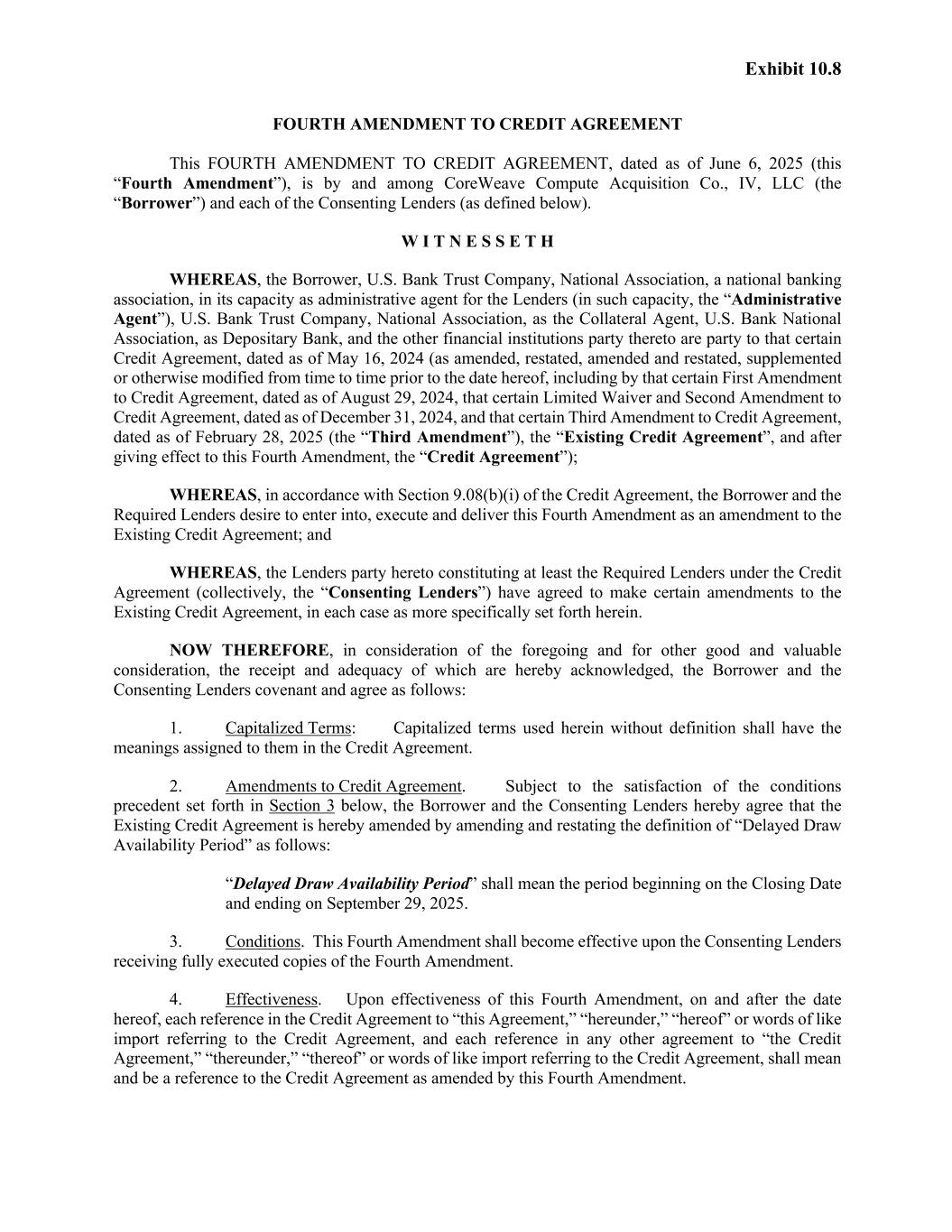
Exhibit 10.8 FOURTH AMENDMENT TO CREDIT AGREEMENT This FOURTH AMENDMENT TO CREDIT AGREEMENT, dated as of June 6, 2025 (this “Fourth Amendment”), is by and among CoreWeave Compute Acquisition Co., IV, LLC (the “Borrower”) and each of the Consenting Lenders (as defined below). W I T N E S S E T H WHEREAS, the Borrower, U.S. Bank Trust Company, National Association, a national banking association, in its capacity as administrative agent for the Lenders (in such capacity, the “Administrative Agent”), U.S. Bank Trust Company, National Association, as the Collateral Agent, U.S. Bank National Association, as Depositary Bank, and the other financial institutions party thereto are party to that certain Credit Agreement, dated as of May 16, 2024 (as amended, restated, amended and restated, supplemented or otherwise modified from time to time prior to the date hereof, including by that certain First Amendment to Credit Agreement, dated as of August 29, 2024, that certain Limited Waiver and Second Amendment to Credit Agreement, dated as of December 31, 2024, and that certain Third Amendment to Credit Agreement, dated as of February 28, 2025 (the “Third Amendment”), the “Existing Credit Agreement”, and after giving effect to this Fourth Amendment, the “Credit Agreement”); WHEREAS, in accordance with Section 9.08(b)(i) of the Credit Agreement, the Borrower and the Required Lenders desire to enter into, execute and deliver this Fourth Amendment as an amendment to the Existing Credit Agreement; and WHEREAS, the Lenders party hereto constituting at least the Required Lenders under the Credit Agreement (collectively, the “Consenting Lenders”) have agreed to make certain amendments to the Existing Credit Agreement, in each case as more specifically set forth herein. NOW THEREFORE, in consideration of the foregoing and for other good and valuable consideration, the receipt and adequacy of which are hereby acknowledged, the Borrower and the Consenting Lenders covenant and agree as follows: 1. Capitalized Terms: Capitalized terms used herein without definition shall have the meanings assigned to them in the Credit Agreement. 2. Amendments to Credit Agreement. Subject to the satisfaction of the conditions precedent set forth in Section 3 below, the Borrower and the Consenting Lenders hereby agree that the Existing Credit Agreement is hereby amended by amending and restating the definition of “Delayed Draw Availability Period” as follows: “Delayed Draw Availability Period” shall mean the period beginning on the Closing Date and ending on September 29, 2025. 3. Conditions. This Fourth Amendment shall become effective upon the Consenting Lenders receiving fully executed copies of the Fourth Amendment. 4. Effectiveness. Upon effectiveness of this Fourth Amendment, on and after the date hereof, each reference in the Credit Agreement to “this Agreement,” “hereunder,” “hereof” or words of like import referring to the Credit Agreement, and each reference in any other agreement to “the Credit Agreement,” “thereunder,” “thereof” or words of like import referring to the Credit Agreement, shall mean and be a reference to the Credit Agreement as amended by this Fourth Amendment.
2 5. Applicable Law; Waivers; Amendments; Entire Agreement; Waiver of Jury Trial; Severability; Jurisdiction; Consent to Service of Process; Confidentiality. Sections 9.07, 9.08, 9.10, 9.11, 9.12, 9.15 and 9.16 of the Credit Agreement are hereby incorporated by reference mutatis mutandis. 6. Loan Document. This Fourth Amendment shall constitute a Loan Document under the Credit Agreement. 7. Execution in Counterparts. This Fourth Amendment may be executed in any number of counterparts (including in electronic format (including, without limitation, “pdf,” “tif” or “jpg”) and other electronic signatures (including, without limitation, DocuSign)), each of which shall be an original, but such counterparts shall together constitute but one and the same instrument. The exchange of copies of this Fourth Amendment and of signature pages by PDF transmission or other electronic means shall constitute effective execution and delivery of this Fourth Amendment as to the parties hereto and may be used in lieu of the original Fourth Amendment for all purposes. Signatures of the parties hereto transmitted by PDF transmission or other electronic means shall be deemed to be their original signatures for all purposes. [Signature Pages Follow]
[CoreWeave 2.0 – Signature Page to Fourth Amendment to Credit Agreement] IN WITNESS WHEREOF, the parties hereto have caused this Fourth Amendment to Credit Agreement to be duly executed as of the date first above written. COREWEAVE COMPUTE ACQUISITION CO., IV, LLC, as the Borrower By: _/s/ Michael Intrator_________________________ Name: Michael Intrator Title: Chief Executive Officer

[CoreWeave 2.0 – Signature Page to Fourth Amendment to Credit Agreement] The undersigned Lender hereby irrevocably and unconditionally consents to the Fourth Amendment: [●], as a Consenting Lender By: ____________________________ Name: Title:
EX-31.1
3
exhibit311q22025.htm
EX-31.1
Document
CERTIFICATION PURSUANT TO RULE 13a-14(a) OR 15d-14(a)
OF THE SECURITIES EXCHANGE ACT OF 1934, AS ADOPTED
PURSUANT TO SECTION 302 OF THE SARBANES-OXLEY ACT OF 2002
I, Michael Intrator, certify that:
1.I have reviewed this Quarterly Report on Form 10-Q of CoreWeave, Inc.
2.Based on my knowledge, this report does not contain any untrue statement of a material fact or omit to state a material fact necessary to make the statements made, in light of the circumstances under which such statements were made, not misleading with respect to the period covered by this report.
3.Based on my knowledge, the financial statements, and other financial information included in this report, fairly present in all material respects the financial condition, results of operations and cash flows of the registrant as of, and for, the periods presented in this report.
4.The registrant’s other certifying officer and I are responsible for establishing and maintaining disclosure controls and procedures (as defined in Exchange Act Rules 13a-15(e) and 15d-15(e)) for the registrant and have:
a.Designed such disclosure controls and procedures, or caused such disclosure controls and procedures to be designed under our supervision, to ensure that material information relating to the registrant, including its consolidated subsidiaries, is made known to us by others within those entities, particularly during the period in which this report is being prepared;
b.Evaluated the effectiveness of the registrant's disclosure controls and procedures and presented in this report our conclusions about the effectiveness of the disclosure controls and procedures, as of the end of the period covered by this report based on such evaluation; and
c.Disclosed in this report any change in the registrant’s internal control over financial reporting that occurred during the registrant's most recent fiscal quarter (the registrant's fourth fiscal quarter in the case of an annual report) that has materially affected, or is reasonably likely to materially affect, the registrant's internal control over financial reporting.
5.The registrant's other certifying officer and I have disclosed, based on our most recent evaluation of internal control over financial reporting, to the registrant's auditors and the audit committee of the registrant’s board of directors (or persons performing the equivalent functions):
a.All significant deficiencies and material weaknesses in the design or operation of internal control over financial reporting which are reasonably likely to adversely affect the registrant's ability to record, process, summarize and report financial information; and
b.Any fraud, whether or not material, that involves management or other employees who have a significant role in the registrant’s internal control over financial reporting.
|
|
|
|
|
|
| COREWEAVE, INC. |
|
|
By: |
/s/ Michael Intrator |
Name: |
Michael Intrator |
Title: |
Chief Executive Officer and President |
|
(Principal Executive Officer) |
Date: August 12, 2025
EX-31.2
4
exhibit312q22025.htm
EX-31.2
Document
CERTIFICATION PURSUANT TO RULE 13a-14(a) OR 15d-14(a)
OF THE SECURITIES EXCHANGE ACT OF 1934, AS ADOPTED
PURSUANT TO SECTION 302 OF THE SARBANES-OXLEY ACT OF 2002
I, Nitin Agrawal, certify that:
1.I have reviewed this Quarterly Report on Form 10-Q of CoreWeave, Inc.
2.Based on my knowledge, this report does not contain any untrue statement of a material fact or omit to state a material fact necessary to make the statements made, in light of the circumstances under which such statements were made, not misleading with respect to the period covered by this report.
3.Based on my knowledge, the financial statements, and other financial information included in this report, fairly present in all material respects the financial condition, results of operations and cash flows of the registrant as of, and for, the periods presented in this report.
4.The registrant’s other certifying officer and I are responsible for establishing and maintaining disclosure controls and procedures (as defined in Exchange Act Rules 13a-15(e) and 15d-15(e)) for the registrant and have:
a.Designed such disclosure controls and procedures, or caused such disclosure controls and procedures to be designed under our supervision, to ensure that material information relating to the registrant, including its consolidated subsidiaries, is made known to us by others within those entities, particularly during the period in which this report is being prepared;
b.Evaluated the effectiveness of the registrant's disclosure controls and procedures and presented in this report our conclusions about the effectiveness of the disclosure controls and procedures, as of the end of the period covered by this report based on such evaluation; and
c.Disclosed in this report any change in the registrant's internal control over financial reporting that occurred during the registrant's most recent fiscal quarter (the registrant's fourth fiscal quarter in the case of an annual report) that has materially affected, or is reasonably likely to materially affect, the registrant's internal control over financial reporting.
5.The registrant’s other certifying officer and I have disclosed, based on our most recent evaluation of internal control over financial reporting, to the registrant's auditors and the audit committee of the registrant's board of directors (or persons performing the equivalent functions):
a.All significant deficiencies and material weaknesses in the design or operation of internal control over financial reporting which are reasonably likely to adversely affect the registrant’s ability to record, process, summarize and report financial information; and
b.Any fraud, whether or not material, that involves management or other employees who have a significant role in the registrant’s internal control over financial reporting.
|
|
|
|
|
|
| COREWEAVE, INC. |
|
|
By: |
/s/ Nitin Agrawal |
Name: |
Nitin Agrawal |
Title: |
Chief Financial Officer |
|
(Principal Financial Officer) |
Date: August 12, 2025
EX-32.1
5
exhibit321q22025.htm
EX-32.1
Document
CERTIFICATION OF THE CHIEF EXECUTIVE OFFICER
PURSUANT TO 18 U.S.C. SECTION 1350, AS ADOPTED PURSUANT TO
SECTION 906 OF THE SARBANES-OXLEY ACT OF 2002
In connection with the Quarterly Report of CoreWeave, Inc. (the “Company”) on Form 10-Q for the three months ended June 30, 2025, as filed with the Securities and Exchange Commission on the date hereof (the “Report”), I, Michael Intrator, Chief Executive Officer of the Company, hereby certify, pursuant to 18 U.S.C. Section 1350, as adopted pursuant to Section 906 of the Sarbanes-Oxley Act of 2002, that, to the best of my knowledge:
1.The Report fully complies with the requirements of Section 13(a) or 15(d) of the Securities Exchange Act of 1934, as amended; and
2.The information contained in the Report fairly presents, in all material respects, the financial condition and results of operations of the Company.
|
|
|
|
|
|
| COREWEAVE, INC. |
|
|
By: |
/s/ Michael Intrator |
Name: |
Michael Intrator |
Title: |
Chief Executive Officer and President |
|
(Principal Executive Officer) |
Date: August 12, 2025
EX-32.2
6
exhibit322q22025.htm
EX-32.2
Document
CERTIFICATION OF THE CHIEF FINANCIAL OFFICER
PURSUANT TO 18 U.S.C. SECTION 1350, AS ADOPTED PURSUANT TO
SECTION 906 OF THE SARBANES-OXLEY ACT OF 2002
In connection with the Quarterly Report of CoreWeave, Inc. (the “Company”) on Form 10-Q for the three months ended June 30, 2025, as filed with the Securities and Exchange Commission on the date hereof (the “Report”), I, Nitin Agrawal, Chief Financial Officer of the Company, hereby certify, pursuant to 18 U.S.C. Section 1350, as adopted pursuant to Section 906 of the Sarbanes-Oxley Act of 2002, that, to the best of my knowledge:
1.The Report fully complies with the requirements of Section 13(a) or 15(d) of the Securities Exchange Act of 1934, as amended; and
2.The information contained in the Report fairly presents, in all material respects, the financial condition and results of operations of the Company.
|
|
|
|
|
|
| COREWEAVE, INC. |
|
|
By: |
/s/ Nitin Agrawal |
Name: |
Nitin Agrawal |
Title: |
Chief Financial Officer |
|
(Principal Financial Officer) |
Date: August 12, 2025
 エドガーで原本を確認する