false2025Q30001610618--12-310.05P3YP3Yxbrli:sharesiso4217:USDiso4217:USDxbrli:sharesxbrli:purecdtx:votecdtx:optionPeriodcdtx:optioncdtx:employee00016106182025-01-012025-09-3000016106182025-11-0300016106182025-09-3000016106182024-12-310001610618cdtx:SeriesAConvertibleVotingPreferredStockMember2024-12-310001610618cdtx:SeriesAConvertibleVotingPreferredStockMember2025-09-300001610618cdtx:SeriesXConvertiblePreferredStockMember2024-12-310001610618cdtx:SeriesXConvertiblePreferredStockMember2025-09-3000016106182025-07-012025-09-3000016106182024-07-012024-09-3000016106182024-01-012024-09-3000016106182023-12-3100016106182024-09-300001610618cdtx:SeriesAConvertibleVotingPreferredStockMemberus-gaap:PreferredStockMember2024-12-310001610618cdtx:SeriesXConvertiblePreferredStockMemberus-gaap:PreferredStockMember2024-12-310001610618us-gaap:CommonStockMember2024-12-310001610618us-gaap:AdditionalPaidInCapitalMember2024-12-310001610618us-gaap:RetainedEarningsMember2024-12-310001610618us-gaap:AccumulatedOtherComprehensiveIncomeMember2024-12-310001610618cdtx:SeriesXConvertiblePreferredStockMemberus-gaap:PreferredStockMember2025-01-012025-03-310001610618cdtx:SeriesXConvertiblePreferredStockMemberus-gaap:CommonStockMember2025-01-012025-03-310001610618us-gaap:CommonStockMember2025-01-012025-03-310001610618us-gaap:AdditionalPaidInCapitalMember2025-01-012025-03-3100016106182025-01-012025-03-310001610618us-gaap:RetainedEarningsMember2025-01-012025-03-310001610618cdtx:SeriesAConvertibleVotingPreferredStockMemberus-gaap:PreferredStockMember2025-03-310001610618cdtx:SeriesXConvertiblePreferredStockMemberus-gaap:PreferredStockMember2025-03-310001610618us-gaap:CommonStockMember2025-03-310001610618us-gaap:AdditionalPaidInCapitalMember2025-03-310001610618us-gaap:RetainedEarningsMember2025-03-310001610618us-gaap:AccumulatedOtherComprehensiveIncomeMember2025-03-3100016106182025-03-310001610618cdtx:UnderwrittenPublicOfferingsMemberus-gaap:CommonStockMember2025-04-012025-06-300001610618us-gaap:CommonStockMember2025-04-012025-06-300001610618cdtx:UnderwrittenPublicOfferingsMemberus-gaap:AdditionalPaidInCapitalMember2025-04-012025-06-300001610618cdtx:UnderwrittenPublicOfferingsMember2025-04-012025-06-300001610618cdtx:AtTheMarketOfferingMemberus-gaap:CommonStockMember2025-04-012025-06-300001610618cdtx:AtTheMarketOfferingMemberus-gaap:AdditionalPaidInCapitalMember2025-04-012025-06-300001610618cdtx:AtTheMarketOfferingMember2025-04-012025-06-300001610618cdtx:SeriesAConvertibleVotingPreferredStockMemberus-gaap:PreferredStockMember2025-04-012025-06-300001610618us-gaap:AdditionalPaidInCapitalMember2025-04-012025-06-3000016106182025-04-012025-06-300001610618us-gaap:RetainedEarningsMember2025-04-012025-06-300001610618cdtx:SeriesAConvertibleVotingPreferredStockMemberus-gaap:PreferredStockMember2025-06-300001610618cdtx:SeriesXConvertiblePreferredStockMemberus-gaap:PreferredStockMember2025-06-300001610618us-gaap:CommonStockMember2025-06-300001610618us-gaap:AdditionalPaidInCapitalMember2025-06-300001610618us-gaap:RetainedEarningsMember2025-06-300001610618us-gaap:AccumulatedOtherComprehensiveIncomeMember2025-06-3000016106182025-06-300001610618cdtx:SeriesAConvertibleVotingPreferredStockMemberus-gaap:PreferredStockMember2025-07-012025-09-300001610618cdtx:SeriesAConvertibleVotingPreferredStockMemberus-gaap:CommonStockMember2025-07-012025-09-300001610618cdtx:SeriesAConvertibleVotingPreferredStockMemberus-gaap:AdditionalPaidInCapitalMember2025-07-012025-09-300001610618cdtx:SeriesXConvertiblePreferredStockMemberus-gaap:PreferredStockMember2025-07-012025-09-300001610618cdtx:SeriesXConvertiblePreferredStockMemberus-gaap:CommonStockMember2025-07-012025-09-300001610618us-gaap:CommonStockMember2025-07-012025-09-300001610618us-gaap:AdditionalPaidInCapitalMember2025-07-012025-09-300001610618us-gaap:RetainedEarningsMember2025-07-012025-09-300001610618us-gaap:AccumulatedOtherComprehensiveIncomeMember2025-07-012025-09-300001610618cdtx:SeriesAConvertibleVotingPreferredStockMemberus-gaap:PreferredStockMember2025-09-300001610618cdtx:SeriesXConvertiblePreferredStockMemberus-gaap:PreferredStockMember2025-09-300001610618us-gaap:CommonStockMember2025-09-300001610618us-gaap:AdditionalPaidInCapitalMember2025-09-300001610618us-gaap:RetainedEarningsMember2025-09-300001610618us-gaap:AccumulatedOtherComprehensiveIncomeMember2025-09-300001610618cdtx:SeriesAConvertibleVotingPreferredStockMemberus-gaap:PreferredStockMember2023-12-310001610618cdtx:SeriesXConvertiblePreferredStockMemberus-gaap:PreferredStockMember2023-12-310001610618us-gaap:CommonStockMember2023-12-310001610618us-gaap:AdditionalPaidInCapitalMember2023-12-310001610618us-gaap:RetainedEarningsMember2023-12-310001610618us-gaap:CommonStockMember2024-01-012024-03-310001610618us-gaap:AdditionalPaidInCapitalMember2024-01-012024-03-3100016106182024-01-012024-03-310001610618us-gaap:RetainedEarningsMember2024-01-012024-03-310001610618cdtx:SeriesAConvertibleVotingPreferredStockMemberus-gaap:PreferredStockMember2024-03-310001610618cdtx:SeriesXConvertiblePreferredStockMemberus-gaap:PreferredStockMember2024-03-310001610618us-gaap:CommonStockMember2024-03-310001610618us-gaap:AdditionalPaidInCapitalMember2024-03-310001610618us-gaap:RetainedEarningsMember2024-03-3100016106182024-03-310001610618cdtx:SeriesAConvertibleVotingPreferredStockMemberus-gaap:PrivatePlacementMemberus-gaap:PreferredStockMember2024-04-012024-06-300001610618us-gaap:PrivatePlacementMemberus-gaap:AdditionalPaidInCapitalMember2024-04-012024-06-300001610618us-gaap:PrivatePlacementMember2024-04-012024-06-300001610618us-gaap:CommonStockMember2024-04-012024-06-300001610618us-gaap:AdditionalPaidInCapitalMember2024-04-012024-06-3000016106182024-04-012024-06-300001610618us-gaap:RetainedEarningsMember2024-04-012024-06-300001610618cdtx:SeriesAConvertibleVotingPreferredStockMemberus-gaap:PreferredStockMember2024-06-300001610618cdtx:SeriesXConvertiblePreferredStockMemberus-gaap:PreferredStockMember2024-06-300001610618us-gaap:CommonStockMember2024-06-300001610618us-gaap:AdditionalPaidInCapitalMember2024-06-300001610618us-gaap:RetainedEarningsMember2024-06-3000016106182024-06-300001610618cdtx:SeriesAConvertibleVotingPreferredStockMemberus-gaap:PreferredStockMember2024-07-012024-09-300001610618cdtx:SeriesAConvertibleVotingPreferredStockMemberus-gaap:CommonStockMember2024-07-012024-09-300001610618us-gaap:CommonStockMember2024-07-012024-09-300001610618us-gaap:AdditionalPaidInCapitalMember2024-07-012024-09-300001610618us-gaap:RetainedEarningsMember2024-07-012024-09-300001610618cdtx:SeriesAConvertibleVotingPreferredStockMemberus-gaap:PreferredStockMember2024-09-300001610618cdtx:SeriesXConvertiblePreferredStockMemberus-gaap:PreferredStockMember2024-09-300001610618us-gaap:CommonStockMember2024-09-300001610618us-gaap:AdditionalPaidInCapitalMember2024-09-300001610618us-gaap:RetainedEarningsMember2024-09-300001610618us-gaap:DiscontinuedOperationsDisposedOfBySaleMembercdtx:RezafunginMember2025-09-300001610618us-gaap:DiscontinuedOperationsDisposedOfBySaleMembercdtx:RezafunginMember2024-12-310001610618cdtx:ReportableSegmentMember2025-07-012025-09-300001610618cdtx:ReportableSegmentMember2024-07-012024-09-300001610618cdtx:ReportableSegmentMember2025-01-012025-09-300001610618cdtx:ReportableSegmentMember2024-01-012024-09-3000016106182024-04-232024-04-230001610618srt:MinimumMember2025-09-300001610618srt:MaximumMember2025-09-300001610618cdtx:PrefundedWarrantsMemberus-gaap:PrivatePlacementMember2024-11-202024-11-200001610618cdtx:PrefundedWarrantsMemberus-gaap:PrivatePlacementMember2024-11-200001610618us-gaap:PrivatePlacementMember2024-11-200001610618us-gaap:WarrantMember2025-01-012025-09-300001610618us-gaap:WarrantMember2025-07-012025-09-300001610618us-gaap:WarrantMember2024-07-012024-09-300001610618us-gaap:WarrantMember2024-01-012024-09-300001610618us-gaap:ConvertiblePreferredStockMembercdtx:SeriesAConvertibleVotingPreferredStockMember2025-07-012025-09-300001610618us-gaap:ConvertiblePreferredStockMembercdtx:SeriesAConvertibleVotingPreferredStockMember2025-01-012025-09-300001610618us-gaap:ConvertiblePreferredStockMembercdtx:SeriesAConvertibleVotingPreferredStockMember2024-07-012024-09-300001610618us-gaap:ConvertiblePreferredStockMembercdtx:SeriesAConvertibleVotingPreferredStockMember2024-01-012024-09-300001610618us-gaap:ConvertiblePreferredStockMembercdtx:SeriesXConvertiblePreferredStockMember2025-07-012025-09-300001610618us-gaap:ConvertiblePreferredStockMembercdtx:SeriesXConvertiblePreferredStockMember2025-01-012025-09-300001610618us-gaap:ConvertiblePreferredStockMembercdtx:SeriesXConvertiblePreferredStockMember2024-01-012024-09-300001610618us-gaap:ConvertiblePreferredStockMembercdtx:SeriesXConvertiblePreferredStockMember2024-07-012024-09-300001610618us-gaap:StockCompensationPlanMember2025-07-012025-09-300001610618us-gaap:StockCompensationPlanMember2025-01-012025-09-300001610618us-gaap:StockCompensationPlanMember2024-07-012024-09-300001610618us-gaap:StockCompensationPlanMember2024-01-012024-09-300001610618us-gaap:USTreasuryBillSecuritiesMemberus-gaap:FairValueInputsLevel1Member2025-09-300001610618cdtx:AgencySecuritiesAndDiscountNotesMemberus-gaap:FairValueInputsLevel2Member2025-09-300001610618cdtx:CashDepositsAndMoneyMarketFundsMemberus-gaap:FairValueInputsLevel1Member2025-09-300001610618us-gaap:CommercialPaperMemberus-gaap:FairValueInputsLevel2Member2025-09-300001610618us-gaap:USTreasurySecuritiesMemberus-gaap:FairValueInputsLevel1Member2025-09-300001610618cdtx:CorporateBondSecuritiesAndCommercialPaperMemberus-gaap:FairValueInputsLevel2Member2025-09-300001610618cdtx:CashDepositsAndMoneyMarketFundsMemberus-gaap:FairValueInputsLevel1Member2024-12-310001610618us-gaap:CommonStockMembercdtx:A2025UnderwrittenPublicOfferingMember2025-06-262025-06-260001610618us-gaap:CommonStockMemberus-gaap:OverAllotmentOptionMember2025-06-262025-06-260001610618us-gaap:CommonStockMembercdtx:A2025UnderwrittenPublicOfferingMember2025-06-260001610618cdtx:A2025UnderwrittenPublicOfferingAndOverAllotmentOptionMember2025-06-262025-06-260001610618cdtx:OpenMarketSaleAgreementMember2025-05-082025-05-080001610618cdtx:OpenMarketSaleAgreementMember2025-01-012025-09-300001610618cdtx:OpenMarketSaleAgreementMember2025-07-012025-09-300001610618cdtx:OpenMarketSaleAgreementMember2025-09-300001610618us-gaap:PrivatePlacementMember2024-11-202024-11-200001610618us-gaap:PrivatePlacementMember2024-11-262024-11-260001610618cdtx:SeriesAConvertibleVotingPreferredStockMemberus-gaap:PrivatePlacementMember2024-04-232024-04-230001610618cdtx:SeriesAConvertiblePreferredStockMemberus-gaap:PrivatePlacementMember2024-04-230001610618cdtx:SeriesAConvertibleVotingPreferredStockMemberus-gaap:PrivatePlacementMember2024-04-242024-04-240001610618cdtx:SeriesAConvertiblePreferredStockMember2024-04-300001610618cdtx:SeriesAConvertiblePreferredStockMemberus-gaap:PrivatePlacementMember2024-07-012024-07-310001610618cdtx:SeriesAConvertiblePreferredStockMember2024-07-012024-07-310001610618cdtx:SeriesAConvertiblePreferredStockMember2025-01-012025-09-300001610618us-gaap:CommonStockMembercdtx:SeriesAConvertiblePreferredStockConvertedToCommonStockMember2025-01-012025-09-300001610618cdtx:SeriesAConvertiblePreferredStockMember2025-09-300001610618cdtx:SeriesAConvertiblePreferredStockMember2024-12-310001610618cdtx:SeriesAConvertiblePreferredStockMember2024-04-012024-04-300001610618cdtx:SeriesXConvertiblePreferredStockMember2018-05-310001610618cdtx:SeriesXConvertiblePreferredStockMember2020-01-012020-12-310001610618us-gaap:CommonStockMember2020-01-012020-12-310001610618cdtx:SeriesXConvertiblePreferredStockMember2025-01-012025-09-300001610618us-gaap:CommonStockMembercdtx:SeriesXConvertiblePreferredStockConvertedToCommonStockMember2025-01-012025-09-300001610618cdtx:SeriesXConvertiblePreferredStockMember2018-05-012018-05-3100016106182024-04-2200016106182024-04-2300016106182024-07-1700016106182024-07-1800016106182025-06-1700016106182025-06-180001610618us-gaap:CommonStockMember2025-01-012025-09-300001610618cdtx:CommonStockWarrantMember2025-09-300001610618cdtx:PrefundedWarrantsMember2025-09-300001610618cdtx:PrefundedWarrantsMember2025-01-012025-09-300001610618cdtx:PrefundedWarrantsMemberus-gaap:CommonStockMember2025-01-012025-09-300001610618cdtx:CommonStockWarrantMember2024-12-310001610618cdtx:PrefundedWarrantsMember2024-12-310001610618us-gaap:WarrantMember2025-09-300001610618us-gaap:WarrantMember2024-12-310001610618cdtx:SeriesAConvertiblePreferredStockMember2025-09-300001610618cdtx:SeriesAConvertiblePreferredStockMember2024-12-310001610618cdtx:SeriesXConvertiblePreferredStockMember2025-09-300001610618cdtx:SeriesXConvertiblePreferredStockMember2024-12-310001610618us-gaap:StockCompensationPlanMember2025-09-300001610618us-gaap:StockCompensationPlanMember2024-12-310001610618cdtx:AuthorizedSharesForFutureStockAwardsMember2025-09-300001610618cdtx:AuthorizedSharesForFutureStockAwardsMember2024-12-310001610618us-gaap:EmployeeStockMember2025-09-300001610618us-gaap:EmployeeStockMember2024-12-310001610618cdtx:TwoThousandTwentyFourEquityIncentivePlanTwoThousandTwentyInducementIncentivePlanAndTwoThousandFifteenEquityIncentivePlanMember2024-07-182024-07-180001610618srt:MinimumMembercdtx:TwoThousandTwentyFourEquityIncentivePlanTwoThousandTwentyInducementIncentivePlanAndTwoThousandFifteenEquityIncentivePlanMember2024-07-182024-07-180001610618srt:MaximumMembercdtx:TwoThousandTwentyFourEquityIncentivePlanTwoThousandTwentyInducementIncentivePlanAndTwoThousandFifteenEquityIncentivePlanMember2024-07-182024-07-180001610618cdtx:TwoThousandTwentyFourEquityIncentivePlanTwoThousandTwentyInducementIncentivePlanAndTwoThousandFifteenEquityIncentivePlanMembercdtx:MoreThanTenPercentVotingRightsClassesOfStockMember2024-07-182024-07-180001610618cdtx:TwoThousandFifteenEmployeeStockPurchasePlanMemberus-gaap:EmployeeStockMember2015-03-012015-03-310001610618cdtx:TwoThousandFifteenEmployeeStockPurchasePlanMemberus-gaap:EmployeeStockMember2015-03-310001610618cdtx:TwoThousandFifteenEmployeeStockPurchasePlanMemberus-gaap:EmployeeStockMember2025-01-012025-09-300001610618cdtx:TwoThousandFifteenEmployeeStockPurchasePlanMemberus-gaap:EmployeeStockMember2024-01-012024-09-300001610618us-gaap:RestrictedStockUnitsRSUMember2024-12-310001610618us-gaap:RestrictedStockUnitsRSUMember2025-01-012025-09-300001610618us-gaap:RestrictedStockUnitsRSUMember2025-09-300001610618us-gaap:RestrictedStockUnitsRSUMember2024-01-012024-09-3000016106182024-01-012024-12-310001610618us-gaap:EmployeeStockOptionMember2025-01-012025-09-300001610618us-gaap:SegmentContinuingOperationsMemberus-gaap:ResearchAndDevelopmentExpenseMember2025-07-012025-09-300001610618us-gaap:SegmentContinuingOperationsMemberus-gaap:ResearchAndDevelopmentExpenseMember2024-07-012024-09-300001610618us-gaap:SegmentContinuingOperationsMemberus-gaap:ResearchAndDevelopmentExpenseMember2025-01-012025-09-300001610618us-gaap:SegmentContinuingOperationsMemberus-gaap:ResearchAndDevelopmentExpenseMember2024-01-012024-09-300001610618us-gaap:SegmentContinuingOperationsMemberus-gaap:SellingGeneralAndAdministrativeExpensesMember2025-07-012025-09-300001610618us-gaap:SegmentContinuingOperationsMemberus-gaap:SellingGeneralAndAdministrativeExpensesMember2024-07-012024-09-300001610618us-gaap:SegmentContinuingOperationsMemberus-gaap:SellingGeneralAndAdministrativeExpensesMember2025-01-012025-09-300001610618us-gaap:SegmentContinuingOperationsMemberus-gaap:SellingGeneralAndAdministrativeExpensesMember2024-01-012024-09-300001610618us-gaap:SegmentContinuingOperationsMember2025-07-012025-09-300001610618us-gaap:SegmentContinuingOperationsMember2024-07-012024-09-300001610618us-gaap:SegmentContinuingOperationsMember2025-01-012025-09-300001610618us-gaap:SegmentContinuingOperationsMember2024-01-012024-09-300001610618us-gaap:SegmentDiscontinuedOperationsMember2025-07-012025-09-300001610618us-gaap:SegmentDiscontinuedOperationsMember2024-07-012024-09-300001610618us-gaap:SegmentDiscontinuedOperationsMember2025-01-012025-09-300001610618us-gaap:SegmentDiscontinuedOperationsMember2024-01-012024-09-300001610618cdtx:BiomedicalAdvancedResearchAndDevelopmentAuthorityBARDAMembercdtx:CostReimbursementMember2025-09-300001610618cdtx:BiomedicalAdvancedResearchAndDevelopmentAuthorityBARDAMembercdtx:CostReimbursementBasePeriodMember2025-09-300001610618cdtx:BiomedicalAdvancedResearchAndDevelopmentAuthorityBARDAMembercdtx:CostReimbursementAfterBasePeriodMember2025-09-300001610618cdtx:BiomedicalAdvancedResearchAndDevelopmentAuthorityBARDAMembercdtx:CostReimbursementMember2025-01-012025-09-300001610618cdtx:BiomedicalAdvancedResearchAndDevelopmentAuthorityBARDAMembercdtx:CostReimbursementMember2025-07-012025-09-300001610618us-gaap:LicenseMemberus-gaap:CollaborativeArrangementTransactionWithPartyToCollaborativeArrangementMemberus-gaap:RelatedPartyMembercdtx:JanssenPharmaceuticalsIncMember2024-04-242024-04-240001610618us-gaap:LicenseMemberus-gaap:CollaborativeArrangementTransactionWithPartyToCollaborativeArrangementMemberus-gaap:RelatedPartyMembercdtx:JanssenPharmaceuticalsIncMember2024-04-012024-06-300001610618us-gaap:LicenseMemberus-gaap:RelatedPartyMembercdtx:JanssenPharmaceuticalsIncMemberus-gaap:CollaborativeArrangementTransactionWithPartyToCollaborativeArrangementMembercdtx:UpfrontPaymentMember2024-04-230001610618us-gaap:LicenseMemberus-gaap:RelatedPartyMembercdtx:JanssenPharmaceuticalsIncMemberus-gaap:CollaborativeArrangementTransactionWithPartyToCollaborativeArrangementMembercdtx:UpfrontPaymentMember2024-04-242024-04-240001610618us-gaap:LicenseMemberus-gaap:CollaborativeArrangementTransactionWithPartyToCollaborativeArrangementMemberus-gaap:RelatedPartyMembercdtx:JanssenPharmaceuticalsIncMember2025-09-012025-09-300001610618us-gaap:CollaborativeArrangementTransactionWithPartyToCollaborativeArrangementMemberus-gaap:RelatedPartyMembercdtx:JanssenPharmaceuticalsIncMember2021-03-012024-04-230001610618cdtx:MilestoneAchievementMemberus-gaap:CollaborativeArrangementTransactionWithPartyToCollaborativeArrangementMemberus-gaap:RelatedPartyMembercdtx:JanssenPharmaceuticalsIncMember2021-03-012024-04-230001610618us-gaap:CollaborativeArrangementTransactionWithPartyToCollaborativeArrangementMemberus-gaap:RelatedPartyMembercdtx:JanssenPharmaceuticalsIncMember2025-09-300001610618us-gaap:CollaborativeArrangementTransactionWithPartyToCollaborativeArrangementMemberus-gaap:RelatedPartyMembercdtx:JanssenPharmaceuticalsIncMember2024-12-310001610618cdtx:ResearchAndDevelopmentServicesMemberus-gaap:RelatedPartyMembercdtx:JanssenPharmaceuticalsIncMemberus-gaap:TransferredOverTimeMemberus-gaap:CollaborativeArrangementTransactionWithPartyToCollaborativeArrangementMember2024-07-012024-09-300001610618cdtx:ResearchAndDevelopmentServicesMemberus-gaap:RelatedPartyMembercdtx:JanssenPharmaceuticalsIncMemberus-gaap:TransferredOverTimeMemberus-gaap:CollaborativeArrangementTransactionWithPartyToCollaborativeArrangementMember2024-01-012024-09-300001610618cdtx:ClinicalSupplyServicesMemberus-gaap:RelatedPartyMembercdtx:JanssenPharmaceuticalsIncMemberus-gaap:TransferredOverTimeMemberus-gaap:CollaborativeArrangementTransactionWithPartyToCollaborativeArrangementMember2024-07-012024-09-300001610618cdtx:ClinicalSupplyServicesMemberus-gaap:RelatedPartyMembercdtx:JanssenPharmaceuticalsIncMemberus-gaap:TransferredOverTimeMemberus-gaap:CollaborativeArrangementTransactionWithPartyToCollaborativeArrangementMember2024-01-012024-09-300001610618us-gaap:CollaborativeArrangementTransactionWithPartyToCollaborativeArrangementMemberus-gaap:RelatedPartyMembercdtx:JanssenPharmaceuticalsIncMember2024-07-012024-09-300001610618us-gaap:CollaborativeArrangementTransactionWithPartyToCollaborativeArrangementMemberus-gaap:RelatedPartyMembercdtx:JanssenPharmaceuticalsIncMember2024-01-012024-09-3000016106182023-11-3000016106182023-11-012023-11-300001610618us-gaap:DisposalGroupDisposedOfByMeansOtherThanSaleNotDiscontinuedOperationsMembercdtx:FinanceLeaseRightOfUseAssetAndLiabilitiesMember2025-01-012025-03-3100016106182023-04-2000016106182023-04-202023-04-2000016106182024-09-092024-09-090001610618us-gaap:StandbyLettersOfCreditMember2024-12-110001610618us-gaap:StandbyLettersOfCreditMember2024-12-112024-12-110001610618us-gaap:DiscontinuedOperationsDisposedOfBySaleMemberus-gaap:RelatedPartyMembercdtx:NappPharmaceuticalGroupLimitedMemberus-gaap:CollaborativeArrangementTransactionWithPartyToCollaborativeArrangementMembercdtx:RezafunginMember2024-04-242024-04-240001610618us-gaap:DiscontinuedOperationsDisposedOfBySaleMembercdtx:RezafunginMember2024-07-012024-09-300001610618us-gaap:DiscontinuedOperationsDisposedOfBySaleMembercdtx:RezafunginMember2024-01-012024-09-300001610618us-gaap:DiscontinuedOperationsDisposedOfBySaleMemberus-gaap:RelatedPartyMembercdtx:NappPharmaceuticalGroupLimitedMemberus-gaap:CollaborativeArrangementTransactionWithPartyToCollaborativeArrangementMembercdtx:RezafunginMember2024-04-240001610618cdtx:RezafunginAssetsMemberus-gaap:DiscontinuedOperationsDisposedOfBySaleMemberus-gaap:RelatedPartyMembercdtx:NappPharmaceuticalGroupLimitedMemberus-gaap:CollaborativeArrangementTransactionWithPartyToCollaborativeArrangementMembercdtx:RezafunginMember2024-04-242024-04-240001610618us-gaap:DiscontinuedOperationsDisposedOfBySaleMemberus-gaap:RelatedPartyMembercdtx:NappPharmaceuticalGroupLimitedMemberus-gaap:CollaborativeArrangementTransactionWithPartyToCollaborativeArrangementMembercdtx:RezafunginMember2024-04-012024-06-300001610618us-gaap:DiscontinuedOperationsDisposedOfBySaleMemberus-gaap:RelatedPartyMembercdtx:NappPharmaceuticalGroupLimitedMemberus-gaap:CollaborativeArrangementTransactionWithPartyToCollaborativeArrangementMembercdtx:RezafunginMember2025-09-300001610618us-gaap:DiscontinuedOperationsDisposedOfBySaleMemberus-gaap:RelatedPartyMembercdtx:MundipharmaMedicalCompanyMemberus-gaap:CollaborativeArrangementTransactionWithPartyToCollaborativeArrangementMembercdtx:RezafunginMember2019-03-012024-04-230001610618cdtx:MilestoneAchievementMemberus-gaap:DiscontinuedOperationsDisposedOfBySaleMemberus-gaap:RelatedPartyMembercdtx:MundipharmaMedicalCompanyMemberus-gaap:CollaborativeArrangementTransactionWithPartyToCollaborativeArrangementMembercdtx:RezafunginMember2019-03-012024-04-230001610618us-gaap:DiscontinuedOperationsDisposedOfBySaleMemberus-gaap:RelatedPartyMembercdtx:MelintaTherapeuticsIncMemberus-gaap:CollaborativeArrangementTransactionWithPartyToCollaborativeArrangementMembercdtx:RezafunginMember2022-07-262024-04-230001610618cdtx:MilestoneAchievementMemberus-gaap:DiscontinuedOperationsDisposedOfBySaleMemberus-gaap:RelatedPartyMembercdtx:MelintaTherapeuticsIncMemberus-gaap:CollaborativeArrangementTransactionWithPartyToCollaborativeArrangementMembercdtx:RezafunginMember2022-07-262024-04-230001610618us-gaap:DiscontinuedOperationsDisposedOfBySaleMemberus-gaap:CollaborativeArrangementTransactionWithPartyToCollaborativeArrangementMembercdtx:RezafunginMemberus-gaap:RelatedPartyMember2025-09-300001610618us-gaap:DiscontinuedOperationsDisposedOfBySaleMemberus-gaap:CollaborativeArrangementTransactionWithPartyToCollaborativeArrangementMembercdtx:RezafunginMemberus-gaap:RelatedPartyMember2024-12-310001610618cdtx:RezafunginAssetsMemberus-gaap:DiscontinuedOperationsDisposedOfBySaleMemberus-gaap:RelatedPartyMembercdtx:MundipharmaMedicalCompanyMemberus-gaap:TransferredAtPointInTimeMemberus-gaap:CollaborativeArrangementTransactionWithPartyToCollaborativeArrangementMembercdtx:RezafunginMember2024-07-012024-09-300001610618cdtx:RezafunginAssetsMemberus-gaap:DiscontinuedOperationsDisposedOfBySaleMemberus-gaap:RelatedPartyMembercdtx:MelintaTherapeuticsIncMemberus-gaap:TransferredAtPointInTimeMemberus-gaap:CollaborativeArrangementTransactionWithPartyToCollaborativeArrangementMembercdtx:RezafunginMember2024-07-012024-09-300001610618cdtx:RezafunginAssetsMemberus-gaap:DiscontinuedOperationsDisposedOfBySaleMemberus-gaap:RelatedPartyMembercdtx:MundipharmaMedicalCompanyMemberus-gaap:TransferredAtPointInTimeMemberus-gaap:CollaborativeArrangementTransactionWithPartyToCollaborativeArrangementMembercdtx:RezafunginMember2024-01-012024-09-300001610618cdtx:RezafunginAssetsMemberus-gaap:DiscontinuedOperationsDisposedOfBySaleMemberus-gaap:RelatedPartyMembercdtx:MelintaTherapeuticsIncMemberus-gaap:TransferredAtPointInTimeMemberus-gaap:CollaborativeArrangementTransactionWithPartyToCollaborativeArrangementMembercdtx:RezafunginMember2024-01-012024-09-300001610618cdtx:LicenseOfIntellectualPropertyUponMilestonesAchievedMemberus-gaap:DiscontinuedOperationsDisposedOfBySaleMemberus-gaap:RelatedPartyMembercdtx:MundipharmaMedicalCompanyMemberus-gaap:TransferredAtPointInTimeMemberus-gaap:CollaborativeArrangementTransactionWithPartyToCollaborativeArrangementMembercdtx:RezafunginMember2024-07-012024-09-300001610618cdtx:LicenseOfIntellectualPropertyUponMilestonesAchievedMemberus-gaap:DiscontinuedOperationsDisposedOfBySaleMemberus-gaap:RelatedPartyMembercdtx:MelintaTherapeuticsIncMemberus-gaap:TransferredAtPointInTimeMemberus-gaap:CollaborativeArrangementTransactionWithPartyToCollaborativeArrangementMembercdtx:RezafunginMember2024-07-012024-09-300001610618cdtx:LicenseOfIntellectualPropertyUponMilestonesAchievedMemberus-gaap:DiscontinuedOperationsDisposedOfBySaleMemberus-gaap:RelatedPartyMembercdtx:MundipharmaMedicalCompanyMemberus-gaap:TransferredAtPointInTimeMemberus-gaap:CollaborativeArrangementTransactionWithPartyToCollaborativeArrangementMembercdtx:RezafunginMember2024-01-012024-09-300001610618cdtx:LicenseOfIntellectualPropertyUponMilestonesAchievedMemberus-gaap:DiscontinuedOperationsDisposedOfBySaleMemberus-gaap:RelatedPartyMembercdtx:MelintaTherapeuticsIncMemberus-gaap:TransferredAtPointInTimeMemberus-gaap:CollaborativeArrangementTransactionWithPartyToCollaborativeArrangementMembercdtx:RezafunginMember2024-01-012024-09-300001610618us-gaap:ProductMemberus-gaap:DiscontinuedOperationsDisposedOfBySaleMemberus-gaap:RelatedPartyMembercdtx:MundipharmaMedicalCompanyMemberus-gaap:TransferredAtPointInTimeMemberus-gaap:CollaborativeArrangementTransactionWithPartyToCollaborativeArrangementMembercdtx:RezafunginMember2024-07-012024-09-300001610618us-gaap:ProductMemberus-gaap:DiscontinuedOperationsDisposedOfBySaleMemberus-gaap:RelatedPartyMembercdtx:MelintaTherapeuticsIncMemberus-gaap:TransferredAtPointInTimeMemberus-gaap:CollaborativeArrangementTransactionWithPartyToCollaborativeArrangementMembercdtx:RezafunginMember2024-07-012024-09-300001610618us-gaap:ProductMemberus-gaap:DiscontinuedOperationsDisposedOfBySaleMemberus-gaap:RelatedPartyMembercdtx:MundipharmaMedicalCompanyMemberus-gaap:TransferredAtPointInTimeMemberus-gaap:CollaborativeArrangementTransactionWithPartyToCollaborativeArrangementMembercdtx:RezafunginMember2024-01-012024-09-300001610618us-gaap:ProductMemberus-gaap:DiscontinuedOperationsDisposedOfBySaleMemberus-gaap:RelatedPartyMembercdtx:MelintaTherapeuticsIncMemberus-gaap:TransferredAtPointInTimeMemberus-gaap:CollaborativeArrangementTransactionWithPartyToCollaborativeArrangementMembercdtx:RezafunginMember2024-01-012024-09-300001610618us-gaap:RoyaltyMemberus-gaap:DiscontinuedOperationsDisposedOfBySaleMemberus-gaap:RelatedPartyMembercdtx:MundipharmaMedicalCompanyMemberus-gaap:TransferredAtPointInTimeMemberus-gaap:CollaborativeArrangementTransactionWithPartyToCollaborativeArrangementMembercdtx:RezafunginMember2024-07-012024-09-300001610618us-gaap:RoyaltyMemberus-gaap:DiscontinuedOperationsDisposedOfBySaleMemberus-gaap:RelatedPartyMembercdtx:MelintaTherapeuticsIncMemberus-gaap:TransferredAtPointInTimeMemberus-gaap:CollaborativeArrangementTransactionWithPartyToCollaborativeArrangementMembercdtx:RezafunginMember2024-07-012024-09-300001610618us-gaap:RoyaltyMemberus-gaap:DiscontinuedOperationsDisposedOfBySaleMemberus-gaap:RelatedPartyMembercdtx:MundipharmaMedicalCompanyMemberus-gaap:TransferredAtPointInTimeMemberus-gaap:CollaborativeArrangementTransactionWithPartyToCollaborativeArrangementMembercdtx:RezafunginMember2024-01-012024-09-300001610618us-gaap:RoyaltyMemberus-gaap:DiscontinuedOperationsDisposedOfBySaleMemberus-gaap:RelatedPartyMembercdtx:MelintaTherapeuticsIncMemberus-gaap:TransferredAtPointInTimeMemberus-gaap:CollaborativeArrangementTransactionWithPartyToCollaborativeArrangementMembercdtx:RezafunginMember2024-01-012024-09-300001610618cdtx:ResearchAndDevelopmentServicesMemberus-gaap:DiscontinuedOperationsDisposedOfBySaleMemberus-gaap:RelatedPartyMembercdtx:MundipharmaMedicalCompanyMemberus-gaap:TransferredOverTimeMemberus-gaap:CollaborativeArrangementTransactionWithPartyToCollaborativeArrangementMembercdtx:RezafunginMember2024-07-012024-09-300001610618cdtx:ResearchAndDevelopmentServicesMemberus-gaap:DiscontinuedOperationsDisposedOfBySaleMemberus-gaap:RelatedPartyMembercdtx:MelintaTherapeuticsIncMemberus-gaap:TransferredOverTimeMemberus-gaap:CollaborativeArrangementTransactionWithPartyToCollaborativeArrangementMembercdtx:RezafunginMember2024-07-012024-09-300001610618cdtx:ResearchAndDevelopmentServicesMemberus-gaap:DiscontinuedOperationsDisposedOfBySaleMemberus-gaap:RelatedPartyMembercdtx:MundipharmaMedicalCompanyMemberus-gaap:TransferredOverTimeMemberus-gaap:CollaborativeArrangementTransactionWithPartyToCollaborativeArrangementMembercdtx:RezafunginMember2024-01-012024-09-300001610618cdtx:ResearchAndDevelopmentServicesMemberus-gaap:DiscontinuedOperationsDisposedOfBySaleMemberus-gaap:RelatedPartyMembercdtx:MelintaTherapeuticsIncMemberus-gaap:TransferredOverTimeMemberus-gaap:CollaborativeArrangementTransactionWithPartyToCollaborativeArrangementMembercdtx:RezafunginMember2024-01-012024-09-300001610618cdtx:ClinicalSupplyServicesMemberus-gaap:DiscontinuedOperationsDisposedOfBySaleMemberus-gaap:RelatedPartyMembercdtx:MundipharmaMedicalCompanyMemberus-gaap:TransferredOverTimeMemberus-gaap:CollaborativeArrangementTransactionWithPartyToCollaborativeArrangementMembercdtx:RezafunginMember2024-07-012024-09-300001610618cdtx:ClinicalSupplyServicesMemberus-gaap:DiscontinuedOperationsDisposedOfBySaleMemberus-gaap:RelatedPartyMembercdtx:MelintaTherapeuticsIncMemberus-gaap:TransferredOverTimeMemberus-gaap:CollaborativeArrangementTransactionWithPartyToCollaborativeArrangementMembercdtx:RezafunginMember2024-07-012024-09-300001610618cdtx:ClinicalSupplyServicesMemberus-gaap:DiscontinuedOperationsDisposedOfBySaleMemberus-gaap:RelatedPartyMembercdtx:MundipharmaMedicalCompanyMemberus-gaap:TransferredOverTimeMemberus-gaap:CollaborativeArrangementTransactionWithPartyToCollaborativeArrangementMembercdtx:RezafunginMember2024-01-012024-09-300001610618cdtx:ClinicalSupplyServicesMemberus-gaap:DiscontinuedOperationsDisposedOfBySaleMemberus-gaap:RelatedPartyMembercdtx:MelintaTherapeuticsIncMemberus-gaap:TransferredOverTimeMemberus-gaap:CollaborativeArrangementTransactionWithPartyToCollaborativeArrangementMembercdtx:RezafunginMember2024-01-012024-09-300001610618cdtx:TransactionServicesMemberus-gaap:DiscontinuedOperationsDisposedOfBySaleMemberus-gaap:RelatedPartyMembercdtx:MundipharmaMedicalCompanyMemberus-gaap:TransferredOverTimeMemberus-gaap:CollaborativeArrangementTransactionWithPartyToCollaborativeArrangementMembercdtx:RezafunginMember2024-07-012024-09-300001610618cdtx:TransactionServicesMemberus-gaap:DiscontinuedOperationsDisposedOfBySaleMemberus-gaap:RelatedPartyMemberus-gaap:TransferredOverTimeMemberus-gaap:CollaborativeArrangementTransactionWithPartyToCollaborativeArrangementMembercdtx:RezafunginMember2024-07-012024-09-300001610618cdtx:TransactionServicesMemberus-gaap:DiscontinuedOperationsDisposedOfBySaleMemberus-gaap:RelatedPartyMembercdtx:MundipharmaMedicalCompanyMemberus-gaap:TransferredOverTimeMemberus-gaap:CollaborativeArrangementTransactionWithPartyToCollaborativeArrangementMembercdtx:RezafunginMember2024-01-012024-09-300001610618cdtx:TransactionServicesMemberus-gaap:DiscontinuedOperationsDisposedOfBySaleMemberus-gaap:RelatedPartyMembercdtx:MelintaTherapeuticsIncMemberus-gaap:TransferredOverTimeMemberus-gaap:CollaborativeArrangementTransactionWithPartyToCollaborativeArrangementMembercdtx:RezafunginMember2024-01-012024-09-300001610618us-gaap:DiscontinuedOperationsDisposedOfBySaleMemberus-gaap:RelatedPartyMembercdtx:MundipharmaMedicalCompanyMemberus-gaap:CollaborativeArrangementTransactionWithPartyToCollaborativeArrangementMembercdtx:RezafunginMember2024-07-012024-09-300001610618us-gaap:DiscontinuedOperationsDisposedOfBySaleMemberus-gaap:RelatedPartyMembercdtx:MelintaTherapeuticsIncMemberus-gaap:CollaborativeArrangementTransactionWithPartyToCollaborativeArrangementMembercdtx:RezafunginMember2024-07-012024-09-300001610618us-gaap:DiscontinuedOperationsDisposedOfBySaleMemberus-gaap:RelatedPartyMembercdtx:MundipharmaMedicalCompanyMemberus-gaap:CollaborativeArrangementTransactionWithPartyToCollaborativeArrangementMembercdtx:RezafunginMember2024-01-012024-09-300001610618us-gaap:DiscontinuedOperationsDisposedOfBySaleMemberus-gaap:RelatedPartyMembercdtx:MelintaTherapeuticsIncMemberus-gaap:CollaborativeArrangementTransactionWithPartyToCollaborativeArrangementMembercdtx:RezafunginMember2024-01-012024-09-300001610618us-gaap:SeriesAPreferredStockMemberus-gaap:SubsequentEventMember2025-10-012025-10-310001610618us-gaap:CommonStockMemberus-gaap:SubsequentEventMember2025-10-012025-10-31
UNITED STATES
SECURITIES AND EXCHANGE COMMISSION
WASHINGTON, DC 20549
FORM 10-Q
(Mark One)
|
|
|
|
|
|
| ☒ |
QUARTERLY REPORT PURSUANT TO SECTION 13 OR 15(d) OF THE SECURITIES EXCHANGE ACT OF 1934 |
FOR THE QUARTERLY PERIOD ENDED SEPTEMBER 30, 2025
|
|
|
|
|
|
| ☐ |
TRANSITION REPORT PURSUANT TO SECTION 13 OR 15(d) OF THE SECURITIES EXCHANGE ACT OF 1934 |
FOR THE TRANSITION PERIOD FROM TO
Commission file number: 001-36912
CIDARA THERAPEUTICS, INC.
(Exact name of registrant as specified in its charter)
|
|
|
|
|
|
|
|
|
|
|
|
|
|
|
|
|
|
|
|
|
| Delaware |
|
46-1537286 |
|
(State or Other Jurisdiction of
Incorporation or Organization)
|
|
(I.R.S. Employer
Identification No.)
|
|
|
|
| 6310 Nancy Ridge Drive, |
Suite 101 |
|
|
| San Diego, |
CA |
92121 |
|
(858) |
752-6170 |
| (Address of Principal Executive Offices, including Zip Code) |
(Registrant’s Telephone Number, Including Area Code) |
Securities registered pursuant to Section 12(b) of the Act:
|
|
|
|
|
|
|
|
|
|
|
|
|
|
|
| Title of each class |
|
Trading Symbol(s) |
|
Name of each exchange on which registered |
| Common Stock, Par Value $0.0001 Per Share |
|
CDTX |
|
The Nasdaq Stock Market LLC |
Indicate by check mark whether the registrant: (1) has filed all reports required to be filed by Section 13 or 15(d) of the Securities Exchange Act of 1934 during the preceding 12 months (or for such shorter period that the registrant was required to file such reports), and (2) has been subject to such filing requirements for the past 90 days. Yes ☒ No ☐
Indicate by check mark whether the registrant has submitted electronically every Interactive Data File required to be submitted pursuant to Rule 405 of Regulation S-T (§232.405 of this chapter) during the preceding 12 months (or for such shorter period that the registrant was required to submit such files). Yes ☒ No ☐
Indicate by check mark whether the registrant is a large accelerated filer, an accelerated filer, a non-accelerated filer, a smaller reporting company, or an emerging growth company. See the definitions of “large accelerated filer”, “accelerated filer”, “smaller reporting company” and “emerging growth company” in Rule 12b-2 of the Exchange Act.
|
|
|
|
|
|
|
|
|
|
|
|
|
|
|
| Large accelerated filer |
☐ |
|
Accelerated filer |
☐ |
|
|
|
|
|
| Non-accelerated filer |
☒ |
|
Smaller reporting company |
☒ |
|
|
|
|
|
|
|
|
Emerging growth company |
☐ |
If an emerging growth company, indicate by check mark if the registrant has elected not to use the extended transition period for complying with any new or revised financial accounting standards provided pursuant to Section 13(a) of the Exchange Act. ☐
Indicate by check mark whether the registrant is a shell company (as defined in Rule 12b-2 of the Exchange Act). Yes ☐ No ☒
As of November 3, 2025, the registrant had 31,439,371 shares of Common Stock ($0.0001 par value) outstanding.
CIDARA THERAPEUTICS, INC.
TABLE OF CONTENTS
PART I. FINANCIAL INFORMATION
ITEM 1. CONDENSED CONSOLIDATED FINANCIAL STATEMENTS (UNAUDITED)
CIDARA THERAPEUTICS, INC.
Condensed Consolidated Balance Sheets (unaudited)
|
|
|
|
|
|
|
|
|
|
|
|
|
September 30,
2025 |
|
December 31,
2024 |
| (In thousands, except share and per share data) |
|
|
|
| ASSETS |
|
|
|
| Current assets: |
|
|
|
| Cash and cash equivalents |
$ |
293,651 |
|
|
$ |
189,825 |
|
| Restricted cash |
6,337 |
|
|
6,352 |
|
| Short-term investments, available-for-sale |
126,370 |
|
|
— |
|
| Accounts receivable |
1,861 |
|
|
1,694 |
|
|
|
|
|
| Prepaid expenses and other current assets |
14,602 |
|
|
12,866 |
|
|
|
|
|
| Total current assets |
442,821 |
|
|
210,737 |
|
| Property and equipment, net |
293 |
|
|
521 |
|
| Finance lease right-of-use asset, net |
— |
|
|
703 |
|
| Operating lease right-of-use asset |
1,795 |
|
|
2,739 |
|
| Long-term investments, available-for-sale |
50,159 |
|
|
— |
|
| Other assets |
23,582 |
|
|
96 |
|
|
|
|
|
| Total assets |
$ |
518,650 |
|
|
$ |
214,796 |
|
|
|
|
|
| LIABILITIES AND STOCKHOLDERS’ EQUITY |
|
|
|
| Current liabilities: |
|
|
|
| Accounts payable |
$ |
4,351 |
|
|
$ |
3,608 |
|
| Accrued liabilities |
71,349 |
|
|
13,348 |
|
| Accrued indirect tax liabilities |
15,073 |
|
|
26,045 |
|
| Accrued compensation and benefits |
3,506 |
|
|
4,911 |
|
|
|
|
|
| Current portion of finance lease liability |
— |
|
|
264 |
|
| Current portion of operating lease liability |
1,560 |
|
|
1,378 |
|
|
|
|
|
| Total current liabilities |
95,839 |
|
|
49,554 |
|
|
|
|
|
| Long-term finance lease liability |
— |
|
|
310 |
|
| Long-term operating lease liability |
424 |
|
|
1,624 |
|
|
|
|
|
| Total liabilities |
96,263 |
|
|
51,488 |
|
| Commitments and contingencies (Note 7) |
|
|
|
| Stockholders’ equity: |
|
|
|
Preferred stock, $0.0001 par value; 10,000,000 shares authorized at September 30, 2025 and December 31, 2024: |
|
|
|
Series A Convertible Voting Preferred Stock, $0.0001 par value; 119,912 shares designated at September 30, 2025 and 204,725 shares designated at December 31, 2024; 240,000 shares issued and 119,912 shares outstanding at September 30, 2025 and 240,000 shares issued and 204,725 shares outstanding at December 31, 2024 |
— |
|
|
— |
|
Series X Convertible Preferred Stock, $0.0001 par value; 2,843,287 shares designated at September 30, 2025 and 4,947,759 shares designated at December 31, 2024; 2,156,713 shares issued and 0 shares outstanding at September 30, 2025; 2,156,713 shares issued and 2,104,472 shares outstanding at December 31, 2024 |
— |
|
|
— |
|
Common stock, $0.0001 par value; 100,000,000 shares authorized at September 30, 2025 and 50,000,000 shares authorized at December 31, 2024; 29,335,397 shares issued and outstanding at September 30, 2025 and 10,946,635 shares issued and outstanding at December 31, 2024 |
3 |
|
|
1 |
|
| Additional paid-in capital |
1,166,180 |
|
|
774,565 |
|
| Accumulated other comprehensive loss |
(107) |
|
|
— |
|
| Accumulated deficit |
(743,689) |
|
|
(611,258) |
|
| Total stockholders’ equity |
422,387 |
|
|
163,308 |
|
| Total liabilities and stockholders’ equity |
$ |
518,650 |
|
|
$ |
214,796 |
|
See accompanying notes.
CIDARA THERAPEUTICS, INC.
Condensed Consolidated Statements of Operations and Comprehensive Loss
(unaudited)
|
|
|
|
|
|
|
|
|
|
|
|
|
|
|
|
|
|
|
|
|
|
|
|
|
Three Months Ended
September 30, |
|
Nine Months Ended
September 30, |
| (In thousands, except share and per share data) |
2025 |
|
2024 |
|
2025 |
|
2024 |
| Revenues: |
|
|
|
|
|
|
|
| Collaboration revenue |
$ |
— |
|
|
$ |
— |
|
|
$ |
— |
|
|
$ |
1,275 |
|
|
|
|
|
|
|
|
|
| Total revenues |
— |
|
|
— |
|
|
— |
|
|
1,275 |
|
| Operating expenses: |
|
|
|
|
|
|
|
|
|
|
|
|
|
|
|
| Acquired in-process research and development |
45,000 |
|
|
— |
|
|
45,000 |
|
|
84,883 |
|
| Research and development |
35,529 |
|
|
12,429 |
|
|
84,946 |
|
|
25,005 |
|
| General and administrative |
8,099 |
|
|
4,965 |
|
|
20,780 |
|
|
13,307 |
|
| Reversal due to settlement of indirect tax liabilities |
— |
|
|
— |
|
|
(9,445) |
|
|
— |
|
| Total operating expenses |
88,628 |
|
|
17,394 |
|
|
141,281 |
|
|
123,195 |
|
| Loss from operations |
(88,628) |
|
|
(17,394) |
|
|
(141,281) |
|
|
(121,920) |
|
| Other income (expense), net: |
|
|
|
|
|
|
|
| Other expense, net |
— |
|
|
— |
|
|
(110) |
|
|
— |
|
| Interest income, net |
5,395 |
|
|
1,859 |
|
|
8,960 |
|
|
3,998 |
|
| Total other income, net |
5,395 |
|
|
1,859 |
|
|
8,850 |
|
|
3,998 |
|
|
|
|
|
|
|
|
|
|
|
|
|
|
|
|
|
| Net loss from continuing operations |
(83,233) |
|
|
(15,535) |
|
|
(132,431) |
|
|
(117,922) |
|
(Loss) income from discontinued operations (including loss on disposal of discontinued operations of zero and $1,799 during the three and nine months ended September 30, 2024, respectively), net of income taxes |
— |
|
|
(450) |
|
|
— |
|
|
402 |
|
| Net loss |
$ |
(83,233) |
|
|
$ |
(15,985) |
|
|
$ |
(132,431) |
|
|
$ |
(117,520) |
|
|
|
|
|
|
|
|
|
|
|
|
|
|
|
|
|
|
|
|
|
|
|
|
|
|
|
|
|
|
|
|
|
|
|
|
|
|
|
|
|
|
|
|
|
|
|
|
|
|
|
|
|
|
|
|
|
|
|
|
|
|
|
|
|
|
|
|
|
|
|
|
|
| Basic and diluted net loss per common share from continuing operations |
$ |
(3.10) |
|
|
$ |
(2.38) |
|
|
$ |
(7.00) |
|
|
$ |
(22.61) |
|
| Basic and diluted net (loss) earnings per common share from discontinued operations |
— |
|
|
(0.07) |
|
|
— |
|
|
0.08 |
|
| Basic and diluted net loss per common share |
$ |
(3.10) |
|
|
$ |
(2.45) |
|
|
$ |
(7.00) |
|
|
$ |
(22.53) |
|
|
|
|
|
|
|
|
|
| Shares used to compute basic and diluted net earnings (loss) per common share |
26,882,366 |
|
|
6,530,111 |
|
|
18,915,690 |
|
|
5,215,365 |
|
|
|
|
|
|
|
|
|
| Net loss |
$ |
(83,233) |
|
|
$ |
(15,985) |
|
|
$ |
(132,431) |
|
|
$ |
(117,520) |
|
| Unrealized loss on available-for-sale investments |
(107) |
|
|
— |
|
|
(107) |
|
|
— |
|
| Comprehensive loss |
$ |
(83,340) |
|
|
$ |
(15,985) |
|
|
$ |
(132,538) |
|
|
$ |
(117,520) |
|
See accompanying notes.
CIDARA THERAPEUTICS, INC.
Condensed Consolidated Statements of Cash Flows
(unaudited)
|
|
|
|
|
|
|
|
|
|
|
|
|
Nine Months Ended
September 30, |
| (In thousands) |
2025 |
|
2024 |
| Operating activities: |
|
|
|
| Net loss |
$ |
(132,431) |
|
|
$ |
(117,520) |
|
| Adjustments to reconcile net loss to net cash used in operating activities: |
|
|
|
| Stock-based compensation expense |
7,867 |
|
|
2,249 |
|
| Non-cash operating lease expense |
945 |
|
|
753 |
|
| Loss on assignment of finance lease |
158 |
|
|
— |
|
| Depreciation and amortization |
91 |
|
|
114 |
|
| Amortization of finance lease right-of-use asset |
13 |
|
|
60 |
|
| Non-cash interest expense |
7 |
|
|
44 |
|
| Gain on disposal of property and equipment |
(48) |
|
|
— |
|
| Accretion of discounts, net of amortization of premiums, on available-for-sale investments |
(166) |
|
|
— |
|
| Reversal due to settlement of indirect tax liabilities |
(9,445) |
|
|
— |
|
| Loss on disposal of discontinued operations |
— |
|
|
1,799 |
|
| Amortization of costs to obtain a contract with a customer |
— |
|
|
184 |
|
|
|
|
|
| Changes in assets and liabilities: |
|
|
|
| Accounts receivable |
(167) |
|
|
14,270 |
|
| Inventory |
— |
|
|
6,097 |
|
| Prepaid expenses, other current assets, and other assets |
(25,177) |
|
|
(26,832) |
|
| Accounts payable and accrued liabilities |
58,745 |
|
|
(6,422) |
|
| Accrued indirect tax liabilities |
(1,527) |
|
|
8,249 |
|
| Accrued compensation and benefits |
(1,373) |
|
|
(46) |
|
| Contract liabilities |
— |
|
|
(29,340) |
|
| Operating lease liabilities |
(1,018) |
|
|
(778) |
|
| Net cash used in operating activities |
(103,526) |
|
|
(147,119) |
|
|
|
|
|
| Investing activities: |
|
|
|
| Purchases of available-for-sale investments |
(176,470) |
|
|
— |
|
|
|
|
|
| Proceeds from sales of property and equipment |
185 |
|
|
— |
|
| Purchases of property and equipment |
— |
|
|
(129) |
|
| Net cash used in investing activities |
(176,285) |
|
|
(129) |
|
|
|
|
|
| Financing activities: |
|
|
|
| Proceeds from underwritten public offering, net of issuance costs |
376,910 |
|
|
— |
|
| Proceeds from at-the-market offering of common stock, net of issuance costs |
4,121 |
|
|
— |
|
| Proceeds from exercise of stock options |
2,641 |
|
|
— |
|
| Proceeds from private placement, net of issuance costs |
— |
|
|
239,095 |
|
|
|
|
|
| Payment of finance lease liabilities |
(50) |
|
|
(200) |
|
| Payment for shares withheld to fund payroll taxes |
— |
|
|
(39) |
|
|
|
|
|
|
|
|
|
| Net cash provided by financing activities |
383,622 |
|
|
238,856 |
|
| Net increase in cash, cash equivalents and restricted cash |
103,811 |
|
|
91,608 |
|
| Cash, cash equivalents and restricted cash at beginning of period |
196,177 |
|
|
35,778 |
|
| Cash, cash equivalents and restricted cash at end of period |
$ |
299,988 |
|
|
$ |
127,386 |
|
|
|
|
|
| Supplemental disclosure of cash flows: |
|
|
|
|
|
|
|
| Income taxes paid |
$ |
— |
|
|
$ |
95 |
|
|
|
|
|
|
|
|
|
|
|
|
|
|
|
|
|
|
|
|
|
| Non-cash financing activities: |
|
|
|
|
|
|
|
| Proceeds from exercise of stock options included in prepaid expenses, other current assets, and other assets |
$ |
45 |
|
|
$ |
— |
|
|
|
|
|
| Purchase of shares pursuant to Employee Stock Purchase Plan |
$ |
33 |
|
|
$ |
55 |
|
See accompanying notes.
CIDARA THERAPEUTICS, INC.
Condensed Consolidated Statements of Changes in Convertible Preferred Stock and Stockholders’ Equity (Deficit)
(unaudited)
|
|
|
|
|
|
|
|
|
|
|
|
|
|
|
|
|
|
|
|
|
|
|
|
|
|
|
|
|
|
|
|
|
|
|
|
|
|
|
|
|
|
|
|
|
|
|
|
|
|
|
|
|
|
|
|
|
|
|
|
|
Three and Nine Months Ended September 30, 2025 |
|
Series A Convertible Voting Preferred Stock |
|
Series X Convertible Preferred Stock |
|
Common Stock |
|
Additional Paid-In Capital |
|
Accumulated Deficit |
|
Other Comprehen-sive Loss |
|
Total Stockholders’ Equity |
| (In thousands, except share data) |
Shares |
|
Amount |
|
Shares |
|
Amount |
|
Shares |
|
Amount |
|
|
|
|
Balance at December 31, 2024 |
204,725 |
|
|
$ |
— |
|
|
2,104,472 |
|
|
$ |
— |
|
|
10,946,635 |
|
|
$ |
1 |
|
|
$ |
774,565 |
|
|
$ |
(611,258) |
|
|
$ |
— |
|
|
$ |
163,308 |
|
|
|
|
|
|
|
|
|
|
|
|
|
|
|
|
|
|
|
|
|
|
|
|
|
|
|
|
|
|
|
|
|
|
|
|
|
|
|
|
|
| Issuance of common stock upon conversion of Series X Convertible Preferred Stock |
— |
|
|
— |
|
|
(1,129,264) |
|
|
— |
|
|
564,632 |
|
|
— |
|
|
— |
|
|
— |
|
|
— |
|
|
— |
|
| Issuance of common stock upon exercise of pre-funded warrants |
— |
|
|
— |
|
|
— |
|
|
— |
|
|
657,052 |
|
|
— |
|
|
— |
|
|
— |
|
|
— |
|
|
— |
|
| Issuance of common stock upon exercise of options |
— |
|
|
— |
|
|
— |
|
|
— |
|
|
6,855 |
|
|
— |
|
|
113 |
|
|
— |
|
|
— |
|
|
113 |
|
| Issuance of common stock upon vesting of restricted stock units |
— |
|
|
— |
|
|
— |
|
|
— |
|
|
33,976 |
|
|
— |
|
|
— |
|
|
— |
|
|
— |
|
|
— |
|
|
|
|
|
|
|
|
|
|
|
|
|
|
|
|
|
|
|
|
|
| Stock-based compensation |
— |
|
|
— |
|
|
— |
|
|
— |
|
|
— |
|
|
— |
|
|
1,741 |
|
|
— |
|
|
— |
|
|
1,741 |
|
| Net loss |
— |
|
|
— |
|
|
— |
|
|
— |
|
|
— |
|
|
— |
|
|
— |
|
|
(23,480) |
|
|
— |
|
|
(23,480) |
|
Balance at March 31, 2025 |
204,725 |
|
|
— |
|
|
975,208 |
|
|
— |
|
|
12,209,150 |
|
|
1 |
|
|
776,419 |
|
|
(634,738) |
|
|
— |
|
|
141,682 |
|
| Underwritten public offering, net of issuance costs |
— |
|
|
— |
|
|
— |
|
|
— |
|
|
9,147,727 |
|
|
1 |
|
|
376,909 |
|
|
— |
|
|
— |
|
|
376,910 |
|
| At-the-market offering of common stock, net of issuance costs |
— |
|
|
— |
|
|
— |
|
|
— |
|
|
177,121 |
|
|
— |
|
|
4,121 |
|
|
— |
|
|
— |
|
|
4,121 |
|
|
|
|
|
|
|
|
|
|
|
|
|
|
|
|
|
|
|
|
|
| Issuance of common stock upon conversion of Series A Convertible Voting Preferred Stock |
(9,956) |
|
|
— |
|
|
— |
|
|
— |
|
|
696,920 |
|
|
— |
|
|
— |
|
|
— |
|
|
— |
|
|
— |
|
| Issuance of common stock upon exercise of pre-funded warrants |
— |
|
|
— |
|
|
— |
|
|
— |
|
|
924,312 |
|
|
— |
|
|
— |
|
|
— |
|
|
— |
|
|
— |
|
| Issuance of common stock upon exercise of options |
— |
|
|
— |
|
|
— |
|
|
— |
|
|
75,467 |
|
|
— |
|
|
1,190 |
|
|
— |
|
|
— |
|
|
1,190 |
|
| Issuance of common stock upon vesting of restricted stock units |
— |
|
|
— |
|
|
— |
|
|
— |
|
|
900 |
|
|
— |
|
|
— |
|
|
— |
|
|
— |
|
|
— |
|
| Issuance of common stock under Employee Stock Purchase Plan |
— |
|
|
— |
|
|
— |
|
|
— |
|
|
3,242 |
|
|
— |
|
|
33 |
|
|
— |
|
|
— |
|
|
33 |
|
| Stock-based compensation |
— |
|
|
— |
|
|
— |
|
|
— |
|
|
— |
|
|
— |
|
|
2,955 |
|
|
— |
|
|
— |
|
|
2,955 |
|
| Net loss |
— |
|
|
— |
|
|
— |
|
|
— |
|
|
— |
|
|
— |
|
|
— |
|
|
(25,718) |
|
|
— |
|
|
(25,718) |
|
Balance at June 30, 2025 |
194,769 |
|
|
— |
|
|
975,208 |
|
|
— |
|
|
23,234,839 |
|
|
2 |
|
|
1,161,627 |
|
|
(660,456) |
|
|
— |
|
|
501,173 |
|
|
|
|
|
|
|
|
|
|
|
|
|
|
|
|
|
|
|
|
|
|
|
|
|
|
|
|
|
|
|
|
|
|
|
|
|
|
|
|
|
| Issuance of common stock upon conversion of Series A Convertible Voting Preferred Stock |
(74,857) |
|
|
— |
|
|
— |
|
|
— |
|
|
5,239,990 |
|
|
1 |
|
|
(1) |
|
|
— |
|
|
— |
|
|
— |
|
| Issuance of common stock upon conversion of Series X Convertible Preferred Stock |
— |
|
|
— |
|
|
(975,208) |
|
|
— |
|
|
487,603 |
|
|
— |
|
|
— |
|
|
— |
|
|
— |
|
|
— |
|
| Issuance of common stock upon exercise of pre-funded warrants |
— |
|
|
— |
|
|
— |
|
|
— |
|
|
280,865 |
|
|
— |
|
|
— |
|
|
— |
|
|
— |
|
|
— |
|
| Issuance of common stock for exercise of options |
— |
|
|
— |
|
|
— |
|
|
— |
|
|
64,893 |
|
|
— |
|
|
1,383 |
|
|
— |
|
|
— |
|
|
1,383 |
|
| Issuance of common stock upon vesting of restricted stock units |
— |
|
|
— |
|
|
— |
|
|
— |
|
|
27,207 |
|
|
— |
|
|
— |
|
|
— |
|
|
— |
|
|
— |
|
| Stock-based compensation |
— |
|
|
— |
|
|
— |
|
|
— |
|
|
— |
|
|
— |
|
|
3,171 |
|
|
— |
|
|
— |
|
|
3,171 |
|
|
|
|
|
|
|
|
|
|
|
|
|
|
|
|
|
|
|
|
|
| Net loss |
— |
|
|
— |
|
|
— |
|
|
— |
|
|
— |
|
|
— |
|
|
— |
|
|
(83,233) |
|
|
— |
|
|
(83,233) |
|
| Unrealized loss on available-for-sale investments |
— |
|
|
— |
|
|
— |
|
|
— |
|
|
— |
|
|
— |
|
|
— |
|
|
— |
|
|
(107) |
|
|
(107) |
|
Balance, September 30, 2025 |
119,912 |
|
|
$ |
— |
|
|
— |
|
|
$ |
— |
|
|
29,335,397 |
|
|
$ |
3 |
|
|
$ |
1,166,180 |
|
|
$ |
(743,689) |
|
|
$ |
(107) |
|
|
$ |
422,387 |
|
|
|
|
|
|
|
|
|
|
|
|
|
|
|
|
|
|
|
|
|
|
|
|
|
|
|
|
|
|
|
|
|
|
|
|
|
|
|
|
|
|
|
|
|
|
|
|
|
|
|
|
|
|
|
|
|
|
Three and Nine Months Ended September 30, 2024 |
|
Series A Convertible Voting Preferred Stock |
|
Series X Convertible Preferred Stock |
|
Common Stock |
|
Additional Paid-In Capital |
|
Accumulated Deficit |
|
|
|
Total Stockholders’ Equity (Deficit) |
| (In thousands, except share data) |
Shares |
|
Amount |
|
Shares |
|
Amount |
|
Shares |
|
Amount |
|
|
|
|
Balance at December 31, 2023 |
— |
|
|
$ |
— |
|
|
2,104,472 |
|
|
$ |
— |
|
|
4,530,113 |
|
|
$ |
1 |
|
|
$ |
433,220 |
|
|
$ |
(441,431) |
|
|
|
|
$ |
(8,210) |
|
| Issuance of common stock upon vesting of restricted stock units |
— |
|
|
— |
|
|
— |
|
|
— |
|
|
31,583 |
|
|
— |
|
|
— |
|
|
— |
|
|
|
|
— |
|
| Value of shares withheld to fund payroll taxes |
— |
|
|
— |
|
|
— |
|
|
— |
|
|
— |
|
|
— |
|
|
(39) |
|
|
— |
|
|
|
|
(39) |
|
| Stock-based compensation |
— |
|
|
— |
|
|
— |
|
|
— |
|
|
— |
|
|
— |
|
|
795 |
|
|
— |
|
|
|
|
795 |
|
| Net loss |
— |
|
|
— |
|
|
— |
|
|
— |
|
|
— |
|
|
— |
|
|
— |
|
|
(10,326) |
|
|
|
|
(10,326) |
|
Balance at March 31, 2024 |
— |
|
|
— |
|
|
2,104,472 |
|
|
— |
|
|
4,561,696 |
|
|
1 |
|
|
433,976 |
|
|
(451,757) |
|
|
|
|
(17,780) |
|
| Private Placement, net of issuance costs |
240,000 |
|
|
— |
|
|
— |
|
|
— |
|
|
— |
|
|
— |
|
|
239,167 |
|
|
— |
|
|
|
|
239,167 |
|
| Issuance of common stock upon vesting of restricted stock units |
— |
|
|
— |
|
|
— |
|
|
— |
|
|
245 |
|
|
— |
|
|
— |
|
|
— |
|
|
|
|
— |
|
| Issuance of common stock under Employee Stock Purchase Plan |
— |
|
|
— |
|
|
— |
|
|
— |
|
|
7,050 |
|
|
— |
|
|
55 |
|
|
— |
|
|
|
|
55 |
|
| Stock-based compensation |
— |
|
|
— |
|
|
— |
|
|
— |
|
|
— |
|
|
— |
|
|
703 |
|
|
— |
|
|
|
|
703 |
|
| Net loss |
— |
|
|
— |
|
|
— |
|
|
— |
|
|
— |
|
|
— |
|
|
— |
|
|
(91,209) |
|
|
|
|
(91,209) |
|
Balance at June 30, 2024 |
240,000 |
|
|
— |
|
|
2,104,472 |
|
|
— |
|
|
4,568,991 |
|
|
1 |
|
|
673,901 |
|
|
(542,966) |
|
|
|
|
130,936 |
|
| Issuance of common stock upon conversion of Series A Convertible Voting Preferred Stock |
(35,275) |
|
|
— |
|
|
— |
|
|
— |
|
|
2,469,250 |
|
|
— |
|
|
— |
|
|
— |
|
|
|
|
— |
|
| Issuance of common stock upon vesting of restricted stock units |
— |
|
|
— |
|
|
— |
|
|
— |
|
|
8,392 |
|
|
— |
|
|
— |
|
|
— |
|
|
|
|
— |
|
| Stock-based compensation |
— |
|
|
— |
|
|
— |
|
|
— |
|
|
— |
|
|
— |
|
|
751 |
|
|
— |
|
|
|
|
751 |
|
| Issuance costs for private placement |
— |
|
|
— |
|
|
— |
|
|
— |
|
|
— |
|
|
— |
|
|
(72) |
|
|
— |
|
|
|
|
(72) |
|
| Net loss |
— |
|
|
— |
|
|
— |
|
|
— |
|
|
— |
|
|
— |
|
|
— |
|
|
(15,985) |
|
|
|
|
(15,985) |
|
Balance, September 30, 2024 |
204,725 |
|
|
$ |
— |
|
|
2,104,472 |
|
|
$ |
— |
|
|
7,046,633 |
|
|
$ |
1 |
|
|
$ |
674,580 |
|
|
$ |
(558,951) |
|
|
|
|
$ |
115,630 |
|
See accompanying notes.
CIDARA THERAPEUTICS, INC.
NOTES TO CONDENSED CONSOLIDATED FINANCIAL STATEMENTS
(unaudited)
1. THE COMPANY AND BASIS OF PRESENTATION
Description of Business
Cidara Therapeutics, Inc., or the Company, was originally incorporated in Delaware in December 2012 as K2 Therapeutics, Inc., and its name was changed to Cidara Therapeutics, Inc. in July 2014. The Company is a biotechnology company using its proprietary Cloudbreak® platform to develop drug-Fc conjugate, or DFC, therapeutics designed to save lives and improve the standard of care for patients facing serious diseases.
The Company’s most advanced Cloudbreak product candidate is CD388, a highly potent antiviral designed to deliver universal prophylaxis and treatment of seasonal and pandemic influenza, which has completed two Phase 1 studies and one Phase 2a study under a partnership with J&J Innovative Medicine, previously Janssen Pharmaceuticals, Inc., one of the Janssen Pharmaceutical Companies of Johnson & Johnson, or Janssen. On April 23, 2024, the Company and Janssen entered into a license and technology transfer agreement, or the Janssen License Agreement, under which the Company reacquired all rights for CD388 from Janssen to develop and commercialize CD388.
In June 2025, the Company announced positive topline results for its 5,041-subject, randomized, double-blind, placebo-controlled Phase 2b clinical trial, or the NAVIGATE study, evaluating the efficacy and safety of CD388 for pre-exposure prophylaxis of seasonal influenza in unvaccinated healthy subjects. The NAVIGATE study met its primary and all secondary efficacy endpoints for all dose groups. Single doses of 450mg, 300mg and 150mg of CD388 conferred 76.1%, 61.3% and 57.7% protection, respectively, from symptomatic influenza over 24 weeks compared to placebo. The placebo attack rate was 2.8% for the primary endpoint, and a clear dose response for efficacy was observed. CD388 was well-tolerated with no safety signals observed, and there were no meaningful changes in safety across the dose groups and placebo. Loss to follow-up rates were low and similar in all arms.
In September 2025, the Company initiated a global, multicenter, randomized, double-blind, placebo-controlled Phase 3 trial, or the ANCHOR study, to evaluate the safety and efficacy of CD388 administered as a one-time 450mg subcutaneous dose in adults and adolescents.
The Company formed wholly-owned subsidiaries, Cidara Therapeutics UK Limited, in England, and Cidara Therapeutics (Ireland) Limited, in Ireland, in March 2016 and October 2018, respectively, for the purpose of developing its product candidates in Europe.
Sale of Rezafungin
The Company’s first commercially approved product in the United States, or U.S., was REZZAYO® (rezafungin for injection) which is indicated for the treatment of candidemia and invasive candidiasis in adults with limited or no alternative treatment options.
On April 24, 2024, the Company and Napp Pharmaceutical Group Limited, or Napp, an affiliate of Mundipharma Medical Company, or Mundipharma, entered into an asset purchase agreement, or the Napp Purchase Agreement, pursuant to which the Company sold to Napp all of the Company’s rezafungin assets and related contracts. The Company completed all conditions of the sale on April 24, 2024. The Company determined that the sale of rezafungin represented a strategic shift that will have a major effect on the Company’s operations and financial results. Accordingly, the sale of rezafungin is classified as discontinued operations.
The results from discontinued operations of the rezafungin assets prior and subsequent to its sale are presented as income from discontinued operations in the condensed consolidated statements of operations and comprehensive loss for all prior year periods presented, including any gain or loss recognized on closing. There were no assets and liabilities related to discontinued operations as of September 30, 2025 and December 31, 2024, as all balances were recognized in income from discontinued operations at the completion of the transaction. See Note 9 for additional information.
Reverse Stock Split
On April 23, 2024, the Company effected the approved 1-for-20 reverse stock split of its shares of common stock, or the Reverse Stock Split. All references in this Quarterly Report on Form 10-Q to the number of common shares, price per share and weighted average number of shares outstanding have been adjusted to reflect the Reverse Stock Split on a retroactive basis. As a result of the Reverse Stock Split, an immaterial amount was reclassified from common stock to additional paid-in capital.
Basis of Presentation
The Company has a limited operating history and the sales and income potential of the Company’s business and market are unproven. The Company has experienced net losses and negative cash flows from operating activities since its inception. At September 30, 2025, the Company had an accumulated deficit of $743.7 million. The Company expects to continue to incur net losses into the foreseeable future. Successful transition to attaining profitable operations is dependent upon achieving a level of revenues adequate to support the Company’s cost structure.
Unaudited Interim Financial Data
The accompanying condensed consolidated financial statements are unaudited and have been prepared by the Company in accordance with U.S. generally accepted accounting principles, or GAAP, as found in the Accounting Standards Codification, or ASC, of the Financial Accounting Standards Board, or FASB. Certain information and footnote disclosures normally included in the Company’s annual financial statements have been condensed or omitted. These interim condensed consolidated financial statements, in the opinion of management, reflect all normal recurring adjustments necessary for a fair presentation of the Company’s financial position and results of operations for the interim periods ended September 30, 2025 and 2024.
Basis of Consolidation
The condensed consolidated financial statements include the accounts of the Company and its wholly-owned subsidiaries. All significant intercompany accounts and transactions have been eliminated in consolidation.
Use of Estimates
The preparation of financial statements in conformity with GAAP requires management to make estimates and assumptions that affect the reported amounts of assets and liabilities and the disclosure of contingent assets and liabilities at the date of the financial statements, and the reported amounts of expenses during the reporting period. The Company evaluates its estimates and assumptions on an ongoing basis. The most significant estimates in the Company’s condensed consolidated financial statements relate to estimated collaboration expenses related to the Company’s collaboration and license agreements, certain accruals, including those related to nonclinical and clinical activities, and the stand-alone selling price of performance obligations associated with the Company’s collaboration, license, and purchase agreements. Although the estimates are based on the Company’s knowledge of current events, comparable companies, and actions it may undertake in the future, actual results may ultimately materially differ from these estimates and assumptions.
Segment Information
Operating segments are identified as components of an enterprise about which separate discrete financial information is available for evaluation by the chief operating decision maker, or CODM, which is the Chief Executive Officer of the Company. The Company views its operations and manages its business as a single reportable segment with a single operating segment.
The Company manages research and development, or R&D, activities on a consolidated basis. The Company expects to generate future revenue from a combination of license fees and other upfront payments, funded R&D agreements, milestone payments, product sales, government and other third-party funding, and royalties, which depend on the results, regulatory approval, and timing of the successful commercialization of its product candidates.
Comprehensive loss is the measure of segment profit or loss used by CODM in making decisions regarding resource allocation and assessing performance, which is also reported on the condensed consolidated statements of operations and comprehensive loss. The measure of segment assets is reported on the condensed consolidated balance sheets as total assets.
The CODM uses comprehensive loss in making decisions regarding resource allocation and evaluating financial performance.
The following table represents the results of the Company’s reportable segment for the three and nine months ended September 30, 2025 and 2024:
|
|
|
|
|
|
|
|
|
|
|
|
|
|
|
|
|
|
|
|
|
|
|
|
|
Three Months Ended
September 30, |
|
Nine Months Ended
September 30, |
| (In thousands) |
2025 |
|
2024 |
|
2025 |
|
2024 |
| Revenues generated in the U.S. |
$ |
— |
|
|
$ |
— |
|
|
$ |
— |
|
|
$ |
1,275 |
|
| Less: |
|
|
|
|
|
|
|
| Acquired in-process research and development |
(45,000) |
|
|
— |
|
|
(45,000) |
|
|
(84,883) |
|
| Research and development - Cloudbreak platform |
(32,074) |
|
|
(7,642) |
|
|
(75,103) |
|
|
(13,227) |
|
| Personnel costs |
(6,705) |
|
|
(5,960) |
|
|
(19,383) |
|
|
(15,396) |
|
| General and administrative |
(3,981) |
|
|
(3,054) |
|
|
(9,107) |
|
|
(7,669) |
|
| Other research and development costs |
(868) |
|
|
(738) |
|
|
(2,133) |
|
|
(2,020) |
|
| Reversal due to settlement of indirect tax liabilities |
— |
|
|
— |
|
|
9,445 |
|
|
— |
|
| Other segment items: |
|
|
|
|
|
|
|
| Other income, net |
5,395 |
|
|
1,859 |
|
|
8,850 |
|
|
3,998 |
|
| (Loss) Income from discontinued operations, net of income taxes |
— |
|
|
(450) |
|
|
— |
|
|
402 |
|
|
|
|
|
|
|
|
|
| Segment net loss |
$ |
(83,233) |
|
|
$ |
(15,985) |
|
|
$ |
(132,431) |
|
|
$ |
(117,520) |
|
|
|
|
|
|
|
|
|
| Reconciliation of loss |
|
|
|
|
|
|
|
| Unrealized loss on available-for-sale investments |
(107) |
|
|
— |
|
|
(107) |
|
|
— |
|
| Segment comprehensive loss |
$ |
(83,340) |
|
|
$ |
(15,985) |
|
|
$ |
(132,538) |
|
|
$ |
(117,520) |
|
The settlement of certain indirect tax liabilities resulted in the reversal of zero and $9.4 million in legal liabilities during the three and nine months ended September 30, 2025, respectively, which consisted of zero and $4.2 million in indirect tax amounts that were determined not to be due and payable during the three and nine months ended September 30, 2025, respectively, and zero and $5.2 million in indirect tax interest and penalties that were determined not to be due and payable during the three and nine months ended September 30, 2025, respectively.
2. SUMMARY OF SIGNIFICANT ACCOUNTING POLICIES
Acquisitions
The Company evaluates acquisitions of assets and other similar transactions to assess whether the transaction should be accounted for as a business combination or asset acquisition by first applying a screen test to determine if substantially all of the fair value of the gross assets acquired is concentrated in a single identifiable asset or group of similar identifiable assets. If the screen test is met, the transaction is accounted for as an asset acquisition. If the screen test is not met, further analysis is required to determine whether the Company has acquired inputs and processes that have the ability to create outputs which would meet the definition of a business. Significant judgment is required in the application of the screen test to determine whether an acquisition is a business combination or an acquisition of assets.
Discontinued Operations
The Company presents discontinued operations when there is a disposal of a component or a group of components that represents a strategic shift that will have a major effect on operations and financial results. The results from discontinued operations of the rezafungin assets prior and subsequent to its sale are presented as net income (loss) from discontinued operations in the unaudited condensed consolidated statements of operations and comprehensive loss for all periods presented, including any gain or loss recognized on closing. There were no assets and liabilities related to discontinued operations as of September 30, 2025 and December 31, 2024, as all balances were recognized in income from discontinued operations at the completion of the transaction. See Note 9 for additional information.
Concentration of Credit Risk, Credit Loss and Other Risks and Uncertainties
Financial instruments that potentially subject the Company to significant concentrations of credit risk consist primarily of cash, cash equivalents, restricted cash and available-for-sale investments. Cash, cash equivalents and restricted cash that are deposited into checking and sweep accounts at financial institutions may, at times, exceed federally insured limits. The Company has not experienced any losses on its deposits of cash. Management believes that the Company is not currently exposed to significant credit risk as the Company’s deposits of cash and investments in debt securities (classified as either cash equivalents or available-for sale investments) are held in custody at reputable third-party financial institutions.
The Company’s investment policy limits investments to certain types of securities issued by the U.S. government, its agencies, and institutions with investment-grade credit ratings and places restrictions on maturities and concentration by type and issuer. The Company is exposed to credit risk in the event of a default by the financial institutions holding its cash deposits and investments in debt securities. As of September 30, 2025 and December 31, 2024, the Company had no off-balance sheet concentrations of credit risk related to its cash deposits and investments in debt securities.
The Company is exposed to credit losses primarily through its investments in debt securities. The Company’s expected loss allowance methodology for its investments in debt securities is developed by reviewing the extent of the unrealized loss, the size, term, geographical location, and industry of the issuer, the issuers’ credit ratings and any changes in those ratings, as well as reviewing current and future economic market conditions and the issuers’ current status and financial condition.
The Company evaluates its available-for-sale investments for credit losses on a quarterly basis. If a decline in fair value below amortized cost is determined to be credit-related and the Company does not intend to sell the security, nor is it more likely than not that the Company will be required to sell the security before recovery of its amortized cost basis, the expected credit loss is recognized in earnings and the non-credit portion is recorded in other comprehensive income.
As of September 30, 2025, the Company determined that no allowance for credit losses was required for its available-for-sale investments.
Cash, Cash Equivalents and Restricted Cash
The Company considers all short-term investments purchased with a maturity of three months or less when acquired to be cash equivalents. Restricted cash consists of cash held as collateral to secure a standby letter of credit as required by certain contracts.
The following table provides a reconciliation of cash, cash equivalents and restricted cash in the condensed consolidated balance sheets to the total amount shown at the end of the applicable period in the condensed consolidated statements of cash flows:
|
|
|
|
|
|
|
|
|
|
|
|
|
September 30,
2025 |
|
December 31,
2024 |
| (In thousands) |
|
|
|
| Cash and cash equivalents |
$ |
293,651 |
|
|
$ |
189,825 |
|
| Restricted cash |
6,337 |
|
|
6,352 |
|
| Total cash, cash equivalents and restricted cash shown in the condensed consolidated statements of cash flows |
$ |
299,988 |
|
|
$ |
196,177 |
|
Available-for-Sale Investments
The Company defines investments as income-yielding securities that can be readily converted to cash and classifies such investments as available-for-sale. The Company carries these securities at fair value and reports unrealized gains and losses as a separate component of accumulated other comprehensive income or loss. The cost of debt securities is adjusted for amortization of premiums to maturity, accretion of discounts to maturity, and accrued interest. Such amortization and accretion is included in interest income. Realized gains and losses and declines in securities are included in other income or expense. The cost of securities sold is based on the specific identification method. Interest and dividends on available-for-sale securities are included in interest income. Generally, investments with original maturities beyond three months at the date of purchase and which mature at, or less than twelve months from the condensed consolidated balance sheet date are considered short-term investments, with all others considered to be long-term investments.
Accounts Receivable
Accounts receivable is stated at the original invoice amount and consists of indirect taxes collectible from customers and amounts billable under the BARDA Agreement (as defined below). The Company records accounts receivable net of any allowances for doubtful accounts for potential credit losses. An allowance for doubtful accounts is determined based on the financial condition and creditworthiness of customers and the Company considers economic factors and events or trends expected to affect future collections experience. Any allowance would reduce the net receivables to the amount that is expected to be collected. The payment history of the Company’s customers is considered in future assessments of collectability as these patterns are established over a longer period of time. The Company did not record any credit losses as of September 30, 2025 or December 31, 2024.
Property and Equipment
The Company records property and equipment at cost, which consists of laboratory equipment, computer equipment and software, office equipment, furniture and fixtures and leasehold improvements. Property and equipment is depreciated using the straight-line method over the estimated useful lives (generally three to seven years). Leasehold improvements are amortized over the lesser of their useful life or the remaining lease term, including any renewal periods that are deemed to be reasonably assured. Repair and maintenance costs are expensed as incurred.
Finance Lease
In accordance with Accounting Standards Codification, or ASC, 842, Leases, or ASC 842, the Company determines if a contract contains a lease at inception and recognizes finance lease right-of-use assets and finance lease liabilities based on the present value of the future minimum lease payments at the commencement date. The implicit rate within the Company’s finance lease was determinable and therefore used in determining the present value of future payments at the commencement date. Lease agreements that have lease and non-lease components are accounted for as a single lease component.
The Company recognizes amortization of the right-of-use assets and interest on the lease liabilities for its finance lease. Finance lease right-of-use assets are amortized on a straight-line basis from the commencement date to the earlier of the end of the useful life of the right-of-use asset or the end of the lease term. However, if the lease transfers ownership of the underlying asset to the lessee or the lessee is reasonably certain to exercise an option to purchase the underlying asset, the right-of-use assets are amortized to the end of the useful life of the underlying asset.
Operating Lease
In accordance with ASC 842, the Company determines if a contract contains a lease at inception and recognizes operating lease right-of-use assets and operating lease liabilities based on the present value of the future minimum lease payments at the commencement date. As the Company’s operating leases do not provide an implicit rate, management develops incremental borrowing rates based on the information available at the commencement date in determining the present value of future payments. Lease agreements that have lease and non-lease components are accounted for as a single lease component. Lease expense is recognized on a straight-line basis over the lease term.
Income Taxes
The Company reports deferred income taxes in accordance with ASC 740, Income Taxes, or ASC 740. ASC 740 requires a company to recognize deferred tax assets and liabilities for expected future income tax consequences of events that have been recognized in the Company’s condensed consolidated financial statements. Under this method, deferred tax assets and liabilities are determined based on temporary differences between financial statement carrying amounts and the tax basis of assets and liabilities using enacted tax rates in the years in which the temporary differences are expected to reverse. Valuation allowances are provided if, based on the weight of available evidence, it is more likely than not that some or all of the deferred tax assets will not be realized. The Company accounts for uncertain tax positions pursuant to ASC 740, which prescribes a recognition threshold and measurement process for financial statement recognition of uncertain tax positions taken or expected to be taken in a tax return. If the tax position meets this threshold, the benefit to be recognized is measured as the tax benefit having the highest likelihood of being realized upon ultimate settlement with the taxing authority. The Company recognizes interest accrued related to unrecognized tax benefits and penalties in the provision for income taxes.
Indirect Taxes
The Company’s purchases of clinical drug supplies and raw materials, inventory transfers, and sales of commercial drug product were subject to indirect taxation in various jurisdictions outside of the U.S. Indirect tax payable is included in accrued indirect tax liabilities, the related expense was included in R&D expenses within discontinued operations. Prior to the sale of rezafungin, the related interest and penalties were included in selling, general and administrative, or SG&A, expenses within discontinued operations. Subsequent to the sale of rezafungin, the Company retained the liability as part of its continuing operations and continued interest expense is included in general and administrative, or G&A, expenses in continuing operations. The accrual is for the indirect tax incurred in various tax jurisdictions outside of the U.S. as a consequence of the Company’s supply chain activities or in connection with commercial sales of REZZAYO. When any accrued indirect taxes are determined to not be due and payable, then any associated liabilities and operating expenses are reversed as part of continuing operations at that time. Indirect tax amounts on the rezafungin asset transfer that can be billed to and recovered from our customers are included in accounts receivable.
Revenue Recognition
The Company recognizes revenue in accordance with ASC 606, Revenue from Contracts with Customers, or ASC 606, which applies to all contracts with customers, except for elements of certain contracts that are within the scope of other standards, such as leases, insurance, collaboration arrangements and financial instruments. Under ASC 606, an entity recognizes revenue when its customer obtains control of promised goods or services, in an amount that reflects the consideration that the entity expects to receive in exchange for those goods or services. To determine revenue recognition for arrangements that an entity determines are within the scope of ASC 606, the entity performs the following five steps: (i) identify the contract(s) with a customer; (ii) identify the performance obligations in the contract; (iii) determine the transaction price; (iv) allocate the transaction price to the performance obligations in the contract; and (v) recognize revenue when (or as) the entity satisfies a performance obligation. The Company only applies the five-step model to contracts when it is probable that the entity will collect the consideration it is entitled to in exchange for the goods or services it transfers to the customer. At contract inception, once the contract is determined to be within the scope of ASC 606, the Company assesses the goods or services promised within each contract and determines those that are performance obligations, and assesses whether each promised good or service is distinct. The Company then recognizes as revenue the amount of the transaction price that is allocated to the respective performance obligation when (or as) the performance obligation is satisfied. In a contract with multiple performance obligations, the Company must develop estimates and assumptions that require judgment to determine the underlying stand-alone selling price for each performance obligation, which determines how the transaction price is allocated among the performance obligations. The estimation of the stand-alone selling price(s) may include estimates regarding forecasted revenues or costs, development timelines, discount rates, and probabilities of technical and regulatory success. The Company evaluates each performance obligation to determine if it can be satisfied at a point in time or over time. Any change made to estimated progress towards completion of a performance obligation and, therefore, revenue recognized will be recorded as a change in estimate. In addition, variable consideration must be evaluated to determine if it is constrained and, therefore, excluded from the transaction price.
Collaboration Revenue
If a license to the Company’s intellectual property is determined to be distinct from the other performance obligations identified in a contract, the Company recognizes revenues from the transaction price allocated to the license when the license is transferred to the licensee and the licensee is able to use and benefit from the license. For licenses that are bundled with other promises, the Company utilizes judgment to assess the nature of the combined performance obligation to determine whether the combined performance obligation is satisfied over time or at a point in time and, if over time, the appropriate method of measuring progress for purposes of recognizing revenue from the allocated transaction price. The Company evaluates the measure of progress at each reporting period and, if necessary, adjusts the measure of performance and related revenue or expense recognition as a change in estimate.
At the inception of each arrangement that includes milestone payments, the Company evaluates whether the milestones are considered probable of being reached. If it is probable that a significant revenue reversal would not occur, the associated milestone value is included in the transaction price. Milestone payments that are not within the Company’s or a collaboration partner’s control, such as regulatory approvals, are generally not considered probable of being achieved until those approvals are received. At the end of each reporting period, the Company re-evaluates the probability of achievement of milestones that are within its or a collaboration partner’s control, such as operational development milestones and any related constraint, and, if necessary, adjusts its estimate of the overall transaction price. Any such adjustments are recorded on a cumulative catch-up basis, which will affect collaboration revenues and earnings in the period of adjustment. Revisions to the Company’s estimate of the transaction price may also result in negative collaboration revenues and earnings in the period of adjustment.
For arrangements that include sales-based royalties, including commercial milestone payments based on the level of sales, and a license is deemed to be the predominant item to which the royalties relate, the Company recognizes revenue at the later of (i) when the related sales occur, or (ii) when the performance obligation to which some or all of the royalty has been allocated has been satisfied, or partially satisfied.
See Note 6 and Note 9 for additional information.
Accounting for Government Contracts
Contracts with government agencies, including cost reimbursement contracts, are assessed to determine if the contract should be accounted for as an exchange transaction or a contribution. A government contract is accounted for as a contribution if the government agency does not receive commensurate value in return for the assets transferred. GAAP does not contain authoritative accounting standards for contracts provided by government agencies to a for-profit entity. Absent authoritative accounting standards, interpretative guidance issued and commonly applied by financial statement preparers allows for the selection of accounting policies amongst acceptable alternatives.
On September 30, 2025, the Company entered into a contract with the Biomedical Advanced Research and Development Authority, or BARDA, part of the U.S. Department of Health and Human Services’ Administration for Strategic Preparedness and Response, or the BARDA Agreement, which is a cost-reimbursement type contract. The Company has evaluated the terms of the BARDA Agreement to assess its obligations and the classification of cost reimbursements receivable. The Company determined that the BARDA Agreement is not an exchange contract but a contribution and it is most appropriate to account for cost reimbursements as a reduction to R&D expense or G&A expense in the condensed consolidated statements of operations and comprehensive loss, as the qualified direct and indirect costs and fixed fees are incurred.
The Company will invoice BARDA for indirect costs using the provisional rates as stated in the BARDA Agreement, which are subject to future audits at the discretion of BARDA. These audits could result in an adjustment to the reduction to R&D expense or G&A expense previously recorded, which adjustments could be potentially significant.
Research and Development Expenses
R&D expenses consist of wages, benefits and stock-based compensation charges for R&D employees, scientific consultant fees, third-party laboratories, facilities and overhead expenses, manufacturing expenses in preclinical development and certain manufacturing expenses before FDA approval, nonclinical and clinical trial costs, and indirect taxes on clinical supplies and development materials. The Company accrues nonclinical and clinical trial expenses based on work performed, which relies on estimates of total costs incurred based on patient enrollment, completion of studies, and other events. Costs incurred in purchasing technology assets and intellectual property are charged to R&D expense if the technology has not been conclusively proven to be feasible and has no alternative future use.
General and Administrative Expenses
G&A expenses relate to finance, human resources, legal and other administrative activities. G&A expenses consist primarily of salaries and related benefits, including stock-based compensation, related to our executive, finance, legal, business development, commercial planning and support functions. Other G&A expenses include facility and overhead costs not otherwise included in R&D expenses, consultant expenses, travel expenses, professional fees for auditing, tax, legal, and other services, and any accrued interest and penalties on accrued indirect tax liabilities.
Preclinical and Clinical Trial Accruals
The Company makes estimates of its accrued expenses as of each balance sheet date in the financial statements based on the facts and circumstances known at that time. Accrued expenses for preclinical studies and clinical trials are based on estimates of costs incurred and fees that may be associated with services provided by contract research organizations, or CROs, clinical trial investigational sites and other clinical trial-related activities. Payments under certain contracts with such parties depend on factors such as successful enrollment of patients, site initiation and the completion of clinical trial milestones. In accruing for these services, the Company estimates the time period over which services will be performed and the level of effort to be expended in each period. If possible, the Company obtains information regarding unbilled services directly from these service providers. However, the Company may be required to estimate these services based on other available information. If the Company underestimates or overestimates the activities or fees associated with a study or service at a given point in time, adjustments to R&D expenses may be necessary in future periods. Historically, estimated accrued liabilities have approximated actual expense incurred. Subsequent changes in estimates may result in a material change in accruals.
Stock-Based Compensation
The Company accounts for stock-based compensation expense related to stock options, restricted stock units, or RSUs, and 2015 Employee Stock Purchase Plan, or ESPP, rights by estimating the fair value on the date of grant. The Company estimates the fair value of stock options granted to employees and non-employees using the Black-Scholes option pricing model. The fair value of RSUs granted to employees is estimated based on the closing price of the Company’s common stock on the date of grant.
The assumptions included in the Black-Scholes option pricing model include (a) the risk-free interest rate, (b) the expected volatility of the Company’s stock, (c) the expected term of the award, and (d) the expected dividend yield. The Company computed the expected volatility data using the daily close prices for the Company’s common stock during the equivalent period of the calculated expected term of the Company’s stock-based awards. The Company estimated the expected life of employee stock options using the “simplified” method, whereby the expected life equals the average of the vesting term and the original contractual term of the option. The risk-free interest rates for periods within the expected life of the option are based on the yields of zero-coupon U.S. treasury securities. The expected dividend yield of zero reflects that the Company has not paid cash dividends since inception and does not intend to pay cash dividends in the foreseeable future.
For awards subject to time-based vesting conditions, including those with a graded vesting schedule, stock-based compensation expense is recognized using the straight-line method.
The Company recognizes forfeitures related to stock-based compensation as they occur and any compensation cost previously recognized for awards for which the requisite service has not been completed is reversed in the period that the award is forfeited.
Net Earnings (Loss) Per Share
The Company follows the guidance in ASC 260, Earnings Per Share, or ASC 260, which establishes standards regarding the computation of earnings per share, or EPS, by companies that have issued securities other than common stock that contractually entitle the holder to participate in dividends and earnings of a company. The guidance requires earnings to be hypothetically allocated between the common, preferred, and other participating stockholders based on their respective rights to receive non-forfeitable dividends, whether or not declared. Participating securities include Series A Convertible Voting Preferred Stock, or Series A Convertible Preferred Stock, Series X Convertible Preferred Stock, and pre-funded warrants, see Note 4 for additional information. Basic net EPS is then calculated by dividing the net income attributable to common stockholders (after the reduction for any preferred stock and assuming current income for the period had been distributed) by the weighted-average number of common shares outstanding for the period. The Company calculates diluted net EPS by using the more dilutive of the (1) treasury stock method, reverse treasury stock method or if-converted method, as applicable, or (2) the two-class method. Dilutive common stock equivalents are comprised of warrants (excluding pre-funded warrants), Series A Convertible Preferred Stock, Series X Convertible Preferred Stock, RSUs and options outstanding under the Company’s stock option plans and ESPP, on an as converted basis.
Basic net loss per share is calculated by dividing the net loss attributable to common stockholders by the weighted-average number of common shares outstanding for the period, without consideration for potentially dilutive securities. Diluted net loss per share is calculated by dividing the net loss attributable to common stockholders by the weighted-average number of common shares and dilutive stock equivalents outstanding for the period determined using the treasury stock method or if-converted method. Under the two-class method, the net loss attributable to common stockholders is not allocated to the Series A Convertible Preferred Stock or the Series X Convertible Preferred Stock as the preferred stockholders do not have a contractual obligation to share in the Company’s losses. In loss periods, basic and diluted net loss per share are identical because the otherwise dilutive potential common shares become anti-dilutive and are therefore excluded.
In accordance with ASC 260, if a company had a discontinued operation, the Company uses income (loss) from continuing operations as its control number to determine whether potential common shares are dilutive or anti-dilutive for purposes of reporting basic and diluted net earnings (loss) per common share from discontinued operations.
As discussed in Note 4, as part of its November 2024 Private Placement (as defined below), the Company issued and sold pre-funded warrants to purchase up to an aggregate of 3,149,035 shares of common stock at a purchase price of $14.9119 per pre-funded warrant (representing the $14.912 per share purchase price less the exercise price of $0.0001 per pre-funded warrant share). Since the $0.0001 exercise price per pre-funded warrant share represents little consideration and is non-substantive in relation to the purchase price of $14.9119 per pre-funded warrant, and as the pre-funded warrants are exercisable at any time after their original issuance with no further vesting conditions or contingencies associated with them, the shares underlying the pre-funded warrants are therefore included in the calculation of basic net loss per common share.
The following table sets forth the outstanding potentially dilutive securities that have been excluded in the calculation of basic and diluted net loss per share because doing so would be anti-dilutive (in common stock equivalent shares):
|
|
|
|
|
|
|
|
|
|
|
|
|
|
|
|
|
Three and Nine Months Ended September 30, |
|
|
|
2025 |
|
2024 |
|
|
|
|
| Common stock warrants |
866 |
|
|
866 |
|
|
|
|
|
| Series A Convertible Preferred Stock |
8,393,840 |
|
|
14,330,750 |
|
|
|
|
|
| Series X Convertible Preferred Stock |
— |
|
|
1,052,236 |
|
|
|
|
|
| Common stock options and RSUs issued and outstanding |
3,001,039 |
|
|
2,454,822 |
|
|
|
|
|
| Total |
11,395,745 |
|
|
17,838,674 |
|
|
|
|
|
Fair Value of Financial Instruments
The Company follows ASC 820-10, Fair Value Measurements and Disclosures, or ASC 820-10, with respect to fair value reporting for financial assets and liabilities. The guidance defines fair value, provides guidance for measuring fair value and requires certain disclosures. The guidance does not apply to measurements related to share-based payments. The guidance discusses valuation techniques such as the market approach (comparable market prices), the income approach (present value of future income or cash flow), and the cost approach (cost to replace the service capacity of an asset or replacement cost). The guidance establishes a fair value hierarchy that prioritizes the inputs to valuation techniques used to measure fair value into three broad levels.
The Company’s financial instruments consist of cash and cash equivalents, restricted cash, accounts receivable, prepaid expenses and other current assets, accounts payable, accrued liabilities, accrued compensation and benefits, and lease liabilities. The carrying amount of these financial instruments are generally considered to be representative of their respective fair values because of their short-term nature.
Recently Issued and Recently Adopted Accounting Pronouncements
From time to time, new accounting pronouncements are issued by the FASB or other standard setting bodies that are adopted by the Company as of the specified effective date.
In December 2023, the FASB issued Accounting Standards Update, or ASU, 2023-09, Income Taxes (Topic 740): Improvements to Income Tax Disclosures, which requires public entities to disclose disaggregated information about their effective tax rate reconciliation as well as expanded information on income taxes paid by jurisdiction. The disclosure requirements will be applied on a prospective basis, with the option to apply them retrospectively. The standard is effective for annual periods beginning after December 15, 2024, with early adoption permitted. The Company plans to adopt this guidance for the fiscal year ending December 31, 2025, and believes, based on its preliminary assessment, that this new guidance will not have a material impact on the Company’s condensed consolidated financial statements or related disclosures.
In November 2024, the FASB issued ASU 2024-03, Income Statement – Reporting Comprehensive Income – Expense Disaggregation Disclosures (Subtopic 220-40): Disaggregation of Income Statement Expenses. This ASU requires public business entities to disclose, for interim and annual reporting periods, additional information about certain income statement expense categories. The requirements are effective for fiscal years beginning after December 15, 2026, and for interim periods beginning after December 15, 2027. Entities are permitted to apply either the prospective or retrospective transition methods. The Company is currently evaluating the impact that the adoption of this ASU will have on its condensed consolidated financial statements.
The Company believes, based on its preliminary assessment, that any other recently issued, but not yet adopted, accounting pronouncements will not have a material impact on the Company’s condensed consolidated financial statements or related disclosures, or do not apply to the Company.
3. FAIR VALUE MEASUREMENTS
The Company follows ASC 820-10, which among other things, defines fair value, establishes a consistent framework for measuring fair value and expands disclosure for each major asset and liability category measured at fair value on either a recurring or nonrecurring basis. Fair value is an exit price, representing the amount that would be received to sell an asset or paid to transfer a liability in an orderly transaction between market participants. As such, fair value is a market-based measurement determined based on assumptions that market participants would use in pricing an asset or liability.
As a basis for considering such assumptions, a three-tier fair value hierarchy has been established, which prioritizes the inputs used in measuring fair value as follows:
Level 1: Observable inputs such as quoted prices (unadjusted) in active markets for identical assets or liabilities;
Level 2: Inputs, other than the quoted prices in active markets, that are observable either directly or indirectly; and
Level 3: Unobservable inputs for which there is little or no market data, which require the reporting entity to develop its own assumptions, which reflect those that a market participant would use.
The following tables summarize the Company’s Level 1 and Level 2 financial assets measured at fair value on a recurring basis (in thousands):
|
|
|
|
|
|
|
|
|
|
|
|
|
|
|
|
|
|
|
|
|
|
|
|
|
|
|
|
|
|
|
September 30, 2025 |
|
Valuation Hierarchy |
|
Amortized Cost |
|
Gross Unrealized Gains |
|
Gross Unrealized Losses |
|
Aggregate Fair Value |
| Cash, cash equivalents and restricted cash: |
|
|
|
|
|
|
|
|
|
| U.S. Treasury bills |
Level 1 |
|
$ |
104,791 |
|
|
$ |
— |
|
|
$ |
(13) |
|
|
$ |
104,778 |
|
| Agency bonds and discount notes |
Level 2 |
|
102,144 |
|
|
5 |
|
|
(3) |
|
|
102,146 |
|
| Cash deposits and money market funds |
Level 1 |
|
54,545 |
|
|
— |
|
|
— |
|
|
54,545 |
|
| Commercial paper |
Level 2 |
|
38,520 |
|
|
1 |
|
|
(2) |
|
|
38,519 |
|
| Total cash, cash equivalents and restricted cash |
|
|
$ |
300,000 |
|
|
$ |
6 |
|
|
$ |
(18) |
|
|
$ |
299,988 |
|
|
|
|
|
|
|
|
|
|
|
| Available-for-sale investments: |
|
|
|
|
|
|
|
|
|
| U.S. Treasury bills and notes |
Level 1 |
|
$ |
122,084 |
|
|
$ |
— |
|
|
$ |
(115) |
|
|
$ |
121,969 |
|
| Corporate bonds and commercial paper |
Level 2 |
|
39,683 |
|
|
7 |
|
|
(4) |
|
|
39,686 |
|
| Agency bonds and discount notes |
Level 2 |
|
14,857 |
|
|
17 |
|
|
— |
|
|
14,874 |
|
| Total available-for-sale investments |
|
|
$ |
176,624 |
|
|
$ |
24 |
|
|
$ |
(119) |
|
|
$ |
176,529 |
|
|
|
|
|
|
|
|
|
|
|
| Total Cash, cash equivalents, restricted cash and available-for-sale investments |
|
|
$ |
476,624 |
|
|
$ |
30 |
|
|
$ |
(137) |
|
|
$ |
476,517 |
|
|
|
|
|
|
|
|
|
|
|
| Available-for-sale investments: |
|
|
|
|
|
|
|
|
|
| Short-term investments, available-for-sale |
|
|
|
|
|
|
|
|
$ |
126,370 |
|
| Long-term investments, available-for-sale |
|
|
|
|
|
|
|
|
50,159 |
|
| Total available-for-sale investments |
|
|
|
|
|
|
|
|
$ |
176,529 |
|
|
|
|
|
|
|
|
|
|
|
|
|
|
|
|
|
|
|
|
|
|
|
|
|
|
|
|
|
|
|
|
December 31, 2024 |
|
Valuation Hierarchy |
|
Amortized Cost |
|
Gross Unrealized Gains |
|
Gross Unrealized Losses |
|
Aggregate Fair Value |
| Cash, cash equivalents and restricted cash: |
|
|
|
|
|
|
|
|
|
| Cash deposits and money market funds |
Level 1 |
|
$ |
196,177 |
|
|
$ |
— |
|
|
$ |
— |
|
|
$ |
196,177 |
|
| Total cash, cash equivalents and restricted cash |
|
|
$ |
196,177 |
|
|
$ |
— |
|
|
$ |
— |
|
|
$ |
196,177 |
|
The Company classifies investments in U.S. Treasury bills, U.S. Treasury notes and money market funds within Level 1 as the prices are available from quoted prices in active markets.
The Company classifies investments in agency bonds, agency discount notes, corporate bonds and commercial paper within Level 2 because they are valued using observable inputs to quoted market prices, benchmark yields, reported trades, broker/dealer quotes or alternative pricing sources with reasonable levels of price transparency. The Company obtains the fair value of its Level 2 investments from third-party pricing services. The pricing services utilize industry standard valuation models whereby all significant inputs, including benchmark yields, reported trades, broker/dealer quotes, issuer spreads, bids, offers, or other market-related data, are observable. The Company validates the prices provided by the third-party pricing services by reviewing their pricing methods and matrices and obtaining market values from other pricing sources. The Company did not adjust or override any fair value measurements provided by these pricing services as of September 30, 2025.
The Company recognized total net unrealized losses of $0.1 million and zero during the three and nine months ended September 30, 2025 and 2024, respectively.
As of September 30, 2025, no securities have contractual maturities of longer than two years.
None of the Company’s non-financial assets or liabilities are recorded at fair value on a non-recurring basis. No transfers between levels have occurred during the periods presented.
4. STOCKHOLDERS’ EQUITY
2025 Underwritten Public Offering
On June 26, 2025, the Company completed an underwritten public offering with J.P. Morgan Securities LLC, Morgan Stanley & Co. LLC, Guggenheim Securities, LLC and Cantor Fitzgerald & Co., or Cantor, or the underwriters, pursuant to which it issued and sold an aggregate of 9,147,727 shares of its common stock, which includes the exercise in full by the underwriters of their option to purchase an additional 1,193,181 shares of common stock, each at a price of $44.00 per share, or the 2025 Public Offering. The total gross proceeds from the 2025 Public Offering were approximately $402.5 million, before deducting underwriting discounts and commissions and offering expenses. The Company received total net proceeds of approximately $376.9 million, after deducting underwriting discounts, commissions, and offering expenses payable by the Company.
Open Market Sale Agreement
On May 8, 2025, the Company entered into an Open Market Sale AgreementSM, or the Jefferies Sales Agreement, with Jefferies LLC, or Jefferies, under which the Company may offer and sell, from time to time at its sole discretion, shares of the Company’s common stock through Jefferies as the Company’s sales agent. On May 8, 2025, the Company filed a sales agreement prospectus with the Securities and Exchange Commission, or SEC, covering the offering, issuance and sale by the Company of up to a maximum aggregate offering price of $150.0 million of the Company’s common stock under the Jefferies Sales Agreement, which was declared effective by the SEC on May 15, 2025, or ATM Prospectus. During the nine months ended September 30, 2025, the Company sold 177,121 shares of common stock, at a weighted average sale price of $24.05 per share, for net proceeds of approximately $4.1 million after deducting sales agent fees. On June 24, 2025, the Company delivered written notice to Jefferies that it was suspending and terminating the ATM Prospectus. The Company will not make any sales of its common stock pursuant to the Jefferies Sales Agreement, unless and until a new prospectus or prospectus supplement is filed with the SEC. Other than the termination of the ATM Prospectus, the Jefferies Sales Agreement remains in full force and effect.
November 2024 Private Placement
On November 20, 2024, the Company entered into a securities purchase agreement with certain institutional accredited investors, pursuant to which the Company issued and sold, in a private placement, or the November 2024 Private Placement, (i) an aggregate of 3,892,274 shares of the Company’s common stock at a purchase price of $14.912 per share, and (ii) in lieu of shares of common stock to certain investors, pre-funded warrants to purchase up to an aggregate of 3,149,035 shares of common stock at a purchase price of $14.9119 per pre-funded warrant (representing the $14.912 per share purchase price less the exercise price of $0.0001 per pre-funded warrant share). The pre-funded warrants are exercisable at any time after their original issuance and will not expire. The closing of the November 2024 Private Placement took place on November 26, 2024, and the Company received total gross proceeds of $105.0 million. The Company received total net proceeds of approximately $98.2 million, after deducting issuance costs payable by the Company.
April 2024 Private Placement
On April 23, 2024, the Company entered into a securities purchase agreement with certain institutional and other accredited investors, pursuant to which the Company issued and sold, in a private placement, or the April 2024 Private Placement, 240,000 shares of Series A Convertible Preferred Stock at a purchase price of $1,000 per share. The closing of the April 2024 Private Placement took place on April 24, 2024, and the Company received total gross proceeds of $240.0 million. The Company received total net proceeds of approximately $239.1 million, after deducting issuance costs payable by the Company.
Preferred Stock
Under the Company’s amended and restated certificate of incorporation, as amended, the Company’s board of directors has the authority, without further action by the stockholders, to issue up to 10,000,000 shares of preferred stock in one or more series, to establish from time to time the number of shares to be included in each such series, to fix the rights, preferences and privileges of the shares of each wholly unissued series and any qualifications, limitations or restrictions thereon and to increase or decrease the number of shares of any such series, but not below the number of shares of such series then outstanding. The Company had 10,000,000 shares of preferred stock authorized at September 30, 2025.
Series A Convertible Preferred Stock
In April 2024, the Company designated 240,000 shares of preferred stock as Series A Convertible Preferred Stock with a par value of $0.0001 per share.
In July 2024, the Company’s stockholders approved, for purposes of Nasdaq Listing Rule 5635(b), the issuance of up to 16,800,000 shares of common stock upon conversion of 240,000 shares of Series A Convertible Preferred Stock issued in the April 2024 Private Placement.
In July 2024, the Company issued 2,469,250 shares of common stock upon the automatic conversion of 35,275 shares of Series A Convertible Preferred Stock, subject to the terms and limitations contained in the Certificate of Designation of Preferences, Rights and Limitations of the Series A Convertible Voting Preferred Stock, or Series A Certificate of Designation, including that shares of Series A Convertible Preferred Stock shall not be convertible if the conversion would result in a holder beneficially owning more than 9.99% of the Company’s outstanding shares of common stock as of the applicable conversion date.
During the nine months ended September 30, 2025, 84,813 shares of Series A Convertible Preferred Stock were converted to an aggregate of 5,936,910 shares of the Company’s common stock.
After conversion, the converted shares of Series A Convertible Preferred Stock resumed the status of authorized but unissued shares of preferred stock and are no longer designated as Series A Convertible Preferred Stock.
As of September 30, 2025 and December 31, 2024, preferred stock designated as Series A Convertible Preferred Stock totaled 119,912 shares and 204,725 shares, respectively.
The specific terms of the Series A Convertible Preferred Stock are as follows:
Conversion: Each share of Series A Convertible Preferred Stock is convertible at the option of the holder into 70 shares of common stock. Holders are not permitted to convert Series A Convertible Preferred Stock into common stock if, after conversion, the holder, its affiliates, and any other person whose beneficial ownership of common stock would be aggregated with the holder’s for purposes of Section 13(d) or Section 16 of the Securities Exchange Act of 1934, as amended, or the Exchange Act, would beneficially own more than 9.99% of the number of shares of common stock outstanding immediately after the conversion.
Dividends: Holders of Series A Convertible Preferred Stock are not entitled to receive any dividends except to the extent that dividends are paid on the Company’s common stock. If dividends are paid on shares of common stock, holders of Series A Convertible Preferred Stock are entitled to participate in such dividends on an as-if-converted basis.
Liquidation: Upon the liquidation, dissolution, or winding up of the Company, each holder of Series A Convertible Preferred Stock will participate pari passu with any distribution of proceeds to holders of Series X Convertible Preferred Stock and common stock.
Voting: Holders of the Series A Convertible Preferred Stock are entitled to vote together with the holders of common stock on an as-if-converted basis on all matters submitted to a vote of stockholders; provided that holders of Series A Convertible Preferred Stock are not permitted to vote with respect to matters submitted to a vote of stockholders, to the extent that after giving effect to such action, such holder, its affiliates, and any other person whose beneficial ownership of common stock would be aggregated with the holder’s for purposes of Section 13(d) or Section 16 of the Exchange Act, would beneficially own more than 9.99% of the number of shares of common stock outstanding immediately after the action. In addition, the consent of the holders of at least 65% of the outstanding Series A Convertible Preferred Stock, voting together as a single class, will be required to alter or change adversely the powers, preferences or rights given to the Series A Convertible Preferred Stock or alter or amend the Series A Certificate of Designation.
The Company evaluated the Series A Convertible Preferred Stock for liability or equity classification under ASC 480, Distinguishing Liabilities from Equity, and determined that equity treatment is appropriate as it does not meet the criteria for liability accounting. Additionally, the Series A Convertible Preferred Stock is not redeemable for cash or other assets (i) on a fixed or determinable date, (ii) at the option of the holder, and (iii) upon the occurrence of an event that is not solely within control of the Company. As such, the Series A Convertible Preferred Stock is recorded as permanent equity.
Series X Convertible Preferred Stock
In May 2018, the Company designated 5,000,000 shares of preferred stock as Series X Convertible Preferred Stock with a par value of $0.0001 per share.
During the year ended December 31, 2020, 52,241 shares of Series X Convertible Preferred Stock were converted to an aggregate of 26,120 shares of the Company’s common stock.
During the nine months ended September 30, 2025, 2,104,472 shares of Series X Convertible Preferred Stock were converted to an aggregate of 1,052,235 shares of the Company’s common stock.
After conversion, the converted shares of Series X Convertible Preferred Stock resumed the status of authorized but unissued shares of preferred stock and are no longer designated as Series X Convertible Preferred Stock.
As of September 30, 2025 and December 31, 2024, preferred stock designated as Series X Convertible Preferred Stock totaled 2,843,287 shares and 4,947,759 shares, respectively.
The specific terms of the Series X Convertible Preferred Stock are as follows:
Conversion: Each share of Series X Convertible Preferred Stock is convertible at the option of the holder into 0.5 shares of common stock. Holders are not permitted to convert Series X Convertible Preferred Stock into common stock if, after conversion, the holder, its affiliates, and any other person whose beneficial ownership of common stock would be aggregated with the holder’s for purposes of Section 13(d) or Section 16 of the Exchange Act, would beneficially own more than 9.99% of the number of shares of common stock outstanding immediately after the conversion.
Dividends: Holders of Series X Convertible Preferred Stock are not entitled to receive any dividends except to the extent that dividends are paid on the Company’s common stock. If dividends are paid on shares of common stock, holders of Series X Convertible Preferred Stock are entitled to participate in such dividends on an as-converted basis.
Liquidation: Upon the liquidation, dissolution, or winding up of the Company, each holder of Series X Convertible Preferred Stock will participate pari passu with any distribution of proceeds to holders of Series A Convertible Preferred Stock and common stock.
Voting: Shares of Series X Convertible Preferred Stock will generally have no voting rights, except as required by law and except that the consent of the holders of a majority of the outstanding Series X Convertible Preferred Stock will be required to amend the terms of the Series X Convertible Preferred Stock, if such action would adversely alter or change the preferences, rights, privileges or powers of, or restrictions provided for the benefit of the Series X Convertible Preferred Stock, or to increase or decrease (other than by conversion) the number of authorized shares of Series X Convertible Preferred Stock.
The Company evaluated the Series X Convertible Preferred Stock for liability or equity classification under ASC 480, Distinguishing Liabilities from Equity, and determined that equity treatment was appropriate because the Series X Convertible Preferred Stock did not meet the definition of liability instruments defined thereunder as convertible instruments. Additionally, the Series X Convertible Preferred Stock is not redeemable for cash or other assets (i) on a fixed or determinable date, (ii) at the option of the holder, and (iii) upon the occurrence of an event that is not solely within control of the Company. As such, the Series X Convertible Preferred Stock is recorded as permanent equity.
Common Stock
On April 23, 2024, the Company effected the Reverse Stock Split of its shares of common stock and decreased its authorized number of shares of common stock from 200,000,000 shares to 20,000,000 shares.
On July 18, 2024, the Company’s stockholders approved an amendment to the Company’s Amended and Restated Certificate of Incorporation, as amended, to increase the authorized number of shares of common stock from 20,000,000 shares to 50,000,000 shares, which amendment was filed by the Company with the Secretary of State of the State of Delaware on July 18, 2024 and was effective as of such date.
On June 18, 2025, the Company’s stockholders approved an amendment to the Company’s Amended and Restated Certificate of Incorporation, as amended, to increase the authorized number of shares of common stock from 50,000,000 shares to 100,000,000 shares, which amendment was filed by the Company with the Secretary of State of the State of Delaware on June 18, 2025 and was effective as of such date.
The Company had 100,000,000 shares of common stock authorized as of September 30, 2025. Holders of outstanding shares of common stock are entitled to one vote for each share held of record on all matters submitted to a vote of the holders of common stock. Subject to the rights of the holders of any class of the Company’s capital stock having any preference or priority over common stock, the holders of common stock are entitled to receive dividends that are declared by the Company’s board of directors out of legally available funds. In the event of a liquidation, dissolution or winding-up, the holders of common stock are entitled to share ratably in the net assets remaining after payment of liabilities, subject to prior rights of preferred stock, if any, then outstanding. The common stock has no preemptive rights, conversion rights, redemption rights or sinking fund provisions, and there are no dividends in arrears or default. All shares of common stock have equal distribution, liquidation and voting rights, and have no preferences or exchange rights.
Common Stock Warrants
As of September 30, 2025, (i) warrants to purchase up to an aggregate of 866 shares of the Company’s common stock were outstanding, each with an exercise price of $230.95 per share and (ii) pre-funded warrants to purchase up to an aggregate of 1,286,786 shares of the Company’s common stock were outstanding, each with an exercise price of $0.0001 per share. During the nine months ended September 30, 2025, pre-funded warrants to purchase up to 1,862,249 shares of common stock were cashless exercised resulting in the issuance of 1,862,229 shares of the Company’s common stock and immaterial cash payments by the Company in lieu of fractional shares.
As of December 31, 2024, (i) warrants to purchase up to an aggregate of 866 shares of the Company’s common stock were outstanding, each with an exercise price of $230.95 per share and (ii) pre-funded warrants to purchase up to an aggregate of 3,149,035 shares of the Company’s common stock were outstanding, each with an exercise price of $0.0001 per share.
The warrants had no intrinsic value as of September 30, 2025 and December 31, 2024, and the pre-funded warrants had a total aggregate intrinsic value of $123.2 million and $84.6 million as of September 30, 2025, and December 31, 2024, respectively. The intrinsic value of a warrant and pre-funded warrant exercisable for common stock is the difference between the market price of the common stock at the measurement date and the exercise price of the warrant.
Common Stock Reserved for Future Issuance
Common stock reserved for future issuance is as follows (in common stock equivalent shares):
|
|
|
|
|
|
|
|
|
|
|
|
|
September 30,
2025 |
|
December 31,
2024 |
| Common stock warrants, including pre-funded warrants |
1,287,652 |
|
|
3,149,901 |
|
| Series A Convertible Preferred Stock |
8,393,840 |
|
|
14,330,750 |
|
| Series X Convertible Preferred Stock |
— |
|
|
1,052,236 |
|
| Common stock options and RSUs issued and outstanding |
3,001,039 |
|
|
2,481,011 |
|
| Authorized for future stock awards |
3,522,621 |
|
|
1,021,947 |
|
| Awards available under the ESPP |
84,905 |
|
|
63,631 |
|
| Total |
16,290,057 |
|
|
22,099,476 |
|
5. EQUITY INCENTIVE PLANS
2024 Equity Incentive Plan, 2020 Inducement Incentive Plan and 2015 Equity Incentive Plan
In May 2024, the Company’s board of directors approved and adopted and in July 2024, the Company’s stockholders approved the Company’s 2024 Equity Incentive Plan, which was amended in June 2025, or 2024 EIP. The 2024 EIP is the successor to and continuation of the Company’s 2015 Equity Incentive Plan, or 2015 EIP, previously approved and adopted in March 2015 by the Company’s board of directors and stockholders. The 2024 EIP became effective on July 18, 2024. Upon the effectiveness of the 2024 EIP, no additional awards were or will be granted under the 2015 EIP, although all outstanding stock awards granted under the 2015 EIP continue to be governed by the terms of the 2015 EIP. Under the 2024 EIP, the Company may grant stock options, stock appreciation rights, restricted stock, RSUs, and other awards to individuals who are employees, officers, directors or consultants of the Company.
In December 2020, the Company’s board of directors approved and adopted the 2020 Inducement Incentive Plan, which was most recently amended in February 2025, or 2020 IIP. Under the 2020 IIP, the Company may grant stock options, stock appreciation rights, restricted stock, RSUs, and other awards to individuals who were not previously employees or directors of the Company, or who are returning to employment following a bona fide period of non-employment with the Company, as an inducement material to such persons entering into employment with the Company.
Terms of stock award agreements, including vesting requirements, are determined by the board of directors (or the compensation and human capital committee thereof), subject to the provisions of the 2024 EIP, 2020 IIP and 2015 EIP. Stock options granted by the Company generally vest over a three- or four-year period. Certain stock options are subject to acceleration of vesting in the event of certain change of control transactions. The stock options may be granted for a term of up to 10 years from the date of grant. The exercise price for stock options granted under the 2024 EIP, 2020 IIP and 2015 EIP must be at a price no less than 100% of the fair value of the shares on the date of grant, provided that for an incentive stock option granted to an employee who at the time of grant owns stock representing more than 10% of the voting power of all classes of stock of the Company, the exercise price shall be no less than 110% of the value on the date of grant.
2015 Employee Stock Purchase Plan
In March 2015, the Company’s board of directors and stockholders approved and adopted the ESPP.
The ESPP allows substantially all employees to purchase the Company’s common stock through a payroll deduction at a price equal to 85% of the lower of the fair market value of the stock as of the beginning or the end of each purchase period. An employee’s payroll deductions under the ESPP are limited to 15% of the employee’s eligible compensation.
During the nine months ended September 30, 2025 and 2024, 3,242 shares and 7,050 shares, respectively, were issued pursuant to the ESPP. As of September 30, 2025, total unrecognized compensation expense related to the ESPP was immaterial and is expected to be recognized over approximately 0.5 years.
Restricted Stock Units
The following table summarizes RSU activity during the nine months ended September 30, 2025:
|
|
|
|
|
|
|
|
|
|
|
|
|
Number of
RSUs |
|
Weighted Average Grant Date Fair Value |
| Outstanding at December 31, 2024 |
177,273 |
|
|
$ |
14.06 |
|
| RSUs granted |
278,910 |
|
|
21.87 |
|
| RSUs vested |
(62,083) |
|
|
14.81 |
|
| RSUs canceled |
(27,096) |
|
|
16.67 |
|
| Outstanding at September 30, 2025 |
367,004 |
|
|
$ |
19.68 |
|
The weighted-average grant date fair value of RSUs granted by the Company during the nine months ended September 30, 2024 was $12.30 per share. The total fair value of RSUs vested during the nine months ended September 30, 2025 and 2024 was approximately $0.9 million and $1.0 million, respectively.
As of September 30, 2025, total unrecognized share-based compensation expense related to unvested RSUs was approximately $6.1 million. This unrecognized compensation cost is expected to be recognized over a weighted-average period of approximately 2.6 years.
Stock Options
The following table summarizes stock option activity during the nine months ended September 30, 2025:
|
|
|
|
|
|
|
|
|
|
|
|
|
|
|
|
|
|
|
|
|
|
|
|
|
Number of
Shares |
|
Weighted
Average
Exercise Price |
|
Weighted
Average
Remaining
Contractual Life in Years |
|
Total Aggregate
Intrinsic Value (in thousands) |
| Outstanding at December 31, 2024 |
2,303,738 |
|
|
$ |
18.50 |
|
|
8.84 |
|
$ |
29,729 |
|
| Options granted |
874,494 |
|
|
23.28 |
|
|
|
|
|
| Options exercised |
(147,541) |
|
|
18.26 |
|
|
|
|
|
| Options canceled |
(396,656) |
|
|
21.72 |
|
|
|
|
|
| Outstanding at September 30, 2025 |
2,634,035 |
|
|
$ |
19.62 |
|
|
8.46 |
|
$ |
202,395 |
|
| Vested and expected to vest at September 30, 2025 |
2,634,035 |
|
|
$ |
19.62 |
|
|
8.46 |
|
$ |
202,395 |
|
| Exercisable at September 30, 2025 |
901,648 |
|
|
$ |
24.43 |
|
|
7.33 |
|
$ |
66,146 |
|
The intrinsic value of a stock option is the difference between the market price of the common stock at the measurement date and the exercise price of the option.
The weighted-average grant date fair value of stock options granted by the Company during the nine months ended September 30, 2025 and 2024 was $17.13 and $8.05 per share, respectively.
As of September 30, 2025, total unrecognized share-based compensation expense related to unvested stock options was approximately $20.8 million. This unrecognized compensation cost is expected to be recognized over a weighted-average period of approximately 2.2 years.
Stock-based compensation expense recognized for RSUs, stock options, and the ESPP has been reported in the condensed consolidated statements of operations and comprehensive loss as follows (in thousands):
|
|
|
|
|
|
|
|
|
|
|
|
|
|
|
|
|
|
|
|
|
|
|
|
|
Three Months Ended
September 30, |
|
Nine Months Ended
September 30, |
|
2025 |
|
2024 |
|
2025 |
|
2024 |
| Stock-based compensation expense: |
|
|
|
|
|
|
|
| Research and development |
$ |
874 |
|
|
$ |
344 |
|
|
$ |
2,172 |
|
|
$ |
868 |
|
| General and administrative |
2,297 |
|
|
407 |
|
|
5,695 |
|
|
1,150 |
|
| Stock-based compensation expense recorded in continuing operations |
3,171 |
|
|
751 |
|
|
7,867 |
|
|
2,018 |
|
| Stock-based compensation expense recorded in discontinued operations |
— |
|
|
— |
|
|
— |
|
|
231 |
|
| Total stock-based compensation expense |
$ |
3,171 |
|
|
$ |
751 |
|
|
$ |
7,867 |
|
|
$ |
2,249 |
|
6. SIGNIFICANT AGREEMENTS AND CONTRACTS
BARDA Agreement
On September 30, 2025, the Company entered into the BARDA Agreement to support expanded manufacturing and clinical development of CD388. The BARDA Agreement is a hybrid cost reimbursement contract with cost plus fixed-fee and cost share contract line item numbers.
Effective Date and Initial Term. The BARDA Agreement has an initial term that commenced on September 30, 2025, and extends through September 29, 2027, or the base period, which may be extended by mutual agreement of the Company and BARDA.
Base Period. The objective of the base period is to (a) evaluate the effectiveness of CD388 as a long-lasting prophylactic antiviral drug candidate for the long-term prevention of health impacts from both seasonal influenza and influenza strains of pandemic potential through comprehensive nonclinical testing; (b) establish a robust and secure domestic manufacturing infrastructure for CD388 by transferring production processes to a U.S.-based contract development and manufacturing organization; and (c) perform a bridging safety/PK clinical trial in healthy adults 18-64 years old to support higher concentration formulation of CD388.
Option Periods. There are nine option periods that can be exercised by BARDA, provided that the total duration of the BARDA Agreement shall not extend beyond July 3, 2030. No options have been exercised as of September 30, 2025.
Termination. The BARDA Agreement is terminable by BARDA or the Company at any time for any reason with 60 days’ prior written notice, following consultation between the parties, or by BARDA for cause, if the Company materially fails to comply with the provisions of the BARDA Agreement (subject to a standard cure period). In the case of termination other than for cause, certain termination costs incurred by the Company may be reimbursable by BARDA.
Financial Terms. The BARDA Agreement provides for potential total investments by BARDA of up to $339.2 million. BARDA estimates that it will pay the Company approximately $58.1 million initially over the base period, to support the onshoring of CD388 manufacturing to the U.S. as an addition to the initial commercial supply chain and conduct a clinical trial to demonstrate the comparability of a higher-concentration formulation and different presentations of CD388, further characterize its activity against pandemic influenza strains in non-clinical models and initiate the development of clinical trial protocols for expanded populations. The balance of the award is subject to BARDA exercising the up to nine options and would support additional clinical and non-clinical studies of CD388 in specific populations, as a complement to the Company’s plans for a potential Biologics License Application submission to the FDA, and consists of up to $281.1 million for up to such nine options. In addition, the Company may be responsible for up to $192.3 million for the Company’s portion of cost sharing applicable to up to a certain three of such options.
Estimated Value of the Contract for the Base Period. The base period of the BARDA Agreement includes an estimated $58.1 million payment for cost reimbursements of qualified direct and indirect costs and a fixed fee. The Company’s cost share for the base period of the BARDA Agreement is zero.
As of September 30, 2025, the Company recorded no accounts receivable associated with the BARDA Agreement.
During the three and nine months ended September 30, 2025, the Company recognized no amounts in R&D expense or G&A expense related to the BARDA agreement in the condensed consolidated statements of operations and comprehensive loss.
Janssen License Agreement
On April 23, 2024, the Company reacquired all rights to develop and commercialize CD388 when the Company and Janssen entered into the Janssen License Agreement, which also effectively terminated the Janssen Collaboration Agreement (as defined below), including the license granted by the Company to Janssen.
Under the Janssen License Agreement, the Company assumed responsibility for further clinical development, manufacture, registration and commercialization of DFCs based on the Company’s Cloudbreak platform for the prevention and treatment of influenza, including CD388 and products or compounds containing CD388. Janssen granted the Company an exclusive, worldwide, fee-bearing royalty-free license for certain Janssen-controller technology to develop, manufacture, and commercialize compounds and products, including CD388. Janssen agreed to (i) transfer and disclose to the Company certain Janssen-controlled know-how related to CD388, including manufacturing know-how, data and documentation, (ii) transfer all existing quantities of CD388 clinical materials, and (iii) transfer the cell banks used by or on behalf of Janssen for the production of CD388. The Janssen License Agreement includes standard termination provisions upon material breach or insolvency.
The Company paid Janssen an upfront payment of $85.0 million on April 24, 2024. The Company is also obligated to pay Janssen up to $150.0 million in development and regulatory milestone payments and up to $455.0 million in commercialization milestone payments, with respect to CD388. The Company has no obligation to pay any royalties to Janssen for future sales of any commercialized CD388 product. The Company’s contingent future obligation to pay Janssen with respect to CD388 will be recognized if and when the contingency is resolved and the consideration is paid or becomes payable.
As the Company had an existing license and collaboration agreement with Janssen, or the Janssen Collaboration Agreement, the Company considered the contract modification and consideration payable to a customer guidance in ASC 606. The Company determined this bundled arrangement would be accounted for as a termination of the existing revenue contract and the creation of a new arrangement. No amounts paid or payable to Janssen were recorded against revenue as the consideration payable to Janssen does not exceed the fair value of the distinct assets acquired in the Janssen License Agreement.
In accordance with authoritative guidance, the Company was determined to be the accounting acquirer and substantially all of the fair value of the gross assets acquired is concentrated in the acquired in-process research and development, or IPR&D, of CD388. The reacquired license to develop, manufacture, and commercialize activities of CD388 is part of the acquired IPR&D. The transaction was accounted for as an asset acquisition. The acquired IPR&D did not have an alternative future use as of the acquisition date. Therefore, the initial purchase price of $85.4 million, inclusive of $0.4 million in direct transaction costs, was expensed as of the acquisition date as acquired IPR&D in the condensed consolidated statements of operations and comprehensive loss during the second quarter of 2024.
Prior to the acquisition, the Company had $0.5 million in contract liabilities related to deferred revenue balances and unearned cancelled performance obligations associated with the Janssen Collaboration Agreement. The settlement of the preexisting contract liabilities was recorded as an offset to the Janssen License Agreement’s initial purchase price resulting in $84.9 million expensed as acquired IPR&D in the condensed consolidated statements of operations and comprehensive loss.
In September 2025, the Company incurred a $45.0 million development/regulatory milestone under the Janssen License Agreement, upon dosing the first five subjects in the ANCHOR study, which will be paid to Janssen in the fourth quarter of 2025 and is included in accrued liabilities in the condensed consolidated balance sheet as of September 30, 2025. The $45.0 million milestone was expensed as acquired IPR&D in the condensed consolidated statements of operations and comprehensive loss during the three and nine months ended September 30, 2025.
Janssen Collaboration Agreement
In March 2021, the Company and Janssen entered into the Janssen Collaboration Agreement to develop and commercialize one or more DFCs based on the Company’s Cloudbreak platform, for the prevention and treatment of influenza, including CD388.
Collaboration. The Company and Janssen collaborated in the research, preclinical development and early clinical development of CD388, or the Development Candidate, under a mutually-agreed R&D plan, or the Research Plan, with the objective of advancing such Development Candidate through the completion of mutually-agreed Phase 1 clinical trials and the first Phase 2 clinical trial, or Phase 2 Study. Unless otherwise agreed by the parties, the Company was responsible for performing, or having performed, all investigational new drug application, or IND, -enabling studies and clinical trials under the Research Plan, and the Company was the IND holder for the Research Plan clinical trials. Both parties were responsible for conducting certain specified chemistry, manufacturing and controls, or CMC, development activities under the Research Plan.
In September 2023, Janssen delivered its Election to Proceed Notice for CD388, whereby Janssen assumed the future development, manufacturing and commercialization activities of CD388 under the Janssen Collaboration Agreement. The Company continued to work in collaboration with Janssen to complete the Phase 1 and Phase 2a clinical trials and was reimbursed for all ongoing development activities by Janssen as per the Janssen Collaboration Agreement. Following Janssen’s Election to Proceed Notice, Janssen was obligated at its sole expense to diligently continue development and commercialization.
Termination. The Janssen Collaboration Agreement was terminated upon the effectiveness of the Janssen License Agreement on April 24, 2024, and all potential future milestone payments and royalties were forfeited by the Company.
Revenue Recognition
Prior to the Janssen Collaboration Agreement termination on April 24, 2024, the Company determined the transaction price is equal to the up-front fee of $27.0 million, plus the R&D funding of $47.8 million, plus milestones achieved of $10.0 million. The transaction price included the total estimated costs related to R&D and clinical supply services. No revenue was reversed due to the change in transaction price as revenue is recognized based on actual amounts billed. The transaction price was allocated to the performance obligations on the basis of the relative stand-alone selling price estimated for each performance obligation. In estimating the stand-alone selling price for each performance obligation, the Company utilized discounted cash flows and developed assumptions that required judgment and included forecasted revenues, expected development timelines, discount rates, probabilities of technical and regulatory success, costs to continue the R&D efforts and costs for manufacturing clinical supplies.
A description of the distinct performance obligations identified under the Janssen Collaboration Agreement was as follows:
Licenses of Intellectual Property. The license to the Company’s intellectual property, bundled with the associated know-how, represented a distinct performance obligation. The license and associated know-how was transferred to Janssen in May 2021.
Research and Development Services. The R&D services performed represented a distinct performance obligation. The Company recognized revenue based on actual amounts incurred as the underlying services were provided and billed at fair value.
Clinical Supply Services. The Company’s initial obligation to supply drug supply for ongoing development represents a distinct performance obligation. The Company recognized revenue based on actual amounts incurred as the underlying services were provided and billed at fair value.
Milestone Payments. In March 2022 and September 2023, the Company achieved milestones under the Janssen Collaboration Agreement that the Company deemed to be tied to all the performance obligations identified in the original agreement. Revenue associated with these milestones was allocated proportionately to the original transaction price which was allocated to the performance obligations on the basis of the relative stand-alone selling price estimated for each performance obligation. In conjunction with the performance obligations already delivered, revenue was recognized based on the progress of these performance obligations, the unrecognized portion was recorded as contract liabilities at the reporting period end and was expected to be recognized as revenue over the remaining progress of these performance obligations.
Royalties. As the license was deemed to be the predominant item to which sales-based royalties related, the Company recognized royalty revenue when the related sales occurred.
As of the termination date of the Janssen Collaboration Agreement, there was no aggregate transaction price allocated to performance obligations that were unsatisfied.
As of September 30, 2025 and December 31, 2024, the Company recorded no accounts receivable or contract liabilities associated with the Janssen Collaboration Agreement.
The following table presents collaboration revenue under the Janssen Collaboration Agreement for the three and nine months ended September 30, 2024 (in thousands):
|
|
|
|
|
|
|
|
|
|
|
|
|
Three Months Ended September 30, 2024 |
|
Nine Months Ended September 30, 2024 |
| Revenue from Janssen Collaboration Agreement: |
|
|
|
|
|
|
|
|
|
|
|
|
|
|
|
|
|
|
|
|
|
|
|
| Over Time: |
|
|
|
| Research and Development Services |
$ |
— |
|
|
$ |
1,273 |
|
| Clinical Supply Services |
— |
|
|
2 |
|
| Total Revenue from Janssen Collaboration Agreement |
$ |
— |
|
|
$ |
1,275 |
|
7. COMMITMENTS AND CONTINGENCIES
Finance Lease Obligations
The Company entered into a finance lease for lab equipment in November 2023. The finance lease had a term of 36 months, monthly lease payments of $25,009, and an option to purchase the lab equipment for $1 at the end of the finance lease term. In March 2025, the Company entered into an assignment and assumption agreement whereby the Company agreed to transfer and assign to a third party all of the Company’s present and future rights, interests, duties, obligations and liabilities under the finance lease, resulting in a derecognition of the finance lease right-of-use asset and finance lease liabilities and the recognition of a $0.2 million loss on disposal in other expense, net in continuing operations during the first quarter of 2025.
Finance lease costs were immaterial for the three and nine months ended September 30, 2025 and immaterial and $0.1 million for the three and nine months ended September 30, 2024, respectively.
Operating Lease Obligations
The Company entered into an operating lease for laboratory and office space in San Diego, California in June 2014. Amendments for additional space were entered into in February 2015, March 2015 and August 2015. On April 20, 2023, the Company entered into a seventh amendment to its operating lease with Nancy Ridge Technology Center, L.P. which extended the term of the operating lease by an additional 36 months and increased the base rent to $133,371 per month effective January 1, 2024, subject to 4% increases every January. The operating lease expires on December 31, 2026 with options for two individual two-year extensions, as described in the original lease agreement, which have not been exercised, and remain in effect and available to the Company. As of September 30, 2025, the Company was not reasonably certain that it would exercise the extension options, and therefore did not include these options in the determination of the total operating lease term for accounting purposes. The incremental borrowing rate used in measuring the Company’s operating lease liability was 12.0%.
The following table presents information about the amount and timing of cash flows arising from the Company’s operating lease as of September 30, 2025 (in thousands):
|
|
|
|
|
|
| 2025 |
$ |
416 |
|
| 2026 |
1,731 |
|
|
|
| Total undiscounted operating lease payments |
2,147 |
|
| Less: Imputed interest |
(163) |
|
| Present value of operating lease payments |
$ |
1,984 |
|
The balance sheet classification of the Company’s operating lease is as follows (in thousands):
|
|
|
|
|
|
| Balance Sheet Classification: |
|
| Operating lease right-of-use asset |
$ |
1,795 |
|
|
|
| Current portion of operating lease liability |
$ |
1,560 |
|
| Long-term operating lease liability |
424 |
|
| Total operating lease liabilities |
$ |
1,984 |
|
As of September 30, 2025, the weighted average remaining operating lease term was 1.3 years.
Cash paid for amounts included in the measurement of operating lease liabilities was $1.2 million for each of the nine months ended September 30, 2025 and 2024.
Operating lease costs were $0.4 million and $1.3 million for the three and nine months ended September 30, 2025, respectively, and $0.5 million and $1.3 million for the three and nine months ended September 30, 2024, respectively. These costs are primarily related to the Company’s operating lease, but also include immaterial amounts for variable leases and short-term leases with terms greater than 30 days.
Contractual Obligations
The Company enters into contracts in the normal course of business with vendors for R&D activities, manufacturing, and professional services. These contracts generally provide for termination either on notice or after a notice period.
Reduction in Force
On September 9, 2024, management of the Company, as authorized by the board of directors of the Company, approved a reduction in the Company’s workforce, or the Reduction, of 20 employees, which represented approximately 30% of the Company’s workforce. The Reduction reflects the Company’s focus on the clinical development of CD388, its influenza product candidate. The Reduction was completed on November 1, 2024.
As a result of the Reduction, the Company incurred charges of $1.2 million for severance payments and employee benefits in 2024. The Company does not expect to incur additional charges related to the Reduction. As of September 30, 2025, all amounts have been paid.
Standby Letter of Credit
On December 11, 2024, the Company established a standby letter of credit with its banking institution, Wells Fargo, for $6.0 million for the benefit of its indirect tax service provider, as it relates to indirect tax compliance services in various tax jurisdictions outside of the U.S. in connection with the rezafungin supply chain activities and commercial sales of REZZAYO. The letter of credit expires on November 30, 2025 and is automatically extended without amendment for an additional one-year period from the current expiration date, unless notified by the Company to terminate prior to 90 days from the expiration date. On August 28, 2025, the Company provided a notice that the letter of credit will not be extended beyond November 30, 2025. The cash held as collateral for this standby letter of credit is recorded as restricted cash and is held in an interest-bearing account.
8. INCOME TAXES
The Company estimates an annual effective income tax rate based on projected results for the year and applied the rate to net loss before taxes to calculate income tax expense or (benefit). When applicable, the income tax provision also includes adjustments for discrete tax items. Any refinements made due to subsequent information that affects the estimated annual effective income tax rate are reflected as adjustments in the current period. For the three and nine months ended September 30, 2025, and 2024 the Company recognized no income tax expense or (benefit) from continuing operations.
On July 4, 2025, the One Big Beautiful Bill Act, or OBBBA, was signed into law enacting significant changes to U.S. tax and related laws. Some of the provisions of the new tax law affecting corporations include but are not limited to expensing of domestic research expenses, calculating the limit on the deduction of interest expense based on thirty percent of EBITDA (rather than EBIT), and one hundred percent bonus depreciation on eligible property acquired after January 19, 2025. The impact of the tax law changes from the OBBBA is included in the Company’s financial statements for the three-months ended September 30, 2025. There have been no material changes to the Company’s effective income tax rate or its net deferred federal income tax assets as a result of the OBBBA as the Company maintains a full valuation allowance for all U.S. deferred tax assets.
9. DISCONTINUED OPERATIONS
On April 24, 2024, the Company and Napp entered into the Napp Purchase Agreement, pursuant to which the Company sold to Napp, effective as of April 24, 2024, the following:
•all of the Company’s rezafungin assets, including all of the Company’s right to receive future milestones and royalties under a license agreement between Melinta Therapeutics, LLC, or Melinta, and the Company, or the Melinta License Agreement, and a collaboration and license agreement between Mundipharma and the Company, or the Mundipharma Collaboration Agreement,
•all rezafungin intellectual property rights, including patents and know-how, all product data, regulatory approvals and documentation,
•rezafungin and comparator inventory,
•specified prepaid assets and specified contracts, in exchange for Napp’s assumption of certain liabilities of the rezafungin business, including the ongoing costs of the ReSPECT Phase 3 clinical trial and the ReSTORE Phase 3 clinical trial in China and the Company’s obligations from and after closing under the Melinta License Agreement,
•the Commercial Supply Agreement between the Company and Melinta, and
•the Commercial Supply Agreement between the Company and Mundipharma, or the Mundipharma Commercial Supply Agreement.
No Company employees were transferred to Napp.
The Company, Napp and Mundipharma also entered into an Assignment and Novation Agreement to transfer the Mundipharma Collaboration Agreement and Mundipharma Commercial Supply Agreement from the Company to Napp, or the Novation Agreement. In the Novation Agreement, Mundipharma agreed to forgive the Company’s obligation to refund a $11.1 million development milestone advance due as of December 31, 2024, net of royalties, to Mundipharma under the Mundipharma Collaboration Agreement, provided that (a) the Company performed its obligation to provide carryover services under a Transition Services Agreement with Napp, or the TSA, for a period of 45 days following the closing, (b) the Company delivered all of the purchased assets, including product know-how and product-data, in accordance with the Napp Purchase Agreement and a know-how transfer plan delivered in connection with the Napp Purchase Agreement and (c) the Company performed its obligation to provide other services in accordance with the TSA for 75 days following the closing. On July 18, 2024, the Company received a notice of satisfaction from Mundipharma that it had completed the required performance obligations under the TSA and, accordingly, the $11.1 million development milestone advance previously made to the Company, and reimbursable to Mundipharma, was forgiven by Mundipharma.
The action to divest rezafungin was taken because of the Company’s strategy to streamline its portfolio and focus on the Cloudbreak platform and other financial considerations.
The Company has determined that the sale of rezafungin represents a strategic shift that had a major effect on its result of operations. Rezafungin met the criteria to be reported as discontinued operations at the time of the sale. The Company has separately reported the financial results of rezafungin as discontinued operations in the condensed consolidated statements of operations and comprehensive loss for all prior year periods presented.
There were no assets and liabilities related to discontinued operations as of September 30, 2025 and December 31, 2024, as all balances were recognized in income from discontinued operations at the completion of the transaction.
There were no discontinued operations during the three and nine months ended September 30, 2025. The results of operations from discontinued operations during the three and nine months ended September 30, 2024, have been reflected as loss from discontinued operations, net of income taxes in the condensed consolidated statements of operations and comprehensive loss and consisted of the following (in thousands):
|
|
|
|
|
|
|
|
|
|
|
|
|
|
|
Three Months Ended September 30, 2024 |
|
|
|
Nine Months Ended September 30, 2024 |
| Major line items constituting pretax income of discontinued operations |
|
|
|
|
|
| Revenues: |
|
|
|
|
|
|
|
|
|
|
|
|
|
|
|
|
|
| Total revenues |
$ |
11 |
|
|
|
|
$ |
29,263 |
|
| Operating expenses: |
|
|
|
|
|
| Cost of product revenue |
— |
|
|
|
|
9,030 |
|
| Research and development |
458 |
|
|
|
|
10,572 |
|
| Selling, general and administrative |
3 |
|
|
|
|
7,460 |
|
| Total operating expenses |
461 |
|
|
|
|
27,062 |
|
| (Loss) income from operations |
(450) |
|
|
|
|
2,201 |
|
| Other expense, net: |
|
|
|
|
|
| Loss on disposal of discontinued operations |
— |
|
|
|
|
(1,799) |
|
| Total other expense, net |
— |
|
|
|
|
(1,799) |
|
| (Loss) income from discontinued operations before income tax expense |
(450) |
|
|
|
|
402 |
|
| Income tax expense |
— |
|
|
|
|
— |
|
| (Loss) income from discontinued operations, net of income taxes |
$ |
(450) |
|
|
|
|
$ |
402 |
|
The cash flows related to discontinued operations have not been segregated and are included in the condensed consolidated statements of cash flows. The total net cash used in operating activities from discontinued operations was $18.1 million for the nine months ended September 30, 2024. There were no investing or financing activities from discontinued operations for the nine months ended September 30, 2024.
Cost of Product Revenue
Cost of product revenue consists primarily of costs related to materials, third-party contract manufacturing, freight-in and overhead. Prior to regulatory approval, all direct and indirect manufacturing costs were charged to R&D expense in the period incurred.
Research and Development Expenses
See Note 2.
Selling, General and Administrative Expenses
SG&A expenses relate to selling, finance, human resources, legal and other administrative activities. SG&A expenses consist primarily of salaries and related benefits, including stock-based compensation, related to our executive, finance, legal, business development, commercial planning and support functions. Other SG&A expenses include facility and overhead costs not otherwise included in cost of product revenue or R&D expenses, consultant expenses, travel expenses, professional fees for auditing, tax, legal, and other services, the branded prescription drug fee, and any accrued interest and penalties on accrued indirect tax liabilities.
Product Revenue
In December 2022 and January 2023, the Company entered into separate Commercial Supply Agreements with Mundipharma and Melinta for the batch supply of REZZAYO naked vials for commercial use. Under the Commercial Supply Agreements, Mundipharma and Melinta were required to submit purchase orders to the Company for batches of REZZAYO naked vials. The Company concluded that the delivery of each batch of REZZAYO naked vials and the related quality assessment certification represented a distinct performance obligation. The Commercial Supply Agreements were terminated upon the effectiveness of the assignment to Napp on April 24, 2024.
The transaction price recognized as revenue for each performance obligation under the Commercial Supply Agreements consisted of variable consideration which was determined based on the estimated per vial costs, plus the contractually stated margin rate. The amounts recognized as revenue were adjusted, as needed, each reporting period based on actual costs incurred for each batch. Variable consideration was included in the transaction price only to the extent that it was considered probable that a significant reversal in the amount of cumulative revenue recognized would not occur when the uncertainty associated with the variable consideration was subsequently resolved. The Company has made an accounting policy election to exclude from the transaction price any indirect taxes collected from customers. As a result, any such collections were recorded as indirect tax liabilities. The transaction price was fully allocated to the single performance obligation.
The Company concluded that the performance obligation was satisfied and product revenue was recognized when the customer obtained control of the product, which occurred at a point in time, typically upon the later of (i) completion of a positive quality assessment, or (ii) shipment of the Company’s product to the customer.
Shipping and handling activities that were performed after a customer obtained control of the product were treated as activities to fulfill the promise to a customer and any amounts billed to a customer represented revenues for the product provided. Costs related to such shipping and handling were classified as cost of product revenue.
Collaboration Revenue
(i) Napp Purchase Agreement
In connection with the execution of the Napp Purchase Agreement, the Company modified its existing collaboration and license arrangements and Commercial Supply Agreements with Mundipharma and Melinta. As a result of the modified revenue contracts and the termination of these revenue arrangements, the Company concluded the Napp Purchase Agreement and the other aforementioned arrangements represented a bundled arrangement with a single commercial objective that required assessment under the guidance for revenue recognition. As a result, the Company identified the distinct performance obligations within the arrangements (including whether the distinct performance obligations were within the scope of ASC 606), determined the transaction price and the standalone selling prices of the distinct performance obligations, and allocated the transaction price using the relative standalone selling price method to the distinct performance obligations.
Revenue Recognition
On April 24, 2024, as of the execution date of the Napp Purchase Agreement (and all other bundled arrangements), the Company determined the transaction price is equal to $21.2 million for the sale of all rezafungin assets, including the Company’s right to receive future milestones and royalties from Mundipharma and Melinta, all rezafungin intellectual property rights, including patents and know-how, rezafungin and comparator inventory, specified prepaid assets, the Commercial Supply Agreements with Melinta and Mundipharma, and certain transition services. The transaction price includes the forgiveness of $25.3 million in contract liabilities (inclusive of the $11.1 million development milestone advance) and $0.6 million for the transition services agreement. The Company paid $2.1 million to Napp and forgave $2.6 million in accounts receivable, both of which are included as a reduction to the transaction price.
The $21.2 million transaction price was allocated to the distinct performance obligations on the basis of their respective relative standalone selling prices.
All Rezafungin assets. The Company transferred all rezafungin assets, including all rezafungin intellectual property rights, including patents and know-how, rezafungin and comparator inventory in April 2024 at a point in time. Therefore, the Company recognized the revenue related to this bundled performance obligations in the amount of $20.8 million as revenue in the results from operations from discontinued operations.
Specified Prepaid Assets and Contracts. The Company transferred specified prepaid and contracts in April 2024 at a point in time. The nature of the assets transferred were determined to be outside the scope of ASC 606 and therefore, the $0.3 million was recorded as part of the loss on disposal of discontinued operations.
Transition Services. The Company performed its services under the TSA over the initial 76-day period subsequent to the effective date of the Napp Purchase Agreement. In connection with the carryover services provided after the sale of rezafungin, the Company recognized $0.1 million as revenue in the results of operations from discontinued operations during the second quarter of 2024. The Company’s costs to provide the TSA services predominantly related to employee labor costs which were reported within R&D and SG&A expenses within the results of operations from discontinued operations during the second quarter of 2024. The remaining unsatisfied performance obligation as of September 30, 2025 was zero.
(ii) Mundipharma Collaboration Agreement
On September 3, 2019, the Company entered into the Mundipharma Collaboration Agreement with Mundipharma, a related party, for a strategic collaboration to develop and commercialize rezafungin in an intravenous formulation, or the Mundipharma Licensed Product, for the treatment and prevention of invasive fungal infections.
Collaboration. Under the Mundipharma Collaboration Agreement, the Company was responsible for leading the conduct of an agreed global development plan, or the Global Development Plan, that included the Phase 3 pivotal clinical trial of the Mundipharma Licensed Product for the treatment of candidemia and/or invasive candidiasis, or the ReSTORE Trial, and the Phase 3 pivotal clinical trial of the Mundipharma Licensed Product for the prophylaxis of invasive fungal infections in adult allogeneic blood and marrow transplant recipients, or the ReSPECT Trial, as well as specified GLP-compliant non‑clinical studies and CMC development activities for the Mundipharma Licensed Product. Mundipharma was responsible for performing all development activities, other than Global Development Plan activities, that were necessary to obtain and maintain regulatory approvals for the Mundipharma Licensed Product outside of the U.S. and Japan, or the Mundipharma Territory, at Mundipharma’s sole cost.
Termination. The Mundipharma Collaboration Agreement was terminated upon the effectiveness of the assignment to Napp on April 24, 2024.
Revenue Recognition
Prior to the Mundipharma Collaboration Agreement termination on April 24, 2024, the Company determined the transaction price was equal to the up-front fee of $30.0 million, plus the R&D funding of $31.2 million, plus milestones achieved of $27.9 million.
The transaction price was allocated to the performance obligations on the basis of the relative stand-alone selling price estimated for each performance obligation. In estimating the stand-alone selling price for each performance obligation, the Company utilized discounted cash flows and developed assumptions that required judgment and included forecasted revenues, expected development timelines, discount rates, probabilities of technical and regulatory success and costs for manufacturing clinical supplies.
A description of the distinct performance obligations identified under the Mundipharma Collaboration Agreement was as follows:
Licenses of Intellectual Property. The license to the Company’s intellectual property, bundled with the associated know-how, represented a distinct performance obligation. The license and associated know-how was transferred to Mundipharma in September 2019.
Research and Development Services. The Company and Mundipharma shared equally in the costs of ongoing rezafungin clinical development in the Mundipharma Territory up to the specified cap, which represented a distinct performance obligation. The Company recorded these cost-sharing payments due from Mundipharma as collaboration revenue. The Company concluded that progress towards completion of the performance obligation related to the R&D services was best measured in an amount proportional to the R&D expenses incurred and the total estimated R&D expenses.
Clinical Supply Services. The Company’s initial obligation to supply rezafungin for ongoing clinical development in the Mundipharma Territory represented a distinct performance obligation. The Company concluded that progress towards completion of the performance obligations related to the clinical supply services was best measured in an amount proportional to the clinical supply services expenses incurred and the total estimated clinical supply services.
Milestone Payments. In November 2020, the Company achieved a milestone under the Mundipharma Collaboration Agreement, and received payment for this milestone in January 2021. Mundipharma was entitled to credit the full amount of this milestone payment toward future royalties payable to the Company, subject to a limit on the amount by which royalty payments to the Company may be reduced in any quarter. If Mundipharma had not fully credited the amount of such milestone payment toward royalties payable to the Company before the earlier of (i) December 31, 2024 and (ii) termination of the Mundipharma Collaboration Agreement by Mundipharma, the Company would have been obligated to refund the uncredited portion of such milestone payment to Mundipharma on the earlier of such dates. The full amount was forgiven in July 2024 as part of the rezafungin asset sale and the Company included it in the transaction price of the Napp Purchase Agreement. In December 2021, August 2022, December 2023 and January 2024, the Company achieved milestones under the Mundipharma Collaboration Agreement that the Company deemed to be tied to all the performance obligations identified in the original agreement. Revenue associated with these milestones was allocated proportionately to the original transaction price which was allocated to the performance obligations on the basis of the relative stand-alone selling price estimated for each performance obligation. In conjunction with the performance obligations already delivered, revenue was recognized based on the progress of these performance obligations, the unrecognized portion was recorded as contract liabilities at the reporting period end and was recognized as revenue over the remaining progress of these performance obligations. The Company received payment for these milestones in January 2022, September 2022, February 2024 and April 2024, respectively.
Royalties. As the license was deemed to be the predominant item to which sales-based royalties related, the Company recognized royalty revenue when the related sales occurred.
(iii) Melinta License Agreement
On July 26, 2022, the Company entered into the Melinta License Agreement with Melinta under which the Company granted Melinta an exclusive license to develop and commercialize products that contained or incorporated rezafungin, or the Melinta Licensed Product, in the U.S., or the Melinta Territory.
Continued Development and Regulatory Activities. The Company was responsible, at its sole expense, for conducting an agreed upon development plan, or the Melinta Development Plan, that included, among other activities, (a) completion of the ReSPECT Phase 3 pivotal clinical trial for the prophylaxis of invasive fungal infections in adult allogeneic blood and marrow transplant recipients, or the Prophylaxis Indication, (b) preparation and submission to the FDA of a supplemental new drug application, or sNDA, for the Melinta Licensed Product in the Prophylaxis Indication, (c) site close-out activity worldwide (outside of China) for the ReSTORE Phase 3 pivotal clinical trial for the treatment of candidemia and invasive candidiasis, or the Treatment Indication, (d) certain nonclinical studies and other nonclinical activities, (e) certain CMC activities for the Melinta Licensed Product, and (f) all other development activities that were required by the FDA to obtain marketing approval of the Melinta Licensed Product in the Treatment Indication and the Prophylaxis Indication in the Melinta Territory.
The Company remained the holder of the rezafungin IND and new drug application, or NDA, before the Melinta License Agreement was assigned as part of the Napp Purchase Agreement.
Termination. The Melinta License Agreement was terminated upon the effectiveness of the assignment to Napp on April 24, 2024.
Revenue Recognition
Prior to the Melinta License Agreement termination on April 24, 2024, the Company determined the transaction price was equal to the up-front fee of $30.0 million, plus a milestone achieved of $20.0 million. The transaction price was allocated to the performance obligations on the basis of the relative stand-alone selling price estimated for each performance obligation. In estimating the stand-alone selling price for each performance obligation, the Company utilized discounted cash flows and developed assumptions that required judgment and included forecasted revenues, expected development timelines, discount rates, probabilities of technical and regulatory success, costs to continue the R&D efforts and costs for manufacturing clinical supplies.
A description of the distinct performance obligations identified under the Melinta License Agreement was as follows:
Licenses of Intellectual Property. The license to the Company’s intellectual property, bundled with the associated know-how, represented a distinct performance obligation. The license and associated know-how was transferred to Melinta in August 2022.
Research and Development Services. The Company was required to provide R&D services, at its sole expense, as described under the Melinta Development Plan, which represented a distinct performance obligation. The Company concluded that progress towards completion of the performance obligation related to the R&D services was best measured in an amount proportional to the R&D expenses incurred and the total estimated R&D expenses.
Clinical Supply Services. The Company’s obligation to supply rezafungin for ongoing clinical development in the Melinta Territory represented a distinct performance obligation. The Company concluded that progress towards completion of the performance obligations related to the clinical supply services was best measured in an amount proportional to the clinical supply services expenses incurred and the total estimated clinical supply services.
Milestone Payments. In March 2023, the Company achieved a milestone under the Melinta License Agreement that the Company deemed to be tied to all the performance obligations identified in the original agreement. Revenue associated with the milestone was allocated proportionately to the original transaction price which was allocated to the performance obligations on the basis of the relative stand-alone selling price estimated for each performance obligation. In conjunction with the performance obligations already delivered, revenue was recognized based on the progress of these performance obligations, the unrecognized portion was recorded as contract liabilities at the reporting period end and was recognized as revenue over the remaining progress of these performance obligations. The Company received payment for this milestone in April 2023.
Royalties. As the license was deemed to be the predominant item to which sales-based royalties related, the Company recognized royalty revenue when the related sales occurred.
As of the termination date of both the Mundipharma Collaboration Agreement and the Melinta License Agreement, there was no aggregate transaction price allocated to performance obligations that was unsatisfied.
As of September 30, 2025 and December 31, 2024, the Company recorded no accounts receivable or contract liabilities associated with the Mundipharma Collaboration Agreement and Melinta License Agreement. As of September 30, 2025, the Company recorded accounts receivable associated with the Napp Purchase Agreement of $1.9 million.
The following table presents collaboration and product revenue, included within discontinued operations, disaggregated by collaborator and timing of revenue recognition, for the three and nine months ended September 30, 2024 (in thousands):
|
|
|
|
|
|
|
|
|
|
|
|
|
|
|
|
|
|
|
|
|
|
|
|
|
Three Months Ended
September 30, 2024 |
|
Nine Months Ended
September 30, 2024 |
|
Mundipharma |
|
Melinta |
|
Mundipharma |
|
Melinta |
| Revenue from Collaboration, License and Purchase Agreements: |
|
|
|
|
|
|
|
| Point in Time: |
|
|
|
|
|
|
|
| Rezafungin Assets, including Sale of Intellectual Property and Inventory |
$ |
— |
|
|
$ |
— |
|
|
$ |
20,833 |
|
|
$ |
— |
|
|
|
|
|
|
|
|
|
| License of Intellectual Property - upon milestone achieved |
$ |
— |
|
|
$ |
— |
|
|
$ |
813 |
|
|
$ |
— |
|
|
|
|
|
|
|
|
|
| Product Revenue |
— |
|
|
— |
|
|
2,826 |
|
|
— |
|
| Royalty Revenue |
— |
|
|
— |
|
|
37 |
|
|
125 |
|
| Over Time: |
|
|
|
|
|
|
|
| Research and Development Services |
— |
|
|
— |
|
|
3,895 |
|
|
457 |
|
| Clinical Supply Services |
— |
|
|
— |
|
|
175 |
|
|
— |
|
| Transition Services |
11 |
|
|
— |
|
|
102 |
|
|
— |
|
| Total Revenue from Collaboration, License and Purchase Agreements |
$ |
11 |
|
|
$ |
— |
|
|
$ |
28,681 |
|
|
$ |
582 |
|
10. SUBSEQUENT EVENTS
Series A Convertible Preferred Stock Conversion
In October 2025, at the request of a certain holder, 29,956 shares of Series A Convertible Preferred Stock were converted to an aggregate of 2,096,920 shares of the Company’s common stock.
ITEM 2. MANAGEMENT’S DISCUSSION AND ANALYSIS OF FINANCIAL CONDITION AND RESULTS OF OPERATIONS
You should read the following discussion and analysis together with our condensed consolidated financial statements and related notes included elsewhere in this Quarterly Report on Form 10-Q, or our Quarterly Report, and our Annual Report on Form 10-K for the year ended December 31, 2024, filed with the Securities and Exchange Commission, or the SEC, on March 6, 2025, or our Annual Report.
Forward-Looking Statements
The information in this discussion contains forward-looking statements and information within the meaning of Section 27A of the Securities Act of 1933, as amended, or the Securities Act, and Section 21E of the Securities Exchange Act of 1934, as amended, or the Exchange Act, which are subject to the “safe harbor” created by those sections. These forward-looking statements include, but are not limited to, statements concerning our strategy, clinical and nonclinical data, future operations, future financial position, future revenues, projected costs and prospects and plans and objectives of management. The words “anticipates,” “believes,” “estimates,” “expects,” “intends,” “may,” “plans,” “projects,” “will,” “would” and similar expressions are intended to identify forward-looking statements, although not all forward-looking statements contain these identifying words. We may not actually achieve the plans, intentions or expectations disclosed in our forward-looking statements and you should not place undue reliance on our forward-looking statements. These forward-looking statements involve risks and uncertainties that could cause our actual results to differ materially from those in the forward-looking statements, including, without limitation, the risks set forth in Part II, Item 1A, “Risk Factors” in this Quarterly Report and in our other filings with the SEC. The forward-looking statements are applicable only as of the date on which they are made, and we do not assume any obligation to update any forward-looking statements.
OVERVIEW
We are a biotechnology company using our proprietary Cloudbreak® platform to develop drug-Fc conjugate, or DFC, therapeutics designed to save lives and improve the standard of care for patients facing serious diseases.
Our lead clinical-stage asset is CD388, a novel long-acting antiviral which we are developing for broad spectrum influenza prophylaxis. CD388 combines a novel multivalent presentation of zanamivir, the antiviral small molecule that is the active ingredient of an U.S. Food and Drug Administration, or FDA, approved drug, with a human antibody fragment to prolong half-life. As a broad-spectrum antiviral that is not dependent on the host immune response for activity, it has the potential to overcome key limitations of existing vaccines and antivirals. Its unique properties substantially enhance its antiviral activity, making it a potential best-in-class neuraminidase inhibitor. We believe it has the potential to provide universal protection against all influenza A and B virus strains, including high pathogenicity strains like H5N1, also known as avian influenza or bird flu, with potential for single dose per flu season protection.
We discovered and advanced CD388 to the clinic under a license and collaboration agreement, or the Janssen Collaboration Agreement, that we entered in March 2021 with J&J Innovative Medicine, previously Janssen Pharmaceuticals, Inc., one of the Janssen Pharmaceutical Companies of Johnson & Johnson, or Janssen. In 2023, as part of a prioritization of its research and development, or R&D, business, Janssen disclosed its intention to discontinue internal development of multiple product candidates in its infectious disease pipeline, including CD388. Janssen subsequently conducted a competitive divestiture process of its infectious disease portfolio in which we participated and subsequently reacquired all rights to develop and commercialize CD388 in April 2024. Under the terms of a license and technology transfer agreement we entered into with Janssen in April 2024, or the Janssen License Agreement, we received an exclusive, worldwide, fee-bearing but royalty-free license under certain Janssen-controlled technology to develop, manufacture and commercialize CD388 for prophylaxis and treatment of influenza. We have completed two Phase 1 studies and one Phase 2a study of CD388 under the Janssen Collaboration Agreement, and we announced positive topline results in June 2025 for our 5,041-subject, randomized, double-blind, placebo-controlled Phase 2b clinical trial, or the NAVIGATE study, evaluating the efficacy and safety of CD388 for pre-exposure prophylaxis of seasonal influenza in unvaccinated healthy subjects. In September 2025, we initiated a global, multicenter, randomized, double-blind, placebo-controlled Phase 3 trial, or the ANCHOR study, to evaluate the safety and efficacy of CD388 administered as a one-time 450-milligram subcutaneous dose in adults and adolescents.
In June 2023, the FDA granted Fast Track designation to CD388 for the prevention of influenza A and B infection in adults who are at high risk of influenza complications due to underlying immunodeficiency and may not mount an adequate response to influenza vaccine or are at high risk of severe influenza despite influenza vaccination, including those for whom vaccines are contraindicated. Fast Track designation aims to facilitate the development and expedite the review of drugs to treat serious conditions with unmet medical needs. The purpose is to get important new drugs to patients earlier. Companies that are granted this designation are given the opportunity for more frequent interactions with the FDA, and, if relevant criteria are met, eligibility for Priority Review. In addition, in October 2025 the FDA granted Breakthrough Therapy designation to CD388 for the prevention of influenza A and B in adults and adolescents who are at higher risk of influenza complications due to underlying immunodeficiency, are at higher risk of severe influenza despite influenza vaccination, or those for whom vaccines are contraindicated. The Breakthrough Therapy designation is based on positive results from the NAVIGATE study. Breakthrough Therapy designation is intended to expedite the review of medicines that treat a serious or life-threatening condition and have shown preliminary clinical evidence indicating the potential for substantial improvement over available therapies. The benefits of Breakthrough Therapy designation include the eligibility for priority review, rolling submission of portions of the application, and FDA’s organizational commitment to involving senior management to provide guidance to the company to help determine the most efficient route to approval.
Concurrent with the CD388 reacquisition in April 2024, we completed a private placement, which provided $240.0 million in gross proceeds, or the April 2024 Private Placement, of which we used $85.0 million to fund the upfront payment under the Janssen License Agreement. The remainder of the gross proceeds of $155.0 million, together with gross proceeds of $105.0 million from a private placement we completed in November 2024, or the November 2024 Private Placement, and gross proceeds of $402.5 million from an underwritten public offering we completed in June 2025, or the 2025 Public Offering, are being utilized to fund the ongoing development of CD388. We believe our existing cash, cash equivalents, restricted cash and available-for-sale investments (includes short-term and long-term available-for-sale investments) will be sufficient to fund our planned operations through the completion of our Phase 3 development program.
In addition, in April 2024 we simultaneously divested rezafungin, our sole non-Cloudbreak asset, to enable us to focus our resources on the development of CD388. We entered into an asset purchase agreement, or the Napp Purchase Agreement, with Napp Pharmaceutical Group Limited, or Napp, an affiliate of Mundipharma Medical Company, or Mundipharma, our licensee for the asset in all territories other than the United States, or U.S., and Japan, pursuant to which we sold to Napp all of our rezafungin assets, including our right to receive future milestones and royalties.
Following these transactions, we have prioritized the development of CD388 as a highly potent antiviral designed to deliver universal prophylaxis and treatment of seasonal and pandemic influenza.
In September 2025, we entered into a contract with the Biomedical Advanced Research and Development Authority, or BARDA, part of the U.S. Department of Health and Human Services’ Administration for Strategic Preparedness and Response, or the BARDA Agreement, providing for potential payments by BARDA of up to $339.2 million, including base period funding of an estimated $58.1 million over 24 months.
Cloudbreak Platform
We believe our Cloudbreak platform has the potential to offer a fundamentally new approach to treat and prevent serious diseases such as viral infections and solid tumors cancers, by developing product candidates designed to provide potent disease targeting activity without immune system engagement in a single long-acting molecule. We believe this is a potentially transformative approach, distinct from current therapies, including antibody drug conjugates, or ADCs, monoclonal or multi-specific antibodies and vaccines.
DFCs are fundamentally different from ADCs: DFCs are biologically stable drug-Fc conjugates designed to engage extracellular targets, while ADCs are designed to enter target cells to deliver and release cytotoxic small molecule drugs. DFCs are conjugated using non-cleavable linkers and remain intact in the body until elimination with minimal degradation products. In contrast to ADCs and monoclonal antibodies, DFCs are smaller, providing the potential for better tissue penetration and targeting multiple sites.
As discussed above, our most advanced Cloudbreak product candidate is CD388, a highly potent antiviral designed to deliver universal prophylaxis and treatment of seasonal and pandemic influenza. Our lead oncology DFC is CBO421, a development candidate targeting CD73, a key component of the adenosine pathway, for the treatment of solid tumors, which received investigational new drug application, or IND, clearance in July 2024. We do not plan to initiate clinical trials for any oncology product candidates at this time.
Cloudbreak Influenza Program (CD388)
We have completed two Phase 1 studies and one Phase 2a study of CD388, and announced positive topline results in June 2025 of our Phase 2b study of CD388:
•A Phase 1 randomized, double-blind, dose-escalation study to determine the safety, tolerability and pharmacokinetics of intramuscular and subcutaneous administration of CD388 in healthy subjects (NCT05285137);
•A Phase 1 Japanese bridging study to assess safety, tolerability and pharmacokinetics in Japanese adults (NCT05619536);
•A Phase 2a randomized, double-blind human challenge study to evaluate the pre-exposure prophylactic activity of CD388 against influenza (NCT05523089); and
•A Phase 2b randomized, double-blind, placebo-controlled study evaluating the efficacy and safety of CD388 for pre-exposure prophylaxis of seasonal influenza in unvaccinated healthy subjects (NCT06609460).
We have initiated one Phase 3 study of CD388:
•A Phase 3 global, multicenter, randomized, double-blind, placebo-controlled study to evaluate the safety and efficacy of CD388 administered as a one-time 450-milligram subcutaneous dose in adults and adolescents (NCT07159763).
Additionally, we plan to initiate a Phase 1 vaccine interaction study and a Phase 2 repeat dose study of a subset of participants who were previously dosed with CD388 in our Phase 2b NAVIGATE study in mid-November 2025.
CD388 NAVIGATE Study Results
On June 23, 2025, we announced positive topline results from our NAVIGATE study evaluating CD388 for the prevention of seasonal influenza in healthy unvaccinated adults aged 18 to 64. The study met its primary endpoint, demonstrating a statistically significant prevention efficacy, or PE, for each of three dose groups in individuals who received a single dose of CD388 at the beginning of the flu season and were evaluated for laboratory and clinically confirmed influenza over 24 weeks. The study also met all secondary endpoints, including efficacy at 37.8 and 37.2 degree Celsius temperature thresholds, as well as maintenance of PE up to 28 weeks with statistical significance. Over the same period, CD388 was well-tolerated at all doses with no unexpected dose-limiting treatment-emergent adverse events observed.
Primary Efficacy Analyses:
|
|
|
|
|
|
|
|
|
|
|
|
|
|
|
|
|
|
|
|
150 mg
N= 11753
n (%)
|
300 mg
N = 11923
n (%)
|
450 mg
N = 11873
n (%)
|
Placebo
N = 11723
n (%)
|
|
Primary
Endpoint1
|
Number of Participants Protocol-Defined ILI2 |
14 (1.2%) |
13 (1.1%) |
8 (0.7%) |
33 (2.8%) |
| Prevention Efficacy |
57.7% |
61.3% |
76.1% |
– |
| 95% CI (%) |
21.1, 78.9 |
27.0, 81.2 |
49.3, 89.9 |
– |
| p-value |
0.005 |
0.0024 |
<0.0001 |
– |
|
ILI, influenza like illness; CI, confidence interval
1.Statistical significance for grouped 300mg + 450mg dose groups was met (PE = 68.6%, p<0.0001), allowing testing of individual dose groups.
2.ILI event defined as central laboratory-confirmed RT-PCR+ influenza infection (nasopharyngeal swab), new onset of fever (oral temperature ≥38.0°C), and new onset of ≥2 respiratory symptoms (nasal congestion, sore throat, cough) or ≥1 respiratory symptom and ≥1 systemic symptom (headache, feeling feverish, body aches/pains, fatigue).
3.Sample size (N) indicates evaluable population at time of primary analysis data cut (April 30, 2025).
|
Key Secondary Endpoints:
|
|
|
|
|
|
|
|
|
|
|
|
|
|
|
|
|
|
|
|
150 mg
N= 11753
n (%)
|
300 mg
N = 11923
n (%)
|
450 mg
N = 11873
n (%)
|
Placebo
N = 11723
n (%)
|
Secondary
Endpoints |
Number of Participants with ≥ 37.8 °C Temp1 |
15 (1.3%) |
15 (1.3%) |
8 (0.7%) |
33 (2.8%) |
| Prevention Efficacy |
54.7% |
55.3% |
76.1% |
|
| 95% CI (%) |
16.7, 77.4 |
18.0, 77.8 |
49.3, 89.9 |
|
| p-value |
0.0084 |
0.0073 |
<0.0001 |
|
Number of Participants with ≥ 37.2 °C Temp2 |
22 (1.9%) |
21 (1.8%) |
12 (1.0%) |
41 (3.5%) |
| Prevention Efficacy |
46.5% |
49.6% |
71.1% |
|
| 95% CI (%) |
10.2, 69.3 |
14.8, 71.9 |
45.8, 86.1 |
|
| p-value |
0.0148 |
0.0083 |
<0.0001 |
|
|
ILI, influenza like illness; CI, confidence interval
1.CDC definition: ILI event defined as central laboratory-confirmed RT-PCR+ influenza infection (nasopharyngeal swab), new onset of fever (oral temperature ≥37.8°C), and new onset of ≥2 respiratory symptoms (nasal congestion, sore throat, cough).
2.ILI event defined as central laboratory-confirmed RT-PCR+ influenza infection (nasopharyngeal swab), new onset of fever (oral temperature ≥37.2°C), and new onset of ≥2 respiratory symptoms (nasal congestion, sore throat, cough) or ≥1 respiratory symptom and ≥1 systemic symptom (headache, feeling feverish, body aches/pains, fatigue).
3.Sample size (N) indicates evaluable population at time of primary analysis data cut (April 30, 2025).
|
Safety and tolerability data were similar in all arms with no safety signals observed. No drug-related serious adverse events were observed, and treatment-emergent adverse events showed no dose-dependent pattern between CD388 and placebo groups. Injection site reaction rates were similar across all CD388 dose groups and placebo.
We presented additional results from the NAVIGATE study at scientific conferences in September and October 2025. These results included preliminary virology data, the first insights into PK/PD relationships, and the establishment of an exposure response model that aligns with the rationale behind the 450-milligram dose selection for the ANCHOR study.
CD388 ANCHOR Study
We initiated the ANCHOR study during the 2025-26 Northern Hemisphere influenza season in 150 sites across the U.S. and the United Kingdom, with dosing of the first participants in September 2025. This represents a six-month acceleration from the prior plan to initiate the Phase 3 study in the spring of 2026 in the Southern Hemisphere.
The ANCHOR study is a global, multicenter, randomized, double-blind, placebo-controlled study to evaluate the safety and efficacy of CD388 administered as a one-time 450-milligram subcutaneous dose in adults and adolescents. Based on feedback from the FDA, the study population has been expanded to also include generally healthy adults over 65 years old with no specific co-morbidities in addition to other high-risk populations with certain comorbidities and immune-compromised status, substantially increasing the initial number of patients potentially eligible to receive CD388 from approximately 50 million to well over 100 million people in the U.S. We plan to enroll a minimum of 10% of participants with immune-compromised status and equally balance the remaining enrollment between high-risk participants with comorbidities and healthy adults over 65 years of age.
The ANCHOR study has a target enrollment of 6,000 participants which will be randomized in a 1:1 ratio to receive either a 450-milligram dose of CD388 or placebo. The primary endpoint will be based on laboratory-confirmed influenza, body temperature 37.2°C (99°F), and new or worsening of either two respiratory symptoms (cough, sore throat, nasal congestion) or one respiratory symptom and one new systemic symptom (headache, fatigue, feeling feverish, or body aches).
As of the beginning of November 2025, the ANCHOR study was over 50 percent enrolled and we expect to achieve target enrollment of 6,000 participants in the Northern Hemisphere by December 2025. The ANCHOR study will include an interim analysis in the first quarter of 2026 to assess the trial size and powering assumptions and determine the potential need for additional enrollment during the subsequent Southern Hemisphere flu season. Results from the ANCHOR study, if successful, are expected to be sufficient for potential Biologics License Application, or BLA, approval in the high-risk populations represented in the ANCHOR study.
BARDA Agreement
On September 30, 2025, we entered into the BARDA Agreement, consisting of a base contract with option periods. The base period’s estimated funding of $58.1 million over 24 months supports the onshoring of CD388 manufacturing to the U.S. as an addition to the initial commercial supply chain and will also be used to conduct a clinical trial to demonstrate the comparability of a higher-concentration formulation and different presentations of CD388, further characterize its activity against pandemic influenza strains in non-clinical models and initiate the development of clinical trial protocols for expanded populations. The option periods funding of up to $281.1 million, if exercised by BARDA, would support additional clinical and non-clinical studies of CD388 in specific populations, as a complement to our plans for a potential BLA submission to the FDA. This project is being supported in whole or in part with federal funds from the U.S. Department of Health and Human Services; Administration for Strategic Preparedness and Response; BARDA, under contract number 75A50125C0017.
Impact of Macroeconomic Conditions
Our business is subject to various trends, events or uncertainties that are reasonably likely to cause our reported financial information not to be necessarily indicative of future operating results or of future financial condition. We may be impacted by broader global geopolitical and macroeconomic conditions, including global pandemics, inflation, high interest rates, bank failures, labor shortages, supply chain disruptions, recession risks, current or future tariffs, trade wars, and potential disruptions from the ongoing Russia-Ukraine conflict and related sanctions and the active conflicts in the Middle East. The stock market, and in particular the market for pharmaceutical and biotechnology company stocks, has recently experienced significant volatility. This volatility has affected the market prices of securities issued by many companies, often for reasons unrelated to their operating performance.
Common Stock Equivalents Outstanding
As of September 30, 2025, we had 29,335,397 shares of common stock outstanding, 119,912 shares of Series A Convertible Voting Preferred Stock outstanding, which are convertible into 8,393,840 shares of common stock, warrants to purchase up to 866 shares of our common stock outstanding, pre-funded warrants to purchase up to 1,286,786 shares of our common stock outstanding, and outstanding stock options and restricted stock units covering 3,001,039 shares of our common stock for a total of 42,017,928 shares of common stock equivalents outstanding.
Liquidity Overview
We have a limited operating history and the sales and income potential of our business and market are unproven. We have experienced net losses and negative cash flows from operating activities since our inception. As of September 30, 2025, we had an accumulated deficit of $743.7 million. We expect to continue to incur net losses into the foreseeable future. Successful transition to attaining profitable operations is dependent upon achieving a level of revenues adequate to support our cost structure.
At September 30, 2025, we had cash, cash equivalents, restricted cash and available-for-sale investments of $476.5 million, which we expect will provide sufficient liquidity to fund our operations through the completion of our Phase 3 development program.
Our ability to execute our current business plan, including to commercialize CD388, depends on our ability to obtain additional funding through equity offerings, debt financings, other third-party funding, potential licensing or collaboration arrangements, government contracts, charitable grants, or strategic alliances. We may not be able to raise additional funding on terms acceptable to us, or at all, and any failure to raise funds as and when needed will compromise our ability to execute our business plan.
We plan to continue to fund our losses from operations through cash, cash equivalents, restricted cash and available-for-sale investments on hand, as well as through future equity offerings, debt financings, other third-party funding, potential licensing or collaboration arrangements, government contracts, charitable grants, or strategic alliances. There can be no assurance that additional funds will be available when needed from any source or, if available, will be available on terms that are acceptable to us. Even if we raise additional capital, we may also be required to modify, delay or abandon some of our plans which could have a material adverse effect on our business, operating results and financial condition and our ability to achieve our intended business objectives. Any of these actions could materially harm our business, results of operations and future prospects.
FINANCIAL OPERATIONS OVERVIEW
Revenues
We have generated all of our revenues from our strategic partnership with Janssen. In the future, we may generate revenue from a combination of license fees and other upfront payments, other funded R&D agreements, milestone payments, product sales, government and other third-party funding and royalties in connection with strategic alliances. We expect that any revenue we generate will fluctuate from quarter-to-quarter as a result of the timing of our achievement of nonclinical, clinical, regulatory and commercialization milestones, the timing and amount of payments relating to such milestones and the extent to which our products are approved and successfully commercialized.
If we are unable to fund our development costs or we are unable to develop product candidates in a timely manner or obtain regulatory approval for them, our ability to generate future revenues and our results of operations and financial position would be adversely affected.
Research and development expenses
To date, our R&D expenses have related primarily to nonclinical and clinical development of our Cloudbreak platform. R&D expenses consist of wages, benefits and stock-based compensation for R&D employees, as well as the cost of scientific consultants, third-party laboratories, facilities and overhead expenses, manufacturing expenses in preclinical development and certain manufacturing expenses before FDA approval, nonclinical and clinical trial costs, and indirect taxes on clinical supplies and development materials. We accrue clinical trial expenses based on work performed, which relies on estimates of total costs incurred based on patient enrollment, completion of studies or other activities within studies and other events.
R&D costs are expensed as incurred and costs incurred by third parties are expensed as the contracted work is performed. We accrue for costs incurred as the services are being provided by monitoring the status of the study or project and the invoices received from our external service providers. We adjust our accruals as actual costs become known.
R&D activities are central to our business model. Product candidates in later stages of clinical development generally have higher development costs than those in earlier stages of development, primarily due to the increased size and duration of later-stage clinical trials. However, it is difficult to determine with certainty the duration, costs and timing to complete our current or future nonclinical programs and clinical trials of our product candidates.
The duration, costs and timing of clinical trials and development of our product candidates will depend on a variety of factors that include, but are not limited to, the following:
•per patient trial costs;
•the number of patients that participate in the trials;
•the number of sites included in the trials;
•the countries in which the trials are conducted;
•the length of time required to enroll eligible patients;
•the number of doses that patients receive;
•the drop-out or discontinuation rates of patients;
•potential additional safety monitoring or other studies requested by regulatory authorities;
•the duration of patient follow-up;
•the phase of development of the product candidate; and
•the efficacy and safety profile of the product candidates.
R&D expenses by major program or category for the three and nine months ended September 30, 2025 and 2024, were as follows (in thousands):
|
|
|
|
|
|
|
|
|
|
|
|
|
|
|
|
|
|
|
|
|
|
|
|
|
Three Months Ended
September 30, |
|
Nine Months Ended
September 30, |
|
2025 |
|
2024 |
|
2025 |
|
2024 |
|
|
|
|
|
|
|
|
|
|
|
|
|
|
|
|
| Cloudbreak platform |
$ |
32,074 |
|
|
$ |
7,642 |
|
|
$ |
75,103 |
|
|
$ |
13,227 |
|
| Personnel costs |
2,587 |
|
|
4,049 |
|
|
7,710 |
|
|
9,758 |
|
| Other research and development expenses |
868 |
|
|
738 |
|
|
2,133 |
|
|
2,020 |
|
| Total research and development expenses |
$ |
35,529 |
|
|
$ |
12,429 |
|
|
$ |
84,946 |
|
|
$ |
25,005 |
|
We typically deploy our employees, consultants and infrastructure resources across our programs. Thus, some of our R&D expenses are not attributable to an individual program but are included in other R&D expenses as shown above.
In addition, the probability of success for each product candidate will depend on numerous factors, including competition, manufacturing capability and commercial viability. We will determine which programs to pursue and how much to fund each program in response to the scientific and clinical success of each product candidate, as well as an assessment of each product candidate’s commercial potential.
General and administrative expenses
General and administrative, or G&A, expenses relate to finance, human resources, legal and other administrative activities. G&A expenses consist primarily of salaries and related benefits, including stock-based compensation, related to our executive, finance, legal, business development, commercial planning, and support functions. Other G&A expenses include facility and overhead costs not otherwise included in R&D expenses, consultant expenses, travel expenses, professional fees for auditing, tax, legal, and other services.
Other income, net
Other income, net consists primarily of interest income and expense, and various income or expense items of a non-recurring nature. We earn interest income from interest-bearing accounts and money market accounts for cash, cash equivalents and restricted cash as well as from available-for-sale investments. Interest expense represents interest on finance lease liabilities.
Discontinued Operations
On April 24, 2024, we entered into the Napp Purchase Agreement with Napp, pursuant to which we sold to Napp all of our rezafungin assets and related contracts. We completed all conditions of the sale on April 24, 2024. We determined that the sale of rezafungin represented a strategic shift that will have a major effect on our operations and financial results. Accordingly, the sale of rezafungin is classified as discontinued operations.
We present discontinued operations when there is a disposal of a component or a group of components that represents a strategic shift that will have a major effect on operations and financial results. The results from discontinued operations of the rezafungin assets prior and subsequent to its sale are presented as net loss from discontinued operations, net of income taxes, in the unaudited condensed consolidated statements of operations and comprehensive loss for all periods presented. There were no assets and liabilities related to discontinued operations as of September 30, 2025 and December 31, 2024, as all balances were recognized in income from discontinued operations at the completion of the transaction. See Note 9 to the condensed consolidated financial statements for additional information.
CRITICAL ACCOUNTING ESTIMATES
Our discussion and analysis of our financial condition and results of operations is based upon unaudited financial statements that we have prepared in accordance with accounting principles generally accepted in the U.S. The preparation of these unaudited financial statements requires us to make estimates and assumptions that affect the reported amounts of assets and liabilities, and disclosure of contingent assets and liabilities as of the date of the financial statements, and the revenues and expenses incurred during the reporting periods. We believe that the estimates, judgments and assumptions are reasonable based upon information available to us at the time that these estimates, judgments and assumptions are made. To the extent there are material differences between these estimates, judgments or assumptions and actual results, our financial statements will be affected. Historically, revisions to our estimates have not resulted in a material change to our financial statements. While our significant accounting policies are more fully described in Note 2 to our consolidated financial statements contained in our Annual Report, and there have not been any material changes in our significant accounting policies since December 31, 2024, the significant accounting estimates that we believe are important to aid in fully understanding and evaluating our reported financial results include the following:
Preclinical and Clinical Trial Accruals
We make estimates of our accrued expenses as of each balance sheet date in our financial statements based on the facts and circumstances known at that time. Our accrued expenses for preclinical studies and clinical trials are based on estimates of costs incurred and fees that may be associated with services provided by contract research organizations, or CROs, clinical trial investigational sites and other clinical trial-related activities. Payments under certain contracts with such parties depend on factors such as successful enrollment of patients, site initiation and the completion of clinical trial milestones. In accruing for these services, we estimate the time period over which services will be performed and the level of effort to be expended in each period. If possible, we obtain information regarding unbilled services directly from these service providers. However, we may be required to estimate these services based on other information available to us.
If we underestimate or overestimate the activities or fees associated with a study or service at a given point in time, adjustments to R&D expenses may be necessary in future periods. Historically, our estimated accrued liabilities have approximated actual expense incurred. Subsequent changes in estimates may result in a material change in our accruals.
RESULTS OF OPERATIONS
Comparison of the three months ended September 30, 2025 and 2024
The following table summarizes our results of operations for the three months ended September 30, 2025 and 2024 (in thousands):
|
|
|
|
|
|
|
|
|
|
|
|
|
|
|
|
|
|
|
Three Months Ended
September 30, |
|
|
|
2025 |
|
2024 |
|
Change |
|
|
|
|
|
|
|
|
|
|
|
|
|
|
|
|
|
|
| Acquired in-process research and development |
45,000 |
|
|
— |
|
|
45,000 |
|
| Research and development expenses |
35,529 |
|
|
12,429 |
|
|
23,100 |
|
| General and administrative expenses |
8,099 |
|
|
4,965 |
|
|
3,134 |
|
|
|
|
|
|
|
| Other income, net |
5,395 |
|
|
1,859 |
|
|
3,536 |
|
|
|
|
|
|
|
| Loss from discontinued operations, net of income taxes |
— |
|
|
(450) |
|
|
450 |
|
Acquired in-process research and development expenses
Acquired IPR&D expenses were $45.0 million for the three months ended September 30, 2025 and zero for the three months ended September 30, 2024. Acquired IPR&D expenses for the three months ended September 30, 2025 related to a milestone incurred under the Janssen License Agreement, upon dosing the first five subjects in our ANCHOR study, which will be paid to Janssen in the fourth quarter of 2025.
Research and development expenses
R&D expenses were $35.5 million for the three months ended September 30, 2025 and $12.4 million for the three months ended September 30, 2024. The increase in R&D expenses is primarily due to higher expenses associated with CD388 manufacturing related costs and the preparation and initiation of our ANCHOR study.
General and administrative expenses
G&A expenses were $8.1 million for the three months ended September 30, 2025 and $5.0 million for the three months ended September 30, 2024. The increase in G&A expenses is primarily due to higher personnel costs, driven by higher stock-based compensation, and higher legal costs.
Other income, net
Other income, net was $5.4 million during the three months ended September 30, 2025 and related primarily to interest income generated from cash held in interest-bearing accounts and available-for-sale investments. Other income, net was $1.9 million during the three months ended September 30, 2024 and related primarily to interest income generated from cash held in interest-bearing accounts. The increase in other income, net reflects the substantially higher cash, cash equivalents, restricted cash and available-for-sale investments balance as of September 30, 2025, following our 2025 Public Offering.
Loss from discontinued operations
On April 24, 2024, we entered into the Napp Purchase Agreement with Napp, pursuant to which we sold to Napp all of our rezafungin assets and related contracts. We completed all conditions of the sale on April 24, 2024. We determined that the sale of rezafungin represented a strategic shift that will have a major effect on our operations and financial results. Accordingly, the sale of rezafungin is classified as discontinued operations.
Loss from discontinued operations was zero for the three months ended September 30, 2025.
Loss from discontinued operations was $0.5 million for the three months ended September 30, 2024 and primarily consisted of R&D expenses associated with rezafungin clinical trial and development costs and certain severance costs.
Comparison of the nine months ended September 30, 2025 and 2024
The following table summarizes our results of operations for the nine months ended September 30, 2025 and 2024 (in thousands):
|
|
|
|
|
|
|
|
|
|
|
|
|
|
|
|
|
|
|
Nine Months Ended
September 30, |
|
|
|
2025 |
|
2024 |
|
Change |
| Collaboration revenue |
$ |
— |
|
|
$ |
1,275 |
|
|
(1,275) |
|
|
|
|
|
|
|
|
|
|
|
|
|
| Acquired in-process research and development |
45,000 |
|
|
84,883 |
|
|
(39,883) |
|
| Research and development expenses |
84,946 |
|
|
25,005 |
|
|
59,941 |
|
| General and administrative expenses |
20,780 |
|
|
13,307 |
|
|
7,473 |
|
| Reversal due to settlement of indirect tax liabilities |
(9,445) |
|
|
— |
|
|
(9,445) |
|
| Other income, net |
8,850 |
|
|
3,998 |
|
|
4,852 |
|
|
|
|
|
|
|
| Income from discontinued operations, net of income taxes |
— |
|
|
402 |
|
|
(402) |
|
Collaboration revenue
Collaboration revenue was zero for the nine months ended September 30, 2025 and $1.3 million for the nine months ended September 30, 2024, and related to R&D and clinical supply services provided to Janssen under the Janssen Collaboration Agreement, which was terminated upon the effectiveness of the Janssen License Agreement on April 24, 2024.
Acquired in-process research and development expenses
Acquired IPR&D expenses were $45.0 million for the nine months ended September 30, 2025 and $84.9 million for the nine months ended September 30, 2024. Acquired IPR&D expenses for the nine months ended September 30, 2025 related to a milestone incurred under the Janssen License Agreement, upon dosing the first five subjects in our ANCHOR study, which will be paid to Janssen in the fourth quarter of 2025. Acquired IPR&D expenses for the nine months ended September 30, 2024 related to an upfront payment of $85.0 million paid to Janssen under the Janssen License Agreement on April 24, 2024, plus $0.4 million in direct transaction costs, offset by a gain of $0.5 million to settle the preexisting Janssen Collaboration Agreement relationship.
Research and development expenses
R&D expenses were $84.9 million for the nine months ended September 30, 2025 and $25.0 million for the nine months ended September 30, 2024. The increase in R&D expenses is primarily due to higher expenses associated with our NAVIGATE study, CD388 manufacturing related costs, and the preparation and initiation of our ANCHOR study, offset by lower nonclinical expenses associated with our Cloudbreak platform.
General and administrative expenses
G&A expenses were $20.8 million for the nine months ended September 30, 2025 and $13.3 million for the nine months ended September 30, 2024. The increase in G&A expenses is primarily due to higher personnel costs, driven by higher stock-based compensation, offset by lower audit fees.
Reversal due to settlement of indirect tax liabilities
During the nine months ended September 30, 2025 we determined that accrued indirect taxes relating to shipments of our former rezafungin assets totaling $9.4 million were not due and payable upon voluntary disclosure and full compliance in certain jurisdictions and the associated liabilities and operating expenses were reversed as part of continuing operations. No indirect tax reversals were recorded during the nine months ended September 30, 2024.
Other income, net
Other income, net was $8.9 million during the nine months ended September 30, 2025 and related primarily to interest income generated from cash held in interest-bearing accounts and available-for-sale investments. Other income, net was $4.0 million during the nine months ended September 30, 2024 and related primarily to interest income generated from cash held in interest-bearing accounts. The increase in other income, net reflects the substantially higher cash, cash equivalents, restricted cash and available-for-sale investments balance as of September 30, 2025, following our 2025 Public Offering.
Income from discontinued operations
On April 24, 2024, we entered into the Napp Purchase Agreement with Napp, pursuant to which we sold to Napp all of our rezafungin assets and related contracts. We completed all conditions of the sale on April 24, 2024. We determined that the sale of rezafungin represented a strategic shift that will have a major effect on our operations and financial results. Accordingly, the sale of rezafungin is classified as discontinued operations.
Income from discontinued operations was zero for the nine months ended September 30, 2025.
Income from discontinued operations was $0.4 million for the nine months ended September 30, 2024 and primarily consisted of revenue of $29.3 million related to sale of rezafungin assets, including sale of intellectual property and inventory, product revenue related to shipments of REZZAYO naked vials to Mundipharma, as well as R&D and clinical supply services provided to Mundipharma and Melinta, offset by (i) cost of product revenue of $9.0 million, (ii) R&D expenses of $10.6 million associated with rezafungin clinical trial and development costs, (iii) SG&A expenses of $7.5 million primarily associated with rezafungin-related patent costs, accrued interest and penalties for indirect taxes for rezafungin-related shipments and indirect tax penalties on disposal of rezafungin, and (iv) loss on disposal of discontinued operations of $1.8 million.
LIQUIDITY AND CAPITAL RESOURCES
Our primary sources of liquidity are our cash, cash equivalents, restricted cash and available-for-sale investments, as well as equity financings and government contracts. We have devoted our resources to funding R&D programs, including research, preclinical and clinical development activities.
Our ability to fund future operating needs will depend on a combination of equity offerings, debt financings, other third-party funding, potential licensing or collaboration arrangements, government contracts, charitable grants, or strategic alliances. Our ability to raise additional capital may also be adversely impacted by broader global geopolitical and macroeconomic conditions, including global pandemics, inflation, high interest rates, bank failures, labor shortages, supply chain disruptions, recession risks, current or future tariffs, trade wars, and potential disruptions from the ongoing Russia-Ukraine conflict and related sanctions and the active conflicts in the Middle East.
On May 8, 2025, we entered into an Open Market Sale AgreementSM, or the Jefferies Sales Agreement, with Jefferies LLC, or Jefferies, under which we may offer and sell, from time to time at our sole discretion, shares of our common stock through Jefferies as our sales agent. On May 8, 2025, we filed a sales agreement prospectus with the SEC covering the offering, issuance and sale by us of up to a maximum aggregate offering price of $150.0 million of our common stock under the Jefferies Sales Agreement, which was declared effective by the SEC on May 15, 2025, or ATM Prospectus. During the nine months ended September 30, 2025, we sold 177,121 shares of common stock, at a weighted average sale price of $24.05 per share, for net proceeds of approximately $4.1 million after deducting sales agent fees. On June 24, 2025, we delivered written notice to Jefferies that we were suspending and terminating the ATM Prospectus. We will not make any sales of our common stock pursuant to the Jefferies Sales Agreement, unless and until a new prospectus or prospectus supplement is filed with the SEC. Other than the termination of the ATM Prospectus, the Jefferies Sales Agreement remains in full force and effect.
In connection with the April 2024 Private Placement we issued and sold 240,000 shares of Series A Convertible Voting Preferred Stock at a purchase price of $1,000 per share. The closing of the April 2024 Private Placement took place on April 24, 2024, and we received total gross proceeds of $240.0 million. As a condition to the effectiveness of the Janssen License Agreement, we paid Janssen an upfront payment of $85.0 million on April 24, 2024.
In connection with the November 2024 Private Placement we issued and sold (i) an aggregate of 3,892,274 shares of our common stock at a purchase price of $14.912 per share, and (ii) in lieu of shares of common stock to certain purchasers, pre-funded warrants to purchase up to an aggregate of 3,149,035 shares of common stock at a purchase price of $14.9119 per pre-funded warrant (representing the $14.912 per share purchase price less the exercise price of $0.0001 per pre-funded warrant share). The pre-funded warrants are exercisable at any time after their original issuance and will not expire. The closing of the November 2024 Private Placement took place on November 26, 2024, and we received total gross proceeds of $105.0 million.
On June 26, 2025, we completed the 2025 Public Offering with J.P. Morgan Securities LLC, Morgan Stanley & Co. LLC, Guggenheim Securities, LLC and Cantor, or the underwriters, pursuant to which we issued and sold an aggregate of 9,147,727 shares of our common stock, which includes the exercise in full by the underwriters of their option to purchase an additional 1,193,181 shares of common stock, each at a price of $44.00 per share. The total gross proceeds from the 2025 Public Offering were approximately $402.5 million, before deducting underwriting discounts and commissions and offering expenses.
On September 30, 2025, we entered into the BARDA Agreement consisting of a base contract with option periods. The base period funding estimate of $58.1 million over 24 months supports the onshoring of CD388 manufacturing to the U.S. as an addition to the initial commercial supply chain and will also be used to conduct a clinical trial to demonstrate the comparability of a higher-concentration formulation and different presentations of CD388, further characterize its activity against pandemic influenza strains in non-clinical models and initiate the development of clinical trial protocols for expanded populations. The option periods funding of up to $281.1 million, if exercised by BARDA, would support additional clinical and non-clinical studies of CD388 in specific populations, as a complement to our plans for a potential BLA submission to the FDA.
As of September 30, 2025, we have no outstanding loan balances.
Our lease with Nancy Ridge Technology Center, L.P. expires on December 31, 2026 with options for two individual two-year extensions, which have not been exercised, and remain in effect and available to us. As of September 30, 2025, we were not reasonably certain that we would exercise the extension options, and therefore did not include these options in the determination of the total lease term for accounting purposes. Total undiscounted operating lease payments were $2.1 million as of September 30, 2025.
On December 11, 2024, we established a standby letter of credit with our banking institution, Wells Fargo, for $6.0 million for the benefit of our indirect tax service provider, as it relates to indirect tax compliance services in various tax jurisdictions outside of the U.S. in connection with the rezafungin supply chain activities and commercial sales of REZZAYO. The letter of credit expires on November 30, 2025 and is automatically extended without amendment for an additional one-year period from the current expiration date, unless notified by us to terminate prior to 90 days from any expiration date. On August 28, 2025, we provided a notice that the letter of credit will not be extended beyond November 30, 2025. The cash held as collateral for this standby letter of credit is recorded as restricted cash and is held in an interest-bearing account.
We are mindful that conditions in the current macroeconomic environment could affect our ability to achieve our goals. Sustained weakness or further deterioration of the local economies and currencies and adverse effects of the impact of broader global geopolitical and macroeconomic conditions, including global pandemics, inflation, high interest rates, bank failures, labor shortages, supply chain disruptions, recession risks, current or future tariffs, trade wars, and potential disruptions from the ongoing Russia-Ukraine conflict and related sanctions and the active conflicts in the Middle East, may pose operational challenges in those countries. We will continue to monitor these conditions and will attempt to adjust our business plans, as appropriate, to mitigate our exposure to global geopolitical and macroeconomic risks.
We enter into contracts in the normal course of business with vendors for R&D activities, manufacturing, and professional services that generally provide for termination either on notice or after a notice period. Our material cash requirements include costs to conduct R&D activities associated with our Cloudbreak platform, as well as personnel and G&A support costs.
The following table shows a summary of our cash flows for the nine months ended September 30, 2025 and 2024 (in thousands):
|
|
|
|
|
|
|
|
|
|
|
|
|
Nine Months Ended
September 30, |
|
2025 |
|
2024 |
| Net cash (used in) provided by: |
|
|
|
| Operating activities |
$ |
(103,526) |
|
|
$ |
(147,119) |
|
| Investing activities |
(176,285) |
|
|
(129) |
|
| Financing activities |
383,622 |
|
|
238,856 |
|
| Net increase in cash, cash equivalents and restricted cash |
103,811 |
|
|
91,608 |
|
| Cash, cash equivalents and restricted cash at beginning of period |
196,177 |
|
|
35,778 |
|
| Cash, cash equivalents and restricted cash at end of period |
$ |
299,988 |
|
|
$ |
127,386 |
|
Operating activities
Net cash used in operating activities was $103.5 million for the nine months ended September 30, 2025, compared to $147.1 million for the nine months ended September 30, 2024. Net cash used in operating activities for the nine months ended September 30, 2025 was primarily due to a net loss of $132.4 million adjusted for (i) $0.6 million of non-cash operating activities, primarily for stock-based compensation, non-cash operating lease expense, loss on assignment of finance lease, and reversal due to settlement of indirect tax liabilities, and (ii) $29.5 million of changes in operating assets and liabilities.
Net cash used in operating activities for the nine months ended September 30, 2024 was primarily attributable to a net loss of $117.5 million adjusted for (i) $5.2 million of non-cash operating activities, primarily for loss on disposal of discontinued operations, stock-based compensation and non-cash operating lease expense, and (ii) $34.8 million of changes in operating assets and liabilities.
For all periods presented, the primary use of cash was to fund R&D activities for our product candidates, which activities and uses of cash we expect to continue to increase for the foreseeable future.
Investing activities
Net cash used in investing activities during the nine months ended September 30, 2025 consisted of purchases of available-for-sale investments offset by proceeds from sales of property and equipment. Net cash used in investing activities during the nine months ended September 30, 2024 consisted of purchases of property and equipment.
Financing activities
Net cash provided by financing activities during the nine months ended September 30, 2025 primarily consisted of (i) net proceeds of $376.9 million, from the sale of 9,147,727 shares of common stock, at a purchase price of $44.00 per share, pursuant to the 2025 Public Offering, after deducting expenses payable by us, (ii) net proceeds of $4.1 million, from the sale of 177,121 shares of common stock pursuant to the Jefferies Sales Agreement, at a purchase price of $24.05 per share, after deducting expenses payable by us, and (iii) proceeds from the exercise of stock options of $2.6 million.
Net cash provided by financing activities during the nine months ended September 30, 2024 primarily consisted of net proceeds of $239.1 million, from the sale of 240,000 shares of Series A Convertible Voting Preferred Stock, at a purchase price of $1,000 per share, pursuant to the April 2024 Private Placement, after deducting expenses payable by us.
Discontinued Operations
The cash flows related to discontinued operations have not been segregated and are included in the condensed consolidated statements of cash flows. The total net cash used in operating activities from discontinued operations was $18.1 million for the nine months ended September 30, 2024. There were no investing or financing activities from discontinued operations for the nine months ended September 30, 2024.
The absence of cash outflows from discontinued operations is expected to reduce our operating cash outflows from continuing operations given that we no longer have any future obligations related to rezafungin-related assets and contracts sold to Napp in April 2024. The expected cash outflows for these obligations to complete the ongoing clinical trials, development activities, and manufacturing activities would have been offset by any near-term future milestones and royalties.
Operating Capital Requirements
Our ability to execute our current business plan, including to commercialize CD388, depends on our ability to obtain additional funding through equity offerings, debt financings, other third-party funding, potential licensing or collaboration arrangements, government contracts, charitable grants, or strategic alliances. We plan to continue to fund our losses from operations through cash, cash equivalents, restricted cash and available-for-sale investments on hand, as well as through future equity offerings, debt financings, other third-party funding, potential licensing or collaboration arrangements, government contracts, charitable grants, or strategic alliances. There can be no assurance that additional funds will be available when needed from any source or, if available, will be available on terms that are acceptable to us. Even if we raise additional capital, we may also be required to modify, delay or abandon some of our plans which could have a material adverse effect on our business, operating results and financial condition and our ability to achieve our intended business objectives. Any of these actions could materially harm our business, results of operations and future prospects.
ITEM 3. QUANTITATIVE AND QUALITATIVE DISCLOSURES ABOUT MARKET RISK
As a smaller reporting company, we are not required to provide information typically disclosed under this item.
ITEM 4. CONTROLS AND PROCEDURES
Disclosure Controls and Procedures
We maintain disclosure controls and procedures, as defined in Rules 13a-15(e) and 15(d)-15(e) under the Exchange Act, that are designed to ensure that information required to be disclosed in our periodic and current reports that we file with the SEC is recorded, processed, summarized and reported within the time periods specified in the SEC’s rules and forms, and that such information is accumulated and communicated to our management, including our principal executive officer and principal financial officer, as appropriate, to allow timely decisions regarding required disclosure. In designing and evaluating the disclosure controls and procedures, management recognized that any controls and procedures, no matter how well designed and operated, can provide only reasonable and not absolute assurance of achieving the desired control objectives. In reaching a reasonable level of assurance, management is required to apply its judgment in evaluating the cost-benefit relationship of possible controls and procedures. In addition, the design of any system of controls also is based in part upon certain assumptions about the likelihood of future events, and there can be no assurance that any design will succeed in achieving its stated goals under all potential future conditions; over time, control may become inadequate because of changes in conditions, or the degree of compliance with policies or procedures may deteriorate. Because of the inherent limitations in a cost-effective control system, misstatements due to error or fraud may occur and not be detected.
As of September 30, 2025, we carried out an evaluation under the supervision and with the participation of our management, including our principal executive officer and principal financial officer, of the effectiveness of the design and operation of our disclosure controls and procedures, as defined in Rules 13a-15(e) and 15d-15(e) under the Exchange Act. Based on this evaluation, our principal executive officer and principal financial officer concluded that our disclosure controls and procedures were effective at the reasonable assurance level as of September 30, 2025.
Changes in Internal Control over Financial Reporting
There were no changes in our internal control over financial reporting that occurred during our latest fiscal quarter that have materially affected, or are reasonably likely to materially affect, our internal control over financial reporting.
PART II. OTHER INFORMATION
ITEM 1. LEGAL PROCEEDINGS
None.
ITEM 1A. RISK FACTORS
Risk Factor Summary
Below is a summary of the principal factors that make an investment in our securities speculative or risky. This summary does not address all of the risks that we face. Additional discussion of the risks summarized in this risk factor summary, and other risks that we face, can be found below and should be carefully considered.
•We need additional funding to advance CD388 beyond Phase 3, and to potentially advance CBO421 and our other Cloudbreak programs.
•We depend heavily on the success of CD388, which has completed Phase 2b to topline data, and we are very early in our efforts to develop other product candidates from our Cloudbreak program, none of which may be successful.
•If clinical trials for CD388 or any other product candidates are delayed, terminated or suspended, or fail to demonstrate safety and efficacy to the satisfaction of regulatory authorities, we may incur additional costs, or experience delays in completing, or ultimately be unable to complete, the development and commercialization of our product candidates.
•If serious adverse reactions or unexpected characteristics of our product candidates are identified during development, we may need to abandon or limit our development of some or all of our product candidates.
•Any of our product candidates that receive marketing approval may fail to achieve the degree of market acceptance by physicians, patients, formulary committees, third-party payors and others in the medical community necessary for commercial success.
•Interim, topline and preliminary data from our clinical trials that we announce or publish from time to time may change as more patient data become available and are subject to audit and verification procedures that could result in material changes in the final data.
•We intend to continue to rely on third parties to conduct our clinical trials and to conduct some aspects of our research and preclinical testing and those third parties may not perform satisfactorily, including failing to meet deadlines for the completion of such trials, research or testing.
•We have no experience manufacturing product candidates on a clinical or commercial scale and we are dependent on third parties for the manufacture of our product candidates. If we experience problems with any of these third parties, they could delay clinical development or marketing approval of our product candidates or our ability to sell any approved products.
•If we are not able to obtain, or if there are delays in obtaining, required regulatory approvals, we will not be able to commercialize, or will be delayed in commercializing, our product candidates and our ability to generate revenue will be impaired.
•The price of our stock may be volatile, and you could lose all or part of your investment.
Risk Factors
You should carefully consider the following risk factors, as well as the other information in this Quarterly Report, before deciding whether to purchase, hold or sell shares of our common stock. The occurrence of any of the following risks could harm our business, financial condition, results of operations and/or growth prospects or cause our actual results to differ materially from those contained in forward-looking statements we have made in this report and those we may make from time to time. When evaluating our business, you should consider all of the factors described as well as the other information in our Annual Report, including our financial statements and the related notes and “Management’s Discussion and Analysis of Financial Condition and Results of Operations.” The risk factors set forth below that are marked with an asterisk (*) contain changes to the similarly titled risk factors included in Item 1A of our Annual Report. If any of the following risks actually occurs, our business, financial condition, results of operations and future growth prospects would likely be materially and adversely affected. In these circumstances, the market price of our common stock would likely decline and you may lose all or part of your investment. Additional risks and uncertainties not presently known to us or that we currently deem immaterial also may impair our business operations.
Risks Related to Our Financial Position and Need for Additional Capital
We need additional funding to advance CD388 beyond Phase 3, and to potentially advance CBO421 and our other Cloudbreak programs.*
Our ability to advance CD388 beyond Phase 3, and to potentially advance CBO421 and other product candidates from our other Cloudbreak programs is dependent on our ability to obtain additional funding.
There can be no assurance that additional funds will be available from any source or, if available, will be available on terms that are acceptable to us. There can also be no assurance that additional funds will be available to us without first obtaining the approval of our stockholders, which can be a difficult and lengthy process with an uncertain outcome.
Even if we raise additional capital, our expenses may increase in connection with our ongoing activities beyond what is currently expected. Our future capital requirements will depend on many factors, including:
•the costs and timing to complete our CD388 trials through Phase 3, specifically the number of flu seasons and total patients required to complete the study;
•the variability of the influenza season severity and vaccine effectiveness in any particular year;
•the costs, timing and outcome of any regulatory review of CD388, CBO421 or future development candidates;
•our ability to establish and maintain collaborations, when and if necessary, on favorable terms, if at all;
•the costs and timing of commercialization activities, including manufacturing, marketing, sales and distribution, for any future product candidates that receive marketing approval;
•the costs of preparing, filing and prosecuting patent applications, maintaining and enforcing our intellectual property rights and defending intellectual property-related claims;
•the scope, progress, results and costs of drug discovery, preclinical development, manufacturing development, laboratory testing and clinical trials for our product candidates, for the Cloudbreak platform; and
•the extent to which we acquire or in-license other product candidates and technologies.
Identifying potential development candidates and conducting preclinical studies, manufacturing development and clinical trials are time consuming, expensive and uncertain processes that take years to complete, and we may never generate the necessary data or results required to obtain marketing approval and achieve product sales for any of our current or future product candidates. In addition, our product candidates, if approved, may not achieve commercial success. Our commercial revenue, if any, will be derived from sales of products that we do not expect to be commercially available for years, if at all.
Accordingly, we will need additional funding in connection with our continuing operations and to achieve our goals. As of September 30, 2025, we had cash, cash equivalents, restricted cash and available-for-sale investments of $476.5 million.
The global credit and financial markets have recently experienced extreme volatility and disruptions, including diminished liquidity and credit availability, declines in consumer confidence, declines in economic growth, increases in unemployment rates and uncertainty about economic stability. If the equity and credit markets continue to deteriorate, it may make any additional debt or equity financing more difficult, more costly and more dilutive. In addition, we may not be able to access a portion of our existing cash, cash equivalents, restricted cash and available-for-sale investments due to market conditions such as potential future disruptions in access to bank deposits or lending commitments due to bank failures, which could have a material adverse effect on our business and financial condition. In addition, if the financial market disruptions and economic slowdown deepen or persist, we may not be able to access additional capital on favorable terms, or at all, which could negatively affect our financial condition and our ability to pursue our business strategy.
If we are unable to raise additional capital on attractive terms or at all, we may be forced to delay, reduce or eliminate our development programs, including CD388 or one or more of our other Cloudbreak DFC programs, or any future license or collaboration agreements, and/or be forced to make reductions in spending, extend payment terms with suppliers, and/or liquidate or grant rights to assets where possible. Any of these actions could materially harm our business, results of operations and future prospects.
Raising additional capital may cause dilution to our stockholders, restrict our operations or require us to relinquish rights to our technologies or product candidates.*
Until such time, if ever, as we can generate substantial product revenue, we expect to finance our cash needs through a combination of equity offerings, debt financings, other third-party funding, potential licensing or collaboration arrangements, government contracts, charitable grants, or strategic alliances.
On May 8, 2025, we entered into the Jefferies Sales Agreement, under which we may offer and sell, from time to time at our sole discretion, shares of our common stock through Jefferies as our sales agent. On May 8, 2025, we filed the ATM Prospectus with the SEC covering the offering, issuance and sale by us of up to a maximum aggregate offering price of $150.0 million of our common stock under the Jefferies Sales Agreement, which was declared effective by the SEC on May 15, 2025. During the nine months ended September 30, 2025, we sold 177,121 shares of common stock, at a weighted average sale price of $24.05 per share for net proceeds of approximately $4.1 million after deducting sales agent fees. On June 24, 2025, we delivered written notice to Jefferies that we were suspending and terminating the ATM Prospectus. We will not make any sales of our common stock pursuant to the Jefferies Sales Agreement, unless and until a new prospectus or prospectus supplement is filed with the SEC. Other than the termination of the ATM Prospectus, the Jefferies Sales Agreement remains in full force and effect.
In the April 2024 Private Placement, we received $240.0 million in gross proceeds, of which we used $85.0 million to fund the upfront payment under the Janssen License Agreement. The remainder of the gross proceeds of $155.0 million together with gross proceeds of $105.0 million from the November 2024 Private Placement and gross proceeds of $402.5 million from the 2025 Public Offering, are being utilized to fund the ongoing development of CD388.
To the extent that we raise additional capital through the sale of equity or convertible debt securities, like our sale of Series A Convertible Voting Preferred Stock in the April 2024 Private Placement, our sale of common stock and pre-funded warrants in the November 2024 Private Placement and our sale of common stock in the 2025 Public Offering, your ownership interest will be diluted and the terms of these securities may include liquidation or other preferences that adversely affect your rights as a common stockholder. Debt financing, if available, may involve agreements that include covenants limiting or restricting our ability to take specific actions, such as incurring additional debt, making capital expenditures or declaring dividends and may be secured by all or a portion of our assets.
If we raise funds by entering into collaborations, strategic alliances or licensing arrangements with third parties, we may have to relinquish valuable rights to our technologies, future revenue streams, research programs or product candidates or to grant licenses on terms that may not be favorable to us. We may need to enter into agreements with third parties for the development and commercialization of DFCs identified from our Cloudbreak program which may require that we relinquish valuable rights to these products.
If we obtain funds through government grants and contracts, such as the BARDA Agreement, we may be subject to restrictions on our operations or certain unfavorable terms, including potential restrictions on transferring the BARDA Agreement to a foreign firm or institution and the obligation to submit to audits and inspections by BARDA with 30 days’ prior written notice. U.S. government grants and contracts, if available, typically contain unfavorable termination provisions and are subject to audit and modification by the government at its sole discretion, which will subject us to additional risks. As a result of the BARDA Agreement, we are, and if we receive any additional U.S. government grant or contract, we would be, required to comply with numerous laws and regulations relating to the formation, administration and performance of the grant or contract, which can make it more difficult for us to retain our rights under such grant or contract and result in increased costs.
If we are unable to raise additional funds through equity offerings, debt financings, other third-party funding, potential licensing or collaboration arrangements, government contracts, charitable grants, or strategic alliances, we may be required to delay, reduce or terminate our advancement of the Cloudbreak program for non-influenza DFCs, or be forced to grant rights in the Cloudbreak program for non-influenza DFCs that we would otherwise prefer to retain for ourselves.
We have incurred significant operating losses since our inception, and we anticipate that we will continue to incur substantial operating losses for the foreseeable future. We may never achieve or maintain profitability.*
Since our inception, we have incurred significant operating losses. We incurred a net loss of $132.4 million and $117.5 million for the nine months ended September 30, 2025 and 2024, respectively. As of September 30, 2025, we had an accumulated deficit of $743.7 million. To date, we have financed our operations primarily through sale of our stock in public offerings and private placements, through borrowings under loan facilities, through payments received in connection with our prior collaborations, and through government contracts such as the BARDA Agreement. We have completed Phase 1 and Phase 2a studies of CD388 and announced positive topline results of our Phase 2b NAVIGATE study of CD388. We expect to continue to incur significant expenses and increasing operating losses for the foreseeable future. Our net losses may fluctuate significantly from quarter to quarter and year to year.
We anticipate that our expenses will increase substantially if and as we:
•submit investigational new drug applications, or INDs, to the U.S. Food and Drug Administration, or FDA, and equivalent filings to other regulatory authorities, and seek approval of our clinical protocols by institutional review boards at clinical trial sites;
•continue to advance CD388 through clinical development;
•resume the preclinical development of CBO421 and other DFCs from our Cloudbreak platform or otherwise, and advance one or more of such product candidates into clinical trials;
•seek marketing approvals for CD388, CBO421 and other product candidates;
•establish or contract for a sales, marketing and distribution infrastructure to commercialize any product candidates for which we obtain marketing approval;
•maintain, expand and enforce our intellectual property portfolio;
•hire additional manufacturing, clinical, regulatory, quality assurance and scientific personnel;
•add operational, financial and management systems and personnel, including personnel to support product development; and
•acquire or in-license other product candidates and technologies.
To become and remain profitable, we must develop and eventually commercialize one or more products with significant market potential. This will require us to be successful in a range of challenging activities, including completing preclinical studies and clinical trials of our product candidates, obtaining marketing approval for these product candidates, manufacturing, marketing and selling those product candidates for which we may obtain marketing approval, and satisfying any post-marketing requirements. We may never succeed in these activities and, even if we do, may never generate revenue that is significant or large enough to achieve profitability. Our failure to become and remain profitable would decrease our value and could impair our ability to raise capital, maintain our research and development, or R&D, efforts, expand our business or continue our operations. A decline in the value of our company could also cause you to lose all or part of your investment.
Unfavorable global economic conditions could adversely affect our business, financial condition or results of operations.*
Our results of operations could be adversely affected by general conditions in the global economy and in the global financial markets. The recent global financial crisis caused extreme volatility and disruptions in the capital and credit markets. A severe or prolonged economic downturn, such as the recent global financial crisis, could result in a variety of risks to our business, including our ability to raise additional capital when needed on acceptable terms, if at all. This is particularly true in Europe, which is undergoing a continued severe economic crisis. A weak or declining economy could also strain our suppliers, possibly resulting in supply disruption. Any of the foregoing could harm our business and we cannot anticipate all of the ways in which the current economic climate and financial market conditions could adversely impact our business.
The global credit and financial markets have recently experienced extreme volatility and disruptions, including tariffs, trade wars, diminished liquidity and credit availability, declines in consumer confidence, declines in economic growth, rising inflation, high interest rates, bank failures, increases in unemployment rates and uncertainty about economic stability. If the equity and credit markets continue to deteriorate, it may make access to our liquidity within the U.S. banking system and any additional debt or equity financing more difficult, more costly and more dilutive.
The active conflicts in the Middle East and the conflict between Russia and Ukraine could lead to disruption, instability and volatility in global markets and industries that could negatively impact our operations. For example, in connection with the conflict between Russia and Ukraine, the U.S. government and other governments in jurisdictions in which we operate have imposed severe sanctions and export controls against Russia and Belarus, as well as Belarusian and Russian interests, and threatened additional sanctions and controls. The impact of these measures, as well as potential responses to them by Russia or Belarus, is currently unknown and they could adversely affect our business, supply chain, partners or customers.
International trade policies, including tariffs, sanctions and trade barriers may adversely affect our business, financial condition, results of operations and prospects.*
We operate in a global economy, which includes utilizing third-party suppliers in certain countries outside the United States. There is inherent risk, based on the complex relationships among the U.S. and the countries in which we conduct our business, that political, diplomatic, and national security factors can lead to global trade restrictions and changes in trade policies and export regulations that may adversely affect our business and operations. The current international trade and regulatory environment is subject to significant ongoing uncertainty. The U.S. government has announced substantial new tariffs affecting a wide range of products and jurisdictions and has indicated an intention to continue developing new trade policies, including with respect to the pharmaceutical industry. In response, certain foreign governments have announced or implemented retaliatory tariffs and other protectionist measures. These developments have created a dynamic and unpredictable trade landscape, which may adversely impact our business, results of operations, financial condition and prospects. The Bureau of Industry and Security, U.S. Department of Commerce, has initiated an investigation to determine whether pharmaceutical ingredients, including finished drug product, manufactured outside the United States pose a national security risk and should be subject to additional tariffs.
We do not own or operate facilities for the manufacture of our product candidates and we currently have no plans to build our own clinical or commercial scale manufacturing capabilities. We rely, and expect to continue to rely, on third parties, including manufacturers and suppliers located in China, the United Kingdom, and the European Union, for the manufacture of supplies of our product candidates for preclinical and clinical activities and materials used in those product candidates. In particular, our most advanced product candidate, CD388, is currently manufactured solely by WuXi XDC and affiliated companies in China. While we are assessing options for moving manufacturing to alternate third-party manufacturers outside China, technology transfer is a long, complex and expensive process and there can be no certainty that we will be able to establish additional or alternate manufacturing locations for any component of CD388 production. We expect to rely on third parties as well for commercial manufacture if any of our product candidates receive marketing approval.
Current or future tariffs may result in increased research and development expenses, including with respect to increased costs associated with active pharmaceutical ingredients, raw materials, laboratory equipment and research materials and components. In addition, such tariffs may increase our supply chain complexity and could also potentially disrupt our existing supply chain. Unlike consumer goods, pharmaceuticals face unique regulatory constraints that make rapid supply chain adjustments particularly difficult and costly. Trade restrictions affecting the import of materials necessary for clinical trials could result in delays to our development timelines. Increased development costs and extended development timelines could place us at a competitive disadvantage compared to companies operating in regions with more favorable trade relationships and could reduce investor confidence, negatively impacting our ability to secure additional financing on favorable terms or at all. In addition, developments in trade and other regulations may restrict our ability to work with partners in China and other countries, thereby potentially disrupting our supply chain. In the event any of our product candidates is approved, tariffs and trade restrictions could hinder our ability to establish cost-effective commercial production and distribution capabilities, negatively impacting our growth prospects.
The complexity of announced or future tariffs may also increase the risk that we or our partners, suppliers or future customers may be subject to civil or criminal enforcement actions in the United States or foreign jurisdictions related to compliance with trade regulations. Foreign governments may also adopt non-tariff measures, such as procurement preferences or informal disincentives to engage with, purchase from or invest in U.S. entities, which may limit our ability to compete internationally and attract non-U.S. investment, employees, customers and suppliers. Foreign governments may also take other retaliatory actions against U.S. entities, such as decreased intellectual property protection, increased enforcement actions, or delays in regulatory approvals, which may result in heightened international legal and operational risks. In addition, the United States and other governments have imposed and may continue to impose additional sanctions, such as trade restrictions or trade barriers, which could restrict us from doing business directly or indirectly in or with certain countries or parties and may impose additional costs and complexity to our business.
Trade disputes, tariffs, restrictions and other political tensions between the United States and other countries may also exacerbate unfavorable macroeconomic conditions including inflationary pressures, foreign exchange volatility, financial market instability, and economic recessions or downturns. The ultimate impact of current or future tariffs and trade restrictions remains uncertain and could materially and adversely affect our business, financial condition, and prospects.
While we actively monitor these risks, any prolonged economic downturn, escalation in trade tensions, or deterioration in international perception of U.S.-based companies could materially and adversely affect our business, ability to access the capital markets or other financing sources, results of operations, financial condition and prospects. In addition, tariffs and other trade developments have and may continue to heighten the risks related to the other risk factors described elsewhere in this Quarterly Report.
We have no history of commercializing pharmaceutical products, which may make it difficult for you to evaluate the prospect for our future viability.
We have not yet demonstrated an ability to conduct sales and marketing activities necessary for successful commercialization. Typically, it takes many years to develop one new product from the time it is discovered to when it is commercially available. Consequently, any predictions made about our future success or viability may not be as accurate as they could be if we had a longer operating history or if we had product candidates in advanced clinical trials.
In addition we may encounter unforeseen expenses, difficulties, complications, delays and other known and unknown factors that may alter or delay our plans. We will need to continue to transition from a company with a research focus to a company capable of supporting late-stage development activities and, if a product candidate is approved, a company with commercial activities. We may not be successful in any step of such a transition.
Risks Related to Drug Discovery, Development and Commercialization
We depend heavily on the success of CD388, which has completed Phase 2b to topline data, and we are very early in our efforts to develop other product candidates from our Cloudbreak program, none of which may be successful.*
We received IND clearance for CD388, our DFC for prevention and treatment of influenza, from the FDA in March 2022 and have completed a Phase 1 clinical trial and a Phase 2a clinical trial of CD388 to evaluate the pre-exposure prophylactic activity of CD388 against influenza virus as well as a separate Phase 1 Japanese bridging study. In June 2025, we announced positive topline results of our Phase 2b NAVIGATE study of CD388. Our assumptions about why CD388 is worthy of continued development, as well as our assumptions about the market for CD388 or any other potential products from our Cloudbreak program, are based on data primarily collected by other companies. The timing and costs of our preclinical and clinical development programs, the likelihood of any marketing approval for CD388, and the regulatory paths for marketing approval for additional products from our Cloudbreak program remain uncertain. Our ability to generate product revenue, which we do not expect will occur for years, if ever, will depend heavily on the successful development and eventual commercialization of our product candidates.
Our lead oncology DFC is CBO421, a development candidate targeting CD73, a key component of the adenosine pathway, for the treatment of solid tumors, which received IND clearance in July 2024. We do not plan to initiate clinical trials for any oncology product candidates at this time.
The success of CD388 and any other product candidates we may develop will depend on many factors, including the following:
•our ability to secure adequate additional funding;
•agreement with regulatory authorities on study designs and other requirements for study initiation;
•successful completion of preclinical studies;
•successful enrollment and completion of clinical trials;
•demonstration of safety and efficacy;
•receipt of marketing approvals from applicable regulatory authorities;
•negotiation of favorable indications and other key elements of the product labeling;
•establishing clinical and commercial manufacturing capabilities or making arrangements with third-party manufacturers;
•obtaining and maintaining patent and trade secret protection and non-patent exclusivity for our product candidates and technologies;
•launching commercial sales of the product candidates if and when approved;
•acceptance of the product candidates, if and when approved, by patients, the medical community and third-party payors;
•effectively competing with other therapies;
•a continued acceptable safety profile of the products following approval; and
•enforcing and defending intellectual property rights and claims.
If we do not accomplish one or more of any of the other goals in a timely manner, or at all, we could experience significant delays or an inability to successfully complete the development of and commercialize our product candidates, which would harm our business.
If we experience delays or difficulties in enrolling patients or experience a mild flu season during our clinical trials our receipt of necessary regulatory approvals could be delayed or prevented.*
We may not be able to complete our ongoing CD388 Phase 3 ANCHOR study if we are unable to identify and enroll a sufficient number of eligible subjects to support regulatory approval of CD388, as required by the FDA or similar regulatory authorities outside the U.S., or if we do not believe that the number of patients required by such regulatory authorities can be enrolled in a reasonable timeframe.
Our CD388 clinical development program is a global program and, as such, our ability to timely enroll the clinical trials may be affected by many different factors specific to those global localities, such as a mild flu season, delays in our receipt of approval to commence trials in a particular country from applicable regulatory authorities and ethics committees, timely completion of clinical trial site initiation within each country, delays in local importation and receipt of necessary clinical trial supplies, and our ongoing compliance with local regulations, which may change during the course of the clinical trial.
In addition, we are heavily reliant on third-party contractors, including contractors that import clinical trial materials, and contract research organizations, or CROs, that conduct and monitor our clinical trials, and interact with regional or local regulators and ethics committees on our behalf. If we experience significant difficulties with any of our key contractors such that we determine it is in the best interests of the clinical trials to replace a key contractor, this could result in a significant delay in enrollment.
In addition, some of our competitors may have ongoing or new clinical trials for product candidates that would treat the same indication as CD388, or be used in the same patients and, therefore, patients who would otherwise be eligible for our clinical trials may instead enroll in clinical trials of our competitors’ product candidates. Patient enrollment may also be affected by other factors, including:
•eligibility criteria, including regional or local practices that place additional limitations on patient eligibility;
•availability, safety and efficacy of approved medications or other investigational medications being studied clinically for the disease under investigation;
•perceived risks and benefits of CD388;
•efforts to facilitate timely enrollment in clinical trials;
•reluctance of physicians to encourage patient participation in clinical trials;
•the ability to monitor patients adequately during and after treatment;
•the proximity and availability of clinical trial sites for prospective patients;
•delays or failures in maintaining an adequate supply of quality drug product for use in clinical trials; and
•changing treatment patterns that may reduce the burden of disease which CD388 addresses.
Our inability to enroll and retain a sufficient number of patients into our CD388 Phase 3 ANCHOR study in a reasonable timeframe may require us to abandon the entire CD388 clinical development program. Any enrollment delays would result in increased development costs, which could cause the value of our company to decline and could limit our ability to obtain necessary additional financing.
If clinical trials for CD388 or any other product candidates are delayed, terminated or suspended, or fail to demonstrate safety and efficacy to the satisfaction of regulatory authorities, we may incur additional costs, or experience delays in completing, or ultimately be unable to complete, the development and commercialization of our product candidates.*
Before obtaining marketing approval from regulatory authorities for the sale of our product candidates, we must complete preclinical development and then conduct extensive clinical trials to demonstrate the safety and efficacy of our product candidates in humans. Clinical testing is expensive, difficult to design and implement, can take many years to complete and is uncertain as to outcome. A delay in starting or completing our clinical trials would materially impact our timelines and our ability to complete development of our product candidates in a timely manner or at all.
A failure of one or more clinical trials could occur at any stage of testing. The outcome of preclinical testing and early clinical trials may not be predictive of the success of later clinical trials, and interim results of a particular clinical trial do not necessarily predict final results of that trial.
Moreover, preclinical and clinical data are often susceptible to multiple interpretations and analyses. Many companies that have believed their product candidates performed satisfactorily in preclinical studies and clinical trials have nonetheless failed to obtain marketing approval of their products. For example, the historically observed high rate of correlation for clinical efficacy for antivirals based on preclinical data may not apply for our current or future product candidates, and any of the potential benefits that we anticipate for human clinical use may not be realized.
We do not know whether clinical trials of CD388 will be completed on schedule. We may experience numerous unforeseen events that could delay or prevent our ability to commence or complete our clinical trials, which could then delay or prevent our ability to receive marketing approval or commercialize CD388, including:
•regulators or institutional review boards may not authorize us or our investigators to commence a clinical trial on our expected timeline, or at all, or conduct a clinical trial at a prospective trial site or in a given country;
•regulators may disagree with our interpretation of preclinical data, which may impact our ability to commence our trials on our expected timeline or at all;
•regulators may require that trials or studies be conducted, or sized or otherwise designed in ways, that were unforeseen in order to begin planned studies or to obtain marketing authorization;
•we may have delays in reaching or fail to reach agreement on acceptable clinical trial contracts or clinical trial protocols with prospective trial sites;
•clinical trials of our product candidates may produce negative or inconclusive results, and we may decide, or regulators may require us, to conduct additional clinical trials, modify planned clinical trial designs or abandon product development programs;
•the number of patients required for clinical trials of our product candidates may be larger than we anticipate;
•enrollment in these clinical trials may be slower than we anticipate, clinical sites may drop out of our clinical trials or participants may drop out of these clinical trials at a higher rate than we anticipate;
•we may experience a mild flu season;
•our third-party contractors may fail to comply with regulatory requirements or meet their contractual obligations to us in a timely manner, or at all;
•regulators, institutional review boards or the data safety monitoring board assembled by us to oversee our clinical trials may require that we or our investigators suspend or terminate clinical research for various reasons, including noncompliance with regulatory requirements or a finding that the participants are being exposed to unacceptable health risks due to serious and unexpected side effects;
•the cost of clinical trials of our product candidates may be greater than we anticipate;
•the FDA or comparable foreign regulatory authorities could require that we perform more studies than, or evaluate clinical endpoints other than, those that we currently expect;
•the supply of our product candidates or other materials necessary to conduct clinical trials of our product candidates may be delayed or insufficient, or the quality of such materials may be inadequate; and
•we may be required to delay or terminate studies due to financial constraints.
If we are required to conduct additional clinical trials, or other tests of our product candidates beyond those that we currently contemplate, if we are unable to complete clinical trials of our product candidates or other tests successfully or in a timely manner, if the results of these trials or tests are not positive or are only modestly positive or if there are safety concerns, we may:
•be delayed in obtaining marketing approval for our product candidates;
•not obtain marketing approval at all;
•obtain approval for indications or patient populations that are not as broad as intended or desired;
•obtain approval with labeling that includes significant use or distribution restrictions or safety warnings, including boxed warnings;
•be subject to additional post-marketing testing requirements;
•be subject to significant restrictions on reimbursement from public and/or private payors; or
•have the product removed from the market after obtaining marketing approval.
Product development costs will also increase if we experience delays in testing or in receiving marketing approvals. We do not know whether any clinical trials will begin as planned, will need to be restructured or will be completed on schedule, or at all. Significant clinical trial delays also could shorten any periods during which we may have the exclusive right to commercialize our product candidates, could allow our competitors to bring products to market before we do, could increase competition from generics of the same class, and could impair our ability to successfully commercialize our product candidates, any of which may harm our business and results of operations.
If serious adverse reactions or unexpected characteristics of our product candidates are identified during development, we may need to abandon or limit our development of some or all of our product candidates.*
Because it is impossible to predict when or if any of our product candidates will prove effective or safe in humans or will receive marketing approval, the risk of each of our programs is high. If our product candidates are associated with undesirable side effects or have characteristics that are unexpected, we may need to abandon their development or limit development to certain uses or subpopulations in which the undesirable side effects or other characteristics are less prevalent, less severe or more acceptable from a risk-benefit perspective.
For our DFCs, the bispecific mechanism of action, including the use of the immune system, may lead to side effects that are not anticipated based on the preclinical work we have conducted to date. In the Phase 2b NAVIGATE study of CD388, no treatment-related serious adverse events were reported but there can be no assurance that treatment-related serious adverse events will not arise in the ANCHOR study or in any future clinical trials of CD388. The most common adverse events reported were injection site reactions, which were generally mild or moderate and resolved without intervention.
In the biotechnology industry, many agents that initially show promise in early-stage testing may later be found to cause side effects that prevent further development of the agents. In addition, infections can occur in patients with co-morbidities and weakened immune systems, and there may be adverse events and deaths in our clinical trials that are attributable to factors other than investigational use of our product candidates.
Any of our product candidates that receive marketing approval may fail to achieve the degree of market acceptance by physicians, patients, formulary committees, third-party payors and others in the medical community necessary for commercial success.
Any of our product candidates that receive marketing approval may nonetheless fail to gain sufficient market acceptance by hospitals and hospital pharmacies, physicians, patients, third-party payors and others in the medical community for us to achieve commercial success. If our product candidates do not achieve an adequate level of acceptance, we may not generate sufficient product revenue to become profitable. The degree of market acceptance of our product candidates, if approved for commercial sale, will depend on a number of factors, including:
•the efficacy and potential advantages compared to alternative therapies;
•the size of the markets in the countries in which approvals are obtained;
•terms, limitations or warnings contained in any labeling approved by the FDA or other regulatory authority;
•our ability to offer any approved products for sale at competitive prices;
•convenience and ease of administration compared to alternative treatments;
•the willingness of the target patient population to try new therapies or dosing regimens;
•the willingness of physicians to prescribe these therapies;
•the strength of marketing and distribution support;
•the success of competing products and the marketing efforts of our competitors;
•sufficient third-party payor coverage and adequate reimbursement; and
•the prevalence and severity of any side effects.
If, in the future, we are unable to establish sales and marketing capabilities or to selectively enter into agreements with third parties to sell and market our product candidates, we may not be successful in commercializing our product candidates, if and when they are approved.*
We do not have a sales or marketing infrastructure. To achieve commercial success for any approved product, we must license the rights to third parties with such capabilities, develop a sales and marketing organization or outsource these functions to third parties.
There are risks involved both with establishing our own sales and marketing capabilities and with entering into arrangements with third parties to perform these services. For example, recruiting and training a sales force is expensive and time consuming and could delay any product launch. If the commercial launch of a product candidate for which we recruit a sales force and establish marketing capabilities is delayed or does not occur for any reason, we would have prematurely or unnecessarily incurred these commercialization expenses. This may be costly and our investment would be lost if we cannot reposition our sales and marketing personnel.
Factors that may inhibit our efforts to commercialize our product candidates on our own include:
•our inability to recruit and retain adequate numbers of effective sales and marketing personnel;
•the inability of sales personnel to obtain access to physicians or to achieve adequate numbers of prescriptions for any future products; and
•costs and expenses associated with creating an independent sales and marketing organization.
If we enter into arrangements with third parties to perform sales, marketing and distribution services, our product revenue or the profitability of these product revenues to us may be lower than if we were to market and sell any products that we develop ourselves. In addition, we may not be successful in entering into arrangements with third parties to sell and market our product candidates or may be unable to do so on terms that are favorable to us. We may have little control over such third parties and any of them may fail to market and sell our products effectively, including by failing to devote the necessary resources and attention. If we do not establish sales and marketing capabilities successfully, either on our own or in collaboration with third parties, we will not be successful in commercializing our product candidates.
We face substantial competition, which may result in others discovering, developing or commercializing products before or more successfully than we do.*
The development and commercialization of new drug products is highly competitive. We face competition with respect to our current product candidates, and will face competition with respect to any product candidates that we may seek to develop or commercialize in the future from major pharmaceutical companies, specialty pharmaceutical companies and biotechnology companies worldwide. Regulatory incentives to develop drugs for treatment of infectious diseases have increased interest and activity in this area and will lead to increased competition for clinical investigators and clinical trial subjects, as well as for future prescriptions, if any of our product candidates are successfully developed and approved. There are a number of large pharmaceutical and biotechnology companies that currently market and sell products or are pursuing the development of products for the treatment of the indications on which we are focusing our product development efforts. Some of these competitive products and therapies are based on scientific approaches that are the same as or similar to our approach and others are based on entirely different approaches. Potential competitors also include academic institutions, government agencies and other public and private research organizations that conduct research, seek patent protection and establish collaborative arrangements for research, development, manufacturing and commercialization.
We expect that CD388 will compete against approved and investigational agents for the treatment or prevention of viral influenza infections, including traditional influenza vaccines, mRNA-based influenza vaccines, monoclonal antibodies targeting hemagglutinin, and small molecule neuraminidase inhibitors such as Tamiflu, Relenza and Peramivir, and endonuclease inhibitors such as Xofluza. We may develop other product candidates through our Cloudbreak platform for the treatment or prevention of other serious diseases, such as solid tumors and viral infections. We are aware of a large number of approved and investigational therapies in these areas also.
Our competitors may develop products that are more effective, safer, more convenient or less costly than any that we are developing or that would render our product candidates obsolete or non-competitive. Our competitors may also obtain marketing approval from the FDA or other regulatory authorities for their products sooner than we may obtain approval for ours, which could result in our competitors establishing a strong market position before we are able to enter the market.
Many of our competitors have significantly greater name recognition, financial resources and expertise in R&D, manufacturing, preclinical testing, conducting clinical trials, obtaining regulatory approvals and marketing approved products than we do. Mergers and acquisitions in the pharmaceutical and biotechnology industries may result in even more resources being concentrated among a smaller number of our competitors. Smaller and other early-stage companies may also prove to be significant competitors, particularly through collaborative arrangements with large and established companies. These same competitors may invent technology that competes with our CD388 or our Cloudbreak platform.
These third parties may compete with us in recruiting and retaining qualified scientific and management personnel, establishing clinical trial sites and patient enrollment for clinical trials, as well as in acquiring technologies complementary to, or necessary for, our programs.
Interim, topline and preliminary data from our clinical trials that we announce or publish from time to time may change as more patient data become available and are subject to audit and verification procedures that could result in material changes in the final data.*
From time to time, we publicly disclose interim, preliminary or topline data from our clinical studies, which is based on a preliminary analysis of then-available data, and the results and related findings and conclusions are subject to change following a more comprehensive review of the data related to the particular study or trial. For example, on June 23, 2025, we announced positive topline data from our Phase 2b NAVIGATE study of CD388. The full data set, including long-term follow-up, secondary endpoints, pharmacokinetic and virology data are expected to be available by the fourth quarter of 2025. We also make assumptions, estimations, calculations and conclusions as part of our analysis of data, and we may not have received or had the opportunity to fully and carefully evaluate all data. As a result, the topline results that we report may differ from future results of the same studies, or different conclusions or considerations may qualify such results, once additional data have been received and fully evaluated. Topline data also remain subject to audit and verification procedures that may result in the final data being materially different from the preliminary data we previously published. As a result, topline data should be viewed with caution until the final data are available. From time to time, we may also disclose interim data from our clinical studies. Interim data from clinical trials that we may complete are subject to the risk that one or more of the clinical outcomes may materially change as patient enrollment continues and more patient data become available. Adverse differences between preliminary or interim data and final data could significantly harm our business prospects.
Further, others, including regulatory authorities, may not accept or agree with our assumptions, estimates, calculations, conclusions or analyses or may interpret or weigh the importance of data differently, which could impact the value of the particular program, the approvability or commercialization of the particular product candidate or product and our company in general. In addition, the information we choose to publicly disclose regarding a particular study or clinical trial is based on what is typically extensive information, and you or others may not agree with what we determine is the material or otherwise appropriate information to include in our disclosure, and any information we determine not to disclose may ultimately be deemed significant with respect to future decisions, conclusions, views, activities or otherwise regarding a particular drug, drug candidate or our business. If the topline data that we report differ from actual results, or if others, including regulatory authorities, disagree with the conclusions reached, our ability to obtain approval for, and commercialize, our product candidates may be harmed, which could harm our business, operating results, prospects or financial condition.
Even if we are able to commercialize any product candidates, these products may become subject to unfavorable pricing regulations, third-party reimbursement practices or healthcare reform initiatives, which would harm our business.
The regulations that govern marketing approvals, pricing, coverage and reimbursement for new drugs vary widely from country to country. In the U.S., new and future legislation may significantly change the approval requirements in ways that could involve additional costs and cause delays in obtaining approvals. Some countries require approval of the sale price of a drug before it can be marketed. In many countries, the pricing review period begins after marketing or product-licensing approval is granted. In some foreign markets, prescription pharmaceutical pricing remains subject to continuing governmental control even after initial marketing approval is granted. As a result, we might obtain marketing approval for a drug in a particular country but then be subject to price regulations that delay its commercial launch, possibly for lengthy time periods, and negatively impact the revenue we are able to generate from the sale of the drug in that country. Adverse pricing limitations may hinder our ability to commercialize and generate revenue from one or more product candidates, even if our product candidates obtain marketing approval.
Our ability to commercialize any product candidates successfully also will depend in part on the extent to which coverage and adequate reimbursement for these products and related treatments will be available from government health programs, private health insurers, integrated delivery networks and other third-party payors. Third-party payors decide which medications they will pay for and establish reimbursement levels. A significant trend in the U.S. healthcare industry and elsewhere is cost containment. Government authorities and third-party payors have attempted to control costs by limiting coverage and the amount of payment for particular medications. Increasingly, third-party payors are requiring that drug companies provide predetermined discounts from list prices and are challenging the prices charged for medical products. Coverage and reimbursement may not be available for any product that we commercialize and, if reimbursement is available, the level of reimbursement may not be sufficient for commercial success. Coverage and reimbursement may impact the demand for, or the price of, any product candidate for which we obtain marketing approval. If coverage and reimbursement is not available or is available only to limited levels, we may not be able to successfully commercialize any product candidate for which we obtain marketing approval.
There may be significant delays in obtaining coverage and adequate reimbursement for newly approved products, and coverage may be more limited than the purposes for which the product is approved by the FDA or similar regulatory authorities outside the U.S. Moreover, eligibility for coverage and reimbursement does not imply that any product will be paid for in all cases or at a rate that covers our costs, including research, development, manufacture, sale and distribution. Interim reimbursement levels for new drugs, if applicable, may also not be sufficient to cover our costs and may not be made permanent. Coverage and reimbursement rates may vary according to the use of the drug and the medical circumstances under which it is used may be based on reimbursement levels already set for lower cost products or procedures or may be incorporated into existing payments for other services. Net prices for drugs may be reduced by mandatory discounts or rebates required by government healthcare programs or private payors and by any future relaxation of laws that presently restrict imports of drugs from countries where they may be sold at lower prices than in the U.S. Commercial third-party payors often rely upon Medicare coverage policies and payment limitations in setting their own reimbursement policies. Our inability to promptly obtain coverage and profitable payment rates from both government-funded programs and private payors for any approved products that we develop could have a material adverse effect on our operating results, our ability to raise capital needed to commercialize our approved products and our overall financial condition. Further, coverage policies and third-party payor reimbursement rates may change at any time. Therefore, even if favorable coverage and reimbursement status is attained, less favorable coverage policies and reimbursement rates may be implemented in the future.
Product liability lawsuits against us could cause us to incur substantial liabilities and could limit the commercialization of any product candidates we may develop.
We face an inherent risk of product liability exposure related to the testing of our product candidates in human clinical trials and we face an even greater risk for our products that receive marketing approval. If we cannot successfully defend ourselves against claims that our product candidates and products caused injuries, we could incur substantial liabilities. Regardless of merit or eventual outcome, liability claims may result in:
•decreased demand for any product candidates that we may develop;
•injury to our reputation and significant negative media attention;
•withdrawal of clinical trial participants;
•significant costs and distraction of management to defend any related litigation;
•the initiation of investigations by regulatory bodies;
•substantial monetary awards to trial participants or patients;
•loss of revenue;
•product recalls, withdrawals or labeling, marketing or promotional restrictions; and
•the inability to commercialize any products we may develop.
Although we have product liability insurance for our clinical trials, such insurance may not be adequate to cover all liabilities that we may incur. We anticipate that we will need to increase our insurance coverage as we continue or expand our clinical trials and if we successfully commercialize any products. Insurance coverage is increasingly expensive. We may not be able to maintain insurance coverage at a reasonable cost or in an amount adequate to satisfy any liability that may arise.
If we fail to comply with environmental, health and safety laws and regulations, we could become subject to fines or penalties or incur costs that could harm our business.
We are subject to numerous environmental, health and safety laws and regulations, including those governing laboratory procedures and the handling, use, storage, treatment and disposal of hazardous materials and wastes. Our operations involve the use of hazardous and flammable materials, including chemicals and biological and radioactive materials. Our operations also produce hazardous waste products. We generally contract with third parties for the disposal of these materials and wastes. We cannot eliminate the risk of contamination or injury from these materials. In the event of contamination or injury resulting from our use of hazardous materials, we could be held liable for any resulting damages, and any liability could exceed our resources. We also could incur significant costs associated with civil or criminal fines and penalties.
Although we maintain workers’ compensation insurance to cover us for costs and expenses we may incur due to injuries to our employees in our workplace, including those resulting from the use of hazardous materials, this insurance may not provide adequate coverage against potential liabilities. We do not maintain insurance for environmental liability or toxic tort claims that may be asserted against us in connection with our storage or disposal of biological, chemical, hazardous or radioactive materials.
In addition, we may incur substantial costs in order to comply with current or future environmental, health and safety laws and regulations. These current or future laws and regulations may impair our research, development or production efforts. Failure to comply with these laws and regulations also may result in substantial fines, penalties or other sanctions.
Risks Related to Our Dependence on Third Parties
We may seek to selectively establish collaborations and, if we are unable to establish them on commercially reasonable terms or at all, we may have to alter our research, clinical development and commercialization plans.*
We may seek to collaborate with pharmaceutical and biotechnology companies to advance the Cloudbreak program for DFCs. We may also seek funding from government grants or contracts, such as the BARDA Agreement, to advance the Cloudbreak program for DFCs. We cannot be certain that we will be successful in completing any such collaboration or obtaining any such additional government grants or contracts, or obtaining or completing any of them on commercially reasonable terms.
We face significant competition in seeking appropriate pharmaceutical or biotech collaborators. Whether we reach a definitive agreement for a collaboration will depend, among other things, on the collaborator’s resources and expertise, the terms and conditions of the proposed collaboration and the proposed collaborator’s evaluation of a number of factors.
Those factors may include:
•the design or results of preclinical studies, chemistry, manufacturing and controls, or CMC, development activities or clinical trials;
•the likelihood of approval by the FDA or similar regulatory authorities outside the U.S.;
•the potential market for the product candidate in the territories that are the subject of the collaboration;
•the costs and complexities of manufacturing and delivering such product candidate to patients;
•the potential of competing products;
•the existence of uncertainty with respect to our ownership of technology, which can exist if there is a challenge to such ownership without regard to the merits of the challenge; and
•industry and market conditions generally.
The collaborator may also consider alternative product candidates for similar indications that may be available to collaborate on and whether such a collaboration could be more attractive than the one with us for our product candidate.
We also face significant competition for government grants and contracts for the Cloudbreak program, and there can be no assurances that any such additional funding would be available to us if and when needed, or at all. For instance, additional government funding supporting CD388 use for influenza pandemic preparedness may be limited unless a pandemic emergency is declared.
We intend to continue to rely on third parties to conduct our clinical trials and to conduct some aspects of our research and preclinical testing and those third parties may not perform satisfactorily, including failing to meet deadlines for the completion of such trials, research or testing.
We currently rely and expect to continue to rely on third parties, such as CROs, contract manufacturers of clinical supplies, clinical data management organizations, medical institutions and clinical investigators, to conduct our clinical trials and to conduct some aspects of our research and preclinical testing. Many of these third parties may terminate their engagements with us at any time. If these third parties do not successfully carry out their contractual duties, meet expected deadlines or conduct our studies in accordance with regulatory requirements or our stated protocols, we will not be able to obtain, or may be delayed in obtaining, marketing approvals for our product candidates and will not be able to, or may be delayed in our efforts to, successfully commercialize our product candidates. Furthermore, these third parties may also have relationships with other entities, some of which may be our competitors. If we need to enter into alternative arrangements, it would delay our product development activities.
Our reliance on these third parties for R&D activities will reduce our control over these activities but will not relieve us of our responsibilities. For example, we will remain responsible for ensuring that each of our clinical trials is conducted in accordance with the general investigational plan and protocols for the trial. Moreover, the FDA and other international regulatory authorities require us to comply with standards, commonly referred to as Good Clinical Practices, for conducting, recording and reporting the results of clinical trials to assure that data and reported results are credible and accurate and that the rights, integrity and confidentiality of trial participants are protected. We also are required to register ongoing clinical trials and post the results of completed clinical trials on a government-sponsored database, available at www.clinicaltrials.gov, within certain timeframes. Failure to do so can result in fines, adverse publicity and civil and criminal sanctions.
We have no experience manufacturing product candidates on a clinical or commercial scale and we are dependent on third parties for the manufacture of our product candidates. If we experience problems with any of these third parties, they could delay clinical development or marketing approval of our product candidates or our ability to sell any approved products.*
We do not have any manufacturing facilities. We currently rely, and expect to continue to rely, on third-party manufacturers for the manufacture of our product candidates for preclinical studies and clinical trials and for commercial supply of any of these product candidates should we obtain marketing approval.
We have established agreements with third-party manufacturers for production of our products for clinical and commercial use, and our reliance on these manufacturers entails additional risks, including:
•reliance on the third party for regulatory compliance and quality assurance;
•the possible breach of the manufacturing agreement by the third party, including the inability to supply sufficient quantities or to meet quality standards or timelines; and
•the possible termination or nonrenewal of the agreement by the third party at a time that is costly or inconvenient for us.
Third-party manufacturers may not be able to comply with current U.S. Good Manufacturing Practice requirements, or cGMPs, or similar regulatory requirements outside the U.S. Our failure, or the failure of our third-party manufacturers, to comply with cGMPs or other applicable regulations, even if such failures do not relate specifically to our product candidates or approved products, could result in sanctions being imposed on us or the manufacturers, including fines, injunctions, civil penalties, delays, suspension or withdrawal of approvals, license revocation, seizures or recalls of product candidates, operating restrictions and criminal prosecutions, any of which could adversely affect supplies of our product candidates and harm our business and results of operations.
Any product that we develop may compete with other product candidates and products for access to these manufacturing facilities. There are a limited number of manufacturers that operate under cGMPs and that might be capable of manufacturing for us. Furthermore, some materials for our product candidates may continue to be sourced from a single-source supplier, and we may be unable to identify an alternative supplier in the event any such single-source supplier is unable to perform. For example, our most advanced product candidate, CD388 is manufactured solely by WuXi XDC and affiliated companies in China.
Any performance failure on the part of our existing or future manufacturers or suppliers, including a failure that may not relate specifically to our product candidate or approved product, could delay clinical development or marketing approval or adversely impact our ability to generate commercial sales. If any one of our current contract manufacturers cannot perform as agreed, we may be required to seek to replace that manufacturer, and we may be unable to do so on a timely basis, favorable terms or at all.
Our primary manufacturers and suppliers for DFC product candidates are currently located in China, and we are therefore exposed to developments in international trade policies, including restrictions and tariffs, which may restrict our ability to work with certain of our manufacturers and suppliers and increase the costs in, or otherwise disrupt, our supply chain. As a consequence, we may experience increased costs and expenses, which would increase our development costs and may have adverse effects on the development of our product candidates, our business operations and prospects. See the risk factor titled “International trade policies, including tariffs, sanctions and trade barriers may adversely affect our business, financial condition, results of operations and prospects.”
In addition, the House of Representatives of the prior Congress (the 118th Congress) passed the BIOSECURE Act which proposed targeting U.S. government contracts, grants and loans for entities that use biotechnology equipment or services from certain named Chinese biotechnology companies and potentially other biotechnology companies designated in the future. The language of the proposed BIOSECURE Act would, among other things, prohibit U.S. federal agencies from entering into or renewing any contract with any entity that uses biotechnology equipment or services produced or provided by a “biotechnology company of concern” to perform that contract. The version of the bill passed by the prior House of Representatives included a “grandfathering” provision which provided that the BIOSECURE Act’s prohibitions would not apply to pre-existing contracts and agreements entered into prior to the legislation’s effective date until January 1, 2032. The BIOSECURE Act did not become law in the 118th Congress. On October 9, 2025, the Senate of the current Congress (the 119th Congress) passed its version of the National Defense Authorization Act, or NDAA, for Fiscal Year 2026, which includes an amendment prohibiting contracting with certain biotechnology providers. While the amendment includes the same general prohibitions around government funding, contracts, and grants to certain biotechnology companies and entities which contract with such companies, there are certain differences from the versions of the BIOSECURE Act proposed by the prior 118th Congress. Rather than explicitly naming the companies of concern, the amendment defines a “biotechnology company of concern” as an entity that is identified on the annual 1260H List of Chinese military companies, or 1260H List, issued by the U.S. Department of Defense, any entity designated as such by the U.S. government, and certain subsidiaries, parents, affiliates, and successors of the foregoing.
In addition, the amendment provides a grandfathering period of five years for entities that are designated by the U.S. government; however, entities identified on the 1260H List are not eligible for such grandfathering period. The House and Senate of the current Congress will need to reconcile their respective versions of the NDAA and therefore it is possible for the language to further change and be amended, or even for the amendment to be removed from the final reconciled version of the NDAA. If these bills become law, or similar laws are passed, they would have the potential to severely restrict the ability of companies to contract with certain Chinese biotechnology companies of concern without losing the ability to contract with, or otherwise receive funding from, the U.S. government.
Our current and anticipated future dependence upon others for the manufacture of our product candidates or products may adversely affect our future profit margins and our ability to commercialize any product candidates that receive marketing approval on a timely and competitive basis.
We currently rely, and expect to continue to rely, on third parties to release, label, store and distribute drug supplies for our clinical trials. Any performance failure on the part of these third parties, including a failure that may not relate specifically to our product candidate or approved product, could delay or otherwise adversely impact clinical development or marketing approval of our product candidates or commercialization of our drugs, producing additional losses and depriving us of potential revenue.
Moreover, our manufacturers and suppliers may experience difficulties related to their overall businesses and financial stability, which could result in delays or interruptions of supply of our product candidates or approved products.
We do not have alternate manufacturing plans in place at this time. If we need to change to other manufacturers, the FDA and comparable foreign regulators may have to approve these manufacturers’ facilities and processes prior to our use, which would require new testing and compliance inspections. In addition, the new manufacturers would have to be educated in or independently develop the processes necessary for production. This would result in delays and costs, and in the case of approved products, the potential loss of revenue.
Risks Related to Regulatory Approval of Our Product Candidates and Other Legal Compliance Matters
If we are not able to obtain, or if there are delays in obtaining, required regulatory approvals, we will not be able to commercialize, or will be delayed in commercializing, our product candidates and our ability to generate revenue will be impaired.
Our product candidates and the activities associated with their development and commercialization, including their design, testing, manufacture, release, safety, efficacy, regulatory filings, recordkeeping, labeling, storage, approval, advertising, promotion, sale and distribution, are subject to comprehensive regulation by the FDA and other regulatory authorities in the U.S. and by comparable authorities in other countries. For example, in order to commence clinical trials of our product candidates in the U.S., we must file an IND and obtain FDA agreement to proceed. The FDA may place our development program on clinical hold and require further preclinical testing prior to allowing our clinical trials to proceed.
We must obtain marketing approval in each jurisdiction in which we market our products. Failure to obtain marketing approval for a product candidate will prevent us from commercializing the product candidate. We have only limited experience in filing and supporting the applications necessary to gain marketing approvals and expect to rely on third-party CROs to assist us in this process. As a company we may not be able to prepare our contract manufacturers and clinical sites for inspection associated with NDA review, or appearing before an FDA advisory committee. We may receive a Complete Response Letter rather than approval. Securing regulatory approval requires the submission of extensive preclinical and clinical data and supporting information to the various regulatory authorities for each indication to establish the product candidate’s safety and efficacy. Securing regulatory approval also requires the submission of information about the product manufacturing process, testing and release and inspection of manufacturing facilities and personnel by the relevant regulatory authority. Our product candidates may not be effective, may be only moderately effective or may prove to have undesirable or unintended side effects, toxicities or other characteristics that may preclude our obtaining marketing approval or prevent or limit commercial use.
The process of obtaining marketing approvals, both in the U.S. and elsewhere, is expensive, may take many years and can vary substantially based upon a variety of factors, including the type, complexity and novelty of the product candidates involved. We cannot assure you that we will ever obtain any marketing approvals in any jurisdiction. Changes in marketing approval policies during the development period, changes in or the enactment of additional statutes or regulations or changes in regulatory review for each submitted product application may cause delays in the approval or rejection of an application. The FDA and comparable authorities in other countries have substantial discretion in the approval process and may refuse to accept any application or may decide that our data is insufficient for approval and require additional preclinical or other studies, changes in the manufacturing process or facilities or clinical trials. Moreover, approval by the FDA or an equivalent foreign authority does not ensure approval by regulatory authorities in any other countries or jurisdictions, but a failure to obtain marketing approval in one jurisdiction may adversely impact the likelihood of approval in other jurisdictions. In addition, varying interpretations of the data obtained from preclinical testing, manufacturing and product testing and clinical trials could delay, limit or prevent marketing approval of a product candidate.
Additionally, any marketing approval we ultimately obtain may be limited or subject to restrictions or post-approval commitments that render the approved product not commercially viable.
We received Fast Track designation for CD388 in the United States and may in the future pursue Fast Track designation for other product candidates that we may develop, but we might not receive such future designations, and Fast Track designations may not lead to a faster development or regulatory review or approval process.*
If the FDA determines that a product candidate is intended for the treatment of a serious or life-threatening condition and preclinical or clinical data demonstrate the potential to address an unmet medical need for this condition, the FDA may grant a product candidate Fast Track designation. Fast Track designation is intended to expedite or facilitate the process for reviewing new drug products meeting the specified criteria and gives the sponsor of a Fast Track product opportunities for more frequent interactions with the applicable FDA review team during product development and, once an NDA is submitted, the product candidate may be eligible for priority review. We were granted Fast Track designation for CD388 for the prevention of influenza A and B infection in adults who are at high risk of influenza complications due to underlying immunodeficiency and may not mount an adequate response to influenza vaccine or are at high risk of severe influenza despite influenza vaccination, including those for whom vaccines are contraindicated, and may in the future request Fast Track designation for additional product candidates, however, we cannot assume that any such applications will meet the criteria for that designation. The FDA has broad discretion whether or not to grant this designation, so even if we believe a particular product candidate is eligible for this designation, we cannot assure you that the FDA would decide to grant it. Even if we do receive Fast Track designation, we may not experience a faster development process, review or approval compared to conventional FDA procedures. The FDA may rescind the Fast Track designation if it believes that the designation is no longer supported by data from our clinical development activities.
A Breakthrough Therapy designation by the FDA may not lead to a faster development or regulatory review or approval process, and does not increase the likelihood that our product candidates will receive marketing approval.*
We have received Breakthrough Therapy designation from the FDA for CD388 for the prevention of influenza A and B in adults and adolescents who are at higher risk of influenza complications due to underlying immunodeficiency, are at higher risk of severe influenza despite influenza vaccination, or those for whom vaccines are contraindicated. A Breakthrough Therapy is defined as a drug that is intended, alone or in combination with one or more other drugs, to treat a serious or life-threatening disease or condition, and preliminary clinical evidence indicates that the drug may demonstrate substantial improvement over existing therapies on one or more clinically significant endpoints, such as substantial treatment effects observed early in clinical development. Drugs that have been designated as Breakthrough Therapies are eligible for Priority Review by the FDA, rolling submission of portions of the NDA and FDA’s organizational commitment involving senior management to provide guidance to the company to help determine the most efficient route to approval. Such interaction and communication between the FDA and the sponsor can help to identify the most efficient path for development. However, the reduced timelines may introduce significant chemistry, manufacturing and controls challenges for product development.
Designation as a Breakthrough Therapy is within the discretion of the FDA. Accordingly, even if we believe that one of our product candidates meets the criteria for designation as a Breakthrough Therapy, the FDA may disagree and instead determine not to make such designation. In any event, the receipt of a Breakthrough Therapy designation for a product candidate may not result in a faster development process, review or approval compared to drugs considered for approval under conventional FDA procedures and does not assure ultimate approval by the FDA. In addition, even if one or more of our product candidates qualify as Breakthrough Therapies, the FDA may later decide that such product candidates no longer meet the conditions for qualification and rescind such designations.
Any product candidate for which we obtain marketing approval could be subject to marketing restrictions or withdrawal from the market and we may be subject to penalties if we fail to comply with regulatory requirements or if we experience unanticipated problems with our products.
Any product candidate for which we obtain marketing approval, along with the manufacturing processes and facilities, post-approval clinical data, labeling, advertising and promotional activities for such product, will be subject to continual requirements of and review by the FDA and other regulatory authorities. These requirements include submissions of promotional materials and safety and other post-marketing information and reports, registration and listing requirements, cGMP requirements for product facilities, quality assurance and corresponding maintenance of records and documents and requirements regarding the distribution of samples to physicians and related recordkeeping. Even if marketing approval of a product candidate is granted, the approval may be subject to limitations on the indicated uses for which the product may be marketed or to the conditions of approval or contain requirements for costly post-marketing testing and surveillance to monitor the safety or efficacy of the medicine.
The FDA closely regulates the post-approval marketing and promotion of drugs to ensure that they are marketed only for the approved indications and in accordance with the provisions of the approved labeling. However, companies may share truthful and not misleading information that is otherwise consistent with the product’s FDA approved labeling. The FDA imposes stringent restrictions on manufacturers’ communications regarding off-label use and if we do not comply with these restrictions, we may be subject to enforcement actions.
In addition, later discovery of previously unknown problems with our products, manufacturers or manufacturing processes and facilities or failure to comply with regulatory requirements, may result in, among other things:
•restrictions on such products, manufacturers or manufacturing processes or facilities;
•restrictions on the labeling, marketing, distribution or use of a product;
•requirements to conduct post-approval clinical trials, other studies or other post-approval commitments;
•warning or untitled letters;
•withdrawal of the products from the market;
•refusal to approve pending applications or supplements to approved applications that we submit;
•recall of products;
•fines, restitution or disgorgement of profits or revenue;
•suspension or withdrawal of marketing approvals;
•refusal to permit the import or export of our products;
•product seizure; and
•injunctions or the imposition of civil or criminal penalties.
Our relationships with customers, health care professionals and third-party payors may be subject to applicable healthcare laws, which could expose us to penalties, including administrative, civil or criminal penalties, damages, fines, imprisonment, exclusion from participation in federal healthcare programs such as Medicare and Medicaid, reputational harm, the curtailment or restructuring of our operations and diminished future profits and earnings.
Healthcare professionals and third-party payors will play a primary role in the recommendation and prescription of any product candidates for which we obtain marketing approval. Our current and future arrangements with customers, healthcare professionals and third-party payors may expose us to broadly applicable fraud and abuse and other healthcare laws and regulations that may constrain the business or financial arrangements and relationships through which we conduct research, market, sell and distribute our medicines for which we obtain marketing approval.
Restrictions under applicable federal and state healthcare laws and regulations include the following, among others:
•the federal healthcare anti-kickback statute, which prohibits persons and entities from, among other things, knowingly and willfully soliciting, offering, receiving or providing remuneration, directly or indirectly, in cash or in kind, to induce or reward either the referral of an individual for, or the purchase, lease, order or recommendation of, any good, facility, item or service, for which payment may be made under federal and state healthcare programs such as Medicare and Medicaid;
•the federal false claims laws, which impose criminal and civil penalties, including civil whistleblower or qui tam actions under the federal civil False Claims Act, against individuals or entities for, among other things, knowingly presenting, or causing to be presented, to the federal government, claims for payment that are false or fraudulent or making a false statement to avoid, decrease or conceal an obligation to pay money to the federal government;
•the federal Health Insurance Portability and Accountability Act of 1996, or HIPAA, created additional federal criminal statutes that prohibit, among other actions, knowingly and willfully executing, or attempting to execute, a scheme to defraud any healthcare benefit program, including private third party payors, knowingly and willfully embezzling or stealing from a healthcare benefit program, willfully obstructing a criminal investigation of a healthcare offense, and knowingly and willfully falsifying, concealing or covering up a material fact or making any materially false, fictitious or fraudulent statement in connection with the delivery of or payment for healthcare benefits, items or services. Similar to the U.S. federal anti-kickback statute, a person or entity does not need to have actual knowledge of the statute or specific intent to violate it in order to have committed a violation;
•HIPAA, as amended by the Health Information Technology for Economic and Clinical Health Act of 2009, or HITECH, also imposes criminal and civil liability for, among other things, executing a scheme to defraud any healthcare benefit program and also imposes obligations, including mandatory contractual terms, on covered entities, including certain healthcare providers, health plans, and healthcare clearinghouses, and their respective business associates and their covered subcontractors that create, receive, maintain or transmit individually identifiable health information for or on behalf of a covered entity, with respect to safeguarding the privacy, security and transmission of individually identifiable health information;
•the federal false statements statute, which prohibits knowingly and willfully falsifying, concealing or covering up a material fact or making any materially false statement in connection with the delivery of or payment for healthcare benefits, items or services;
•the federal transparency requirements under the Patient Protection and Affordable Care Act, as amended by the Health Care and Education Reconciliation Act, or collectively, the Affordable Care Act, which require, among other things, certain manufacturers of drugs, devices, biologics and medical supplies to report annually to the Centers for Medicare & Medicaid Services, or CMS, information related to payments and other transfers of value to physicians (defined to include doctors, dentists, optometrists, podiatrists and chiropractors), other health care professionals (such as physician assistants and nurse practitioners), and teaching hospitals, and information regarding ownership and investment interests, held by physicians and their immediate family members; and
•analogous state and foreign laws and regulations, such as state anti-kickback and false claims laws, which may apply to our business activities, including sales or marketing arrangements and claims involving healthcare items or services including, in some states, those reimbursed by non-governmental third-party payors, including private insurers, some state laws which require pharmaceutical companies to comply with the pharmaceutical industry’s voluntary compliance guidelines and the relevant compliance guidance promulgated by the federal government in addition to requiring drug manufacturers to report information related to payments or other transfers of value provided to physicians and other health care providers and entities, marketing expenditures, or drug pricing, state and local laws that require the registration of pharmaceutical sales representatives, and state and foreign laws governing the privacy and security of health information in certain circumstances, many of which differ from each other in significant ways and often are not preempted by HIPAA, thus complicating compliance efforts.
Efforts to ensure that our business arrangements with third parties will comply with applicable healthcare laws and regulations will involve substantial costs. Interpretations of standards of compliance under these laws and regulations are rapidly changing and subject to varying interpretations and it is possible that governmental authorities will conclude that our business practices may not comply with current or future statutes, regulations or case law involving applicable fraud and abuse or other healthcare laws and regulations. If our operations are found to be in violation of any of these laws or any other laws that may apply to us, we may be subject to significant civil, criminal and administrative penalties, damages, fines, disgorgement, imprisonment, exclusion from government funded healthcare programs, such as Medicare and Medicaid, reputational harm, imprisonment, additional reporting obligations and oversight if we become subject to a corporate integrity agreement or other agreement to resolve allegations of non-compliance with these laws and the curtailment or restructuring of our operations, any of which could diminish our future profits or earnings. If any of the physicians or other providers or entities with whom we expect to do business are found to be not in compliance with applicable laws, they may be subject to criminal, civil or administrative sanctions, including exclusions from government funded healthcare programs.
If our information technology systems, or those of third parties with whom we work, or our data are or were compromised, we could experience adverse consequences resulting from such compromise, including, but not limited to, regulatory investigations or actions; litigation; fines and penalties; disruptions of our business operations; reputational harm; loss of revenue or profits; and other adverse consequences.
In the ordinary course of our business, we and the third parties with whom we work, collect, store, use, transmit, receive, generate, transfer, disclose, make accessible, protect, secure, dispose of, process, and share (collectively, process) personal data and other sensitive information, including proprietary and confidential business data, trade secrets, intellectual property, data we collect about trial participants in connection with clinical trials, and sensitive third-party data (collectively, sensitive data). As a result, we and the third parties with whom we work face a variety of evolving threats that could cause security incidents.
Cyberattacks, malicious internet-based activity, online and offline fraud, and other similar activities threaten the confidentiality, integrity, and availability of our sensitive data and information technology systems, and those of the third parties with whom we work. Such threats are prevalent and continue to rise, are increasingly difficult to detect, and come from a variety of sources, including traditional computer “hackers,” threat actors, “hacktivists,” organized criminal threat actors, personnel (such as through theft or misuse), sophisticated nation states, and nation-state-supported actors.
Some actors now engage and are expected to continue to engage in cyberattacks, including without limitation nation-state actors for geopolitical reasons and in conjunction with military conflicts and defense activities. During times of war and other major conflicts, we and the third parties with whom we work may be vulnerable to a heightened risk of these attacks, including retaliatory cyberattacks that could materially disrupt our systems and operations, supply chain, and ability to produce, sell and distribute our products.
We and the third parties with whom we work are subject to a variety of evolving threats, including but not limited to, social-engineering attacks (including through deep fakes, which are increasingly more difficult to identify as fake, and phishing attacks), malicious code (such as viruses and worms), malware (including as a result of advanced persistent threat intrusions), denial-of-service attacks, credential stuffing, credential harvesting, personnel misconduct or error, ransomware attacks, supply-chain attacks, software bugs, server malfunctions, software or hardware failures, loss of data or other information technology assets, adware, telecommunications failures, earthquakes, fires, floods, attacks enhanced or facilitated by artificial intelligence, or AI, and other similar threats.
In particular, severe ransomware attacks are becoming increasingly prevalent and can lead to significant interruptions in our operations, ability to provide our products or services, loss of sensitive data and income, reputational harm, and diversion of funds. Extortion payments may alleviate the negative impact of a ransomware attack, but we may be unwilling or unable to make such payments due to, for example, applicable laws or regulations prohibiting such payments.
It may be difficult and/or costly to detect, investigate, mitigate, contain, and remediate a security incident. Our efforts to do so may not be successful. Actions taken by us or the third parties with whom we work to detect, investigate, mitigate, contain, and remediate a security incident could result in outages, data losses, and disruptions of our business. Threat actors may also gain access to other networks and systems after a compromise of our networks and systems.
Remote work has increased risks to our information technology systems and data, as more of our employees utilize network connections, computers, and devices outside our premises or network, including working at home, while in transit and in public locations. Additionally, future or past business transactions (such as acquisitions or integrations) could expose us to additional cybersecurity risks and vulnerabilities, as our systems could be negatively affected by vulnerabilities present in acquired or integrated entities’ systems and technologies. Furthermore, we may discover security issues that were not found during due diligence of such acquired or integrated entities, and it may be difficult to integrate companies into our information technology environment and security program.
In addition, our reliance on third parties could introduce new cybersecurity risks and vulnerabilities, including supply-chain attacks, and other threats to our business operations. We rely on third parties to operate critical business systems to process sensitive data in a variety of contexts, including, without limitation, CROs, contract manufacturers of clinical and commercial supplies, clinical data management organizations, medical institutions, clinical investigators, cloud-based infrastructure, data center facilities, encryption and authentication technology, employee email, and other functions. We also rely on third parties to provide other products, services, parts, or otherwise to operate our business. Our ability to monitor these third parties’ information security practices is limited, and these third parties may not have adequate information security measures in place. If the third parties with whom we work experience a security incident or other interruption, we could experience adverse consequences. While we may be entitled to damages if the third parties with whom we work fail to satisfy their privacy or security-related obligations to us, any award may be insufficient to cover our damages, or we may be unable to recover such award. In addition, supply-chain attacks have increased in frequency and severity, and we cannot guarantee that third parties’ infrastructure in our supply chain or that of the third parties with whom we work have not been compromised.
While we have implemented security measures designed to protect against security incidents, there can be no assurance that these measures will be effective. We take steps designed to detect, mitigate and remediate vulnerabilities in our information systems (such as our hardware and/or software, including that of third parties with whom we work). We have not and may not in the future, however, detect and remediate all such vulnerabilities including on a timely basis. Further, we have (and may in the future) experienced delays in developing and deploying remedial measures and patches designed to address identified vulnerabilities. Vulnerabilities could be exploited and result in a security incident.
Certain of the previously identified or similar threats have in the past and may in the future cause a security incident or other interruption that could result in unauthorized, unlawful, or accidental acquisition, modification, destruction, loss, alteration, encryption, disclosure of, or access to our sensitive data or our information technology systems, or those of the third parties with whom we work. For example, in November 2020, Covington & Burling LLP, a law firm that has represented us, was the target of a cyberattack in which a sophisticated actor exploited a software vulnerability to access the firm’s network, including confidential client materials. Our files were not impacted by this data breach. A security incident or other interruption could disrupt our ability (and that of third parties with whom we work) to manufacture or deliver our products.
We may expend significant resources or modify our business activities (including our clinical trial activities) to try to protect against security incidents. Additionally, certain data privacy and security obligations have required us to implement and maintain specific security measures or industry-standard or reasonable security measures to protect our information technology systems and sensitive data.
Applicable data privacy and security obligations may require us, or we may voluntarily choose, to notify relevant stakeholders, including affected individuals, customers, regulators, and investors, of security incidents, or take other action, such as providing credit monitoring and identity theft protection services. Such disclosures and related actions can be costly, and the disclosure or the failure to comply with such applicable requirements could lead to adverse consequences.
If we (or a third party with whom we work) experience a security incident or are perceived to have experienced a security incident, we may experience material adverse consequences, such as government enforcement actions (for example, investigations, fines, penalties, audits, and inspections); additional reporting requirements and/or oversight; restrictions on processing sensitive data (including personal data); litigation (including class claims); indemnification obligations; negative publicity; reputational harm; monetary fund diversions; diversion of management attention; interruptions in our operations (including availability of data); financial loss; and other similar harms. Security incidents and attendant material consequences may negatively impact our ability to grow and operate our business.
Our contracts may not contain limitations of liability, and even where they do, there can be no assurance that limitations of liability in our contracts are sufficient to protect us from liabilities, damages, or claims related to our data privacy and security obligations. We cannot be sure that our insurance coverage will be adequate or sufficient to protect us from or to mitigate liabilities arising out of our privacy and security practices, that such coverage will continue to be available on commercially reasonable terms or at all, or that such coverage will pay future claims.
In addition to experiencing a security incident, third parties may gather, collect, or infer sensitive data about us from public sources, data brokers, or other means that reveals competitively sensitive details about our organization and could be used to undermine our competitive advantage or market position. Additionally, our sensitive data could be leaked, disclosed, or revealed as a result of or in connection with our employee’s, personnel’s, or vendor’s use of generative artificial intelligence, or AI, technologies.
We and the third parties with whom we work are subject to stringent and evolving U.S. and foreign laws, regulations, and rules, contractual obligations, industry standards, policies and other obligations related to data privacy and security. Our actual or perceived failure to comply with such obligations (or such failure by the third parties with whom we work) could lead to regulatory investigations or actions; litigation (including class claims) and mass arbitration demands; fines and penalties; disruptions of our business operations; reputational harm; loss of revenue or profits; and other adverse business consequences.*
In the ordinary course of business, we process sensitive data, and as a result, our data processing activities subject us to numerous data privacy and security obligations, such as various laws, regulations, guidance, industry standards, external and internal privacy and security policies, contractual requirements, and other obligations relating to data privacy and security.
In the U.S., federal, state, and local governments have enacted numerous data privacy and security laws, including data breach notification laws, personal data privacy laws, consumer protection laws (e.g., Section 5 of the Federal Trade Commission Act), and other similar laws (e.g., wiretapping laws). For example, HIPAA, as amended by HITECH, and their respective implementing regulations, impose requirements relating to the privacy, security and transmission of individually identifiable health information.
Numerous U.S. states have enacted comprehensive privacy laws that impose certain obligations on covered businesses, including providing specific disclosures in privacy notices and affording residents with certain rights concerning their personal data. As applicable, such rights may include the right to access, correct, or delete certain personal data, and to opt-out of certain data processing activities, such as targeted advertising, profiling, and automated decision-making. The exercise of these rights may impact our business and ability to provide our products and services. Certain states also impose stricter requirements for processing certain personal data, including sensitive information, such as conducting data privacy impact assessments. These state laws allow for statutory fines for noncompliance. For example, the California Consumer Privacy Act of 2018, or CCPA, applies to personal data of consumers, business representatives, and employees who are California residents, and requires businesses to provide specific disclosures in privacy notices and honor requests of such individuals to exercise certain privacy rights. The CCPA provides for fines for intentional violations and allows private litigants affected by certain data breaches to recover significant statutory damages. Although the CCPA exempts some data processed in the context of clinical trials, the CCPA increases compliance costs and potential liability with respect to other personal data we maintain about California residents. The CCPA and certain other comprehensive U.S. state privacy laws exempt some data processed in the context of clinical trials, but these developments may further complicate compliance efforts, and increase legal risk and compliance costs for us and the third parties with whom we work. Similar laws are being considered in several other states, as well as at the federal and local levels, and we expect more states to pass similar laws in the future.
Outside the U.S., an increasing number of laws, regulations, and industry standards govern data privacy and security. For example, the EU’s General Data Protection Regulation, or EU GDPR, the United Kingdom’s GDPR, or UK GDPR, and Brazil’s General Data Protection Law (Lei Geral de Proteção de Dados Pessoais, or LGPD) (Law No. 13,709/2018) impose strict requirements for processing personal data.
For example, under GDPR, companies may face temporary or definitive bans on data processing and other corrective actions; fines of up to 20 million Euros under the EU GDPR, 17.5 million pounds sterling under the UK GDPR or, in each case, 4% of annual global revenue, whichever is greater; or private litigation related to processing of personal data brought by classes of data subjects or consumer protection organizations authorized at law to represent their interests.
In addition, we may be unable to transfer personal data from Europe and other jurisdictions to the U.S. or other countries due to data localization requirements or limitations on cross-border data flows. Europe and other jurisdictions have enacted laws requiring data to be localized or limiting the transfer of personal data to other countries. In particular, the European Economic Area, or EEA, and the United Kingdom, or UK, have significantly restricted the transfer of personal data to the U.S. and other countries whose privacy laws it generally believes are inadequate. Other jurisdictions may or have already adopted similarly stringent data localization and cross-border data transfer laws. Although there are currently various mechanisms that may be used to transfer personal data from the EEA and UK to the U.S. in compliance with law, such as the EEA and UK’s standard contractual clauses, the UK’s International Data Transfer Agreement/Addendum, and the EU-U.S. Data Privacy Framework and the UK extension thereto (which allows for transfers to relevant U.S.-based organizations who self-certify compliance and participate in the Framework), these mechanisms are subject to legal challenges, and there is no assurance that we can satisfy or rely on these measures to lawfully transfer personal data to the U.S. If there is no lawful manner for us to transfer personal data from the EEA, the UK, or other jurisdictions to the U.S., or if the requirements for a legally-compliant transfer are too onerous, we could face significant adverse consequences, including the interruption or degradation of our operations, the need to relocate part of or all of our business or data processing activities to other jurisdictions (such as Europe) at significant expense, increased exposure to regulatory actions, substantial fines and penalties, the inability to transfer data and work with partners, vendors and other third parties, and injunctions against our processing or transferring of personal data necessary to operate our business. Additionally, companies that transfer personal data out of the EEA and UK to other jurisdictions, particularly to the U.S., are subject to increased scrutiny from regulators, individual litigants, and activities groups. Some European regulators have ordered certain companies to suspend or permanently cease certain transfers of personal data out of Europe for allegedly violating the GDPR’s cross-border data transfer limitations. Additionally, the U.S. Department of Justice issued a rule entitled the Preventing Access to U.S. Sensitive Personal Data and Government-Related Data by Countries of Concern or Covered Persons, which places additional restriction on certain data transactions involving countries of concern (e.g., China, Russia, Iran) and covered persons (i.e., individuals and entities who are designated as such by the U.S. Attorney General or considered “foreign persons” and are majority owned by, organized under the laws of, a primary resident in, or a contractor of, a covered person or country of concern, as applicable) that may impact certain business activities such as vendor engagements, sale or sharing of data, employment of certain individuals, and investor agreements. Violations of the rule could lead to significant civil and criminal fines and penalties. The rule applies regardless of whether data is anonymized, key-coded, pseudonymized, de-identified or encrypted, which presents particular challenges for companies like ours and may impact our ability to transfer data in connection with certain transactions or agreements.
In addition to data privacy and security laws, we are contractually subject to industry standards adopted by industry groups and we are or may become in the future subject to such obligations. We are also bound by other contractual obligations related to data privacy and security, and our efforts to comply with such obligations may not be successful.
Our employees and personnel use generative AI technologies to perform their work, and the disclosure and use of personal information in generative AI technologies is subject to various privacy laws and other privacy obligations. Governments have passed and are likely to pass additional laws regulating generative AI. Any use of this technology could result in additional compliance costs, regulatory investigations and actions, and consumer lawsuits. If we are unable to use generative AI, it could make our business less efficient and result in competitive disadvantages.
We use AI and machine learning, or ML, to assist us in making certain decisions, which is regulated by certain privacy laws. Due to inaccuracies or flaws in the inputs, outputs, or logic of the AI/ML, the model could be biased and could lead us to make decisions that could bias certain individuals (or classes of individuals), and adversely impact their rights, employment, and ability to obtain certain pricing, products, services, or benefits.
We publish privacy policies, marketing materials, and other statements, such as statements related to compliance with certain certifications or self-regulatory principles, concerning data privacy and security. Regulators in the U.S. are increasingly scrutinizing these statements, and if these policies, materials or statements are found to be deficient, lacking in transparency, deceptive, unfair, misleading, or misrepresentative of our practices, we may be subject to investigation, enforcement actions by regulators, or other adverse consequences.
Obligations related to data privacy and security (and consumers’ data privacy expectations) are quickly changing, becoming increasingly stringent, and creating uncertainty. Additionally, these obligations may be subject to differing applications and interpretations, which may be inconsistent or conflict among jurisdictions. Preparing for and complying with these obligations requires us to devote significant resources and may necessitate changes to our services, information technologies, systems, and practices and to those of any third parties that process personal data on our behalf.
We may at times fail (or be perceived to have failed) in our efforts to comply with our data privacy and security obligations. Moreover, despite our efforts, our personnel or third parties with whom we work may fail to comply with such obligations, which could negatively impact our business operations. If we or the third parties with whom we work fail, or are perceived to have failed, to address or comply with applicable data privacy and security obligations, we could face significant consequences, including but not limited to: government enforcement actions (e.g., investigations, fines, penalties, audits, inspections, and similar); litigation (including class-action claims) and mass arbitration demands; additional reporting requirements and/or oversight; bans or restrictions on processing personal data; and orders to destroy or not use personal data. In particular, plaintiffs have become increasingly more active in bringing privacy-related claims against companies, including class claims and mass arbitration demands. Some of these claims allow for the recovery of statutory damages on a per violation basis, and, if viable, carry the potential for monumental statutory damages, depending on the volume of data and the number of violations. Any of these events could have a material adverse effect on our reputation, business, or financial condition, including but not limited to: loss of customers; interruptions or stoppages in our business operations (including, as relevant, clinical trials); inability to process personal data or to operate in certain jurisdictions (including in relation to clinical trials); limited ability to develop or commercialize our products; expenditure of time and resources to defend any claim or inquiry; adverse publicity; or substantial changes to our business model or operations.
We are subject to U.S. and certain foreign export and import controls, sanctions, embargoes, anti-corruption laws and anti-money laundering laws and regulations. Compliance with these legal standards could impair our ability to compete in domestic and international markets. We can face criminal liability and other serious consequences for violations, which can harm our business.
We are subject to export control and import laws and regulations, including the U.S. Export Administration Regulations, U.S. Customs regulations, various economic and trade sanctions regulations administered by the U.S. Treasury Department’s Office of Foreign Assets Controls, the U.S. Foreign Corrupt Practices Act of 1977, as amended, or FCPA, the U.S. domestic bribery statute contained in 18 U.S.C. § 201, the U.S. Travel Act, the USA PATRIOT Act and other state and national anti-bribery and anti-money laundering laws in the countries in which we conduct activities. Anti-corruption laws are interpreted broadly and prohibit companies and their employees, agents, contractors, and other collaborators from authorizing, promising, offering or providing, directly or indirectly, improper payments or anything else of value to recipients in the public or private sector. The FCPA also requires public companies to make and keep books and records that accurately and fairly reflect the transactions of the corporation and to devise and maintain an adequate system of internal accounting controls. We may engage third parties for clinical trials outside of the U.S., to sell our products abroad once we enter a commercialization phase and/or to obtain necessary permits, licenses, patent registrations, and other regulatory approvals. We have direct or indirect interactions with officials and employees of government agencies or government-affiliated hospitals, universities and other organizations. We can be held liable for the corrupt or other illegal activities of our employees, agents, contractors and other collaborators, even if we do not explicitly authorize or have actual knowledge of such activities. Any violations of the laws and regulations described above may result in substantial civil and criminal fines and penalties, imprisonment, the loss of export or import privileges, debarment, tax reassessments, breach of contract and fraud litigation, reputational harm and other consequences.
We are also subject to export control and import laws and regulations. Compliance with applicable regulatory requirements regarding the export of our products may create delays in the introduction of our products in international markets or, in some cases, prevent the export of our products to some countries altogether. Furthermore, U.S. export control laws and economic sanctions prohibit the provision of certain products and services to countries, governments and persons targeted by U.S. sanctions.
There is no certainty that all of our employees, agents, suppliers, manufacturers, contractors or collaborators, or those of our affiliates, will comply with all applicable anti-corruption, export and import control, and sanctions laws and regulations. Violations of these laws and regulations could result in fines, criminal sanctions against us, our officers, or our employees, the closing down of facilities, including those of our suppliers and manufacturers, requirements to obtain export licenses, cessation of business activities in sanctioned countries, implementation of compliance programs, and prohibitions on the conduct of our business. Any such violations could include prohibitions on our ability to offer our products in one or more countries as well as difficulties in manufacturing or continuing to develop our products, and could materially damage our reputation, our brand, our international expansion efforts, our ability to attract and retain employees, and our business, prospects, operating results and financial condition.
The pharmaceutical industry in China is highly regulated, and both current and future government regulations may adversely affect the approval and commercialization of our drugs.*
Currently, we are not conducting any clinical trials in China nor licensing any products in China but we may do so in the near future in respect of our development of CD388. The pharmaceutical industry in China is subject to comprehensive government regulation and supervision. The regulatory framework addresses all aspects of operating in the pharmaceutical industry, including product development activities, clinical studies, approval, registration, production, distribution, packaging, labeling, storage and shipment, advertising, licensing and post-approval pharmacovigilance certification requirements and procedures, periodic renewal and reassessment processes, data security and data privacy protection requirements and compliance and environmental protection.
For example, in order to conduct a clinical trial in China, sponsors must not only obtain the approval of the National Medical Product Administration of China, but also a separate approval from or filing with the Ministry of Science and Technology under the Administrative Regulations on Human Genetic Resources of the People’s Republic of China, or HGR Regulation, for clinical trials involving HGR Materials or Information. Our ability to obtain and maintain these or other regulatory approvals is uncertain and any failure to comply with these requirements could cause any clinical trial to be suspended by governing authorities, may result in fines and also may constitute a breach under our agreements with third parties assisting us in the conduct of the trial in China, such as our CRO. In recent years, the regulatory framework in China regarding the pharmaceutical industry has undergone significant changes, and we expect that it will continue to undergo significant changes. Certain changes or amendments to policy or law may give rise to more burdensome administrative procedures, resulting in increased compliance costs on our business, or cause delays in the timely completion of any trial in China. Chinese authorities have become increasingly vigilant in enforcing laws in the pharmaceutical industry and any failure by us to maintain compliance with applicable laws and regulations or obtain and maintain required licenses and permits may result in the suspension or termination of any clinical activities in China.
Recently enacted and future legislation may increase the difficulty and cost for us to obtain marketing approval of and commercialize our product candidates and affect the prices we may obtain.*
In the U.S. and some foreign jurisdictions, there have been a number of legislative and regulatory changes and proposed changes regarding the healthcare system, including cost-containment measures, that could reduce or limit coverage and reimbursement for newly approved drugs, prevent or delay marketing approval of our product candidates, restrict or regulate post-approval activities and affect our ability to profitably sell any product candidates for which we obtain marketing approval.
For example, in March 2010, the Affordable Care Act was signed into law, a sweeping law intended to, among other things, broaden access to health insurance, reduce or constrain the growth of healthcare spending, enhance remedies against fraud and abuse, add new transparency requirements for health care and health insurance industries, impose new taxes and fees on the health industry and impose additional health policy reforms. The Affordable Care Act and subsequent regulations revised the definition of “average manufacturer price” for reporting purposes, which could increase the amount of Medicaid drug rebates to states. However, on March 11, 2021, the American Rescue Plan Act of 2021 was signed into law, which eliminates the statutory Medicaid drug rebate cap for single source and innovator multiple source drugs, effective January 1, 2024. Further, the Affordable Care Act imposed a significant annual fee on companies that manufacture or import branded prescription drug products. Substantial new provisions affecting compliance were also enacted under the Affordable Care Act, which may affect our business practices with healthcare practitioners. There have been amendments to and executive, judicial and Congressional challenges to certain aspects of the Affordable Care Act. For example, on August 16, 2022, the Inflation Reduction Act of 2022, or IRA, was signed into law, which among other things, extends enhanced subsidies for individuals purchasing health insurance coverage in Affordable Care Act marketplaces through plan year 2025. The IRA also eliminates the “donut hole” under the Medicare Part D program beginning in 2025 by significantly lowering the beneficiary maximum out-of-pocket cost and through a newly established manufacturer discount program. It is possible that the Affordable Care Act will be subject to judicial or Congressional challenges in the future. It is unclear how any additional healthcare reform measures of the second Trump administration will impact the Affordable Care Act and our business.
In addition, legislative and regulatory proposals have been made to expand post-approval requirements and restrict sales and promotional activities for pharmaceutical products.
Other legislative changes have been proposed and adopted since the Affordable Care Act was enacted. For example, on July 4, 2025, the annual reconciliation bill, the “One Big Beautiful Bill Act,” or OBBBA, was signed into law which is expected to reduce Medicaid spending and enrollment by implementing work requirements for some beneficiaries, capping state-directed payments, reducing federal funding, and limiting provider taxes used to fund the program. OBBBA also narrows access to Affordable Care Act marketplace exchange enrollment and declines to extend the Affordable Care Act enhanced advanced premium tax credits, set to expire at the end of 2025, which, among other provisions in the law, are anticipated to reduce the number of Americans with health insurance. Additionally, in August 2011, the President signed into law the Budget Control Act of 2011, which, among other things, created the Joint Select Committee on Deficit Reduction to recommend to Congress proposals in spending reductions. The Joint Select Committee did not achieve a targeted deficit reduction of at least $1.2 trillion for the years 2013 through 2021, triggering the legislation’s automatic reduction to several government programs. This includes reductions to Medicare payments to providers of 2% per fiscal year, which went into effect in April 2013 and, due to subsequent legislative amendments will remain in effect until 2032 unless additional Congressional action is taken.
In addition, there have been several recent Congressional inquiries and proposed and enacted federal and state legislation designed to, among other things, bring more transparency to drug pricing, review the relationship between pricing and manufacturer patient programs and reform government program reimbursement methodologies for drug products. The IRA, among other things, (1) directs the Department of Health and Human Services, or HHS, to negotiate the price of certain high-expenditure, single-source drugs that have been on the market for at least seven years covered under Medicare, or the Medicare Drug Price Negotiation Program, and (2) imposes rebates under Medicare Part B and Medicare Part D to penalize price increases that outpace inflation.
These provisions began to take effect progressively starting in fiscal year 2023. On August 15, 2024, HHS announced the agreed-upon reimbursement prices of the first 10 drugs that were subject to price negotiations, although the Medicare Drug Price Negotiation Program is currently subject to legal challenges. On January 17, 2025, HHS selected 15 additional products covered under Part D for price negotiation in 2025. Each year thereafter more Part B and Part D products will become subject to the Medicare Drug Price Negotiation Program. Further, on December 7, 2023, an initiative to control the price of prescription drugs through the use of march-in rights under the Bayh-Dole Act was announced. On December 8, 2023, the National Institute of Standards and Technology published for comment a Draft Interagency Guidance Framework for Considering the Exercise of March-In Rights which for the first time includes the price of a product as one factor an agency can use when deciding to exercise march-in rights. While march-in rights have not previously been exercised, it is uncertain if that will continue under the new framework.
At the state level, legislatures have increasingly passed legislation and implemented regulations designed to control pharmaceutical and biological product pricing, including price or patient reimbursement constraints, discounts, restrictions on certain product access and marketing cost disclosure and transparency measures, and, in some cases, designed to encourage importation from other countries and bulk purchasing. For example, on January 5, 2024, the FDA approved Florida’s Section 804 Importation Program, or SIP, proposal to import certain drugs from Canada for specific state healthcare programs. It is unclear how this program will be implemented, including which drugs will be chosen, and whether it will be subject to legal challenges in the United States or Canada. Other states have also submitted SIP proposals that are pending review by the FDA. Any such approved importation plans, when implemented, may result in lower drug prices for products covered by those programs. We cannot be sure whether additional legislative changes will be enacted, or whether the FDA regulations, guidance or interpretations will be changed or what the impact of such changes on the marketing approvals of our product candidates, if any, may be. In addition, increased scrutiny by the U.S. Congress of the FDA’s approval process may significantly delay or prevent marketing approval, as well as subject us to more stringent product labeling and post-marketing testing and other requirements.
We expect that additional healthcare reform measures will be adopted within and outside the U.S. in the future, particularly in light of the recent change in administrations. The current Trump administration is pursuing policies to reduce regulations and expenditures across government including at HHS, the FDA, CMS and related agencies. These actions, presently directed by executive orders or memoranda from the Office of Management and Budget, may propose policy changes that create additional uncertainty for our business. For example, on September 30, 2025, the current administration announced the first agreement with a major pharmaceutical company that requires the drug manufacturer to offer, through a direct to consumer platform, U.S. patients and Medicaid programs prescription drug Most-Favored Nation pricing equal to or lower than those paid in other developed nations, with additional mandates for direct-to-patient discounts and repatriation of foreign revenues. Other recent actions and proposals, for example, include (1) reducing agency workforce; (2) directing program cuts; (3) rescinding a Biden administration executive order tasking the Center for Medicare and Medicaid Innovation to consider new payment and healthcare models to limit drug spending and eliminating the Biden administration’s executive order that directed HHS to establishing an AI task force and developing a strategic plan; (4) directing HHS and other agencies to lower prescription drug costs for Medicare through a variety of initiatives, including by improving upon the Medicare Drug Price Negotiation Program and establishing Most-Favored-Nation pricing for pharmaceutical products; (5) imposing tariffs of imported pharmaceutical products; (6) directing certain federal agencies to enforce existing law regarding hospital and plan price transparency and by standardizing prices across hospitals and health plans; and (7) as part of the Make America Healthy Again Commission’s recent Strategy Report, working across government agencies to increase enforcement on direct-to-consumer pharmaceutical advertising. These actions and policies may significantly reduce U.S. drug prices, potentially impacting manufacturers’ global pricing strategies and profitability, while increasing their operational costs and compliance risks. Additionally, in its June 2024 decision in Loper Bright Enterprises v. Raimondo, or Loper Bright, the U.S. Supreme Court overturned the longstanding Chevron doctrine, under which courts were required to give deference to regulatory agencies’ reasonable interpretations of ambiguous federal statutes. The Loper Bright decision could result in additional legal challenges to current regulations and guidance issued by federal agencies applicable to our operations, including those issued by the FDA. Congress may introduce and ultimately pass health care related legislation that could impact the drug approval process and make changes to the Medicare Drug Price Negotiation Program created under the IRA. In the event Most-Favored-Nation pricing for pharmaceutical products is implemented and applicable to any of product candidates that may receive regulatory approval, our revenue opportunities may be adversely affected, as our U.S. pricing would have to be reduced to the lowest price paid for the applicable product outside of the United States. In such event, we may choose to forgo the ex-U.S. market to preserve more favorable U.S. pricing. Any of these reform measures could add difficulty to the regulatory approval processes for our product candidates or limit the amounts that governments will pay for healthcare products and services, which could result in reduced demand for our product candidates or additional pricing pressures. The continuing efforts of third-party payors to contain or reduce costs of healthcare may adversely affect the demand for any drug products for which we may obtain regulatory approval, our ability to set a price that we believe is fair for our products, our ability to obtain coverage and reimbursement approval for a product, our ability to generate revenues and achieve or maintain profitability and the level of taxes that we are required to pay.
Risks Related to Our Intellectual Property
If our efforts to protect the proprietary nature of the intellectual property related to CD388, CBO421, our other Cloudbreak compounds or our other product candidates or compounds are not adequate, we may not be able to compete effectively in our markets.
We rely upon a combination of patents, trademarks, trade secret protection and confidentiality agreements to protect the intellectual property related to CD388 and CBO421 and our other product candidates and compounds. Any involuntary disclosure to or misappropriation by third parties of our proprietary information could enable competitors to quickly duplicate or surpass our technological achievements, thus eroding our competitive position in our markets.
The strength of patents in the biotechnology and pharmaceutical field involves complex legal and scientific questions and can be uncertain and our commercial success will depend on our ability to obtain patents and maintain adequate protection for our DFCs and other compounds and product candidates in the U.S. and other countries. We currently hold issued U.S. utility and foreign patents and multiple pending U.S. utility patent applications, pending U.S. provisional patent applications and pending international, foreign national and regional counterpart patent applications covering various aspects of our DFCs. The patent applications may fail to result in issued patents in the U.S. or in foreign countries or jurisdictions. Even if the applications do successfully issue, third parties may challenge the patents.
Further, the existing and/or future patents, if any, may be too narrow to prevent third parties from developing or designing around these patents. If the sufficiency of the breadth or strength of protection provided by the patent and patent applications we own with respect to our DFCs or the patents we pursue related to any of our other product candidates or compounds is threatened, it could dissuade companies from collaborating with us to develop and threaten our ability to commercialize the product candidates or compounds. Further, if we encounter delays in our clinical trials, the period of time during which we could market our product candidates under patent protection would be reduced, although a patent term extension or supplementary protection certificate having varied scope may be available in certain jurisdictions to compensate for some of the lost patent term. In addition, we do not know whether:
•we were the first to make the inventions covered by each of our pending patent applications or our issued patents;
•we were the first to file patent applications for these inventions;
•others will independently develop similar or alternative technologies or duplicate any of our technologies;
•any of our pending patent applications will result in issued patents;
•any of our patents, once issued, will be valid or enforceable or will issue with claims sufficient to protect our products, or will be challenged by third parties;
•any patents issued to us will provide us with any competitive advantages;
•we will develop additional proprietary technologies that are patentable; or
•the patents of others will have an adverse effect on our business.
In addition, patent reform legislation could increase the uncertainties and costs surrounding the prosecution of our patent applications and the enforcement or defense of our issued patents. In September 2011, the Leahy-Smith America Invents Act, or the Leahy-Smith Act, was signed into law. The Leahy-Smith Act includes a number of significant changes to U.S. patent law. These include provisions that affect the way patent applications are prosecuted and may also affect patent litigation. The U.S. Patent and Trademark Office, or USPTO, developed new regulations and procedures to govern administration of the Leahy-Smith Act and many of the substantive changes to patent law associated with the Leahy-Smith Act and, in particular, the first to file provisions, only became effective in March 2013. The Leahy-Smith Act and its implementation could increase the uncertainties and costs surrounding the prosecution of our patent applications and the enforcement or defense of our issued patents, all of which could have a material adverse effect on our business, financial condition and prospects.
In addition to the protection afforded by patents, we rely on trade secret protection and confidentiality agreements to protect proprietary know-how that is not patentable in one or more jurisdictions, inventions for which patents are difficult to enforce and any other elements of our drug discovery program that involve proprietary know-how, information and technology that is not covered by patents. Although we require all of our employees, consultants, advisers and third parties who have access to our proprietary know-how, information and technology to enter into confidentiality agreements, we cannot be certain that this know-how, information and technology will not be disclosed or used in an unauthorized manner or that competitors will not otherwise gain access to our trade secrets or independently develop substantially equivalent information and techniques.
There also may be challenges or other disputes concerning the inventorship, ownership or right to use our intellectual property. For example, our consultants and advisors may have obligations to assign certain inventions and/or know-how that they develop to third-party entities in certain instances, and these third parties may challenge our ownership or other rights to our intellectual property, which would adversely affect our business.
An inability to obtain, enforce and defend patents covering our proprietary technologies would materially and adversely affect our business prospects and financial condition. Further, the laws of some foreign countries do not protect proprietary rights to the same extent as the laws of the U.S. We may encounter significant problems in protecting, enforcing and defending our intellectual property both in the U.S. and abroad. If we are unable to prevent unauthorized material disclosure of the intellectual property related to our technologies to third parties or are otherwise unable to protect, enforce or defend our intellectual property, we will not be able to establish or, if established, maintain a competitive advantage in our markets, which could materially adversely affect our business, operating results and financial condition.
Obtaining and maintaining our patent protection depends on compliance with various procedural, document submission, fee payment and other requirements imposed by governmental patent agencies and our patent protection could be reduced or eliminated for non-compliance with these requirements.
Periodic maintenance fees, renewal fees, annuity fees and various other governmental fees on patents and/or applications will be due to be paid to the USPTO and various foreign or jurisdictional governmental patent agencies in several stages over the lifetime of the patents and/or applications. We have systems in place to remind us to pay these fees, and we employ an outside firm to pay these fees due to foreign patent agencies. The USPTO and various foreign governmental patent agencies require compliance with a number of procedural, documentary, fee payment and other similar provisions during the patent application process.
We employ reputable law firms and other professionals to help us comply, and in many cases, an inadvertent lapse can be cured by payment of a late fee or by other means in accordance with the applicable rules. However, there are situations in which noncompliance can result in abandonment or lapse of the patent or patent application, resulting in partial or complete loss of patent rights in the relevant jurisdiction. Noncompliance events that could result in abandonment or lapse of a patent or patent application include, but are not limited to, failure to respond to official actions within prescribed time limits, non-payment of fees and failure to properly legalize and submit formal documents. Such noncompliance events are outside of our direct control for (1) non-U.S. patents and patent applications owned by us and, (2) if applicable in the future, patents and patent applications licensed to us by another entity. In such an event, our competitors might be able to enter the market, which would have a material adverse effect on our business.
Third-party claims of intellectual property infringement may prevent or delay our drug discovery and development efforts.
Our commercial success depends in part on our avoiding infringement of the patents and proprietary rights of third parties. Third parties may assert that we are employing their proprietary technology without authorization. There may be third-party patents with claims to materials, methods of manufacture or methods of treatment related to the use or manufacture of our DFCs and/or our other product candidates or compounds. If any third-party patents were held by a court of competent jurisdiction to cover the DFC manufacturing process, any molecules formed during these processes or the final products or any use thereof, the holders of any such patents may be able to block our ability to commercialize the product unless we obtained a license under the applicable patent or patents or until such patents expire. These same issues and risks arise in connection with any other product candidates we develop as well. We cannot predict whether we would be able to obtain a license on commercially reasonable terms, or at all. Any inability to obtain such a license under the applicable patents on commercially reasonable terms, or at all, would have a material adverse effect on our ability to commercialize the affected product until such patents expire.
In addition, third parties may obtain patents in the future and claim that our product candidates and/or the use of our technologies infringes upon these patents. Furthermore, parties making claims against us may obtain injunctive or other equitable relief, which could effectively block our ability to further develop and commercialize one or more of our product candidates. Defense of these claims, regardless of their merit, would involve substantial litigation expense and would be a substantial diversion of management and other employee resources from our business. In the event of a successful claim of infringement against us, we may have to pay substantial damages, including treble damages and attorneys’ fees in the case of willful infringement, obtain one or more licenses from third parties, pay royalties and/or redesign our infringing products, which may be impossible and/or require substantial time and monetary expenditure. In addition, even in the absence of litigation, we may need to obtain licenses from third parties to advance our research or allow commercialization of one or more of our product candidates. We may fail to obtain any of these licenses at a reasonable cost or on reasonable terms, or at all. In that event, we would not be able to further develop and commercialize such product candidates, which could harm our business significantly.
We may be required to file lawsuits or take other actions to protect or enforce our patents, which could be expensive, time consuming and unsuccessful.
Competitors may infringe our current or future patents. To counter infringement or unauthorized use, we may be required to file infringement claims, which can be expensive and time-consuming. In addition, in an infringement proceeding, a court may decide that one or more of our asserted patents is not valid or is unenforceable or may refuse to stop the other party from using the technology at issue on the grounds that our patents do not cover the technology in question. An adverse result in any litigation or defense proceedings could put one or more of our patents at risk of being invalidated, held unenforceable or interpreted narrowly and could put our patent applications at risk of not issuing. Pursuit of these claims would involve substantial litigation expense and would be a substantial diversion of management and other employee resources from our business.
Interference proceedings or derivative proceedings provoked by third parties or brought by the USPTO may be necessary to determine the entitlement to patent protection with respect to our patents or patent applications. An unfavorable outcome could result in a loss of our patent rights and could require us to cease using the related technology or to attempt to license rights to it from the prevailing party. Our business could be harmed if the prevailing party does not offer us a license on commercially reasonable terms, or at all. Litigation or patent office proceedings may result in a decision adverse to our interests and, even if we are successful, may result in substantial costs and distract our management and other employees. We may not be able to prevent misappropriation of our trade secrets or confidential information, particularly in countries where the laws or legal process may not protect those rights as fully as in the U.S.
Furthermore, because of the substantial amount of discovery required in connection with intellectual property litigation, there is a risk that some of our confidential information could be compromised by disclosure during this type of litigation. In addition, there could be public announcements of the results of hearings, motions or other interim proceedings or developments. If securities analysts or investors perceive these results to be negative, it could have a substantial adverse effect on the price of our common stock.
Issued patents covering our product candidates and technologies could be found invalid or unenforceable if challenged in court or the USPTO.
If we initiate legal proceedings against a third party to enforce a patent covering one of our product candidates or our technologies, the defendant could counterclaim that the patent covering our product candidate or our technology, as applicable, is invalid and/or unenforceable. In patent litigation in the U.S., defendant counterclaims alleging invalidity and/or unenforceability are commonplace and there are numerous grounds upon which a third party can assert invalidity or unenforceability of a patent. Third parties may also raise similar claims before administrative bodies in the U.S. or abroad, even outside the context of litigation. Such mechanisms include re-examination, post grant review, and equivalent proceedings in foreign jurisdictions (e.g., opposition proceedings). Such proceedings could result in revocation or amendment to our patents in such a way that they no longer cover our product candidates or our technologies. The outcome following legal assertions of invalidity and/or unenforceability is unpredictable. With respect to the validity question, for example, we cannot be certain that there is no invalidating prior art or that prior art that was cited during prosecution, but not relied on by the patent examiner, will not be revisited. If a defendant were to prevail on a legal assertion of invalidity and/or unenforceability, we would lose at least part, and perhaps all, of the patent protection directed to our product candidates or technologies. Such a loss of patent rights could have a material adverse impact on our business.
Changes in U.S. patent law could diminish the value of patents in general, thereby impairing our ability to protect our products.
As is the case with other pharmaceutical companies, our success is heavily dependent on intellectual property, particularly patents. Obtaining and enforcing patents in the pharmaceutical industry involve both technological and legal complexity, and are therefore costly, time-consuming and inherently uncertain. In addition, the U.S. has implemented wide-ranging patent reform legislation, including patent office administrative proceedings that offer broad opportunities to third parties to challenge issued patents. Recent U.S. Supreme Court rulings have narrowed the scope of patent protection available in certain circumstances and weakened the rights of patent owners in certain situations. In addition to increasing uncertainty with regard to our ability to obtain patents in the future, this combination of events has created uncertainty with respect to the value of patents, once obtained. Depending on decisions by the U.S. Congress, the federal courts, the USPTO and foreign governmental bodies and tribunals, the laws and regulations governing patents could change in unpredictable ways that would weaken our ability to obtain new patents or to enforce our existing patents and patents that we might obtain in the future. For example, in Assoc. for Molecular Pathology v. Myriad Genetics, Inc., the U.S. Supreme Court held in 2013 that certain claims to DNA molecules are not patentable and lower courts have since been applying this case in the context of other types of biological subject matter. We cannot predict how future decisions by the courts, the U.S. Congress, the USPTO or foreign governmental bodies or tribunals may impact the value of our patent rights.
We have limited foreign intellectual property rights and may not be able to protect our intellectual property rights throughout the world.
We have limited intellectual property rights outside the U.S. Filing, prosecuting and defending patents on product candidates in all countries throughout the world would be prohibitively expensive and our intellectual property rights in some countries outside the U.S. can be less extensive than those in the U.S. In addition, the laws and legal processes of some foreign countries do not protect intellectual property to the same extent as federal and state laws in the U.S. Consequently, we may not be able to prevent third parties from practicing our inventions in all countries outside the U.S. or from selling or importing products made using our inventions in and into the U.S. or other jurisdictions. Competitors may use our technologies in jurisdictions where we have not obtained patents to develop their own products and further, may export otherwise infringing products to territories where we have patents but enforcement is not as strong as that in the U.S. These products may compete with our products and our patents or other intellectual property rights may not be effective or sufficient to prevent them from competing.
Many companies have encountered significant problems in protecting and defending intellectual property in foreign jurisdictions. The legal systems of certain countries, particularly China and certain other developing countries, do not favor the enforcement of patents, trade secrets and other intellectual property, particularly those relating to pharmaceutical products, which could make it difficult for us to stop the infringement of our patents or marketing of competing products in violation of our proprietary rights generally. Proceedings to enforce our patent rights in foreign jurisdictions could result in substantial costs and divert our efforts and attention from other aspects of our business, could put any of our patents at risk of being invalidated or interpreted narrowly and our patent applications at risk of not issuing and could provoke third parties to assert claims against us. We may not prevail in any lawsuits that we initiate and the damages or other remedies awarded, if any, may not be commercially meaningful. The requirements for patentability may differ in certain countries, particularly developing countries. Furthermore, generic drug manufacturers or other competitors may challenge the scope, validity or enforceability of any of our current or future patents, requiring us to engage in complex, lengthy and costly litigation or other proceedings. Certain countries in Europe and developing countries, including China and India, have compulsory licensing laws under which a patent owner may be compelled to grant licenses to third parties. In those countries, we may have limited remedies if any of our patents are infringed or if we are compelled to grant a license to a third party, which could materially diminish the value of those patents. This could limit our potential revenue opportunities. Accordingly, our efforts to enforce our intellectual property rights around the world may be inadequate to obtain a significant commercial advantage from the intellectual property that we develop or license.
If our trademarks and trade names are not adequately protected, we may not be able to build name recognition in our markets of interest and our business may be adversely affected.
Our trademarks or trade names may be challenged, infringed, circumvented or declared generic or determined to be infringing on other marks. We may not be able to protect our rights to these trademarks and trade names or may be forced to stop using these names, which we need for name recognition by potential partners or customers in our markets of interest. If we are unable to establish name recognition based on our trademarks and trade names, we may not be able to compete effectively and our business may be adversely affected.
We may be subject to claims that our employees, consultants or independent contractors have wrongfully used or disclosed confidential information of third parties.
We have received confidential and proprietary information from third parties. In addition, we employ individuals who were previously employed at other biotechnology or pharmaceutical companies, including our competitors or potential competitors, and academic or research institutions. We may be subject to claims that we or our employees, consultants or independent contractors have inadvertently or otherwise used or disclosed confidential information of these third parties or our employees’ former employers. Litigation may be necessary to defend against these claims. Even if we are successful in defending against these claims, litigation could result in substantial cost and be a distraction to our management and employees.
Risks Related to U.S. Government Contracts and Grants
Our use of government funding adds uncertainty to our research and commercialization efforts and may impose requirements that increase our costs.*
Contracts funded by the U.S. government and its agencies, including the BARDA Agreement, include provisions that reflect the government’s substantial rights and remedies, many of which are not typically found in commercial contracts. Such provisions can authorize the government to:
•terminate agreements, in whole or in part, for any reason or no reason;
•reduce or modify the government’s obligations under such agreements without the consent of the other party;
•claim rights, including intellectual property rights, in products and data developed under such agreements;
•audit contract-related costs and fees, including allocated indirect costs;
•suspend the contractor from receiving new contracts pending resolution of alleged violations of procurement laws or regulations;
•impose U.S. manufacturing requirements for products that embody inventions conceived or first reduced to practice under such agreements;
•suspend or debar the contractor from doing future business with the government;
•control and potentially prohibit the export of products;
•prevent the contractor from transferring the contract to a third party; and
•pursue criminal or civil remedies under the Federal Civil Monetary Penalties Act and the federal civil False Claims Act and similar remedy provisions specific to government agreements.
In addition, government contracts contain additional requirements that may increase our costs of doing business, reduce our profits and expose us to liability for failure to comply with these terms and conditions. These requirements include, for example:
•specialized accounting systems unique to government contracts;
•mandatory financial audits and potential liability for price adjustments or recoupment of government funds after such funds have been spent;
•public disclosures of certain contract information, which may enable competitors to gain insights into our research program; and
•mandatory socioeconomic compliance requirements, including labor standards, anti-human-trafficking, non-discrimination, and affirmative action programs and environmental compliance requirements.
If we fail to maintain compliance with these requirements, we may be subject to potential liability and to termination of our contracts.
Changes in funding for the FDA, the SEC, and other government agencies could hinder their ability to hire and retain key leadership and other personnel, prevent new products from being developed or commercialized in a timely manner or otherwise prevent those agencies from performing normal functions on which the operation of our business may rely, which could negatively impact our business.*
The ability of the FDA to review and approve new products can be affected by a variety of factors, including government budget and funding levels, ability to hire and retain key personnel and accept payment of user fees, and statutory, regulatory, and policy changes. Average review times at the agency have fluctuated in recent years as a result. In addition, government funding of the SEC and other government agencies on which our operations may rely, including those that fund R&D activities is subject to the political process, which is inherently fluid and unpredictable.
Disruptions at the FDA and other agencies may also slow the time necessary for new drugs to be reviewed and/or approved by necessary government agencies, which would adversely affect our business. For example, over the last several years, the U.S. government has shut down several times and certain regulatory authorities, such as the FDA and the SEC, have had to furlough critical FDA, SEC and other government employees and stop critical activities. If repeated or prolonged government shutdown occurs, it could significantly impact the ability of the FDA to timely review and process our regulatory submissions, which could have a material adverse effect on our business. Further, future government shutdowns could impact our ability to access the public markets and obtain necessary capital in order to properly capitalize and continue our operations.
Our business is subject to U.S. government audits, which may be more likely as a result of the BARDA Agreement or if we receive other additional government funding, and a negative audit could adversely affect our business.*
U.S. government agencies routinely audit and investigate government contractors and recipients of Federal grants. These agencies review a contractor’s performance under its contracts, cost structure and compliance with applicable laws, regulations and standards.
Government agencies also review the adequacy of, and a contractor’s compliance with, its internal control systems and policies, including the contractor’s purchasing, property, estimating, compensation and management information systems. Any costs found to be improperly allocated to a specific contract will not be reimbursed, while such costs already reimbursed must be refunded.
If an audit uncovers improper or illegal activities, we may be subject to civil and criminal penalties and administrative sanctions, including:
•termination of contracts;
•forfeiture of profits;
•suspension of payments;
•fines; and
•suspension or prohibition from conducting business with the U.S. government.
In addition, we could suffer serious reputational harm if allegations of impropriety were made against us, which could cause our stock price to decrease.
Laws and regulations affecting government contracts make it more expensive and difficult for us to successfully conduct our business.*
We must comply with numerous laws and regulations relating to the formation, administration and performance of government contracts, which can make it more difficult and costly for us to perform our contract obligations and to retain our rights under our government contracts. These laws and regulations affect how we conduct business with government agencies. Among the most significant government contracting regulations that affect our business are:
•the Federal Acquisition Regulation, or FAR, and agency-specific regulations supplemental to the FAR, which comprehensively regulate the procurement, formation, administration and performance of government contracts;
•business ethics and public integrity obligations, which govern conflicts of interest and the hiring of former government employees, restrict the granting of gratuities and funding of lobbying activities and include other requirements such as the federal Anti-Kickback Statute and Foreign Corrupt Practices Act;
•export and import control laws and regulations; and
•laws, regulations and executive orders restricting the use and dissemination of information classified for national security purposes and the exportation of certain products and technical data.
Any changes in applicable laws and regulations could restrict our ability to obtain new contracts, which could limit our ability to conduct our business and materially adversely affect our results of operations.
Risks Related to Employee Matters and Managing Growth
Our future success depends on our ability to retain our senior management team and to attract, retain and motivate qualified personnel.
We are highly dependent upon our senior management team, as well as the other principal members of our R&D teams. All of our executive officers are employed “at will,” meaning we or they may terminate the employment relationship at any time. We do not maintain “key person” insurance for any of our executives or employees. The loss of the services of any of these persons could impede the achievement of our research, development and commercialization objectives.
Recruiting and retaining qualified scientific, clinical, manufacturing, regulatory, quality assurance and sales and marketing personnel will also be critical to our success. We may not be able to attract and retain these personnel on acceptable terms given the competition among numerous pharmaceutical and biotechnology companies for similar personnel.
We also experience competition for the hiring of scientific and clinical personnel from universities and research institutions. In addition, we rely on consultants and advisers, including scientific, regulatory, quality assurance and clinical advisers, to assist us in formulating our R&D and commercialization strategy. Our consultants and advisers may be employed by employers other than us and may have commitments under consulting or advisory contracts with other entities that may limit their availability to us.
We expect to expand our operations, and may encounter difficulties in managing our growth, which could disrupt our business.
We expect to expand the scope of our operations, particularly in the areas of drug development, manufacturing, clinical, regulatory affairs, quality assurance and sales and marketing. To manage our anticipated future growth, we must continue to implement and improve our managerial, operational and financial systems, expand our facilities and continue to recruit and train additional qualified personnel. We may not be able to effectively manage the expected expansion of our operations or recruit and train additional qualified personnel. Moreover, the expected expansion of our operations may lead to significant costs and may divert our management and business development resources. Any inability to manage growth could delay the execution of our business plans or disrupt our operations.
Risks Related to Ownership of our Common Stock
The price of our stock may be volatile, and you could lose all or part of your investment.
The trading price of our common stock is highly volatile and subject to wide fluctuations in response to various factors, some of which are beyond our control, including limited trading volume. In addition to the factors discussed in this “Risk Factors” section and elsewhere in this report, these factors include:
•changes in the market valuations of similar companies;
•the commencement, timing, enrollment or results of the current and planned clinical trials of our product candidates or any future clinical trials we may conduct, or changes in the development status of our product candidates;
•any delay in our regulatory filings for our product candidates and any adverse development or perceived adverse development with respect to the applicable regulatory authority’s review of such filings, including without limitation the FDA’s issuance of a “refusal to file” letter, “complete response” letter, or a request for additional information;
•adverse results, suspensions, terminations or delays in pre-clinical or clinical trials;
•our decision to initiate a clinical trial, not to initiate a clinical trial, or to terminate an existing clinical trial or development program;
•adverse regulatory decisions, including failure to receive regulatory approval of our product candidates;
•changes in laws or regulations applicable to our products, including but not limited to requirements for approvals;
•changes in the structure of healthcare payment systems or limitations on the ability of hospitals and outpatient treatment centers to receive adequate reimbursement for the purchase and use of our products;
•adverse developments concerning our contract manufacturers;
•our inability to obtain adequate product supply for any approved product or inability to do so at acceptable prices or acceptable quality;
•our inability to establish collaborations, if needed;
•our failure to commercialize our product candidates successfully, or at all;
•additions or departures of key scientific or management personnel;
•unanticipated serious safety concerns related to the use of our product candidates;
•the introduction of new products or services offered by us or our competitors;
•announcements of significant acquisitions, strategic partnerships, joint ventures, government grants or contracts or capital commitments by us or our competitors;
•our ability to effectively manage our growth;
•the size and growth of our influenza or other target markets;
•our ability to successfully enter new markets or develop additional product candidates;
•actual or anticipated variations in quarterly operating results;
•our cash position and our ability to raise additional capital and the manner and terms on which we raise it, and the expectation of future fundraising activities by us;
•our failure to meet the estimates and projections of the investment community or that we may otherwise provide to the public;
•publication of research reports or other media coverage about us or our industry or our therapeutic approaches in particular or positive or negative recommendations or withdrawal of research coverage by securities analysts;
•overall performance of the equity markets;
•sales of our common stock by us or our stockholders in the future or the expectation of such sales;
•the trading volume of our common stock;
•changes in accounting practices;
•ineffectiveness of our internal controls;
•disputes or other developments relating to proprietary rights, including patent rights, litigation matters and our ability to obtain patent protection for our technologies;
•significant lawsuits, including patent or stockholder litigation;
•general political and economic conditions including the military conflict in Ukraine and Russia, the active conflicts in the Middle East and bank failures; and
•other events or factors, many of which are beyond our control.
In addition, the stock market in general, and The Nasdaq Capital Market, pharmaceutical companies have experienced extreme price and volume fluctuations that may or may not have been related or proportionate to the operating performance of these companies or their product potential. Broad market and industry factors may negatively affect the market price of our common stock, regardless of our actual operating performance. You may not realize any return on your investment in us and may lose some or all of your investment. In the past, securities class action litigation has often been instituted against companies following periods of volatility in the market price of a company’s securities. This type of litigation, if instituted, could result in substantial costs and a diversion of management’s attention and resources, which would harm our business, operating results or financial condition.
Our principal stockholders and management own a significant percentage of our stock and are able to exert significant influence over matters subject to stockholder approval.
Our executive officers, directors and 5% stockholders and their affiliates currently beneficially own a significant percentage of our outstanding voting stock. These stockholders have the ability to significantly influence us through this ownership position. These stockholders may be able to significantly influence all matters requiring stockholder approval, including elections of directors, amendments of our organizational documents or approval of any merger, sale of assets or other major corporate transaction. This may prevent or discourage unsolicited acquisition proposals or offers for our common stock that you may feel are in your best interest as one of our stockholders.
We do not intend to pay dividends on our common stock, so any returns will be limited to the value of our stock.
We currently anticipate that we will retain future earnings for the development, operation and expansion of our business and do not anticipate declaring or paying any cash dividends for the foreseeable future. Any return to stockholders will therefore be limited to the appreciation of their stock.
We incur significant costs as a result of operating as a public company, and our management devotes substantial time to compliance initiatives.
As a public company, we incur significant legal, accounting and other expenses. We are subject to the reporting requirements of the Exchange Act, which require, among other things, that we file with the SEC annual, quarterly and current reports with respect to our business and financial condition. In addition, the Sarbanes-Oxley Act, as well as rules subsequently adopted by the SEC and The Nasdaq Capital Market to implement provisions of the Sarbanes-Oxley Act, impose significant requirements on public companies, including requiring establishment and maintenance of effective disclosure and financial controls and changes in corporate governance practices. Further, in July 2010, the Dodd-Frank Wall Street Reform and Consumer Protection Act, or the Dodd-Frank Act, was enacted. There are significant corporate governance and executive compensation related provisions in the Dodd-Frank Act that require the SEC to adopt additional rules and regulations in these areas such as “say on pay” and proxy access. Stockholder activism, the political environment and the level of government intervention and regulatory reform may lead to substantial new regulations and disclosure obligations, which may lead to additional compliance costs and impact the manner in which we operate our business in ways we cannot currently anticipate.
We expect the rules and regulations applicable to public companies to continue to result in substantial legal and financial compliance costs and to make some activities more time-consuming and costly. If these requirements divert the attention of our management and personnel from other business concerns, they could have a material adverse effect on our business, financial condition and results of operations. These costs could decrease our net income or increase our net loss and may require us to reduce costs in other areas of our business or increase the prices of our products or services. For example, these rules and regulations could make it more difficult and more expensive for us to obtain director and officer liability insurance and we may be required to incur substantial costs to maintain the same or similar coverage. We cannot predict or estimate the amount or timing of additional costs we may incur to respond to these requirements. The impact of these requirements could also make it more difficult for us to attract and retain qualified persons to serve on our board of directors, our board committees or as executive officers.
Sales of a substantial number of shares of our common stock by our existing stockholders in the public market could cause our stock price to fall.*
If our existing stockholders sell, or indicate an intention to sell, substantial amounts of our common stock in the public market, the trading price of our common stock could decline. We had 29,335,397 shares of common stock outstanding as of September 30, 2025. We are unable to predict the effect that sales may have on the prevailing market price of our common stock.
Sales of our common stock by current stockholders may make it more difficult for us to sell equity or equity-related securities in the future at a time and price that we deem reasonable or appropriate and may make it more difficult for you to sell shares of our common stock. In addition, shares of common stock that are either issuable upon the exercise of outstanding options, warrants or pre-funded warrants or reserved for future issuance under our employee benefit plans will become eligible for sale in the public market to the extent permitted by the provisions of various vesting schedules and Rule 144 and Rule 701 under the Securities Act of 1933 as amended, or Securities Act. If these additional shares of common stock are sold, or if it is perceived that they will be sold, in the public market, the trading price of our common stock could decline.
Certain holders of our securities are entitled to rights with respect to the registration of their shares under the Securities Act. Registration of these shares under the Securities Act would result in the shares becoming freely tradable without restriction under the Securities Act, except for shares held by affiliates, as defined in Rule 144 under the Securities Act. Any sales of securities by these stockholders could have a material adverse effect on the trading price of our common stock.
Future sales and issuances of our common stock or rights to purchase common stock, including pursuant to our equity incentive plans, through the conversion of our Series A Convertible Voting Preferred Stock, or through exercise of warrants and pre-funded warrants, could result in additional dilution of the percentage ownership of our stockholders and could cause our stock price to fall.*
Significant additional capital will be needed to continue our operations as currently planned, including conducting clinical trials, commercialization efforts, expanded R&D activities and costs associated with operating as a public company. To raise capital, we may sell common stock, convertible securities or other equity securities in one or more transactions at prices and in a manner we determine from time to time. If we sell common stock, convertible securities or other equity securities, new investors could gain rights, preferences and privileges senior to our existing stockholders and our existing stockholders may be materially diluted by such subsequent sales.
As of September 30, 2025, there were 119,912 shares of Series A Convertible Voting Preferred Stock outstanding, which are convertible into an aggregate of 8,393,840 shares of common stock, subject to the limitations on conversion set forth in the Certificate of Designation of Preferences, Rights and Limitations of the Series A Convertible Voting Preferred Stock. Additionally, as of September 30, 2025, there were (i) warrants to purchase up to an aggregate of 866 shares of common stock outstanding, each at an exercise price of $230.95 per share and (ii) pre-funded warrants to purchase up to an aggregate of 1,286,786 shares of common stock outstanding, each at an exercise price of $0.0001 per pre-funded warrant share.
Pursuant to our 2024 Equity Incentive Plan, our management is authorized to grant equity awards to our employees, directors and consultants. Further, we may grant awards under our 2020 Inducement Incentive Plan, as amended, to certain eligible employees. Additionally, we may grant or provide for the grant of rights to purchase shares of our common stock pursuant to our 2015 Employee Stock Purchase Plan. Any future grants of equity awards, warrants, pre-funded warrants or other securities exercisable or convertible into our common stock, or the exercise or conversion of such shares, and any sales of such shares in the market, could have an adverse effect on the market price of our common stock.
We have broad discretion in the use of working capital and may not use it effectively.
Our management has broad discretion in the application of our working capital. Because of the number and variability of factors that determine our use of our working capital, its ultimate use may vary substantially from its currently intended use. Our management might not apply our working capital in ways that ultimately increase the value of your investment. We expect to use our working capital to fund R&D activities and general operating expenses. The failure by our management to apply this working capital effectively could harm our business. Pending its use, we may invest our working capital in short-term, investment-grade, interest-bearing securities. These investments may not yield a favorable return to our stockholders. If we do not invest or apply our working capital in ways that enhance stockholder value, we may fail to achieve expected financial results, which could cause our stock price to decline.
Anti-takeover provisions under our charter documents and Delaware law could delay or prevent a change of control which could limit the market price of our common stock and may prevent or frustrate attempts by our stockholders to replace or remove our current management.*
Our amended and restated certificate of incorporation, as amended, and amended and restated bylaws contain provisions that could delay or prevent a change of control of our company or changes in our board of directors that our stockholders might consider favorable. Some of these provisions include:
•a board of directors divided into three classes serving staggered three-year terms, such that not all members of the board will be elected at one time;
•a prohibition on stockholder action through written consent, which requires that all stockholder actions be taken at a meeting of our stockholders;
•a requirement that special meetings of stockholders be called only by the chairman of the board of directors, the chief executive officer or by a majority of the total number of authorized directors;
•advance notice requirements for stockholder proposals and nominations for election to our board of directors;
•a requirement that no member of our board of directors may be removed from office by our stockholders except for cause and, in addition to any other vote required by law, upon the approval of not less than two-thirds of all outstanding shares of our voting stock then entitled to vote in the election of directors;
•a requirement of approval of not less than two-thirds of all outstanding shares of our voting stock to amend any bylaws by stockholder action or to amend specific provisions of our certificate of incorporation; and
•the authority of the board of directors to issue preferred stock on terms determined by the board of directors without stockholder approval and which preferred stock may include rights superior to the rights of the holders of common stock.
In addition, because we are incorporated in Delaware, we are governed by the provisions of Section 203 of the Delaware General Corporate Law, which may prohibit certain business combinations with stockholders owning 15% or more of our outstanding voting stock. These anti-takeover provisions and other provisions in our amended and restated certificate of incorporation, as amended, and amended and restated bylaws could make it more difficult for stockholders or potential acquirers to obtain control of our board of directors or initiate actions that are opposed by the then-current board of directors and could also delay or impede a merger, tender offer or proxy contest involving our company. These provisions could also discourage proxy contests and make it more difficult for you and other stockholders to elect directors of your choosing or cause us to take other corporate actions you desire. Any delay or prevention of a change of control transaction or changes in our board of directors could cause the market price of our common stock to decline.
Our amended and restated bylaws provide that the Court of Chancery of the State of Delaware will be the exclusive forum for substantially all disputes between us and our stockholders, which could limit our stockholders’ ability to obtain a favorable judicial forum for disputes with us or our directors, officers or employees.
Our amended and restated bylaws provide that the Court of Chancery of the State of Delaware is the exclusive forum for the following types of actions or proceedings under Delaware statutory or common law: any derivative action or proceeding brought on our behalf; any action asserting a breach of fiduciary duty; any action asserting a claim against us arising pursuant to the Delaware General Corporation Law, our certificate of incorporation or our bylaws; or any action asserting a claim against us that is governed by the internal affairs doctrine. This choice of forum provision does not apply to suits brought to enforce a duty or liability created by the Exchange Act, or any claim for which the federal courts have exclusive jurisdiction. Furthermore, Section 22 of the Securities Act creates concurrent jurisdiction for federal and state courts over all such Securities Act actions. Accordingly, both state and federal courts have jurisdiction to entertain such claims. The choice of forum provision may limit a stockholder’s ability to bring a claim in a judicial forum that it finds favorable for disputes with us or our directors, officers or other employees, which may discourage such lawsuits against us and our directors, officers and other employees. Alternatively, if a court were to find the choice of forum provision contained in our amended and restated bylaws to be inapplicable or unenforceable in an action, we may incur further significant additional costs associated with resolving such action in other jurisdictions, all of which could adversely affect our business and financial condition.
While the Delaware courts have determined that exclusive choice of forum provisions are facially valid, a stockholder may nevertheless seek to bring a claim in a venue other than those designated in the exclusive forum provisions. In such instance, we would expect to vigorously assert the validity and enforceability of the exclusive forum provisions of our amended and restated certificate of incorporation. This may require significant additional costs associated with resolving such action in other jurisdictions and there can be no assurance that the provisions will be enforced by a court in those other jurisdictions.
If securities or industry analysts do not publish research or publish inaccurate or unfavorable research about our business, our stock price and trading volume could decline.
The trading market for our common stock will depend in part on the research and reports that securities or industry analysts publish about us or our business. If one or more of the analysts who covers us downgrades our stock or publishes inaccurate or unfavorable research about our business, our stock price may decline. If one or more of these analysts ceases coverage of our company or fails to publish reports on us regularly, demand for our stock could decrease, which might cause our stock price and trading volume to decline.
Our ability to utilize our net operating loss carryforwards and certain other tax attributes may be limited.*
Unused U.S. federal net operating losses generated in tax years beginning after December 31, 2017, will not expire and may be carried forward indefinitely, but the deductibility of such federal net operating loss carryforwards in a taxable year is limited to 80% of taxable income in such year. In addition, under Sections 382 and 383 of the Internal Revenue Code of 1986, as amended, if a corporation undergoes an “ownership change” (generally defined as a greater than 50% change (by value) in its equity ownership over a three-year period), the corporation’s ability to use its pre-change net operating loss carryforwards and other pre-change tax attributes to offset its post-change income or taxes may be limited. As a result of capital raising and other transactions that have occurred since our inception in 2012, we have identified several ownership changes that will impact our ability to utilize our net operating loss and credit carryforwards. We may also experience ownership changes in the future as a result of subsequent shifts in our stock ownership. As of December 31, 2024, we had U.S. federal net operating loss carryforwards of approximately $202.8 million, portions of which will begin to expire in 2035, and which could be limited by reason of one or more ownership changes. In addition, at the state level, there may be periods during which the use of net operating loss carryforwards is suspended or otherwise limited. For example, California imposed limits on the usability of California state net operating losses to offset taxable income in tax years beginning after 2023 and before 2027. As a result, if we earn net taxable income, we may be unable to use all or a material portion of our net operating loss carryforwards and other tax attributes, which could potentially result in increased future tax liability to us and adversely affect our future cash flows.
Uncertainties in the interpretation and application of existing, new and proposed tax laws and regulations could materially affect our tax obligations and effective tax rate.*
The tax regimes to which we are subject or under which we operate are unsettled and may be subject to significant change. The issuance of additional guidance related to existing or future tax laws, or changes to tax laws or regulations proposed or implemented by the current or a future U.S. presidential administration, Congress, or taxing authorities in other jurisdictions, including jurisdictions outside of the U.S., could materially affect our tax obligations and effective tax rate. To the extent that such changes have a negative impact on us, including as a result of related uncertainty, these changes may adversely impact our business, financial condition, results of operations, and cash flows.
The amount of taxes we pay in different jurisdictions depends on the application of the tax laws of various jurisdictions, including the U.S., to our international business activities, tax rates, new or revised tax laws, or interpretations of tax laws and policies, and our ability to operate our business in a manner consistent with our corporate structure and intercompany arrangements. The taxing authorities of the jurisdictions in which we operate may challenge our methodologies for pricing intercompany transactions pursuant to our intercompany arrangements or disagree with our determinations as to the income and expenses attributable to specific jurisdictions. If such a challenge or disagreement were to occur, and our position was not sustained, we could be required to pay additional taxes, interest, and penalties, which could result in one-time tax charges, higher effective tax rates, reduced cash flows, and lower overall profitability of our operations. Our financial statements could fail to reflect adequate reserves to cover such a contingency. Similarly, a taxing authority could assert that we are subject to tax in a jurisdiction where we believe we have not established a taxable connection, often referred to as a “permanent establishment” under international tax treaties, and such an assertion, if successful, could increase our expected tax liability in one or more jurisdictions.
The U.S. government recently enacted the OBBBA which (along with other recent U.S. federal tax reform) has resulted in significant changes to the taxation of business entities including, among other changes, changes to the taxation of income derived from international operations, changes in the deduction and amortization of research and development expenditures, and limitations on the deductibility of business interest. Future guidance from the Internal Revenue Service and other tax authorities with respect to any legislation may affect us, and certain aspects of such legislation could be repealed or modified or sunset in future years.
Our business and operations would suffer in the event of system failures.
Despite the implementation of security measures, our internal computer systems and those of our contractors and consultants are vulnerable to damage from computer viruses, unauthorized access, natural disasters, terrorism, war and telecommunication and electrical failures. While we have not experienced any such system failure, accident or security breach to date, if such an event were to occur and cause interruptions in our operations, it could result in a material disruption of our drug development programs. For example, the loss of clinical trial data from completed or ongoing or planned clinical trials could result in delays in our regulatory approval efforts and we may incur substantial costs to attempt to recover or reproduce the data. If any disruption or security breach resulted in a loss of or damage to our data or applications or inappropriate disclosure of confidential or proprietary information, we could incur liability and/or the further development of our product candidates could be delayed.
Our operations are vulnerable to interruption by natural disasters, power loss, terrorist activity, public health crisis, pandemic diseases and other events beyond our control, the occurrence of which could materially harm our business.
Businesses located in California have, in the past, been subject to electrical blackouts as a result of a shortage of available electrical power and any future blackouts could disrupt our operations. We are also vulnerable to a major earthquake, wildfire, inclement weather and other natural and man-made disasters and public health crisis and pandemic diseases, and we have not undertaken a systematic analysis of the potential consequences to our business as a result of any such natural disaster, public health crisis or pandemic diseases and do not have an applicable recovery plan in place. In addition, if any of our third-party contract manufacturers are affected by natural disasters, such as earthquakes, power shortages or outages, floods, wildfire, public health crises, such as pandemics and epidemics, terrorism or other events outside of our control, our business and operating results could suffer. For example, as a result of global pandemics, we experienced significant disruptions in the conduct of our clinical trials and our general business operations as the result of various federal, state and local stay-at-home, shelter-in-place and quarantine measures. We carry only limited business interruption insurance that would compensate us for actual losses from interruption of our business that may occur and any losses or damages incurred by us in excess of insured amounts could cause our business to materially suffer.
ITEM 2. UNREGISTERED SALES OF EQUITY SECURITIES AND USE OF PROCEEDS
None.
ITEM 3. DEFAULTS UPON SENIOR SECURITIES
None.
ITEM 4. MINE SAFETY DISCLOSURES
Not applicable.
ITEM 5. OTHER INFORMATION
During the three months ended September 30, 2025, none of our directors or officers (as defined in Rule 16a-1(f) under the Exchange Act) adopted or terminated any “Rule 10b5-1 trading arrangement” or “non-Rule 10b5-1 trading arrangement,” as those terms are defined in Item 408 of Regulation S-K.
ITEM 6. EXHIBITS
|
|
|
|
|
|
|
|
|
| Exhibit |
|
Description |
|
|
|
| 2.1‡ |
|
|
|
|
|
| 2.2‡ |
|
|
|
|
|
| 2.3‡ |
|
|
|
|
|
| 3.1 |
|
|
|
|
|
| 3.2 |
|
|
|
|
|
| 3.3 |
|
|
|
|
|
| 3.4 |
|
|
|
|
|
| 3.5 |
|
|
|
|
|
| 3.6 |
|
|
|
|
|
| 3.7 |
|
|
|
|
|
| 4.1 |
|
|
|
|
|
| 4.2 |
|
|
|
|
|
| 4.3 |
|
|
|
|
|
| 10.1** |
|
|
|
|
|
| 31.1 |
|
|
|
|
|
| 31.2 |
|
|
|
|
|
| 32.1* |
|
|
|
|
|
| 32.2* |
|
|
|
|
|
| 101.INS |
|
Inline XBRL Instance Document. |
|
|
|
| 101.SCH |
|
Inline XBRL Taxonomy Extension Schema Document. |
|
|
|
| 101.CAL |
|
Inline XBRL Taxonomy Extension Calculation Linkbase Document. |
|
|
|
| 101.DEF |
|
Inline XBRL Taxonomy Extension Definition Linkbase Document. |
|
|
|
| 101.LAB |
|
Inline XBRL Taxonomy Extension Label Linkbase Document. |
|
|
|
| 101.PRE |
|
Inline XBRL Taxonomy Extension Presentation Linkbase Document. |
|
|
|
| 104 |
|
The cover page from the Registrant’s Quarterly Report on Form 10-Q has been formatted in Inline |
|
|
|
|
|
|
| * |
The certifications attached as Exhibits 32.1 and 32.2 accompany this Quarterly Report on Form 10-Q pursuant to 18 U.S.C. Section 1350, as adopted pursuant to Section 906 of the Sarbanes-Oxley Act of 2002, and shall not be deemed “filed” by the Registrant for purposes of Section 18 of the Securities Exchange Act of 1934, as amended. |
| ** |
Certain portions of this exhibit have been omitted pursuant to Item 601 of Regulation S-K. |
| ‡ |
Schedules and exhibits have been omitted pursuant to Item 601(a)(5) of Regulation S-K. A copy of any omitted schedule and/or exhibit will be furnished to the Securities and Exchange Commission upon request. |
SIGNATURES
Pursuant to the requirements of the Securities Exchange Act of 1934, the registrant has duly caused this report to be signed on its behalf by the undersigned thereunto duly authorized.
|
|
|
|
|
|
|
|
|
|
Cidara Therapeutics, Inc. |
|
|
|
| Date: November 6, 2025 |
By: |
/s/ Jeffrey Stein, Ph.D. |
|
|
Jeffrey Stein, Ph.D. |
|
|
President and Chief Executive Officer |
|
|
(Principal Executive Officer) |
|
|
|
| Date: November 6, 2025 |
By: |
/s/ Frank Karbe |
|
|
Frank Karbe |
|
|
Chief Financial Officer |
|
|
(Principal Financial Officer and Principal Accounting Officer) |
EX-10.1
2
exhibit1012025-09.htm
BIOMEDICAL ADVANCED RESEARCH AND DEVELOPMENT AUTHORITY CONTRACT
exhibit1012025-09
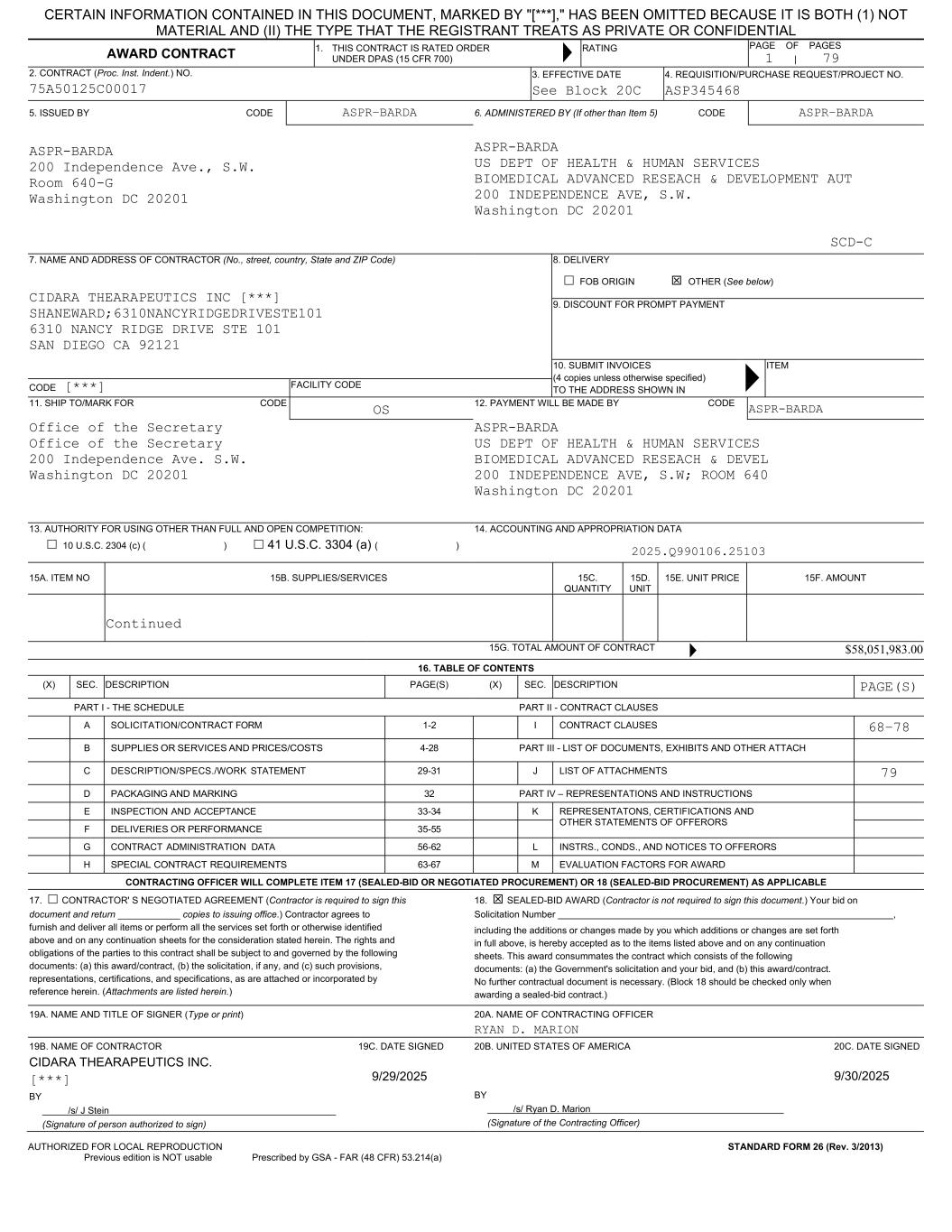
CERTAIN INFORMATION CONTAINED IN THIS DOCUMENT, MARKED BY "[***]," HAS BEEN OMITTED BECAUSE IT IS BOTH (1) NOT MATERIAL AND (II) THE TYPE THAT THE REGISTRANT TREATS AS PRIVATE OR CONFIDENTIAL AWARD CONTRACT 1. THIS CONTRACT IS RATED ORDER UNDER DPAS (15 CFR 700) RATING PAGE OF PAGES 1 | 79 2. CONTRACT (Proc. Inst. Indent.) NO. 75A50125C00017 3. EFFECTIVE DATE See Block 20C 4. REQUISITION/PURCHASE REQUEST/PROJECT NO. ASP345468 5. ISSUED BY CODE ASPR–BARDA 6. ADMINISTERED BY (If other than Item 5) CODE ASPR–BARDA ASPR-BARDA 200 Independence Ave., S.W. Room 640-G Washington DC 20201 ASPR-BARDA US DEPT OF HEALTH & HUMAN SERVICES BIOMEDICAL ADVANCED RESEACH & DEVELOPMENT AUT 200 INDEPENDENCE AVE, S.W. Washington DC 20201 SCD-C 7. NAME AND ADDRESS OF CONTRACTOR (No., street, country, State and ZIP Code) CIDARA THEARAPEUTICS INC [***] SHANEWARD;6310NANCYRIDGEDRIVESTE101 6310 NANCY RIDGE DRIVE STE 101 SAN DIEGO CA 92121 8. DELIVERY FOB ORIGIN OTHER (See below) 9. DISCOUNT FOR PROMPT PAYMENT 10. SUBMIT INVOICES (4 copies unless otherwise specified) TO THE ADDRESS SHOWN IN ITEM CODE [***] FACILITY CODE 11. SHIP TO/MARK FOR CODE OS 12. PAYMENT WILL BE MADE BY CODE ASPR-BARDA Office of the Secretary Office of the Secretary 200 Independence Ave. S.W. Washington DC 20201 ASPR-BARDA US DEPT OF HEALTH & HUMAN SERVICES BIOMEDICAL ADVANCED RESEACH & DEVEL 200 INDEPENDENCE AVE, S.W; ROOM 640 Washington DC 20201 13. AUTHORITY FOR USING OTHER THAN FULL AND OPEN COMPETITION: 10 U.S.C. 2304 (c) ( ) 41 U.S.C. 3304 (a) ( ) 14. ACCOUNTING AND APPROPRIATION DATA 2025.Q990106.25103 15A. ITEM NO 15B. SUPPLIES/SERVICES 15C. QUANTITY 15D. UNIT 15E. UNIT PRICE 15F. AMOUNT Continued 15G. TOTAL AMOUNT OF CONTRACT $58,051,983.00 16. TABLE OF CONTENTS (X) SEC. DESCRIPTION PAGE(S) (X) SEC. DESCRIPTION PAGE(S) PART I - THE SCHEDULE PART II - CONTRACT CLAUSES A SOLICITATION/CONTRACT FORM 1-2 I CONTRACT CLAUSES 68–78 B SUPPLIES OR SERVICES AND PRICES/COSTS 4-28 PART III - LIST OF DOCUMENTS, EXHIBITS AND OTHER ATTACH C DESCRIPTION/SPECS./WORK STATEMENT 29-31 J LIST OF ATTACHMENTS 79 D PACKAGING AND MARKING 32 PART IV – REPRESENTATIONS AND INSTRUCTIONS E INSPECTION AND ACCEPTANCE 33-34 K REPRESENTATONS, CERTIFICATIONS AND OTHER STATEMENTS OF OFFERORS F DELIVERIES OR PERFORMANCE 35-55 G CONTRACT ADMINISTRATION DATA 56-62 L INSTRS., CONDS., AND NOTICES TO OFFERORS H SPECIAL CONTRACT REQUIREMENTS 63-67 M EVALUATION FACTORS FOR AWARD CONTRACTING OFFICER WILL COMPLETE ITEM 17 (SEALED-BID OR NEGOTIATED PROCUREMENT) OR 18 (SEALED-BID PROCUREMENT) AS APPLICABLE 17. CONTRACTOR' S NEGOTIATED AGREEMENT (Contractor is required to sign this document and return ____________ copies to issuing office.) Contractor agrees to furnish and deliver all items or perform all the services set forth or otherwise identified above and on any continuation sheets for the consideration stated herein. The rights and obligations of the parties to this contract shall be subject to and governed by the following documents: (a) this award/contract, (b) the solicitation, if any, and (c) such provisions, representations, certifications, and specifications, as are attached or incorporated by reference herein. (Attachments are listed herein.) 18. SEALED-BID AWARD (Contractor is not required to sign this document.) Your bid on Solicitation Number , including the additions or changes made by you which additions or changes are set forth in full above, is hereby accepted as to the items listed above and on any continuation sheets. This award consummates the contract which consists of the following documents: (a) the Government's solicitation and your bid, and (b) this award/contract. No further contractual document is necessary. (Block 18 should be checked only when awarding a sealed-bid contract.) 19A. NAME AND TITLE OF SIGNER (Type or print) 20A. NAME OF CONTRACTING OFFICER RYAN D. MARION 19B. NAME OF CONTRACTOR CIDARA THEARAPEUTICS INC. [***] BY /s/ J Stein (Signature of person authorized to sign) 19C. DATE SIGNED 9/29/2025 20B. UNITED STATES OF AMERICA BY /s/ Ryan D. Marion (Signature of the Contracting Officer) 20C. DATE SIGNED 9/30/2025 AUTHORIZED FOR LOCAL REPRODUCTION STANDARD FORM 26 (Rev. 3/2013) Previous edition is NOT usable Prescribed by GSA - FAR (48 CFR) 53.214(a)
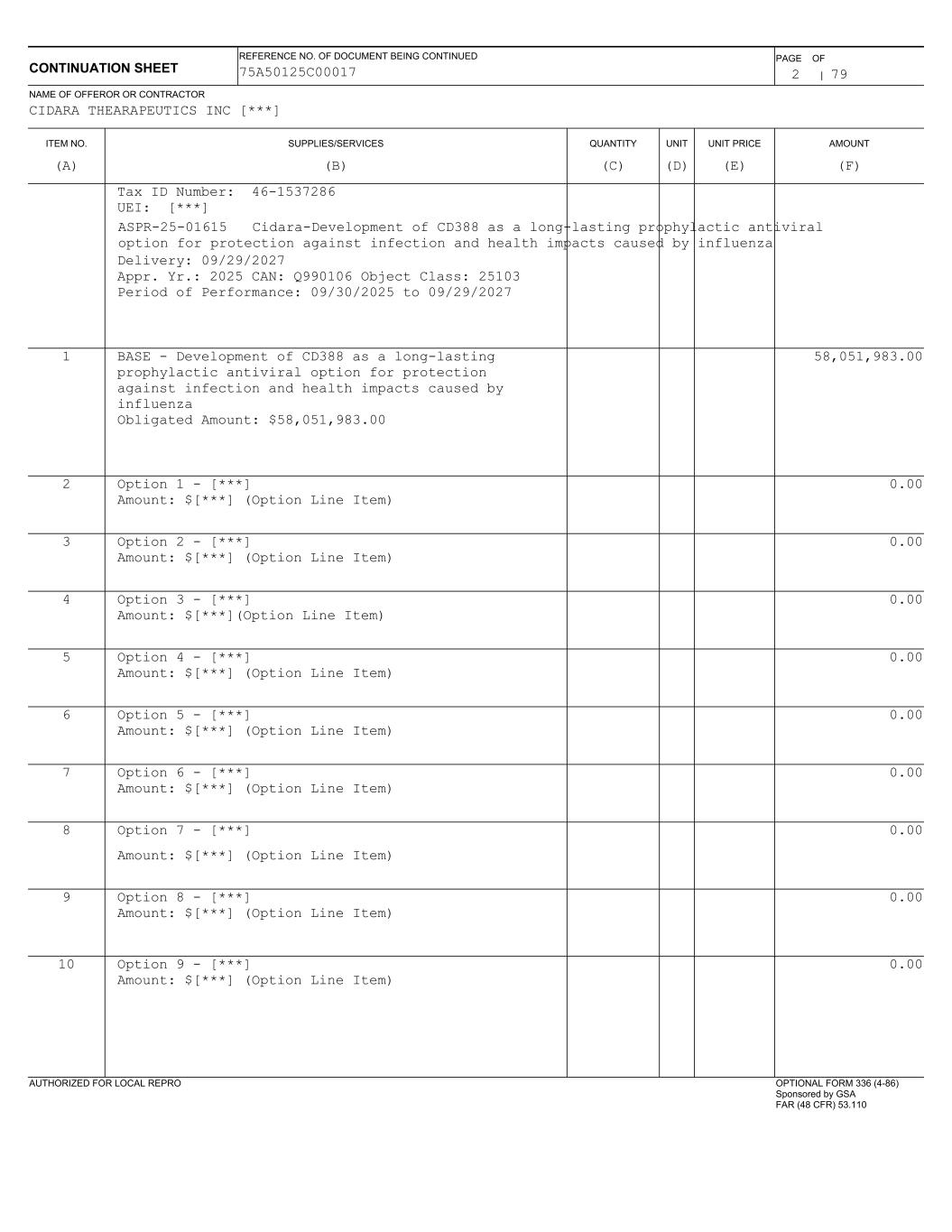
CONTINUATION SHEET REFERENCE NO. OF DOCUMENT BEING CONTINUED 75A50125C00017 PAGE OF 2 | 79 NAME OF OFFEROR OR CONTRACTOR CIDARA THEARAPEUTICS INC [***] ITEM NO. (A) SUPPLIES/SERVICES (B) QUANTITY (C) UNIT (D) UNIT PRICE (E) AMOUNT (F) Tax ID Number: 46-1537286 UEI: [***] Delivery: 09/29/2027 Appr. Yr.: 2025 CAN: Q990106 Object Class: 25103 Period of Performance: 09/30/2025 to 09/29/2027 1 BASE - Development of CD388 as a long-lasting prophylactic antiviral option for protection against infection and health impacts caused by influenza Obligated Amount: $58,051,983.00 58,051,983.00 2 Option 1 - [***] Amount: $[***] (Option Line Item) 0.00 3 Option 2 - [***] Amount: $[***] (Option Line Item) 0.00 4 Option 3 - [***] Amount: $[***](Option Line Item) 0.00 5 Option 4 - [***] Amount: $[***] (Option Line Item) 0.00 6 Option 5 - [***] Amount: $[***] (Option Line Item) 0.00 7 Option 6 - [***] Amount: $[***] (Option Line Item) 0.00 8 Option 7 - [***] Amount: $[***] (Option Line Item) 0.00 9 Option 8 - [***] Amount: $[***] (Option Line Item) 0.00 10 Option 9 - [***] Amount: $[***] (Option Line Item) 0.00 AUTHORIZED FOR LOCAL REPRO OPTIONAL FORM 336 (4-86) Sponsored by GSA FAR (48 CFR) 53.110 ASPR-25-01615 Cidara-Development of CD388 as a long-lasting prophylactic antiviral option for protection against infection and health impacts caused by influenza

75A50125C0017 Page 3 of 79 CONTRACT TABLE OF CONTENTS PART I – THE SCHEDULE ..................................................................................................................... 4 SECTION B – SUPPLIES OR SERVICES AND PRICE/COSTS .................................................... 4 SECTION C – DESCRIPTIONS/SPECIFICATIONS/WORK STATEMENT ................................ 29 SECTION D – PACKAGING, MARKING, & SHIPPING .................................................................. 32 SECTION E – INSPECTION AND ACCEPTANCE ......................................................................... 33 SECTION F – DELIVERIES OR PERFORMANCE .......................................................................... 35 SECTION G – CONTRACT ADMINISTRATION DATA ................................................................... 56 SECTION H – SPECIAL CONTRACT REQUIREMENTS ............................................................... 63 PART II – CONTRACT CLAUSES ........................................................................................................ 68 SECTION I – CONTRACT CLAUSES ................................................................................................ 68 PART III – LIST OF DOCUMENTS, EXHIBITS, AND OTHER ATTACHMENTS ........................... 79 SECTION J – LIST OF ATTACHMENTS ............................................................................................ 79
75A50125C0017 Page 4 of 79 PART I – THE SCHEDULE SECTION B – SUPPLIES OR SERVICES AND PRICES/COSTS B.1. BRIEF DESCRIPTION OF SUPPLIES OR SERVICES The Influenza and Emerging Infectious Diseases (IEID) Therapeutics Program is focused on the development of antivirals to provide pre-exposure prophylactic treatment options for pandemic preparedness (to bridge the gap between recognition of an influenza pandemic and vaccine availability) and for people in whom influenza vaccines have inadequate efficacy and are at a high risk of severe complications from seasonal influenza infections. The scope of work for this contract includes non-clinical, clinical, and manufacturing development activities, and associated regulatory, quality assurance, management, and administrative activities necessary to bring CD388 to regulatory approval. CD388 is a novel influenza prophylactic with the potential to revolutionize both seasonal and pandemic influenza protection and consists of an influenza antiviral (zanamivir) that has been conjugated to an Fc fragment. The work under this project will accelerate the clinical development of CD388 and establish US-based manufacturing capabilities for CD388. The comprehensive non-clinical and clinical data generated will support both EUA and BLA submissions. The Contractor's success in completing the required tasks under the work segments must be demonstrated through the Deliverables and Milestones specified under SECTION F of this contract. B.2. CONTRACT COST 1. The total estimated cost of the base period of this contract is $[***]. The fixed fee for the base period of this contract is $[***]. The fixed fee shall be subject to the withholding provisions of the clauses ALLOWABLE COST AND PAYMENT and FIXED FEE referenced in the General Clause Listing in Part II, ARTICLE I.1. of this contract. 2. The Contractor shall maintain records of all contract costs and such records shall be subject to FAR 52.215-2 (Jun 2020), Audit and Records – Negotiation and incorporated by reference into the contract in SECTION I. 3. The amount currently obligated will cover base performance of the contract. The period of performance may be adjusted by mutual agreement. 4. The Contractor is responsible for managing its performance in accordance with the final Statement of Work and costs/prices incorporated into this contract. The Government is not obligated to reimburse the Contractor for costs incurred in excess of costs/prices agreed upon at time of award. B.2.1. CONTRACT PERIODS This contract consists of a twenty-four (24) month base period and nine (9) option periods. The base period is (a) to evaluate the effectiveness of CD388 as a long-lasting prophylactic antiviral drug candidate for the long- term prevention of health impacts from both seasonal influenza and influenza strains of pandemic potential through comprehensive nonclinical testing; (b) establish a robust and secure domestic manufacturing infrastructure for CD388 by transferring production processes to a US-based CDMO; and (c) to perform a
75A50125C0017 Page 5 of 79 bridging Safety/PK clinical trial in healthy adults 18-64 years old to support higher concentration formulation of CD388. The objective of Option period one (1) is to [***]. Option period two (2) is to [***]. The objective of Option period three (3) is to [***]. The objective of Option period four (4) is to [***]. The objective of Option period five (5) is to [***]. The objective of Option period six (6) is to [***]. The objective of Option period seven (7) is to [***]. Option period eight (8) is to [***]. Option period nine (9) is to [***]. B.2.2. CONTRACT TYPE This is a Hybrid Cost Reimbursement contract with Cost Plus Fixed-Fee (CPFF) and Cost Share CLINs. B.2.3. COST REIMBURSMENT OPTIONS a. The contract includes optional, cost sharing options [***] and cost-plus- fixed-fee Options [***]. Pursuant to FAR Clause 52.217-7, Option for Increased Quantity-Separately Priced Line Item; FAR Clause 52.217-8, Option to Extend Services; FAR 52.217-9, Option to Extend the Term of the Contract, set forth in ARTICLE I of this contract, the Government may require the Contractor to perform additional options set forth in the Statement of Objectives. Options are defined in SECTIONS B and F of the contract. b. Unless the government exercises its option pursuant to the option clause contained in ARTICLE I.2, the contract consists only of the Base Work segment specified in the Statement of Work as defined in SECTONS C and F, for the prices set forth in ARTICLE B.2 of the contract. c. The Government may modify the contract unilaterally and require the contractor to provide supplies and services for Option Periods listed below, in accordance with FAR 52.217-9. d. If the Government decides to exercise an option, the Government will provide the Contractor a preliminary written notice of its intent as referenced in the clause. Specific information regarding the time frame for this notice is set forth in the OPTION CLAUSE Article in SECTION G of this contract. The tentative time frame for period of performance and estimated cost of the contract will be increased as set forth below in B.2.4. B.2.4. CONTRACT LINE-ITEM NUMBERS (CLINS) SCHEDULE The following table provides the CLIN structure including the period of performance and costs for the base period and option periods:
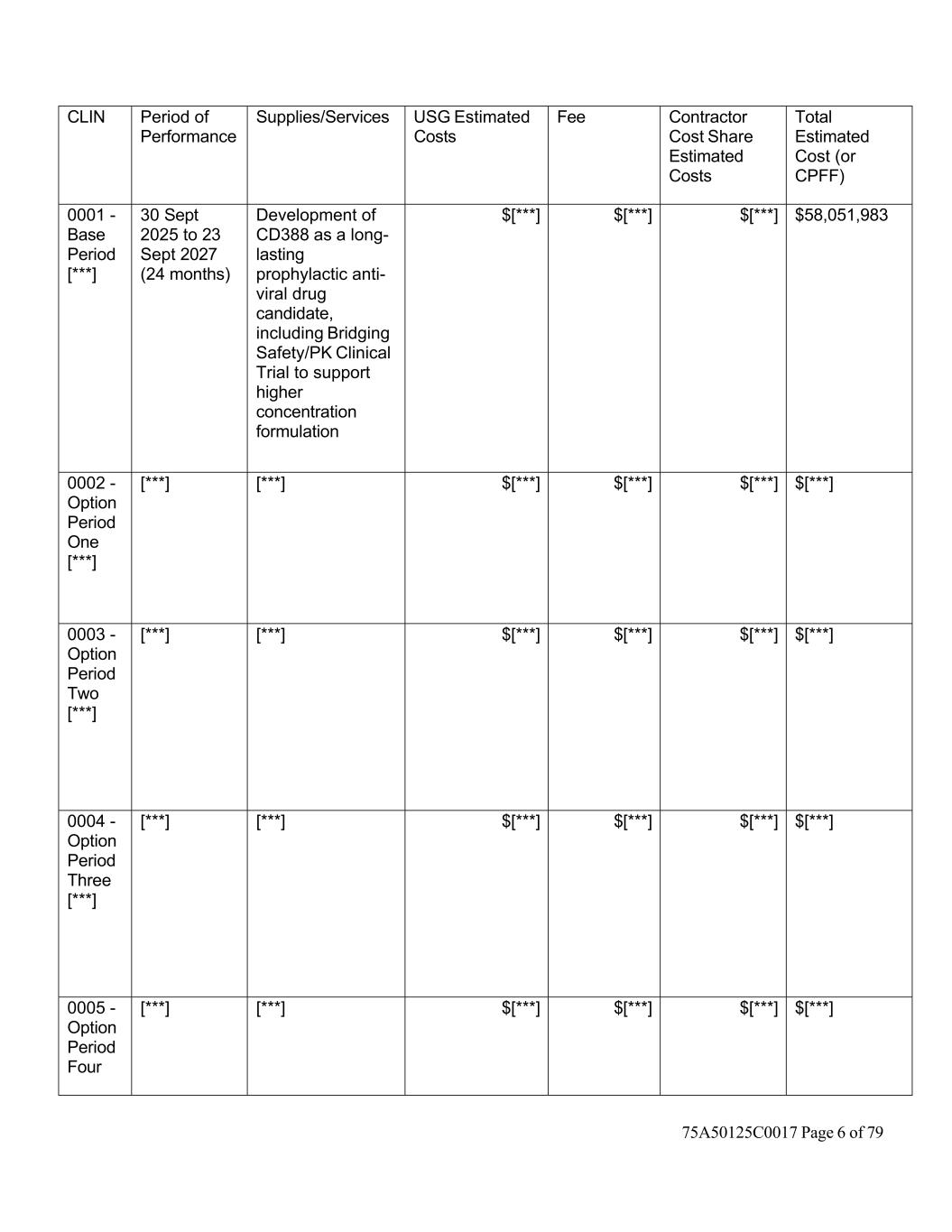
75A50125C0017 Page 6 of 79 CLIN Period of Performance Supplies/Services USG Estimated Costs Fee Contractor Cost Share Estimated Costs Total Estimated Cost (or CPFF) 0001 - Base Period [***] 30 Sept 2025 to 23 Sept 2027 (24 months) Development of CD388 as a long- lasting prophylactic anti- viral drug candidate, including Bridging Safety/PK Clinical Trial to support higher concentration formulation $[***] $[***] $[***] $58,051,983 0002 - Option Period One [***] [***] [***] $[***] $[***] $[***] $[***] 0003 - Option Period Two [***] [***] [***] $[***] $[***] $[***] $[***] 0004 - Option Period Three [***] [***] [***] $[***] $[***] $[***] $[***] 0005 - Option Period Four [***] [***] $[***] $[***] $[***] $[***]
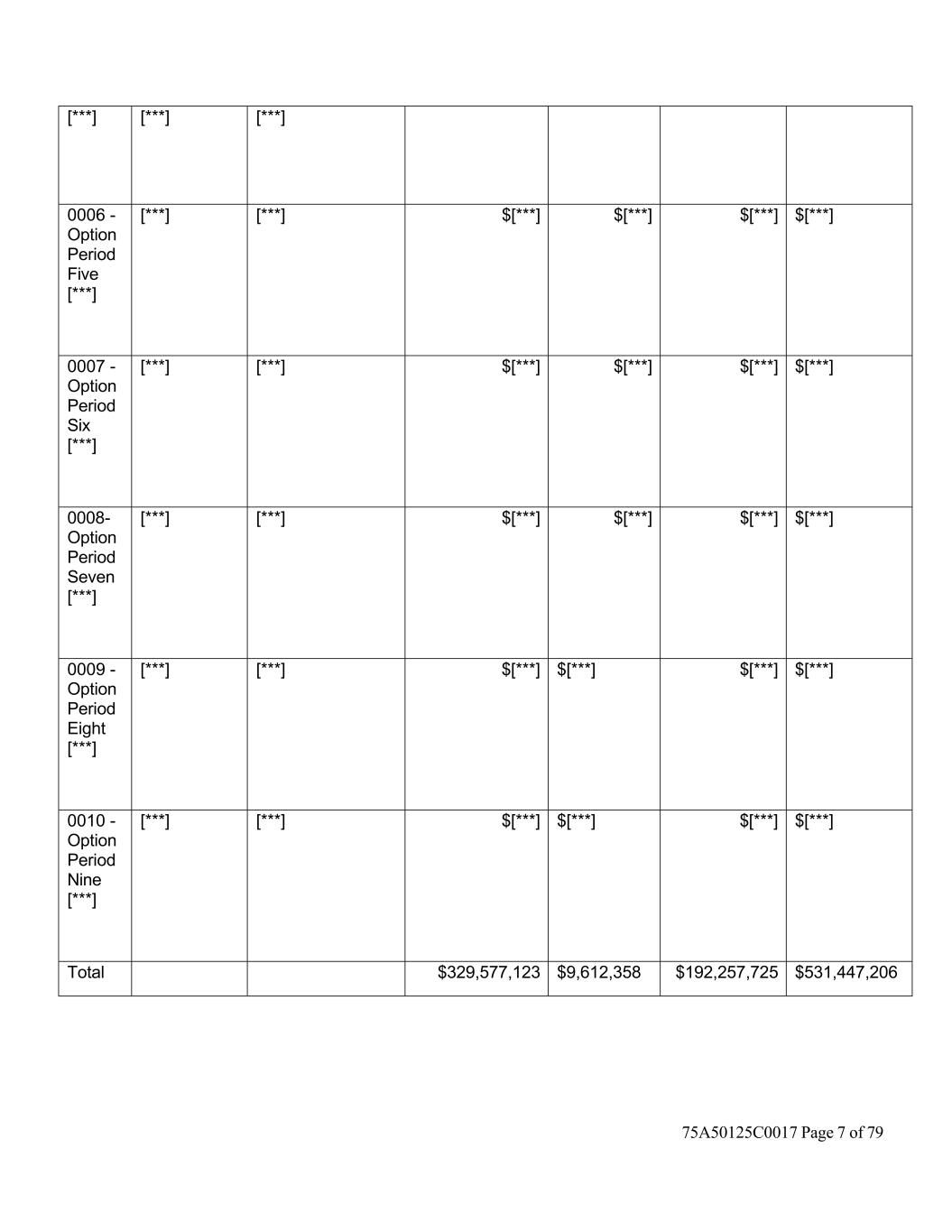
75A50125C0017 Page 7 of 79 [***] [***] [***] 0006 - Option Period Five [***] [***] [***] $[***] $[***] $[***] $[***] 0007 - Option Period Six [***] [***] [***] $[***] $[***] $[***] $[***] 0008- Option Period Seven [***] [***] [***] $[***] $[***] $[***] $[***] 0009 - Option Period Eight [***] [***] [***] $[***] $[***] $[***] $[***] 0010 - Option Period Nine [***] [***] [***] $[***] $[***] $[***] $[***] Total $329,577,123 $9,612,358 $192,257,725 $531,447,206
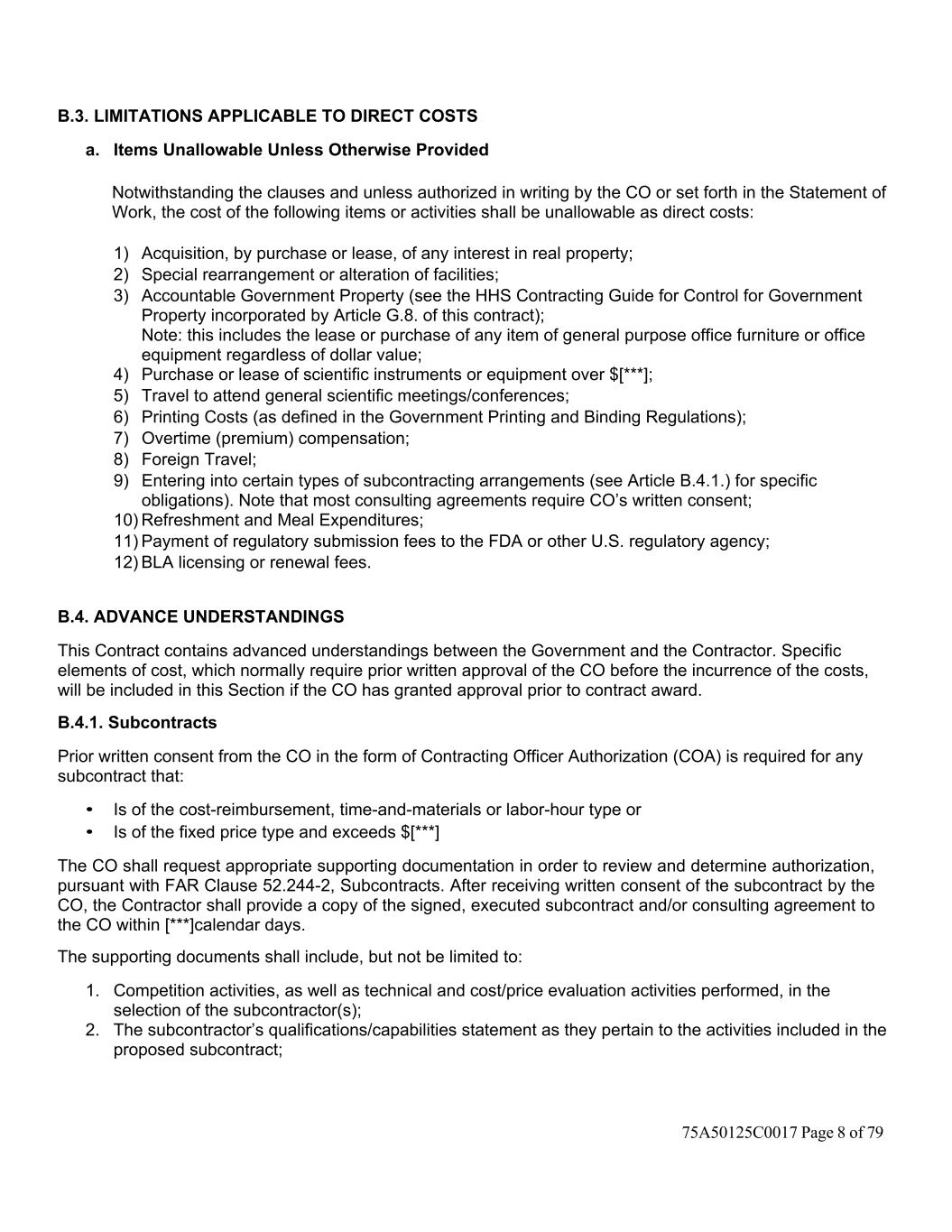
75A50125C0017 Page 8 of 79 B.3. LIMITATIONS APPLICABLE TO DIRECT COSTS a. Items Unallowable Unless Otherwise Provided Notwithstanding the clauses and unless authorized in writing by the CO or set forth in the Statement of Work, the cost of the following items or activities shall be unallowable as direct costs: 1) Acquisition, by purchase or lease, of any interest in real property; 2) Special rearrangement or alteration of facilities; 3) Accountable Government Property (see the HHS Contracting Guide for Control for Government Property incorporated by Article G.8. of this contract); Note: this includes the lease or purchase of any item of general purpose office furniture or office equipment regardless of dollar value; 4) Purchase or lease of scientific instruments or equipment over $[***]; 5) Travel to attend general scientific meetings/conferences; 6) Printing Costs (as defined in the Government Printing and Binding Regulations); 7) Overtime (premium) compensation; 8) Foreign Travel; 9) Entering into certain types of subcontracting arrangements (see Article B.4.1.) for specific obligations). Note that most consulting agreements require CO’s written consent; 10) Refreshment and Meal Expenditures; 11) Payment of regulatory submission fees to the FDA or other U.S. regulatory agency; 12) BLA licensing or renewal fees. B.4. ADVANCE UNDERSTANDINGS This Contract contains advanced understandings between the Government and the Contractor. Specific elements of cost, which normally require prior written approval of the CO before the incurrence of the costs, will be included in this Section if the CO has granted approval prior to contract award. B.4.1. Subcontracts Prior written consent from the CO in the form of Contracting Officer Authorization (COA) is required for any subcontract that: • Is of the cost-reimbursement, time-and-materials or labor-hour type or • Is of the fixed price type and exceeds $[***] The CO shall request appropriate supporting documentation in order to review and determine authorization, pursuant with FAR Clause 52.244-2, Subcontracts. After receiving written consent of the subcontract by the CO, the Contractor shall provide a copy of the signed, executed subcontract and/or consulting agreement to the CO within [***]calendar days. The supporting documents shall include, but not be limited to: 1. Competition activities, as well as technical and cost/price evaluation activities performed, in the selection of the subcontractor(s); 2. The subcontractor’s qualifications/capabilities statement as they pertain to the activities included in the proposed subcontract;
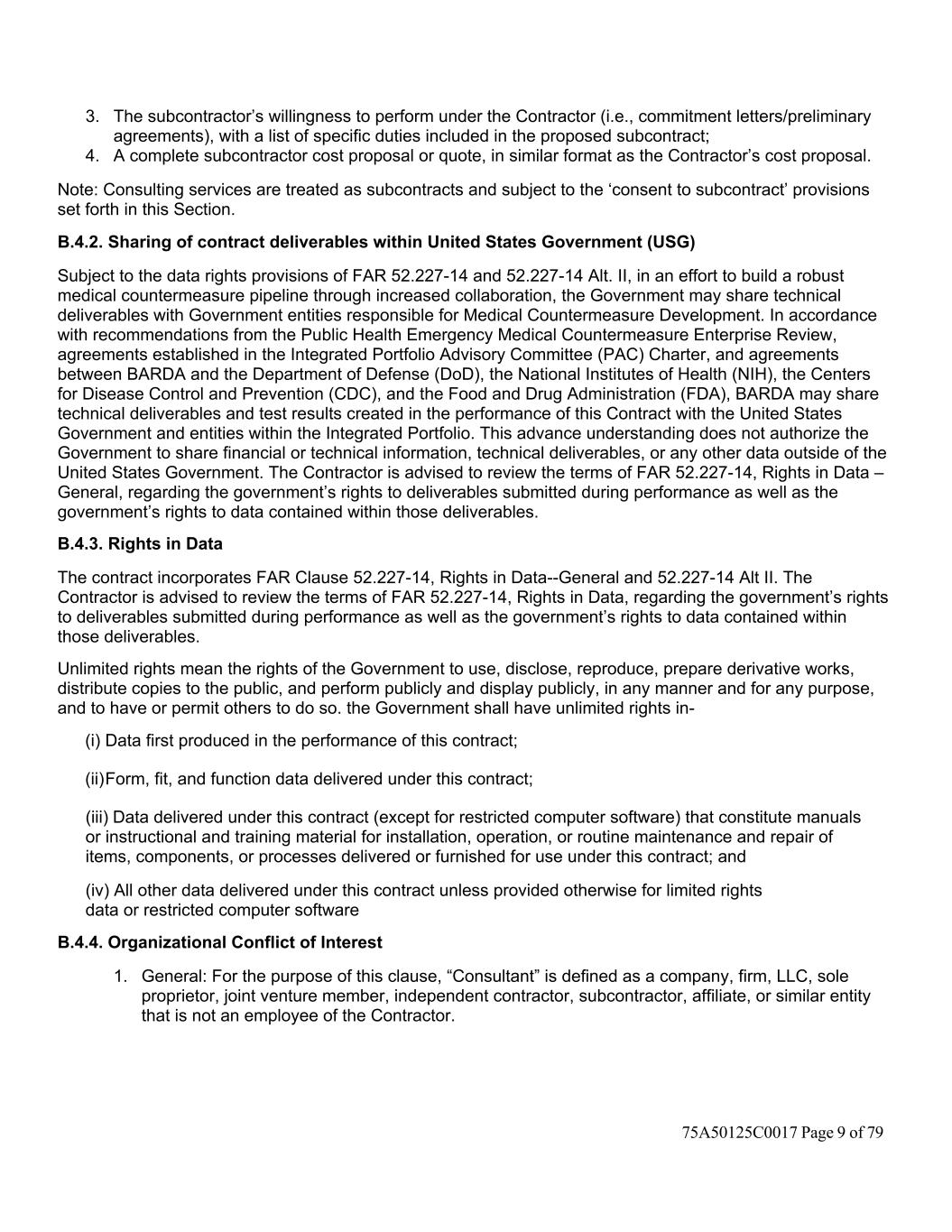
75A50125C0017 Page 9 of 79 3. The subcontractor’s willingness to perform under the Contractor (i.e., commitment letters/preliminary agreements), with a list of specific duties included in the proposed subcontract; 4. A complete subcontractor cost proposal or quote, in similar format as the Contractor’s cost proposal. Note: Consulting services are treated as subcontracts and subject to the ‘consent to subcontract’ provisions set forth in this Section. B.4.2. Sharing of contract deliverables within United States Government (USG) Subject to the data rights provisions of FAR 52.227-14 and 52.227-14 Alt. II, in an effort to build a robust medical countermeasure pipeline through increased collaboration, the Government may share technical deliverables with Government entities responsible for Medical Countermeasure Development. In accordance with recommendations from the Public Health Emergency Medical Countermeasure Enterprise Review, agreements established in the Integrated Portfolio Advisory Committee (PAC) Charter, and agreements between BARDA and the Department of Defense (DoD), the National Institutes of Health (NIH), the Centers for Disease Control and Prevention (CDC), and the Food and Drug Administration (FDA), BARDA may share technical deliverables and test results created in the performance of this Contract with the United States Government and entities within the Integrated Portfolio. This advance understanding does not authorize the Government to share financial or technical information, technical deliverables, or any other data outside of the United States Government. The Contractor is advised to review the terms of FAR 52.227-14, Rights in Data – General, regarding the government’s rights to deliverables submitted during performance as well as the government’s rights to data contained within those deliverables. B.4.3. Rights in Data The contract incorporates FAR Clause 52.227-14, Rights in Data--General and 52.227-14 Alt II. The Contractor is advised to review the terms of FAR 52.227-14, Rights in Data, regarding the government’s rights to deliverables submitted during performance as well as the government’s rights to data contained within those deliverables. Unlimited rights mean the rights of the Government to use, disclose, reproduce, prepare derivative works, distribute copies to the public, and perform publicly and display publicly, in any manner and for any purpose, and to have or permit others to do so. the Government shall have unlimited rights in- (i) Data first produced in the performance of this contract; (ii) Form, fit, and function data delivered under this contract; (iii) Data delivered under this contract (except for restricted computer software) that constitute manuals or instructional and training material for installation, operation, or routine maintenance and repair of items, components, or processes delivered or furnished for use under this contract; and (iv) All other data delivered under this contract unless provided otherwise for limited rights data or restricted computer software B.4.4. Organizational Conflict of Interest 1. General: For the purpose of this clause, “Consultant” is defined as a company, firm, LLC, sole proprietor, joint venture member, independent contractor, subcontractor, affiliate, or similar entity that is not an employee of the Contractor.
75A50125C0017 Page 10 of 79 2. Disclosure: The Contractor shall report contacts with Consultants who are paid to furnish advice, information, direction, or assistance to the Contractor or any subcontractor in support of the requirements of this contract. The report shall include the following information: i. The name, title, and contact information for the Consultant, including the name and contact information for his/her company/firm/etc. ii. The name, title, and contact information for a Contractor’s point of contact, including the name and contact information for the prime contractor if the consulting services were received by a subcontractor. iii. The nature of the consulting services received. The contractor shall perform a Conflict of Interest (COI) check prior to using any consultant. 3. Resolution: The responsible CO will review the Contractor’s disclosure to determine whether an actual or appearance of a conflict of interest exists based on the information disclosed by the Contractor and/or from other sources. The framework for the CO’s review will be FAR Subpart 9.5, Organizational and Consultant Conflicts of Interest. If an actual or appearance of a conflict of interest exists, the CO will take action which may include, but is not limited to, requesting a mitigation plan from the Contractor. B.4.5. Public Readiness and Emergency Preparedness (“PREP ACT”) Coverage The Federal Government may not use, or authorize the use of, any products or materials provided under either this contract or any future purchase from Contractor's domestic manufacturing capacity unless such use occurs in the United States and is protected from liability under a declaration issued under the Public Readiness and Emergency Preparedness Act, 42 U.S.C. § 247d-6d. B.4.6. Rights of Refusal The Government’s rights to data first developed in the performance of this Contract and the Government’s rights to use Subject Inventions developed under this Contract shall survive any transfer of such title to a Subject Invention any third party. The Government may either exercise or waive this first right of refusal in writing and submit to the Contractor within [***] calendar days of the initial notification to the Government of the Contractor’s intent to conduct any such transfer of title to a Subject Invention. This Article shall not apply to transfers of title to technology created with the use of funding obtained outside of this Contract. B.4.7. Clinical Terms of Award BARDA has the responsibility to obtain documentation concerning mechanisms and procedures that are in place to protect the safety of participants in BARDA-funded clinical trials. Therefore, the Contractor shall develop a protocol for the clinical trial funded under the Contract and submit all such protocols and protocol amendments to the COR for evaluation and comment. Approval by the COR is required before work under a protocol may begin, pursuant to the terms set forth by Article F.2. of the Contract. The COR comments will be forwarded to the Contractor within [***]business days. The Contractor must address, in writing, all concerns (e.g., study design, safety, regulatory, ethical, and conflict of interest) noted by the COR.
75A50125C0017 Page 11 of 79 If the draft protocols are to be submitted to the FDA, the COR review shall occur before submission, pursuant to the terms set forth by Article F.2. of the Contract. The Contractor shall revise their protocols to address BARDA’s concerns and recommendations prior to FDA submission. The Contractor must provide BARDA with a copy of FDA submissions, within the time frame set forth by Article F.2. of this contract. Execution of clinical studies require written authorization from BARDA. BARDA can provide written authorization to the Contractor upon either 1) receiving documentation in which all COR comments have been satisfactorily addressed; and 2) receiving documentation that the FDA has reviewed and commented on the protocol. For purposes of the Contract, “Execution” or “Start” of a clinical study shall mean enrollment of the first subject or patient. BARDA shall have unlimited rights to all protocols, data resulting from execution of these protocols, and final reports funded by BARDA under the Contract, as set forth in the FAR clauses referenced in PART II of the Contract. BARDA reserves the right to request that the Contractor provide any contract deliverable identified in SECTION F in a non-proprietary form to ensure BARDA has the ability to review and distribute the deliverables as BARDA deems necessary. Important information regarding performing human subject research is available at https://www.niaid.nih.gov/research/clinical- research. Any technical updates are to be addressed in the Monthly and Annual Technical Progress Reports. The Contractor shall advise the COR or designee in writing and via electronic communication in a timely manner of any issues potentially affecting contract performance. These Clinical Terms of Award regarding safety and monitory issues detail an agreement between BARDA and the Contractor: i. Institutional Review Board or Independent Ethics Committee Approval For the Contractor and other institutions involved in the research (e.g., a multicenter clinical trial or study), each institution’s IRB or IEC must review and approve the protocol. They must also provide BARDA initial and annual documentation of continuing review and approval, including the current approved informed consent document and OHRP federal wide assurance (FWA) number. The Contractor must ensure that the application as well as all protocols are reviewed by their IRB or IEC. To help ensure the safety of participants enrolled in BARDA-funded studies, the Contractor must provide the COR copies of documents related to all major changes in the status of the ongoing protocol, including the following: • All amendments or changes to the protocol, identified by protocol version number, date, or both and dates it is valid. • All changes in informed consent documents, identified by version number, dates, or both and dates it is valid. • Termination or temporary suspension of patient accrual. • Termination or temporary suspension of the protocol. • Any change in IRB approval.
75A50125C0017 Page 12 of 79 • Any other problems or issues that could affect the participants in the study. The Contractor must notify the COR and CO electronically of any of the above changes within [***]working days, followed by a letter signed by the institutional business official, detailing notification of the change of status to the local IRB and a copy of any responses from the IRB or IEC. ii. Data and Safety Monitoring Requirements in Clinical Trials BARDA strongly recommends independent safety monitoring for clinical trials of investigational drugs, devices, or biologics; clinical trial of licensed products; and clinical research of any type involving more than minimal risk to volunteers. Independent monitoring can take a variety of forms. Final decisions regarding the type of monitoring to be used must be made jointly by BARDA and the Contractor before enrollment starts. Discussions with the responsible BARDA COR regarding appropriate safety monitoring and approval of the final monitoring plan by BARDA must occur before patient enrollment begins and may include discussions about the appointment of one of the following. • Independent Safety Monitor – a physician or other appropriate expert who is independent of the study and available in real time to review and recommend appropriate action regarding adverse events and other safety issues. • Independent Monitoring Committee (IMC) or Safety Monitoring Committee (SMC) – a small group of independent investigators and biostatisticians who review data from a particular study. • Data and Safety Monitoring Board – an independent committee charged with reviewing safety and trial progress and providing advice with respect to study continuation, modification, and termination. The Contractor may be required to use an established BARDA DSMB or to organize an independent DSMB. Please refer to: NIAID Principles for Use of a Data and Safety Monitoring Board (DSMB) For Oversight of Clinical Trials Policy. When a monitor or monitoring board is organized, a description of it, its charter or operating procedures (including a proposed meeting schedule and plan for review of adverse events), and roster and curriculum vitae from all members must be submitted to and approved by the COR before enrollment starts. The Contractor will also ensure that the monitors and board members report any conflicts of interest and the Contractor will maintain a record of this. The Contractor will share conflict of interest reports with the CO and COR. Additionally, the Contractor must submit written summaries of all reviews conducted by the monitoring group to BARDA within [***]calendar days of reviews or meetings. iii. BARDA Protocol Review Process Before Patient Enrollment Begins – The COR has a responsibility to ensure that mechanisms and procedures are in place to protect the safety of participants in BARDA-supported clinical trials. Therefore, before patient accrual or participant enrollment, the Contractor must ensure the following (as applicable) are in place at each participating institution, prior to patient accrual or enrollment:
75A50125C0017 Page 13 of 79 • IRB- or IEC-approved clinical research protocol identified by version number, date, or both, including details of study design, proposed interventions, patient eligibility, and exclusion criteria. • Documentation of IRB or IEC approval, including OHRP federal wide number, IRB or IEC registration number, and IRB and IEC name. • IRB- or IEC- approved informed consent document, identified by version number, date, or both and dates it is valid. • Plans for the management of side effects. • Procedures for assessing and reporting adverse events. • Plans for data and safety monitoring (see above) and monitoring of the clinical study site, pharmacy, and laboratory. • Documentation that the Contractor and all study staff responsible for the design or conduct of the research have received training in the protection of human subjects. Documentation to demonstrate that each of the above items are in place shall be submitted to the COR for evaluation and comment in conjunction with the protocol. Execution of clinical studies requires written authorization from the CO in accordance with this Section of this contract. iv. Investigational New drug or Investigational Device Exemption Requirements Consistent with federal regulations, clinical research projects involving the use of investigational therapeutics, vaccines, or other medical interventions (including licensed products and devices for a purpose other than that for which they were licensed) in humans under a research protocol must be performed under a Food and Drug Administration (FDA) investigational new drug (IND) or investigational device exemption (IDE). Exceptions must be granted in writing by FDA. If the proposed clinical trial will be performed under an IND or IDE, the Contractor must provide BARDA with the name and institution of the IND or IDE sponsor, the date the IND or IDE was filed with FDA, the FDA IND or IDE number, any written comments from FDA, and the written responses to those comments. Unless FDA notifies Contractor otherwise, The Contractor must wait [***] calendar days from FDA receipt of an initial IND or IDE application before initiating a clinical trial. v. Required Time-Sensitive Notification Under an IND or IDE, the sponsor must provide FDA safety reports of serious adverse events. Under these Clinical Terms of Award, the Contractor must submit copies to the responsible COR as follows: i. Expedited safety report of unexpected or life-threatening experience or death: A copy of any report of unexpected or life-threatening experience or death associated with the use of an IND drug, which must be reported to FDA by telephone or fax as soon as possible but no later than [***] calendar days after
75A50125C0017 Page 14 of 79 the IND sponsor’s receipt of the information, must be submitted to the COR within [***]hours of FDA notification. ii. Expedited safety reports of serious and unexpected adverse experiences: A copy of any report of unexpected and serious adverse experience associated with use of an IND drug or any finding from tests in laboratory animals that suggests a significant risk for human subjects, which must be reported in writing to FDA as soon as possible but no later than [***] calendar days after the IND sponsor’s receipt of the information, must be submitted to the COR within [***]hours of FDA notification. For medical devices, adverse events should be reported under the MedWatch (MDR) program with reporting timelines of [***]calendar days for serious adverse events or [***]days for reportable events. iii. IDE reports of unanticipated adverse device effect: A copy of any reports of unanticipated adverse device effect submitted to FDA must be submitted to the COR within [***]hours of FDA notification. iv. Expedited safety reports: Sent to the COR concurrently with the report to FDA. v. Other adverse events documented during the course of the trial should be included in the annual IND or IDE report and reported to BARDA annually. In case of problems or issues, the COR will contact the Contractor within [***] business days by email to the Contractor’s Project Manager, with a copy to the institutions’ office of sponsored programs, listing issues and appropriate actions to be discussed. vi. Safety reporting for research not performed under an IND or IDE. Final decisions regarding ongoing safety reporting requirements for research not performed under an IND or IDE must be made jointly by the COR and the Contractor. B.4.8. Human Subjects The Contractor shall submit all human clinical protocols and informed consent documents to BARDA for review and comment prior to submission to another entity. Research involving human subjects shall not be conducted under this contract until the study protocol has been approved by BARDA, written notice of such approval has been provided by the CO, and the Contractor has provided to the CO a properly completed “Protection of Human Subjects Assurance Identification/IRB Certification/Declaration of Exemption”, Form OMB No. 0990-0263 (formerly Optional Form 310) certifying IRB review and approval of the protocol. The human subject certification can be met by submission of the Contractor’s self-designated form, provided that it contains the information required by the “Protection of Human Subjects Assurance Identification/IRB Certification/Declaration of Exemption”, Form OMB No. 0990-0263 (formerly Optional Form 310). When research involving Human Subjects will take place at collaborating sites or other performance sites, the Contractor shall obtain, and keep on file, a properly completed “Protection of Human Subjects Assurance Identification/IRB Certification/Declaration of Exemption”, Form OMB No. 0990-0263 (formerly
75A50125C0017 Page 15 of 79 Optional Form 310) certifying IRB review and approval of the research. B.4.9. Animal Welfare All research involving live, vertebrate animals shall be conducted in accordance with the Public Health Service Policy on Humane Care and Use of Laboratory Animals (PHS Policy). The PHS policy can be accessed at: https://olaw.nih.gov/policies-laws/phs-policy.htm. Primate studies will not begin until the CRO's IACUC and the Contractor's Animal Welfare Department provide final approval of the study protocol. B.4.10. Information on Compliance with Animal Care Requirements 1. Registration with the USDA is required to use regulated species of animals for biomedical purposes. USDA is responsible for the enforcement of the Animal Welfare Act (7 U.S.C. 2131 et. seq.), https://www.nal.usda.gov/animal-health-and-welfare/animal-welfare-act. 2. The PHS Policy is administered by the OLAW https://olaw.nih.gov/ . An essential requirement of the PHS Policy (https://olaw.nih.gov/policies-laws/phs-policy.htm) is that every institution using live vertebrate animals must obtain an approved assurance from OLAW before they can receive funding from any component of the U.S. Public Health Service. If the Contractor does not have an assurance and will be utilizing a subcontractor to perform the animal work, then the Contractor and subcontractor must have an Inter- Institutional Assurance in place to allow the Contractor to utilize the assurance of the subcontractor to meet the Government's requirements for assurance. The request for this negotiation of this assurance must be submitted to OLAW by the Government on behalf of the Contractor. 3. The PHS Policy requires that Assured institutions base their programs of animal care and use on the Guide for the Care and Use of Laboratory Animals https://nap.nationalacademies.org/catalog/12910/guide-for-the-care-and-use-of-laboratory- animals-eighth and that they comply with the regulations (9 CFR, Subchapter A) https://www.nal.usda.gov/animal-health-and-welfare/animal-welfare-act issued by the USDA under the Animal Welfare Act. The Guide may differ from USDA regulations in some respects. Compliance with the USDA regulations is an absolute requirement of this Policy. 4. The Association for Assessment and Accreditation of Laboratory Animal Care International (AAALAC) http://www.aaalac.org is a professional organization that inspects and evaluates programs of animal care for institutions at their request. Those that meet the high standards are given the accredited status. As of the 2002 revision of the PHS Policy, the only accrediting body recognized by PHS is the AAALAC. While AAALAC accreditation is not required to conduct biomedical research, it is highly desirable. AAALAC uses the Guide as their primary evaluation tool. They also use the Guide for the Care and Use of Agricultural Animals in Agricultural Research and Teaching. It is published by the Federated of Animal Science Societies http://www.fass.org. B.4.11. Approval of Required Assurance by Law Under governing regulations, federal funds that are administered by the Department of Health and Human Services, BARDA shall not be expended by the Contractor for research involving live vertebrate animals, nor shall live vertebrate animals be involved in research activities by the Contractor under this award unless a satisfactory assurance of compliance with 7 U.S.C. 2136 and 9 CFR
75A50125C0017 Page 16 of 79 Sections 2.25-2.28 is submitted by Contractor [***]days prior to commencing research involving live vertebrate animals and approved by the OLAW. Each performance site (if any) must also assure compliance with 7 U.S.C. 2136 and 9 CFR Sections 2.25-2.28 with the following restriction: Only activities that do not directly involve live vertebrate animals (i.e., are clearly severable and independent from those activities that do involve live vertebrate animals) may be conducted by individual performance sites pending OLAW approval of their respective assurance of compliance with 7 U.S.C. 2136 and 9 CFR Sections 2.25-2.28. Additional information regarding OLAW may be obtained via the Internet at https://olaw.nih.gov/policies-laws/phs-policy.htm. B.4.12. Man in Plant With [***] days advanced notice to the Contractor, in writing from the CO, BARDA may place [***] man-in- plant in the Contractor or subcontractor’s facility. The individual shall be subject to the Contractor or subcontractor’s policies and procedures regarding security and facility access at all times while in the Contractor or subcontractor’s facility. B.4.13. Conflict of Interest The Contractor represents and warrants that, to the best of the Contractor's knowledge and belief, there are no relevant facts or circumstances which could give rise to an organizational conflict of interest, as defined in FAR 2.101 and Subpart 9.5, and that the Contractor has disclosed all such relevant information. Prior to commencement of any work, the Contractor agrees to notify the CO promptly that, to the best of its knowledge and belief, no actual or potential conflict of interest exists or to identify to the CO any actual or potential conflict of interest the firm may have. In emergency situations, however, work may begin but notification shall be made within [***]business days. The Contractor agrees that if an actual or potential organizational conflict of interest is identified during performance, the Contractor shall promptly make a full disclosure in writing to the CO. This disclosure shall include a description of actions which the Contractor has taken or proposes to take, after consultation with the CO, to avoid, mitigate, or neutralize the actual or potential conflict of interest. The Contractor shall continue performance until notified by the CO of any contrary action to be taken. Remedies include termination of this contract for convenience, in whole or in part, if the CO deems such termination necessary to avoid an organizational conflict of interest. If the Contractor was aware of a potential organizational conflict of interest prior to award or discovered an actual or potential conflict after award and did not disclose it or misrepresented relevant information to the CO, BARDA may terminate the contract for default, debar the Contractor from Government contracting, or pursue such other remedies as may be permitted by law or this contract. B.4.14. Confidentiality and Nondisclosure of Information Any information provided to the Contractor (and/or any subcontractor) by BARDA or collected by the Contractor on behalf of BARDA shall be used only for the purpose of carrying out the provisions of this contract and shall not be disclosed or made known in any manner to any persons except as may be necessary in the performance of the contract. The Contractor assumes responsibility for protection of the confidentiality of BARDA records and shall ensure that all work performed by its employees and subcontractors shall be under the supervision of the Contractor. Each Contractor employee or any of its subcontractors to whom any BARDA records may be made available or disclosed shall be notified in writing by the Contractor that information disclosed to such employee or subcontractor can be used only for that purpose and to the extent authorized herein. B.4.15. Dissemination of False or Deliberately Misleading Information

75A50125C0017 Page 17 of 79 The Contractor shall not use contract funds to disseminate information that is deliberately false or misleading. B.4.16. Acknowledgement of Federal Funding Section 507 of Public Law 104-208 mandates that Contractors funded with Federal dollars, in whole or in part, acknowledge Federal funding when issuing statements, press releases, requests for proposals, bid solicitations and other documents. This requirement is in addition to the continuing requirement to provide an acknowledgment of support and disclaimer on any publication reporting the results of a contract funded activity. Publication and Publicity Unless authorized in writing by the CO, the Contractor shall not display any USG logo or seal including Operating Division or Staff Division logos on any publications. The Contractor shall not reference the products(s) or services(s) awarded under this contract in commercial advertising, as defined in FAR 31.205-1, in any manner which states or implies USG approval or endorsement of the product(s) or service(s) provided. Contract support shall be acknowledged in all such publications substantially as follows: “The [work/study/project] described in this presentation was funded [in part/in whole] with federal funds from the U.S. Department of Health and Human Services (HHS); Administration for Strategic Preparedness and Response (ASPR); Biomedical Advanced Research and Development Authority (BARDA), under contract number 75A50125C0017. The contract and federal funding are not an endorsement of the study results, product or company.” Press Releases and Social Media Announcements Misrepresenting contract results or releasing information that is injurious to the integrity of BARDA may be construed as improper conduct. Press releases and social media announcements shall be considered to include the public release of information to any medium, excluding peer-reviewed scientific publications. With the exception of ad-hoc press releases required by applicable law or regulations. The Contractor shall acknowledge the support of the Department of Health and Human Service, Administration for Strategic Preparedness and Response, Biomedical Advanced Research and Development Authority, whenever publicizing the work under this contract in any media by including an acknowledgment substantially as follows: “This project has been supported in whole or in part with federal funds from the U.S. Department of Health and Human Services; Administration for Strategic Preparedness and Response; Biomedical Advanced Research and Development Authority (BARDA), under contract number 75A50125C0017.” B.4.17. Notification of Critical Programmatic Concerns, Risks, or Potential Risks Contractor shall communicate to BARDA and document all critical programmatic concerns, issues, or probable risks that have or are likely to significantly impact project schedule. Incidents that present liability to the project even without schedule impact, must also be reported.
75A50125C0017 Page 18 of 79 • Within [***] hours of activity or incident or within [***]hours for a security related activity or incident, Contractor must notify BARDA. • Email or telephone with written follow-up to CO and COR. • Additional updates due to CO and COR within [***]hours of additional developments. • Contractor shall submit within [***]business days a Corrective Action Plan (if deemed necessary by either party) to address any potential issues. • If corrective action is deemed necessary, Contractor must address in writing, its consideration of concerns raised by BARDA within [***]business days of receiving such concerns. B.4.18. Registration with the Select Agent Program for Work Involving the Possession, Use, and/or Transfer of Select Biological Agents or Toxins Work involving select biological agents or toxins shall not be conducted under this contract until the Contractor and any affected subcontractor(s) are granted a certificate of registration or are authorized to work with the applicable select agents. For prime or subcontract awards to foreign institutions who possess, use, and/or transfer Select Agents under this contract, the institution must complete registration with the Centers for Disease Control and Prevention (CDC), Department of Health and Human Services (DHHS) or the Animal and Plant Health Inspection Services (APHIS), U.S. Department of Agriculture (USDA), as applicable, before performing work involving Select Agents, in accordance with 42 CFR 73. No Government funds can be used for work involving Select Agents, as defined in 42 CFR 73, if the final registration certificate is denied. For prime or subcontract awards to foreign institutions who possess, use, and/or transfer Select Agents under this contract, the institution must provide information satisfactory to the Government that a process equivalent to that described in 42 CFR 73 (https://www.ecfr.gov/cgi- bin/retrieveECFR?gp=&SID=8a4be60456973b5ec6bef5dfeaffd49a&r=PART&n=42y1.0.1.6.61) for U.S. institutions is in place and will be administered on behalf of all Select Agent work sponsored by these funds before using these funds for any work directly involving the Select Agents. The Contractor must provide information addressing the following key elements appropriate for the foreign institution: safety, security, training, procedures for ensuring that only approved/appropriate individuals have access to the Select Agents, and any applicable laws, regulations and policies equivalent to 42 CFR 73. The Government will assess the policies and procedures for comparability to the U.S. requirements described in 42 CFR Part 73. When requested by the CO, the Contractor shall provide key information delineating any laws, regulations, policies, and procedures applicable to the foreign institution for the safe and secure possession, use, and transfer of Select Agents. This includes summaries of safety, security, and training plans, and applicable laws, regulations, and policies. For the purpose of security risk assessments, the Contractor must provide the names of all individuals at the foreign institution who will have access to the Select Agents and procedures for ensuring that only approved and appropriate individuals have access to Select Agents under the contract. No BARDA funds may be used with a Select Agent or Toxin at either a domestic or a foreign institution without written approval from the CO. Listings of HHS select agents and toxins, biologic agents and toxins, and overlap agents or toxins as well as information about the registration process, can be obtained on the Select Agent Program Web site at https://www.selectagents.gov/sat/list.htm B.4.19. In-Process Review

75A50125C0017 Page 19 of 79 In Process Reviews (IPR) will be conducted at the discretion of BARDA to discuss the progress towards completion of contract milestones. BARDA reserves the right to revise the milestones and budget pending the development of the project. Deliverables such as an overall project summary report and/or slides will be required when IPRs are conducted. The Contractor’s success in completing the required tasks under each work segment must be demonstrated through the Deliverables and Milestones specified under SECTION F. Those deliverables will constitute the basis for BARDA’s decision, at its sole discretion, to proceed with the work segment, or institute changes to the work segment, or terminate the work segment. IPRs may be scheduled at the discretion of BARDA to discuss progression of the contract. The Contractor shall provide a presentation following a prescribed template which will be provided by BARDA at least [***]business days prior to the IPR. Subsequently, the contractor will be requested to provide a revised/final presentation to the CO at least [***]business days prior to the IPR. B.4.20. Institutional Responsibility Regarding Conflicting Interests of Investigators The Contractor shall comply with the requirements of 45 CFR Part 94, Responsible Prospective Contractors, which promotes objectivity in research by establishing standards to ensure that investigators (defined as the principal investigator and any other person who is responsible for the design, conduct, or reporting of research funded under BARDA contracts) will not be biased by any conflicting financial interest. 45 CFR Part 94 is available at the following Web site: https://www.ecfr.gov/cgi-bin/text- idx?tpl=/ecfrbrowse/Title45/45cfr94_main_02.tpl As required by 45 CFR Part 94, the Contractor shall, at a minimum: a. Maintain a written, enforceable policy on conflict of interest that complies with 45 CFR Part 94 and inform each investigator of the policy, the investigator’s reporting responsibilities, and the applicable regulations. The Contractor must take reasonable steps to ensure that investigators working as collaborators or subcontractors comply with the regulations. b. Designate an official(s) to solicit and review financial disclosure statements from each investigator participating in BARDA-funded research. Based on established guidelines consistent with the regulations, the designated official(s) must determine whether a conflict of interest exists, and if so, determine what actions should be taken to manage, reduce, or eliminate such conflict. A conflict of interest exists when the designated official(s) reasonably determines that a Significant Financial Interest could directly and significantly affect the design, conduct, or reporting of the BARDA-funded research. The Contractor may require the management of other conflicting financial interests in addition to those described in this paragraph, as it deems appropriate. Examples of conditions or restrictions that might be imposed to manage actual or potential conflicts of interests are included in 45 CFR Part 94, under Management of Conflicting Interests. c. Require all financial disclosures to be updated during the period of the award, either on an annual basis or as new reportable Significant Financial Interests are obtained. d. Maintain records, identifiable to each award, of all financial disclosures and all actions taken by the Contractor with respect to each conflicting interest [***]years after final payment or, where applicable, for the other time periods specified in 48 CFR Part 4, subpart 4.7, Contract Records Retention. e. Establish adequate enforcement mechanisms and provide for sanctions where appropriate. If a conflict of interest is identified, the Contractor shall report to the CO, the existence of the conflicting
75A50125C0017 Page 20 of 79 interest found. This report shall be made and the conflicting interest managed, reduced, or eliminated, at least on a temporary basis, within [***]calendar days of that identification. If the failure of an investigator to comply with the conflict of interest policy has biased the design, conduct, or reporting of the BARDA-funded research, the Contractor must promptly notify the CO of the corrective action taken or to be taken. The CO will take appropriate action or refer the matter to the Contractor for further action, which may include directions to the Contractor on how to maintain appropriate objectivity in the funded research. The CO may at any time inquire into the Contractor’s procedures and actions regarding conflicts of interests in BARDA-funded research, including a review of all records pertinent to compliance with 45 CFR Part 94. The CO may require submission of the records or review them on site. On the basis of this review, the CO may decide that a particular conflict of interest will bias the objectivity of the BARDA-funded research to such an extent that further corrective action is needed or that the Contractor has not managed, reduced, or eliminated the conflict of interest. The issuance of a Stop Work Order by the CO may be necessary until the matter is resolved. If the CO determines that BARDA-funded clinical research, whose purpose is to evaluate the safety or effectiveness of a drug, medical device, or vaccine, has been designed, conducted, or reported by an investigator with a conflict of interest that was not disclosed or managed, the Contractor must require disclosure of the conflict of interest in each public presentation of the results of the research. B.4.21. Foreign Transfer of Assets or Technology This clause shall remain in effect during the term of the Contract and for [***]years thereafter. a. Definitions AFFILIATES: Associated business concerns, non-profit organizations, or individuals if, directly or indirectly, (1) either one controls or can control the other; or (2) a third-party control or can control both. ASSET(S): Tangible or intangible manifestations of technologies having economic value and capable of being conveyed between economic or Governmental entities that is the focus/scope of development by the U.S. Government (“USG”) and Contactor in this Contract and which are the direct and sole result of Contractor’s and/or Subcontractor’s performance of the services under this Contract. FOREIGN FIRM OR INSTITUTION: A firm or institution organized or existing under the laws of a country other than the United States of America (U.S.), its territories, or possessions. The term includes, for purposes of this Contract, any agency or instrumentality of a foreign government; and firms, institutions or business organizations which are owned or substantially controlled by foreign governments, firms, institutions, or individuals. TECHNOLOGY: Technical Data, Computer Software, manufactured materials and Subject Inventions funded by the USG under this Contract. Technology also includes contractor know how and personnel expertise, as well as other Assets necessary to assure successful completion of this Contract. U.S. FIRM OR INSTITUTION: A firm or institution organized or existing under the laws of the
75A50125C0017 Page 21 of 79 United States, its territories, or possessions. The term includes, for purposes of this Contract, any agency or instrumentality of the USG; and firms, institutions or business organizations which are owned or substantially controlled by U.S. citizens, firms, institutions, governmental agencies or individuals. b. General The Parties agree that research findings and technological developments made under this Contract constitute an investment by the USG on behalf of its citizens in the interest of their economic and national health security. These investments are made for the primary benefit of the citizenry of the U.S. with those same benefits potentially accruing to the people of all nations. Therefore, the USG has a fiduciary responsibility to protect the full invested value of the Assets and Technology developed under this Contract. The USG is also cognizant of the duty the Contractor has to its shareholders and other stakeholders with a vested interested in the economic success of the Contractor. At times both parties are aware their respective interests may diverge. Therefore, in the course of conducting business though the Contract, access to technology developments under this Contract by Foreign Firms or Institutions must be carefully considered. c. Export Control Notification Contractors are responsible for ensuring compliance with all export control laws and regulations that may be applicable to the export of and foreign access to their proposed technologies. Contractors may consult with the Department of State with any questions regarding the International Traffic in Arms Regulation (ITAR) (22 CRF Parts 120-130) and /or the Department of Commerce regarding the Export Administration Regulations (15 CRF Parts 730-774). d. Post-award Transfer of Ownership of Assets or Technology The Contractor shall provide notice to the CO and COR at least [***]days in advance of a transfer of ownership of, or establishment of an agreement to exclusively license any Asset or Technology exclusively funded under this Contract from the Contractor to a Foreign Firm or Institution. This Article B.4.21 shall not apply to transfers by the Contractor to Affiliated entities of the Contractor or to technology transfers for the purposes of manufacturing in accordance with the Statement of Work, or to transfers of ownership in the Contractor, or to any change in control of the Contractor. Prior to transferring this Contract to a Foreign Firm or Institution, the Contractor should carefully review the USG rights under FAR Subpart 42.12 pertaining to Novation, specifically FAR section 42.1204. That provision provides that the USG may recognize a third-party assignment of a government contract only if the transfer of the contract is determined to be in the USG’s interests. The Contractor should be aware that the USG is under no obligation to recognize a successor in interest to this Contract. If the CO determines that a transfer of this Contract may have adverse consequences to the economic well- being or national health security interests of the U.S., the Contractor, and the CO shall jointly endeavor to find alternatives to the proposed transfer which obviate or mitigate potential adverse consequences of the transfer, but which may provide substantially equivalent benefits to the Contractor. No transfer of this Contract shall take place without written concurrence from the CO. e. Transfer to a Prohibited Source In the event of a transfer of an Asset and/or Technology by the Contractor to a Foreign Firm or
75A50125C0017 Page 22 of 79 Institution which is identified as a Prohibited Source pursuant to Federal Acquisition Regulation Subpart 25.7: (a) the Government may terminate this contract for cause and (b) the license rights to the technical data and subject invention under the relevant FAR IP Clauses (FAR Clause 52.227-11 and FAR Clause 52-227-14) shall survive the termination. Upon request of the USG, the Contractor shall provide written confirmation of such licenses. f. Lower Tier Agreements The Contractor shall include the substance of this Article, suitably modified, to identify the Parties, in all subcontracts or lower tier agreements, regardless of tier. B.4.22. No Personal Services or Inherently Government Function Pursuant to FAR 37.1, no personal services shall be performed under this contract. All work requirements shall flow only from the COR to the Contractor's Project Manager. No Contractor employee will be directly supervised by the Government. All employee assignments, and daily work direction, shall be given by the applicable Contractor supervisor. If the Contractor believes any Government action or communication has been given that would create a personal services relationship between the Government and any Contractor employee, the Contractor shall promptly notify the CO of this communication or action. Pursuant to FAR 7.5, the Contractor shall not perform any inherently governmental actions under this contract. No Contractor employee shall hold him or herself out to be a Government employee, agent, or representative. No Contractor employee shall state orally or in writing at any time that he or she is acting on behalf of the Government. In all communications with third parties in connection with this contract, Contractor employees shall identify themselves as Contractor employees and specify the name of the company for which they work. In all communications with other Government Contractors in connection with this contract, the Contractor employee shall state that they have no authority to in any way change this contract and that if the other Contractor believes this communication to be a direction to change their contract, they shall notify the CO for that contract and not carry out the direction until a clarification has been issued by the CO. The Contractor shall ensure that all of its employees working on this contract are informed of the substance of this article. Nothing in this article shall limit the Government's rights in any way under the other provisions of this contract, including those related to the Government's right to inspect and accept the services to be performed under this contract. The substance of this article shall be included in all subcontracts at any tier. B.4.23. Certificate of Confidentiality Section 2012 of the 21st Century Cures Act, enacted December 13, 2016, enacts new provisions governing the authority of the Secretary of Health and Human Services (Secretary) to protect the privacy of individuals who are the subjects of research, including significant amendments to the previous statutory authority for such protections, under subsection 301(d) of the Public Health Service Act. The Government considers research in which identifiable, sensitive information is collected or used, to include: Human subjects research as defined in the Federal Policy for the Protection of Human Subjects (45 CFR 46), including exempt research (except for human subjects' research that is determined to be exempt from all or some of the requirements of 45 CFR 46) if the information obtained is recorded in such a manner that
75A50125C0017 Page 23 of 79 human subjects cannot be identified or the identity of the human subjects cannot readily be ascertained, directly or through identifiers linked to the subjects; Research involving the collection or use of biospecimens that are identifiable to an individual or for which there is at least a very small risk that some combination of the biospecimen, a request for the biospecimen, and other available data sources could be used to deduce the identity of an individual; Research that involves the generation of individual level, human genomic data from biospecimens, or the use of such data, regardless of whether the data is recorded in such a manner that human subjects can be identified or the identity of the human subjects can readily be ascertained as defined in the Federal Policy for the Protection of Human Subjects (45 CFR 46); or Any other research that involves information about an individual for which there is at least a very small risk, as determined by current scientific practices or statistical methods, that some combination of the information, a request for the information, and other available data sources could be used to deduce the identity of an individual, as defined in subsection 301(d) of the Public Health Service Act. The Contractor shall not: a. Disclose or provide, in any Federal, State, or local civil, criminal, administrative, legislative, or other proceeding, the name of such individual or any such information, document, or biospecimen that contains identifiable, sensitive information about the individual and that was created or compiled for purposes of the research, unless such disclosure or use is made with the consent of the individual to whom the information, document, or biospecimen pertains; or b. Disclose or provide to any other person not connected with the research the name of such an individual or any information, document, or biospecimen that contains identifiable, sensitive information about such an individual and that was created or compiled for purposes of the research. The Contractor is permitted to disclose only in below circumstances. The Contractor shall notify the CO minimum [***]calendar days prior to disclosure. a. Required by Federal, State, or local laws (e.g., as required by the Federal Food, Drug, and Cosmetic Act, or state laws requiring the reporting of communicable diseases to State and local health departments), excluding instances of disclosure in any Federal, State, or local civil, criminal, administrative, legislative, or other proceeding. b. Necessary for the medical treatment of the individual to whom the information, document, or biospecimen pertains and made with the consent of such individual. c. Made with the consent of the individual to whom the information, document, or biospecimen pertains; or made for the purposes of other scientific research that is in compliance with applicable Federal regulations governing the protection of human subjects in research. In accordance with 45 CFR Part 75.303(a), the contractor shall maintain effective internal controls (e.g., policies and procedures) that provide reasonable assurance that the award is managed in compliance with Federal Statutes and regulations. Additional details about BARDA Certificate of Confidentiality (CoC) policy are available at: https://www.medicalcountermeasures.gov/barda/rqa#coc
75A50125C0017 Page 24 of 79 B.4.24. Sharing Research Data BARDA endorses the sharing of final research data to serve health. This contract is expected to generate research data that must be shared with the public and other researchers. BARDA recognizes that data sharing may be complicated or limited, in some cases, by institutional policies, local IRB rules, as well as local, state and Federal laws and regulations, including the Privacy Rule (see HHS- published documentation on the Health Information Privacy at http://www.hhs.gov/ocr/privacy/index.html). The rights and privacy of people who participate in BARDA-funded research must be protected at all times; thus, data intended for broader use should be free of identifiers that would permit linkages to individual research participants and variables that could lead to deductive disclosure of the identity of individual subjects. B.4.25. Public Access to Archived Publications Resulting from ASPR Funded Research All ASPR-funded investigators shall submit to the NIH National Library of Medicine’s (NLM) PubMed Central (PMC) an electronic version of the author’s final manuscript, upon acceptance for publication, of any peer- reviewed scientific publications resulting from research supported in whole or in part with Federal funds from the Department of Health and Human Services; Administration for Strategic Preparedness and Response (ASPR). ASPR defines the author’s final manuscript as the final version accepted for journal publication and includes all modifications from the publishing peer review process. The PMC archive will preserve permanently these manuscripts for use by the public, health care providers, educators, scientists, and ASPR. The Policy directs electronic submissions to the NIH/NLM/PMC: https://pmc.ncbi.nlm.nih.gov/. B.4.26. Clinical Trial Registration and Results Information Submission The Contractor shall ensure that its BARDA-funded clinical trials are registered at, and summary results information is submitted to, www.ClinicalTrials.gov for public posting. All BARDA-funded clinical trials shall be registered and results information submitted to www.ClinicalTrials.gov regardless of study phase, type of intervention, or whether they are subject to the regulation 42 CFR Part 11. Clinical trials subject to the regulation are called "applicable clinical trials." The Contractor and investigators are required to comply with all terms and conditions of award, including following their acceptable plan for the dissemination of BARDA-funded clinical trial information. The Contractor must register all BARDA-funded clinical trials in www.clinicaltrials.gov not later than [***]calendar days after the enrollment of the first participant. Results information from those trials must be submitted not later than [***] after the trial's primary completion date. Submission of results information can be delayed in certain circumstances for up to [***]additional years for trials of products regulated by the FDA that are unapproved, unlicensed, or uncleared or for trials of products for which approval, licensure, or clearance of a new use is being sought. The Contractor shall include the trial registration number (NCT number) in the Technical Progress Report covering the period in which registration occurred, and as a standalone notification to the CO within [***]calendar days of the registration. Each BARDA-funded clinical trial must have only one entry in ClinicalTrials.gov that contains its registration and results information. The Contractor shall include a specific statement in all informed consent documents relating to posting of clinical trials information to www.clinicaltrials.gov. The responsibilities of the Contractor will fall within one of the following three categories:
75A50125C0017 Page 25 of 79 a. If the BARDA-funded clinical trial is an applicable clinical trial under the regulation and the Contractor is the responsible party, the Contractor will ensure that all regulatory requirements are met. b. If the BARDA-funded clinical trial is an applicable clinical trial under the regulation but the Contractor is not the responsible party, the Contractor will coordinate with the responsible party to ensure that all regulatory requirements are met. c. If the BARDA-funded clinical trial is not an applicable clinical trial under the regulation, the Contractor will be responsible for carrying out the tasks and meeting the timelines described in regulation. Such tasks include registering the clinical trial in ClinicalTrials.gov and submitting results information to ClinicalTrials.gov. Failure to comply with the terms and conditions of the award may provide a basis for enforcement actions. Identifying clinical trial record as non-compliant in ClinicalTrials.gov may lead to termination, consistent with 45 CFR 75.371 and/or other authorities, as appropriate. If the BARDA-funded clinical trial is also an applicable clinical trial, non-compliance with the requirements specified in 42 USC 282(j) and 42 CFR Part 11 may also lead to the actions described in 42 CFR 11.66. The CO may take one or more of the following enforcement actions, if the Contractor fails to provide evidence of compliance within [***]calendar days. a. Temporary withhold payments pending correction of the deficiency; b. Disallow all or part of the cost of the activity or action not in compliance; c. Wholly or partly suspend or terminate the contract award; d. Initiate suspension or debarment proceedings as authorized under 2 CFR part 180 and HHS awarding regulations at 2 CFR part 376; e. Without further awards for the projects and program f. Take remedies that may be legally available B.4.27. Posting Clinical Trial Informed Consent Forms to ClinicalTrials.gov The Revised Common Rule Sections 46.102(b) and 46.116(h) requires Contractors to post one IRB- approved version of an Informed Consent Form that has been used to enroll participants on a public federal website designated for posting such Consent Forms. Contractors shall post the Informed Consent Form to the NIH clinical trials registry and results database ClinicalTrials.gov. Note: ClinicalTrials.gov only accepts Informed Consent Forms written in English; non-English language forms must be submitted to Regulations.gov. The Informed Consent Form must be posted after recruitment closes, and no later than [***]days after the final study visit. The CO and/or COR may permit or require redactions as appropriate. B.4.28. Single Institutional Review Board (sIRB) For Institutional Review Board (IRB), the Contractor shall use the single Institutional Review Board (sIRB) of record for multi-site research. All domestic sites participating in multi-site studies involving a non-exempt human subjects research funded wholly or partially by the BARDA shall use a sIRB to conduct the ethical review required by the Department of Health and Human Services regulations for the Protection of Human Subjects at 45 CFR Part 46 and the NIH Policy on the Use of Single Institutional Review Board for Multi-Site Research. Any IRB serving as the sIRB of record for BARDA funded research shall be registered with the HHS Office for Human Research Protections (OHRP) and shall have membership sufficient to adequately
75A50125C0017 Page 26 of 79 review the proposed study. The Contractor shall provide to the CO a properly completed "Protection of Human Subjects Assurance Identification/IRB Certification/Declaration of Exemption", Form OMB No. 0990- 0263 certifying IRB review and approval of the research that encompasses all sites of performance. When the Government provided sIRB through a separate entity, the Contractor agrees to use of the sIRB. The Contractor shall provide to the CO sIRB information and data in a timely manner as necessary to meet the policy and/or regulatory requirements of the Protection of Human Subjects at 45 CFR Part 46. Exceptions to the Single IRB Policy: The Contractor may request an exception in the following instances: a. Sites for which Federal, state, or tribal laws, regulations or policies require local IRB review (policy-based exceptions); b. Other exceptions, to be determined by OHRP if there is a compelling justification; and c. Time Limited Exception: ancillary studies to ongoing research without a sIRB - new multi-site non- exempt human subjects' ancillary studies, that would otherwise be expected to comply with the sIRB policy but are associated with the ongoing multi-site parent studies, will not be required to use a sIRB of record until the parent study is expected to comply with the sIRB policy. Other exceptions are expected to be granted rarely. Contractors must include the name of the site(s) for which an IRB other than the sIRB of record is proposed to review the study for the sites(s). Contractors must substantiate their exception request with sufficient information that demonstrates a compelling justification for other exceptions to the sIRB policy. The rationale should include why the sIRB of record cannot serve as the reviewing IRB for the site(s), and why the local IRB is uniquely qualified to be the reviewing IRB for the specific site(s). For instance, the justification may consider ethical or human subjects protections issues, population needs, or other compelling reasons that IRB review for the site(s) cannot be provided by the single IRB of record. Contractor shall contact their CO for exception requests. For policy-based exceptions, the Contractor shall provide the appropriate citation to verify the requirement for local IRB review. B.4.29. Termination Provisions 1. BARDA or Contractor may terminate this Contract for any reason by providing at least sixty (60) calendar days’ prior written notice to the other Party, provided that such written notice is preceded by consultation between the Parties. [***]Contractor’s termination costs shall be reimbursable in accordance with Federal Acquisition Regulation (FAR) 31.205-42.
75A50125C0017 Page 27 of 79 [***]. 2. Termination for Cause: If Contractor materially fails to comply with the provisions of this Contract, the Contracting Officer, after issuance of a cure notice and failure of Contractor to cure the defect within thirty (30) business days or the time allowed by the Contracting Officer after Contractor’s receipt of the cure notice, whichever is longer, may take one or more of the following actions as appropriate: a. temporarily withhold payments pending correction of the deficiency, b. disallow all or part of the cost of the activity or action not in compliance, c. wholly or partly suspend or terminate this Contract, d. withhold further funding, or e. take any other legally available remedies. 3. In the event of termination of the Contract, all of the terms and conditions of this Contract will expire, except for the following provisions, which shall survive termination: HHSAR Clause 352.224-71 – Confidential Information and FAR Clause 52.227-14 and 52.227-14 Alt II - Rights in Data. B.4.30. IMPROVING THE SAFETY AND SECURITY OF BIOLOGICAL RESEARCH (Executive Order (EO) 14292) 1. Material Compliance Requirement Contractor agrees that full compliance with the terms of Executive Order Number 14292 titled Improving the Safety and Security of Biological Research (the “Order”) and any applicable regulations is material to the Government’s payment decisions for purposes of 31 U.S.C. § 3729(b)(4), consistent with existing laws and regulations. 2. Certification Regarding Research Activities By executing this contract, Contractor certifies that it does not operate, participate in, or fund any dangerous gain-of-function research or other life-science research conducted in foreign countries that could cause significant societal consequences or generate unnecessary national security risks, and that all such activities, if any, are in full compliance with the Order and the policies set forth therein. 3. Institutional Responsibility for Violations The Contractor acknowledges and agrees that any individual who commits a violation of The Order or applicable regulations, that violation may be deemed a violation by the recipient’s employer or affiliated institution. 4. Consequences of Noncompliance The Contractor further acknowledges that any recipient, employer, or institution found to be in violation of the Order or applicable regulations may be subject to immediate revocation of ongoing Federal funding and may be rendered ineligible for Federal life-sciences grant funds offered by the Department of Health and Human Services and other relevant agencies for a period of up to [***]years.
75A50125C0017 Page 28 of 79 SECTION C - DESCRIPTION/SPECIFICATIONS/WORK STATEMENT C.1. STATEMENT OF WORK Independently and not as an agent of the Government, the Contractor shall furnish all the necessary services, qualified personnel, material, equipment, and facilities not otherwise provided by the Government as needed to perform the Statement of Work attached to this contract as Attachment 1 (SECTION J-List of Attachments). C.2. REPORTING REQUIREMENTS Refer to Article F.2. for specific instructions regarding Reporting Requirements. C.3. REGULAR BI-WEEKLY PROJECT MEETINGS Meetings between the CO, the COR and designees, and the Contractor’s Project Leader/delegate and designees shall occur bi-weekly (every other week) or as otherwise mutually agreed upon by the Government and the Contractor or determined by the CO. During this meeting, the Contractor’s Project Leader/delegate
75A50125C0017 Page 29 of 79 and designees will discuss the activities since the last meeting, any problems that have arisen, and the activities planned until the next meeting takes place. The Contractor’s Project Leader/delegate may choose to include other key personnel in the meeting to give detailed updates on specific projects or this may be requested by the COR. Electronic copy of meeting minutes shall be provided via e-mail to the CO and COR, and uploaded in the designated SharePoint folder by the Contractor within [***]business days (based on the USG Federal Holiday calendar on OPM.gov) after the meeting is held or as otherwise detailed in Article F.2. C.4. OTHER PROJECT MEETINGS The Contractor shall participate in Project Meetings to coordinate the performance of the contract, as requested by the COR. These meetings may include face-to-face meetings with BARDA in Washington, D.C. and at work sites of the Contractor and its subcontractors. Such meetings may include, but are not limited to, meetings of the Contractor (and subcontractors invited by the Contractor) to discuss study designs, site visits to the Contractor’s and subcontractor’s facilities, and meetings with the Contractor and BARDA officials to discuss the technical, regulatory, and ethical aspects of the program. The Contractor must provide data, reports, and presentations to groups of outside experts (subject to appropriate protections for Contractor confidential or proprietary data) and Government personnel as required by the COR in order to facilitate review of contract activities. The Contractor must submit to the CO and COR an agenda no later than [***]business days in advance of the meeting. The Contractor must submit meeting minutes to the CO and COR within [***]business days of the meeting. Meeting frequency may be increased or decreased as needed per BARDA’s request. a. Kickoff Meeting The Contractor and BARDA shall conduct a kickoff meeting within [***]business days after the effective date of the contract to review BARDA procedures, processes and expectations. The Contractor must provide the CO and COR a draft agenda and itinerary at least [***]business days before meeting and distribute to the meeting invitees at least [***]business days before meeting. The Contractor submits meeting minutes to the CO and COR within [***]business days of the event. b. Technical, Subgroup, and Ad-Hoc Meetings At the discretion of the CO or COR, the Contractor shall participate in Project Meetings to coordinate the performance of the contract, as requested by the COR. These meetings may be conducted virtually, face- to-face in Washington, D.C. or at work sites of the Contractor and its subcontractors. Such meetings may include, but are not limited to, meetings of the Contractor (and subcontractors invited by the Contractor) to discuss study designs, site visits to the Contractor’s and subcontractor’s facilities, and meetings with the Contractor and BARDA officials to discuss the technical, regulatory, and ethical aspects of the program. The Contractor must provide data, reports, and presentations to groups of outside experts (subject to appropriate protections for Contractor’s confidential or proprietary data) and Government personnel as required by the COR, giving reasonable prior notice of such requirement to Contractor, in order to review of contract activities. The Contractor must submit to the CO and COR an agenda no later than [***]business days in advance of meetings. Following BARDA’s approval of the agenda, Contractor must distribute agenda and

75A50125C0017 Page 30 of 79 presentation materials at least [***]hours in advance of meeting. The Contractor must submit meeting minutes to the CO and COR within [***]business days of the meeting. Meeting frequency may be defined as needed during the course of the project. c. Periodic Review Meetings The Contractor shall, at a time to be determined later but up [***]times per year, present a comprehensive review of contract progress to date in a face-to-face meeting in Washington, DC., or, alternatively upon agreement of the parties a virtual or remote meeting, including due to public health reasons. The Contractor will be responsible for updating the BARDA program on technical progress under the Statement of Work. The Contractor must submit to the CO and COR an agenda and itinerary at least [***]business days, and Contractor must provide presentation materials at least [***]business days, in advance of the meeting. The Contractor provides meeting minutes to the CO and COR within [***]business days of the meeting. C.5 RISK MANAGEMENT The Contractor shall establish and maintain a risk management plan that outlines the impacts of each risk in relation to the cost, schedule, and performance objectives. The plan must include risk mitigation strategies. Each risk mitigation strategy will capture how the corrective action will reduce impacts on cost, schedule, and performance. C.6 REGULATORY ACTIVITIES The manufacturing described in the Statement of Work will comply with Current Good Manufacturing Practices (CGMP) regulations at 21 CFR Parts 210 and 211 for clinical use, as applicable. Production shall occur using CGMP manufacturing process, fully compliant with 21 CFR Parts 210 and 211, for bulk drug substance and fill and finished drug product, with a ramp-up capacity that provides doses sufficient to meet Contractor’s obligations under this Contract. • The Contractor shall provide the COR the opportunity to review and comment upon any project-related draft documents, including draft pre-submission packages, and meeting requests, to be submitted to the FDA or other regulatory agency. The Contractor shall provide the COR with [***]business days for review and comments. An acceptable version shall be provided to the COR prior to FDA submission. • The Contractor shall provide the COR initial draft minutes and final draft minutes of any project-related meeting with the FDA and other regulatory agencies. The Contractor shall communicate the dates and times of any project-related meeting with the FDA and other regulatory agencies to the COR and ensure participation for appropriate COR and BARDA subject matter experts (SME) staff to attend the meetings. • The Contractor shall provide Standard Operating Procedures (SOPs) to BARDA within [***]business days upon request from the COR/CO. Contractor can request additional time on an as needed basis. Any SOPs provided, except for those exclusively relating to pandemic product will be provided with a Limited Rights Data notice.
75A50125C0017 Page 31 of 79 • The Contractor shall support FDA audits. Within [***]calendar days of an FDA audit of Contractor or subcontractor facilities as a result of this contract, the Contractor shall provide copies of the audit findings, final report, and a plan for addressing areas of nonconformance to FDA regulations and guidance for Good Laboratory Practice (GLP), Good Manufacturing Practice (GMP), or Good Clinical Practice (GCP) guidelines as identified in the final audit report. C.7 QUALITY The Contractor shall establish and maintain a Quality Management System with sufficient content to include but not limited to the elements contained in the Code of Federal Regulations Title 21 Parts 210-211 and Title 21 Part 610. The Contractor shall establish routine internal reviews, documentation, and evidence of the ability to maintain, and adhere to the Code of Federal Regulations Title 21 Parts 210-211 and Title 21 Part 610. The Contractor shall conduct an audit of its quality system adherence. The Contractor shall resolve any issues noted by the auditor and provide the Quality Audit Findings and resolutions to BARDA. The audit shall be conducted by individuals who do not have direct responsibility for the matters being audited. SECTION D – PACKAGING, MARKING, AND SHIPPING All deliverables required under this Contract shall be packaged, marked and shipped in accordance with Government specifications and SECTION F. At a minimum, all deliverables shall be marked with the contract number and Contractor name. The Contractor shall guarantee that all required materials shall be delivered in immediate usable and acceptable condition. Unless otherwise specified by the CO, delivery of reports to be furnished to BARDA under this contract (including invoices) shall be delivered to the CO and COR electronically along with a concurrent email notification to the CO and COR (as defined in Article F.3. Electronic Submission) summarizing the electronic delivery.
75A50125C0017 Page 32 of 79 SECTION E – INSPECTION AND ACCEPTANCE E.1. FAR 52.252-2, CLAUSES INCORPORATED BY REFERENCE (FEBRUARY 1998) This contract incorporates the following clauses by reference, with the same force and effect as if they were given in full text. Upon request, the CO will make their full text available. Also, the full text of a clause may be accessed electronically at: https://www.acquisition.gov/FAR/ HHSAR Clauses at: https://www.hhs.gov/grants- contracts/contracts/contract-policies-regulations/hhsar-overhaul/rfo-part-352-solicitation-provisions-contract- clauses/index.html. The following FAR clauses, pertinent to SECTION E, are hereby incorporated by reference: FAR Clause Title Date 52.246-9 Inspection of Research and Development (Short Form) April 1984
75A50125C0017 Page 33 of 79 E.2. DESIGNATION OF GOVERNMENT PERSONNEL For the purpose of this SECTION E, the designated COR is the authorized representative of the CO. The COR will assist in resolving technical issues that arise during performance. The COR, however, is not authorized to change any contract terms or authorize any changes in the Statement of Work or modify or extend the period of performance or authorize reimbursement of any costs incurred during performance. E.3. INSPECTION, ACCEPTANCE AND CONTRACT MONITORING Inspection and acceptance of the product, services, and documentation called for herein shall be accomplished by the CO or a duly authorized representative. Delivery, technical inspection and acceptance will take place at a location designated by the CO or at: Administration for Strategic Preparedness and Response (ASPR) Center for Biomedical Advanced Research and Development Authority (BARDA) 400 7th St SW Washington, DC 22024 a. BARDA Audit At the discretion of BARDA and independent of activities conducted by the Contractor, with [***]calendar days’ notice to the Contractor at mutually agreeable dates and times for the sole purpose of determining the compliance of the services with the: (i) standard of performance and specifications set forth in this Contract; and (ii) applicable laws, regulations, guidelines and rules governing the services, BARDA reserves the right to conduct site visits and inspections related to this Contract on an as needed basis during normal business hours, including collection of product samples and intermediates held at the location of the Contractor, or its subcontractor. The Contractor shall use commercially reasonable efforts to accommodate BARDA audits requested with fewer than [***]days prior notice. All costs reasonably incurred by the Contractor and subcontractor for such visit and/or inspection shall be allowable costs subject to the Allowable Cost Requirements in FAR Subpart 31.2. The Contractor shall coordinate these visits and shall have the opportunity to accompany BARDA on any such visits. Under time-sensitive or critical situations, BARDA reserves the right to conduct such inspections upon [***]hours’ notice to the Contractor. The areas included under the site visit could include, but are not limited to: security, regulatory and quality systems, manufacturing processes and CGMP/GCP/GCP compliance related to activities funded under this Contract. If BARDA, Contractor, or other party identifies any issues during an audit, the Contractor shall capture the issues, identify potential solutions, and provide a report to BARDA for review and acceptance: • If issues are identified during the audit, the Contractor shall submit a report to the CO and COR within [***] business days detailing the finding and corrective action(s) of the audit. • COR and CO will review the report and provide a response to the Contractor within [***]business days. • Once corrective action is completed, the Contractor will provide a final report to the CO and COR within [***]business days.
75A50125C0017 Page 34 of 79 SECTION F – DELIVERIES OR PERFORMANCE F.1. ESTIMATED PERIOD OF PERFORMANCE The estimated period of performance for this contract shall be consistent with the dates set forth in the Base Period and Option Periods (should the Option Periods be exercised) in Article B.2.1. F.2. DELIVERABLES Successful performance of the final contract shall be deemed to occur upon completion of performance of the work set forth in the Statement of Work. As included in SECTION J - List of Attachments and upon delivery and acceptance, as required by the Statement of Work, and the COR, and each deliverable described in SECTION C and SECTION F.
75A50125C0017 Page 35 of 79 All deliverables and reporting documents listed within this Section shall be delivered electronically (as defined in Article F.3. Electronic Submission) to the CO, Contract Specialist (CS), and the COR unless otherwise specified by the CO. Unless otherwise specified by the CO, the deliverables identified in this Section F shall also be delivered electronically to the designated SharePoint folder along with a concurrent email notification sent to the CO, CS, and COR stating delivery has been made. All deliverables shall be limited to information related directly to activities funded under the Base Period of this contract and, if the government exercises its option pursuant to the option clause contained in ARTICLE I.2, to fund any option, the deliverables shall be expanded to include information related directly to activities funded under such option. Deliverables Tables Meetings Deliverable Deliverable Description Reporting Procedures and Due Dates [***] [***] • [***]. [***] [***] • [***]. [***] [***] [***]

75A50125C0017 Page 36 of 79 Deliverable Deliverable Description Reporting Procedures and Due Dates [***] [***] [***] [***] [***] [***] [***] [***] [***] Technical Reporting: General
75A50125C0017 Page 37 of 79 Deliverable Deliverable Description Reporting Procedures and Due Dates [***] [***] • [***] [***] [***] • [***] [***] [***] • [***] [***] [***] • [***] [***] [***] • [***]
75A50125C0017 Page 38 of 79 Deliverable Deliverable Description Reporting Procedures and Due Dates [***] [***] [***] [***] [***] • [***] [***] • [***] • [***]
75A50125C0017 Page 39 of 79 Deliverable Deliverable Description Reporting Procedures and Due Dates [***] [***] [***] • [***] Technical Reporting: Manufacturing Deliverable Deliverable Description Reporting Procedures and Due Dates [***] [***] • [***]
75A50125C0017 Page 40 of 79 Deliverable Deliverable Description Reporting Procedures and Due Dates [***] [***] [***] • [***]
75A50125C0017 Page 41 of 79 Deliverable Deliverable Description Reporting Procedures and Due Dates [***] [***] Technical Reporting: Nonclinical Studies Deliverable Deliverable Description Reporting Procedures and Due Dates [***] [***] [***] [***] [***] • [***] [***] [***] • [***]
75A50125C0017 Page 42 of 79 Deliverable Deliverable Description Reporting Procedures and Due Dates [***] [***] • [***] Technical Reporting: Clinical Studies Funded by BARDA under this Contract Deliverable Deliverable Description Reporting Procedures and Due Dates [***] [***] [***] [***] • [***] • [***]
75A50125C0017 Page 43 of 79 Deliverable Deliverable Description Reporting Procedures and Due Dates [***]. • [***] [***] [***] [***] [***] [***] [***]
75A50125C0017 Page 44 of 79 Deliverable Deliverable Description Reporting Procedures and Due Dates [***] [***] • [***] [***] [***] • [***] [***] • [***] • [***] [***] [***] • [***]
75A50125C0017 Page 45 of 79 Deliverable Deliverable Description Reporting Procedures and Due Dates [***] [***] • [***] [***] [***] • [***] [***] [***] • [***] Quality Assurance Deliverable Deliverable Description Reporting Procedures and Due Dates [***] [***] • [***]
75A50125C0017 Page 46 of 79 Deliverable Deliverable Description Reporting Procedures and Due Dates [***] [***] • [***] [***] [***] • [***]. [***] [***] [***] [***] [***] [***]
75A50125C0017 Page 47 of 79 Deliverable Deliverable Description Reporting Procedures and Due Dates [***] [***] [***] [***] [***] [***] • [***] [***] [***] • [***] Regulatory Deliverables Deliverable Deliverable Description Reporting Procedures and Due Dates [***] [***] [***]
75A50125C0017 Page 48 of 79 Deliverable Deliverable Description Reporting Procedures and Due Dates [***] [***] [***] [***] [***] [***] [***] [***] [***] [***] [***] • [***] [***] [***] • [***] [***] [***] • [***]. Communications Deliverables Deliverable Deliverable Description Reporting Procedures and Due Dates [***] [***] • [***]
75A50125C0017 Page 49 of 79 Deliverable Deliverable Description Reporting Procedures and Due Dates [***] [***] • [***] [***] [***] [***] Detailed Description of Select Contract Deliverables I. Monthly & Annual Technical Progress Reports, and Ad hoc reporting requirements In addition to those reports required by the other terms of this contract, the Contractor shall prepare and submit the following reports in the manner stated below and in accordance with this SECTION F of this contract, and in the Statement of Work, attached to this contract (see SECTION J - List of Attachments). A. Monthly Technical Progress Report This report shall include a description of the activities during the reporting period, and the activities planned for the ensuing reporting period. The first reporting period consists of the first full month of performance plus any fractional part of the initial month. Thereafter, the reporting period shall consist of each calendar month. The Contractor shall submit a Monthly Technical Progress Report according to the dates set forth in the summary table (“Summary of Contract Deliverables”) under this Section. The progress report shall conform to the requirements set forth in the Deliverables Table in SECTION F of this contract.
75A50125C0017 Page 50 of 79 The format should include: • A cover page that includes the contract number and title; the type of report and period that it covers; the Contractor’s name, address, telephone number, e-mail address; and the date of submission; • SECTION I – EXECUTIVE SUMMARY • SECTION II - PROGRESS • SECTION II Part A: OVERALL PROGRESS - A description of overall progress. • SECTION II Part B: MANAGEMENT AND ADMINISTRATIVE UPDATE - A description of all meetings, conference calls, etc. that have taken place during the reporting period. Include progress on administration and management issues (e.g., evaluating, and managing subcontractor performance, and personnel changes). • SECTION II Part C: TECHNICAL PROGRESS - For each activity related to the WBS, document the results of work completed and cost incurred during the period covered in relation to proposed progress, effort and budget. The report shall be in sufficient detail to explain comprehensively the results achieved. The description shall include pertinent data and/or graphs in sufficient detail to explain any significant results achieved and preliminary conclusions resulting from analysis and scientific evaluation of data accumulated to date under the contract. The report shall include a description of problems encountered and proposed corrective action; differences between planned and actual progress, why the differences have occurred and what corrective actions are planned; preliminary conclusions resulting from analysis and scientific evaluation of data accumulated to date under the project. • SECTION II Part D: PROPOSED WORK - A summary of work proposed related to the WBS for the next reporting period and preprints/reprints of papers and abstracts. • SECTION III: ESTIMATED & ACTUAL EXPENSES o This Section of the report shall contain a narrative or table detailing whether there is a significant discrepancy (>10%) at this time between the % of work completed and the cumulative costs incurred to date. Monthly and actual expenses should be broken down to the appropriate WBS level. o This Section of the report should also contain estimates for the Subcontractors’ expenses from the previous month if the Subcontractor did not submit a bill in the previous month. If the subcontractor(s) was not working or did not incur any costs in the previous month, then a statement to this effect should be included in this report for those respective subcontractors. A Monthly Technical Progress Report will not be required in the same month that the Annual Technical Progress Report is submitted. B. Annual Technical Progress Report This report shall include a summation of the results of the entire contract work for the period covered. The Monthly Technical Progress Reports shall not be submitted in the same month when an Annual Technical Progress Report is due. Furthermore, an Annual Technical Progress Report will not be required for the period when the Final Technical Progress Report is due. The first Annual Technical Progress Report shall be submitted in accordance with the date set forth in the table (“Summary of Contract Deliverables”) under Article F.2. of this contract. The progress report shall conform to the requirements set forth in the Deliverables Table in SECTION F of this contract.

75A50125C0017 Page 51 of 79 Each Annual Technical Progress Report shall include: • A Cover page that includes the contract number and title; the type of report and period that it covers; the Contractor's name, address, telephone number, and email address; and the date of submission; • SECTION I: EXECUTIVE SUMMARY - A brief overview of the work completed, and the major accomplishments achieved during the reporting period. • SECTION II: PROGRESS • SECTION II Part A: OVERALL PROGRESS - A description of overall progress. • SECTION II Part B: MANAGEMENT AND ADMINISTRATIVE UPDATE – A high-level summary of critical meetings, etc. that have taken place during the reporting period. Include progress on administration and management to critical factors of the project (e.g., regulatory compliance audits and key personnel changes). • SECTION II Part C: TECHNICAL PROGRESS - A detailed description of the work performed structured to follow the activities and decision gates as described in WBS and the Integrated Master Schedule. The Report should include a description of any problems (technical or financial) that occurred or were identified during the reporting period, and how these problems were resolved. • SECTION II Part D: PROPOSED WORK - A summary of work proposed for the next year period to include an updated Gantt Chart. The Contractor also should include the following in the Annual Technical Progress Report: 1. Copies of manuscripts (published and unpublished), abstracts, and any protocols or methods developed specifically under the contract during the reporting period; and 2. A summary of any Subject Inventions per the requirements under FAR Clause 52.227-11. C. Draft and Final Technical Progress Report These reports are to include a summation of the work performed and results obtained for the entire contract period of performance. This report shall be in sufficient detail to describe comprehensively the results achieved. The Draft Final Technical Progress Report and Final Technical Progress Report shall be submitted in accordance with the Deliverables Table in SECTION F of the contract. An Annual Progress Report will not be required for the period when the Final Technical Progress Report is due. The Draft Final Technical Progress Report and the Final Technical Progress Report shall be submitted in accordance with the dates set forth in the table (“Summary of Contract Deliverables”) under SECTION F.2. of this contract. The report shall conform to the following format: 1. Cover page to include the contract number, contract title, performance period covered, Contractor's name and address, telephone number, email address and submission date. 2. SECTION I: EXECUTIVE SUMMARY - Summarize the purpose and scope of the contract effort including a summary of the major accomplishments relative to the specific activities set forth in the Statement of Work. 3. SECTION II: RESULTS - A detailed description of the work performed related to WBS and Gantt chart, the results obtained, and the impact of the results on the scientific and/or public health community including a listing of all manuscripts (published and in preparation) and abstracts presented during the entire period of performance and a summary of all inventions.
75A50125C0017 Page 52 of 79 Draft Final Technical Progress Report: The Contractor is required to submit the Draft Final Technical Progress Report to the COR and CO. The COR and CO will review the Draft Final Technical Progress Report and provide the Contractor with comments in accordance with the dates set forth in SECTION F.2. of the contract. Final Technical Progress Report: The Contractor will deliver the final version of the Final Technical Progress Report on or before the completion date of the contract. The final version shall include or address BARDA’s written comments on the draft report. The Final Technical Progress Report shall be submitted on or before the completion date of the contract. D. Audit Reports In the event of an audit related to conformance to FDA regulations and guidance, including adherence to Good Laboratory Practice (GLP), Good Manufacturing Practice (GMP), or Good Clinical Practice (GCP) guidelines, the Contractor shall provide copies of the audit report (so long as received from the FDA) and a plan for addressing areas of nonconformance to FDA regulations and guidelines for GLP, GMP, or GCP guidelines as identified in the final audit report and as related to activities funded under this contract in accordance with timelines outlined in the Technical Deliverables Table, SECTION F.2. of the contract. E. Periodic Technical Documents Review The Contractor shall provide the CO and COR with technical documents relevant to the contract funded activities. The CO and COR reserve the right to request within the period of performance a non-proprietary technical documents for distribution within BARDA. The Contractor shall provide technical documents to the CO and COR within the timeframe defined in the Technical Deliverables Table, SECTION F.2. The Contractor can request additional time on an as needed basis. If corrective action is recommended, the Contractor must address concerns raised by BARDA in writing. F. Risk Management Plan The Contractor shall provide a Risk Management Plan (RMP) that outlines the impacts of each risk in relation to the cost, schedule, and performance objectives. The RMP shall include risk mitigation strategies. Each risk mitigation strategy will capture how the corrective action will reduce impacts on cost, schedule, and performance. • A draft RMP is due within [***]calendar days after the effective date of the contract. • The Contractor must submit updates at minimum every [***]months and provide a notification of updates to the RMP in the Monthly Technical Progress Report. • The COR shall provide the Contractor with a written list of concerns in response plan submitted. The Contractor must address, in writing, all concerns raised by BARDA in writing within [***]business days of Contractor’s receipt of BARDA’s concerns. II. Deliverables Arising from FDA Correspondence A. FDA Meetings The Contractor shall forward the dates and times of any meeting with the FDA that is directly related to Contractor's performance of this Contract to BARDA and make arrangements for
75A50125C0017 Page 53 of 79 appropriate BARDA staff to attend the FDA meetings. BARDA staff shall include up to a maximum of [***] people (typically the COR and [***] subject matter experts). • Contractor shall notify CO and COR of any and all upcoming FDA meeting at minimum within [***]hours of meeting request. • Contractor must provide to CO and COR advance copies of any correspondence it plans to send to FDA. • Contractor must provide to CO and COR within [***]hours of its receipt, unredacted copies of all written communications related to the contract it receives from the FDA. • Contractor must notify CO and COR within [***]hours of any informal or ad hoc meeting occurrence. Contractor shall forward initial Contractor and FDA-issued draft minutes and final minutes of any meeting with the FDA to the CO and COR within [***]business days of receipt. All documents shall be duly marked as either “Draft” or “Final.” • Contractor shall forward FDA-issued preliminary comments and final minutes of any meeting with the FDA to CO and COR within [***]business days of receipt. B. FDA Submissions The Contractor shall provide the COR all documents submitted to the FDA in performance of this Contract. The Contractor shall provide the COR with an electronic copy of the final FDA submission. All documents shall be duly marked as either “Draft” or “Final.” • Contractor must submit electronically draft FDA submissions to CO and COR at least [***]business days prior to FDA submission. • COR will provide feedback to Contractor within [***]business days of receipt. • The Contractor must address, in writing, its consideration of all concerns raised by BARDA prior to FDA submission. • Contractor must submit Final FDA submissions electronically to CO and COR concurrently or no later than [***]business days of submission. C. FDA Inspections/Site Visits In the event of an FDA inspection that occurs in relation to this contract and for the product, or for any other FDA inspection that has the reasonable potential to impact the performance of this contract, including, but not limited to clinical trials and manufacturing facilities, the Contractor shall provide the CO and COR with an exact copy (non-redacted) of the FDA Form 483 or summary and the Establishment Inspection Report (EIR). The Contractor must provide the COR and CO with copies of the plan and FDA submissions for addressing areas of non-conformance to FDA regulations for Good Laboratory Practice (GLP), Good Manufacturing Practice (GMP), or Good Clinical Practice (GCP) guidelines as identified in the inspection report, status updates during the plan’s execution, and a copy of all final responses to the FDA. The Contractor must also provide the CO and COR with redacted copies of any FDA inspection reports received from subcontractors that occur related to t this contract or for this product. The Contractor must make arrangements for up to four (4) BARDA representative(s) to be present during the final debrief by the regulatory inspector. • Contractor must notify CO and COR within [***]business days of the scheduling of a
75A50125C0017 Page 54 of 79 scheduled FDA inspection/site visit or within [***]hours after inspection/site visit if the FDA does not provide advanced notice. • Contractor must provide copies of any FDA inspection report received from subcontractors that occur because of this contract or for this product within [***] of receiving correspondence from the FDA, a subcontractor, or third party. • Within [***]business days of inspection report, Contractor must provide CO and COR with a plan for addressing areas of nonconformance, if any are identified. D. Other FDA Correspondence The Contractor shall memorialize any correspondence between Contractor and FDA as related to activities funded under this contract and submit to BARDA. All documents shall be duly marked as either “Draft” or “Final.” Contractor shall provide written summary of any FDA correspondence within [***]business days of correspondence. F.3. ELECTRONIC SUBMISSION For electronic delivery, the Contractor shall upload documents to BARDA’s electronic filing system. BARDA shall provide [***] contractor representatives authorized log in access to the electronic filing system. Each representative must complete a mandatory training provided by BARDA prior to gaining user access. The Contractor shall send a notification email to the CO and COR upon electronic delivery of any documents to the electronic filing system. F.4. SUBJECT INVENTION REPORTING REQUIREMENT All reports and documentation required by FAR Clause 52.227-11, Patent Rights-Ownership by the Contractor, including, but not limited to, the invention disclosure report, the confirmatory license, and the Government support certification, one copy of an annual utilization report, and a copy of the final invention statement, shall be submitted to the CO. A final invention statement (see FAR 27.303(b)(2)(ii)) shall be submitted to the CO on the expiration date of the contract. Reports and documentation submitted to the CO shall be sent to the address set forth in SECTION G –Contract Administration Data. F.5. FEDERAL ACQUISITION REGULATION CLAUSES INCORPORATED BY REFERENCE This contract incorporates the following clause(s) by reference, with the same force and effect as if it were given in full text. Upon request, the CO will make its full text available. The full text of each clause may be accessed electronically at this address https://www.acquisition.gov/browse/index/far. FAR Clause Title Date 52.242-15 Stop-Work Order August 1989 F.5. Data and Safety Monitoring in Clinical Trials The Contractor must comply with the BARDA Policy and any other data and safety monitoring requirements found elsewhere in this contract. Data and Safety Monitoring shall be performed in accordance with the approved Data and Safety Monitoring Plan.
75A50125C0017 Page 55 of 79 The Data and Safety Monitoring Board and/or Plan shall be established and approved prior to beginning the conduct of the clinical trial. SECTION G - CONTRACT ADMINISTRATION DATA G.1. CONTRACTING OFFICER (CO) The following Contracting Officer (CO) will represent the Government for the purpose of this contract: [***] (Contracting Officer) U.S. Department of Health & Human Services Administration for Strategic Preparedness and Response (ASPR) Center for Biomedical Research and Development Authority (BARDA) Contracts Management and Acquisition (CMA) Contact Number: [***] Email: [***] 1) The CO is the only individual who can legally commit the Government to the expenditure of public funds. No person other than the CO can make any changes to the terms, conditions, general provisions, or other stipulations of this contract. 2) The CO is the only person with the authority to act as agent of the Government under this contract. Only the CO has authority to (1) direct or negotiate any changes in the statement of work; (2) modify or extend the period of performance; (3) change the delivery schedule; (4) authorize reimburse to the Contractor of any costs incurred during the performance of this contract; (5) otherwise change any terms and conditions of this contract. 3) No information other than that which may be contained in an authorized modification to this contract, duly issued by the CO, which may be received from any person employed by the US Government, other otherwise, shall be considered grounds for deviation from any stipulation of this contract. 4) The Government may unilaterally change its CO designation, after which it will notify the Contractor in writing of such change. G.2. CONTRACTING OFFICER'S REPRESENTATIVE (COR)
75A50125C0017 Page 56 of 79 The following Contracting Officer's Representative (COR) will represent the Government for this contract: [***] (COR) U.S. Department of Health & Human Services Administration for Strategic Preparedness and Response (ASPR) Center for Biomedical Advanced Research & Development Authority (BARDA) Contact Number: [***] Email: [***] [***] (Alternate COR) U.S. Department of Health & Human Services Administration for Strategic Preparedness and Response Center for Biomedical Advanced Research & Development Authority (BARDA) Email: [***] The COR is responsible for: 1) Monitoring the Contractor's technical progress, including the surveillance and assessment of performance and recommending to the CO changes in requirements; 2) Assisting the CO in interpreting the statement of work and any other technical performance requirements; 3) Performing technical evaluation as required; 4) Performing technical inspections and acceptances required by this contract; and 5) Assisting in the resolution of technical problems encountered during performance. The Government may unilaterally change its COR designation, after which it will notify Contractor in writing of such change. G.3. KEY PERSONNEL, HHSAR 352.237-75 (December 2015) The key personnel specified in this contract are considered to be essential to work performance. At least [***]days prior to the contractor voluntarily diverting any of the specified individuals to other programs or contracts the Contractor shall notify the CO and shall submit a justification for the diversion or replacement and a request to replace the individual. The request must identify the proposed replacement and provide an explanation of how the replacement's skills, experience, and credentials meet or exceed the requirements of the contract (including, when applicable, Human Subjects Testing requirements). If the employee of the contractor is terminated for cause or separates from the contractor voluntarily with less than [***]days notice, the Contractor shall provide the maximum notice practicable under the circumstances. The Contractor shall not divert, replace, or announce any such change to key personnel without the written consent of the CO. The contract will be modified to add or delete key personnel as necessary to reflect the agreement of the parties. The following individuals are considered to be essential to the work being performed hereunder: Name of Key Personnel Title [***] [***] [***] [***] [***] [***]
75A50125C0017 Page 57 of 79 [***] [***] G.3.1. ADDITIONAL PERSONNEL REQUIREMENTS The Contractor shall provide curriculum vitae (CV) for each individual identified as key personnel. The CV shall clearly describe the individual’s knowledge, work experiences, registrations, and certifications, and applicable experience. The CV shall include a summary describing the individual’s involvement in similar work. All requests for substitution of Key Personnel must include a detailed explanation of the circumstance necessitating the proposed substitution, a complete resume for the proposed substitute and any other information requested by the CO to approve or disapprove the proposed substitution. The Contractor further agrees to include the substance of this clause in any subcontract, which may be awarded under this contract. All BARDA-funded investigators and staff who are involved in the conduct, oversight, or management of clinical trials must be trained in Good Clinical Practice (GCP), consistent with principles of the International Conference on Harmonization (ICH) E6 (R2). GCP training may be achieved through a class or course, academic training program, or certification from a recognized clinical research professional organization. GCP training must be refreshed at least every three years to remain current with regulations, standards, and guidelines. The Contractor shall provide completion of training documentation to the COR. Investigator: The individual responsible for the conduct of the clinical trial at a trial site. If a clinical trial is conducted by a team of individuals at a trial site, the investigator is the responsible leader of the team and may be called the principal investigator. Clinical Trial Staff: Individuals, identified by the investigator, who are responsible for study coordination, data collection and data management. Clinical trial staff may also be called the research coordinator, study coordinator, research nurse, study nurse or sub-investigator. Required Education in The Protection of Human Research Participants: a. The Contractor shall maintain the following information: (1) a list of the names and titles of the principal investigator and any other individuals working under the contract who are responsible for the design and/or conduct of the research; (2) the title of the education program(s) in the protection of human subjects that has been completed for each named personnel and; (3) a one sentence description of the educational program(s) listed in (2) above. This requirement extends to investigators and all individuals responsible for the design and/or conduct of the research who are working as subcontractors or consultants under the contract. b. Prior to any substitution of the Principal Investigator or any other individuals responsible for the design and/or conduct of the research under the contract, the Contractor shall provide the following written information to the CO: the title of the education program and a one sentence description of the
75A50125C0017 Page 58 of 79 program that has been completed by the replacement. G.4. INVOICE INSTRUCTIONS Electronic Invoicing and Payment Requirements - Invoice Processing Platform (IPP) • All Invoice submissions for goods and or services delivered to facilitate payments must be made electronically through the U.S. Department of Treasury’s Invoice Processing Platform System (IPP). • Invoice Submission for Payment means any request for contract financing payment or invoice payment by the Contractor. To constitute a proper invoice, the payment request must comply with the requirements identified in the applicable Prompt Payment clause included in the contract, or the clause 52.212-4 Contract Terms and Conditions – Commercial Items included in commercial items contracts. The IPP website address is: https://www.ipp.gov. • The Agency will enroll the Contractors new to IPP. The Contractor must follow the IPP registration email instructions for enrollment to register the Collector Account for submitting invoice requests for payment. The Contractor Government Business Point of Contact (as listed in SAM) will receive Registration email from the Federal Reserve Bank of St. Louis (FRBSTL) within [***]business days of the contract award for new contracts or date of modification for existing contracts. o Registration emails are sent via email from [***]. Contractor assistance with enrollment can be obtained by contacting the IPP Production Helpdesk via email to [***] or phone [***]. o The Contractor POC will receive two emails from IPP Customer Support, the first email contains the initial administrative IPP User ID. The second email, sent within [***]hours of receipt of the first email, contains a temporary password. You must log in with the temporary password within [***]days. • If your company is already registered to use IPP, you will not be required to re-register. • If the Contractor is unable to comply with the requirement to use IPP for submitting invoices for payment as authorized by HHSAR 332.7002, a written request must be submitted to the CO to explain the circumstances that require the authorization of alternate payment procedures. Additional Office of the Administration for Strategic Preparedness and Response (ASPR) requirements: (i) The contractor shall submit invoices under this contract once per month. For indefinite delivery vehicles, separate invoices must be submitted for each order. (ii) Invoices must break-out price/cost by contract line item number (CLIN) as specified in the pricing section of the contract. (iii) Invoices must include the Dun & Bradstreet Number (DUNS) of the Contractor. (iv) Invoices that include time and materials or labor hours CLINS must include supporting documentation to (1) substantiate the number of labor hours invoiced for each labor category, and (2) substantiate material costs incurred (when applicable). (v) Invoices that include cost-reimbursement CLINs must be submitted in a format
75A50125C0017 Page 59 of 79 showing expenditures for that month, as well as contract cumulative amounts. At a minimum the following cost information shall be included, in addition to supporting documentation to substantiate costs incurred. • Direct Labor - include all persons, listing the person's name, title, number of hours worked, hourly rate, the total cost per person and a total amount for this category; • Indirect Costs (i.e., Fringe Benefits, Overhead, General and Administrative, Other Indirects) - show rate, base and total amount; • Consultants (if applicable) - include the name, number of days or hours worked, daily or hourly rate, and a total amount per consultant; • Travel - include for each airplane or train trip taken the name of the traveler, date of travel, destination, the transportation costs including ground transportation shown separately and the per diem costs. Other travel costs shall also be listed; • Subcontractors (if applicable) - include, for each subcontractor, the same data as required for the prime Contractor; • Other Direct Costs - include a listing of all other direct charges to the contract, i.e., office supplies, telephone, duplication, postage; and • Fee – amount as allowable in accordance with the Schedule and FAR 52.216-8 if applicable. • Contractor invoices/financial reports shall conform to the form, format, and content requirements of the instructions for Invoice/Financing requests and Contract Financial Reporting. • The Contractor agrees to immediately notify the CO in writing if there is an anticipated overrun (any amount) or unexpended balance (greater than 10%) of the estimated costs for the base period or any option period(s) (See estimated costs under SECTION B) and the reasons for the variance. These requirements are in addition to the specified requirements of FAR 52.232-20, Limitation of Cost that is incorporated by reference under Article I.1; • An electronic copy of the payment request shall be uploaded into the designated electronic filing platform and an e-mail notification of the upload will be provided to the CO and COR; • Invoices-Cost and Personnel Reporting, and Variances from the Negotiated Budget. Monthly invoices must include the cumulative total expenses to date, adjusted (as applicable) to show any amounts suspended by the USG. Nothing in this section discharges the contractor's responsibility to comply with any applicable FAR Parts 30 or 31 clauses relating to cost reimbursement subcontracts. In order to verify allowability, further breakdown of costs may be requested at the Government’s discretion. The Contractor shall subcontract with Firm Fixed Price Contracts to the maximum extent practicable. Additional instructions and an invoice template are provided in SECTION J - List of Attachments, Invoice/Financing Request Instructions and Contract Financial Reporting Instructions for Cost- Reimbursement Contracts. All invoices must be signed by a representative of the contractor authorized to certify listed charges are accurate and comply with government regulations.
75A50125C0017 Page 60 of 79 If applicable, the Contractor shall convert any foreign currency amount(s) in the monthly invoice to U.S. dollars each month, on the [***], using the foreign exchange rate index published on www.federalreserve.gov. Payment of invoices is subject to the U.S. dollar limits within the Total Costs of CLIN 0001 in SECTION B of the contract. The Government may request additional information (timecards, receipts, etc.) to support costs claimed in the Contractor’s invoices. Incomplete invoices may be suspended by the CO if the Contractor’s claimed costs cannot be substantiated. G.5. REIMBURSEMENT OF COST (Does not apply to Fixed Unit Priced Items) The Government shall reimburse the Contractor the cost determined by the CO to be allowable (hereinafter referred to as allowable cost) in accordance with FAR Clause 52.216-7, Allowable Cost and Payment incorporated by reference in SECTION I, Contract Clauses, of this contract, and FAR Subpart 31.2. Examples of allowable costs include, but are not limited to, the following: a) All direct materials and supplies that are used in performing the work provided for under the contract, including those purchased for subcontracts and purchase orders. b) All direct labor, including supervisory, that is properly chargeable directly to the contract, plus fringe benefits. c) All other items of cost budgeted for and accepted in the negotiation of this basic contract or modifications thereto. d) Travel costs including per diem or actual subsistence for personnel while in an actual travel status in direct performance of the work and services required under this contract subject to the following: (i) Air travel shall be by the most direct route using “air coach” or “air tourist” (less than first class) unless it is clearly unreasonable or impractical (e.g., not available for reasons other than avoidable delay in making reservations, would require circuitous routing or entail additional expense offsetting the savings on fare, or would not make necessary connections). (ii) Rail travel shall be by the most direct route, first class with lower berth or nearest equivalent. (iii) Costs incurred for lodging, meals, and incidental expenses shall be considered reasonable and allowable to the extent that they do not exceed on a daily basis the per diem rates set forth in the Federal Travel Regulation (FTR). (iv) Travel via privately owned automobile shall be reimbursed at not more than the current General Services Administration (GSA) FTR established mileage rate. G.5.1 NEGOTIATED INDIRECT RATES AND CEILING Pending the establishment of final indirect cost rates, which shall be determined based on audit of actual costs as provided in Subpart 42.7 of the Federal Acquisition Regulation, the Contractor shall be reimbursed for allowable indirect costs at the agreed upon provisional billing rates. The Contractor's audited final indirect costs are allowable, to the extent that they do not lead the Contractor to exceed the total estimated costs for performance of the contract awarded, or the Ceiling Rates established under this contract. The Contractor is also directed to the requirement to provide the Government with notice, that actual costs are expected to
75A50125C0017 Page 61 of 79 exceed the costs estimates, as required by 52.232-20(b). The contractor is responsible for tracking all costs during performance, including indirect costs, and providing all required notices. Any costs over and above the established cost ceiling shall not be reimbursed under this contract or any other Government contract, grant, or cooperative agreement. In the event, the final indirect cost rates are less than the established ceiling rates, negotiated final rates will be reduced to conform with the lower rates. Indirect Cost Pool Billing Rates Allocation Base [***] [***] [***] [***] [***] [***] In accordance with FAR Part 5.216-7(d), the contractor shall submit an adequate final indirect cost rates proposal to the CO within the [***]months period following the end of its fiscal years during the period of contract performance. G.6. POST AWARD EVALUATION OF CONTRACTOR PERFORMANCE Contractor Performance Evaluations Interim and final evaluations of Contractor performance will be prepared on this contract in accordance with FAR Subpart 42.15. The final performance evaluation will be prepared at the time of completion of work. In addition to the final evaluation, an interim evaluation shall be submitted annually. Interim and final evaluations will be provided to the Contractor as soon as practicable after completion of the evaluation. The Contractor will be permitted [***]days to review the document and to submit additional information or a rebutting statement. If agreement cannot be reached between the parties, the matter will be referred to an individual one level above the CO whose decision will be final. Copies of the evaluations, Contractor responses, and review comments, if any, will be retained as part of the contract file, and may be used to support future award decisions. Electronic Access to Contractor Performance Evaluations Contractors that have Internet capability may access evaluations through a secure Web site for review and comment by completing the registration form that can be obtained at the following address: https://cpars.cpars.gov/cpars/app/home_input.action The registration process requires the Contractor to identify an individual that will serve as a primary contact and who will be authorized access to the evaluation for review and comment. In addition, the Contractor will be required to identify an alternate contact that will be responsible for notifying the cognizant contracting official in the event the primary contact is unavailable to process the evaluation within the required [***]day time frame. G.7. CONTRACT COMMUNICATIONS/CORRESPONDENCE The Contractor shall identify all correspondence, reports, and other data pertinent to this contract by imprinting the contract number from Page 1 of the contract.
75A50125C0017 Page 62 of 79 G.8. GOVERNMENT PROPERTY In addition to the requirements of the Government Property clause incorporated in SECTION I of this contract, the Contractor shall comply with any provisions of HHS Publication, "HHS Contracting Guide for Control of Government Property," that are applicable to the Contractor’s work under this contract. The applicable provisions are incorporated into this contract by reference. This document can be accessed at: https://oamp.od.nih.gov/sites/default/files/DGS/HHS%20Contracting%20Guide%20for%20Contract%20of%20 Government%20Property-Appendix%20Q.pdf Among other issues, this publication provides a summary of the Contractor's responsibilities regarding purchasing authorizations and inventory and reporting requirements under the contract. Notwithstanding the applicable provisions outlined in the HHS Publication, "HHS Contracting Guide for Control of Government Property," which is incorporated, as applicable, in this contract in paragraph 1 above, the Contractor shall use the form entitled, "Report of Government Owned, Contractor Held Property" for submitting summary reports required under this contract, as directed by the CO or his/her designee. Title will vest in the Government for equipment purchased as a direct cost.
75A50125C0017 Page 63 of 79 SECTION H - SPECIAL CONTRACT REQUIREMENTS The Contractor, depending upon the nature of the work, is responsible for following the provisions below in conducting its own work under this contract. The Contractor also is responsible for incorporating these provisions into any subcontract awarded, if applicable to the specific nature of the work in the subcontract. Accordingly, those provisions shall be flowed- down as applicable. H.1. PRIVACY ACT, HHSAR 352.224-70 (DEC 2015) This contract requires the Contractor to perform one or more of the following: (a) Design; (b) develop; or (c) operate a Federal agency system of records to accomplish an agency function in accordance with the Privacy Act of 1974 (Act) (5 U.S.C. 552a(m)(1)) and applicable agency regulations. The term system of records means a group of any records under the control of any agency from which information is retrieved by the name of the individual or by some identifying number, symbol, or other identifying particular assigned to the individual. Violations of the Act by the Contractor and/or its employees may result in the imposition of criminal penalties (5 U.S.C. 552a(i)). The Contractor shall ensure that each of its employees knows the prescribed rules of conduct in 45 CFR part 5b and that each employee is aware that he/she is subject to criminal penalties for violation of the Act to the same extent as Department of Health and Human Services employees. These provisions also apply to all subcontracts the Contractor awards under this contract which require the design, development or operation of the designated system(s) of records (5 U.S.C. 552a(m)(1)). The contract work statement: (a) Identifies the system(s) of records and the design, development, or operation work the Contractor is to perform; and (b) Specifies the disposition to be made of such records upon completion of contract performance. H.2. PROTECTION OF HUMAN SUBJECTS, HHSAR 352.270-4(b) (DEC 2015) (a) The Contractor agrees that the rights and welfare of human subjects involved in research under this contract shall be protected in accordance with 45 CFR part 46 and with the Contractor's current Federal-wide Assurance (FWA) on file with the Office for Human Research Protections (OHRP), Department of Health and Human Services. The Contractor further agrees to provide certification at least annually that the Institutional Review Board has reviewed and approved the procedures, which involve human subjects in accordance with 45 CFR part 46 and the Assurance of Compliance. (b) The Contractor shall bear full responsibility for the performance of all work and services involving the use of human subjects under this contract and shall ensure that work is conducted in a proper manner and as safely as is feasible. The parties hereto agree that the Contractor retains the right to control and direct the performance of all work under this contract. Nothing in this contract shall create an agency or employee relationship between the Government and the Contractor, or any subcontractor, agent or employee of the Contractor, or any other person, organization, institution, or group of any kind whatsoever. The Contractor agrees that it has
75A50125C0017 Page 64 of 79 entered into this contract and will discharge its obligations, duties, and undertakings and the work pursuant thereto, whether requiring professional judgment or otherwise, as an independent Contractor without creating liability on the part of the Government for the acts of the Contractor or its employees. (c) Contractors involving other agencies or institutions in activities considered to be engaged in research involving human subjects must ensure that such other agencies or institutions obtain their own FWA if they are routinely engaged in research involving human subjects or ensure that such agencies or institutions are covered by the Contractors' FWA via designation as agents of the institution or via individual investigator agreements (see OHRP Web site at: https://www.hhs.gov/ohrp/policy/guidanceonalternativetofwa.pdf). (d) If at any time during the performance of this contract the Contractor is not in compliance with any of the requirements and or standards stated in paragraphs (a) and (b) above, the Contracting Officer may immediately suspend, in whole or in part, work and further payments under this contract until the Contractor corrects the noncompliance. The Contracting Officer may communicate the notice of suspension by telephone with confirmation in writing. If the Contractor fails to complete corrective action within the period of time designated in the Contracting Officer's written notice of suspension, the Contracting Officer may, after consultation with OHRP, terminate this contract in whole or in part. H.3. CARE OF LIVE VERTEBRATE ANIMALS, HHSAR 352.270-5(b) (DEC 2015) (a) Before undertaking performance of any contract involving animal-related activities where the species is regulated by the United Sates Department of Agriculture (USDA), the Contractor shall register with the Secretary of Agriculture of the United States in accordance with 7 U.S.C. 2136 and 9 CFR 2.25 through 2.28. The Contractor shall furnish evidence of the registration to the Contracting Officer. (b) The Contractor shall acquire vertebrate animals used in research from a dealer licensed by the Secretary of Agriculture under 7 U.S.C. 2133 and 9 CFR 2.1-2.11, or from a source that is exempt from licensing under those sections. (c) The Contractor agrees that the care, use, and intended use of any live vertebrate animals in the performance of this contract shall conform with the Public Health Service (PHS) Policy on Humane Care of Use of Laboratory Animals (PHS Policy), the current Animal Welfare Assurance (Assurance), the Guide for the Care and Use of Laboratory Animals (National Academy Press, Washington, DC) and the pertinent laws and regulations of the United States Department of Agriculture (see 7 U.S.C. 2131 et seq. and 9 CFR subchapter A, Parts 1-4). In case of conflict between standards, the more stringent standard shall govern. (d) If at any time during performance of this contract, the Contracting Officer determines, in consultation with the Office of Laboratory Animal Welfare (OLAW), National Institutes of Health (NIH), that the Contractor is not in compliance with any of the requirements and standards stated in paragraphs (a) through (c) above, the Contracting Officer may immediately suspend, in whole or in part, work and further payments under this contract until the Contractor corrects the noncompliance. Notice of the suspension may be communicated by telephone and confirmed in writing. If the Contractor fails to complete corrective action within the period of time designated in the Contracting Officer's written notice of suspension, the Contracting Officer may, in consultation with OLAW, NIH, terminate this contract in whole or in part, and the Contractor's name may be removed from the list of those contractors with Animal Welfare Assurances.
75A50125C0017 Page 65 of 79 Note: The Contractor may request registration of its facility and a current listing of licensed dealers from the Regional Office of the Animal and Plant Health Inspection Service (APHIS), USDA, for the region in which its research facility is located. The location of the appropriate APHIS Regional Office, as well as information concerning this program may be obtained by contacting the Animal Care Staff, USDA/APHIS, 4700 River Road, Riverdale, Maryland 20737 (Email: animalcare@usda.gov; Web site: https://www.aphis.usda.gov/animal-care. Office of Laboratory Animal Welfare Phone number 301-851-3751. H.4. RESTRICTION ON USE OF HUMAN SUBJECTS, HHSAR 352.270-6 (DEC 2015) Pursuant to 45 CFR part 46, Protection of Human Research Subjects, the Contractor shall not expend funds under this award for research involving human subjects or engage in any human subjects research activity prior to the Contracting Officer's receipt of a certification that the research has been reviewed and approved by the Institutional Review Board (IRB) registered with OHRP. This restriction applies to all collaborating sites, whether domestic or foreign, and subcontractors. The Contractor must ensure compliance by collaborators and subcontractors. H5. PROTECTION OF HUMAN SUBJECTS-RESEARCH INVOLVING HUMAN SUBJECTS COMMITTEE (RIHSC) APPROVAL OF RESEARCH PROTOCOLS REQUIRED (DEC 2015) (a) The Contractor agrees to protect the rights and welfare of human subjects involved in research under this contract by complying with 45 CFR part 46 and the clause at HHSAR 352.270-4b. (b) Initial proof of compliance with 45 CFR part 46 shall consist of: 1. A copy of a current Federal-wide Assurance on file with OHRP. The copy of a current Federal-wide Assurance shall be included with the Contractor's proposal; 2. A letter from the Contractor's local IRB (the Institutional Review Board (IRB) specified in the Offeror's Assurance of Compliance) stating that it has reviewed and approved the proposed research protocol. The letter from the local IRB shall be submitted to the Contracting Office; and 3. A copy of a letter from the RIHSC stating that it or its designee has reviewed and approved the proposed research protocol. This shall be submitted to the Contracting Officer within [***]business days of its issuance. The Contractor shall not advertise for, recruit, or enroll human subjects, or otherwise commence any research involving human subjects under this contract, until RIHSC has reviewed and approved its research. The Contractor may commence other limited aspects of contract performance prior to receiving RIHSC or its designee approval of its proposed research protocol. Research involving human subjects may commence immediately upon the Contractor's receipt of RIHSC or its designee approval; however, the Contractor shall submit a copy of RIHSC's or its designee's letter of approval to the Contracting Officer within [***]business days of its receipt. Failure to obtain RIHSC or its designee approval of proposed research protocols may result in the termination of this contract. (c) The Contractor further agrees that:
75A50125C0017 Page 66 of 79 (1) The Contractor will provide a letter from RIHSC, at least annually, stating that RIHSC or its designee has reviewed and approved the research protocols for research performed under this contract. This shall be submitted to the Contracting Officer for inclusion in the contract file. (2) The Contractor will submit all proposed modifications and amendments to research protocols for research performed under this contract to RIHSC for review and approval. Modifications and amendments include, but are not limited, to changes to consent forms and advertising materials, and the addition or deletion of investigators. Changes may be instituted immediately after the Contractor has received both the local IRB and RIHSC or its designee approval (except when necessary to eliminate apparent immediate hazards to the subject); however, the Contractor shall submit a copy of the letter evidencing RIHSC's or its designee's approval of the proposed changes to the Contracting Officer within [***]business days of its receipt. H.6. NEEDLE EXCHANGE, HHSAR 370.304(d) (DEC 2015) The Contractor shall not use any funds obligated under this contract to carry out any program of distributing sterile needles or syringes for the hypodermic injection of any illegal drug. H.7. CONTINUED BAN ON FUNDING ABORTION AND CONTINUED BAN ON FUNDING OF HUMAN EMBRYO RESEARCH, HHSAR 352.270-13 (DEC 2015) The Contractor shall not use any funds obligated under this contract for any abortion. The Contractor shall not use any funds obligated under this contract for the following: a. The creation of a human embryo or embryos for research purposes; or b. Research in which a human embryo or embryos are destroyed, discarded, or knowingly subjected to risk of injury of death greater than that allowed for research on fetuses in utero under 45 CFR part 46 and Section 498(b) of the Public Health Service Act (42 U.S.C. 289g(b)). The term “human embryo or embryos” includes any organism, not protected as a human subject under 45 CFR part 46 as of the date of the enactment of this Act, that is derived by fertilization, parthenogenesis, cloning, or any other means from one or more human gametes of human diploid cells. The Contractor shall not use any Federal funds for the cloning of human beings. H.8. HUMAN MATERIALS (ASSURANCE OF OHRP COMPLIANCE) The acquisition and supply of all human specimen material (including fetal material) used under this contract shall be obtained by the Contractor in full compliance with applicable Federal, State and Local laws and the provisions of the Uniform Anatomical Gift Act in the United States, and no undue inducements, monetary or otherwise, will be offered to any person to influence their donation of human material. The Contractor shall provide written documentation that all human materials obtained as a result of research involving human subjects conducted under this contract, by collaborating sites, or by subcontractors identified under this contract, were obtained with prior approval by the Office for Human Research Protections (OHRP) of an Assurance to comply with the requirements of 45
75A50125C0017 Page 67 of 79 CFR 46 to protect human research subjects. This restriction applies to all collaborating sites without OHRP- approved Assurances, whether domestic or foreign, and compliance must be ensured by the Contractor. Provision by the Contractor to the Contracting Officer of a properly completed "Protection of Human Subjects Assurance Identification/IRB Certification/Declaration of Exemption", Form OMB No. 0990-0263 (formerly Optional Form 310), certifying IRB review and approval of the protocol from which the human materials were obtained constitutes the written documentation required. The human subject certification can be met by submission of a self-designated form provided that it contains the information required by the "Protection of Human Subjects Assurance Identification/IRB Certification/Declaration of Exemption", Form OMB No. 0990-0263 (formerly Optional Form 310). H.9. REPORTING MATTERS INVOLVING FRAUD, WASTE AND ABUSE Anyone who becomes aware of suspected cases of fraud, waste, or abuse in Federal HHS programs should report to the online OIG Hotline form. You may also call, mail, or fax using the information below. Online: https://oig.hhs.gov/fraud/report-fraud/ Phone: 1-800-HHS-TIPS (1-800-447-8477) Fax: (800) 223-8164 TTY: 1-800-377-4950 U.S. Department of Health and Human Services Office of Inspector General ATTN: OIG HOTLINE OPERATIONS P.O. Box 23489 Washington, DC 20026 H.10. PROHIBITION ON CONTRACTOR INVOLVEMENT WITH TERRORIST ACTIVITIES The Contractor acknowledges that U.S. Executive Orders and Laws, including but not limited to Executive Order 13224 and Public Law 107-56, prohibit transactions with, and the provision of resources and support to, individuals and organizations associated with terrorism. It is the legal responsibility of the Contractor to ensure compliance with these Executive Orders and Laws. This clause must be included in all subcontracts issued under this contract.
75A50125C0017 Page 68 of 79 PART II SECTION I CONTRACT CLAUSES To the extent applicable to the work performed by the Contractor under this Contract, this contract incorporates the following clauses by reference, with the same force and effect as if they were given in full text. I.1 FAR 52.252-2, CLAUSES INCORPORATED BY REFERENCE (FEBRUARY 1998) This contract incorporates the following clauses by reference, with the same force and effect as if they were given in full text. Upon request, the Contracting Officer will make their full text available. The full text of a clause may be accessed electronically at: http://www.acquisition.gov/far. HHSAR clauses at https://www.hhs.gov/grants- contracts/contracts/contract-policies-regulations/hhsar/index.html General Clauses for Cost-Reimbursement/Cost Share Contract a. FEDERAL ACQUISITION REGULATION (FAR) (48 CFR CHAPTER 1) CLAUSES and HHS Acquisition Regulation (HHSAR): FAR Clause Clause Title Effective Date Federal Acquisition Regulation (FAR) 52.202-1 Definitions. Jun 2020 52.203-3 Gratuities. Apr 1984 52.203-5 Covenant Against Contingent Fees. May 2014 52.203-6 Restrictions on Subcontractor Sales to the Government Jun 2020 52.203-7 Anti-Kickback Procedures. Jun 2020 52.203-8 Cancellation, Rescission, and Recovery of Funds for Illegal or Improper Activity. May 2014 52.203-10 Price or Fee Adjustment for Illegal or Improper Activity. May 2014 52.203-12 Limitation on Payments to Influence Certain Federal Transactions. Jun 2020 52.203-13 Contractor Code of Business Ethics and Conduct. Nov 2021 52.203-14 Display of Hotline Poster(s) Nov 2021 52.203-17 Contractor Employee Whistleblower Rights. Nov 2023
75A50125C0017 Page 69 of 79 52.203-19 Prohibition on Requiring Certain Internal Confidentiality Agreements or Statements. Jan 2017 52.204-7 System for Award Management. Nov 2024 52.204-8 Annual Representations and Certifications (JAN 2025) (DEVIATION FEB 2025) Feb 2025 52.204-10 Reporting Executive Compensation and First-Tier Subcontract Awards. Jun 2020 52.204-13 System for Award Management Maintenance. Oct 2018 52.204-18 Commercial and Government Entity Code Maintenance. Aug 2020 52.204-19 Incorporation by Reference of Representations and Certifications. Dec 2014 52.204-23 Prohibition on Contracting for Hardware, Software, and Services Developed or Provided by Kaspersky Lab Covered Entities Dec 2023 52.204-25 Prohibition on Contracting for Certain Telecommunications and Video Surveillance Services or Equipment. Nov 2021 52.204-27 Prohibition on a ByteDance Covered Application Jun 2023 52.209-6 Protecting the Government's Interest When Subcontracting with Contractors Debarred, Suspended, or Proposed for Debarment, or Voluntarily Excluded. Jan 2025 52.209-9 Updates of Publicly Available Information Regarding Responsibility Matters. Oct 2018 52.209-10 Prohibition on Contracting with Inverted Domestic Corporations. Nov 2015 52.210-1 Market Research. Nov 2021 52.211-5 Material Requirements Aug 2000 52.215-2 Audit and Records-Negotiation. Jun 2020 52.215-8 Order of Precedence-Uniform Contract Format. Oct 1997 52.215-10 Price Reduction for Defective Certified Cost or Pricing Data Aug 2011 52.215-11 Price Reduction for Defective Certified Cost or Pricing Data— Modifications. Jun 2020 52.215-12 Subcontractor Certified Cost or Pricing Data Jun 2020 52.215-13 Subcontractor Certified Cost or Pricing Data - Modifications Jun 2020 52.215-14 Integrity of Unit Prices. Nov 2021
75A50125C0017 Page 70 of 79 52.215-15 Pension Adjustments and Asset Reversions Oct 2010 52.215-17 Waiver of Facilities Capital Cost of Money Oct 1997 52.215-18 Reversion or Adjustment of Plans for Postretirement Benefits (PRB) Other Than Pensions Jul 2005 52.215-19 Notification of Ownership Changes Oct 1997 52.215-21 Requirements for Certified Cost or Pricing Data and Data Other Than Certified Cost or Pricing Data-Modifications. Nov 2021 52.215-23 Limitations on Pass-Through Charges Jun 2020 52.216-7 Allowable Cost and Payment. Aug 2018 52.216-12 Cost-Sharing Contract – No Fee Apr 1984 52.217-7 Option for Increased Quantity-Separately Priced Line Item Mar 1989 52.219-8 Utilization of Small Business Concerns. Oct 2022 52.222-35 Equal Opportunity for Veterans. Jun 2020 52.222-36 Equal Opportunity for Workers with Disabilities. Jun 2020 52.222-37 Employment Reports on Veterans. Jun 2020 52.222-38 Compliance with Veterans’ Employment Reporting Requirements Feb 2016 52.222-40 Notification of Employee Rights Under the National Labor Relations Act. Dec 2010 52.222-50 Combating Trafficking in Persons. Nov 2021 52.222-54 Employment Eligibility Verification. May 2022 52.223-3 Hazardous Material Identification and Material Safety Data- Alternate I Jul 1995 52.224-1 Privacy Act Notification. Apr 1984 52.224-2 Privacy Act. Apr 1984 52.224-3 Privacy Training. Jan 2017 52.225-1 Buy American-Supplies Oct 2022 52.225-8 Duty-Free Entry Oct 2010 52.225-13 Restrictions on Certain Foreign Purchases. Feb 2021
75A50125C0017 Page 71 of 79 52.225-14 Inconsistency between English Version and Translation of Contract. Feb 2000 52.226-7 Drug Free Workplace May 2024 52.226-8 Encouraging Contractor Policies to Ban Text Messaging While Driving May 2024 52.227-1 Authorization and Consent, Alternate 1 (APR 1984) Jun 2020 52.227-2 Notice and Assistance Regarding Patent and Copyright Infringement Jun 2020 52.227-11 Patent Rights – Ownership by the Contractor May 2014 52.227-14 Rights in Data-General May 2014 52.227-14 Alt II Rights in Data-General Dec 2007 52.227-16 Additional Data Requirements Jun 1987 52.229-3 Federal, State and Local Taxes Feb 2013 52.230-2 Cost Accounting Standards Jun 2020 52.230-3 Disclosure and Consistency of Cost Accounting Practices Jun 2020 52.232-9 Limitation on Withholding of Payments Apr 1984 52.232-17 Interest May 2014 52.232-20 Limitation of Cost Apr 1984 52.232-23 Assignment of Claims May 2014 52.232-25 Prompt Payment Feb 2002 52.232-33 Payment by Electronic Funds Transfer-System for Award Management Oct 2018 52.232-39 Unenforceability of Unauthorized Obligations Jun 2013 52.232-40 Providing Accelerated Payments to Small Business Subcontractors Mar 2023 52.233-1 Disputes May 2014 52.233-3 Protest after Award Aug 1996 52.233-4 Applicable Law for Breach of Contract Claim Oct 2004 52.242-3 Penalties for Unallowable Costs Dec 2022 52.242-4 Certification of Final Indirect Costs Jan 1997
75A50125C0017 Page 72 of 79 52.242-5 Payments to Small Business Subcontractors Jan 2017 52.242-13 Bankruptcy Jul 1995 52.243-2 Changes-Cost-Reimbursement Aug 1987 52.243-7 Notification of Changes Jan 2017 52.244-2 Subcontracts Jun 2020 52.244-6 Subcontracts for Commercial Products and Commercial Services (JAN 2025) (DEVIATION FEB 2025) FEB 2025 52.245-1 Government Property Sep 2021 52.245-9 Use and Charges Apr 2012 52.246-25 Limitation of Liability-Services Feb 1997 52.247-63 Preference for U.S.-Flag Air Carriers Jan 2025 52.249-6 Termination (Cost-Reimbursement) May 2004 52.249-14 Excusable Delays Apr 1984 52.252-6 Authorized Deviations in Clauses Nov 2020 b. DEPARTMENT OF HEALTH AND HUMAN SERVICES ACQUISITION REGULATION (HHSAR) (48 CFR CHAPTER 3) CLAUSES: Clause Clause Title Effective Date HHS Acquisition Regulations (HHSAR) 352.203-70 Anti-Lobbying Dec 2015 352.208-70 Printing and Duplication Dec 2015 352.211-3 Paperwork Reduction Act Dec 2015 352.223-70 Safety and Health Dec 2015 352.224-71 Confidential Information Dec 2015 352.227-70 Publications and Publicity Dec 2015 352.231-70 Salary Rate Limitation Dec 2015 352.233-71 Litigation and Claims Dec 2015 352.239-74 Electronic and Information Technology Accessibility Dec 2015
75A50125C0017 Page 73 of 79 I.2 ADDITIONAL FAR CONTRACT CLAUSES INCLUDED IN FULL TEXT This contract incorporates the following clauses in full text. FEDERAL ACQUISITION REGULATION (FAR) (48 CFR CHAPTER 1) CLAUSES: FAR 52.204-21 Basic Safeguarding of Covered Contractor Information Systems (Nov 2021) (a) Definitions. As used in this clause— Covered contractor information system means an information system that is owned or operated by a contractor that processes, stores, or transmits Federal contract information. Federal contract information means information, not intended for public release, that is provided by or generated for the Government under a contract to develop or deliver a product or service to the Government, but not including information provided by the Government to the public (such as on public websites) or simple transactional information, such as necessary to process payments. Information means any communication or representation of knowledge such as facts, data, or opinions, in any medium or form, including textual, numerical, graphic, cartographic, narrative, or audiovisual (Committee on National Security Systems Instruction (CNSSI) 4009). Information system means a discrete set of information resources organized for the collection, processing, maintenance, use, sharing, dissemination, or disposition of information (44 U.S.C. 3502). Safeguarding means measures or controls that are prescribed to protect information systems. (b) Safeguarding requirements and procedures. (1) The Contractor shall apply the following basic safeguarding requirements and procedures to protect covered contractor information systems. Requirements and procedures for basic safeguarding of covered contractor information systems shall include, at a minimum, the following security controls: (i) Limit information system access to authorized users, processes acting on behalf of authorized users, or devices (including other information systems). (ii) Limit information system access to the types of transactions and functions that authorized users are permitted to execute. (iii) Verify and control/limit connections to and use of external information systems. (iv) Control information posted or processed on publicly accessible information systems.
75A50125C0017 Page 74 of 79 (v) Identify information system users, processes acting on behalf of users, or devices. (vi) Authenticate (or verify) the identities of those users, processes, or devices, as a prerequisite to allowing access to organizational information systems. (vii) Sanitize or destroy information system media containing Federal Contract Information before disposal or release for reuse. (viii) Limit physical access to organizational information systems, equipment, and the respective operating environments to authorized individuals. (ix) Escort visitors and monitor visitor activity; maintain audit logs of physical access; and control and manage physical access devices. (x) Monitor, control, and protect organizational communications (i.e., information transmitted or received by organizational information systems) at the external boundaries and key internal boundaries of the information systems. (xi) Implement subnetworks for publicly accessible system components that are physically or logically separated from internal networks. (xii) Identify, report, and correct information and information system flaws in a timely manner. (xiii) Provide protection from malicious code at appropriate locations within organizational information systems. (xiv) Update malicious code protection mechanisms when new releases are available. (xv) Perform periodic scans of the information system and real-time scans of files from external sources as files are downloaded, opened, or executed. (2) Other requirements. This clause does not relieve the Contractor of any other specific safeguarding requirements specified by Federal agencies and departments relating to covered contractor information systems generally or other Federal safeguarding requirements for controlled unclassified information (CUI) as established by Executive Order 13556. (c) Subcontracts. The Contractor shall include the substance of this clause, including this paragraph (c), in subcontracts under this contract (including subcontracts for the acquisition of commercial products or commercial services, other than commercially available off-the-shelf
75A50125C0017 Page 75 of 79 items), in which the subcontractor may have Federal contract information residing in or transiting through its information system. FAR 52.217-8 Option to Extend Services (Nov 1999) The Government may require continued performance of any services within the limits and at the rates specified in the contract. These rates may be adjusted only as a result of revisions to prevailing labor rates provided by the Secretary of Labor. The option provision may be exercised more than once, but the total extension of performance hereunder shall not exceed [***]months. The Contracting Officer may exercise the option by written notice to the Contractor within [***]days before the contract expires. FAR 52.217-9 Option to Extend the Term of the Contract (Mar 2000) (a) The Government may extend the term of this contract by written notice to the Contractor within [***]; provided that the Government gives the Contractor a preliminary written notice of its intent to extend at least [***] days before the contract expires. The preliminary notice does not commit the Government to an extension. (b) If the Government exercises this option, the extended contract shall be considered to include this option clause. (c) The total duration of this contract, including the exercise of any options under this clause, shall not exceed beyond July, 3, 2030. I.3 ADDITIONAL HHSAR CONTRACT CLAUSES INCLUDED IN FULL TEXT This contract incorporates the following clauses in full text. HHS ACQUISITION REGULATION (HHSAR) PART 352—SOLICITATION PROVISIONS AND CONTRACT CLAUSES: HHSAR 352.204-75 Supply Chain Risk Assessment During Contract Performance (OCT 2024) (DEVIATION) (a) Definitions. As used in this clause— Contract means as defined in FAR 2.101. Foreign person means as defined in 31 CFR 800.224. Mission-critical acquisition means the acquisition of products, materials, information, or services that are identified as— (1) Contract support or development services for HHS or OpDiv/StaffDiv research and development; (2) Contract support or development services for HHS or OpDiv/StaffDiv Financial databases and services; (3) Contract support services that require utilization or sharing of HHS or OpDiv/StaffDiv Intellectual property; (4) Contract services supporting HHS or OpDiv/StaffDiv continuity of operations (COOP) mission essential functions;
75A50125C0017 Page 76 of 79 (5) Contract support services or development initiatives for HHS or OpDiv/StaffDiv critical infrastructure; (6) An HHS or OpDiv/StaffDiv high-value/dollar acquisition; or (7) Other acquisitions for critical assets or services as identified by OpDiv/StaffDiv leadership. Office of National Security (ONS) means the HHS office responsible for the management, oversight, policy, guidance, and implementation of the HHS Enterprise Supply Chain Risk Management (E-SCRM) Program, including the conducting of supply chain risk assessments. State-owned enterprise means a legal entity that is created by a government in order to partake in commercial activities on the government's behalf. A state-owned enterprise or government- owned enterprise is a business enterprise where the government or state has significant control through full, majority, or significant minority ownership. Supply chain risk means the potential for harm or compromise that arises as a result of security risks from suppliers, their supply chains, and their products, materials, information, or services. Supply chain risks include exposures, threats, and vulnerabilities associated with the products and services traversing the supply chain as well as the exposures, threats, and vulnerabilities to the supply chain. Supply chain risk assessment means a systematic examination of supply chain risks, likelihoods of their occurrence, and potential impacts. Supply chain risk management (SCRM) means a systematic process for managing risk to the integrity, trustworthiness, and authenticity of products, materials, information, and services within the supply chain. It addresses the activities of foreign and other adversaries aimed at compromising the supply chain, which may include the introduction of counterfeit or malicious items into the supply chain. It is conducted through identification of threats, vulnerabilities, and consequences throughout the supply chain and development of mitigation strategies to address the respective risks presented by the supplier, the supplied products, materials, information, and services, or the supply chain at any point during the life cycle. (b) Supply chain risk assessment. The Office of National Security (ONS) or delegated designee may perform a supply chain risk assessment of the Contractor. In performing the supply chain risk assessment, the Government may consider public and non-public information relating to the Contractor’s supply chain. (c) Updated information and representations. If requested by the Contracting Officer, or if there are any changes to the information or representations the Contractor has submitted prior to award or during contract performance, the Contractor must submit to the Contracting Officer the information and representations in paragraphs (d) or (e). (d) Required information submittal. The Contractor shall provide the following information for products, materials, information, or services provided during contract performance: (1) Description of the type of products, materials, information, or services provided. (2) Vendor and manufacturer’s company, if applicable, including name and address.
75A50125C0017 Page 77 of 79 (3) If known, vendor’s and manufacturer’s web site, and the Commercial and Government Entity (CAGE) code and Unique Entity Identifier (UEI). (e) Representations. The Contractor represents that— (1) It [ ] does, [ ] does not have any foreign ownership, outside of retail shareholders, who control more than 10% of the company’s total shares. If yes, identify the legal name of the owning organization/individual and their country of affiliation. (2) It [ ] does, [ ] does not have any of the following business affiliations with foreign entities: technology development partnerships, strategic partnerships, joint ventures, foreign subsidiaries, grants from a foreign entity. If yes, identify the legal name of the organization, its foreign address, and the nature of the relationship. (3) It [ ] does, [ ] does not have any foreign governments, or state-owned enterprises that have investments or ownership interest in the company. If yes, identify the foreign government, the ownership stake percentage, and the nature of the relationship. (4) The company leadership (C-Suite executives, Board members, etc.) [ ] does, [ ] does not have any substantial ties to foreign countries, including being citizens of a foreign country, graduates of a foreign university, or investments in a foreign country. If yes, identify the individual, the nature of the tie, and the country they are tied to. (5) It [ ] has, [ ] has not violated export controls or the Foreign Corrupt Practices Act within 5 years. If yes, enter the event, the date, and any remediation the company committed after the event. (6) It [ ] has, [ ] has not been prohibited from doing business with the government of the US or any of its administrative subdivisions to include agencies, states, territories or municipalities. If yes, enter the event, the date, and any remediation the company committed after the event. (7) It [ ] has, [ ] has not been prohibited from doing business with any foreign governments or subdivisions thereof. If yes, enter the event, the date, and any remediation the company committed after the event.
75A50125C0017 Page 78 of 79 (8) It [ ] has had, [ ] has not had affiliations with any entities prohibited (e.g. Huawei, see SAM.gov “exclusions” page for additional information regarding prohibited entities) from doing business with the government of the US or any of its administrative subdivisions to include agencies, states, territories or municipalities? If yes, enter the event, the date, and any remediation the company committed after the event. (9) It [ ] has, [ ] has not been suspended or debarred at any point while doing business with the U.S. Government or any of its administrative subdivisions to include agencies, states, territories or municipalities. If yes, enter the event, the date, and details below. (10) It [ ] has previously filed for or is currently in, [ ] has not previously filed for or is not currently in bankruptcy in the last 10 years. If yes, enter the event, the date, and details below. (11) It [ ] was or is currently in, [ ] was not or is not currently in litigation in the last 10 years. If yes, enter the event, the date, and details below. (f) Supply chain risk determination. Findings from the supply chain risk assessment will be considered in connection with a determination of the Contractor’s eligibility to continue performance on the contract. The Government reserves the right to limit the disclosure of information to the Offeror regarding the risk in accordance with all applicable laws or regulations. (g) Mitigation plans. Any mitigation plans and amendments determined necessary and to be implemented and sustained during contract performance will be incorporated into the contract. (h) Subcontracts. The Contractor shall include the substance of this clause, including the information and representations in paragraphs (d) and (e), and this paragraph (h), in subcontracts with persons or entities involved the development or delivery of any mission-critical products, materials, information, or services. The Contractor shall submit all subcontractor information and representations with its proposal for any additional mission-critical products, materials, information, or services during performance of the contract.
75A50125C0017 Page 79 of 79 PART III - LIST OF DOCUMENTS, EXHIBITS AND OTHER ATTACHMENTS SECTION J - LIST OF ATTACHMENTS The following documents are attached and incorporated in this contract: 1. Statement of Work 2. Gantt Chart 3. Disclosure of Lobbying Activities 4. Report of Government Owned, Contractor Held Property END OF CONTRACT
1 Statement of Work BARDA Broad Agency Announcement (BAA) BAA-23-100-SOL-00004 Independently, and not as an agent of the government, the contractor shall furnish all necessary services; qualified professional, technical, and administrative personnel; and material, equipment, and facilities not otherwise provided by the government under the terms of this contract, as needed to perform the tasks set forth below. The government reserves the right to modify the budget, progress, schedule, or milestones to add or delete processes, schedules, or deliverables if the need arises. Because of the nature of this research and development (R&D) contract and the complexities inherent in this and prior programs, at designated milestones the government will evaluate whether work should be redirected or removed, or whether schedule or budget adjustments should be made. The government reserves the right to change the product, process, schedule, or events to add or delete part or all of these elements as the need arises. Overall Objectives and Scope The overall objective of this contract is to advance the development of CD388 as a long-lasting prophylactic antiviral drug candidate for the long-term prevention of health impacts from both seasonal influenza and influenza strains of pandemic potential. The scope of work for this contract includes nonclinical, clinical, and manufacturing development activities, and associated regulatory, quality assurance, management, and administrative activities necessary to bring CD388 to regulatory approval. The R&D effort for CD388 will progress in specific stages that cover the base performance segment (I) labeled Contract Line-Item Number (CLIN) 0001 and option segments (II to IX) labeled CLIN 0002 to 0008. The scope of work is broken into the following CLINs, which are discrete work segments: I. CLIN 0001 (Base) – Development of CD388 as a long-lasting prophylactic anti-viral drug candidate, including Bridging Safety/PK Clinical Trial to support higher concentration formulation II. CLIN 0002 (Option 1) - [***] III. CLIN 0003 (Option 2) - [***] IV. CLIN 0004 (Option 3) - [***] V. CLIN 0005 (Option 4) - [***] VI. CLIN 0006 (Option 5) - [***] VII. CLIN 0007 (Option 6) - [***] VIII. CLIN 0008 (Option 7) - [***]
2 IX. CLIN 0009 (Option 8) - [***] X. CLIN 0010 (Option 9) - [***] 1. PHASE I: (CLIN 0001) Development of CD388 as a long-lasting prophylactic antiviral drug candidate. (Base) The primary goals of this project are to thoroughly evaluate the effectiveness of CD388 against current and emerging influenza viruses with pandemic potential through comprehensive nonclinical testing, encompassing both laboratory and animal studies, to simultaneously establish a robust and secure domestic manufacturing infrastructure for CD388 by successfully transferring production processes to US-based CDMOs and performing a bridging Safety/PK Clinical Trial to support higher concentration formulation of CD388. 1.1. Program Management (WBS 1.1) Program Management: Cidara will use active program management to ensure open communication between BARDA, the scientific team leaders, Cidara management, and subcontractors. The contractor shall provide the following as outlined below and in the contract deliverables list. 1.1.1. The overall management, integration, and coordination of all contract activities, including a technical and administrative infrastructure to ensure the efficient planning, initiation, implementation, and direction of all contract activities; 1.1.2. A principal investigator (PI) responsible for project management, communication, tracking, monitoring, and reporting on status, progress, and modification to the project requirements and timelines, including projects undertaken by subcontractors. The contract deliverables list identifies all contract deliverables and reporting requirements for this contract; 1.1.3. A project manager (PM) with responsibility for monitoring and tracking day-to- day progress and timelines; coordinating communication and project activities; costs incurred; and program management. The contract deliverables list identifies all contract deliverables and reporting requirements for this contract; 1.1.4. A BARDA liaison with responsibility for effective communication with the Contracting Officer (CO) and Contracting Officer’s Representative (COR). The liaison may be the PI or PM; 1.1.5. Administrative and legal staff with responsibility for developing compliant subcontracts, consulting, and other legal agreements; ensuring timely acquisition of all proprietary rights, including intellectual property (IP) rights; and reporting all inventions made in the performance of the contract; 1.1.6. Administrative staff with responsibility for financial management and reporting on all activities conducted by the contractor and any subcontractors; 1.1.7. Contract Review Meetings; 1.1.7.1. The contractor shall participate in regular meetings to coordinate and oversee the contract effort conjointly with the CO and COR. Such meetings may include, but are not limited to, meeting of the contractors and subcontractors to discuss clinical manufacturing progress, product development, product assay development, scale-up manufacturing
3 development, clinical sample assays development, preclinical/clinical study designs and regulatory issues; meetings with individual contractors and other government officials to discuss the technical, regulatory, and ethical aspects of the program; and meetings with technical consultants to discuss technical data provided by the contractor; and 1.1.7.2. The contractor shall participate in bi-weekly meetings every two weeks with the CO and COR to discuss the performance of the contract. Additional virtual or face-to-face meetings may be more frequent at the request of the CO. 1.1.8. Integrated Master Schedule (IMS) Within 30 business days of the initiation of the award, the contractor shall submit a first draft of an updated IMS to the CO and COR for review and comment. The contractor shall deliver an initial program level IMS that rolls up all time-phased WBS elements down to the activity level. This IMS shall include the dependencies that exist between tasks. The IMS shall be incorporated into the contract and will be used to monitor the performance of the contract. The contractor shall include the key milestones and Go/No-Go Decision Gates (see 1.1.9.2). 1.1.9. Integrated Master Plan (IMP) 1.1.9.1. Work Breakdown Structure (WBS): The contractor shall utilize a WBS template agreed upon by the government for reporting on the contract. The contractor shall expand and delineate the Contract Work Breakdown Structure (CWBS) to a level agreed upon by the government as part of their IMP for contract reporting. The CWBS shall be discernable and consistent. The CO may require the contractor to furnish WBS data at the work package level or at a lower level if there is significant complexity and risk associated with the task. 1.1.9.2. Go/No-Go Decision Gates: The IMP outlines key milestones with “Go/No-Go” decision criteria (entrance and exit criteria for each phase of the project). The project plan should include, but not limited to, milestones in manufacturing, non-clinical and clinical studies, and regulatory submissions. 1.1.9.3. Project Management Plan: In the management of this contract, the contractor shall utilize project management tools/techniques (IMS/GANTT) to track and monitor the cost and schedule of the project. The contractor and the government agree that at a minimum, the contractor shall utilize the cost and schedule tools/techniques in the contract deliverables list for project management purposes. The contractor shall submit the project progress management report to the CO and COR on a monthly basis. 1.1.9.4. Decision Gate Reporting: Upon completion of a stage of the product development, as defined in the agreed upon IMS and IMP, the contractor shall prepare and submit to the CO and COR a Decision Gate Report that contains (i) sufficient detail, documentation, and analysis to support successful completion of the stage according to the
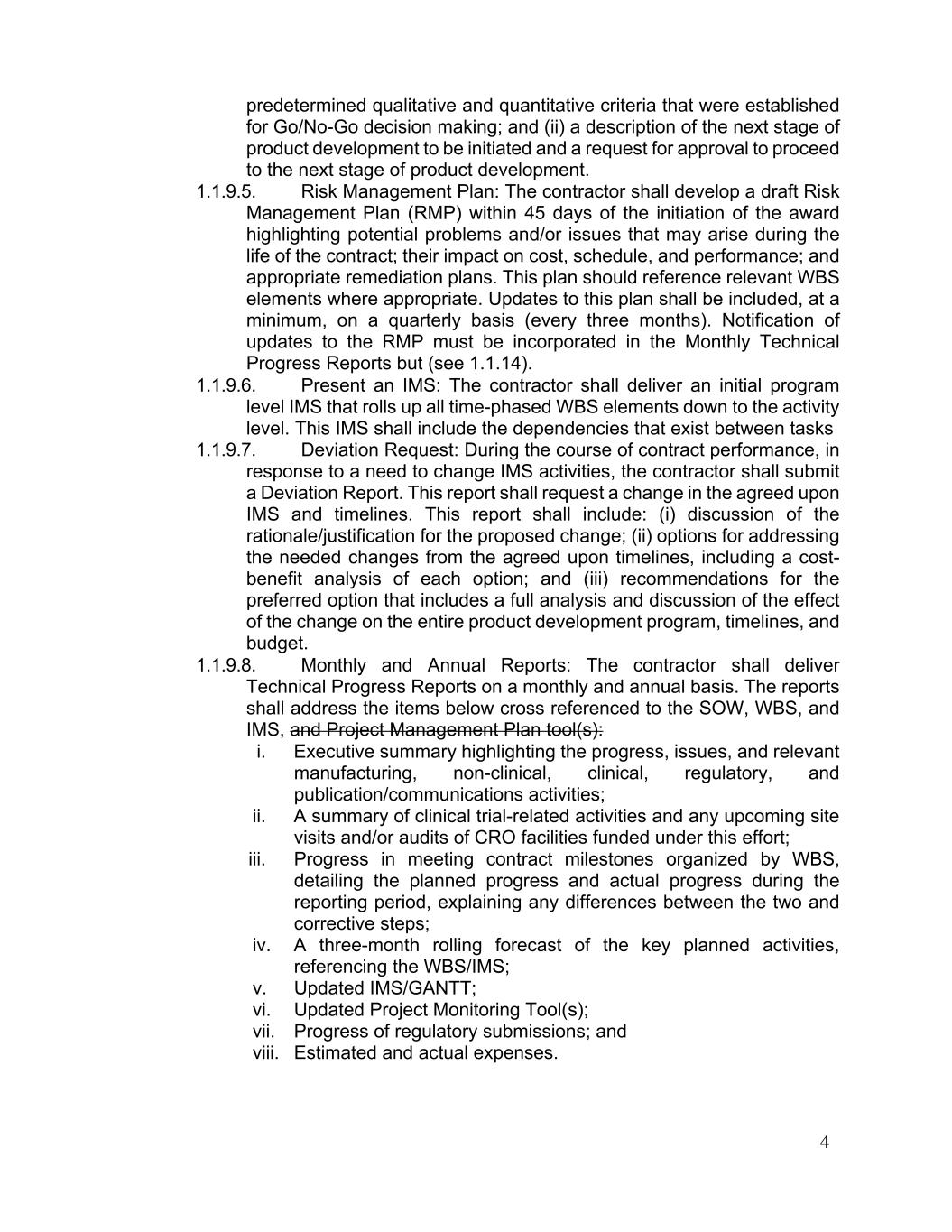
4 predetermined qualitative and quantitative criteria that were established for Go/No-Go decision making; and (ii) a description of the next stage of product development to be initiated and a request for approval to proceed to the next stage of product development. 1.1.9.5. Risk Management Plan: The contractor shall develop a draft Risk Management Plan (RMP) within 45 days of the initiation of the award highlighting potential problems and/or issues that may arise during the life of the contract; their impact on cost, schedule, and performance; and appropriate remediation plans. This plan should reference relevant WBS elements where appropriate. Updates to this plan shall be included, at a minimum, on a quarterly basis (every three months). Notification of updates to the RMP must be incorporated in the Monthly Technical Progress Reports but (see 1.1.14). 1.1.9.6. Present an IMS: The contractor shall deliver an initial program level IMS that rolls up all time-phased WBS elements down to the activity level. This IMS shall include the dependencies that exist between tasks 1.1.9.7. Deviation Request: During the course of contract performance, in response to a need to change IMS activities, the contractor shall submit a Deviation Report. This report shall request a change in the agreed upon IMS and timelines. This report shall include: (i) discussion of the rationale/justification for the proposed change; (ii) options for addressing the needed changes from the agreed upon timelines, including a cost- benefit analysis of each option; and (iii) recommendations for the preferred option that includes a full analysis and discussion of the effect of the change on the entire product development program, timelines, and budget. 1.1.9.8. Monthly and Annual Reports: The contractor shall deliver Technical Progress Reports on a monthly and annual basis. The reports shall address the items below cross referenced to the SOW, WBS, and IMS, and Project Management Plan tool(s): i. Executive summary highlighting the progress, issues, and relevant manufacturing, non-clinical, clinical, regulatory, and publication/communications activities; ii. A summary of clinical trial-related activities and any upcoming site visits and/or audits of CRO facilities funded under this effort; iii. Progress in meeting contract milestones organized by WBS, detailing the planned progress and actual progress during the reporting period, explaining any differences between the two and corrective steps; iv. A three-month rolling forecast of the key planned activities, referencing the WBS/IMS; v. Updated IMS/GANTT; vi. Updated Project Monitoring Tool(s); vii. Progress of regulatory submissions; and viii. Estimated and actual expenses.
5 1.1.10. Data Management: The contractor shall develop and implement data management and quality control systems/procedures, including transmission, storage, confidentiality, and retrieval of all contract data; 1.1.10.1. Provide for the statistical design and analysis of data resulting from the research; and 1.1.10.2. Provide raw data or specific analyses of data generated with contract funding to the CO and COR, upon request. 1.2 Nonclinical Toxicology (WBS 1.2) – RESERVED 1.3 Nonclinical Studies (WBS 1.3) 1.3.1 [***] 1.3.1.1. [***] 1.3.1.2. [***]. 1.3.1.3. [***]. 1.4 Clinical studies (WBS 1.4) – [***] 1.4.1. [***]. 1.4.2. [***]. 1.4.2. [***]. 1.4.3. [***]: 1. [***] 2. [***] 3. [***]
6 4. [***] 1.4.4. [***]. 1.5. Regulatory (WBS 1.5) 1.5.1. [***]. 1.5.1.1. [***] 1.5.1.2. [***] 1.5.2. IND Maintenance 1.5.2.1. [***]. 1.5.2.2. [***]. 1.6. Chemistry Manufacturing Controls (CMC) (WBS 1.6) 1.6.1. Technology Transfer and Onshoring 1.6.1.1. [***]. 1.6.1.2. [***]. 1.6.1.3 [***]: Goal 1: [***]: -[***]. -[***]. -[***]. Goal 2: [***]: -[***]. -[***]. Goal 3: [***]: -[***]. -[***]. Goal 4: [***]: -[***]. CLIN 0001 Objectives: [***]. CLIN 0001 Deliverables: [***]. CLIN 0001 Go/No-Go: [***].
7 2. PHASE II: (CLIN 0002 – Option 1) [***]. The contractor shall perform the following tasks and subtasks in accordance with the agreed upon IMS and IMP (defined in 1.1.8 and 1.1.9, respectively), which shall further detail the conduct of the specific tasks and subtasks. 2.1. Program Management (WBS 2.1) – Consistent with section 1.1 2.2. Nonclinical Toxicology (WBS 2.2) – RESERVED 2.3. Nonclinical Studies (WBS 2.3) – RESERVED 2.4 Clinical Studies (WBS 2.4) - [***] 2.4.1 [***]. 2.4.2. [***]. 2.4.3. [***]. 2.5. Regulatory (WBS 2.5) 2.5.1. [***]. 2.5.2. [***]. 3. PHASE III: (CLIN 0003 - Option 2) [***] The contractor shall perform the following tasks and subtasks in accordance with the agreed upon IMS and IMP (defined in 1.1.8 and 1.1.9, respectively), further detail the conduct of the specific tasks and subtasks. 3.1 Program Management (WBS 3.1) – Consistent with section 1.1 3.2. Nonclinical Toxicology (WBS 3.2) – RESERVED 3.3 Nonclinical Studies (WBS 3.3) – RESERVED 3.4. Clinical Studies (WBS 3.4) - [***] [***]. 3.4.1. [***]. 3.4.3 [***]. 3.5. Regulatory (WBS 3.5) 3.5.1. [***]. 3.5.2. [***]. 3.6. CMC (WBS 3.6) 3.6.1. [***]. CLIN 0003 Objective: [***]. CLIN 0003 Deliverable: [***]. CLIN 0003 Go/No-Go: [***]. 4. PHASE IV: (CLIN 0004 - Option 3) [***] The contractor shall perform the following tasks and subtasks in accordance with the agreed upon IMS and IMP (defined in 1.1.8 and 1.1.9, respectively), further detail the

8 conduct of the specific tasks and subtasks.
9 4.1 Program Management (WBS 4.1) – Consistent with section 1.1 4.2. Nonclinical Toxicology (WBS 4.2) – RESERVED 4.3 Nonclinical Studies (WBS 4.3) – RESERVED 4.4. Clinical Studies (WBS 4.4) - [***]. 4.4.1. [***]. 4.4.2. [***]. 4.5. Regulatory (WBS 4.5) 4.5.1. [***]. 4.5.2. [***]. CLIN 0004 Objective: [***]. CLIN 0004 Deliverable: [***]. CLIN 0004 Go/No-Go: [***]. 5. PHASE V: (CLIN 0005 - Option 4) [***] The contractor shall perform the following tasks and subtasks in accordance with the agreed upon IMS and IMP (defined in 1.1.8 and 1.1.9, respectively), further detail the conduct of the specific tasks and subtasks.

10 5.1 Program Management (WBS 5.1) – Consistent with section 1.1 5.2. Nonclinical Toxicology (WBS 5.2) – RESERVED 5.3 Nonclinical Studies (WBS 5.3) – RESERVED 5.4. Clinical Studies (WBS 5.4) - [***] 5.4.1. [***]. 5.4.2. [***]. 5.5. Regulatory (WBS 5.5) 5.5.1. [***]. 5.5.2. [***]. 5.6. CMC (WBS 5.6) – RESERVED CLIN 0005 Objective: [***]. CLIN 0005 Deliverable: [***]. CLIN 0005 Go/No-Go: [***]. 6. Phase VI: (CLIN 0006 – Option 5) [***]. [***]. 6.1. Program Management (WBS 6.1) – Consistent with section 1.1 6.2. Nonclinical Toxicology (WBS 6.2) 6.2.1. [***] 6.2.2. [***]
11 6.2.3. [***]. 6.3. Nonclinical Studies (WBS 6.3) – RESERVED 6.4. Clinical Studies (WBS 6.4) – RESERVED 6.5. Regulatory (WBS 6.5) – RESERVED 6.6. CMC (WBS 6.6) – RESERVED CLIN 0006 Objective: [***]. CLIN 0006 Deliverable: [***]. CLIN 0006 Go/ No-Go: [***]. 7. Phase VII: (CLIN 0007 – Option 6) [***]. The contractor shall perform the following tasks and subtasks in accordance with the agreed upon IMS and IMP (defined in 1.1.8 and 1.1.9, respectively), which shall further detail the conduct of the specific tasks and subtasks. 7.1. Program Management (WBS 7.1) – Consistent with section 1.1 7.2. Nonclinical Toxicology (WBS 7.2) – RESERVED 7.3. Nonclinical Studies (WBS 7.3) – RESERVED 7.4. Clinical Studies (WBS 7.4) - [***] 7.4.1. [***]. 7.4.2. [***]. 7.4.3. [***]. 7.4.4. [***]. 7.4.5. [***]. 7.5. Regulatory (WBS 7.5) 7.5.1. [***]
12 7.5.2. [***]. 7.6. CMC (WBS 5.6) 7.6.1. [***]. CLIN 0007 Objective: [***]. CLIN 0007 Deliverable: [***]. CLIN 0007 Go/No-Go: [***]. 8. Phase VIII: (CLIN 0008 - Option 7): - [***] The contractor shall perform the following tasks and subtasks in accordance with the agreed upon IMS and IMP (defined in 1.1.8 and 1.1.9, respectively), which shall further detail the conduct of the specific tasks and subtasks. 8.1. Program Management (WBS 8.1) – Consistent with section 1.1 8.2. Nonclinical Toxicology (WBS 8.2) – RESERVED 8.3. Nonclinical Studies (WBS 8.3) – RESERVED 8.4. Clinical Studies (WBS 8.4) - RESERVED 8.5. Regulatory (WBS 8.5) 8.5.1. [***]. 8.6. CMC (WBS 8.6) – [***] 8.6.1. [***] 8.6.2. [***] 8.6.3 [***].
13 CLIN 0008 Objective: [***]. CLIN 0008 Deliverable: [***]. CLIN 0008 Go/No-Go: [***] 9. PHASE IX: (CLIN 0009 – Option 8) [***] The contractor shall perform the following tasks and subtasks in accordance with agreed upon IMS and IMP (defined in 1.1.8 and 1.1.9, respectively), which shall further detail the conduct of the specific tasks and subtasks. 9.1. Program Management (WBS 9.1) – Consistent with section 1.1 9.2. Nonclinical Toxicology (WBS 9.2) – RESERVED 9.3. Nonclinical Studies (WBS 9.3) – RESERVED 9.4. Clinical Studies (WBS 9.4) – RESERVED 9.5. Regulatory (WBS 9.5) 9.5.1. [***] 9.5.1.1. [***] 9.5.1.2. [***]. 9.5.1.3. [***]. 9.6. CMC (WBS 9.6) – RESERVED 10. Phase X: (CLIN 0010 – Option 9) [***] The contractor shall perform the following tasks and subtasks in accordance with the agreed upon IMS and IMP (defined in 1.1.8 and 1.1.9, respectively), which shall further detail the conduct of the specific tasks and subtasks.
14 10.1. Program Management (WBS 10.1) – Consistent with section 1.1 10.2. Nonclinical Toxicology (WBS 10.2) – RESERVED 10.3. Nonclinical Studies (WBS 10.3) – RESERVED 10.4. Clinical Studies (WBS 10.4) – RESERVED 10.5. Regulatory (WBS 10.5) - [***] 10.5.1. [***] 10.5.2. [***]. 10.5.3. [***]. 10.6. CMC – RESERVED

Attachment #2 – Gantt Chart [***]
_________ _________ ____________ DISCLOSURE OF LOBBYING ACTIVITIES Approved by OMB Complete this form to disclose lobbying activities pursuant to 31 U.S.C. 1352 0348-0046 (See reverse for public burden disclosure.) 1. Type of Federal Action: a. contract b. grant c. cooperative agreement d. loan e. loan guarantee f. loan insurance 2. Status of Federal Action: a. bid/offer/application b. initial award c. post-award 3. Report Type: a. initial filing b. material change For Material Change Only: year quarter date of last report _ _ 4. Name and Address of Reporting Entity: Prime Subawardee Tier , if known : Congressional District, if known : 4c 5. If Reporting Entity in No. 4 is a Subawardee, Enter Name and Address of Prime: Congressional District, if known : 6. Federal Department/Agency: 7. Federal Program Name/Description: CFDA Number, if applicable : _ 8. Federal Action Number, if known : 9. Award Amount, if known : $ 10. a. Name and Address of Lobbying Registrant b. Individuals Performing Services (including address if ( if individual, last name, first name, MI ): different from No. 10a ) (last name, first name, MI ): 11. Information requested through this form is authorized by title 31 U.S.C. section 1352. This disclosure of lobbying activities is a material representation of fact upon which reliance was placed by the tier above when this transaction was made or entered into. This disclosure is required pursuant to 31 U.S.C. 1352. This information will be available for public inspection. Any person who fails to file the required disclosure shall be subject to a civil penalty of not less than $10,000 and not more than $100,000 for each such failure. Signature: Print Name: Title: Telephone No.: _ Date: Federal Use Only: Authorized for Local Reproduction Standard Form LLL (Rev. 7-97)
INSTRUCTIONS FOR COMPLETION OF SF-LLL, DISCLOSURE OF LOBBYING ACTIVITIES This disclosure form shall be completed by the reporting entity, whether subawardee or prime Federal recipient, at the initiation or receipt of a covered Federal action, or a material change to a previous filing, pursuant to title 31 U.S.C. section 1352. The filing of a form is required for each payment or agreement to make payment to any lobbying entity for influencing or attempting to influence an officer or employeeof any agency, a Member of Congress, an officer or employee of Congress, or an employeeof a Member of Congress in connection with a covered Federal action. Complete all items that apply for both the initial filing and material change report. Refer to the implementing guidance published by the Office of Management and Budget for additional information. 1. Identify the type of covered Federal action for which lobbying activity is and/or has been secured to influence the outcome of a covered Federal action. 2. Identify the status of the covered Federal action. 3. Identify the appropriate classification of this report. If this is a followup report caused by a material change to the information previously reported, enter the year and quarter in which the change occurred. Enter the date of the last previously submitted report by this reporting entity for this covered Federal action. 4. Enter the full name, address, city, State and zip code of the reporting entity. Include Congressional District, if known. Check the appropriate classification of the reporting entity that designates if it is, or expects to be, a prime or subaward recipient. Identify the tier of the subawardee, e.g., the first subawardee of the prime is the 1st tier. Subawards include but are not limited to subcontracts, subgrants and contract awards under grants. 5. If the organization filing the report in item 4 checks "Subawardee," then enter the full name, address, city, State and zip code of the prime Federal recipient. Include Congressional District, if known. 6. Enter the name of the Federal agency making the award or loan commitment. Include at least one organizationallevel below agency name, if known. For example, Department of Transportation, United States Coast Guard. 7. Enter the Federal program name or description for the covered Federal action (item 1). If known, enter the full Catalog of Federal Domestic Assistance (CFDA) number for grants, cooperative agreements, loans, and loan commitments. 8. Enter the most appropriate Federal identifying number available for the Federal action identified in item 1 (e.g., Request for Proposal (RFP) number; Invitation for Bid (IFB) number; grant announcement number; the contract, grant, or loan award number; the application/proposal control number assigned by the Federal agency). Include prefixes, e.g., "RFP-DE-90-001." 9. For a covered Federal action where there has been an award or loan commitment by the Federal agency, enter the Federal amount of the award/loan commitment for the prime entity identified in item 4 or 5. 10. (a) Enter the full name, address, city, State and zip code of the lobbying registrant under the Lobbying Disclosure Act of 1995 engaged by the reporting entity identified in item 4 to influence the covered Federal action. (b) Enter the full names of the individual(s) performing services, and include full address if different from 10 (a). Enter Last Name, First Name, and Middle Initial (MI). 11. The certifying official shall sign and date the form, print his/her name, title, and telephone number. According to the Paperwork Reduction Act, as amended, no persons are required to respond to a collection of information unless it displays a valid OMB Control Number. The valid OMB control number for this information collection is OMB No. 0348-0046. Public reporting burden for this collection of information is estimated to average 10 minutes per response, including time for reviewing instructions, searching existing data sources, gathering and maintaining the data needed, and completing and reviewing the collection of information. Send comments regarding the burden estimate or any other aspect of this collection of information, including suggestions for reducing this burden, to the Office of Management and Budget, Paperwork Reduction Project (0348-0046), Washington, DC 20503.
Attachment #4 - Report of Government Owned, Contractor Held Property REPORT OF GOVERNMENT OWNED, CONTRACTOR HELD PROPERTY CONTRACTOR: CONTRACT NUMBER: ADDRESS: REPORT DATE: ADDRESS!: ADDRESS2: FISCAL YEAR: CITY: STATE: ZIP: CLASSIFICATION BEGINNING OF PERIOD ADJUSTMENTS END OF PERIOD #ITEMS VALUE GFP ADDED CAP ADDED DELETION S #ITEMS VALUE LAND >=$25K LAND <$25K OTHER REAL >=$25K OTHER REAL <$25K PROPERTY UNDER CONST >=$25K PROPERTY UNDER CONST <$25K PLANT EQUIP >=$25K PLANT EQUIP <$25K SPECIAL TOOLING >=$25K SPECIAL TOOLING <$25K SPECIAL TEST EQUIP >=$25K SPECIAL TEST EQUIP <$25K AGENCY PECULIAR >=$25K AGENCY PECULIAR <$25K MATERIAL >=$25K {CUMULATIVE} PROPERTY UNDER MFR >=$25K PROPERTY UNDER MFR <$25K SIGNED BY: SIGNATURE DATE SIGNED: NAME PRINTED Email TITLE TELEPHONE Report of Government Owned, Contractor Held Property (Rev 10/2014) 73
EX-31.1
3
exhibit3112025-09.htm
CERTIFICATION OF CEO PURSUANT TO SECURITIES EXCHANGE ACT OF 1934
Document
Exhibit 31.1
CERTIFICATION PURSUANT TO
RULES 13a-14(a) AND 15d-14(a) UNDER THE SECURITIES EXCHANGE ACT OF 1934,
AS ADOPTED PURSUANT TO SECTION 302 OF THE SARBANES-OXLEY ACT OF 2002
I, Jeffrey Stein, Ph.D., certify that:
1. I have reviewed this Quarterly Report on Form 10-Q of Cidara Therapeutics, Inc.;
2. Based on my knowledge, this report does not contain any untrue statement of a material fact or omit to state a material fact necessary to make the statements made, in light of the circumstances under which such statements were made, not misleading with respect to the period covered by this report;
3. Based on my knowledge, the financial statements, and other financial information included in this report, fairly present in all material respects the financial condition, results of operations and cash flows of the registrant as of, and for, the periods presented in this report;
4. The registrant’s other certifying officer and I are responsible for establishing and maintaining disclosure controls and procedures (as defined in Exchange Act Rules 13a-15(e) and 15d-15(e)) and internal control over financial reporting (as defined in Exchange Act Rules 13a-15(f) and 15d-15(f)) for the registrant and have:
a. Designed such disclosure controls and procedures, or caused such disclosure controls and procedures to be designed under our supervision, to ensure that material information relating to the registrant, including its consolidated subsidiaries, is made known to us by others within those entities, particularly during the period in which this report is being prepared;
b. Designed such internal control over financial reporting, or caused such internal control over financial reporting to be designed under our supervision, to provide reasonable assurance regarding the reliability of financial reporting and the preparation of financial statements for external purposes in accordance with generally accepted accounting principles;
c. Evaluated the effectiveness of the registrant’s disclosure controls and procedures and presented in this report our conclusions about the effectiveness of the disclosure controls and procedures, as of the end of the period covered by this report based on such evaluation; and
d. Disclosed in this report any change in the registrant’s internal control over financial reporting that occurred during the registrant’s most recent fiscal quarter (the registrant’s fourth fiscal quarter in the case of an annual report) that has materially affected, or is reasonably likely to materially affect, the registrant’s internal control over financial reporting; and
5. The registrant’s other certifying officer and I have disclosed, based on our most recent evaluation of internal control over financial reporting, to the registrant’s auditors and the audit committee of the registrant’s board of directors (or persons performing the equivalent functions):
a. All significant deficiencies and material weaknesses in the design or operation of internal control over financial reporting which are reasonably likely to adversely affect the registrant’s ability to record, process, summarize and report financial information; and
b. Any fraud, whether or not material, that involves management or other employees who have a significant role in the registrant’s internal control over financial reporting.
|
|
|
|
|
|
|
|
|
|
|
|
| Date: November 6, 2025 |
By: |
|
/s/ Jeffrey Stein, Ph.D. |
| |
|
|
Jeffrey Stein, Ph.D. |
| |
|
|
President and Chief Executive Officer |
| |
|
|
(Principal Executive Officer) |
EX-31.2
4
exhibit3122025-09.htm
CERTIFICATION OF CFO PURSUANT TO SECURITIES EXCHANGE ACT OF 1934
Document
Exhibit 31.2
CERTIFICATION PURSUANT TO
RULES 13a-14(a) AND 15d-14(a) UNDER THE SECURITIES EXCHANGE ACT OF 1934,
AS ADOPTED PURSUANT TO SECTION 302 OF THE SARBANES-OXLEY ACT OF 2002
I, Frank Karbe, certify that:
1. I have reviewed this Quarterly Report on Form 10-Q of Cidara Therapeutics, Inc.;
2. Based on my knowledge, this report does not contain any untrue statement of a material fact or omit to state a material fact necessary to make the statements made, in light of the circumstances under which such statements were made, not misleading with respect to the period covered by this report;
3. Based on my knowledge, the financial statements, and other financial information included in this report, fairly present in all material respects the financial condition, results of operations and cash flows of the registrant as of, and for, the periods presented in this report;
4. The registrant’s other certifying officer and I are responsible for establishing and maintaining disclosure controls and procedures (as defined in Exchange Act Rules 13a-15(e) and 15d-15(e)) and internal control over financial reporting (as defined in Exchange Act Rules 13a-15(f) and 15d-15(f)) for the registrant and have:
a. Designed such disclosure controls and procedures, or caused such disclosure controls and procedures to be designed under our supervision, to ensure that material information relating to the registrant, including its consolidated subsidiaries, is made known to us by others within those entities, particularly during the period in which this report is being prepared;
b. Designed such internal control over financial reporting, or caused such internal control over financial reporting to be designed under our supervision, to provide reasonable assurance regarding the reliability of financial reporting and the preparation of financial statements for external purposes in accordance with generally accepted accounting principles;
c. Evaluated the effectiveness of the registrant’s disclosure controls and procedures and presented in this report our conclusions about the effectiveness of the disclosure controls and procedures, as of the end of the period covered by this report based on such evaluation; and
d. Disclosed in this report any change in the registrant’s internal control over financial reporting that occurred during the registrant’s most recent fiscal quarter (the registrant’s fourth fiscal quarter in the case of an annual report) that has materially affected, or is reasonably likely to materially affect, the registrant’s internal control over financial reporting; and
5. The registrant’s other certifying officer and I have disclosed, based on our most recent evaluation of internal control over financial reporting, to the registrant’s auditors and the audit committee of the registrant’s board of directors (or persons performing the equivalent functions):
a. All significant deficiencies and material weaknesses in the design or operation of internal control over financial reporting which are reasonably likely to adversely affect the registrant’s ability to record, process, summarize and report financial information; and
b. Any fraud, whether or not material, that involves management or other employees who have a significant role in the registrant’s internal control over financial reporting.
|
|
|
|
|
|
|
|
|
|
|
|
| Date: November 6, 2025 |
By: |
|
/s/ Frank Karbe |
| |
|
|
Frank Karbe |
| |
|
|
Chief Financial Officer |
| |
|
|
(Principal Financial Officer and Principal Accounting Officer) |
EX-32.1
5
exhibit3212025-09.htm
CERTIFICATION OF CEO PURSUANT TO SARBANES-OXLEY ACT OF 2002
Document
Exhibit 32.1
CERTIFICATION PURSUANT TO 18 U.S.C. SECTION 1350,
AS ADOPTED PURSUANT TO
SECTION 906 OF THE SARBANES-OXLEY ACT OF 2002
In connection with the Quarterly Report on Form 10-Q of Cidara Therapeutics, Inc. (the “Company”) for the quarter ended September 30, 2025 as filed with the Securities and Exchange Commission on the date hereof and to which this certification is attached as an exhibit (the “Report”), I, Jeffrey Stein, Ph.D., President and Chief Executive Officer of the Company, certify, pursuant to the requirement in Rule 13a-14(b) of the Securities Exchange Act of 1934, as amended (the “Securities Exchange Act”), and Section 1350 of Chapter 63 of Title 18 of the United States Code (18 U.S.C. § 1350), that, to the best of my knowledge:
(1) The Report fully complies with the requirements of Section 13(a) or 15(d) of the Securities Exchange Act; and
(2) The information contained in the Report fairly presents, in all material respects, the financial condition and results of operations of the Company.
|
|
|
|
|
|
|
|
|
|
|
|
| Date: November 6, 2025 |
By: |
|
/s/ Jeffrey Stein, Ph.D. |
| |
|
|
Jeffrey Stein, Ph.D. |
| |
|
|
President and Chief Executive Officer |
| |
|
|
(Principal Executive Officer) |
This certification accompanies the Form 10-Q to which it relates, is being furnished solely pursuant to 18 U.S.C. § 1350 and is not deemed filed with the Securities and Exchange Commission and is not to be incorporated by reference into any filing of Cidara Therapeutics, Inc. under the Securities Act of 1933, as amended, or the Securities Exchange Act of 1934, as amended (whether made before or after the date of the Form 10-Q), irrespective of any general incorporation language contained in such filing.
EX-32.2
6
exhibit3222025-09.htm
CERTIFICATION OF CFO PURSUANT TO SARBANES-OXLEY ACT OF 2002
Document
Exhibit 32.2
CERTIFICATION PURSUANT TO 18 U.S.C. SECTION 1350,
AS ADOPTED PURSUANT TO
SECTION 906 OF THE SARBANES-OXLEY ACT OF 2002
In connection with the Quarterly Report on Form 10-Q of Cidara Therapeutics, Inc. (the “Company”) for the quarter ended September 30, 2025 as filed with the Securities and Exchange Commission on the date hereof and to which this certification is attached as an exhibit (the “Report”), I, Frank Karbe, Chief Financial Officer of the Company, certify, pursuant to the requirement in Rule 13a-14(b) of the Securities Exchange Act of 1934, as amended (the “Securities Exchange Act”), and Section 1350 of Chapter 63 of Title 18 of the United States Code (18 U.S.C. § 1350), that, to the best of my knowledge:
(1) The Report fully complies with the requirements of Section 13(a) or 15(d) of the Securities Exchange Act; and
(2) The information contained in the Report fairly presents, in all material respects, the financial condition and results of operations of the Company.
|
|
|
|
|
|
|
|
|
|
|
|
| Date: November 6, 2025 |
By: |
|
/s/ Frank Karbe |
| |
|
|
Frank Karbe |
| |
|
|
Chief Financial Officer |
| |
|
|
(Principal Financial Officer and Principal Accounting Officer) |
This certification accompanies the Form 10-Q to which it relates, is being furnished solely pursuant to 18 U.S.C. § 1350 and is not deemed filed with the Securities and Exchange Commission and is not to be incorporated by reference into any filing of Cidara Therapeutics, Inc. under the Securities Act of 1933, as amended, or the Securities Exchange Act of 1934, as amended (whether made before or after the date of the Form 10-Q), irrespective of any general incorporation language contained in such filing.
 エドガーで原本を確認する