 エドガーで原本を確認する
UNITED STATES SECURITIES AND EXCHANGE COMMISSION
WASHINGTON, D.C. 20549
FORM 40-F
|
|
|
☐ |
|
REGISTRATION STATEMENT PURSUANT TO SECTION 12 OF THE SECURITIES EXCHANGE ACT OF 1934 |
OR
|
|
|
☑ |
|
ANNUAL REPORT PURSUANT TO SECTION 13(a) OR 15(d) OF THE SECURITIES EXCHANGE ACT OF 1934 |
For the fiscal year ended: December 31, 2024 Commission File Number: 001-35297
FORTUNA MINING CORP.
(Exact name of Registrant as specified in its charter)
N/A
(Translation of Registrant’s name into English (if applicable))
British Columbia, Canada
(Province or other jurisdiction of incorporation or organization)
|
|
|
|
|
|
1040 |
|
N/A |
|
(Primary Standard Industrial Classification Code Number (if applicable)) |
|
(I.R.S. Employer Identification Number (if applicable)) |
1111 Melville Street, Suite 820
Vancouver, British Columbia V6E 3V6, Canada
604-484-4085
(Address and telephone number of Registrant’s principal executive offices)
Puglisi & Associates
850 Library Ave., Suite 204
Newark, DE 19711
302-738-6680
(Name, address (including zip code) and telephone number (including area code)
of agent for service in the United States)
Securities registered or to be registered pursuant to Section 12(b) of the Act.
|
|
|
Title of each class |
Trading Symbol(s) |
Name of each exchange on which registered |
Common Shares |
FSM |
New York Stock Exchange |
Securities registered or to be registered pursuant to Section 12(g) of the Act.
None
(Title of Class)
Securities for which there is a reporting obligation pursuant to Section 15(d) of the Act.
None
(Title of Class)
For annual reports, indicate by check mark the information filed with this Form:
☑ Annual information form ☑ Audited annual financial statements
Indicate the number of outstanding shares of each of the issuer’s classes of capital or common stock as of the close of the period covered by the annual report:
There were 306,587,630 common shares with no par value outstanding as of December 31, 2024.
Indicate by check mark whether the Registrant: (1) has filed all reports to be filed by Section 13 or 15(d) of the Exchange Act during the preceding 12 months (or for such shorter period that the Registrant was required to file such reports); and (2) has been subject to such filing requirements for the past 90 days.
Yes ☑ No ◻
Indicate by check mark whether the Registrant has submitted electronically every Interactive Data File required to be submitted pursuant to Rule 405 of Regulation S-T (§ 232.405 of this chapter) during the preceding 12 months (or for such shorter period that the Registrant was required to submit such files).
Yes ☑ No ◻
Indicate by check mark whether the Registrant is an emerging growth company as defined in Rule 12b-2 of the Exchange Act.
Emerging growth company ☐
If an emerging growth company that prepares its financial statements in accordance with U.S. GAAP, indicate by check mark if the Registrant has elected not to use the extended transition period for complying with any new or revised financial accounting standards† provided pursuant Section 13(a) of the Exchange Act.
◻
† The term “new or revised financial accounting standard” refers to any update issued by the Financial Accounting Standards Board to its Accounting Standards Codification after April 5, 2012.
Indicate by check mark whether the Registrant has filed a report on and attestation to its management’s assessment of the effectiveness of its internal control over financial reporting under Section 404(b) of the Sarbanes-Oxley Act (15 U.S.C. 7262(b)) by the registered public accounting firm that prepared or issued its audit report.
☑
If securities are registered pursuant to Section 12(b) of the Act, indicate by check mark whether the financial statements of the registrant included in the filing reflect the correction of an error to previously issued financial statements.
☐
Indicate by check mark whether any of those error corrections are restatements that required a recovery analysis of incentive-based compensation received by any of the registrant’s executive officers during the relevant recovery period pursuant to §240.10D-1(b).
☐
DISCLOSURE REGARDING CONTROLS AND PROCEDURES
Disclosure Controls and Procedures.
Disclosure controls and procedures are defined in Rule 13a-15(e) and Rule 15d-15(e) of the Securities Exchange Act of 1934, as amended (the “Exchange Act”) as those controls and procedures designed to ensure that information required to be disclosed in the annual filings and interim filings and other reports filed or submitted by Fortuna Mining Corp. (formerly called Fortuna Silver Mines Inc.) (the “Company”) under the Exchange Act is duly recorded, processed, summarized and reported, within the time periods specified in rules and forms of the United States Securities and Exchange Commission (the “SEC”). Disclosure controls and procedures include, without limitation, controls and procedures designed to ensure that information required to be disclosed in the Company’s reports and filings is accumulated and communicated to management, including the Chief Executive Officer (“CEO”) and Chief Financial Officer (“CFO”) as appropriate, to allow timely decisions regarding required disclosure.
The Company evaluated, with the participation of its CEO and CFO, the effectiveness of its disclosure controls and procedures as of December 31, 2024. Based on that evaluation, the CEO and the CFO have concluded that, as of the end of the period covered by this Annual Report on Form 40-F, the disclosure controls and procedures were effective to provide reasonable assurance that information required to be disclosed in the Company’s annual filings and interim filings and other reports filed or submitted under the Exchange Act, is recorded, processed, summarized and reported within time periods specified in SEC rules and forms and is accumulated and communicated to management, including the CEO and CFO, as appropriate to allow timely decisions regarding required disclosure.
Notwithstanding the foregoing, because of the inherent limitations in all control systems, no evaluation of controls can provide absolute assurance that the Company’s disclosure controls and procedures will detect or uncover every situation involving the failure of persons within the Company and its subsidiaries to disclose material information otherwise required to be set forth in the Company’s periodic reports. The Company’s disclosure controls and procedures are designed to provide reasonable assurance of achieving their objective of ensuring that information required to be disclosed in the reports that the Company files or submits under the Exchange Act is communicated to management to allow timely decisions regarding required disclosure.
Management’s Annual Report on Internal Control Over Financial Reporting.
Management is responsible for establishing and maintaining adequate internal control over financial reporting (as such term is defined in Rule 13a-15(f) and Rule 15d-15(f) under the Exchange Act) and has designed such internal controls over financial reporting to provide reasonable assurance regarding the reliability of financial reporting and preparation of financial statements for external purposes in accordance with International Financial Reporting Standards, as issued by the International Accounting Standards Board.
In designing and evaluating the Company’s internal control over financial reporting, the Company’s management recognizes that any controls and procedures, no matter how well designed and operated, can provide only reasonable assurance of achieving their objectives and management necessarily applies its reasonable judgment in evaluating the cost-benefit relationship of possible controls and procedures. Because of its inherent limitations, internal controls over financial reporting may not prevent or detect misstatements. Projections of any evaluation of effectiveness to future periods are subject to the risks that controls may become inadequate because of changes in conditions, or that the degree of compliance with the policies and procedures may deteriorate.
Management assessed the effectiveness of the Company’s internal control over financial reporting as of December 31, 2024. In making this assessment, management used the Internal Control – Integrated Framework (2013) issued by the Committee of Sponsoring Organizations of the Treadway Commission. Based on this assessment, management concluded that the Company’s internal control over financial reporting was effective as of December 31, 2024.
See “Management’s Report on Internal Control Over Financial Reporting” in the Management’s Discussion and Analysis for the fiscal years ended December 31, 2024 and 2023, included as Exhibit 99.3 to this Annual Report on Form 40-F. The Company’s auditors have issued an attestation report on management’s assessment of the Company’s internal control over financial reporting. See “Attestation Report of the Registered Public Accounting Firm” below.
Attestation Report of the Independent Registered Public Accounting Firm. The Company’s internal control over financial reporting as of December 31, 2024 has been audited by KPMG LLP, Independent Registered Public Accounting Firm, Vancouver, BC, Canada, Audit Firm ID 85. The required report is included in the “Report of Independent Registered Public Accounting Firm,” that accompanies the Company’s audited consolidated financial statements as at and for the fiscal years ended December 31, 2024 and 2023, filed as part of this Annual Report on Form 40-F in Exhibit 99.2.
Changes in Internal Control Over Financial Reporting. During the fiscal year ended December 31, 2024, there were no changes in the Company’s internal control over financial reporting that have materially affected, or are reasonably likely to materially affect, the Company’s internal control over financial reporting.
NOTICES PURSUANT TO REGULATION BTR
None.
IDENTIFICATION OF THE AUDIT COMMITTEE
The Company has a separately-designated standing audit committee established in accordance with Section 3(a)(58)(A) of the Exchange Act. The members of the audit committee are Kylie Dickson, Alfredo Sillau and David Farrell. The board of directors has determined that each of Kylie Dickson, Alfredo Sillau and David Farrell is independent, as that term is defined in Rule 10A-3 under the Exchange Act and the Listed Company Manual of the New York Stock Exchange.
AUDIT COMMITTEE FINANCIAL EXPERT
The board of directors of the Company has determined that Kylie Dickson, a member of the Company’s audit committee, qualifies as an audit committee financial expert for purposes of paragraph (8) of General Instruction B to Form 40-F. The SEC has indicated that the designation of Kylie Dickson as an audit committee financial expert does not: (i) make her an “expert” for any purpose, (ii) impose any duties, obligations or liabilities on her that are greater than those imposed on members of the audit committee and the board of directors who do not carry this designation, and (iii) or affect the duties, obligations or liabilities of any other member of the audit committee or the board of directors.
CODE OF ETHICS
The Company has adopted a “code of ethics” (as that term is defined in Form 40-F), entitled the “Code of Business Conduct and Ethics and Whistle-Blower Policy”, that applies to all of its directors, officers, employees, and consultants including its principal executive officer, principal financial officer, principal accounting officer or controller, and persons performing similar functions.
The Code of Business Conduct and Ethics and Whistle-Blower Policy is available for viewing on the Company’s website at www.fortunamining.com under “Library - Policies”.
PRINCIPAL ACCOUNTANT FEES AND SERVICES
The required disclosure is included under the heading “Audit Committee” in the Company’s Annual Information Form for the fiscal year ended December 31, 2024, filed as part of this Annual Report on Form 40-F in Exhibit 99.1.
PRE-APPROVAL POLICIES AND PROCEDURES
The auditors of the Company obtain, as necessary, the pre-approval of the Audit Committee for any anticipated additional services required of the auditors for the coming fiscal year. If other service requirements arise during the year, the Audit Committee will pre-approve such services at that time, prior to the commencement of such services. During the fiscal year ended December 31, 2024, the Audit Committee did not approve any audit-related, tax or other services pursuant to paragraph (c) (7) (i) (C) of Rule 2-01 of Regulation S-X, with the exception of certain financial statement preparation services relating to the statutory audits of certain of the Company's subsidiaries, the fees for which represented less than 5% of total fees for the fiscal year ended December 31, 2024.
OFF-BALANCE SHEET ARRANGEMENTS
The Company does not have any off-balance sheet arrangements required to be disclosed in this Annual Report on Form 40-F.
MINE SAFETY DISCLOSURE
The Company is currently not required to disclose the information required by Section 1503(a) of the Dodd-Frank Wall Street Reform and Consumer Protection Act.
NEW YORK STOCK EXCHANGE CORPORATE GOVERNANCE
The Company is a “foreign private issuer” as defined in Rule 3b-4 under the Exchange Act and Rule 405 under the United States Securities Act of 1933, as amended, and the Company’s common shares are listed on the New York Stock Exchange (the “NYSE”). Sections 103.00, 303A.00 and 303A.11 of the NYSE Listed Company Manual permit foreign private issuers to follow home country practices in lieu of certain provisions of the NYSE Listed Company Manual. A foreign private issuer that follows home country practices in lieu of certain provisions of the NYSE Listed Company Manual must disclose any significant ways in which its corporate governance practices differ from those followed by domestic companies either on its website or in the annual report that it distributes to shareholders in the United States. A description of the significant ways in which the Company’s governance practices differ from those followed by domestic companies pursuant to NYSE standards is disclosed on the Company’s website at www.fortunamining.com under “Library – Stock Exchange Listings - New York Stock Exchange”.
The Company’s corporate governance practices, as described on its website, are consistent with the laws, customs and practices in Canada.
UNDERTAKING
The Company undertakes to make available, in person or by telephone, representatives to respond to inquiries made by the SEC staff, and to furnish promptly, when requested to do so by the SEC staff, information relating to: the securities registered pursuant to Form 40-F; the securities in relation to which the obligation to file an annual report on Form 40-F arises; or transactions in said securities.
CONSENT TO SERVICE OF PROCESS
A Form F-X signed by the Company and its agent for service of process has been previously filed with the SEC together with the Company’s Registration Statement on Form 40-F (File No. 001-35297) in connection with its securities registered on such form.
Any changes to the name or address of the agent for service of process of the Company shall be communicated promptly to the SEC by an amendment to the Form F-X referencing the file number of the Company.
SIGNATURE
Pursuant to the requirements of the Exchange Act, the Company certifies that it meets all of the requirements for filing on Form 40-F and has duly caused this annual report to be signed on its behalf by the undersigned, thereto duly authorized.
|
|
|
|
|
Date: March 27, 2025 |
FORTUNA MINING CORP. |
|
||
|
By: |
“Jorge Ganoza Durant” |
|
|
|
|
Name: Jorge Ganoza Durant |
|
|
|
|
Title:President, Chief Executive Officer & Director |
||
| ||||
EXHIBIT INDEX
Exhibit |
|
Description |
|
|
|
97 |
|
|
|
|
|
|
Annual Information Form for the year ended December 31, 2024 |
|
|
|
|
99.2 |
|
|
|
|
|
99.3 |
|
Management’s Discussion and Analysis for the years ended December 31, 2024 and 2023 |
|
|
|
|
Consent of KPMG LLP (PCAOB ID 85) |
|
|
|
|
|
||
|
|
|
|
||
|
|
|
|
||
|
|
|
|
||
|
|
|
|
||
|
|
|
|
||
|
|
|
|
||
|
|
|
|
||
|
|
|
|
Certification of Chief Executive Officer pursuant to Section 302 of the Sarbanes-Oxley Act of 2002 |
|
|
|
|
|
Certification of Chief Financial Officer pursuant to Section 302 of the Sarbanes-Oxley Act of 2002 |
|
|
|
|
|
Certification of Chief Executive Officer pursuant to Section 906 of the Sarbanes-Oxley Act of 2002 |
|
|
|
|
|
Certification of Chief Financial Officer pursuant to Section 906 of the Sarbanes-Oxley Act of 2002 |
|
|
|
|
101.INS |
|
XBRL Instance |
|
|
|
101.SCH |
|
XBRL Taxonomy Extension Schema |
|
|
|
101.CAL |
|
XBRL Taxonomy Extension Calculation Linkbase |
|
|
|
101.DEF |
|
XBRL Taxonomy Extension Definition Linkbase |
|
|
|
101.LAB |
|
XBRL Taxonomy Extension Label Linkbase |
|
|
|
101.PRE |
|
XBRL Taxonomy Extension Presentation Linkbase |
|
|
|
104 |
|
Cover Page Interactive Data File (formatted as Inline XBRL and contained in Exhibit 101) |

ANNUAL INFORMATION FORM
For the Fiscal Year Ended December 31, 2024
DATED: March 20, 2025
CORPORATE OFFICE: |
MANAGEMENT HEAD OFFICE: |
|
|
1111 Melville Street, Suite 820 |
Piso 5, Av. Jorge Chávez #154 |
Vancouver, BC V6E 3V6, Canada |
Miraflores, Lima, Peru |
Tel: 604.484.4085 |
Tel: 511.616.6060, ext. 2 |
Fax: 604.484.4029 |
|
TABLE OF CONTENTS
PRELIMINARY NOTES |
1 |
Cautionary Statement – Forward Looking Statements |
1 |
Notice Regarding Non-IFRS Measures |
5 |
Cautionary Note to United States Investors Concerning Estimates of Reserves and Resources |
7 |
Documents Incorporated by Reference |
7 |
Scientific and Technical Information |
7 |
Currency |
7 |
|
|
CORPORATE STRUCTURE |
8 |
Name, Address and Incorporation |
8 |
Intercorporate Relationships |
8 |
|
|
GENERAL DEVELOPMENT OF THE BUSINESS |
9 |
Business of the Company |
9 |
Three-Year History and Recent Developments |
9 |
|
|
DESCRIPTION OF THE BUSINESS |
28 |
General |
28 |
Risk Factors |
32 |
Material Mineral Properties (see Schedules “A”, “B”, “C” and “D”) |
59 |
Non-Material Mineral Properties |
61 |
|
|
DIVIDENDS |
62 |
|
|
DESCRIPTION OF CAPITAL STRUCTURE |
62 |
Common Shares |
62 |
Notes |
63 |
Debentures |
63 |
|
|
MARKET FOR SECURITIES |
64 |
Trading Price and Volume |
64 |
Prior Sales |
64 |
|
|
DIRECTORS AND EXECUTIVE OFFICERS |
64 |
Name, Occupation and Shareholding |
64 |
Cease Trade Orders or Bankruptcies |
66 |
Penalties or Sanctions |
67 |
Conflicts of Interest |
67 |
|
|
AUDIT COMMITTEE |
68 |
|
|
LEGAL PROCEEDINGS |
69 |
|
|
TRANSFER AGENT AND REGISTRAR |
69 |
|
|
MATERIAL CONTRACTS |
70 |
|
|
INTERESTS OF EXPERTS |
70 |
|
|
ADDITIONAL INFORMATION |
71 |
|
|
Material Mineral Properties: |
|
Séguéla Mine, Côte d’Ivoire |
Schedule “A” |
Yaramoko Mine, Burkina Faso |
Schedule “B” |
Lindero Mine, Argentina |
Schedule “C” |
Caylloma Mine, Peru |
Schedule “D” |
Audit Committee Charter |
Schedule “E” |
FORTUNA MINING CORP.
PRELIMINARY NOTES
This Annual Information Form (“AIF”) is dated March 20, 2025 and presents information about Fortuna Mining Corp. (formerly called Fortuna Silver Mines Inc.) (referred to herein as the “Company” or “Fortuna”). Except as otherwise indicated, the information contained herein is presented as at December 31, 2024, being the date of the Company’s most recently completed financial year end.
Fortuna has a number of direct and indirect subsidiaries which own and operate assets and conduct activities in different jurisdictions. The terms "Fortuna" or the "Company" are use in this AIF for simplicity of the discussion provided herein and may include references to subsidiaries that have an affiliation with Fortuna, without necessarily identifying the specific nature of such affiliation.
Cautionary Statement – Forward-Looking Statements
Certain statements contained in this AIF and the documents incorporated by reference into this AIF constitute forward-looking statements within the meaning of the United States Private Securities Litigation Reform Act of 1995 and Section 21E of the United States Securities Exchange Act of 1934, as amended (the “Exchange Act”) and Section 27A of the U.S. Securities Act of 1933, as amended (the “Securities Act”), and forward-looking information within the meaning of applicable Canadian securities legislation (collectively, “forward-looking statements”). All statements included herein, other than statements of historical fact, are forward-looking statements and are subject to a variety of known and unknown risks and uncertainties which could cause actual events or results to differ materially from those reflected in the forward-looking statements. The forward-looking statements in this AIF include, without limitation, statements relating to:
| ● | Mineral Reserves (as defined herein) and Mineral Resources (as defined herein) at the Caylloma, Lindero, Séguéla and Yaramoko Mines and at the Arizaro Project and the Diamba Sud gold project ("Diamba Sud Project"), as they involve implied assessment, based on estimates and assumptions that the Mineral Reserves and Mineral Resources described exist in the quantities predicted or estimated and can be profitably produced in the future; |
| ● | estimated rates of production for gold silver and the other metals that we produce, timing of production and the cash costs and all-in sustaining cash costs (“AISC”) estimates; |
| ● | expectations with respect to metal grade estimates and the impact of any variations relative to metal grades experienced; |
| ● | the Company's anticipated financial and operational performance in 2025 as well as anticipated financial and operational performance at the Séguéla Mine in 2026; estimated production forecasts for 2025 as well for 2026 at the Séguéla Mine; |
| ● | the Company's plans and expectations for its material properties and future Brownfields and Greenfields exploration, development and operating activities, including, without limitation, capital expenditures, exploration activities and budgets, forecasts and schedule estimates, as well as their impact on the results of operations or financial condition of the Company; |
| ● | life of mine estimates for the Caylloma, Lindero, Séguéla and Yaramoko Mines, including the expected timing of the closure of the Yaramoko Mine; |
| ● | timing for delivery of materials and equipment for the Company’s properties; |
| ● | the sufficiency of the Company’s cash on hand and available credit lines and estimated cash flows to fund planned capital and exploration programs at its properties; |
| ● | the Company’s financial performance being closely linked to the prices of silver and gold and other metals; |
| ● | rising costs caused by the effect of the Ukraine - Russian conflict and the Israel - Hamas war, causing increased rates of inflation and pressures on the global supply chain; |
| ● | the anticipated rates of returns from mining projects, as reflected in preliminary economic assessments, pre-feasibility and feasibility studies or other reports prepared in relation to development of projects; |
| ● | future sales of the metals and concentrates or other products that the Company produces, the availability and location of refineries and sales counterparts, and any plans and expectations with respect to hedging; |
ANNUAL INFORMATION FORM |
Page | 1 |
FORTUNA MINING CORP.
| ● | the Company’s plans and expectations in respect of the Diamba Sud Project regarding exploration activities to be undertaken and the preparation of a preliminary economic assessment in order to determine that the mineral resource is supportive of project development; |
| ● | the Company’s expectations relating to timing for applying for an exploitation permit at the Diamba Sud Project; |
| ● | statements that future mining at the Séguéla Mine may include underground mining as well as open pit mining; |
| ● | statements regarding the Company’s intention to sell the San Jose Mine; |
| ● | statements regarding the expected timing for the completion of the expansion of the leach pad at the Lindero Mine; |
| ● | the payments due under, and the maturity dates of the Company’s financial liabilities, lease obligations and other contractual commitments; |
| ● | compliance with environmental, health, safety and other regulations; |
| ● | the Company’s commitment to sustainable development, by conducting its operations in an environmentally and socially responsible manner, including complying with its Sustainability Framework, its environmental, social and governance (“ESG”) policies and targets and other operational and governance policies; |
| ● | the ability of the Company to reduce its greenhouse gas (“GHG”) emissions to contribute to a lower carbon economy and lessen the impact of its operations on climate change, through projects such as solar power plants at the Lindero and Séguéla Mines and the construction of a new cyclone plant at Caylloma; |
| ● | the Company’s commitment to mitigating the physical risks of climate change at its mine sites and to minimize its operational water consumption as well as to reduce its exposure to climate-related transition risks; |
| ● | complying with anti-corruption laws; |
| ● | litigation matters; |
| ● | estimated mine closure costs, including remediation and reclamation and timing thereof; and |
| ● | future income tax rate. |
Often, but not always, these forward-looking statements can be identified by the use of words such as “anticipates”, “believes”, “plans”, “estimates”, “expects”, “forecasts”, “scheduled”, “targets”, “possible”, “strategy”, “potential”, “intends”, “advance”, “goal”, “objective”, “projects”, “budget”, “calculates” or statements that events, “will”, “may”, “could” or “should” occur or be achieved and similar expressions, including negative variations.
The forward-looking statements in this AIF also include financial outlooks and other forward-looking metrics relating to Fortuna and its business, including references to financial and business prospects and future results of operations, including production, and cost guidance and anticipated future financial performance. Such information, which may be considered future oriented financial information or financial outlooks within the meaning of applicable Canadian securities legislation (collectively, “FOFI”), has been approved by management of the Company and is based on assumptions which management believes were reasonable on the date such FOFI was prepared, having regard to the industry, business, financial conditions, plans and prospects of Fortuna and its business and properties. These projections are provided to describe the prospective performance of the Company’s business. Nevertheless, readers are cautioned that such information is highly subjective and should not be relied on as necessarily indicative of future results and that actual results may differ significantly from such projections. FOFI constitutes forward-looking statements and is subject to the same assumptions, uncertainties, risk factors and qualifications as set forth below.
Material Risks and Assumptions
Forward-looking statements involve known and unknown risks, uncertainties and other factors which may cause the actual events, results, performance or achievements of the Company to be materially different from any events, results, performance or achievements expressed or implied by the forward-looking statements. Such risks, uncertainties and factors include, among others:
ANNUAL INFORMATION FORM |
Page | 2 |
FORTUNA MINING CORP.
| ● | operational risks associated with mining and mineral processing; |
| ● | uncertainty relating to Mineral Resource and Mineral Reserve estimates; |
| ● | uncertainty relating to capital and operating costs, production schedules and economic returns; |
| ● | uncertainty relating to the financing and timing of the Company’s sustaining capital projects at its mines due to the increased costs and rising rates of inflation; |
| ● | risks relating to the Company’s ability to replace its Mineral Reserves; |
| ● | risks associated with mineral exploration and project development; |
| ● | risk related to the exploration of projects such as the Diamba Sud Project, including whether mineral resources confirmed at the project will be in an amount satisfactory to the Company; |
| ● | risks associated with the ability of the Company to obtain an exploitation permit at the Diamba Sud Project; |
| ● | risks relating to delays in receiving VAT receivables; |
| ● | risks associated with political instability and changes to the regulations governing the Company’s business operations; |
| ● | uncertainty relating to the repatriation of funds as a result of currency controls; |
| ● | environmental matters including obtaining or renewing environmental permits and potential liability claims; |
| ● | uncertainties related to the potential disposition or closure of the San Jose Mine; |
| ● | changes in national and local government legislation, taxation, controls, regulations and political or economic developments in countries in which the Company does or may carry on business, including potential changes by the new Argentine Government to national macroeconomic policies, the taxation system and import and export duties; |
| ● | the potential impact of any tariffs, countervailing duties or other trade restrictions; |
| ● | risks associated with war, hostilities or other conflicts, such as the Ukrainian – Russian conflict and the Israel – Hamas war, and the possible impact of such conflicts on global economic activity; |
| ● | risks relating to the termination of the Company’s mining concessions in certain circumstances; |
| ● | risks related to International Labour Organization (“ILO”) Convention 169 compliance; |
| ● | developing and maintaining relationships with local communities and stakeholders; |
| ● | risks associated with losing control of public perception as a result of social media and other web-based applications; |
| ● | potential opposition to the Company’s exploration, development and operational activities; |
| ● | risks related to the Company’s ability to obtain adequate financing for planned exploration and development activities; |
| ● | substantial reliance on the Séguéla Mine, the Lindero Mine, the Yaramoko Mine and the Caylloma Mine for revenues; |
| ● | property title matters; |
| ● | risks relating to the integration of businesses and assets acquired by the Company; |
| ● | failure to meet covenants under the 2024 Credit Facility (as defined herein), or an event of default which may reduce the Company’s liquidity and adversely affect its business; |
| ● | impairments; |
| ● | reliance on key personnel; |
| ● | uncertainty relating to potential conflicts of interest involving the Company’s directors and officers; |
| ● | risks associated with the Company’s reliance on local counsel and advisors and its management and Board (as defined herein) in foreign jurisdictions; |
| ● | adequacy of insurance coverage; |
| ● | operational safety and security risks; |
| ● | risks related to the Company’s compliance with the Sarbanes-Oxley Act; |
| ● | risks related to the foreign corrupt practices regulations and anti-bribery laws; |
| ● | legal proceedings and potential legal proceedings; |
| ● | uncertainties relating to general economic conditions; |
| ● | competition; |
| ● | fluctuations in metal prices; |
| ● | risks associated with entering into commodity forward and option contracts for base metals production; |
ANNUAL INFORMATION FORM |
Page | 3 |
FORTUNA MINING CORP.
| ● | fluctuations in currency exchange rates; |
| ● | tax audits and reassessments; |
| ● | risks related to hedging; |
| ● | sufficiency of monies allotted by the Company for land reclamation and mine closure; |
| ● | risks associated with dependence upon information technology systems, which are subject to disruption, damage, failure and risks with implementation and integration; |
| ● | the possibility of an outbreak of a communicable disease, epidemic or pandemic in areas in which Fortuna operates, which could affect global economic growth and impact the Company’s business, operations, financial condition and share price; |
| ● | uncertainty relating to nature and climate conditions; |
| ● | risks associated with climate change legislation and uncertainty surrounding the interpretation of omnibus Bill C - 59 and the related amendments to the Competition Act (Canada); |
| ● | our ability to manage physical and transition risks related to climate change and successfully adapt our business strategy to a low carbon global economy; |
| ● | the anticipated nature and effect of climate related risks; |
| ● | risks related to the volatility of the trading price of the Company’s common shares (“Common Shares”); |
| ● | dilution from future equity or convertible debt financings; |
| ● | risks related to future insufficient liquidity resulting from a decline in the price of the Common Shares; |
| ● | uncertainty relating to the Company’s ability to pay dividends in the future; |
| ● | risks relating to the market for the Company’s securities; |
| ● | risks relating to the Notes (as defined herein) of the Company; |
| ● | uncertainty relating to the enforcement of U.S. judgments against the Company; and |
| ● | risk factors referred to in the “Risk Factors” section in this AIF, and the documents incorporated by reference herein (if any). |
Forward-looking statements contained in this AIF are based on the assumptions, beliefs, expectations and opinions of management, including but not limited to:
| ● | that all required third party contractual, regulatory and governmental approvals will be obtained and maintained for the exploration, development, construction and production of its properties; |
| ● | the accuracy of the Company's current Mineral Resource and Mineral Reserve estimates; |
| ● | there being no significant disruptions affecting operations, whether relating to labor, supply, power, damage to equipment or any other matter; |
| ● | there being no material and negative impact to the various contractors, suppliers and subcontractors at the Company’s mine sites as a result of the Ukrainian – Russian conflict and the Isarael – Hamas war or otherwise that would impair their ability to provide goods and services; |
| ● | permitting, construction, development and expansion proceeding on a basis consistent with the Company’s current expectations; |
| ● | expected trends and specific assumptions regarding metal prices and currency exchange rates; |
| ● | prices for and availability of fuel, electricity, parts and equipment and other key supplies remaining consistent with current levels; |
| ● | production forecasts meeting expectations; and |
| ● | any investigations, claims, and legal, labor and tax proceedings arising in the ordinary course of business will not have a material effect on the results of operations or financial condition of the Company. |
Although the Company has attempted to identify important factors that could cause actual actions, events or results to differ materially from those described in forward-looking statements, there may be other factors that cause actions, events or results not to be as anticipated, estimated or intended. These forward-looking statements are made as of the date of this AIF. There can be no assurance that forward-looking statements will prove to be accurate, as actual results and future events could differ materially from those anticipated in such statements. Accordingly, readers are cautioned not to place undue reliance on forward-looking statements. Except as required by law, the Company does not assume the obligation to revise or update these forward looking-statements after the date of this document or to revise them to reflect the occurrence of future unanticipated events.
ANNUAL INFORMATION FORM |
Page | 4 |
FORTUNA MINING CORP.
Notice Regarding Non-IFRS Measures
Fortuna’s audited consolidated financial statements for the years ended December 31, 2024 and 2023 (the “2024 Financial Statements”) which are referred to in this AIF have been prepared in accordance with International Financial Reporting Standards (“IFRS”), as issued by the International Accounting Standards Board. However, this AIF includes certain financial measures and ratios that are not defined under IFRS and are not disclosed in the 2024 Financial Statements, including but not limited to: cash cost per ounce of gold sold; cash cost per ounce of silver equivalent; consolidated cash cost per ounce of gold equivalent; AISC per gold ounce sold; and AISC per silver equivalent ounce sold.
These non-IFRS financial measures and non-IFRS ratios are widely reported in the mining industry as benchmarks for performance and are used by management to monitor and evaluate the Company’s operating performance and ability to generate cash. The Company believes that, in addition to financial measures and ratios prepared in accordance with IFRS, certain investors use these non-IFRS financial measures and ratios to evaluate the Company’s performance. However, the measures do not have a standardized meaning under IFRS and may not be comparable to similar financial measures disclosed by other companies. Accordingly, non-IFRS financial measures and non-IFRS ratios should not be considered in isolation or as a substitute for measures and ratios of the Company's performance prepared in accordance with IFRS.
Except as otherwise described below, the Company has calculated these non-IFRS financial measures and non-IFRS ratios consistently for all periods presented.
In the fourth quarter (“Q4”) of 2024, Management elected to include the gain on blue chip swaps in Argentina in the calculation of all-in sustaining costs for both Lindero and the consolidated entity. Management reached this decision after evaluating the peso appreciation relative to the US dollar and the impact it has had on the cost structure of the Lindero Mine as a result of government macro-economic policy.
A blue chip swap is a mechanism provided by the Argentine government to exporters to provide relief to the impact of macro economic policy on their cost structure. These economic policies have resulted in two exchange rates in Argentina, the official exchange rate managed by the central bank and the unofficial ‘blue dollar’ rate received in the public market. Exporters are required to repatriate their US dollars at the official rate which provides fewer pesos for each dollar exchanged compared to the blue dollar rate. This effectively increases the operating costs of the Lindero Mine as fewer pesos are available to meet expenses denominated in local currency. A blue chip swap allows an exporter to use 20% of export proceeds to access the ‘blue dollar’ rate and partially offset this impact.
A blue chip swap is executed through the purchase of a US dollar denominated bond on an Argentine exchange and then immediately selling the peso denominated equivalent which provides a superior exchange rate to the official one. As a blue chip swap is executed through the acquisition and sale of bonds, IFRS requires that it be recognized as an investment gain in the income statement creating a mismatch between the impact to cost of sales from peso appreciation and the relief provided by the government. Management believes including the gains on blue chip swaps in the AISC calculation addresses this mismatch and provides better information to the end user of our financial statements and management’s discussion and analysis as it provides a more accurate view of the sustaining costs of producing an ounce of gold in Argentina.
The gain on blue chip swaps has been included in both the Q4 and full year 2024 AISC calculation for Lindero and on a consolidated basis, as well as all comparable periods as required under National Instrument 52-112 Non-IFRS and Other Financial Measures Disclosures.
To facilitate a better understanding of these measures and ratios as calculated by the Company, descriptions are provided below. In addition, see “Non-IFRS Financial Measures” in the Company’s management’s discussion and analysis for the fiscal year ended December 31, 2024 (“2024 MD&A”), which section on pages 28 to 31 of the 2024 MD&A is incorporated by reference in this AIF, for additional information regarding each non-IFRS financial measure and non-IFRS ratio disclosed in this AIF, including an explanation of their composition; an explanation of how such
ANNUAL INFORMATION FORM |
Page | 5 |
FORTUNA MINING CORP.
measures and ratios provide useful information to an investor and the additional purposes, if any, for which management of Fortuna uses such measures and ratios; and a qualitative reconciliation of each non-IFRS financial measure to the most directly comparable financial measure that is disclosed in the Company’s 2024 Financial Statements. The 2024 MD&A may be accessed on SEDAR+ at www.sedarplus.ca and on EDGAR at www.sec.gov under the Company’s profile, Fortuna Mining Corp.
Equivalent Ounces
For the San Jose and Caylloma Mines, production and sales of other metals are treated as a silver equivalent in determining a combined precious metal production or sales unit, commonly referred to as silver equivalent ounces. Silver equivalent ounces are calculated by converting other metal production to its silver equivalent using relative metal/silver metal prices at realized prices and adding the converted metal production expressed in silver ounces to the ounces of silver production. The Lindero, Yaramoko and Séguéla Mines do not make use of an equivalent ounce measure as all material production is gold.
However, consolidated cash costs for production of all mines is provided on a gold equivalent basis. Gold equivalent ounces are calculated by converting other metal production to its gold equivalent using relative metal/gold metal prices at realized prices and adding the converted metal production expressed in gold ounces to the ounces of gold production.
Cash Cost and AISC
In this AIF, the Company has disclosed certain cash cost and AISC figures on a per unit basis, with each such per unit measure being a non-IFRS ratio.
Cash cost is a non-IFRS measure that is an industry-standard method of comparing certain costs on a per unit basis. Cash costs include all direct and indirect operating cash costs related directly to the physical activities of producing metals, including mining and processing costs, third-party refining and treatment charges, on-site general and administrative expenses, applicable production taxes and royalties which are not based on sales or taxable income calculations , net of by-product credits, but are exclusive of the impact of non-cash items that are included as part of the cost of sales that is calculated in the consolidated Income Statement including depreciation and depletion, reclamation, capital, development and exploration costs.
The most directly comparable financial measure to cash cost that is defined in IFRS and disclosed in the Company’s 2024 Financial Statements is cost of sales. Unit based cash cost ratios contained in this AIF include:
| ● | cash cost per ounce of gold sold; |
| ● | cash cost per ounce of payable silver equivalent sold; and |
| ● | consolidated cash cost per ounce of gold equivalent sold |
AISC: The Company, in conjunction with an initiative undertaken within the gold mining industry, has adopted AISC and all-in sustaining cost measures based on guidance published by World Gold Council. The Company conforms its AISC and all-in cash cost definitions to that set out in the guidance and the Company presents the cash cost figures on a sold ounce basis.
AISC is a non-IFRS measure which the Company defines as total production cash costs incurred at the applicable mining operation but excludes mining royalty recognized as income tax within the scope of IAS-12, as well as non-sustaining capital expenditures. Sustaining capital expenditures, corporate selling, general and administrative expenses, gains from blue - chip swaps and Brownfields exploration expenditures are added to the cash cost. AISC is estimated at realized metal prices.
The most directly comparable financial measure to AISC that is defined in IFRS and disclosed in the Company's 2024 Financial Statements is cost of sales. Unit based AISC ratios contained in this AIF include:
ANNUAL INFORMATION FORM |
Page | 6 |
FORTUNA MINING CORP.
| ● | all-in sustaining cash cost per gold ounce sold; |
| ● | all-in sustaining cash cost per ounce of silver equivalent sold; and |
| ● | consolidated all-in sustaining cash cost per ounce of gold equivalent sold |
Cautionary Note to United States Investors Concerning Estimates of Reserves and Resources
The Company is a Canadian “foreign private issuer” as defined in Rule 3b-4 under the Exchange Act and is permitted to prepare the technical information contained herein in accordance with the requirements of the securities laws in effect in Canada, which differ from the requirements of the securities laws currently in effect in the United States.
Technical disclosure regarding our properties included herein and, in the documents, incorporated herein by reference, if applicable, was prepared in accordance with National Instrument 43-101 — Standards of Disclosure for Mineral Projects (“NI 43-101”). NI 43-101 is a rule developed by the Canadian Securities Administrators that establishes standards for all public disclosure an issuer makes of scientific and technical information concerning mineral projects. NI 43-101 differs significantly from the disclosure requirements of the Securities and Exchange Commission (the “SEC”) generally applicable to U.S. companies. Accordingly, information contained herein is not comparable to similar information made public by U.S. companies reporting pursuant to SEC disclosure requirements.
Documents Incorporated by Reference
The information provided in this AIF is supplemented by disclosure contained in the documents listed below which are incorporated by reference into this AIF. These documents must be read together with the AIF in order to provide full, true and plain disclosure of all material facts relating to Fortuna. The documents listed below are not contained within or attached to this document. The documents may be accessed on SEDAR+ at www.sedarplus.ca and on EDGAR at www.sec.gov under the Company’s profile for Fortuna Mining Corp.
Document |
Effective Date |
Date Filed on |
Document |
Technical Report, Séguéla Gold Mine, Côte d’Ivoire |
December 31, 2023 |
February 16, 2024 |
Technical Report(s) |
Technical Report, Yaramoko Gold Mine, Burkina Faso |
December 31, 2022 |
March 24, 2023 |
Technical Report(s) |
Technical Report, Lindero Mine and Arizaro Project, Argentina |
December 31, 2022 |
March 28, 2023 |
Technical Report(s) |
Technical Report, Caylloma Mine, Peru |
December 31, 2023 |
February 16, 2024 |
Technical Report(s) |
Scientific and Technical Information
Eric Chapman, Senior Vice President of Technical Services of the Company, is a “Qualified Person” as defined by NI 43-101. Mr. Chapman is responsible for ensuring that the technical information contained in this AIF is an accurate summary of the original reports and data provided to or developed by the Company and he has reviewed and approved the scientific and technical information contained in this AIF.
Currency
Unless otherwise noted, all dollar amounts in this AIF are expressed in United States dollars. References to “$” or “US$” in this AIF are to United States dollars and references to CAD$ are to Canadian dollars.
ANNUAL INFORMATION FORM |
Page | 7 |
FORTUNA MINING CORP.
CORPORATE STRUCTURE
Name, Address and Incorporation
The Company was incorporated on September 4, 1990 pursuant to the Company Act (British Columbia) under the name Jopec Resources Ltd. and subsequently transitioned under the Business Corporations Act (British Columbia). The Company changed its name to Fortuna Ventures Inc. on February 3, 1999, on June 28, 2005 to Fortuna Silver Mines Inc., and on June 20, 2024 to Fortuna Mining Corp.
The management head office of the Company is located at Piso 5, Av. Jorge Chávez #154, Miraflores, Lima, Peru. The corporate head office of the Company is located at 1111 Melville Street, Suite 820, Vancouver, BC V6E 3V6. The registered office of the Company is located at 1133 Melville Street, Suite 3500, Vancouver, BC V6E 4E5.
Intercorporate Relationships
The chart below illustrates the Company’s intercorporate relationships with its subsidiaries as at the date of this AIF, including the name, jurisdiction of incorporation and the Company’s respective percentage ownership of each subsidiary:
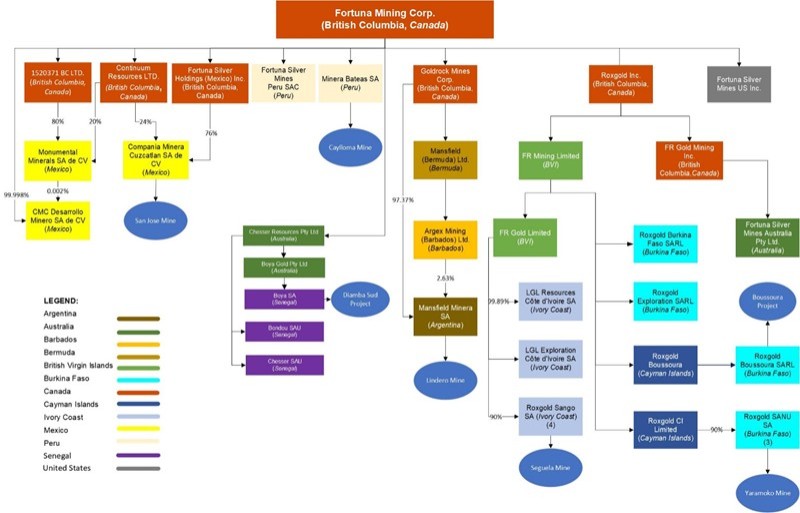
Notes:
1. |
In some jurisdictions where the Company operates, laws require that a company operating mineral properties must have more than one shareholder. For those jurisdictions, a nominal interest may be held by an individual or other affiliated entity and this may not be represented on the above chart. |
2. |
All ownership of subsidiaries is 100% unless otherwise indicated. |
3. |
10% of the issued and outstanding shares of Roxgold Sanu S.A. are held by the State of Burkina Faso |
4. |
10% of the issued and outstanding shares of Roxgold Sango S.A. are held by the State of Côte d’Ivoire. |
ANNUAL INFORMATION FORM |
Page | 8 |
FORTUNA MINING CORP.
GENERAL DEVELOPMENT OF THE BUSINESS
Business of the Company
Fortuna is engaged in precious and base metals mining and related activities in Latin America and West Africa, including exploration, extraction, and processing. The Company’s principal products are gold and silver, although it also produces and sells lead and zinc.
As at December 31, 2024, Fortuna:
| ● | operates the Lindero open pit gold mine (the “Lindero Mine”) (100% ownership) in northern Argentina; |
| ● | operates the Yaramoko underground gold mine (the “Yaramoko Mine”) (90% ownership) in southwestern Burkina Faso; |
| ● | operates the underground Caylloma silver, lead and zinc mine (the “Caylloma Mine”) (100% ownership) in southern Peru, and |
| ● | operates the Séguéla open pit gold mine (the “Séguéla Mine”) (90% ownership) in northwestern Côte d’Ivoire. |
Also as at December 31, 2024, Fortuna operated the underground San Jose silver and gold mine (the "San Jose Mine") in southern Mexico. Due to the pending exhaustion of its Mineral Reserves, the San Jose Mine was placed on care and maintenance prior to the year end, as it was scheduled to commence a progressive closure process in early 2025. See "2025 Recent Developments" herein.
The Company also has various Greenfields exploration properties at different stages of development in Côte d’Ivoire, Mexico, and Senegal.
Three-Year History and Recent Developments
Over the three most recently completed financial years, the significant events described below contributed to the development of the Company’s business.
2022 Developments
One of the Company’s main focuses for 2022 was the construction of the mine at Séguéla. Construction at the Séguéla Project advanced during 2022 in accordance with the project timeline and budget, despite worldwide supply chain challenges. The Séguéla Project was 29% complete at the end of 2021 and by the end of January 2023 it was approximately 90% complete.
On March 15, 2022, the Company announced a maiden inferred mineral resource estimate for the Sunbird discovery located at the Séguéla Project. It was estimated that the Sunbird deposit contains an inferred mineral resource of 3.4 million tonnes at an average grade of 3.16 g/t gold containing 350,000 gold ounces. The inferred mineral resource does not materially change the existing mineral resource estimate at Séguéla.
In April 2022, the Company disclosed its commitments towards the reduction of GHG emissions and the transition to a lower carbon economy under a formal Climate Change Position Statement.
On May 2, 2022, the Company initiated a share repurchase program to purchase up to 5% of its issued and outstanding Common Shares, expiring on the earlier of May 1, 2023 and the date on which Fortuna has acquired the maximum number of Common Shares allowable under the Normal Course Issuer Bid (“NCIB”) or the date on which the Company otherwise decides not to make any further repurchases under the NCIB. From the commencement of the share repurchase program to December 31, 2022, in accordance with the Company’s NCIB, the Company re-purchased an aggregate of 2,201,404 Common Shares at a weighted average price of $2.69 per share via open market purchases through the facilities of the New York Stock Exchange (“NYSE”) for a total repurchase value of approximately $5.9 million, all of which shares were subsequently returned to treasury and cancelled. No share
ANNUAL INFORMATION FORM |
Page | 9 |
FORTUNA MINING CORP.
repurchases under the NCIB were made in 2023. See “2024 Developments” regarding share repurchases made in 2024 under the NCIB.
Effective June 27, 2022, the Board of Directors of the Company (the “Board”) approved the appointment of Ms. Salma Seetaroo as an additional director of the Company. Ms. Seetaroo brings her skills and experience in commodities, financing, investment banking, and project development in West Africa. She has spent the last 17 years working on debt, equity, and special situations investments in Africa as an investment banker.
On August 17, 2022, the Company announced the voluntary resignation of Paul Criddle from the position of Chief Operating Officer – West Africa effective September 30, 2022. David Whittle, formerly the Vice-President Operations – West Africa, assumed the role of Chief Operating Officer – West Africa effective October 1, 2022.
On December 5, 2022, the Company announced that additional exploration drilling at the Sunbird deposit has resulted in an upgraded mineral resource estimate, including a maiden indicated mineral resource of 3.2 million tonnes at an average grade of 2.66 g/t gold containing 279,000 ounces and an inferred mineral resource of 4.2 million tonnes at an average grade of 3.73 g/t gold containing 506,000 ounces.
On December 15, 2022, the Company announced that it had entered into an amendment to the fourth amended and restated credit agreement (the “2021 Credit Facility”) with a syndicate of banks led by BNP Paribas and including the Bank of Nova Scotia, Bank of Montreal and Societe Generale, which increased the maximum facility amount by US$50 million to US$250 million, but which would step down to US$175 million in November 2024. The facility had a US$50 million accordion option exercisable on or after June 1, 2023 and before October 2024 The maturity date of the 2021 Credit Facility remained unchanged and matures in November 2025. The 2021 Credit Facility was further amended in 2023. See “2023 Developments” below for further details.
2023 Developments
Construction of the Séguéla Mine was completed in mid-2023, on time and on budget, and its first gold pour took place on May 24, 2023, making it the Company’s fifth operating mine.
In August 2023, the Company published (refer to Fortuna news release dated August 8, 2023) an update on exploration activities at the Yaramoko Mine. The Company had completed a drilling program of 29 holes for a total of 7,011 meters, testing the strike and vertical extent of high grade extensions to the Zone 55 mineralization to the west, and limited strike extent testing to the lower east levels of the underground operation.
Zone 55 drilling highlights:
| ● | YRM-22-GCDD-184: 9.6 g/t Au over an estimated true width of 5.5 meters from 254.10 meters |
| ● | YRM-23-GCDD-203: 32.8 g/t Au over an estimated true width of 3.1 meters from 287.90 meters |
| ● | YRM-23-GCDD-205: 13.2 g/t Au over an estimated true width of 4.6 meters from 302.28 meters |
| ● | YRM-23-GCDD-224: 8.9 g/t Au over an estimated true width of 8.2 meters from 120.95 meters |
| ● | YRM-23-GCDD-227: 8.8 g/t Au over an estimated true width of 8.6 meters from 140.10 meters |
Drilling to the west intersected new high grade mineralization beyond the boundary of the 2022 Mineral Resource at Yaramoko, with recent mine development extending approximately 130 meters beyond the previous design. Drilling continued in the second half of 2023 to test the depth potential.
Step-out drilling to the east and at depth also continued to identify the Zone 55 mineralized structure beyond the limits of the 2022 Mineral Resource boundary, with results including drill hole GCDD-224 returning 8.9 g/t Au over a true width of 8.2 meters. Drilling continued in the second half of 2023.
In September 2023, the Company expanded its presence in West Africa with the acquisition (the “Chesser Acquisition”) of all of the issued and outstanding common shares (“Chesser Shares”) of Chesser Resources Limited (“Chesser”) by way of a court-approved scheme of arrangement pursuant to the Australian Corporations Act 2001. Under the terms of the Chesser Acquisition, holders of Chesser Shares received 0.0248 of a Fortuna Common Share
ANNUAL INFORMATION FORM |
Page | 10 |
FORTUNA MINING CORP.
for each Chesser Share held. Upon completion of the Chesser Acquisition, Fortuna issued an aggregate of 15,545,368 Fortuna Common Shares and Chesser became a wholly-owned subsidiary of Fortuna. As a result of the Chesser Acquisition, the Company acquired the Diamba Sud gold exploration project (“Diamba Sud Project”) in Senegal, one of the new and emerging gold discoveries in the region. See “Non-Material Mineral Properties” herein.
In December 2023, the 2021 Credit Facility was further amended to include additional security to the lenders in the form of guarantees and share pledges from the Company’s subsidiaries which indirectly own the Diamba Sud Project in Senegal, acquired pursuant to the Chesser Acquisition. These guarantees are in addition to the guarantees already provided by Fortuna’s operating subsidiaries in Burkina Faso, Côte d’Ivoire, Mexico and Peru.
2024 Developments
The expansion of the leach pad at the Lindero Mine which began in 2024 was the Company’s largest capital expenditure project during the year, with the Company investing $38.7 million in the project in 2024. The leach pad was designed for approximately 93 million tonnes of ore when considering an average bulk density of 1.60 t/m3, and will cover approximately 106 hectares of lined surface. The leach pad is being constructed over three phases. The first phase which covers approximately 49 hectares is complete. Construction on Phase 2 began in 2024 and will increase the total surface by approximately 45 hectares to approximately 94 hectares. The mine started placing the first lift of ore on the new leach pad expansion area in the second half of October 2024. As at December 31, 2024, Phase 2 of the leach pad expansion project was approximately 89% complete, and the project will complete during the first half of 2025. Detailed engineering for Phase 3 of the leach pad which will cover 12 hectares is expected to start in the next two to three years.
On February 8, 2024, the Company announced its target to reduce Scope 1 and Scope 2 GHG emissions by 15% in 2030 compared to “business as usual” forecast GHG emissions if no intervention measures were taken.
In alignment with the Company’s commitment to reduce GHG emissions, in 2024 the Company began the construction of three significant projects:
| ● | a solar plant at the Lindero Mine. The project is expected to result in the development of a Photovoltaic plant and a battery energy storage system, which will be incorporated into the existing diesel generation plant forming a hybrid electric power generation plant. The plant will prioritize the generation of renewable electric energy. As at December 31, 2024, the construction of the solar plant was 44 percent completed, and it is expected to start production in the second half of 2025. |
| ● | the construction of a 6 mega watt photovoltaic solar plant at the Séguéla Mine to provide power during daylight hours and reduce consumption from the grid. The plant is intended to produce up to 30 percent of the mine’s energy requirements. The plant is expected to provide operational cost savings and contribute to the reduction of GHG emissions for the mine. As at December 31, 2024, the project was in the engineering stage and was 25 percent completed. It is expected that the solar plant will be commissioned in the fourth quarter of 2025. |
| ● | the construction of a new cyclone plant at Caylloma. The purpose of the plant is to separate fine and coarse tailings. Coarse tailings will be pumped to the top of the mine area, which will then be used to backfill underground mine workings. Fine tailings will be sent to a tailings storage facility for storage. The cyclone plant will save operational costs, improve safety during operations and reduce GHG emissions by avoiding the use of trucks to haul coarse tailings. The construction of the plant is nearing completion, and is expected to begin operations in the second quarter of 2025. |
On April 1, 2024, the Company exercised its right to acquire one-half of the 1.2% net smelter return royalty at the Séguéla Mine for $10.0 million Australian Dollars pursuant to a royalty agreement with Franco Nevada Corporation dated March 30, 2021.
ANNUAL INFORMATION FORM |
Page | 11 |
FORTUNA MINING CORP.
The Company renewed its NCIB on May 2, 2024 for a further 12-month period. During 2024, the Company repurchased an aggregate of 7,433,015 Common Shares at a weighted average price of $4.59 per share via open market purchases through the facilities of the NYSE for a total repurchase value of approximately $34.1 million, all of which shares were returned to treasury and cancelled.
On June 10, 2024, the Company announced the completion of an offering of 3.75% convertible senior notes (the “Notes”) which raised gross proceeds of $172.5 million (the “Offering”). The initial conversion rate for the Notes is 151.7220 Common Shares per $1,000 principal amount of Notes, equivalent to an initial conversion price of approximately $6.59 per Common Share. Refer to “Description of Capital Structure – Notes” herein.
Immediately prior to the closing of the Offering, the Company issued a notice of redemption in respect of its existing debentures (“Debentures”). As a result, $35.9 million of principal amount of the Debentures were converted into a total of 7,184,000 Common Shares at a conversion rate of $5.00 per Common Share, and the balance of $9.8 million of outstanding principal amount of Debentures were redeemed in cash. An aggregate of $0.4 million was also paid to the Debenture holders for accrued interest.
During 2024, the Company conducted extensive drill programs at the Séguéla Mine property in Côte d’Ivoire (refer to Fortuna news releases dated March 11, June 20, September 10 and December 16, 2024). A total of 163 holes totalling 26,787 meters were drilled at the Kingfisher prospect which remains open for most of the drilled 2-kilometer strike, with the deepest drilling only testing to approximately 250 metres below surface. Mineralization at Kingfisher demonstrates a clear association with the strongly deformed contact zone between a series of felsic intrusives, quartz veining, and host basaltic units. The change in strike orientation along the structure from north-south to north-east coincides with the higher grade, broader mineralization intervals. Mineralization is characterized by silica-biotite-sericite-carbonate alteration and pyrite development within and adjacent to the quartz veining. Two drill rigs will continue working into the second quarter of 2025 to support resource infill drilling for resource conversion as well as drilling for depth and strike extensions. See “2025 Recent Developments” below.
A total of 41 holes totalling 17,909 meters were drilled at the Sunbird prospect at Séguéla. The drill program is designed to infill and extend the current mineralized footprint as part of a program to evaluate underground mining potential, with mineralization remaining open more than 600 meters below surface, or more than 800 meters down plunge from the margin of the planned open pit. The most recent drill hole which stepped out 150 meters to the south of the reported drilling and for which assays are pending, reported more than 15 points of visible gold (VG) associated with extensive alteration and quartz veining over an interval of 28 meters. Drilling will continue into the first half of 2025 to support an updated resource model and underground mining studies. See “2025 Recent Developments” below.
During 2024, the Company completed 363 holes totalling 47,595 meters of drilling at the Diamba Sud Project in Senegal (refer to Fortuna news releases dated March 11, June 25 and September 12, 2024). The current exploration focus is to test and expand some of the previously lightly drilled anomalies, with Western Splay rapidly emerging as the next potential prospect. Encouraging results such as 6.9 g/t Au over an estimated true width of 33.3 meters from 115.4 meters in drill hole DSDD293, and 8.9 g/t Au over an estimated true width of 27.7 meters from 104 meters in drill hole DSR680 highlight the potential.
The focus of the recent program has been to expand the extent of the Western Splay and Kassasoko prospects, as well as testing the margins of the Bougouda and Karakara prospects. Recent results from Western Splay have highlighted the potential for this prospect to continue to grow as the mineralization remains open along strike and at depth.
A detailed review of the overall geological model to further advance the understanding of the mineralization controls was completed in July, improving the understanding of the relationships and linkages between the different prospects, including the nearby Moungoundi and Kassasoko prospects. This revised geological model has identified several additional targets for testing across the property. Results from this program will be incorporated into the ongoing project development work, with the encouraging results from Western Splay and Kassasoko expected to
ANNUAL INFORMATION FORM |
Page | 12 |
FORTUNA MINING CORP.
contribute toward growing the project portfolio and resource base, while also improving confidence in the regional geological understanding.
Effective October 31, 2024, the Company entered into a fifth amended and restated credit agreement (the “2024 Credit Facility”) which reduced its secured revolving credit facility, with a syndicate of banks led by The Bank of Nova Scotia, and including Bank of Montreal, ING Capital LLC and National Bank of Canada. The amended and restated facility agreement reduced the amount of the facility to US$150.0 million from US$250.0 million (the facility would have stepped down to US$175.0 million in November 2024), and increased the uncommitted accordion option from US$50.0 million to US$75.0 million. The 2024 Credit Facility has a term of four years. Lower interest rates across certain levels of the margin grid and lower commitment fees were negotiated under the 2024 Credit Facility. Interest accrues on USBR Loans at the applicable US base rate plus an applicable margin of between 1.25% and 2.25% across all levels of the margin grid, and on Benchmark Loans at the adjusted term SOFR rate for the applicable term plus the applicable margin of between 2.25% and 3.25% across all levels of the margin grid. Commitment fees decreased approximately 0.6% to 0.9% across the margin grid.
The Company’s principal operating subsidiaries in Argentina, Burkina Faso, Côte d’Ivoire and Peru, and their respective direct and indirect holding companies, have guaranteed the obligations of the Company under the 2024 Credit Facility. The Company has pledged all of its assets to secure the payment of its obligations under the amended and restated credit facility, and the Company’s principal operating subsidiary in Peru has pledged all of its respective assets to secure its guarantees. All of the shares in the Company’s principal operating subsidiaries in Burkina Faso, Côte d’Ivoire, Peru and Senegal have also been pledged to secure the obligations owing under the 2024 Credit Facility and the loan documents entered into in connection therewith. In addition, the Company’s principal operating subsidiary in Burkina Faso has also pledged its bank accounts to secure the obligations under its guarantee. All security granted by the Company’s operating subsidiary in Mexico and indirect holding companies under the previous credit facility agreement has been released.
In December 2024, the Company announced (refer to Fortuna news release dated December 10, 2024) updated Mineral Reserves and Mineral Resources at its Séguéla Mine with the discovery of over 500,000 gold ounces of new Inferred Resources. See “Updated Mineral Reserve and Mineral Resource Estimates” herein.
2025 Recent Developments
The San Jose Mine was placed on care and maintenance on December 24, 2024, as the Company decided to enter into a strategic process to divest of this non-core asset. On January 15, 2025, the Company announced that it had entered into a binding agreement with Minas del Balsas S.A. de C.V. (“MdB”), a private Mexican company, for the sale of the San Jose Mine. On March 6, 2025, the Company terminated the sale agreement with MdB and is now continuing with the sale process to divest the asset.
In December 2021, Fortuna’s Mexican subsidiary, Companía Minera Cuzcatlan (“Minera Cuzcatlan”) received a 12-year extension to the term of the environmental impact authorization (“EIA”) for the San Jose Mine. Since that time, Minera Cuzcatlan has been involved in various legal proceedings brought by Secretaria de Medio Ambiente y Recursos Naturales (“SEMARNAT”) which have challenged the extension of the EIA. On February 21, 2025, the SEMARNAT appeals were dismissed by the Mexican Collegiate Court and the extension of the EIA has been confirmed.
In March 2025, the Company announced results of recent exploration drilling at the Séguéla Mine property in Côte d’Ivoire (refer to Fortuna news release dated March 13, 2025). At the Kingfisher deposit, drilling has moved to infilling and improving the resource confidence along the 1-kilometer strike length of the current resource pit, with several notable intersections including 7.2 g/t Au over an estimated true width of 31.5 meters in drill hole SGRC2278.
An additional 100 drill holes, totaling 10,978 meters of a planned 28,000-meter drilling program, have been completed at Kingfisher as part of the resource confidence infill program. Drilling remains ongoing across the current pit-constrained Inferred Resource and will also extend to test the immediate margins, both at depth and along strike, where late 2024 drilling identified several promising intervals intersected after the initial resource estimate was
ANNUAL INFORMATION FORM |
Page | 13 |
FORTUNA MINING CORP.
completed (refer to Fortuna’s news release dated December 16, 2024). The recent drilling at Kingfisher has continued to highlight the widths and grade tenor intersected in the first drilling phase, supporting and refining the geological interpretation. Kingfisher remains open at depth for most of the drilled 2-kilometer strike length, with the deepest drilling testing to only approximately 250 meters below surface.
At the Sunbird deposit, drilling has now extended mineralization approximately 700 meters to the south beyond the limit of the current underground Inferred Resource and some 600 meters below surface. Results from a further 10 holes, totaling 5,120 meters of a planned 12,000-meter drilling program have been received, including an interval of 4.3 g/t Au over a true width of 23.1 meters from 733 meters in drill hole SGRD2215, which is the deepest intersection drilled at Séguéla. The last phase of the current program is intended to step out above and below the current intersection to further refine the geometry and controls on the interpreted mineralized shoot during the second quarter of 2025.
On January 10, 2025, the Government of Côte d’Ivoire revised a portion of the Côte d’Ivoire Mining Code and increased the gold price sliding scale royalty payable to the State by two percent. The royalty now ranges from between 5 percent and 8 percent, depending on the price of gold, and is calculated on the gross revenue from gold produced after deduction of transportation and refining costs.
In July of 2024, the Government of Burkina Faso published a new mining code (the “2024 Burkina Faso Mining Code”) and related local content law in the Official Journal which, among other changes from the prior mining code, provides for an increased interest of the State in the share capital of mining companies from 10 percent to 15 percent and the opening up of mining companies’ share capital to local investors. However, the 2024 Burkina Faso Mining Code provides that existing mining permits and the associated mining conventions remain in force for their current term (not to exceed five years) and continue to be governed by the laws and regulations (including the then version of the mining code) which were in force at the time of their issuance or entry. Notwithstanding the foregoing, the Government has invited existing mining companies to implement the provisions of the 2024 Burkina Faso Mining Code related to the increase in the State’s free carried interest. The Company has agreed to an increase in the State's ownership interest in Roxgold Sanu from 10 percent to 15 percent which is to take effect in 2025. The timing for the implementation of the increase is to be determined.
Subsequent to December 31, 2024 and up to the date of this AIF, in accordance with the Company’s NCIB the Company repurchased an aggregate of 916,900 Common Shares at a weighted average price of $4.54 per share via open market purchases through the facilities of the NYSE for a total repurchase cost of approximately $4.16 million, all of which shares were returned to treasury and cancelled.
Production and Costs From 2022 to 2024
The following table discloses the production and costs of production at each of the Company’s operating mines for fiscal 2022 to 2024 and on a consolidated basis.
|
2024 |
2023 |
2022 |
Lindero, Argentina | |||
Ore placed on pad (t) |
6,367,505 |
6,005,049 |
5,498,064 |
Gold production (oz)1 |
97,287 |
101,238 |
118,418 |
Gold grade (g/t) |
0.62 |
0.64 |
0.81 |
Cash Cost ($/oz Au)5 |
1,051 |
920 |
739 |
AISC ($/oz Au) 5, 6 |
1,793 |
1,444 |
1,140 |
Yaramoko, Burkina Faso | |||
Tonnes milled |
454,969 |
531,578 |
546,651 |
Gold production (oz)2 |
116,206 |
117,711 |
106,108 |
Gold grade (g/t) |
8.21 |
6.81 |
6.37 |
Gold recovery (%) |
98.12 |
98.0 |
97.5 |
Cash Cost ($/oz Au) 5 |
860 |
809 |
840 |
AISC ($/oz Au) 5 |
1,359 |
1,499 |
1,529 |
ANNUAL INFORMATION FORM |
Page | 14 |
FORTUNA MINING CORP.
Séguéla, Côte d’Ivoire4 | |||
Tonnes milled |
1,561,800 |
807,617 |
- |
Gold production (oz)2 |
137,781 |
78,617 |
- |
Gold grade (g/t) |
2.95 |
3.42 |
- |
Gold recovery (%) |
93.0 |
93.9 |
- |
Cash Cost ($/oz Au) 5 |
584 |
357 |
- |
AISC ($/oz Au) 5 |
1,153 |
760 |
- |
San Jose, Mexico | |||
Tonnes milled |
735,591 |
930,200 |
1,029,590 |
Silver production (oz) |
2,548,402 |
4,656,631 |
5,672,563 |
Silver grade (g/t) |
125 |
171 |
191 |
Silver recovery (%) |
86.07 |
90.96 |
91.4 |
Gold production (oz) |
17,811 |
28,559 |
34,124 |
Gold grade (g/t) |
0.89 |
1.06 |
1.14 |
Gold recovery (%) |
84.76 |
90.18 |
90.4 |
Cash Cost ($/oz Ag Eq) 5 |
25.257 |
14.288 |
10.569 |
AISC ($/oz Ag Eq) 5 |
28.227 |
19.408 |
15.119 |
Caylloma, Peru | |||
Tonnes milled |
551,430 |
543,876 |
546,186 |
Gold production (oz) |
552 |
513 |
777 |
Silver production (oz)3 |
1,176,543 |
1,227,060 |
1,144,714 |
Silver grade (g/t) |
80 |
85 |
80 |
Silver recovery (%) |
83.29 |
82.57 |
81.3 |
Lead production (lbs) |
39,555,339 |
40,851,657 |
34,588,324 |
Lead grade (%) |
3.57 |
3.74 |
3.27 |
Lead recovery (%) |
91.07 |
91.14 |
87.8 |
Zinc production (lbs) |
51,905,635 |
55,060,450 |
46,175,821 |
Zinc grade (%) |
4.71 |
5.11 |
4.32 |
Zinc recovery (%) |
90.61 |
89.83 |
88.8 |
Cash Cost ($/oz Ag Eq) 5 |
14.127 |
13.918 |
12.349 |
AISC ($/oz Ag Eq) 5 |
21.727 |
19.908 |
17.979 |
Consolidated Total | |||
Gold production (oz) |
369,637 |
326,638 |
259,427 |
Silver production (oz) |
3,724,945 |
5,883,691 |
6,907,275 |
Lead production (lbs) |
39,555,339 |
40,851,657 |
34,588,324 |
Zinc production (lbs) |
51,905,635 |
55,060,450 |
46,175,821 |
Cash Cost ($/oz Au Eq) 5 |
98710 |
87411 |
84912 |
AISC ($/oz Au Eq) 5, 6 |
1,64010 |
1,48011 |
1,43112 |
Revenue ($ millions) |
1,062.0 |
842.4 |
681.5 |
Notes:
1. |
Gold production includes doré, gold in carbon, and gold in copper concentrate. |
2. |
Gold production includes doré only. |
3. |
Metallurgical recovery for silver is calculated based on silver content in lead concentrate. |
4. |
Séguéla began commercial production on July 1, 2023. |
5. |
Cash Cost and all-in sustaining cost (AISC) are non-IFRS financial measures which are not standardized financial measures under the financial reporting framework used to prepare the financial statements of the Company and might not be comparable to similar financial measures disclosed by other issuers. Refer to “Non-IFRS Financial Measures” incorporated by reference from the 2024 MD&A. |
6. |
The composition of consolidated AISC and AISC for Lindero was revised in Q4 2024 and the comparative periods have been adjusted to reflect the change. Refer to "Non-IFRS Financial Measures - All-in Sustaining Cost Per Gold Equivalent Ounce Sold" incorporated by reference from the 2024 MD&A. |
ANNUAL INFORMATION FORM |
Page | 15 |
FORTUNA MINING CORP.
7. |
Silver equivalent sold for Year 2024 for San Jose is calculated using a silver to gold ratio of 84.9:1. Silver equivalent sold for Year 2024 for Caylloma is calculated using a silver to gold ratio of 80.1:1, silver to lead ratio of 1:29.7 pounds, and silver to zinc ratio of 1:22.1 pounds. Silver equivalent is calculated using the realized prices for gold, silver, lead, and zinc. |
8. |
Silver equivalent sold for year 2023 for San Jose is calculated using a silver to gold ratio of 83.1:1. Silver equivalent sold for year 2023 for Caylloma is calculated using a silver to gold ratio of 81.4:1, silver to lead ratio of 1:23.9 pounds, and silver to zinc ratio of 1:19.0 pounds. Silver equivalent is calculated using the realized prices for gold, silver, lead, and zinc. |
9. |
Silver equivalent sold for YTD 2022 for San Jose is calculated using a silver to gold ratio of 82.9:1. Silver equivalent sold for YTD 2022 for Caylloma is calculated using a silver to gold ratio of 85.5:1, silver to lead ratio of 1:22.9 pounds, and silver to zinc ratio of 1:13.9 pounds. |
10. |
Gold equivalent for year 2024 was calculated using the realized prices for gold of $2,401/oz Au, $28.0/oz Ag, $2,072/t Pb, and $2,786/t Zn for Year 2024. |
11. |
Gold equivalent year 2023 was calculated using the realized prices for gold of $1,948/oz Au, $23.4/oz Ag, $2,155/t Pb, and $2,706/t Zn for YTD 2023. |
12. |
Gold equivalent year 2022 was calculated using the realized prices for gold of $1,802/oz Au, $21.8/oz Ag, $2,161/t Pb, and $3,468/t Zn for YTD 2022. |
Outlook for 2025
2025 Consolidated Production and Cost Guidance
Production guidance for 2025 is lower than 2024, due to the exhaustion of Mineral Reserves at San Jose and the placing of the mine on care and maintenance pending closing of the mine, and the impact resulting from a higher silver price relative to zinc and lead in the calculation of silver equivalent production at the Caylloma Mine.
Cash cost and AISC are guided to be in line with 2024, despite increases in the stripping ratio for both the Lindero and Séguéla mines, which for Lindero is anticipated to peak in 2025 and for Séguéla in 2026. This is expected to be offset by lower capex at both the Lindero and Yaramoko mines. Lindero’s capital investments in equipment and infrastructure are expected to decrease by approximately 67%, while capital expenditures at Yaramoko are expected to decrease by approximately 60%.
The Company is also capitalizing on various productivity and cost efficiency initiatives in 2025. Several of the main projects already reflected in our AISC projections amount to $16 million in incremental cash flow (pre-tax) at Lindero, and the optimization of the Séguéla processing facility to treat 1.7 million tonnes per year.
In addition, the Company is providing 2-year guidance for the Séguéla Mine to reflect the significant improvement in gold production and AISC expected for 2026 at our flagship asset.
2025 consolidated production and cost guidance table
Mine |
Silver (Moz) |
Gold (koz) |
Lead (Mlbs) |
Zinc (Mlbs) |
Cash Cost1,2,3,5 |
AISC1,2,3,5 |
Silver |
($/oz Ag Eq) |
($/oz Ag Eq) |
||||
Caylloma, Peru |
0.9 - 1.0 |
- |
29 - 32 |
45 - 49 |
15.0 – 16.6 |
21.7 – 24.7 |
Gold |
($/oz Au) |
($/oz Au) |
||||
Lindero, Argentina4 |
- |
93 - 105 |
- |
- |
1,060 – 1,235 |
1,600 - 1,770 |
Yaramoko, Burkina Faso |
- |
107 - 121 |
- |
- |
880 – 1,000 |
1,165 - 1,320 |
Séguéla, Côte d´Ivoire |
- |
134 - 147 |
- |
- |
680 - 750 |
1,500 - 1,600 |
Consolidated Total |
0.9 - 1.0 |
334 - 373 |
29 - 32 |
45 - 49 |
$895 - 1,0156 |
$1,550 - 1,6806 |
Notes:
1. |
Cash Cost and all-in sustaining cost (AISC) are non-IFRS financial measures which are not standardized financial measures under the financial reporting framework used to prepare the financial statements of the Company and might not be comparable to similar financial measures disclosed by other issuers. Refer to the note under “Non-IFRS Financial Measures” below. |
2. |
Cash cost includes production cash cost and for Lindero, is net of copper by-product credit. AISC includes sustaining capital expenditures, worker’s participation (as applicable) commercial and government royalties mining tax, export duties (as applicable), subsidiary G&A and |
ANNUAL INFORMATION FORM |
Page | 16 |
FORTUNA MINING CORP.
Brownfields exploration and is estimated at metal prices of $2,500/oz Au, $30.0/oz Ag, $2,100/t Pb, and $2,700/t Zn. AISC excludes government mining royalty recognized as income tax within the scope of IAS-12.
3. |
Silver equivalent is calculated at metal prices of $2,500/oz Au, $30.0/oz Ag, $2,100/t Pb and $2,700/t Zn. The guidance assumes an exchange rate of 0.89 USD/EUR. For Argentina, it assumes an annual inflation rate of 29% and an annual devaluation of 18%. |
4. |
The cost guidance for the Lindero Mine does not take into account potential changes by the new Argentine Government to national macroeconomic policies, the taxation system and import and export duties which, if implemented, may have a material impact on costs. |
5. |
Historical non-IFRS measure cost comparatives: The following table provides the historical cash costs and historical AISC for the Company’s five mines which were operating during the year ended December 31, 2024, as follows: |
Mine |
Cash Cost a,b,c |
AISC a,b,c |
Silver |
($/oz Ag Eq) |
($/oz Ag Eq) |
San Jose, Mexico |
25.25 |
28.22 |
Caylloma, Peru |
14.12 |
21.72 |
Consolidated |
19.31 |
19.62 |
Gold |
($/oz Au) |
($/oz Au) |
Lindero, Argentina |
1,051 |
1,793 |
Yaramoko, Burkina Faso |
860 |
1,359 |
Séguéla, Côte d´Ivoire |
584 |
1,153 |
Consolidated |
987 |
1,640 |
(a) |
Cash cost and AISC are non-IFRS financial measures |
(b) |
Silver equivalent was calculated using the realized prices for gold, silver, lead, and zinc. Refer to Financial Results - Sales and Realized Prices in the 2024 MD&A |
(c) |
Further details on the cash costs and AISC can be found under "Non-IFRS Financial Measures” in the 2024 MD&A. |
(d) |
The composition of AISC was revised in Q4 2024. Refer to “Non-IFRS Financial Measures – All-in Sustaining Cost Per Gold Equivalent Ounce Sold” in the 2024 MD&A for a description of the calculation and the reason for the change. |
2025 Guidance Outlook
Séguéla Mine, Côte d’Ivoire
Optimizing Séguéla’s potential through 2026 and beyond
The Company is providing 2-year guidance for the Séguéla Mine to reflect the significant improvement in gold production and AISC planned for 2026.
Cash cost ($/oz Au) 1 |
680 - 750 |
720 - 790 |
Note:
1. |
Cash Cost and all-in sustaining cost (AISC) are non-IFRS financial measures which are not standardized financial measures under the financial reporting framework used to prepare the financial statements of the Company and might not be comparable to similar financial measures disclosed by other issuers. Refer to the note under “Non-IFRS Financial Measures” above. |
2025 Outlook
Séguéla’s mine plan considers mining the Antenna, Ancien, and Koula pits, with plans to process 1.70 million tonnes of ore averaging 2.8 g/t Au, and capital investments estimated at $91 million, including $67 million for sustaining capital expenditures and $13.5 million for Brownfields exploration programs.
1 Cash cost per ounce and AISC per ounce are non-IFRS measures. Refer to “Notice Regarding Non-IFRS Measures” section above.
2 Refer to footnote 1 above.
ANNUAL INFORMATION FORM |
Page | 17 |
FORTUNA MINING CORP.
Major sustaining capital investments include:
Capitalized stripping |
$47 million |
Tailings storage facility (TSF) lift |
$6 million |
Other equipment and infrastructure |
$14 million |
Cash cost and AISC 3:
Cash cost is expected to be between $680 and $750 per ounce of gold. This represents an increase over 2024 mainly due to higher waste movement as the mine’s stripping ratio rises from 5.7:1 to 14.6:1, in accordance with the mine plan and life of mine average of 13.8:1.
AISC is expected to be between $1,500 and $1,600 per ounce of gold, reflecting higher cash cost over 2024 as described above, higher capitalized stripping and an increase in government royalties of 2% enacted in January 2025.
2026 Outlook
Séguéla’s mine plan considers a production range of between 160,000 and 180,000 ounces, mining in the Antenna, Ancien, Koula, and Sunbird pits, with plans to process 1.70 million tonnes of ore. Processed gold average head grade is expected to increase 18% to 3.3 g/t Au in 2026. The stripping ratio is planned to peak at 17:1. Capital investments are estimated at $48 million, including $38 million for sustaining capital expenditures and $10 million for Brownfields exploration programs.
Major sustaining capital investments include:
Capitalized stripping |
$31 million |
Equipment and infrastructure |
$7 million |
AISC 4:
AISC is expected to be between $1,260 and $1,390 per ounce of gold. The improvement in AISC over 2025 is anticipated to be driven by the 18% higher grade referenced above and corresponding higher gold production, and lower projected capital expenditures in equipment and infrastructure.
Yaramoko Mine, Burkina Faso
Continued strong gold production
The Yaramoko Mine is scheduled to process 481,000 tonnes of ore averaging 7.7 g/t Au. Capital investment decreases substantially compared to previous years due to the completion of development operations at the 55 Zone.
Total sustaining capital expenditure is expected to be $2.5 million, predominantly comprising of the final TSF lift and land compensation. Due to the limited life of mine at Yaramoko, all sustaining capital expenditure has been included in opex costs. Yaramoko has been operating with a short life of mineral reserves for the last three years, and through successful exploration and mine development has been able to expand its mine life year-over-year. Currently, the life of mine is scheduled to end in 2026.
3 Refer to footnote 1 above.
4 Refer to footnote 1 above.
ANNUAL INFORMATION FORM |
Page | 18 |
FORTUNA MINING CORP.
Cash cost and AISC 5:
Cash cost is expected to be between $880 and $1,000 per ounce of gold.
AISC is expected to improve in 2025 to between $1,165 and $1,320 per ounce of gold, as a result of 60% lower capex year over year.
Lindero Mine, Argentina
Capitalizing on optimization initiatives
The Lindero Mine is expected to place 7.2 million tonnes of ore on the leach pad averaging 0.58 g/t Au, containing an estimated 133,776 ounces of gold. Capital investments are estimated at $42.9 million, including $17.4 million in capital projects, $3.4 million in Brownfields exploration and $22.1 million in capitalized stripping costs. The stripping ratio is expected to increase from 1.1 in 2024 to 2.2 in 2025; the peak in the life of mine strip ratio.
Major sustaining capital investments include:
Capitalized stripping |
$22.1 million |
Completion of leach pad expansion project |
$6.0 million |
Heavy equipment replacement and overhaul |
$2.5 million |
Plant and mine critical spare parts |
$4.0 million |
Cash cost and AISC 6:
Cash cost is expected to increase in 2025 to between $1,060 and $1,235 per ounce of gold, reflecting a higher stripping ratio, the appreciation of the Argentine peso, and lower head grade compared to 2024.
AISC is expected to improve in 2025 to between $1,600 and $1,770 per ounce of gold, reflecting lower capital investments in equipment and infrastructure of 67% compared to 2024, partially offset by the increase in the cash cost described above. The Company plans to close final leach pad project activities and demobilize contractors in the first quarter of 2025 leading to a higher AISC in the first quarter compared to the average for the year. The Company anticipates the AISC to progressively decrease in the subsequent quarters of the year, aligned with guidance.
Caylloma Mine, Peru
Track record of solid performance
The Caylloma Mine is scheduled to process 0.55 million tonnes of ore averaging 64 g/t Ag, 2.8% Pb, and 4.4% Zn. Capital investments are estimated at $20.3 million, including $14.6 million for sustaining capital and $4.8 million for Brownfields exploration programs.
Sustaining capital investments include:
Mine development and infill |
$5.2 million |
Equipment acquisition and energy |
$3.7 million |
Operating permits and tailings management |
$1.3 million |
5 Refer to footnote 1 above.
6 Refer to footnote 1 above.
ANNUAL INFORMATION FORM |
Page | 19 |
FORTUNA MINING CORP.
Cash cost and AISC 7:
Cash cost is expected to be between $15.0 and $16.6 per ounce of silver equivalent. AISC is expected to be between $21.7 and $24.7 per ounce of silver equivalent. This represents an increase over 2024 explained by the impact of relative metal prices on silver equivalent production. Higher metal prices for silver relative to zinc and lead, result in lower silver equivalent production. The effect of relative prices used for 2025 guidance, compared to metal prices used in 2024 guidance, represents an estimated impact on AISC of approximately $4 per ounce.
2025 Exploration Outlook
The Company has a total mineral exploration budget of $41.0 million for 2025, compared to an estimated $44.0 million invested in 2024. Brownfields represents 53%, and Greenfields initiatives, including $8.3 million for Diamba Sud, represents 47% of this year’s budget.
Brownfields Exploration
Fortuna’s consolidated Brownfields exploration budget for 2025 totals $21.6 million, which includes 84,000 meters of reverse circulation, diamond core, and air core exploration drilling. The larger portion of the planned drilling is reserved for high value opportunities at the Séguéla Mine.
Séguéla Mine, Côte d’Ivoire: The Brownfields exploration program budget for 2025 at Séguéla is $13.5 million, which includes 73,000 meters of exploration drilling, supporting resource upgrade drilling primarily at the Sunbird underground project, and infill and expansion of the Kingfisher deposit, along with continued target generation.
Lindero Mine, Argentina: The Brownfields exploration budget for 2025 at Lindero is $3.4 million, which includes 5,000 meters of exploration drilling at Arizaro, following up on recent reinterpretations driven by additional geochemical sampling, and alteration mapping completed in 2024.
Caylloma Mine, Peru: The Brownfields exploration program budget for 2025 at Caylloma is $4.8 million which includes $2.2 million for 9,000 meters of resource extension drilling, in addition to $2.6 million for 1,600 meters of drill testing regional targets.
Yaramoko Mine, Burkina Faso: The Brownfields exploration program budget for 2025 at Yaramoko is $0.2 million, reflecting reduced exploration activities. However, the Company will continue to pursue opportunities for extensions of mineralization through underground development in the deeper levels of the 55 Zone and the QVP deposits.
Greenfields Exploration
Greenfields exploration will continue in Mexico, Côte d'Ivoire and Senegal advancing generative programs across several projects supported by a budget of $19.3 million, including continued active corporate development.
Mexico: Exploration activities in Mexico will focus on project generation and target testing across several emerging projects, with a total of $4.9 million budgeted, which includes 8,000 meters of planned drilling.
Côte d’Ivoire: The exploration budget for Côte d’Ivoire is $3.6 million, the majority of which will be spent on advancing exploration activities at Tongon North with 12,000 meters of drilling planned, as well as $1.2 million for early-stage target generation at the Guiglo project.
7 Refer to footnote 1 above.
ANNUAL INFORMATION FORM |
Page | 20 |
FORTUNA MINING CORP.
Senegal: The Greenfields exploration budget for Senegal is $10.5 million, including $8.3 million at the Diamba Sud Project, which includes 35,000 meters of drilling for continuing target generation and testing as well as further resource infill and extension drilling. A budget of $2.1 million will be used to support exploration at the Bondala and Morichou projects.
Updated Mineral Reserve and Mineral Resource Estimates
A summary of the current Mineral Reserve and Mineral Resource estimates for the Company’s four operating mines in West Africa and the Americas, as well as the Arizaro Project located at the Lindero Mine in, Argentina, the Diamba Sud Project in Senegal and the San Jose Mine in Mexico as at December 31, 2024 is as follows:
Highlights of Mineral Reserve and Mineral Resource Update
| • | Consolidated Inferred Mineral Resources are reported containing 2.2 M gold equivalent ounces (“GEOs”) representing a year-over-year increase of 29 percent. |
| • | Consolidated Measured and Indicated Resources exclusive of Mineral Reserves are reported containing 1.5 M GEOs representing a year-over-year increase of 34 percent. |
| • | Primary drivers for the net increase in Mineral Resources are the result of infill drilling and the discovery of new Inferred Resources representing 741,000 GEOs, offset by the upgrading of resources to reserves. |
| • | Consolidated Proven and Probable Mineral Reserves are reported containing 2.7 M gold GEOs representing a year-over-year decrease of 11 percent. |
| • | Primary driver for changes in Mineral Reserves is production related depletion in 2024 of 526,000 GEOs offset by the upgrading of resources to reserves representing 204,000 GEOs. |
2024 Mineral Reserves and Mineral Resources
Mineral Reserves - Proven and Probable |
Contained Metal |
|||||||
Property |
Classification |
Tonnes (000) |
Ag (g/t) |
Au (g/t) |
Pb (%) |
Zn (%) |
GEOs (000) |
|
|
Gold Mines |
Séguéla, Côte d’Ivoire |
Proven |
914 |
N/A |
1.52 |
N/A |
N/A |
45 |
Probable |
8,837 |
N/A |
3.58 |
N/A |
N/A |
1,016 |
||
Proven + Probable |
9,751 |
N/A |
3.38 |
N/A |
N/A |
1,061 |
||
Yaramoko, Burkina Faso |
Proven |
30 |
N/A |
4.23 |
N/A |
N/A |
4 |
|
Probable |
597 |
N/A |
7.65 |
N/A |
N/A |
147 |
||
Proven + Probable |
627 |
N/A |
7.49 |
N/A |
N/A |
151 |
||
Lindero, Argentina |
Proven |
23,276 |
N/A |
0.56 |
N/A |
N/A |
420 |
|
Probable |
45,897 |
N/A |
0.53 |
N/A |
N/A |
786 |
||
Proven + Probable |
69,174 |
N/A |
0.54 |
N/A |
N/A |
1,206 |
||
Total |
Proven + Probable |
79,552 |
N/A |
0.95 |
N/A |
N/A |
2,417 |
|
|
Silver Mine |
Caylloma, Peru |
Proven |
34 |
201 |
0.67 |
2.51 |
2.98 |
6 |
Probable |
2,407 |
81 |
0.14 |
2.73 |
4.16 |
301 |
||
Proven + Probable |
2,441 |
82 |
0.15 |
2.73 |
4.15 |
307 |
||
Total |
Proven + Probable |
2,441 |
82 |
0.15 |
2.73 |
4.15 |
307 |
|
Total |
Proven + Probable |
2,724 |
||||||
ANNUAL INFORMATION FORM |
Page | 21 |
FORTUNA MINING CORP.
Mineral Resources – Measured and Indicated |
Contained Metal |
|||||||
Property |
Classification |
Tonnes (000) |
Ag (g/t) |
Au (g/t) |
Pb (%) |
Zn (%) |
GEOs (000) |
|
|
Gold Mines |
Séguéla, Côte d’Ivoire |
Measured |
0 |
N/A |
- |
N/A |
N/A |
0 |
Indicated |
3,438 |
N/A |
3.59 |
N/A |
N/A |
396 |
||
Measured + Indicated |
3,438 |
N/A |
3.59 |
N/A |
N/A |
396 |
||
Yaramoko, Burkina Faso |
Measured |
17 |
N/A |
12.48 |
N/A |
N/A |
7 |
|
Indicated |
245 |
N/A |
4.47 |
N/A |
N/A |
35 |
||
Measured + Indicated |
261 |
N/A |
4.98 |
N/A |
N/A |
42 |
||
Lindero, Argentina |
Measured |
1,735 |
N/A |
0.52 |
N/A |
N/A |
29 |
|
Indicated |
28,989 |
N/A |
0.42 |
N/A |
N/A |
392 |
||
Measured + Indicated |
30,724 |
N/A |
0.43 |
N/A |
N/A |
421 |
||
Total |
Measured + Indicated |
34,423 |
N/A |
0.78 |
N/A |
N/A |
859 |
|
|
Silver Mines |
Caylloma, Peru |
Measured |
234 |
95 |
0.27 |
1.47 |
2.52 |
23 |
Indicated |
766 |
84 |
0.19 |
1.27 |
2.34 |
66 |
||
Measured + Indicated |
1,000 |
86 |
0.21 |
1.31 |
2.38 |
89 |
||
San Jose, Mexico |
Measured |
60 |
160 |
1.39 |
N/A |
N/A |
6 |
|
Indicated |
941 |
158 |
1.16 |
N/A |
N/A |
94 |
||
Measured + Indicated |
1,001 |
158 |
1.17 |
N/A |
N/A |
100 |
||
Total |
Measured + Indicated |
2,001 |
122 |
0.69 |
N/A |
N/A |
189 |
|
|
Gold Project |
Diamba Sud, Senegal |
Measured |
0 |
N/A |
- |
N/A |
N/A |
0 |
Indicated |
7,751 |
N/A |
1.90 |
N/A |
N/A |
473 |
||
Measured + Indicated |
7,751 |
N/A |
1.90 |
N/A |
N/A |
473 |
||
Total |
Measured + Indicated |
7,751 |
N/A |
1.90 |
N/A |
N/A |
473 |
|
Total |
Measured + Indicated |
1,541 |
||||||
Mineral Resources – Inferred |
Contained Metal |
|||||||
Property |
Classification |
Tonnes (000) |
Ag (g/t) |
Au (g/t) |
Pb (%) |
Zn (%) |
GEOs (000) |
|
|
Gold Mines |
Séguéla, Côte d’Ivoire |
Inferred |
6,765 |
N/A |
2.84 |
N/A |
N/A |
618 |
Yaramoko, Burkina Faso |
Inferred |
141 |
N/A |
5.83 |
N/A |
N/A |
26 |
|
Lindero, Argentina |
Inferred |
30,364 |
N/A |
0.46 |
N/A |
N/A |
449 |
|
Total |
Inferred |
37,270 |
N/A |
0.91 |
N/A |
N/A |
1,094 |
|
|
Silver Mines |
Caylloma, Peru |
Inferred |
3,794 |
106 |
0.55 |
2.13 |
3.10 |
480 |
San Jose, Mexico |
Inferred |
1,025 |
164 |
1.24 |
N/A |
N/A |
107 |
|
Total |
Inferred |
4,819 |
118 |
0.70 |
N/A |
N/A |
587 |
|
|
Gold Projects |
Arizaro, Argentina |
Inferred |
32,400 |
N/A |
0.37 |
N/A |
N/A |
389 |
Diamba Sud, Senegal |
Inferred |
3,133 |
N/A |
1.47 |
N/A |
N/A |
148 |
|
Total |
Inferred |
35,533 |
N/A |
0.47 |
N/A |
N/A |
537 |
|
Total |
Inferred |
2,218 |
||||||
Notes:
1. |
Mineral Reserves and Mineral Resources are as defined by the 2014 CIM Definition Standards for Mineral Resources and Mineral Reserves. |
2. |
Mineral Resources are exclusive of Mineral Reserves. |
3. |
Mineral Resources that are not Mineral Reserves do not have demonstrated economic viability. |
4. |
Factors that could materially affect the reported Mineral Resources or Mineral Reserves include changes in metal price and exchange rate assumptions; changes in local interpretations of mineralization; changes to assumed metallurgical recoveries, mining dilution and recovery; and assumptions as to the continued ability to access the site, extend and/or retain mineral and surface rights titles and permits, maintain environmental and other regulatory permits, and maintain the social license to operate. |
5. |
Mineral Resources and Mineral Reserves are reported as of December 31, 2024. |
ANNUAL INFORMATION FORM |
Page | 22 |
FORTUNA MINING CORP.
6. |
Mineral Resources for the San Jose Mine are reported within underground mineable shapes using an estimated NSR cut-off grade of 153 g/t Ag Eq based on assumed metal prices of US$27.50/oz Ag and US$2,300/oz Au; estimated metallurgical recovery rates of 89% for Ag and Au and average mining costs of US$56.44/t; processing costs of US$22.79/t; and other costs including distribution, administrative and general service costs of US$25.83/t based on actual operating costs in 2024. |
7. |
Mineral Reserves for the Caylloma Mine are reported above NSR breakeven cut-off values based on underground mining methods including; mechanized (breasting) at $91.85/t; mechanized (uppers) at $73.33/t; semi-mechanized at $93.05/t; sub-level stoping at $82.77/t; and a conventional method at $153.40/t; using assumed metal prices of $23/oz Ag, $1,880/oz Au, $2,000/t Pb and $2,700/t Zn; metallurgical recovery rates of 82 or 86 % for Ag, 22 or 58 % for Au, 90 or 88 % for Pb and 89 or 87 % for Zn. Mining, processing and administrative costs used to determine NSR cut-off values were estimated based on actual operating costs incurred from July 2023 through June 2024. Mining recovery is estimated to average 95 % with average total mining dilution of 17 % depending on the mining method. Mineral Resources are reported at an NSR cut-off grade of $75/t for veins classified as wide (Animas, Animas NE, Nancy, San Cristobal) and $130/t for veins classified as narrow (all other veins) based on the same parameters used for Mineral Reserves, and a 15 % upside in metal prices. |
8. |
Mineral Reserves for the Lindero Mine are reported based on open pit mining within a designed pit shell based on variable gold cut-off grades and gold recoveries by metallurgical type: Met type 1 cut-off 0.26 g/t Au, recovery 75.4 %; Met type 2 cut-off 0.25 g/t Au, recovery 78.2 %; Met type 3 cut-off 0.25 g/t Au, recovery 78.5 %; and Met type 4 cut-off 0.29 g/t Au, recovery 68.5 %. Mining recovery is estimated to average 100 % and mining dilution 0 % having been accounted for during block regularization to 10m x 10m x 8m size. The cut-off grades and pit designs are considered appropriate for long term gold prices of $1,880/oz, estimated base mining costs of $1.39 per tonne of material, total processing and G&A costs of $10.28 per tonne of ore, and refinery costs net of pay factor of $13.44 per ounce gold. Reported Proven Reserves include 9.9 Mt averaging 0.41 g/t Au of stockpiled material. Mineral Resources are reported within a conceptual pit shell above a 0.23 g/t Au cut-off grade based on the same parameters used for Mineral Reserves and a 15 % upside in metal prices. Mineral Resources for Arizaro are reported within a conceptual pit shell above a 0.23 g/t Au cut-off grade using the same gold price and costs as Lindero and an additional $0.52 per tonne of ore to account for haulage costs between the deposit and plant. A slope angle of 47° was used for defining the pit. |
9. |
Mineral Reserves for Yaramoko are reported at a cut-off grade of 0.56 g/t Au for the 109 Zone open pit, 4.26 g/t Au for 55 Zone underground, 3.10 g/t Au for Bagassi South QVP and QV underground based on an assumed gold price of $2,040/oz, metallurgical recovery rates of 96.9 %, underground mining costs of $177/t, surface mining costs of $4.07/t, processing cost of $32/t and G&A costs of $37/t. Underground average mining recovery is estimated at 90 % for Bagassi South QV and QVP, 94 % for 55 Zone SLS stopes, and 84 % for sill drifts. A mining dilution of 0.2m and 0.2m dilution skin has been applied for shrinkage mining, 0.3m and 0.4m for SLS stopes and 0.3m and 0.65m for sill drifts, respectively. Surface mining recovery is estimated to average 100 % and mining dilution 0 %, having been accounted for during block regularization to 5m x 5m x 5m size within an optimized pit shell, and only Proven and Probable categories reported within the final pit designs. Yaramoko Mineral Resources are reported at a gold grade cut-off grade of 1.4 g/t Au for the 55 Zone open pit, 0.6 g/t Au for the 109 Zone open pit, and 2.7 g/t Au and 2.5 g/t Au for underground 55 Zone and Bagassi South respectively, based on an assumed gold price of $2,160/oz and the same costs, metallurgical recovery and constrained within an optimized pit shell. The Yaramoko Mine is subject to a 10 % carried interest held by the government of Burkina Faso. |
10. |
Mineral Reserves for the Séguéla Mine are reported on a 100 % ownership basis at an incremental gold grade cut-off of 0.75 g/t Au for Antenna, 0.80 g/t Au for Agouti, 0.78 g/t Au for Boulder, 0.78 g/t Au for Koula, 0.84 g/t Au for Ancien, 0,86 g/t for Badior and 0.81 g/t Au for Sunbird deposits based on a gold price of $1,880/ounce, metallurgical recovery rates of 94 %, surface mining costs ranging between $3.76/t to $4.28/t, processing cost of $17.87/t and G&A cost of $14.45/t, and only Proven and Probable categories reported within the final pit designs. The Mineral Reserves pit design for Antenna, Ancien, Koula and Badior were based on inter-ramp angles of 30.6° to 38.3° for oxide material, 42.9° for transitional material, and 59.6° for fresh material. Agouti and Boulder pits were designed with inter-ramp angles of 36.8° for oxide, 44.2° for transitional, and 60.0° for fresh material. The Sunbird pit was designed with inter-ramp angles of 40.7° for oxide, 36.5° to 59.6° for transitional, and 52.2° to 61.2° for fresh material. The Mineral Reserves are reported with modifying factors of mining dilution and mining recovery represented by regularizing the block models to an appropriate selective mining unit (SMU) block size. Mineral Resources for Séguéla are reported at a cut-off grade of 0.65 g/t Au for Antenna and Kestrel, 0.70 g/t Au for Agouti, Boulder, Koula, Sunbird and Kingfisher, and 0.75 g/t Au for Ancien, Badior and Gabbro North based on an assumed gold price of $2,160/oz and constrained within preliminary pit shells. Underground Mineral Resources are reported inside MSO shapes at a gold cut-off grade of 2.4 g/t Au based on sublevel stoping mining method. The Séguéla Mine is subject to a 10 % carried interest held by the State of Cote d'Ivoire. |
11. |
Mineral Resources for Diamba Sud are reported on a 100 % ownership basis at SMU block sizes and at an incremental gold cutoff grade for oxide/transitional material of 0.28 g/t Au for Area A, 0.29 g/t Au for Area D and Karakara, 0.31 g/t Au for Kassassoko and 0.32 g/t Au for Western Splay, with fresh material reported based on a cutoff of 0.36 g/t Au for Karakara, 0.37 g/t Au for Area A, 0.40 g/t Au for Area D and Kassassoko, and 0.41 g/t Au for Western Splay in accordance with the varying ore differential parameters and varying metallurgical recoveries for oxide, transitional and fresh rock associated within shell optimizations, assuming a long-term gold metal price of $2,160/oz and metallurgical recoveries for the following deposits: Area A oxide and transitional rock 89.8 %, Area A fresh rock 93.1 %; Area D oxide and transitional rock 89.8 %, Area D fresh rock 85.4 %; Karakara oxide and transitional rock 88.6 %, Karakara fresh rock 94.9 %; Western Splay oxide, transitional and fresh rock 88 %; and, Kassassoko oxide, transitional and fresh rock 93 %. |
12. |
Eric Chapman, P. Geo. (EGBC #36328), is the Qualified Person responsible for Mineral Resources; Raul Espinoza (FAUSIMM (CP) #309581) is the Qualified Person responsible for Mineral Reserves; both being employees of Fortuna Mining Corp. |
13. |
Gold equivalent is a non-IFRS measure and is calculated using metal prices of $1,880/oz for Au, $23/oz for Ag, $2,000/t for Pb, and $2,700/t for Zn. Refer to “Notice Regarding Non-IFRS Measures” section above. |
14. |
N/A = Not applicable. |
15. |
Totals may not add due to rounding. |
ANNUAL INFORMATION FORM |
Page | 23 |
FORTUNA MINING CORP.
Séguéla Mine, Côte d’Ivoire
Year-over-year, the operation successfully replenished what was mined, with Mineral Reserve gold ounces remaining relatively unchanged, while gold grade increased by 11 percent to 3.38 g/t Au. Inferred Resources increased by 121 percent over the same period, primarily due to the addition of the Kingfisher deposit.
As of December 31, 2024, the Séguéla Mine has Proven and Probable Mineral Reserves of 9.8 Mt containing 1.1 Moz Au, in addition to Indicated Resources of 3.4 Mt containing 396,000 oz Au and Inferred Resources of 6.8 Mt containing 618,000 oz Au.
The Company disclosed an updated estimate of Mineral Reserves and Resources as of October 31, 2024 (refer to Fortuna news release dated December 10, 2024). Since the publication of this update, Mineral Reserves increased by 0.4 Mt and 45,000 gold ounces. Changes were due to the upgrading of the Badior deposit Inferred Resources to Probable Reserves offset by mining related depletion in the last two months of 2024.
Measured and Indicated Resource gold ounces, exclusive of Mineral Reserves, remain unchanged.
Inferred Resources decreased 0.5 Mt or 59,000 oz Au in relation to the upgrading of the Badior deposit to Mineral Reserves.
The Brownfields exploration program budget for 2025 at Séguéla is $13.5 million, which includes 73,000 meters of exploration drilling, supporting resource upgrade drilling primarily at the Sunbird underground project, and infill and expansion of the Kingfisher deposit, along with continued target generation (refer to Fortuna news release dated January 21, 2025).
Yaramoko Mine, Burkina Faso
In 2024, the operation continued replenishing Mineral Reserves depleted through mining, with the addition of 0.2 Mt containing 64,000 oz Au via underground developments and drilling of the Zone 55 and Bagassi South QV Prime veins.
As of December 31, 2024, the Yaramoko Mine has Proven and Probable Mineral Reserves of 0.6 Mt containing 151,000 oz Au, in addition to Measured and Indicated Resources, exclusive of Mineral Reserves, of 0.3 Mt containing 42,000 oz Au, and Inferred Resources of 0.1 Mt containing 26,000 oz Au.
Year-over-year, Mineral Reserve tonnes decreased 27 percent, while gold grades decreased 5 percent to 7.49 g/t Au. The changes are due to mining related depletion in 2024 of 0.5 Mt of material containing 120,000 oz Au counteracted by the successful replenishment program described above.
Measured and Indicated Resource gold ounces, exclusive of Mineral Reserves, decreased by 2,000 ounces and Inferred Resources increased by 10,000 ounces as a result of depletion through the removal of isolated non-economic mineralization, and the discovery of extensions to mineralization in the 55 Zone and Bagassi South underground mines.
Lindero Mine and Arizaro Gold Project, Argentina
In spite of year-over-year mining depletion, there were minimal changes to Mineral Reserves at Lindero, with tonnes and gold grade decreasing by 3 percent and 4 percent, respectively.
As of December 31, 2024, the Lindero Mine has Proven and Probable Mineral Reserves of 69.2 Mt containing 1.2 Moz Au, in addition to Measured and Indicated Resources, exclusive of Mineral Reserves, of 30.7 Mt containing 421,000 oz Au, and Inferred Resources of 30.4 Mt containing 449,000 oz Au.
ANNUAL INFORMATION FORM |
Page | 24 |
FORTUNA MINING CORP.
Mineral Reserve depletion of ore delivered to the heap leach pad in 2024 comprising 6.4 Mt containing 121,000 oz Au, was largely offset by a decrease in the reporting cut-off grade due to higher gold prices.
Measured and Indicated Resource gold ounces, exclusive of Mineral Reserves, remained relatively unchanged year-over-year.
Inferred Resource tonnes increased by 5.1 Mt or 20 percent, to 30.4 Mt year-over-year, with the gold grade remaining relatively unchanged at 0.46 g/t. The increase in Inferred Resources is due to reporting at a lower cut-off grade and updated pit optimization related to the application of a higher gold price.
As of December 31, 2024, the Arizaro Project has Inferred Mineral Resources of 32.4 Mt averaging 0.37 g/t Au containing 389,000 oz Au, an increase of 34 percent in tonnes and 26 percent in gold ounces compared to last year as a result of the application of a higher gold price and subsequent adjustments in the pit shell.
The Brownfields exploration budget for Lindero is $3.4 million, which includes 5,000 meters of exploration drilling at Arizaro, following up on recent reinterpretations driven by additional geochemical sampling, and alteration mapping completed in 2024 (refer to Fortuna news release dated January 21, 2025).
Caylloma Mine, Peru
Year-over-year, Mineral Reserve tonnes increased by 7 percent, while silver, lead and zinc grades remained relatively unchanged as the operation successfully replaced and added to the reserves that were mined through the year.
As of December 31, 2024, the Caylloma Mine has Proven and Probable Mineral Reserves of 2.4 Mt containing 6.5 Moz Ag, 12,000 oz Au, 67,000 tonnes Pb, and 101,000 tonnes Zn, or 307,000 GEOs, in addition to Inferred Resources of 3.8 Mt containing 12.9 Moz Ag, 67,000 oz Au, 81,000 tonnes Pb, and 118,000 tonnes Zn or 408,000 GEOs.
The increase in Mineral Reserve tonnes is due to the conversion of 557,000 tonnes, or 79,000 GEOs, of Inferred Resources to Mineral Reserves, offset by mining related depletion of 489,000 tonnes or 68,000 GEOs; a decrease of 124,000 tonnes, or 12,000 GEOs, as a result of changes in commercial terms and metal price; and a decrease of 112,000 tonnes, or 9,000 GEOs, due to adjustments in the estimation parameters and geologic interpretation.
Measured and Indicated Resource tonnes, exclusive of Mineral Reserves, decreased by 44 percent year-over-year to 1.0 Mt with silver, lead and zinc grades decreasing by 1, 21, and 13 percent, respectively, due to the removal of crown pillar material and isolated narrow mineralized structures from the inventory.
Inferred Resource tonnes decreased by 16 percent year-over-year. Silver grades increased 7 percent, whereas lead and zinc grades decreased by 12 and 16 percent, respectively. The decrease in Inferred Mineral Resources is a result of an increase in cut-off values used for reporting Mineral Resources from $130/t to $135/t, resulting in a decrease of 55,000 tonnes, or 4,000 GEOs, and adjustments in the geologic interpretation, changes in commercial terms, and sterilization of material associated with isolated or narrow mineralization resulting in a decrease of 274,000 tonnes, or 69,000 GEOs, offset by the discovery of 176,000 tonnes, or 22,000 GEOs, through exploration drilling of the Animas and Animas NE veins.
The Brownfields exploration program budget for 2025 at Caylloma is $4.8 million which includes $2.2 million for 9,000 meters of resource extension drilling, in addition to $2.6 million for 1,600 meters of drill testing regional targets (refer to Fortuna news release dated January 21, 2025).
San Jose Mine, Mexico
Although the mine depleted its reserves in 2024, successful exploration drilling resulted in Measured and Indicated Resource GEOs remaining effectively unchanged year-over-year, with an increase of 7 percent in silver grade, and 5 percent in gold grade. Inferred Resource GEOs increased by 9 percent with an increase of 12 percent in silver grade, and 18 percent in gold grade.
ANNUAL INFORMATION FORM |
Page | 25 |
FORTUNA MINING CORP.
As of December 31, 2024, the San Jose Mine has Measured and Indicated Mineral Resources of 1.0 Mt containing 5.1 Moz Ag, 37,700 oz Au or 100,000 GEOs, in addition to Inferred Resources of 1.0 Mt containing 5.4 Moz Ag, 41,000 oz Au or 107,000 GEOs.
The changes in Measured and Indicated Resources are due to depletion related to production and sterilization of mineralized material located in pillars and bridges regarded as inaccessible, and to an increase in the reporting cut-off grade from 130 g/t to 153 g/t Ag Eq, offset by the upgrading of Inferred Resources due to infill drilling.
The increase in Inferred Mineral Resources is a result of changes in cut-off values used for reporting Mineral Resources, as described above, adjustments in the geologic interpretation, and infill drilling resulting in upgrading of Inferred Resources to Indicated Resources resulting in a decrease of 68,000 GEOs, counteracted by exploration drilling of the Victoria and Yessi mineralized structures, which added 84,000 GEOs.
The San Jose Mine was placed on care and maintenance on December 24, 2024, as the Company decided to enter a strategic process to divest of the non-core asset. On January 15, 2025, the Company announced it had entered into a binding agreement with Minas del Balsas S.A. de C.V. (“MdB”), a private Mexican company, for the sale of the San Jose Mine. On March 6, 2025, the Company terminated the acquisition agreement with MdB and is now continuing with the sale process to divest the asset.
Diamba Sud Project, Senegal
Fortuna estimates Diamba Sud contains an Indicated Resource of 7.8 Mt at an average gold grade of 1.90 g/t containing 473,000 oz Au, and an Inferred Resource of 3.1 Mt at an average gold grade of 1.47 g/t containing 148,000 oz Au. This represents the Company’s first-time disclosure of the Diamba Sud Mineral Resources prepared in accordance with NI 43-101.
The estimate is based on an extensive drill program conducted from October 2023 to July 2024 comprising 497 holes totaling 64,892 meters. The data collected facilitated improvements in the geologic interpretation and resource modelling for Area A and Area D, led to the growth of resources at Karakara, and expanded the pipeline of emerging deposits, with the first-time estimation of resources for Western Splay and Kassassoko. Expansion drilling of these deposits, as well as drilling of new targets, is planned for 2025 as part of the $8.3 million exploration program, which includes 35,000 meters of drilling (refer to Fortuna news release dated January 21, 2025).
Diamba Sud Project Mineral Resources by Deposit
Mineral Resources – Measured and Indicated |
Contained Metal |
|||
Classification |
Deposit |
Tonnes (000) |
Au (g/t) |
Au (koz) |
Indicated |
Area A |
2,456 |
2.07 |
163 |
Area D |
3,234 |
1.96 |
204 |
|
Karakara |
779 |
1.93 |
48 |
|
Western Splay |
726 |
1.75 |
41 |
|
Kassassoko |
556 |
0.96 |
17 |
|
Total Indicated |
7,751 |
1.90 |
473 |
|
Mineral Resources – Inferred |
Contained Metal |
|||
Classification |
Deposit |
Tonnes (000) |
Au (g/t) |
Au (koz) |
Inferred |
Area A |
576 |
1.51 |
28 |
Area D |
305 |
1.37 |
13 |
|
Karakara |
1,617 |
1.57 |
81 |
|
Western Splay |
384 |
1.43 |
18 |
|
Kassassoko |
251 |
0.89 |
7 |
|
Total Inferred |
3,133 |
1.47 |
148 |
|
ANNUAL INFORMATION FORM |
Page | 26 |
FORTUNA MINING CORP.
Notes:
1. |
Mineral Reserves and Mineral Resources are as defined by the 2014 CIM Definition Standards for Mineral Resources and Mineral Reserves. |
2. |
Mineral Resources are exclusive of Mineral Reserves. |
3. |
Mineral Resources that are not Mineral Reserves do not have demonstrated economic viability. |
4. |
Factors that could materially affect the reported Mineral Resources or Mineral Reserves include changes in metal price and exchange rate assumptions; changes in local interpretations of mineralization; changes to assumed metallurgical recoveries, mining dilution and recovery; and assumptions as to the continued ability to access the site, extend and/or retain mineral and surface rights titles and permits, maintain environmental and other regulatory permits, and maintain the social license to operate. |
5. |
Mineral Resources and Mineral Reserves are reported as of December 31, 2024. |
6. |
Mineral Resources for Diamba Sud are reported on a 100 % ownership basis at SMU block sizes and at an incremental gold cutoff grade for oxide/transitional material of 0.28 g/t Au for Area A, 0.29 g/t Au for Area D and Karakara, 0.31 g/t Au for Kassassoko and 0.32 g/t Au for Western Splay, with fresh material reported based on a cutoff of 0.36 g/t Au for Karakara, 0.37 g/t Au for Area A, 0.40 g/t Au for Area D and Kassassoko, and 0.41 g/t Au for Western Splay in accordance with the varying ore differential parameters and varying metallurgical recoveries for oxide, transitional and fresh rock associated within shell optimizations, assuming a long-term gold metal price of $2,160/oz and metallurgical recoveries for the following deposits: Area A oxide and transitional rock 89.8 %, Area A fresh rock 93.1 %; Area D oxide and transitional rock 89.8 %, Area D fresh rock 85.4 %; Karakara oxide and transitional rock 88.6 %, Karakara fresh rock 94.9 %; Western Splay oxide, transitional and fresh rock 88 %; and, Kassassoko oxide, transitional and fresh rock 93 %. . |
7. |
Eric Chapman, P. Geo. (EGBC #36328), is the Qualified Person responsible for Mineral Resources; Raul Espinoza (FAUSIMM (CP) #309581) is the Qualified Person responsible for Mineral Reserves; both being employees of Fortuna Mining Corp. |
8. |
Totals may not add due to rounding |
The Mineral Resource estimate incorporates a total of 1,109 diamond and reverse circulation (RC) drill holes totaling 141,101 meters, drilled since 2019. The Mineral Resource is comprised of five deposits including Area A, Area D, Karakara, Western Splay and Kassassoko.
All RC drilling at Diamba Sud used a 5.25-inch face sampling pneumatic hammer with samples collected into 60-liter plastic bags. Samples were kept dry by maintaining enough air pressure to exclude groundwater inflow. If water ingress exceeded the air pressure, RC drilling was stopped, and drilling converted to diamond core tails. Samples were collected at 1-meter intervals from an onboard cyclone then split on site to produce two 1.5 kg samples, the first sample was submitted for analysis, the second stored at the core yard as a duplicate.
The majority of diamond drill holes at Diamba Sud were drilled with either HQ or NQ sized diamond drill bits. The core was logged, marked up for sampling using standard lengths of one meter or to a geological boundary. Samples were then cut into equal halves using a diamond saw. One half of the core was left in the original core box and stored in a secure location at the company core yard at the project site. The other half was sampled, catalogued and placed into sealed bags and securely stored at the site until shipment.
All Diamba Sud RC and diamond core samples were shipped to ALS Global’s preparation laboratory in Kedougou, Senegal, for preparation and then, via commercial courier, to ALS’s facility in Ouagadougou, Burkina Faso for finishing. Routine gold analysis using a 50-gram charge and fire assay with an atomic absorption finish was completed for all Diamba Sud samples. Quality control procedures included the systematic insertion of blanks, duplicates, and standards into the sample stream. In addition, the ALS laboratory inserted its own quality control samples.
Diamba Sud’s Mineral Resource estimate was prepared using data with an effective cut-off date of June 30, 2024. Three dimensional wireframes were generated for the host lithologies, including the weathering profile, as well as for low, mid, and high-grade mineralized envelopes based on nominal cut-off grades of 0.3 g/t, 1 g/t and 4 g/t Au, respectively.
Wireframes for each mineralized envelope were used to select and flag drillhole samples. Samples were preferentially sampled at either 1 or 2-meter intervals regardless of drilling technique based on the deposit.
Composites for each mineralized domain were reviewed separately and in conjunction with log probability plots, histograms and box and whisker plots. All data was collectively treated as a single statistical domain for the purposes of geostatistical analysis.
ANNUAL INFORMATION FORM |
Page | 27 |
FORTUNA MINING CORP.
Input composite data for each individual domain were assessed for the existence of outliers. Top cut grade capping was applied on a semi-quantitative basis per-domain, based on the histograms, log probability and mean/variance plots for each domain. Grade caps were generally applied at the 98th percentile or above.
An experimental semi-variogram was generated for each domain with a modeled semi-variogram developed, typified by a moderate to high nugget, and two spherical structures.
A block model was built for each of the Diamba Sud deposits. Block models were aligned with the national grid utilizing the same UTM coordinate system as the input data with consideration of the likely selective mining unit used to define block size.
The wireframes defining low, mid and high-grade mineralized domains were used as hard boundaries in the grade interpolation. Only grades inside each mineralized wireframe were used to interpolate the blocks inside the same wireframe. Inverse distance weighting (IDW) or ordinary kriging (OK) was selected for grade interpolation in the mineralized domains dependent on the quality of the modeled variograms. It is considered by the Qualified Person to be appropriate for this style of deposit.
All estimates were performed on a parent block basis. Search parameters for estimation were determined based on Kriging Neighborhood Analysis (KNA). Single block KNA within a well-informed portion of the deposit was utilized. The search radii used a quadrant search method to improve sample selectivity for each estimate. An oriented ellipsoid search was used to select data for interpolation. Search ellipsoid orientations were based on orientations derived from variogram analysis. A single pass search was used to estimate gold within the individual mineralized envelopes, based on the variogram ranges.
Fixed bulk density values were assigned to individual lithologies and weathering profiles based on more than 20,000 water immersion measurements of drill core taken from across Diamba Sud.
Initial validation of the Diamba Sud block models was undertaken using a variety of methods, including checks for un-estimated mineralization blocks, incorrect or absent assignation of density values, and mineralized blocks or blocks with density values above topography.
Following these checks, swath plots were generated along the three principal axes to assess the representativity of estimated grade profiles in comparison to the input composite grades. Swath plots were generated on a per-mineralization solid basis. Swath plots and log-probability plots from the two largest, volumetrically, and most well-informed mineralized domains indicate a suitable level of adherence of the estimated grades to the expected values observed within the input composite data.
Mineral Resources are reported on a 100 percent ownership basis at SMU block sizes and incremental gold cutoff grades in accordance with varying metallurgical recoveries and projected mining, processing, and general costs within pit shell optimizations, assuming a long-term gold metal price of $2,160/oz.
DESCRIPTION OF THE BUSINESS
General
Summary. The Company is engaged in the mining of silver, gold and base metals and related activities in Latin America and West Africa, including exploration, extraction, and processing. As at the date of this AIF, the Company has four operating mines: the Séguéla Mine located in northwestern Côte d’Ivoire, the Lindero Mine located in northern Argentina, the Yaramoko Mine located in southwestern Burkina Faso, and the Caylloma Mine located in southern Peru. Each of the Company’s producing mines is generally considered to be a reportable segment.
ANNUAL INFORMATION FORM |
Page | 28 |
FORTUNA MINING CORP.
Gold production at the Séguéla, Lindero and Yaramoko Mines is in the form of gold doré bars. The Company has entered into non-exclusive precious metals purchase agreements primarily with Auramet International LLC, a precious metals merchant headquartered in New Jersey, USA and Stonex Commodities DMCC, a precious metals trader headquartered in Dubai, United Arab Emirates. Refining arrangements are provided by Metalor USA Refining Corporation and Metalor Technologies SA. Gold doré is delivered to refineries in Switzerland and the United States, and subsequently transferred to the accounts of the buyers.
The silver-lead, zinc, and silver-gold concentrates produced by the Company at its Caylloma Mine (and formerly at the San Jose Mine) are sold to international metals traders who in turn deliver the products to different clients around the world.
The material sources of revenue for 2024 and 2023 are as follows:
|
|
2024 |
|
2023 |
Gold doré |
|
79% |
|
69%(1) |
|
|
|
|
|
By type of concentrate: |
|
|
|
|
Silver-lead concentrate |
|
6% |
|
7% |
Zinc concentrate |
|
5% |
|
5% |
Silver-gold concentrate |
|
10% |
|
19% |
|
|
|
|
|
By metal contained in concentrate: |
|
|
|
|
Silver |
|
45% |
|
50% |
Lead |
|
16% |
|
14% |
Zinc |
|
22% |
|
16% |
Gold |
|
17% |
|
20% |
Note:
1. |
Includes gold doré produced at the Séguéla Mine from May 24, 2023, being the date of the first gold pour at the mine. |
Production Methods. The Séguéla Mine is an open pit operation with six deposits currently identified and scheduled for mining in the life of mine plan. Mining activities use conventional drill, blast, load, and haul mining methods. The mined ore is fed to a traditional gold processing facility where the ore is crushed, milled and subject to carbon-in-leach (“CIL”) extraction processes, prior to electrowinning and refining where gold is poured to doré bars.
The Yaramoko Mine complex is an underground project with feed ore from two underground portals at the 55 Zone and Bagassi South mines, where long hole open stoping and cemented rock backfill is the mining method. The mined ore is fed to a traditional gold processing facility where the ore is crushed, milled and subject to CIL extraction processes, prior to electrowinning and refining where gold is poured to doré bars.
The Lindero Mine is an open pit heap leach operation. Crushed ore is placed on a leach pad with the pregnant solution pumped to a sulphidization-acidification-recycle-thickening plant and an adsorption, desorption and recovery plant prior to electrowinning and refining where gold is poured to doré bars.
The method of production at the Caylloma Mine consists of underground mining principally through cut and fill and longhole stoping mechanized operations. Extracted ore is trucked to a conventional crushing, milling and flotation processing plant which consists of zinc, and lead-silver flotation circuits.
Research and Development. The Company conducts feasibility work and operational enhancement evaluations in order to improve production processes and exploration and mining operations. The Company does not, in the normal course of business, conduct research and development activities in relation to products or services.
Specialized Skill and Knowledge. All aspects of the Company’s business require specialized skills and knowledge. Such skills and knowledge include the areas of geology, mining, metallurgy, engineering, environment issues, permitting, social issues, and accounting. While competition in the resource mining industry can make it difficult to
ANNUAL INFORMATION FORM |
Page | 29 |
FORTUNA MINING CORP.
locate and retain competent employees in such fields, the Company has been successful in finding and retaining personnel for the majority of its key processes. Management considers training and re-training of its staff to be a priority.
Competitive Conditions. The exploration and mining of precious metals and base metals is competitive. Competition relates to: the acquisition of mineral property interests that can be explored, developed and operated; technical experts that can find, develop and mine such mineral properties and interests; workers to operate the mineral properties; and capital to finance, exploration, development and operations, and customers to purchase products.
The Company competes with other mining companies, some of which have greater financial resources and technical facilities, for the acquisition of mineral property interests, the recruitment and retention of qualified employees; and for investment capital with which to fund its projects, and in the sale of its products.
Cycles. The mining business is subject to global economic cycles which affect the marketability of products derived from mining. In addition to commodity price cycles, business activity may also be affected by seasonal and irregular weather conditions in the areas where the Company has property interests.
Environmental Protection. The material financial and operational effects of environmental protection requirements on the Company are related to mine closure activities. At site level, it may be required to reclaim certain lands it disturbs during mining operations, exploration or development activities. At the end of the life of mine, significant reclamation and closure activities include land rehabilitation, decommissioning of buildings and mine facilities, monitoring and ongoing care and maintenance. During the financial year ended December 31, 2024, the Company’s environmental expenditures for reclamation were approximately $2.29 million. After taking into account the application of asset retirement obligation rules for accounting purposes, the Company currently estimates the present value of the closure costs for its four mines to total approximately $75.34 million over the life of the mines, with the majority of the expenditures to be incurred at the end of production, as more particularly described in Note 15 to the 2024 Financial Statements. The Company is expecting to incur progressive reclamation costs throughout the life of its mines where possible.
Employees. The Company and its subsidiaries had 2,327 direct employees and 2,634 indirect employees through contractors as at December 31, 2024.
Foreign Operations. The Company’s material mineral resource properties are located in Argentina, Burkina Faso, Côte d’Ivoire and Peru. Through the Company’s history of successfully developing and operating mines in foreign jurisdictions, Fortuna has developed various corporate governance policies, practices and frameworks to manage the social, economic and political risks and challenges associated with operating in foreign jurisdictions. See “Risk Factors” section for a detailed description of such risks.
Members of the Board and senior officers of the Company periodically visit the Company’s operations in Latin America and West Africa. In 2024, members of the Board travelled to Argentina, Côte d’Ivoire, Mexico, Peru and Senegal. During these visits, members of the Board met with local employees, government officials and businesspersons; such interactions enhance the visiting directors’ or officers’ knowledge of local culture and business practices.
Additionally, in accordance with the Company’s corporate governance practices, the Board regularly receives management and technical updates, risk assessment and progress reports in connection with the Company’s operations, and in doing so, maintains effective oversight over its business and operations. For example, the Sustainability Committee meets at least quarterly and obtains such updates from management which is then reported by the Committee to the Board. Through these updates, assessments and reports, the Board gains familiarity with the conditions, laws and risks associated with the Company’s foreign operations.
Social and Environmental Policies. The Company’s business involves the exploration, design, development, operation and closure of mines that produce precious and base metals in Latin America and West Africa. Our vision
ANNUAL INFORMATION FORM |
Page | 30 |
FORTUNA MINING CORP.
is to be valued by our stakeholders as a sustainable company and a leader in the precious metals industry and our mission is to create sustainable value through growth of our mineral reserves, metals production and the efficient operation of our assets, while remaining firmly committed to safety, and to social and environmental responsibility. To do so, we value:
| ● | the health and safety of our employees. We do not tolerate unsafe actions or conditions. |
| ● | the environment. We adhere to strict environmental standards and mitigate our impact. |
| ● | our communities. We show respect for cultural diversity, and work as a strategic partner to enable the sustainable development of our neighboring communities. |
| ● | a commitment to excellence. We achieve high standards and the best practices. |
| ● | integrity. We act in accordance with our philosophy. |
The Company’s objective is to generate sustainable prosperity through its business operations which means protecting the environment, providing a safe workplace for our employees and contractors, supporting the local communities in the areas in which the Company operates through community investments such as education, employment, and infrastructure. The Company has built strong relationships with the stakeholders where it operates, in particular with local communities and institutions where we are dedicated to innovative, sustainable projects and partnerships that build trust in local communities while respecting their values, customs and traditions. The Company’s operating practices are governed by the principles set out in its Code of Business Conduct and Ethics and Whistle-Blower Policy, which was adopted by the Board in order to promote integrity and honest and ethical conduct of the Company’s business. It applies to all directors, officers, employees and consultants of the Company and its subsidiaries. In terms of Board oversight, a Sustainability Committee composed of members of the Board of Directors was created to assist in fulfilling the Board’s oversight responsibilities related to health, safety, security, environmental, sustainable development and social responsibility obligations and corporate objectives.
As sustainability includes factors which affect all aspects of the Company’s business, instead of isolating sustainability into a single, stand-alone policy, the Company created a Sustainability Framework that is integrated into its overall corporate strategy and which is supported through a range of corporate policies and standards. To support the implementation of the Company’s Sustainability Framework, we have developed policies and position statements listed below, relating to environmental, social and governance (“ESG”) related matters:
| ● | Human Rights Policy |
| ● | Diversity, Equity and Inclusion Policy |
| ● | Board and Management Diversity Policy |
| ● | Anti-Corruption Policy |
| ● | Health and Safety Policy |
| ● | Environmental Policy |
| ● | Employee Relations Policy |
| ● | Community Relations Policy |
| ● | Code of Business Conduct and Ethics and Whistle-Blower Policy |
| ● | Supplier Code of Business Conduct and Ethics |
| ● | Climate Change Position Statement |
| ● | Global Industry Standard on Tailings Management Position Statement |
All of the Company’s corporate governance policies and position statements are reviewed on an annual basis. Copies of the Company’s above mentioned ESG policies and position statements can be found on the Company’s website. We provide awareness and/or training sessions to our workforce on our ESG policies to enhance their engagement in our sustainability objectives. To ensure the implementation of these governance policies and position statements, corporate standards to be applied at subsidiaries' level have been developed. These standards are the subject of regular internal audits to ensure the continuous improvement of our operations.
ANNUAL INFORMATION FORM |
Page | 31 |
FORTUNA MINING CORP.
Sustainability Report
On May 30, 2024, the Company announced the publication of its sixth annual sustainability report, which details the Company’s performance on key ESG indicators during 2023. The sustainability report for fiscal 2023 highlights Fortuna´s sustainability management and initiatives at each operating mine as well as our contributions within our host countries. The Report also includes a dedicated ESG data section containing disclosure under SASB Metals and Mining Industry Standard, Task Force on Climate-related Financial Disclosures (TCFD) Recommendations, and the Global Reporting Initiative (GRI) standard. The Company anticipates that it will publish its Sustainability Report for fiscal 2024 during the second quarter of 2025.
Risk Factors
The Company’s ability to generate revenues and profits from its natural resource properties is subject to a number of risks and uncertainties including those listed below, any of which, individually or together could cause actual events or results to differ materially from those described in forward-looking statements and forward-looking information.
The risks described below are a summary only and are not exhaustive of the risks relating to Fortuna and its business and operations. There may be additional risks not presently known to the Company, or that the Company currently considers immaterial, which may also impair its business and operations.
Risks Relating to the Company’s Business Operations
The Company’s operations are subject to operating hazards and risks incidental to mining activities.
The operations of the Company are subject to all of the hazards and risks normally incidental to mining exploration, development and operational activities, including fire, explosions, floods, structural collapses, industrial accidents, unusual or unexpected geological conditions, ground control problems, power outages, pollution, industrial water shortages, inclement weather, cave-ins and mechanical equipment failure. Any such hazards could result in work stoppages, damage to or destruction of mines and other facilities, damage to life and property, environmental damage and possible legal liability for any or all damages. While the Company maintains insurance against certain risks, potential claims could exceed insurance policy limits or be excluded from coverage. There are also risks against which Fortuna cannot or may elect not to insure. The potential costs which could be associated with any liabilities not covered by insurance or in excess of insurance coverage may have a material adverse effect on the Company’s business, financial condition or results of operations.
Mineral Resources, Mineral Reserves and precious metal recoveries are estimated.
There is a degree of uncertainty attributable to the estimation of Mineral Resources, Mineral Reserves and expected mineral grades. The Mineral Resource and Mineral Reserve estimates included or incorporated by reference in this AIF have been determined and valued based on assumed or estimated future prices, cut-off grades and operating costs. However, until mineral deposits are actually mined and processed, Mineral Resources and Mineral Reserves must be considered as estimates only. Any such estimates are expressions of judgment based on knowledge, mining experience, analysis of drilling results and industry practices.
Mineral Resources and Mineral Reserves may require revision based on actual production experience. Market fluctuations in the price of metals, as well as increased production costs, results of metallurgical testing and reduced recovery rates, may render certain Mineral Reserves uneconomic and may ultimately result in a restatement of Mineral Resources and/or Mineral Reserves. Short-term operating factors relating to the Mineral Resources and Mineral Reserves, such as the need for sequential development of ore bodies, may adversely affect the Company’s profitability in any accounting period. Estimates of operating costs are based on assumptions including those relating to inflation and currency exchange, which may prove incorrect. Estimates of mineralization can be imprecise and depend upon geometallurgical assumptions, geological interpretation and statistical inferences drawn from drilling and sampling analysis, which may prove to be unreliable. In addition, the grade and/or quantity of precious metals ultimately recovered may differ from that indicated by drilling results. There can be no assurance that precious metals recovered in small scale tests will be duplicated in large scale tests under onsite conditions or at production
ANNUAL INFORMATION FORM |
Page | 32 |
FORTUNA MINING CORP.
scale. Amendments to mine plans and production profiles may be required as the amount of Mineral Resources changes or upon receipt of further information during the implementation phase of the particular project. Extended declines in market prices for gold, silver and other metals may render portions of the Company’s mineralization uneconomic and result in reduced reported mineralization. Any material reduction in estimates of mineralization, or in the Company’s ability to develop its properties and extract and sell such minerals, could have a material adverse effect on the Company’s business, financial condition or results of operations.
The Company’s capital and operating costs, production schedules and economic returns are based on certain assumptions which may prove to be inaccurate.
The Company’s expected capital and operating costs, production schedules and estimates, anticipated economic returns and other projections, estimates and forecasts for its mineral properties that are included or incorporated by reference in this AIF or included in any technical reports, scoping studies, pre-feasibility studies and feasibility studies prepared for or by the Company are based on assumed or estimated future metals prices, cut-off grades, operating costs, capital costs, metallurgical recoveries, that the actual ore mined is amenable to mining or treatment, environmental considerations, labour volumes, permitting and other factors, any of which may prove to be inaccurate. As a result, technical reports, scoping studies, pre-feasibility studies and feasibility studies prepared for or by the Company may prove to be unreliable.
The Company’s capital and operating costs are affected by the cost and availability of commodities and goods such as steel, cement, explosives, fuel, electrical power and supplies, including reagents. Significant declines in market prices for gold, silver and other metals could have an adverse effect on the Company’s economic projections. Management assumes that the materials and supplies required for operations will be available for purchase and that the Company will have access to the required amount of sufficiently skilled labour. As the Company relies on certain third-party suppliers and contractors, these factors can be outside its control and an increase in the costs of, or a lack of availability of, commodities, goods and labour may have an adverse impact on the Company’s financial condition. The Company may experience difficulty in obtaining the necessary permits for its exploration, development or operational activities, if such permits are obtained at all, and may face penalties as a result of violations of permits or other environmental laws, which may cause delays and increases to projected budgets. Any of these discrepancies from the Company’s expected capital and operating costs, production schedules and economic returns could cause a material adverse effect on the Company’s business, financial condition or results of operations.
The Company has in the past, and may in the future, provide estimates and projections of its future production, costs and financial results. Any such information is forward looking. Neither the Company’s auditors nor any other independent expert or outside party compiles or examines these forward looking statements. Accordingly, no such person expresses any opinion or any other form of assurance with respect thereto. Such estimates are made by the Company’s management and technical personnel and are qualified by, and subject to the assumptions, contained or referred to in the filing, release or presentation in which they are made, including assumptions about the availability, accessibility, sufficiency and quality of mineralized material, the Company’s costs of production, the market prices of silver, gold and other metals, the Company’s ability to sustain and increase production levels, the ability to produce and sell marketable concentrates, the sufficiency of its infrastructure, the performance of its personnel and equipment, its ability to maintain and obtain mining interests and permits, the state of governments and community relations, and its compliance with existing and future laws and regulations. Actual results and experience may differ materially from these assumptions. Failure to achieve estimates or material increases to costs could have a material adverse impact on the Company’s future cashflows, profitability, results of operations and financial condition. Any such production, cost, or financial results estimates speak only as of the date on which they are made, and the Company disclaims any intent or obligation to update such estimates, whether as a result of new information, future events or otherwise. Accordingly, such forward-looking statements should be considered in the context in which they are made and undue reliance should not be placed on them.
Exploration projects such as the Diamba Sud Project are uncertain.
The Company’s mineral production is dependent in part on the success of its exploration projects, such as the Diamba Sud Project. The decision as to whether a property contains a commercial mineral deposit and should be brought into production will depend upon market conditions, as well as the results of exploration and evaluation programs and/or feasibility studies, and the recommendations of duly qualified engineers and/or geologists, all of
ANNUAL INFORMATION FORM |
Page | 33 |
FORTUNA MINING CORP.
which involves significant expense and risk. It is impossible to ensure that the Company’s current exploration and development programs, at the Diamba Sud Project or elsewhere, will result in profitable commercial mining operations.
Projects being considered for development are subject to the completion of successful preliminary economic assessments, feasibility studies, engineering studies and environmental assessments, the issuance of necessary governmental permits and the availability of adequate financing, the completion or attainment of which are subject to their own risks and uncertainties. The inability to complete necessary tasks or obtain required inputs, or any delays in the achievement of any key project tasks or inputs, could cause significant delays in timing, cost or results of the assessment of feasibility and/or the process to advance a project to a development decision. The economic feasibility of development projects is based upon many factors, including, among others: the accuracy of mineral reserve and resource estimates; metallurgical recoveries; capital and operating costs of such projects; government regulations relating to prices, taxes, royalties, infrastructure, land tenure, land use, importing and exporting, and environmental protection; political and economic climate; and metal prices, which are historically volatile and cyclical.
The Diamba Sud Project is comprised of the Diamba Sud research permit which was granted in 2015 and through subsequent renewals is scheduled to expire in June 2026. The permit is not subject to any further automatic renewals. Subject to completion of exploration activities, the Company anticipates applying for an exploitation permit in Q1 2026; however, there is no assurance that an exploitation permit will be granted.
Many of these factors are beyond the control of a mining company and therefore development projects, such as the Diamba Sud Project, are uncertain. See risk factor “The Company’s operations are subject to political and other risks in the regions in which it operates” below for further discussion of risks relating to the Diamba Sud Project.
The Company may be unable to replace its Mineral Reserves.
The Company must continually replace its Mineral Reserves depleted by production to maintain production levels over the long term. Mineral Reserves can be replaced by expanding known ore bodies, locating new deposits or making acquisitions. Exploration is highly speculative in nature and involves many risks and is frequently unsuccessful. Substantial expenditures are required to complete drilling programs which may take several years to complete in order to establish Mineral Reserves. As a result, there is no assurance that current or future exploration programs will be successful. There is a risk that depletion of the Company’s Mineral Reserves will not be offset by discoveries or acquisitions. The Company’s mineral base may decline if Mineral Reserves are mined without adequate replacement and the Company may not be able to sustain production beyond the current mine lives, based on current production rates. If the Company’s Mineral Reserves are not replaced either by the development of additional Mineral Reserves and/or additions to Mineral Reserves, there may be an adverse impact on the Company’s future cash flows, earnings, results of operations and financial condition, and this may be compounded by requirements to expend funds for reclamation and decommissioning.
As at December 31 2024, the life of the Mineral Reserves at the Yaramoko Mine is one and a half years. It is anticipated that the Yaramoko Mine will close at the end of its mine life currently estimated to be in mid-2026, in the event that the Company’s exploration programs are unsuccessful in expanding existing reserves or locating new deposits from the 228km2 land package at the mine and surrounding area, or as a result of modifying economic factors that could impact our reserve estimations.
In the case of a maturing mine nearing the end of its life such as the Yaramoko Mine, the risk of the extraction of Mineral Reserves becoming uneconomic increases. As a result, the Company’s ability to maintain its current production or increase its annual production of precious metals and generate revenues therefrom will depend significantly upon the Company’s ability to discover or acquire new deposits, to successfully bring new mines into production and to expand mineral reserves at existing mines. Exploration and development of mineral properties involves significant financial risk. Very few properties that are explored are later developed into operating mines.
The development of the Company’s properties requires substantial exploration, expenditures and the development of infrastructure.
Development of the Company’s non-producing properties, including the Diamba Sud Project, and the expansion of existing producing projects will only follow upon obtaining satisfactory exploration and engineering results that confirm economically recoverable and saleable volumes of minerals and metal as well as the legality of such
ANNUAL INFORMATION FORM |
Page | 34 |
FORTUNA MINING CORP.
development. The business of mineral exploration and development is speculative in nature and involves a high degree of risk, as few properties which are explored are ultimately developed into producing mines. Even with a combination of careful evaluation, experience and knowledge, there is no assurance that the Company’s mineral exploration and development activities will result in any discoveries of Mineral Reserves. The long-term profitability of the Company’s operations will be in part directly related to the cost and success of its exploration programs, which may be affected by a number of factors.
Substantial expenditures are required to establish Mineral Resources and Mineral Reserves through drilling and development and for mining and processing facilities and infrastructure. No assurance can be given that minerals will be discovered in sufficient quantities to justify commercial operations or that the funds required for development can be obtained on a timely basis. The economic feasibility of developing a mineral property is based on several other factors including anticipated metallurgical recoveries, the cost of operations, environmental considerations and permitting, future metal prices, and timely completion of the development plan.
In addition, completion of the development of the Company’s advanced projects is subject to various requirements, including the availability and timing of acceptable arrangements for power, water, transportation, access and facilities. The lack of, or delay in, availability of any one or more of these items could prevent or delay development of the Company’s advanced projects. There can be no assurance that adequate infrastructure, including road access, will be built, that it will be built in a timely manner or that the cost of such infrastructure will be reasonable or that it will sufficiently satisfy the requirements of the advanced projects. As well, accidents or sabotage could affect the provision or maintenance of adequate infrastructure.
Future mining at the Séguéla Mine may include underground mining as well as open pit mining. There are currently no underground mines in Côte d'Ivoire, and accordingly regulations for underground mining are being developed in country, and permits for underground mining may take longer to obtain than for open pit mining.
The Company’s operations are subject to extensive environmental regulation.
All phases of the Company’s operations are subject to environmental regulation in the various jurisdictions in which it operates. These laws address emissions into the air, discharges into water, management of waste, management of hazardous substances, protection of natural resources, vulnerable, threatened and endangered species and habitats and reclamation of lands disturbed by mining operations. The Company’s ability to obtain, maintain and renew permits and approvals and to successfully develop and operate mines may be adversely affected by real or perceived impacts associated with the Company’s activities or of other mining companies that affect the environment, human health and safety. Environmental hazards may exist on the Company’s properties which are unknown to the Company at present and were caused by previous or existing owners or operators of the properties, for which the Company could be held liable.
Tailings Facilities
There are ten tailings storage facilities under management of the Company’s subsidiaries. This includes four operating tailings storage facilities (TSF): one TSF at the Caylloma Mine, one dry stack TSF at the San Jose Mine, one TSF at Yaramoko Mine and one TSF at Séguéla Mine. In addition, the Company has six partially closed or closed TSFs: two at the Caylloma Mine, and four at the San Jose Mine including three small legacy dry tailings deposits recently added into the management system from older mining facilities that existed within the mining concession. All of these TSFs are subject to the Company’s tailings governance standard which is based on Global Industry Standard on Tailings Management (GISTM). As part of the Company’s risk management protocols, the Company continually assesses its tailings facility management systems. Since 2019, the Company has executed comprehensive annual reviews and inspections of all of its TSF. At the end of 2024, no significant tailings incidents were recorded, and no seepage, movement or instabilities have been observed at the TSFs under the Company’s management. Fortuna is committed to ensure public safety and recognizes the GISTM as the leading global guidance for the mining industry, alongside standards and guidelines issued by the Canadian Dam Association (CDA), the Australian National Committee on Large Dams (ANCOLD) and the Mining Association of Canada’s (MAC) Towards Sustainable Mining® standard (TSM). There are inherent risks involved with tailings facilities, including among other things, seismic activity, particularly in seismically active regions such as Peru and Mexico, and the ability of field investigations completed prior to construction of old TSFs to detect weak foundation materials. There can be no assurance that a tailings dam or other tailings facility safety incident will not occur in the case of an extreme natural event. Such an
ANNUAL INFORMATION FORM |
Page | 35 |
FORTUNA MINING CORP.
incident could have a material adverse effect on the Company’s business, results of operations and financial condition.
Use of Cyanide
As part of their industrial process, operations at the Lindero, Séguéla and Yaramoko Mines involve the use of sodium cyanide, a hazardous material, to leach metal bearing ore and then collect the resulting metal-bearing solution. Although ore treatment plants are designed to be effluent-free with no industrial wastewater released into the environment, there is an inherent risk of an unintended discharge of hazardous materials for example from a heap leach or tailings facility. If sodium cyanide escapes from industrial infrastructure or is detected in surface and groundwater downstream, the Company could be subject to liability for remediation costs, which could be significant and may not be insured against. In addition, metal production could be delayed or halted to prevent further discharges and to allow for remediation. Such delays or cessations in production could be long-term or, in some cases, permanent, and any interference with production could result in a significant reduction in, or loss of, cash flow and value for the Company. While appropriate steps may be taken to prevent discharges of sodium cyanide and other hazardous materials into the ground water, surface water, and the downstream environment, there is inherent risk in the use and operation of sodium cyanide and there can be no assurance that a release of hazardous materials will not occur.
The Company’s operations are subject to political and other risks in the regions in which it operates.
The Company currently conducts, or plans to conduct, exploration, development and production activity in a number of regions, including Peru, Mexico, Argentina and West Africa (including Burkina Faso, Côte d’Ivoire and Senegal). The Company's mining investments and operations are subject to various political, economic and social risks normally associated with the conduct of business in foreign jurisdictions, which include:
| ● | cancellation or renegotiation of contracts by government authorities; |
| ● | changes in foreign laws or regulations, including those relating to taxation, royalties, mineral title, imports and/or exports, environmental controls and permitting; |
| ● | expropriation or nationalization of property; |
| ● | inflationary risks, including the inflation of costs that are not off-set by a currency devaluation; |
| ● | restrictions on the ability of local operating companies to sell gold, silver or other minerals offshore for United States dollars, and on the ability of companies to hold United States dollars or other foreign currencies; |
| ● | restrictions on the purchase of foreign currencies and on the remittance of dividend and interest payments offshore; |
| ● | limitations on the repatriation of earnings; |
| ● | opposition to mining development projects from governments, non-governmental organizations, environmental groups, local groups or other stakeholders; |
| ● | mining companies are increasingly required to consider and provide benefits to the communities and countries in which they operate; |
| ● | requirements to provide employment and procure from local suppliers; |
| ● | governmental restrictions in response to outbreaks of infectious diseases, epidemics and pandemics; |
| ● | uncertain political and economic environments, including increased risk of civil strife, social unrest, acts of war, guerrilla activities, insurrection and terrorism; |
| ● | lack of certainty with respect to foreign legal systems, corruption and other factors that are inconsistent with the rule of law; |
| ● | reliance on advisors, consultants and employees in foreign jurisdictions to carry out the Company’s planned exploration, operations, development and exploration activities, including in connection planned with regulatory, permitting and other governmental requirements; and |
| ● | other risks arising out of foreign sovereignty over the areas in which the Company’s operations are conducted. |
Such risks could potentially arise in any country in which the Company operates. These risks may limit or disrupt operating mines or projects, restrict the movement of funds, cause the Company to have to expend more funds than
ANNUAL INFORMATION FORM |
Page | 36 |
FORTUNA MINING CORP.
previously expected or required, and may materially adversely affect the Company’s business, financial condition or results of operations. The Company may also evaluate business opportunities in other jurisdictions where such risks may exist.
Challenges also exist with respect to inconsistent application of the rule of law in certain of the jurisdictions in which the Company operates, as court systems in regions such as West Africa may offer less certainty as to the judicial outcome or result in a more protracted judicial process than is the case in more established economies. Businesses can become involved in lengthy court cases over simple issues when rulings are not clearly defined, and any inconsistencies in the drafting of laws and excessive delays in the legal process for resolving issues or disputes compound such problems. In addition, enforcement of laws may depend on and be subject to the interpretation placed upon such laws by the relevant local authority, and such authority may adopt an interpretation of an aspect of local law which differs from the advice that has been given to the Company by local lawyers or even previously by the relevant local authority itself. Furthermore, there is limited relevant case law providing guidance on how courts would interpret such laws and the application of such laws to the Company’s contracts, joint ventures, licenses, license applications or other arrangements. Thus, there can be no assurance that contracts, joint ventures, licenses, license applications or other legal arrangements will not be adversely affected by the actions of government authorities.
Accordingly, the Company could face risks such as: (i) effective legal redress in the courts of certain jurisdictions in which the Company operates being more difficult to obtain, whether in respect of a breach of law or regulation, or in a contract or an ownership dispute, (ii) a higher degree of discretion on the part of governmental authorities and therefore less certainty, (iii) the lack of judicial or administrative guidance on interpreting applicable rules and regulations, (iv) inconsistencies or conflicts between and within various laws, regulations, decrees, orders and resolutions, or (v) relative inexperience of the judiciary and courts in such matters.
Additionally, the introduction of new tax laws, regulations or rules, or changes to, or differing interpretation of, or application of, existing tax laws, regulations or rules in any of the countries in which the Company operates, could result in an increase in the Company’s taxes, or other governmental charges, duties or impositions. No assurance can be given that new tax laws, rules or regulations will not be enacted or that existing tax laws will not be changed, interpreted or applied in a manner that could result in the Company’s profits being subject to additional taxation or that could otherwise have an adverse material effect on the Company.
Argentina
The Company’s operations at the Lindero Mine are subject to the payment of government taxes, fees and duties. This includes a 3% provincial royalty “boca mina” which is payable on revenue after deduction of direct processing, commercial, general and administrative costs. Under Argentina’s federal laws exports of bullion, doré and unrefined gold were subject to an 8 percent export tax until December 31, 2023.
Effective December 23, 2019, changes to Argentina’s tax laws proposed by the then new Argentine Government were implemented. The changes ratified and extended legislation which was to expire on December 31, 2019 and allow the Argentine Central Bank to regulate funds coming into and flowing out of Argentina in order to maintain stability and support the economic recovery of the country. The Argentine Government has not set an expiry date for these restrictions, and they currently remain in place. These capital controls together with additional temporary controls enacted on May 29, 2020, have the effect of: requiring exporters to convert the equivalent value of foreign currency received from the export into Argentine Pesos; requiring the prior consent of the Argentine Central Bank to the payment of cash dividends and distributions of currency out of Argentina; requiring Argentine companies to convert foreign currency loans received from abroad into Argentine Pesos; and restricting the sale of Argentine Pesos for foreign currency. These provisions restrict the Company from holding funds in Argentina in United States dollars. Accordingly, the Company is required to convert the equivalent value of proceeds received in foreign currency from the export of all gold doré from the Lindero Mine, into Argentine Pesos. In addition, the Company is required to obtain the prior consent of the Argentine Central Bank to the payment of cash dividends and distributions of profits out of Argentina.
Further, effective December 12, 2023 additional simplifying capital controls were imposed on the import of goods and services in Argentina. Initially, most import permits for goods were approved subject to payment being deferred
ANNUAL INFORMATION FORM |
Page | 37 |
FORTUNA MINING CORP.
for 120 days (four equal monthly instalments of 25 percent), which was progressively reduced in time. Currently, the payment period for most import permits for goods is 30 days, which has resulted in an effective improvement in import procedures throughout 2024.
Certain of the costs and expenses to fund the construction at the Lindero Mine were advanced by way of intercompany loans. Under the terms of the Argentine Central Bank regulation, any funds in foreign currency which were advanced by the Company as a loan to its Argentine subsidiary in connection with the payment of construction costs and expenses at the Lindero Mine, are to the extent that the funds were advanced in foreign currency, required to be converted into Argentine Pesos at a conversion rate negotiated at the foreign exchange market within five business days from the date of the receipt of the funds in Argentina. When the loan is to be repaid, the regulation requires proof that the loan was advanced in foreign currency and converted into local currency in order to repay the loan in foreign currency. Due to the volatility of the exchange rate for Argentine Pesos, the Company will apply additional measures in cash management to minimize potential gains or losses arising from the conversion of funds. In addition, the Argentine Central Bank has also issued a temporary measure which requires the consent of the Argentine Central Bank to the repayment of certain types of intercompany loans. In February 2025, the Argentine Central Bank extended this measure for the current year. There can be no assurance that the temporary measure will not be extended.
There are also risks relating to an uncertain or unpredictable political and economic environment in Argentina, and there may be material adverse consequences with respect to the Company and its operations as a result of such political or economic instability. After the presidential election in Argentina in November 2023, the new President announced broad economic changes shortly after taking office on December 10, 2023 which were intended to regularize the economy, reduce tax pressure, and, ultimately, lift exchange restrictions. Some of these changes include, but are not limited to, changes in import and export tariffs, labour and tax reforms, the privatization of major state-owned companies, capital control reforms, elimination of export duties, the expiration of the PAIS tax, and the dollarization of the economy. These and other policy changes, if implemented, may cause significant volatility in the political, regulatory and economic environment and may adversely impact the Company’s operations and financial condition and accuracy of cost estimates and economic analysis of the Lindero Mine.
Peru
The Company’s operations at the Caylloma Mine are subject to the payment of government taxes, fees and duties. Holders of mineral concessions are obliged to pay a mining royalty to the Peruvian Government, as a consideration for the exploitation of metallic and non-metallic natural resources, which is calculated based on the quarterly sales revenues from metallic and non-metallic mineral resources at a minimum rate of 1% and up to 12%.
In addition, an additional tax called the “Special Mining Tax” is payable to the Peruvian Government which imposes a tax on the operating profit of metallic resources at a tax rate that ranges from between 2% to 8.4%.
In some areas of Peru, the development of infrastructure projects and extractive industries have met with strong rejection from the local population. Such social conflict may lead to public demonstrations and blockades which could affect the Company’s operations.
In early December 2022, Pedro Castillo, the former President of Peru, was removed from office and replaced by Dina Boluarte, Peru's former Vice President. The new President, Ms. Boluarte, has adopted a more business-friendly stance, albeit on a fragile coalition government. Security related issues have severely impacted some northern areas of Peru, specifically the Pataz region, where significant illegal gold mining takes place. There is no impact to Minera Bateas’ operations nor its sales distribution process, as the Caylloma Mine is located in the Arequipa region in southern Peru. Despite this, Peru’s business environment remains relatively strong, supported by the recent change of Peru’s Prime Minister and a new Mining and Energy Minister.
Mexico
On April 28, 2023, the Mexican Government reformed its mining code which significantly changed the current legal environment for mining including shortening the length of concessions from 50 years to 30 years, requiring all new mining concessions to be granted pursuant to a public tendering process; imposing new indigenous consultation requirements and new environmental safeguards; tightening the requirements for water, and other reforms. The impact to Fortuna’s operations is currently under review. The new mining code has brought significant uncertainty for foreign investors in Mexico and companies operating in the mining sector, including the Company. As a result of
ANNUAL INFORMATION FORM |
Page | 38 |
FORTUNA MINING CORP.
the new mining code, the Company expects that it will be more difficult to access and maintain rights to land and water, thereby negatively impacting the Company’s mining activities within Mexico and raising concerns around exploration programs. Challenges have been filed in country against the new mining code. If the challenges to the new mining code are unsuccessful, and the current trend of political and regulatory anti-mining sentiment continues.
West Africa
The Company’s operations at the Yaramoko Mine, the Séguéla Mine and the Diamba Sud Project are subject to the payment of government taxes, fees and duties in Burkina Faso, Côte d’Ivoire and Senegal, respectively.
In July of 2024, the Government of Burkina Faso published the 2024 Burkina Faso Mining Code, among other changes from the prior mining code, provides for an increased interest of the State in the share capital of mining companies from 10 percent to 15 percent and the opening up of mining companies’ share capital to local investors. However, the 2024 Burkina Faso Mining Code provides that existing mining permits and the associated mining conventions remain in force for their current term (not to exceed five years) and continue to be governed by the laws and regulations (including the then version of the mining code) which were in force at the time of their issuance or entry. Notwithstanding the foregoing, the Government has invited existing mining companies to implement the provisions of the 2024 Burkina Faso Mining Code related to the increase in the State’s free carried interest. The Company has agreed to an increase in the State’s ownership interest in Roxgold Sanu from 10 percent to 15 percent which is to take effect in 2025. The timing for the implementation of the increase is to be determined.
There is a gold price based sliding scale of between 3 percent to 7 percent royalty payable in Burkina Faso to the State on all gold production. In addition, during 2023, the Government of Burkina Faso undertook certain reforms in the mining sector, including formation of a state-owned company called Société Nationale des Substance Précieuses (“SONASP”)( formerly the National Agency for Artisanal and Semi-Mechanized Mining) that is responsible for the marketing and processing of gold. All industrial gold mines in Burkina Faso are required to sell a portion of their annual production to SONASP. Under local Burkina Faso legislation, all industrial gold mines in Burkina Faso are required to sell a portion of their annual production to SONASP under reasonable commercial terms.
Pursuant to the Côte d’Ivoire 2014 Mining Code (“Côte d’Ivoire Mining Code”), the granting of an exploitation permit entails the allocation to the State of 10% of the share capital of the exploitation company, free of charge. This 10% State participation must be maintained regardless of any increase in the capital of the company. Any additional participation of the State in the share capital of the company must be agreed among the parties following negotiation and based on market prices. The said participation is contributory and shall not exceed 15% of the capital of the company at the date of its acquisition.
Operations in Côte d’Ivoire are subject to a similar royalty regime as in Burkina Faso, as set forth in the Côte d’Ivoire Mining Code. . On January 10, 2025, the Government of Côte d’Ivoire revised a portion of the Côte d’Ivoire Mining Code and increased the gold price sliding scale royalty payable to the State by two percent. The royalty on production from the Séguéla Mine now ranges from between 5 percent and 8 percent depending on the price of gold, and is calculated on the gross revenue from gold produced after deduction of transportation and refining costs.
Operations in Senegal are subject to a similar royalty regime as in Burkina Faso and Côte d’Ivoire as set forth in the Senegal 2016 Mining Code (“Senegal Mining Code”). Pursuant to the Senegal Mining Code, the granting of an exploitation permit entails the allocation to the State of 10% of the share capital of the exploitation company, free of charge. This 10% State participation must be maintained regardless of any increase in the capital of the company. Any additional participation of the State in the share capital of the company must be agreed among the parties following negotiation and based on market prices. The said participation is contributory and shall not exceed 25% of the capital of the company at the date of its acquisition.
Production from gold mines in Senegal is subject to a 5% royalty on gold production, payable to the State.
While the Company believes that the governments of Burkina Faso, Côte d’Ivoire and Senegal support the development of their natural resources by foreign companies, the Company’s West African operations may face a heightened level of political and social risk, such as civil and ethnic unrest, war (including in neighbouring countries),
ANNUAL INFORMATION FORM |
Page | 39 |
FORTUNA MINING CORP.
terrorist actions, hostage taking or detainment of personnel, military repression, criminal activity, nationalization, invalidation of governmental orders, corruption and political instability. In particular, the political and security environments in Burkina Faso and its neighbouring countries is distressed and volatility remains elevated. There is an elevated risk to the Company's operations, assets, financial condition and personnel in Burkina Faso for the foreseeable future.
Following instability in recent years in several West African countries, the prevailing security environment in these countries has deteriorated due to the presence of various militant secessionist and Islamist paramilitary groups, as well as a result of military coups in Burkina Faso in January and September 2022. In January 2024, the government of Burkina Faso, along with Mali and Niger, announced its intention to withdraw from the Economic Community of West Africa States (“ECOWAS”), and in July 2024, the Alliance of Sahel States was formally announced as a confederation of Burkina Faso, Niger and Mali. Burkina Faso, Mali and Niger finalized their exits from ECOWAS in January 2025, and there is significant uncertainty on how this will impact the economic and political situation in Burkina Faso. While the Company has implemented additional measures in response to ensure the security of its various assets, personnel and contractors, and continues to cooperate with regional governments, their security forces and applicable third parties, there can be no assurance that these measures will be successful. Any failure to maintain the security of its assets, personnel and contractors may have a material adverse effect on Company’s business, prospects, financial condition and results of operations. To date, neither our employees nor our operations have been impacted by the security situation in Burkina Faso.
In 2024, the Government of Burkina Faso issued a new decree creating the National Office for the Securing of Mine Sites (“ONASSIM”) as the sole interlocutor between the State and mining companies in terms of securing mine sites which requires the suspension of contracts with all other entities for mine security and the signing of new contracts by mining companies with ONASSIM. In 2024, the Company entered a contract in prescribed form with ONASSIM, which imposes additional requirements and equipment on to mining companies resulting in increased security costs.
Risks associated with conducting business in certain countries in West Africa, along with the increased perception that Fortuna’s employees or operations may be targeted by criminal and/or terrorist activities may disrupt the Company’s operations, limit its ability to hire and keep qualified personnel, and impair its access to sources of capital or insurance on terms and at rates that are commercially viable. Further, due to the unpredictable nature of criminal and/or terrorist activities, there is no assurance that its efforts will be able to effectively mitigate such risks and safeguard the Company’s personnel and assets.
As African governments continue to struggle with deficits and depressed economies, the strength of commodity prices has resulted in the gold mining sector being targeted as a source of revenue. Governments in West Africa are continually assessing the terms for a mining company to exploit resources in their country. This has in the past resulted in governments repudiating or renegotiating contracts with, and expropriating assets from, companies that are producing in such countries. Although the Company believes it has good relations with the governments of Burkina Faso, Côte d’Ivoire and Senegal, there can be no assurance that the actions of present or future governments will not materially adversely affect the business or financial condition of the Company.
Any of the above events could delay or prevent the Company from operating, developing or exploring its properties located in Burkina Faso, Côte d’Ivoire and Senegal, even if economic quantities of minerals are found and could have a material adverse impact upon the Company’s operations.
Uncertainties related to new mining operations.
As part of its strategy, the Company will continue to develop new mineral projects. A number of risks and uncertainties are associated with the exploration and development of these types of projects, including: political, regulatory, design, construction, labour, operating, technical and technological risks, uncertainties relating to capital and other costs and financing risks.
The level of production and capital and operating cost estimates relating to the expanded portfolio of growth projects are based on certain assumptions and are inherently subject to significant uncertainties. It is likely that actual results of the Company’s projects will differ from its current estimates and assumptions, and these differences may be material. In addition, experience from actual mining or processing operations may identify new or
ANNUAL INFORMATION FORM |
Page | 40 |
FORTUNA MINING CORP.
unexpected conditions which could reduce production below, and/or increase capital and/or operating costs above, current estimates. If actual results are less favourable than current estimates, the Company’s business, results of operations, financial condition and liquidity could be adversely impacted.
Any new mining project will face a number of risks inherent in new mining operations. It is not unusual in the mining industry for new mining operations to experience unexpected difficulties during the start-up or initial production phases, resulting in production suspensions, delays and requiring more capital than anticipated. It is also common in new mining operations to experience unexpected problems, delays and costs during mine development and ramp-up to full production capacity. Such factors can add to the costs of the mine development, production and operations and/or impair production and mining activities, thereby affecting Fortuna’s cashflows and profitability. Any unexpected complications and delays in the completion and successful functioning of these operational elements may result in additional costs being incurred by Fortuna beyond those already incurred and budgeted. There can be no assurance that current or future development and expansion plans in respect of the Company’s mines will be successful or completed on time or on budget.
The Company is subject to global geopolitical risks.
In addition to the risks specific to the countries in which the Company operates, global events such as war and occupation, terrorism and related geopolitical risks may lead to increased market volatility and may have adverse short-term and long-term effects on world economies and markets generally. For example, in response to the current conflict between Russia and Ukraine, countries in which Fortuna operates have implemented economic sanctions against Russia and/or certain Russian individuals or organizations and may impose further sanctions or other restrictive actions against governmental or other individuals or organizations in Russia or elsewhere. The effects of disruptive events, including the Israel - Hamas war, could affect the global economy and financial and commodities markets in ways that cannot necessarily be foreseen at the present time. These events could also exacerbate other pre-existing political, social and economic risks, including those described elsewhere in this AIF.
The Company is subject to risks relating to the repatriation of funds.
The ability of the Company to repatriate funds from any foreign country may be hindered by the legal restriction of the countries in which it operates. The Company currently generates cash flow and profits at its foreign subsidiaries, and repatriates funds from those subsidiaries to fulfill its business plan. The Company may not be able to repatriate funds or may incur tax payments or other costs when doing so, due to legal restrictions or tax requirements at local subsidiary levels or at the parent company level, which could be material. In light of the foregoing factors, the amount of cash that appears on the balance sheet of the Company from time to time may overstate the amount of liquidity it has available to meet its business or debt obligations. Although the Company has not historically experienced difficulties in repatriating capital, there is no assurance that the government of any foreign country in which it operates, or may operate in the future, will not impose additional restrictions on the repatriation of earnings to foreign entities. Any inability to repatriate funds could have a material adverse effect on the liquidity of the Company.
A significant risk to our operations in Argentina is the current imposition of capital controls, which restrict the repatriation of funds, specifically prohibiting the payment of intercompany debt and the distribution of dividends. While the Argentine government has publicly expressed its intention to lift these controls upon the achievement of specific macroeconomic targets, the timing and certainty of such removal remain uncertain. This potential delay or failure to ease capital controls could materially and adversely affect our ability to access and utilize funds generated from our Argentine operations, impacting our overall financial flexibility and potentially requiring adjustments to our capital allocation strategies. See “Risk Factors – The Company’s operations are subject to political and other risks in the regions in which it operates – Argentina”.
The Company is subject to extensive government regulations and permit requirements.
Operations, development and exploration on the Company’s properties are affected to varying degrees by political stability and government regulations relating to such matters as environmental protection, health, safety and labour, mining law reform, restrictions on production, price controls, tax increases, maintenance of claims, tenure, and expropriation of property. Failure to comply with applicable laws and regulations may result in fines or administrative penalties or enforcement actions, including orders issued by regulatory or judicial authorities
ANNUAL INFORMATION FORM |
Page | 41 |
FORTUNA MINING CORP.
enjoining or curtailing operations or requiring corrective measures, installation of additional equipment or remedial actions, any of which could result in the Company incurring significant expenditures.
The activities of the Company require licenses and permits from various governmental authorities. The Company has been granted the requisite licenses and permits to enable it to carry on its existing business and operations.
However, there can be no assurance that the Company will be able to obtain all the necessary licenses and permits which may be required to carry out exploration, development and mining operations for its projects in the future. The Company might find itself in situations where the state of compliance with regulation and permits can be subject to interpretation and challenge from authorities that could carry risk of fines or temporary stoppage.
The Company operates in countries with developing mining laws and regulations, and changes in such laws or regulations could materially impact Fortuna’s rights or interests in its properties. For example, the recently elected Peruvian government has raised the prospect of implementing changes to the Peruvian constitution, imposing increased mining taxes and royalties, in addition to changes to mine closure requirements, and formalization of small-scale miners and artisanal miners. In addition, previous regional and local governments and other political parties have actively opposed mining projects in the Arequipa area. The Company is unable to predict the positions that will be taken in the future on foreign investment, mining concessions, land tenure or other regulations, or whether such positions will affect the Caylloma Mine. In addition, in May 2023, the Mexican government published several amendments to laws relating to the country's mining industry, which have added significant uncertainty for foreign investors in Mexico and companies operating in the mining sector, including the Company. See “Risk Factors – The Company’s operations are subject to political and other risks in the regions in which it operates – Mexico”.
The Company is subject to risks relating to changing environmental legislation which may impose stricter standards and enforcement measures.
Environmental legislation is evolving in a manner which is imposing stricter standards and enforcement, increased fines and penalties for non-compliance, in addition to more stringent environmental assessments of proposed projects and a heightened degree of responsibility for companies and their officers, directors and employees. New environmental laws and regulations or more stringent enforcement of existing laws and regulations could have a material adverse effect on the Company, both financially and operationally, by potentially increasing capital or operating costs and delaying or preventing development activities at our mineral properties. Compliance with environmental laws and regulations may require significant capital outlays on behalf of the Company and may cause material changes or delays in the Company’s intended activities. Failure to comply with applicable environmental laws, regulations and permitting requirements may result in enforcement actions thereunder, including orders issued by regulatory or judicial authorities, causing operations to cease or be curtailed. Such enforcement actions may include the imposition of corrective measures requiring capital expenditure, installation of new equipment or remedial action. There is no assurance that future changes in environmental regulation, if any, will not adversely affect the Company’s operations.
The Company intends to, and attempts to, fully comply with all applicable environmental regulations. While the health and safety of its people and responsible environmental stewardship are top priorities for the Company, there can be no assurance that the Company has been or will be at all times in complete compliance with such laws, regulations and permits, or that the costs of complying with current and future environmental and health and safety laws and permits will not materially and adversely affect the Company’s business, results of operations or financial condition.
The Company is subject to risks from abnormal or extreme natural events.
The Company and the mining industry are facing continued physical challenges, which could adversely impact the Company’s production and profitability. Unanticipated adverse geotechnical and hydrological conditions, such as landslides, floods, seismic activity, droughts and pit wall failures, may occur in the future and such events may not be accurately predicted or detected in advance. Such risks could impact the structural integrity of our mines, stockpiles, leach pads and tailings storage facilities. Geotechnical instabilities and adverse climatic conditions can be difficult to predict and are often affected by risks and hazards outside of the Company’s control, such as severe weather, droughts and considerable rainfall.
The Company’s operations require water, and the Lindero Mine, San Jose Mine, and Yaramoko Mine are located in regions where water is scarce. For example, a number of countries in the Sahel region across West Africa were hit
ANNUAL INFORMATION FORM |
Page | 42 |
FORTUNA MINING CORP.
by a strong heatwave that struck at the end of March 2024 and was most strongly felt in the southern regions of Mali and Burkina Faso. The Company may have faced some restrictions to its planned processing operations due to limited water supply, had this not been alleviated with the start of the rainy season in Burkina Faso. There can be no guarantee that extreme weather events such as a prolonged drought will not affect the operations at these mines, or that the Company will be successful in maintaining adequate supplies of water for its operations. In addition, too much precipitation can pose a risk to the Company's operations, such as at the San Jose Mine which in the past experienced abnormally high rainfall which disrupted operations. Increased precipitation, either due to normal variances in weather or due to global climate change, could result in flooding that may adversely impact operations and could damage the Company’s facilities, plant and operating equipment.
Abnormal or extreme natural events may adversely impact the Company’s operations. These risks may include extreme weather events, resource shortages, changes in rainfall and storm patterns and intensities, water shortages, changing sea levels and changing temperatures, leading to geotechnical failures that could result in limited or restricted access to mine sites, suspension of operations, government investigations, increased monitoring costs, remediation costs, loss of ore and other impacts, which could cause one or more of the Company’s projects to be less profitable than currently anticipated and could result in a material adverse effect on the Company’s business results of operations and financial position.
The Company is subject to risks relating to securing required supplies of power and water
The Company’s mining operations use substantial volumes of water and power in the extraction and processing operations. The Company’s ability to secure sustainable supplies of water and power at a reasonable cost depends on numerous factors that may be out of its control, including global and regional supply and demand, political and economic conditions, problems affecting local supplies, and weather and environmental and climate impacts. While the Company believes it holds sufficient water rights to support its current operations, future development from other stakeholders could limit the amount of water available to the Company.
During the second quarter of 2024, the supply of power to the Séguéla Mine and the Yaramoko Mine was affected by matters outside of the Company’s control. Power sourced at the Yaramoko Mine from the grid was restricted to 45% with the balance coming from diesel power, leading to increased costs. Through the month of July, availability of power from the grid was at 95%. The Séguéla Mine experienced intermittent power outages from April to early July which resulted in the loss of 19 days of operating time for the mill. The loss of power was the result of power shedding from the national grid supplier due to failures at two power plants in Côte d’Ivoire.
There is no assurance that the Company will be able to secure the required supplies of power and water on reasonable terms or at all, and, if the Company is unable to do so, or there is an interruption in the supplies the Company obtains or a material increase in prices, the it could have a material adverse effect on the Company’s business, results of operations, financial condition and the Company’s share price.
The Company is subject to risks relating to labour relations.
While the Company has good relations with its employees, there can be no assurance that it will be able to maintain positive relationships with its employees or that new collective agreements will be entered into without interruptions to the Company’s operations. In addition, relations between the Company and its employees may be impacted by regulatory or governmental changes introduced by the relevant authorities in the jurisdictions that the Company operates. Any failure to successfully resolve union complaints could result in work stoppages and/or other disruptions in production and labour issues, which could adversely affect the Company’s operations and financial performance and the Company’s ability to achieve expected results and guidance. In addition, relations between the Company and its employees may be impacted by regulatory or governmental changes introduced by the relevant authorities in the jurisdictions that the Company operates. Adverse changes in such legislation or in the relationship between the Company and its employees could have a material adverse impact on the Company’s business, financial condition and results of operations.
ANNUAL INFORMATION FORM |
Page | 43 |
FORTUNA MINING CORP.
The Company may be negatively impacted by the imposition of trade tariffs.
The imposition of trade tariffs, particularly by the United States, or other trade restrictions could have significant repercussions for Canadian businesses, and the broader economy. Increased costs of goods and services may contribute to inflation. These tariffs, and any changes to these tariffs or imposition of any new tariffs, taxes or import or export restrictions or prohibitions, could have a material adverse effect on the Company's business. Furthermore, there is a risk that the tariffs imposed by the United States on other countries will trigger a broader global trade war which could have a material adverse effect on the Canadian, United States and global economies. Overall, trade policy restrictions create financial uncertainty for companies, disrupt trade relationships, and put downward pressure on economic growth.
The Company is subject to risks relating to the use of outside contractors.
The underground mining operations at the Yaramoko Mine and the Caylloma Mine and the open pit mining operations at the Séguéla Mine are conducted by outside contractors pursuant to mining services contracts. As a result, the Company’s operations in Burkina Faso and Côte d’Ivoire are subject to risks, some of which are outside of the Company’s control, including: (i) the inability to replace a contractor and its operating equipment in the event that either party terminates the agreement; (ii) reduced control over such aspects of operations that are the responsibility of the contractor; (iii) failure of a contractor to perform under the related mining services contract; (iv) interruption of operations in the event that a contractor ceases its business due to insolvency or other events; (v) failure of a contractor to comply with applicable legal and regulatory requirements, to the extent that it is responsible for such compliance, and; (vi) problems of a contractor with managing its workforce, labour unrest or other employment issues. In addition, the Company may incur liability to third parties as a result of the actions of a contractor. The occurrence of one or more of these risks could materially adversely affect the Company’s business, financial condition and results of operations.
Informal and artisanal mining occurs on or adjacent to certain of our properties exposing such sites to security risks.
Artisanal and small scale mining is associated with a number of potentially negative impacts, such as exposure to security risks, environmental degradation, community health and social issues and, in certain cases, it could accelerate the depletion of our Mineral Resources and Mineral Reserves. Informal artisanal and small-scale miners have been active on, or adjacent to, some of the Company’s properties, including concession areas of the Caylloma Mine and the Company’s properties in Burkina Faso, Côte d’Ivoire and Senegal. No such activities currently occur in areas where Mineral Resources and Mineral Reserves are located. In coordination with the Peruvian government and the Peruvian police, during 2023 and 2024, the Company closed the majority of the concession areas adjacent to the Caylloma Mine where informal miners were active. The activities of artisanal miners are largely unregulated and work conditions are often unsafe and present health risks to the artisanal miners and local communities, which while unrelated to our operations, may have an impact on them.
In 2016, a new formalization regime was approved in Peru. This new formalization regime has been extended on several occasions, the last one by Law No. 32213, published on December 27, 2024, through which the deadline to conclude the formalization process is extended until June 30, 2025, with the possibility of a single six-month extension through a Supreme Decree issued by the Ministerio de Energia y Minas. In conclusion, to date, the new mining formalization regime allows informal miners to carry out activities legally under if they register in the Registro Integral de Formalizacion Minera (the “REINFO”), for which the informal miner is not required to have obtained, among others, authorization from the owner of the concession or the owner of the surface land. As long as the deadline to conclude the formalization process is extended, the miners registered in REINFO are authorized to carry out activities on the land. The Company has not provided any authorization for informal miners to carry out activities on its property in Peru. The Company Is not aware of any informal miners having registered in REINFO.
In Burkina Faso and Côte d’Ivoire, the Company is aware that some unauthorized artisanal small scale mining activities are being conducted on land within the boundaries of its exploration and exploitation permits at the Yaramoko Mine and the Séguéla Mine, but not within the respective areas of defined Mineral Resources and Mineral Reserves. No approval to conduct such activities has been granted by either the Company or the Mines Administrations in Burkina Faso or Côte d’Ivoire.
ANNUAL INFORMATION FORM |
Page | 44 |
FORTUNA MINING CORP.
The Company’s mining concessions may be terminated in certain circumstances.
Under the laws of the jurisdictions where the Company’s operations, exploration and development projects and prospects are located, Mineral Resources belong to the state and governmental concessions are required to explore for, and exploit, Mineral Reserves. The Company holds mining, exploration and other related concessions in these jurisdictions. The concessions held by the Company in respect of its operations, exploration and development projects and prospects may be terminated under certain circumstances, including where minimum production levels are not achieved by the Company (or a corresponding penalty is not paid), if certain fees and/or royalties are not paid or if environmental and safety standards are not met. Termination of any of the Company’s concessions could have a material adverse effect on the Company’s business, financial condition or results of operations.
The Company is subject to risks related to ILO Convention 169 compliance.
The Company may, or may in the future, operate in areas presently or previously inhabited or used by indigenous peoples. As a result, the Company’s operations are subject to national and international laws, codes, resolutions, conventions, guidelines and other similar rules respecting the rights of indigenous peoples, including the provisions of ILO Convention 169. ILO Convention 169 mandates, among other things, that governments consult with indigenous peoples who may be impacted by mining projects prior to granting rights, permits or approvals in respect of such projects.
ILO Convention 169 has been ratified by most Latin American countries including Argentina, Peru and Mexico. It is possible however that these governments may not (i) have implemented procedures to ensure their compliance with ILO Convention 169 or (ii) have complied with the requirements of ILO Convention 169 despite implementing such procedures.
Government compliance with ILO Convention 169 can result in delays and significant additional expenses to the Company arising from the consultation process with indigenous peoples in relation to the Company’s exploration, mining or development projects. Moreover, any actual or perceived past contraventions, or potential future actual or perceived contraventions, of ILO Convention 169 by ratifying governments in the countries in which the Company operates create a risk that the permits, rights, approvals, and other governmental authorizations that the Company has relied upon, or may in the future rely upon, to carry out its operations or plans in such countries could be challenged by or on behalf of indigenous peoples in such countries.
Such challenges may result in, without limitation, additional expenses with respect to the Company’s operations, the suspension, revocation or amendment of the Company’s rights or mining, environmental or export permits, a delay or stoppage of the Company’s development, exploration or mining operations, the refusal by governmental authorities to grant new permits or approvals required for the Company’s continuing operations until the settlement of such challenges, or the requirement for the responsible government to undertake the requisite consultation process in accordance with ILO Convention 169.
As a result of the inherent uncertainty in respect of such proceedings, the Company is unable to predict what the results of any such challenges would be. Any ILO Convention 169 proceedings relating to the Company’s mining and exploration operations in Mexico or Peru, or its development of the Lindero Mine and exploration of other properties in Argentina, may have a material adverse effect on the business, operations, and financial condition of the Company.
On March 1, 2022, the Constitutional Court of Peru through Verdict N° 27/2022, declared the that the right to prior consultation is not a fundamental right, therefore it is not possible to claim protection of ILO Convention 169 through a constitutional process.
The Company’s success depends on developing and maintaining relationships with local communities and stakeholders.
The Company’s ongoing and future success depends on developing and maintaining productive relationships with the communities surrounding its operations, including indigenous peoples who may have rights or may assert rights to certain of the Company’s properties, and other stakeholders in its operating locations. The Company believes its operations can provide valuable benefits to surrounding communities, in terms of direct employment, training and skills development and other benefits associated with ongoing payment of taxes and/or regulatory community
ANNUAL INFORMATION FORM |
Page | 45 |
FORTUNA MINING CORP.
development funds. In addition, the Company seeks to maintain its partnerships and relationships with local communities, including indigenous peoples, and stakeholders in a variety of ways, including voluntary community investment programs, in-kind contributions, local procurement of goods and services, volunteer time, sponsorships and donations. Notwithstanding the Company’s ongoing efforts, local communities and stakeholders can become dissatisfied with its activities or the level of benefits provided, which may result in civil unrest, protests, direct action or campaigns against it. Any such occurrence could materially and adversely affect the Company’s business, financial condition or results of operations.
As a result of social media and other web-based applications, companies today are at much greater risk of losing control over how they are perceived.
Damage to the Company’s reputation can be the result of the actual or perceived occurrence of any number of events, and could include any negative publicity, whether true or not. Although the Company places a great emphasis on protecting its image and reputation, it does not ultimately have direct control over how it is perceived by others. Reputation loss may lead to increased challenges in developing and maintaining community relations, decreased investor confidence and act as an impediment to the Company’s overall ability to advance its projects, thereby having a material adverse impact on the Company’s business, financial condition or results of operations.
Opposition of the Company’s exploration, development and operational activities may adversely affect the Company’s reputation, its ability to receive mining rights or permits and its current or future activities.
Maintaining a positive relationship with the communities in which the Company operates is critical to continuing successful exploration and development. Community support for operations is a key component of a successful exploration or development project. Various international and national laws, codes, resolutions, conventions, guidelines and other materials relating to corporate social responsibility (including rights with respect to health and safety and the environment) may also require government and or company consultation with communities on a variety of issues affecting local stakeholders, including the approval of mining rights or permits.
The Company may come under pressure in the jurisdictions in which it explores or develops to demonstrate that other stakeholders benefit and will continue to benefit from its commercial activities. Local stakeholders and other groups may oppose the Company’s current and future exploration, development and operational activities through legal or administrative proceedings, protests, roadblocks or other forms of public expression against the Company’s activities. Opposition by such groups may have a negative impact on the Company’s reputation and its ability to receive necessary mining rights or permits. Opposition may also require the Company to modify its exploration, development or operational plans or enter into agreements with local stakeholders or governments with respect to its projects, in some cases causing considerable project delays. Any of these outcomes could have a material adverse effect on the Company’s business, financial condition, results of operations and Common Share price.
The Company is faced with uncertainty of funding for exploration and development.
The Company’s ability to continue production, development and exploration activities, if any, will depend on its ability to generate sufficient operating cash flows from the Lindero Mine, the Yaramoko Mine, the Séguéla Mine and the Caylloma Mine, and to obtain additional external financing where necessary. Any unexpected costs, problems or delays at the Lindero Mine, the Yaramoko Mine, the Séguéla Mine, or the Caylloma Mine could severely impact the Company’s ability to generate sufficient cash flows and require greater reliance on alternative sources of financing, including but not limited to: project or bank financing, or public or private offerings of equity and debt, joint ventures, or utilize one or a combination of all of these alternatives. There can be no assurance that the Company will be able to obtain additional financing or that the terms of such financing will be favourable. Failure to obtain such additional financing could result in delay or indefinite postponement of further exploration and development of some of its projects.
The Company is substantially reliant on its producing mines.
Until the Company develops additional properties or projects, it remains largely dependent upon the operation of the Lindero Mine, the Yaramoko Mine, the Séguéla Mine and the Caylloma Mine as its primary source of cashflows, future revenue and profits, if any. If for any reason production at any of these mines was reduced or stopped, the Company’s revenues and profits would decrease significantly. In addition, existing foreign exchange controls in
ANNUAL INFORMATION FORM |
Page | 46 |
FORTUNA MINING CORP.
Argentina may impact the ability to repay intercompany debt and to repatriate funds by way of the payment of dividends.
The title to the Company’s properties could be challenged or impugned.
There is no guarantee that title to the properties in which the Company has a material interest will not be challenged or impugned. The Company has not conducted surveys of the claims in which it holds direct or indirect interests and, therefore, the precise area and location of the properties may be in doubt. The Company’s properties may be subject to prior unregistered agreements or transfers or indigenous land claims and title may be affected by unidentified or unknown defects. Title insurance is generally not available for mineral properties and the Company’s ability to ensure that it has obtained secure claims to individual mineral properties or mining concessions may be constrained. A successful challenge to the Company’s title to a property or to the precise area and location of a property could cause delays or stoppages to the Company’s exploration, development or operating activities without reimbursement to the Company. Any such delays or stoppages could have a material adverse effect on the Company’s business, financial condition and results of operations.
Additional businesses and assets that the Company acquires may not be successfully integrated.
The Company undertakes evaluations from time to time of opportunities to acquire additional mining assets and businesses. For example, the Company completed the Chesser Acquisition in September 2023, and the Company spent time and effort integrating Chesser’s operations and workforce during the remainder of 2023. Fortuna expects to continue to evaluate acquisition opportunities from time to time and to pursue opportunities the Company deems to be in its long-term best interest. Any such acquisitions may be significant in size, may change the scale of the Company’s business, may require additional capital, and/or may expose the Company to new geographic, political, operating, financial and geological risks. The Company’s success in its acquisition activities depends on its ability to identify suitable acquisition candidates, acquire them on acceptable terms, and integrate their operations successfully. Any acquisitions would be accompanied by risks such as:
There can be no assurance that any assets or business acquired will prove to be profitable or that the Company will be able to integrate the required businesses successfully, which could slow the Company’s rate of expansion and cause the Company’s business, results of operations and financial condition to suffer.
The Company may need additional capital to finance future acquisitions. There can be no assurance that such financing would be available, on favourable terms or at all. If the Company obtains further debt financing, it will be exposed to the risk of leverage and its operations could become subject to restrictive loan and lease covenants and undertakings. If the Company obtains equity financing, existing shareholders may suffer dilution. There can be no assurance that the Company would be successful in overcoming these risks or any other problems encountered in connection with such financings.
The 2024 Credit Facility contains financial covenants which the Company could fail to meet.
Under the terms of the 2024 Credit Facility, the Company is required to satisfy various affirmative and negative covenants and to meet certain financial ratios and tests. There is no assurance that the Company will continue to satisfy these covenants in the future. Furthermore, a breach of these covenants, including a failure to meet the financial tests or ratios, would likely result in an event of default under the 2024 Credit Facility unless the Company is able to obtain a waiver or consent in respect of any such breach. The Company cannot provide any assurance that
ANNUAL INFORMATION FORM |
Page | 47 |
FORTUNA MINING CORP.
a waiver or consent would be granted. A breach of any of these covenants or the inability to comply with the required financial tests or ratios could result in a default under the 2041 Credit Facility. In the event of any default under the 2024 Credit Facility, the lenders could elect to declare all outstanding borrowings, together with accrued interest, fees and other amounts due thereunder, to be immediately due and payable, which may have a material adverse impact on the Company’s business, profitability or financial condition.
Fortuna may record impairment charges which will adversely affect financial results.
At the end of each reporting period, the Company assesses mineral properties and equipment for impairment indicators and if there are such indicators, the Company performs a test of impairment. For the purpose of assessing impairment, assets are grouped at the lowest level for which there are separately identifiable cash inflows or cash generating units (CGUs). These are typically individual mines or development projects. Brownfields exploration projects, located close to existing mine infrastructure, are assessed for impairment as part of the associated mine cash generating unit. An impairment loss is recognized for the amount by which the asset’s carrying amount exceeds its recoverable amount.
Where an impairment loss subsequently reverses, the carrying amount of the asset or cash-generating unit is increased to the revised estimate of recoverable amount but not beyond the carrying amount, net of depreciation and amortization, that would have been determined had no impairment loss been recognized for the asset or cash generating unit in prior years.
The recoverable amounts, or fair values, of the Company’s CGUs are based, in part, on certain factors that may be partially or totally outside of the Company’s control. Impairment estimates are based on management’s assumptions and sensitivity analyses and future outcomes may differ from these estimates.
The Company is dependent on key personnel.
The Company is dependent on a number of key management and employee personnel. The Company’s ability to manage its exploration, development, construction and operating activities, and hence its success, will depend in large part on the ability to retain current personnel and attract and retain new personnel, including management, technical and skilled employees. The loss of the services of one or more key management personnel, as well as a prolonged labour disruption, could have a material adverse effect on the Company’s ability to successfully manage and expand its affairs.
The Company will be required to recruit additional personnel and to train, motivate and manage its employees. The international mining industry is very active and the Company is facing increased competition for personnel in all disciplines and areas of operation, including geology and project management. In addition, as a result of pandemics or health crises, technological improvements, and the growth in work from home or hybrid employment arrangements, employees have become more mobile and available to a wider pool of employers and industries, presenting further challenges in retaining key personnel. There can be no assurance that the Company will be able to retain current personnel and attract and retain new personnel.
Incentive provisions for the Company’s key executives include the granting of stock options and various share units that vest over time, which are designed to encourage such individuals to stay with the Company. However, a low Common Share price, whether as a result of disappointing progress in the Company’s exploration, development, construction or operating activities or as a result of market conditions generally, could render such agreements of little value to the Company’s key executives. In such event, the Company’s key executives could be susceptible to being hired away by the Company's competitors who could offer a better compensation package. If the Company is unable to attract and retain key personnel, its business, financial conditions and results of operations may be adversely affected.
The Company relies on local counsel and advisors and the experience of its management and Board in foreign jurisdictions.
The Company’s material mining or exploration property interests are located in Argentina, Burkina Faso, Côte d’Ivoire, Mexico, Peru and Senegal. The legal and regulatory requirements in certain of these countries with respect to mineral exploration and mining activities, as well as local business customs and practices, are different from those in Canada. The officers and directors of the Company must rely, to a great extent, on the Company’s local legal counsel and local consultants retained by the Company in order to keep abreast of material legal,
ANNUAL INFORMATION FORM |
Page | 48 |
FORTUNA MINING CORP.
regulatory and governmental developments as they pertain to and affect the Company’s business operations, and to assist the Company with its governmental relations. The Company must rely, to some extent, on those members of management and the Board who have previous experience working and conducting business in these countries in order to enhance its understanding of and appreciation for the local business customs and practices. The Company also relies on the advice of local experts and professionals in connection with current and new regulations that develop in respect of banking, financing, labour, litigation and tax matters in these countries. There can be no guarantee that reliance on such local counsel and advisors and the Company’s management and the Board will result in compliance at all times with such legal and regulatory requirements and business customs and practices. Any such violations could result in a material adverse effect on the Company’s business, financial condition and results of operations.
Certain of the Company’s directors and officers may have conflicts of interest.
Certain of the directors and officers of the Company also serve as directors and/or officers of other companies involved in natural resource exploration and development and consequently there exists the possibility for such directors and officers to be in a position of conflict. To the extent that such other companies may participate in ventures that the Company may also participate in, or in ventures that the Company may seek to participate in, the Company’s directors and officers may have a conflict of interest in negotiating and concluding terms respecting the extent of such participation. As a result of these potential conflicts of interests, the Company may miss the opportunity to participate in certain transactions. In all cases where the Company’s directors and officers have an interest in other companies, such other companies may also compete with the Company for the acquisition of mineral property investments. Such conflicts of the Company’s directors and officers may result in a material and adverse effect on its business, financial condition and results of operations.
The insurance coverage on the Company’s operations may be inadequate.
The mining industry is subject to significant risks that could result in damage to, or destruction of, mineral properties or producing facilities, personal injury or death, environmental damage, delays in mining, monetary losses and possible legal liability. The Company’s policies of insurance may not provide sufficient coverage for losses related to these or other risks. The Company’s insurance does not cover all risks that may result in loss or damages and may not be adequate to reimburse the Company for all losses sustained. The occurrence of losses or damage not covered by insurance could have a material and adverse effect on the Company’s business, operations and financial condition.
Insurance against certain environmental risks, including potential liability for pollution and other hazards as a result of the disposal of waste products occurring from production, is not generally available to companies within the mining industry. There is no assurance that the Company’s insurance will be adequate to cover all liabilities or that it will continue to be available and at terms that are economically acceptable. Losses from un-insured or under-insured events may cause the Company to incur significant costs that could have a material adverse effect on its business and financial condition.
The Company is required to comply with continuing listing standards for the Common Shares to remain publicly listed on stock exchanges.
The Company must meet continuing listing standards to maintain the listing of the Common Shares on the Toronto Stock Exchange (the “TSX”) and the NYSE, including minimum trading price of such Common Shares. If the Company fails to comply with listing standards and the TSX or NYSE delists the Common Shares, the Company and its shareholders could face significant material adverse consequences, including: a limited availability of market quotations for the Common Shares; reduced liquidity for the Common Shares; a determination that the Common Shares are “penny stock,” which would require brokers trading in the Common Shares to adhere to more stringent rules and possibly result in a reduced level of trading activity in the secondary trading market for the Common Shares; a limited amount of news about the Company and analyst coverage; and a decreased ability for the Company to issue additional equity securities or obtain additional equity or debt financing in the future.
As a "Foreign Private Issuer", the Company is subject to different U.S. securities laws and rules than a domestic U.S. issuer, which may limit the information publicly available to shareholders.
The Company is a “foreign private issuer” as such term is defined in Rule 405 under the Securities Act and is permitted, under a multijurisdictional disclosure system adopted by the United States and Canada, to prepare its
ANNUAL INFORMATION FORM |
Page | 49 |
FORTUNA MINING CORP.
disclosure documents filed under the Exchange Act, in accordance with Canadian disclosure requirements. Under the Exchange Act, the Company is subject to reporting obligations that, in certain respects, are less detailed and less frequent than those of U.S. domestic reporting companies. As a result, the Company will not file the same reports that a U.S. domestic issuer would file with the SEC, although it will be required to file or furnish to the SEC the continuous disclosure documents that we are required to file in Canada under Canadian securities laws. In addition, the Company’s officers, directors, and principal shareholders are exempt from the reporting and “short swing“ profit recovery provisions of Section 16 of the Exchange Act. Therefore, the Company’s shareholders may not know on a timely basis when the Company’s officers, directors and principal shareholders purchase or sell shares, as the reporting deadlines under the corresponding Canadian insider reporting requirements are longer.
As a foreign private issuer, the Company is exempt from the rules and regulations under the Exchange Act related to the furnishing and content of proxy statements. The Company is also exempt from Regulation FD, which prohibits issuers from making selective disclosures of material non-public information. While the Company expects to comply with the corresponding requirements relating to proxy statements and disclosure of material non-public information under Canadian securities laws, these requirements differ from those under the Exchange Act and Regulation FD and shareholders should not expect to receive in every case the same information at the same time as such information is provided by U.S. domestic companies.
In addition, as a foreign private issuer, the Company has the option to follow certain Canadian corporate governance practices, except to the extent that such laws would be contrary to U.S. securities laws, and provided that the Company discloses the requirements we are not following and describe the Canadian practices the Company follows instead. For example, the Company does not intend to follow the minimum quorum requirements for shareholder meetings as well as certain shareholder approval requirements prior to the issuance of securities under NYSE listing standards, as permitted for foreign private issuers. As a result, the Company's shareholders may not have the same protections afforded to shareholders of U.S. domestic companies that are subject to all U.S. corporate governance requirements.
The Company may lose its foreign private issuer status if a majority of the Common Shares are owned of record in the United States and the Company fails to meet the additional requirements necessary to avoid loss of foreign private issuer status, which require that the majority of both its directors and executive officers are not U.S. citizens or residents, a majority of the Company’s assets are located outside the United States, and that its business be principally administered outside the United States. The regulatory and compliance costs to the Company under U.S. federal securities laws as a U.S. domestic issuer may be significantly more than the costs the Company incurs as a Canadian foreign private issuer eligible to use the multijurisdictional disclosure system. If the Company is not a foreign private issuer, it would not be eligible to use the multijurisdictional disclosure system or other foreign issuer forms and would be required to file periodic and current reports and registration statements on U.S. domestic issuer forms with the SEC, which are more detailed and extensive than the forms available to a foreign private issuer. Loss of status as a foreign private issuer could result in significant additional costs and expenses to the Company.
The Company is subject to increased costs as a result of being a public company in both Canada and the United States, and management is required to devote substantial time to public company compliance efforts.
The Company’s business is subject to evolving corporate governance and public disclosure regulations that have increased both the Company’s compliance costs and the risk of non-compliance, which could adversely impact the market value of the Common Shares.
The Company is subject to changing rules and regulations promulgated by a number of governmental and self-regulated organizations, including Canadian and United States securities administrators and regulators, the TSX, the NYSE and the International Accounting Standards Board. These rules and regulations continue to evolve in scope and complexity, creating many new requirements. The Company’s efforts to comply with such legislation could result in increased general and administration expenses and a diversion of management time and attention from revenue-generating activities to compliance activities.
The Company must comply with the Sarbanes-Oxley Act.
The Sarbanes-Oxley Act of 2022, as amended (“SOX”) requires an annual assessment by management of the effectiveness of the Company’s internal control over financial reporting. Beginning with the Company’s 2016 fiscal year, its auditor is also required to attest to the effectiveness of the Company’s internal control over financial
ANNUAL INFORMATION FORM |
Page | 50 |
FORTUNA MINING CORP.
reporting. The Company may fail to maintain the adequacy of its internal control over financial reporting as such standards are modified, supplemented or amended from time to time. If this occurs, the Company may not be able to conclude, on an ongoing basis, that it has effective internal control over financial reporting in accordance with Section 404 of SOX and the Company’s auditor may issue an adverse opinion on the effectiveness of its internal control over financial reporting. The Company’s failure to satisfy the requirements of Section 404 of SOX on an ongoing, timely basis could result in the loss of investor confidence in the reliability of the Company’s financial statements, which in turn could harm its business and negatively impact the trading price or the market value of its securities. In addition, any failure to implement required new or improved controls, or difficulties encountered in their implementation, could harm the Company’s operating results or cause it to fail to meet its reporting obligations. Future acquisitions of companies, if any, may provide the Company with challenges in implementing the required processes, procedures and controls in its acquired operations. No evaluation can provide complete assurance that the Company’s internal control over financial reporting will detect or uncover all failures of persons within the Company to disclose material information otherwise required to be reported. The effectiveness of the Company’s processes, procedures and controls could also be limited by simple errors or faulty judgments. As the Company continues to expand, the challenges involved in implementing appropriate internal control over financial reporting will increase and will require that the Company continue to monitor its internal control over financial reporting. Although the Company intends to expend substantial time and incur substantial costs, as necessary, to ensure ongoing compliance, it cannot be certain that it will be successful in complying with Section 404 of SOX.
The Company may be responsible for corruption and anti-bribery law violations.
The Company’s business is subject to the Foreign Corrupt Practices Act of 1977, as amended (the “FCPA”) and the Corrupt Foreign Public Officials Act (Canada) (the “CFPOA”), which generally prohibit companies and company employees from engaging in bribery or other prohibited payments to foreign officials for the purpose of obtaining or retaining business. The FCPA also requires companies to maintain accurate books and records and internal controls, including at foreign-controlled subsidiaries. Since all the Company’s presently held interests are located in Argentina, Burkina Faso, Côte d’Ivoire, Mexico, Peru and Senegal, there is a risk of FCPA or COFPA violations. In addition, the Company is subject to the anti-bribery laws of Argentina, Burkina Faso, Côte d’Ivoire, Mexico, Peru and Senegal and of any other countries in which it conducts business in the future. If the Company’s employees or other agents are found to have engaged in prohibited conduct under the Company’s policies and procedures and the FCPA, the CFPOA or other anti-bribery laws for which the Company may be held responsible, the Company could suffer severe penalties and other consequences that may have a material adverse effect on its business, financial condition and results of operations. The Company’s Anti-Corruption Policy and other corporate policies mandate compliance with these anti-bribery laws; however, there can be no assurance that the Company’s internal control policies and procedures will always protect it from fraudulent behavior or dishonesty and other inappropriate acts committed by the Company’s employees and agents. As such, the Company’s corporate policies and processes are limited in their ability to prevent all potential breaches of law or other governance practices.
The Company may be subject to legal proceedings that arise in the ordinary course of business.
Due to the nature of its business, the Company is at the date of this AIF subject to litigation and claims covering a wide range of matters that arise in the ordinary course of business and may, from time to time, be subject to regulatory investigations, claims, lawsuits and other proceedings in the ordinary course of its business. The Company’s operations are subject to the risk of legal claims by employees, unions, contractors, lenders, suppliers, joint venture partners, shareholders, governmental agencies or others through private actions, class actions, administrative proceedings, regulatory actions or other litigation. Plaintiffs may seek recovery of very large or indeterminate amounts, and the magnitude of the potential loss relating to such lawsuits may remain unknown for substantial periods of time. Defense and settlement costs can be substantial, even with respect to claims that have no merit. The results of these legal proceedings cannot be predicted with certainty due to the uncertainty inherent in litigation, including the effects of discovery of new evidence or advancement of new legal theories, the difficulty of predicting decisions of judges and juries and the possibility that decisions may be reversed on appeal. The litigation process could, as a result, take away from the time and effort of the Company’s management and could force the Company to pay substantial legal fees or penalties. There can be no assurances that the resolutions of any such matters will not have a material adverse effect on the Company’s business, financial condition and results of operations.
ANNUAL INFORMATION FORM |
Page | 51 |
FORTUNA MINING CORP.
General economic conditions that are outside of the Company’s control could impact its business.
Turmoil in global financial markets has at times caused a loss of confidence in global financial and credit markets. Many industries, including the precious and base metals mining industry, have been impacted by these market conditions. Some of the key impacts have included contraction in credit markets resulting in a widening of credit risk, devaluations and high volatility in global equity, commodity, foreign exchange and precious metal markets, and a lack of market liquidity. The global economic slowdown is an example of a visible risk to world financial stability. A continued or worsened slowdown in economic conditions, including, but not limited to, consumer spending, employment rates, business conditions, inflation, increasing government debt, fuel and energy costs, consumer debt levels, lack of available credit, the state of the financial markets, interest rates, and tax rates may adversely affect the Company’s growth and profitability. Specifically:
·a new global credit/liquidity crisis could impact the cost and availability of financing and the Company’s overall market liquidity;
·the volatility of metal prices could impact the Company’s revenues, profits, losses and cash flow;
·volatile energy prices, commodity and consumables prices and currency exchange rates could impact the Company’s production costs or projected economic returns; and
·the devaluation and volatility of global stock markets, which are not related to the Company’s operations or assets, could impact the valuation of the Company’s equity and other securities.
Restrictions and controls imposed by governments relating to exchange rates impact the Company’s operations. For example, in Argentina, the government has at times established official exchange rates that were significantly different from the unofficial exchange rates more readily utilized locally to determine process and value. The Company’s investments in Argentina are primarily funded from outside of the country, and therefore conversion of foreign currencies such as the United States dollar at the official exchange rate has had the effect of reducing purchasing power and substantially increasing relative costs in an already high inflationary market. Maintaining monetary assets in Argentine pesos exposes the Company to the risks of devaluation of the peso and high rates of inflation in Argentina.
These factors are beyond the control of the Company and could have a material adverse effect on the Company’s financial condition and results of operations.
The Company may be adversely affected by operating expense exchange rate fluctuations.
The Company’s activities and operations in Argentina, Burkina Faso, Côte d’Ivoire, Mexico, Peru and Senegal make it subject to foreign currency fluctuations. Although the Company uses United States dollars as the currency for the presentation of its financial statements, the Company’s operating expenses are incurred in Mexican and Argentine Pesos, Peruvian Sol and West African CFA francs in proportions that will typically range between 30% and 45% of total expenses, depending on the country. The fluctuation of these currencies in relation to the United States dollar will consequently have an impact upon the profitability of the Company’s mineral properties and therefore its ability to continue to finance its exploration, development and operations. Such fluctuations may also affect the value of the Company’s assets and shareholders’ equity. Future exploration, development and operational plans may need to be altered or abandoned if actual exchange rates for these currencies are less than or more than the rates estimated in any such future plans.
During the year ended December 31, 2024, the Company recognized an unrealized/realized foreign exchange loss of $12.4 million primarily driven by the devaluation of the West African Franc and the impact on VAT and cash balances. Foreign exchange losses for the fourth quarter of 2024 totaling $10.3 million were primarily driven by a $7.5 million unrealized loss in West Africa as the Euro depreciated relative to the United States dollar impacting West Africa Franc denominated cash and VAT balances.
During the year ended December 31, 2024, the Company was impacted negatively with higher costs to access foreign currency within the West Africa region. In the event that the higher costs to access foreign currency continue or increase, there can be no assurance that this will not negatively impact the Company’s financial condition.
Due to the volatility of the exchange rate for the Argentine Peso, the Company is applying additional measures in cash management to minimize potential losses arising from the conversion of funds. There can be no assurance that the Company will be successful in its cash management measures. With the capital controls currently in effect in
ANNUAL INFORMATION FORM |
Page | 52 |
FORTUNA MINING CORP.
Argentina, the Company is required to convert the equivalent value into Argentine Peso from the export sale of all gold doré from the Lindero Mine. In addition, the Company is required to obtain the prior consent of the Argentine Central Bank for the payment of cash dividends and distributions of profits out of Argentina. There can be no assurance that these capital controls will not have an adverse effect on the financial condition of the Company.
The Company faces intense competition.
The mining industry is intensely competitive in all of its phases. Much of the Company’s competition is from larger mining companies with greater liquidity, greater access to credit and other financial resources, and that may have newer or more efficient equipment, lower cost structures, more effective risk management policies and procedures and/or greater ability than the Company to withstand losses. The Company’s competitors may be able to respond more quickly to new laws, regulations or emerging technologies, or devote greater resources to the expansion of their operations, than the Company can. In addition, current and potential competitors may make strategic acquisitions or establish cooperative relationships among themselves or with third parties. Competition could adversely affect the Company’s ability to acquire suitable new producing properties or properties for exploration and development in the future. Competition could also affect the Company’s ability to raise financing to fund the exploration and development of its properties or to hire qualified personnel. The Company may not be able to compete successfully against current and future competitors, and any failure to do so could have a material adverse effect on the Company’s business, financial condition or results of operations.
The Company is subject to supply chain disruptions.
The Company’s ability to mine, process and sell products is critical to its operations. The Company’s operations depend on the continued availability and delivery of supplies of consumables and capital items to operate efficiently. In addition to consumables, continuous supplies of energy, water, equipment and spare parts, and labour are critical to the Company’s operations, the costs of which are subject to worldwide supply and demand as well as other factors beyond the Company’s control. Supply chain disruptions; power outages; labour disputes and/or strikes; geopolitical activity, such as the changes to import and export tariffs in Argentina between 2020 and 2024; health emergencies in the regions where the Company operates; weather events and natural disasters could seriously harm the Company’s operations as well as the operations of the Company’s customers and suppliers. Further, the Company’s suppliers may experience capacity limitations in their own operations or may elect to reduce or eliminate certain product lines, all of which is beyond the Company’s control but could have a material adverse effect on the Company’s operations and revenue. See “Risk Factors – The Company’s operations are subject to political and other risks in the regions in which it operates”.
Metal prices and the marketability of metals acquired or discovered by the Company may be affected by factors beyond the Company’s control.
The marketability of metals acquired or discovered by the Company may be affected by numerous factors which are beyond the Company’s control and which cannot be accurately foreseen or predicted, such as market fluctuations, the global marketing conditions for precious and base metals, the proximity and capacity of milling facilities, metal markets and processing equipment and government regulations, including regulations relating to royalties, allowable production, importing and exporting metals and environmental protection.
The price of silver, gold or other metals fluctuates widely and is affected by numerous factors beyond the Company’s control, such as the sale or purchase of metals by various central banks and financial institutions, interest rates, exchange rates, inflation or deflation, fluctuation in the value of the United States dollar and foreign currencies, global and regional supply and demand, the political and economic conditions of major metal-producing countries throughout the world, and the cost of substitutes, inventory levels and carrying charges.
The price of the Common Shares and the Company’s financial condition and exploration, development and mining activities may in the future be significantly adversely affected by declines in the price of silver, gold or other metals. Declining metal prices can impact operations by requiring a reassessment of the feasibility of a particular project. Such a reassessment may be the result of a management decision or may be required under financing arrangements related to a particular project. The continued exploration and development of or commercial production from the Company’s properties may no longer be economically viable if serious price declines in the market value of silver, gold or other metals occur. Even if exploration, development or production is ultimately determined to be economically viable, the need to conduct such a reassessment may cause substantial delays or may interrupt
ANNUAL INFORMATION FORM |
Page | 53 |
FORTUNA MINING CORP.
operations until the reassessment can be completed. Depending on the price of silver, gold and other metals, cash flow from mining operations may not be sufficient and the Company’s financial condition and results of operations may be adversely affected. The Company may lose its interest in, or may be forced to sell, some of its properties as a result. If any such circumstances occur, the price of the Common Shares may be significantly adversely affected.
The Company’s use of derivative contracts to protect against market volatility exposes the Company to risk of opportunity loss and mark to market fair value adjustments.
The profitability of the Company’s operations depends, in large part, upon gold and other commodity prices. Gold and other commodity prices can fluctuate widely and can be influenced by many factors beyond its control, including but not limited to: industrial demand; political and economic events (global and regional); gold and financial market volatility and other market factors, the popularity of cryptocurrencies as an alternative investment to gold, and central bank purchases and sales of gold and gold lending. The global supply of gold is made up of new production from mining, and existing stocks of bullion, scrap and fabricated gold held by governments, public and private financial institutions, industrial organizations and private individuals.
From time to time the Company may enter into price risk management contracts to protect against fluctuations in the prices of zinc, lead and precious metals, and changes in the prices of fuel and other input costs. These contracts could include forward sales or purchase contracts, futures contracts, purchased or sold put and call options and other derivative instruments.
There is no assurance that any hedging program or transactions which may be adopted or utilized by the Company designed to reduce the risk associated with changes in the prices of precious metals, lead, zinc or commodities will be successful.
During 2024, the Company did not enter into any new hedging contracts related to precious metals, lead, zinc or commodities.
The use of derivative instruments can expose the Company to risk of opportunity loss and may also result in significant mark-to-market fair value adjustments, which may have a material adverse effect on the Company’s financial results.
The Company may be subject to various tax - related risks, including tax audits and reassessments.
The Company is subject to taxes, duties, levies, government royalties, and other government - imposed compliance costs in several jurisdictions. New taxes or increases in the rates of taxation could have an adverse impact on the results of operations or the Company's finances.
In the normal course of business, the Company is subject to assessment by taxation authorities in various jurisdictions. Any reassessment by applicable tax authorities of the Company’s tax filings and the continuation or timing of any such process is outside of the Company’s control. There is a risk that applicable tax authorities may audit the Company or its subsidiaries and issue a notice of reassessment for material amounts. In the event that applicable tax authorities issue one or more additional notices of reassessment for material amounts of tax, interest and penalties, the Company is prepared to vigorously defend its position. If the Company is unable to resolve any of these matters favourably, or if applicable tax authorities issue one or more additional notices of reassessment for material amounts of tax, interest and penalties, this could have a material and adverse effect on the Company’s business and its financial condition.
The Company is subject to credit risk through its VAT receivables.
The timing of the collection of value-added tax (“VAT”) receivables is uncertain as VAT refund procedures require a significant amount of information and follow-up. The Company assesses the recoverability of the amounts receivable at each reporting date which is impacted by several factors, including the status of discussions with the tax authorities, outcome of court proceedings relating to VAT claims and current interpretation of relevant tax legislation. Changes in these estimates can materially affect the amount recognized as VAT receivable and could result in an increase in other expenses recognized in the Consolidated Income Statements and Comprehensive Income. Significant judgment is required to determine the presentation of current and non-current VAT receivable. The Company is subject to credit risk through its current VAT receivables in Burkina Faso that are collectible from the respective national governments. There has been a significant increase in the credit risk in
ANNUAL INFORMATION FORM |
Page | 54 |
FORTUNA MINING CORP.
relation to the VAT refund receivables from the State of Burkina Faso, with the outstanding balance having increased significantly in 2024. There can be no assurance that when VAT refunds are payable by the authorities that they will be in the amounts that have been claimed, and that they will paid in a regular and timely manner. As a result, this may lead to significant amounts outstanding which remain to be paid to the Company. The government of Burkina Faso continues to be under fiscal pressure to fund its war efforts in the northern part of the country. This has impacted the timeliness of government payments, in particular the refund of VAT. As at December 31, 2024, the Company’s exposure to VAT refund receivables in Burkina Faso was $46.4 million. The Company continues to engage with the government and local banks to identify opportunities to collect, offset or sell its VAT holdings in Burkina Faso.
The Company may not have reserved sufficient monies to cover the costs associated with mine closure and reclamation obligations.
Natural resource companies are required to close their operations and rehabilitate the lands that they mine in accordance with a variety of environmental laws and regulations. Land reclamation requirements are generally imposed on companies with mineral exploration, development and operations activity in order to minimize long-term effects of land disturbance. Reclamation may include requirements to treat ground and surface water to drinking water standards, control dispersion of potentially deleterious effluent and reasonably re-establish pre-disturbance land forms and vegetation.
In order to carry out reclamation obligations imposed on the Company in connection with exploration, development and production activities, the Company must allocate financial resources that might otherwise be spent on further exploration and development programs. The actual costs of mine closure and reclamation are uncertain and planned expenditures may differ from the actual expenditures required. There is a risk that monies allotted for mine closure land reclamation may not be sufficient to cover all risks, due to changes in the nature of the waste rock or tailings and/or revisions to government regulations. Therefore, additional funds, or reclamation bonds or other forms of financial assurance, may be required over the tenure of any of the Company’s projects to cover potential risks. These additional costs may have material adverse impact on the Company’s business, financial condition and results of operations. The San Jose Mine was placed on care and maintenance in December 2024, as the Company has entered into a strategic process to divest of the non-core asset. The Company has assigned a dedicated team to review and update a multiyear progressive mine closure and monitoring plan should the sale process to divest the asset not be successful. Estimates of the total ultimate closure and rehabilitation costs for mining operations can be significant and are based principally on current legal and regulatory requirements and mine closure plans that may change materially.
The Company is dependent upon information technology systems, which are subject to disruption, damage, failure and risks with implementation and integration.
The Company’s information technology systems used in its operations are subject to disruption, damage or failure from a variety of sources including without limitation, computer viruses, security breaches, cyberattacks, natural disasters and defects in design. For example, damage to computer cables can cause disruption to networks. This has occurred in recent years, and more recently in March 2024 when damage to underwater cables off the coast of Côte d’Ivoire caused disruption to internet service in western and central Africa, including Côte d’Ivoire and Burkina Faso. Cybersecurity incidents, in particular, are evolving and include, but are not limited to, malicious software, attempts to gain unauthorized access to data or machines and equipment, and other electronic security breaches that could lead to disruptions in systems, unauthorized release of confidential or otherwise protected information, the corruption of data or the disabling, misuse or malfunction or machines and equipment However, given the unpredictability of the timing, nature and scope of information or operational technology disruptions, the Company could potentially be subject to production downtimes, operational delays, operating accidents, the compromising of confidential or otherwise protected information, destruction or corruption of data, security breaches, other manipulation or improper use of our systems and networks or financial losses from remedial actions, any of which would have a material and adverse effect on the Company’s business, financial condition or results of operations.
The Company could also be adversely affected by system or network disruptions if new or upgraded information technology systems are defective, not installed properly or not properly integrated into operations. Various measures have been implemented to manage the risks related to the system implementation and modification, but
ANNUAL INFORMATION FORM |
Page | 55 |
FORTUNA MINING CORP.
system modification failures could have a material and adverse effect on the Company’s business, financial condition or results of operations.
Infectious diseases, epidemics and pandemics may adversely impact the Company’s operations, financial condition and share price.
Global markets may be adversely impacted by infectious diseases, epidemic or pandemic, as was seen in relation to the COVID 19 pandemic during 2020 and 2021. That pandemic led to significant restrictions on travel, temporary business closures, mandatory quarantines, global stock market volatility, operating and supply chain delays and disruptions, and a general reduction in consumer activity.
The possibility of a new pandemic or spread of other communicable disease in areas in which Fortuna operates may result in the re-imposition of certain restrictions. For example, infectious diseases (including malaria, HIV/AIDS, tuberculosis, and the Ebola virus) are major health care issues in African countries. Workforce training and health programs are undertaken to maximize prevention awareness and minimize the impact of infectious diseases in our West Africa operations, however, there can be no assurance that this will be sufficient to adequately address these serious issues. It is difficult to predict the extent of the impact of a disease , epidemic or pandemic on the Company and its business, which will depend on future developments, including: the duration, severity and geographic spread of the communicable disease; further actions that may be taken by governmental authorities, which could include travel restrictions and the suspension of business activities, including mining; the effectiveness and timing of actions taken to contain and treat the disease, including the effectiveness and uptake of vaccines; and how quickly and to what extent normal economic conditions and operating conditions can resume. Any such widespread pandemic is likely to have material impacts on the Company’s business, financial condition and results of operations.
The Company is subject to the risks associated with climate change and weather, as well as government and societal responses thereto, that may result in a material adverse effect on the Company.
There is significant evidence of the negative effects of climate change on our planet and public support for climate change action has grown in recent years, as has the impetus to pursue new technologies to mitigate the effects of climate change. Governments around the world, including those in countries in which the Company operates, have responded by adopting emissions reduction targets and supporting legislation, including measures such as carbon pricing, emissions reduction initiatives and alternative energy incentives and mandates, and in some cases by requiring companies to disclose business risks and opportunities related to climate change.
Regulations relating to emission levels and energy efficiency and the disclosure related to same are becoming more stringent. Some of the costs associated with reducing emissions can be offset by changing to lower carbon emission energy source and increased energy efficiency using technological innovation. If the current regulatory trend continues, the impact of the regulations may result in increased taxes and costs at some of our operations.
In 2023, Fortuna conducted a Scenario analysis for climate change, examining and assessing potential future scenarios related to climate change impacts. Using eight climate hazards, such as drought, extreme temperatures, and flooding, under medium (SSP2: 2.1°C-3.5°C) and high (SSP5: 3.3°C-5.7°C) emissions scenarios, it helps the Company understand how climate-related events and risks may impact business models, strategies, and financial performance over the short (0 to 1 year), medium (1 to 5 years) or long term (5+ years). This assessment was conducted at a high-level and is subject to certain limitations based on the quality and range of data available to the Company and other third-party sources. Our focus was on assessing the Company’s resilience based on potential growth and considered estimated values for future production and future GHG emissions. While there is uncertainty regarding how the Company’s GHG emissions, production and profits will evolve over time as we are targeting continued operational and business growth, the climate-related scenarios analysis informs the Company on future potential risks.
Fortuna has grouped its risks related to climate change into two main categories: (i) physical risks; and (ii) transition risks.
ANNUAL INFORMATION FORM |
Page | 56 |
FORTUNA MINING CORP.
Physical Risks
The physical impacts of climate change are expected to increase over time as the planet warms. There is uncertainty regarding how successful we will be as a society in mitigating global GHG emissions and accordingly how much global temperatures will increase. The physical impacts of climate change will be location-specific.
The table below provides an overview of potential impacts of climate-related physical risks to the Company and the time horizon over which they may impact the business.
Climate-related Risk |
Time Horizon |
Description of Potential Impact |
Acute Physical Risk |
Short Medium Long Term |
· Climate change is expected to continue to cause an increase in the frequency and intensity of extreme weather events. · Potential for decreased revenue and increased operational costs due to shutdowns from extreme weather events. · Potential for decreased revenue and increased capital expenditures due to damage to facilities, infrastructure and/or critical elements of the supply chain. |
Chronic Physical Risk |
Medium Long Term |
· Climate change is expected to continue to cause an increase in average global temperatures and cause changes to weather patterns. · Potential for decreased revenue and increased costs due to ongoing and/or worsening drought conditions. · Potential for increased capital expenditures to build new infrastructure to address resource shortages. |
The analysis of physical climate risks considered the following key climate hazards: coastal flood; river flood; pluvial flood; extreme heat; tropical cyclone; wildfire; water stress and drought. The vast majority of the potential financial impact to assets is driven by drought, temperature extremes and pluvial flooding. Drought is expected to present the highest relative risk to the Company’s assets, followed by temperature extremes, indicating that Fortuna’s exposure is primarily to chronic physical risks.
The physical risk analysis conducted as part of Fortuna’s scenario analysis work found that in the 2030s, all of Fortuna’s current mine sites have a low level of exposure to physical risk under both the medium and high emissions scenarios. The Séguéla Mine has the highest risk of physical climate risk, driven by exposure to drought and potential impacts to water expenses and production. However, overall risk exposure is still characterized as low.
The Company has implemented initiatives at its mine sites that are designed to enhance resiliency to the acute and chronic physical impacts of climate change, and the Company aims to minimize its operational water consumption and make effective use of water in its processes while ensuring that the design of current infrastructure is adapted to future climatic conditions. Water management systems have been developed at site level and we seek to improve our water governance based on current industry practices.
The Company is committed to making efforts to mitigate the physical risks of climate change at its sites. However, the Company can provide no assurances that its efforts to mitigate the risks of climate change at its sites will be effective, and that the physical risks of climate change will not have an adverse impact on the Company’s business, results of operations and financial condition.
Transition Risks
Carbon prices and other climate-related policies are expected to increase over time as governments take action to reduce GHG emissions aligned with commitments under the Paris Agreement. There is uncertainty regarding the speed and level of adoption and there is expected to be a variety of actions taken by different countries.
ANNUAL INFORMATION FORM |
Page | 57 |
FORTUNA MINING CORP.
The table below provides an overview of potential impacts of climate-related transition risks to the Company and the time horizon over which they may impact the business.
Climate-related Risk |
Time Horizon |
Description of Potential Impact |
Policy and Legal Risk |
Short Medium Long Term |
· Mining operations can be energy-intensive and generate significant direct GHG emissions. · Potential for increased costs due to carbon pricing, increased expenditures and impacts to earnings due to regulatory efforts to reduce GHG emissions in response to the risks posed by climate change. |
Reputational Risk |
Medium Long Term |
· Public sentiment related to climate change is evolving and causing perceptions of certain industries to be impacted according to their perceived contribution to climate change/negative environmental impacts. In extreme circumstances, this could result in impacts to a company’s social license to operate. · Potential for additional costs required to increase engagement efforts with stakeholders. · Potential for decreased revenue and increased costs associated with delays due to community protests. · Potential for increased human capital-related costs due to decreased ability to attract and retain employees. · Potential challenges accessing capital and/or adequate insurance. |
Technology Risk |
Medium Long Term |
· Mining companies are increasingly developing and using emerging technologies (e.g., renewable energy, battery storage, data and analytics, energy-efficient technologies, advanced processes). · Potential for increased capital expenditures and costs to pilot, adopt and deploy new technologies. · Potential for decreased competitiveness if adoption of technology lags industry peers. |
Market Risk |
Long Term |
· Changing consumer preferences and reduced demand for high-emitting products and services. · Potential for increased operational costs due to changing input prices of raw materials (e.g., fuel, water). |
Fortuna operates in Mexico, Peru, Argentina, Burkina Faso and Côte d’Ivoire which have all ratified the Paris Agreement and have established various commitments to reduce GHG emissions. Peru, Argentina, Burkina Faso, Côte d’Ivoire are not OECD countries or major emerging market economies. Carbon prices in these countries are not expected to increase as rapidly or as significantly as they are in OECD countries, which is expected to reduce overall risk and exposure to carbon pricing to the Company.
Overall, management determined that the results of its scenario analysis do not suggest that the Company faces climate related risks that are significantly greater than the broader mining industry.
The Company has implemented a range of mitigation efforts to reduce exposure to climate-related risks and capture opportunities. In 2024, Fortuna has set a company-wide GHG emissions reduction target to reduce Scope 1 and Scope 2 GHG emissions by 15 percent in 2030, compared to “business as usual” (“BAU”) forecast GHG emissions in 2030 if no intervention measures were taken. Fortuna is focused on the implementation of specific GHG Emissions Reduction projects to achieve its GHG emissions reduction target and of its company-wide climate change strategy, seeking to continue to enhance the alignment of climate change disclosure investor-preferred frameworks for reporting on climate change factors. Fortuna is committed to the ongoing monitoring of evolving technology and other opportunities to improve the resource efficiency of operations and capitalizing on advances in renewable energy technologies.
ANNUAL INFORMATION FORM |
Page | 58 |
FORTUNA MINING CORP.
The Company is committed to making efforts to mitigate the risks of climate change and to reduce its exposure to transition risks. However, there can be no assurance that the Company’s efforts will be effective or that the risks of climate change will not have an adverse impact on the Company’s business, results of operations or financial condition.
The Company is subject to risks related to uncertainty surrounding the interpretation of omnibus Bill C-59 and the related amendments to the Competition Act (Canada)
On June 20, 2024, the Canadian government implemented amendments to the Competition Act (Canada) that created uncertainty as to how Canadian companies may publicly communicate about their environmental and climate performance. The amendments also imposed significant financial penalties for non-compliance. On December 23, 2024, the Canadian Competition Bureau released draft guidance on the greenwashing provisions. However, the impact of the amendments and their potential interpretation remain uncertain. As a result, the Company may be subject to increased potential liability in connection with ESG-related disclosures if the regulators determine such disclosures to be incomplete or misleading. Any non-compliance with the amendments to the Competition Act or regulatory enforcement action may have an adverse impact on the Company’s business or reputation. Fortuna continues to monitor the guidance regarding the amendments to the Competition Act.
Risks Relating to the Securities of the Company
The market price of the Company’s Common Shares is volatile.
In recent years, the securities markets in the United States and Canada have experienced a high level of price and volume volatility, and the market prices of securities of many mining companies have experienced wide fluctuations in price which have not necessarily been related to the operating performance, underlying asset values or prospects of such companies. In particular, the price of the Common Shares on the TSX and NYSE fluctuated significantly during the past 12 months.
There are many factors that may influence such volatility. Macroeconomic conditions in North America, Peru, Mexico, Argentina or West Africa and changes in the laws and regulations of these regions may have a negative effect on the development prospects, timelines or relationships for the Company’s properties. Negative changes in the public’s perception of the Company’s prospects or of mining companies in general could cause the price of the Company’s securities, including the price of the Common Shares to decrease dramatically. The price of the Common Shares is also likely to be affected by short-term changes in precious metal prices or other mineral prices, currency exchange fluctuations, the Company’s financial condition or results of operations and the extent of research analyst coverage of its securities.
Securities class action litigation often has been brought against companies following periods of volatility in the market price of their securities. The Company may in the future be the target of similar litigation. Securities litigation could result in substantial costs and damages and divert management’s attention and resources.
Shareholders may suffer dilution as a result of future offerings of the Common Shares or securities convertible into Common Shares.
The Company may sell equity securities in future offerings (including through the sale of securities convertible into equity securities) and may issue additional equity securities to finance operations, exploration, development, acquisitions or other projects. The Company may also issue Common Shares as a result of the vesting of the Company’s outstanding share units or the conversion of the Company’s Notes. Any such convertible securities are more likely to be exercised when the market price of the Company’s Common Shares exceeds the exercise price of such instruments. The Company cannot predict the size of future issuances of equity securities or the size and terms of future issuances of debt instruments or other securities convertible into equity securities. The Board has the authority to authorize certain offers and sales of additional securities without the vote of, or prior notice to, shareholders. It is likely that the Company will issue additional securities to provide capital to fund expected expenditures and growth. Any transaction involving the issuance of previously authorized but unissued Common Shares, or securities convertible into Common Shares, would result in potentially substantial dilution to shareholders.
ANNUAL INFORMATION FORM |
Page | 59 |
FORTUNA MINING CORP.
The market price of the Common Shares could decline as a result of future issuances or sales of the Company’s securities, which could result in insufficient liquidity.
The market price of the Common Shares could decline as a result of issuances of securities by the Company or sales by its existing shareholders of Common Shares in the market, or the perception that these sales could occur. The issuance of Common Shares upon the vesting of the Company’s outstanding share units or on the conversion of the Notes may also reduce the market price of the Common Shares. Additional Common Shares, debentures, convertible notes, stock options, Common Share purchase warrants and share units may be issued in the future. A decrease in the market price of the Common Shares could adversely affect the liquidity of the Common Shares on the TSX and the NYSE. Sales of the Common Shares by shareholders might also make it more difficult for the Company to sell equity or debt securities at a time and price that it deems appropriate, which may have a material adverse effect on the Company’s business, financial conditions and results of operations.
The Company has never paid and does not currently anticipate paying dividends.
The Company has paid no dividends on the Common Shares since incorporation and does not anticipate paying dividends in the immediate future. The payment of future dividends, if any, will be reviewed periodically by the Board and will depend upon, among other things, conditions then existing including earnings, financial conditions, cash on hand, financial requirements to fund its commercial activities, development and growth, and other factors that the Board may consider appropriate in the circumstances.
Risks related to the Notes.
The terms of the Notes are governed by the terms and conditions set out in the Notes indenture between the Company and Computershare Trust Company, N.A. entered into on June 6, 2024 (the “Indenture”). The Notes mature on June 30, 2029, unless previously redeemed or purchased by the Company or converted. The Indenture provides, among other things, for the repurchase, conversion and redemption of the Notes in certain circumstances and the Company agrees to certain restrictive and affirmative covenants which are set out in the Indenture. Under the terms of the Indenture, there is a risk that the Company may choose to redeem the outstanding Notes for cash. Additionally, the Notes are senior unsecured obligations and rank equally with all of the Company's future senior unsecured indebtedness. The Notes are effectively subordinated to all of the Company's existing and future secured indebtedness to the extent of the value of the collateral for such indebtedness. If the Company becomes bankrupt, liquidates its assets, reorganizes or enters into certain other transactions, the Company will be able to pay its obligations with respect to the Notes only after it has paid all of its secured indebtedness in full. There may be insufficient assets remaining following such payments to pay amounts due on any or all of the Notes then outstanding. The Indenture does not restrict the Company from incurring additional indebtedness for borrowed money or otherwise from mortgaging, pledging or charging its real or personal property or properties to secure any indebtedness or other financing. A holder of a Note will be subject to such terms and conditions, as further described in the Indenture.
Foreign investors may find it difficult to enforce judgments against the Company.
The Company is incorporated under the laws of British Columbia, Canada and the majority of the Company’s directors and officers are not residents of the United States. Because all or a substantial portion of the Company’s assets and the assets of these persons are located outside of the United States, it may be difficult for U.S. investors to effect service of process within the United States upon the Company or upon such persons who are not residents of the United States, or to realize in the United States upon judgments of U.S. courts predicated upon civil liabilities under U.S. securities laws. A judgment of a U.S. court predicated solely upon such civil liabilities may be enforceable in Canada by a Canadian court if the U.S. court in which the judgment was obtained had jurisdiction, as determined by the Canadian court, in the matter. Investors should not assume that Canadian courts: (i) would enforce judgments of U.S. courts obtained in actions against the Company or such persons predicated upon the civil liability provisions of the U.S. federal securities laws or the securities or blue-sky laws of any state within the United States, or (ii) would enforce, in original actions, liabilities against the Company or such persons predicated upon the U.S. federal securities laws or any such state securities or blue-sky laws. There is substantial doubt whether an original action could be brought successfully in Canada against any of such persons or the Company predicated solely upon such civil liabilities.
ANNUAL INFORMATION FORM |
Page | 60 |
FORTUNA MINING CORP.
Furthermore, many of the subsidiaries of the Company and its assets are located outside of Canada. Accordingly, it may be difficult for investors to enforce within Canada any judgments obtained against the Company, including judgments predicated upon the civil liability provisions of applicable Canadian securities laws. Consequently, investors may be effectively prevented from pursuing remedies against the Company under Canadian securities laws or otherwise.
Material Mineral Properties
The Company has four material mineral properties:
Séguéla Mine: The mine produces gold and is located in the Region of Worodougou in northwestern Côte d’Ivoire. The mine produced 137,781 ounces of gold in 2024. The Company filed a technical report on this property in February 2024, effective December 31, 2023. The executive summary of the technical report is attached as Schedule “A” to this AIF. See also “2024 Developments” for a description of exploration work conducted subsequent to the date of the technical report.
Yaramoko Mine: The mine produces gold and is located in the Province of Balé in southwestern Burkina Faso. The mine produced 116,206 ounces of gold in 2024. The Company filed a technical report on this property in March 2023, effective December 31, 2022. The executive summary of the technical report is attached as Schedule “B” to this AIF. See also “2023 Developments” for a description of exploration work conducted subsequent to the date of the technical report.
Lindero Mine: The mine produces gold and is located in the Province of Salta, northern Argentina. The mine produced 97,287 ounces of gold in 2024. The Company filed a technical report on this property in March 2023, effective December 31, 2022. The executive summary of the technical report is attached as Schedule “C” to this AIF.
Caylloma Mine: The mine produces silver, zinc and lead and is located in the Caylloma District of Arequipa in southern Peru. The mine produced 1,176,543 ounces of silver, 51,905,635 million pounds of zinc and 39,555,339 million pounds of lead in 2024. The Company filed a technical report on this property in February 2024, effective December 31, 2023. The executive summary of the technical report is attached as Schedule “D” to this AIF.
See also “Three Year History and Recent Developments – Mineral Reserve and Mineral Resource Estimates” herein for further information regarding the Company’s material properties.
Non-Material Mineral Properties
Diamba Sud Project
The 53.4 km2 Diamba Sud Project is situated within the highly prospective Senegal-Mali Shear Zone orogenic belt in Senegal and is associated with north north-east trending fertile splays. The Diamba Sud Project is owned by Boya SA, which is an indirect wholly-owned subsidiary of Fortuna that was acquired in September 2023 pursuant to the Chesser Acquisition.
In March 2025, the Company announced an estimated Indicated Resource of 7.8 Mt at an average gold grade of 1.90 g/t containing 473,000 oz Au, and an Inferred Resource of 3.1 Mt at an average gold grade of 1.47 g/t containing 148,000 oz Au on the Diamba Sud Project. This represents the Company’s first-time disclosure of the Diamba Sud Mineral Resources prepared in accordance with National Instrument 43-101. See “General Development of the Business – Three-Year History and Recent Developments – 2024 Mineral Reserves and Mineral Resources - Diamba Sud Project, Senegal” herein. The Company intends to continue with its exploration activities at the Diamba Sud Project in 2025, which includes 35,000 meters of drilling for continuing target generation and testing as well as further resource infill and extension drilling to expand the resource. Parallel to this exploration program, the Company intends to complete engineering and environmental impact assessment studies for the purpose of the preparation of a preliminary economic assessment on the project in order to determine that the mineral resource is
ANNUAL INFORMATION FORM |
Page | 61 |
FORTUNA MINING CORP.
supportive for project development. See “General Development of the Business – Three-Year History and Recent Developments – 2025 Exploration Outlook”.
DIVIDENDS
The Company has not to date paid any dividends on its Common Shares nor does it intend to pay any dividends on its shares in the immediate future as management anticipates that all available funds will be invested to finance further acquisition, exploration and development of its mineral properties and to repay outstanding debt obligations.
The Company initiated an NCIB in 2022, and in the fiscal year ended December 31, 2024, in accordance with the Company’s NCIB, the Company repurchased an aggregate of 7,433,015 Common Shares at a weighted average price of $4.59 per share via open market purchases through the facilities of the NYSE for a total repurchase value of approximately $34.1 million, all of which shares were subsequently returned to treasury and cancelled. See “General Development of the Business”.
DESCRIPTION OF CAPITAL STRUCTURE
Common Shares
The Company’s authorized share capital is an unlimited number of Common Shares without par value. All Common Shares of the Company rank equally as to dividends, voting powers and participation in assets and in all other respects.
Voting
The holders of Common Shares are entitled to receive notice of, attend and vote at any meeting of the shareholders of the Company. Each Common Share carries one vote per share. There are no voting right ceilings attached to the Common Shares.
Dividends
The holders of Common Shares are entitled to receive on a pro-rata basis such dividends as the Board from time to time may declare, out of funds legally available therefor.
Rights on Dissolution
In the event of a liquidation, winding-up or dissolution of the Company, whether voluntary or involuntary or for the purpose of a reorganization or otherwise or upon any distribution of capital, the holders of the Common Shares have the right to receive on a pro-rata basis all of the assets of the Company remaining after payment of all of the Company’s liabilities.
Pre-emptive, Conversion and Other Rights
No pre-emptive, redemption, retraction, exchange, sinking fund or conversion rights are attached to the Common Shares, and the Common Shares, when fully paid, will not be liable to further call or assessment. No other class of shares may be created without the approval of the holders of the Common Shares.
ANNUAL INFORMATION FORM |
Page | 62 |
FORTUNA MINING CORP.
Notes
On June 10, 2024, the Company issued $172.5 million aggregate principal amount of Notes by way of a public offering. The Notes mature on June 30, 2029, and bear interest at 3.75% per annum, payable semi-annually in arrears on June 30 and December 31 of each year, beginning December 31, 2024. The Notes are governed by a note indenture between the Company and Computershare Trust Company N.A.
Conversion of the Notes
The Notes are convertible at the holder’s option into common shares of the Company at any time prior to maturity at a fixed conversion rate of 151.7220 Common Shares per $1,000 principal amount, representing an initial conversion price of approximately $6.59 per share, subject to certain anti-dilution adjustments. In addition, if certain fundamental changes occur, including a change in control or upon notice of redemption by the Company as described below, the holders may elect to convert their Notes and may be entitled to an increased conversion rate.
Fundamental Change
A fundamental change includes the following occurrences:
| ● | A change in control where a person or group becomes the beneficial owner of more than 50% of the Company’s voting stock, or gains the power to elect a majority of its board of directors. |
| ● | The consummation of significant transactions such as certain mergers or consolidations pursuant to which the Company’s Common Shares will be converted or exchanged for cash, securities or other property, or sales of substantially all of the Company’s assets that change the corporate structure or ownership. |
| ● | Approval by the Company’s shareholders of any plan for liquidation or dissolution. |
Redemption
Prior to July 5, 2027, the Company may not redeem the Notes except in the event of certain changes in Canadian withholding tax law. At any time on or after July 5, 2027, and until maturity, the Company may redeem all or part of the Notes for cash if the price of the Company’s Common Shares for at least 20 trading days in a period of 30 consecutive trading days, ending on the trading day prior to the date of notice of redemption, exceeds 130% of the conversion price in effect on each such day. The redemption price is equal to 100% of the principal amount of the Notes to be redeemed plus accrued and unpaid interest.
In the event of a fundamental change, the Company is required to offer to purchase its outstanding Notes at a cash purchase price equal to 100% of the principal amount plus accrued and unpaid interest, ensuring protection against major corporate transformations that could affect the value of the investment held by the holders.
Debentures
In October 2019, the Company issued $46 million aggregate principal amount of Debentures by way of a public offering at a price of $1,000 per Debenture. The Debentures were senior subordinated unsecured convertible securities of the Company, had a maturity date of October 31, 2024, and were transferable and listed for trading on the TSX.
In early July 2024, a portion of the Debentures was converted to Common Shares and the balance of the outstanding Debentures was redeemed in cash. Refer to “Three-Year History - Recent Developments -2024 Developments”.
ANNUAL INFORMATION FORM |
Page | 63 |
FORTUNA MINING CORP.
MARKET FOR SECURITIES
The Company’s Common Shares were listed and posted for trading on the TSX Venture Exchange until January 18, 2010 when the Company graduated to the TSX. On September 19, 2011, the Company’s Common Shares were listed and posted for trading on the NYSE. The Company’s shares currently trade on the NYSE under the symbol “FSM” and on the TSX under the symbol “FVI”.
Trading Prices and Volume
The following table sets forth the monthly high and low sale prices and trading volumes of the Common Shares on the TSX and the NYSE during the fiscal year ended December 31, 2024:
|
Toronto Stock Exchange |
|
New York Stock Exchange |
||||
|---|---|---|---|---|---|---|---|
Month |
High (CAD$) |
Low (CAD$) |
Volume |
|
High (US$) |
Low (US$) |
Volume |
December |
7.54 |
5.985 |
11,135,999 |
|
5.34 |
4.16 |
27,377,761 |
November |
7.06 |
6.11 |
14,502,322 |
|
5.07 |
4.385 |
29,387,699 |
October |
7.63 |
5.96 |
21,879,958 |
|
5.52 |
4.375 |
27,859,908 |
September |
6.97 |
5.615 |
16,014,858 |
|
5.145 |
4.135 |
27,590,660 |
August |
6.80 |
5.63 |
14,732,751 |
|
4.99 |
3.86 |
21,395,176 |
July |
7.46 |
6.325 |
14,776,811 |
|
5.455 |
4.565 |
19,206,693 |
June |
8.54 |
6.59 |
20,043,122 |
|
6.27 |
4.805 |
27,608,534 |
May |
8.68 |
6.25 |
24,645,206 |
|
6.36 |
4.565 |
30,497,842 |
April |
6.80 |
5.07 |
22,172,229 |
|
4.94 |
3.725 |
30,029,909 |
March |
5.10 |
3.68 |
11,852,392 |
|
3.765 |
2.71 |
20,439,033 |
February |
4.27 |
3.57 |
10,556,943 |
|
3.19 |
2.63 |
14,783,689 |
January |
5.23 |
3.97 |
11,412,208 |
|
3.925 |
2.95 |
16,501,924 |
Source: Bloomberg
Prior Sales
The following table summarizes the issuances of share-settled performance share units (“PSUs”) by the Company during the financial year ended December 31, 2024, which securities are not listed or quoted on a marketplace, and the issuances of Common Shares upon the settlement of restricted share units (“RSUs”) and PSUs and the conversion of Debentures during 2024.
Date Issued |
|
Issue/Exercise Price |
|
Number and Type of Security Issued |
|
Reason for Issuance |
|---|---|---|---|---|---|---|
March 8, 2024 |
|
CAD$4.36 |
|
1,038,383 PSUs |
|
Grant |
March 20, 2024 |
|
CAD$4.69 |
|
84,417 Common Shares |
|
Settlement of PSUs and RSUs |
March 25, 2024 |
|
CAD$4.88 |
|
102,367 Common Shares |
|
Settlement of PSUs and RSUs |
April 30, 2024 |
|
CAD$7.90 |
|
370,001 Common Shares |
|
Settlement of PSUs and RSUs |
July 8 & 9, 2024 |
|
US$5.00 |
|
7,184,000 Common Shares |
|
Debenture Conversions |
July 12, 2024 |
|
CAD$6.91 |
|
32,789 Common Shares |
|
Settlement of PSUs |
DIRECTORS AND EXECUTIVE OFFICERS
Name, Occupation and Shareholding
The Board presently consists of eight directors. The directors will hold office until the next annual general meeting of the Company or until their successor is elected or appointed, unless their office is earlier vacated in accordance with the Articles of the Company, or with the provisions of the Business Corporations Act (British Columbia).
ANNUAL INFORMATION FORM |
Page | 64 |
FORTUNA MINING CORP.
The following are the full name, place of residence, position with the Company, and principal occupation within the preceding five years of each of the directors and executive officers of the Company as at the date of this AIF:
Name, Position and Residency (1) |
Principal Occupation or Employment (1) |
Period as a Director of the Company |
|---|---|---|
|
JORGE GANOZA DURANT |
President & CEO of the Company. |
December 2, 2004 to present |
|
DAVID LAING (3) (5) Chair of the Board and Director British Columbia, Canada |
Mining Engineer; Independent Mining Consultant. |
September 26, 2016 to present |
|
MARIO SZOTLENDER (5) Director Caracas, Venezuela |
Self-Employed Consultant and Director of several public mineral exploration or mining companies. |
June 16, 2008 to present |
|
DAVID FARRELL (2) (3) (4) Director British Columbia, Canada |
President of Davisa Consulting (a private consulting company). |
July 15, 2013 to present |
|
ALFREDO SILLAU (2) (3) Director Lima, Peru |
Managing Partner and Director of Faro Capital (investment management). |
November 29, 2016 to present |
|
KYLIE DICKSON (2) (4) Director British Columbia, Canada |
Financial Consultant and public company Director, March 2020 to present. |
August 16, 2017 to present |
|
KATE HARCOURT (5) Director Monmouthshire, Wales |
Chartered Environmentalist; Independent Environmental and Social Advisor to the mining industry; Director of Condor Gold plc from Mar 2015 to Sep 2023, Director of Orezone Gold Corporation since 2018; Director of Atalaya Mining plc since May 2022; and ESG Officer for Cornish Lithium since Jan 2021. |
July 2, 2021 to present |
|
SALMA SEETAROO (4) (5) Director Abidjan, Côte d’Ivoire |
Chief Executive Officer, Cashew Coast, since June 2021 and Ivoirienne de Noix de Cajou SA, December 2018 to March 2024 (Cashew Coast is a group of agri-processing companies including Ivoirienne de Noix de Cajou SA located in Côte d’Ivoire); non-executive director of Goviex Uranium Inc. (mining), February 2021 to present; non-executive director Algold Resources Inc. (mining) – June 2013 to June 2021. |
June 27, 2022 to present |
|
LUIS GANOZA DURANT Chief Financial Officer Lima, Peru |
Chief Financial Officer of the Company. |
N/A |
|
|
|
|
|
|
ANNUAL INFORMATION FORM |
Page | 65 |
FORTUNA MINING CORP.
Name, Position and Residency (1) |
Principal Occupation or Employment (1) |
Period as a Director of the Company |
|
CESAR VELASCO Chief Operating Officer – Latin America Lima, Peru |
Chief Operating Officer – Latin America of the Company, Sept 2021 to present; General Manager, Minera Bateas S.A. (subsidiary of Fortuna), Nov 2018 to Aug 2021. |
N/A |
|
DAVID WHITTLE Chief Operating Officer – West Africa Faro, Portugal |
Chief Operating Officer – West Africa of the Company, Oct 2022 to present; VP Operations – West Africa of the Company, Oct 2021 to Sept 2022; General Manager, Yaramoko Mine of Roxgold Inc., Aug 2019 to Sept 2021. |
N/A |
|
ERIC CHAPMAN Senior Vice-President, Technical Services British Columbia, Canada |
Senior Vice-President, Technical Services of the Company, Oct 2021 to present; Vice-President, Technical Services of the Company, Jan 2017 to Sept 2021. |
N/A |
|
PAUL WEEDON Senior Vice-President, Exploration Western Australia, Australia |
Senior Vice-President, Exploration of the Company, Oct 2021 to present; Vice-President, Exploration, West Africa of the Company, July 2021 to Sept 2021; Vice-President, Exploration of Roxgold Inc., Oct 2018 to July 2021. |
N/A |
|
JULIEN BAUDRAND Senior Vice-President, Sustainability Utah, USA |
Senior Vice-President, Sustainability of the Company, Dec 2021 to present; Vice-President Sustainability, West Africa of the Company, Sept 2021 to Nov 2021; Vice-President Sustainability of Roxgold Inc., June 2019 to Sept 2021. |
N/A |
Notes:
(1) |
The information as to country of residence, principal occupation, and Common Shares held is not within the knowledge of the management of the Company and has been furnished by the respective individuals. |
(2) |
Member of the Audit Committee of the Company. |
(3) |
Member of the Compensation Committee of the Company. |
(4) |
Member of the Corporate Governance and Nominating Committee of the Company. |
(5) |
Member of the Sustainability Committee of the Company. |
As at December 31, 2024, the directors and executive officers of the Company beneficially owned or had control or direction over, directly or indirectly, an aggregate of 3,127,922 Common Shares, representing approximately 1.1% of the issued Common Shares of the Company.
Cease Trade Orders or Bankruptcies
On April 3, 2017, a management cease trade order (“MCTO”) was issued by the British Columbia Securities Commission and other Canadian provincial securities regulatory authorities pursuant to National Policy 12-203 Management Cease Trade Orders in connection with the late filing of the Company’s annual audited financial statements and related management’s discussion and analysis for the years ended December 31, 2016 and 2015 and the AIF for the year ended December 31, 2016 (the “Annual Documents”). The MCTO prohibited the Chief Executive Officer and the Chief Financial Officer of the Company from trading in securities of the Company until the Company completed the required filing of the Annual Documents as well as its Interim Financial Documents (as defined below) for the first quarter of 2017, and the regulator revokes the MCTO.
ANNUAL INFORMATION FORM |
Page | 66 |
FORTUNA MINING CORP.
The Annual Documents were filed on May 15, 2017. Due to the delay in finalizing the Annual Financial Documents, the Company was delayed in filing its interim financial statements and related management’s discussion and analysis for the three months ended March 31, 2017 and 2016 (together, the “Interim Financial Documents”). The Company filed the Interim Financial Documents on May 24, 2017, and the MCTO was revoked by the British Columbia Securities Commission on May 25, 2017.
On June 22, 2020, the Autorité des marches financiers and the Ontario Securities Commission each issued a cease-trade order against Algold Resources Inc. (“Algold”) for having failed to file its annual statements for the fiscal year ended December 31, 2019. The cease trade order came into effect automatically in every jurisdiction in Canada that the company was reporting pursuant to automatic reciprocity legislation. In addition, Algold filed under the Bankruptcy and Insolvency Act in February 2021. A proposal made in the context of a notice of intention was approved by the creditors and homologated by the court on March 26, 2021. Under such proposal, Algold became a wholly-owned subsidiary of Aya Gold & Silver Inc. and ceased to be a reporting issuer, effective as of June 11, 2021. Ms. Seetaroo was a director of Algold at the time the cease trade order was issued, and at the time of the bankruptcy filing.
Other than as set forth above, as at the date of the AIF and during the 10 years prior to the date of the AIF, none of the directors or executive officers of the Company or a shareholder holding a sufficient number of securities of the Company to affect materially the control of the Company:
(a) |
is or has been a director or executive officer of any company (including the Company), that while that person was acting in that capacity: |
(i) |
was the subject of a cease trade order or similar order or an order that denied the relevant company access to any exemption under securities legislation, for a period of more than 30 consecutive days, other than as disclosed above; |
(ii) |
was subject to an event that resulted, after the director or executive officer ceased to be a director or executive officer, in the company being the subject of a cease trade or similar order or an order that denied the relevant company access to any exemption under securities legislation, for a period of more than 30 consecutive days; or |
(iii) |
within a year of that person ceasing to act in that capacity, became bankrupt, made a proposal under any legislation relating to bankruptcy or insolvency or was subject to or instituted any proceedings, arrangement or compromise with creditors or had a receiver, receiver manager or trustee appointed to hold its assets; or |
(b) |
has become bankrupt, made a proposal under any legislation relating to bankruptcy or insolvency, or become subject to or instituted any proceedings, arrangement or compromise with creditors, or had a receiver, receiver manager or trustee appointed to hold the assets of the director, officer and shareholder. |
Penalties or Sanctions
As at the date of the AIF and during the 10 years prior to the date of the AIF, none of the directors or officers of the Company or a shareholder holding a sufficient number of securities of the Company to affect materially the control of the Company has been subject to:
(a) |
any penalties or sanctions imposed by a court relating to securities legislation or by a securities regulatory authority or has entered into a settlement agreement with a securities regulatory authority; or |
(b) |
any other penalties or sanctions imposed by a court or regulatory body that would likely be considered important to a reasonable investor making an investment decision. |
ANNUAL INFORMATION FORM |
Page | 67 |
FORTUNA MINING CORP.
Conflicts of Interest
There are no existing or potential material conflicts of interest between the Company or any of its subsidiaries and a director or officer of the Company or any subsidiary.
AUDIT COMMITTEE
Pursuant to the provisions of National Instrument 52-110 Audit Committees (“NI 52-110”), the Company’s Audit Committee has adopted a written charter (the “Charter”) that sets out its mandate and responsibilities. The Charter is attached as Schedule “E” to this AIF.
The Audit Committee is presently comprised of Kylie Dickson, Alfredo Sillau and David Farrell. All members of the Audit Committee are “independent” and “financially literate”, within the meanings given to those terms in NI 52-110.
The education and experience of the Audit Committee members that is relevant to the performance of their responsibilities as Audit Committee members is as follows:
Audit Committee Member |
Education and Experience |
|---|---|
Kylie Dickson |
Ms. Dickson is a Canadian Chartered Professional Accountant, Chartered Accountant (CPA,CA) with more than 15 years’ experience working with publicly traded resource companies. She received her Bachelor of Business Administration degree in Accounting from Simon Fraser University. She is the Audit Committee Chair of Star Royalties Ltd., and she previously held the positions of Vice-President, Business Development of Equinox Gold Corp. and Chief Financial Officer of several mineral exploration and mining companies. Prior to her work with public companies, Ms. Dickson was an audit manager in the mining group of a major audit firm. |
Alfredo Sillau |
Mr. Sillau is Managing Partner and Director of Faro Capital, an investment management firm that manages private equity and real estate funds. Previously, he headed the business development in Peru for Compass Group, a regional investment management firm, until late 2011. As CEO of Compass, Mr. Sillau actively took part in the structuring, promoting and management of investment funds with approximately US$500 million in assets under management. Mr. Sillau is a graduate of Harvard Business School. His background has given him the required experience to understand and assess the general application of the accounting principles used by the Company and to understand internal controls and procedures for financial reporting. |
David Farrell |
Mr. Farrell is President of Davisa Consulting, a private consulting firm working with junior to mid-tier global mining companies. He formerly was Managing Director of Mergers & Acquisitions at Endeavour Financial where he successfully closed over $25 billion worth of M&A transactions for junior and mid-tier natural resource companies. Before his 12 years at Endeavour Financial, David was a lawyer at Stikeman Elliott LLP, working in Vancouver, Budapest and London. Mr. Farrell graduated from the University of British Columbia with a B.Comm. (Honours, Finance) and an LL.B and was called to the bar in both British Columbia and England. In addition, he has completed the ICD-Rotman Directors Education Program and been awarded the ICD.D designation. His background has given him the required experience to understand and assess the general application of the accounting principles used by the Company and to understand internal controls and procedures for financial reporting. |
ANNUAL INFORMATION FORM |
Page | 68 |
FORTUNA MINING CORP.
The auditor of the Company obtains, as necessary, the pre-approval of the Audit Committee for any anticipated additional services required of the auditor for the coming fiscal year. If other service requirements arise during the year, the Audit Committee pre-approves such services at that time, prior to the commencement of such services.
During the Company’s most recently completed fiscal year, no services were performed by the Company’s auditor pursuant to the De-Minimus Non-audit Services exemption contained in NI 52-110.
During the Company’s most recently completed fiscal year, the Company’s auditor performed certain non-audit services. Fees and out-of-pocket costs charged by the auditor during the last two fiscal years are as follows:
|
2024 |
2023 |
Audit Fees |
$2,104,922 |
$2,023,738 |
Audit-Related Fees |
$6,770 |
$6,570 |
Tax Fees |
Nil |
$2,634 |
All Other Fees |
$500 |
$500 |
|
$2,112,192 |
$2,033,442 |
“Audit Fees” are the aggregate amounts billed for the audit of the Company’s consolidated annual financial statements, and review of the interim financial statements.
“Audit-Related Fees” are amounts charged for assurance and related services that are reasonably related to the performance of the audit or review of the Company’s financial statements and are not reported under “Audit Fees”. The amounts charged include services for attestation engagements.
“Tax Fees” are amounts for professional services rendered for tax compliance and tax advice on actual or contemplated transactions.
“All Other Fees” are amounts not included in the categories above.
LEGAL PROCEEDINGS
There are no known legal proceedings involving an amount exceeding 10% of the current assets of the Company to which the Company is a party or which any of its properties is the subject during the most recently completed financial year, or any such proceedings known to the Company to be contemplated. The Company has not been subject to any regulatory penalties or sanctions during the most recently completed financial year related to securities legislation or imposed by a court or regulatory body, nor has Fortuna entered into any settlement agreements relating to securities legislation during the most recently completed financial year.
TRANSFER AGENT AND REGISTRAR
The Common Shares are listed for trading on the TSX in Canada and on the NYSE in the United States. The Company’s transfer agent and registrar is Computershare Trust Company at its offices in Vancouver, BC and Toronto, ON. The Company’s co-transfer agent and registrar in the United States is Computershare Trust Company, N.A. at its office in Golden, Colorado.
ANNUAL INFORMATION FORM |
Page | 69 |
FORTUNA MINING CORP.
MATERIAL CONTRACTS
Other than as disclosed in this AIF and other than those entered into in the ordinary course of the Company’s business, there are no contracts that are material to the Company and that were entered into during the most recently completed fiscal year ended December 31, 2024 or before the most recently completed financial year, but are still in effect as of the date of this AIF.
INTERESTS OF EXPERTS
Auditors
The 2024 Financial Statements have been audited by KPMG LLP, as set forth in their report of independent registered public accounting firm thereon. KPMG LLP is the independent registered public accounting firm of the Company and they have confirmed with respect to the Company that they are independent within the meaning of the relevant rules and related interpretations prescribed by the relevant professional bodies in Canada and any applicable legislation or regulations and also that they are independent accountants with respect to the Company under all relevant U.S. professional and regulatory standards.
Qualified Persons
Séguéla Technical Report
Paul Weedon, Eric Chapman, Raul Espinoza, Mathieu F. Veillette and Paul Criddle (the “Séguéla Technical Report Authors”), each a Qualified Person as defined by NI 43-101, prepared the Séguéla Technical Report which was filed by the Company on SEDAR+ on February 16, 2024. See “Schedule “A” – Material Mineral Properties – Séguéla Mine, Côte d’Ivoire”.
To the knowledge of the Company, as at the date of the Séguéla Technical Report and as of the date hereof, each of the Séguéla Technical Report Authors owns, directly or indirectly, less than 1% of the outstanding Common Shares. None of the Séguéla Technical Report Authors has received a direct or indirect interest in the property of the Company.
Yaramoko Technical Report
Paul Weedon, Matthew Cobb, Raul Espinoza and Paul Criddle (the “Yaramoko Technical Report Authors”), each a Qualified Person as defined by NI 43-101, prepared the Yaramoko Technical Report which was filed by the Company on SEDAR+ on March 24, 2023. See “Schedule “B” – Material Mineral Properties – Yaramoko Mine, Burkina Faso”.
To the knowledge of the Company, as at the date of the Yaramoko Technical Report and as of the date hereof, each of the Yaramoko Technical Report Authors owns, directly or indirectly, less than 1% of the outstanding Common Shares. None of the Yaramoko Technical Report Authors has received a direct or indirect interest in the property of the Company.
Lindero and Arizaro Technical Report
Eric Chapman, Raul Espinoza, Mathieu Veillette and Dmitry Tolstov (the “Lindero and Arizaro Technical Report Authors”), each a Qualified Person as defined by NI 43-101, prepared the Lindero and Arizaro Technical Report which was filed by the Company on SEDAR+ on March 28, 2023. See “Schedule “C” – Material Mineral Properties – Lindero Mine, Argentina”.
To the knowledge of the Company, as at the date of the Lindero and Arizaro Technical Report and as of the date hereof, each of the Lindero and Arizaro Technical Report Authors owns, directly or indirectly, less than 1% of the
ANNUAL INFORMATION FORM |
Page | 70 |
FORTUNA MINING CORP.
outstanding Common Shares. None of the Lindero and Arizaro Technical Report Authors has received a direct or indirect interest in the property of the Company.
Caylloma Technical Report
Eric Chapman, Paul Weedon, Raul Espinoza, Mathieu F. Veillette and Patricia Gonzalez (the “Caylloma Technical Report Authors”), each a Qualified Person as defined by NI 43-101, prepared the Caylloma Technical Report which was filed by the Company on SEDAR+ on February 16, 2024. See “Schedule “D” – Material Mineral Properties – Caylloma Mine, Peru”.
To the knowledge of the Company, as at the date of the Caylloma Technical Report and as of the date hereof, each of the Caylloma Technical Report Authors owns, directly or indirectly, less than 1% of the outstanding Common Shares. None of the Caylloma Technical Report Authors has received a direct or indirect interest in the property of the Company.
Annual Information Form
Eric Chapman, Senior Vice President of Technical Services of the Company is a Qualified Person as defined by NI 43-101. To the knowledge of the Company, as of the date hereof, Eric Chapman owns, directly or indirectly, less than 1% of the outstanding Common Shares. Eric Chapman has not received a direct or indirect interest in the property of the Company.
ADDITIONAL INFORMATION
Additional information, including directors’ and officers’ remuneration and indebtedness, principal holders of the Company’s securities and securities authorized for issuance under equity compensation plans, is contained in the Company’s Management Information Circular for the most recent annual meeting of shareholders. Additional financial information is provided in the 2024 Financial Statements and the 2024 MD&A. The foregoing disclosure documents, along with additional information relating to the Company are available for viewing on SEDAR+ at www.sedarplus.ca and on EDGAR at www.sec.gov.
ANNUAL INFORMATION FORM |
Page | 71 |
FORTUNA MINING CORP.
SCHEDULE “A”
MATERIAL PROPERTIES
Séguéla Mine, Côte d’Ivoire
The following is the Summary from the technical report (the “Séguéla Technical Report”) entitled “Séguéla Gold Mine, Côte d’Ivoire”, with an effective date of December 31, 2023 prepared by Paul Weedon, MAIG, Eric Chapman, P.Geo., Raul Espinoza, FAusIMM (CP), Mathieu F. Veillette, P.Eng., and Paul Criddle, FAusIMM. This Summary is subject to certain assumptions, qualifications and procedures described in the Séguéla Technical Report and is qualified in its entirety by the full text of the Séguéla Technical Report which is available for viewing on SEDAR+ at www.sedarplus.ca and is incorporated by reference in this AIF, and is also filed with the SEC on EDGAR (available at www.sec.gov). Defined terms and abbreviations used herein and not otherwise defined shall have the meanings ascribed to such terms in the Séguéla Technical Report.
1.1 |
Introduction |
Fortuna Silver Mines Inc. (Fortuna) has compiled a Technical Report (the Report) on the Séguéla Gold Mine (the “Séguéla Mine or the Séguéla Project) located in the Worodougou Region of the Woroba District, Côte d’Ivoire.
The Séguéla open pit gold mine is operated by Roxgold Sango S.A. (Roxgold Sango), a 90 % indirectly-owned Fortuna subsidiary, with the remaining 10 % interest held by the government of Côte d’Ivoire.
The Report discloses updated Mineral Resource and Mineral Reserve estimates for the Project.
Costs are in US dollars (US$) unless otherwise indicated.
1.2 |
Property Description, Location and Access |
The Séguéla Mine is located approximately 500 km from Abidjan, via major highways to the town of Séguéla. The open pit mine is managed by Roxgold Sango. The operation has a relatively small surface infrastructure consisting primarily of the concentration plant, electrical power station, water storage facilities, tailings storage facility (TSF), waste dumps, stockpiles, and workshop facilities. The open pits at the Antenna, Ancien, Agouti, Boulder, Koula and Sunbird deposits are connected by unsealed roads. Additional structures located in the mine area include offices, dining hall, laboratory, core logging and core storage warehouses.
Roxgold Sango holds an exploration permit (Permis de Recherche Miniére No. 638) and an exploitation permit (Permis d’Exploitation Minière No.56).
Permis de Recherche Miniére No. 638, which surrounds Permis d’Exploitation Minière No.56, is a three‐year permit that Roxgold Sango has exercised for a second renewal, having submitted the application on July 20, 2023, and awaiting Ministerial signature. The permit covers an area of 270.1 km2.
Provided minimum expenditure requirements are met, exploration permits in Côte d’Ivoire are subject to automatic grants of renewal applications for two terms of three years each, and a special third term of no more than two years.
In addition to the Environmental Permit obtained on September 22, 2020, the exploitation permit (Permis d’Exploitation No. 56) was granted by the Council of Ministers on December 9, 2020, and signed as a decree by the President of Côte d’Ivoire (Decree No.2020‐960). This permit covers an area of 353.6 km2 and is valid for 10 years. The permit is thereafter renewable for successive 10-year periods. All the deposits are located on this permit.
The Séguéla Mine is accessible year‐round by road vehicle. Bituminized national highways facilitate transport between Abidjan, Yamoussoukro, and the nearest major town, Séguéla (population c. 65,000). From Séguéla, unsealed roads provide access to the mine through the village of Fouio (population c. 3,000).
The Project is located within a tropical savannah climatic region on the southern margin of the Sahel savannah. This climatic zone is typified by high average temperatures, and a distinct wet season and dry season. The average annual temperature for the Séguéla Mine area is 25.3°C, with an annual average rainfall of 1,268 mm. August and September are the wettest months of the year. Mining operations are conducted year‐round.
ANNUAL INFORMATION FORM |
Séguéla Technical Report Page |A-1 |
FORTUNA MINING CORP.
The Séguéla Project occurs in a region of low forested hills, with elevations averaging 347 m above sea level. The vegetation of the region is tropical savannah woodland. The area surrounding the Séguéla Project is extensively cropped for cashews, and to a lesser extent, cacao.
1.3 |
History |
The Séguéla permit (Permis de Recherche Miniére No. 252) was granted to a local Ivorian company, Geoservices CI in February 2012. The Project was subsequently transferred to a local Ivorian joint venture company, Mont Fouimba Resource (Mont Fouimba) in late 2012. In 2013 the permit was transferred to Apollo Consolidated Ltd (Apollo), which was the 51 % shareholder in Mont Fouimba, with Geoservices CI holding the remaining 49 % interest. In February 2016, Apollo announced the signing of an Option to Purchase Agreement by Newcrest Mining Ltd (Newcrest), for the Séguéla Project. Newcrest acquired the adjacent permit (Permis de Recherche Miniére No. 638) on 19 October 2016. In February 2017, the permit was transferred to LGL Exploration CI S.A; a wholly-owned Newcrest subsidiary. In April 2019, Roxgold Inc. (Roxgold) acquired the Séguéla Project from Newcrest through the acquisition of LGL Exploration CI S.A. In July 2021 Roxgold was acquired by Fortuna.
On 23 July 2020, Roxgold through its wholly-owned local entity LGL Exploration CI SA, lodged an application for an exploitation permit (Permis d’Exploitation No. 56). Permis d’Exploitation No. 56 effectively replaced Permis de Recherche Miniére No. 252. LGL Exploration CI SA subsequently transferred Permis d’Exploitation No. 56 to Roxgold Sango by Ministerial Order dated May 25, 2021.
Prior to this period, there is evidence to suggest that the ground contained within permit no. 252 was held by Randgold Resources (Randgold), with press releases from Apollo referring to trenching completed by Randgold over the Gabbro, Porphyry and Agouti prospects within the current permit limits.
Roxgold Sango commenced construction of the mine in September 2021 with commissioning activities starting in April 2023 and the first gold doré pour occurring on May 24, 2023.
1.4 |
Geology Setting, Mineralization and Deposit Types |
The Séguéla Project is situated within the Paleoproterozoic (Birimian) Baoule‐Mossi Domain of the West African Craton. Two cycles of volcanism/sedimentation are recognized within the Birimian rocks of the Baoule‐Mossi Domain; each followed by a period of orogenesis, and together described as the Eburnian Orogeny which is dated c. 2.19–2.08 Ga. Rocks of the Baoule‐Mossi Domain are primarily polyphase granitoids, and volcano‐sedimentary sequences forming granite‐greenstone terranes. The first cycle of sedimentation and orogenesis (Eburnian 1) is described by the accumulation of volcanic and volcaniclastic rocks; then subsequently intruded by early stage granitoids. Following a period of uplift and erosion, the Eburnian 2 cycle is described by the filling of intra‐montaine basins with predominantly arenaceous sediments of the Tarkwaian Series.
The Antenna deposit occurs within a greenstone package deposited during Eburnian 1, that comprises (west to east) an ultramafic hangingwall, which is in presumed fault contact with an interlayered package of felsic volcaniclastic rocks and flow banded rhyolitic units, which are then in contact with a mafic (basaltic) footwall unit. The faulted contacts between the mafic/ultramafic units and the felsic assemblage converge to the south of the deposit forming a wedge shape to the felsic package.
The Antenna deposit is considered to be an example of an orogenic lode‐style gold system, hosted by a brittle‐ductile quartz‐albite vein stockwork predominantly contained within flow banded rhyolite units. The stockwork lode varies in width roughly in proportion with the widths of the rhyolitic units that host it (approximately 3–40 m) and extends over a strike length of approximately 1,350 m. Stockwork veins that host mineralization show two principal orientations: steep east‐dipping and steep west‐dipping. Veins in the steep west‐dipping orientation range from ptygmatically folded to undeformed, while veins in the east‐dipping direction may be variably boudinaged to undeformed. This evidence suggests syn‐deformational emplacement of the vein sets during west and east movement along the main fault structures within the region. Mineralization occurs as free gold, associated with pyrite and pyrrhotite. Alteration assemblages associated with this mineralization assemblage vary from proximal intense silica–albite ± biotite ± chlorite alteration, through medial silica–albite‐sericite ± chlorite assemblages, to more distal sericite‐carbonate (ankerite/calcite) and carbonate‐magnetite assemblages. Pyrite is the dominant sulfide associated with higher‐grade mineralization within proximal alteration zones, while sulfide mineralogy is pyrrhotite-dominated in medial and distal assemblages and is associated with lower-grade gold mineralization.
ANNUAL INFORMATION FORM |
Séguéla Technical Report Page |A-2 |
FORTUNA MINING CORP.
The Ancien deposit is associated with an interpreted D2 sinistral shear zone, informally referred to as the Ancien shear, within the east domain. The host lithologies comprise (from west to east) a chloritic pillow basalt footwall overlain by a foliated/sheared tholeiitic basalt unit, which is in turn overlain by a second chloritic pillow basalt hanging wall unit that is gradational into a coarser grained porphyritic basalt unit. Generally narrow quartz‐feldspar–biotite porphyries crosscut and intrude all other lithologies and are interpreted as late-stage intrusions.
Both the Koula and Sunbird deposits are situated within the same package of mafic rocks as the Ancien deposit, which is informally referred to as the Ancien–Koula corridor. Similar to Ancien, both Koula and Sunbird are hosted within a strongly foliated/sheared thoeliitic basalt unit within a broader sequence of pillow basalt.
At the Ancien, Koula, and Sunbird deposits, significant mineralization is restricted to the more reactive and competent tholeiitic basalt unit and is best developed in zones of strong brittle–ductile brecciation and shearing, with selective sericite ± silica alteration and intense quartz and quartz–carbonate veining. Mineralization occurs as free gold, predominantly as small grains within microfractured milky‐white quartz veins and associated with pyrite and lesser pyrrhotite at Ancien, that trends to being more pyrrhotite dominant at Koula. Generally lower-grade mineralization is also developed at the margins of felsic porphyries that intrude the tholeiitic basalt, and in zones of increased brecciation and veining within these porphyries.
The Boulder and Agouti deposits are both located within a distinct northerly‐trending litho‐structural corridor that extends from Boulder in the south to the Gabbro prospect in the north. Regional mapping has defined a broad package of pillow basalts and intercalated basaltic sediments, flanked to the west by a discontinuous gabbro unit and regionally extensive doleritic sequence. The basaltic units are extensively intruded by quartz–feldspar–biotite porphyritic felsic intrusions.
Gold mineralization at the Boulder and Agouti prospects is associated with strongly foliated or mylonitized, quartz/quartz–carbonate veined basalt and the margins of the felsic intrusions. Generally lower-grade mineralization occurs internal to the felsic intrusions where they are brecciated or extensively veined. The highest gold grades generally correlate with the intersection of north–northeast- and northwest‐trending structures. Mineralization occurs as free gold within a network of milky white quartz veins and associated with foliation or quartz/quartz–carbonate vein‐controlled pyrite and minor pyrrhotite.
1.5 |
Exploration, Drilling and Sampling |
Exploration has been undertaken by Randgold (pre‐2012), Apollo (2012–2016), Newcrest (2016–2017) and Roxgold Sango (2019 onwards).
Exploration activity included construction of a 40‐person exploration camp and core storage/logging facilities, geological mapping, purchase and interpretation of aeromagnetic data, soil, trench, and artisanal dump sampling, and aircore (AC) and reverse circulation (RC) drilling. Xcalibur Airborne Geophysics Pty Ltd of South Africa conducted an aeromagnetic survey across the Project area in December 2019 and January 2020, with the results used to further enhance the prospectivity mapping and structural understanding of the mineralization controls.
As of the effective date of the Report, Roxgold Sango has completed 248,483 m of RC and core drilling (DD) since Roxgold Inc.’s acquisition of the Séguéla Project in April 2019 from Newcrest. Roxgold Sango has an ongoing program of reconnaissance AC and RC drilling across the Project area as new prospects are identified. Those prospects that demonstrate suitable mineral continuity and grade are advanced with additional drilling to improve confidence and to provide suitable samples for metallurgical and geotechnical testing. Projects that have advanced to resource definition (RC and DD) drilling include the Antenna, Ancien, Agouti, Boulder, Koula and Sunbird deposits. Core drilling typically used HQ sized core (63.5 mm diameter) until the final hole depth is reached. A reduction to NQ (47.6 mm diameter) may rarely be required if poor ground conditions are encountered. Down‐hole deviation was monitored using a Reflex Instruments device at 12-m intervals and then at 30-mintervals thereafter. Core recoveries are high, averaging 99 %, reflecting the competent nature of the host lithologies.
Drill collar surveys were carried out using a site based differential global positioning system (DGPS) instrument that was calibrated with the regional geodesic system.
Downhole surveys generally used Reflex EZ‐GYRO downhole camera, with the Reflex EZ‐SHOT retained for backup and survey check purposes. Instruments were provided by the drilling contractor and calibrated prior to use on site.
DD holes were generally drilled on patterns of 25 to 30 m centers to support potential classification as Indicated Mineral Resources and approximately 50 m centers for Inferred Mineral Resources.
ANNUAL INFORMATION FORM |
Séguéla Technical Report Page |A-3 |
FORTUNA MINING CORP.
Sampling of core was performed by Roxgold Sango personnel. From the drill site, core was transported by truck to a secure logging facility at the Roxgold field office where it was photographed and logged by a geologist. Selective sampling was employed where, at the discretion of the geologist, samples were collected from visible alteration or vein zones outside of the expected intercepts. All core was sampled at 1.0 m intervals, except where a significant geological change occurred. Core was cut in half lengthwise using an electrical rock saw. Half of the sample was placed inside a labelled plastic sample bag. The remaining half was returned to the core box for archiving. Samples were then inserted into woven polypropylene bags prior to being transported by truck to the preparation and assay laboratory.
Roxgold Sango implemented logging onto Maxwell LogChief data capture software in 2019, enabling the direct capture and traceability of logging data via dropdown menus and pre‐set codes to promote data hygiene. Prior to 2019, all logging was onto pre‐set excel spreadsheets before importation into the database. Reviews of the logging data and associated model interpretation are carried out on a regular basis by the site senior geological team and on each QP site visit.
Samples were submitted to ALS Laboratories (ALS) in Yamoussoukro for preparation and analysis. Core samples received by ALS are passed through a primary crush via oscillating jaw crushers to a >70% pass through a <2 mm size. The AC, RC and DD samples are then passed through a riffle splitter to achieve a 250 g split. This split material is pulverized in its entirety to a >85% pass through 75 µm. This pulp is then rolled on a plastic sheet for homogenization, and an aliquot is taken to fill a paper Geochem bag (approximately 200 g).
Prepared samples from the Yamoussoukro laboratory were then shipped via commercial courier to ALS’s analytical facility in either Ouagadougou, Burkina Faso, or Kumasi, Ghana.
Samples submitted for assay were analyzed by ALS by fire assay of a 50 g charge using an atomic absorption spectroscopy (AAS) finish (ALS code Au‐AA24). Samples returning >10,000 ppb Au were reanalyzed by fire assay of a 50 g charge with a gravimetric finish (ALS code Au‐GRA22). From December 2019, all samples with visible gold noted in drill hole logging, or returning >50,000 ppb Au from the routine fire assay analysis, were also analyzed by the screen fire assay technique (ALS code Au_SCR24 – 106 µm metal screen) to determine the percentage of gold present in the coarse fraction versus the fine fraction. These analytical techniques are considered total and appropriate for the style of mineralization. Results of the screen fire analysis as of the effective report date indicate a reasonable correlation with the primary fire assay analysis.
ALS laboratories are independent of Roxgold Sango. ALS maintain certification in accordance with the most relevant quality certification standards for the activities which they undertake, namely ISO9001:2015 for survey/inspection activity and ISO 17025:2005 UKAS ref 4028 for laboratory analysis. Other than initial sample collection splitting and bagging at the Séguéla Mine, Roxgold Sango personnel and its consultants and contractors were not involved in the laboratory sample preparation and analysis.
Assay data are electronically reported from the laboratory in Microsoft Excel and pdf format and imported into the database after validation, along with the corresponding assay certificates.
The quality assurance/quality control (QAQC) program involves establishing appropriate procedures and the routine insertion of certified reference material (CRMs), blanks, and duplicates to monitor the sampling, sample preparation and analytical process. Evaluation of the QAQC data indicates that the analytical data are sufficiently accurate and precise to support the Mineral Resource and Mineral Reserve estimation.
1.6 |
Data Verification |
Roxgold Sango staff follow a stringent set of procedures for data storage and validation, performing verification of data on a monthly basis. The operation employs a Database Administrator who is responsible for overseeing data entry, verification and database maintenance. A separate Database Auditor is responsible for performing a detailed independent review of the database on a quarterly basis and submitting a report to Fortuna management detailing the findings. Any issues identified are immediately resolved by the administrator.
Data used for the Mineral Resource estimation are stored in the commercial SQL database system Datashed, which hosts both mine-related data and drilling related results (exploration and infill drilling).
As a component of the 2023 Mineral Resource estimate, a preliminary validation of the database was performed by the Database Administrator in June 2023. The database has a series of automated import, export, and validation
ANNUAL INFORMATION FORM |
Séguéla Technical Report Page |A-4 |
FORTUNA MINING CORP.
tools to minimize potential errors. Any inconsistencies identified were corrected during the analysis with the database then handed over in Microsoft Access format to the QP for final review on June 30, 2023.
In addition, data verification by the QP was also conducted through the inspection of selected drill core to assess the nature of the mineralization and to confirm geological descriptions as well as the inspection of geology and mineralization in open pit workings of the Antenna deposit.
A series of plan and cross sections were generated displaying the lithologic and mineralization interpretation by the Roxgold Sango geology and exploration departments and reviewed by the QP.
Mr. Veillette has performed an internal audit on the TSF, water management, waste dump and open pit geotechnical/hydrological aspects. Mr. Veillette is of the opinion that geotechnical and hydrogeology studies are of a sufficient level to support the estimation of Mineral Reserves and Mineral Resources.
Mr. Criddle has reviewed the extensive body of metallurgical investigation comprising several phases of testwork and, in addition, has been personally involved in the development and construction of the Séguéla Mine. In the opinion of the Mr. Criddle, the Séguéla metallurgical samples tested, and the ore that is presently treated in the plant are representative of the orebody as a whole in respect to grade and metallurgical response. Differences between deposits are minimal with regard to metallurgical recovery.
The QPs are of the opinion that the data verification programs performed on the data collected by Roxgold Sango are adequate to support the geological interpretations, the analytical and database quality, and Mineral Resource and Mineral Reserve estimation at the Séguéla Gold Mine.
1.7 |
Mineral Processing and Metallurgical Testing |
Previous owner, Newcrest, conducted a round of Leachwell assay test work on 61 samples from drill hole SGDD001 in 2018. Comparison of the Leachwell tests to fire assays for the samples set (four‐hour bottle roll used for leach testing of a nominal 1 kg sample) demonstrated a near 1:1 correlation of results. This was used to conclude that the material is non‐refractory, and therefore amenable to standard carbon‐in‐leach (CIL) treatment for extraction.
Roxgold supervised the metallurgical testing work completed by the ALS Metallurgy assay lab in Perth, Australia on representative samples from the Antenna, Agouti, Boulder, Ancien, Koula and Sunbird deposits between 2019 to 2023. Seven test work programs were performed.
As the Antenna deposit hosts the majority of the estimated Mineral Reserves and this ore will be the majority of mill feed ore projected for the life-of-mine plan (LOMP). As a result, this mineralization was examined more comprehensively and represents the basis for the mineral processing design criteria. Satellite deposits in the form of the Agouti, Boulder, Ancien, Koula and Sunbird were also tested throughout the seven programs for confirmation purposes and in support of Mineral Resource and Mineral Reserve estimation. Test work included comminution test work, head assays, mineralogical analysis, grind establishment test work, gravity gold recovery and cyanide leach test work, flotation test work, carbon adsorption test work, oxygen uptake test work, preg‐robbing test work, cyanide detox test work, sedimentation and rheology test work, and acid mine drainage test work.
Samples tested were reasonably competent with average Bond rod and ball mill work indices of 21.8kWh/t and 19.7 kWh/t respectively. The results showed the mineralization was amenable to a simple comminution circuit design.
The test work showed that leaching is substantially complete within 24 hours and there is no apparent preg‐robbing or refractory characteristics in the ores tested. Furthermore, it showed a fast‐initial leaching rate with more than 80% of the stage extraction completed within the first two hours of cyanidation. The highest gold recovery was achieved for tests incorporating gravity recovery and elevated dissolved oxygen levels for the duration of the leach.
The ore tested across all deposits exhibited a degree of grind sensitivity with an optimal grind size of 75 µm selected for all extraction test work. The results of that program were very encouraging, indicating free milling of the ore with good leach kinetics and overall recoveries averaging 94.5 %.
A single stage semi-autogenous grind (SAG) circuit followed by gravity concentration and cyanidation of the gravity tailings was the configuration adopted for the process plant.
It is the opinion of the QP that an average gold recovery of 94.5 % can be expected, based on the life‐of‐mine average gold grade of 3.06 g/t.
ANNUAL INFORMATION FORM |
Séguéla Technical Report Page |A-5 |
FORTUNA MINING CORP.
1.8 |
Mineral Resource Estimates |
Roxgold Sango, under the supervision of the QP, has completed Mineral Resource estimates for the Antenna, Ancien, Agouti, Boulder, Koula and Sunbird deposits based on the drill hole data available to June 30, 2023 and reported as of December 31, 2023, taking into account production related depletion to this date.
The Mineral Resources are reported insitu, using the 2014 CIM Definition Standards, exclusive of those Mineral Resources converted to Mineral Reserves. Mineral Resources that are not Mineral Reserves do not have demonstrated economic viability. A summary of the Mineral Resources is presented in Table 1.
Table 1:Mineral Resources as of December 31, 2023
Indicated Mineral Resources |
COG (g/t Au) |
Tonnes (Mt) |
Au (g/t) |
Au (koz) |
|
Open pit |
Antenna |
0.55 |
1.33 |
1.32 |
57 |
Agouti |
0.65 |
0.30 |
1.69 |
16 |
|
Ancien |
0.65 |
0.19 |
2.79 |
17 |
|
Koula |
0.60 |
0.05 |
5.84 |
10 |
|
Boulder |
0.60 |
0.43 |
1.13 |
16 |
|
Sunbird |
0.55 |
0.55 |
1.77 |
31 |
|
Total |
0.55–0.65 |
2.86 |
1.60 |
147 |
|
Underground |
Ancien |
2.40 |
0.19 |
3.79 |
23 |
Koula |
2.40 |
0.04 |
4.54 |
7 |
|
Sunbird |
2.40 |
1.56 |
4.05 |
203 |
|
Total |
2.40 |
1.80 |
4.03 |
233 |
|
Total Indicated Mineral Resources |
4.66 |
2.54 |
381 |
||
|
|
||||
Inferred Mineral Resources |
COG (g/t Au) |
Tonnes (Mt) |
Au (g/t) |
Au (koz) |
|
Open pit |
Antenna |
0.55 |
1.73 |
1.61 |
90 |
Agouti |
0.65 |
0.05 |
1.53 |
2 |
|
Ancien |
0.65 |
0.02 |
0.89 |
1 |
|
Koula |
0.60 |
0.37 |
4.44 |
53 |
|
Boulder |
0.60 |
0 |
- |
- |
|
Sunbird |
0.55 |
0.02 |
2.29 |
2 |
|
Total |
0.55–0.65 |
2.19 |
2.09 |
147 |
|
Underground |
Ancien |
2.40 |
0.15 |
3.82 |
19 |
Koula |
2.40 |
0.29 |
3.24 |
30 |
|
Sunbird |
2.40 |
0.42 |
3.62 |
49 |
|
Total |
2.40 |
0.86 |
3.53 |
98 |
|
Total Inferred Mineral Resources |
|
3.05 |
2.50 |
245 |
|
Notes:
| ● | Mineral Resources are reported insitu, using the 2014 CIM Definition Standards. |
| ● | Mr. Eric Chapman, P.Geo., is the Qualified Person responsible for Mineral Resources and is a full time employee of Fortuna Silver Mines Inc. |
| ● | Mineral Resources are reported as of December 31, 2023. |
| ● | Mineral Resources are reported on a 100 % basis. Fortuna holds a 90 % interest in the Séguéla Gold Mine. The remaining 10 % interest is held by the State of Côte d’Ivoire. |
| ● | Mineral Resources are reported exclusive of those Mineral Resources modified to produce Mineral Reserves. Mineral Resources that are not Mineral Reserves do not have demonstrated economic viability. |
| ● | Mineral Resources potentially amenable to open pit mining methods are reported at a gold cut-off grade of 0.55 g/t Au for Antenna and Sunbird, 0.60 g/t Au for Koula and Boulder, and 0.65 g/t Au for Ancien and Agouti. Mineral resources are constrained within optimized pit shells. |
ANNUAL INFORMATION FORM |
Séguéla Technical Report Page |A-6 |
FORTUNA MINING CORP.
| ● | Mineral Resources potentially amenable to underground mining methods are reported inside MSO shapes at a gold cut-off grade of 2.4 g/t Au based on sublevel stoping mining method. |
| ● | Mineral Resources are based on a gold price of US$1,840/oz. |
| ● | All figures have been rounded to reflect the relative accuracy of the estimates and totals may not add due to rounding. |
Factors which may affect the Mineral Resource estimates include:
| ● | Metal price and exchange rate assumptions. |
| ● | Changes to the technical inputs used to estimate gold content (e.g. bulk density estimation, grade interpolation methodology). |
| ● | Changes to the geological interpretation (e.g. post‐mineralization dykes and structural offsets such as faults and shear zones). |
| ● | Additional depletion due to artisanal mining activities beyond those already identified and excluded from the estimate. |
| ● | Changes to geotechnical and mining assumptions, including the minimum mining thickness; or the application of alternative mining methods. |
| ● | Changes to process plant recovery estimates if the metallurgical recovery in certain domains is lesser or greater than currently assumed. |
| ● | Final negotiated terms of the Mining Convention. |
| ● | Changes to governmental regulations. |
| ● | Changes to environmental, permitting and social license assumptions. |
The Mineral Resource estimates for the Antenna, Ancien, Agouti, Boulder, Koula and Sunbird deposits incorporate data from RC and DD holes to date comprising 130,566.75 m of drilling from 925 holes. Drill hole spacings range nominally from 50 x 50 m to 25 x 25 m within the modelled areas.
The Antenna, Ancien, Koula and Sunbird models were built using Datamine Studio RM software. The Agouti and Boulder models were developed using Leapfrog Geo and Datamine Studio RM software. All gold assays from drill holes were composited to 1 m intervals within the mineralized wireframes. Top‐cuts were applied to individual domains based on an analysis of gold grade outliers within the statistical data populations.
Geostatistical exploratory data analysis, variogram modelling and Mineral Resource model validation was conducted using Snowden Supervisor software.
The Mineral Resource model gold grades were estimated using a combination of ordinary kriging and inverse distance weighting methods using a multiple pass approach to inform the models. Grade estimates were validated visually by sectional comparison and through statistical approaches that encompass traditional validation methods, such as swath plots comparing composite and block model values for each deposit.
Models and drill hole data use the WGS84 (Zone 29N) coordinate system. The Antenna, Ancien, Koula and Sunbird block models used parent cell sizes of 5 x 5 x 5 m, oriented variously along the ordinate axes to best align with the strike of the mineralization, with subcelling used to ensure exact filling of the domain wireframes. The Agouti and Boulder deposits used a parent cell of 2.5 x 5 x 5 m and 3.5 x 5 x 5 m, respectively in the respective XYZ axis to provide sufficient volume resolution to the modelled mineralization lodes. After gold grades had been estimated and densities assigned to the subcelled model the blocks were regularized to the parent cell size to represent the planned selective mining unit (SMU) size.
Density values were assigned to the Mineral Resource models based on ascribed oxidization state and lithological unit, with mineralization being assigned the density of its predominant host. A density of 1.8 t/m3 was assigned to transported and alluvial sediments, with a range of 1.8–2.5 t/m3 assigned to the oxidized weathered profile and a range of 2.7–3.2 t/m3 assigned to fresh rock lithologies.
The Mineral Resource estimates are reported constrained by pit optimizations generated in Deswik, and are based on the following parameters:
| ● | Assumed gold price of $1,840/oz. |
| ● | Processing recovery of 94.5 %. |
ANNUAL INFORMATION FORM |
Séguéla Technical Report Page |A-7 |
FORTUNA MINING CORP.
| ● | Overall slope angles of 36.8° for oxide material, 44.2° for transitional material and 51° for fresh material except for Sunbird that used slope angles of 36.8° for oxide material, 36.5° for transitional material and 50° for fresh material. |
| ● | Average mining cost of $3.12/t mined, based on distance from pit to processing facility. |
| ● | Average total processing costs (including G&A) of $24.25/t processed. |
| ● | Selling costs which include: |
| o | 6% royalty on revenue. |
| o | Refining and transport costs of $7.00/oz with a payability of 99%. |
The Mineral Resource models were classified into Indicated and Inferred Mineral Resource categories based on analysis of the following criteria: number of samples informing the estimate, sample spacing, average sample distance, kriging efficiency and slope of regression outputs, drill hole and sample QAQC thresholds, geological confidence in modelled interpretations, grade continuity, and level of geological understanding at each deposit.
1.9 |
Mineral Reserve Estimates |
The Mineral Reserve estimate has an effective date of December 31, 2023, and reported using the 2014 CIM Definition Standards.
Mineral Reserves are based on conversion of Indicated Mineral Resources to Probable Mineral Reserves within the final pit designs guided by the ultimate pit shells generated from open pit optimizations at a gold price of $1,600/oz Au. Each deposit has undergone pit optimization, detailed mine design, mine scheduling, and cashflow analysis, demonstrating a technically achievable and economically viable mine plan supporting the Mineral Reserve estimate. The Mineral Reserves are reported inclusive of mining dilution and mining recovery represented by regularizing the block models to an appropriate SMU size.
Proven Mineral Reserves are estimated for stockpiled material. All Inferred Mineral Resources are treated as non-revenue generating waste rock. Mineral Resources potentially amenable to underground mining methods have not been converted to Mineral Reserves as additional evaluation is required to confirm reasonable confidence in the modifying factors applied for reporting.
Mineral Reserves are reported in Table 2 at the point of delivery to the process plant, using the 2014 CIM Definition Standards.
Table 2: Mineral Reserves as of December 31, 2023
Location |
Proven |
Probable |
Proven & Probable |
||||||
|---|---|---|---|---|---|---|---|---|---|
|
Tonnes (Mt) |
Grade (g/t Au) |
Metal (000 oz) |
Tonnes (Mt) |
Grade (g/t Au) |
Metal (000 oz) |
Tonnes (Mt) |
Grade (g/t Au) |
Metal (000 oz) |
|
Stockpile |
0.44 |
2.06 |
29 |
- |
- |
- |
0.44 |
2.06 |
29 |
Antenna |
‐ |
‐ |
‐ |
4.35 |
2.30 |
321 |
4.35 |
2.30 |
321 |
Koula |
‐ |
‐ |
‐ |
1.45 |
5.77 |
268 |
1.45 |
5.77 |
268 |
Ancien |
‐ |
‐ |
‐ |
1.81 |
3.80 |
221 |
1.81 |
3.80 |
221 |
Agouti |
‐ |
‐ |
‐ |
0.90 |
2.39 |
70 |
0.90 |
2.39 |
70 |
Boulder |
‐ |
‐ |
‐ |
0.71 |
1.73 |
39 |
0.71 |
1.73 |
39 |
Sunbird |
- |
- |
- |
2.10 |
3.04 |
206 |
2.10 |
3.04 |
206 |
Total |
0.44 |
2.06 |
29 |
11.33 |
3.09 |
1,125 |
11.76 |
3.05 |
1,154 |
Notes:
· |
Mineral Reserves are reported at the point of delivery to the process plant, using the 2014 CIM Definition Standards. |
· |
Mr. Raul Espinoza, P.Eng., is the Qualified Person responsible for Mineral Reserves and is a full time employee of Fortuna Silver Mines Inc. |
· |
Mineral Reserves are reported as of December 31, 2023. |
ANNUAL INFORMATION FORM |
Séguéla Technical Report Page |A-8 |
FORTUNA MINING CORP.
· |
Mineral Reserves are reported on a 100 % basis. Fortuna holds a 90 % interest in the Séguéla Gold Mine. The remaining 10 % interest is held by the State of Côte d’Ivoire. |
· |
Mineral Reserves are reported at an incremental gold grade cut-off of 0.65 g/t Au for Antenna, 0.72 g/t Au for Agouti, 0.69 g/t Au for Boulder, 0.66 g/t Au for Koula, 0.73 g/t Au for Ancien, and 0.66 g/t Au for Sunbird deposit. The estimate is based on a gold price of US$1,600/oz, metallurgical recovery of 94.5%, surface mining costs of $3.12/t, processing costs of $15.42/t and G&A costs of 8.83/t. |
· |
Overall slope angles applied are 36.8° for oxide material, 44.2° for transitional material and 51° for fresh material except for Sunbird that uses slope angles of 36.8° for oxide material, 36.5° for transitional material and 50° for fresh material. |
· |
The Mineral Reserves are reported with modifying factors of mining dilution and mining recovery represented by regularizing the block models to an appropriate selective mining unit (SMU) block size. |
· |
Each deposit has undergone pit optimization, detailed mine design, mine scheduling, and cashflow analysis, demonstrating a technically achievable and economically viable mine plan supporting this Mineral Reserve. |
· |
All figures have been rounded to reflect the relative accuracy of the estimates and totals may not add due to rounding. |
Factors which may affect the Mineral Reserve estimates include:
· |
Metal price and exchange rate assumptions. |
· |
Changes to metallurgical recovery assumptions. |
· |
Changes to the input assumptions used to derive the mineable shapes applicable to the open pit mining methods used to constrain the estimates. |
· |
Changes to the forecast dilution and mining recovery assumptions. |
· |
Changes to the cut-off values applied to the estimates. |
· |
Variations in geotechnical, hydrogeological and mining method assumptions. |
· |
Final negotiated terms of the Mining Convention. |
· |
Changes to environmental, permitting and social license assumptions. |
1.10 |
Mining Methods |
Six deposits: Antenna, Ancien, Agouti, Boulder, Koula, and Sunbird are scheduled for mining in the LOMP. The overall mining and production strategy is to maintain ore tonnes to achieve an annual production throughput of 1.46 Mtpa, increasing to 1.57 Mtpa by 2026, by sequencing pit stages and processing feed based on grade, operational requirements, plant throughput and material characteristics for the plant. The mine schedule delivers 12 Mt averaging 3.06 g/t Au to the mill over the remaining 7.5-year mine life.
Mining activities are conducted using a mining contractor and use conventional drill, blast, load, and haul mining methods. Drilling and blasting are used for oxide, transitional and fresh ROM ore material and waste, followed by conventional truck and excavator operations within the pits for the movement of ore and waste. Some free digging has been assumed for some of the oxide material, but generally drilling and blasting is applied. Bench height assumption for extraction of ore and waste material is 5 m taken in two digging flitches of 2.5 m in accordance with the capabilities of the mining equipment. Where possible in high waste stripping pit stages, 10 m bench heights will be used at an appropriate standoff distance from known mineralization.
Mining costs and equipment requirements are based on the existing mining contract with the mining contractor Mota-Engil. The mining schedule consists of a lower mining rate for 2024 moving a total material mined of 5.9 million BCM/annum, with a ramp up in total mining movement in 2025 onwards in line with mill feed requirements and stripping ratios. The initial mining equipment required to meet the mining schedule for 2024 is one 200 t excavator, one to two 120 t excavator, and one 80 t excavator, and eight to ten 90 t haul trucks. Additional mining equipment required to meet the mining schedule for 2025 to 2031 includes an additional 200 t excavator and an additional six to eight 90 t haul trucks. The annual mining rate after 2024 peaks in 2026 at 10.0 million BCM. A common pool of equipment will be used and scheduled across all active pits so that movement between the pits is minimized.
Roxgold Sango will use a mining contractor for the initial 5.5 years of operations. Afterward, and depending on the extension of the life of mine, mining operations will transition to an owner-operation model, or the contractor will be retained as the operator.
Detailed pit stage designs were prepared based on the results of the pit optimizations and incorporating appropriate wall angles, geotechnical berms, minimum mining widths, and access ramps with sufficient width for the equipment
ANNUAL INFORMATION FORM |
Séguéla Technical Report Page |A-9 |
FORTUNA MINING CORP.
selected. Waste dumps were designed for each individual open pit, with the intention of minimizing haulage distance for the movement of waste material from the open pit to the adjacent surface waste dump, taking into consideration surface water drainage, as well as existing and planned infrastructure locations. The dumps were designed using a 37º rill, and a 15‐m berm every 10 vertical meters to achieve a footprint consistent with the requirements of rehabilitated waste dumps at closure.
A total of 15 mining stages were designed and scheduled, consisting of individual pits or pit stages within a final pit design. The mining schedule sequences pit stages such that ROM ore material within the Mineral Reserve is mined, when practical, to target higher grade ore and lower strip ratios early and balance plant feed requirements and material characteristic types.
1.11Processing and Recovery Methods
The processing facilities comprise a single stage primary crush/SAG milling comminution circuit where the mineralized material is drawn from the ROM ore bin via an apron feeder, scalped via a vibrating grizzly with the undersize reporting directly to the discharge conveyor and the oversize reporting to a primary jaw crusher for further size reduction. All crushed and scalped material is conveyed to a surge bin. Crushed ore and water is fed to the mill.
The mill operates in closed circuit with hydrocyclones, with cyclone underflow reporting to the mill feed. A portion of the cyclone underflow slurry is fed to the gravity circuit for recovery of gravity gold. The gravity concentrator tailings flow to the cyclone feed hopper, while the gravity concentrate report to an intensive leach circuit. Gold in solution is recovered in a dedicated electrowinning system.
Screened cyclone overflow is thickened prior to the CIL circuit. Loaded carbon drawn from the CIL circuit is stripped by the split AARL method. The resultant gold in solution is recovered by electrowinning. Recovered gold from the cathodes is filtered, dried, and smelted in a furnace to doré bars.
A forecast gold recovery rate of 94.5 % is estimated for the LOMP.
The QP considers process requirements to be well understood, and consistent based on the actual observed conditions in the operating plant. There is no indication that the characteristics of the material planned for mining will change and therefore the recovery assumptions applied for future mining are considered as reasonable for the LOMP.
1.12Infrastructure
The infrastructure and services adequately support the current operations and planned open pit operations, as well as the processing plant. This infrastructure consists of a process plant, a mine service area (offices, workshops, and a warehouse), a TSF, a water storage facility, waste dumps, mine access and haulage roads, an explosives magazine, an electrical grid connection, and an accommodation camp.
The tailings system consists of two parallel tailings lines and associated tailings pumps. The TSF is a side‐valley storage formed by two multi‐zoned earth‐fill embankments, designed to accommodate 13.0 Mt of tailings, and built using the downstream construction methodology. The TSF was designed to comply to ANCOLD (2019) guidelines, is currently transitioning to comply with the Global Industry Standard of Tailings Management criteria, and includes a HDPE geomembrane liner.
A water storage dam supplied with runoff water, mine dewatering and underground water is the main collection and storage pond for clean raw and process water.
Power supply is through a connection to the Côte d’Ivoire electricity grid by a 2,400 m tee into the 90 kV powerline from the Laboa to Séguéla substation. The Séguéla substation is fed via an existing 90 kV transmission line from the 225/90 kV Laboa substation. The Laboa substation is part of a 225 kV ring main system around the country where various sources of generation are connected and, being a large ring main, offers a great deal of redundancy at 225 kV. The grid supply from Côte d’Ivoire is, by world standards, economically priced and much more financially favorable than other options including self‐generation as the tariff is based on a mix of hydro and thermal generation with a large portion of hydro.
The QP is confident that all mine and process infrastructure and supporting facilities are included in the present general layout to ensure that they meet the needs of the mine plan and production rate.
ANNUAL INFORMATION FORM |
Séguéla Technical Report Page |A-10 |
FORTUNA MINING CORP.
1.13 |
Market Studies |
Gold is a freely traded commodity on the world market for which there is a steady demand from numerous buyers.
The Fortuna financial department provides the mine with gold price projections for inclusion in budget and business plan preparations. Pricing is based on long‐term analyst and bank forecasts, with a gold price of $ 1,600/oz used for estimating Mineral Reserves and cash flow analysis and $ 1,840/oz for estimating Mineral Resources.
A contract is in place with METALOR Technologies S.A. for the receipt of gold doré from Roxgold Sango, to process/refine and either to buy or transfer the precious metal to a metal account designated by Roxgold Sango.
A contract is in place with Mota-Engil Cote d'Ivoire mining to conduct mining services on behalf of Roxgold Sango and consists of ROM feed, mine development, grade control drilling, drill and blast, and load and haul activities.
Contracts are in place with Tseebo Solutions Group Proprietary Limited, Total Energies, Cote d’Ivoire Energies, Group 4 Securities and SGS laboratory testing services to provide catering services, fuel supply, power supply, security services, and metallurgical assaying and testing for the project on behalf of the client.
1.14 |
Environmental Studies and Permitting |
Roxgold Sango contracted the consulting firm CECAF to undertake the project baseline studies and compile the environmental and social impact assessment (ESIA) required to obtain the environmental decree. The ESIA identifies the potential social and environmental impacts of the development of the project and proposed mitigation measures. Part of the ESIA included the development of a conceptual resettlement action plan which was necessary for any physical or economic displacement of people or communities as a result of the project’s development as well as a conceptual mine closure plan.
Following environmental and social studies, public consultations, and governmental examination, the ESIA for the Séguéla Mine was approved by the Ministry of Environment and Sustainable Development by decree signed on September 22, 2020 (Decree No.00261 dated September 22, 2020, on ESIA approval for the exploitation of a gold mine in Séguéla department). This decree allowed the mine to be built and exploited in accordance with the conditions listed in the environmental permit application file and the decree.
Artisanal and small-scale mining (ASM) activities in the Séguéla area and its surroundings can be characterized as unauthorized, dispersed, intermittent and not mechanized. Currently, there is no permanent illegal or authorized ASM settlements on the identified deposits of the Séguéla Mine or nearby, with only a few hundred ASM miners present from time to time in the Project area outside of the mining operation areas.
The implementation of a stakeholder management plan has ensured good relationships between Roxgold Sango and the local authorities, village leaders and landowners. In addition, regular monitoring of the occupancy of the land around the deposits and prospects and the intervention of the authorities to avoid the establishment of organized ASM has led to an effective control of the ASM activities in the Séguéla mining area.
As at the effective date of this Report, the projected total cost required to close present and future infrastructure is US$ 11.9 million as developed from the conceptual mine closure plan prepared by Roxgold Sango with the assistance of specialized consultants CECAF International and Trajectory.
The peak total greenhouse gas emission is projected at 67,676 tCO2e. Based on fuel and energy consumption and the total production of gold, the energy and GHG emission intensities are estimated at 4.39 GJ/oz and 0.58 tCO2e/oz, respectively.
1.15 |
Sustaining Capital and Operating Costs |
Sustaining capital and operating cost estimates are based on the established cost experience gained from the operation, projected budgets, and quotes from manufacturers and suppliers. Overall, the cost estimation is of sufficient detail, that, with the current experience of operating at the Séguéla mine, Mineral Reserves can be declared. All costs are US dollar (US$). The total sustaining capital cost through the LOMP is estimated to be US$188.5 million, respectively, over the 7.5-year mine life.
Sustaining capital cost requirements over the LOMP include mainly mine development requirements for each deposit, waste capitalized stripping, subsequent lifts required for the TSF and related studies, purchase of minor mining equipment and plant equipment, permitting and environmental.
ANNUAL INFORMATION FORM |
Séguéla Technical Report Page |A-11 |
FORTUNA MINING CORP.
The total LOMP operating cost for the Séguéla mine is estimated at US$ 80 per tonne of ore processed.
Long-term projected operating costs are derived from the mining and processing needs throughout the life of mine, outlined in the executed contract between Roxgold Sango and Mota-Engil Cote d’Ivoire. These costs consider site-related expenses and operating costs essential for the operation and are analyzed based on a cost structure may not correspond to the operating costs reported by financial statements of Fortuna. Site costs pertain to activities conducted on the property including mine, plant and indirect costs related to general services and administrative on-site. Additionally, other operating expenses cover costs associated with gold transportation (distribution), community support activities and management fee from Fortuna corporate.
1.16Economic Analysis
Fortuna is using the provision for producing issuers, whereby producing issuers may exclude the information required under Item 22 of Form 43‐101F1 ‐Technical Reports for technical reports on properties currently in production and where no material production expansion is planned.
The Mineral Reserve declaration in this Report is supported by a positive cashflow for the period set out in the LOMP.
1.17Conclusions
The conversion of Mineral Resources to Mineral Reserves was undertaken using industry‐recognized methods, and estimated operational costs, capital costs, and plant performance data.
1.18 |
Risks and Opportunities |
Analysis of the results of the investigations has identified a series of risks and opportunities associated with each of the technical aspects considered for the development of the mining operation.
The key risks include:
| ● | Changes to metal price assumptions. |
| ● | Changes to the technical inputs used to estimate gold content (e.g. bulk density estimation, grade interpolation methodology). |
| ● | Geological interpretation (e.g. dykes and structural offsets such as faults and shear zones). |
| ● | Depletion due to artisanal mining activities. |
| ● | Changes to geotechnical, hydrogeological, and mining assumptions, including the minimum mining thickness; or the application of alternative mining methods. |
| ● | Changes to process plant recovery estimates if the metallurgical recovery in certain domains is lesser or greater than currently assumed. |
| ● | Changes in the characteristics and/or throughput of the tailings could result in changes to the achieved densities in the TSF, requiring adjustments to the design. |
| ● | Geochemical testing of the tailings should be continued at points throughout the life of the facility to ensure that initial testing remains valid. |
| ● | The LOMP assumes that all requisite approvals and permits for the relocation of the communications antenna adjacent to the Sunbird deposit and those required for the plant expansion in 2026 will be obtained. It is believed that such approvals and permits can be obtained but there is no certainty that this will be the case. A delay in permitting would require adjustments to the LOMP that could reduce cash flows in 2026 onwards, however any change would not be regarded as material based on the current performance of the processing plant and the multiple deposits available to mine at the Séguéla Project. |
| ● | The most recent wet season proved to be disruptive causing some delays to deliveries and personnel to site. The road to the Project requires upgrading to an all-weather road including culverts and crowing and erosion protection. |
| ● | Rip rap armoring was not completed during construction since no waste rock was available. Rip rap armoring as per design is required for the TSF spillway, water storage dam spillway, and diversion ditch to prevent downstream sedimentation and improve dam safety (limit erosion of water retaining structures). |
ANNUAL INFORMATION FORM |
Séguéla Technical Report Page |A-12 |
FORTUNA MINING CORP.
| ● | Any changes to the LOMP or throughput will impact upon the tailings management requirements for the site. Any significant increases in total throughput may require an expansion review of the current TSF (in particular, the proximity to the plant site) and reconsideration of the closure plan. |
| ● | The availability and reliability of grid power supply presents a risk. The extended use of diesel generation will have an impact on power costs. |
| ● | The nearby communities have expectations relating to job creation, community development and improvement in services and infrastructure. Meeting these expectations and minimizing impacts to regional infrastructure and community livelihood is a challenge resulting in possible dissatisfaction with Roxgold Sango and the associated risks of community action against the project and loss of social license to operate. |
The key opportunities include:
| ● | The Séguéla Project covers the entire greenstone belt exposure that hosts the Antenna, Ancien, Agouti, Boulder, Koula and Sunbird deposits. Exploration over the Séguéla Project has the potential to expand known mineralization, advance known prospects to drill stage, and discover new prospects. |
| ● | Optimization of the open pit and underground mining transition of the Koula, Ancien and Sunbird deposits. Optimal transition point from open pit to underground, lifting the pit floor up, reducing strip ratio and waste movement yielding an increase in the overall project NPV. |
| ● | Optimization in geotechnical pit slope angles for mine design improvements and reduction in the overall strip ratio. |
| ● | Optimization of plant throughput and investigation on the potential for future expansion. |
| ● | Investigations into installing a solar farm. Subject to the successful completion of an economic study, a solar farm should result in lower electricity prices and provide some level of security around continuous supply to essential services. |
| ● | Potential to implement a system whereby the supernatant pond is decanted via a barge equipped with submersible pump. This system is reliant on numerous factors, including the resultant beach slope, and the level of control required over the supernatant pond location. |
| ● | Maximize the benefit of the operation for local communities as an opportunity for social and economic development, including social infrastructures, professional skills and all the other aspects of the Sustainability Development Goals (SDGs) where possible. |
| ● | A good working relationship with local government, state services, traditional authorities, communities and other stakeholders such as the artisanal miners, is in place due to the quality of the early stakeholder’s engagement at the project. The opportunity to strengthen these existing relationships will help mitigate the risks associated with unmet expectations amongst the community and other stakeholders. |
1.19 |
Recommendations |
Analysis of the results and findings from each major area of investigation suggests several recommendations for further investigations to mitigate risks and improve the base case designs to be considered during the operation of the mine. Each recommendation is not contingent on the results of other recommendations and can be completed in a single phase, concurrently. A summary of the recommendations as provided is as follows:
1.19.1 |
Exploration |
| ● | Additional definition drilling (infill and extension) where applicable, in order to support potential upgrade of some or all of the Inferred Mineral Resources and extend the known mineralization at an estimated drill cost of $2,000,000. |
| ● | Routine collection of density measurements should be maintained for core and included for in pit sampling to better establish densities in the block model. This recommendation will be completed in-house with existing personnel and will not incur an additional cost above regular mine operating costs. |
| ● | Target down‐dip underground potential at each deposit, in particular Ancien, Koula and Sunbird at an estimated drilling cost of $2,000,000. |
ANNUAL INFORMATION FORM |
Séguéla Technical Report Page |A-13 |
FORTUNA MINING CORP.
| ● | Review and re‐rank existing regional exploration results and prospects followed by selective drill testing of those proximal to the defined Mineral Resource estimates with a drill program estimated at $2,000,000. |
| ● | Detailed structural analysis of all deposits, based on high‐quality oriented drill core, with a view to developing exploration models for analogue or related systems elsewhere within the Séguéla Project. This recommendation will be completed in-house with existing personnel and will not incur an additional cost above regular mine operating costs. |
1.19.2 |
Mining |
| ● | Revising pit optimization parameters, cost estimates, scheduling, and cashflow forecasts with actual operational data as it is collected. This recommendation will be completed in-house annually with existing personnel and will not incur an additional cost above regular company operating costs. |
| ● | Conducting a geotechnical investigation into steeper batter angles of 90˚ and wider berm widths of 10 m in fresh rock. This recommendation will cost approximately $30,000. |
| ● | Ongoing collection of geotechnical data is required to further refine the geotechnical model, to confirm assumptions made as inputs in this assessment, and to review performance of slopes, batters, and spill berm widths during operations. This recommendation will be completed in-house annually with existing personnel and will not incur an additional cost above regular mine operating costs. |
| ● | Ongoing assessment of slope, batter and spill berm width performance. This recommendation will be completed in-house annually with existing personnel and will not incur an additional cost above regular mine operating costs. |
| ● | Conducting detailed waste rock dump sequencing to increase discounted cashflow. This recommendation will be completed in-house with existing personnel and will not incur an additional cost above regular mine operating costs. |
| ● | Reviewing drill and blast parameters in consultation with the mining contractor to identify potential areas of improvement. This recommendation will be completed in-house with existing personnel and will not incur an additional cost above regular mine operating costs. |
| ● | Preparing drill and blast designs and procedures to achieve acceptable blasting impacts when blasting close to the TSF. This recommendation will cost approximately $30,000. |
| ● | Further optimizations of the mining strategy as well as optimized mine designs and scheduling resulting in a reduction in stripping ratio and overall project waste movement requirements to improve mine economics. This recommendation will be completed in-house with existing personnel and will not incur an additional cost above regular mine operating costs. |
| ● | Optimization on the open pit and potential underground mining transition of the Koula, Ancien and Sunbird deposits. Review the optimal transition point from open pit to underground. This recommendation will be completed in-house with existing personnel with assistance of outside consultants to complete the study. This recommendation will cost approximately $150,000. |
| ● | Study the modifying factors applicable to underground mining at the Ancien, Koula, and Sunbird deposits to investigate the potential for converting underground Mineral Resources to Mineral Reserves, including metallurgical test work, geotechnical drilling and study and hydrogeology study. Activities will be completed in-house with existing personnel with assistance from outside consultants to complete the study. This recommendation will cost approximately $700,000. |
| ● | Operations should improve pit slope monitoring systems (2 x TM50, prisms and monitoring platform), by providing one system for Antenna and another portable system for the other pits as required at an estimated cost of $150,000. |
| ● | Perform a cost analysis and obtain the necessary permits for relocating the telecommunication antenna currently situated at the edge of the Sunbird pit design. It is recommended the relocation study is performed in 2024 to ensure appropriate capital expenditure and time is assigned to the activity to prevent potential delays in mining the Sunbird deposit, planned to commence in the fourth quarter of 2025. This study will be completed using the internal resources and will be part of normal operating costs. |
ANNUAL INFORMATION FORM |
Séguéla Technical Report Page |A-14 |
FORTUNA MINING CORP.
1.19.3 |
Processing |
| ● | Carbon adsorption modelling for various combinations of carbon movement rates and concentration profiles should be considered. The test results from the FS indicate that gold adsorption is below average for this slurry which was unexpected given the ‘clean’ nature of the ores. Confirmatory test work is recommended but not essential as the impact on the CIL / elution circuit design will be modest. This will be completed using the internal resources and will be part of normal operating costs. |
| ● | Installation of a substantial filter system to improve the raw water quality. This recommendation will cost approximately $100,000. |
| ● | Installation of a reverse osmosis plant to improve elution performance by utilizing potable water rather than filtered raw water, at an estimated budget of approximately $200,000. |
| ● | Install a rock breaker at the jaw crusher to improve throughput at an approximate cost of $1.0 M. |
1.19.4 |
Tailings Management |
| ● | A TSF conceptual study should be completed to investigate the maximum capacity of the current TSF location and any other new potential locations such as open pit co-disposal if no additional area is available for some pits to accommodate future growth. This will require a budget of about $50,000. |
| ● | Determine the required TSF buttress size for the West and East dams to decrease the consequence classification as per Global Industry Standard of Tailings Management guidelines. This will require moving the tailings delivery and return pipeline trench, powerline and fence alignments along the western area of the TSF. An estimated cost of $1.0 M will be required during LOMP to execute these activities. |
| ● | Further Global Industry Standard of Tailings Management work is recommended, such as revising the dam break analysis once the TSF design is updated as per above and updating of the Operation, Monitoring and Surveillance manual, Trigger Action Response Plan and Emergency Preparedness Response Plan documents is required at an estimated cost of $100,000. |
| ● | As per Global Industry Standard of Tailings Management requirements, ongoing visits by the Independent Tailings Review Board and Dam Safety Review are recommended at an estimated cost of $80,000. |
1.19.5 |
Environmental and Social |
| ● | Continue climate data collection on site to establish variation between the mine site and other long‐term monitoring data sources. This will be completed using existing resources and is part of the normal operating cost. |
| ● | Continue to engage effectively with all the stakeholders as the mine develops including those concerned by the impact on regional infrastructure. This will be completed using Séguéla’s resources as part of normal operating costs. |
| ● | Undertake further studies to investigate the impacts of the Mine on water quality and the long‐term potential impacts of the TSF on surface and ground water quality, including the refinement of a transient state model at an estimated cost of US$50,000 and the creation and updating of a site wide water balance at an estimated cost of US$75,000. |
| ● | The diversion ditch crossing the main public road is currently undersized, with two additional 2m x 2m culverts required. This work has an estimated cost of US$100,000. |
| ● | Rip rap armoring was not completed during initial construction since no waste rock was available. Rip rap armoring as per design is required for the TSF spillway, water storage dam spillway, and diversion ditch to prevent downstream sedimentation and improve dam safety. The work has an estimated cost of US$600,000. |
| ● | Locate additional air quality and noise monitoring points at the boundary between the project infrastructure and the closest villages to provide a more robust baseline. This will be completed utilizing Séguéla’s resources as part of normal operating cost. |
ANNUAL INFORMATION FORM |
Séguéla Technical Report Page |A-15 |
FORTUNA MINING CORP.
| ● | Cover designs or dust suppression trails be considered for the waste rock dumps and tailings facilities to minimize the generation of windblown dust from the surface of these facilities. This will be completed utilizing the projects resources and part of normal operating cost. |
[End of Extract of Summary from Séguéla Technical Report]
See “2024 Developments” for a description of exploration activities conducted subsequent to the Séguéla Report.
ANNUAL INFORMATION FORM |
Séguéla Technical Report Page |A-16 |
FORTUNA MINING CORP.
SCHEDULE “B”
MATERIAL PROPERTIES
Yaramoko Mine, Burkina Faso
The following is the Summary from the technical report (the “Yaramoko Technical Report”) entitled “Fortuna Silver Mines Inc.: Yaramoko Gold Mine, Burkina Faso Technical Report” with an effective date of December 31, 2022 prepared by Paul Criddle, FAusIMM, Paul Weedon, MAIG, Matthew Cobb, MAIG and Raul Espinoza, FAusIMM (CP). This Summary is subject to certain assumptions, qualifications and procedures described in the Yaramoko Technical Report and is qualified in its entirety by the full text of the Yaramoko Technical Report which is available for viewing on SEDAR+ at www.sedarplus.ca and is incorporated by reference in this AIF, and is also filed with the SEC on EDGAR (available at www.sec.gov). Defined terms and abbreviations used herein and not otherwise defined shall have the meanings ascribed to such terms in the Yaramoko Technical Report.
1.1 |
Introduction |
The Yaramoko gold mine (Yaramoko Gold Mine or Yaramoko) is a mining operation that commenced production in 2016 and, as of the effective date of this Report, consists of the operating 55 Zone underground mine, the Bagassi South underground mine (which includes the QV’ lode, consisting of QV QV’ and QV1), and planned open pit mining operations at the 109 Zone and the 55 Zone.
Recent exploration drilling and a review of mine engineering designs supports an updated 55 Zone open pit mining inventory and the development of an open pit deposit at the 109 Zone. In addition, a technical review of mining methods for Bagassi South QV’ lode identified a preferred underground mining method and the ongoing underground mining of 55 Zone deposit.
The 55 Zone open pit is to be mined at the completion of the 55 Zone underground mine, which includes the mining of near surface mineralization remaining in the crown pillar and remnant mineralization from underground. The 109 Zone open pit mine, located 1.2 km north of the current Yaramoko processing plant, is to be mined concurrently with the 55 Zone and Bagassi South underground with production planned to commence in the first quarter of 2024 with mine development works to be completed throughout 2023. Mining of the 55 Zone open pit will only commence at the conclusion of underground mining due to the need to remove certain key surface infrastructure associated with the underground mine.
Bagassi South QV’ lode is a parallel splay 200 m north of the QV1 lode, with QV1 mined as part of the Bagassi South underground mine. Previous technical reports contemplated extraction of the QV’ lode utilising conventional longhole open stoping methods under the African Underground Mining Services (AUMS) mining contract. Outcomes of a recent mining method technical review reconsidered mining options and selected handheld shrinkage stoping as the preferred mining method for the Bagassi South QV’ lode.
This updated technical report (Technical Report or Report) discloses the methodology for estimating the Mineral Resources and Mineral Reserves reported as of December 31, 2022 and summarizes the scientific and technical information that supports the current underground mine and proposed open pit operations. It presents the assumptions and designs at a level of accuracy that is required to demonstrate the economic viability of the Mineral Resources defined for the underground and open pit mining of the Yaramoko Gold Mine. The opinions contained herein and effective as of December 31, 2022, are based on information collected by the company throughout the course of its investigations.
1.2 |
Property Description, Location and Access |
The Yaramoko Gold Mine is located approximately 200 kilometers (km) southwest of Ouagadougou in the Balé Province in western Burkina Faso. The centre of the 55 Zone gold deposit in the Yaramoko Gold Mine is located at 3 degrees and 16 minutes longitude west (3.28 degrees west) and 11 degrees and 45 minutes latitude north (11.75 degrees north).
ANNUAL INFORMATION FORM |
Yaramoko Technical Report Page |B-1 |
FORTUNA MINING CORP.
The QV1 Zone, which is the main deposit of the Bagassi South underground mine with the QV’ deposit being 200 m north of QV1 and accessed from the same capital infrastructure, is geologically similar to the 55 Zone and is located about 1.8 km south of the 55 Zone.
The 109 Zone deposit is a satellite deposit located approximately 1.2 km from the Yaramoko processing plant and also hosted in similar geology.
The Yaramoko Gold Mine is operated by Roxgold Sanu S.A. (Roxgold Sanu), a company incorporated, registered and subsisting in accordance with the laws of Burkina Faso and which is a 90 percent directly owned subsidiary of Roxgold Inc. (Roxgold) with the remaining 10 percent interest held by the State of Burkina Faso. Roxgold was a Canadian public company listed on the Toronto Stock Exchange until July 2, 2021, when Fortuna Silver Mines Inc. (Fortuna or the Company) acquired all of the issued and outstanding shares of Roxgold resulting in Roxgold becoming a wholly-owned subsidiary of Fortuna. Fortuna is a Canadian public company with its shares listed on the Toronto Stock Exchange under the symbol FVI and on the New York Stock Exchange under the symbol FSM.
The Government of Burkina Faso receives a 3 percent royalty on the revenues from mineral production if the gold price is lower than US$1,000 per ounce, 4 percent if the gold price is between US$1,000 and US$1,300 per ounce and 5 percent if the gold price is higher than US$1,300 per ounce. The Government also collects various taxes and duties on the imports of fuels, supplies, equipment and outside services, as specified by the Burkina Faso Mining Code.
Roxgold Sanu was awarded a Permis d’exploitation industrielle, the Burkina Faso equivalent of a Mining Permit, through Decree 2015-074 PRES-TRANS/PM/MME/MEF/ MERH for Yaramoko on January 30, 2015. This was followed by the approval of the National Mines Commission meeting held on May 24, 2015.
An extension to the Mining Permit to incorporate the Bagassi South project into the Mining Permit was awarded through Decree 2018-0656/PRES/PM/MMC/MINEFID/MEEVCC for Yaramoko dated July 30, 2018. This extension (Bagassi South Zone) adds 7.2 square kilometers (km2) to the permit, for a total of 22.9 km2. The extension decree only defines the geographic scope of the original mining license which thus stays under the Mining Code which granted it (2003 in this case), and the dates of grant or renewal remain unchanged. No geographical extension of the Mining Permit is required to accommodate the Zone 109 open pit project, as it fits entirely within the existing permit boundaries.
1.3 |
History |
Between 1974 and 1995, le Programme des Nations Unies pour le Développement (PNUD) and the Bureau des Mines et de la Géologie du Burkina (BUMIGEB) conducted intermittent exploration work in and around the current permit area, with significant results reported by Willemyns of PNUD in 1982 (as cited in Riverstone, 2008) from two quartz vein core samples collected in the area of Bagassi East that returned 2.9 grams per tonne of gold (g/t Au) over a core length interval of 1.45 meters (m), and 6.36 g/t Au over a core length interval of 0.30 m.
In 1995, Placer Outokumpu Exploration Limited conducted soil sampling in the area of Bagassi-Yaramoko returning a small number of isolated values greater than 100 parts per billion (ppb) gold. A single sample returned a value of 760 ppb gold and was reported to have been collected in an area underlain by Tarkwaian sedimentary rocks (Riverstone, 2008).
In 1996, S.à.r.l. Shield Resources of Burkina Faso conducted exploration work in the Bagassi area with a few anomalous points returned; however, no follow-up work was conducted (Riverstone, 2008).
Other than small scale orpaillage (artisanal mining) conducted on a few areas of the property there has not been any known production from the Yaramoko Gold Mine prior to the start of operations in 2016. Gold production since 2016 to the end of December 2022 is 0.84 million ounces (Moz).
1.4 |
Accessibility, Climate, Local Resources, Infrastructure, and Physiography |
The closest major town to the Yaramoko Gold Mine is Boromo, located 50 km away. It is serviced by the national power grid and it hosts a hospital and additional suppliers. However, major purchases and procurements come from Ouagadougou. Yaramoko can be reached via the highway system by traveling west from Ouagadougou on paved highway for approximately 200 km, or alternatively traveling east from Bobo-Dioulasso for approximately 150 km to the village of Ouahabou, and then north-northwest by laterite road for approximately 20 km to the village of Bagassi.
ANNUAL INFORMATION FORM |
Yaramoko Technical Report Page |B-2 |
FORTUNA MINING CORP.
Roxgold’s Sabarya camp is a purpose built 306-person accommodation camp built in 2015 with associated recreational and messing facilities. Adjacent to the accommodation camp are the exploration offices and associated secure area for logging and processing drill core and for storing exploration equipment. The milling complex, administrative and mining contractor offices, warehouses and associated maintenance and back-up power facilities, are accessed by a 1 km laterite road constructed by Roxgold. The 55 Zone mine portal is also located in this complex, the Bagassi South mine portal is located 1.8 km to the south, while the 109 Zone open pit access will be located 1.2 km north of the processing plant facility.
The closest village is Bagassi which has a population of approximately 3,000 people. Agriculture is the main industry in the region with production of millet, groundnut, and cotton.
The climate is semi-arid with a rainy season from April to October and a warm dry season from November to February and hot from March to June. Temperatures range from a night-time low of about 15 degrees Celsius (°C) in December to day-time highs of about 45 °C in March and April. Annual total rainfall in the area averages 800 millimeters (mm).
1.5 |
Geology and Mineralization |
The north-northeast-trending Boni shear zone divides the Yaramoko Gold Mine between the predominantly Houndé volcanic and volcaniclastic rock to the west and the Diébougou granitoid domain composed predominantly of granitic rock with minor volcanic rock to the east. The main lithological units are mafic volcanic rocks, felsic intrusions, and late dolerite dikes. This region is considered prospective for orogenic gold deposits, which typically exhibit a strong relationship with regional arrays of major shear zones.
The largest granitic intrusion found on the Yaramoko concession is host to both the 55 Zone, Bagassi South and 109 Zone gold deposits. Each deposit is set on the eastern margin of the intrusive in the footwall of the Yaramoko shear along conjugate dextral faults located in extensional position to the regional shear zone. The bulk of the gold mineralization occurs in dilatational segments of the shear zones where quartz veins are thicker and exhibit greater continuity. The Bagassi South deposit is located 1.8 km south of the 55 Zone and the surface definition of the veins can be traced over a strike length of some 800 m and dips to the northeast. The 109 Zone deposit is located 900 m to the north of the 55 Zone and is traceable at surface over 1 km; dipping steeply to the north-northeast. Gold typically occurs as coarse free grain in quartz and is associated with pyrite.
1.6 |
Exploration Drilling and Sampling |
Riverstone started exploration work on the Yaramoko property in 2005 before Roxgold became involved in late 2010. The exploration programs comprised soil and rock sampling, airborne and ground geophysics, rotary air blast, auger, reverse circulation, and core drilling.
Rotary air blast drilling was used to follow up soil anomalies in 2011 and 2012 (1,887 rotary air blast boreholes) while auger drilling was used for collecting soil samples under the transported cover in 2012 and 2013 (2,669 auger boreholes totalling 13,480 m). Rotary air blast and reverse circulation drilling was then used to trace gold in soil anomalies to bedrock, positive results from reverse circulation drilling were followed with core drilling to confirm the geological setting of each target. This method successfully identified the 55 Zone, and thereafter other gold mineralized zones on the property including Bagassi South.
From 2015 to 2021, Roxgold drilled a total of 417 core holes (77,964 m) from surface and underground at Bagassi South on the QV1 and QV’ structures to infill and extend mineralization up and down dip, with increasing focus on resource conversion and infill. In 2020-21 a final stage of extension drilling was completed.
A deep drilling program from surface was carried out at the 55 Zone during 2018-2019, following on from an earlier 2017 surface drilling program. This program was designed to infill mineralization previously intersected during the 2017 surface drilling campaigns between 700 m and 1,000 m below surface. A second phase of this program in 2019 saw additional drilling from surface testing further down-plunge extensions to approximately 1,300 m below surface. In 2021 and 2022, additional diamond drilling from dedicated underground platforms was carried out at the 55 Zone, focusing on infilling and mineral resource conversion, and testing for strike and down-plunge extensions. A total of 127 diamond drill holes totalling 72,503 m was drilled during the 2021-2022 campaigns.
Core drilling from surface typically utilized HQ sized core (63.5 mm diameter) from the top of the borehole to the point where the rock showed no signs of oxidation; typically, 20 to 30 m in depth. At that point, the core size was reduced to NQ (47.6 mm diameter). Down-hole deviation was monitored using a Reflex Instruments device at 15, 25, and 50 m intervals, and then approximately every 50 m thereafter. Core drilling from underground stations
ANNUAL INFORMATION FORM |
Yaramoko Technical Report Page |B-3 |
FORTUNA MINING CORP.
utilized NQ core. Core recoveries are high, averaging 99 percent, reflecting the competent nature of the host lithologies.
Surface drill collar surveys were carried out using a site based Differential Global Positioning System (DGPS) which has been calibrated with the regional geodesic system. Underground drill collar surveys were carried out using a total station operated and managed by the mining contractor surveyors AUMS.
Downhole surveys generally used Reflex cameras, either single-shot or multi-shot provided by the drilling contractor and calibrated prior to use on site.
Core boreholes considered for mineral resource modelling in the 55 Zone were drilled on centers of 12.5 m to a vertical depth of 75 m, 25 to 30 m centers from 75 to 400 m vertical depth, 25 to 50 m centers from 400 to 800 m vertical depth, and wider spacings at deeper depths. At Bagassi South, the QV1 structure was drilled to approximately 30 to 35 m centers.
Standardized sampling protocols were used for core sampling by Riverstone in 2011 and by Roxgold between 2011 and 2021. Sample preparation and analyses were conducted by Activation Laboratories Ltd. (Actlabs), ALS Chemex (ALS), BIGS Global S.A.R.L. (BIGS), and SGS Laboratories (SGS) located in Ouagadougou, as well as by SGS in Tarkwa and TSL Laboratories (TSL) in Saskatoon. Seventy one percent of the core samples informing the mineral resource (49,675 out of 69,548 samples) were prepared and assayed by Actlabs in Ouagadougou at 55 Zone, and ninety two percent of the core samples informing the mineral resource (23,368 out of 25,419 samples) were prepared and assayed by Actlabs in Ouagadougou for Bagassi South.
Actlabs, ALS, BIGS, SGS, and TSL are commercial laboratories independent of Roxgold and Riverstone. Actlabs is not accredited to ISO/IEC 17025, but received ISO 9001:2008 certification for its quality management system in April 2013. The ALS Ouagadougou laboratory is also not accredited under recognized accreditation; however, it is part of the ALS Group of laboratories that operates under a global quality management system accredited to ISO 9001:2008 and participates in international proficiency testing programs such as those managed by Geostats Pty Ltd. The SGS Ouagadougou, Yaramoko and Tarkwa laboratories are not accredited under recognized accreditation, but are part of the SGS Group of laboratories that operates under a global quality management system accredited to ISO 9001:2008 and participates in international proficiency testing programs such as those managed by Geostats Pty Ltd. TSL has received ISO/IEC 17025:2005 certification by the Standards Council of Canada for numerous specific test procedures, including the method used to assay samples submitted by Roxgold.
Sampling of core was performed by Roxgold personnel. From the drill site, core was transported by truck to a secure logging facility at the Roxgold field office where it was photographed and logged by a geologist. Selective sampling was employed where, at the discretion of the geologist, samples were collected from visible alteration or vein zones outside of the expected intercepts. All core was sampled 100 m above and below the 55 Zone in boreholes drilled prior to 2014, and thereafter were generally sampled starting from approximately 20 m above the main mineralized zone.
Waste intervals were sampled at 2.0 m intervals, except where a significant geological change occurred and/or in mineralized zones where the sampling intervals averaged between 1.0 m to 1.5 m. The core was then cut in half lengthwise using an electrical rock saw. Half of the sample was placed inside a labelled plastic sample bag. The remaining half was returned to the core box for archiving. Samples were then inserted into woven polypropylene bags prior to being transported by truck to the preparation and assay laboratory.
Roxgold implemented logging onto Maxwell LogChief data capture software in 2019, enabling the direct capture and traceability of logging data via dropdown menus and pre-set codes to promote data hygiene. Prior to 2019, all logging was onto pre-set excel spreadsheets before importation into the database. Reviews of the logging data and associated model interpretation are carried out on a regular basis by the site senior geological team and on each site visit by the qualified person (QP).
Assay data are electronically reported from the laboratory in Microsoft Excel and pdf format and imported into the database after validation, along with the corresponding assay certificates.
Samples received at Actlabs in Ouagadougou were first crushed to 90 percent under 2 mm grain size. A 300 g split was then pulverized to 95 percent, passing 150 mesh (preparation code RX1). For samples marked as mineralized, a 1,000 g split is pulverized (preparation code RX1+1.3). All samples were assayed using a 30 g fire assay procedure
ANNUAL INFORMATION FORM |
Yaramoko Technical Report Page |B-4 |
FORTUNA MINING CORP.
with atomic absorption spectroscopy (AAS) finish with a detection limit of 5 ppb gold (procedure code 1A2) prior to 2014. A 50 g fire assay procedure was used subsequently.
All samples grading over 5.0 g/t Au were re-assayed with a gravimetric finish. Selected samples within the mineralized zones were re-assayed using a 1,000 g screen metallic fire assay procedure with gravimetric finish (procedure code 1A4-1000). With this procedure, a representative 500 g or 1,000 g sample spilt is sieved at 100 mesh (150 micrometers) with fire assay performed on the entire +100 mesh fraction and two splits of the 100 mesh fraction. The final assay result is calculated based on the results and the weight of each fraction. A total of 99,683 samples have been analyzed using fire assay at the 55 Zone and Bagassi South Zone, including 1,174 via screen fire assay methods.
Implementation of a quality assurance/quality control (QAQC) program is current industry best practice and involves establishing appropriate procedures and the routine insertion of certified reference material (CRMs), blanks, and duplicates to monitor the sampling, sample preparation and analytical process. Roxgold implemented a full QAQC program to monitor the sampling, sample preparation and analytical process for all drilling campaigns in accordance with its companywide procedures. The program involved the routine insertion of CRMs, blanks, and duplicates. Evaluation of the QAQC data indicates that it is sufficiently accurate and precise to support Mineral Resource estimation.
1.7 |
Data Verification |
Prior to March 2019, the database was managed by an external consultancy, Taiga Consultants Ltd. (Taiga) of Calgary, Alberta. Exploration data was recorded digitally to minimize data entry errors. Core logging, surveying, and sampling was monitored by qualified geologists and routinely verified for consistency. Electronic data was captured and managed using an electronic database.
Assay results were delivered by the primary laboratories electronically to Roxgold and Taiga. Analytical data was examined for consistency and completeness prior to being entered into the database. Sampling intervals that did not meet analytical quality control standards were re-assayed where necessary.
In March 2019, Roxgold transitioned to Maxwell Geoservice Datashed SQL database system. The database has been set up with a series of automated import, export and validation processes to minimize potential errors and inconsistencies.
Data verification by the QP was conducted through the inspection of selected drill core to assess the nature of the mineralization and to confirm geological descriptions as well as the inspection of geology and mineralization in underground workings of the Zone 55 and Bagassi South veins in addition to reviews of production data.
A series of plan and cross sections were generated displaying the lithologic and mineralization interpretation by the Roxgold geology and exploration departments and reviewed by the QP, while three-dimensional viewing for data interpretation consistency was carried out on screen.
The QP is of the opinion that the data verification programs performed on the data collected by Roxgold are adequate to support the geological interpretations, the analytical and database quality, and Mineral Resource estimation at the Yaramoko Gold Mine.
1.8 |
Mineral Processing and Metallurgical Testing |
In June 2013, Roxgold commissioned SRK Consulting (Canada) Inc. (SRK) to provide certain technical engineering services and to prepare a feasibility study in accordance with the disclosure requirements of Canadian Securities Administrators’ National Instrument 43-101 (NI 43-101) for the gold mineralization contained in the 55 Zone of the Yaramoko Gold Mine. The study was documented in a technical report published on June 4, 2014.
Since 2014, there have been no further metallurgical test campaigns carried out for the 55 Zone deposit.
The testwork conducted on the 55 Zone samples are considered to be representative of the material intended to be processed from the 55 Zone open pit, given it is the extension of the same deposit.
Additional testwork carried out in support of the processing plant expansion and development of the Bagassi South mine was performed in September 2015, for the 109 Zone deposit testwork was carried out in September 2022, with both testwork program completed at the ALS metallurgy assay laboratory in Perth, Western Australia, Australia under the supervision of Roxgold and demonstrated very similar characteristics.
ANNUAL INFORMATION FORM |
Yaramoko Technical Report Page |B-5 |
FORTUNA MINING CORP.
It is the opinion of the QP that operational experience since 2016 has demonstrated a consistent metallurgical performance with recoveries between 98 to 99.3 percent supporting the historical test work and is representative of the material remaining to be processed in the life of mine plan (LOMP), including material expected to be sourced from the 109 Zone and 55 Zone open pit mining operations.
1.9 |
Mineral Resource and Reserve Estimates |
Since 2014, Roxgold has completed numerous near-mine exploration and resource definition drilling campaigns, both from surface and underground and on a near continual basis, to support the extension of the Yaramoko Gold Mine life at the 55 Zone and Bagassi South. Between June 30, 2021 and June 30, 2022, Roxgold continued exploration and resource definition drilling campaigns and internally prepared updated resource models for the Yaramoko Gold Mine using drilling information to June 30, 2022. The Mineral Resources reported herein have been estimated using a geostatistical block modelling approach informed from gold assay data collected in core boreholes. This updated resource model formed the basis of the 2022 year-end Mineral Resources and Mineral Reserves of the Yaramoko Gold Mine. The consolidated Mineral Resources (excluding the Mineral Reserves) for the 55 Zone underground and open pit, Bagassi South underground and 109 Zone open pit are presented in Table 1.
Table 1:Mineral Resources for the Yaramoko Gold Mine, as of December 31, 2022
Classification |
Tonnes (000) |
Grade Au (g/t) |
Contained Gold (000’ oz) |
Measured |
86 |
6.41 |
18 |
Indicated |
374 |
5.97 |
71 |
Measured & Indicated |
460 |
6.05 |
89 |
Inferred |
141 |
5.51 |
25 |
Notes:
| ● | Mineral Resources are as defined by the 2014 CIM Definition Standards for Mineral Resources and Mineral Reserves. |
| ● | Mineral Resources are exclusive of Mineral Reserves. |
| ● | Mineral Resources that are not Mineral Reserves do not have demonstrated economic viability. |
| ● | Factors that could materially affect the reported Mineral Resources include; changes in metal price and exchange rate assumptions; changes in local interpretations of mineralization; changes to assumed metallurgical recoveries, mining dilution and recovery; and assumptions as to the continued ability to access the site, retain mineral and surface rights titles, maintain environmental and other regulatory permits, and maintain the social license to operate. |
| ● | Mineral Resources for the Yaramoko Gold Mine are estimated as of June 30, 2022, for underground and open pit, and reported as of December 31, 2022, taking into account production related depletion for the period through December 31, 2022 for the underground mine as no open pit mining was active in 2022. |
| ● | Yaramoko Mineral Resources are reported in situ at a gold grade cut-off grade of 0.9 g/t Au for the 55 Zone open pit, 0.5 g/t Au for the 109 Zone open pit, and 2.9 g/t Au for underground (Zone 55 and Bagassi South), based on an assumed gold price of US$1,700/oz and the same costs, metallurgical recovery and constrained within an optimized pit shell. The Yaramoko Mine is subject to a 10% carried interest held by the government of Burkina Faso. |
| ● | Dr. Matthew Cobb is the Qualified Person responsible for Mineral Resources, and is an employee of Roxgold (a wholly-owned subsidiary of Fortuna). |
| ● | Totals may not add due to rounding procedures. |
The 55 Zone and Bagassi South Mineral Resource block models was used to estimate underground Mineral Reserves using modifying factors. Mining shapes were designed targeting the Measured and Indicated Mineral Resources only, using an in-situ mining cut-off grade of 4.1 g/t Au for 55 Zone and Bagassi South (QV), and 3.1 g/t Au for Bagassi South (QV’) based on a gold price of $1,600 per ounce (oz), an estimated site operating cost of $194 per tonne (t) for 55 Zone and Bagassi South (QV), and $145 per tonne for Bagassi South (QV’), and a metallurgical gold recovery of 98.0 percent.
The mining shapes follow the mineralization wireframes without attempting to trim off any areas below the cut-off grade. Mining recovery and dilution parameters are based on the selected mining method and geotechnical considerations. External dilution applied to the mining shapes, with grades from wall rock dilution directly extracted from the block model and null grade from backfill, with dilution defined as waste/ore tonnes.
Development dilution factor of 10 percent was included in the selected development drive profiles with reported physicals being the diluted tonnes and grades. Mining recoveries vary from 86 to 92 percent, dependent on stope type, category and mining method.
ANNUAL INFORMATION FORM |
Yaramoko Technical Report Page |B-6 |
FORTUNA MINING CORP.
The 55 Zone and 109 Zone open pit mineral reserve was estimated using a marginal cut-off grade of 1.26 g/t Au and 0.74 g/t Au respectively, with a gold price of US$1,600/oz, and a combination of existing relevant operating costs and recoveries, as well as mining contractor rates provided by a reputable and experienced mining contractor operating within the region. Probable Mineral Reserves were estimated from the Indicated Mineral Resource, for both 55 Zone and 109 Zone open pits within the ultimate pit design based on optimisation pit shell run with an SMU block model re-blocked to 5m x 5m x5m.
The Mineral Reserves for the Yaramoko Gold Mine are presented in Table 2.
Table 2:Mineral Reserves for the Yaramoko Gold Mine, as of December 31, 2022
Classification |
Tonnes (000) |
Grade Au (g/t) |
Contained Gold (000’ oz) |
Proven |
123 |
3.42 |
13 |
Probable |
1,039 |
6.19 |
207 |
Proven & Probable |
1,161 |
5.89 |
220 |
Notes:
| ● | Mineral Reserves are as defined by the 2014 CIM Definition Standards for Mineral Resources and Mineral Reserves. |
| ● | Factors that could materially affect the reported Mineral Reserves include: changes in metal price and exchange rate assumptions; changes in local interpretations of mineralization; changes to assumed metallurgical recoveries, mining dilution and recovery; and assumptions as to the continued ability to access the site, retain mineral and surface rights titles, maintain environmental and other regulatory permits, and maintain the social license to operate. |
| ● | Mineral Reserves for the Yaramoko Gold Mine are estimated as of June 30, 2022 for underground, and reported as of December 31, 2022, taking into account production related depletion for the period through December 31, 2022. |
| ● | Mineral Reserves for the Yaramoko open pit are estimated as of December 31, 2022, no production related depletion was applied as there were no active open pit mining in 2022. |
| ● | Mineral Reserves for Yaramoko are reported at a cut-off grade of 1.26 g/t Au and 0.74 g/t Au for the 55 Zone and 109 Zone open pit respectively based on an assumed gold price of US$1,600/oz, 4.1 g/t Au for 55 Zone and Bagassi South (QV) underground and 3.1 g/t Au for Bagassi South (QV’) underground, based on an assumed gold price of US$1,600/oz, metallurgical recovery rates of 98.0%, Surface mining costs of US$3.49/t, Processing costs of US$27/t, and G&A cost of US$25/t for 55 Zone, surface mining costs of US$3.66/t and processing cost of US$27/t for 109 Zone. 55 Zone and Bagassi South (QV) underground mining costs of US$135/t, G&A costs of US$28/t, and processing cost of US$31/t and Bagassi South (QV’) underground mining costs of US$115/t, and processing cost of US$30/t. Underground mining recovery is estimated at 86% (QV) and 90% (QV’) for Bagassi South, 92% for 55 Zone stopes, and 100% for sill drifts. |
| ● | A mining dilution factor of 10% has been applied for sill drifts, 0.6m dilution skin has been applied for 55 Zone and Bagassi South (QV) stopes and 0.4m dilution skin has been applied for Bagassi South (QV’) stopes. Surface Mineral Reserves are reported with modifying factors of mining dilution and mining recovery represented by regularizing the block models to an appropriate selective mining unit (SMU) block size Each open pit deposit has undergone pit optimization, detailed mine design, mine scheduling, and cashflow analysis, demonstrating a technically achievable and economic viable mine plan supporting this Mineral Reserve. Reported proven reserves includes surface stockpile material. |
| ● | Raul Espinoza is the Qualified Person responsible for the underground and open pit Mineral Reserves reported for the Yaramoko Gold Mine, being an employee of Fortuna |
| ● | Totals may not add due to rounding procedures. |
1.10 |
Mining Methods |
Planned mining operations for the Yaramoko Gold Mine are comprised of the existing 55 Zone and Bagassi South underground mines, and the 55 Zone and 109 Zone open pit mines.
55 Zone and Bagassi South underground mines are a combined 1,280 tonne-per-day (tpd) underground operation which utilizes longhole stoping with cemented rock fill as its primary mining method. As of the second quarter of 2022, mining of the QV1 lode at the Bagassi South underground mine ceased with only remnant stopes remaining to be mined at the end of mine life and the 55 Zone became the main source of ore for the operation.
Following completion of mining at the QV1 lode, activities at the Bagassi South underground mine were limited to capital infrastructure development in preparation for mining the QV’ lode based on the handheld shrinkage stoping mining method with unconsolidated waste rockfill. As of the effective date of the Report no production activities have occurred for the QV’ lode.
Stoping at 55 Zone and for the remnant stopes of Bagassi South QV1 utilize 20 m and 17 m sublevel spacing respectively, with longitudinal stope sequencing, retreating towards centralized access declines. Mine development and stoping operations are conducted for Roxgold by AUMS under a mining services agreement which extends
ANNUAL INFORMATION FORM |
Yaramoko Technical Report Page |B-7 |
FORTUNA MINING CORP.
through to the end of 2023, with negotiations to be made on whether an extension will be provided through to the end of the first quarter 2025, the completion of the 55 Zone underground mine. The 55 Zone and Bagassi South operations benefit from shared infrastructure, management, and support services.
Stoping at Bagassi South QV’ is proposed to utilize a transverse handheld stope sequencing, providing production flexibility and selectivity to preserve ground conditions with 25 m sublevel spacing. Mineralized material reports to multiple draw points along the drives and is mucked to dedicated level ore passes prior to being hauled out of the mine from the extraction level. Mine capital development for QV’ is conducted for Roxgold by AUMS, with operating development and stoping activities completed through a combination of Paramina (mining supervision and operators labour hire) and DeSimone for haulage activities (trucks) under a mining services agreement. Roxgold will provide equipment and consumables for Bagassi South QV’ production activities.
The 55 Zone underground mine has Proven and Probable Mineral Reserves to a depth of 1,100 m below surface with 0.60 million tonnes (Mt) grading 7.42 g/t Au. Mine life for underground mining of the 55 Zone at the planned production rate is currently to the end of the first quarter 2025.
The Bagassi South mine has Proven and Probable Mineral Reserves to a depth of 235 m below surface with 0.15 Mt grading 6.62 g/t Au comprising of the Bagassi South QV1 and QV′ deposits. The QV′ deposit is parallel to the main QV1, accessed through the same decline utilizing the AUMS underground mining contractors for capital development and production activities completed by Paramina and Desimone for stoping and haulage respectively. Baggasi South main QV1 deposit mining activities have ceased with remaining remnant stopes to be mined following completion of the Bagassi South QV’ deposit during the first quarter of 2025.
As of December 31, 2022, the 55 Zone underground mine sublevels have been developed in advance of stoping to the 4,410 level, 900 m below surface and the access decline has reached a depth of 940 m. All development for the QV1 deposit at the Bagassi South underground mine has been completed with the QV′ capital development planned completion at the end of the first quarter 2023 with remaining development at the end of the first quarter 2024. Development for the 55 Zone and Bagassi South underground mines are well-advanced ahead of production to support the required mine plan.
As of the effective date of the Report, there has been no open pit mining or underground handheld shrinkage stoping mining at the Yaramoko Gold Mine.
In September 2020, a geotechnical study was completed for the 55 Zone open pit by geotechnical consultancy MineGeoTech Pty Ltd (MineGeoTech). The outcome of the geotechnical study (MineGeoTech, 2020) was a technically justifiable pit design for the 55 Zone appropriate to support Mineral Reserves. In June 2022, a geotechnical study was completed for the 109 Zone open pit by MineGeoTech. The outcome of the geotechnical study (MineGeoTech, 2022) was a technically justifiable pit design for the 109 Zone appropriate to support the Mineral Reserves. In February 2021, a mining study of the 55 Zone open pit was completed by independent international mining consultancy Entech Pty Ltd. (Entech). The Entech (2021) mining study consisted of pit optimization guiding a detailed pit design, mining schedule, and cashflow assessment.
In 2022, the Mineral Resource estimate was reviewed and updated, following an update of the open pit mining study for the 55 Zone to maximise cashflow and reduce project risk. The 2022 mining study also included a mining study of the 109 Zone. The 2022 mining study demonstrates a technically achievable and economically viable open pit mining operation and is used to justify the Mineral Reserve estimate shown in this report. The QP regards the study work completed on the 55 Zone open pit and the 109 Zone open pit to be at a preliminary feasibility study (PFS) level of confidence and of sufficient accuracy to support the 55 Zone open pit Mineral Reserve estimate.
The 55 Zone open pit optimization work and 109 Zone mining study supports mining the 55 Zone and 109 Zone open pits via conventional drill, blast, load and haul open pit mining methods. Mining is proposed to be via a contract miner, with mining costs estimated from rates received from an experienced mining contractor operating within the region. Open pit mining of the 55 Zone deposit is proposed to commence upon completion of underground mining operations of the 55 Zone deposit and 109 Zone.
Run of mine (ROM) ore for the 55 Zone open pit will be extracted from the pit via a 14.5 m wide dual lane haul road from the surface down to approximately 30 vertical meters to the 5,270 m reduced level (RL), then a 10 m wide single lane haul road down to approximately 20 vertical meters to the final truck floor at the 5,250 mRL. The ultimate pit is approximately 655 m long, 115 m wide, and 50 m in depth. All pit haul road gradients have been designed at a 1:9 slope. All pit stage designs utilize a minimum mining width of 15 m and 5 m goodbye cuts.
ANNUAL INFORMATION FORM |
Yaramoko Technical Report Page |B-8 |
FORTUNA MINING CORP.
ROM ore for the 109 Zone comprising the north and south pits will be extracted from the pit via a 9.3 m wide haul road from the surface down to approximately 60 vertical meters for both pits. The southern ultimate pit is approximately 285 m long, 140 m wide, and 60 m in depth and the northern ultimate pit is approximately 190 m long, 100 m wide, and 60 m in depth. All pit haul road gradients have been designed at a 1:9 slope. The 109 Zone pits contain a 5 m goodbye cut.
1.11 |
Recovery Methods |
The mineral processing and metallurgical test work conducted on the Yaramoko gold deposits by ALS Metallurgy confirmed the coarse free gold nature of the deposit. Gold extraction using gravity and leaching processes yields excellent gold recoveries for both deposits. As a result, the Yaramoko gold processing plant has exhibited high rates of metallurgical performance in treating the 55 Zone and Bagassi South ore since commencing operations in 2016.
In 2019, an expansion of the plant was undertaken to increase the nameplate capacity of the project from 270,000 tonnes per annum to 400,000 tonnes per annum (1,100 tpd) and was designed and constructed by DRA (Pty.) Ltd in Johannesburg, South Africa.
The design of the Yaramoko plant is a simplistic flowsheet that incorporates secondary crushing, single stage SAG milling, carbon in leach (CIL) and gravity recovery circuits, elution and smelting circuits to produce gold doré.
Water is sourced primarily from the water storage facility and supplemented from the underground mining dewatering activities and a bore field network. The water storage dam is located approximately 2 km from the plant, adjacent to the tailings storage facility.
1.12 |
Project Infrastructure |
The infrastructure and services at the Yaramoko Gold Mine adequately support the current operations being the 55 Zone and Bagassi South underground mines, the proposed 109 Zone open pit, as well as the processing plant. This infrastructure consists of a process plant, a mine service area (offices, workshops, and a warehouse), mine refrigeration and ventilation facilities, a tailings storage facility, a water storage facility, mine access and haulage roads, an explosives magazine, a gendarmerie, an electrical grid connection, and an accommodation camp. The site is also serviced by a laterite airstrip, utilized to transport the operations personnel to and from the mine site, via contract aircraft services.
In 2017, the site was connected to the Burkina Faso electricity grid by teeing into the 90-kilovolt powerline from the Pa substation to the Mana mine site. The capacity of the 90/11-kilovolt substation is 13 megavolt amperes (MVA). In the event of a power outage, there is an emergency diesel generator power station, which is sized to power the entire site operations (except the accommodation camp which has a dedicated emergency generator).
For the development of the 55 Zone open pit phase of the mine, some key underground mine infrastructure associated with the 55 Zone will need to be decommissioned as it will fall within the blast radius of the open pit plan. The underground operations workshop and offices, ventilation and refrigeration facilities as well as above ground power reticulation in that area, would need to be decommissioned and removed before the ultimate pit outline is developed.
For the development of the 109 Zone open pit mine, additional infrastructure is required to accommodate mining of the deposit including; road deviation of the current national highway, haul road to access the deposit, extension of perimeter fencing and additional security personnel, systems and posts.
The entire Yaramoko Gold Mine, with the exception of the 109 Zone open pit, is contained within a security fence, with key infrastructures secured with double fences.
1.13 |
Market Studies |
Gold is a freely traded commodity on the world market for which there is a steady demand from numerous buyers. The Fortuna financial department provides the Yaramoko Gold Mine with gold price projections for inclusion in budget and business plan preparations. Pricing is based on long-term analyst and bank forecasts for gold.
For the current Yaramoko Gold Mine, a contract is in place with METALOR Technologies S.A. for the receipt of gold doré from Roxgold Sanu, to process/refine and either to buy or transfer the precious metal to a metal account designated by Roxgold Sanu.
ANNUAL INFORMATION FORM |
Yaramoko Technical Report Page |B-9 |
FORTUNA MINING CORP.
The QP has reviewed the information provided by Fortuna on metal price projections and exchange rate forecasts and note that the information provided is consistent with what is publicly available for industry norms.
1.14 |
Environmental Studies, Permitting, and Social or Community Impact |
The Mining Code (Loi No. 036-2015/CNT du 16 juin 2015) and the Environmental Code (Loi N°006-2013/AN du 2 avril 2013) of Burkina Faso outline the legal framework for social and environmental impacts from mining activities in Burkina Faso. The primary environmental approval required by Roxgold Sanu to develop a mining project is an Avis de Conformité et de Faisabilité Environmentale, which is issued by the Ministry of Environment and Sustainable Development (MEDD) through its environmental agency named Agence National des Evaluations Environnementales (ANEVE, ex BUNEE). The ANEVE has the mandate to promote, monitor and manage all the environmental assessment process in the country. Such an Avis de Conformité et de Faisabilité Environmentale indicates a positive decision of the Minister of Environment on the submitted ESIA.
Avis de Conformité et de Faisabilité Environmentale were received in 2014 for the first phase of the Yaramoko Gold Mine (55 Zone mine) and in 2017 for the expansion (Bagassi South mine). The respective Avis are: (1) Decree N°2014-155/MEDD/CAB and (2) Decree n°2017-431/MEEVCC/CAB. An ESIA for Zone 109 project has been submitted in August 2022, with validation and Avis de Conformité et de Faisabilité Environmentale expected on track for finalization in the first quarter of 2023. Any further development of the Yaramoko Gold Mine will follow the same process.
This framework will guide the requirements for future permit modifications to support the 55 Zone open pit development, in a similar way to which the Bagassi South extension was granted in 2017. The Zone 109 open pit project is undergoing permitting.
At present, the main potential environmental issues identified concern water quality due to seepage or runoff from mine infrastructure; reduced groundwater supply due to the impact of a potential drawdown cone around the mine; and dust from waste rock dumps and the tailings storage facility. The main social issues identified concern livelihood changes due to the loss of farmland and loss of income from artisanal mining. Roxgold has been able to manage these aspects through a comprehensive ESMS based on ISO 14001 and International Financial Corporation (IFC) Performance Standards.
Since 2014, Roxgold Sanu has engaged with its local stakeholders through a stakeholder engagement management plan. A specific stakeholder engagement strategy and plan based on the community analysis (stakeholder mapping), the existing tools and the experience of the community relations team, including presentations of the expansion projects, community representatives’ meetings, special committee, public enquiries, billboard and/or broadcasting is in place.
The closure plan for the Yaramoko Gold Mine will be updated to incorporate plans for the development of the 109 Zone open pit project once its ESIA is formally validated, and eventually for the 55 Zone open pit at the appropriate time. It currently assumes the preferred final post-closure land use will be a savannah landscape commensurate with the existing small-scale agriculture and livestock grazing land uses. The plan assumes no salvage value. The mine areas will be reclaimed to a safe and environmentally sound condition consistent with closure commitments developed during the LOMP.
1.15 |
Capital and Operating Costs |
Cost estimates are derived from activity-based life of mine scheduling. Underground mining costs are estimated using the schedule of rates within the existing mining contract with AUMS and contracts for mining and haulage activities of the Bagassi South QV’ deposit with Paramina and DeSimone respectively. Open pit mining costs are based on estimated mining rates provided by a reputable and experienced mining contractor operating within the region.
Processing, sustaining capital, general and administrative, and selling cost estimates are prepared using realized costs from recent operating years, with forecast labour and consumables from activity-based scheduling aligned with the LOMP schedule.
The QP considers the capital and operating costs estimated for the operation as reasonable based on industry-standard practices and actual costs observed for 2022.
ANNUAL INFORMATION FORM |
Yaramoko Technical Report Page |B-10 |
FORTUNA MINING CORP.
1.16 |
Economic Analysis |
Fortuna is using the provision for producing issuers, whereby producing issuers may exclude the information required under Item 22 of Form 43-101F1 -Technical Reports for technical reports on properties currently in production and where no material production expansion is planned.
The Mineral Reserve declaration in this Report is supported by a positive cashflow for the period set out in the LOMP.
1.17 |
Conclusions, Risks, and Opportunities |
This Report represents the most accurate interpretation of the Mineral Reserve and Mineral Resource available as of the effective date of this Report. The conversion of Mineral Resources to Mineral Reserves was undertaken using industry-recognized methods, and estimated operational costs, capital costs, and plant performance data. This Report also supports the development of the 55 Zone open pit at the completion of the 55 Zone underground mine, the 109 Zone open pit mine and the Bagassi South QV’ handheld shrinkage stoping mining methodology. Thus, it is considered to be representative of future operational plans. This Report has been prepared with the latest information regarding environmental and closure cost requirements.
A number of opportunities and risks were identified by the QPs during the evaluation of the Yaramoko Gold Mine.
Opportunities include:
| ● | Exploration potential to increase the Mineral Resources of the Yaramoko Gold Mine deposits. |
| ● | Upside potential in the QV’ deposit upon realisation of actual operating costs. |
| ● | 55 Zone and 109 Zone open pit design and scheduling optimization for contract negotiations. |
| ● | Further optimized mining methods resulting in operating cost savings and lower total mining dilution, thus increased head grade. |
| ● | Further optimize mine scheduling. |
Risks include:
| ● | Ground conditions at depth for the 55 Zone underground mine resulting in delayed extraction of stopes due to increased re-work requirements. |
| ● | Operating conditions associated with mining the Bagassi South QV’ deposit. |
| ● | Change of management with the adoption of a new mining method with alternative contractors. |
| ● | Unforeseen increases in costs due to inflation could impact the outcome of the mining study as well as future open pit to underground transition studies. Contractor costs will need to be revalidated during development plans. |
| ● | Further geotechnical work prior to the commencement of mining will be required to further assess the impact of underground voids on pit wall stability. |
| ● | Open pit mining will occur adjacent to the processing facility and key project infrastructure. Drill and blast designs and processes will need to ensure vibration and fly rock is controlled such that any impact to key project infrastructure is minimized. |
| ● | Unmet community expectations leading to potential for loss of social license to operate. Roxgold Sanu expects to minimize this risk with its experience, positive reputation, and social management plans relating to community development, stakeholder engagement and artisanal miners. |
| ● | Preparation for open pit mining activities delayed due to schedule extension of the 55 Zone underground mine, contract negotiations for preferred contractor and mine development preparations. These are mitigated through optimisation of the underground mine plan, negotiations for preferred contractor and project planning for mine development commencing in the first half of 2023. |
| ● | Long term impact of groundwater movement away from mine workings after closure. |
1.18 |
Recommendations |
Recommendations for the next phase of work have been broken down into those related to ongoing exploration activities at the Yaramoko Gold Mine; underground mining activities and studies related to operational
ANNUAL INFORMATION FORM |
Yaramoko Technical Report Page |B-11 |
FORTUNA MINING CORP.
improvements; exploration activities and development studies related to the development of the 55 Zone and 109 Zone open pits at Yaramoko; processing and infrastructure improvements; and environmental, permitting and social activities as set out below.
Underground Mining:
| ● | Continued monitoring of ground conditions along with the implementation of a recommended ground support regime in line with the increase in depth at the 55 Zone underground mine. Costs are included in the operating costs for the mine. |
| ● | Infill and step out drilling program. Expenditure of US$ 2.8 million is budgeted in 2023 for this program. |
| ● | Further review of the mining contract and its cost reduction opportunity through contract negotiations during the fourth quarter of 2023, cost is included in the operating costs for the mine. |
| ● | Review of actual productivity and realised cost with mining of the Bagassi QV’ mineralization and update the mining inventory inline with the realised parameters. Costs are included in operating costs of the mine. |
| ● | Continued monitoring and operational improvements for safety and productivity in mining the Bagassi South QV’ lode. Costs are included in operating costs of the mine. |
Open Pit Mining:
| ● | Prior to mining 55 Zone Open Pit commencing, a void management plan will be prepared to define the mining methods to safely mine mineralization adjacent to underground workings while minimizing mining dilution and maximizing mining recovery. The void management plan will be undertaken predominantly with Roxgold technical staff, with such costs included in the operating costs for the mine. An external geotechnical consultants will be utilised to assist with this study with costs included as part of the budgeted geotechnical site support. |
| ● | Prior to mining 55 Zone Open Pit commencing, a drill and blast study will be completed to define the drill and blast designs that protect key project infrastructure from ground vibrations and fly rock within the blast perimeter. Drill and blast studies will be undertaken by Roxgold technical staff, with such costs included in the operating costs for the mine. |
| ● | Evaluate and choose a preferred mining contract for the open pit scope of work. Prepare a workable mining contract for the open pit mining scope of work. Contractor evaluation and preparation of the mining contract will be undertaken by Roxgold technical staff, with such costs included in the operating costs for the mine. |
| ● | Data gap existing in the north-eastern wall of the northern pit for 109 Zone to be assessed and altered as required prior to mining of the sector commencing. Such costs will be included in the operating cost of the mine. |
Processing and Infrastructure:
| ● | As processing feed begins to reduce over the next couple of years, there is the potential at times for the mill load to fluctuate and potentially run low. The lifter angle of the SAG mill should be reviewed to ensure that it is not overly aggressive with the reduced total load. The cost of such a review will be assessed internally by Roxgold technical staff. |
| ● | Metallurgical behavior should continue to be monitored especially when there are major changes to the proposed mine plan and mine development. Additional on-site testing should be completed from time to time in accordance with an updated mine plan during production, to identify any potential issues, especially in the comminution circuit. This testwork should be completed during operations. Such costs will be included in the operating costs for the mine. |
Environmental, Permitting, and Social:
| ● | Continue the implementation of the environmental management plan as required under applicable environmental regulations and according to the Company’s ESIA, internal standards and applicable international best practices. This includes the implementation of the monitoring and prevention programs to avoid or mitigate our impacts, the regular update of the closure plan and the continuous improvement of the Company’s environmental management system. Such costs will be included in the operating costs for the mine. |
| ● | Ensure the performance of the stakeholders’ engagement plan and continue to support the local stakeholders in their social and economic development as part of the social corporate responsibility and license to operate. Such costs will be included in the operating costs for the mine. |
ANNUAL INFORMATION FORM |
Yaramoko Technical Report Page |B-12 |
FORTUNA MINING CORP.
| ● | Continue the implementation of a rigorous health and safety management system to protect employees from injury and health issues, including preventative activities such as risk assessments, inspections, audits, employee safety and competences training, leadership programs and the continuous improvement of the health and safety management system. Such costs will be included in the operating costs for the mine. |
[End of Extract of Summary from Yaramoko Technical Report]
ANNUAL INFORMATION FORM |
Yaramoko Technical Report Page |B-13 |
FORTUNA MINING CORP.
SCHEDULE “C”
MATERIAL PROPERTIES
Lindero Mine, Argentina
The following is the Summary from the technical report (the “Lindero and Arizaro Technical Report”) entitled “Fortuna Silver Mines Inc.: Lindero Mine and Arizaro Project, Salta Province, Argentina” with an effective date of December 31, 2022 prepared by Eric Chapman, P.Geo., Raul Espinoza, FAusIMM (CP), Mathieu Veillette, P.Eng., P.E., and Dmitry Tolstov, MMSA(QP). This Summary is subject to certain assumptions, qualifications and procedures described in the Lindero and Arizaro Technical Report and is qualified in its entirety by the full text of the Lindero and Arizaro Technical Report which is available for viewing on SEDAR+ at www.sedarplus.ca and is incorporated by reference in this AIF, and is also filed with the SEC on EDGAR (available at www.sec.gov). Defined terms and abbreviations used herein and not otherwise defined shall have the meanings ascribed to such terms in the Lindero and Arizaro Technical Report.
1.1Introduction
This Technical Report (the Report) on the Lindero Mine and Arizaro Project in Salta, Argentina (the Property or the Lindero Property), has been prepared by Mr. Eric Chapman, P.Geo, Mr. Raul Espinoza, FAusIMM, Mathieu Veillette, P.Eng, and Dr. Dmitry Tolstov, MMSA QP, for Fortuna Silver Mines Inc. (Fortuna) in accordance with the disclosure requirements of Canadian National Instrument 43-101 – Standards of Disclosure for Mineral Projects (NI 43-101). The Report discloses updated Mineral Resource and Mineral Reserve estimates, including the maiden estimation of Inferred Resources for the Arizaro Project, as well as details on the start of operations at the Lindero Mine.
1.2 |
Property description, location and ownership |
The Property is located in the Argentine puna, a cool, arid zone with a minimum elevation of approximately 3,500 to 4,000 m. The climate is generally dry and windy; it can be cold and snowy during storms.
The Lindero Property is located 260 km due west of Salta, Argentina, the main service center of the region, at latitude 25° 05’ south and longitude 67° 47’ west. Drive time from Salta to the Property is approximately 7 to 7.5 hours, over a road distance of 420 km. The nearest town to the Property is Tolar Grande (population 250) located 75 km to the northeast.
The Property can be accessed via either road or by airplane. Access by road is via National Route 51, which passes through the towns of San Antonio de Los Cobres and Olacapato; and Provincial Route 27, via Pocitos and Tolar Grande. Access by plane is via charter flights that are scheduled three times a week from Salta to a runway strip located at the Salar de Arizaro, less than 10 kilometers from the mine. The flight takes approximately 35 minutes.
The Lindero Property contains two known porphyry gold-copper deposits. The Lindero Deposit which is the focus of current mining activities described in this report (the Lindero Mine); and the Arizaro Deposit which is located 3.2 km southeast of the Lindero Mine.
The mineral tenement holdings cover 3,500 ha, and comprise 35 pertenencias, each of 100 ha, which are constrained by Gauss Kruger Posgar co-ordinates generated by survey. Tenure is held in the name of Mansfield Minera S.A. (Mansfield), an indirectly wholly-owned subsidiary of Fortuna. There is no expiry date on the pertenencias, providing Mansfield meets expenditure and environmental requirements, and pays the appropriate annual mining fees.
A three percent provincial royalty “boca mina” is payable on revenue after deduction of direct processing, commercial, general and administrative costs. There are no royalties payable to any other third party.
Surface rights are owned by the provincial state (Propiedad Fiscal) of Salta. There are no reservations, restrictions, rights-of-way or easements on the Property to any third-party. Mansfield holds a registered camp concession, and a granted and surveyed access right-of-way. Water permits and rights of access to the Property are guaranteed through water and access licenses granted by the Mining Court of Salta.
|
ANNUAL INFORMATION FORM |
Lindero and Arizaro Technical Report Page |C-1 |
FORTUNA MINING CORP.
In addition, Mansfield holds one mining concession and eight easements that cover the mine infrastructure (including the camp, plant, open pit, leach pad, and waste dump).
1.3 |
History |
Gold–copper mineralization associated with potassic alteration was first discovered at the Property by Goldrock Mines Corp. (Goldrock) geologists in November 1999, and led to claim staking.
The area was explored using reconnaissance and detailed geological mapping, soil geochemistry (talus fines), trench sampling and mapping during 2000 and early 2001. As a result of this work, mineralization at what is now the Lindero and Arizaro deposits was identified in September 2000.
From April 2002 to March 2003, Rio Tinto had an option on the Property with Goldrock, during which time additional exploration including drilling was conducted at both Lindero and Arizaro with follow-up metallurgical testwork undertaken using Lindero core samples. An in-house preliminary Mineral Resource estimate for the Lindero Deposit was performed. As the tonnage and grade estimate did not meet Rio Tinto’s corporate targets, the option was not exercised.
Goldrock resumed as project operator, and between 2005 and 2013 completed additional exploration and drilling at both the Lindero and Arizero deposits, but with a focus on progressing the technical potential of mining Lindero. Based on this, a Pre-Feasibility Study for the Lindero Deposit was completed by AMEC in 2010, assuming a production throughput of 30,000 tonnes of ore per day (AMEC Americas Ltd., 2010a; 2010b). In 2012, Goldrock commissioned Kappes, Cassiday & Associates (KCA) to complete a Feasibility Study using a reduced throughput of 18,750 tpd.
In 2015, Goldrock commissioned KCA to work with local engineering firms in advancing the engineering design for the Lindero Project to a basic engineering level and update the 2013 Feasibility Study. A new Feasibility Study incorporating these design changes, additional metallurgical testwork, and updated costs and gold price assumptions was filed by KCA in 2016 (KCA, 2016a).
In July 2016, Fortuna acquired all of the issued and outstanding shares of Goldrock, making Mansfield a wholly-owned subsidiary of Fortuna (Fortuna, 2016). Upon completion of the transaction, Fortuna continued to advance the optimization of the 2016 Feasibility Study through additional drilling as well as conducting tradeoff metallurgical tests and detailed engineering revisions with the objective of reaching a construction decision for the Lindero Project (Fortuna, 2017).
Fortuna continued the exploration of the Arizaro Deposit while progressing the technical studies and construction activities at Lindero with diamond drill programs executed in 2018, 2021 and 2022 culminating in the estimation of Mineral Resources as detailed in this Report.
Mining activities commenced at Lindero in September 2019 (Fortuna, 2019) with first placement of ore on the leach pad in July 2020 (Fortuna, 2020a) and doré production in October 2020 (Fortuna, 2020b). Total production since October 2020 through December 31, 2022 is estimated as 228,939 oz of gold doré bars.
1.4 |
Geology and mineralization |
In the Central Andes, the altiplano or puna is a high plateau of more subdued relief between the Eastern Cordillera, a rugged region usually rising to between 3 km and 4.5 km, and the Western Cordillera, which is a high spine of mountains that may reach as much as 5 km in height. The Arizaro Volcanic Complex consists of two superimposed concentric volcanic centers, the Arizaro and the Lindero cones, located in the Archibarca volcanic arc at the southern margin of the Salar de Arizaro basin. Basement rocks crop out to the north of the Lindero Deposit and consist of coarse-grained Ordovician granites uncomformably overlain by Early Tertiary red bed sandstones. The Lindero–Arizaro complex, a series of diorite to monzonite porphyritic stocks, intrudes these units.
Lindero and Arizaro are examples of gold-rich porphyry copper deposits as described by Sillitoe (2000). More specifically, they show affinities with the porphyry gold deposit model (Rytuba and Cox, 1991; also termed dioritic porphyry gold deposits by Seedorff et al., 2005). These are exemplified by the Refugio, Cerro Casale, Marte, and Lobo gold deposits of the Miocene-age Maricunga belt, Chile, approximately 200 km south of Lindero. Vila and Sillitoe (1991) and Muntean and Einaudi (2000, 2001) described those deposits in detail.
|
ANNUAL INFORMATION FORM |
Lindero and Arizaro Technical Report Page |C-2 |
FORTUNA MINING CORP.
The deposits of the Property area are considered to be examples of porphyry-style deposits, in particular gold-rich porphyries based on the following:
| ● | High level (epizonal) stock emplacement levels in magmatic arc. |
| ● | High-level stocks and related dikes intrude their coeval and cogenetic volcanic piles. Intrusions range from fine through coarse-grained, equigranular to coarsely porphyritic. |
| ● | Mineralization in or adjoining porphyritic intrusions of quartz diorite/monzonite composition. |
| ● | Mineralization is spatially, temporally, and genetically associated with hydrothermal alteration of the intrusive bodies and host rocks. |
| ● | Gold–copper mineralization formed during intrusion of multiple phases of similar composition intrusive rocks. |
| ● | Large zones of quartz veining, stockwork mineralization, and disseminated pyrite. |
| ● | Tenor of gold and copper grades, i.e., large tonnage but low grade. |
The weathered oxidation zone at Lindero is generally poorly developed and averages 44 m in thickness, while at Arizaro the oxidation zone is even less pronounced being just a few meters in thickness.
1.4.1Lindero Deposit
Mineralized zones at the Lindero Deposit form a semi-circular shape about 600 m in diameter which extends to a depth of 600 m, consisting of four different zones at the surface. The distribution of gold–copper mineralization at Lindero shows a strong relationship to lithology, stockwork veinlets, and alteration assemblages. Higher grades of gold–copper (approximately 1 g/t Au and 0.1 % Cu) are commonly associated with sigmoidal quartz, quartz–magnetite–sulfide, biotite-magnetite–chalcopyrite, magnetite–chalcopyrite and quartz–limonite–hematite stockworks that are strongly associated with K-feldspar alteration. This association is very common in the east zone of the deposit, where the highest gold grades occur. At other locations where one or more stockwork types are missing or the intensity of fracturing is lower, mineralization tends to be weaker and the grades of gold tends to be lower (approximately 0.4 g/t Au).
At the Lindero Deposit, native gold and electrum are finely disseminated in subparallel to stockwork quartz + sulfide ± magnetite ± anhydrite veins and in some cases in matrices of hydrothermal breccias. Magnetite is common to abundant in mineralized zones. These mineralized stockworks and potassic alteration are interpreted to have formed as the result of degassing of the early intrusive bodies. Fluid pressures during degassing triggered fracturing of the intrusions and wall rock, allowing gold-rich fluids to circulate and precipitate, forming a gold–copper orebody. Later intrusions resulted in weak to moderate gold–copper mineralization forming mostly along and immediately fringing these intrusive contacts. Finally, post mineralized intrusives were overprinted onto the north and west of the deposit.
Gold mineralization at Lindero is characterized by native, free-milling gold associated with chalcopyrite and/or magnetite grains with rare interstitial quartz.
1.4.2Arizaro Deposit
The Arizaro volcanic center is characterized by fine- to medium-grained hornblende diorite to monzonite porphyritic stocks. The Arizaro Deposit is dominated by a main, moderately to strongly mineralized intrusive unit that crops out in the central part of the prospect area. It consists of fine hornblende porphyritic diorite intruded by several stocks, dikes, igneous-cemented breccias and hydrothermal breccias. Smaller stocks are exposed in a few areas. Dikes of andesitic and dacitic composition are generally distributed radially to the main intrusive unit.
Several alteration assemblages are noted in the Arizaro Deposit area. Alteration patterns are semi-concentric and asymmetric, with a core of moderate to strong potassic alteration including zones of K-feldspar-rich magnetite–silica alteration. An incomplete rim of chloritic alteration is developed outboard of the potassic alteration. In the southeast part of the deposit, intermediate argillic alteration has formed and overprints potassic alteration. Sericitic and very weak argillic alteration (hydrolytic alteration) has developed in the
|
ANNUAL INFORMATION FORM |
Lindero and Arizaro Technical Report Page |C-3 |
FORTUNA MINING CORP.
volcanic tuffs. To the south and west of the deposit, chloritic alteration passes directly to propylitic alteration. An actinolite–magnetite alteration assemblage forms in the eastern part of the deposit area.
The Arizaro Deposit has mineralization styles with copper–gold grades that are strongly correlated with different alteration assemblages. Mineralization is mainly associated with potassic alteration. This occurs generally in multi-directional veins, vein stockworks and disseminations. In some areas, the vein density is high, forming vein stockworks in the intrusive rocks. These vein stockworks are limited to magnetite–biotite veinlets, quartz–magnetite–chalcopyrite veinlets, late magnetite breccias and in late-stage mineralization events, anhydrite–sulfide veinlets. Chalcopyrite and bornite are the main copper minerals. Gold is mainly associated with chalcopyrite, quartz, and anhydrite veinlets. Coarse gold was observed and confirmed with X-ray diffraction analysis in the University of Neuquen, Argentina, laboratory.
Understanding of the geological setting and model concepts for Lindero and Arizaro is adequate to provide guidance for exploration and development of the deposits.
1.5 |
Exploration, drilling and sampling |
Multiple exploration programs have been conducted by Rio Tinto, Goldrock and Fortuna on the Lindero Property all under the management of Mansfield.
Exploration drilling comprises 233 diamond drill holes totaling 46,987 m at the Lindero Deposit, as well as 65 diamond drill holes totaling 16,165 m at the Arizaro Deposit that has been conducted over the last twenty years. Ground conditions are good with core recovery generally above 90 percent. Collars for all holes drilled since 2005 have been surveyed using differential GPS. Coordinates are projected on the WGS 84 Datum ellipsoid and calibrated according to the position of Geodetic point IGM N° PR-02-015, located a few kilometers from the Property. The results are available in geographic co-ordinates and in metric co-ordinates (UTM and Gauss Kruger), using the WGS 84 datum.
During Rio Tinto’s exploration drilling campaign in 2002, undertaken by Connors Drilling, no downhole surveys were completed despite the fact that many of the holes extended beyond 300 m in depth. Holes drilled during the first Goldrock campaign were not originally downhole surveyed either. In June 2006, GEC-Geophysical Exploration & Consulting S.A. (GEC) was contracted by Goldrock to perform borehole surveying services with a Reflex Maxibor II System 3™ Probe (Maxibor™), which is not affected by magnetism. In 2008, Goldrock detected that the Maxibor™ surveys showed an unacceptably large deviation in the drill holes and a decision was made to re-survey all holes that showed a deviation of more than 5 percent. Comprobe Chile Ltd. (Comprobe) was contracted to re-survey the holes considered by Goldrock as having incorrect downhole deviations. A surface-recording gyroscopic instrument was used, and orientation and dip parameters were recorded every 10 m. For the 2016 to 2022 drilling campaigns, downhole surveys were conducted by the drilling contractor using Reflex™ gyroscopic equipment with readings taken at 5 to 10 m intervals.
All core was logged for geology and geotechnical characteristics. All logging was digital and has been incorporated into the Maxwell DataShed™ database system. Data was recorded initially with Excel™ templates, and later with Maxwell LogChief™ application using essentially the same structure. Separate pages were designed to capture metadata, lithology, alteration, veins, sulfide–oxide zones, sulfide–oxide surfaces, minerals (sulfides, oxides, and limonite), sulfates, structures (contacts, fractures, veins, and faults with attitudes to core axis), magnetic susceptibility, and special data (samples collected for geochemistry, thin section examinations, the core library, skeleton core, etc.). Intensity of alteration phases was recorded using a numeric 1 to 4 scale (weak, moderate, strong, complete); abundance of veins and most other minerals were estimated in volume percent.
Core samples are marked and collected on 2 m intervals that honor lithological boundaries. Samples weigh between 4 and 8 kg depending on core diameter and recovery. Channel samples were collected using a rock saw to cut a 2 x 3 cm channel in exposed bedrock in trenches and road cuts. The material was removed from the channel with a chisel. Sample preparation for most samples consisted of crushing to 70 percent passing 10 mesh and pulverization to 95 percent passing 150 mesh. Density samples are routinely collected by Mansfield personnel from drill core on approximate 10-m intervals. Samples consist of pieces of core approximately 7 cm in length and weighing between 93 g and 408 g.
|
ANNUAL INFORMATION FORM |
Lindero and Arizaro Technical Report Page |C-4 |
FORTUNA MINING CORP.
All samples collected by Mansfield personnel were assayed for gold using a 30 g fire assay–atomic absorption (FA-AA) finish and a second aliquot was selected for copper analysis using aqua regia digestion and AA analyses. For the drill samples only, a full suite of trace elements was analyzed using an aqua regia digestion followed by inductively-coupled plasma (ICP) analysis. Assay results and certificates were reported electronically by e-mail.
Fortuna samples were sent to the ALS Global sample preparation facility in Mendoza, Argentina. Following drying at 55°C, the samples were weighed and the entire sample crushed using a two-stage method, first with a jaw crusher to 1 cm, and then by cone crusher to 70 percent passing 10 mesh. The entire crushed sample was then pulverized to a minimum of 95 percent passing 80 mesh. Pulverized samples were then split using a riffle splitter to generate a 300 g subsample that was pulverized to 95 percent passing 150 mesh. This subsample was then split again using a riffle splitter to generate three 100 g samples.
All samples were sent to accredited laboratories independent of Rio Tinto, Goldrock and Fortuna.
Implementation of a quality assurance/quality control (QAQC) program is current industry best practice and involves establishing appropriate procedures and the routine insertion of standard reference material (SRMs), blanks, and duplicates to monitor the sampling, sample preparation and analytical process. Fortuna implemented a full QAQC program to monitor the sampling, sample preparation and analytical process since 2016 in accordance with its companywide procedures. The program involves the routine insertion of SRMs, blanks, and duplicates. Evaluation of the QAQC data indicate that the data at both deposits are sufficiently accurate and precise to support Mineral Resource estimation.
The Arizaro and Lindero deposits were discovered in 1999 and 2000, respectively, as a result of a regional program of exploration. Major exploration programs conducted since discovery at the Property include:
| ● | Goldrock campaign: August 2000 to October 2001, which included geologic mapping, soil sampling, and trench sampling. |
| ● | Rio Tinto campaign: May 2002 to February 2003, which included road sampling, geophysics (43 km of ground magnetics and 11 km of induced polarization (IP)), and drilling (10 holes for a total of 3,279 m at Lindero and 2 holes for a total of 629 m at Arizaro). |
| ● | Goldrock campaign: October 2005 to January 2008, which included geologic mapping and modeling, trenching, and a significant drilling program and metallurgical testwork at Lindero (106 holes for a total of 30,024 m). |
| ● | Goldrock campaign: September 2008 and August 2010 to November 2010, which consisted of additional drilling and metallurgical testwork at Lindero (23 holes) for the Pre-Feasibility Study. |
| ● | Goldrock campaign: May 2010 and February 2013 consisting of a drilling program and bottle roll tests at Arizaro (27 holes for a total of 8,225 m). |
| ● | Fortuna campaign: September 2016 to December 2016 consisting of 8 holes for metallurgical samples, 2 holes for geologic interpretation and 2 twin holes, all targeting the Lindero Deposit. |
| ● | Fortuna campaign: May to July 2018 consisting of 61 vertical holes for improved geological and grade estimation of material proposed for mining at Lindero, and from 2019 to 2021 to obtain fresh material for metallurgical samples. |
| ● | Fortuna campaign: July to September 2018 consisting of 12 holes to define the geology and mineralization characteristics of the magnetite breccias at the Arizaro Deposit. |
| ● | Fortuna campaign: March to April 2021, consisting of 18 holes focused on the areas planned for mining at Lindero in 2022. The purpose for the drilling campaign was similar to that for 2018, with 5 holes drilled to source samples for metallurgical column testing. |
| ● | Fortuna campaigns: October to December 2021 and April to July 2022 consisting of additional exploration drilling at Arizaro (24 holes for a total of 5,133 m). |
|
ANNUAL INFORMATION FORM |
Lindero and Arizaro Technical Report Page |C-5 |
FORTUNA MINING CORP.
| ● | Fortuna campaign: March to April 2022, consisting of 10 holes for improved geological understanding focused on areas planned for mining at Lindero in 2023. The campaign included 3 holes drilled to source samples for metallurgical column testing. |
The Lindero Deposit is a gold-rich porphyry with low-grade mineralization permeating throughout the deposit, making the calculation of true thickness impossible as no definitive across strike direction exists. The mineralization appears to be annular in shape at surface due to the intrusion of barren to low-grade intrusive rocks into the core of the system, but this circular shape is not representative of true thickness.
Gold–copper mineralization at Arizaro is associated with two different mineralizing events. The strongest is a non-outcropping intrusive which occurs in the north part of the porphyry with an elongated shape trending northeast to southwest for more than 400 m with an estimated average width of 60 m. The other mineralizing event is in the center of the system and is related to breccias and micro-breccias which have a semi-oval shape at surface. In the center, there is a higher-grade core with a semi-ellipsoidal form, extending north–south for 480 m with an estimated average width of 50 m.
1.6 |
Data verification |
Fortuna conducted audits and verification of historical information as well as verifying new data generated since 2016 to support assumptions for the Mineral Resource and Mineral Reserve estimates reported in Section 14 and Section 15 of this Report. The verification process focused on the database; collars and downhole surveys; lithologic logs; assays; metallurgical results; and geotechnical parameters. Fortuna checked all collar and downhole survey information for each campaign against source documentation and completed a hand-held GPS survey of randomly selected drill hole collars. The results showed a good agreement with locations in the database. In August 2016, Fortuna initiated a comprehensive program of relogging Lindero and Arizaro core to verify the original lithologic descriptions. An additional relogging program was conducted on Arizaro historical drill core in 2021 due to geological reinterpretation based on results from the 2018 and 2021 drill campaigns.
Fortuna contracted Call & Nicholas Inc. (CNI) to validate all geotechnical data, data collection methods, slope stability analysis methods, and slope angle recommendations presented previously by other consultants to determine feasibility-level slope angle recommendations for design of the planned Lindero final pit.
The QP is of the opinion that the data verification programs performed on the data collected are adequate to support the geological interpretations, the analytical and database quality, and Mineral Resource estimation for the Lindero and Arizaro deposits.
1.7 |
Mineral processing and metallurgical testing |
Mansfield has used commercial laboratories to execute multiple and extensive testing campaigns that have progressively optimized the metallurgical and process conditions for its permanent gold heap leach pad facility. Two initial campaigns conducted by Goldrock between 2004 and 2007 were followed by Fortuna’s four major testing campaigns between 2016 and 2018 that supported the design of the industrial scale operation. Since the first ore was place on the leach pad in July 2020, Mansfield has been using its in-house laboratory to continuously support metallurgical parameters used in the LOM.
The metallurgical testing was initially focused on leaching conditions and included bottle rolls and leaching columns of various sizes under varying conditions of leaching and agglomeration. Additional testing, particularly for the crushing plant, was performed with major technology suppliers and concluded that using high-pressure-grinding-rolls (HPGR) in the tertiary crushing stage translated in faster leaching kinetics and ultimately higher gold extraction.
The pervasive presence of copper in the Lindero Deposit reflects in the dissolution of copper during the leaching of gold. Testing of the sulfidization-acidification-recycling-thickening (SART) process was successful in removing sufficient copper quantities (59 to 74 percent) from the pregnant leach solution (PLS) to guarantee the optimal performance of the adsorption-desorption-recovery (ADR) process downstream and quality of the doré. The copper precipitate also recovered silver at a rate of more than 90 percent.
A limited, preliminary metallurgical testing of the satellite Arizaro Deposit achieved comparable results to those observed for the Lindero Deposit.
|
ANNUAL INFORMATION FORM |
Lindero and Arizaro Technical Report Page |C-6 |
FORTUNA MINING CORP.
1.8 |
Mineral Resources |
Mineral Resource estimation for the Lindero and Arizaro deposits involved the use of drill hole data in conjunction with surface mapping to construct three-dimensional (3-D) wireframes to define individual lithologic structures and oxide–mixed–sulfide horizons if present. Drill hole samples were selected inside these wireframes, coded, composited and grade top cuts applied if applicable. Boundaries were treated as either soft, firm or hard with statistical and geostatistical analysis conducted on composites identified in individual lithologic units. Gold and copper grades were estimated into a geological block model consisting of 10 m x 10 m x 8 m selective mining units (SMUs). Grades were estimated by ordinary kriging (OK) and constrained within an ultimate pit shell based on estimated metal prices, actual costs as experienced at the Lindero Mine in 2022, geotechnical constraints, and metallurgical recoveries to fulfill the ‘reasonable prospects for eventual economic extraction’. Estimated grades were validated globally, locally, and visually prior to tabulation of the Mineral Resources.
Resource confidence classification considers a number of aspects affecting confidence in the resource estimation including; geological continuity and complexity; data density and orientation; data accuracy and precision; grade continuity; and in the case of the Lindero Mine, simulated grade variability by mining period.
Mineral Resources exclusive of Mineral Reserves as of December 31, 2022 are reported in Table 1.1.
Table 1.1 Mineral Resources as of December 31, 2022
Deposit |
Classification |
Tonnes (000) |
Au (g/t) |
Cu (%) |
Contained Au (koz) |
Lindero |
Measured |
1,855 |
0.50 |
0.12 |
30 |
Indicated |
27,594 |
0.42 |
0.10 |
369 |
|
Measured + Indicated |
29,448 |
0.42 |
0.10 |
399 |
|
Inferred |
24,087 |
0.47 |
0.11 |
364 |
|
Arizaro |
Inferred |
22,146 |
0.39 |
0.15 |
280 |
Notes:
| ● | Mineral Resources are as defined by the 2014 CIM Definition Standards for Mineral Resources and Mineral Reserves. |
| ● | Mineral Resources are exclusive of Mineral Reserves. |
| ● | Mineral Resources for the Lindero Deposit are estimated as of August 31, 2022 and reported as of December 31, 2022 taking into account production related depletion between September 1 to December 31, 2022. Mineral Resources for the Arizaro Deposit are estimated and reported as of December 31, 2022. |
| ● | Eric Chapman, P.Geo. (EGBC #36328) is the Qualified Person for mineral resources being an employee of Fortuna Silver Mines Inc. |
| ● | Lindero Mineral Resources are reported within a conceptual pit shell above a 0.23 g/t Au cut-off grade using a long-term gold price of US$1,840/oz, average mining costs at US$1.67 per tonne of material, with total processing and G&A costs of US$10.32 per tonne of ore and an average process recovery of 75 %. The refinery costs net of pay factor were estimated to be US$8.52 per ounce gold. Slope angles are based on 3 sectors (39°, 42°, and 47°) consistent with geotechnical consultant recommendations. Arizaro Mineral Resources are reported within a conceptual pit shell above a 0.25 g/t Au cut-off grade using the same gold price and costs as Lindero with an additional US$0.52 per tonne of ore to account for haulage costs between the deposit and plant. A slope angle of 47° was used for defining the pit. |
| ● | Mineral Resource tonnes are rounded to the nearest thousand. |
| ● | Totals may not add due to rounding. |
Factors that may affect the estimates include metal price and exchange rate assumptions; changes to the assumptions used to generate the cut-off grade; changes in local interpretations of mineralization geometry and continuity of mineralized zones; changes to geological and mineralization shape and geological and grade continuity assumptions; variations in density and domain assignments; geometallurgical assumptions; changes to geotechnical, mining, dilution, and metallurgical recovery assumptions; change to the input and
|
ANNUAL INFORMATION FORM |
Lindero and Arizaro Technical Report Page |C-7 |
FORTUNA MINING CORP.
design parameter assumptions that pertain to the conceptual slope designs constraining the estimates; and assumptions as to the continued ability to access the site, retain mineral and surface rights titles, maintain environment and other regulatory permits, and maintain the social license to operate.
There are no other known environmental, legal, title, taxation, socioeconomic, marketing, political or other relevant factors that would materially affect the estimation of Mineral Resources or Mineral Reserves that are not discussed in this Report.
1.9 |
Mineral Reserves |
Mineral Reserve estimates follow standard industry practices, considering only Measured and Indicated Mineral Resources as only these categories have sufficient geological confidence to be considered Mineral Reserves (CIM, 2014). Subject to the application of modifying factors, Measured Resources may become Proven Reserves and Indicated Resources may become Probable Reserves. Mineral Reserves are reconciled monthly against production to validate the estimates.
Metal prices used for Mineral Reserve estimation were determined as of June 2022 by the corporate finance department of Fortuna from market consensus. Metallurgical recoveries are based on metallurgical test work conducted on samples obtained since 2017.
A breakeven cut-off grade was determined based on all variable and fixed costs applicable to the operation. These include exploitation and treatment costs, general expenses and administrative and commercialization costs (including doré transportation).
Mineral Reserves for the Lindero Deposit as of December 31, 2022 are reported in Table 1.2. Mineral Reserves are not estimated for the Arizaro Deposit.
Table 1.2Mineral Reserves as of December 31, 2022
Deposit |
Classification |
Tonnes (000) |
Au (g/t) |
Cu (%) |
Contained Metal |
Au (koz) |
|||||
Lindero |
Proven |
25,505 |
0.61 |
0.08 |
504 |
Probable |
53,713 |
0.54 |
0.11 |
937 |
|
Proven + Probable |
79,218 |
0.57 |
0.10 |
1,441 |
Notes:
| ● | Mineral Reserves are as defined by the 2014 CIM Definition Standards for Mineral Resources and Mineral Reserves. |
| ● | Factors that could materially affect the reported Mineral Reserves include; changes in metal price and exchange rate assumptions; changes in local interpretations of mineralization; changes to assumed metallurgical recoveries, mining dilution and recovery; and assumptions as to the continued ability to access the site, retain mineral and surface rights titles, maintain environmental and other regulatory permits, and maintain the social license to operate. |
| ● | Mineral Reserves for the Lindero Deposit are reported based on open pit mining within designed pit shells based on variable gold internal cut-off grades and gold recoveries by metallurgical type. Met type 1 cut-off 0.27 g/t Au, recovery 75.4%; Met type 2 cut-off 0.26 g/t Au, recovery 78.2%; Met type 3 cut-off 0.26 g/t Au, recovery 78.5%; and Met type 4 cut-off 0.30 g/t Au, recovery 68.5%. The cut-off grades and pit designs are considered appropriate for long term gold prices of US$1,600/oz. Assumptions used in the pit design are the same as those for the resources. |
| ● | Mineral Reserves are estimated as of August 31, 2022 and reported as of December 31, 2022 taking into account production related depletion between September 1 and December 31, 2022 |
| ● | Mining recovery and dilution is accounted for during block regularization to 10 x 10 x 8 meter selective mining units. |
| ● | Raul Espinoza, FAusIMM Chartered Professional #309581 is the Qualified Person for mineral reserves, being an employee of Fortuna Silver Mines Inc. |
| ● | Mineral Reserve tonnes are rounded to the nearest thousand. |
|
ANNUAL INFORMATION FORM |
Lindero and Arizaro Technical Report Page |C-8 |
FORTUNA MINING CORP.
| ● | Totals may not add due to rounding. |
1.10 |
Mining methods |
The mine at the Lindero Property is an owner-operated conventional open pit mining operation. The key mining fleet equipment is composed of six trucks with an operational capacity of 96 tonnes per unit and two 17 cubic yard wheel loaders.
Mining costs benefit from short haul distances from the pit to the primary crusher and waste dump. Maximum travel distance is in the range of 4.2 km to deliver waste to the dump at the end of the mine life. The LOM direct base mining cost is estimated at US$ 1.65 per tonne mined.
Mineral Reserves are estimated at 79.2 million tonnes as of December 31, 2022 which is sufficient for a 12 year life-of-mine (LOM) as of January 1, 2023, consisting of an annual average mill throughput rate of 18,493 tpd. The LOM annual average production will be approximately 100 koz of gold based on an average head grade of 0.56 g/t Au. The ratio of waste to ore over the LOM is 1.36 to 1.
The QP is of the opinion that:
| ● | The mining method being used is appropriate for the Lindero Deposit being mined. |
| ● | The open pit, stockpile, waste dump designs, and equipment fleet selection are appropriate to reach production targets. |
| ● | The mine plan is based on successful mining philosophy and planning, and presents low risk. |
| ● | Inferred Mineral Resources have not been included in the mine plan and are considered as waste. |
| ● | The mobile equipment fleet presented is based on simulations and productivity data from the current operations. |
| ● | All mine infrastructure and supporting facilities meet the needs of the current mine plan and production rate. |
| ● | Major planned maintenance of the main equipment, such as loaders and trucks, have been covered in sustaining capital by purchasing additional equipment that can replace any possible lost production hours and not impact production targets. |
1.11 |
Recovery methods |
The Lindero Mine’s recovery process includes a multi-stage crushing plant, an agglomerator, a permanent leach pad, a SART plant, an ADR plant, and smelting plant to produce doré bars. Additionally, the SART plant produces a precipitate containing large fractions of copper and silver from the PLS solution.
Water is obtained from multiple wells located in the vicinity of the mine site. Electrical power is sourced though diesel generators under a rental contract. The crushing plant consists of three stages with a target final product of 80 percent passing size (P80) of minus 6-8 mm. A primary jaw crusher operating in open circuit, a secondary stage using three parallel-operating cone crushers in inverse close-circuit with its own classification screen, and a tertiary stage using a single high pressure grinding roll operating in open circuit with a recirculation of its discharge.
The agglomeration stage mixes crushed ore with cement, concentrate cyanide solution and barren solution to produce a glomer with enough mechanical competence to allow percolation of the leaching solution during the entire life of the permanent multi-lift leach pad.
A permanent multi-lift leach pad is loaded using a series of grasshoppers and a radial stacker into, typically, 60 x 60 x 10 m cells that are irrigated for a total of 75 days. Initially the cells are irrigated with intermediate leach solution (ILS) for 30 days to produce a PLS from which the gold is later recovered, followed by a further 45 days of irrigation with barren solution to produce the ILS.
|
ANNUAL INFORMATION FORM |
Lindero and Arizaro Technical Report Page |C-9 |
FORTUNA MINING CORP.
Low grade-cyanide soluble copper is pervasive throughput the deposit. To guarantee the efficiency of the downstream recovery processes, as well as the quality of the doré, a SART plant removes the vast majority of the copper and silver contained in the PLS to a precipitate. The copper precipitate is sold to the open market.
The PLS solution is then processed using activated carbon in the ADR plant to produce a high gold concentrate solution (eluate) that for security reasons is transferred to the smelter area. At the smelter, gold is converted to a solid using electrowinning then smelted into a doré bar using a propane furnace.
The Lindero Mine’s operational metallurgical performance is progressively improving since first ore was loaded on the leach pad in July 2020. Throughput levels have increased as the operation has improved the mechanical availability of the crushing and stacking facilities.
The Lindero Mine’s accumulated gold recovery as of December 31, 2022, reached 58.03 percent, which is line with management’s expectations based on the loading of coarse size ore during the first 11 months of operation. This coarse ore accounts for 31.8 percent of the total ore tonnes and 31.1 percent of the total gold metal loaded on the leach pad as of yearend 2022. The accumulated gold recovery curve shows a consistent upward trend that will continue to increase provided Mansfield continue optimizing the performance of the crushing circuit.
1.12 |
Project infrastructure |
The QP is confident that all mine and process infrastructure and supporting facilities have been included in the general layout to ensure that they meet the needs of the mine plan and production rate and notes that:
| ● | The mine has good year-round access with significant road improvements undertaken for stretches of the road between Tolar Grande and the operation. |
| ● | The mine infrastructure has a compact layout footprint of approximately 60 ha. |
| ● | Major processing and support facilities located at the Lindero Mine include: primary, secondary and tertiary crushers; agglomerators; stacking system; leach pad; solution ponds; SART plant; ADR plant; power plant; truck shop; administrative offices; waste dump; warehouses; logging facility; chemical and metallurgical laboratories; and accommodation camp. |
| ● | Power is being generated on-site by a contractor through diesel-fuel generators with a hired capacity of 7.64 MW. |
| ● | Total water requirements vary between 90 and 100 m3/hr and are primarily sourced from three existing wells located approximately 13 km southeast of the Mine. |
1.13 |
Market studies and contracts |
No market studies are currently relevant as the Lindero Mine will produce a readily-saleable commodity in the form of doré.
Mansfield has 14 major contracts for services relating to operations at the mine including mining activities, drilling, civil works, transportation, electrical installations, plant and mine maintenance, and the supply of reagents, cement and explosives. Mansfield also has agreed to contracts for its main services including power generation, catering, security, personnel transportation and product sales.
A long-term price estimate of US$1,600/oz has been applied, based on the mean consensus prices from 2022 to 2025 of US$1,719/oz weighted at 40 percent and the 10-year historical average of US$1,435/oz weighted at 60 percent.
The Lindero Mine product consists of doré bars containing an average of approximately 84 percent gold content for the mine life. Overall gold extraction in respect to ore placed on the heap leach is estimated to be approximately 75 percent.
The QP has reviewed the information provided by Fortuna on marketing, contracts, metal price projections and exchange rate forecasts, and notes that the information provided support the assumptions used in this Report and are consistent with the source documents, and that the information is consistent with what is publicly available within industry norms.
|
ANNUAL INFORMATION FORM |
Lindero and Arizaro Technical Report Page |C-10 |
FORTUNA MINING CORP.
1.14 |
Environmental studies and permitting |
In November 2011, the Salta Provincial government granted the principal environmental Declaración de Impacto Ambiental (DIA) permit, which is the primary mining permit required for development of a mine, enabling a project operator to start construction and proceed to full mine operating status. The Salta Provincial government has approved the three Environmental Impact Assessment (EIA) renewals submitted by Mansfield since November 2011, granting in each case a new DIA permit with the same faculties. The last update submitted in February 2021, is under evaluation by the authority of the Mining Secretary of Salta. During the evaluation of the renewals, the last approved EIA and the DIA permits remain valid and in force until renewal approval, which is expected later in 2023.
Specific approvals and permits are required for many aspects of the Mine. All necessary permits regarding mining operations were granted in a timely manner.
Since the discovery of gold mineralization at the Property in 2000, Mansfield has provided more than 20 environmental reports describing various activities such as extraction of samples at initial stages, soil sampling, a program of geophysical surveys, and details of access roads, drilling programs, camp installation, and runways. These reports each consist of a brief description of the environmental baseline, the Lindero Mine, environmental impact, and ways to prevent and mitigate that impact.
In December 2007, Mansfield presented an extensive environmental baseline report (EBL), completed by Vector Argentina, to the Secretariat of Mining for Salta Province.
That report included sections on geology, geomorphology, hydrology, sociology, archaeology, local flora and fauna, soil types, and climate and air quality. The EBL was accepted by the Mining Judge of Salta after being examined by environmental technicians of the Secretariat of Mining and the Provincial Secretariat of Environment. There are no known current environmental liabilities for this Project.
In September 2007, Mansfield installed a weather station at the site to record temperature, humidity, wind speed and direction, precipitation, atmospheric pressure, solar radiation, and evaporation. All of these parameters are recorded on a daily basis in a database at the camp. The weather station allows the analysis of updated data daily and analysis of the data across time.
It is important to note that Mansfield has filed an advance activity report every six months since 2012, as established by DIA requirements. The last semi-annual report was submitted to the mining authorities in August 2022.
Mansfield received a mine permit to build a heap-leach gold mine for up to 30,000 tpd as detailed in the Pre-Feasibility Study (AMEC, 2010b).
Electrical, structural, building and seismic plans for the construction of the mine were reviewed and approved by COPAIPA (Dec 2013), the professional engineering institution that overlooks all construction in Salta Province. In 2017, COPAIPA approved additional permits for the construction of the agglomeration and SART plants that were added to the process design. Mansfield has obtained all necessary permits for the infrastructure that is required to support mining operations at the Lindero Mine.
Environmental risks during the closure stage will be reduced by remediation and monitoring work. At the closure stage, soil will be contoured by heavy machinery to minimize the long-term impact of mining activity and return the topography of the land to resemble prior conditions. However, the movement of soil, and thus the risk, will be significantly less than in the mining operations stage.
In November 2022, Mansfield filed a detailed closure plan report with the Secretary of Mining. This is the first detailed mine closure study presented in the Province of Salta.
One social-environmental risk will be the impact of closure on employment, directly and indirectly, to the surrounding communities. It will be imperative to implement measures to mitigate this impact during the mine’s operation.
A significant environmental risk will also be present during the closure of facilities, which will cause significant production of non-hazardous industrial waste and hazardous products from the movement of heavy
|
ANNUAL INFORMATION FORM |
Lindero and Arizaro Technical Report Page |C-11 |
FORTUNA MINING CORP.
machinery. It will be essential to establish clear environmental policies with the contractors during this process.
One of the priorities of Mansfield is the care and protection of the environment. During the exploration and construction phases, an attempt was made to control to the greatest extent possible any potential environmental impacts on the area. The same effort is being made in the operational stage and will be made in the closure stages of the mine. Mansfield has defined environmental principles that will enable the development of mining operations efficiently from a productivity standpoint and from an environmental perspective.
It is the opinion of the QPs that the appropriate environmental, social and community impact studies have been conducted to date for the Lindero Mine. Mansfield has maintained all necessary environmental permits that are the prerequisites for the granting of mining permits.
1.15 |
Capital and operating costs |
Capital and operating cost estimates are based on the established cost experience gained from the operation, projected budgets, and quotes from manufacturers and suppliers. Overall, the cost estimation is of sufficient detail that, with the current experience at the Lindero Mine, Mineral Reserves can be declared. All costs are US dollars (US$). No escalation factors have been applied to any costs, present or future capital. The total mine sustaining capital cost through the LOM is estimated to be US$ 196.4 million.
Major sustaining capital projects planned for 2023 include leach pad phase 2 expansion (US$ 17.5 million), heavy equipment replacement and overhaul (US$ 7.6 million) and plant spare parts (US$ 1.2 million).
The total LOM operating cost for the Lindero Mine is estimated at US$ 12.90 per tonne of ore processed.
Long-term projected operating costs are based on the LOM plan, mining and processing requirements, as well as historical information regarding performance, operational and administrative support demands. Operating costs include site costs and operating expenses to maintain the operation.
1.16 |
Economic analysis |
Fortuna is using the provision for producing issuers, whereby producing issuers may exclude the information required under Item 22 of Form 43-101F1 - Technical Reports for technical reports on properties currently in production and where no material production expansion is planned.
The Mineral Reserve declaration in this Report is supported by a positive cashflow for the period set out in the LOMP based on the assumptions detailed in this Report.
1.17 |
Other relevant data and information |
Goldrock commissioned Vector Argentina SA (Ausenco; 2010) and Conhidro (2013) to conduct a hydrologic study of the Property area, during the detailing of the environment base line map and EIA study. As part of the study, the Rio Grande hydrologic basin was defined through the evaluation of various field parameters and review of satellite images. The basin was determined to be 1,687 km2 in size. Exploration for groundwater resources was undertaken, and successfully identified possible sources.
A number of geotechnical studies were performed at the Lindero Deposit and reviewed by CNI from 2017 to 2022. Those studies form the basis for the pit slope estimates used in the mining model for the Lindero Mine. Included in the studies were geotechnical surveys for heap leach and waste dumps. These studies are considered by the QP to be consistent with industry practices and adequate to support mine design.
1.18Conclusions, risks, and opportunities
This Report represents the most accurate interpretation of the Mineral Reserve and Mineral Resource available as of the effective date of this report. The conversion of Mineral Resources to Mineral Reserves for the Lindero Deposit estimate was undertaken using industry-recognized methods, and estimated operational costs, capital costs, and plant performance data. Thus, it is considered to be representative of future operational conditions. This Report has been prepared with the latest information regarding environmental and closure cost requirements.
|
ANNUAL INFORMATION FORM |
Lindero and Arizaro Technical Report Page |C-12 |
FORTUNA MINING CORP.
A number of opportunities and risks were identified by the QPs during the evaluation of the Lindero Mine and Arizaro Project.
Opportunities include:
| ● | As mining has commenced at the Lindero Deposit, additional geotechnical data is being collected from the open pit that could support an increase in final pit slope angles, potentially decreasing stripping ratios and/or increasing Mineral Reserves. |
| ● | The Arizaro Deposit is not included in the current mine plan. However, it represents upside opportunity if a satellite mine can be developed on the Property that could supplement the Lindero operation. |
| ● | Infill drilling at both the Lindero and Arizaro deposits could support the conversion of Inferred Resources to Measured or Indicated Resources and, with the appropriate studies, to Mineral Reserves. This represents additional upside potential for the planned operation. |
| ● | The Lindero Deposit remains open at depth below the pit shell constrained reported reserves and resources. An area of interest has been identified by Fortuna during the drilling campaign carried out in 2016 with drill hole LDH-126 encountering 0.97 g/t Au over a 38 m interval (refer to discussion in Section 10). This is supported by historical drilling from 2007 including drill hole LDH-86 averaging 1.06 g/t Au over a 52 m interval which bottomed in mineralization. These intercepts warrant follow-up drill testing. |
| ● | There are several local exploration targets within the concession boundary, that with further work, represent upside opportunity to identify mineralization that can potentially add to the resource base. |
| ● | As mining has commenced, blasting fragmentation analysis is being conducted on an ongoing basis to optimize mining and processing productivity and reduce costs. |
| ● | Blasting trials on interim walls could result in the steepening of bench face angles and determine if pre-splitting final walls is required. |
| ● | Usage of 50-tonne capacity civil trucks instead of 96-tonne mining trucks could reduce both acquisition capital and maintenance costs. |
| ● | Mansfield plan to execute multiple projects in 2023 in the crushing and agglomeration areas that are intended to improve the long-term mechanical availability of those facilities. |
| ● | Improvements to the radial stackers traction system will increase its mechanical availability. |
Risks include:
| ● | Vibrations are impacting infrastructure associated with the primary crusher and agglomerator, which could potentially lead to damage to the supporting structure. Mansfield has strengthened the equipment and incorporated monitoring procedures to the primary crusher to help early identification of potential issues. External consultants have been engaged to assess the vibrations to ascertain if further remediation is required. |
| ● | Failure of strategic components of critical equipment in the processing plant could have a detrimental impact on planned throughput resulting in a reduction in gold production for a specific period of the year. Mansfield monitors critical components and maintains an inventory of spare parts to reduce the potential impact of any such failure. |
| ● | Despite collection of data relating to soluble copper from blast holes since operations commenced, local behavior of cyanide-soluble copper is not fully understood and cannot be modeled due to insufficient assays from historical core. Levels of soluble copper could be higher than anticipated in certain areas of the deposit requiring adjustments to mine plans and schedules to reduce the impact in the plant. The presence of a SART plant greatly reduces the potential impact of soluble copper at the mine. |
|
ANNUAL INFORMATION FORM |
Lindero and Arizaro Technical Report Page |C-13 |
FORTUNA MINING CORP.
| ● | Considerable new lithium projects are being proposed in the Salta province and there is a minor risk that one of these projects could access water from the same aquifer that the Lindero Mine uses for its supply. In addition, new projects could have an adverse impact on procurement, transportation and social conditions in the local area while increasing competition for skilled workers. |
| ● | Capital controls and duties on goods and services imported into Argentina are impacting the delivery of spare parts for mining and processing equipment, which can result in reduced equipment productivity and mechanical availability. To ensure smooth operations, the logistics area should continue to monitor and maintain a well-stocked inventory to resolve potential issues promptly. In addition, Mansfield has engaged with local suppliers to obtain spare parts to mitigate potential future mechanical problems that may arise. |
1.19Recommendations
Recommended work programs at the Lindero Mine and Arizaro Project are independent of each other and can be conducted concurrently unless otherwise stated and include:
| ● | Continued work at the Arizaro Deposit that focuses on the controls of lithology, structure, and alteration on mineralization so as to determine the suitability of material as a potential feed for the Lindero Mine’s processing facility and to support the estimation of Mineral Resources. It is recommended that a 3,000-m diamond drill program (approximately 15 holes at a 50 m spacing) is conducted as the next phase of work at a cost of approximately US$ 670,000. |
| ● | An infill drill program at the Lindero Deposit involving the drilling of approximately 2,000-m of diamond drill holes is recommended in 2023 to improve the geological understanding of material planned for extraction in 2024. The cost of such a drill program is estimated at approximately US$ 500,000. |
| ● | Exploration work to date on the Lindero concession has been focused on outcropping porphyry mineralization. It is recommended that Mansfield evaluate the property for mineralization beyond the two known porphyry systems at Lindero and Arizaro. For example, alteration zones and silica structures located within the concession, 2.5 km due south of the Lindero Mine, remain open for evaluation. Exploration work would primarily involve mapping and carry no additional cost to the operation. |
| ● | The cement in each lift on the heap will cure for several months before another lift is placed. It may be several years before any block of agglomerated ore receives 110 m of loading. It is recommended that a long-term stacking test be conducted to see if ageing will improve the ability of the ore to support the 110-m height with less cement. The estimated cost of the testwork is US$ 20,000. |
| ● | A lysimeter test on site is recommended to obtain better data on evaporation and soil moisture content for improved pad water balance understanding. The estimated cost for tanks, piping, strain-gage loadcells, construction and installation is approximately US$ 10,000. |
| ● | Field scale permeability testing of ore with design cement content versus less to no cement content is recommended to determine if the site cement requirements could be decreased. The estimated cost for a tank, flow meter, construction and installation is approximately US$ 10,000. |
| ● | The extents of the Lindero Deposit rock quality designation (RQD) block model fails to reach the upper parts of the slope in a limited area in the southwest and north of the pit. It is recommended that new drill holes be planned to get information for the areas not covered by the RQD block model. An update of the RQD block model should be performed when this new information becomes available. The cost of a 2,000-meter geotechnical drill program to collect sufficient data is estimated at approximately US$ 500,000. |
|
ANNUAL INFORMATION FORM |
Lindero and Arizaro Technical Report Page |C-14 |
FORTUNA MINING CORP.
| ● | Geotechnical drilling at the Arizaro Deposit to verify appropriate pit slope angles. The cost of a 3,000-meter geotechnical drill program to collect sufficient data for such an analysis is estimated at approximately US$ 750,000. |
| ● | It is recommended that Mansfield create a sulfide (pyrite) block model to proactively manage pockets of sulfide-rich waste rock (i.e. encapsulate potentially acid generating waste rock). This study can be conducted inhouse at no additional cost. |
| ● | A trade-off study is recommended to assess the option to excavate 16 m high benches without pre-splitting versus pre-splitting to excavate 8 m high benches, to steepen the pit walls. This study can be conducted inhouse at no additional cost. |
| ● | Drill and install additional piezometers (monitoring wells) to help verify aquifer adequacy and supply at approximately US$ 100,000. |
| ● | Conduct an overall site water balance and hydrogeology study with known supply and demand parameters. The cost of this study is estimated at approximately US$ 75,000. |
In addition, it is recommended that Mansfield focus its metallurgical development on optimization initiatives including:
| ● | The crushing and agglomeration plants may need additional reinforcement to their supporting structures. Once completed, the mechanical availability could improve along with throughput levels. |
| ● | The crushing plant’s metallurgical performance is undergoing several infrastructure upgrades to consistently achieve the desired target particle size of 6-8 mm. In addition to the usual evaluation of alternative crushing chambers for the jaw and cone crushers, the HPGR’s control logic should be reviewed to ensure minimal deviation from the roll’s opening target set point. |
| ● | Mansfield need to continue improving the leach pad stacking system mechanical availability to increase the equipment utilization time of the agglomeration-stacking circuit. Particular attention should be paid to, the radial stacker’s driving system that may need reinforcement or replacement. |
| ● | The leach pad operating practices must be supported in the metallurgical development of the in-house laboratory. The design parameters defined during the development stage of the project are to be used as a starting point and continuous internal investigations used for updating and improving the operating parameters for all unit processes to support the Lindero Mine’s LOM. |
| ● | It is recommended that the metallurgical laboratory facilities be carefully monitored and continuously upgraded to meet the requirements of the operation in a timely manner. |
| ● | The Lindero Mine’s electrical power supply relies 100 percent on diesel generation under a rental contract. During 2022 the average energy cost was US$ 0.40/kWh which is high when compared to typical values in the industry but not unreasonable considering the remote nature of the operation in the Argentine puna. Mansfield are in the process of tendering bids for the installation of a solar power plant that will help provide supplementary power to the camp and other remote facilities. |
All the above optimization recommendations can be conducted inhouse with associated costs incorporated into ongoing operational costs.
[End of Extract of Summary from Lindero and Arizaro Technical Report]
|
ANNUAL INFORMATION FORM |
Lindero and Arizaro Technical Report Page |C-15 |
FORTUNA MINING CORP.
SCHEDULE “D”
MATERIAL PROPERTIES
Caylloma Mine, Peru
The following is the Summary from the technical report (the “Caylloma Technical Report”) entitled “Fortuna Silver Mines Inc.: Caylloma Mine, Caylloma District, Peru” with an effective date of December 31, 2023 prepared by Eric Chapman, P.Geo., Paul Weedon, MAIG, Raul Espinoza, FAusIMM (CP), Mathieu F. Veillette, P.Eng. and Patricia Gonzalez, MMSA QP. This Summary is subject to certain assumptions, qualifications and procedures described in the Caylloma Technical Report and is qualified in its entirety by the full text of the Caylloma Technical Report which is available for viewing on SEDAR+ at www.sedarplus.ca and is incorporated by reference in this AIF, and is also filed with the SEC on EDGAR (available at www.sec.gov). Defined terms and abbreviations used herein and not otherwise defined shall have the meanings ascribed to such terms in the Caylloma Technical Report.
1.1 |
Introduction |
Fortuna Silver Mines Inc. (Fortuna) has compiled a Technical Report (the Report) on the Caylloma Mine (the Caylloma Project or Project) located in the Caylloma District, Peru.
The Caylloma Mine ownership is 100 % held by Fortuna.
The mineral rights of the Caylloma Mine are held by Compania Minera Bateas S.A.C. (Bateas). Bateas is a Peruvian subsidiary that is 100 % indirectly owned by Fortuna and is responsible for running the underground silver-lead-zinc mine.
The Report discloses updated Mineral Resource and Mineral Reserve estimates for the Project.
Costs are in US dollars (US$) unless otherwise indicated.
1.2 |
Property description, location and access |
The Caylloma Mine is located in the Puna region of Peru at an altitude of between 4,300 and 5,000 meters above sea level (masl). Surface topography is generally steep with vegetation being primarily comprised of grasses and small shrubs common at high altitudes. The mine facilities are located at approximately 4,400 masl.
Access to the Caylloma Mine is by a combination of sealed and gravel road. The mine is located 225 road kilometers from Arequipa, a city of approximately a million people that includes an international airport and requires a trip of approximately five hours by vehicle. Access is available to all concessions via a network of unsealed roads.
The Caylloma Mine is an operating underground mine located in the Caylloma Mining District, 14 km northwest of the town of Caylloma at the UTM grid location of 8192263E, 8321387N, (WGS84, UTM Zone 19S).
1.3 |
Mineral tenure, surface rights and royalties |
The Caylloma Project consists of mineral rights for 74 mining concessions for a total surface area of 35,622 hectares (ha) and one beneficiation concession comprising 91.12 ha. Tenure is held in the name of Bateas with all mining concessions having an expiry date beyond the expected mine life.
Bateas has signed 22 surface right or easement contracts covering a total of 8,311 ha with landowners to cover the surface area needed for the operation and tailings facilities.
The Caylloma Mine is not subject to any back-in rights, liens, payments or encumbrances.
|
ANNUAL INFORMATION FORM |
Caylloma Technical Report Page |D-1 |
FORTUNA MINING CORP.
There are royalties attached to the mineral concessions, however, the only royalties that affect the Mineral Reserves and have been considered in the economic analysis are:
| ● | A 2 % royalty on silver production to Nueva Granada Gold Ltd. (formerly Lemuria Royalties Corp.). |
| ● | A 1 % royalty or an effective rate based on operating profit (whichever is greater) to the Peruvian Government has been taken into account in predicting cash flows. |
| ● | A Special Tax on Mining based on the quarterly operating profit of the mining concession holder. |
1.4 |
History |
The earliest documented mining activity in the Caylloma District dates back to that of Spanish miners in 1620. English miners carried out activities in the late 1800s and early 1900s. Numerous companies have been involved in mining the district of Caylloma but limited records are available to detail these activities.
The Caylloma Mine was acquired by Compania Minera Arcata S.A. (CMA), a wholly owned subsidiary of Hochschild Mining plc in 1981. Fortuna acquired the mine from CMA in 2005.
CMA focused exploration on identifying high-grade silver vein structures. Exploration was concentrated in the northern portion of the district and focused on veins including Bateas, El Toro, Paralela, San Pedro, San Cristobal, San Carlos, Don Luis, La Plata, and Apostles.
Production prior to 2005 came primarily from the San Cristobal vein, as well as from the Bateas, Santa Catalina and the northern silver veins (including Paralela, San Pedro, and San Carlos) with production focused on silver ores and no payable credits for base metals. While under CMA management production parameters fluctuated during the late 1990s, as reserves were depleted. Owing to low metal prices, funds were not available to develop the Mineral Resources at depth or extend along the strike of the veins. Ultimately this resulted in production being halted in 2002.
Production under Bateas management focused on the development of polymetallic veins producing lead and zinc concentrates with silver and gold credits. Total production since October 2006 through December 31, 2023, is estimated at 23.4 Moz of silver, 36 koz of gold, 193 kt of lead, and 272 kt of zinc.
1.5 |
Geology and mineralization |
The mine is within the historical mining district of Caylloma, northwest of the Caylloma caldera complex and southwest of the Chonta caldera complex. Host rocks at the Caylloma Mine are volcanic in nature, belonging to the Tacaza Group. Mineralization is in the form of low to intermediate sulfidation epithermal vein systems.
Epithermal veins at the Caylloma Mine are characterized by minerals such as pyrite, sphalerite, galena, chalcopyrite, marcasite, native gold, stibnite, argentopyrite, and silver-bearing sulfosalts (tetrahedrite, polybasite, pyrargyrite, stephanite, stromeyerite, jalpite, miargyrite and bournonite). These are accompanied by gangue minerals, such as quartz, rhodonite, rhodochrosite, johannsenite (manganese-pyroxene) and calcite.
There are two different types of mineralization at Caylloma; the first is comprised of silver-rich veins with low concentrations of base metals and includes the Bateas, Bateas Piso, Bateas Techo, La Plata, Cimoide La Plata, San Cristobal, Pilar, Patricia, San Pedro, San Carlos, Paralela, Ramal Piso Carolina, and Don Luis II veins. The second type of vein is polymetallic in nature with elevated lead, zinc, copper, silver and gold grades and includes the Animas, Animas NE, Comoide ASNE, Ramal Techo ASNE, Rosita, Nancy Santa Catalina, Silvia and Soledad veins.
Underground operations are presently focused on mining the Animas, Animas NE, Nancy and associated splay veins.
1.6 |
Exploration, drilling and sampling |
CMA implemented a series of exploration programs to complement their mining activities prior to the closure of the operation in 2002. There is no reliable information available to detail the exploration conducted by CMA at the Caylloma Mine. Bateas were able to recover and validate information on 47 diamond drill holes totaling 8,177.67 m drilled by CMA between 1981 and 2003 at the Caylloma Mine.
|
ANNUAL INFORMATION FORM |
Caylloma Technical Report Page |D-2 |
FORTUNA MINING CORP.
Since Fortuna took ownership of the property in 2005, the principal exploration conducted at the deposit has been surface and underground drilling, to explore the numerous vein structures identified through surface mapping or geophysical surveys conducted by Bateas, or for infill purposes to increase the confidence level of the Mineral Resource estimates.
As of June 30, 2023, Bateas had completed 1,658 drill holes on the Caylloma Project totaling 283,593.30 m since the company took ownership in 2005 and represents all data compiled as of the data cut-off date used for Mineral Resource estimation. All holes are diamond drill holes and include 565 from the surface totaling 160,521.80 m, and 1,093 from underground totaling 123,071.50 m. It is important to note that not all the holes presented encountered mineralization and only drill holes in areas where reasonable geological continuity of mineralized structures could be established were used in defining and ultimately estimating Mineral Resources.
Bateas has used a number of different drilling contractors to carry out exploration and definition drilling since it took ownership of the mine in 2005. Both HQ (63.5 mm) and NQ (47.6 mm) diameter core were obtained, depending on the depth of the hole. Ground conditions are generally good with core recovery averaging 94 % and higher in mineralized zones.
Proposed surface and underground drill hole collar coordinates, azimuths and inclinations were designed based on the known orientation of the veins and the planned depth of vein intersection using geological plan maps and sections as a guide. For surface holes, the location of the collar is located in the field using differential global positioning system (GPS) instruments. The drill pad is then prepared at this marked location. Upon completion of the drill hole, a survey of the collar is performed using Total Station equipment, with results reported in the collar coordinates using reference Datum WGS84, UTM Zone 19S. For underground drill holes, once the drill station has been established, the location of the collar is located using Total Station instruments based on previously surveyed control points.
The geologist in charge of drilling is responsible for orienting the azimuth and inclination of the hole at the collar using a compass clinometer. Downhole surveys are completed by the drilling contractor using survey equipment such as a Flexit or Reflex tool at approximately 50 m intervals for all surface drill holes and for underground drill holes greater than 100 m in length. Bateas assesses the downhole survey measurements as a component of data validation.
Drill holes are typically drilled on sections spaced 40 to 60 m apart along the strike of the vein with surface drilling focusing on exploring the extents of the Animas, Animas NE, Bateas and Nancy veins and underground drilling used for a mix of exploration and resource definition. The extent of drilling varies for each vein with those having the greatest coverage having drill holes extending over 3 km of the vein’s strike length (Animas/Animas NE), to exploration prospects having only a few drill holes extending over just 50 m (Antimonio).
The relationship between the sample intercept lengths and the true width of the mineralization varies in relation to the intersect angle between the steeply dipping zone of mineralized veins and the inclined nature of the diamond core holes. Calculated estimated true widths (ETWs) are always reported together with actual sample lengths by taking into account the angle of intersection between drill hole and the mineralized structure.
In 2018, all logging became digital, being incorporated daily into the Maxwell Datashed database system. Data were recorded initially with Excel templates, and later with the Maxwell LogChief application using essentially the same structure. Both input methods used picklists and data validation rules to ensure consistency between loggers. Separate pages were designed to capture, lithology, alteration, veins, sulfide-oxide zones, minerals, structure (contacts, fractures, veins, and faults with attitudes to core axis), magnetic susceptibility, and special data (samples collected for geochemistry, thin section examinations, the core library, density, etc.). Intensity of alteration phases was recorded using a numeric 1 to 4 scale (weak, moderate, strong, very strong); abundance of veins and most other minerals were estimated in volume percent.
Geotechnical logging is conducted prior to cutting of the core and involves the collection of drill core recovery and rock-quality designation (RQD) data. Information is recorded in the field using the Maxwell LogChief application.
|
ANNUAL INFORMATION FORM |
Caylloma Technical Report Page |D-3 |
FORTUNA MINING CORP.
The sampling methodology, preparation, and analyses differ depending on whether it is drill core or a channel sample. All samples are collected by geological staff of Bateas with sample preparation and analysis being conducted either at the onsite Bateas Laboratory or transported to the ALS Global preparation facility in Arequipa prior to being sent on for analysis at their laboratory in Lima.
The Bateas Laboratory operated by Bateas is not independent and does not hold an internationally recognized accreditation.
ALS Global is an independent, privately-owned analytical laboratory group. The preparation laboratory in Arequipa and the analytical laboratory in Lima are supported by a Quality Management System (QMS) framework which is designed to highlight data inconsistencies sufficiently early in the process to enable corrective action to be taken in time to meet reporting deadlines. The QMS framework follows the most appropriate ISO Standard for the service at hand i.e. ISO 9001:2015 for survey/inspection activity and ISO 17025:2005 UKAS ref 4028 for laboratory analysis.
Channel samples are collected from the faces of underground workings. The entire process is carried out under the geology department’s supervision. Sampling is carried out at 2 m intervals within the drifts of all veins and 3 m intervals in stopes (except for Bateas and Soledad, where due to the thickness of the vein, sampling is carried out every 2 m in stopes). The channel lengths and orientations are identified using paint in the underground working and by painting the channel number on the footwall. The channel is between 20 cm to 30 cm wide and approximately 2 cm deep, with each individual sample being no longer than 1.5 m.
Drill core is laid out for sampling and logging at the core logging facility at the camp. Sample intervals are marked on the core and depths recorded on the appropriate box. A geologist is responsible for determining and marking the drill core intervals to be sampled, selecting them based on geological and structural logging. The sample length must not exceed 1.2 m or be less than 30 cm.
The elements of silver, copper, lead and zinc are assayed using either; atomic absorption (AA); inductively coupled plasma atomic emission spectroscopy (ICP-AES); or for high lead and zinc grades volumetric/titration techniques (VOL); or for high silver grades gravimetric techniques (GRAV) depending on the laboratory and assay value. Assay results and certificates are reported electronically by e-mail.
Bulk density samples have been primarily sourced from drill core with a limited number being sampled from underground workings. Bulk density measurements are performed at the ALS Global Laboratory in Lima using the OA-GRA09A methodology.
Sample collection and transportation of drill core and channel samples is the responsibility of Brownfields exploration and the Bateas mine geology departments and must follow strict security and chain of custody requirements established by Fortuna. Samples are retained in accordance with the Fortuna corporate sample retention policy.
Implementation of a quality assurance/quality control (QAQC) program is current industry best practice and involves establishing appropriate procedures and the routine insertion of certified reference material (CRMs), blanks, and duplicates to monitor the sampling, sample preparation and analytical process. Fortuna implemented a full QAQC program to monitor the sampling, sample preparation and analytical process for all drilling campaigns in accordance with its companywide procedures. The program involved the routine insertion of CRMs, blanks, and duplicates. Evaluation of the QAQC data indicates that the data are sufficiently accurate and precise to support Mineral Resource estimation.
1.7 |
Data verification |
Data verification programs performed by the QPs on the data collected by Bateas are adequate to support Mineral Resource and Mineral Reserve estimation.
1.8 |
Mineral processing and metallurgical testing |
It is the opinion of the QP that the Caylloma Mine has an extensive body of metallurgical investigation comprising several phases of testwork as well as an extensive history of treating ore at the operation since 2006. In the opinion of the QP, the Caylloma metallurgical samples tested and the ore that is presently treated in the plant is representative of the material included in the life-of-mine (LOM) in respect to grade and metallurgical response.
|
ANNUAL INFORMATION FORM |
Caylloma Technical Report Page |D-4 |
FORTUNA MINING CORP.
Metallurgical recovery values forecast in the LOM for sulfide material averages 82 % for silver, 22 % for gold, 89 % for lead, and 89 % for zinc with the exception of gold rich veins (> 1 g/t Au) where testwork has demonstrated that minor adjustments in the processing plant can achieve metallurgical recovery rates of 85 % for silver, 55 % for gold, 87 % for lead and 89 % for zinc.
Until 2012, ore identified as containing high zinc oxide content was classified as not amenable for flotation. Laboratory and plant tests conducted since 2013 include metallurgical testing of material from the different levels of the Animas vein. The main conclusion was that zinc oxide contents greater than 0.20 % within the ore were related to lower metallurgical recoveries. In order to include this type of material without affecting the metallurgical recoveries blending has to be performed to limit the oxide material content to no more than 11 % of the plant feed. This has been considered in the LOM plan.
Beyond the blending consideration for oxide material, as described above, there are no additional deleterious elements that require special treatment in the plant as of the effective date of this Report.
1.9 |
Mineral Resources |
The 2023 Mineral Resource update has relied on channel and drill hole sample information obtained by Bateas since 2005. Mineralized domains identifying potentially economically extractable material were modeled for each vein and used to code drill holes and channel samples for geostatistical analysis, block modeling and grade interpolation by ordinary kriging or inverse distance weighting.
Resource confidence classification considers a number of aspects affecting confidence in the resource estimation including; geological continuity and complexity; data density and orientation; data accuracy and precision; and grade continuity. Mineral Resources are categorized as Measured, Indicated or Inferred. The criteria used for classification includes the number of samples, spatial distribution, distance to block centroid, kriging efficiency (KE) and slope of regression (ZZ).
Mineral Resources are reported based on underground mining within mineable stope shapes based on actual operational costs and mining equipment sizes using net smelter return (NSR) values in the block model calculated based on the projected long-term metal prices, commercial terms, and actual metallurgical recoveries experienced in the plant.
Veins classified as wide, being on average greater than two meters, are amenable to extraction by semi-mechanized mining methods with a mine to mill cost reported as US$ 89.78/t. Taking into account a 15% upside in metal prices for the evaluation of long-term resources a US$ 75/t NSR cut-off value is applied to the wide veins including Animas, Animas NE, Ramal Techo ASNE, Cimoide ASNE, Nancy, Rosita, and San Cristobal.
Veins classified as narrow, being on average less than 2 m, are amenable to extraction by conventional mining methods with a mine to mill cost estimated as US$ 170/t. Taking into account a 15% upside in metal prices for the evaluation of long term resources a US$135 /t NSR cut-off value is applied to the narrow veins including Bateas, Bateas Piso, Bateas Techo, La Plata, Cimoide La Plata, Soledad, Santa Catalina, Silvia, Ramal Piso Carolina, Paralela, San Carlos, San Pedro, Patricia, Pilar, and Don Luis II.
By the application of a NSR value taking into consideration the average metallurgical recovery and long-term metal prices for each metal, and the determination of a reasonable cut-off value using actual operating costs, as well as the exclusion of Mineral Resources identified as being isolated or economically unviable using a floating stope optimizer, the Mineral Resources have ‘reasonable prospects for eventual economic extraction’.
Mineral Resources exclusive of Mineral Reserves for the Caylloma Mine are reported as of December 31, 2023, and detailed in Table 1.1
|
ANNUAL INFORMATION FORM |
Caylloma Technical Report Page |D-5 |
FORTUNA MINING CORP.
Table 1.1 Mineral Resources as of December 31, 2023
Category |
Tonnes (000) |
Ag (g/t) |
Au (g/t) |
Pb (%) |
Zn (%) |
Contained Metal |
|||
Ag (koz) |
Au (koz) |
Pb (kt) |
Zn (kt) |
||||||
Measured |
524 |
98 |
0.30 |
2.09 |
3.16 |
1,646 |
5 |
11 |
17 |
Indicated |
1,262 |
82 |
0.21 |
1.47 |
2.54 |
3,338 |
9 |
19 |
32 |
Measured + Indicated |
1,786 |
87 |
0.24 |
1.65 |
2.72 |
4,983 |
14 |
29 |
49 |
Inferred |
4,505 |
99 |
0.43 |
2.43 |
3.70 |
14,382 |
63 |
110 |
167 |
Notes on Mineral Resources
| ● | Mineral Resources are reported in situ, as defined by the 2014 CIM Definition Standards for Mineral Resources and Mineral Reserves. |
| ● | Mineral Resources as reported exclusive of Mineral Reserves. Mineral Resources that are not Mineral Reserves do not have demonstrated economic viability. |
| ● | Mineral Resources are reported as of December 31, 2023. |
| ● | Mr. Eric Chapman P.Geo., a Fortuna employee, is the Qualified Person for the estimate. |
| ● | Point metal values (taking into account metal price, concentrate recovery, smelter cost, metallurgical recovery) used for NSR evaluation are US$ 0.49/g for silver, US$ 15.40/% for lead, and US$ 15.58/% for zinc with the exception of gold rich veins that used US$ 0.51/g for silver, US$ 24.69/g for gold, US$ 14.88/% for lead, and US$ 15.48/% for zinc, based on metal prices of US$ 21/oz for silver, US$ 1,600/oz for gold, US$ 2,000/t for lead and US $2,600/t for zinc, and metallurgical recovery values of 82 % for silver, 22 % for gold, 89 % for lead, and 89 % for zinc, with the exception of gold rich veins that used 85 % for silver, 55 % for gold, 87 % for lead, and 89 % for zinc. |
| ● | Mineral Resources for veins classified as wide (Anima, Animas NE, Cimoide ASNE, Nancy, Rosita, and San Cristobal) are reported above an NSR cut-off value of US$ 75/t. Mineral Resources for veins classified as narrow (all other veins) are reported above an NSR cut-off value of US$ 135/t based on actual and projected mining costs and a 15% upside in metal prices. |
| ● | Mineral Resource tonnes are rounded to the nearest thousand. |
| ● | Totals may not add due to rounding. |
Factors that may affect the Mineral Resource estimates include metal price and exchange rate assumptions; changes to the assumptions used to generate the cut-off grade; changes in local interpretations of mineralization geometry and continuity of mineralized zones; changes to geological and mineralization shape and geological and grade continuity assumptions; variations in density and domain assignments; geometallurgical assumptions; changes to geotechnical, mining, dilution, and metallurgical recovery assumptions; change to the input and design parameter assumptions that pertain to the conceptual stope designs constraining the estimates; and assumptions as to the continued ability to access the site, retain mineral and surface rights titles, maintain environment and other regulatory permits, and maintain the social license to operate.
1.10 |
Mineral Reserves |
Mineral Reserves were converted from Measured and Indicated Mineral Resources. Inferred Mineral Resources were set to waste.
Mineral Reserves assume overhand cut and fill or sublevel stoping mining methods.
The overall mining recovery is approximately 94 % which takes into account the presence of pillars in wide veins and crown pillars for each main level of the mine.
Two sources of dilution were considered, operational dilution and mucking dilution. Operational dilution for cut and fill (mechanized – breasting) averages 17 % if a zero grade for the waste material is applied and this represents 91 % of the total reserves estimated. Other mining methods applied in less tonnage are cut and fill (mechanized – enhanced) averages 21 %, cut and fill (semi-mechanized) average 22 % and conventional cut and fill averages 34 %. For Sublevel longhole stoping, the calculation of the mining width estimated is 0.8 m (0.6 m for hangingwall and 0.2 m for footwall) with a minimum mining width of 0.8, then minimum stope shape dimension of 1.6m.
Metal prices used for Mineral Reserve estimation were determined as of June 2023 by the corporate financial department of Fortuna based on market consensus.
|
ANNUAL INFORMATION FORM |
Caylloma Technical Report Page |D-6 |
FORTUNA MINING CORP.
Metallurgical recoveries were based on metallurgical test work and operational results at the plant from July 2022 to June 2023.
Net smelter return (NSR) values were dependent on various parameters including metal prices, metallurgical recovery, price deductions, refining charges and penalties.
A breakeven cut-off grade was determined based on all variable and fixed costs applicable to the operation. These include exploitation and treatment costs, general expenses and administrative and commercialization costs (including concentrate transportation). The breakeven cut-off grade was determined to be US$ 89.78/t for mechanized (breasting); US$ 79.70/t for mechanized (enhanced); US$ 88.81/t for sub-level stoping (SLS); US$ 93.27/t for semi-mechanized; and US$ 170/t conventional.
Mechanized (breasting) cut and fill mining will be used for 91 % of the total Mineral Reserves, with the other methods representing the remainder.
Mineral Reserves as of December 31, 2023, are reported in Table 1.2.
Table 1.2 Mineral Reserves as of December 31, 2023
Category |
Tonnes (000) |
Ag (g/t) |
Au (g/t) |
Pb (%) |
Zn (%) |
Contained Metal |
|||
Ag (koz) |
Au (koz) |
Pb (kt) |
Zn (kt) |
||||||
Proven |
20 |
261 |
0.94 |
2.23 |
2.62 |
165 |
0.6 |
0.4 |
0.5 |
Probable |
2,269 |
81 |
0.13 |
2.79 |
4.06 |
5,924 |
9.3 |
63.2 |
92.0 |
Proven +Probable |
2,288 |
83 |
0.13 |
2.78 |
4.04 |
6,089 |
9.9 |
63.6 |
92.5 |
Notes on Mineral Reserves
| ● | Mineral Reserves are reported at the point of delivery to the process plant using the 2014 CIM Definition Standards. |
| ● | Mineral Reserves are reported as of December 31, 2023. |
| ● | Raul Espinoza, FAusIMM (CP), a Fortuna employee, is the Qualified Person for the estimate. |
| ● | Mineral Reserves are reported based on underground mining within optimized stope designs using an NSR breakeven cut-off for extraction including; mechanized (breasting) at US$ 89.78/t; mechanized (enhanced) at US$ 79.70/t; sub-level stoping (SLS) at US$88.81/t; semi-mechanized at US$ 93.27/t; and conventional at US$ 170/t. |
| ● | Metal prices used in the NSR evaluation are US$ 21/oz for silver, US$ 1,600/oz for gold, US$ 2,000/t for lead, and US$ 2,600/t for zinc. |
| ● | Metallurgical recovery rates used for NSR values are 82% for Ag, 22% for Au, 89% for Pb and 89% for Zn except for gold rich veins (>1 g/t Au) that use 85% for Ag, 55% for Au, 87% for Pb and 89% for Zn and include the Soledad, Cimoide La Plata, La Plata, Pilar, San Pedro, and Ramal Piso Carolina veins. |
| ● | Mining, processing and administrative costs used to determine NSR cut-off values were estimated based on second half of 2022 and first half of 2023 actual operating costs. |
| ● | Mining recovery is estimated to average 94 % with mining dilution ranging from 10 % to 34 % depending on the mining methodology. |
| ● | Tonnes are rounded to the nearest thousand. |
| ● | Totals may not add due to rounding. |
1.11 |
Mining methods |
The mining method employed at the Caylloma Mine is primarily cut-and-fill, which is commonly used in the mining of steeply dipping orebodies in stable rock masses. Cut-and-fill is a bottom-up mining method that consists of removing ore in horizontal slices, starting from a bottom undercut and advancing upwards. The operation bases its mining plan on a mix of mechanized, semi-mechanized, and conventional extraction methods based on vein width and rock quality.
Geotechnical recommendations used in mine design are based on a combination of rock mass rating and geotechnical strength index data.
Water inflows are currently managed using three pumping stations installed at different levels of the mine. Main pumping station at level 17 is under construction and expected to be completed in January 2024 with testing and commissioning in February 2024.
The mining production period extends from 2024 to 2028, almost 5 years. At full production the planned mining rate is 1,500 tpd (543,000 tonnes per annum). Planned LOM production is 2.3 Mt at an average silver grade of 83 g/t, gold grade of 0.14 g/t, lead grade of 2.79 %, and zinc grade of 4.03 %.
|
ANNUAL INFORMATION FORM |
Caylloma Technical Report Page |D-7 |
FORTUNA MINING CORP.
Access to the Caylloma underground mine is from surface through a main ramp. The Caylloma Mine has been designed with a separation of 100 m between levels primarily to limit blast vibration but also to assist with hanging wall and footwall stability.
Transportation of ore and waste is done via trucks with a 15 m3 of capacity through the main and secondary ramps.
The ventilation requirements for the Animas underground mine to produce 1,500 tpd is 345,100 cfm based on the utilization of the planned mining equipment. Air intake is through the RB 509 N and the main access ramp for levels 7 (NE), 8, 9 and 12 which represents an estimated 356,855 cfm. Ventilation is controlled by three principal fans, two operating at 120,000 cfm and one at 100,000 cfm.
The mine uses two kinds of backfill; waste rock backfill generated during underground mining and hydraulic backfill.
The mobile equipment fleet is based on the current mining operations, which are known to achieve the production targets set out in the LOM.
Mine infrastructure and supporting facilities are sufficient for the remaining LOM.
1.12 |
Processing and recovery methods |
The process design is based on metallurgical testwork completed on samples from the deposit. The design and equipment are conventional.
The process plant design is split into four principal stages including: crushing; milling; flotation; and thickening, filtering and shipping. The plant has a 1,500 tpd throughput rate.
Energy requirements at the operation are provided by a state power line of 15 kV. The maximum power demand for the plant is 2300 kW.
The processing plant water consumption is 2.45 m3/t to process one tonne of ore. Approximately 74 % (1.82 m3/t) is recovered from the tailings facility and pumped back to the plant to be re-used in the process along with 26 % (0.63 m3/t) fresh water collected from the mine and pumped to Level 9 to send it to the plant.
The plant uses conventional reagents, including a frother, collectors, flocculant and a depressor.
1.13 |
Project infrastructure |
All mine and process infrastructure and supporting facilities are in place at the operation with only an increase in tailings storage facility in 2026 and designation of underground waste disposal area required to meet the needs of the mine plan and production rate beyond 2025.
The Caylloma Mine has infrastructure consisting primarily of the concentration plant, electrical power station, water storage facilities, tailings facilities, stockpiles, and workshop facilities, all connected by unsealed roads. Additional structures located at the mine include offices, dining hall, laboratory, core logging and core storage warehouses. The mine site infrastructure has a footprint of 91.12 ha associated with the Huayllacho beneficiation concession.
All process buildings, offices, and camp facilities for operating the mine have been constructed.
The current tailings storage facility (TSF N° 3) is located approximately 4 km to the south of the concentration plant. The tailings facility has a current incremental capacity of 921,000 m3, sufficient to handle tailings until the end of 2026 based on current production levels, with an expansion required for completion in 2026 to provide sufficient capacity for the LOM.
The mine currently has a single surface waste stockpile used for storing waste material that could not be effectively disposed of underground. There is sufficient remaining capacity for LOM requirements based on the currently defined underground waste disposal areas that are sufficient to the end of 2025 and the identification of an additional waste storage area on Level 8 of the Animas vein.
The mine currently has one ore stockpile which is used for blending or plant feed if underground mining is temporarily stopped.
|
ANNUAL INFORMATION FORM |
Caylloma Technical Report Page |D-8 |
FORTUNA MINING CORP.
The maximum power demand for the operation is 7800 kW provided mainly through the national power grid and three diesel generators on site to cover the shortfall and provide backup.
Water demand at the Caylloma Mine is 60 l/s, including 10 l/s for the camp. Approximately 70 % of the processing plant total water consumption is recovered from tailings facility N° 3 with the other 30 % from fresh water provided by the Santiago River.
1.14 |
Market studies and contracts |
Since the operation commenced production in October 2006, a corporate decision was made to sell the concentrate on the open market. In order to get the best commercial terms for the concentrates, it is Fortuna’s policy to sign contracts for periods no longer than one year. All commercial terms entered between the buyer and Bateas are regarded confidential, but are considered to be within standard industry norms.
Fortuna established the metal pricing for Mineral Resources and Mineral Reserves using a consensus approach based on long-term analyst and bank forecasts prepared in May 2023. A long-term price estimate of US$ 21/oz for silver and US$ 1,600/oz for gold has been applied, based on the mean consensus prices from 2024 to 2026 of US$ 24.00/oz of silver and US$ 1,788/oz for gold weighted at 40 % and the 10-year historical average of US$ 19.1/oz for silver and US$ 1,452/oz for gold weighted at 60 %.
Bateas has used a Peruvian sol exchange rate of 3.6 soles to the US dollar for financial analysis purposes, which conforms with general industry-consensus.
Bateas has eight major contracts for services relating to operations at the mine regarding: mining activities, ground support, raise boring, drilling, transportation, electrical installations, plant and mine maintenance, explosives and civil works. The costs of such contracts are accounted for in the capital and operating expenditures depending on work performed. Contracts are negotiated and renewed as needed. Contract terms are typical of similar contracts in Peru that Fortuna is familiar with.
The QP has reviewed the information provided by Fortuna on marketing, contracts, metal price projections and exchange rate forecasts and notes that the information provided support for the assumptions used in this Report and are consistent with the source documents, and that the information is consistent with what is publicly available within industry norms.
1.15 |
Environmental studies and permitting |
The mining operation has been developed under strict compliance of norms and permits required by public institutions associated with the mining sector. Furthermore, all work follows quality and safety international norms as set out in ISO 14001 and OHSAS 18000.
In addition to these norms and permits obtained from the environmental department, the operation also ensures that all environmental activities are regularly monitored and recorded as part of the quality control measures that are presented to the Ministry of Energy and Mining (MEM) and other legal regulatory organizations.
Of particular importance is monitoring of the quality of river water in the area. This activity involves monitoring the Santiago River, being the main river that passes through the property, employing people from the local communities to verify the results.
Bateas has a very strong commitment to the development of neighboring communities of the Caylloma Mine. In this respect, Bateas is committed to sustainable projects, direct support and partnerships that build company engagement in local communities while respecting local values, customs and traditions. The company aims to develop projects or programs based on respect for ethno-cultural diversity, open communication and effective interaction with local stakeholders that improve education, health and infrastructure.
Mine closure is included in the environmental program. For 2024 a total of US$ 471,000 has been budgeted for the ongoing closure plan and environmental liabilities. The closure plan is performed to ensure compliance with the programs and plans submitted to the MEM. Budgeted mine closure costs for the LOM total US$ 16.1 million.
|
ANNUAL INFORMATION FORM |
Caylloma Technical Report Page |D-9 |
FORTUNA MINING CORP.
1.16 |
Sustaining capital and operating costs |
Capital and operating cost estimates are based on established cost experience gained from current operations, projected budget data and quotes from manufacturers and suppliers.
The capital and operating cost provisions for the LOM plan that supports Mineral Reserves have been reviewed. The basis for the estimates is appropriate for the known mineralization, mining and production schedules, marketing plans, and equipment replacement and maintenance requirements.
The QP considers the capital and operating costs estimated for the Caylloma Mine as reasonable based on industry-standard practices and actual costs observed for 2023.
All remaining capital costs are considered to be sustaining capital costs.
Capital costs include all investments in ongoing mine development, infill drilling, mine equipment overhaul and components, infrastructure necessary to sustain the continuity of the operation. The capital costs are split into three areas: mine development; equipment and infrastructure; and mine closure and site rehabilitation.
Mine development includes the main development and infrastructure of the mine through the generation of ramps, ventilation raises, and extraction levels. Infill delineation drilling is included under mine development costs as this activity has the objective of increasing the confidence in currently defined Mineral Resources, and Brownfields exploration drilling is included regarding planned activities for the coming year.
Equipment and infrastructure costs are attributed to mine infrastructure in the Animas NE vein and energy capacity expansion for the plant and other minor equipment acquisition and spare parts.
Mine closure costs are attributed to site rehabilitation costs required to remediate the area where the mine is located and to meet mine closure requirements.
The capital cost estimate is summarized in Table 1.3.Table
Table 1.3 Summary of projected major capital costs for the LOM
Capital Cost Item (MUS$) |
2024 |
2025 |
2026 |
2027 |
2028 |
Development |
3.61 |
5.89 |
2.52 |
2.87 |
0.00 |
Brownfields |
0.24 |
0.00 |
0.00 |
0.00 |
0.00 |
Infill drilling |
0.74 |
0.50 |
0.50 |
0.50 |
0.50 |
Mine Development & Brownfields |
4.59 |
6.39 |
3.02 |
3.37 |
0.50 |
| |||||
Mine |
6.07 |
0.98 |
1.32 |
4.08 |
0.00 |
Plant |
0.36 |
0.13 |
0.09 |
0.03 |
0.00 |
Tailings dam |
0.44 |
3.61 |
5.41 |
0.31 |
0.00 |
Maintenance and Energy |
6.18 |
1.68 |
0.23 |
0.00 |
0.00 |
General services |
1.07 |
2.89 |
0.15 |
0.23 |
0.00 |
Equipment and Infrastructure |
14.11 |
9.29 |
7.20 |
4.64 |
0.00 |
| |||||
Mine Closure & Site Rehabilitation |
0.47 |
0.07 |
2.10 |
1.90 |
11.52 |
| |||||
Total Capital Expenditure* |
19.17 |
15.75 |
12.32 |
9.91 |
12.02 |
*Numbers may not add due to rounding | |||||
Long-term projected operating costs are based on the LOM mining and processing requirements, as well as historical information regarding performance, operational and administrative support demands.
Operating costs include site costs and operating expenses to maintain the operation. These operating costs are analyzed on a functional basis and the cost structure is not similar to the operating costs reported by the financial statements published by Fortuna.
Site costs relate to activities performed on the property including mine, plant, general services, and administrative service costs. Other operating expenses include costs associated with concentrate transportation and community support activities.
|
ANNUAL INFORMATION FORM |
Caylloma Technical Report Page |D-10 |
FORTUNA MINING CORP.
Projected operating costs for the LOM are detailed in Table 1.4.
Table 1.4 Life-of-mine operating costs
Area |
Units |
2024 |
2025 |
2026 |
2027 |
2028 |
Mine |
US$/t |
45.3 |
44.1 |
42.4 |
41.9 |
43.2 |
Plant |
US$/t |
15.7 |
12.2 |
12.2 |
12.2 |
12.2 |
General Services |
US$/t |
16.4 |
16.4 |
16.4 |
16.4 |
16.4 |
Administrative Services |
US$/t |
12.0 |
12.1 |
12.1 |
12.1 |
12.0 |
Management Fee |
US$/t |
1.7 |
1.8 |
1.8 |
1.8 |
1.7 |
Distribution |
US$/t |
7.4 |
7.1 |
7.3 |
7.1 |
7.2 |
Community Support Activities |
US$/t |
1.2 |
1.2 |
1.2 |
1.2 |
1.2 |
Total |
US$/t |
99.8 |
94.8 |
93.3 |
92.6 |
93.9 |
1.17 |
Economic analysis |
Fortuna is using the provision for producing issuers, whereby producing issuers may exclude the information required under Item 22 for technical reports on properties currently in production and where no material expansion in production is planned.
Mineral Reserve declaration is supported by a positive cashflow for the period set out in the LOM based on the assumptions detailed in this Report.
1.18 |
Conclusions |
An economic analysis was performed in support of the estimation of Mineral Reserves. This indicated a positive cash flow using the assumptions and parameters detailed in this Report.
1.19 |
Risks, and opportunities |
Opportunities include:
| ● | Reduction in overall pumping costs through improvements to the mine dewatering system resulting in reduced power consumption and maintenance requirements. |
| ● | Potential to expand the ore processing capacity at the plant. The conceptual study indicates a possible business case to increase production to 2,200 tpd and requires further studies to confirm its feasibility. |
| ● | Potential to expand current resources through exploration of the Animas NE vein with mineralization remaining open to the northeast and at depth. |
Risks include:
| ● | An expansion of the current tailings storage facility TSF N° 3 will be required for stage (3C) to cover the current production levels up to LOM requirements. A permit will be required for the expansion, and although there is no guarantee this will be granted, Bateas is confident that if the application is submitted in a timely manner, the permit should be granted based on previous permit applications. |
| ● | Bateas management occasionally receives requests from local authorities and/or civil organizations regarding unrealistic social expectations. Bateas are mitigating the risk of conflict regarding these demands by working with local authorities, landowners, and communities to address expectation levels and to take requests into account in preparing its annual community relations work program and budget. |
| ● | TSF N° 2 provides a small capacity (two months) as a contingency plan for tailings storage. It is currently being used as a temporary cyclone / tailings classification facility. TSF N° 2 is planned for decommissioning in 2025 when a new cyclone plant is planned to be operational adjacent to the mill. A site investigation study was conducted in the third quarter of 2023 to sample foundation materials and laboratory testing is planned for January 2024. Engineering trade off analysis is expected to be completed by the end of the second quarter 2024 to determine closure costs associated with this facility. TSF N° 2 closure costs are currently unknown. |
|
ANNUAL INFORMATION FORM |
Caylloma Technical Report Page |D-11 |
FORTUNA MINING CORP.
1.20 |
Recommendations |
Recommendations for the next phase of work have been broken into those related to ongoing exploration activities and those related to additional technical and operational studies. Recommended work programs are independent of each other and can be conducted concurrently unless otherwise stated. The exploration phase is estimated to cost $ 980,000 with an additional technical studies phase estimated to cost $ 180,000. Depending on results from these phases a plant expansion pre-feasibility study phase may be executed at an estimated cost of approximately $ 1,000,000.
1.20.1 Exploration
| ● | Exploration. It is recommended that Bateas continue surface mapping of key areas of interest including Antacollo, Condorcoto, Santa Rosa and Antimonio, as well as geophysical surveys at Llocococha to identify potential future drill targets. The budgeted cost of the surface mapping activities is $ 244,000 (excluding personnel costs). |
| ● | Delineation (infill) drilling. Bateas is planning to continue the delineation drilling from underground in 2024 focusing on the lower levels of ore shoot 3 in the Animas NE vein. A total of 20 drill holes totaling 4,027 m is planned at a budgeted total cost of $ 736,000. |
| ◾ | Technical and operational studies |
| ● | Review of mining methodology. The width of mineralization and rock quality varies greatly throughout the deposit. It is recommended that an evaluation of mining method be conducted to assess potential implementation of the SLS mining method applied to high grade Au-Ag veins, additionally to review an increment on the bench height of the SLS stopes from 13.5 m to 20 m. The study could be conducted in-house or externally, with an external cost estimated at $ 80,000. |
| ● | Review of mine cost optimization. It is proposed to do a cost optimization study in order to identify operational bottlenecks where savings can be found both in mine, auxiliary services and plant. The estimated cost of the study is $ 100,000. |
| ● | Plant expansion pre-feasibility study. A pre-feasibility study is recommended to assess if the production rate at the Caylloma plant could be increased to 2,200 tpd. The estimated cost of the study is approximately $ 1,000,000. |
| ● | Density estimation. It is recommended that the number of bulk density measurements be increased in veins that lack sufficient values for meaningful statistical analysis. This will be completed utilizing the operations resources and part of normal operating cost. |
[End of Extract of Summary from Caylloma Technical Report]
|
ANNUAL INFORMATION FORM |
Caylloma Technical Report Page |D-12 |
FORTUNA MINING CORP.
SCHEDULE “E”
FORTUNA MINING CORP.
(the “Company”)
Audit Committee Charter
PURPOSE
The primary function of the Audit Committee is to assist the Board of Directors of the Company (the “Board”) in fulfilling its oversight responsibilities by reviewing the financial information to be provided to the shareholders and others, the systems of internal controls and management information systems established by the senior officers of the Company (“Management”) and the Company’s internal and external audit process and monitoring compliance with the Company's legal and regulatory requirements with respect to its financial statements.
The Audit Committee is accountable to the Board. In the course of fulfilling its specific responsibilities hereunder, the Audit Committee is expected to maintain an open communication between the Company’s external auditors and the Board.
The Audit Committee does not plan or perform audits or warrant the accuracy or completeness of the Company's financial statements or financial disclosure or compliance with generally accepted accounting procedures as these are the responsibility of Management.
RESPONSIBILITIES
Subject to the powers and duties of the Board, the Board hereby delegates to the Audit Committee the following powers and duties to be performed by the Audit Committee on behalf of and for the Board. Nothing in this Charter is intended to or does confer on any member a higher standard of care or diligence than that which applies to the directors as a whole.
External Auditors
The Audit Committee has primary responsibility for the selection, appointment, dismissal, compensation and oversight of the external auditors, subject to the overall approval of the Board. For this purpose, the Audit Committee may consult with Management.
The external auditors shall report directly to the Audit Committee.
Also, the Audit Committee:
a. |
recommends to the Board: |
i. |
whether the current external auditors should be nominated for reappointment for the ensuing year and if applicable, select and recommend a suitable alternative for nomination; and |
ii. |
the amount of compensation payable to the external auditors; |
b. |
resolves disagreements, if any, between Management and the external auditors regarding financial reporting; |
c. |
provides the Board with such recommendations and reports with respect to the financial statements of the Company as it deems advisable; |
|
ANNUAL INFORMATION FORM |
Audit Committee Charter Page |E-1 |
FORTUNA MINING CORP.
d. |
takes reasonable steps to confirm the independence of the external auditors, including but not limited to pre-approving any non-audit related services provided by the external auditors to the Company or the Company's subsidiaries, if any; |
e. |
confirms that the external auditors are a 'participating audit' firm for the purpose of National Instrument 52-108 Auditor Oversight and are in compliance with governing regulations; |
f. |
reviews the plan and scope of the audit to be conducted by the external auditors of the Company; |
g. |
reviews and evaluates the performance of the external auditors; and |
h. |
reviews and approves the Company’s hiring policy regarding partners, employees and former partners and employees of the Company’s present and former external auditors. |
Audit and Review Process and Results
The Audit Committee has a duty to receive, review and make any inquiry regarding the completeness, accuracy and presentation of the Company’s financial statements to ensure that the financial statements fairly present the financial position and risks of the organization and that they are prepared in accordance with generally accepted accounting principles. To accomplish this, the Audit Committee:
a. |
considers the scope and general extent of the external auditors' review, including their engagement letter and major changes to the Company’s auditing and accounting principles and practices; |
b. |
consults with management regarding the sufficiency of the Company's internal system of audit and financial controls, internal audit procedures and results of such audits; |
c. |
ensures the external auditors have full, unrestricted access to required information and have the cooperation of management; |
d. |
reviews with the external auditors the audit process and standards, as well as regulatory or Company-initiated changes in accounting practices and policies and the financial impact thereof, and selection or application of appropriate accounting principles; |
e. |
reviews with the external auditors and, if necessary, legal counsel, any litigation, claim or contingency, including tax assessments, that could have a material effect upon the financial position of the Company and the manner in which these matters are being disclosed in the financial statements; |
f. |
reviews the appropriateness and disclosure of any off-balance sheet matters; |
g. |
reviews disclosure of related-party transactions; |
h. |
receives and reviews with the external auditors, the external auditors' audit report and the audited financial statements; |
i. |
makes recommendations to the Board respecting approval of the audited financial statements; |
j. |
meets with the external auditors separately from management to review the integrity of the Company’s financial reporting, including the clarity of financial disclosure and the degree of conservatism or aggressiveness of the accounting policies and estimates, any significant disagreements or difficulties in obtaining information, adequacy of internal controls over financial reporting, adequacy of disclosure controls and procedures, and the degree of compliance by the Company with prior recommendations of the external auditors; |
|
ANNUAL INFORMATION FORM |
Audit Committee Charter Page |E-2 |
FORTUNA MINING CORP.
k. |
directs management to implement such changes as the Audit Committee considers appropriate, subject to any required approvals of the Board arising out of the review; and |
l. |
meets at least annually with the external auditors, independent of management, and reports to the Board on such meetings. |
Interim Financial Statements
The Audit Committee:
a. |
reviews and determines the Company's practice with respect to review of interim financial statements by the external auditors; |
b. |
conducts all such reviews and discussions with the external auditors and Management as it deems appropriate; and |
c. |
makes recommendations to the Board respecting approval of the interim financial statements. |
Involvement with Management
The Audit Committee has primary responsibility for overseeing the actions of management in all aspects of financial management and reporting. The Audit Committee:
a. |
reviews the Company’s annual and interim financial statements, Management’s Discussion and Analysis and earnings press releases, if any, before the Company publicly discloses this information; |
b. |
reviews all of the Company’s public disclosure of financial information extracted from the Company's financial statements, if such financial statements have not previously been reviewed by the Committee, prior to such information being made public by the Company and for such purpose, the CFO assumes responsibility for providing the information to the Audit Committee for its review; |
c. |
reviews material financial risks with Management, the plan that Management has implemented to monitor and deal with such risks and the success of Management in following the plan; |
d. |
consults annually and otherwise as required with the Company's CEO and CFO respecting the adequacy of the internal controls over financial reporting and disclosure controls and procedures and reviews any breaches or deficiencies; |
e. |
obtains such certifications of annual and interim filings by the CEO and CFO attesting to internal controls over financial reporting and disclosure controls and procedures as deemed advisable; |
f. |
reviews Management's response to significant written reports and recommendations issued by the external auditors and the extent to which such recommendations have been implemented by Management; |
g. |
reviews with Management the Company's compliance with applicable laws and regulations respecting financial reporting matters, and any proposed regulatory changes and their impact on the Company; and |
h. |
reviews as required with Management and approves disclosure of the Audit Committee Charter, and Audit Committee disclosure required in the Company's Annual Information Form, Information Circular and on the Company's website. |
|
ANNUAL INFORMATION FORM |
Audit Committee Charter Page |E-3 |
FORTUNA MINING CORP.
PROCEDURAL MATTERS
The Audit Committee:
a. |
invites the Company’s external auditors, the CFO, and such other persons as deemed appropriate by the Audit Committee to attend meetings of the Audit Committee; |
b. |
reports material decisions and actions of the Audit Committee to the Board, together with such recommendations as the Audit Committee may deem appropriate; |
c. |
has the power to conduct or authorize investigations into any matter within the scope of its responsibilities; |
d. |
has the right to engage independent counsel and other advisors as it determines necessary to carry out its duties and the right to set the compensation for any advisors employed by the Audit Committee; |
e. |
has the right to communicate directly with the CFO and other members of Management who have responsibility for the internal and external audit process, as well as to communicate directly with the internal and external auditors; and |
f. |
pre-approves non-audit services to be performed by the external auditors, in accordance with the provisions of National Instrument 52-110 – Audit Committees (“NI 52-110”). |
COMPOSITION
The Audit Committee is composed of a minimum of three directors, all of whom are independent, subject to any exemptions or relief that may be granted from such requirements under NI 52-110, and have relevant skills and/or experience in the Audit Committee's areas of responsibility as may be required by the securities laws applicable to the Company, including those of any stock exchange on which the Company’s securities are traded. No member shall have served as the CEO of the Company, or an affiliate, within the past five years, or as the CFO of the Company, or an affiliate, within the past three years.
The members of the Audit Committee shall not be members of more than three public company audit committees (including the Company), except for a member with a demonstrable financial expertise such as a former CFO, who shall not be a member of more than four audit committees (including the Company).
Appointment of Committee Members and Vacancies
Members of the Audit Committee are appointed or confirmed by the Board annually and hold office at the pleasure of the Board. The Board fills any vacancy on, and may appoint any additional members to, the Audit Committee.
Committee Chair
The Board appoints a Chair for the Audit Committee.
STRUCTURE AND OPERATIONS
Meetings
The Chair of the Audit Committee or the Chair of the Board or any two of its members may call a meeting of the Audit Committee. The Audit Committee meets at least four times each fiscal year, and at such other times during each year as it deems appropriate.
Quorum
A majority of the members appointed to the Audit Committee constitutes a quorum.
|
ANNUAL INFORMATION FORM |
Audit Committee Charter Page |E-4 |
FORTUNA MINING CORP.
Notice of Meetings
The Chair of the Audit Committee arranges to provide notice of the time and place of every meeting in writing (including by electronic means) to each member of the Audit Committee at least two (2) business days prior to the time fixed for such meeting, provided, however, that a member may in any manner waive a notice of a meeting. Attendance of a member at a meeting constitutes a waiver of notice of the meeting, except where a member attends a meeting for the express purpose of objecting to the transaction of any business on the grounds that the meeting is not lawfully called. The Chair also ensures that an agenda for the meeting and all required materials for review by the members of the Audit Committee are delivered to the members with sufficient time for their review, or that such requirement is waived.
Absence of Committee Chair
If the Chair of the Audit Committee is not present at any meeting of the Audit Committee, the other members of the Audit Committee will choose a Chair to preside at the meeting.
Secretary of Committee
At each meeting the Audit Committee appoints a secretary who need not be a director of the Company.
Attendance of the Company's Officers at Meetings
The Chair of the Audit Committee or any two members of the Audit Committee may invite one or more officers of the Company to attend any meeting of the Audit Committee.
Delegation
The Audit Committee may, in its discretion and where permitted by NI 52-110, delegate all or a portion of its duties and responsibilities to a subcommittee, management or, to the extent otherwise permitted by applicable plans, laws or regulations, to any other body or individual.
Procedure and Records
Subject to any statute or constating documents of the Company, the Audit Committee determines its own procedures at meetings and may conduct meetings by telephone and keeps records of its proceedings.
COMPLAINTS
The Audit Committee has established a whistle-blower policy as detailed in the Code of Business Conduct and Ethics and Whistle-Blower Policy, which sets out the procedures for:
a. |
the receipt, retention and treatment of complaints received by the Company regarding accounting, internal accounting controls, or auditing matters; and |
b. |
the confidential, anonymous submission to the Company of concerns regarding questionable accounting or auditing matters. |
The Audit Committee reviews the whistle-blower policy annually.
REPORTING AND ASSESSMENT
The Audit Committee reports to the Board of Directors, and on an annual basis, presents to the Board a Committee Annual Report consisting of the Audit Committee’s review of its charter, the Committee’s and its Chair’s performance over the past year, and any recommendations the Audit Committee makes in respect thereto.
Approved by the Board: March 11, 2021
|
ANNUAL INFORMATION FORM |
Audit Committee Charter Page |E-5 |

CONSOLIDATED FINANCIAL STATEMENTS
For the years ended
December 31, 2024 and 2023
MANAGEMENT’S RESPONSIBILITY FOR THE FINANCIAL STATEMENTS
Management of Fortuna Mining Corp. (the “Company”) (“we”, “us” or “our”), formerly Fortuna Silver Mines Inc., have prepared the consolidated financial statements in accordance with International Financial Reporting Standards (“IFRS”) and the accompanying Management’s Discussion and Analysis (“MD&A”) and are responsible for their content. The financial information presented in the MD&A is consistent with the information that is contained in the consolidated financial statements. The consolidated financial statements include, where necessary, amounts based on our estimates and judgement.
In order to discharge our responsibility for the integrity of the financial statements, the Company maintains a system of Internal Control over Financial Reporting and Disclosure Controls and Procedures. These controls are designed to provide reasonable assurance that the Company’s assets are safeguarded, transactions are executed and recorded in accordance with our authorization, proper records are maintained and relevant and reliable financial information is produced. These controls include maintaining quality standards in the hiring and training of employees, policies and procedures manuals, a corporate code of conduct and ensuring that there is proper accountability for performance within appropriate and well defined areas of responsibility.
The Board of Directors is responsible for overseeing the performance of our responsibilities for financial reporting and internal control over Financial Reporting and Disclosure Controls and Procedures. The Audit Committee, which is composed of independent directors, meets with us as well as the external auditors to ensure that we are properly fulfilling our financial reporting responsibilities to the Directors who approve the consolidated financial statements. The external auditors have full and unrestricted access to the Audit Committee to discuss the scope of their audits, and the adequacy of the system of internal controls, and to review financial reporting issues.
The consolidated financial statements have been audited by KPMG LLP, the Company’s independent registered public accounting firm, in accordance with the standards of the Public Company Accounting Oversight Board (United States).
|
|
/s/ Jorge Ganoza Durant |
/s /Luis Ganoza Durant |
President and Chief Executive Officer |
Chief Financial Officer |
Vancouver, Canada
March 5, 2025
Report of Independent Registered Public Accounting Firm
To the Shareholders and Board of Directors
Fortuna Mining Corp.
Opinion on the Consolidated Financial Statements
We have audited the accompanying consolidated statements of financial position of Fortuna Mining Corp. (the Company) as of December 31, 2024 and 2023, the related consolidated statements of income (loss), comprehensive income (loss), cash flows, and changes in equity for each of the years then ended, and the related notes (collectively, the consolidated financial statements). In our opinion, the consolidated financial statements present fairly, in all material respects, the financial position of the Company as of December 31, 2024 and 2023, and its financial performance and its cash flows for each of the years then ended, in conformity with International Financial Reporting Standards as issued by the International Accounting Standards Board.
We also have audited, in accordance with the standards of the Public Company Accounting Oversight Board (United States) (PCAOB), the Company’s internal control over financial reporting as of December 31, 2024, based on criteria established in Internal Control – Integrated Framework (2013) issued by the Committee of Sponsoring Organizations of the Treadway Commission, and our report dated March 5, 2025 expressed an unqualified opinion on the effectiveness of the Company’s internal control over financial reporting.
Basis for Opinion
These consolidated financial statements are the responsibility of the Company’s management. Our responsibility is to express an opinion on these consolidated financial statements based on our audits. We are a public accounting firm registered with the PCAOB and are required to be independent with respect to the Company in accordance with the U.S. federal securities laws and the applicable rules and regulations of the Securities and Exchange Commission and the PCAOB.
We conducted our audits in accordance with the standards of the PCAOB. Those standards require that we plan and perform the audit to obtain reasonable assurance about whether the consolidated financial statements are free of material misstatement, whether due to error or fraud. Our audits included performing procedures to assess the risks of material misstatement of the consolidated financial statements, whether due to error or fraud, and performing procedures that respond to those risks. Such procedures included examining, on a test basis, evidence regarding the amounts and disclosures in the consolidated financial statements. Our audits also included evaluating the accounting principles used and significant estimates made by management, as well as evaluating the overall presentation of the consolidated financial statements. We believe that our audits provide a reasonable basis for our opinion.
Critical Audit Matter
The critical audit matter communicated below is a matter arising from the current period audit of the consolidated financial statements that was communicated or required to be communicated to the Audit Committee and that: (1) relates to accounts or disclosures that are material to the consolidated financial statements and (2) involved our especially challenging, subjective, or complex judgments. The communication of a critical audit matter does not alter in any way our opinion on the consolidated financial statements, taken as a whole, and we are not, by communicating the critical audit matter below, providing a separate opinion on the critical audit matter or on the accounts or disclosures to which it relates.
Assessment of the recoverable amount of the Lindero cash-generating unit
As discussed in Note 8 to the consolidated financial statements, the carrying value of the Company’s mineral properties, plant, and equipment was $1,539,187 thousand as of December 31, 2024. As discussed in Note 31 to the consolidated financial statements, the Company determined that there were indicators of both impairment and impairment reversal at the Lindero cash-generating unit (CGU). An increase in operating costs as a result of macro-economic factors, specifically the pace of inflation relative to the devaluation of the Argentine peso, was identified as an impairment indicator, and the increase in the Company’s estimates of future long-term gold prices was identified as an indicator of impairment reversal. The Company estimated the recoverable amount of the Lindero CGU, determined on a fair value less cost of disposal basis, and concluded no impairment charge or impairment reversal was required.
We identified the assessment of the recoverable amount of the Lindero CGU as a critical audit matter. A high degree of auditor judgment was required to evaluate the inputs used to estimate the recoverable amount. Significant assumptions used in the determination of the recoverable amount included the quantities of mineral reserves and mineral resources that form the basis for the life of mine plan, long-term metal prices, expected future production costs, including the impact of inflation and exchange rates in Argentina, and the discount rate. Changes in any of these assumptions could have had a significant effect on the determination of the estimated recoverable amount.
The following are the primary procedures we performed to address this critical audit matter. We evaluated the design and tested the operating effectiveness of certain internal controls over the Company's process to determine the recoverable amount of the Lindero CGU. This included controls over the Company’s development of the significant assumptions used to estimate the recoverable amount of the Lindero CGU. We assessed the competence, capabilities and objectivity of the Company’s personnel who determined the quantities of mineral reserves and mineral resources information that form the basis for the life of mine plan for the Lindero CGU. We compared the amount of mineral reserves and mineral resources in the discounted cash flow model to the life of mine plan and to the mineral reserve and mineral resource information. We compared the Company’s life of mine plan and operating results to actual results to assess the accuracy of the Company’s forecasting process. We evaluated the Company’s mineral reserves and resources information by analyzing changes from the prior year. We compared expected future production costs in the discounted cash flow model to the life of mine plan and to historical expenditures. We involved valuations professionals with specialized skills and knowledge, who assisted in (1) assessing the long-term metal prices by comparing to third party data; (2) evaluating the discount rate by comparing it to an independently calculated range of discount rates using internal and external independent sources; and (3) evaluating inflation and exchange rates in Argentina by comparing to third party data.
/s/ KPMG LLP
Chartered Professional Accountants
We have served as the Company’s auditor since 2017.
Vancouver, Canada
March 5, 2025
Report of Independent Registered Public Accounting Firm
To the Shareholders and Board of Directors
Fortuna Mining Corp.
Opinion on Internal Control Over Financial Reporting
We have audited Fortuna Mining Corp.’s (the Company) internal control over financial reporting as of December 31, 2024, based on criteria established in Internal Control – Integrated Framework (2013) issued by the Committee of Sponsoring Organizations of the Treadway Commission. In our opinion, the Company maintained, in all material respects, effective internal control over financial reporting as of December 31, 2024, based on criteria established in Internal Control – Integrated Framework (2013) issued by the Committee of Sponsoring Organizations of the Treadway Commission.
We also have audited, in accordance with the standards of the Public Company Accounting Oversight Board (United States) (PCAOB), the consolidated statements of financial position of the Company as of December 31, 2024 and 2023, the related consolidated statements of income (loss), comprehensive income (loss), cash flows, and changes in equity for each of the years then ended, and the related notes (collectively, the consolidated financial statements), and our report dated March 5, 2025 expressed an unqualified opinion on those consolidated financial statements.
Basis for Opinion
The Company’s management is responsible for maintaining effective internal control over financial reporting and for its assessment of the effectiveness of internal control over financial reporting, which appears under the heading Management’s Report on Internal Control Over Financial Reporting in the accompanying Management’s Discussion and Analysis. Our responsibility is to express an opinion on the Company’s internal control over financial reporting based on our audit. We are a public accounting firm registered with the PCAOB and are required to be independent with respect to the Company in accordance with the U.S. federal securities laws and the applicable rules and regulations of the Securities and Exchange Commission and the PCAOB.
We conducted our audit in accordance with the standards of the PCAOB. Those standards require that we plan and perform the audit to obtain reasonable assurance about whether effective internal control over financial reporting was maintained in all material respects. Our audit of internal control over financial reporting included obtaining an understanding of internal control over financial reporting, assessing the risk that a material weakness exists, and testing and evaluating the design and operating effectiveness of internal control based on the assessed risk. Our audit also included performing such other procedures as we considered necessary in the circumstances. We believe that our audit provides a reasonable basis for our opinion.
Definition and Limitations of Internal Control Over Financial Reporting
A company’s internal control over financial reporting is a process designed to provide reasonable assurance regarding the reliability of financial reporting and the preparation of financial statements for external purposes in accordance with generally accepted accounting principles. A company’s internal control over financial reporting includes those policies and procedures that (1) pertain to the maintenance of records that, in reasonable detail, accurately and fairly reflect the transactions and dispositions of the assets of the company; (2) provide reasonable assurance that transactions are recorded as necessary to permit preparation of financial statements in accordance with generally accepted accounting principles, and that receipts and expenditures of the company are being made only in accordance with authorizations of management and directors of the company; and (3) provide reasonable assurance regarding prevention or timely detection of unauthorized acquisition, use, or disposition of the company’s assets that could have a material effect on the financial statements.
Because of its inherent limitations, internal control over financial reporting may not prevent or detect misstatements. Also, projections of any evaluation of effectiveness to future periods are subject to the risk that controls may become inadequate because of changes in conditions, or that the degree of compliance with the policies or procedures may deteriorate.
/s/ KPMG LLP
Chartered Professional Accountants
Vancouver, Canada
March 5, 2025
Fortuna Mining Corp.
Consolidated Statements of Income (Loss)
(Tabular amounts presented in thousands of US dollars, except share and per share amounts)
|
|
|
|
Years ended December 31, |
|||
|
Note |
|
|
2024 |
|
|
2023 |
Sales |
19 |
|
|
1,062,037 |
|
|
842,428 |
Cost of sales |
20 |
|
|
718,430 |
|
|
652,403 |
Mine operating income |
|
|
|
343,607 |
|
|
190,025 |
|
|
|
|
|
|
|
|
General and administration |
21 |
|
|
76,085 |
|
|
64,073 |
Foreign exchange loss |
|
|
|
12,412 |
|
|
10,885 |
Impairment of mineral properties, plant and equipment |
31(b) |
|
|
- |
|
|
90,615 |
Write-off of mineral properties |
8 |
|
|
14,485 |
|
|
5,985 |
Other expenses |
22 |
|
|
12,579 |
|
|
18,874 |
|
|
|
|
115,561 |
|
|
190,432 |
|
|
|
|
|
|
|
|
Operating income (loss) |
|
|
|
228,046 |
|
|
(407) |
|
|
|
|
|
|
|
|
Investment gains |
5 |
|
|
9,716 |
|
|
12,395 |
Interest and finance costs, net |
23 |
|
|
(25,553) |
|
|
(21,790) |
Loss on derivatives |
19 |
|
|
- |
|
|
(1,249) |
|
|
|
|
(15,837) |
|
|
(10,644) |
|
|
|
|
|
|
|
|
Income (loss) before income taxes |
|
|
|
212,209 |
|
|
(11,051) |
|
|
|
|
|
|
|
|
Income taxes |
|
|
|
|
|
|
|
Current income tax expense |
24 |
|
|
96,468 |
|
|
42,636 |
Deferred income tax recovery |
24 |
|
|
(26,165) |
|
|
(10,057) |
|
|
|
|
70,303 |
|
|
32,579 |
Net income (loss) |
|
|
|
141,906 |
|
|
(43,630) |
|
|
|
|
|
|
|
|
Net income (loss) attributable to: |
|
|
|
|
|
|
|
Fortuna shareholders |
|
|
|
128,735 |
|
|
(50,836) |
Non-controlling interests |
29 |
|
|
13,171 |
|
|
7,206 |
|
|
|
|
141,906 |
|
|
(43,630) |
|
|
|
|
|
|
|
|
Earnings (loss) per share |
18 |
|
|
|
|
|
|
Basic |
|
|
|
0.42 |
|
|
(0.17) |
Diluted |
|
|
|
0.41 |
|
|
(0.17) |
|
|
|
|
|
|
|
|
Weighted average number of common shares outstanding (000's) |
|
|
|
|
|
|
|
Basic |
|
|
|
308,885 |
|
|
295,067 |
Diluted |
|
|
|
310,747 |
|
|
295,067 |
The accompanying notes are an integral part of these financial statements.
Page | 1
Fortuna Mining Corp.
Consolidated Statements of Comprehensive Income (Loss)
(Tabular amounts presented in thousands of US dollars, except share and per share amounts)
|
|
|
|
Years ended December 31, |
|||
|
Note |
|
|
2024 |
|
|
2023 |
Net income (loss) |
|
|
|
141,906 |
|
|
(43,630) |
|
|
|
|
|
|
|
|
Items that will remain permanently in other comprehensive loss: |
|
|
|
|
|
|
|
Changes in fair value of investments in equity securities, net of $nil tax |
|
|
|
123 |
|
|
(22) |
Items that may in the future be reclassified to profit or loss: |
|
|
|
|
|
|
|
Currency translation adjustment, net of tax (1) |
|
|
|
(475) |
|
|
(1,859) |
Total other comprehensive loss |
|
|
|
(352) |
|
|
(1,881) |
Comprehensive income (loss) |
|
|
|
141,554 |
|
|
(45,511) |
|
|
|
|
|
|
|
|
Comprehensive income (loss) attributable to: |
|
|
|
|
|
|
|
Fortuna shareholders |
|
|
|
128,383 |
|
|
(52,717) |
Non-controlling interests |
29 |
|
|
13,171 |
|
|
7,206 |
|
|
|
|
141,554 |
|
|
(45,511) |
(1) For the year ended December 31, 2024, the currency translation adjustment is net of tax expense of $0.9 million (2023 - $2.2 million).
The accompanying notes are an integral part of these financial statements.
Page | 2
Fortuna Mining Corp.
Consolidated Statements of Financial Position
(Tabular amounts presented in thousands of US dollars, except share and per share amounts)
Balance at |
Note |
|
|
December 31, 2024 |
|
|
December 31, 2023 |
ASSETS |
|
|
|
|
|
|
|
CURRENT ASSETS |
|
|
|
|
|
|
|
Cash and cash equivalents |
|
|
|
231,328 |
|
|
128,148 |
Trade and other receivables |
5 |
|
|
99,984 |
|
|
69,529 |
Inventories |
6 |
|
|
134,496 |
|
|
115,825 |
Other current assets |
7 |
|
|
20,433 |
|
|
19,823 |
|
|
|
|
486,241 |
|
|
333,325 |
NON-CURRENT ASSETS |
|
|
|
|
|
|
|
Mineral properties and property, plant and equipment |
8 |
|
|
1,539,187 |
|
|
1,574,212 |
Other non-current assets |
9 |
|
|
90,104 |
|
|
60,326 |
Total assets |
|
|
|
2,115,532 |
|
|
1,967,863 |
|
|
|
|
|
|
|
|
LIABILITIES |
|
|
|
|
|
|
|
CURRENT LIABILITIES |
|
|
|
|
|
|
|
Trade and other payables |
10 |
|
|
151,642 |
|
|
148,084 |
Current portion of debt |
13 |
|
|
- |
|
|
43,901 |
Income taxes payable |
24 |
|
|
80,116 |
|
|
31,779 |
Current portion of lease obligations |
12 |
|
|
19,761 |
|
|
14,941 |
Current portion of closure and reclamation provisions |
15 |
|
|
4,510 |
|
|
5,065 |
|
|
|
|
256,029 |
|
|
243,770 |
NON-CURRENT LIABILITIES |
|
|
|
|
|
|
|
Debt |
13 |
|
|
126,031 |
|
|
162,946 |
Deferred tax liabilities |
24 |
|
|
144,266 |
|
|
159,855 |
Closure and reclamation provisions |
15 |
|
|
70,827 |
|
|
60,738 |
Lease obligations |
12 |
|
|
48,216 |
|
|
42,460 |
Other non-current liabilities |
14 |
|
|
4,090 |
|
|
9,973 |
Total liabilities |
|
|
|
649,459 |
|
|
679,742 |
|
|
|
|
|
|
|
|
SHAREHOLDERS' EQUITY |
|
|
|
|
|
|
|
Share capital |
17 |
|
|
1,129,709 |
|
|
1,125,376 |
Reserves |
|
|
|
57,772 |
|
|
25,342 |
Retained earnings |
|
|
|
216,384 |
|
|
87,649 |
Equity attributable to Fortuna shareholders |
|
|
|
1,403,865 |
|
|
1,238,367 |
Equity attributable to non-controlling interests |
29 |
|
|
62,208 |
|
|
49,754 |
Total equity |
|
|
|
1,466,073 |
|
|
1,288,121 |
|
|
|
|
|
|
|
|
Total liabilities and shareholders' equity |
|
|
|
2,115,532 |
|
|
1,967,863 |
Contingencies and Capital Commitments (Note 30)
Subsequent Events (Notes 30(a) and 32)
|
/s/ Jorge Ganoza Durant |
|
/s/ Kylie Dickson |
Jorge Ganoza Durant |
|
Kylie Dickson |
Director |
|
Director |
The accompanying notes are an integral part of these financial statements.
Page | 3
Fortuna Mining Corp.
Consolidated Statements of Cash Flows
(Tabular amounts presented in thousands of US dollars, except share and per share amounts)
|
|
|
|
Years ended December 31, |
|||
|
Note |
|
|
2024 |
|
|
2023 |
|
|
|
|
|
|
|
|
Operating activities: |
|
|
|
|
|
|
|
Net income (loss) |
|
|
|
141,906 |
|
|
(43,630) |
Items not involving cash: |
|
|
|
|
|
|
|
Depletion and depreciation |
|
|
|
229,958 |
|
|
219,688 |
Accretion expense |
23 |
|
|
9,055 |
|
|
6,773 |
Income taxes |
|
|
|
70,303 |
|
|
32,579 |
Interest expense, net |
23 |
|
|
16,498 |
|
|
15,017 |
Share-based payments, net of cash settlements |
|
|
|
8,146 |
|
|
2,017 |
Impairment of mineral properties, plant and equipment |
31(b) |
|
|
- |
|
|
90,615 |
Inventory net realizable value adjustments |
6 |
|
|
6,058 |
|
|
6,188 |
Inventory obsolescence adjustments |
|
|
|
1,006 |
|
|
10,097 |
Write-off of mineral properties |
8 |
|
|
14,485 |
|
|
5,985 |
Unrealized foreign exchange loss |
|
|
|
388 |
|
|
5,706 |
Investment gains |
5 |
|
|
(9,716) |
|
|
(12,395) |
Other |
22 |
|
|
9,526 |
|
|
4,972 |
Closure, reclamation and related severance payments |
15 |
|
|
(5,595) |
|
|
(1,203) |
Changes in working capital |
28 |
|
|
(72,482) |
|
|
(9,737) |
Cash provided by operating activities |
|
|
|
419,536 |
|
|
332,672 |
Income taxes paid |
|
|
|
(43,554) |
|
|
(25,872) |
Interest paid |
|
|
|
(14,844) |
|
|
(13,545) |
Interest received |
|
|
|
4,539 |
|
|
3,654 |
Net cash provided by operating activities |
|
|
|
365,677 |
|
|
296,909 |
|
|
|
|
|
|
|
|
Investing activities: |
|
|
|
|
|
|
|
Additions to mineral properties and property, plant and equipment |
8 |
|
|
(203,778) |
|
|
(217,314) |
Purchases of investments |
5 |
|
|
(35,857) |
|
|
(9,359) |
Proceeds from sale of investments |
5 |
|
|
45,573 |
|
|
21,754 |
Deposits on long-term assets |
|
|
|
(1,769) |
|
|
- |
Costs related to Chesser acquisition, net of cash acquired |
|
|
|
- |
|
|
(13,321) |
Other investing activities |
|
|
|
1,391 |
|
|
1,356 |
Cash used in investing activities |
|
|
|
(194,440) |
|
|
(216,884) |
|
|
|
|
|
|
|
|
Financing activities: |
|
|
|
|
|
|
|
Transaction costs on credit facility |
13 |
|
|
(1,963) |
|
|
- |
Repayment of convertible debentures |
13 |
|
|
(9,649) |
|
|
- |
Proceeds from credit facility |
13 |
|
|
68,000 |
|
|
75,500 |
Repayment of credit facility |
13 |
|
|
(233,000) |
|
|
(90,500) |
Convertible notes issued |
13 |
|
|
172,500 |
|
|
- |
Cost of financing - 2024 Convertible Notes |
13 |
|
|
(6,488) |
|
|
- |
Repurchase of common shares |
17 |
|
|
(34,128) |
|
|
- |
Issuance of common shares from option exercise |
|
|
|
- |
|
|
301 |
Payments of lease obligations |
28 |
|
|
(20,690) |
|
|
(16,625) |
Dividend payment to non-controlling interests |
|
|
|
(717) |
|
|
(1,392) |
Cash used in financing activities |
|
|
|
(66,135) |
|
|
(32,716) |
Effect of exchange rate changes on cash and cash equivalents |
|
|
|
(1,922) |
|
|
346 |
Increase in cash and cash equivalents during the year |
|
|
|
103,180 |
|
|
47,655 |
Cash and cash equivalents, beginning of the year |
|
|
|
128,148 |
|
|
80,493 |
Cash and cash equivalents, end of the year |
|
|
|
231,328 |
|
|
128,148 |
|
|
|
|
|
|
|
|
Cash and cash equivalents consist of: |
|
|
|
|
|
|
|
Cash |
|
|
|
184,840 |
|
|
106,135 |
Cash equivalents |
|
|
|
46,488 |
|
|
22,013 |
Cash and cash equivalents, end of the year |
|
|
|
231,328 |
|
|
128,148 |
Supplemental cash flow information (Note 28) |
|
|
|
|
|
|
|
The accompanying notes are an integral part of these financial statements.
Page | 4
Fortuna Mining Corp.
Consolidated Statements of Changes in Equity
(Tabular amounts presented in thousands of US dollars, except share and per share amounts)
|
|
|
Share capital |
|
|
Reserves |
|
|
|
|
|
|
|
|
|
|||||||||||||||
|
Note |
|
Number of |
|
Amount |
|
Equity |
|
Hedging |
|
Fair value |
|
|
Equity component of convertible debt |
|
Foreign |
|
Retained |
|
Non-controlling interests |
|
Total equity |
||||||||
Balance at January 1, 2024 |
|
|
306,587,630 |
|
|
1,125,376 |
|
|
26,144 |
|
|
198 |
|
|
(998) |
|
|
4,825 |
|
|
(4,827) |
|
|
87,649 |
|
|
49,754 |
|
|
1,288,121 |
Total comprehensive income |
|
|
|
|
|
|
|
|
|
|
|
|
|
|
|
|
|
|
|
|
|
|
|
|
|
|
|
|
|
|
Net income |
|
|
- |
|
|
- |
|
|
- |
|
|
- |
|
|
- |
|
|
- |
|
|
- |
|
|
128,735 |
|
|
13,171 |
|
|
141,906 |
Other comprehensive loss |
|
|
- |
|
|
- |
|
|
- |
|
|
- |
|
|
123 |
|
|
- |
|
|
(475) |
|
|
- |
|
|
- |
|
|
(352) |
Total comprehensive income |
|
|
- |
|
|
- |
|
|
- |
|
|
- |
|
|
123 |
|
|
- |
|
|
(475) |
|
|
128,735 |
|
|
13,171 |
|
|
141,554 |
|
|
|
|
|
|
|
|
|
|
|
|
|
|
|
|
|
|
|
|
|
|
|
|
|
|
|
|
|
|
|
Transactions with owners of the Company |
|
|
|
|
|
|
|
|
|
|
|
|
|
|
|
|
|
|
|
|
|
|
|
|
|
|
|
|
|
|
Conversion and repayment of debentures |
13 |
|
7,184,000 |
|
|
35,383 |
|
|
- |
|
|
- |
|
|
- |
|
|
(91) |
|
|
- |
|
|
- |
|
|
- |
|
|
35,292 |
Dividend declared and paid to non-controlling interests |
29 |
|
- |
|
|
- |
|
|
- |
|
|
- |
|
|
- |
|
|
- |
|
|
- |
|
|
- |
|
|
(717) |
|
|
(717) |
Repurchase of common shares |
17 |
|
(7,433,015) |
|
|
(34,128) |
|
|
- |
|
|
- |
|
|
- |
|
|
- |
|
|
- |
|
|
- |
|
|
- |
|
|
(34,128) |
Shares issued on vesting of share units |
|
|
589,574 |
|
|
3,078 |
|
|
(3,078) |
|
|
- |
|
|
- |
|
|
- |
|
|
- |
|
|
- |
|
|
- |
|
|
- |
Share-based payments |
16 |
|
- |
|
|
- |
|
|
3,635 |
|
|
- |
|
|
- |
|
|
- |
|
|
- |
|
|
- |
|
|
- |
|
|
3,635 |
Equity portion of convertible notes, net of tax |
13 |
|
- |
|
|
- |
|
|
- |
|
|
- |
|
|
- |
|
|
32,316 |
|
|
- |
|
|
- |
|
|
- |
|
|
32,316 |
|
|
|
340,559 |
|
|
4,333 |
|
|
557 |
|
|
- |
|
|
- |
|
|
32,225 |
|
|
- |
|
|
- |
|
|
(717) |
|
|
36,398 |
|
|
|
|
|
|
|
|
|
|
|
|
|
|
|
|
|
|
|
|
|
|
|
|
|
|
|
|
|
|
|
Balance at December 31, 2024 |
|
|
306,928,189 |
|
|
1,129,709 |
|
|
26,701 |
|
|
198 |
|
|
(875) |
|
|
37,050 |
|
|
(5,302) |
|
|
216,384 |
|
|
62,208 |
|
|
1,466,073 |
|
|
|
|
|
|
|
|
|
|
|
|
|
|
|
|
|
|
|
|
|
|
|
|
|
|
|
|
|
|
|
Balance at January 1, 2023 |
|
|
290,221,971 |
|
|
1,076,342 |
|
|
28,850 |
|
|
198 |
|
|
(976) |
|
|
4,825 |
|
|
(2,968) |
|
|
138,485 |
|
|
43,940 |
|
|
1,288,696 |
Total comprehensive loss |
|
|
|
|
|
|
|
|
|
|
|
|
|
|
|
|
|
|
|
|
|
|
|
|
|
|
|
|
|
|
Net loss |
|
|
- |
|
|
- |
|
|
- |
|
|
- |
|
|
- |
|
|
- |
|
|
- |
|
|
(50,836) |
|
|
7,206 |
|
|
(43,630) |
Other comprehensive loss |
|
|
- |
|
|
- |
|
|
- |
|
|
- |
|
|
(22) |
|
|
- |
|
|
(1,859) |
|
|
- |
|
|
- |
|
|
(1,881) |
Total comprehensive loss |
|
|
- |
|
|
- |
|
|
- |
|
|
- |
|
|
(22) |
|
|
- |
|
|
(1,859) |
|
|
(50,836) |
|
|
7,206 |
|
|
(45,511) |
|
|
|
|
|
|
|
|
|
|
|
|
|
|
|
|
|
|
|
|
|
|
|
|
|
|
|
|
|
|
|
Transactions with owners of the Company |
|
|
|
|
|
|
|
|
|
|
|
|
|
|
|
|
|
|
|
|
|
|
|
|
|
|
|
|
|
|
Acquisition of Chesser |
|
|
15,545,368 |
|
|
45,548 |
|
|
- |
|
|
- |
|
|
- |
|
|
- |
|
|
- |
|
|
- |
|
|
- |
|
|
45,548 |
Dividend payment to non-controlling interests |
29 |
|
- |
|
|
- |
|
|
- |
|
|
- |
|
|
- |
|
|
- |
|
|
- |
|
|
- |
|
|
(1,392) |
|
|
(1,392) |
Exercise of stock options |
|
|
127,350 |
|
|
397 |
|
|
(96) |
|
|
- |
|
|
- |
|
|
- |
|
|
- |
|
|
- |
|
|
- |
|
|
301 |
Shares issued on vesting of share units |
|
|
647,941 |
|
|
2,864 |
|
|
(2,864) |
|
|
- |
|
|
- |
|
|
- |
|
|
- |
|
|
- |
|
|
- |
|
|
- |
Convertible debenture conversion |
13 |
|
45,000 |
|
|
225 |
|
|
- |
|
|
- |
|
|
- |
|
|
- |
|
|
- |
|
|
- |
|
|
- |
|
|
225 |
Share-based payments |
16 |
|
- |
|
|
- |
|
|
254 |
|
|
- |
|
|
- |
|
|
- |
|
|
- |
|
|
- |
|
|
- |
|
|
254 |
|
|
|
16,365,659 |
|
|
49,034 |
|
|
(2,706) |
|
|
- |
|
|
- |
|
|
- |
|
|
- |
|
|
- |
|
|
(1,392) |
|
|
44,936 |
|
|
|
|
|
|
|
|
|
|
|
|
|
|
|
|
|
|
|
|
|
|
|
|
|
|
|
|
|
|
|
Balance at December 31, 2023 |
|
|
306,587,630 |
|
|
1,125,376 |
|
|
26,144 |
|
|
198 |
|
|
(998) |
|
|
4,825 |
|
|
(4,827) |
|
|
87,649 |
|
|
49,754 |
|
|
1,288,121 |
The accompanying notes are an integral part of these financial statements.
Page | 5
Fortuna Mining Corp.
Notes to Consolidated Financial Statements
For the years ended December 31, 2024 and 2023
(Tabular amounts presented in thousands of US dollars, except share and per share amounts)
1. NATURE OF OPERATIONS
Fortuna Mining Corp. (the “Company”), formerly Fortuna Silver Mines Inc., is a publicly traded company incorporated and domiciled in British Columbia, Canada. The Company’s name was changed on June 20, 2024.
The Company is engaged in precious and base metal mining and related activities in Argentina, Burkina Faso, Côte d’Ivoire, Mexico, Peru and Senegal. The Company operates the open pit Lindero gold mine (“Lindero”) in northern Argentina, the underground Yaramoko gold mine (“Yaramoko”) in southwestern Burkina Faso, the open pit Séguéla gold mine (“Séguéla”) in southwestern Côte d’Ivoire, the underground Caylloma silver, lead, and zinc mine (“Caylloma”) in southern Peru, the underground San Jose silver and gold mine (“San Jose”) in southern Mexico, and is in a preliminary economic assessment stage of development at the Diamba Sud gold project in Senegal. Subseqent to December 31, 2024, the Company entered into a binding letter agreement for the sale of its 100% interest in Compania Minera Cuzcatlan S.A. de C.V., which owns the San Jose mine. The sale is expected to complete in the first quarter of 2025 (see Note 32).
The Company’s common shares are listed on the New York Stock Exchange (the “NYSE”) under the trading symbol FSM and on the Toronto Stock Exchange (the “TSX”) under the trading symbol FVI.
As at December 31, 2024, the Company’s head office was located at Suite 650 - 200 Burrard Street, Vancouver, British Columbia V6C 3L6, Canada. In January 2025, the Company relocated its head office to Suite 820 - 1111 Melville Street, Vancouver, British Columbia V6E 3V6, Canada. As at December 31, 2024, the Company’s registered office was located at Suite 3500 - 1133 Melville Street, Vancouver, British Columbia V6E 4E5, Canada.
2. BASIS OF PRESENTATION
Statement of Compliance
These consolidated financial statements (“financial statements”) have been prepared by management of the Company in accordance with International Financial Reporting Standards (“IFRS”) as issued by the International Accounting Standards Board (“IASB”) effective as of December 31, 2024.
On March 5, 2025, the Company's Board of Directors approved these financial statements for issuance.
Basis of Measurement
These financial statements have been prepared on a going concern basis under the historical cost basis, except for those assets and liabilities that are measured at fair value (Note 26) at the end of each reporting period.
Page | 6
Fortuna Mining Corp.
Notes to Consolidated Financial Statements
For the years ended December 31, 2024 and 2023
(Tabular amounts presented in thousands of US dollars, except share and per share amounts)
3. MATERIAL ACCOUNTING POLICIES
The Company has consistently applied the following accounting policies to all periods presented in these financial statements.
(a) Basis of Consolidation
These financial statements include the accounts of the Company. All significant intercompany transactions, balances, revenues, and expenses have been eliminated upon consolidation.
Subsidiaries are included in the consolidated financial results of the Company from the effective date of acquisition or control and up to the effective date of disposition or loss of control. Control is achieved when the Company has power over the investee, is exposed to or has rights to variable returns from its involvement with an investee, and had the ability to affect those returns through its power over the investee.
The Company is the ultimate parent entity of the group. At December 31, 2024 the principal subsidiaries of the Company, their geographic locations, and the ownership interests held by the Company, were as follows:
|
|
|
|
|
|
|
Name |
|
Location |
|
Ownership |
|
Principal Activity |
Minera Bateas S.A.C. ("Bateas") |
|
Peru |
|
100% |
|
Caylloma mine |
Compania Minera Cuzcatlan S.A. de C.V. ("Cuzcatlan") |
|
Mexico |
|
100% |
|
San Jose mine |
Mansfield Minera S.A. ("Mansfield") |
|
Argentina |
|
100% |
|
Lindero mine |
Roxgold SANU S.A. (“Sanu”) |
|
Burkina Faso |
|
90% |
|
Yaramoko mine |
Roxgold SANGO S.A. (“Sango”) |
|
Côte d’Ivoire |
|
90% |
|
Séguéla mine |
(b) Non-Controlling Interests
Non-controlling interests represents equity interests in subsidiaries owned by outside parties. Non-controlling interests are recorded at their proportionate share of the fair value of identifiable net assets acquired on initial recognition. The share of net assets of subsidiaries attributable to non-controlling interests is presented as a component of equity. Their share of net income and other comprehensive income is recognized directly in equity even if the results of the non-controlling interests have a deficit balance.
The Company recognizes transactions with non-controlling interests as transactions with equity shareholders. Changes in the Company’s ownership interest in subsidiaries that do not result in loss of control are accounted for as equity transactions.
Page | 7
Fortuna Mining Corp.
Notes to Consolidated Financial Statements
For the years ended December 31, 2024 and 2023
(Tabular amounts presented in thousands of US dollars, except share and per share amounts)
(c) Consolidation, Functional and Presentation Currency
These financial statements are presented in United States Dollars (“$” or “US$” or “US dollars”), which is the functional currency of the Company. Reference to C$ are to Canadian dollars. All amounts in these financial statements have been rounded to the nearest thousand US dollars, unless otherwise stated.
The functional currency for each entity consolidated within the Company's financial statements is determined by the currency of the primary economic environment in which it operates. The functional currency of all subsidiaries is US dollars, except for those outlined in the table below.
Name of Subsidiary |
Place of Incorporation |
Beneficial Common Share Ownership Interest |
Principal Activity |
Functional Currency |
Roxgold Inc. |
Canada |
100% |
Holding |
CAD |
FR Gold Mining Inc. |
Canada |
100% |
Holding |
CAD |
Fortuna Silver Mines Australia Pty Ltd. |
Australia |
100% |
Corporate |
AUD |
LGL Exploration Côte d’Ivoire SA |
Côte d’Ivoire |
100% |
Exploration |
XOF |
LGL Resources Côte d’Ivoire SA |
Côte d’Ivoire |
100% |
Exploration |
XOF |
Roxgold Boussoura SARL |
Burkina Faso |
100% |
Exploration |
XOF |
Assets and liabilities of the subsidiaries that have a functional currency other than US dollars are translated into US dollars at the exchange rate in effect on the consolidated statements of financial position date and revenues and expenses are translated at the average rate over the reporting period. Gains and losses from these translations are recognized in other comprehensive loss.
Transactions in foreign currencies are initially recorded in the functional currency at the exchange rate at the date of the transaction. Monetary assets and liabilities denominated in foreign currencies are translated at the rate of exchange at each financial position date. Foreign exchange gains or losses on translation to the functional currency of an entity are recorded in profit or loss. Non-monetary items that are measured in terms of historical cost in a foreign currency are translated using the exchange rate as at the date of the initial transaction.
(d) Inventories
Inventories include mineral concentrates, doré, leach pad, gold in-circuit, stockpiled ore, materials and supplies, which are valued at the lower of average production cost and estimated net realizable value. Production costs allocated to metal inventories include direct mining costs, direct labour costs, direct material costs, mine site overhead, depletion and amortization. Stockpiled ore that is not expected to be processed within the next twelve months is classified as non-current. Costs allocated to materials and supplies are based on weighted average costs and include all costs of purchase and other costs in bringing these inventories to their existing location and condition.
Page | 8
Fortuna Mining Corp.
Notes to Consolidated Financial Statements
For the years ended December 31, 2024 and 2023
(Tabular amounts presented in thousands of US dollars, except share and per share amounts)
In the heap leaching process, ore is stacked on the leach pad and treated with a chemical solution that dissolves the gold contained within the ore. The resulting pregnant solution is further processed in a plant where the gold is recovered. The cost of leach pad inventory is based on cost of mining, crushing, and leaching, including applicable depletion and amortization, and is removed as ounces of gold are recovered at the weighted average cost per recoverable ounce of gold on the leach pad. Estimates of recoverable gold in the leach pad are calculated based on the quantities of ore placed on the leach pad (measured tonnes added to the leach pad), the estimated grade of ore placed on the leach pad (based on assay data), and an estimated recovery percentage (based on estimated recovery assumptions from metallurgical testing). The nature of the leaching process inherently limits the ability to precisely monitor inventory levels. As a result, estimates are refined based on actual results and engineering studies over a period of time. The final recovery of gold from leach pad will not be known until the leaching process is concluded at the end of the mine life.
If the carrying value exceeds the net realizable amount, a write-down is recognized. The write-down may be reversed in a subsequent period if the circumstances which caused the write-down no longer exist, to the extent that the related inventory has not been sold. Net realizable value is calculated as the estimated price at the time of sale based on prevailing metal prices less estimated future costs to convert the inventories into saleable form and estimated costs to sell.
(e) Exploration and Evaluation Assets
Exploration expenditures on properties for which the Company does not have title or rights to are expensed when incurred. Significant payments related to the acquisition of land and mineral rights and the costs to conduct a preliminary evaluation to determine that the property has potential to develop an economic ore body are capitalized as incurred. The time between initial acquisition and a full evaluation of a property’s potential is dependent on many factors including, but not limited to, location relative to existing infrastructure, the property’s stage of development, geological controls and metal prices.
The Company capitalizes the cost of acquiring, maintaining its interest, and exploring mineral properties as exploration and evaluation assets until such time as the properties are placed into development, abandoned, sold, or considered to be impaired in value.
If a mineable ore body is discovered, exploration and evaluation costs are reclassified to mining properties. The Company uses the following criteria in its assessment:
| ● | the property has mineral reserves as referred to in Canadian National Instrument 43-101 Standards of Disclosure for Mineral Projects (“NI 43-101”), and |
| ● | when legal, permitting, and social matters have been resolved sufficiently to allow mining of the ore body. |
Exploration and evaluation assets are tested for impairment when an indicator of impairment is identified and upon reclassification to mining properties.
If no mineable ore body is discovered, all previously capitalized costs are expensed in the period in which it is determined the property has no economic value.
Proceeds received from the sale of interests in exploration and evaluation assets are credited to the carrying value of the mineral properties, plant and equipment. Exploration costs that do not relate to any specific property are expensed as incurred.
Page | 9
Fortuna Mining Corp.
Notes to Consolidated Financial Statements
For the years ended December 31, 2024 and 2023
(Tabular amounts presented in thousands of US dollars, except share and per share amounts)
(f) Mineral Properties, and Property, Plant and Equipment
i. Mineral Properties and Development Costs
For operating mines, all mineral property expenditures are capitalized and amortized based on a unit-of-production method considering the expected production to be obtained over the life of the mineral property. The expected production includes proven and probable reserves, and for the Caylloma, Yaramoko, and Séguéla mines the portion of inferred resources expected to be extracted economically as part of the production cost.
Capitalized costs of producing properties are amortized on a unit-of-production basis over proven and probable reserves and the portion of inferred resources where it is considered highly probable that those resources are expected to be extracted economically.
The expected production to be obtained over the life of the mineral property is based on our life-of-mine production plans which for Caylloma, Yaramoko and Séguéla include a portion of inferred resources, and therefore differ from the life-of-mine plans the Company publishes as part of our NI 43-101 compliant technical reports which are based on reserves only. The decision to use inferred resources, and the portion of inferred resources to be included varies for each operation and is based on the geological characteristics of the ore body, the quality and predictability of inferred resources, and the conversion of inferred resources into measured and indicated (“M&I”) that the Company has historically achieved in the past.
As part of the process to include inferred resources into our life-of-mine production plans, the Company applies an economic cut-off to identify only the material that can be considered profitable to mine within our mine designs, and at this time we apply a conversion or “risk” factor to the mining blocks comprised of inferred resources that we include in such mine production plans. This conversion factor is based on the predictability of conversion derived from statistical estimates of confidence as described above and the support from historic conversion rates of inferred resources into M&I at each of our mines. The conversion factors used in our 2024 life-of-mine plans were 90% (2023: 90%) at Caylloma, 100% (2023: 100%) at Yaramoko, and 100% (2023: 100%) at Séguéla.
The percentage of inferred resources included as a component of the total mineable inventory (reserve and resource) considered in the 2024 life-of-mine evaluation for each operation as of December 31, 2024, was Caylloma 42% (2023: 50%), Yaramoko 9% (2023: 5%), and Séguéla 1% (2023: 1%).
The Company reviews the conversion factors including past experience in assessing the future expected conversion of inferred resources to be used in the life-of-mine plans for inclusion of inferred resources once a year in light of new geologic information and conversion data and when events or circumstances indicate that a review should be made. The Company continually monitors expected conversion and any changes in estimates that arise from this review are accounted for prospectively.
Page | 10
Fortuna Mining Corp.
Notes to Consolidated Financial Statements
For the years ended December 31, 2024 and 2023
(Tabular amounts presented in thousands of US dollars, except share and per share amounts)
ii. Property, Plant and Equipment
Property, plant and equipment are recorded at cost, net of accumulated depreciation and impairments. Costs directly related to construction projects are capitalized to work in progress until the asset is available for use in the manner intended by management. Assets, other than capital works in progress, are depreciated to their residual values over their estimated useful lives as follows:
|
|
|
|
|
|
|
|
|
|
Land and buildings |
|
|
|
|
Land |
|
Not depreciated |
|
|
Mineral properties |
|
Units of production |
|
Declining balance |
Buildings, located at the mine |
|
Units of production |
|
Declining balance |
Buildings, others (1) |
|
6-10 years |
|
Straight line |
Leasehold improvements (1) |
|
4-8 years |
|
Straight line |
|
Plant and equipment |
|
|
|
|
Processing plant |
|
Units of production |
|
Declining balance |
Machinery and equipment (1) |
|
3-12 years |
|
Straight line |
Furniture and other equipment (1) |
|
2-12 years |
|
Straight line |
Transport units |
|
4-5 years |
|
Straight line |
Capital work in progress |
|
Not depreciated |
|
|
| (1) | The lesser of useful life or life of mine. |
Equipment under finance lease is initially recorded at the present value of minimum lease payments at the inception of the lease and depreciated over the shorter of the lease term or useful life.
Spare parts and components included in machinery and equipment are depreciated over the shorter of the useful life of the component or the related machinery and equipment.
Borrowing costs attributed to the construction of qualifying assets are capitalized to mineral properties, plant and equipment, and are included in the carrying amounts of related assets until the asset is available for use in the manner intended by management.
The sales proceeds and associated production costs incurred during commissioning of qualifying assets under capital works in progress are recognized in profit or loss.
On an annual basis, the depreciation method, useful economic life, and residual value of each component asset is reviewed with any changes recognized prospectively over its remaining useful economic life.
Page | 11
Fortuna Mining Corp.
Notes to Consolidated Financial Statements
For the years ended December 31, 2024 and 2023
(Tabular amounts presented in thousands of US dollars, except share and per share amounts)
iii. Stripping cost
Pre-production stripping costs are generally capitalized and amortized over the production life of the mine using the unit-of-production method.
Stripping costs incurred during the production stage are incurred in order to produce inventory or to improve access to ore which will be mined in the future. Where the costs are incurred to produce inventory, the production stripping costs are accounted for as a cost of producing those inventories. Where the costs are incurred to improve access to ore which will be mined in the future, the costs are deferred and capitalized to the statement of financial position as a stripping activity asset (included in mining interest) if the following criteria are met:
| ● | improved access to the ore body is probable; |
| ● | the component of the ore body can be accurately identified; and |
| ● | the costs relating to the stripping activity associated with the component can be reliably measured. |
If these criteria are not met, the costs are expensed in the period in which they are incurred.
The stripping activity asset is subsequently depleted using the units-of-production depletion method over the life of the identified component of the ore body to which access has been improved as a result of the stripping activity.
(g) Asset Impairment
At the end of each reporting period, the Company assesses for impairment indicators and if there are such indicators, then the Company performs a test of impairment.
For the purpose of assessing impairment, assets are grouped at the lowest level for which there are separately identifiable cash inflows or cash generating units. These are typically individual mines or development projects. Brownfields exploration projects, located close to existing mine infrastructure, are assessed for impairment as part of the associated mine cash generating unit.
An impairment loss is recognized for the amount by which the asset’s carrying amount exceeds its recoverable amount. The recoverable amount is the higher of an asset’s fair value less cost of disposal (“FVLCD”) and value in use.
When the recoverable amount is assessed using discounted cash flow techniques, the resulting estimates are based on detailed mine and/or production plans. For value in use, recent cost levels are considered, together with expected changes in costs compatible with the current condition of the business. The cash flow forecasts are based on best estimates of the expected future revenues and costs, including the future cash costs of production, sustaining capital expenditures, and reclamation and closure costs.
Where a FVLCD model is used, the cash flow forecast includes net cash flows expected to be realized from extraction, processing, and sale of mineral resources that do not currently qualify for inclusion in proven or probable reserves and the portion of resources expected to be extracted economically.
An assessment is made at each reporting date to determine if a previously recognized impairment should be reversed. An impairment is only reversed if there is a change in the assumptions previously used to determine the recoverable value of the cash-generating unit since the last impairment loss was recognized. Where an impairment loss subsequently reverses, the carrying amount of the asset or cash-generating unit is increased to the revised estimate of recoverable amount but not beyond the carrying amount, net of depreciation and amortization, that would have been determined had no impairment loss been recognized for the asset or cash-generating unit in prior years. A reversal of an impairment loss is recognized into earnings immediately.
Page | 12
Fortuna Mining Corp.
Notes to Consolidated Financial Statements
For the years ended December 31, 2024 and 2023
(Tabular amounts presented in thousands of US dollars, except share and per share amounts)
(h) Borrowing Costs
Interest and other financing costs incurred that are attributable to acquiring and developing exploration and development stage mining properties and constructing new facilities (“qualifying assets”), are capitalized and included in the carrying amounts of qualifying assets until those qualifying assets are capable of operating in the manner intended by management.
The capitalization of borrowing costs incurred commences on the date when the following three conditions are met:
| ● | expenditures for the qualifying asset are being incurred; |
| ● | borrowing costs are being incurred; and |
| ● | activities that are necessary to prepare the qualifying asset for its intended use are being undertaken. |
Borrowing costs incurred after the qualifying assets are substantially complete are expensed.
Transaction costs, related to a recognized debt liability, including legal, upfront commitment fees and other costs of issuance, are deferred and presented as a direct reduction from the carrying amount of that debt liability and are amortized over the term of the relevant loan using either the effective interest rate or the straight-line method. Transaction costs that are not attributable to a specific debt liability or where the transaction costs exceed the carrying value of the related debt liability (primarily undrawn credit facilities) are deferred and presented as other non-current assets in the Company's statements of financial position. Amortization of transaction costs is included in interest and finance costs, net in the Company’s statements of income (loss).
All other borrowing costs are expensed in the period in which they are incurred.
(i) Income Taxes
Income tax expense consists of current and deferred tax expense.
Current tax expense is the expected tax payable on the taxable income for the year using tax rates enacted or substantively enacted at period end adjusted for amendments to tax payable with regards to previous years.
Deferred tax assets and liabilities are recognized for deferred tax consequences attributable to unused tax loss carry forwards, unused tax credits, and differences between the financial statement carrying amounts of existing assets and liabilities and their respective tax basis (“temporary differences”). Deferred tax assets and liabilities are measured using the enacted or substantively enacted tax rates expected to apply when the asset is realized, or the liability is settled.
The effect on deferred tax assets and liabilities of a change in tax rates is recognized in profit or loss in the period that substantive enactment occurs.
A deferred tax asset is recognized to the extent that it is probable that future taxable income will be available against which the asset can be utilized. To the extent that the Company does not consider it probable that a deferred tax asset will be recovered, the deferred tax asset is reduced.
Page | 13
Fortuna Mining Corp.
Notes to Consolidated Financial Statements
For the years ended December 31, 2024 and 2023
(Tabular amounts presented in thousands of US dollars, except share and per share amounts)
The following temporary differences do not result in deferred tax assets or liabilities:
| ● | the initial recognition of assets or liabilities, not arising in a business combination, that does not affect accounting or taxable income; |
| ● | goodwill; and |
| ● | investments in subsidiaries, associates and jointly controlled entities where the timing of reversal of the temporary differences can be controlled and reversal in the foreseeable future is not probable. |
Deferred tax assets and liabilities are offset when there is a legally enforceable right to offset current tax assets against current tax liabilities, and when they relate to income taxes levied by the same taxation authority and the Company intends to settle its current tax assets and liabilities on a net basis.
(j) Provisions
i. Closure and Reclamation Provisions
Future obligations to retire an asset, including dismantling, remediation and ongoing treatment and monitoring of the site related to normal operation are initially recognized and recorded as a liability based on estimated future cash flows discounted at the risk-free rate.
The closure and reclamation provision (“CRP”) is adjusted at each reporting period for changes to the expected amount of cash flows required to discharge the liability, the timing of such cash flows and the risk-free discount rate.
The liability is accreted to full value over time through periodic charges to profit or loss.
The amount of the CRP initially recognized is capitalized as part of the related asset’s carrying value and amortized to profit or loss. The method of amortization follows that of the underlying asset. The costs related to a CRP are only capitalized to the extent that the amount meets the definition of an asset and can bring about future economic benefit. For a closed site or where the asset which generated a CRP no longer exists, there is no longer a future benefit related to the costs and as such, the amounts are expensed. Revisions in estimates or new disturbances result in an adjustment to the CRP with an offsetting adjustment to the asset, unless there is no future benefit, in which case they are expensed.
Due to uncertainties inherent in environmental remediation, the ultimate cost of future site closure and reclamation could differ from the amounts provided. The estimate of future site closure and reclamation costs is subject to change based on amendments to laws and regulations, changes in technologies, price increases and changes in interest rates, and as new information concerning the Company’s closure and reclamation obligations becomes available. Such changes are reflected prospectively in the determination of the provision.
(k) Share-Based Payments
The fair value method of accounting is used for share-based payment transactions. Under this method, the cost of stock options and other equity-settled share-based payment arrangements are recorded based on the estimated fair value at the grant date and charged to earnings over the vesting period. Where awards are forfeited because non-market based vesting conditions were not satisfied, the expense previously recognized is reversed in the period the forfeiture occurs.
Page | 14
Fortuna Mining Corp.
Notes to Consolidated Financial Statements
For the years ended December 31, 2024 and 2023
(Tabular amounts presented in thousands of US dollars, except share and per share amounts)
Share-based payment expenses relating to cash-settled awards, including deferred share units, restricted share units, and performance share units, are accrued and expensed over the vesting period based on the quoted market value of the Company’s common shares. As these awards will be settled in cash, the expense and liability are adjusted at each reporting period for any changes in the underlying share price.
Equity settled share-based payment transactions with parties other than employees are measured at the fair value of the goods or services received, except where that fair value cannot be estimated reliably, in which case they are measured at the fair value of the equity instruments granted, measured at the date the Company obtains the goods or the counter party renders the services.
i. Stock Option Plan
The Company applies the fair value method of accounting for all stock option awards. Under this method, the Company recognizes a compensation expense for all stock options awarded to employees, based on the fair value of the options on the date of grant which is determined by using the Black-Scholes option pricing model. The fair value of the options is expensed over the graded vesting period of the options.
ii. Deferred Share Unit Plan
Deferred share units (“DSUs”) are typically granted to non-executive directors of the Company. They are payable in cash upon resignation, retirement, removal, failure to achieve re-election, or upon a change of control of the Company. The DSU compensation liability is accounted for based on the number of DSUs outstanding and the quoted market value of the Company’s common shares at the financial position date. The year-over-year change in the DSU compensation liability is recognized in profit or loss.
iii. Share Unit Plans
The Company’s share unit plan covers all restricted share units (“RSUs”) and performance share units (“PSUs”) granted by the Company.
Restricted Share Units
The Company’s RSUs are settled in either cash or equity, as determined by the Company’s Board of Directors at the grant date and typically vest over three years.
For cash settled RSUs, the share-based payment expense is adjusted at each reporting period to reflect any change in the quoted market price of the Company’s common shares and the vesting of each RSU grant, with a corresponding amount recorded in trade and other payables, and other non-current liabilities on the Company’s statements of financial position.
For equity-settled RSUs, the fair value is determined based on the quoted market price of the Company’s common shares at the date of grant, and the fair value is recognized as a share-based payment expense over the vesting period with a corresponding amount recorded in equity reserves.
Performance Share Units
The Company’s PSUs are performance-based awards for the achievement of specified performance metrics by specified deadlines and are settled in either cash or equity, as determined by the Company’s Board of Directors at the grant date and typically vest over three years.
Page | 15
Fortuna Mining Corp.
Notes to Consolidated Financial Statements
For the years ended December 31, 2024 and 2023
(Tabular amounts presented in thousands of US dollars, except share and per share amounts)
For cash settled PSUs, the share-based payment expense is adjusted at each reporting period to reflect any change in the quoted market price of the Company’s common shares, the vesting of each PSU grant and the expected performance factors with a corresponding amount recorded in trade and other payables on the Company’s statements of financial position.
For equity-settled PSUs, the fair value is determined based on the quoted market price of the Company’s common shares at the date of grant and the number of PSUs expected to vest based on the performance factors. The fair value is recognized as a share-based payment expense over the vesting period with a corresponding amount recorded in equity reserves.
(l) Financial Instruments
Classification and measurement of financial assets and financial liabilities
Financial assets are measured as either: amortized cost; fair value through other comprehensive income (“FVOCI”) or fair value through profit or loss (“FVTPL”). All non-derivative financial liabilities are measured at amortized cost. The classification of financial assets is generally based on the business model in which a financial asset is managed and its contractual cash flow characteristics. Derivatives embedded in contracts where the host is a financial asset in the scope of the standard are never separated, and instead the hybrid financial instrument is assessed for classification.
A financial asset is measured at amortized cost if it meets both of the following conditions and is not designated as at FVTPL:
| ● | it is held within a business model whose objective is to hold assets to collect contractual cash flows; and |
| ● | its contractual terms give rise on specified dates to cash flows that are solely payments of principal and interest on the principal amount outstanding. |
A debt investment is measured at FVOCI if it meets both of the following conditions and is not designated as at FVTPL:
| ● | it is held within a business model whose objective is achieved by both collecting contractual cash flows and selling financial assets; and |
| ● | its contractual terms give rise on specified dates to cash flows that are solely payments of principal and interest on the principal amount outstanding. |
On initial recognition of an equity investment that is not held for trading, the Company may irrevocably elect to present subsequent changes in the investment’s fair value in other comprehensive loss (OCI). This election is made on an investment-by-investment basis. Certain intercompany loans are, in substance, equity investments. Repayments of these intercompany loans are not considered partial disposals of a net equity investment. Consequently, no amounts are reclassified from OCI to profit or loss upon repayment. All financial assets not classified as measured at amortized cost or FVOCI as described above are measured at FVTPL.
Components of compound financial instruments are separately classified as either financial liabilities or as equity in accordance with the substance of the contractual arrangements and the definitions of a financial liability and an equity instrument. The financial liability is initially recognized at fair value, net of an allocation of issuance costs, and is subsequently measured at amortized cost. The equity component is initially measured based on the residual amount, net of an allocation of issuance costs, and is not subsequently remeasured.
Page | 16
Fortuna Mining Corp.
Notes to Consolidated Financial Statements
For the years ended December 31, 2024 and 2023
(Tabular amounts presented in thousands of US dollars, except share and per share amounts)
Equity instruments issued by the Company are recognized at the proceeds received, net of direct issue costs. Repurchase of the Company’s own equity instruments is recognized and deducted directly in equity. No gain or loss is recognized in profit or loss on the purchase, sale, or cancellation of our own equity instruments. No gain or loss is recognized on the issue of our own equity instruments, unless the equity is issued to settle a liability.
Financial Liabilities at Amortized Cost - Financial liabilities are measured at amortized cost using the effective interest method, unless they are required to be measured at fair value through profit or loss, or the Company has opted to measure them at FVTPL. Debt, accounts payable and accrued liabilities are recognized initially at fair value, net of any transaction costs incurred, and subsequently at amortized cost using the effective interest method.
The following accounting policies apply to the subsequent measurement of financial assets:
| ● | Financial assets at FVTPL – These assets are subsequently measured at fair value. Net gains and losses, including any interest or dividend income, are recognized in profit or loss; |
| ● | Financial assets at amortized cost – These assets are subsequently measured at amortized cost using the effective interest method. The amortized cost is reduced by impairment losses. Interest income, foreign exchange gains and losses and impairment are recognized in profit or loss. Any gain or loss on derecognition is recognized in profit or loss; and |
| ● | Equity investments at FVOCI – These assets are subsequently measured at fair value. Dividends are recognized as income in profit or loss unless the dividend clearly represents a recovery of part of the cost of the investment. Gains or losses recognized on the sale of the equity investment are recognized in OCI and are never reclassified to profit or loss. |
(m) Revenue Recognition
The Company earns revenue from contracts with customers related to its concentrate and doré sales. Revenue from contracts with customers is recognized when a customer obtains control of the concentrate or the doré and the Company satisfies its performance obligation. The Company considers the terms of the contract in determining the transaction price, which is the amount the entity expects to be entitled to in exchange for the transferring of the concentrates. The transaction price of a contract is allocated to each performance obligation based on its stand-alone selling price.
The Company satisfies its performance obligations for its concentrate sales based upon specified contract terms which are generally upon delivery to the customer at a specified warehouse or upon loading of the concentrate onto a vessel. The Company typically receives payment within one to four weeks of delivery.
Doré sales are recognized when the Company satisfies its performance obligation and control is transferred to the customer upon payment. Final weights and assays are adjusted on final settlement which is approximately one month after delivery.
Revenue from concentrate sales is recorded based upon forward market price of the expected final sales price date. IFRS 15, Revenue from Contracts with Customers (“IFRS 15”) does not consider provisional price adjustments associated with concentrate sales to be revenue from contracts with customers as they arise from changes in market pricing for silver, gold, lead and zinc between the delivery date and settlement date. As such, the provisional price adjustments are accounted for as derivatives and presented separately in Note 19 of these financial statements.
Page | 17
Fortuna Mining Corp.
Notes to Consolidated Financial Statements
For the years ended December 31, 2024 and 2023
(Tabular amounts presented in thousands of US dollars, except share and per share amounts)
(n) Assets Held for Sale
Non-current assets, or disposal groups comprising assets and liabilities, are classified as held-for-sale if it is highly probable that they will be recovered primarily through sale rather than through continuing use.
Such assets, or disposal groups, are generally measured at the lower of their carrying amount and fair value less costs to sell. Any impairment loss on a disposal group is allocated first to goodwill, and then to the remaining assets and liabilities on a pro rata basis, except that no loss is allocated to inventories, financial assets, or deferred tax assets, which continue to be measured in accordance with the Company’s other accounting policies. Impairment losses on initial classification as held-for-sale or held-for-distribution and subsequent gains and losses on remeasurement are recognized in profit or loss.
Once classified as held-for-sale, intangible assets, mineral properties, and property, plant and equipment are no longer amortized or depreciated.
(o) Adoption of New Accounting Standards, Interpretation or Amendments
In May 2023, the IASB issued amendments to IAS 7 and IFRS 7, Supplier Finance Arrangements, to improve disclosures about supplier finance arrangements. The Company adopted these amendments effective January 1, 2024. The adoption of the amendments did not have a material impact on the Company's financial statements.
In September 2022, the IASB issued amendments to IFRS 16, Lease Liability in a Sale and Leaseback, to clarify how a seller-lessee subsequently measures the lease liability arising from a sale and leaseback transaction. The Company adopted these amendments effective January 1, 2024. The adoption of the amendments did not have a material impact on the Company's financial statements.
In January 2020 and October 2022, the IASB issued amendments to IAS 1, Classification of Liabilities as Current or Non-Current and Non-current Liabilities with Covenants, respectively. The amendments clarify that the classification should be based on the right to defer settlement that exists at the end of the reporting period, irrespective of management's expectations. The amendments also provide guidance on the definition of “settlement” and the impact of covenants on classification. The amendments are to be applied retrospectively to all periods presented. The Company adopted these amendments effective January 1, 2024. The adoption of the amendments did not have a material impact on the Company's financial statements.
(p) New Accounting Standards Issued but not yet Effective
In April 2024, the IASB issued amendments to IFRS 18, Presentation and Disclosure in Financial Statements. These amendments, effective for annual periods beginning on or after January 1, 2027, replace IAS 1 and introduce new requirements for the presentation and disclosure of information in financial statements. They aim to improve the consistency and comparability of financial reporting, particularly in the income statement, and introduce new requirements for management-defined performance measures. The Company is currently evaluating the impact of these amendments on its financial statements.
In May 2024, the IASB issued amendments to IFRS 7 and IFRS 9, Classification and Measurement of Financial Instruments. These amendments, effective for annual periods beginning on or after January 1, 2026, address specific issues related to the derecognition of financial liabilities settled through an electronic payment system and the classification of financial assets with contractual cash flow characteristics. The Company is currently evaluating the impact of these amendments on its financial statements.
Page | 18
Fortuna Mining Corp.
Notes to Consolidated Financial Statements
For the years ended December 31, 2024 and 2023
(Tabular amounts presented in thousands of US dollars, except share and per share amounts)
In August 2023, the IASB issued amendments to IAS 21, Lack of Exchangeability, to clarify the accounting for transactions in currencies that lack exchangeability. These amendments, effective for annual periods beginning on or after January 1, 2025, provide guidance on determining when a currency is considered exchangeable and how to estimate the spot exchange rate in cases where exchangeability is lacking. The Company does not expect that adoption of these amendments will have a material impact on the Company's financial statements.
In September 2014, the IASB issued amendments to IFRS 10 and IAS 28, Sale or Contribution of Assets between an Investor and its Associate or Joint Venture, to address the sale or contribution of assets between an investor and its associate or joint venture. However, the effective date of these amendments has been deferred indefinitely pending the outcome of the IASB's research project on the equity method of accounting. The Company will continue to monitor the status of these amendments and assess their potential impact once an effective date is determined.
4. USE OF ESTIMATES, ASSUMPTIONS, AND JUDGEMENTS
The preparation of these financial statements requires management to make estimates and judgements that affect the reported amounts of assets and liabilities at the period end date and reported amounts of expenses during the reporting period. Such judgements and estimates are, by their nature, uncertain. Actual outcomes could differ from these estimates.
The impact of such judgements and estimates are pervasive throughout the financial statements, and may require accounting adjustments based on future occurrences. These judgements and estimates are continuously evaluated and are based on management’s experience and knowledge of the relevant facts and circumstances. Revisions to accounting estimates are recognized in the period in which the estimate is revised and are accounted for prospectively.
In preparing these financial statements for the year ended December 31, 2024, the Company applied the critical estimates, assumptions and judgements as disclosed below.
(a) Critical Accounting Estimates and Assumptions
Areas where critical accounting estimates and assumptions have the most significant effect on the amounts recognized in the financial statements include:
i. Mineral Reserves and Resources and the Life of Mine Plan
The Company estimates its mineral reserves and mineral resources in accordance with the requirements of NI 43-101. Estimates of the quantities of the mineral reserves and mineral resources form the basis for the Company’s life of mine plans, which are used for the calculation of depletion expense under the units of production method, impairment tests, and forecasting the timing of the payments related to the environmental reclamation provision.
Significant estimation is involved in determining the reserves and resources included within the Company’s life of mine plans. Changes in forecast prices of commodities, exchange rates, production costs or recovery rates may result in the Company’s life-of-mine plan being revised and such changes could impact depletion rates, asset carrying values and the environmental reclamation provision. As at December 31, 2024, the Company used the following long-term prices for the reserve and resource estimations: gold $1,880/oz, silver $23/oz, lead $2,000/t and zinc $2,700/t, with an exception of the Yaramoko mine, where a gold price of $2,040/oz was used for reserve estimation due to its shorter mine life.
Page | 19
Fortuna Mining Corp.
Notes to Consolidated Financial Statements
For the years ended December 31, 2024 and 2023
(Tabular amounts presented in thousands of US dollars, except share and per share amounts)
In addition to the estimates above, estimation is involved in determining the percentage of resources ultimately expected to be converted to reserves and hence included in the Company’s life of mine plans. The Company’s life of mine plans include a portion of inferred resources as the Company believes this provides a better estimate of the expected life of mine for certain types of deposits, in particular for vein type structures. The percentage of inferred resources out of the total tonnage included in the life of mine plans is based on site specific geological, technical, and economic considerations. Estimation of future conversion of resources is inherently uncertain and involves judgement, and actual outcomes may vary from these judgements and estimates and such changes could have a material impact on the financial results. Some of the key assumptions in the estimation process include geological continuity, stationarity in the grades within defined domains, reasonable geotechnical and metallurgical conditions, treatment of outlier (extreme) values, cut-off grade determination and the establishment of geostatistical and search parameters. Revisions to these estimates are accounted for prospectively in the period in which the change in estimate arises.
ii. Valuation of Mineral Properties and Exploration Properties
The Company carries its mineral properties at cost less accumulated depletion and any accumulated impairment. The costs of each property and related capitalized expenditures are depleted over the economic life of the property on a units-of-production basis. When a property is abandoned or when there is an impairment, costs are charged to profit or loss.
The Company undertakes a review of the carrying values of mining properties and related expenditures whenever events or changes in circumstances indicate that their carrying values may exceed their estimated recoverable amounts determined by reference to estimated future operating results and discounted net cash flows. Where previous impairment has been recorded, the Company analyzes any impairment reversal indicators. An impairment loss is recognized when the carrying value of those assets is not recoverable.
In undertaking this review, management of the Company is required to make significant estimates of, amongst other things, future production and sales volumes, metal prices, discount rates, mineral resource and reserve quantities, future operating and capital costs to the end of the mine’s life, and reclamation costs. These estimates are subject to various risks and uncertainties which may ultimately have an effect on the expected recoverability of the carrying values of the mining properties and related expenditures.
The Company, from time to time, acquires exploration and development properties. When properties are acquired, the Company must determine the fair value attributable to each of the properties. When the Company conducts exploration on a mineral property and the results from the exploration do not support the carrying value, the property is written down to its new fair value which could have a material effect on the consolidated statement of financial position and the consolidated income statement.
iii. Deferred stripping costs
In determining whether stripping costs incurred during the production phase of a mining property relate to mineral reserves that will be mined in a future period and therefore should be capitalized, the Company makes estimates of the proportion of stripping activity which relates to extracting ore in the current period versus the proportion which relates to obtaining access to ore reserves which will be mined in the future.
Page | 20
Fortuna Mining Corp.
Notes to Consolidated Financial Statements
For the years ended December 31, 2024 and 2023
(Tabular amounts presented in thousands of US dollars, except share and per share amounts)
iv. Inventory
Finished goods, work-in-process, heap leach ore, and stockpile ore are valued at the lower of the average production costs or net realizable value. The assumptions used in the valuation of work-in process inventories include estimates of gold contained in the ore stacked on leach pads, assumptions of the amount of gold stacked that is expected to be recovered from the leach pads, the amount of gold in the mill circuits and assumption of the gold price expected to be realized when the gold is recovered. If these estimates or assumptions prove to be inaccurate, the Company could be required to write-down the recorded value of its work-in-process inventories, which would reduce the Company's earnings and working capital.
v. Reclamation and Other Closure Provisions
The Company has obligations for reclamation and other closure activities related to its mining properties. The future obligations for mine closure activities are estimated by the Company using mine closure plans or other similar studies which outline the requirements that will be carried out to meet the obligations.
Because the obligations are dependent on the laws and regulations of the countries in which the mines operate, the requirements could change as a result of amendments in the laws and regulations relating to environmental protection and other legislation affecting resource companies. As the estimate of the obligations is based on future expectations, a number of estimates and assumptions are made by management in the determination of closure provisions.
vi. Revenue from metal in concentrate
The Company’s sales of metal in concentrates allow for price adjustments based on the market price at the end of the relevant quotational period (“QP”) stipulated in the contract. These are referred to as provisional pricing arrangements and are such that the selling price for metal in concentrate is based on the prevailing spot price on a specified future date. At each balance sheet date, the Company estimates the value of the trade receivable using forward metal prices.
Adjustments to the sale price occur based on movements in quoted market prices up to the end of the QP. The period between provisional invoicing and the end of the QP is generally between one and three months. Any future changes over the QP are embedded within the provisionally priced trade receivables and are, therefore, within the scope of IFRS 9 and not within the scope of IFRS 15. As such, the provisional price adjustments are accounted for as derivatives and presented separately in Note 19 of these financial statements.
vii. Contingencies
Contingencies can be either possible assets or possible liabilities arising from past events which, by their nature, will only be resolved when one or more future events not within our control occur or fail to occur. The assessment of such contingencies inherently involves the exercise of significant judgement and estimates of the outcome of future events. In assessing loss contingencies related to legal proceedings that are pending against the Company or unasserted claims that may result in such proceedings or regulatory or government actions that may negatively impact our business or operations, the Company with assistance from its legal counsel evaluates the perceived merits of any legal proceedings or unasserted claims or actions.
A liability is recognized in the financial statements when the outcome of the legal proceedings is probable and the estimated settlement amount can be estimated reliably. Contingent assets are not recognized in the financial statements until virtually certain.
Page | 21
Fortuna Mining Corp.
Notes to Consolidated Financial Statements
For the years ended December 31, 2024 and 2023
(Tabular amounts presented in thousands of US dollars, except share and per share amounts)
(b) Critical Accounting Judgements in Applying the Entity’s Accounting Policies
Judgements that have the most significant effect on the amounts recognized in the Company’s financial statements are as follows:
i. Income Taxes
Deferred tax assets and liabilities are determined based on differences between the financial statement carrying values of assets and liabilities and their respective income tax bases and losses carried forward. The determination of the ability of the Company to utilize tax loss carryforwards to offset deferred tax liabilities requires management to exercise judgement and make certain assumptions about the future performance of the Company.
Management is required to assess whether it is “probable” that the Company will benefit from these prior losses and other deferred tax assets. Changes in economic conditions, metal prices and other factors could result in revisions to the estimates of the benefits to be realized or the timing of utilization of the losses.
ii. Assessment of Impairment and Reversal of Impairment Indicators
Management applies significant judgement in assessing whether indicators of impairment or impairment reversal exist for an asset or a group of assets. External sources of information the Company considers include changes in the market, economic and legal environment in which the Company operates that are not within its control and affect the recoverable amount of mining interests. Internal sources of information the Company considers include the manner in which mining properties and plant and equipment are being used or are expected to be used, and indicators of economic performance of the assets.
iii. Functional Currency
The functional currency for the Company and its subsidiaries is the currency of the primary economic environment in which each operates. The determination of functional currency may require certain judgements to determine the primary economic environment. The Company reconsiders the functional currency used when there is a change in the events and conditions which determined the primary economic environment.
iv. Leases
Significant judgements made by management in the accounting for leases primarily included whether the lease conveys the right to use a specific asset, whether the Company obtains substantially all of the economic benefits from the use of the asset, whether the Company has the right to direct the use of the asset, evaluating the appropriate discount rate to use to discount the lease liability for each lease or groups of assets, and to determine the lease term where a contract includes renewal options. Significant judgements over these factors would affect the present value of the lease liabilities, as well as the associated amount of the right-of-use (“ROU”) asset.
v. Value-added tax (“VAT”) receivable
Timing of collection of VAT receivables is uncertain as VAT refund procedures require a significant amount of information and follow-up. The Company assesses the recoverability of the amounts receivable at each reporting date and the expected timing of the recovery, which are impacted by several factors, including the status of discussions with the tax authorities, and current interpretation of relevant VAT legislation and regulation. Changes in these judgements can materially affect the amount recognized as VAT receivable and could result in an increase in other expenses recognized in profit or loss and the presentation of current and non-current VAT receivable.
Page | 22
Fortuna Mining Corp.
Notes to Consolidated Financial Statements
For the years ended December 31, 2024 and 2023
(Tabular amounts presented in thousands of US dollars, except share and per share amounts)
5. TRADE AND OTHER RECEIVABLES
As at December 31, |
|
|
2024 |
|
|
2023 |
Trade receivables from doré and concentrate sales |
|
|
26,702 |
|
|
19,970 |
Advances and other receivables |
|
|
4,332 |
|
|
5,189 |
Value added tax receivables |
|
|
68,950 |
|
|
44,370 |
Trade and other receivables |
|
|
99,984 |
|
|
69,529 |
The Company’s trade receivables from concentrate and doré sales are expected to be collected in accordance with the terms of the existing concentrate and doré sales contracts with its customers. No amounts were past due as at December 31, 2024 and 2023.
As at December 31, 2024, current VAT receivables include $20.4 million (December 31, 2023 - $7.5 million) for Argentina, $4.3 million (December 31, 2023 - $7.4 million) for Mexico, $22.2 million (December 31, 2023 - $5.1 million) for Côte d’Ivoire, and $20.6 million (December 31, 2023 - $22.7 million) for Burkina Faso. An additional $28.4 million (December 31, 2023 - $13.2 million) of VAT receivable is classified as non-current (refer to Note 9).
VAT receivables from the fiscal authorities in Burkina Faso are not in dispute and are deemed to be fully recoverable. The most recent refund was received in August 2024. The Company is following the relevant process in Burkina Faso to recoup the VAT receivables and continues to engage with authorities to accelerate the repayment of the outstanding balance.
During the year ended December 31, 2024, the Company did not sell any VAT receivables (December 31, 2023 - $10.4 million at a factor rate of 5% to a commercial bank in Burkina Faso).
The Company has an investment strategy, which includes utilizing certain foreign exchange measures implemented by the Argentine Government, to address its local currency requirements in Argentina. As a result of this strategy, for the year ended December 31, 2024, the Company recorded investment gains of $9.7 million (December 31, 2023 - $12.4 million) from trades in Argentine peso denominated cross-border securities.
6. INVENTORIES
As at December 31, |
Note |
|
|
2024 |
|
|
2023 |
Concentrate stockpiles |
|
|
|
299 |
|
|
1,328 |
Doré bars |
|
|
|
547 |
|
|
273 |
Leach pad and gold-in-circuit |
|
|
|
26,673 |
|
|
27,527 |
Ore stockpiles |
|
|
|
104,998 |
|
|
73,015 |
Materials and supplies |
|
|
|
55,864 |
|
|
53,235 |
Total inventories |
|
|
|
188,381 |
|
|
155,378 |
Less: non-current portion |
9 |
|
|
(53,885) |
|
|
(39,553) |
Current inventories |
|
|
|
134,496 |
|
|
115,825 |
During the year ended December 31, 2024 the Company expensed $648.2 million of inventories to cost of sales (December 31, 2023 - $584.6 million).
During the year ended December 31, 2024, a charge of $6.1 million (December 31, 2023 - $6.2 million) was recognized to reduce low grade stockpiles at Lindero and Yaramoko to net realizable value. This includes a charge of $2.0 million (December 31, 2023 - $2.3 million) related to depletion and depreciation.
Page | 23
Fortuna Mining Corp.
Notes to Consolidated Financial Statements
For the years ended December 31, 2024 and 2023
(Tabular amounts presented in thousands of US dollars, except share and per share amounts)
7. OTHER CURRENT ASSETS
As at December 31, |
|
|
|
2024 |
|
|
2023 |
Prepaid expenses |
|
|
|
15,936 |
|
|
14,604 |
Income tax receivable |
|
|
|
4,158 |
|
|
5,113 |
Other |
|
|
|
339 |
|
|
106 |
Other current assets |
|
|
|
20,433 |
|
|
19,823 |
As at December 31, 2024, prepaid expenses include $8.6 million (December 31, 2023 - $8.8 million) related to deposits and advances to contractors.
8. MINERAL PROPERTIES AND PROPERTY, PLANT AND EQUIPMENT
|
|
|
|
Mineral |
|
|
Mineral |
|
|
Construction in progress |
|
|
Property, plant & equipment |
|
|
Total |
COST |
|
|
|
|
|
|
|
|
|
|
|
|
|
|
|
|
Balance as at December 31, 2023 |
|
|
|
1,540,342 |
|
|
244,235 |
|
|
44,218 |
|
|
941,528 |
|
|
2,770,323 |
Additions |
|
|
|
82,553 |
|
|
29,165 |
|
|
74,018 |
|
|
42,030 |
|
|
227,766 |
Changes in closure and reclamation provision |
|
|
|
2,890 |
|
|
- |
|
|
- |
|
|
(45) |
|
|
2,845 |
Disposals and write-offs (1) |
|
|
|
- |
|
|
(14,485) |
|
|
- |
|
|
(6,138) |
|
|
(20,623) |
Transfers (2) |
|
|
|
(10,612) |
|
|
13,695 |
|
|
(44,344) |
|
|
41,261 |
|
|
- |
Balance as at December 31, 2024 |
|
|
|
1,615,173 |
|
|
272,610 |
|
|
73,892 |
|
|
1,018,636 |
|
|
2,980,311 |
ACCUMULATED DEPLETION AND IMPAIRMENT |
|
|
|
|
|
|
|
|
|
|
|
|
|
|
|
|
Balance as at December 31, 2023 |
|
|
|
723,255 |
|
|
- |
|
|
49 |
|
|
472,807 |
|
|
1,196,111 |
Disposals and write-offs |
|
|
|
- |
|
|
- |
|
|
- |
|
|
(5,341) |
|
|
(5,341) |
Impairment |
|
|
|
- |
|
|
- |
|
|
- |
|
|
- |
|
|
- |
Depletion and depreciation |
|
|
|
177,131 |
|
|
- |
|
|
- |
|
|
73,223 |
|
|
250,354 |
Balance as at December 31, 2024 |
|
|
|
900,386 |
|
|
- |
|
|
49 |
|
|
540,689 |
|
|
1,441,124 |
Net book value as at December 31, 2024 |
|
|
|
714,787 |
|
|
272,610 |
|
|
73,843 |
|
|
477,947 |
|
|
1,539,187 |
| (1) | In July 2021, the Company completed the acquisition of Roxgold including its Boussoura exploration property in Burkina Faso. However, in December 2024, the Company confirmed that substantive expenditure on further exploration and evaluation of mineral resources at the Boussoura site is neither budgeted nor planned. As such, no future value is expected from the Boussoura property. Therefore, the carrying amount of the exploration and evaluation asset exceeded its recoverable amount and the Company recorded a write-off of the exploration property of $14.5 million. The Company reversed its deferred tax liability of $1.6 million related to exploration and evaluation assets subsequently to recording a write-off. |
| (2) | In December 2024, the Company concluded a comprehensive review of its capitalized exploration costs associated with mineral properties. This review involved an analysis of drilling meters, exploration costs incurred to date, and an assessment of the likelihood of each prospect becoming part of the Company's mineral reserves. As a result of this review, certain prospects previously classified as depletable at the Séguéla mine were reclassified as non-depletable mineral properties, resulting in a net transfer of $13.7 million from depletable to non-depletable mineral properties. This reclassification reflects the updated assessment of the long-term economic viability and recoverability of mineral resources associated with these prospects and represents a true-up between depletable and non-depletable categories. |
As at December 31, 2024, non-depletable mineral properties include $97.8 million of exploration and evaluation assets (December 31, 2023 - $88.5 million).
Page | 24
Fortuna Mining Corp.
Notes to Consolidated Financial Statements
For the years ended December 31, 2024 and 2023
(Tabular amounts presented in thousands of US dollars, except share and per share amounts)
As at December 31, 2024, property, plant and equipment include right-of-use assets with a net book value of $66.3 million (December 31, 2023 - $56.1 million). Related depletion and depreciation for the year ended December 31, 2024, was $15.5 million (December 31, 2023 - $16.2 million).
During the year ended December 31, 2023, the Company capitalized $6.5 million of interest related to the construction of the Séguéla mine. The Company stopped capitalizing interest expenses associated with the project on July 1, 2023.
Additions to depletable mineral properties include one-half of the 1.2% net smelter return royalty at the Séguéla mine, acquired for $6.5 million (10 million Australian dollars) on April 1, 2024, as per a royalty agreement with Franco-Nevada Corporation.
|
|
|
|
Mineral |
|
|
Mineral |
|
|
Construction in progress |
|
|
Property, plant & equipment |
|
|
Total |
COST |
|
|
|
|
|
|
|
|
|
|
|
|
|
|
|
|
Balance as at December 31, 2022 |
|
|
|
866,999 |
|
|
712,269 |
|
|
154,647 |
|
|
704,781 |
|
|
2,438,696 |
Acquisition of Roxgold |
|
|
|
- |
|
|
58,862 |
|
|
- |
|
|
282 |
|
|
59,144 |
Additions |
|
|
|
100,366 |
|
|
39,835 |
|
|
111,690 |
|
|
23,930 |
|
|
275,821 |
Changes in closure and reclamation provision |
|
|
|
9,407 |
|
|
- |
|
|
- |
|
|
152 |
|
|
9,559 |
Disposals and write-offs |
|
|
|
(142) |
|
|
(5,883) |
|
|
- |
|
|
(6,872) |
|
|
(12,897) |
Transfers |
|
|
|
563,712 |
|
|
(560,848) |
|
|
(222,119) |
|
|
219,255 |
|
|
- |
Balance as at December 31, 2023 |
|
|
|
1,540,342 |
|
|
244,235 |
|
|
44,218 |
|
|
941,528 |
|
|
2,770,323 |
ACCUMULATED DEPLETION AND IMPAIRMENT |
|
|
|
|
|
|
|
|
|
|
|
|
|
|
|
|
Balance as at December 31, 2022 |
|
|
|
506,268 |
|
|
- |
|
|
- |
|
|
364,807 |
|
|
871,075 |
Disposals and write-offs |
|
|
|
(40) |
|
|
- |
|
|
- |
|
|
(6,610) |
|
|
(6,650) |
Impairment |
|
|
|
60,602 |
|
|
- |
|
|
49 |
|
|
29,964 |
|
|
90,615 |
Depletion and depreciation |
|
|
|
156,425 |
|
|
- |
|
|
- |
|
|
84,646 |
|
|
241,071 |
Balance as at December 31, 2023 |
|
|
|
723,255 |
|
|
- |
|
|
49 |
|
|
472,807 |
|
|
1,196,111 |
Net book value as at December 31, 2023 |
|
|
|
817,087 |
|
|
244,235 |
|
|
44,169 |
|
|
468,721 |
|
|
1,574,212 |
9. OTHER NON-CURRENT ASSETS
As at December 31, |
Note |
|
|
2024 |
|
|
2023 |
Ore stockpiles |
6 |
|
|
53,885 |
|
|
39,553 |
Value added tax receivables |
|
|
|
28,374 |
|
|
13,172 |
Income tax receivable |
|
|
|
1,152 |
|
|
1,170 |
Unamortized transaction costs |
|
|
|
1,390 |
|
|
- |
Other |
|
|
|
5,303 |
|
|
6,431 |
Total other non-current assets |
|
|
|
90,104 |
|
|
60,326 |
As at December 31, 2024, ore stockpiles include $49.0 million (December 31, 2023 - $39.6 million) at the Lindero mine and $4.9 million (December 31, 2023 - $nil) at the Séguéla mine.
As at December 31, 2024, non-current VAT receivables include $25.9 million (December 31, 2023 - $9.4 million) for Burkina Faso and $2.5 million (December 31, 2023 - $3.8 million) for Mexico.
Page | 25
Fortuna Mining Corp.
Notes to Consolidated Financial Statements
For the years ended December 31, 2024 and 2023
(Tabular amounts presented in thousands of US dollars, except share and per share amounts)
10. TRADE AND OTHER PAYABLES
As at December 31, |
Note |
|
|
2024 |
|
|
2023 |
Trade accounts payable |
|
|
|
91,180 |
|
|
100,387 |
Payroll and related payables |
|
|
|
30,345 |
|
|
21,896 |
Mining royalty payable |
|
|
|
4,433 |
|
|
3,997 |
Other payables |
|
|
|
15,565 |
|
|
15,112 |
Share units payable |
16(a)(b)(c) |
|
|
10,119 |
|
|
6,611 |
Derivative liabilities |
|
|
|
- |
|
|
81 |
Total trade and other payables |
|
|
|
151,642 |
|
|
148,084 |
As at December 31, 2024, other payables include $6.6 million (December 31, 2023 - $nil) of severance provisions for the anticipated closure of the San Jose mine.
11. RELATED PARTY TRANSACTIONS
In addition to the related party transactions and balances disclosed elsewhere in these financial statements, the Company entered into the following related party transactions during the years ended December 31, 2024 and 2023:
Key Management Personnel
Amounts paid to key management personnel were as follows:
|
|
|
Years ended December 31, |
|||
|
|
|
2024 |
|
|
2023 |
Salaries and benefits |
|
|
7,896 |
|
|
8,450 |
Directors fees |
|
|
851 |
|
|
830 |
Consulting fees |
|
|
66 |
|
|
66 |
Share-based payments |
|
|
6,395 |
|
|
4,874 |
|
|
|
15,208 |
|
|
14,220 |
During the years ended December 31, 2024 and 2023, the Company was charged for consulting services by Mario Szotlender, a director of the Company.
12. LEASE OBLIGATIONS
|
|
|
Minimum lease payments |
|||
As at December 31, |
|
|
2024 |
|
|
2023 |
Less than one year |
|
|
24,849 |
|
|
20,339 |
Between one and five years |
|
|
50,868 |
|
|
44,677 |
More than five years |
|
|
6,618 |
|
|
6,457 |
|
|
|
82,335 |
|
|
71,473 |
Less: future finance charges |
|
|
(14,358) |
|
|
(14,072) |
Present value of lease obligations |
|
|
67,977 |
|
|
57,401 |
Less: current portion |
|
|
(19,761) |
|
|
(14,941) |
Non-current portion |
|
|
48,216 |
|
|
42,460 |
Page | 26
Fortuna Mining Corp.
Notes to Consolidated Financial Statements
For the years ended December 31, 2024 and 2023
(Tabular amounts presented in thousands of US dollars, except share and per share amounts)
13. DEBT
The following table summarizes the changes in debt:
|
|
|
2024 Convertible Notes |
|
|
2019 Convertible Debentures |
|
|
Credit |
|
|
Total |
Balance as at December 31, 2022 |
|
|
- |
|
|
42,155 |
|
|
177,020 |
|
|
219,175 |
Convertible debenture conversion |
|
|
- |
|
|
(225) |
|
|
- |
|
|
(225) |
Drawdown |
|
|
- |
|
|
- |
|
|
75,500 |
|
|
75,500 |
Amortization of discount |
|
|
- |
|
|
1,971 |
|
|
926 |
|
|
2,897 |
Payments |
|
|
- |
|
|
- |
|
|
(90,500) |
|
|
(90,500) |
Balance as at December 31, 2023 |
|
|
- |
|
|
43,901 |
|
|
162,946 |
|
|
206,847 |
Proceeds from debentures |
|
|
172,500 |
|
|
- |
|
|
- |
|
|
172,500 |
Drawdown |
|
|
- |
|
|
- |
|
|
68,000 |
|
|
68,000 |
Transaction costs |
|
|
(6,488) |
|
|
- |
|
|
- |
|
|
(6,488) |
Portion allocated to equity |
|
|
(45,999) |
|
|
- |
|
|
- |
|
|
(45,999) |
Convertible debt conversions |
|
|
- |
|
|
(35,383) |
|
|
- |
|
|
(35,383) |
Transaction costs allocated to equity |
|
|
1,730 |
|
|
- |
|
|
- |
|
|
1,730 |
Amortization of discount and transaction costs |
|
|
4,288 |
|
|
1,131 |
|
|
2,054 |
|
|
7,473 |
Extinguishment of debt |
|
|
- |
|
|
146 |
|
|
- |
|
|
146 |
Payments |
|
|
- |
|
|
(9,795) |
|
|
(233,000) |
|
|
(242,795) |
Balance as at December 31, 2024 |
|
|
126,031 |
|
|
- |
|
|
- |
|
|
126,031 |
Non-current portion |
|
|
126,031 |
|
|
- |
|
|
- |
|
|
126,031 |
(a) 2024 Convertible Notes
On June 10, 2024, the Company issued unsecured convertible senior notes (the “2024 Convertible Notes”) and received gross proceeds of $172.5 million, before transaction costs of $6.5 million. The 2024 Convertible Notes mature on June 30, 2029, and bear interest at 3.75% per annum, payable semi-annually in arrears on June 30 and December 31 of each year, beginning December 31, 2024.
The 2024 Convertible Notes are convertible at the holder’s option into common shares of the Company at any time prior to maturity at a fixed conversion rate of 151.722 common shares per $1,000 principal amount, representing an initial conversion price of approximately $6.591 per share, subject to certain anti-dilution adjustments. In addition, if certain fundamental changes occur, including a change in control or upon notice of redemption by the Company as described below, the holders may elect to convert their 2024 Convertible Notes and may be entitled to an increased conversion rate.
A fundamental change includes the following occurrences:
| ● | A change in control where a person or group becomes the beneficial owner of more than 50% of our voting stock, or gains the power to elect a majority of our board of directors. |
| ● | The consummation of significant transactions such as certain mergers or consolidations pursuant to which our common shares will be converted or exchanged for cash, securities or other property, or sales of substantially all our assets that change the corporate structure or ownership. |
| ● | Approval by our shareholders of any plan for liquidation or dissolution. |
Page | 27
Fortuna Mining Corp.
Notes to Consolidated Financial Statements
For the years ended December 31, 2024 and 2023
(Tabular amounts presented in thousands of US dollars, except share and per share amounts)
Prior to July 5, 2027, the Company may not redeem the notes except in the event of certain changes in Canadian tax law. At any time on or after July 5, 2027, and until maturity, the Company may redeem all or part of the 2024 Convertible Notes for cash if the price of the Company’s common shares for at least 20 trading days in a period of 30 consecutive trading days, ending on the trading day prior to the date of notice of redemption, exceeds 130% of the conversion price in effect on each such day. The redemption price is equal to 100% of the principal amount of the 2024 Convertible Notes to be redeemed plus accrued and unpaid interest.
In the event of a fundamental change, the Company is required to offer to purchase its outstanding 2024 Convertible Notes at a cash purchase price equal to 100% of the principal amount plus accrued and unpaid interest, ensuring protection against major corporate transformations that could affect the value of the investment held by the holders.
The 2024 Convertible Notes are compound financial instruments consisting of a financial liability and a conversion option that is classified as equity. Of the gross proceeds of $172.5 million, $126.5 million was allocated to the liability component, representing the fair value of the liability component on initial recognition, calculated as the present value of the contractual principal and interest payments over the term of the 2024 Convertible Notes using a discount rate of 11.0%. The equity component, representing the holders’ conversion option, was allocated the residual amount of $46.0 million. The transaction costs incurred were allocated to the liability and equity components in proportion to the allocation of the gross proceeds, with $4.8 million allocated to the liability and $1.7 million allocated to equity. A deferred tax liability of $12.0 million for the taxable temporary difference arising from the difference between the initial carrying amount of the liability component of the 2024 Convertible Notes and the tax base was recognized with a corresponding charge directly to equity.
The recording of the deferred tax liability enabled the recognition of previously unrecorded deferred tax assets of $12.0 million, with the corresponding entry recorded through the income statement.
The amount allocated to the liability component, net of transaction costs, of $121.7 million will be accreted to the face value of the 2024 Convertible Notes over the term to maturity using the effective interest method with an effective interest rate of 12.1%.
There are no financial covenants associated with the 2024 Convertible Notes; however, the Company is required to confirm on an annual basis that it has complied with its obligations under the Indenture for the previous fiscal year. The Company has provided the Trustee for the 2024 Convertible Notes with a certificate of compliance for the year ended December 31, 2024.
(b)2019 Convertible Debentures
On June 7, 2024, the Company issued a notice of redemption for all the issued and outstanding 4.65% senior subordinated unsecured convertible debentures (the “2019 Convertible Debentures”) which were due to mature on October 31, 2024. On June 7, 2024, the Company also irrevocably deposited $46.1 million (the “Redemption Funds”) into trust with Computershare Trust Company of Canada (the “Debenture Trustee”), as the Debenture Trustee under a debenture indenture dated October 2, 2019 (the “2019 Indenture”) related to the 2019 Convertible Debentures. This amount equalled the principal and interest owing under the 2019 Convertible Debentures up to but excluding the redemption date of the 2019 Convertible Debentures on July 10, 2024 (the “Redemption Date”). Pursuant to the 2019 Indenture, the Company was deemed to have fully paid, satisfied, and discharged all of its obligations under the 2019 Indenture by depositing the Redemption Funds with the Redemption Trustee, thereby permitting the Company to issue the 2024 Convertible Notes as senior unsecured obligations of the Company.
Page | 28
Fortuna Mining Corp.
Notes to Consolidated Financial Statements
For the years ended December 31, 2024 and 2023
(Tabular amounts presented in thousands of US dollars, except share and per share amounts)
On the Redemption Date, an aggregate principal amount of $9.8 million of the 2019 Convertible Debentures was redeemed in cash. An aggregate principal amount of $35.9 million of the 2019 Convertible Debentures was converted into 7,184,000 common shares in the capital of the Company at a conversion price of $5.00 per common share prior to the Redemption Date. In addition, an aggregate of $0.4 million, representing all accrued and unpaid interest in respect of the 2019 Convertible Debentures up to but excluding the Redemption Date, was paid to the holders of the 2019 Convertible Debentures on the Redemption Date. As a result, $35.9 million of Redemption Funds was returned to the Company by the Debenture Trustee.
(c)Credit Facilities
On November 4, 2021, the Company entered into a fourth amended and restated credit agreement (the “Amended Credit Facility”) effective November 5, 2021, with a syndicate of banks led by BNP Paribas, and including The Bank of Nova Scotia, Bank of Montreal and Société Générale, which converted the Company’s prior non-revolving and revolving facilities with the Bank of Nova Scotia and BNP Paribas (the “Scotiabank Facility”) into a revolving term credit facility and increased the amount of the Amended Credit Facility from $120.0 million to $200.0 million, subject to the conditions described below. The Amended Credit Facility has a term of four years, maturing in November 2025, and steps down to $150.0 million after three years. Interest initially accrued on LIBOR loans under the Amended Credit Facility at LIBOR plus an applicable margin of between two and three percent per annum, which varied according to the consolidated leverage levels of the Company, as defined in the Amended Credit Facility.
Effective December 15, 2022, the Company executed a second amendment to the fourth Amended Credit Facility. The second amendment increased the amount of the Amended Credit Facility from $200.0 million to $250.0 million and increased the level of the step down of the Amended Credit Facility from $150.0 million to $175.0 million in November 2024. The amendment also introduced an uncommitted $50.0 million accordion option, exercisable from June 2023 to October 2024. LIBOR loans under the Amended Credit Facility were converted to Term Benchmark loans, with the interest base rate on these loans converting from LIBOR to an Adjusted Term SOFR. The applicable loan margins on Term Benchmark loans increased by 25 basis points across all levels of the margin grid, and the commitment fee rate increased by 9 to 12 basis points across the margin grid. The counterparties, guarantors, covenants, step down date and maturity date of the Amended Credit Facility were unchanged.
In December 2023, the Amended Credit Facility was further amended to include additional security to the lenders in the form of guarantees and share pledges from the Company’s subsidiaries which indirectly own the Diamba Sud project in Senegal, acquired pursuant to the acquisition of Chesser.
Effective October 31, 2024, the Company entered into a fifth amended and restated credit agreement, reducing its secured revolving credit facility from $250 million to $150 million and increasing the uncommitted accordion option to $75 million. The facility has a four-year term, with interest accruing at the applicable US base rate and the adjusted term SOFR rate, with margins between 1.25% and 2.25% for the base rate and 2.25% and 3.25% for SOFR. The Company has pledged significant assets, including those of its principal operating subsidiaries, as collateral for this facility. However, all security previously granted by the Company's Mexican operating subsidiary, Cuzcatlan, and its indirect holding companies was released.
Page | 29
Fortuna Mining Corp.
Notes to Consolidated Financial Statements
For the years ended December 31, 2024 and 2023
(Tabular amounts presented in thousands of US dollars, except share and per share amounts)
The Company evaluated the fifth amended and restated credit agreement and concluded that it was an extinguishment of debt rather than a modification as a result of the change in counterparties and financial covenants, increase in the uncommitted accordion option, decrease in available credit and the entering into of a guarantee by Mansfield and its holding companies to guarantee the obligations of the Company under the amended and restated credit facility.
The Amended Credit Facility is subject to certain conditions and covenants customary for a facility of this nature. The Company is required to comply with certain financial covenants which include among others: maintaining an interest coverage ratio (maintain an interest ratio coverage calculated on a rolling four fiscal quarter basis) of not less than 4.00:1.00; a Net Total Debt (as defined in the facility) to EBITDA ratio (calculated on a rolling four fiscal quarters basis) of not more than 4.00:1.00; and a Net Senior Secured Debt (as defined in the facility) to EBITDA ratio (calculated on a rolling four fiscal quarters basis) of not more than 2.25:1.00. As at December 31, 2024, the Company was in compliance with all of the covenants under the Amended Credit Facility.
As at December 31, 2024, the Credit Facility remained undrawn.
14. OTHER NON-CURRENT LIABILITIES
As at December 31, |
Note |
|
|
2024 |
|
|
2023 |
Restricted share units |
16(b) |
|
|
3,944 |
|
|
2,648 |
Other |
|
|
|
146 |
|
|
7,325 |
Total other non-current liabilities |
|
|
|
4,090 |
|
|
9,973 |
As at December 31, 2024, other non-current liabilities include $nil (December 31, 2023 - $6.4 million) of severance provisions for the anticipated closure of the San Jose mine. The current portion of the severance provision is recorded as other payables (refer to Note 10).
Page | 30
Fortuna Mining Corp.
Notes to Consolidated Financial Statements
For the years ended December 31, 2024 and 2023
(Tabular amounts presented in thousands of US dollars, except share and per share amounts)
15. CLOSURE AND RECLAMATION PROVISIONS
The following table summarizes the changes in closure and reclamation provisions:
|
|
|
|
Caylloma |
|
|
San Jose |
|
|
Lindero |
|
|
Yaramoko |
|
|
Séguéla |
|
|
Total |
Balance as at December 31, 2023 |
|
|
|
15,950 |
|
|
10,358 |
|
|
14,485 |
|
|
14,233 |
|
|
10,777 |
|
|
65,803 |
Changes in estimate (1) |
|
|
|
(1,259) |
|
|
7,231 |
|
|
349 |
|
|
(128) |
|
|
3,883 |
|
|
10,076 |
Reclamation expenditures |
|
|
|
(259) |
|
|
(2,035) |
|
|
- |
|
|
- |
|
|
- |
|
|
(2,294) |
Accretion |
|
|
|
924 |
|
|
922 |
|
|
636 |
|
|
619 |
|
|
450 |
|
|
3,551 |
Effect of changes in foreign exchange rates |
|
|
|
- |
|
|
(1,799) |
|
|
- |
|
|
- |
|
|
- |
|
|
(1,799) |
Balance as at December 31, 2024 |
|
|
|
15,356 |
|
|
14,677 |
|
|
15,470 |
|
|
14,724 |
|
|
15,110 |
|
|
75,337 |
Less: current portion |
|
|
|
(86) |
|
|
(4,424) |
|
|
- |
|
|
- |
|
|
- |
|
|
(4,510) |
Non-current portion |
|
|
|
15,270 |
|
|
10,253 |
|
|
15,470 |
|
|
14,724 |
|
|
15,110 |
|
|
70,827 |
(1) The change in estimate for the San Jose mine of $7.2 million was included in other expenses in the Company's consolidated statements of income (loss) (see Note 22). | |||||||||||||||||||
|
|
|
|
|
|
|
|
|
|
|
|
|
|
|
|
|
|
|
|
|
|
|
|
Caylloma |
|
|
San Jose |
|
|
Lindero |
|
|
Yaramoko |
|
|
Séguéla |
|
|
Total |
Balance as at December 31, 2022 |
|
|
|
13,956 |
|
|
7,670 |
|
|
11,514 |
|
|
13,375 |
|
|
6,790 |
|
|
53,305 |
Changes in estimate |
|
|
|
2,215 |
|
|
949 |
|
|
2,442 |
|
|
261 |
|
|
3,692 |
|
|
9,559 |
Reclamation expenditures |
|
|
|
(1,011) |
|
|
(192) |
|
|
- |
|
|
- |
|
|
- |
|
|
(1,203) |
Accretion |
|
|
|
790 |
|
|
777 |
|
|
529 |
|
|
597 |
|
|
295 |
|
|
2,988 |
Effect of changes in foreign exchange rates |
|
|
|
- |
|
|
1,154 |
|
|
- |
|
|
- |
|
|
- |
|
|
1,154 |
Balance as at December 31, 2023 |
|
|
|
15,950 |
|
|
10,358 |
|
|
14,485 |
|
|
14,233 |
|
|
10,777 |
|
|
65,803 |
Less: current portion |
|
|
|
(3,804) |
|
|
(1,261) |
|
|
- |
|
|
- |
|
|
- |
|
|
(5,065) |
Non-current portion |
|
|
|
12,146 |
|
|
9,097 |
|
|
14,485 |
|
|
14,233 |
|
|
10,777 |
|
|
60,738 |
The following table summarizes certain key inputs used in determining the present value of reclamation costs related to mine and development sites:
|
|
|
|
Caylloma |
|
|
San Jose |
|
|
Lindero |
|
|
Yaramoko |
|
|
Séguéla |
|
|
Total |
Undiscounted uninflated estimated cash flows |
|
|
|
18,087 |
|
|
16,917 |
|
|
16,616 |
|
|
15,127 |
|
|
16,891 |
|
|
83,638 |
Discount rate |
|
|
|
6.12% |
|
|
10.42% |
|
|
4.86% |
|
|
3.66% |
|
|
3.81% |
|
|
|
Inflation rate |
|
|
|
3.20% |
|
|
4.34% |
|
|
2.63% |
|
|
2.45% |
|
|
2.19% |
|
|
|
The Company is expecting to incur progressive reclamation costs throughout the life of its mines.
Page | 31
Fortuna Mining Corp.
Notes to Consolidated Financial Statements
For the years ended December 31, 2024 and 2023
(Tabular amounts presented in thousands of US dollars, except share and per share amounts)
16. SHARE-BASED PAYMENTS
During the year ended December 31, 2024, the Company recognized share-based payments of $11.7 million, (December 31, 2023 - $8.1 million) related to the amortization of deferred, restricted and performance share units.
| (a) | Deferred Share Units |
|
|
Cash Settled |
|||
|
|
Number of |
|
|
Fair Value |
Outstanding, December 31, 2022 |
|
922,698 |
|
|
3,468 |
Granted |
|
125,802 |
|
|
431 |
Changes in fair value |
|
- |
|
|
144 |
Outstanding, December 31, 2023 |
|
1,048,500 |
|
|
4,043 |
Granted |
|
135,316 |
|
|
438 |
Changes in fair value |
|
- |
|
|
595 |
Outstanding, December 31, 2024 |
|
1,183,816 |
|
|
5,076 |
| (b) | Restricted Share Units |
|
|
Cash Settled |
|
Equity Settled |
|||
|
|
Number of |
|
|
Fair Value |
|
Number of |
Outstanding, December 31, 2022 |
|
1,948,709 |
|
|
3,840 |
|
705,855 |
Granted |
|
1,716,286 |
|
|
- |
|
- |
Units paid out in cash |
|
(1,214,393) |
|
|
(4,812) |
|
- |
Vested and paid out in shares |
|
- |
|
|
- |
|
(297,275) |
Transferred from equity to cash settled |
|
406,487 |
|
|
- |
|
(406,487) |
Forfeited or cancelled |
|
(188,892) |
|
|
- |
|
(2,093) |
Changes in fair value and vesting |
|
- |
|
|
6,188 |
|
- |
Outstanding, December 31, 2023 |
|
2,668,197 |
|
|
5,216 |
|
- |
Granted |
|
1,956,611 |
|
|
- |
|
- |
Units paid out in cash |
|
(896,413) |
|
|
(3,160) |
|
- |
Forfeited or cancelled |
|
(179,402) |
|
|
(332) |
|
- |
Changes in fair value and vesting |
|
- |
|
|
7,263 |
|
- |
Outstanding, December 31, 2024 |
|
3,548,993 |
|
|
8,987 |
|
- |
Less: current portion |
|
|
|
|
(5,043) |
|
|
Non-current portion |
|
|
|
|
3,944 |
|
|
RSUs granted during the year ended December 31, 2024, had a weighted average fair value of C$4.36 per unit at the date of the grant (December 31, 2023 - C$4.69).
Page | 32
Fortuna Mining Corp.
Notes to Consolidated Financial Statements
For the years ended December 31, 2024 and 2023
(Tabular amounts presented in thousands of US dollars, except share and per share amounts)
(c) Performance Share Units
|
|
Cash Settled |
|
Equity Settled |
|||
|
|
Number of |
|
|
Fair Value |
|
Number of |
Outstanding, December 31, 2022 |
|
- |
|
|
- |
|
1,839,456 |
Granted |
|
- |
|
|
- |
|
844,187 |
Forfeited or cancelled |
|
- |
|
|
- |
|
(152,729) |
Transferred from equity to cash settled |
|
340,236 |
|
|
- |
|
(340,236) |
Units paid out in cash |
|
(340,236) |
|
|
(1,240) |
|
- |
Vested and paid out in shares |
|
- |
|
|
- |
|
(350,666) |
Changes in fair value and vesting |
|
- |
|
|
1,240 |
|
- |
Outstanding, December 31, 2023 |
|
- |
|
|
- |
|
1,840,012 |
Granted |
|
- |
|
|
- |
|
1,038,383 |
Forfeited or cancelled |
|
- |
|
|
- |
|
(233,859) |
Vested and paid out in shares |
|
- |
|
|
- |
|
(589,574) |
Outstanding, December 31, 2024 |
|
- |
|
|
- |
|
2,054,962 |
PSUs granted during the year ended December 31, 2024, had a weighted average fair value of C$4.36 per unit at the date of the grant (December 31, 2023 - C$4.69).
(d) Stock Options
The Company’s Stock Option Plan, as amended and approved from time to time, permits the Company to issue up to 12,200,000 stock options. As at December 31, 2024, a total of 2,950,529 stock options are available for issuance under the plan.
|
|
Number of |
|
|
Weighted |
|
|
|
|
Canadian dollars |
|
Outstanding, December 31, 2022 |
|
636,818 |
|
|
5.62 |
Exercised |
|
(127,350) |
|
|
3.22 |
Expired unexercised |
|
(509,468) |
|
|
6.21 |
Outstanding, December 31, 2023 |
|
- |
|
|
- |
Outstanding, December 31, 2024 |
|
- |
|
|
- |
Page | 33
Fortuna Mining Corp.
Notes to Consolidated Financial Statements
For the years ended December 31, 2024 and 2023
(Tabular amounts presented in thousands of US dollars, except share and per share amounts)
17. SHARE CAPITAL
Authorized Share Capital
The Company has an unlimited number of common shares without par value authorized for issue.
On April 30, 2024, the Company announced a renewal of its Normal Course Issuer Bid Program (“NCIB”) pursuant to which the Company can purchase up to five percent of its outstanding common shares. Under the NCIB, purchases of common shares may be made through the facilities of the TSX, the NYSE and/or alternative Canadian trading systems. The share repurchase program started on May 2, 2024 and will end on the earlier of May 1, 2025; the date the Company acquires the maximum number of common shares allowable under the NCIB; or the date the Company otherwise decides not to make any further repurchases under the NCIB.
During the year ended December 31, 2024, the Company acquired and cancelled 7,433,015 common shares at an average cost of $4.59 per share for a total cost of $34.1 million. During the year ended December 31, 2023, the Company did not purchase any of its outstanding common shares.
18. EARNINGS PER SHARE
|
|
Years ended December 31, |
|||
|
|
2024 |
|
|
2023 |
Basic: |
|
|
|
|
|
Net income attributable to Fortuna shareholders |
|
128,735 |
|
|
(50,836) |
Weighted average number of shares (000's) |
|
308,885 |
|
|
295,067 |
Earnings per share - basic |
|
0.42 |
|
|
(0.17) |
|
|
Years ended December 31, |
|||
|
|
2024 |
|
|
2023 |
Diluted: |
|
|
|
|
|
Net income attributable to Fortuna shareholders |
|
128,735 |
|
|
(50,836) |
Diluted net income for the period |
|
128,735 |
|
|
(50,836) |
|
|
|
|
|
|
Weighted average number of shares (000's) |
|
308,885 |
|
|
295,067 |
Incremental shares from dilutive potential shares |
|
1,862 |
|
|
- |
Weighted average diluted number of shares (000's) |
|
310,747 |
|
|
295,067 |
Earnings per share - diluted |
|
0.41 |
|
|
(0.17) |
For the year ended December 31, 2024, nil (December 31, 2023 - 1,657,298) share units, and 26,172,045 (December 31, 2023 - 9,143,000) potential shares issuable on conversion of the 2024 Convertible Notes (December 31, 2023 - 2019 Convertible Debentures) were excluded from the diluted earnings per share calculation. These items were excluded from the diluted earnings per share calculations as their effect would have been anti-dilutive.
Page | 34
Fortuna Mining Corp.
Notes to Consolidated Financial Statements
For the years ended December 31, 2024 and 2023
(Tabular amounts presented in thousands of US dollars, except share and per share amounts)
19. SALES
The Company’s geographical analysis of revenue from contracts with customers attributed to the location of the products produced, is as follows:
|
|
|
Year ended December 31, 2024 |
|||||||||||||||
|
|
|
Argentina |
|
|
Burkina Faso |
|
|
Côte d'Ivoire |
|
|
Mexico |
|
|
Peru |
|
|
Total |
Silver-gold concentrates |
|
|
- |
|
|
- |
|
|
- |
|
|
104,387 |
|
|
- |
|
|
104,387 |
Silver-lead concentrates |
|
|
- |
|
|
- |
|
|
- |
|
|
- |
|
|
64,344 |
|
|
64,344 |
Zinc concentrates |
|
|
- |
|
|
- |
|
|
- |
|
|
- |
|
|
49,489 |
|
|
49,489 |
Gold doré |
|
|
231,911 |
|
|
278,347 |
|
|
330,415 |
|
|
- |
|
|
- |
|
|
840,673 |
Provisional pricing adjustments |
|
|
- |
|
|
- |
|
|
- |
|
|
2,060 |
|
|
1,084 |
|
|
3,144 |
Sales to external customers |
|
|
231,911 |
|
|
278,347 |
|
|
330,415 |
|
|
106,447 |
|
|
114,917 |
|
|
1,062,037 |
|
|
|
|
|
|
|
|
|
|
|
|
|
|
|
|
|
|
|
|
|
|
Year ended December 31, 2023 |
|||||||||||||||
|
|
|
Argentina |
|
|
Burkina Faso |
|
|
Côte d'Ivoire |
|
|
Mexico |
|
|
Peru |
|
|
Total |
Silver-gold concentrates |
|
|
- |
|
|
- |
|
|
- |
|
|
148,828 |
|
|
- |
|
|
148,828 |
Silver-lead concentrates |
|
|
- |
|
|
- |
|
|
- |
|
|
- |
|
|
60,813 |
|
|
60,813 |
Zinc concentrates |
|
|
- |
|
|
- |
|
|
- |
|
|
- |
|
|
42,989 |
|
|
42,989 |
Gold doré |
|
|
207,509 |
|
|
228,846 |
|
|
154,165 |
|
|
- |
|
|
- |
|
|
590,520 |
Provisional pricing adjustments |
|
|
- |
|
|
- |
|
|
- |
|
|
878 |
|
|
(1,600) |
|
|
(722) |
Sales to external customers |
|
|
207,509 |
|
|
228,846 |
|
|
154,165 |
|
|
149,706 |
|
|
102,202 |
|
|
842,428 |
The following table presents the Company’s revenue by customer for the years ended December 31, 2024 and 2023:
|
|
|
Years ended December 31, |
|||
|
|
|
2024 |
|
|
2023 |
Customer 1 |
|
|
330,415 |
|
|
154,165 |
Customer 2 |
|
|
278,347 |
|
|
228,846 |
Customer 3 |
|
|
231,911 |
|
|
207,505 |
Customer 4 |
|
|
114,917 |
|
|
102,206 |
Customer 5 |
|
|
67,596 |
|
|
71,187 |
Customer 6 |
|
|
38,851 |
|
|
78,519 |
|
|
|
1,062,037 |
|
|
842,428 |
From time to time, the Company enters into forward sale and collar contracts to mitigate the price risk for some of its forecasted base and precious metals production, and non-metal commodities.
During the year ended December 31, 2024, the Company recognized $nil of realized losses on the settlement of forward sale and collar contracts (December 31, 2023 - $1.5 million), and $nil of unrealized gains from changes in the fair value of the open positions (December 31, 2023 - $0.3 million).
Page | 35
Fortuna Mining Corp.
Notes to Consolidated Financial Statements
For the years ended December 31, 2024 and 2023
(Tabular amounts presented in thousands of US dollars, except share and per share amounts)
20. COST OF SALES
|
|
|
Years ended December 31, |
|||
|
|
|
2024 |
|
|
2023 |
Direct mining costs |
|
|
339,905 |
|
|
297,322 |
Depletion and depreciation |
|
|
226,779 |
|
|
216,250 |
Salaries and benefits |
|
|
92,571 |
|
|
75,088 |
Royalties and other taxes |
|
|
49,470 |
|
|
46,036 |
Workers' participation |
|
|
2,640 |
|
|
1,422 |
Other |
|
|
7,065 |
|
|
16,285 |
Cost of sales |
|
|
718,430 |
|
|
652,403 |
For the year ended December 31, 2024, depletion and depreciation includes $15.0 million of depreciation related to right-of-use assets (December 31, 2023 - $13.9 million).
21. GENERAL AND ADMINISTRATION
|
|
|
Years ended December 31, |
|||
|
|
|
2024 |
|
|
2023 |
General and administration |
|
|
63,811 |
|
|
55,769 |
Workers' participation |
|
|
587 |
|
|
241 |
|
|
|
64,398 |
|
|
56,010 |
Share-based payments |
|
|
11,687 |
|
|
8,063 |
General and administration |
|
|
76,085 |
|
|
64,073 |
22. OTHER EXPENSES
|
|
|
Years ended December 31, |
|||
|
|
|
2024 |
|
|
2023 |
Loss on disposal of property, plant, and equipment |
|
|
348 |
|
|
209 |
Other expenses |
|
|
12,231 |
|
|
18,665 |
|
|
|
12,579 |
|
|
18,874 |
For the year ended December 31, 2024, other expenses include $7.2 million related to a change in the closure and reclamation estimate of the San Jose mine (see Note 15), $1.7 million of exploration costs, and $1.3 million of certain withholding tax provisions. For the year ended December 31, 2023, other expenses include $6.4 million of severance provisions for the San Jose mine closure, $3.7 million in administrative penalties incurred by Yaramoko, $3.5 million for stand-by and maintenance costs during the work stoppages at Yaramoko and San Jose, and $2.8 million related to a new agreement with the workers’ union at San Jose.
Page | 36
Fortuna Mining Corp.
Notes to Consolidated Financial Statements
For the years ended December 31, 2024 and 2023
(Tabular amounts presented in thousands of US dollars, except share and per share amounts)
23. INTEREST AND FINANCE COSTS, NET
|
|
|
Years ended December 31, |
|||
|
|
|
2024 |
|
|
2023 |
Interest income |
|
|
4,539 |
|
|
3,654 |
Credit facilities and other interest |
|
|
(7,649) |
|
|
(13,341) |
2019 Convertible Debentures interest |
|
|
(1,167) |
|
|
(2,129) |
2024 Convertible Notes interest |
|
|
(3,616) |
|
|
- |
Amortization of discount and transaction costs |
|
|
(7,555) |
|
|
(2,897) |
Bank stand-by and commitment fees |
|
|
(1,050) |
|
|
(304) |
Accretion expense |
|
|
(4,543) |
|
|
(2,988) |
Lease liabilities |
|
|
(4,512) |
|
|
(3,785) |
|
|
|
(25,553) |
|
|
(21,790) |
During the year ended December 31, 2023, the Company capitalized $6.5 million of interest related to the construction of the Séguéla mine. The Company stopped capitalizing interest expenses associated with the project on July 1, 2023.
24. INCOME TAX
| (a) | Reconciliation of Effective Tax Rate |
Income tax expense differs from the amount that would be computed by applying the applicable Canadian statutory income tax rate to income before income taxes. The significant reasons for the differences are as follows:
|
|
|
Years ended December 31, |
|||
|
|
|
2024 |
|
|
2023 |
Net income (loss) before tax |
|
|
212,209 |
|
|
(11,051) |
Statutory tax rate |
|
|
27.0% |
|
|
27.0% |
Anticipated income tax expense (recovery) at statutory rates |
|
|
57,296 |
|
|
(2,984) |
(Deductible) non-deductible expenditures |
|
|
(4,863) |
|
|
2,443 |
Differences between Canadian and foreign tax rates |
|
|
7,762 |
|
|
(729) |
Changes in estimate |
|
|
9,721 |
|
|
7,419 |
Inflation adjustment |
|
|
(68,886) |
|
|
(63,095) |
Impact of foreign exchange |
|
|
40,652 |
|
|
70,014 |
Change in deferred tax assets not recognized |
|
|
12,443 |
|
|
11,489 |
Mining taxes |
|
|
5,316 |
|
|
2,714 |
Withholding taxes |
|
|
9,293 |
|
|
5,629 |
Other items |
|
|
1,569 |
|
|
(321) |
Total income tax expense |
|
|
70,303 |
|
|
32,579 |
|
|
|
|
|
|
|
Total income tax represented by: |
|
|
|
|
|
|
Current income tax expense |
|
|
96,468 |
|
|
42,636 |
Deferred tax recovery |
|
|
(26,165) |
|
|
(10,057) |
|
|
|
70,303 |
|
|
32,579 |
Page | 37
Fortuna Mining Corp.
Notes to Consolidated Financial Statements
For the years ended December 31, 2024 and 2023
(Tabular amounts presented in thousands of US dollars, except share and per share amounts)
| (b) | Tax Amounts Recognized in Profit or Loss |
|
|
|
Years ended December 31, |
|||
|
|
|
2024 |
|
|
2023 |
Current tax expense |
|
|
|
|
|
|
Current taxes on profit for the year |
|
|
91,751 |
|
|
42,096 |
Changes in estimates related to prior years |
|
|
4,717 |
|
|
540 |
|
|
|
96,468 |
|
|
42,636 |
|
|
|
|
|
|
|
Deferred tax expense |
|
|
|
|
|
|
Origination and reversal of temporary differences and foreign exchange rate |
|
|
(31,163) |
|
|
(16,899) |
Changes in estimates related to prior years |
|
|
5,003 |
|
|
6,879 |
Effect of differences in tax rates |
|
|
(5) |
|
|
(37) |
Effect of changes in tax rates |
|
|
- |
|
|
- |
|
|
|
(26,165) |
|
|
(10,057) |
|
|
|
|
|
|
|
Total tax expense |
|
|
70,303 |
|
|
32,579 |
| (c) | Deferred Tax Balances |
The significant components of the recognized deferred tax assets and liabilities are:
As at December 31, |
|
|
2024 |
|
|
2023 |
Deferred tax assets: |
|
|
|
|
|
|
Reclamation and closure cost obligation |
|
|
12,377 |
|
|
15,011 |
Carried forward tax loss |
|
|
11,479 |
|
|
16,043 |
Accounts payable and accrued liabilities |
|
|
25,282 |
|
|
16,747 |
Deductibility of resource taxes |
|
|
182 |
|
|
154 |
Lease obligations |
|
|
7,664 |
|
|
7,972 |
Total deferred tax assets |
|
|
56,984 |
|
|
55,927 |
|
|
|
|
|
|
|
Deferred tax liabilities: |
|
|
|
|
|
|
Mineral properties |
|
|
(159,319) |
|
|
(193,646) |
Mining and foreign withholding taxes |
|
|
(243) |
|
|
(1,124) |
Equipment and buildings |
|
|
(15,938) |
|
|
(5,941) |
Convertible debenture |
|
|
(11,371) |
|
|
(406) |
Inflation |
|
|
(196) |
|
|
(598) |
Inventory and other |
|
|
(14,183) |
|
|
(14,067) |
Total deferred tax liabilities |
|
|
(201,250) |
|
|
(215,782) |
|
|
|
|
|
|
|
Net deferred tax liabilities |
|
|
(144,266) |
|
|
(159,855) |
|
|
|
|
|
|
|
|
|
|
|
|
||
Classification: |
|
|
|
|
|
|
Deferred tax assets |
|
|
- |
|
|
- |
Deferred tax liabilities |
|
|
(144,266) |
|
|
(159,855) |
Net deferred tax liabilities |
|
|
(144,266) |
|
|
(159,855) |
Page | 38
Fortuna Mining Corp.
Notes to Consolidated Financial Statements
For the years ended December 31, 2024 and 2023
(Tabular amounts presented in thousands of US dollars, except share and per share amounts)
The Company's movement of net deferred tax liabilities is described below:
|
|
|
2024 |
|
|
2023 |
At January 1 |
|
|
159,855 |
|
|
167,619 |
Deferred income tax recovery through income statement |
|
|
(26,165) |
|
|
(10,057) |
Deferred income tax expense through equity |
|
|
10,576 |
|
|
2,293 |
At December 31 |
|
|
144,266 |
|
|
159,855 |
| (d) | Unrecognized Deferred Tax Assets and Liabilities |
The Company recognizes tax benefits on losses or other deductible amounts where it is more likely than not that the deferred tax asset will be realized. The Company’s unrecognized deductible temporary differences and unused tax losses for which no deferred tax asset is recognized consist of the following amounts:
As at December 31, |
|
|
2024 |
|
|
2023 |
Unrecognized deductible temporary differences and unused tax losses: |
|
|
|
|
|
|
Non-capital losses |
|
|
174,195 |
|
|
138,736 |
Provisions |
|
|
13,676 |
|
|
19,335 |
Mineral properties, plant and equipment |
|
|
238,795 |
|
|
163,508 |
Lease obligation |
|
|
- |
|
|
1,729 |
Derivative liabilities |
|
|
25,808 |
|
|
23,395 |
Capital losses |
|
|
5,236 |
|
|
- |
Investments in equity securities and associates |
|
|
1,049 |
|
|
1,069 |
Unrecognized deductible temporary differences |
|
|
458,759 |
|
|
347,772 |
Page | 39
Fortuna Mining Corp.
Notes to Consolidated Financial Statements
For the years ended December 31, 2024 and 2023
(Tabular amounts presented in thousands of US dollars, except share and per share amounts)
As at December 31, 2024, the Company has temporary differences associated with investments in subsidiaries for which an income tax liability has not been recognized as the Company can control the timing of the reversal of the temporary differences and the Company plans to reinvest in its foreign subsidiaries. The temporary difference associated with investments in subsidiaries aggregate as follows:
As at December 31, |
|
|
2024 |
|
|
2023 |
Mexico |
|
|
14,942 |
|
|
27,491 |
Peru |
|
|
88,361 |
|
|
96,467 |
| (e) | Tax Loss Carry Forwards |
Tax losses have the following expiry dates:
As at December 31, |
|
|
Year of expiry |
|
|
2024 |
|
|
Year of expiry |
|
|
2023 |
Canada |
|
|
2025 - 2044 |
|
|
200,452 |
|
|
2024 - 2043 |
|
|
210,847 |
Mexico |
|
|
2025 - 2034 |
|
|
22,997 |
|
|
2024 - 2033 |
|
|
6,623 |
In addition, as at December 31, 2024, the Company has accumulated Canadian resource related expenses of $7.5 million (December 31, 2023 - $8.2 million) for which the deferred tax benefit has not been recognized.
| (f) | International Tax Reform – Pillar Two Model Rules |
On June 30, 2024, the Global Minimum Tax Act (GMTA) received royal assent thereby introducing the Pillar Two global minimum tax regime in Canada. The new GMTA is based on the OECD Pillar Two Global Anti-Base (GloBE) model rules (referred to as “Pillar Two”). The Pillar Two regime applies in Canada for fiscal years starting after December 31, 2023, for qualifying multinational groups. This includes the income inclusion rule and qualifying domestic minimum top-up tax. The legislation also includes a placeholder for the proposed undertaxed profits rule, intended to take effect for fiscal years beginning on or after December 31, 2024.
The GMTA introduces a 15% global minimum tax on the income of multinational enterprises with annual consolidated revenues of 750 million Euros or more in at least two of the four fiscal years immediately preceding the particular fiscal year and a business presence in at least one foreign jurisdiction. The GMTA has no impact on the Company’s current income taxes for the years ended December 31, 2024 and 2023.
From January 1, 2025, Pillar Two legislation will apply to the Company as the 2024 fiscal year was the second fiscal year of the four immediately preceding fiscal years in which the Company’s revenues exceed 750 million Euros. Of the jurisdictions the Company operates in, Pillar Two legislation has only been enacted in Canada, with an effective date of January 1, 2024.
The Company is currently in the process of assessing the potential impact of Pillar Two legislation, including the application of the transitional safe harbour rules.
Page | 40
Fortuna Mining Corp.
Notes to Consolidated Financial Statements
For the years ended December 31, 2024 and 2023
(Tabular amounts presented in thousands of US dollars, except share and per share amounts)
25. SEGMENTED INFORMATION
The Company’s operating segments are based on the reports reviewed by the senior management group that are used to make strategic decisions. The Chief Executive Officer, as chief operating decision maker, considers the business from a geographic perspective when considering the performance of the Company’s business units.
The following summary describes the operations of each reportable segment:
| ● | Mansfield – operates the Lindero gold mine |
| ● | Sanu – operates the Yaramoko gold mine |
| ● | Sango – operates the Séguéla gold mine |
| ● | Cuzcatlan – operates the San Jose silver-gold mine |
| ● | Bateas – operates the Caylloma silver, lead, and zinc mine |
| ● | Corporate – corporate stewardship and projects outside other segments |
|
|
Year ended December 31, 2024 |
|||||||||||||||||||
|
|
|
Mansfield |
|
|
Sanu |
|
|
Sango |
|
|
Cuzcatlan |
|
|
Bateas |
|
|
Corporate |
|
|
Total |
Revenues from external customers |
|
|
231,911 |
|
|
278,347 |
|
|
330,415 |
|
|
106,447 |
|
|
114,917 |
|
|
- |
|
|
1,062,037 |
Cost of sales before depreciation and depletion |
|
|
(109,675) |
|
|
(122,351) |
|
|
(103,991) |
|
|
(97,800) |
|
|
(57,834) |
|
|
- |
|
|
(491,651) |
Depreciation and depletion in cost of sales |
|
|
(50,114) |
|
|
(49,705) |
|
|
(107,072) |
|
|
(4,692) |
|
|
(15,196) |
|
|
- |
|
|
(226,779) |
General and administration |
|
|
(12,163) |
|
|
(1,785) |
|
|
(10,865) |
|
|
(6,213) |
|
|
(5,809) |
|
|
(39,250) |
|
|
(76,085) |
Other (expenses) income |
|
|
(4,634) |
|
|
(22,694) |
|
|
(6,004) |
|
|
(7,655) |
|
|
25 |
|
|
1,486 |
|
|
(39,476) |
Finance items |
|
|
7,246 |
|
|
(366) |
|
|
(3,264) |
|
|
(1,058) |
|
|
(430) |
|
|
(17,965) |
|
|
(15,837) |
Segment income (loss) before taxes |
|
|
62,571 |
|
|
81,446 |
|
|
99,219 |
|
|
(10,971) |
|
|
35,673 |
|
|
(55,729) |
|
|
212,209 |
Income (taxes) recoveries |
|
|
(5,779) |
|
|
(19,628) |
|
|
(33,426) |
|
|
741 |
|
|
(13,102) |
|
|
891 |
|
|
(70,303) |
Segment income (loss) after taxes |
|
|
56,792 |
|
|
61,818 |
|
|
65,793 |
|
|
(10,230) |
|
|
22,571 |
|
|
(54,838) |
|
|
141,906 |
|
|
|
|
|
|
|
|
|
|
|
|
|
|
|
|
|
|
|
|
|
|
|
|
Year ended December 31, 2023 |
|||||||||||||||||||
|
|
|
Mansfield |
|
|
Sanu |
|
|
Sango |
|
|
Cuzcatlan |
|
|
Bateas |
|
|
Corporate |
|
|
Total |
Revenues from external customers |
|
|
207,509 |
|
|
228,846 |
|
|
154,165 |
|
|
149,706 |
|
|
102,202 |
|
|
- |
|
|
842,428 |
Cost of sales before depreciation and depletion |
|
|
(125,438) |
|
|
(113,693) |
|
|
(38,948) |
|
|
(100,040) |
|
|
(58,034) |
|
|
- |
|
|
(436,153) |
Depreciation and depletion in cost of sales |
|
|
(51,258) |
|
|
(73,064) |
|
|
(40,524) |
|
|
(40,028) |
|
|
(11,376) |
|
|
- |
|
|
(216,250) |
General and administration |
|
|
(9,697) |
|
|
(919) |
|
|
(4,930) |
|
|
(7,304) |
|
|
(5,157) |
|
|
(36,066) |
|
|
(64,073) |
Impairment of mineral properties, plant and equipment |
|
|
- |
|
|
- |
|
|
- |
|
|
(90,615) |
|
|
- |
|
|
- |
|
|
(90,615) |
Other (expenses) income |
|
|
(10,601) |
|
|
(4,998) |
|
|
(1,136) |
|
|
(17,428) |
|
|
108 |
|
|
(1,689) |
|
|
(35,744) |
Finance items |
|
|
9,685 |
|
|
(1,045) |
|
|
(3,039) |
|
|
(707) |
|
|
296 |
|
|
(15,834) |
|
|
(10,644) |
Segment income (loss) before taxes |
|
|
20,200 |
|
|
35,127 |
|
|
65,588 |
|
|
(106,416) |
|
|
28,039 |
|
|
(53,589) |
|
|
(11,051) |
Income taxes |
|
|
(2,096) |
|
|
(7,423) |
|
|
(8,472) |
|
|
(910) |
|
|
(8,862) |
|
|
(4,816) |
|
|
(32,579) |
Segment income (loss) after taxes |
|
|
18,104 |
|
|
27,704 |
|
|
57,116 |
|
|
(107,326) |
|
|
19,177 |
|
|
(58,405) |
|
|
(43,630) |
As at December 31, 2024 |
|
|
Mansfield |
|
|
Sanu |
|
|
Sango |
|
|
Cuzcatlan |
|
|
Bateas |
|
|
Corporate |
|
|
Total |
Total assets |
|
|
554,396 |
|
|
178,769 |
|
|
939,303 |
|
|
59,098 |
|
|
153,586 |
|
|
230,380 |
|
|
2,115,532 |
Total liabilities |
|
|
48,597 |
|
|
68,518 |
|
|
278,899 |
|
|
33,774 |
|
|
56,625 |
|
|
163,046 |
|
|
649,459 |
Capital expenditures (1) |
|
|
69,636 |
|
|
32,401 |
|
|
80,580 |
|
|
6,653 |
|
|
23,323 |
|
|
15,173 |
|
|
227,766 |
(1) Capital expenditures are on an accrual basis for the year ended December 31, 2024. | |||||||||||||||||||||
|
|
|
|
|
|
|
|
|
|
|
|
|
|
|
|
|
|
|
|
|
|
As at December 31, 2023 |
|
|
Mansfield |
|
|
Sanu |
|
|
Sango |
|
|
Cuzcatlan |
|
|
Bateas |
|
|
Corporate |
|
|
Total |
Total assets |
|
|
491,213 |
|
|
228,335 |
|
|
976,169 |
|
|
58,501 |
|
|
139,161 |
|
|
74,484 |
|
|
1,967,863 |
Total liabilities |
|
|
53,175 |
|
|
59,043 |
|
|
243,532 |
|
|
36,955 |
|
|
49,944 |
|
|
237,093 |
|
|
679,742 |
Capital expenditures (1) |
|
|
44,667 |
|
|
63,833 |
|
|
118,693 |
|
|
22,260 |
|
|
22,394 |
|
|
3,974 |
|
|
275,821 |
(1) Capital expenditures are on an accrual basis for the year ended December 31, 2023. | |||||||||||||||||||||
Page | 41
Fortuna Mining Corp.
Notes to Consolidated Financial Statements
For the years ended December 31, 2024 and 2023
(Tabular amounts presented in thousands of US dollars, except share and per share amounts)
26. FAIR VALUE MEASUREMENTS
| (a) | Financial Assets and Financial Liabilities by Category |
The carrying amounts of the Company’s financial assets and financial liabilities by category are as follows:
As at December 31, 2024 |
|
|
Fair value |
|
|
Fair value |
|
|
Amortized |
|
|
Total |
Financial assets |
|
|
|
|
|
|
|
|
|
|
|
|
Cash and cash equivalents |
|
|
- |
|
|
- |
|
|
231,328 |
|
|
231,328 |
Trade receivables concentrate sales |
|
|
- |
|
|
18,920 |
|
|
- |
|
|
18,920 |
Trade receivables doré sales |
|
|
- |
|
|
- |
|
|
7,782 |
|
|
7,782 |
Investments in equity securities |
|
|
119 |
|
|
- |
|
|
- |
|
|
119 |
Other receivables |
|
|
- |
|
|
- |
|
|
4,332 |
|
|
4,332 |
Total financial assets |
|
|
119 |
|
|
18,920 |
|
|
243,442 |
|
|
262,481 |
|
|
|
|
|
|
|
|
|
|
|
|
|
Financial liabilities |
|
|
|
|
|
|
|
|
|
|
|
|
Trade payables |
|
|
- |
|
|
- |
|
|
(91,180) |
|
|
(91,180) |
Payroll payable |
|
|
- |
|
|
- |
|
|
(30,345) |
|
|
(30,345) |
Share units payable |
|
|
- |
|
|
(14,063) |
|
|
- |
|
|
(14,063) |
2024 Convertible Notes |
|
|
- |
|
|
- |
|
|
(126,031) |
|
|
(126,031) |
Other payables |
|
|
- |
|
|
- |
|
|
(84,383) |
|
|
(84,383) |
Total financial liabilities |
|
|
- |
|
|
(14,063) |
|
|
(331,939) |
|
|
(346,002) |
As at December 31, 2023 |
|
|
Fair value |
|
|
Fair value |
|
|
Amortized |
|
|
Total |
Financial assets |
|
|
|
|
|
|
|
|
|
|
|
|
Cash and cash equivalents |
|
|
- |
|
|
- |
|
|
128,148 |
|
|
128,148 |
Trade receivables concentrate sales |
|
|
- |
|
|
16,819 |
|
|
- |
|
|
16,819 |
Trade receivables doré sales |
|
|
- |
|
|
- |
|
|
3,151 |
|
|
3,151 |
Investments in equity securities |
|
|
80 |
|
|
- |
|
|
- |
|
|
80 |
Other receivables |
|
|
- |
|
|
- |
|
|
5,189 |
|
|
5,189 |
Total financial assets |
|
|
80 |
|
|
16,819 |
|
|
136,488 |
|
|
153,387 |
|
|
|
|
|
|
|
|
|
|
|
|
|
Financial liabilities |
|
|
|
|
|
|
|
|
|
|
|
|
Trade payables |
|
|
- |
|
|
- |
|
|
(100,387) |
|
|
(100,387) |
Payroll payable |
|
|
- |
|
|
- |
|
|
(21,896) |
|
|
(21,896) |
Share units payable |
|
|
- |
|
|
(9,259) |
|
|
- |
|
|
(9,259) |
Metal forward sales contracts liability |
|
|
- |
|
|
(81) |
|
|
- |
|
|
(81) |
Credit facilities |
|
|
- |
|
|
- |
|
|
(162,946) |
|
|
(162,946) |
2019 Convertible Debentures |
|
|
- |
|
|
- |
|
|
(43,901) |
|
|
(43,901) |
Other payables |
|
|
- |
|
|
- |
|
|
(82,807) |
|
|
(82,807) |
Total financial liabilities |
|
|
- |
|
|
(9,340) |
|
|
(411,937) |
|
|
(421,277) |
Page | 42
Fortuna Mining Corp.
Notes to Consolidated Financial Statements
For the years ended December 31, 2024 and 2023
(Tabular amounts presented in thousands of US dollars, except share and per share amounts)
| (b) | Fair Values of Financial Assets and Financial Liabilities |
The following methods and assumptions were used to estimate the fair value of each class of financial instrument:
Trade receivables – Trade receivables arising from the sales of metal concentrates are subject to provisional pricing, and the final selling price is adjusted at the end of a quotational period. These are marked to market at each reporting date based on the forward price corresponding to the expected settlement date.
Investments in equity securities – Investments in equity securities are recorded at fair value based on the quoted market price at the end of each reporting period with changes in fair value through other comprehensive loss.
Share units payable – The fair values is based on quoted market prices.
Metal forward sales contracts – Fair value is calculated as the present value of the estimated contractual cash flows. Estimates of future cash flows are based on futures prices. These are discounted using a yield curve, and adjusted for credit risk of the Company or the counterparty.
Fair value is the price that would be received to sell an asset or paid to transfer a liability in an orderly transaction between market participants at the measurement date. The Company categorizes the fair value estimates by a fair value hierarchy based on the inputs used to measure fair value. The fair value hierarchy has three levels based on the reliability of the inputs used to determine fair value as follows:
Level 1 – Observable inputs such as quoted prices in active markets;
Level 2 – Inputs, other than the quoted prices in active markets, that are observable either directly or indirectly; and
Level 3 – Unobservable inputs in which there is little or no market data, which require the reporting entity to develop its own assumptions.
Page | 43
Fortuna Mining Corp.
Notes to Consolidated Financial Statements
For the years ended December 31, 2024 and 2023
(Tabular amounts presented in thousands of US dollars, except share and per share amounts)
During the year ended December 31, 2024 and 2023, there were no transfers of amounts between Level 1, Level 2, and Level 3 of the fair value hierarchy. The fair values of the Company’s financial assets and financial liabilities that are measured at fair value, including their levels in the fair value hierarchy are as follows:
As at December 31, 2024 |
|
|
Level 1 |
|
|
Level 2 |
|
|
Level 3 |
|
|
Total |
Trade receivables concentrate sales |
|
|
- |
|
|
18,920 |
|
|
- |
|
|
18,920 |
Investments in equity securities |
|
|
119 |
|
|
- |
|
|
- |
|
|
119 |
Share units payable |
|
|
- |
|
|
(14,063) |
|
|
- |
|
|
(14,063) |
As at December 31, 2023 |
|
|
Level 1 |
|
|
Level 2 |
|
|
Level 3 |
|
|
Total |
Trade receivables concentrate sales |
|
|
- |
|
|
16,819 |
|
|
- |
|
|
16,819 |
Investments in equity securities |
|
|
80 |
|
|
- |
|
|
- |
|
|
80 |
Metal forward sales contracts liability |
|
|
- |
|
|
(81) |
|
|
- |
|
|
(81) |
Share units payable |
|
|
- |
|
|
(9,259) |
|
|
- |
|
|
(9,259) |
| (c) | Financial Assets and Financial Liabilities Not Already Measured at Fair Value |
The estimated fair values by the Level 2 fair value hierarchy of the Company’s financial liabilities that are not accounted for at a fair value as compared to the carrying amount were as follows:
|
|
December 31, 2024 |
|
December 31, 2023 |
||||||||
|
|
|
Carrying amount |
|
|
Fair value |
|
|
Carrying amount |
|
|
Fair value |
2024 Convertible Notes (1) |
|
|
(126,031) |
|
|
(177,330) |
|
|
- |
|
|
- |
Credit facilities |
|
|
- |
|
|
- |
|
|
(162,946) |
|
|
(165,000) |
2019 Convertible Debentures (1) |
|
|
- |
|
|
- |
|
|
(43,901) |
|
|
(44,344) |
|
|
|
(126,031) |
|
|
(177,330) |
|
|
(206,847) |
|
|
(209,344) |
| (1) | The carrying amounts of the 2024 Convertible Notes and 2019 Convertible Debentures represents the liability components (Note 13), while the fair value represents the liability and equity components. The fair value of the 2024 Convertible Notes is based on the quoted prices in markets that are not active for the underlying securities. As at December 31, 2023, the fair value of the 2019 Convertible Debentures is based on the quoted market price of the convertible debentures. |
Page | 44
Fortuna Mining Corp.
Notes to Consolidated Financial Statements
For the years ended December 31, 2024 and 2023
(Tabular amounts presented in thousands of US dollars, except share and per share amounts)
27. MANAGEMENT OF FINANCIAL RISK
The Board of Directors has overall responsibility for the establishment and oversight of the Company’s risk management framework and reviews the Company’s policies on an ongoing basis.
The Company is exposed to certain financial risks, including credit risk, liquidity risk, currency risk, metal price risk, and interest rate risk.
| (a) | Credit Risk |
Credit risk is the risk of an unexpected loss if a customer or third party to a financial instrument fails to meet its contractual obligations. All our trade accounts receivables from concentrate sales are held with large international metals trading companies.
The Company’s cash and cash equivalents and short-term investments are held through large financial institutions.
These investments mature at various dates within three months.
The Company’s maximum exposure to credit risk as at December 31, 2024 and 2023 is as follows:
|
|
|
|
|
||
As at December 31, |
|
|
2024 |
|
|
2023 |
Cash and cash equivalents |
|
|
231,328 |
|
|
128,148 |
Trade and other receivables |
|
|
99,984 |
|
|
69,529 |
Income tax receivable |
|
|
5,310 |
|
|
6,283 |
Other non-current receivables |
|
|
33,209 |
|
|
18,693 |
|
|
|
369,831 |
|
|
222,653 |
The carrying amount of financial assets recorded in the financial statements represents the Company’s maximum exposure to credit risk. We limit our exposure to counterparty credit risk on cash and term deposits by only dealing with financial institutions with high credit ratings and through our investment policy of purchasing only instruments with a high credit rating. Materially all of the Company’s concentrates are sold to large, well-known concentrate buyers.
| (b) | Liquidity Risk |
Liquidity risk is the risk that the Company will not be able to meet its financial obligations as they come due. The Company manages its liquidity risk by continually monitoring forecasted and actual cash flows. The Company has in place a planning and budgeting process to help determine the funds required to support its normal operating requirements and its development plans. The Company aims to maintain sufficient liquidity to meet its short term business requirements, taking into account its anticipated cash flows from operations, its holdings of cash and cash equivalents, and its committed and anticipated liabilities.
The Company had $381.3 million of liquidity comprised of cash and cash equivalents and undrawn credit facilities as at December 31, 2024. The Company believes that it has sufficient liquidity to meet the Company’s minimum obligations for at least the next 12 months from December 31, 2024.
Page | 45
Fortuna Mining Corp.
Notes to Consolidated Financial Statements
For the years ended December 31, 2024 and 2023
(Tabular amounts presented in thousands of US dollars, except share and per share amounts)
The Company manages its liquidity risk by continuously monitoring forecasted and actual cashflows. A rigorous reporting, planning and budgeting process is in place to help facilitate forecasting funding requirements, to support operations on an ongoing basis and expansion plans, if any.
As at December 31, 2024, the Company expects the following maturities of its financial liabilities, lease obligations, and other contractual commitments, excluding payments relating to interest:
|
|
|
Expected payments due by year as at December 31, 2024 |
||||||||||||
|
|
|
Less than |
|
|
|
|
|
|
After |
|
|
|||
|
|
|
1 year |
|
|
1 - 3 years |
|
|
4 - 5 years |
|
|
5 years |
|
|
Total |
Trade and other payables |
|
|
151,642 |
|
|
- |
|
|
- |
|
|
- |
|
|
151,642 |
Debt |
|
|
- |
|
|
- |
|
|
172,500 |
|
|
- |
|
|
172,500 |
Closure and reclamation provisions |
|
|
4,783 |
|
|
28,287 |
|
|
11,833 |
|
|
38,735 |
|
|
83,638 |
Income taxes payable |
|
|
80,116 |
|
|
- |
|
|
- |
|
|
- |
|
|
80,116 |
Lease obligations |
|
|
24,849 |
|
|
45,949 |
|
|
4,919 |
|
|
6,618 |
|
|
82,335 |
Other liabilities |
|
|
- |
|
|
4,090 |
|
|
- |
|
|
- |
|
|
4,090 |
|
|
|
261,390 |
|
|
78,326 |
|
|
189,252 |
|
|
45,353 |
|
|
574,321 |
|
|
|
|
|
|
|
|
|
|
|
|
|
|
|
|
|
|
|
Expected payments due by year as at December 31, 2023 |
||||||||||||
|
|
|
Less than |
|
|
|
|
|
|
After |
|
|
|||
|
|
|
1 year |
|
|
1 - 3 years |
|
|
4 - 5 years |
|
|
5 years |
|
|
Total |
Trade and other payables |
|
|
148,084 |
|
|
- |
|
|
- |
|
|
- |
|
|
148,084 |
Debt |
|
|
45,715 |
|
|
165,000 |
|
|
- |
|
|
- |
|
|
210,715 |
Closure and reclamation provisions |
|
|
5,527 |
|
|
27,157 |
|
|
8,219 |
|
|
38,420 |
|
|
79,323 |
Income taxes payable |
|
|
31,779 |
|
|
- |
|
|
- |
|
|
- |
|
|
31,779 |
Lease obligations |
|
|
20,339 |
|
|
39,775 |
|
|
4,902 |
|
|
6,457 |
|
|
71,473 |
Other liabilities |
|
|
- |
|
|
9,973 |
|
|
- |
|
|
- |
|
|
9,973 |
|
|
|
251,444 |
|
|
241,905 |
|
|
13,121 |
|
|
44,877 |
|
|
551,347 |
Page | 46
Fortuna Mining Corp.
Notes to Consolidated Financial Statements
For the years ended December 31, 2024 and 2023
(Tabular amounts presented in thousands of US dollars, except share and per share amounts)
| (c) | Currency Risk |
The Company is exposed to fluctuations in foreign exchange rates as a portion of our expenses are incurred in Canadian dollars, Peruvian soles, Argentine pesos, Mexican pesos, West Africa CFA francs, Australian dollars, and Euros. A significant change in the foreign exchange rates between the US dollar relative to the other currencies could have a material effect on the Company’s profit or loss, financial position, or cash flows.
As at December 31, 2024 and 2023, the Company was exposed to currency risk through the following assets and liabilities denominated in foreign currencies. The tables below present amounts in thousands of their respective currencies:
|
|
December 31, 2024 |
||||||||||||
|
|
Canadian |
|
Peruvian |
|
Mexican |
|
Argentine |
|
West |
|
Australian |
|
Euros |
Cash and cash equivalents |
|
867 |
|
5,953 |
|
30,105 |
|
123,751 |
|
18,192,160 |
|
154 |
|
2,921 |
Marketable securities |
|
171 |
|
- |
|
- |
|
- |
|
- |
|
- |
|
- |
Restricted cash |
|
- |
|
- |
|
- |
|
- |
|
293,333 |
|
- |
|
- |
Trade and VAT receivables |
|
231 |
|
5,032 |
|
77,069 |
|
18,844,945 |
|
27,131,817 |
|
7 |
|
- |
Income tax receivable |
|
- |
|
12,828 |
|
84,050 |
|
- |
|
- |
|
- |
|
- |
VAT - long-term receivable |
|
- |
|
- |
|
54,835 |
|
- |
|
16,237,957 |
|
- |
|
- |
Trade and other payables |
|
(19,928) |
|
(27,092) |
|
(261,987) |
|
(9,840,575) |
|
(51,995,741) |
|
(2,546) |
|
(6,981) |
Provisions, current |
|
- |
|
(4,280) |
|
(89,798) |
|
(2,306,537) |
|
- |
|
- |
|
- |
Income tax payable |
|
- |
|
- |
|
(5,424) |
|
- |
|
(1,274,831) |
|
- |
|
- |
Provisions, non-current |
|
- |
|
(8,511) |
|
(161,721) |
|
- |
|
- |
|
- |
|
- |
Total foreign currency exposure |
|
(18,659) |
|
(16,070) |
|
(272,871) |
|
6,821,584 |
|
8,584,695 |
|
(2,385) |
|
(4,060) |
US$ equivalent of foreign currency exposure |
|
(12,968) |
|
(4,263) |
|
(13,463) |
|
6,607 |
|
13,682 |
|
(1,483) |
|
(4,225) |
|
|
December 31, 2023 |
||||||||||||
|
|
Canadian |
|
Peruvian |
|
Mexican |
|
Argentine |
|
West |
|
Australian |
|
Euros |
Cash and cash equivalents |
|
480 |
|
6,871 |
|
8,798 |
|
1,092,738 |
|
39,898,039 |
|
48 |
|
- |
Marketable securities |
|
105 |
|
- |
|
- |
|
- |
|
- |
|
- |
|
- |
Restricted cash |
|
- |
|
- |
|
- |
|
- |
|
573,830 |
|
- |
|
- |
Trade and VAT receivables |
|
388 |
|
1,730 |
|
114,189 |
|
9,554,183 |
|
16,584,783 |
|
(117) |
|
- |
Income tax receivable |
|
- |
|
28,052 |
|
84,050 |
|
- |
|
- |
|
- |
|
- |
VAT - long-term receivable |
|
- |
|
- |
|
64,265 |
|
- |
|
5,582,765 |
|
- |
|
- |
Trade and other payables |
|
(18,669) |
|
(51,327) |
|
(174,021) |
|
(6,605,563) |
|
(18,465,087) |
|
(1,259) |
|
(2,535) |
Provisions, current |
|
- |
|
(5,905) |
|
(21,420) |
|
(1,334,105) |
|
- |
|
- |
|
- |
Income tax payable |
|
- |
|
- |
|
(28,094) |
|
- |
|
(2,136,164) |
|
- |
|
- |
Other liabilities |
|
(184) |
|
- |
|
(121,249) |
|
- |
|
- |
|
- |
|
- |
Provisions, non-current |
|
- |
|
(13,879) |
|
(107,576) |
|
- |
|
- |
|
- |
|
- |
Total foreign currency exposure |
|
(17,880) |
|
(34,458) |
|
(181,058) |
|
2,707,253 |
|
42,038,166 |
|
(1,328) |
|
(2,535) |
US$ equivalent of foreign currency exposure |
|
(13,516) |
|
(9,280) |
|
(10,718) |
|
3,350 |
|
70,851 |
|
(905) |
|
(2,802) |
Page | 47
Fortuna Mining Corp.
Notes to Consolidated Financial Statements
For the years ended December 31, 2024 and 2023
(Tabular amounts presented in thousands of US dollars, except share and per share amounts)
Sensitivity as to change in foreign currency exchange rates on our foreign currency exposure as at December 31, 2024 is provided below:
|
|
|
|
Effect on foreign |
|
|
|
|
|
denominated |
|
Currency |
|
Change |
|
items |
|
Mexican pesos |
|
+/- 10 |
|
|
1,224 |
Peruvian soles |
|
+/- 10 |
|
|
388 |
Argentine pesos |
|
+/- 10 |
|
|
601 |
Canadian dollars |
|
+/- 10 |
|
|
1,179 |
West African CFA francs |
|
+/- 10 |
|
|
1,244 |
Australian dollars |
|
+/- 10 |
|
|
135 |
Euros |
|
+/- 10 |
|
|
384 |
Due to the volatility of the exchange rate for Argentine peso, the Company is applying additional measures in cash management to minimize potential losses arising from the conversion of funds. As discussed in Note 27(f), with the capital controls in effect, the Company is required to convert the equivalent value of foreign currency received from the proceeds of the sale of all gold doré from the Lindero mine.
| (d) | Metal Price Risk |
The Company is exposed to metal price risk with respect to the sales of gold, silver, lead, and zinc concentrates. The following table summarizes the effect on provisionally priced sales and accounts receivables of a 10% change in metal prices from the prices used at December 31, 2024:
Metal |
|
Change |
|
Effect on Sales |
|
Gold |
|
+/- 10 |
|
|
294 |
Silver |
|
+/- 10 |
|
|
468 |
Lead |
|
+/- 10 |
|
|
487 |
Zinc |
|
+/- 10 |
|
|
671 |
During the year ended December 31, 2024, the Company recognized positive sales adjustments of $3.1 million (December 31, 2023 - negative $0.7 million) as a result of changes in metal prices on the final settlement or during the quotational period.
From time to time, the Company mitigates the price risk associated with its base metal production by entering into forward sale and collar contracts for some of its forecasted base metal production and non-metal commodities (see Note 19).
| (e) | Interest Rate Risk |
Interest rate risk is the risk that the fair value or future cash flows of a financial instrument will fluctuate because of changes in market interest rates. Currently, the Company’s interest rate exposure mainly relates to interest earned on its cash, cash equivalent, and short-term investment balances, and interest paid on its SOFR-based debt.
Page | 48
Fortuna Mining Corp.
Notes to Consolidated Financial Statements
For the years ended December 31, 2024 and 2023
(Tabular amounts presented in thousands of US dollars, except share and per share amounts)
| (f) | Capital Management |
The Company’s objective when managing its capital is to maintain its ability to continue as a going concern while at the same time maximizing the growth of its business and providing returns to its shareholders. The Company manages its capital structure and makes adjustments based on changes to its economic environment and the risk characteristics of the Company’s assets.
Effective December 23, 2019, changes to Argentina’s tax laws proposed by the new Argentine Government were implemented. The changes ratified and extended legislation which was to expire on December 31, 2019 and allow the Argentine Central Bank to regulate funds coming into and flowing out of Argentina in order to maintain stability and support the economic recovery of the country. These capital controls, together with additional temporary controls enacted on May 29, 2020, have the effect of requiring exporters to convert the equivalent value of foreign currency received from the export into Argentine pesos; requiring the prior consent of the Argentine Central Bank to the payment of cash dividends and distributions of currency out of Argentina; requiring Argentine companies to convert foreign currency loans received from abroad into Argentine pesos; and restricting the sale of Argentine pesos for foreign currency. These changes have since been ratified and the legislation has been extended to December 31, 2025.
The Company’s capital requirement is effectively managed based on the Company having a thorough reporting, planning and forecasting process to help identify the funds required to ensure the Company is able to meet its operating and growth objectives.
The Company’s capital structure consists of equity comprising of share capital, reserves and retained earnings as well as debt facilities, equipment financing obligations less cash, cash equivalents and short-term investments.
|
|
|
|
|
|
|
As at December 31, |
|
|
2024 |
|
|
2023 |
Equity |
|
|
1,403,865 |
|
|
1,238,367 |
Debt |
|
|
126,031 |
|
|
206,847 |
Lease obligations |
|
|
67,977 |
|
|
57,401 |
Less: cash and cash equivalents |
|
|
(231,328) |
|
|
(128,148) |
|
|
|
1,366,545 |
|
|
1,374,467 |
Other than the restrictions related to the Argentine capital controls, and complying with the debt covenants under the Company’s Amended Credit Facility, the Company is not subject to any externally imposed capital requirements. As at December 31, 2024 and 2023, the Company was in compliance with its debt covenants.
28. SUPPLEMENTAL CASH FLOW INFORMATION
Changes in working capital for the years ended December 31, 2024 and 2023 are as follows:
|
|
|
Years ended December 31, |
|||
|
|
|
2024 |
|
|
2023 |
Trade and other receivables |
|
|
(46,365) |
|
|
(17,111) |
Prepaid expenses |
|
|
2,648 |
|
|
(3,242) |
Inventories |
|
|
(24,452) |
|
|
(21,020) |
Trade and other payables |
|
|
(4,313) |
|
|
31,636 |
Total changes in working capital |
|
|
(72,482) |
|
|
(9,737) |
Page | 49
Fortuna Mining Corp.
Notes to Consolidated Financial Statements
For the years ended December 31, 2024 and 2023
(Tabular amounts presented in thousands of US dollars, except share and per share amounts)
The changes in liabilities arising from financing activities, including both changes arising from cash flows and non-cash changes for the periods as set out below are as follows:
|
|
|
|
2024 Convertible Notes |
|
|
2019 Convertible Debentures |
|
|
Credit |
|
|
Lease |
As at December 31, 2022 |
|
|
|
- |
|
|
42,155 |
|
|
177,020 |
|
|
21,346 |
Additions |
|
|
|
- |
|
|
- |
|
|
75,500 |
|
|
48,805 |
Terminations |
|
|
|
- |
|
|
- |
|
|
- |
|
|
(21) |
Conversion of debenture |
|
|
|
- |
|
|
(225) |
|
|
- |
|
|
- |
Interest |
|
|
|
- |
|
|
1,971 |
|
|
926 |
|
|
3,658 |
Payments |
|
|
|
- |
|
|
- |
|
|
(90,500) |
|
|
(16,625) |
Foreign exchange |
|
|
|
- |
|
|
- |
|
|
- |
|
|
238 |
As at December 31, 2023 |
|
|
|
- |
|
|
43,901 |
|
|
162,946 |
|
|
57,401 |
Additions |
|
|
|
172,500 |
|
|
- |
|
|
68,000 |
|
|
27,038 |
Transaction costs |
|
|
|
(6,488) |
|
|
- |
|
|
- |
|
|
- |
Additions allocated to equity |
|
|
|
(45,999) |
|
|
- |
|
|
- |
|
|
- |
Transaction costs allocated to equity |
|
|
|
1,730 |
|
|
- |
|
|
- |
|
|
- |
Terminations |
|
|
|
- |
|
|
- |
|
|
- |
|
|
(75) |
Conversion of debenture |
|
|
|
- |
|
|
(35,383) |
|
|
- |
|
|
- |
Interest |
|
|
|
4,288 |
|
|
1,131 |
|
|
2,054 |
|
|
4,507 |
Extinguishment of debt |
|
|
|
- |
|
|
146 |
|
|
- |
|
|
- |
Payments |
|
|
|
- |
|
|
(9,795) |
|
|
(233,000) |
|
|
(20,690) |
Foreign exchange |
|
|
|
- |
|
|
- |
|
|
- |
|
|
(204) |
As at December 31, 2024 |
|
|
|
126,031 |
|
|
- |
|
|
- |
|
|
67,977 |
The significant non-cash financing and investing transactions during the years ended December 31, 2024 and 2023 are as follows:
|
|
|
|
|
|
|
|
|
|
|
|
Years ended December 31, |
|||
|
|
|
|
2024 |
|
|
2023 |
Mineral properties, plant and equipment changes in closure and reclamation provision |
|
|
|
(2,845) |
|
|
(9,559) |
Additions to right-of-use assets |
|
|
|
27,038 |
|
|
48,805 |
Share units allocated to share capital upon settlement |
|
|
|
3,078 |
|
|
2,864 |
Acquisition of Chesser |
|
|
|
- |
|
|
45,548 |
Stock options allocated to share capital upon exercise |
|
|
|
- |
|
|
96 |
29. NON-CONTROLLING INTERESTS
As at December 31, 2024, the non-controlling interests (“NCI”) of the State of Burkina Faso, which represents a 10% interest in Roxgold SANU S.A., totaled $10.0 million. The income attributable to the NCI for the year ended December 31, 2024, totaling $7.3 million, is based on net income for Yaramoko.
Page | 50
Fortuna Mining Corp.
Notes to Consolidated Financial Statements
For the years ended December 31, 2024 and 2023
(Tabular amounts presented in thousands of US dollars, except share and per share amounts)
As at December 31, 2024, the NCI of the State of Côte d’Ivoire, which represents a 10% interest in Roxgold SANGO S.A., totaled $52.2 million. The income attributable to the NCI for the year ended December 31, 2024, totaling $5.8 million, is based on net income for Séguéla.
Summarized statement of financial position |
|
|
|
|
|
|
|
|
|
Yaramoko |
|
|
Séguéla |
As at December 31, 2024 |
|
|
$ |
|
|
$ |
Non-controlling interests percentage |
|
|
10% |
|
|
10% |
Current assets |
|
|
63,106 |
|
|
76,580 |
Non-current assets |
|
|
130,952 |
|
|
397,475 |
Current liabilities |
|
|
(40,888) |
|
|
(97,752) |
Non-current liabilities |
|
|
(30,421) |
|
|
(201,716) |
Net assets |
|
|
122,749 |
|
|
174,587 |
|
|
|
|
|
|
|
Non-controlling interests |
|
|
10,009 |
|
|
52,199 |
|
|
|
|
|
|
|
Summarized income statement |
|
|
|
|
|
|
|
|
|
Yaramoko |
|
|
Séguéla |
For the year ended December 31, 2024 |
|
|
$ |
|
|
$ |
Revenue |
|
|
278,347 |
|
|
330,415 |
Net income and comprehensive income |
|
|
52,440 |
|
|
112,644 |
|
|
|
|
|
|
|
Summarized cash flows |
|
|
|
|
|
|
|
|
|
Yaramoko |
|
|
Séguéla |
For the year ended December 31, 2024 |
|
|
$ |
|
|
$ |
Cash flows provided by operating activities |
|
|
123,638 |
|
|
159,145 |
Cash flows used in investing activities |
|
|
(30,503) |
|
|
(128,052) |
Cash flows used in financing activities |
|
|
(82,468) |
|
|
(77,115) |
30. CONTINGENCIES AND CAPITAL COMMITMENTS
(a) Caylloma Letter of Guarantee
The Caylloma mine closure plan, as amended, that was in effect in September 2024, includes total undiscounted closure costs of $18.2 million, which consisted of progressive closure activities of $2.4 million, final closure activities of $13.5 million, and post closure activities of $2.3 million pursuant to the terms of the Mine Closing Law of Peru.
Under the terms of the current Mine Closing Law, the Company is required to provide the Peruvian Government with a guarantee in respect of the Caylloma mine closure plan as it relates to final closure activities and post-closure activities and related taxes. As at December 31, 2024, the Company provided a bank letter guarantee of $12.9 million to the Peruvian Government in respect of such closure costs and taxes. In January 2025, the Company updated its bank letter guarantee to $15.2 million.
(b) Other Commitments
Argentina
As at December 31, 2024, the Company had capital commitments of $1.8 million, for civil work, equipment purchases and other services at the Lindero mine, which are expected to be expended within one year.
Page | 51
Fortuna Mining Corp.
Notes to Consolidated Financial Statements
For the years ended December 31, 2024 and 2023
(Tabular amounts presented in thousands of US dollars, except share and per share amounts)
Côte d’Ivoire
The Company entered into an agreement with a service provider at the Séguéla mine wherein if the Company terminates the agreement prior to the end of its term, in November 2026, the Company would be required to make an early termination payment, which is reduced monthly over 48 months. If the Company had terminated the agreement on December 31, 2024, and elected not to purchase the service provider’s equipment, it would have been subject to an early termination payment of $16.5 million. If the Company elected to purchase the service provider’s equipment, the early termination amount would be adjusted to exclude equipment depreciation and demobilization of equipment, and only include portion of the monthly management fee and demobilization of personnel.
Additional early termination payments may apply under certain other service agreements, amounting to an approximate cumulative fee of $5.2 million as at December 31, 2024.
(d) Tax Contingencies
The Company is, from time to time, involved in various tax assessments arising in the ordinary course of business. The Company cannot reasonably predict the likelihood or outcome of these actions. The Company has recognized tax provisions with respect to current assessments received from the tax authorities in the various jurisdictions in which the Company operates, and from any uncertain tax positions identified. For those amounts recognized related to current tax assessments received, the provision is based on management's best estimate of the outcome of those assessments, based on the validity of the issues in the assessment, management's support for their position, and the expectation with respect to any negotiations to settle the assessment. Management re-evaluates the outstanding tax assessments regularly to update their estimates related to the outcome for those assessments taking into account the criteria above.
Peru
The Company was assessed $1.2 million (4.3 million Peruvian soles), including interest and penalties of $0.8 million (2.9 million Peruvian soles), for the 2010 tax year by SUNAT, the Peruvian tax authority, with respect to the deduction of certain losses arising from derivative instruments. The Company applied to the Peruvian tax court to appeal the assessment. On January 22, 2019, the Peruvian tax court reaffirmed SUNAT’s position and denied the deduction. The Company believes the assessment is inconsistent with Peruvian tax law and that it is probable the Company will succeed on appeal through the Peruvian legal system. The Company has paid the disputed amount in full and has initiated proceedings through the Peruvian legal system to appeal the decision of the Peruvian tax court.
As at December 31, 2024, the Company has recorded the amount paid of $1.2 million (4.3 million Peruvian soles) in other non-current assets, as the Company believes it is probable that the appeal will be successful (see Note 9).
The Company was assessed $0.7 million (2.8 million Peruvian soles), including interest and penalties of $0.4 million (1.7 million Peruvian soles), for the 2011 tax year by SUNAT, the Peruvian tax authority, with respect to the deduction of certain losses arising from intercompany transactions. The Company applied to the Peruvian tax court to appeal the assessment. On May 14, 2019, the Peruvian tax court reaffirmed SUNAT’s position and denied the deduction. The Company believes the assessment is inconsistent with Peruvian tax law and that it is probable the Company will succeed on appeal through the Peruvian legal system. The Company has paid the disputed amount in full and has initiated proceedings through the Peruvian legal system to appeal the decision of the Peruvian tax court.
Page | 52
Fortuna Mining Corp.
Notes to Consolidated Financial Statements
For the years ended December 31, 2024 and 2023
(Tabular amounts presented in thousands of US dollars, except share and per share amounts)
(e) Other Contingencies
The Company is subject to various investigations and other claims; and legal, labour, and tax proceedings covering matters that arise in the ordinary course of business activities. Each of these matters is subject to various uncertainties, and it is possible that some of these matters may be resolved unfavourably for the Company. Certain conditions may exist as of the date these financial statements are issued that may result in a loss to the Company. None of these matters is expected to have a material effect on the results of operations or financial conditions of the Company.
31. IMPAIRMENT
(a) Lindero
In accordance with the Company’s accounting policies each cash-generating unit (CGU) is assessed for indicators of impairment from both internal and external sources at the end of each reporting period. If such indicators of impairment exist for any CGU, those CGUs are tested for impairment. Based on this assessment, as at December 31, 2024, the Company determined that the Lindero CGU had indicators of both impairment and impairment reversal. An increase in operating costs due to macro-economic factors, in particular the pace of inflation relative to the devaluation of the Argentine peso was identified as an impairment indicator. The increase in the Company’s estimates of future long-term gold prices was identified as an indicator of impairment reversal.
The recoverable amounts of the CGUs are determined based on the discounted cash flows expected to be derived from the Company’s mining properties, which is a Level 3 fair value estimate. The projected cash flows are significantly affected by changes in assumptions related to long-term metal prices, changes in the amount of recoverable reserves and resources, production cost estimates including the impact of inflation and exchange rates in Argentina, future capital expenditures, discount rates, and the tax regime. The Company estimated the recoverable amount of the Lindero mine as at December 31, 2024 based on its fair value less cost of disposal and concluded that no further impairment charge or impairment reversal was required. Management reached this conclusion by evaluating a range of outcomes for the Lindero CGU based on a discount rate range of 7% to 8% (2023 midpoint: 7.7%) and long-term metal prices of $2,150 to $2,250 per ounce of gold (2023 midpoint: $1,800). Changes in any of the assumptions used to determine the recoverable amount in future periods may result in further impairment or an impairment reversal. In isolation, a $50/oz increase or decrease in the long term-gold price would result in a $32 million increase or decrease in the recoverable amount, respectively, and a 25 basis point increase or decrease in the discount rate would approximately result in a $4 million decrease or increase in the recoverable amount, respectively.
(b) San Jose
During the fourth quarter of 2023, a revised life of mine plan for the San Jose mine indicated an earlier depletion of mineral reserves. As a result, as at December 31, 2023, an impairment indicator was identified for the San Jose CGU. The recoverable amount of the San Jose CGU was determined to be $10.0 million, and the Company recorded an impairment loss of $90.6 million to reduce the carrying amount of the CGU to its recoverable amount.
Page | 53
Fortuna Mining Corp.
Notes to Consolidated Financial Statements
For the years ended December 31, 2024 and 2023
(Tabular amounts presented in thousands of US dollars, except share and per share amounts)
32. SUBSEQUENT EVENTS
(a) Ad Valorem Tax Rates Increase by 2% for CDI Operations
On January 7, 2025, the Director General of Taxes in Côte d'Ivoire issued a communiqué announcing the entry into force of the Fiscal Annex 2025, which took effect on January 10, 2025. The Fiscal Annex 2025 introduces a reform that will lead to an increase in ad valorem tax rates by 2%. It is possible that it will contain certain other reforms or regulations that could impact the Company's operations in Côte d'Ivoire. These changes are not expected to materially impact the Company's financial position and results of operations.
(b) Proposed Sale of the San Jose Mine
On January 14, 2025, the Company entered into a binding letter agreement for the sale of its 100% interest in Cuzcatlan, which owns the San Jose mine in Oaxaca, Mexico, to Minas del Balsas S.A. de C.V., a private Mexican company. Consideration for the sale comprises $6 million plus certain prepaid working capital items, with $2 million and the pre-paid working capital items payable on closing and the remaining $4 million payable in equal installments over the following two years; and a contingent consideration of up to approximately $11 million payable upon the completion of certain conditions. In addition, the Company will receive a 1% net smelter return royalty on new production areas from the San Jose mine concessions for a 5-year term from the start of production. The sale is expected to close in the first quarter of 2025, subject to certain closing conditions.
This transaction represents a non-adjusting subsequent event as defined by IAS 10, Events After the Reporting Period. The criteria for classification as held for sale in accordance with IFRS 5, Non-current Assets Held for Sale and Discontinued Operations, were not met as of December 31, 2024. Therefore, the carrying amount of Cuzcatlan as at December 31, 2024, has not been reclassified as held for sale, and no adjustments have been made to the amounts recognized in these financial statements for the year ended December 31, 2024.
Page | 54

MANAGEMENT’S DISCUSSION AND ANALYSIS
For the year ended December 31, 2024
As of March 5, 2025
This Management’s Discussion and Analysis (“MD&A”) of the financial position and results of operations for Fortuna Mining Corp. (the “Company” or “Fortuna”) (TSX: FVI and NYSE: FSM) should be read in conjunction with the audited consolidated financial statements of the Company for the years ended December 31, 2024 and 2023 (the “2024 Financial Statements”) and the related notes thereto which have been prepared in accordance with International Financial Reporting Standards (“IFRS”) as issued by the International Accounting Standards Board. For further information on the Company, reference should be made to its public filings, including its annual information form, on SEDAR+ at www.sedarplus.ca and on EDGAR at www.sec.gov/edgar.
This MD&A is prepared by management and approved by the Board of Directors as of March 5, 2025. The information and discussion provided in this MD&A covers the year December 31, 2024, and where applicable, the subsequent period up to the date of issuance of this MD&A. Unless otherwise noted, all dollar amounts in this MD&A are expressed in United States (“US”) dollars. References to "$" or "US$" in this MD&A are to US dollars and references to C$ are to Canadian dollars.
Fortuna has a number of direct and indirect subsidiaries which own and operate assets and conduct activities in different jurisdictions. The terms "Fortuna" or the "Company" are used in this MD&A for simplicity of the discussion provided herein and may include references to subsidiaries that have an affiliation with Fortuna, without necessarily identifying the specific nature of such affiliation.
This MD&A contains forward-looking statements. Readers are cautioned as to the risks and uncertainties related to the forward-looking statements, the risks and uncertainties associated with investing in the Company’s securities and the technical and scientific information under National Instrument 43-101 – Standards for Disclosure of Mineral Projects (“NI 43-101”) concerning the Company’s material properties, including information about mineral reserves and resources, which classifications differ significantly from the requirements required by the U.S. Securities and Exchange Commission (“SEC”) as set out in the cautionary note 54 of this MD&A. All forward-looking statements are qualified by cautionary notes in this MD&A as well as risks and uncertainties discussed in the Company’s Annual Information Form for fiscal 2023 dated March 22, 2024 and its Management Information Circular dated May 1, 2024, which are available on SEDAR+ and EDGAR.
This MD&A uses certain Non-IFRS financial measures and ratios that are not defined under IFRS, including but not limited to: cash cost per ounce of gold; all-in sustaining cash cost per ounce of gold sold; all-in sustaining cash cost per ounce of gold equivalent sold; cash cost per payable ounce of silver equivalent; all-in sustaining cash cost per payable ounce of silver equivalent sold; all-in cash cost per payable ounce of silver equivalent sold; free cashflow and free cashflow from ongoing operations; adjusted net income; adjusted attributable net income, adjusted EBITDA, net debt and working capital which are used by the Company to manage and evaluate operating performance at each of the Company’s mines and are widely reported in the mining industry as benchmarks for performance. Non-IFRS financial measures and non-IFRS ratios do not have a standard meaning under IFRS, and may not be comparable to similar financial measures disclosed by other issuers. Non-IFRS measures are further discussed in the “Non-IFRS Measures” section 27 of this MD&A.
Fortuna | 2
Fortuna Mining Corp.
Management’s Discussion and Analysis
For the year ended December 31, 2024 (in US dollars, tabular amounts in millions, except where noted)
CONTENTS
|
|
4 |
|
4 |
|
5 |
|
7 |
|
14 |
|
22 |
|
23 |
|
26 |
|
Share Position & Outstanding Options & Equity Based Share Units |
26 |
27 |
|
27 |
|
41 |
|
50 |
|
51 |
|
52 |
|
Cautionary Note to United States Investors Concerning Estimates of Reserves and Resources |
54 |
Fortuna | 3
Fortuna Mining Corp.
Management’s Discussion and Analysis
For the year ended December 31, 2024 (in US dollars, tabular amounts in millions, except where noted)
Fortuna is a growth focused Canadian precious metals mining company with operations and projects in South America and West Africa. The Company produces gold, silver, and base metals and generates shared value over the long-term through efficient production, environmental protection, and social responsibility. As at the date of the MD&A, the Company has four operating mines and exploration activities in Argentina, Burkina Faso, Côte d'Ivoire, Peru and Mexico, as well as the preliminary economic assessment stage Diamba Sud gold project in Senegal.
The Company operates the open pit Lindero gold mine (“Lindero” or the “Lindero Mine”) located in northern Argentina, the underground Yaramoko gold mine (“Yaramoko” or the “Yaramoko Mine”) located in southwestern Burkina Faso, the underground Caylloma silver, lead, and zinc mine (“Caylloma” or the “Caylloma Mine”) located in southern Peru, and the open pit Séguéla gold mine (“Séguéla”, or the “Séguéla Mine”) located in southwestern Côte d’Ivoire. Each of the Company's producing mines is generally considered to be a separate reportable segment, along with the Company's corporate stewardship segment. The underground San Jose silver and gold mine (“San Jose” or the “San Jose Mine”) located in southern Mexico was operating during 2024, and has since been placed on care and maintenance. The mine is expected to be sold in the first quarter of 2025. Refer to “Corporate Developments” below.
Fortuna is a publicly traded company incorporated and domiciled in British Columbia, Canada. Its common shares are listed on the New York Stock Exchange (“NYSE”) under the trading symbol FSM and on the Toronto Stock Exchange (“TSX”) under the trading symbol FVI. Effective June 20, 2024, the Company’s name was changed to Fortuna Mining Corp. in order
to reflect that the Company’s business has moved from being predominantly focused on the production of silver to the production of gold and silver.
Proposed Sale of the San Jose Mine
On January 14, 2025, the Company entered into a binding letter agreement for the sale of its 100% interest in Cuzcatlan, which owns the San Jose Mine in Oaxaca, Mexico, to Minas del Balsas S.A. de C.V., a private Mexican company. Consideration for the sale comprises $6 million plus certain prepaid working capital items, with $2 million and the pre-paid working capital items payable on closing and the remaining $4 million payable in equal installments over the following two years; and a contingent consideration of up to approximately $11 million payable upon the completion of certain conditions. In addition, the Company will receive a 1% net smelter return royalty on new production areas from the San Jose Mine concessions for a 5-year term from the start of production. The sale is expected to close in the first quarter of 2025, subject to certain closing conditions.
The transaction is not expected to have a material impact on the operating performance or cash flows of the Company as the San Jose Mine has been placed into care and maintenance and was set for closure in 2025. Shareholder and regulatory approvals are not required to close this transaction.
Share Buyback Program
During the quarter the Company repurchased and cancelled 6,402,640 common shares of the Company under its Normal Course Issuer Bid (NCIB) at a weighted average price of $4.77. Refer to Fortuna news release “Fortuna reports progress on its share buyback program” dated December 3, 2024).
Fortuna | 4
Fortuna Mining Corp.
Management’s Discussion and Analysis
For the year ended December 31, 2024 (in US dollars, tabular amounts in millions, except where noted)
HIGHLIGHTS FOR THE YEAR ENDED DECEMBER 31, 2024
Financial
| ● | Sales were $1,062.0 million, an increase of 26% from the $842.4 million reported in the year ended December 31, 2023 (“2023”) |
| ● | Mine operating income was $343.6 million, an increase of 81% from the $190.0 million reported in 2023 |
| ● | Operating income was $228.0 million, an increase of $228.4 million from the $0.4 million in operating loss reported in 2023 |
| ● | Net income was $141.9 million or $0.42 per share, an increase from a net loss of $43.6 million or $0.17 per share reported in 2023 |
| ● | Adjusted net income (refer to Non-IFRS Financial Measures) was $157.3 million compared to $72.6 million in 2023, representing a 117% year-over-year increase |
| ● | Adjusted EBITDA (refer to Non-IFRS Financial Measures) was $476.9 million compared to $335.1 million reported in 2023, representing a 42% year-over-year increase |
| ● | Free cash flow from ongoing operations (refer to Non-IFRS Financial Measures) was $202.9 million compared to $153.5 million reported in 2023, representing a 32% year-over-year increase |
| ● | Net cash provided by operating activities was $365.7 million, an increase of 23% from the $296.9 million reported in 2023 |
Operating
| ● | Gold production of 369,637 ounces, a 13% increase from 2023 |
| ● | Silver production of 3,724,945 ounces, a 37% decrease from 2023 |
| ● | Lead production of 39,555,339 pounds, a 3% decrease from 2023 |
| ● | Zinc production of 51,905,635 pounds, a 6% decrease from 2023 |
| ● | Consolidated All-in Sustaining Costs (“AISC”) of $1,640 per ounce on a gold equivalent sold basis compared to $1,480 per ounce for 2023. See “Non-IFRS Measures - All-in Sustaining Cash Cost per Ounce of Gold Equivalent Sold” for additional information on the change on the calculation in AISC effective for Q4 2024 |
Health & Safety
For the fourth quarter, the Company recorded two lost time injuries (“LTI”), one restricted work injury (“RWI”) and two medical treatment injuries (“MTI”) over 3.76 million hours worked. The end of year LTI frequency rate (“LTIFR”) was 0.48 lost time injuries per million hours worked (0.36 at the end of 2023). The end of year total recordable injury frequency rate (“TRIFR”) was 1.36 total recordable injuries per million hours worked (1.22 at the end of 2023).
On February 24, 2025 a fatal accident occurred at the Séguéla Mine. The appropriate government and local authorities have been notified, senior corporate leadership of the Company has mobilized to site, and an investigation to determine the cause of the accident is underway.
Environment
No serious environmental incidents, no incidents of non-compliance related to water permits, standards, and regulations and no significant environmental fines were recorded during the fourth quarter of 2024, as well as throughout the year.
Fortuna | 5
Fortuna Mining Corp.
Management’s Discussion and Analysis
For the year ended December 31, 2024 (in US dollars, tabular amounts in millions, except where noted)
Community Engagement
During the fourth quarter of 2024, there were no significant disputes at any of our sites, as well as throughout the year. We recorded 384 local stakeholder engagement activities during the period, for a total of 1,193 for 2024. These included consultation meetings with local administration and community leaders, participation in ceremonies and courtesy visits.
Operating and Financial Highlights
A summary of the Company’s consolidated financial and operating results for the three and twelve months ended December 31, 2024 are presented below:
|
|
Three months ended December 31, |
|
Years ended December 31, |
||||||||
Consolidated Metrics |
|
2024 |
|
2023 |
|
% Change |
|
2024 |
|
2023 |
|
% Change |
Selected highlights |
|
|
|
|
|
|
|
|
|
|
|
|
Silver |
|
|
|
|
|
|
|
|
|
|
|
|
Metal produced (oz) |
|
843,611 |
|
1,354,003 |
|
(38%) |
|
3,724,945 |
|
5,883,691 |
|
(37%) |
Metal sold (oz) |
|
871,527 |
|
1,398,553 |
|
(38%) |
|
3,755,384 |
|
5,899,186 |
|
(36%) |
Realized price ($/oz) |
|
31.26 |
|
23.27 |
|
34% |
|
28.04 |
|
23.37 |
|
20% |
Gold |
|
|
|
|
|
|
|
|
|
|
|
|
Metal produced (oz) |
|
95,993 |
|
107,376 |
|
(11%) |
|
369,637 |
|
326,638 |
|
13% |
Metal sold (oz) |
|
97,173 |
|
106,961 |
|
(9%) |
|
368,630 |
|
328,264 |
|
12% |
Realized price ($/oz) |
|
2,662 |
|
1,990 |
|
34% |
|
2,401 |
|
1,948 |
|
23% |
Lead |
|
|
|
|
|
|
|
|
|
|
|
|
Metal produced (000's lbs) |
|
9,500 |
|
10,798 |
|
(12%) |
|
39,555 |
|
40,852 |
|
(3%) |
Metal sold (000's lbs) |
|
9,198 |
|
11,641 |
|
(21%) |
|
39,378 |
|
41,074 |
|
(4%) |
Zinc |
|
|
|
|
|
|
|
|
|
|
|
|
Metal produced (000's lbs) |
|
13,874 |
|
13,933 |
|
(0%) |
|
51,906 |
|
55,060 |
|
(6%) |
Metal sold (000's lbs) |
|
13,932 |
|
14,407 |
|
(3%) |
|
52,518 |
|
56,166 |
|
(6%) |
Unit Costs |
|
|
|
|
|
|
|
|
|
|
|
|
Cash cost ($/oz Au Eq)1 |
|
1,015 |
|
840 |
|
21% |
|
987 |
|
874 |
|
13% |
All-in sustaining cash cost ($/oz Au Eq)1,4 |
|
1,772 |
|
1,416 |
|
25% |
|
1,640 |
|
1,480 |
|
11% |
|
|
|
|
|
|
|
|
|
|
|
|
|
Mine operating income |
|
106.9 |
|
51.9 |
|
106% |
|
343.6 |
|
190.0 |
|
81% |
Operating income (loss) |
|
52.8 |
|
(77.4) |
|
168% |
|
228.0 |
|
(0.4) |
|
57,100% |
Attributable net income (loss) |
|
11.3 |
|
(92.3) |
|
112% |
|
128.7 |
|
(50.8) |
|
353% |
Attributable income (loss) per share - basic |
|
0.04 |
|
(0.30) |
|
113% |
|
0.42 |
|
(0.17) |
|
347% |
Adjusted attributable net income1 |
|
37.0 |
|
20.6 |
|
80% |
|
144.0 |
|
64.9 |
|
122% |
Adjusted EBITDA1 |
|
137.9 |
|
120.3 |
|
15% |
|
476.9 |
|
335.1 |
|
42% |
Net cash provided by operating activities |
|
150.3 |
|
105.1 |
|
43% |
|
365.7 |
|
296.9 |
|
23% |
Free cash flow from ongoing operations1 |
|
95.6 |
|
66.2 |
|
44% |
|
202.9 |
|
153.5 |
|
32% |
Capital Expenditures2 |
|
|
|
|
|
|
|
|
|
|
|
|
Sustaining |
|
48.1 |
|
46.8 |
|
3% |
|
142.2 |
|
136.1 |
|
4% |
Non-sustaining3 |
|
12.0 |
|
1.8 |
|
567% |
|
50.8 |
|
5.2 |
|
877% |
Séguéla construction |
|
— |
|
— |
|
(100%) |
|
— |
|
50.0 |
|
(100%) |
Brownfields |
|
1.3 |
|
5.5 |
|
(76%) |
|
10.4 |
|
16.1 |
|
(35%) |
1 Refer to Non-IFRS financial measures |
|
|
|
|
|
|
|
|
|
|
|
|
2 Capital expenditures are presented on a cash basis |
|
|
|
|
|
|
|
|
|
|
|
|
3 Non-sustaining expenditures include greenfields exploration | ||||||||||||
4 The composition of AISC was revised in Q4 2024 and the comparative periods were adjusted to reflect the change. Refer to "Non-IFRS Financial Measures - All-in Sustaining Cost Per Gold Equivalent Ounce Sold" for a description of the calculation and the reason for the change | ||||||||||||
Figures may not add due to rounding |
|
|
|
|
|
|
|
|
|
|
|
|
Fortuna | 6
Fortuna Mining Corp.
Management’s Discussion and Analysis
For the year ended December 31, 2024 (in US dollars, tabular amounts in millions, except where noted)
The following table presents a summary of certain selected financial information for the three years ended December 31, 2024, 2023 and 2022:
|
|
Three months ended December 31, |
Years ended December 31, |
|||||||||||||
|
|
2024 |
|
2023 |
|
% Change |
|
2024 |
|
2023 |
|
2022 |
||||
Sales |
|
|
302.2 |
|
|
265.3 |
|
14% |
|
|
1,062.0 |
|
|
842.4 |
|
681.5 |
Mine operating income |
|
|
106.8 |
|
|
51.9 |
|
106% |
|
|
343.6 |
|
|
190.0 |
|
146.8 |
Operating (loss) income |
|
|
52.8 |
|
|
(77.4) |
|
168% |
|
|
228.0 |
|
|
(0.4) |
|
(113.6) |
Net (loss) income |
|
|
15.1 |
|
|
(89.8) |
|
117% |
|
|
141.9 |
|
|
(43.6) |
|
(135.9) |
Attributable net (loss) Income |
|
|
11.3 |
|
|
(92.3) |
|
112% |
|
|
128.7 |
|
|
(50.8) |
|
(128.1) |
(Loss) earnings per share - basic |
|
|
0.04 |
|
|
(0.30) |
|
113% |
|
|
0.42 |
|
|
(0.17) |
|
(0.44) |
Attributable (loss) earnings per share - basic |
|
|
0.04 |
|
|
(0.30) |
|
112% |
|
|
0.42 |
|
|
(0.17) |
|
(0.44) |
|
|
|
|
|
|
|
|
|
|
|
|
|
|
|
|
|
As at |
|
|
|
|
|
|
|
|
|
|
December 31, 2024 |
|
|
December 31, 2023 |
|
December 31, 2022 |
Cash and cash equivalents |
|
|
|
|
|
|
|
|
|
|
231.3 |
|
|
128.1 |
|
80.5 |
Total assets |
|
|
|
|
|
|
|
|
|
|
2,115.5 |
|
|
1,967.9 |
|
1,876.2 |
Debt |
|
|
|
|
|
|
|
|
|
|
126.0 |
|
|
206.8 |
|
219.2 |
Shareholder's equity attributable to Fortuna shareholders |
|
|
1,403.9 |
|
|
1,238.4 |
|
1,244.8 |
||||||||
| ||||||||||||||||
Sales
|
|
Three months ended December 31, |
|
Years ended December 31, |
||||||||
|
|
2024 |
|
2023 |
|
% Change |
|
2024 |
|
2023 |
|
% Change |
Provisional sales $ |
|
|
|
|
|
|
|
|
|
|
|
|
Lindero |
|
70.4 |
|
61.4 |
|
15% |
|
231.9 |
|
207.5 |
|
12% |
Yaramoko |
|
78.7 |
|
56.0 |
|
41% |
|
278.3 |
|
228.8 |
|
22% |
Séguéla |
|
96.7 |
|
85.8 |
|
13% |
|
330.4 |
|
154.2 |
|
114% |
San Jose |
|
28.7 |
|
33.6 |
|
(15%) |
|
105.0 |
|
152.2 |
|
(31%) |
Caylloma |
|
28.7 |
|
28.0 |
|
3% |
|
114.7 |
|
103.6 |
|
11% |
Adjustments1 |
|
(1.0) |
|
0.5 |
|
(300%) |
|
1.7 |
|
(3.9) |
|
144% |
Total sales $ |
|
302.2 |
|
265.3 |
|
14% |
|
1,062.0 |
|
842.4 |
|
26% |
1 Adjustments consists of mark to market, final price and assay adjustments | ||||||||||||
Based on provisional sales before final price adjustments. Net after payable metal deductions, treatment, and refining charges | ||||||||||||
Treatment charges are allocated to base metals at Caylloma and to gold at San Jose | ||||||||||||
Fourth Quarter 2024 vs Fourth Quarter 2023
Consolidated sales for the three months ended December 31, 2024 were $302.2 million, a 14% increase from the $265.3 million reported in the same period in 2023. Sales by reportable segment for the three months ended December 31, 2024 were as follows:
| ● | Lindero recognized adjusted sales of $70.4 million from the sale of 26,840 ounces of gold, a 15% increase from the same period in 2023. Sales increased at Lindero as a result of higher realized metal prices of $2,659 per gold ounce compared to $1,993 in the previous period which was partially offset by lower ounces sold. See "Results of Operations – Lindero Mine, Argentina" for additional information. |
| ● | Yaramoko recognized adjusted sales of $78.7 million from the sale of 29,509 ounces of gold which was 41% higher than the same period in 2023. Higher gold sales at Yaramoko were primarily driven by higher realized metal prices of $2,669 per gold ounce compared to $1,984 in the comparable period and higher ounces sold. See "Results of Operations – Yaramoko Mine, Burkina Faso" for additional information. |
Fortuna | 7
Fortuna Mining Corp.
Management’s Discussion and Analysis
For the year ended December 31, 2024 (in US dollars, tabular amounts in millions, except where noted)
| ● | Séguéla recognized adjusted sales of $96.7 million from the sale of 36,384 ounces of gold. The increase in sales was the result of higher realized metal prices partially offset by lower ounces sold due to lower grades. See "Results of Operations – Séguéla Mine, Côte d’Ivoire" for additional information. |
| ● | San Jose recognized adjusted sales of $28.2 million, a 17% decrease from the $34.1 million reported in the same period in 2023. The decrease in sales was primarily driven by lower production from lower grades as well as lower tonnes mined as the mine was operating at the tail end of reserves. This was partially offset by higher metal prices. See "Results of Operations – San Jose Mine, Mexico" for additional information. |
| ● | Caylloma recognized adjusted sales of $28.7 million compared to $28.0 million reported in the same period in 2023. The increase in sales was primarily the result of higher realized silver prices offsetting lower production. See "Results of Operations – Caylloma Mine, Peru" for additional information. |
Twelve Months of 2024 vs Twelve Months of 2023
Consolidated sales for the twelve months ended December 31, 2024 were $1,062.0 million, a 26% increase from the $842.4 million reported in the same period in 2023. Sales by reportable segment for the twelve months ended December 31, 2024 were as follows:
| ● | Lindero recognized adjusted sales of $231.9 million from the sale of 96,726 ounces of gold, a 12% increase from the same period in 2023. Higher gold sales were the result of higher realized metal prices partially offset by lower production due to lower grades. See "Results of Operations – Lindero Mine, Argentina" for additional information. |
| ● | Yaramoko recognized adjusted sales of $278.3 million from the sale of 116,130 ounces of gold which was a 22% increase from the previous period. Higher sales were mainly due to higher metal prices. See "Results of Operations – Yaramoko Mine, Burkina Faso" for additional information. |
| ● | Séguéla recognized adjusted sales of $330.4 million from the sale of 137,753 ounces of gold. The mine was only in production for six months in the comparable period. See "Results of Operations – Séguéla Mine, Côte d’Ivoire " for additional information. |
| ● | San Jose recognized adjusted sales of $106.4 million, a 29% decrease from the $149.7 million reported in the same period in 2023. The decrease in sales was primarily driven by lower production from lower grades as well as lower tonnes mined as the mine was operating at the tail end of reserves. This was partially offset by higher metal prices. See "Results of Operations – San Jose Mine, Mexico" for additional information. |
| ● | Caylloma recognized adjusted sales of $114.9 million compared to $102.2 million reported in the same period in 2023. The increase was primarily the result of higher realized silver prices. See "Results of Operations – Caylloma Mine, Peru" for additional information. |
Fortuna | 8
Fortuna Mining Corp.
Management’s Discussion and Analysis
For the year ended December 31, 2024 (in US dollars, tabular amounts in millions, except where noted)
Operating Income (Loss) and Adjusted EBITDA
|
|
Three months ended December 31, |
|
Years ended December 31, |
||||||||||||||||
|
|
2024 |
|
%1 |
|
2023 |
|
%1 |
|
2024 |
|
%1 |
|
2023 |
|
%1 |
||||
Operating income (loss) |
|
|
|
|
|
|
|
|
|
|
|
|
|
|
|
|
|
|
|
|
Lindero |
|
$ |
18.3 |
|
26% |
|
$ |
(5.8) |
|
(9%) |
|
$ |
55.3 |
|
24% |
|
$ |
10.5 |
|
5% |
Séguéla |
|
|
30.8 |
|
32% |
|
|
38.0 |
|
44% |
|
|
102.5 |
|
31% |
|
|
68.6 |
|
45% |
Yaramoko |
|
|
16.4 |
|
21% |
|
|
2.2 |
|
4% |
|
|
81.8 |
|
29% |
|
|
36.2 |
|
16% |
San Jose |
|
|
(9.3) |
|
(33%) |
|
|
(110.6) |
|
(325%) |
|
|
(9.9) |
|
(9%) |
|
|
(105.7) |
|
(71%) |
Caylloma |
|
|
6.6 |
|
24% |
|
|
8.4 |
|
30% |
|
|
36.1 |
|
31% |
|
|
27.7 |
|
27% |
Corporate |
|
|
(10.0) |
|
|
|
|
(9.6) |
|
|
|
|
(37.8) |
|
|
|
|
(37.7) |
|
|
Total |
|
|
52.8 |
|
17% |
|
|
(77.4) |
|
(29%) |
|
|
228.0 |
|
21% |
|
|
(0.4) |
|
(0%) |
|
|
|
|
|
|
|
|
|
|
|
|
|
|
|
|
|
|
|
|
|
Adjusted EBITDA2 |
|
|
|
|
|
|
|
|
|
|
|
|
|
|
|
|
|
|
|
|
Lindero |
|
$ |
37.4 |
|
53% |
|
$ |
30.1 |
|
49% |
|
$ |
118.0 |
|
51% |
|
$ |
80.9 |
|
39% |
Séguéla |
|
|
56.7 |
|
59% |
|
|
63.0 |
|
73% |
|
|
200.7 |
|
61% |
|
|
106.3 |
|
69% |
Yaramoko |
|
|
41.2 |
|
52% |
|
|
19.5 |
|
35% |
|
|
143.3 |
|
51% |
|
|
108.3 |
|
47% |
San Jose |
|
|
1.9 |
|
7% |
|
|
6.4 |
|
19% |
|
|
2.4 |
|
2% |
|
|
40.4 |
|
27% |
Caylloma |
|
|
10.7 |
|
38% |
|
|
11.1 |
|
39% |
|
|
50.6 |
|
44% |
|
|
38.7 |
|
37% |
Corporate |
|
|
(10.0) |
|
|
|
|
(9.8) |
|
|
|
|
(38.1) |
|
|
|
|
(39.5) |
|
|
Total |
|
|
137.9 |
|
46% |
|
|
120.3 |
|
47% |
|
|
476.9 |
|
45% |
|
|
335.1 |
|
40% |
1 As a Percentage of Sales | ||||||||||||||||||||
2 Refer to Non-IFRS Financial Measures | ||||||||||||||||||||
Figures may not add due to rounding | ||||||||||||||||||||
Fourth Quarter 2024 vs Fourth Quarter 2023
Operating income for the three months ended December 31, 2024 was $52.8 million, an increase of $130.2 million over the same period in 2023 which was primarily due to:
| ● | Higher operating income at the Lindero Mine was result of higher sales as well as the elimination of the 8% export duty on gold sales at the end of 2023. This was partially offset by the appreciation of the Argentine Peso relative to the US Dollar and its impact on Peso denominated costs. |
| ● | Yaramoko saw an increase in operating income of $14.2 million as a of result higher sales and lower depletion per ounce from the 55 Zone which was partially offset by higher royalties due to higher gold prices and an increase in royalty rates introduced in Burkina Faso in the fourth quarter of 2023. Operating income includes the write-off of the Boussoura exploration property in the quarter for $14.5 million consisting of $5.5 million of capitalized exploration and $9.0 million of purchase price allocation from the acquisition of Roxgold Inc. in 2021. |
| ● | Séguéla recognized operating income of $30.8 million in the fourth quarter compared to $38.0 million in the comparable period. The decrease in operating income was a result of operations moving to the deeper part of the Antenna pit as well as sourcing ore from the Koula and Ancien pits which increased costs. The fourth quarter of 2023 also benefited from the impact of pre-production ounces lowering the depletion per ounce and lower maintenance costs. Operating income for the fourth quarter of 2024 included $18.2 million in depletion related to the purchase price of Roxgold Inc. in 2021. |
Fortuna | 9
Fortuna Mining Corp.
Management’s Discussion and Analysis
For the year ended December 31, 2024 (in US dollars, tabular amounts in millions, except where noted)
| ● | An operating loss at the San Jose Mine for the fourth quarter of 2024 was $9.3 million compared to an operating loss of $110.6 million in the same period of 2023. The decrease in operating loss was primarily the result of an impairment charge of $90.6 million in the comparable period. In the fourth quarter of 2024 a charge was also taken for $7.2 million related to an increase in the asset retirement obligation. |
| ● | Operating income at the Caylloma Mine for the fourth quarter of 2024 was $1.8 million lower than the comparable period of 2023 as a result of higher worker’s participation and depletion. |
After adjusting for items that are not indicative of future operating earnings, adjusted EBITDA (refer to Non-IFRS Financial Measures) was $137.9 million for the three months ended December 31, 2024, an increase of $17.6 million over the same period in 2023. Higher adjusted EBITDA was primarily the result of contributions from the Yaramoko Mine which increased 110% compared to the comparable period in 2023.
The most comparable IFRS measure to the Non-IFRS measure adjusted EBITDA is net income. Net income for the three months ended December 31, 2024 was $15.1 million. Refer to the discussion above and to the section entitled “Non-IFRS Measures” for more detailed information.
Twelve months of 2024 vs Twelve months of 2023
Operating income for the twelve months ended December 31, 2024 was $228.0 million, an increase of $228.4 million over the same period in 2023 which was primarily due to:
| ● | Higher operating income at the Lindero Mine due to higher sales and the elimination of the 8% export duty. The mine also benefited from a smaller foreign exchange loss of $3.6 million compared to $8.7 million in the comparable period. This was partially offset by the appreciation of the Argentine Peso relative to the US Dollar and the impact on Peso denominated costs. |
| ● | Operating income at Yaramoko was higher by $45.8 million as a result of higher metal sales and lower depletion per ounce. This was partially offset by the write-down of the Boussoura exploration property for $14.5 million. |
| ● | A full year of contributions from the Séguéla Mine which was only operating for six months in the comparable period in 2023. Operating income for 2024 included $71.6 million in depletion related to the purchase price of Roxgold Inc. in 2021. |
| ● | An operating loss at San Jose of $9.9 million for 2024 compared to an operating loss of $105.7 million in the comparable period. The mine realized an impairment charge of $90.6 million in the comparable period in 2023. |
| ● | Operating income at Caylloma increased by $8.4 million primarily as a result of higher sales which was partially offset by higher depletion. |
After adjusting for items that are not indicative of future operating earnings, adjusted EBITDA (refer to Non-IFRS Financial Measures) was $476.9 million for the twelve months ended December 31, 2024, an increase of $141.8 million over the same period in 2023. Higher adjusted EBITDA was primarily the result of contributions from the Séguéla Mine which operated for the full year compared to only six months in 2023.
The most comparable IFRS measure to the Non-IFRS measure adjusted EBITDA is net income/loss. Net income for the twelve months ended December 31, 2024 was $141.9 million. Refer to the discussion above and to the section entitled “Non-IFRS Measures” for more detailed information.
All-in Sustaining Cost (“AISC”)
Fourth Quarter 2024 vs Fourth Quarter2023
Consolidated AISC per gold equivalent ounce (“GEO”) sold for the fourth quarter of 2024 was $1,772 per ounce compared to $1,416 per ounce for the comparable quarter. The increase in AISC was primarily the result of lower gold equivalent ounces sold due to lower grades at Séguéla, San Jose being at the tail end of production, and the impact of higher gold prices on the gold equivalent contribution of base metals.
Fortuna | 10
Fortuna Mining Corp.
Management’s Discussion and Analysis
For the year ended December 31, 2024 (in US dollars, tabular amounts in millions, except where noted)
Higher cash costs of $1,015 per GEO compared to $840 per GEO were also a contributing factor as the previous period benefited from low cost production at Séguéla due to low stripping, short haulage distances and low maintenance costs. This was partially offset by lower capital costs at Yaramoko and San Jose due to lower capitalized development. AISC per GEO also included a gain on blue-chip swaps in Argentina of $1.4 million compared to $12.4 million in the previous period. (The composition of AISC was revised in Q4 2024 and the comparative period was updated to reflect the change. Refer to “Non-IFRS Financial Measures – All-in Sustaining Cost Per Gold Equivalent Ounce Sold” for a description of the calculation and the reason for the change). Adjusting for San Jose which was mining its last year of Mineral Reserves, AISC per GEO was $1,690.
Twelve Months of 2024 vs Twelve Months of 2023
Consolidated AISC per gold equivalent ounce sold for the twelve months ended December 31, 2024 was $1,640 per ounce compared to $1,480 per ounce for the comparable period. Higher AISC per GEO was the result of higher cash costs as the previous period benefited from low cost production at Séguéla due to low stripping, short haulage distances and low maintenance costs. 2024 was also impacted by higher G&A costs as a result of a full year of operations at Séguéla, higher share-based compensation and previously capitalized development costs at San Jose were expensed. Sustaining capital was higher compared to the previous period due to the Lindero leach pad expansion. AISC per GEO also included a gain on blue-chip swaps in Argentina of $9.7 million compared to $12.4 million in the previous period. (The composition of AISC was revised in Q4 2024 and the comparative period was updated to reflect the change. Refer to “Non-IFRS Financial Measures – All-in Sustaining Cost Per Gold Equivalent Ounce Sold” for a description of the calculation and the reason for the change). Adjusting for San Jose, which was mining its last year of Mineral Reserves, AISC per GEO was $1,554.
General and Administrative (“G&A”) Expenses
|
|
Three months ended December 31, |
|
Years ended December 31, |
||||||||||||
(Expressed in millions) |
|
2024 |
|
2023 |
|
% Change |
|
2024 |
|
2023 |
|
% Change |
||||
Mine G&A |
|
|
9.6 |
|
|
7.2 |
|
33% |
|
|
36.0 |
|
|
27.5 |
|
31% |
Corporate G&A |
|
|
7.9 |
|
|
8.4 |
|
(6%) |
|
|
27.8 |
|
|
28.3 |
|
(2%) |
Share-based payments |
|
|
1.6 |
|
|
4.3 |
|
(63%) |
|
|
11.7 |
|
|
8.1 |
|
44% |
Workers' participation |
|
|
0.3 |
|
|
— |
|
0% |
|
|
0.6 |
|
|
0.2 |
|
200% |
Total |
|
|
19.4 |
|
|
19.9 |
|
(3%) |
|
|
76.1 |
|
|
64.1 |
|
19% |
G&A expenses for the three months ended December 31, 2024 decreased 3% to $19.4 million compared to $19.9 million reported in the same period in 2023. G&A was in line with the comparable period as higher mine site G&A was offset by lower corporate G&A and share-based payments.
G&A expenses for the twelve months ended December 31, 2024 were $76.1 compared to the $64.1 million reported in the same period in 2023. The increase in G&A was the result of a full year of contributions from the Séguéla Mine compared to six months of operations in 2023 as well as higher share-based payments.
Fortuna | 11
Fortuna Mining Corp.
Management’s Discussion and Analysis
For the year ended December 31, 2024 (in US dollars, tabular amounts in millions, except where noted)
Foreign Exchange Loss
Foreign exchange loss for the three months ended December 31, 2024 increased $7.9 million to $10.3 million compared to $2.4 million reported in the same period in 2023. Foreign exchange losses for the quarter were primarily driven by a $7.5 million unrealized loss in West Africa as the Euro depreciated relative to the US Dollar impacting West Africa Franc denominated cash and VAT balances.
Foreign exchange loss for the twelve months ended December 31, 2024 increased $1.5 million to $12.4 million compared to $10.9 million reported in the same period in 2023. Losses for the year were primarily driven by the devaluation of the West African Franc and the impact on VAT and cash balances.
Income Tax Expense
The Company is subject to tax in various jurisdictions, including Peru, Mexico, Argentina, Côte d’Ivoire, Burkina Faso, Senegal, Australia, and Canada. There are a number of factors that can significantly impact the Company’s effective tax rate (“ETR”) including the geographic distribution of income, variations in our income before income taxes, varying rates in different jurisdictions, the non-recognition of tax assets, local inflation rates, fluctuation in the value of the United States dollar and foreign currencies, changes in tax laws, and the impact of specific transactions and assessments. As a result of the number of factors that can potentially impact the ETR and the sensitivity of the tax provision to these factors, the ETR will fluctuate, sometimes significantly. This trend is expected to continue in future periods.
Income tax expense for the three months ended December 31, 2024 was $33.0 million compared to the $17.0 million reported in the same period in 2023. The $16.0 million increase in income tax expense was due to higher net income before tax at Yaramoko and a lower deferred tax recovery at Séguéla due to the impact of foreign exchange rates on tax assets denominated in West African Francs.
Income tax expense for the twelve months ended December 31, 2024 was $70.3 million compared to an income tax expense of $32.6 million reported in the same period in 2023. The increase of $37.7 million is primarily attributable to a full year of tax accruals at the Séguéla Mine compared to only six months in the previous period and was partially offset by the recognition of a deferred tax asset related to the issuance of the 2024 Notes (as defined herein) and no current income tax being accrued at San Jose.
The ETR for the three months ended December 31, 2024 was 69% compared to (23%) for the same period in 2023. The increase in the ETR was the result of higher income before tax and lower deferred tax recovery from the impact of foreign exchange rates on tax assets denominated in West African francs.
The ETR for the twelve months ended December 31, 2024was 33% compared to (295%) for the same period in 2023. The increase in the ETR was the result of higher net income before tax, withholding taxes related to intercompany dividends and the impact of foreign exchange rates on tax assets denominated in West African francs. This was partially offset by the recognition of a deferred tax asset related to the issue of the 2024 Notes.
Fortuna | 12
Fortuna Mining Corp.
Management’s Discussion and Analysis
For the year ended December 31, 2024 (in US dollars, tabular amounts in millions, except where noted)
2025 GUIDANCE
The Company released its updated guidance for 2025. Refer to the News Release “Fortuna reports record production of 455,958 Au Eq ounces for 2024 and provides 2025 outlook.” dated January 21, 2025. Consolidated production and cost guidance is summarized in the table below.
Mine |
Silver (Moz) |
Gold (koz) |
Lead (Mlbs) |
Zinc (Mlbs) |
Cash Cost1,2,3 |
AISC1,2,3 |
|
Silver |
|
|
|
|
($/oz Ag Eq) |
($/oz Ag Eq) |
|
Caylloma, Peru |
0.9 - 1.0 |
- |
29 - 32 |
45 - 49 |
15.0 - 16.6 |
21.7 - 24.7 |
|
Gold |
|
|
|
|
($/oz Au) |
($/oz Au) |
|
Lindero, Argentina4 |
- |
93 - 105 |
- |
- |
1,060 - 1,235 |
1,600 - 1,770 |
|
Yaramoko, Burkina Faso |
- |
107 - 121 |
- |
- |
880 - 1,000 |
1,165 - 1,320 |
|
Séguéla, Côte d´Ivoire |
- |
134 - 147 |
- |
- |
680 - 750 |
1,500 - 1,600 |
|
Consolidated Total |
0.9 - 1.0 |
334 - 373 |
29 - 32 |
45 - 49 |
$895 - 1,015 |
$1,550 - 1,680 |
|
Notes: | |||||||
1. |
Cash Cost and all-in sustaining cost (AISC) are non-IFRS financial measures which are not standardized financial measures under the financial reporting framework used to prepare the financial statements of the Company and might not be comparable to similar financial measures disclosed by other issuers. Refer to the note under “Non-IFRS Financial Measures” below. |
||||||
2. |
Cash cost includes production cash cost and for Lindero, is net of copper by-product credit. AISC includes sustaining capital expenditures, worker’s participation (as applicable) commercial and government royalties mining tax, export duties (as applicable), subsidiary G&A and Brownfields exploration and is estimated at metal prices of $2,500/oz Au, $30.0/oz Ag, $2,100/t Pb, and $2,700/t Zn. AISC excludes government mining royalty recognized as income tax within the scope of IAS-12. |
||||||
3. |
Silver equivalent is calculated at metal prices of $2,500/oz Au, $30.0/oz Ag, $2,100/t Pb and $2,700/t Zn. The guidance assumes an exchange rate of 0.89 USD/EUR. For Argentina, it assumes an annual inflation rate of 29% and an annual devaluation of 18 percent. |
||||||
4. |
The cost guidance for the Lindero Mine does not take into account potential changes by the new Argentine Government to national macroeconomic policies, the taxation system and import and export duties which, if implemented, may have a material impact on costs. |
||||||
5. |
Historical non-IFRS measure cost comparatives: The following table provides the historical cash costs and historical AISC for the Company’s four mines which were operating during the year ended December 31, 2024, as follows: |
||||||
|
Mine |
Cash Cost a,b,c |
AISC a,b,c |
|
|
|
|
|
Silver |
($/oz Ag Eq) |
($/oz Ag Eq) |
|
|
|
|
|
San Jose, Mexico |
25.25 |
28.22 |
|
|
|
|
|
Caylloma, Peru |
14.12 |
21.72 |
|
|
|
|
|
Consolidated |
19.31 |
19.62 |
|
|
|
|
|
Gold |
($/oz Au) |
($/oz Au) |
|
|
|
|
|
Lindero, Argentina |
1,051 |
1,793 |
|
|
|
|
|
Yaramoko, Burkina Faso |
860 |
1,359 |
|
|
|
|
|
Séguéla, Côte d´Ivoire |
584 |
1,153 |
|
|
|
|
|
Consolidated |
987 |
1,640 |
|
|
|
|
|
(a) Cash cost and AISC are non-IFRS financial measures; refer to the note under “Non-IFRS Financial Measures” below. |
||||||
6. |
Totals may not add due to rounding. |
||||||
|
|
|
|
|
|
|
|
Fortuna | 13
Fortuna Mining Corp.
Management’s Discussion and Analysis
For the year ended December 31, 2024 (in US dollars, tabular amounts in millions, except where noted)
Lindero Mine, Argentina
The Lindero Mine is an open pit gold mine located in Salta Province in northern Argentina. Its commercial product is gold doré. The table below shows the key metrics used to measure the operating performance of the mine: tonnes placed on the leach pad, grade, production, and unit costs:
|
|
|
Three months ended December 31, |
|
|
Years ended December 31, |
||||||
|
|
|
2024 |
|
|
2023 |
|
|
2024 |
|
|
2023 |
Mine Production |
|
|
|
|
|
|
|
|
|
|
|
|
Tonnes placed on the leach pad |
|
|
1,757,290 |
|
|
1,556,000 |
|
|
6,367,505 |
|
|
6,005,049 |
|
|
|
|
|
|
|
|
|
|
|
|
|
Gold |
|
|
|
|
|
|
|
|
|
|
|
|
Grade (g/t) |
|
|
0.60 |
|
|
0.63 |
|
|
0.62 |
|
|
0.64 |
Production (oz) |
|
|
26,806 |
|
|
29,591 |
|
|
97,287 |
|
|
101,238 |
Metal sold (oz) |
|
|
26,840 |
|
|
29,308 |
|
|
96,726 |
|
|
103,503 |
Realized price ($/oz) |
|
|
2,659 |
|
|
1,993 |
|
|
2,411 |
|
|
1,942 |
|
|
|
|
|
|
|
|
|
|
|
|
|
Unit Costs |
|
|
|
|
|
|
|
|
|
|
|
|
Cash cost ($/oz Au)1 |
|
|
1,063 |
|
|
934 |
|
|
1,051 |
|
|
920 |
All-in sustaining cash cost ($/oz Au)1,3 |
|
|
1,873 |
|
|
1,127 |
|
|
1,793 |
|
|
1,444 |
|
|
|
|
|
|
|
|
|
|
|
|
|
Capital Expenditures ($000's)2 |
|
|
|
|
|
|
|
|
|
|
|
|
Sustaining |
|
|
19,240 |
|
|
10,607 |
|
|
65,876 |
|
|
39,358 |
Sustaining leases |
|
|
629 |
|
|
598 |
|
|
2,400 |
|
|
2,393 |
Non-sustaining |
|
|
1,448 |
|
|
1,302 |
|
|
2,016 |
|
|
1,978 |
1 Cash cost and All-in sustaining cash cost are non-IFRS financial measures. Refer to Non-IFRS Financial Measures. |
|
|
|
|
|
|
|
|
|
|
|
|
2 Capital expenditures are presented on a cash basis
3 The composition of AISC was revised in Q4 2024 and the comparative periods were updated to reflect the change. Refer to “Non-IFRS Financial Measures – All-in Sustaining Cost Per Gold Equivalent Ounce Sold” for a description of the calculation and the reason for the change.
Quarterly and Annual Operating and Financial Highlights
In the fourth quarter of 2024, a total of 1,757,290 tonnes of ore were placed on the heap leach pad, with an average gold grade of 0.60 g/t, containing an estimated 34,151 ounces of gold. Gold production for the fourth quarter of 2024 totaled 26,806 ounces. This represents a 9% decrease in total ounces compared to fourth quarter of 2023 as a result of lower grades and lower ounces contained in fine carbon. The mine started placing the first lift of ore on the new leach pad expansion area in the second half of October 2024.
Gold production was comprised of 24,679 ounces in doré bars, 2,086 ounces of gold contained in rich fine carbon, and 41 ounces contained in copper precipitate. Ore mined was 2.1 million tonnes, with a stripping ratio of 1.54:1. For the full year 2024 gold production totaled 97,287 ounces, achieving midpoint of annual production guidance.
The cash cost per ounce of gold for the quarter ending December 31, 2024, was $1,063 compared to $934 in the same period of 2023. For the year ending December 31, 2024, the cash cost per ounce was $1,051, an increase from $920 in 2023. The increase in cash cost per ounce of gold for both the quarter and the full year was primarily due to the impact of appreciation of the Argentine peso, lower gold production and lower by-product credits from copper sales. The increase in cash costs was partially offset by operational efficiency initiatives including a change in the hauling and loading fleet, reduction in cyanide consumption and crushing throughput.
Fortuna | 14
Fortuna Mining Corp.
Management’s Discussion and Analysis
For the year ended December 31, 2024 (in US dollars, tabular amounts in millions, except where noted)
AISC per gold ounce sold1 during Q4 2024 was $1,873, compared to $1,127 in Q4 2023. AISC in the quarter includes $1.4 million investment gain (Q4 2023: $12.4 million) from cross border, Argentine pesos denominated bond trades. This is a benefit granted to exporters by the Argentine Government whereby 20% of export proceeds are allowed to be converted into pesos at a preferential exchange rate for exporters. This benefit is intended to alleviate the impact of the overvaluation of the official exchange rate on input costs. The increase in AISC is explained by higher cash cost and capex in Q4 2024, partially offset by the elimination of the 8% export duty in 2024, and lower investment gains recorded in Q4 2024.
AISC per gold ounce sold1 in 2024 was $1,793, compared to $1,444 in 2023. AISC for 2024 includes the $9.7 million annual investment gain (FY 2023: $12.4 million) from cross border, Argentine pesos denominated bond trades. AISC per ounce for 2024 was higher due mainly to higher cost per ounce and sustaining capital expenditures related to the leach pad expansion, partially offset by the elimination of export duties in 2024 as described above.
As of December 31, 2024, the leach pad expansion project was approximately 89% complete. The leach pad expansion remains on schedule for completion during the first half of 2025.
1 The composition of AISC was revised in Q4 2024 and the comparative periods were updated to reflect the change. Refer to “Non-IFRS Financial Measures – All-in Sustaining Cost Per Gold Equivalent Ounce Sold” for a description of the calculation and the reason for the change The Yaramoko Mine is located in south-western Burkina Faso, and began commercial production in 2016.
Fortuna | 15
Fortuna Mining Corp.
Management’s Discussion and Analysis
For the year ended December 31, 2024 (in US dollars, tabular amounts in millions, except where noted)
Yaramoko Mine, Burkina Faso
The operation consists of two underground mines feeding ore to a traditional gold processing facility where the ore is crushed, milled and subject to carbon-in-leach extraction processes, prior to electrowinning and refining where gold is poured to doré bars. The table below shows the key metrics used to measure the operating performance of the mine: tonnes milled, grade, production, and unit costs:
|
|
|
Three months ended December 31, |
|
|
Years ended December 31, |
||||||
|
|
|
2024 |
|
|
2023 |
|
|
2024 |
|
|
2023 |
Mine Production |
|
|
|
|
|
|
|
|
|
|
|
|
Tonnes milled |
|
|
102,105 |
|
|
110,445 |
|
|
454,969 |
|
|
531,578 |
|
|
|
|
|
|
|
|
|
|
|
|
|
Gold |
|
|
|
|
|
|
|
|
|
|
|
|
Grade (g/t) |
|
|
9.18 |
|
|
7.16 |
|
|
8.21 |
|
|
6.81 |
Recovery (%) |
|
|
98 |
|
|
98 |
|
|
98 |
|
|
98 |
Production (oz) |
|
|
29,576 |
|
|
28,235 |
|
|
116,206 |
|
|
117,711 |
Metal sold (oz) |
|
|
29,509 |
|
|
28,229 |
|
|
116,130 |
|
|
117,676 |
Realized price ($/oz) |
|
|
2,669 |
|
|
1,984 |
|
|
2,397 |
|
|
1,945 |
|
|
|
|
|
|
|
|
|
|
|
|
|
Unit Costs |
|
|
|
|
|
|
|
|
|
|
|
|
Cash cost ($/oz Au)1 |
|
|
812 |
|
|
949 |
|
|
860 |
|
|
809 |
All-in sustaining cash cost ($/oz Au)1 |
|
|
1,302 |
|
|
1,720 |
|
|
1,359 |
|
|
1,499 |
|
|
|
|
|
|
|
|
|
|
|
|
|
Capital Expenditures ($000's)2 |
|
|
|
|
|
|
|
|
|
|
|
|
Sustaining |
|
|
8,035 |
|
|
12,620 |
|
|
28,147 |
|
|
49,938 |
Sustaining leases |
|
|
1,002 |
|
|
1,077 |
|
|
4,071 |
|
|
4,758 |
Non-sustaining |
|
|
1,649 |
|
|
– |
|
|
5,654 |
|
|
– |
Brownfields |
|
|
393 |
|
|
1,261 |
|
|
1,936 |
|
|
4,917 |
1 Cash cost and All-in sustaining cash cost are non-IFRS financial measures. Refer to Non-IFRS Financial Measures. | ||||||||||||
2 Capital expenditures are presented on a cash basis | ||||||||||||
Quarterly and Annual Operating and Financial Highlights
In the fourth quarter of 2024, the Yaramoko Mine treated 102,105 tonnes of ore and produced 29,576 ounces of gold with an average gold head grade of 9.18g/t, 5% and 28% increases when compared to the same period in 2023. Lower tonnage milled was due to 16 days of lost milling time as a consequence of an equipment failure. Higher production in the fourth quarter of 2024 was due to higher grades; partially offset by lower tonnes processed.
Gold production in 2024 totaled 116,206 ounces, achieving the higher end of the annual guidance range.
The cash cost per ounce of gold sold for the quarter ended December 31, 2024, was $812 compared to $949 in the same period in 2023. The decrease for the quarter is mainly attributed to lower mining costs and higher grades. For the year ending December 31, 2024, the cash cost per ounce of gold sold was $860, an increase from $809 in 2023. The full year increase is mainly due to higher mining costs during prior quarters.
The all-in sustaining cash cost per gold ounce sold was $1,302 for the quarter ended December 31, 2024, compared to $1,720 in the same period of 2023, the decrease is mainly due to lower sustaining capital costs, lower cash costs, and an administrative penalty paid in the fourth quarter of 2023. For the full year, the all-in sustaining cash cost was $1,359 in 2024, compared to $1,499 in 2023. The decrease in AISC was mainly the result of lower sustaining capital costs.
Fortuna | 16
Fortuna Mining Corp.
Management’s Discussion and Analysis
For the year ended December 31, 2024 (in US dollars, tabular amounts in millions, except where noted)
Séguéla Mine, Côte d’Ivoire
The Séguéla Mine is located in the Woroba District of Côte d’Ivoire, and began commercial production on July 1, 2023. The operation consists of an open pit mine, feeding ore to a single stage crushing circuit, with crushed ore being fed to a SAG mill followed by conventional carbon-in-leach and gravity recovery circuits prior to electro winning and smelting of gold doré. The table below shows the key metrics used to measure the operating performance of the mine: tonnes milled, grade, production, and unit costs:
|
|
|
Three months ended December 31, |
|
|
Years ended December 31, |
||||||
|
|
|
2024 |
|
|
2023 |
|
|
2024 |
|
|
2023 |
Mine Production |
|
|
|
|
|
|
|
|
|
|
|
|
Tonnes milled |
|
|
430,117 |
|
|
387,624 |
|
|
1,561,800 |
|
|
807,617 |
Average tonnes crushed per day |
|
|
4,727 |
|
|
4,123 |
|
|
4,279 |
|
|
3,282 |
|
|
|
|
|
|
|
|
|
|
|
|
|
Gold |
|
|
|
|
|
|
|
|
|
|
|
|
Grade (g/t) |
|
|
2.95 |
|
|
3.62 |
|
|
2.95 |
|
|
3.42 |
Recovery (%) |
|
|
92 |
|
|
95 |
|
|
93 |
|
|
94 |
Production (oz) |
|
|
35,244 |
|
|
43,096 |
|
|
137,781 |
|
|
78,617 |
Metal sold (oz) |
|
|
36,384 |
|
|
43,018 |
|
|
137,753 |
|
|
78,521 |
Realized price ($/oz) |
|
|
2,658 |
|
|
1,994 |
|
|
2,399 |
|
|
1,963 |
|
|
|
|
|
|
|
|
|
|
|
|
|
Unit Costs |
|
|
|
|
|
|
|
|
|
|
|
|
Cash cost ($/oz Au)1 |
|
|
653 |
|
|
323 |
|
|
584 |
|
|
357 |
All-in sustaining cash cost ($/oz Au)1 |
|
|
1,376 |
|
|
737 |
|
|
1,153 |
|
|
760 |
|
|
|
|
|
|
|
|
|
|
|
|
|
Capital Expenditures ($000's)2 |
|
|
|
|
|
|
|
|
|
|
|
|
Sustaining |
|
|
13,626 |
|
|
7,765 |
|
|
28,488 |
|
|
10,912 |
Sustaining leases |
|
|
3,347 |
|
|
2,285 |
|
|
10,381 |
|
|
5,329 |
Non-sustaining |
|
|
5,021 |
|
|
- |
|
|
19,458 |
|
|
- |
Brownfields |
|
|
423 |
|
|
- |
|
|
6,696 |
|
|
- |
1 Cash cost and All-in sustaining cash cost are non-IFRS financial measures. Refer to Non-IFRS Financial Measures. | ||||||||||||
2 Capital expenditures are presented on a cash basis | ||||||||||||
Quarterly and Annual Operating and Financial Highlights
During the fourth quarter of 2024, mine production totaled 715,008 tonnes of ore, averaging 2.34 g/t Au, and containing an estimated 53,796 ounces of gold from the Antenna, Ancien, and Koula pits. Movement of waste during the quarter totaled 3,670,138 tonnes, for a strip ratio of 5.1:1. Production was mainly focused from the Antenna pit, which produced 530,651 tonnes of ore, with the balance of production sourced from the Koula and Ancien pits.
In the fourth quarter of 2024, Séguéla processed 430,117 tonnes of ore, producing 35,244 ounces of gold, at an average head grade of 2.95 g/t Au, an 18% decrease and a 19% decrease, respectively, compared to the fourth quarter of 2023. The decrease in gold production was due to lower head grades and lower recovery and partially offset by higher milled tonnes. Plant throughput for the quarter was 208 tonnes per hour (TPH) which is 35% above the name plate design capacity of 154 TPH.
Gold production in 2024 totaled 137,781 ounces, achieving the higher end of the annual guidance range. A 75% increase in ounces of gold produced during the year was mainly due to a full year of production in 2024 compared to only six months in 2023.
Cash cost per gold ounce sold was $653 for the fourth quarter of 2024 and $584 for the full year, compared to $323 for the fourth quarter of 2023 and $357 for the full year of 2023. The increase in cash costs is explained mainly by lower head grades in 2024, as per the mine plan, and lower stripping and mining costs during Séguéla’s first six months of operation in the second half of 2023.
Fortuna | 17
Fortuna Mining Corp.
Management’s Discussion and Analysis
For the year ended December 31, 2024 (in US dollars, tabular amounts in millions, except where noted)
All-in sustaining cash cost per gold ounce sold was $1,376 for the fourth quarter of 2024 compared to $737 in the same period of the previous year. For the full year, the all-in sustaining cash cost was $1,153, compared to $760 in 2023. The increase for the quarter was primarily the result of higher cash costs, higher sustaining capital from higher stripping and the purchase of capital spares as well as lower volume of metal sold. The increase for the year was due to higher cash costs and higher sustaining capital expenditures.
Brownfields capital expenditures were $6.7 million for the full year in 2024, compared to $nil in 2023, as a result of drilling activities to define the geometry of mineral deposits.
Fortuna | 18
Fortuna Mining Corp.
Management’s Discussion and Analysis
For the year ended December 31, 2024 (in US dollars, tabular amounts in millions, except where noted)
San Jose Mine, Mexico
The San Jose Mine is an underground silver-gold mine located in the state of Oaxaca in southern Mexico. The following table shows the key metrics used to measure the operating performance of the mine: tonnes milled, grade, recovery, gold and silver production, and unit costs:
|
|
|
Three months ended December 31, |
|
|
Years ended December 31, |
||||||
|
|
|
2024 |
|
|
2023 |
|
|
2024 |
|
|
2023 |
Mine Production |
|
|
|
|
|
|
|
|
|
|
|
|
Tonnes milled |
|
|
190,063 |
|
|
241,035 |
|
|
735,591 |
|
|
930,200 |
Average tonnes milled per day |
|
|
2,437 |
|
|
2,678 |
|
|
2,138 |
|
|
2,643 |
|
|
|
|
|
|
|
|
|
|
|
|
|
Silver |
|
|
|
|
|
|
|
|
|
|
|
|
Grade (g/t) |
|
|
118 |
|
|
145 |
|
|
125 |
|
|
171 |
Recovery (%) |
|
|
83 |
|
|
91 |
|
|
86 |
|
|
91 |
Production (oz) |
|
|
594,373 |
|
|
1,023,525 |
|
|
2,548,402 |
|
|
4,656,631 |
Metal sold (oz) |
|
|
622,108 |
|
|
1,040,888 |
|
|
2,568,745 |
|
|
4,659,611 |
Realized price ($/oz) |
|
|
31.25 |
|
|
23.35 |
|
|
28.12 |
|
|
23.36 |
|
|
|
|
|
|
|
|
|
|
|
|
|
Gold |
|
|
|
|
|
|
|
|
|
|
|
|
Grade (g/t) |
|
|
0.85 |
|
|
0.91 |
|
|
0.89 |
|
|
1.06 |
Recovery (%) |
|
|
82 |
|
|
90 |
|
|
85 |
|
|
90 |
Production (oz) |
|
|
4,239 |
|
|
6,345 |
|
|
17,811 |
|
|
28,559 |
Metal sold (oz) |
|
|
4,440 |
|
|
6,406 |
|
|
17,851 |
|
|
28,524 |
Realized price ($/oz) |
|
|
2,661 |
|
|
1,983 |
|
|
2,386 |
|
|
1,942 |
|
|
|
|
|
|
|
|
|
|
|
|
|
Unit Costs |
|
|
|
|
|
|
|
|
|
|
|
|
Cash cost ($/oz Ag Eq)1,2 |
|
|
26.01 |
|
|
20.45 |
|
|
25.25 |
|
|
14.28 |
All-in sustaining cash cost ($/oz Ag Eq)1,2 |
|
|
29.94 |
|
|
21.98 |
|
|
28.22 |
|
|
19.40 |
|
|
|
|
|
|
|
|
|
|
|
|
|
Capital Expenditures ($000's)3 |
|
|
|
|
|
|
|
|
|
|
|
|
Sustaining |
|
|
– |
|
|
3,190 |
|
|
– |
|
|
14,018 |
Sustaining leases |
|
|
171 |
|
|
246 |
|
|
846 |
|
|
878 |
Non-sustaining |
|
|
602 |
|
|
505 |
|
|
8,927 |
|
|
1,682 |
Brownfields |
|
|
– |
|
|
1,257 |
|
|
– |
|
|
4,215 |
1 Cash cost silver equivalent and All-in sustaining cash cost silver equivalent are calculated using realized metal prices for each period respectively | ||||||||||||
2 Cash cost silver equivalent, and All-in sustaining cash cost silver equivalent are Non-IFRS Financial Measures, refer to Non-IFRS Financial Measures | ||||||||||||
3 Capital expenditures are presented on a cash basis | ||||||||||||
Quarterly and Annual Operating and Financial Highlights
In the fourth quarter of 2024, San Jose produced 594,373 ounces of silver and 4,239 ounces of gold, 42% and 33% decreases respectively, at average head grades for silver and gold of 118 g/t and 0.85 g/t, 19% and 7% decreases respectively, when compared to the same period in 2023. The decrease in silver and gold production for the quarter is explained by the lower extracted mineral and head grades, mainly due to the declining grade profile of Mineral Reserves in the mine plan. Annual production in 2024 totaled 2,548,402 ounces of silver and 17,811 ounces of gold, which were 18% and 6% below the lower end of annual guidance range, respectively. Approximately 5% of the lower production for both metals was due to the effect of the iron oxide in the metallurgical recovery. Head grades for the year were aligned with the geological model, albeit slightly lower than expected.
The cash cost per silver equivalent ounce in the fourth quarter of 2024, was $26.01, an increase from $20.45 in the same period of 2023. For the year ended December 31, 2024 the cash cost per silver equivalent ounce sold was $25.25 compared to $14.28 in the same period of 2023.
Fortuna | 19
Fortuna Mining Corp.
Management’s Discussion and Analysis
For the year ended December 31, 2024 (in US dollars, tabular amounts in millions, except where noted)
The higher cost per ounce was primarily the result of lower production and silver equivalent ounces sold and previously capitalized costs being expensed.
The all-in sustaining cash cost of payable silver equivalent ounce in the fourth quarter of 2024 increased by 36% to $29.94, and full year 2024 increased 45% to $28.22, compared to $21.98 and $19.40 for the same periods in 2023. These increases were mainly driven by higher cash costs and lower volume of metal sold.
Fortuna | 20
Fortuna Mining Corp.
Management’s Discussion and Analysis
For the year ended December 31, 2024 (in US dollars, tabular amounts in millions, except where noted)
Caylloma Mine, Peru
Caylloma is an underground silver, lead, and zinc mine located in the Arequipa Department in southern Peru. Its commercial products are silver-lead and zinc concentrates. The table below shows the key metrics used to measure the operating performance of the mine: tonnes milled, grade, recovery, silver, gold, lead, and zinc production and unit costs:
|
|
|
Three months ended December 31, |
|
|
Years ended December 31, |
||||||
|
|
|
2024 |
|
|
2023 |
|
|
2024 |
|
|
2023 |
Mine Production |
|
|
|
|
|
|
|
|
|
|
|
|
Tonnes milled |
|
|
139,761 |
|
|
140,800 |
|
|
551,430 |
|
|
543,876 |
Average tonnes milled per day |
|
|
1,553 |
|
|
1,564 |
|
|
1,549 |
|
|
1,528 |
|
|
|
|
|
|
|
|
|
|
|
|
|
Silver |
|
|
|
|
|
|
|
|
|
|
|
|
Grade (g/t) |
|
|
67 |
|
|
88 |
|
|
80 |
|
|
85 |
Recovery (%) |
|
|
83 |
|
|
83 |
|
|
83 |
|
|
83 |
Production (oz) |
|
|
249,238 |
|
|
330,478 |
|
|
1,176,543 |
|
|
1,227,060 |
Metal sold (oz) |
|
|
247,441 |
|
|
353,935 |
|
|
1,179,260 |
|
|
1,229,298 |
Realized price ($/oz) |
|
|
31.27 |
|
|
23.06 |
|
|
27.88 |
|
|
23.37 |
|
|
|
|
|
|
|
|
|
|
|
|
|
Gold |
|
|
|
|
|
|
|
|
|
|
|
|
Grade (g/t) |
|
|
0.11 |
|
|
0.11 |
|
|
0.13 |
|
|
0.14 |
Recovery (%) |
|
|
25 |
|
|
21 |
|
|
22 |
|
|
22 |
Production (oz) |
|
|
128 |
|
|
109 |
|
|
552 |
|
|
513 |
Metal sold (oz) |
|
|
- |
|
|
- |
|
|
169 |
|
|
40 |
Realized price ($/oz) |
|
|
- |
|
|
- |
|
|
2,233 |
|
|
1,902 |
|
|
|
|
|
|
|
|
|
|
|
|
|
Lead |
|
|
|
|
|
|
|
|
|
|
|
|
Grade (%) |
|
|
3.36 |
|
|
3.84 |
|
|
3.57 |
|
|
3.74 |
Recovery (%) |
|
|
92 |
|
|
91 |
|
|
91 |
|
|
91 |
Production (000's lbs) |
|
|
9,500 |
|
|
10,798 |
|
|
39,555 |
|
|
40,852 |
Metal sold (000's lbs) |
|
|
9,198 |
|
|
11,641 |
|
|
39,378 |
|
|
41,074 |
Realized price ($/lb) |
|
|
0.91 |
|
|
0.97 |
|
|
0.94 |
|
|
0.98 |
|
|
|
|
|
|
|
|
|
|
|
|
|
Zinc |
|
|
|
|
|
|
|
|
|
|
|
|
Grade (%) |
|
|
4.94 |
|
|
5.00 |
|
|
4.71 |
|
|
5.11 |
Recovery (%) |
|
|
91 |
|
|
90 |
|
|
91 |
|
|
90 |
Production (000's lbs) |
|
|
13,874 |
|
|
13,933 |
|
|
51,906 |
|
|
55,060 |
Metal sold (000's lbs) |
|
|
13,932 |
|
|
14,407 |
|
|
52,518 |
|
|
56,166 |
Realized price ($/lb) |
|
|
1.38 |
|
|
1.13 |
|
|
1.26 |
|
|
1.23 |
|
|
|
|
|
|
|
|
|
|
|
|
|
Unit Costs |
|
|
|
|
|
|
|
|
|
|
|
|
Cash cost ($/oz Ag Eq)1,2 |
|
|
16.53 |
|
|
13.42 |
|
|
14.12 |
|
|
13.91 |
All-in sustaining cash cost ($/oz Ag Eq)1,2 |
|
|
28.10 |
|
|
22.34 |
|
|
21.72 |
|
|
19.90 |
|
|
|
|
|
|
|
|
|
|
|
|
|
Capital Expenditures ($000's)3 |
|
|
|
|
|
|
|
|
|
|
|
|
Sustaining |
|
|
7,193 |
|
|
8,635 |
|
|
19,673 |
|
|
17,903 |
Sustaining leases |
|
|
623 |
|
|
912 |
|
|
2,494 |
|
|
3,538 |
Brownfields |
|
|
522 |
|
|
966 |
|
|
1,730 |
|
|
2,302 |
1 Cash cost silver equivalent and All-in sustaining cash cost silver equivalent are calculated using realized metal prices for each period respectively | ||||||||||||
2 Cash cost silver equivalent, and All-in sustaining cash cost silver equivalent are Non-IFRS Financial Measures, refer to Non-IFRS Financial Measures | ||||||||||||
3 Capital expenditures are presented on a cash basis | ||||||||||||
Fortuna | 21
Fortuna Mining Corp.
Management’s Discussion and Analysis
For the year ended December 31, 2024 (in US dollars, tabular amounts in millions, except where noted)
Quarterly and Annual Operating and Financial Highlights
In the fourth quarter of 2024, the Caylloma Mine produced 249,238 ounces of silver at an average head grade of 67 g/t, a 25% and 24% decrease, respectively, when compared to the same period in 2023. Silver production for 2024 totaled 1,176,543 ounces, exceeding the upper end of annual guidance range by 7%.
Lead and zinc production for the quarter was 9.5 million pounds and 13.9 million pounds, respectively. Lead production declined by 12% and zinc production remained comparable to the same period in 2023. Head grades averaged 3.36% and 4.94%, a 13% and 1% decrease, respectively, when compared to the same quarter in 2023. Lead and zinc production for 2024 totaled 39.6 and 51.9 million pounds, respectively. Lead and zinc production were above the higher end of annual guidance by 33% and 16%, respectively. Increased production is the result of positive grade reconciliation to the reserve model in the lower levels of the underground mine. Gold production in the fourth quarter totaled 128 ounces with an average head grade of 0.11 g/t.
The cash cost per silver equivalent ounce sold in the fourth quarter of 2024, was $16.53 compared to $13.42 in the same period in 2023. For the year ended December 31, 2024, the cash cost per ounce of silver equivalent sold was $14.12, compared to $13.91 in 2023. The higher cost per ounce for the quarter and the year was primarily the result of lower silver production and the impact of higher realized silver prices on the calculation of silver equivalent ounce sold partially offset by lower treatment charges.
The all-in sustaining cash cost per ounce of payable silver equivalent in the fourth quarter of 2024, increased 26% to $28.10, compared to $22.34 for the same period in 2023. The all-in sustaining cash cost per ounce of payable silver equivalent for the full year 2024 was $21.72 compared to $19.90 in 2023. The increase for the quarter and year was the result of higher cash costs per ounce, higher worker’s participation and the impact of higher realized silver prices on the calculation of silver equivalent ounces. If AISC was calculated using the guidance metal prices AISC would have been $23.60 and $19.27 per ounce for the quarter and year respectively.
The following table provides information for the last eight fiscal quarters up to December 31, 2024:
|
|
Q4 2024 |
|
Q3 2024 |
|
Q2 2024 |
|
Q1 2024 |
|
Q4 2023 |
|
Q3 2023 |
|
Q2 2023 |
|
Q1 2023 |
Sales |
|
302.2 |
|
274.9 |
|
260.0 |
|
224.9 |
|
265.3 |
|
243.1 |
|
158.4 |
|
175.7 |
Mine operating income |
|
106.9 |
|
86.9 |
|
79.9 |
|
69.9 |
|
51.9 |
|
65.9 |
|
31.9 |
|
40.4 |
Operating income (loss) |
|
52.8 |
|
72.7 |
|
55.4 |
|
47.1 |
|
(77.4) |
|
45.4 |
|
7.7 |
|
23.9 |
Net income (loss) |
|
15.1 |
|
54.4 |
|
43.3 |
|
29.1 |
|
(89.8) |
|
30.9 |
|
3.5 |
|
11.9 |
Attributable net income (loss) |
|
11.3 |
|
50.5 |
|
40.6 |
|
26.3 |
|
(92.3) |
|
27.5 |
|
3.1 |
|
10.9 |
|
|
|
|
|
|
|
|
|
|
|
|
|
|
|
|
|
Basic (loss) earnings per share |
|
0.04 |
|
0.16 |
|
0.13 |
|
0.09 |
|
(0.30) |
|
0.09 |
|
0.01 |
|
0.04 |
Diluted (loss) earnings per share |
|
0.03 |
|
0.16 |
|
0.13 |
|
0.09 |
|
(0.30) |
|
0.09 |
|
0.01 |
|
0.04 |
|
|
|
|
|
|
|
|
|
|
|
|
|
|
|
|
|
Total assets |
|
2,115.5 |
|
2,083.6 |
|
2,024.8 |
|
1,947.4 |
|
1,967.9 |
|
2,046.6 |
|
1,991.5 |
|
1,946.1 |
Debt |
|
126.0 |
|
124.1 |
|
167.2 |
|
167.6 |
|
206.8 |
|
246.6 |
|
285.9 |
|
244.9 |
Figures may not add due to rounding
Sales increased in the fourth quarter of 2024 to $302.2 million primarily due to higher precious metal prices. Despite higher sales and mine operating income, net income was lower as a result of a $14.5 million write-off for the Boussoura exploration property, a $7.2 million charge due to an increase in the asset retirement obligation liability at San Jose and an unrealized foreign exchange loss in West Africa due to the devaluation of the Euro and the impact on VAT and cash balances denominated in West African Francs.
Fortuna | 22
Fortuna Mining Corp.
Management’s Discussion and Analysis
For the year ended December 31, 2024 (in US dollars, tabular amounts in millions, except where noted)
Sales increased 6% in the third quarter of 2024 to $274.9 million compared to $260.0 million in the second quarter of 2024 due to higher precious metal prices offsetting lower gold equivalent production. Net income increased by $11.1 million compared to the second quarter of 2024 also as a result of higher metal prices.
Sales increased 16% in the second quarter of 2024 to $260.0 million compared to $224.9 million in the first quarter of 2024 due to higher gold equivalent production of 116,570 ounces compared to 112,543 in the previous quarter and higher metal prices. Net income increased by $14.2 million compared to the first quarter of 2024 due to higher sales and the recognition of a deferred tax recovery of $12.0 million to offset the deferred tax liability from the issuance of the 2024 Notes.
Sales decreased 15% in the first quarter of 2024 to $224.9 million compared to $265.3 million in the fourth quarter of 2023 due to lower production and partially offset by higher metal prices. Net income increased by $118.9 million compared to the fourth quarter of 2023 due to an impairment charge recognized at the San Jose Mine and a number of onetime charges in the previous quarter.
Sales increased 9% in the fourth quarter of 2023 to $265.3 million compared to $243.1 million in the third quarter of 2023 due to higher production. Net income decreased by $120.7 million compared to the third quarter of 2023 as a result of an impairment charge at San Jose and a number of onetime charges.
Sales increased 53% in the third quarter of 2023 to $243.1 million compared to $158.4 million in the second quarter of 2023. Sales in the quarter were impacted by the addition of Séguéla as an operating mine. Net income increased by $27.4 million compared to the second quarter of 2023 as a result of contributions from Séguéla which was in ramp-up during the previous quarter and the return to full operations at San Jose following an illegal blockade.
Sales decreased 10% in the second quarter of 2023 to $158.4 million compared to $175.7 million in the first quarter of 2023. Sales in the quarter were impacted by the illegal blockade at San Jose. Net income decreased by $8.4 million compared to the first quarter of 2023 as a result of lower sales and $7.3 million of other operating expenses related to care and maintenance, stand-by charges, and one-time payments associated with the work stoppages at Yaramoko and San Jose.
LIQUIDITY AND CAPITAL RESOURCES
Cash and Cash Equivalents
The Company had cash and cash equivalents of $231.3 million at December 31, 2024 compared to $128.1 million at the end of 2023. The increase in cash and cash equivalents was a result of free cash flow generated from operations and the issuance of the unsecured senior convertible notes (“2024 Notes”) in June 2024 in the aggregate principal amount of $172.5 million which was partially offset by a net repayment of $165.0 million on the revolving credit facility bringing the outstanding balance of the facility to $nil (excluding letters of credit), share buybacks under the NCIB and capital expenditures at the mines. Significant cash flow movements for the year are described below.
Working Capital
Working capital increased to $230.2 million at the end of 2024 compared to $89.6 million at the end of 2023. The increase in working capital was primarily a result of the increase in cash balances as well as the repayment of the 2019 convertible debentures which moved all debt back to non-current liabilities.
Fortuna | 23
Fortuna Mining Corp.
Management’s Discussion and Analysis
For the year ended December 31, 2024 (in US dollars, tabular amounts in millions, except where noted)
Operating Activities
Cash flow generated from operating activities for the year ending December 31, 2024 increased to $365.7 million compared to $296.9 million in 2023. The increase in operating cash flow was the result of a full year of contributions from Séguéla compared to six months in 2023 and higher realized precious metal prices. Negative changes in working capital of $72.5 million were primarily the result of an increase of $46.4 million in receivables due to timing and delays in repayments of VAT in Burkina Faso and an increase in inventories of $24.5 million related to an increase in ore stockpiles at Lindero and Séguéla as well as Séguéla building up its warehouse to operating levels following the end of construction in 2023.
Investing Activities
For the year ending December 31, 2024 the Company invested $203.8 million in capital expenditures on a cash basis consisting of $152.9 million in sustaining capital and $50.8 million in expansionary capital. Capital investments consisted primarily of the following:
Sustaining
| ● | $65.9 million invested at the Lindero Mine to support both capitalized stripping and the Phase 2 expansion of the leach pad |
| ● | $35.2 million in capitalized stripping and mine development at Séguéla |
| ● | $30.1 million at Yaramoko which consisted primarily of underground development |
| ● | $21.4 million at Caylloma primarily for capitalized development costs |
Expansionary
| ● | $14.8 million related to exploration and study work at the Diamba Sud project |
| ● | $19.5 million for exploration activities at the Séguéla Mine |
| ● | $8.9 million at the San Jose Mine to explore the Yessi Vein |
| ● | $5.6 million in exploration activities at the Yaramoko Mine |
During the year the Company also realized an investment gain of $9.7 million related to blue chip swaps at Lindero to access a foreign exchange window opened by the government.
Financing Activities
During the year the Company focused on strengthening its balance sheet, paying down debt and returning capital to shareholders. Primary activities during the year included:
| ● | Net payments of $165 million were made on the revolving credit facility bringing its balance to $nil (excluding letters of credit) |
| ● | The Company issued $172.5 million in convertible notes lowering its cost of debt |
| ● | The settlement of the 2019 convertible debenture through a mix of cash and equity |
| ● | Repurchased $34.1 million of the Company’s common shares under its NCIB program. |
During the year the Company also paid $20.7 million related to capital lease payments.
Capital Resources
Effective October 31, 2024, the Company entered into a fifth amended and restated credit agreement which reduces its secured revolving credit facility, with a syndicate of banks led by The Bank of Nova Scotia, and including Bank of Montreal, ING Capital LLC and National Bank of Canada.
Fortuna | 24
Fortuna Mining Corp.
Management’s Discussion and Analysis
For the year ended December 31, 2024 (in US dollars, tabular amounts in millions, except where noted)
The amendment and restatement reduced the amount of the facility to $150.0 million from $250.0 million (the facility would have stepped down to $175.0 million in November 2024), and increased the uncommitted accordion option from $50.0 million to $75.0 million. The facility has a term of four years. Lower interest rates across certain levels of the margin grid and lower commitment fees were negotiated under the amended facility. Interest accrues on USBR Loans at the applicable US base rate plus an applicable margin of between 1.25% and 2.25% across all levels of the margin grid, and on Benchmark Loans at the adjusted term SOFR rate for the applicable term plus the applicable margin of between 2.25% and 3.25% across all levels of the margin grid. Commitment fees decreased approximately 0.6% to 0.9% across the margin grid.
The Company’s principal operating subsidiaries in Argentina, Burkina Faso, Cote d’Ivoire and Peru, and their respective direct and indirect holding companies, have guaranteed the obligations of the Company under the amended and restated credit facility. The Company has pledged all of its assets to secure the payment of its obligations under the amended and restated credit facility, and the Company’s principal operating subsidiary in Peru has pledged all of its respective assets to secure its guarantees. All of the shares in the Company’s principal operating subsidiaries in Burkina Faso, Cote d’Ivoire, Peru and Senegal have also been pledged to secure the obligations owing under the amended and restated credit facility and the loan documents entered into in connection therewith. In addition, the Company’s principal operating subsidiary in Burkina Faso has also pledged its bank accounts to secure the obligations under its guarantee. All security granted by the Company’s operating subsidiary in Mexico and indirect holding companies under the previous credit facility agreement has been released.
The amended and restated credit facility includes covenants customary for a facility of this nature including among other matters, reporting requirements, and positive, negative and financial covenants set out therein. As at December 31, 2024 the Company was in compliance with all of the covenants under the amended and restated credit facility.
As at March 5, 2025, the credit facility remains undrawn excluding letters of credit.
As at |
|
December 31, 2024 |
|
December 31, 2023 |
|
Change |
|||
Cash and cash equivalents |
|
|
231.3 |
|
|
128.1 |
|
|
103.2 |
Credit facility |
|
|
150.0 |
|
|
250.0 |
|
|
(100.0) |
Total liquidity available |
|
|
381.3 |
|
|
378.1 |
|
|
3.2 |
Amount drawn on credit facility1 |
|
|
— |
|
|
(165.0) |
|
|
165.0 |
Net liquidity position |
|
|
381.3 |
|
|
213.1 |
|
|
168.2 |
1Excluding letters of credit |
|
|
|
|
|
|
|
|
|
Figures may not add due to rounding
On June 10, 2024, the Company issued an aggregate principal amount of $172.5 million of unsecured convertible senior notes (the “2024 Notes”) on a private placement basis before transaction costs of $6.4 million. The 2024 Notes bear interest at 3.75% per annum, payable semi-annually in arrears on June 30 and December 31 of each year beginning on December 31, 2024, and will mature on June 30, 2029. The 2024 Notes are the Company’s senior unsecured obligations and rank equally with all of the Company’s existing and future senior unsecured indebtedness.
Subject to earlier redemption or purchase, holders may convert their 2024 Notes at any time until the close of business on the business day immediately preceding June 30, 2029. Upon conversion, holders of the 2024 Notes will receive common shares in the capital of the Company based on an initial conversion rate, subject to adjustment, of 151.7220 common shares per $1,000 principal amount of 2024 Notes (which represents an initial conversion price of approximately $6.591 per common share). A holder that surrenders 2024 Notes for conversion in connection with a “make-whole fundamental change” or a notice of redemption may in certain circumstances be entitled to an increased conversion rate.
The Company may not redeem the 2024 Notes before July 5, 2027, except in the event of certain changes in Canadian tax law. At any time on or after July 5, 2027, the Company may redeem all or part of the 2024 Notes for cash, but only if the last reported sale price of the Company’s common shares for 20 or more trading days in a period of 30 consecutive trading days ending on the trading day prior to the date the Company provides notice of redemption exceeds 130% of the conversion price in effect on each such trading day.
Fortuna | 25
Fortuna Mining Corp.
Management’s Discussion and Analysis
For the year ended December 31, 2024 (in US dollars, tabular amounts in millions, except where noted)
The redemption price will be equal to the sum of 100% of the principal amount of the 2024 Notes to be redeemed plus accrued and unpaid interest, if any, to, but excluding, the redemption date. The Company may also redeem the 2024 Notes upon the occurrence of certain changes to the laws governing Canadian withholding taxes. In addition, the Company will be required to offer to purchase for cash all of the outstanding 2024 Notes upon a “fundamental change” at a purchase price in cash equal to 100% of the principal amount of the 2024 Notes to be purchased, plus accrued and unpaid interest, if any, to, but excluding, the fundamental change purchase date.
The 2024 Notes are not listed, and the Company does not intend to apply for the listing of the 2024 Notes, on any securities exchange.
Off-Balance Sheet Arrangements
The Company does not have any off-balance sheet arrangements or commitments that are expected to have a current or future effect on the financial condition, results of operations, liquidity, capital expenditures, or capital resources that are material to investors.
The Company does not utilize complex financial instruments in hedging foreign exchange or interest exposure. Any hedging activity requires approval of the Company’s Board of Directors. The Company will not hold or issue derivative instruments for speculative or trading purposes.
Provisional priced trade receivables of $18.9 million are the Company’s only level 2 fair valued instruments and no level 3 instruments are held.
Provisionally priced trade receivables are valued using forward London Metal Exchange prices until final prices are settled at a future date. The forward sales, and forward foreign exchange contracts liabilities are valued based on the present value of the estimated contractual cash flows. Estimates of future cash flows are based on quoted swap rates, futures prices and interbank borrowing rates. These are discounted using a yield curve, and adjusted for credit risk of the Company or the counterparty.
See note 3 (section m) and Note 28 of the 2024 Financial Statements for a discussion of the Company’s use of financial instruments, including a description of liquidity risks associated with such instruments.
SHARE POSITION & OUTSTANDING OPTIONS & EQUITY BASED SHARE UNITS
The Company has 306,528,189 common shares outstanding as at March 5, 2025. In addition, there were 2,054,962 outstanding equity-settled share-based performance share units.
All of the outstanding share-settled performance units are subject to a multiplier ranging from 50% to 200% depending on the achievement level of certain performance targets.
2019 Convertible Debenture
In July of 2024 a number of holders of the 2019 convertible debentures exercised their right to convert their debt into common shares of the Company at an exercise price of $5.00 per share representing a conversion rate of 200 common shares per $1,000 principal amount of debentures. As a result, the Company issued 7,184,000 common shares of the Company to such debenture holders.
Fortuna | 26
Fortuna Mining Corp.
Management’s Discussion and Analysis
For the year ended December 31, 2024 (in US dollars, tabular amounts in millions, except where noted)
Normal Course Issuer Bid
On April 30, 2024, Fortuna announced that the TSX had approved the renewal of the Company’s NCIB program to purchase up to 15,287,201 of its outstanding common shares. Under the NCIB, purchases of common shares may be made through the facilities of the TSX, the NYSE and/or alternative Canadian trading systems. The share repurchase program started on May 2, 2024 and will expire on the earlier of May 1, 2025; the date Fortuna acquires the maximum number of common shares allowable under the NCIB; or the date Fortuna otherwise decides not to make any further repurchases under the NCIB.
During the quarter the Company repurchased and cancelled 6,402,640 common shares of the Company under its Normal Course Issuer Bid (NCIB) at a weighted average price of $4.77. Refer to Fortuna news release “Fortuna reports progress on its share buyback program” dated December 3, 2024). Subsequent to year end, the Company repurchased and cancelled an additional 400,000 common shares at a weighted average price of $4.40. To date, the Company has repurchased 45% of the 15,287,201 shares it is authorized to repurchase under the NCIB.
The Company has entered into the following related party transactions during the three and twelve months ended December 31, 2024 and 2023:
(a) Key Management Personnel
During the three and twelve months ended December 31, 2024 and 2023, the Company was charged for consulting services by Mario Szotlender, a director of the Company.
Amounts paid to key management personnel were as follows:
|
|
Three months ended December 31, |
|
Years ended December 31, |
||||||||
(Expressed in $ thousands) |
|
2024 |
|
2023 |
|
2024 |
|
2023 |
||||
Salaries and benefits |
|
|
1,329 |
|
|
1,564 |
|
|
7,896 |
|
|
8,450 |
Directors fees |
|
|
213 |
|
|
208 |
|
|
851 |
|
|
830 |
Consulting fees |
|
|
16 |
|
|
16 |
|
|
66 |
|
|
66 |
Share-based payments |
|
|
344 |
|
|
2,682 |
|
|
6,395 |
|
|
4,874 |
|
|
|
1,902 |
|
|
4,470 |
|
|
15,208 |
|
|
14,220 |
The Company has disclosed certain financial measures and ratios in this MD&A which are not defined under IFRS and are not disclosed in the Financial Statements, including but not limited to: cash cost per ounce of gold; all-in sustaining cash cost per ounce of gold sold; all-in sustaining costs per ounce of gold equivalent sold; all-in cash cost per ounce of gold sold; cash cost per payable ounce of silver equivalent; all-in sustaining cash cost per payable ounce of silver equivalent sold; all-in cash cost per payable ounce of silver equivalent sold; free cash flow and free cashflow from ongoing operations; adjusted net income; adjusted attributable net income; adjusted EBITDA; net debt and working capital.
These non-IFRS financial measures and non-IFRS ratios are widely reported in the mining industry as benchmarks for performance and are used by Management to monitor and evaluate the Company's operating performance and ability to generate cash. The Company believes that, in addition to financial measures and ratios prepared in accordance with IFRS, certain investors use these non-IFRS financial measures and ratios to evaluate the Company’s performance. However, the measures do not have a standardized meaning under IFRS and may not be comparable to similar financial measures disclosed by other companies.
Fortuna | 27
Fortuna Mining Corp.
Management’s Discussion and Analysis
For the year ended December 31, 2024 (in US dollars, tabular amounts in millions, except where noted)
Accordingly, non-IFRS financial measures and non-IFRS ratios should not be considered in isolation or as a substitute for measures and ratios of the Company’s performance prepared in accordance with IFRS. The Company has calculated these measures consistently for all periods presented except for all-in sustaining costs per silver equivalent ounce sold and all-in sustaining costs per gold equivalent ounce sold.
All-in Sustaining Cost Per Silver Equivalent Ounce Sold
Costs associated with right of use leases were removed in Q1 2024 to better align the calculation with all-in sustaining costs per gold equivalent ounces sold. Prior period comparatives have been updated to reflect the change.
All-In Sustaining Cost Per Gold Equivalent Ounce Sold
In Q4 2024 Management elected to include the gain on blue chip swaps in Argentina in the calculation of all-in sustaining costs for both Lindero and the consolidated entity. Management reached this decision after evaluating the peso appreciation relative to the US dollar and the impact it has had on the cost structure of the Lindero Mine as a result of government macro-economic policy.
A blue chip swap is a mechanism provided by the Argentine government to exporters to provide relief to the impact of macro economic policy on their cost structure. These economic policies have resulted in two exchange rates in Argentina, the official exchange rate managed by the central bank and the unofficial ‘blue dollar’ rate received in the public market. Exporters are required to repatriate their US dollars at the official rate which provides fewer pesos for each dollar exchanged compared to the blue dollar rate. This effectively increases the operating costs of the Lindero Mine as fewer pesos are available to meet expenses denominated in local currency. A blue chip swap allows an exporter to use 20% of export proceeds to access the ‘blue dollar’ rate and partially offset this impact.
A blue chip swap is executed through the purchase of a US dollar denominated bond on an Argentine exchange and then immediately selling the peso denominated equivalent which provides a superior exchange rate to the official one. As a blue chip swap is executed through the acquisition and sale of bonds, IFRS requires that it be recognized as an investment gain in the income statement creating a mismatch between the impact to cost of sales from peso appreciation and the relief provided by the government. Management believes including the gains on blue chip swaps in the AISC calculation addresses this mismatch and provides better information to the end user of our financial statements and MD&A as it provides a more accurate view of the sustaining costs of producing an ounce of gold in Argentina.
The gain on blue chip swaps has been included in both the Q4 and full year 2024 AISC calculation for Lindero and on a consolidated basis, as well as all comparable periods as required under National Instrument 52-112 Non-IFRS and Other Financial Measures Disclosures. The gains on blue chip swaps have been disclosed as a separate line item in the reconciliation tables below to provide transparency as to the nature of change and the impact on the calculation of AISC.
The following table outlines the non-IFRS financial measures and ratios, their definitions, the most directly comparable IFRS measures and why we use these measures.
Non-IFRS |
Definition |
Most Directly |
Why we use this measure and |
|---|---|---|---|
Silver Equivalent Ounces Sold |
Silver equivalent ounces are calculated by converting other metal production to its silver equivalent using relative metal/silver metal prices at realized prices and adding the converted metal production expressed in silver ounces to the ounces of silver production. |
Silver Ounces Sold |
Management believes this provides a consistent way to measure costs and performance. |
Fortuna | 28
Fortuna Mining Corp.
Management’s Discussion and Analysis
For the year ended December 31, 2024 (in US dollars, tabular amounts in millions, except where noted)
Non-IFRS |
Definition |
Most Directly |
Why we use this measure and |
|---|---|---|---|
Gold Equivalent Ounces Sold |
Gold equivalent ounces are calculated by converting other metal production to its gold equivalent using relative metal/gold metal prices at realized prices and adding the converted metal production expressed in gold ounces to the ounces of gold production. |
Gold Ounces Sold |
|
Cash Costs |
Cash costs include all direct and indirect operating cash costs related directly to the physical activities of producing metals, including mining and processing costs, third-party refining and treatment charges, on-site general and administrative expenses, applicable production taxes and royalties which are not based on sales or taxable income calculations , net of by-product credits, but are exclusive of the impact of non-cash items that are included as part of the cost of sales that is calculated in the consolidated Income Statement including depreciation and depletion, reclamation, capital, development and exploration costs. |
Cost of Sales |
Management believes that cash cost and AISC measures provide useful information regarding the Company's ability to generate operating earnings and cash flows from its mining operations, and uses such measures to monitor the performance of the Company's mining operations. In addition, the Company believes that each measure provides useful information to investors in comparing, on a mine-by-mine basis, our operations relative performance on a period-by-period basis, against our competitors operations. |
Cash Cost Per Ounce |
This ratio is calculated by dividing cash costs by gold or silver equivalent ounces sold in the period. |
|
|
All-In Sustaining Costs (AISC) |
The Company, in conjunction with an initiative undertaken within the gold mining industry, has adopted AISC and all-in sustaining cost measures based on guidance published by World Gold Council ("WGC"). The Company conforms its AISC and all-in cash cost definitions to that set out in the guidance and the Company has presented the cash cost figures on a sold ounce basis. We define All-in Sustaining Costs as total production cash costs incurred at the applicable mining operation but excludes mining royalty recognized as income tax within the scope of IAS-12, as well as non-sustaining capital expenditures. Sustaining capital expenditures, corporate selling, general and administrative expenses, gains from blue-chip swaps and brownfield exploration expenditures are added to the cash cost. AISC is estimated at realized metal prices. |
|
|
AISC per Ounce Sold |
This ratio is calculated by dividing AISC by gold or silver equivalent ounces sold in the period. |
|
|
All-In Costs |
All-In Costs is calculated consistently with AISC but is inclusive of non-sustaining capital. |
|
|
Free cash Flow From Ongoing Operations |
Free cash flow from ongoing operations is defined as net cash provided by operating activities, including Lindero commissioning, less sustaining capital expenditures and current income tax expense and adding back income taxes paid, changes in long-term receivable sustaining capital expenditures, one time transaction costs, payments of lease liabilities and other non-recurring items. |
Net Cash Provided by Operating Activities |
This non-IFRS measure is used by the Company and investors to measure the cash flow available to fund the Company’s growth through investments and capital expenditures. |
Fortuna | 29
Fortuna Mining Corp.
Management’s Discussion and Analysis
For the year ended December 31, 2024 (in US dollars, tabular amounts in millions, except where noted)
Non-IFRS |
Definition |
Most Directly |
Why we use this measure and |
|---|---|---|---|
|
Adjusted Net Income and Adjusted Attributable Net Income |
Adjusted net income and adjusted attributable net income excludes the after-tax impact of specific items that are significant, which the Company believes are not reflective of the Company’s underlying performance for the reporting period, such as foreign exchange gains (losses) related to the construction of the Séguéla Mine, gains and losses and other one-time costs related to acquisitions, impairment charges (reversals), and certain non-recurring items. Although some of the items are recurring, such as; loss on disposal of assets and non-hedge derivative gains and losses, the Company believes that they are not reflective of the underlying operating performance of its current business and are not necessarily indicative of future operating results. |
Net Income |
Management believes that in addition to conventional measures prepared in accordance with IFRS, the Company and certain investors and analysts use this information and information obtained from conventional IFRS measures to evaluate the Company’s performance. |
Adjusted EBITDA |
Adjusted EBITDA is a non-IFRS measure which is calculated as net income before interest, taxes, depreciation, and amortization, adjusted to exclude specific items that are significant, but not reflective of the Company's underlying operations, such as foreign exchange gains (losses) related to the construction of the Séguéla Mine, gains and losses and other one-time costs related to acquisitions, impairment charges (reversals), unrealized gains (losses) on derivatives and certain non-recurring items, included in “Other expenses” on the Consolidated Income Statement. Other companies may calculate Adjusted EBITDA differently. |
Net Income |
Management believes that adjusted EBITDA provides valuable information as an indicator of the Company’s ability to generate operating cash flow to fund working capital needs, service debt obligations and fund capital expenditures. Adjusted EBITDA is also a common metric that provides additional information used by investors and analysts for valuation purposes based on an observed or inferred relationship between adjusted EBITDA and market value. |
Working Capital |
Working capital is non-IFRS measure which is calculated by subtracting current liabilities from current assets. |
Current Assets, Current Liabilities |
Management believes that working capital is a useful indicator of the liquidity of the Company. |
Net Debt |
Net debt is a Non-IFRS measure which is calculated by adding together current and long term debt and then subtracting cash and cash equivalents. |
Current Debt, Long Term Debt, Cash and Cash Equivalents |
Management believes that net debt is a useful indicator of the liquidity of the Company. |
Fortuna | 30
Fortuna Mining Corp.
Management’s Discussion and Analysis
For the year ended December 31, 2024 (in US dollars, tabular amounts in millions, except where noted)
Cash Cost per Ounce of Gold Equivalent Sold
The following tables presents a reconciliation of cash cost per ounce of gold equivalent sold to the cost of sales in the 2024 Financial Statements for the three and twelve months ended December 31, 2024 and 2023:
Cash Cost Per Gold Equivalent Ounce Sold - Q4 2024 |
|
Lindero |
|
Yaramoko |
|
Séguéla |
|
San Jose |
|
Caylloma |
|
GEO Cash Costs |
Cost of sales |
|
47,380 |
|
40,610 |
|
58,956 |
|
28,547 |
|
19,866 |
|
195,361 |
Inventory adjustment |
|
(4,704) |
|
1,487 |
|
— |
|
(1,366) |
|
— |
|
(4,583) |
Depletion, depreciation, and amortization |
|
(13,314) |
|
(12,783) |
|
(28,828) |
|
(2,623) |
|
(4,295) |
|
(61,843) |
Royalties and taxes |
|
(79) |
|
(5,346) |
|
(6,377) |
|
(801) |
|
(222) |
|
(12,825) |
By-product credits |
|
(973) |
|
— |
|
— |
|
— |
|
— |
|
(973) |
Other |
|
— |
|
— |
|
— |
|
(1) |
|
(1,624) |
|
(1,625) |
Treatment and refining charges |
|
— |
|
— |
|
— |
|
720 |
|
2,965 |
|
3,685 |
Cash cost applicable per gold equivalent ounce sold |
|
28,310 |
|
23,968 |
|
23,751 |
|
24,476 |
|
16,690 |
|
117,195 |
Ounces of gold equivalent sold |
|
26,629 |
|
29,509 |
|
36,384 |
|
11,051 |
|
11,863 |
|
115,436 |
Cash cost per ounce of gold equivalent sold ($/oz) |
|
1,063 |
|
812 |
|
653 |
|
2,215 |
|
1,407 |
|
1,015 |
Gold equivalent was calculated using the realized prices for gold of $2,661/oz Au, $31.3/oz Ag, $2,009/t Pb, and $3,046/t Zn for Q4 2024. | ||||||||||||
Figures may not add due to rounding | ||||||||||||
| ||||||||||||
Cash Cost Per Gold Equivalent Ounce Sold - Q4 2023 |
|
Lindero |
|
Yaramoko |
|
Séguéla |
|
San Jose |
|
Caylloma |
|
GEO Cash Costs |
Cost of sales |
|
57,913 |
|
49,598 |
|
46,239 |
|
41,108 |
|
18,599 |
|
213,457 |
Inventory adjustment |
|
(7,884) |
|
(3,033) |
|
— |
|
(4,554) |
|
— |
|
(15,471) |
Depletion, depreciation, and amortization |
|
(15,061) |
|
(15,345) |
|
(25,972) |
|
(11,351) |
|
(3,466) |
|
(71,195) |
Royalties and taxes |
|
(3,916) |
|
(4,437) |
|
(6,364) |
|
(815) |
|
(227) |
|
(15,759) |
By-product credits |
|
(4,183) |
|
— |
|
— |
|
— |
|
— |
|
(4,183) |
Other |
|
— |
|
— |
|
— |
|
344 |
|
(397) |
|
(53) |
Treatment and refining charges |
|
— |
|
— |
|
— |
|
1,505 |
|
4,241 |
|
5,746 |
Cash cost applicable per gold equivalent ounce sold |
|
26,869 |
|
26,783 |
|
13,903 |
|
26,237 |
|
18,750 |
|
112,542 |
Ounces of gold equivalent sold |
|
28,779 |
|
28,229 |
|
43,018 |
|
17,650 |
|
16,236 |
|
133,912 |
Cash cost per ounce of gold equivalent sold ($/oz) |
|
934 |
|
949 |
|
323 |
|
1,487 |
|
1,155 |
|
840 |
Gold equivalent was calculated using the realized prices for gold of $1,990/oz Au, $23.3/oz Ag, $2,137/t Pb, and $2,499/t Zn for Q4 2023. | ||||||||||||
Figures may not add due to rounding | ||||||||||||
| ||||||||||||
Fortuna | 31
Fortuna Mining Corp.
Management’s Discussion and Analysis
For the year ended December 31, 2024 (in US dollars, tabular amounts in millions, except where noted)
Cash Cost Per Gold Equivalent Ounce Sold - Year 2024 |
|
Lindero |
|
Yaramoko |
|
Séguéla |
|
San Jose |
|
Caylloma |
|
GEO Cash Costs |
Cost of sales |
|
159,789 |
|
172,056 |
|
211,062 |
|
102,492 |
|
73,030 |
|
718,431 |
Inventory adjustment |
|
(4,930) |
|
(1,365) |
|
— |
|
(770) |
|
— |
|
(7,065) |
Depletion, depreciation, and amortization |
|
(50,114) |
|
(49,705) |
|
(107,039) |
|
(4,737) |
|
(15,942) |
|
(227,537) |
Royalties and taxes |
|
(537) |
|
(21,128) |
|
(23,622) |
|
(3,011) |
|
(1,172) |
|
(49,470) |
By-product credits |
|
(3,232) |
|
— |
|
— |
|
— |
|
— |
|
(3,232) |
Other |
|
— |
|
— |
|
— |
|
— |
|
(2,583) |
|
(2,583) |
Treatment and refining charges |
|
— |
|
— |
|
— |
|
3,261 |
|
8,732 |
|
11,993 |
Cash cost applicable per gold equivalent ounce sold |
|
100,976 |
|
99,858 |
|
80,401 |
|
97,235 |
|
62,065 |
|
440,535 |
Ounces of gold equivalent sold |
|
96,059 |
|
116,130 |
|
137,753 |
|
45,136 |
|
51,140 |
|
446,217 |
Cash cost per ounce of gold equivalent sold ($/oz) |
|
1,051 |
|
860 |
|
584 |
|
2,154 |
|
1,214 |
|
987 |
Gold equivalent was calculated using the realized prices for gold of $2,401/oz Au, $28.0/oz Ag, $2,072/t Pb, and $2,786/t Zn for Year 2024. | ||||||||||||
Figures may not add due to rounding | ||||||||||||
| ||||||||||||
Cash Cost Per Gold Equivalent Ounce Sold - Year 2023 |
|
Lindero |
|
Yaramoko |
|
Séguéla |
|
San Jose |
|
Caylloma |
|
GEO Cash Costs |
Cost of sales |
|
176,696 |
|
186,757 |
|
79,472 |
|
140,068 |
|
69,408 |
|
652,401 |
Inventory adjustment |
|
(7,870) |
|
(3,859) |
|
— |
|
(4,554) |
|
— |
|
(16,283) |
Depletion, depreciation, and amortization |
|
(51,258) |
|
(73,064) |
|
(40,529) |
|
(40,028) |
|
(13,314) |
|
(218,193) |
Royalties and taxes |
|
(14,958) |
|
(14,678) |
|
(10,932) |
|
(4,390) |
|
(1,078) |
|
(46,036) |
By-product credits |
|
(7,921) |
|
— |
|
— |
|
— |
|
— |
|
(7,921) |
Other |
|
— |
|
— |
|
— |
|
253 |
|
(1,692) |
|
(1,439) |
Treatment and refining charges |
|
— |
|
— |
|
— |
|
4,352 |
|
19,974 |
|
24,326 |
Cash cost applicable per gold equivalent ounce sold |
|
94,689 |
|
95,156 |
|
28,011 |
|
95,701 |
|
73,298 |
|
386,855 |
Ounces of gold equivalent sold |
|
102,896 |
|
117,676 |
|
78,521 |
|
80,458 |
|
63,229 |
|
442,780 |
Cash cost per ounce of gold equivalent sold ($/oz) |
|
920 |
|
809 |
|
357 |
|
1,189 |
|
1,159 |
|
874 |
Gold equivalent was calculated using the realized prices for gold of $1,948/oz Au, $23.4/oz Ag, $2,155/t Pb, and $2,706/t Zn for year 2023. | ||||||||||||
Figures may not add due to rounding | ||||||||||||
| ||||||||||||
Fortuna | 32
Fortuna Mining Corp.
Management’s Discussion and Analysis
For the year ended December 31, 2024 (in US dollars, tabular amounts in millions, except where noted)
All-in Sustaining Cash Cost and All-in Cash Cost per Ounce of Gold Equivalent Sold
The following tables shows a breakdown of the all-in sustaining cash cost per ounce of gold equivalent sold for the three and twelve months ended December 31, 2024 and 2023:
AISC Per Gold Equivalent Ounce Sold - Q4 2024 |
|
Lindero |
|
Yaramoko |
|
Séguéla |
|
San Jose |
|
Caylloma |
|
Corporate |
|
GEO AISC |
Cash cost applicable per gold equivalent ounce sold |
|
28,310 |
|
23,968 |
|
23,751 |
|
24,476 |
|
16,690 |
|
— |
|
117,195 |
Inventory net realizable value adjustment |
|
— |
|
(829) |
|
— |
|
1,366 |
|
— |
|
— |
|
537 |
Royalties and taxes |
|
79 |
|
5,346 |
|
6,377 |
|
801 |
|
222 |
|
— |
|
12,825 |
Worker's participation |
|
— |
|
— |
|
— |
|
— |
|
1,733 |
|
— |
|
1,733 |
General and administration |
|
3,026 |
|
503 |
|
2,549 |
|
1,364 |
|
1,391 |
|
9,666 |
|
18,499 |
Stand-by |
|
— |
|
— |
|
— |
|
— |
|
— |
|
— |
|
— |
Total cash costs |
|
31,415 |
|
28,988 |
|
32,677 |
|
28,007 |
|
20,036 |
|
9,666 |
|
150,789 |
Sustaining capital1 |
|
19,869 |
|
9,430 |
|
17,396 |
|
171 |
|
8,338 |
|
— |
|
55,204 |
Blue chips gains (investing activities)1 |
|
(1,406) |
|
— |
|
— |
|
— |
|
— |
|
— |
|
(1,406) |
All-in sustaining costs |
|
49,878 |
|
38,418 |
|
50,073 |
|
28,178 |
|
28,374 |
|
9,666 |
|
204,587 |
Gold equivalent ounces sold |
|
26,629 |
|
29,509 |
|
36,384 |
|
11,051 |
|
11,863 |
|
— |
|
115,436 |
All-in sustaining costs per ounce |
|
1,873 |
|
1,302 |
|
1,376 |
|
2,550 |
|
2,392 |
|
— |
|
1,772 |
Gold equivalent was calculated using the realized prices for gold of $2,661/oz Au, $31.3/oz Ag, $2,009/t Pb, and $3,046/t Zn for Q4 2024. | ||||||||||||||
Figures may not add due to rounding | ||||||||||||||
1 Presented on a cash basis | ||||||||||||||
| ||||||||||||||
|
|
|
|
|
|
|
|
|
|
|
|
|
|
|
AISC Per Gold Equivalent Ounce Sold - Q4 2023 |
|
Lindero |
|
Yaramoko |
|
Séguéla |
|
San Jose |
|
Caylloma |
|
Corporate |
|
GEO AISC |
Cash cost applicable per gold equivalent ounce sold |
|
26,869 |
|
26,783 |
|
13,903 |
|
26,237 |
|
18,750 |
|
— |
|
112,542 |
Inventory net realizable value adjustment |
|
— |
|
— |
|
— |
|
— |
|
— |
|
— |
|
— |
Royalties and taxes |
|
3,916 |
|
4,437 |
|
6,364 |
|
815 |
|
227 |
|
— |
|
15,759 |
Worker's participation |
|
— |
|
— |
|
— |
|
(430) |
|
399 |
|
— |
|
(31) |
General and administration |
|
2,833 |
|
(336) |
|
1,398 |
|
1,789 |
|
1,344 |
|
12,603 |
|
19,631 |
Stand-by |
|
— |
|
2,700 |
|
— |
|
— |
|
— |
|
— |
|
2,700 |
Total cash costs |
|
33,618 |
|
33,584 |
|
21,665 |
|
28,411 |
|
20,720 |
|
12,603 |
|
150,601 |
Sustaining capital1 |
|
11,205 |
|
14,958 |
|
10,050 |
|
4,693 |
|
10,513 |
|
— |
|
51,419 |
Blue chips gains (investing activities)1 |
|
(12,395) |
|
— |
|
— |
|
— |
|
— |
|
— |
|
(12,395) |
All-in sustaining costs |
|
32,428 |
|
48,542 |
|
31,715 |
|
33,104 |
|
31,233 |
|
12,603 |
|
189,625 |
Gold equivalent ounces sold |
|
28,779 |
|
28,229 |
|
43,018 |
|
17,650 |
|
16,236 |
|
— |
|
133,912 |
All-in sustaining costs per ounce2 |
|
1,127 |
|
1,720 |
|
737 |
|
1,876 |
|
1,924 |
|
— |
|
1,416 |
Gold equivalent was calculated using the realized prices for gold of $1,990/oz Au, $23.3/oz Ag, $2,137/t Pb, and $2,499/t Zn for Q4 2023. | ||||||||||||||
Figures may not add due to rounding | ||||||||||||||
1 Presented on a cash basis | ||||||||||||||
2 The composition of AISC was revised in Q4 2024 and the comparative period was updated to reflect the change. Refer to “Non-IFRS Financial Measures – All-in Sustaining Cost Per Gold Equivalent Ounce Sold” for a description of the calculation and the reason for the change | ||||||||||||||
|
|
|
|
|
|
|
|
|
|
|
|
|
|
|
Fortuna | 33
Fortuna Mining Corp.
Management’s Discussion and Analysis
For the year ended December 31, 2024 (in US dollars, tabular amounts in millions, except where noted)
AISC Per Gold Equivalent Ounce Sold - Year 2024 |
|
Lindero |
|
Yaramoko |
|
Séguéla |
|
San Jose |
|
Caylloma |
|
Corporate |
|
GEO AISC |
Cash cost applicable per gold equivalent ounce sold |
|
100,976 |
|
99,858 |
|
80,401 |
|
97,235 |
|
62,065 |
|
— |
|
440,535 |
Inventory net realizable value adjustment |
|
— |
|
948 |
|
— |
|
1,366 |
|
— |
|
— |
|
2,314 |
Royalties and taxes |
|
537 |
|
21,128 |
|
23,622 |
|
3,011 |
|
1,172 |
|
— |
|
49,470 |
Worker's participation |
|
— |
|
— |
|
— |
|
— |
|
3,094 |
|
— |
|
3,094 |
General and administration |
|
12,121 |
|
1,785 |
|
9,266 |
|
6,213 |
|
5,263 |
|
38,928 |
|
73,576 |
Stand-by |
|
— |
|
— |
|
— |
|
— |
|
— |
|
— |
|
— |
Total cash costs |
|
113,634 |
|
123,719 |
|
113,289 |
|
107,825 |
|
71,594 |
|
38,928 |
|
568,989 |
Sustaining capital1 |
|
68,276 |
|
34,154 |
|
45,565 |
|
846 |
|
23,897 |
|
— |
|
172,738 |
Blue chips gains (investing activities)1 |
|
(9,716) |
|
— |
|
— |
|
— |
|
— |
|
— |
|
(9,716) |
All-in sustaining costs |
|
172,194 |
|
157,873 |
|
158,854 |
|
108,671 |
|
95,491 |
|
38,928 |
|
732,011 |
Gold equivalent ounces sold |
|
96,059 |
|
116,130 |
|
137,753 |
|
45,136 |
|
51,140 |
|
— |
|
446,217 |
All-in sustaining costs per ounce |
|
1,793 |
|
1,359 |
|
1,153 |
|
2,408 |
|
1,867 |
|
— |
|
1,640 |
Gold equivalent was calculated using the realized prices for gold of $2,401/oz Au, $28.0/oz Ag, $2,072/t Pb, and $2,786/t Zn for Year 2024. | ||||||||||||||
Figures may not add due to rounding | ||||||||||||||
1 Presented on a cash basis | ||||||||||||||
| ||||||||||||||
| ||||||||||||||
AISC Per Gold Equivalent Ounce Sold - Year 2023 |
|
Lindero |
|
Yaramoko |
|
Séguéla |
|
San Jose |
|
Caylloma |
|
Corporate |
|
GEO AISC |
Cash cost applicable per gold equivalent ounce sold |
|
94,689 |
|
95,156 |
|
28,011 |
|
95,701 |
|
73,298 |
|
— |
|
386,855 |
Inventory net realizable value adjustment |
|
— |
|
334 |
|
— |
|
— |
|
— |
|
— |
|
334 |
Royalties and taxes |
|
14,958 |
|
14,678 |
|
10,932 |
|
4,390 |
|
1,078 |
|
— |
|
46,036 |
Worker's participation |
|
— |
|
— |
|
— |
|
(316) |
|
1,927 |
|
— |
|
1,611 |
General and administration |
|
9,624 |
|
919 |
|
4,510 |
|
7,040 |
|
4,810 |
|
35,903 |
|
62,806 |
Stand-by |
|
— |
|
5,699 |
|
— |
|
4,084 |
|
— |
|
— |
|
9,783 |
Total cash costs |
|
119,271 |
|
116,786 |
|
43,453 |
|
110,899 |
|
81,113 |
|
35,903 |
|
507,425 |
Sustaining capital1 |
|
41,751 |
|
59,613 |
|
16,241 |
|
19,111 |
|
23,743 |
|
— |
|
160,459 |
Blue chips gains (investing activities)1 |
|
(12,395) |
|
— |
|
— |
|
— |
|
— |
|
— |
|
(12,395) |
All-in sustaining costs |
|
148,627 |
|
176,399 |
|
59,694 |
|
130,010 |
|
104,856 |
|
35,903 |
|
655,489 |
Gold equivalent ounces sold |
|
102,896 |
|
117,676 |
|
78,521 |
|
80,458 |
|
63,229 |
|
— |
|
442,780 |
All-in sustaining costs per ounce2 |
|
1,444 |
|
1,499 |
|
760 |
|
1,616 |
|
1,658 |
|
— |
|
1,480 |
Gold equivalent was calculated using the realized prices for gold of $1,948/oz Au, $23.4/oz Ag, $2,155/t Pb, and $2,706/t Zn for year 2023. | ||||||||||||||
Figures may not add due to rounding | ||||||||||||||
1 Presented on a cash basis | ||||||||||||||
2 The composition of AISC was revised in Q4 2024 and the comparative period was updated to reflect the change. Refer to “Non-IFRS Financial Measures – All-in Sustaining Cost Per Gold Equivalent Ounce Sold” for a description of the calculation and the reason for the change | ||||||||||||||
|
|
|
|
|
|
|
|
|
|
|
|
|
|
|
Fortuna | 34
Fortuna Mining Corp.
Management’s Discussion and Analysis
For the year ended December 31, 2024 (in US dollars, tabular amounts in millions, except where noted)
Production Cash Cost per Payable Ounce of Silver Equivalent Sold
The following tables present a reconciliation of production cash cost per tonne and cash cost per payable ounce of silver equivalent sold to the cost of sales in the 2024 Financial Statements for the three and twelve months ended December 31, 2024 and 2023:
Cash Cost Per Silver Equivalent Ounce Sold - Q4 2024 |
|
San Jose |
|
Caylloma |
|
SEO Cash Costs |
Cost of sales |
|
28,547 |
|
19,866 |
|
48,413 |
Inventory adjustment |
|
(1,366) |
|
— |
|
(1,366) |
Depletion, depreciation, and amortization |
|
(2,623) |
|
(4,295) |
|
(6,918) |
Royalties and taxes |
|
(801) |
|
(222) |
|
(1,023) |
Other |
|
(1) |
|
(1,624) |
|
(1,625) |
Treatment and refining charges |
|
720 |
|
2,965 |
|
3,685 |
Cash cost applicable per silver equivalent sold |
|
24,476 |
|
16,690 |
|
41,166 |
Ounces of silver equivalent sold1 |
|
941,072 |
|
1,009,804 |
|
1,950,876 |
Cash cost per ounce of silver equivalent sold ($/oz) |
|
26.01 |
|
16.53 |
|
21.10 |
1 Silver equivalent sold for Q4 2024 for San Jose is calculated using a silver to gold ratio of 85.2:1. Silver equivalent sold for Q4 2024 for Caylloma is calculated using a silver to gold ratio of 0.0:1, silver to lead ratio of 1:34.3 pounds, and silver to zinc ratio of 1:22.6 pounds. | ||||||
2 Silver equivalent is calculated using the realized prices for gold, silver, lead, and zinc. Refer to Financial Results - Sales and Realized Prices | ||||||
Figures may not add due to rounding | ||||||
| ||||||
|
|
|
|
|
|
|
Cash Cost Per Silver Equivalent Ounce Sold - Q4 2023 |
|
San Jose |
|
Caylloma |
|
SEO Cash Costs |
Cost of sales |
|
41,108 |
|
18,599 |
|
59,707 |
Inventory adjustment |
|
(4,554) |
|
— |
|
(4,554) |
Depletion, depreciation, and amortization |
|
(11,351) |
|
(3,466) |
|
(14,817) |
Royalties and taxes |
|
(815) |
|
(227) |
|
(1,042) |
Other |
|
344 |
|
(397) |
|
(53) |
Treatment and refining charges |
|
1,505 |
|
4,241 |
|
5,746 |
Cash cost applicable per silver equivalent sold |
|
30,791 |
|
18,750 |
|
49,541 |
Ounces of silver equivalent sold1 |
|
1,505,763 |
|
1,398,062 |
|
2,903,825 |
Cash cost per ounce of silver equivalent sold ($/oz) |
|
20.45 |
|
13.42 |
|
17.06 |
1 Silver equivalent sold for Q4 2023 for San Jose is calculated using a silver to gold ratio of 84.9:1. Silver equivalent sold for Q4 2023 for Caylloma is calculated using a silver to gold ratio of 0.0:1, silver to lead ratio of 1:23.8 pounds, and silver to zinc ratio of 1:20.3 pounds. | ||||||
2 Silver equivalent is calculated using the realized prices for gold, silver, lead, and zinc. Refer to Financial Results - Sales and Realized Prices | ||||||
Figures have been restated to remove Right of Use | ||||||
Figures may not add due to rounding | ||||||
|
|
|
|
|
|
|
Cash Cost Per Silver Equivalent Ounce Sold - Year 2024 |
|
San Jose |
|
Caylloma |
|
SEO Cash Costs |
Cost of sales |
|
102,492 |
|
73,030 |
|
175,522 |
Inventory adjustment |
|
(770) |
|
— |
|
(770) |
Depletion, depreciation, and amortization |
|
(4,737) |
|
(15,942) |
|
(20,679) |
Royalties and taxes |
|
(3,011) |
|
(1,172) |
|
(4,183) |
Other |
|
— |
|
(2,583) |
|
(2,583) |
Treatment and refining charges |
|
3,261 |
|
8,732 |
|
11,993 |
Cash cost applicable per silver equivalent sold |
|
97,235 |
|
62,065 |
|
159,300 |
Ounces of silver equivalent sold1 |
|
3,851,400 |
|
4,396,445 |
|
8,247,845 |
Cash cost per ounce of silver equivalent sold ($/oz) |
|
25.25 |
|
14.12 |
|
19.31 |
1 Silver equivalent sold for Year 2024 for San Jose is calculated using a silver to gold ratio of 84.9:1. Silver equivalent sold for Year 2024 for Caylloma is calculated using a silver to gold ratio of 80.1:1, silver to lead ratio of 1:29.7 pounds, and silver to zinc ratio of 1:22.1 pounds. | ||||||
2 Silver equivalent is calculated using the realized prices for gold, silver, lead, and zinc. Refer to Financial Results - Sales and Realized Prices | ||||||
Figures may not add due to rounding | ||||||
| ||||||
|
|
|
|
|
|
|
Fortuna | 35
Fortuna Mining Corp.
Management’s Discussion and Analysis
For the year ended December 31, 2024 (in US dollars, tabular amounts in millions, except where noted)
Cash Cost Per Silver Equivalent Ounce Sold - Year 2023 |
|
San Jose |
|
Caylloma |
|
SEO Cash Costs |
Cost of sales |
|
140,068 |
|
69,408 |
|
209,476 |
Inventory adjustment |
|
(4,554) |
|
— |
|
(4,554) |
Depletion, depreciation, and amortization |
|
(40,028) |
|
(13,314) |
|
(53,342) |
Royalties and taxes |
|
(4,390) |
|
(1,078) |
|
(5,468) |
Other |
|
253 |
|
(1,692) |
|
(1,439) |
Treatment and refining charges |
|
4,352 |
|
19,974 |
|
24,326 |
Cash cost applicable per silver equivalent sold |
|
95,701 |
|
73,298 |
|
168,999 |
Ounces of silver equivalent sold1 |
|
6,700,419 |
|
5,269,540 |
|
11,969,959 |
Cash cost per ounce of silver equivalent sold ($/oz) |
|
14.28 |
|
13.91 |
|
14.12 |
1 Silver equivalent sold for year 2023 for San Jose is calculated using a silver to gold ratio of 83.1:1. Silver equivalent sold for year 2023 for Caylloma is calculated using a silver to gold ratio of 81.4:1, silver to lead ratio of 1:23.9 pounds, and silver to zinc ratio of 1:19.0 pounds. | ||||||
2 Silver equivalent is calculated using the realized prices for gold, silver, lead, and zinc. Refer to Financial Results - Sales and Realized Prices | ||||||
Figures have been restated to remove Right of Use | ||||||
Figures may not add due to rounding | ||||||
|
|
|
|
|
|
|
Fortuna | 36
Fortuna Mining Corp.
Management’s Discussion and Analysis
For the year ended December 31, 2024 (in US dollars, tabular amounts in millions, except where noted)
All-in Sustaining Cash Cost and All-in Cash Cost per Payable Ounce of Silver Equivalent Sold
The following tables show a breakdown of the all-in sustaining cash cost per payable ounce of silver equivalent sold for the three and twelve months ended December 31, 2024 and 2023:
AISC Per Silver Equivalent Ounce Sold - Q4 2024 |
|
San Jose |
|
Caylloma |
|
SEO AISC |
Cash cost applicable per silver equivalent ounce sold |
|
24,476 |
|
16,690 |
|
41,166 |
Inventory net realizable value adjustment |
|
1,366 |
|
— |
|
1,366 |
Royalties and taxes |
|
801 |
|
222 |
|
1,023 |
Worker's participation |
|
— |
|
1,733 |
|
1,733 |
General and administration |
|
1,364 |
|
1,391 |
|
2,755 |
Stand-by |
|
— |
|
— |
|
— |
Total cash costs |
|
28,007 |
|
20,036 |
|
48,043 |
Sustaining capital3 |
|
171 |
|
8,338 |
|
8,509 |
All-in sustaining costs |
|
28,178 |
|
28,374 |
|
56,552 |
Silver equivalent ounces sold1 |
|
941,072 |
|
1,009,804 |
|
1,950,876 |
All-in sustaining costs per ounce2 |
|
29.94 |
|
28.10 |
|
28.99 |
1 Silver equivalent sold for Q4 2024 for San Jose is calculated using a silver to gold ratio of 85.2:1. Silver equivalent sold for Q4 2024 for Caylloma is calculated using a silver to gold ratio of 0.0:1, silver to lead ratio of 1:34.3 pounds, and silver to zinc ratio of 1:22.6 pounds. | ||||||
2 Silver equivalent is calculated using the realized prices for gold, silver, lead, and zinc. Refer to Financial Results - Sales and Realized Prices | ||||||
3 Presented on a cash basis | ||||||
|
|
|
|
|
|
|
AISC Per Silver Equivalent Ounce Sold - Q4 2023 |
|
San Jose |
|
Caylloma |
|
SEO AISC |
Cash cost applicable per silver equivalent ounce sold |
|
26,237 |
|
18,750 |
|
44,987 |
Inventory net realizable value adjustment |
|
— |
|
— |
|
— |
Royalties and taxes |
|
815 |
|
227 |
|
1,042 |
Worker's participation |
|
(430) |
|
399 |
|
(31) |
General and administration |
|
1,789 |
|
1,344 |
|
3,133 |
Stand-by |
|
— |
|
— |
|
— |
Total cash costs |
|
28,411 |
|
20,720 |
|
49,131 |
Sustaining capital3 |
|
4,693 |
|
10,513 |
|
15,206 |
All-in sustaining costs |
|
33,104 |
|
31,233 |
|
64,337 |
Silver equivalent ounces sold1 |
|
1,505,763 |
|
1,398,062 |
|
2,903,825 |
All-in sustaining costs per ounce2 |
|
21.98 |
|
22.34 |
|
22.16 |
1 Silver equivalent sold for Q4 2023 for San Jose is calculated using a silver to gold ratio of 84.9:1. Silver equivalent sold for Q4 2023 for Caylloma is calculated using a silver to gold ratio of 0.0:1, silver to lead ratio of 1:23.8 pounds, and silver to zinc ratio of 1:20.3 pounds. | ||||||
2 Silver equivalent is calculated using the realized prices for gold, silver, lead, and zinc. Refer to Financial Results - Sales and Realized Prices | ||||||
3 Presented on a cash basis | ||||||
|
|
|
|
|
|
|
Fortuna | 37
Fortuna Mining Corp.
Management’s Discussion and Analysis
For the year ended December 31, 2024 (in US dollars, tabular amounts in millions, except where noted)
AISC Per Silver Equivalent Ounce Sold - Year 2024 |
|
San Jose |
|
Caylloma |
|
SEO AISC |
Cash cost applicable per silver equivalent ounce sold |
|
97,235 |
|
62,065 |
|
159,300 |
Inventory net realizable value adjustment |
|
1,366 |
|
— |
|
1,366 |
Royalties and taxes |
|
3,011 |
|
1,172 |
|
4,183 |
Worker's participation |
|
— |
|
3,094 |
|
3,094 |
General and administration |
|
6,213 |
|
5,263 |
|
11,476 |
Stand-by |
|
— |
|
— |
|
— |
Total cash costs |
|
107,825 |
|
71,594 |
|
179,419 |
Sustaining capital3 |
|
846 |
|
23,897 |
|
24,743 |
All-in sustaining costs |
|
108,671 |
|
95,491 |
|
204,162 |
Silver equivalent ounces sold1 |
|
3,851,400 |
|
4,396,445 |
|
8,247,845 |
All-in sustaining costs per ounce2 |
|
28.22 |
|
21.72 |
|
24.75 |
1 Silver equivalent sold for Year 2024 for San Jose is calculated using a silver to gold ratio of 84.9:1. Silver equivalent sold for Year 2024 for Caylloma is calculated using a silver to gold ratio of 80.1:1, silver to lead ratio of 1:29.7 pounds, and silver to zinc ratio of 1:22.1 pounds. | ||||||
2 Silver equivalent is calculated using the realized prices for gold, silver, lead, and zinc. Refer to Financial Results - Sales and Realized Prices | ||||||
3 Presented on a cash basis | ||||||
|
|
|
|
|
|
|
AISC Per Silver Equivalent Ounce Sold - Year 2023 |
|
San Jose |
|
Caylloma |
|
SEO AISC |
Cash cost applicable per silver equivalent ounce sold |
|
95,701 |
|
73,298 |
|
168,999 |
Inventory net realizable value adjustment |
|
— |
|
— |
|
— |
Royalties and taxes |
|
4,390 |
|
1,078 |
|
5,468 |
Worker's participation |
|
(316) |
|
1,927 |
|
1,611 |
General and administration |
|
7,040 |
|
4,810 |
|
11,850 |
Stand-by |
|
4,084 |
|
— |
|
4,084 |
Total cash costs |
|
110,899 |
|
81,113 |
|
192,012 |
Sustaining capital3 |
|
19,111 |
|
23,743 |
|
42,854 |
All-in sustaining costs |
|
130,010 |
|
104,856 |
|
234,866 |
Silver equivalent ounces sold1 |
|
6,700,419 |
|
5,269,540 |
|
11,969,959 |
All-in sustaining costs per ounce2 |
|
19.40 |
|
19.90 |
|
19.62 |
1 Silver equivalent sold for year 2023 for San Jose is calculated using a silver to gold ratio of 83.1:1. Silver equivalent sold for year 2023 for Caylloma is calculated using a silver to gold ratio of 81.4:1, silver to lead ratio of 1:23.9 pounds, and silver to zinc ratio of 1:19.0 pounds. | ||||||
2 Silver equivalent is calculated using the realized prices for gold, silver, lead, and zinc. Refer to Financial Results - Sales and Realized Prices | ||||||
3 Presented on a cash basis | ||||||
|
|
|
|
|
|
|
Free Cash Flow from Ongoing Operations
The following table presents a reconciliation of free cash flow from ongoing operations to net cash provided by operating activities, the most directly comparable IFRS measure, for the three and twelve months ended December 31, 2024 and 2023:
|
|
Three months ended December 31, |
|
|
Years ended December 31, |
||||||
(Expressed in millions) |
2024 |
|
2023 |
|
2024 |
|
2023 |
||||
|
|
|
|
|
|
|
|
|
|
|
|
Net cash provided by operating activities |
|
150.3 |
|
|
105.1 |
|
|
365.7 |
|
|
296.9 |
Closure and rehabilitation provisions |
|
3.3 |
|
|
- |
|
|
5.6 |
|
|
- |
Séguéla, working capital |
|
- |
|
|
- |
|
|
- |
|
|
4.4 |
Additions to mineral properties, plant and equipment |
|
(51.0) |
|
|
(46.3) |
|
|
(154.1) |
|
|
(143.6) |
Gain on blue chip swap investments |
|
1.4 |
|
|
12.4 |
|
|
9.7 |
|
|
12.4 |
Right of use payments |
|
(5.9) |
|
|
(5.0) |
|
|
(20.7) |
|
|
(16.6) |
Other adjustments |
|
(2.5) |
|
|
- |
|
|
(3.3) |
|
|
- |
Free cash flow from ongoing operations |
|
95.6 |
|
|
66.2 |
|
|
202.9 |
|
|
153.5 |
Figures may not add due to rounding
Fortuna | 38
Fortuna Mining Corp.
Management’s Discussion and Analysis
For the year ended December 31, 2024 (in US dollars, tabular amounts in millions, except where noted)
Adjusted Net Income
The following table presents a reconciliation of the adjusted net income from net income, the most directly comparable IFRS measure, for the three and twelve months ended December 31, 2024 and 2023:
|
|
|
Three months ended December 31, |
|
|
Years ended December 31, |
||||||
(Expressed in millions) |
|
2024 |
|
2023 |
|
2024 |
|
2023 |
||||
Net income |
|
|
15.1 |
|
|
(89.8) |
|
|
141.9 |
|
|
(43.6) |
Adjustments, net of tax: |
|
|
|
|
|
|
|
|
|
|
|
|
Community support provision and accruals1 |
|
|
(0.1) |
|
|
(0.4) |
|
|
(0.4) |
|
|
(0.5) |
Write off of mineral properties |
|
|
12.9 |
|
|
4.0 |
|
|
12.9 |
|
|
4.5 |
Unrealized loss (gain) on derivatives |
|
|
- |
|
|
0.1 |
|
|
- |
|
|
(0.3) |
Income tax, convertible debentures |
|
|
- |
|
|
- |
|
|
(12.0) |
|
|
- |
Impairment of mineral properties, plant and equipment |
|
|
- |
|
|
90.6 |
|
|
- |
|
|
90.6 |
San Jose ARO adjustment |
|
|
7.2 |
|
|
- |
|
|
7.2 |
|
|
- |
Inventory adjustment |
|
|
4.8 |
|
|
13.5 |
|
|
6.8 |
|
|
14.2 |
Accretion on right of use assets |
|
|
1.1 |
|
|
0.5 |
|
|
3.8 |
|
|
3.3 |
Other non-cash/non-recurring items |
|
|
(0.4) |
|
|
4.9 |
|
|
(2.9) |
|
|
4.4 |
Adjusted net income |
|
|
40.6 |
|
|
23.4 |
|
|
157.3 |
|
|
72.6 |
1 Amounts are recorded in Cost of sales |
|
|
|
|
|
|
|
|
|
|
|
|
Figures may not add due to rounding
Adjusted EBITDA
The following table presents a reconciliation of Adjusted EBITDA from net income, the most directly comparable IFRS measure, for the three and twelve months ended December 31, 2024 and 2023:
|
|
Three months ended December 31, |
|
|
Years ended December 31, |
|||||||
(Expressed in millions) |
|
2024 |
|
2023 |
|
2024 |
|
2023 |
||||
Net income |
|
|
15.1 |
|
|
(89.8) |
|
|
141.9 |
|
|
(43.6) |
Adjustments: |
|
|
|
|
|
|
|
|
|
|
|
|
Community support provision and accruals |
|
|
(0.1) |
|
|
(0.5) |
|
|
(0.6) |
|
|
(0.7) |
Inventory adjustment |
|
|
4.6 |
|
|
15.4 |
|
|
7.1 |
|
|
16.3 |
Foreign exchange loss, Séguéla Mine |
|
|
- |
|
|
- |
|
|
- |
|
|
0.8 |
Net finance items |
|
|
6.2 |
|
|
7.5 |
|
|
25.6 |
|
|
21.8 |
Depreciation, depletion, and amortization |
|
|
62.6 |
|
|
71.6 |
|
|
230.0 |
|
|
219.6 |
Income taxes |
|
|
33.0 |
|
|
17.0 |
|
|
70.3 |
|
|
32.6 |
Write off of mineral properties |
|
|
14.5 |
|
|
5.3 |
|
|
14.5 |
|
|
6.0 |
Impairment of mineral properties, plant and equipment |
|
|
- |
|
|
90.6 |
|
|
- |
|
|
90.6 |
San Jose ARO adjustment |
|
|
7.2 |
|
|
- |
|
|
7.2 |
|
|
- |
Other non-cash/non-recurring items |
|
|
(5.2) |
|
|
3.2 |
|
|
(19.1) |
|
|
(8.3) |
Adjusted EBITDA |
|
|
137.9 |
|
|
120.3 |
|
|
476.9 |
|
|
335.1 |
Figures may not add due to rounding
Fortuna | 39
Fortuna Mining Corp.
Management’s Discussion and Analysis
For the year ended December 31, 2024 (in US dollars, tabular amounts in millions, except where noted)
Adjusted Attributable Net Income
The following table presents a reconciliation of Adjusted Attributable Net Income from attributable net income, the most directly comparable IFRS measure, for the three and twelve months ended December 31, 2024 and 2023:
|
|
|
Three months ended December 31, |
|
|
Years ended December 31, |
||||||
(Expressed in millions) |
|
2024 |
|
2023 |
|
2024 |
|
2023 |
||||
Net income attributable to shareholders |
|
|
11.3 |
|
|
(92.3) |
|
|
128.7 |
|
|
(50.8) |
Adjustments, net of tax: |
|
|
|
|
|
|
|
|
|
|
|
|
Community support provision and accruals1 |
|
|
(0.1) |
|
|
(0.4) |
|
|
(0.4) |
|
|
(0.5) |
Foreign exchange loss, Séguéla Mine2 |
|
|
- |
|
|
0.1 |
|
|
- |
|
|
- |
Write off of mineral properties |
|
|
12.9 |
|
|
4.0 |
|
|
12.9 |
|
|
4.5 |
Unrealized loss (gain) on derivatives |
|
|
- |
|
|
0.1 |
|
|
- |
|
|
(0.3) |
Income tax, convertible debentures |
|
|
- |
|
|
- |
|
|
(12.0) |
|
|
- |
Impairment of mineral properties, plant and equipment |
|
|
- |
|
|
90.6 |
|
|
- |
|
|
90.6 |
San Jose ARO adjustment |
|
|
7.2 |
|
|
- |
|
|
7.2 |
|
|
- |
Inventory adjustment |
|
|
5.0 |
|
|
13.2 |
|
|
6.7 |
|
|
13.9 |
Accretion on right of use assets |
|
|
1.0 |
|
|
0.5 |
|
|
3.7 |
|
|
3.1 |
Other non-cash/non-recurring items |
|
|
(0.3) |
|
|
4.8 |
|
|
(2.8) |
|
|
4.4 |
Adjusted attributable net income |
|
|
37.0 |
|
|
20.6 |
|
|
144.0 |
|
|
64.9 |
1 Amounts are recorded in Cost of sales |
|
|
|
|
|
|
|
|
|
|
|
|
Net Debt
The following table presents a calculation of net debt as at December 31, 2024:
|
|
|
|
|
|
|
||||||
(Expressed in millions except Total net debt to Adjusted EBITDA ratio) |
|
|
|
|
|
As at December 31, 2024 |
||||||
2024 Convertible Notes |
|
|
|
|
|
|
|
|
|
|
|
172.5 |
Less: Cash and Cash Equivalents |
|
|
|
|
|
|
|
|
|
|
|
(231.3) |
Total net debt1 |
|
|
|
|
|
|
|
|
|
|
|
(58.8) |
Adjusted EBITDA (last four quarters) |
|
|
|
|
|
|
|
|
|
|
|
476.9 |
Total net debt to adjusted EBITDA ratio |
|
|
|
|
|
|
|
|
|
|
|
-0.1:1 |
1 Excluding letters of credit |
|
|
|
|
|
|
|
|
|
|
|
|
Working Capital
The following table presents a calculation of working capital as at December 31, 2024 and 2023:
|
|
As at December 31, |
||||
|
|
2024 |
|
2023 |
||
Current Assets |
|
|
486.2 |
|
|
333.3 |
Current Liabilities |
|
|
256.0 |
|
|
243.8 |
Working Capital |
|
|
230.2 |
|
|
89.6 |
Figures may not add due to rounding |
|
|
|
|
|
|
Fortuna | 40
Fortuna Mining Corp.
Management’s Discussion and Analysis
For the year ended December 31, 2024 (in US dollars, tabular amounts in millions, except where noted)
Qualified Person
Eric Chapman, Senior Vice-President of Technical Services, is a Professional Geoscientist of the Engineers and Geoscientists of British Columbia (Registration Number 36328), and is the Company’s Qualified Person (as defined by National Instrument 43-101). Mr. Chapman has reviewed and approved the scientific and technical information contained in this MD&A and has verified the underlying data.
Other Information, Risks and Uncertainties
For further information regarding the Company’s operational risks, please refer to the section entitled “Description of the Business - Risk Factors” in the Company’s most recent Annual Information Form that is available on SEDAR+ at www.sedarplus.ca and on EDGAR at www.sec.gov/edgar.shtml.
The following is a discussion of risk factors relevant to the Company’s operations and future financial performance. Additional risks not currently known by the Company, or that the Company currently deems immaterial, may also impair the Company’s operations. You should carefully consider the risks and uncertainties described below as well as the other information contained and incorporated by reference in this MD&A.
The Company is exposed to many risks in conducting its business, including, but not limited, to metal price risk as the Company derives its revenue from the sale of gold, silver, lead and zinc; credit risk in the normal course of business; foreign exchange risk as the Company reports its financial statements in U.S. dollars, whereas the Company operates in jurisdictions that conducts its business in other currencies; the inherent risks of uncertainties in estimating mineral reserves and mineral resources; rising rates of inflation which impact the costs of production; political risks, capital controls risk and the limitations on the repatriation of operating cash flows, environmental risks; risks related to the ability of the Company to obtain permits for its operations, and risks related to its relations with employees. Before deciding to invest in securities of the Company, investors should consider carefully such risks and uncertainties.
Foreign Jurisdiction Risk
As at the date of the MD&A, the Company has four operating mines and exploration activities in Argentina, Burkina Faso, Côte d'Ivoire, Mexico, Peru, and the preliminary economic assessment stage Diamba Sud gold project in Senegal. All these jurisdictions are potentially subject to a number of political and economic risks as described below, including risk specific to operating in West Africa. The Company is unable to determine the impact of these risks on its future financial position or results of operations, and the Company’s exploration, development, and production activities may be substantially affected by factors outside of the Company’s control. These potential factors include but are not limited to royalty and tax increases or claims by governmental bodies, expropriation or nationalization, lack of an independent judiciary, foreign exchange controls, capital and currency controls, import and export regulations, cancellation or renegotiation of contracts, and environmental and permitting regulations. The Company has no political risk insurance coverage against these risks.
The majority of the Company’s production and revenue to December 31, 2024 was derived from its operations in Argentina, Mexico, Burkina Faso, Côte d'Ivoire, and Peru. As the Company’s business is carried on in a number of developing countries, it is exposed to a number of risks and uncertainties, including the following: trend towards resource nationalization in certain West African countries as described below; expropriation or nationalization without adequate compensation, especially in Argentina which has a history of expropriation where the Company operates the Lindero Mine; changing political and fiscal regime, and economic and regulatory instability; unanticipated changes to royalty and tax regulations; unreliable and undeveloped infrastructure, labor unrest, and labor scarcity; difficulty procuring key equipment and components for equipment; import and export regulation and restrictions; the imposition of capital controls which may affect the repatriation of funds; high rates of inflation; extreme fluctuations in foreign exchange rates and the imposition of currency controls; inability to obtain fair dispute resolution or judicial determination because of bias, corruption or abuse of power; difficulties enforcing judgments; difficulties understanding and complying with regulatory and legal framework with respect to ownership and maintenance of mineral properties, mines and mining operations; local opposition to mine development projects, which include the potential for violence, property damage and frivolous or vexatious claims; terrorism and hostage taking; military repression and increased likelihood of international conflicts or aggression; increased public health concerns.
Fortuna | 41
Fortuna Mining Corp.
Management’s Discussion and Analysis
For the year ended December 31, 2024 (in US dollars, tabular amounts in millions, except where noted)
On January 28, 2024, the Government of Burkina Faso, along with Mali and Niger, announced its intention to withdraw from the Economic Community of West Africa States (ECOWAS). The protocol to withdraw from ECOWAS takes up to one year to complete and there is significant uncertainty on how this will impact the economic and political situation in Burkina Faso. Burkina Faso has not yet announced an intention to withdraw from the West African Monetary Union (WAMU) which dictates free trade and the currency within the economic zone. Management will continue to monitor the situation and take the appropriate actions to limit risk as a result of the announcement.
On July 6, 2024 the Alliance of Sahel States (AES) was formally announced as a confederation of Burkina Faso, Niger and Mali. This is in addition to the announcement of the three governments to leave the Economic Community of West Africa States (ECOWAS) on January 28, 2024. It is uncertain how this new confederation will impact the political or economic environment at this time. Management will continue to monitor the situation and take the necessary actions to limit risks which may result from the creation of this Alliance.
Risks of Operating in West Africa
Certain of the Company’s operations are currently conducted in West Africa, with the Séguéla Mine in Côte d’Ivoire, the Yaramoko Mine in Burkina Faso, and the Diamba Sud exploration project in Senegal, and, as such is common in other mining jurisdictions, the Company’s operations are exposed to various political, economic, and other risks and uncertainties. These risks and uncertainties include, but are not limited to: civil and ethnic unrest, war (including in neighboring countries), terrorist actions, hostage taking or detainment of personnel, military repression, criminal activity, nationalization, illegal mining, invalidation of governmental orders, failure to enforce existing laws, labor disputes, corruption, sovereign risk, political instability, the failure of foreign parties, courts or governments to honor or enforce contractual relations or uphold property rights, changing government regulations with respect to mining (including royalties, environmental requirements, labor, taxation, land tenure, foreign investments, income repatriation, and capital recovery), fluctuations in currency exchange and inflation rates, import and export restrictions, the expropriation of assets and property interests, currency controls and government regulations that favor or require the Company to award contracts in, employ citizens of, or purchase supplies from, a particular jurisdiction; as well as by laws and policies of Canada affecting foreign trade, investment and taxation.
As African governments continue to grapple with challenges in their public finance management systems, the strength of commodity prices has resulted in the gold mining sector being targeted as a source of revenue for the Governments, by enhancing tax collection and increasing the State free carried ownership interest in companies from within the extractive sector in particular. Governments are assessing the terms for mining company’s to exploit resources in their countries. Neighbouring countries such as Mali have also taken aggressive action to collect additional revenue from the extractive sector including detaining company officials and issuing arrest warrants based on the results of State audits. There is significant uncertainty that this kind of behaviour will not spread to other countries in West Africa where we operate.
African governments have also indicated their intentions to, or have modified their national mining codes. In July of 2024 the Government of Burkina Faso published a new mining code (the “2024 Mining Code”) and related Local Content law in the Official Journal. While the Company does not foresee a material change to our business in Burkina Faso based on its review of the 2024 Mining Code, it is expected that the government will release additional regulations and implement decrees that will clarify how the 2024 Mining Code and Local Content law should be applied to mining companies.
Fortuna | 42
Fortuna Mining Corp.
Management’s Discussion and Analysis
For the year ended December 31, 2024 (in US dollars, tabular amounts in millions, except where noted)
On January 10, 2025 the Government of Côte d’Ivoire revised a portion of its Mining Code and increased the royalty on gold sales by 2%. The Government has indicated its intention to make further modifications to the national Mining Code. The Company continues to monitor the proposed reforms.
The government of Burkina Faso continues to be under fiscal pressure to fund its war efforts in the northern part of the country. This has impacted the timeliness of government payments, in particular the refund of VAT. Management continues to engage with the government and local banks to identify opportunities to collect, offset or sell its VAT holdings in Burkina Faso.
Operations may also be impacted to varying degrees by the lack of certainty with respect to foreign legal systems, which may not be immune from the influence of political pressure, corruption, or other factors that are inconsistent with the rule of law. Businesses can become involved in lengthy court cases over simple issues when rulings are not clearly defined, and the poor drafting of laws and excessive delays in the legal process for resolving issues or disputes compound such problems. Failure to comply strictly with applicable laws, regulations and local practices relating to mineral right applications and tenure could result in loss, reduction, or expropriation of entitlements. In addition, changes in government laws and regulations, including taxation, royalties, the repatriation of capital and profits, restrictions on production, export controls, changes in taxation policies, environmental and ecological compliance, expropriation of property and shifts in the political stability of the country, could adversely affect the Company’s exploration, development and production initiatives in these countries and their profitability.
Different economic and social issues exist in emerging markets which may affect the Company’s operating and financial results. For example, infectious diseases (including malaria, HIV/AIDS, tuberculosis, and the Ebola virus) are major health care issues in African countries. Workforce training and health programs to maximize prevention awareness and minimize the impact of infectious diseases in Africa may prove insufficient to adequately address these serious issues. Operations in some emerging countries of West Africa may also be subject to civil disturbances and criminal activities such as trespass, illegal mining, sabotage, theft, and vandalism. Any disturbances and criminal activities may cause disruptions at the Company’s operations, increase operating costs, result in harm to employees or trespassers, cause damage to production facilities or otherwise decrease operational efficiency, increase community tensions or result in criminal and/or civil liability for the Company or its respective employees and/or financial damages or penalties. In particular, the risks associated with civil unrest in the foreign jurisdictions and local communities in which the Company operates may lead to critical supply chain interruptions.
Any of the above events could delay or prevent the Company from exploring, permitting, developing operating, or its properties even if economic quantities of minerals are found and could have a material adverse impact upon the Company’s operations.
Estimating Mineral Resources and Mineral Reserves
There is a degree of uncertainty attributable to the estimation of Mineral Resources, Mineral Reserves, and expected mineral grades. Until mineral deposits are actually mined and processed, Mineral Resources and Mineral Reserves must be considered as estimates only. Any such estimates are expressions of judgment based on knowledge, mining experience, analysis of drilling results and industry practices.
Mineral Resources and Mineral Reserves may require revision based on actual production experience. Market fluctuations in the price of metals, as well as increased production costs and reduced metallurgical recovery rates, may render certain Mineral Reserves uneconomic and may ultimately result in a restatement of Mineral Resources and/or Mineral Reserves. Short-term operating factors relating to the Mineral Resources and Mineral Reserves, such as the need for sequential development of ore bodies, may adversely affect the Company’s profitability in any accounting period. Estimates of operating costs are based on assumptions including those relating to inflation and currency exchange, which may prove incorrect. Estimates of mineralization can be imprecise and depend upon geological interpretation and statistical inferences drawn from drilling and sampling analysis, which may prove to be unreliable.
Fortuna | 43
Fortuna Mining Corp.
Management’s Discussion and Analysis
For the year ended December 31, 2024 (in US dollars, tabular amounts in millions, except where noted)
In addition, the grade and/or quantity of precious metals ultimately recovered may differ from that indicated by drilling results. There can be no assurance that precious metals recovered in small scale tests will be duplicated in large scale tests under onsite conditions or in production scale. Amendments to mine plans and production profiles may be required as the amount of Mineral Resources changes or upon receipt of further information during the implementation phase of the project. Extended declines in market prices for gold, silver, and other metals may render portions of the Company’s mineralization uneconomic and result in reduced reported mineralization. Any material reduction in estimates of mineralization, or in the Company’s ability to develop its properties and extract and sell such minerals, could have a material adverse effect on the Company's results of operations or financial condition.
Mining Operations
The capital costs required by the Company’s operations and projects may be significantly higher than anticipated. Capital and operating costs, production and economic returns, and other estimates contained in the Company’s current technical reports may differ significantly from those provided for in future studies and estimates and from management guidance, and there can be no assurance that the Company’s actual capital and operating costs will not be higher than currently anticipated. In addition, delays to construction and exploration schedules may negatively impact the net present value and internal rates of return of the Company’s mineral properties as set forth in the applicable technical report. Similarly, there can be no assurance that historical rates of production, grades of ore processed, rates of recoveries or mining cash costs will not experience fluctuations or differ significantly from current levels over the course of the mining operations. In addition, there can be no assurance that the Company will be able to continue to extend the production from its current operations through exploration and drilling programs.
The operations of the Company are subject to all of the hazards and risks normally incidental to mining exploration, development and operational activities, including fire, explosions, floods, structural collapses, industrial accidents, unusual or unexpected geological conditions, ground control problems, power outages, pollution, industrial water shortages, inclement weather, cave-ins and mechanical equipment failure. Any such hazards could result in work stoppages, damage to or destruction of mines and other facilities, damage to life and property, environmental damage, and possible legal liability for any or all damages. While the Company maintains insurance against certain risks, potential claims could exceed policy limits or be excluded from coverage. There are also risks against which the Company cannot or may elect not to insure. The potential costs which could be associated with any liabilities not covered by insurance or in excess of insurance coverage may have a material adverse effect on the Company’s business, financial condition or results of operations.
Environmental Uncertainties
All phases of the Company’s operations are subject to environmental regulation in the various jurisdictions in which it operates. These laws address emissions into the air, discharges into water, management of waste, management of hazardous substances, protection of natural resources, antiquities and endangered species, and reclamation of lands disturbed by mining operations. The Company’s operations generate chemical and metals depositions in the form of tailings. The Company’s ability to obtain, maintain and renew permits and approvals, and to successfully develop and operate mines may be adversely affected by real or perceived impacts associated with the Company’s activities or of other mining companies that affect the environment, human health and safety. Environmental hazards may exist on the Company’s properties which are unknown to the Company at present and were caused by previous or existing owners or operators of the properties, for which the Company could be held liable.
Environmental legislation is evolving in a manner which is imposing stricter standards and enforcement, increased fines and penalties for non-compliance, in addition to more stringent environmental assessments of proposed projects and a heightened degree of responsibility for companies and their officers, directors and employees. Compliance with environmental laws and regulations may require significant capital outlays on behalf of the Company and may cause material changes or delays in the Company’s intended activities. Failure to comply with applicable environmental laws, regulations and permitting requirements may result in enforcement actions thereunder, including orders issued by regulatory or judicial authorities, causing operations to cease or be curtailed.
Fortuna | 44
Fortuna Mining Corp.
Management’s Discussion and Analysis
For the year ended December 31, 2024 (in US dollars, tabular amounts in millions, except where noted)
Such enforcement actions may include the imposition of corrective measures requiring capital expenditure, installation of new equipment, or remedial action. There is no assurance that future changes in environmental regulation, if any, will not adversely affect the Company’s operations.
The activities of the Company require licenses and permits from various governmental authorities. The Company currently has been granted the requisite licenses and permits to enable it to carry on its existing business and operations. However, there can be no assurance that the Company will be able to obtain all the necessary licenses and permits which may be required to carry out exploration, development and mining operations for its projects in the future. The Company might find itself in situations where the state of compliance with regulation and permits can be subject to interpretation and challenge from authorities that could carry risk of fines or temporary stoppage.
Safety and Security
The Company’s Yaramoko Mine is located in Burkina Faso and the Séguéla Mine is located in in Côte d’Ivoire. Following instability in recent years in several West African countries, the prevailing security environment in certain West African countries has deteriorated due to the presence of various militant secessionist and Islamist paramilitary groups, including the 2022 military coups in Burkina Faso and the coup in Niger in July of 2023. While additional measures have been implemented in response to ensure the security of its various assets, personnel, and contractors, and while the Company continues to cooperate with regional governments, their security forces, and third parties, there can be no assurance that these measures will be successful. Any failure to maintain the security of its assets, personnel, and contractors may have a material adverse effect on the Company’s business, prospects, financial condition, and results of operations. To date, neither employees nor operations have been impacted by the security situation in Burkina Faso.
While there is no reason to believe that the Company’s employees or operations will be targeted by criminal and/or terrorist activities in the countries in which we operate, risks associated with conducting business in the region, along with the increased perception that such incidents are likely to occur, may disrupt the Company’s operations, limit its ability to hire and keep qualified personnel, and impair its access to sources of capital or insurance on terms and at rates that are commercially viable. Furthermore, although the Company has developed procedures regarding the mitigation of such risks, due to the unpredictable nature of criminal and/or terrorist activities, there is no assurance that its efforts will be able to effectively mitigate such risks and safeguard the Company’s personnel and assets.
Credit Risk
Credit risk is the risk of an unexpected loss if a customer or third party to a financial instrument fails to meet its contractual obligations. All of our trade receivables from concentrate sales are held with large international metals trading companies.
The Company’s cash and cash equivalents and short-term investments are held through large financial institutions. These investments mature at various dates within one year.
The Company’s maximum exposure to credit risk as at December 31, 2024 and 2023 is as follows:
Fortuna | 45
Fortuna Mining Corp.
Management’s Discussion and Analysis
For the year ended December 31, 2024 (in US dollars, tabular amounts in millions, except where noted)
As at |
|
December 31, 2024 |
|
December 31, 2023 |
||
Cash and cash equivalents |
|
|
231.3 |
|
|
128.1 |
Trade and other receivables |
|
|
100.0 |
|
|
69.5 |
Income tax receivable |
|
|
5.3 |
|
|
6.3 |
Other non-current receivables |
|
|
33.2 |
|
|
18.7 |
|
|
|
369.8 |
|
|
222.6 |
Figures may not add due to rounding
The carrying amount of financial assets recorded in the financial statements represents the Company’s maximum exposure to credit risk. We limit our exposure to counterparty credit risk on cash and term deposits by only dealing with financial institutions with high credit ratings and through our investment policy of purchasing only instruments with a high credit rating. Almost all of our concentrate is sold to large well-known concentrate buyers.
Metal Price Risk
The Company derives its revenue from the sale of silver, gold, lead, and zinc. The Company’s sales are directly dependent on metal prices, and metal prices have historically shown significant volatility that is beyond the Company’s control.
The following table illustrates the sensitivity to a +/-10% change in metal prices on the Company’s outstanding trade receivables as at December 31, 2024:
Metal |
|
Change |
|
|
Effect on Sales |
Gold |
|
+/- 10% |
|
|
0.3 |
Silver |
|
+/- 10% |
|
|
0.5 |
Lead |
|
+/- 10% |
|
|
0.5 |
Zinc |
|
+/- 10% |
|
|
0.7 |
Changes in the market prices of the precious metals that the Company produces affects the Company’s profitability and cashflow. Metals prices can fluctuate due to many factors including, demand, the strength of the United States dollar, currency exchange rates, inflation, global mine production levels, other general price instability. Decrease in the market price of metals can also significantly affect the value of the Company’s metal inventory, stockpiles and leach pads, and it may be necessary to record a write-down to the net realizable value as well as significantly impact the carrying value of Company’s assets.
From time to time, the Company mitigates the price risk associated with its base metal production by entering into forward sale and collar contracts for some of its forecasted base metal production and non-metal commodities.
The zinc and lead contracts are derivative financial instruments and are not accounted for as designated hedges. They were initially recognized at fair value on the date on which the related derivative contracts were entered into and are subsequently re-measured to estimated fair value. Any gains or losses arising from changes in the fair value of the derivatives are credited or charged to profit or loss.
Currency Risk
The Company is exposed to fluctuations in foreign exchange rates as a portion of our expenses are incurred in Canadian Dollars, Peruvian Soles, Argentine Pesos, Mexican Pesos, Euros, Australian dollars, and West African CFA Francs. A significant change in the foreign exchange rates between the United States dollar relative to the other currencies could have a material effect on the Company’s profit or loss, financial position, or cash flows.
Fortuna | 46
Fortuna Mining Corp.
Management’s Discussion and Analysis
For the year ended December 31, 2024 (in US dollars, tabular amounts in millions, except where noted)
The following table summarizes the sensitivity to a +/-10% change in foreign currency exchange rates on the Company’s foreign currency exposure as at December 31, 2024:
Currency of foreign denominated items |
|
Change |
|
|
Effect |
Mexican pesos |
|
+/- 10% |
|
|
1.2 |
Peruvian soles |
|
+/- 10% |
|
|
0.4 |
Argentine pesos |
|
+/- 10% |
|
|
0.6 |
Canadian dollars |
|
+/- 10% |
|
|
1.2 |
West African CFA francs |
|
+/- 10% |
|
|
1.2 |
Australian dollar |
|
+/- 10% |
|
|
0.1 |
Euros |
|
+/- 10% |
|
|
0.4 |
Due to the volatility of the exchange rate for Argentine Peso, the Company is applying additional measures in cash management to minimize potential losses arising from the conversion of funds. As discussed below in the capital management section, the Company is required to convert the equivalent value into Argentine Pesos from the export of all gold doré sold from the Lindero Mine. In addition, the Company would be required to obtain the prior consent of the Argentine Central Bank for the payment of cash dividends and distributions of profits out of Argentina.
Through 2024 the Milei government introduced a 2% crawling peg on the devaluation of the Argentine Peso as part of its reforms to combat inflation in the country. The crawling peg was reduced to 1% in early 2025. The change in macro-economic policy resulted in appreciation of the Argentine Peso relative to the US Dollar impacting Peso denominated costs. There remains considerable uncertainty of how future macro-economic intervention by the Argentine government will impact the value of the Peso relative to the US Dollar.
The following tables summarize the Company’s exposure to currency risk through the following assets and liabilities denominated in foreign currencies:
As at December 31, 2024 (In millions of local currency) |
|
Canadian |
|
Peruvian |
|
Mexican |
|
Argentine |
|
West African CFA Francs |
|
Australian |
|
Euro |
Cash and cash equivalents |
|
0.9 |
|
6.0 |
|
30.1 |
|
123.8 |
|
18,192.2 |
|
0.2 |
|
2.9 |
Marketable securities |
|
0.2 |
|
- |
|
- |
|
- |
|
- |
|
- |
|
- |
Restricted cash |
|
- |
|
- |
|
- |
|
- |
|
293.3 |
|
- |
|
- |
Trade and VAT receivables |
|
0.2 |
|
5.0 |
|
77.1 |
|
18,844.9 |
|
27,131.8 |
|
- |
|
- |
Income tax receivable |
|
- |
|
12.8 |
|
84.0 |
|
- |
|
- |
|
- |
|
- |
VAT - long-term receivable |
|
- |
|
- |
|
54.8 |
|
- |
|
16,238.0 |
|
- |
|
- |
Trade and other payables |
|
(19.9) |
|
(27.1) |
|
(262.0) |
|
(9,840.6) |
|
(51,995.7) |
|
(2.5) |
|
(7.0) |
Provisions, current |
|
- |
|
(4.3) |
|
(89.8) |
|
(2,306.5) |
|
- |
|
- |
|
- |
Income tax payable |
|
- |
|
- |
|
(5.4) |
|
- |
|
(1,274.8) |
|
- |
|
- |
Provisions, non-current |
|
- |
|
(8.5) |
|
(161.7) |
|
- |
|
- |
|
- |
|
- |
Total foreign currency exposure |
|
(18.6) |
|
(16.1) |
|
(272.9) |
|
6,821.6 |
|
8,584.8 |
|
(2.3) |
|
(4.1) |
US$ equivalent of foreign currency exposure |
|
(13.0) |
|
(4.3) |
|
(13.5) |
|
6.6 |
|
13.7 |
|
(1.5) |
|
(4.2) |
Figures may not add due to rounding |
|
|
|
|
|
|
|
|
|
|
|
|
|
|
Fortuna | 47
Fortuna Mining Corp.
Management’s Discussion and Analysis
For the year ended December 31, 2024 (in US dollars, tabular amounts in millions, except where noted)
As at December 31, 2023 (In millions of local currency) |
|
Canadian |
|
Peruvian |
|
Mexican |
|
Argentine |
|
West African CFA Francs |
|
Australian |
|
Euro |
Cash and cash equivalents |
|
0.5 |
|
6.9 |
|
8.8 |
|
1,092.7 |
|
39,898.0 |
|
- |
|
- |
Marketable securities |
|
0.1 |
|
- |
|
- |
|
- |
|
- |
|
- |
|
- |
Restricted cash |
|
- |
|
- |
|
- |
|
- |
|
573.8 |
|
- |
|
- |
Trade and VAT receivables |
|
0.4 |
|
1.7 |
|
114.2 |
|
9,554.2 |
|
16,584.8 |
|
(0.1) |
|
- |
Income tax receivable |
|
- |
|
28.1 |
|
84.1 |
|
- |
|
- |
|
- |
|
- |
VAT - long-term receivable |
|
- |
|
- |
|
64.3 |
|
- |
|
5,582.8 |
|
- |
|
- |
Trade and other payables |
|
(18.7) |
|
(51.3) |
|
(174.0) |
|
(6,605.6) |
|
(18,465.1) |
|
(1.3) |
|
(2.5) |
Provisions, current |
|
- |
|
(5.9) |
|
(21.4) |
|
(1,334.1) |
|
- |
|
- |
|
- |
Income tax payable |
|
- |
|
- |
|
(28.1) |
|
- |
|
(2,136.2) |
|
- |
|
- |
Other liabilities |
|
(0.2) |
|
- |
|
(121.2) |
|
- |
|
- |
|
- |
|
- |
Provisions, non-current |
|
- |
|
(13.9) |
|
(107.6) |
|
- |
|
- |
|
- |
|
- |
Total foreign currency exposure |
|
(17.9) |
|
(34.4) |
|
(180.9) |
|
2,707.2 |
|
42,038.1 |
|
(1.4) |
|
(2.5) |
US$ equivalent of foreign currency exposure |
|
(13.5) |
|
(9.3) |
|
(10.7) |
|
3.4 |
|
70.9 |
|
(0.9) |
|
(2.8) |
Figures may not add due to rounding |
|
|
|
|
|
|
|
|
|
|
|
|
|
|
Liquidity Risk
Liquidity risk is the risk that we will not be able to meet our financial obligations as they come due. We manage our liquidity risk by continually monitoring forecasted and actual cash flows. We have in place a planning and budgeting process to help determine the funds required to support our normal operating requirements and our development plans. We aim to maintain sufficient liquidity to meet our short term business requirements, taking into account our anticipated cash flows from operations, our holdings of cash and cash equivalents, and our committed and anticipated liabilities.
The Company manages its liquidity risk by continuously monitoring forecasted and actual cashflows. A rigorous reporting, planning, and budgeting process is in place to help facilitate forecasting funding requirements, to support operations on an ongoing basis and with expansion plans, if any. See also “Liquidity and Capital Resources”.
As at December 31, 2024, the Company expects the following maturities of its financial liabilities, lease obligations, and other contractual commitments, excluding payments relating to interest:
|
|
|
Expected payments due by year as at December 31, 2024 |
||||||||||||
|
|
|
Less than |
|
|
|
|
|
|
|
|
After |
|
|
|
|
|
|
1 year |
|
|
1 - 3 years |
|
|
4 - 5 years |
|
|
5 years |
|
|
Total |
Trade and other payables |
|
|
151.6 |
|
|
- |
|
|
- |
|
|
- |
|
|
151.6 |
Debt |
|
|
- |
|
|
- |
|
|
172.5 |
|
|
- |
|
|
172.5 |
Closure and reclamation provisions |
|
|
4.8 |
|
|
28.3 |
|
|
11.8 |
|
|
38.7 |
|
|
83.6 |
Income taxes payable |
|
|
80.1 |
|
|
- |
|
|
- |
|
|
- |
|
|
80.1 |
Lease obligations |
|
|
24.8 |
|
|
45.9 |
|
|
4.9 |
|
|
6.6 |
|
|
82.2 |
Other liabilities |
|
|
- |
|
|
4.1 |
|
|
- |
|
|
- |
|
|
4.1 |
Total |
|
|
261.3 |
|
|
78.3 |
|
|
189.2 |
|
|
45.3 |
|
|
574.1 |
Figures may not add due to rounding |
|
|
|
|
|
|
|
|
|
|
|
|
|
|
|
Fortuna | 48
Fortuna Mining Corp.
Management’s Discussion and Analysis
For the year ended December 31, 2024 (in US dollars, tabular amounts in millions, except where noted)
Capital Management
The Company’s objective when managing its capital is to maintain its ability to continue as a going concern while at the same time maximizing the growth of its business and providing returns to its shareholders. The Company manages its capital structure and makes adjustments based on changes to its economic environment and the risk characteristics of the Company’s assets.
Effective December 23, 2019, changes to Argentina’s tax laws proposed by the new Argentine Government were implemented. The changes ratified and extended legislation which was to expire on December 31, 2019 and allow the Argentine Central Bank to regulate funds coming into and flowing out of Argentina in order to maintain stability and support the economic recovery of the country. These capital controls, together with additional temporary controls enacted on May 29, 2020, have the effect of requiring exporters to convert the equivalent value of foreign currency received from the export into Argentine Pesos; requiring the prior consent of the Argentine Central Bank to the payment of cash dividends and distributions of currency out of Argentina; requiring Argentine companies to convert foreign currency loans received from abroad into Argentine Pesos; and restricting the sale of Argentine Pesos for foreign currency. These changes have since ratified and extended legislation to December 31, 2025. . These provisions restrict the Company from holding funds in Argentina in United States dollars. Accordingly, the Company is required to convert the equivalent value of proceeds received in foreign currency from the export of all gold doré from the Lindero Mine, into Argentine Pesos. In addition, the Company is required to obtain the prior consent of the Argentine Central Bank to the payment of cash dividends and distributions of profits out of Argentina.
The Company’s capital requirement is effectively managed based on the Company having a thorough reporting, planning and forecasting process to help identify the funds required to ensure the Company is able to meet its operating and growth objectives.
The Company’s capital structure consists of equity comprising of share capital, reserves and retained earnings as well as debt facilities, equipment financing obligations less cash, cash equivalents and short-term investments.
As at |
|
December 31, 2024 |
|
December 31, 2023 |
||
Equity |
|
|
1,403.9 |
|
|
1,238.4 |
Debt |
|
|
126.0 |
|
|
206.8 |
Lease obligations |
|
|
68.0 |
|
|
57.4 |
Less: cash and cash equivalents |
|
|
(231.3) |
|
|
(128.1) |
|
|
|
1,366.6 |
|
|
1,374.5 |
Figures may not add due to rounding |
|
|
|
|
|
|
Other than the restrictions related to capital controls, and complying with the debt covenants under the Company’s credit facility, the Company is not subject to any externally imposed capital requirements. As at December 31, 2024, the Company was in compliance with its debt covenants.
Interest Rate Risk
Interest rate risk is the risk that the fair value or future cash flows of a financial instrument will fluctuate because of changes in market interest rates. Currently, the Company’s interest rate exposure mainly relates to interest earned on its cash, cash equivalent, and short-term investment balances, interest paid on its SOFR-based debt and the mark-to-market value of derivative instruments which depend on interest rates.
Fortuna | 49
Fortuna Mining Corp.
Management’s Discussion and Analysis
For the year ended December 31, 2024 (in US dollars, tabular amounts in millions, except where noted)
Key Personnel
The Company is dependent on a number of key management and employee personnel. The Company’s ability to manage its exploration, development, construction, and operating activities, and hence its success, will depend in large part on the ability to retain current personnel and attract and retain new personnel, including management, technical, and unskilled employees. The loss of the services of one or more key management personnel, as well as a prolonged labor disruption, could have a material adverse effect on the Company’s ability to successfully manage and expand its affairs.
Claims and Legal Proceedings
The Company is subject to various claims and legal proceedings covering a wide range of matters that arise in the normal course of business. The Company may be subject to claims by local communities, indigenous groups, or private landowners relating to land and mineral rights, and such claimants may seek sizable monetary damages or seek the return of surface or mineral rights that may be valuable to the Company which may significantly impact operations and profitability, if lost. These matters are subject to various uncertainties and it is possible that some of these matters may be resolved with an unfavorable outcome to the Company. The Company does carry liability insurance coverage, but such coverage does not cover all risks to which the Company may be exposed to.
CRITICAL ACCOUNTING ESTIMATES, ASSUMPTIONS AND JUDGEMENTS
The preparation of consolidated financial statements in conformity with IFRS requires management to make judgements, estimates and assumptions that affect the application of accounting policies and the reported amounts of assets, liabilities, income and expenses. Actual results may differ from these estimates. Estimates and underlying assumptions are reviewed at each period end. Revisions to accounting estimates are recognized in the period in which the estimates are revised and in any future periods affected.
For further information on our significant judgements and accounting estimates, refer to note 4 of our 2024 Financial Statements. There have been no subsequent material changes to these significant judgements and accounting estimates.
Changes in Accounting Policies
In May 2023, the IASB issued amendments to IAS 7 and IFRS 7, Supplier Finance Arrangements, to improve disclosures about supplier finance arrangements. The Company adopted these amendments effective January 1, 2024. The adoption of the amendments did not have a material impact on the Company's financial statements.
In September 2022, the IASB issued amendments to IFRS 16, Lease Liability in a Sale and Leaseback, to clarify how a seller-lessee subsequently measures the lease liability arising from a sale and leaseback transaction. The Company adopted these amendments effective January 1, 2024. The adoption of the amendments did not have a material impact on the Company's financial statements.
In January 2020 and October 2022, the IASB issued amendments to IAS 1, Classification of Liabilities as Current or Non-Current and Non-current Liabilities with Covenants, respectively. The amendments clarify that the classification should be based on the right to defer settlement that exists at the end of the reporting period, irrespective of management's expectations. The amendments also provide guidance on the definition of “settlement” and the impact of covenants on classification. The amendments are to be applied retrospectively to all periods presented. The Company adopted these amendments effective January 1, 2024. The adoption of the amendments did not have a material impact on the Company's financial statements..
Fortuna | 50
Fortuna Mining Corp.
Management’s Discussion and Analysis
For the year ended December 31, 2024 (in US dollars, tabular amounts in millions, except where noted)
Evaluation of Disclosure Controls and Procedures
Disclosure controls and procedures have been designed to provide reasonable assurance that all material information related to the Company is identified and communicated to management on a timely basis. Management of the Company, under the supervision of the President and Chief Executive Officer and the Chief Financial Officer, is responsible for the design and operation of disclosure controls and procedures in accordance with the requirements of National Instrument 52-109 of the Canadian Securities Administrators and as defined in Rules 13a-15(e) and 15d-15(e) under the Securities Exchange Act of 1934, as amended.
The Company evaluated, with the participation of its CEO and CFO, the effectiveness of its disclosure controls and procedures as of December 31, 2024 and concluded that they are effective.
Management’s Report on Internal Control over Financial Reporting
The Company’s internal control over financial reporting (“ICFR”) is designed to provide reasonable assurance regarding the reliability of financial reporting and preparation of financial statements for external reporting purposes in accordance with IFRS as issued by the International Accounting Standards Board. However, due to its inherent limitations, internal control over financial reporting may not prevent or detect all misstatements and fraud.
Management assesses the effectiveness of the Company’s internal control over financial reporting using the Internal Control – Integrated Framework (2013) issued by the Committee of Sponsoring Organization of the Treadway Commission (“COSO”). Management conducted an evaluation of the effectiveness of ICFR and concluded that it was effective as of December 31, 2024.
There have been no changes in the Company’s internal control over financial reporting during the year ended December 31, 2024 that have materially affected, or are reasonably likely to materially affect, the Company’s internal control over financial reporting.
The Company’s internal control over financial reporting as of December 31, 2024 has been audited by KPMG LLP, Independent Registered Public Accounting Firm, Vancouver, BC, Canada. The required report is included in the “Report of Independent Registered Public Accounting Firm,” that accompanies the Company’s audited consolidated financial statements as of and for the fiscal years ended December 31, 2024 and 2023.
Fortuna | 51
Fortuna Mining Corp.
Management’s Discussion and Analysis
For the year ended December 31, 2024 (in US dollars, tabular amounts in millions, except where noted)
CAUTIONARY STATEMENT ON FORWARD-LOOKING STATEMENTS
This MD&A and any documents incorporated by reference into this MD&A includes certain “forward-looking statements” within the meaning of the U.S. Private Securities Litigation Reform Act of 1995 and Section 21E of the United States Securities Exchange Act of 1934, as amended, and “forward-looking information” within the meaning of applicable Canadian securities legislation (collectively, “Forward-looking Statements”). All statements included herein, other than statements of historical fact, are Forward-looking Statements and are often, but not always, identified by the use of words such as “anticipates”, “believes”, “plans”, “estimates”, “expects”, “forecasts”, “targets”, “possible”, “potential”, “intends”, “advance”, “goal”, “objective”, “projects”, “budget”, “calculates” or statements that events, “will”, “may”, “could” or “should” occur or be achieved and similar expressions, including negative variations. The Forward-looking Statements in this MD&A include, without limitation, statements relating to: Mineral Resource and Mineral Reserve estimates as they involve the implied assessment, based on estimates and assumptions that the resources and reserves described exist in the quantities predicted or estimated and can be profitably produced in the future; the Company's plans and expectations for its material properties and future exploration, development and operating activities, including, without limitation, capital expenditure, production and cash cost and all-in sustaining costs (“AISC”) estimates, exploration activities and budgets, forecasts and schedule estimates, as well as their impact on the results of operations or financial condition of the Company; estimated production forecasts for 2025; estimated costs; estimated cash costs and AISC and expenditures for 2025; estimated capital expenditures in 2025; estimated Brownfields and Greenfields expenditures in 2025; exploration plans; statements establishing sustainability and environmental targets, goals, and strategies, and the ability to meet the same; the future results of exploration activities; statements regarding the completion of the sale of the San Jose Mine and the right to receive additional payments upon the completion of certain conditions post-closing; the timing of the implementation and completion of sustaining capital investment projects at the Company’s mines; the Company’s expectation that there are no changes in internal controls during the year ended December 31, 2024 that are reasonably likely to materially affect the Company’s internal control over financing reporting; expectations regarding the timeline for completion of the heap leach pad expansion project at the Lindero Mine; expected maturities of the Company’s financial liabilities, lease obligations and other contractual commitments; property permitting and litigation matters; the fluctuation of its effective tax rate in the jurisdictions where the Company does business; statements that management will continue to monitor the political and regulatory environments in Argentina and in Burkina Faso and will take appropriate actions to mitigate the risks to the Company’s operations; and the Company’s expectations regarding the timeline for providing updated Mineral Resource and Mineral Reserve estimates.
The forward-looking statements in this MD&A also include financial outlooks and other forward-looking metrics relating to Fortuna and its business, including references to financial and business prospects and future results of operations, including production, and cost guidance and anticipated future financial performance. Such information, which may be considered future oriented financial information or financial outlooks within the meaning of applicable Canadian securities legislation (collectively, “FOFI”), has been approved by management of the Company and is based on assumptions which management believes were reasonable on the date such FOFI was prepared, having regard to the industry, business, financial conditions, plans and prospects of Fortuna and its business and properties. These projections are provided to describe the prospective performance of the Company's business. Nevertheless, readers are cautioned that such information is highly subjective and should not be relied on as necessarily indicative of future results and that actual results may differ significantly from such projections. FOFI constitutes forward-looking statements and is subject to the same assumptions, uncertainties, risk factors and qualifications as set forth below.
Forward-looking Statements involve known and unknown risks, uncertainties and other factors which may cause the actual results, performance or achievements of the Company to be materially different from any results, performance or achievements expressed or implied by the Forward-looking Statements.
Fortuna | 52
Fortuna Mining Corp.
Management’s Discussion and Analysis
For the year ended December 31, 2024 (in US dollars, tabular amounts in millions, except where noted)
Such uncertainties and factors include, among others: operational risks relating to mining and mineral processing; uncertainty relating to Mineral Resource and Mineral Reserve estimates; uncertainty relating to capital and operating costs, production schedules and economic returns; risks relating to the Company’s ability to replace its Mineral Reserves; risks associated with mineral exploration and project development; uncertainty relating to the repatriation of funds as a result of currency controls; environmental matters including maintaining, obtaining or renewing environmental permits and potential liability claims; inability to meet sustainability, environmental, diversity or safety targets, goals, and strategies (including greenhouse gas emissions reduction targets); risks associated with political instability and changes to the regulations governing the Company’s business operations; changes in national and local government legislation, taxation, controls, regulations and political or economic developments in countries in which the Company does or may carry on business; risks associated with war, hostilities or other conflicts, such as the Ukrainian – Russian and the Israel – Hamas conflicts, and the impact they may have on global economic activity; risks relating to the termination of the Company’s mining concessions in certain circumstances; risks related to International Labor Organization (“ILO”) Convention 169 compliance; developing and maintaining good relationships with local communities and stakeholders; risks associated with losing control of public perception as a result of social media and other web-based applications; potential opposition to the Company’s exploration, development and operational activities; risks related to the Company’s ability to obtain adequate financing for planned exploration and development activities; substantial reliance on the Séguéla Mine, the Yaramoko Mine, and the Lindero Mine for revenues; property title matters; risks relating to the integration of businesses and assets acquired by the Company; impairments; reliance on key personnel; uncertainty relating to potential conflicts of interest involving the Company’s directors and officers; risks associated with the Company’s reliance on local counsel and advisors and the experience of its management and board of directors in foreign jurisdictions; adequacy of insurance coverage; operational safety and security risks; risks related to the Company’s compliance with the United States Sarbanes-Oxley Act; risks related to the foreign corrupt practices regulations and anti-bribery laws; legal proceedings and potential legal proceedings; uncertainties relating to general economic conditions; risks relating to pandemics, epidemics and public health crises; and the impact they might have on the Company’s business, operations and financial condition; the Company’s ability to access its supply chain; the ability of the Company to transport its products; and impacts on the Company’s employees and local communities all of which may affect the Company’s ability operate; competition; fluctuations in metal prices; regulations and restrictions with respect to imports; high rates of inflation; risks associated with entering into commodity forward and option contracts for base metals production; fluctuations in currency exchange rates and restrictions on foreign exchange and currencies; failure to meet covenants under its credit facility, or an event of default which may reduce the Company’s liquidity and adversely affect its business; tax audits and reassessments; risks relating to hedging; uncertainty relating to concentrate treatment charges and transportation costs; sufficiency of monies allotted by the Company for land reclamation; risks associated with dependence upon information technology systems, which are subject to disruption, damage, failure and risks with implementation and integration; uncertainty relating to nature and climate change conditions; risks associated with climate change legislation; laws and regulations regarding the protection of the environment (including greenhouse gas emission reduction and other decarbonization requirements and the uncertainty surrounding the interpretation of omnibus Bill C-59 and the related amendments to the Competition Act (Canada); our ability to manage physical and transition risks related to climate change and successfully adapt our business strategy to a low carbon global economy; risks related to the volatility of the trading price of the Company’s common shares; dilution from further equity or convertible debenture financings; risks related to future insufficient liquidity resulting from a decline in the price of the Company’s common shares; uncertainty relating to the Company’s ability to pay dividends in the future; risks relating to the market for the Company’s securities; risks relating to the convertible notes of the Company; and uncertainty relating to the enforcement of any U.S. judgments which may be brought against the Company; as well as those factors referred to in the “Risks and Uncertainties” section in this MD&A and in the “Risk Factors” section in our Annual Information Form for the financial year ended December 31, 2023 filed with the Canadian Securities Administrators and available at www.sedarplus.ca and filed with the U.S. Securities and Exchange Commission as part of the Company’s Form 40-F and available at www.sec.gov/edgar.shtml. Although the Company has attempted to identify important factors that could cause actual actions, events or results to differ materially from those described in Forward-looking Statements, there may be other factors that cause actions, events or results not to be as anticipated, estimated or intended.
Fortuna | 53
Fortuna Mining Corp.
Management’s Discussion and Analysis
For the year ended December 31, 2024 (in US dollars, tabular amounts in millions, except where noted)
Forward-looking Statements contained in this MD&A are based on the assumptions and factors management considers reasonable as at the date of this MD&A, including but not limited to: all required third party contractual, regulatory and governmental approvals will be obtained and maintained for the exploration, development, construction and production of its properties; there being no significant disruptions affecting operations, whether relating to labor, supply, power, blockades, damage to equipment or other matter; there being no material and negative impact to the various contractors, suppliers and subcontractors at the Company’s mine sites as a result of the Ukrainian – Russian, Israel - Hamas conflicts or otherwise that would impair their ability to provide goods and services; permitting, construction, development, expansion, and production continuing on a basis consistent with the Company’s current expectations; expectations regarding the Company completing the sale of the San Jose Mine on a basis consistent with the Company’s current expectations; expected trends and specific assumptions regarding metal prices and currency exchange rates; prices for and availability of fuel, electricity, parts and equipment and other key supplies remaining consistent with current levels; production forecasts meeting expectations; any investigations, claims, and legal, labor and tax proceedings arising in the ordinary course of business will not have a material effect on the results of operations or financial condition of the Company; expectations that the 2024 Mining Code will not have a material change to the Company’s business in Burkina Faso; and the accuracy of the Company’s current Mineral Resource and Mineral Reserve estimates.
These Forward-looking Statements are made as of the date of this MD&A. There can be no assurance that Forward-looking Statements will prove to be accurate, as actual results and future events could differ materially from those anticipated in such statements. Accordingly, readers are cautioned not to place undue reliance on Forward-looking Statements. Except as required by law, the Company does not assume the obligation to revise or update these Forward-looking Statements after the date of this document or to revise them to reflect the occurrence of future unanticipated events.
CAUTIONARY NOTE TO UNITED STATES INVESTORS CONCERNING ESTIMATES OF RESERVES AND RESOURCES
The Company is a Canadian “foreign private issuer” as defined in Rule 3b-4 under the United States Securities Exchange Act of 1934, as amended, and is permitted to prepare the technical information contained herein in accordance with the requirements of the securities laws in effect in Canada, which differ from the requirements of the securities laws currently in effect in the United States.
Technical disclosure regarding the Company’s properties included herein was prepared in accordance with NI 43-101. NI 43-101 is a rule developed by the Canadian Securities Administrators that establishes standards for all public disclosure an issuer makes of scientific and technical information concerning mineral projects. NI 43-101 differs significantly from the disclosure requirements of the SEC generally applicable to U.S. companies. Accordingly, information contained herein is not comparable to similar information made public by U.S. companies reporting pursuant to SEC disclosure requirements.
Fortuna | 54
EXHIBIT 99.4
Consent of Independent Registered Public Accounting Firm
The Board of Directors
Fortuna Mining Corp.
We consent to the use of:
| ● | our report dated March 5, 2025 on the consolidated financial statements of Fortuna Mining Corp. (the “Entity”) which comprise the consolidated statements of financial position as of December 31, 2024 and 2023, the related consolidated statements of income (loss), comprehensive income (loss), cash flows and changes in equity for each of the years then ended, and the related notes (collectively the “consolidated financial statements”), and |
| ● | our report dated March 5, 2025 on the effectiveness of the Entity’s internal control over financial reporting as of December 31, 2024 |
each of which is included in the Annual Report on Form 40-F of the Entity for the fiscal year ended December 31, 2024.
/s/ KPMG LLP
Chartered Professional Accountants
March 27, 2025
Vancouver, Canada
EXHIBIT 99.5
CONSENT OF AUTHOR / EXPERT
ERIC CHAPMAN
I hereby consent to:
| 1. | the use of my name, Eric Chapman, and reference to my name, the technical report entitled “Fortuna Silver Mines Inc.: Séguéla Gold Mine, Côte d’Ivoire” dated effective December 31, 2023 evaluating the Séguéla Mine of Fortuna Mining Corp. (the “Company”), the technical report entitled “Fortuna Silver Mines Inc.: Lindero Mine and Arizaro Project, Salta Province, Argentina” dated effective December 31, 2022 evaluating the Lindero property of the Company, the technical report entitled “Fortuna Silver Mines Inc.: Caylloma Mine, Caylloma District, Peru” dated effective December 31, 2023 evaluating the Caylloma Mine of the Company, and the information contained in said technical reports described or incorporated by reference in the Company’s Annual Report on Form 40-F for the year ended December 31, 2024 filed with the United States Securities and Exchange Commission; |
| 2. | the use of my name, Eric Chapman, and reference to my name, and the technical information relating to the updated Mineral Resources estimates for the Company’s properties contained under the heading “General Development of the Business – Three-Year History and Recent Developments” in the Annual Information Form of the Company for the year ended December 31, 2024 included in the Company’s Annual Report on Form 40-F for the year ended December 31, 2024 filed with the United States Securities and Exchange Commission; and |
| 3. | the use of my name, Eric Chapman, and reference to my name, and the technical information contained in the Annual Information Form of the Company for the year ended December 31, 2024 included in the Company’s Annual Report on Form 40-F for the year ended December 31, 2024 filed with the United States Securities and Exchange Commission. |
Dated: March 27, 2025
“Eric Chapman”
Eric Chapman, P.Geo.
EXHIBIT 99.6
CONSENT OF AUTHOR / EXPERT
RAUL ESPINOZA
I hereby consent to:
| 1. | the use of my name, Raul Espinoza, and reference to my name, the technical report entitled “Fortuna Silver Mines Inc.: Séguéla Gold Mine, Côte d’Ivoire” dated effective December 31, 2023 evaluating the Séguéla Mine of Fortuna Mining Corp. (the “Company”), the technical report entitled “Fortuna Silver Mines Inc: Yaramoko Gold Mine, Burkina Faso” dated effective December 31, 2022 evaluating the Yaramoko Mine of the Company, the technical report entitled “Fortuna Silver Mines Inc.: Lindero Mine and Arizaro Project, Salta Province, Argentina” dated effective December 31, 2022 evaluating the Lindero property of the Company, the technical report entitled “Fortuna Silver Mines Inc.: Caylloma Mine, Caylloma District, Peru” dated effective December 31, 2023 evaluating the Caylloma Mine of the Company, and the information contained in said technical reports described or incorporated by reference in the Company’s Annual Report on Form 40-F for the year ended December 31, 2024 filed with the United States Securities and Exchange Commission; and |
| 2. | the use of my name, Raul Espinoza, and reference to my name, and the technical information relating to the updated Mineral Reserves estimates for the Company’s properties contained under the heading “General Development of the Business – Three-Year History and Recent Developments” in the Annual Information Form of the Company for the year ended December 31, 2024 included in the Company’s Annual Report on Form 40-F for the year ended December 31, 2024 filed with the United States Securities and Exchange Commission. |
Dated: March 27, 2025
“Raul Espinoza”
Raul Espinoza, FAusIMM (CP)
EXHIBIT 99.7
CONSENT OF AUTHOR / EXPERT
PAUL WEEDOON
I hereby consent to the use of my name, Paul Weedon, and reference to my name, the technical report entitled “Fortuna Silver Mines Inc.: Séguéla Gold Mine, Côte d’Ivoire” dated effective December 31, 2023 evaluating the Séguéla Mine of Fortuna Mining Corp. (the “Company”), the technical report entitled “Fortuna Silver Mines Inc.: Caylloma Mine, Caylloma District, Peru” dated effective December 31, 2023 evaluating the Caylloma Mine of the Company, the technical report entitled “Fortuna Silver Mines Inc: Yaramoko Gold Mine, Burkina Faso” dated effective December 31, 2022, evaluating the Yaramoko Mine of the Company, and the information contained in said technical reports described or incorporated by reference in the Company’s Annual Report on Form 40-F for the year ended December 31, 2024 filed with the United States Securities and Exchange Commission.
Dated: March 27, 2025
“Paul Weedon”
Paul Weedon, MAIG
EXHIBIT 99.8
CONSENT OF AUTHOR / EXPERT
MATHIEU VEILLETTE
I hereby consent to the use of my name, Mathieu Veillette, and reference to my name, the technical report entitled “Fortuna Silver Mines Inc.: Séguéla Gold Mine, Côte d’Ivoire” dated effective December 31, 2023 evaluating the Séguéla Mine of Fortuna Mining Corp. (the “Company”), the technical report entitled “Fortuna Silver Mines Inc.: Lindero Mine and Arizaro Project, Salta Province, Argentina” dated effective December 31, 2022 evaluating the Lindero property of the Company, the technical report entitled “Fortuna Silver Mines Inc.: Caylloma Mine, Caylloma District, Peru” dated effective December 31, 2023 evaluating the Caylloma Mine of the Company, and the information contained in said technical reports described or incorporated by reference in the Company’s Annual Report on Form 40-F for the year ended December 31, 2024 filed with the United States Securities and Exchange Commission.
Dated: March 27, 2025
“Mathieu Veillette”
Mathieu Veillette, P.Eng.
EXHIBIT 99.9
CONSENT OF AUTHOR / EXPERT
PATRICIA GONZALEZ
I hereby consent to the use of my name, Patricia Gonzalez, and reference to my name, the technical report entitled “Fortuna Silver Mines Inc.: Caylloma Mine, Caylloma District, Peru” dated effective December 31, 2023 evaluating the Caylloma Mine of Fortuna Mining Corp. (the “Company”), and the information contained in said technical report described or incorporated by reference in the Company’s Annual Report on Form 40-F for the year ended December 31, 2024 filed with the United States Securities and Exchange Commission.
Dated: March 27, 2025
“Patricia Gonzalez”
Patricia Gonzalez, MMSA (QP)
EXHIBIT 99.10
CONSENT OF AUTHOR / EXPERT
DMITRY TOLSTOV
I hereby consent to the use of my name, Dmitry Tolstov, and reference to my name, the technical report entitled “Fortuna Silver Mines Inc.: Lindero Mine and Arizaro Project, Salta Province, Argentina” dated effective December 31, 2022 evaluating the Lindero property of Fortuna Mining Corp. (the “Company”), and the information contained in said technical report described or incorporated by reference in the Company’s Annual Report on Form 40-F for the year ended December 31, 2024 filed with the United States Securities and Exchange Commission.
Dated: March 27, 2025
“Dmitry Tolstov”
Dmitry Tolstov, MMSA (QP)
EXHIBIT 99.11
CONSENT OF AUTHOR / EXPERT
MATTHEW COBB
I hereby consent to the use of my name, Matthew Cobb, and reference to my name, the technical report entitled “Fortuna Silver Mines Inc: Yaramoko Gold Mine, Burkina Faso” dated effective December 31, 2022 evaluating the Yaramoko Mine of Fortuna Mining Corp. (the “Company”), and the information contained in said technical report described or incorporated by reference in the Company’s Annual Report on Form 40-F for the year ended December 31, 2024 filed with the United States Securities and Exchange Commission.
Dated: March 27, 2025
“Matthew Cobb”
Matthew Cobb, MAIG
EXHIBIT 99.12
CONSENT OF AUTHOR / EXPERT
PAUL CRIDDLE
I hereby consent to the use of my name, Paul Criddle, and reference to my name, the technical report entitled “Fortuna Silver Mines Inc.: Séguéla Gold Mine, Côte d’Ivoire” dated effective December 31, 2023 evaluating the Séguéla Mine of Fortuna Mining Corp. (the “Company”), the technical report entitled “Fortuna Silver Mines Inc: Yaramoko Gold Mine, Burkina Faso” dated effective December 31, 2022 evaluating the Yaramoko Mine of the Company, and the information contained in said technical reports described or incorporated by reference in the Company’s Annual Report on Form 40-F for the year ended December 31, 2024 filed with the United States Securities and Exchange Commission.
Dated: March 27, 2025
“Paul Criddle”
Paul Criddle, FAusIMM
EXHIBIT 99.13
CERTIFICATION PURSUANT TO RULE 13a-14 OR 15d-14 OF THE SECURITIES
EXCHANGE ACT OF 1934, AS ADOPTED PURSUANT TO SECTION 302 OF THE
SARBANES-OXLEY ACT OF 2002
I, Jorge Ganoza Durant, certify that:
|
|
|
1. |
|
I have reviewed this annual report on Form 40-F of Fortuna Mining Corp. (the “issuer”); |
| ||
2. |
|
Based on my knowledge, this report does not contain any untrue statement of a material fact or omit to state a material fact necessary to make the statements made, in light of the circumstances under which such statements were made, not misleading with respect to the period covered by this report; |
| ||
3. |
|
Based on my knowledge, the financial statements, and other financial information included in this report, fairly present in all material respects the financial condition, results of operations and cash flows of the issuer as of, and for, the periods presented in this report; |
| ||
4. |
|
The issuer’s other certifying officer(s) and I are responsible for establishing and maintaining disclosure controls and procedures (as defined in Exchange Act Rules 13a-15(e) and 15d-15(e)) and internal control over financial reporting (as defined in Exchange Act Rules 13a-15(f) and 15d-15(f)) for the issuer and have: |
(a) |
|
Designed such disclosure controls and procedures, or caused such disclosure controls and procedures to be designed under our supervision, to ensure that material information relating to the issuer, including its consolidated subsidiaries, is made known to us by others within those entities, particularly during the period in which this report is being prepared; |
|
| |||
|
(b) |
|
Designed such internal control over financial reporting, or caused such internal control over financial reporting to be designed under our supervision, to provide reasonable assurance regarding the reliability of financial reporting and the preparation of financial statements for external purposes in accordance with generally accepted accounting principles; |
| |||
|
(c) |
|
Evaluated the effectiveness of the issuer’s disclosure controls and procedures and presented in this report our conclusions about the effectiveness of the disclosure controls and procedures, as of the end of the period covered by this report based on such evaluation; and |
| |||
|
(d) |
|
Disclosed in this report any change in the issuer’s internal control over financial reporting that occurred during the period covered by the annual report that has materially affected, or is reasonably likely to materially affect, the issuer’s internal control over financial reporting; and |
5. |
|
The issuer’s other certifying officer(s) and I have disclosed, based on our most recent evaluation of internal control over financial reporting, to the issuer’s auditors and the audit committee of the issuer’s board of directors (or persons performing the equivalent functions): |
(a) |
|
All significant deficiencies and material weaknesses in the design or operation of internal control over financial reporting which are reasonably likely to adversely affect the issuer’s ability to record, process, summarize and report financial information; and |
|
| |||
|
(b) |
|
Any fraud, whether or not material, that involves management or other employees who have a significant role in the issuer’s internal control over financial reporting. |
Dated: March 27, 2025
|
“Jorge Ganoza Durant” |
|
|
|
|
|
Name:Jorge Ganoza Durant |
|
|
|
|
Title:President, Chief Executive Officer & Director |
||
|
|
(Principal Executive Officer) |
|
|
EXHIBIT 99.14
CERTIFICATION PURSUANT TO RULE 13a-14 OR 15d-14 OF THE SECURITIES
EXCHANGE ACT OF 1934, AS ADOPTED PURSUANT TO SECTION 302 OF THE
SARBANES-OXLEY ACT OF 2002
I, Luis Ganoza Durant, certify that:
|
|
|
1. |
|
I have reviewed this annual report on Form 40-F of Fortuna Mining Corp. (the “issuer”); |
| ||
2. |
|
Based on my knowledge, this report does not contain any untrue statement of a material fact or omit to state a material fact necessary to make the statements made, in light of the circumstances under which such statements were made, not misleading with respect to the period covered by this report; |
| ||
3. |
|
Based on my knowledge, the financial statements, and other financial information included in this report, fairly present in all material respects the financial condition, results of operations and cash flows of the issuer as of, and for, the periods presented in this report; |
| ||
4. |
|
The issuer’s other certifying officer(s) and I are responsible for establishing and maintaining disclosure controls and procedures (as defined in Exchange Act Rules 13a-15(e) and 15d-15(e)) and internal control over financial reporting (as defined in Exchange Act Rules 13a-15(f) and 15d-15(f)) for the issuer and have: |
(a) |
|
Designed such disclosure controls and procedures, or caused such disclosure controls and procedures to be designed under our supervision, to ensure that material information relating to the issuer, including its consolidated subsidiaries, is made known to us by others within those entities, particularly during the period in which this report is being prepared; |
|||
| |||||
|
(b) |
|
Designed such internal control over financial reporting, or caused such internal control over financial reporting to be designed under our supervision, to provide reasonable assurance regarding the reliability of financial reporting and the preparation of financial statements for external purposes in accordance with generally accepted accounting principles; |
||
| |||||
|
(c) |
|
Evaluated the effectiveness of the issuer’s disclosure controls and procedures and presented in this report our conclusions about the effectiveness of the disclosure controls and procedures, as of the end of the period covered by this report based on such evaluation; and |
||
| |||||
|
(d) |
|
Disclosed in this report any change in the issuer’s internal control over financial reporting that occurred during the period covered by the annual report that has materially affected, or is reasonably likely to materially affect, the issuer’s internal control over financial reporting; and |
||
5. |
|
The issuer’s other certifying officer(s) and I have disclosed, based on our most recent evaluation of internal control over financial reporting, to the issuer’s auditors and the audit committee of the issuer’s board of directors (or persons performing the equivalent functions): |
|||
(a) |
|
All significant deficiencies and material weaknesses in the design or operation of internal control over financial reporting which are reasonably likely to adversely affect the issuer’s ability to record, process, summarize and report financial information; and |
|
| |||
|
(b) |
|
Any fraud, whether or not material, that involves management or other employees who have a significant role in the issuer’s internal control over financial reporting. |
Dated: March 27, 2025
|
“Luis Ganoza Durant” |
|
|
|
|
|
Name:Luis Ganoza Durant |
|
|
|
|
Title: Chief Financial Officer |
|
|
|
|
(Principal Financial Officer) |
|
|
EXHIBIT 99.15
CERTIFICATION PURSUANT TO 18 U.S.C. SECTION 1350, AS ADOPTED
PURSUANT TO SECTION 906 OF THE SARBANES-OXLEY ACT OF 2002
In connection with the annual report of Fortuna Mining Corp. (the “Company”) on Form 40-F for the fiscal year ended December 31, 2024, as filed with the Securities and Exchange Commission on the date hereof (the “Report”), I, Jorge Ganoza Durant, President, Chief Executive Officer & Director of the Company, certify, pursuant to 18 U.S.C. section 1350, as adopted pursuant to Section 906 of the Sarbanes-Oxley Act of 2002, that to the best of my knowledge:
|
|
|
1. |
|
The Report fully complies with the requirements of section 13(a) or 15(d) of the Securities Exchange Act of 1934, as amended; and |
2. |
|
The information contained in the Report fairly presents, in all material respects, the financial condition and results of operations of the Company. |
Dated: March 27, 2025
|
“Jorge Ganoza Durant” |
|
|
|
|
|
Name:Jorge Ganoza Durant |
|
|
|
|
Title: President, Chief Executive Officer & Director |
||
|
|
(Principal Executive Officer) |
|
|
This certification accompanies the Report pursuant to Section 906 of the Sarbanes-Oxley Act of 2002 and shall not, except to the extent required by the Sarbanes-Oxley Act of 2002, be deemed filed by the Company for purposes of Section 18 of the Securities Exchange Act of 1934, as amended.
EXHIBIT 99.16
CERTIFICATION PURSUANT TO 18 U.S.C. SECTION 1350, AS ADOPTED
PURSUANT TO SECTION 906 OF THE SARBANES-OXLEY ACT OF 2002
In connection with the annual report of Fortuna Mining Corp. (the “Company”) on Form 40-F for the fiscal year ended December 31, 2024, as filed with the Securities and Exchange Commission on the date hereof (the “Report”), I, Luis Ganoza Durant, Chief Financial Officer of the Company, certify, pursuant to 18 U.S.C. section 1350, as adopted pursuant to Section 906 of the Sarbanes-Oxley Act of 2002, that to the best of my knowledge:
|
|
|
1. |
|
The Report fully complies with the requirements of section 13(a) or 15(d) of the Securities Exchange Act of 1934, as amended; and |
| ||
2. |
|
The information contained in the Report fairly presents, in all material respects, the financial condition and results of operations of the Company. |
Dated: March 27, 2025
|
|
“Luis Ganoza Durant” |
|
|
|
|
Name:Luis Ganoza Durant |
|
|
|
|
Title:Chief Financial Officer |
|
|
|
|
(Principal Financial Officer) |
|
|
This certification accompanies the Report pursuant to Section 906 of the Sarbanes-Oxley Act of 2002 and shall not, except to the extent required by the Sarbanes-Oxley Act of 2002, be deemed filed by the Company for purposes of Section 18 of the Securities Exchange Act of 1934, as amended.