 エドガーで原本を確認する
UNITED STATES
SECURITIES AND EXCHANGE COMMISSION
Washington, D.C. 20549
FORM 40-F
☐ REGISTRATION STATEMENT PURSUANT TO SECTION 12 OF THE SECURITIES EXCHANGE ACT OF 1934
OR
☒ ANNUAL REPORT PURSUANT TO SECTION 13(a) OR 15(d) OF THE SECURITIES EXCHANGE ACT OF 1934
| For the fiscal year ended June 30, 2025 | Commission File Number: 001-41976 |
POWERBANK CORPORATION
(Exact name of Registrant as specified in its charter)
| Ontario, Canada | 221114 | N/A | ||
|
(Province or Other Jurisdiction of Incorporation or Organization) |
(Primary Standard Industrial Classification Code) |
(I.R.S. Employer Identification No.) |
505 Consumers Rd., Suite 803
Toronto, Ontario, M2J 4Z2
Canada
(416) 494-9559
(Address and telephone number of Registrant’s principal executive offices)
Cogency Global Inc.
122 E. 42 Street, 18 Floor
New York, New York 10168
(800) 221-0102
(Name, address (including zip code) and telephone number (including
area code) of agent for service in the United States)
Securities registered or to be registered pursuant to section 12(b) of the Act:
| Title of Each Class | Name of Each Exchange on Which Registered: | |
| Common Shares | The Nasdaq Stock Market LLC |
Securities registered or to be registered pursuant to Section 12(g) of the Act: None
Securities for which there is a reporting obligation pursuant to Section 15(d) of the Act: None
For annual reports, indicate by check mark the information filed with this Form:
| ☒ Annual Information Form | ☒ Audited Annual Financial Statements |
Indicate the number of outstanding shares of each of the Registrant’s classes of capital or common stock as of the close of the period covered by the annual report: 35,433,947
Indicate by check mark whether the Registrant (1) has filed all reports required to be filed by Section 13 or 15(d) of the Exchange Act during the preceding 12 months (or for such shorter period that the Registrant was required to file such reports), and (2) has been subject to such filing requirements for the past 90 days.
| Yes | ☒ | No | ☐ |
Indicate by check mark whether the registrant has submitted electronically every Interactive Data File required to be submitted and posted pursuant to Rule 405 of Regulation S-T (§232.405 of this chapter) during the preceding 12 months (or for such shorter period that the Registrant was required to submit and post such files).
| Yes | ☒ | No | ☐ |
Indicate by check mark whether the registrant is an emerging growth company as defined in Rule 12b-2 of the Exchange Act.
Emerging growth company ☒
If an emerging growth company that prepares its financial statements in accordance with U.S. GAAP, indicate by check mark if the registrant has elected not to use the extended transition period for complying with any new or revised financial accounting standards† provided pursuant to Section 13(a) of the Exchange Act. ☐
† The term “new or revised financial accounting standard” refers to any update issued by the Financial Accounting Standards Board to its Accounting Standards Codification after April 5, 2012.
Indicate by check mark whether the registrant has filed a report on and attestation to its management’s assessment of the effectiveness of its internal control over financial reporting under Section 404(b) of the Sarbanes-Oxley Act (15 U.S.C. 7262(b)) by the registered public accounting firm that prepared or issued its audit report. ☐
If securities are registered pursuant to Section 12(b) of the Act, indicate by check mark whether the financials statements of the registrant included in the filing reflect correction of an error to previously issued financial statements. ☐
Indicate by check mark whether any of those error corrections are restatements that required a recovery analysis of incentive-based compensation received by any of the registrant’s executive officers during the relevant recovery period pursuant to §240.10D-1(b). ☐
INTRODUCTORY INFORMATION
PowerBank Corporation (formerly known as Solarbank Corporation) (the “Company” or “PowerBank”) is a “foreign private issuer” as defined in Rule 3b-4 under Securities Exchange Act of 1934, as amended (the “Exchange Act”), and is a Canadian issuer eligible to file its annual report (“Annual Report”) pursuant to Section 13 of the Exchange Act on Form 40-F pursuant to the multi-jurisdictional disclosure system (the “MJDS”) adopted by the United States Securities and Exchange Commission (the “SEC”). The Company’s common shares are listed on the Cboe Canada Exchange under the trading symbol “SUNN” and the Nasdaq Global Market (“Nasdaq”) under the trading symbol “SUUN”.
In this annual report, references to “we”, “our”, “us”, the “Company” or “PowerBank”, mean PowerBank Corporation and its subsidiaries, unless the context suggests otherwise.
Unless otherwise indicated, all amounts in this annual report are in Canadian dollars and all references to “$” mean Canadian dollars and references to “U.S. dollars” or “US$” are to United States dollars.
PRINCIPAL DOCUMENTS
The following principal documents are filed as exhibits to, and incorporated by reference into this Annual Report:
FORWARD-LOOKING STATEMENTS
Certain statements in this Annual Report on Form 40-F are forward-looking statements within the meaning of Section 21E of the Exchange Act and Section 27A of the Securities Act of 1933, as amended. Please see “Cautionary Note Regarding Forward-Looking Information” and “Risk Factors” in the AIF for a discussion of risks, uncertainties, and assumptions that could cause actual results to vary from those forward-looking statements.
NOTE TO UNITED STATES READERS REGARDING DIFFERENCES
BETWEEN UNITED STATES AND CANADIAN REPORTING PRACTICES
The Company is permitted to prepare this Annual Report in accordance with Canadian disclosure requirements, which are different from those of the United States. The Company prepares its consolidated financial statements in accordance with IFRS Accounting Standards (“IFRS “), as issued by the International Accounting Standards Board (the “IASB”), which differ in certain respects from United States generally accepted accounting principles (“US GAAP “) and from practices prescribed by the SEC. Therefore, the Company’s financial statements incorporated by reference in this Annual Report may not be comparable to financial statements prepared in accordance with U.S. GAAP.
CURRENCY
Unless otherwise indicated, all dollar amounts in this Annual Report are in Canadian dollars. The exchange rate of Canadian dollars into United States dollars, on June 30, 2025 was U.S.$1.00 = Cdn.$1.3643 and on October 1, 2025 was U.S.$1.00 = 1.3940, in each case based upon the daily average exchange rate as published by the Bank of Canada .
TAX MATTERS
Purchasing, holding, or disposing of the Company’s securities may have tax consequences under the laws of the United States and Canada that are not described in this Annual Report.
CONTROLS AND PROCEDURES
A. Certifications
The required disclosure is included in Exhibits 99.1, 99.2, and 99.3 of this Annual Report on Form 40-F.
B. Disclosure Controls and Procedures.
See Exhibit 99.5, under the heading “Disclosure Controls and Procedures (“DC&P”)”.
C. Management’s Annual Report on Internal Control over Financial Reporting.
See Exhibit 99.5, under the heading “Management’s Annual Report on Internal Control over Financial Reporting (“ICFR”)”.
D. Attestation Report of the Registered Public Accounting Firm
Under Section 3 of the Exchange Act, as a result of enactment of the Jumpstart Our Business Startups Act (the “JOBS Act”), “emerging growth companies” are exempt from Section 404(b) of the Sarbanes-Oxley Act of 2002, which generally requires that a public company’s registered public accounting firm provide an attestation report relating to management’s assessment of internal control over financial reporting. PowerBank qualifies as an “emerging growth company” and therefore has not included in, or incorporated by reference into, this Annual Report such an attestation report as of the end of the period covered by this Annual Report.
E. Changes in Internal Control over Financial Reporting.
See Exhibit 99.5, under the heading “Changes in Internal Control Over Financial Reporting”.
AUDIT COMMITTEE
Our Board has established an Audit Committee in accordance with section 3(a)(58)(A) of the Exchange Act and Rule 5605(c) of the Nasdaq Marketplace Rules for the purpose of overseeing our accounting and financial reporting processes and the audits of our annual financial statements (the “Audit Committee”).
The Audit Committee is comprised of Paul Pasalic, Paul Sparkes and Chelsea Nickles. Our Board has determined that the Audit Committee meets the composition requirements set forth by Section 5605(c)(2) of the Nasdaq Marketplace Rules, and that each of the members of the Audit Committee is independent as determined under Rule 10A-3 of the Exchange Act and Rule 5605(a)(2) of the Nasdaq Marketplace Rules. All three members of the Audit Committee are financially literate, meaning they are able to read and understand the Company’s financial statements and to understand the breadth and level of complexity of the issues that can reasonably be expected to be raised by the Company’s financial statements.
The Board of Directors of the Company has determined that the Chair of the Audit Committee, Paul Pasalic, is an “audit committee financial expert,” as defined in General Instruction B(8)(b) of Form 40-F and is “independent”, under the applicable listing rules of NASDAQ. The SEC has indicated that the designation of the foregoing as audit committee financial experts does not make them an “expert” for any purpose, impose any duties, obligations or liability on them that are greater than those imposed on members of the audit committee and board of directors who do not carry this designation or affect the duties, obligations or liability of any other member of the audit committee. See the section entitled “Audit Committee” in the Company’s AIF, which is filed as Exhibit 99.6 to this Annual Report, for additional details on Mr. Pasalic’s experience relevant to his designation as an “audit committee financial expert.”
PRE-APPROVAL OF AUDIT AND NON-AUDIT SERVICES PROVIDED BY
INDEPENDENT AUDITOR
The Audit Committee Charter sets out responsibilities regarding the provision of non-audit services by the Company’s external auditors and requires the Audit Committee to pre-approve all permitted non-audit services to be provided by the Company’s external auditors, in accordance with applicable law. Between scheduled Audit Committee meetings, the Audit Committee Chair, on behalf of the Audit Committee, is authorized to pre-approve any audit or non-audit services and engagement fees and terms up to Cdn$50,000. At the next Audit Committee meeting, the Audit Committee Chair shall report to the Audit Committee any such pre-approval given.
PRINCIPAL ACCOUNTING FEES AND SERVICES
Deloitte LLP (Toronto, Canada, PCAOB ID No. 1208) acted as the Company’s Independent Registered Public Accounting Firm for the fiscal year ended June 30, 2025.
See the section entitled “Audit Committee - External Auditor Service Fees” in the Company’s AIF, which is filed as Exhibit 99.6 to this Annual Report, for the total amount billed to the Company by Deloitte LLP for services performed in the current fiscal year, and by ZH CPA, LLC for services performed in the last fiscal year, by category of service (for audit fees, audit-related fees, tax fees and all other fees).
OFF-BALANCE SHEET ARRANGEMENTS
The Company has not entered into any “off-balance sheet arrangements”, as defined in General Instruction B(11) to Form 40-F, that have or are reasonably likely to have a current or future effect on the Company’s financial condition, changes in financial condition, revenues, expenses, results of operations, liquidity, capital expenditures or capital resources that are material to investors.
CONTRACTUAL OBLIGATIONS
Information regarding our contractual and other obligations is included in the MD&A incorporated herein by reference to Exhibit 99.5, under the heading “Contractual obligations and commitments”.
CODE OF ETHICS
We have adopted a Code of Business Conduct and Ethics (the “Code”) that applies to our officers (including without limitation, the CEO, CFO), employees and directors of the Company and its subsidiaries and promotes, among other things, honest and ethical conduct. The Code meets the requirements for a “code of ethics” within the meaning of that term in Form 40-F.
The Code is available on the Company’s corporate website at www.powerbankcorp.com and under the Company’s SEDAR profile on www.SEDAR.com, and is filed as Exhibit 99.4 to the Company’s registration statement on Form 40-F/A, filed with the SEC on March 28, 2024. If there is an amendment to the Code, or if a waiver of the Code is granted to any of the Company’s principal executive officer, principal financial officer, principal accounting officer or controller, the Company intends to disclose any such amendment or waiver by posting such information on the Company’s website within five business days of the amendment or waiver and such information will remain available for a twelve-month period. Unless and to the extent specifically referred to herein, the information on the Company’s website shall not be deemed to be incorporated by reference in this annual report.
No waivers of the Code were granted to any principal officer of the Company or any person performing similar functions during the fiscal year ended June 30, 2025.
NOTICES PURSUANT TO REGULATION BTR
There were no notices required by Rule 104 of Regulation BTR that the Company sent during the year ended June 30, 2025 concerning any equity security subject to a blackout period under Rule 101 of Regulation BTR.
NASDAQ CORPORATE GOVERNANCE
The Company complies with corporate governance requirements of both the CBOE Canada and Nasdaq. As a foreign private issuer, the Company is not required to comply with all of the corporate governance requirements of Nasdaq; however, the Company adopts best practices consistent with domestic Nasdaq listed companies when appropriate to its circumstances.
As required by Nasdaq Rule 5615(a)(3), the Company discloses on its website, www.powerbankcorp.com/investors, each requirement of the Nasdaq Rules that it does not follow and describes the home country practice followed in lieu of such requirements.
MINE SAFETY DISCLOSURE
Not applicable.
UNDERTAKING AND CONSENT TO SERVICE OF PROCESS
Undertaking
The Company undertakes to make available, in person or by telephone, representatives to respond to inquiries made by the Commission staff, and to furnish promptly, when requested to do so by the Commission staff, information relating to: the securities registered pursuant to Form 40-F; the securities in relation to which the obligation to file an annual report on Form 40-F arises; or transactions in said securities.
Consent to Service of Process
The Company has previously filed with the SEC a written consent to service of process on Form F-X. Any change to the name or address of the Company’s agent for service shall be communicated promptly to the SEC by amendment to the Form F-X referencing the file number of the Company.
SIGNATURES
Pursuant to the requirements of the Exchange Act, the Company certifies that it meets all of the requirements for filing on Form 40-F and has duly caused this annual report to be signed on its behalf by the undersigned, thereunto duly authorized.
| Date: October 2, 2025 | PowerBank Corporation. | |
| By: | /s/ Richard Lu | |
| Dr. Richard Lu | ||
|
Director, Chief Executive Officer and President |
||
EXHIBIT INDEX
Exhibit 97
| POWERBANK CORPORATION | CLAWBACK POLICY |
POWERBANK CORPORATION
CLAWBACK POLICY
February 26, 2024
| POWERBANK CORPORATION | CLAWBACK POLICY |
CLAWBACK POLICY
The Board of Directors (the “Board”) of PowerBank Corporation (the “Company”) believes that it is in the best interests of the Company and its shareholders to create and maintain a culture that emphasizes integrity and accountability and that reinforces the Company’s pay-for-performance compensation philosophy. The Board has therefore adopted this policy which provides for the recoupment of certain executive compensation in the event of an accounting restatement resulting from material noncompliance with financial reporting requirements under the federal securities laws (the “Policy”). This Policy is designed to comply with Section 10D of the Securities Exchange Act of 1934 (the “Exchange Act”) and Nasdaq Listing Rule 5608 (the “Clawback Listing Standards”).
This Policy shall be administered by the Board or, if so designated by the Board, the Compensation, Corporate Governance and Nominating Committee or any successor or other committee of the Board responsible for executive compensation matters (the “Compensation Committee”), in which case references herein to the Board shall be deemed to be references to the Compensation Committee. Any determinations made by the Board shall be final and binding on all affected individuals.
This Policy applies to the Company’s current and former executive officers, as determined by the Board in accordance with the definition in Section 10D of the Exchange Act and the Clawback Listing Standards, and such other senior executives who may from time to time be deemed subject to the Policy by the Board (“Covered Executives”).
In the event the Company is required to prepare an accounting restatement of its financial statements due to the Company’s material noncompliance with any financial reporting requirement under the securities laws, including any required accounting restatement to correct an error in previously issued financial statements that is material to the previously issued financial statements or that would result in a material misstatement if the error were corrected in the current period or left uncorrected in the current period, the Board will require reimbursement or forfeiture of any excess Incentive Compensation received by any Covered Executive during the three completed fiscal years immediately preceding the date on which the Company is required to prepare an accounting restatement.
For purposes of this Policy, “Incentive Compensation” means any of the following, provided that, such compensation is granted, earned, or vested based wholly or in part on the attainment of a financial reporting measure:
| ● | Annual bonuses and other short- and long-term cash incentives. |
| ● | Stock options. |
| ● | Stock appreciation rights. |
|
|
| POWERBANK CORPORATION | CLAWBACK POLICY |
| ● | Restricted shares. |
| ● | Restricted share units. |
| ● | Performance shares. |
| ● | Performance share units. |
Financial reporting measures include:
| ● | Company stock price. |
| ● | Total shareholder return. |
| ● | Revenues. |
| ● | Net income. |
| ● | Earnings before interest, taxes, depreciation, and amortization (EBITDA). |
| ● | Funds from operations. |
| ● | Liquidity measures such as working capital or operating cash flow. |
| ● | Return measures such as return on invested capital or return on assets. |
| ● | Earnings measures such as earnings per share. |
The amount to be recovered will be the excess of the Incentive Compensation paid to the Covered Executive based on the erroneous data over the Incentive Compensation that would have been paid to the Covered Executive had it been based on the restated results, as determined by the Board, without regard to any taxes paid by the Covered Executive in respect of the Incentive Compensation paid based on the erroneous data.
If the Board cannot determine the amount of excess Incentive Compensation received by the Covered Executive directly from the information in the accounting restatement, then it will make its determination based on a reasonable estimate of the effect of the accounting restatement.
The Board will determine, in its sole discretion, the method for recouping Incentive Compensation hereunder which may include, without limitation:
| (a) | requiring reimbursement of cash Incentive Compensation previously paid; |
| (b) | seeking recovery of any gain realized on the vesting, exercise, settlement, sale, transfer, or other disposition of any equity-based awards; |
| (c) | offsetting the recouped amount from any compensation otherwise owed by the Company to the Covered Executive; |
| (d) | cancelling outstanding vested or unvested equity awards; and/or |
| (e) | taking any other remedial and recovery action permitted by law, as determined by the Board. |
|
|
| POWERBANK CORPORATION | CLAWBACK POLICY |
The Company shall not indemnify any Covered Executives against the loss of any incorrectly awarded Incentive Compensation.
The Board is authorized to interpret and construe this Policy and to make all determinations necessary, appropriate, or advisable for the administration of this Policy. It is intended that this Policy be interpreted in a manner that is consistent with the requirements of Section 10D of the Exchange Act, any applicable rules or standards adopted by the Securities and Exchange Commission, and the Clawback Listing Standards.
This Policy shall be effective as of the date it is adopted by the Board (the “Effective Date”) and shall apply to Incentive Compensation that is received by Covered Executives on or after the Effective Date, even if such Incentive Compensation was approved, awarded, or granted to Covered Executives prior to the Effective Date.
The Board may amend this Policy from time to time in its discretion and shall amend this Policy as it deems necessary to reflect final regulations adopted by the Securities and Exchange Commission under Section 10D of the Exchange Act and to comply with the Clawback Listing Standards and any other rules or standards adopted by a national securities exchange on which the Company’s securities are listed. The Board may terminate this Policy at any time.
Any right of recoupment under this Policy is in addition to, and not in lieu of, any other remedies or rights of recoupment that may be available to the Company pursuant to the terms of any similar policy in any employment agreement, equity award agreement, or similar agreement and any other legal remedies available to the Company.
The Board intends that this Policy will be applied to the fullest extent of the law. The Board may require that any employment agreement, equity award agreement, or similar agreement entered into on or after the Effective Date shall, as a condition to the grant of any benefit thereunder, require a Covered Executive to agree to abide by the terms of this Policy. In the event of any inconsistency between the terms of the Policy and the terms of any employment agreement, equity award agreement, or similar agreement under which Incentive Compensation has been granted, awarded, earned or paid to a Covered Executive, whether or not deferred, the terms of the Policy shall govern.
Each Covered Executive shall sign an acknowledgment form in which such Covered Executive acknowledges having read and understood the terms of this Policy and agree to be bound by this Policy.
The Board shall recover any excess Incentive Compensation in accordance with this Policy unless such recovery would be impracticable, as determined by the Board in accordance with Rule 10D-1 of the Exchange Act and the listing standards of the national securities exchange on which the Company’s securities are listed.
This Policy shall be binding and enforceable against all Covered Executives and their beneficiaries, heirs, executors, administrators or other legal representatives.
Approved by the Board February 26, 2024.
|
|
Exhibit 99.1
CERTIFICATION
I, Richard Lu, certify that:
| 1. | I have reviewed this annual report on Form 40-F of PowerBank Corporation; | |
| 2. | Based on my knowledge, this report does not contain any untrue statement of a material fact or omit to state a material fact necessary to make the statements made, in light of the circumstances under which such statements were made, not misleading with respect to the period covered by this report; | |
| 3. | Based on my knowledge, the financial statements, and other financial information included in this report, fairly present in all material respects the financial condition, results of operations and cash flows of the issuer as of, and for, the periods presented in this report; | |
| 4. | The issuer’s other certifying officer(s) and I are responsible for establishing and maintaining disclosure controls and procedures (as defined in Exchange Act Rules 13a-15(e) and 15d-15(e)) and internal control over financial reporting (as defined in Exchange Act Rules 13a-15(f) and 15d-15(f)) for the issuer and have: |
| (a) | Designed such disclosure controls and procedures, or caused such disclosure controls and procedures to be designed under our supervision, to ensure that material information relating to the issuer, including its consolidated subsidiaries, is made known to us by others within those entities, particularly during the period in which this report is being prepared; | |
| (b) | Designed such internal control over financial reporting, or caused such internal control over financial reporting to be designed under our supervision, to provide reasonable assurance regarding the reliability of financial reporting and the preparation of financial statements for external purposes in accordance with generally accepted accounting principles; | |
| (c) | Evaluated the effectiveness of the issuer’s disclosure controls and procedures and presented in this report our conclusions about the effectiveness of the disclosure controls and procedures, as of the end of the period covered by this report based on such evaluation; and | |
| (d) | Disclosed in this report any change in the issuer’s internal control over financial reporting that occurred during the period covered by the annual report that has materially affected, or is reasonably likely to materially affect, the issuer’s internal control over financial reporting; and |
| 5. | The issuer’s other certifying officer(s) and I have disclosed, based on our most recent evaluation of internal control over financial reporting, to the issuer’s auditors and the audit committee of the issuer’s board of directors (or persons performing the equivalent functions): |
| (a) | All significant deficiencies and material weaknesses in the design or operation of internal control over financial reporting which are reasonably likely to adversely affect the issuer’s ability to record, process, summarize and report financial information; and | |
| (b) | Any fraud, whether or not material, that involves management or other employees who have a significant role in the issuer’s internal control over financial reporting. |
Date: October 2, 2025
| /s/ Richard Lu | |
| Richard Lu | |
| President and Chief Executive Officer | |
| (Principal Executive Officer) |
Exhibit 99.2
CERTIFICATION
I, Sam Sun, certify that:
| 1. | I have reviewed this annual report on Form 40-F of PowerBank Corporation; | |
| 2. | Based on my knowledge, this report does not contain any untrue statement of a material fact or omit to state a material fact necessary to make the statements made, in light of the circumstances under which such statements were made, not misleading with respect to the period covered by this report; | |
| 3. | Based on my knowledge, the financial statements, and other financial information included in this report, fairly present in all material respects the financial condition, results of operations and cash flows of the issuer as of, and for, the periods presented in this report; | |
| 4. | The issuer’s other certifying officer(s) and I are responsible for establishing and maintaining disclosure controls and procedures (as defined in Exchange Act Rules 13a-15(e) and 15d-15(e)) and internal control over financial reporting (as defined in Exchange Act Rules 13a-15(f) and 15d-15(f)) for the issuer and have: |
| (a) | Designed such disclosure controls and procedures, or caused such disclosure controls and procedures to be designed under our supervision, to ensure that material information relating to the issuer, including its consolidated subsidiaries, is made known to us by others within those entities, particularly during the period in which this report is being prepared; | |
| (b) | Designed such internal control over financial reporting, or caused such internal control over financial reporting to be designed under our supervision, to provide reasonable assurance regarding the reliability of financial reporting and the preparation of financial statements for external purposes in accordance with generally accepted accounting principles; | |
| (c) | Evaluated the effectiveness of the issuer’s disclosure controls and procedures and presented in this report our conclusions about the effectiveness of the disclosure controls and procedures, as of the end of the period covered by this report based on such evaluation; and | |
| (d) | Disclosed in this report any change in the issuer’s internal control over financial reporting that occurred during the period covered by the annual report that has materially affected, or is reasonably likely to materially affect, the issuer’s internal control over financial reporting; and |
| 5. | The issuer’s other certifying officer(s) and I have disclosed, based on our most recent evaluation of internal control over financial reporting, to the issuer’s auditors and the audit committee of the issuer’s board of directors (or persons performing the equivalent functions): |
| (a) | All significant deficiencies and material weaknesses in the design or operation of internal control over financial reporting which are reasonably likely to adversely affect the issuer’s ability to record, process, summarize and report financial information; and | |
| (b) | Any fraud, whether or not material, that involves management or other employees who have a significant role in the issuer’s internal control over financial reporting. |
Date: October 2, 2025
| /s/ Sam Sun | |
| Sam Sun | |
| Chief Financial Officer | |
| (Principal Financial Officer) |
Exhibit 99.3
CERTIFICATION PURSUANT TO
18 U.S.C. s.1350,
AS ADOPTED PURSUANT TO
SECTION 906 OF THE SARBANES-OXLEY ACT OF 2002
In connection with the Annual Report of PowerBank Corporation (the “Company”) on Form 40-F for the period ended June 30, 2025, as filed with the Securities and Exchange Commission on the date hereof (the “Report”), I, Richard Lu, President and Chief Executive Officer of the Company, certify, pursuant to 18 U.S.C. §1350, as adopted pursuant to Section 906 of the Sarbanes-Oxley Act of 2002, that:
| (1) | The Report fully complies with the requirements of Section 13(a) or 15(d) of the Securities Exchange Act of 1934; and | |
| (2) | The information contained in this Report fairly presents, in all material respects, the financial condition and results of operations of the Company. |
October 2, 2025
| By: | /s/ Richard Lu | |
| Richard Lu | ||
| Chief Executive Officer | ||
| (Principal Executive Officer) |
A signed original of this written statement required by Section 906 has been provided to PowerBank Corporation and will be retained by PowerBank Corporation and furnished to the Securities and Exchange Commission or its staff upon request.
CERTIFICATION PURSUANT TO
18 U.S.C. s.1350,
AS ADOPTED PURSUANT TO
SECTION 906 OF THE SARBANES-OXLEY ACT OF 2002
In connection with the Annual Report of PowerBank Corporation (the “Company”) on Form 40-F for the period ended June 30, 2025, as filed with the Securities and Exchange Commission on the date hereof (the “Report”), I, Sam Sun, Chief Financial Officer of the Company, certify, pursuant to 18 U.S.C. §1350, as adopted pursuant to Section 906 of the Sarbanes-Oxley Act of 2002, that:
| (1) | The Report fully complies with the requirements of Section 13(a) or 15(d) of the Securities Exchange Act of 1934; and |
| (2) | The information contained in this Report fairly presents, in all material respects, the financial condition and results of operations of the Company. |
October 2, 2025
| By: | /s/ Sam Sun | |
| Sam Sun | ||
| Chief Financial Officer | ||
| (Principal Financial Officer) |
A signed original of this written statement required by Section 906 has been provided to PowerBank Corporation and will be retained by PowerBank Corporation and furnished to the Securities and Exchange Commission or its staff upon request.
Exhibit 99.4
POWERBANK CORPORATION
(Formerly SolarBank Corporation)
Consolidated Financial Statements
(Expressed in thousands of Canadian Dollars)
For the years ended June 30, 2025 and 2024
REPORT OF INDEPENDENT REGISTERED PUBLIC ACCOUNTING FIRM
To the shareholders and the Board of Directors of PowerBank Corporation
Opinion on the Financial Statements
We have audited the accompanying consolidated statements of financial position of PowerBank Corporation (formerly ‘SolarBank Corporation’) and subsidiaries (the “Company”) as at June 30, 2025, the related consolidated statements of comprehensive income (loss), changes in shareholders’ equity, and cash flows, for the year ended June 30, 2025, and the related notes (collectively referred to as the “financial statements”). In our opinion, the financial statements present fairly, in all material respects, the financial position of the Company as at June 30, 2025, and its financial performance and its cash flows for the year ended June 30, 2025, in accordance with IFRS Accounting Standards as issued by the International Accounting Standards Board (IASB).
The financial statements of the Company for the year ended June 30, 2024, before the effects of the retrospective adjustments to the disclosures for a change in the composition of reportable segments discussed in Note 27 to the financial statements, were audited by predecessor auditors whose report, dated September 30, 2024, expressed an unqualified opinion on those financial statements. We also have audited the adjustments to the 2024 financial statements to retrospectively adjust the disclosures for a change in the composition of reportable segments in 2025, as discussed in Note 27 to the financial statements. Our procedures included (1) comparing the adjustment amounts of segment revenues, cost of goods sold, operating expenses, and total assets, liabilities and property plant, and equipment to the Company’s underlying analysis and (2) testing the mathematical accuracy of the reconciliation of segment amounts to the financial statements. In our opinion, such retrospective adjustments are appropriate and have been properly applied. However, we were not engaged to audit, review, or apply any procedures to the 2024 consolidated financial statements of the Company other than with respect to the retrospective adjustments, and accordingly, we do not express an opinion or any other form of assurance on the 2024 financial statements taken as a whole.
Basis for Opinion
These financial statements are the responsibility of the Company’s management. Our responsibility is to express an opinion on the Company’s financial statements based on our audits. We are a public accounting firm registered with the Public Company Accounting Oversight Board (United States) (PCAOB) and are required to be independent with respect to the Company in accordance with the U.S. federal securities laws and the applicable rules and regulations of the Securities and Exchange Commission and the PCAOB.
We conducted our audit in accordance with the standards of the PCAOB. Those standards require that we plan and perform the audit to obtain reasonable assurance about whether the consolidated financial statements are free of material misstatement, whether due to error or fraud. The Company is not required to have, nor were we engaged to perform, an audit of its internal control over financial reporting. As part of our audits, we are required to obtain an understanding of internal control over financial reporting but not for the purpose of expressing an opinion on the effectiveness of the Company’s internal control over financial reporting. Accordingly, we express no such opinion.
Our audit included performing procedures to assess the risks of material misstatement of the financial statements, whether due to error or fraud, and performing procedures that respond to those risks. Such procedures included examining, on a test basis, evidence regarding the amounts and disclosures in the financial statements. Our audit also included evaluating the accounting principles used and significant estimates made by management, as well as evaluating the overall presentation of the financial statements. We believe that our audit provides a reasonable basis for our opinion.
/s/ Deloitte LLP
Chartered Professional Accountants
Licensed Public Accountants
Toronto, Canada
October 2, 2025
We have served as the Company’s auditor since Fiscal 2025.
|
|

REPORT OF INDEPENDENT REGISTERED PUBLIC ACCOUNTING FIRM
To the shareholders and Board of Directors of Solarbank Corporation
Opinion on the Consolidated Financial Statements
We have audited the accompanying consolidated statements of financial position of Solarbank Corporation and its subsidiaries (the “Company”) as of June 30, 2024, and the related consolidated statements of income (loss) and comprehensive income (loss), changes in shareholders’ equity, and cash flows for the year ended June 30, 2024, and the related notes (collectively referred to as the “consolidated financial statements”). In our opinion, the consolidated financial statements present fairly, in all material respects, the financial position of the Company as of June 30, 2024, and the results of its consolidated operations and its consolidated cash flows for the year ended June 30, 2024, in conformity with International Financial Reporting Standards as issued by the International Accounting Standards Board.
Basis for Opinion
These consolidated financial statements are the responsibility of the Company’s management. Our responsibility is to express an opinion on the Company’s consolidated financial statements based on our audit. We are a public accounting firm registered with the Public Company Accounting Oversight Board (United States) (“PCAOB”) and are required to be independent with respect to the Company in accordance with the U.S. federal securities laws and the applicable rules and regulations of the Securities and Exchange Commission and the PCAOB.
We conducted our audit in accordance with the standards of the PCAOB. Those standards require that we plan and perform the audit to obtain reasonable assurance about whether the consolidated financial statements are free of material misstatement, whether due to error or fraud. The Company is not required to have, nor were we engaged to perform, an audit of its internal control over financial reporting. As part of our audits, we are required to obtain an understanding of internal control over financial reporting, but not for the purpose of expressing an opinion on the effectiveness of the Company’s internal control over financial reporting. Accordingly, we express no such opinion.
Our audit included performing procedures to assess the risks of material misstatement of the consolidated financial statements, whether due to error or fraud, and performing procedures that respond to those risks. Such procedures included examining, on a test basis, evidence regarding the amounts and disclosures in the consolidated financial statements. Our audit also included evaluating the accounting principles used and significant estimates made by management, as well as evaluating the overall presentation of the consolidated financial statements. We believe that our audit provides a reasonable basis for our opinion.
/s/ ZH CPA, LLC
We have served as the Company’s auditor since 2024.
Denver, Colorado
September, 30, 2024
999 18th Street, Suite 3000, Denver, CO, 80202 USA Phone: 1.303.386.7224 Fax: 1.303.386.7101 Email: admin@zhcpa.us
|
|
POWERBANK CORPORATION
(FORMERLY SOLARBANK CORPORATION)
Consolidated Statements of Financial Position
(Expressed in thousands of Canadian dollars)
As at June 30, 2025 and 2024
| Note | 2025 | 2024 | ||||||||||
| Assets | ||||||||||||
| Current assets: | ||||||||||||
| Cash | $ | 7,624 | $ | 5,270 | ||||||||
| Restricted cash | 32 | 2,095 | - | |||||||||
| Short-term investments | 4 | 1,106 | 920 | |||||||||
| Trade and other receivables | 5 | 11,287 | 1,115 | |||||||||
| Prepaid expenses and deposits | 6 | 9,558 | 3,127 | |||||||||
| Unbilled revenue | 8 | 651 | 667 | |||||||||
| Inventories | 9 | 9,001 | 6,531 | |||||||||
| Total current assets | 41,322 | 17,630 | ||||||||||
| Non-current assets: | ||||||||||||
| Restricted cash | 32 | 4,119 | - | |||||||||
| Prepaid expenses and deposits | 6 | 735 | - | |||||||||
| Property, plant and equipment | 7 | 34,507 | 3,455 | |||||||||
| Construction in progress | 10 | 31,622 | 8,909 | |||||||||
| Right-of-use assets | 13 | 8,588 | 1,085 | |||||||||
| Intangible assets | 14 | 14,038 | 2,001 | |||||||||
| Tax equity assets | 17 | 311 | 401 | |||||||||
| Goodwill | 25 | 2,766 | 439 | |||||||||
| Investments | - | 5,152 | ||||||||||
| Derivative financial instruments | 20(a) | 343 | 153 | |||||||||
| Total non-current assets | 97,029 | 21,595 | ||||||||||
| Total assets | $ | 138,351 | $ | 39,225 | ||||||||
| Liabilities and Shareholders’ equity | ||||||||||||
| Current liabilities: | ||||||||||||
| Trade and other payables | 11 | $ | 21,786 | $ | 4,690 | |||||||
| Unearned revenue | 12 | 5,698 | 4,600 | |||||||||
| Lease liabilities | 13 | 991 | 149 | |||||||||
| Short-term loans | 15 | 4,734 | 1,310 | |||||||||
| Long-term debt | 16 | 9,170 | 448 | |||||||||
| Current tax liabilities | 654 | 2,113 | ||||||||||
| Tax equity liabilities | 17 | 77 | 78 | |||||||||
| Total current liabilities | 43,110 | 13,388 | ||||||||||
| Non-current liabilities: | ||||||||||||
| Lease liabilities | 13 | 6,690 | 993 | |||||||||
| Long-term debt | 16 | 53,790 | 4,379 | |||||||||
| Tax equity liabilities | 17 | 215 | 300 | |||||||||
| Provisions | 18 | 2,401 | - | |||||||||
| Other long-term liabilities | 33 | 5,150 | 366 | |||||||||
| Deferred tax liabilities | 28 | 5,835 | 1,074 | |||||||||
| Warrant liabilities | 31 | 1,400 | - | |||||||||
| Total non-current liabilities | 75,481 | 7,112 | ||||||||||
| Total liabilities | 118,591 | 20,500 | ||||||||||
| Shareholders’ equity: | ||||||||||||
| Share capital | 21 | 45,285 | 9,026 | |||||||||
| Contributed surplus | 1,951 | 4,059 | ||||||||||
| Accumulated other comprehensive income (loss) | (242 | ) | 100 | |||||||||
| Retained earnings (Deficit) | (27,753 | ) | 3,179 | |||||||||
| Equity attributable to common shareholders | 19,241 | 16,364 | ||||||||||
| Non-controlling interests | 23 | 519 | 2,361 | |||||||||
| Total equity | 19,760 | 18,725 | ||||||||||
| Total liabilities and shareholders’ equity | $ | 138,351 | $ | 39,225 | ||||||||
The accompanying notes are integral part of these consolidated financial statements.
Approved and authorized for issuance on behalf of the Board of Directors:
| Richard Lu, CEO, and Director _______________ | Sam Sun, CFO_______________ |
|
|
POWERBANK CORPORATION
(FORMERLY SOLARBANK CORPORATION)
Consolidated Statements of Comprehensive Income (loss)
(Expressed in thousands of Canadian dollars, except per share amounts)
For the years ended June 30, 2025 and 2024
| Note | 2025 | 2024 | ||||||||||
| Revenue from development fees | $ | 7,687 | $ | 2,012 | ||||||||
| Revenue from EPC services | 23,261 | 54,066 | ||||||||||
| Revenue from IPP production | 9,297 | 578 | ||||||||||
| Revenue from O&M and other services | 1,286 | 1,721 | ||||||||||
| Total Revenue | 41,531 | 58,377 | ||||||||||
| Cost of goods sold | 31,020 | 46,698 | ||||||||||
| Gross profit | 10,511 | 11,679 | ||||||||||
| Operating expense: | ||||||||||||
| Advertising and promotion | 1,111 | 4,088 | ||||||||||
| Professional fees | 8,035 | 1,861 | ||||||||||
| Consulting fees | 5,040 | 1,541 | ||||||||||
| Depreciation and amortization | 7,13 | 100 | 79 | |||||||||
| Salary and wages | 1,713 | 1,280 | ||||||||||
| Share-based compensation | 22 | 177 | 860 | |||||||||
| Insurance | 879 | 416 | ||||||||||
| Listing fees | 166 | 724 | ||||||||||
| Travel and events | 495 | 362 | ||||||||||
| Repairs and maintenance | 131 | 140 | ||||||||||
| Other operating expense | 1,366 | 646 | ||||||||||
| Impairment loss | 25 | 30,374 | 4,100 | |||||||||
| Total operating expenses | 49,587 | 16,097 | ||||||||||
| Other income (expense) | ||||||||||||
| Interest income | 607 | 321 | ||||||||||
| Interest expense | (3,263 | ) | (285 | ) | ||||||||
| Fair value change of derivatives | 16 | (1,340 | ) | (137 | ) | |||||||
| Fair value change of warrant liabilities | 31 | 3,575 | - | |||||||||
| Fair value change of CVR | 19 | 7,195 | ||||||||||
| Loss on investments | 19 | (3,385 | ) | (1,125 | ) | |||||||
| Other income | 5 | 351 | 5,013 | |||||||||
| Net loss before income taxes | (35,336 | ) | (631 | ) | ||||||||
| Current tax expense | 28 | 953 | 2,962 | |||||||||
| Deferred tax recovery | 28 | (5,173 | ) | (16 | ) | |||||||
| Net loss for the year | $ | (31,116 | ) | $ | (3,577 | ) | ||||||
| Other comprehensive income (loss) | $ | $ | ||||||||||
| Foreign currency translation gain (loss) | (342 | ) | 225 | |||||||||
| Total comprehensive loss | $ | (31,458 | ) | $ | (3,352 | ) | ||||||
| Loss attributable to: | ||||||||||||
| Shareholders of the Company | (31,040 | ) | (3,474 | ) | ||||||||
| Non-controlling interest | 23 | (76 | ) | (103 | ) | |||||||
| Net loss for the year | $ | (31,116 | ) | $ | (3,577 | ) | ||||||
| Total comprehensive loss attributable to: | ||||||||||||
| Shareholders of the Company | (31,382 | ) | (3,257 | ) | ||||||||
| Non-controlling interest | 23 | (76 | ) | (95 | ) | |||||||
| Total comprehensive loss | $ | (31,458 | ) | $ | (3,352 | ) | ||||||
| Loss per share | ||||||||||||
| Basic | 29 | $ | (0.97 | ) | $ | (0.13 | ) | |||||
| Diluted | 29 | $ | (0.97 | ) | $ | (0.13 | ) | |||||
The accompanying notes are an integral part of these consolidated financial statements.
|
|
POWERBANK CORPORATION
(FORMERLY SOLARBANK CORPORATION)
Consolidated Statements of Changes in Shareholders’ Equity
(Expressed in thousands of Canadian dollars, except number of common shares)
For the years ended June 30, 2025 and 2024
| Note | Number of shares |
Share Capital |
Contributed Surplus |
Retained Earnings (Deficit) |
Accumulated other comprehensive income (loss) |
Equity attributable to common shareholders | Non- Controlling Interest |
Total Equity | ||||||||||||||||||||||||||
| Balance as at June 30, 2023 | 26,800,000 | $ | 6,855 | $ | 3,002 | $ | 6,653 | $ | (117 | ) | $ | 16,393 | $ | 238 | $ | 16,631 | ||||||||||||||||||
| Net loss for the year | - | - | - | (3,474 | ) | - | (3,474 | ) | (103 | ) | (3,577 | ) | ||||||||||||||||||||||
| Other comprehensive income | - | - | - | - | 217 | 217 | 8 | 225 | ||||||||||||||||||||||||||
| Total comprehensive income (loss) | - | - | - | (3,474 | ) | 217 | (3,257 | ) | (95 | ) | (3,352 | ) | ||||||||||||||||||||||
| Common shares issued, net of costs | 2,200 | 22 | - | - | - | 22 | - | 22 | ||||||||||||||||||||||||||
| Equity warrant exercised | 21(c) | 110,000 | 83 | - | - | - | 83 | - | 83 | |||||||||||||||||||||||||
| RSU granted | - | - | 65 | - | - | 65 | - | 65 | ||||||||||||||||||||||||||
| Share-based compensation | - | - | 795 | - | - | 795 | - | 795 | ||||||||||||||||||||||||||
| Acquisition of OFIT GM and OFIT RT | 19 | 278,875 | 2,066 | - | - | - | 2,066 | 2,509 | 4,575 | |||||||||||||||||||||||||
| Acquisition of NCI of Solar Alliance | 23 | - | - | 197 | - | - | 197 | (291 | ) | (94 | ) | |||||||||||||||||||||||
| Balance as at June 30, 2024 | 27,191,075 | $ | 9,026 | $ | 4,059 | $ | 3,179 | $ | 100 | $ | 16,364 | $ | 2,361 | $ | 18,725 | |||||||||||||||||||
| Net loss for the year | - | - | - | (31,040 | ) | - | (31,040 | ) | (76 | ) | (31,116 | ) | ||||||||||||||||||||||
| Other comprehensive loss | - | - | - | - | (342 | ) | (342 | ) | - | (342 | ) | |||||||||||||||||||||||
| Total comprehensive loss | - | - | - | (31,040 | ) | (342 | ) | (31,382 | ) | (76 | ) | (31,458 | ) | |||||||||||||||||||||
| Common shares issued, net of costs | 21(b) | 990,726 | 3,550 | - | - | - | 3,550 | - | 3,550 | |||||||||||||||||||||||||
| Equity warrant exercised | 21(c) | 235,000 | 176 | - | - | - | 176 | - | 176 | |||||||||||||||||||||||||
| RSU granted | 22(b) | - | - | 1,612 | - | - | 1,612 | - | 1,612 | |||||||||||||||||||||||||
| RSU exercised | 22(b) | 508,381 | 1,874 | (1,874 | ) | - | - | - | - | - | ||||||||||||||||||||||||
| Share-based compensation | 22(a) | 81,551 | 384 | 207 | - | - | 591 | - | 591 | |||||||||||||||||||||||||
| Share option exercised | 22(a) | 457,215 | 2,919 | (2,857 | ) | - | - | 62 | - | 62 | ||||||||||||||||||||||||
| Equity warrant granted | 21(c) | - | 791 | - | - | - | 791 | - | 791 | |||||||||||||||||||||||||
| Shelf prospectus shares issued | 21(c) | 2,394,367 | 6,615 | - | - | - | 6,615 | - | 6,615 | |||||||||||||||||||||||||
| Reclassification of NCI to financial liability | 23 | - | - | 804 | - | - | 804 | (1,535 | ) | (731 | ) | |||||||||||||||||||||||
| Acquisition of Solar Flow-Through Funds | 19 | 3,575,632 | 19,950 | - | - | - | 19,950 | - | 19,950 | |||||||||||||||||||||||||
| Acquisition of non-controlling interests | 23 | - | - | - | 108 | - | 108 | (231 | ) | (123 | ) | |||||||||||||||||||||||
| Balance as at June 30, 2025 | 35,433,947 | $ | 45,285 | $ | 1,951 | $ | (27,753 | ) | $ | (242 | ) | $ | 19,241 | $ | 519 | $ | 19,760 | |||||||||||||||||
The accompanying notes are an integral part of these consolidated financial statements.
|
|
POWERBANK CORPORATION
(FORMERLY SOLARBANK CORPORATION)
Consolidated Statements of Cash Flows
(Expressed in thousands of Canadian dollars)
For the years ended June 30, 2025 and June 30, 2024
| Note | 2025 | 2024 | ||||||||||
| Operating activities: | ||||||||||||
| Net loss for the year | $ | (31,116 | ) | $ | (3,577 | ) | ||||||
| Items not affecting cash: | ||||||||||||
| Depreciation and amortization | 7,13,14 | 5,067 | 410 | |||||||||
| Fair value change on derivatives | 16 | 1,340 | 137 | |||||||||
| Fair value change of warrant liabilities | 31 | (3,575 | ) | - | ||||||||
| Fair value change of CVR | 19 | (7,195 | ) | - | ||||||||
| Loss on investments | 19 | 3,385 | 1,125 | |||||||||
| Impairment loss | 25 | 30,374 | 4,100 | |||||||||
| Other income related to tax equity | 17 | - | (33 | ) | ||||||||
| Recovery of receivable through shares settlement | 4 | - | (3,089 | ) | ||||||||
| Recognition of receivable credit loss | 4 | 26 | 174 | |||||||||
| Interest expense | 13,15,16,18 | 3,724 | 92 | |||||||||
| Income tax expense | 28 | 953 | 2,962 | |||||||||
| Deferred fees on long-term debt | (534 | ) | - | |||||||||
| Deferred income tax recovery | 28 | (5,173 | ) | (16 | ) | |||||||
| Loss on property, plant and equipment disposal | 7 | 93 | - | |||||||||
| Lease modifications | 13 | (5 | ) | - | ||||||||
| Provisions | 13,18 | 65 | - | |||||||||
| Share-based compensation | 22 | 2,203 | 860 | |||||||||
| Other liabilities due to non-controlling interest holders | 23 | (731 |
) | - | ||||||||
| Changes in non-cash operating assets and liabilities | 30 | (10,625 | ) | 7,148 | ||||||||
| Interest paid | (2,904 | ) | - | |||||||||
| Income tax paid | (2,632 | ) | (1,808 | ) | ||||||||
| Net cash flows from (used in) operating activities | (17,260 | ) | 8,485 | |||||||||
| Investing activities: | ||||||||||||
| Purchase of property, plant and equipment | - | (43 | ) | |||||||||
| Purchase of construction in progress | (8,255 | ) | (7,689 | ) | ||||||||
| Purchase of short-term investments | (4,076 | ) | (2,500 | ) | ||||||||
| Proceeds of short-term investments | 4,530 | 8,130 | ||||||||||
| Decreases in restricted cash | 32 | (6,214 | ) | - |
||||||||
| Investment in SFF shares | - | (2,465 | ) | |||||||||
| Cash and restricted cash acquired on acquisition of SFF | 19 | 9,887 | - | |||||||||
| Acquisition of Solar Alliance DevCo NCI | - | (94 | ) | |||||||||
| Net cash flows from (used in) investing activities | (4,128 | ) | (4,661 | ) | ||||||||
| Financing activities: | ||||||||||||
| Proceeds from long-term debt | 10,091 | - | ||||||||||
| Proceeds from issuance of shelf prospectus shares | 21(b) | 6,615 | - | |||||||||
| Proceeds from short-term loans | 6,189 | 1,252 | ||||||||||
| Proceeds from issuance of warrants | 4,975 | - | ||||||||||
| Proceeds from issuance of common shares, net transaction costs | 21(b) | 3,550 | 104 | |||||||||
| Proceeds from exercise of share options | 62 | - | ||||||||||
| Proceeds from broker warrants exercised | 176 | - | ||||||||||
| Proceeds from broker warrants grants | 791 | - | ||||||||||
| Repayment of long-term debt | (4,354 | ) | (479 | ) | ||||||||
| Repayment of short-term loans | (3,062 | ) | - | |||||||||
| Repayment of lease obligation | 13 | (981 | ) | (149 | ) | |||||||
| Acquisition of non-controlling interests | 23 | (123 | ) | - | ||||||||
| Net cash flows from (used in) in financing activities | 23,929 | 728 | ||||||||||
| Net increase/(decrease) in cash | 2,541 | 4,552 | ||||||||||
| Effect of changes in exchange rates on cash | (187 | ) | (31 | ) | ||||||||
| Cash, beginning of year | 5,270 | 749 | ||||||||||
| Cash, end of year | $ | 7,624 | $ | 5,270 | ||||||||
The accompanying notes are an integral part of these consolidated financial statements.
|
|
POWERBANK CORPORATION
(FORMERLY SOLARBANK CORPORATION)
Notes to Consolidated Financial Statements
(Expressed in thousands of Canadian dollars, except per share amounts and as otherwise indicated)
For the years ended June 30, 2025 and 2024
1. Nature of operations:
PowerBank Corporation (the “Company”) operates as an independent renewable and clean energy project developer, power producer, and asset operator in Canada and the United States. It focuses on solar photovoltaic power generation projects, battery energy storage systems, and EV-charging projects. The Company changed its name from Abundant Solar Energy Inc. to SolarBank Corporation on October 17, 2022 and subsequently to PowerBank Corporation on July 23, 2025. The address of the Company and the principal place of the business is 505 Consumers Rd, Suite 803, Toronto, ON, M2J 4V8.
On March 1, 2023, the Company closed its initial public offering (the “Offering”) of common shares. With completion of the Offering, the Company commenced trading its common shares on the Canadian Securities Exchange (the “CSE”) under the symbol “SUNN” on March 2, 2023. On February 14, 2024, the Company migrated its listing to the Cboe Canada Exchange Inc. under the existing trading symbol “SUNN”. On April 8, 2024, the Company’s common shares commenced trading on the Nasdaq Global market under the symbol “SUUN”.
2. Basis of presentation:
| (a) | Statement of compliance: |
These consolidated financial statements have been prepared in accordance with IFRS® Accounting Standards as issued by the International Accounting Standards Board (“IASB”).
These consolidated financial statements for the year ended June 30, 2025 were authorized for issuance by the Board of Directors on October 2, 2025.
| (b) | Basis of measurement: |
These consolidated financial statements were prepared on a going concern basis and historical cost basis with the exception of certain financial instruments as disclosed in note 3.
| (c) | Basis of consolidation: |
These consolidated financial statements include the accounts of the Company and its wholly or partially owned subsidiaries.
Subsidiaries are consolidated from the date on which the Company obtains control up to the date of the disposition of control. Control is achieved when the Company has power over the subsidiary, is exposed or has rights to variable returns from its involvement with the subsidiary and has the ability to use its power to affect its returns. For non-wholly owned subsidiaries over which the Company has control, the net assets attributable to outside equity shareholders are presented as “non-controlling interests” in the equity section of the consolidated statements of financial position. Net income or loss for the period that is attributable to the non-controlling interests is calculated based on the ownership of the non-controlling interest shareholders in the subsidiary.
Balance, transactions, income and expenses between the Company and its subsidiaries are eliminated on consolidation.
|
|
POWERBANK CORPORATION
(FORMERLY SOLARBANK CORPORATION)
Notes to Consolidated Financial Statements
(Expressed in thousands of Canadian dollars, except per share amounts and as otherwise indicated)
For the years ended June 30, 2025 and 2024
Details of the Company’s subsidiaries which are consolidated are as follows:
2. Basis of presentation (continued):
Schedule of significant subsidiaries
| Country of | Ownership interest | |||||||||
| Name | Incorporation | June 30, 2025 | June 30, 2024 | |||||||
| Abundant Solar Power Inc. | USA | 100 | % | 100 | % | |||||
| Abundant Construction Inc. | Canada | 100 | % | 100 | % | |||||
| Abundant Solar Power (US1) LLC | USA | 100 | % | 100 | % | |||||
| Abundant Solar Power (New York) LLC | USA | 100 | % | 100 | % | |||||
| Abundant Solar Power (Maryland) LLC | USA | 100 | % | 100 | % | |||||
| Abundant Solar Power (RP) LLC | USA | 100 | % | 100 | % | |||||
| Abundant Solar Power (CNY) LLC | USA | 100 | % | 100 | % | |||||
| Abundant Solar Power (TZ1) LLC | USA | 100 | % | 100 | % | |||||
| Abundant Solar Power (J1) LLC | USA | 100 | % | 100 | % | |||||
| Abundant Solar Power (Steuben) LLC | USA | 100 | % | 100 | % | |||||
| Abundant Solar Power (USNY- MARKHAM HOLLOW RD-001) LLC | USA | 100 | % | 100 | % | |||||
| Abundant Solar Power (LCP) LLC | USA | 100 | % | 100 | % | |||||
| Solar Alliance Energy DevCo LLC | USA | 100 | % | 100 | % | |||||
| Solar Alliance TE HoldCo 1, LLC | USA | 100 | % | 100 | % | |||||
| Solar Alliance VC1 LLC | USA | 100 | % | 100 | % | |||||
| SUNN 1001 LLC | USA | 100 | % | 100 | % | |||||
| SUNN 1003 LLC | USA | 100 | % | 100 | % | |||||
| SUNN 1004 LLC | USA | 100 | % | 100 | % | |||||
| SUNN 1005 LLC | USA | 100 | % | 100 | % | |||||
| SUNN 1006 LLC | USA | 100 | % | 100 | % | |||||
| SUNN 1007 LLC | USA | 100 | % | 100 | % | |||||
| SUNN 1008 LLC | USA | 100 | % | 100 | % | |||||
| SUNN 1010 LLC | USA | 100 | % | 100 | % | |||||
| SUNN 1012 LLC | USA | 100 | % | 100 | % | |||||
| SUNN 1013 LLC | USA | 100 | % | 100 | % | |||||
| SUNN 1014 LLC | USA | 100 | % | 100 | % | |||||
| SUNN 1015 LLC | USA | 100 | % | 100 | % | |||||
| SUNN 1016 LLC | USA | 100 | % | 100 | % | |||||
| SUNN 1017 LLC | USA | 100 | % | 100 | % | |||||
| SUNN 1018 LLC | USA | 100 | % | 100 | % | |||||
| SUNN 1019 LLC | USA | 100 | % | 100 | % | |||||
| SUNN 1020 LLC | USA | 100 | % | 100 | % | |||||
| SUNN 1021 LLC | USA | 100 | % | 100 | % | |||||
| SUNN 1022 LLC | USA | 100 | % | 100 | % | |||||
| SUNN 1023 LLC | USA | 100 | % | 100 | % | |||||
| SUNN 2001 LLC | USA | 100 | % | - | ||||||
| SUNN 2002 LLC | USA | 100 | % | - | ||||||
| SUNN 2003 LLC | USA | 100 | % | - | ||||||
| SUNN 2004 LLC | USA | 100 | % | - | ||||||
| SUNN 2005 LLC | USA | 100 | % | - | ||||||
| 2467264 Ontario Inc. | Canada | 49.90 | % | 49.90 | % | |||||
| OFIT GM Inc. | Canada | 49.90 | % | 49.90 | % | |||||
| OFIT RT Inc. | Canada | 49.90 | % | 49.90 | % | |||||
| Solar Flow-Through Funds Ltd. | Canada | 100 | % | - | ||||||
| Solar High Yield Project #1 Ltd. | Canada | 100 | % | - | ||||||
| 2344215 Ontario Inc. | Canada | 100 | % | - | ||||||
| SHY 1 2012 FIT 2 Ltd. | Canada | 100 | % | - | ||||||
| 2343461 Ontario Inc. | Canada | 100 | % | - | ||||||
| Solar Flow-Through Projects #1 (2013) Ltd. | Canada | 100 | % | - | ||||||
| Solar Flow-Through (2014) Ltd. | Canada | 100 | % | - | ||||||
| Solar Flow-Through Projects (2014 Subco F2) Ltd. | Canada | 100 | % | - | ||||||
| Solar Flow-Through (2015) Ltd. | Canada | 100 | % | - | ||||||
| SFF Solar (2015) Ltd. | Canada | 100 | % | - | ||||||
|
|
POWERBANK CORPORATION
(FORMERLY SOLARBANK CORPORATION)
Notes to Consolidated Financial Statements
(Expressed in thousands of Canadian dollars, except per share amounts and as otherwise indicated)
For the years ended June 30, 2025 and 2024
2. Basis of presentation (continued):
| Country of | Ownership interest | |||||||||
| Name | Incorporation | June 30, 2025 | June 30, 2024 | |||||||
| Solar Flow-Through (2016) Ltd. | Canada | 100 | % | - | ||||||
| Solar Flow-Through (2017-I) Ltd. | Canada | 100 | % | - | ||||||
| Solar Flow-Through (2017-A) Ltd. | Canada | 100 | % | - | ||||||
| Solar Flow-Through (2018-I) Ltd. | Canada | 100 | % | - | ||||||
| Solar Flow-Through (2018-A) Ltd. | Canada | 100 | % | - | ||||||
| Solar Power Network 004 Inc. | Canada | 100 | % | - | ||||||
| 15155355 Canada Inc. | Canada | 100 | % | - | ||||||
| Sustainable Energies Corporation | USA | 100 | % | - | ||||||
| Sustainable Energies OR LLC | USA | 100 | % | - | ||||||
| Sustainable Energies VA LLC | USA | 100 | % | - | ||||||
| Abundant Construction Alberta Corp. | Canada | 100 | % | - | ||||||
| Icarus Whitesand Solar Limited Partnership | Canada | 85.00 | % | - | ||||||
| 1000234763 Ontario Inc. | Canada | 50.00 | % | - | ||||||
| 1000234813 Ontario Inc. | Canada | 50.00 | % | - | ||||||
| 2387280 Ontario Inc. | Canada | 49.90 | % | - | ||||||
| 2405402 Ontario Inc. | Canada | 49.90 | % | - | ||||||
| 2405514 Ontario Inc. | Canada | 49.90 | % | - | ||||||
| 2467260 Ontario Inc. | Canada | 49.90 | % | - | ||||||
| 2405372 Ontario Inc. | Canada | 49.90 | % | - | ||||||
| 2469780 Ontario Inc. | Canada | 49.90 | % | - | ||||||
| 2405799 Ontario Inc. | Canada | 49.90 | % | - | ||||||
| 2503072 Ontario Inc. | Canada | 49.90 | % | - | ||||||
| 2503225 Ontario Inc. | Canada | 49.90 | % | - | ||||||
| 2503903 Ontario Inc. | Canada | 49.90 | % | - | ||||||
| Northern Development Solar 2016 Inc. | Canada | 49.90 | % | - | ||||||
| Sunshine Solar Ontario 2016 Inc. | Canada | 49.90 | % | - | ||||||
| 2387276 Ontario Inc. | Canada | 49.90 | % | - | ||||||
| 2387281 Ontario Inc. | Canada | 49.90 | % | - | ||||||
| 2387282 Ontario Inc. | Canada | 49.90 | % | - | ||||||
| 2391395 Ontario Inc. | Canada | 49.90 | % | - | ||||||
| SPN LP 7 | Canada | 49.99 | % | - | ||||||
| (d) | Functional and presentation currency: |
The Company’s consolidated financial statements are presented in Canadian dollars. The functional currency of the Canadian parent company and its Canadian subsidiaries is the Canadian dollar. The functional currency of its subsidiaries in the United States is the US dollar.
Unless otherwise indicated, all amounts in these consolidated financial statements are expressed in thousands of Canadian dollar.
|
|
POWERBANK CORPORATION
(FORMERLY SOLARBANK CORPORATION)
Notes to Consolidated Financial Statements
(Expressed in thousands of Canadian dollars, except per share amounts and as otherwise indicated)
For the years ended June 30, 2025 and 2024
3. Material accounting policies:
(a) Revenue recognition:
The Company recognizes revenue for project development services, engineering, procurement, and construction (“EPC”) services, independent power producer (“IPP”) facilities, operation and maintenance (“O&M”) services and other services.
The Company applies the five-step model to contracts when it is probable that the Company will collect the consideration that it is entitled to in exchange for the services transferred to the customer.
At contract inception, the Company assesses services promised within each contract that falls under the scope of IFRS 15, Revenue from Contracts with Customers, to identify distinct performance obligations.
Project development services
Each project development service contract with customers includes a single performance obligation: to deliver a fully permitted solar project that is ready for construction. The performance obligation is satisfied at a point in time, specifically when the development phase is considered complete, and all necessary permits are obtained.
Revenue from development contracts is recognized when control of the fully permitted project is transferred to the customer, which occurs when the project is ready for construction. This reflects the point in time when the customer has the ability to direct the use of, and obtain substantially all the remaining benefits from, the solar project.
EPC services
Each EPC contract has a single performance obligation because the services provided are highly interrelated and include a significant service of integrating goods and services into a combined output — namely, the construction of solar sites. The performance obligation is satisfied over time, as the customer simultaneously receives and benefits from the services as they are provided.
Revenue is recognized using the input method, based on the proportion of costs incurred to date relative to the total estimated costs of the project. This method best reflects the transfer of control of the services and the customer’s continuous receipt of benefits as the project progresses. The total estimated costs are regularly reviewed, and any changes are reflected in the percentage of completion and revenue recognized.
IPP production
Each Company-owned IPP has a single performance obligation, which is to generate and deliver electricity to the grid. The performance obligation is satisfied over time, as the customer simultaneously receives and consumes the benefits of electricity as it is delivered. Revenue is recognized as electricity is dispatched and delivered to the grid, measured based on the quantity of electricity (kWh) provided.
O&M services
Each O&M service contract with customers contains a single performance obligation, which is to provide maintenance services as needed for the solar sites. The performance obligation is satisfied over time, as the services are provided, and the customer receives and benefits from the services in real time.
Revenue is recognized monthly, in line with the completion of the services. The amount of revenue recognized is based on the actual hours of service provided during the period, multiplied by the pre-determined hourly rate specified in the contract. This method reflects the continuous transfer of services and the customer’s immediate benefit from maintenance activities performed.
|
|
POWERBANK CORPORATION
(FORMERLY SOLARBANK CORPORATION)
Notes to Consolidated Financial Statements
(Expressed in thousands of Canadian dollars, except per share amounts and as otherwise indicated)
For the years ended June 30, 2025 and 2024
3. Material accounting policies (continued):
Other services
Each other services contract with customers includes a single performance obligation: to complete the specified service or milestone outlined in the contract. The performance obligation is satisfied at a point in time, specifically when the service is fully performed or the milestone is achieved.
Revenue is recognized at the point when control of the completed service or milestone passes to the customer, which occurs when the service is fully completed or the milestone is satisfied, in accordance with the terms of the contract.
(b) Inventories:
Inventories are stated at the lower of cost and net realizable value. Cost includes interconnection fees, direct development costs, and other overheads incurred for the development of prospective solar projects. Net realizable value is the estimated selling price in the ordinary course of business at the reporting date, less the estimated costs of completion and the estimated costs necessary to make the sale.
The Company’s inventory mainly consists of costs incurred on solar projects. Once a project is determined to be cancelled, the net realizable value of the related inventory items becomes nil and the costs are expensed.
(c) Unbilled revenue and unearned revenue:
Unbilled revenue and unearned revenue are a result of timing difference between when revenue is recognized and when billing is issued or collected. EPC services recognize revenue based on percentage of completion. Invoicing to customers typically follows milestones or predetermined schedules, which may not reflect the percentage of completion exactly.
(d) Foreign currency translation:
The functional currency of the Company is the Canadian dollar. Functional currencies of the Company’s subsidiaries are the currency of the primary economic environment in which the subsidiary operates.
Monetary assets and liabilities denominated in foreign currencies are translated to the appropriate functional currency at foreign exchange rates as at the balance sheet date. Foreign exchange differences arising on translation are recognized in the consolidated statements of comprehensive income (loss). Non-monetary assets that are measured in a foreign currency at historical cost are translated using the exchange rate at the date of the transaction.
In preparing the Company’s consolidated financial statements, the financial statements of each entity are translated into Canadian dollars. The assets and liabilities of foreign operations are translated into Canadian dollars at exchange rates prevailing at the balance sheet date. Revenues and expenses are translated at average exchange rates for the year. Foreign exchange differences are recognized in other comprehensive income.
|
|
POWERBANK CORPORATION
(FORMERLY SOLARBANK CORPORATION)
Notes to Consolidated Financial Statements
(Expressed in thousands of Canadian dollars, except per share amounts and as otherwise indicated)
For the years ended June 30, 2025 and 2024
3. Material accounting policies (continued):
(e) Short-term investments:
Short-term investments consist of investments with market values closely approximating book values and original maturities between three and twelve months at the time of purchase.
(f) Business combination:
The Company applies the acquisition method in accounting for business combinations. The consideration transferred by the Company to obtain control of a subsidiary is calculated as the sum of the acquisition-date fair values of assets transferred, liabilities incurred and the equity interests issued by the Company, which includes the fair value of any asset or liability arising from a contingent consideration arrangement. Acquisition costs are expensed as incurred. If the Company acquires a controlling interest in a business in which it previously held an equity interest, that equity interest is remeasured to fair value at the acquisition date with any resulting gain or loss recognised in profit or loss or other comprehensive income, as appropriate. Consideration transferred as part of a business combination may include the amounts related to the settlement of pre-existing relationships. The gain or loss on the settlement of any pre-existing relationship is recognised in profit or loss.
(g) Financial instruments:
The Company recognizes a financial asset or a financial liability in its consolidated statements of financial position when it becomes party to the contractual provisions of the instrument. At initial recognition, the Company measures a financial asset or a financial liability at its fair value plus or minus, in the case of a financial asset or a financial liability not at fair value through profit or loss, transaction costs that are directly attributable to the acquisition or issue of the financial asset or the financial liability.
(i) Financial assets:
The Company will classify financial assets as subsequently measured at amortized cost, fair value through other comprehensive income, or fair value through profit or loss based on its business model for managing the financial asset and the financial asset’s contractual cash flow characteristics. The three categories are defined as follows:
| A. | Financial assets at amortized cost: |
A financial asset is measured at amortized cost if both of the following conditions are met:
| ● | the asset is held within a business model whose objective is to hold assets in order to collect contractual cash flows; and | |
| ● | the contractual terms of the financial asset give rise on specified dates to cash flows that are solely payments of principal and interest on the principal amount outstanding. |
The Company’s cash, restricted cash, trade and other receivables, unbilled revenue, tax equity assets and short-term investments are measured at amortized cost.
| B. | Financial assets at fair value through other comprehensive income (loss): |
Financial assets are classified and measured at fair value through other comprehensive income (loss) if they are held in a business model whose objective is achieved by both collecting contractual cash flows and selling financial assets. The Company does not have any financial assets classified as fair value through other comprehensive income (loss).
|
|
POWERBANK CORPORATION
(FORMERLY SOLARBANK CORPORATION)
Notes to Consolidated Financial Statements
(Expressed in thousands of Canadian dollars, except per share amounts and as otherwise indicated)
For the years ended June 30, 2025 and 2024
3. Material accounting policies (continued):
| C. | Financial assets at fair value through profit or loss: |
Any financial assets that are not held in one of the two business models mentioned are measured at fair value through profit or loss. The Company’s derivative financial instruments and investments are classified as fair value through profit or loss.
(ii) Financial liabilities:
The Company’s financial liabilities include trade and other payables, short-term loans, long-term debt, lease liability, other long-term liabilities and tax equity liabilities. The Company classifies its financial liabilities into one of two categories, depending on the purpose for which the asset was acquired. The Company’s accounting policy for each category is as follows:
| A. | Financial liabilities at fair value through profit or loss: |
Financial liabilities are classified at fair value through profit or loss if they are held for trading or are derivative liabilities. The Company classified derivatives, warrant liabilities, other liabilities due to non-controlling interest holders, and contingent value right (“CVR”) liabilities are classified at fair value through profit or loss. These instruments are remeasured at fair value at each reporting period end, with changes in fair value recognized in profit or loss.
| B. | Financial liabilities at amortized cost: |
Financial liabilities classified at amortized cost are those that are not classified as financial liabilities at fair value through profit or loss. Subsequent to initial recognition, they are carried at amortized cost using the effective interest rate (“EIR”) method. The Company’s trade and other payables, short-term loans, lease liabilities, long-term debt and tax equity liabilities are classified at amortized cost.
(h) Expected credit losses:
In accordance with IFRS 9, Financial Instruments, the Company recognizes loss allowances for expected credit losses (“ECLs”) on financial assets measured at amortized cost or at FVOCI are recognized. ECLs are updated at each reporting date on the basis of available information. The Company applies the simplified approach described in IFRS 9 to trade receivables, whereby the amount of the impairment allowance of a receivable is measured subsequent to initial recognition on the basis of lifetime expected credit losses.
|
|
POWERBANK CORPORATION
(FORMERLY SOLARBANK CORPORATION)
Notes to Consolidated Financial Statements
(Expressed in thousands of Canadian dollars, except per share amounts and as otherwise indicated)
For the years ended June 30, 2025 and 2024
3. Material accounting policies (continued):
(i) Tax equity structures:
The Company owns and operates solar facilities in the US under subsidiaries that are set up as tax equity structures to finance the construction and operation of solar facilities. These structures are designed to allocate the majority of renewable tax incentives, such as investment tax credits (“ITCs”) and accelerated depreciation for tax purposes, to tax equity investors (“TEIs”). With its current portfolio of solar facilities, the Company cannot fully monetize such tax incentives and it therefore partners with third party TEIs. Generally, tax equity structures allocate the majority of the project’s US taxable income and renewable tax incentives, along with a portion of the project’s cash flows, to the TEIs until they receive an agreed-upon after-tax investment return (the “flip point”). The flip points are generally dependent on the projects’ respective returns but also may be contractually determined. At all times, both before and after the projects’ flip points, the Company retains control over the projects finance with a tax equity structure in partnership with third party TEIs. Subsequent to the flip point, the Company receives the majority of the projects’ taxable income, cash flows and remaining tax incentives.
When a tax equity partnership is formed, the Company assesses whether the project company should be consolidated based on the Company’s right to variable returns and its ability to influence financial and operational decisions impacting those returns. Due to the operational and financial nature of the projects, and the protective nature of the rights normally given to tax equity investors, the Company typically has the control and influence to consolidate the entity.
Amounts paid by the TEIs for their equity stakes are classified as debt on the consolidated statements of financial position and are measured at amortized cost using the EIR method. The Company has the option to settle with the TEI after the flip date at a defined price and in certain contracts the TEI can put their investment back to the Company after the flip date at the same defined price. These options are generally time bound.
The Company recognizes the TEI contributions as a long-term liability, at an amount representing the proceeds received from the TEI in exchange for shares of the subsidiary, net of the following elements affecting amortized cost of the tax equity liabilities:
| ● | ITC: Allocation of ITCs to the TEI is recognized in other income and as a reduction of tax equity liabilities. | |
| ● | Taxable income (loss), including tax attributes such as accelerated tax depreciation: Allocation of taxable income and other tax attributes to the TEI is recognized in other (income) expenses as incurred and as a reduction of tax equity liabilities. | |
| ● | Cash distributions: Cash allocation to the TEI is recognized as a reduction of tax equity liabilities. |
Tax equity liabilities balances are increased by interest recognized at the implicit interest rate.
|
|
POWERBANK CORPORATION
(FORMERLY SOLARBANK CORPORATION)
Notes to Consolidated Financial Statements
(Expressed in thousands of Canadian dollars, except per share amounts and as otherwise indicated)
For the years ended June 30, 2025 and 2024
3. Material accounting policies (continued):
Basic earnings (loss) per share (“EPS”) is computed by dividing net income (loss) available to common shareholders (numerator) by the weighted average number of common shares outstanding (denominator) during the period. Diluted EPS gives effect to all dilutive potential common shares outstanding during the period including share options, using the treasury stock method. Diluted EPS excludes all dilutive potential shares if their effect is anti-dilutive.
(k) Impairment of non-financial assets:
At each reporting date, the Company reviews the carrying amounts of its non-financial assets including property, plant and equipment (other than deferred tax assets) and intangible assets to determine whether there is any indication of impairment. If any such indication exists, then the asset’s recoverable amount is estimated.
For impairment testing, assets are grouped together into cash-generating units (“CGUs”) which are the smallest group of assets that generates cash inflows from continuing use that are largely independent of the cash inflows of other assets or CGUs. The recoverable amount of an asset or CGU is the greater of its value in use and its fair value less costs of disposal. Value in use is based on the estimated future cash flows, discounted to their present value using a pre-tax discount rate that reflects current market assessments of the time value of money and the risks specific to the asset or CGU.
Impairment losses are recognized in profit or loss. The Company evaluates impairment losses, except goodwill, for potential reversals when events or circumstances warrant such consideration. An impairment loss is reversed only to the extent that the asset’s carrying amount does not exceed the carrying amount that would have been determined, net of depreciation or amortization, if no impairment loss had been recognized.
(l) Income taxes:
Income tax expense represents the sum of current tax and deferred tax expense. The Company and its subsidiaries record current tax based on the taxable income for the period calculated using tax rates that have been enacted or substantively enacted by the reporting date. Deferred income taxes are accounted for using the liability method. The asset-liability method requires that income taxes reflect the expected future tax consequences of temporary differences between the carrying amounts of assets and liabilities and their tax bases. Deferred income tax assets and liabilities are determined for each temporary difference based on enacted or substantially enacted tax rates that are expected to be in effect when the underlying items are expected to be realized. The effect of a change in tax rates or tax legislation is recognized in the period of substantive enactment. Deferred tax assets, such as non-capital loss carry forwards, are recognized to the extent it is probable that taxable income will be available against which the asset can be utilized.
|
|
POWERBANK CORPORATION
(FORMERLY SOLARBANK CORPORATION)
Notes to Consolidated Financial Statements
(Expressed in thousands of Canadian dollars, except per share amounts and as otherwise indicated)
For the years ended June 30, 2025 and 2024
3. Material accounting policies (continued):
(m) Property, plant and equipment:
Property, plant and equipment are initially recorded at cost, including all directly attributable costs to bring the assets to the location and condition necessary for it to be capable of operating in the manner intended by management. Property, plant and equipment are subsequently measured at cost less accumulated depreciation and impairment losses. Depreciation is computed on either the declining balance basis or the straight-line method, depending on the nature and useful lives of the assets. The significant classes of plant and equipment and their estimated useful lives are as follows:
Schedule of plant and equipment estimated useful lives
| Computer equipment | 55% declining balance |
| Furniture and equipment | 20% declining balance |
| IPP facility | 20-25 years, straight-line |
Subsequent costs that meet the asset recognition criteria are capitalized, while costs incurred that do not extend the economic useful life of an asset are considered repairs and maintenance, which are accounted for as an expense recognized during the year.
(n) Construction in progress:
Construction in progress (“CIP”) consists of design, development, engineering, interconnection, permitting, and acquisition costs associated with new energy generation or conservation projects. These costs are capitalized within CIP until commercial operation begins, at which time they are transferred to property, plant and equipment. The Company capitalizes these costs when believes the facilities are under construction.
The Company provides share-based awards, including restricted share units (“RSUs”) and share options to employees, officers, directors, and consultants.
For equity-settled awards, the fair value is charged to the consolidated statements of income and credited to equity, on a straight-line basis over the vesting period, after adjusting for the estimated number of awards that are expected to vest. The fair value of RSUs is determined based on quoted market price of our common shares at the date of grant. The fair value of the share options granted to employees, officers, and directors is determined at the date of grant using the Black-Scholes option pricing model with market related input. The fair value of share options granted to consultants is measured at the fair value of the services delivered unless that fair value cannot be estimated reliably, which then is determined using the Black-Scholes option pricing model. Share options with graded vesting schedules are accounted for as separate grants with different vesting periods and fair values.
At each reporting date prior to vesting, the cumulative expense representing the extent to which the vesting period has expired and management’s best estimate of the awards that are ultimately expected to vest is computed (after adjusting for non-market performance conditions). The movement in cumulative expense is recognized in the consolidated statements of comprehensive income (loss) with a corresponding entry within equity. No expense is recognized for awards that do not ultimately vest, except for awards where vesting is conditional upon a market condition, which are treated as vested irrespective of whether or not the market condition is satisfied, provided that all other performance conditions are satisfied.
|
|
POWERBANK CORPORATION
(FORMERLY SOLARBANK CORPORATION)
Notes to Consolidated Financial Statements
(Expressed in thousands of Canadian dollars, except per share amounts and as otherwise indicated)
For the years ended June 30, 2025 and 2024
3. Material accounting policies (continued):
(p) Leases:
The Company assesses whether a contract is or contains a lease at the inception of the contract. A lease is recognized as a right-of-use (“ROU”) asset and corresponding lease liability at the commencement date. Each lease payment included in the lease liability is apportioned between the repayment of the liability and an interest expense in profit or loss. Lease liabilities represent the net present value of fixed lease payments (including in-substance fixed payments); variable lease payments based on an index, rate, or subject to a fair market value renewal condition; amounts expected to be payable by the lessee under residual value guarantees, the exercise price of a purchase option if the lessee is reasonably certain to exercise that option, and payments of penalties for terminating the lease, if it is probable that the lessee will exercise that option.
A lease modification is accounted for as a separate lease from the original lease if the modification increases the scope of the lease by adding the right to use one or more underlying assets; and the consideration for the lease increase by an amount commensurate with the stand-alone price for the increase in scope and any appropriate adjustments to that stand-alone price to reflect the circumstances of the particular contract. If the lease modification merely extends the Company’s right to use an existing leased asset to which it already has access, the modification is not accounted for as a separate lease. Instead, the Company recalculates the existing lease obligations on the effective date of the lease modification to include the lease payments until the end of the extended period and a corresponding adjustment is also made to the ROU asset. The additional ROU asset and lease obligations relating to the extended period are therefore recognized on the date of modification.
(q) Government grants:
The government grants are recognized when there is reasonable assurance that the Company will comply with any conditions attached to the grants, and the grants will be received. The government grants are recognized in profit or loss to offset the related expenses on a systematic basis over the periods in which the Company recognizes expenses for the related costs for which the grants are intended to compensate, which in the case of grants related to assets requires setting up the grants as deferred income or deducting it from the carrying amount of the asset.
(r) Intangible assets:
Intangibles assets acquired are initially recorded at fair value. Following initial recognition, intangible assets with a finite useful life are recorded at cost less accumulated amortization and accumulated impairment losses, if any. Intangible assets with an indefinite useful life are recorded at cost less accumulated impairment losses, if any. The useful lives of intangible assets are assessed as finite for the Feed-in Tariff (“FIT”) and battery energy storage system (“BESS”) contracts. Intangible assets with finite useful lives are amortized on a straight-line basis over their estimated useful lives once they are available for use. Intangible assets not yet available for use are not amortized but are tested for impairment annually, or when indicators of impairment exist.
(s) Goodwill:
Goodwill represents the excess of the purchase price over the fair value of the net identifiable assets of an acquired business and is allocated to the CGU expected to benefit. A CGU is the smallest group of assets generating largely independent cash inflows. Goodwill is not amortized but tested for impairment at least annually or when indicators of impairment exist. The recoverable amount of a CGU is the greater of value in use (“VIU”) and fair value less cost to sell, with any excess of carrying amount over the recoverable amount is recognized as an impairment loss, which is not reversed in a subsequent period.
|
|
POWERBANK CORPORATION
(FORMERLY SOLARBANK CORPORATION)
Notes to Consolidated Financial Statements
(Expressed in thousands of Canadian dollars, except per share amounts and as otherwise indicated)
For the years ended June 30, 2025 and 2024
3. Material accounting policies (continued):
(t) Asset retirement obligation:
The Company recognizes provisions for asset retirement obligations in connection with its solar projects. Certain lease agreements require the Company to dismantle solar generation equipment and restore the leased property to its original condition at the end of the lease term. A provision is recognized when the Company has a present legal or constructive obligation as a result of a past event, it is probable that an outflow of resources will be required to settle the obligation, and a reliable estimate can be made of the amount. Legal obligations may arise from contracts, legislation, or other operation of law, while constructive obligations may result from the Company’s actions that create a valid expectation that it will discharge certain responsibilities. The amount recognized represents management’s best estimate, at the reporting date, of the expenditures required to settle the obligation, taking into account risks and uncertainties. Where expenditures are expected to be incurred in the future, the obligation is measured at present value using a current market-based, risk-free discount rate. The liability is accreted over time, with the corresponding accretion expense recorded in the consolidated statements of loss. A corresponding asset retirement cost is capitalized as part of the related solar facility and depreciated over its useful life. The carrying amount of decommissioning liabilities is reviewed annually and adjusted for changes in estimates, timing, or discount rates.
(u) Significant accounting judgments and estimates:
The preparation of financial statements requires management to use accounting estimates and exercise judgment in the process of applying its accounting policies. Actual results may differ from the estimates and assumptions used in preparing these consolidated financial statements. Judgments and estimates are regularly evaluated and are based on management’s experience and other factors, including expectations about future events that are believed to be reasonable under the circumstances. The following discusses the most significant accounting judgments and estimates that the Company has made in the preparation of the consolidated financial statements:
(i) Taxes:
The Company accounts for differences that arise between the carrying amount of assets and liabilities and their tax bases in accordance with IAS 12, Income Taxes, which requires deferred income tax assets only to be recognized to the extent that it is probable that future taxable profits will be available against which the deferred income tax assets can be utilized. The Company estimates future taxable profits based on the future financial models and projections. Any change to the estimates and assumptions used for the key operational and financial variables could affect the amount of deferred income tax assets recognized by the Company. Provisions for taxes are made using the best estimate of the amount expected to be paid based on a qualitative assessment of all relevant factors. The Company reviews the adequacy of these provisions at the end of the reporting period.
| (ii) | Percentage of completion calculation: |
The Company measures the stage of completion for EPC projects based on costs incurred to date compared to the total estimated costs for the project. The significant estimates included in the total costs for projects may affect revenue, unbilled revenue, and unearned revenue.
|
|
POWERBANK CORPORATION
(FORMERLY SOLARBANK CORPORATION)
Notes to Consolidated Financial Statements
(Expressed in thousands of Canadian dollars, except per share amounts and as otherwise indicated)
For the years ended June 30, 2025 and 2024
3. Material accounting policies (continued):
| (iii) | Property and equipment, and intangible assets: |
The Company reviews the useful lives and residual values of its property, plant and equipment and intangible assets at least annually, based on actual asset performance, technological developments, intended use, and physical condition. Changes in circumstances may cause actual useful lives or residual values to differ from initial estimates. Where management determines that a revision is required, the asset’s carrying amount is depreciated or amortized prospectively over the revised useful life, and any impact on future depreciation or amortization is recognized in profit or loss from the period of change.
| (iv) | Provisions: |
The measurement of provisions requires management to make estimates based on the best information available at the reporting date. Provisions are reassessed as additional information becomes available, and revised to reflect management’s best estimate at that date.
For the Company’s IPP facilities, management recognizes asset retirement obligations related to the decommissioning of equipment and restoration of leased sites under ROU arrangements. These provisions require significant judgment in estimating the timing and amount of expected cash outflows, as well as the appropriate discount rate. The corresponding amounts are capitalized as part of the related ROU asset and depreciated over the useful life of the facility. Changes in estimates of the obligation, such as revised cost forecasts or discount rates, are recognized as adjustments to both the provision and the related ROU asset in accordance with IFRIC 1, Changes in Existing Decommissioning, Restoration and Similar Liabilities.
| (v) | Share-based compensation: |
The fair value of share options issued and warrants granted are subject to the limitation of the Black-Scholes option pricing model which incorporates market data, and which involves uncertainty and subjectivity in estimates used by management in the assumptions. The model requires assumptions relating to share price volatility, expected life of options and discount rate. Changes in these assumptions affect the fair value of the options and the amount of share-based compensation to be recognized in operations over the vesting period.
| (vi) | Impairment of goodwill and long-lived assets: |
Determining whether there are any facts and circumstances indicating impairment or a potential reversal of impairment losses is a subjective process involving judgement and the use of various estimates and assumptions. In assessing impairment, management determines the recoverable amount of each asset or CGU based on expected future cashflows and discounted using an appropriate rate. Estimation uncertainty relates to assumptions about future operating results and the determination of a suitable discount rate. While impairment losses recognized for most assets may be reversed if there has been a change in the estimates used to determine the recoverable amount, impairment losses recognized for goodwill are not reversed in subsequent periods.
|
|
POWERBANK CORPORATION
(FORMERLY SOLARBANK CORPORATION)
Notes to Consolidated Financial Statements
(Expressed in thousands of Canadian dollars, except per share amounts and as otherwise indicated)
For the years ended June 30, 2025 and 2024
3. Material accounting policies (continued):
| (vii) | Fair value of investment: |
The determination of fair value of the Company’s investment at other than initial cost is subject to certain limitations. Financial information for private companies in which the Company has investment may not be available and, even if available, that information may be limited and/or unreliable. Management exercises significant judgement when determining the fair value of the equity investment in private companies at the end of each reporting period by using company-specific information and other inputs that are not based on observable market data.
| (viii) | Fair value of financial liabilities: |
The determination of the fair value of financial liabilities, including derivative instruments and liabilities designated at fair value through profit or loss, requires the use of valuation techniques and observable market data where available. Where quoted market prices or active market inputs are not available, the Company applies valuation models that incorporate assumptions regarding discount rates, timing and credit spreads computations. Significant judgment is applied in selecting appropriate valuation methodologies and in determining the key assumptions to be used, particularly in circumstances where markets are illiquid or inactive. Changes in these assumptions could materially affect the reported carrying amounts of such liabilities and the related gains or losses recognized in profit or loss.
| (ix) | Business combinations: |
In applying IFRS 3, Business Combinations, the Company makes significant judgments and estimates in determining whether an acquisition meets the definition of a business, establishing the acquisition date, and measuring the fair value of assets acquired and liabilities assumed. These estimates involve assumptions about future cash flows, discount rates, market conditions and tax positions, all of which can materially affect the amount of goodwill or bargain purchase recognized. Management also applies judgment in assessing contingent consideration, where applicable, and in recognizing deferred tax assets and liabilities based on expected future taxable profits.
| (x) | Consolidation: |
The Company applies judgment in determining control over certain entities where the Company holds less than 50% of equity ownership. The judgment is based on a review of all contractual agreements to determine if the Company has control over the activities, projects, and financial and operating policies of the entities. The Company considered its aggregate economic interest in each of those entities along with other parties’ rights, including kick-out rights, and concluded that the Company is exercising its control as a principal.
|
|
POWERBANK CORPORATION
(FORMERLY SOLARBANK CORPORATION)
Notes to Consolidated Financial Statements
(Expressed in thousands of Canadian dollars, except per share amounts and as otherwise indicated)
For the years ended June 30, 2025 and 2024
3. Material accounting policies (continued):
(v) Adoption of new accounting standards:
The Company did not adopt any new or amended accounting standards during the year ended June 30, 2025.
(w) Accounting standards issued but not yet effective:
The IASB has issued the following new and amended standards and interpretations that will become effective in a future year and could have an impact on the consolidated financial statements in future periods. The Company is currently assessing the impact of the following new and amended standards and interpretations.
| ● | IFRS 18, Presentation and Disclosure in Financial Statements. IFRS 18 replaces IAS 1 and introduces a new structure for the statements of profit or loss, requiring entities to present operating, investing, and financing categories, and enhancing note disclosures. The amendments are effective for annual periods beginning on or after January 1, 2027. | |
| ● | IFRS 9 and IFRS 7, Classification and Measurement of Financial Instruments. These amendments clarify the requirements for assessing contractual cash flow characteristics and introduce new disclosure requirements for investments in debt instruments. The amendments are effective for annual periods beginning on or after January 1, 2026. |
|
|
POWERBANK CORPORATION
(FORMERLY SOLARBANK CORPORATION)
Notes to Consolidated Financial Statements
(Expressed in thousands of Canadian dollars, except per share amounts and as otherwise indicated)
For the years ended June 30, 2025 and 2024
4. Short-term investments:
As at June 30, 2025, the Company held several Guaranteed Investment Certificates (“GICs”) classified as short-term investments, with an aggregate carrying value of $1,106. These GICs have one-year terms and bear interest ranging from 2.95% to 3.85%.
5. Trade and other receivables:
Schedule of trade and other receivables
| June 30, 2025 | June 30, 2024 | |||||||
| Accounts receivable | $ | 8,572 | $ | 966 | ||||
| GST/HST receivable | 2,684 | - | ||||||
| Due from related party (note 24) | 55 | - | ||||||
| Other receivable | 2 | 323 | ||||||
| Credit loss allowance (1) (2) | (26 | ) | (174 | ) | ||||
| Trade and other receivables | $ | 11,287 | $ | 1,115 | ||||
| (1) | In 2017, the Company entered into a sales contract with a group of limited partnerships now known as Solar Flow-Through Funds Ltd. (“SFF”) to provide development services for solar photovoltaic projects. The Company had written off receivables totaling $6,486 in the year ended June 30, 2019 due to cancellation of the projects by the Ontario government. During the year ended June 30, 2024, the previously written down $6,486 was partially settled by SFF with $1,750 in cash and through the issuance of 1,052,599 common shares of SFF. As the result, the Company recorded $4,839 in other income for the year ended June 30, 2024. |
| (2) | The Company’s changes in credit loss allowance for the year ended June 30, 2025 and 2024 are as follows: |
| June 30, 2025 | June 30, 2024 | |||||||
| Credit loss allowance, beginning of the year | $ | (174 | ) | $ | (6,486 | ) | ||
| Recognition of credit loss | (26 | ) | (174 | ) | ||||
| Recovery of credit loss | 34 | 4,839 | ||||||
| Written-off of credit loss | 140 | 1,647 | ||||||
| Credit loss allowance, end of the year | $ | (26 | ) | $ | (174 | ) | ||
6. Prepaid expenses and deposits:
Schedule of prepaid expenses and deposits
| June 30, 2025 | June 30, 2024 | |||||||
| Construction in progress deposits | $ | 7,963 | $ | 2,543 | ||||
| Other prepaids and deposits | 2,330 | 584 | ||||||
| Balance, end of year | $ | 10,293 | $ | 3,127 | ||||
| Current | 9,558 | 3,127 | ||||||
| Non-current | 735 | - | ||||||
| Prepaid expenses and deposits | $ | 10,293 | $ | 3,127 | ||||
|
|
POWERBANK CORPORATION
(FORMERLY SOLARBANK CORPORATION)
Notes to Consolidated Financial Statements
(Expressed in thousands of Canadian dollars, except per share amounts and as otherwise indicated)
For the years ended June 30, 2025 and 2024
7. Property, plant and equipment:
Schedule of property plant and equipment
| Computer equipment | Furniture and equipment | Vehicle | IPP facilities | Total | ||||||||||||||||
| Cost: | ||||||||||||||||||||
| Balance, June 30, 2024 | $ | 19 | $ | 57 | $ | 36 | $ | 3,578 | $ | 3,690 | ||||||||||
| Additions from acquisition (note 19) | - | - | - | 34,772 | 34,772 | |||||||||||||||
| Dispositions | (19 | ) | (50 | ) | - | (79 | ) | (148 | ) | |||||||||||
| Foreign currency impact | - | - | - | (2 | ) | (2 | ) | |||||||||||||
| Balance, June 30, 2025 | $ | - | $ | 7 | $ | 36 | $ | 38,269 | 38,312 | |||||||||||
| Accumulated depreciation: | ||||||||||||||||||||
| Balance, June 30, 2024 | $ | 16 | $ | 45 | $ | 4 | $ | 170 | $ | 235 | ||||||||||
| Dispositions | (16 | ) | (39 | ) | - | - | (55 | ) | ||||||||||||
| Depreciation | - | 1 | 6 | 2,781 | 2,788 | |||||||||||||||
| Impairment (note 25) | - | - | - | 837 |
837 |
|||||||||||||||
| Foreign currency impact | - | - | - | - | - | |||||||||||||||
| Balance, June 30, 2025 | $ | - | $ | 7 | $ | 10 | 3,788 | 3,805 | ||||||||||||
|
Net Book Value- June 30, 2025 |
$ | - | $ | - | $ | 26 | $ | 34,481 | $ | 34,507 | ||||||||||
| Computer equipment | Furniture and equipment | Vehicle | IPP facilities | Total | ||||||||||||||||
|
Cost: |
||||||||||||||||||||
| Balance, June 30, 2023 | $ | 19 | $ | 50 | $ | - | $ | 937 | $ | 1,006 | ||||||||||
| Additions from acquisition (note 19) | - | - | - | 3,100 | 3,100 | |||||||||||||||
| Additions | - | 7 | 36 | - | 43 | |||||||||||||||
| Reclassification to tax equity asset (note 17) | - | - | - | (475 | ) | (475 | ) | |||||||||||||
| Foreign currency impact | - | - | - | 16 | 16 | |||||||||||||||
| Balance, June 30, 2024 | $ | 19 | $ | 57 | $ | 36 | $ | 3,578 | $ | 3,690 | ||||||||||
| Accumulated depreciation: | ||||||||||||||||||||
| Balance, June 30, 2023 | $ | 14 | $ | 43 | $ | - | $ | - | $ | 57 | ||||||||||
| Depreciation | 2 | 2 | 4 | 170 | 178 | |||||||||||||||
| Balance, June 30, 2024 | $ | 16 | $ | 45 | $ | 4 | $ | 170 | $ | 235 | ||||||||||
|
Net Book Value- June 30, 2024 |
$ | 3 | $ | 12 | $ | 32 | $ | 3,408 | $ | 3,455 |
Total depreciation expense of $2,781 for IPP facilities are recorded in cost of goods sold for the year ended June 30, 2025 (June 30, 2024 - $170). The remaining $7 depreciation expense for the year ended June 30, 2025 is recorded as operating expenses (June 30, 2024 - $8).
|
|
POWERBANK CORPORATION
(FORMERLY SOLARBANK CORPORATION)
Notes to Consolidated Financial Statements
(Expressed in thousands of Canadian dollars, except per share amounts and as otherwise indicated)
For the years ended June 30, 2025 and 2024
8. Unbilled revenue:
As of June 30, 2025 and 2024, the Company’s unbilled revenue consists of projects revenue recognized through percentage of completion but invoice not yet issued.
Schedule of unbilled revenues
| June 30, 2025 | June 30, 2024 | |||||||
| Beginning of the year | $ | 667 | $ | 7,406 | ||||
| Amounts invoiced for prior year | (667 | ) | (7,406 | ) | ||||
| Amount not invoiced | 651 | 667 | ||||||
| End of the year | $ | 651 | $ | 667 | ||||
9. Inventories:
As of June 30, 2025 and 2024, the Company’s inventory is comprised of development costs related to projects in the development pipeline.
Schedule of Inventories
| June 30, 2025 | June 30, 2024 | |||||||
| Beginning of the year | $ | 6,531 | $ | 449 | ||||
| Development costs | 25,641 | 6,903 | ||||||
| Cost of goods sold | (23,633 | ) | (338 | ) | ||||
| Project cancellations | (56 | ) | (496 | ) | ||||
| Foreign currency impact | 518 | 13 | ||||||
| End of the year | $ | 9,001 | $ | 6,531 | ||||
10. Construction in progress:
Construction in progress represents costs incurred on IPP projects and BESS projects under construction. Once the projects are completed and placed into service, the projects are reclassified to property, plant and equipment and the accumulated costs are depreciated over the useful lives of the related assets. Detail of costs as at June 30, 2025 and 2024 are as follows:
Schedule of construction in progress
| IPP facilities |
Battery energy storage systems |
Electric vehicle charging stations | Total | |||||||||||||
| Balance, June 30, 2024 | $ | 8,909 | $ | - | $ | - | $ | 8,909 | ||||||||
| Additions, from acquisition (note 19) | - | 10,020 | 542 | 10,562 | ||||||||||||
| Additions | 568 | 15,520 | - | 16,088 | ||||||||||||
| Impairment (note 25) | - | (3,908 | ) | - | (3,908 | ) | ||||||||||
| Foreign currency impact | (29 | ) | - | - | (29 | ) | ||||||||||
| Balance, June 30, 2025 | $ | 9,448 | $ | 21,632 | $ | 542 | 31,622 | |||||||||
| Balance, June 30, 2023 | $ | 1,106 | $ | - | $ | - | $ | 1,106 | ||||||||
| Additions | 7,688 | - | - | 7,688 | ||||||||||||
| Foreign currency impact | 115 | - | - | 115 | ||||||||||||
| Balance, June 30, 2024 | $ | 8,909 | $ | - | $ | - | $ | 8,909 | ||||||||
|
|
POWERBANK CORPORATION
(FORMERLY SOLARBANK CORPORATION)
Notes to Consolidated Financial Statements
(Expressed in thousands of Canadian dollars, except per share amounts and as otherwise indicated)
For the years ended June 30, 2025 and 2024
11. Trade and other payables:
Schedule of trade and other payables
| June 30, 2025 | June 30, 2024 | |||||||
| Accounts payable | $ | 15,148 | $ | 1,048 | ||||
| Accrued liabilities | 2,528 | 1,948 | ||||||
| Other payable | 2,121 | 1,570 | ||||||
| GST/HST payable | 1,845 | - | ||||||
| Due to related party (note 24) | 144 | 124 | ||||||
| Trade and other payables | $ | 21,786 | $ | 4,690 | ||||
12. Unearned revenue:
As of June 30, 2025 and 2024, the Company’s unearned revenue consists of payments received for EPC services projects not started yet.
Schedule of unearned revenue
| June 30, 2025 | June 30, 2024 | |||||||
| Beginning of the year | $ | 4,600 | $ | 1,151 | ||||
| Revenue recognized for prior year | (4,600 | ) | (16 | ) | ||||
| Advance payments | 5,607 | 3,445 | ||||||
| Foreign currency impact | 91 | 20 | ||||||
| End of the year | $ | 5,698 | $ | 4,600 | ||||
The Company expects to recognize this revenue as the related performance obligations are satisfied, substantially during the fiscal year ending June 30, 2026.
13. Right-of-use assets and lease liabilities:
The continuity of the right-of-use assets as of June 30, 2025 and 2024 is as follows:
Schedule of right of use assets
| Right-of-use asset | Office | Vehicle | IPP facilities | Total | ||||||||||||
| Cost: | ||||||||||||||||
| Balance, June 30, 2024 | $ | 314 | $ | - | $ | 947 | $ | 1,261 | ||||||||
| Addition from acquisition (note 19) | - | - | 8,168 | 8,168 | ||||||||||||
| Additions – asset retirement cost | - | - | 123 | 123 | ||||||||||||
| Additions | - | 33 | - | 33 | ||||||||||||
| Modifications | (17 | ) | - | - | (17 | ) | ||||||||||
| Balance, June 30, 2025 | $ | 297 | $ | 33 | $ | 9,238 | $ | 9,568 | ||||||||
| Accumulated Depreciation: | ||||||||||||||||
| Balance, June 30, 2024 | $ | 124 | $ | - | $ | 52 | $ | 176 | ||||||||
| Modifications | (5 | ) | - | - | (5 | ) | ||||||||||
| Depreciation | 83 | 8 | 718 | 809 | ||||||||||||
| Balance, June 30, 2025 | $ | 202 | $ | 8 | $ | 770 | $ | 980 | ||||||||
| Net Book Value, June 30, 2025 | $ | 95 | $ | 25 | $ | 8,468 | $ | 8,588 | ||||||||
|
|
POWERBANK CORPORATION
(FORMERLY SOLARBANK CORPORATION)
Notes to Consolidated Financial Statements
(Expressed in thousands of Canadian dollars, except per share amounts and as otherwise indicated)
For the years ended June 30, 2025 and 2024
13. Right-of-use assets and lease liabilities (continued):
| Right-of-use asset | Office | IPP Facilities | Total | |||||||||
| Cost: | ||||||||||||
| Balance, June 30, 2023 | $ | 198 | $ | - | $ | 198 | ||||||
| Addition | 116 | 947 | 1,063 | |||||||||
| Balance, June 30, 2024 | $ | 314 | $ | 947 | $ | 1,261 | ||||||
| Accumulated Depreciation: | ||||||||||||
| Balance, June 30, 2023 | $ | 53 | $ | - | $ | 53 | ||||||
| Depreciation | 71 | 52 | 123 | |||||||||
| Balance, June 30, 2024 | $ | 124 | $ | 52 | $ | 176 | ||||||
| Net Book Value, June 30, 2024 | $ | 190 | $ | 895 | $ | 1,085 | ||||||
IPP facilities depreciation expense is recorded in cost of goods sold for the year ended June 30, 2025 of $718 (June 30, 2024 - $52). The remaining $91 for the year ended June 30, 2025 relate to office lease depreciation expense, which is recorded under operating expenses (June 30, 2024 - $71).
The continuity of the lease liabilities as of June 30, 2025 and 2024 is as follows:
Schedule of lease liabilities
| Lease liabilities | Office | Vehicle | IPP Facilities | Total | ||||||||||||
| Balance, June 30, 2024 | $ | 230 | $ | - | $ | 912 | $ | 1,142 | ||||||||
| Additions from acquisition (note 19) | - | - | 7,043 | 7,043 | ||||||||||||
| Additions | - | 33 | - | 33 | ||||||||||||
| Modifications | (17 | ) | - | - | (17 | ) | ||||||||||
| Payments | (114 | ) | (10 | ) | (857 | ) | (981 | ) | ||||||||
| Interest accretion | 15 | 2 | 444 | 461 | ||||||||||||
| Balance, June 30, 2025 | $ | 114 | $ | 25 | $ | 7,542 | $ | 7,681 | ||||||||
| Current | 94 | 11 | 886 | 991 | ||||||||||||
| Non-current | 20 | 14 | 6,656 | 6,690 | ||||||||||||
| Balance, June 30, 2025 | $ | 114 | $ | 25 | $ | 7,542 | $ | 7,681 | ||||||||
| Lease liabilities | Office | IPP Facilities | Total | |||||||||
| Balance, June 30, 2023 | $ | 173 | $ | - | $ | 173 | ||||||
| Additions | 116 | 947 | 1,063 | |||||||||
| Payments | (81 | ) | (73 | ) | (154 | ) | ||||||
| Interest accretion | 22 | 38 | 60 | |||||||||
| Balance, June 30, 2024 | $ | 230 | $ | 912 | $ | 1,142 | ||||||
| Current | 96 | 53 | 149 | |||||||||
| Non-current | 134 | 859 | 993 | |||||||||
| Balance, June 30, 2024 | $ | 230 | $ | 912 | $ | 1,142 | ||||||
|
|
POWERBANK CORPORATION
(FORMERLY SOLARBANK CORPORATION)
Notes to Consolidated Financial Statements
(Expressed in thousands of Canadian dollars, except per share amounts and as otherwise indicated)
For the years ended June 30, 2025 and 2024
13. Right-of-use assets and lease liabilities (continued):
The maturity analysis of the Company’s contractual undiscounted lease liabilities as of June 30, 2025 is as follows:
Schedule of maturity lease liabilities
| July 1, 2025 – June 30, 2026 | $ | 1,098 | ||
| July 1, 2026 – June 30, 2027 | 910 | |||
| July 1, 2027 – June 30, 2028 | 880 | |||
| July 1, 2028 – June 30, 2029 | 877 | |||
| July 1, 2029 onward | 6,775 | |||
| Total | $ | 10,540 |
14. Intangible assets:
Schedule of intangible assets
| FIT contracts | BESS contracts | Total | ||||||||||
| Cost: | ||||||||||||
| Balance, June 30, 2024 | $ | 2,110 | $ | - | $ | 2,110 | ||||||
| Additions from acquisition (note 19) | 16,790 | 4,130 | 20,920 | |||||||||
| Balance, June 30, 2025 | $ | 18,900 | $ | 4,130 | $ | 23,030 | ||||||
| Accumulated amortization: | ||||||||||||
| Balance, June 30, 2024 | $ | 109 | $ | - | $ | 109 | ||||||
| Amortization | 1,471 |
- | 1,471 |
|||||||||
| Impairment (note 25) | 6,766 | 646 | 7,412 | |||||||||
| Balance, June 30, 2025 | $ | 8,346 | $ | 646 | $ | 8,992 | ||||||
| Net Book Value, June 30, 2025 | $ | 10,554 | $ | 3,484 | $ | 14,038 | ||||||
| FIT contracts | BESS contracts | Total | ||||||||||
| Cost: | ||||||||||||
| Balance, June 30, 2023 | $ | - | $ | - | $ | - | ||||||
| Additions from acquisition (note 19) | 2,110 | - | 2,110 | |||||||||
| Balance, June 30, 2024 | $ | 2,110 | $ | - | $ | 2,110 | ||||||
| Accumulated amortization: | ||||||||||||
| Balance, June 30, 2023 | $ | - | $ | - | $ | - | ||||||
| Amortization | 109 | - | 109 | |||||||||
| Balance, June 30, 2024 | $ | 109 | $ | - | $ | 109 | ||||||
| Net Book Value, June 30, 2024 | $ | 2,001 | $ | - | $ | 2,001 | ||||||
Total amortization expenses of $1,471 are recorded in cost of goods sold for the year ended June 30, 2025 (June 30, 2024 - $109).
|
|
POWERBANK CORPORATION
(FORMERLY SOLARBANK CORPORATION)
Notes to Consolidated Financial Statements
(Expressed in thousands of Canadian dollars, except per share amounts and as otherwise indicated)
For the years ended June 30, 2025 and 2024
15. Short-term loans:
Schedule of short term loans
| Maturity | Interest rate | June 30, 2025 | June 30, 2024 | |||||||||||
| Line of credit | N/A | $ | Floating | $ | - | $ | - | |||||||
| RE Royalty | November 26, 2025 | Fixed | 3,000 | - | ||||||||||
| Geddes Construction Loan |
within 12 months of June 30, 2025 |
Floating | 1,734 | 1,310 | ||||||||||
| Total | $ | $ | 4,734 | $ | 1,310 | |||||||||
Line of Credit
On August 31, 2024, the Company’s subsidiary obtained a line of credit for USD$1,000. The principal balance shall bear interest at a per annum rate of 2.5% above the greater of (a) the Daily Simple Secured Overnight Financing Rate (“SOFR”), or (b) 0.0% (the “Index Floor”). The line of credit is guaranteed by the Company. As at June 30, 2024 and June 30, 2025, no amounts had been drawn under the line of credit. The agreement does not include any financial covenants.
RE Royalty
On November 13, 2024, the Company’s subsidiary entered into a loan agreement for a principal amount of $3,000. The loan has a maturity date of November 26, 2025. Interest on the loan shall accrue at the rate of 11% per annum, compounded and payable quarterly. The agreement does not include any financial covenants.
Geddes Construction Loan
On June 24, 2024, the Company entered into a Construction Loan Agreement, with Seminole Financial Services, LLC., for the construction of the Geddes project (the “Geddes Construction Loan”). The Geddes Construction Loan is for a principal amount of up to USD $2,600, based on the actual cost of the project. The Geddes Construction Loan advancement amount shall accrue interest, which is to be added to the outstanding principal balance starting from the date of receipt, at a variable rate per annum equal to the One Month Chicago Mercantile Exchange (“CME”) Term SOFR plus a margin of 4%. The loan is secured against the assets associated with the Geddes project and the Company has provided a guarantee of completion and payment. Upon receiving permission to operate the Geddes Project, the loan advancement shall convert into a 6-year long-term loan with a fixed interest rate to be determined upon the conversion. The current project assets are classified as CIP with a carrying amount of $9,448. As construction of the project has been completed and management is in the process of obtaining the required operating permits and completing the conversion process, which is expected to occur in the near term. Upon conversion, the loan will become a long-term facility with a maturity of 6 years.
|
|
POWERBANK CORPORATION
(FORMERLY SOLARBANK CORPORATION)
Notes to Consolidated Financial Statements
(Expressed in thousands of Canadian dollars, except per share amounts and as otherwise indicated)
For the years ended June 30, 2025 and 2024
16. Long-term debt:
Schedule of long term debt
| June 30, 2025 | June 30, 2024 | |||||||
| Long-term loans | $ | 52,739 | $ | 4,068 | ||||
| Construction loans | 9,573 | - | ||||||
| Highly Affected Sectors Credit Availability Program | 648 | 759 | ||||||
| Total | 62,960 | 4,827 | ||||||
| Less: current portion | 9,170 | 448 | ||||||
| Long-term portion | $ | 53,790 | $ | 4,379 | ||||
Long-term loans
Two loans were originally obtained on December 14, 2017 for a total principal amount of $6,071 with a variable interest rate based on Three Month Banker’s Acceptance Rate plus 1.98% which OFIT GM and OFIT RT have entered into interest rate swap agreements on the same loan grant date to fix the annual interest rate at 4.75%. The loans will mature on December 14, 2029. The interests are payable quarterly and principal are payable semi-annually, both commenced on March 19, 2018. The loans are guaranteed by Panasonic Corporation North America and collateralized by the solar projects owned by OFIT GM and OFIT RT, including related contracts such as FIT contracts, site leases and similar contracts. During the year ended June 30, 2025, the interest recorded and paid was $190 (June 30, 2024 – $153).
The Company assumed 51 term loans from the SFF acquisition, which are secured by the underlying solar power system assets. The total carrying value of these loans was $52,686 as at July 8, 2024 (note 19). The loans have interest payable quarterly with variable interest rates ranging from 1.56% to 3.34% plus Canadian Overnight Repo Rate Average (“CORRA”) and with fixed interest rates ranging from 4.45% to 6.06%. The remaining term range of the loans are 1 to 15 years maturing between 2026 and 2040. During the year ended June 30, 2025, the interest recorded and paid was $2,471 (June 30, 2024 – nil).
Certain project debt agreements require the Company to maintain restricted cash balances in designated reserve accounts. These balances are not available for general corporate purposes and are held at the project level to satisfy financing requirements (note 32).
Interest rate swaps are accounted for as derivatives assets or liabilities and recorded at fair value on the consolidated statements of financial position with change in fair value recorded in profit or loss. For the year ended June 30, 2025, the Company recorded fair value change loss of $1,340 in the consolidated statements of comprehensive income (loss) (June 30, 2024 - $137).
Construction loans
During the year ended June 30, 2025, the Company entered into a credit agreement with Royal Bank of Canada (“RBC”) as Lenders, Administrative Agent and Collateral Agent for the Lenders, and obtained an advancement of $10,091 for the construction of certain BESS projects in Ontario. RBC retained an upfront fee amount of $814. The Company entered into interest rate swap agreement on the loan to fix the annual interest rate at 5.085%. There was no gain/loss on derivative asset for this loan for the year ended June 30, 2025.
|
|
POWERBANK CORPORATION
(FORMERLY SOLARBANK CORPORATION)
Notes to Consolidated Financial Statements
(Expressed in thousands of Canadian dollars, except per share amounts and as otherwise indicated)
For the years ended June 30, 2025 and 2024
16. Long-term debt (continued):
Highly Affected Sectors Credit Availability Program
In 2021, the Company received a Highly Affected Sectors Credit Availability Program (“HASCAP”) loan for a total of $1,000 at 4% annual from Bank of Montreal. The loan has a ten-year amortization period with interest payment only for the first year. Principal payments commenced in May 2022. During the year ended June 30, 2025, the interest recorded and paid was $28 (2024 - $32).
Estimated principal repayments for the Company’s long-term debt are as follows:
Schedule of estimated principal repayments
| 2025 | $ | 6,453 | ||
| 2026 | 9,492 | |||
| 2027 | 6,428 | |||
| 2028 | 12,242 | |||
| 2029 onwards | 28,345 | |||
| Total | $ | 62,960 |
As at June 30, 2025, the Company was not in compliance with certain financial covenants associated with certain long-term debt. As a result, the amount of $3,461, which was originally presented as non-current, has been reclassified to current liabilities in these consolidated financial statements, in accordance with IAS 1, Presentation of Financial Statements, as the Company did not have an unconditional right to defer repayment for at least twelve months after the reporting date. Management is in discussions with the lenders to address the non-compliance, which may include amendments to the facilities, obtaining waivers, or refinancing.
17. Tax equity:
On June 20, 2023, the Company acquired a 67% membership interest in Solar Alliance DevCo, an entity which owns and operates certain solar facilities in the US under subsidiaries that are set up as tax equity structures to finance the capital cost of the solar facilities.
Amounts paid by the TEIs for their equity stakes are classified as debt on the consolidated statements of financial position and are measured at amortized cost using the EIR method. Amortized cost is affected by the allocation of ITCs (in tax equity assets), taxable income, and accelerated tax depreciation. Financing expenses represent the interest accretion using the EIR. The EIR of the tax equity was determined to be 9%, based on a loan value of $461 at the acquisition date. The arrangement has an estimated maturity date in 2028, representing the expected flip point, with a 99% ownership allocation reflecting the distribution of taxable income or loss prior to the flip date. The corresponding tax equity asset acquired on acquisition date was $475.
Tax equity investors in US solar projects generally require sponsor guarantees as a condition to their investment. To support the tax equity investments, the Company executed guarantees indemnifying the tax equity investors against certain breaches of project level representations, warranties and covenants and other events. The Company believes these indemnifications cover matters which are substantially under its control and are unlikely to occur.
The Company recognized $8 related to ITC distribution as other income for the year ended June 30, 2025 (June 30, 2024 - $33). In addition, interest accretion of $31 was recognized for the year ended June 30, 2025 (June 30, 2024 - $32).
|
|
POWERBANK CORPORATION
(FORMERLY SOLARBANK CORPORATION)
Notes to Consolidated Financial Statements
(Expressed in thousands of Canadian dollars, except per share amounts and as otherwise indicated)
For the years ended June 30, 2025 and 2024
18. Provisions:
The Company recognizes provisions for asset retirement costs associated with its leased facilities where it has obligations under lease agreements to restore premises to their original condition at the end of the lease term. As there were no asset retirement provisions required in the prior year, no comparative figures are presented in the below table.
Schedule of information about provisions
| 2025 | ||||
| Beginning of the year | $ | - | ||
| Additions from acquisition (note 19) | 2,129 | |||
| Additions | 202 | |||
| Decrease in liability | (14 | ) | ||
| Accretion expense | 84 | |||
| End of the year | $ | 2,401 | ||
19. Acquisitions:
Solar Flow-Through Funds Ltd (“SFF”)
On March 20, 2024, the Company entered into a definitive agreement with SFF to acquire all of the issued and outstanding common shares of SFF through a plan of arrangement for an aggregate consideration of issuance of up to 5,859,561 common shares of PowerBank (“PowerBank Shares”) for an aggregate purchase price of up to $41,800. The Company acquired the remaining shares issued and outstanding, representing 84.18%, for consideration valued at $45,000 as of the date of this agreement. The number of PowerBank Shares was determined using a 90-trading day volume weighted average trading price as of the date of the Agreement which is equal to $7.14 (the “Agreement Date VWAP”). The primary reason for the business combination was for the Company to acquire SFF’s 70 operating solar power sites, along with its pipeline of battery energy storage system (“BESS”) projects and electric vehicle charging stations. The Company closed the acquisition of SFF on July 8, 2024. During the year ended June 30, 2025, the Company incurred $15 (June 30, 2024 - $167) in acquisition costs related to the SFF transaction, which were expensed.
The consideration for the acquisition of SFF consisted of an upfront payment of 3,575,632 PowerBank Shares and a contingent payment representing up to an additional 2,283,929 PowerBank Shares that will be issued in the form of contingent value rights (“CVRs”). The PowerBank Shares underlying the CVRs will be issued once the final contract pricing terms have been determined between SFF, the IESO and the major suppliers for the SFF BESS portfolio and the binding terms of the debt financing for the BESS portfolio (note 16) have been agreed (the “CVR Conditions”). On satisfaction of the CVR Conditions, the BESS portfolio shall be revalued and PowerBank shall then issue PowerBank Shares having an aggregate value that is equal to the lesser of (i) $16,310 and (ii) the final valuation of the BESS portfolio determined by a third party financial valuator plus the sale proceeds of any portion of the BESS portfolio that may be sold, in either case divided by the Agreement Date VWAP. The maximum number of additional shares issued for the CVRs will be 2,283,929 PowerBank Shares. The fair value of the CVRs at the acquisition date was estimated based on the maximum number of additional shares expected to be issued (2,283,929 shares) multiplied by the PowerBank closing share price on the acquisition date of $8.01, and the CVRs and common shares were further discounted to reflect the impact of the escrow-related resale restrictions on the timing of when those shares become freely tradable.
The acquisition of SFF is considered a business combination as the assets acquired and liabilities assumed constitute a business. The transaction was accounted for using the acquisition method of accounting whereby the assets acquired and liabilities assumed were recorded at their estimated fair value at the acquisition date. The Company finalized its purchase price allocation during the year ended June 30, 2025.
|
|
POWERBANK CORPORATION
(FORMERLY SOLARBANK CORPORATION)
Notes to Consolidated Financial Statements
(Expressed in thousands of Canadian dollars, except per share amounts and as otherwise indicated)
For the years ended June 30, 2025 and 2024
19. Acquisitions (continued):
For the period from July 8, 2024 to June 30, 2025, SFF contributed revenue of $8,417 and net loss of $32,495. Had the acquisition taken place on July 1, 2024, revenue and net loss included in the consolidated statements of net loss for the period from July 1, 2024 to June 30, 2025 would have been similar to the results from July 8, 2024 to June 30, 2025. In determining these amounts, management has assumed the fair value adjustments that arose on the date of acquisition would have been the same if the acquisition had occurred on July 1, 2024.
The allocation of the purchase consideration to the total fair value of net assets acquired on SFF acquisition date is as follows:
| Fair value of net identified assets acquired | ||||
| Cash(1) | $ | 9,887 | ||
| Trade and other receivables | 4,676 | |||
| Short-term investments | 640 | |||
| Prepaid expenses and deposits | 684 | |||
| Right-of-use assets | 8,168 | |||
| Property, plant and equipment | 34,772 | |||
| Construction in progress | 10,562 | |||
| Intangible assets | 20,920 | |||
| Other assets | 814 | |||
| Derivative financial instruments | 1,530 | |||
| Accounts payable and accruals | (7,466 | ) | ||
| Asset retirement obligations | (2,129 | ) | ||
| Long-term debt | (52,686 | ) | ||
| Lease liabilities | (7,043 | ) | ||
| Deferred tax liabilities | (9,935 | ) | ||
| Due to related parties | (1,435 | ) | ||
| Identifiable net assets | 11,959 | |||
| Goodwill | 20,544 | |||
| Net assets acquired | $ | 32,503 | ||
| Common shares issued | $ | 19,950 | ||
| Contingent value rights | 10,214 | |||
| Purchase price adjustment for total shares outstanding | 2,339 | |||
| Total consideration | $ | 32,503 |
| (1) | The balance includes restricted cash balances totaling $6,517 comprised of $2,630 classified as current and $3,887 classified as non-current. |
The fair value of intangible assets, which consist of the power purchase agreements known as Feed-In-Tariff (“FIT”) contracts and BESS contracts with the IESO, was calculated using the multi-period excess earnings method as the Company is project revenue and net income attributable to the contracts going forward. The fair value of property, plant and equipment was established using the cost approach. The long-term loans were valued using a discounted cash flow approach. The goodwill recognized upon acquisition of SFF is attributable to expected synergies from integrating SFF’s solar development platform with the Company’s existing renewable energy operations, benefits of an expanded project pipeline, and other intangible elements such as market presence that do not qualify for separate recognition. The goodwill is not deductible for tax purposes.
|
|
POWERBANK CORPORATION
(FORMERLY SOLARBANK CORPORATION)
Notes to Consolidated Financial Statements
(Expressed in thousands of Canadian dollars, except per share amounts and as otherwise indicated)
For the years ended June 30, 2025 and 2024
19. Acquisitions (continued):
Immediately prior to obtaining control, the Company held an equity interest in SFF. In accordance with IFRS 3, this previously held equity interest was remeasured to its acquisition-date fair value, with any resulting gain or loss recognized in profit or loss. The fair value of the previously held equity interest was estimated at $2,339 as at the acquisition date, based on a discounted cash flow analysis that incorporated management’s forecast of SFF’s future cash flows and an appropriate discount rate reflecting the risks associated with those cash flows. The remeasurement of this previously held equity interest resulted in a loss on investment $2,813 which has been recognized within loss on investments in the consolidated statements of comprehensive income (loss).
Prior to the acquisition, the Company and SFF had a pre-existing relationship consisting of an outstanding unbilled revenue balance of $572. In accordance with IFRS 3, Business Combination, the settlement of a pre-existing relationship is accounted for separately from the business combination. As such, this balance was not included as part of the consideration transferred. Instead, the Company derecognized the unbilled revenue and recognized a loss for the full carrying amount of $572 in the statement of comprehensive loss within loss on investment, as no consideration was received for this balance upon acquisition.
The CVR liabilities are classified as financial liabilities and are remeasured at fair value at each reporting period, with changes recognized in profit or loss in accordance with IFRS 9, Financial Instruments. During the year ended June 30, 2025, the Company recognized a fair value gain of $7,195, which is included in the consolidated statements of comprehensive income (loss).
OFIT GM Inc. (“OFIT GM”) and OFIT RT Inc. (“OFIT RT”)
The Company entered into share purchase agreements (the “OFIT SPAs”) dated October 23, 2023 to acquire control of two corporations that hold solar projects located in Ontario with a combined capacity of 2.5 MW (the “OFIT Projects”) for consideration of $433 cash and 278,875 common shares (the “OFIT Consideration Shares”) of the Company (the “OFIT Transaction”). OFIT GM and OFIT RT (the “OFIT Purchased Entities”) have been operating the OFIT Projects since 2017. The transaction was closed on November 1, 2023 (the “OFIT acquisition date”) and the Company incurred minimal acquisition-related costs on the OFIT Transaction. The shares of the OFIT Purchased Entities were acquired from N. Fine Investments Limited and Linden Power Inc. Pursuant to the terms of the OFIT SPAs, the Company acquired 49.9% ownership of OFIT RT where Whitesand First Nation owns the remaining shares of OFIT RT. The Company also acquired 49.9% ownership of OFIT GM where the Town of Kapuskasing owned the remaining shares of OFIT GM. The shares owned by the Town of Kapuskasing and Whitesand First Nation have no voting right, hence, the Company controls and consolidates the OFIT Purchased Entities. The acquisition is part of the Company’s continued growth of its independent power producer portfolio.
The President & Chief Executive Officer and a director of the Company was indirectly a shareholder of the OFIT Purchased Entities and indirectly received one-third of the OFIT Consideration Shares. As a result, the OFIT Transaction is considered a related party transaction.
The acquisition of the OFIT Purchased Entities is considered a business combination as the assets acquired and liabilities assumed constitute a business. The transaction was accounted for using the acquisition method of accounting whereby the assets acquired and liabilities assumed were recorded at their estimated fair value at the acquisition date. The Company finalized its purchase price allocation during the year ended June 30, 2024.
For the period during November 1, 2023 to June 30, 2024, OFIT GM and OFIT RT contributed revenue of $366 and $143, respectively, and incurred a net loss of $160 and $60, respectively. Had the acquisition occurred on July 1, 2023, management estimates that the OFIT GM and OFIT RT revenue would have been $712 and net loss would have been $894 for the year ended June 30, 2024. Had the acquisition occurred on July 1, 2023, management estimates that the consolidated revenue would have been $58,580 and consolidated net loss would have been $4,251 for the year ended June 30, 2024. In determining these amounts, management has assumed the fair value adjustments that arose on the date of acquisition would have been the same if the acquisition had occurred on July 1, 2023.
|
|
POWERBANK CORPORATION
(FORMERLY SOLARBANK CORPORATION)
Notes to Consolidated Financial Statements
(Expressed in thousands of Canadian dollars, except per share amounts and as otherwise indicated)
For the years ended June 30, 2025 and 2024
19. Acquisitions (continued):
The allocation of the purchase consideration to the total fair value of net assets acquired on OFIT acquisition date is as follows:
| Fair value of net assets (liabilities) acquired | OFIT GM | OFIT RT | Total | |||||||||
| Cash | $ | 243 | $ | 201 | $ | 444 | ||||||
| Trade and other receivables | 6 | 27 | 33 | |||||||||
| Prepaid expenses and deposits | 11 | 5 | 16 | |||||||||
| Property, plant and equipment | 2,165 | 935 | 3,100 | |||||||||
| Derivative financial instruments | 211 | 79 | 290 | |||||||||
| Current liabilities | (30 | ) | (9 | ) | (39 | ) | ||||||
| Long-term loans | (3,200 | ) | (1,196 | ) | (4,396 | ) | ||||||
| Deferred tax liability | (758 | ) | (331 | ) | (1,089 | ) | ||||||
| Identifiable net liabilities assumed at fair value | $ | (1,352 | ) | $ | (289 | ) | $ | (1,641 | ) | |||
| Intangible asset | 1,500 | 610 | 2,110 | |||||||||
| Goodwill | 3,522 | 1,017 | 4,539 | |||||||||
| Non-controlling interest | (1,839 | ) | (670 | ) | (2,509 | ) | ||||||
| Net asset acquired | $ | 1,831 | $ | 668 | $ | 2,499 | ||||||
| Consideration paid in cash | 232 | 201 | 433 | |||||||||
| Consideration paid in common shares | 1,599 | 467 | 2,066 | |||||||||
| Total consideration | $ | 1,831 | $ | 668 | $ | 2,499 | ||||||
The fair value of intangible assets, which consist of the power purchase agreements known as Feed-In-Tariff (“FIT”) contracts with the IESO, was calculated using the multi-period excess earnings method as the Company is project revenue and net income attributable to the FIT contracts going forward. The fair value of property, plant and equipment was established using the cost approach. The long-term loans were valued using a discounted cash flow approach. Non-controlling interest was calculated based on the proportionate interest in the recognized amounts of the asset and liabilities of OFIT GM and OFIT RT on the acquisition date. The goodwill is attributable to the synergies expected to be achieved from integrating the OFIT GM and OFIT RT IPP operations into the Company’s operations. The goodwill is not deductible for tax purposes.
|
|
POWERBANK CORPORATION
(FORMERLY SOLARBANK CORPORATION)
Notes to Consolidated Financial Statements
(Expressed in thousands of Canadian dollars, except per share amounts and as otherwise indicated)
For the years ended June 30, 2025 and 2024
20. Financial instruments:
The Company as part of its operations carries financial instruments consisting of cash, trade and other receivables, unbilled revenue, derivative assets, investment, trade and other payables, short-term loans, long-term debt, lease labilities, and other long-term liabilities.
| (a) | Fair value: |
The Company’s financial assets and liabilities carried at fair value are measured and recognized according to a fair value hierarchy that prioritizes the inputs to valuation techniques used to measure fair value. The hierarchy gives the highest priority to unadjusted quoted prices in active markets for identical assets and liabilities and the lowest priority to unobservable inputs. The three levels of fair value hierarchy are as follows:
| ● | Level 1: Quoted prices in active markets for identical assets or liabilities. | |
| ● | Level 2: Inputs other than quoted prices that are observable for the asset or liability. | |
| ● | Level 3: Inputs for the asset or liability that are not based on observable market data. |
The Company has variable interest rate loans with interest rate swap to effectively hedge the floating rate term loans into fixed rate arrangements by receiving floating rate and paying fixed rate payments (note 16). The fair value of the interest rate swap is based on discounting estimate of future floating rate and fixed rate cash flows for the remaining term of the interest rate swap. The fair value estimate is subject to a credit risk adjustment that reflects the credit risk of the Company and of the counterparty. The fair value of the interest rate swap is determined using Level 2 inputs.
The carrying amounts of cash, restricted cash, short-term investments, trade and other receivables, unbilled revenue, and trade and other payables approximate their fair values due to the short-term maturities of these items.
The carrying amounts of short-term loans, long-term debt, and lease liabilities approximate their fair value as management believes the applicable interest rates approximate current market rates for debt with similar terms and security.
The warrants grant holders the right to acquire common shares of the Company. As the warrants are exercisable at a price denominated in U.S. dollars, the exercise price is not a fixed amount of cash in the Company’s functional currency. Consequently, the warrants do not meet the ‘fixed-for-fixed’ criterion under IAS 32 and are classified as derivative financial liabilities. They are measured at fair value at each reporting date, with changes in fair value recognized in profit or loss. Fair value is determined based on the market value of the underlying common shares at the reporting date.
The fair value of the Company’s embedded derivative instruments related to the contingent value right (“CVR”) liability was determined using the income approach, which included certain assumptions about the operating, investing, and financing inputs. In estimating the fair value of the financial liability, the Company uses market-observable data to the extent it is available. As CVR does not have Level 1 inputs, management applies Level 2 or Level 3 inputs, including internally developed models, unobservable assumptions, and other inputs not derived from active market data, to determine the appropriate fair value at the reporting date.
|
|
POWERBANK CORPORATION
(FORMERLY SOLARBANK CORPORATION)
Notes to Consolidated Financial Statements
(Expressed in thousands of Canadian dollars, except per share amounts and as otherwise indicated)
For the years ended June 30, 2025 and 2024
20. Financial instruments (continued):
Financial risk management:
| (i) | Credit risk and economic dependence: |
Credit risk is the risk of financial loss associated with the counterparty’s inability to fulfill its payment obligations. The Company has no significant credit risk with its counterparties. The carrying amount of financial assets net of impairment, if any, represents the Company’s maximum exposure to credit risk.
The Company has assessed the creditworthiness of its trade and other receivables and amount determined the credit risk to be low. Receivables from projects are from reputable customers with past working relations with the Company. IPP revenues are due from local government utility with high creditworthiness. Cash and short-term investment have low credit risk as it is held by internationally recognized financial institutions.
| (ii) | Currency risk: |
The Company conducts business in Canada and United States and has subsidiaries operating in the same countries. The Company, and its subsidiaries, do not hold significant asset and liabilities denominated in foreign currencies. As a result, the Company has low currency risk.
| (iii) | Concentration risk and economic dependence: |
The accounts receivable balance is relatively concentrated with a few large customers representing majority of the value. See table below showing a few customers who account for over 10% of revenue as well as customers who account for over 10% of accounts receivable.
| June 30, 2025 | Revenue | % of revenue | ||||||
|
Customer A |
$ | 5,363 | 13 | % | ||||
| Customer C | $ | 13,950 | 34 | % | ||||
| Customer D | $ | 8,982 | 22 | % | ||||
| June 30, 2024 | Revenue | % of revenue | ||||||
| Customer A | $ | 6,551 | 11 | % | ||||
| Customer C | $ | 41,800 | 72 | % | ||||
| June 30, 2025 | Accounts receivable | % of accounts receivable | ||||||
| Customer B | $ | 1,317 | 15 | % | ||||
| Customer C | $ | 1,262 | 15 | % | ||||
| Customer D | $ | 3,156 | 37 | % | ||||
| June 30, 2024 | Accounts receivable | % of accounts receivable | ||||||
| Customer E | $ | 531 | 48 | % | ||||
|
|
POWERBANK CORPORATION
(FORMERLY SOLARBANK CORPORATION)
Notes to Consolidated Financial Statements
(Expressed in thousands of Canadian dollars, except per share amounts and as otherwise indicated)
For the years ended June 30, 2025 and 2024
20. Financial instruments (continued):
| (iv) | Liquidity risk: |
Liquidity risk is the risk that the Company will not be able to meet its financial obligations as they become due. The Company’s approach to managing liquidity risk is to ensure that it will have sufficient liquidity to meet liabilities when due by maintaining adequate reserves, banking facilities, and borrowing facilities. All of the Company’s financial liabilities are subject to normal trade terms.
The following are the remaining contractual obligations as at June 30, 2025:
| Total | Less than one year | 1 to 2 years | 3 to 5 years | More than 5 years | ||||||||||||||||
| Short-term loans | $ | 4,734 | $ | 4,734 | $ | - | $ | - | $ | - | ||||||||||
| Long-term debt | 62,960 | 6,453 | 9,492 | 18,670 | 28,345 | |||||||||||||||
| Lease liabilities | 10,540 | 1,098 | 910 | 1,757 | 6,775 | |||||||||||||||
| Trade and other payable | 21,786 | 21,786 | - | - | - | |||||||||||||||
| Total | $ | 100,020 | $ | 34,071 | $ | 10,402 | $ | 20,427 | $ | 35,120 | ||||||||||
| (v) | Interest rate risk: |
Interest rate risk is the risk that the fair value of future cash flows of a financial instrument will fluctuate because of changes in market interest rates. The Company’s long-term debt, obtained from the acquisition of OFIT GM, OFIT RT and SFF, have a fixed rate which is achieved by entering into interest rate swap agreements.
The Company held the Geddes Construction Loan which is subject to interest rate risk due to variable rate charged (note 15). A change of 100 basis points in interest rates would have increased or decreased the interest amount (added to the loan principal balance) by $14 (June 30, 2024 - $13).
|
|
POWERBANK CORPORATION
(FORMERLY SOLARBANK CORPORATION)
Notes to Consolidated Financial Statements
(Expressed in thousands of Canadian dollars, except per share amounts and as otherwise indicated)
For the years ended June 30, 2025 and 2024
| (a) | Authorized share capital as at June 30, 2025 and June 30, 2024 |
Unlimited number of common shares with no par value.
| (b) | Issued and outstanding share capital |
On June 30, 2025, the Company had 35,433,947 common shares issued and outstanding (June 30, 2024 - 27,191,075). A summary of changes in share capital is presented in the consolidated statements of changes in shareholders’ equity:
| Number
of Common shares |
Share Capital | |||||||
| Balance, July 1, 2023 | 26,800,000 | $ | 6,855 | |||||
| Common shares issued, net of costs | 2,200 | 22 | ||||||
| Equity warrants exercised (note 21d) | 110,000 | 83 | ||||||
| Acquisition of OFIT GM and OFIT RT (note 19) | 278,875 | 2,066 | ||||||
| Balance, June 30, 2024 | 27,191,075 | $ | 9,026 | |||||
| Common shares issued, net of costs | 990,726 | 3,550 | ||||||
| Equity warrants exercised (note 21d) | 235,000 | 176 | ||||||
| RSU exercised (note 22b) | 508,381 | 1,874 | ||||||
| Share-based compensation (note 22a) | 81,551 | 384 | ||||||
| Share option exercised (note 22a) | 457,215 | 2,919 | ||||||
| Equity warrant granted (note 21d) | - | 791 | ||||||
| Shelf prospectus shares issued (note 21c) | 2,394,367 | 6,615 | ||||||
| Acquisition of Solar Flow-Through Funds (note 19) | 3,575,632 | 19,950 | ||||||
| Balance, June 30, 2025 | 35,433,947 | $ | 45,285 | |||||
| (c) | Shelf prospectus shares issued: |
On March 24, 2025, the Company completed a registered direct offering of 2,394,367 units each consisting of a common share at a subscription price of $5.08 per share (US$3.55), and a warrant with exercise price of $6.37 per warrant (US$4.45).
The proceeds from the offering were allocated between the common shares and the liability warrants based on their respective fair values at the date of issuance. The fair value of the warrants was determined on the issuance date using the Black-Scholes option pricing model and was estimated at $4,975. The residual amount of the transaction price, after allocating to the warrant component, was attributed to the common shares and amounted to $7,195. The warrants are classified as financial liabilities and are remeasured at fair value at each reporting period, with changes recognized in profit or loss in accordance with IFRS 9, Financial Instruments (note 31). The common shares are classified as equity.
A total of $981 in legal and other issuance costs was incurred. Of this, $401 related to the warrants and was expensed immediately in profit or loss, while $580 related to the common shares and was deducted from equity.
|
|
POWERBANK CORPORATION
(FORMERLY SOLARBANK CORPORATION)
Notes to Consolidated Financial Statements
(Expressed in thousands of Canadian dollars, except per share amounts and as otherwise indicated)
For the years ended June 30, 2025 and 2024
21. Share Capital (continued):
| (d) | Warrants |
The movement in warrants during the year was as follows:
| June 30, 2025 | June 30, 2024 | |||||||||||||||||||||||
| Number of warrants | Weighted
average exercise price per warrant |
Weighted Average Remaining Life (years) | Number of warrants | Weighted
average exercise price per warrant |
Weighted Average Remaining Life (years) | |||||||||||||||||||
| Outstanding, beginning of the year | 7,873,000 | $ | 0.38 | 3.35 | 7,983,000 | $ | 0.39 | 4.33 | ||||||||||||||||
| Granted | 119,718 | 6.61 | - | - | - | - | ||||||||||||||||||
| Exercised | (235,000 | ) | 0.75 | - | (110,000 | ) | 0.75 | - | ||||||||||||||||
| Outstanding, end of the year | 7,757,718 | $ | 0.52 | 7,873,000 | $ | 0.38 | ||||||||||||||||||
| Weighted average remaining Life (years) | - | - | 2.43 | - | - | 3.35 | ||||||||||||||||||
As compensation related to the shelf prospectus offering (note 21c) completed on March 24, 2025, the Company issued 119,718 equity warrants to the placement agent. Each warrant entitles the holder to purchase one common share of the Company at an exercise price equal to 130% of the offering price per share, or $6.61 per warrant (US$4.62). The warrants have a contractual term of five years and are classified as equity instruments. The warrants were valued at $791, the fair value of the services received.
|
|
POWERBANK CORPORATION
(FORMERLY SOLARBANK CORPORATION)
Notes to Consolidated Financial Statements
(Expressed in thousands of Canadian dollars, except per share amounts and as otherwise indicated)
For the years ended June 30, 2025 and 2024
| (a) | Share-based compensation: |
The Board of Directors has adopted the Share Compensation Plan on November 4, 2022. Under this plan, the aggregate number of common shares that may be reserved and available for grant and issuance pursuant to the exercise of options and settlement of RSUs, each under the Share Compensation Plan, shall not exceed 20% (in the aggregate) of the issued and outstanding Common Shares at the time of granting. The exercise price per common share for an option and RSU granted shall not be less than the market price. Every option and RSU shall have a term not exceeding and shall expire no later than 5 years after the date of grant.
| June 30, 2025 | June 30, 2024 | |||||||||||||||
| Number
of options |
Weighted
average exercise price per share |
Number
of options |
Weighted
average exercise price per share |
|||||||||||||
| Outstanding, beginning of the year | 2,759,000 | $ | 0.75 | 2,759,000 | $ | 0.75 | ||||||||||
| Granted | 113,051 | 4.08 | 82,500 | 6.60 | ||||||||||||
| Exercised (1) | (588,051 | ) | 1.29 | - | - | |||||||||||
| Forfeited | - | - | (82,500 | ) | 6.60 | |||||||||||
| Outstanding, end of the year | 2,284,000 | 0.78 | 2,759,000 | 0.75 | ||||||||||||
| Exercisable
share options, end of year |
2,259,500 | 0.76 | 1,379,500 | 0.75 | ||||||||||||
| (1) | The employee share options exercised resulting in issuance of 457,215 Common Shares after reductions for a cashless exercise component. |
As at June 30, 2025, the range of exercise prices, the weighted average exercise price and the weighted average remaining contractual life are as follows:
| Range of exercise prices | Number outstanding | Weighted
average exercise price per share |
Weighted average remaining contractual life (years) | |||||||||||
| $ | 0.75 | 2,252,500 | $ | 0.75 | 2.32 | |||||||||
| $ | 2.20 - $3.43 | 31,500 | 2.62 | 4.91 | ||||||||||
| 2,284,000 | $ | 0.78 | 2.36 | |||||||||||
|
|
POWERBANK CORPORATION
(FORMERLY SOLARBANK CORPORATION)
Notes to Consolidated Financial Statements
(Expressed in thousands of Canadian dollars, except per share amounts and as otherwise indicated)
For the years ended June 30, 2025 and 2024
22. Share-based compensation (continued):
During the year ended June 30, 2025, the Company granted share options on three grant dates. The fair value of the share options were valued at the date of grant using the Black-Scholes option pricing model with assumptions for a risk free interest rate, expected volatility, expected life until exercise and dividend yield. The weighted average expected option life is calculated based on the remaining expected option life of each option granted. As the Company has not paid any dividends on its subordinate voting shares to date, no dividend yield is included in the fair value calculation for the share options granted. The following table summarizes the share options granted during the year ended June 30, 2025 and the respective assumptions.
| Grant date | April 02, 2025 | May 27, 2025 | June 24, 2025 | |||||||||
| Options granted | 7,500 | 10,000 | 14,000 | |||||||||
| Granted value | $ | 1.07 | $ | 0.70 | $ | 0.79 | ||||||
| Expense during year ended June 30, 2025 | $ | 1 | $ | 1 | $ | 6 | ||||||
| Vesting period (years) | 2 years | 2 years | 2 years | |||||||||
| Risk free interest rate | 2.54 | % | 2.80 | % | 2.82 | % | ||||||
| Volatility | 30.15 | % | 30.28 | % | 30.36 | % | ||||||
| Expected life (years) | 5 years | 5 years | 5 years | |||||||||
| Dividend yield | - | - | - | |||||||||
All share options granted during the year ended June 30, 2024 were forfeited prior to the first vesting date; therefore, no expense was recognized in relation to these grants. During the year ended June 30, 2025, compensation expense related to share options was $159 (June 30, 2024 - $795).
In addition, during the year ended June 30, 2025, the Company granted 62,870 common shares at a fair value of $2.29 per share in exchange for consulting services, resulting in the recognition of $144 as consulting fees expense. Out of granted 62,870 common shares, 39,844 common shares were issued during the year ended June 30, 2025.
In October 2024, the Company issued 41,707 common shares at a fair value of $6.90 per share to former SFF directors in settlement of bonus entitlements that had been accrued by SFF in the prior fiscal year, before the acquisition. The total amount of $288 had been recognized as consulting fee expense by SFF in fiscal year 2024 and, as such, did not affect the Company’s post-acquisition profit or loss.
|
|
POWERBANK CORPORATION
(FORMERLY SOLARBANK CORPORATION)
Notes to Consolidated Financial Statements
(Expressed in thousands of Canadian dollars, except per share amounts and as otherwise indicated)
For the years ended June 30, 2025 and 2024
22. Share-based compensation (continued):
| (b) | Restricted Share Units (“RSUs”) |
Details of the RSUs outstanding as at June 30, 2025 and 2024 are as follows:
| June 30, 2025 | June 30, 2024 | |||||||||||||||
| Number of RSU | Weighted
average grant date fair value per RSU |
Number of RSU | Weighted
average grant date fair value per RSU |
|||||||||||||
| Outstanding, beginning of the year | 265,000 | $ | 0.86 | 265,000 | $ | 0.86 | ||||||||||
| Granted | 520,058 | 3.09 | - | - | ||||||||||||
| Exercised | (508,381 | ) | 3.11 | - | - | |||||||||||
| Forfeited | - | - | - | - | ||||||||||||
| Outstanding, end of the year | 276,677 | $ | 0.91 | 265,000 | $ | 0.86 | ||||||||||
During the year ended June 30, 2025, the Company granted equity settled RSUs on the grant dates in the following table. The RSUs were valued at the market price on the grant date. RSUs will generally be settled upon or shortly after vesting. The vesting schedule for RSU varies by agreement and is determined by the contractual terms. The table below presents the RSUs granted and related grant details for the year ended June 30, 2025. No RSUs were granted during the year ended June 30, 2024.
| Grant Date | RSUs Granted | Grant Value | Expense during year ended June 30, 2025 | Vesting Date (1) | |||||||||||
| 2025-01-13 | (2) | 200,000 | $ | 590 | $ | 590 | April 15, 2025 | ||||||||
| 2025-02-18 | (3) | 1,913 | 13 | 13 | February 19, 2025 | ||||||||||
| 2025-04-02 | (4) | 20,000 | 67 | 63 | August 1, 2025 | ||||||||||
| 2025-04-08 | (5) | 281,468 | 980 | 930 | April 14, 2025 | ||||||||||
| 2025-06-24 | (6) | 16,677 | 41 | 12 | July 15, 2025 | ||||||||||
| (1) | Vesting Date reflects the final vesting date if vesting occurs in tranches over a period of time. | |
| (2) | RSUs vested monthly in equal tranches over four months beginning on January 15, 2025. | |
| (3) | RSUs vested on February 19, 2025. | |
| (4) | RSUs will vest monthly in equal tranches over four months beginning on May 15, 2025. | |
| (5) | RSUs vested on April 14, 2025. | |
| (6) | RSUs will vest on July 15, 2025. |
For
the year ended June 30, 2025, total share-based compensation expense was $1,608 (June 30, 2024 – $65), of which $18 (June 30, 2024
– $24) was recognized as share-based compensation expense and $1,590 (June 30, 2024 – $41) was recorded as consulting fees.
|
|
POWERBANK CORPORATION
(FORMERLY SOLARBANK CORPORATION)
Notes to Consolidated Financial Statements
(Expressed in thousands of Canadian dollars, except per share amounts and as otherwise indicated)
For the years ended June 30, 2025 and 2024
23. Non-Controlling Interest:
On November 1, 2023, the Company acquired 49.90% interest in both OFIT GM and OFIT RT. For the period from November 1, 2023 to June 30, 2024, net loss of $80 in OFIT GM and $30 in OFIT RT were allocated to non-controlling interest.
On July 8, 2024, the Company completed the acquisition of SFF. Through SFF’s wholly and partially owned subsidiaries, SFF holds ownership interests in its special purpose vehicles, with ownership percentages ranging from 25% to 100%.
On February 19, 2025, the Company purchased 24.95% of the shares of 2387280 Ontario Inc. previously owned by Blackstone Energy Solutions Inc.
During the year ended June 30, 2025, the Company amended a shareholder agreement to establish fixed payments to a non-controlling shareholder. This amendment resulted in the related interest meeting the definition of a financial liability under IAS 32, Financial Instruments: Presentation, as it creates a contractual obligation to deliver cash irrespective of project performance. Accordingly, the balance previously presented within equity in the prior year has been remeasured and reclassified to other liabilities due to non-controlling interest holders, and is now included within trade and other payables and other long-term liabilities in the consolidated statements of financial position. In addition, non-controlling interests arising from SFF entities acquired during the year have been evaluated under the same principles. Where contractual arrangements create an obligation to deliver fixed or determinable payments to minority shareholders, such balances are classified as a financial liability. All other non-controlling interests without such obligations continue to be presented within equity, separately from the equity attributable to the owners of the parent, in accordance with IFRS 10.
| June 30, 2025 | ||||
| Other long-term liabilities | $ | 693 | ||
| Trade and other payables | $ | 38 | ||
Summarized financial information for the Company’s subsidiaries that have non-controlling interests is set out below. The amounts are before intercompany eliminations.
| As at June 30, 2025: | Current assets | Non-current assets | Current liabilities | Non-current liabilities | Net assets (liabilities) | Carrying amount of NCI | ||||||||||||||||||
| 2467264 Ontario Inc. | $ | 2 | $ | - | $ | (928 | ) | $ | - | $ | (926 | ) | $ | (45 | ) | |||||||||
| OFIT RT | 156 | 1,747 | (136 | ) | (1,510 | ) | 257 | 564 | ||||||||||||||||
| $ | 158 | $ | 1,747 | $ | (1,064 | ) | $ | (1,510 | ) | $ | (669 | ) | $ | 519 | ||||||||||
| As at June 30, 2024: | Current assets | Non-current assets | Current liabilities | Non-current liabilities | Net assets (liabilities) | Carrying amount of NCI | ||||||||||||||||||
| 2467264 Ontario Inc. | $ | 2 | $ | - | $ | (928 | ) | $ | - | $ | (926 | ) | $ | (45 | ) | |||||||||
| OFIT GM | 561 | 4,237 | (771 | ) | (4,039 | ) | (12 | ) | 1,766 | |||||||||||||||
| OFIT RT | 160 | 1,768 | (98 | ) | (1,569 | ) | 261 | 640 | ||||||||||||||||
| $ | 723 | $ | 6,005 | $ | 1,797 | $ | 5,608 | $ | (677 | ) | $ | 2,361 | ||||||||||||
|
|
POWERBANK CORPORATION
(FORMERLY SOLARBANK CORPORATION)
Notes to Consolidated Financial Statements
(Expressed in thousands of Canadian dollars, except per share amounts and as otherwise indicated)
For the years ended June 30, 2025 and 2024
23. Non-Controlling Interest (continued):
| Year ended June 30, 2025 | ||||||||
| Comprehensive income (loss) | Allocated to NCI | |||||||
| OFIT RT | $ | (152 | ) | $ | (76 | ) | ||
| 2467264 Ontario Inc. | - | - | ||||||
| $ | (152 | ) | $ | (76 | ) | |||
| Year ended June 30, 2024 | ||||||||
| Comprehensive income (loss) | Allocated to NCI | |||||||
| 2467264 Ontario Inc. | $ | 156 | $ | - | ||||
| OFIT GM | (160 | ) | (80 | ) | ||||
| OFIT RT | (60 | ) | (30 | ) | ||||
| Solar Alliance DevCo LLC | 61 | 15 | ||||||
| $ | (3 | ) | (95 | ) | ||||
| Year ended June 30, 2025 | ||||||||||||
| Net cash flows from operating activities | Net cash flows from investing activities | Net cash flows used in financing activities | ||||||||||
| OFIT RT | $ | 71 | $ | - | $ | 58 | ||||||
| 2467264 Ontario Inc. | - | - | - | |||||||||
| Year ended June 30, 2024 | ||||||||||||
| Net cash flows from operating activities | Net cash flows from investing activities | Net cash flows used in financing activities | ||||||||||
| 2467264 Ontario Inc. | $ | 2 | $ | - | $ | - | ||||||
| OFIT GM | 434 | 243 | (289 | ) | ||||||||
| OFIT RT | 25 | 201 | (106 | ) | ||||||||
|
|
POWERBANK CORPORATION
(FORMERLY SOLARBANK CORPORATION)
Notes to Consolidated Financial Statements
(Expressed in thousands of Canadian dollars, except per share amounts and as otherwise indicated)
For the years ended June 30, 2025 and 2024
24. Related Party Transactions and Balances:
The Company enters into transactions with related parties in the normal course of business. Related parties include subsidiaries, entities under common control, entities over which directors or key management personnel (“KMP”) have significant influence, and close family members of KMP. All related party transactions are measured at the exchange amount, which is the amount agreed to by the parties.
As at June 30, 2025, amounts due to directors and other members of KMP were comprised of $144 (June 30, 2024 - $124) included in trade and other payables, $861 included in other long-term liabilities (June 30, 2024 – nil), and $55 (June 30, 2024 – nil) included in trade and other receivables.
| (a) | Transactions with related parties |
The following table summarizes costs incurred or recovered from related parties during the year ended June 30:
| Nature of Relationship | Nature of Transactions | 2025 | 2024 | |||||||||
| Light Voltaic Corporation | Controlled by a director | Consulting services | $ | 717 | $ | 414 | ||||||
| The Phoenix Trendz Inc. | Controlled by KMP | Consulting services | $ | 287 | $ | 188 | ||||||
| Art Vancouver | Controlled by a director | Consulting services | $ | 389 | $ | - | ||||||
| (b) | Balances with related parties |
Outstanding balances with related parties are summarized as follows:
| June 30, 2025 | June 30, 2024 | |||||||||||
| Receivable/
(Payable) |
Balance Sheet Presentation | Receivable/
(Payable) |
Balance Sheet Presentation | |||||||||
| Light Voltaic Corporation | $ | (144 | ) | Trade and other payables | $ | (8 | ) | Trade and other payables | ||||
| Wear Wolfin Design | (52 | ) | Other long-term liabilities | - | Not applicable | |||||||
| Berkley Renewables Inc. | (809 | ) | Other long-term liabilities | - | Not applicable | |||||||
| WestKam Gold Corp. | 55 | Trade and other receivables | - | Not applicable | ||||||||
| Total | $ | (950 | ) | $ | (8 | ) | ||||||
| (c) | Key management personnel compensation |
Key management personnel include those persons having authority and responsibility for planning, directing and controlling the activities of the Company as a whole. The Company has determined that key management personnel consist of members of the Company’s Board of Directors and corporate officers, including the Company’s Chief Executive Officer, Chief Financial Officer, Chief Operating Officer and Chief Administrative Officer.
The remuneration of directors and other members of key management personnel, for the year ended June 30, 2025 and 2024 were as follows:
Schedule of remuneration of directors and other members of key management personnel
| June 30, 2025 | June 30, 2024 | |||||||
| Salaries and employee benefits | $ | 2,280 | $ | 1,516 | ||||
| Share-based compensation | $ | 144 | $ | 487 | ||||
|
|
POWERBANK CORPORATION
(FORMERLY SOLARBANK CORPORATION)
Notes to Consolidated Financial Statements
(Expressed in thousands of Canadian dollars, except per share amounts and as otherwise indicated)
For the years ended June 30, 2025 and 2024
25. Goodwill and Long-Lived Assets Impairment:
As at June 30, 2025, the Company has goodwill of $2,766 (June 30, 2024 - $439) following recognition of impairment losses during the year. Goodwill is attributable to the following cash generating units (“CGUs”) arising on the respective dates of acquisition. All goodwill and impairment losses were allocated to CGUs within the IPP Production segment.
| Cash Generating Unit | Acquisition Date | June 30, 2025 | June 30, 2024 | |||||||
| OFIT GM | November 1, 2023 | $ | 289 | $ | 3,522 | |||||
| Impairment loss | (289 | ) | (3,233 | ) | ||||||
| OFIT RT | November 1, 2023 | 150 | 1,017 | |||||||
| Impairment loss | (150 | ) | (867 | ) | ||||||
| SFF | July 8, 2024 | 20,544 | - | |||||||
| Impairment loss | (17,778 | ) | - | |||||||
| $ | 2,766 | $ | 439 | |||||||
As at July 9, 2024, the Company performed an impairment testing of goodwill and long-lived assets at the CGU level for SFF due to an indicator of impairment arising from the internal rate of return implied in the enterprise value being lower than the weight average cost of capital. Based on this test, the Company recognized the following impairment loss of $17,778 as a write-down of goodwill related to the SFF CGUs.
| SFF Cash Generating Units | Construction in progress | Intangible assets | Other net assets | Goodwill | Total | |||||||||||||||
| Carrying value, July 9, 2024 | $ | 10,564 | $ | 20,920 | $ | 22,540 |
$ | 20,544 | $ | 74,568 | ||||||||||
| Impairment | - | - | - | (17,778 | ) | (17,778 | ) | |||||||||||||
| Recoverable amount, July 9, 2024 | $ | 10,564 | $ | 20,920 | $ | 22,540 | $ | 2,766 | $ | 56,790 | ||||||||||
As at June 30, 2025, the Company performed an annual impairment testing of goodwill and long-lived assets in accordance with IAS 36. The recoverable amounts were determined based on the higher of value in use (“VIU”) and fair value less costs of disposal (“FVLCD”), using discounted cash flow models. The key assumptions applied in estimating the recoverable amounts based on VIU of the impairment tests were as follows:
| Cash Generating Unit | OFIT GM | OFIT RT | SFF | |||||||||
| Discount rate (pre-tax) | 13.50 | % | 13.90 | % | 9.18 | % | ||||||
| Revenue equipment degradation rate | 0.55 | % | 0.55 | % | 0.74 | % | ||||||
| Normal use life of assets | Remaining contract life of power purchase agreements | |||||||||||
| Operating expense inflation | 2.00 | % | 2.00 | % | 2.00 | % | ||||||
Cash flows beyond the contract period were not assumed for the solar projects as they are expected to cease operating at FIT contract expiry under current forecasts. The pre-tax discount rates were derived from the Company’s weighted average cost of capital. The carrying values, recoverable amounts and impairment losses recognized were as follows:
|
|
POWERBANK CORPORATION
(FORMERLY SOLARBANK CORPORATION)
Notes to Consolidated Financial Statements
(Expressed in thousands of Canadian dollars, except per share amounts and as otherwise indicated)
For the years ended June 30, 2025 and 2024
25. Goodwill and Long-Lived Assets Impairment (continued):
| OFIT GM Cash Generating Unit | Property, plant, and equipment | Intangible assets | Other net liabilities | Goodwill | Total | |||||||||||||||
| Carrying value, June 30, 2025 | $ | 1,913 | $ | 1,307 | $ | (22 | ) | $ | 289 | $ | 3,487 | |||||||||
| Impairment | (490 | ) | (335 | ) | - | (289 | ) | (1,114 | ) | |||||||||||
| Recoverable amount, June 30, 2025 | $ | 1,423 | $ | 972 | $ | (22 | ) | $ | - | $ | 2,373 | |||||||||
| OFIT GM Cash Generating Unit | Property, plant, and equipment | Intangible assets | Other net assets | Goodwill | Total | |||||||||||||||
| Carrying value, June 30, 2024 | $ | 2,064 | $ | 1,423 | $ | - | $ | 3,522 | $ | 7,009 | ||||||||||
| Impairment | - | - | - | (3,233 | ) | (3,233 | ) | |||||||||||||
| Recoverable amount, June 30, 2024 | $ | 2,064 | $ | 1,423 | $ | - | $ | 289 | $ | 3,776 | ||||||||||
| OFIT RT Cash Generating Unit | Property, plant, and equipment | Intangible assets | Other net assets | Goodwill | Total | |||||||||||||||
| Carrying value, June 30, 2025 | $ | 826 | $ | 532 | $ | 25 | $ | 150 | $ | 1,533 | ||||||||||
| Impairment | (347 | ) | (224 | ) | - | (150 | ) | (721 | ) | |||||||||||
| Recoverable amount, June 30, 2025 | $ | 479 | $ | 308 | $ | 25 | $ | - | $ | 812 | ||||||||||
| OFIT RT Cash Generating Unit | Property, plant, and equipment | Intangible assets | Other net assets | Goodwill | Total | |||||||||||||||
| Carrying value, June 30, 2024 | $ | 891 | $ | 579 | $ | - | $ | 1,017 | $ | 2,487 | ||||||||||
| Impairment | - | - | - | (867 | ) | (867 | ) | |||||||||||||
| Recoverable amount, June 30, 2024 | $ | 891 | $ | 579 | $ | - | $ | 150 | $ | 1,620 | ||||||||||
| SFF Cash Generating Units | Construction in progress | Intangible assets | Other net assets | Goodwill | Total | |||||||||||||||
| Carrying value, June 30, 2025 | $ | 25,540 | $ | 19,611 | $ | 25,798 | $ | 2,766 | $ | 73,715 | ||||||||||
| Impairment | (3,908 | ) | (6,853 | ) | - | - | (10,761 | ) | ||||||||||||
| Recoverable amount, June 30, 2025 | $ | 21,632 | $ | 12,758 | $ | 25,798 | $ | 2,766 | $ | 62,954 | ||||||||||
The goodwill balances of $289 (OFIT GM), and $150 (OFIT RT) were written off as part of these impairment losses. The CGU’s recoverable amount estimate is sensitive to the discount rate due to uncertainties in the forecast. A 1% increase in the discount rate would result in an additional impairment loss of $88, $29, and $4,060 in OFIT GM, OFIT RT, and SFF for the year ended June 30, 2025. Management is not aware of any other reasonable change in key assumptions that would significantly vary the recoverable amount for the valuation. Other net assets or liabilities represents the sum of operating assets and liabilities not specifically mentioned in the tables above, which include accounts receivable, prepaid expenses, right-of-use assets, accounts payable, asset retirement obligation, lease liabilities, and other liabilities.
26. Capital Management:
The Company’s objectives in managing liquidity and capital are to safeguard the Company’s ability to continue as a going concern and to provide financial capacity to meet its strategic objectives. The capital structure of the Company consists of the following:
| June 30, 2025 | June 30, 2024 | |||||||
| Long-term debt - non-current portion (note 16) | $ | 53,790 | $ | 4,379 | ||||
| Shareholders’ Equity | $ | 19,760 | $ | 18,725 | ||||
The Company manages the capital structure and makes adjustments to it in light of changes in economic conditions and the risk characteristics of the underlying assets. To maintain or adjust the capital structure, the strategies employed by the Company may include the issuance or repayment of debt, dividend payments, issuance of equity, or sale of assets. The Company has determined it will have sufficient funds to meet its current operating and development obligations for at least 12 months from the reporting date.
|
|
POWERBANK CORPORATION
(FORMERLY SOLARBANK CORPORATION)
Notes to Consolidated Financial Statements
(Expressed in thousands of Canadian dollars, except per share amounts and as otherwise indicated)
For the years ended June 30, 2025 and 2024
27. Segment Information:
Segmented information is reviewed by the Company’s chief decision maker, the CEO, to assess performance and allocate resources within the Company. The Company has two operating segments.
| (a) | Reportable segments |
As a result of the acquisition of SFF earlier in the year, management has reassessed the determination of its operating and reportable segments. Effective December 31, 2024, the chief operating decision maker, evaluates the Company’s financial performance and allocates capital resources based on the following operating and reportable segments: development and EPC and IPP production (previous reportable and operating segments were by geography). The comparative periods have been recast for the change in reportable segments.
Development and EPC consist of development and construction of solar photovoltaic power generation projects. IPP consists of the operation of solar photovoltaic power facilities and BESS projects. Corporate and other includes corporate activities and the operation and maintenance of power facilities, repairs and reinstallation of power facilities, and non-recurrent solar photovoltaic power generation project related work engaged by customers.
The revenues from external customers and expenses for year ended June 30, 2025 and 2024 are as follows:
| Year ended June 30, 2025 | ||||||||||||||||||||
| Development & EPC | IPP Production | Corporate and other activities | Intersegment Elimination | Total | ||||||||||||||||
| Revenues | ||||||||||||||||||||
| Revenue from external customers | $ | 30,948 | $ | 9,297 | $ | 1,286 | $ | - | $ | 41,531 | ||||||||||
| Intersegment revenue | - | 17,585 | - | (17,585 | ) | - | ||||||||||||||
| Total Revenue | $ | 30,948 | $ | 26,882 | $ | 1,286 | $ | (17,585 | ) | $ | 41,531 | |||||||||
| Cost of goods sold | (23,633 | ) | (24,808 | ) | (164 | ) | 17,585 | (31,020 | ) | |||||||||||
| Gross profit | 7,315 | 2,074 | 1,122 | - | 10,511 | |||||||||||||||
| Operating expenses | $ | (671 | ) | $ | (32,751 | ) | $ | (16,165 | ) | $ | - | $ | (49,587 | ) | ||||||
| Loss from operating activities | $ | 6,644 | $ | (30,667 | ) | $ | (15,043 | ) | $ | - | $ | (39,076 | ) | |||||||
| Interest income | - | 347 | 260 | - | 607 | |||||||||||||||
| Interest expense | - | (3,263 | ) | - | - | (3,263 | ) | |||||||||||||
| Fair value change of derivatives | - | (1,340 | ) | - | - | (1,340 | ) | |||||||||||||
| Fair value change of warrant liabilities | - | - | 3,575 | - | 3,575 | |||||||||||||||
| Fair value change of CVR | - | - | 7,195 | - | 7,195 | |||||||||||||||
| Loss on investments | - | - | (3,385 | ) | - | (3,385 | ) | |||||||||||||
| Other income (expense) | $ | - | $ | 467 | $ | (116 | ) | $ | - | $ | 351 | |||||||||
| Net loss before income taxes | $ | (35,336 | ) | |||||||||||||||||
|
|
POWERBANK CORPORATION
(FORMERLY SOLARBANK CORPORATION)
Notes to Consolidated Financial Statements
(Expressed in thousands of Canadian dollars, except per share amounts and as otherwise indicated)
For the years ended June 30, 2025 and 2024
27. Segment Information (continued):
| Year ended June 30, 2024 | ||||||||||||||||||||
| Development & EPC | IPP Production | Corporate and other activities | Intersegment Elimination | Total | ||||||||||||||||
| Revenues | ||||||||||||||||||||
| Revenue from external customers | $ | 56,078 | $ | 578 | $ | 1,721 | $ | - | $ | 58,377 | ||||||||||
| Intersegment revenue | - | - | - | - | - | |||||||||||||||
| Total Revenue | $ | 56,078 | $ | 578 | $ | 1,721 | $ | - | $ | 58,377 | ||||||||||
| Cost of goods sold | (46,224 | ) | (330 | ) | (144 | ) | - | (46,698 | ) | |||||||||||
| Gross profit | 9,854 | 248 | 1,577 | - | 11,679 | |||||||||||||||
| Operating expenses | $ | (1,122 | ) | $ | (4,197 | ) | $ | (10,778 | ) | $ | - | $ | (16,097 | ) | ||||||
| Loss from operating activities | $ | 8,732 | $ | (3,949 | ) | $ | (9,201 | ) | $ | - | $ | (4,418 | ) | |||||||
| Interest income | - | - | 321 | - | 321 | |||||||||||||||
| Interest expense | - | (285 | ) | - | - | (285 | ) | |||||||||||||
| Fair value change of derivatives | - | (137 | ) | - | - | (137 | ) | |||||||||||||
| Loss on investments | - | - | (1,125 | ) | - | (1,125 | ) | |||||||||||||
| Other income (expense) | $ | - | $ | (106 | ) | $ | 5,119 | $ | - | $ | 5,013 | |||||||||
| Net loss before income taxes | $ | (631 | ) | |||||||||||||||||
The segment assets, segment liabilities, and other material segment items as at June 30, 2025 and June 30, 2024 are as follows:
| As at June 30, 2025 | Development & EPC | IPP Production | Corporate and other activities | Total | ||||||||||||
| Total assets | $ | 22,832 | $ | 111,194 | $ | 4,325 | $ | 138,351 | ||||||||
| Total liabilities | 15,484 | 90,566 | 5,541 | 118,591 | ||||||||||||
| Property, plant and equipment | - | 34,481 | 26 | 34,507 | ||||||||||||
| As at June 30, 2024 | Development & EPC | IPP Production | Corporate and other activities | Total | ||||||||||||
| Total assets | $ | 15,112 | $ | 16,995 | $ | 7,118 | $ | 39,225 | ||||||||
| Total liabilities | 9,590 | 6,468 | 4,442 | 20,500 | ||||||||||||
| Property, plant and equipment | - | 3,408 | 47 | 3,455 |
| (b) | Geographic information |
The Company is currently operating developing and constructing of solar photovoltaic power generation projects in two principal geographical areas - Canada and United States. The revenues from external customers and non-current assets exclusive of financial instruments by country for the years ended June 30, 2025 and 2024 are as follows:
| Revenue from external customers | Non-current assets | |||||||||||||||
| 2025 | 2024 | 2025 | 2024 | |||||||||||||
| Canada | $ | 15,325 | 9,958 | $ | 86,368 | 11,832 | ||||||||||
| United States | 26,206 | 48,419 | 10,661 | 9,763 | ||||||||||||
| $ | 41,531 | 58,377 | $ | 97,029 | 21,595 | |||||||||||
|
|
POWERBANK CORPORATION
(FORMERLY SOLARBANK CORPORATION)
Notes to Consolidated Financial Statements
(Expressed in thousands of Canadian dollars, except per share amounts and as otherwise indicated)
For the years ended June 30, 2025 and 2024
28. Income Tax:
The Company is subject to income taxes in Canada, while the subsidiaries in United States are subject to the income tax laws of the United States.
The actual income tax provision differs from the expected amount calculated by applying the Canadian combined federal and provincial corporate tax rates to income before tax. For entities subject to U.S. taxation, the expected provision is calculated using the applicable U.S. federal and state statutory tax rates. These differences result from the following:
| 2025 | 2024 | |||||||
| Loss before income taxes | $ | (35,336 | ) | $ | (631 | ) | ||
| Statutory tax rate | 26.5 | % | 26.5 | % | ||||
| Expected income tax benefit (expense) | (9,364 | ) | (167 | ) | ||||
| Permanent differences | (1,136 | ) | 175 | |||||
| Employee share compensation | - | 228 | ||||||
| Goodwill impairment loss | 4827 |
1,087 | ||||||
| Adjustment to prior years provision versus statutory tax return tax returns | - | 724 | ||||||
| Changes in statutory, foreign tax, foreign exchange rates and other | 223 | (29 | ) | |||||
| Change in unrecognized temporary differences | 1,230 | 929 | ||||||
| Total income tax expense (recovery) | (4,220 | ) | 2,947 | |||||
| Current tax expense | 953 | 2,962 | ||||||
| Deferred tax expense (recovery) | (5,173 | ) | (15 | ) | ||||
| Total income tax expense | $ | (4,220 | ) | $ | 2,947 | |||
The components of the net deferred tax liability are as follows:
| 2025 | 2024 | |||||||
| Deferred tax assets: | ||||||||
| Lease liabilities | $ | 1,820 | $ | - | ||||
| Loss carry forward | 1,423 | - | ||||||
| Asset retirement obligation | 330 | |||||||
| Total | 3,573 | - | ||||||
| Deferred tax liabilities: | ||||||||
| Intangible assets | (3,948 | ) | (530 | ) | ||||
| Derivative financial instruments | (82 | ) | (41 | ) | ||||
| Loss carry forward | - | 60 | ||||||
| Fair value measured loans | - | (87 | ) | |||||
| Property, plant and equipment | (3,517 | ) | (476 | ) | ||||
| Right-of-use assets | (1,794 | ) | - | |||||
| Long-term debt | (67 | ) | - | |||||
| Total | (9,408 | ) | (1,074 | ) | ||||
| Net deferred tax liabilities | $ | (5,835 | ) | $ | (1,074 | ) | ||
|
|
POWERBANK CORPORATION
(FORMERLY SOLARBANK CORPORATION)
Notes to Consolidated Financial Statements
(Expressed in thousands of Canadian dollars, except per share amounts and as otherwise indicated)
For the years ended June 30, 2025 and 2024
28. Income Tax (continued):
| 2025 | 2024 | |||||||
| Deferred tax liabilities resulted from acquisition of OFIT GM&RT | $ | (1,073 | ) | $ | (1,089 | ) | ||
| Deferred tax liabilities resulted from acquisition of Solar Flow Through Funds | (9,937 | ) | - | |||||
| Deferred tax recovery | 5,175 | 15 | ||||||
| Net deferred tax liabilities | $ | (5,835 | ) | $ | (1,074 | ) | ||
The unrecognized deductible temporary differences are attributable to the following:
| 2025 | 2024 | |||||||
| Interest expense | $ | - | $ | 817 | ||||
| Lease liabilities | 331 | 39 | ||||||
| Investment in SFF shares | - | 1,233 | ||||||
| Loss carryforwards | 13,719 | 6,651 | ||||||
| Property, plant and equipment | 4,072 | - | ||||||
| Right-of-use assets | (306 | ) | - | |||||
| Long-term debt | (261 | ) | - | |||||
| Intangible assets | (3,487 | ) | - | |||||
| Foreign exchange | 76 | - | ||||||
| Passthrough interest | 38 | - | ||||||
| Passthrough income | (441 | ) | - | |||||
| Solar tax credit | 3,060 | - | ||||||
| Restricted Interest and Financing Expenses | 1,715 | - | ||||||
| Net deferred tax assets | $ | 18,516 | $ | 8,740 | ||||
As of June 30, 2025, the Company has non-capital losses of approximately $20,293 (June 30, 2024 - $6,651) available that may be carried forward and applied against future income for Canadian income tax purposes. These non-capital losses expire between 2042 - 2044.
|
|
POWERBANK CORPORATION
(FORMERLY SOLARBANK CORPORATION)
Notes to Consolidated Financial Statements
(Expressed in thousands of Canadian dollars, except per share amounts and as otherwise indicated)
For the years ended June 30, 2025 and 2024
| 2025 | 2024 | |||||||
| Net loss for the year | $ | (31,116 | ) | $ | (3,577 | ) | ||
| Basic weighted average number of shares outstanding | 32,197,331 | 27,040,189 | ||||||
| Diluted weighted average number of shares outstanding | 32,197,331 | 27,040,189 | ||||||
| Loss per share | ||||||||
| Basic | $ | (0.97 | ) | $ | (0.13 | ) | ||
| Diluted | $ | (0.97 | ) | $ | (0.13 | ) | ||
As of June 30, 2025, the Company has four categories of potentially dilutive securities: 2,276,500 of share options, 276,677 of RSUs, 10,152,085 of warrants and 2,283,929 of CVRs (note 19).
All potentially dilutive securities have been excluded from the calculation of diluted loss per share for all periods presented, as the Company was in a net loss position during those periods. Including the dilutive securities would be anti-dilutive; therefore, basic and dilutive number of shares used in the calculation is the same for all periods presented.
30. Change in non-cash assets and liabilities:
The change in non-cash working capital for the years ended June 30, 2025 and 2024 is as follows:
| 2025 | 2024 | |||||||
| Trade and other receivables | $ | (6,128 | ) | $ | 2,851 | |||
| Prepaid expenses and deposits | (5,616 | ) | 10 | |||||
| Unbilled revenue | (510 | ) | 6,739 | |||||
| Inventories | (2,352 | ) | (5,647 | ) | ||||
| Trade and other payables | 3,021 | (234 | ) | |||||
| Unearned revenue | 960 | 3,429 | ||||||
| Noncash working capital | $ | (10,625 | ) | $ | 7,148 | |||
|
|
POWERBANK CORPORATION
(FORMERLY SOLARBANK CORPORATION)
Notes to Consolidated Financial Statements
(Expressed in thousands of Canadian dollars, except per share amounts and as otherwise indicated)
For the years ended June 30, 2025 and 2024
31. Warrant liabilities:
The movement in warrant liabilities during the year was as follows:
Schedule of warrant liabilities
| June 30, 2025 | June 30, 2024 | |||||||||||||||||||||||
| Number of warrants | Weighted average exercise price per warrant |
Weighted Average Remaining Life (years) | Number of warrants | Weighted average exercise price per warrant |
Weighted Average Remaining Life (years) | |||||||||||||||||||
| Outstanding, beginning of the year | - | $ | - | - | - | $ | - | - | ||||||||||||||||
| Granted | 2,394,367 | 6.37 | - | - | - | - | ||||||||||||||||||
| Exercised | - | - | - | - | - | - | ||||||||||||||||||
| Outstanding, end of the year | 2,394,367 | $ | 6.37 | - | $ | - | - | |||||||||||||||||
| Weighted average remaining Life (years) | - | - | 4.73 | - | - | - | ||||||||||||||||||
On March 24, 2025, the Company completed a registered direct offering of 2,394,367 units each consisting of a common share at a subscription price of $5.08 per share (US$3.55), and a warrant with exercise price of $6.37 per warrant (US$4.45).
The proceeds from the offering were allocated between the common shares and the warrants based on their respective fair values at the date of issuance. The fair value of the warrants was determined on the issuance date using the Black-Scholes option pricing model and was estimated at $4,975. The residual amount of the transaction price, after allocating the warrant component, was attributed to the common shares and amounted to $7,195. The warrants are classified as financial liabilities and are remeasured at fair value at each reporting period, with changes recognized in profit or loss in accordance with IFRS 9, Financial Instruments. During the year ended June 30, 2025, the Company recognized a fair value gain of $3,575, which is included in the consolidated statements of comprehensive income (loss).
The following table summarizes the liability warrants granted during the year ended June 30, 2025 and the respective assumptions.
Schedule of liability warrants granted
| Grant date | March 24, 2025 | |||
| Number granted | 2,394,367 | |||
| Classification | Liability warrants | |||
| Valuation method | Black-Scholes model | |||
| Granted value | $ | 2.08 | ||
| Expected life | 5 years | |||
| Risk free interest rate | 4.07 | % | ||
| Volatility | 27.97 | % | ||
| Dividend yield | - | |||
|
|
POWERBANK CORPORATION
(FORMERLY SOLARBANK CORPORATION)
Notes to Consolidated Financial Statements
(Expressed in thousands of Canadian dollars, except per share amounts and as otherwise indicated)
For the years ended June 30, 2025 and 2024
32. Restricted cash:
At June 30, 2025, the Company held restricted cash of $6,214 (June 30, 2024 – nil), comprised of $2,095 classified as current and $4,119 classified as non-current, which is presented separately from cash on the consolidated statements of financial position.
Restricted cash represents cash at the project level that is subject to restrictions imposed by lending banks. These balances are maintained in designated reserve accounts for the future repayment of interest and principal on project debt, working capital requirements, and other reserve obligations associated with the specific project.
33. Other long-term liabilities:
Schedule of other long-term liabilities
| June 30, 2025 | June 30, 2024 | |||||||
| CVR liabilities (note 19) | $ | 3,019 | $ | - | ||||
| Other liabilities due to non-controlling interest holders (note 23) | 693 | - | ||||||
| Due to related party (note 24) | 861 | - | ||||||
| Payable to SFF previous directors | 577 | - | ||||||
| Project purchase future milestone payments | - | 366 | ||||||
| Other long-term liabilities | $ | 5,150 | $ | 366 | ||||
34. Commitments:
At June 30, 2025, the Company had various purchase commitments in the normal course of operations. Below is a summary of the future minimum payments for contractual obligations that are not recognized as liabilities at June 30, 2025.
Schedule of future minimum payments for contractual obligations
| Total | Less than one year | 1 to 2 years | 3 to 5 years | More than 5 years | ||||||||||||||||
| Purchase obligations | $ | 10,279 | $ | 10,279 | $ | - | $ | - | $ | - | ||||||||||
35. Subsequent event:
On February 26, 2025, the Company submitted an application to the Municipality of Arran-Elderslie for Site Plan Approval (“SPA”) related to the proposed BESS project, along with an application for consent to establish a long-term lease on the lands where the OZ-1 Project is located (the “OZ-1 Consent”). The consent application was made under Section 50(3) of the Planning Act (Ontario) to permit a lease exceeding 21 years.
|
|
POWERBANK CORPORATION
(FORMERLY SOLARBANK CORPORATION)
Notes to Consolidated Financial Statements
(Expressed in thousands of Canadian dollars, except per share amounts and as otherwise indicated)
For the years ended June 30, 2025 and 2024
35. Subsequent event (continued):
The SPA is still under review by the Municipality, and both the timing and outcome of the approval remain uncertain at this stage. On July 29, 2025, the County of Bruce provisionally approved Consent Application B-2024-075, subject to seven conditions. Certain conditions were overly broad, lacked clarity, and were considered unreasonable. As a result, the Company appealed the decision to the Ontario Land Tribunal (“OLT”) on August 19, 2025. The County has since expressed interest in resolving the matter internally without proceeding to the OLT and has 75 days from the date of appeal to do so. Discussions are ongoing between the Company’s and the County’s counsels with the goal of either narrowing the conditions or obtaining municipal confirmation that the conditions have been satisfied. If the parties cannot resolve the matter within this timeframe, the appeal will proceed to the OLT. At this stage, the likelihood of resolution within the allotted time, or of success at the OLT, cannot be reasonably predicted.
Delays in resolving the OZ-1 Consent mean that construction may not begin as originally planned, which in turn jeopardizes achieving commercial operation by April 2026. To preserve its rights under the E-LT1 contract, the Company has submitted a notice of potential force majeure to the IESO related to these delays. The timing of permit issuance and the impact on the project schedule remain uncertain.
As a result of these permitting delays, subsequent to year-end, the Company and its battery storage systems supplier (the “Supplier”) are in discussions to terminate the contracts for OZ-1 on mutually agreeable terms. Once permitting certainty is achieved for OZ-1, the Company will either re-enter into agreements with the Supplier or pursue an alternative supplier. Under the proposed termination arrangement, the parties agree to terminate the OZ-1 equipment supply and long-term service agreements, with PowerBank relinquishing all rights and obligations. The Supplier will retain possession and property of the systems originally allocated to OZ-1, and PowerBank will pay the Supplier a termination fee of $475 along with a reimbursement of certain retrofit costs in the amount of $100, in addition to any amounts due for services performed to date. Final completion deadlines for those projects are also adjusted, and the termination arrangements remain subject to lender consent and execution of definitive agreements.
|
|
Exhibit 99.5
POWERBANK CORPORATION
(FORMERLY SOLARBANK CORPORATION)
Management’s Discussion and Analysis
| Contact Information : | ||
| PowerBank Corporation | ||
| 505 Consumers Road, Suite 803 | ||
| Toronto, ON M2J 4V8 | ||
| Contact Person: Mr. Sam Sun, CFO | ||
| Email: info@powerbankcorp.com |
 |
| Management’s Discussion and Analysis |
MANAGEMENT’S DISCUSSION AND ANALYSIS OF FINANCIAL CONDITION AND RESULTS OF OPERATIONS
This MD&A for the three and twelve months ended June 30, 2025 should be read in conjunction with PowerBank Corporation ’s (“SUNN, the “Company”, “PowerBank”, “us”, “we” or “our”) audited consolidated financial statements as at and for the years ended June 30, 2025 and 2024, along with the related notes thereto. This MD&A is presented as of October 2, 2025 and was reviewed and approved by our Board of Directors (the “Board”). The financial information presented in this MD&A has been prepared in accordance with IFRS® Accounting Standards as issued by the International Accounting Standards Board (“IASB”). Unless otherwise indicated, all amounts in these consolidated financial statements are expressed in thousands of Canadian dollars.
Overview
Business Profile
PowerBank Corporation is incorporated in Ontario, Canada with its registered office located at 199 Bay Street, Suite 4000, Toronto, Ontario M5L 1A9 and head office located at 505 Consumers Road, Suite 803, Toronto, Ontario, M2J 4V8. The Company was originally founded in Canada in 2013 as Abundant Solar Energy Inc, and in 2017 established a 100% owned U.S. subsidiary, Abundant Solar Power Inc., to meet the demand for renewable energy in both countries. The Company changed its name from Abundant Solar Energy Inc. to SolarBank Corporation on October 7, 2022 and had another name change to PowerBank Corporation on July 23, 2025.
The Company commenced trading its common shares on the Canadian Securities Exchange (the “CSE”) under the symbol “SUNN” on March 2, 2023. On February 14, 2024, the Company migrated its listing to Cboe Canada Exchange Inc. under the existing trading symbol “SUNN”. On April 8, 2024, the Company’s common shares commenced trading on the Nasdaq Global Market (“Nasdaq”) under the symbol “SUUN”.
The Company operates in the growing renewable energy sector that specializes in delivering solar and other renewable energy power plants in Canada and the United States of America. Throughout its years in business, the Company has worked to provide safe, reliable and low-cost solar and battery energy storage power plants that would generate solar renewable electricity to: (a) address the growing requirements for jurisdictions to reduce carbon emissions in the form of Solar Renewable Energy Credits (“SREC”) and other environmental attributes; (b) provide a cost competitive alternative to conventional electricity generation to further decarbonize the electricity grid; and (c) enhance grid reliability via its distributed generation projects.
As an established independent renewable and clean energy project developer and asset operator, the Company is engaged in the site origination, development, engineering, procurement and construction (“EPC”), operation and maintenance (“O&M”), and asset management of solar power plants and battery energy storage system (“BESS”) , whether electricity grid interconnected or behind-the-meter (“BTM”) projects on roofs of commercial and/or industrial buildings, or ground-mount projects, community-scale or utility-scale in size.
The Company continues to shift its business model from a “develop to sell” strategy to the ownership of renewable projects as an Independent Power Producer (“IPP”). The Company focuses on organic growth and also pursues M&A opportunities.
Development of the Business
USA
The Company is focused on its key markets in New York, Pennsylvania, Maryland and California. In New York, a Company’s 3.7 megawatts of direct current (“MW DC”) project has reached Permission to Operate (“PTO”) in July 2025. Three projects for Honeywell and four projects for Qcells, totaling 48 MW are expected to reach PTO within the next 12 months. Approximately 60 projects are under utility interconnection studies and/or permitting in the US and Canada, with approximately 20 distributed generation projects having secured positive interconnection studies in New York State alone. In addition, the Company is working on site origination for further potential renewable and alternative energy projects.
Community solar and BESS projects rely on state-level polices, legislation, regulations, and economics along with federal tax incentives to meet hurdle requirements. The Company is monitoring certain potential markets such as Illinois, Pennsylvania, Michigan, Ohio and Virginia where legislation for community solar programs has been passed or is being proposed. In Pennsylvania, the development of the community solar projects will be subject to the final approval of House Bill 1842 by the State government of Pennsylvania.
|
|
|
| Management’s Discussion and Analysis |
The company is monitoring development opportunities for utility scale solar and/or BESS projects in various jurisdictions in the US, including New York State, Texas, Arizona, New Mexico, Nevada, Illinois and California for both organic development and M&A opportunities, with several potential project sites under site control via binding land lease. Attractive unit-level economics, favorable permitting regimes, and feasible interconnection timelines contribute to a strong business case for certain utility-scale opportunities. Typically, utility-scale projects rely on corporate PPAs to enable project financing.
Canada
The Company is expected to finish the construction on a 1.4MW DC rooftop solar project in Alberta in Q2 FY2026. In addition, more than ten projects in Nova Scotia are under utility interconnection studies and development work is ongoing. The company is actively developing the potential projects in Ontario, Alberta, and Nova Scotia.
The Company, in addition to its on-going business in Canada to provide operation and maintenance services of solar projects, is developing solutions to assist the real estate sector to achieve net zero greenhouse gas emissions focusing on small Feed-in-Tariff (“FIT”) solar projects, rooftop and ground mount installations.
After acquisition of Solar Flow-Through Funds Ltd. (“SFF”), including its pipeline of BESS projects, on July 8, 2024, the Company became the owner of the three separate BESS projects in Ontario.
The BESS Projects were awarded as part of a procurement process with the Ontario IESO known as “E-LT1”. One of the three projects under the E-LT1 is expected to be operational by December 31, 2025 while the remaining two projects have an uncertain project schedule. Each BESS project is expected to operate under a long term contract with guaranteed capacity payments from the IESO, provided all contract obligations are met. The Projects will also earn revenue from the energy and ancillary markets in Ontario. Each has a 4.74 MW discharge capacity with a four-hour duration using lithium-iron-phosphate technology.
With the acquisition of SFF, the Company is now responsible for securing the permits and financing required to complete the construction of the BESS Projects. In November 2024, the Company secured financial closing of a combined project loan in a principal amount of $25.8 million for two of the three BESS projects. The Company remains in discussion with a project finance lender for the financing for the third BESS project. The Company has commenced construction on one of the three BESS projects known as SFF-06. The other two BESS projects, project 903 and project OZ1, require final permits for construction.
The 903 project remains in the permitting process and commencement of construction remains subject to the receipt of final permits. In particular, in order to proceed with construction of the 903 project an Official Plan Amendment and Zoning By-law Amendment (“OPA/ZBA”) are required from the Town of Armour, Ontario. On November 8, 2022 the projectco -1000234763 Ontario Inc received a Municipal Support Resolution, which was unanimously approved by the council for the Town of Armour. However, the OPA/ZBA have been delayed as a result of certain public opposition and the council’s evaluation of how to respond to such opposition. A delay in obtaining the necessary OPA/ZBA means that projectco may not be able to commence construction on the originally planned timeline and delaying construction means that achieving commercial operation on or before April 2026 will be delayed. In order to extend the deadline for commercial operation under the E-LT1 contract for the project, projectco has sent the IESO a notice of potential force majeure event to the OPA/ZBA delay. The timing of the issuance of the OPA/ZBA and its impact on project schedule remains uncertain.
Evlo Energy Storage Inc. (“Evlo”), a subsidiary of Hydro-Québec, is providing its EVLOFLEX battery energy storage systems (the “BESS Equipment”) for the three separate BESS Projects. As a result of the delays in obtaining permits for the BESS Projects, the Company has requested that Evlo delay the delivery of the BESS Equipment. Evlo has informed the Company that such delay will adversely affect Evlo’s performance under the agreement for the BESS Equipment and increases the cost of the BESS Equipment. The final implications of these delays on the contract price and schedule have not yet been ascertained. If the project schedule is delayed, it is possible that certain incentives from the Ontario government for completion of the BESS Projects by a target date will not be received. In addition, if the Company is unable to fully draw down on the $25.8 million loan, and secure a financing for the third BESS project to provide financing to make required payments to Evlo, Evlo may provide the Company with a notice of default which would have an adverse effect on the project schedule and costs.
Acquisitions
On March 20, 2024, the Company entered into a definitive agreement with SFF to acquire all of the issued and outstanding common shares of SFF through a plan of arrangement for an aggregate consideration of issuance of up to 5,859,561 common shares of PowerBank (“PowerBank Shares”) for an aggregate purchase price of up to $41,800. The Company acquired the remaining shares issued and outstanding, representing 84.18%, for consideration valued at $45,000 as of the date of this agreement. The number of PowerBank Shares was determined using a 90-trading day volume weighted average trading price as of the date of the Agreement which is equal to $7.14 (the “Agreement Date VWAP”). The primary reason for the business combination was for the Company to acquire SFF’s 70 operating solar power sites, along with its pipeline of battery energy storage system (“BESS”) projects and electric vehicle charging stations. The Company closed the acquisition of SFF on July 8, 2024. During the year ended June 30, 2025, the Company incurred $15 in acquisition costs related to the SFF transaction, which were expensed.
|
|
|
| Management’s Discussion and Analysis |
The consideration for the SFF Transaction also consisted of an upfront payment of approximately 3,575,632 PowerBank Shares and a contingent payment representing up to an additional 2,283,929 PowerBank Shares that will be issued in the form of contingent value rights (“CVRs”). The PowerBank Shares underlying the CVRs will be issued once the final contract pricing terms have been determined between SFF, the Ontario IESO and the major suppliers for the SFF BESS portfolio and the binding terms of the debt financing for the BESS portfolio have been agreed (the “CVR Conditions”). On satisfaction of the CVR Conditions, the independent valuator shall revalue the BESS portfolio and PowerBank shall then issue PowerBank Shares having an aggregate value that is equal to the lesser of (i) $16.31 million and (ii) the final valuation of the BESS portfolio determined by the independent valuator, plus the sale proceeds of any portion of the BESS portfolio that may be sold, in either case divided by the Agreement Date VWAP. The maximum number of additional shares issued for the CVRs will be 2,283,929 PowerBank Shares. As at the date of this Management’s Discussion and Analysis, the Company has not issued any PowerBank Shares related to CVRs.
The acquisition of SFF continues the Company’s strategy of creating value for all stakeholders by growing its portfolio of cash-generating independent power producer assets. The Company will also expand into ownership of battery energy storage projects and electric vehicle charging stations, both are key components of net zero energy transition.
CIM Transaction
On May 6, 2025 the Company announced that CIM Group (“CIM”), a real estate and infrastructure owner, operator, lender and developer, and the Company have entered into a Mandate Letter providing for up to US$100 million in project based financing for a portfolio of 97 MW of solar power projects located in the United States (the “CIM Transaction”). The CIM Transaction will be structured as a preferred equity investment into a newly formed entity (“New HoldCo”) that will be a joint venture between CIM and Abundant Solar Power Inc. (“ASP”), a wholly-owned subsidiary of PowerBank. No shares or other securities of PowerBank will be issued in connection with the CIM Transaction.
CIM shall acquire non-convertible preferred equity interests in New HoldCo (the “CIM Equity”). Pursuant to a membership interest purchase agreement to be entered into by New HoldCo and ASP, New HoldCo will purchase the membership interests of identified project companies that wholly own 97 MW of power generating capacity (the “CIM Portfolio” or the “CIM Projects”) directly or indirectly from ASP, subject to the satisfaction of customary conditions precedent. New HoldCo would advance 20% of the purchase price for each CIM Project at mechanical completion of such CIM Project, and 80% at substantial completion of such CIM Project.
Each CIM Project is anticipated to sell investment tax credits (“ITCs”) to one or more creditworthy third-party buyers pursuant to one or more tax credit transfer agreements in accordance with the requirements of Section 6418 of the Internal Revenue Code of 1986, as amended (the “Code” and each a “TCTA”).
CIM shall receive a coupon, payable semi-annually, equal to 3% (annually) of the aggregate investment and, subject to certain distributions detailed below, the remainder of the cashflow generated from the CIM Portfolio shall be distributed to ASP. CIM shall retain 100% of the TCTA sales. In the event of liquidation, casualty or similar condemnation event the proceeds shall be distributed based on prior contributions of the parties. New HoldCo has the right to redeem the CIM Equity based on the greater of fair market value or a multiple of invested capital beginning 180 days after the fifth anniversary of the date the last CIM Project is placed in service (the “Call Option”). If the Call Option is not exercised, CIM has the right to require a redemption of the CIM Equity at the lower of fair market value or a multiple of invested capital.
There are several risks associated with the CIM Transaction and development of the CIM Projects. The development of any project is subject to receipt of interconnection approval, receipt of a community solar contract, required permits, the continued availability of third-party financing arrangements for the Company and the risks associated with the construction of a solar power project. In addition, governments may revise, reduce or eliminate incentives and policy support schemes for solar power, which could result in future projects no longer being economic. The CIM Transaction is subject to the execution of definitive documentation setting out all of the representations, warranties, covenants and conditions precedent associated with the CIM Transaction and as of the date of this MD&A such documentation had not been executed. There is a risk that definitive documentation may not be executed or that the conditions precedent to the CIM Transaction are not satisfied. In such case, no funding will be advanced under the terms of the CIM Transaction. PowerBank will also need to secure the financing required to develop the CIM Projects to mechanical completion and substantial completion, as prior to such milestone none of the funding from the CIM Transaction will be available.
Recent Developments
During and up to the date of this MD&A, the Company achieved the following business objectives:
| ● | September 2025: The Company announced the project Jordan Rd (1&2) have secured all required municipal approvals, including variances, site plan approval and special use permit. The Company will continue to work to complete the permitting process and secure the necessary financing for the construction of the project. |
| ● | September 2025: The Company announced its 2.8 MW Day Hollow ground-mount solar project in upstate New York has secured site control. The Company will continue to work to complete the permitting process and secure the necessary financing for the construction of the project. |
| ● | August 2025: The Company announced its 5.7 MW North Main St ground-mount solar project, located in upstate New York, has completed its Coordinated Electric System Interconnection Review. The Company will continue to work to complete the permitting process and secure the necessary financing for the construction of the project. |
|
|
|
| Management’s Discussion and Analysis |
| ● | August 2025: The Company announced that Sydney, Brooklyn, and Petpeswick Community Solar projects (the “Projects”) in Nova Scotia were granted $1.74 million in funding through the Nova Scotia Department of Environment and Climate Changes provided by the Nova Scotia Department of Energy and managed by the Net Zero Atlantic program. These projects are owned by a third party and are being developed by the Company for the third party. |
| ● | August 2025: The Company announced the installation of its 4.99 MW Battery Energy Storage System (BESS) in Cramahe, Ontario, at the project known as SFF-06. |
| ● | April 2025: The Company announced its plans to develop a 7.2 MW DC ground-mount solar power project known as the Glor Rd project (the “Project”) on a site located in upstate New York. Assuming the Project’s requested interconnection approval is received, the Company will continue to work to complete the permitting process and secure the necessary financing for the construction of the project. |
| ● | April 2025: The Company announced its plans to develop a 4.584 MW DC ground-mount solar power project known as the Forest Hill Rd project on a site located in upstate New York. Assuming the Project’s requested interconnection approval is received, the Company will continue to work to complete the permitting process and secure the necessary financing for the construction of the project. |
| ● | March 2025: The Company announced its plans to develop a 7.2 MW DC ground-mount solar power project known as the Hoadley Hill Rd project on a site located in upstate New York. Assuming the Project’s requested interconnection approval is received, the Company will continue to work to complete the permitting process and secure the necessary financing for the construction of the project. |
| ● | March 2025: The Company announced it has closed a registered direct offering with a single institutional investor. The investor purchased 2,394,367 common shares and warrants to purchase up to 2,394,367 common shares at a combined purchase price of US$3.55 per common share and accompanying warrant for aggregate gross proceeds of approximately US$8.5 million before deducting fees and other estimated offering expenses (the “2025 Offering”). The warrants are exercisable immediately at an exercise price of US$4.45 per share and will expire five years from the date of issuance. Approximately US$8.5 million was funded in full upon the closing of the 2025 Offering, and up to an additional US$10.65 million may be funded upon full cash exercise of the warrants. No assurance can be given that any of the warrants will be exercised. The Company expects to use the net proceeds from the 2025 Offering to advance its independent power producer assets including BESS projects and a community solar project in New York, along with for working capital and other general corporate purposes. |
| ● | March 2025: The Company announced that its 3.26 MW Camillus Solar Project has been sold to, and will now be constructed for, Solar Advocate Development LLC (“Solar Advocate”) in a transaction valued at US$7.3 million. Engineering and initial construction have commenced and the Company has initiated procurement of major equipment. The Company will now continue to build the project for Solar Advocate to commercial operation via an EPC agreement dated March 18, 2025. The sale price for the project, and value of the EPC agreement are approximately US$7.3 million. |
| ● | March 2025: The Company announced its plans to develop a 4.3 MW DC ground-mount solar power project known as the Glen Rd project on a site located in upstate New York. Assuming the project’s interconnection study is successful, the Company will continue to work to complete the permitting process and secure the necessary financing for the construction of the project. |
| ● | March 2025: The Company announced its plans to develop a 7.2 MW DC ground-mount solar power project known as the Jordan Rd, Gainesville project on a site located in upstate New York. Assuming the project’s interconnection study is successful, the Company will continue to work to complete the permitting process and secure the necessary financing for the construction of the project. |
| ● | March 2025: The Company announced an update on the development of a 5.4 MW DC ground-mount solar power project known as the Boyle Rd project on a site located in upstate New York. The project has achieved a development milestone in receiving positive interconnection results via a completed Coordinated Electric System Interconnection Review (“CESIR”). |
| ● | March 2025: The Company announced an update on the development of a 2.9 MW DC ground-mount solar power project known as the Silver Springs project on a site located in Gainesville, New York. The project has achieved a development milestone in receiving positive interconnection results via a completed CESIR. |
| ● | March 2025: The Company announced an update on the development of a 7.2 MW DC ground-mount solar power project known as the North Main project on a site located in Wyoming County, New York. The project has completed its Coordinated Electric System Interconnection Review (“CESIR”), and can proceed to the next important milestone, permitting the project site. |
| ● | February 2025: The Company announced that it is partnering with Viridi, the industry leader in fail-safe battery energy storage systems (“BESS”), on the development of a combined 3.06 MW DC ground-mount solar power project and related 1.2 MWH BESS in Buffalo, New York. The project is being constructed on a closed landfill site, transforming previously unusable land into a productive asset that generates clean energy for the community. Subject to the receipt of financing, PowerBank intends to be the owner of the project and Virdi will provide supplies for the BESS system. |
|
|
|
| Management’s Discussion and Analysis |
| ● | February 2025: The Company announced an update on the development of two projects located on industrial brownfield sites located in Skaneateles, New York which is in the Finger Lakes Region of New York, in Onnodaga County. The Company intends to develop two ground-mount community solar projects across this site with a capacity of 14.4 MW DC. The projects have achieved a development milestone in receiving positive interconnection results via a completed Coordinated Electric System Interconnection Review (“CESIR”). Now that the Company has received a positive interconnection determination, the next step is completing the permitting process for the Projects which is already underway. |
| ● | December 2024: The Company entered into agreement with Qcells, through an affiliate, to sell four ground-mount solar power projects that are under development in upstate New York representing 25.58 MW. The projects will be developed as four separate solar power projects. The Company will now continue to build the Projects for Qcells to commercial operation via EPC agreements. The sale of the projects and EPC agreement have a total value of approximately US$49.5 million. The Company also expects that it will retain an operations and maintenance contract for the projects following the completion of construction. |
| ● | November 2024: The Company secured financial closing of a combined project loan in a principal amount of $25.8 million with Royal Bank of Canada (“RBC”) as Lenders, Administrative Agent and Collateral Agent for the Lenders. The loan, on a non-recourse basis, will be used for the construction, operation and maintenance of two 4.74 MW BESS projects located in Ontario. |
| ● | November 2024: The Company secured project financing in the form of a loan in a principal amount of $3 million. |
| ● | November 2024: The Company announced its strategic expansion into the rapidly growing data center market. The Company does not presently have any contracts to develop or power a data center but it is in discussions with various other parties regarding potential data center opportunities and will provide details if an agreement to acquire or develop a data center is concluded. The development of any data center project is subject to identification of a suitable project site, receipt of required permits, entry into contracts for construction and the use of the data center, the availability of third-party financing arrangements for the Company and the risks associated with the construction of a data center. In addition, governments may revise, reduce or eliminate incentives and policy support schemes for renewable energy, which could result in future projects no longer being economic. |
| ● | November 2024: The Company announced its plans to develop a 3.1 MW DC ground-mount solar power project known as West Petpeswick project (the “Project”) on a site located in Nova Scotia. |
| ● | October 2024: The Company announced its plans to develop a 7.2 MW DC ground-mount solar power project known as the North Main project on a site located in Wyoming County, New York. |
| ● | October 2024: The Company announced its plans to develop a 7 MW DC ground-mount solar power project known as the Stauffer project on a site located in Lancaster County, Pennsylvania. |
| ● | October 2024: The Company announced its plans to develop a 13.8 MW DC ground-mount solar power project known as the Grandview project on a site located in Lancaster County, Pennsylvania. |
| ● | October 2024: The Company announced its plans to develop a 2.9 MW DC ground-mount solar power project known as the Silver Springs project on a site located in Gainesville, New York. |
| ● | September 2024: The Company announced its plans to develop a 7 MW DC ground-mount solar power project known as the Hwy 28 project on a 45 acre site located in Middletown, Delaware County, New York. |
| ● | September 2024: The Company announced its plans to develop a 5.4 MW DC ground-mount solar power project known as the Boyle project located in Broome County, New York. The project is expected to employ agrivoltaics (the dual use of land for solar energy production and agriculture) including sheep grazing with a local agricultural partner. |
| ● | August 2024: The Company announced that it intends to develop a 6.41 MW DC ground-mount solar power project known as the East Bloomfield project located in East Bloomfield, New York. |
| ● | July 2024: The Company advanced construction on the 1.4MW DC rooftop solar project in Alberta. Construction of the project is expected to be completed in the third quarter of fiscal year 2025. |
| ● | July 2024: The Company announced an update on its 3.25 MW DC ground-mount solar power project located in the Town of Camillus, New York on a closed landfill. The project has now received its plan approval and special use permit from the town of Camillus. |
| ● | July 2024: The Company closed its acquisition of SFF. This transaction values SFF at up to $45M but the consideration payable excludes the common shares of SFF currently held by the Company. |
|
|
|
| Management’s Discussion and Analysis |
Results of Operations
The following table outlines our consolidated statements of comprehensive income (loss) for the periods indicated:
| (in thousands of Canadian dollars) | Three months ended June 30 | Twelve months ended June 30 | ||||||||||||||
| 2025 | 2024 | 2025 | 2024 | |||||||||||||
| Revenue | $ | 16,800 | $ | 7,977 | $ | 41,531 | $ | 58,377 | ||||||||
| Cost of goods sold | 10,603 | 6,502 | 31,020 | 46,698 | ||||||||||||
| Gross profit | $ | 6,197 | $ | 1,475 | $ | 10,511 | $ | 11,679 | ||||||||
| Operating expenses: | ||||||||||||||||
| Advertising and promotion | 4 | 730 | 1,111 | 4,088 | ||||||||||||
| Professional fees | 2,968 | 989 | 8,035 | 1,861 | ||||||||||||
| Consulting fees | 2,263 | 464 | 5,040 | 1,541 | ||||||||||||
| Depreciation and amortization | 30 | 25 | 100 | 79 | ||||||||||||
| Salary and wages | 442 | 413 | 1,713 | 1,280 | ||||||||||||
| Share-based compensation | 6 | 101 | 177 | 860 | ||||||||||||
| Insurance | 172 | 199 | 879 | 416 | ||||||||||||
| Listing fees | 38 | 540 | 166 | 724 | ||||||||||||
| Travel and events | 86 | 138 | 495 | 362 | ||||||||||||
| Repairs and maintenance | 32 | 28 | 131 | 140 | ||||||||||||
| Other operating expense | 557 | 308 | 1,366 | 646 | ||||||||||||
| Impairment loss | 12,596 | 2,975 | 30,374 | 4,100 | ||||||||||||
| Total operating expenses | $ | 19,194 | $ | 6,910 | $ | 49,587 | $ | 16,097 | ||||||||
| Other income (expense) | ||||||||||||||||
| Interest income | 179 | 59 | 607 | 321 | ||||||||||||
| Interest expense | (749 | ) | (7 | ) | (3,263 | ) | (285 | ) | ||||||||
| Fair value change of derivatives | 78 | (137 | ) | (1,340 | ) | (137 | ) | |||||||||
| Fair value change of warrant liabilities | 3,575 | - | 3,575 | - | ||||||||||||
| Fair value change on CVR | 7,195 | - | 7,195 | - | ||||||||||||
| Loss on investments | - | (1,125 | ) | (3,385 | ) | (1,125 | ) | |||||||||
| Other income (expenses) | (45 | ) | (257 | ) | 351 | 5,013 | ||||||||||
| Net income (loss) before income taxes | $ | (2,764 | ) | $ | (6,902 | ) | $ | (35,336 | ) | $ | (631 | ) | ||||
| Current tax expense | (593 | ) | 2,211 | 953 | 2,962 | |||||||||||
| Deferred tax expense (recovery) | (4,364 | ) | (16 | ) | (5,173 | ) | (16 | ) | ||||||||
| Net income (loss) for the period | $ | 2,193 | $ | (9,097 | ) | (31,116 | ) | $ | (3,577 | ) | ||||||
| Other comprehensive income (loss) | (851 | ) | 150 | (342 | ) | 225 | ||||||||||
| Comprehensive Income (loss) | $ | 1,342 | $ | (8,947 | ) | $ | (31,458 | ) | $ | (3,352 | ) | |||||
| Loss attributable to: | ||||||||||||||||
| Shareholders of the Company | 2,213 | (9,059 | ) | (31,140 | ) | (3,474 | ) | |||||||||
| Non-controlling interest | (20 | ) | (38 | ) | (76 | ) | (103 | ) | ||||||||
| Loss for the year | 2,193 | (9,097 | ) | (31,116 | ) | (3,577 | ) | |||||||||
| Total comprehensive loss attributable to: | ||||||||||||||||
| Shareholders of the company | 1,362 | (8,909 | ) | (31,382 | ) | (3,257 | ) | |||||||||
| Non-controlling interest | (20 | ) | (38 | ) | (76 | ) | (95 | ) | ||||||||
| Total comprehensive loss | 1,342 | (8,947 | ) | (31,458 | ) | (3,352 | ) | |||||||||
| Earnings (loss) per share - basic | 0.07 | (0.34 | ) | (0.97 | ) | (0.13 | ) | |||||||||
| Earnings (loss) per share - diluted | 0.05 | (0.34 | ) | (0.97 | ) | (0.13 | ) | |||||||||
|
|
|
| Management’s Discussion and Analysis |
Review of Operations
Trend
In fiscal 2025, the Company continues to focus on scaling its business model by growing its pipeline and advancing its EPC projects in the US and continued development activities for projects in both US and Canada. It is expected that the Company’s revenue will resume growing in fiscal 2026 as eight projects in the US and two projects in Canada progress to PTO in fiscal 2026, along with the Geddes Project (currently owned by the Company) has reached PTO in July 2025.
Key business highlights and projects updates in FY2025
Existing projects
The Company classifies its existing projects as those that are currently in the construction phase.
| Name | Location | Size | Timeline | Milestone | Current Status | |||||
| (MWdc/MWh) | ||||||||||
| Geddes | New York, USA | 3.7 | Q1 FY2026 | Reach PTO (permission to operate) | The project has reached PTO in Q1 FY2026. | |||||
| Settling Basins - 1 | New York, USA | 7 | Q2 FY2026 | Reach PTO (permission to operate) | EPC project. Construction started in Q2 FY2024. Owned by Honeywell. | |||||
| Settling Basins - 2 | New York, USA | 7 | Q2 FY2026 | Reach PTO (permission to operate) | EPC project. Construction started in Q2 FY2024. Owned by Honeywell. | |||||
| Settling Basins - 3 | New York, USA | 7 | Q2 FY2026 | Reach PTO (permission to operate) | EPC project. Construction started in Q2 FY2024. Owned by Honeywell. | |||||
| Camillus | New York, USA | 3.1 | Q3 FY2026 | Reach PTO (permission to operate) | EPC project. Construction started in Q4 FY2025. Owned by Solar Advocate. | |||||
| 261 Township (Phase1) | Alberta, Canada | 1.4 | Q2 FY2026 | Reach PTO (permission to operate) | It’s the first phase of a total 4.2MW project. The construction started in Q1 FY2025. | |||||
| SFF06 (BESS) | Ontario, Cananda | Discharge: 4.74 Storage: 18.96 | Q3 FY2026 | Reach PTO (permission to operate) and secure financing for construction. | IPP project. Construction started in Q3 FY2025 | |||||
| Hardie Rd | New York, USA | 7 | Q4 FY2026 | Reach PTO (permission to operate) | EPC project. Construction started in Q4 FY2025. Owned by Qcells. | |||||
| Rice Road | New York, USA | 6.4 | Q4 FY2026 | Reach PTO (permission to operate) | EPC project. Construction started in Q4 FY2025. Owned by Qcells. |
|
|
|
| Management’s Discussion and Analysis |
Projects under development
Projects under development comprise (i) projects owned by the Company that have not yet achieved a Notice to Proceed (“NTP”), and (ii) projects that have been divested, but for which the Company has retained the engineering, procurement and construction (“EPC”) agreement and continues to perform development activities on behalf of the purchaser
| Name | Location | Size (MWDC) | Timeline | Milestone | Expected Cost (in Canadian dollar) | Cost Incurred (in Canadian dollar) | Sources of Funding | Current Status | ||||||||
| 261 Township (Phase2) | Alberta, Canada | 4.2 | Q3 FY2026 | NTP | 200,000 | 5,500 | Equity financing, working capital | Phase 1 construction started in Q1 FY2025. Interconnection for Phase 2 is being prepared to submit after the interconnection agreement is executed for phase 1 with Fortis. | ||||||||
| Gainesville | New York, USA | 7 | Q3 FY2026 | NTP | 1,500,000 | 1,127,144 | Development fee | The project has been sold to Qcells in Q2 FY2025. Construction expected to start in Q2 FY2026 subject to resolution of permitting issues. See “Legal Matters and Contingencies”. | ||||||||
| Hwy 28 | New York, USA | 7 | Q2 FY2026 | NTP | 2,750,000 | 2,529,861 | Development fee | The project has been sold to Qcells in December 2024. Construction expected to start in Q2 FY2026. | ||||||||
| SUNY | New York, USA | 28 | Q4 FY2026 | Completion of interconnection studies, engineering and permitting, along with interconnection deposit, and procurement bid application fee | 2,900,000 | 481,761 | Equity financing, working capital | The interconnection application to New York Independent System Operator has been accepted into the new cluster study program. The project will move on to the customer engagement window, which will list any project physical infeasibility screens and a scooping meeting for the phase 1 study. | ||||||||
| NS Projects | Nova Scotia, Canada | 31 | Q3 FY2026 | NTP | 900,000 | 12,542 | Service fee | The Company will complete the interconnection project with Nova Scotia Power Inc., lead in-depth engineering studies, and complete the solar design. Construction is expected to begin in Q3 2026. Projects are owned by a third party. | ||||||||
| Oak Orchard | New York, USA | 7 | Q3 FY2026 | NTP | 1,900,000 | 1,151 | Equity financing, working capital | The project is under interconnection study. | ||||||||
| Boyle | New York, USA | 5.4 | Q3 FY2026 | NTP | 3,900,000 | 23,792 | Equity financing, working capital | The project has completed its interconnection approval and is now in the permitting stage. | ||||||||
| Silver Springs | New York, USA | 2.9 | Q3 FY2026 | NTP | 1,300,000 | 70,335 | Equity financing, working capital | The project has completed its interconnection approval and is now in the permitting stage. |
|
|
|
| Management’s Discussion and Analysis |
| Grandview | Pennsylvania, USA | 13.8 | Q2 FY2027 | NTP | 1,200,000 | - | Equity financing, working capital | The project is under interconnection study. | ||||||||
| Stauffer | Pennsylvania, USA | 7 | Q3 FY2026 | NTP | 1,250,000 | 2,115 | Equity financing, working capital | The Company has secured a lease over the project site and will continue to work to complete the next steps in permitting, interconnection and securing the necessary financing for construction of the project. | ||||||||
| North Main | New York, USA | 7.2 | Q3 FY2026 | NTP | 1,250,000 | 22,714 | Equity financing, working capital | The project is under interconnection study. | ||||||||
|
Skaneateles (Jordan Rd 1&2) |
New York, USA | 14.4 | Q2 FY2026 | NTP | 2,330,000 | 2,014,150 | Equity financing, working capital | The project received interconnection approval and is in the final stage of the permitting process. | ||||||||
| Viridi Solar and BESS | New York, USA | 3.06 MW (Solar) 1.2 MWH (BESS) | Q3 FY2026 | NTP | 1,300,000 | 1,152,239 | Equity financing, working capital | The Company has secured a lease over the project site and will continue to work to complete the next steps in permitting, interconnection and securing the necessary financing for construction of the project. | ||||||||
| Jordan Rd, Gainesville | New York, USA | 7.2 | Q4 FY2026 | NTP | 1,900,000 | 68,186 | Equity financing, working capital | The project is under interconnection study. | ||||||||
| Glen Rd | New York, USA | 4.3 | Q4 FY2026 | NTP | 1,500,000 | 15,758 | Equity financing, working capital | The project is under interconnection study. | ||||||||
| Hoadley Hill Rd | New York, USA | 7.2 | Q4 FY2026 | NTP | 1,900,000 | 88,302 | Equity financing, working capital | The project is under interconnection study. | ||||||||
| Forest Hill Rd | New York, USA | 4.584 | Q4 FY2026 | NTP | 1,500,000 | 14,666 | Equity financing, working capital | The project is under interconnection study. | ||||||||
| Glor Rd | New York, USA | 7.2 | Q4 FY2026 | NTP | 1,900,000 | 26,946 | Equity financing, working capital | The project is under interconnection study. | ||||||||
| Day Hollow | New York, USA | 2.8 | Q4 FY2026 | NTP | 700,000 | 28,309 | Equity financing, working capital | The project is under interconnection study. | ||||||||
| 903 (BESS) | Ontario, Canada | Discharge:
4.74 Storage: 18.96 |
Q1 FY2026 | NTP | 12,001,382 | 8,917,359 | Equity financing, working capital | EPC project. EPC agreement entered Oct. 3, 2023. Debt financing has been secured through RBC. Commencement of construction remains subject to receipt of final permits. There is no certainty that final permits will be received. | ||||||||
| OZ-1 (BESS) | Ontario, Canada | Discharge:
4.74 Storage: 18.96 |
Q1 FY2026 | NTP | 12,001,382 | 9,323,959 | Equity financing, working capital | EPC project. EPC agreement entered Oct. 3, 2023. Commencement of construction remains subject to receipt of financing and final permits. There is no certainty that financing or final permits will be received. See “Legal Matters and Contingencies”. |
|
|
|
| Management’s Discussion and Analysis |
During the current fiscal year certain projects that were previously disclosed were cancelled as follows:
| ● | The site in Black Creek, NY representing 3.2 MW DC that was announced on May 6 2024. Development was discontinued due to high interconnection costs, which impacted the project’s overall financial viability. | |
| ● | Projects in the Orleans County representing 30 MW that were announced on April 22, 2024. These projects were cancelled due to the costs associated with the Coordinated Electric System Interconnection Review (“CESIR”), which rendered these projects financially unsustainable. | |
| ● | Project in Clay, New York, representing 7.00 MW DC that was announced on August 15, 2024. The project was cancelled because it was determined to not be financially viable. |
Revenue
The Company’s revenue is mainly from EPC services, Development fees and O&M services and other services.
| (in thousands of Canadian dollars) | Three Months Ended June 30 | Twelve Months Ended June 30 | ||||||||||||||||||||||
| 2025 | 2024 | Change | 2025 | 2024 | Change | |||||||||||||||||||
| Development fees | $ | 5,516 | $ | - | $ | 5,516 | $ | 7,687 | $ | 2,012 | $ | 5,675 | ||||||||||||
| EPC services | 7,315 | 6,589 | 726 | 23,261 | 54,066 | (30,805 | ) | |||||||||||||||||
| IPP production | 2,721 | 319 | 2,402 | 9,297 | 578 | 8,719 | ||||||||||||||||||
| O&M and other services | 1,248 | 1,069 | 179 | 1,286 | 1,721 | (435 | ) | |||||||||||||||||
| Total revenue | $ | 16,800 | $ | 7,977 | $ | 8,823 | $ | 41,531 | $ | 58,377 | $ | (16,846 | ) | |||||||||||
Total revenue
For the three months ended June 30, 2025, total revenue increased by 111% to $16,800 compared to $7,977 in 2024, mainly due to higher development fees and IPP production revenue, partially offset by lower EPC revenue. For the twelve months ended June 30, 2025, total revenue decreased by 29% to $41,531 compared to $58,377 in 2024, primarily due to a decline in EPC services, partially offset by higher IPP production and development fees.
Development Fees
For the three months ended June 30, 2025, development fee revenue was $5,516 compared to nil in 2024, representing an increase of $5,516. For the twelve months ended June 30, 2025, development fee revenue was $7,687 compared to $2,012 in 2024, an increase of $5,675 or 282% year over year. The increases for both the quarter and the year were primarily driven by higher development activities completed and monetized during fiscal 2025.
EPC Services
For the three months ended June 30, 2025, EPC services revenue increased to $7,315 from $6,589 in 2024, an increase of $726 or 11%. The increase was primarily attributable to higher project construction activity in fiscal 2025 compared to the prior year. For the twelve months ended June 30, 2025, EPC services revenue decreased to $23,261 from $54,066 in 2024, a decline of $30,805 or 57%. The decrease was primarily due to lower project construction activity in fiscal 2025 compared to the prior year, reflecting the timing of project execution. Revenues were also impacted by the Company’s strategic shift away from short-term EPC and project sales toward the expansion of its IPP portfolio and recurring revenue streams. This transition represents an ongoing trend in the Company’s business model and may be more appropriately discussed in the “Discussion of Operations and Outlook” section.
IPP Production
For the three months ended June 30, 2025, IPP production revenue increased significantly to $2,721 compared to $319 in 2024, an increase of $2,402 or 753%. This growth primarily reflects additional operating solar facilities acquired and commissioned during the year, including those obtained through the SFF acquisition, which contributed $2,390 of IPP production revenue in the quarter. For the twelve months ended June 30, 2025, IPP production revenue increased to $9,297 compared to $578 in 2024, an increase of $8,719 or 1,508%. This growth primarily reflects additional operating solar facilities acquired and commissioned during the year, including those obtained through the SFF acquisition, which contributed $8,417 of IPP production revenue during the twelve months ended 2025.
|
|
|
| Management’s Discussion and Analysis |
O&M and Other Services
For the three months ended June 30, 2025, O&M and other services revenue was $1,249 compared to $1,069 in 2024, an increase of $179 or 17%, reflecting stronger third-party service activity. For the twelve months ended June 30, 2025, O&M and other services revenue was $1,286 compared to $1,721 in 2024, a decrease of $435 or 25%, mainly due to fewer third-party O&M service contracts executed during the year.
Cost of goods sold
| (in thousands of Canadian dollars) | Three Months Ended June 30 | Twelve Months Ended June 30 | ||||||||||||||||||||||
| 2025 | 2024 | Change | 2025 | 2024 | Change | |||||||||||||||||||
| Cost of development fees | $ | 6,847 | $ | 189 | $ | 6,658 | $ | 7,387 | $ | 1,151 | $ | 6,236 | ||||||||||||
| Cost of EPC services | 2,538 | 5,166 | (2,628 | ) | 16,246 | 44,233 | (27,987 | ) | ||||||||||||||||
| Cost of IPP production | 1,195 | 266 | 929 | 7,223 | 331 | 6,892 | ||||||||||||||||||
| Cost of O&M and other services | 23 | 881 | (858 | ) | 164 | 983 | (819 | ) | ||||||||||||||||
| Total cost of goods sold | $ | 10,603 | $ | 6,502 | $ | 4,101 | $ | 31,020 | $ | 46,698 | $ | (15,678 | ) | |||||||||||
Cost of development fees
For the three months ended June 30, 2025, development fee costs were $6,847 compared to $189 in 2024, an increase of $6,658 or 3,523%. For the twelve months ended June 30, 2025, development fee costs were $7,387 compared to $1,151 in 2024, an increase of $6,236 or 542%. The increase was primarily due to higher project development activities reaching milestones during the twelve months ended June 30, 2025.
Gross profit margin on development fees was 4% for the twelve months ended June 30, 2025, compared to 43% for the twelve months ended June 30, 2024. Development fee margins are primarily influenced by the type and volume of activities undertaken during the fiscal year.
Cost of EPC services
For the three months ended June 30, 2025, EPC services costs were $2,538 compared to $5,166 in 2024, representing a decrease of $2,628. For the twelve months ended June 30, 2025, EPC services costs were $16,246 compared to $44,233 in 2024, a decrease of $27,987 or 63%. The decrease was consistent with the lower level of EPC project activity during the twelve months ended June 30, 2025, which was impacted by permitting delays and fewer large-scale projects under construction compared to the prior year. Costs also trended lower in line with the Company’s transition away from EPC contracting toward an expanded IPP portfolio.
Overall, gross profit from projects was higher during the twelve months ended June 30, 2025. Gross profit margin for EPC services was 30% for the twelve months ended June 30, 2025, compared to 18% for the twelve months ended June 30, 2024. The improvement reflects better cost management and reduced project delivery costs, resulting in stronger profitability despite lower EPC volumes year-over-year.
Cost of IPP production
For the three months ended June 30, 2025, IPP production costs were $1,195 compared to $266 in 2024, an increase of $929 or 349%. For the twelve months ended June 30, 2025, IPP production costs were $7,223 compared to $331 in 2024, an increase of $6,892 or 2,082%. The increase was primarily driven by the acquisition of SFF and additional IPP facilities brought into operation during the year, which expanded the portfolio and resulted in higher operating and maintenance expenditures. Depreciation and amortization expenses of approximately $5,018 were recorded within cost of goods sold for the twelve months ended June 30, 2025.
Gross profit margin for IPP production was 22% for the twelve months ended June 30, 2025, compared to 43% for the twelve months ended June 30, 2024. The margin decrease is mainly due to the inclusion of additional depreciation and amortization of $5,018 within cost of goods sold, following the acquisition of SFF and expansion of the IPP portfolio.
|
|
|
| Management’s Discussion and Analysis |
Cost of O&M and other services
For the three months ended June 30, 2025, O&M and other services costs were $23 compared to $881 in 2024, representing a favorable variance of $858. For the twelve months ended June 30, 2025, O&M and other services costs were $164 compared to $983 in 2024, a favorable variance of $819 or 83%. The favorable variance was primarily due to fewer service contracts executed in fiscal 2025 and lower associated maintenance activities compared to the prior year.
Gross profit margin for O&M and other services was 87% for the twelve months ended June 30, 2025, compared to 43% in for the twelve months ended June 30, 2024. The improvement was driven by lower costs relative to revenue, as fewer service contracts were executed in FY2025 but with higher profitability per contract.
Operating expenses
Expenses consist of expenditures related to cost of services provided and costs to develop new projects, as well as corporate business development and administrative expenses.
| (in thousands of Canadian dollars) | Three Months Ended June 30 | Twelve Months Ended June 30 | ||||||||||||||||||||||
| 2025 | 2024 | Change | 2025 | 2024 | Change | |||||||||||||||||||
| Advertising and promotion | $ | 4 | $ | 730 | $ | (726 | ) | $ | 1,111 | $ | 4,088 | $ | (2,977 | ) | ||||||||||
| Professional fees | 2,968 | 989 | 1,979 | 8,035 | 1,861 | 6,174 | ||||||||||||||||||
| Consulting fees | 2,263 | 464 | 1,799 | 5,040 | 1,541 | 3,499 | ||||||||||||||||||
| Depreciation and amortization | 30 | 25 | 5 | 100 | 79 | 21 | ||||||||||||||||||
| Salary and wages | 442 | 413 | 29 | 1,713 | 1,280 | 433 | ||||||||||||||||||
| Share-based compensation | 6 | 101 | (95 | ) | 177 | 860 | (683 | ) | ||||||||||||||||
| Insurance | 172 | 199 | (27 | ) | 879 | 416 | 463 | |||||||||||||||||
| Listing fees | 38 | 540 | (502 | ) | 166 | 724 | (558 | ) | ||||||||||||||||
| Travel and events | 86 | 138 | (52 | ) | 495 | 362 | 133 | |||||||||||||||||
| Repairs and maintenance | 32 | 28 | 4 | 131 | 140 | (9 | ) | |||||||||||||||||
| Other operating expense | 557 | 308 | 249 | 1,366 | 646 | 720 | ||||||||||||||||||
| Impairment loss | 12,596 | 2,975 | 9,621 | 30,374 | 4,100 | 26,274 | ||||||||||||||||||
| Total operating expenses | $ | 19,194 | $ | 6,910 | $ | 12,284 | $ | 49,587 | $ | 16,097 | $ | 33,490 | ||||||||||||
Advertising and Promotion
For the three months ended June 30, 2025, advertising and promotion expenses were $4 compared to $730 in 2024, a decrease of $726. For the twelve months ended June 30, 2025, expenses decreased to $1,111 from $4,088 in 2024, a reduction of $2,977 or 73%, primarily reflecting reduced marketing and investor relations activities following the Company’s IPO and US stock exchange listing in 2024.
Professional fees
For the three months ended June 30, 2025, professional fees increased to $2,968 from $989 in 2024, an increase of $1,979 or 200%. For the twelve months ended June 30, 2025, professional fees increased to $8,035 from $1,861 in 2024, an increase of $6,174 or 332%, primarily due to higher legal, audit, and advisory costs associated with the Company’s growth, acquisitions, and financing activities.
Consulting Fees
For the three months ended June 30, 2025, consulting fees increased to $2,263 from $464 in 2024, an increase of $1,799 or 388%. This increase was primarily driven by greater use of external consultants to support business expansion initiatives during the period. For the twelve months ended June 30, 2025, consulting fees increased to $5,040 from $1,541 in 2024, an increase of $3,499 or 227%. The increases were mainly driven by higher use of external consultants to support legal and compliance matters and business expansion initiatives in fiscal 2025.
Depreciation and Amortization
For the three months ended June 30, 2025, depreciation and amortization was $30 compared to $25 in 2024, an increase of $5. For the twelve months ended June 30, 2025, depreciation and amortization was $100 compared to $79 in 2024, an increase of $21 primarily attributable to right-of-use asset depreciation.
|
|
|
| Management’s Discussion and Analysis |
Salary and wages
For the three months ended June 30, 2025, salary and wages were $442 compared to $413 in 2024, essentially flat year over year. For the twelve months ended June 30, 2025, salary and wages increased to $1,713 from $1,280 in 2024, an increase of $433 or 34%, primarily reflecting higher headcount following the SFF acquisition.
Share-based compensation
For the three months ended June 30, 2025, share-based compensation was $6 compared to $101 in 2024, a decrease of $95. For the twelve months ended June 30, 2025, share-based compensation decreased to $177 from $860 in 2024, a reduction of $683 or 79%, reflecting lower option and RSU grants during the twelve months ended June 30, 2025.
Insurance
For the three months ended June 30, 2025, insurance expenses were $172 compared to $199 in 2024, a decrease of $27. For the twelve months ended June 30, 2025, insurance expenses increased to $879 from $416 in 2024, an increase of $463 or 111%, primarily due to higher premiums.
Listing Fees
For the three months ended June 30, 2025, listing fees were $38 compared to $540 in 2024, a decrease of $502. For the twelve months ended June 30, 2025, listing fees decreased to $166 from $724 in 2024, a reduction of $558 or 77%. Listing fees were elevated due to the Company’s IPO and related stock exchange listing costs, while spending declined in during the twelve months ended June 30, 2025, as no similar one-time costs were incurred.
Travel and Events
For the three months ended June 30, 2025, travel and events expenses were $86 compared to $138 in 2024, a decrease of $52. For the twelve months ended June 30, 2025, travel and events expenses increased to $495 from $362 in 2024, an increase of $133 or 37%, consistent with higher in-person activity.
Repairs and Maintenance
For the three months ended June 30, 2025, repairs and maintenance were $32 compared to $28 in 2024, an increase of $4. For the twelve months ended June 30, 2025, repairs and maintenance expenses were $131 compared to $140 in 2024, a decrease of $9, essentially flat year over year.
Other operating expenses
For the three months ended June 30, 2025, other operating expenses were $557 compared to $308 in 2024, an increase of $249 or 81%, reflecting higher general corporate costs. For the twelve months ended June 30, 2025, other operating expenses increased to $1,366 from $646 in 2024, an increase of $720, reflecting higher general corporate costs.
Impairment loss
For the three months ended June 30, 2025, the Company recognized an impairment loss of $12,596, compared to $2,975 in 2024. For the twelve months ended June 30, 2025, total impairment charges were $30,374, compared to $4,100 in 2024. The higher charges in 2025 mainly reflect a goodwill write-down of $17,778 recognized in Q1 and additional impairments recorded at year-end based on updated recoverable amounts of certain CGUs. Refer to section “Impairment of Goodwill and Long-Lived Assets” for further details.
|
|
|
| Management’s Discussion and Analysis |
Other expenses (income):
| (in thousands of Canadian dollars) | Three Months Ended June 30 | Twelve Months Ended June 30 | ||||||||||||||||||||||
| 2025 | 2024 | Change | 2025 | 2024 | Change | |||||||||||||||||||
| Interest income | $ | 179 | $ | 59 | $ | 120 | $ | 607 | $ | 321 | $ | 286 | ||||||||||||
| Interest expense | (749 | ) | (7 | ) | (742 | ) | (3,263 | ) | (285 | ) | (2,978 | ) | ||||||||||||
| Fair value change of derivatives | 78 | (137 | ) | 215 | (1,340 | ) | (137 | ) | (1,203 | ) | ||||||||||||||
| Fair value change of warrant liabilities | 3,575 | - | 3,575 | 3,575 | - | 3,575 | ||||||||||||||||||
| Fair value change of CVR | 7,195 | - | 7,195 | 7,195 | - | 7,195 | ||||||||||||||||||
| Loss on investments | - | (1,125 | ) | 1,125 | (3,385 | ) | (1,125 | ) | (2,260 | ) | ||||||||||||||
| Other income (expenses) | (45 | ) | (257 | ) | 212 | 351 | 5,013 | (4,662 | ) | |||||||||||||||
| Total non - operating expenses | $ | 10,233 | $ | (1,467 | ) | $ | 11,700 | $ | 3,740 | $ | 3,787 | $ | (47 | ) | ||||||||||
Interest income
For the three months ended June 30, 2025, interest income was $179 compared to $59 in 2024, an increase of $120 or 203%. For the twelve months ended June 30, 2025, interest income was $607 compared to $321 in 2024, an increase of $286 or 89%. The increase is mainly due to higher cash balances and short-term investments.
Interest expense
For the three months ended June 30, 2025, interest expense increased to $749 compared to $7 in 2024, an increase of $742 or 10,600%. For the twelve months ended June 30, 2025, interest expense increased to $3,263 compared to $285 in 2024, an increase of $2,978 or 1,045%. The increase is reflecting new debt financing arrangements associated with the projects acquired as part of the SFF acquisition.
Fair value change of derivatives
For the three months ended June 30, 2025, the Company recorded a fair value gain on derivatives of $78, compared to a loss of $137 in 2024, representing a favorable variance of $215. For the twelve months ended June 30, 2025, the Company recorded a fair value loss on derivatives of $1,340, compared to a loss of $137 in 2024, an unfavorable variance of $1,203 or 878%, primarily due to changes in market inputs and valuation assumptions.
Fair value change of warrant liabilities
For both the three months and twelve months ended June 30, 2025, the Company recognized a fair value gain of $3,575 relating to warrant liabilities, compared to nil in 2024. The gain reflects changes in the fair value of outstanding warrants measured under IFRS 9. The change in fair value was primarily driven by updated management assumptions within the Black-Scholes option-pricing model, including volatility, risk-free rate, and expected term, together with other valuation inputs.
Fair value change of CVR
For the three months ended June 30, 2025 and twelve months ended June 30, 2025, the Company recorded a fair value gain on CVR of $7,195, primarily due to changes in valuation assumptions.
Loss on investments
For the three months ended June 30, 2025, the Company recorded no loss on investments compared to a loss of $1,125 in 2024. For the twelve months ended June 30, 2025, the Company recorded a loss on investments of $3,385, compared to a loss of $1,125 in 2024, an increase of $2,260 or 201%. The losses were fully attributable to the remeasurement of the Company’s investment in SFF as part of the acquisition accounting.
Other income (expenses)
For the three months ended June 30, 2025, other expenses were $45 compared to $257 in 2024, a favorable variance of $212. For the twelve months ended June 30, 2025, other income was $351 compared to $5,013 in 2024, a decrease of $4,662, primarily due to $4,839 account receivable recovery during the twelve months ended June 30, 2024 that did not recur in 2025.
|
|
|
| Management’s Discussion and Analysis |
Adjusted EBITDA
Adjusted EBITDA is a non-IFRS financial measure, which excludes the following from net earnings:
| ● | Income tax expense; | |
| ● | Finance costs; | |
| ● | Amortization and depreciation; | |
| ● | Fair value gain/loss; | |
| ● | Unrealized foreign exchange gain/loss; | |
| ● | Non-recurring income/expense. | |
| ● | Loss on investments |
Additional information regarding this measure, is provided under the section “Non-IFRS Financial Measures” of this MD&A.
Adjusted EBITDA is a non-IFRS financial measure intended to provide additional information to investors and analysts. Management uses Adjusted EBITDA to evaluate the Company’s operating performance by excluding the impact of non-cash items, non-recurring charges, and other items not considered reflective of ongoing operations. This measure is also used to assess the Company’s ability to generate cash from operations, service debt, and fund growth initiatives. Adjusted EBITDA does not have any standardized meaning under IFRS and should not be considered in isolation or as a substitute for measures of operating performance prepared in accordance with IFRS. It may not be comparable to similar measures presented by other issuers. Other companies may calculate Adjusted EBITDA differently.
| (in thousands of Canadian dollars) | Three months ended June 30, | Twelve months ended June 30, | ||||||||||||||
| 2025 | 2024 | 2025 | 2024 | |||||||||||||
| Net income (loss) per financial statements | $ | 2,193 | $ | (9,097 | ) | $ | (31,116 | ) | $ | (3,577 | ) | |||||
| Add (Deduct): | ||||||||||||||||
| Depreciation and amortization expense | 30 | 25 | 100 | 79 | ||||||||||||
| Depreciation and amortization included in cost of goods sold | 517 | 331 | 5,018 | 331 | ||||||||||||
| Interest income | (179 | ) | (59 | ) | (607 | ) | (321 | ) | ||||||||
| Interest expense | 749 | 7 | 3,263 | 285 | ||||||||||||
| Non-recurring expenses (1) | 662 | 540 | 2,883 | 724 | ||||||||||||
| Current tax recovery | (593 | ) | 2,211 | 953 | 2,962 | |||||||||||
| Income tax (refund) expense | (4,364 | ) | (16 | ) | (5,173 | ) | (16 | ) | ||||||||
| Fair value change of derivatives | (78 | ) | 137 | 1,340 | 137 | |||||||||||
| Fair value change of warrant liabilities | (3,575 | ) | - | (3,575 | ) | - | ||||||||||
| Fair value change of CVR | (7,195 | ) | - | (7,195 | ) | - | ||||||||||
| Loss on investments | - | 1,125 | 3,385 | 1,125 | ||||||||||||
| Impairment loss | 12,596 | 2,975 | 30,374 | 4,100 | ||||||||||||
| Other (income) expenses (2) | 63 | 257 | (333 | ) | (5,013 | ) | ||||||||||
| Adjusted EBITDA | $ | (826 | ) | $ | (1,564 | ) | $ | (683 | ) | $ | 816 | |||||
| (1) | Non-recurring expenses for the years ended June 30, 2025 and 2024 primarily consist of one-time items. In fiscal 2024, these related mainly to fees incurred in connection with the Company’s U.S. initial public offering. In fiscal 2025, non-recurring expenses primarily related to certain professional fees that management does not anticipate incurring in the next fiscal year. |
| (2) | Other (income) expenses primarily consist of unrealized foreign exchange gains and losses, along with certain other non-recurring items. |
For the three months ended June 30, 2025, Adjusted EBITDA was a loss of $826 compared to a loss of $1,564 in the same period of 2024, representing an improvement of $738 or 47%. The improvement was mainly driven by higher development fee revenue and stronger contributions from IPP production, partially offset by higher professional and consulting expenses.
For
the twelve months ended June 30, 2025, Adjusted EBITDA was a loss of $683 compared to income of $816 in the prior year, a decline of
$1,499 or 184%. The year-over-year decrease primarily reflects lower EPC services activity and higher operating expenses following the
SFF acquisition, partly offset by increased IPP revenue and development fees.
|
|
|
| Management’s Discussion and Analysis |
Impairment of Goodwill and Long-Lived Assets
During the twelve months ended June 30, 2025, the Company recorded non-cash impairment losses totaling $30,374 related to the goodwill and long-lived assets of the following portfolio of cash generating units (“CGUs”): Solar Flow-Through Funds Ltd., OFIT GM Inc. (“OFIT GM”), and OFIT RT Inc. (“OFIT RT”).
As at July 9, 2024, the Company performed an impairment testing of goodwill and long-lived assets at the aggregated CGU level for SFF due to an indicator of impairment arising from the internal rate of return implied in the enterprise value being lower than the weighted average cost of capital for the portfolio of SFF cash generating units. Based on this test, the Company recognized the following impairment loss of $17,778 as a write-down of goodwill related to the SFF CGUs. This impairment resulted from several factors that increased the amount of goodwill recognized on acquisition while reducing expected future cash flows:
| ● | A look-back analysis on historical revenue performance indicated lower realized revenue rates, prompting a downward revision to future revenue projections. | |
| ● | Long-term merchant revenue forecasts following the expiry of the Feed-in Tariff (FIT) contracts were reduced compared to pre-acquisition assumptions, lowering long-term projected cash flows. | |
| ● | An asset retirement obligation was assumed for future reclamation costs for the dismantling and removal of solar PV projects. | |
| ● | The above items were partially offset by the present value of income tax savings from tax deduction of project assets and the discount to purchase price due to escrow trading restriction. |
As at June 30, 2025, the Company then performed its annual impairment testing of goodwill and long-lived asset in accordance with IAS 36. The impairment testing compared the recoverable amounts of each CGU to their respective carrying amounts. Recoverable amounts were determined using discounted cash flow models based on the higher of value in use and fair value less costs of disposal. These models incorporated updated power price forecasts, operating cost estimates, and a discount rate reflecting each CGU’s weighted average cost of capital (ranging from 9.2% to 13.9%). As a result, the Company recognized an impairment loss of $12,596. The most significant impairment of $10,761 related to the SFF portfolio of CGUs that primarily resulted from deferred tax liabilities recognized as part of the purchase price allocation, which reduced the net identifiable assets acquired and increased the residual goodwill balance, and valuation assumptions revised to reflect updated cash flow forecasts and discount rate assumptions for the BESS projects. Additionally, impairment losses of $1,114 for OFIT GM and $721 for OFIT RT were recognized, reflecting lower projected cash flows after the expiry of their FIT contracts.
Following these impairment charges, all goodwill previously recorded for OFIT GM ($289) and OFIT RT ($150) has been fully written off. These impairment charges are non-cash in nature and do not impact the Company’s cash flows or compliance with debt covenants. A total impairment loss of $30,374 was recognized during the twelve months ended June 30, 2025 in respect of the SFF, OFIT RT, and OFIT GM CGUs.
Discussion of Operations and Outlook
In addition to completed acquisitions and investments made this year, summarized below are the Company’s most significant projects under construction and under development.
Commercial and Industrial Solar Projects
The Company is a turn-key service provider to commercial and industrial customers for them to own BTM solar power plant on-site. The Company can also invest and own the BTM solar projects where local policies allow commercial aggregation and 3rd party ownership.
261 Township
The Company commenced construction on a 1.4 MW DC rooftop solar project in Alberta, Canada as a pilot project for Fiera Real Estate. This project received interconnection approval in December 2023. Construction started in July 2024 and is expected to be completed in October 2025.
Community Solar Projects
Community solar refers to local solar PV facilities shared by multiple community subscribers who receive credit on their electricity bills for their share of the power produced. Community solar provides homeowners, renters, and businesses equal access to the economic and environmental benefits of solar energy generation regardless of the physical attributes or ownership of their home or business. Community solar expands access to solar for all, including in particular low-to-moderate income customers most impacted by a lack of access, all while building a stronger, distributed, and more resilient electric grid. Community solar power plants are usually less than seven (7) megawatts (MWdc) of electrical capacity, and it could power about 1,000 homes (the average American household uses approximately 10,000 kWh per year).
|
|
|
| Management’s Discussion and Analysis |
Camillus
In March 2025, the Company entered an agreement to sell the Camillus project, a close to NTP community solar project in New York, to Solar Advocate Development LLC and continued to build the project for the owner to commercial operation via an EPC agreement. The EPC agreement has a total value of approximately US$5.91 million. The project is expected to reach PTO in 2026.
Hardie Rd
In December 2024, the Company entered an agreement to sell the Hardie Rd project, a close to NTP community solar project in New York, to HQCA Energy Solutions, LLC and continued to build the project for the owner to commercial operation via an EPC agreement. The EPC agreement has a total value of approximately US$8.67 million. The project is under construction and expected to reach PTO in 2026.
Rice Rd
In December 2024, the Company entered an agreement to sell the Rice Rd project, a close to NTP community solar project in New York, to HQCA Energy Solutions, LLC and continued to build the project for the owner to commercial operation via an EPC agreement. The EPC agreement has a total value of approximately US$8.72 million. The project is under construction and expected to reach PTO in 2026.
Settling Basin
On September 18, 2023 the Company and Honeywell entered into a Membership Interest Purchase Agreement (the “Honeywell MIPA”) and an EPC agreement (the “Honeywell EPC Agreement”) pursuant to which Honeywell acquired the SB-1, SB-2 and SB-3 projects and retained the Company for their construction, with a total transaction value of US$41 million. The Company also expects to retain an operations and maintenance contract for the SB projects following the completion of construction. In April 2024, the Company completed mechanical construction for the three projects. The next step is completion of final electrical work and acceptance testing. The projects are expected to reach PTO in 2026.
Geddes
On October 2, 2023, the Company announced that it had commenced major construction on the Geddes project developed by the Company in Geddes, New York. The Company intends to own and operate the Geddes project. The Geddes project which has a designed capacity of 3.7 megawatts MW DC is repurposing a closed landfill, addressing two critical challenges: the need for clean energy and the transformation of contaminated sites into valuable assets. The project reached PTO in July 2025. The project is expected to generate U$2.6 million income tax credit and U$1.6 million incentives income in fiscal 2026. The Company intends to allocate the net cash generated from the project to acquire Bitcoin. The actual timing and value of Bitcoin purchases, under the allocation strategy will be determined by management in its discretion based on the net cash produced by the Geddes Project after taking into consideration capital and operating costs, and debt service obligations. Purchases will also depend on several factors, including, among others, general market and business conditions, the trading price of Bitcoin and the anticipated cash needs of PowerBank. The allocation strategy may be suspended, discontinued or modified at any time for any reason. As of the date of this MD&A, no Bitcoin purchases have been made.
Utility Solar Farms Projects
A utility-scale solar farm is one which generates solar power and feeds it into the grid, supplying a customer with renewable solar energy. A ‘utility-scale’ solar project is usually defined as such if it is 10 MW or bigger in capacity of energy production.
The Company is actively advancing its utility-scale solar farms pipeline of 800 MWdc in New York, Arizona, California, and Nevada in the US, and Nova Scotia in Canada in 2025.
Battery Energy Storage Systems (BESS) Projects
The Company won contract awards for three BESS projects in 2023 for the Solar Flow-Through Funds Ltd. (SFF) in June 2023. On October 3, 2023, the Company entered into three EPC agreements for the construction of these three separate BESS projects (the “BESS Projects”), with a total contract value of approximately $38 million. The Projects are owned by SFF and three First Nations communities in Ontario through holding companies.
The BESS Projects were awarded as part of a procurement process with the Ontario IESO known as “E-LT1”. Projects under the E-LT1 are expected to be operational no later than April 30, 2026. Each BESS Project is expected to operate under a long term contract with guaranteed capacity payments from the IESO, provided all contract obligations are met. The Projects will also earn revenue from the energy and ancillary markets in Ontario. Each has a 4.74 MW discharge capacity with a four-hour duration using lithium-iron-phosphate technology. The Company closed the acquisition of SFF in July 2024 and continued developing or constructing the three projects in fiscal 2025.
|
|
|
| Management’s Discussion and Analysis |
SFF06
The project commenced construction in February 2025 and started the installation of the BESS on site in August 2025. The project is expected to start commissioning in Q1 FY2026 and reach PTO in Q2 FY2026.
903
As previously disclosed, the 903 project remains in the permitting phase, and construction cannot commence until all final permits have been secured. Specifically, the project requires an Official Plan Amendment and a Zoning By-law Amendment (“OPA/ZBA”) from the Township of Armour, Ontario.
On November 8, 2022, ProjectCo (1000234763 Ontario Inc.) received a Municipal Support Resolution from the Township of Armour, which was unanimously approved by council. However, approval of the OPA/ZBA has been delayed due to public opposition and council’s ongoing evaluation of how to address that opposition.
These delays mean ProjectCo may not be able to begin construction in line with the original schedule, which in turn impacts the ability to achieve commercial operation by April 2026. To preserve its rights under the E-LT1 contract, ProjectCo has submitted a notice of potential force majeure to the IESO related to the OPA/ZBA delay. This request is still under consideration, and the potential impact on the project schedule remains uncertain.
As of September 19, 2025, the Township of Armour confirmed that it will proceed with scheduling the statutory public meeting for the OPA/ZBA submission, with a decision expected by Q2 FY 2026. Following OPA/ZBA approval, ProjectCo will still need to obtain Site Plan Approval (“SPA”), Planning Act consent, and a building permit before construction can begin.
OZ-1
On February 26, 2025, the Company submitted an application to the Municipality of Arran-Elderslie for SPA related to the proposed BESS project, along with an application for consent to establish a long-term lease on the lands where the OZ-1 Project is located (the “OZ-1 Consent”). The consent application was made under Section 50(3) of the Planning Act (Ontario) to permit a lease exceeding 21 years.
The SPA is still under review by the Municipality, and both the timing and outcome of the approval remain uncertain at this stage. On July 29, 2025, the County of Bruce provisionally approved Consent Application B-2024-075, subject to seven (7) conditions. Certain conditions were overly broad, lacked clarity, and were considered unreasonable. As a result, the Company appealed the decision to the Ontario Land Tribunal (“OLT”) on August 19, 2025. The County has since expressed interest in resolving the matter internally without proceeding to the OLT and has 75 days from the date of appeal to do so. Discussions are ongoing between the Company’s and the County’s counsels with the goal of either narrowing the conditions or obtaining municipal confirmation that the conditions have been satisfied. If the parties cannot resolve the matter within this timeframe, the appeal will proceed to the OLT. At this stage, the likelihood of resolution within the allotted time, or of success at the OLT, cannot be reasonably predicted.
Delays in resolving the OZ-1 Consent mean that construction may not begin as originally planned, which in turn jeopardizes achieving commercial operation by April 2026. To preserve its rights under the E-LT1 contract, the Company has submitted a notice of potential force majeure to the IESO related to these delays. The timing of permit issuance and the impact on the project schedule remain uncertain.
As a result of these permitting delays, subsequent to year-end, the Company and its battery storage systems supplier (the “Supplier”) are in discussions to terminate the contracts for OZ-1 on mutually agreeable terms. Once permitting certainty is achieved for OZ-1, the Company will either re-enter into agreements with the Supplier or pursue an alternative supplier. Under the proposed termination arrangement, the parties agree to terminate the OZ-1 equipment supply and long-term service agreements, with PowerBank relinquishing all rights and obligations. The Supplier will retain possession and property of the systems originally allocated to OZ-1, and PowerBank will pay the Supplier a termination fee of $0.47 million along with a reimbursement of certain retrofit costs in the amount of $0.1 million in addition to any amounts due for services performed to date. The potential fees and commitments mentioned were not included in the Company’s year-end financial statement. Final completion deadlines for those projects are also being adjusted, and the termination arrangements remain subject to lender consent and execution of definitive agreements.
Expansion into the Data Center Market as Developer and Strategic Partner
In November 2024, the Company announced its strategic expansion into the rapidly growing data center market. In alignment with its commitment to harnessing clean energy technologies, the Company intends to pursue opportunities as a developer, owner, and strategic partner in data center infrastructure, supporting the demand for high-performance, sustainable energy solutions within the sector. The Company is continuing to evaluate data center market opportunities but it has not yet concluded any agreements.
|
|
|
| Management’s Discussion and Analysis |
Bitcoin Treasury Strategy
In April 2025 the Company announced it is implementing a treasury strategy integrating Bitcoin as a strategic reserve asset to enhance the financial resilience and utilize the clean energy the company produce to offset the emissions from the energy used to generate Bitcoin. In July 2025, the Company announced a strategic alliance with Intellistake, a technology company bridging traditional capital markets with decentralized AI and blockchain infrastructure, to pioneer digital currencies, including Bitcoin treasury integration and RWA (real world asset) tokenization. Intellistake and PowerBank are presently evaluating the regulatory framework for tokenization. Any tokenization will be subject to it being completed in compliance with applicable law, regulatory requirements and terms of any underlying agreements associated with PowerBank assets. The actual structure of such tokenization, the assets that would be subject to tokenization, and the associated timeline, have not yet been determined. Intellistake and PowerBank will provide further updates as material developments related to this tokenization strategy occur.
Outlook
Building upon its solid core competencies in full-service development, the Company will deliver an integrated growth solution that has the capacity to generate revenue and grow the business in different revenue streams and that is discussed in this paragraph. For Commercial and Industrial (“C&I”) end users, the Company will extend its expertise in rooftop solar to behind-the-meter (“BTM”) solar and BESS projects, carports, and building-integrated photovoltaics enabling large property management firms and C&I customers like Honeywell to achieve corporate Net-Zero commitments. The Company has been in negotiations with C&I customers to achieve this goal. The Company also intends to extend its success in FIT ground mount solar gardens and Community Solar farms to large Utility Scale solar farms with a targeted size of 100 MWp or more. The Company’s track record in operations, maintenance, and asset management create a strong foundation for it to become a successful IPP delivering long-term, sustainable, and profitable growth. The Company’s pipeline has been growing in all aspects of what is being discussed above which is the result of an integrated growth solution.
The Company has an existing development pipeline of solar PV projects that totals approximately 942 MW and BESS projects that totals approximately 864 MWh. The Company categorizes its development pipeline into the following three categories: (1) “Under Construction” means the commercial operation date for the project is expected to occur within the next six to twelve months; (2) “Advanced Development” means the project is expected to reach NTP stage within the next six to twelve months; and (3) “Development” means the project is expected to reach NTP stage in greater than twelve months. The existing operational assets and development pipeline is broken down as follows:
| (MWdc, MWh) | Total | BESS (MWh) | PV (MW) | |||||||||
| Operational | 35 | - | 35 | |||||||||
| Under Construction | 59 | 20 | 39 | |||||||||
| Advanced Development | 128 | 44 | 84 | |||||||||
| Development | 1,584 | 800 | 784 | |||||||||
| Total | 1,806 | 864 | 942 | |||||||||
In 2025 the U.S. President issued and later modified a reciprocal-tariff regime that imposes an additional duty on most imports. These reciprocal tariffs apply in addition to any other trade measures. Separately, the U.S. Department of Commerce (“Commerce”) issued final antidumping and countervailing duty determinations in April to June 2025 on crystalline-silicon photovoltaic cells/modules from Cambodia, Malaysia, Thailand, and Vietnam, resulting in significant cash-deposit requirements for many exporters. Those changes raise landed costs and increase documentation and pricing volatility for solar import supply. To mitigate the impacts, the Company (i) prioritizes U.S. and allied-country supply, (ii) pursues the domestic-content adder for the Investment Tax Credit under the Inflation Reduction Act which provides an additional 10% tax credit for projects that meet U.S. content requirements, enhancing project returns.
In July 2025, the U.S. government enacted The One, Big, Beautiful Bill Act (OBBBA) which accelerates the phase-out of the Clean Electricity Production Credit (Section 45Y) and the Clean Electricity Investment Credit (Section 48E) for wind and solar. Under IRS Notice 2025-42, a wind or solar facility placed in service after December 31, 2027 is ineligible unless beginning of construction (BOC) occurs by July 4, 2026. OBBBA also introduces new Foreign Entity of Concern (FEOC)-related guardrails; Treasury/IRS have signaled further guidance, and Department of Energy FEOC interpretations remain the baseline for what constitutes FEOC ownership, control, or jurisdiction.
|
|
|
| Management’s Discussion and Analysis |
To mitigate the impacts of evolving regulations the Company is to secure eligibility and accelerate cash generation by (i) safe-harboring—establishing beginning of construction (BOC) on or before July 4, 2026 through physical work of a significant nature; (ii) monetizing early—selling projects and leveraging credit transferability to convert tax credits to cash, in order to monetize as many qualifying projects as quickly as possible and recycle capital into additional projects that can achieve BOC; and (iii) ensuring supply-chain compliance and offsets—pre-qualifying FEOC-clean suppliers (BESS cells/modules, inverters, BOS) against DOE FEOC criteria and pursuing the domestic-content bonus using the IRS Notice 2024-41 safe harbor where cost-effective to offset tariff-driven inflation. In addition, BESS projects will remain eligible for tax credits beyond the dates noted above. The Company is growing its pipeline in this area.
The statements noted above are “forward looking statements” and there are several risks associated with the development of the project disclosed and the execution of the Company’s development pipeline. The development of any project is subject to receipt of interconnection approval, required permits, successful award of request for proposal processes, execution of contractual agreements and the continued availability of third-party financing arrangements for the Company and the risks associated with the construction of a solar power project. In addition, governments may revise, reduce or eliminate incentives and policy support schemes for solar power, which could result in future projects no longer being economic. Please refer to “Forward-Looking Statements” for additional discussion of the assumptions and risk factors associated with the statements in this section.
Legal Matters and Contingencies
The Company is subject to the following legal matters and contingencies:
First Claim of Improper Termination of FIT Contracts
On December 2, 2020, a Statement of Claim was filed by a predecessor entity of SFF, parties related through common management and an independent solar project developer (collectively the “First Claim Plaintiffs”) against the Ontario Ministry of Energy, Northern Development and Mines (“MOE”), the IESO, and John Doe (collectively the “First Claim Defendants”). First Claim Plaintiffs seek damages from the First Claim Defendants in the amount of $240 million in lost profits, $17.8 million in development costs, and $50 million in punitive damages for misfeasance of public office, breach of contract, inducing the breach of contract, breach of the duty of good faith and fair dealing, and conspiracy resulting in the wrongful termination of 111 FIT Contracts. This lawsuit is subject to a leave requirement under s. 17 of the Crown Liability and Proceedings Act, 2019. The Statement of Claim proceeded to leave applications for the misfeasance in public office claims as against the MOE on August 28, 2025. A decision from the courts is expected within one to two months. The claim against the IESO and unnamed defendants are not subject to the s.17 leave provision and will continue regardless of the outcome on the applications. No amounts are recognized in these financial statements with respect to this claim.
Second Claim of Improper Termination of FIT Contracts
On January 29, 2021, a second Statement of Claim was filed by a predecessor entity of SFF, parties related through common management and an independent solar project developer against the MOE and the IESO (collectively the “Second Claim Defendants”). This lawsuit is subject to a leave requirement under s. 17 of the Crown Liability and Proceedings Act, 2019. The Statement of Claim may proceed to leave applications for the misfeasance in public office claims as against the MOE pending the results of the leave application for the First Claim of Improper Termination of FIT Contracts. The claim against the IESO and unnamed defendants are not subject to the s.17 leave provision and may continue regardless of the outcome on the applications. No amounts are recognized in these financial statements with respect to this claim.
Third Claim of Improper Termination of FIT Contracts
On December 2, 2020, a predecessor entity of SFF filed a legal claim to seek damages in the amount of $15 million for breach of contract against the IESO. Discovery and examinations for the legal claim occurred in November 2021. This matter has been settled on April 23, 2024 (prior to the acquisition of SFF) for a payment of $1 million paid from IESO to SFF.
328 Passmore Landlord
On June 16, 2022, approximately 165 modules were damaged by windstorm and will be replaced by new ones. 4 inverters were damaged and will be replaced by new ones. SFF received a letter from the 328 Passmore landlord’s counsel in August 2023 that the rooftop is 95% repaired, but that they still owe $0.4 million to the roofers. The Company cannot install the system until it receives confirmation that the structural integrity is sufficient for our system. On May 28, 2025, SFF and the landlord settled this matter by entering into a Lease Amending Agreement that allows for SFF to proceed with the reinstallation of the damaged parts of the system.
|
|
|
| Management’s Discussion and Analysis |
SFF 05 Landlord
The Landlord of SFF 05, Dan Walker refused to give SFF the access to the site for regular maintenance. SFF and Dan Walker attended a court hearing on June 5, 2023. Dan requested that the hearing be adjourned so that he would have more time to retain counsel, and the judge issued a court order so that SFF could access the property on June 9, 2023 for maintenance activities. Since then, SFF counsel has been in correspondence with Dan’s counsel so that SFF could schedule semi-annual maintenance, the most recent of which occurred on October 17, 2023.
Article 78 Lawsuit – Manlius, New York
In June 2022, a group of residents filed an Article 78 lawsuit against the town of Manlius, New York, over a solar panel project on town property that is being developed by PowerBank. The lawsuit was filed challenging the approval of the Manlius landfill. PowerBank is not named in the lawsuit; however, in cooperation with the town, PowerBank is vigorously defending this suit. On October 5, 2022 by decision of the State of New York Supreme Court, the lawsuit was dismissed. However, on October 19, 2022 an appeal was filed by the petitioners in the Appellate Division of the State of New York Supreme Court. On March 15, 2024 the Appellate Division of the State of New York Supreme Court dismissed the appeal. The petitioners having remaining appeal rights the timelines of which have not yet expired. The likelihood of success in these lawsuits cannot be reasonably predicted.
OZ-1 Project
The Company submitted an application to the Municipality of Arran-Elderslie for Site Plan Approval on February 26, 2025, related to the proposed BESS project and made an application for consent to establish a long-term lease on lands where the OZ-1 Project is located (the “OZ-1 Consent”). The application for the OZ-1 Consent was made in the context of Section 50(3) of the Planning Act (Ontario) to permit a lease on the lands where the OZ-1 Project is located for a period longer than 21 years. On July 29, 2025, the County of Bruce provisionally approved Consent Application B-2024-075, subject to seven (7) conditions. Certain conditions are overly broad in scope and application, lack certainty, and are not reasonable. As a result, the Company has appealed the decision on the OZ-1 Consent to the Ontario Land Tribunal. The likelihood of success in the appeal cannot be reasonably predicted. A delay in obtaining the necessary permits means that OZ-1 Project may not be able to commence construction on the originally planned timeline and delaying construction means that achieving commercial operation on or before April 2026 will be delayed. In order to extend the deadline for commercial operation under the E-LT1 contract for the project, the Company has sent the IESO a notice of potential force majeure event due to the delay. The timing of the issuance of the required permits and its impact on project schedule remains uncertain.
Gainesville Project
SUNN 1009 LLC (“SUNN 1009”) is the holder of the Gainesville project which is one of the projects that was sold to, and is being developed for, Qcells. As part of the transaction with Qcells, SUNN 1009 was acquired by Qcells. The Town of Gainesville Zoning Board of Appeals (“Gainesville ZBA”) denied SUNN 1009’s area variance application (“Gainesville Application”) to construct a ± 5 megawatt-AC solar energy facility (“Gainesville Project”) on property located in the Town of Gainesville. As result, SUNN 1009 has filed a petition in the Supreme Court, State of New York, County of Wyoming challenging that denial and requesting the court direct the Gainesville ZBA to grant the variances because the denial was arbitrary, capricious, an abuse of discretion, and affected by an error of law. The Gainesville Project cannot commence construction until this matter is resolved. The likelihood of success in this action cannot be reasonably predicted.
|
|
|
| Management’s Discussion and Analysis |
Summary of Quarterly Results
| Three months ended | ||||||||||||||||||||||||||||||||
| in thousands except per share amounts | Jun 30, 2025 | Mar 31,2025 |
Dec 31, 2024 |
Sep 30, 2024 | Jun 30, 2024 | Mar 31,2024 |
Dec 31,2023 |
Sep 30, 2024 | ||||||||||||||||||||||||
| Revenue | $ | 16,800 | $ | 4,630 | $ | 4,096 | $ | 16,005 | $ | 7,977 | $ | 24,075 | $ | 18,644 | $ | 7,681 | ||||||||||||||||
| Income (Loss) for the period | 2,193 | (8,656 | ) | (2,099 | ) | (22,554 | ) | (9,097 | ) | 3,499 | (15 | ) | 2,034 | |||||||||||||||||||
| Earning (loss) per share - basic | 0.07 | (0.28 | ) | (0.07 | ) | (0.74 | ) | (0.34 | ) | 0.13 | - | 0.08 | ||||||||||||||||||||
| Earning (loss) per share - diluted | $ | 0.05 | $ | (0.28 | ) | $ | (0.07 | ) | $ | (0.74 | ) | $ | (0.34 | ) | $ | 0.09 | $ | - | $ | 0.05 | ||||||||||||
Restatement of Comparative Quarterly Financial Results
During the preparation of its audited annual consolidated financial statements for fiscal 2025, the Company reassessed the recoverable amounts of certain cash-generating units. Based on updated information available at year-end, impairment losses were recognized in the first quarter of fiscal 2025 in accordance with IAS 36 Impairment of Assets. These losses primarily reflected revised cash flow forecasts and updated discount rate assumptions. In addition, as part of the finalization of the purchase price allocation (“PPA”) related to the SFF acquisitions, the Company recorded a change in the fair value of its previously held equity interests. This resulted in a loss on investment recognized in the first quarter of fiscal 2025 to align the accounting with updated fair value measurements under IFRS 3 Business Combinations. Furthermore, the Company determined that certain revenue recognition criteria under IFRS 15 had not been met for specific EPC contracts in the third quarter of fiscal 2025. Accordingly, the prior quarters have been restated to reflect the recognition of impairment losses, the finalization of the PPA, and the adjustments to EPC services revenue and related cost of goods sold.
Quarterly results are subject to variability due to the nature of the Company’s two principal revenue streams, EPC and IPP. EPC revenues are recognized under IFRS 15 based on the stage of completion of construction projects and therefore depend heavily on the specific projects under contract, and their execution schedules. As a result, EPC revenue can be uneven and is often concentrated in quarters when significant construction milestones are achieved, while in other periods revenue may be substantially lower if projects are delayed or have not yet reached the recognition stage. IPP revenues are recurring and tied to the electricity output of operating solar facilities. Significant IPP contributions only began in the first quarter of fiscal 2025 following the acquisition of SFF. From that point onward, IPP revenue has become a more stable and predictable component of results, though it remains inherently seasonal. IPP generation is generally higher in the spring and summer months, when solar irradiance levels are stronger, and lower in the winter months, when daylight hours are shorter and weather conditions less favorable.
Liquidity and Capital Resources
The following table summarizes the Company’s liquidity position:
| (in thousands of Canadian dollars) | June 30, 2025 | June 30, 2024 | ||||||
| Cash | $ | 7,624 | $ | 5,270 | ||||
| Working capital(1) | (1,788 | ) | 4,242 | |||||
| Total assets | 138,351 | 39,225 | ||||||
| Total liabilities | 118,591 |
20,500 | ||||||
| Shareholders’ equity | 19,760 | 18,725 | ||||||
| (1) | Working capital is a non-IFRS financial measure with no standardized meaning under IFRS, and therefore it may not be comparable to similar measures presented by other issuers. The Company calculates working capital as current assets less current liabilities. For further information and detailed reconciliations of non-IFRS financial measures to the most directly comparable IFRS measures see “Non-IFRS Financial Measures”. |
To date, the Company’s operations have been financed from cash flows from operations, debt financing and equity financing. The Company presently has sufficient working capital as assessed based on its reasonable assumptions to continue operation for the next twelve months. The assumptions are based on forecasts related to revenues, expenditures and financing activities.
|
|
|
| Management’s Discussion and Analysis |
As it relates to revenues, the main components are revenue from IPP operations, revenue from EPC operations and revenue from development fees for projects that are sold. The Company is able to predict its revenue from IPP operations based on past performance of its existing asset base. The transactions with Qcells, Solar Advocate and current project pipeline allow the Company to reasonably predict its revenue from EPC operation and development fees.
As it relates to operating expenses, the Company is able to forecast its expenses based on historical operations and assumptions about future activities. The Company has estimated operating expenses at an average of approximately $0.82 million per month.
As it relates to financing, the Company has access to equity financing (as disclosed below) and debt financing (as disclosed below). The Company will continue to identify financing opportunities, including equity issuances, in order to provide additional financial flexibility and execute on the Company’s growth plans. While the Company has been successful in raising the necessary funds in the past, there can be no assurance that it can do so in the future.
To assist with potential liquidity needs, on May 8, 2025 the Company has filed a final short form base shelf prospectus (the “Shelf Prospectus”) with the securities regulatory authorities in each of the provinces of Canada and a registration statement for the Shelf Prospectus has been filed in the United States with the United States Securities and Exchange Commission. The Shelf Prospectus replaces the Company’s prior final short form base shelf prospectus dated May 2, 2023 which would have expired in June 2025. The Shelf Prospectus will enable the Company to make offerings of up to $200 million of common shares, warrants, subscription receipts, units and share purchase contracts or a combination thereof of the Company from time to time, separately or together, in amounts, at prices and on terms to be determined based on market conditions at the time of the offering and as set out in an accompanying prospectus supplement, during the 25-month period that the Shelf Prospectus remains valid.
The nature, size and timing of any such financings (if any) will depend, in part, on the Company’s assessment of its requirements for funding and general market conditions. Unless otherwise specified in the prospectus supplement relating to a particular offering of securities, the net proceeds from any sale of any securities will be used for to advance the Company’s business objectives and for general corporate purposes, including funding ongoing operations or working capital requirements, repaying indebtedness outstanding from time to time, discretionary capital programs and potential future acquisitions. The specific terms of any future offering will be established in a prospectus supplement to the Shelf Prospectus, which supplement will be filed with the applicable Canadian and United States securities regulatory authorities.
As disclosed above under “Development of the Business – Recent Developments” section, on March 24, 2025 the Company closed the 2025 Offering for proceeds of approximately US$8.5 million before deducting fees and other estimated offering expenses. Up to an additional $10.65 million may be funded upon full cash exercise of the warrants issued in the 2025 Offering. The use of proceeds is shown below.
| Use of Proceeds | Initial Estimated Amount (US$) | Cost incurred as of June 30, 2025 (US$) | Remaining balance (US$) | |||||||||
| Completion of construction payments for BESS projects located in Ontario, Canada | 1,944,949 | 538,026 | 1,406,924 | |||||||||
| Completion of interconnection deposit, and advancement of engineering, permitting, procurement and hiring subcontractors, for 4152 Jordan Rd project located in New York, USA. | 3,508,065 | 735,429 | 2,772,636 | |||||||||
| Contractor Cost | 501,986 | 501,986 | 0 | |||||||||
| IR and marketing | 1,000,000 | 1,000,000 | ||||||||||
| Insurance (D&O and Operational Property Policy Renewal) | 700,000 | - | 700,000 | |||||||||
| Expenses of the Offering | 845,000 | 845,000 | - | |||||||||
| Total | 8,500,000 | 3,620,441 | 4,879,560 | |||||||||
In addition, the Company has entered into an equity distribution agreement (the “Distribution Agreement”) with H.C. Wainwright & Co., LLC (“Wainwright”), Research Capital Corporation (“RCC”), Research Capital USA Inc. (together with Wainwright and RCC, the “Agents”) to establish an at-the-market equity program (the “ATM Program”). The Company may issue up to US$15 million of common shares of the Company (the “ATM Offered Shares”) from treasury under the ATM Program. The ATM Offered Shares will be issued by the Company to the public from time to time, through the Agents, at the Company’s discretion. The ATM Offered Shares sold under the ATM Program, if any, will be sold at the prevailing market price at the time of sale. Since the ATM Offered Shares will be distributed at trading prices prevailing at the time of the sale, prices may vary between purchasers and during the period of distribution. The Company intends to use the net proceeds from any sales of ATM Offered Shares under the ATM Program, if any, to advance the Company’s business objectives and for general corporate purposes, including, without limitation, funding ongoing operations or working capital requirements, repaying indebtedness outstanding from time to time, discretionary capital programs and potential future acquisitions.
As it relates to debt financing, as disclosed above, the Company has secured a $25.8 million debt facility for two of the three BESS projects and it has assumed it will be able to draw down on this facility. The Company is in discussions with a project finance lender for the financing for the third BESS project and has assumed this will be concluded and financing will be available in the near future. The Company has also secured from Seminole Financial Services, LLC an initial US$2.6 million construction to mini-perm loan for the Geddes Project. Finally, the Company has secured a US$1 million line of credit with M&T Bank that is available to draw down on a revolving basis.
|
|
|
| Management’s Discussion and Analysis |
The Company’s cash is held in highly liquid accounts. No amounts have been or are invested in asset-backed commercial paper.
The chart below highlights the Company’s cash flows:
| (in thousands of Canadian dollars) | For the years ended | |||||||
| June 30, 2025 | June 30, 2024 | |||||||
| Net cash provided by (used in) | ||||||||
| Operating activities | $ | (17,260 | ) | $ | 8,485 | |||
| Investing activities | (4,128 | ) | (4,661 | ) | ||||
| Financing activities | 23,929 | 728 | ||||||
| Net increase (decrease) in cash | 2,542 | 4 ,552 | ||||||
Cash flow from operating activities
For the twelve months ended June 30, 2025, cash flows used in operating activities were $17,260, compared to cash inflows of $8,485 in the prior year, representing a decrease of $25,745 year over year. The decrease was primarily driven by a higher net loss after adjusting for non-cash items, most notably the recognition of a $30,374 impairment loss in 2025, as well as a $17,773 unfavorable change in non-cash operating assets and liabilities, a $2,904 increase in interest paid, and an $824 increase in income taxes paid compared to the prior year.
Cash flow from investing activities
For the twelve months ended June 30, 2025, cash outflows used in investing activities were $4,128, compared to cash outflows of $4,661 in the prior year, representing an improvement of $533 year over year. The improvement was primarily due to net cash acquired of $9,887 from the SFF acquisition, partially offset by higher purchases of construction in progress and increased restricted cash balances. In fiscal 2024, investing outflows were mainly related to the investment in SFF shares and purchases of construction in progress.
Cash flow from financing activities
For the twelve months ended June 30, 2025, cash flows from financing activities were $23,929, compared to $728 in the prior year, representing an increase of $23,201. The increase was mainly attributable to new financing initiatives, including $10,091 of proceeds from long-term debt, $6,615 from the issuance of shelf prospectus shares, $6,189 from short-term loans, and $4,975 from the issuance of warrants. Additional inflows included $3,550 from the issuance of common shares, $791 from broker warrant grants, $176 from broker warrants exercised, and $62 from the exercise of share options. These inflows were partially offset by $4,354 of long-term debt repayments, $3,062 of short-term loan repayments, $981 of lease obligation repayments, $730 relating to changes in non-controlling interests, and $123 for the acquisition of non-controlling interests
Contractual obligations and commitments
Below is a tabular disclosure of the Company’s contractual obligations and commitments as at June 30, 2025:
| (in thousands of Canadian dollars) | Total | Less than one year | 1 to 2 years | 3 to 5 years | More than 5 years | |||||||||||||||
| Short-term loan | $ | 4,734 | $ | 4,734 | $ | - | $ | - | $ | - | ||||||||||
| Long-term debt | 62,960 | 6,453 | 9,492 | 18,670 | 28,345 | |||||||||||||||
| Lease liabilities | 10,540 | 1,098 | 910 | 1,757 | 6,775 | |||||||||||||||
| Trade and other payable | 21,786 | 21,786 | - | - | - | |||||||||||||||
| Purchase obligations | 10,279 | 10,279 | - | - | - | |||||||||||||||
| Total | $ | 110,299 | $ | 44,350 | $ | 10,402 | $ | 20,427 | $ | 35,120 | ||||||||||
|
|
|
| Management’s Discussion and Analysis |
Capital Transactions
On June 30, 2025, the Company had 35,433,947 common shares issued and outstanding (June 30, 2024 - 27,191,075). A summary of changes in share capital is presented in the consolidated statements of changes in shareholders’ equity:
| (in thousands of Canadian dollars, except number of common shares) | Number of common shares | Share capital | ||||||
| Balance, July 1, 2023 | 26,800,000 | $ | 6,855 | |||||
| Common shares issued, net of costs | 2,200 | 22 | ||||||
| Equity warrants exercised | 110,000 | 83 | ||||||
| Acquisition of OFIT GM and OFIT RT | 278,875 | 2,066 | ||||||
| Balance, June 30, 2024 | 27,191,075 | $ | 9,026 | |||||
| Common shares issued, net of costs (1) | 990,726 | 3,550 | ||||||
| Equity warrants exercised | 235,000 | 176 | ||||||
| RSU exercised | 508,381 | 1,874 | ||||||
| Share-based compensation | 81,551 | 384 | ||||||
| Share option exercised | 457,215 | 2,919 | ||||||
| Equity warrant granted | - | 791 | ||||||
| Shelf prospectus shares issued | 2,394,367 | 6,615 | ||||||
| Acquisition of Solar Flow-Through Funds | 3,575,632 | 19,950 | ||||||
| Balance, June 30, 2025 | 35,433,947 | $ | 45,285 | |||||
| (1) | the Company sold a total of 990,726 Common Shares through at-the-market offerings at an average price of $3.63 (US$2.60) per share for gross proceed of $3,595. |
|
|
|
| Management’s Discussion and Analysis |
Capital Structure
The Corporation is authorized to issue an unlimited number of common shares. The table below sets out the Company’s outstanding common share and convertible securities as of June 30, 2025 and as of the date of this MD&A:
| Security Description | June 30, 2025 | Date of report | ||||||
| Common shares | 35,433,947 | 36,640,486 | ||||||
| Warrants | 10,152,085 | 10,152,085 | ||||||
| Stock options | 2,276,500 | 3,671,000 | ||||||
| Restricted share units | 276,677 | 250,000 | ||||||
| Contingent value rights(1) | 2,283,929 | 2,283,929 | ||||||
| (1) | See description of the Contingent Value Rights under the heading “Overview – Development of the Business – Acquisitions”. |
The following table reflects the details of warrants issued and outstanding as of the date of this MD&A:
| Date granted | Expiry | Exercise price (CAD) | Outstanding warrants | |||||||
| October 3, 2022 | June 10, 2027 | $ | 0.10 | 2,500,000 | ||||||
| March 1, 2023 | March 1, 2026 | $ | 0.75 | 138,000 | ||||||
| March 1, 2023 | March 1, 2028 | $ | 0.50 | 5,000,000 | ||||||
| March 24, 2025 | March 24, 2030 | $ | 6.37 (US$ 4.45) | 2,394,367 | ||||||
| March 24, 2025 | March 24, 2030 | $ | 6.61 (US$ 4.615) | 119,718 | ||||||
| 10,152,085 | ||||||||||
| Weighted average exercise price | $1.90 | |||||||||
The following table reflects the details of options issued and outstanding as of the date of this MD&A:
| Date granted | Expiry | Exercise price (CAD) | Outstanding options | |||||||
| November 4, 2022 | November 4, 2027 | $ | 0.75 | 2,252,500 | ||||||
| April 2, 2025 | April 2, 2030 | $ | 3.43 | 7,500 | ||||||
| May 27, 2025 | May 27, 2030 | $ | 2.20 | 10,000 | ||||||
| June 24, 2025 | June 24, 2030 | $ | 2.49 | 14,000 | ||||||
The following table reflects the details of RSUs issued and outstanding as of the date of this MD&A:
| Grant Date | RSUs Granted | Vesting Date (1) | ||||||
| 2025-01-13 | (2) | 200,000 | April 15, 2025 | |||||
| 2025-02-18 | (3) | 1,913 | February 19, 2025 | |||||
| 2025-04-02 | (4) | 20,000 | August 1, 2025 | |||||
| 2025-04-08 | (5) | 281,468 | April 14, 2025 | |||||
| 2025-06-24 | (6) | 16,677 | July 15, 2025 | |||||
| (1) | Vesting Date reflects the final vesting date if vesting occurs in tranches over a period of time. |
| (2) | RSUs vested monthly in equal tranches over four months beginning on January 15, 2025. |
| (3) | RSUs vested on February 19, 2025. |
| (4) | RSUs will vest monthly in equal tranches over four months beginning on May 15, 2025. |
| (5) | RSUs vested on April 14, 2025. |
| (6) | RSUs will vest on July 15, 2025 |
|
|
|
| Management’s Discussion and Analysis |
Capital Management
The Company’s objectives in managing liquidity and capital are to safeguard the Company’s ability to continue as a going concern and to provide financial capacity to meet its strategic objectives. The capital structure of the Company consists of the following:
| (in thousands of Canadian dollars) | June 30, 2025 | June 30, 2024 | ||||||
| Long-term debt - non-current portion | $ | 53,790 | $ | 4,379 | ||||
| Shareholders’ Equity | $ | 19,760 | $ | 18,725 | ||||
The Company manages the capital structure and makes adjustments to it in light of changes in economic conditions and the risk characteristics of the underlying assets. To maintain or adjust the capital structure, the strategies employed by the Company may include the issuance or repayment of debt, dividend payments, issuance of equity, or sale of assets. See “Liquidity and Capital Resources” above for a discussion regarding the Company’s working capital position.
No changes have occurred to capital management from the prior year.
Off-Balance Sheet Arrangements
The Company is not a party to any off-balance sheet arrangements or transactions.
Transactions Between Related Parties
As at June 30, 2025, amounts due to directors and other members of key management personnel (“KMP”) were comprised of $144 (June 30, 2024 - $124) included in trade and other payables, $861 included in other long-term liabilities (June 30, 2024 – nil), and $55 (June 30, 2024 – nil) included in trade and other receivables.
The following table summarizes costs incurred or recovered from related parties during the twelve months ended June 30:
| Nature of Relationship | Nature of Transactions | 2025 | 2024 | |||||||||
| Light Voltaic Corporation | Controlled by a director | Consulting services | $ | 717 | $ | 414 | ||||||
| The Phoenix Trendz Inc. | Controlled by KMP | Consulting services | $ | 287 | $ | 188 | ||||||
| Art Vancouver | Controlled by a director | Consulting services | $ | 389 | $ | - | ||||||
Transactions with related parties, are described above, were for services rendered to the Company in the normal course of operations, and were measured based on the consideration established and agreed to by the related parties. Related party transactions are made without stated terms of repayment or interest. The balances with related parties are unsecured and due on demand.
Outstanding balances with related parties are summarized as follows:
| June 30, 2025 | June 30, 2024 | |||||||||||
|
Receivable/ (Payable) |
Balance Sheet Presentation |
Receivable/ (Payable) |
Balance Sheet Presentation | |||||||||
| Light Voltaic Corporation | $ | (144 | ) | Trade and other payables | $ | (8 | ) | Trade and other payables | ||||
| Wear Wolfin Design | (52 | ) | Other long-term liabilities | - | Not applicable | |||||||
| Berkley Renewables Inc. | (809 | ) | Other long-term liabilities | - | Not applicable | |||||||
| WestKam Gold Corp. | 55 | Trade and other receivables | - | Not applicable | ||||||||
| Total | $ | (950 | ) | $ | (8 | ) | ||||||
|
|
|
| Management’s Discussion and Analysis |
Key management compensation
Key management personnel include those persons having authority and responsibility for planning, directing and controlling the activities of the Company as a whole. The Company has determined that key management personnel consist of members of the Company’s Board of Directors and corporate officers, including the Company’s Chief Executive Officer, Chief Financial Officer, Chief Operating Officer and Chief Administrative Officer.
The remuneration of directors and other members of key management personnel, for the twelve months ended June 30, 2025 and 2024and 2024 were as follows:
| June 30, 2025 | June 30, 2024 | |||||||
| Salaries and employee benefits | $ | 2,280 | $ | 1,516 | ||||
| Share-based compensation | $ | 144 | $ | 487 | ||||
Short-term employee benefits include consulting fees and salaries made to key management.
|
|
|
| Management’s Discussion and Analysis |
Critical Accounting Estimates and Policies
The preparation of the consolidated financial statements in accordance with IFRS as issued by IASB requires management to make estimates and assumptions that affect the amounts reported on the consolidated financial statements. These critical accounting estimates represent management’s estimates that are uncertain and any changes in these estimates could materially impact the Company’s consolidated financial statements. Management continuously reviews its estimates and assumptions using the most current information available. The Company’s critical accounting policies and estimates are described in Note 3 of the audited consolidated financial statements for the year ended June 30, 2025.
Adoption of new accounting standards
The Company did not adopt any new or amended accounting standards during the year ended June 30, 2025.
Accounting standards issued but not yet effective
The IASB has issued the following new and amended standards and interpretations that will become effective in a future year and could have an impact on the consolidated financial statements in future periods. The Company is currently assessing the impact of the following new and amended standards and interpretations.
| ● | IFRS 18, Presentation and Disclosure in Financial Statements. IFRS 18 replaces IAS 1 and introduces a new structure for the statement of profit or loss, requiring entities to present operating, investing, and financing categories, and enhancing note disclosures. The amendments are effective for annual periods beginning on or after January 1, 2027. |
| ● | IFRS 9 and IFRS 7, Classification and Measurement of Financial Instruments. These amendments clarify the requirements for assessing contractual cash flow characteristics and introduce new disclosure requirements for investments in debt instruments. The amendments are effective for annual periods beginning on or after January 1, 2026. |
Financial Instruments and Other Instruments (Management of Financial Risks)
Fair value
The Company’s financial assets and liabilities carried at fair value are measured and recognized according to a fair value hierarchy that prioritizes the inputs to valuation techniques used to measure fair value. The hierarchy gives the highest priority to unadjusted quoted prices in active markets for identical assets and liabilities and the lowest priority to unobservable inputs. The three levels of fair value hierarchy are as follows:
| ● | Level 1: Quoted prices in active markets for identical assets or liabilities. |
| ● | Level 2: Inputs other than quoted prices that are observable for the asset or liability. |
| ● | Level 3: Inputs for the asset or liability that are not based on observable market data. |
The Company has variable interest rate loans with interest rate swap to effectively hedge the floating rate term loans into fixed rate arrangements by receiving floating rate and paying fixed rate payments (Note 16). The fair value of the interest rate swap is based on discounting estimate of future floating rate and fixed rate cash flows for the remaining term of the interest rate swap. The fair value estimate is subject to a credit risk adjustment that reflects the credit risk of the Company and of the counterparty. The fair value of the interest rate swap is determined using Level 2 inputs.
The carrying amounts of cash, restricted cash, short-term investments, trade and other receivables, unbilled revenue, and trade and other payables approximate their fair values due to the short-term maturities of these items.
The carrying amounts of short-term loans, long-term debt, and lease liabilities approximate their fair value as management believes the applicable interest rates approximate current market rates for debt with similar terms and security.
The warrants grant holders the right to acquire common shares of the Company. As the warrants are exercisable at a price denominated in U.S. dollars, the exercise price is not a fixed amount of cash in the Company’s functional currency. Consequently, the warrants do not meet the ‘fixed-for-fixed’ criterion under IAS 32 and are classified as derivative financial liabilities. They are measured at fair value at each reporting date, with changes in fair value recognized in profit or loss. Fair value is determined based on the market value of the underlying common shares at the reporting date.
|
|
|
| Management’s Discussion and Analysis |
The fair value of the Company’s embedded derivative instruments related to the contingent value right (“CVR”) liability was determined using the income approach, which included certain assumptions about the operating, investing, and financing inputs. In estimating the fair value of the financial liability, the Company uses market-observable data to the extent it is available. As CVR does not have Level 1 inputs, management applies Level 2 or Level 3 inputs, including internally developed models, unobservable assumptions, and other inputs not derived from active market data, to determine the appropriate fair value at the reporting date.
Credit risk
Credit risk is the risk of financial loss associated with the counterparty’s inability to fulfill its payment obligations. The Company has no significant credit risk with its counterparties. The carrying amount of financial assets net of impairment, if any, represents the Company’s maximum exposure to credit risk.
The Company has assessed the creditworthiness of its trade and other receivables and amount determined the credit risk to be low. Utility deposits are made to local government utility with high creditworthiness. Cash has low credit risk as it is held by internationally recognized financial institutions.
Concentration risk and economic dependence
The outstanding accounts receivable balance is relatively concentrated with a few large customers representing majority of the value. See table below showing a few customers who account for over 10% of total revenue as well as customers who account for over 10% percentage of outstanding accounts receivable.
| June 30, 2025 | Revenue | % of revenue | ||||||
| Customer A | $ | 5,363 | 13 | % | ||||
| Customer C | $ | 13,950 | 34 | % | ||||
| Customer D | $ | 8,982 | 22 | % | ||||
| June 30, 2024 | Revenue | % of revenue | ||||||
| Customer A | $ | 6,551 | 11 | % | ||||
| Customer C | $ | 41,800 | 72 | % | ||||
| June 30, 2025 | Accounts receivable | % of accounts receivable | ||||||
| Customer B | $ | 1,317 | 15 | % | ||||
| Customer C | $ | 1,262 | 15 | % | ||||
| Customer D | $ | 3,156 | 37 | % | ||||
| June 30, 2024 | Accounts receivable | % of accounts receivable | ||||||
| Customer E | $ | 531 | 48 | % | ||||
Liquidity risk
Liquidity risk is the risk that the Company will not be able to meet its financial obligations as they become due. The Company’s approach to managing liquidity risk is to ensure that it will have sufficient liquidity to meet liabilities when due by maintaining adequate reserves, banking facilities, and borrowing facilities. All of the Company’s financial liabilities are subject to normal trade terms.
Interest rate risk
Interest rate risk is the risk that the fair value of future cash flows of a financial instrument will fluctuate because of changes in market interest rates. The Company’s long-term loan, obtained from acquisition of OFIT GM, OFIT RT and SFF, have a fixed rate which is achieved by entering into interest rate swap agreement.
The Company held the Geddes loan which is subject to interest rate risk due to variable rate. A change of 100 basis points in interest rates would have increased or decreased interest amount (added to the loan principal balance) of $14.
|
|
|
| Management’s Discussion and Analysis |
Non-IFRS Financial Measures
The information presented within this MD&A refers to certain non-IFRS financial measures including, Adjusted EBITDA and working capital. These measures are not recognized measures under IFRS and do not have a standardized meaning prescribed by IFRS. These non-IFRS financial measures and non-IFRS ratios are widely reported in the renewable energy industry as benchmarks for performance and are used by management to monitor and evaluate the Company’s operating performance and ability to generate cash. The Company believes that, in addition to financial measures and ratios prepared in accordance with IFRS, certain investors use these non-IFRS financial measures and ratios to evaluate the Company’s performance. However, the measures do not have a standardized meaning under IFRS and may not be comparable to similar financial measures disclosed by other companies. Accordingly, non-IFRS financial measures and non-IFRS ratios should not be considered in isolation or as a substitute for measures and ratios of the Company’s performance prepared in accordance with IFRS.
Non-IFRS financial measures are defined in National Instrument 52-112 – Non-GAAP and Other Financial Measures Disclosure (“NI 52-122”) as a financial measure disclosed that (a) depicts the historical or expected future financial performance, financial position or cash flow of an entity, (b) with respect to its composition, excludes an amount that is included in, or includes an amount that is excluded from, the composition of the most directly comparable financial measure disclosed in the primary financial statements of the entity, (c) is not disclosed in the financial statements of the entity, and (d) is not a ration, fraction, percentage or similar representation.
A non-IFRS ratio is defined by NI 52-112 as a financial measure disclosed that (a) is in the form of a ratio, fraction, percentage, or similar representation, (b) has a non-IFRS financial measure as one or more of its components, and (c) is not disclosed in the financial statements.
Working Capital
Working capital is a non-IFRS measure that is a common measure of liquidity but does not have any standardized meaning. The most directly comparable measure prepared in accordance with IFRS is current assets net of current liabilities. Working capital is calculated by deducting current liabilities from current assets. Working capital should not be considered in isolation or as a substitute from measures prepared in accordance with IFRS. The measure is intended to assist readers in evaluating the Company’s liquidity.
| (in thousands of Canadian dollars) | June 30, 2025 | June 30, 2024 | ||||||
| Current assets | $ | 41,322 | $ | 17,630 | ||||
| Current liabilities | 43,110 | 13,388 | ||||||
| Working capital | $ | (1,788 | ) | $ | 4,242 | |||
|
|
|
| Management’s Discussion and Analysis |
Disclosure Controls and Internal Controls Over Financial Reporting
Disclosure Controls and Procedures (“DC&P”)
Management is responsible for establishing and maintaining adequate DC&P as such term is defined in National Instrument 52-109 – Certification of Disclosure in Issuers’ Annual and Interim Filings in Canada and Rules 13a-15(e) and 15d-15(e) of the Exchange Act in the United States. Management, including the Chief Executive Officer and Chief Financial Officer, evaluated the design and operating effectiveness of the Company’s DC&P as of June 30, 2025, based on the criteria set forth in the Internal Control — Integrated Framework (2013) issued by the Committee of Sponsoring Organizations of the Treadway Commission (“COSO”). Based on this evaluation, management, including the Chief Executive Officer and Chief Financial Officer, concluded that the Company’s DC&P was not effective as of June 30, 2025 due to material weaknesses internal control over financial reporting as described below. Based on this evaluation, management, including the Chief Executive Officer and Chief Financial Officer, concluded that the Company’s DC&P was not effective as of June 30, 2025 due to material weaknesses internal control over financial reporting as described below.
Management’s Annual Report on Internal Control Over Financial Reporting (“ICFR”)
Management is also responsible for establishing and maintaining adequate ICFR as such term is defined in National Instrument 52-109 – Certification of Disclosure in Issuers’ Annual and Interim Filings in Canada and Rules 13a-15(f) and 15d-15(f) of the Exchange Act in the United States. The Company’s ICFR is designed to provide reasonable assurance regarding the reliability of financial reporting and the preparation of financial statements for external purposes in accordance with IFRS Accounting Standards as issued by the IASB.
Management, including the Chief Executive Officer and Chief Financial Officer, evaluated the effectiveness of the Company’s ICFR as of June 30, 2025, based on the criteria set forth in the Internal Control — Integrated Framework (2013) issued by COSO. Based on this evaluation, management concluded that the Company’s ICFR was not effective as of June 30, 2025 due to the following material weaknesses.
A material weakness is a deficiency, or a combination of deficiencies, in internal control over financial reporting such that there is a reasonable possibility that a material misstatement of the Company’s annual or interim financial statements will not be prevented or detected on a timely basis.
Identified Material Weaknesses
As of June 30, 2025, management assessed the effectiveness of our internal control over financial reporting based on the Internal Control — Integrated Framework (2013) issued by the Committee of Sponsoring Organizations of the Treadway Commission (COSO). Management concluded that our internal control over financial reporting was not effective due to the following material weaknesses:
| 1. | The Company does not have a sufficient complement of accounting and reporting personnel with the requisite knowledge and experience. This has weakened the control environment and contributed to inadequately designed or omitted control activities over the financial close and reporting process, including un-timely preparation, analysis, and review of account reconciliations. |
| 2. | The Company does not have adequately formalized processes or sufficient experienced finance personnel to identify, analyze, and account for large or complex transactions. This reflects weaknesses in risk assessment and in review controls over non-routine transactions. |
| 3. | The Company has not retained sufficient documentary or corroborating evidence to demonstrate the consistent and timely performance of control activities. This undermines accountability in the control environment, reduces the reliability of control activities, limits the quality of information and communication, and prevents effective monitoring of whether controls are designed, implemented or operating as intended. |
Notwithstanding these material weaknesses, management has concluded that the consolidated financial statements as at and for the year ended June 30, 2025 present fairly, in all material respects, the Company’s financial position, financial performance, and cash flows in conformity with IFRS Accounting Standards as issued by the IASB.
|
|
|
| Management’s Discussion and Analysis |
Remediation plan
Management has taken steps to address these material weaknesses and is in the process of developing and implementing a remediation plan to address them and to improve our internal control over financial reporting, which we believe will address their underlying causes. These steps include the following:
| a) | Strengthening the finance team by adding a Controller and an EVP of Finance during fiscal 2025 and, subsequent to year-end, hiring senior leadership, a Director of Financial Reporting; further enhancements and realignment are planned to ensure appropriate composition and depth of expertise. |
| b) | Developing enhanced procedures and controls to improve the identification, analysis, and accounting for large or complex transactions, with external advisors engaged as needed to supplement internal capabilities. |
| c) | Implementing a formal ICFR compliance program with the assistance of an external advisor, including a gap assessment against the COSO framework and recommendations to enhance documentation and oversight. |
| d) | Standardizing documentation and retention practices, providing enhanced training to control owners, and strengthening oversight and monitoring to ensure control activities are evidenced and performed consistently and on a timely basis. |
While these actions represent progress, the material weaknesses cannot be considered remediated until the enhanced procedures and controls have been fully designed, implemented, and demonstrated (through testing over a sufficient period) to operate effectively.
Because of the inherent limitations in all control systems, no evaluation of controls can provide absolute assurance that all control gaps and instances of fraud have been detected. These inherent limitations include the reality that judgment in decision-making can be faulty, and that breakdowns can occur because of simple errors or mistakes. Controls can also be circumvented by the individual acts of some persons, by collusion of two or more people, or by management override of the controls. The design, maintenance and testing of any system of controls is based in part upon certain assumptions about the likelihood of future events, and any control system may not succeed in achieving its stated goals under all potential future conditions.
Attestation report of the registered public accounting firm
This Annual Report on Form 40-F does not include an attestation report of our independent registered public accounting firm due to our status as an emerging growth company under the JOBS Act.
Changes in internal control over financial reporting
There was no change in our internal control over financial reporting identified during the year ended June 30, 2025 that has materially affected, or is reasonably likely to materially affect, our internal control over financial reporting.
Risk Factors
Readers are cautioned that the risk factors discussed above in this MD&A are not exhaustive. Readers should also carefully consider the matters discussed under the heading, “Forward Looking Information”, in this MD&A and under the heading, “Risk Factors”, in the Company’s Annual Information Form for the year ended June 30, 2025 and filed on SEDAR+ at www.sedarplus.ca.
Forward-Looking Statements
This MD&A contains forward-looking statements and forward-looking information within the meaning of Canadian and United States securities legislation (collectively, “forward-looking statements”) that relate to the Company’s current expectations and views of future events. Any statements that express, or involve discussions as to, expectations, beliefs, plans, objectives, assumptions or future events or performance (often, but not always, through the use of words or phrases such as “will likely result”, “are expected to”, “expects”, “will continue”, “is anticipated”, “anticipates”, “believes”, “estimated”, “intends”, “plans”, “forecast”, “projection”, “strategy”, “objective” and “outlook”) are not historical facts and may be forward-looking statements and may involve estimates, assumptions and uncertainties which could cause actual results or outcomes to differ materially from those expressed in such forward-looking statements. In particular and without limitation, this MD&A contains forward-looking statements pertaining to the Company’s expectations regarding its industry trends and overall market growth; the Company’s expectations about its liquidity and sufficiency of working capital for the next twelve months of operations; the Company’s growth strategies the expected energy production from the solar power and BESS projects mentioned in this MD&A; the reduction of carbon emissions; the receipt of incentives for the projects; the details of the transaction with Qcells; the details of the CIM Transaction; the timelines and milestones associated with the Company’s development pipeline; the details of the Company’s planned expansion into the data center industry; the expected value of EPC Contracts; and the size of the Company’s development pipeline. No assurance can be given that these expectations will prove to be correct and such forward-looking statements included in this MD&A should not be unduly relied upon. These statements represent only as of the date of this MD&A.
Forward-looking statements are based on certain assumptions and analyses made by the Company in light of the experience and perception of historical trends, current conditions and expected future developments and other factors it believes are appropriate and are subject to risks and uncertainties. In making the forward looking statements included in this MD&A, the Company has made various material assumptions, including but not limited to: obtaining the necessary regulatory approvals; that regulatory requirements will be maintained; general business and economic conditions; the Company’s ability to successfully execute its plans and intentions; the ability to secure a contract with a data center partner; the availability of financing on reasonable terms; the Company’s ability to attract and retain skilled staff; market competition; the products and services offered by the Company’s competitors; that the Company’s current good relationships with its service providers and other third parties will be maintained; and government subsidies and funding for renewable energy will continue as currently contemplated. Although the Company believes that the assumptions underlying these statements are reasonable, they may prove to be incorrect, and the Company cannot assure that actual results will be consistent with these forward-looking statements. Given these risks, uncertainties and assumptions, investors should not place undue reliance on these forward-looking statements.
|
|
|
| Management’s Discussion and Analysis |
Whether actual results, performance or achievements will conform to the Company’s expectations and predictions is subject to a number of known and unknown risks, uncertainties, assumptions and other factors, including those listed under “Forward-Looking Statements” and “Risk Factors” in the Company’s Annual Information Form, and other public filings of the Company, which include: the Company may be adversely affected by volatile solar power market and industry conditions; the execution of the Company’s growth strategy depends upon the continued availability of third-party financing arrangements; the Company’s future success depends partly on its ability to expand the pipeline of its energy business in several key markets; governments may revise, reduce or eliminate incentives and policy support schemes for solar and battery storage power; general global economic conditions may have an adverse impact on our operating performance and results of operations; the Company’s project development and construction activities may not be successful; developing and operating solar projects exposes the Company to various risks; the Company faces a number of risks involving Power Purchase Agreements (“PPAs”) and project-level financing arrangements; any changes to the laws, regulations and policies that the Company is subject to may present technical, regulatory and economic barriers to the purchase and use of solar power; the markets in which the Company competes are highly competitive and evolving quickly; an anti-circumvention investigation could adversely affect the Company by potentially raising the prices of key supplies for the construction of solar power projects; foreign exchange rate fluctuations; a change in the Company’s effective tax rate can have a significant adverse impact on its business; seasonal variations in demand linked to construction cycles and weather conditions may influence the Company’s results of operations; the Company may be unable to generate sufficient cash flows or have access to external financing; the Company and CIM may be unable to conclude definitive documentation for the CIM Transaction; the Company may incur substantial additional indebtedness in the future; the Company is subject to risks from supply chain issues; risks related to inflation; unexpected warranty expenses that may not be adequately covered by the Company’s insurance policies; if the Company is unable to attract and retain key personnel, it may not be able to compete effectively in the renewable energy market; there are a limited number of purchasers of utility-scale quantities of electricity; compliance with environmental laws and regulations can be expensive; corporate responsibility may adversely impose additional costs; the future impact of any public health threats; the Company has limited insurance coverage; the Company will be reliant on information technology systems and may be subject to damaging cyberattacks; the Company may become subject to litigation; there is no guarantee on how the Company will use its available funds; the Company will continue to sell securities for cash to fund operations, capital expansion, mergers and acquisitions that will dilute the current shareholders; and future dilution as a result of financings.
The Company undertakes no obligation to update or revise any forward-looking statements, whether as a result of new information, future events or otherwise, except as may be required by law. New factors emerge from time to time, and it is not possible for the Company to predict all of them, or assess the impact of each such factor or the extent to which any factor, or combination of factors, may cause results to differ materially from those contained in any forward-looking statement. Any forward-looking statements contained in this MD&A are expressly qualified in their entirety by this cautionary statement.
Approval
The Board of Directors of the Company has approved the disclosure contained in this MD&A.
|
|
Exhibit 99.6

POWERBANK CORPORATION
ANNUAL INFORMATION FORM
For the year ended June 30, 2025
505 Consumers Road, Suite 803
Toronto, Ontario, Canada M2J 4V8
October 2, 2025
POWERBANK
CORPORATION
ANNUAL INFORMATION FORM
TABLE OF CONTENTS
| Page | ||
| Effective Date of Information | 1 | |
| Currency | 1 | |
| Cautionary Note Regarding Forward-Looking Information | 1 | |
| Name, Address and Incorporation | 10 | |
| Inter-corporate Relationships | 10 | |
| Overview | 11 | |
| Summary of the Business | 29 | |
| Products and Services | 31 | |
| Customers and Sales Channels | 34 | |
| Operations Process | 38 | |
| Employees, Specialized Skill and Knowledge | 39 | |
| Competitive Conditions | 40 | |
| Third Party Suppliers | 41 | |
| Pricing and Marketing | 42 | |
| Regulatory Environment | 43 | |
| Impact of Environmental Laws and Regulations | 45 | |
| Intellectual Property | 46 | |
| Cycles | 46 | |
| Foreign Operations | 46 | |
| Economic Dependence | 46 | |
| Social or Environmental Policies | 46 | |
| Lending | 47 | |
| Bankruptcy and Similar Procedures | 47 | |
| Reorganizations | 47 | |
| Significant Acquisitions | 47 | |
| Risks Related to Our Company and Our Industry | 47 | |
| Market | 75 | |
| Trading Price and Volume | 75 | |
| Prior Sales | 76 | |
| Contractual Escrow Securities | 76 | |
| National Policy 46-201 Escrow | 77 | |
| Cease Trade Orders, Bankruptcies, Penalties or Sanctions | 79 | |
| Conflicts of Interest | 80 | |
|
|
ANNUAL INFORMATION FORM
POWERBANK CORPORATION
PRELIMINARY NOTES
Effective Date of Information
The information contained in PowerBank Corporation’s annual information form (“AIF” or “Annual Information Form”) is presented as of June 30, 2025, unless otherwise stated herein. Unless the context otherwise requires, all references to the “Company” or “PowerBank” shall mean PowerBank Corporation.
Currency
Unless specified otherwise, all references in the AIF to “dollars” or to “$” are to Canadian dollars and all references to “U.S. dollars” or to “U.S.$” are to United States dollars.
Cautionary Note Regarding Forward-Looking Information
This AIF contains “forward-looking information” or “forward-looking statements” within the meaning of applicable securities legislation (collectively, “forward-looking statements”). The forward-looking statements in this AIF are provided as of the date of this AIF and forward-looking statements incorporated by reference are made as of the date of those documents. The Company does not intend to and does not assume any obligation to update forward-looking statements, except as required by applicable law. For this reason and the reasons set forth below, investors should not place undue reliance on forward-looking statements.
Forward-looking statements contained herein are based on current expectations, estimates, forecasts, projections, beliefs and assumptions made by management of the Company about the industry in which it operates. Such statements include, in particular, statements about the Company’s plans, strategies and prospects. In some cases, these forward-looking statements can be identified by words or phrases such as “may”, “might”, “will”, “expect”, “anticipate”, “estimate”, “intend”, “plan”, “indicate”, “seek”, “believe”, “predict” or “likely”, or the negative of these terms, or other similar expressions intended to identify forward-looking statements. These statements are not guarantees of future performance and involve assumptions and risks and uncertainties that are difficult to predict. Therefore, actual outcomes and results may differ materially from what is expressed, implied or forecasted in such forward-looking statements. The Company does not intend, and disclaims any obligation, to update any forward-looking statements after it files this AIF, whether as a result of new information, future events or otherwise, except as required by the securities laws. These forward looking statements are made as of the date of this AIF.
The Company has based these forward-looking statements on its current expectations and projections about future events and financial trends that it believes might affect its financial condition, results of operations, business strategy and financial needs. These forward-looking statements include, among other things, statements relating to:
| ● | the completion, size, pricing, expenses and timing of the closing of any securities offerings: | |
| ● | the Company’s discretion in the use of net proceeds from securities offerings; | |
| ● | the Company’s expectations regarding its revenue, expenses and operations; | |
| ● | industry trends and overall market growth; | |
| ● | the intentions, plans and future actions of the Company; | |
| ● | statements relating to the business and future activities of the Company; |
|
|
| ● | intended or anticipated developments in the operations of the Company; | |
| ● | the Company’s growth strategies; | |
| ● | expectations relating to director and executive officer compensation levels; | |
| ● | the Company’s anticipated cash needs and its needs for additional financing; | |
| ● | the Company’s intention to grow the business and its operations; | |
| ● | expectations with respect to future costs; | |
| ● | the Company’s competitive position and the regulatory environment in which the Company operates; | |
| ● | the Company’s expected business objectives for the next 12 months; | |
| ● | the capacity and expected power generation from the Company’s development and IPP projects; | |
| ● | the expected impact of the acquisition of SFF on the Company’s operations, prospects, opportunities, financial condition, cash flow and overall strategy; | |
| ● | details regarding the size and expected timing associated with the Company’s project development timeline; and | |
| ● | the Company’s ability to obtain additional funds through the sale of equity or debt commitments. |
Forward-looking statements are based on certain assumptions and analyses made by the Company in light of the experience and perception of historical trends, current conditions and expected future developments and other factors it believes are appropriate, and are subject to risks and uncertainties. In making the forward looking statements included in this AIF, the Company has made various material assumptions, including but not limited to: (i) obtaining the necessary regulatory approvals; (ii) that regulatory requirements will be maintained; (iii) general business and economic conditions; (iv) the Company’s ability to successfully execute its plans and intentions; (v) the availability of financing on reasonable terms; (vi) the Company’s ability to attract and retain skilled staff; (vii) market competition; (viii) the products and services offered by the Company’s competitors; (ix) that the Company’s current good relationships with its service providers and other third parties will be maintained; (x) the realization of the anticipated benefits of the acquisition of SFF in the timeframe anticipated; and (xi) government subsidies and funding for renewable energy will continue as currently contemplated. Although the Company believes that the assumptions underlying these statements are reasonable, they may prove to be incorrect, and the Company cannot assure that actual results will be consistent with these forward-looking statements. Given these risks, uncertainties and assumptions, prospective purchasers of Offered Shares should not place undue reliance on these forward-looking statements. Whether actual results, performance or achievements will conform to the Company’s expectations and predictions is subject to a number of known and unknown risks, uncertainties, assumptions and other factors, including those listed under “Risk Factors”, which include:
| ● | failure to realize the anticipated benefits of the acquisition of SFF in the timeframe anticipated, or at all; | |
| ● | potential unforeseen difficulties in integrating the SFF business into the Company’s systems and operations; | |
| ● | the discovery of significant undisclosed costs or liabilities associated with the acquisition of SFF; | |
| ● | reliance on information provided by SFF and the risk of inaccurate or incomplete information, historical and/or stand-alone financial information may not be representative of future performance, and uncertainty as to expected financial condition and economic performance following the completion of the acquisition of SFF; | |
| ● | the Company may be adversely affected by volatile solar and renewable power market and industry conditions; in particular, the demand for its services may decline, which may reduce its revenues and earnings; | |
| ● | the execution of the Company’s growth strategy depends upon the continued availability of third-party financing arrangements for the Company and its customers; | |
| ● | the Company’s future success depends partly on its ability to expand the pipeline of its energy business in several key markets; |
|
|
| ● | governments may revise, reduce or eliminate incentives and policy support schemes for solar, renewable and battery storage power, which could cause demand for the Company’s services to decline; | |
| ● | general global economic conditions may have an adverse impact on our operating performance and results of operations; | |
| ● | the Company’s project development and construction activities may not be successful; | |
| ● | developing and operating solar and renewable projects exposes the Company to various risks; | |
| ● | the Company faces a number of risks involving power purchase agreements (“PPAs”) and project-level financing arrangements, including failure or delay in entering into PPAs, defaults by counterparties and contingent contractual terms; | |
| ● | the Company is subject to numerous laws, regulations and policies at the national, regional and local levels of government in the markets where it does business. Any changes to these laws, regulations and policies may present technical, regulatory and economic barriers to the purchase and use of solar and renewable power and battery storage products, solar projects and solar and renewable electricity; | |
| ● | the markets in which the Company competes are highly competitive and evolving quickly; | |
| ● | an anti-circumvention investigation could adversely affect the Company by potentially raising the prices of key supplies for the construction of solar and renewable power projects; | |
| ● | the Company’s quarterly operating results may fluctuate from period to period; | |
| ● | the impact of tariffs; | |
| ● | foreign exchange rate fluctuations; | |
| ● | risks related to the Company’s foreign private issuer status; | |
| ● | risks related to the Company’s “passive foreign investment company” status within the meaning of Section 1297 of the U.S. Internal Revenue Code of 1986, as amended; a change in the Company’s effective tax rate can have a significant adverse impact on its business; | |
| ● | a change in the Company’s effective tax rate can have a significant adverse impact on its business; | |
| ● | seasonal variations in demand linked to construction cycles and weather conditions may influence the Company’s results of operations; | |
| ● | the Company may be unable to generate sufficient cash flows or have access to external financing necessary to fund planned operations and make adequate capital investments in solar project development; | |
| ● | the Company may incur substantial additional indebtedness in the future; | |
| ● | the Company is subject to risks from supply chain issues; | |
| ● | risks related to inflation; | |
| ● | unexpected warranty expenses that may not be adequately covered by the Company’s insurance policies; | |
| ● | if the Company is unable to attract and retain key personnel, it may not be able to compete effectively in the renewable energy market; | |
| ● | there are a limited number of purchasers of utility-scale quantities of electricity and entities that have the ability to interconnect projects to the grid, which exposes the Company and its utility scale solar projects to additional risk; | |
| ● | compliance with environmental laws and regulations can be expensive; | |
| ● | corporate responsibility, specifically related to Environmental, Social and Governance matters and unsuccessful management of such matters may adversely impose additional costs and expose the Company to new risks; | |
| ● | the impact of any global pandemic on the Company is unknown at this time and the financial consequences of this situation cause uncertainty as to the future and its effects on the economy and the Company; | |
| ● | the Company has limited insurance coverage; |
|
|
| ● | the Company will be reliant on information technology systems and may be subject to damaging cyberattacks; | |
| ● | the Company does not anticipate paying cash dividends; | |
| ● | the Company may become subject to litigation; | |
| ● | discretion of the Company on use of the net proceeds of any securities offerings; | |
| ● | no guarantee on how the Company will use its available funds; | |
| ● | the Company is subject to additional regulatory burden resulting from its public listing on the Cboe Canada Exchange and Nasdaq Global Market; | |
| ● | the market price for Common Shares may be volatile and subject to wide fluctuations in response to numerous factors, many of which are beyond our control; | |
| ● | future sales of Common Shares by existing shareholders could reduce the market price of the Company’s Common Shares; | |
| ● | the Company will continue to sell securities for cash to fund operations, capital expansion, mergers and acquisitions that will dilute the current shareholders; and | |
| ● | future dilution as a result of financings. |
These factors should not be considered exhaustive. If any of these risks or uncertainties materialize, or if assumptions underlying the forward-looking statements prove incorrect, actual results might vary materially from those anticipated in those forward-looking statements.
Readers of this AIF are cautioned that the foregoing lists of factors are not exhaustive and it would be unreasonable to rely on any such forward-looking statements and information as creating any legal rights, that the statements and information are not guarantees and may involve known and unknown risks and uncertainties, and that actual results may differ (and may differ materially) and objectives and strategies may differ or change from those expressed or implied in the forward-looking statements or information as a result of various factors Our assumptions and estimates relating to the forward-looking information referred to above are updated, as required, in conjunction with filing our quarterly and annual MD&A,
Although the Company has attempted to identify important factors that could cause actual actions, events or results to differ materially from those described in forward-looking information, there may be other factors that cause actions, events or results not to be as anticipated, estimated or intended. There can be no assurance that forward-looking information will prove to be accurate, as actual results and future events could differ materially from those anticipated in such information. Accordingly, readers should not place undue reliance on forward-looking information. The forward-looking information is made as of the date of this AIF.
|
|
GLOSSARY
In the AIF, unless otherwise defined or unless there is something in the subject matter or context inconsistent therewith, the following terms have the meanings set forth herein or therein:
| “Advisory Warrant” | means transferrable Common Share purchase warrants of the Company, with each Advisory Warrant entitling the holder, upon the closing of the IPO, to purchase one Common Share up to the day that is five years from the date of issuance thereof at a price of $0.10 per Common Share. | |
| “Agency Agreement” | has the meaning ascribed thereto under “General Development and Business of the Company – Three Year History – Developments for the Year Ended June 30, 2023” | |
| “Agent” | Means Research Capital Corporation, the agent for the IPO. | |
| “Agent’s Warrants” | means the warrants issued to the Agent, with each warrant to purchase one Common Share up to March 1, 2026 at a price of $0.75 per Common Share. | |
| “AIF” | means this Annual Information Form. | |
| “Arrangement Agreement” | means the Arrangement Agreement dated March 19, 2024 between the Company and SFF. | |
| “Audit Committee” | means the audit committee of the Company. | |
| “Board” or “Board of Directors” | means the board of directors of the Company. | |
| “Cboe Canada Exchange” | means the Cboe Canada Exchange Inc. | |
| “CEO” | means Chief Executive Officer. | |
| “CFO” | means Chief Financial Officer. | |
| “Common Shares” | means the common shares without par value in the capital of the Company. | |
| “company” | means, unless specifically indicated otherwise, a corporation, incorporated association or organization, body corporate, partnership, trust, association or other entity other than an individual. | |
| “Company” or “PowerBank” | means PowerBank Corporation, a corporation existing under the OBCA. | |
| “Compensation, Corporate Governance and Nominating Committee” | means the compensation, corporate governance and nominating committee of the Company. |
|
|
| “Conversion Unit” | means a unit issuable on the conversion of the Convertible Loan consisting of one Common Share, one Series A Warrant and one Series B Warrant. | |
| “Convertible Loan” | has the meaning ascribed thereto under “Description and General Development of the Business – Three Year History – Developments for the Year Ended June 30, 2023”. | |
| “CSE” | means the Canadian Securities Exchange. | |
| “GAAP” | means generally accepted accounting principles in Canada, which is “IFRS” meaning IFRS® Accounting Standards as issued by the International Accounting Standards Board (“IASB”). | |
| “Honeywell EPC Agreement” | has the meaning ascribed thereto under “General Development and Business of the Company – Three Year History – Developments for the Year Ended June 30, 2023” | |
| “Honeywell MIPA” | has the meaning ascribed thereto under “General Development and Business of the Company – Three Year History – Developments for the Year Ended June 30, 2023” |
| “Insider” |
means: |
||
| (a) | a director or senior officer of the Company; | ||
| (b) | a director or senior officer of a company that is itself an Insider or subsidiary of the Company, | ||
| (c) | a Person that beneficially owns or controls, directly or indirectly, shares carrying more than 10% of the voting rights attached to all outstanding voting shares of the Company; or | ||
| (d) | the Company itself if it holds any of its own securities. | ||
| “IPO” | means the Company’s initial public offering of Common Shares that closed on March 1, 2023 pursuant to which it issued a total of 8,050,000 Common Shares (including full exercise of the over-allotment option) at a purchase price of $0.75 per Common Share for aggregate gross proceeds of $6,037,500. | |
| “Listing Date” | means date the Common Shares commenced trading on the CSE which was February 28, 2023. | |
| “Manlius EPC Agreement” | has the meaning ascribed thereto under “General Development and Business of the Company – Three Year History – Developments for the Year Ended June 30, 2023” | |
| “MD&A” | means Management’s Discussion and Analysis. | |
| “MJDS” | means the Multijurisdictional Disclosure System. | |
| “Named Executive Officers” or “NEO” | has the meaning ascribed thereto under “Executive Compensation – Executive Compensation”. |
|
|
| “Nasdaq Global Market” | means the Nasdaq Global Market tier of the Nasdaq Stock Market. | |
| “NI 51-102” | means National Investment 51-102 – Continuous Disclosure, of the Canadian Securities Administrators. | |
| “NI 52-110” | means National Investment 52-110 – Audit Committees, of the Canadian Securities Administrators. | |
| “NP 46-201” | means National Policy 46-201 – Escrow for Initial Public Offerings, of the Canadian Securities Administrators. | |
| “OBCA” | means the Business Corporations Act (Ontario). | |
| “Options” | means stock options to acquire Common Shares issuable pursuant to the Share Compensation Plan. | |
| “Person” | means a company, individual or trust. | |
| “Principal” | means, collectively, Richard Lu, Sam Sun, Andrew van Doorn, Tracy Zheng, Olen Aasen, Paul Pasalic and Paul Sparkes. | |
| “Promoter” | means (a) a person or company who, acting alone or in conjunction with one or more other persons, companies or a combination thereof, directly or indirectly, takes the initiative in founding, organizing or substantially reorganizing the business of an issuer, or (b) a person or company who, in connection with the founding, organizing or substantial reorganizing of the business of an issuer, directly or indirectly, receives in consideration of services or property, or both services and property, 10% or more of any class of securities of the issuer or 10% or more of the proceeds from the sale of any class of securities of a particular issue, but a person or company who receives such securities or proceeds either solely as underwriting commissions or solely in consideration of property shall not be deemed a promoter within the meaning of this definition if such person or company does not otherwise take part in founding, organizing, or substantially reorganizing the business. | |
| “Regulation S” | means Regulation S promulgated under the U.S. Securities Act. | |
| “RSUs” | means restricted share units that upon vesting are redeemed for Common Shares issuable pursuant to the Share Compensation Plan. | |
| “SEDAR+” | means the System for Electronic Document Analysis and Retrieval maintained by the Canadian Securities Administrators. | |
| “Series A Warrant” | means transferrable Common Share purchase warrants of the Company forming part of the Conversion Units, with each Series A Warrant entitling the holder, upon satisfaction of the Series A Warrant Vesting Condition, to purchase one Common Share up to the Warrant Expiry Date at a price of $0.50 per Common Share. |
|
|
| “Series A Warrant Vesting Condition” | means the Series A Warrants shall become exercisable upon the Company attaining a fully diluted market capitalization of $20 million calculated by multiplying all of the issued and outstanding Common Shares and convertible securities of the Company by its closing price on the stock exchange where its primary trading occurs. | |
| “Series B Warrant” | means a transferrable Common Share purchase warrants of the Company forming part of the Conversion Units, with each Series B Warrant entitling the holder, upon satisfaction of the Series B Warrant Vesting Condition, to purchase one Common Share up to the Warrant Expiry Date at a price of $0.50 per Common Share. | |
| “Series B Warrant Vesting Condition” | means the Series B Warrants shall become exercisable upon the Company completing a listing on a senior Canadian or United States stock exchange such that it is not designated as a “Venture Issuer” as defined in NI 51-102. | |
| “SFF” | Means Solar Flow-Through Funds Ltd. | |
| “SFF Acquisition” | has the meaning ascribed thereto under “General Development and Business of the Company – Three Year History – Developments for the Year Ended June 30, 2024” | |
| “Shareholders” | means holders from time to time of Common Shares. | |
| “Share Compensation Plan” | means the share compensation plan of the Company adopted on November 4, 2022. | |
| “Tax Act” | means the Income Tax Act (Canada) and the regulations promulgated thereunder, as amended. | |
| “Warrant Expiry Date” | means March 1, 2028. | |
| “Warrants” | means the Advisory Warrants, Agent’s Warrants, Series A Warrants and Series B Warrants. | |
| “U.S. Exchange Act” | means the U.S. Securities Exchange Act of 1934, as amended. | |
| “U.S. Securities Act” | means the U.S. Securities Act of 1933, as amended. | |
| “USA”, “United States”, “U.S.” or “US” | means the United States of America, its territories and possessions, and any state of the United States, and the District of Columbia. |
|
|
SELECT SOLAR INDUSTRY TERMS
The following solar industry specific terms are used in this AIF:
“BESS” means battery energy storage system
“BOS” means balance-of-system
“BTM” means behind-the-meter
“C&I” means commercial and industrial
“COD” means commercial operations date
“CRCE” means Canadian Renewable Conservation Expenses
“EPC” means engineering, procurement and construction
“FIT” means Feed-In-Tariff
“GHG” means Greenhouse Gas
“GW” means Gigawatt
“IEA” means International Energy Agency
“IESO” means Independent Electricity System Operator of Ontario
“IPP” means Independent Power Producer
“IRA” means Inflation Reduction Act of 2022
“ITC” means Investment Tax Credit
“kW” means Kilowatt
“kWh” means Kilowatt hour
“kWp” means Kilowatt peak, or kW, DC
“MPPT” means Maximum Power Point tracking
“MW” means Megawatt
“MWac” means Mega-Watt, Alternating Current
“MWp” means Megawatt peak, or MW, DC
“NMCA” means Net Metering Credit Agreement
“NTP” means Notice to Proceed
“NZ2050” Means Net-Zero by 2050
“O&M” means operations and management
“PCDC” means Pre-Construction Development Costs
“PO” means purchase order
“PPA” means Power Purchase Agreement
“PTO” means Permission to Operate
“PV” means photovoltaic
“QA/QC” means quality assurance/quality control
“REC” means Renewable Energy Certificate
“RPS” means Renewable Portfolio Standards
“VDER” Means Value of Distributed Energy Resources
|
|
CORPORATE STRUCTURE
Name, Address and Incorporation
The Company was incorporated under the OBCA on September 23, 2013 as 2389017 Ontario Inc. On October 11, 2013, its name was changed to Abundant Solar Energy Inc. On October 7, 2022, it completed a share split on a 1:160 basis. On October 17, 2022, it amended its Articles to establish an authorized capital consisting of an unlimited number of Common Shares. On October 17, 2022 its name was changed to SolarBank Corporation. On July 23, 2025, its name was changed to PowerBank Corporation.
The Company’s head and registered office is located at 505 Consumers Road, Suite 803, Toronto, Ontario, M2J 4V8.
Inter-corporate Relationships
The corporate structure of the Company is outlined in the diagram below and is current as at the date of filing of this AIF.
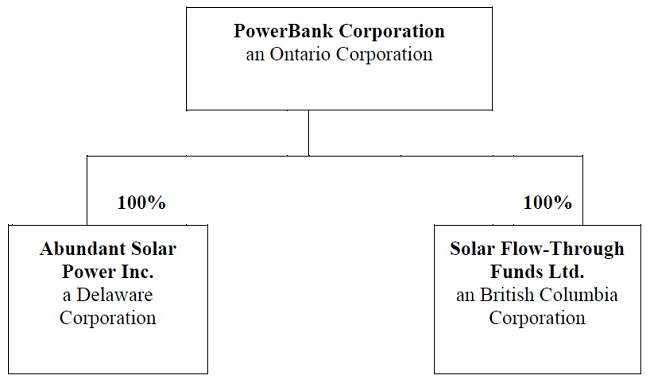
Subsidiaries
The Company’s subsidiary Abundant Solar Power Inc. (“Abundant USA”) was incorporated in the State of Delaware on December 15, 2016. The registered address of Abundant USA is 850 New Burton Road, Suite 201, City of Dover, County of Kent, Delaware, 19904 United States. Abundant USA was incorporated to carry out the Company’s operations in the United States.
The Company’s subsidiary SFF was incorporated in the Province of British Columbia on August 11, 2023. The registered address of SFF is 1200 Waterfront Centre – 200 Burrard Street, Vancouver, British Columbia, V7X 1T2. On October 23, 2023, SFF underwent the process of consolidating nine limited partnerships (the “Predecessor LPs”) and their respective general partnerships into one corporation. On July 8, 2024 the Company acquired 100% of the common shares of SFF pursuant to the SFF Acquisition. SFF holds, through subsidiary entities, a portfolio of 70 operating solar sites located in Ontario with a combined capacity of 28.8 MW operating under long term contracts with the IESO, and owns and is developing three battery energy storage system projects in Ontario with an aggregate discharge capacity of 14.97 MW and are expected to operate under long term guaranteed capacity contracts from the IESO.
|
|
DESCRIPTION AND GENERAL DEVELOPMENT OF THE BUSINESS
Overview
The Company is an independent renewable and clean energy project developer, power producer and asset operator based in Canada and the United States. The Company is engaged in the development, construction and operation of solar photovoltaic (“PV”) power generation projects and Battery Energy Storage Systems projects in Canada and the United States. The Company’s mission is to support the energy transition in North America through deployment of clean energy at a distributed scale closer to where consumption occurs. Its objective is to scale-up as a leading developer, owner and operator of a significant fleet of distributed renewable power assets that have economic and technical value. The Company originates, develops, designs and builds solar power projects and BESS.
The Company was originally founded in Canada in 2013 as Abundant Solar Energy Inc., and in 2016 established a 100% owned U.S. subsidiary, Abundant Solar Power Inc., to meet the demand for renewable energy in both countries.
The Company’s success started with the renewable Feed-In-Tariff (“FIT”) program for rooftop and ground mount solar arrays in Ontario, Canada. Since then, the Company has established itself as a trusted developer, engineer, builder and asset operator that enables the proliferation of renewable and clean energy in the pursuit of Net Zero carbon emission goals in the fight against climate change and global warming.
The Company’s core competency is in deeply understanding and mastering the ‘local playbook’ of standard offer programs in numerous energy markets in North America allowing it to successfully gain market share while maintaining low overhead and capital-at-risk. The Company provides simple, reliable, and energy-resilient solutions to its customers that significantly reduce their carbon footprint. The Company has extensive experience working with 1,000+ customers including municipalities, First Nations, community co-operatives, regional economic planning authorities, commercial and industrial businesses, and landowners that value the numerous benefits of resilient renewable energy solutions.
The Company’s leadership team has over 100 years of combined expertise in the renewable and clean energy industry coupled with a strongly defined philosophy and financial vision for successful growth. The team brings expertise in site origination, utility grid interconnection, permitting, financing, Engineering, Procurement and Construction (“EPC”), Operation & Maintenance, and asset management of solar PV power plants to the renewable and clean energy industry. As a total solution provider, the Company brings certainty at speed and scale in site control, government relations, grid interconnection, global supply chain and project financing to bring grid-connected solar power plants to productive operation.
The Company focuses on grid connected solar PV electricity power plants and BESS. With its full in-house development, engineering and construction expertise, the Company’s capabilities span the value chain from development, EPC, financing, and operating as an Independent Power Producer (“IPP”). The Company’s core business consists of:
| ● | Development: The Company identifies, evaluates and secures control of suitable solar, BESS and other renewable development sites; obtains grid interconnection from utilities; acquires permits from government authorities; and engages solar energy subscribers and/or Power Purchase Agreement (“PPA”) clients as off-takers. A PPA, also referred to as an off-take agreement, is a contract between two parties, one which generates electricity (the seller) and one which is looking to purchase electricity (the buyer or off-taker). The PPA defines all of the commercial terms for the sale of electricity between the two parties, including when the project will begin commercial operation, schedule for delivery of electricity, penalties for under delivery, payment terms, and termination. A PPA requires active management to reconcile monthly deliveries, penalties and payment for electricity. |
|
|
| ● | EPC: The Company engineers, procures and constructs safe, efficient, eco-friendly, solar and BESS for industrial, commercial, community and utility electricity market, using high engineering standards and the latest technology. | |
| ● | Financing: The Company secures sponsor equity, tax equity, long-term debt, and construction financing to deploy BESS, solar and other renewable power plants. | |
| ● | Independent Power Producer: The Company commenced operating as an IPP in 2023. Previously the Company was carrying out one of the core functions of an IPP as it operates and maintains solar power plants for maximized production (O&M services described further below) and oversees solar power subscribers through two customer support centers in Boston and Chicago. The Company manages PPA and off-take agreements as an asset manager. | |
| ● | O&M stands for Operations and Maintenance. It refers to the set of activities, most of them technical in nature, which enable power plants to perform their task of producing energy at or above the expected level of performance, in compliance with applicable regulations. It encompasses several ongoing maintenance processes along with the replacement and disabling of broken and damaged system and structural components. O&M is essential to ensuring that BESS, solar and other renewable power plants sustain themselves for their expected system life. O&M consists of three fundamental and principal functions: |
| ● | Preventative maintenance. | |
| ● | Reactive maintenance: rapid identification, analysis, and resolution of issues and problems. | |
| ● | Comprehensive and detailed monitoring and reporting with adequate and requisite transparency. |
In carrying out its O&M services, the Company’s service standards are set out in its O&M contracts. These service standards have been developed over time based on experience and industry best practices. Referring to government agencies and industry associations such the National Renewable Energy Laboratory in the United States and Solar Power Europe, the standards have been developed based on industry experience, reliability, resilience and maximizing system output. Afterwards experience in the field and the close monitoring of system performance has allowed the standards to develop as to adapt to site specific conditions and achieve the highest system output and up time possible. Some references used in the development of the Company’s service standards are as follows: (i) Best Practices for Operation and Maintenance of Photovoltaic and Energy Storage Systems, 3rd Edition National Renewable Energy Laboratory, Sandia National Laboratory, SunSpec Alliance, and (ii) the SunShot National Laboratory Multiyear Partnership PV O&M Best Practices Working Group Operations and Maintenance Best practices guidelines version 5.0 by Solar power Europe.
The Company generates revenues through EPC services, O&M services and IPP operations via a diverse portfolio of distributed and community solar projects across multiple solar markets including projects with host off-takers, community solar, and net metering projects under programs such as FIT, Value of Distributed Energy Resources (“VDER”) and PPAs. The Company develops solar projects that sell electricity to commercial, industrial, municipal, residential and utility off-takers.
|
|
Since incorporation, the Company’s team delivered value in Ontario’s FIT program with the completion of hundreds of projects, New York’s Community Solar Program, and an RFP issued by the Maryland Department of Transportation. As a developer, full-service EPC contractor, and asset O&M manager, the Company has been successful in the renewable and clean energy industry working with 1,000 plus stakeholders including property owners, municipalities, indigenous people, co-operatives, electric utilities and regulatory agencies. The Company designed and constructed hundreds of solar power plants, including C&I rooftop installations and ground mount solar farms of varying scale. The Company’s management team has developed, financed and built over 600 C&I projects in Ontario, Minnesota and New York. Through its contracted customer care centers in Boston and Chicago the Company serves more than 3,500 retail electricity customers as community solar subscribers.

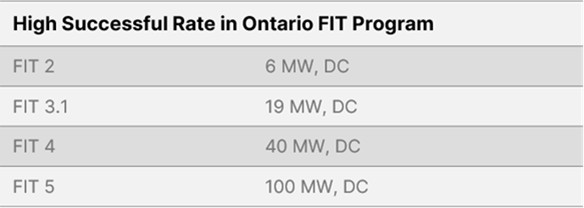
The table above sets out contracts awarded as opposed to projects built.
The Company’s success in the solar energy market is a result of its creativity, innovation, and ability to think outside of the box, in designing responses to the growing challenges facing the power industry. The Company has managed over $300 million in project financing to-date and has access to low-cost development financing by collaborating with tax-advantaged investment funds seeking CRCE in Canada or federal ITCs in the United States. A tax advantaged investment fund is an investment fund that passes through tax credits to its investors providing investors with tax benefits that allow such funds to offer lower returns to investors. This in turn means that the Company can access funding from such investment funds at a lower cost of capital. There is a risk that if tax credits are eliminated or reduced in the future that such investment funds will have difficulty raising capital and as a result the Company may no longer have access to this form of financing.
|
|
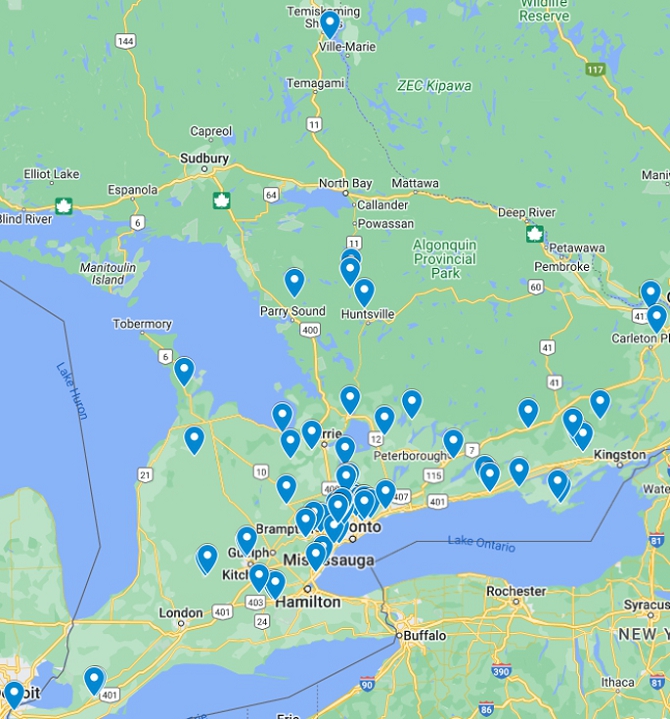
Image above presents Solar Flow-Through Funds’ 70 solar photovoltaic generation projects totalling 28.8 MW DC. The projects operate under the Ontario FIT program.
Three-year history
Developments for the Year Ended June 30, 2023
On October 3, 2022, the Company completed a convertible bridge loan financing for gross proceeds of $1,250,000 (the “Convertible Loan”). Each Convertible Loan is convertible at the option of the holder thereof into Conversion Units at a conversion price of $0.50 per Conversion Unit at any time. The Convertible Loans mature on the 12 month anniversary of the date of issuance of the Convertible Loans and do not bear interest at any time. Upon the closing of the IPO, the proceeds of the Convertible Loan converted into 2,500,000 Conversion Units at a conversion price of $0.50 per Conversion Unit. Each Conversion Unit consists of one Common Share, one Series A Warrant and one Series B Warrant.
On March 1, 2023, the Company closed the IPO raising aggregate gross proceeds of $6,037,500. The IPO consisted of a total of 8,050,000 Common Shares (including full exercise of the over-allotment option) issued at a purchase price of $0.75 per Common Share. The Common Shares were offered on a “commercially reasonable efforts” basis pursuant to an agency agreement between the Company and the Agent dated February 10, 2023, which has been entered into in connection with the IPO (the “Agency Agreement”). The Agent received a cash commission of $362,250, a corporate finance fee of $35,000 and reimbursement of its expenses in connection with the IPO. In addition, the Agent received an aggregate of 483,000 Agent’s Warrants.
On March 2, 2023, the Common Shares began trading on the CSE under the ticker symbol “SUNN”.
On March 7, 2023, the Company announced that it had reached Commercial Operation on a 389.7kW DC Solar Ground Mount System in Union Springs, NY. The solar power project passed its final New York State Energy Research and Development Authority (“NYSERDA”) NY-Sun Program inspection and has been placed into commercial operation.
|
|
On March 14, 2023, the Company announced the achievement of commercial operation and financial closing on a 3.544 MW community solar power project in Portland, New York. The project has been sold to a subsidiary of Columbus, Ohio-based Gosh Enterprises, Inc., the parent company of Charleys Cheesesteaks, Bibibop Asian Grill, Lenny’s Grill and Subs, and non-profit Charley’s Kids.
On March 16, 2023, the Company announced achievement of commercial operation and financial closing on a 7 MW community solar power project in Richmond, New York. The project has been sold to a subsidiary of Columbus, Ohio-based Gosh Enterprises, Inc.
On March 21, 2023, the Company announced that it has achieved commercial operation on a solar power project in New York state for Honeywell International Inc. (“Honeywell”). The system has an installed capacity of 683.55kWdc, and is expected to generate over 753,000kWh of clean, renewable energy in its first year of operation.
On May 23, 2023, the Company announced that commercial operation reached on a 195kW DC behind-the-meter system for Honeywell in Syracuse, New York.
On June 5, 2023, the Company announced that its subsidiary, 246 Ontario, has now received the full $6.33 million of Pre-Construction Development Costs (“PCDC”) from the Ontario IESO. PCDC are defined as reasonable costs incurred in development of a project from contract award date to termination date. The PCDC were incurred in connection with certain FIT Contracts in Ontario. The amount represents a full recovery of the PCDC claims submitted by 246 Ontario to the Ontario ISEO. 246 Ontario is owned 49.9% by the Company; however, based on an arrangement between 246 Ontario and PowerBank, PowerBank will receive the full amount of the PCDC recoveries from 246 Ontario.
On June 13, 2023, the Company announced that it has partnered with U.S.-based Rural Energy Development LLC (“RED Renewables”), a provider of solar energy solutions to the commercial agricultural market. The Co-Development Agreement provides for PowerBank to develop and construct solar energy projects introduced by RED Renewables.
On June 19, 2023, the Company announced that is has been added to the ‘CSE 25’ Index as One of the 25 Largest Companies on the CSE.
On June 21, 2023, the Company announces that it has acquired a 67% interest in the US1 Project and VC1 Project, each located in New York. Operating as an Independent Power Producer is a key pillar of the Company’s business model. The first project is the US1 Project which is a ground-mount solar power project located at a municipally-owned utility campus in the Village of Union Springs, N.Y. Per the PPA with the municipality, the system will sell electricity to the municipality via remote net metering. The system has an installed capacity of 389.7kW DC and is expected to generate an estimated 578,000 kWh of clean, renewable energy in its first year of operation.
The second project is the VC1 Project which is a ground-mount solar power project located at a municipally-owned utility campus in the Village of Cazenovia, N.Y. Per the PPA with the municipality, the system will sell electricity to the municipality via remote net metering. The system has an installed capacity of 297.9kW DC and is expected to generate an estimated 387,000 kWh of clean, renewable energy in its first year of operation.
On June 27, 2023, the Company announced that the 5.9MW, DC, Community Solar Project in the Town of Manlius, Onondaga County, New York is permitted and under construction for Solar Advocate Development LLC. PowerBank has entered into an EPC agreement with Solar Advocate Development LLC with a total value of approximately US$11.35 million (the “Manlius EPC Agreement”).
On June 28, 2023, the Company announced that the Ontario IESO has awarded 60 MWh of BESS in response to proposals submitted by PowerBank on behalf of investors. This consists of three projects in Ontario, each has a discharge capacity of 4.74 megawatts with 18.96 megawatt hours of storage. The proposed projects are owned by SFF and three First Nations communities.
|
|
Developments for the Year Ended June 30, 2024
On July 10, 2023, the Company announced that it has made a strategic investment in a Canadian solar project developer and operator by acquiring from existing limited partners an aggregate of 42,500 limited partnership units of the Solar Flow-Through 2016-I Limited Partnership, a partnership that is part of the group of Solar Flow Through Funds. The total purchase price for the Units was $2,465,000. The purchase price for the Units was based on an independent valuation report that was prepared for SFF in connection with the unitholder meetings to approve a restructuring of limited partnerships into a single corporation.
On July 19, 2023, the Company announced that it has received positive interconnection results on 7 MW ground mount site (Hardie) in Upstate New York.
On July 26, 2023, the Company announced that it has awarded a contract to Polar Racking, a leading North American supplier and manufacturer of solar mounting solutions, to supply its CORE fixed tilt ground mount solar mounting solution, and ballasted foundations to the Manlius and Geddes projects that are being developed by the Company. The Manlius project is being developed by the Company for Solar Advocate Development LLC and, subject to receipt of financing, the Company intends to own and operate the Geddes project.
On August 3, 2023, the Company announced that it has awarded a contract to Hewitt Young Electric, LLC to provide electrical subcontracting work for the Geddes project that is being developed by the Company. Subject to receipt of financing, the Company intends to own and operate the Geddes project. The Geddes project which has a designed capacity of 3.7 MW is repurposing a closed landfill, addressing two critical challenges: the need for clean energy and the transformation of contaminated sites into valuable assets.
On August 21, 2023, the Company announced that it has secured funding of up to US$20 million from Honeywell to advance 21 MW DC ground-mount solar power projects that are under development in upstate New York (the “SB Projects”). The SB Projects are known as SB-1, SB-2 and SB-3.
On September 18, 2023, the Company and Honeywell entered into a Membership Interest Purchase Agreement (the “Honeywell MIPA”) and an EPC agreement (the “Honeywell EPC Agreement”) pursuant to which Honeywell acquired the SB Projects and retained the Company for their construction, with a total transaction value of US$41 million. The Company also expects that it will retain an operations and maintenance contract for the SB Projects following the completion of construction.
On September 21, 2023, the Company announced that it has executed a lease agreement on a proposed 7MW ground mount solar project site in Upstate New York and 16.817MW ground mount solar project site in Alberta. The Alberta Utilities Commission (“AUC”) has announced a pause on approvals of new renewable electricity generation projects over one megawatt until Feb. 29, 2024, and that it will review policies and procedures for the development of renewable electricity generation. This pause impacted the Company’s receipt of interconnection approval for the project from the AUC. With the pause expiring on February 27, 2024, the Alberta Government has formally announced the direction its new policy on renewables will take. The Minister of Affordability and Utilities, in a letter to the AUC, directed the AUC to develop policy for the approval of renewable energy developments. As a result of the restrictive terms of the new policy the Company has determined that the Alberta project is no longer feasible. As a result it will no longer be proceeding with the Alberta project.
On September 26, 2023, the Company announced that it has completed mechanical construction of the Community Solar Project in the Town of Manlius, Onondaga County, New York. The 5.9MW Project was constructed for Solar Advocate Development LLC under the terms of the Manlius EPC Agreement. All civil work is complete, along with the mechanical installation of racking and modules. The next step is completion of some final electrical work and acceptance testing. The project is expected to become operational during the fourth quarter of calendar year 2023.
|
|
On October 2, 2023, the Company announced that it has commenced major construction on the Geddes project that is being developed by the Company in Geddes, New York. Current activities include civil work and the commencement of the racking and module installation. Subject to receipt of financing, the Company intends to own and operate the Geddes project. The Geddes project which has a designed capacity of 3.7 megawatts MW DC is repurposing a closed landfill, addressing two critical challenges: the need for clean energy and the transformation of contaminated sites into valuable assets. Based on its forecast project schedule, the Company anticipates that construction of the Geddes project will be completed in the 1st quarter of calendar 2024.
On October 3, 2023, the Company entered into three EPC agreements for the construction of three separate BESS projects (the “BESS Projects”) that were previously announced in June 2023, with a total contract value of approximately $36 million. The Projects are owned by SFF and three First Nations communities through holding companies. The BESS Projects are known as 903, OZ-1 and SFF 06 and are subject to the following agreements:
| (i) | Engineering, Procurement & Construction Agreement dated October 3, 2023 between 1000234763 Ontario Inc. and the Company for 903 Project (the “903 EPC Agreement”); | |
| (ii) | Engineering, Procurement & Construction Agreement dated October 3, 2023 between 1000234813 Ontario Inc. and the Company for OZ-1 Project (the “OZ-1 EPC Agreement”); and | |
| (iii) | Engineering, Procurement & Construction Agreement dated October 3, 2023 between 1000234763 Ontario Inc. and the Company for SFF 06 Project (the “SFF 06 EPC Agreement”). |
The BESS Projects were awarded as part of a procurement process with the Ontario IESO known as “E-LT1”. Projects under the E-LT1 are expected to be operational no later than April 30, 2026, but the Company intended to have them completed for operation by the summer of 2025. See updates on timing below. Each BESS Project is expected to operate under a long term contract with guaranteed capacity payments from the IESO, provided all contract obligations are met. The Projects will also earn revenue from the energy and ancillary markets in Ontario. Each has a 4.74 MW discharge capacity with a four-hour duration using lithium-iron-phosphate technology. Lithium-iron-phosphate technology allows for the greatest number of charge/discharge cycles, making it the optimal selection for stationary energy storage systems.
On October 23, 2023, the Company acquired control of two corporations that hold solar projects located in Ontario with a combined capacity of 2.5 MW (the “OFIT Projects”) for consideration of 278,875 Common Shares for a total value of $2.15 million (the “OFIT Transaction”). OFIT GM Inc. and OFIT RT Inc. (the “Purchased Entities”), have been operating the OFIT Projects since 2017. Dr. Richard Lu, the President & Chief Executive Officer and a director of the Company is indirectly a shareholder of the Purchased Entities and has indirectly received one-third of the Common Shares issued as consideration pursuant to the OFIT Transaction. As a result, the transaction is considered a related party transaction.
On December 4, 2023, the Company acquired a 100% interest in the US1 Project and VC1 Project, each located in New York (the “US1/VC1 Projects”). The Company previously held a 67% interest in the US1/VC1 Projects and has now acquired the remaining 33% from the minority partner for a cash purchase price of US$70,000. The first project is the US1 Project which is a ground-mount solar power project located at a municipally-owned utility campus in the Village of Union Springs, N.Y. Pursuant to the PPA with the municipality, the project, with an installed capacity of 389.7kW DC, will sell electricity to the municipality via remote net metering. The second project is the VC1 Project which is a ground-mount solar power project located at a municipally-owned utility campus in the Village of Cazenovia, N.Y. Pursuant to the PPA with the municipality, the project, with an installed capacity of 297.9kW DC, will sell electricity to the municipality via remote net metering.
|
|
On February 13, 2024, the Company announced that the Cboe Canada Exchange granted final approval of the Company’s listing application. The Common Shares were listed and available for trading on Cboe Canada Exchange at the start of trading on February 14, 2024. The Company’s existing trading symbol “SUNN” remained unchanged, and its Common Shares were delisted from the Canadian Securities Exchange at the close of market on February 13, 2024.
On March 19, 2024, the Company entered into the Arrangement Agreement with SFF to acquire all of the issued and outstanding common shares of SFF (each, a “SFF Share”) that it does not already own through a plan of arrangement for an aggregate consideration of up to $41.8 million in an all stock deal.
On April 8, 2024, the Company’s Common Shares commenced trading on the Nasdaq under the symbol “SUUN,” while its Common Shares continued to trade on the Cboe Canada under the symbol “SUNN”.
On April 10, 2024, the Company announced that it closed its previously announced acquisition from Storke Renewables, LLC of a development stage solar project located in the Town of Camillus, New York on a closed landfill (the “Storke Project”). The Company intends to develop a 3.15 MW DC ground-mount solar power project on the site that will operate as a community solar project.
The Storke Project has received interconnection approval and its special use permit. With the receipt of the special use permit, the Company’s final step in the development process is to secure the necessary financing for the construction of the Storke Project. PowerBank is evaluating its options for this project which include selling the project to a third party or developing this project as part of its independent power producer portfolio of assets.
On April 11, 2024, the Company announced that it completed mechanical construction on the previously announced SB Projects that are under development in upstate New York for Honeywell.
On April 15, 2024, the Company announced that it commenced construction on a 1.4 MW DC rooftop solar project for Fiera Real Estate (“Fiera”) in Alberta (the “Fiera Project”) as a pilot project. The Fiera Project is expected to operate as a “Small Scale Generator” and received interconnection approval in December 2023, full permitting in March 2024 and is currently undergoing the process of engineering, procurement and final design. Construction of the Fiera Project is expected to be completed in November 2024. The Company, with the support of Zathura Investments, is providing development and EPC services under an EPC agreement with Fiera and expects to complete additional projects for Fiera in the future.
On April 26, 2024, the Company announced that it has partnered with TriMac Engineering of Sydney, Nova Scotia (“TriMac”) to develop a 10 MW DC community solar garden in the rural community of Enon, and three 7 MW DC projects in Sydney, Halifax and Annapolis, Nova Scotia respectively (the “TriMac Projects”). The TriMac Projects are being developed under a Community Solar Program that was announced by the Government of Nova Scotia on March 1, 2024, and are owned by AI Renewable Fund. TriMac and the Company are currently planning to apply for Community Solar Program Contract from Nova Scotia by July 2024. If approved, construction is expected to commence in 2025.
On May 23, 2024, the Company announce that it has entered into an amended and restated equity distribution agreement (the “Amended Distribution Agreement”) with Research Capital Corporation (“RCC”) and Research Capital USA Inc. (together with RCC, the “Agents”) to amend the Company’s existing at-the-market equity program (the “ATM Program”). The Amended Distribution Agreement restates and supersedes the previous equity distribution agreement, dated June 29, 2023, between the Company and RCC to expand the prior Canadian at-the-market equity program to the United States.
|
|
Under the Amended Distribution Agreement, the Company may issue common shares of the Company having an aggregate offering price of up to US$15,000,000 (the “Offered Shares”) under the ATM Program. The Offered Shares will be issued by the Company to the public from time to time, through the Agents, at the Company’s discretion. The Offered Shares sold under the ATM Program, if any, will be sold at the prevailing market price at the time of sale. Since the Offered Shares will be distributed at trading prices prevailing at the time of the sale, prices may vary between purchasers and during the period of distribution. The Company intends to use the net proceeds from sales of Offered Shares under the ATM Program, if any, to advance the Company’s business objectives and for general corporate purposes, including, without limitation, funding ongoing operations or working capital requirements, repaying indebtedness outstanding from time to time, discretionary capital programs and potential future acquisitions.
Sales of Offered Shares, if any, will be made through the Agents in transactions that are deemed to be “at-the-market distributions” as defined in National Instrument 44-102 – Shelf Distributions and an “at-the-market offering” as defined in Rule 415(a)(4) under the United States Securities Act of 1933, as amended, on the Cboe Canada Inc. and the Nasdaq Stock Market, or any other applicable “marketplace” for the common shares in Canada. The Company is not obligated to make any sales of Offered Shares under the Amended Distribution Agreement.
The Company will pay the Agents a commission of 2.0% of the gross offering proceeds from each sale of Offered Shares and has agreed to provide the Agents with customary indemnification and contribution rights. The Company will also reimburse the Agents for certain specified expenses in connection with the entering into and performance of the Amended Distribution Agreement.
On June 24, 2024, the Company announces that it has entered into a loan agreement with Seminole Financial Services, LLC (“Seminole”) for an initial US$2,600,000 construction to mini-perm loan (the “Seminole Loan”) that will be used to complete construction of the Geddes Project located in Upstate, New York (the “Geddes Project”). The Geddes Project is expected to reach operational and being producing power during the fourth quarter of 2024 and the Company owns and operates the Geddes Project as a community solar project.
The material terms of the Seminole Loan are as follows:
| ● | the Seminole Loan will be advanced as a construction loan having principal amount of $2,600,000; | |
| ● | upon substantial completion of the Geddes Project and the Geddes Project receiving permission to operate, the Loan shall convert into a mini-perm loan (subsequently substantial completion has occurred and documentation is in progress for conversion to a mini-perm loan); | |
| ● | no shares are issuable in connection with the Seminole Loan; and | |
| ● | the Seminole Loan is secured against the assets associated with the Geddes Project and the Company has provided a guarantee of completion and payment. |
Developments for the Year Ended June 30, 2025
SFF Acquisition
On July 8, 2024, the Company acquired all of the SFF Shares under the terms of the Arrangement Agreement, pursuant to a court-approved plan of arrangement (the “Arrangement”) under the Business Corporations Act (British Columbia). As a result of the Arrangement, SFF is a wholly-owned subsidiary of the Company.
|
|
SFF owns 70 operating solar sites located in Ontario with a combined capacity of 28.8 MW operating under long term contracts with the IESO, and owns and is constructing three battery energy storage system projects in Ontario with an aggregate discharge capacity of 14.97 MW and are expected to operate under long term guaranteed capacity contracts from the Ontario IESO. SFF and the Company will have a combined capacity of approximately 47 MW, including the Company’s IPP assets. The Arrangement is expected to add recurring revenue from existing IPP assets of SFF: which historically was $9.2 million for SFF calendar year 2023; and $9.4 million for SFF calendar year 2022.
Under the terms of the Arrangement Agreement, the Company agreed to issue up to 5,859,561 Common Shares as consideration for the aggregate purchase price of up to $41.8 million, representing $4.50 per SFF Share acquired. The number of Common Shares was determined using a 90-trading day volume weighted average trading price as of the date of the Arrangement Agreement which is equal to $7.14 (the “Agreement Date VWAP”). Through the Arrangement, the Company acquired SFF’s 70 operating solar power sites, along with its pipeline of BESS and electric vehicle charging stations.
The consideration for the Arrangement consists of an upfront payment of 3,575,632 Common Shares (valued at $25.53 million) that were issued on closing and a contingent payment of up to an additional 2,283,929 Common Shares (valued at $16.31 million) in the form of contingent value rights (“CVRs”) that were issued on closing. The Common Shares underlying the CVRs will be issued once the final contract pricing terms have been determined between SFF, the Ontario IESO and the major suppliers for the SFF BESS portfolio and the binding terms of the 2-debt financing for the BESS portfolio have been agreed (the “CVR Conditions”). On satisfaction of the CVR Conditions, Evans & Evans, Inc. (“Evans & Evans”) will revalue the BESS portfolio, following which the Company has agreed to issue Common Shares in the aggregate value equal to the lesser of (i) $16.31 million and (ii) the final valuation of the BESS portfolio determined by Evans & Evans plus the sale proceeds of any portion of the BESS portfolio that was sold, in either case divided by the Agreement Date VWAP. The maximum number of additional Common Shares issuable for the CVRs will be 2,283,929 Common Shares.
The Arrangement was carried out by way of a court-approved plan of arrangement under the Business Corporations Act (British Columbia) and the transaction was approved at a special meeting held on June 19, 2024 (the “SFF Meeting”) by: (i) 99.50% of the votes cast by the SFF common shareholders and holders of SFF tracking shares (the “SFF Tracking Shares”) present in person or represented by proxy, voting together as a single class; (ii) 99.62% of the votes cast by SFF common shareholders present in person or represented by proxy, voting together as a separate class; and (iii) 98.75% of the votes cast by holders of SFF Tracking Shares present in person or represented by proxy, voting together as one separate class.
There are three classes of SFF Tracking Shares. Each class of SFF Tracking Shares is linked to a separate lawsuit where SFF is plaintiff seeking to recover damages for the termination of certain solar power project development contracts. If the lawsuit that is linked to a class of SFF Tracking Shares is successful, the shareholder of such SFF Tracking Shares will have the option to receive its pro-rata share of the net settlement award or to convert such amount into Common Shares.
Under the terms of the Arrangement, SFF shareholders received consideration of (i) $25.53 million, representing approximately $2.75 per SFF Share or 0.3845938 of a Common Share for every SFF Share; and (ii) up to $16.31 million in CVRs that may, on satisfaction of the CVR Conditions, be exchanged for Common Shares representing up to approximately $1.75 per SFF Share or up to 0.2456582 of a Common Share for every SFF Share.
|
|
Prior to the SFF Meeting, the Company converted $4.7 million of a receivable that is due from SFF to the Company into 1,052,599 SFF Shares for the purpose of voting such shares in favor of the Arrangement at the SFF Meeting.
All Common Shares issued in the Arrangement, including Common Shares issuable on conversion of the CVRs or SFF Tracking Shares, if any, will be subject to transfer restrictions pursuant to a release schedule as set forth in the table below:
| Release Date | Percentage | |||
| Closing | 0 | % | ||
| 6 Months from Closing | 5 | % | ||
| 12 Months from Closing | 5 | % | ||
| 18 Months from Closing | 5 | % | ||
| 24 Months from Closing | 5 | % | ||
| 27 Months from Closing | 20 | % | ||
| 30 Months from Closing | 20 | % | ||
| 33 Months from Closing | 20 | % | ||
| 36 Months from Closing | 20 | % | ||
Base Shelf Prospectus
On May 8, 2025, the Company filed a final short form base shelf prospectus (the “Shelf Prospectus”) with the securities regulatory authorities in each of the provinces of Canada. The Shelf Prospectus replaces the Company’s prior final short form base shelf prospectus dated May 2, 2023 which would have expired in June 2025. A corresponding shelf registration statement on Form F-10 (the “Registration Statement”) has been filed with the United States Securities and Exchange Commission.
The Shelf Prospectus will enable the Company to make offerings of up to C$200 million of common shares, debt securities, warrants, subscription receipts, units and share purchase contracts or a combination thereof of the Company from time to time, separately or together, in amounts, at prices and on terms to be determined based on market conditions at the time of the offering and as set out in an accompanying prospectus supplement, during the 25-month period that the Shelf Prospectus remains valid.
The nature, size and timing of any such financings (if any) will depend, in part, on the Company’s assessment of its requirements for funding and general market conditions. Unless otherwise specified in the prospectus supplement relating to a particular offering of securities, the net proceeds from any sale of any securities will be used for to advance the Company’s business objectives and for general corporate purposes, including funding ongoing operations or working capital requirements, repaying indebtedness outstanding from time to time, discretionary capital programs and potential future acquisitions. The specific terms of any future offering will be established in a prospectus supplement to the Shelf Prospectus, which supplement will be filed with the applicable Canadian securities regulatory authorities.
Amended ATM Program
On October 3, 2024, the Company announced entered into the Second Amended and Restated Distribution Agreement with RCC to add H.C. Wainwright & Co., LLC (“Wainwright”) as a sales agent under the Company’s existing ATM Program.
On June 5, 2025, the Company proceeded with a renewal of the ATM Program. The Company was required to renew the ATM Program due to the expiry of the Company’s 2023 short form base shelf prospectus. The Company has entered into an equity distribution agreement (the “2025 Distribution Agreement”) with Wainwright, RCC and Research Capital USA Inc. (together with Wainwright and RCC, the “2025 Agents”) to renew the ATM Program. There can be no assurance that the Company will issue and sell any common shares under the ATM Program. The timing of any sales and the number of shares sold, if any, will depend on a variety of factors to be determined by the Company.
|
|
Under the 2025 Distribution Agreement, the Company may issue common shares of the Company having an aggregate offering price of up to US$15,000,000 (the “ATM Offered Shares”) under the ATM Program. The ATM Offered Shares will be issued by the Company to the public from time to time, through the Agents, at the Company’s discretion. The ATM Offered Shares sold under the 2025 ATM Program, if any, will be sold at the prevailing market price at the time of sale. Since the ATM Offered Shares will be distributed at trading prices prevailing at the time of the sale, prices may vary between purchasers and during the period of distribution. The Company intends to use the net proceeds from sales of ATM Offered Shares under the ATM Program, if any, to advance the Company’s business objectives and for general corporate purposes, including, without limitation, funding ongoing operations or working capital requirements, repaying indebtedness outstanding from time to time, discretionary capital programs and potential future acquisitions.
Sales of ATM Offered Shares, if any, will be made through the Agents in transactions that are deemed to be “at-the- market distributions” as defined in National Instrument 44-102 – Shelf Distributions and an “at-the-market offering” as defined in Rule 415(a)(4) under the United States Securities Act of 1933, as amended, on the Cboe and the Nasdaq Stock Market, or any other applicable “marketplace” for the common shares in Canada. The Company is not obligated to make any sales of Offered Shares under the 2025 Distribution Agreement.
The Company will pay the Agents a commission of up to 3.0% of the gross offering proceeds from each sale of ATM Offered Shares and has agreed to provide the Agents with customary indemnification and contribution rights. The Company will also reimburse the Agents for certain specified expenses in connection with the entering into and performance of the 2025 Distribution Agreement.
BESS Projects
On December 16, 2024, the Company announced the financial closing of a combined project loan (the “RBC Loan”) in a principal amount of $25.8 million from Royal Bank of Canada as Lender, Administrative and Collateral Agent and Green Loan Structuring Agent (the “Lender” or “RBC”).
The RBC Loan, on a non-recourse basis, will be used for the construction, operation and maintenance of two 4.99 MW BESS projects to be located in Ontario (the “763 BESS Projects”), with project names SFF 06 and 903 respectively. The 763 BESS Projects are owned by a subsidiary of the Company, 1000234763 Ontario Inc. (“763 ProjectCo”), and 763 ProjectCo is the borrower under the terms of the RBC Loan.
In July 2023, the 763 BESS Projects were awarded contracts by the IESO under the Expedited Long-Term RFP (E-LT1 RFP). These contracts, which have a term of 22 years, include a fixed contract capacity payment of $1,221/MW per business day. The Company expects that once operational each project will have 4.74 MW of daily contract capacity available (at a capacity payment to 763 ProjectCo of $1,221/MW per business day) for 251 business days in a year.
The RBC Loan will initially be advanced as a construction loan facility (the “RBC Construction Facility”). The RBC Construction Facility shall be converted into a term loan (the “RBC Term Facility”) following the COD of each Project. The Loan also includes an ITC bridge facility (the “RBC ITC Facility”).
The RBC Loan is available for draw down by 763 ProjectCo based on its construction schedule for each of the BESS Projects and the satisfaction of relevant conditions precedent. The RBC Loan is secured by a first ranking security interest over all assets of the 763 ProjectCo.
|
|
The Company has an indirect 50% interest in 763 ProjectCo, with the remaining 50% held by a partnership formed by First Nations communities in Ontario.
The SFF 06 project commenced construction during February 2025 and has a targeted COD prior to December 31, 2025.
The 903 project remains in the permitting process and commencement of construction remains subject to the receipt of final permits. In particular, in order to proceed with construction of the 903 project an Official Plan Amendment and Zoning By-law Amendment (“OPA/ZBA”) are required from the Town of Armour, Ontario. On November 8, 2022 the 763 ProjectCo received a Municipal Support Resolution, which was unanimously approved by the council for the Town of Armour. However, the OPA/ZBA have been delayed as a result of certain public opposition and the council’s evaluation of how to respond to such opposition. A delay in obtaining the necessary OPA/ZBA means that 763 ProjectCo may not be able to commence construction on the originally planned timeline and delaying construction means that achieving commercial operation on or before April 2026 will be delayed. As of September 19, 2026, the Township of Armour confirmed that it will proceed with scheduling the statutory public meeting for the OPA/ZBA submission, with a decision expected by Q2 FY 2026. Following OPA/ZBA approval, ProjectCo will still need to obtain Site Plan Approval, Planning Act consent, and a building permit before construction can begin. In order to extend the deadline for commercial operation under the E-LT1 contract for the project, 763 ProjectCo has sent the IESO a notice of potential force majeure event due to the OPA/ZBA delay. The timing of the issuance of the OPA/ZBA and its impact on project schedule remains uncertain.
The OZ-1 Project does not have a project loan and it is also in the permitting process. Commencement of construction remains subject to the receipt of financing and final permits. In particular, in order to proceed with construction of the OZ-1 project an OPA/ZBA are required from the Municipality of Arran-Elderslie, Ontario. The Company submitted an application to the Municipality of Arran-Elderslie for Site Plan Approval on February 26, 2025, related to the proposed BESS and made an application for consent to establish a long term lease on lands where the OZ-1 Project is located (the “OZ-1 Consent”). The application for the OZ-1 Consent was made in the context of Section 50(3) of the Planning Act (Ontario) to permit a lease on the lands where the OZ-1 Project is located for a period longer than 21 years. On July 29, 2025, the County of Bruce provisionally approved Consent Application B-2024-075, subject to seven (7) conditions. Certain conditions are overly broad in scope and application, lack certainty, and are not reasonable. As a result, the Company has appealed the decision on the OZ-1 Consent to the Ontario Land Tribunal (“OLT”). The County has since expressed interest in resolving the matter internally without proceeding to the OLT and has 75 days from the date of appeal to do so. Discussions are ongoing between the Company’s and the County’s counsels with the goal of either narrowing the conditions or obtaining municipal confirmation that the conditions have been satisfied. If the parties cannot resolve the matter within this timeframe, the appeal will proceed to the OLT. At this stage, the likelihood of resolution within the allotted time, or of success at the OLT, cannot be reasonably predicted. A delay in obtaining the necessary permits means that OZ-1 Project may not be able to commence construction on the originally planned timeline and delaying construction means that achieving commercial operation on or before April 2026 will be delayed. In order to extend the deadline for commercial operation under the E-LT1 contract for the project, the Company has sent the IESO a notice of potential force majeure event due to the delay. The timing of the issuance of the required permits and its impact on project schedule remains uncertain.
As a result of these permitting delays, subsequent to year-end, the Company and its battery storage systems supplier (the “Supplier”) are in discussions to terminate the contracts for OZ-1 on mutually agreeable terms. Once permitting certainty is achieved for OZ-1, the Company will either re-enter into agreements with the Supplier or pursue an alternative supplier. Under the proposed termination arrangement, the parties agree to terminate the OZ-1 equipment supply and long-term service agreements, with PowerBank relinquishing all rights and obligations. The Supplier will retain possession and property of the systems originally allocated to OZ-1, and PowerBank will pay the Supplier a termination fee of $475,000 along with a reimbursement of certain retrofit costs in the amount of $100,000, in addition to any amounts due for services performed to date. Final completion deadlines for those projects are also being adjusted, and the termination arrangement remains subject to lender consent and execution of definitive agreements.
|
|
There are several risks associated with the development of the BESS Projects. The development of any project is subject to required permits, the continued availability of third-party financing arrangements for the Company and the ability of the Company to meet the conditions to draw down the funds available under the RBC Loan, the risks associated with the construction of a battery energy storage project and the degradation of battery storage capacity over time based on the number of discharge cycles. In addition, governments may revise, reduce or eliminate incentives and policy support schemes for battery energy storage, which could result in future projects no longer being economic.
Qcells Transaction
On January 6, 2025, the Company announced that Qcells, through an affiliate, has entered into agreements to acquire from the Company a total of four ground-mount solar power projects that are under development in upstate New York (the “Qcells Projects”) representing 25.577 MW DC. The Qcells Projects are known as Gainesville, Hardie, Rice Road and Hwy 28.
Qcells is a subsidiary of South Korea’s Hanwha Solutions (KRX: 009830). Qcells is one of the world’s leading clean energy companies, recognized for its established reputation as a manufacturer of high-performance, high-quality solar cells and panels, portfolio of intelligent storage systems, and growing international pipeline of large-scale renewable energy projects. The company is headquartered in Seoul, South Korea (Global Executive HQ) with its diverse international manufacturing facilities in the U.S., Malaysia, and South Korea.
The Company originated the sites in upstate New York and the Qcells Projects have received positive interconnection results via a completed Coordinated Electric System Interconnection Review (CESIR). The Qcells Projects will be developed as four separate solar power projects. The Company will now continue to build the Qcells Projects for Qcells to commercial operation via EPC agreements. The sale of the Projects and EPC agreement have a total value of approximately US$49.5 million. The Company also expects that it will retain an operations and maintenance contract for the Qcells Projects following the completion of construction.
Once completed, the Qcells Projects will be operated as community solar projects. Community solar is a group of solar panels with access to the local electricity grid. Once the panels are turned on and generating electricity, clean energy from the site feeds into the local power grid. Depending on the size and number of panels the project has, dozens or even hundreds of renters and homeowners can save money from the electricity that is generated by the project. By subscribing to a project, a homeowner earns credits on their electric bill every month from their portion of the solar that’s generated by the project, accessing the benefits of solar without installing panels on their home. The Qcells Projects are expected to be eligible for incentives under the New York State Energy Research and Development Authority (NYSERDA) NY-Sun Program.
There are several risks associated with the development of the Qcells Projects. The development of any project is subject to required permits, the continued availability of third-party financing arrangements for Qcells, the risks associated with the construction of a solar energy project. In addition, governments may revise, reduce or eliminate incentives and policy support schemes for solar energy projects, which could result in future projects no longer being economic. Qcells will pay the purchase price for the Projects, and construction costs under the EPC agreements, in stages. If Qcells does not obtain the necessary financing, the Company is obligated to reacquire the projects subject to retention of an initial payment.
|
|
Camillus Property
On March 18, 2025, the Company announced that its 3.26 MW Camillus Solar Project (the “Camillus Project”) has been sold to, and will now be constructed for, Solar Advocate Development LLC (“Solar Advocate”). The Camillus Project is being constructed as a 3.26 MW DC ground-mount solar power project on a closed landfill site and will operate as a community solar project. Engineering and initial construction have commenced and the Company has initiated procurement of major equipment. The Company has also leveraged its strong relationships with Tier 1 suppliers to secure major equipment orders of solar panels, inverters, racking, and transformers necessary for the Camillus Project. The Company will now continue to build the Camillus Project for Solar Advocate to commercial operation via an EPC agreement dated March 18, 2025. The sale price for the Camillus Project, and value of the EPC agreement, are approximately US$7.3 million.
Equity Offering
On March 24, 2025, the Company announced that it had closed a registered direct offering of 2,394,367 units (the “2025 Units”) at a price of US$3.55 per 2025 Unit, for aggregate gross proceeds of approximately US$8.5 million (the “2025 Offering”). Each 2025 Unit was comprised of one Common Share and one Common Share purchase warrant (each, a “2025 Warrant”) The 2025 Warrants are exercisable immediately, at an exercise price of US$4.45 per Common Share, and will expire on March 24, 2030.
The Company expects to use the net proceeds from the 2025 Offering to advance its independent power producer assets including battery energy storage system projects and a community solar project in New York, along with for working capital and other general corporate purposes. A.G.P./Alliance Global Partners acted as sole placement agent for the 2025 Offering. In connection with the 2025 Offering the Company and A.G.P./Alliance Global Partners entered into a letter agreement (the “Placement Agent Agreement”) dated March 20, 2025 pursuant to which A.G.P./Alliance Global Partners acted as exclusive placement agent for the 2025 Offering. Pursuant to the terms of the Placement Agent Agreement, A.G.P./Alliance Global Partners received a cash fee of 7.0% of the gross proceeds of the 2025 Offering and placement warrants (the “Placement Warrants”) equal to 5% of the 2025 Units issued in the 2025 Offering. Each Placement Warrant is exercisable for a Common Share, after a period of 12 months, at an exercise price of US$4.615 per Common Share, and will expire on March 24, 2030.
Data Center Expansion
The Company announced in November 2024 that it is strategically expanding into the rapidly growing data center market. Since that time, it has been evaluating a pipeline of potential data center opportunities. In alignment with its commitment to harnessing clean energy technologies, the Company intends to pursue opportunities as a developer, owner, and strategic partner in data center infrastructure, supporting the demand for high-performance, sustainable energy solutions within the sector.
There are several risks associated with the development of any data center. While the Company is expanding into the data center industry, it does not currently have any data center projects under development or that it has secured rights to. It is in discussions with various other parties regarding potential data center opportunities and will provide details in a future news release if an agreement to acquire or develop a data center is concluded. The development of any data center project is subject to identification of a suitable project site, receipt of required permits, entry into contracts for construction and the use of the data center, the availability of third-party financing arrangements for the Company and the risks associated with the construction of a data center. In addition, governments may revise, reduce or eliminate incentives and policy support schemes for renewable energy, which could result in future projects no longer being economic.
|
|
CIM Transaction
On May 6, 2025, the Company announced that CIM Group (“CIM”), a real estate and infrastructure owner, operator, lender and developer, and the Company have entered into a Mandate Letter providing for up to US$100 million in project based financing for a portfolio of 97 MW of solar power projects located in the United States (the “CIM Transaction”). The CIM Transaction will be structured as a preferred equity investment into a newly formed entity (“New HoldCo”) that will be a joint venture between CIM and Abundant USA. No shares or other securities of the Company will be issued in connection with the CIM Transaction.
CIM shall acquire non-convertible preferred equity interests in New HoldCo (the “CIM Equity”). Pursuant to a membership interest purchase agreement to be entered into by New HoldCo and ASP, New HoldCo will purchase the membership interests of identified project companies that wholly own 97 MW of power generating capacity (the “CIM Portfolio” or the “CIM Projects”) directly or indirectly from Abundant USA, subject to the satisfaction of customary conditions precedent. New HoldCo would advance 20% of the purchase price for each CIM Project at mechanical completion of such CIM Project, and 80% at substantial completion of such CIM Project.
Each CIM Project is anticipated to sell investment tax credits (“ITCs”) to one or more creditworthy third-party buyers pursuant to one or more tax credit transfer agreements in accordance with the requirements of Section 6418 of the Internal Revenue Code of 1986, as amended (the “Code” and each a “TCTA”).
CIM shall receive a coupon, payable semi-annually, equal to 3% (annually) of the aggregate investment and, subject to certain distributions detailed below, the remainder of the cashflow generated from the CIM Portfolio shall be distributed to ASP. CIM shall retain 100% of the TCTA sales. In the event of liquidation, casualty or similar condemnation event the proceeds shall be distributed based on prior contributions of the parties. New HoldCo has the right to redeem the CIM Equity based on the greater of fair market value or a multiple of invested capital beginning 180 days after the fifth anniversary of the date the last CIM Project is placed in service (the “Call Option”). If the Call Option is not exercised, CIM has the right to require a redemption of the CIM Equity at the lower of fair market value or a multiple of invested capital.
There are several risks associated with the CIM Transaction and development of the CIM Projects. The development of any project is subject to receipt of interconnection approval, receipt of a community solar contract, required permits, the continued availability of third-party financing arrangements for the Company and the risks associated with the construction of a solar power project. In addition, governments may revise, reduce or eliminate incentives and policy support schemes for solar power, which could result in future projects no longer being economic. The CIM Transaction is subject to the execution of definitive documentation setting out all of the representations, warranties, covenants and conditions precedent associated with the CIM Transaction. There is a risk that definitive documentation may not be executed or that the conditions precedent to the CIM Transaction are not satisfied. In such case, no funding will be advanced under the terms of the CIM Transaction. The Company will also need to secure the financing required to develop the CIM Projects to mechanical completion and substantial completion, as prior to such milestone none of the funding from the CIM Transaction will be available.
Geddes Project
On June 3, 2025, the Company announced that it is implementing a treasury strategy integrating Bitcoin as a strategic reserve asset. On June 5, 2025 the Company announced that is taking the first step in implementing this strategy by allocating the net cash generated by its Geddes Solar Power Project (the “Geddes Project”) to acquire Bitcoin. The Geddes Project, which has a designed capacity of 3.79 megawatts (MW) DC, is repurposing a closed landfill.
The actual timing and value of Bitcoin purchases, under the allocation strategy will be determined by management. Purchases will also depend on several factors, including, among others, general market and business conditions, the trading price of Bitcoin and the anticipated cash needs of the Company. The allocation strategy may be suspended, discontinued or modified at any time for any reason. As of the date of this AIF, no Bitcoin purchases have been made.
|
|
Nova Scotia Projects
The Company is developing three community solar projects in Nova Scotia known as Sydney, Brookyln and Petpeswick. The projects are owned by AI Renewable Flow-through Fund and the Company is the lead developer and builder for the projects. The Company will partner with local Nova Scotia’s trusted engineering firm, Trimac Engineering, to deliver the projects. With permits secured and interconnection underway, construction is expected in Spring 2026 and this positions the Company to generate near-term EPC revenues while building long-term recurring income through O&M contracts.
The Canadian Federal government and the Province of Nova Scotia are very supportive of Community Solar, with a number of incentives, including the Smart Renewables and Electrification Pathways Program, Indigenous-Led Clean Energy Stream, and the Low Carbon Communities program. Community solar is a cornerstone of Nova Scotia’s bold commitment to achieve 80% renewable energy by 2030 and net-zero by 2035.
Unlike traditional rooftop systems, community solar allows renters, businesses, and homeowners to subscribe to the solar farm and receive bill credits and savings of $0.02/kWh—without installing any equipment. Project feeds directly into the local electricity grid and offers a flexible, accessible way for Nova Scotians to participate in the clean energy transition.
Developments subsequent to the Year Ended June 30, 2025
Geddes Project
On July 29, 2025, the Company announced that the Geddes Project is now fully operational.
Intellistake
On July 31, 2025, the Company announced a partnership with Intellistake Technologies Inc. (“Intellistake”). The Company, with Intellistake’s support, intends to accumulate and hold Bitcoin on its balance sheet using net cash flow from the Geddes Project. Under the partnership framework, Intellistake will help manage digital asset operations for Intellistake and serve as the Company’s supporting partner for security, custody, and treasury management of Bitcoin. Intellistake and the Company are evaluating the potential tokenization of PowerBank’s clean energy assets or shares — providing an investment and financing alternative.
Intellistake and PowerBank are presently evaluating the regulatory framework for tokenization. Any tokenization will be subject to it being completed in compliance with applicable law, regulatory requirements and terms of any underlying agreements associated with PowerBank assets. The actual structure of such tokenization, the assets that would be subject to tokenization, and the associated timeline, have not yet been determined. Intellistake and PowerBank will provide further updates as material developments related to this tokenization strategy occur.
Nova Scotia Project Incentives
On August 19, 2025, the Company announced that that the Sydney, Brooklyn, and Petpeswick Community Solar projects in Nova Scotia were granted $1.74 million in funding through the Nova Scotia Department of Environment and Climate Changes provided by the Nova Scotia Department of Energy and managed by the Net Zero Atlantic program.
|
|
Qcells Project
Two of the four projects sold to Qcells have commenced construction (Hardie and Rice Rd) and two of the four projects sold to Qcells remain in the permitting stage (Gainesville and Hwy 28).
SUNN 1009 LLC (“SUNN 1009”) is the holder of the Gainesville project which is one of the Qcells Projects. As part of the transaction with Qcells, SUNN 1009 was acquired by Qcells. The Town of Gainesville Zoning Board of Appeals (“Gainesville ZBA”) denied SUNN 1009’s area variance application (“Gainesville Application”) to construct a ± 5 megawatt-AC solar energy facility (“Gainesville Project”) on property located in the Town of Gainesville. As result, SUNN 1009 has filed a petition in the Supreme Court, State of New York, County of Wyoming challenging that denial and requesting the court direct the Gainesville ZBA to grant the variances because the denial was arbitrary, capricious, an abuse of discretion, and affected by an error of law. The Gainesville Project cannot commence construction until this matter is resolved.
Outlook
Building upon its solid core competencies in full-service development, the Company will deliver an integrated growth solution that has the capacity to generate revenue and grow the business in different revenue streams and that is discussed in this paragraph. For C&I end users, the Company will extend its expertise in rooftop solar to behind-the-meter (“BTM”) solar and BESS projects, carports, and building-integrated photovoltaics enabling large property management firms and C&I customers like Honeywell to achieve corporate Net-Zero commitments. The Company has been in negotiations with C&I customers to achieve this goal. The Company also intends to extend its success in FIT ground mount solar gardens and Community Solar farms to large Utility Scale solar farms with a targeted size of 100 MWp or more. The Company’s track record in operations, maintenance, and asset management create a strong foundation for it to become a successful IPP delivering long-term, sustainable, and profitable growth. The Company’s pipeline has been growing in all aspects of what is being discussed above which is the result of an integrated growth solution.
The Company has an existing development pipeline of solar PV projects that totals approximately 907 MW and BESS projects that totals approximately 864 megawatt hours (“MWH”). The Company categorizes its development pipeline into the following three categories: (1) “Under Construction” means the commercial operation date for the project is expected to occur within the next six to twelve months; (2) “Advanced Development” means the project is expected to reach notice to proceed (“NTP”) stage within the next six to twelve months; and (3) “Development” means the project is expected to reach NTP stage in greater than twelve months. The existing development pipeline is broken down as follows:
| Stage | Solar PV Projects | BESS Projects | ||
| Under Construction | 39 MW | 20MWH | ||
| Advanced Development | 84 MW | 44MWH | ||
| Development | 784 MW | 800 MWH | ||
| Total | 907 MW | 864 MWH |
The Company expects to complete projects with more total MWp in the current fiscal year than were completed in the fiscal year ended June 30, 2025. The Company will continue its tradition in project execution with simplicity, focus, and speed to enhance its leading position in cost competitiveness, with time to COD as a key measure of operation excellence.
|
|
In 2025 the U.S. President issued and later modified a reciprocal-tariff regime that imposes an additional duty on most imports. These reciprocal tariffs apply in addition to any other trade measures. Separately, the U.S. Department of Commerce (“Commerce”) issued final antidumping and countervailing duty determinations in April to June 2025 on crystalline-silicon photovoltaic cells/modules from Cambodia, Malaysia, Thailand, and Vietnam, resulting in significant cash-deposit requirements for many exporters. Those changes raise landed costs and increase documentation and pricing volatility for solar import supply. To mitigate the impacts, the Company (i) prioritizes U.S. and allied-country supply, (ii) pursues the domestic-content adder for the Investment Tax Credit under the Inflation Reduction Act which provides an additional 10% tax credit for projects that meet U.S. content requirements, enhancing project returns.
In July 2025, the U.S. government enacted The One, Big, Beautiful Bill Act (OBBBA) which accelerates the phase-out of the Clean Electricity Production Credit (Section 45Y) and the Clean Electricity Investment Credit (Section 48E) for wind and solar. Under IRS Notice 2025-42, a wind or solar facility placed in service after December 31, 2027 is ineligible unless beginning of construction (BOC) occurs by July 4, 2026. OBBBA also introduces new Foreign Entity of Concern (FEOC)-related guardrails; Treasury/IRS have signaled further guidance, and Department of Energy FEOC interpretations remain the baseline for what constitutes FEOC ownership, control, or jurisdiction.
To mitigate the impacts of evolving regulations the Company is to secure eligibility and accelerate cash generation by (i) safe-harboring—establishing beginning of construction (BOC) on or before July 4, 2026 through physical work of a significant nature; (ii) monetizing early—selling projects and leveraging credit transferability to convert tax credits to cash, in order to monetize as many qualifying projects as quickly as possible and recycle capital into additional projects that can achieve BOC; and (iii) ensuring supply-chain compliance and offsets—pre-qualifying FEOC-clean suppliers (BESS cells/modules, inverters, BOS) against DOE FEOC criteria and pursuing the domestic-content bonus using the IRS Notice 2024-41 safe harbor where cost-effective to offset tariff-driven inflation. In addition, BESS projects will remain eligible for tax credits beyond the dates noted above. The Company is growing its pipeline in this area.
The statements noted above are “forward looking statements” and there are several risks associated with the development of the project disclosed and the execution of the Company’s development pipeline. The development of any project is subject to receipt of interconnection approval, required permits, successful award of request for proposal processes, execution of contractual agreements and the continued availability of third-party financing arrangements for the Company and the risks associated with the construction of a solar power project. In addition, governments may revise, reduce or eliminate incentives and policy support schemes for solar power, which could result in future projects no longer being economic. Please refer to “Cautionary Note Regarding Forward-Looking Information” for additional discussion of the assumptions and risk factors associated with the statements in this section.
NARRATIVE DESCRIPTION OF THE BUSINESS
Summary of the Business
Industry Overview
People need energy for nearly everything they do. The majority of the energy sources on earth are still coal and natural gas, representing close to 60% of global electricity supply.1 However, fossil fuel reserves are limited.
Conversely, the sun has all the energy our civilization needs. About 173,000,000 GW of Solar energy continue to reach the Earth’s surface.2 The US Department of Energy revealed that about 430 quintillion Joules (1.19e+14 kWh) of solar energy strikes the earth every hour.3 A single hour of solar energy could provide enough energy to power the planet for a year. Unlike conventional energy sources, it will take 5 billion years for the sun to run out of fuel.4
1 International Energy Agency. Global Energy Review 2020. https://www.iea.org/reports/global-energy-review-2020/renewables
2 Pierce, E.R. (2016). Top 6 Things You Didn’t Know About Solar Energy. U.S. Department of Energy. www.energy.gov/articles/top-6-things-you-didnt-know-about-solar-energy.
3 Ashrafun Nushra Oishi, A.N., Meer Shadman Shafkat Tanjim and M. Tanseer Ali (2019). Loss Analysis of Market Available Solar Cells and Possible Solutions. Journal of Scientific & Engineering Research, Volume 10, Issue 9, September-2019 ISSN 2229-5518.
4 Scudder, J. (2015). The sun won’t die for 5 billion years, so why do humans have only 1 billion years left on Earth? https://phys.org/news/2015-02-sun-wont-die-billion-years.html
|
|
93% of the global population lives in countries that have an average daily solar PV potential between 3.0 and 5.0 kWh/kWp.5 Because of this abundance of solar power, we only need a small percentage of the planet’s surface to harvest enough energy to power the planet. For example, in Ethiopia just 0.005% of the country’s land area could generate sufficient power to cover existing needs, and in Mexico that figure is just 0.1%.6
Solar PV potential varies across Canada, with the highest insolation in southern Saskatchewan, Alberta, Manitoba, and Ontario, and the lowest in northern and coastal regions.7 The National Energy Board of Canada expects that by 2040, solar power will generate 13% of the country’s electricity.8
Solar power is more affordable, accessible, and prevalent in the United States than ever before. From just 0.34 GW in 2008, U.S. solar power capacity has grown to an estimated 97.2 GW today.9 This is enough to power the equivalent of 18 million American homes at average consumption.10 Today, over only a small percentage of U.S. electricity comes from solar energy. According to the US Department of Energy, with aggressive cost reductions, enabling policies, and large-scale electrification, solar could account for as much as 40% of the nation’s electricity supply by 2035 and as much as 45% by 2050.11
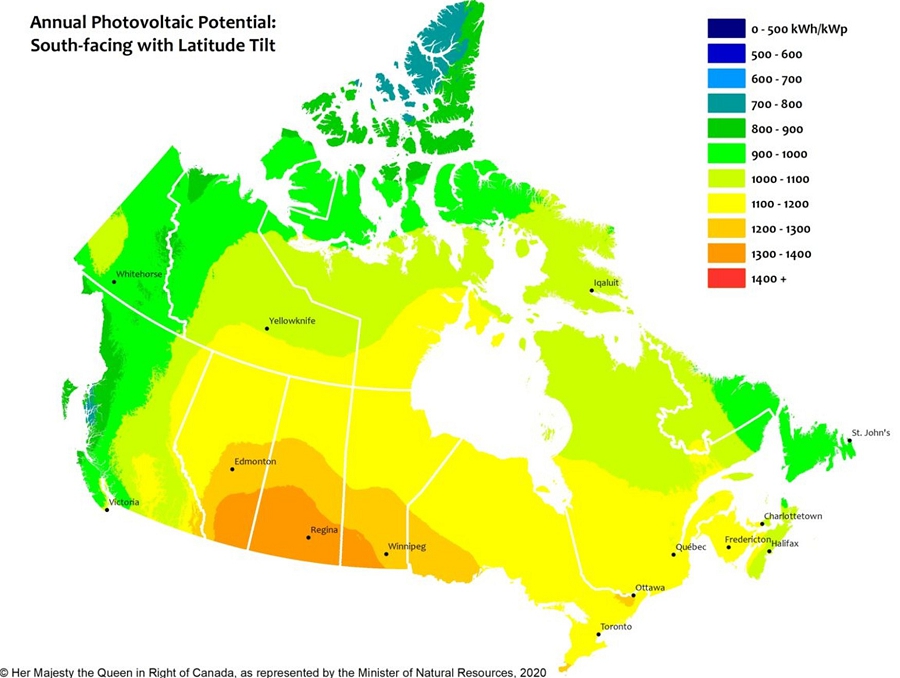
5 Solar Photovoltaic Power Potential by County (2020). https://www.worldbank.org/en/topic/energy/publication/solar-photovoltaic-power-potential-by-country
6 Solar Photovoltaic Power Potential by County (2020). https://www.worldbank.org/en/topic/energy/publication/solar-photovoltaic-power-potential-by-country
7 Market Snapshot: Which cities have the highest solar potential in Canada? (2018) https://www.cer-rec.gc.ca/en/data-analysis/energy-markets/market-snapshots/2018/market-snapshot-which-cities-have-highest-solar-potential-in-canada.html
8 National Energy Board. Canada’s Energy Future 2017: Energy Supply and Demand Projections to 2040 (2017) https://www.cer-rec.gc.ca/en/data-analysis/canada-energy-future/archive/2017/2017nrgftr-eng.pdf
9 U.S. Department of Energy. Solar Energy in the United States. https://www.energy.gov/eere/solar/solar-energy-united-states
10 U.S. Department of Energy. Solar Energy in the United States. https://www.energy.gov/eere/solar/solar-energy-united-states
11 U.S. Department of Energy. Solar Futures Study (2021) https://www.energy.gov/sites/default/files/2021-09/Solar%20Futures%20Study.pdf
|
|
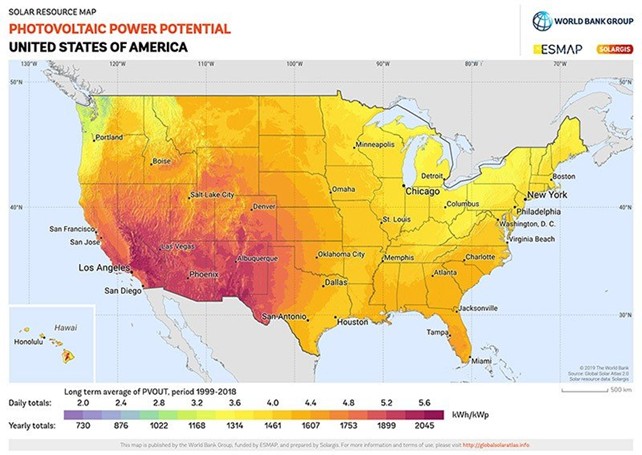
Products and Services
The Company recognizes revenue from project development service and EPC services. The Company provides solar energy solutions by developing, permitting, designing and building BTM solar power generation and transmission or distribution electricity grid connected community solar gardens and utility scale solar farms. While the Company’s focus is on delivering solar power plants from site origination to commercial operation, and the operation and management of the solar power assets, the Company also provides renewable and clean energy project development, EPC, O&M and asset management services for a fee.
|
|
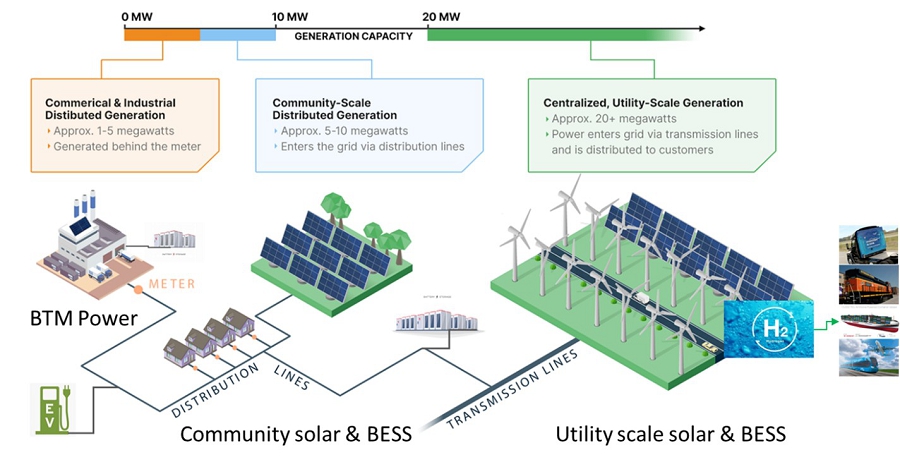
A description of the Company’s three focus areas: BTM solar power generation, community solar and utility scale solar farms are as follows:
Behind-the-Meter (BTM) Solar Power Generation
The most effective method to achieve Net-Zero carbon emissions from buildings is to build them all electric, with grid electricity coming from renewable sources such as solar and wind (long-term) and BTM power plants (solar or BESS) to provide zero emission renewable solar power onsite for the building’s self-use (immediate).
The term “behind-the-meter” refers to energy production and storage systems that directly supply C&I buildings with electricity. Commercial and Industrial solar panels are considered to be behind-the-meter, as are C&I BESS —the energy that is produced or stored by these systems is separate from the grid and does not need to be counted by a meter before being used, so they are positioned behind the meter. Behind-the-meter, however, is not the same as “off-grid”. Most behind-the-meter energy systems are still grid-tied, which means they maintain a connection to the electrical grid. The energy the solar PV systems provide do not pass through an electricity meter before it is used by a C&I business, but, when the panels are not in use (when there is no sunlight), energy from the grid is sent to the C&I business, and that energy must pass through a meter first so that it can be accounted for by the utility.
All electricity end customers sit behind the meter. A BTM solar power plant can be net metered, through which the excess solar energy produced by the plant can be sent back to the grid in return for a credit or money from the local utility. BTM solar power plants have the following benefits:
| ● | Energy cost savings, | |
| ● | Control over project operations and maintenance, | |
| ● | Self-consumption of distributed generation (usually solar PV), | |
| ● | Visible commitment to sustainability (with solar PV), and | |
| ● | Resiliency (with battery storage). |
|
|
All provinces and territories in Canada offer net metering program though the details may differ.12 Forty-one States in the US, in addition to Washington, D.C., American Samoa, U.S. Virgin Islands and Puerto Rico offer net metering programs.13 The BTM solar projects are reasonable in size (average 300 kWp) as rooftop, carport or ground mount systems, and could be profitable with a targeted 15% gross margin. The Company can be a turn-key service provider to commercial and industrial (“C&I”) customers for them to own BTM solar power plants on-site. The Company can also invest and own the BTM solar projects where local policies allow commercial aggregation and third party ownership.
There has been an increased interest in BTM solar projects and BESS. Existing buildings are responsible for 18% of Canada’s GHG emissions, BTM solar power generation provides a readily available solution toward the goal of Net-Zero by 2050.14

Community Solar & BESS
Solar power can help reduce CO2 emissions mainly by being a clean and renewable source of electricity. Solar power is not dependent on burning fossil fuels or other products; instead, it uses electrons captured from the sun’s energy for electricity creation. Therefore, solar energy does not create greenhouse gases for energy production at residential or C&I subscribers’ locations. Community Solar farms provide opportunities for the subscribers to do their part in achieving the Net-Zero goal.
Community solar is a group of solar panels with access to the local electricity grid. Once the panels are turned on and generating electricity, clean energy from the site feeds into the local power grid. Depending on the size and number of panels the project has, dozens or even hundreds of renters and homeowners can save money from the electricity that is generated by the project. By subscribing to a project, a homeowner earns credits on their electric bill every month from their portion of the solar that’s generated by the project, accessing the benefits of solar without installing panels on their home.
Community solar projects are usually 3 – 7 MWp each in size (see below a Company developed 3 MWp solar farm in Portland, NY, USA) subject to State regulation. Community solar capacity has increased because more projects have come online and because projects have generally become larger over time. Economies of scale enable cost-effective construction of a renewable energy system at a site with optimal renewable resource availability.
12 Alberta: https://www.epcor.com/products-services/power/micro-generation/Pages/net-metering.aspx; British Columbia: https://app.bchydro.com/accounts-billing/electrical-connections/net-metering.html; Saskatchewan: https://www.saskpower.com/Our-Power-Future/Powering-2030/Generating-Power-as-an-Individual/Using-the-Power-You-Make/Net-Metering; Manitoba: https://www.hydro.mb.ca/accounts_and_services/generating_your_own_electricity/?_ga=2.88824211.949710914.1666383471-1665874008.1666383471; Ontario: https://www.hydroone.com/business-services/generators/net-metering; Quebec: http://www.hydroquebec.com/residential/customer-space/account-and-billing/understanding-bill/residential-rates/net-metering-option.html; PEI: https://www.maritimeelectric.com/services/articles/net-metering/; Nova Scotia: https://energy.novascotia.ca/renewables/programs-and-projects/enhanced-net-metering; New Brunswick: https://www.nbpower.com/en/products-services/net-metering/; Newfoundland: https://www.newfoundlandpower.com/My-Account/Usage/Electricity-Rates/Net-Metering; Yukon: https://yukon.ca/en/micro-generation-program; Northwest Territories: https://www.inf.gov.nt.ca/en/NetMetering; Nunavut: https://www.qec.nu.ca/customer-care/generating-power/net-metering-program.
13 National Renewable Energy Laboratory. Net Metering. https://www.nrel.gov/state-local-tribal/basics-net-metering.html
14 Natural Resources Canada. Green Buildings. https://www.nrcan.gc.ca/energy-efficiency/green-buildings/24572
|
|
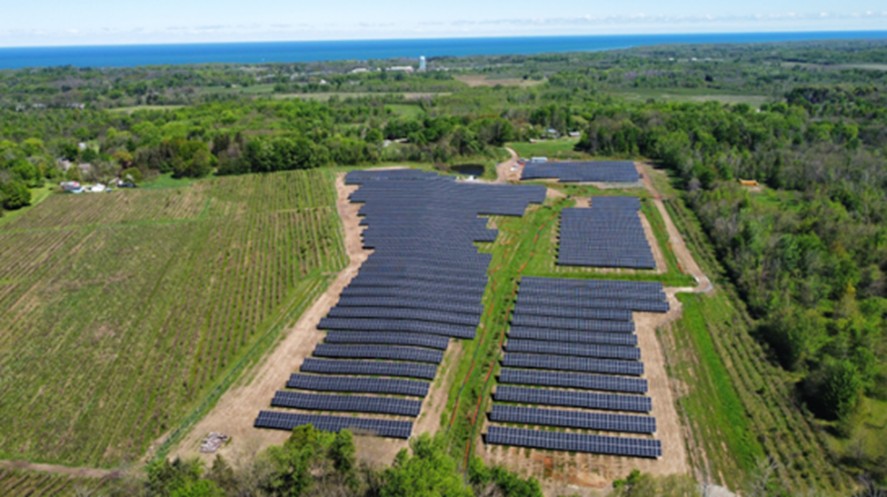
Community solar farm projects leverage economies of scale and often offer quick to market solutions for scales of approximately 1,000 homes/7 MWp. Additional advantages include, shared transaction costs often make this procurement option less expensive than self-supply, and customers are generally not responsible for maintenance and upkeep.
Utility Scale Solar & BESS
A utility-scale solar farm is one which generates solar power and feeds it into the grid, supplying a customer with renewable solar energy. A ‘utility-scale’ solar project is usually defined as such if it is 10 MW or bigger in capacity of energy production. For comparison, the average American household uses approximately 900 kWh. A utility-scale solar power plant can utilize several solar technologies including primary PV, tracking (rotate to track the sun’s movement) or fixed racking (does not track the sun’s movement).
What distinguishes utility-scale solar from distributed generation is both project size and the fact that the electricity is sold to wholesale energy buyers, not end-use consumers. Virtually every utility-scale solar facility has a PPA with a corporation, an IPP or a utility, guaranteeing a market for its energy for a fixed term of time. Utility scale systems also participate in monthly and spot auction markets for energy, capacity, and ancillary services.
Utility-scale solar has become a growing source of electricity in the world. Many utility-scale solar designs can also include energy storage capacity that provides power when the sun is not shining and increases grid reliability and resiliency.
To reach NZ2050, every industry requires power and every business needs to decarbonize. Many companies will need to partner with solutions providers such as the Company to help put them on a net-zero trajectory, and utility scale solar farm is a commercially viable decarbonization solution for reaching the Net-Zero carbon emission goal.
Customers and Sales Channels
The pursuit of Net-Zero carbon emissions comes a rising demand for renewable energy. Customers are increasingly capitalizing on the climate benefits of renewables; they are looking for renewable energy to meet rising energy needs; they want to benefit from the improving economics of renewable energy via subsidies; and they want to move their businesses away from fossil fuel dependency. Based on application, the Company has customers in the following market segments: BTM, Community Solar, Corporate PPA, and Utility PPA.
|
|

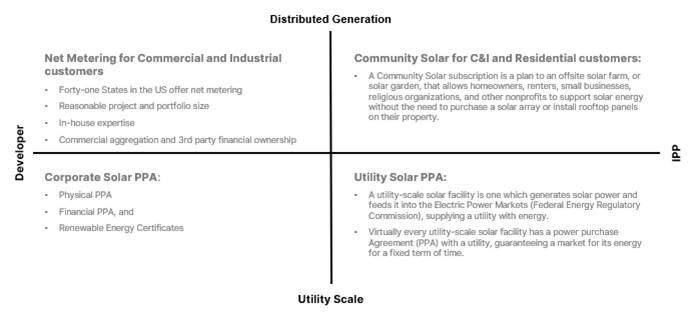
Behind the Meter (BTM) Solar for C&I Customers
Corporate Net-Zero goals boost BTM solar growth. The C&I BTM solar market, which consists of on-site solar power generation primarily for self use has grown rapidly in recent years. Net-Zero adoption by businesses, non-for-profits and governments will help continue to increase the demand for BTM solar segments. Many C&I customers are becoming more interested in making sustainability-focused choices. With little more than 1% of commercial electricity demand served by on-site solar, there remains significant opportunity for growth in the BTM solar segment.
All subnational jurisdictions in Canada and the United States have net metering programs for BTM solar projects.15 The Company delivers BTM projects to C&I customers with in-house expertise, enabling economic progress on Net-Zero goals. A residential BTM market segment also exists; however, the Company sees Community Solar as its strongest opportunity to serve mass market residential customers.
15 See notes 12 and 13.
|
|
Community Solar for Mass Market Subscribers
A Community solar subscription is tied to an offsite solar farm, or solar garden and allows homeowners, renters, small businesses, religious organizations, and other not-for-profits to purchase solar energy without the need to install panels on their property. Rather than purchasing energy solely sourced from utility-scale generators, such as coal and natural gas power plants, some or all electricity is sourced from the community solar project. Subscribers are billed for the solar energy and are credited on their utility bill. In many cases, this creates a discount over conventional electricity purchases. Community solar is especially appealing to those customers who are unable or unwilling to install a renewable energy generator at their residence or commercial facility but still seek the economic and environmental benefits of solar energy.
As of December 2021, Community solar projects are located in 39 states, plus Washington, D.C. 22 states, plus Washington, D.C., have policies that support community solar. Community solar projects represent more than 3,200 MWac of total installed capacity.16
Community Choice Aggregation (“CCA”) is an alternative to the investor-owned utility energy supply system in which local entities in the United States aggregate the buying power of individual customers within a defined jurisdiction to secure an alternative energy supply contract. The CCA chooses the power generation source on behalf of the consumers; and thus have the potential to be a major source of viable customers for community solar projects, representing very large contracts for community solar generators. The main goals of CCAs have been to either lower costs for consumers or to allow consumers greater control of their energy mix, mainly by offering cleaner generation portfolios than many local utilities.
Seven states in the United States have enacted CCA-enabling laws.17 CCAs have set national green power and climate protection records while reducing power bills. CCAs have won National Renewable Energy Laboratory and Environmental Protection Agency recognition for supplying significantly higher amounts of renewable energy while maintaining rates that are competitive with conventional fossil fuel and nuclear-based utility power.18 CCAs are therefore already conspicuous leaders in green power innovation, receiving the U.S. Environmental Protection Agency’s “green power leadership awards” for achievements in renewable energy. The Company has existing intends to in the future establish relationships with CCAs as a primary method of entry into the Community Solar project market.
Corporate America and IPP Customers
Regulation, investor activism, and rising consumer interest are among the factors pushing companies to benchmark and improve the sustainability performance of their offerings. Both governments and consumers are demanding companies reduce emissions and their environmental footprint. As a result, a growing demand exists for renewable electricity generation from large corporations. Globally, thousands of companies have set or are in the process of setting commitments to emissions reduction. In addition, hundreds of large US-based companies have committed to net-zero targets, many of which have set ambitious emissions reductions targets by 2030 or sooner.
Solar PPAs continue to evolve, with corporations increasingly procuring solar generation offsite. Major customers include renewable investment funds, RE100 corporations, and government administrations. Corporate solar PPAs can be classified as follows:
| ● | Physical PPA: a contract for the purchase of power and associated Renewable Energy Credits from a specific renewable energy generator to a purchaser of renewable electricity. | |
| ● | Financial PPA: a financial arrangement between a renewable energy generator and a consumer. A Financial PPA does not include the electricity delivery to the buyer, and so the buyer can be located in a different power market. A Financial PPA involves crediting the consumer for the generator’s production. |
16 National Renewable Energy Laboratory. Community Solar. https://www.nrel.gov/state-local-tribal/community-solar.html
17 National Renewable Energy Laboratory. Community Choice Aggregation (CCA) Helping Communities Reach Renewable Energy Goals. https://www.nrel.gov/state-local-tribal/blog/posts/community-choice-aggregation-cca-helping-communities-reach-renewable-energy-goals.html
18 See note 18.
|
|
Corporate solar PPA prices vary widely from state to state. From 2020 to 2021, there were reductions in levelized electricity costs for commercial and utility-scale PV plus-storage systems. The levelized cost of electricity of utility-scale stand-alone PV fell from 4.6 cents/kWh in Q1 2020 to 4.1 cents/kWh in Q1 2021.19 State-by-state variance in contract prices is a function of avoided cost, resource availability and state incentives. PPA rates continue to decline, increasing viability and market opportunity in more jurisdictions. Falling component and build costs and attractive financing make solar the lowest-cost generation alternative in many states. Corporate customers are also negotiating shorter PPA terms to maximize future flexibility.
Traditional Energy Utilities as Customers
For the United States, the path to NZ2050 entails a comprehensive and rapid effort to decarbonize the economy. America’s annual GHG emissions come from a variety of sources, spanning every sector. Demand from utilities for renewable energy is expected to continue to grow in line with the broader economy. Utilities form the largest share of demand globally, particularly in the Americas, as they are required by law to meet RPS. They also have increased exposure to the merchant market (non-PPA), which will start to account for a larger share of solar PV installations.
Customers Buy Solar Renewable Energy Certificate (“REC”) Off-Sets
One way that the decarbonization effort is being pursued by lawmakers is the creation of RPS at the subnational level. An RPS makes it law for utilities to source a certain percentage of the electricity they sell to customers from renewable energy sources. This is done via REC trading systems.
To facilitate compliance with RPS requirements, states have adopted a market-based system of tradable RECs that represent the legal property rights to the environmental benefits of one MWh of renewable electricity generation. A REC is issued for every MWh of electricity generated and delivered to the electric grid from a renewable energy resource.
In the REC state markets, various RPS regimes require electricity suppliers to secure a portion of their electricity from renewable power plants. Utilities must generate RECs themselves via self-owned renewable generation, purchase them from renewable generators, or else pay a penalty that is generally higher than the market rate for RECs.
All green power supply options involve the generation and retirement of RECs. Renewable energy providers can unbundle energy from RECs - selling energy as “brown” power and the RECs on the open market. REC sales involve no physical delivery of electricity to customers. One way to think of RECs is that they represent the “solar” aspect of the electricity that was produced.
REC generation and sales are a key revenue stream for utility-scale renewable projects owned by IPPs. In many cases, it is the value of RECs that make these large projects financially viable. REC markets vary by state in line with RPS requirements. As governments more aggressively pursue their carbon emissions targets in the lead up to 2030 and 2050, the Company expects RPS requirements to escalate accordingly and REC prices to increase.
19 Vignesh Ramasamy, David Feldman, Jal Desai, and Robert Margolis. U.S. Solar Photovoltaic System and Energy Storage Cost Benchmarks: Q1 2021, https://www.nrel.gov/docs/fy22osti/80694.pdf
|
|
Operations Process
Leveraging the Company’s development expertise means that it can finish turnkey solar projects in an efficient and timely manner. The Company’s process has five phases: Site Origination; Development; Financing; Engineering, Procurement and Construction; Operation & Maintenance and Asset Management. This process has been tested and verified and has brought the Company success.
Phase 1 - Site Origination to Bankable Lease
| ● | Policy analysis: Political analysis, environmental, permitting, land use. | |
| ● | Prioritize low-cost interconnection sites. | |
| ● | Financial analysis: Incentive framework, IRR analysis and relevant investment threshold. | |
| ● | Site control: identification, evaluation and execute bankable lease to grow its greenfield Pipeline with efficient site acquisitions, affordable land with low property tax rates. | |
| ● | Acquisition of development pipelines. |
Phase 2 - Development to Notice To Proceed (NTP)
| ● | Evaluate and prioritize projects with the highest likelihood of success. | |
| ● | Grid interconnection studies: detailed discussions with the electrical utilities to determine the most economical methods of connecting the projects to the electrical grid, could result in Connection Impact Assessments, Connection Cost Assessments, Connection Agreements. | |
| ● | Permitting: municipal, state and/or federal permits and approvals, site plan optimization and approval, multiple approvals from zoning, planning and town boards and city council are required depending on the type and size of the project. Projects may also involve a county level review. | |
| ● | Environmental and required regulatory permits to ensure that the project will not significantly negatively impact the surrounding natural environment. | |
| ● | Incentives and PILOT/Tax. | |
| ● | PPA rates, off-taker credit, post-contract assumptions. |
Phase 3 - Financing
| ● | Sponsor equity: Draw on sponsor equity commitments from family office and other investors. | |
| ● | Investment tax credit: Source tax equity from providers. | |
| ● | Long-term debt: Opportunistically add project-level debt or bank leverage to maximize returns. | |
| ● | Construction Financing: project cost and budgeting. |
|
|
Phase 4 - Delivery: Engineering, Procurement and Construction to COD/PTO
| ● | EPC selection and negotiation, vet EPC partners based on experience and track record, run targeted RFPs with firms that the company has a close relationship with. | |
| ● | Further fieldwork such as geotechnical investigation, legal or topographical surveys, and site assessments. | |
| ● | Electrical, civil, mechanical and structural engineering design, including erosion and sediment control plan, Issue For Construction drawings. | |
| ● | Construction permits such as building permits and entrance and address permits. | |
| ● | Procurement: supplier negotiation on price and on-time delivery to the sites (solar panels, racking, inverter and BOS), procurement of electrical equipment is a critical step done as soon as the engineering phase has finalized its design. Some equipment such as transformers can take up to 16 weeks of lead time for delivery. | |
| ● | Work closely with local utilities and EPC firms to streamline the construction process. | |
| ● | Contracting: installers contracting. | |
| ● | Fencing and Safety: Fencing of the project site, coordinating with existing facilities and preparing safety measures. | |
| ● | Construction control: on budget, on schedule, regular site visits, QA/QC, PO and change order management. | |
| ● | System commissioning, coordination of all jurisdictional inspections and approvals, identification and correction of deficiencies, site commissioning inspections and tests must be passed. These include electrical commissioning and creation of as-built drawings and finalized package, and COD/PTO. | |
| ● | Site permits closing, site cleanup, landscaping, financial closing support, and coordinating with the utility to receive a final acceptance letter. |
Phase 5 - O&M, Subscriber Management, and Asset Management
| ● | Project handover, acceptance, and O&M for high production. | |
| ● | 100% subscription, 100% credit allocation, and utility reconciliation. | |
| ● | Asset management: contract management, financial reporting, regulatory filings. |
Employees, Specialized Skill and Knowledge
As of June 30, 2025, the Company has 18 employees and an additional 7 contracted service providers. The operations of the Company are managed by its directors and officers.
The nature of the Company’s business requires specialized knowledge and technical skill around procurement, construction, management, financing and regulations of the solar industry. The required skills and knowledge to succeed in this industry are available to the Company through certain members of the Company’s management, directors, officers, and advisory teams. The Company’s employees and consultants have extensive experience working with municipalities, First Nations, community co-operatives, regional planning authorities, commercial businesses, and landowners that value the numerous benefits of resilient renewable energy solutions. The Company’s team also has extensive experience developing, financing, building, permitting, commissioning, operating and maintaining renewable and clean power plants in Canada and the US with collectively over 100 years of direct experience profitably originating and executing on projects. Many members of the team have a long track record working together at major North American renewable energy companies such as Potentia, Solar Power Networks, Sky Solar and ARISE Technologies. Most of the team built its track record developing, financing, conducting EPC and O&M, executing both ground mount and rooftop FIT solar projects in Canada and in the US. See “Directors and Executive Officers”.
|
|
Competitive Conditions
The solar photovoltaic (PV) and Battery Energy Storage Systems (BESS) development industry is highly competitive across all its stages, and the Company faces competition from companies with varying levels of financial, operational, and technical resources. This competition primarily arises in securing land rights, favorable transmission capacity with minimal upgrade requirements, and long-term offtake agreements in North America and abroad.
Key competitors include both large integrated utilities and independent power producers, which often benefit from more significant economies of scale, more substantial capital, and established relationships with suppliers and regulators. The Company also competes against developers of traditional fossil fuel projects, as well as alternative renewable energy sources such as wind, hydro, and biomass.
Globally, the competitive landscape is intensifying due to advancements in technology, reduced equipment costs, and favorable government policies supporting renewable energy. In particular, competition is evident in the bidding processes for large-scale renewable energy projects and Power Purchase Agreements (PPAs). The Company must continuously innovate and offer cost-effective, reliable solutions to remain competitive in securing such opportunities.
Market trends, such as decreasing utility-scale electricity prices and improved transmission infrastructure, may also introduce new challenges for the Company’s competitiveness. If the retail prices of electricity from other energy sources decrease, or if grid infrastructure improves, the Company could face increased competition, especially from developers able to offer lower-priced power or those able to secure more favorable PPA terms.
The Company is also navigating competitive pressures related to securing financing for projects. Increased demand for capital and competition among developers may drive up financing costs or limit access to funding. This is compounded by the fluctuating cost of solar components due to global supply chain constraints, tariffs, and geopolitical factors, all of which could impact the Company’s ability to deliver projects on time and within budget.
Company Competitive Advantage
The Company has grown through participating in standard offering programs such as the Ontario Feed-In-Tariff program and New York’s NYSERDA NY-Sun Community Solar Program and are developing more than 70 Community solar projects in collaboration with Central New York Regional Planning and Development Board in New York. It has a good track record in developing and building renewable and clean energy projects in Canada and the USA. The Company has succeeded at delivering value at non-utility solar projects as a developer and a full-service EPC contractor; however, it has been evaluating opportunities for more growth in solar project volumes. Becoming an IPP aiming at long-term sustainable investment returns is the Company’s natural next step. To meet the desire for growth, the Company has re-positioned itself to deliver integrated growth solutions that expands from developer to an IPP in the C&I, Community, and Utility solar PV and BESS market segments.
The Company’s competitive advantage lies in its people, processes and experience. The Company’s team is skilled in translating customer needs into value-add solutions. The Company’s solar power plant delivery process is safe, reliable and low cost; and the Company provides a customer experience that is simple and focused with speed in implementation.
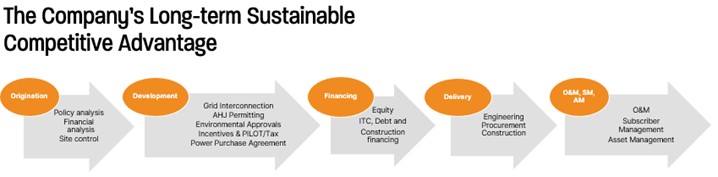
|
|
Third Party Suppliers
The Company procures all plant components on the open market. The Company qualifies suppliers’ products based on three factors: bankability, availability, and cost.
Product is considered bankable if lenders are willing to finance it. Component bankability is a key factor in projects being offered non-recourse debt financing by lenders. Products must also be available to meet construction schedules at a competitive price. Though China is the most cost-competitive location for the manufacture of solar PV and BESS components, Chinese solar and BESS products still must be bankable and available in order to be procured for the Company’s solar power and BESS plants.
Bloomberg NEF has developed a tiering system for PV module products based on bankability, creating a transparent differentiation between the hundreds of manufacturers of solar modules on the market. Tier 1 solar panels, such as those from Canadian Solar, ZNShine, and Jinko are built to higher standards and have the strongest reputation within the solar industry for quality and service. These panels last longer and produce more energy. Tier 1 manufacturers can be expected to honor product warranties. The Company primarily sources Tier 1 panels.
Solar panel mounts and racks are the equipment that secures solar panels in place. Racking is used to attach solar panels to a rooftop, ground, or another surface. With proper installation, an effective mount secures the solar panels against all weather conditions and ultimately protects the investment. Choosing the right racking system depends on the site, local climate, and installer preference (bankable, available, and low cost). Additional information on the Company’s key supplies are below:
| ● | Fixed Ground Mounts: Fixed ground mounts have lower energy production when compared to tracking systems, however no moving parts means lower O&M costs, and installation and procurement costs are lower. Fixed system suppliers, such as Schletter’s fixed tilt solar racking system, are also more bankable. | |
| ● | Single-Axis and Dual-Axis Solar Tracker: Trackers increase the efficiency of solar systems by providing more direct sunlight to the system, moving the solar panels from East to West (single-axis include solutions from RBI Solar and TerraSmart’s) or from East to West and from North to South (dual-axis). The additional mechanical complexity leads to higher O&M costs, and procurement and installation costs are higher compared to fixed systems. | |
| ● | Ballasted (Zero Penetration) Mounts: These systems are ideal for sites on roof membranes, landfill caps and industrial brownfields. More space is required to avoid table to table shading, and precast blocks have higher shipping costs and require heavy equipment to move around a site. GameChange Solar has both precast and pour-in-place ballast racking solutions. | |
| ● | Solar Inverters: These are an integral part of every system. The Company has used many top brands such as Huawei, SunGrow, and SMA. The inverters perform two key functions: DC to AC conversion; and Maximum Power Point tracking (“MPPT”), where the inverter dynamically selects the voltage and current combination for the highest power production. |
|
|
| ● | String Inverters: These have better MPPT capability per string for high production, shorter DC wires for lower power loss, and require special racking for the inverter for each string. In general, these have a higher per Watt cost than central inverters. | |
| ● | Central Inverter: Central inverters feature easy system design, installation and O&M trouble shooting. However, they represent a single point of failure for the whole system, with high DC wiring costs and high power loss due to voltage drop. In addition, partial shading and string mismatch drastically reduces power output. |
Pricing and Marketing
The Company strives to ensure its operational excellence. In the pursuit of Net-Zero there is an increasing willingness among customers to purchase renewable and clean energy such as solar power. Commercial customers are price sensitive in that they need to balance Net-Zero preferences and operational costs to remain competitive in their core businesses. Like with all utility economics, regulatory policy is a primary driver of revenue. Electricity prices are set largely by regulatory bodies like Public Service Commissions or Energy Boards. A PPA has to be equal to or lower than the regulated electricity price, in addition to providing renewable energy credits. The Company and its competitors generally have the same electricity price point (economic oligopoly). The Company gains economic value by managing project cost (the larger the project, the lower cost per watt installed), and driving business volume through a portfolio approach with large partners like Honeywell and large property management companies.
The Company prices its community and utility solar project and services competitively, and aligns itself with market pricing forecasts. The Company prices BTM & BESS solar projects to offer the host C&I customers a lower electricity cost, while securing a required return to its investors. BTM project pricing works the best in the Northeast USA where the retail electricity prices are high enough to enable a healthy margin in every BTM project the Company does.
With respect to promotion and marketing to secure customers:
Sales Team
| ● | The Company’s sales team must be highly trained, with a financial background, one on one selling skills, and should ideally hold a business credential. | |
| ● | One dedicated sales manager per Province/State, with core team support from head office in order to support 100 MWp to 200 MWp annual growth rate at $150k-$200k total annual budget per person. |
Marketing Communications Plan with a promotion budget of 10% of gross revenue
| ● | 20% on advertising (online & printed media). | |
| ● | 80% public relations and investor relations. |
Messaging customers with key messages
| ● | Community Solar Subscribers: Save on your utility bills while doing good to the environment. | |
| ● | Community Choice Aggregation: Let the Company’s PPA be your way to cheaper, greener energy for your community members. | |
| ● | Major Corporations: Be the 1st Net-Zero corporation among your peers. | |
| ● | Large Utilities: Your state RPS compliance is the Company’s business. |
|
|
Regulatory Environment
Achieving Net-Zero by 2050 (“NZ2050”) is widely seen as the best way to halt climate change. “Net zero” means our total carbon dioxide emissions are equal to or less than the emissions we remove from the environment. NZ2050 will require new policies, investments, participation and commitment by government, industry, and individuals. The most feasible pathways to net-zero emissions include four main strategies:
| ● | Generate emission-free electricity using sources like wind, solar, nuclear, and waterpower. | |
| ● | Use vehicles and equipment that are powered by electricity instead of fossil fuels. | |
| ● | Use energy more efficiently. | |
| ● | Remove carbon dioxide from the atmosphere. |
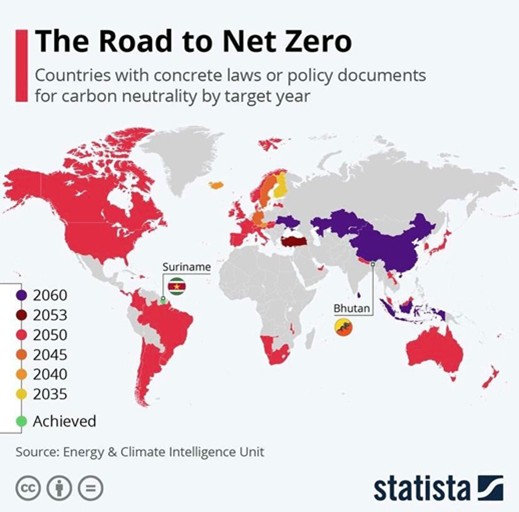
Policymakers are increasingly recognizing that renewable energy is the key to net-zero. Governments must build frameworks and reform bureaucracies to level the playing field for renewables as, in many countries, the bureaucracies still favour fossil fuels, giving the fossil fuel industry large subsidies. To date more than 140 countries have now set or are considering a target of NZ2050.20 United Nations Secretary-General António Guterres called on the world to “end fossil fuel pollution and accelerate the renewable energy transition, before we incinerate our only home”.21
Fighting climate change is good business. Renewables such as wind and solar are readily available and in most cases, are cheaper than coal and other fossil fuels. Solar and battery energy storage costs have plummeted in the past decade. Despite the headwinds presented by ongoing cost inflation and supply chain challenges, demand for clean energy sources has never been higher, and the Company expects that the global energy crisis will continue to act as an accelerant for the clean energy transition.
20 Climate Action Tracker. CAT net zero target evaluations. https://climateactiontracker.org/global/cat-net-zero-target-evaluations/#:~:text=As%20of%2020%20September%202022,zero%20goal%20in%20November%202021
21 António Guterres. UN Secretary-General Remarks. https://media.un.org/en/asset/k1q/k1qn00cy8a
|
|
Since the International Energy Agency’s (“IEA”) last in-depth review in 2015, Canada has made a series of international and domestic commitments, putting it on a path toward achieving an ambitious energy system transformation and climate transition. The Canadian Net-Zero Emissions Accountability Act, which became law on June 29, 2021, enshrines in legislation Canada’s commitment to achieve net-zero emissions by 2050. The majority of Canadians already depend on clean, reliable electricity to power their everyday lives. Canada has accelerated the phase-out of coal, implemented natural gas regulations and put a price on carbon pollution. The Government will connect regions with clean power through Regional Strategic Initiatives.22 The Greenhouse Gas Pollution Pricing Act encourages the reduction of GHG emissions. The Liberal Party of Canada has signaled its intention to continue the annual price increases until the price on emissions reaches $170 per tonne of CO2e by 2030.23
With the United States’ announcement of targets to halve US GHG emissions and to reach net-zero emissions by 2050, the world’s largest economy (and second-largest emitter) has joined some 130 nations in its intention to act on climate change.
The Inflation Reduction Act of 2022 (“IRA”) is a bill passed by the 117th United States Congress in August 2022 that aims to curb inflation by reducing the deficit, lowering prescription drug prices, and investing into domestic energy production while promoting clean energy solutions. The IRA included long-term solar and energy storage tax incentives and other critical provisions that will help decarbonize the electric grid with significant clean energy deployment. The legislation earmarked $369 billion for U.S. energy security and fighting climate change. It is expected to cut annual U.S. greenhouse gas emissions by about 1 billion metric tons by 2030 mainly by speeding up the deployment of clean electricity and electric vehicles.24 The IRA extended the solar ITC by 10 years at 30%. The existing federal ITC has been fundamental to incentivizing the growth of American solar. The credit applies to residential, commercial, and utility-scale developers and will create an effective discount of 30% on the capital cost of solar installations for ten years (until 2033). The credit was to decline to 26% in 2033 and to 22% in 2034. The reinvigorated ITC comes with a variety of “adders,” which could push the tax credit to as high as 50% for some projects. Additionally, the credit is equipped with a direct pay provision, allowing developers with little to no tax liability to treat it as a tax overpayment, resulting in a cash refund.
The IRA also provides ITCs for Standalone Storage and Interconnection Upgrades. Until now, battery storage was only eligible for the ITC if it was directly charged by solar. With respect to interconnection upgrades, a significant portion of the cost of solar projects is to pay for utilities to upgrade the grid so that the solar project can connect to it. With the IRA, standalone storage and interconnection upgrades are eligible for ITC.
However, the IRA was amended by the One Big Beautiful Bill Act (“OBBBA”) that was signed into law on July 4, 2025. The OBBBA makes wind and solar projects ineligible for the IRA’s flagship tax credits (the clean electricity investment tax credit (ITC) and production tax credit (PTC)) unless they either enter service before December 31, 2027, or begin construction within 12 months of the law’s passage.
The OBBBA also introduces restrictions on foreign entities of concern (“FEOC”). While the exact rules vary for different credits, FEOC rules target the involvement of individuals or organizations associated with certain adversarial nations (Russia, China, North Korea, or Iran. For some credits, the FEOC restrictions only apply to prevent foreign entities e.g. a Chinese state-owned enterprise, from claiming credits or directly influencing organizations claiming credits. For other credits, particularly the 45Y (clean electricity production credit) and 48E (clean electricity invest credit), the FEOC restrictions extend to include “material assistance,” barring use of the credits if a certain share of a project’s physical inputs originate from those foreign countries.
22 Government of Canada. Regional Tables Launched to Collaboratively Drive Economic Opportunities in a Prosperous Net-Zero Future. www.canada.ca/en/natural-resources-canada/news/2022/06/regional-tables-launched-to-collaboratively-drive-economic-opportunities-in-a-prosperous-net-zero-future.html
23 Government of Canada. Update to the Pan-Canadian Approach to Carbon Pollution Pricing 2023-2030. https://www.canada.ca/en/environment-climate-change/services/climate-change/pricing-pollution-how-it-will-work/carbon-pollution-pricing-federal-benchmark-information/federal-benchmark-2023-2030.html
24 Jesse D. Jenkins, Erin N. Mayfield, Jamil Farbes, Ryan Jones, Neha Patankar, Qingyu Xu, and Greg Schivley. Preliminary Report: The Climate and Energy Impacts of the Inflation Reduction Act of 2022. https://repeatproject.org/docs/REPEAT_IRA_Prelminary_Report_2022-09-21.pdf
|
|
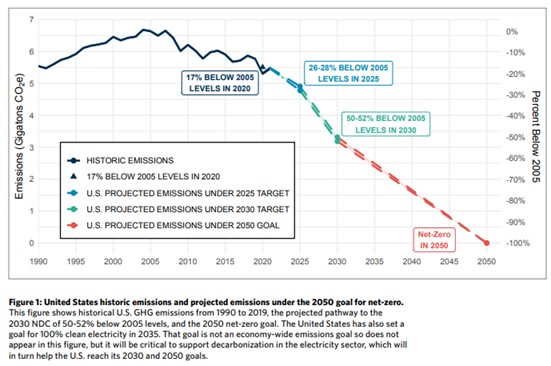
To promote a diversified resource mix and encourage deployment of renewable energy, most States have established RPS. The policies require that a specified percentage of the electricity sold by utilities comes from renewable resources. RPS policies help drive the United States market for wind, solar and other renewable energy. Roughly half of the growth in U.S. renewable energy generation since the beginning of the 2000s can be attributed to State renewable energy requirements.
In addition, the Company is subject to a variety of laws and regulations in the markets where it does business. These laws and regulations include energy regulations, export and import restrictions, tax laws and regulations, environmental regulations, labor laws, supply chain laws and regulations and other government requirements, approvals, permits and licenses. The Company also faces trade barriers and trade remedies such as export requirements, tariffs, taxes and other restrictions and expenses, including antidumping and countervailing duty orders, which could increase the prices of our supplies.
In the countries where we do business, the market for solar power, solar projects and solar electricity is heavily influenced by national, state and local government regulations and policies concerning the electric utility industry, as well as policies disseminated by electric utilities. These regulations and policies often relate to electricity pricing and technical interconnection of customer-owned electricity generation. The Company expects that our solar power projects and their installation will continue to be subject to national, state and local regulations and policies relating to safety, utility interconnection and metering, construction, environmental protection, and other related matters. See “Risk Factors”.
Impact of Environmental Laws and Regulations
Compliance with environmental laws and regulations can be expensive, and noncompliance with these regulations may result in adverse publicity and potentially significant monetary damages, fines and the suspension or even termination of the Company’s business operations.
|
|
The Company is required to comply with all national and local environmental regulations. The Company’s business generates noise, wastewater and other industrial waste in our operations and the risk of incidents with a potential environmental impact has increased as its business has expanded. The Company believes that it substantially complies with all relevant environmental laws and regulations and has all necessary and material environmental permits to conduct its business as it is presently conducted. However, if more stringent regulations are adopted in the future, the costs of complying with these new regulations could be substantial. If the Company fails to comply with present or future environmental regulations, it may be required to pay substantial fines, suspend production or cease operations.
The Company’s solar power and BESS projects must comply with the environmental regulations of the jurisdictions in which they are installed, and the Company may incur expenses to comply with such regulations. If compliance is unduly expensive or unduly difficult, the Company may lose market share and its financial results may be adversely affected. Any failure by the Company to control its use or to restrict adequately the discharge, of hazardous substances could subject the Company to potentially significant monetary damages, fines or suspensions of its business operations.
Intellectual Property
The Company is not dependent on intellectual property rights for its business. The Company has no registered trademarks, patents or patent applications; however, the Company has applied in Canada and the United States to trademark the term “SOLARBANK”. The Company asserts copyright ownership generally in its written works, but has no formal copyright registration process in place.
Cycles
The Company’s business is subject to seasonal variations in demand linked to construction cycles and weather conditions. Demand for solar power and battery storage products and services from some markets, such as the U.S., may also be subject to significant seasonality due to adverse weather conditions that can complicate the installation of solar power systems and negatively impact the construction schedules of solar projects. Seasonal variations could adversely affect our results of operations and make them more volatile and unpredictable.
Foreign Operations
Currently the Company’s only foreign operations are in the United States which are detailed above. The Company intends to continue to focus on developing solar projects in Canada and the United States but will evaluate expanding into other countries based on the regulatory environment, demand and financial metrics of opportunities.
Economic Dependence
The Company’s business is not substantially dependent on any one contract for the products and services that it provides or the sourcing of the materials, labour and supplies it requires to provide its services. However, each year it is limited to the number of projects that it can develop and therefore its material contracts such as the agreements with Qcells are the current source of a large portion of its expected revenue for the fiscal year ended June 30, 2026. As a result, the termination of any of these contracts would have a material adverse effect on the Company’s financial performance. See also “Risk Factors”.
Social or Environmental Policies
The Company has not yet implemented any formal social or environmental policies that are fundamental to its operations. It is currently evaluating the implementation of such policies based on current trends related to environment, social and governance initiatives.
|
|
Lending
The Company does not currently hold any investments or have lending operations and has not adopted any specific policies or restrictions regarding investments or lending.
Bankruptcy and Similar Procedures
There are no bankruptcies, receivership or similar proceedings against the Company, nor is the Company aware of any such pending or threatened proceedings. There has not been any voluntary bankruptcy, receivership or similar proceedings by the Company since its incorporation.
Reorganizations
There has not been any material reorganization of the Company or any of its subsidiaries within the three most recently completed financial years or completed during or proposed for the current financial year.
Significant Acquisitions
During the year ended June 30, 2025, the Company completed the SFF Acquisition and has filed a Form 51-102F4 in respect of the acquisition on SEDAR+. Please refer to “General Development and Business of the Company – Three Year History – Developments for the Year Ended June 30, 2025” for additional details on the SFF Acquisition.
Risk Factors
Due to the nature of that business and the present stage of development of its business, the Company may be subject to significant risks. The Company’s actual operating results may be very different from those expected as at the date of this AIF, in which the event the value or trading price (once listed) of the Company’s Common Shares could decline and an investor may lose all or part of his or her investment.
All statements regarding the Company and the Company’s business should be viewed in light of these risk factors. Such information does not purport to be an exhaustive list. If any of the identified risks were to materialize, the Company’s business, financial position, prospectus, anticipated operations, results and/or future operations may be materially affected (each a “material adverse effect”). Additional risks and uncertainties not presently known to the Company, or which the Company currently deems not to be material, may also have a material adverse effect. References to “we” or “us” shall mean the Company.
Risks Related to Our Company and Our Industry
The Company may be adversely affected by volatile solar power market and industry conditions; in particular, the demand for its services may decline, which may reduce its revenues and earnings.
Our business is affected by conditions in the solar power market and industry. We believe that the solar power market and industry may from time to time experience oversupply. When this occurs, many solar power project developers and solar system installers, may be adversely affected.
The solar power market is still at a relatively early stage of development, and future demand for solar power products and services is uncertain. Market data for the solar power industry is not as readily available as for more established industries, where trends are more reliably assessed from data gathered over a longer period of time. In addition, demand for solar power products and services in our largest end markets, including the U.S, may not develop or may develop to a lesser extent than we anticipate. Many factors may affect the viability of solar power technology and the demand for solar power products, including:
| ● | the cost-effectiveness, performance and reliability of solar power products and services compared to conventional and other renewable energy sources and products and services; | |
| ● | the availability of government incentives to support the development of the solar power industry; |
|
|
| ● | the availability and cost of capital, including long-term debt and tax equity, for solar projects; | |
| ● | the success of other alternative energy technologies, such as wind power, hydroelectric power, clean hydrogen, geothermal power, nuclear and biomass fuel; | |
| ● | fluctuations in economic and market conditions that affect the viability of conventional and other renewable energy sources, such as increases or decreases in the prices of oil, gas and other fossil fuels; | |
| ● | capital expenditures by end users of solar power products and services, which tend to decrease when the economy slows; and | |
| ● | the availability of favorable regulation for solar power within the electric power industry and the broader energy industry. |
If solar power technology is not suitable for widespread adoption or if sufficient demand for solar products and services does not develop or takes longer to develop than we anticipate, our revenues may suffer and we may be unable to sustain our profitability.
The execution of our growth strategy depends upon the continued availability of third-party financing arrangements for us and our customers, which is affected by general economic conditions. Tight credit markets could depress demand or prices for solar power products and services, hamper our expansion and materially affect our results of operations.
Most solar projects require financing for development and construction with a mixture of equity and third-party funding. The cost of capital affects both the demand and price of solar power systems. A high cost of capital may materially reduce the internal rate of return for solar projects.
Furthermore, solar projects compete for capital with other forms of fixed income investments such as government and corporate bonds. Some classes of investors compare the returns of solar projects with bond yields and expect a similar or higher internal rate of return, adjusted for risk and liquidity. Higher interest rates could increase the cost of existing funding and present an obstacle for future funding that would otherwise spur the growth of the solar power industry. In addition, higher bond yields could result in increased yield expectations for solar projects, which would result in lower system prices. In the event that suitable funding is unavailable, our customers may be unable to pay for services they have agreed to purchase and we may be unable to develop our own solar power projects. It may also be difficult to collect payments from customers facing liquidity challenges due to either customer defaults or financial institution defaults on project loans. Constricted credit markets may impede our expansion plans and materially and adversely affect our results of operations. The cash flow of a solar power project may be derived from government-funded or government-backed Feed-In Tariffs (“FITs”). Consequently, the availability and cost of funding solar projects is determined in part based on the perceived sovereign credit risk of the country where a particular project is located.
In light of the uncertainty in the global credit and lending environment, we cannot make assurances that financial institutions will continue to offer funding to solar project or BESS project developers at reasonable costs. An increase in interest rates or a decrease in funding of capital projects within the global financial market could make it difficult to fund solar power systems and potentially reduce the demand for solar projects, which may materially and adversely affect our business, results of operations, financial condition and prospects.
|
|
Our future success depends partly on our ability to expand the pipeline of our energy business in several key markets, which exposes us to a number of risks and uncertainties.
Historically, our provision of solar power project development services have accounted for the majority of our net revenues. While we plan to continue to monetize our current portfolio of solar and BESS projects in operation, we also intend to grow our energy business by developing and selling, or owning and operating more solar and BESS projects, including those that we develop and those that we acquire from third parties. As we do, we will be increasingly exposed to the risks associated with these activities. Further, our future success largely depends on our ability to expand our solar and BESS project pipeline. The risks and uncertainties associated with our energy business, and our ability to expand our solar and BESS project pipeline, include:
| ● | the uncertainty of being able to sell the projects, receive full payment for them upon completion, or receive payment in a timely manner; | |
| ● | the need to raise significant additional funds to develop greenfield or purchase late stage solar or BESS projects, which we may be unable to obtain on commercially reasonable terms or at all; | |
| ● | delays and cost overruns as a result of a number of factors, many of which are beyond our control, including construction and procurement price inflation, delays in regulatory approvals, grid connection, supply chain of our suppliers or availability of components, construction and installation, and customer acceptance testing; | |
| ● | delays or denial of required regulatory approvals by relevant government authorities, as a result of, among others, poor management of permitting process, including lack or resources and opaqueness of administrative measures; | |
| ● | diversion of significant management attention and other resources; and | |
| ● | failure to execute our project pipeline expansion plan effectively. |
If we are unable to successfully expand our energy business, and, in particular, our solar and BESS project pipeline, we may be unable to expand our business, maintain our competitive position, improve our profitability and generate cash flows.
Governments may revise, reduce or eliminate incentives and policy support schemes for solar and battery storage power, which could cause demand for our products to decline.
Historically, the market for on-grid applications, where solar power supplements the electricity a customer purchases from the utility network or sells to a utility under a FIT, depends largely on the availability and size of government subsidy programs and economic incentives. Until recently, the cost of solar power exceeded retail electricity rates in many locations. Government incentives vary by geographic market. Governments in many countries provided incentives in the form of FITs, rebates, tax credits, renewable portfolio standards, auctions for Contracts for Difference, Feed-in Premium and other incentives. These governments implemented mandates to end-users, distributors, system integrators and manufacturers of solar power products to promote the use of solar energy in on-grid applications and to reduce dependency on other forms of energy. However, these government mandates and economic incentives in many markets either have been or are scheduled to be reduced or eliminated altogether, and it is likely that eventually incentives for solar and alternative energy technologies will be phased out completely. Over the past few years, the cost of solar energy has declined, and the industry has become less dependent on government incentives. The governments in many of our largest markets, including the United States, continue to provide incentives and policy support schemes for investments in solar power that will directly benefit the solar industry. However, at the federal level in the United States there is less support under the current administration for renewable energy projects, as demonstrated by the earlier phase out of certain tax credits that were available under the IRA. We believe that the near-term growth of the market partially depends on the availability and size of such government incentives.
While solar and BESS projects may continue to offer attractive internal rates of return, it is unlikely that these rates will be as high as they were in the past. If internal rates of return fall below an acceptable rate for project investors, and governments continue to reduce or eliminate incentives for solar power, this may cause a decrease in demand and considerable downward pressure on solar and BESS systems and therefore negatively impact the value of solar projects. The reduction, modification or elimination of government incentives in one or more of our markets could therefore materially and adversely affect the growth of such markets or result in increased price competition, either of which could cause our revenues to decline and harm our financial results.
|
|
Operational risks associated with becoming an Independent Power Producer
As the Company is now an IPP, there are certain additional risks associated with the ownership and operation of solar power and BESS projects.
The Company could fail to optimize operations at its facilities due to a shortfall in operational efficiency or resource optimization, or owing to inadequate maintenance plans or operation in extreme conditions. The Company’s facilities are subject to the risk of equipment failure due to deterioration of the asset resulting from wear and tear, age, hidden defects or design errors, or to extreme weather. The ability of solar power and BESS projects to generate the maximum amount of power is a key determinant of the Company’s profitability. If the solar power or BESS projects require longer downtime than expected for maintenance and repairs, or if power production is suspended for other reasons, it could adversely affect the Company’s profitability.
Furthermore, the amount of power generated by the Company’s solar power projects is dependent on sunlight, which is naturally variable. Although the Company believes that past resource studies and production data collected demonstrate that the sites are economically viable, historical data and engineering forecasts may not accurately reflect the strength and consistency of resources in the future. If resources are insufficient, the assumptions underlying the financial projections for the volume of electricity to be produced by solar power projects might not materialize, which could have a material adverse effect on the Company’s cash flows and profitability.
The Company’s ability to sell electricity is impacted by the availability of the various power transmission and distribution systems in each jurisdiction in which it operates. The failure of existing transmission or distribution facilities or the lack of adequate transmission capacity would have a material adverse effect on the Company’s ability to deliver electricity to its various counterparties, thereby adversely impacting the Company’s operating results, financial position or prospects.
The ownership and operation of the Company’s solar power and BESS projects also carry an inherent risk of liability related to worker health and safety, including the risk of government-imposed orders to remedy unsafe conditions, of potential penalties for contravention of health and safety laws, licenses, permits and other approvals, and of potential civil liability for the Company. Compliance with health and safety laws (and any future changes to these laws) and the requirements of licenses, permits and other approvals will remain material to the Company. In addition, the Company may become subject to government orders, investigations, inquiries or civil suits relating to health and safety matters. Potential penalties or other remediation orders could have a material adverse effect on the Company’s business and results of operations.
General global economic conditions may have an adverse impact on our operating performance and results of operations.
The demand for solar power and BESS projects, and related services, is influenced by macroeconomic factors, such as global economic conditions (e.g. interest rates, foreign exchange rates and inflation), demand for electricity, supply and prices of other energy products, such as oil, coal and natural gas, as well as government regulations and policies concerning the electric utility industry, clean and other alternative energy industries and the environment. As a result of global economic conditions, some governments may implement measures that reduce the FITs and other incentives designed to benefit the solar industry. A decrease in solar power tariffs or wholesale electricity in many markets placed downward pressure on the price of solar power in those and other markets. In addition, reductions in oil and coal prices may reduce the demand for and the prices of solar power products and services. Our growth and profitability depend on the demand for and the prices of solar power products and services. If we experience negative market and industry conditions and demand for solar power products and services weakens as a result, our business and results of operations may be adversely affected.
|
|
Our project development and construction activities may not be successful, projects under development may not receive required permits, property rights, EPC agreements, interconnection and transmission arrangements, and financing or construction of projects may not commence or continue as scheduled, all of which could increase our costs, delay or cancel a project, and have a material adverse effect on our revenue and profitability.
The development and construction of solar power and BESS projects involve known and unknown risks, many of which are not under our sole control. For example, we may be required to invest significant amounts of money for land and interconnection rights, preliminary engineering and permitting and may incur legal and other expenses before we can determine whether a project is feasible; we may also need to engage and rely on third parties including, but not limited to, contractors and consultants. Success in developing a particular project is contingent upon, among other things:
| ● | securing land rights and related permits, including satisfactory environmental assessments; | |
| ● | receipt of required land use and construction permits and approvals; | |
| ● | receipt of rights to interconnect to the electric grid; | |
| ● | availability of transmission capacity, potential upgrade costs to the transmission grid and other system constraints; | |
| ● | payment of interconnection and other deposits (some of which are non-refundable); | |
| ● | negotiation of satisfactory EPC agreements; | |
| ● | obtaining construction financing, including debt, equity and tax credits; and | |
| ● | timely and satisfactory execution and performance by the third parties that we engage. |
In addition, successful completion of a particular project may be adversely affected by numerous factors, including:
| ● | changes in laws, regulations and policies and shifts in trade barriers and remedies, especially tariffs; | |
| ● | delays in obtaining and maintaining required governmental permits and approvals; | |
| ● | potential challenges from local residents, environmental organizations, and others who may not support the project; | |
| ● | unforeseen engineering problems; subsurface land conditions; construction delays; cost over-runs; labor, equipment and materials supply shortages or disruptions (including labor strikes); | |
| ● | failure to enter into PPAs on terms favorable to us, or at all; | |
| ● | additional complexities when conducting project development or construction activities in foreign jurisdictions, including compliance with applicable U.S. or local laws and customs; and | |
| ● | force majeure events, including adverse weather conditions, pandemics, supply chain disruptions, hostilities and other events beyond our control. |
If we are unable to complete the development of a solar project or we fail to meet any agreed upon system level capacity or energy output guarantees or warranties or other contract terms, or our projects cause grid interference or other damage, the EPC, the PPA or other agreements related to the project may, depending on the specific terms of the agreements, be terminated and/or we may be subject to significant damages, penalties and other obligations relating to the project, including obligations to repair, replace or supplement materials for the project.
|
|
We may enter into fixed-price EPC agreements in which we act as the general contractor for our customers in connection with the installation of their solar power or BESS projects. All essential costs are estimated at the time of entering into the EPC agreement for a particular project, and these costs are reflected in the overall fixed price that we charge our customers for the project. These cost estimates are preliminary and may or may not be covered by contracts between us and the subcontractors, suppliers and other parties involved in the project. In addition, we require qualified, licensed subcontractors to install most of our solar power and battery storage systems. Shortages of components (which may be attributable to the shortage of raw materials or components) or skilled labor could significantly delay a project or otherwise increase our costs. Should miscalculations in planning a project occur, including those due to unexpected increases in commodity prices or labor costs, or delays in execution occur and we are unable to increase the EPC sales price commensurately, we may not achieve our expected margins or our results of operations may be adversely affected.
Developing and operating solar & BESS projects exposes us to various risks.
The development of solar and BESS projects can take many months or years to complete and may be delayed for reasons beyond our control. It often requires us to make significant up-front payments for, among other things, land rights, interconnection work and permitting in advance of commencing construction, and revenue from these projects may not be recognized for several additional months following contract signing. Any inability or significant delays in entering into sales contracts with customers after making such up-front payments could adversely affect our business and results of operations. Furthermore, we may become constrained in our ability to simultaneously fund our other business operations and invest in other projects.
Developing solar and BESS projects requires significant management attention to negotiate the terms of our engagement and monitor the progress of the projects which may divert management’s attention from other matters. Our revenue and liquidity may be adversely affected to the extent the market for solar projects weakens or we are not able to successfully complete the customer acceptance testing due to technical difficulties, equipment failure, or adverse weather, and we are unable to sell our solar projects at prices and on terms and timing that are acceptable to us.
Our energy business also includes operating solar projects and selling electricity to the local or national grid or other power purchasers. As a result, we are subject to a variety of risks associated with intense market competition, changing regulations and policies, insufficient demand for solar or power, technological advancements and the failure of our power generation facilities.
We face a number of risks involving PPAs and project-level financing arrangements, including failure or delay in entering into PPAs, defaults by counterparties and contingent contractual terms such as price adjustment, termination, buy-out, acceleration and other clauses, all of which could materially and adversely affect our energy business, financial condition, results of operations and cash flows.
We may not be able to enter into PPAs for our future solar projects due to intense competition, increased supply of electricity from other sources, reduction in wholesale electricity prices, changes in government policies or other factors. There is a limited pool of potential buyers for electricity generated by solar power plants since the transmission and distribution of electricity is either monopolized or highly concentrated in most jurisdictions. The willingness of buyers to purchase electricity from an independent power producer may be based on a number of factors and not solely on pricing and surety of supply. Failure to enter into PPAs on terms favorable to us, or at all, would negatively impact our revenue and our decisions regarding the development of power plants. We may experience delays in entering into PPAs for some of our solar projects or may not be able to replace an expiring PPA with a contract on equivalent terms and conditions, or otherwise at prices that permit operation of the related facility on a profitable basis. Any delay in entering into PPAs may adversely affect our ability to finance project construction and to enjoy the cash flows generated by such projects. If we are unable to replace an expiring PPA with an acceptable new PPA, the affected site may temporarily or permanently cease operations, or could be exposed to more uncertain merchant or wholesale electricity pricing, which could materially and adversely affect our financial condition, results of operations and cash flows.
|
|
Substantially all of the electric power generated by our solar projects is expected to be sold under long-term PPAs with public utilities, licensed suppliers, corporate offtakers, and commercial, industrial or government end users. Despite possible future alternatives, we expect a substantial number of our future projects to also have long-term PPAs or similar offtake arrangements such as FIT programs. If, for any reason, any of the purchasers of power under these contracts are unable or unwilling to fulfill their related contractual obligations, they refuse to accept delivery of the power delivered thereunder or they otherwise terminate them prior to their expiration, our assets, liabilities, business, financial condition, results of operations and cash flows could be materially and adversely affected. Further, to the extent any of our power purchasers are, or are controlled by, governmental entities, our facilities may be subject to legislative or other political action that may impair their contractual performance or contain contractual remedies that do not provide adequate compensation in the event of a counterparty default.
PPAs may be subject to price adjustments over time. If the price under any of our PPAs is reduced below a level that makes a project economically viable, our financial conditions, cash flow and results of operations could be materially and adversely affected. Additionally, certain of the projects that we may acquire in the future may allow, the lenders or investors to accelerate the repayment of the financing arrangement in the event that the related PPA is terminated or if certain operating thresholds or performance measures are not achieved within specified time periods.
We are subject to numerous laws, regulations and policies at the national, regional and local levels of government in the markets where we do business. Any changes to these laws, regulations and policies may present technical, regulatory and economic barriers to the purchase and use of solar power and battery storage products, solar projects and solar electricity, which may significantly reduce demand for our products and services or otherwise adversely affect our financial performance.
We are subject to a variety of laws and regulations in the markets where we do business, some of which may conflict with each other and all of which are subject to change. These laws and regulations include energy regulations, export and import restrictions, tax laws and regulations, environmental regulations, labor laws, supply chain laws and regulations and other government requirements, approvals, permits and licenses. We also face trade barriers and trade remedies such as export requirements, tariffs, taxes and other restrictions and expenses, including antidumping and countervailing duty orders, which could increase the prices of our supplies.
In the countries where we do business, the market for solar power, solar projects, solar electricity and BESS projects is heavily influenced by national, state and local government regulations and policies concerning the electric utility industry, as well as policies disseminated by electric utilities. These regulations and policies often relate to electricity pricing and technical interconnection of customer-owned electricity generation, and could deter further investment in the research and development of alternative energy sources as well as customer purchases of solar power and battery storage technology, which could result in a significant reduction in the potential demand for our solar power and BESS services, solar and BESS projects and solar electricity.
We expect that our solar power and BESS products, and their installation, will continue to be subject to national, state and local regulations and policies relating to safety, utility interconnection and metering, construction, environmental protection, and other related matters. Any new regulations or policies pertaining to solar power or BESS projects may result in significant additional expenses to us and our customers, which could cause a significant reduction in demand for our solar power and BESS projects.
In our energy business, we are subject to numerous national, regional and local laws and regulations. Changes in applicable energy laws or regulations, or in the interpretations of these laws and regulations, could result in increased compliance costs or the need for additional capital expenditures. If we fail to comply with these requirements, we could also be subject to civil or criminal liability and the imposition of fines. Further, national, regional or local regulations and policies could be changed to provide for new rate programs that undermine the economic returns for both new and existing projects by charging additional, non-negotiable fixed or demand charges or other fees or reductions in the number of projects allowed under net metering policies. National, regional or local government energy policies, law and regulation supporting the creation of organized merchant or wholesale electricity markets are currently, and may continue to be, subject to challenges, modifications and restructuring proposals, which may result in limitations on the commercial strategies available to us for the sale of our power.
|
|
Regulatory changes in a jurisdiction where we are developing a solar or BESS project may make the continued development of the project infeasible or economically disadvantageous and any expenditure that we have previously made on the project may be wholly or partially written off. Any of these changes could significantly increase the regulatory related compliance and other expenses incurred by the projects and could significantly reduce or entirely eliminate any potential revenues that can be generated by one or more of the projects or result in significant additional expenses to us, our offtakers and customers, which could materially and adversely affect our business, financial condition, results of operations and cash flows.
We also face regulatory risks imposed by various transmission providers and operators, including regional transmission operators and independent system operators, and their corresponding market rules. These regulations may contain provisions that limit access to the transmission grid or allocate scarce transmission capacity in a particular manner, which could materially and adversely affect our business, financial condition, results of operations and cash flows.
We are also subject to the Canadian Corruption of Foreign Public Officials Act (CFPOA), U.S. Foreign Corrupt Practices Act of 1977, or the FCPA, the U.S. domestic bribery statute contained in 18 U.S.C. § 201, the U.S. Travel Act, the USA PATRIOT Act and other anti-corruption laws that prohibit companies and their employees and third-party intermediaries from authorizing, offering or providing, directly or indirectly, improper payments or benefits to foreign government officials, political parties and private-sector recipients for the purpose of obtaining or retaining business in countries in which we conduct activities. We may have direct or indirect interactions with officials and employees of government agencies or state-owned or affiliated entities in the course of our business (for example, to obtain approvals, permits and licenses from applicable government authorities and to sell power to government-owned entities). We would face significant liabilities if we failed to comply with these laws and we could be held liable for the illegal activities of our employees, representatives, contractors, partners, and agents, even if we did not authorize such activities. Any violation of the CFPOA, FCPA or other applicable anticorruption laws could also result in whistleblower complaints, adverse media coverage, investigations, loss of export privileges, severe criminal or civil sanctions, which could have a material adverse effect on our business, financial condition, results of operation, cash flows and reputation. In addition, responding to any enforcement action may result in the diversion of management’s attention and resources, significant defense costs and other professional fees.
Because the markets in which we compete are highly competitive and evolving quickly, because many of our competitors have greater resources than we do or are more adaptive, and because we have a limited track record in our energy business, we may not be able to compete successfully and we may not be able to maintain or increase our market share.
In our energy business, we compete in a more diversified and complicated landscape since the commercial and regulatory environments for solar project development and operation vary significantly from region to region and country to country. Our primary competitors are local and international developers and operators of solar projects. Some of our competitors may have advantages over us in terms of greater experience or resources in the operation, capital, financing, technical support and management of solar projects, in any particular markets or in general. As the solar power, BESS and renewable energy industry grows and evolves, we will also face new competitors who are not currently in the market. Our failure to adapt to changing market conditions and to compete successfully with existing or new competitors will limit our growth and will have a material adverse effect on our business and prospects.
|
|
Anti-dumping duty rates on solar cells and modules imported into the United States from certain southeast Asian countries may affect us.
On April 21, 2025 the United States Commerce Department has set final countervailing and anti-dumping duty rates for crystalline solar cells and modules imported from four southeast Asian countries. Solar cells and modules from Vietnam, Malaysia, Thailand and Cambodia are affected. The countervailing duties apply to solar cells and modules imported from Cambodia, Malaysia and a limited number of suppliers in Thailand and Vietnam on or after October 4, 2024. They apply to other suppliers in Vietnam and Thailand as of July 6, 2024. The anti-dumping duties apply to equipment imported from Cambodia, Malaysia and a limited number of suppliers in Thailand and Vietnam on or after December 4, 2024. They apply to other suppliers in Vietnam and Thailand as of September 5, 2024. The countervailing and anti-dumping duties are in response to a petition that a group of seven solar panel manufacturers called the American Alliance for Solar Manufacturing Trade Committee filed with the US government in April 2024.
The Company has not been importing solar cells and modules from any of the four countries that are subject to the countervailing and anti-dumping duty rates announced by the U.S. Department of Commerce. As a result, its present operations are not affected; however, it is possible that the Company may need to source solar cells and modules from these countries which would increase it costs and as a result impact its financial performance.
Our business, financial condition and results of operations could be adversely affected by disruptions in the global economy resulting from recently proposed trade barriers, including tariffs.
The global economy has the potential to be negatively impacted by increasing tension and uncertainty resulting from actions by the United States government to impose tariffs on goods that are imported into the United States. Increased trade barriers, such as tariffs, could adversely affect our business, financial condition and results of operations. The impact of any tariffs is expected to result in market disruptions, inflation, supply chain disruptions and volatility in commodity prices, credit and capital markets. Further escalation of geopolitical tensions related to tariffs and retaliatory trade actions could result in increased volatility and disruption to the global economy and the markets in which we operate adversely impacting our business, financial condition or results of operations.
Our quarterly operating results may fluctuate from period to period.
Our quarterly operating results may fluctuate from period to period based on a number of factors, including:
| ● | the timing of completion of construction of solar and BESS projects; | |
| ● | the timing and pricing of our services; | |
| ● | the availability and cost of solar cells and wafers from our suppliers; | |
| ● | the availability and cost of raw materials; | |
| ● | changes in government incentive programs and regulations, particularly in our key and target markets; | |
| ● | the availability and cost of external financing for solar power applications; | |
| ● | acquisition, investment and offering costs; | |
| ● | geopolitical turmoil and natural disasters within any of the countries in which we operate; | |
| ● | foreign currency fluctuations, particularly in United States and Canadian dollars; | |
| ● | our ability to establish and expand customer relationships; | |
| ● | fluctuations in electricity rates due to changes in fossil fuel prices or other factors; | |
| ● | allowances for credit losses; | |
| ● | impairment of assets; | |
| ● | share-based compensation expenses on performance-based share awards under our share incentive plan; | |
| ● | income taxes; and | |
| ● | construction progress of solar projects and related revenue recognition. |
We base our planned operating expenses in part on our expectations of future revenues. A significant portion of our expenses will be fixed in the short-term. If our revenues for a particular quarter are lower than we expect, we may not be able to reduce our operating expenses proportionately, which would harm our operating results for the quarter. As a result, our results of operations may fluctuate from quarter to quarter and our interim and annual financial results may differ from our historical performance.
|
|
Fluctuations in exchange rates could adversely affect our business, including our financial condition and results of operations.
Fluctuations in exchange rates, particularly between the U.S. dollars and Canadian dollars may result in foreign exchange gains or losses. Volatility in foreign exchange rates will hamper, to some extent, our ability to plan our pricing strategy. To the extent that we are unable to pass along increased costs resulting from exchange rate fluctuations to our customers, our profitability may be adversely impacted. As a result, fluctuations in foreign currency exchange rates could have a material and adverse effect on our financial condition and results of operations.
A change in our effective tax rate can have a significant adverse impact on our business.
A number of factors may adversely impact our future effective tax rates, such as the jurisdictions in which our profits are determined to be earned and taxed; changes in the valuation of our deferred tax assets and liabilities; adjustments to provisional taxes upon finalization of various tax returns; adjustments to the interpretation of transfer pricing standards; changes in available tax credits; changes in stock-based compensation expenses; changes in tax laws or the interpretation of tax laws (e.g., in connection with fundamental U.S. international tax reform); changes in GAAP; and expiration of or the inability to renew tax rulings or tax holiday incentives. A change in our effective tax rate due to any of these factors may adversely influence our future results of operations.
Seasonal variations in demand linked to construction cycles and weather conditions may influence our results of operations.
Our business is subject to seasonal variations in demand linked to construction cycles and weather conditions. Demand for solar power and battery storage products and services from some markets, such as the U.S., may also be subject to significant seasonality due to adverse weather conditions that can complicate the installation of solar power systems and negatively impact the construction schedules of solar projects. Seasonal variations could adversely affect our results of operations and make them more volatile and unpredictable.
We may be unable to generate sufficient cash flows or have access to external financing necessary to fund planned operations and make adequate capital investments in solar project development.
We anticipate that our operating and capital expenditures requirements may increase. To develop new projects, support future growth, achieve operating efficiencies and maintain service standard quality, we may need to make significant capital investments in facilities and capital equipment. We also anticipate that our operating costs may increase as we hire additional personnel, increase our sales and marketing efforts and invest in joint ventures and acquisitions.
Our operations are capital intensive. We cannot guarantee that we will continue to be able to extend existing or obtain new financing on commercially reasonable terms or at all. Also, we may not be able to raise capital via public equity and debt issuances due to market conditions and other factors, many of which are beyond our control. Our ability to obtain external financing is subject to a variety of uncertainties, including:
| ● | our future financial condition, results of operations and cash flows; | |
| ● | general market conditions for financing activities by solar power companies, including, but not limited to interest rates; and | |
| ● | economic, political and other conditions in the U.S. and elsewhere. |
If we are unable to obtain funding in a timely manner and on commercially acceptable terms, our growth prospects and future profitability may be adversely affected.
|
|
Construction of our solar power and BESS projects may require us to obtain financing for our projects, including through project financing, green bond financing or others. If we are unable to obtain financing, or if financing is only available on terms which are not acceptable to us, we may be unable to fully execute our business plan. In addition, we generally expect to sell our projects to tax-oriented, strategic industry and other investors. Such investors may not be available or may only have limited resources, in which case our ability to sell our projects may be hindered or delayed and our business, financial condition, and results of operations may be adversely affected. There can be no assurance that we will be able to generate sufficient cash flows, find other sources of capital to fund our operations and solar projects, make adequate capital investments to remain competitive in terms of technology development and cost efficiency required by our projects. If adequate funds and alternative resources are not available on acceptable terms, our ability to fund our operations, develop and construct solar projects, or otherwise respond to competitive pressures would be significantly impaired. Our inability to do the foregoing could have a material and adverse effect on our business and results of operations.
We may incur substantial additional indebtedness in the future, which could adversely affect our financial health and our ability to generate sufficient cash to satisfy our outstanding and future debt obligations.
In the ordinary course of developing solar power and BESS projects, we may incur substantial additional indebtedness in the future, which could adversely affect our financial health and our ability to generate sufficient cash to satisfy our outstanding and future debt obligations. In the future, we may from time to time incur substantial additional indebtedness and contingent liabilities and this could have important consequences to us and our shareholders. For example, it could:
| ● | limit our ability to satisfy our debt obligations; | |
| ● | increase our vulnerability to adverse general economic and industry conditions; | |
| ● | require us to dedicate a substantial portion of our cash flow from operations to servicing and repaying our indebtedness, thereby reducing the availability of our cash flow to fund working capital, capital expenditures and for other general corporate purposes; | |
| ● | limit our flexibility in planning for or reacting to changes in our businesses and the industry in which we operate; | |
| ● | place us at a competitive disadvantage compared with our competitors that have less debt; | |
| ● | limit, along with the financial and other restrictive covenants of our indebtedness, among other things, our ability to borrow additional funds; and | |
| ● | increase the cost of additional financing. |
Our ability to generate sufficient cash to satisfy our debt obligations will depend upon our future operating performance, which will be affected by prevailing economic conditions and financial, business and other factors, many of which are beyond our control. We cannot assure you that we will be able to generate sufficient cash flow from operations to support the repayment of our indebtedness. If we are unable to service our indebtedness, we will be forced to adopt an alternative strategy that may include actions such as reducing or delaying capital expenditures, selling assets, restructuring or refinancing our indebtedness or seeking equity capital. These strategies may not be instituted on satisfactory terms, if at all. In addition, certain of our financing arrangements may impose operating and financial restrictions on our business, which may negatively affect our ability to react to changes in market conditions, take advantage of business opportunities we believe to be desirable, obtain future financing, fund required capital expenditures, or withstand a continuing or future downturn in our business. Any of these factors could materially and adversely affect our ability to satisfy our debt obligations.
|
|
Supply chain issues, including shortages of adequate raw materials, component and equipment supply, cancellation or delay of purchase orders, inflationary pressures and cost escalation could adversely affect our business and results of operations.
We depend mainly on third-party suppliers for raw materials and components, and we also procure certain equipment overseas. Our suppliers may not always be able to meet quantity requirements, or keep pace with the price reductions or quality improvements, necessary for us to price products and projects competitively. Additionally, they may experience manufacturing delays and increased manufacturing cost that could increase the lead time for deliveries or impose price increases.
The failure of a supplier, for whatever reason, to supply the materials, essential components and equipment that meet quality, quantity and cost requirements in a timely manner could impair our ability to develop projects, increase costs, hinder compliance with supply agreements’ terms and may result, ultimately, in cancellation of projects and potential liability for us. The impact could be more severe if we are unable to access alternative sources on a timely basis or on commercially reasonable terms and at prices that are profitable. Supply may be interrupted by government mandates, accidents, disasters or other unforeseen events beyond our control.
Potential risks associated with acquisitions
The Company believes that the acquisitions recently completed and expected to be completed will have benefits for the Company. However, it is possible that all or some of the anticipated benefits, including financial benefits and those that are the subject of forward-looking financial information, may not materialize, particularly within the time frame set by the Company’s management. The realization of such benefits may be affected by a number of factors, many of which are beyond the control of the Company.
It is also possible that the Company did not detect in its due diligence during the completion of the acquisitions any liabilities and contingencies for which the Company may not be indemnified. Discovery of any material liability or contingency with respect to shares, assets or businesses acquired following such acquisitions could have a material adverse effect on the business acquired and the Company’s financial position and operating results.
Lastly, the integration of assets acquired or to be acquired as part of the Company’s acquisitions could pose significant challenges, and the Company’s management may be unable to complete the integration or succeed in doing so only by investing significant amounts of money. There can be no assurance that management will be able to successfully integrate the assets acquired or expected to be acquired pursuant to these acquisitions or to realize the full benefits expected from the acquisitions.
Because of our U.S. operations, we could be adversely affected by violations of anti-bribery laws.
Anti-bribery laws and regulations generally prohibit companies and their intermediaries from making improper payments to non-resident officers, employees or any other persons acting in an official capacity for any government entity to any political party or official thereof or to any candidate for political office for the purpose of obtaining or retaining business. While our management services agreements, services agreements and operational policies and procedures, including our compliance program, mandate compliance with applicable law, we cannot assure you that we will be successful in preventing our contractors, employees or other agents from taking actions in violation of these laws or regulations or that we will not otherwise be deemed to have failed to comply with such laws. Such violations, or allegations of such violations, could disrupt our business and result in a material adverse effect on our financial condition, results of operations and cash flows.
|
|
Inflation in many countries and regions, especially in those where we operate, may adversely affect our business and our profitability.
As of June 30, 2025, we have facilities and offices in Canada and the United States. We also acquire materials for solar power projects from overseas countries. As such, we are exposed to the inflation risks therein. Recently, on a global basis, countries are experiencing high inflation rates. Inflation could increase the costs of our supplies and labour costs. We may not be able to adjust the pricing of our PPAs or services sufficiently or take appropriate pricing actions to fully offset the effects of inflation on our cost structures, thus we may fail to maintain current levels of gross profit and operating, selling and distribution, general and administrative expenses and maintenance costs as a percentage of total net revenues. As such, rising inflation rates may negatively impact our profitability. In addition, a high inflation environment would also have negative effects on the level of economic activity, employment and adversely affect our business, results of operations and financial conditions. For example, an increase in the inflation rates may result in an increase in market interest rates, which may require us to pay higher interest rates on debt securities that we issue in the financial market from time to time to finance our operations and increase our interest expenses.
We may be subject to unexpected warranty expenses that may not be adequately covered by our insurance policies.
For solar power and BESS projects built by us, we also provide a limited workmanship or balance of system warranty against defects in engineering, design, installation and construction under normal use, operation and service conditions. In resolving claims under the workmanship or balance of system warranty, we have the option of remedying through repair, refurbishment or replacement of equipment. We have also entered into similar workmanship warranties with our suppliers to back up our warranties.
As part of our energy business, before commissioning solar power and BESS projects, we conduct performance testing to confirm that the projects meet the operational and capacity expectations set forth in the agreements. In limited cases, we also provide for an energy generation performance test designed to demonstrate that the actual energy generation for up to the first three years meets or exceeds the modeled energy expectation (after adjusting for actual solar irradiation). In the event that the energy generation performance test performs below expectations, the appropriate party (EPC contractor or equipment provider) may incur liquidated damages capped at a percentage of the contract price. Potential warranty claims may exceed the scope or amount of coverage under our insurance and, if they do, they could materially and adversely affect our business.
If we are unable to attract, train, retain, and successfully integrate key personnel into our management team, our business may be materially and adversely affected.
Our future success depends, to a significant extent, on our ability to attract, train, and retain management, operations, sales, and technical personnel, including personnel in foreign jurisdictions. Recruiting and retaining capable personnel, particularly those with expertise in the solar industry across a variety of technologies, are vital to our success. We are also dependent on the services of our executive officers and other members of our senior management team. The loss of one or more of these key associates or any other member of our senior management team could have a material adverse effect on our business. We may not be able to retain or replace these key associates and may not have adequate succession plans in place. Several of our current key associates, including our executive officers, are subject to employment conditions or arrangements that contain post-employment non-competition provisions. However, these arrangements permit the associates to terminate their employment with us upon little or no notice.
|
|
There are a limited number of purchasers of utility-scale quantities of electricity and entities that have the ability to interconnect projects to the grid, which exposes us and our utility scale solar projects to additional risk.
Since the transmission and distribution of electricity is either monopolized or highly concentrated in most jurisdictions, there are a limited number of possible purchasers for utility-scale quantities of electricity in a given geographic location, normally transmission grid operators, state and investor-owned power companies, public utility districts and cooperatives. As a result, there is a concentrated pool of potential buyers for electricity generated by our solar power plants, which may restrict our ability to negotiate favorable terms under new PPAs and could impact our ability to find new customers for the electricity generated by our solar power plants should this become necessary. Additionally, these possible purchasers may have a role in connecting our projects to the grid to allow the flow of electricity. Furthermore, if the financial condition of these utilities and/or power purchasers deteriorates, or government policies or regulations to which they are subject and which compel them to source renewable energy supplies change, demand for electricity produced by our plants or the ability to connect to the grid could be negatively impacted. In addition, provisions in our PPAs or applicable laws may provide for the curtailment of delivery of electricity for various reasons, including preventing damage to transmission systems, system emergencies, force majeure or economic reasons. Such curtailment could reduce revenues to us from our PPAs. If we cannot enter into PPAs on terms favorable to us, or at all, or if the purchaser under our PPAs were to exercise its curtailment or other rights to reduce purchases or payments under the PPAs, our revenues and our decisions regarding development of additional projects in the energy business may be adversely affected.
Historically, a limited number of customers have accounted for a substantial portion of our revenue.
We derive a significant portion of our revenue from a limited number of existing customers. Our top customer accounted for 34% of our revenue for the fiscal year ended June 30, 2025. It is not possible for us to predict the future level of demand from our largest customer. If our largest customer elects to not do future business with us, or decrease of our services, or if our largest customer otherwise seeks to renegotiate terms of their existing agreements on terms less favorable to us, our business and results of operations would be adversely affected.
Compliance with environmental laws and regulations can be expensive, and noncompliance with these regulations may result in adverse publicity and potentially significant monetary damages, fines and the suspension or even termination of our business operations.
We are required to comply with all national and local environmental regulations. Our business generates noise, wastewater, gaseous wastes and other industrial waste in our operations and the risk of incidents with a potential environmental impact has increased as our business has expanded. We believe that we substantially comply with all relevant environmental laws and regulations and have all necessary and material environmental permits to conduct our business as it is presently conducted. However, if more stringent regulations are adopted in the future, the costs of complying with these new regulations could be substantial. If we fail to comply with present or future environmental regulations, we may be required to pay substantial fines, suspend production or cease operations.
Our solar power and BESS projects must comply with the environmental regulations of the jurisdictions in which they are installed, and we may incur expenses to comply with such regulations. If compliance is unduly expensive or unduly difficult, we may lose market share and our financial results may be adversely affected. Any failure by us to control our use or to restrict adequately the discharge, of hazardous substances could subject us to potentially significant monetary damages, fines or suspensions of our business operations.
|
|
Corporate responsibility, specifically related to Environmental, Social and Governance (“ESG”) matters and unsuccessful management of such matters may adversely impose additional costs and expose us to new risks.
Public ESG and sustainability reporting is becoming more broadly expected by investors, shareholders and other third parties. Certain organizations that provide corporate governance and other corporate risk information to investors and shareholders have developed, and others may in the future develop, scores and ratings to evaluate companies and investment funds based upon ESG or “sustainability” metrics. Many investment funds focus on positive ESG business practices and sustainability scores when making investments and may consider a company’s ESG or sustainability scores as a reputational or other factor in making an investment decision. In addition, investors, particularly institutional investors, use these scores to benchmark companies against their peers and if a company is perceived as lagging, these investors may engage with such company to improve ESG disclosure or performance and may also make voting decisions, or take other actions, to hold these companies and their boards of directors accountable. We may face reputational damage in the event our corporate responsibility initiatives or objectives, including with respect to board diversity, do not meet the standards set by our investors, shareholders, lawmakers, listing exchanges or other constituencies, or if we are unable to achieve an acceptable ESG or sustainability rating from third party rating services. Ongoing focus on corporate responsibility matters by investors and other parties as described above may impose additional costs or expose us to new risks, including increased risk of investigation and litigation, and negative impacts on the value of our products and access to capital, which may put us at a commercial disadvantage relative to our peers.
Furthermore, various jurisdictions in which we do business have implemented, or in the future could implement or amend, restrictions on emissions of carbon dioxide or other greenhouse gases, limitations or restrictions on water use, regulations on energy management and waste management, and other climate change-based rules and regulations, which may increase our expenses and adversely affect our operating results. We expect increased worldwide regulatory activity relating to climate change in the future. Future compliance with these laws and regulations may adversely affect our business and results of operations.
We face risks related to natural disasters, health epidemics and other catastrophes, which could significantly disrupt our operations.
Our business could be materially and adversely affected by natural disasters or other catastrophes, such as earthquakes, fire, floods, hail, windstorms, severe weather conditions, environmental accidents, power loss, communications failures, explosions, terrorist attacks and similar events. Our business could also be materially and adversely affected by public health emergencies, such as the outbreak of avian influenza, severe acute respiratory syndrome, or SARS, Zika virus, Ebola virus, the 2019 novel coronavirus (COVID-19) or other local health epidemics in jurisdictions where we operate and global pandemics. If any of our employees is suspected of having contracted any contagious disease, we may, under certain circumstances, be required to quarantine those employees and the affected areas of our operations. As a result, we may have to temporarily suspend part or all of our facilities. Furthermore, authorities may impose restrictions on travel and transportation and implement other preventative measures in affected regions to deal with the catastrophe or emergency, which may lead to the temporary closure of our facilities and declining economic activity at large. A prolonged outbreak of any health epidemic or other adverse public health developments, in jurisdictions where we operate, could have a material adverse effect on our business operations.
|
|
We have limited insurance coverage and may incur significant losses resulting from operating hazards, product liability claims, project construction or business interruptions.
Our operations involve the use, handling, generation, processing, storage, transportation and disposal of hazardous materials, which may result in fires, explosions, spills and other unexpected or dangerous accidents causing personal injuries or death, property damages, environmental damages and business interruption. Although we currently carry third-party liability insurance against property damage, the policies for this insurance are limited in scope and may not cover all claims relating to personal injury, property or environmental damage arising from incidents on our properties or relating to our operations. Any occurrence of these or other incidents which are not insured under our existing insurance policies could have a material adverse effect on our business, financial condition or results of operations.
For projects we construct, we are exposed to risks associated with the design and construction that can create additional liabilities to our operations. We manage these risks by including contingencies to our construction costs, ensuring the appropriate insurance coverages are in place such as professional indemnity and construction all risk as well as obtaining indemnifications from our contractors where possible. However, there is no guarantee that these risk management strategies will always be successful.
Information Technology Systems and Data Security Breaches.
The Company’s operations depend, in part, on how well it and its third party service providers protect networks, equipment, information technology (“IT”) systems and software against damage from a number of threats, including, but not limited to, cable cuts, natural disasters, intentional damage and destruction, fire, power loss, hacking, computer viruses, vandalism and theft. The Company’s operations also depend on the timely maintenance, upgrade and replacement of networks, equipment, IT systems and software, as well as pre-emptive expenses to mitigate the risks of failures. Any of these and other events could result in information system failures, delays and/or increase in capital expenses. The failure of information systems or a component of information systems could, depending on the nature of any such failure, adversely impact the Company’s reputation and results of operations.
The Company does not anticipate paying cash dividends.
The Company’s current policy is to retain earnings to finance the development of its solar power projects and to otherwise reinvest in the Company. Therefore, the Company does not anticipate paying cash dividends on the Company’s shares in the foreseeable future. The Company’s dividend policy will be reviewed from time to time by the Company’s board in the context of its earnings, financial condition and other relevant factors. Until the time that the Company pays dividends, which the Company might never do, Common Shareholders will not be able to receive a return on their Common Shares unless they sell them.
Litigation.
From time to time, we have been and may be subject to disputes and litigation, with and without merit, that may be costly and which may divert the attention of our management and our resources in general, whether or not any dispute actually proceeds to litigation. The results of complex legal proceedings are difficult to predict. Moreover, complaints filed against us may not specify the amount of damages that plaintiffs seek, and we therefore may be unable to estimate the possible range of damages that might be incurred should these lawsuits be resolved against us. Even if we are able to estimate losses related to these actions, the ultimate amount of loss may be materially higher than our estimates. Any resolution of litigation, or threatened litigation, could involve the payment of damages or expenses by us, which may be significant or involve an agreement with terms that restrict the operation of our business. Even if any future lawsuits are not resolved against us, the costs of defending such lawsuits may be significant. These costs may exceed the dollar limits of our insurance policies or may not be covered at all by our insurance policies.
The Company cannot assure you that a market will continue to develop or exist for the Common Shares or what the market price of the Common Shares will be.
The Company cannot assure that a market will be sustained now that the Company’s Common Shares are listed on the Cboe Canada Exchange and Nasdaq Global Market. If a market is not sustained, it may be difficult for investors to sell the Common Shares at an attractive price or at all. The Company cannot predict the prices at which the Common Shares will trade.
|
|
The market price for the Company’s Common Shares may be volatile and subject to wide fluctuations in response to numerous factors, many of which are beyond the Company’s control.
The market price for the Company’s Common Shares may be volatile and subject to wide fluctuations in response to numerous factors, many of which are beyond the Company’s control, including the following:
| ● | actual or anticipated fluctuations in the Company’s quarterly results of operations; | |
| ● | recommendations by securities research analysts; | |
| ● | changes in the economic performance or market valuations of companies in the industry in which the Company operates; | |
| ● | addition or departure of the Company’s executive officers and other key personnel; | |
| ● | release or expiration of lock-up or other transfer restrictions on outstanding Common Shares; | |
| ● | sales or perceived sales of additional Common Shares; | |
| ● | significant acquisitions or business combinations, strategic partnerships, joint ventures or capital commitments by or involving us or the Company’s competitors; | |
| ● | operating and share price performance of other companies that investors deem comparable to us; fluctuations to the costs of vital production materials and services; | |
| ● | changes in global financial markets and global economies and general market conditions, such as interest rates; | |
| ● | operating and share price performance of other companies that investors deem comparable to the Company or from a lack of market comparable companies; | |
| ● | news reports relating to trends, concerns, technological or competitive developments, regulatory changes and other related issues in the Company’s industry or target markets; and | |
| ● | regulatory changes in the industry. |
Financial markets have recently experienced significant price and volume fluctuations that have particularly affected the market prices of equity securities of companies and that have often been unrelated to the operating performance, underlying asset values or prospects of such companies. Accordingly, the market price of the Common Shares may decline even if the Company’s operating results, underlying asset values or prospects have not changed. Additionally, these factors, as well as other related factors, may cause decreases in asset values that are deemed to be other than temporary, which might result in impairment losses. There can be no assurance that continuing fluctuations in price and volume will not occur. If such increased levels of volatility and market turmoil continue, the Company’s operations could be adversely affected and the trading price of the Common Shares might be materially adversely affected.
The intentions of the existing shareholders regarding their long-term economic ownership are subject to change. Factors that could cause the existing shareholders’ current intentions to change include changes in each of their personal circumstances, our succession planning or changes in our management, changes in tax laws, market conditions and our financial performance.
Further, we cannot predict the size of future issuances of our Common Shares or the effect, if any, that future issuances and sales of our Common Shares will have on the market price of our Common Shares. Sales of substantial amounts of our Common Shares, or the perception that such sales could occur, may adversely affect prevailing market prices for our Common Shares. See “The Company may need to raise additional capital in the future”.
The Company may need to raise additional capital in the future.
The Company’s capital needs in the future will depend upon factors such as its growth strategy and the success of its solar power projects. None of these factors can be predicted with certainty. The Company may need additional debt or equity financing in the future. The Company cannot assure investors that any additional financing, if required, will be available or, even if it is available that it will be on terms acceptable to the Company. If the Company raises additional funds by selling securities, the ownership of existing shareholders will be diluted. Any inability to obtain required financing could have a material adverse effect on the Company’s business, results of operations and financial condition.
|
|
Failure to raise capital in a timely manner will constrain the Company’s growth.
The Company’s growth depends on developing solar power projects, which requires capital. If the Company experiences difficulty or delays in raising the funds it needs, it will delay its ability to develop solar power projects. Additional future delays in obtaining funding may be caused by a combination of factors. Future delays in obtaining funding in a timely manner will constrain or prevent the Company’s growth.
The Company may be unable to support existing or new business if it does not raise sufficient funds.
Unless the Company can obtain adequate financing from the sale of its securities, the Company will not have sufficient funds and may be unable to support existing operations, expand operations, or operate its expanded operations, and it will be unable to carry out its business plans. Without adequate financing the Company may be unable to carry on its business. There is no assurance that the Company will raise adequate funds in future financings.
Dilution.
The offering price of Common Shares may significantly exceed the net tangible book value per share of the Common Shares. Accordingly, a purchaser of Common Shares may incur immediate and substantial dilution of his, her or its investment. If outstanding RSUs, options and warrants to purchase Common Shares are exercised or securities convertible into Common Shares are converted, additional dilution will occur. The Company may sell additional Common Shares or other securities that are convertible or exchangeable into Common Shares in subsequent offerings or may issue additional Common Shares or other securities to finance future acquisitions. The Company cannot predict the size or nature of future sales or issuances of securities or the effect, if any, that such future sales and issuances will have on the market price of the Common Shares. Sales or issuances of substantial numbers of Common Shares or other securities that are convertible or exchangeable into Common Shares, or the perception that such sales or issuances could occur, may adversely affect prevailing market prices of the Common Shares. With any additional sale or issuance of Common Shares or other securities that are convertible or exchangeable into Common Shares, investors will suffer dilution to their voting power and economic interest in the Company. Furthermore, to the extent holders of the Company’s RSUs, Options or other convertible securities convert or exercise their securities and sell the Common Shares they receive, the trading price of the Common Shares on the Cboe Canada Exchange and Nasdaq Global Market may decrease due to the additional amount of Common Shares available in the market.
Impact of securities or industry analysts’ reports.
The trading market for our Common Shares will depend in part on the research and reports that securities or industry analysts publish about us or our business. We currently research coverage by certain securities and industry analysts. If one or more of the analysts who cover us downgrade our Common Shares or publish inaccurate or unfavourable research about our business, our trading price may decline. If one or more of these analysts cease coverage of us or fail to publish reports on us regularly, demand for our Common Shares could decrease, which could cause our trading price and volume to decline.
Risks related to the book-based system
Unless and until certificated Common Shares are issued in exchange for book-entry interests in the Common Shares, owners of the book-entry interests will not be considered owners or holders of Common Shares. Instead, the depository or its nominee will be the sole holder of the Common Shares. Unlike holders of the Common Shares themselves, owners of book-based interests will not have the direct right to act upon the Company’s solicitations or requests or other actions from holders of the Common Shares. Instead, holders of beneficial interests in the Common Shares will be permitted to act only to the extent such holders have received appropriate proxies to do so from CDS or, if applicable, a CDS participant. There is no assurance that procedures implemented for the granting of such proxies will be sufficient to enable holders of beneficial interests in the Common Shares to vote on any requested actions on a timely basis.
|
|
General Economic Risks
Macroeconomic trends including inflation and rising interest rates may adversely affect our financial condition and results of operations.
Macroeconomic trends, including increases in inflation and rising interest rates, may adversely impact our business, financial condition and results of operations. Inflation in the United States is currently expected to continue at an elevated level in the near-term. Rising inflation could have an adverse impact on our operating expenses and our credit facilities. There is no guarantee we will be able to mitigate the impact of rising inflation. The Federal Reserve raised interest rates to combat inflation and restore price stability with rates peaking in July 2023. The Federal Reserve has begun a rate cutting cycle in September 2024, but rates are still at an elevated level in early 2024. While most of the Company’s existing borrowings are currently at fixed interest rates, there are risks that any additional borrowing or refinancing of the existing borrowings could be at increased interest rates which will result in higher debt service costs and which will also adversely affect our cash flows. We cannot assure you that our access to capital and other sources of funding will not become constrained, which could adversely affect the availability and terms of future borrowings. Such future constraints could increase our borrowing costs, which would make it more difficult or expensive to obtain additional financing or refinance existing obligations and commitments, which could slow or deter future growth.
Climate change-related risks and uncertainties and legal or regulatory responses to climate change could negatively impact the Company’s results of operations, financial condition and/or reputation.
The Company is subject to increasing climate-related risks and uncertainties, many of which are outside of its control. Climate change may result in more frequent severe weather events, potential changes in precipitation patterns and extreme variability in weather patterns, which can disrupt the operations of the Company as well as those of its customers, partners and vendors. The transition to lower greenhouse gas emissions technology, the effects of carbon pricing and changes in public sentiment, regulations, taxes, public mandates or requirements and increases in climate-related lawsuits, insurance premiums and implementation of more robust disaster recovery and business continuity plans could increase costs to maintain or resume the Company’s operations or achieve its sustainability commitments in the expected timeframes, which would negatively impact the Company’s results of operations.
Market rate fluctuations could adversely affect our results of operations.
We may be subject to market risk through the risk of loss of value in our portfolios resulting from changes in interest rates, foreign exchange rates, credit spreads, and equity prices. We are required to mark to market our held for trading investments at the end of each reporting period, to the extent we own any such investments. This process could result in significant write-downs of our investments over one or more reporting periods, particularly during periods of overall market instability, which could have a significant unfavorable effect on our financial position.
Our business, financial condition and results of operations could be adversely affected by disruptions in the global economy resulting from the ongoing military conflict between Russia and Ukraine and conflict in Gaza.
The global economy has been negatively impacted by increasing tension, uncertainty and tragedy resulting from ongoing military conflict between Russia and Ukraine and conflict in Gaza. The adverse and uncertain economic conditions resulting therefrom have and may further negatively impact global demand, cause supply chain disruptions and increase costs for transportation, energy and other raw materials. Furthermore, governments in the United States, the European Union, the United Kingdom, Canada and others have imposed financial and economic sanctions on certain industry segments and various parties in Russia and Belarus. We are monitoring the conflict including the potential impact of financial and economic sanctions on the global economy. Increased trade barriers, sanctions and other restrictions on global or regional trade could adversely affect our business, financial condition and results of operations. The length and impact of the ongoing military conflict is highly unpredictable, and resulted in market disruptions, including significant volatility in commodity prices, credit and capital markets, an increase in cyber security incidents as well as supply chain disruptions. Further escalation of geopolitical tensions related to this military conflict and/or its expansion could result in increased volatility and disruption to the global economy and the markets in which we operate adversely impacting our business, financial condition or results of operations.
|
|
Risks Related to the SFF Acquisition
Unexpected costs or liabilities related to the SFF Acquisition
Although the Company conducted due diligence in connection with the SFF Acquisition and SFF provided a number of representations and warranties under the Arrangement Agreement in favour of the Company in connection with the SFF Acquisition, an unavoidable level of risk remains regarding any undisclosed or unknown liabilities of, or issues concerning, the SFF. In connection with the SFF Acquisition, there may be liabilities that the Company failed to discover or was unable to quantify in the Company’s due diligence and the Company may not be indemnified for some or all of these liabilities. In addition, following the closing of the SFF Acquisition, the Company may discover that certain of the representations made by SFF were untrue. The discovery or quantification of any material liabilities could have a material adverse effect on the Company’s business, financial condition or future prospects.
Realization of the anticipated benefits of the SFF Acquisition
The Company believes that the SFF Acquisition will result in a number of benefits. However, there is a risk that some or all of the expected benefits of the SFF Acquisition may fail to materialize, may cost more to achieve or may not occur within the time periods the Company anticipates. The realization of such benefits may be affected by a number of factors, many of which are beyond the Company’s control.
Risks related to the integration of the businesses of the Company and Solar Flow-Though
The ability to realize the benefits of the SFF Acquisition will depend in part on successfully consolidating functions and integrating operations, procedures and personnel in a timely and efficient manner. This integration continues and requires the dedication of substantial management effort, time and resources which may divert focus and resources from other strategic opportunities of the Company, and from operational matters during this process which may have an adverse effect on the profitability, results of operations and financial condition of the Company. If the Company is unable to successfully combine and integrate SFF’s business with its own businesses in an efficient and effective manner, the anticipated benefits of the SFF Acquisition may not be realized fully, or at all, or it may take longer to realize them and at a significantly greater cost than expected. An inability to realize the full extent of the anticipated benefits of the SFF Acquisition, as well as any delays encountered in the integration process, could have a material adverse effect on the revenues, level of expenses and operating results of the Company.
Dilution
On the closing of the SFF Acquisition holders of SFF Shares were issued 3,575,632 Common Shares and a contingent payment of up to an additional 2,283,929 Common Shares were issued in the form of CVRs. The issuance of these Common Shares, and the sale of Common Shares in the public market from time to time could depress the market price for Common Shares.
|
|
Risks Related to Investments in Digital Assets
Investing in New and Rapidly Evolving Markets
Cryptocurrencies are measured at fair value less cost to sell. Cryptocurrency prices are affected by various forces including global supply and demand, interest rates, exchanges rates, inflation or deflation and political and economic conditions. Further, cryptocurrencies have no underlying backing or contracts to enforce recovery of invested amounts. The profitability of the Company is related to the current and future market price of cryptocurrencies; in addition, the Company may not be able to liquidate its cryptocurrencies at its desired price if necessary. Investing in cryptocurrencies is speculative, prices are volatile, and market movements are difficult to predict. Supply and demand for such currencies change rapidly and are affected by a variety of factors, including regulation and general economic trends.
Cryptocurrencies have a limited history; their fair values have historically been volatile, and the value of cryptocurrencies held by the Company could decline rapidly. A decline in the market prices of cryptocurrencies could negatively impact the Company’s future operations. Historical performance of cryptocurrencies is not indicative of their future performance.
Many cryptocurrency networks are online end-user-to-end-user networks that host a public transaction ledger (blockchain) and the source code that comprises the basis for the cryptographic and algorithmic protocols governing such networks. In many cryptocurrency transactions, the recipient or the buyer must provide its public key, which serves as an address for a digital wallet, to the seller. In the data packets distributed from cryptocurrency software programs to confirm transaction activity, each party to the transaction user must sign transactions with a data code derived from entering the private key into a hashing algorithm. This signature serves as validation that the transaction has been authorized by the owner of the cryptocurrency. This process is vulnerable to hacking and malware and could lead to theft of the Company’s digital wallets and the loss of the Company’s cryptocurrency.
Cryptocurrencies are loosely regulated and there is no central marketplace for exchange. Supply is determined by a computer code, not a central bank. Additionally, exchanges may suffer from operational issues, such as delayed execution, which could have an adverse effect on the Company.
The cryptocurrency exchanges on which the Company may trade on are relatively new and, in many cases, largely unregulated, and therefore may be more exposed to fraud and failure than regulated exchanges for other assets. Any financial, security, or operational difficulties experienced by such exchanges may result in an inability of the Company to recover money or cryptocurrencies being held on the exchange. Further, the Company may be unable to recover cryptocurrencies awaiting transmission into or out of the exchange, all of which could adversely affect an investment of the Company. Additionally, to the extent that the digital asset exchanges representing a substantial portion of the volume in digital asset trading are involved in fraud or experience security failures or other operational issues, such digital asset exchanges’ failures may result in loss or less favorable prices of cryptocurrencies, or may adversely affect the Company, its operations, and its investments.
Furthermore, crypto-exchanges engage in commingling their client’s assets in exchange wallets. When crypto-assets are commingled transactions are not recorded on the applicable blockchain ledger but are only recorded by the exchange. Therefore, there is a risk around the occurrence of transactions or existence of period end balances represented by exchanges.
|
|
Volatility of Cryptocurrency Markets
The markets for cryptocurrencies have experienced much larger fluctuations than other markets, and there can be no assurances that erratic swings in price will slow in the future. In the event that the price of cryptocurrency declines, the value of an investment in the Company could also decline. Several factors may affect the price and volatility of cryptocurrency including, but not limited to: (i) global cryptocurrency demand, depending on the acceptance of cryptocurrency by retail merchants and commercial businesses; (ii) the perception that the use and holding of cryptocurrency is safe and secure, and the related lack of or inconsistency in regulatory restrictions, particularly across various jurisdictions; (iii) conversely, heightened regulatory measures restricting the use of cryptocurrency as a form of payment or the purchase of cryptocurrency; (iv) investor’s expectations with respect to the rate of inflation; (v) interest rates; (vi) currency exchange rates, including exchange rates between cryptocurrency and fiat currency; (vii) fiat currency withdrawal and deposit policies on cryptocurrency exchanges and liquidity on such cryptocurrency exchanges; (viii) interruption of services or failures of major cryptocurrency exchanges; (ix) general governmental monetary policies, including trade restrictions, currency revaluations; (x) global or regional political, economic or financial events and situations, including increased threat or terrorist activities; or (xi) self-fulfilling expectations of changes in the cryptocurrency market. As well, momentum pricing is typically associated with assets whose valuation, as determined by the investing public, accounts for anticipated future appreciation in value. Momentum pricing of cryptocurrency may result in speculation regarding future appreciation in the value of cryptocurrency. As a result, changing investor confidence could adversely affect investments in the Company.
Additionally, blockchain nodes are compensated by the blockchain network for their roles in maintaining network operations, security, and consensus. These rewards are intended to offset the capital and operating costs associated with their construction and operation. However, due to the highly volatile nature of cryptocurrencies—including fluctuations in pricing, hashing power, and block rewards—the Company cannot guarantee that the net asset value of a blockchain asset or the block reward associated with any specific token will remain at current levels or increase in the future.
Cryptocurrency market technology is in the development stage, and cryptocurrency assets are not widely held, are difficult to purchase and store securely and are not fully regulated. As result of these variables, the pricing of cryptocurrency assets is highly volatile which will affect the value of staked digital assets, economics of mining operations and block reward payouts over time.
The Company faces operational and technological risk
Cryptocurrency operations involve complex processes, rapidly evolving tools, and highly technical infrastructure. Managing blockchain networks, executing smart contracts, and securing private keys require precision and expertise. Errors in transaction execution, software updates, or system integrations could result in financial loss, downtime, or security vulnerabilities. Additionally, human errors, misconfigurations, or reliance on third-party service providers may introduce operational risks that could impact business continuity.
Technological obsolescence and difficulty in obtaining hardware
The Company may invest in hardware and equipment required for maintaining the Company’s activities. Should competitors introduce new services/software embodying new technologies, the Company’s hardware and equipment and its underlying technology may become obsolete and require substantial capital to replace such equipment.
|
|
Cryptocurrency Loss, Theft or Restriction on Access
There is a risk that some or all of the cryptocurrencies that the Company’s custodians may hold from time to time could be lost or stolen. Access to the Company’s cryptocurrencies through custodians from time to time could also be restricted by cybercrime (such as a denial of service attack) against the custodian or sub-custodian which holds cryptocurrencies for the Company. Any of these events may adversely affect the Company’s operations and, consequently, the Company’s investments and profitability.
Cryptocurrencies are controllable only by the possessor of both the unique public and private keys relating to the local or online digital wallet in which the cryptocurrencies are held, which wallet’s public key or address is reflected in the network’s public blockchain. The Company’s cryptocurrencies will be held in custodial wallets provided by custodians. Such custodians will hold the private keys required to access the Company’s cryptocurrencies and will be responsible for safeguarding the private keys relating to such digital wallets. To the extent such private keys are lost, destroyed or otherwise compromised, the Company will be unable to access the cryptocurrencies held by its custodians from time to time and such private keys will not be capable of being restored by any network. Any loss of private keys relating to digital wallets used to hold the Company’s cryptocurrencies from time to time would have a material adverse effect on the Company’s ability to continue as a going concern or to pursue this segment at all, which would have a material adverse effect on the Company’s business, prospects or operations and potentially the value of any cryptocurrencies held by its custodians.
Digital asset transactions are irrevocable and if stolen or incorrectly transferred, digital assets may be irretrievable. Once a transaction has been verified and recorded in a block that is added to the blockchain, an incorrect transfer or theft generally will not be reversible, and the Company may not be capable of seeking compensation. The Company has established policies and procedures to require careful review of each transaction before execution, but such policies and procedures may not be properly followed or may not be sufficient to avoid executed an improper transaction.
Inherent Instability of the Cryptocurrency Market
The further development and acceptance of the cryptocurrency industry is subject to a variety of factors that are difficult to anticipate and evaluate. The use of cryptocurrency to buy and sell goods and services, among other things, is a new and rapidly evolving industry. There is no assurance that cryptocurrency will become a leading means of digital payment. Any slowing or stopping of the development in the acceptance of cryptocurrency may adversely affect the Company’s investments and thereby adversely affect an investment in the Company. For a number of reasons, including for example, the lack of recognized security technologies, inefficient processing of payment transactions, problems in the handling of warranty claims, limited user-friendliness, inconsistent quality, and lack of clear universally applicable regulation as well as uncertainties regarding proprietary rights and other legal issues, cryptocurrency activities may in fact prove in the long run to be an unprofitable means for businesses. Factors affecting the further development of the cryptocurrency industry include: (i) continued worldwide growth in the adoption and use of cryptocurrency; (ii) government and quasi-government regulation of cryptocurrency and their use, or restrictions on or regulation of access to and operation of cryptocurrency systems; (iii) changes in consumer demographics and public tastes and preferences; (iv) the availability and popularity of other forms or methods of buying and selling goods and services; and (v) the regulatory environment and general economic conditions and the regulatory environment related to cryptocurrency. A decline in the popularity or acceptance of cryptocurrency would harm the business and investments of the Company.
Lack of Regulation of Cryptocurrency Market
Cryptocurrency exchanges are largely unregulated. Over the past several years, several cryptocurrency exchanges have been closed due to fraud, failure or security breaches. In many of these instances, the customers of such cryptocurrency exchanges were not compensated or made whole for the partial or complete losses of their account balances in such cryptocurrency exchanges. The closure or temporary shutdown of cryptocurrency exchanges due to fraud, business failure, hackers or malware, or government mandated regulation may reduce confidence in cryptocurrency. These potential consequences could adversely affect the value of the Company’s investments in cryptocurrency and the Company’s ability to exchange cryptocurrency for other forms of liquid capital.
|
|
Exposure to Hacking
Cryptocurrency trading platforms, or the Company’s digital wallets may be hacked. Access to the Company’s crypto assets, maintained in a hosted online wallet, could also be restricted by cybercrime. Any of these events may adversely affect the operations of the Company and, consequently, its business and profitability. The loss or destruction of a private key required to access the Company’s digital wallets may be irreversible. Any loss of access to its private keys or its experience of a data loss relating to the Company’s digital wallets could adversely affect its business. To the extent such private keys are lost, destroyed or otherwise compromised, the Company will be unable to access its cryptocurrency investments, and such private keys will not be capable of being restored by the network. Any loss of private keys relating to digital wallets used to store the Company’s cryptocurrency could adversely affect its business and profitability.
Cryptocurrency codes have also been exposed by certain malicious actors. Several errors and defects have been found, including those that disabled some functionality for users and exposed users’ information. While relatively rare, discovery of flaws in or exploitations of the source code that allow malicious actors to take or create money have also occurred. Flaws in any cryptocurrency may create industry-wide concerns that aversely affect the Company, and flaws in the cryptocurrencies specifically important to the Company’s business could reduce the value of the Company’s assets, cause its performance to suffer, harm its reputation, and otherwise adversely affect the Company.
Banking Regulations
A number of companies that are involved in cryptocurrency have been unable to find banks that are willing to provide them with bank accounts and banking services. Similarly, a number of such companies have had their existing bank accounts closed by their banks. Banks may refuse to provide bank accounts and other banking services to cryptocurrency-related companies or companies that accept cryptocurrencies for a number of reasons, such as perceived compliance risks or costs. The difficulty that many businesses that are involved with cryptocurrency have and may continue to have in finding banks willing to provide them with bank accounts and other banking services may be currently decreasing the usefulness of cryptocurrencies as a payment system and harming public perception of cryptocurrencies or could decrease its usefulness and harm its public perception in the future. Similarly, the usefulness of cryptocurrencies as a payment system, the public perception of cryptocurrencies, the value of cryptocurrencies, and the number of businesses operating in the industry could be damaged if banks were to close the accounts of many or of a few key businesses involved in cryptocurrency. This overall negative impact on cryptocurrency could impact the Company’s investments in the same and concurrently, the inability of the Company to maintain a bank account because it invests in cryptocurrencies could have a negative impact on its business.
Irrevocability of Digital Asset Transactions
Digital asset transactions are not reversible without the consent and active participation of the recipient of the transaction. Once a transaction has been verified and recorded in a block that is added to the blockchain, an incorrect transfer of digital assets will not be reversible. To the extent that the Company is unable to effect a corrective transaction with a third party, or is incapable of identifying the recipient of its digital asset through error or theft, the Company will not be able to revert or otherwise recover any incorrectly transferred digital assets, or to convert or recover digital assets transferred to uncontrolled accounts.
Failure of Cryptocurrency Exchanges
The Company is not acting and will not act as an exchange, is not offering and will not offer coins or tokens, nor is it acting nor will it act as a platform that facilitates the trading of crypto assets that are securities or instruments or contracts involving crypto assets. When cryptocurrency exchanges or other trading venues are involved in fraud or experience security failures or other operational issues, such events could result in a reduction in cryptocurrency prices or confidence and impact the Company’s business and have a material adverse effect on the Company’s ability to continue as a going concern or to pursue this segment at all, which would have a material adverse effect on the business, prospects and operations of the Company.
|
|
Cryptocurrency market prices depend, directly or indirectly, on the prices set on exchanges and other trading venues, which are new and, in most cases, largely unregulated as compared to established, regulated exchanges for securities, commodities or currencies. For example, during the past four years, a number of cryptocurrency exchanges have closed due to fraud, business failure or security breaches.
In early 2019, the QuadrigaCX trading platform (“Quadriga”) ceased operations, which the Ontario Securities Commission attributed largely to fraudulent activity of its co-founder and CEO, Gerald Cotton. Quadriga subsequently filed for creditor protection. Clients of Quadriga were owed approximately an aggregate of $215 million and only approximately $46 million was recovered to pay such clients. In November 2022, the FTX Exchange (“FTX”) trading platform filed for Chapter 11 bankruptcy protection in the United States.
The collapse of FTX meant the company was unable to pay $8 billion in liabilities to as many as 1 million creditors, leaving many investors with no recourse to get their money back. The former CEO of FTX, Sam Bankman-Fried, was indicted in New York on multiple counts of securities fraud and money laundering. The size and scope of these events, combined with the underlying fraudulent and criminal activity, has caused cryptocurrency and other digital asset values to decline, increased hesitancy among investors to invest in cryptocurrencies, and increased the regulatory scrutiny of companies affiliated with cryptocurrencies. The fallout from these events, and the possibility of similar events occurring in the future, would have a material adverse effect on the business, prospects, or operations of the Company and potentially the value of any cryptocurrencies held by the Company’s custodians.
While smaller exchanges are less likely to have the infrastructure and capitalization that may provide larger exchanges with some stability, larger exchanges may be more likely to be appealing targets for hackers and “malware” (i.e., software used or programmed by attackers to disrupt computer operation, gather sensitive information or gain access to private computer systems) and may be more likely to be targets of regulatory enforcement action. In the event the Company faces fraud, security failures, operational issues or similar events such factors would have a material adverse effect on the Company’s ability to continue as a going concern or to pursue this segment at all, which would have a material adverse effect on the business, prospects and operations of the Company.
There is also no guarantee that when the Company or a custodian attempts to convert cryptocurrencies to fiat currencies on an exchange platform that a corresponding buy order for such cryptocurrency will be available at any given time. This could result in the Company being unable to convert its cryptocurrency into fiat currency at a desired conversion rate, or at all, and would have a material adverse effect on the business, prospects, or operations of the Company and potentially the value of any cryptocurrencies held by the Company’s custodians.
The prices of digital assets and volume of transactions that we conduct are subject to social media and publicity risks
Bitcoin, along with other digital assets, receive a high degree of public scrutiny, both from traditional media sources and through social media and other forums. Unfavorable publicity regarding Bitcoin has adversely affected the price of Bitcoin, as has unfavorable publicity involving other digital assets or digital asset-focused firms. Bitcoin has in the past, and may in the future, be the target of social media criticism, including regarding the market value, utility and environmental effects of Bitcoin. Such unfavorable media coverage could continue to materially impact decisions to buy, hold, or trade Bitcoin or other digital assets and, as a result, the price and value of such assets.
In addition, social media posts and other statements and actions by prominent individuals, including Elon Musk and Michael Saylor, have resulted in outsized movements in the market price of Bitcoin and other cryptocurrencies. It is possible that future statements by such individuals concerning Bitcoin and other cryptocurrencies will have disproportionate impacts on the market price of Bitcoin and other digital assets.
|
|
Cryptocurrency Regulatory Changes
As cryptocurrencies have grown in both popularity and market size, governments around the world have reacted differently to cryptocurrencies, with certain governments deeming them illegal while others have allowed their use and trade. Governments may in the future curtail or outlaw the acquisition, use, sale or redemption of cryptocurrencies. Ownership of, holding or trading in cryptocurrencies may then be considered illegal and subject to sanction. Governments may also take regulatory action that may increase the cost or subject cryptocurrency companies to additional regulation. For example, in April 2023, the U.S. Securities and Exchange Commission (SEC) filed charges against several cryptocurrency exchanges and issuers, arguing that certain digital assets should be classified as securities. This regulatory stance has led to increased scrutiny and enforcement actions, creating uncertainty for businesses like the Company operating in the industry, which can add cost and complexity to operations, create downward pressure on the value of cryptocurrencies, and otherwise adversely affecting businesses such as the Company. The SEC, has following a change in administration, indicated it will be re-evaluating its regulation of cryptocurrencies.
Political or Economic Risks
As an alternative to fiat currencies that are backed by central governments, digital assets, which are relatively new, are subject to supply and demand forces based upon the desirability of an alternative, decentralized means of buying and selling goods and services, and it is unclear how such supply and demand will be impacted by geopolitical events such as wars or embargoes, negative macroeconomic developments, such as high interest rates, high inflation or economic recessions, or other crises that may motivate large scale purchases or sales of cryptocurrencies.
Nevertheless, political or economic crises may motivate large-scale acquisitions or sales of cryptocurrencies either globally or locally. Large-scale sales of cryptocurrencies would result in a reduction in their value and could adversely affect the Company. Such circumstances would have a material adverse effect on the Company’s ability to continue as a going concern or to pursue this segment at all, which would have a material adverse effect on the Company’s business, prospects or operations and potentially the value of any cryptocurrencies held by the Company’s custodians and sub-custodians and could harm investors.
Risks Related to Public Reporting
Our inability to maintain effective internal controls over financial reporting could increase the risk of an error in our financial statements.
Our senior management is responsible for establishing and maintaining adequate internal controls over financial reporting. Our internal control over financial reporting is a process designed to provide reasonable assurance regarding the reliability of financial reporting and the preparation of financial statements for external purposes in accordance with IFRS. Internal control over financial reporting cannot provide absolute assurance of achieving financial reporting objectives due to its inherent limitations. Internal control over financial reporting is a process that involves human diligence and compliance and is therefore subject to error, collusion, or improper override. Given such limitations, there is a risk that material misstatements may not be prevented or detected on a timely basis, and although it is possible to incorporate into the financial reporting process safeguards to reduce this risk, they cannot be guaranteed to entirely eliminate it. Failure to maintain effective internal control over financial reporting means there is an increased risk of an error in our financial statements that could result in us being required to restate previously issued financial statements at a later date. As disclosed in the MD&A for the year ended June 30, 2025, management, including the Chief Executive Officer and Chief Financial Officer, evaluated the effectiveness of the Company’s internal controls over financial reporting as of June 30, 2025, based on the criteria set forth in the Internal Control — Integrated Framework (2013) issued by COSO. Based on this evaluation, management concluded that the Company’s internal controls over financial reporting were not effective as of June 30, 2025 due to certain material weaknesses that are disclosed in the MD&A for the year ended June 30, 2025.
|
|
We incur expenses as a result of being a public company and our current resources may not be sufficient to fulfill our public company obligations.
We incur significant legal, accounting, insurance and other expenses as a result of being a public company, which may negatively impact our performance and could cause our results of operations and financial condition to suffer. Compliance with applicable securities laws in Canada and the U.S. and the rules of the Cboe Canada Exchange and Nasdaq Global Market substantially increases our expenses, including our legal and accounting costs, and makes some activities more time-consuming and costly. Reporting obligations as a public company and our anticipated growth may place a strain on our financial and management systems, processes and controls, as well as our personnel.
We are responsible for establishing and maintaining adequate internal control over financial reporting, which is a process designed to provide reasonable assurance regarding the reliability of financial reporting and the preparation of financial statements for external purposes in accordance with IFRS. Because of our inherent limitations and the fact that we are a public company and are implementing additional financial control and management systems, internal control over financial reporting may not prevent or detect misstatements. Also, projections of any evaluation of effectiveness to future periods are subject to risk that controls may become inadequate because of changes in conditions, or that the degree of compliance with the policies or procedures may deteriorate. A failure to prevent or detect errors or misstatements may result in a material impact on our financial position, liquidity, and results of operations.
If our management is unable to certify the effectiveness of our internal controls or if material weaknesses in our internal controls are identified, we could be subject to regulatory scrutiny and a loss of public confidence, which could have a material impact on our financial position, liquidity, and results of operations. In addition, if we do not maintain adequate financial and management personnel, processes and controls, we may not be able to accurately report our financial performance on a timely basis, which could have a material impact on our financial position, liquidity, and results of operations.
We do not expect that our disclosure controls and procedures and internal controls over financial reporting will prevent all error or fraud. A control system, no matter how well-designed and implemented, can provide only reasonable, not absolute, assurance that the control system’s objectives will be met. Further, the design of a control system must reflect the fact that there are resource constraints, and the benefits of controls must be considered relative to their costs. Due to the inherent limitations in all control systems, no evaluation of controls can provide absolute assurance that all control issues within an organization are detected. The inherent limitations include the realities that judgments in decision making can be faulty, and that breakdowns can occur because of simple errors or mistakes. Controls can also be circumvented by individual acts of certain persons, by collusion of two or more people or by management override of the controls. Due to the inherent limitations in a cost-effective control system, misstatements due to error or fraud may occur and may not be detected in a timely manner or at all. If we cannot provide reliable financial reports or prevent fraud, our reputation and operating results could be materially adversely effected, which could also cause investors to lose confidence in our reported financial information, which in turn could have a material impact on our financial position, liquidity and results of operations.
Loss of Foreign Private Issuer Status in the Future
The Company may in the future lose its foreign private issuer status if a majority of the Common Shares are owned of record in the United States and the Company fails to meet the additional requirements necessary to avoid loss of foreign private issuer status. The regulatory and compliance costs to the Company under U.S. federal securities laws as a U.S. domestic issuer may be significantly more than the costs the Company incurs as a Canadian foreign private issuer eligible to use the MJDS. If the Company is not a foreign private issuer, it would not be eligible to use the MJDS or other foreign issuer forms and would be required to file periodic and current reports and registration statements on U.S. domestic issuer forms with the SEC, which are more detailed and extensive than the forms available to a foreign private issuer.
|
|
Passive Foreign Investment Company Status
Generally, if for any taxable year, 75% or more of the Company’s gross income is passive income, or at least 50% of the average quarterly value of the Company’s assets are held for the production of, or produce, passive income, the Company would be characterized as a passive foreign investment company (“PFIC”) for U.S. federal income tax purposes. For purposes of the above calculations, the Company will be treated as if it holds its proportionate share of the assets of, and receive directly its proportionate share of the income of, any other corporation in which it directly or indirectly own at least 25%, by value, of the shares of such corporation. Passive income includes, among other things, dividends, interest, certain non-active rents and royalties, net gains from the sale or exchange of property producing such income and net foreign currency gains. Assets that produce or are held for the production of passive income generally include cash, even if held as working capital or raised in a public offering, marketable securities, and other assets that may produce passive income.
The determination as to whether a non-U.S. corporation is a PFIC is a factual determination made on an annual basis after the close of each taxable year. This determination is based on the application of complex U.S. federal income tax rules, which are subject to differing interpretations, and the determination will depend on, among other things, the composition of the non-U.S. corporation’s income, expenses and assets, as well as the relative value of its assets (which may fluctuate with the non-U.S. corporation’s market capitalization), from time to time and the nature of its activities. Accordingly, there can be no assurance that the Company will not be classified as a PFIC for the current taxable year or for any future taxable year. If the Company is a PFIC for any taxable year during which a U.S. Holder (as defined below under the heading “Certain U.S. Federal Income Tax Considerations”) holds its Common Shares, the Company would continue to be treated as a PFIC with respect to that U.S. Holder for such taxable year and, unless the U.S. Holder makes certain elections, for future years even if the Company ceases to be a PFIC. If the Company is characterized as a PFIC, U.S. Holders of its Common Shares may suffer adverse U.S. federal income tax consequences, including the treatment of all or a portion of any gains realized on the sale of the Company’s Common Shares as ordinary income, rather than as capital gain, the loss of the preferential income tax rate applicable to dividends received on the Company’s Common Shares by individuals who are U.S. Holders, the addition of interest charges to the tax on such gains and certain distributions, and required compliance with certain reporting requirements. A U.S. shareholder of a PFIC generally may mitigate certain of these adverse U.S. federal income tax consequences by making a qualified electing fund (“QEF”) election or a mark-to-market election. There can be no assurances that the Company will provide the information necessary for U.S. Holders to make QEF elections if it is classified as a PFIC.
Prospective U.S. Holders contemplating an investment in the Offered Shares are urged to consult their tax advisors regarding the Company’s status as a PFIC and the U.S. federal income tax consequences that may apply if the Company is determined to be a PFIC in any taxable year.
Our senior management team has limited experience managing a public company, and regulatory compliance may divert its attention from the day-to-day management of our business.
We are publicly listed on the Cboe Canada Exchange and Nasdaq Global Market. The individuals who now constitute our senior management team have relatively limited experience managing a publicly traded company and limited experience complying with the increasingly complex laws pertaining to public companies compared to senior management of other publicly traded companies. Our senior management team may not successfully or efficiently manage a public company subject to significant regulatory oversight and reporting obligations under Canadian and U.S. securities laws. In particular, these new obligations will require substantial attention from our senior management and could divert their attention away from the day-to-day management of our business.
|
|
DIVIDENDS
The Company has not, since the date of its incorporation, declared or paid any dividends on its Common Shares and does not currently have a policy with respect to the payment of dividends. For the immediate future, the Company does not envisage any earnings arising from which dividends could be paid. The payment of dividends in the future will depend on the Company’s earnings, if any, the Company’s financial condition and such other factors as the directors of the Company consider appropriate. There are no contractual restrictions on the Company’s ability to pay dividends.
DESCRIPTION OF CAPITAL STRUCTURE
The authorized share capital of the Company consists of an unlimited number of common shares without par value. As of the date hereof, 36,640,486 Common Shares were issued and outstanding as fully paid and non-assessable common shares.
The Company is authorized to issue an unlimited number of Common Shares. Holders of Common Shares are entitled to receive notice of any meetings of Shareholders, to attend and to cast one vote per Common Share at all such meetings. Holders of Common Shares do not have cumulative voting rights with respect to the election of directors and, accordingly, holders of a majority of the Common Shares entitled to vote in any election of directors may elect all directors standing for election. Holders of Common Shares are entitled to receive on a pro-rata basis such dividends, if any, as and when declared by the Board at its discretion from funds legally available therefor and upon the liquidation, dissolution or winding up of the Company are entitled to receive on a pro-rata basis the net assets of the Company after payment of debts and other liabilities, in each case subject to the rights, privileges, restrictions and conditions attaching to any other series or class of shares ranking senior in priority to or on a pro-rata basis with the holders of Common Shares with respect to dividends or liquidation. The Common Shares do not carry any pre-emptive, subscription, redemption or conversion rights, nor do they contain any sinking or purchase fund provisions.
MARKET FOR SECURITIES
Market
The Company’s Common Shares are listed on the Nasdaq Global Market under the trading symbol “SUUN”, Cboe Canada Exchange under the trading symbol “SUNN”, and listed on the Frankfurt Stock Exchange under the trading symbol “103”.
Trading Price and Volume
The following table sets out the monthly high and low trading prices and the monthly volume of trading of the Common Shares of the Company on the Cboe Canada Exchange for the most recently completed financial year:
| Canadian Exchange (Cboe Canada)(1) | ||||||||||||
| Month | High ($) | Low ($) | Trading Volume | |||||||||
| June 2025 | 2.75 | 1.60 | 131,738 | |||||||||
| May 2025 | 3.08 | 2.05 | 97,681 | |||||||||
| April 2025 | 3.60 | 2.75 | 78,520 | |||||||||
| March 2025 | 7.00 | 3.25 | 353,136 | |||||||||
| February 2025 | 9.15 | 4.05 | 734,331 | |||||||||
| January 2025 | 4.10 | 2.85 | 696,564 | |||||||||
| December 2024 | 4.03 | 2.75 | 59,397 | |||||||||
| November 2024 | 4.81 | 3.50 | 78,166 | |||||||||
| October 2024 | 6.00 | 4.40 | 50,616 | |||||||||
| September 2024 | 6.6 | 4.60 | 165,734 | |||||||||
| August 2024 | 7.52 | 5.50 | 154,962 | |||||||||
| July 2024 | 8.30 | 7.40 | 41,078 | |||||||||
Notes:
(1) Source: Yahoo! Finance.
|
|
Prior Sales
The following summarizes, for each class of securities of the Company that is outstanding but not listed or quoted on a marketplace, the price at which securities of the class have been issued during the most recently completed financial year.
| Date of Issuance | Type of Security | Number of Securities | Issue / Exercise / Conversion Price | ||||||||||
| 2025-02-18 | RSUs | 1,913 | N/A | ||||||||||
| 2025-03-24 | Warrants | 2,394,367 | US$ | 4.45 | |||||||||
| 2025-03-24 | Warrants | 119,718 | US$ | 4.615 | |||||||||
| 2025-04-02 | RSUs | 20,000 | N/A | ||||||||||
| 2025-04-02 | Options | 7,500 | $ | 3.43 | |||||||||
| 2025-04-08 | RSUs | 281,468 | N/A | ||||||||||
| 2025-05-27 | Options | 10,000 | $ | 2.20 | |||||||||
| 2025-06-24 | Options | 14,000 | $ | 2.49 | |||||||||
| 2025-06-24 | RSUs | 16,677 | N/A | ||||||||||
ESCROWED SECURITIES AND SECURITIES SUBJECT TO CONTRACTUAL RESTRICTION ON TRANSFER
Contractual Escrow Securities
The Company and non-Principal existing holders of Common Shares prior to the IPO entered into an agreement with the Company (the “Voluntary Escrow Agreements”) in the form of escrow agreement provided under National Policy 46-201 Escrow For Initial Public Offerings (the “Voluntary Escrow”) setting out contractual escrow terms, being a 36 month voluntary trading restriction where 10% of each holder’s shares are released at the Listing Date, and 15% of each holder’s shares are released at the six, twelve, eighteen, twenty-four, thirty and thirty-six month anniversaries of the Listing Date. Any Common Shares issuable on the exercise of 6,275,000 Warrants and 975,000 Stock Options are subject to the same terms of the Voluntary Escrow. A copy of the Voluntary Escrow Agreement is available under the Company’s profile on SEDAR+ at www.sedarplus.ca.
All Common Shares issued in the Arrangement, including Common Shares issuable on conversion of the CVRs or SFF Tracking Shares, if any, will be subject to transfer restrictions pursuant to a release schedule as set forth in the table below based on a July 8, 2024 closing date (the “SFF Escrow Arrangement”):
| Release Date | Percentage | |||
| Closing | 0 | % | ||
| 6 Months from Closing | 5 | % | ||
| 12 Months from Closing | 5 | % | ||
| 18 Months from Closing | 5 | % | ||
| 24 Months from Closing | 5 | % | ||
| 27 Months from Closing | 20 | % | ||
| 30 Months from Closing | 20 | % | ||
| 33 Months from Closing | 20 | % | ||
| 36 Months from Closing | 20 | % | ||
|
|
As of the date of the AIF, pursuant to the Voluntary Escrow Agreement and SFF Escrow Arrangement, the following securities of the Company are subject to contractual restrictions on transfer as shown in the following table:
| Designation of Class | Total number of securities that are subject to a contractual restriction on transfer | Percentage of Class | ||||||
| Common Shares | 8,130,214 | (1) | 22.19 | % | ||||
| Warrants | 941,250 | 9.27 | % | |||||
(1) 2,614,023 Common Shares subject to the Voluntary Escrow Agreements and 5,516,191 Common Shares subject to the SFF Escrow Arrangement.
National Policy 46-201 Escrow
NP 46-201 provides that all securities of an issuer owned or controlled by a Principal must be placed in escrow at the time the issuer distributes its securities or convertible securities to the public by prospectus, unless the securities held by such Principal or issuable to such Principal upon conversion of convertible securities held by the Principal collectively represent less than 1% of the total issued and outstanding securities of the issuer after giving effect to the initial distribution. As such, the securities held by the Principals are held in escrow pursuant to the policies of NP 46-201.
The following table sets forth the securities of the Principals that, as at the date of the AIF, are subject to escrow and the percentage that number represents of the outstanding securities of that class.
| Designation of Class | Total number of securities that are held in escrow(1) |
Percentage of Class | ||||||
| Common Shares | 160,980 | 0.44 | % | |||||
| Warrants | 183,750 | 1.81 | % | |||||
The Company and the Principals entered into an escrow agreement (the “Escrow Agreement”) with Endeavor Trust Corporation, as escrow agent (the “Escrow Agent”), pursuant to which the Escrowed Shareholders collectively deposited the Common Shares and Warrants listed in the table above into escrow (the “Escrowed Securities”) with the Escrow Agent.
The Company is currently an “emerging issuer” pursuant to NP 46-201 and, as such, the Escrowed Securities are subject to a three year escrow and subject to the following release scheduled:
| Date | Amount of Escrowed Securities Released | |
| On the Listing Date | 1/10 of the escrow securities | |
| 6 months after the Listing Date | 1/6 of the remaining escrow securities | |
| 12 months after the Listing Date | 1/5 of the remaining escrow securities | |
| 18 months after the Listing Date | 1/4 of the remaining escrow securities | |
| 24 months after the Listing Date | 1/3 of the remaining escrow securities | |
| 30 months after the Listing Date | 1/2 of the remaining escrow securities | |
| 36 months after the Listing Date | the remaining escrow securities |
The release schedule may be accelerated if the Company establishes itself as an “established issuer” as described in NP 46-201 and the Company’s Board of Directors approves an accelerated escrow release.
A copy of the Escrow Agreement is available under the Company’s profile on SEDAR+ at www.sedarplus.com.
|
|
DIRECTORS AND OFFICERS
The names and province or state and country of residence of the directors and executive officers of PowerBank, positions held by them with PowerBank and their principal occupations for the past five years are as set forth below. The term of office of each of the present directors expires at the next annual general meeting of shareholders. After each such meeting, the Board of Directors appoints the Company’s officers and committees for the ensuing year.
Name and Municipality of Residence |
Director/officer Since and Position with the Company |
Principal Occupation for Last Five Years |
Common Shares Beneficially Owned, Directly or Indirectly, over which Control or Discretion is Exercised(1) |
|||
| Dr.
Richard Lu ON, Canada |
Director, Chief Executive Officer and President since August 1, 2014 | Chief Executive Officer and President of the Company since August 2014. | 849,944(4) | |||
| Sam
Sun ON, Canada |
Chief Financial Officer and Corporate Secretary since July 1, 2022 | Chief Financial Officer of the Company since July, 2022; Head of Finance for Aucto Canada Inc. from May 2021 to June 2022; Finance Director of NRI Industrial Sales Inc. from November 2020 to April 2021; Head of Finance of Brook Crompton Ltd. from November 2018 to June 2020; VP of Finance and Operation of Lynks Motoplex Inc. from May 2017 to October 2018. | 86,049 | |||
| Andrew
van Doorn ON, Canada |
Chief Operating Officer since July 1, 2021 | Chief Operating Officer of the Company since July 2021 and acted in the capacity of Chief Operation Officer of the Company from July 2018 to July 2020; VP Engineering & Construction for Potentia Renewables from April 2012 to June 2018. | 72,744 | |||
| Xiaohong
(Tracy) Zheng ON, Canada |
Chief Administrative Officer since July 1, 2021 | Chief Administrative Officer of the Company since July 2021; Vice President of Operations of the Company from August 2017 to June 2021. | 156,024 | |||
| Paul
Pasalic(2)(3) London, UK |
Director since November 3, 2022 | Managing Director, Head of Legal (Europe) – Private Equity Transactions, with Hudson Advisors since 2019; Associate lawyer with Shearman & Sterling LLP from 2012 to 2019. | 53,000 | |||
| Paul
Sparkes(2)(3) ON, Canada |
Director since November 3, 2022 | Corporate director and Self-Employed advisor advising growth entities in private and public markets. | Nil | |||
| Chelsea
Nickles(2)(3) London, UK |
Director since February 26, 2024 | Head of Market Development (UK & Ireland) of Orsted Power UK since January 2023; Head of Strategic Joint Ventures of Orsted Power UK from November 2019 to January 2023; Senior Legal Counsel of Orsted Power UK from February 2017 to November 2019. | Nil | |||
| Matthew
Wayrynen BC, Canada |
Director since July 8, 2024 | Executive Chair of the Company since July, 2024; Chief Executive Officer of the Solar Flow-Through Funds from 2012 to July 2024. | 133,082 |
Notes:
| (1) | Information as to securities of the Company beneficially owned, or over which control or direction is exercised, has been furnished by the respective directors and officers. | |
| (2) | Member of the Audit Committee. Mr. Pasalic is the Chair. | |
| (3) | Member of the Compensation, Corporate Governance and Nominating Committee. Mr. Sparkes is Chair. | |
| (4) | 819,998 Common Shares are held by 2384449 Ontario Inc., a corporation controlled by Dr. Lu. |
Unless otherwise noted above, the term of office of the directors expires on the earlier of the Company’s next annual general meeting, or upon resignation. The term of office of the officers expires at the discretion of the directors.
As of the date of this AIF, the Company’s directors and officers as a group, beneficially own, directly and indirectly, or exercise control or direction over, 1,350,843 Common Shares, representing 3.69% of the issued and outstanding Common Shares.
|
|
Cease Trade Orders, Bankruptcies, Penalties or Sanctions
Other than as disclosed below, no director or executive officer of the Company is as of the date of this AIF, or has been in the last 10 years, a director, chief executive officer or chief financial officer of any company (including the Company) that,
| (a) | was the subject of a cease trade order or similar order or an order that denied such company access to any exemptions under securities legislation, for a period of more than 30 consecutive days which was issued while the person was acting in that capacity; or | |
| (b) | was subject to a cease trade or similar order or an order that denied the issuer access to any exemption under securities legislation, for a period of more than 30 consecutive days, that was issued after that person ceased to be a director, chief executive officer or chief financial officer and which resulted from an event that occurred while the person was acting in that capacity. |
Other than as disclosed below, no director or executive officer or shareholder holding a sufficient number of securities of the Company to materially affect the control of the Company:
| (a) | is, as at the date of this AIF, or has been within the 10 years before the date of this AIF, a director or executive officer of any company (including the Company) that while that person was acting in that capacity, or within a year of that person ceasing to act in the capacity, became bankrupt, made a proposal under any legislation relating to bankruptcy or insolvency or was subject to or instituted any proceedings, arrangement or compromise with creditors, or had a receiver, receiver manager or trustee appointed to hold its assets; or | |
| (b) | has, within 10 years before the date of this AIF, become bankrupt, made a proposal under any legislation relating to bankruptcy or insolvency, or become subject to or instituted any proceedings, arrangement or compromise with creditors, or had a receiver, receiver manager or trustee appointed to hold its assets. |
No director or executive officer of the Company or a shareholder holding a sufficient number of securities to affect materially the control of the Company has been subject to:
| (a) | any penalties or sanctions imposed by a court relating to securities legislation or by a securities regulatory authority or has entered into a settlement agreement with a securities regulatory authority; or | |
| (b) | any other penalties or sanctions imposed by a court or regulatory body that would likely be considered important to a reasonable investor in making an investment decision. |
The foregoing, not being within the knowledge of the Company, has been furnished by the respective directors, executive officers and shareholders holding a sufficient number of securities of the Company to affect materially control of the Company.
|
|
On February 5, 2016, the British Columbia Securities Commission issued a cease trade order against Ziplocal Inc. for failure to file its annual audited financial statements and MD&A. The required documents were filed and the order was subsequently revoked on March 11, 2016. Mr. Paul Sparkes was a director of Ziplocal Inc. during this period.
Berkley Renewables Inc. (“Berkley”) is subject to a failure-to-file cease trade order (“FFCTO”) issued by the British Columbia Securities Commission on May 6, 2019. The FFCTO was issued due to Berkley’s failure to file its (i) annual audited financial statements for the year ended December 31, 2018; (ii) annual management’s discussion and analysis for the year ended December 31, 2018; and (iii) certification of the annual filings for the year ended December 31, 2018 (collectively, the “2018 Annual Filings”). Berkley was unable to file the 2018 Annual Filings as it did not have sufficient funds to pay its auditor and consequently, the auditor could not complete the statements. The audit process is still underway and the FFCTO remains in effect. Mr. Wayrynen is a director and officer of Berkley.
Conflicts of Interest
Certain directors and officers of the Company are also directors, officers or shareholders of other companies that are similarly engaged in the renewable energy business. Such associations to other companies in the renewable energy sector may give rise to conflicts of interest from time to time. As a result, opportunities provided to a director of the Company may not be made available to the Company, but rather may be offered to a company with competing interests. The directors and senior officers of the Company are required by law to act honestly and in good faith with a view to the best interests of the Company and to disclose any personal interest which they may have in any project or opportunity of the Company, and to abstain from voting on such matters.
The directors and officers of the Company are aware of the existence of laws governing the accountability of directors and officers for corporate opportunity and requiring disclosure by the directors of conflicts of interests and the Company will rely upon such laws in respect of any directors’ and officers’ conflicts of interest or in respect of any breaches of duty by any of its directors and officers.
LEGAL PROCEEDINGS AND REGULATORY ACTIONS
Except as disclosed below, there are no legal proceedings material to the Company to which the Company is a party or of which any of its property is the subject matter, and there are no such proceedings known to the Company to be contemplated.
First Claim of Improper Termination of FIT Contracts
On December 2, 2020, a Statement of Claim was filed by the Partnership, parties related through common management and an independent solar project developer (collectively the “First Claim Plaintiffs”) against the Ontario Ministry of Energy, Northern Development and Mines (“MOE”), the IESO, and John Doe (collectively the “First Claim Defendants”). First Claim Plaintiffs seek damages from the First Claim Defendants in the amount of $240 million in lost profits, $17.8 million in development costs, and $50 million in punitive damages for misfeasance of public office, breach of contract, inducing the breach of contract, breach of the duty of good faith and fair dealing, and conspiracy resulting in the wrongful termination of 111 FIT Contracts. This lawsuit is subject to a leave requirement under s. 17 of the Crown Liability and Proceedings Act, 2019. The Statement of Claim proceeded to leave applications for the misfeasance in public office claims as against the MOE on August 28, 2025. A decision from the courts is expected within one to two months. The claim against the IESO and unnamed defendants are not subject to the s.17 leave provision and will continue regardless of the outcome on the applications. No amounts are recognized in these financial statements with respect to this claim.
|
|
Second Claim of Improper Termination of FIT Contracts
On January 29, 2021, a second Statement of Claim was filed by the Partnership, parties related through common management and an independent solar project developer against the MOE and the IESO (collectively the “Second Claim Defendants”). This lawsuit is subject to a leave requirement under s. 17 of the Crown Liability and Proceedings Act, 2019. The Statement of Claim may proceed to leave applications for the misfeasance in public office claims as against the MOE pending the results of the leave application for the First Claim of Improper Termination of FIT Contracts. The claim against the IESO and unnamed defendants are not subject to the s.17 leave provision and may continue regardless of the outcome on the applications. No amounts are recognized in these financial statements with respect to this claim.
Third Claim of Improper Termination of FIT Contracts
On December 2, 2020, the Partnership filed a legal claim to seek damages in the amount of $15 million for breach of contract against the IESO. Discovery and examinations for the legal claim occurred in November 2021. This matter has been settled on April 23, 2024 for a payment of $1,000,000 paid from IESO to SFF.
328 Passmore Landlord
On June 16, 2022, approximately 165 modules were damaged by windstorm and will be replaced by new ones. 4 inverters were damaged and will be replaced by new ones. SFF received a letter from the 328 Passmore landlord’s counsel in August 2023 that the rooftop is 95% repaired, but that they still owe $400,000 to the roofers. We cannot install the system until we receive confirmation that the structural integrity is sufficient for our system. On May 28, 2025, SFF and the landlord settled this matter by entering into a Lease Amending Agreement that allows for SFF to proceed with the reinstallation of the damaged parts of the system.
SFF 05 Landlord
The Landlord of SFF 05, Dan Walker refused to give SFF the access to the site for regular maintenance. SFF and the Dan Walker attended a court hearing on June 5, 2023. Dan requested that the hearing be adjourned so that he would have more time to retain counsel, and the judge issued a court order so that SFF could access the property on June 9, 2023 for maintenance activities. Since then, our counsel has been in correspondence with Dan’s counsel so that we could schedule semi-annual maintenance, the most recent of which occurred on October 17, 2023.
Article 78 Lawsuit – Manlius, New York
In June 2022, a group of residents filed an Article 78 lawsuit against the town of Manlius, New York, over a solar panel project on town property that is being developed by PowerBank. The lawsuit was filed challenging the approval of the Manlius landfill. PowerBank is not named in the lawsuit; however, in cooperation with the town, PowerBank is vigorously defending this suit. On October 5, 2022 by decision of the State of New York Supreme Court, the lawsuit was dismissed. However, on October 19, 2022 an appeal was filed by the petitioners in the Appellate Division of the State of New York Supreme Court. On March 15, 2024 the Appellate Division of the State of New York Supreme Court dismissed the appeal. The petitioners having remaining appeal rights the timelines of which have not yet expired. The likelihood of success in these lawsuits cannot be reasonably predicted.
|
|
OZ-1 Project
The Company submitted an application to the Municipality of Arran-Elderslie for Site Plan Approval on February 26, 2025, related to the proposed BESS project and made an application for consent to establish a long-term lease on lands where the OZ-1 Project is located (the “OZ-1 Consent”). The application for the OZ-1 Consent was made in the context of Section 50(3) of the Planning Act (Ontario) to permit a lease on the lands where the OZ-1 Project is located for a period longer than 21 years. On July 29, 2025, the County of Bruce provisionally approved Consent Application B-2024-075, subject to seven (7) conditions. Certain conditions are overly broad in scope and application, lack certainty, and are not reasonable. As a result, the Company has appealed the decision on the OZ-1 Consent to the Ontario Land Tribunal. The likelihood of success in the appeal cannot be reasonably predicted. A delay in obtaining the necessary permits means that OZ-1 Project may not be able to commence construction on the originally planned timeline and delaying construction means that achieving commercial operation on or before April 2026 will be delayed. In order to extend the deadline for commercial operation under the E-LT1 contract for the project, the Company has sent the IESO a notice of potential force majeure event due to the delay. The timing of the issuance of the required permits and its impact on project schedule remains uncertain.
Gainesville Project
SUNN 1009 LLC (“SUNN 1009”) is the holder of the Gainesville project which is one of the projects that was sold to, and is being developed for, Qcells. As part of the transaction with Qcells, SUNN 1009 was acquired by Qcells. The Town of Gainesville Zoning Board of Appeals (“Gainesville ZBA”) denied SUNN 1009’s area variance application (“Gainesville Application”) to construct a ± 5 megawatt-AC solar energy facility (“Gainesville Project”) on property located in the Town of Gainesville. As result, SUNN 1009 has filed a petition in the Supreme Court, State of New York, County of Wyoming challenging that denial and requesting the court direct the Gainesville ZBA to grant the variances because the denial was arbitrary, capricious, an abuse of discretion, and affected by an error of law. The Gainesville Project cannot commence construction until this matter is resolved. The likelihood of success in this action cannot be reasonably predicted.
PROMOTERS
No person or company has, within the two years immediately preceding the date of this AIF, been a promoter of the Company, within the meaning of applicable securities laws.
INTEREST OF MANAGEMENT AND OTHERS IN MATERIAL TRANSACTIONS
Other than as disclosed in this AIF and other than transactions carried out in the ordinary course of business of the Company or its subsidiary, none of the directors or executive officers of the Company, any shareholder directly or indirectly beneficially owning, or exercising control or direction over, more than 10% of the outstanding Common Shares, nor an associate or affiliate of any of the foregoing persons has had, during the three most recently completed financial years of the Company or during the current financial year, any material interest, direct or indirect, in any transactions that materially affected or would materially affect the Company or its subsidiary.
|
|
MATERIAL CONTRACTS
The Company has entered into the following material contracts:
| 1. | Master Services Agreement dated February 9, 2018 between Abundant Solar Power Inc. and the State of Maryland, acting through the Maryland Department of Transportation. Pursuant to the agreement, Abundant Solar Power Inc. provides deliverables, programs, good and services for renewable energy development projects that are awarded in accordance with the terms of the agreement. The agreement has a term of thirty years commencing on February 22, 2018. However, the Maryland Department of Transportation may terminate the agreement if it shall determine such termination is in the best interest of the State of Maryland. The State will pay all reasonable costs incurred up to the date of termination, and all reasonable costs associated with termination; however, the Company will not be reimbursed for any anticipatory profits that have not been earned up to the date of termination. |
| 2. | Agency Agreement as described under “General Development and Business of the Company – Three Year History – Developments for the Year Ended June 30, 2023” |
| 3. | Manlius EPC Agreement as described under “General Development and Business of the Company – Three Year History – Developments for the Year Ended June 30, 2023” |
| 4. | Honeywell MIPA as described under “General Development and Business of the Company – Three Year History – Developments for the Year Ended June 30, 2024” |
| 5. | Honeywell EPC Agreement as described under “General Development and Business of the Company – Three Year History – Developments for the Year Ended June 30, 2024” |
| 6. | 903 EPC Agreement as described under “General Development and Business of the Company – Three Year History – Developments for the Year Ended June 30, 2024” |
| 7. | OZ-1 EPC Agreement as described under “General Development and Business of the Company – Three Year History – Developments for the Year Ended June 30, 2024” |
| 8. | SFF 06 EPC Agreement as described under “General Development and Business of the Company – Three Year History – Developments for the Year Ended June 30, 2024” |
| 9. | Share Purchase Agreement dated October 23, 2023 between the Company, N. Fine Investments Limited, Linden Power Inc. and OFIT GM Inc. as described under “General Development and Business of the Company – Three Year History – Developments for the Year Ended June 30, 2024” |
| 10. | Share Purchase Agreement dated October 23, 2023 between the Company, N. Fine Investments Limited, Linden Power Inc. and OFIT RT Inc. as described under “General Development and Business of the Company – Three Year History – Developments for the Year Ended June 30, 2024” |
| 11. | Arrangement Agreement as described under “General Development and Business of the Company – Three Year History – Developments for the Year Ended June 30, 2024” |
| 12. | 2025 Equity Distribution Agreement as described under “General Development and Business of the Company – Three Year History – Developments for the Year Ended June 30, 2025” |
| 13. | Placement Agent Agreement as described under “General Development and Business of the Company – Three Year History – Developments for the Year Ended June 30, 2025” |
INTEREST OF EXPERTS
No person or corporation is named as having prepared or certified a statement, report, opinion or valuation described or included in a filing, or referred to in a filing, made under National Instrument 51-102 – Continuous Disclosure Obligations by our Company during, or relating to the financial year ended June 30, 2025 and whose profession or business gives authority to the statement, report, opinion or valuation made by the person or corporation, other than ZH CPA, LLC (the former external auditors of the Company) and Deloitte LLP (the current external auditors of the Company).
With respect to the former auditors of the Company, ZH CPA, LLC has advised the Company that it is independent with respect to the Company within the meaning of the rules of professional conduct of the Colorado State Board of Accountancy and the Public Company Accounting Oversight Board.
With respect to the current auditor, Deloitte LLP, is independent of the Company within the meaning of the rules of professional conduct of the Chartered Professional Accountants of Ontario and within the meaning of the U.S. Securities Act and the applicable rules and regulations thereunder adopted by the SEC and the Public Company Accounting Oversight Board (United States).
|
|
TRANSFER AGENT AND REGISTRAR
The Company’s registrar and transfer agent is Endeavor Trust Corporation with its office located in Vancouver, British Columbia.
ADDITIONAL INFORMATION
Additional information on the Company may be found on SEDAR+ at www.sedarplus.com. Additional information, including directors’ and officers’ remuneration and indebtedness to the Company, principal holders of the securities of the Company and securities authorized for issuance under equity compensation plans, is contained in the Company’s management information circular for its most recent annual general meeting, which is filed on SEDAR+. Additional financial information is provided in the Company’s audited consolidated financial statements for the year ended June 30, 2025 and the related management’s discussion and analysis of financial conditions and results of operations, both of which are available on SEDAR+.
AUDIT COMMITTEE
Pursuant to the provisions of National Instrument 52-110 - Audit Committees (“NI 52-110”), reporting issuers are required to provide disclosure with respect to its audit committee, including the text of the audit committee’s charter, composition of the committee, and the fees paid to the external auditor. Accordingly, the Company provides the following disclosure with respect to its Audit Committee.
Audit Committee Charter
The Company has adopted an Audit Committee Charter, which is attached as Schedule “A” to this AIF.
Composition of the Audit Committee
Pursuant to applicable laws, the Company is required to have an audit committee comprised of at least three directors, all of whom must not be officers or employees of the Company or an affiliate of the Company.
The following are the members of the Audit Committee:
Member |
Independence(1) |
Financially Literacy |
||
| Paul Pasalic | Independent | Yes | ||
| Paul Sparkes | Independent | Yes | ||
| Chelsea Nickles | Independent | Yes |
Note:
| (1) | Within the meaning of NI 52-110. |
Relevant Education and Experience
All of the current Audit Committee members are senior level businesspersons with extensive experience in financial matters; each has a broad understanding of accounting principles used to prepare financial statements and varied experience as to general application of such accounting principles, as well as the internal controls and procedures necessary for financial reporting, garnered from working in their individual fields of endeavour. In addition, each of the current members of the Audit Committee has knowledge of the role of an audit committee in the realm of reporting companies from their years of experience as directors or senior officers of public companies other than the Company.
|
|
Mr. Pasalic is a private equity professional and a corporate lawyer with more than 15 years of experience in corporate, securities and regulatory matters. Mr. Pasalic has advised on a diverse array of complex multi-jurisdictional transactions across various industries and across the capital structure. Mr. Pasalic holds a bachelors of business administration (finance) from Simon Fraser University, and obtained a juris doctor from the University of Calgary in 2007. Mr. Pasalic is a qualified attorney in Canada (Ontario; Alberta), New York State as well as in England and Wales. Mr. Pasalic is also a CFA charterholder.
Mr. Sparkes is an entrepreneur with over 25 years of experience in media, finance, capital markets and Canada’s political arena. He spent a decade in the broadcast and media industry as CTVglobemedia’s Executive Vice President, Corporate Affairs. He also held senior positions in public service, including with the Government of Canada as Director of Operations to Prime Minister Jean Chretien, and as a senior aide to two Premiers of Newfoundland and Labrador. Paul was a co-founder and executive vice chairman at Difference Capital Financial and serves on a number of private and public boards. He is currently President and founder of Otterbury Holdings Inc., Global Alternatives Advisory, and is an advisor and deal maker for growth companies in the private and public markets.
Ms. Nickles is a renewable energy professional with more than 20 years of experience contributing to a net zero world. For nearly the past decade, Ms. Nickles has been focusing on developing offshore wind projects in multiple jurisdictions with Ørsted, the global leader in offshore wind. Ms. Nickles currently holds the title of Director with Ørsted and also serves as a director for several offshore wind companies where she helps to steer their success. Prior to joining Ørsted, Ms. Nickles worked as a lawyer in the Projects, Energy, Natural Resources and Infrastructure group with Allen & Overy LLP in London, England. Ms. Nickles holds a Bachelors of Arts (honours) from Acadia University and obtained a juris doctor from the University of Calgary in 2009.
Reliance on Certain Exemptions
During the financial year ended June 30, 2025, the Company has not relied on the exemptions contained in section 2.4, 3.2, 3.4, 3.5 or under part 8 of NI 52-110.
Reliance on Exemption in Subsection 3.3(2), Section 3.6 or Section 3.8
At no time since the commencement of the financial year ended June 30, 2025, has the Company relied on any of the exemptions contained in the followings sections of NI 52-110: subsection 3.3(2) (Controlled Companies), section 3.6 (Temporary Exemption for Limited and Exceptional Circumstances) or section 3.8 (Acquisition of Financial Literacy).
Audit Committee Oversight
At no time since the commencement of the Company’s most recently completed financial year, has the Company’s Board of Directors failed to adopt a recommendation of the Audit Committee to nominate or compensate an external auditor.
Pre-Approval Policies and Procedures
The Audit Committee is required to approve the engagement of the Company’s external auditors in respect of non-audit services in accordance with applicable law, including those provided to the Company’s subsidiaries by the auditor or any other person in its capacity as independent auditor of such subsidiary. Between scheduled Audit Committee meetings, the Audit Committee Chair, on behalf of the Audit Committee, is authorized to pre-approve any audit or non-audit services and engagement fees and terms up to $50,000. At the next Audit Committee meeting, the Audit Committee Chair shall report to the Audit Committee any such pre-approval given.
|
|
External Auditor Service Fees
The aggregate fees billed by the Company’s external auditors in each of the last two fiscal years for audit fees are set out in the table below. “Audit Fees” includes fees for audit services including the audit services completed for the Company’s subsidiaries. Fees for the year ended June 30, 2024 are for the former auditor ZH CPA, LLC and fees for the year ended June 30, 2025 are for the current auditor Deloitte LLP.
| Year Ended | Audit Fees | Audit Related Fees | Tax Fees | All Other Fees | |||||||||||||
| June 30, 2025 | $ | 1,435,578 | Nil | Nil | |||||||||||||
| June 30, 2024 | $ | 356,219 | $ | 28,702 | $ | 65,165 | Nil | ||||||||||
Notes:
| (1) | “Audit Fees” includes fees necessary to perform the annual audit and quarterly reviews of the Company’s financial statements. Audit Fees include fees for review of tax provisions and for accounting consultations on matters reflected in the financial statements. Audit Fees also include audit or other attest services required by legislation or regulation, such as comfort letters, consents, reviews of securities filings and statutory audits. | |
| (2) | “Audit-Related Fees” include services that are traditionally performed by the auditor. These audit-related services include employee benefit audits, due diligence assistance, accounting consultations on proposed transactions, internal control reviews and audit or attest services not required by legislation or regulation. | |
| (3) | “Tax Fees” include fees for all tax services other than those included in “Audit Fees” and “Audit-Related Fees”. This category includes fees for tax compliance, tax planning and tax advice. Tax planning and tax advice includes assistance with tax audits and appeals, tax advice related to mergers and acquisitions, and requests for rulings or technical advice from tax authorities. | |
| (4) | “All Other Fees” include all other non-audit services. |
|
|
SCHEDULE A
POWERBANK CORPORATION
AUDIT COMMITTEE CHARTER
Adopted:
November 4, 2022
Revised: February 26, 2024
| POWERBANK CORPORATION | AUDIT COMMITTEE CHARTER |
AUDIT COMMITTEE CHARTER
| 1. | PURPOSE |
The main purpose of the Audit Committee (the “Committee”) of the Board of Directors (the “Board”) of PowerBank Corporation (the “Company”) is to assist the Board in fulfilling its oversight responsibility with respect to the quality and integrity of the Company’s published financial information, including the audit of the Company’s financial statements, internal controls, audit processes and financial reporting and other matters as deemed necessary by the Committee or directed by the Board, including the oversight of:
| a) | the integrity of the Company’s financial statements and other financial information provided by the Company to securities regulators, governmental bodies and the public to ensure that the Company’s financial disclosures are complete, accurate, in accordance with IFRS® Accounting Standards as issued by the International Accounting Standards Board (“IASB”) and interpretations by the International Financial Reporting Interpretations Committee (“IFRIC”), and fairly present the financial position and risks of the Company; | |
| b) | assessing the independence, qualifications and performance of the Company’s independent auditor (the ”Auditor”), appointing and replacing the Auditor, overseeing the audit and non- audit services provided by the Auditor, and approving the compensation of the Auditor; | |
| c) | Senior Management (as defined below) responsibility for assessing and reporting on the effectiveness of internal controls; | |
| d) | financial matters and management of financial risks; | |
| e) | the prevention and detection of fraudulent activities; and | |
| f) | investigation of complaints and submissions regarding accounting or auditing matters and unethical or illegal behavior. |
The Committee provides an avenue for communication between the Auditor, the Company’s executive officers and other senior managers (“Senior Management”) and the Board, and has the authority to communicate directly with the Auditor. The Committee shall have a clear understanding with the Auditor that they must maintain an open and transparent relationship with the Committee. The Auditor is ultimately accountable to the Committee and the Board, as representatives of the Company’s shareholders.
| 2. | COMPOSITION |
The Committee shall be comprised of at least three directors. Each Committee member shall:
| a) | satisfy the laws governing the Company; | |
| b) | be “independent” in accordance with Sections 1.4 and 1.5 of National Instrument 52-110 Audit Committees (“NI 52-110”) (subject to the exceptions set forth in Part 3 and Part 6 of NI 52-110, as applicable), which sections are reproduced in Appendix A of this charter, and must also meet the independence requirements of Rule 10A-3 of the United States Securities Exchange Act of 1934, as amended, and Nasdaq Listing Rule 5605(a)(2), which is reproduced in Appendix B of this charter; |
| POWERBANK CORPORATION | AUDIT COMMITTEE CHARTER |
| c) | not have participated in the preparation of the Company’s or any of its subsidiaries’ financial statements at any time during the past three years (other than oversight responsibility as a member of the Committee or the Board); and | |
| d) | be “financially literate” in accordance with the definition set out in Section 1.6 of NI 52-110, which definition is reproduced in Appendix A of this charter, and must otherwise, in the business judgment of the Board, be able to read and understand fundamental financial statements, including balance sheets, income statements, and cash flow statements. |
For purposes of subparagraph (c) above, the position of non-executive Chair of the Board is considered to be an executive officer of the Company.
The Committee shall include at least one member who is an “audit committee financial expert” as required by the rules and regulations of the U.S. Securities and Exchange Commission and other applicable laws, regulations and listing standards from time to time. Additionally, the Committee must include at least one member who has past employment experience in finance or accounting, requisite professional certification in accounting, or any other comparable experience or background which results in the individual’s financial sophistication, including being or having been a chief executive officer, chief financial officer or other senior officer with financial oversight responsibilities. A director who qualifies as an audit committee financial expert is presumed to qualify as a financially sophisticated audit committee member.
Committee members and the chair of the Committee (the “Committee Chair”) shall be appointed annually by the Board at the first Board meeting that is held after every annual general meeting of the Company’s shareholders. The Board may remove a Committee member at any time in its sole discretion by a resolution of the Board.
If a Committee member simultaneously serves on the audit committees of more than three public companies, the Committee shall seek the Board’s determination as to whether such simultaneous service would impair the ability of such member to effectively serve on the Committee and ensure that such determination is disclosed.
| 3. | MEETINGS |
The Committee shall meet at least once per financial quarter and as many additional times as the Committee deems necessary to carry out its duties effectively.
The Committee shall meet:
| a) | within 60 days following the end of each of the first three financial quarters to review and discuss the unaudited financial results for the preceding quarter and the related management’s discussion and analysis (“MD&A”); and | |
| b) | within 120 days following the end of the Company’s fiscal year end to review and discuss the audited financial results for the year and related MD&A. |
As part of its job to foster open communication, the Committee shall meet at least once each financial quarter with Senior Management and the Auditor in separate executive sessions to discuss any matters that the Committee or each of these groups believe should be discussed privately.
|
|
| POWERBANK CORPORATION | AUDIT COMMITTEE CHARTER |
A majority of the members of the Committee shall constitute a quorum for any Committee meeting. No business may be transacted by the Committee except at a meeting of its members at which a quorum of the Committee is present or by unanimous written consent of the Committee members.
The Committee Chair shall preside at each Committee meeting. In the event the Committee Chair is unable to attend or chair a Committee meeting, the Committee will appoint a chair for that meeting from the other Committee members.
The Corporate Secretary of the Company, or such individual as appointed by the Committee, shall act as secretary for a Committee meeting (the “Committee Secretary”) and, upon receiving a request to convene a Committee meeting from any Committee member, shall arrange for such meeting to be held.
The Committee Chair, in consultation with the other Committee members, shall set the agenda of items to be addressed at each Committee meeting. The Committee Secretary shall ensure that the agenda and any supporting materials for each upcoming Committee meeting are circulated to each Committee member in advance of such meeting.
The Committee may invite such officers, directors and employees of the Company, the Auditor, and other advisors as it may see fit from time to time to attend at one or more Committee meetings and assist in the discussion and consideration of any matter. For purposes of performing their duties, members of the Committee shall, upon request, have immediate and full access to all corporate information and shall be permitted to discuss such information and any other matters relating to the duties and responsibilities of the Committee with officers, directors and employees of the Company, with the Auditor, and with other advisors subject to appropriate confidentiality agreements being in place.
Unless otherwise provided herein or as directed by the Board, proceedings of the Committee shall be conducted in accordance with the rules applicable to meetings of the Board.
| 4. | DUTIES AND RESPONSIBILITIES |
Subject to the powers and duties of the Board and the Articles of the Company, in order to carry out its oversight responsibilities, the Committee shall:
| 4.1 | Financial Reporting Process |
| a) | Review with Senior Management and the Auditor any items of concern, any proposed changes in the selection or application of accounting principles and policies and the reasons for the change, any identified risks and uncertainties, and any issues requiring the judgement of Senior Management, to the extent that the foregoing may be material to financial reporting. | |
| b) | Consider any matter required to be communicated to the Committee by the Auditor under generally accepted auditing standards, applicable law and listing standards, if applicable, including the Auditor’s report to the Committee (and the response of Senior Management thereto) on: |
| (i) | accounting policies and practices used by the Company; | |
| (ii) | alternative accounting treatments of financial information that have been discussed with Senior Management, including the ramifications of the use of such alternative treatments and disclosures and the treatment preferred by the Auditor; and | |
| (iii) | any other material written communications between the Auditor and Senior Management. |
|
|
| POWERBANK CORPORATION | AUDIT COMMITTEE CHARTER |
| c) | Discuss with the Auditor their views about the quality, not just the acceptability, of accounting principles and policies used by the Company, including estimates and judgements made by Senior Management and their selection of accounting principles. | |
| d) | Discuss with Senior Management and the Auditor: |
| (i) | any accounting adjustments that were noted or proposed (immaterial or otherwise) by the Auditor but were not reflected in the financial statements; | |
| (ii) | any material correcting adjustments that were identified by the Auditor in accordance with generally accepted accounting principles (“GAAP”) or applicable law; | |
| (iii) | any communication reflecting a difference of opinion between the audit team and the Auditor’s national office on material auditing or accounting issues raised by the engagement; and | |
| (iv) | any “management” or “internal control” letter issued, or proposed to be issued, by the Auditor to the Company. |
| e) | Discuss with Senior Management and the Auditor any significant financial reporting issues considered during the fiscal period and the method of resolution, and resolve disagreements between Senior Management and the Auditor regarding financial reporting. | |
| f) | Review with Senior Management and the Auditor: |
| (i) | any off-balance sheet financing mechanisms being used by the Company and their effect on the Company’s financial statements; and | |
| (ii) | the effect of regulatory and accounting initiatives on the Company’s financial statements, including the potential impact of proposed initiatives. |
| g) | Review with Senior Management and the Auditor and legal counsel, if necessary, any litigation, claim or other contingency, including tax assessments, that could have a material effect on the financial position or operating results of the Company, and the manner in which these matters have been disclosed or reflected in the financial statements. | |
| h) | Review with the Auditor any audit problems or difficulties experienced by the Auditor in performing the audit, including any restrictions or limitations imposed by Senior Management, and the response of Senior Management, and resolve any disagreements between Senior Management and the Auditor regarding these matters. | |
| i) | Review the results of the Auditor’s work, including findings and recommendations, Senior Management’s response, and any resulting changes in accounting practices or policies and the impact such changes may have on the financial statements. | |
| j) | Review and discuss with Senior Management the audited annual financial statements and related MD&A and make recommendations to the Board with respect to approval thereof before their release to the public. | |
| k) | Review and discuss with Senior Management and the Auditor all interim unaudited financial statements and related interim MD&A. |
|
|
| POWERBANK CORPORATION | AUDIT COMMITTEE CHARTER |
| l) | Approve interim unaudited financial statements and related interim MD&A prior to their filing and dissemination. | |
| m) | In connection with Sections 4.1 and 5.1 of National Instrument 52-109 Certification of Disclosure in Issuers’ Annual and Interim Filings (“NI 52-109”), obtain confirmation from the Chief Executive Officer (“CEO”) and the Chief Financial Officer (“CFO”) (and considering the Auditor’s comments, if any, thereon) to their knowledge: |
| (i) | that the audited financial statements, together with any financial information included in the annual MD&A and annual information form, fairly present in all material respects the Company’s financial condition, financial performance and cash flows; and | |
| (ii) | that the interim financial statements, together with any financial information included in the interim MD&A, fairly present in all material respects the Company’s financial condition, financial performance and cash flows. |
| n) | Review news releases to be issued in connection with the audited annual financial statements and related MD&A and the interim unaudited financial statements and related interim MD&A, before being disseminated to the public, if the Company is required to do so under applicable securities laws, paying particular attention to any use of “pro-forma” or “adjusted” non-GAAP, information. | |
| o) | Review any news release containing earnings guidance or financial information based upon the Company’s financial statements prior to the release of such statements, if the Company is required to disseminate such news releases under applicable securities laws. | |
| p) | Review the appointment of the CFO and have the CFO report to the Committee on the qualifications of new key financial personnel involved in the financial reporting process. |
| 4.2 | Internal Controls |
| a) | Consider and review with Senior Management and the Auditor the adequacy and effectiveness of internal controls over accounting and financial reporting within the Company and any proposed significant changes in them. | |
| b) | Consider and discuss any Auditor’s comments on the Company’s internal controls, together with Senior Management responses thereto. | |
| c) | Discuss, as appropriate, with Senior Management and the Auditor any major issues as to the adequacy of the Company’s internal controls and any special audit steps in light of material internal control deficiencies. | |
| d) | Review annually the disclosure controls and procedures. | |
| e) | Receive confirmation from the CEO and the CFO of the effectiveness of disclosure controls and procedures, and whether there are any significant deficiencies and material weaknesses in the design or operation of internal control over financial reporting which are reasonably likely to adversely affect the Company’s ability to record, process, summarize and report financial information or any fraud, whether or not material, that involves Senior Management or other employees who have a significant role in the Company’s internal control over financial reporting. In addition, receive confirmation from the CEO and the CFO that they are prepared to sign the annual and quarterly certificates required by Sections 4.1 and 5.1 of NI 52-109, as amended from time to time. |
|
|
| POWERBANK CORPORATION | AUDIT COMMITTEE CHARTER |
| 4.3 | The Auditor |
Qualifications and Selection
| a) | Subject to the requirements of applicable law, be solely responsible to select, retain, compensate, oversee, evaluate and, where appropriate, replace the Auditor. The Committee shall be entitled to adequate funding from the Company for the purpose of compensating the Auditor for authorized services. | |
| b) | Instruct the Auditor that: |
| (i) | they are ultimately accountable to the Board and the Committee, as representatives of shareholders; and | |
| (ii) | they must report directly to the Committee. |
| c) | Ensure that the Auditor have direct and open communication with the Committee and that the Auditor meet with the Committee once each financial quarter without the presence of Senior Management to discuss any matters that the Committee or the Auditor believe should be discussed privately. | |
| d) | Evaluate the Auditor’s qualifications, performance, and independence. As part of that evaluation: |
| (i) | at least annually, request and review a formal report by the Auditor describing: the firm’s internal quality-control procedures; any material issues raised by the most recent internal quality-control review, or peer review, of the firm, or by any inquiry or investigation by governmental or professional authorities, within the preceding five years, respecting one or more independent audits carried out by the firm, and any steps taken to deal with any such issues; | |
| (ii) | annually review and confirm with Senior Management and the Auditor the independence of the Auditor, including all relationships between the Auditor and the Company, including the amount of fees received by the Auditors for the audit services, the extent of non-audit services and fees therefor, the extent to which the compensation of the audit partners of the Auditor is based upon selling non-audit services, the timing and process for implementing the rotation of the lead audit partner, reviewing partner and other partners providing audit services for the Company, and whether there should be a regular rotation of the audit firm itself; and | |
| (iii) | annually review and evaluate senior members of the audit team of the Auditor, including their expertise and qualifications. In making this evaluation, the Committee should consider the opinions of Senior Management. |
Conclusions on the independence of the Auditor should be reported by the Committee to the Board.
| e) | Approve and review, and verify compliance with, the Company’s policies for hiring of employees and former employees of the Auditor and former auditors. Such policies shall include, at minimum, a one-year hiring “cooling off” period. |
|
|
| POWERBANK CORPORATION | AUDIT COMMITTEE CHARTER |
Other Matters
| a) | Meet with the Auditor to review and approve the annual audit plan of the Company’s financial statements prior to the annual audit being undertaken by the Auditor, including reviewing the year-to-year co-ordination of the audit plan and the planning, staffing and extent of the scope of the annual audit. This review should include an explanation from the Auditor of the factors considered by the Auditor in determining their audit scope, including major risk factors. The Auditor shall report to the Committee all significant changes to the approved audit plan. | |
| b) | Review and pre-approve all audit and non-audit services and engagement fees and terms in accordance with applicable law, including those provided to the Company’s subsidiaries by the Auditor or any other person in its capacity as independent auditor of such subsidiary. Between scheduled Committee meetings, the Committee Chair, on behalf of the Committee, is authorized to pre-approve any audit or non-audit services and engagement fees and terms up to $50,000. At the next Committee meeting, the Committee Chair shall report to the Committee any such pre-approval given. | |
| c) | Establish and adopt procedures for such matters. |
| 4.4 | Compliance |
| a) | Monitor compliance by the Company with all payments and remittances required to be made in accordance with applicable law, where the failure to make such payments could render the Company’s directors personally liable. | |
| b) | Receive regular updates from Senior Management regarding compliance with laws and regulations and the process in place to monitor such compliance, excluding, however, legal compliance matters subject to the oversight of the Corporate Governance and Nominating Committee of the Board, if any. Review the findings of any examination by regulatory authorities and any observations by the Auditor relating to such matters. | |
| c) | Establish and oversee the procedures in the Company’s Whistleblower Policy to address: |
| a. | the receipt, retention and treatment of complaints received by the Company regarding accounting, internal accounting or auditing matters or unethical or illegal behaviour; and | |
| b. | confidential, anonymous submissions by employees of concerns regarding questionable accounting and auditing matters or unethical or illegal behaviour. |
| d) | Ensure that political and charitable donations conform with policies and budgets approved by the Board. | |
| e) | Monitor management of hedging, debt and credit, make recommendations to the Board respecting policies for management of such risks, and review the Company’s compliance therewith. | |
| f) | Approve the review and approval process for the expenses submitted for reimbursement by the CEO. | |
| g) | Oversee Senior Management’s mitigation of material risks within the Committee’s mandate and as otherwise assigned to it by the Board. |
|
|
| POWERBANK CORPORATION | AUDIT COMMITTEE CHARTER |
| 4.5 | Financial Oversight |
| a) | Assist the Board in its consideration and ongoing oversight of matters pertaining to: |
| (i) | capital structure and funding including finance and cash flow planning; | |
| (ii) | capital management planning and initiatives; | |
| (iii) | property and corporate acquisitions and divestitures including proposals which may have a material impact on the Company’s capital position; | |
| (iv) | the Company’s annual budget; | |
| (v) | the Company’s insurance program; | |
| (vi) | directors’ and officers’ liability insurance and indemnity agreements; and | |
| (vii) | matters the Board may refer to the Committee from time to time in connection with the Company’s capital position. |
| 4.6 | Other |
| a) | Perform such other duties as may be assigned to the Committee by the Board. | |
| b) | Annually review and assess the adequacy of its charter and recommend any proposed changes to the Corporate Governance and Nominating Committee. | |
| c) | Review its own performance annually, and provide the results of such evaluation to the Board for its review. |
| 5. | AUTHORITY |
In discharging its oversight role, the Committee is empowered to investigate any matter relating to the Company’s accounting, auditing, internal control or financial reporting practices brought to its attention with full access to the Company’s books, records, facilities and personnel.
The Committee shall have the authority, in its sole discretion, to retain and obtain the advice and assistance of independent outside counsel and such other advisors as it deems necessary to fulfill its duties and responsibilities under this charter. The Committee shall set the compensation, and oversee the work, of any outside counsel and other advisors.
The Committee shall receive appropriate funding from the Company, as determined by the Committee in its capacity as a committee of the Board, and without independent approval of the Board or senior management, for the payment of compensation to the Company’s independent accountants, any other accounting firm engaged to perform services for the Company, any outside counsel and any other advisors to the Committee.
| 6. | ACCOUNTABILITY |
The Committee Chair shall make periodic reports to the Board, as requested by the Board, on matters that are within the Committee’s area of responsibility.
The Committee shall maintain minutes of its meetings with the Company’s Corporate Secretary and shall provide an oral report to the Board at the next Board meeting that is held after a Committee meeting.
|
|
| POWERBANK CORPORATION | AUDIT COMMITTEE CHARTER |
Definitions from National Instrument 52-110 Audit Committees
Section 1.4 Meaning of Independence
| (1) | An audit committee member is independent if he or she has no direct or indirect material relationship with the issuer. | |
| (2) | For the purposes of subsection (1), a “material relationship” is a relationship which could, in the view of the issuer’s board of directors, be reasonably expected to interfere with the exercise of a member’s independent judgement. | |
| (3) | Despite subsection (2), the following individuals are considered to have a material relationship with an issuer: |
| a) | an individual who is, or has been within the last three years, an employee or executive officer of the issuer; | |
| b) | an individual whose immediate family member is, or has been within the last three years, an executive officer of the issuer; | |
| c) | an individual who: |
| (i) | is a partner of a firm that is the issuer’s internal or external auditor, | |
| (ii) | is an employee of that firm, or | |
| (iii) | was within the last three years a partner or employee of that firm and personally worked on the issuer’s audit within that time; |
| d) | an individual whose spouse, minor child or stepchild, or child or stepchild who shares a home with the individual: |
| (iv) | is a partner of a firm that is the issuer’s internal or external auditor, | |
| (v) | is an employee of that firm and participates in its audit, assurance or tax compliance (but not tax planning) practice, or | |
| (vi) | was within the last three years a partner or employee of that firm and personally worked on the issuer’s audit within that time; |
| e) | an individual who, or whose immediate family member, is or has been within the last three years, an executive officer of an entity if any of the issuer’s current executive officers serves or served at that same time on the entity’s compensation committee; and | |
| f) | an individual who received, or whose immediate family member who is employed as an executive officer of the issuer received, more than $75,000 in direct compensation from the issuer during any 12 month period within the last three years. |
|
|
| POWERBANK CORPORATION | AUDIT COMMITTEE CHARTER |
| (4) | Despite subsection (3), an individual will not be considered to have a material relationship with the issuer solely because |
| a) | he or she had a relationship identified in subsection (3) if that relationship ended before March 30, 2004; or | |
| b) | he or she had a relationship identified in subsection (3) by virtue of subsection (8) if that relationship ended before June 30, 2005. |
| (5) | For the purposes of clauses (3)(c) and (3)(d), a partner does not include a fixed income partner whose interest in the firm that is the internal or external auditor is limited to the receipt of fixed amounts of compensation (including deferred compensation) for prior service with that firm if the compensation is not contingent in any way on continued service. | |
| (6) | For the purposes of clause (3)(f), direct compensation does not include: |
| a) | remuneration for acting as a member of the board of directors or of any board committee of the issuer, and | |
| b) | the receipt of fixed amounts of compensation under a retirement plan (including deferred compensation) for prior service with the issuer if the compensation is not contingent in any way on continued service. |
| (7) | Despite subsection (3), an individual will not be considered to have a material relationship with the issuer solely because the individual or his or her immediate family member |
| a) | has previously acted as an interim chief executive officer of the issuer, or | |
| b) | acts, or has previously acted, as a chair or vice-chair of the board of directors or of any board committee of the issuer on a part-time basis. |
| (8) | For the purpose of Section 1.4, an issuer includes a subsidiary entity of the issuer and a parent of the issuer. |
Section 1.5 Additional Independence Requirements
(1) Despite any determination made under Section 1.4, an individual who
| a) | accepts, directly or indirectly, any consulting, advisory or other compensatory fee from the issuer or any subsidiary entity of the issuer, other than as remuneration for acting in his or her capacity as a member of the board of directors or any board committee, or as a part-time chair or vice-chair of the board or any board committee; or | |
| b) | is an affiliated entity of the issuer or any of its subsidiary entities, is considered to have a material relationship with the issuer. |
| (2) | For the purposes of subsection (1), the indirect acceptance by an individual of any consulting, advisory or other compensatory fee includes acceptance of a fee by |
| a) | an individual’s spouse, minor child or stepchild, or a child or stepchild who shares the individual’s home; or | |
| b) | an entity in which such individual is a partner, member, an officer such as a managing director occupying a comparable position or executive officer, or occupies a similar position (except limited partners, non-managing members and those occupying similar positions who, in each case, have no active role in providing services to the entity) and which provides accounting, consulting, legal, investment banking or financial advisory services to the issuer or any subsidiary entity of the issuer. |
| (3) | For the purposes of subsection (1), compensatory fees do not include the receipt of fixed amounts of compensation under a retirement plan (including deferred compensation) for prior service with the issuer if the compensation is not contingent in any way on continued service. |
Section 1.6 Meaning of Financial Literacy
For the purposes of this Instrument, an individual is financially literate if he or she has the ability to read and understand a set of financial statements that present a breadth and level of complexity of accounting issues that are generally comparable to the breadth and complexity of the issues that can reasonably be expected to be raised by the issuer’s financial statements.
|
|
| POWERBANK CORPORATION | AUDIT COMMITTEE CHARTER |
Appendix B
Nasdaq Listing Rule 5605(a)(2)
(2) “Independent Director” means a person other than an Executive Officer or employee of the Company or any other individual having a relationship which, in the opinion of the Company’s board of directors, would interfere with the exercise of independent judgment in carrying out the responsibilities of a director. For purposes of this rule, “Family Member” means a person’s spouse, parents, children, siblings, mothers and fathers-in-law, sons and daughters-in-law, brothers and sisters-in-law, and anyone (other than domestic employees) who shares such person’s home. The following persons shall not be considered independent:
| (A) | a director who is, or at any time during the past three years was, employed by the Company; | |
| (B) | a director who accepted or who has a Family Member who accepted any compensation from the Company in excess of $120,000 during any period of twelve consecutive months within the three years preceding the determination of independence, other than the following: |
| (i) | compensation for board or board committee service; | |
| (ii) | compensation paid to a Family Member who is an employee (other than an Executive Officer) of the Company; or | |
| (iii) | benefits under a tax-qualified retirement plan, or non-discretionary compensation. |
Provided, however, that in addition to the requirements contained in this paragraph (B), audit committee members are also subject to additional, more stringent requirements under Rule 5605(c)(2).
| (C) | a director who is a Family Member of an individual who is, or at any time during the past three years was, employed by the Company as an Executive Officer; | |
| (D) | a director who is, or has a Family Member who is, a partner in, or a controlling Shareholder or an Executive Officer of, any organization to which the Company made, or from which the Company received, payments for property or services in the current or any of the past three fiscal years that exceed 5% of the recipient’s consolidated gross revenues for that year, or $200,000, whichever is more, other than the following: |
| (i) | payments arising solely from investments in the Company’s securities; or |
| (ii) | payments under non-discretionary charitable contribution matching programs. |
| (E) | a director of the Company who is, or has a Family Member who is, employed as an Executive Officer of another entity where at any time during the past three years any of the Executive Officers of the Company serve on the compensation committee of such other entity; or |
| (F) | a director who is, or has a Family Member who is, a current partner of the Company’s outside auditor, or was a partner or employee of the Company’s outside auditor who worked on the Company’s audit at any time during any of the past three years. |
| (G) | in the case of an investment company, in lieu of paragraphs (A)-(F), a director who is an “interested person” of the Company as defined in Section 2(a)(19) of the Investment Company Act of 1940, other than in his or her capacity as a member of the board of directors or any board committee. |
Note:
Pursuant to Rule 5605(a)(1), “‘Executive Officer’ means those officers covered in Rule 16a-1(f) under the [Securities Exchange Act of 1934].” Under that Rule 16a-1(f), an “officer” means “an issuer’s president, principal financial officer, principal accounting officer (or, if there is no such accounting officer, the controller), any vice-president of the issuer in charge of a principal business unit, division or function (such as sales, administration or finance), any other officer who performs a policy-making function, or any other person who performs similar policy-making functions for the issuer. Officers of the issuer’s parent(s) or subsidiaries shall be deemed officers of the issuer if they perform such policy-making functions for the issuer.”
|
|
Exhibit 99.7
CONSENT OF INDEPENDENT REGISTERED PUBLIC ACCOUNTING FIRM
We consent to the incorporation by reference in Registration Statement Nos. 333-287070 on Form F-10 and to the use of our report dated October 2, 2025 relating to the financial statements of PowerBank Corporation appearing in this Annual Report on Form 40-F for the year ended June 30, 2025.
/s/ Deloitte LLP
Chartered Professional Accountants
Licensed Public Accountants
Toronto, Canada
October 2, 2025
Exhibit 99.8

CONSENT OF INDEPENDENT REGISTERED PUBLIC ACCOUNTING FIRM
To the Shareholders and Board of Directors of
PowerBank Corporation (Formerly “SolarBank Corporation”)
We consent to the use of our report dated September 30, 2024 on the consolidated financial statements of PowerBank Corporation (the “Entity”), which comprise the consolidated statement of financial position as of June 30, 2024, the related consolidated statement of loss and comprehensive loss, changes in equity and cash flows for the year ended June 30, 2024 and the related notes (collectively the “consolidated financial statements”) which is included in the Annual Report on Form 40-F of the Entity for the fiscal year ended June 30, 2025.
/s/ ZH CPA, LLC
Denver, Colorado
October 2, 2025
