 エドガーで原本を確認する
UNITED STATES
SECURITIES AND EXCHANGE COMMISSION
WASHINGTON, D.C. 20549
FORM 20-F
(Mark One)
☐ REGISTRATION STATEMENT PURSUANT TO SECTION 12(b) OR (g) OF THE SECURITIES EXCHANGE ACT OF 1934
OR
☒ ANNUAL REPORT PURSUANT TO SECTION 13 OR 15(d) OF THE SECURITIES EXCHANGE ACT OF 1934
For the fiscal year ended December 31, 2025
OR
☐ TRANSITION REPORT PURSUANT TO SECTION 13 OR 15(d) OF THE SECURITIES EXCHANGE ACT OF 1934
OR
☐ SHELL COMPANY REPORT PURSUANT TO SECTION 13 OR 15(d) OF THE SECURITIES EXCHANGE ACT OF 1934
Date of event requiring this shell company report _________________________
For the transition period from __________________ to_____________________________
Commission file number 001-42260
| POWELL MAX LIMITED |
| (Exact name of Registrant as specified in its charter) |
| Not applicable |
| (Translation of Registrant’s name into English) |
| British Virgin Islands |
| (Jurisdiction of incorporation or organization) |
| 6501 Park of Commerce Blvd, Suite 200, Boca Raton, FL 33487 United States of America |
| (Address of principal executive offices) |
| Geordan Pursglove, Chief Executive Officer Telephone: (+852) 2188 2888 Email address: ir@janfp.com 6501 Park of Commerce Blvd, Suite 200, Boca Raton, FL 33487 United States of America |
| (Name, Telephone, E-mail and/or Facsimile number and Address of Company Contact Person) |
Securities registered or to be registered pursuant to Section 12(b) of the Act:
| Title of each class | Trading Symbol(s) | Name of each exchange on which registered | ||
| Class A Ordinary Shares, par value US$0.008 per share | PMAX | The Nasdaq Stock Market LLC (The Nasdaq Capital Market) |
Securities registered or to be registered pursuant to Section 12(g) of the Act:
| None |
| (Title of Class) |
Securities for which there is a reporting obligation pursuant to Section 15(d) of the Act:
| None |
| (Title of Class) |
Indicate the number of outstanding shares of each of the issuer’s classes of capital or common stock as of the close of the period covered by the annual report.
The number of POWELL MAX LIMITED’s outstanding ordinary shares as of December 31, 2025 is presented after giving retroactive effect to the 1-for-8 reverse share split effected on October 6, 2025 and the 1-for-10 reverse share split effected on April 17, 2026: (i) 264,991 Class A Ordinary Shares; and (ii) no Class B Ordinary Shares.
Indicate by check mark if the registrant is a well-known seasoned issuer, as defined in Rule 405 of the Securities Act.
☐ Yes ☒ No
If this report is an annual or transition report, indicate by check mark if the registrant is not required to file reports pursuant to Section 13 or 15(d) of the Securities Exchange Act of 1934.
☐ Yes ☒ No
Note – Checking the box above will not relieve any registrant required to file reports pursuant to Section 13 or 15(d) of the Securities Exchange Act of 1934 from their obligations under those Sections.
Indicate by check mark whether the registrant (1) has filed all reports required to be filed by Section 13 or 15(d) of the Securities Exchange Act of 1934 during the preceding 12 months (or for such shorter period that the registrant was required to file such reports), and (2) has been subject to such filing requirements for the past 90 days.
☒ Yes ☐ No
Indicate by check mark whether the registrant has submitted electronically every Interactive Data File required to be submitted pursuant to Rule 405 of Regulation S-T (§232.405 of this chapter) during the preceding 12 months (or for such shorter period that the registrant was required to submit such files).
☒ Yes ☐ No
Indicate by check mark whether the registrant is a large accelerated filer, an accelerated filer, a non-accelerated filer, or an emerging growth company. See definition of “large accelerated filer, “accelerated filer,” and “emerging growth company” in Rule 12b-2 of the Exchange Act.
| Large accelerated filer ☐ | Accelerated filer ☐ | Non-accelerated filer ☒ |
| Emerging growth company ☒ |
If an emerging growth company that prepares its financial statements in accordance with U.S. GAAP, indicate by check mark if the registrant has elected not to use the extended transition period for complying with any new or revised financial accounting standards† provided pursuant to Section 13(a) of the Exchange Act. ☐
| † | The term “new or revised financial accounting standard” refers to any update issued by the Financial Accounting Standards Board to its Accounting Standards Codification after April 5, 2012. |
Indicate by check mark whether the registrant has filed a report on and attestation to its management’s assessment of the effectiveness of its internal control over financial reporting under Section 404(b) of the Sarbanes-Oxley Act (15 U.S.C. 7262(b) by the registered public accounting firm that prepared or issued its audit report. ☐
If securities are registered pursuant to Section 12(b) of the Act, indicate by check mark whether the financial statements of the registrant included in the filing reflect the correction of an error to previously issued financial statements. ☐
Indicate by check mark whether any of those error corrections are restatements that required a recovery analysis of incentive- based compensation received by any of the registrant’s executive officers during the relevant recovery period pursuant to §240.10D-1(b). ☐
Indicate by check mark which basis of accounting the registrant has used to prepare the financial statements included in this filing:
| U.S. GAAP ☐ | International Financial Reporting Standards as issued by the International Accounting Standards Board ☒ | Other ☐ |
If “Other” has been checked in response to the previous question, indicate by check mark which financial statement item the registrant has elected to follow.
Item 17 ☐ Item 18 ☐
If this is an annual report, indicate by check mark whether the registrant is a shell company (as defined in Rule 12b-2 of the Exchange Act).
☐ Yes ☒ No
(APPLICABLE ONLY TO ISSUERS INVOLVED IN BANKRUPTCY PROCEEDINGS DURING THE PAST FIVE YEARS)
Indicate by check mark whether the registrant has filed all documents and reports required to be filed by Sections 12, 13 or 15(d) of the Securities Exchange Act of 1934 subsequent to the distribution of securities under a plan confirmed by a court.
☐ Yes ☐ No
TABLE OF CONTENTS
INTRODUCTION
Unless otherwise indicated or the context otherwise requires, all information in this annual report reflects the following:
| ● | “Articles” or “Articles of Association” mean the sixth amended and restated articles of association of the Company adopted on April 13, 2026, and filed on April 16, 2026, as amended, supplemented and/or otherwise modified from time to time; |
| ● | “Bliss On Limited” is a company incorporated under the laws of the BVI; |
| ● | “BVI” means the British Virgin Islands; |
| ● | “BVI Act” means the BVI Business Companies Act, as amended, supplemented or otherwise modified from time to time; |
| ● | “Class A Ordinary Shares” means the Class A ordinary shares of the Company with a par value of US$0.008 per share; | |
| ● | “Class B Ordinary Shares” means the Class B ordinary shares of the Company with a par value of US$0.008 per share; | |
| ● | “Class C Ordinary Shares” means the Class C ordinary shares of the Company with a par value of US$0.008 per share; | |
| ● | “Company,” “we,” “us,” and “Powell Max” mean Powell Max Limited, a BVI business company incorporated in the BVI with limited liability on January 8, 2019; |
| ● | “Exchange Act” means the US Securities Exchange Act of 1934, as amended; |
| ● | “ECF” means ECF (BVI) Limited; |
| ● | “JAN Financial” means JAN Financial Press Limited , a company incorporated under the laws of Hong Kong with limited liability, a direct wholly-owned subsidiary of Powell Max and our operating subsidiary; |
| ● | “HKD” or “HK$” mean Hong Kong dollar(s), the lawful currency of Hong Kong; |
| ● | “Hong Kong” means the Hong Kong special administrative region of the People’s Republic of China; |
| ● | “IFRS” means International Financial Reporting Standards as issued by the International Accounting Standards Board; |
| ● | “Independent Third Party” means a person or company who or which is independent of and is not a 5% beneficial owner of, does not control and is not controlled by or under common control with any 5% beneficial owner and is not the spouse or descendant (by birth or adoption) of any 5% owner of the Company; |
| ● | “IPO” means an initial public offering of securities; |
| ● | “Memorandum” or “Memorandum of Association” mean the sixth amended and restated memorandum of association of the Company adopted on April 13, 2026, and filed on April 16, 2026, as amended, supplemented and/or otherwise modified from time to time; |
| ● | “Nasdaq” means the Nasdaq Stock Market LLC; |
| ● | “Ordinary Shares” or “Shares” mean our Class A Ordinary Shares, Class B Ordinary Shares and Class C Ordinary Shares; |
| ● | “PCAOB” means the Public Company Accounting Oversight Board; |
| ● | “PRC” or “China” mean the People’s Republic of China, and “mainland China”, unless otherwise specified herein, are to the People’s Republic of China, excluding, for the purpose of this annual report only, Taiwan, the Hong Kong Special Administrative Region, and the Macau Administrative Region; |
| ● | “PRC government” or “PRC authorities”, or variations of such words or similar expressions, mean the central, provincial, and local governments of all levels in mainland China, including regulatory and administrative authorities, agencies and commissions, or any court, tribunal or any other judicial or arbitral body in mainland China, for the purposes of this annual report only; |
| ● | “PRC laws” mean all applicable laws, statues, rules, regulations, ordinances and other pronouncements having the binding effect of law in mainland China; |
| ● | “SEC” or “U.S. Securities and Exchange Commission” mean the United States Securities and Exchange Commission; |
| ● | “Securities Act” means the US Securities Act of 1933, as amended; and |
| ● | “U.S. dollars” or “US$” or “$” or “USD” or “dollars” mean United States dollar(s), the lawful currency of the United States. |
We have made rounding adjustments to some of the figures included in this annual report. Accordingly, numerical figures shown as totals in some tables may not be an arithmetic aggregation of the figures that preceded them.
On October 6, 2025, the Company effected a 1-for-8 reverse share split. On April 17, 2026, the Company effected a further 1-for-10 reverse share split of its Class A Ordinary Shares, Class B Ordinary Shares and Class C Ordinary Shares. Unless otherwise indicated or the context otherwise requires, all share and per-share amounts in this annual report have been retroactively adjusted to reflect both reverse share splits.
FORWARD-LOOKING INFORMATION
This annual report contains forward-looking statements that involve substantial risks and uncertainties. In some cases, you can identify forward-looking statements by the words “may,” “might,” “will,” “could,” “would,” “should,” “expect,” “intend,” “plan,” “goal,” “objective,” “anticipate,” “believe,” “estimate,” “predict,” “potential,” “continue,” and “ongoing,” or the negative of these terms, or other comparable terminology intended to identify statements about the future. These statements involve known and unknown risks, uncertainties and other important factors that may cause our actual results, levels of activity, performance or achievements to be materially different from the information expressed or implied by these forward-looking statements. The forward-looking statements and opinions contained in this annual report are based upon information available to us as of the date of this annual report and, while we believe such information forms a reasonable basis for such statements, such information may be limited or incomplete, and our statements should not be read to indicate that we have conducted an exhaustive inquiry into, or review of, all potentially available relevant information.
Forward-looking statements include statements about:
| ● | the development, performance and prospects of our business and our industry; |
| ● | the timing and execution of our business plans, growth strategies and future corporate developments; |
| ● | our ability to maintain and expand our customer base and market acceptance of our services; |
| ● | trends and competition in the markets in which we operate; |
| ● | our ability to manage costs, maintain margins and improve operating performance; |
| ● | our ability to manage working capital, liquidity and cash flows; |
| ● | our ability to raise additional capital or obtain financing on acceptable terms, or at all; |
| ● | our capital structure, including the impact of issuances of securities, warrants, convertible instruments and other financing arrangements on our shareholders and our business; |
| ● | the continued listing of our Class A Ordinary Shares on Nasdaq and our ability to regain or maintain compliance with applicable listing standards; |
| ● | our ability to remediate material weaknesses in internal control over financial reporting and maintain effective disclosure controls and procedures; |
| ● | our ability to identify, consummate, finance and integrate acquisitions, investments or other strategic transactions, and achieve the expected benefits from such transactions; |
| ● | the recognition, measurement and realization of goodwill, intangible assets and other acquisition-related accounting items; |
| ● | our dependence on senior management, directors and other key personnel, and our ability to attract and retain qualified personnel; |
| ● | the impact of laws, regulations and regulatory developments in Hong Kong, mainland China, the United States and other relevant jurisdictions; |
| ● | inflation, interest rates, foreign currency exchange rates and general economic and market conditions; |
| ● | our ability to obtain and maintain all necessary approvals, licenses, permits and registrations to conduct our business; |
| ● | our expected future revenue, expenses, profitability, capital expenditures and other financial items; |
| ● | fluctuations in our operating results from period to period; and |
| ● | other factors set forth under “Item 3. Key Information - D. Risk Factors.” |
You should refer to the section titled “Item 3. Key Information - D. Risk Factors.” for a discussion of important factors that may cause our actual results to differ materially from those expressed or implied by our forward-looking statements. As a result of these factors, we cannot assure you that the forward-looking statements in this annual report will prove to be accurate. Furthermore, if our forward-looking statements prove to be inaccurate, the inaccuracy may be material. In light of the significant uncertainties in these forward-looking statements, you should not regard these statements as a representation or warranty by us or any other person that we will achieve our objectives and plans in any specified time frame, or at all. We undertake no obligation to publicly update any forward-looking statements, whether as a result of new information, future events or otherwise, except as required by law.
PART I
Item 1. Identity of Directors, Senior Management and Advisers
Not applicable
Item 2. Offer Statistics and Expected Timetable
Not applicable
Item 3. Key Information
| A. | Selected Financial Data |
The following table presents the selected consolidated financial information for our Company. Our historical results do not necessarily indicate results expected for any future periods. The selected consolidated financial data should be read in conjunction with, and are qualified in their entirety by reference to, our audited consolidated financial statements and related notes and “Item 5. Operating and Financial Review and Prospects” below. Our audited consolidated financial statements are prepared and presented in accordance with IFRS.
The summary consolidated statements of operations and cash flows
| Year ended December 31, | ||||||||||||||||
| 2023 | 2024 | 2025 | ||||||||||||||
| HK$ | HK$ | HK$ | US$ | |||||||||||||
| Net cash generated from/(used in) operating activities | 7,112,687 | (11,411,411 | ) | (8,749,499 | ) | (1,124,138 | ) | |||||||||
| Net cash used in investing activities | (239,074 | ) | (1,204,040 | ) | (28,003,060 | ) | (3,597,839 | ) | ||||||||
| Net cash (used in)/generated from financing activities | (4,609,403 | ) | 51,177,252 | 1,390,483 | 178,650 | |||||||||||
| Net change in cash and bank balances | 2,264,210 | 38,561,801 | (35,362,076 | ) | (4,543,327 | ) | ||||||||||
| Cash and bank balances at beginning of the year | 1,396,003 | 3,660,213 | 42,222,014 | 5,424,693 | ||||||||||||
| Cash and bank balances at end of the year | 3,660,213 | 42,222,014 | 6,859,938 | 881,366 | ||||||||||||
The summary consolidated balance sheet
| As of December 31 | ||||||||||||
| 2024 | 2025 | |||||||||||
| HK$ | HK$ | US$ | ||||||||||
| Total assets | 62,571,860 | 42,367,629 | 5,443,401 | |||||||||
| Total liabilities | 41,304,223 | 17,456,956 | 2,242,873 | |||||||||
| Total equity | 21,267,637 | 24,910,673 | 3,200,528 | |||||||||
Our management believes that the assumptions underlying our financial statements and the above allocations are reasonable. Our financial statements, however, may not necessarily reflect our results of operations, financial position and cash flows as if we had operated as a separate, stand-alone company during the periods presented. You should not view our historical results as an indicator of our future performance.
The following table presents our summary consolidated statements of operations for the fiscal years ended December 31, 2023, 2024 and 2025:
| Year ended December 31, | ||||||||||||||||
| 2023 | 2024 | 2025 | ||||||||||||||
| HK$ | HK$ | HK$ | US$ | |||||||||||||
| Revenue | 49,121,839 | 36,461,260 | 47,647,541 | 6,121,766 | ||||||||||||
| Cost of sales | (25,238,821 | ) | (22,081,030 | ) | (24,057,997 | ) | (3,090,976 | ) | ||||||||
| Gross profit | 23,883,018 | 14,380,230 | 23,589,544 | 3,030,790 | ||||||||||||
| Other income and gain | 54,116 | 1,952,986 | 3,472,672 | 446,170 | ||||||||||||
| General and administrative expenses | (10,862,255 | ) | (24,854,036 | ) | (29,080,554 | ) | (3,736,275 | ) | ||||||||
| Impairment loss on goodwill | - | - | (11,773,403 | ) | (1,512,649 | ) | ||||||||||
| Selling and distribution expenses | (4,530,134 | ) | (7,049,538 | ) | (7,380,299 | ) | (948,223 | ) | ||||||||
| Allowance of expected credit loss - trade receivables | (914,788 | ) | (488,640 | ) | (1,631,086 | ) | (209,562 | ) | ||||||||
| Profit/(Loss) from operations | 7,629,957 | (16,058,998 | ) | (22,803,126 | ) | (2,929,749 | ) | |||||||||
| Finance costs | (550,714 | ) | (2,015,096 | ) | (692,894 | ) | (89,024 | ) | ||||||||
| Profit/(Loss) before income tax | 7,079,243 | (18,074,094 | ) | (23,496,020 | ) | (3,018,773 | ) | |||||||||
| Income tax expense | - | - | - | - | ||||||||||||
| Profit/(Loss) for the year | 7,079,243 | (18,074,094 | ) | (23,496,020 | ) | (3,018,773 | ) | |||||||||
| B. | Capitalization and indebtedness. |
Not applicable.
| C. | Reasons for the offer and use of proceeds. |
Not applicable.
| D. | Risk factors |
An investment in our Class A Ordinary Shares involves a high degree of risk. You should carefully consider the following information about these risks, together with the other information appearing elsewhere in this annual report, before deciding to invest in our Class A Ordinary Shares. The occurrence of any of the following risks could have a material adverse effect on our business, financial condition, results of operations and future prospects. In these circumstances, the market price of our Class A Ordinary Shares could decline, and you may lose all or part of your investment.
Risks Related to Our Business and Industry
A significant portion of our business is derived from demand for services used in connection with financial and business transactions in the equity markets. Economic trends that reduce the volume of these transactions may negatively impact demand for our services.
A significant portion of our net sales depends on demand for our services from parties involved in the Hong Kong equity market, regulatory compliance and related transactions. As a result, our business is highly dependent on the level of activity in the Hong Kong equity market, including initial public offerings, or IPOs, secondary offerings, mergers and acquisitions, public and private debt offerings, leveraged buyouts, spinoffs, bankruptcy and claims processing and other transactions. These transactions are often closely tied to economic conditions and to the performance of the overall economy, and the resulting volume of these transactions drives demand for our services.
Downturns in the financial markets, the global economy, or the economies of the geographies in which we conduct business, as well as reduced equity valuations, could negatively impact our business. For example, economic volatility may weaken the financial condition of our clients and may cause them to postpone or cancel capital markets transactions. To the extent volatility continues or worsens, we may experience lower demand and increased pressure on transaction volume. We cannot predict the impact that any deterioration in macroeconomic conditions may have on our results of operations.
The level of activity in the financial communications services industry, including the financial transactions and related compliance needs that our services support, is sensitive to many factors beyond our control, including interest rates, regulatory policies, general economic conditions, our clients’ competitive environments, business trends, terrorism and political change. In addition, a weak economy could hinder our ability to collect amounts owed by clients. A failure by our clients to pay amounts owed to us, or to pay such amounts on a timely basis, could increase our exposure to credit risk and result in bad debt write-offs. Unfavorable conditions or changes in any of these factors could materially and adversely affect our results of operations, financial position and cash flows.
The quality of our customer support and service offerings is important to our clients, and if we fail to offer high-quality customer support and services, clients may not continue to use our services and our net sales may decline.
A high level of customer support is critical to the successful marketing and delivery of our solutions. If we are unable to provide a level of support and service that meets or exceeds client expectations, we could experience loss of clients and market share, reduced ability to attract new clients, including in new geographic regions, increased service and support costs and a diversion of resources. Any of these outcomes could materially and adversely affect our results of operations, financial position and cash flows.
A substantial portion of our business depends on clients continuing to use our services. Any decline in client retention would harm our future operating results.
We do not have long-term contracts with most of our clients and therefore depend on their continued use of our services. As a result, client retention, particularly during periods of declining transaction volume, is an important part of our business strategy. There can be no assurance that our clients will continue to use our services to meet their ongoing needs, particularly in the face of competing products and service offerings. Our client retention rates may decline due to a variety of factors, including:
| ● | our inability to demonstrate the value of our services to clients; |
| ● | the price, performance and functionality of our services; |
| ● | the availability, price, performance and functionality of competing products and services; |
| ● | our clients ceasing to use, or expecting a reduced need for, our services in their operations; |
| ● | consolidation within our client base; |
| ● | the effects of economic downturns and global economic conditions; and |
| ● | reductions in our clients’ spending levels. |
If our retention rates are lower than anticipated or decline for any reason, our net sales may decrease and our profitability may be harmed, which could materially and adversely affect our results of operations, financial position and cash flows.
We rely on business partners, including printing and translation service providers, to deliver certain services to our customers.
We maintain business relationships with business partners, including printing and translation service providers, to support the delivery of services to our customers. These service providers are typically engaged on an as-needed basis depending on customer demand, because this structure is generally more cost-effective and provides flexibility in cost management. However, there can be no assurance that these service providers will always perform at a satisfactory level.
Errors may occur in the printing of financial communications materials or in the translation of corporate reporting materials. There may also be delays in performance. Similarly, errors or delays arising from mechanical failures of printing equipment, transportation delays, human error or other causes may result in our customers’ materials not being delivered in the expected condition or within the required timeframe.
To comply with regulatory requirements, our customers generally require us to deliver financial communications services within tight deadlines. We cannot assure you that the quality of services provided by our service providers, particularly printing and translation providers, will always meet our standards or our customers’ standards. If our service providers are unable to meet required standards and timelines, and we are unable to identify suitable alternatives on a timely basis, our reputation within the industry may be harmed.
In addition, we depend in part on third parties to report certain events to us, such as translation or typesetting errors in financial communications materials. This partial reliance on third parties may delay the reporting of such events and impair our ability to complete services on a timely basis. We also cannot assure you that we will continue to obtain access to preferred third-party service providers at attractive rates or that such providers will maintain sufficient capacity to meet customer demand.
Our business may be adversely affected by new technologies enabling clients to produce and file documents on their own.
Our business may be adversely affected if clients identify opportunities to produce and file regulatory documentation on their own or begin to adopt technologies that assist them in doing so. For example, clients and their advisors may use web-based platforms or other tools that allow them to autonomously file and distribute reports, announcements, prospectuses and other materials required under the Rules Governing the Listing of Securities on the Hong Kong Stock Exchange, the GEM Listing Rules of the Hong Kong Stock Exchange and the Securities and Futures Ordinance of Hong Kong, as a substitute for our e-submission and related filing services.
If technologies continue to develop in ways that enable our clients to autonomously produce and file documents to satisfy their regulatory obligations, and we do not develop products or services that effectively compete with these technologies, our business could be materially adversely affected by clients that choose alternative solutions, including self-service solutions.
Our performance and growth depend on our ability to generate client referrals and to develop referenceable client relationships that will enhance our sales and marketing efforts.
We depend on users of our services to generate referrals for our services. In particular, we depend in part on financial advisors, financial institutions, law firms and other third parties who use our services to recommend our services to their client base, which allows us to reach a broader client base than we might reach through our own direct sales and internal marketing efforts. A portion of our net sales is derived from referrals by investment banks, financial advisors and law firms that have used our services in prior transactions.
A decline in the number of referrals we receive could require us to devote substantially greater resources to sales and marketing, which would increase our costs, could reduce our net sales, could slow our growth and could materially and adversely affect our results of operations, financial position and cash flows.
The market for our services is highly competitive, and industry fragmentation may continue to create pricing pressure.
The financial communications services industry is highly competitive, with relatively low barriers to entry, and remains highly fragmented in Hong Kong and internationally. We expect competition to continue from existing competitors as well as from new and emerging market entrants. In addition, as we expand our service offerings, we may face competition from new and existing participants in those adjacent markets. Increased competition may result in additional pricing pressure on our services, which could materially and adversely affect our results of operations, financial position and cash flows.
A failure to adapt to technological change and changing client demands may adversely affect our business. If we fail to successfully develop, introduce or integrate new services or enhancements to our service platforms, systems or applications, our reputation, net sales and operating income may suffer.
Our ability to attract new clients and increase sales to existing clients depends in large part on our ability to enhance and improve our existing services and to increase efficiency or introduce new functionality, whether through internal development or acquisitions. Our operating results may suffer if our information technology infrastructure does not respond effectively to the needs of our clients, is not introduced at the appropriate time or is not brought to market effectively.
It is also possible that our assumptions regarding the features that we believe will drive purchasing decisions by prospective clients or renewal decisions by existing clients may prove incorrect. In pursuing new services or service enhancements, there can be no assurance that such new services or upgrades will be introduced on schedule or that, when introduced, they will be free of defects due to poor planning, poor execution or other factors in the development lifecycle. If any of these events occur, we could suffer adverse publicity, damage to our reputation, loss of net sales, delay in market acceptance or client claims. Moreover, upgrades and enhancements to our platforms may require substantial investment, and there can be no assurance that such investments will enable us to achieve or maintain a durable competitive advantage. If clients do not widely adopt our services or innovations, we may not be able to justify such investments. If we are unable to develop, license or acquire new solutions or enhancements on a timely and cost-effective basis, or if our new or enhanced offerings fail to achieve market acceptance, our business, results of operations and financial condition could be materially adversely affected.
Undetected errors or failures in our services may result in loss of, or delays in, market acceptance of our services and could seriously harm our business.
Our services and deliverables, particularly where typesetting and translation services are involved, may contain undetected errors at any stage of the production process. We implement quality assurance procedures designed to help ensure that our deliverables conform to clients’ requirements. Despite these procedures, errors may not be detected until after delivery to the client, which may result in loss of, or delay in, market acceptance, damage to our reputation, client dissatisfaction and reductions in net sales and margins. Any of these outcomes could materially adversely affect our business.
Changes in the rules and regulations applicable to our clients or potential clients may affect demand for our services.
Most, if not all, of our clients are subject to rules and regulations that require certain printed or electronic communications and govern the form, content and means of delivery of those communications. Changes in these regulations may alter our clients’ business practices and could reduce demand for our services. Such changes could eliminate the need for certain types of communications or alter the required quantity, format or delivery method of those communications.
Our failure to maintain the confidentiality, integrity and availability of our systems, software and solutions could seriously damage our reputation and affect our ability to retain clients and attract new business.
Maintaining the confidentiality, integrity and availability of our systems, software and work processes is critical to us and to our clients and users, who rely on our services to prepare financial communications materials, regulatory filings and to store and exchange large volumes of information, much of which is proprietary, confidential and may constitute material non-public information. Maintaining current and effective security measures requires continuing investment.
Although we maintain back-up capacity for our critical systems and facilities, certain emergencies or contingencies may occur, including computer virus attacks, natural disasters, significant power outages or terrorist attacks, which could temporarily disable our facilities and computer systems. Inadvertent disclosure of information due to human error, unauthorized access resulting from hacking or cybercrime, or leaks of confidential information due to employee misconduct could seriously damage our reputation and could significantly harm our clients. Techniques used to obtain unauthorized access to, or to sabotage, systems change frequently and generally are not identified until launched against a target. Like other software and service providers, our systems may be vulnerable to such attacks.
A cybersecurity incident could disrupt the functioning of our information technology infrastructure, cause errors in the output of our clients’ work, allow unauthorized access to sensitive information belonging to us or our clients and lead to other harmful outcomes. In addition, during our production process, third-party service providers may have access to confidential customer information, which exposes us to additional risks of information leakage or breaches of confidentiality obligations. If an actual or perceived information leak or security breach were to occur, our reputation could suffer, clients could stop using our services and we could face litigation and other liabilities, any of which could materially adversely affect our financial performance.
A number of our core processes, such as sales and marketing, client service, financial communications services and financial transactions, depend on our information technology infrastructure and applications.
Defects or malfunctions in our information technology infrastructure and applications could cause our service offerings not to perform as clients expect, which could harm our reputation and business. In addition, malicious software, sabotage and other cybersecurity breaches of the types described above could disrupt our infrastructure, cause downtime, create recovery costs and result in client claims, any of which could materially adversely affect our results of operations, financial position and cash flows.
Some of our systems and services are developed by third parties or supported by third-party hardware and software, and our business and reputation could suffer if these third-party systems and services fail to perform properly or are no longer available to us.
Some of our systems and services are developed by third parties or rely on hardware purchased or leased and software licensed from third parties. These systems and services, or the hardware and software needed to operate them, may not continue to be available on commercially reasonable terms or at all. If we lose the right to use any such hardware or software, we may experience delays in the provision of our services until equivalent technology is developed internally or, if available, identified, obtained and integrated.
In addition, hardware vendors or software licensors may increase the prices they charge, which could adversely affect our business, operating results and financial condition. Changing hardware vendors or software licensors may also distract management from the operation of our business or lead to operational delays. Third-party software underlying our services may also contain undetected errors or bugs. We may be required to delay the commercial release of our services until such problems are corrected and, in some cases, may need to implement enhancements or modifications to correct errors that are not detected until after deployment.
Our independent registered public accounting firm previously expressed substantial doubt about our ability to continue as a going concern, and although our financial position improved, we may continue to face liquidity and funding risks.
Our consolidated financial statements have been prepared on a going concern basis. As disclosed in our audited consolidated financial statements for the year ended December 31, 2023, certain conditions raised substantial doubt about our ability to continue as a going concern. As of December 31, 2023, we had a deficit in equity of HK$15,312,968, net liabilities of HK$15,312,968 and net current liabilities of HK$19,859,607. Our independent registered public accounting firm included an explanatory paragraph regarding substantial doubt about our ability to continue as a going concern in its report on our audited consolidated financial statements for the year ended December 31, 2023.
Although certain aspects of our financial position improved as of December 31, 2025, including total equity of HK$24,910,673 and the elimination of bank borrowings, convertible promissory notes and derivative liabilities at year end, we continued to incur losses and negative operating cash flows. For the year ended December 31, 2025, we recorded a net loss of HK$23,496,020 and net cash used in operating activities of HK$8,749,499. Our cash and bank balances decreased to HK$6,859,938 as of December 31, 2025 from HK$42,222,014 as of December 31, 2024.
Our ability to continue as a going concern depends on our ability to generate sufficient revenues, manage costs, manage working capital effectively and obtain additional financing when required. There can be no assurance that we will be able to do so. If we are unable to generate sufficient cash flow from operations or raise additional capital on acceptable terms, or at all, our financial condition, business operations and ability to continue as a going concern could be materially and adversely affected. The consolidated financial statements included in this annual report do not include any adjustments that might result from the outcome of these uncertainties.
We may need to raise additional capital to support our operations.
We may require additional financing in the future to support our operations, working capital needs, growth initiatives and strategic objectives. The amount and timing of any additional financing will depend on a number of factors, including our revenue growth, operating performance, cash flow generated from operations, capital expenditures, acquisition-related expenditures, customer collection patterns and the extent of losses, if any.
We cannot fully predict our future capital requirements. There can be no assurance that additional financing will be available to us on favorable terms, or at all. Any future financing, whether through debt, equity or equity-linked securities, may be dilutive to existing shareholders or may grant rights, preferences or privileges senior to those of holders of our Class A Ordinary Shares.
We have incurred significant losses, and there can be no assurance that we will achieve or sustain profitability.
We incurred net losses in both 2024 and 2025. For the year ended December 31, 2024, we incurred a net loss of HK$18,074,094. For the year ended December 31, 2025, we incurred a net loss of HK$23,496,020.
Although our revenue increased from HK$36,461,260 in 2024 to HK$47,647,541 in 2025, our operating expenses increased materially, and we remained loss-making. In particular, general and administrative expenses increased significantly, primarily due to higher professional fees, public company compliance costs and expenses associated with the integration of Miracle Media following its acquisition in February 2025.
Our results for 2025 were also adversely affected by a non-cash goodwill impairment loss of HK$11,773,403, as well as higher expected credit loss allowances on trade receivables.
Our ability to achieve and sustain profitability depends on a number of factors, including our ability to increase revenue, control costs, improve operating efficiency, maintain customer demand, manage credit risk and execute our business strategy effectively. There can be no assurance that we will achieve or maintain profitability in future periods. If we continue to incur losses over an extended period, our business, financial condition and prospects could be materially and adversely affected.
Our future revenue and operating results are difficult to predict and may fluctuate significantly.
Our revenue and operating results may fluctuate significantly from period to period due to a variety of factors, many of which are outside our control. These factors include the volume and timing of transactions in the Hong Kong capital markets, demand for our services, changes in pricing, competition, changes in operating costs and capital expenditures, collection experience, and adverse changes in general economic, industry and regulatory conditions.
Although we have sought to diversify our revenue base by providing financial communications services for listed issuers’ annual and interim regulatory compliance and not limiting our business to IPO-related work, our business remains susceptible to evolving market practices and regulatory developments. These trends include the increased use of internet-based publication of documents, the reduction or removal of certain reporting requirements, paperless listing initiatives and electronic delivery of offering documents and related materials. These developments may reduce demand for certain of our traditional services.
As a result of these and other factors, our operating results may fluctuate materially from year to year.
Adverse credit market conditions may limit our ability to obtain future financing.
We may depend from time to time on access to capital markets or other sources of financing to support our operations and strategic plans. Volatility or disruption in global financial markets may reduce the availability of financing or increase the cost of capital. Financial institutions may reduce lending activity, impose more restrictive terms or become unwilling to provide financing at times when we need it. As a result, we may not be able to obtain financing on favorable terms, or at all, which could materially and adversely affect our business, financial condition and results of operations.
Fluctuations in the costs and availability of paper, ink, energy and other raw materials, together with our relatively fixed cost base, may adversely affect our results of operations.
Our business may be affected by fluctuations in the costs and availability of raw materials, including paper, ink and energy. Although we continue to adapt our operations toward more digital and paperless solutions, increases in the cost of these inputs may increase our operating costs, and we may not be able to pass these increased costs on to clients through higher pricing.
In addition, a portion of our operating expenses, including lease payments, employee compensation and other overhead costs, remain relatively fixed in the short term. If revenues fall below expectations, we may not be able to reduce these costs quickly enough to offset the impact of lower revenue. Accordingly, any revenue shortfall may have a disproportionate adverse effect on our operating results.
Our insurance coverage may be inadequate to protect us from potential losses.
We maintain insurance coverage for certain risks and liabilities, including work-related injury insurance for our employees and property all risks insurance for our office facilities. However, we do not maintain professional liability insurance covering, among other things, negligence in the preparation of financial communications materials, translation errors, information leakage, breaches of confidentiality obligations or cybersecurity incidents. Although we have not experienced such incidents in the past, if any of these events were to occur, there can be no assurance that insurance coverage would be available, responsive or sufficient to cover the resulting losses, claims or liabilities.
In addition, certain types of losses, including losses arising from war, terrorism and certain natural disasters, may not be insurable on commercially reasonable terms or at all. There can be no assurance that our insurance coverage is sufficient to protect us against all losses or that we will be able to recover under our existing policies on a timely basis, or at all. If we incur a loss that is not covered by insurance, or if the amount recovered is substantially less than the actual loss, our business, financial condition and results of operations could be materially and adversely affected.
Our business is substantially dependent on our relationships with major service suppliers. Changes in, or difficulties with, those relationships could harm our business and operating results.
Our business depends on relationships with key service suppliers, including printing service providers, translation service providers and design service providers. We generally consider major suppliers in a given year to be those suppliers that account for more than 10% of our overall purchases for that year. We generally do not enter into long-term agreements with these suppliers. As a result, there can be no assurance that we will be able to maintain stable and long-term business relationships with any particular supplier.
If we fail to maintain our existing supplier relationships or are unable to establish new relationships on acceptable terms, our ability to obtain services in a timely and cost-effective manner may be adversely affected. If we are unable to obtain sufficient services from existing suppliers or alternative sources, we may be unable to satisfy customer orders on time or may only be able to do so at significantly higher cost, which could materially and adversely affect our business, financial condition and results of operations.
Our business depends on information technology and is subject to cybersecurity risks. A cyberattack or other security incident may disrupt our operations, compromise sensitive information and adversely affect our business.
We rely on information technology systems and databases in the ordinary course of our business. Information relating to our suppliers, customers and our clients’ financial communications materials is electronically stored and processed in our systems. Although we take measures designed to protect our information technology systems, our systems remain vulnerable to fire, flood, power loss, telecommunications failures, data leakage, human error, hacking, break-ins, cyberattacks and similar events. The occurrence of any such event could disrupt or damage our systems, impair our internal operations, reduce our ability to process customer orders efficiently or at all, adversely affect our customer service, volumes and revenues and increase our costs.
Cybersecurity threats continue to evolve and may include malicious software, unauthorized access to data, unauthorized release, corruption or loss of information, interruptions in communications, loss of intellectual property, theft of sensitive or proprietary information and damage to our data delivery systems or other electronic infrastructure. These risks could:
| ● | disrupt our operations and damage our information technology systems; |
| ● | subject us to penalties, claims, fees or other liabilities; |
| ● | impair our competitive position; |
| ● | enable theft or misappropriation of funds; |
| ● | result in loss, corruption or misappropriation of proprietary or confidential information; |
| ● | expose us to litigation; and |
| ● | damage our reputation, cause downtime, result in loss of revenue and increase the costs of prevention, response and remediation. |
If a cybersecurity event occurs, it could harm our business and reputation and could result in a loss of customers. Likewise, data privacy breaches involving employees or other persons who access our systems may expose sensitive customer data to unauthorized persons or to the public, adversely affecting our customer relationships, employee relationships and reputation. Although we continue to review and improve our systems, security program, procedures and controls, there can be no assurance that our efforts, or the efforts of third-party service providers on whom we rely, will be sufficient to protect our systems, information and other assets. In addition, our customers and third-party service providers face similar threats, which may directly or indirectly affect our business and operations. The occurrence of a cyber incident could have a material adverse effect on our business, financial condition and results of operations.
We also may not be able to keep pace with technological changes needed to meet customer expectations, and technologies developed by competitors may reduce the competitiveness or attractiveness of our services. Hardware or software failures could disrupt customer workflows, cause economic losses for which we could be held liable and damage our reputation.
We may not be able to meet customer delivery schedules and may experience loss of revenue.
Once we accept an order, we are generally committed to delivering our clients’ financial communications materials in accordance with agreed schedules. If delays are anticipated due to disruptions in our operations, additional quality assurance procedures, supplier disruptions, equipment breakdowns, power failures, epidemics, manpower shortages, transportation delays or other factors beyond our control, we may need to take remedial action, including negotiating revised schedules with customers or arranging expedited delivery methods. These actions may result in additional expenses or discounts to customers.
When such delays occur, we may also experience loss of revenue and, in severe cases, customers may cancel their orders. Although, as of the date of this annual report, we have not experienced delays that resulted in material cancellation of customer orders, there can be no assurance that such events will not occur in the future. Any failure to meet customer delivery schedules could materially and adversely affect our business, financial condition and results of operations.
We have experienced customer concentration in prior periods, and concentration among a limited number of customers could adversely affect our business, operating results and financial condition.
We have derived a significant portion of our revenue from a limited number of customers in prior periods. Although no single customer accounted for more than 10% of our total revenue for the year ended December 31, 2025, there are inherent risks whenever a large percentage of revenue is concentrated among a limited number of customers. We cannot predict the future level of demand for our services from any particular customer. If one or more of our significant customers reduce or delay their use of our services due to market, economic or competitive conditions, our revenue, margins, financial position and results of operations could be adversely affected.
Because we generally do not have long-term service agreements, our revenue is difficult to forecast.
A substantial portion of our revenue in our transactional financial printing and financial communications business is derived from individual projects rather than long-term contractual arrangements. Consistent with industry practice, we generally do not enter into long-term service agreements with our clients. As a result, we cannot assure you that clients will continue to engage us for future projects after the completion of an existing engagement, or that clients will not reduce the scope of or terminate existing projects. Accordingly, the number of clients we serve or the size of our current projects should not be viewed as predictive of our future revenue. The absence of long-term service agreements makes our revenue more difficult to forecast and may increase volatility in our operating results.
In addition, although we provide services to listed issuers in connection with recurring regulatory compliance requirements, demand for certain parts of our business, including IPO-related assignments, remains influenced by conditions in the Hong Kong equity market, which may experience periods of lower activity during economic slowdowns or market uncertainty.
We may not be able to attract and retain members of our management team and other key personnel.
Our success depends in part on the knowledge, experience and expertise of our management team and other key personnel, including personnel involved in customer service, operations, sales and finance. Our ability to execute our business strategy also depends on our ability to attract, hire, train and retain qualified employees. If any member of management or other key personnel becomes unable or unwilling to continue in his or her current role, and we are unable to identify and hire a suitable replacement in a timely manner, on acceptable terms or at all, our business operations and future development could be disrupted.
Our business operations also depend on maintaining stable labor relations. Because many aspects of our operations are labor-intensive, any deterioration in labor relations, labor shortages, industrial action or other workforce disruption could adversely affect our operational stability, service quality and efficiency.
We may be unable to successfully implement our future business plans and objectives.
Our future business plans may be adversely affected by factors beyond our control, including industry competition, our exposure to financial, operational, market and credit risks as our business and customer base evolve, and our ability to provide, maintain and improve the human, technological and other resources needed to serve our customers. As a result, there can be no assurance that our business plans will be implemented successfully, that our objectives will be achieved in whole or in part, or that our strategies will generate the expected benefits. If we fail to execute our development strategies successfully, our business, financial condition and results of operations could be materially and adversely affected.
To the extent that our efforts to diversify into complementary services or adjacent areas are unsuccessful, our operating performance may remain highly sensitive to changes in capital market activity and the resulting demand for our traditional services. In addition, if we pursue acquisitions, joint ventures or other strategic transactions, such activities may expose us to transaction costs, integration difficulties, operational risks, financial risks, potential liabilities and the challenges of entering new markets or offering new products or services. We may not have sufficient management, financial or other resources to integrate acquired businesses successfully or to operate joint ventures effectively, and any such transactions may fail to produce the expected benefits.
Because we lease property for our business operations, we are exposed to risks relating to increasing rental costs, relocation costs and challenges to our use of leased premises.
We currently operate from leased premises. At the end of each lease term, we may not be able to renew the lease on acceptable terms, or at all, and the rent payable under any renewal lease may increase significantly. If our rental expenses increase, our operating expenses and operating cash flows may be adversely affected, which could materially and adversely affect our business, results of operations and prospects.
In addition, our leases or our use of leased properties could be challenged by third parties or governmental authorities. If any such challenge is successful, we could be subject to fines, disruptions to operations or relocation requirements. We cannot assure you that suitable replacement premises would be available on acceptable terms, in desirable locations or on a timely basis. Any such disruption or increase in cost could materially and adversely affect our business.
We are exposed to credit risk with respect to our customers.
We are exposed to the risk that customers may fail to pay amounts owed to us on a timely basis, or at all. We do not always have access to all of the information necessary to make a comprehensive assessment of a customer’s creditworthiness, and the complete financial and operating condition of customers is not always available to us. As a result, if one or more customers experience financial difficulties and fail to settle outstanding amounts due to us in accordance with agreed credit terms, our working capital position, cash flows and results of operations may be adversely affected.
Assertions by third parties that we have infringed, misappropriated or otherwise violated their intellectual property rights could subject us to costly and time-consuming litigation and adversely affect our business.
Third parties have asserted intellectual property claims against us in the past, and may do so again in the future. For example, in 2019, a third party asserted an intellectual property claim against JAN Financial, which resulted in a change of company name. While we seek to avoid infringing the intellectual property rights of others, we cannot assure you that we do not currently infringe, misappropriate or otherwise violate third-party intellectual property rights, or that we will not be accused of doing so in the future. As we face increased competition and visibility as a public company, the risk of such claims may increase.
Our business involves the production and publication of financial communications materials in printed and electronic form, which may implicate intellectual property rights. In the event of a dispute regarding the use of intellectual property in connection with our services, we may be required to devote substantial time and resources to defending such claims. Any claim, whether or not meritorious, could be costly and time-consuming, divert management attention, disrupt our ability to deliver services on schedule, expose us to damages or settlement obligations, require us to obtain licenses or enter into royalty arrangements on unfavorable terms, or require us to indemnify customers or other third parties. Any of these outcomes could have a material adverse effect on our business, financial condition and results of operations.
We may be subject to litigation, arbitration or other legal proceedings.
We may from time to time become subject to litigation, arbitration claims and other legal proceedings arising in the ordinary course of our business. As of the date of this annual report, neither the Company nor JAN Financial is a party to, and neither is aware of any threatened legal proceeding that, in the opinion of management, is likely to have a material adverse effect on our business, financial condition or results of operations. However, legal and regulatory claims may arise in the future. Any such matters could result in settlements, awards, injunctions, fines, penalties or other adverse outcomes. A substantial judgment, settlement, fine or penalty could be material to our results of operations or cash flows for a particular period and could also cause significant reputational harm.
Even if we ultimately prevail in any litigation, arbitration or enforcement matter, we may incur significant legal and other expenses in defending such claims, including claims that lack merit. In addition, claims against us, whether meritorious or not, may harm our reputation or create concerns among clients and counterparties and may cause us to settle matters at significant cost.
Increasing labor costs and labor shortages in our industry may adversely affect our business, financial condition and results of operations.
As of December 31, 2025, we had 53 employees, and as of the date of this annual report, we had 51 employees. We may seek to hire additional personnel in the future to support our operations and strategic development.
The Hong Kong economy, as well as the global economy more broadly, has experienced inflationary pressures and rising labor costs in recent years. As a result, wages and employee-related costs in Hong Kong, and in certain other markets relevant to our business, may continue to increase. In addition, we are required under Hong Kong law to make statutory employee benefit contributions, including contributions to the mandatory provident fund. If we fail to comply with applicable employment and benefit obligations, we may be subject to fines, penalties or other liabilities.
Although we have not experienced a material labor shortage to date, labor markets have become more competitive, and we have experienced, and may continue to experience, increases in labor costs due to higher wages, social benefits and headcount needs. We and our service providers compete with other businesses for qualified labor, and we may not be able to offer compensation and benefits that are sufficiently competitive to attract and retain employees at acceptable cost. Because our business has significant labor-intensive components, any labor shortage or material increase in labor costs could adversely affect our ability to operate efficiently, support expansion, maintain service quality and preserve margins. If we are unable to recruit sufficient personnel or retain existing employees at commercially reasonable cost, and cannot pass increased costs on to customers, our business, financial condition and results of operations could be materially adversely affected.
To mitigate inflationary pressure and rising labor costs, we may seek to reduce unnecessary costs, improve operating efficiency, strengthen pricing discipline and continue investing in information technology infrastructure to reduce labor intensity. However, there can be no assurance that these efforts will be successful.
Natural disasters, acts of war and other catastrophic events may adversely affect our operations.
Natural disasters, acts of God, war, epidemics, cyberattacks, transportation disruptions, power failures, civil unrest, terrorism, strikes and other catastrophic events beyond our control could adversely affect local economies, infrastructure, logistics, communications systems and the overall business environment in the markets in which we operate. Such events may also disrupt the operations of our suppliers, customers and service providers.
These events may cause disruptions to our operations, delays in providing services, interruptions in workflow, systems failures, reduced customer demand or increased operating costs. If any such event occurs, our business, financial condition and results of operations could be materially adversely affected.
We have completed acquisitions and may pursue additional acquisitions in the future. Acquisitions involve risks that could have a material adverse effect on our business, financial condition and results of operations.
In February 2025, we acquired the shares representing all of the issued and outstanding capital of Miracle Media Production Limited from Vision Access Enterprises Limited and M Digital Partners Company Limited, together with all outstanding amounts owed by Miracle Media Production Limited to Vision Access. Miracle Media Production Limited is principally engaged in the provision of printing and translation services in Hong Kong. We may pursue additional acquisitions or other strategic transactions in the future.
Acquisitions involve numerous risks, including:
| ● | acquired businesses may fail to achieve anticipated revenue, earnings or cash flow; |
| ● | we may assume liabilities that were not identified or disclosed to us; |
| ● | we may be unable to integrate acquired businesses successfully or realize anticipated economic, operational or strategic benefits in a timely manner, or at all; |
| ● | acquisitions may disrupt our existing business, divert management attention, consume internal resources and make it more difficult to maintain existing standards, controls and procedures; |
| ● | we may finance future acquisitions through the issuance of Class A Ordinary Shares or other securities, which could dilute existing shareholders; |
| ● | we may incur additional indebtedness or other financing obligations in connection with future acquisitions; and |
| ● | we may face competition from other acquirers, some of which may have greater financial, operational or strategic resources than we do. |
If we are unable to manage acquisition-related risks effectively, our business, financial condition and results of operations could be materially adversely affected.
Risks Related to Doing Business in Hong Kong
All of our operations are in Hong Kong, a special administrative region of the PRC. Due to the long-arm provisions under current PRC laws and regulations, the Chinese government may exercise significant oversight and discretion over the conduct of our business and may intervene in or influence our operations at any time, which could result in a material change in our operations and/or the value of our Class A Ordinary Shares. Any actions by the Chinese government to exert more oversight and control over offerings that are conducted overseas and/or foreign investment in Hong Kong or China-based issuers could significantly limit or completely hinder our ability to offer or continue to offer securities to investors and cause the value of such securities to significantly decline or be worthless. The Chinese government may intervene or impose restrictions on our ability to move money out of Hong Kong to distribute earnings and pay dividends or to reinvest in our business outside of Hong Kong. Changes in the policies, regulations, rules, and the enforcement of laws of the Chinese government may also be quick with little advance notice, and our assertions and beliefs of the risk imposed by the PRC legal and regulatory system cannot be certain.
Powell Max is a holding company, and we conduct all of our operations in Hong Kong through our operating subsidiary, JAN Financial. Hong Kong is a special administrative region of the PRC. Although JAN Financial does not conduct operations in mainland China and is not directly regulated by mainland China regulators in the ordinary course of its business, changes in the legal, political and regulatory environment in Hong Kong, including developments arising from the PRC’s relationship with Hong Kong, may affect our operations and our ability to maintain our current business model.
Under the Basic Law of the Hong Kong Special Administrative Region of the People’s Republic of China, national laws of mainland China generally do not apply in Hong Kong except for those listed in Annex III of the Basic Law and applied locally by promulgation or local legislation. As of the date of this annual report, national laws relating to areas such as data protection, cybersecurity and anti-monopoly do not apply directly in Hong Kong solely by reason of their adoption in mainland China. However, there remains uncertainty as to how current or future PRC laws, regulations, policies or regulatory actions may affect Hong Kong and Hong Kong-based issuers over time.
The PRC government may choose to exercise additional oversight or influence over Hong Kong, and policies, regulations, rules and enforcement practices affecting Hong Kong may change rapidly and with little advance notice. As a result, the interpretation and application of laws and regulations relevant to our operations may change, and any such developments could adversely affect our business, financial condition and results of operations.
In addition, PRC laws and regulations, to the extent they are asserted to apply to Hong Kong-related activities or market participants, may be interpreted or enforced inconsistently by different authorities. New laws, regulations or other governmental directives, or changes in the interpretation of existing laws and regulations, could be costly to comply with and could:
| ● | delay or impede our development; |
| ● | result in negative publicity or increased operating costs; |
| ● | require significant management time and attention; or |
| ● | subject us to inquiries, investigations, penalties, fines, orders or other governmental actions that could adversely affect our business. |
We are aware that the PRC government has in recent years announced a series of regulatory actions and policy statements relating to matters such as overseas listings, securities market activities, cybersecurity review, data security and anti-monopoly enforcement. Because these developments are evolving, it remains uncertain whether, when and to what extent legislative, administrative or regulatory authorities in the PRC may adopt additional laws, regulations, implementing rules or interpretations that could affect Hong Kong-based issuers such as us.
As a Hong Kong-based operating company with securities listed in the United States, we may be affected by future actions of the PRC government to exert greater oversight over overseas offerings, foreign investment or Hong Kong-based issuers. Any such actions could materially and adversely affect our operations, our ability to maintain our U.S. listing, our ability to raise capital, the market value of our Class A Ordinary Shares or investors’ ability to continue to hold our securities. In an extreme case, such actions could significantly limit or completely hinder our ability to offer or continue to offer securities to investors, and the value of our Class A Ordinary Shares could significantly decline or become worthless.
For example, there are currently no material restrictions under Hong Kong law on the conversion of Hong Kong dollars into foreign currencies or the remittance of funds out of Hong Kong, and PRC currency control regulations do not currently have a material direct impact on cash transfers between our holding company and our Hong Kong operating subsidiary. However, if the PRC government were to impose restrictions or limitations in the future on the movement of funds out of Hong Kong, our ability to distribute earnings, pay dividends, transfer funds within our corporate structure or reinvest funds outside Hong Kong could be adversely affected.
Any future laws, regulations, policies or interpretations that restrict or otherwise adversely affect our ability to conduct our business could require us to change aspects of our operations, obtain additional licenses, permits, approvals or certificates, reduce demand for our services, increase our costs or subject us to additional liabilities. Any of these developments could materially and adversely affect our business, financial condition and results of operations and could cause the value of our Class A Ordinary Shares to decline significantly or become worthless.
The Hong Kong legal system and evolving PRC legal and regulatory developments may limit the legal protections available to us and to our investors.
All of our operations are conducted in Hong Kong. Hong Kong is a special administrative region of the PRC. Under the “one country, two systems” principle and the Basic Law of the Hong Kong Special Administrative Region of the People’s Republic of China, Hong Kong has historically maintained a governmental and legal system distinct from that of mainland China, including its own common law system, judiciary, immigration, customs, public finance and currency regime. However, we cannot assure you that Hong Kong will continue to enjoy the same degree of autonomy or that its legal, political and regulatory environment will remain unchanged. Any material change in the relationship between Hong Kong and the PRC, or in the application or interpretation of laws affecting Hong Kong, could materially and adversely affect our business, financial condition and results of operations.
In contrast to Hong Kong’s common law system, the PRC legal system is based largely on written statutes and administrative rules. Prior court decisions may be cited for reference but generally have limited precedential value. Because the PRC legal system continues to evolve, and because some laws, regulations and rules are relatively new, their interpretation and enforcement may involve significant uncertainty. In addition, PRC laws and regulations may change rapidly, sometimes with little advance notice, and may be applied inconsistently by different governmental and regulatory authorities. The PRC legal system is also influenced in part by governmental policies and internal rules, some of which may not be published in a timely manner or at all and some of which may have retroactive effect. As a result, we may not always be able to determine in advance how regulatory authorities will interpret or apply laws and regulations that may affect us.
Although our operations are conducted in Hong Kong and not in mainland China, changes in PRC laws, regulations, policies or enforcement practices, including those that may be asserted to affect Hong Kong-based issuers, could adversely affect our operations. For example, if the autonomy currently enjoyed by Hong Kong were materially reduced, this could affect Hong Kong’s legal system and create uncertainty with respect to the enforceability of our contractual rights, intellectual property rights, confidentiality protections and other legal protections. In addition, on March 23, 2024, the Hong Kong government enacted the Safeguarding National Security Ordinance under Article 23 of the Basic Law. We cannot predict the extent to which this or future legislation may affect the legal and business environment in Hong Kong, investor perception, or our business operations. Any such developments could materially and adversely affect our business, financial condition and results of operations.
Administrative and judicial proceedings in mainland China may be protracted and subject to substantial uncertainty. PRC administrative and court authorities have significant discretion in interpreting and implementing statutory and contractual terms. As a result, it may be more difficult to evaluate the outcome of administrative and court proceedings, the enforceability of rights and the level of legal protection available to us than in jurisdictions with more developed and more predictable legal systems. These uncertainties could materially and adversely affect our business and could impede our ability to continue our operations effectively.
It may be difficult for overseas regulators to conduct investigations or collect evidence in mainland China, and cross-border regulatory cooperation involving Hong Kong may be limited or uncertain.
The PRC legal system is based on written statutes and prior court decisions have limited value as precedents. Since the PRC legal system continues to rapidly evolve, the interpretations of many laws, regulations, and rules, which could change at any time with little advance notice, are not always uniform, and enforcement of these laws, regulations, and rules involves uncertainties.
We may have to resort to administrative and court proceedings to enforce our legal rights from time to time. However, since PRC administrative and court authorities have significant discretion in interpreting and implementing statutory and contractual terms, it may be more difficult to evaluate the outcome of administrative and court proceedings and the level of legal protection we enjoy than in more developed legal systems. Furthermore, the PRC legal system is based partly on government policies and internal rules (some of which are not published in a timely manner or at all) that may have a retroactive effect. As a result, we may not be aware of our violation of these policies and rules until sometime after the violation. Such uncertainties, including uncertainty over the scope and effect of our contractual, property (including intellectual property), and procedural rights, could materially and adversely affect our business and impede our ability to continue our operations.
Adverse regulatory developments in the PRC may subject us to additional review, increase our compliance burden and affect our ability to maintain our U.S. listing or conduct future securities offerings.
Hong Kong currently maintains a legal system separate from mainland China. Nevertheless, recent PRC regulatory developments, particularly those relating to overseas listings, data security, cybersecurity review and cross-border regulatory oversight, may create additional uncertainty for Hong Kong-based issuers such as us. We may become subject to additional disclosure obligations, regulatory scrutiny or compliance requirements arising from actions by the PRC government, the SEC or other regulatory bodies in response to developments affecting China and Hong Kong-based issuers. Any such developments could increase our compliance costs, require changes to our business practices or adversely affect our ability to raise capital or maintain our U.S. listing.
In recent years, PRC authorities have issued a series of laws, regulations and policy statements relating to, among other things, overseas securities offerings and listings by PRC domestic companies, cybersecurity review, data security and personal information protection, including the PRC Data Security Law, the PRC Personal Information Protection Law, the Measures for Cybersecurity Review and the CSRC Filing Rules. These developments are evolving, and there remains uncertainty as to their interpretation, implementation and potential application to Hong Kong-based issuers.
Based on the laws and regulations currently in effect in the PRC as of the date of this annual report, we believe that neither we nor JAN Financial are currently required to obtain permission or approval from the CSRC, the CAC or any other PRC governmental authority to operate our business in Hong Kong, to maintain our listing on a U.S. securities exchange or to conduct securities offerings outside the PRC. We also believe that neither we nor JAN Financial currently constitute a PRC domestic company subject to the CSRC Filing Rules and that JAN Financial is not currently an operator of critical information infrastructure or a data processor subject to CAC cybersecurity review in connection with our U.S. listing. However, there can be no assurance that PRC regulatory authorities, including the CSRC or the CAC, would agree with our interpretation, or that future laws, regulations, policies or interpretations will not change this conclusion.
If applicable laws, regulations or interpretations change, or if PRC regulatory authorities determine that we or JAN Financial are subject to PRC filing, approval or cybersecurity review requirements, we may be required to obtain approvals, complete filings or take other regulatory actions in connection with our business operations, our securities offerings or the continued listing of our Class A Ordinary Shares outside the PRC. We cannot assure you that we would be able to obtain any such approvals or complete any such filings or reviews in a timely manner, on acceptable terms or at all. If we fail to obtain, maintain or comply with any required permissions, approvals, filings or regulatory requirements, we could be subject to fines, penalties, investigations, business restrictions, suspension of operations, limitations on our ability to conduct offerings or maintain our listing, or other governmental actions. Any of these outcomes could materially and adversely affect our business, financial condition and results of operations and could cause the value of our Class A Ordinary Shares to decline significantly or become worthless.
In addition, if the PRC government were to impose restrictions or limitations on cash transfers out of Hong Kong in the future, our ability to distribute earnings, pay dividends, transfer funds within our corporate structure or reinvest funds outside Hong Kong could be adversely affected. Any future legal, regulatory or political changes affecting Hong Kong or the PRC could materially and adversely affect our operations, our access to capital and the value of our securities.
Compliance with Hong Kong data privacy laws, competition laws and evolving PRC-related regulatory developments may increase our compliance costs and materially and adversely affect our business, financial condition and results of operations.
Because all of our operations take place in Hong Kong, we are subject to Hong Kong laws and regulations relating to data privacy, personal information protection and competition. Although we are not currently subject to cybersecurity review by the CAC or any other PRC authority, and we are not currently required to obtain approval from the CAC or any other PRC authority in connection with data privacy and personal information requirements for our Hong Kong operations, our operations remain subject to Hong Kong regulatory requirements and may also be affected by future PRC regulatory developments that could be asserted to apply to Hong Kong-based issuers.
Compliance with Hong Kong’s Personal Data (Privacy) Ordinance and other data privacy laws may entail significant expense and expose us to civil or criminal liability.
In particular, we are subject to the Personal Data (Privacy) Ordinance (Chapter 486 of the Laws of Hong Kong), or the PDPO, which imposes obligations on any data user that controls the collection, holding, processing or use of personal data. Under the PDPO, data users must take all practicable steps to protect personal data against unauthorized or accidental access, processing, erasure, loss or use. Personal data must not be retained longer than necessary for the purposes for which it is used, unless retention is required by law or is otherwise in the public interest. The PDPO also gives data subjects rights of access and correction and gives the Privacy Commissioner for Personal Data investigative and enforcement powers, including the ability in certain cases to initiate prosecutions or support civil claims.
We believe that we have complied in all material respects with the PDPO and, to date, we have not been subject to any investigation involving an alleged breach of the PDPO. However, if we or our operating subsidiaries were found to have violated the PDPO or any other existing or future Hong Kong data privacy law, regulation or governmental order, we could face regulatory investigations, civil claims, criminal prosecution, fines, penalties, business disruption, reputational harm and increased compliance costs. Any of these outcomes could materially and adversely affect our business, financial condition and results of operations.
Failure to comply with Hong Kong competition laws could adversely affect our business, financial condition and results of operations.
We operate in a highly competitive industry and may be subject to the Competition Ordinance (Chapter 619 of the Laws of Hong Kong), which prohibits certain anti-competitive agreements and conduct and, in limited circumstances, certain mergers. The Competition Commission has broad investigative and enforcement powers, and the Competition Tribunal may impose penalties and other remedies, including pecuniary penalties, director disqualification orders and other relief. Although the merger rule under the Competition Ordinance currently applies only in limited circumstances that are not presently relevant to our business, we remain subject to the broader conduct rules under the ordinance.
We believe that we have not engaged in anti-competitive conduct prohibited under the Competition Ordinance and intend to continue operating in compliance with it. However, there can be no assurance that we will not become subject to complaints, inquiries, investigations or proceedings in the future, including in connection with tendering, pricing, customer relationships or market practices. Any such matter could require substantial management attention, generate significant legal costs, disrupt our business and result in reputational harm or adverse findings. Any of these outcomes could materially and adversely affect our business, financial condition and results of operations.
If the PRC government extends oversight and control over overseas offerings, foreign investment, data security or Hong Kong-based issuers in a manner that applies to us, our ability to maintain our U.S. listing or continue to offer securities may be materially and adversely affected.
Recent PRC statements, laws and regulations, including the Measures for Cybersecurity Review, the PRC Personal Information Protection Law and the CSRC Filing Rules, reflect an intent by PRC authorities to strengthen oversight over overseas securities offerings, data security, cybersecurity and foreign investment involving PRC-related issuers. It remains uncertain whether PRC authorities will adopt additional requirements or interpretations that could be asserted to apply to Hong Kong-based issuers such as us, or whether Hong Kong authorities may in the future be required or expected to coordinate with PRC regulatory policy in ways that affect our business, financing or listing status.
Although, based on the laws and regulations currently in effect and our current corporate structure and operations, we believe that neither we nor JAN Financial are currently required to obtain approvals from the CSRC, the CAC or other PRC governmental authorities to operate our Hong Kong business, maintain our U.S. listing or offer securities outside the PRC, there can be no assurance that PRC regulatory authorities will agree with that conclusion or that future laws, regulations, rules or interpretations will not change this position. If we become subject to PRC approval, filing, reporting or cybersecurity review requirements in the future, we may not be able to obtain or maintain the required permissions, complete the required procedures on a timely basis or comply fully with such requirements.
If we are required to obtain approvals, complete filings or undergo reviews by PRC authorities in the future and fail to do so, or if such approvals are denied, delayed, rescinded or conditioned in a manner that materially burdens our operations, we could face fines, penalties, investigations, restrictions on our operations, limitations on our ability to raise capital, restrictions on our ability to continue to offer securities to investors or limitations on our ability to maintain the listing of our Class A Ordinary Shares on a U.S. exchange. In an extreme case, the value of our Class A Ordinary Shares could significantly decline or become worthless.
Our securities may be prohibited from trading in the United States under the Holding Foreign Companies Accountable Act if the PCAOB is unable to inspect or investigate our auditor fully, which could result in delisting and a material decline in the value of our securities.
Our current auditor, WWC, P.C., is based in the United States and is currently subject to PCAOB inspection. However, there can be no assurance that future audit reports will continue to be prepared by an auditor that is fully inspectable by the PCAOB. If the SEC determines that our auditor is located in a jurisdiction where the PCAOB is unable to inspect or investigate the audit work completely, then our securities could become subject to trading prohibitions under the Holding Foreign Companies Accountable Act, as amended, and Nasdaq or another U.S. securities exchange may delist our securities.
The regulatory framework in this area has evolved rapidly, including through the HFCA Act, the Accelerating HFCA Act and related PCAOB and SEC rulemaking. Although the PCAOB announced in December 2022 that it had secured complete access to inspect and investigate registered public accounting firms in mainland China and Hong Kong and vacated its previous determination, the situation remains subject to change. If future developments once again prevent the PCAOB from obtaining full access to audit work papers or otherwise cause our auditor to become non-inspectable, our Class A Ordinary Shares could be prohibited from trading in the United States and could be delisted. Any such development would likely have a material adverse effect on the market price and liquidity of our Class A Ordinary Shares.
Recent U.S. regulatory developments, sector-wide scrutiny of China and Hong Kong-based issuers, geopolitical tensions, macroeconomic conditions and exchange rate fluctuations may materially and adversely affect our business, financial condition, results of operations and the value of our Class A Ordinary Shares.
U.S.-listed companies with substantial operations in China, including Hong Kong, have in recent years been subject to heightened scrutiny, criticism and negative publicity from investors, financial commentators and regulatory agencies, including the SEC and the PCAOB. Much of this scrutiny has focused on financial reporting and accounting issues, internal control weaknesses, corporate governance concerns and, in some cases, allegations of fraud. Although we are headquartered in Hong Kong and not in mainland China, and our operations are conducted in Hong Kong through JAN Financial, we may nevertheless be affected by this broader market and regulatory scrutiny because of our geographic and operational profile. If we become the subject of unfavorable allegations, whether true or not, we may be required to expend significant resources to investigate and defend against such allegations, which could be costly and time-consuming, divert management’s attention and adversely affect our business, reputation and share price.
In recent years, U.S. regulators, legislators and stock exchanges have proposed or adopted additional rules, standards and disclosure expectations applicable to issuers with substantial operations in China or Hong Kong. These developments include, among others, joint statements by the SEC and the PCAOB, the Holding Foreign Companies Accountable Act and related rulemaking, and Nasdaq proposals addressing companies operating in jurisdictions considered restrictive markets or using auditors subject to additional regulatory concerns. These developments may subject companies like us to additional disclosure obligations, more stringent listing or offering standards, increased regulatory scrutiny and heightened investor sensitivity. Any such developments could create uncertainty regarding our business, future offerings, reputation and market value.
The enactment of the Hong Kong National Security Law and related legal or political developments may adversely affect the business and operating environment in Hong Kong. In addition, U.S. actions such as the Hong Kong Autonomy Act and related sanctions measures reflect continuing geopolitical tension involving Hong Kong. We cannot predict the full impact of these developments on Hong Kong, on companies operating in Hong Kong or on our business specifically. Any material change in the legal, political or regulatory environment in Hong Kong could adversely affect our operations, our relationships with counterparties, customer demand, financing conditions and investor perception.
The PRC government may intervene or influence our operations at any time or may exert greater control over overseas offerings, foreign investment or Hong Kong-based issuers. Any such actions could result in a material change in our operations or the value of our Class A Ordinary Shares. In an extreme case, such actions could significantly limit or completely hinder our ability to offer or continue to offer securities to investors and could cause the value of our Class A Ordinary Shares to significantly decline or become worthless.
The enactment of Law of the PRC on Safeguarding the Hong Kong National Security Law could impact JAN Financial.
On June 30, 2020, the Standing Committee of the PRC National People’s Congress adopted the Hong Kong National Security Law (the “Hong Kong National Security Law”). This law defines the duties and government bodies of the Hong Kong National Security Law for safeguarding national security and four categories of offenses — secession, subversion, terrorist activities, and collusion with a foreign country or external elements to endanger national security — and their corresponding penalties. On July 14, 2020, U.S. President Donald Trump signed the Hong Kong Autonomy Act (“HKAA”) into law, authorizing the U.S. administration to impose blocking sanctions against individuals and entities who are determined to have materially contributed to the erosion of Hong Kong’s autonomy. On August 7, 2020, the U.S. government imposed HKAA-authorized sanctions on 11 individuals, including then-HKSAR chief executive Carrie Lam and John Lee, who later replaced Carrie Lam as chief executive on July 1, 2022. On October 14, 2020, the U.S. State Department submitted to relevant committees of Congress the report required under HKAA, identifying persons materially contributing to “the failure of the Government of China to meet its obligations under the Joint Declaration or the Basic Law.” The HKAA further authorizes secondary sanctions, including the imposition of blocking sanctions, against foreign financial institutions that knowingly conduct a significant transaction with foreign persons sanctioned under this authority. The imposition of sanctions may directly affect the foreign financial institutions as well as any third parties or customers dealing with any foreign financial institution that is targeted. It is difficult to predict the full impact of the Hong Kong National Security Law and HKAA on Hong Kong and companies located in Hong Kong.
The PRC government may intervene or influence our operations at any time or may exert more control over offerings conducted overseas and foreign investment in PRC-based issuers, which may result in a material change in our operations and/or the value of our Class A Ordinary Shares. Additionally, the governmental and regulatory interference could significantly limit or completely hinder our ability to offer or continue to offer securities to investors and cause the value of such securities to significantly decline or be worthless.
If we become subject to the recent scrutiny, criticism, and negative publicity involving U.S.-listed China-based companies, we may have to expend significant resources to investigate and/or defend the matter, which could harm our business operations, and our reputation and could result in a loss of your investment in our Class A Ordinary Shares, in particular if such matter cannot be addressed and resolved favorably.
During the last several years, U.S.-listed companies that have substantially all of their operations in China have been the subject of intense scrutiny by investors, financial commentators, and regulatory agencies. Much of the scrutiny has centered on financial and accounting irregularities and mistakes, lack of effective internal controls over financial reporting, and, in many cases, allegations of fraud. As a result of the scrutiny, the stocks of many U.S.-listed Chinese companies that have been the subject of such scrutiny have sharply decreased in value. Many of these companies are now subject to shareholder lawsuits and/or SEC enforcement actions that are conducting internal and/or external investigations into the allegations.
If we become the subject of any such scrutiny, whether any allegations are true or not, we may have to expend significant resources to investigate such allegations and/or defend the Company. Such investigations or allegations would be costly and time-consuming and likely would distract our management from our normal business and could result in our reputation being harmed. Our stock price could decline because of such allegations, even if the allegations are false.
A downturn in the Hong Kong, mainland China or global economy, or changes in economic and political policies affecting Hong Kong or China, could materially and adversely affect our business and financial condition.
Our business is influenced by political, economic and social conditions in Hong Kong and, indirectly, mainland China, as well as by global economic conditions. Our customers primarily comprise corporate clients of the Hong Kong equity market and their advisors. As a result, demand for our financial communications services depends in part on capital markets activity, investor sentiment and the broader economic environment. A significant downturn in Hong Kong, mainland China or the global economy could materially reduce demand for our services and adversely affect our business, profitability and prospects.
Broader macroeconomic and geopolitical developments may also adversely affect us. Rising tensions between the United States and China, changing U.S. investment restrictions, disruptions in global credit and financial markets, inflation, sanctions regimes, military conflicts, trade instability and other adverse market conditions may reduce business activity, impair customer demand, disrupt capital markets and affect the financial condition of our clients. Although we do not have direct exposure to many of these jurisdictions or events, their indirect effects on the global economy, Hong Kong’s financial markets and our clients may materially and adversely affect our business, financial condition and results of operations.
Fluctuations in exchange rates could have a material adverse effect on our results of operations and the price of our Class A Ordinary Shares.
Our business is conducted in Hong Kong, our books and records are maintained in Hong Kong dollars and our reporting currency for much of our operational activity is Hong Kong dollars. Because our securities trade in the United States and our SEC filings include U.S. dollar presentation, changes in the exchange rate between the Hong Kong dollar and the U.S. dollar affect the presentation of our financial results in U.S. dollars and may affect investor perception of our performance.
Since 1983, the Hong Kong dollar has been pegged to the U.S. dollar. However, we cannot assure you that this pegging system will remain unchanged in the future. If the peg were altered, weakened or abandoned, or if the Hong Kong dollar were to be significantly revalued or devalued, our financial condition, cash flows and operating results could be materially adversely affected. In particular, if the Hong Kong dollar were to depreciate significantly, the cost of expenditures denominated in foreign currency could increase and our reported financial results and the market price of our Class A Ordinary Shares could be adversely affected.
Changes in international trade policies, trade disputes, trade barriers or the emergence of a trade war may adversely affect our business and the Hong Kong market in which we operate.
Political events, international trade disputes and other disruptions to international commerce may harm the global economy and may adversely affect our customers, service providers, suppliers and business partners. Tariffs, export restrictions, retaliatory trade measures and related uncertainty may reduce economic activity, weaken investor sentiment and adversely affect capital markets activity in Hong Kong. This, in turn, may reduce demand for our services, limit business opportunities and adversely affect our results of operations.
The future of Hong Kong’s position as an international financial center is uncertain.
Our operations are solely located in Hong Kong, and our business depends substantially on Hong Kong’s position as an active international financial center with a robust equity market. However, Hong Kong faces competition from other financial centers and exchanges, including Shanghai, Shenzhen, Singapore and Japan. If Hong Kong were to lose market share, relevance or attractiveness as a capital markets center, demand for our services could decline. Any sustained weakening of Hong Kong’s role as an international financial center could materially and adversely affect our business, financial condition and results of operations.
Risks Related to Our Class A Ordinary Shares
We are a foreign private issuer within the meaning of the rules under the Exchange Act, and, as such, we are exempt from certain provisions applicable to U.S. domestic public companies.
Because we qualify as a foreign private issuer under the Exchange Act, we are exempt from certain provisions of the securities rules and regulations in the United States that are applicable to U.S. domestic issuers, including:
| ● | the rules under the Exchange Act requiring the filing with the SEC of quarterly reports on Form 10-Q or current reports on Form 8-K; |
| ● | the sections of the Exchange Act regulating the solicitation of proxies, consents, or authorizations; |
| ● | the sections of the Exchange Act requiring insiders to file public reports of their stock ownership and trading activities and liability for short-swing profits; and |
| ● | Regulation FD regarding selective disclosure of material non-public information. |
We are required to file an annual report on Form 20-F within four months of the end of each fiscal year and furnish current information on Form 6-K. However, the information we provide is less extensive and less timely compared to that required of U.S. domestic issuers. As a result, investors may not be afforded the same protections or information.
As a foreign private issuer, we are permitted to follow certain home country practices in lieu of Nasdaq corporate governance requirements. These practices may differ significantly from those required for U.S. domestic issuers and may afford less protection to shareholders.
On November 21, 2024, we notified Nasdaq that we intend to follow home country practice in lieu of certain Nasdaq Listing Rules, including:
| ● | Rule 5620 (annual meeting requirement); |
| ● | Rule 5635(a) and (d) (shareholder approval for certain issuances and transactions); |
| ● | Rule 5250(b)(3) (third-party director compensation disclosure); and |
| ● | Rule 5250(d) (distribution of annual and interim reports). |
We provided Nasdaq with a legal opinion confirming that these practices are permitted under British Virgin Islands law. We may rely on additional home country practices in the future, which may result in reduced shareholder protections.
We may lose our foreign private issuer status in the future
We are currently a foreign private issuer. This status is determined annually as of the last business day of the second fiscal quarter.
We could lose this status if, among other things, more than 50% of our Class A Ordinary Shares are held by U.S. residents and we fail to meet additional requirements. If we lose this status, we would be required to:
| ● | file reports on U.S. domestic issuer forms (Form 10-K, 10-Q, 8-K); |
| ● | comply with U.S. proxy rules; |
| ● | become subject to Section 16 insider reporting and short-swing profit rules; and |
| ● | fully comply with Nasdaq corporate governance requirements. |
This would result in significantly higher legal, accounting, and compliance costs.
The trading price of our Class A Ordinary Shares may be highly volatile
The market price of our Class A Ordinary Shares may experience significant volatility due to factors beyond our control.
As a relatively small-cap company with limited trading volume, our shares may be subject to:
| ● | large price fluctuations; |
| ● | low liquidity; and |
| ● | wide bid-ask spreads. |
Such volatility may be unrelated to our operating performance and may make it difficult for investors to assess the value of our shares.
Factors that may contribute to volatility include:
| ● | regulatory developments; |
| ● | changes in financial performance; |
| ● | market conditions affecting Hong Kong or China-based issuers; |
| ● | analyst estimates or changes thereto; |
| ● | announcements of transactions, financings or strategic initiatives; |
| ● | management or board changes; |
| ● | litigation or regulatory actions; and |
| ● | sales or potential sales of additional shares. |
Any of these factors may result in significant declines in the market price of our Class A Ordinary Shares and may impair our ability to raise capital.
The requirements of being a public company may strain our resources and divert management’s attention.
As a public company, we are subject to the reporting requirements of the Exchange Act, the Sarbanes-Oxley Act of 2002 (the “Sarbanes-Oxley Act”), the Dodd-Frank Wall Street Reform and Consumer Protection Act and other applicable securities rules and regulations. The Exchange Act requires, among other things, that we file annual and current reports with the SEC with respect to our business and operating results. Compliance with these rules and regulations increases our legal and financial compliance costs, makes some activities more difficult, time-consuming, or costly, and increases demand on our systems and resources.
As a result of disclosure of information in our annual report on Form 20-F and in filings required of a public company, our business and financial condition is more visible, which we believe may result in threatened or actual litigation, including by competitors and other third parties. If such claims are successful, our business and operating results could be harmed, and even if the claims do not result in litigation or are resolved in our favor, these claims, and the time and resources necessary to resolve them, could divert resources of our management and harm our business and operating results.
We are a holding company and rely on dividends and other distributions from our subsidiaries to satisfy our obligations and fund our operations. Restrictions on the ability of our subsidiaries to make payments to us could materially and adversely affect our business and the value of our Class A Ordinary Shares.
Powell Max is a holding company incorporated in the British Virgin Islands with no material operations of its own. We conduct our operations in Hong Kong through our operating subsidiaries, including JAN Financial Press Limited and, following our acquisition completed in February 2025, Miracle Media Production Limited. As a result, we rely on dividends and other distributions paid by our subsidiaries for certain of our cash and financing requirements, including funding corporate expenses, supporting working capital needs, making investments, pursuing acquisitions and other strategic initiatives and, if ever declared, paying dividends to our shareholders.
We do not expect to pay cash dividends in the foreseeable future and currently intend to retain any earnings to support our operations and growth. However, to the extent cash is needed at the holding company level, our ability to obtain such cash depends on distributions from our subsidiaries. If any of our subsidiaries incurs indebtedness in the future, the instruments governing such indebtedness may restrict that subsidiary’s ability to pay dividends or make other distributions to us.
Under the BVI Business Companies Act, a BVI company may make a distribution only if, immediately after the distribution, the value of its assets exceeds its liabilities and the company is able to pay its debts as they fall due. Under the Companies Ordinance of Hong Kong, a Hong Kong company may generally make distributions only out of profits available for distribution. In addition, applicable laws, contractual restrictions, financial condition, capital requirements and other factors may limit the ability of our subsidiaries to make distributions to us. Any limitation on the ability of our subsidiaries to pay dividends or otherwise distribute cash to us could materially and adversely limit our ability to fund our operations, service obligations, pursue acquisitions or other growth opportunities and otherwise return value to shareholders.
At present, PRC laws and regulations do not have a material direct impact on transfers of cash between Powell Max and our Hong Kong subsidiaries, or on distributions from our Hong Kong subsidiaries to Powell Max, our shareholders or U.S. investors. However, because all of our operations are located in Hong Kong, changes in the legal, regulatory or political environment affecting Hong Kong, including actions or policies of the PRC government that may affect Hong Kong, could in the future result in restrictions or limitations on our ability to transfer cash, distribute earnings, pay dividends or reinvest funds outside Hong Kong. Any such restrictions could materially and adversely affect our liquidity, financial flexibility and the value of our Class A Ordinary Shares.
If we fail to maintain effective internal control over financial reporting, our ability to accurately report our financial results and prevent fraud may be adversely affected, which could materially harm investor confidence in us and, as a result, the market price of our Class A Ordinary Shares.
We are a U.S. public company subject to the Sarbanes-Oxley Act. Beginning with our annual report on Form 20-F for the year ended December 31, 2025, we are required to include management’s report on internal control over financial reporting. As an emerging growth company, we are not currently required to obtain an auditor attestation report under Section 404(b) of the Sarbanes-Oxley Act. However, our management is required to assess the effectiveness of our internal control over financial reporting, and there can be no assurance that our management will conclude that our internal control over financial reporting is effective.
In connection with the preparation and audit of our consolidated financial statements for the year ended December 31, 2024, we identified a material weakness in our internal control over financial reporting relating to the lack of sufficient competent financial reporting and accounting personnel with an appropriate understanding of IFRS and SEC reporting requirements to address complex technical accounting issues and public company reporting obligations.
Since then, our reporting obligations, acquisition activity, capital markets transactions, board and management changes and Nasdaq compliance matters have placed, and may continue to place, significant strain on our management, accounting, finance and governance resources. During late 2025 and early 2026, we experienced changes in the composition of our board of directors, audit committee and senior management, including the resignation of our prior chief financial officer and the appointment of a new chief executive officer and chief financial officer. These developments may increase the difficulty of maintaining effective disclosure controls and procedures and internal control over financial reporting.
We have implemented and continue to implement measures intended to remediate the identified material weakness and strengthen our control environment, including engaging additional personnel and outside advisors with IFRS, SEC reporting and public company compliance expertise, enhancing policies and procedures, strengthening closing and review processes and improving oversight of complex accounting and reporting matters. However, these measures may be time-consuming and costly, may not be sufficient to remediate the material weakness in a timely manner, and may not prevent future material weaknesses or significant deficiencies from being identified.
Internal control over financial reporting cannot provide absolute assurance that misstatements due to error or fraud will be prevented or detected. If we fail to maintain effective internal control over financial reporting, we may be unable to accurately report our financial condition and results of operations on a timely basis, may be subject to regulatory scrutiny or litigation, may lose investor confidence and may suffer a decline in the market price of our Class A Ordinary Shares.
If we fail to satisfy applicable Nasdaq listing requirements, our Class A Ordinary Shares may be suspended from trading on, or delisted from, Nasdaq, which could materially and adversely affect the liquidity and market price of our Class A Ordinary Shares and our ability to raise capital.
Although our Class A Ordinary Shares are listed on Nasdaq, we cannot assure you that we will be able to satisfy Nasdaq’s continued listing standards in the future. On March 5, 2025, we received a deficiency notice from Nasdaq stating that we were not in compliance with the minimum bid price requirement because the closing bid price of our Class A Ordinary Shares had remained below $1.00 per share for 30 consecutive business days.
On September 2, 2025, we received a delisting determination letter from Nasdaq stating that Nasdaq had determined to delist our securities because we failed to regain compliance with the minimum bid price requirement within the prescribed period and failed to satisfy the minimum stockholders’ equity requirement for initial listing on the Nasdaq Capital Market. In response, we implemented a 1-for-8 reverse stock split that became effective on October 6, 2025.
In addition, on February 5, 2026, Nasdaq notified us that, following changes in the composition of our board and audit committee, we no longer satisfied certain Nasdaq corporate governance and audit committee composition requirements. Although we subsequently reconstituted our board committees and Nasdaq later notified us that we had regained compliance with the applicable Nasdaq listing requirements, there can be no assurance that we will remain in compliance with Nasdaq requirements in the future.
Further, on April 15, 2026, we announced that we would implement a 1-for-10 reverse stock split of our Class A Ordinary Shares, effective April 17, 2026, in order to increase the market price per share of our Class A Ordinary Shares to a level above the Nasdaq minimum bid price requirement for continued listing on the Nasdaq Capital Market. This further reflects the continuing risk that we may face challenges in satisfying Nasdaq’s continued listing requirements in the future.
If our Class A Ordinary Shares are suspended from trading on, or delisted from, Nasdaq, the market liquidity of our Class A Ordinary Shares could be materially reduced, the market price of our Class A Ordinary Shares could decline materially, we could become subject to the “penny stock” rules, analyst coverage and investor interest in our company could decrease and our ability to raise additional capital through the public or private sale of equity or debt securities could be materially adversely affected. In addition, if our securities were no longer listed on Nasdaq, they would no longer qualify as “covered securities” under the National Securities Markets Improvement Act of 1996, and we would become subject to securities regulation in each state in which we offer our securities, which could increase our compliance costs and regulatory burden.
Our capital structure, concentrated ownership and the rights attached to our different classes of ordinary shares may adversely affect holders of our Class A Ordinary Shares.
Historically, our share capital structure included both Class A Ordinary Shares and Class B Ordinary Shares. Under our constitutional documents then in effect, holders of Class A Ordinary Shares and Class B Ordinary Shares voted together as a single class on matters submitted to a vote of shareholders, except as otherwise required by law or our memorandum and articles of association. Each Class A Ordinary Share carried one vote and each Class B Ordinary Share carried twenty votes. Each Class B Ordinary Share was convertible into one Class A Ordinary Share at the option of the holder, while Class A Ordinary Shares were not convertible into Class B Ordinary Shares. This structure resulted in concentrated voting control in the hands of holders of Class B Ordinary Shares.
In late 2025, the ultimate beneficial ownership of the Company changed when Ms. Po Man Stella Leung sold all of the issued share capital of Bliss On Limited to ECF (BVI) Limited. As a result, Ms. Leung ceased to be our controlling shareholder and ECF (BVI) Limited acquired indirect beneficial ownership of the ordinary shares then held through Bliss On Limited.
As of December 31, 2025, after giving retroactive effect to the 1-for-8 reverse share split effected on October 6, 2025 and the 1-for-10 reverse share split effected on April 17, 2026, we had 264,991 Class A Ordinary Shares outstanding and no Class B Ordinary Shares outstanding. Accordingly, the dual-class share structure and the associated disproportionate voting rights no longer exist as of that date.
In January 2026, our shareholders approved amendments to our capital structure to authorize Class C Ordinary Shares, and in connection with the January 2026 private placement we issued a substantial number of Class C Ordinary Shares and related warrants. Holders of Class C Ordinary Shares generally do not have voting rights on general shareholder matters, except at separate meetings of Class C shareholders, but such shares are convertible into Class A Ordinary Shares and therefore may result in significant dilution to holders of our Class A Ordinary Shares.
As a result, our capital structure has changed materially since our initial public offering and may continue to change. Our outstanding securities and the rights attached to them may concentrate voting power, limit the ability of holders of our Class A Ordinary Shares to influence corporate matters and increase the risk of substantial dilution. In addition, our existing shareholders, including significant holders, may have interests that differ from those of our public shareholders and may influence or determine the outcome of matters submitted to shareholders for approval, including the election of directors, amendments to our memorandum and articles of association, financings, business combinations and other significant corporate transactions.
This concentration of ownership and the rights associated with our share capital structure could have the effect of delaying, deterring or preventing a change in control or other transaction that holders of our Class A Ordinary Shares may view as beneficial, could deprive such holders of an opportunity to receive a premium for their shares and could adversely affect the market price of our Class A Ordinary Shares.
We cannot predict whether our share capital structure, concentrated ownership, or the existence of multiple classes of ordinary shares will result in a lower or more volatile market price for our Class A Ordinary Shares, in adverse publicity or in reduced interest from investors or market participants. Certain index providers and investment funds have historically limited or restricted inclusion of companies with multi-class share structures in particular indices or investment strategies. To the extent our capital structure makes us less attractive to index providers, mutual funds, exchange-traded funds or other investors, the market price and liquidity of our Class A Ordinary Shares could be adversely affected.
If a small number of investors purchase or hold a significant percentage of our publicly traded Class A Ordinary Shares, the effective public float may be limited and the market price of our Class A Ordinary Shares may be more volatile.
As a company with a relatively small market capitalization and limited public float, we are subject to the risk that a relatively small number of investors may hold or acquire a significant percentage of our publicly traded Class A Ordinary Shares. If this occurs, trading in our Class A Ordinary Shares may become more volatile, investors may find it more difficult to buy or sell shares at desired prices or in desired quantities and our Class A Ordinary Shares may become more susceptible to sharp price fluctuations, market manipulation claims or securities litigation. In addition, limited public float could make it more difficult for us to satisfy applicable Nasdaq public holder, market value or liquidity-related expectations in the future.
Because we do not expect to pay dividends in the foreseeable future, you must rely on price appreciation of our Class A Ordinary Shares for any return on your investment.
We have never declared or paid cash dividends on our ordinary shares and do not expect to pay cash dividends in the foreseeable future. We currently intend to retain any future earnings to fund the development and growth of our business, including working capital needs, acquisitions, strategic initiatives and general corporate purposes. Accordingly, the return on your investment in our Class A Ordinary Shares will likely depend entirely on any future appreciation in the market price of our Class A Ordinary Shares.
Any future determination to pay dividends will be at the discretion of our board of directors and will depend on, among other things, our results of operations, cash flows, financial condition, capital requirements, contractual restrictions, the availability of distributions from our subsidiaries and other factors that our board of directors may deem relevant. Under BVI law, our board may authorize a distribution only if it is satisfied on reasonable grounds that, immediately after the distribution, the value of our assets exceeds our liabilities and we are able to pay our debts as they fall due. As a result, there can be no assurance that we will ever pay dividends on our ordinary shares.
Our disclosure controls and procedures may not prevent or detect all errors or acts of fraud.
We are subject to the reporting requirements of the Exchange Act and have implemented disclosure controls and procedures intended to provide reasonable assurance that information required to be disclosed in the reports we file or furnish under the Exchange Act is accumulated and communicated to management and recorded, processed, summarized and reported within the time periods specified by the SEC. However, any disclosure controls and procedures, no matter how well designed and operated, can provide only reasonable, not absolute, assurance that their objectives will be met.
These inherent limitations include the possibility of faulty judgments in decision-making, simple errors or mistakes, failures in systems or processes, the circumvention of controls by individual acts, collusion of two or more persons or unauthorized override of controls. In addition, the demands associated with operating as a U.S.-listed public company, acquisition activity, financing transactions, board and management turnover and Nasdaq compliance matters have placed strain on our governance, reporting and compliance functions. Accordingly, misstatements due to error or fraud may occur and not be detected on a timely basis.
Securities analysts may not publish favorable research or any research about our business, which could adversely affect the market price and trading volume of our Class A Ordinary Shares.
The trading market for our Class A Ordinary Shares may be influenced by research and reports that securities or industry analysts publish about us, our business, our market and our securities. We do not control these analysts or the content or timing of their reports. Given our relatively small market capitalization, limited trading history and evolving capital structure, we may attract limited analyst coverage, and any analysts that do cover us may have limited experience with our business and operating history. If any analyst publishes unfavorable or inaccurate research about us, downgrades our securities or ceases coverage of us, the market price or trading volume of our Class A Ordinary Shares could decline.
You may experience difficulties in effecting service of process, enforcing foreign judgments, or bringing original actions in the British Virgin Islands or Hong Kong based on U.S. or other foreign laws, and the ability of U.S. authorities to bring actions in the British Virgin Islands or Hong Kong may also be limited.
We are a company incorporated under the laws of the British Virgin Islands. We conduct our operations in Hong Kong and substantially all of our assets are located outside the United States. In addition, most of our directors and executive officers reside outside the United States, and a substantial portion of their assets may also be located outside the United States. As a result, it may be difficult or impossible for investors to effect service of process within the United States upon us or those persons, or to enforce against us or them judgments obtained in U.S. courts, including judgments predicated upon the civil liability provisions of the U.S. federal securities laws.
There is uncertainty as to whether the courts of the British Virgin Islands or Hong Kong would recognize or enforce judgments of U.S. courts obtained against us or our directors or officers predicated upon the civil liability provisions of the securities laws of the United States or any state in the United States, or would entertain original actions brought in those jurisdictions against us or our directors or officers predicated upon such laws. Although courts in the British Virgin Islands and Hong Kong may recognize and enforce certain foreign money judgments under applicable common law principles and subject to various conditions and exceptions, there is no assurance that investors will be able to enforce such judgments in practice, particularly where such judgments are penal, punitive or contrary to local public policy. Accordingly, investors may have more difficulty protecting their interests through actions against us, our directors, our officers or our controlling shareholders than they would if we were incorporated in the United States.
Shareholder rights under British Virgin Islands law may be more limited than shareholder rights under the laws of the United States, which may make it more difficult for our shareholders to protect their interests.
We are incorporated under the laws of the British Virgin Islands, and our corporate affairs are governed by our memorandum and articles of association, the BVI Business Companies Act and the common law of the British Virgin Islands. The rights of our shareholders and the fiduciary duties of our directors and officers under BVI law differ from those that would apply to a company incorporated in a jurisdiction in the United States, such as Delaware. In particular, the BVI has a less developed body of securities laws and corporate law precedent than the United States. As a result, our shareholders may have more difficulty protecting their interests in connection with actions taken by our directors, officers or significant shareholders than they would as shareholders of a corporation incorporated in the United States.
Although the BVI Business Companies Act provides certain remedies to minority shareholders, including the ability in some circumstances to seek compliance or restraining orders, to apply for leave to bring derivative actions, to pursue unfair prejudice claims and to exercise dissent rights in specified transactions, these remedies are more limited and may be more difficult to pursue than the remedies available to shareholders of companies organized in the United States. The circumstances in which such actions may be brought, the procedural requirements applicable to such actions and the defenses that may be available may all limit the practical ability of our shareholders to protect their interests. Accordingly, our shareholders may have fewer alternatives available to them if they believe that corporate wrongdoing has occurred.
In addition, there is uncertainty as to whether the courts of the British Virgin Islands would recognize or enforce judgments of U.S. courts obtained against us or our directors or officers predicated upon the civil liability provisions of the U.S. federal securities laws or any state securities laws, or would entertain original actions brought in the British Virgin Islands against us or such persons predicated upon those laws. Although the courts of the British Virgin Islands may recognize certain final and conclusive foreign money judgments under applicable common law principles and subject to various conditions and exceptions, they are unlikely to enforce judgments that are penal, punitive or otherwise contrary to BVI public policy. As a result, even if shareholders obtain a judgment against us in a U.S. court, they may not be able to enforce that judgment in the British Virgin Islands or recover against our assets.
We may be or may become a passive foreign investment company, or PFIC, for U.S. federal income tax purposes, which could result in adverse U.S. federal income tax consequences to U.S. holders of our Class A Ordinary Shares.
A non-U.S. corporation generally will be classified as a PFIC for any taxable year if either (i) 75% or more of its gross income for such year consists of certain types of passive income, or (ii) 50% or more of the value of its assets, determined on the basis of the average quarterly value of its assets during such year, is attributable to assets that produce passive income or are held for the production of passive income. The determination of whether we are or will become a PFIC is a fact-intensive inquiry made annually and depends on the composition of our income and assets for the relevant year, as well as the market value of our assets, including the market value of our Class A Ordinary Shares.
Because our PFIC status for any taxable year depends on facts that may be subject to interpretation and that may change from year to year, there can be no assurance that we will not be a PFIC for the taxable year ended December 31, 2025 or for any future taxable year. In particular, fluctuations in the market price of our Class A Ordinary Shares, changes in the composition of our assets and income, acquisitions, financings and the manner in which we use our cash and other liquid assets could affect our PFIC status
If we are a PFIC for any taxable year during which a U.S. holder holds our Class A Ordinary Shares, such U.S. holder may be subject to adverse U.S. federal income tax consequences, including additional taxes on gain realized on the sale of our Class A Ordinary Shares and on certain distributions, as well as an interest charge and additional reporting obligations. Prospective investors should consult their own tax advisors regarding the application of the PFIC rules to an investment in our Class A Ordinary Shares.
We are an emerging growth company and a foreign private issuer and may take advantage of certain reduced reporting requirements, which may make our Class A Ordinary Shares less attractive to investors.
We qualify as an “emerging growth company,” as defined in the JOBS Act. As an emerging growth company, we may take advantage of specified reduced reporting and other requirements that are otherwise applicable generally to public companies. These provisions include, among other things, exemption from the auditor attestation requirement under Section 404(b) of the Sarbanes-Oxley Act and certain reduced disclosure obligations. In addition, under the JOBS Act, an emerging growth company may elect to delay the adoption of new or revised accounting standards until such standards apply to private companies. We have not opted out of this extended transition period. As a result, our financial statements may not be comparable to those of public companies that comply with such new or revised accounting standards on an earlier basis.
We may remain an emerging growth company until the earliest of the last day of the fiscal year following the fifth anniversary of the completion of our initial public offering, the last day of the fiscal year in which we have total annual gross revenue of at least US$1.235 billion, the date on which we become a large accelerated filer or the date on which we have issued more than US$1.0 billion in non-convertible debt during the prior three-year period.
In addition, we are a foreign private issuer under the Exchange Act. As long as we qualify as a foreign private issuer, we will be exempt from certain provisions of the Exchange Act that are applicable to U.S. domestic issuers, including the rules regulating proxy solicitations, the rules requiring insiders to report their share ownership and trading activities under Section 16 of the Exchange Act and the requirement to file quarterly reports on Form 10-Q and current reports on Form 8-K. We also benefit from less extensive executive compensation disclosure requirements than those applicable to many U.S. domestic issuers.
As a result of our status as both an emerging growth company and a foreign private issuer, our shareholders may not have access to certain information that they may consider important, and some investors may find our Class A Ordinary Shares less attractive. This may make it more difficult for us to attract investors and could adversely affect the market price and liquidity of our Class A Ordinary Shares.
We have incurred and will continue to incur increased costs as a result of being a public company, particularly if and when we cease to qualify as an “emerging growth company.”
As a U.S. public company, we have incurred and expect to continue to incur significant legal, accounting, audit, insurance, investor relations and other expenses that we did not incur as a private company. The Sarbanes-Oxley Act, the Exchange Act, Nasdaq listing standards and other applicable rules and regulations impose various requirements on public companies with respect to corporate governance, disclosure controls and procedures, internal control over financial reporting and ongoing reporting and compliance obligations.
We currently qualify as an “emerging growth company,” as defined in the JOBS Act, and may take advantage of certain exemptions from reporting and other requirements applicable to other public companies, including exemption from the auditor attestation requirement under Section 404(b) of the Sarbanes-Oxley Act and certain reduced disclosure obligations. We may remain an emerging growth company until the earliest of the last day of the fiscal year following the fifth anniversary of the completion of our initial public offering, the last day of the fiscal year in which we have total annual gross revenue of at least US$1.235 billion, the date on which we become a large accelerated filer or the date on which we have issued more than US$1.0 billion in non-convertible debt during the previous three-year period.
Compliance with these requirements has increased and will continue to increase our legal and financial compliance costs, make certain corporate activities more time-consuming and costly and place significant demands on our management, accounting, finance and governance resources. In particular, we expect to continue to devote substantial effort toward enhancing our internal controls, disclosure controls, governance practices and financial reporting systems, including in connection with our acquisition activity, financing transactions, board and management changes and continued Nasdaq compliance obligations.
If we cease to qualify as an emerging growth company, we expect our compliance costs to increase further. In particular, we may incur significant additional expense and management burden in connection with compliance with Section 404 of the Sarbanes-Oxley Act and other rules and regulations applicable to public companies. We may also incur higher costs for director and officer liability insurance, external legal and accounting support, board and committee functions and investor communications. These requirements may also make it more difficult and more expensive for us to attract and retain qualified members of our board of directors and executive officers.
As a “controlled company” under the Nasdaq listing rules, we may elect to rely on exemptions from certain corporate governance requirements, which could adversely affect our public shareholders.
Following the change in beneficial ownership of Bliss On Limited in October 2025, ECF (BVI) Limited acquired indirect beneficial ownership of the ordinary shares of the Company then held through Bliss On Limited, and Ms. Po Man Stella Leung ceased to be our controlling shareholder. As a result, as of the filing date, the identity of our controlling shareholder and the concentration of voting power differ from the disclosure contained in our 2024 annual report.
Under the Nasdaq listing rules, a company of which more than 50% of the voting power is held by an individual, group or another company is a “controlled company” and may elect not to comply with certain corporate governance requirements, including the requirement that a majority of its directors be independent and the requirement that its compensation committee and nominating and corporate governance committee consist entirely of independent directors. Although we may not currently rely on these exemptions, we may be entitled to do so for so long as we remain a controlled company.
If we elect to rely on the controlled company exemptions, a majority of the members of our board of directors may not be independent directors and our compensation committee and nominating and corporate governance committee may not consist entirely of independent directors. Accordingly, for so long as we remain a controlled company and rely on such exemptions, and during any applicable transition period following a time when we no longer qualify as a controlled company, you may not have the same protections afforded to shareholders of companies that are subject to all of Nasdaq’s corporate governance requirements.
In addition, our significant shareholders may have interests that differ from those of our public shareholders and may be able to influence or determine the outcome of matters submitted to shareholders for approval, including the election of directors, amendments to our organizational documents, financings, business combinations and other significant corporate transactions. This concentration of ownership could delay, deter or prevent a change in control that other shareholders may believe is beneficial, could deprive our shareholders of an opportunity to receive a premium for their Class A Ordinary Shares and could adversely affect the market price of our Class A Ordinary Shares.
We have received notices from Nasdaq regarding our non-compliance with certain continued listing requirements, and our Class A Ordinary Shares may be suspended from trading on, or delisted from, Nasdaq if we fail to satisfy applicable listing standards.
On March 5, 2025, we received a deficiency notice from Nasdaq notifying us that we were not in compliance with the minimum bid price requirement because the closing bid price of our Class A Ordinary Shares had remained below $1.00 per share for 30 consecutive business days. We were initially provided until September 1, 2025 to regain compliance.
On September 2, 2025, we received a delisting determination letter from Nasdaq stating that Nasdaq had determined to delist our securities because we failed to regain compliance with the minimum bid price requirement within the prescribed period and failed to satisfy the minimum stockholders’ equity requirement for initial listing on the Nasdaq Capital Market. In response, we implemented a 1-for-8 reverse stock split that became effective on October 6, 2025.
In addition, on February 5, 2026, Nasdaq notified us that, following changes in the composition of our board and audit committee, we were not in compliance with certain Nasdaq corporate governance and audit committee composition requirements. Although we subsequently reconstituted our board committees and Nasdaq later notified us that we had regained compliance with the applicable Nasdaq listing requirements, there can be no assurance that we will remain in compliance with Nasdaq requirements in the future.
If we fail to satisfy Nasdaq’s continued listing requirements in the future, our Class A Ordinary Shares may be suspended from trading on, or delisted from, Nasdaq. Any such suspension or delisting could materially reduce the liquidity of our Class A Ordinary Shares, materially adversely affect the market price of our Class A Ordinary Shares, reduce analyst coverage and investor interest in our company, impair our ability to raise additional capital and subject our securities to additional trading restrictions, including the “penny stock” rules.
Risks Related to Future Issuances and Sales of Our Securities
The sale of a substantial number of our Class A Ordinary Shares, or securities convertible into or exercisable for our Class A Ordinary Shares, in the public market, or the perception that such sales may occur, could adversely affect the market price of our Class A Ordinary Shares and dilute existing shareholders.
On November 21, 2024, we entered into a standby equity purchase agreement, or SEPA, with YA II PN, Ltd. However, on May 23, 2025, we entered into a termination agreement with YA II PN, Ltd., pursuant to which the SEPA and the related registration rights agreement were terminated. Accordingly, we no longer have access to that equity line financing arrangement.
Although the SEPA was terminated, we have financed, and may in the future continue to finance, our operations, acquisitions, working capital needs and other corporate purposes through the issuance of ordinary shares, warrants, convertible securities or other equity-linked instruments. Any such issuances could result in substantial dilution to existing shareholders, could adversely affect the market price of our Class A Ordinary Shares and could make it more difficult for us to raise capital on favorable terms in the future.
In August 2025, we entered into a private placement pursuant to which we agreed to issue up to 1,600,000 Class A Ordinary Shares and up to 4,800,000 common warrants, in each case on a pre-reverse share split basis. After giving retroactive effect to the reverse share splits effected on October 6, 2025 and April 17, 2026, these amounts correspond to 20,000 Class A Ordinary Shares and 60,000 common warrants. The existence of these warrants may result in dilution to holders of our Class A Ordinary Shares if exercised.
In January 2026, we completed a larger private placement pursuant to which we issued Class C Ordinary Shares and warrants, which created substantial potential dilution and resale overhang. In addition, we filed a resale registration statement in March 2026 covering a substantial number of Class A Ordinary Shares issuable upon conversion or exercise of securities issued in the January 2026 financing. The actual or potential issuance or resale of these securities could cause significant downward pressure on the market price of our Class A Ordinary Shares.
It is not possible to predict the number of additional securities we may issue in the future, the prices at which such securities may be issued or the effect that any such issuances or resales may have on the market price of our Class A Ordinary Shares. The market price of our Class A Ordinary Shares may decline as a result of future issuances, actual sales by holders of our securities or the perception that such issuances or sales could occur.
Investors who purchase our securities at different times may pay different prices and may experience different levels of dilution and different investment results. Investors may also experience a decline in the value of their investment as a result of future issuances of ordinary shares or securities convertible into or exercisable for ordinary shares at prices lower than the prices they paid.
We may use proceeds from future financing transactions for general corporate purposes, including working capital, acquisitions, repayment of indebtedness, capital expenditures and other strategic initiatives. Our management will have broad discretion in the application of any such proceeds, and investors will be relying on the judgment of management with respect to the use of those proceeds. The proceeds of any future financing may not be used in ways that enhance our operating results or increase the value of our Class A Ordinary Shares.
Item 4. Information on the Company
| A. | History and Development of the Company |
We commenced operations in February 2019 with the establishment of JAN Financial Press Limited, or JAN Financial, a company incorporated under the laws of Hong Kong on February 27, 2019, which is wholly owned by Powell Max. Powell Max Limited, our ultimate holding company, was incorporated under the laws of the British Virgin Islands, or the BVI, on January 8, 2019 as a BVI business company with limited liability. Initially, Powell Max had 50,000 ordinary shares issued and allotted to Ms. Po Man Stella Leung.
On January 19, 2024, as part of the reorganization undertaken in contemplation of our initial public offering, or IPO, Ms. Leung entered into a share swap arrangement with Bliss On Limited, a company incorporated under the laws of the BVI and wholly owned by Ms. Leung, pursuant to which she transferred her existing 50,000 ordinary shares in Powell Max, representing all of the issued shares of Powell Max, to Bliss On in consideration of Bliss On issuing one additional ordinary share to Ms. Leung. Following the share swap, Bliss On became the sole shareholder of Powell Max, which in turn wholly owned JAN Financial. The economic interests of Ms. Leung remained the same immediately before and after the reorganization.
On February 5, 2024, also as part of the reorganization, Powell Max carried out a share subdivision exercise pursuant to which each authorized and issued ordinary share with a par value of US$1.00 was subdivided into 10,000 ordinary shares with a par value of US$0.0001 each. Following the subdivision, Powell Max increased its authorized share capital to 500,000,000 ordinary shares, par value US$0.0001 each, all of which were issued and allotted to Bliss On. Immediately after the subdivision, Bliss On surrendered 487,500,000 ordinary shares to Powell Max for cancellation for no consideration. As a result, Powell Max had 12,500,000 ordinary shares issued and outstanding, which were then redesignated and reclassified into 10,500,000 Class A Ordinary Shares and 2,000,000 Class B Ordinary Shares.
On February 20, 2024, Bliss On sold a total of 1,500,000 Class A Ordinary Shares to three individuals, each of whom was independent of us. On July 19, 2024, Powell Max entered into a loan settlement agreement with Bliss On pursuant to which the outstanding balance of HK$18,679,181, equivalent to US$2,391,425, as of December 31, 2023 was evidenced by a promissory note that automatically converted into Class A Ordinary Shares immediately prior to the commencement of trading of our Class A Ordinary Shares on Nasdaq. On September 4, 2024, 597,856 Class A Ordinary Shares were issued to Bliss On upon such automatic conversion at the IPO price of US$4.00 per share.
In September 2024, we completed our IPO and listed our Class A Ordinary Shares on the Nasdaq Capital Market under the symbol “PMAX.” We raised approximately US$4.4 million in net proceeds from the issuance of new shares in the IPO and the exercise of the over-allotment option, after deducting underwriting discounts, commissions and offering expenses.
On November 21, 2024, we entered into a Standby Equity Purchase Agreement, or the SEPA, with YA II PN, Ltd. Pursuant to the SEPA, YA II PN, Ltd. agreed to purchase up to US$40 million of our Class A Ordinary Shares over a 36-month period, subject to the terms and conditions of the agreement, and advanced US$3.0 million to us in three tranches evidenced by convertible promissory notes issued at an original issue discount. During 2025, we issued Class A Ordinary Shares under the SEPA and upon conversion of the related convertible promissory notes. On May 23, 2025, we and YA II PN, Ltd. entered into a termination agreement pursuant to which the SEPA and the related registration rights agreement were terminated.
In connection with the SEPA, we entered into a finder’s fee agreement with Revere Securities LLC pursuant to which we agreed to pay certain cash and stock compensation in connection with funds raised under the SEPA. The finder’s fee agreement expired on March 9, 2025.
On February 26, 2025, we entered into an Agreement for Sale and Purchase with Vision Access Enterprises Limited and M Digital Partners Company Limited pursuant to which the vendors agreed to sell and we agreed to purchase all of the issued and outstanding share capital of Miracle Media Production Limited, or Miracle Media, together with all outstanding amounts owed by Miracle Media to Vision Access. Miracle Media is a Hong Kong company principally engaged in the provision of printing, translation, production and maintenance services in Hong Kong. Completion of the acquisition took place on February 28, 2025. Following the acquisition, Miracle Media became our wholly owned subsidiary.
The acquisition of Miracle Media constituted the acquisition of a significant business and the Company subsequently furnished separate target financial statements and related pro forma financial information on Form 6-K.
On August 13, 2025, we entered into a securities purchase agreement with certain investors pursuant to which we agreed to sell, in a private placement transaction, up to 1,600,000 Class A Ordinary Shares and up to 4,800,000 common warrants, each exercisable for one Class A Ordinary Share, for aggregate gross proceeds of approximately US$403,200 before offering expenses. These share and warrant amounts were stated before giving effect to the 1-for-8 reverse share split effected in October 2025 and the 1-for-10 reverse share split effected in April 2026. After giving retroactive effect to both reverse share splits, such amounts are equivalent to 20,000 Class A Ordinary Shares and 60,000 common warrants.
On March 5, 2025, we received a deficiency notice from Nasdaq stating that the closing bid price of our Class A Ordinary Shares had been below US$1.00 per share for 30 consecutive business days and that we were not in compliance with the minimum bid price requirement for continued listing on the Nasdaq Capital Market. On September 2, 2025, Nasdaq notified us that it had determined to delist our securities because we had failed to regain compliance with the minimum bid price requirement within the prescribed period and had also failed to satisfy the applicable minimum stockholders’ equity requirement. We requested a hearing before the Nasdaq Hearings Panel on September 5, 2025. Thereafter, on September 25, 2025, we announced that we would effect a 1-for-8 reverse stock split of our issued and outstanding ordinary shares, effective October 6, 2025, and filed amended and restated constitutional documents reflecting a corresponding reduction in authorized share capital to a maximum of 1,250,000 ordinary shares, consisting of 1,225,000 Class A Ordinary Shares and 25,000 Class B Ordinary Shares, each with a par value of US$0.008 per share.
On October 30, 2025, Ms. Leung sold all of the issued share capital of Bliss On to ECF (BVI) Limited, or ECF. As a result, ECF acquired indirect beneficial ownership of the ordinary shares of Powell Max held by Bliss On, and Ms. Leung ceased to be the controlling shareholder of the Company. The change occurred at the shareholder level of Bliss On and did not involve a direct transfer by the Company of its shares. As of December 31, 2025, after giving retroactive effect to the 1-for-8 reverse share split effected in October 2025 and the 1-for-10 reverse share split effected in April 2026, the Company had 264,991 Class A Ordinary Shares outstanding and no Class B Ordinary Shares outstanding, after the automatic 1:1 conversion of the then outstanding Class B Ordinary Shares held through Bliss On following the change in ownership of Bliss On.
Our principal executive office is located at 6501 Park of Commerce Blvd, Suite 200, Boca Raton, FL 33487, United States of America. Our telephone number is (+852) 2188 2888. Our registered office in the BVI is located at Commerce House, Wickhams Cay 1, P.O. Box 3140, Road Town, Tortola, BVI, VG1110. Our agent for service of process in the United States is Cogency Global Inc., located at 122 East 42nd Street, 18th Floor, New York, New York 10168.
The SEC maintains an internet site that contains reports, proxy and information statements, and other information regarding issuers that file electronically with the SEC. Our website can be found at http://www.janfp.com/. Information contained on, or that can be accessed through, our website is not a part of, and shall not be incorporated by reference into, this annual report.
Recent Developments
Subsequent to December 31, 2025, the Company underwent a series of significant capital structure, governance and strategic developments.
During late 2025 and early 2026, the Company experienced significant changes in its board of directors and senior management, including the resignation of its former chief financial officer and the appointment of a new chief executive officer, chief financial officer and additional independent directors, as part of its post-year-end governance transition and Nasdaq compliance efforts.
On January 30, 2026, the Company completed a private placement of units to accredited investors for aggregate gross proceeds of approximately US$17.0 million. Each unit consisted of one Class C Ordinary Share and one common warrant exercisable for Class A Ordinary Shares. In connection with this financing, the Company issued an aggregate of 6,827,308 Class C Ordinary Shares to investors and 750,000 Class C Ordinary Shares as advisory consideration. The financing also included related registration rights and placement agent arrangements.
A substantial portion of the net proceeds from the private placement was used to repurchase 1,449,732 Class A Ordinary Shares from Bliss On Limited. The Company expects the remaining proceeds to support general corporate purposes. The transaction resulted in a significant change in the Company’s ownership structure, capital structure and potential future dilution profile, as well as a reduction in concentrated voting control.
As of March 3, 2026, following the January 2026 financing and related transactions, the Company had 1,200,179 Class A Ordinary Shares outstanding, no Class B Ordinary Shares outstanding and 7,577,308 Class C Ordinary Shares outstanding. The Company also registered for resale a significant number of Class A Ordinary Shares issuable upon conversion of Class C Ordinary Shares and exercise of warrants. This March 3, 2026 share count reflected the Company’s capital structure at that time and was before giving effect to the subsequent equity-related transactions and the 1-for-10 reverse share split effected on April 17, 2026.
During March and April 2026, the Company completed a number of equity-related transactions involving the issuance of Class A Ordinary Shares upon the exercise of common warrants, the conversion of Class C Ordinary Shares into Class A Ordinary Shares, and the cancellation of certain Class A Ordinary Shares. The Company issued an aggregate of 7,534,655 Class A Ordinary Shares upon the exercise of common warrants by certain holders. During the same period, certain holders of Class C Ordinary Shares converted an aggregate of 1,048,624 Class C Ordinary Shares into 3,978,485 Class A Ordinary Shares in accordance with the terms of the applicable investment documents and the Company’s memorandum and articles of association. The related Class C Ordinary Shares were cancelled upon conversion, and corresponding Class A Ordinary Shares were issued to the converting holders.
In addition, due to the applicable beneficial ownership limitation under the relevant transaction documents, 2,341,801 Class A Ordinary Shares held by Target Capital 12 LLC were transferred into restricted book-entry position and subsequently cancelled. The cancellation reduced the number of outstanding Class A Ordinary Shares. As a result of these transactions, and immediately prior to the share reorganization described below, the Company had 10,371,518 Class A Ordinary Shares, no Class B Ordinary Shares, and 6,781,611 Class C Ordinary Shares issued and outstanding.
On March 19, 2026, the Company entered into a non-binding letter of intent to acquire The Boston Solar Company, a regional solar energy solutions provider in the United States. The proposed transaction contemplates total consideration of up to US$9.0 million, the assumption of up to US$7.0 million of existing indebtedness, and a potential additional working capital facility of up to US$20.0 million, subject to financing, diligence and execution of definitive documentation. There can be no assurance that a definitive agreement will be executed or that the transaction will be completed.
On April 15, 2026, the Company announced that it would implement a 1-for-10 reverse stock split of its Class A Ordinary Shares, Class B Ordinary Shares and Class C Ordinary Shares, effective April 17, 2026, in order to increase the market price per share to a level above the Nasdaq minimum bid price requirement for continued listing on the Nasdaq Capital Market. In connection with this share reorganization, the Company adopted its Sixth Amended and Restated Memorandum and Articles of Association and effected a corresponding change in its authorized share capital. Upon effectiveness of the share reorganization, every ten issued and unissued ordinary shares of par value US$0.0008 each were combined into one ordinary share of par value US$0.008 each, applied uniformly across all classes. Following the share reorganization, the Company disclosed issued and outstanding counts of 1,037,171 Class A Ordinary Shares, no Class B Ordinary Shares and 678,162 Class C Ordinary Shares.
| B. | Business Overview |
Our Mission
We are a financial communications services provider focused on supporting the disclosure, reporting and transaction needs of corporate clients and their advisors. Our mission is to combine our industry knowledge, execution capabilities and service commitment to deliver accurate, timely and reliable solutions to our customers.
Overview
We are a holding company incorporated in the British Virgin Islands, with operations conducted through our Hong Kong subsidiaries, JAN Financial Press Limited, or JAN Financial, and Miracle Media Production Limited, or Miracle Media. JAN Financial is principally engaged in the provision of financial communications and financial printing services, and Miracle Media is principally engaged in the provision of printing, translation, production and maintenance services. Miracle Media became our wholly-owned subsidiary in February 2025.
Founded in 2019, we provide financial communications services that support capital market compliance and transaction needs for corporate clients and their advisors in Hong Kong. Our financial communications services cover a broad range of financial printing, corporate reporting, communications and language support services from inception to completion, including typesetting, proofreading, translation, design, printing, electronic reporting, newspaper placement and distribution. We provide integrated solutions to assist our clients in complying with their disclosure and reporting obligations and in preparing, managing and delivering accurate and timely financial communications.
Our clients consist primarily of domestic and international companies listed on the Stock Exchange of Hong Kong, companies seeking to list on the Stock Exchange of Hong Kong, as well as their legal, financial and other professional advisors in Hong Kong. Our services are designed to support clients in satisfying disclosure, filing and reporting requirements under the Hong Kong Listing Rules and other applicable requirements, including filings made through the e-Submission System administered by the Stock Exchange of Hong Kong. We assist our clients in preparing filings in the required formats and in managing the timing, presentation and coordination of those filings.
In February 2025, we expanded our operating platform through the acquisition of Miracle Media. This acquisition broadened our service capabilities by adding complementary printing, translation, production and maintenance services and enhanced our ability to serve clients across a wider range of communications and compliance-related needs.
In addition to our core financial communications services, we also provide ancillary support services, including conference room facilities and other related services, to assist customers in meeting their transaction execution and compliance requirements.
Our Competitive Strengths
We believe the following competitive strengths differentiate us from our competitors:
We Have Strong Client Relationships and a Service-Oriented Business Model
We believe our clients associate our brand with responsiveness, discretion, reliability and execution quality. Our business requires close coordination with listed issuers, listing applicants and their professional advisors, often in matters involving strict deadlines, confidential information and highly customized deliverables. We believe our long-standing client relationships and repeat business reflect our ability to provide responsive service and practical support across both routine compliance work and transaction-based assignments. Our ability to retain and expand client relationships depends significantly on the quality of our sales, client service and project execution teams.
We Have Deep Domain Expertise in Financial Communications and Compliance Support
Our team has substantial experience in financial printing, financial reporting processes and the preparation and production of disclosure documents used in Hong Kong capital markets transactions and ongoing compliance reporting. We have experience supporting clients in initial public offerings, mergers and acquisitions, strategic transactions, regulatory filings and recurring compliance disclosures. We believe this experience, together with our familiarity with specialized typesetting, language support and production workflows, positions us well to assist clients in preparing accurate and timely disclosure materials.
We Provide an Integrated Service Offering
We provide a broad service offering that spans financial printing, corporate reporting, translation, proofreading, design, electronic reporting, newspaper placement and distribution, and related production support. Following the acquisition of Miracle Media in February 2025, we expanded our operational capabilities by adding complementary printing, translation, production and maintenance services. We believe this broader service platform enhances our ability to meet a wider range of client needs and supports deeper relationships with existing and prospective customers.
Our Strategies
We intend to pursue the following strategies to support our business and future development:
Expand and Deepen Our Service Offering
We intend to continue broadening the scope of services we provide to listed issuers, listing applicants and their advisors. We believe clients value service providers that can support a wider portion of the disclosure, reporting, printing, translation and production process with speed, reliability and consistency. We also intend to continue integrating the service capabilities added through the acquisition of Miracle Media in order to improve operational coverage and strengthen our overall offering.
Pursue Selective Strategic Investments, Relationships and Acquisition Opportunities
We intend to continue evaluating strategic relationships, acquisitions, investments, joint ventures and partnerships that are complementary to our business, service capabilities and market position. We may explore opportunities involving financial printing, electronic filing support, translation and language services, media and communications support, production capabilities and other adjacent services that may enhance our platform, expand our market reach or deepen our client relationships. Our acquisition of Miracle Media in February 2025 and our entry into a non-binding letter of intent to acquire The Boston Solar Company in March 2026 reflect this strategy
Enhance Client Penetration and Cross-Selling Opportunities
We intend to deepen relationships with existing clients by broadening the range of services we provide to them and by positioning ourselves as a longer-term service partner across recurring compliance work and transaction-driven assignments. We believe our integrated service model creates opportunities for cross-selling and for increasing wallet share with both existing and new clients.
Our Challenges
We face risks and uncertainties in achieving our business objectives and executing our strategies, including those relating to:
| ● | deterioration of the Hong Kong economy and its equity capital markets, including reduced IPO activity and lower transaction volumes; |
| ● | our ability to continue as a going concern, in light of our historical operating losses, capital structure changes and dependence on external financing; |
| ● | our ability to achieve and sustain profitability from our operating business following recent acquisitions and organizational changes; |
| ● | our ability to successfully integrate acquired businesses, including Miracle Media Production Limited, and realize expected operational and financial benefits; |
| ● | our ability to maintain compliance with Nasdaq listing requirements, including corporate governance and financial thresholds; |
| ● | our ability to manage dilution and capital structure complexity arising from equity financings and related instruments; and |
| ● | our ability to obtain future financing on acceptable terms, if at all. |
See “Item 3. Key Information - D. Risk Factors” and “Forward-Looking Statements” for detailed discussions of these and other risks and uncertainties associated with our business and investing in our Class A Ordinary Shares.
Our Services and Business Model
Our financial communications services include corporate financial communications services and IPO financial printing services.
Corporate financial communications services are the combination of financial printing services, publication and distribution of financial communications materials and corporate reporting services. These services are typically offered to customers who are already companies listed on the Hong Kong Stock Exchange.
Financial printing services include typesetting financial communications materials, designing the cover, layout and artwork of the documents, translation, uploading, printing, publishing and distributing. The financial communications materials typically include announcements, interim and annual reports, circulars and proxy forms for listed corporate customers. These financial communications materials may be delivered in printed or electronic form. Electronic financial communications materials are prepared in accordance with the specifications prescribed by the Hong Kong Stock Exchange and are published through the ESS system administered by the Hong Kong Stock Exchange.
In addition, we provide corporate reporting services, which include filing and submission of various corporate reporting forms to the Hong Kong Stock Exchange via the ESS system. These corporate reporting forms are not published or circulated to the public.
Our IPO financial printing services are provided to domestic and international companies seeking to list on the Hong Kong Stock Exchange. These services include typesetting, designing the cover, layout and artwork of the IPO prospectus, translation, uploading, printing, publishing and distributing such materials in accordance with the customers’ instructions.
Following our acquisition of Miracle Media Production Limited in February 2025, we have expanded our operational capabilities and service capacity within our existing financial communications platform. The integration of Miracle Media is intended to support service delivery, enhance production capabilities and broaden our customer reach, although the integration process is ongoing and subject to execution risks.
Business Operation Flow
The usual workflow of our financial communications services includes (i) quotation and pitching, (ii) production, and (iii) delivery. Set out below is a flow chart summarizing the usual workflow of our financial communications services business.
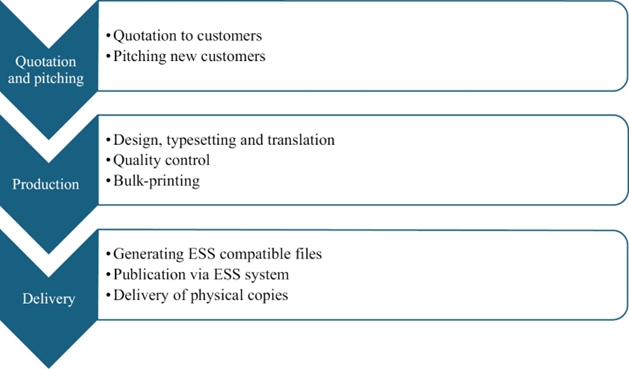
Quotation and pitching
As we generally do not enter into long-term agreements with our customers, we issue standard quotations upon request prior to providing services. Upon receipt of a customer’s request for quotation, we discuss the scope of services based on the customer’s needs and requirements. We then prepare a quotation in accordance with our pricing strategy. A full quotation including pricing and payment terms is provided to the customer for acceptance. Upon confirmation, we commence the production process.
Production
The production phase typically begins with draft financial communications materials provided by the customer. Upon receipt, we begin typesetting using third-party licensed software. Where translation is required, we engage external language service providers. Design and artwork are handled by our in-house design team.
Upon completion, our staff perform quality control procedures, including proofreading and consistency checks between original and translated materials. The draft materials are then provided to the customer for approval. Once approved, we engage external printing service providers if printed copies are required.
Delivery
Upon completion of printing, external logistics providers deliver printed materials to designated locations in accordance with customer instructions. For electronic submissions, our in-house staff prepare final versions in accordance with ESS system requirements and submit materials on behalf of the customer to the Hong Kong Stock Exchange.
Customers
Our clients consist of domestic and international companies listed on the Hong Kong Stock Exchange that are subject to filing and reporting requirements under the HK Listing Rules and the Securities and Futures Ordinance of Hong Kong, as well as companies seeking to list on the Hong Kong Stock Exchange and their advisors.
Following the acquisition of Miracle Media Production Limited in February 2025, our customer base expanded to include clients requiring printing, translation, production and related corporate communication services in addition to our traditional financial communications services.
For the year ended December 31, 2025, our five largest customers accounted for approximately 3.6%, 2.3%, 2.1%, 1.8% and 1.8% of our total revenue, respectively. For the year ended December 31, 2024, our five largest customers accounted for approximately 5.2%, 3.4%, 3.0%, 2.7% and 2.7% of our total revenue, respectively. For the year ended December 31, 2023, our five largest customers accounted for approximately 12.5%, 2.0%, 1.9%, 1.7% and 1.3% of our total revenue, respectively.
We do not enter into long-term agreements with our customers, which is consistent with industry practice. Services are typically provided on a project-by-project basis.
Suppliers
Our suppliers include (i) printing service providers, (ii) translation service providers, and (iii) other corporate communication related service providers.
Following the acquisition of Miracle Media Production Limited, our supplier base expanded, particularly in relation to printing, translation, production and maintenance services.
For the year ended December 31, 2025, our four major suppliers accounted for approximately 11.7%, 6.4%, 5.0% and 4.3% of our total purchases, respectively.
For the year ended December 31, 2024, four major suppliers accounted for approximately 18.5%, 16.7%, 11.8% and 8.7% of total purchases, respectively. For the year ended December 31, 2023, four major suppliers accounted for approximately 25.4%, 13.3%, 8.2% and 7.2% of total purchases, respectively.
For the years ended December 31, 2025, 2024 and 2023, we transacted with 8, 7, and 12 printing service providers, respectively, as well as over 11, 11, and 8 suppliers for translation services, respectively.
Sales and Marketing
We maintain business relationships with existing customers, primarily listed companies on the Hong Kong Stock Exchange and their advisors. Management believes that service quality, execution reliability and responsiveness are key factors supporting customer retention and repeat business.
Customer referrals continue to be an important source of new business. At the same time, we conduct outreach to potential customers to diversify and expand our client base, including engagement with corporate issuers and professional advisors.
We organize marketing and relationship-building activities to support business development. Our ability to maintain and expand our customer base depends on continued service quality, market conditions and our ability to compete effectively in a service-driven and competitive industry.
Pricing Strategy
Our directors are responsible for determining the price for our financial communications services. We generally adopt a cost-plus approach in pricing our services. In determining the fees we charge our customers, we take into account the following factors:
| ● | type and nature of the services requested, including financial printing, corporate reporting, translation, design, production, electronic reporting and other related support services; |
| ● | market rates and rates charged by our competitors for similar services; |
| ● | costs of services, including raw material costs, labor costs and charges of our suppliers and subcontractors, including printing service providers, language solutions suppliers, designers and other service providers; |
| ● | scope, timing and complexity of the engagement, including turnaround requirements; |
| ● | potential future business opportunities with the customer; and |
| ● | the customer’s reputation and the level of market acceptance of current rates for similar services. |
Competition
The financial communications services industry in Hong Kong is highly competitive and remains fragmented. We face competition from a range of financial communications services providers, financial printers, translation and language solutions providers, design and production service providers and other service vendors operating at different scales in Hong Kong. Technology innovation and the continuing migration of parts of the industry toward digital workflows and paperless delivery have lowered certain barriers to entry and intensified competition in some service areas.
Following our acquisition of Miracle Media Production Limited in February 2025, our service platform expanded to include printing, translation, production and maintenance services in addition to the financial communications services historically provided by JAN Financial. As a result, we may face competition across a broader range of service categories and from additional market participants.
We compete primarily on service quality, execution reliability, turnaround time, subject matter and regulatory familiarity, security and confidentiality, price and reputation. We believe we compete favorably through our client relationships, customer service, industry knowledge, operational flexibility and management experience. We also believe our ability to provide integrated services across financial communications, printing, translation and related production support enhances our competitive position.
Seasonality
Our business is affected by conditions in the Hong Kong capital markets and the broader economy, as demand for our services is linked to listing, reporting, compliance and transaction activity, including IPOs, secondary offerings, mergers and acquisitions, debt offerings and other capital markets transactions. Our clients consist primarily of domestic and international companies listed on the HK Stock Exchange, companies seeking listing on the HK Stock Exchange and their advisers in Hong Kong.
We typically experience higher demand during periods associated with annual and interim reporting and disclosure cycles, particularly in March and April and in June and July. These peak periods may require us to adjust staffing and operating capacity through a combination of additional full-time and temporary personnel, overtime and outsourcing of selected services. To help manage seasonal fluctuations, we seek to maintain a variable cost structure that allows us to allocate resources in response to customer demand.
Insurance
We believe our insurance coverage is adequate for the size and nature of our business. Our insurance coverage includes, among other things, work-related injury insurance for our employees and property all risks insurance for our office facilities. We review our insurance policies from time to time for adequacy of coverage.
We do not maintain professional liability insurance and therefore do not have coverage for losses arising from negligence in the preparation of financial communications services materials, translation errors, information leakage, breach of confidentiality obligations or cybersecurity incidents. Our business remains susceptible to risks arising from losses sustained in the course of operations, and we cannot assure you that our insurance policies will cover all losses we may incur. In the event of an uninsured loss or a loss in excess of policy limits, including losses caused by natural disasters or other events beyond our control, we may be required to pay for losses, damages and liabilities from our own funds. For details regarding such risks, see “Item 3. Key Information - D. Risk Factors - Risks Related to Our Business and Industry - Our insurance coverage may be inadequate to protect us from potential losses.”
Intellectual Property
As of the date of this annual report, we have registered four trademarks in Hong Kong, which we consider to be material to our business:
| Trademark | Place of registration | Trademark number |
Owner | Class | Expiry Date | |||||
 |
Hong Kong | 305122926 | JAN Financial | 16, 35, 36 | November 25, 2029 |
|||||
 |
Hong Kong | 305122935 | JAN Financial | 16, 35, 36 | November 25, 2029 |
|||||
 |
Hong Kong | 305122944 | JAN Financial | 16, 35, 36 | November 25, 2029 |
|||||
 |
Hong Kong | 305122953 | JAN Financial | 16, 35, 36 | November 25, 2029 |
In July 2019, a third party asserted an infringement of intellectual property claim against JAN Financial, alleging that the former name of JAN Financial was infringing on the intellectual property right of such third party. As a result, JAN Financial changed its former company name to its current name.
Licenses and Regulatory Approvals
A summary of the laws and regulations applicable to our business and industry is set out in the section headed “Regulations” below. We believe that we and our subsidiaries have obtained all licenses, permits and approvals that are material to our business for the years ended December 31, 2023, 2024 and 2025, and up to the date of this annual report. Our subsidiaries in Hong Kong have obtained the business registration certificates required for their operations in Hong Kong.
Legal Proceedings
We are not currently a party to any material legal or administrative proceedings. From time to time, we may be subject to legal, administrative or regulatory claims and proceedings arising in the ordinary course of business. Regardless of outcome, such matters may result in substantial cost and diversion of management time and resources. Based on currently available information, we are not aware of any pending or threatened legal proceeding that, in the opinion of management, is likely to have a material adverse effect on our business, financial condition or results of operations.
Regulations
Regulations Related to Our Business Operations in Hong Kong
Regulations Related to Business Registration
Business Registration Ordinance (Chapter 310 of the Laws of Hong Kong)
The Business Registration Ordinance requires every person carrying on business in Hong Kong to apply to the Commissioner of Inland Revenue for business registration in the prescribed manner. The Commissioner of Inland Revenue must register each business for which an application is made and, after payment of the prescribed business registration fee and levy, issue a business registration certificate or branch registration certificate, as applicable. For the years ended December 31, 2023, 2024 and 2025, and as of the date of this annual report, our subsidiaries in Hong Kong have obtained the required business registration certificates.
Regulations Related to Employment and Labor Protection
Employment Ordinance (Chapter 57 of the Laws of Hong Kong)
The Employment Ordinance governs, among other things, wage protection and general conditions of employment in Hong Kong. Under the Employment Ordinance, employees are generally entitled to, among other things, notice of termination or payment in lieu of notice, maternity protection, rest days, severance payment or long service payment, sickness allowance, statutory holidays or alternative holidays and paid annual leave depending on length of service.
Employees’ Compensation Ordinance (Chapter 282 of the Laws of Hong Kong)
The Employees’ Compensation Ordinance provides for compensation to employees injured in the course of employment. Employers are required to maintain employees’ compensation insurance coverage meeting the statutory minimum requirements. Under the Fourth Schedule of the Employees’ Compensation Ordinance, the minimum insured amount is HK$100,000,000 per event where a company has no more than 200 employees. Employers that fail to comply may be subject to criminal penalties, including fines and imprisonment. Employers are also required to display a prescribed notice of insurance in a conspicuous place at each premises where employees are employed.
Minimum Wage Ordinance (Chapter 608 of the Laws of Hong Kong)
The Minimum Wage Ordinance prescribes a statutory minimum hourly wage for employees engaged under contracts of employment covered by the Employment Ordinance. The minimum wage increased to HK$42.1 per hour with effect from May 1, 2025. Any provision in an employment contract that purports to extinguish or reduce any right, benefit or protection conferred by the Minimum Wage Ordinance is void.
Mandatory Provident Fund Schemes Ordinance (Chapter 485 of the Laws of Hong Kong)
The Mandatory Provident Fund Schemes Ordinance requires employers to take all practical steps to ensure that eligible employees become members of a registered mandatory provident fund scheme. Subject to minimum and maximum relevant income levels, both employers and employees are generally required to contribute 5% of the employee’s relevant income. Failure to comply may result in criminal penalties, including fines and imprisonment. We believe that we have made all required contributions under the Mandatory Provident Fund Schemes Ordinance.
Occupiers Liability Ordinance (Chapter 314 of the Laws of Hong Kong)
The Occupiers Liability Ordinance regulates the obligations of occupiers or persons having control of premises in respect of injury to persons or damage to property lawfully on the premises. It imposes a common duty of care to take such care as is reasonable in all the circumstances to ensure that visitors are reasonably safe in using the premises for the purposes for which they are invited or permitted to be there.
Occupational Safety and Health Ordinance (Chapter 509 of the Laws of Hong Kong)
The Occupational Safety and Health Ordinance provides for the safety and health protection of employees in both industrial and non-industrial workplaces. Employers must, so far as reasonably practicable, provide and maintain safe systems of work, safe workplaces, safe means of access and egress, appropriate information, instruction, training and supervision, and a working environment that is safe and without risks to health. Failure to comply may result in fines and, in certain cases, imprisonment.
Factories and Industrial Undertakings Ordinance (Chapter 59 of the Laws of Hong Kong)
The Factories and Industrial Undertakings Ordinance imposes general duties on proprietors of industrial undertakings and persons employed therein to ensure health and safety at work. Contravention may result in fines and, in certain cases, imprisonment. Although much of our business is service-based, aspects of printing and production-related operations may be relevant to the regulatory framework applicable to industrial activities in Hong Kong.
Regulations Related to Intellectual Property
Copyright Ordinance (Chapter 528 of the Laws of Hong Kong)
The Copyright Ordinance protects recognized categories of literary, dramatic, musical and artistic works, as well as sound recordings, films, broadcasts, cable programs and typographical arrangements of published editions. Unauthorized copying, issuing or making available copies of copyrighted works may constitute infringement. Certain dealing in infringing copies in the course of business may also give rise to civil or criminal liability. Because aspects of our business involve printing, translation, production and the handling of customer materials in both printed and electronic form, compliance with copyright law is relevant to our operations.
Trade Marks Ordinance (Chapter 559 of the Laws of Hong Kong)
The Trade Marks Ordinance governs the registration, use and protection of trademarks in Hong Kong. A person may infringe a registered trademark by using an identical or similar sign in the course of trade in circumstances likely to cause confusion, or, in the case of well-known marks, where use takes unfair advantage of or is detrimental to the mark’s distinctive character or reputation. Trademarks registered outside Hong Kong are not automatically protected in Hong Kong unless separately registered there, although unregistered marks may in some circumstances be protected through the common law tort of passing off.
Regulations Related to Competition
Competition Ordinance (Chapter 619 of the Laws of Hong Kong)
The Competition Ordinance prohibits anti-competitive conduct in Hong Kong, including certain anti-competitive agreements and abuse of a substantial degree of market power. Breaches may result in financial penalties and other remedies. We believe we have not engaged in anti-competitive conduct and intend to continue to operate in compliance with the Competition Ordinance.
Regulations and Notices Related to Hong Kong Taxation
Inland Revenue Ordinance (Chapter 112 of the Laws of Hong Kong)
Under the Inland Revenue Ordinance, where an employer commences to employ in Hong Kong an individual who is or is likely to be chargeable to tax, or any married person, the employer must give written notice to the Commissioner of Inland Revenue not later than three months after the date of commencement of such employment. Where an employer ceases or is about to cease to employ in Hong Kong an individual who is or is likely to be chargeable to tax, or any married person, the employer must give written notice to the Commissioner of Inland Revenue not later than one month before such individual ceases to be employed in Hong Kong.
Tax on dividends
Under Hong Kong tax law and current practice, dividends are generally not subject to Hong Kong profits tax and Hong Kong does not impose withholding tax on dividends.
Capital gains and profit tax
Hong Kong generally does not tax capital gains. However, gains arising from the sale of shares may be subject to Hong Kong profits tax where such gains are regarded as trading gains arising in or derived from Hong Kong from a trade, profession or business carried on in Hong Kong. For corporations, Hong Kong profits tax is generally imposed at the two-tiered rates of 8.25% on the first HK$2,000,000 of assessable profits and 16.5% on assessable profits above HK$2,000,000, subject to applicable conditions and anti-avoidance rules. Certain taxpayers, including financial institutions, insurance companies and securities dealers, are more likely to be regarded as deriving trading gains rather than capital gains unless they can establish that the relevant securities are held for long-term investment purposes.
Stamp Duty Ordinance (Chapter 117 of the Laws of Hong Kong)
Under the Stamp Duty Ordinance, Hong Kong stamp duty is payable on transfers of Hong Kong stock. As of December 31, 2025, stamp duty on the sale or purchase of Hong Kong stock is charged at 0.1% of the higher of the consideration for, or the market value of, the shares, payable by each of the purchaser and the seller, so that a total of 0.2% is typically payable on a sale and purchase transaction. In addition, a fixed duty of HK$5 is payable on each instrument of transfer of Hong Kong stock. Where one of the parties is a person resident outside Hong Kong and does not pay the ad valorem duty due by it, the duty not paid may be assessed on the instrument of transfer and may become payable by the transferee. If stamp duty is not paid on or before the due date, penalties may be imposed.
Regulations Related to the China’s Enterprises Income Tax Law
On March 16, 2007, the National People’s Congress of the PRC enacted the Enterprise Income Tax Law, or the EIT Law, under which foreign-invested enterprises and domestic companies are generally subject to enterprise income tax at a uniform rate of 25%. The EIT Law became effective on January 1, 2008.
The EIT Law also provides that an enterprise established under the laws of a foreign country or region, but whose de facto management body is located in the PRC, may be treated as a resident enterprise for PRC tax purposes and consequently may be subject to PRC enterprise income tax at the rate of 25% on its worldwide income. The implementing rules define the location of the de facto management body as the place where the substantial and overall management and control of the production and business operations, personnel, accounting and properties of the enterprise is located. Based on our facts and circumstances, we do not believe that Powell Max Limited or its operations outside the PRC should be treated as a PRC resident enterprise for PRC tax purposes.
The EIT Law also imposes a withholding income tax of 10% on dividends distributed by a foreign-invested enterprise in the PRC to its immediate holding company outside the PRC, unless such holding company’s jurisdiction of incorporation has a tax treaty with the PRC that provides for a different withholding arrangement. The British Virgin Islands, where we are incorporated, does not have such a tax treaty with the PRC. Under the arrangement between mainland China and Hong Kong for the avoidance of double taxation, dividends paid by a PRC enterprise to its immediate Hong Kong holding company may be subject to withholding tax at a rate of no more than 5% if the relevant conditions are satisfied, including a direct ownership threshold. We did not record any dividend withholding tax for the periods presented because we had no retained earnings available for distribution from PRC operations.
Regulations Related to Personal Data
Personal Data (Privacy) Ordinance (Chapter 486 of the Laws of Hong Kong)
The Personal Data (Privacy) Ordinance, or the PDPO, imposes a statutory duty on data users to comply with the six data protection principles set out in Schedule 1 to the PDPO. These principles relate to the purpose and manner of collection of personal data, accuracy and retention, use of personal data, security of personal data, openness and transparency, and access to and correction of personal data. Non-compliance may give rise to investigation and enforcement action by the Privacy Commissioner for Personal Data, and certain contraventions may lead to criminal liability, fines and imprisonment.
The PDPO also gives data subjects rights, including the right to be informed whether a data user holds their personal data, the right to access such data, and the right to request correction of inaccurate personal data. Individuals who suffer damage, including injury to feelings, by reason of a contravention of the PDPO may seek compensation from the relevant data user.
Data Protection Act, 2021 of the British Virgin Islands
We are also subject to certain data protection obligations under the Data Protection Act, 2021 of the British Virgin Islands, or the DPA. In connection with our corporate and shareholder administration activities, we may collect, use, store, disclose, retain and secure personal data only to the extent necessary for lawful purposes, including compliance with legal and regulatory obligations and the conduct of our ordinary business activities. We seek to apply appropriate technical and organizational security measures and to transfer personal data only in accordance with applicable law.
How We May Use a Shareholder’s Personal Data
We may, as a data controller, collect, store, use and otherwise process personal data for lawful purposes, including, in particular, where such processing is necessary for the performance of our rights and obligations under applicable agreements, for compliance with legal and regulatory obligations to which we are or may become subject, including anti-money laundering, FATCA and CRS compliance, and for purposes of our legitimate interests, except where such interests are overridden by the interests, fundamental rights or freedoms of the relevant data subjects. Where we wish to use personal data for any other specific purpose, including where consent is required, we will seek to do so in accordance with applicable law.
Why We May Transfer Our Shareholders’ Personal Data
In certain circumstances, we may be required to disclose personal data and other information relating to a shareholder’s investment or shareholding to regulatory, tax, governmental or other competent authorities in order to comply with applicable laws, regulations or regulatory requests. Such authorities may, in turn, exchange this information with other authorities, including foreign tax authorities, where permitted or required by law. We may also disclose personal data to our affiliates and to service providers and their affiliates who assist us in carrying out our business and corporate administration functions, including service providers located outside the United States, the British Virgin Islands or the European Economic Area, in each case in accordance with applicable law.
The Data Protection Measures We Take
Any transfer of personal data by us or our duly authorized affiliates, delegates or service providers outside the British Virgin Islands will be made in accordance with the requirements of applicable data protection law. We seek to implement appropriate technical and organizational measures designed to protect personal data against unauthorized or unlawful processing and against accidental loss, destruction or damage. Where required by applicable law, we will provide notice of a personal data breach to affected persons and/or relevant authorities. Our shareholders may have rights under applicable law to request access to, and correction of, personal data that we hold about them, subject to applicable limitations and exceptions.
Contacting the Company
For further information regarding the collection, use, disclosure, transfer or processing of personal data, or to exercise any applicable data protection rights, shareholders may contact us through our website at janfp.com or by telephone at (+852) 2158 2888.
| C. | Organizational Structure |
The charts below illustrate our corporate structure:

| Name | Background | Ownership | |||
| JAN Financial | – | A Hong Kong company | 100% owned by Powell Max | ||
| – | Incorporated on February 27, 2019 | ||||
| – | Issued share capital of HK$1,000,000 | ||||
| – | Engaged in the provision of financial communications services | ||||
| Miracle Media | – | A Hong Kong company | 100% owned by Powell Max | ||
| Production Limited | – | Incorporated on September 21, 2017 | |||
| – | Issued share capital of HK$1,000,000 | ||||
| – | Engaged in the provision of printing, translation, production and maintenance services | ||||
As of December 31, 2025, Powell Max held 100% of the equity interests in JAN Financial Press Limited and Miracle Media Production Limited. Miracle Media Production Limited became a wholly-owned subsidiary of Powell Max upon the completion of the acquisition on February 28, 2025.
| D. | Property, Plants and Equipment |
We do not own any real property.
As of December 31, 2025, we leased office premises at 22/F., Euro Trade Centre, 13-14 Connaught Road Central, Hong Kong, with an approximate gross floor area of 489 sq.m. JAN Financial entered into a new tenancy agreement on March 18, 2025 for an additional term of two years commencing on May 20, 2025 and ending on May 19, 2027.
| No. | Location | Gross floor area (sq.m) | Rent | |||
| 1. | 22/F., Euro Trade Centre, 13-14 Connaught Road Central, Hong Kong | 489 (approximate) | HK$284,094 per month (equivalent to approximately US$36,422 per month) (1) |
| (1) | JAN Financial entered into a lease agreement with an independent third party, pursuant to which JAN Financial leased the premises with a lease term from May 20, 2019 to May 19, 2022, and extended by another lease agreement with the lease term from May 20, 2022 to May 19, 2025. On March 18, 2025, JAN Financial entered into a new lease agreement for an extended term of 2 years from May 20, 2025 to May 19, 2027 at the rent of HK$284,094 per month (equivalent to approximately US$30,769) |
Item 4A. Unresolved Staff Comments
Not applicable
Item 5. Operating and Financial Review and Prospects
The following management discussion and analysis of financial condition and results of operations contains forward-looking statements that involve risks and uncertainties. Our actual results could differ materially from those anticipated in these forward-looking statements as a result of various factors, including those set forth under “Item 3. Key Information - D. Risk Factors” and elsewhere in this annual report. We undertake no obligation to update any forward-looking statements or risk factors, except as required by applicable law. You should read the following discussion in conjunction with our consolidated financial statements and related notes included elsewhere in this annual report.
| A. | Operating Results |
OVERVIEW
Founded in 2019, we commenced operations through JAN Financial, our operating subsidiary in Hong Kong. We engage in the provision of financial communications services that support capital market compliance and transaction needs for corporate clients and their advisors in Hong Kong. Our financial communications services cover a full range of financial printing, corporate reporting, communications and language support services from inception to completion, including typesetting, proofreading, translation, design, printing, electronic reporting, newspaper placement and distribution. We provide integrated services to help our clients comply with their disclosure and reporting obligations, create, manage and deliver accurate and timely financial communications and manage transaction processes.
On February 26, 2025, we entered into an agreement to acquire Miracle Media Production Limited, and we completed the acquisition on February 28, 2025. Miracle Media is principally engaged in the provision of printing, translation, production and maintenance services in Hong Kong and, following the acquisition, became our wholly-owned operating subsidiary. As a result, our operating platform expanded beyond JAN Financial and now includes both JAN Financial and Miracle Media.
Our clients consist primarily of domestic and international companies listed on the Hong Kong Stock Exchange that are subject to filing and reporting requirements under the HK Listing Rules and the Securities and Futures Ordinance of Hong Kong, together with companies seeking to list on the Hong Kong Stock Exchange and their advisors in Hong Kong. In addition, we provide ancillary support services, including conference room facilities and related corporate communication support services, to help customers meet their compliance and transaction-related needs.
Revenue Recognition
Our revenue is primarily derived from the provision of financial communications services, including financial printing, corporate reporting, translation, production and related support services. We recognize revenue when control of the promised services is transferred to our customers, in an amount that reflects the consideration to which we expect to be entitled in exchange for those services.
Our engagements are generally project-based and may include multiple integrated service components, such as typesetting, translation, design, printing and distribution. These services are typically highly interrelated and are provided as a combined output to the customer. Accordingly, revenue is generally recognized at a point in time when the relevant deliverables are completed and accepted by the customer, or when the services have been substantially performed in accordance with the agreed specifications.
In certain cases, where services are performed over a period of time and the customer simultaneously receives and consumes the benefits of our performance, revenue may be recognized over time based on the progress toward completion of the service. The timing of revenue recognition therefore depends on the specific terms of each contract, including the nature of the services provided, contractual milestones and customer acceptance.
We do not typically provide significant financing arrangements, and consideration is generally fixed and agreed at the outset of each engagement. Any variable consideration, if present, is not material to our consolidated financial statements.
The above description is a summary of our revenue recognition practices. For a detailed discussion of our accounting policies, including revenue recognition, please refer to the notes to our consolidated financial statements included elsewhere in this annual report.
Our revenue for the years ended December 31, 2023, 2024 and 2025 was HK$49,121,839, HK$36,461,260 and HK$47,647,541, respectively. The increase in revenue in 2025 as compared to 2024 reflected continued activity in our core business and the contribution from Miracle Media following the completion of the acquisition in February 2025. In our interim results for the six months ended June 30, 2025, we disclosed that revenue increased to approximately HK$23.9 million from HK$22.7 million in the corresponding period of 2024, of which approximately HK$1.5 million was contributed by Miracle Media. For the period from February 26, 2025 to December 31, 2025, Miracle Media contributed revenue of HK$6.9 million.
Operating Segment
Management assesses the performance of our business and allocates resources on a consolidated basis. We operate in a single business line, being the provision of financial communications services and related support services in Hong Kong, and our chief operating decision maker reviews financial information on an aggregated basis.
Accordingly, we have determined that we operate as a single reportable operating segment under applicable accounting standards. We do not distinguish between different service lines, such as financial printing, translation or production services, for the purpose of internal reporting or performance evaluation, as these services are highly integrated and form part of a combined service offering to our customers.
In addition, substantially all of our revenue, assets and operations are located in Hong Kong. As a result, no separate geographic segment information is presented.
MAJOR FACTORS AFFECTING OUR RESULTS OF OPERATIONS
Economic conditions in Hong Kong
We are headquartered in Hong Kong, and our operations are conducted in Hong Kong through JAN Financial and Miracle Media. Substantially all of our revenue has been generated in Hong Kong. Accordingly, our business, financial condition, results of operations and prospects are significantly affected by general economic, political and regulatory conditions in Hong Kong. Any adverse development in Hong Kong, including an economic downturn, reduced capital markets activity, changes in customer demand, disruptions in business activity, public health events or regulatory changes affecting corporate transactions or listed company compliance activity, could materially and adversely affect our business and operating results.
Our ability to meet the regulatory and service requirements of our clients in Hong Kong
Our clients, including listed companies and listing applicants on the Hong Kong Stock Exchange, are subject to applicable laws, regulations and regulatory compliance requirements, in particular the HK Listing Rules and the Securities and Futures Ordinance of Hong Kong, under the supervision of the Hong Kong Stock Exchange and the Securities and Futures Commission. Through our operating subsidiaries, we provide financial printing, translation, production and related services that facilitate our clients’ compliance with these obligations, including the preparation of bilingual communications, the printing of physical copies and the electronic publication of documents.
Relevant regulatory requirements and market practices may evolve over time or become subject to different interpretations by relevant authorities, and such changes are beyond our control. Any loosening of the applicable reporting and compliance requirements may reduce demand for some of our services. Conversely, any tightening of those requirements may require us to incur additional costs, expand capabilities or adjust our operating model in order to continue providing services effectively to our clients. Our ability to adapt to such developments may affect our revenue, margins and overall results of operations.
Competition in the financial communications services industry in Hong Kong
The financial communications services industry in Hong Kong is intensely competitive, highly fragmented and subject to rapid change, and we expect it to remain so. We compete with a significant number of market participants in Hong Kong that provide services similar to ours, including financial printers, language solutions providers and other communications support firms. Some of our competitors may have greater financial resources, stronger brand recognition, longer operating histories, broader service offerings or wider customer networks than we do.
Following the acquisition of Miracle Media, our service capabilities broadened to include additional printing, translation, production and maintenance services. While we believe this enhances our ability to serve clients more comprehensively, it also places us in competition across a wider range of service offerings. Increased competition may place pressure on pricing, margins and customer retention, particularly during periods of weaker capital markets activity in Hong Kong. In our interim 2025 results, we noted a reduction of capital market activities in Hong Kong and increased sales and marketing efforts intended to maintain our market presence. If we are unable to compete effectively, maintain service quality or preserve customer relationships, our market share, financial condition and results of operations could be materially and adversely affected.
RESULTS OF OPERATIONS
The following table summarizes our consolidated statements of operations for the years indicated. This information should be read together with our consolidated financial statements and related notes included elsewhere in this annual report for the years indicated. The operating results in any year are not necessarily indicative of the results that may be expected for any future period.
Comparison of the years ended December 31, 2023, 2024 and 2025:
| Year ended December 31, | ||||||||||||||||
| 2023 | 2024 | 2025 | ||||||||||||||
| HK$ | HK$ | HK$ | US$ | |||||||||||||
| Revenue | 49,121,839 | 36,461,260 | 47,647,541 | 6,121,766 | ||||||||||||
| Cost of sales | (25,238,821 | ) | (22,081,030 | ) | (24,057,997 | ) | (3,090,976 | ) | ||||||||
| Gross profit | 23,883,018 | 14,380,230 | 23,589,544 | 3,030,790 | ||||||||||||
| Other income and gain | 54,116 | 1,952,986 | 3,472,672 | 446,170 | ||||||||||||
| General and administrative expenses | (10,862,255 | ) | (24,854,036 | ) | (29,080,554 | ) | (3,736,275 | ) | ||||||||
| Impairment loss on goodwill | - | - | (11,773,403 | ) | (1,512,649 | ) | ||||||||||
| Selling and distribution expenses | (4,530,134 | ) | (7,049,538 | ) | (7,380,299 | ) | (948,223 | ) | ||||||||
| Allowance of expected credit loss - trade receivables | (914,788 | ) | (488,640 | ) | (1,631,086 | ) | (209,562 | ) | ||||||||
| Profit/(Loss) from operations | 7,629,957 | (16,058,998 | ) | (22,803,126 | ) | (2,929,749 | ) | |||||||||
| Finance costs | (550,714 | ) | (2,015,096 | ) | (692,894 | ) | (89,024 | ) | ||||||||
| Profit/(Loss) before income tax | 7,079,243 | (18,074,094 | ) | (23,496,020 | ) | (3,018,773 | ) | |||||||||
| Income tax expense | - | - | - | - | ||||||||||||
| Profit/(Loss) for the year | 7,079,243 | (18,074,094 | ) | (23,496,020 | ) | (3,018,773 | ) | |||||||||
Revenue
Revenue is generated primarily from the provision of corporate financial communications, IPO financial printing, consultancy, and supporting and maintenance services in Hong Kong.
The following table sets forth types of our revenue for the years indicated:
| Year ended December 31, | ||||||||||||||||||||||||||||
| 2023 | 2024 | 2025 | ||||||||||||||||||||||||||
| HK$ | % of total revenue | HK$ | % of total revenue | HK$ | US$ | % of total revenue | ||||||||||||||||||||||
| Corporate financial communications services | 39,133,279 | 79.7 | 32,373,844 | 88.8 | 38,841,687 | 4,990,387 | 81.5 | |||||||||||||||||||||
| IPO financial printing services | 9,988,560 | 20.3 | 4,087,416 | 11.2 | 3,789,793 | 486,913 | 8.0 | |||||||||||||||||||||
| Consultancy fees | - | - | - | - | 2,158,805 | 277,364 | 4.5 | |||||||||||||||||||||
| Supporting and maintenance services | - | - | - | - | 2,857,256 | 367,102 | 6.0 | |||||||||||||||||||||
| Total revenue | 49,121,839 | 100.0 | 36,461,260 | 100.0 | 47,647,541 | 6,121,766 | 100.0 | |||||||||||||||||||||
Revenue from corporate financial communications services accounted for 79.7%, 88.8% and 81.5% of our total revenue for the years ended December 31, 2023, 2024 and 2025, respectively. Revenue from IPO financial printing services accounted for 20.3%, 11.2% and 8.0% of our total revenue for the same periods, respectively. In 2025, revenue also included consultancy fees of HK$2,158,805, representing 4.5% of total revenue, and supporting and maintenance services of HK$2,857,256, representing 6.0% of total revenue. The change in revenue mix in 2025 reflects the contribution of additional service lines following the acquisition of Miracle Media and the continued lower relative contribution from IPO financial printing services.
For the year ended December 31, 2025, total revenue was HK$47,647,541, compared to HK$36,461,260 for the year ended December 31, 2024, representing an increase of approximately 30.7%. The increase was driven by higher revenue from corporate financial communications services, the introduction of additional service lines, including consultancy and supporting and maintenance services, and the contribution from Miracle Media Production Limited following completion of the acquisition in February 2025. For the period from February 26, 2025 to December 31, 2025, Miracle Media contributed revenue of approximately HK$6.9 million.
Revenue from corporate financial communications services increased to HK$38,841,687 for the year ended December 31, 2025 from HK$32,373,844 for the year ended December 31, 2024, representing an increase of approximately 20.0%. This increase reflected stronger contribution from corporate financial communications services and the expanded operating scope of the Company following the Miracle Media acquisition. In addition, in 2025, the Company generated revenue from consultancy services of HK$2,158,805 and supporting and maintenance services of HK$2,857,256, which were not present in prior periods and contributed to the overall increase in revenue.
Revenue from IPO financial printing services decreased to HK$3,789,793 for the year ended December 31, 2025 from HK$4,087,416 for the year ended December 31, 2024, representing a decrease of approximately 7.3%, and accounted for a smaller portion of total revenue.
For the year ended December 31, 2024, total revenue decreased to HK$36,461,260 from HK$49,121,839 in 2023, representing a decline of approximately 25.8%. The decrease was driven by lower revenue from both corporate financial communications services and IPO financial printing services.
Revenue from corporate financial communications services decreased to HK$32,373,844 in 2024 from HK$39,133,279 in 2023, representing a decline of approximately 17.3%. This was primarily attributable to reduced demand for printed financial documents following the implementation of the paperless listing regime by the Hong Kong Stock Exchange effective December 31, 2023. In addition, demand from GEM-listed clients declined following amendments to the GEM Listing Rules in 2024, which removed the requirement for first and third quarterly reports.
Revenue from IPO financial printing services decreased to HK$4,087,416 in 2024 from HK$9,988,560 in 2023, representing a decline of approximately 59.1%, primarily due to lower IPO-related project activity.
Cost of sales
Our cost of sales primarily consists of (i) printing costs, (ii) translation costs, (iii) employee benefits expense, and (iv) other production costs. The table below shows the cost of sales for the years indicated.
| Year ended December 31, | ||||||||||||||||||||||||||||
| 2023 | 2024 | 2025 | ||||||||||||||||||||||||||
| HK$ | % of total cost of sales |
HK$ | % of total cost of sales |
HK$ | US$ | % of total cost of sales |
||||||||||||||||||||||
| Printing costs | 5,414,965 | 21.5 | 2,701,865 | 12.2 | 2,484,500 | 319,209 | 10.4 | |||||||||||||||||||||
| Translation costs | 9,484,376 | 37.5 | 7,946,906 | 36.0 | 8,284,639 | 1,064,412 | 34.4 | |||||||||||||||||||||
| Employee benefits expense | 9,843,977 | 39.0 | 10,854,440 | 49.2 | 11,026,659 | 1,416,707 | 45.8 | |||||||||||||||||||||
| Other production costs | 495,503 | 2.0 | 577,819 | 2.6 | 2,262,199 | 290,648 | 9.4 | |||||||||||||||||||||
| Total cost of sales | 25,238,821 | 100.0 | 22,081,030 | 100.0 | 24,057,997 | 3,090,976 | 100.0 | |||||||||||||||||||||
Total cost of sales increased from HK$22,081,030 for the year ended December 31, 2024 to HK$24,057,997 for the year ended December 31, 2025, representing an increase of approximately 9.0%. The increase was primarily attributable to higher translation costs, higher employee benefits expense and a significant increase in other production costs, partially offset by a decrease in printing costs. The increase in total cost of sales was lower than the increase in total revenue, which contributed to the improvement in gross profit and gross margin in 2025.
For the years ended December 31, 2023, 2024 and 2025, translation costs represented 37.5%, 36.0% and 34.4% of total cost of sales, respectively, printing costs represented 21.5%, 12.2% and 10.4%, respectively, employee benefits expense represented 39.0%, 49.2% and 45.8%, respectively, and other production costs represented 2.0%, 2.6% and 9.4%, respectively. The change in cost mix reflects the reduced relative contribution of printing costs, the continued significance of translation and employee-related costs, and higher other production costs in 2025 following the expansion of our service mix.
Translation costs increased from HK$7,946,906 for the year ended December 31, 2024 to HK$8,284,639 for the year ended December 31, 2025, representing an increase of approximately 4.2%. However, translation costs as a percentage of total cost of sales decreased from 36.0% in 2024 to 34.4% in 2025.
Printing costs decreased from HK$2,701,865 for the year ended December 31, 2024 to HK$2,484,500 for the year ended December 31, 2025, representing a decrease of approximately 8.0%. Printing costs as a percentage of total cost of sales also declined from 12.2% in 2024 to 10.4% in 2025.
Employee benefits expense increased from HK$10,854,440 for the year ended December 31, 2024 to HK$11,026,659 for the year ended December 31, 2025, representing an increase of approximately 1.6%. Employee benefits expense remained the largest component of cost of sales in 2025, accounting for 45.8% of total cost of sales, compared with 49.2% in 2024.
Other production costs increased from HK$577,819 for the year ended December 31, 2024 to HK$2,262,199 for the year ended December 31, 2025, representing an increase of approximately 291.5%. Other production costs as a percentage of total cost of sales also increased from 2.6% in 2024 to 9.4% in 2025. This increase contributed to the change in the overall cost of sales mix in 2025.
For the year ended December 31, 2024, total cost of sales decreased from HK$25,238,821 for the year ended December 31, 2023 to HK$22,081,030, representing a decrease of approximately 12.5%. The decrease was primarily attributable to lower printing costs and lower translation costs, partially offset by higher employee benefits expense and higher other production costs.
For the year ended December 31, 2024, translation costs decreased from HK$9,484,376 for the year ended December 31, 2023 to HK$7,946,906, representing a decrease of approximately 16.2%. Printing costs decreased from HK$5,414,965 in 2023 to HK$2,701,865 in 2024, representing a decrease of approximately 50.1%. Employee benefits expense increased from HK$9,843,977 in 2023 to HK$10,854,440 in 2024, representing an increase of approximately 10.3%. Other production costs increased from HK$495,503 in 2023 to HK$577,819 in 2024, representing an increase of approximately 16.6%.
General and administrative expenses
The following table sets forth the breakdown of the general and administrative expenses for the years indicated:
| Year ended December 31, | ||||||||||||||||
| 2023 | 2024 | 2025 | 2025 | |||||||||||||
| HK$ | HK$ | HK$ | US$ | |||||||||||||
| Issuance expenses | - | 7,539,921 | 704,340 | 90,494 | ||||||||||||
| Professional services fees | 173,500 | 6,594,406 | 16,421,363 | 2,109,821 | ||||||||||||
| Property related expenses | 247,646 | 251,696 | 255,346 | 32,807 | ||||||||||||
| Employee benefits expense | 3,118,063 | 3,565,394 | 5,433,673 | 698,118 | ||||||||||||
| Office expense | 618,568 | 781,385 | 911,915 | 117,164 | ||||||||||||
| Depreciation of property, plant and equipment | 5,015,875 | 4,444,914 | 3,578,225 | 459,730 | ||||||||||||
| Office equipment expense | 908,354 | 800,238 | 737,063 | 94,698 | ||||||||||||
| Directors’ remuneration | 703,000 | 795,500 | 1,005,930 | 129,242 | ||||||||||||
| Loss on foreign exchange | - | 40,200 | 32,699 | 4,201 | ||||||||||||
| Bad debt write-off | 77,249 | 40,382 | - | - | ||||||||||||
| 10,862,255 | 24,854,036 | 29,080,554 | 3,736,275 | |||||||||||||
General and administrative expenses mainly consist of issuance expenses, professional services fees, employee benefits expense, depreciation of property, plant and equipment, directors’ remuneration, office expense, office equipment expense, property related expenses, loss on foreign exchange and bad debt write-off.
General and administrative expenses increased from HK$24,854,036 for the year ended December 31, 2024 to HK$29,080,554 for the year ended December 31, 2025, representing an increase of approximately 17.0%. The increase was primarily driven by higher professional services fees, employee benefits expense and directors’ remuneration, partially offset by a decrease in issuance expenses, lower depreciation of property, plant and equipment and lower office equipment expense.
Issuance expenses decreased from HK$7,539,921 for the year ended December 31, 2024 to HK$704,340 for the year ended December 31, 2025, representing a decrease of approximately 90.7%. Certain listing-related expenses of HK$12,656,618 associated with the SEPA offering were reclassified and recorded as a reduction of equity in accordance with IFRS and are therefore not included in general and administrative expenses for 2025.
Professional services fees increased from HK$6,594,406 for the year ended December 31, 2024 to HK$16,421,363 for the year ended December 31, 2025, representing an increase of approximately 149.0%. The increase was primarily attributable to higher legal, audit, consulting and other professional fees associated with financing activities, transaction-related matters, public company compliance and broader corporate requirements in 2025.
Employee benefits expense increased from HK$3,565,394 for the year ended December 31, 2024 to HK$5,433,673 for the year ended December 31, 2025, representing an increase of approximately 52.4%. Directors’ remuneration also increased from HK$795,500 in 2024 to HK$1,005,930 in 2025, representing an increase of approximately 26.4%, reflecting higher personnel and governance-related costs in support of expanded operations.
Depreciation of property, plant and equipment decreased from HK$4,444,914 for the year ended December 31, 2024 to HK$3,578,225 for the year ended December 31, 2025, representing a decrease of approximately 19.5%. Office equipment expense also decreased from HK$800,238 in 2024 to HK$737,063 in 2025, representing a decrease of approximately 7.9%.
Office expense increased from HK$781,385 for the year ended December 31, 2024 to HK$911,915 for the year ended December 31, 2025, representing an increase of approximately 16.7%, while property related expenses remained relatively stable. Loss on foreign exchange decreased from HK$40,200 in 2024 to HK$32,699 in 2025.
No bad debt was written off in 2025, compared to HK$40,382 in 2024.
For the year ended December 31, 2024, general and administrative expenses increased from HK$10,862,255 in 2023 to HK$24,854,036, representing an increase of approximately 128.8%, primarily due to the incurrence of issuance expenses, a significant increase in professional services fees and higher employee-related costs associated with public company operations and compliance.
Impairment loss on goodwill
The following table sets forth the impairment loss on goodwill for the years indicated:
| Year ended December 31, | ||||||||||||||||
| 2023 | 2024 | 2025 | 2025 | |||||||||||||
| HK$ | HK$ | HK$ | US$ | |||||||||||||
| Impairment loss on goodwill | - | - | 11,773,403 | 1,512,649 | ||||||||||||
| - | - | 11,773,403 | 1,512,649 | |||||||||||||
During the year ended December 31, 2025, we recorded an impairment loss on goodwill of HK$11,773,403 (US$1,512,649), compared to nil for each of the years ended December 31, 2023 and 2024. The impairment related to goodwill recognized in connection with the acquisition of Miracle Media Production Limited completed in February 2025 and reflected management’s reassessment of the recoverable amount of the related cash-generating unit.
Goodwill arose from the acquisition because the consideration transferred exceeded the fair value of the identifiable net liabilities acquired. The goodwill recognized in connection with the acquisition was initially HK$20,129,846 (US$2,586,287). During 2025, management performed an impairment assessment of the Miracle Media-related cash-generating unit based on updated financial forecasts, revised expectations regarding future performance and the recoverable amount of the acquired business. As a result of this assessment, an impairment loss of HK$11,773,403 (US$1,512,649) was recognized in profit or loss. After giving effect to this impairment, the carrying amount of goodwill as of December 31, 2025 was HK$8,356,443 (US$1,073,638).
The impairment loss recognized in 2025 was non-cash in nature. It did not affect our cash flows, but it materially increased our operating loss and net loss for the year ended December 31, 2025 and affected the comparability of our 2025 results with prior periods.
Selling and distribution expenses
The following table sets forth the breakdown of the selling and distribution expenses for the periods indicated:
| Year ended December 31, | ||||||||||||||||
| 2023 | 2024 | 2025 | 2025 | |||||||||||||
| HK$ | HK$ | HK$ | US$ | |||||||||||||
| Advertising and marketing | 2,176,131 | 3,966,013 | 3,378,008 | 434,007 | ||||||||||||
| Employee benefits expenses | 2,354,003 | 3,083,525 | 4,002,291 | 514,216 | ||||||||||||
| 4,530,134 | 7,049,538 | 7,380,299 | 948,223 | |||||||||||||
Selling and distribution expenses mainly consist of advertising, marketing and business development expenses and salaries and benefits for sales and marketing staff.
Selling and distribution expenses increased from HK$7,049,538 for the year ended December 31, 2024 to HK$7,380,299 for the year ended December 31, 2025, representing an increase of approximately 4.7%. The relatively modest increase in overall expenses reflects a shift in cost structure, with higher personnel-related costs partially offset by reduced spending on advertising and marketing.
Employee benefits expenses within selling and distribution expenses increased from HK$3,083,525 in 2024 to HK$4,002,291 in 2025, representing an increase of approximately 29.8%. The increase was primarily driven by the expansion and strengthening of our sales and marketing team following the acquisition of Miracle Media Production Limited and increased business development activities.
Advertising and marketing expenses decreased from HK$3,966,013 in 2024 to HK$3,378,008 in 2025, representing a decrease of approximately 14.8%, reflecting a more targeted and cost-disciplined approach to marketing spend.
As a result, the overall increase in selling and distribution expenses in 2025 was limited, despite the significant increase in personnel costs.
Allowance for expected credit losses for trade receivables
The following table sets forth the breakdown of the allowance for expected credit losses for trade receivables for the years indicated:
| Year ended December 31, | ||||||||||||||||
| 2023 | 2024 | 2025 | 2025 | |||||||||||||
| HK$ | HK$ | HK$ | US$ | |||||||||||||
| Allowance for expected credit losses – trade receivables | 914,788 | 488,640 | 1,631,086 | 209,562 | ||||||||||||
Allowance for expected credit losses for trade receivables increased from HK$488,640 for the year ended December 31, 2024 to HK$1,631,086 for the year ended December 31, 2025, representing an increase of approximately 233.8%. The increase was primarily attributable to a higher level of expected credit loss provisioning on trade receivables in 2025.
As of December 31, 2025, gross trade receivables increased to HK$13,880,658 from HK$10,117,291 as of December 31, 2024, while the allowance for expected credit losses increased to HK$3,297,953 from HK$2,303,255. The allowance made during 2025 consisted of HK$1,313,177 relating to credit-impaired receivables and HK$317,909 relating to non-credit-impaired receivables, partially offset by write-offs of HK$636,388. The increase in expected credit losses therefore reflected the larger trade receivables balance and the aging and recoverability profile of certain receivables.
The credit risk disclosure as of December 31, 2025 shows that the Company continued to have overdue trade receivables, including balances aged over 120 days, and that this category carried the largest expected credit loss provision. As a result, expected credit loss expense increased materially in 2025 and further adversely affected our operating results.
For the year ended December 31, 2024, allowance for expected credit losses decreased from HK$914,788 for the year ended December 31, 2023 to HK$488,640, representing a decrease of approximately 46.6%. The decrease in 2024 was primarily attributable to lower expected credit loss provisioning on trade receivables.
Finance costs
The following table sets forth the breakdown of the finance costs for the periods indicated:
| Year ended December 31, | ||||||||||||||||
| 2023 | 2024 | 2025 | 2025 | |||||||||||||
| HK$ | HK$ | HK$ | US$ | |||||||||||||
| Interest expense on bank borrowings | 179,866 | 154,980 | 101,108 | 12,990 | ||||||||||||
| Interest expense on lease liabilities | 370,848 | 211,258 | 268,999 | 34,562 | ||||||||||||
| Interest expenses on convertible promissory notes | - | 1,648,858 | 322,787 | 41,472 | ||||||||||||
| 550,714 | 2,015,096 | 692,894 | 89,024 | |||||||||||||
Finance costs consist of interest expense on bank borrowings, lease liabilities and convertible promissory notes.
Finance costs decreased from HK$2,015,096 for the year ended December 31, 2024 to HK$692,894 for the year ended December 31, 2025, representing a decrease of approximately 65.6%. The decrease was primarily attributable to a significant reduction in interest expense on convertible promissory notes, following their redemption and conversion during 2025, as well as the reduction and full repayment of bank borrowings by year end. These decreases were partially offset by an increase in interest expense on lease liabilities.
Interest expense on convertible promissory notes decreased from HK$1,648,858 in 2024 to HK$322,787 in 2025, representing a decrease of approximately 80.4%. This decrease reflected the reduced outstanding balance during 2025 and the absence of any convertible promissory notes outstanding as of December 31, 2025.
Interest expense on bank borrowings decreased from HK$154,980 in 2024 to HK$101,108 in 2025, representing a decrease of approximately 34.8%. This decrease was primarily attributable to the repayment of bank borrowings, as the Company had no bank borrowings outstanding as of December 31, 2025.
Interest expense on lease liabilities increased from HK$211,258 in 2024 to HK$268,999 in 2025, representing an increase of approximately 27.3%. This increase was primarily attributable to higher lease liabilities during 2025, including additions recognized during the year.
Overall, the reduction in finance costs in 2025 reflects a lower level of financial leverage and the restructuring of the Company’s financing arrangements, and partially mitigated the increase in loss before income tax.
For the year ended December 31, 2024, finance costs increased from HK$550,714 for the year ended December 31, 2023 to HK$2,015,096, representing an increase of approximately 265.9%. The increase in 2024 was primarily attributable to the incurrence of interest expense on convertible promissory notes in connection with financing arrangements entered into in 2024.
Income tax
For the year ended December 31, 2025, although the Company recorded a loss before income tax of HK$23,496,020, no income tax expense was recognized. Based on the tax reconciliation, the absence of income tax expense was primarily attributable to the Group’s loss position and the non-recognition of deferred tax assets on tax losses and certain temporary differences, as management concluded that it was not probable that sufficient future taxable profits would be available to utilize such losses and differences. The reconciliation also reflects the impact of expenses and losses not deductible for tax purposes and income not subject to tax.
For the year ended December 31, 2024, the Group also recorded no income tax expense notwithstanding a loss before income tax of HK$18,074,094. Similarly, for the year ended December 31, 2023, no income tax expense was recorded.
Net loss
As a result of the foregoing, we recorded a net loss of HK$23,496,020 for the year ended December 31, 2025, compared to a net loss of HK$18,074,094 for the year ended December 31, 2024. The increase in net loss was primarily attributable to the recognition of goodwill impairment of HK$11,773,403, higher general and administrative expenses and a higher allowance for expected credit losses, partially offset by higher gross profit, increased other income and gain and lower finance costs.
For the year ended December 31, 2024, we recorded a net loss of HK$18,074,094, compared to a net profit of HK$7,079,243 for the year ended December 31, 2023. The change from profit to loss in 2024 was primarily attributable to the decrease in revenue and gross profit, together with a substantial increase in general and administrative expenses, selling and distribution expenses and finance costs.
| B. | Liquidity and Capital Resources |
As of December 31, 2025, our cash and bank balances amounted to HK$6,859,938, compared to HK$42,222,014 as of December 31, 2024. As of December 31, 2025, our current assets were HK$27,909,230 and our current liabilities were HK$15,469,721, compared with current assets of HK$58,318,174 and current liabilities of HK$40,140,041 as of December 31, 2024. For the year ended December 31, 2025, we recorded a net loss of HK$23,496,020 and net cash used in operating activities of HK$8,749,499.
The decrease in cash and bank balances during 2025 was primarily attributable to net cash used in operating activities of HK$8,749,499 and net cash used in investing activities of HK$28,003,060. Net cash used in investing activities primarily reflected cash paid for the acquisition of Miracle Media Production Limited, partially offset by interest income. These cash outflows were partially offset by net cash generated from financing activities of HK$1,390,483, primarily from proceeds from the issuance of shares pursuant to the SEPA and proceeds from the private placement, partially offset by repayment of bank borrowings, repayment of lease liabilities and interest paid.
As of December 31, 2025, our total liabilities decreased significantly to HK$17,456,956 from HK$41,304,223 as of December 31, 2024. This decrease was primarily attributable to the settlement or elimination by year end 2025 of bank borrowings, convertible promissory notes and derivative liabilities that had been outstanding as of December 31, 2024. Total equity increased to HK$24,910,673 as of December 31, 2025 from HK$21,267,637 as of December 31, 2024, primarily as a result of equity issuances during 2025 and increases in reserves, partially offset by the net loss for the year.
In assessing our liquidity, management believes that our existing cash and bank balances, anticipated cash flows from operations and available financing resources will be sufficient to meet our working capital requirements and debt obligations for at least the next 12 months from the date of issuance of the audited consolidated financial statements. At the same time, our cash position declined substantially during 2025, and our liquidity remains sensitive to our ability to improve operating performance, collect receivables on a timely basis, manage expenses and respond to changes in market demand and the broader economic environment. If we experience a prolonged adverse operating environment, incur unanticipated capital expenditures or pursue additional expansion initiatives, we may require additional financing. No assurance can be given that such financing would be available on acceptable terms, or at all. Any such financing, particularly if raised through equity or equity-linked securities, could result in dilution to our existing shareholders.
For the year ended December 31, 2024, our cash and bank balances amounted to HK$42,222,014 as of year end, compared to HK$3,660,213 as of December 31, 2023. The increase in 2024 was primarily attributable to net cash generated from financing activities of HK$51,177,252, including proceeds from the initial public offering, the exercise of the underwriters’ over-allotment option and the issuance of convertible promissory notes.
Cash Flows Analysis
Cash Flows for the Years ended December 31, 2023, 2024 and 2025
Our use of cash primarily relates to operating activities, capital expenditures and acquisition and financing activities. Historically, we financed our operations primarily through cash flows generated from operations, bank borrowings and, in 2024 and 2025, equity and equity-linked financing activities. The following table sets forth a summary of our cash flows information for the years indicated:
| Year ended December 31, | ||||||||||||||||
| 2023 | 2024 | 2025 | ||||||||||||||
| HK$ | HK$ | HK$ | US$ | |||||||||||||
| Net cash generated from/(used in) operating activities | 7,112,687 | (11,411,411 | ) | (8,749,499 | ) | (1,124,138 | ) | |||||||||
| Net cash used in investing activities | (239,074 | ) | (1,204,040 | ) | (28,003,060 | ) | (3,597,839 | ) | ||||||||
| Net cash (used in)/generated from financing activities | (4,609,403 | ) | 51,177,252 | 1,390,483 | 178,650 | |||||||||||
| Net change in cash and bank balances | 2,264,210 | 38,561,801 | (35,362,076 | ) | (4,543,327 | ) | ||||||||||
| Cash and bank balances at beginning of the year | 1,396,003 | 3,660,213 | 42,222,014 | 5,424,693 | ||||||||||||
| Cash and bank balances at end of the year | 3,660,213 | 42,222,014 | 6,859,938 | 881,366 | ||||||||||||
Operating activities
Net cash generated from operating activities was HK$7,112,687 for the year ended December 31, 2023. Net cash used in operating activities was HK$11,411,411 for the year ended December 31, 2024 and HK$8,749,499 for the year ended December 31, 2025. Operating cash flow deteriorated from an inflow in 2023 to outflows in 2024 and 2025, primarily reflecting the shift from profitability in 2023 to losses in 2024 and 2025, partially offset by non-cash items including depreciation, expected credit loss allowances, impairment of goodwill and fair value adjustments.
For the year ended December 31, 2025, net cash used in operating activities was HK$8,749,499, compared to HK$11,411,411 in 2024. The lower operating cash outflow in 2025 reflected the effect of non-cash adjustments, including depreciation of property, plant and equipment, allowance for expected credit losses on trade receivables, impairment of goodwill, share-based advisory fee expense, lease-related finance costs, interest on convertible promissory notes and fair value changes on contingent consideration and embedded derivative liabilities. Working capital movements in 2025 included an inflow from trade and other receivables, partially offset by a decrease in trade and other payables.
For the year ended December 31, 2024, net cash used in operating activities was HK$11,411,411, compared to net cash generated from operating activities of HK$7,112,687 in 2023. The change from inflow to outflow was primarily attributable to the shift from profit before income tax of HK$7,079,243 in 2023 to loss before income tax of HK$18,074,094 in 2024, partially offset by non-cash items such as depreciation, expected credit loss allowances, finance costs and fair value changes.
Investing activities
Net cash used in investing activities was HK$239,074, HK$1,204,040 and HK$28,003,060 for the years ended December 31, 2023, 2024 and 2025, respectively. Investing cash outflows were modest in 2023 and 2024 and increased significantly in 2025.
For the year ended December 31, 2025, net cash used in investing activities was HK$28,003,060, compared to HK$1,204,040 in 2024. The increase was primarily attributable to the acquisition of Miracle Media Production Limited, which resulted in a cash outflow on acquisition of HK$28,078,241, together with HK$20,998 used for purchases of property, plant and equipment. These outflows were partially offset by HK$96,179 of interest income.
For the year ended December 31, 2024, net cash used in investing activities was HK$1,204,040, compared to HK$239,074 in 2023. The increase was primarily attributable to higher purchases of property, plant and equipment in 2024.
Financing activities
Net cash used in financing activities was HK$4,609,403 for the year ended December 31, 2023. Net cash generated from financing activities was HK$51,177,252 for the year ended December 31, 2024 and HK$1,390,483 for the year ended December 31, 2025. The significant financing inflow in 2024 reflected the Company’s initial public offering, the underwriters’ exercise of the over-allotment option and the issuance of convertible promissory notes. The smaller financing inflow in 2025 reflected equity financing activity, partially offset by repayments of borrowings and lease liabilities.
For the year ended December 31, 2025, net cash generated from financing activities was HK$1,390,483, compared to HK$51,177,252 in 2024. Financing inflows in 2025 consisted of HK$5,423,085 from the issuance of shares pursuant to the SEPA, net of transaction costs, and HK$3,144,960 from the private placement. These inflows were partially offset by repayment of bank borrowings of HK$3,845,863, repayment of lease liabilities of HK$3,230,591 and interest paid of HK$101,108.
For the year ended December 31, 2024, net cash generated from financing activities was HK$51,177,252, compared to net cash used in financing activities of HK$4,609,403 in 2023. The 2024 financing inflow was primarily attributable to proceeds from issuance of ordinary shares, net of offering expenses, proceeds from the underwriters’ exercise of the over-allotment option and proceeds from issuance of convertible promissory notes. These inflows were partially offset by repayment of bank borrowings, repayment of lease liabilities and interest paid.
Net change in cash and bank balances
As a result of the foregoing, cash and bank balances increased by HK$2,264,210 in 2023 and by HK$38,561,801 in 2024, but decreased by HK$35,362,076 in 2025. Cash and bank balances were HK$3,660,213 as of December 31, 2023, HK$42,222,014 as of December 31, 2024 and HK$6,859,938 as of December 31, 2025. The decrease in 2025 was primarily attributable to significant cash used in investing activities, mainly for the acquisition of Miracle Media Production Limited, and cash used in operating activities, partially offset by financing inflows during the year.
CONTINGENCIES
As of the date of this annual report, we are not a party to any material legal proceedings, investigations or claims. From time to time, we may be involved in legal matters arising in the ordinary course of business. While management believes that any such matters, if and when they arise, are not currently material, there can be no assurance that any such matters will not have a material adverse effect on our business, financial condition, results of operations or cash flows.
CAPITAL EXPENDITURES
Our capital expenditures primarily relate to purchases of property, plant and equipment.
The Company incurred capital expenditures of HK$287,307, HK$1,490,361 and HK$20,998 for the years ended December 31, 2023, 2024 and 2025, respectively. The decrease in capital expenditures in 2025 was primarily attributable to the absence of significant property, plant and equipment purchases in 2025, compared to 2024.
OFF-BALANCE SHEET ARRANGEMENTS
We do not have any off-balance sheet arrangements, including any arrangements that have or are reasonably likely to have a current or future effect on our financial condition, revenues or expenses, results of operations, liquidity, capital expenditures or capital resources.
| C. | Research and development, patents and licenses, etc. |
Not applicable.
| D. | Trend Information |
During 2025, our business, financial condition, liquidity, capital resources and results of operations were affected by a number of significant developments, including the acquisition of Miracle Media Production Limited in February 2025, issuances of Class A Ordinary Shares under the SEPA and upon conversion of related promissory notes, the termination of the SEPA in May 2025, the August 2025 private placement, Nasdaq deficiency and delisting notices received during 2025, the 1-for-8 reverse stock split that became effective in October 2025, and the change in the ultimate beneficial ownership of Bliss On Limited, our then controlling shareholder, in October 2025. These developments, individually and collectively, affected and may continue to affect our operating results, liquidity, capital structure and the comparability of period-to-period results.
Following the acquisition of Miracle Media, we recognized goodwill and began consolidating Miracle Media from the acquisition date of February 26, 2025. As of December 31, 2025, the carrying amount of goodwill was HK$8,356,443 (US$1,073,638). During 2025, management performed an impairment assessment of the Miracle Media-related cash-generating unit based on updated financial forecasts, competitive pressures in the Hong Kong Stock Exchange financial printing industry and evolving client demands. As a result, an impairment loss on goodwill of HK$11,773,403 (US$1,512,649) was recognized in profit or loss.
In addition, the acquisition included a profit guarantee arrangement, giving rise to contingent consideration. The fair value of this arrangement was reassessed during 2025 based on updated expectations regarding the performance of the acquired business. During 2025, the Company recognized a fair value gain on contingent consideration of HK$717,606 (US$92,199) in profit or loss. These acquisition-related non-cash adjustments materially affected our 2025 results and reduced comparability with prior periods.
Other than as disclosed elsewhere in this annual report, including in “Recent Developments,” we are not aware of any other known trends, uncertainties, demands, commitments or events for the period from January 1, 2025 to December 31, 2025 that are reasonably likely to have a material adverse effect on our net revenues, income, profitability, liquidity or capital resources, or that would cause our disclosed financial information not to be necessarily indicative of future results of operations or financial condition. However, our results and financial condition remain subject to the risks and uncertainties described under “Risk Factors.”
| E. | Critical Accounting Estimates |
Our significant accounting policies and their effect on our financial condition and results of operations are disclosed in our consolidated financial statements included elsewhere in this annual report. We prepare our consolidated financial statements in conformity with International Financial Reporting Standards as issued by the International Accounting Standards Board, which requires management to make estimates and assumptions that affect the amounts reported in our consolidated financial statements and accompanying notes. These estimates are based on historical experience, current conditions and various other assumptions that we believe to be reasonable under the circumstances. Actual results may differ from these estimates.
We consider an accounting estimate to be critical if it requires assumptions about matters that are highly uncertain at the time the estimate is made and if different estimates that management reasonably could have used, or changes in the estimate, would have had a material impact on our financial condition or results of operations.
For the periods presented, management believes that the most significant estimates relate to: (i) allowance for expected credit losses on trade receivables, (ii) the fair value of the embedded derivative liability associated with the convertible promissory notes outstanding during the relevant period, and (iii) the assessment of goodwill impairment and the reassessment of the Profit Guarantee / contingent consideration arrangement associated with the acquisition of Miracle Media Production Limited.
Allowance for ECL of trade receivables requires us to estimate expected collectability using the simplified approach under IFRS 9 and a provision matrix. The ECL rates are based on our historical loss experience, customer characteristics, geographical locations, product types and internal ratings, adjusted for forward-looking factors specific to the debtors and the economic environment that may affect the ability of customers to settle the receivables. Changes in these assumptions could materially affect the amount of ECL recognized in our consolidated financial statements.
The fair value of the embedded derivative liability on the convertible promissory notes required significant estimation. The embedded derivative liability was measured at fair value, with the fair value determined using a Monte Carlo simulation model with the assistance of an independent valuation specialist. Key inputs contributing to estimation uncertainty included share price, expected volatility and the risk-free interest rate. Changes in these assumptions could materially affect the fair value measurement recognized in our consolidated financial statements.
Goodwill impairment and the valuation of the Profit Guarantee / contingent consideration arrangement required significant judgment and estimation in 2025. These estimates required management to evaluate the expected recoverable amount of the Miracle Media-related cash-generating unit, as well as the expected settlement amount of the Profit Guarantee based on updated financial information, revised performance expectations and other valuation assumptions. Changes in these assumptions could materially affect the carrying amount of goodwill and the amount of expense recognized in profit or loss.
During 2025, these estimates resulted in the recognition of an impairment loss on goodwill of HK$11,773,403 (US$1,512,649). In addition, changes in the expected settlement of the Profit Guarantee resulted in a fair value gain on contingent consideration of HK$717,606 (US$92,199), which was recognized in profit or loss.
Item 6. Directors, Senior Management and Employees
| A. | Directors and Senior Management |
| Directors and Executive officers | Age | Position | ||
| Geordan Pursglove | 38 | Chairman of the Board, Executive Director and Chief Executive Officer | ||
| Tsz Kin Wong | 44 | Director | ||
| Anna Skowron | 39 | Chief Financial Officer | ||
| Andrew Hancox | 55 | Independent Director | ||
| Caroline Castleforte | 47 | Independent Director | ||
| Lourdes Felix | 57 | Independent Director | ||
| Phillip Balatsos | 48 | Independent Director |
In December 2025 and January 2026, the composition of our board of directors and senior management changed materially. Mr. Hui Chun Kin Norman and Mr. Luk Kam Fan, Jimmy resigned from the Board effective December 16, 2025, and Ms. Cheung Tan and Ms. Suen, Tin Yan were appointed as directors effective the same date. Ms. Lee Chern Koay resigned as an independent director effective December 31, 2025. Ms. Kam Lai Kwok resigned as Chief Financial Officer effective December 30, 2025. In January 2026, Ms. Suen Tin Yan and Ms. Cheung Tan also resigned from the Board. Effective January 30, 2026, Geordan Pursglove was appointed as Chairman of the Board and Chief Executive Officer, and Anna Skowron was appointed as Chief Financial Officer. In connection with these changes, the Company also appointed Andrew Hancox, Caroline Castleforte, Lourdes Felix and Phillip Balatsos as independent directors.
Geordan Pursglove, Chairman of the Board, Executive Director and Chief Executive Officer
Geordan Pursglove was appointed as our Chief Executive Officer effective January 30, 2026 and was also appointed as Chairman of the Board in connection with the January 2026 board changes. Mr. Pursglove is the Chief Executive Officer and Chairman of the Board of Lixte Biotechnology Holdings, Inc. He also serves on the boards of GridAI and CyberScope Web3 Security Inc. In addition, he is the Managing Director of 2GP Group LLC, an industry-agnostic investment and advisory firm. Previously, he played a significant role at SemiCab Holdings, where he helped execute a strategic merger, raised capital and supported international expansion. We believe Mr. Pursglove is qualified to serve as our director and Chief Executive Officer based on his experience in capital markets, mergers and acquisitions, corporate governance and scaling public companies.
Tsz Kin Wong, Director
Mr. Wong joined the Company in July 2019 as Chief Operation Officer. He has served as an executive director of the Company since February 2024 and previously served as Chairman of the Board and Chief Executive Officer. Effective January 30, 2026, Mr. Wong resigned as Chief Executive Officer. As reflected in the Company’s March 3, 2026 Form F-3 signatures, Mr. Wong continued to serve as a director following the January 2026 management transition. Mr. Wong has over 20 years of experience in the financial printing and financial communications industry. Prior to joining the Company, he served at iPro Financial Press Limited from January 2017 to December 2018, with his latest position being Account Servicing Director. He also served at REF Financial Press Limited and iOne Financial Press Limited from January 2013 to December 2016 and from July 2000 to December 2012, respectively, with his latest position being Account Servicing Manager. Mr. Wong completed his secondary education at Hong Kong’s Aberdeen Technical School in 1998.
Andrew Hancox, Independent Director
Andrew Hancox was appointed as an independent director in January 2026. Mr. Hancox is the Founder and Managing Member of Block 8 Ventures, where he focuses on investments and operational and strategic advisory services for early-stage and blockchain-focused companies. From 2013 to 2017, he served as Co-Founder and Chief Operating Officer of Katapult, a publicly traded fintech company, where he helped scale the business and participated in raising over $250 million in debt and equity capital. Earlier, he was an investment analyst at Permian Investment Partners and previously co-founded Anderson Audio Visual. He studied Law and Mathematics at Victoria University in New Zealand and completed a Private Equity and Investment Banking program at the Institute of Banking and Finance in New York. We believe Mr. Hancox is qualified to serve as our director based on his experience in finance, capital markets, operational leadership and scaling growth companies.
Caroline Castleforte, Independent Director
Caroline Castleforte was appointed as an independent director in January 2026. Ms. Castleforte has experience in organizational leadership, operations and advisory roles across regulated and service-oriented industries. She has held senior advisory and consulting positions with healthcare-focused organizations, where she worked with executive teams on business development, strategic planning and stakeholder engagement. She has also served in leadership and governance roles within national professional organizations. Ms. Castleforte received her M.D. from Wright State University School of Medicine and completed postgraduate training at Children’s Hospital Los Angeles. We believe Ms. Castleforte is qualified to serve as our director based on her leadership experience, operational perspective and governance background.
Lourdes Felix, Independent Director
Lourdes Felix was appointed as an independent director in January 2026. Ms. Felix is a corporate finance executive with more than fifteen years of experience providing financial, accounting and governance leadership to public and private companies, including in SEC reporting, securities law compliance, SOX requirements, internal controls over financial reporting, capital formation and audit committee oversight. She currently serves as Chief Executive Officer and Chief Financial Officer of BioCorRx, Inc. and also serves on the boards of several public companies, including in audit committee leadership roles. Ms. Felix holds a Bachelor of Science degree in Business Management and Accounting from the University of Phoenix. We believe Ms. Felix is qualified to serve as our director based on her extensive public company financial reporting, governance and audit committee experience.
Phillip Balatsos, Independent Director
Phillip Balatsos was appointed as an independent director in January 2026. Mr. Balatsos is a senior financial markets executive and board director with over 25 years of experience across foreign exchange, emerging markets, institutional sales and trading, and public company governance. He has held leadership roles at Barclays Capital, Credit Suisse and XP Investments, and currently operates within an independent trading platform at Oscar Gruss & Son. He also brings entrepreneurial and operating experience, having founded and scaled a multi-location hospitality business and advised national restaurant groups on procurement, pricing and operational efficiency. Mr. Balatsos holds a Bachelor of Science in Business Administration from Skidmore College, with a minor in International Relations and a concentration in Spanish. We believe Mr. Balatsos is qualified to serve as our director based on his capital markets, governance and operating experience.
| B. | Compensation |
Compensation of Directors and Executive Officers
For the year ended December 31, 2025, we paid an aggregate of US$284,828 (including salaries, benefits in kind, bonuses and contributions to the mandatory provident fund) to our directors and executive officers. Our Hong Kong subsidiaries are required by law to make contributions to the mandatory provident fund scheme at prescribed rates based on each employee’s salary. We have not entered into any agreements with our directors or executive officers to provide benefits upon termination of employment.
Equity Compensation Plan Information
We have not adopted any equity compensation plans. As of the date of this annual report, no equity compensation plan has been adopted by the Company.
Outstanding Equity Awards at Fiscal Year-End
As of December 31, 2025, we had no outstanding equity awards.
| C. | Board Practices |
Board of Directors
As of the date of this annual report, our board of directors consists of six directors, comprising two non-independent directors, namely Geordan Pursglove, our Chairman of the Board and Chief Executive Officer, and Tsz Kin Wong, our director, and four independent directors, namely Andrew Hancox, Caroline Castleforte, Lourdes Felix and Phillip Balatsos. A director is not required to hold any shares in our Company to qualify to serve as a director.
In December 2025 and January 2026, the composition of our board and senior management changed materially. Mr. Hui Chun Kin Norman and Mr. Luk Kam Fan, Jimmy resigned from the Board effective December 16, 2025. Ms. Cheung Tan and Ms. Suen, Tin Yan were appointed as directors effective December 16, 2025. Ms. Lee Chern Koay resigned as an independent director effective December 31, 2025. In January 2026, Ms. Suen Tin Yan and Ms. Cheung Tan also resigned from the Board, and the Company appointed Geordan Pursglove as Chairman of the Board and appointed Andrew Hancox, Caroline Castleforte, Lourdes Felix and Phillip Balatsos as additional independent directors.
Subject to making appropriate disclosures to the board of directors in accordance with our amended and restated memorandum and articles of association, a director may vote with respect to any contract, proposed contract or arrangement in which he or she is interested, provided that in voting in respect of any such matter, such director takes into account his or her directors’ duties. A director may exercise all the powers of the Company to borrow money, mortgage its business, property and uncalled capital, and issue debentures or other securities whenever money is borrowed or as security for any obligation of the Company or of any third party.
Board Diversity
We seek to achieve board diversity through consideration of a number of factors when selecting candidates to our board, including, but not limited to, gender, skills, age, professional experience, knowledge, cultural background, educational background, ethnicity and length of service. The ultimate decision regarding appointment is based on merit and the contribution that selected candidates will bring to our board.
We believe our directors have a balanced mix of skills and experience, including backgrounds in public company finance, accounting, audit oversight, capital markets, operations, governance and strategic leadership. We believe that the current composition of our board supports our governance needs and business development strategy.
Committees of the Board of Directors
We have established an audit committee, a compensation committee and a nominating and corporate governance committee under the board of directors. We have adopted a charter for each of the three committees. Each committee’s members and functions are described below.
Audit Committee
Our audit committee consists of Lourdes Felix, Phillip Balatsos and Andrew Hancox, and is chaired by Lourdes Felix. We have determined that each member of the audit committee satisfies the independence requirements of the Nasdaq Listing Rules, and we have determined that Lourdes Felix qualifies as an “audit committee financial expert.” Following the resignation of Ms. Lee Chern Koay effective December 31, 2025, the Company received a Nasdaq notification on February 5, 2026 relating to audit committee composition requirements. On February 6, 2026, the Board reconstituted the audit committee, and Nasdaq confirmed by letter dated February 12, 2026 that the matter had been closed.
The audit committee oversees our accounting and financial reporting processes and the audits of our financial statements. The audit committee is responsible for, among other things:
| ● | selecting the independent registered public accounting firm and pre-approving all auditing and non-auditing services permitted to be performed by the independent registered public accounting firm |
| ● | reviewing with the independent registered public accounting firm any audit problems or difficulties and management’s responses |
| ● | reviewing and approving all proposed related party transactions, as defined in Item 404 of Regulation S-K under the Securities Act |
| ● | discussing the annual audited financial statements with management and the independent registered public accounting firm |
| ● | reviewing the adequacy and effectiveness of our accounting and internal control policies and procedures and any special steps taken to monitor and control major financial risk exposures |
| ● | annually reviewing and reassessing the adequacy of our audit committee charter |
| ● | meeting separately and periodically with management and the independent registered public accounting firm |
| ● | monitoring compliance with our code of business conduct and ethics, including reviewing the adequacy and effectiveness of our procedures to ensure proper compliance |
| ● | reporting regularly to the board |
Compensation Committee
Our compensation committee consists of Lourdes Felix, Phillip Balatsos and Andrew Hancox, and is chaired by Lourdes Felix. We have determined that each member of the compensation committee satisfies the independence requirements of the Nasdaq Listing Rules. The compensation committee assists the board in reviewing and approving the compensation structure, including all forms of compensation, relating to our directors and executive officers. Our chief executive officer may not be present at any committee meeting during which his or her compensation is deliberated upon.
The compensation committee is responsible for, among other things:
| ● | reviewing and approving, or recommending to the board for its approval, the compensation for our chief executive officer and other executive officers |
| ● | reviewing and recommending to the board for determination with respect to the compensation of our non-employee directors |
| ● | reviewing periodically and approving any incentive compensation or equity plans, programs or other similar arrangements |
| ● | selecting a compensation consultant, legal counsel or other adviser only after taking into consideration all factors relevant to that person’s independence from management |
Nominating and Corporate Governance Committee
Our nominating and corporate governance committee consists of Lourdes Felix, Phillip Balatsos and Andrew Hancox, and is chaired by Andrew Hancox. We have determined that each member of the nominating and corporate governance committee satisfies the independence requirements of the Nasdaq Listing Rules. The nominating and corporate governance committee assists the board in selecting individuals qualified to become our directors and in determining the composition of the board and its committees.
The nominating and corporate governance committee is responsible for, among other things:
| ● | recommending nominees to the board for election or re-election to the board or for appointment to fill any vacancy on the board |
| ● | reviewing annually with the board the current composition of the board in regard to characteristics such as independence, knowledge, skills, experience, expertise, diversity and availability of service to us |
| ● | selecting and recommending to the board the names of directors to serve as members of the audit committee, the compensation committee and the nominating and corporate governance committee |
| ● | developing and reviewing the corporate governance principles adopted by the board and advising the board with respect to significant developments in law and corporate governance practice and our compliance with such laws and practices |
| ● | evaluating the performance and effectiveness of the board as a whole |
Foreign Private Issuer Exemption
We are a “foreign private issuer,” as defined under Rule 3b-4(c) of the Exchange Act. As a result, we are exempt from certain provisions of the Exchange Act that are applicable to U.S. domestic issuers. In accordance with the rules and regulations of Nasdaq, we may choose to comply with home country governance requirements and certain exemptions thereunder rather than complying with certain Nasdaq corporate governance standards. We may choose to take advantage of these exemptions for as long as we continue to qualify as a foreign private issuer.
These exemptions include, among others:
| ● | exemption from the sections of the Exchange Act regulating the solicitation of proxies, consents or authorizations in respect of a security registered under the Exchange Act |
| ● | exemption from the sections of the Exchange Act requiring insiders to file public reports of share ownership and trading activities and from the related short-swing profit rules |
| ● | exemption from the rules under the Exchange Act requiring the filing with the SEC of quarterly reports on Form 10-Q and current reports on Form 8-K upon the occurrence of specified significant events |
Both foreign private issuers and emerging growth companies are also exempt from certain more stringent executive compensation disclosure rules. Accordingly, even if we no longer qualify as an emerging growth company, so long as we remain a foreign private issuer, we will continue to be exempt from certain compensation disclosure requirements applicable to issuers that are neither foreign private issuers nor emerging growth companies.
Furthermore, Nasdaq Rule 5615(a)(3) provides that a foreign private issuer, such as us, may rely on home country corporate governance practices in lieu of certain Nasdaq rules, provided that we continue to comply with Nasdaq’s Notification of Noncompliance requirement, the Voting Rights requirement and the audit committee requirements applicable to listed issuers. If we rely on home country corporate governance practices in lieu of certain Nasdaq requirements, our shareholders may not have the same protections afforded to shareholders of companies that are subject to all Nasdaq corporate governance standards.
Duties of Directors
Under BVI law, the directors owe fiduciary duties at both common law and under statute, including a statutory duty to act honestly, in good faith and with a view to our best interests. When exercising powers or performing duties as a director, a director is required to exercise the care, diligence and skill that a reasonable director would exercise in the circumstances, taking into account, without limitation, the nature of the company, the nature of the decision, the position of the director and the nature of the responsibilities undertaken by him or her. In exercising the powers of a director, the directors must exercise their powers for a proper purpose and must not act, or agree to the Company acting, in a manner that contravenes our memorandum and articles of association or the BVI Act. You should refer to “Description of Ordinary Shares - Certain BVI Company Considerations - Differences in Corporate Law” for additional information on our standard of corporate governance under BVI law.
Employment Agreements and Indemnification Agreements
We previously executed an employment agreement with Mr. Wong, our former Chief Executive Officer, dated January 1, 2024, and an employment agreement with Ms. Kwok, our former Chief Financial Officer, dated October 21, 2024. Ms. Kwok resigned as Chief Financial Officer effective December 30, 2025, and, effective January 30, 2026, Geordan Pursglove was appointed as our Chief Executive Officer and Anna Skowron was appointed as our Chief Financial Officer. In connection with their appointments, we entered into consulting agreements with Mr. Pursglove and Ms. Skowron.
In addition, we entered into agreements with our independent directors. Pursuant to these agreements, each independent director has agreed to attend and participate in meetings of the board and of the committees of which he or she may become a member, as regularly or specially called, and to serve as a director subject to re-election in accordance with our constitutional documents and applicable corporate governance requirements. The directors’ services are compensated in cash in an amount determined by the board. In January 2026, in connection with the board reconstitution, the Company entered into a form of independent director agreement with its newly appointed independent directors.
We have also entered into indemnification agreements with our directors and executive officers, pursuant to which we agreed to indemnify them against certain liabilities and expenses that they may incur in connection with claims made by reason of their being our directors or executive officers. Insofar as indemnification for liabilities arising under the Securities Act may be permitted to our directors, officers or persons controlling us under the foregoing provisions, we have been informed that, in the opinion of the SEC, such indemnification is against public policy as expressed in the Securities Act and is therefore unenforceable.
Involvement in Certain Legal Proceedings
To the best of our knowledge, none of our directors or executive officers has, during the past ten years, been involved in any legal proceedings described in subparagraph (f) of Item 401 of Regulation S-K.
| D. | Employees |
As of December 31, 2023, 2024 and 2025, we had a total number of 44, 55 and 53 full-time employees, respectively, all of whom are based in Hong Kong. The following table sets out a breakdown of our employees by function:
| As of December 31, 2023 (1) |
As of December 31, 2024 (1) |
As of December 31, 2025 (1) |
||||||||||
| Management | 2 | 2 | 2 | |||||||||
| Administration and human resources | 6 | 6 | 7 | |||||||||
| Accounting and finance | 3 | 3 | 4 | |||||||||
| Sales and marketing | 7 | 8 | 8 | |||||||||
| Production | 37 | 34 | 33 | |||||||||
| Total | 55 | 53 | 54 | |||||||||
| (1) | The number of employees presented in this table does not include a third-party consultant that we employ, who is based in Hong Kong primarily providing information technology general operations and maintenance. |
We believe we maintain a good working relationship with its employees, and it has not experienced any significant problems with our employees or any disruption to our operations due to labor disputes, nor have we experienced any material difficulties in the recruitment and retention of experienced core staff or skilled personnel during the years ended December 31, 2023, 2024 and 2025.
| E. | Share Ownership |
The following table sets forth information with respect to the beneficial ownership of our shares as of April 30, 2026 by:
| ● | each of our current directors and executive officers, to the extent known to us based on the records available to us and public filings reviewed in connection with this annual report, and | |
| ● | each person known to us to beneficially own 5% or more of our shares. |
The calculations in the table below are based on approximately 1,037,171 Class A Ordinary Shares outstanding, no Class B Ordinary Shares outstanding and approximately 678,162 Class C Ordinary Shares outstanding as of the date of this annual report, subject to fractional-share rounding. As of the date of this annual report, there were no Class B Ordinary Shares outstanding. Holders of Class A Ordinary Shares are entitled to one vote per share. Holders of Class C Ordinary Shares generally do not have voting rights on general shareholder matters, except as may otherwise be required by law or the Company’s memorandum and articles of association.
We have determined beneficial ownership in accordance with the rules of the SEC. These rules generally attribute beneficial ownership of securities to persons who possess sole or shared voting power or investment power with respect to those securities. A person is also deemed to be the beneficial owner of any security of which such person has a right to acquire beneficial ownership within 60 days. Unless otherwise indicated, the person identified in this table has sole voting and investment power with respect to all shares shown as beneficially owned by such person, subject to applicable community property laws.
We do not maintain any arrangement for involving employees in our capital and have not adopted any equity compensation plan or granted options or similar equity awards to our directors and executive officers.
| Name of Beneficial Owner | Number of Class A Ordinary Shares |
Number of Class B Ordinary Shares |
Number of Class C Ordinary Shares |
Approximate Percentage of Outstanding Ordinary Shares (1) |
Approximate Percentage of Voting Rights (2) |
||||||||||||||
| Directors and executive officers | |||||||||||||||||||
| Geordan Pursglove | - | - | - | - | - | ||||||||||||||
| Tsz Kin Wong | - | - | - | - | - | ||||||||||||||
| Anna Skowron | - | - | - | - | - | ||||||||||||||
| Andrew Hancox | - | - | - | - | - | ||||||||||||||
| Caroline Castleforte | - | - | - | - | - | ||||||||||||||
| Lourdes Felix | - | - | - | - | - | ||||||||||||||
| Phillip Balatsos | - | - | - | - | - | ||||||||||||||
| 5% or greater shareholders | - | - | - | - | - | ||||||||||||||
Notes:
| (1) | Based on approximately 1,037,171 Class A Ordinary Shares outstanding, no Class B Ordinary Shares outstanding and approximately 678,162 Class C Ordinary Shares outstanding as of the date of this annual report, subject to fractional-share rounding. For purposes of calculating the percentage of outstanding ordinary shares, Class A Ordinary Shares, Class B Ordinary Shares and Class C Ordinary Shares are included. |
| (2) | For purposes of calculating voting power, only voting shares are included. Class C Ordinary Shares are treated as non-voting except as may otherwise be required by law or the Company’s memorandum and articles of association. |
| (3) | Based on the information available to the Company, including public filings, no person is known to the Company to beneficially own 5% or more of the outstanding ordinary shares as of the date of this annual report. |
At each general meeting, holders of our Class A Ordinary Shares are entitled to one vote per share on all matters submitted to a vote of our shareholders, except as may otherwise be required by law. Holders of our Class B Ordinary Shares, if any are outstanding, are entitled to twenty votes per share on all matters submitted to a vote of our shareholders, except as may otherwise be required by law. As of the date of this annual report, no Class B Ordinary Shares were outstanding.
The ownership and control position of the Company changed materially after December 31, 2025. In January 2026, the Company completed a private placement involving Class C Ordinary Shares and related warrants and used a substantial portion of the proceeds to repurchase 1,449,732 Class A Ordinary Shares from Bliss On Limited. As a result, the Company’s capital structure and control position changed materially after year-end. The beneficial ownership table above reflects the Company’s share capital as of the date of this annual report, after giving effect to the January 2026 financing, the repurchase of shares from Bliss On Limited and the April 2026 share reorganization.
None of our shareholders has informed us that it is affiliated with a registered broker-dealer or is in the business of underwriting securities.
To our knowledge, except as disclosed elsewhere in this annual report, we were not directly or indirectly owned or controlled by another corporation, any foreign government or any other natural or legal person, severally or jointly, as of the date of this annual report.
| F. | Disclosure of a Registrant’s Action to Recover Erroneously Awarded Compensation |
Not applicable.
Item 7. Major Shareholders and Related Party Transactions
| A. | Major Shareholders |
Please refer to “Item 6. Directors, Senior Management and Employees—E. Share Ownership.”
| B. | Related Party Transactions |
Employment Agreements and Indemnification Agreements
Please refer to “Item 6. Directors, Senior Management and Employees—C. Board Practices—Employment Agreements and Indemnification Agreements.”
Other Related Party Transactions
Set forth below are the related party transactions of our company that occurred during the past three fiscal years up to the date of this annual report:
Balances with related parties
| As of December 31, | ||||||||||||
| 2023 | 2024 | 2025 | ||||||||||
| HK$ | HK$ | HK$ | ||||||||||
| Amount due to an ultimate beneficial shareholder(1) | 18,679,181 | - | - | |||||||||
| Amount due to related parties, net | 18,679,181 | - | - | |||||||||
The amount due to an ultimate beneficial shareholder as of December 31, 2023 was unsecured, non-interest bearing and repayable on demand. There were no balances due to related parties as of December 31, 2024 and December 31, 2025.
On July 19, 2024, a loan settlement agreement was entered into by and between the Company and its then controlling shareholder, pursuant to which the then controlling shareholder waived the amount previously owed by the Company upon receipt of a promissory note issued to Bliss On Limited for the principal sum of US$2,391,425, which was automatically converted into 597,856 Class A Ordinary Shares on September 5, 2024.
Compensation of key management personnel
The following table sets forth compensation paid to key management personnel for the years ended December 31, 2023, 2024 and 2025:
| As of December 31, | ||||||||||||||||
| 2023 | 2024 | 2025 | 2025 | |||||||||||||
| HK$ | HK$ | HK$ | US$ | |||||||||||||
| Salaries and commissions | 1,490,000 | 1,495,255 | 2,162,955 | 277,897 | ||||||||||||
| Defined contribution plan | 36,000 | 36,541 | 53,952 | 6,932 | ||||||||||||
| Amount due to related parties, net | 1,526,000 | 1,531,796 |
2,216,907 | 284,828 | ||||||||||||
Key management personnel consist of our directors and executive officers.
Names and relationship of related parties
The table below sets forth the names of related parties and their relationship with the Company during the relevant periods:
| Name | Relationship with the Company | |
| Ms. Leung | Then ultimate beneficial shareholder and controlling shareholder during the relevant prior period | |
| Mr. Wong | Director and, during the relevant period, Chief Executive Officer and Chairman of the Board |
| C. | Interests of Experts and Counsel |
Not applicable.
Item 8. Financial Information
| A. | Consolidated Statements and Other Financial Information |
We have appended consolidated financial statements as part of this annual report.
Legal Proceedings
We are currently not a party to any material legal or administrative proceedings. We may from time to time be subject to various legal or administrative claims and proceedings arising in the ordinary course of business. Litigation or any other legal or administrative proceeding, regardless of the outcome, could result in substantial cost and diversion of our resources, including our management’s time and attention.
Dividend Policy
We currently intend to retain all available funds and any future earnings, if any, for the operation and expansion of our business, and we do not anticipate declaring or paying any dividends in the foreseeable future. Any future determination relating to our dividend policy will be made at the discretion of our board of directors after considering our financial condition, results of operations, capital requirements, contractual requirements, business prospects, other factors that our board of directors deems relevant, and subject to the restrictions contained in any future financing instruments.
During the years ended December 31, 2023, 2024 and 2025, Powell Max and its subsidiaries did not declare or pay any cash dividends or make any other cash distributions.
The declaration, amount and payment of any future dividends will be at the sole discretion of our board of directors, subject to compliance with applicable BVI laws regarding solvency. Our board of directors will take into account general economic and business conditions, our financial condition and results of operations, our available cash and current and anticipated cash needs, capital requirements, contractual, legal, tax and regulatory restrictions, and other implications of the payment of dividends by us to our shareholders or by our subsidiaries to us, and such other factors as our board of directors may deem relevant.
Subject to the BVI Act and our Memorandum and Articles of Association, holders of our ordinary shares are entitled to such dividends as may be declared by our board of directors, subject to compliance with applicable BVI laws regarding solvency.
We are a holding company incorporated in the BVI with no operating revenue or profit of our own. We rely on dividends paid to us by our subsidiaries for our cash requirements, including funds to pay any dividends and other cash distributions to our shareholders, service any debt we may incur and pay our operating expenses. Our ability to pay dividends to our shareholders will depend on, among other things, the availability of dividends from our subsidiaries. Under the BVI Act, a BVI company may make a distribution if, immediately after the distribution, the value of the company’s assets exceeds its liabilities and the company is able to pay its debts as they fall due. Under the Companies Ordinance of Hong Kong, a Hong Kong company may only make a distribution out of profits available for distribution. Under the current practice of the Inland Revenue Department of Hong Kong, no tax is payable in Hong Kong in respect of dividends paid by us.
Cash dividends, if any, on our Class A Ordinary Shares will be paid in U.S. dollars.
| B. | Significant Changes |
Except as disclosed elsewhere in this annual report, we have not experienced any significant changes since the date of our audited consolidated financial statements included in this annual report.
Item 9. The Offer and Listing.
| A. | Offering and Listing Details |
See “-Markets.”
| B. | Plan of Distribution |
Not applicable.
| C. | Markets |
The Class A Ordinary Shares have been listed on the Nasdaq Capital Market since September 5, 2024 under the symbol “PMAX.”
| D. | Selling Shareholders |
Not applicable.
| E. | Dilution |
Not applicable.
| F. | Expenses of the Issue |
Not applicable.
Item 10. Additional Information.
| A. | Share Capital |
Not applicable.
| B. | Memorandum and Articles of Association |
We are a BVI business company and our affairs are governed by our sixth amended and restated memorandum and articles of association and the BVI Act. The following are summaries of material provisions of our memorandum and articles of association, as well as the BVI Act insofar as they relate to the material terms of our Ordinary Shares. The descriptions of our memorandum and articles of association are summaries and are qualified by reference to the memorandum and articles of association, which have been filed with the SEC as exhibits to this annual report. Our current sixth amended and restated memorandum and articles of association were adopted on April 13, 2026 and became effective on April 16, 2026.
General.
The issued shares of the Company are divided into three classes of ordinary shares, designated as: (i) Class A Ordinary Shares, (ii) Class B Ordinary Shares and (iii) Class C Ordinary Shares. Following the April 2026 share reorganization, the Company is authorized to issue up to 55,025,000 ordinary shares, each with a par value of US$0.008, comprising (i) 50,000,000 Class A Ordinary Shares, (ii) 25,000 Class B Ordinary Shares and (iii) 5,000,000 Class C Ordinary Shares. As of the date of this annual report, there were approximately 1,037,171 Class A Ordinary Shares issued and outstanding, no Class B Ordinary Shares issued and outstanding and approximately 678,162 Class C Ordinary Shares issued and outstanding, subject to fractional-share rounding. All issued ordinary shares are fully paid and non-assessable. Certificates evidencing the ordinary shares are issued in registered form. Shareholders who are non-residents of the BVI may freely hold their shares.
Except as described below with respect to voting and conversion rights, the Class A Ordinary Shares, Class B Ordinary Shares and Class C Ordinary Shares rank pari passu with one another and have the same rights, preferences, privileges and restrictions, including rights to dividends and other capital distributions.
Class A Ordinary Shares and Class B Ordinary Shares
Holders of Class A Ordinary Shares and Class B Ordinary Shares have the same rights except for voting and conversion rights. Each Class A Ordinary Share entitles its holder to one vote, and each Class B Ordinary Share entitles its holder to twenty votes. Holders of Class A Ordinary Shares and holders of Class B Ordinary Shares vote together as a single class on all matters that require shareholders’ approval.
Each Class B Ordinary Share is convertible into one Class A Ordinary Share at any time by the holder thereof. Class A Ordinary Shares are not convertible into Class B Ordinary Shares under any circumstances. In addition, under the articles, transfers or changes in control involving holders of Class B Ordinary Shares may trigger automatic conversion of Class B Ordinary Shares into Class A Ordinary Shares.
Class C Ordinary Shares
Holders of Class C Ordinary Shares are entitled to receive notice of general meetings of shareholders but are not entitled to attend, speak or vote at such general meetings. Holders of Class C Ordinary Shares are entitled to vote only at separate meetings of the holders of Class C Ordinary Shares, at which each Class C Ordinary Share is entitled to one vote on matters submitted to a vote of that class.
Each Class C Ordinary Share is convertible, at the option of the holder, into such number of Class A Ordinary Shares as determined in accordance with the applicable conversion ratio, at any time upon delivery of a conversion notice in the form approved by our board of directors. Class A Ordinary Shares are not convertible into Class C Ordinary Shares. Conversion may be effected either by re-designation and re-classification of the relevant Class C Ordinary Share as a Class A Ordinary Share where the conversion is on a one-to-one basis, or, where the conversion is other than on a one-to-one basis, by repurchase of the relevant Class C Ordinary Shares and the allotment and issuance of the requisite number of Class A Ordinary Shares. Upon conversion, the Class A Ordinary Shares issued rank pari passu in all respects with the Class A Ordinary Shares then outstanding.
The articles also provide a beneficial ownership limitation for Class C conversions. The Company may not effect the conversion of any Class C Ordinary Shares held by a holder to the extent that, after giving effect to such conversion, such holder together with its attribution parties would beneficially own more than 4.99% of the Company’s outstanding Class A Ordinary Shares immediately after giving effect to such conversion, subject to the terms of the articles.
Distributions
The holders of our ordinary shares are entitled to such dividends as may be declared by our board of directors, subject to the BVI Act and our memorandum and articles of association.
Voting rights
Any action required or permitted to be taken by the shareholders must be effected at a duly called general meeting of the shareholders entitled to vote on such action or may be effected by a resolution in writing. At each general meeting, each shareholder who is present in person or by proxy, or, in the case of a shareholder being a corporation, by its duly authorized representative, will have one vote for each Class A Ordinary Share held by such shareholder and twenty votes for each Class B Ordinary Share held by such shareholder. Holders of Class C Ordinary Shares do not have voting rights at general meetings, except at separate meetings of the holders of Class C Ordinary Shares as described above.
Qualification of directors
There is currently no shareholding qualification for directors.
Meetings
We must provide not less than seven days’ notice of all meetings of shareholders to those persons whose names appear as shareholders in the register of members on the date the notice is given and who are entitled to vote at the meeting. Our board of directors must call a meeting of shareholders upon the written request of shareholders holding at least 30% of the voting rights. In addition, our board of directors may call a meeting of shareholders on its own motion. A meeting of shareholders held in contravention of the requirement to give notice is valid if shareholders holding at least 90% of the total voting rights on all matters to be considered at the meeting have waived notice of the meeting. For this purpose, the presence of a shareholder at the meeting constitutes waiver on his or her part.
At any meeting of shareholders, a quorum will be present if there are shareholders present in person or by proxy representing not less than 50% of the votes of ordinary shares entitled to vote on the resolutions to be considered at the meeting. Such quorum may be represented by only a single shareholder or proxy. If no quorum is present within two hours of the start time of the meeting, the meeting shall be dissolved if it was requested by shareholders. In any other case, the meeting shall be adjourned to the next business day at the same time and place or to such other time and place as the board of directors may determine, and if shareholders representing not less than one-third of the votes of the ordinary shares entitled to vote on the matters to be considered at the meeting are present within one hour of the start time of the adjourned meeting, a quorum will be present. No business may be transacted at any general meeting unless a quorum is present at the commencement of business.
A corporation that is a shareholder is deemed for purposes of our memorandum and articles of association to be present in person if represented by its duly authorized representative. This duly authorized representative is entitled to exercise the same powers on behalf of the corporation which it represents as that corporation could exercise if it were our individual shareholder.
Protection of minority shareholders
There are no provisions in our articles of association specifically relating to rights of minority shareholders in relation to fraud or oppression. However, certain remedies are available to shareholders under BVI law. The BVI Act contains various mechanisms to protect minority shareholders, including restraining or compliance orders, derivative actions, unfair prejudice remedies and personal and representative actions. In addition, the BVI Act provides dissent rights in certain circumstances, including mergers, consolidations, certain dispositions of more than 50% of a company’s assets or business outside the ordinary course of business, certain redemptions and court-approved arrangements.
Pre-emptive rights
There are no pre-emptive rights applicable to the issue by us of new ordinary shares under either BVI law or our memorandum and articles of association.
Transfer of ordinary shares
Subject to the restrictions in our memorandum and articles of association and applicable securities laws, any of our shareholders may transfer all or any of his or her ordinary shares by written instrument of transfer signed by the transferor and containing the name and address of the transferee. Our board of directors may resolve to refuse or delay the registration of the transfer of any ordinary shares.
Liquidation
The BVI court has authority under the Insolvency Act of the BVI to order winding up in a number of specified circumstances, including where it is, in the opinion of the court, just and equitable to do so. A BVI company may enter into voluntary liquidation under the BVI Act if it has no liabilities or is able to pay its debts as they fall due and the value of its assets equals or exceeds its liabilities.
Calls on ordinary shares and forfeiture of ordinary shares
Our board of directors may from time to time make calls upon shareholders for any amounts unpaid on their ordinary shares in a notice served to such shareholders at least fourteen days prior to the specified time of payment. Ordinary shares that have been called upon and remain unpaid are subject to forfeiture. If issued shares have been fully paid in accordance with the terms of issuance and subscription, the board of directors does not have the right to make calls on such fully paid shares and such fully paid shares are not subject to forfeiture.
Purchase or redemption of ordinary shares
Subject to the provisions of the BVI Act, our board of directors may purchase, redeem or otherwise acquire and hold our own shares on such terms and in such manner as may be determined by our memorandum and articles of association and subject to any applicable requirements imposed from time to time by the BVI Act, the SEC, Nasdaq or any recognized stock exchange on which our securities are listed.
Modification of rights
All or any of the special rights attached to any class of shares may, subject to the provisions of the BVI Act, be amended only pursuant to consent in writing of all the holders of the issued shares of that class or with the sanction of a resolution passed by a majority of the votes cast at a separate meeting of the holders of the shares of that class. For every such separate general meeting, all the provisions of the articles relating to general meetings of shareholders apply, mutatis mutandis, subject to class-specific quorum and voting requirements set forth in the articles.
Changes in the number of shares we are authorized to issue and those in issue
We may from time to time by a resolution of shareholders or resolution of our board of directors:
| ● | amend our memorandum and articles of association to increase or decrease the maximum number of shares we are authorized to issue |
| ● | subject to our memorandum and articles of association, subdivide our authorized and issued shares into a larger number of shares than our existing number of shares |
| ● | subject to our memorandum and articles of association, consolidate our authorized and issued shares into a smaller number of shares than our existing number of shares |
Untraceable shareholders
Our memorandum and articles of association contain no provision entitling us to sell the shares of a shareholder who is untraceable.
Inspection of books and records
Members of the general public, on payment of a nominal fee, can inspect the public records of a company available at the office of the BVI Registrar of Corporate Affairs, which include, among other things, the company’s certificate of incorporation, its memorandum and articles of association, with any amendments, and the records of license fees paid to date.
A director of a BVI company may, on giving reasonable notice, inspect and make copies of the documents and records of a BVI company without charge and at a reasonable time specified by the director.
A member of a BVI company may, on giving written notice to the company, inspect the company’s memorandum and articles of association, the register of members, the register of directors and the minutes of meetings and resolutions of members and of those classes of members of which he or she is a member. Subject to any provision to the contrary in the company’s memorandum and articles of association, the directors may, if satisfied that it would be contrary to the company’s interests to allow a member to inspect any document, or part of a document, refuse to permit the member to inspect the document or limit the inspection of the document. Where a company fails or refuses to permit a member to inspect a document or permits inspection subject to limitations, that member may apply to the BVI court for an order that inspection be permitted or permitted without limitation.
A company must keep minutes of all meetings of directors, members, committees of directors and committees of members and copies of all resolutions consented to by directors, members, committees of directors and committees of members. The books, records and minutes required by the BVI Act must be kept at the office of the BVI registered agent of the company or at such other place as the directors determine.
Rights of non-resident or foreign shareholders
There are no limitations imposed by our memorandum and articles of association on the rights of non-resident or foreign shareholders to hold or exercise voting rights on our shares. In addition, there are no provisions in our memorandum and articles of association governing the ownership threshold above which shareholder ownership must be disclosed.
Issuance of additional ordinary shares
Our memorandum and articles of association authorize our board of directors to issue additional ordinary shares from authorized but unissued shares, to the extent available, from time to time as our board of directors determines.
Certain BVI Company Considerations
Differences in Corporate Law
The BVI Act and the laws of the BVI affecting BVI companies such as us and our shareholders differ from laws applicable to U.S. corporations and their shareholders. Set forth below is a summary of the significant differences between the provisions of the laws of the BVI applicable to us and, for illustrative purposes only, the Delaware General Corporation Law, or the DGCL, which applies to companies incorporated in the State of Delaware and their shareholders.
Mergers and similar arrangements
Under the BVI Act, two or more BVI companies may merge or consolidate in accordance with the statutory provisions. A merger means the merging of two or more constituent companies into one of the constituent companies, and a consolidation means the uniting of two or more constituent companies into a new company. In order to merge or consolidate, the directors of each constituent BVI company must approve a written plan of merger or consolidation, which must then be authorized by a resolution of shareholders. One or more BVI companies may also merge or consolidate with one or more companies incorporated under the laws of jurisdictions outside the BVI, if the merger or consolidation is permitted by the laws of the jurisdictions in which the companies incorporated outside the BVI are incorporated. In respect of such a merger or consolidation, a BVI company is required to comply with the provisions of the BVI Act and a company incorporated outside the BVI is required to comply with the laws of its jurisdiction of incorporation.
Shareholders of BVI companies not otherwise entitled to vote on the merger or consolidation may still acquire the right to vote if the plan of merger or consolidation contains any provision which, if proposed as an amendment to the memorandum or articles of association, would entitle them to vote as a class or series on the proposed amendment. In any event, all shareholders must be given a copy of the plan of merger or consolidation irrespective of whether they are entitled to vote at the meeting or consent to the written resolution approving the plan of merger or consolidation.
Under Delaware law, each corporation’s board of directors must approve a merger agreement. The merger agreement must then be approved by the majority vote of the outstanding stock entitled to vote, unless otherwise provided by law or the certificate of incorporation. Delaware law also provides appraisal rights in certain merger transactions, subject to the requirements of the DGCL.
Shareholders’ suits
The BVI Act provides for remedies that may be available to shareholders. Where a BVI company or any of its directors engages in, or proposes to engage in, conduct that contravenes the BVI Act or the company’s memorandum and articles of association, the BVI courts may issue restraining or compliance orders. Shareholders may also bring derivative, personal and representative actions in certain circumstances. In addition, where a shareholder of a company considers that the affairs of the company have been, are being or are likely to be conducted in a manner likely to be oppressive, unfairly discriminatory or unfairly prejudicial to him or her, that shareholder may apply to the court for relief.
Any shareholder of a company may also apply to the court for the appointment of a liquidator of the company, and the court may appoint a liquidator if it is of the opinion that it is just and equitable to do so. The BVI Act further provides that a shareholder of a company is entitled to payment of the fair value of his or her shares upon dissenting from certain specified transactions, including mergers, consolidations, certain dispositions of more than 50% in value of the assets or business of the company outside the ordinary course of business, certain redemptions and court-approved arrangements.
Indemnification of directors and executive officers and limitation of liability
BVI law does not limit the extent to which a company’s memorandum and articles of association may provide for indemnification of directors, officers and other persons, except to the extent any such provision may be held by the BVI court to be contrary to public policy, such as where it purports to indemnify against the consequences of committing a crime. Under BVI law, indemnification is generally permitted where the indemnified person acted honestly and in good faith and, in what that person believed to be, in the best interests of the company and, in the case of criminal proceedings, the person had no reasonable cause to believe that his or her conduct was unlawful. This standard of conduct is generally the same as permitted under the DGCL for a Delaware corporation.
Insofar as indemnification for liabilities arising under the Securities Act may be permitted to our directors, officers or persons controlling us under the foregoing provisions, we have been advised that, in the opinion of the SEC, such indemnification is against public policy as expressed in the Securities Act and is therefore unenforceable.
Directors’ fiduciary duties
Under BVI law, every director of a BVI company, in exercising his or her powers or performing his or her duties, must act honestly and in good faith and in what the director believes to be in the best interests of the company. In addition, the director must exercise the care, diligence and skill that a reasonable director would exercise in the same circumstances, taking into account the nature of the company, the nature of the decision and the position of the director and his or her responsibilities. A director must also exercise his or her powers for a proper purpose and must not act, or agree to the company acting, in a manner that contravenes BVI law or the company’s memorandum or articles of association.
Under Delaware corporate law, a director of a Delaware corporation has fiduciary duties to the corporation and its shareholders, including the duty of care and the duty of loyalty. The duty of care requires that a director act in good faith, with the care that an ordinarily prudent person would exercise under similar circumstances. The duty of loyalty requires that a director act in a manner he or she reasonably believes to be in the best interests of the corporation and not use his or her corporate position for personal gain or advantage. In general, actions of a director are presumed to have been made on an informed basis, in good faith and in the honest belief that the action taken was in the best interests of the corporation.
Shareholder action by written consent
Our memorandum and articles of association provide that shareholders may approve corporate matters by way of a resolution approved at a duly constituted meeting of shareholders by the affirmative vote of a simple majority of the votes of those shareholders entitled to vote and voting on the resolution, or by a resolution consented to in writing by all of the shareholders entitled to vote thereon.
Under the DGCL, a corporation may eliminate the right of shareholders to act by written consent by amendment to its certificate of incorporation.
Shareholder proposals
BVI law and our memorandum and articles of association provide that our directors shall call a meeting of shareholders if requested in writing to do so by shareholders entitled to exercise at least 30% of the voting rights in respect of the matter for which the meeting is requested.
Under the DGCL, a shareholder has the right to put proposals before an annual meeting of shareholders, subject to the notice provisions in the governing documents and applicable law. A special meeting may be called by the board of directors or any other person authorized to do so in the governing documents, but shareholders may be precluded from calling special meetings.
Cumulative voting
There are no prohibitions on cumulative voting under the laws of the BVI, but our memorandum and articles of association do not provide for cumulative voting. Under the DGCL, cumulative voting for elections of directors is not permitted unless the corporation’s certificate of incorporation specifically provides for it. As a result, our shareholders are not afforded any fewer protections or rights on this issue than shareholders of a Delaware corporation.
Removal of directors
Our articles of association provide that a director may be removed from office by a resolution of shareholders or by a resolution of directors. A resolution for the removal of a director may only be passed at a meeting called for the purpose of removing the director or for purposes including the removal of the director.
Under the DGCL, a director of a corporation with a classified board may generally be removed only for cause with the approval of a majority of the outstanding shares entitled to vote, unless the certificate of incorporation provides otherwise.
Transactions with interested shareholders
The DGCL contains a business combination statute applicable to Delaware public corporations that restricts certain business combinations with an interested shareholder for three years following the date such person becomes an interested shareholder, unless specified conditions are met. BVI law has no comparable provision. As a result, we cannot avail ourselves of the types of protections afforded by the Delaware business combination statute. Although BVI law does not regulate transactions between a company and its significant shareholders in the same manner, it does provide that transactions entered into by the company must be entered into bona fide in the best interests of the company and not with the effect of oppressing or constituting a fraud on minority shareholders.
Dissolution and winding up
As permitted by BVI law and our memorandum and articles of association, we may be voluntarily liquidated under Part XII of the BVI Act by resolution of directors and resolution of shareholders if we have no liabilities or if we are able to pay our debts as they fall due and the value of our assets equals or exceeds our liabilities. Under the DGCL, unless the board of directors approves the proposal to dissolve, dissolution must be approved by shareholders holding 100% of the total voting power of the corporation. Only if the dissolution is initiated by the board of directors may it be approved by a simple majority of the corporation’s outstanding shares, unless the certificate of incorporation provides otherwise.
Variation of rights of shares
Under our memorandum and articles of association, if at any time our shares are divided into different classes of shares, the rights attached to any class may only be varied pursuant to the consent in writing of all the holders of the issued shares of that class or with the sanction of a resolution passed by a majority of the votes cast at a separate meeting of the holders of the shares of that class. This is relevant to our current capital structure, which includes Class A Ordinary Shares, Class B Ordinary Shares and Class C Ordinary Shares. Our current authorized capital, as reflected in the filed materials reviewed in connection with this annual report, consists of 500,000,000 Class A Ordinary Shares, 250,000 Class B Ordinary Shares and 50,000,000 Class C Ordinary Shares, each with a par value of US$0.008.
To every such separate general meeting, all the provisions of the articles relating to general meetings of shareholders apply, mutatis mutandis, but so that:
| ● | separate general meetings of the holders of a class or series of shares may be called only by (i) the chairman of the board of directors or (ii) a majority of the entire board of directors, unless otherwise specifically provided by the terms of issue of the shares of that class or series |
| ● | the necessary quorum, whether at a separate general meeting or an adjourned meeting, shall be a person or persons, or in the case of a corporate shareholder its duly authorized representative, together holding or representing by proxy not less than one-third in nominal or par value of the issued shares of that class, provided that if at any adjourned meeting such a quorum is not present, those shareholders who are present shall form a quorum |
| ● | every holder of shares of the class shall be entitled, whether on a show of hands or on a poll, to one vote for every such share held by him or her |
| ● | any holder of shares of the class present in person or by proxy or authorized representative may demand a poll. |
| ● | Under the DGCL, a corporation may vary the rights of a class of shares with the approval of a majority of the outstanding shares of such class, unless the certificate of incorporation provides otherwise. |
Amendment of governing documents
As permitted by BVI law, our memorandum and articles of association may be amended by a resolution of shareholders and, subject to certain exceptions, by a resolution of directors. Any amendment is effective from the date it is registered with the Registry of Corporate Affairs in the BVI. Under the DGCL, a corporation’s governing documents may be amended with the approval of a majority of the outstanding shares entitled to vote, unless the certificate of incorporation provides otherwise.
| C. | Material Contracts |
We have not entered into any material contracts other than in the ordinary course of our business and other than those described under “Item 4. Information on the Company – A. History and Development of the Company,” “Item 7. Major Shareholders and Related Party Transactions” or elsewhere in this annual report.
| D. | Exchange Controls |
There are currently no exchange control regulations in the Cayman Islands applicable to us or our shareholders.
| E. | Taxation |
The following is a discussion on BVI and Hong Kong income tax consequences of an investment in the Class A Ordinary Shares. It is not intended as tax advice, does not consider any investor’s particular circumstances, and does not consider tax consequences other than those arising under the BVI and Hong Kong laws.
BVI Taxation
No tax is imposed in Hong Kong in respect of capital gains from the sale of property, such as our Class A Ordinary Shares. Generally, gains arising from the disposal of Class A Ordinary Shares that are held for investment purposes are considered capital in nature. However, trading gains from the sale of property by persons carrying on a trade, profession or business in Hong Kong, where such gains are derived from or arise in Hong Kong from such trade, profession or business, will be chargeable to Hong Kong profits tax. Liability for Hong Kong profits tax may therefore arise in respect of trading gains from the sale of Class A Ordinary Shares realized by persons in the course of carrying on a business of trading or dealing in securities in Hong Kong where the purchase or sale contracts are effected in Hong Kong. Effective from April 1, 2018, profits tax is levied on a two-tiered basis, with the first HK$2 million of profits taxed at 8.25% for corporations and 7.5% for unincorporated businesses, and profits exceeding the first HK$2 million taxed at 16.5% for corporations and 15.0% for unincorporated businesses.
Hong Kong does not impose withholding tax on gains derived from the sale of stock in Hong Kong companies and does not impose withholding tax on dividends paid outside Hong Kong by Hong Kong companies. Accordingly, investors will not be subject to Hong Kong withholding tax with respect to a disposition of their Class A Ordinary Shares or with respect to the receipt of dividends on their Class A Ordinary Shares, if any. No income tax treaty relevant to the acquisition, holding or disposition of our Class A Ordinary Shares exists between Hong Kong and the United States.
Hong Kong Profits Taxation
No tax is imposed in Hong Kong in respect of capital gains from the sale of property, such as our Class A Ordinary Shares. Generally, gains arising from disposal of the Class A Ordinary Shares which are held more than two years are considered capital in nature. However, trading gains from the sale of property by persons carrying on a trade, profession or business in Hong Kong where such gains are derived from or arise in Hong Kong from such trade, profession or business will be chargeable to Hong Kong profit tax. Liability for Hong Kong profits tax would therefore arise in respect of trading gains from the sale of Class A Ordinary Shares realized by persons in the course of carrying on a business of trading or dealing in securities in Hong Kong where the purchase or sale contracts are effected (being negotiated, concluded and/or executed) in Hong Kong. Effective from April 1, 2018, profits tax is levied on a two-tiered profits tax rate basis, with the first HK$2 million of profits being taxed at 8.25% for corporations and 7.5% for unincorporated businesses, and profits exceeding the first HK$2 million being taxed at 16.5% for corporations and 15% for unincorporated businesses.
In addition, Hong Kong does not impose withholding tax on gains derived from the sale of stock in Hong Kong companies and does not impose withholding tax on dividends paid outside of Hong Kong by Hong Kong companies. Accordingly, investors will not be subject to Hong Kong withholding tax with respect to a disposition of their Class A Ordinary Shares or with respect to the receipt of dividends on their Class A Ordinary Shares, if any. No income tax treaty relevant to the acquiring, withholding or dealing in the Class A Ordinary Shares exists between Hong Kong and the United States.
Material U.S. Federal Income Tax Considerations for U.S. Holders
The following discussion describes the material U.S. federal income tax consequences relating to the ownership and disposition of our Class A Ordinary Shares by U.S. Holders, as defined below. This discussion applies to U.S. Holders that purchase our Class A Ordinary Shares and hold such Class A Ordinary Shares as capital assets. This discussion is based on the U.S. Internal Revenue Code of 1986, as amended, U.S. Treasury regulations promulgated thereunder, and administrative and judicial interpretations thereof, all as in effect on the date hereof and all of which are subject to change, possibly with retroactive effect. This discussion does not address all of the U.S. federal income tax consequences that may be relevant to specific U.S. Holders in light of their particular circumstances or to U.S. Holders subject to special treatment under U.S. federal income tax law. Persons considering an investment in our Class A Ordinary Shares should consult their own tax advisors as to the particular tax consequences applicable to them relating to the purchase, ownership and disposition of our Class A Ordinary Shares, including the applicability of U.S. federal, state and local tax laws and non-U.S. tax laws.
As used in this discussion, the term “U.S. Holder” means a beneficial owner of our Class A Ordinary Shares who is, for U.S. federal income tax purposes: (i) an individual who is a citizen or resident of the United States, (ii) a corporation, or other entity taxable as a corporation, created or organized in or under the laws of the United States, any state thereof, or the District of Columbia, (iii) an estate the income of which is subject to U.S. federal income tax regardless of its source, or (iv) a trust meeting specified U.S. federal income tax requirements. If an entity treated as a partnership for U.S. federal income tax purposes holds our Class A Ordinary Shares, the U.S. federal income tax consequences relating to an investment in such shares will depend in part upon the status and activities of such entity and the particular partner. Any such entity should consult its own tax advisor regarding the U.S. federal income tax consequences applicable to it and its partners.
Passive Foreign Investment Company (“PFIC”) Consequences
In general, a corporation organized outside the United States will be treated as a PFIC for any taxable year in which either (i) at least 75% of its gross income is passive income, or (ii) on average at least 50% of its assets, determined on a quarterly basis, are assets that produce passive income or are held for the production of passive income. Although PFIC status is determined annually and generally cannot be determined until the end of a taxable year, based on the nature of our current and expected income and the current and expected value and composition of our assets, we do not presently expect to be a PFIC for our current taxable year or the foreseeable future. However, there can be no assurance in this regard because the determination of whether we are or will become a PFIC is a fact-intensive inquiry made on an annual basis. Prospective U.S. investors are strongly urged to consult their own tax advisors with respect to the impact of PFIC status on the purchase, ownership and disposition of our Class A Ordinary Shares.
Distributions
Subject to the discussion above under “PFIC Consequences,” a U.S. Holder that receives a distribution with respect to our Class A Ordinary Shares generally will be required to include the gross amount of such distribution in gross income as a dividend when actually or constructively received to the extent of the U.S. Holder’s pro rata share of our current and accumulated earnings and profits, as determined under U.S. federal income tax principles. To the extent a distribution received by a U.S. Holder is not a dividend because it exceeds the U.S. Holder’s pro rata share of our current and accumulated earnings and profits, it will be treated first as a tax-free return of capital and reduce, but not below zero, the adjusted tax basis of the U.S. Holder’s Class A Ordinary Shares. To the extent the distribution exceeds such adjusted tax basis, the remainder will be taxed as capital gain. Because we may not account for our earnings and profits in accordance with U.S. federal income tax principles, U.S. Holders should expect all distributions to be reported to them as dividends.
Sale, Exchange or Other Disposition of Our Class A Ordinary Shares
Subject to the discussion above under “PFIC Consequences,” a U.S. Holder generally will recognize capital gain or loss for U.S. federal income tax purposes upon the sale, exchange or other disposition of our Class A Ordinary Shares in an amount equal to the difference, if any, between the amount realized and such U.S. Holder’s adjusted tax basis in the Class A Ordinary Shares. Such capital gain or loss generally will be long-term capital gain or loss if, on the date of sale, exchange or other disposition, the Class A Ordinary Shares were held by the U.S. Holder for more than one year. The deductibility of capital losses is subject to limitations.
Medicare Tax
Certain U.S. Holders that are individuals, estates or trusts and whose income exceeds certain thresholds generally are subject to a 3.8% tax on all or a portion of their net investment income, which may include dividend income and net gains from the disposition of our Class A Ordinary Shares. Such holders are encouraged to consult their tax advisors regarding the applicability of this Medicare tax.
Information Reporting and Backup Withholding
U.S. Holders may be required to file certain U.S. information reporting returns with the IRS with respect to an investment in our Class A Ordinary Shares, including IRS Form 8938 in certain circumstances. As described above under “PFIC Consequences,” each U.S. Holder who is a shareholder of a PFIC must file an annual report containing certain information. U.S. Holders paying more than US$100,000 for our Class A Ordinary Shares may also be required to file IRS Form 926. Dividends on and proceeds from the sale or other disposition of our Class A Ordinary Shares may be reported to the IRS unless the U.S. Holder establishes a basis for exemption. Backup withholding may apply to amounts subject to reporting if the holder fails to provide an accurate taxpayer identification number or otherwise establish a basis for exemption, or is described in certain other categories of persons. Backup withholding is not an additional tax, and any amounts withheld generally may be credited against a U.S. Holder’s U.S. federal income tax liability if the required information is furnished on a timely basis. U.S. Holders should consult their own tax advisors regarding backup withholding and information reporting rules.
| F. | Dividends and Paying Agents |
Not applicable.
| G. | Statement by Experts |
Not applicable.
| H. | Documents on Display |
We previously filed a registration statement on Form F-1 (Registration No. 333-279859) with the SEC to register the issuance and sale of our Class A Ordinary Shares in our initial public offering. We also previously filed a registration statement on Form F-1 (Registration No. 333-283547) with the SEC to register the resale of shares issued under the standby equity purchase agreement. In addition, on March 3, 2026, we filed a registration statement on Form F-3 to register the resale of Class A Ordinary Shares issuable upon the conversion or exercise of securities issued in the January 2026 private placement, and the SEC declared that registration statement effective on March 5, 2026.
We are subject to the periodic reporting and other informational requirements of the Exchange Act applicable to foreign private issuers and are required to file reports and other information with the SEC. Specifically, we are required to file annually an annual report on Form 20-F within four months after the end of each fiscal year.
All information filed with the SEC can be obtained over the internet at the SEC’s website. As a foreign private issuer, we are exempt from the rules under the Exchange Act prescribing the furnishing and content of quarterly reports and proxy statements, and our officers, directors and principal shareholders are exempt from the reporting and short-swing profit recovery provisions contained in Section 16 of the Exchange Act.
| I. | Subsidiary Information |
For a listing of our subsidiaries, see “Item 4. Information on the Company - C. Organizational Structure.”
| J. | Annual Report to Security Holders |
Not applicable.
| K. | Subsequent Events |
Subsequent to December 31, 2025, the Company underwent a series of significant capital structure, governance and strategic developments.
During late 2025 and early 2026, the Company experienced changes in its board of directors and senior management, including changes in its chief executive officer, chief financial officer and independent directors, as part of its post-year-end governance transition and Nasdaq compliance efforts.
On January 30, 2026, the Company completed a private placement of units for aggregate gross proceeds of approximately US$17.0 million. Each unit consisted of one Class C Ordinary Share and one common warrant exercisable for Class A Ordinary Shares. In connection with the transaction, the Company issued 6,827,308 Class C Ordinary Shares to investors and 750,000 Class C Ordinary Shares as advisory consideration, together with related common warrants, placement agent warrants and registration rights.
The Company used a substantial portion of the proceeds to repurchase 1,449,732 Class A Ordinary Shares from Bliss On Limited for approximately US$9.4 million. This transaction materially changed the Company’s post-year-end ownership, voting profile, capital structure and potential future dilution profile.
As of March 3, 2026, following the January 2026 financing and related transactions, the Company had 1,200,179 Class A Ordinary Shares outstanding, no Class B Ordinary Shares outstanding and 7,577,308 Class C Ordinary Shares outstanding. The Company also filed a registration statement on Form F-3, which became effective in March 2026, registering for resale a substantial number of Class A Ordinary Shares issuable upon conversion of Class C Ordinary Shares and exercise of warrants.
During March and April 2026, the Company completed a number of equity-related transactions involving the issuance of Class A Ordinary Shares upon the exercise of common warrants, the conversion of Class C Ordinary Shares into Class A Ordinary Shares, and the cancellation of certain Class A Ordinary Shares. As a result of these transactions, and immediately prior to the share reorganization described below, the Company had 10,371,518 Class A Ordinary Shares, no Class B Ordinary Shares and 6,781,611 Class C Ordinary Shares issued and outstanding.
On March 19, 2026, the Company entered into a non-binding letter of intent to acquire 100% of the outstanding equity interests of The Boston Solar Company. The proposed transaction contemplates total consideration of up to US$9.0 million, the assumption of up to US$7.0 million of existing indebtedness and a potential additional working capital facility of up to US$20.0 million, subject to financing, diligence, negotiation and execution of definitive agreements and other customary conditions. There can be no assurance that the transaction will be completed.
On April 15, 2026, the Company announced that it would implement a 1-for-10 reverse stock split of its Class A Ordinary Shares, Class B Ordinary Shares and Class C Ordinary Shares, effective April 17, 2026, together with a broader share reorganization and adoption of the Sixth Amended and Restated Memorandum and Articles of Association. Following the share reorganization, the Company disclosed post-reorganization issued and outstanding counts of 1,037,171 Class A Ordinary Shares, no Class B Ordinary Shares and 678,162 Class C Ordinary Shares.
Item 11. Quantitative and Qualitative Disclosures About Market Risk.
Credit risk.
Credit risk refers to the risk that a counterparty will default on its contractual obligations resulting in a loss to the Company. The Company’s exposure to credit risk arises primarily from trade and other receivables. For other financial assets, including cash and bank balances, the Company seeks to minimize credit risk by dealing with creditworthy counterparties.
The Company has adopted a policy of dealing only with creditworthy counterparties. The Company performs ongoing credit evaluation of its counterparties’ financial condition and generally does not require collateral.
The Company considers the probability of default upon initial recognition of an asset and whether there has been a significant increase in credit risk on an ongoing basis throughout each reporting period.
The Company has determined a default event on a financial asset to be when internal and/or external information indicates that the financial asset is unlikely to be collected, which could include default of contractual payments due for more than 60 days or significant financial difficulty of the counterparty.
Excessive risk concentration.
Concentrations arise when a number of counterparties are engaged in similar business activities, or activities in the same geographical region, or have economic features that would cause their ability to meet contractual obligations to be similarly affected by changes in economic, political or other conditions. Concentrations indicate the relative sensitivity of the Company’s performance to developments affecting a particular industry.
Exposure to credit risk.
The Company has no significant concentration of credit risk except for those significant customers disclosed below. The Company has credit policies and procedures in place to minimize and mitigate its credit risk exposure.
The following table sets forth a summary of single customers who represent 10% or more of the Company’s revenue:
| For the years ended December 31, | ||||||||||||
| 2023 | 2024 | 2025 | ||||||||||
| HK$ | HK$ | HK$ | ||||||||||
| Customer A | 6,136,560 | — | — | |||||||||
| 6,136,560 | — | — | ||||||||||
For the years ended December 31, 2024 and 2025, there was no single customer who represented 10% or more of the Company’s revenue.
Liquidity risk.
Liquidity risk refers to the risk that the Company will encounter difficulties in meeting its short-term obligations due to shortage of funds. The Company’s exposure to liquidity risk arises primarily from mismatches of the maturities of financial assets and liabilities. It is managed by matching payment and receipt cycles. The Company finances its working capital requirements through a combination of funds generated from operations, shareholder support, and borrowings from banks.
Based on the above considerations, management is of the opinion that the Company has sufficient funds to meet its working capital requirements and debt obligations for the next 12 months. There are several factors that could potentially undermine the Company’s plans, including changes in demand for its services, economic conditions, continued deterioration in operating results, and the inability of shareholders or other financing sources to provide continued support.
The Company maintains cash and bank balances and internally generated cash flows to finance its activities, and management is satisfied that funds are available to finance the operations of the Company.
Market risk.
Market risk is the risk of changes in the fair value of financial instruments and future cash flows resulting from fluctuations in market prices. It includes foreign currency risk and interest rate risk.
Foreign currency risk.
The Company’s foreign exchange risk results mainly from cash flows from transactions denominated in foreign currencies. At present, the Company does not have any formal policy for hedging against foreign currency risk. The Company seeks to keep net exposure at an acceptable level by buying or selling foreign currencies at spot rates, where necessary, to address short-term imbalances.
The Company has transactional currency exposures arising from sales or purchases denominated in a currency other than the functional currency of the relevant entity, primarily United States dollars, or U.S. dollars.
The Company’s financial assets and liabilities are substantially denominated in HK$ and U.S. dollars. Since HK$ is pegged to the U.S. dollar, the Company considers the foreign exchange risk arising from U.S. dollar-denominated financial assets and liabilities not to be significant.
Interest rate risk.
Interest rate risk is the risk that the fair value or future cash flows of the Company’s financial instruments will fluctuate because of changes in market interest rates. The Company’s exposure to interest rate risk arises primarily from bank borrowings.
The sensitivity analysis below has been determined based on the exposure to interest rates for non-derivative instruments at the end of the reporting period. A 50-basis point increase or decrease is used when reporting interest rate risk internally to key management personnel and represents management’s assessment of a reasonably possible change in interest rates.
As of December 31, 2023, 2024 and 2025, if interest rates on bank borrowings had been 50 basis points higher or lower and all other variables were held constant, the Company’s loss for the year would increase or decrease by approximately HK$23,000, HK$19,000 and HK$17,000, respectively.
For details of financial risk management and capital risk management, please refer to Notes 22 and 25 of the consolidated financial statements for the financial years ended December 31, 2023, 2024 and 2025.
Item 12. Description of Securities Other than Equity Securities.
| A. | Debt Securities |
Not applicable.
| B. | Warrants and Rights |
Not applicable.
| C. | Other Securities |
Not applicable.
PART II
Item 13. Defaults, Dividend Arrearages and Delinquencies.
None.
Item 14. Material Modifications to the Rights of Security Holders and Use of Proceeds.
Material Modifications to the Rights of Security Holders
See “Item 10. Additional Information - B. Memorandum and Articles of Association” for a description of the rights of our security holders. As disclosed elsewhere in this annual report, our memorandum and articles of association were amended and restated in January 2026, including changes to our authorized share capital and the creation of Class C Ordinary Shares.
Use of Proceeds
The following “Use of Proceeds” information relates to the registration statement on Form F-1, as amended (File No. 333-279859) in relation to our initial public offering of 1,526,515 Ordinary Shares, including the partial exercise of the over-allotment option, at an initial offering price of US$4.00 per Ordinary Share. Our initial public offering was completed in September 2024. WallachBeth Capital, LLC acted as the representative of the underwriters for our initial public offering.
The registration statement was declared effective by the SEC on September 4, 2024. The total expenses incurred for our account in connection with our initial public offering were approximately US$1.7 million, including approximately US$0.66 million in underwriting discounts and commissions and approximately US$1.04 million in other offering costs and expenses. We raised approximately US$4.4 million in net proceeds from the issuance of new shares in the initial public offering, including the partial exercise of the over-allotment option. None of the transaction expenses included payments to directors or officers of our Company or their associates, persons owning 10% or more of our equity securities or our affiliates. None of the net proceeds from the initial public offering were paid, directly or indirectly, to any of our directors or officers or their associates, persons owning 10% or more of our equity securities or our affiliates.
We continue to intend to use the proceeds from our initial public offering as disclosed in the registration statement.
Item 15. Controls and Procedures.
Evaluation of Disclosure Controls and Procedures
As required by Rule 13a-15 under the Exchange Act, management, including our chief executive officer and our chief financial officer, has evaluated the effectiveness of our disclosure controls and procedures as of the end of the year covered by this annual report. Disclosure controls and procedures refer to controls and other procedures designed to ensure that information required to be disclosed in the reports we file or submit under the Exchange Act is recorded, processed, summarized and reported within the time periods specified in the rules and forms of the SEC. Disclosure controls and procedures include controls and procedures designed to ensure that information required to be disclosed by us in the reports we file or submit under the Exchange Act is accumulated and communicated to management, including our principal executive officer and principal financial officer, as appropriate, to allow timely decisions regarding required disclosure.
Based on the foregoing, our chief executive officer and our chief financial officer concluded that, as of December 31, 2025, our disclosure controls and procedures were not effective due to the material weakness in our internal control over financial reporting described elsewhere in this annual report.
Management’s Annual Report on Internal Control over Financial Reporting
This annual report does not include a report of management’s assessment of internal control over financial reporting or an attestation report of our registered public accounting firm due to the transition period established by SEC rules applicable to newly public companies.
Changes in Internal Control over Financial Reporting
During the period covered by this annual report, we continued to implement remediation measures in response to the material weakness in internal control over financial reporting identified in connection with the preparation and audit of our consolidated financial statements for the year ended December 31, 2024. These measures included enhancements to our financial reporting processes and the engagement of additional personnel and external advisors with IFRS and SEC reporting experience. However, the material weakness had not been fully remediated as of December 31, 2025. Other than such ongoing remediation efforts, there was no change in our internal control over financial reporting during the period covered by this annual report that has materially affected, or is reasonably likely to materially affect, our internal control over financial reporting.
Item 16. [Reserved]
Item 16A. Audit committee financial expert.
Our board of directors has determined that Lourdes Felix, an independent director under the standards set forth in Nasdaq Listing Rule 5605(a)(2) and Rule 10A-3 under the Exchange Act, qualifies as an audit committee financial expert.
Item 16B. Code of Ethics.
Our board of directors has adopted a code of business conduct and ethics applicable to all of our directors, officers and employees. Our code of business conduct and ethics is publicly available on our website.
Item 16C. Principal Accountant Fees and Services.
The following table sets forth the aggregate fees by categories specified below in connection with certain professional services rendered by WWC, P.C., our principal external auditors, for the periods indicated.
| For the year ended December 31, |
||||||||
| 2024 | 2025 | |||||||
| Audit fees (1) | $ | 138,000 | $ | 133,000 | ||||
| Audit related service fees (2) | 38,000 | 30,000 | ||||||
| Total | $ | 176,000 | $ | 163,000 | ||||
| (1) | “Audit fees” means the aggregate fees billed in each of the fiscal years listed for professional services rendered by our principal auditors for the audit of our annual financial statements. |
| (2) | “Audit related service fees” means the aggregate fees billed in each of the fiscal years listed for professional services rendered by our principal auditors for the audit related services, including assistance with, review and consent of documents filed with the SEC. |
The policy of our audit committee is to pre-approve all audit and non-audit services provided by WWC, P.C., including audit services and other services as described above, other than de minimis services approved by the audit committee prior to the completion of the audit.
The audit committee of the board of directors reviews audit and non-audit services performed by the independent auditors on an annual basis. All audit and non-audit services are pre-approved by the audit committee, which considers, among other things, the possible effect of the performance of such services on the auditors’ independence.
Item 16D. Exemptions from the Listing Standards for Audit Committees.
Not applicable.
Item 16E. Purchases of Equity Securities by the Issuer and Affiliated Purchasers.
Not applicable.
Item 16F. Change in Registrant’s Certifying Accountant.
Not applicable.
Item 16G. Corporate Governance.
As a BVI business company listed on the Nasdaq Capital Market, we are subject to the Nasdaq corporate governance listing standards. However, Nasdaq rules permit a foreign private issuer such as us to follow the corporate governance practices of its home country. Certain corporate governance practices in the British Virgin Islands, which is our home country, may differ significantly from Nasdaq corporate governance listing standards. We have not relied on any home country practice exemption as of the date of this annual report. However, we may choose to follow certain home country practices in the future, which may cause our shareholders to be afforded less protection than they would otherwise enjoy under Nasdaq corporate governance listing standards applicable to U.S. domestic issuers. See “Item 3. Key Information - D. Risk Factors - Risks Related to our Class A Ordinary Shares - We are a foreign private issuer within the meaning of the rules under the Exchange Act, and, as such, we are exempt from certain provisions applicable to U.S. domestic public companies.”
Item 16H. Mine Safety Disclosure.
Not applicable.
Item 16I. Disclosure Regarding Foreign Jurisdictions that Prevent Inspections.
Not applicable.
Item 16J. Insider trading policies
Our insider trading policy was adopted by our board of directors on May 31, 2024 and is filed as an exhibit to this annual report.
Item 16K. Cybersecurity.
Risk Management and Strategy.
We identify and assess material risks from cybersecurity threats to our information systems and the information residing in our information systems by monitoring and evaluating our threat environment on an ongoing basis using a variety of methods, including manual and automated tools, third-party reports and services, threat analysis, scans of the threat environment and risk assessments.
We manage material risks from cybersecurity threats through various processes and procedures, including, depending on the environment, risk assessment, incident detection and response, vulnerability management, disaster recovery and business continuity planning, internal controls within our accounting and financial reporting functions, encryption of data, network security controls, access controls, physical security, asset management, systems monitoring and employee training. We also engage third-party service providers in certain areas of our information systems environment. Depending on the nature and extent of the services provided, the sensitivity and quantity of information processed and the identity of the provider, our processes may include conducting due diligence on the provider’s cybersecurity practices and contractually imposing cybersecurity-related obligations.
We have developed and implemented a cybersecurity risk management program intended to protect the confidentiality, integrity and availability of our critical systems and information. Our cybersecurity risk management program is aligned with our business strategy and shares common methodologies, reporting channels and governance processes with other areas of enterprise risk, including legal, compliance, strategic, operational and financial risk. Key elements of our cybersecurity risk management program include:
| ● | risk assessments designed to help identify material cybersecurity risks to our critical systems, information, products, services and broader information technology environment |
| ● | the use of external service providers, where appropriate, to assess, test or otherwise assist with aspects of our security controls |
| ● | training and awareness programs for team members that include periodic and ongoing assessments to drive adoption and awareness of cybersecurity processes and controls |
| ● | a cybersecurity incident response plan that includes procedures for responding to cybersecurity incidents |
| ● | a third-party risk management process for service providers, suppliers and vendors. |
We are not aware of any risks from cybersecurity threats, including as a result of any cybersecurity incidents, that have materially affected or are reasonably likely to materially affect our Group, including our business strategy, results of operations or financial condition. In the last three fiscal years, we have not experienced any material cybersecurity incidents, and expenses incurred from cybersecurity incidents were immaterial. Refer to “Item 3. Key Information - D. Risk Factors - Risks Related to Our Business and Industry - Our business is dependent on information technology and is subject to cybersecurity risks. A cyberattack may disrupt our operations and compromise the personal data of our customers.”
Governance
Our board of directors has overall oversight responsibility for our Group’s risk management and strategy, including material risks related to cybersecurity threats. This oversight is exercised directly by the board and through its committees. Our audit committee oversees management of our major risk exposures, the steps management has taken to monitor and control such exposures, and the processes by which risk assessment and risk management are undertaken, including with respect to cybersecurity risks. The audit committee holds regular meetings and receives periodic reports from management regarding risk management, including major financial risk exposures from cybersecurity threats or incidents.
Management is responsible for identifying, considering and assessing material cybersecurity risks on an ongoing basis, establishing processes to ensure that such potential cybersecurity risk exposures are monitored, implementing appropriate mitigation measures and maintaining cybersecurity programs. Within management, the Group’s chief executive officer is primarily responsible for assessing and managing material risks from cybersecurity threats on a day-to-day basis and keeping senior executive officers informed on a regular basis regarding the identification, assessment and management of cybersecurity risks and any cybersecurity incidents. Such personnel have prior experience and training in managing information systems and cybersecurity matters and participate in ongoing training programs. As of the date of this annual report, the Company has not encountered any cybersecurity incident that it believes has been material to the Company taken as a whole.
PART III
Item 17. Financial Statements.
We have elected to provide financial statements pursuant to Item 18.
Item 18. Financial Statements.
The consolidated financial statements of Powell Max Limited and its subsidiaries are included at the end of this annual report.
Item 19. Exhibits.
EXHIBIT INDEX
| * | Filed herewith. |
SIGNATURES
The registrant hereby certifies that it meets all of the requirements for filing on Form 20-F and that it has duly caused and authorized the undersigned to sign this annual report on its behalf.
Powell Max Limited
| By: | /s/ Geordan Pursglove | |
| Name: | Geordan Pursglove | |
| Title: | Chief Executive Officer |
Date: April 30, 2026
POWELL MAX LIMITED AND ITS SUBSIDIARIES
INDEX TO THE CONSOLIDATED FINANCIAL STATEMENTS
F-

REPORT OF INDEPENDENT REGISTERED PUBLIC ACCOUNTING FIRM
| To: | The Board of Directors and Shareholders of |
Powell Max Limited
Opinion on the Financial Statements
We have audited the accompanying consolidated statements of financial position of Powell Max Limited and its subsidiaries (the “Company”) as of December 31, 2024 and 2025, and the related consolidated statements of profit or loss and other comprehensive income, changes in equity, and cash flows in each of the years for the three-year period ended December 31, 2025, and the related notes (collectively referred to as the financial statements). In our opinion, the financial statements present fairly, in all material respects, the financial position of the Company as of December 31, 2024 and 2025, and the results of its operations and its cash flows in each of the years for the three-year period ended December 31, 2025, in conformity with International Financial Reporting Standards as issued by the International Accounting Standards Board.
Basis for Opinion
These financial statements are the responsibility of the Company’s management. Our responsibility is to express an opinion on the Company’s financial statements based on our audits. We are a public accounting firm registered with the Public Company Accounting Oversight Board (United States) (“PCAOB”) and are required to be independent with respect to the Company in accordance with the U.S. federal securities laws and the applicable rules and regulations of the Securities and Exchange Commission and the PCAOB.
We conducted our audits in accordance with the standards of the PCAOB. Those standards require that we plan and perform the audit to obtain reasonable assurance about whether the financial statements are free of material misstatement, whether due to error or fraud. The Company is not required to have, nor were we engaged to perform, an audit of its internal control over financial reporting. As part of our audits, we are required to obtain an understanding of internal control over financial reporting, but not for the purpose of expressing an opinion on the effectiveness of the Company’s internal control over financial reporting. Accordingly, we express no such opinion.
Our audits included performing procedures to assess the risks of material misstatement of the financial statements, whether due to error or fraud, and performing procedures that respond to those risks. Such procedures included examining, on a test basis, evidence regarding the amounts and disclosures in the financial statements. Our audits also included evaluating the accounting principles used and significant estimates made by management, as well as evaluating the overall presentation of the financial statements. We believe that our audits provide a reasonable basis for our opinion.

WWC, P.C.
Certified Public Accountants
PCAOB ID No. 1171
We have served as the Company’s auditor since 2023.
San Mateo, California
April 30, 2026
F-
POWELL MAX LIMITED AND ITS SUBSIDIARIES
CONSOLIDATED STATEMENTS OF FINANCIAL POSITION
| As of December 31, | ||||||||||||||
| Note | 2024 | 2025 | ||||||||||||
| HK$ | HK$ | US$ | ||||||||||||
| ASSETS | ||||||||||||||
| Non-current assets | ||||||||||||||
| Goodwill | 4 | — | 8,356,443 | 1,073,638 | ||||||||||
| Property, plant and equipment | 5 | 4,253,686 | 6,101,956 | 783,980 | ||||||||||
| Total non-current assets | 4,253,686 | 14,458,399 | 1,857,618 | |||||||||||
| Current assets | ||||||||||||||
| Contingent consideration | 6 | — | 8,704,606 | 1,118,370 | ||||||||||
| Trade and other receivables | 7 | 16,096,160 | 12,344,686 | 1,586,047 | ||||||||||
| Cash and bank balances | 8 | 42,222,014 | 6,859,938 | 881,366 | ||||||||||
| Total current assets | 58,318,174 | 27,909,230 | 3,585,783 | |||||||||||
| Total assets | 62,571,860 | 42,367,629 | 5,443,401 | |||||||||||
| LIABILITIES AND EQUITY | ||||||||||||||
| Current liabilities | ||||||||||||||
| Trade and other payables | 9 | 12,990,458 | 10,566,327 | 1,357,565 | ||||||||||
| Contract liabilities | 10 | 1,310,435 | 1,906,421 | 244,937 | ||||||||||
| Bank borrowings | 11 | 3,845,863 | — | — | ||||||||||
| Lease liabilities | 12 | 1,376,122 | 2,996,973 | 385,050 | ||||||||||
| Derivative | 13 | 6,756,516 | — | — | ||||||||||
| Convertible promissory notes | 13 | 13,860,647 | — | — | ||||||||||
| Total current liabilities | 40,140,041 | 15,469,721 | 1,987,552 | |||||||||||
| Non-current liabilities | ||||||||||||||
| Trade and other payables | 9 | 150,000 | 150,000 | 19,272 | ||||||||||
| Lease liabilities | 12 | 1,014,182 | 1,837,235 | 236,049 | ||||||||||
| Total non-current liabilities | 1,164,182 | 1,987,235 | 255,321 | |||||||||||
| Total liabilities | 41,304,223 | 17,456,956 | 2,242,873 | |||||||||||
| Equity attributable to owners of the Company | ||||||||||||||
| Share capital | 14 | 11,457 | 16,501 | 2,120 | ||||||||||
| Accumulated losses | (33,754,822 | ) | (57,250,842 | ) | (7,355,600 | ) | ||||||||
| Reserves | 15 | 55,011,002 | 82,145,014 | 10,554,008 | ||||||||||
| Total equity | 21,267,637 | 24,910,673 | 3,200,528 | |||||||||||
| Total liabilities and equity | 62,571,860 | 42,367,629 | 5,443,401 | |||||||||||
The accompanying notes are an integral part of these consolidated financial statements.
F-
POWELL MAX LIMITED AND ITS SUBSIDIARIES
CONSOLIDATED STATEMENTS OF PROFIT OR LOSS
AND OTHER COMPREHENSIVE INCOME
| Year ended December 31, | ||||||||||||||||||
| Note | 2023 | 2024 | 2025 | |||||||||||||||
| HK$ | HK$ | HK$ | US$ | |||||||||||||||
| Revenue | 16 | 49,121,839 | 36,461,260 | 47,647,541 | 6,121,766 | |||||||||||||
| Cost of sales | (25,238,821 | ) | (22,081,030 | ) | (24,057,997 | ) | (3,090,976 | ) | ||||||||||
| Gross profit | 23,883,018 | 14,380,230 | 23,589,544 | 3,030,790 | ||||||||||||||
| Other income and gain | 17 | 54,116 | 1,952,986 | 3,472,672 | 446,170 | |||||||||||||
| General and administrative expenses | (10,862,255 | ) | (24,854,036 | ) | (29,080,554 | ) | (3,736,275 | ) | ||||||||||
| Impairment loss on goodwill | 4 | (11,773,403 | ) | (1,512,649 | ) | |||||||||||||
| Selling and distribution expenses | (4,530,134 | ) | (7,049,538 | ) | (7,380,299 | ) | (948,223 | ) | ||||||||||
| Allowance of expected credit loss - trade receivables | (914,788 | ) | (488,640 | ) | (1,631,086 | ) | (209,562 | ) | ||||||||||
| Profit/(Loss) from operations | 7,629,957 | (16,058,998 | ) | (22,803,126 | ) | (2,929,749 | ) | |||||||||||
| Finance costs | 18 | (550,714 | ) | (2,015,096 | ) | (692,894 | ) | (89,024 | ) | |||||||||
| Profit/(Loss) before income tax | 7,079,243 | (18,074,094 | ) | (23,496,020 | ) | (3,018,773 | ) | |||||||||||
| Income tax expense | 19 | |||||||||||||||||
| Profit/(Loss) for the year | 7,079,243 | (18,074,094 | ) | (23,496,020 | ) | (3,018,773 | ) | |||||||||||
| Other comprehensive (loss)/income: | ||||||||||||||||||
| Exchange differences on foreign currency translations | 15 | (47,378 | ) | 48,424 | (118 | ) | (16 | ) | ||||||||||
| Total comprehensive income/(loss) for the year | 7,031,865 | (18,025,670 | ) | (23,496,138 | ) | (3,018,789 | ) | |||||||||||
| Earnings/(Loss) per share attributable to owners of the Company | ||||||||||||||||||
| Basic* | 45.31 | (109.72 | ) | (94.52 | ) | (12.14 | ) | |||||||||||
| Diluted* | 45.31 | (109.72 | ) | (86.38 | ) | (11.10 | ) | |||||||||||
| Weighted average number of ordinary shares | ||||||||||||||||||
| Basic* | 156,250 | 164,729 | 248,574 | 248,574 | ||||||||||||||
| Diluted* | 156,250 | 164,729 | 272,022 | 272,022 | ||||||||||||||
| * | Giving retroactive effect to the issuance of ordinary shares which are detailed in Note 1 and the reverse share split effected on October 6, 2025 and April 17, 2026. |
The accompanying notes are an integral part of these consolidated financial statements.
F-
POWELL MAX LIMITED AND ITS SUBSIDIARIES
CONSOLIDATED STATEMENTS OF CHANGES IN EQUITY
| Share capital |
Accumulated losses |
Reserves# | Total equity |
|||||||||||||
| HK$ | HK$ | HK$ | HK$ | |||||||||||||
| Balance at December 1, 2023* | 9,750 | (22,759,971 | ) | 405,388 | (22,344,833 | ) | ||||||||||
| Profit for the year | 7,079,243 | 7,079,243 | ||||||||||||||
| Exchange differences on foreign currency translations | (47,378 | ) | (47,378 | ) | ||||||||||||
| Balance at December 31, 2023 | 9,750 | (15,680,728 | ) | 358,010 | (15,312,968 | ) | ||||||||||
| Loss for the year | (18,074,094 | ) | (18,074,094 | ) | ||||||||||||
| Exchange differences on foreign currency translations | 48,424 | 48,424 | ||||||||||||||
| Issuance of Class A ordinary shares for debt conversion | 466 | 18,652,649 | 18,653,115 | |||||||||||||
| Issuance of Class A ordinary shares for initial public offering, net of offering expenses | 1,113 | 31,279,379 | 31,280,492 | |||||||||||||
| Underwriters’ exercise of over-allotment option | 78 | 3,112,590 | 3,112,668 | |||||||||||||
| Issuance of Class A ordinary shares for commitment fee | 50 | 1,559,950 | 1,560,000 | |||||||||||||
| Balance at December 31, 2024 | 11,457 | (33,754,822 | ) | 55,011,002 | 21,267,637 | |||||||||||
| Loss for the year | (23,496,020 | ) | (23,496,020 | ) | ||||||||||||
| Exchange differences on foreign currency translations | (118 | ) | (118 | ) | ||||||||||||
| Issuance of Class A ordinary shares for conversion of promissory notes | 1,341 | 19,485,882 | 19,487,223 | |||||||||||||
| Issuance of Class A ordinary shares pursuant to the SEPA, net of transaction costs | 2,416 | 4,387,575 | 4,389,991 | |||||||||||||
| Issuance of Class A ordinary shares for advisory fee | 39 | 116,961 | 117,000 | |||||||||||||
| Issuance of Class A ordinary shares under private placement | 1,248 | 3,143,712 | 3,144,960 | |||||||||||||
| Balance at December 31, 2025 | 16,501 | (57,250,842 | ) | 82,145,014 | 24,910,673 | |||||||||||
| Balance at December 31, 2025 (US$) | 2,120 | (7,355,600 | ) | 10,554,008 | 3,200,528 | |||||||||||
| * | Giving retroactive effect to the issuance of ordinary shares which are detailed in Note 1. |
| # | Reserves consist of foreign currency translation reserve and share premium. |
The accompanying notes are an integral part of these consolidated financial statements.
F-
POWELL MAX LIMITED AND ITS SUBSIDIARIES
CONSOLIDATED STATEMENTS OF CASH FLOWS
| Year ended December 31, | ||||||||||||||||||||
| Note | 2023 | 2024 | 2025 | |||||||||||||||||
| HK$ | HK$ | HK$ | US$ | |||||||||||||||||
| Cash flows from operating activities | ||||||||||||||||||||
| Profit/(Loss) before income tax | 7,079,243 | (18,074,094 | ) | (23,496,020 | ) | (3,018,773 | ) | |||||||||||||
| Adjustments for: | ||||||||||||||||||||
| Depreciation of property, plant and equipment | 5 | 5,015,875 | 4,444,914 | 3,578,225 | 459,731 | |||||||||||||||
| Allowance for expected credit losses – trade receivables | 7 | 914,788 | 488,640 | 1,631,086 | 209,562 | |||||||||||||||
| Bad debt write-off | 7 | 77,249 | 40,382 | |||||||||||||||||
| Issuance of shares as compensation for advisory fee | 117,000 | 15,032 | ||||||||||||||||||
| Change in fair value of contingent consideration | 6 | (717,606 | ) | (92,199 | ) | |||||||||||||||
| Impairment of goodwill | 4 | 11,773,403 | 1,512,649 | |||||||||||||||||
| Interest expense - bank borrowings | 11 | 179,866 | 154,980 | 101,108 | 12,990 | |||||||||||||||
| Interest expense - lease liabilities | 12 | 370,848 | 211,258 | 268,999 | 34,562 | |||||||||||||||
| Interest expense - convertible promissory notes | 13 | 1,648,858 | 322,787 | 41,472 | ||||||||||||||||
| Change in fair value of embedded derivative liability | 13 | (1,623,695 | ) | (1,452,727 | ) | (186,647 | ) | |||||||||||||
| Interest income | 17 | (48,233 | ) | (286,321 | ) | (96,179 | ) | (12,357 | ) | |||||||||||
| Issuance of ordinary shares for commitment fee | 1,560,000 | |||||||||||||||||||
| Gain arising from the drawdown of the SEPA | 17 | (1,033,094 | ) | (132,733 | ) | |||||||||||||||
| Unrealized foreign exchange difference, net | 22,358 | |||||||||||||||||||
| Operating cash flows before working capital changes | 13,589,636 | (11,412,720 | ) | (9,003,018 | ) | (1,156,711 | ) | |||||||||||||
| Changes in working capital: | ||||||||||||||||||||
| Trade and other receivables | (5,651,207 | ) | (4,077,972 | ) | 2,400,252 | 308,385 | ||||||||||||||
| Trade and other payables | 957,115 | 4,293,607 | (2,645,702 | ) | (339,920 | ) | ||||||||||||||
| Contract liabilities | 10 | (1,782,857 | ) | (214,326 | ) | 498,969 | 64,108 | |||||||||||||
| Net cash generated from/(used in) operating activities | 7,112,687 | (11,411,411 | ) | (8,749,499 | ) | (1,124,138 | ) | |||||||||||||
| Cash flows from investing activities | ||||||||||||||||||||
| Interest income | 17 | 48,233 | 286,321 | 96,179 | 12,357 | |||||||||||||||
| Acquisition of a subsidiary | (28,078,241 | ) | (3,607,498 | ) | ||||||||||||||||
| Purchase of property, plant and equipment | 5 | (287,307 | ) | (1,490,361 | ) | (20,998 | ) | (2,698 | ) | |||||||||||
| Net cash used in investing activities | (239,074 | ) | (1,204,040 | ) | (28,003,060 | ) | (3,597,839 | ) | ||||||||||||
| Cash flows from financing activities | ||||||||||||||||||||
| Advance from ultimate beneficial shareholder | 1 | (15,939 | ) | |||||||||||||||||
| Interest paid | (179,866 | ) | (154,980 | ) | (101,108 | ) | (12,990 | ) | ||||||||||||
| Repayment of bank borrowings | (706,871 | ) | (921,966 | ) | (3,845,863 | ) | (494,117 | ) | ||||||||||||
| Repayment of lease liabilities | (3,706,727 | ) | (3,693,784 | ) | (3,230,591 | ) | (415,067 | ) | ||||||||||||
| Proceeds from issuance of ordinary shares, net of offering expenses | 32,243,314 | |||||||||||||||||||
| Proceeds from underwriters’ exercise of over-allotment option | 3,112,668 | |||||||||||||||||||
| Proceeds from issuance of convertible promissory notes, net of transaction costs | 20,592,000 | |||||||||||||||||||
| Proceeds from issuance of shares pursuant to the SEPA, net of transaction costs | 5,423,085 | 696,759 | ||||||||||||||||||
| Proceeds from private placement | 3,144,960 | 404,065 | ||||||||||||||||||
| Net cash (used in)/generated from financing activities | (4,609,403 | ) | 51,177,252 | 1,390,483 | 178,650 | |||||||||||||||
| Net change in cash and bank balances | 2,264,210 | 38,561,801 | (35,362,076 | ) | (4,543,327 | ) | ||||||||||||||
| Cash and bank balances at beginning of year | 1,396,003 | 3,660,213 | 42,222,014 | 5,424,693 | ||||||||||||||||
| Cash and bank balances at end of year | 3,660,213 | 42,222,014 | 6,859,938 | 881,366 | ||||||||||||||||
The accompanying notes are an integral part of these consolidated financial statements.
F-
A reconciliation of liabilities arising from financing activities as follows:
| Non-cash changes | ||||||||||||||||||||
| January 1 | Cash flows | Interest expense | Additions/ (Reduction) | December 31 | ||||||||||||||||
| HK$ | HK$ | HK$ | HK$ | HK$ | ||||||||||||||||
| 2025 | ||||||||||||||||||||
| Bank borrowings | 3,845,863 | (3,946,971 | ) | 101,108 | ||||||||||||||||
| Lease liabilities | 2,390,304 | (3,230,592 | ) | 268,999 | 5,405,497 | 4,834,208 | ||||||||||||||
| Convertible promissory notes | 13,860,647 | 322,787 | (14,183,434 | ) | ||||||||||||||||
| 20,096,814 | (7,177,563 | ) | 692,894 | (8,777,937 | ) | 4,834,208 | ||||||||||||||
| 2024 | ||||||||||||||||||||
| Bank borrowings | 4,767,829 | (1,076,946 | ) | 154,980 | 3,845,863 | |||||||||||||||
| Lease liabilities | 4,483,821 | (3,693,784 | ) | 211,258 | 1,389,009 | 2,390,304 | ||||||||||||||
| Convertible promissory notes | 20,592,000 | 1,648,858 | (8,380,211 | ) | 13,860,647 | |||||||||||||||
| 9,251,650 | 15,821,270 | 2,015,096 | (6,991,202 | ) | 20,096,814 | |||||||||||||||
| 2023 | ||||||||||||||||||||
| Bank borrowings | 5,474,700 | (886,737 | ) | 179,866 | 4,767,829 | |||||||||||||||
| Lease liabilities | 7,819,700 | (3,706,727 | ) | 370,848 | 4,483,821 | |||||||||||||||
| 13,294,400 | (4,593,464 | ) | 550,714 | 9,251,650 | ||||||||||||||||
F-
POWELL MAX LIMITED AND ITS SUBSIDIARIES
NOTES TO THE CONSOLIDATED FINANCIAL STATEMENTS
| 1. | Overview |
Powell Max Limited (the “Company” or “Powell Max”) was incorporated in the British Virgin Islands on January 8, 2019 and its registered office at Commerce House, Wickhams Cay 1, P.O. Box 3140, Road Town, Tortola, British Virgin Islands, VG1110. The principal place of business of the Company is 22/F, Euro Trade Centre, No. 13-14 Connaught Road Central, Central, Hong Kong.
These consolidated financial statements comprise the Company and its subsidiary (the “Company”).
The principal activity of the Company is investment holding. The principal activity of the subsidiaries is disclosed below.
The details of its subsidiaries are as follows:
| Name of subsidiary (Country of incorporation | Percentage of effective ownership held by the Company as at December 31, |
|||||||||||||
| and principal place of business) | Principal activities | 2023 | 2024 | 2025 | ||||||||||
| JAN Financial Press Limited (“JAN Financial”) (Hong Kong) | Provision of financial printing services | 100 | % | 100 | % | 100 | % | |||||||
| Miracle Media Production Limited (“MMPL”) (Hong Kong) | Provision of printing, translation, production and maintenance services | 100 | % | |||||||||||
During 2025, the Company expanded its service capabilities through the acquisition of Miracle Media Production Limited. Other than this acquisition, there were no significant changes in the nature of the Company’s principal activities.
Organization
Reorganization
The holding company, Powell Max, was incorporated under the laws of the BVI, with 625 ordinary shares issued and allotted to Ms. Leung Po Man Stella (“Ms. Leung” or “Controlling Shareholder”).
For the purpose of the Company’s initial listing of its ordinary shares, the Company has performed a series of reorganization transactions (the “Reorganization”) as described below:
On January 19, 2024, the Company completed its group reorganization of entities under the common control of Ms. Leung, who collectively owned all the equity interests of Powell Max. Ms. Leung, who was the existing shareholder of Powell Max, entered into a share swap arrangement with Bliss On Limited (“Bliss On”), a company incorporated under the laws of the BVI, and wholly-owned by Ms. Leung, to transfer her existing 625 ordinary shares in Powell Max, representing the entire issued shares in Powell Max to Bliss On, in consideration of Bliss On issuing one additional ordinary share to Ms. Leung. Subsequent to the share swap arrangement, Bliss On became the shareholder of Powell Max, which in turn also owned all the equity interest of JAN Financial. The economic interests for Ms. Leung remain the same before and after the Reorganization.
As the Company and its subsidiary were under the same control of Ms. Leung and their entire equity interests were also ultimately held by Ms. Leung immediately prior to the Reorganization, the consolidated financial statements are prepared on the basis as if the Reorganization became effective as of the beginning of the first period presented in the accompanying consolidated financial statements of the Company.
F-
On February 5, 2024, Powell Max undertakes a share subdivision exercise whereby every authorized and issued ordinary share with a par value of US$1.00 be subdivided into 125 ordinary shares with a par value of US$0.008 each. Following the subdivision exercise, Powell Max increased its authorized share capital to 6,250,000 ordinary shares, par value US$0.008 each, with 6,250,000 ordinary shares issued and allotted to Bliss On.
Immediately after the share subdivision exercise, Bliss On surrendered 6,093,750 ordinary shares to Powell Max for cancellation for no consideration. As a result, Powell Max has 156,250 ordinary shares issued and outstanding.
The 156,250 ordinary shares were re-designated and re-classified into 131,250 Class A ordinary shares and 25,000 Class B ordinary shares. The ordinary shares are presented on a retroactive basis to reflect the Reorganization and subsequent share subdivision and share cancellation completed on February 5, 2024
Debt Conversion
On July 19, 2024, a loan settlement agreement was entered by and between the Company and the Controlling Shareholder, pursuant to which the Controlling Shareholder waived the outstanding balance of HK$18,679,181 (US$2,391,425) as of December 31, 2023, upon the receipt of the promissory note issued to Bliss On for the principal sum of HK$18,679,181 (US$2,391,425), which will be converted into Class A ordinary shares of the Company at the same price as the offer price in the initial public offering (the “Offer Price”) per Class A ordinary share automatically prior to the trading of the Class A ordinary shares on Nasdaq Capital Market.
On September 4, 2024, 7,473 Class A ordinary shares were issued to Bliss On upon automatic conversion of the promissory note at the Offer Price of US$320.00 per Class A ordinary share.
Initial Public Offering
On September 5, 2024, the Company completed the initial public offering and listed its Class A ordinary shares on the Nasdaq Capital Market under the symbol “PMAX”. With the initial public offering, the Company received aggregate gross proceeds of US$5,707,000, prior to deducting underwriting discounts and other offering expenses and a total of 17,834 Class A ordinary shares were issued.
On October 2, 2024, the representative of the underwriters of the initial public offering partially exercised the over-allotment option to purchase an additional 1,247 Class A ordinary shares of the Company. As a result of which, the Company received additional aggregate gross proceeds of US$399,000.
| 2. | Material accounting policy information |
| 2.1 | Basis of preparation |
The consolidated financial statements have been prepared in accordance with International Financial Reporting Standards (“IFRS”) as issued by the International Accounting Standards Board under the historical cost convention, as modified by contingent consideration which is measured at fair value.
Historical cost is generally based on the fair value of the consideration given in exchange for goods and services.
The preparation of financial statements in conformity with IFRS requires management to exercise its judgement in the process of applying the Company’s accounting policies. It also requires the use of certain critical accounting estimates and assumptions. The areas involving a higher degree of judgement or complexity, or areas where assumptions and estimates are significant to the consolidated financial statements are disclosed in Note 3.
F-
In the current year, the Company has adopted all the new and revised IFRS that are relevant to its operations and effective for annual periods beginning on or after January 1, 2025. Changes to the Company’s accounting policies have been made as required, in accordance with the transitional provisions in the respective IFRS. The adoption of these new or amended IFRS did not result in substantial changes to the Company’s accounting policies and had no material effect on the amounts reported for the current or prior financial years.
IFRS and Interpretations of IFRS issued but not yet effective
At the date of authorization of these financial statements, certain IFRS were issued but not yet effective. Consequential amendments were also made to various standards as a result of these new/revised standards.
The Company does not intend to early adopt any of the above new/revised standards, interpretations and amendments to the existing standards. Management anticipates that the adoption of the aforementioned revised/new standards will not have a material impact on the consolidated financial statements of the Company in the period of their initial adoption.
| 2.2 | Revenue |
Revenue from rendering of a distinct service in the ordinary course of business is recognized when the Company satisfies a performance obligation by transferring “control” of a distinct service to the customer. The amount of revenue recognized is the amount of the transaction price allocated to the satisfied performance obligation.
The transaction price is allocated to each performance obligation in the contract on the basis of the relative stand-alone selling prices of the promised distinct service. The individual standalone selling price of a service that has not previously been sold on a stand-alone basis, or has a highly variable selling price, is determined based on the residual portion of the transaction price after allocating the transaction price to service with observable stand-alone selling price. A discount or variable consideration is allocated to one or more, but not all, of the performance obligations if it relates specifically to those performance obligations.
Transaction price is the amount of consideration in the contract to which the Company expects to be entitled in exchange for transferring the promised distinct service. The transaction price may be fixed or variable and is adjusted for time value of money if the contract includes a significant financing component. Consideration payable to a customer is deducted from the transaction price if the Company does not receive a separate identifiable benefit from the customer. When consideration is variable, if applicable, the estimated amount is included in the transaction price to the extent that it is highly probable that a significant reversal of the cumulative revenue will not occur when the uncertainty associated with the variable consideration is resolved.
Specifically, the Company uses a five-step approach to recognize revenue:
| ● | Step 1: Identify the contract(s) with a client |
| ● | Step 2: Identify the performance obligations in the contract |
| ● | Step 3: Determine the transaction price |
| ● | Step 4: Allocate the transaction price to the performance obligations in the contract |
| ● | Step 5: Recognize revenue when (or as) the Company satisfies a performance obligation |
The Company recognizes revenue when a performance obligation is satisfied, i.e., when the customer obtains control of the distinct service.
F-
Revenue from corporate financial communications services
Revenue from corporate financial communications comprised of printing, publishing and distribution of quarterly and annual financial reports, corporate announcements, circulars and proxy statements. These services require the Company’s expertise in typesetting, design, layout, artwork, translation, uploading, printing, publishing, and distributing.
Corporate financial communication services comprised of printing, publishing and distribution of quarterly and annual financial reports, corporate announcements, circulars and proxy statements. These services require the Company’s expertise in typesetting, design, layout, artwork, translation, uploading, printing, publishing, and distributing.
For listed company customers, revenue from the production of quarterly reports, annual reports, circulars, and proxy statements are recognized at the point in time when each of the individual products are uploaded to the e-submission system of the Stock Exchange of Hong Kong Limited (“HK Stock Exchange”). At the point of submission, the customer has obtained substantially all of the remaining benefits of the service and there’s no unfulfilled obligation from the Company.
For non-listed company customers, the Company provides translation services. Revenue for this service is recognized at a point in time upon electronic delivery of the translated document to the customer.
No element of financing is deemed present as typical payment terms range from 30 to 45 days from the date of issuance of invoice.
Revenue from IPO financial printing services
The revenue from IPO financial printing services related to customers seeking to list on the HK Stock Exchange. Revenue from the provision of IPO financial printing services may include the following — printing and binding, translation, typesetting, proofreading, artwork design and publishing.
A contract asset represents the Company’s right to consideration in exchange for services that the Company has transferred to a customer that is not yet unconditional. It is assessed for impairment in accordance with IFRS 9. In contrast, a receivable represents the Company’s unconditional right to consideration, i.e. only the passage of time is required before payment of that consideration is due. A contract liability represents the Company’s obligation to transfer services to a customer for which the Company has received consideration (or an amount of consideration is due) from the customer.
There will be a contract entered between the Company and the IPO customer, in which the contract will stipulate the terms and conditions of the IPO financial printing services, including the billing milestones. The IPO financial printing services fee is non-refundable, and the Company is entitled to receive upfront downpayment (1st milestone payment) upon signing the contract. The upfront downpayment is recorded as a contract liability and will be recognized as revenue when the Company fulfilled its first performance obligation.
The provision of IPO financial printing services contract includes two distinct performance obligations, as each performance obligation constitutes a distinct benefit to the customer. The 1st performance obligation is fulfilled when the first submission of the customer’s listing documents i.e. the prospectus, to the HK Stock Exchange, which corresponds to the Company’s entitlement to the 2nd milestone payment, and the 2nd performance obligation is fulfilled when the customer’s listing documents is approved, and the customer is successfully listed on the HK Stock Exchange, which corresponds to the Company’s entitlement to the 3rd milestone payment.
F-
For the provision of IPO financial printing services, revenue is recognized at a point in time upon the completion of each performance obligation. The completion of the 1st performance obligation is evidenced by the date of e-submission of the customer’s filing on the HK Stock Exchange and the completion of the 2nd performance obligation is evidenced by customer’s successful listing on the HK Stock Exchange.
In certain circumstances, customers may decide to terminate the IPO listing process prior to submission of customer listing documents, i.e. the prospectus. Under these circumstances, the upfront deposits received by the Company are non-refundable, and will be recognized as revenue immediately. Evidence of the termination of the listing process is via written correspondence from the customer.
No element of financing is deemed present as typical payment terms range from 30 to 45 days from the date of issuance of invoice.
Revenue from supporting and maintenance services
Revenue from supporting and maintenance services comprised of supporting service fee for financial communications services and web hosting, and maintenance services is recognized over time as the customer simultaneously receives and consumes the benefits of the Company’s performance over time. Such revenue is recognized on a straight-line basis over the contract period when the relevant services are rendered or when the Company has a right to consideration in an amount that corresponds directly with the value of its performance. No element of financing is deemed present as typical payment terms range from 30 to 60 days from the date of issuance of invoice.
A contract asset represents the Company’s right to consideration in exchange for services that the Company has transferred to a customer that is not yet unconditional. It is assessed for impairment in accordance with IFRS 9. In contrast, a receivable represents the Company’s unconditional right to consideration, i.e. only the passage of time is required before payment of that consideration is due. A contract liability represents the Company’s obligation to transfer services to a customer for which the Company has received consideration (or an amount of consideration is due) from the customer.
Revenue from consultancy services
Revenue from consultancy services is recognized at a point in time upon completion of the services and when the services are accepted by the customer. No element of financing is deemed present as typical payment terms range from 30 to 60 days from the date of issuance of invoice.
| 2.3 | Basis of consolidation |
Consolidation
Subsidiaries are all entities (including structured entities) over which the Company has control. The Company controls an entity when the Company is exposed to, or has rights to, variable returns from its involvement with the entity and has the ability to affect those returns through its power over the entity. Subsidiaries are fully consolidated from the date on which control is transferred to the Company. They are deconsolidated from the date on that control ceases.
In preparing the consolidated financial statements, transactions, balances and unrealized gains on transactions between group entities are eliminated. Unrealized losses are also eliminated unless the transaction provides evidence of an impairment indicator of the transferred asset. Accounting policies of subsidiaries have been changed, where necessary, to ensure consistency with the policies adopted by the Company.
F-
Non-controlling interests comprise the portion of a subsidiary’s net results of operations and its net assets, which is attributable to the interests that are not owned directly or indirectly by the equity holders of the Company. They are shown separately in the consolidated statements of profit or loss and other comprehensive income, statements of changes in equity, and statements of financial position. Total comprehensive income is attributed to the non-controlling interests based on their respective interests in a subsidiary, even if this results in the non-controlling interests having a deficit balance.
Common control
Acquisition of entities under an internal reorganization scheme does not result in any change in economic substance. Accordingly, the consolidated financial statements of the Company are a continuation of the acquired entities and is accounted for as follows:
| ● | The results of entities are presented as if the internal reorganization occurred from the beginning of the earliest period presented in the consolidated financial statements; |
| ● | The Company will consolidate the assets and liabilities of the acquired entities at the pre-combination carrying amounts. No adjustments are made to reflect fair values, or recognize any new assets or liabilities, at the date of the internal reorganization that would otherwise be done under the acquisition method; and |
| ● | No new goodwill is recognized as a result of the internal reorganization. The only goodwill that is recognized is the existing goodwill relating to the combining entities. Any difference between the consideration paid/transferred and the equity acquired is reflected within equity as merger reserve. |
Acquisition
The acquisition method of accounting is used to account for business combinations entered by the Company.
The consideration transferred for the acquisition of a subsidiary or business comprises the fair value of the assets transferred, the liabilities incurred and the equity interests issued by the Company. The consideration transferred also includes any contingent consideration arrangement and any pre-existing equity interest in the subsidiary measured at their fair values at the acquisition date.
Acquisition-related costs are expensed as incurred.
Identifiable assets acquired and liabilities and contingent liabilities assumed in a business combination are, with limited exceptions, measured initially at their fair values at the acquisition date. The excess of (a) the consideration transferred over the (b) fair value of the identifiable net assets acquired is recorded as goodwill, if any.
Disposals
When a change in the Company’s ownership interest in a subsidiary result in a loss of control over the subsidiary, the assets and liabilities of the subsidiary including any goodwill are derecognized. Amounts previously recognized in other comprehensive income in respect of that entity are also reclassified to profit or loss or transferred directly to retained earnings if required by a specific standard.
Any retained equity interest in the entity is remeasured at fair value. The difference between the carrying amount of the retained interest at the date when control is lost and its fair value is recognized in profit or loss.
F-
| 2.4 | Foreign currency translations and balances |
Functional and presentation currency
Items included in the financial statements of each entity in the Company are measured using the currency of the primary economic environment in which the entity operates (“functional currency”). The functional currency of the Company incorporated in BVI is United States Dollar (“USD”), and the operating subsidiaries incorporated in Hong Kong are Hong Kong Dollar (“HKD”). The consolidated financial statements are presented in Hong Kong dollars, which is the reporting currency of the Company.
Transactions and balances
Transactions in a currency other than the functional currency (“foreign currency”) are translated into the functional currency using the exchange rates at the dates of the transactions. Currency exchange differences resulting from the settlement of such transactions and from the translation of monetary assets and liabilities denominated in foreign currencies at the closing rates at the balance sheet date are recognized in profit or loss. Monetary items include primarily financial assets (other than equity investments), contract assets and financial liabilities.
Non-monetary items measured at fair value in foreign currencies are translated using the exchange rates at the date when the fair values are determined.
Translation of the Company entities’ financial statements
The results and financial position of all the Company entities (none of which has the currency of a hyperinflationary economy) that have a functional currency different from the presentation currency are translated into the presentation currency as follows:
| (i) | assets and liabilities are translated at the closing exchange rates at the reporting date; |
| (ii) | income and expenses are translated at average exchange rates (unless the average is not a reasonable approximation of the cumulative effect of the rates prevailing on the transaction dates, in which case income and expenses are translated using the exchange rates at the dates of the transactions); and |
| (iii) | all resulting currency translation differences are recognized in other comprehensive income and accumulated in the currency translation reserve. These currency translation differences are reclassified to profit or loss on disposal or partial disposal with loss of control of the foreign operation. |
| 2.5 | Convenience translation |
Translations of amounts in the consolidated statements of financial position, consolidated statements of profit or loss and other comprehensive income, and consolidated statements of cash flows from Hong Kong Dollar (“HK$” or “HKD”) into United States Dollar (“US$” or “USD”) as of and for the year ended December 31, 2025 are solely for the convenience of the reader and were calculated at the noon middle rate of US$1 — HK$ 7.7833, as published in the H.10 statistical release of the Board of Governors of the Federal Reserve System on December 31, 2025. No representation is made that the HK$ amounts could have been, or could be, converted, realized or settled into US$ at such rate or at any other rate.
F-
| 2.6 | Segment reporting |
Operating segment is reported in a manner consistent with the internal reporting provided to the executive committee whose members are responsible for allocating resources and assessing performance of the operating segment.
For the purpose of internal reporting and management’s operation review, the chief operating decision maker and management personnel do not segregate the Company’s business by product or service lines. Hence, the Company has only one reportable operating segment. In addition, the Company does not distinguish between markets or segments for the purpose of internal reporting. As the Company’s assets and liabilities are substantially located in Hong Kong, substantially all income is earned and substantially all expenses are incurred in Hong Kong, accordingly, no geographical segments are presented.
| 2.7 | Property, plant and equipment |
All items of property, plant and equipment are initially recorded at cost. Subsequent to recognition, property, plant and equipment are measured at cost less accumulated depreciation and any accumulated impairment losses. The cost of property, plant and equipment includes its purchase price and any costs directly attributable to bringing the asset to the location and condition necessary for it to be capable of operating in the manner intended by management. Dismantlement, removal or restoration costs are included as part of the cost of property, plant and equipment if the obligation for dismantlement, removal or restoration is incurred as a consequence of acquiring or using the property, plant and equipment.
The projected cost of dismantlement, removal or restoration is also recognized as part of the cost of property, plant and equipment if the obligation for the dismantlement, removal or restoration is incurred as a consequence of either acquiring the asset or using the asset for purpose other than to produce inventories.
Depreciation is calculated using the straight-line method to allocate depreciable amounts over their estimated useful lives. The estimated useful lives are as follows:
| Office equipment | 5 years | |
| Leasehold improvement | 5 years | |
| Leasehold premises | Over lease term |
Fully depreciated property, plant and equipment are retained in the financial statements until they are no longer in use.
The residual values, useful lives and depreciation method are reviewed at the end of each reporting year, and adjusted prospectively, if appropriate.
An item of property, plant and equipment is derecognized upon disposal or when no future economic benefits are expected from its use or disposal. Any gain or loss on derecognition of the asset is included in profit or loss in the year the asset is derecognized.
| 2.8 | Borrowings |
Borrowings are recognized initially at fair value, net of transaction costs incurred. Borrowings are subsequently measured at amortized cost; any difference between the proceeds (net of transaction costs) and the redemption value is recognized in the consolidated statement of profit or loss and other comprehensive income over the period of the borrowings using the effective interest method.
All borrowing costs are recognized in profit or loss in the period in which they are incurred.
F-
| 2.9 | Impairment of non-financial assets |
The Company assesses at each reporting date whether there is an indication that an asset may be impaired. If any indication exists, (or, where applicable, when an annual impairment testing for an asset is required), the Company makes an estimate of the asset’s recoverable amount. An asset’s recoverable amount is the higher of an asset’s or cash-generating unit’s fair value less costs of disposal and its value in use and is determined for an individual asset, unless the asset does not generate cash inflows that are largely independent of those from other assets or group of assets. Where the carrying amount of an asset or cash-generating unit exceeds its recoverable amount, the asset is considered impaired and is written down to its recoverable amount. Impairment losses are recognized in profit or loss.
An asset’s recoverable amount is the higher of an asset’s or cash-generating unit’s fair value less costs of disposal and its value in use and is determined for an individual asset, unless the asset does not generate cash inflows that are largely independent of those from other assets or group of assets. Where the carrying amount of an asset or cash-generating unit exceeds its recoverable amount, the asset is considered impaired and is written down to its recoverable amount.
Impairment losses are recognized in profit or loss.
A previously recognized impairment loss is reversed only if there has been a change in the estimates used to determine the asset’s recoverable amount since the last impairment loss was recognized. If that is the case, the carrying amount of the asset is increased to its recoverable amount. That increase cannot exceed the carrying amount that would have been determined, net of depreciation, had no impairment loss been recognized previously. Such reversal is recognized in profit or loss.
| 2.10 | Financial instruments |
Financial assets
Classification and measurement
The Company classifies its financial assets in the following measurement categories:
| ● | Amortized cost; |
| ● | Fair value through other comprehensive income (“FVOCI”); and |
| ● | Fair value through profit or loss (“FVPL”). |
The classification depends on the Company’s business model for managing the financial assets as well as the contractual terms of the cash flows of the financial asset.
The Company reclassifies debt instruments when and only when its business model for managing those assets changes.
At initial recognition
At initial recognition, the Company measures a financial asset at its fair value plus, in the case of a financial asset not at fair value through profit or loss, transaction costs that are directly attributable to the acquisition of the financial asset. Transaction costs of financial assets carried at fair value through profit or loss are expensed in profit or loss.
F-
At subsequent measurement
Debt instruments
Debt instruments mainly comprise of cash and bank balances and trade and other receivables.
There are three subsequent measurement categories, depending on the Company’s business model for managing the assets and the cash flow characteristics of the asset:
| ● | Amortized cost: Debt instruments that are held for collection of contractual cash flows where those cash flows represent solely payments of principal and interest are measured at amortized cost. A gain or loss on a debt instrument that is subsequently measured at amortized cost and is not part of a hedging relationship is recognized in profit or loss when the asset is derecognized or impaired. Interest income from these financial assets is included in interest income using the effective interest rate method. |
| ● | FVOCI: Debt instruments that are held for collection of contractual cash flows and for sale, and where the assets’ cash flows represent solely payments of principal and interest, are classified as FVOCI. Movements in fair values are recognized in Other Comprehensive Income (“OCI”) and accumulated in fair value reserve, except for the recognition of impairment gains or losses, interest income and foreign exchange gains and losses, which are recognized in profit or loss. When the financial asset is derecognized, the cumulative gain or loss previously recognized in OCI is reclassified from equity to profit or loss and presented in “other gains and losses”. Interest income from these financial assets is recognized using the effective interest rate method and presented in “interest income”. |
| ● | FVPL: Debt instruments that are held for trading as well as those that do not meet the criteria for classification as amortized cost or FVOCI are classified as FVPL. Movement in fair values and interest income is recognized in profit or loss in the period in which it arises and presented in “other gains and losses”. |
Impairment
The Company recognizes an allowance for expected credit losses (“ECL”) for all debt instruments not held at FVPL. ECL is based on the difference between the contractual cash flows due in accordance with the contract and all the cash flows that the Company expects to receive, discounted at an approximation of the original effective interest rate. The expected cash flows will include cash flows from the sale of collateral held or other credit enhancements that are integral to the contractual terms.
ECL is recognized in two stages. For credit exposures for which there has not been a significant increase in credit risk since initial recognition, ECL is provided for credit losses that result from default events that are possible within the next 12-months (a “12-month ECL”). For those credit exposures for which there has been a significant increase in credit risk since initial recognition, a loss allowance is recognized for credit losses expected over the remaining life of the exposure, irrespective of timing of the default (“a lifetime ECL”).
For trade receivables, the Company applies a simplified approach in calculating ECL. Therefore, the Company does not track changes in credit risk, but instead recognizes a loss allowance based on lifetime ECL at each reporting date. The Company has established a provision matrix that is based on its historical credit loss experience, adjusted for forward-looking factors specific to the debtors and the economic environment which could affect debtors’ ability to pay.
The Company considers a financial asset in default when contractual payments are 60 days past due. However, in certain cases, the Company may also consider a financial asset to be in default when internal or external information indicates that the Company is unlikely to receive the outstanding contractual amounts in full before taking into account any credit enhancements held by the Company. A financial asset is written off when there is no reasonable expectation of recovering the contractual cash flows.
F-
Derecognition
A financial asset is derecognized where the contractual right to receive cash flows from the asset has expired. On derecognition of a financial asset in its entirety, the difference between the carrying amount and the sum of the consideration received and any cumulative gain or loss that had been recognized in other comprehensive income for debt instruments is recognized in profit or loss.
Offsetting of financial instruments
A financial asset and a financial liability shall be offset and the net amount presented in the consolidated statements of financial position when, and only when, an entity (a) currently has a legally enforceable right to set off the recognized amounts; and (b) intends either to settle on a net basis, or to realize the asset and settle the liability simultaneously.
Financial liabilities
Initial recognition and measurement
Financial liabilities are recognized when, and only when, the Company becomes a party to the contractual provisions of the financial instrument. The Company determines the classification of its financial liabilities at initial recognition.
All financial liabilities are recognized initially at fair value plus in the case of financial liabilities not at FVPL, net of directly attributable transaction costs.
Convertible promissory notes
The Company classifies the convertible promissory notes it issues in accordance with the substance of the contractual arrangements and the definitions of a financial liability and an equity instrument. The Company accounted for the convertible promissory notes as a hybrid instrument as it contains an embedded derivative and a non-derivative debt host. An embedded derivative causes some of the cash flows of the hybrid instrument vary in a way similar to a stand-alone derivative. An embedded derivative that is required to be separated from the host contract (that is, if it is not closely related to the host contract) is carried at fair value, with changes in fair value recognized through profit or loss. The host contract’s carrying value at initial recognition is the difference between the fair value of the entire instrument as a whole and the embedded derivative’s fair value. In the case where the fair value of the embedded derivative cannot be determined reliably on the basis of its terms and conditions, the fair value of the embedded derivative is measured as the difference between the fair value of the entire instrument and the fair value of the host contract. The host contract, as a financial liability, is subsequently measured at amortized cost using the effective interest method. Any directly attributable transaction costs and debt discount are allocated to the host contract.
Interest related to the financial liability is recognized in profit or loss. Upon conversion, the financial liability and the associated derivative liability are reclassified to equity and no gain or loss will be recognized. Convertible notes containing conversion options accounted for as embedded derivatives are classified as current liabilities as the Company does not have the right to deter settlement for at least 12 months after the reporting date.
F-
Derivatives
Derivatives are initially recognized at fair value on the date a derivative contract is entered into and are subsequently remeasured to their fair value at the end of each reporting period. Changes in fair value of derivatives are recognized in profit or loss.
Subsequent measurement
After initial recognition, financial liabilities that are not carried at FVPL are subsequently measured at amortized cost using the effective interest method. Gains and losses are recognized in profit or loss when the liabilities are derecognized, and through the amortization process.
Derecognition
A financial liability is derecognized when the obligation under the liability is discharged or cancelled or expires. On derecognition, the difference between the carrying amounts and the consideration paid is recognized in profit or loss.
| 2.11 | Leases |
When the Company is the lessee
At the inception of the contract, the Company assesses if the contract contains a lease. A contract contains a lease if the contract conveys the right to control the use of an identified asset for a period of time in exchange for consideration. Reassessment is only required when the terms and conditions of the contract are changed.
Right-of-use assets
The Company recognizes a right-of-use asset and lease liability at the date which the underlying asset is available for use. Right-of-use assets are measured at cost which comprises the initial measurement of lease liabilities adjusted for any lease payments made at or before the commencement date and lease incentives received. Any initial direct costs that would not have been incurred if the lease had not been obtained are added to the carrying amount of the right-of-use assets.
These right-of-use assets are subsequently depreciated using the straight-line method from the commencement date to the earlier of the end of the useful life of the right-of-use asset or the end of the lease term.
Right-of-use assets are presented within “property, plant and equipment”.
Lease liabilities
The initial measurement of a lease liability is measured at the present value of the lease payments discounted using the interest rate implicit in the lease, if the rate can be readily determined. If that rate cannot be readily determined, the Company shall use its incremental borrowing rate.
Lease payments include the following:
| ● | Fixed payments (including in-substance fixed payments), less any lease incentives receivable; |
| ● | Variable lease payments that are based on an index or rate, initially measured using the index or rate as at the commencement date; |
| ● | Amounts expected to be payable under residual value guarantees; |
F-
| ● | The exercise price of a purchase option if the Company is reasonably certain to exercise the option; and |
| ● | Payment of penalties for terminating the lease, if the lease term reflects the Company exercising that option. |
For a contract that contain both lease and non-lease components, the Company allocates the consideration to each lease component on the basis of the relative stand-alone prices of the lease and non-lease components. The Company has elected to not separate lease and non-lease components for property leases and account these as one single lease component.
Lease liabilities are measured at amortized cost using the effective interest method. Lease liabilities shall be remeasured when:
| ● | There is a change in future lease payments arising from changes in an index or rate; |
| ● | There is a change in the Company’s assessment of whether it will exercise an extension option; or |
| ● | There is a modification in the scope or the consideration of the lease that was not part of the original term. |
Lease liabilities are remeasured with a corresponding adjustment to the right-of-use asset, or is recorded in profit or loss if the carrying amount of the right-of-use asset has been reduced to zero.
Short-term and low-value leases
The Company has elected to not recognize right-of-use assets and lease liabilities for short-term leases that have lease terms of 12 months or less and leases of low-value leases, except for sublease arrangements. Lease payments relating to these leases are expensed to profit or loss on a straight-line basis over the lease term.
Variable lease payments
Variable lease payments that are not based on an index or a rate are not included as part of the measurement and initial recognition of the lease liability. The Company shall recognize those lease payments in profit or loss in the periods that triggered those lease payments.
| 2.12 | Income tax |
The tax expense for the period comprises current tax and deferred tax. Tax is recognized in the combined statement of comprehensive income, except to the extent that it relates to items recognized in other comprehensive income or directly in equity.
The current income tax charge is calculated on the basis of the tax laws enacted or substantively enacted at the end of the reporting period in the countries where the Company operates and generates taxable income. Management periodically evaluates positions taken in tax returns with respect to situations in which applicable tax regulation is subject to interpretation. It establishes provisions where appropriate on the basis of amounts expected to be paid to the tax authorities.
Deferred income tax is recognized, using the liability method, on temporary differences arising between the tax bases of assets and liabilities and their carrying amounts in the combined financial statements. However, deferred tax liabilities are not recognized if they arise from the initial recognition of goodwill, the deferred income tax is not accounted for if it arises from initial recognition of an asset or liability in a transaction other than a business combination that at the time of the transaction affects neither accounting nor taxable profit or loss. Deferred income tax is determined using tax rates (and laws) that have been enacted or substantively enacted by the end of the reporting period and are expected to apply when the related deferred income tax asset is realized or the deferred income tax liability is settled.
F-
Deferred income tax assets are recognized to the extent that it is probable that future taxable profit will be available against which the temporary differences can be utilized.
Deferred income tax is provided on temporary differences arising on investments in subsidiary except for deferred income tax liability where the timing of the reversal of the temporary difference is controlled by the Company and it is probable that the temporary difference will not reverse in the foreseeable future.
Deferred income tax assets are recognized on deductible temporary differences arising from investments in subsidiary only to the extent that it is probable the temporary difference will reverse in the future and there is sufficient taxable profit available against which the temporary difference can be utilized.
Deferred income tax assets and liabilities are offset when there is a legally enforceable right to offset current tax assets against current tax liabilities and when the deferred income taxes assets and liabilities relate to income taxes levied by the same taxation authority on either the taxable entity or different taxable entities where there is an intention to settle the balances on a net basis.
| 2.13 | Trade receivables |
A receivable is recognized when the Company has an unconditional right to receive consideration. A right to receive consideration is unconditional if only the passage of time is required before payment of that consideration is due. If revenue has been recognized before the Company has an unconditional right to receive consideration, the amount is presented as a contract asset. Trade receivables that do not contain a significant financing component are initially measured at their transaction price. Trade receivables that contain a significant financing component and other receivables are initially measured at fair value plus transaction costs. All receivables are subsequently stated at amortized cost, using the effective interest method and including an allowance for expected credit losses.
| 2.14 | Trade payables |
Trade payables and accrual represent liabilities for goods and services provided to the Company prior to the end of financial year which are unpaid. They are classified as current liabilities if payment is due within one year or less (or in the normal operating cycle of the business if longer). Otherwise, they are presented as non-current liabilities.
Trade and other payable are initially recognized at fair value, and subsequently carried at amortized cost using the effective interest method.
| 2.15 | Provisions |
Provisions are recognized when the Company has a present obligation (legal or constructive) as a result of a past event, it is probable that an outflow of resources embodying economic benefits will be required to settle the obligation and the amount of the obligation can be estimated reliably.
Provisions are reviewed at the end of each reporting period and adjusted to reflect the current best estimate. If it is no longer probable that an outflow of economic resources will be required to settle the obligation, the provision is reversed. If the effect of the time value of money is material, provisions are discounted using a current pre-tax rate that reflects, where appropriate, the risks specific to the liability. When discounting is used, the increase in the provision due to the passage of time is recognized as a finance cost.
F-
Provisions for asset dismantlement, removal or restoration are recognized when the Company has a present legal or constructive obligation as a result of past events, it is more likely than not that an outflow of resources will be required to settle the obligation and the amounts have been reliably estimated.
The Company recognizes the estimated costs of dismantlement, removal or restoration of items of Property, plant and equipment arising from the acquisition or use of assets. This provision is estimated based on the best estimate of the expenditure required to settle the obligation, taking into consideration time value of money.
| 2.16 | Employee benefits |
Defined contribution plans
The Company operates a defined contribution Mandatory Provident Fund retirement benefits scheme (the “MPF Scheme”) set up pursuant to the Mandatory Provident Fund Schemes Ordinance, for all of its employees in Hong Kong. Contributions are made based on a percentage of the employees’ basic salaries and are charged to the consolidated statements of comprehensive income as they become payable in accordance with the rules of the MPF Scheme. The assets of the MPF Scheme are held separately from those of the Company in an independently administrated fund. The Company’s employer contributions vest fully with the employees when contributed to the MPF Scheme, except for the Company’s employer voluntary contributions, which are refunded to the Company when the employee leaves employment prior to vesting fully in the contributions, in accordance with the rules of the MPF Scheme.
The Company has no further payment obligations once the contributions have been paid. The contributions are recognized as an employee benefit expense when they are due and are reduced by contributions forfeited by those employees who leave the scheme prior to vesting fully in the contributions. Prepaid contributions are recognized as an asset to the extent that a cash refund or a reduction in the future payments is available.
Short-term employee benefits
Short-term employee benefit obligations are measured on an undiscounted basis and are expensed as the related service is provided. A liability is recognized for the amount expected to be paid if the Company has a present legal or constructive obligation to pay this amount as a result of past service provided by the employee, and the obligation can be estimated reliably.
| 2.17 | Cash and bank balances |
Cash and bank balances in the consolidated statements of financial position comprise bank balances and short-term deposits which are readily convertible to known amounts of cash and subject to insignificant risk of changes in value.
| 2.18 | Share capital |
Ordinary shares are classified as equity. Incremental costs directly attributable to the issuance of new ordinary shares are deducted against the capital reserve account.
F-
| 2.19 | Earnings per share |
The Company presents basic and diluted earnings per share data for its ordinary shares. Basic earnings per share is calculated by dividing the profit or loss attributable to owners of the Company by the weighted-average number of ordinary shares outstanding during the year, adjusted for own shares held, if any. Diluted earnings per share is determined by adjusting the profit or loss attributable to owner of the Company and the weighted-average number of ordinary shares outstanding, adjusted for own shares held, if any, for the effects of all dilutive potential ordinary shares.
| 2.20 | Related party |
A related party is defined as follows:
| (a) | A person or a close member of that person’s family is related to the Company if that person: |
| (i) | has control or joint control over the Company; |
| (ii) | has significant influence over the Company; or |
| (iii) | is a member of the key management personnel of the Company or of a parent of the Company. |
| (b) | An entity is related to the Company if any of the following conditions applies: |
| (i) | The entity and the Company are members of the same group (which means that each parent, subsidiary and fellow subsidiary is related to the others). |
| (ii) | One entity is an associate or joint venture of the other entity (or an associate or joint venture of a member of a group of which the other entity is a member). |
| (iii) | Both entities are joint ventures of the same third party. |
| (iv) | One entity is a joint venture of a third entity and the other entity is an associate of the third entity. |
| (v) | The entity is a post-employment benefit plan for the benefit of employees of either the Company or an entity related to the Company. If the Company is itself such a plan, the sponsoring employers are also related to the Company. |
| (vi) | The entity is controlled or jointly controlled by a person identified in (a). |
| (vii) | A person identified in (a) (i) has significant influence over the entity or is a member of the key management personnel of the entity (or of a parent of the entity). |
| 2.21 | Segment reporting |
Operating segment is reported in a manner consistent with the internal reporting provided to the executive committee whose members are responsible for allocating resources and assessing performance of the operating segment.
F-
| 3. | Significant accounting judgments and estimates |
The preparation of consolidated financial statements in conformity with IFRS requires management to exercise judgment in applying the Company’s accounting policies and to make estimates and assumptions that affect the reported amounts of assets, liabilities, revenues and expenses. Actual results may differ from those estimates.
Management is of opinion that there is no significant judgement made that have a significant risk of causing a material adjustment to the carrying amount of assets and liabilities within the next financial years.
Key sources of estimation uncertainty
The key assumptions concerning the future and other key sources of estimation uncertainty at the end of the reporting period are discussed below. The Company based its estimates and assumptions on parameters available when the consolidated financial statements were prepared. Existing circumstances and assumptions about future developments, however, may change due to market changes or circumstances arising beyond the control of the Company. Such changes are reflected in the assumptions when they occur.
Allowance for ECL of trade receivables
The Company has applied the simplified approach under IFRS 9 and uses a provision matrix to measure ECL for trade receivables. The ECL rates are based on the Company’s historical loss experience, customer characteristics, geographical locations, product types and internal ratings, adjusted for forward-looking factors specific to the debtors and the economic environment that could affect the ability of debtors to settle the trade receivables. In considering the impact of the economic environment on expected credit loss rates, the Company assesses relevant macroeconomic and credit-related factors. The Company updates the provision matrix at each reporting date. Such estimation of expected credit loss rates may not be representative of actual defaults in the future.
The carrying amount of the Company’s trade receivables as of December 31, 2025 is HK$10,582,705 (US$1,359,668) (2024: HK$7,814,036).
Fair value of embedded derivative liability on convertible promissory notes
Embedded derivative liability are measured at fair value at initial recognition and designated to be measured subsequently at fair value through profit or loss. The fair value of the embedded derivative liability is determined first with the residual value being assigned to the host debt liability. The Company had applied Monte Carlo simulation model to estimate the fair value of the embedded derivative liability. The key inputs contributing to the estimation uncertainty include the Company’s share price volatility, prevailing market interest rate applied to future cash flows of similar debt instruments without the embedded derivatives and valuation results concluded based on the average value under several simulations.
Impairment of goodwill
Management determines whether goodwill is impaired at least on an annual basis and whenever there is an indication that they are impaired. The process of evaluating potential impairment of goodwill requires significant judgements and assumptions. Management estimates the recoverable amount of the CGU to which the goodwill has been allocated using the value-in-use calculations. The value in-use calculations are based on a 5 years discounted cash flow model. The recoverable amount is most sensitive to revenue growth rates and discount rates used for the discounted cash flow model. The carrying amount of the Company’s goodwill as at December 31, 2025 was HK$8,356,443 (US$1,073,638). During the financial year December 31, 2025, an impairment loss on goodwill of HK$11,773,403 (US$1,512,649) has been recognized as disclosed in Note 4 to the financial statements.
| 4. | Goodwill |
On February 26, 2025, the Company acquired all of the equity interest of Miracle Media Production Limited (“MMPL”). MMPL is principally engaged in the provision of printing, translation, production and maintenance services in Hong Kong.
Goodwill arising from the acquisition is attributable to the expected synergies from combining the operations of the Company with those of MMPL, including the expansion of the Company’s service capabilities and customer base in printing, translation, production and maintenance services within the Hong Kong Stock Exchange market.
F-
The movement in goodwill is as follows:
| As of December 31, | ||||||||||||
| 2024 | 2025 | |||||||||||
| HK$ | HK$ | US$ | ||||||||||
| Balance at beginning of the year | — | — | — | |||||||||
| Addition (Note 4.2) | — | 20,129,846 | 2,586,287 | |||||||||
| Impairment of goodwill | — | (11,773,403 | ) | (1,512,649 | ) | |||||||
| Balance at end of the year | — | 8,356,443 | 1,073,638 | |||||||||
Key assumptions used for value in use calculations
The Company tests goodwill for impairment on an annual basis. As of December 31, 2025, the recoverable amount of the cash-generating units (“CGU”) was determined based on value-in-use calculations which require the use of assumptions. The following table sets out the key assumptions for MMPL as a single CGU:
| December 31, 2025 | ||||
| Revenue annual growth rate | 5.00 | % | ||
| Budgeted gross margin | 50.00 | % | ||
| Long-term growth rate | 2.48 | % | ||
| Weighted average cost of capital | 15.15 | % | ||
Management determined revenue annual growth rate and budgeted gross margin based on past performance and its expectations of market developments. The long-term growth rate and weighted average cost of capital used were consistent with forecasts included in industry reports.
An impairment charge of HK$11,773,403 (US$1,512,649) is included within “Impairment loss on goodwill” in the consolidated statement of profit or loss and other comprehensive income. The impairment charge arose from the competitive pressures in the Hong Kong Stock Exchange financial printing industry and evolving client demands.
Business combination
Details of consideration paid, the assets acquired and liabilities assumed, the effect on the cash flows of the Company and contingent consideration at the acquisition date are as follows:
4.1 Purchase consideration
The purchase consideration for the acquisition was as follows:
| HK$ | US$ | |||||||
| Cash paid | 28,080,000 | 3,607,724 | ||||||
| Contingent consideration (Note 4.4) | (7,987,000 | ) | (1,026,171 | ) | ||||
| Assignment of shareholder’s loan | (1,000,000 | ) | (128,480 | ) | ||||
| Consideration transferred for the business | 19,093,000 | 2,453,073 | ||||||
4.2 Identifiable assets acquired and liabilities assumed
| HK$ | US$ | |||||||
| Trade receivables | 279,982 | 35,972 | ||||||
| Cash and bank balances | 1,759 | 226 | ||||||
| Total identifiable assets acquired | 281,741 | 36,198 | ||||||
| Trade payables | (221,570 | ) | (28,467 | ) | ||||
| Contract liabilities | (97,017 | ) | (12,465 | ) | ||||
| Shareholder’s loan | (1,000,000 | ) | (128,480 | ) | ||||
| Total identifiable liabilities assumed | (1,318,587 | ) | (169,412 | ) | ||||
| Identifiable net liabilities acquired | (1,036,846 | ) | (133,214 | ) | ||||
| Add: Goodwill | 20,129,846 | 2,586,287 | ||||||
| Consideration transferred for the business | 19,093,000 | 2,453,073 | ||||||
F-
4.3 Effect on cash flows of the Company
| HK$ | US$ | |||||||
| Cash paid (Note 4.1) | 28,080,000 | 3,607,724 | ||||||
| Less: Cash and bank balances in subsidiary acquired | (1,759 | ) | (226 | ) | ||||
| Cash outflow on acquisition | 28,078,241 | 3,607,498 | ||||||
4.4 Contingent consideration
The former owners of MMPL guarantee to the Company that the audited net profit after taxation of MMPL for the financial years ending March 31, 2025 and 2026 (the “Net Profits”) shall be no less than HK$8,900,000 (the “Guaranteed Net Profits”). If the Net Profits are less than the Guaranteed Net Profits, the former owners shall pay to the Company an amount equal to the shortfall on a dollar-for-dollar basis.
With the assistance of management’s third-party valuation expert, the fair value of the contingent consideration as at the acquisition date of HK$7,987,000 was estimated using probability weighted expected return method based on the present value of the future expected cash flows. The estimates are based on a discount rate of 15.42% and assumed probability-adjusted payoff between HK$1,198,267 and HK$2,011,000. This is a Level 3 fair value measurement.
4.5 Revenue and profit contribution
The acquired business contributed revenue of HK$6,943,000 and net profit of HK$1,617,000 to the Company from the period from February 26, 2025 to December 31, 2025.
| 5. | Property, plant and equipment |
| Office equipment |
Leasehold improvements |
Leasehold premises |
Total | Total | ||||||||||||||||
| HK$ | HK$ | HK$ | HK$ | US$ | ||||||||||||||||
| Cost | ||||||||||||||||||||
| Balance at January 1, 2024 | 5,140,130 | 4,291,663 | 9,545,279 | 18,977,072 | 2,438,178 | |||||||||||||||
| Additions | 2,879,370 | 2,879,370 | 369,942 | |||||||||||||||||
| Balance at December 31, 2024 | 8,019,500 | 4,291,663 | 9,545,279 | 21,856,442 | 2,808,120 | |||||||||||||||
| Remeasurement | 5,405,497 | 5,405,497 | 694,499 | |||||||||||||||||
| Additions | 20,998 | 20,998 | 2,698 | |||||||||||||||||
| Write-off | (1,282,524 | ) | (9,395,279 | ) | (10,677,803 | ) | (1,371,886 | ) | ||||||||||||
| Balance at December 31, 2025 | 6,757,974 | 4,291,663 | 5,555,497 | 16,605,134 | 2,133,431 | |||||||||||||||
| Accumulated depreciation | ||||||||||||||||||||
| Balance at January 1, 2024 | 3,964,013 | 3,834,229 | 5,359,600 | 13,157,842 | 1,690,523 | |||||||||||||||
| Depreciation | 870,133 | 433,021 | 3,141,760 | 4,444,914 | 571,083 | |||||||||||||||
| Balance at December 31, 2024 | 4,834,146 | 4,267,250 | 8,501,360 | 17,602,756 | 2,261,606 | |||||||||||||||
| Depreciation | 811,950 | 7,709 | 2,758,566 | 3,578,225 | 459,731 | |||||||||||||||
| Write-off | (1,282,524 | ) | (9,395,279 | ) | (10,677,803 | ) | (1,371,886 | ) | ||||||||||||
| Balance at December 31, 2025 | 4,363,572 | 4,274,959 | 1,864,647 | 10,503,178 | 1,349,451 | |||||||||||||||
| Carrying amount | ||||||||||||||||||||
| Balance at December 31, 2024 | 3,185,354 | 24,413 | 1,043,919 | 4,253,686 | 546,514 | |||||||||||||||
| Balance at December 31, 2025 | 2,394,402 | 16,704 | 3,690,850 | 6,101,956 | 783,980 | |||||||||||||||
Right-of-use assets acquired under leasing arrangements are presented together with the owned assets of the same class. Details of such leased assets are disclosed in Note 12 to the consolidated financial statements.
F-
| 6. | Contingent consideration |
The profit guarantee arrangement (Note 4.4) gives rise to a contingent consideration, which is measured at fair value at the acquisition date with the assistance of management valuation expert, as part of the consideration transferred for business combination. Subsequent to initial recognition, the contingent consideration is measured at fair value through profit or loss, with changes in fair value recognized in profit or loss.
The movement in contingent consideration is as follows:
| As of December 31, | ||||||||||||
| 2024 | 2025 | |||||||||||
| HK$ | HK$ | US$ | ||||||||||
| Balance at beginning of the year | — | — | — | |||||||||
| Addition (Note 4.1) | — | 7,987,000 | 1,026,171 | |||||||||
| Changes in fair value of contingent consideration recognized in profit or loss | — | 717,606 | 92,199 | |||||||||
| Balance at end of the year | — | 8,704,606 | 1,118,370 | |||||||||
| 7. | Trade and other receivables |
| As of December 31, | ||||||||||||
| 2024 | 2025 | |||||||||||
| HK$ | HK$ | US$ | ||||||||||
| Trade receivables – third parties | 10,117,291 | 13,106,853 | 1,683,971 | |||||||||
| Unbilled receivables – third party | — | 773,805 | 99,419 | |||||||||
| Less: Allowance for expected credit losses – trade receivables | (2,303,255 | ) | (3,297,953 | ) | (423,722 | ) | ||||||
| 7,814,036 | 10,582,705 | 1,359,668 | ||||||||||
| Other receivables | 195,323 | 15,885 | 2,041 | |||||||||
| Prepayments | 567,636 | 831,730 | 106,860 | |||||||||
| Deposits | 1,096,815 | 914,366 | 117,478 | |||||||||
| Prepayment of issuance costs | 6,422,350 | — | — | |||||||||
| 16,096,160 | 12,344,686 | 1,586,047 | ||||||||||
Trade receivables are unsecured, non-interest bearing and are generally on 30 to 45 days (2024: 30 to 45 days) credit terms.
As of December 31, 2024, prepayment of issuance costs are professional fees that are directly attributable to the preparation of the SEPA (Note 13).
The movement in allowance for expected credit losses — trade receivables computed based on lifetime ECL was as follows:
| As of December 31, | ||||||||||||
| 2024 | 2025 | |||||||||||
| HK$ | HK$ | US$ | ||||||||||
| At beginning of financial year | (1,814,615 | ) | (2,303,255 | ) | (295,923 | ) | ||||||
| Allowance made for: | ||||||||||||
| – Credit impaired receivables | (307,118 | ) | (1,313,177 | ) | (168,717 | ) | ||||||
| – Non-credit impaired receivables | (181,522 | ) | (317,909 | ) | (40,845 | ) | ||||||
| Write-off | — | 636,388 | 81,763 | |||||||||
| At end of financial year | (2,303,255 | ) | (3,297,953 | ) | (423,722 | ) | ||||||
F-
The currency profiles of the Company’s trade and other receivables as at the end of each reporting year are as follows:
| As of December 31, | ||||||||||||
| 2024 | 2025 | |||||||||||
| HK$ | HK$ | US$ | ||||||||||
| Hong Kong Dollar | 9,064,704 | 11,199,095 | 1,438,862 | |||||||||
| United States Dollar | 41,470 | 313,861 | 40,325 | |||||||||
| 9,106,174 | 11,512,956 | 1,479,187 | ||||||||||
| 8. | Cash and bank balances |
| As of December 31, | ||||||||||||
| 2024 | 2025 | |||||||||||
| HK$ | HK$ | US$ | ||||||||||
| Cash at banks | 30,522,014 | 6,859,938 | 881,366 | |||||||||
| Short-term fixed deposits | 11,700,000 | |||||||||||
| Cash and bank balances | 42,222,014 | 6,859,938 | 881,366 | |||||||||
Short-term fixed deposits
As of December 31, 2024, the short-term fixed deposits are placed with financial institutions for a tenure of 30 days, bore an effective interest rate of 4.4% per annum and matured on January 3, 2025.
The currency profiles of the Company’s cash and bank balances at the end of each reporting year are as follows:
| As of December 31, | ||||||||||||
| 2024 | 2025 | |||||||||||
| HK$ | HK$ | US$ | ||||||||||
| Hong Kong Dollar | 1,442,164 | 3,247,025 | 417,178 | |||||||||
| United States Dollar | 40,779,850 | 3,612,913 | 464,188 | |||||||||
| 42,222,014 | 6,859,938 | 881,366 | ||||||||||
| 9. | Trade and other payables |
| As of December 31, | ||||||||||||
| 2024 | 2025 | |||||||||||
| HK$ | HK$ | US$ | ||||||||||
| Non-current | ||||||||||||
| Provision | 150,000 | 150,000 | 19,272 | |||||||||
| Current | ||||||||||||
| Trade payables – third parties | 7,229,939 | 7,715,592 | 991,301 | |||||||||
| Other payables | 3,162,303 | 4,533 | 583 | |||||||||
| Accruals | 2,598,216 | 2,846,202 | 365,681 | |||||||||
| 12,990,458 | 10,566,327 | 1,357,565 | ||||||||||
Trade payables are non-interest bearing and are normally settled on credit terms of 30 to 90 days.
F-
As of December 31, 2024, other payables primarily consist of payables for transaction costs incurred in connection with the SEPA.
Accruals consist primarily of accrued staff costs and benefits, professional fees, accrued translation service fees, utility bills and other operating accruals.
The provision pertained to estimated costs of dismantlement, removal or restoration of leased properties to their original condition, as stipulated in the relevant lease contracts.
The currency profiles of the Company’s trade and other payables as at the end of each reporting year are as follows:
| As of December 31, | ||||||||||||
| 2024 | 2025 | |||||||||||
| HK$ | HK$ | US$ | ||||||||||
| Hong Kong Dollar | 9,892,666 | 7,188,927 | 923,636 | |||||||||
| United States Dollar | 3,097,792 | 3,377,400 | 433,929 | |||||||||
| 12,990,458 | 10,566,327 | 1,357,565 | ||||||||||
| 10. | Contract liabilities |
The movement in contract liabilities was as follows:
| As of December 31, | ||||||||||||
| 2024 | 2025 | |||||||||||
| HK$ | HK$ | US$ | ||||||||||
| At beginning of the financial year | 1,524,761 | 1,310,435 | 168,365 | |||||||||
| Receipts from customers | 3,468,100 | 4,323,526 | 555,487 | |||||||||
| Revenue recognized during the year | (3,682,426 | ) | (3,727,540 | ) | (478,915 | ) | ||||||
| At end of the financial year | 1,310,435 | 1,906,421 | 244,937 | |||||||||
The contract liabilities primarily related to Company’s obligation to transfer services to customers for which the Company has received advances from customers for financial printing services in relation to financial documents, IPO project related documents and all other compliance documents. Contract liabilities are recognized as revenue upon satisfaction of performance obligations for which consideration has been received in advances.
Unsatisfied performance obligations
| As of December 31, | ||||||||||||
| 2024 | 2025 | |||||||||||
| HK$ | HK$ | US$ | ||||||||||
| Aggregate amount of the transaction price allocated to contracts that are partially or fully unsatisfied as the end of financial year | 2,680,400 | 2,288,376 | 294,011 | |||||||||
Management expects that the aggregate amount of the transaction price allocated to unsatisfied performance obligations as of December 31, 2025 will be recognized as revenue as the Company continues to perform the IPO financial printing services to completion, which is expected to occur within the next 12 months (2024: 12 months). The amount disclosed above does not include variable consideration which is subject to significant risk of reversal.
F-
| 11. | Bank borrowings |
| Principal | Interest | Maturity | As of December 31, | |||||||||||||||||
| Type | amount | rates | date | 2024 | 2025 | |||||||||||||||
| HK | (per annum) | HK$ | HK$ | US$ | ||||||||||||||||
| Term loan I | 4,000,000 | 3.125% to 3.625% | May 19, 2028 | 2,268,207 | ||||||||||||||||
| Term loan II | 1,000,000 | 3.125% to 3.625% | March 14, 2029 | 729,946 | ||||||||||||||||
| Term loan III | 1,000,000 | 3.125% to 3.625% | December 27, 2029 | 847,710 | ||||||||||||||||
| 3,845,863 | ||||||||||||||||||||
The Company entered into several banking facilities (as renewed or supplemented where required) with a bank in Hong Kong. The portion of term loans due for repayment after one year is subject to repayment on demand clause and has been classified as current liabilities.
The term loans are secured by guarantees issued by The Hong Kong Mortgage Corporation Limited and personal guarantee by Ms. Leung, and were fully settled as at December 31, 2025.
The Company’s bank borrowings are all denominated in Hong Kong dollar.
| 12. | Lease liabilities |
Company as a lessee
The Company has lease contracts for leasehold premises and office equipment. The Company’s obligations under these leases are secured by the lessor’s title to the leased assets. The Company is restricted from assigning and subleasing the leased assets.
Carrying amount of right-of-use assets presented within property, plant and equipment
| Leasehold premises |
Office equipment |
Total | Total | |||||||||||||
| HK$ | HK$ | HK$ | US$ | |||||||||||||
| At January 1, 2024 | 4,185,679 | 106,876 | 4,292,555 | 551,509 | ||||||||||||
| Additions | 1,389,009 | 1,389,009 | 178,460 | |||||||||||||
| Depreciation | (3,141,760 | ) | (245,777 | ) | (3,387,537 | ) | (435,231 | ) | ||||||||
| At December 31, 2024 | 1,043,919 | 1,250,108 | 2,294,027 | 294,738 | ||||||||||||
| Remeasurement | 5,405,497 | 5,405,497 | 694,499 | |||||||||||||
| Depreciation | (2,758,566 | ) | (277,802 | ) | (3,036,368 | ) | (390,113 | ) | ||||||||
| At December 31, 2025 | 3,690,850 | 972,306 | 4,663,156 | 599,124 | ||||||||||||
Lease liabilities
The carrying amount of lease liabilities and the movement during the financial year are disclosed elsewhere in the consolidated financial statements, and the maturity analysis of lease liabilities is disclosed in Note 22. The incremental borrowing rate used to measure the lease liabilities at the lease commencement date is 5.88% (2024: 5.88%).
| As of December 31, | ||||||||||||
| 2024 | 2025 | |||||||||||
| HK$ | HK$ | US$ | ||||||||||
| Current | 1,376,122 | 2,996,973 | 385,050 | |||||||||
| Non-current | 1,014,182 | 1,837,235 | 236,049 | |||||||||
| 2,390,304 | 4,834,208 | 621,099 | ||||||||||
F-
Amounts recognized in profit or loss
| Year ended December 31, | ||||||||||||||||
| 2023 | 2024 | 2025 | ||||||||||||||
| HK$ | HK$ | HK$ | US$ | |||||||||||||
| Depreciation of right-of-use assets | 3,418,265 | 3,387,537 | 3,036,368 | 390,113 | ||||||||||||
| Interest expense on lease liabilities (Note 18) | 370,848 | 211,258 | 268,999 | 34,562 | ||||||||||||
| 3,789,113 | 3,598,795 | 3,305,367 | 424,675 | |||||||||||||
Total cash outflows
The Company had total cash outflows for leases of HK$3,706,727, HK$3,693,784 and HK$3,230,591 (US$415,067) for the years ended December 31, 2023, 2024 and 2025, respectively.
| 13. | Convertible promissory notes |
Standby Equity Purchase Agreement
On November 21, 2024, the Company entered into a Standby Equity Purchase Agreement (“SEPA”) with YA II PN, Ltd. (“Investor”), pursuant to which the Investor has agreed to purchase up to US$40 million of the Company’s Class A ordinary shares, par value of US$0.0001 per share over the course of 36 months (each an “Advance”) after the date of the SEPA upon notice from the Company from time to time. The Company has the option to select, in each notice, the pricing mechanism of the Class A ordinary shares, calculated using either (i) 92% of the average volume weighted average price (the “VWAP”) of the Class A ordinary shares on the day of each advance notice by the Company if the notice is made prior to 9:00 a.m. Eastern Time, or (ii) 96% of the VWAP of the Class A ordinary shares for the three consecutive trading days commencing on the trading day the notice is made prior to 9:00 a.m. Eastern Time, or if the notice is made after 9:00 a.m. Eastern Time, commencing on the following trading day.
Subject to the satisfaction of certain conditions set forth in the SEPA, the Investor shall advance up to US$3,000,000 (a “Pre-Advance”) to the Company, with each Pre-Advance to be evidenced by a convertible promissory note issuable at an original issuance discount of 8%, on different dates following the signing of the SEPA. At the election of the Investor, all or a portion of the principal, interest, or other amounts outstanding under each convertible promissory note may be converted into shares of Class A ordinary shares in accordance with the mechanisms set forth in the convertible promissory notes. The Company has the option to redeem the convertible promissory notes prior to their maturity dates. In addition, for so long as there is a balance outstanding under the Notes, the Investor, at its sole discretion, may convert such outstanding balance or part thereof into the ordinary shares. The first Pre-Advance, in the principal amount of US$1,000,000, was advanced on November 21, 2024. The second Pre-Advance, in the principal amount of US$1,000,000, was advanced on December 2, 2024. The third Pre-Advance, in the principal amount of US$1,000,000, was advanced on December 20, 2024. Each Note is subject to a 8% discount to the principal amount of such convertible promissory note.
Each convertible promissory note does not carry any interest (other than upon the occurrence of any event of default, as defined in the SEPA) and has a maturity date of 12 months from the date of the convertible promissory note (as may be extended at the option of the Investor). At the election of the Investor, all or a portion of the principal, interest, or other amounts outstanding under each convertible promissory note may be converted into Class A ordinary shares in accordance with the mechanisms set forth in the convertible promissory notes. The Company has the option to redeem the convertible promissory notes prior to their maturity dates.
In addition to the conversion right described above, for so long as there is a balance outstanding under the convertible promissory notes, the Investor, at its sole discretion, may deliver to the Company a notice (“Investor Notice”), to cause an Advance Notice to be deemed delivered to the Investor and the issuance of shares of Class A ordinary shares to the Investor pursuant to an Advance. The Investor may select the amount of the Advance pursuant to an Investor Notice, provided that the amount of the Advance selected shall not exceed the balance owed under the Notes outstanding on the date of delivery of the Investor Notice and subject to certain other limitations as set forth in the SEPA. The shares will be issued and sold to the Investor pursuant to an Investor Notice at a per share price equal to the conversion price that would be applicable to the amount of the Advance selected by the Investor if such amount were to be converted as of the date of delivery of the Investor Notice into shares of Class A ordinary shares in accordance with the mechanisms set forth in the convertible promissory notes. The Investor will pay the purchase price for such shares to be issued pursuant to the Investor Notice by offsetting the amount of the purchase price to be paid by the Investor against an amount outstanding under the convertible promissory notes.
F-
In accordance with the SEPA, the Company paid the Investor a structuring fee of US$25,000 and issued 799 Class A ordinary shares to the Investor at the issue price of US$250 per Class A ordinary shares, in settlement of 50% of the commitment fee, on December 23, 2024.
The SEPA was terminated on May 23, 2025.
Revere Agreement
In connection with the execution of the SEPA, the Company and Revere Securities LLC (“Revere”) entered into a finder’s fee agreement, dated as of September 10, 2024 (the “Finder’s Fee Agreement”), pursuant to which the Company has agreed to pay Revere (i) a cash compensation equal to 4% of the total proceeds of the Pre-Advance, (ii) cash compensation equal to 4% of the total proceeds from the SEPA (other than the Pre-Advance) and cash and stock compensation at the rate of US$15,000 per month and 125 Class A ordinary shares per month for 6 months when the Company raises US$3,000,000 or more from the SEPA (other than the Pre-Advance), with one automatic renewal for another 6 months upon the expiry of the first 6 months. In March 2025, pursuant to the Finder’s Fee Agreement, the Company issued 625 Class A ordinary shares to Revere.
The Finder’s Fee Agreement expired and was terminated on March 9, 2025.
Convertible promissory notes
Convertible promissory notes is a hybrid financial liability consisting of a host debt liability component and an embedded derivative liability component.
| 13.1 | Convertible promissory notes |
The following table reconciles the carrying value of the host debt liability component of the convertible promissory notes:
| As of December 31, | ||||||||||||
| 2024 | 2025 | |||||||||||
| HK$ | HK$ | US$ | ||||||||||
| Host debt liability | ||||||||||||
| Balance at beginning of the financial year | 13,860,647 | 1,780,819 | ||||||||||
| Proceeds from issuance of convertible promissory notes | 23,400,000 | |||||||||||
| Redemption of convertible promissory notes | (14,183,434 | ) | (1,822,291 | ) | ||||||||
| Less: Debt discount and transaction costs apportioned to host debt liability* | (1,802,374 | ) | ||||||||||
| Less: Fair value of embedded derivative liability (see Note 13.2) | (8,380,211 | ) | ||||||||||
| Carrying value of host debt liability at inception | 13,217,415 | (322,787 | ) | (41,472 | ) | |||||||
| Amortized debt discount and transaction costs** | 643,232 | 322,787 | 41,472 | |||||||||
| Balance at end of the financial year | 13,860,647 | |||||||||||
| * | Debt discount and transaction costs apportioned to host debt liability is recognized as a reduction of the carrying amount of host debt liability. Debt discount and transaction costs apportioned to embedded derivative liability amounted to HK$1,005,626 (US$129,463) is expensed off immediately as interest expense in the consolidated statements of profit or loss and other comprehensive income. |
| ** | Debt discount and transactions costs are being amortized and recorded to interest expense in the consolidated statements of profit or loss and other comprehensive income over the life of the convertible promissory notes using effective interest method. |
F-
| 13.2 | Derivative |
The details of embedded derivative liability are as follows:
| As of December 31, | ||||||||||||
| 2024 | 2025 | |||||||||||
| HK$ | HK$ | US$ | ||||||||||
| Embedded derivative liability | ||||||||||||
| Balance at beginning of the financial year | 6,756,516 | 868,079 | ||||||||||
| Issuance of convertible promissory notes | 8,380,211 | |||||||||||
| Redemption of convertible promissory notes | (5,303,789 | ) | (681,432 | ) | ||||||||
| Change in fair value of embedded derivative liability | (1,623,695 | ) | (1,452,727 | ) | (186,647 | ) | ||||||
| Balance at end of the financial year | 6,756,516 | |||||||||||
Embedded derivative liability for convertible promissory notes
In connection with the issuance of the convertible promissory notes, the Company recognized an embedded derivative liability related to the embedded conversion feature. See Note 2.10 for further details on the accounting treatment of the convertible promissory notes and the associated embedded derivative liability.
The fair value of the embedded derivative liability was determined using a Monte Carlo simulation model, with the assistance of an independent valuation specialist. The model incorporates the following key inputs and assumptions:
| Inception as at November 21, December 2, and December 20, 2024 |
Year end as at December 31, 2024 |
At conversion 2025 |
||||||||||
| Share price (US$) | 2.55 – 3.03 | 2.11 | 0.83 – 1.90 | |||||||||
| Expected volatility (%) | 43.45 – 46.30 | 49.04 | 49.77 – 50.16 | |||||||||
| Risk-free interest rate (%) | 4.26 – 4.40 | 4.17 | 4.21 – 4.24 | |||||||||
For the year ended December 31, 2025, the Company recognized a fair value gain on the embedded derivative liability of HK$1,452,727 (US$186,647).
For the year ended December 31, 2024, the Company recognized a fair value gain on the embedded derivative liability of HK$1,623,695.
F-
| 14. | Share capital |
| Ordinary shares – Class A |
Ordinary shares – Class B |
Total | ||||||||||||||||||
| Number of shares* |
Number of shares* |
Number of Shares* | HK$ | US$ | ||||||||||||||||
| Balance as at January 1, 2024 | 131,250 | 25,000 | 156,250 | 9,750 | 1,253 | |||||||||||||||
| Issuance of Class A ordinary shares for debt conversion | 7,473 |
— | 7,473 |
466 | 60 | |||||||||||||||
| Issuance of Class A ordinary shares for initial public offering, net of related expenses |
17,834 |
— |
17,834 |
1,113 | 143 | |||||||||||||||
| Underwriters’ exercise of over-allotment option | 1,247 |
— | 1,247 |
78 | 10 | |||||||||||||||
| Issuance of Class A ordinary shares for commitment fee | 799 |
— | 799 |
50 | 6 | |||||||||||||||
| Balance as December 31, 2024 | 158,603 | 25,000 | 183,603 | 11,457 | 1,472 | |||||||||||||||
| Issuance of Class A ordinary shares for conversion of promissory notes | 21,486 | — | 21,486 | 1,341 | 172 | |||||||||||||||
| Issuance of Class A ordinary shares pursuant to the SEPA | 38,727 | — | 38,727 | 2,416 | 311 | |||||||||||||||
| Issuance of Class A ordinary shares for advisory fee | 625 | — | 625 | 39 | 5 | |||||||||||||||
| Issuance of Class A ordinary shares under private placement | 20,000 | — | 20,000 | 1,248 | 160 | |||||||||||||||
| Conversion of Class B to Class A ordinary shares | 25,000 | (25,000 | ) | — | — | — | ||||||||||||||
| Rounding effect upon reverse share split | 550 | — | 550 | — | — | |||||||||||||||
| Balance as December 31, 2025 | 264,991 | — | 264,991 | 16,501 | 2,120 | |||||||||||||||
| * | All shares and per share amount used herein and in the accompanying financial statements have been retroactively stated to reflect the effect of the reverse share split effected on October 6, 2025 and April 17, 2026 |
The Company was incorporated in the British Virgin Islands on January 8, 2019, with an authorized share capital of US$625 divided into 625 ordinary shares of US$1.00 each.
On February 5, 2024, the Company’s shareholder approved an amendment to change the authorized share capital from US$625 divided into 625 ordinary shares of US$1.00 par value each to US$625 divided into 6,250,000 ordinary shares of US$0.0001 par value each. Following such subdivision, the shareholder surrendered 6,093,750 ordinary shares to the Company for no consideration so that the shareholder held 156,250 ordinary shares in total.
Following the subdivision and surrender of shares, the Company re-designated and re-classified its authorized share capital into 1,225,000 Class A ordinary shares and 25,000 Class B ordinary shares, each with a par value of US$0.0001 per share.
The 156,250 issued ordinary shares were re-designated and re-classified into 131,250 Class A ordinary shares and 25,000 Class B ordinary shares.
Debt Conversion
On September 4, 2024, the Company issued 7,473 Class A ordinary shares to Bliss On upon automatic conversion of a promissory note.
F-
Initial Public Offering
On September 5, 2024, the Company completed the initial public offering and a total of 17,834 Class A ordinary shares were issued (Note 1).
On October 2, 2024, the representative of the underwriters partially exercised the over-allotment option to purchase an additional 1,247 Class A ordinary shares of the Company (Note 1).
Standby Equity Purchase Agreement
In accordance with the SEPA, the Company issued 799 Class A ordinary shares to the Investor on December 23, 2024 (Note 1 and Note 12).
In January 2025, the Company issued 21,486 Class A ordinary shares upon conversion of the promissory notes and 38,727 Class A ordinary shares upon drawdown on the SEPA.
In April 2025, the Company issued 625 Class A ordinary shares for advisory fees.
In August 2025, the Company issued 20,000 Class A ordinary shares in a private placement and granted 60,000 common warrants each exercisable for one Class A Ordinary Share (the “Warrant Shares”), for aggregate gross proceeds of approximately US$403,200, before deducting other offering expenses in connection thereto. The Common Warrants carry an exercise price of US$0.0001 per Warrant Share, are immediately exercisable, and will remain valid for a period of 3 years from the date of issuance.
On September 25, 2025, the Company announced a 1-for-8 reverse share split, which became effective on October 6, 2025. Following the reverse share split, the authorized share capital was changed to 1,225,000 Class A ordinary shares and 25,000 Class B ordinary shares, each with a par value of US$0.008.
On October 10, 2025, Bliss On Limited converted its 25,000 Class B ordinary shares to 25,000 Class A ordinary shares.
Holders of Class A ordinary shares and Class B ordinary shares vote together as one class on all matters submitted to a vote by shareholders, except that each Class A ordinary share is entitled to one vote and each Class B ordinary share is entitled to twenty votes per share.
| 15. | Reserves |
Reserves consist of foreign currency translation reserve, share premium and warrant reserve.
Foreign currency translation reserve arises from functional currency of entities within the Company different from the presentation currency of the financial statements.
Share premium is the amount by which the fair value of the consideration received for shares exceeds the nominal value of the shares.
Warrant reserve represents the portion of proceeds allocated to the warrants upon issuance, determined using a relative fair value allocation method.
F-
Movement in reserves:
| Foreign currency translation reserve |
Share premium |
Warrant reserve | Total | |||||||||||||
| HK$ | HK$ | HK$ | HK$ | |||||||||||||
| Balance at January 1, 2024 | (22,240 | ) | 380,250 | 358,010 | ||||||||||||
| Exchange differences on foreign currency translations | 48,424 | 48,424 | ||||||||||||||
| Issuance of Class A ordinary shares for debt conversion | 18,652,649 | 18,652,649 | ||||||||||||||
| Issuance of Class A ordinary shares for initial public offering, net of related expenses | 31,279,379 | 31,279,379 | ||||||||||||||
| Underwriters exercise of over-allotment option | 3,112,590 | 3,112,590 | ||||||||||||||
| Issuance of Class A ordinary shares for commitment fee | 1,559,950 | 1,559,950 | ||||||||||||||
| Balance at December 31, 2024 | 26,184 | 54,984,818 | 55,011,002 | |||||||||||||
| Exchange differences on foreign currency translations | (118 | ) | (118 | ) | ||||||||||||
| Redemption of conversion of promissory notes | 19,485,882 | 19,485,882 | ||||||||||||||
| Proceeds from issuance of shares pursuant to the SEPA, net of transaction costs | 4,387,575 | 4,387,575 | ||||||||||||||
| Issuance of shares as compensation for advisory fee | 116,961 | 116,961 | ||||||||||||||
| Proceeds from private placement* | 1,813,275 | 1,330,437 | 3,143,712 | |||||||||||||
| Balance at December 31, 2025 | 26,066 | 80,788,511 | 1,330,437 | 82,145,014 | ||||||||||||
| Balance at December 31, 2025 (US$) | 3,349 | 10,379,724 | 170,935 | 10,554,008 | ||||||||||||
| * | Private placement |
On August 13, 2025, the Company entered into a securities purchase agreement with certain investors, pursuant to which the Company agreed to sell, in a private placement transaction, (i) up to 20,000 Class A ordinary shares, par value US$0.008 per share, and (ii) up to 60,000 common warrants (the “Common Warrants”), each exercisable for one Class A Ordinary Share (the “Warrant Shares”). The Common Warrants carry an exercise price of US$0.008 per Warrant Shares, are immediately exercisable, and will remain valid for a period of 3 years from the date of issuance.
The Common Warrants were classified as a component of share capital within share premium and were recorded at the issuance date using a relative fair value allocation method. The Common Warrants are equity classified because they permit the holders to receive a fixed number of ordinary shares of the Company upon exercise for a fixed amount of cash. With the assistance of management’s external valuation expert, the Company valued the Common Warrants at issuance using the Black-Scholes valuation model, taking into account significant assumptions including the expected volatility of the Company’s share price of 144.00%, risk-free rate of 3.52% and allocated proceeds from the sale proportionately to the ordinary shares and Common Warrants, of which HK$1,330,437 (US$170,935) was allocated to the Common Warrants and recorded as a component of share premium.
| 16. | Revenue |
Disaggregation of revenue
| Year ended December 31, | ||||||||||||||||
| 2023 | 2024 | 2025 | ||||||||||||||
| HK$ | HK$ | HK$ | US$ | |||||||||||||
| Point in time: | ||||||||||||||||
| Corporate financial communications services | 39,133,279 | 32,373,844 | 38,841,687 | 4,990,387 | ||||||||||||
| IPO financial printing services | 9,988,560 | 4,087,416 | 3,789,793 | 486,913 | ||||||||||||
| Consultancy fees | — | — | 2,158,805 | 277,364 | ||||||||||||
| 49,121,839 | 36,461,260 | 44,790,285 | 5,754,664 | |||||||||||||
| Overtime: | ||||||||||||||||
| Supporting and maintenance services | — | — | 2,857,256 | 367,102 | ||||||||||||
| 49,121,839 | 36,461,260 | 47,647,541 | 6,121,766 | |||||||||||||
F-
| 17. | Other income and gain |
| Year ended December 31, | ||||||||||||||||
| 2023 | 2024 | 2025 | ||||||||||||||
| HK$ | HK$ | HK$ | US$ | |||||||||||||
| Sundry income | 5,883 | 42,970 | 173,066 | 22,234 | ||||||||||||
| Interest income | 48,233 | 286,321 | 96,179 | 12,357 | ||||||||||||
| Fair value gain on contingent consideration | 717,606 | 92,199 | ||||||||||||||
| Gain arising from the drawdown of the SEPA | — | — | 1,033,094 | 132,733 | ||||||||||||
| Fair value change in embedded derivative liability | — | 1,623,695 | 1,452,727 | 186,647 | ||||||||||||
| 54,116 | 1,952,986 | 3,472,672 | 446,170 | |||||||||||||
| 18. | Finance costs |
| Year ended December 31, | ||||||||||||||||
| 2023 | 2024 | 2025 | ||||||||||||||
| HK$ | HK$ | HK$ | US$ | |||||||||||||
| Interest expense on convertible promissory notes | 1,648,858 | 322,787 | 41,472 | |||||||||||||
| Interest expense on bank borrowings | 179,866 | 154,980 | 101,108 | 12,990 | ||||||||||||
| Interest expense on lease liabilities | 370,848 | 211,258 | 268,999 | 34,562 | ||||||||||||
| 550,714 | 2,015,096 | 692,894 | 89,024 | |||||||||||||
| 19. | Income tax expense |
| Year ended December 31, | ||||||||||||||||
| 2023 | 2024 | 2025 | ||||||||||||||
| HK$ | HK$ | HK$ | US$ | |||||||||||||
| Current year | ||||||||||||||||
The following table sets forth the reconciliation from income tax calculated based on the applicable tax rates and profit/(loss) before income tax presented in the consolidated financial statements:
| Year ended December 31, | ||||||||||||||||
| 2023 | 2024 | 2025 | ||||||||||||||
| HK$ | HK$ | HK$ | US$ | |||||||||||||
| Profit/(Loss) before income tax | 7,079,243 | (18,074,094 | ) | (23,496,020 | ) | (3,018,773 | ) | |||||||||
| Income tax calculated at the Hong Kong statutory tax rate of 16.5% | 1,168,075 | (2,982,226 | ) | (3,876,843 | ) | (498,098 | ) | |||||||||
| Tax relief of 8.25% on the first HK$2 million | (165,000 | ) | — | — | — | |||||||||||
| Tax effect of: | ||||||||||||||||
| Expenses and losses not deductible for tax purposes | 119,541 | 2,093,394 | 4,137,386 | 531,572 | ||||||||||||
| Income not subject to tax | (41,543 | ) | (315,153 | ) | (300,003 | ) | (38,544 | ) | ||||||||
| Utilization of previously unrecognized deferred tax assets | (1,081,073 | ) | — | — | — | |||||||||||
| Deferred tax assets not recognized | — | 1,203,985 | 39,460 | 5,070 | ||||||||||||
| Income tax expense | — | — | — | — | ||||||||||||
F-
Deferred income tax assets are recognized for tax losses and capital allowances carried forward to the extent that realization of the related tax benefits through future taxable profits is probable. The Company has unrecognized tax losses of approximately HK$26,817,000 (US$3,445,454) and HK$21,709,000 as of December 31, 2025 and 2024, respectively, which can be carried forward and used to offset against future taxable income subject to meeting certain statutory requirements. The above deferred tax assets for the tax losses have not been recognized as the future profit streams are not probable against which the deductible temporary difference can be utilized. The tax losses have no expiry date.
Hong Kong Income Tax
Under the current Hong Kong Inland Revenue Ordinance, the Company’s Hong Kong subsidiary is subject to Hong Kong profits tax at a rate of 16.5% on assessable profits, except that under the two-tiered profits tax regime, the first HK$2 million of assessable profits is taxed at 8.25% and the remainder is taxed at 16.5%.
British Virgin Islands
The Company, being incorporated in the British Virgin Islands, is not subject to income taxes in the British Virgin Islands.
| 20. | Segment reporting |
Operating segments are identified on the basis of internal reports about components of the Company that are regularly reviewed by the chief operating decision maker for the purpose of resource allocation and performance assessment.
The chief operating decision maker, who is the chief executive officer, makes resource allocation decisions based on internal management functions and assesses the Company’s business performance as one integrated business instead of separate business lines. Accordingly, the Company has only one operating segment, which is the provision of corporate financial communications and financial printing services and therefore, no segment information is presented.
The Company’s non-current assets are based in Hong Kong.
The Company’s revenue is derived from Hong Kong.
| 21. | Significant related party transaction and balances |
In addition to the related party information disclosed elsewhere in the financial statements, the following were significant related party transactions at rates and terms agreed between the Company and the related parties during the year:
Transaction with related parties
On July 19, 2024, a loan settlement agreement was entered by and between the Company and the former ultimate beneficial shareholder, pursuant to which the former ultimate beneficial shareholder waived the outstanding balance of HK$18,679,181 (US$2,391,425) as of December 31, 2023, upon the receipt of a promissory note issued to Bliss On Limited for the principal sum of US$2,391,425, which has been converted into 7,473 Class A ordinary shares on September 5, 2024.
F-
| 22. | Financial risks management |
The Company’s activities expose it to a variety of financial risks from its operation. The key financial risks include credit risk, liquidity risk and market risk (including foreign currency risk and interest rate risk).
The Directors review and agree policies and procedures for the management of these risks, which are executed by the management team. It is, and has been throughout the current and previous financial years, the Company’s policy that no trading in derivatives for speculative purposes shall be undertaken.
The following sections provide details regarding the Company’s exposure to the abovementioned financial risks and the objectives, policies and processes for the management of these risks.
There has been no change to the Company’s exposure to these financial risks or the manner in which it manages and measures the risks.
Credit risk
Credit risk refers to the risk that the counterparty will default on its contractual obligations resulting in a loss to the Company. The Company’s exposure to credit risk arises primarily from trade and other receivables. For other financial assets (including cash), the Company minimizes credit risk by dealing exclusively with high credit rating counterparties.
The Company has adopted a policy of only dealing with creditworthy counterparties. The Company performs ongoing credit evaluation of its counterparties’ financial condition and generally does not require a collateral.
The Company considers the probability of default upon initial recognition of asset and whether there has been a significant increase in credit risk on an ongoing basis throughout each reporting period.
The Company has determined the default event on a financial asset to be when internal and/or external information indicates that the financial asset is unlikely to be received, which could include default of contractual payments due for more than 60 days or there is significant difficulty of the counterparty.
To minimize credit risk, the Company has developed and maintained the Company’s credit risk gradings to categorize exposures according to their degree of risk of default. The credit rating information is supplied by publicly available financial information and the Company’s own trading records to rate its major customers and other debtors. The Company considers available reasonable and supportive forward-looking information which includes the following indicators:
| ● | Internal credit rating |
| ● | External credit rating |
F-
| ● | Actual or expected significant adverse changes in business, financial or economic conditions that are expected to cause a significant change to the debtor’s ability to meet its obligations |
| ● | Actual or expected significant changes in the operating results of the debtor |
| ● | Significant increases in credit risk on other financial instruments of the same debtor |
| ● | Significant changes in the expected performance and behavior of the debtor, including changes in the payment status of debtors in the company and changes in the operating results of the debtor |
Regardless of the analysis above, a significant increase in credit risk is presumed if a debtor is more than 30 days past due in making contractual payment.
The Company determined that its financial assets are credit-impaired when:
| ● | There is significant difficulty of the debtor |
| ● | A breach of contract, such as a default or past due event |
| ● | It is becoming probable that the debtor will enter bankruptcy or other financial reorganization |
| ● | There is a disappearance of an active market for that financial asset because of financial difficulty |
The Company categorizes a receivable for potential write-off when a debtor fails to make contractual payments more than 365 days past due. Financial assets are written off when there is evidence indicating that the debtor is in severe financial difficulty and the debtor has no realistic prospect of recovery.
The Company’s internal credit risk grading framework comprises the following categories:
| Category | Definition of category | Basis for recognizing ECL | ||
| I | Counterparty has a low risk of default and does not have any past-due amounts. | 12 month ECL | ||
| II | Amount is >30 days past due or there has been a significant increase in credit risk since initial recognition. | Lifetime ECL — not credit impaired | ||
| III | Amount is >60 days past due or there is evidence indicating the asset is credit-impaired (in default). | Lifetime ECL — credit-impaired | ||
| IV | There is evidence indicating that the debtor is in severe financial difficulty and the debtor has no realistic prospect of recovery. | Amount is written off |
The table below details the credit quality of the Company’s financial assets, as well as maximum exposure to credit risk by credit risk rating categories:
| December 31, 2024 | Category | 12-month or lifetime ECL |
Gross carrying amount |
Loss allowance |
Net carrying amount |
|||||||||||||||
| HK$ | HK$ | HK$ | US$ | |||||||||||||||||
| Trade receivables | II Note 1 |
Lifetime ECL (Simplified) |
8,161,899 | (347,863 | ) | 7,814,036 | 1,003,949 | |||||||||||||
| Trade receivables | III Note 1 |
Lifetime ECL (Simplified) |
1,955,392 | (1,955,392 | ) | |||||||||||||||
| Other receivables | I Note 2 |
12 – month ECL |
1,292,138 | 1,292,138 | 166,014 | |||||||||||||||
| Cash and bank balances | I Note 3 |
12 – month ECL |
42,222,014 | 42,222,014 | 5,424,693 | |||||||||||||||
| 53,631,443 | (2,303,255 | ) | 51,328,188 | 6,594,656 | ||||||||||||||||
F-
| December 31, 2025 | Category | 12-month or lifetime ECL | Gross carrying amount | Loss allowance | Net carrying amount | |||||||||||||||
| HK$ | HK$ | HK$ | US$ | |||||||||||||||||
| Trade receivables | II Note 1 | Lifetime ECL (Simplified) | 11,248,478 | (665,773 | ) | 10,582,705 | 1,359,668 | |||||||||||||
| Trade receivables | III Note 1 | Lifetime ECL (Simplified) | 2,632,180 | (2,632,180 | ) | — | — | |||||||||||||
| Other receivables | I Note 2 | 12 – month ECL | 930,251 | — | 930,251 | 119,519 | ||||||||||||||
| Cash and bank balances | I Note 3 | 12 – month ECL | 6,859,938 | — | 6,859,938 | 881,366 | ||||||||||||||
| 21,670,847 | (3,297,953 | ) | 18,372,894 | 2,360,553 | ||||||||||||||||
Trade receivables (Note 1)
For trade receivables, the Company has applied the simplified approach in IFRS 9 and use provision matrix to measure the loss allowance at lifetime ECL. In determining ECL on a collective basis, trade receivables are grouped based on similar credit risk and aging. The Company considers the historical credit loss experience based on the past due status of the debtors, historical customers’ payment profile and adjusted as appropriate to reflect current conditions and estimates of future economic conditions affecting the ability of the customers to settle the debts. The Company has identified the country’s risk and market risk in which it provides services to be the most relevant factor and the historical loss rates is adjusted accordingly based on the expected changes in this factor. Accordingly, the credit risk profile of trade receivables is presented based on their past due status in terms of the provision matrix.
| December 31, 2024 | Trade receivables |
ECL | Trade receivables, net |
Trade receivables, net |
||||||||||||
| HK$ | HK$ | HK$ | US$ | |||||||||||||
| Not past due | 2,285,951 | (49,000 | ) | 2,236,951 | 287,404 | |||||||||||
| < 30 days | 610,031 | (13,449 | ) | 596,582 | 76,649 | |||||||||||
| 31 days to 60 days | 936,183 | (119,264 | ) | 816,919 | 104,958 | |||||||||||
| 61 days to 90 days | 710,025 | (35,012 | ) | 675,013 | 86,726 | |||||||||||
| 91 days to 120 days | 201,535 | (20,312 | ) | 181,223 | 23,284 | |||||||||||
| >120 days | 5,373,566 | (2,066,218 | ) | 3,307,348 | 424,929 | |||||||||||
| 10,117,291 | (2,303,255 | ) | 7,814,036 | 1,003,950 | ||||||||||||
| December 31, 2025 | Trade receivables |
ECL | Trade receivables, net |
Trade receivables, net |
||||||||||||
| HK$ | HK$ | HK$ | US$ | |||||||||||||
| Not past due | 4,974,813 | (218,392 | ) | 4,756,421 | 611,106 | |||||||||||
| < 30 days | 1,624,796 | (115,537 | ) | 1,509,259 | 193,910 | |||||||||||
| 31 days to 60 days | 314,153 | (108,990 | ) | 205,163 | 26,359 | |||||||||||
| 61 days to 90 days | 1,367,306 | (146,387 | ) | 1,220,919 | 156,864 | |||||||||||
| 91 days to 120 days | 701,946 | (31,881 | ) | 670,065 | 86,090 | |||||||||||
| >120 days | 4,897,644 | (2,676,766 | ) | 2,220,878 | 285,339 | |||||||||||
| 13,880,658 | (3,297,953 | ) | 10,582,705 | 1,359,668 | ||||||||||||
F-
Other receivables (Note 2)
Other receivables are considered to be low credit risk and subject to immaterial credit loss. Credit loss for these assets have not been increased significantly since their initial recognition. Consequently, they are measured at the 12-month ECL.
Cash and bank balances (Note 3)
Cash and bank balances are mainly deposits with reputable banks with high international credit rating. Credit loss for the assets have not been increased significantly since their initial recognition. Consequently, they are measured at the 12-month ECL.
Excessive risk concentration
Concentrations arise when a number of counterparties are engaged in similar business activities, or activities in the same geographical region, or have economic features that would cause their ability to meet contractual obligations to be similarly affected by changes in economic, political or other conditions. Concentrations indicate the relative sensitivity of the Company’s performance to developments affecting a particular industry.
Exposure to credit risk
The Company has no significant concentration of credit risk. The Company has credit policies and procedures in place to minimize and mitigate its credit risk exposure.
No single customer accounted for 10% or more of the Company’s revenue during the financial year December 31, 2025 and 2024.
Liquidity risk
Liquidity risk refers to the risk that the Company will encounter difficulties in meeting its short-term obligations due to shortage of funds. The Company’s exposure to liquidity risk arises primarily from mismatches of the maturities of financial assets and liabilities. It is managed by matching the payment and receipt cycles. The Company finances its working capital requirements through a combination of funds generated from operations and fund raising.
Based on the above considerations, management is of the opinion that the Company has sufficient funds to meet its working capital requirements and debt obligations, for at least the next 12 months. There are several factors that could potentially arise that could undermine the Company’s plans, such as changes in the demand for its services, economic conditions, its operating results continuing to deteriorate and its shareholders unable to provide continued financial support.
The Company maintains sufficient cash and bank balances, and internally generated cash flows to finance their activities and management is satisfied that funds are available to finance the operations of the Company.
F-
The table below analyses the Company’s financial liabilities into relevant maturity groupings based on the remaining period at the end of the reporting period to the contractual maturity date. The amounts disclosed in the table are the contractual undiscounted cash flows.
| As of December 31, | ||||||||||||
| 2024 | 2025 | |||||||||||
| HK$ | HK$ | US$ | ||||||||||
| Within one year or on demand | ||||||||||||
| Trade and other payables | 12,990,458 | 10,566,327 | 1,357,565 |
|||||||||
| Bank borrowings | 4,081,908 | — | — | |||||||||
| Lease liabilities | 1,457,688 | 3,201,312 | 411,305 | |||||||||
| Convertible promissory notes | 23,303,100 | — | — | |||||||||
| 41,833,154 | 13,767,639 |
1,768,870 |
||||||||||
| Over one year | ||||||||||||
| Lease liabilities | 1,124,592 | 1,910,377 | 245,446 | |||||||||
Market risk
Market risk is the risk of changes in fair value of financial instruments and future cash flows from fluctuation of market prices, which includes two types of risks from volatility of foreign exchange rates (foreign currency risk), and market interest rates (interest rate risk).
Foreign currency risk
The Company’s foreign exchange risk results mainly from cash flows from transactions denominated in foreign currencies. At present, the Company does not have any formal policy for hedging against foreign currency risk. The Company ensures that the net exposure is kept to an acceptable level by buying or selling foreign currencies at spot rates, where necessary, to address short-term imbalances.
The Company has transactional currency exposures arising from sales or purchases that are denominated in a currency other than the functional currency of the entity, primarily United States Dollar (“US$”).
At the end of each reporting year, the Company’s exposure to foreign currency risk is as follows:
| As of December 31, | ||||||||
| 2024 | 2025 | |||||||
| HK$ | HK$ | |||||||
| Financial assets (in US$) | ||||||||
| Trade and other receivables | 41,470 | 313,861 | ||||||
| Cash and bank balances | 40,779,850 | 3,612,913 | ||||||
| 40,821,320 | 3,926,774 | |||||||
| Financial liabilities (in US$) | ||||||||
| Trade and other payables | 3,097,792 | 3,377,400 | ||||||
| Convertible promissory notes | 13,860,647 | |||||||
| Derivative | 6,756,516 | |||||||
| 23,714,955 | 3,377,400 | |||||||
| Net exposure | 17,106,365 | 549,374 | ||||||
F-
A 1% (2024 1%) strengthening/weakening of Hong Kong Dollar against the foreign currency denominated balances as at the end of the reporting year would increase/(decrease) profit or loss by the amounts shown below. This analysis assumes that all other variables remain constant.
| Year ended December 31, | ||||||||||||
| 2024 | 2025 | |||||||||||
| HK$ | HK$ | US$ | ||||||||||
| US$ against HK$ | ||||||||||||
| - Strengthened | 170,649 | 5,494 | 706 | |||||||||
| - Weakened | (170,649 | ) | (5,494 | ) | (706 | ) | ||||||
Interest rate risk
Interest rate risk is the risk that the fair value or future cash flows of the Company’s financial instruments will fluctuate because of changes in market interest rates. The Company’s exposure to interest rate risk was historically associated with bank borrowings, which were carried at floating rates.
The sensitivity analysis below has been determined based on the exposure to interest rate for non-derivative instruments at the end of the reporting period. A 50 basis point increase or decrease is used when reporting interest rate risk internally to key management personnel and represents management’s assessment of the reasonably possible change in interest rates.
During the financial year ended December 31, 2024, if interest rates on bank borrowings had been 50 basis points higher/lower and all other variables were held constant, the Company’s profit/loss for the year would increase/decrease by approximately HK$19,000.
| 23. | Fair value of assets and liabilities |
Fair value measurement
The accounting standard regarding fair value of financial instruments and related fair value measurements defines financial instruments and requires disclosure of the fair value of financial instruments held by the Company.
The accounting standards define fair value, establish a three-level valuation hierarchy for disclosures of fair value measurement and enhance disclosure requirements for fair value measures. The three levels are defined as follow:
| ● | Level 1 — Quoted prices (unadjusted) in active market for identical assets or liabilities that the Company can access at the measurement date |
| ● | Level 2 — Inputs other than quoted prices included within Level 1 that are observable for the asset or liability, either directly or indirectly, and |
| ● | Level 3 — Unobservable inputs for the asset or liability. |
F-
Fair value of financial instruments carried at fair value
The following table shows an analysis of each class of assets measured at fair value at the reporting date:
| Fair value measurement at the reporting date using | ||||||||||||||||||||
| Quoted prices in active markets for identical instruments | Significant observant inputs other than quoted prices | Significant unobservable inputs | ||||||||||||||||||
| (Level 1) | (Level 2) | (Level 3) | Total | Total | ||||||||||||||||
| HK$ | HK$ | HK$ | HK$ | US$ | ||||||||||||||||
| December 31, 2025 | ||||||||||||||||||||
| Financial assets: | ||||||||||||||||||||
| Contingent consideration | — | — | 8,704,606 | 8,704,606 | 1,118,370 | |||||||||||||||
| December 31, 2024 | ||||||||||||||||||||
| Financial liabilities: | ||||||||||||||||||||
| Convertible promissory notes - derivative | — | — | 6,756,516 | 6,756,516 | 868,079 | |||||||||||||||
The Company has no financial instruments under Level 1 and Level 2 in both financial years.
The fair value of the contingent consideration as at December 31, 2025 was estimated by calculating the present value of the future expected payoff. The estimates are based on a discount rate of 14.53% and assumed probability-adjusted payoff of between HK$1,476,000 and HK$2,011,000.
The fair value of the embedded derivative liability is determined by Monte Carlo simulation model, where the exercise price based on the share price of the Company over the lives of the convertible notes are stochastic variables. Management estimated the volatility rate and risk-free rate input in the Monte Carlo simulation model as of December 31, 2024 to be 49.04% and 4.17% respectively.
Assets and liabilities not measured at fair value
Cash and bank balances, other receivables and other payables
The carrying amount of these balances approximate their fair value due to the short-term nature of these balances.
Trade receivables and trade payables
The carrying amount of these receivables and payables approximate their fair value as they are subject to normal trade credit terms.
Lease liabilities, bank borrowings and convertible promissory notes
The carrying amount of these balances approximate their fair value as they are subject to interest rates close to market rate of interest for similar arrangements with financial institutions.
F-
| 24. | Financial instruments by category |
At the reporting date, the aggregate carrying amounts of financial assets and financial liabilities were as follows:
| As of December 31, | ||||||||||||
| 2024 | 2025 | |||||||||||
| HK$ | HK$ | US$ | ||||||||||
| Financial assets at fair value through profit or loss | ||||||||||||
| Contingent consideration | 8,704,606 | 1,118,370 | ||||||||||
| Financial assets measured at amortized cost | ||||||||||||
| Trade and other receivables | 9,106,174 | 11,512,956 | 1,479,187 | |||||||||
| Cash and bank balances | 42,222,014 | 6,859,938 | 881,366 | |||||||||
| 51,328,188 | 27,077,500 | 3,478,923 | ||||||||||
| Financial liabilities measured at amortized cost | ||||||||||||
| Trade and other payables | 12,990,458 | 10,566,327 | 1,357,565 | |||||||||
| Bank borrowings | 3,845,863 | |||||||||||
| Lease liabilities | 2,390,304 | 4,834,208 | 621,099 | |||||||||
| Convertible promissory notes | 13,860,647 | |||||||||||
| 33,087,272 | 15,400,535 | 1,978,664 | ||||||||||
| 25. | Capital management |
The Company manages its capital to ensure that it is able to continue as a going concern while maintaining an appropriate capital structure to maximize shareholders’ value. The capital structure of the Company consists of equity attributable to owners of the Company, comprising share capital, reserves and accumulated losses, as presented in the consolidated statements of changes in equity.
The Company manages its capital structure and makes adjustments to it in light of changes in economic conditions, operating results, liquidity requirements and financing needs. To maintain or adjust the capital structure, the Company may issue new shares, raise other forms of financing, adjust the level of investment in operations or take other measures that management considers appropriate under the circumstances.
The Company is not subject to any externally imposed capital requirements. No changes were made in the Company’s objectives, policies or processes for managing capital during the years ended December 31, 2023, 2024 and 2025.
| 26. | Commitments and contingencies |
The Company is not currently a party to any material legal proceedings, investigations or claims. From time to time, the Company may be involved in legal matters arising in the ordinary course of business. While management believes that any such matters, if and when they arise, are not currently material, there can be no assurance that such matters will not have a material adverse effect on the Company’s business, financial condition or results of operations.
| 27. | Events after reporting period |
The Company has evaluated subsequent events from December 31, 2025 through April 30, 2026 which is the date these consolidated financial statements are available to be issued. The following material events occurred after the reporting period:
January 2026 capital restructuring and PIPE financing
In January 2026, the Company moved to a new capital structure that included the introduction of Class C ordinary shares and an expanded authorized share capital framework. Holders of Class C ordinary shares have the right to receive notice of general meetings of the Company, but have no right to attend, speak and vote at general meetings of the Company. Holders of Class C ordinary shares shall not be entitled to vote on all matters subject to the vote at general meetings of the Company (other than at separate general meetings of the holders of the Class C ordinary shares, where each Class C ordinary share shall be entitled to one (1) vote on all matters subject to the vote at any such separate general meetings of the holders of the Class C ordinary shares).
On January 29 and 30, 2026, the Company completed a private placement raising gross proceeds of US$17.0 million. The financing resulted in the issuance of 682,731 Class C ordinary shares to investors and 75,000 Class C ordinary shares for advisory services, together with related common warrants and placement agent warrants.
F-
Repurchase of shares from Bliss On Limited
A substantial portion of the January 2026 financing proceeds was used to repurchase 144,973 Class A ordinary shares from Bliss On Limited for approximately US$9.4 million. This transaction materially changed the Company’s post-year-end ownership and voting profile.
Changes in management and governance
On January 30, 2026, Geordan Pursglove became Chief Executive Officer and Anna Skowron became Chief Financial Officer. In connection with this transition, the board was refreshed and governance structures were reconstituted. In February 2026, Nasdaq notified the Company of an audit committee deficiency, which the Company subsequently cured through committee reconstitution and the appointment of additional independent directors, after which Nasdaq confirmed regained compliance.
March 2026 resale registration statement
On March 3, 2026, the Company filed a resale registration statement on Form F-3, which became effective on March 5, 2026. The Form F-3 reflected a capital structure snapshot as of March 3, 2026 of 120,018 Class A ordinary shares, no Class B ordinary shares, and 757,731 Class C ordinary shares outstanding, and stated that no shareholder then held a controlling voting interest. The Form F-3 also registered for resale 7,480,923 Class A ordinary shares, consisting of 6,827,309 conversion shares, 602,410 common warrant shares and 51,205 placement agent warrant shares. These registered resale shares should not be confused with then-current outstanding shares.
Boston Solar non-binding letter of intent (“LOI”)
On March 19, 2026, the Company entered into a non-binding letter of intent to acquire 100% of the outstanding equity interests of The Boston Solar Company. The LOI contemplated total consideration of up to US$9.0 million, assumption of up to US$7.0 million of existing indebtedness, and a potential additional working capital facility of up to US$20.0 million, subject to financing, diligence and execution of definitive documentation. This LOI was non-binding except as expressly stated therein.
Share reorganization and reverse split
During March and April 2026, the Company issued an aggregate of 753,466 Class A ordinary shares upon the exercise of common warrants by certain holders. The shares were issued from the Company’s authorized share capital reserved for issuance upon exercise of the common warrants.
During the same period, certain holders of Class C ordinary shares converted an aggregate of 104,862 Class C ordinary shares into 397,849 Class A ordinary shares in accordance with the terms of the applicable investment documents and the Company’s memorandum and articles of association. The related Class C ordinary shares were cancelled upon conversion, and corresponding Class A ordinary shares were issued to the converting holders.
In addition, due to the applicable beneficial ownership limitation under the relevant transaction documents, 234,180 Class A ordinary shares held by Target Capital 12 LLC were transferred into restricted book-entry position and subsequently cancelled. The cancellation reduced the number of outstanding Class A ordinary shares.
On April 15, 2026, the Company announced a further 1-for-10 reverse stock split, effective April 17, 2026, together with a broader Share Reorganization and adoption of the Sixth Amended and Restated Memorandum and Articles of Association. Immediately prior to the Share Reorganization, the Company reported 1,037,171 Class A ordinary shares, no Class B ordinary shares, and 678,162 Class C ordinary shares outstanding. Following the Share Reorganization, the Company’s authorized capital was reset to 50,000,000 Class A ordinary shares, 25,000 Class B ordinary shares and 5,000,000 Class C ordinary shares, each with a par value of US$0.008. The Company also disclosed post-reorganization issued and outstanding counts of 1,037,171 Class A ordinary shares and 678,162 Class C ordinary shares.
F-
Exhibit 1.1

TERRITORY OF THE BRITISH VIRGIN ISLANDS
THE BVI BUSINESS COMPANIES ACT
FIFTH AMENDED AND RESTATED
MEMORANDUM OF ASSOCIATION
AND ARTICLES OF ASSOCIATION
OF
POWELL MAX LIMITED
As amended and adopted by resolutions of the Directors
passed on 27 March 2026 and filed on 30 March 2026
Incorporated on the 8th day of January 2019
Conyers Trust Company (BVI) Limited
P.O. Box 3140
Road Town
Tortola
British Virgin Islands
POWELL MAX LIMITED
TERRITORY OF THE BRITISH VIRGIN ISLANDS
BVI BUSINESS COMPANIES ACT
FIFTH AMENDED AND RESTATED
MEMORANDUM OF ASSOCIATION
OF
POWELL MAX LIMITED
As amended and adopted by resolutions of the Directors
passed on 27 March 2026 and filed on 30 March 2026
| 1. | NAME |
The name of the Company is POWELL MAX LIMITED (the “Company”).
| 2. | STATUS |
The Company is a company limited by shares.
| 3. | REGISTERED OFFICE AND REGISTERED AGENT |
| (a) | The first registered office of the Company is Vistra Corporate Services Centre, Wickhams Cay II, Road Town, Tortola, VG1110, British Virgin Islands, the office of the first registered agent. |
The current registered office of the Company is at Commerce House, Wickhams Cay 1, P.O. Box 3140, Road Town, Tortola, VG1110, British Virgin Islands.
| (b) | The first registered agent of the Company is Vistra (BVI) Limited of Vistra Corporate Services Centre, Wickhams Cay II, Road Town, Tortola, VG1110, British Virgin Islands. |
The current registered agent of the Company is Conyers Trust Company (BVI) Limited of Commerce House, Wickhams Cay 1, P.O. Box 3140, Road Town, Tortola, VG1110, British Virgin Islands.
| 4. | CAPACITY AND POWERS |
Subject to the Act and any other British Virgin Islands legislation, the Company has, irrespective of corporate benefit:
| (a) | full capacity to carry on or undertake any business or activity, do any act or enter into any transaction; and |
| (b) | for the purposes of subparagraph (a), full rights, powers and privileges. |
POWELL MAX LIMITED
| 5. | NUMBER AND CLASSES OF SHARES |
| 5.1 | The issued shares of the Company shall be divided into three classes: (i) Class A Ordinary Shares; (ii) Class B Ordinary Shares and (iii) Class C Ordinary Shares. |
| 5.2 | Shares in the Company shall be issued in the currency of the United States of America. |
| 5.3 | The Company is authorised to issue up to a maximum of 68,781,250 ordinary shares with a par value of US$0.0064 each comprising (i) 62,500,000 Class A Ordinary Shares with a par value of US$0.0064 each; (ii) 31,250 Class B Ordinary Shares with a par value US$0.0064 each; and (iii) 6,250,000 Class C Ordinary Shares with a par value US$0.0064 each. |
| 6. | RIGHTS ATTACHING TO SHARES |
The rights and restrictions attaching to the Ordinary Shares are as follows:
| (a) | Income |
Holders of Ordinary Shares shall be entitled to such dividends as the Directors may in their absolute discretion lawfully declare from time to time.
| (b) | Capital |
Holders of Ordinary Shares shall be entitled to a return of capital on liquidation, dissolution or winding-up of the Company (other than on a conversion, redemption or purchase of shares, or an equity financing or series of financings that do not constitute the sale of all or substantially all of the shares of the Company).
| (c) | Attendance at General Meetings and Voting |
Holders of Class A Ordinary Shares and Class B Ordinary Shares have the right to receive notice of, attend, speak and vote at general meetings of the Company. Holders of Class A Ordinary Shares and Class B Ordinary Shares shall, at all times, vote together as one class on all matters submitted to a vote for Members’ consent. Unless otherwise provided in Clause 7 below, each Class A Ordinary Share shall be entitled to one (1) vote on all matters subject to the vote at general meetings of the Company, and each Class B Ordinary Share shall be entitled to twenty (20) votes on all matters subject to the vote at general meetings of the Company.
Holders of Class C Ordinary Shares have the right to receive notice of general meetings of the Company, but have no right to attend, speak and vote at general meetings of the Company. Holders of Class C Ordinary Shares shall not be entitled to vote on all matters subject to the vote at general meetings of the Company (other than at separate general meetings of the holders of the Class C Ordinary Shares, where each Class C Ordinary Share shall be entitled to one (1) vote on all matters subject to the vote at any such separate general meetings of the holders of the Class C Ordinary Shares).
POWELL MAX LIMITED
| (d) | Conversion – Class B Ordinary Shares |
| (i) | Each Class B Ordinary Share is convertible into one (1) Class A Ordinary Share at any time by the holder thereof. In no event shall Class A Ordinary Shares be convertible into Class B Ordinary Shares. |
| (ii) | (1) | Upon any direct or indirect sale, transfer, assignment or disposition of Class B Ordinary Shares or the direct or indirect transfer or assignment of the voting power attached to such number of Class B Ordinary Shares through voting proxy or otherwise by a holder thereof to any person or entity which is not another holder of Class B Ordinary Shares or an Affiliate of such another holder, all Class B Ordinary Shares held by a holder thereof shall be automatically and immediately converted into an equal number of Class A Ordinary Shares. |
For the avoidance of doubt, the creation of any pledge, charge, encumbrance or other third party right of whatever description on any of Class B Ordinary Shares to secure a holder’s contractual or legal obligations shall not be deemed as a sale, transfer, assignment or disposition under Clause 6d(ii)(1) unless and until any such pledge, charge, encumbrance or other third party right is enforced and results in the third party (which is not ultimately controlled by another holder of Class B Ordinary Shares or an Affiliate of such another holder) holding directly or indirectly beneficial ownership or voting power through voting proxy or otherwise to the related Class B Ordinary Shares, in which case all the related Class B Ordinary Shares shall be automatically and immediately converted into the same number of Class A Ordinary Shares.
| (2) | Upon any direct or indirect sale, transfer, assignment or disposition of a majority of the issued and outstanding voting securities of, or the direct or indirect transfer or assignment of the voting power attached to such voting securities through voting proxy or otherwise, or the direct or indirect sale, transfer, assignment or disposition of all or substantially all of the assets of, a holder of Class B Ordinary Shares that is an entity to any person or entity which is not ultimately controlled by another holder of Class B Ordinary Shares or an Affiliate of such another holder, all Class B Ordinary Shares held by a holder thereof shall be automatically and immediately converted into an equal number of Class A Ordinary Shares. |
For the avoidance of doubt, the creation of any pledge, charge, encumbrance or other third party right of whatever description on the issued and outstanding voting securities or the assets of a holder of Class B Ordinary Shares that is an entity to secure contractual or legal obligations shall not be deemed as a sale, transfer, assignment or disposition under Clause 6(d)(ii)(2) unless and until any such pledge, charge, encumbrance or other third party right is enforced and results in a third party, which is not ultimately controlled by another holder of Class B Ordinary Shares or an Affiliate of such another holder, holding directly or indirectly beneficial ownership or voting power through voting proxy or otherwise to the related issued and outstanding voting securities or the assets of the related holder of Class B Ordinary Shares, in which case all the related Class B Ordinary Shares shall be automatically and immediately converted into the same number of Class A Ordinary Shares.
POWELL MAX LIMITED
| (iii) | For the avoidance of doubt, a transfer shall be effective upon the Company’s registration of such transfer in its register of Members. |
| (iv) | Any conversion of Class B Ordinary Shares into Class A Ordinary Shares pursuant to this Clause 6 shall be effected by means of the re-designation and re-classification of the relevant Class B Ordinary Share as a Class A Ordinary Share together with such rights and restrictions and which shall rank pari passu is all respects with the Class A Ordinary Shares then in issue. Such conversion shall become effective forthwith upon entries being made in the register of Members of the Company to record the re-designation and re-classification of the relevant Class B Ordinary Shares as Class A Ordinary Shares. |
| (v) | Upon conversion, the Company shall enter or procure the entry of the name of the relevant holder of Class B Ordinary Shares as the holder of the relevant number of Class A Ordinary Shares resulting from the conversion of the Class B Ordinary Shares in, and make any other necessary and consequential changes to, the register of Members of the Company and shall procure that certificates in respect of the relevant Class A Ordinary Shares, together with a new certificate for any unconverted Class B Ordinary Shares comprised in the certificate(s) surrendered by the holder of the Class B Ordinary Shares, are issued to the holders of the Class A Ordinary Shares and Class B Ordinary Shares, as the case may be. |
| (e) | Conversion – Class C Ordinary Shares |
| (i) | Each Class C Ordinary Share upon delivery of a Conversion Notice to the Company in the form approved by the Directors is convertible into such number of Class A Ordinary Shares calculated in accordance with the Conversion Ratio at any time by the holder thereof. In no event shall Class A Ordinary Shares be convertible into Class C Ordinary Shares. |
For the purposes of this Clause 6:
“Affiliate” means any Person that, directly or indirectly through one or more intermediaries, controls or is controlled by or is under common control with a Person, as such terms are used in and construed under Rule 405 under the Securities Act.
“Attribution Parties” means the Member’s Affiliates, and any other Persons acting as a group together with the Holder or any of the Holder’s Affiliates
“Conversion Ratio” means the ratio determined by dividing (A) the Class C Share Purchase Price by (B) the greater of (i) the Floor Price or (ii) the 80% Price.
POWELL MAX LIMITED
“Class C Share Purchase Price” means the per share purchase price paid by a Member for the Class C Ordinary Shares registered in the name of such Member.
“Floor Price” initially means an amount equal to 20% of the Nasdaq Minimum Price measured as of the trading day immediately prior to the date of the securities purchase agreement for the purchase of the respective Class C Ordinary Shares. Subject to the rules and regulations of the Trading Market on which the Class A Ordinary Shares are listed, the Company may at any time reduce the then current Floor Price to any amount and for any period of time deemed appropriate by the Board of Directors.
“Nasdaq Minimum Price” has the meaning set out in Nasdaq Listing Rule 5635(d)(1)(A).
“Person” means an individual or corporation, partnership, trust, incorporated or unincorporated association, joint venture, limited liability company, joint stock company, government (or an agency or subdivision thereof) or other entity of any kind.
“Securities Act” means the Securities Act of 1933, as amended, and the rules and regulations promulgated thereunder.
“Trading Market” means the Nasdaq Capital Market, the Nasdaq Global Market, the Nasdaq Global Select Market, the New York Stock Exchange, the OTCQB, OTCQX, Pink Open Market (or any successors to any of the foregoing).
“1934 Act” means the Securities Exchange Act of 1934, as amended, and the rules and regulations promulgated thereunder.
“80% Price” means 80% of the lowest closing price of the Company’s Class A Ordinary Shares on the Trading Market on any trading day during the seven (7) trading days prior to the date of a respective Conversion Notice.
| (ii) | Any conversion of Class C Ordinary Shares into Class A Ordinary Shares pursuant to this Clause 6 shall be effected by means of (i) where the conversion is on a 1 to 1 basis, the re-designation and re-classification of the relevant Class C Ordinary Share as a Class A Ordinary Share together with such rights and restrictions and which shall rank pari passu in all respects with the Class A Ordinary Shares then in issue or (ii) where the conversion is other than on a 1 to 1 basis, by the repurchase of the relevant Class C Ordinary Shares and the allotment and issue by the Company of the requisite number of Class A Ordinary Shares which shall rank pari passu in all respects with the Class A Ordinary Shares then in issue. In either event, such conversion shall become effective forthwith upon entries being made in the register of Members of the Company to record either (i) the re-designation and re-classification of the relevant Class C Ordinary Shares as Class A Ordinary Shares or (ii) the repurchase of the Class C Ordinary Shares and the allotment and issue of the requisite number of Class A Ordinary Shares, as the case may be.. |
| (iii) | Upon conversion, the Company shall enter or procure the entry of the name of the relevant holder of Class C Ordinary Shares as the holder of the relevant number of Class A Ordinary Shares resulting from the conversion of the Class C Ordinary Shares in, and make any other necessary and consequential changes to, the register of Members of the Company and shall procure that certificates in respect of the relevant Class A Ordinary Shares, together with a new certificate for any unconverted Class C Ordinary Shares comprised in the certificate(s) surrendered by the holder of the Class C Ordinary Shares, are issued to the holders of the Class A Ordinary Shares and Class C Ordinary Shares, as the case may be. |
POWELL MAX LIMITED
| (iv) | The Company shall not effect the conversion of any of the Class C Ordinary Shares held by a holder, and such holder shall not have the right to convert any of the Class C Ordinary Shares held by such holder pursuant to this clause 6 and any such conversion shall be null and void and treated as if never made, to the extent that after giving effect to such conversion, such holder together with the other Attribution Parties collectively would beneficially own in excess of 4.99% (the “Maximum Percentage”) of the Class A Ordinary Shares outstanding immediately after giving effect to such conversion. For purposes of the foregoing sentence, the aggregate number of Class A Ordinary Shares beneficially owned by such holder and the other Attribution Parties shall include the number of Class A Ordinary Shares held by such holder and all other Attribution Parties plus the number of Ordinary Shares issuable upon conversion of the Class C Ordinary Shares with respect to which the determination of such sentence is being made, but shall exclude Class A Ordinary Shares which would be issuable upon (A) conversion of the remaining, nonconverted Class C Ordinary Shares beneficially owned by such holder or any of the other Attribution Parties and (B) exercise or conversion of the unexercised or nonconverted portion of any other securities of the Company (including, without limitation, any convertible notes, any options, rights or warrants convertible into Class C Ordinary Shares, including the Class C Ordinary Shares) beneficially owned by such holder or any other Attribution Party subject to a limitation on conversion or exercise analogous to the limitation contained in this Section 6(e)(iv). For purposes of this Section 46(e)(iv), beneficial ownership shall be calculated in accordance with Section 13(d) of the 1934 Act. In addition, a determination as to any group status as contemplated above shall be determined in accordance with Section 13(d) of the 1934 Act and the rules and regulations promulgated thereunder. For purposes of determining the number of outstanding Class A Ordinary Shares a holder may acquire upon the conversion of such Class C Ordinary Shares without exceeding the Maximum Percentage, such holder may rely on the number of outstanding Class A Ordinary Shares as reflected in (x) the Company’s most recent Annual Report on Form 20-F, Current Report on Form 6-K or other public filing with the SEC, as the case may be, (y) a more recent public announcement by the Company or (z) any other written notice by the Company or the Transfer Agent, if any, setting forth the number of Ordinary Shares outstanding (the “Reported Outstanding Share Number”). If the Company receives a Conversion Notice from a holder of Class C Ordinary Shares at a time when the actual number of outstanding Ordinary Shares is less than the Reported Outstanding Share Number, the Company shall notify such holder in writing of the number of Ordinary Shares then outstanding and, to the extent that such Conversion Notice would otherwise cause such holder’s beneficial ownership, as determined pursuant to this clause 6(e)(iv), to exceed the Maximum Percentage, such holder must notify the Company of a reduced number of Class A Ordinary Shares to be converted pursuant to such Conversion Notice. For any reason at any time, upon the written request of any holder, the Company shall within one (1) Business Day confirm in writing or by electronic mail to such holder the number of Class A Ordinary Shares then outstanding. In any case, the number of outstanding Ordinary Class A Shares shall be determined after giving effect to the conversion or exercise of securities of the Company, including such Class C Ordinary Shares, by such holder and any other Attribution Party since the date as of which the Reported Outstanding Share Number was reported. In the event that the issuance of Ordinary Shares to a holder upon conversion of such Class C Ordinary Shares results in such holder and the other Attribution Parties being deemed to beneficially own, in the aggregate, more than the Maximum Percentage of the number of outstanding Ordinary Shares (as determined under Section 13(d) of the 1934 Act), the number of shares so issued by which such holder’s and the other Attribution Parties’ aggregate beneficial ownership exceeds the Maximum Percentage (the “Excess Shares”) shall be deemed null and void and shall be cancelled ab initio, and such holder shall not have the power to vote or to transfer the Excess Shares. No prior inability to convert such Class C Ordinary Shares pursuant to this Clause 6(e)(iv) shall have any effect on the applicability of the provisions of this Clause 6(e)(iv) with respect to any subsequent determination of convertibility. The limitation contained in this Clause 6(e)(iv) may not be waived and shall apply to a successor holder of such Class C Ordinary Shares; provided, however, that the exclusion of the Affiliate Buyer from the limitation on beneficial ownership shall continue to apply to any Affiliate Buyer and its permitted assigns. |
| (vi) | Save and except for voting rights and conversion rights as set out in Clauses 6(c), 6(d) and 6(e), the Class A Ordinary Shares, the Class B Ordinary Shares and the Class C Ordinary Shares shall rank pari passu and shall have the same rights, preferences, privileges and restrictions. |
POWELL MAX LIMITED
| 7. | VARIATION OF CLASS RIGHTS |
The rights attached to any class or series of shares (unless otherwise provided by the terms of issue of the shares of that class or series), whether or not the Company is being wound-up, may be varied with the consent in writing of all the holders of the issued shares of that class or series or with the sanction of a resolution passed by a majority of the votes cast at a separate meeting of the holders of the shares of that class or series. To every such separate general meeting all the provisions of the Articles relating to general meetings of the Company shall, mutatis mutandis, apply, but so that:
| (a) | separate general meetings of the holders of a class or series of shares may be called only by (i) the chairman of the Board, or (ii) a majority of the entire Board (unless otherwise specifically provided by the terms of issue of the shares of such class or series). Nothing in this Clause 7 shall be deemed to give any Member or Members the right to call a class or series meeting; |
| (b) | the necessary quorum (whether at a separate general meeting or at its adjourned meeting) shall be a person or persons (or in the case of a Member being a corporation, its duly authorized representative) together holding or representing by proxy not less than one-third in nominal or par value of the issued shares of that class (but so that if at any adjourned meeting of such holders a quorum as above defined is not present, those Members who are present shall form a quorum); |
| (c) | every holder of shares of the class shall be entitled (whether on show of hands or on a poll) to one vote for every such share held by him; and |
| (d) | any holder of shares of the class present in person or by proxy or authorised representative may demand a poll. |
| 8. | RIGHTS NOT VARIED BY THE ISSUE OF SHARES PARI PASSU |
Rights conferred upon the holders of the shares of any class or series issued with preferred or other rights shall not, unless otherwise expressly provided by the terms of issue of the shares of that class or series, be deemed to be varied by the creation or issue of further shares ranking pari passu therewith.
| 9. | REGISTERED SHARES |
The Company shall issue registered shares only, and such shares may be in full or fractional form. The Company is not authorised to issue bearer shares, convert registered shares to bearer shares, or exchange registered shares for bearer shares.
| 10. | AMENDMENT OF MEMORANDUM AND ARTICLES OF ASSOCIATION |
Subject to Clause 7, the Company may amend its Memorandum or Articles by a Resolution of Members or a Resolution of Directors, save that no amendment may be made by a Resolution of Directors:
| (a) | to restrict the rights or powers of the Members to amend the Memorandum or Articles; |
| (b) | to change the percentage of Members required to pass a Resolution of Members to amend the Memorandum or Articles; |
| (c) | in circumstances where the Memorandum or Articles cannot be amended by the Members; |
| (d) | to clauses 6, 7, 8 or this clause 10. |
| 11. | DEFINITIONS |
The meanings of words in this Memorandum are as defined in the Articles annexed hereto.
POWELL MAX LIMITED
We, Vistra (BVI) Limited of Vistra Corporate Services Centre, Wickhams Cay II, Road Town, Tortola, VG1110, British Virgin Island Islands for the purpose of incorporating a BVI Business Company under the laws of the British Virgin Islands hereby sign this Memorandum of Association the 8th day of January, 2019.
Incorporator
| SIGNED Rexella D. Hodge | |
| (Sd.) Rexella D. Hodge | |
| Authorised Signatory | |
| Vistra (BVI) Limited |
POWELL MAX LIMITED
TERRITORY OF THE BRITISH VIRGIN ISLANDS
THE BVI BUSINESS COMPANIES ACT
FIFTH AMENDED AND RESTATED
ARTICLES OF ASSOCIATION
OF
POWELL MAX LIMITED
As amended and adopted by resolutions of the Directors
passed on 27 March 2026 and filed on 30 March 2026
POWELL MAX LIMITED
TABLE OF CONTENTS
| 1. | Definitions | 1 |
| 2. | Power to Issue Shares | 4 |
| 3. | Power of the Company to Purchase its Shares | 5 |
| 4. | Treatment of Purchased, Redeemed or Acquired Shares | 5 |
| 5. | Treasury Shares | 5 |
| 6. | Consideration | 5 |
| 7. | Forfeiture of Shares | 6 |
| 8. | Share Certificates | 6 |
| 9. | Fractional Shares | 6 |
| 10. | Register of Members | 7 |
| 11. | Registered Holder Absolute Owner | 7 |
| 12. | Transfer of Registered Shares | 7 |
| 13. | Transmission of Registered Shares | 8 |
| 14. | Power to Alter Shares | 8 |
| 15. | Restrictions on the Division of Shares | 9 |
| 16. | Distributions | 9 |
| 17. | Power to Set Aside Profits | 9 |
| 18. | Unauthorised Distributions | 9 |
| 19. | Distributions to Joint Holders of Shares | 9 |
| 20. | General Meetings | 10 |
| 21. | Location | 10 |
| 22. | Requisitioned General Meetings | 10 |
| 23. | Notice | 10 |
| 24. | Giving Notice | 10 |
| 25. | Service of Notice | 11 |
| 26. | Participating in Meetings by Telephone | 11 |
| 27. | Quorum at General Meetings | 11 |
| 28. | Chairman to Preside | 11 |
| 29. | Voting on Resolutions | 11 |
| 30. | Power to Demand a Vote on a Poll | 12 |
| 31. | Voting by Joint Holders of Shares | 12 |
| 32. | Instrument of Proxy | 12 |
| 33. | Representation of Members | 13 |
| 34. | Adjournment of General Meetings | 13 |
| 35. | Business at Adjourned Meetings | 13 |
| 36. | Directors Attendance at General Meetings | 13 |
POWELL MAX LIMITED
| 37. | Election of Directors | 13 |
| 38. | Number of Directors | 13 |
| 39. | Term of Office of Directors | 14 |
| 40. | Alternate and Reserve Directors | 14 |
| 41. | Removal of Directors | 14 |
| 42. | Vacancy in the Office of Director | 15 |
| 43. | Remuneration of Directors | 15 |
| 44. | Resignation of directors | 15 |
| 45. | Directors to Manage Business | 15 |
| 46. | Committees of Directors | 16 |
| 47. | Officers and Agents | 17 |
| 48. | Removal of Officers and Agents | 18 |
| 49. | Duties of Officers | 18 |
| 50. | Remuneration of Officers | 18 |
| 51. | Standard of Care | 18 |
| 52. | Conflicts of Interest | 19 |
| 53. | Indemnification and Exculpation | 19 |
| 54. | Board Meetings | 21 |
| 55. | Notice of Board Meetings | 21 |
| 56. | Participation in Meetings by Telephone | 21 |
| 57. | Quorum at Board Meetings | 21 |
| 58. | Board to Continue in the Event of Vacancy | 21 |
| 59. | Chairman to Preside | 21 |
| 60. | Powers of Sole Director | 21 |
| 61. | Proceedings if One Director | 22 |
| 62. | Documents to be Kept | 22 |
| 63. | Form and Use of Seal | 23 |
| 64. | Books of Account | 23 |
| 65. | Form of Records | 23 |
| 66. | Financial Statements | 23 |
| 67. | Distribution of Accounts | 23 |
| 68. | Audit | 24 |
| 69. | Appointment of Auditor | 24 |
| 70. | Remuneration of Auditor | 24 |
| 71. | Duties of Auditor | 24 |
| 72. | Access to Records | 25 |
| 73. | Auditor Entitled to Notice | 25 |
| 74. | Liquidation | 25 |
| 75. | Changes | 25 |
| 76. | Continuation under Foreign Law | 25 |
POWELL MAX LIMITED
INTERPRETATION
| 1.1. | In the Memorandum and these Articles, the following words and expressions shall, where not inconsistent with the context, have the following meanings, respectively: |
| “Act” | BVI Business Companies Act, as from time to time amended or restated; | |
| “Affiliates” | as defined in Rule 501(b) of Regulation D under the Securities Act; | |
| “Articles” | these Articles of Association as originally registered or as from time to time amended or restated; | |
| “Audit Committee” | the audit committee of the Company formed by the Board pursuant to Article 46.6, or any successor audit committee; | |
| “Auditor” | the independent auditor of the Company which shall be an internationally recognized firm of independent accountants; | |
| “Board” or “Director(s)” | the board of directors of the Company or the directors present at a meeting of directors of the Company at which a quorum is present; | |
| “Class A Ordinary Share” | a class A ordinary share with a par value of US$0.0064 each in the Company having the rights set out in the Memorandum; | |
| “Class B Ordinary Share” | a class B ordinary share with a par value of US$0.0064 each in the Company having the rights set out in the Memorandum; | |
| “Class C Ordinary Share” | a class C ordinary share with a par value of US$0.0064 each in the Company having the rights set out in the Memorandum; | |
| “Company” | POWELL MAX LIMITED; | |
| “Designated Stock Exchange” | the stock exchange in the United States on which any shares of the Company (or depositary receipts therefor) are listed for trading; |
POWELL MAX LIMITED
| “Distribution” | (a) | the direct or indirect transfer of an asset, other than the Company’s own shares, to or for the benefit of a Member; or | |
| (b) | the incurring of a debt to or for the benefit of a Member; | ||
| in relation to shares held by a Member and whether by means of the purchase of an asset, the purchase, redemption or other acquisition of shares, a transfer of indebtedness or otherwise, and includes a dividend; | |||
| “Exchange Act” | the U.S. Securities Exchange Act of 1934, as amended; | ||
| “Member” | a person whose name is entered in the register of members as the holder of one or more shares, or fractional shares, in the Company; | ||
| “Memorandum” | the fifth amended and restated Memorandum of Association of the Company as originally registered or as from time to time amended or restated; | ||
| “Ordinary Shares” | the Class A Ordinary Shares, the Class B Ordinary Shares and the Class C Ordinary Shares collectively; | ||
| “Resolution of Directors” | (a) | a resolution approved at a duly constituted meeting of directors or of a committee of directors of the Company by the affirmative vote of a simple majority of the directors present who voted and did not abstain; or | |
| (b) | subject to article 41.1, a resolution consented to in writing by all of the directors or of all the members of the committee, as the case may be; | ||
| “Resolution of Members” | (a) | a resolution approved at a duly constituted meeting of Members by the affirmative vote of a simple majority of the votes of those Members entitled to vote and voting on the resolution; or | |
| (b) | subject to article 41.1, a resolution consented to in writing by all of the Members entitled to vote thereon; | ||
POWELL MAX LIMITED
| “Seal” | the common seal of the Company; | ||
| “SEC” | the United States Securities and Exchange Commission; | ||
| “Secretary” | the person appointed to perform any or all of the duties of secretary of the Company and includes any deputy or assistant secretary and any person appointed by the Board to perform any of the duties of the Secretary; | ||
| “Securities Act” | the U.S. Securities Act 1933, as amended; | ||
| “Statutes” | the Act, the Exchange Act, the Securities Act and every other law of the Legislature of the Cayman Islands or the United States of America for the time being in force applying to or affecting the Company, the Memorandum and/or these Articles; | ||
| “Treasury Share” | a share of the Company that was previously issued but was repurchased, redeemed or otherwise acquired by the Company and not cancelled. | ||
| 1.2. | In the Memorandum and these Articles, where not inconsistent with the context: |
| (a) | words denoting the plural number include the singular number and vice versa; |
| (b) | words denoting the masculine gender include the feminine and neuter genders; |
| (c) | words importing persons include companies, associations or bodies of persons whether corporate or not; |
| (d) | a reference to voting in relation to shares shall be construed as a reference to voting by Members holding the shares, except that it is the votes allocated to the shares that shall be counted and not the number of Members who actually voted and a reference to shares being present at a meeting shall be given a corresponding construction; |
| (e) | a reference to money is, unless otherwise stated, a reference to the currency in which shares of the Company shall be issued; |
| (f) | the words:- |
| (i) | “may” shall be construed as permissive; and |
| (ii) | “shall” shall be construed as imperative; and |
| (g) | unless otherwise provided herein, words or expressions defined in the Act shall bear the same meaning in these Articles. |
POWELL MAX LIMITED
| 1.3. | In the Memorandum and these Articles, expressions referring to writing shall, unless the contrary intention appears, be construed as including printing, lithography, photography and other modes of representing or reproducing words or figures in a legible and non-transitory form or, to the extent permitted by and in accordance with the Statutes and other applicable laws, rules and regulations, any visible substitute for writing (including an electronic communication), or modes of representing or reproducing words partly in one visible form and partly in another visible form, and including where the representation takes the form of electronic display, provided that both the mode of service of the relevant document or notice and the Member’s election comply with all applicable Statutes, rules and regulations. |
| 1.4. | In the Memorandum and these Articles, references to any law, ordinance, statute or statutory provision shall be interpreted as relating to any statutory modification or re-enactment thereof for the time being in force. |
| 1.5. | In the Memorandum and these Articles, references to a document (including, but without limitation, a resolution in writing) being signed or executed include references to it being signed or executed under hand or under seal or by electronic signature or by electronic communication or by any other method and references to a notice or document include a notice or document recorded or stored in any digital, electronic, electrical, magnetic or other retrievable form or medium and information in visible form whether having physical substance or not. |
| 1.6. | Where a Member is a corporation, any reference in the Memorandum and these Articles to a Member shall, where the context requires, refer to a duly authorised representative of such Member. |
| 1.7. | Headings used in the Memorandum and these Articles are for convenience only and are not to be used or relied upon in the construction hereof. |
SHARES
| 2.1 | Subject to the provisions of the Memorandum, the unissued shares of the Company shall be at the disposal of the Board which may, without prejudice to any rights previously conferred on the holders of any existing shares or class or series of shares, offer, allot, grant options over or otherwise dispose of the shares to such persons, at such times and upon such terms and conditions as the Company may by Resolution of Directors determine. |
| 2.2 | Neither the Company nor the Board shall be obliged, when making or granting any allotment of, offer of, option over or disposal of shares, to make, or make available, any such allotment, offer, option or shares to Members or others with registered addresses in any particular territory or territories being a territory or territories where, in the absence of a registration statement or other special formalities, this would or might, in the opinion of the Board, be unlawful or impracticable. Members affected as a result of the foregoing sentence shall not be, or be deemed to be, a separate class of members for any purpose whatsoever. Except as otherwise expressly provided in the resolution or resolutions providing for the establishment of any class or series of preferred shares, no vote of the holders of preferred shares or ordinary shares shall be a prerequisite to the issuance of any shares of any class or series of the preferred shares or ordinary shares authorized by and complying with the conditions of the Memorandum and these Articles. |
POWELL MAX LIMITED
Subject to these Articles, the Company may by Resolution of Directors, purchase, redeem or otherwise acquire and hold its own shares. Sections 60, 61 and 62 of the Act shall not apply to the Company.
| 4.1. | Subject to article 4.2, a share that the Company purchases, redeems or otherwise acquires may be cancelled or held by the Company as a Treasury Share. |
| 4.2. | The Company may only hold a share that has been purchased, redeemed or otherwise acquired as a Treasury Share if the number of shares purchased, redeemed or otherwise acquired, when aggregated with shares of the same class already held by the Company as Treasury Shares, does not exceed 50% of the shares of that class previously issued by the Company, excluding shares that have been cancelled. |
| 5.1. | Treasury Shares may be transferred by the Company and the provisions of the Act, the Memorandum and these Articles that apply to the issue of shares apply to the transfer of Treasury Shares. |
| 5.2. | All the rights and obligations attaching to a Treasury Share are suspended and shall not be exercised by or against the Company while it holds the share as a Treasury Share. |
| 6.1. | A share may be issued for consideration, in any form or a combination of forms, including money, a promissory note or other written obligation to contribute money or property, real property, personal property (including goodwill and know-how), services rendered or a contract for future services. |
| 6.2. | No share may be issued for a consideration, which is in whole or part, other than money unless the Board passes a resolution stating: |
| (a) | the amount to be credited for the issue of the share; and |
| (b) | that, in its opinion, the present cash value of the non-money consideration and money consideration, if any, is not less than the amount to be credited for the issue of the share. |
POWELL MAX LIMITED
| 6.3. | No share may be issued by the Company that: |
| (a) | increases the liability of a person to the Company; or |
| (b) | imposes a new liability on a person to the Company, |
unless that person, or an authorised agent of that person, agrees in writing to becoming the holder of the share.
| 6.4. | The consideration for a share with par value shall not be less than the par value of the share. |
| 6.5. | A bonus share issued by the Company shall be deemed to have been fully paid for on issue. |
| 7.1. | Where a share is not fully paid for on issue, the Board may, subject to the terms on which the share was issued, at any time serve upon the Member a written notice of call specifying a date for payment to be made. |
| 7.2. | The written notice of call shall name a further date not earlier than the expiration of fourteen days from the date of service of the notice on or before which the payment required by the notice is to be made and shall contain a statement that in the event of non-payment at or before the time named in the notice, the share will be liable to be forfeited. |
| 7.3. | Where a notice complying with the foregoing provisions has been issued and the requirements of the notice have not been complied with, the Board by Resolution of Directors may, at any time before tender of payment, forfeit and cancel the share to which the notice relates and direct that the register of members be updated. |
| 7.4. | Upon forfeiture and cancellation pursuant to article 7.3, the Company shall be under no obligation to refund any moneys to that Member and that Member shall be discharged from any further obligation to the Company as regards the forfeited share. |
| 8.1. | The Company shall not be required to issue certificates in respect of its shares to a Member, but may elect to do so by the determination of any one director or the Secretary in his sole discretion, upon the request and at the expense of the Member. |
| 8.2. | If the Company issues share certificates, the certificates shall be signed by at least one director or such other person who may be authorised by Resolution of Directors to sign share certificates, or shall be under the common seal of the Company, with or without the signature of any director, and the signatures and common seal may be facsimiles. |
| 8.3. | Any Member receiving a share certificate for registered shares shall indemnify and hold the Company and its directors and officers harmless from any loss or liability which it or they may incur by reason of wrongful or fraudulent use or representation made by any person by virtue of the possession thereof. If a share certificate for registered shares is worn out or lost it may be renewed on production of the worn out certificate or on satisfactory proof of its loss together with such indemnity as may be required by a Resolution of Directors. |
The Company may issue fractional shares and a fractional share shall have the corresponding fractional rights, obligations and liabilities of a whole share of the same class or series of shares.
POWELL MAX LIMITED
REGISTRATION OF SHARES
| 10.1. | The Board shall cause there to be kept a register of members in which there shall be recorded the name and address of each Member, the number of each class and series of shares held by each Member, the date on which the name of each Member was entered in the register of members and the date upon which any person ceased to be a Member. |
| 10.2. | The register of members may be in such form as the Board may approve, but if it is in magnetic, electronic or other data storage form, the Company must be able to produce legible evidence of its contents. Unless the Board otherwise determines, the magnetic, electronic or other data storage form shall be the original register of members. |
| 11.1. | The entry of the name of a person in the register of members as a holder of a share in the Company is prima facie evidence that legal title in the share vests in that person. |
| 11.2. | The Company may treat the holder of a registered share as the only person entitled to: |
| (a) | exercise any voting rights attaching to the share; |
| (b) | receive notices; |
| (c) | receive a Distribution in respect of the share; and |
| (d) | exercise other rights and powers attaching to the share. |
| 12.1. | Registered shares in the Company shall only be transferred by a written instrument of transfer signed by the transferor and containing the name and address of the transferee. |
| 12.2. | The instrument of transfer shall also be signed by the transferee if registration as a holder of the share imposes a liability to the Company on the transferee. |
| 12.3. | The instrument of transfer shall be sent to the Company for registration. |
| 12.4. | The Company shall, on receipt of an instrument of transfer, enter the name and address of the transferee of the share in the register of members unless the Board resolves to refuse or delay the registration of the transfer for reasons that shall be specified in the resolution. |
POWELL MAX LIMITED
| 12.5. | The Board is permitted to pass a Resolution of Directors refusing or delaying the registration of a transfer where it reasonably determines that it is in the best interest of the Company to do so. Without limiting the generality of the foregoing, the Board may refuse or delay the registration of a transfer of shares if the transferor has failed to pay an amount due in respect of those shares. |
| 12.6. | Where the Board passes a resolution to refuse or delay the registration of a transfer, the Company shall, as soon as practicable, send the transferor and the transferee a notice of the refusal or delay. |
| 12.7. | The transfer of a share is effective when the name of the transferee is entered in the register of members and the Company shall not be required to treat a transferee of a share in the Company as a Member until the transferee’s name has been entered in the register of members. |
| 12.8. | If the Board is satisfied that an instrument of transfer has been signed but that the instrument has been lost or destroyed, it may resolve: |
| (a) | to accept such evidence of the transfer of the shares as they consider appropriate; and |
| (b) | that the transfer of shares be recorded, including by the entry of the transferee’s name in the register of members. |
| 13.1. | The executor or administrator of the estate of a deceased Member, the guardian of an incompetent Member, the liquidator of an insolvent Member or the trustee of a bankrupt Member shall be the only person recognised by the Company as having any title to the Member’s share. |
| 13.2. | Any person becoming entitled by operation of law or otherwise to a share in consequence of the death, incompetence or bankruptcy of any Member may be registered as a Member upon such evidence being produced as may reasonably be required by the Board. An application by any such person to be registered as a Member shall for all purposes be deemed to be a transfer of the share of the deceased, incompetent or bankrupt Member and the Board shall treat it as such. |
| 13.3. | Any person who has become entitled to a share or shares in consequence of the death, incompetence or bankruptcy of any Member may, instead of being registered himself, request in writing that some person to be named by him be registered as the transferee of such share and such request shall likewise be treated as if it were a transfer. |
ALTERATION OF SHARES
| 14.1. | The Company may amend the Memorandum to increase or reduce the maximum number of shares that the Company is authorised to issue, or to authorise the Company to issue an unlimited number of shares. |
POWELL MAX LIMITED
| 14.2. | Subject to the Memorandum and these Articles, the Company may: |
| (a) | divide its shares, including issued shares, into a larger number of shares; or |
| (b) | combine its shares, including issued shares, into a smaller number of shares; |
provided that, where shares are divided or combined, the aggregate par value (if any) of the new shares must be equal to the aggregate par value (if any) of the original shares.
| 14.3. | A division or combination of shares, including issued shares, of a class or series shall be for a larger or smaller number, as the case may be, of shares in the same class or series. |
The Company shall not divide its shares if it would cause the maximum number of shares that the Company is authorised to issue to be exceeded.
DISTRIBUTIONS
| 16.1. | The Board may, by Resolution of Directors, authorise a Distribution by the Company to Members at such time and of such an amount as it thinks fit if it is satisfied, on reasonable grounds, that immediately after the Distribution, the value of the Company’s assets exceeds its liabilities and the Company is able to pay its debts as they fall due. The resolution shall include a statement to that effect. |
| 16.2. | Notice of any Distribution that may have been authorised shall be given to each Member entitled to the Distribution in the manner provided in article 24 and all Distributions unclaimed for three years after having been authorised may be forfeited by Resolution of Directors for the benefit of the Company. |
The Board may, before authorising any Distribution, set aside out of the profits of the Company such sum as it thinks proper as a reserve fund, and may invest the sum so set apart as a reserve fund in such securities as it may select.
| 18.1. | If, after a Distribution is authorised and before it is made, the Board ceases to be satisfied on reasonable grounds that immediately after the Distribution the value of the Company’s assets exceeds its liabilities and the Company is able to pay its debts as they fall due, such Distribution is deemed not to have been authorised. |
| 18.2. | A Distribution made to a Member at a time when, immediately after the Distribution, the value of the Company’s assets did not exceed its liabilities and the Company was not able to pay its debts as they fell due, is subject to recovery in accordance with the provisions of the Act. |
If two or more persons are registered as joint holders of any shares, any one of such persons may give an effectual receipt for any Distribution payable in respect of such shares.
POWELL MAX LIMITED
MEETINGS OF MEMBERS
The Board, by Resolution of Directors, may convene meetings of the Members of the Company at such times and in such manner as the Board considers necessary or desirable.
Any meeting of the Members may be held in such place within or outside the British Virgin Islands as the Board considers appropriate.
The Board shall call a meeting of the Members if requested in writing to do so by Members entitled to exercise at least thirty percent of the voting rights in respect of the matter for which the meeting is being requested.
| 23.1. | The Board shall give not less than seven days’ notice of meetings of Members to those persons whose names, on the date the notice is given, appear as Members in the register of members of the Company and are entitled to vote at the meeting. |
| 23.2. | A meeting of Members held in contravention of the requirement in article 23.1 is valid if Members holding a ninety percent majority of the total voting rights on all the matters to be considered at the meeting have waived notice of the meeting and, for this purpose, the presence of a Member at the meeting shall be deemed to constitute waiver on his part. |
| 23.3. | The inadvertent failure of the Board to give notice of a meeting to a Member, or the fact that a Member has not received notice, does not invalidate the meeting. |
| 24.1. | A notice may be given by the Company to any Member either by delivering it to such Member in person or by sending it to such Member’s address in the register of members or to such other address given for the purpose. Notice may be sent by mail, courier service, facsimile, electronic mail or other mode of representing words in a legible form as agreed by such Member. |
| 24.2. | Any notice required to be given to a Member shall, with respect to any shares held jointly by two or more persons, be given to whichever of such persons is named first in the register of members and notice so given shall be sufficient notice to all the holders of such shares. |
POWELL MAX LIMITED
Any notice shall be deemed to have been served at the time when the same would be delivered in the ordinary course of transmission and, in proving such service, it shall be sufficient to prove that the notice was properly addressed and prepaid, if posted, and the time when it was posted, delivered to the courier or transmitted by facsimile, electronic mail or other method as the case may be.
A Member shall be deemed to be present at a meeting of Members if he participates by telephone or other electronic means and all Members participating in the meeting are able to hear each other.
| 27.1. | A meeting of Members is properly constituted if at the commencement of the meeting there are present in person or by proxy not less than fifty percent of the votes of the shares or class or series of shares entitled to vote on Resolutions of Members to be considered at the meeting. |
| 27.2. | If, within two hours from the time appointed for the meeting a quorum is not present, the meeting, if convened upon the requisition of Members, shall be dissolved; in any other case it shall stand adjourned to the next business day at the same time and place or to such other time and place as the Board may determine, and if at the adjourned meeting there are present within one hour from the time appointed for the meeting in person or by proxy not less than one third of the votes of the shares or each class or series of shares entitled to vote on the resolutions to be considered by the meeting, those present shall constitute a quorum but otherwise the meeting shall be dissolved. |
| 27.3. | If a quorum is present, notwithstanding the fact that such quorum may be represented by only one person, then such person may resolve any matter and a certificate signed by such person accompanied, where such person be a proxy, by a copy of the proxy form, shall constitute a valid Resolution of Members. |
At every meeting of Members, the chairman of the Board shall preside as chairman of the meeting. If there is no chairman of the Board or if the chairman of the Board is not present at the meeting, the Members present shall choose one of their number to be the chairman. If the Members are unable to choose a chairman for any reason, then the person representing the greatest number of voting shares present in person or by proxy at the meeting shall preside as chairman.
At any meeting of the Members the chairman shall be responsible for deciding in such manner as he shall consider appropriate whether any resolution has been carried or not and the result of his decision shall be announced to the meeting and recorded in the minutes thereof.
POWELL MAX LIMITED
| 30.1. | At any meeting of Members a resolution put to the vote of the meeting shall, in the first instance, be voted upon by a show of hands and, subject to any rights or restrictions for the time being lawfully attached to any class of shares and subject to the provisions of these Articles (including without limitation clause 7 in the Memorandum), every Member present in person and every person holding a valid proxy at such meeting shall be entitled to one (1) vote for each Class A Ordinary Share, twenty (20) votes for each Class B Ordinary Share and zero (0) votes for each Class C Ordinary Share of which he is the holder and shall cast such vote by raising his hand. |
| 30.2. | If the chairman shall have any doubt as to the outcome of any resolution put to the vote, he shall cause a poll to be taken of all votes cast upon such resolution, but if the chairman shall fail to take a poll then any Member present in person or by proxy who disputes the announcement by the chairman of the result of any vote may immediately following such announcement demand that a poll be taken and the chairman shall thereupon cause a poll to be taken. If a poll is taken at any meeting, the result thereof shall be duly recorded in the minutes of that meeting by the chairman. |
The following shall apply where shares are jointly owned: (a) if two or more persons hold shares jointly each of them may be present in person or by proxy at a meeting of Members and may speak as a Member; (b) if only one of the joint owners is present in person or by proxy he may vote on behalf of all of them; and (c) if two or more of the joint owners are present in person or by proxy they must vote as one.
| 32.1. | A Member may be represented at a meeting of Members by a proxy (who need not be a Member) who may speak and vote on behalf of the Member. |
| 32.2. | An instrument appointing a proxy shall be in such form as the Board may from time to time determine or such other form as the chairman of the meeting shall accept as properly evidencing the wishes of the Member appointing the proxy. |
| 32.3. | The chairman of any meeting at which a vote is cast by proxy or on behalf of any person other than an individual may call for a certified copy of such proxy or authority which shall be produced within seven days of being so requested or the votes cast by such proxy or on behalf of such person shall be disregarded. |
| 32.4. | The instrument appointing a proxy shall be produced at such place or one of such places (if any) as may be specified for that purpose in or by way of note to or in any document accompanying the notice convening the meeting not less than forty-eight (48) hours before the time appointed for holding the meeting or adjourned meeting the place appointed for the meeting before the time for holding the meeting at which the person named in such instrument proposes to vote and in default the Directors may treat the instrument of proxy as valid. Delivery of an instrument appointing a proxy shall not preclude a Member from attending and voting in person at the meeting convened and in such event, the instrument appointing a proxy shall be deemed to be revoked. |
POWELL MAX LIMITED
| 33.1. | Any person other than an individual which is a Member may by resolution in writing (certified or signed by a duly authorised person) of its directors or other governing body authorise such person as it thinks fit to act as its representative (in this article, “Representative”) at any meeting of the Members or at the meeting of the Members of any class or series of shares and the Representative shall be entitled to exercise the same powers on behalf of the Member which he represents as that Member could exercise if it were an individual. |
| 33.2. | The right of a Representative shall be determined by the law of the jurisdiction where, and by the documents by which, the Member is constituted or derives its existence. In case of doubt, the Board may in good faith seek legal advice from any qualified person and unless and until a court of competent jurisdiction shall otherwise rule, the Board may rely and act upon such advice without incurring any liability to any Member. |
The chairman may, with the consent of the meeting, adjourn any meeting from time to time, and from place to place.
No business shall be transacted at any adjourned meeting other than the business left unfinished at the meeting from which the adjournment took place.
Directors of the Company may attend and speak at any meeting of Members of the Company and at any separate meeting of the holders of any class or series of shares in the Company.
DIRECTORS AND OFFICERS
| 37.1. | The directors shall be elected by a Resolution of Directors or a Resolution of Members. |
| 37.2. | No person shall be appointed as a director or nominated as a reserve director unless he has consented in writing to act as a director or to be nominated as a reserve director. |
| 37.3. | A director shall not require a share qualification, and may be an individual or a company. |
| 37.4. | Any director which is a body corporate may appoint any person its duly authorised representative for the purpose of representing it at Board meetings or with respect to unanimous written consents. |
The maximum number of directors may be fixed either by a Resolution of Directors or a Resolution of Members, provided that if the maximum number of directors is fixed by a Resolution of Members, then any change to the maximum number of directors shall only be made by a Resolution of Members.
POWELL MAX LIMITED
Each director shall hold office for the term, if any, as may be specified in the resolution appointing him or until his earlier death, resignation or removal.
| 40.1. | A director may at any time appoint any person (including another director) to be his alternate director and may at any time terminate such appointment. An appointment and a termination of appointment shall be by notice in writing signed by the director and deposited at the Registered Office or delivered at a meeting of the Board. |
| 40.2. | The appointment of an alternate director shall terminate on the happening of any event which, if he were a director, would cause him to vacate such office or if his appointor ceases for any reason to be a director. |
| 40.3. | An alternate director has the same rights as the appointing director in relation to any directors’ meeting and any written resolution circulated for written consent, save that he may not himself appoint an alternate director or a proxy. Any exercise by the alternate director of the appointing director’s powers in relation to the taking of decisions by the directors is as effective as if the powers were exercised by the appointing director. |
| 40.4. | If an alternate director is himself a director or attends a meeting of the Board as the alternate director of more than one director, his voting rights shall be cumulative. |
| 40.5. | Unless the Board determines otherwise, an alternate director may also represent his appointor at meetings of any committee of the directors on which his appointor serves; and this Article shall apply equally to such committee meetings as to meetings of the Board. |
| 40.6. | Where the Company has only one Member who is an individual and that Member is also the sole director, the sole member/director may, by instrument in writing, nominate a person who is not disqualified from being a director under the Act as a reserve director in the event of his death. |
| 40.7. | The nomination of a person as a reserve director ceases to have effect if: (a) before the death of the sole Member/director who nominated him he resigns as reserve director, or the sole Member/director revokes the nomination in writing, or (b) the sole Member/director who nominated him ceases to be the sole Member/director for any reason other than his death. |
| 41.1. | A director may be removed from office by a Resolution of Members or by Resolution of Directors. A resolution passed under this Article 41.1 may only be passed at a meeting called for the purpose of removing the director or for purposes including the removal of the director or by a written resolution passed by at least seventy-five percent (75%) of the votes of the members or directors of the Company entitled to vote. |
| 41.2. | [Reserved.] |
POWELL MAX LIMITED
| 42.1. | Notwithstanding article 37, the Board may appoint one or more directors to fill a vacancy on the Board. |
| 42.2. | For the purposes of this article, there is a vacancy on the Board if a director dies or otherwise ceases to hold office as a director prior to the expiration of his term of office or there is otherwise a vacancy in the number of directors as fixed pursuant to article 38. |
| 42.3. | The term of any appointment under this article may not exceed the term that remained when the person who has ceased to be a director left or otherwise ceased to hold office. |
With the prior or subsequent approval by a Resolution of Members, the Board may, by a Resolution of Directors, fix the emoluments of directors with respect to services to be rendered in any capacity to the Company.
A director may resign his office by giving written notice of his resignation to the Company and the resignation shall have effect from the date the notice is received by the Company or from such later date as may be specified in the notice.
| 45.1. | The business and affairs of the Company shall be managed by, or under the direction or supervision of, the Board. |
| 45.2. | The Board has all the powers necessary for managing, and for directing and supervising, the business and affairs of the Company. |
| 45.3. | The Board may authorise the payment of all expenses incurred preliminary to and in connection with the formation and registration of the Company and may exercise all such powers of the Company as are not by the Act or by the Memorandum or these Articles required to be exercised by the Members of the Company, subject to any delegation of such powers as may be authorised by these Articles and to such requirements as may be prescribed by a Resolution of Members; but no requirement made by a Resolution of Members shall prevail if it is inconsistent with these Articles nor shall such requirement invalidate any prior act of the Board which would have been valid if such requirement had not been made. |
| 45.4. | The directors may by Resolution of Directors exercise all the powers of the Company to incur indebtedness, liabilities or obligations and to secure indebtedness, liabilities or obligations whether of the Company or of any third party. |
POWELL MAX LIMITED
| 45.5. | Subject to the provisions of the Act, all cheques, promissory notes, drafts, bills of exchange and other negotiable instruments and all receipts for moneys paid to the Company, shall be signed, drawn, accepted, endorsed or otherwise executed, as the case may be, in such manner as shall from time to time be determined by Resolution of Directors. |
| 46.1. | The Board may, by a Resolution of Directors, designate one or more committees of directors (including, without limitation, the Audit Committee), each consisting of one or more directors or other person(s) as it thinks fit, and they may, from time to time, revoke such delegation or revoke the appointment of and discharge any such committees either wholly or in part, and either as to persons or purposes. Any committee so formed shall, in the exercise of the powers, authorities and discretions so delegated, conform to any regulations which may be imposed on it by the Board. |
| 46.2. | All acts done by any such committee in conformity with such regulations, and in fulfilment of the purposes for which it was appointed, but not otherwise, shall have like force and effect as if done by the Board, and the Board (or if the Board delegates such power, the committee) shall have power to remunerate the members of any such committee, and charge such remuneration to the current expenses of the Company. |
| 46.3. | Each committee of directors has such powers and authorities of the Board, including the power and authority to affix the Seal, as are set forth in these Articles or the Resolution of Directors establishing the committee, except that the Board has no power to delegate the following powers to a committee of directors: |
| (a) | to amend the Memorandum or these Articles; |
| (b) | to designate committees of directors; |
| (c) | to delegate powers to a committee of directors; |
| (d) | to appoint or remove directors; |
| (e) | to appoint or remove an agent; |
| (f) | to approve a plan of merger, consolidation or arrangement; |
| (g) | to make a declaration of solvency or approve a liquidation plan; or |
| (h) | to make a determination that the Company will, immediately after a proposed Distribution, meet the solvency test set out in the Act. |
| 46.4. | A committee of directors, where authorised by the Board, may appoint a sub-committee. |
| 46.5. | The meetings and proceedings of each committee of directors consisting of two or more directors shall be governed mutatis mutandis by the provisions of these Articles regulating the proceedings of directors so far as the same are not superseded by any provisions in the resolution establishing the committee. |
POWELL MAX LIMITED
| 46.6. | Without prejudice to the freedom of the Directors to establish any other committees, for so long as the shares of the Company (or depositary receipts therefor) are listed or quoted on the Designated Stock Exchange, the Board shall establish and maintain an Audit Committee as a committee of the Board, the composition and responsibilities of which shall comply with the rules of the Designated Stock Exchange and the rules and regulations of the SEC. |
| 46.7. | The Board shall adopt a formal written audit committee charter and review and assess the adequacy of the formal written charter on an annual basis. |
| 46.8. | The Audit Committee shall meet at least once every financial quarter, or more frequently as circumstances dictate. |
| 46.9. | For so long as the shares of the Company (or depositary receipts therefor) are listed or quoted on the Designated Stock Exchange, the Company shall conduct an appropriate review of all related party transactions on an ongoing basis and shall utilize the Audit Committee for the review and approval of potential conflicts of interest. Specially, the Audit Committee shall approve any transaction or transactions between the Company and any of the following parties: (i) any Member owning an interest in the voting power of the Company or any subsidiary of the Company that gives such Member significant influence over the Company or any subsidiary of the Company, (ii) any director or executive officer of the Company or any subsidiary of the Company and any relative of such director or executive officer, (iii) any person in which a substantial interest in the voting power is owned, directly or indirectly, by any person described in (i) or (ii) or over which such a person is able to exercise significant influence, and (iv) any affiliate (other than a subsidiary) of the Company. |
| 47.1. | The Board may, by a Resolution of Directors, appoint any person, including a person who is a director, to be an officer or agent of the Company. Such officers may consist of a chairman of the Board, a vice chairman of the Board, a president and one or more vice presidents, secretaries and treasurers and such other officers as may from time to time be deemed desirable. Any number of offices may be held by the same person. |
| 47.2. | Each officer or agent has such powers and authorities of the Board, including the power and authority to affix the Seal, as are set forth in these Articles or the Resolution of Directors appointing the officer or agent, except that no officer or agent has any power or authority with respect to the following: |
| (a) | to amend the Memorandum or these Articles; |
| (b) | to change the registered office or agent; |
| (c) | to designate committees of directors; |
POWELL MAX LIMITED
| (d) | to delegate powers to a committee of directors; |
| (e) | to appoint or remove directors; |
| (f) | to appoint or remove an agent; |
| (g) | to fix emoluments of directors; |
| (h) | to approve a plan of merger, consolidation or arrangement; |
| (i) | to make a declaration of solvency or approve a liquidation plan; |
| (j) | to make a determination that the Company will, immediately after a proposed distribution, meet the solvency test set out in the Act; or |
| (k) | to authorise the Company to continue as a company incorporated under the laws of a jurisdiction outside the British Virgin Islands. |
The officers and agents of the Company shall hold office until their successors are duly elected and qualified, but any officer or agent elected or appointed by the Board may be removed at any time, with or without cause, by Resolution of Directors. Any vacancy occurring in any office of the Company may be filled by Resolution of Directors.
In the absence of any specific allocation of duties it shall be the responsibility of the chairman of the Board to preside at meetings of directors and Members, the vice chairman to act in the absence of the chairman, the president to manage the day to day affairs of the Company, the vice presidents to act in order of seniority in the absence of the president but otherwise to perform such duties as may be delegated to them by the president, the Secretary to maintain the register of members, register of directors, minute books, records (other than financial records) of the Company, and Seal and to ensure compliance with all procedural requirements imposed on the Company by applicable law, and the treasurer to be responsible for the financial affairs of the Company.
The emoluments of all officers shall be fixed by Resolution of Directors.
A director, when exercising powers or performing duties as a director, shall exercise the care, diligence, and skill that a reasonable director would exercise in the same circumstances taking into account, but without limitation, (a) the nature of the Company, (b) the nature of the decision, and (c) the position of the director and the nature of the responsibilities undertaken by him.
POWELL MAX LIMITED
| 52.1. | A director shall, forthwith after becoming aware of the fact that he is interested in a transaction entered into or to be entered into by the Company, disclose the interest to the Board, unless the transaction or proposed transaction (a) is between the director and the Company and (b) is to be entered into in the ordinary course of the Company’s business and on usual terms and conditions. |
| 52.2. | A transaction entered into by the Company in respect of which a director is interested is voidable by the Company unless the director complies with article 52.1 or (a) the material facts of the interest of the director in the transaction are known by the Members entitled to vote at a meeting of Members and the transaction is approved or ratified by a Resolution of Members or (b) the Company received fair value for the transaction. |
| 52.3. | For the purposes of this article, a disclosure is not made to the Board unless it is made or brought to the attention of every director on the Board. |
| 52.4. | A director who is interested in a transaction entered into or to be entered into by the Company may, subject to any separate requirement for Audit Committee approval under applicable law or the listing rules of the Company’s Designated Stock Exchange, and unless disqualified by the chairman of the relevant Board meeting, vote on a matter relating to the transaction, attend a meeting of directors at which a matter relating to the transaction arises and be included among the directors present at the meeting for the purposes of a quorum and sign a document on behalf of the Company, or do any other thing in his capacity as director that relates to the transaction. |
| 52.5. | Notwithstanding the foregoing, no “Independent Director” as defined in the rules of the Designated Stock Exchange or in Rule 10A-3 under the Exchange Act, and with respect of whom the Board has determined constitutes an “Independent Director” for purposes of compliance with applicable law or the Company’s listing requirements, shall without the consent of the Audit Committee take any actions that would reasonably be likely to affect such Director’s status as an “Independent Director” of the Company. Any such transaction that would reasonably be likely to affect a Director’s status as an “Independent Director”, or that would constitute a “related party transaction” as defined by Item 7.N of Form 20F promulgated by the SEC, shall require the approval of the Audit Committee. |
| 53.1. | Subject to article 53.2 the Company shall indemnify against all expenses, including legal fees, and against all judgments, fines and amounts paid in settlement and reasonably incurred in connection with legal, administrative or investigative proceedings any person who: |
| (a) | is or was a party or is threatened to be made a party to any threatened, pending or completed proceedings, whether civil, criminal, administrative or investigative, by reason of the fact that the person is or was a director, an officer or a liquidator of the Company; or |
POWELL MAX LIMITED
| (b) | is or was, at the request of the Company, serving as a director, officer or liquidator of, or in any other capacity is or was acting for, another body corporate or a partnership, joint venture, trust or other enterprise. |
| 53.2. | Article 53.1 does not apply to a person referred to in that Article unless the person acted honestly and in good faith and in what he believed to be the best interests of the Company and, in the case of criminal proceedings, the person had no reasonable cause to believe that his conduct was unlawful. |
| 53.3. | The decision of the Board as to whether the person acted honestly and in good faith and in what he believed to be the best interests of the Company and as to whether the person had no reasonable cause to believe that his conduct was unlawful is, in the absence of fraud, sufficient for the purposes of these Articles, unless a question of law is involved. |
| 53.4. | The termination of any proceedings by any judgment, order, settlement, conviction or the entering of a nolle prosequi does not, by itself, create a presumption that the person did not act honestly and in good faith and with a view to the best interests of the Company or that the person had reasonable cause to believe that his conduct was unlawful. |
| 53.5. | If a person referred to in this article has been successful in defence of any proceedings referred to therein, the person is entitled to be indemnified against all expenses, including legal fees, and against all judgments, fines and amounts paid in settlement and reasonably incurred by the person in connection with the proceedings. |
| 53.6. | Expenses, including legal fees, incurred by a director (or former director) in defending any legal, administrative or investigative proceedings may be paid by the Company in advance of the final disposition of such proceedings upon receipt of an undertaking by or on behalf of the director (or former director, as the case may be) to repay the amount if it shall ultimately be determined that the director (or former director, as the case may be) is not entitled to be indemnified by the Company. |
| 53.7. | The indemnification and advancement of expenses provided by, or granted under, these Articles are not exclusive of any other rights to which the person seeking indemnification or advancement of expenses may be entitled under any agreement, Resolution of Members, resolution of disinterested directors or otherwise, both as to acting in the person’s official capacity and as to acting in another capacity while serving as a director of the Company. |
| 53.8. | The Company may purchase and maintain insurance in relation to any person who is or was a director, an officer or a liquidator of the Company, or who at the request of the Company is or was serving as a director, an officer or a liquidator of, or in any other capacity is or was acting for, another body corporate or a partnership, joint venture, trust or other enterprise, against any liability asserted against the person and incurred by the person in that capacity, whether or not the Company has or would have had the power to indemnify the person against the liability under article 53.1. |
POWELL MAX LIMITED
MEETINGS OF THE BOARD OF DIRECTORS
The Board or any committee thereof may meet at such times and in such manner and places within or outside the British Virgin Islands as it may determine to be necessary or desirable. Any director or the Secretary of the Company may call a Board meeting.
A director shall be given reasonable notice of a Board meeting, but a Board meeting held without reasonable notice having been given to all directors shall be valid if all the directors entitled to vote at the meeting waive notice of the meeting, and for this purpose, the presence of a director at the meeting shall be deemed to constitute waiver on his part (except where a director attends a meeting for the express purpose of objecting to the transaction of business on the grounds that the meeting is not properly called). The inadvertent failure to give notice of a meeting to a director, or the fact that a director has not received the notice, does not invalidate the meeting.
A director shall be deemed to be present at a meeting of directors if he participates by telephone or other electronic means and all directors participating in the meeting are able to hear each other.
The quorum necessary for the transaction of business at a meeting of directors shall be two directors.
The continuing directors may act notwithstanding any vacancy in their body, save that if their number is reduced below the number fixed by or pursuant to these Articles as the necessary quorum for a Board meeting, the continuing directors or director may act only for the purpose of appointing directors to fill any vacancy that has arisen or summoning a meeting of Members.
At every Board meeting the chairman of the Board shall preside as chairman of the meeting. If there is not a chairman of the Board or if the chairman of the Board is not present at the meeting, the vice chairman of the Board shall preside. If there is no vice chairman of the Board or if the vice chairman of the Board is not present at the meeting, the directors present shall choose one of their number to be chairman of the meeting.
If the Company shall have only one director the provisions herein contained for Board meetings shall not apply but such sole director shall have full power to represent and act for the Company in all matters as are not by the Act or the Memorandum or these Articles required to be exercised by the Members of the Company.
POWELL MAX LIMITED
If the Company shall have only one director, in lieu of minutes of a meeting the director shall record in writing and sign a note or memorandum (or adopt a resolution in writing) concerning all matters requiring a Resolution of Directors and such note, memorandum or resolution in writing shall be kept in the minute book. Such a note, memorandum or resolution in writing shall constitute sufficient evidence of such resolution for all purposes.
CORPORATE RECORDS
| 62.1. | The Company shall keep the following documents at the office of its registered agent: |
| (a) | the Memorandum and these Articles; |
| (b) | the register of members or a copy of the register of members; |
| (c) | the register of directors or a copy of the register of directors; |
| (d) | the register of charges or a copy of the register of charges; |
| (e) | copies of all notices and other documents filed by the Company in the previous ten years. |
| 62.2. | Where the Company keeps a copy of its register of members or register of directors at the office of its registered agent, it shall within 15 days of any change in the register, notify the registered agent, in writing, of the change, and it shall provide the registered agent with a written record of the physical address of the place or places at which the original register of members or the original register of directors is kept. |
| 62.3. | Where the place at which the original register of members or the original register of directors is changed, the Company shall provide the registered agent with the physical address of the new location of the records within 14 days of the change of location. |
| 62.4. | The Company shall keep the following records at the office of its registered agent or at such other place or places, within or outside the British Virgin Islands, as the Board may determine: |
| (a) | the minutes of meetings and Resolutions of Members and of classes of Members; and |
| (b) | the minutes of meetings and Resolutions of Directors and committees of directors. |
| 62.5. | Where any of the minutes or resolutions described in the previous article are kept at a place other than at the office of the Company’s registered agent, the Company shall provide the registered agent with a written record of the physical address of the place or places at which the records are kept. |
POWELL MAX LIMITED
| 62.6. | Where the place at which any of the records described in article 62.4 is changed, the Company shall provide the registered agent with the physical address of the new location of the records within 14 days of the change of location. |
| 62.7. | The Company’s records shall be kept in written form or either wholly or partly as electronic records. |
The Board shall provide for the safe custody of the Seal. An imprint thereof shall be kept at the office of the registered agent of the Company. The Seal when affixed to any written instrument shall be witnessed by any one director, the Secretary or Assistant Secretary, or by any person or persons so authorised from time to time by Resolution of Directors.
ACCOUNTS
The Company shall keep records and underlying documentation that:
| (a) | are sufficient to show and explain the Company’s transactions; and |
| (b) | will, at any time, enable the financial position of the Company to be determined with reasonable accuracy. |
| 65.1. | The records required to be kept by the Company under the Act, the Mutual Legal Assistance (Tax Matters Act), 2003, the Memorandum or these Articles shall be kept in written form or either wholly or partly as electronic records complying with the requirements of the Electronic Transactions Act (British Virgin Islands). |
| 65.2. | The records and underlying documentation shall be kept for a period of at least five years from the date of completion of the relevant transaction or the company terminates the business relationship to which the records and underlying documentation relate. |
| 66.1. | If required by a Resolution of Members, the Board shall cause to be made out and served on the Members or laid before a meeting of Members a profit and loss account and balance sheet of the Company for such period and on such recurring basis as the Members think fit. |
| 66.2. | The Company’s profit and loss account and balance sheet shall be drawn up so as to give respectively a true and fair view of the profit or loss of the Company for that financial period, and a true and fair view of the state of affairs of the Company as at the end of that financial period. |
A copy of such profit and loss account and balance sheet shall be served on every Member in the manner and with similar notice to that prescribed herein for calling a meeting of Members or upon such shorter notice as the Members may agree to accept.
POWELL MAX LIMITED
AUDITS
Subject to applicable law and rules of the Designated Stock Exchange, the accounts of the Company shall be audited at least once in every year.
| 69.1. | Subject to applicable law and rules of the Designated Stock Exchange, the Board may appoint an Auditor, who shall hold office until removed from office by a Resolution of Directors, to audit the accounts of the Company. Such Auditor may be a Member but no Director or officer or employee of the Company shall, during his continuance in office, be eligible to act as an Auditor of the Company. |
| 69.2. | If the office of Auditor becomes vacant by the resignation or death of the Auditor, or by his becoming incapable of acting by reason of illness or other disability at a time when his services are required, the Directors shall fill the vacancy and determine the remuneration of such Auditor. |
The remuneration of the Auditor shall be determined by the Audit Committee or, in the absence of such an Audit Committee, by the Board.
The statement of income and expenditure and the balance sheet of the Company required to be served on every Member of the Company or laid before a meeting of the Members of the Company shall be examined by the Auditor and compared by him with the books, accounts and vouchers relating thereto; and he shall make a written report thereon stating whether such statement and balance sheet are drawn up so as to give a true and fair view respectively of the profit and loss for the period covered by the accounts, and of the state of affairs of the Company at the end of that period and all the information and explanations required by the Auditor have been obtained and, in case information shall have been called for from Directors or officers of the Company, whether the same has been furnished and has been satisfactory. The financial statements of the Company shall be audited by the Auditor in accordance with generally accepted auditing standards. The Auditor shall make a written report thereon in accordance with generally accepted auditing standards and the report of the Auditor shall be submitted to the Audit Committee. The generally accepted auditing standards referred to herein may be those of a country or jurisdiction other than the British Virgin Islands. If so, the financial statements and the report of the Auditor should disclose this fact and name such country or jurisdiction.
POWELL MAX LIMITED
The Auditor shall at all reasonable times have access to all books kept by the Company and to all accounts and vouchers relating thereto; and he may call on the Directors or officers of the Company for any information in their possession relating to the books or affairs of the Company.
The Auditor of the Company shall be entitled to receive notice of, and to attend any meetings of Members of the Company at which the Company’s profit and loss account and balance sheet are to be presented.
VOLUNTARY LIQUIDATION
The Company may be liquidated in accordance with the Act only if (a) it has no liabilities; or (b) it is able to pay its debts as they fall due and the value of its assets equals or exceeds its liabilities. The Board shall be permitted to pass a Resolution of Directors for the appointment of an eligible individual as a voluntary liquidator (or two or more eligible individuals as joint voluntary liquidators) of the Company if the Members have, by a Resolution of Members, approved the liquidation plan in accordance with the Act.
FUNDAMENTAL CHANGES
Notwithstanding section 175 of the Act, the Board may sell, transfer, lease, exchange or otherwise dispose of the assets of the Company without the sale, transfer, lease, exchange or other disposition being authorised by a Resolution of Members.
The Company may by Resolution of Members or by Resolution of Directors continue as a company incorporated under the laws of a jurisdiction outside the British Virgin Islands in the manner provided under those laws.
POWELL MAX LIMITED
We, Vistra (BVI) Limited of Vistra Corporate Services Centre, Wickhams Cay II, Road Town, Tortola, VG1110, British Virgin Island Islands for the purpose of incorporating a BVI Business Company under the laws of the British Virgin Islands hereby sign these Articles of Association the 8th day of January, 2019.
Incorporator
| SIGNED Rexella D. Hodge | |
| (Sd.) Rexella D. Hodge | |
| Authorised Signatory | |
| Vistra (BVI) Limited |
Exhibit 1.2

TERRITORY OF THE BRITISH VIRGIN ISLANDS
THE BVI BUSINESS COMPANIES ACT
SIXTH AMENDED AND RESTATED
MEMORANDUM OF ASSOCIATION
AND ARTICLES OF ASSOCIATION
OF
POWELL MAX LIMITED
As amended and adopted by resolutions of the Directors
passed on 13 April 2026 and filed on 16 April 2026
Incorporated on the 8th day of January 2019
Conyers Trust Company (BVI) Limited
P.O. Box 3140
Road Town
Tortola
British Virgin Islands
POWELL MAX LIMITED
TERRITORY OF THE BRITISH VIRGIN ISLANDS
BVI BUSINESS COMPANIES ACT
SIXTH AMENDED AND RESTATED
MEMORANDUM OF ASSOCIATION
OF
POWELL MAX LIMITED
As amended and adopted by resolutions of the Directors
passed on 13 April 2026 and filed on 16 April 2026
| 1. | NAME |
The name of the Company is POWELL MAX LIMITED (the “Company”).
| 2. | STATUS |
The Company is a company limited by shares.
| 3. | REGISTERED OFFICE AND REGISTERED AGENT |
| (a) | The first registered office of the Company is Vistra Corporate Services Centre, Wickhams Cay II, Road Town, Tortola, VG1110, British Virgin Islands, the office of the first registered agent. | |
| The current registered office of the Company is at Commerce House, Wickhams Cay 1, P.O. Box 3140, Road Town, Tortola, VG1110, British Virgin Islands. |
| (b) | The first registered agent of the Company is Vistra (BVI) Limited of Vistra Corporate Services Centre, Wickhams Cay II, Road Town, Tortola, VG1110, British Virgin Islands. | |
| The current registered agent of the Company is Conyers Trust Company (BVI) Limited of Commerce House, Wickhams Cay 1, P.O. Box 3140, Road Town, Tortola, VG1110, British Virgin Islands. |
| 4. | CAPACITY AND POWERS |
Subject to the Act and any other British Virgin Islands legislation, the Company has, irrespective of corporate benefit:
| (a) | full capacity to carry on or undertake any business or activity, do any act or enter into any transaction; and |
| (b) | for the purposes of subparagraph (a), full rights, powers and privileges. |
POWELL MAX LIMITED
| 5. | NUMBER AND CLASSES OF SHARES |
| 5.1 | The issued shares of the Company shall be divided into three classes: (i) Class A Ordinary Shares; (ii) Class B Ordinary Shares and (iii) Class C Ordinary Shares. |
| 5.2 | Shares in the Company shall be issued in the currency of the United States of America. |
| 5.3 | The Company is authorised to issue up to a maximum of 55,025,000 ordinary shares with a par value of US$0.008 each comprising (i) 50,000,000 Class A Ordinary Shares with a par value of US$0.008 each; (ii) 25,000 Class B Ordinary Shares with a par value of US$0.008 each; and (iii) 5,000,000 Class C Ordinary Shares with a par value of US$0.008 each. |
| 6. | RIGHTS ATTACHING TO SHARES |
The rights and restrictions attaching to the Ordinary Shares are as follows:
| (a) | Income |
Holders of Ordinary Shares shall be entitled to such dividends as the Directors may in their absolute discretion lawfully declare from time to time.
| (b) | Capital |
Holders of Ordinary Shares shall be entitled to a return of capital on liquidation, dissolution or winding-up of the Company (other than on a conversion, redemption or purchase of shares, or an equity financing or series of financings that do not constitute the sale of all or substantially all of the shares of the Company).
| (c) | Attendance at General Meetings and Voting |
Holders of Class A Ordinary Shares and Class B Ordinary Shares have the right to receive notice of, attend, speak and vote at general meetings of the Company. Holders of Class A Ordinary Shares and Class B Ordinary Shares shall, at all times, vote together as one class on all matters submitted to a vote for Members’ consent. Unless otherwise provided in Clause 7 below, each Class A Ordinary Share shall be entitled to one (1) vote on all matters subject to the vote at general meetings of the Company, and each Class B Ordinary Share shall be entitled to twenty (20) votes on all matters subject to the vote at general meetings of the Company.
Holders of Class C Ordinary Shares have the right to receive notice of general meetings of the Company, but have no right to attend, speak and vote at general meetings of the Company. Holders of Class C Ordinary Shares shall not be entitled to vote on all matters subject to the vote at general meetings of the Company (other than at separate general meetings of the holders of the Class C Ordinary Shares, where each Class C Ordinary Share shall be entitled to one (1) vote on all matters subject to the vote at any such separate general meetings of the holders of the Class C Ordinary Shares).
POWELL MAX LIMITED
| (d) | Conversion – Class B Ordinary Shares |
| (i) | Each Class B Ordinary Share is convertible into one (1) Class A Ordinary Share at any time by the holder thereof. In no event shall Class A Ordinary Shares be convertible into Class B Ordinary Shares. |
| (ii) | (1) | Upon any direct or indirect sale, transfer, assignment or disposition of Class B Ordinary Shares or the direct or indirect transfer or assignment of the voting power attached to such number of Class B Ordinary Shares through voting proxy or otherwise by a holder thereof to any person or entity which is not another holder of Class B Ordinary Shares or an Affiliate of such another holder, all Class B Ordinary Shares held by a holder thereof shall be automatically and immediately converted into an equal number of Class A Ordinary Shares. | |
| For the avoidance of doubt, the creation of any pledge, charge, encumbrance or other third party right of whatever description on any of Class B Ordinary Shares to secure a holder’s contractual or legal obligations shall not be deemed as a sale, transfer, assignment or disposition under Clause 6d(ii)(1) unless and until any such pledge, charge, encumbrance or other third party right is enforced and results in the third party (which is not ultimately controlled by another holder of Class B Ordinary Shares or an Affiliate of such another holder) holding directly or indirectly beneficial ownership or voting power through voting proxy or otherwise to the related Class B Ordinary Shares, in which case all the related Class B Ordinary Shares shall be automatically and immediately converted into the same number of Class A Ordinary Shares. |
| (2) | Upon any direct or indirect sale, transfer, assignment or disposition of a majority of the issued and outstanding voting securities of, or the direct or indirect transfer or assignment of the voting power attached to such voting securities through voting proxy or otherwise, or the direct or indirect sale, transfer, assignment or disposition of all or substantially all of the assets of, a holder of Class B Ordinary Shares that is an entity to any person or entity which is not ultimately controlled by another holder of Class B Ordinary Shares or an Affiliate of such another holder, all Class B Ordinary Shares held by a holder thereof shall be automatically and immediately converted into an equal number of Class A Ordinary Shares. | |
| For the avoidance of doubt, the creation of any pledge, charge, encumbrance or other third party right of whatever description on the issued and outstanding voting securities or the assets of a holder of Class B Ordinary Shares that is an entity to secure contractual or legal obligations shall not be deemed as a sale, transfer, assignment or disposition under Clause 6(d)(ii)(2) unless and until any such pledge, charge, encumbrance or other third party right is enforced and results in a third party, which is not ultimately controlled by another holder of Class B Ordinary Shares or an Affiliate of such another holder, holding directly or indirectly beneficial ownership or voting power through voting proxy or otherwise to the related issued and outstanding voting securities or the assets of the related holder of Class B Ordinary Shares, in which case all the related Class B Ordinary Shares shall be automatically and immediately converted into the same number of Class A Ordinary Shares. |
POWELL MAX LIMITED
| (iii) | For the avoidance of doubt, a transfer shall be effective upon the Company’s registration of such transfer in its register of Members. |
| (iv) | Any conversion of Class B Ordinary Shares into Class A Ordinary Shares pursuant to this Clause 6 shall be effected by means of the re-designation and re-classification of the relevant Class B Ordinary Share as a Class A Ordinary Share together with such rights and restrictions and which shall rank pari passu is all respects with the Class A Ordinary Shares then in issue. Such conversion shall become effective forthwith upon entries being made in the register of Members of the Company to record the re-designation and re-classification of the relevant Class B Ordinary Shares as Class A Ordinary Shares. |
| (v) | Upon conversion, the Company shall enter or procure the entry of the name of the relevant holder of Class B Ordinary Shares as the holder of the relevant number of Class A Ordinary Shares resulting from the conversion of the Class B Ordinary Shares in, and make any other necessary and consequential changes to, the register of Members of the Company and shall procure that certificates in respect of the relevant Class A Ordinary Shares, together with a new certificate for any unconverted Class B Ordinary Shares comprised in the certificate(s) surrendered by the holder of the Class B Ordinary Shares, are issued to the holders of the Class A Ordinary Shares and Class B Ordinary Shares, as the case may be. |
| (e) | Conversion – Class C Ordinary Shares |
| (i) | Each Class C Ordinary Share upon delivery of a Conversion Notice to the Company in the form approved by the Directors is convertible into such number of Class A Ordinary Shares calculated in accordance with the Conversion Ratio at any time by the holder thereof. In no event shall Class A Ordinary Shares be convertible into Class C Ordinary Shares. |
For the purposes of this Clause 6:
“Affiliate” means any Person that, directly or indirectly through one or more intermediaries, controls or is controlled by or is under common control with a Person, as such terms are used in and construed under Rule 405 under the Securities Act.
“Attribution Parties” means the Member’s Affiliates, and any other Persons acting as a group together with the Holder or any of the Holder’s Affiliates
“Conversion Ratio” means the ratio determined by dividing (A) the Class C Share Purchase Price by (B) the greater of (i) the Floor Price or (ii) the 80% Price.
“Class C Share Purchase Price” means the per share purchase price paid by a Member for the Class C Ordinary Shares registered in the name of such Member.
POWELL MAX LIMITED
“Floor Price” initially means an amount equal to 20% of the Nasdaq Minimum Price measured as of the trading day immediately prior to the date of the securities purchase agreement for the purchase of the respective Class C Ordinary Shares. Subject to the rules and regulations of the Trading Market on which the Class A Ordinary Shares are listed, the Company may at any time reduce the then current Floor Price to any amount and for any period of time deemed appropriate by the Board of Directors.
“Nasdaq Minimum Price” has the meaning set out in Nasdaq Listing Rule 5635(d)(1)(A).
“Person” means an individual or corporation, partnership, trust, incorporated or unincorporated association, joint venture, limited liability company, joint stock company, government (or an agency or subdivision thereof) or other entity of any kind.
“Securities Act” means the Securities Act of 1933, as amended, and the rules and regulations promulgated thereunder.
“Trading Market” means the Nasdaq Capital Market, the Nasdaq Global Market, the Nasdaq Global Select Market, the New York Stock Exchange, the OTCQB, OTCQX, Pink Open Market (or any successors to any of the foregoing).
“1934 Act” means the Securities Exchange Act of 1934, as amended, and the rules and regulations promulgated thereunder.
“80% Price” means 80% of the lowest closing price of the Company’s Class A Ordinary Shares on the Trading Market on any trading day during the seven (7) trading days prior to the date of a respective Conversion Notice.
| (ii) | Any conversion of Class C Ordinary Shares into Class A Ordinary Shares pursuant to this Clause 6 shall be effected by means of (i) where the conversion is on a 1 to 1 basis, the re-designation and re-classification of the relevant Class C Ordinary Share as a Class A Ordinary Share together with such rights and restrictions and which shall rank pari passu in all respects with the Class A Ordinary Shares then in issue or (ii) where the conversion is other than on a 1 to 1 basis, by the repurchase of the relevant Class C Ordinary Shares and the allotment and issue by the Company of the requisite number of Class A Ordinary Shares which shall rank pari passu in all respects with the Class A Ordinary Shares then in issue. In either event, such conversion shall become effective forthwith upon entries being made in the register of Members of the Company to record either (i) the re-designation and re-classification of the relevant Class C Ordinary Shares as Class A Ordinary Shares or (ii) the repurchase of the Class C Ordinary Shares and the allotment and issue of the requisite number of Class A Ordinary Shares, as the case may be.. |
| (iii) | Upon conversion, the Company shall enter or procure the entry of the name of the relevant holder of Class C Ordinary Shares as the holder of the relevant number of Class A Ordinary Shares resulting from the conversion of the Class C Ordinary Shares in, and make any other necessary and consequential changes to, the register of Members of the Company and shall procure that certificates in respect of the relevant Class A Ordinary Shares, together with a new certificate for any unconverted Class C Ordinary Shares comprised in the certificate(s) surrendered by the holder of the Class C Ordinary Shares, are issued to the holders of the Class A Ordinary Shares and Class C Ordinary Shares, as the case may be. |
POWELL MAX LIMITED
| (iv) | The Company shall not effect the conversion of any of the Class C Ordinary Shares held by a holder, and such holder shall not have the right to convert any of the Class C Ordinary Shares held by such holder pursuant to this clause 6 and any such conversion shall be null and void and treated as if never made, to the extent that after giving effect to such conversion, such holder together with the other Attribution Parties collectively would beneficially own in excess of 4.99% (the “Maximum Percentage”) of the Class A Ordinary Shares outstanding immediately after giving effect to such conversion. For purposes of the foregoing sentence, the aggregate number of Class A Ordinary Shares beneficially owned by such holder and the other Attribution Parties shall include the number of Class A Ordinary Shares held by such holder and all other Attribution Parties plus the number of Ordinary Shares issuable upon conversion of the Class C Ordinary Shares with respect to which the determination of such sentence is being made, but shall exclude Class A Ordinary Shares which would be issuable upon (A) conversion of the remaining, nonconverted Class C Ordinary Shares beneficially owned by such holder or any of the other Attribution Parties and (B) exercise or conversion of the unexercised or nonconverted portion of any other securities of the Company (including, without limitation, any convertible notes, any options, rights or warrants convertible into Class C Ordinary Shares, including the Class C Ordinary Shares) beneficially owned by such holder or any other Attribution Party subject to a limitation on conversion or exercise analogous to the limitation contained in this Section 6(e)(iv). For purposes of this Section 6(e)(iv), beneficial ownership shall be calculated in accordance with Section 13(d) of the 1934 Act. In addition, a determination as to any group status as contemplated above shall be determined in accordance with Section 13(d) of the 1934 Act and the rules and regulations promulgated thereunder. For purposes of determining the number of outstanding Class A Ordinary Shares a holder may acquire upon the conversion of such Class C Ordinary Shares without exceeding the Maximum Percentage, such holder may rely on the number of outstanding Class A Ordinary Shares as reflected in (x) the Company’s most recent Annual Report on Form 20-F, Current Report on Form 6-K or other public filing with the SEC, as the case may be, (y) a more recent public announcement by the Company or (z) any other written notice by the Company or the Transfer Agent, if any, setting forth the number of Ordinary Shares outstanding (the “Reported Outstanding Share Number”). If the Company receives a Conversion Notice from a holder of Class C Ordinary Shares at a time when the actual number of outstanding Ordinary Shares is less than the Reported Outstanding Share Number, the Company shall notify such holder in writing of the number of Ordinary Shares then outstanding and, to the extent that such Conversion Notice would otherwise cause such holder’s beneficial ownership, as determined pursuant to this clause 6(e)(iv), to exceed the Maximum Percentage, such holder must notify the Company of a reduced number of Class A Ordinary Shares to be converted pursuant to such Conversion Notice. For any reason at any time, upon the written request of any holder, the Company shall within one (1) Business Day confirm in writing or by electronic mail to such holder the number of Class A Ordinary Shares then outstanding. In any case, the number of outstanding Ordinary Class A Shares shall be determined after giving effect to the conversion or exercise of securities of the Company, including such Class C Ordinary Shares, by such holder and any other Attribution Party since the date as of which the Reported Outstanding Share Number was reported. In the event that the issuance of Ordinary Shares to a holder upon conversion of such Class C Ordinary Shares results in such holder and the other Attribution Parties being deemed to beneficially own, in the aggregate, more than the Maximum Percentage of the number of outstanding Ordinary Shares (as determined under Section 13(d) of the 1934 Act), the number of shares so issued by which such holder’s and the other Attribution Parties’ aggregate beneficial ownership exceeds the Maximum Percentage (the “Excess Shares”) shall be deemed null and void and shall be cancelled ab initio, and such holder shall not have the power to vote or to transfer the Excess Shares. No prior inability to convert such Class C Ordinary Shares pursuant to this Clause 6(e)(iv) shall have any effect on the applicability of the provisions of this Clause 6(e)(iv) with respect to any subsequent determination of convertibility. The limitation contained in this Clause 6(e)(iv) may not be waived and shall apply to a successor holder of such Class C Ordinary Shares; provided, however, that the exclusion of the Affiliate Buyer from the limitation on beneficial ownership shall continue to apply to any Affiliate Buyer and its permitted assigns. |
| (vi) | Save and except for voting rights and conversion rights as set out in Clauses 6(c), 6(d) and 6(e), the Class A Ordinary Shares, the Class B Ordinary Shares and the Class C Ordinary Shares shall rank pari passu and shall have the same rights, preferences, privileges and restrictions. |
POWELL MAX LIMITED
| 7. | VARIATION OF CLASS RIGHTS |
The rights attached to any class or series of shares (unless otherwise provided by the terms of issue of the shares of that class or series), whether or not the Company is being wound-up, may be varied with the consent in writing of all the holders of the issued shares of that class or series or with the sanction of a resolution passed by a majority of the votes cast at a separate meeting of the holders of the shares of that class or series. To every such separate general meeting all the provisions of the Articles relating to general meetings of the Company shall, mutatis mutandis, apply, but so that:
| (a) | separate general meetings of the holders of a class or series of shares may be called only by (i) the chairman of the Board, or (ii) a majority of the entire Board (unless otherwise specifically provided by the terms of issue of the shares of such class or series). Nothing in this Clause 7 shall be deemed to give any Member or Members the right to call a class or series meeting; |
| (b) | the necessary quorum (whether at a separate general meeting or at its adjourned meeting) shall be a person or persons (or in the case of a Member being a corporation, its duly authorized representative) together holding or representing by proxy not less than one-third in nominal or par value of the issued shares of that class (but so that if at any adjourned meeting of such holders a quorum as above defined is not present, those Members who are present shall form a quorum); |
| (c) | every holder of shares of the class shall be entitled (whether on show of hands or on a poll) to one vote for every such share held by him; and |
| (d) | any holder of shares of the class present in person or by proxy or authorised representative may demand a poll. |
| 8. | RIGHTS NOT VARIED BY THE ISSUE OF SHARES PARI PASSU |
Rights conferred upon the holders of the shares of any class or series issued with preferred or other rights shall not, unless otherwise expressly provided by the terms of issue of the shares of that class or series, be deemed to be varied by the creation or issue of further shares ranking pari passu therewith.
| 9. | REGISTERED SHARES |
The Company shall issue registered shares only, and such shares may be in full or fractional form. The Company is not authorised to issue bearer shares, convert registered shares to bearer shares, or exchange registered shares for bearer shares.
| 10. | AMENDMENT OF MEMORANDUM AND ARTICLES OF ASSOCIATION |
Subject to Clause 7, the Company may amend its Memorandum or Articles by a Resolution of Members or a Resolution of Directors, save that no amendment may be made by a Resolution of Directors:
| (a) | to restrict the rights or powers of the Members to amend the Memorandum or Articles; |
| (b) | to change the percentage of Members required to pass a Resolution of Members to amend the Memorandum or Articles; |
| (c) | in circumstances where the Memorandum or Articles cannot be amended by the Members; |
| (d) | to clauses 6, 7, 8 or this clause 10. |
| 11. | DEFINITIONS |
The meanings of words in this Memorandum are as defined in the Articles annexed hereto.
POWELL MAX LIMITED
We, Vistra (BVI) Limited of Vistra Corporate Services Centre, Wickhams Cay II, Road Town, Tortola, VG1110, British Virgin Island Islands for the purpose of incorporating a BVI Business Company under the laws of the British Virgin Islands hereby sign this Memorandum of Association the 8th day of January, 2019.
Incorporator
| SIGNED Rexella D. Hodge | |
| (Sd.) Rexella D. Hodge | |
| Authorised Signatory | |
| Vistra (BVI) Limited |
TERRITORY OF THE BRITISH VIRGIN ISLANDS
THE BVI BUSINESS COMPANIES ACT
SIXTH AMENDED AND RESTATED
ARTICLES OF ASSOCIATION
OF
POWELL MAX LIMITED
As amended and adopted by resolutions of the Directors
passed on 13 April 2026 and filed on 16 April 2026
POWELL MAX LIMITED
TABLE OF CONTENTS
| INTERPRETATION | ||
| 1. | Definitions | 1 |
| SHARES | ||
| 2. | Power to Issue Shares | 5 |
| 3. | Power of the Company to Purchase its Shares | 5 |
| 4. | Treatment of Purchased, Redeemed or Acquired Shares | 5 |
| 5. | Treasury Shares | 5 |
| 6. | Consideration | 6 |
| 7. | Forfeiture of Shares | 6 |
| 8. | Share Certificates | 7 |
| 9. | Fractional Shares | 7 |
| REGISTRATION OF SHARES | ||
| 10. | Register of Members | 7 |
| 11. | Registered Holder Absolute Owner | 7 |
| 12. | Transfer of Registered Shares | 8 |
| 13. | Transmission of Registered Shares | 8 |
| ALTERATION OF SHARES | ||
| 14. | Power to Alter Shares | 9 |
| 15. | Restrictions on the Division of Shares | 9 |
| DISTRIBUTIONS | ||
| 16. | Distributions | 9 |
| 17. | Power to Set Aside Profits | 10 |
| 18. | Unauthorised Distributions | 10 |
| 19. | Distributions to Joint Holders of Shares | 10 |
| MEETINGS OF MEMBERS | ||
| 20. | General Meetings | 10 |
| 21. | Location | 10 |
| 22. | Requisitioned General Meetings | 10 |
| 23. | Notice | 10 |
| 24. | Giving Notice | 11 |
| 25. | Service of Notice | 11 |
| 26. | Participating in Meetings by Telephone | 11 |
| 27. | Quorum at General Meetings | 11 |
| 28. | Chairman to Preside | 12 |
| 29. | Voting on Resolutions | 12 |
| 30. | Power to Demand a Vote on a Poll | 12 |
| 31. | Voting by Joint Holders of Shares | 12 |
| 32. | Instrument of Proxy | 12 |
| 33. | Representation of Members | 13 |
| 34. | Adjournment of General Meetings | 13 |
| 35. | Business at Adjourned Meetings | 13 |
| 36. | Directors Attendance at General Meetings | 13 |
POWELL MAX LIMITED
| DIRECTORS AND OFFICERS | ||
| 37. | Election of Directors | 14 |
| 38. | Number of Directors | 14 |
| 39. | Term of Office of Directors | 14 |
| 40. | Alternate and Reserve Directors | 14 |
| 41. | Removal of Directors | 15 |
| 42. | Vacancy in the Office of Director | 15 |
| 43. | Remuneration of Directors | 15 |
| 44. | Resignation of directors | 15 |
| 45. | Directors to Manage Business | 16 |
| 46. | Committees of Directors | 16 |
| 47. | Officers and Agents | 18 |
| 48. | Removal of Officers and Agents | 18 |
| 49. | Duties of Officers | 18 |
| 50. | Remuneration of Officers | 19 |
| 51. | Standard of Care | 19 |
| 52. | Conflicts of Interest | 19 |
| 53. | Indemnification and Exculpation | 20 |
| MEETINGS OF THE BOARD OF DIRECTORS | ||
| 54. | Board Meetings | 21 |
| 55. | Notice of Board Meetings | 21 |
| 56. | Participation in Meetings by Telephone | 21 |
| 57. | Quorum at Board Meetings | 21 |
| 58. | Board to Continue in the Event of Vacancy | 21 |
| 59. | Chairman to Preside | 22 |
| 60. | Powers of Sole Director | 22 |
| 61. | Proceedings if One Director | 22 |
| CORPORATE RECORDS | ||
| 62. | Documents to be Kept | 22 |
| 63. | Form and Use of Seal | 23 |
| ACCOUNTS | ||
| 64. | Books of Account | 23 |
| 65. | Form of Records | 23 |
| 66. | Financial Statements | 24 |
| 67. | Distribution of Accounts | 24 |
| AUDITS | ||
| 68. | Audit | 24 |
| 69. | Appointment of Auditor | 24 |
| 70. | Remuneration of Auditor | 24 |
| 71. | Duties of Auditor | 24 |
| 72. | Access to Records | 25 |
| 73. | Auditor Entitled to Notice | 25 |
| VOLUNTARY LIQUIDATION | ||
| 74. | Liquidation | 25 |
| FUNDAMENTAL CHANGES | ||
| 75. | Changes | 25 |
| 76. | Continuation under Foreign Law | 25 |
POWELL MAX LIMITED
INTERPRETATION
| 1.1. | In the Memorandum and these Articles, the following words and expressions shall, where not inconsistent with the context, have the following meanings, respectively: |
| “Act” | BVI Business Companies Act, as from time to time amended or restated; | |
| “Affiliates” | as defined in Rule 501(b) of Regulation D under the Securities Act; | |
| “Articles” | these Articles of Association as originally registered or as from time to time amended or restated; | |
| “Audit Committee” | the audit committee of the Company formed by the Board pursuant to Article 46.6, or any successor audit committee; | |
| “Auditor” | the independent auditor of the Company which shall be an internationally recognized firm of independent accountants; | |
| “Board” or “Director(s)” | the board of directors of the Company or the directors present at a meeting of directors of the Company at which a quorum is present; | |
| “Class A Ordinary Share” | a class A ordinary share with a par value of US$0.008 each in the Company having the rights set out in the Memorandum; |
POWELL MAX LIMITED
| “Class B Ordinary Share” | a class B ordinary share with a par value of US$0.008 each in the Company having the rights set out in the Memorandum; | ||
| “Class C Ordinary Share” | a class C ordinary share with a par value of US$0.008 each in the Company having the rights set out in the Memorandum; | ||
| “Company” | POWELL MAX LIMITED; | ||
| “Designated Stock Exchange” | the stock exchange in the United States on which any shares of the Company (or depositary receipts therefor) are listed for trading; | ||
| “Distribution” | (a) | the direct or indirect transfer of an asset, other than the Company’s own shares, to or for the benefit of a Member; or | |
| (b) | the incurring of a debt to or for the benefit of a Member; | ||
| in relation to shares held by a Member and whether by means of the purchase of an asset, the purchase, redemption or other acquisition of shares, a transfer of indebtedness or otherwise, and includes a dividend; | |||
| “Exchange Act” | the U.S. Securities Exchange Act of 1934, as amended; | ||
| “Member” | a person whose name is entered in the register of members as the holder of one or more shares, or fractional shares, in the Company; | ||
| “Memorandum” | the sixth amended and restated Memorandum of Association of the Company as originally registered or as from time to time amended or restated; | ||
| “Ordinary Shares” | the Class A Ordinary Shares, the Class B Ordinary Shares and the Class C Ordinary Shares collectively; | ||
| “Resolution of Directors” | (a) | a resolution approved at a duly constituted meeting of directors or of a committee of directors of the Company by the affirmative vote of a simple majority of the directors present who voted and did not abstain; or | |
| (b) | subject to article 41.1, a resolution consented to in writing by all of the directors or of all the members of the committee, as the case may be; | ||
POWELL MAX LIMITED
| “Resolution of Members” | (a) | a resolution approved at a duly constituted meeting of Members by the affirmative vote of a simple majority of the votes of those Members entitled to vote and voting on the resolution; or | |
| (b) | subject to article 41.1, a resolution consented to in writing by all of the Members entitled to vote thereon; | ||
| “Seal” | the common seal of the Company; | ||
| “SEC” | the United States Securities and Exchange Commission; | ||
| “Secretary” | the person appointed to perform any or all of the duties of secretary of the Company and includes any deputy or assistant secretary and any person appointed by the Board to perform any of the duties of the Secretary; | ||
| “Securities Act” | the U.S. Securities Act 1933, as amended; | ||
| “Statutes” | the Act, the Exchange Act, the Securities Act and every other law of the Legislature of the British Virgin Islands or the United States of America for the time being in force applying to or affecting the Company, the Memorandum and/or these Articles; | ||
| “Treasury Share” | a share of the Company that was previously issued but was repurchased, redeemed or otherwise acquired by the Company and not cancelled. | ||
| 1.2. | In the Memorandum and these Articles, where not inconsistent with the context: |
| (a) | words denoting the plural number include the singular number and vice versa; |
| (b) | words denoting the masculine gender include the feminine and neuter genders; |
POWELL MAX LIMITED
| (c) | words importing persons include companies, associations or bodies of persons whether corporate or not; |
| (d) | a reference to voting in relation to shares shall be construed as a reference to voting by Members holding the shares, except that it is the votes allocated to the shares that shall be counted and not the number of Members who actually voted and a reference to shares being present at a meeting shall be given a corresponding construction; |
| (e) | a reference to money is, unless otherwise stated, a reference to the currency in which shares of the Company shall be issued; |
| (f) | the words:- |
| (i) | “may” shall be construed as permissive; and |
| (ii) | “shall” shall be construed as imperative; and |
| (g) | unless otherwise provided herein, words or expressions defined in the Act shall bear the same meaning in these Articles. |
| 1.3. | In the Memorandum and these Articles, expressions referring to writing shall, unless the contrary intention appears, be construed as including printing, lithography, photography and other modes of representing or reproducing words or figures in a legible and non-transitory form or, to the extent permitted by and in accordance with the Statutes and other applicable laws, rules and regulations, any visible substitute for writing (including an electronic communication), or modes of representing or reproducing words partly in one visible form and partly in another visible form, and including where the representation takes the form of electronic display, provided that both the mode of service of the relevant document or notice and the Member’s election comply with all applicable Statutes, rules and regulations. |
| 1.4. | In the Memorandum and these Articles, references to any law, ordinance, statute or statutory provision shall be interpreted as relating to any statutory modification or re-enactment thereof for the time being in force. |
| 1.5. | In the Memorandum and these Articles, references to a document (including, but without limitation, a resolution in writing) being signed or executed include references to it being signed or executed under hand or under seal or by electronic signature or by electronic communication or by any other method and references to a notice or document include a notice or document recorded or stored in any digital, electronic, electrical, magnetic or other retrievable form or medium and information in visible form whether having physical substance or not. |
| 1.6. | Where a Member is a corporation, any reference in the Memorandum and these Articles to a Member shall, where the context requires, refer to a duly authorised representative of such Member. |
| 1.7. | Headings used in the Memorandum and these Articles are for convenience only and are not to be used or relied upon in the construction hereof. |
POWELL MAX LIMITED
SHARES
| 2.1 | Subject to the provisions of the Memorandum, the unissued shares of the Company shall be at the disposal of the Board which may, without prejudice to any rights previously conferred on the holders of any existing shares or class or series of shares, offer, allot, grant options over or otherwise dispose of the shares to such persons, at such times and upon such terms and conditions as the Company may by Resolution of Directors determine. |
| 2.2 | Neither the Company nor the Board shall be obliged, when making or granting any allotment of, offer of, option over or disposal of shares, to make, or make available, any such allotment, offer, option or shares to Members or others with registered addresses in any particular territory or territories being a territory or territories where, in the absence of a registration statement or other special formalities, this would or might, in the opinion of the Board, be unlawful or impracticable. Members affected as a result of the foregoing sentence shall not be, or be deemed to be, a separate class of members for any purpose whatsoever. Except as otherwise expressly provided in the resolution or resolutions providing for the establishment of any class or series of preferred shares, no vote of the holders of preferred shares or ordinary shares shall be a prerequisite to the issuance of any shares of any class or series of the preferred shares or ordinary shares authorized by and complying with the conditions of the Memorandum and these Articles. |
Subject to these Articles, the Company may by Resolution of Directors, purchase, redeem or otherwise acquire and hold its own shares. Sections 60, 61 and 62 of the Act shall not apply to the Company.
| 4.1. | Subject to article 4.2, a share that the Company purchases, redeems or otherwise acquires may be cancelled or held by the Company as a Treasury Share. |
| 4.2. | The Company may only hold a share that has been purchased, redeemed or otherwise acquired as a Treasury Share if the number of shares purchased, redeemed or otherwise acquired, when aggregated with shares of the same class already held by the Company as Treasury Shares, does not exceed 50% of the shares of that class previously issued by the Company, excluding shares that have been cancelled. |
| 5.1. | Treasury Shares may be transferred by the Company and the provisions of the Act, the Memorandum and these Articles that apply to the issue of shares apply to the transfer of Treasury Shares. |
| 5.2. | All the rights and obligations attaching to a Treasury Share are suspended and shall not be exercised by or against the Company while it holds the share as a Treasury Share. |
POWELL MAX LIMITED
| 6.1. | A share may be issued for consideration, in any form or a combination of forms, including money, a promissory note or other written obligation to contribute money or property, real property, personal property (including goodwill and know-how), services rendered or a contract for future services. |
| 6.2. | No share may be issued for a consideration, which is in whole or part, other than money unless the Board passes a resolution stating: |
| (a) | the amount to be credited for the issue of the share; and |
| (b) | that, in its opinion, the present cash value of the non-money consideration and money consideration, if any, is not less than the amount to be credited for the issue of the share. |
| 6.3. | No share may be issued by the Company that: |
| (a) | increases the liability of a person to the Company; or |
| (b) | imposes a new liability on a person to the Company, |
unless that person, or an authorised agent of that person, agrees in writing to becoming the holder of the share.
| 6.4. | The consideration for a share with par value shall not be less than the par value of the share. |
| 6.5. | A bonus share issued by the Company shall be deemed to have been fully paid for on issue. |
| 7.1. | Where a share is not fully paid for on issue, the Board may, subject to the terms on which the share was issued, at any time serve upon the Member a written notice of call specifying a date for payment to be made. |
| 7.2. | The written notice of call shall name a further date not earlier than the expiration of fourteen days from the date of service of the notice on or before which the payment required by the notice is to be made and shall contain a statement that in the event of non-payment at or before the time named in the notice, the share will be liable to be forfeited. |
| 7.3. | Where a notice complying with the foregoing provisions has been issued and the requirements of the notice have not been complied with, the Board by Resolution of Directors may, at any time before tender of payment, forfeit and cancel the share to which the notice relates and direct that the register of members be updated. |
| 7.4. | Upon forfeiture and cancellation pursuant to article 7.3, the Company shall be under no obligation to refund any moneys to that Member and that Member shall be discharged from any further obligation to the Company as regards the forfeited share. |
POWELL MAX LIMITED
| 8.1. | The Company shall not be required to issue certificates in respect of its shares to a Member, but may elect to do so by the determination of any one director or the Secretary in his sole discretion, upon the request and at the expense of the Member. |
| 8.2. | If the Company issues share certificates, the certificates shall be signed by at least one director or such other person who may be authorised by Resolution of Directors to sign share certificates, or shall be under the common seal of the Company, with or without the signature of any director, and the signatures and common seal may be facsimiles. |
| 8.3. | Any Member receiving a share certificate for registered shares shall indemnify and hold the Company and its directors and officers harmless from any loss or liability which it or they may incur by reason of wrongful or fraudulent use or representation made by any person by virtue of the possession thereof. If a share certificate for registered shares is worn out or lost it may be renewed on production of the worn out certificate or on satisfactory proof of its loss together with such indemnity as may be required by a Resolution of Directors. |
The Company may issue fractional shares and a fractional share shall have the corresponding fractional rights, obligations and liabilities of a whole share of the same class or series of shares.
REGISTRATION OF SHARES
| 10.1. | The Board shall cause there to be kept a register of members in which there shall be recorded the name and address of each Member, the number of each class and series of shares held by each Member, the date on which the name of each Member was entered in the register of members and the date upon which any person ceased to be a Member. |
| 10.2. | The register of members may be in such form as the Board may approve, but if it is in magnetic, electronic or other data storage form, the Company must be able to produce legible evidence of its contents. Unless the Board otherwise determines, the magnetic, electronic or other data storage form shall be the original register of members. |
| 11.1. | The entry of the name of a person in the register of members as a holder of a share in the Company is prima facie evidence that legal title in the share vests in that person. |
| 11.2. | The Company may treat the holder of a registered share as the only person entitled to: |
| (a) | exercise any voting rights attaching to the share; |
| (b) | receive notices; |
| (c) | receive a Distribution in respect of the share; and |
| (d) | exercise other rights and powers attaching to the share. |
POWELL MAX LIMITED
| 12.1. | Registered shares in the Company shall only be transferred by a written instrument of transfer signed by the transferor and containing the name and address of the transferee. |
| 12.2. | The instrument of transfer shall also be signed by the transferee if registration as a holder of the share imposes a liability to the Company on the transferee. |
| 12.3. | The instrument of transfer shall be sent to the Company for registration. |
| 12.4. | The Company shall, on receipt of an instrument of transfer, enter the name and address of the transferee of the share in the register of members unless the Board resolves to refuse or delay the registration of the transfer for reasons that shall be specified in the resolution. |
| 12.5. | The Board is permitted to pass a Resolution of Directors refusing or delaying the registration of a transfer where it reasonably determines that it is in the best interest of the Company to do so. Without limiting the generality of the foregoing, the Board may refuse or delay the registration of a transfer of shares if the transferor has failed to pay an amount due in respect of those shares. |
| 12.6. | Where the Board passes a resolution to refuse or delay the registration of a transfer, the Company shall, as soon as practicable, send the transferor and the transferee a notice of the refusal or delay. |
| 12.7. | The transfer of a share is effective when the name of the transferee is entered in the register of members and the Company shall not be required to treat a transferee of a share in the Company as a Member until the transferee’s name has been entered in the register of members. |
| 12.8. | If the Board is satisfied that an instrument of transfer has been signed but that the instrument has been lost or destroyed, it may resolve: |
| (a) | to accept such evidence of the transfer of the shares as they consider appropriate; and |
| (b) | that the transfer of shares be recorded, including by the entry of the transferee’s name in the register of members. |
| 13.1. | The executor or administrator of the estate of a deceased Member, the guardian of an incompetent Member, the liquidator of an insolvent Member or the trustee of a bankrupt Member shall be the only person recognised by the Company as having any title to the Member’s share. |
| 13.2. | Any person becoming entitled by operation of law or otherwise to a share in consequence of the death, incompetence or bankruptcy of any Member may be registered as a Member upon such evidence being produced as may reasonably be required by the Board. An application by any such person to be registered as a Member shall for all purposes be deemed to be a transfer of the share of the deceased, incompetent or bankrupt Member and the Board shall treat it as such. |
| 13.3. | Any person who has become entitled to a share or shares in consequence of the death, incompetence or bankruptcy of any Member may, instead of being registered himself, request in writing that some person to be named by him be registered as the transferee of such share and such request shall likewise be treated as if it were a transfer. |
POWELL MAX LIMITED
ALTERATION OF SHARES
| 14.1. | The Company may amend the Memorandum to increase or reduce the maximum number of shares that the Company is authorised to issue, or to authorise the Company to issue an unlimited number of shares. |
| 14.2. | Subject to the Memorandum and these Articles, the Company may: |
| (a) | divide its shares, including issued shares, into a larger number of shares; or |
| (b) | combine its shares, including issued shares, into a smaller number of shares; |
provided that, where shares are divided or combined, the aggregate par value (if any) of the new shares must be equal to the aggregate par value (if any) of the original shares.
| 14.3. | A division or combination of shares, including issued shares, of a class or series shall be for a larger or smaller number, as the case may be, of shares in the same class or series. |
The Company shall not divide its shares if it would cause the maximum number of shares that the Company is authorised to issue to be exceeded.
DISTRIBUTIONS
| 16.1. | The Board may, by Resolution of Directors, authorise a Distribution by the Company to Members at such time and of such an amount as it thinks fit if it is satisfied, on reasonable grounds, that immediately after the Distribution, the value of the Company’s assets exceeds its liabilities and the Company is able to pay its debts as they fall due. The resolution shall include a statement to that effect. |
| 16.2. | Notice of any Distribution that may have been authorised shall be given to each Member entitled to the Distribution in the manner provided in article 24 and all Distributions unclaimed for three years after having been authorised may be forfeited by Resolution of Directors for the benefit of the Company. |
POWELL MAX LIMITED
The Board may, before authorising any Distribution, set aside out of the profits of the Company such sum as it thinks proper as a reserve fund, and may invest the sum so set apart as a reserve fund in such securities as it may select.
| 18.1. | If, after a Distribution is authorised and before it is made, the Board ceases to be satisfied on reasonable grounds that immediately after the Distribution the value of the Company’s assets exceeds its liabilities and the Company is able to pay its debts as they fall due, such Distribution is deemed not to have been authorised. |
| 18.2. | A Distribution made to a Member at a time when, immediately after the Distribution, the value of the Company’s assets did not exceed its liabilities and the Company was not able to pay its debts as they fell due, is subject to recovery in accordance with the provisions of the Act. |
If two or more persons are registered as joint holders of any shares, any one of such persons may give an effectual receipt for any Distribution payable in respect of such shares.
MEETINGS OF MEMBERS
The Board, by Resolution of Directors, may convene meetings of the Members of the Company at such times and in such manner as the Board considers necessary or desirable.
Any meeting of the Members may be held in such place within or outside the British Virgin Islands as the Board considers appropriate.
The Board shall call a meeting of the Members if requested in writing to do so by Members entitled to exercise at least thirty percent of the voting rights in respect of the matter for which the meeting is being requested.
| 23.1. | The Board shall give not less than seven days’ notice of meetings of Members to those persons whose names, on the date the notice is given, appear as Members in the register of members of the Company and are entitled to vote at the meeting. |
| 23.2. | A meeting of Members held in contravention of the requirement in article 23.1 is valid if Members holding a ninety percent majority of the total voting rights on all the matters to be considered at the meeting have waived notice of the meeting and, for this purpose, the presence of a Member at the meeting shall be deemed to constitute waiver on his part. |
| 23.3. | The inadvertent failure of the Board to give notice of a meeting to a Member, or the fact that a Member has not received notice, does not invalidate the meeting. |
POWELL MAX LIMITED
| 24.1. | A notice may be given by the Company to any Member either by delivering it to such Member in person or by sending it to such Member’s address in the register of members or to such other address given for the purpose. Notice may be sent by mail, courier service, facsimile, electronic mail or other mode of representing words in a legible form as agreed by such Member. |
| 24.2. | Any notice required to be given to a Member shall, with respect to any shares held jointly by two or more persons, be given to whichever of such persons is named first in the register of members and notice so given shall be sufficient notice to all the holders of such shares. |
Any notice shall be deemed to have been served at the time when the same would be delivered in the ordinary course of transmission and, in proving such service, it shall be sufficient to prove that the notice was properly addressed and prepaid, if posted, and the time when it was posted, delivered to the courier or transmitted by facsimile, electronic mail or other method as the case may be.
A Member shall be deemed to be present at a meeting of Members if he participates by telephone or other electronic means and all Members participating in the meeting are able to hear each other.
| 27.1. | A meeting of Members is properly constituted if at the commencement of the meeting there are present in person or by proxy not less than fifty percent of the votes of the shares or class or series of shares entitled to vote on Resolutions of Members to be considered at the meeting. |
| 27.2. | If, within two hours from the time appointed for the meeting a quorum is not present, the meeting, if convened upon the requisition of Members, shall be dissolved; in any other case it shall stand adjourned to the next business day at the same time and place or to such other time and place as the Board may determine, and if at the adjourned meeting there are present within one hour from the time appointed for the meeting in person or by proxy not less than one third of the votes of the shares or each class or series of shares entitled to vote on the resolutions to be considered by the meeting, those present shall constitute a quorum but otherwise the meeting shall be dissolved. |
| 27.3. | If a quorum is present, notwithstanding the fact that such quorum may be represented by only one person, then such person may resolve any matter and a certificate signed by such person accompanied, where such person be a proxy, by a copy of the proxy form, shall constitute a valid Resolution of Members. |
POWELL MAX LIMITED
At every meeting of Members, the chairman of the Board shall preside as chairman of the meeting. If there is no chairman of the Board or if the chairman of the Board is not present at the meeting, the Members present shall choose one of their number to be the chairman. If the Members are unable to choose a chairman for any reason, then the person representing the greatest number of voting shares present in person or by proxy at the meeting shall preside as chairman.
At any meeting of the Members the chairman shall be responsible for deciding in such manner as he shall consider appropriate whether any resolution has been carried or not and the result of his decision shall be announced to the meeting and recorded in the minutes thereof.
| 30.1. | At any meeting of Members a resolution put to the vote of the meeting shall, in the first instance, be voted upon by a show of hands and, subject to any rights or restrictions for the time being lawfully attached to any class of shares and subject to the provisions of these Articles (including without limitation clause 7 in the Memorandum), every Member present in person and every person holding a valid proxy at such meeting shall be entitled to one (1) vote for each Class A Ordinary Share, twenty (20) votes for each Class B Ordinary Share and zero (0) votes for each Class C Ordinary Share of which he is the holder and shall cast such vote by raising his hand. |
| 30.2. | If the chairman shall have any doubt as to the outcome of any resolution put to the vote, he shall cause a poll to be taken of all votes cast upon such resolution, but if the chairman shall fail to take a poll then any Member present in person or by proxy who disputes the announcement by the chairman of the result of any vote may immediately following such announcement demand that a poll be taken and the chairman shall thereupon cause a poll to be taken. If a poll is taken at any meeting, the result thereof shall be duly recorded in the minutes of that meeting by the chairman. |
The following shall apply where shares are jointly owned: (a) if two or more persons hold shares jointly each of them may be present in person or by proxy at a meeting of Members and may speak as a Member; (b) if only one of the joint owners is present in person or by proxy he may vote on behalf of all of them; and (c) if two or more of the joint owners are present in person or by proxy they must vote as one.
| 32.1. | A Member may be represented at a meeting of Members by a proxy (who need not be a Member) who may speak and vote on behalf of the Member. |
POWELL MAX LIMITED
| 32.2. | An instrument appointing a proxy shall be in such form as the Board may from time to time determine or such other form as the chairman of the meeting shall accept as properly evidencing the wishes of the Member appointing the proxy. |
| 32.3. | The chairman of any meeting at which a vote is cast by proxy or on behalf of any person other than an individual may call for a certified copy of such proxy or authority which shall be produced within seven days of being so requested or the votes cast by such proxy or on behalf of such person shall be disregarded. |
| 32.4. | The instrument appointing a proxy shall be produced at such place or one of such places (if any) as may be specified for that purpose in or by way of note to or in any document accompanying the notice convening the meeting not less than forty-eight (48) hours before the time appointed for holding the meeting or adjourned meeting the place appointed for the meeting before the time for holding the meeting at which the person named in such instrument proposes to vote and in default the Directors may treat the instrument of proxy as valid. Delivery of an instrument appointing a proxy shall not preclude a Member from attending and voting in person at the meeting convened and in such event, the instrument appointing a proxy shall be deemed to be revoked. |
| 33.1. | Any person other than an individual which is a Member may by resolution in writing (certified or signed by a duly authorised person) of its directors or other governing body authorise such person as it thinks fit to act as its representative (in this article, “Representative”) at any meeting of the Members or at the meeting of the Members of any class or series of shares and the Representative shall be entitled to exercise the same powers on behalf of the Member which he represents as that Member could exercise if it were an individual. |
| 33.2. | The right of a Representative shall be determined by the law of the jurisdiction where, and by the documents by which, the Member is constituted or derives its existence. In case of doubt, the Board may in good faith seek legal advice from any qualified person and unless and until a court of competent jurisdiction shall otherwise rule, the Board may rely and act upon such advice without incurring any liability to any Member. |
The chairman may, with the consent of the meeting, adjourn any meeting from time to time, and from place to place.
No business shall be transacted at any adjourned meeting other than the business left unfinished at the meeting from which the adjournment took place.
Directors of the Company may attend and speak at any meeting of Members of the Company and at any separate meeting of the holders of any class or series of shares in the Company.
POWELL MAX LIMITED
DIRECTORS AND OFFICERS
| 37.1. | The directors shall be elected by a Resolution of Directors or a Resolution of Members. |
| 37.2. | No person shall be appointed as a director or nominated as a reserve director unless he has consented in writing to act as a director or to be nominated as a reserve director. |
| 37.3. | A director shall not require a share qualification, and may be an individual or a company. |
| 37.4. | Any director which is a body corporate may appoint any person its duly authorised representative for the purpose of representing it at Board meetings or with respect to unanimous written consents. |
The maximum number of directors may be fixed either by a Resolution of Directors or a Resolution of Members, provided that if the maximum number of directors is fixed by a Resolution of Members, then any change to the maximum number of directors shall only be made by a Resolution of Members.
Each director shall hold office for the term, if any, as may be specified in the resolution appointing him or until his earlier death, resignation or removal.
| 40.1. | A director may at any time appoint any person (including another director) to be his alternate director and may at any time terminate such appointment. An appointment and a termination of appointment shall be by notice in writing signed by the director and deposited at the Registered Office or delivered at a meeting of the Board. |
| 40.2. | The appointment of an alternate director shall terminate on the happening of any event which, if he were a director, would cause him to vacate such office or if his appointor ceases for any reason to be a director. |
| 40.3. | An alternate director has the same rights as the appointing director in relation to any directors’ meeting and any written resolution circulated for written consent, save that he may not himself appoint an alternate director or a proxy. Any exercise by the alternate director of the appointing director’s powers in relation to the taking of decisions by the directors is as effective as if the powers were exercised by the appointing director. |
| 40.4. | If an alternate director is himself a director or attends a meeting of the Board as the alternate director of more than one director, his voting rights shall be cumulative. |
POWELL MAX LIMITED
| 40.5. | Unless the Board determines otherwise, an alternate director may also represent his appointor at meetings of any committee of the directors on which his appointor serves; and this Article shall apply equally to such committee meetings as to meetings of the Board. |
| 40.6. | Where the Company has only one Member who is an individual and that Member is also the sole director, the sole member/director may, by instrument in writing, nominate a person who is not disqualified from being a director under the Act as a reserve director in the event of his death. |
| 40.7. | The nomination of a person as a reserve director ceases to have effect if: (a) before the death of the sole Member/director who nominated him he resigns as reserve director, or the sole Member/director revokes the nomination in writing, or (b) the sole Member/director who nominated him ceases to be the sole Member/director for any reason other than his death. |
| 41.1. | A director may be removed from office by a Resolution of Members or by Resolution of Directors. A resolution passed under this Article 41.1 may only be passed at a meeting called for the purpose of removing the director or for purposes including the removal of the director or by a written resolution passed by at least seventy-five percent (75%) of the votes of the members or directors of the Company entitled to vote. |
| 41.2. | [Reserved.] |
| 42.1. | Notwithstanding article 37, the Board may appoint one or more directors to fill a vacancy on the Board. |
| 42.2. | For the purposes of this article, there is a vacancy on the Board if a director dies or otherwise ceases to hold office as a director prior to the expiration of his term of office or there is otherwise a vacancy in the number of directors as fixed pursuant to article 38. |
| 42.3. | The term of any appointment under this article may not exceed the term that remained when the person who has ceased to be a director left or otherwise ceased to hold office. |
With the prior or subsequent approval by a Resolution of Members, the Board may, by a Resolution of Directors, fix the emoluments of directors with respect to services to be rendered in any capacity to the Company.
A director may resign his office by giving written notice of his resignation to the Company and the resignation shall have effect from the date the notice is received by the Company or from such later date as may be specified in the notice.
POWELL MAX LIMITED
| 45.1. | The business and affairs of the Company shall be managed by, or under the direction or supervision of, the Board. |
| 45.2. | The Board has all the powers necessary for managing, and for directing and supervising, the business and affairs of the Company. |
| 45.3. | The Board may authorise the payment of all expenses incurred preliminary to and in connection with the formation and registration of the Company and may exercise all such powers of the Company as are not by the Act or by the Memorandum or these Articles required to be exercised by the Members of the Company, subject to any delegation of such powers as may be authorised by these Articles and to such requirements as may be prescribed by a Resolution of Members; but no requirement made by a Resolution of Members shall prevail if it is inconsistent with these Articles nor shall such requirement invalidate any prior act of the Board which would have been valid if such requirement had not been made. |
| 45.4. | The directors may by Resolution of Directors exercise all the powers of the Company to incur indebtedness, liabilities or obligations and to secure indebtedness, liabilities or obligations whether of the Company or of any third party. |
| 45.5. | Subject to the provisions of the Act, all cheques, promissory notes, drafts, bills of exchange and other negotiable instruments and all receipts for moneys paid to the Company, shall be signed, drawn, accepted, endorsed or otherwise executed, as the case may be, in such manner as shall from time to time be determined by Resolution of Directors. |
| 46.1. | The Board may, by a Resolution of Directors, designate one or more committees of directors (including, without limitation, the Audit Committee), each consisting of one or more directors or other person(s) as it thinks fit, and they may, from time to time, revoke such delegation or revoke the appointment of and discharge any such committees either wholly or in part, and either as to persons or purposes. Any committee so formed shall, in the exercise of the powers, authorities and discretions so delegated, conform to any regulations which may be imposed on it by the Board. |
| 46.2. | All acts done by any such committee in conformity with such regulations, and in fulfilment of the purposes for which it was appointed, but not otherwise, shall have like force and effect as if done by the Board, and the Board (or if the Board delegates such power, the committee) shall have power to remunerate the members of any such committee, and charge such remuneration to the current expenses of the Company. |
| 46.3. | Each committee of directors has such powers and authorities of the Board, including the power and authority to affix the Seal, as are set forth in these Articles or the Resolution of Directors establishing the committee, except that the Board has no power to delegate the following powers to a committee of directors: |
| (a) | to amend the Memorandum or these Articles; |
POWELL MAX LIMITED
| (b) | to designate committees of directors; |
| (c) | to delegate powers to a committee of directors; |
| (d) | to appoint or remove directors; |
| (e) | to appoint or remove an agent; |
| (f) | to approve a plan of merger, consolidation or arrangement; |
| (g) | to make a declaration of solvency or approve a liquidation plan; or |
| (h) | to make a determination that the Company will, immediately after a proposed Distribution, meet the solvency test set out in the Act. |
| 46.4. | A committee of directors, where authorised by the Board, may appoint a sub-committee. |
| 46.5. | The meetings and proceedings of each committee of directors consisting of two or more directors shall be governed mutatis mutandis by the provisions of these Articles regulating the proceedings of directors so far as the same are not superseded by any provisions in the resolution establishing the committee. |
| 46.6. | Without prejudice to the freedom of the Directors to establish any other committees, for so long as the shares of the Company (or depositary receipts therefor) are listed or quoted on the Designated Stock Exchange, the Board shall establish and maintain an Audit Committee as a committee of the Board, the composition and responsibilities of which shall comply with the rules of the Designated Stock Exchange and the rules and regulations of the SEC. |
| 46.7. | The Board shall adopt a formal written audit committee charter and review and assess the adequacy of the formal written charter on an annual basis. |
| 46.8. | The Audit Committee shall meet at least once every financial quarter, or more frequently as circumstances dictate. |
| 46.9. | For so long as the shares of the Company (or depositary receipts therefor) are listed or quoted on the Designated Stock Exchange, the Company shall conduct an appropriate review of all related party transactions on an ongoing basis and shall utilize the Audit Committee for the review and approval of potential conflicts of interest. Specially, the Audit Committee shall approve any transaction or transactions between the Company and any of the following parties: (i) any Member owning an interest in the voting power of the Company or any subsidiary of the Company that gives such Member significant influence over the Company or any subsidiary of the Company, (ii) any director or executive officer of the Company or any subsidiary of the Company and any relative of such director or executive officer, (iii) any person in which a substantial interest in the voting power is owned, directly or indirectly, by any person described in (i) or (ii) or over which such a person is able to exercise significant influence, and (iv) any affiliate (other than a subsidiary) of the Company. |
POWELL MAX LIMITED
| 47.1. | The Board may, by a Resolution of Directors, appoint any person, including a person who is a director, to be an officer or agent of the Company. Such officers may consist of a chairman of the Board, a vice chairman of the Board, a president and one or more vice presidents, secretaries and treasurers and such other officers as may from time to time be deemed desirable. Any number of offices may be held by the same person. |
| 47.2. | Each officer or agent has such powers and authorities of the Board, including the power and authority to affix the Seal, as are set forth in these Articles or the Resolution of Directors appointing the officer or agent, except that no officer or agent has any power or authority with respect to the following: |
| (a) | to amend the Memorandum or these Articles; |
| (b) | to change the registered office or agent; |
| (c) | to designate committees of directors; |
| (d) | to delegate powers to a committee of directors; |
| (e) | to appoint or remove directors; |
| (f) | to appoint or remove an agent; |
| (g) | to fix emoluments of directors; |
| (h) | to approve a plan of merger, consolidation or arrangement; |
| (i) | to make a declaration of solvency or approve a liquidation plan; |
| (j) | to make a determination that the Company will, immediately after a proposed distribution, meet the solvency test set out in the Act; or |
| (k) | to authorise the Company to continue as a company incorporated under the laws of a jurisdiction outside the British Virgin Islands. |
The officers and agents of the Company shall hold office until their successors are duly elected and qualified, but any officer or agent elected or appointed by the Board may be removed at any time, with or without cause, by Resolution of Directors. Any vacancy occurring in any office of the Company may be filled by Resolution of Directors.
In the absence of any specific allocation of duties it shall be the responsibility of the chairman of the Board to preside at meetings of directors and Members, the vice chairman to act in the absence of the chairman, the president to manage the day to day affairs of the Company, the vice presidents to act in order of seniority in the absence of the president but otherwise to perform such duties as may be delegated to them by the president, the Secretary to maintain the register of members, register of directors, minute books, records (other than financial records) of the Company, and Seal and to ensure compliance with all procedural requirements imposed on the Company by applicable law, and the treasurer to be responsible for the financial affairs of the Company.
POWELL MAX LIMITED
The emoluments of all officers shall be fixed by Resolution of Directors.
A director, when exercising powers or performing duties as a director, shall exercise the care, diligence, and skill that a reasonable director would exercise in the same circumstances taking into account, but without limitation, (a) the nature of the Company, (b) the nature of the decision, and (c) the position of the director and the nature of the responsibilities undertaken by him.
| 52.1. | A director shall, forthwith after becoming aware of the fact that he is interested in a transaction entered into or to be entered into by the Company, disclose the interest to the Board, unless the transaction or proposed transaction (a) is between the director and the Company and (b) is to be entered into in the ordinary course of the Company’s business and on usual terms and conditions. |
| 52.2. | A transaction entered into by the Company in respect of which a director is interested is voidable by the Company unless the director complies with article 52.1 or (a) the material facts of the interest of the director in the transaction are known by the Members entitled to vote at a meeting of Members and the transaction is approved or ratified by a Resolution of Members or (b) the Company received fair value for the transaction. |
| 52.3. | For the purposes of this article, a disclosure is not made to the Board unless it is made or brought to the attention of every director on the Board. |
| 52.4. | A director who is interested in a transaction entered into or to be entered into by the Company may, subject to any separate requirement for Audit Committee approval under applicable law or the listing rules of the Company’s Designated Stock Exchange, and unless disqualified by the chairman of the relevant Board meeting, vote on a matter relating to the transaction, attend a meeting of directors at which a matter relating to the transaction arises and be included among the directors present at the meeting for the purposes of a quorum and sign a document on behalf of the Company, or do any other thing in his capacity as director that relates to the transaction. |
| 52.5. | Notwithstanding the foregoing, no “Independent Director” as defined in the rules of the Designated Stock Exchange or in Rule 10A-3 under the Exchange Act, and with respect of whom the Board has determined constitutes an “Independent Director” for purposes of compliance with applicable law or the Company’s listing requirements, shall without the consent of the Audit Committee take any actions that would reasonably be likely to affect such Director’s status as an “Independent Director” of the Company. Any such transaction that would reasonably be likely to affect a Director’s status as an “Independent Director”, or that would constitute a “related party transaction” as defined by Item 7.N of Form 20F promulgated by the SEC, shall require the approval of the Audit Committee. |
POWELL MAX LIMITED
| 53.1. | Subject to article 53.2 the Company shall indemnify against all expenses, including legal fees, and against all judgments, fines and amounts paid in settlement and reasonably incurred in connection with legal, administrative or investigative proceedings any person who: |
| (a) | is or was a party or is threatened to be made a party to any threatened, pending or completed proceedings, whether civil, criminal, administrative or investigative, by reason of the fact that the person is or was a director, an officer or a liquidator of the Company; or |
| (b) | is or was, at the request of the Company, serving as a director, officer or liquidator of, or in any other capacity is or was acting for, another body corporate or a partnership, joint venture, trust or other enterprise. |
| 53.2. | Article 53.1 does not apply to a person referred to in that Article unless the person acted honestly and in good faith and in what he believed to be the best interests of the Company and, in the case of criminal proceedings, the person had no reasonable cause to believe that his conduct was unlawful. |
| 53.3. | The decision of the Board as to whether the person acted honestly and in good faith and in what he believed to be the best interests of the Company and as to whether the person had no reasonable cause to believe that his conduct was unlawful is, in the absence of fraud, sufficient for the purposes of these Articles, unless a question of law is involved. |
| 53.4. | The termination of any proceedings by any judgment, order, settlement, conviction or the entering of a nolle prosequi does not, by itself, create a presumption that the person did not act honestly and in good faith and with a view to the best interests of the Company or that the person had reasonable cause to believe that his conduct was unlawful. |
| 53.5. | If a person referred to in this article has been successful in defence of any proceedings referred to therein, the person is entitled to be indemnified against all expenses, including legal fees, and against all judgments, fines and amounts paid in settlement and reasonably incurred by the person in connection with the proceedings. |
| 53.6. | Expenses, including legal fees, incurred by a director (or former director) in defending any legal, administrative or investigative proceedings may be paid by the Company in advance of the final disposition of such proceedings upon receipt of an undertaking by or on behalf of the director (or former director, as the case may be) to repay the amount if it shall ultimately be determined that the director (or former director, as the case may be) is not entitled to be indemnified by the Company. |
POWELL MAX LIMITED
| 53.7. | The indemnification and advancement of expenses provided by, or granted under, these Articles are not exclusive of any other rights to which the person seeking indemnification or advancement of expenses may be entitled under any agreement, Resolution of Members, resolution of disinterested directors or otherwise, both as to acting in the person’s official capacity and as to acting in another capacity while serving as a director of the Company. |
| 53.8. | The Company may purchase and maintain insurance in relation to any person who is or was a director, an officer or a liquidator of the Company, or who at the request of the Company is or was serving as a director, an officer or a liquidator of, or in any other capacity is or was acting for, another body corporate or a partnership, joint venture, trust or other enterprise, against any liability asserted against the person and incurred by the person in that capacity, whether or not the Company has or would have had the power to indemnify the person against the liability under article 53.1. |
MEETINGS OF THE BOARD OF DIRECTORS
The Board or any committee thereof may meet at such times and in such manner and places within or outside the British Virgin Islands as it may determine to be necessary or desirable. Any director or the Secretary of the Company may call a Board meeting.
A director shall be given reasonable notice of a Board meeting, but a Board meeting held without reasonable notice having been given to all directors shall be valid if all the directors entitled to vote at the meeting waive notice of the meeting, and for this purpose, the presence of a director at the meeting shall be deemed to constitute waiver on his part (except where a director attends a meeting for the express purpose of objecting to the transaction of business on the grounds that the meeting is not properly called). The inadvertent failure to give notice of a meeting to a director, or the fact that a director has not received the notice, does not invalidate the meeting.
A director shall be deemed to be present at a meeting of directors if he participates by telephone or other electronic means and all directors participating in the meeting are able to hear each other.
The quorum necessary for the transaction of business at a meeting of directors shall be two directors.
The continuing directors may act notwithstanding any vacancy in their body, save that if their number is reduced below the number fixed by or pursuant to these Articles as the necessary quorum for a Board meeting, the continuing directors or director may act only for the purpose of appointing directors to fill any vacancy that has arisen or summoning a meeting of Members.
POWELL MAX LIMITED
At every Board meeting the chairman of the Board shall preside as chairman of the meeting. If there is not a chairman of the Board or if the chairman of the Board is not present at the meeting, the vice chairman of the Board shall preside. If there is no vice chairman of the Board or if the vice chairman of the Board is not present at the meeting, the directors present shall choose one of their number to be chairman of the meeting.
If the Company shall have only one director the provisions herein contained for Board meetings shall not apply but such sole director shall have full power to represent and act for the Company in all matters as are not by the Act or the Memorandum or these Articles required to be exercised by the Members of the Company.
If the Company shall have only one director, in lieu of minutes of a meeting the director shall record in writing and sign a note or memorandum (or adopt a resolution in writing) concerning all matters requiring a Resolution of Directors and such note, memorandum or resolution in writing shall be kept in the minute book. Such a note, memorandum or resolution in writing shall constitute sufficient evidence of such resolution for all purposes.
CORPORATE RECORDS
| 62.1. | The Company shall keep the following documents at the office of its registered agent: |
| (a) | the Memorandum and these Articles; |
| (b) | the register of members or a copy of the register of members; |
| (c) | the register of directors or a copy of the register of directors; |
| (d) | the register of charges or a copy of the register of charges; |
| (e) | copies of all notices and other documents filed by the Company in the previous ten years. |
| 62.2. | Where the Company keeps a copy of its register of members or register of directors at the office of its registered agent, it shall within 15 days of any change in the register, notify the registered agent, in writing, of the change, and it shall provide the registered agent with a written record of the physical address of the place or places at which the original register of members or the original register of directors is kept. |
| 62.3. | Where the place at which the original register of members or the original register of directors is changed, the Company shall provide the registered agent with the physical address of the new location of the records within 14 days of the change of location. |
POWELL MAX LIMITED
| 62.4. | The Company shall keep the following records at the office of its registered agent or at such other place or places, within or outside the British Virgin Islands, as the Board may determine: |
| (a) | the minutes of meetings and Resolutions of Members and of classes of Members; and |
| (b) | the minutes of meetings and Resolutions of Directors and committees of directors. |
| 62.5. | Where any of the minutes or resolutions described in the previous article are kept at a place other than at the office of the Company’s registered agent, the Company shall provide the registered agent with a written record of the physical address of the place or places at which the records are kept. |
| 62.6. | Where the place at which any of the records described in article 62.4 is changed, the Company shall provide the registered agent with the physical address of the new location of the records within 14 days of the change of location. |
| 62.7. | The Company’s records shall be kept in written form or either wholly or partly as electronic records. |
The Board shall provide for the safe custody of the Seal. An imprint thereof shall be kept at the office of the registered agent of the Company. The Seal when affixed to any written instrument shall be witnessed by any one director, the Secretary or Assistant Secretary, or by any person or persons so authorised from time to time by Resolution of Directors.
ACCOUNTS
The Company shall keep records and underlying documentation that:
| (a) | are sufficient to show and explain the Company’s transactions; and |
| (b) | will, at any time, enable the financial position of the Company to be determined with reasonable accuracy. |
| 65.1. | The records required to be kept by the Company under the Act, the Mutual Legal Assistance (Tax Matters Act), 2003, the Memorandum or these Articles shall be kept in written form or either wholly or partly as electronic records complying with the requirements of the Electronic Transactions Act (British Virgin Islands). |
| 65.2. | The records and underlying documentation shall be kept for a period of at least five years from the date of completion of the relevant transaction or the company terminates the business relationship to which the records and underlying documentation relate. |
POWELL MAX LIMITED
| 66.1. | If required by a Resolution of Members, the Board shall cause to be made out and served on the Members or laid before a meeting of Members a profit and loss account and balance sheet of the Company for such period and on such recurring basis as the Members think fit. |
| 66.2. | The Company’s profit and loss account and balance sheet shall be drawn up so as to give respectively a true and fair view of the profit or loss of the Company for that financial period, and a true and fair view of the state of affairs of the Company as at the end of that financial period. |
A copy of such profit and loss account and balance sheet shall be served on every Member in the manner and with similar notice to that prescribed herein for calling a meeting of Members or upon such shorter notice as the Members may agree to accept.
AUDITS
Subject to applicable law and rules of the Designated Stock Exchange, the accounts of the Company shall be audited at least once in every year.
| 69.1. | Subject to applicable law and rules of the Designated Stock Exchange, the Board may appoint an Auditor, who shall hold office until removed from office by a Resolution of Directors, to audit the accounts of the Company. Such Auditor may be a Member but no Director or officer or employee of the Company shall, during his continuance in office, be eligible to act as an Auditor of the Company. |
| 69.2. | If the office of Auditor becomes vacant by the resignation or death of the Auditor, or by his becoming incapable of acting by reason of illness or other disability at a time when his services are required, the Directors shall fill the vacancy and determine the remuneration of such Auditor. |
The remuneration of the Auditor shall be determined by the Audit Committee or, in the absence of such an Audit Committee, by the Board.
The statement of income and expenditure and the balance sheet of the Company required to be served on every Member of the Company or laid before a meeting of the Members of the Company shall be examined by the Auditor and compared by him with the books, accounts and vouchers relating thereto; and he shall make a written report thereon stating whether such statement and balance sheet are drawn up so as to give a true and fair view respectively of the profit and loss for the period covered by the accounts, and of the state of affairs of the Company at the end of that period and all the information and explanations required by the Auditor have been obtained and, in case information shall have been called for from Directors or officers of the Company, whether the same has been furnished and has been satisfactory. The financial statements of the Company shall be audited by the Auditor in accordance with generally accepted auditing standards. The Auditor shall make a written report thereon in accordance with generally accepted auditing standards and the report of the Auditor shall be submitted to the Audit Committee. The generally accepted auditing standards referred to herein may be those of a country or jurisdiction other than the British Virgin Islands. If so, the financial statements and the report of the Auditor should disclose this fact and name such country or jurisdiction.
POWELL MAX LIMITED
The Auditor shall at all reasonable times have access to all books kept by the Company and to all accounts and vouchers relating thereto; and he may call on the Directors or officers of the Company for any information in their possession relating to the books or affairs of the Company.
The Auditor of the Company shall be entitled to receive notice of, and to attend any meetings of Members of the Company at which the Company’s profit and loss account and balance sheet are to be presented.
VOLUNTARY LIQUIDATION
The Company may be liquidated in accordance with the Act only if (a) it has no liabilities; or (b) it is able to pay its debts as they fall due and the value of its assets equals or exceeds its liabilities. The Board shall be permitted to pass a Resolution of Directors for the appointment of an eligible individual as a voluntary liquidator (or two or more eligible individuals as joint voluntary liquidators) of the Company if the Members have, by a Resolution of Members, approved the liquidation plan in accordance with the Act.
FUNDAMENTAL CHANGES
Notwithstanding section 175 of the Act, the Board may sell, transfer, lease, exchange or otherwise dispose of the assets of the Company without the sale, transfer, lease, exchange or other disposition being authorised by a Resolution of Members.
The Company may by Resolution of Members or by Resolution of Directors continue as a company incorporated under the laws of a jurisdiction outside the British Virgin Islands in the manner provided under those laws.
POWELL MAX LIMITED
We, Vistra (BVI) Limited of Vistra Corporate Services Centre, Wickhams Cay II, Road Town, Tortola, VG1110, British Virgin Island Islands for the purpose of incorporating a BVI Business Company under the laws of the British Virgin Islands hereby sign these Articles of Association the 8th day of January, 2019.
Incorporator
| SIGNED Rexella D. Hodge | |
| (Sd.) Rexella D. Hodge | |
| Authorised Signatory | |
| Vistra (BVI) Limited |
Exhibit 8.1
List of Subsidiaries
| Name of Subsidiary | Incorporation Jurisdiction | |
| JAN Financial Press Limited | Hong Kong | |
| Miracle Media Production Limited | Hong Kong |
Exhibit 12.1
Certification by Principal Executive Officer
Pursuant to Section 302 of the Sarbanes-Oxley Act of 2002
| I, | Geordan Pursglove, certify that: |
| 1. | I have reviewed this annual report on Form 20-F of Powell Max Limited; |
| 2. | Based on my knowledge, this report does not contain any untrue statement of a material fact or omit to state a material fact necessary to make the statements made, in light of the circumstances under which such statements were made, not misleading with respect to the period covered by this report; |
| 3. | Based on my knowledge, the financial statements, and other financial information included in this report, fairly present in all material respects the financial condition, results of operations and cash flows of the company as of, and for, the periods presented in this report; |
| 4. | The company’s other certifying officer and I are responsible for establishing and maintaining disclosure controls and procedures (as defined in Exchange Act Rules 13a-15(e) and 15d-15(e)) and internal control over financial reporting (as defined in Exchange Act Rule 13a-15(f) and 15d-15(f)) for the company and have: |
| (a) | Designed such disclosure controls and procedures, or caused such disclosure controls and procedures to be designed under our supervision, to ensure that material information relating to the company, including its consolidated subsidiaries, is made known to us by others within those entities, particularly during the period in which this report is being prepared; |
| (b) | Designed such internal control over financial reporting, or caused such internal control over financial reporting to be designed under our supervision, to provide reasonable assurance regarding the reliability of financial reporting and the preparation of financial statements for external purposes in accordance with generally accepted accounting principles; |
| (c) | Evaluated the effectiveness of the company’s disclosure controls and procedures and presented in this report our conclusions about the effectiveness of the disclosure controls and procedures, as of the end of the period covered by this report based on such evaluation; and |
| (d) | Disclosed in this report any change in the company’s internal control over financial reporting that occurred during the period covered by the annual report that has materially affected, or is reasonably likely to materially affect, the company’s internal control over financial reporting; and |
| 5. | The company’s other certifying officer and I have disclosed, based on our most recent evaluation of internal control over financial reporting, to the company’s auditors and the audit committee of the company’s board of directors (or persons performing the equivalent functions): |
| (a) | All significant deficiencies and material weaknesses in the design or operation of internal control over financial reporting which are reasonably likely to adversely affect the company’s ability to record, process, summarize and report financial information; and |
| (b) | Any fraud, whether or not material, that involves management or other employees who have a significant role in the company’s internal control over financial reporting. |
| Date: April 30, 2026 | ||
| By: | /s/ Geordan Pursglove | |
| Name: | Geordan Pursglove | |
| Title: | Chief Executive Officer |
Exhibit 12.2
Certification by Principal Financial Officer
Pursuant to Section 302 of the Sarbanes-Oxley Act of 2002
| I, | Anna Skowron, certify that: |
| 1. | I have reviewed this annual report on Form 20-F of Powell Max Limited; |
| 2. | Based on my knowledge, this report does not contain any untrue statement of a material fact or omit to state a material fact necessary to make the statements made, in light of the circumstances under which such statements were made, not misleading with respect to the period covered by this report; |
| 3. | Based on my knowledge, the financial statements, and other financial information included in this report, fairly present in all material respects the financial condition, results of operations and cash flows of the company as of, and for, the periods presented in this report; |
| 4. | The company’s other certifying officer and I are responsible for establishing and maintaining disclosure controls and procedures (as defined in Exchange Act Rules 13a-15(e) and 15d-15(e)) and internal control over financial reporting (as defined in Exchange Act Rule 13a-15(f) and 15d-15(f)) for the company and have: |
| (a) | Designed such disclosure controls and procedures, or caused such disclosure controls and procedures to be designed under our supervision, to ensure that material information relating to the company, including its consolidated subsidiaries, is made known to us by others within those entities, particularly during the period in which this report is being prepared; |
| (b) | Designed such internal control over financial reporting, or caused such internal control over financial reporting to be designed under our supervision, to provide reasonable assurance regarding the reliability of financial reporting and the preparation of financial statements for external purposes in accordance with generally accepted accounting principles; |
| (c) | Evaluated the effectiveness of the company’s disclosure controls and procedures and presented in this report our conclusions about the effectiveness of the disclosure controls and procedures, as of the end of the period covered by this report based on such evaluation; and |
| (d) | Disclosed in this report any change in the company’s internal control over financial reporting that occurred during the period covered by the annual report that has materially affected, or is reasonably likely to materially affect, the company’s internal control over financial reporting; and |
| 5. | The company’s other certifying officer and I have disclosed, based on our most recent evaluation of internal control over financial reporting, to the company’s auditors and the audit committee of the company’s board of directors (or persons performing the equivalent functions): |
| (a) | All significant deficiencies and material weaknesses in the design or operation of internal control over financial reporting which are reasonably likely to adversely affect the company’s ability to record, process, summarize and report financial information; and |
| (b) | Any fraud, whether or not material, that involves management or other employees who have a significant role in the company’s internal control over financial reporting. |
| Date: April 30, 2026 | ||
| By: | /s/ Anna Skowron | |
| Name: | Anna Skowron | |
| Title: | Chief Financial Officer |
Exhibit 13.1
CERTIFICATION
In connection with the Annual Report of Powell Max limited (the “Company”) on Form 20-F for the fiscal year ended December 31, 2025 as filed with the Securities and Exchange Commission on the date hereof (the “Report”), I, Geordan Pursglove, Chief Executive Officer of the Company, certify, pursuant to 18 U.S.C. Section 1350, as adopted pursuant to Section 906 of the Sarbanes-Oxley Act of 2002, that to my knowledge:
| (1) | The Report fully complies with the requirements of Section 13(a) or 15(d) of the Securities Exchange Act of 1934; and | |
| (2) | The information contained in the Report fairly presents, in all material respects, the financial condition and results of operations of the Company. |
| Date: April 30, 2026 | ||
| By: | /s/ Geordan Pursglove | |
| Name: | Geordan Pursglove | |
| Title: | Chief Executive Officer | |
Exhibit 13.2
CERTIFICATION
In connection with the Annual Report of Powell Max Limited (the “Company”) on Form 20-F for the fiscal year ended December 31, 2025 as filed with the Securities and Exchange Commission on the date hereof (the “Report”), I, Anna Skowron, Chief Financial Officer of the Company, certify, pursuant to 18 U.S.C. Section 1350, as adopted pursuant to Section 906 of the Sarbanes-Oxley Act of 2002, that to my knowledge:
| (1) | The Report fully complies with the requirements of Section 13(a) or 15(d) of the Securities Exchange Act of 1934; and |
| (2) | The information contained in the Report fairly presents, in all material respects, the financial condition and results of operations of the Company. |
| Date: April 30, 2026 | ||
| By: | /s/ Anna Skowron | |
| Name: | Anna Skowron | |
| Title: | Chief Financial Officer | |
Exhibit 97.1
POWELL MAX LIMITED
(the “Company”)
CLAWBACK POLICY
Introduction
The Board of Directors of the Company (the “Board”) believes that it is in the best interests of the Company and its shareholders to create and maintain a culture that emphasizes integrity and accountability and that reinforces the Company’s pay-for-performance compensation philosophy. The Board has therefore adopted this policy which provides for the recoupment of certain executive compensation in the event of an accounting restatement resulting from material noncompliance with financial reporting requirements under federal securities laws, rules, and regulations (the “Policy”). This Policy is designed to comply with Section 10D of the Securities Exchange Act of 1934, as amended (the “Exchange Act”), the SEC rules or regulations thereunder and applicable standards of any national securities exchange on which the Company’s securities are listed (the “Listing Standards”).
Administration
This Policy shall be administered by the Board or, if so designated by the Board, the Compensation Committee, in which case references herein to the Board shall be deemed references to the Compensation Committee. Any determinations made by the Board shall be final and binding on all affected individuals.
Covered Executives
This Policy applies to the Company’s current and former executive officers, as determined by the Board in accordance with the definition in Section 10D of the Exchange Act and the Listing Standards, and such other senior executives who may from time to time be deemed subject to the Policy by the Board (“Covered Executives”).
Recoupment; Accounting Restatement
In the event the Company is required to prepare an accounting restatement of its financial statements due to the Company’s material noncompliance with any financial reporting requirement under federal securities laws, including any required accounting restatement to correct an error in previously issued financial statements that is material to the previously issued financial statements or that would result in a material misstatement if the error were corrected in the current period or left uncorrected in the current period, the Board will require reimbursement or forfeiture of any excess Incentive Compensation received by any Covered Executive during the three completed fiscal years immediately preceding the date on which the Company is required to prepare an accounting restatement.
Incentive Compensation
For purposes of this Policy, “Incentive Compensation” means any of the following; provided that, such compensation is granted, earned, or vested based wholly or in part on the attainment of a financial reporting measure:
| ● | Annual bonuses and other short- and long-term cash incentives |
| ● | Stock options |
| ● | Stock appreciation rights |
| ● | Restricted stock |
| ● | Restricted stock units |
| ● | Performance shares |
| ● | Performance units |
Financial reporting measures include:
| ● | Company stock price |
| ● | Total shareholder return |
| ● | Revenues |
| ● | Net income |
| ● | Earnings before interest, taxes, depreciation, and amortization (EBITDA) |
| ● | Funds from operations |
| ● | Liquidity measures such as working capital or operating cash flow |
| ● | Return measures such as return on invested capital or return on assets |
| ● | Earnings measures such as earnings per share |
Excess Incentive Compensation: Amount Subject to Recovery
The amount to be recovered will be the excess of the Incentive Compensation paid to the Covered Executive based on the erroneous data over the Incentive Compensation that would have been paid to the Covered Executive had it been based on the restated results, as determined by the Board, without regard to any taxes paid by the Covered Executive in respect of the Incentive Compensation paid based on the erroneous data.
If the Board cannot determine the amount of excess Incentive Compensation received by the Covered Executive directly from the information in the accounting restatement, then it will make its determination based on a reasonable estimate of the effect of the accounting restatement.
Method of Recoupment
The Board will determine, in its sole discretion, the method for recouping Incentive Compensation hereunder which may include, without limitation:
(a) requiring reimbursement of cash Incentive Compensation previously paid;
(b) seeking recovery of any gain realized on the vesting, exercise, settlement, sale, transfer, or other disposition of any equity-based awards;
(c) offsetting the recouped amount from any compensation otherwise owed by the Company to the Covered Executive;
(d) cancelling outstanding vested or unvested equity awards; and/or
(e) taking any other remedial and recovery action permitted by law, as determined by the Board.
No Indemnification
The Company shall not indemnify any Covered Executives against the loss of any incorrectly awarded Incentive Compensation.
Interpretation
The Board is authorized to interpret and construe this Policy and to make all determinations necessary, appropriate, or advisable for the administration of this Policy. It is intended that this Policy be interpreted in a manner that is consistent with the requirements of Section 10D of the Exchange Act, any applicable rules or standards adopted by the Securities and Exchange Commission, and the Listing Standards.
Effective Date
This Policy shall be effective as of the date it is adopted by the Board (the “Effective Date”) and shall apply to Incentive Compensation received by Covered Executives on or after the date the Company’s securities were first listed on the Nasdaq Stock Market.
Amendment; Termination
The Board may amend this Policy from time to time in its discretion and shall amend this Policy as it deems necessary to reflect final regulations adopted or amended by the Securities and Exchange Commission under Section 10D of the Exchange Act and to comply with the Listing Standards and any other rules or standards adopted by a national securities exchange on which the Company’s securities are listed. The Board may terminate this Policy at any time.
Other Recoupment Rights
Any right of recoupment under this Policy is in addition to, and not in lieu of, any other remedies or rights of recoupment that may be available to the Company pursuant to the terms of any similar policy in any employment agreement, equity award agreement, or similar agreement and any other legal remedies available to the Company.
Relationship to Other Plans and Agreements
The Board intends that this Policy will be applied to the fullest extent of the law. The Board may require that any employment agreement, equity award agreement, or similar agreement entered into on or after the Effective Date shall, as a condition to the grant of any benefit thereunder, require a Covered Executive to agree to abide by the terms of this Policy. In the event of any inconsistency between the terms of the Policy and the terms of any employment agreement, equity award agreement, or similar agreement under which Incentive Compensation has been granted, awarded, earned or paid to a Covered Executive, whether or not deferred, the terms of the Policy shall govern.
Impracticability
The Board shall recover any excess Incentive Compensation in accordance with this Policy unless such recovery would be impracticable, as determined by the Board in accordance with Rule 10D-1 of the Exchange Act and the listing standards of the national securities exchange on which the Company’s securities are listed.
Successors
This Policy shall be binding and enforceable against all Covered Executives and their beneficiaries, heirs, executors, administrators or other legal representatives.